WO2002024973A2 - Tri-cation zinc phosphate conversion coating and process of making the same - Google Patents

Tri-cation zinc phosphate conversion coating and process of making the same Download PDF

Info

Publication number
WO2002024973A2
WO2002024973A2 PCT/US2001/026803 US0126803W WO0224973A2 WO 2002024973 A2 WO2002024973 A2 WO 2002024973A2 US 0126803 W US0126803 W US 0126803W WO 0224973 A2 WO0224973 A2 WO 0224973A2
Authority
WO
WIPO (PCT)
Prior art keywords
coating composition
phosphate
ions
parts per
per million
Prior art date
Legal status (The legal status is an assumption and is not a legal conclusion. Google has not performed a legal analysis and makes no representation as to the accuracy of the status listed.)
Ceased
Application number
PCT/US2001/026803
Other languages
French (fr)
Other versions
WO2002024973A3 (en
Inventor
Edward A. Rodzewich
Bruce V. Haberle
Joseph E. Murphy
Current Assignee (The listed assignees may be inaccurate. Google has not performed a legal analysis and makes no representation or warranty as to the accuracy of the list.)
Hercules LLC
Veolia WTS USA Inc
Original Assignee
Hercules LLC
GE Betz Inc
Priority date (The priority date is an assumption and is not a legal conclusion. Google has not performed a legal analysis and makes no representation as to the accuracy of the date listed.)
Filing date
Publication date
Application filed by Hercules LLC, GE Betz Inc filed Critical Hercules LLC
Priority to AU2001288455A priority Critical patent/AU2001288455A1/en
Publication of WO2002024973A2 publication Critical patent/WO2002024973A2/en
Anticipated expiration legal-status Critical
Publication of WO2002024973A3 publication Critical patent/WO2002024973A3/en
Ceased legal-status Critical Current

Links

Classifications

    • CCHEMISTRY; METALLURGY
    • C23COATING METALLIC MATERIAL; COATING MATERIAL WITH METALLIC MATERIAL; CHEMICAL SURFACE TREATMENT; DIFFUSION TREATMENT OF METALLIC MATERIAL; COATING BY VACUUM EVAPORATION, BY SPUTTERING, BY ION IMPLANTATION OR BY CHEMICAL VAPOUR DEPOSITION, IN GENERAL; INHIBITING CORROSION OF METALLIC MATERIAL OR INCRUSTATION IN GENERAL
    • C23CCOATING METALLIC MATERIAL; COATING MATERIAL WITH METALLIC MATERIAL; SURFACE TREATMENT OF METALLIC MATERIAL BY DIFFUSION INTO THE SURFACE, BY CHEMICAL CONVERSION OR SUBSTITUTION; COATING BY VACUUM EVAPORATION, BY SPUTTERING, BY ION IMPLANTATION OR BY CHEMICAL VAPOUR DEPOSITION, IN GENERAL
    • C23C22/00Chemical surface treatment of metallic material by reaction of the surface with a reactive liquid, leaving reaction products of surface material in the coating, e.g. conversion coatings, passivation of metals
    • C23C22/05Chemical surface treatment of metallic material by reaction of the surface with a reactive liquid, leaving reaction products of surface material in the coating, e.g. conversion coatings, passivation of metals using aqueous solutions
    • C23C22/06Chemical surface treatment of metallic material by reaction of the surface with a reactive liquid, leaving reaction products of surface material in the coating, e.g. conversion coatings, passivation of metals using aqueous solutions using aqueous acidic solutions with pH less than 6
    • C23C22/34Chemical surface treatment of metallic material by reaction of the surface with a reactive liquid, leaving reaction products of surface material in the coating, e.g. conversion coatings, passivation of metals using aqueous solutions using aqueous acidic solutions with pH less than 6 containing fluorides or complex fluorides
    • C23C22/36Chemical surface treatment of metallic material by reaction of the surface with a reactive liquid, leaving reaction products of surface material in the coating, e.g. conversion coatings, passivation of metals using aqueous solutions using aqueous acidic solutions with pH less than 6 containing fluorides or complex fluorides containing also phosphates
    • C23C22/364Chemical surface treatment of metallic material by reaction of the surface with a reactive liquid, leaving reaction products of surface material in the coating, e.g. conversion coatings, passivation of metals using aqueous solutions using aqueous acidic solutions with pH less than 6 containing fluorides or complex fluorides containing also phosphates containing also manganese cations
    • C23C22/365Chemical surface treatment of metallic material by reaction of the surface with a reactive liquid, leaving reaction products of surface material in the coating, e.g. conversion coatings, passivation of metals using aqueous solutions using aqueous acidic solutions with pH less than 6 containing fluorides or complex fluorides containing also phosphates containing also manganese cations containing also zinc and nickel cations
    • CCHEMISTRY; METALLURGY
    • C23COATING METALLIC MATERIAL; COATING MATERIAL WITH METALLIC MATERIAL; CHEMICAL SURFACE TREATMENT; DIFFUSION TREATMENT OF METALLIC MATERIAL; COATING BY VACUUM EVAPORATION, BY SPUTTERING, BY ION IMPLANTATION OR BY CHEMICAL VAPOUR DEPOSITION, IN GENERAL; INHIBITING CORROSION OF METALLIC MATERIAL OR INCRUSTATION IN GENERAL
    • C23CCOATING METALLIC MATERIAL; COATING MATERIAL WITH METALLIC MATERIAL; SURFACE TREATMENT OF METALLIC MATERIAL BY DIFFUSION INTO THE SURFACE, BY CHEMICAL CONVERSION OR SUBSTITUTION; COATING BY VACUUM EVAPORATION, BY SPUTTERING, BY ION IMPLANTATION OR BY CHEMICAL VAPOUR DEPOSITION, IN GENERAL
    • C23C22/00Chemical surface treatment of metallic material by reaction of the surface with a reactive liquid, leaving reaction products of surface material in the coating, e.g. conversion coatings, passivation of metals
    • C23C22/05Chemical surface treatment of metallic material by reaction of the surface with a reactive liquid, leaving reaction products of surface material in the coating, e.g. conversion coatings, passivation of metals using aqueous solutions
    • C23C22/06Chemical surface treatment of metallic material by reaction of the surface with a reactive liquid, leaving reaction products of surface material in the coating, e.g. conversion coatings, passivation of metals using aqueous solutions using aqueous acidic solutions with pH less than 6
    • C23C22/07Chemical surface treatment of metallic material by reaction of the surface with a reactive liquid, leaving reaction products of surface material in the coating, e.g. conversion coatings, passivation of metals using aqueous solutions using aqueous acidic solutions with pH less than 6 containing phosphates
    • C23C22/08Orthophosphates
    • C23C22/18Orthophosphates containing manganese cations
    • C23C22/182Orthophosphates containing manganese cations containing also zinc cations
    • C23C22/184Orthophosphates containing manganese cations containing also zinc cations containing also nickel cations

Definitions

  • the present invention relates to corrosion-resistant coating compositions for metal substrates, processes for making the same, and processes for imparting anti-corrosive properties to metal substrates using such compositions. More particularly, the present invention relates to a tri-cation coating compositions which include disodium glycerophosphate.
  • phosphating compositions can be classified generally into two categories: (a) nickel/zinc phosphate-based conversion treatment solutions used mainly for coating iron and steel articles; and (b) nickel/manganese/zinc ("tri-cation") phosphate-based conversion treatment solutions, used principally for coating iron, steel, and galvanized or zinc alloy- plated steels.
  • the tri-cation compositions have been found superior for the purposes of paint adhesion, corrosion resistance, and resistance to alkali solubility.
  • nickel contributes to increasing the corrosion resistance of the metal surface after a subsequent protective surface coating is applied
  • manganese contributes to increasing the alkali resistance necessary for cathodic electrodeposition of paint.
  • Manganese also functions to improve the water resistance of organic surface coatings over the phosphate film on zinc-rich surfaces.
  • High-zinc phosphating compositions are typically used in treating wire and tubing and have been found to be unsuitable for use in treating metal substrates prior to the application of paint.
  • High-zinc compositions are known to undesirably hold lubricants on a metal surface treated with such compositions and have crystal sizes which do not permit an acceptable surface for the application of paint.
  • Processes of treating metal substrates involving low-zinc phosphating compositions (those with a zinc ion concentration from about 0.4 to about 2 g/1) have been found to be superior for treating metal surfaces prior to the application of paint.
  • Low-zinc phosphating baths are generally characterized by a ratio by weight of phosphate ions to zinc ions which is greater than 4 and which may assume values of up to 60. Such baths have been found particularly useful for the cathodic electrocoating of car bodies.
  • the use of low-zinc compositions in combination with an activating agent has been shown to result in uniform and continuous coatings which exhibit superior corrosion resistance.
  • Low- zinc coating processes are described, for example, in German Patent Specification No. 2 232 067.
  • Activation of the metal surface typically occurs by use of a Titanium(iN) compound, such as those disclosed in U.S. Patent ⁇ os. 2, 310,239 and 2,456,947, both to Jernstedt.
  • the activation serves to increase the rate of formation of coating crystal nuclei and, hence, the number of nuclei, in the initial phase of zinc phosphating, which results in refinement of the coating layer.
  • the porosity of the desired zinc phosphate layer is reduced because the coating crystals are closely spaced, resulting in the formation of a uniform and continuous zinc phosphate layer over the entire metal surface. Further, the low surface area weights of the resulting coatings have been proven to be beneficial as primer for paint finishes.
  • Titanium-based activators are attended by a variety of problems, particularly when used in combination with known tri-cation coating compositions. For example, they are characterized as having short bath lives, which leads to incomplete coating formation and an increase in coating crystal size, resulting in a decrease in refinement of the coating. Further, factors such as water hardness, cleaner, phosphate salt contamination, and pH typically cause the activator to destabilize.
  • crystal size of the coating such as varying conditions in the coating bath as the metal is being processed. For example, in a tri-cation coating process, an increase or decrease in zinc ions and variations in ortho- phosphate and cation metal ratios can affect crystal size. These variations may result, for example, in an increase in crystal size, marked differences in coating weight between various substrates, and increased porosity of the coating as evidenced by a decrease in neutral salt spray corrosion performance and adhesion. It is particularly important when electropaints are to be applied to maintain consistently uniform phosphate coating weights between substrates in order to assure consistent paint deposition with a uniform film build and satisfactory appearance.
  • the present invention is directed to tri-cation conversion coating compositions for metal subsfrates.
  • the compositions include a phosphate component present in amounts of about 8000 to about 30,000 parts per million (ppm), and desirably about 16000 ppm; a silicon component present in amounts of about 50 to about 300 ppm, and desirably about 100 ppm; ions of nickel present in amounts of about 100 to about 1000 ppm, and desirably about 800 ppm; ions of manganese present in amounts of about 100 to about 1000 ppm, and desirably about 800 ppm; ions of zinc present in amounts of about 500 to about 2000 ppm, and desirably about 1000 ppm; and ions of fluoride present in amounts of about 100 to about 1500 ppm, and desirably about 250 ppm.
  • compositions also include a glycerophosphate compound, which is desirably disodium glycerophosphate, present in amounts of about 10 to about 500 ppm, and desirably about 65 ppm.
  • a glycerophosphate compound which is desirably disodium glycerophosphate, present in amounts of about 10 to about 500 ppm, and desirably about 65 ppm.
  • the compositions are capable of providing anti-corrosion properties to metal and substrates when applied thereto.
  • Coatings formed from compositions of the present invention are generally formed of crystals of about 2 to about 3 microns in size, although the sizes may vary outside of this range.
  • the present invention is directed to a method of making a coating composition for metal substrates which includes the steps of: (i) providing phosphate ions, nickel ions, zinc ions, manganese ions, and disodium glycerophosphate; and (ii) combining each of said ion components to form a mixture.
  • the combination of these ions is desirably in amounts sufficient to form a uniform coating for metal substrates under a wide and varying range of process conditions.
  • the method may further include the steps of providing a silicon component and ions of fluoride in making the coating composition.
  • the present invention is directed to a method of improving the anti-corrosion properties of metal substrates which includes the steps of: (i) providing a coating composition which includes phosphate ions, nickel ions, manganese ions, zinc ions, and disodium glycerophosphate; and (ii) coating a metal or alloy substrate with the coating composition.
  • the coating composition may also include a silicon component and ions of fluoride.
  • the method may further include the step of activating the metal substrate with an activating agent, such as a titanium compound.
  • the coating step may include immersing the metal substrate in the coating composition or may include spraying the coating composition onto one or more surfaces of the metal substrate.
  • compositions of the present invention include low-zinc, tri-cation phosphate compositions comprised of zinc, nickel and manganese ions. They further comprise one or more glycerophosphate compounds, desirably disodium glycerophosphates, which has been found to improve the performance of a metal surface activator, such as Ti(IV), resulting in improved phosphate coatings over a wide range of processing conditions.
  • inventive compositions optionally further include a silicon component and fluoride ions, both of which are desirably included to promote the coating characteristics of the inventive compositions.
  • Tri-cation phosphate conversion coating compositions such as those described in U.S. Patent No. 5,238,506, incorporated by reference herein, include three cationic species, namely zinc, nickel, and manganese, which result in coatings that exhibit improved alkaline solubility characteristics, smaller crystal structure, and superior paint adhesion, as compared to high-zinc phosphate compositions composed primarily of hopeite [Zn (PO 4 ) 2 '4H 2 O].
  • These cationic species may be introduced into compositions of the present invention in any conventional form. The following examples are illustrative only and are not meant in any way to limit the source of the cationic species which are found in compositions of the present invention.
  • the source of the zinc cation may be zinc, zinc nitrate, zinc oxide, zinc carbonate, zinc phosphate and combinations thereof.
  • the source of the nickel cation can be, for example, nickel carbonate, nickel nitrate, nickel phosphate and combinations thereof.
  • the source of the manganese cation may, for example, manganese carbonate, manganese nitrate, manganese phosphate compounds, such as those stated below, and combinations thereof.
  • the phosphate ion content in the present invention may be in amounts sufficient to form the desired coating, desirably in the range of about 8000 to about 30,000 ppm, and more desirably about 16000 ppm.
  • the source of phosphate ion may be any conventional compound suitable for use in the present invention which will ionize in aqueous acidic solutions to form anions such as (PO 4 ) "3 from simple compounds as well as condensed phosphoric acids including salts thereof. Ionization and neutralization of the phosphate ion sources may be to any degree which renders it suitable for use in the present invention.
  • Examples of such compounds include phosphoric acid, alkali metal phosphates such as monosodium phosphate, monopotassium phosphate, disodium phosphate, divalent metal phosphates, zinc phosphate, zinc monohydrogen phosphate, zinc dihydrogen phosphate, manganese phosphate, manganese monohydrogen phosphate, manganese dihydrogen phosphate, and combinations thereof.
  • alkali metal phosphates such as monosodium phosphate, monopotassium phosphate, disodium phosphate, divalent metal phosphates, zinc phosphate, zinc monohydrogen phosphate, zinc dihydrogen phosphate, manganese phosphate, manganese monohydrogen phosphate, manganese dihydrogen phosphate, and combinations thereof.
  • the divalent metal phosphates the total phosphate or total acid as well as the divalent metal should involve control of the other sources of the phosphate and divalent metal, respectively, to obtain the desired quantities of each in the bath.
  • compositions of the present invention optionally and desirably include a silicon component, which may be present in amounts sufficient to form a desired coating, desirably in the range of about 50 to about 300 ppm, and more desirably about 100 ppm
  • the source of the silicon component may be any convention compound suitable for use in the present invention. Examples of compounds which provide a silicon component include, without limitation, hydrofluorosilicic acid, silicic acid, and silicon dioxide.
  • Compositions of the present invention also optionally and desirably include fluoride ions, which may be present in amounts sufficient to form a desired coating, desirably in the range of about 100 to about 1500 ppm, and more desirably about 250 ppm.
  • the source of the fluoride ions may be any convention compound suitable for use in the present invention. Examples of such compounds include, without limitation, hydrofluoric acid, hydrofluorosilicic acid, hydrofluorotitanic acid, fluoroboric acid, their metal salts and combinations thereof.
  • the metal surface Prior to treatment of the metal surface with the tri-cation coating composition, and subsequent to the conventional step of cleaning and degreasing the metal surface, the metal surface is activated in a conventional manner, for example, by a Titanium( ⁇ N) compound.
  • a Titanium( ⁇ N) compound Any conventional activating agents may be used in the present invention.
  • the activating agent is a titanium compound, conventional sources of titanium may be used.
  • Suitable sources of titanium include, for example, titanium tetrachloride, titanium trichloride, titanium hydroxide, titanium nitride, titanium potassium oxalate, titanium carbide, titanium dioxide, titanium potassium fluoride and combinations thereof, such as described in U.S. Patent Nos. 2,310,239 and 2,456,947, both to Jernstedt, both specifically incorporated by reference herein.
  • the activating agent may present be in a variety of forms as applied to the metal surface, such as an aqueous dispersion of polymeric Titanium(IN) phosphates, as described in U.S. Patent No. 4,957,568 to Endres et al., specifically incorporated by reference herein.
  • the present invention also includes a glycerophosphate compound, which is desirably disodium glycerophosphate. While glycerophosphates are generally known to be used in high-zinc phosphate coating compositions, the use of such compounds has heretofore not been known in tri-cation, low-zinc phosphate coatings. Tri-cation compositions of the present invention are most favorably applied to a metal surface subsequent to a separate step in which the metal surface is activated. Processes involving the application of a titanium activating compound prior to application of a tri-cation phosphate composition have been found to provide improved corrosion resistance to the metal surface to which it is being applied as well as an improved base for the application of paint finishes.
  • low-zinc, tri-cation compositions used in combination with titanium- activated metal surfaces are characterized as having short bath lives, which leads to incomplete coating formation and an increase in coating crystal size, resulting in a decrease in refinement of the coating.
  • factors such as water hardness, cleaner, phosphate salt contamination, and pH typically cause the titanium activator to destabilize. Additional factors are known to affect the crystal size of the coating, such as varying conditions in the coating bath as the metal is being processed.
  • an increase or decrease in zinc ions and variations in ortho- phosphate and cation metal ratios can affect crystal size, cause marked differences in coating weight between various substrates, and increased porosity of the coating as evidenced by a decrease in neutral salt spray corrosion performance and adhesion. These factors are particularly important when electropaints are subsequently applied to maintain consistently uniform phosphate coating weights between subsfrates in order to assure consistent paint deposition with a uniform film build and satisfactory appearance.
  • glycerophosphate compound desirably disodium glycerophosphate
  • compositions of the present invention may be present in compositions of the present invention.
  • additional compounds typically present in conventional tri-cation phosphate coating compositions may be present in compositions of the present invention.
  • examples of such compounds include, without limitation, ions of nitrate, boron, and iron.
  • Conventional sources of these ionic species may be used in the preparation of compositions of the present invention.
  • disodium glycerophosphate to enhance and maintain the performance of Titanium(IN) activating agents in the present invention over a wide range of phosphating bath parameter fluctuations is signified by variations in free acid values in the coating bath. Determination of free acid content and total acid content of the coating bath is conventionally measured on a points basis, and may be carried out by known methods, such as described in Example 2 below. Conventional processes involving tri-cation coating compositions, as illustrated in Example 3 below, are only suitable for use within a very limited range of free acids.
  • the performance of the activatmg- ' agent is known to deteriorate, resulting in an undesirably wide range of coating weights, thereby affecting the corrosion resistance characteristics of the substrate and rendering the coating unsuitable for the subsequent application of elecfrocoat paints thereto. Additionally, increased contaminant production, such as sludge, is also realized outside of these limited processes parameters.
  • a metal surface such as iron, steel, galvanized steel, or zinc alloy-plated steel, such as those used to form automobile bodies, is surface rinsed with a weakly alkaline rinse solution and water, as is conventionally known. Subsequently, the metal surface is conditioned using a solution of, for example, colloidal titanium, which serves as a surface activator. The metal surface is then brought into contact with the phosphate conversion composition of the present invention.
  • the conversion coating may be applied as a base coating or undercoating before cathodic electrodeposition coating of paints and similar materials, on the surfaces of metals, particularly iron, steel, galvanized steel, or zinc-alloy coating steel (for example, hot-dip galvanized, electroplated galvanized, zinc/nickel-plated steel sheet, zinc/iron-plated steel sheet, and the like), as well as on the surfaces of articles principally constituted of such metals, for example, automobile bodies.
  • metals particularly iron, steel, galvanized steel, or zinc-alloy coating steel (for example, hot-dip galvanized, electroplated galvanized, zinc/nickel-plated steel sheet, zinc/iron-plated steel sheet, and the like)
  • inventive coatings may be applied to a metal substrate in a conventional manner.
  • they may be applied by spray treatment, dip treatment, or by a combination of such treatments.
  • spray treatment dip treatment
  • spray treatment dip treatment
  • spray treatment dip treatment
  • spray treating it is known that a process of dip treating and subsequent spray treating is well suited for articles having complicated shapes, such as automobile bodies. In such a process, it is advantageous to effect the spray freatment for as long a time as is possible within the limitations of the automotive production line in order to remove any sludge which adheres to the article during the dip freatment stage.
  • Example 1 Preparation of Inventive Composition A
  • a phosphating bath solution in accordance with the present invention (Composition A), shown in Table 1, was prepared by diluting an acidic, concentrated product and neutralizing the bath with caustic soda to the desired free acid levels shown in Examples 3-5. Free and total acidity measurements were determined as set forth in Example 2. Table 1 sets forth the ionic species present in the bath solution and their concentration in parts per million, which is the recognized equivalent as mg/liter.
  • Free and total acidity determinations were conducted in a conventional manner. For free acidity, a 3 mL buret was filled and zeroed with 0.1 N NaOH. A 10 mL sample of the tri-cation bath composition was measured and poured into an Erlenmeyer flask. 50 mL of deionized water were then added to the sample and mixed. Three drops of Bromphenol Blue indicator was then added to the sample. The sample was then titrated with 0.1 N NaOH, added drop by drop while stirring constantly, until the sample turned from yellow to blue- violet. Tifration continued until there was no further darkening of the blue-violet color. The number of millileters of 0.1 N NaOH used was recorded.
  • a 25 mL buret was filled and zeroed with 0.1 N NaOH.
  • a 10 mL sample of the tri-cation bath composition was measured and poured into a flask. 50 mL of deionized water was then added to the sample and mixed. 3 drops of phenolphthalein indicator was then added to the sample. The sample was then titrated with 0.1 N NaOH, added from the buret drop by drop and stirring constantly until 1 drop turned the sample faint pink (pH 8.3). The number of milliliters of 0.1 N NaOH used was then recorded.
  • This Example demonstrates the effect of DSGP on crystal size of the tri-cation coating composition.
  • Cold Rolled Steel (CRS) panels were cleaned in a conventional alkaline cleaner, rinsed and activated with Titanium(IN) salt at a concentration of 1 gram/liter.
  • the panels were treated with Inventive Composition A as set forth in Example 1, adjusted to a free acid of 1.0 and a ratio of total acid to free acid of 15-20, for 1 minute at 120 F. The panels were then rinsed.
  • the average crystal size of the resultant coating was measured, as illustrated in Table 2.
  • the average crystal size of the coating is between 5 and 10 microns, while the presence of small amounts of DSGP (65 ppm) result in an average crystal size of 2 to 3 microns.
  • This crystal refinement permits improved coating on the metal surface, resulting in improved corrosion properties of the metal as well as an improved subsfrate for the subsequent application of a paint finish.
  • amounts of DSGP higher than 65 ppm are not beneficial for refining crystals but did not interfere with coating formation, although the inclusion of greater amounts of DSGP would add to the cost of the product.
  • the use of DSGP in the present invention increases the coating efficacy of the tri-cation phosphating process to a free acid of 1.2. This is advantageous as processing the metal at higher acidity levels improves uniformity of the metal surface by effectively removing surface contaminants, particularly oxides which can interfere with the coating process. Additionally, it provides a surface which is more effectively and easily activated by the Titanium(IN) activator.
  • composition A in Table 3 a narrow range of coating weights for the inventive coatings, as illustrated by Composition A in Table 3, as compared to conventional coatings, illustrated by Composition B in Table 3.
  • the improved coating uniformity which results from the present invention provides a surface which is more receptive to a uniform film build, particularly for the application of elecfrocoat paints where surface uniformity is critical for appearance and corrosion performance.
  • Composition A was coated with Composition A, as set forth in Example 1, Composition B, as set forth in Example 3, and Composition C.
  • Composition C is a conventional zinc phosphate (non tri-cation) composition.
  • Compositions A, B, and C were spray and dip coated onto CRS and HDG subsfrates and the properties of the resultant coatings were measured, as shown in Table 4.
  • tri-cation composition B which did not include DSGP, exhibited an undesirably wide range of coating weights obtained between CRS and HDG and an undesirably high coating weight on average.
  • Composition C a conventional coating which included DSGP, exhibited improved crystal size but also showed an undesirably wide range of coating weights and an undesirably high coating weight on average.
  • compositions of the present invention exhibit improved coating to metal surfaces as compared to conventional zinc phosphate compositions as well as tri-cation compositions which do not contain DSGP.

Landscapes

  • Chemical & Material Sciences (AREA)
  • General Chemical & Material Sciences (AREA)
  • Chemical Kinetics & Catalysis (AREA)
  • Engineering & Computer Science (AREA)
  • Materials Engineering (AREA)
  • Mechanical Engineering (AREA)
  • Metallurgy (AREA)
  • Organic Chemistry (AREA)
  • Chemical Treatment Of Metals (AREA)
  • Paints Or Removers (AREA)

Abstract

Tri-cation zinc phosphate conversion coating compositions are disclosed. The compositions include a phosphate component, ions of nickel, manganese, and zinc, and a glycerophosphate component, such as disodium glycerophosphate. Coatings formed from these compositions provide improved corrosion resistance to metal substrates and provide a uniform layer for the application of paint finishes. Processes of making and using these compositions are also disclosed.

Description

TRI-CATION ZINC PHOSPHATE CONVERSION COATING AND PROCESS OF
MAKING THE SAME
FIELD OF THE INVENTION
The present invention relates to corrosion-resistant coating compositions for metal substrates, processes for making the same, and processes for imparting anti-corrosive properties to metal substrates using such compositions. More particularly, the present invention relates to a tri-cation coating compositions which include disodium glycerophosphate.
BACKGROUND OFRELATED TECHNOLOGY
It is well known to treat metallic surfaces with phosphating solutions or compositions, which, under appropriate conditions, will deposit or form upon the metallic surface a protective phosphate coating. These phosphate coatings protect the underlying metal from corrosion and are desirable as they provide excellent surfaces for the successful application of organic finishes. Such phosphate coatings typically occur as crystalline deposits to which organic finishes will bond and adhere more tenaciously than to bare metal surfaces.
These phosphating compositions can be classified generally into two categories: (a) nickel/zinc phosphate-based conversion treatment solutions used mainly for coating iron and steel articles; and (b) nickel/manganese/zinc ("tri-cation") phosphate-based conversion treatment solutions, used principally for coating iron, steel, and galvanized or zinc alloy- plated steels. The tri-cation compositions have been found superior for the purposes of paint adhesion, corrosion resistance, and resistance to alkali solubility. Particularly, nickel contributes to increasing the corrosion resistance of the metal surface after a subsequent protective surface coating is applied, while manganese contributes to increasing the alkali resistance necessary for cathodic electrodeposition of paint. Manganese also functions to improve the water resistance of organic surface coatings over the phosphate film on zinc-rich surfaces.
Further, within these two general categories of phosphate coating compositions exist "high-zinc" and "low-zinc" compositions. High-zinc phosphating compositions are typically used in treating wire and tubing and have been found to be unsuitable for use in treating metal substrates prior to the application of paint. High-zinc compositions are known to undesirably hold lubricants on a metal surface treated with such compositions and have crystal sizes which do not permit an acceptable surface for the application of paint. Processes of treating metal substrates involving low-zinc phosphating compositions (those with a zinc ion concentration from about 0.4 to about 2 g/1) have been found to be superior for treating metal surfaces prior to the application of paint. Such processes involving low-zinc compounds require the metal surface to be treated to be activated prior to treatment in order to affect increased crystal formation of the zinc phosphating compositions. Low-zinc phosphating baths are generally characterized by a ratio by weight of phosphate ions to zinc ions which is greater than 4 and which may assume values of up to 60. Such baths have been found particularly useful for the cathodic electrocoating of car bodies. The use of low-zinc compositions in combination with an activating agent has been shown to result in uniform and continuous coatings which exhibit superior corrosion resistance. Low- zinc coating processes are described, for example, in German Patent Specification No. 2 232 067.
While low-zinc processes, in combination with the typical subsequent electrodeposited painting step, result in a clearly improved corrosion resistance, they are more sensitive to changes in process parameters and to contaminants which are introduced into the phosphating bath with the metal sheets to be coated. As a result, it has been found advantageous to carefully control the activation of the metal surface prior to coating. Particularly, it has proven to be particularly advantageous to carry out the activation in a separate process step, subsequent to cleaning and degreasing of the metal surface. This has been found to be particularly important where the metal substrate is coated in a dip-coat procedure, but is also important in spray coating and combined spraying/dip-coating procedures.
Activation of the metal surface typically occurs by use of a Titanium(iN) compound, such as those disclosed in U.S. Patent Νos. 2, 310,239 and 2,456,947, both to Jernstedt. The activation serves to increase the rate of formation of coating crystal nuclei and, hence, the number of nuclei, in the initial phase of zinc phosphating, which results in refinement of the coating layer. The porosity of the desired zinc phosphate layer is reduced because the coating crystals are closely spaced, resulting in the formation of a uniform and continuous zinc phosphate layer over the entire metal surface. Further, the low surface area weights of the resulting coatings have been proven to be beneficial as primer for paint finishes.
Titanium-based activators, however, are attended by a variety of problems, particularly when used in combination with known tri-cation coating compositions. For example, they are characterized as having short bath lives, which leads to incomplete coating formation and an increase in coating crystal size, resulting in a decrease in refinement of the coating. Further, factors such as water hardness, cleaner, phosphate salt contamination, and pH typically cause the activator to destabilize.
Additional factors are known to affect the crystal size of the coating, such as varying conditions in the coating bath as the metal is being processed. For example, in a tri-cation coating process, an increase or decrease in zinc ions and variations in ortho- phosphate and cation metal ratios can affect crystal size. These variations may result, for example, in an increase in crystal size, marked differences in coating weight between various substrates, and increased porosity of the coating as evidenced by a decrease in neutral salt spray corrosion performance and adhesion. It is particularly important when electropaints are to be applied to maintain consistently uniform phosphate coating weights between substrates in order to assure consistent paint deposition with a uniform film build and satisfactory appearance. Various attempts have been made in the art to address the above problems, such as the use of complexing agents based on phosphonic acids, see for example, U.S. Patent No. 4,957,568 to Endres et al. However, these efforts have met with limited success and have failed to address various factors such as pH and bath contaminants. Further, attempts have been made to address the problems of unstable activating agents by varying methods of manufacture and particle size manipulation, but these efforts have also not proved entirely acceptable.
Therefore, there exists a need for improved coating compositions which permit the uniform coating of tri-cation phosphate compositions by stabilizing and improving the bath life of activating agents. There further exists a need for such a composition which permits uniform coating under a wide and varying range of process conditions.
SUMMARY OF THE INVENTION
Accordingly, in one aspect the present invention is directed to tri-cation conversion coating compositions for metal subsfrates. The compositions include a phosphate component present in amounts of about 8000 to about 30,000 parts per million (ppm), and desirably about 16000 ppm; a silicon component present in amounts of about 50 to about 300 ppm, and desirably about 100 ppm; ions of nickel present in amounts of about 100 to about 1000 ppm, and desirably about 800 ppm; ions of manganese present in amounts of about 100 to about 1000 ppm, and desirably about 800 ppm; ions of zinc present in amounts of about 500 to about 2000 ppm, and desirably about 1000 ppm; and ions of fluoride present in amounts of about 100 to about 1500 ppm, and desirably about 250 ppm.
The compositions also include a glycerophosphate compound, which is desirably disodium glycerophosphate, present in amounts of about 10 to about 500 ppm, and desirably about 65 ppm. The compositions are capable of providing anti-corrosion properties to metal and substrates when applied thereto. Coatings formed from compositions of the present invention are generally formed of crystals of about 2 to about 3 microns in size, although the sizes may vary outside of this range.
In a method aspect, the present invention is directed to a method of making a coating composition for metal substrates which includes the steps of: (i) providing phosphate ions, nickel ions, zinc ions, manganese ions, and disodium glycerophosphate; and (ii) combining each of said ion components to form a mixture. The combination of these ions is desirably in amounts sufficient to form a uniform coating for metal substrates under a wide and varying range of process conditions. The method may further include the steps of providing a silicon component and ions of fluoride in making the coating composition.
In another method aspect, the present invention is directed to a method of improving the anti-corrosion properties of metal substrates which includes the steps of: (i) providing a coating composition which includes phosphate ions, nickel ions, manganese ions, zinc ions, and disodium glycerophosphate; and (ii) coating a metal or alloy substrate with the coating composition. The coating composition may also include a silicon component and ions of fluoride. The method may further include the step of activating the metal substrate with an activating agent, such as a titanium compound. The coating step may include immersing the metal substrate in the coating composition or may include spraying the coating composition onto one or more surfaces of the metal substrate.
DETAILED DESCRIPTION OF THE INVENTION
The present invention relates to phosphate conversion coating compositions which are useful for providing anti-corrosion properties to metal substrates and providing suitable surfaces for the application of paint finishes. Compositions of the present invention include low-zinc, tri-cation phosphate compositions comprised of zinc, nickel and manganese ions. They further comprise one or more glycerophosphate compounds, desirably disodium glycerophosphates, which has been found to improve the performance of a metal surface activator, such as Ti(IV), resulting in improved phosphate coatings over a wide range of processing conditions. The inventive compositions optionally further include a silicon component and fluoride ions, both of which are desirably included to promote the coating characteristics of the inventive compositions.
Tri-cation phosphate conversion coating compositions, such as those described in U.S. Patent No. 5,238,506, incorporated by reference herein, include three cationic species, namely zinc, nickel, and manganese, which result in coatings that exhibit improved alkaline solubility characteristics, smaller crystal structure, and superior paint adhesion, as compared to high-zinc phosphate compositions composed primarily of hopeite [Zn (PO4)2'4H2O]. These cationic species may be introduced into compositions of the present invention in any conventional form. The following examples are illustrative only and are not meant in any way to limit the source of the cationic species which are found in compositions of the present invention. For example, the source of the zinc cation may be zinc, zinc nitrate, zinc oxide, zinc carbonate, zinc phosphate and combinations thereof. The source of the nickel cation can be, for example, nickel carbonate, nickel nitrate, nickel phosphate and combinations thereof. The source of the manganese cation may, for example, manganese carbonate, manganese nitrate, manganese phosphate compounds, such as those stated below, and combinations thereof.
The phosphate ion content in the present invention may be in amounts sufficient to form the desired coating, desirably in the range of about 8000 to about 30,000 ppm, and more desirably about 16000 ppm. The source of phosphate ion may be any conventional compound suitable for use in the present invention which will ionize in aqueous acidic solutions to form anions such as (PO4)"3 from simple compounds as well as condensed phosphoric acids including salts thereof. Ionization and neutralization of the phosphate ion sources may be to any degree which renders it suitable for use in the present invention.
Examples of such compounds, without limitation, include phosphoric acid, alkali metal phosphates such as monosodium phosphate, monopotassium phosphate, disodium phosphate, divalent metal phosphates, zinc phosphate, zinc monohydrogen phosphate, zinc dihydrogen phosphate, manganese phosphate, manganese monohydrogen phosphate, manganese dihydrogen phosphate, and combinations thereof. With the use of the divalent metal phosphates, the total phosphate or total acid as well as the divalent metal should involve control of the other sources of the phosphate and divalent metal, respectively, to obtain the desired quantities of each in the bath.
Compositions of the present invention optionally and desirably include a silicon component, which may be present in amounts sufficient to form a desired coating, desirably in the range of about 50 to about 300 ppm, and more desirably about 100 ppm The source of the silicon component may be any convention compound suitable for use in the present invention. Examples of compounds which provide a silicon component include, without limitation, hydrofluorosilicic acid, silicic acid, and silicon dioxide.
Compositions of the present invention also optionally and desirably include fluoride ions, which may be present in amounts sufficient to form a desired coating, desirably in the range of about 100 to about 1500 ppm, and more desirably about 250 ppm. The source of the fluoride ions may be any convention compound suitable for use in the present invention. Examples of such compounds include, without limitation, hydrofluoric acid, hydrofluorosilicic acid, hydrofluorotitanic acid, fluoroboric acid, their metal salts and combinations thereof.
Prior to treatment of the metal surface with the tri-cation coating composition, and subsequent to the conventional step of cleaning and degreasing the metal surface, the metal surface is activated in a conventional manner, for example, by a Titanium(ιN) compound. Any conventional activating agents may be used in the present invention. Where the activating agent is a titanium compound, conventional sources of titanium may be used.
Suitable sources of titanium, include, for example, titanium tetrachloride, titanium trichloride, titanium hydroxide, titanium nitride, titanium potassium oxalate, titanium carbide, titanium dioxide, titanium potassium fluoride and combinations thereof, such as described in U.S. Patent Nos. 2,310,239 and 2,456,947, both to Jernstedt, both specifically incorporated by reference herein. Further, the activating agent may present be in a variety of forms as applied to the metal surface, such as an aqueous dispersion of polymeric Titanium(IN) phosphates, as described in U.S. Patent No. 4,957,568 to Endres et al., specifically incorporated by reference herein.
The present invention also includes a glycerophosphate compound, which is desirably disodium glycerophosphate. While glycerophosphates are generally known to be used in high-zinc phosphate coating compositions, the use of such compounds has heretofore not been known in tri-cation, low-zinc phosphate coatings. Tri-cation compositions of the present invention are most favorably applied to a metal surface subsequent to a separate step in which the metal surface is activated. Processes involving the application of a titanium activating compound prior to application of a tri-cation phosphate composition have been found to provide improved corrosion resistance to the metal surface to which it is being applied as well as an improved base for the application of paint finishes. However, such processes involving low-zinc tri-cation compositions are attended with a variety of problems. For example, low-zinc, tri-cation compositions used in combination with titanium- activated metal surfaces are characterized as having short bath lives, which leads to incomplete coating formation and an increase in coating crystal size, resulting in a decrease in refinement of the coating. Further, factors such as water hardness, cleaner, phosphate salt contamination, and pH typically cause the titanium activator to destabilize. Additional factors are known to affect the crystal size of the coating, such as varying conditions in the coating bath as the metal is being processed. For example, in tri-cation coating processes, an increase or decrease in zinc ions and variations in ortho- phosphate and cation metal ratios can affect crystal size, cause marked differences in coating weight between various substrates, and increased porosity of the coating as evidenced by a decrease in neutral salt spray corrosion performance and adhesion. These factors are particularly important when electropaints are subsequently applied to maintain consistently uniform phosphate coating weights between subsfrates in order to assure consistent paint deposition with a uniform film build and satisfactory appearance.
A further problem exists with the use of manganese in tri-cation coating compositions which is not found with conventional high-zinc phosphate compositions, which do not include manganese. As manganese is characterized by multiple valence states, it tends to oxidize and precipitate in valence states other than the divalent state. This results in the formation of sludge rather than coating compound in the coating bath. Accordingly, the sludge must be filtered from the bath to prevent contamination of the metal surface. As discussed above, prior attempts to address these problems, such as the use of complexing agents based on phosphonic acids in U.S. Patent No. 4,957,568 to Endres et al., have been met with limited success as they do not address various factors such as pH and bath contaminants. Further, attempts have been made to address the problems of unstable activating agents by varying methods of manufacture and particle size manipulation, but these efforts have been without success. The use of a glycerophosphate compound, desirably disodium glycerophosphate, in the present invention has been found to substantially overcome all of these problems, as illustrated in the Examples set forth below.
In addition to the aforementioned components, additional compounds typically present in conventional tri-cation phosphate coating compositions may be present in compositions of the present invention. Examples of such compounds include, without limitation, ions of nitrate, boron, and iron. Conventional sources of these ionic species may be used in the preparation of compositions of the present invention.
The use of disodium glycerophosphate to enhance and maintain the performance of Titanium(IN) activating agents in the present invention over a wide range of phosphating bath parameter fluctuations is signified by variations in free acid values in the coating bath. Determination of free acid content and total acid content of the coating bath is conventionally measured on a points basis, and may be carried out by known methods, such as described in Example 2 below. Conventional processes involving tri-cation coating compositions, as illustrated in Example 3 below, are only suitable for use within a very limited range of free acids. Outside of that range, the performance of the activatmg-'agent is known to deteriorate, resulting in an undesirably wide range of coating weights, thereby affecting the corrosion resistance characteristics of the substrate and rendering the coating unsuitable for the subsequent application of elecfrocoat paints thereto. Additionally, increased contaminant production, such as sludge, is also realized outside of these limited processes parameters.
In the present invention, a metal surface, such as iron, steel, galvanized steel, or zinc alloy-plated steel, such as those used to form automobile bodies, is surface rinsed with a weakly alkaline rinse solution and water, as is conventionally known. Subsequently, the metal surface is conditioned using a solution of, for example, colloidal titanium, which serves as a surface activator. The metal surface is then brought into contact with the phosphate conversion composition of the present invention.
The conversion coating may be applied as a base coating or undercoating before cathodic electrodeposition coating of paints and similar materials, on the surfaces of metals, particularly iron, steel, galvanized steel, or zinc-alloy coating steel (for example, hot-dip galvanized, electroplated galvanized, zinc/nickel-plated steel sheet, zinc/iron-plated steel sheet, and the like), as well as on the surfaces of articles principally constituted of such metals, for example, automobile bodies.
The inventive coatings may be applied to a metal substrate in a conventional manner. For example, they may be applied by spray treatment, dip treatment, or by a combination of such treatments. It is known that a process of dip treating and subsequent spray treating is well suited for articles having complicated shapes, such as automobile bodies. In such a process, it is advantageous to effect the spray freatment for as long a time as is possible within the limitations of the automotive production line in order to remove any sludge which adheres to the article during the dip freatment stage.
Having set forth examples of suitable compounds which may be present in conversion coating compositions of the present invention, specific examples of compositions which were formulated and tested will now be set forth in detail below.
Example 1 Preparation of Inventive Composition A A phosphating bath solution in accordance with the present invention (Composition A), shown in Table 1, was prepared by diluting an acidic, concentrated product and neutralizing the bath with caustic soda to the desired free acid levels shown in Examples 3-5. Free and total acidity measurements were determined as set forth in Example 2. Table 1 sets forth the ionic species present in the bath solution and their concentration in parts per million, which is the recognized equivalent as mg/liter.
Table 1 Inventive Composition A
Figure imgf000015_0001
Disodium Glycerophosphate Example 2 Free and Total Acidity Determinations
Free and total acidity determinations were conducted in a conventional manner. For free acidity, a 3 mL buret was filled and zeroed with 0.1 N NaOH. A 10 mL sample of the tri-cation bath composition was measured and poured into an Erlenmeyer flask. 50 mL of deionized water were then added to the sample and mixed. Three drops of Bromphenol Blue indicator was then added to the sample. The sample was then titrated with 0.1 N NaOH, added drop by drop while stirring constantly, until the sample turned from yellow to blue- violet. Tifration continued until there was no further darkening of the blue-violet color. The number of millileters of 0.1 N NaOH used was recorded.
For total acidity, a 25 mL buret was filled and zeroed with 0.1 N NaOH. A 10 mL sample of the tri-cation bath composition was measured and poured into a flask. 50 mL of deionized water was then added to the sample and mixed. 3 drops of phenolphthalein indicator was then added to the sample. The sample was then titrated with 0.1 N NaOH, added from the buret drop by drop and stirring constantly until 1 drop turned the sample faint pink (pH 8.3). The number of milliliters of 0.1 N NaOH used was then recorded.
Both free and total acid were reported as points, calculated as milliliters of 0.1 N NaOH recorded. Example 3 Coating of Cold Rolled Steel Substrates With Inventive Composition A
This Example demonstrates the effect of DSGP on crystal size of the tri-cation coating composition. Cold Rolled Steel (CRS) panels were cleaned in a conventional alkaline cleaner, rinsed and activated with Titanium(IN) salt at a concentration of 1 gram/liter. The panels were treated with Inventive Composition A as set forth in Example 1, adjusted to a free acid of 1.0 and a ratio of total acid to free acid of 15-20, for 1 minute at 120 F. The panels were then rinsed. The average crystal size of the resultant coating was measured, as illustrated in Table 2.
Table 2 Effect of DSGP on Crystal Refinement In Tri-Cation Phosphating Baths on Cold
Rolled Steel Substrate
Figure imgf000017_0001
As shown in Table 2, in the absence of DSGP, the average crystal size of the coating is between 5 and 10 microns, while the presence of small amounts of DSGP (65 ppm) result in an average crystal size of 2 to 3 microns. This crystal refinement permits improved coating on the metal surface, resulting in improved corrosion properties of the metal as well as an improved subsfrate for the subsequent application of a paint finish. As seen in Table 2, amounts of DSGP higher than 65 ppm are not beneficial for refining crystals but did not interfere with coating formation, although the inclusion of greater amounts of DSGP would add to the cost of the product.
Example 4
Spray Coating of Cold Rolled Steel and Hot Dipped Galvanized Metal With Inventive
Composition A and Comparative Composition B
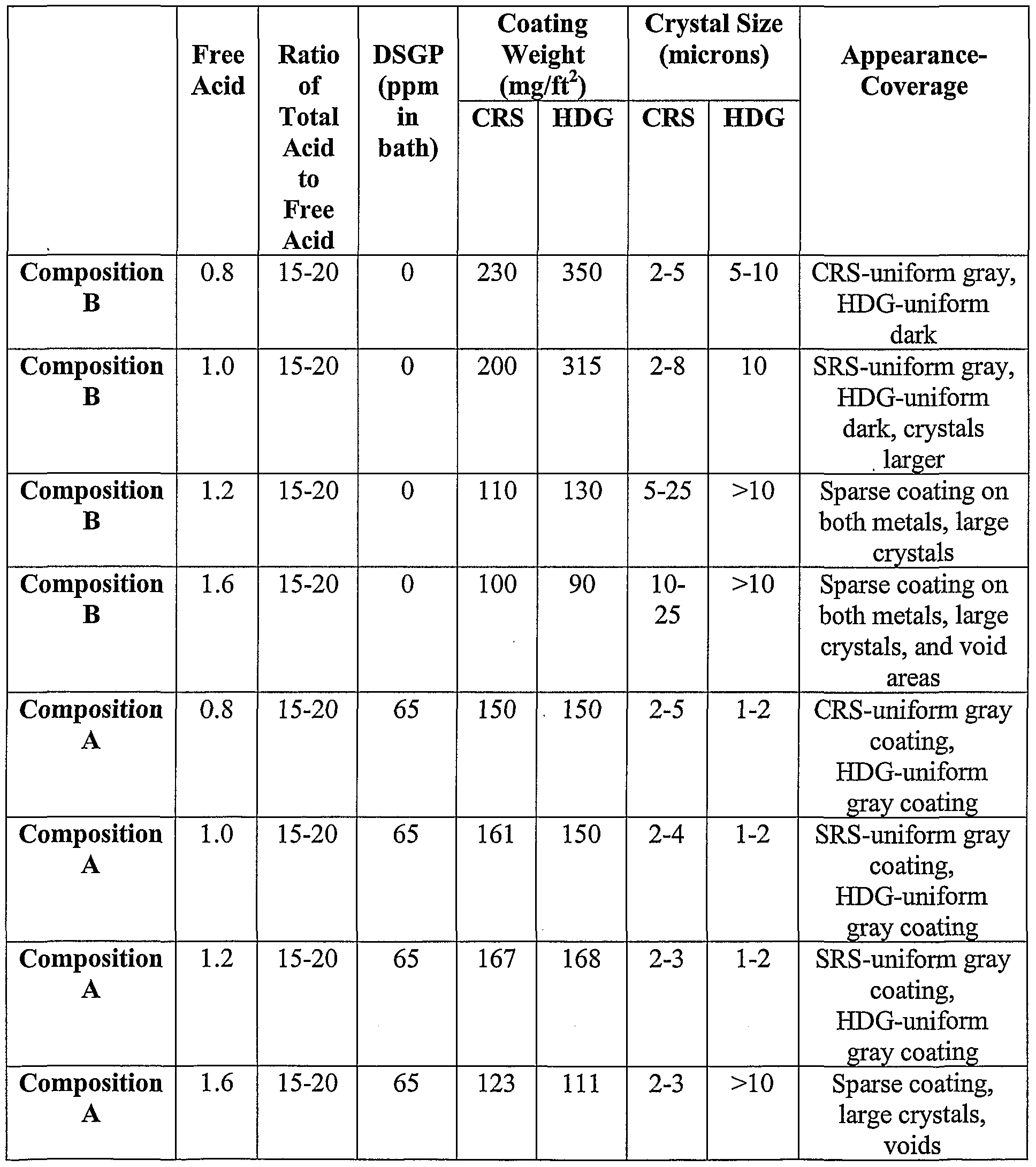
Cold Rolled Steel (CRS) and Hot Dipped Galvanized (HDG) metal was coated with Inventive Composition A, as set forth in Example 1, and Comparative Composition B (a conventional tri-cation composition which did not include DSGP), adjusted for a variety of free acid points. Coating weights, crystal sizes, and qualitative measurements were taken, as shown in Table 3.
Table 3
Effect of DSGP on Coating Efficacy
Figure imgf000019_0001
As shown in Table 3, the use of DSGP in the present invention increases the coating efficacy of the tri-cation phosphating process to a free acid of 1.2. This is advantageous as processing the metal at higher acidity levels improves uniformity of the metal surface by effectively removing surface contaminants, particularly oxides which can interfere with the coating process. Additionally, it provides a surface which is more effectively and easily activated by the Titanium(IN) activator.
These improved characteristics permit a narrow range of coating weights for the inventive coatings, as illustrated by Composition A in Table 3, as compared to conventional coatings, illustrated by Composition B in Table 3. Further, the improved coating uniformity which results from the present invention provides a surface which is more receptive to a uniform film build, particularly for the application of elecfrocoat paints where surface uniformity is critical for appearance and corrosion performance.
Example 5
Comparison of Spray and Dipped Conventional. Inventive, and Νon-DSGP Containing
Tri-Cation Coatings on Cold Rolled Steel and Hot Dipped Galvanized Metals
CRS and HDG were coated with Composition A, as set forth in Example 1, Composition B, as set forth in Example 3, and Composition C. Composition C is a conventional zinc phosphate (non tri-cation) composition. Compositions A, B, and C were spray and dip coated onto CRS and HDG subsfrates and the properties of the resultant coatings were measured, as shown in Table 4.
Table 4
Comparison of Spray and Dip Coating Compositions A. B and C on Cold Rolled Steel and Hot Dipped Galvanized Metal Substrates
Figure imgf000021_0001
As shown in Table 4, tri-cation composition B, which did not include DSGP, exhibited an undesirably wide range of coating weights obtained between CRS and HDG and an undesirably high coating weight on average. Further, Composition C, a conventional coating which included DSGP, exhibited improved crystal size but also showed an undesirably wide range of coating weights and an undesirably high coating weight on average.
Only Inventive Composition A exhibited a desirably narrow range of coating weights, a lower coating weight on average, and a relatively smaller crystal size. Additionally, Composition A coatings, particularly on HDG, were uniformly gray. By contrast, comparative Composition B coatings were dark and had larger crystals with visible spangles on HDG, which are likely to undesirably affect paint glass and general aesthetic appearance. Accordingly, it can be seen that compositions of the present invention, as illustrated by Composition A, exhibit improved coating to metal surfaces as compared to conventional zinc phosphate compositions as well as tri-cation compositions which do not contain DSGP.
The examples set forth above serve to illustrate the present invention, but in no way are intended to limit the scope thereof, which is defined by the following claims.

Claims

WHAT IS CLAIMED IS:
1. A coating composition for metal substrates, comprising: a) a tri-cationic phosphate composition which includes a phosphate component and ions of nickel, manganese, and zinc; and b) a glycerophosphate compound, wherein said composition is capable of providing anti-corrosion properties to metal subsfrates when applied thereto.
2. The coating composition of claim 1, wherein said glycerophosphate compound is disodium glycerophosphate.
3. The coating composition of claim 1, wherein said glycerophosphate compound causes crystals of said composition to be formed in a substantially uniform manner on said metal substrates.
4. The coating composition of claim 1, further comprising a compound which includes a silicon component.
5. The coating composition of claim 4, wherein said silicon component is present in an amount of about 50 parts per million to an amount of about 300 parts per million.
6. The coating composition of claim 4, wherein said silicon component is present in an amount of about 100 parts per million of said composition.
7. The coating composition of claim 4, wherein said silicon component is provided by a compound selected from the group consisting of: hydrofluorosilicic acid; silicic acid; silicon dioxide; salts and combinations thereof.
8. The coating composition of claim 1, further comprising ions of fluoride.
9. The coating composition of claim 8, wherein said ions of fluoride are present in an amount of about 100 parts per million to an amount of about 1500 parts per million.
10. The coating composition of claim 8, wherein said ions of fluoride are present in an amount of about 250 parts per million of said composition.
11. The coating composition of claim 8, wherein said ions of fluoride are provided by a compound selected from the group consisting of: hydrofluoric acid; hydrofluorosilicic acid; hydrofluorotitanic acid; fluoroboric acid; salts and combinations thereof.
12. The coating composition of claim 1, wherein said phosphate component is present in an amount of about 8000 parts per million to about 30,000 parts per million.
13. The coating composition of claim 1, wherein said phosphate component is present in an amount of about 16000 parts per million of said composition.
14. The coating composition of claim 1, wherein said nickel ions are present in an amount of about 100 parts per million to about 1000 parts per million.
15. The coating composition of claim 1 , wherein said nickel ions are present in an amount of about 800 parts per million of said composition.
16. The coating composition of claim 1, wherein said manganese ions are present in an amount of about 100 parts per million to about 1000 parts per million.
17. The coating composition of claim 1, wherein said manganese ions are present in a concentration of about 800 parts per million of said composition.
18. The coating composition of claim 1, wherein said zinc ions are present in an amount of about 500 parts per million to about 2000 parts per million.
19. The coating composition of claim 1, wherein said zinc ion is present in a concentration of about 1000 parts per million of said composition.
20. The coating composition of claim 1, wherein said glycerophosphate compound is present in an amount of about 10 parts per million to about 500 parts per million.
21. The coating composition of claim 1 , wherein said glycerophosphate compound is present in a concentration of about 65 parts per million of said concentration.
22. The coating composition of claim 1, wherein said coating is formed from crystals of about 2 to about 3 microns in size.
23. The coating composition of claim 1, wherein said phosphate component is provided by a compound selected from the group consisting of: phosphoric acid; alkali metal phosphates such as monosodium phosphate, monopotassium phosphate, disodium phosphate; divalent metal phosphates; zinc phosphate; zinc monohydrogen phosphate; zinc dihydrogen phosphate; manganese phosphate; manganese monohydrogen phosphate; manganese dihydrogen phosphate; and combinations thereof.
24. The coating composition of claim 1, wherein said zinc ions are provided by a compound selected from the group consisting of: zinc; zinc nitrate; zinc oxide; zinc carbonate; zinc phosphate; and combinations thereof.
25. The coating composition of claim 1, wherein said nickel ions are provided by a compound selected from the group consisting of: nickel carbonate; nickel nitrate; nickel phosphate; and combinations thereof.
26. The coating composition of claim 1, wherein said manganese ions are provided by a compound selected from the group consisting of: manganese carbonate; manganese nitrate; manganese phosphates; and combinations thereof.
27. A method of making a coating composition for metal subsfrates, comprising the step of: a) providing phosphate ions, nickel ions, zinc ions, manganese ions, and a glycerophosphate compound; b) combining each of said ion components to form a mixture.
28. A method according to claim 27, wherein said glycerophosphate compound is disodium glycerophosphate.
29. A method according to claim 27, further comprising the step of providing a compound which includes a silicon component.
30. A method according to claim 29, wherein said silicon component is present in an amount of about 50 parts per million to an amount of about 300 parts per million of said coating composition.
31. A method according to claim 29, wherein said silicon component is present in a concentration of about 100 parts per million of said coating composition.
32. A method according to claim 29, wherein said silicon component is provided by a compound selected from the group consisting of: hydrofluorosilicic acid; silicic acid; silicon dioxide; salts and combinations thereof.
33. A method according to claim 27, further comprising the step of providing ions of fluoride.
34. A method according to claim 33, wherein said ions of fluoride are present in an amount of about 100 parts per million to an amount of about 1500 parts per million of said coating composition.
35. A method according to claim 33, wherein said ions of fluoride are present in a concentration of about 250 parts per million of said coating composition.
36. A method according to claim 33, wherein said ions of fluoride are provided by a compound selected from the group consisting of: hydrofluoric acid; hydrofluorosilicic acid; hydrofluorotitanic acid; fluoroboric acid; salts and combinations thereof.
37. A method according to claim 27, wherein said phosphate component is provided by a compound selected from the group consisting of: phosphoric acid; alkali metal phosphates such as monosodium phosphate, monopotassium phosphate, disodium phosphate; divalent metal phosphates; zinc phosphate; zinc monohydrogen phosphate; zinc dihydrogen phosphate; manganese phosphate; manganese monohydrogen phosphate; manganese dihydrogen phosphate; and combinations thereof.
38. A method according to claim 27, wherein said zinc ions are provided by a compound selected from the group consisting of: zinc; zinc nitrate; zinc oxide; zinc carbonate; zinc phosphate; and combinations thereof.
39. A method according to claim 27, wherein said nickel ions are provided by a compound selected from the group consisting of: nickel carbonate; nickel nitrate; nickel phosphate; and combinations thereof.
40. A method according to claim 27, wherein said manganese ions are provided by a compound selected from the group consisting of: manganese carbonate; manganese nitrate; manganese phosphates; and combinations thereof.
41. A method of improving the anti-corrosion properties of metal subsfrates, comprising * the steps of: a) providing a coating composition, said coating composition comprising phosphate ions, nickel ions, manganese ions, zinc ions, and disodium glycerophosphate; and b) coating a metal subsfrate with said coating composition.
42. A method according to claim 41, wherein said metal subsfrate is cold rolled steel or hot dipped galvanized metal.
43. A method according to claim 41, wherein said coating composition further comprises a compound which includes a silicon component.
44. A method according to claim 43, wherein said silicon component is present in an amount of about 50 parts per million to an amount of about 300 parts per million.
45. A method according to claim 43, wherein said silicon component is present in a concentration of about 100 parts per million of said composition.
46. A method according to claim 41, wherein said coating composition further comprises ions of fluoride.
47. A method according to claim 46, wherein said ions of fluoride are present in an amount of about 100 parts per million to an amount of about 1500 parts per million.
48. A method according to claim 46, wherein said ions of fluoride are present in a concentration of about 250 parts per million of said composition.
49. A method according to claim 41, further comprising the step of activating said metal subsfrate with an activating agent.
50. A method according to claim 49, wherein said activating agent is a titanium compound.
51. A method according to claim 41, wherein said coating step includes immersing said metal substrate in said coating composition.
52. A method according to claim 41, wherein said coating step includes spraying said coating composition onto, one or more surfaces of said metal subsfrate.
53. A method according to claim 41, further comprising the step of painting said metal subsfrate subsequent to said coating step.
54. A method according to claim 53, wherein said painting step comprises the application of an elecfropaint compound to said metal substrate.
PCT/US2001/026803 2000-09-20 2001-08-28 Tri-cation zinc phosphate conversion coating and process of making the same Ceased WO2002024973A2 (en)

Priority Applications (1)

Application Number Priority Date Filing Date Title
AU2001288455A AU2001288455A1 (en) 2000-09-20 2001-08-28 Tri-cation zinc phosphate conversion coating and process of making the same

Applications Claiming Priority (2)

Application Number Priority Date Filing Date Title
US09/666,365 2000-09-20
US09/666,365 US6551417B1 (en) 2000-09-20 2000-09-20 Tri-cation zinc phosphate conversion coating and process of making the same

Publications (2)

Publication Number Publication Date
WO2002024973A2 true WO2002024973A2 (en) 2002-03-28
WO2002024973A3 WO2002024973A3 (en) 2003-07-31

Family

ID=24673881

Family Applications (1)

Application Number Title Priority Date Filing Date
PCT/US2001/026803 Ceased WO2002024973A2 (en) 2000-09-20 2001-08-28 Tri-cation zinc phosphate conversion coating and process of making the same

Country Status (3)

Country Link
US (1) US6551417B1 (en)
AU (1) AU2001288455A1 (en)
WO (1) WO2002024973A2 (en)

Cited By (6)

* Cited by examiner, † Cited by third party
Publication number Priority date Publication date Assignee Title
WO2004089844A1 (en) * 2003-04-09 2004-10-21 Arts Technology S.A. Product for treating reinforced concrete constructions
WO2009113088A3 (en) * 2008-01-14 2010-11-25 Aditya Birla Science & Technology Co. Limited A process for manufacturing of potassium fluoride
WO2012013555A1 (en) 2010-07-29 2012-02-02 Basf Coatings Gmbh Method for the corrosion-inhibiting coating of metal surfaces, using low molecular mass phosphorus compounds
WO2012013560A1 (en) 2010-07-29 2012-02-02 Basf Coatings Gmbh Method for the corrosion-inhibiting coating of metal surfaces using phosphorous-containing polyester
CN103088324A (en) * 2013-03-01 2013-05-08 华北电力大学(保定) Phosphating solution for corrosion prevention of iron towers and preparation method thereof
CN104313561A (en) * 2014-10-29 2015-01-28 合肥市华阳工程机械有限公司 Surface treatment phosphatizing agent for building sectional material

Families Citing this family (12)

* Cited by examiner, † Cited by third party
Publication number Priority date Publication date Assignee Title
AU2002301945B2 (en) * 2001-11-21 2008-07-17 Chiyoda Chemical Co., Ltd Surface treatment method of metal member, and metal goods
US7827077B2 (en) * 2003-05-02 2010-11-02 Visa U.S.A. Inc. Method and apparatus for management of electronic receipts on portable devices
US20060086282A1 (en) * 2004-10-25 2006-04-27 Zhang Jun Q Phosphate conversion coating and process
BRPI0811201A2 (en) * 2007-06-07 2014-10-29 Henkel Ag & Co Kgaa COMPOSITION OF LIQUID MATTER FOR THE FORMATION OF A PHOSPHATE CONVERSION COATING ON A METAL SUBSTRATE, PROCESS FOR THE PRODUCTION OF A PHOSPHATE CONVERSION COATING, AND, MANUFACTURING ARTICLE.
US8137805B2 (en) * 2007-06-21 2012-03-20 Caterpillar Inc. Manganese based coating for wear and corrosion resistance
US8137761B2 (en) * 2008-06-13 2012-03-20 Caterpillar Inc. Method of coating and induction heating a component
JP5769629B2 (en) * 2008-12-08 2015-08-26 スリーエム イノベイティブ プロパティズ カンパニー Halogen-free flame retardant for epoxy resins
DE102010030697A1 (en) * 2010-06-30 2012-01-05 Henkel Ag & Co. Kgaa Process for the selective phosphating of a composite metal construction
CN102534591B (en) * 2012-01-05 2013-12-18 安徽启明表面技术有限公司 Thick film phosphating method
CN102677033B (en) * 2012-05-25 2014-07-09 衡阳市金化科技有限公司 Wear-resistant manganese phosphating solution
CN104294246A (en) * 2014-10-29 2015-01-21 合肥市华阳工程机械有限公司 High-temperature phosphating solution for surface treatment on rails
KR101769302B1 (en) * 2016-06-08 2017-08-18 현대자동차주식회사 Composition for Phosphate Film Optimazing Mn Content and Phosphatetreatment Method of Zn Electric-Plated Steel Sheet

Family Cites Families (24)

* Cited by examiner, † Cited by third party
Publication number Priority date Publication date Assignee Title
IT429345A (en) 1941-10-25 1900-01-01
US2456947A (en) 1944-12-21 1948-12-21 Westinghouse Electric Corp Corrosion resistant coating for metal surfaces
GB876250A (en) 1959-03-05 1961-08-30 Ici Ltd Phosphate coating
BE627337A (en) 1962-01-26
FR1344776A (en) * 1962-01-26 1963-11-29 Amchem Prod Improvements in solutions and processes for the production of surface coatings by conversion on zinc and its alloys
DE1621434A1 (en) * 1967-03-10 1971-06-03 Collardin Gmbh Gerhard Process for the production of hard, thin zinc phosphate layers
JPS506418B1 (en) 1971-07-06 1975-03-13
US4086103A (en) * 1975-08-13 1978-04-25 Kevin James Woods Accelerator for phosphating solutions
CA1098253A (en) * 1976-04-05 1981-03-31 Timm L. Kelly Zirconium/titanium coating solution for aluminum surfaces
US4498935A (en) 1981-07-13 1985-02-12 Parker Chemical Company Zinc phosphate conversion coating composition
US4427459A (en) * 1982-01-25 1984-01-24 Pennwalt Corporation Phosphate conversion coatings for metals with reduced coating weights and crystal sizes
JPS5935681A (en) 1982-08-24 1984-02-27 Nippon Paint Co Ltd Method for phosphating metallic surface for coating by cationic electrodeposition
DE3244715A1 (en) 1982-12-03 1984-06-07 Gerhard Collardin GmbH, 5000 Köln METHOD FOR PHOSPHATING METAL SURFACES, AND BATH SOLUTIONS SUITABLE FOR THIS
DE3408577A1 (en) 1984-03-09 1985-09-12 Metallgesellschaft Ag, 6000 Frankfurt METHOD FOR PHOSPHATING METALS
US4596607A (en) 1985-07-01 1986-06-24 Ford Motor Company Alkaline resistant manganese-nickel-zinc phosphate conversion coatings and method of application
US4793867A (en) 1986-09-26 1988-12-27 Chemfil Corporation Phosphate coating composition and method of applying a zinc-nickel phosphate coating
US4941930A (en) 1986-09-26 1990-07-17 Chemfil Corporation Phosphate coating composition and method of applying a zinc-nickel phosphate coating
US5238506A (en) 1986-09-26 1993-08-24 Chemfil Corporation Phosphate coating composition and method of applying a zinc-nickel-manganese phosphate coating
DE3814287A1 (en) 1988-04-28 1989-11-09 Henkel Kgaa POLYMERS TITANIUM PHOSPHATES, METHOD FOR THE PRODUCTION THEREOF AND THEIR USE FOR ACTIVATING METAL SURFACES BEFORE ZINC PHOSPHATION
JPH0730455B2 (en) 1988-09-27 1995-04-05 日本パーカライジング株式会社 Phosphate chemical treatment liquid
JPH0696773B2 (en) * 1989-06-15 1994-11-30 日本ペイント株式会社 Method for forming zinc phosphate film on metal surface
US6019858A (en) 1991-07-29 2000-02-01 Henkel Corporation Zinc phosphate conversion coating and process
US5261973A (en) 1991-07-29 1993-11-16 Henkel Corporation Zinc phosphate conversion coating and process
US5797987A (en) 1995-12-14 1998-08-25 Ppg Industries, Inc. Zinc phosphate conversion coating compositions and process

Cited By (10)

* Cited by examiner, † Cited by third party
Publication number Priority date Publication date Assignee Title
WO2004089844A1 (en) * 2003-04-09 2004-10-21 Arts Technology S.A. Product for treating reinforced concrete constructions
CH696237A5 (en) * 2003-04-09 2007-02-28 Arts Technology S A A method for processing reinforced concrete structures.
US7678193B2 (en) 2003-04-09 2010-03-16 Arts Technology S.A. Product for treating reinforced concrete constructions
WO2009113088A3 (en) * 2008-01-14 2010-11-25 Aditya Birla Science & Technology Co. Limited A process for manufacturing of potassium fluoride
WO2012013555A1 (en) 2010-07-29 2012-02-02 Basf Coatings Gmbh Method for the corrosion-inhibiting coating of metal surfaces, using low molecular mass phosphorus compounds
WO2012013560A1 (en) 2010-07-29 2012-02-02 Basf Coatings Gmbh Method for the corrosion-inhibiting coating of metal surfaces using phosphorous-containing polyester
DE102010032787A1 (en) 2010-07-29 2012-02-02 Basf Coatings Gmbh Process for the corrosion-inhibiting coating of metal surfaces using phosphorus-containing polyesters
DE102010032786A1 (en) 2010-07-29 2012-02-02 Basf Coatings Gmbh Process for the corrosion-inhibiting coating of metal surfaces using phosphorus-containing low molecular weight compounds
CN103088324A (en) * 2013-03-01 2013-05-08 华北电力大学(保定) Phosphating solution for corrosion prevention of iron towers and preparation method thereof
CN104313561A (en) * 2014-10-29 2015-01-28 合肥市华阳工程机械有限公司 Surface treatment phosphatizing agent for building sectional material

Also Published As

Publication number Publication date
US6551417B1 (en) 2003-04-22
AU2001288455A1 (en) 2002-04-02
WO2002024973A3 (en) 2003-07-31

Similar Documents

Publication Publication Date Title
US6551417B1 (en) Tri-cation zinc phosphate conversion coating and process of making the same
US4865653A (en) Zinc phosphate coating process
AU2009226945B2 (en) Optimized passivation on Ti-/Zr-basis for metal surfaces
US8349092B2 (en) Process for coating metallic surfaces
EP0106459A1 (en) Phosphate coating metal surfaces
CA1333147C (en) Process of phosphating steel and/or galvanized steel before painting
US20110180186A1 (en) Method and solution for coating metallic surfaces with a phosphating solution containing hydrogen peroxide, metallic object produced and use of the object
US20020122886A1 (en) Process for treating steel-, zinc- and aluminum-based metals using a two-step coating system
EP0977908A1 (en) Conditioning metal surfaces prior to phosphate conversion coating
EP0866886B1 (en) Zinc phosphate conversion coating compositions and process
US7208053B2 (en) Method for applying a phosphate covering and use of metal parts thus phospated
JP2005501173A (en) Method of applying phosphate coating and use of metal member phosphate coated by said method
US6214132B1 (en) Conditioning metal surfaces prior to phosphate conversion coating
JPS6056429B2 (en) Phosphate film treatment method for metals
CA1224121A (en) Process for phosphating metals
KR20010072179A (en) Method for phosphatizing , rerinsing and cathodic electro-dipcoating
EP0653502A2 (en) Zinc-containing metal-plated composite steel article and method of producing the same
JP3137535B2 (en) Zinc-containing metal-coated steel sheet composite excellent in coatability and method for producing the same
JP2004501280A (en) Binder added to chemical conversion solution
SK112598A3 (en) Zinc phosphatizing with low quantity of copper and manganese
CA2035048A1 (en) Phosphate coating composition and method of applying a zinc-nickel-manganese phosphate coating
ZA200501123B (en) Method for coating metallic surfaces
CA2304689A1 (en) Nickel-zinc phosphate conversion coatings
JP2002226977A (en) Processing method of high strength steel sheet and high strength steel sheet
MXPA98004703A (en) Coating compositions of zinc phosphate conversion and procedimie

Legal Events

Date Code Title Description
AK Designated states

Kind code of ref document: A2

Designated state(s): AE AG AL AM AT AU AZ BA BB BG BR BY BZ CA CH CN CO CR CU CZ DE DK DM DZ EC EE ES FI GB GD GE GH GM HR HU ID IL IN IS JP KE KG KP KR KZ LC LK LR LS LT LU LV MA MD MG MK MN MW MX MZ NO NZ PH PL PT RO RU SD SE SG SI SK SL TJ TM TR TT TZ UA UG UZ VN YU ZA ZW

AL Designated countries for regional patents

Kind code of ref document: A2

Designated state(s): GH GM KE LS MW MZ SD SL SZ TZ UG ZW AM AZ BY KG KZ MD RU TJ TM AT BE CH CY DE DK ES FI FR GB GR IE IT LU MC NL PT SE TR BF BJ CF CG CI CM GA GN GQ GW ML MR NE SN TD TG

DFPE Request for preliminary examination filed prior to expiration of 19th month from priority date (pct application filed before 20040101)
121 Ep: the epo has been informed by wipo that ep was designated in this application
REG Reference to national code

Ref country code: DE

Ref legal event code: 8642

122 Ep: pct application non-entry in european phase
NENP Non-entry into the national phase

Ref country code: JP