US9889237B2 - Medical device having a surface comprising nanoparticles - Google Patents
Medical device having a surface comprising nanoparticles Download PDFInfo
- Publication number
- US9889237B2 US9889237B2 US13/875,355 US201313875355A US9889237B2 US 9889237 B2 US9889237 B2 US 9889237B2 US 201313875355 A US201313875355 A US 201313875355A US 9889237 B2 US9889237 B2 US 9889237B2
- Authority
- US
- United States
- Prior art keywords
- nanoparticles
- medical device
- bismuth
- gallium
- titanium
- Prior art date
- Legal status (The legal status is an assumption and is not a legal conclusion. Google has not performed a legal analysis and makes no representation as to the accuracy of the status listed.)
- Active
Links
Images


Classifications
-
- A—HUMAN NECESSITIES
- A61—MEDICAL OR VETERINARY SCIENCE; HYGIENE
- A61L—METHODS OR APPARATUS FOR STERILISING MATERIALS OR OBJECTS IN GENERAL; DISINFECTION, STERILISATION OR DEODORISATION OF AIR; CHEMICAL ASPECTS OF BANDAGES, DRESSINGS, ABSORBENT PADS OR SURGICAL ARTICLES; MATERIALS FOR BANDAGES, DRESSINGS, ABSORBENT PADS OR SURGICAL ARTICLES
- A61L31/00—Materials for other surgical articles, e.g. stents, stent-grafts, shunts, surgical drapes, guide wires, materials for adhesion prevention, occluding devices, surgical gloves, tissue fixation devices
- A61L31/02—Inorganic materials
- A61L31/028—Other inorganic materials not covered by A61L31/022 - A61L31/026
-
- A—HUMAN NECESSITIES
- A61—MEDICAL OR VETERINARY SCIENCE; HYGIENE
- A61C—DENTISTRY; APPARATUS OR METHODS FOR ORAL OR DENTAL HYGIENE
- A61C8/00—Means to be fixed to the jaw-bone for consolidating natural teeth or for fixing dental prostheses thereon; Dental implants; Implanting tools
-
- A61K6/0073—
-
- A—HUMAN NECESSITIES
- A61—MEDICAL OR VETERINARY SCIENCE; HYGIENE
- A61K—PREPARATIONS FOR MEDICAL, DENTAL OR TOILETRY PURPOSES
- A61K6/00—Preparations for dentistry
- A61K6/70—Preparations for dentistry comprising inorganic additives
- A61K6/71—Fillers
-
- A—HUMAN NECESSITIES
- A61—MEDICAL OR VETERINARY SCIENCE; HYGIENE
- A61L—METHODS OR APPARATUS FOR STERILISING MATERIALS OR OBJECTS IN GENERAL; DISINFECTION, STERILISATION OR DEODORISATION OF AIR; CHEMICAL ASPECTS OF BANDAGES, DRESSINGS, ABSORBENT PADS OR SURGICAL ARTICLES; MATERIALS FOR BANDAGES, DRESSINGS, ABSORBENT PADS OR SURGICAL ARTICLES
- A61L27/00—Materials for grafts or prostheses or for coating grafts or prostheses
- A61L27/02—Inorganic materials
-
- A—HUMAN NECESSITIES
- A61—MEDICAL OR VETERINARY SCIENCE; HYGIENE
- A61L—METHODS OR APPARATUS FOR STERILISING MATERIALS OR OBJECTS IN GENERAL; DISINFECTION, STERILISATION OR DEODORISATION OF AIR; CHEMICAL ASPECTS OF BANDAGES, DRESSINGS, ABSORBENT PADS OR SURGICAL ARTICLES; MATERIALS FOR BANDAGES, DRESSINGS, ABSORBENT PADS OR SURGICAL ARTICLES
- A61L27/00—Materials for grafts or prostheses or for coating grafts or prostheses
- A61L27/02—Inorganic materials
- A61L27/04—Metals or alloys
- A61L27/06—Titanium or titanium alloys
-
- A—HUMAN NECESSITIES
- A61—MEDICAL OR VETERINARY SCIENCE; HYGIENE
- A61L—METHODS OR APPARATUS FOR STERILISING MATERIALS OR OBJECTS IN GENERAL; DISINFECTION, STERILISATION OR DEODORISATION OF AIR; CHEMICAL ASPECTS OF BANDAGES, DRESSINGS, ABSORBENT PADS OR SURGICAL ARTICLES; MATERIALS FOR BANDAGES, DRESSINGS, ABSORBENT PADS OR SURGICAL ARTICLES
- A61L27/00—Materials for grafts or prostheses or for coating grafts or prostheses
- A61L27/28—Materials for coating prostheses
- A61L27/30—Inorganic materials
-
- A—HUMAN NECESSITIES
- A61—MEDICAL OR VETERINARY SCIENCE; HYGIENE
- A61L—METHODS OR APPARATUS FOR STERILISING MATERIALS OR OBJECTS IN GENERAL; DISINFECTION, STERILISATION OR DEODORISATION OF AIR; CHEMICAL ASPECTS OF BANDAGES, DRESSINGS, ABSORBENT PADS OR SURGICAL ARTICLES; MATERIALS FOR BANDAGES, DRESSINGS, ABSORBENT PADS OR SURGICAL ARTICLES
- A61L27/00—Materials for grafts or prostheses or for coating grafts or prostheses
- A61L27/28—Materials for coating prostheses
- A61L27/30—Inorganic materials
- A61L27/306—Other specific inorganic materials not covered by A61L27/303 - A61L27/32
-
- A—HUMAN NECESSITIES
- A61—MEDICAL OR VETERINARY SCIENCE; HYGIENE
- A61L—METHODS OR APPARATUS FOR STERILISING MATERIALS OR OBJECTS IN GENERAL; DISINFECTION, STERILISATION OR DEODORISATION OF AIR; CHEMICAL ASPECTS OF BANDAGES, DRESSINGS, ABSORBENT PADS OR SURGICAL ARTICLES; MATERIALS FOR BANDAGES, DRESSINGS, ABSORBENT PADS OR SURGICAL ARTICLES
- A61L31/00—Materials for other surgical articles, e.g. stents, stent-grafts, shunts, surgical drapes, guide wires, materials for adhesion prevention, occluding devices, surgical gloves, tissue fixation devices
- A61L31/14—Materials characterised by their function or physical properties, e.g. injectable or lubricating compositions, shape-memory materials, surface modified materials
- A61L31/16—Biologically active materials, e.g. therapeutic substances
-
- A—HUMAN NECESSITIES
- A61—MEDICAL OR VETERINARY SCIENCE; HYGIENE
- A61C—DENTISTRY; APPARATUS OR METHODS FOR ORAL OR DENTAL HYGIENE
- A61C8/00—Means to be fixed to the jaw-bone for consolidating natural teeth or for fixing dental prostheses thereon; Dental implants; Implanting tools
- A61C8/0012—Means to be fixed to the jaw-bone for consolidating natural teeth or for fixing dental prostheses thereon; Dental implants; Implanting tools characterised by the material or composition, e.g. ceramics, surface layer, metal alloy
- A61C8/0013—Means to be fixed to the jaw-bone for consolidating natural teeth or for fixing dental prostheses thereon; Dental implants; Implanting tools characterised by the material or composition, e.g. ceramics, surface layer, metal alloy with a surface layer, coating
-
- A—HUMAN NECESSITIES
- A61—MEDICAL OR VETERINARY SCIENCE; HYGIENE
- A61L—METHODS OR APPARATUS FOR STERILISING MATERIALS OR OBJECTS IN GENERAL; DISINFECTION, STERILISATION OR DEODORISATION OF AIR; CHEMICAL ASPECTS OF BANDAGES, DRESSINGS, ABSORBENT PADS OR SURGICAL ARTICLES; MATERIALS FOR BANDAGES, DRESSINGS, ABSORBENT PADS OR SURGICAL ARTICLES
- A61L2400/00—Materials characterised by their function or physical properties
- A61L2400/12—Nanosized materials, e.g. nanofibres, nanoparticles, nanowires, nanotubes; Nanostructured surfaces
-
- A—HUMAN NECESSITIES
- A61—MEDICAL OR VETERINARY SCIENCE; HYGIENE
- A61L—METHODS OR APPARATUS FOR STERILISING MATERIALS OR OBJECTS IN GENERAL; DISINFECTION, STERILISATION OR DEODORISATION OF AIR; CHEMICAL ASPECTS OF BANDAGES, DRESSINGS, ABSORBENT PADS OR SURGICAL ARTICLES; MATERIALS FOR BANDAGES, DRESSINGS, ABSORBENT PADS OR SURGICAL ARTICLES
- A61L2430/00—Materials or treatment for tissue regeneration
- A61L2430/02—Materials or treatment for tissue regeneration for reconstruction of bones; weight-bearing implants
-
- A—HUMAN NECESSITIES
- A61—MEDICAL OR VETERINARY SCIENCE; HYGIENE
- A61L—METHODS OR APPARATUS FOR STERILISING MATERIALS OR OBJECTS IN GENERAL; DISINFECTION, STERILISATION OR DEODORISATION OF AIR; CHEMICAL ASPECTS OF BANDAGES, DRESSINGS, ABSORBENT PADS OR SURGICAL ARTICLES; MATERIALS FOR BANDAGES, DRESSINGS, ABSORBENT PADS OR SURGICAL ARTICLES
- A61L2430/00—Materials or treatment for tissue regeneration
- A61L2430/12—Materials or treatment for tissue regeneration for dental implants or prostheses
-
- A—HUMAN NECESSITIES
- A61—MEDICAL OR VETERINARY SCIENCE; HYGIENE
- A61L—METHODS OR APPARATUS FOR STERILISING MATERIALS OR OBJECTS IN GENERAL; DISINFECTION, STERILISATION OR DEODORISATION OF AIR; CHEMICAL ASPECTS OF BANDAGES, DRESSINGS, ABSORBENT PADS OR SURGICAL ARTICLES; MATERIALS FOR BANDAGES, DRESSINGS, ABSORBENT PADS OR SURGICAL ARTICLES
- A61L2430/00—Materials or treatment for tissue regeneration
- A61L2430/14—Materials or treatment for tissue regeneration for ear reconstruction or ear implants, e.g. implantable hearing aids
-
- F—MECHANICAL ENGINEERING; LIGHTING; HEATING; WEAPONS; BLASTING
- F04—POSITIVE - DISPLACEMENT MACHINES FOR LIQUIDS; PUMPS FOR LIQUIDS OR ELASTIC FLUIDS
- F04C—ROTARY-PISTON, OR OSCILLATING-PISTON, POSITIVE-DISPLACEMENT MACHINES FOR LIQUIDS; ROTARY-PISTON, OR OSCILLATING-PISTON, POSITIVE-DISPLACEMENT PUMPS
- F04C2270/00—Control; Monitoring or safety arrangements
- F04C2270/04—Force
- F04C2270/042—Force radial
- F04C2270/0421—Controlled or regulated
Definitions
- the present invention relates to the field of medical devices intended for contact with living cells or tissue, in particular implants intended for implantation into living tissue, and to methods of producing such medical devices.
- biocompatibility is a crucial issue.
- the risk for foreign body reaction, clot formation and infection, among many other things, must be addressed and minimized in order to avoid adverse effects, local as well as systemic, which may otherwise compromise the health of the patient and/or lead to failure of the device. This is particularly the case for permanent implants.
- Dental implant systems are widely used for replacing damaged or lost natural teeth.
- a dental fixture screw
- screw usually made of titanium or a titanium alloy
- An abutment structure is then attached to the fixture in order to build up a core for the part of the prosthetic tooth protruding from the bone tissue, through the soft gingival tissue and into the mouth of the patient.
- the prosthesis or crown may finally be seated.
- a strong attachment between the bone tissue and the implant is necessary.
- implants intended for contact with soft tissue such as abutments which are to be partially located in the soft gingival tissue
- the compatibility with soft tissue is vital for total implant functionality.
- an abutment is partially or completely surrounded by gingival tissue. It is desirable that the gingival tissue should heal quickly and firmly around the implant, both for medical and aesthetic reasons.
- a tight sealing between the oral mucosa and the dental implant serves as a barrier against the oral microbial environment and is crucial for implant success. This is especially important for patients with poor oral hygiene and/or inadequate bone or mucosal quality. Poor healing or poor attachment between the soft tissue and the implant increases the risk for infection and peri-implantitis, which may ultimately lead to bone resorption and failure of the implant.
- Enhancement of new tissue formation may be achieved for example by various surface modifications and/or deposition of bioactive agents on the surface.
- a medical device having a surface intended for contact with living tissue, wherein the surface comprises nanoparticles comprising a non-toxic post-transition metal, such as gallium and/or bismuth, the nanoparticles having an average particle size of 500 nm or less.
- a non-toxic post-transition metal such as gallium and/or bismuth
- the presence of the non-toxic post-transition metal provides an antibacterial property.
- the risk for infection at the implantation site may be reduced.
- a nanoparticle coating may provide desirable surface characteristics in terms of electrochemical properties and surface roughness, and since the nanoparticles are small, the porosity of the nanoparticle coating is limited, which reduces the risk for penetration of microbes into the surface.
- a coating of nanoparticles comprising a non-toxic post-transition metal may be adapted e.g. with respect to layer thickness, to provide a particular colored appearance, which may be highly desirable for certain applications, such as dental implants.
- post-transition metal generally refers to metal elements found in groups 13-16 and periods 3-6 of the periodic table. Post-transition metals of groups 13-15 and periods 3-6 are preferred.
- the post-transition metal used is non-toxic.
- non-toxic means that the substance (e.g. a compound or element) in question does not damage mammalian cells at concentrations that have a lethal effect on bacterial cells.
- post-transition metal used in the present invention typically has an antimicrobial or antibacterial effect.
- Post-transition metals that are considered to have some antimicrobial or antibacterial effect include at least gallium, tin, lead, and bismuth.
- the invention may employ at least one non-toxic, antimicrobial post-transition metal, which may be selected from gallium and bismuth.
- the nanoparticles may comprise a compound of a non-toxic post-transition metal.
- compound of a post-transition metal refers to a chemical entity comprising at least one post-transition metal and at least one additional element.
- Non-limiting examples of such compounds include oxides comprising post-transition metal, nitrides comprising post-transition metal, alloys of at least one post-transition metal, and salts comprising post-transition metal.
- the compound may comprise two or more post-transition metals.
- compound(s) of a post-transition metal is intended to also refer to compounds incorporating one or more other metals, in particular biocompatible metals such as titanium, in addition to the one or more post-transition metal(s).
- the non-toxic post-transition metal and the at least one additional element may be joined by covalent bonding or ionic bonding.
- the non-toxic post-transition metal is selected from bismuth and gallium.
- Compound(s) of the non-toxic post-transition metal may thus be selected from bismuth compound(s) and gallium compound(s).
- the nanoparticles may comprise a gallium compound.
- the gallium compound may be selected from the group consisting of gallium oxide, gallium nitride, metal oxides comprising gallium and metal nitrides comprising gallium.
- the nanoparticles may comprise elemental bismuth or a bismuth compound.
- the bismuth compound is selected from the group consisting of bismuth oxide, bismuth nitride, metal oxides comprising bismuth and metal nitrides comprising bismuth.
- gallium compound also includes compounds including one or more other metals in addition to gallium, in particular titanium and/or bismuth.
- gallium-titanium oxides, gallium-titanium nitrides etc are included within the definition “gallium compound”.
- metal oxides comprising gallium is meant an oxide optionally comprising one or more additional element(s) other than gallium and oxygen, for example a metal such as titanium.
- oxides comprising gallium include gallium oxide, gallium-titanium oxide, gallium-bismuth oxide, etc.
- bismuth compound refers to a chemical entity comprising bismuth and at least one additional element.
- bismuth compounds include bismuth oxide, bismuth nitride, metal oxides comprising bismuth and metal nitrides comprising bismuth.
- bismuth compound also includes compounds incorporating other metals in addition to bismuth, in particular titanium and/or gallium. Thus, bismuth-titanium oxides, bismuth-titanium nitrides etc are included within the definition “bismuth compound”.
- metal oxides comprising bismuth an oxide optionally comprising one or more additional element(s) other than bismuth and oxygen, for example a metal such as titanium or gallium.
- oxides comprising bismuth thus include bismuth oxide as well as bismuth-titanium oxide, gallium-bismuth oxide, etc.
- the nanoparticles may have an average particle size of 300 nm or less, 250 nm or less, 200 nm or less, e.g. 100 nm or less, such as 50 nm or less, 30 nm or less, or 25 nm or less.
- the surface may further comprise nanoparticles of titanium dioxide having an average particle size of 100 nm or less, for example 50 nm or less, such as 30 nm or less.
- titanium oxide is an inert, biocompatible material and a surface layer comprising titanium dioxide nanoparticles may provide desirable surface characteristics in terms of electrochemical properties and surface roughness
- the nanoparticles may form a layer.
- the layer may have a thickness in the range of from 8 nm to about 1 ⁇ m, typically from 50 nm to 500 nm, for example from 100 nm to 400 nm.
- the layer may be a monolayer of the nanoparticles.
- the layer may be a continuous layer of the nanoparticles.
- the layer may completely cover the surface of an underlying substrate.
- the nanoparticles may be evenly spread throughout the layer.
- the medical device comprises a substrate having a surface onto which the nanoparticles are applied.
- the substrate may comprise a metal or an alloy, for example titanium, zirconium, hafnium, vanadium, niobium, tantalum, cobalt or iridium, or an alloy thereof, in particular titanium or a titanium alloy.
- the substrate may comprise a ceramic material, which may be selected from titanium oxide, titanium nitride, zirconium oxide, and combinations thereof.
- a part of the substrate that is in contact with the nanoparticles may comprise titanium oxide, in particular native titanium oxide.
- the substrate may be non-bioresorbable.
- the medical device is intended for implantation at least partially into living tissue.
- the medical device may be a dental implant, such as a dental fixture intended to be inserted at least partially into living bone tissue, or a dental abutment, intended to be in contact with living soft tissue.
- the medical device may be an orthopedic implant.
- the medical device may be a bone anchored hearing device or a part thereof.
- the medical device may be a stent. In other embodiments, the medical device may be a shunt.
- the invention provides a method of producing a medical device, the method comprising the steps of:
- the nanoparticles may be completely dispersed in the solvent. Such a monodispersion gives improved control of the coating procedure and allows the application of a continuous, homogeneous layer, even a monolayer, of nanoparticles on the surface.
- the dispersion may be applied onto the surface by spin coating.
- the surface of the substrate body prior to step c) may have been subjected to a roughening surface treatment, such as abrasive blasting and/or chemical etching.
- the method may further comprise one or more steps of allowing the solvent to evaporate, and/or sintering the nanoparticles.
- Sintering of a layer of the nanoparticles may improve the attachment of the nanoparticles to the substrate.
- Sintering of the nanoparticles may result in a ceramic or ceramic-like layer.
- the invention provides a method of implanting a medical device into the living body of a human or animal, the method comprising:
- Implantation of the present medical device into living tissue, with the surface comprising the nanoparticles contacting the tissue, may reduce the risk for microbial, in particular bacterial, infection of the tissue. Avoiding infection will increase the chances of a successful implantation, especially for prolonged or long-term implantation periods.
- FIG. 1 a - b are scanning electron microscopy (SEM) images of different magnifications showing a substrate surface without nanoparticles.
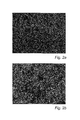
- FIG. 2 a - b are scanning electron microscopy (SEM) images of different magnifications showing a substrate surface coated with bismuth oxide nanoparticles according to embodiments of the invention.
- FIG. 3 is a graph presenting the particle size distribution of bismuth oxide nanoparticles used in embodiments of the invention.
- nanoparticles comprising a non-toxic post-transition metal, such as gallium and/or bismuth, for example in the form of oxide(s) or nitride(s), may be applied onto the surface of a medical device, to yield a surface having antimicrobial properties.
- a non-toxic post-transition metal such as gallium and/or bismuth, for example in the form of oxide(s) or nitride(s)
- the surface of the medical device presenting the nanoparticles is typically a surface intended for contact with living tissue.
- post-transition metal generally refers to metal elements found in groups 13-16 and periods 3-6 of the periodic table. Usually, aluminium, gallium, indium, thallium, tin, lead, bismuth and polonium are regarded as post-transition metals. In contrast, transition metals are formed of group 3-12 elements. Germanium and antimony are considered not as post-transition metals, but metalloid elements.
- Group 16 of the periodic table only contains one post-transition metal: polonium, which is toxic. Hence, in the present invention, post-transition metals of groups 13-15 and periods 3-6 are preferred.
- the post-transition metal used is non-toxic.
- non-toxic means that the substance (e.g. a compound or element) in question does not damage mammalian cells at concentrations that have a lethal effect on bacterial cells.
- post-transition metals examples include thallium (Tl), lead (Pb) and polonium (Po).
- Other post-transitional metals e.g. indium (In) and tin (Sn)
- Tl thallium
- Pb lead
- Po polonium
- Other post-transitional metals e.g. indium (In) and tin (Sn)
- the non-toxic post transition metal used in the present invention is typically non-toxic when present in elementary form, and/or as metal ions, and/or as one of the exemplary compounds given herein.
- the post-transition metal used in the present invention typically has an antimicrobial or antibacterial effect.
- Elements known to be associated with antimicrobial properties include e.g. Ga, Bi, Ag, Zn, Au, Pt, Pd, Ir, Cu, Sn, and Sb.
- Post-transition metals that are considered to have some antimicrobial or antibacterial effect include at least gallium (Ga), tin (Sn), lead (Pb), and bismuth (Bi).
- the medical device may employ at least one non-toxic, antimicrobial post-transition metal, which may be selected from gallium and bismuth.
- Gallium has been used in medicine at least since the 1940's, primarily as a radioactive agent for medical imaging.
- the antibacterial properties of gallium have been investigated in several studies. Gallium acts by disrupting iron metabolism. It may be assumed that gallium is also effective against other microbes, e.g. fungi such as yeasts or moulds.
- Bismuth is known to possess antibacterial activity. Bismuth compounds were formerly used to treat syphilis, and bismuth subsalicylate and bismuth subcitrate are currently used to treat peptic ulcers caused by Helicobacter pylori . The mechanism of action of this substance is still not well understood.
- Bibrocathol is an organic bismuth-containing compound used to treat eye infections, and bismuth subsalicylate and bismuth subcarbonate are used as ingredients in antidiarrheal pharmaceuticals.
- Directive 2007/47/ec defines a medical device as: “any instrument, apparatus, appliance, software, material or other article, whether used alone or in combination, including the software intended by its manufacturer to be used specifically for diagnostic and/or therapeutic purposes and necessary for its proper application, intended by the manufacturer to be used for human beings”.
- only medical devices intended for contact with living tissue are considered, that is, any instrument, apparatus appliance, material or other article of physical character that is intended to be applied on, inserted into, implanted in or otherwise brought into contact with the body, a body part or an organ.
- the body, body part or organ may be that of a human or animal, typically mammal, subject.
- the medical device is intended for human subjects.
- Medical devices included within the above definition are for example implants, catheters, shunts, tubes, stents, intrauterine devices, and prostheses.
- the medical device may be a medical device intended for implantation into living tissue or for insertion into the body or a body part of a subject, including insertion into a bodily cavity.
- the present medical device may be intended for short-term, prolonged or long-term contact with living tissue.
- short-term is meant a duration of less than 24 hours, in accordance with definitions found in ISO 10993-1 for the biological evaluation of medical devices.
- prolonged refers to a duration of from 24 hours up to 30 days.
- long-term is meant a duration of more than 30 days.
- the medical device of the invention may be a permanent implant, intended to remain for months, years, or even life-long in the body of a subject.
- implant includes within its scope any device of which at least a part is intended to be implanted into the body of a vertebrate animal, in particular a mammal, such as a human. Implants may be used to replace anatomy and/or restore any function of the body. Generally, an implant is composed of one or several implant parts. For instance, a dental implant usually comprises a dental fixture coupled to secondary implant parts, such as an abutment and/or a restoration tooth. However, any device, such as a dental fixture, intended for implantation may alone be referred to as an implant even if other parts are to be connected thereto.
- biocompatible is meant a material or object which, upon contact with living tissue, does not as such elicit an adverse biological response (for example inflammation or other immunological reactions) of the tissue.
- non-bioresorbable is meant a material or object which is not completely chemically and/or biologically degraded after insertion into a living body, even within a period of up to several years.
- a non-bioresorbable medical device may contain substances to be released into the body of a patient after implantation, but in such cases the general structure of medical device remains intact.
- any medical device comprising a metallic or ceramic substrate is non-bioresorbable.
- soft tissue is meant any tissue type, in particular mammalian tissue types, that is not bone or cartilage.
- soft tissue for which the present medical device is suitable include, but are not limited to, connective tissue, fibrous tissue, epithelial tissue, vascular tissue, muscular tissue, mucosa, gingiva, and skin.
- nanoparticles is here meant particles having an average particle size of 500 nm or less, typically as measured with transmission electron microscopy (TEM) or Dynamic Light Scattering (DLS).
- TEM transmission electron microscopy
- DLS Dynamic Light Scattering
- the medical device according to the present invention typically comprises a substrate having a surface intended to contact living tissue, and at least part of the surface comprises nanoparticles as described herein.
- the substrate may comprise a metallic material.
- the substrate comprises a body at least partly formed of the metallic material.
- the metallic material may be selected from titanium, zirconium, hafnium, vanadium, niobium, tantalum, cobalt and iridium, and alloys thereof.
- a surface of the substrate that is in contact with the nanoparticles may for example comprise titanium oxide, in particular in embodiments where the substrate comprises or is formed of titanium.
- the titanium oxide may be the native titanium oxide that naturally and instantaneously forms on a titanium surface upon contact with oxygen, e.g. in air.
- a surface thereof that is in contact with the nanoparticles typically comprises a native oxide of the respective metal mentioned above.
- the substrate may comprise a non-metallic material, such as a biocompatible ceramic material, for example zirconia, or a biocompatible polymeric material. Suitable materials are known to those skilled in the art.
- the substrate may be formed of a ceramic body, or of a body of polymeric material. In the case of a polymeric material, it is typically, but not necessarily, non-biodegradable.
- the nanoparticles may comprise bismuth, elemental or in the form of a compound, or a gallium compound.
- the nanoparticles comprise at least one of gallium oxide, gallium nitride, bismuth oxide, bismuth nitride, elemental bismuth, and combinations of these materials with other elements, typically metals.
- the nanoparticles may be metal nanoparticles, e.g. bismuth nanoparticles, or gallium and/or bismuth mixed with one or more other metals.
- the nanoparticles may be metal oxide nanoparticles, e.g. gallium oxide nanoparticles or bismuth oxide nanoparticles, or mixed metal oxide nanoparticles (incorporating at least one of bismuth and gallium), e.g. bismuth or gallium doped titanium oxide nanoparticles.
- the nanoparticles may be metal nitride nanoparticles, e.g. gallium nitride nanoparticles.
- a single nanoparticle may essentially consist of elemental post-transition metal, in particular elemental bismuth, or a compound of a non-toxic post-transition metal, such as a gallium or bismuth compound, for example gallium oxide, gallium nitride, bismuth oxide or bismuth nitride.
- Essentially consist here means that nanoparticles consist of the element or compound, but allows minor amounts of impurities, e.g. by copper, silicon etc., which may be present at a total content of up to e.g. 10 at %, such as up to 5 at %, or up to 2 at % and typically at less than 1 at %, based on the chemical composition of the nanoparticles.
- the content of the non-toxic post-transition metal or compound of non-toxic post-transition metal is at least 90 at % (including the elements) other than non the-toxic post-transition metal in the case of a compound), typically at least 95 at %, and more preferably at least 98 at % or even 99 at %.
- “Impurities” here refers to undesired elements and compounds contained in the nanoparticle. Such impurities may not be removable by simple cleaning. In contrast, surface contamination e.g.
- Carbon contamination of the nanoparticle surface may result in high atomic concentrations of carbon (e.g. up to 30 at %); the nanoparticles may still however essentially consist of said the non-toxic post-transition metal or ‘compound of a non-toxic post-transition metal.
- a single nanoparticle may comprise more than one non-toxic post-transition metal, for example both bismuth and gallium, and/or in the form of nitride as well as oxide.
- nanoparticles essentially consisting of either gallium oxide, gallium nitride, elemental bismuth, bismuth oxide or bismuth nitride may be used in combination with at least one other type of nanoparticles consisting of another one of gallium oxide, gallium nitride, elemental bismuth, bismuth oxide or bismuth nitride.
- Nanoparticles essentially consisting of one of the bismuth or gallium compounds may also be mixed with nanoparticles comprising both bismuth and gallium in a single nanoparticle.
- the at least one non-toxic post-transition metal in particular gallium and/or bismuth
- the nanoparticles typically at a content in the range of from 5 at % to 50 at %, for example from 10 at % to 50 at % or from 10 at % to 40% or from 15 at % to 40 at %.
- the bismuth content of the nanoparticles may be in the range of from 5 at % to 100 at %.
- a single nanoparticle may comprise titanium or a titanium compound (e.g. oxide or nitride) in addition to gallium and/or bismuth.
- the gallium or bismuth content of the nanoparticles may be low, for example from 5 to 15 at %.
- nanoparticles may be used in combination with one or more types of gallium- or bismuth-containing nanoparticles; in one embodiment, additional nanoparticles comprising or essentially consisting of for example a metal or metal compound may be used.
- Preferred examples include titanium compounds such as titanium oxide and titanium nitride.
- a surface layer of applied nanoparticles may have an atomic content of bismuth and/or gallium in the same ranges as indicated above for the nanoparticles as such.
- a medical device may comprise a substrate with a surface layer having a content of gallium and/or bismuth in the range of from 5 at % to 50 at % (up to 100% in the case of nanoparticles consisting of elemental bismuth), for example from 10 at % to 50 at % or from 10 at % to 40% or from 15 at % to 40 at %.
- the nanoparticles according to embodiments of the invention typically have an average particle size of 500 nm or less.
- the nanoparticles may have an average particle size of 300 nm or less, 200 nm or less, 100 nm or less, 50 nm or less, such as 30 nm or less.
- the average particle size may be in the range of from 10 to 500 nm, such as from 20 to 300 nm, from 50 to 250 nm or from 50 to 200 nm.
- the nanoparticles may have a size distribution such that at least 50% of the particles have an average particle size in the range of from 50 nm to 250 nm.
- the medical device is a dental abutment intended for insertion at least partially into gingival tissue.
- the abutment comprises a substrate body having an outer surface. At least part of the outer surface is intended for contact with the gingival tissue (soft tissue contact surface) and comprises nanoparticles as described herein.
- the nanoparticles present on the surface may give the surface a colored appearance which may desirable in particular for dental applications.
- the color of a deposited layer of nanoparticles may depend on the layer thickness.
- the nanoparticles typically have a substantially spherical shape, although a somewhat irregular morphology is likely.
- the oxide may be at least partly crystalline.
- the nanoparticles may provide a nanoporous layer on the surface of the medical device.
- the nanoparticles may be closed packed together on the surface, resulting in a layer with an inherent porosity ranging from 0.225*R for monolayers or from 0.732*R for multilayers, respectively, R being the radius of the nanoparticles.
- a multilayer i.e. a layer comprising more than one nanoparticle in a direction normal to the surface in which the nanoparticles are present, may have higher porosity due to mismatch in the packing of the nanoparticles.
- the porous nature of the layers result in a larger developed interfacial area compared to a surface without the nanoparticles.
- the nanoparticles also provide a larger electrochemically active surface area, since an electrolyte can penetrate into the porous structure.
- the nanoparticle structure which forms an external surface of the medical device, may be more reactive and may have different electronic properties compared to a surface without the nanoparticles, or a surface having a coating of particles of larger size than the nanoparticles used in the present invention.
- a layer of nanoparticles as used in embodiments of the present invention may have such small porosity that it does not allow bacteria to penetrate into and/or accumulate within the layer.
- the surface may further comprise nanoparticles comprising another metal or metal compound, in addition to the nanoparticles comprising gallium and/or bismuth.
- Said another metal or metal compound may be titanium dioxide.
- the titanium oxide may consist mainly of anatase (at least 50% anatase). However, also other metal oxides may be used, optionally in combination with titanium dioxide.
- the additional nanoparticles may comprise i) nanoparticles consisting essentially of titanium dioxide, and optionally also ii) nanoparticles consisting essentially of an oxide of one or more of zirconium, hafnium, vanadium, niobium, tantalum, cobalt and iridium, oxides of zirconium and/or iridium being particularly advantageous.
- i) nanoparticles consisting essentially of titanium dioxide and optionally also ii) nanoparticles consisting essentially of an oxide of one or more of zirconium, hafnium, vanadium, niobium, tantalum, cobalt and iridium, oxides of zirconium and/or iridium being particularly advantageous.
- various properties of the resulting layer may be obtained e.g. with respect to color, strength and/or electronic properties.
- nanoparticles of iridium oxide may be used to enhance the electronic properties of the layer.
- the nanoparticles form a layer on at least a part of the surface of the medical device.
- the nanoparticles are intended to be in contact with living tissue, in particular bone or soft tissue.
- the layer formed by the nanoparticles may have a thickness in the range of from 8 nm to about 1 ⁇ m, typically from 50 nm to 500 nm, for example from 100 nm to 400 nm. Thin layers are advantageous because of better adherence to the substrate surface. Also, in the case of a sintered layer (see below) of nanoparticles, such thin layers may have higher strength than thicker layers.
- the layer may be a monolayer of the nanoparticles. Thus, the lower limit of layer thickness is about the same as the size of the nanoparticles.
- a thin layer of nanoparticles will reduce the surface roughness on the sub-micrometer level, while preserving the surface roughness on a larger scale (blasting level). Such a surface topography may be beneficial with respect to the long term osseointegration of a bone implant.
- the layer of nanoparticles may have an average surface height (S a ) in the range of from 5 nm to 150 nm, for example from 5 to 50 nm.
- the layer may be a continuous layer of nanoparticles, which layer may cover at least part of the surface.
- continuous layer is meant a coherent layer forming a single area. Contrary to a continuous layer, a discontinuous layer would be formed of multiple separate layer areas.
- the nanoparticles may form a layer which completely covers the surface of the medical device.
- the nanoparticles are homogeneously distributed throughout the layer.
- the nanoparticles may be sintered. Careful sintering of a layer of the nanoparticles may improve the attachment of the nanoparticles to the substrate. Sintering of the nanoparticles may result in a ceramic or ceramic-like layer. However, the nanoparticles may also be non-sintered.
- the nanoparticles comprising bismuth and/or gallium may be produced by known methods. Preparation of monodisperse bismuth nanoparticles is described in Yu et al, J Am Chem Soc (2001) 123: 9198-9199. Preparation of gallium oxide nanoparticles is described in Krajczyk et al, J Microscopy (2006) 223: 231-233, and preparation of monodisperse bismuth oxide nanoparticles is described in Li et al, Mater Chem Phys (2006) 99: 174-180. Preparation of bismuth doped titanium oxide nanoparticles is described in Lv et al, J Hazardous Mater (2009) 161: 396-40.
- gallium nitride nanoparticles Preparation of gallium nitride nanoparticles is described in Nyk et al, Mater Sci Semicon Proces (2005) 8: 511-514.
- Gallium and/or bismuth precursors used in the above references include Ga 2 O 3 , Bi(NO 3 ) 3 , BiCl 3 , and Bi—[N(SiMe 3 ) 2 ] 3 .
- the nanoparticles may comprise a compound of a non-toxic post-transition metal as described above, in particular an oxide or a nitride of a non-toxic post-transition metal, such as an oxide or a nitride of gallium and/or bismuth as described above.
- the nanoparticles have an average particle size of 100 nm or less, e.g. 50 nm or less, or 30 nm or less.
- the nanoparticles may be completely dispersed, also referred to as “monodisperse” or “monodispersed”.
- each nanoparticle present in the dispersion will be applied on the surface individually. However, once applied onto the substrate surface, the nanoparticles are packed closely together to form a closely packed structure.
- the solvent may be an aqueous solvent, for example deionized water.
- the dispersion of nanoparticles of metal oxide may be produced by:
- Step b-i) is typically performed by slow, e.g. dropwise, addition of the precursor to deionized water.
- the hydrolysis of the precursor may be performed with process parameters (e.g. temperature, concentration, pH, time) adjusted according to known chemical principles in order to obtain a desirable result.
- the dispersion may be applied on the substrate by any suitable method, including spin coating, spray coating, dipping, immersion, sol-gel coating, electrophoretic deposition, etc.
- the method further comprises allowing the solvent to evaporate after application of the dispersion.
- the method may further comprise the step of sintering the nanoparticles.
- a two step procedure may also be used in which a first layer of the nanoparticles is applied and sintered, and followed by application of further nanoparticles of metal oxide as described herein, which are not sintered.
- the benefits of both sintered and of non-sintered nanoparticles may be obtained.
- the surface of the substrate may be subjected to a roughening surface treatment prior to step c).
- roughening treatment include abrasive blasting and chemical etching.
- the substrate may be turned, or subjected to a non-roughening treatment, such as polishing.
- Coins of commercially pure (cp) titanium were manufactured and cleaned before spin coating with nanoparticles of bismuth oxide (Bi 2 O 3 ).
- Bismuth nanoparticles (product name BI-OX-03-NP.200N, American Elements, USA) were dispersed in acetate buffer pH 5.0.
- Cleaned coins were mounted on a rotatable electrode. The speed of electrode rotation was increased and the coins were immersed in acetate buffer containing bismuth oxide nanoparticles for 5 seconds. The speed of rotation decreased to 0 rpm and the coins were immersed in a beaker with deionized water for 5 seconds to remove the remaining unbound bismuth nanoparticles on the surface.
- the coins were dried and were thereafter packaged in plastic containers, and sterilized with electron beam irradiation.
- FIGS. 1 a and 1 b show an uncoated specimen at 100 ⁇ ( FIG. 1 a ) and 500 ⁇ ( FIG. 1 b ) magnification, respectively. Machining tracks can be seen, but no particles.
- FIGS. 2 a and b show a coated specimen at the same magnifications. As can be seen in FIGS. 2 a - b , the coated specimens were partly, but not completely, covered by dispersed nanoparticles.
- the diameter of the Bi 2 O 3 particles present on the specimen surface was measured and the results are summarized in Table 1.
- the particle size distribution is also shown in FIG. 3 . Due to limited resolution of the technique used, nanoparticles smaller than 115 nm are difficult or impossible to detect and measure. Thus, although the minimum nanoparticle size measured was 115 nm in this example, the presence of smaller nanoparticles cannot be excluded.
- Streak plates of Pseudomonas aeruginosa (PA01) were made and 1 colony was inoculated to 5 ml tryptic soy broth (TSB) in culture tubes and grown under shaking conditions for 18 hours. Cell density was measured in a spectrophotometer at OD 600 nm and counted using a cell counting chamber. The cell culture was adjusted with sterile TSB to 1-5 ⁇ 10 6 cells/ml.
- Specimens of commercially pure (cp) titanium coins (diameter of 6.25 mm) and cp titanium coins spin coated with Bi 2 O 3 nanoparticles according to Example 1 above were aseptically prepared and placed each in a respective well of a 12 well plate. Thin transparent plastic film was punched, and sterilized using 70% ethanol and UV irradiation on each side. A 15 ⁇ l drop of bacteria in TSB was applied on each specimen. One thin plastic film per specimen was placed over the bacteria on the specimens so that the bacterial solution was evenly spread over the specimen surface, ensuring good contact.
Landscapes
- Health & Medical Sciences (AREA)
- Chemical & Material Sciences (AREA)
- Life Sciences & Earth Sciences (AREA)
- Veterinary Medicine (AREA)
- Public Health (AREA)
- General Health & Medical Sciences (AREA)
- Animal Behavior & Ethology (AREA)
- Epidemiology (AREA)
- Oral & Maxillofacial Surgery (AREA)
- Inorganic Chemistry (AREA)
- Medicinal Chemistry (AREA)
- Transplantation (AREA)
- Dermatology (AREA)
- Orthopedic Medicine & Surgery (AREA)
- Dentistry (AREA)
- Heart & Thoracic Surgery (AREA)
- Surgery (AREA)
- Vascular Medicine (AREA)
- Engineering & Computer Science (AREA)
- Biomedical Technology (AREA)
- Molecular Biology (AREA)
- Materials For Medical Uses (AREA)
- Pharmaceuticals Containing Other Organic And Inorganic Compounds (AREA)
Priority Applications (1)
| Application Number | Priority Date | Filing Date | Title |
|---|---|---|---|
| US13/875,355 US9889237B2 (en) | 2012-05-11 | 2013-05-02 | Medical device having a surface comprising nanoparticles |
Applications Claiming Priority (5)
| Application Number | Priority Date | Filing Date | Title |
|---|---|---|---|
| US201261645746P | 2012-05-11 | 2012-05-11 | |
| EP12167724.9A EP2662051A1 (en) | 2012-05-11 | 2012-05-11 | Medical device having a surface comprising nanoparticles |
| EP12167724.9 | 2012-05-11 | ||
| EP12167724 | 2012-05-11 | ||
| US13/875,355 US9889237B2 (en) | 2012-05-11 | 2013-05-02 | Medical device having a surface comprising nanoparticles |
Publications (2)
| Publication Number | Publication Date |
|---|---|
| US20130302427A1 US20130302427A1 (en) | 2013-11-14 |
| US9889237B2 true US9889237B2 (en) | 2018-02-13 |
Family
ID=46084911
Family Applications (1)
| Application Number | Title | Priority Date | Filing Date |
|---|---|---|---|
| US13/875,355 Active US9889237B2 (en) | 2012-05-11 | 2013-05-02 | Medical device having a surface comprising nanoparticles |
Country Status (9)
| Country | Link |
|---|---|
| US (1) | US9889237B2 (th) |
| EP (2) | EP2662051A1 (th) |
| JP (1) | JP6320995B2 (th) |
| KR (1) | KR102195619B1 (th) |
| CN (1) | CN104271072B (th) |
| BR (1) | BR112014028437A8 (th) |
| IN (1) | IN2014DN08882A (th) |
| RU (1) | RU2669808C2 (th) |
| WO (1) | WO2013167417A1 (th) |
Families Citing this family (15)
| Publication number | Priority date | Publication date | Assignee | Title |
|---|---|---|---|---|
| RU2554773C1 (ru) * | 2014-02-25 | 2015-06-27 | Общество с ограниченной ответственностью Научно- производственный центр "Технополис" | Материал бактерицидного покрытия |
| EP2949288A1 (de) * | 2014-05-27 | 2015-12-02 | Dentsply Implants Manufacturing GmbH | Behandlungsabutment und Verfahren zu dessen Herstellung |
| US10687956B2 (en) | 2014-06-17 | 2020-06-23 | Titan Spine, Inc. | Corpectomy implants with roughened bioactive lateral surfaces |
| TWI726940B (zh) | 2015-11-20 | 2021-05-11 | 美商泰坦脊柱股份有限公司 | 積層製造整形外科植入物之方法 |
| AU2016355039B2 (en) | 2015-11-22 | 2021-08-12 | Tyber Medical Llc | Anti-microbial and osteointegation nanotextured surfaces |
| EP3493768A1 (en) | 2016-08-03 | 2019-06-12 | Titan Spine, Inc. | Implant surfaces that enhance osteoinduction |
| JP6455634B2 (ja) | 2016-11-10 | 2019-01-23 | 株式会社ナントー | 生体組織活着面の形成方法、インプラントの製造方法 |
| US10537661B2 (en) | 2017-03-28 | 2020-01-21 | DePuy Synthes Products, Inc. | Orthopedic implant having a crystalline calcium phosphate coating and methods for making the same |
| US10537658B2 (en) | 2017-03-28 | 2020-01-21 | DePuy Synthes Products, Inc. | Orthopedic implant having a crystalline gallium-containing hydroxyapatite coating and methods for making the same |
| WO2019165425A1 (en) | 2018-02-26 | 2019-08-29 | The Board Of Supervisors Of Louisiana State University And Agricultural And Mechanical College | Antimicrobial gallium compounds and methods |
| US20210322634A1 (en) * | 2018-09-14 | 2021-10-21 | Orthocell Limited | Nanoparticle-Coated Collagen Implant |
| WO2022196836A1 (ko) * | 2021-03-17 | 2022-09-22 | 구본준 | 플라즈마 용사코팅장비를 이용한 탄탈륨 표면조직을 갖는 치과 임플란트 식립체의 코팅방법 |
| JP2023135135A (ja) * | 2022-03-15 | 2023-09-28 | 株式会社豊田中央研究所 | 抗ウイルス材 |
| CN114917018B (zh) * | 2022-04-13 | 2025-09-23 | 华南理工大学 | 一种仿洋紫荆叶结构的防粘功能高频电刀 |
| CN115319061A (zh) * | 2022-08-29 | 2022-11-11 | 上海交通大学医学院附属第九人民医院 | 钛镓合金铸锭及其制备方法和应用 |
Citations (13)
| Publication number | Priority date | Publication date | Assignee | Title |
|---|---|---|---|---|
| WO1992013491A1 (en) * | 1991-02-06 | 1992-08-20 | Minnesota Mining And Manufacturing Company | Improved surgical hardware with bacteriostatic silver coating, and method of using same |
| WO2001080920A2 (en) | 2000-04-17 | 2001-11-01 | Nucryst Pharmaceuticals Corp. | Antimicrobial bioabsorbable materials |
| US20030165556A1 (en) | 2000-08-31 | 2003-09-04 | Thorsten Bechert | Antimicrobial material for implanting in bones |
| US20040021289A1 (en) | 2002-08-05 | 2004-02-05 | Ku Wu | Multi-stage tube forging method for disproportionally enlarging an end section of a tube of a bicycle frame part |
| EP1430913A1 (de) | 2002-12-20 | 2004-06-23 | MERCK PATENT GmbH | Knochenzement mit verbesserten mechanischen Eigenschaften und Verfahren zu seiner Herstellung |
| US20050025797A1 (en) | 2003-04-08 | 2005-02-03 | Xingwu Wang | Medical device with low magnetic susceptibility |
| WO2006060033A1 (en) | 2004-05-20 | 2006-06-08 | Boston Scientific Limited | Medical devices and methods of making the same |
| US20060204738A1 (en) | 2003-04-17 | 2006-09-14 | Nanosys, Inc. | Medical device applications of nanostructured surfaces |
| WO2007053581A2 (en) | 2005-11-01 | 2007-05-10 | Sideromics, Llc | Growth control of oral and superficial microorganisms using gallium compounds |
| WO2008049242A1 (en) | 2006-10-23 | 2008-05-02 | Eth Zurich | Implant material |
| US20090017087A1 (en) * | 2004-04-26 | 2009-01-15 | Korea Institute Of Machinery And Materials | Osseoinductive metal implants for a living body and producing method thereof |
| WO2011012213A2 (de) | 2009-07-31 | 2011-02-03 | Leibniz-Institut Für Neue Materialien Gemeinnützige Gmbh | Strukturierte oberflächen für implantate |
| US20120214132A1 (en) * | 2011-02-23 | 2012-08-23 | Gc Corporation | Dental implant abutment made of titanium |
Family Cites Families (8)
| Publication number | Priority date | Publication date | Assignee | Title |
|---|---|---|---|---|
| DE10001362C1 (de) | 2000-01-14 | 2001-04-05 | Windmoeller & Hoelscher | Extruderdüsenkopf |
| US7303817B2 (en) * | 2001-10-24 | 2007-12-04 | Weitao Jia | Dental filling material |
| KR100441765B1 (ko) * | 2001-11-14 | 2004-07-27 | 한국과학기술연구원 | 초미세 생체활성 다공성 표면을 갖는 생체 재료용티타늄계 합금 및 그 제조방법 |
| CN1901801B (zh) * | 2003-12-04 | 2013-01-16 | 衣阿华大学研究基金会 | 镓抑制生物膜形成 |
| US9333063B2 (en) * | 2008-05-09 | 2016-05-10 | Boston Scientific Scimed, Inc. | Antimicrobial medical devices |
| CN201389090Y (zh) * | 2008-09-02 | 2010-01-27 | 威海威高生物技术有限公司 | 键齿式口腔种植装置 |
| WO2010117389A1 (en) * | 2009-04-07 | 2010-10-14 | University Of Arkansas | Advanced bio-compatible nanocomposite surface coatings for implants and tissue engineering scaffolds |
| US8668770B2 (en) * | 2010-08-20 | 2014-03-11 | Mohammad Ali Saghiri | Dental cement composition |
-
2012
- 2012-05-11 EP EP12167724.9A patent/EP2662051A1/en not_active Withdrawn
-
2013
- 2013-04-29 JP JP2015510728A patent/JP6320995B2/ja active Active
- 2013-04-29 KR KR1020147034160A patent/KR102195619B1/ko not_active Expired - Fee Related
- 2013-04-29 CN CN201380023508.7A patent/CN104271072B/zh active Active
- 2013-04-29 WO PCT/EP2013/058914 patent/WO2013167417A1/en not_active Ceased
- 2013-04-29 RU RU2014146516A patent/RU2669808C2/ru active
- 2013-04-29 BR BR112014028437A patent/BR112014028437A8/pt not_active Application Discontinuation
- 2013-04-29 EP EP13720353.5A patent/EP2846727A1/en not_active Ceased
- 2013-04-29 IN IN8882DEN2014 patent/IN2014DN08882A/en unknown
- 2013-05-02 US US13/875,355 patent/US9889237B2/en active Active
Patent Citations (16)
| Publication number | Priority date | Publication date | Assignee | Title |
|---|---|---|---|---|
| WO1992013491A1 (en) * | 1991-02-06 | 1992-08-20 | Minnesota Mining And Manufacturing Company | Improved surgical hardware with bacteriostatic silver coating, and method of using same |
| WO2001080920A2 (en) | 2000-04-17 | 2001-11-01 | Nucryst Pharmaceuticals Corp. | Antimicrobial bioabsorbable materials |
| US20010055622A1 (en) * | 2000-04-17 | 2001-12-27 | Burrell Robert Edward | Antimicrobial bioabsorbable materials |
| US20030165556A1 (en) | 2000-08-31 | 2003-09-04 | Thorsten Bechert | Antimicrobial material for implanting in bones |
| US20040021289A1 (en) | 2002-08-05 | 2004-02-05 | Ku Wu | Multi-stage tube forging method for disproportionally enlarging an end section of a tube of a bicycle frame part |
| EP1430913A1 (de) | 2002-12-20 | 2004-06-23 | MERCK PATENT GmbH | Knochenzement mit verbesserten mechanischen Eigenschaften und Verfahren zu seiner Herstellung |
| US20050025797A1 (en) | 2003-04-08 | 2005-02-03 | Xingwu Wang | Medical device with low magnetic susceptibility |
| US20060204738A1 (en) | 2003-04-17 | 2006-09-14 | Nanosys, Inc. | Medical device applications of nanostructured surfaces |
| US20090017087A1 (en) * | 2004-04-26 | 2009-01-15 | Korea Institute Of Machinery And Materials | Osseoinductive metal implants for a living body and producing method thereof |
| WO2006060033A1 (en) | 2004-05-20 | 2006-06-08 | Boston Scientific Limited | Medical devices and methods of making the same |
| WO2007053581A2 (en) | 2005-11-01 | 2007-05-10 | Sideromics, Llc | Growth control of oral and superficial microorganisms using gallium compounds |
| WO2008049242A1 (en) | 2006-10-23 | 2008-05-02 | Eth Zurich | Implant material |
| US20100196440A1 (en) * | 2006-10-23 | 2010-08-05 | Eth Zurich | Implant Material |
| WO2011012213A2 (de) | 2009-07-31 | 2011-02-03 | Leibniz-Institut Für Neue Materialien Gemeinnützige Gmbh | Strukturierte oberflächen für implantate |
| US20120128932A1 (en) * | 2009-07-31 | 2012-05-24 | Michael Veith | Structured Surfaces for Implants |
| US20120214132A1 (en) * | 2011-02-23 | 2012-08-23 | Gc Corporation | Dental implant abutment made of titanium |
Non-Patent Citations (12)
| Title |
|---|
| European Search Report, Application No. 12167724.9, Published Feb. 12, 2013. |
| International Search Report , Application No. 2013/058914, Published Apr. 29, 2013. |
| International Written Opinion, Application No. 2013/058914, Published Apr. 29, 2013. |
| Krajczyk et al, Journal of Microscopy (2006) 223: 231-233. |
| Li et al, Mater Chem Phys (2006) 99: 174-180. |
| Lv et al, Journal of Haardous Material (2009) 161: 396-40. |
| M. Yasuyuki, K. Kunihiro, S. Kurissery, N. Kanavillil, Y. Sato, Y. Kikuchi. Biofouling 26 (2010) 851-858. |
| Nyk et al, Material Sci Semicon Proces (2005) 8: 511-514. |
| William B. Jensen-"The Place of Zinc,Cadmium & Mercury in the Periodic Table",Journal of Chemical Education, Aug. 8, 2003,(Aug. 8, 2003) pp. 952-960. |
| William B. Jensen—"The Place of Zinc,Cadmium & Mercury in the Periodic Table",Journal of Chemical Education, Aug. 8, 2003,(Aug. 8, 2003) pp. 952-960. |
| Yu etal, Journal of American Chemistry Soc (2001) 123: 9198-9199. |
| Zareenabbas,Christophe Labbez,Sture Nordholm, & Elisabet Ahlberg., Journal of Physical Chemistry. C 2008, 112, 5715-5723. |
Also Published As
| Publication number | Publication date |
|---|---|
| KR20150014949A (ko) | 2015-02-09 |
| CN104271072A (zh) | 2015-01-07 |
| RU2014146516A (ru) | 2016-07-10 |
| CN104271072B (zh) | 2019-01-04 |
| WO2013167417A1 (en) | 2013-11-14 |
| RU2018126810A (ru) | 2019-03-13 |
| US20130302427A1 (en) | 2013-11-14 |
| RU2669808C2 (ru) | 2018-10-16 |
| BR112014028437A2 (pt) | 2017-06-27 |
| RU2018126810A3 (th) | 2021-10-07 |
| JP6320995B2 (ja) | 2018-05-09 |
| EP2662051A1 (en) | 2013-11-13 |
| IN2014DN08882A (th) | 2015-05-22 |
| JP2015518738A (ja) | 2015-07-06 |
| EP2846727A1 (en) | 2015-03-18 |
| BR112014028437A8 (pt) | 2017-10-24 |
| KR102195619B1 (ko) | 2020-12-28 |
Similar Documents
| Publication | Publication Date | Title |
|---|---|---|
| US9889237B2 (en) | Medical device having a surface comprising nanoparticles | |
| CN107899076B (zh) | 具有包含抗微生物的金属的表面的医疗装置 | |
| US20250134632A1 (en) | Dental implant, component for dental applications, implant system for dental applications, method for forming a protective layer on the surface of an implantable or implant component, implantable or implant component having a protective layer, and use of a protective layer | |
| US20200017966A1 (en) | Medical device having a surface comprising gallium oxide | |
| Noothongkaew et al. | Enhanced bioactivity and antibacterial properties of anodized ZrO2 implant coatings via optimized nanoscale morphology and timed antibiotic release through PLGA overcoat | |
| RU2800384C2 (ru) | Медицинское устройство с поверхностью, включающей наночастицы | |
| BR112014023878B1 (pt) | implante dental tendo uma camada de superfície compreendendo um metal antimicrobiano e método para sua produção |
Legal Events
| Date | Code | Title | Description |
|---|---|---|---|
| AS | Assignment |
Owner name: DENTSPLY INTERNATIONAL INC., PENNSYLVANIA Free format text: ASSIGNMENT OF ASSIGNORS INTEREST;ASSIGNORS:ARVIDSSON, ANNA;MATTISSON, INGELA;AHLBERG, ELISABET;AND OTHERS;SIGNING DATES FROM 20130503 TO 20130618;REEL/FRAME:030950/0203 |
|
| STCF | Information on status: patent grant |
Free format text: PATENTED CASE |
|
| MAFP | Maintenance fee payment |
Free format text: PAYMENT OF MAINTENANCE FEE, 4TH YEAR, LARGE ENTITY (ORIGINAL EVENT CODE: M1551); ENTITY STATUS OF PATENT OWNER: LARGE ENTITY Year of fee payment: 4 |
|
| MAFP | Maintenance fee payment |
Free format text: PAYMENT OF MAINTENANCE FEE, 8TH YEAR, LARGE ENTITY (ORIGINAL EVENT CODE: M1552); ENTITY STATUS OF PATENT OWNER: LARGE ENTITY Year of fee payment: 8 |