US9751984B2 - Polyimide precursor, photosensitive resin composition containing said polyimide precursor, and cured-pattern-film manufacturing method and semiconductor device using said photosensitive resin composition - Google Patents
Polyimide precursor, photosensitive resin composition containing said polyimide precursor, and cured-pattern-film manufacturing method and semiconductor device using said photosensitive resin composition Download PDFInfo
- Publication number
- US9751984B2 US9751984B2 US14/654,758 US201314654758A US9751984B2 US 9751984 B2 US9751984 B2 US 9751984B2 US 201314654758 A US201314654758 A US 201314654758A US 9751984 B2 US9751984 B2 US 9751984B2
- Authority
- US
- United States
- Prior art keywords
- group
- resin composition
- photosensitive resin
- general formula
- polyimide precursor
- Prior art date
- Legal status (The legal status is an assumption and is not a legal conclusion. Google has not performed a legal analysis and makes no representation as to the accuracy of the status listed.)
- Active
Links
- 0 *C(=O)*(C(C)=O)(C(=O)CBCC)C(=O)O[2*].CC1=CC(C)=C(C)C=C1C.CC1=CC2=C(C=C1C)C=C(C)C(C)=C2.CC1=CC2=C(C=C1C)[Y]C1=C(C=C(C)C(C)=C1)C2.[3*]C1=C(C)C([7*])=C([8*])C(C2=C([9*])C([10*])=C(C)C([6*])=C2[5*])=C1[4*] Chemical compound *C(=O)*(C(C)=O)(C(=O)CBCC)C(=O)O[2*].CC1=CC(C)=C(C)C=C1C.CC1=CC2=C(C=C1C)C=C(C)C(C)=C2.CC1=CC2=C(C=C1C)[Y]C1=C(C=C(C)C(C)=C1)C2.[3*]C1=C(C)C([7*])=C([8*])C(C2=C([9*])C([10*])=C(C)C([6*])=C2[5*])=C1[4*] 0.000 description 23
- ICLYWSGSCJQCOK-UHFFFAOYSA-N CC1=CC(C)=C(C)C=C1C.CC1=CC2=C(C=C1C)C=C(C)C(C)=C2.CC1=CC2=C(C=C1C)[Y]C1=C(C=C(C)C(C)=C1)C2 Chemical compound CC1=CC(C)=C(C)C=C1C.CC1=CC2=C(C=C1C)C=C(C)C(C)=C2.CC1=CC2=C(C=C1C)[Y]C1=C(C=C(C)C(C)=C1)C2 ICLYWSGSCJQCOK-UHFFFAOYSA-N 0.000 description 3
- TWNICQBDBDUTPA-UHFFFAOYSA-N CC1=CC=C(CC2=CC=C(C)C(C)=C2)C=C1C Chemical compound CC1=CC=C(CC2=CC=C(C)C(C)=C2)C=C1C TWNICQBDBDUTPA-UHFFFAOYSA-N 0.000 description 3
- FQASMRKDGYBONF-UHFFFAOYSA-N CC1(C(F)(F)F)C2=C(C=C3C(=O)OC(=O)C3=C2)OC2=C1C=C1C(=O)OC(=O)C1=C2.CC1(C)C2=C(C=C3C(=O)OC(=O)C3=C2)C(C)(C)C2=C1C=C1C(=O)OC(=O)C1=C2.CC1(C)C2=C(C=C3C(=O)OC(=O)C3=C2)OC2=C1C=C1C(=O)OC(=O)C1=C2.CC1(C)C2=C(C=C3C(=O)OC(=O)C3=C2)OC2=C1C=C1C(=O)OC(=O)C1=C2.C[Si]1(C)C2=C(C=C3C(=O)OC(=O)C3=C2)OC2=C1C=C1C(=O)OC(=O)C1=C2.C[Si]1(C)C2=C(C=C3C(=O)OC(=O)C3=C2)[Si](C)(C)C2=C1C=C1C(=O)OC(=O)C1=C2.O=C1OC(=O)C2=CC3=C(C=C12)OC1=C(C=C2C(=O)OC(=O)C2=C1)O3 Chemical compound CC1(C(F)(F)F)C2=C(C=C3C(=O)OC(=O)C3=C2)OC2=C1C=C1C(=O)OC(=O)C1=C2.CC1(C)C2=C(C=C3C(=O)OC(=O)C3=C2)C(C)(C)C2=C1C=C1C(=O)OC(=O)C1=C2.CC1(C)C2=C(C=C3C(=O)OC(=O)C3=C2)OC2=C1C=C1C(=O)OC(=O)C1=C2.CC1(C)C2=C(C=C3C(=O)OC(=O)C3=C2)OC2=C1C=C1C(=O)OC(=O)C1=C2.C[Si]1(C)C2=C(C=C3C(=O)OC(=O)C3=C2)OC2=C1C=C1C(=O)OC(=O)C1=C2.C[Si]1(C)C2=C(C=C3C(=O)OC(=O)C3=C2)[Si](C)(C)C2=C1C=C1C(=O)OC(=O)C1=C2.O=C1OC(=O)C2=CC3=C(C=C12)OC1=C(C=C2C(=O)OC(=O)C2=C1)O3 FQASMRKDGYBONF-UHFFFAOYSA-N 0.000 description 2
- WPAMSCXAYXTMNN-UQURCOLTSA-N CC(=O)O/N=C(\C)C(=O)C1=CC=C(SC2=CC=C(OCCO)C=C2)C=C1.CCCCCC/C(=N\OC(=O)C1=CC=CC=C1)C(=O)C1=CC=C(SC2=CC=CC=C2)C=C1 Chemical compound CC(=O)O/N=C(\C)C(=O)C1=CC=C(SC2=CC=C(OCCO)C=C2)C=C1.CCCCCC/C(=N\OC(=O)C1=CC=CC=C1)C(=O)C1=CC=C(SC2=CC=CC=C2)C=C1 WPAMSCXAYXTMNN-UQURCOLTSA-N 0.000 description 1
- IKLCQFDIHZFKJI-UHFFFAOYSA-N CC1=C(C2=C(C(F)(F)F)C=C(N)C=C2)C=CC(N)=C1.CC1=C(N)C=CC(C2=CC(C(F)(F)F)=C(N)C=C2)=C1.NC1=C(F)C(F)=C(C2=C(F)C(F)=C(N)C(F)=C2F)C(F)=C1F.NC1=C(F)C=C(C2=CC(F)=C(N)C=C2)C=C1.NC1=C(F)C=C(C2=CC(F)=C(N)C=C2F)C(F)=C1.NC1=CC(F)=C(C2=C(F)C=C(N)C=C2)C=C1.NC1=CC(F)=C(C2=C(F)C=C(N)C=C2F)C(F)=C1 Chemical compound CC1=C(C2=C(C(F)(F)F)C=C(N)C=C2)C=CC(N)=C1.CC1=C(N)C=CC(C2=CC(C(F)(F)F)=C(N)C=C2)=C1.NC1=C(F)C(F)=C(C2=C(F)C(F)=C(N)C(F)=C2F)C(F)=C1F.NC1=C(F)C=C(C2=CC(F)=C(N)C=C2)C=C1.NC1=C(F)C=C(C2=CC(F)=C(N)C=C2F)C(F)=C1.NC1=CC(F)=C(C2=C(F)C=C(N)C=C2)C=C1.NC1=CC(F)=C(C2=C(F)C=C(N)C=C2F)C(F)=C1 IKLCQFDIHZFKJI-UHFFFAOYSA-N 0.000 description 1
- OXQXRUCROASHQP-QXPFVDMISA-N CCCC1(CCC)C2=CC(C(=O)C3=CC=CC=C3C)=CC=C2C2=C1/C=C\C(\C(C)=N/OC(C)=O)=C/2 Chemical compound CCCC1(CCC)C2=CC(C(=O)C3=CC=CC=C3C)=CC=C2C2=C1/C=C\C(\C(C)=N/OC(C)=O)=C/2 OXQXRUCROASHQP-QXPFVDMISA-N 0.000 description 1
- RJRCDUBCWOVFFR-WALHYFOXSA-N CCCCC(CC)CN1C2=CC=C(/C(CCCCCC/C(=N\OC(C)=O)C3=CC4=C(C=C3)N(CC(CC)CCCC)C3=C4C=C([N+](=O)[O-])C=C3)=N/OC(C)=O)C=C2C2=C1C=CC([N+](=O)[O-])=C2 Chemical compound CCCCC(CC)CN1C2=CC=C(/C(CCCCCC/C(=N\OC(C)=O)C3=CC4=C(C=C3)N(CC(CC)CCCC)C3=C4C=C([N+](=O)[O-])C=C3)=N/OC(C)=O)C=C2C2=C1C=CC([N+](=O)[O-])=C2 RJRCDUBCWOVFFR-WALHYFOXSA-N 0.000 description 1
- XLPJTZJXIJWUHP-UCMJSZAQSA-N CCN1C2=CC(C(=O)C3=CC=C(OCC4COC(C)(C)O4)C=C3C)=CC=C2C2=C1/C=C\C(\C(C)=N/OC(C)=O)=C/2 Chemical compound CCN1C2=CC(C(=O)C3=CC=C(OCC4COC(C)(C)O4)C=C3C)=CC=C2C2=C1/C=C\C(\C(C)=N/OC(C)=O)=C/2 XLPJTZJXIJWUHP-UCMJSZAQSA-N 0.000 description 1
Images
Classifications
-
- C—CHEMISTRY; METALLURGY
- C08—ORGANIC MACROMOLECULAR COMPOUNDS; THEIR PREPARATION OR CHEMICAL WORKING-UP; COMPOSITIONS BASED THEREON
- C08G—MACROMOLECULAR COMPOUNDS OBTAINED OTHERWISE THAN BY REACTIONS ONLY INVOLVING UNSATURATED CARBON-TO-CARBON BONDS
- C08G73/00—Macromolecular compounds obtained by reactions forming a linkage containing nitrogen with or without oxygen or carbon in the main chain of the macromolecule, not provided for in groups C08G12/00 - C08G71/00
- C08G73/06—Polycondensates having nitrogen-containing heterocyclic rings in the main chain of the macromolecule
- C08G73/10—Polyimides; Polyester-imides; Polyamide-imides; Polyamide acids or similar polyimide precursors
- C08G73/1003—Preparatory processes
- C08G73/1007—Preparatory processes from tetracarboxylic acids or derivatives and diamines
-
- C—CHEMISTRY; METALLURGY
- C08—ORGANIC MACROMOLECULAR COMPOUNDS; THEIR PREPARATION OR CHEMICAL WORKING-UP; COMPOSITIONS BASED THEREON
- C08F—MACROMOLECULAR COMPOUNDS OBTAINED BY REACTIONS ONLY INVOLVING CARBON-TO-CARBON UNSATURATED BONDS
- C08F290/00—Macromolecular compounds obtained by polymerising monomers on to polymers modified by introduction of aliphatic unsaturated end or side groups
- C08F290/08—Macromolecular compounds obtained by polymerising monomers on to polymers modified by introduction of aliphatic unsaturated end or side groups on to polymers modified by introduction of unsaturated side groups
- C08F290/14—Polymers provided for in subclass C08G
-
- C—CHEMISTRY; METALLURGY
- C08—ORGANIC MACROMOLECULAR COMPOUNDS; THEIR PREPARATION OR CHEMICAL WORKING-UP; COMPOSITIONS BASED THEREON
- C08G—MACROMOLECULAR COMPOUNDS OBTAINED OTHERWISE THAN BY REACTIONS ONLY INVOLVING UNSATURATED CARBON-TO-CARBON BONDS
- C08G73/00—Macromolecular compounds obtained by reactions forming a linkage containing nitrogen with or without oxygen or carbon in the main chain of the macromolecule, not provided for in groups C08G12/00 - C08G71/00
- C08G73/06—Polycondensates having nitrogen-containing heterocyclic rings in the main chain of the macromolecule
- C08G73/10—Polyimides; Polyester-imides; Polyamide-imides; Polyamide acids or similar polyimide precursors
- C08G73/1039—Polyimides; Polyester-imides; Polyamide-imides; Polyamide acids or similar polyimide precursors comprising halogen-containing substituents
-
- C—CHEMISTRY; METALLURGY
- C08—ORGANIC MACROMOLECULAR COMPOUNDS; THEIR PREPARATION OR CHEMICAL WORKING-UP; COMPOSITIONS BASED THEREON
- C08G—MACROMOLECULAR COMPOUNDS OBTAINED OTHERWISE THAN BY REACTIONS ONLY INVOLVING UNSATURATED CARBON-TO-CARBON BONDS
- C08G73/00—Macromolecular compounds obtained by reactions forming a linkage containing nitrogen with or without oxygen or carbon in the main chain of the macromolecule, not provided for in groups C08G12/00 - C08G71/00
- C08G73/06—Polycondensates having nitrogen-containing heterocyclic rings in the main chain of the macromolecule
- C08G73/10—Polyimides; Polyester-imides; Polyamide-imides; Polyamide acids or similar polyimide precursors
- C08G73/1042—Copolyimides derived from at least two different tetracarboxylic compounds or two different diamino compounds
-
- C—CHEMISTRY; METALLURGY
- C08—ORGANIC MACROMOLECULAR COMPOUNDS; THEIR PREPARATION OR CHEMICAL WORKING-UP; COMPOSITIONS BASED THEREON
- C08G—MACROMOLECULAR COMPOUNDS OBTAINED OTHERWISE THAN BY REACTIONS ONLY INVOLVING UNSATURATED CARBON-TO-CARBON BONDS
- C08G73/00—Macromolecular compounds obtained by reactions forming a linkage containing nitrogen with or without oxygen or carbon in the main chain of the macromolecule, not provided for in groups C08G12/00 - C08G71/00
- C08G73/06—Polycondensates having nitrogen-containing heterocyclic rings in the main chain of the macromolecule
- C08G73/10—Polyimides; Polyester-imides; Polyamide-imides; Polyamide acids or similar polyimide precursors
- C08G73/1046—Polyimides containing oxygen in the form of ether bonds in the main chain
- C08G73/1053—Polyimides containing oxygen in the form of ether bonds in the main chain with oxygen only in the tetracarboxylic moiety
-
- C—CHEMISTRY; METALLURGY
- C08—ORGANIC MACROMOLECULAR COMPOUNDS; THEIR PREPARATION OR CHEMICAL WORKING-UP; COMPOSITIONS BASED THEREON
- C08G—MACROMOLECULAR COMPOUNDS OBTAINED OTHERWISE THAN BY REACTIONS ONLY INVOLVING UNSATURATED CARBON-TO-CARBON BONDS
- C08G73/00—Macromolecular compounds obtained by reactions forming a linkage containing nitrogen with or without oxygen or carbon in the main chain of the macromolecule, not provided for in groups C08G12/00 - C08G71/00
- C08G73/06—Polycondensates having nitrogen-containing heterocyclic rings in the main chain of the macromolecule
- C08G73/10—Polyimides; Polyester-imides; Polyamide-imides; Polyamide acids or similar polyimide precursors
- C08G73/1067—Wholly aromatic polyimides, i.e. having both tetracarboxylic and diamino moieties aromatically bound
-
- C—CHEMISTRY; METALLURGY
- C08—ORGANIC MACROMOLECULAR COMPOUNDS; THEIR PREPARATION OR CHEMICAL WORKING-UP; COMPOSITIONS BASED THEREON
- C08G—MACROMOLECULAR COMPOUNDS OBTAINED OTHERWISE THAN BY REACTIONS ONLY INVOLVING UNSATURATED CARBON-TO-CARBON BONDS
- C08G73/00—Macromolecular compounds obtained by reactions forming a linkage containing nitrogen with or without oxygen or carbon in the main chain of the macromolecule, not provided for in groups C08G12/00 - C08G71/00
- C08G73/06—Polycondensates having nitrogen-containing heterocyclic rings in the main chain of the macromolecule
- C08G73/10—Polyimides; Polyester-imides; Polyamide-imides; Polyamide acids or similar polyimide precursors
- C08G73/1067—Wholly aromatic polyimides, i.e. having both tetracarboxylic and diamino moieties aromatically bound
- C08G73/1071—Wholly aromatic polyimides containing oxygen in the form of ether bonds in the main chain
-
- C—CHEMISTRY; METALLURGY
- C08—ORGANIC MACROMOLECULAR COMPOUNDS; THEIR PREPARATION OR CHEMICAL WORKING-UP; COMPOSITIONS BASED THEREON
- C08G—MACROMOLECULAR COMPOUNDS OBTAINED OTHERWISE THAN BY REACTIONS ONLY INVOLVING UNSATURATED CARBON-TO-CARBON BONDS
- C08G73/00—Macromolecular compounds obtained by reactions forming a linkage containing nitrogen with or without oxygen or carbon in the main chain of the macromolecule, not provided for in groups C08G12/00 - C08G71/00
- C08G73/06—Polycondensates having nitrogen-containing heterocyclic rings in the main chain of the macromolecule
- C08G73/10—Polyimides; Polyester-imides; Polyamide-imides; Polyamide acids or similar polyimide precursors
- C08G73/16—Polyester-imides
-
- C—CHEMISTRY; METALLURGY
- C08—ORGANIC MACROMOLECULAR COMPOUNDS; THEIR PREPARATION OR CHEMICAL WORKING-UP; COMPOSITIONS BASED THEREON
- C08K—Use of inorganic or non-macromolecular organic substances as compounding ingredients
- C08K5/00—Use of organic ingredients
- C08K5/16—Nitrogen-containing compounds
- C08K5/32—Compounds containing nitrogen bound to oxygen
- C08K5/33—Oximes
-
- C—CHEMISTRY; METALLURGY
- C08—ORGANIC MACROMOLECULAR COMPOUNDS; THEIR PREPARATION OR CHEMICAL WORKING-UP; COMPOSITIONS BASED THEREON
- C08K—Use of inorganic or non-macromolecular organic substances as compounding ingredients
- C08K5/00—Use of organic ingredients
- C08K5/16—Nitrogen-containing compounds
- C08K5/34—Heterocyclic compounds having nitrogen in the ring
- C08K5/3467—Heterocyclic compounds having nitrogen in the ring having more than two nitrogen atoms in the ring
- C08K5/3472—Five-membered rings
-
- C—CHEMISTRY; METALLURGY
- C08—ORGANIC MACROMOLECULAR COMPOUNDS; THEIR PREPARATION OR CHEMICAL WORKING-UP; COMPOSITIONS BASED THEREON
- C08K—Use of inorganic or non-macromolecular organic substances as compounding ingredients
- C08K5/00—Use of organic ingredients
- C08K5/16—Nitrogen-containing compounds
- C08K5/34—Heterocyclic compounds having nitrogen in the ring
- C08K5/3467—Heterocyclic compounds having nitrogen in the ring having more than two nitrogen atoms in the ring
- C08K5/3472—Five-membered rings
- C08K5/3475—Five-membered rings condensed with carbocyclic rings
-
- C—CHEMISTRY; METALLURGY
- C09—DYES; PAINTS; POLISHES; NATURAL RESINS; ADHESIVES; COMPOSITIONS NOT OTHERWISE PROVIDED FOR; APPLICATIONS OF MATERIALS NOT OTHERWISE PROVIDED FOR
- C09D—COATING COMPOSITIONS, e.g. PAINTS, VARNISHES OR LACQUERS; FILLING PASTES; CHEMICAL PAINT OR INK REMOVERS; INKS; CORRECTING FLUIDS; WOODSTAINS; PASTES OR SOLIDS FOR COLOURING OR PRINTING; USE OF MATERIALS THEREFOR
- C09D179/00—Coating compositions based on macromolecular compounds obtained by reactions forming in the main chain of the macromolecule a linkage containing nitrogen, with or without oxygen, or carbon only, not provided for in groups C09D161/00 - C09D177/00
- C09D179/04—Polycondensates having nitrogen-containing heterocyclic rings in the main chain; Polyhydrazides; Polyamide acids or similar polyimide precursors
- C09D179/08—Polyimides; Polyester-imides; Polyamide-imides; Polyamide acids or similar polyimide precursors
-
- G—PHYSICS
- G03—PHOTOGRAPHY; CINEMATOGRAPHY; ANALOGOUS TECHNIQUES USING WAVES OTHER THAN OPTICAL WAVES; ELECTROGRAPHY; HOLOGRAPHY
- G03F—PHOTOMECHANICAL PRODUCTION OF TEXTURED OR PATTERNED SURFACES, e.g. FOR PRINTING, FOR PROCESSING OF SEMICONDUCTOR DEVICES; MATERIALS THEREFOR; ORIGINALS THEREFOR; APPARATUS SPECIALLY ADAPTED THEREFOR
- G03F7/00—Photomechanical, e.g. photolithographic, production of textured or patterned surfaces, e.g. printing surfaces; Materials therefor, e.g. comprising photoresists; Apparatus specially adapted therefor
- G03F7/004—Photosensitive materials
- G03F7/027—Non-macromolecular photopolymerisable compounds having carbon-to-carbon double bonds, e.g. ethylenic compounds
- G03F7/028—Non-macromolecular photopolymerisable compounds having carbon-to-carbon double bonds, e.g. ethylenic compounds with photosensitivity-increasing substances, e.g. photoinitiators
- G03F7/031—Organic compounds not covered by group G03F7/029
-
- G—PHYSICS
- G03—PHOTOGRAPHY; CINEMATOGRAPHY; ANALOGOUS TECHNIQUES USING WAVES OTHER THAN OPTICAL WAVES; ELECTROGRAPHY; HOLOGRAPHY
- G03F—PHOTOMECHANICAL PRODUCTION OF TEXTURED OR PATTERNED SURFACES, e.g. FOR PRINTING, FOR PROCESSING OF SEMICONDUCTOR DEVICES; MATERIALS THEREFOR; ORIGINALS THEREFOR; APPARATUS SPECIALLY ADAPTED THEREFOR
- G03F7/00—Photomechanical, e.g. photolithographic, production of textured or patterned surfaces, e.g. printing surfaces; Materials therefor, e.g. comprising photoresists; Apparatus specially adapted therefor
- G03F7/004—Photosensitive materials
- G03F7/027—Non-macromolecular photopolymerisable compounds having carbon-to-carbon double bonds, e.g. ethylenic compounds
- G03F7/032—Non-macromolecular photopolymerisable compounds having carbon-to-carbon double bonds, e.g. ethylenic compounds with binders
- G03F7/037—Non-macromolecular photopolymerisable compounds having carbon-to-carbon double bonds, e.g. ethylenic compounds with binders the binders being polyamides or polyimides
-
- G—PHYSICS
- G03—PHOTOGRAPHY; CINEMATOGRAPHY; ANALOGOUS TECHNIQUES USING WAVES OTHER THAN OPTICAL WAVES; ELECTROGRAPHY; HOLOGRAPHY
- G03F—PHOTOMECHANICAL PRODUCTION OF TEXTURED OR PATTERNED SURFACES, e.g. FOR PRINTING, FOR PROCESSING OF SEMICONDUCTOR DEVICES; MATERIALS THEREFOR; ORIGINALS THEREFOR; APPARATUS SPECIALLY ADAPTED THEREFOR
- G03F7/00—Photomechanical, e.g. photolithographic, production of textured or patterned surfaces, e.g. printing surfaces; Materials therefor, e.g. comprising photoresists; Apparatus specially adapted therefor
- G03F7/004—Photosensitive materials
- G03F7/038—Macromolecular compounds which are rendered insoluble or differentially wettable
- G03F7/0387—Polyamides or polyimides
-
- G—PHYSICS
- G03—PHOTOGRAPHY; CINEMATOGRAPHY; ANALOGOUS TECHNIQUES USING WAVES OTHER THAN OPTICAL WAVES; ELECTROGRAPHY; HOLOGRAPHY
- G03F—PHOTOMECHANICAL PRODUCTION OF TEXTURED OR PATTERNED SURFACES, e.g. FOR PRINTING, FOR PROCESSING OF SEMICONDUCTOR DEVICES; MATERIALS THEREFOR; ORIGINALS THEREFOR; APPARATUS SPECIALLY ADAPTED THEREFOR
- G03F7/00—Photomechanical, e.g. photolithographic, production of textured or patterned surfaces, e.g. printing surfaces; Materials therefor, e.g. comprising photoresists; Apparatus specially adapted therefor
- G03F7/004—Photosensitive materials
- G03F7/038—Macromolecular compounds which are rendered insoluble or differentially wettable
- G03F7/0388—Macromolecular compounds which are rendered insoluble or differentially wettable with ethylenic or acetylenic bands in the side chains of the photopolymer
-
- G—PHYSICS
- G03—PHOTOGRAPHY; CINEMATOGRAPHY; ANALOGOUS TECHNIQUES USING WAVES OTHER THAN OPTICAL WAVES; ELECTROGRAPHY; HOLOGRAPHY
- G03F—PHOTOMECHANICAL PRODUCTION OF TEXTURED OR PATTERNED SURFACES, e.g. FOR PRINTING, FOR PROCESSING OF SEMICONDUCTOR DEVICES; MATERIALS THEREFOR; ORIGINALS THEREFOR; APPARATUS SPECIALLY ADAPTED THEREFOR
- G03F7/00—Photomechanical, e.g. photolithographic, production of textured or patterned surfaces, e.g. printing surfaces; Materials therefor, e.g. comprising photoresists; Apparatus specially adapted therefor
- G03F7/16—Coating processes; Apparatus therefor
- G03F7/168—Finishing the coated layer, e.g. drying, baking, soaking
-
- G—PHYSICS
- G03—PHOTOGRAPHY; CINEMATOGRAPHY; ANALOGOUS TECHNIQUES USING WAVES OTHER THAN OPTICAL WAVES; ELECTROGRAPHY; HOLOGRAPHY
- G03F—PHOTOMECHANICAL PRODUCTION OF TEXTURED OR PATTERNED SURFACES, e.g. FOR PRINTING, FOR PROCESSING OF SEMICONDUCTOR DEVICES; MATERIALS THEREFOR; ORIGINALS THEREFOR; APPARATUS SPECIALLY ADAPTED THEREFOR
- G03F7/00—Photomechanical, e.g. photolithographic, production of textured or patterned surfaces, e.g. printing surfaces; Materials therefor, e.g. comprising photoresists; Apparatus specially adapted therefor
- G03F7/20—Exposure; Apparatus therefor
-
- G—PHYSICS
- G03—PHOTOGRAPHY; CINEMATOGRAPHY; ANALOGOUS TECHNIQUES USING WAVES OTHER THAN OPTICAL WAVES; ELECTROGRAPHY; HOLOGRAPHY
- G03F—PHOTOMECHANICAL PRODUCTION OF TEXTURED OR PATTERNED SURFACES, e.g. FOR PRINTING, FOR PROCESSING OF SEMICONDUCTOR DEVICES; MATERIALS THEREFOR; ORIGINALS THEREFOR; APPARATUS SPECIALLY ADAPTED THEREFOR
- G03F7/00—Photomechanical, e.g. photolithographic, production of textured or patterned surfaces, e.g. printing surfaces; Materials therefor, e.g. comprising photoresists; Apparatus specially adapted therefor
- G03F7/26—Processing photosensitive materials; Apparatus therefor
- G03F7/30—Imagewise removal using liquid means
- G03F7/32—Liquid compositions therefor, e.g. developers
-
- G—PHYSICS
- G03—PHOTOGRAPHY; CINEMATOGRAPHY; ANALOGOUS TECHNIQUES USING WAVES OTHER THAN OPTICAL WAVES; ELECTROGRAPHY; HOLOGRAPHY
- G03F—PHOTOMECHANICAL PRODUCTION OF TEXTURED OR PATTERNED SURFACES, e.g. FOR PRINTING, FOR PROCESSING OF SEMICONDUCTOR DEVICES; MATERIALS THEREFOR; ORIGINALS THEREFOR; APPARATUS SPECIALLY ADAPTED THEREFOR
- G03F7/00—Photomechanical, e.g. photolithographic, production of textured or patterned surfaces, e.g. printing surfaces; Materials therefor, e.g. comprising photoresists; Apparatus specially adapted therefor
- G03F7/26—Processing photosensitive materials; Apparatus therefor
- G03F7/40—Treatment after imagewise removal, e.g. baking
-
- H01L21/02118—
-
- H01L21/311—
-
- H—ELECTRICITY
- H10—SEMICONDUCTOR DEVICES; ELECTRIC SOLID-STATE DEVICES NOT OTHERWISE PROVIDED FOR
- H10P—GENERIC PROCESSES OR APPARATUS FOR THE MANUFACTURE OR TREATMENT OF DEVICES COVERED BY CLASS H10
- H10P14/00—Formation of materials, e.g. in the shape of layers or pillars
- H10P14/60—Formation of materials, e.g. in the shape of layers or pillars of insulating materials
- H10P14/68—Organic materials, e.g. photoresists
- H10P14/683—Organic materials, e.g. photoresists carbon-based polymeric organic materials, e.g. polyimides, poly cyclobutene or PVC
-
- H—ELECTRICITY
- H10—SEMICONDUCTOR DEVICES; ELECTRIC SOLID-STATE DEVICES NOT OTHERWISE PROVIDED FOR
- H10P—GENERIC PROCESSES OR APPARATUS FOR THE MANUFACTURE OR TREATMENT OF DEVICES COVERED BY CLASS H10
- H10P50/00—Etching of wafers, substrates or parts of devices
- H10P50/20—Dry etching; Plasma etching; Reactive-ion etching
- H10P50/28—Dry etching; Plasma etching; Reactive-ion etching of insulating materials
Definitions
- the invention relates to a polyimide precursor, a photosensitive resin composition that includes the polyimide precursor, a method for producing a patterned cured film that utilizes the photosensitive resin composition, and a semiconductor device.
- a protective film (cured film) that utilizes a polyimide resin is obtained by applying a polyimide precursor or a resin composition that includes a polyimide precursor to a substrate, followed by drying to form a resin film, and curing the resin film by heating.
- the dielectric constant may be reduced by utilizing an interlayer insulating film having a porous structure.
- this method has a problem in that a decrease in mechanical strength occurs.
- a protective film may be provided on an interlayer insulating film that exhibits low mechanical strength in order to protect the interlayer insulating film.
- An increase in thickness (e.g., 5 ⁇ m or more) and an increase in modulus of elasticity (e.g., 4 GPa or more) have been desired for such a protective film in order to prevent a situation in which stress is concentrated on the interlayer insulating film in an area in which a bump (protruding external electrode) is formed, and the interlayer insulating film breaks.
- the thickness and the modulus of elasticity of the protective film are increased, the stress of the protective film may increase, and the semiconductor wafer may be warped to a large extent, whereby a problem may occur when transferring or securing the wafer. Therefore, development of a polyimide resin that exhibits low stress has been desired.
- the stress of the polyimide resin may be reduced by causing the molecular chain of the polyimide to have a rigid skeleton in order to bring the coefficient of thermal expansion of the polyimide closer to the coefficient of thermal expansion of a silicon wafer (see Patent Document 3, for example), or introducing a flexible structure such as a siloxane structure into the polyimide to reduce the modulus of elasticity of the polyimide (see Patent Document 4, for example), for example.
- a patterned cured film can be easily formed by curing such a patterned resin film by heating.
- a polyimide resin that exhibits photosensitivity may be obtained by providing the polyimide with photosensitivity. It is possible to provide the polyimide with photosensitivity by introducing a methacryloyl group into the polyimide precursor through an ester bond or an ionic bond, utilizing a soluble polyimide that includes a photopolymerizable olefin, or utilizing a self-sensitizing polyimide that has a benzophenone skeleton, and includes an alkyl group at the ortho-position of the aromatic ring to which a nitrogen atom is bonded (see Patent Document 5, for example), for example.
- the method that introduces a methacryloyl group into the polyimide precursor through an ester bond has advantages in that it is possible to arbitrarily select a monomer when synthesizing the polyimide precursor, and excellent temporal stability is achieved since a methacryloyl group is introduced through a chemical bond.
- Patent Document 1 Japanese Patent No. 3526829
- Patent Document 2 Japanese Patent No. 4524808
- Patent Document 3 JP-A-H05-295115
- Patent Document 4 JP-A-H07-304950
- Patent Document 5 JP-A-H07-242744
- An object of the invention is to provide a polyimide precursor that produces a patterned cured film that exhibits excellent i-line transmittance and low stress, and a photosensitive resin composition that includes the polyimide precursor.
- Another object of the invention is to provide a method for producing (forming) a patterned cured film that exhibits excellent i-line transmittance and low stress.
- a polyimide precursor including a structural unit represented by the following general formula (1) in a ratio of 50 mol % or more based on the total structural units,
- A is the tetravalent organic group represented by the following formula (2a), the tetravalent organic group represented by the following formula (2b), or a tetravalent organic group represented by the following general formula (2c)
- B is a divalent organic group represented by the following general formula (3)
- R 1 and R 2 are independently a hydrogen atom or a monovalent organic group
- X and Y are independently a divalent group that is not conjugated with the benzene rings bonded thereto, or a single bond
- R 3 to R 10 are independently a hydrogen atom or a monovalent group, at least one of R 3 to R 10 being a fluorine atom or a trifluoromethyl group.
- D is a tetravalent organic group represented by the following general formula (5), and B, R 1 and R 2 are the same as defined above in connection with the general formula (1),
- a photosensitive resin composition including (a) the polyimide precursor according to any one of 1 to 4, (b) a compound that generates radicals when irradiated with active rays, and (c) a solvent. 6.
- the oxime ester compound is a compound represented by the following general formula (22), a compound represented by the following general formula (23), or a compound represented by the following general formula (24),
- R 11 and R 12 are independently an alkyl group having 1 to 12 carbon atoms, a cycloalkyl group having 4 to 10 carbon atoms, or a phenyl group
- R 13 is —H, —OH, —COON, —O(CH 2 )OH, —O(CH 2 ) 2 OH, —COO(CH 2 )OH, or —COO(CH 2 ) 2 OH,
- R 14 are independently an alkyl group having 1 to 6 carbon atoms
- R 15 is NO 2 or ArCO (wherein Ar is an aryl group)
- R 16 and R 17 are independently an alkyl group having 1 to 12 carbon atoms, a phenyl group, or a tolyl group
- R 18 is an alkyl group having 1 to 6 carbon atoms
- R 10 is an organic group that includes an acetal bond
- R 20 and R 21 are independently an alkyl group having 1 to 12 carbon atoms, a phenyl group, or a tolyl group.
- the invention thus provides a polyimide precursor that produces a patterned cured film that exhibits excellent i-line transmittance and low stress, and a photosensitive resin composition that includes the polyimide precursor.
- the invention thus provides a method for producing (forming) a patterned cured film that exhibits excellent i-line transmittance and low stress.
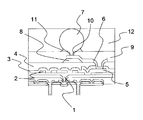
- FIG. 1 is a schematic cross-sectional view illustrating a semiconductor device according to one embodiment of the invention that includes a redistribution structure.
- the polyimide precursor according to the invention includes a structural unit represented by the following general formula (1) in a ratio of 50 mol % or more based on the total structural units.
- A is the tetravalent organic group represented by the following formula (2a), the tetravalent organic group represented by the following formula (2b), or a tetravalent organic group represented by the following general formula (2c)
- B is a divalent organic group represented by the following general formula (3)
- R 1 and R 2 are independently a hydrogen atom or a monovalent organic group
- X and Y are independently a divalent group that is not conjugated with the benzene rings bonded thereto, or a single bond
- R 3 to R 10 are independently a hydrogen atom or a monovalent group, at least one of R 3 to R 10 being a fluorine atom or a trifluoromethyl group.
- a in the general formula (1) is a structure derived from a tetracarboxylic dianhydride that is used as a raw material for producing the polyimide precursor, and is the tetravalent organic group represented by the formula (2a), the tetravalent organic group represented by the formula (2b), or the tetravalent organic group represented by the general formula (2c).
- Examples of the tetracarboxylic dianhydride that produces the structure represented by A include pyromellitic dianhydride, 2,3,6,7-naphthalenetetracarboxylic dianhydride, and the tetracarboxylic dianhydrides respectively represented by the following formulas (6) to (12).
- tetracarboxylic dianhydrides may be used either alone or in combination of two or more when producing (polymerizing) the polyimide precursor.
- pyromellitic dianhydride the tetracarboxylic dianhydride represented by the formula (6), and the tetracarboxylic dianhydride represented by the formula (8) (either alone or in combination of two or more), and more preferably pyromellitic dianhydride and the tetracarboxylic dianhydride represented by the formula (6) (either alone or in combination of two or more), as the tetracarboxylic dianhydride that produces the structure represented by A, from the viewpoint of reducing thermal expansion.
- B in the general formula (1) is a structure derived from a diamine that is used as a raw material for producing the polyimide precursor, and is the divalent organic group represented by the general formula (3).
- At least one of R 3 to R 10 in the general formula (3) is a fluorine atom or a trifluoromethyl group. It is preferable that two or more of R 3 to R 10 be a fluorine atom or a trifluoromethyl group. It is more preferable that two or more of R 3 to R 10 be a trifluoromethyl group.
- Examples of the diamine that produces the structure represented by B include the diamines respectively represented by the following formulas (13) to (19).
- diamines may be used either alone or in combination of two or more when producing (polymerizing) the polyimide precursor.
- the diamines respectively represented by the formulas (13), (18), and (19) are preferable (from the viewpoint of i-line transmittance), the diamines respectively represented by the formulas (18) and (19) are more preferable (from the viewpoint of achieving low water absorption), and the diamine represented by the formula (18) is particularly preferable.
- the monovalent organic group that may be represented by R 1 and R 2 in the general formula (1) includes an alkyl group having 1 to 20 carbon atoms, a cycloalkyl group having 3 to 20 carbon atoms, an acryloxyalkyl group that includes an alkyl group having 1 to 10 carbon atoms, and a methacryloxyalkyl group that includes an alkyl group having 1 to 10 carbon atoms.
- alkyl group having 1 to 20 carbon atoms examples include a methyl group, an ethyl group, an n-propyl group, a 2-propyl group, an n-butyl group, an n-hexyl group, an n-heptyl group, an n-decyl group, an n-dodecyl group, and the like.
- Examples of the cycloalkyl group having 3 to 20 carbon atoms include a cyclopropyl group, a cyclobutyl group, a cyclopentyl group, a cyclohexyl group, an adamantyl group, and the like.
- Examples of the acryloxyalkyl group that includes an alkyl group having 1 to 10 carbon atoms include an acryloxyethyl group, an acryloxypropyl group, an acryloxybutyl group, and the like.
- Examples of the methacryloxyalkyl group that includes an alkyl group having 1 to 10 carbon atoms include a methacryloxyethyl group, a methacryloxypropyl group, a methacryloxybutyl group, and the like.
- R 1 and R 2 be a monovalent organic group that includes a carbon-carbon unsaturated double bond.
- radical polymerization occurs due to radicals generated by the compound that generates radicals when irradiated with active rays (e.g., i-line exposure), and the molecular chains can be crosslinked.
- Examples of the monovalent organic group that includes a carbon-carbon unsaturated double bond include an acryloxyalkyl group that includes an alkyl group having 1 to 10 carbon atoms, and a methacryloxyalkyl group that includes an alkyl group having 1 to 10 carbon atoms.
- the polyimide precursor according to the invention includes the structural unit represented by the general formula (1) in a ratio of 50 mol % or more based on the total structural units, the molecular chain of the polyimide becomes rigid, and exhibits reduced thermal expansion and reduced stress.
- the polyimide precursor include the structural unit represented by the general formula (1) in a ratio of 60 mol % or more, and more preferably 70 mol % or more, based on the total structural units.
- the upper limit of the ratio of the structural unit represented by the general formula (1) included in the polyimide precursor is not particularly limited, but may be 95 mol % or less based on the total structural units, for example.
- the ratio of the structural unit represented by the general formula (1) can be adjusted to the above range by appropriately adjusting the amounts of the tetracarboxylic dianhydride and the diamine when producing (polymerizing) the polyimide precursor.
- the polyimide precursor according to the invention may further include a structural unit (structure) represented by the following general formula (4) in addition to the structural unit (structure) represented by the following general formula (1) so that the i-line transmittance, adhesion after curing, and mechanical properties are improved.
- a structural unit (structure) represented by the following general formula (4) in addition to the structural unit (structure) represented by the following general formula (1) so that the i-line transmittance, adhesion after curing, and mechanical properties are improved.
- D is a tetravalent organic group represented by the following general formula (5), and B, and R 2 are the same as defined above in connection with the general formula (1),
- Z is an ether bond (—O—) or a sulfide bond (—S—).
- the moiety in the general formula (4) that includes Z is a structure derived from a tetracarboxylic dianhydride that is used as a raw material for producing the polyimide precursor.
- examples of the tetracarboxylic dianhydride that produces the structure of the moiety that includes Z include 4,4′-oxydiphthalic dianhydride, thioetherdiphthalic anhydride, and the like.
- 4,4′-oxydiphthalic dianhydride is preferable from the viewpoint of adhesion after curing.
- tetracarboxylic dianhydrides may be used either alone or in combination of two or more when producing (polymerizing) the polyimide precursor.
- B, R 1 and R 2 in the general formula (4) are the same as B, R 1 , and R 2 in the general formula (1).
- the groups mentioned above that are preferable as B, R 1 and R 2 in the general formula (1) are also preferable as B, R 1 and R 2 in the general formula (4).
- the polyimide precursor includes the structural unit represented by the general formula (1) and the structural unit represented by the general formula (4), the polyimide precursor is a copolymer.
- the polyimide precursor may be a block copolymer, a random copolymer, or the like.
- the molar ratio (structural unit represented by general formula (1)/structural unit represented by general formula (4)) of the structural unit represented by the general formula (1) to the structural unit represented by the general formula (4) is preferably 5/5 to 9/1, more preferably 6/4 to 9/1, and still more preferably 7/3 to 9/1, from the viewpoint of reducing stress, and improving the i-line transmittance.
- the polyimide precursor according to the invention may include a structural unit (additional structural unit) other than the structural unit represented by the general formula (1) and the structural unit represented by the general formula (4).
- Examples of a tetracarboxylic dianhydride that produces the additional structural unit include 4,4′-(hexafluoroisopropylidene)diphthalic anhydride, 3,3′,4,4′-benzophenonetetracarboxylic dianhydride, 1,2,3,4-cyclobutanetetracarboxylic dianhydride, and the like.
- Examples of a diamine that produces the additional structural unit include p-phenylenediamine, 4,4′-oxydianiline, 2,2′-dimethylbenzidine, 4,4′-diaminodiphenylmethane, and the like.
- the tetracarboxylic dianhydride that produces the additional structural unit in a ratio of 20 mol % or less, and more preferably 10 mol % or less, based on the total amount of the tetracarboxylic dianhydride used as the raw material for producing the polyimide precursor, from the viewpoint of stress and i-line transmittance. It is still more preferable to use only the tetracarboxylic dianhydride that produces the structural unit (structure) represented by the general formula (1) and the tetracarboxylic dianhydride that produces the structural unit (structure) represented by the general formula (4) without using the tetracarboxylic dianhydride that produces the additional structural unit.
- the diamine that produces the additional structural unit in a ratio of 20 mol % or less, and more preferably 10 mol % or less, based on the total amount of the diamine. It is still more preferable to use only the diamine that produces the structural unit represented by the general formula (3).
- the polystyrene-equivalent weight average molecular weight of the polyimide precursor according to the invention is preferably 10,000 to 100,000, more preferably 15,000 to 100,000, and still more preferably 20,000 to 85,000.
- the polyimide precursor have a weight average molecular weight of 10,000 or more from the viewpoint of sufficiently reducing stress after curing. It is preferable that the polyimide precursor have a weight average molecular weight of 100,000 or less from the viewpoint of improving solubility in a solvent, and handling capability of the resulting solution.
- weight average molecular weight may be measured by gel permeation chromatography, and may be converted using a standard polystyrene calibration curve.
- the polyimide precursor according to the invention may be synthesized by subjecting a tetracarboxylic dianhydride and a diamine to addition polymerization.
- the molar ratio (tetracarboxylic dianhydride/diamine) of the tetracarboxylic dianhydride to the diamine used when synthesizing the polyimide precursor is normally 1.0. It is preferable to set the molar ratio to 0.7 to 1.3 in order to control the molecular weight and a terminal residue. When the molar ratio is 0.7 to 1.3, the resulting polyimide precursor tends to have a moderate molecular weight, and exhibits sufficiently reduced stress after curing.
- the polyimide precursor according to the invention may also be synthesized by producing a diester derivative represented by the following general formula (20) from the tetracarboxylic dianhydride (raw material), producing an acid chloride represented by the following general formula (21) from the diester derivative represented by the general formula (20), and condensing the acid chloride represented by the following general formula (21) and the diamine in the presence of a basic compound, for example.
- E in the general formulas (20) and (21) corresponds to A in the general formula (1), or Z and the two benzene rings in the general formula (4).
- the diester derivative represented by the general formula (20) may be synthesized by reacting 1 mol of the tetracarboxylic dianhydride (raw material) with 2 molar equivalents or more of an alcohol in the presence of a basic catalyst.
- a chlorinating agent may react with the unreacted alcohol, and conversion into the acid chloride may not proceed sufficiently. Therefore, it is preferable to use the alcohol in an amount of 2.0 to 2.5 molar equivalents, more preferably 2.0 to 2.3 molar equivalents, and still more preferably 2.0 to 2.2 molar equivalents, based on 1 mol of the tetracarboxylic dianhydride.
- Examples of the alcohol that is reacted with the tetracarboxylic dianhydride include an alcohol that includes an alkyl group having 1 to 20 carbon atoms, an alcohol that includes a cycloalkyl group having 3 to 20 carbon atoms, an alcohol that includes an acryloxyalkyl group that includes an alkyl group having 1 to 10 carbon atoms, and an alcohol that includes a methacryloxyalkyl group that includes an alkyl group having 1 to 10 carbon atoms.
- the alcohol examples include methanol, ethanol, n-propanol, isopropanol, n-butanol, 2-butanol, t-butanol, hexanol, cyclohexanol, 2-hydroxyethyl acrylate, 2-hydroxyethyl methacrylate, 2-hydroxypropyl acrylate, 2-hydroxypropyl methacrylate, 2-hydroxybutyl acrylate, 2-hydroxybutyl methacrylate, 4-hydroxybutyl acrylate, 4-hydroxybutyl methacrylate, and the like. These alcohols may be used either alone or in combination of two or more.
- Examples of the basic catalyst used when reacting the tetracarboxylic dianhydride with the alcohol include 1,8-diazabicyclo[5.4.0]undec-7-ene, 1,5-diazabicyclo[4.3.0]nona-5-ene, and the like.
- ester derivatives may be separately produced from these tetracarboxylic dianhydrides, and mixed.
- two or more tetracarboxylic dianhydrides may be mixed in advance, and ester derivatives may be simultaneously produced from these tetracarboxylic dianhydrides.
- the chlorinating agent is preferably used in an amount of 1.5 to 2.5 molar equivalents, more preferably 1.6 to 2.4 molar equivalents, and still more preferably 1.7 to 2.3 molar equivalents. It is preferable to use the chlorinating agent in an amount of 1.5 to 2.5 molar equivalents from the viewpoint of increasing the molecular weight of the polyimide precursor, and reducing stress after curing.
- the diamine is added to the acid chloride represented by the general formula (21) in the presence of the basic compound to obtain the polyimide precursor according to the invention.
- the basic compound is used to trap hydrogen chloride that is produced when the acid chloride reacts with the diamine.
- Pyridine, 4-dimethylaminopyridine, triethylamine, or the like may be used as the basic compound.
- the basic compound is preferably used in a 1.5 to 2.5-fold amount (mol), more preferably 1.7 to 2.4-fold amount, and still more preferably 1.8 to 2.3-fold amount, with respect to the amount of the chlorinating agent. It is preferable to use the basic compound in a 1.5 to 2.5-fold amount from the viewpoint of increasing the molecular weight of the polyimide precursor, and reducing stress after curing.
- a polar solvent that can completely dissolve the resulting polyimide precursor as the organic solvent.
- the polar solvent include N-methyl-2-pyrrolidone, N,N-dimethylacetamide, N,N-dimethylformamide, dimethyl sulfoxide, tetramethylurea, hexamethylphosphoric acid triamide, and ⁇ -butyrolactone, and the like.
- the photosensitive resin composition according to the invention includes the following components (a) to (c).
- the content of the polyimide precursor in the photosensitive resin composition is preferably 20 to 60 mass %, more preferably 25 to 55 mass %, and still more preferably 30 to 55 mass %.
- Examples of the compound that generates radicals when irradiated with active rays that is used as the component (b) include an aromatic ketone such as an oxime ester compound described below, benzophenone, an N,N′-tetraalkyl-4,4′-diaminobenzophenone such as N,N′-tetramethyl-4,4′-diaminobenzophenone (Michler's ketone), 2-benzyl-2-dimethylamino-1-(4-morpholinophenyl)butanone-1, and 2-methyl-1-[4-(methylthio)phenyl]-2-morpholinopropanone-1; a quinone fused with an aromatic ring (e.g., alkylanthraquinone); a benzoin ether compound such as a benzoin alkyl ether; a benzoin compound such as benzoin and an alkylbenzoin; and a benzyl derivative such as benzyldi
- the oxime ester compound is preferable due to excellent sensitivity and capability to form an excellent pattern.
- the oxime ester compound be a compound represented by the following general formula (22), a compound represented by the following general formula (23), or a compound represented by the following general formula (24), since excellent sensitivity and a high residual film ratio can be obtained.
- R 11 and R 12 in the general formula (22) are independently an alkyl group having 1 to 12 carbon atoms, a cycloalkyl group having 4 to 10 carbon atoms, or a phenyl group, preferably an alkyl group having 1 to 8 carbon atoms, a cycloalkyl group having 4 to 6 carbon atoms, or a phenyl group, more preferably an alkyl group having 1 to 4 carbon atoms, a cycloalkyl group having 4 to 6 carbon atoms, or a phenyl group, and still more preferably a methyl group, a cyclopentyl group, or a phenyl group.
- R 13 is —H, —OH, —COON, —O(CH 2 )OH, —O(CH 2 ) 2 OH, —COO(CH 2 )OH, or —COO(CH 2 ) 2 OH, preferably —H, —O(CH 2 )OH, —O(CH 2 ) 2 OH, —COO(CH 2 )OH, or —COO(CH 2 ) 2 OH, and more preferably —H, —O(CH 2 ) 2 OH, or —COO(CH 2 ) 2 OH.
- R 14 in the general formula (23) are independently an alkyl group having 1 to 6 carbon atoms, and preferably a propyl group.
- R 15 is NO 2 or ArCO (wherein Ar is an aryl group). Ar is preferably a tolyl group.
- R 16 and R 17 are independently an alkyl group having 1 to 12 carbon atoms, a phenyl group, or a tolyl group, and preferably a methyl group, a phenyl group, or a tolyl group.
- R 18 in the general formula (24) is an alkyl group having 1 to 6 carbon atoms, and preferably an ethyl group.
- R 19 is an organic group that includes an acetal bond, and preferably a substituent that corresponds to R 19 included in the compound represented the general formula (24-1) described later.
- R 20 and R 21 are independently an alkyl group having 1 to 12 carbon atoms, a phenyl group, or a tolyl group, preferably a methyl group, a phenyl group, or a tolyl group, and more preferably a methyl group.
- Examples of the compound represented by the general formula (22) include the compound represented by the following formula (22-1) and the compound represented by the following formula (22-2).
- the compound represented by the formula (22-1) is available as IRGACURE OXE-01 (manufactured by BASF).
- Examples of the compound represented by the general formula (23) include the compound represented by the following formula (23-1).
- the compound represented by the formula (23-1) is available as DFI-091 (manufactured by Daito Chemix Corporation).
- Examples of the compound represented by the general formula (24) include the compound represented by the following formula (24-1).
- the compound represented by the formula (24-1) is available as Adekaoptomer N-1919 (manufactured by Adeka Corporation).
- the compound shown below is also preferable as the oxime ester compound.
- These compounds that generate radicals when irradiated with active rays may be used either alone or in combination of two or more.
- the compound that generates radicals when irradiated with active rays is preferably used in an amount of 0.01 to 10 parts by weight, more preferably 0.01 to 5 parts by weight, and still more preferably 0.05 to 3 parts by weight, based on 100 parts by weight of the polyimide precursor (component (a)).
- component (a) the amount of the compound that generates radicals when irradiated with active rays is 0.01 parts by weight or more, a crosslinking reaction more sufficiently proceeds in the exposed area, and the photosensitivity (sensitivity and resolution) of the composition tends to be improved.
- the amount of the compound that generates radicals when irradiated with active rays is 10 parts by weight or less, the heat resistance of the resulting cured film can be improved.
- a polar solvent that can completely dissolve the polyimide precursor (component (a)) as the solvent (component (c)).
- the polar solvent include N-methyl-2-pyrrolidone, N,N-dimethylacetamide, N,N-dimethylformamide, dimethyl sulfoxide, tetramethylurea, hexamethylphosphoric acid triamide, and ⁇ -butyrolactone, 5-valerolactone, ⁇ -valerolactone, cyclohexanone, cyclopentanone, propylene glycol monomethyl ether acetate, propylene carbonate, ethyl lactate, 1,3-dimethyl-2-imidazolidinone, and the like. These solvents may be used either alone or in combination of two or more.
- the content of the solvent in the photosensitive resin composition is preferably 40 to 80 mass %, more preferably 45 to 75 mass %, and still more preferably 45 to 70 mass %.
- the photosensitive resin composition may further include an additional component (see below) as long as the photosensitive resin composition includes the polyimide precursor (component (a)), the compound that generates radicals when irradiated with active rays (component (b)), and the solvent (component (c)).
- component (a) the polyimide precursor
- component (b) the compound that generates radicals when irradiated with active rays
- component (c) the solvent
- the photosensitive resin composition according to the invention may include (d) an organosilane compound so that adhesion to a silicon substrate or the like after curing is improved.
- organosilane compound examples include ⁇ -aminopropyltrimethoxysilane, ⁇ -aminopropyltriethoxysilane, vinyltriethoxysilane, vinyltrimethoxysilane, ⁇ -glycidoxypropyltriethoxysilane, ⁇ -glycidoxypropyltrimethoxysilane, ⁇ -methacryloxypropyltrimethoxysilane, ⁇ -acryloxypropyltrimethoxysilane, 3-ureidopropyltriethoxysilane, 3-mercaptopropyltrimethoxysilane, 3-isocyanatopropyltriethoxysilane, bis(2-hydroxyethyl)-3-aminopropyltriethoxysilane, triethoxysilylpropylethyl carbamate, 3-(triethoxysilyl)propylsuccinic anhydride, phenyltriethoxysilane,
- the content of the organosilane compound is preferably 0.1 to 20 parts by weight, more preferably 0.5 to 15 parts by weight, and still more preferably 0.5 to 10 parts by weight, based on 100 parts by weight of the polyimide precursor, from the viewpoint of adhesion after curing.
- the photosensitive resin composition according to the invention may optionally include (e) an addition-polymerizable compound.
- addition-polymerizable compound examples include diethylene glycol diacrylate, triethylene glycol diacrylate, tetraethylene glycol diacrylate, diethylene glycol dimethacrylate, triethylene glycol dimethacrylate, tetraethylene glycol dimethacrylate, trimethylolpropane diacrylate, trimethylolpropane triacrylate, trimethylolpropane dimethacrylate, trimethylolpropane trimethacrylate, 1,4-butanediol diacrylate, 1,6-hexanediol diacrylate, 1,4-butanediol dimethacrylate, 1,6-hexanediol dimethacrylate, pentaerythritol triacrylate, pentaerythritol tetraacrylate, pentaerythritol trimethacrylate, pentaerythritol tetramethacrylate, styrene, divinylbenz
- the content of the addition-polymerizable compound is preferably 1 to 100 parts by weight, more preferably 1 to 75 parts by weight, and still more preferably 1 to 50 parts by weight, based on 100 parts by weight of the polyimide precursor, from the viewpoint of solubility in a developer, and the heat resistance of the resulting cured film.
- the photosensitive resin composition according to the invention may include (f) a radical polymerization inhibitor or a radical polymerization retarder so that the photosensitive resin composition exhibits excellent storage stability.
- radical polymerization inhibitor or the radical polymerization retarder examples include p-methoxyphenol, diphenyl-p-benzoquinone, benzoquinone, hydroquinone, pyrogallol, phenothiazine, resorcinol, o-dinitrobenzene, p-dinitrobenzene, m-dinitrobenzene, phenanthraquinone, N-phenyl-2-naphthylamine, cupferron, 2,5-toluquinone, tannic acid, p-benzylaminophenol, a nitrosoamine, and the like. These compounds may be used either alone or in combination of two or more.
- the content of the radical polymerization inhibitor or the radical polymerization retarder is preferably 0.01 to 30 parts by weight, more preferably 0.01 to 10 parts by weight, and still more preferably 0.05 to 5 parts by weight, based on 100 parts by weight of the polyimide precursor, from the viewpoint of the storage stability of the photosensitive resin composition, and the heat resistance of the resulting cured film.
- the photosensitive resin composition according to the invention When the photosensitive resin composition according to the invention is used for (applied to) a copper substrate, it is preferable that the photosensitive resin composition include (g) tetrazole or a tetrazole derivative, or benzotriazole or a benzotriazole derivative.
- the photosensitive resin composition according to the invention When the photosensitive resin composition according to the invention is used for (applied to) a copper substrate (e.g., a redistribution layer 6 illustrated in FIG. 1 described later), and includes the oxime ester compound represented by the above-mentioned general formula (22) (e.g., IRGACURE OXE-01 (manufactured by BASF)), a polyimide residue may remain in an opening when forming a patterned cured film.
- the inventors of the invention assume that the above phenomenon occurs because a specific oxime ester compound generates radicals on the copper substrate during prebaking, and the unexposed area is also cured. In order to solve the above problem, it is preferable to incorporate the component (g) in the photosensitive resin composition.
- the photosensitive resin composition includes the component (g), it is possible to suppress a situation in which a polyimide residue remains in an opening.
- the component (g) exhibits the above effect. It is assumed that the component (g) forms a thin film on the copper substrate, and prevents a situation in which the resin composition comes in direct contact with the active metal surface, so that undesirable decomposition of a photoinitiator and a radical polymerization reaction in the unexposed area are suppressed, and photosensitivity can be achieved on the copper substrate.
- tetrazole and the tetrazole derivative examples include 1H-tetrazole, 5-methyl-1H-tetrazole, 5-phenyl-1H-tetrazole, 5-amino-1H-tetrazole, 1-methyl-1H-tetrazole, 5,5′-bis-1H-tetrazole, 1-methyl-5-ethyltetrazole, 1-methyl-5-mercaptotetrazole, 1-carboxymethyl-5-mercaptotetrazole, and the like.
- 1H-tetrazole and 5-amino-1H-tetrazole are preferable.
- benzotriazole and the benzotriazole derivative include benzotriazole, 1H-benzotriazole-1-acetonitrile, benzotriazole-5-carboxylic acid, 1H-benzotriazole-1-methanol, carboxybenzotriazole, mercaptobenzoxazole, and the like.
- benzotriazole is preferable.
- the component (g) is normally used in an amount of 0.1 to 10 parts by weight for each kind based on 100 parts by weight of the component (a).
- the component (g) is used in an amount of 0.1 to 10 parts by weight in total based on 100 parts by weight of the component (a).
- the component (g) is preferably used in an amount of 0.2 to 5 parts by weight. If the amount of the component (g) is less than 0.1 parts by weight, the effect of improving adhesion to a metal layer may deteriorate.
- the photosensitive resin composition according to the invention includes the components (a) to (c), and optionally includes one or more components selected from the components (d) to (g).
- the photosensitive resin composition according to the invention may essentially consist of these components, or may consist only of these components.
- the expression “essentially consist of” means that the total content of the components (a) to (c) and the components (d) to (g) in the photosensitive resin composition is 95 wt % or more, 97 wt % or more, 98 wt % or more, or 99 wt % or more, for example.
- a cured film is obtained by heating the polyimide precursor according to the invention to effect polyimidization.
- the polyimide precursor is preferably heated at 80 to 450° C., more preferably 100 to 450° C., and still more preferably 200 to 400° C. If the heating temperature is less than 80° C., polyimidization may not proceed sufficiently, and heat resistance may decrease. If the heating temperature exceeds 450° C., the resulting polyimide may deteriorate.
- the residual stress of the cured film obtained by curing the polyimide precursor according to the invention is preferably 30 MPa or less, more preferably 27 MPa or less, and still more preferably 25 MPa or less. If the residual stress of the resulting cured film exceeds 30 MPa, a wafer may be warped to a large extent when the cured film is formed to have a thickness of 10 ⁇ m, and a problem may occur when transferring or securing (sucking) the wafer.
- the residual stress of the cured film may be calculated from the following expression (I) using a change in radius of curvature of a silicon wafer before and after formation of a polyimide film.
- the radius of curvature of a silicon wafer is calculated from the reflection angle of laser light with which the silicon wafer is scanned, and may be measured using a thin film stress measurement device (e.g., FLX-2320 manufactured by KLA-Tencor).
- a thin film stress measurement device e.g., FLX-2320 manufactured by KLA-Tencor.
- the polyimide precursor is applied to a thickness of about 20 ⁇ m, for example.
- the i-line transmittance of the resin film be 5% or more, more preferably 8% or more, still more preferably 15% or more, and particularly preferably 30% or more. If the i-line transmittance is less than 5%, an i-line may not reach a deep area, and radicals may not be sufficiently generated, whereby photosensitivity may deteriorate.
- the i-line transmittance may be measured using a method that applies the polyimide precursor to a glass substrate, dries the applied polyimide precursor, and measures the i-line transmittance using a UV spectrophotometer.
- the patterned cured film according to the invention is obtained by exposing and heating the photosensitive resin composition according to the invention.
- the patterned cured film according to the invention is preferably used as a protective layer for a low-K material (i.e., interlayer insulating film).
- a low-K material i.e., interlayer insulating film.
- the low-K material include porous silica, benzocyclobutene, hydrogen silsesquioxane, a polyaryl ether, and the like.
- the method for producing a patterned cured film according to the invention includes: applying the photosensitive resin composition according to the invention to a substrate, and drying the applied photosensitive resin composition to form a film; exposing the film in a pattern by applying active rays to the film; removing an unexposed area of the film by development to obtain a patterned resin film; and heating the patterned resin film.
- the photosensitive resin composition that includes the polyimide precursor to the substrate, and drying the photosensitive resin composition to form a film
- the photosensitive resin composition may be applied to the substrate using a dipping method, a spray method, a screen printing method, a spin coating method, or the like.
- the substrate examples include a silicon wafer, a metal substrate, a ceramic substrate, and the like. Since the photosensitive resin composition that includes the polyimide precursor according to the invention can form a cured film that exhibits low stress, the photosensitive resin composition may particularly suitably be applied to a large silicon wafer having a diameter of 12 inches or more.
- a film (resin film) that exhibits low adhesion can be formed by applying the photosensitive resin composition to the substrate, and removing the solvent by heating (drying).
- drying temperature is preferably 80 to 130° C.
- drying time is preferably 30 to 300 seconds. It is preferable to dry the composition using a device such as a hot plate.
- the film When exposing the film in a pattern by applying active rays, and removing the unexposed area of the film by development to obtain the patterned resin film, the film is exposed in a pattern by applying active rays to the film through a mask having the desired pattern.
- the photosensitive resin composition according to the invention is suitable for i-line exposure.
- Ultraviolet rays, deep ultraviolet rays, visible light, electron beams, X-rays, or the like may be used as the active rays.
- the desired pattern can be obtained by dissolving (removing) the unexposed area in an appropriate developer after exposure.
- the developer is not particularly limited.
- the developer include a flame-retardant solvent such as 1,1,1-trichloroethane; an alkaline aqueous solution such as a sodium carbonate aqueous solution and a tetramethylammonium hydroxide aqueous solution; a good solvent such as N,N-dimethylformamide, dimethyl sulfoxide, N,N-dimethylacetamide, N-methyl-2-pyrrolidone, cyclopentanone, ⁇ -butyrolactone, and an acetic acid ester; a mixed solvent that includes the good solvent and a poor solvent such as a lower alcohol, water, or an aromatic hydrocarbon; and the like.
- a flame-retardant solvent such as 1,1,1-trichloroethane
- an alkaline aqueous solution such as a sodium carbonate aqueous solution and a tetramethylammonium hydroxide aqueous solution
- a good solvent such as
- the patterned resin film is optionally rinsed with a poor solvent (e.g., water, ethanol, or 2-propanol), or the like.
- a poor solvent e.g., water, ethanol, or 2-propanol
- the patterned resin film When heating the patterned resin film, the patterned resin film is heated at 80 to 400° C. for 5 to 300 minutes to imidize the polyimide precursor included in the photosensitive resin composition to obtain a patterned cured film.
- a curing furnace that can maintain a low oxygen concentration of 100 ppm or less in order to suppress oxidative degradation of the polyimide during heating.
- a curing furnace that can maintain a low oxygen concentration of 100 ppm or less in order to suppress oxidative degradation of the polyimide during heating.
- an inert gas oven or a vertical diffusion furnace may be used.
- the cured film or the patterned cured film according to the invention may be used as a surface protective layer, an interlayer insulating layer, a redistribution layer, and the like used for a semiconductor device.
- the semiconductor device include a logic semiconductor device such as an MPU, a memory semiconductor device such as a DRAM and a NAND flash, and the like.
- FIG. 1 is a schematic cross-sectional view illustrating a semiconductor device according to one embodiment of the invention that includes a redistribution structure.
- the semiconductor device according to this embodiment has a multilayer wiring structure.
- An Al wiring layer 2 is formed on an interlayer insulating layer (interlayer insulating film) 1 .
- An insulating layer (insulating film) 3 (e.g., P—SiN layer) is formed on the Al wiring layer 2 , and a surface protective layer (surface protective film) 4 is formed on the insulating layer 3 .
- a redistribution layer 6 is formed from a pad 5 of the wiring layer 2 .
- the redistribution layer 6 extends to the upper side of a core 8 that is connected to a conductive ball 7 (external connection terminal) that is formed of solder, gold, or the like.
- a cover coat layer 9 is formed on the surface protective layer 4 .
- the redistribution layer 6 is connected to the conductive ball 7 through a barrier metal 10 .
- a collar 11 is provided to hold the conductive ball 7 .
- an underfill 12 may be provided to further reduce stress.
- the cured film or the patterned cured film according to the invention may be used for package applications (e.g., cover coat material, redistribution core material, ball (solder) collar material, and underfill material) in the above-mentioned embodiment.
- package applications e.g., cover coat material, redistribution core material, ball (solder) collar material, and underfill material
- the semiconductor device that includes the cured film or the patterned cured film according to the invention has high reliability.
- a tetracarboxylic dianhydride 1 shown in Table 1 was dissolved in 150 ml of N-methyl-2-pyrrolidone at room temperature with stirring optionally together with a tetracarboxylic acid 2 shown in Table 1. After the addition of a diamine 1 shown in Table 1 optionally together with a diamine 2 shown in Table 1, the mixture was stirred at room temperature for 1 hour to obtain a polyamic acid solution (polyimide precursor solution).
- the resulting polyimide precursor was evaluated as described below. The results are shown in Table 1.
- the weight average molecular weight (standard polystyrene-equivalent value) of the resulting polyamic acid was determined by gel permeation chromatography (GPC). The results are shown in Table 1.
- Measurement apparatus detector: L4000 UV manufactured by Hitachi, Ltd.
- a solution of the resulting polyamic acid was spin-coated onto a glass substrate, and heated at 100° C. for 3 minutes on a hot plate to form a coated film having thickness of 20 ⁇ m.
- the i-line transmittance (365 nm) of the coated film was measured, and evaluated in accordance with the following standard. The results are shown in Table 1.
- the i-line transmittance was 20% or more.
- the i-line transmittance was 10% or more and less than 20%.
- i-line transmittance was measured by a cast film method using a UV-visible spectrophotometer (U-3310 manufactured by Hitachi High-Technologies Corporation).
- a solution of the resulting polyamic acid was spin-coated onto a 6-inch silicon wafer (thickness: 625 ⁇ m) so that the film thickness after curing was 10 ⁇ m.
- the solution of the polyamic acid was heated and cured at 375° C. for 1 hour in a nitrogen atmosphere using a vertical diffusion furnace (manufactured by Koyo Lindberg Co., Ltd.) to obtain a polyimide film.
- the residual stress of the polyimide film was measured, and evaluated in accordance with the following standard. The results are shown in Table 1.
- the cured film (polyimide film) formed on the silicon wafer for which the residual stress had been measured was immersed in a hydrofluoric acid aqueous solution to remove the polyimide film from the silicon wafer.
- NTCA 2,3,6,7-naphthalenetetracarboxylic dianhydride
- ODPA 4.4′-oxydiphthalic dianhydride
- an i-line transmittance of 20% or more and a stress of 30 MPa or less were obtained in Examples 1 to 6.
- Comparative Example 1 in which a diamine that does not include a fluorine atom was used, and Comparative Examples 2 and 5 in which a diamine that includes a fluorine atom and a diamine that does not include a fluorine atom were used in combination of two or more, the stress was 30 MPa or less, but the i-line transmittance was low.
- Comparative Examples 3 and 4 in which a specific acid dianhydride corresponding to the polyimide precursor according to the invention was not used the i-line transmittance was 20% or more, but the stress was 35 MPa or more.
- a polyamic acid ester was synthesized by the following polyamic acid ester synthesis method 1 or 2 using a tetracarboxylic dianhydride 1, an alcohol compound 1, and a diamine 1 shown in Table 2 optionally together with a tetracarboxylic dianhydride 2, an alcohol compound 2, and a diamine 2 shown in Table 2.
- the tetracarboxylic dianhydride 1 (see Table 2), the alcohol compound 1 (see Table 2), and 1,8-diazabicyclo[5.4.0]undec-7ene (DBU) (catalytic quantity) were dissolved in N-methyl-2-pyrrolidone (in a 4-fold amount (weight ratio) with respect to the tetracarboxylic dianhydride 1), and the solution was stirred at room temperature for 48 hours to obtain an ester solution 1.
- DBU 1,8-diazabicyclo[5.4.0]undec-7ene
- the tetracarboxylic dianhydride 2 (see Table 2), the alcohol compound 2 (see Table 2), and DBU (catalytic quantity) were optionally dissolved in N-methyl-2-pyrrolidone (in a 4-fold amount (weight ratio) with respect to the tetracarboxylic dianhydride 2), and the solution was stirred at room temperature for 48 hours to obtain an ester solution 2.
- thionyl chloride (in an amount of 2.2-fold molar equivalents with respect to the total amount of the tetracarboxylic dianhydride 1 and the tetracarboxylic dianhydride 2) was added dropwise to the mixture while cooling the mixture in an ice bath, and the resulting mixture was stirred for 1 hour to prepare an acid chloride solution.
- a solution was prepared by dissolving the diamine 1 (see Table 2), the diamine 2 (optional) (see Table 2), and pyridine (in an amount of 2-fold molar equivalents with respect to thionyl chloride) in N-methyl-2-pyrrolidone (in a 4-fold amount (weight ratio) with respect to the diamine 1 and the diamine 2).
- the solution was added dropwise to the acid chloride solution which had been prepared while cooling the acid chloride solution in an ice bath. After the dropwise addition, the reaction liquid was added dropwise to distilled water.
- a polyamic acid ester was obtained in the same manner as the polyamic acid ester synthesis method 1, except that the tetracarboxylic dianhydride 1 and the tetracarboxylic dianhydride 2 were esterified in the same reaction vessel, not separately.
- the polyamic acid esters of Examples 7 to 12 had an i-line transmittance of 20% or more and a stress of 30 MPa or less at a time.
- the resulting photosensitive resin composition were evaluated in the same manner as in Examples 13 to 17, and also evaluated as to a residue on a copper substrate. The results are shown in Table 3. Note that a residue on a copper substrate was evaluated using the method described later.
- the resulting photosensitive resin composition was evaluated in the same manner as in Example 18. The results are shown in Table 3.
- the resulting photosensitive resin composition was evaluated in the same manner as in Example 18. The results are shown in Table 3.
- the resulting photosensitive resin composition was evaluated in the same manner as in Examples 13 to 17. The results are shown in Table 3.
- the photosensitive resin composition obtained was spin-coated onto a 6-inch silicon wafer, and dried at 100° C. for 3 minutes on a hot plate to form a film having a thickness of 10 ⁇ m.
- the film was exposed by applying an i-line (50 to 500 mJ/cm 2 (every 50 mJ/cm 2 )) to the film through a photomask in a given pattern using an i-line stepper (FPA-3000iW manufactured by Canon Inc.).
- the unexposed film having a thickness of 10 ⁇ m was immersed in cyclopentanone, and the time required for the film to be completely dissolved was measured. A time twice the time thus measured was taken as a developing time.
- the wafer subjected to exposure was immersed in cyclopentanone to effect paddle development, and rinsed with isopropanol.
- the minimum dose at which the dissolution amount of the exposed area of the film was less than 10% of the initial thickness was taken as the sensitivity, and the minimum value of the mask dimensions of the square-hole opening was taken as the resolution.
- the photosensitivity was evaluated in accordance with the following standard.
- the sensitivity was 300 mJ/cm 2 or less.
- the sensitivity was more than 300 mJ/cm 2 and 500 mJ/cm 2 or less.
- the sensitivity was more than 500 mJ/cm 2 .
- the resolution was 10 ⁇ m or less.
- a copper substrate provided for measuring a residue on the copper substrate was heated at 375° C. and 300° C. for 1 hour in a nitrogen atmosphere using a vertical diffusion furnace (manufactured by Koyo Lindberg Co., Ltd.) to obtain a patterned polyimide film (cured film).
- the patterned polyimide film was ashed for 2 minutes using an O 2 ashing device (manufactured by Yamato Scientific Co., Ltd.), immersed in a Cu oxide film removal solution (Z-200 manufactured by World Metal Co., Ltd.) for 5 minutes, and rinsed with purified water.
- Example item 13 14 15 16 17 18 19 20 Polyamic Example 7
- Example 8 Example 9
- the photosensitive resin compositions of Examples 13 to 21 exhibited excellent sensitivity and excellent resolution, and the cured films obtained using the photosensitive resin compositions of Examples 13 to 21 exhibited a low stress of 30 MPa or less.
- the resin composition of Comparative Example 10 delamination occurred during development, and the sensitivity and the resolution could not be evaluated.
- the resolution decreased since the i-line transmittance of the polyamic acid ester was low.
- the resin composition of Comparative Example 12 exhibited excellent sensitivity and excellent resolution. However, the residual stress of the resulting cured film was higher than 35 MPa.
- the resin composition that includes the polyimide precursor according to the invention may suitably be used as a protective film material and a patterned film-forming material used for electronic parts such as a semiconductor device.
Landscapes
- Chemical & Material Sciences (AREA)
- Organic Chemistry (AREA)
- Chemical Kinetics & Catalysis (AREA)
- Physics & Mathematics (AREA)
- Health & Medical Sciences (AREA)
- Medicinal Chemistry (AREA)
- Polymers & Plastics (AREA)
- General Physics & Mathematics (AREA)
- Spectroscopy & Molecular Physics (AREA)
- Engineering & Computer Science (AREA)
- Life Sciences & Earth Sciences (AREA)
- Materials Engineering (AREA)
- Wood Science & Technology (AREA)
- Macromolecular Compounds Obtained By Forming Nitrogen-Containing Linkages In General (AREA)
- Materials For Photolithography (AREA)
- Exposure And Positioning Against Photoresist Photosensitive Materials (AREA)
- Macromonomer-Based Addition Polymer (AREA)
Abstract

Description

wherein A is the tetravalent organic group represented by the following formula (2a), the tetravalent organic group represented by the following formula (2b), or a tetravalent organic group represented by the following general formula (2c),
B is a divalent organic group represented by the following general formula (3), and R1 and R2 are independently a hydrogen atom or a monovalent organic group,

wherein X and Y are independently a divalent group that is not conjugated with the benzene rings bonded thereto, or a single bond,

wherein R3 to R10 are independently a hydrogen atom or a monovalent group, at least one of R3 to R10 being a fluorine atom or a trifluoromethyl group.
2. The polyimide precursor according to 1, further including a structural unit represented by the following general formula (4),

wherein D is a tetravalent organic group represented by the following general formula (5), and B, R1 and R2 are the same as defined above in connection with the general formula (1),

wherein Z is an ether bond (—O—) or a sulfide bond (—S—).
3. The polyimide precursor according to 2, wherein the polyimide precursor comprises the structural unit represented by the general formula (1) and the structural unit represented by the general formula (4), and the molar ratio of the structural unit represented by the general formula (1) and the structural unit represented by the general formula (4) is 5/5 to 9/1.
4. The polyimide precursor according to any one of 1 to 3, wherein R1 or R2 in the general formula (1) is a monovalent organic group that includes a carbon-carbon unsaturated double bond.
5. A photosensitive resin composition including (a) the polyimide precursor according to any one of 1 to 4, (b) a compound that generates radicals when irradiated with active rays, and (c) a solvent.
6. The photosensitive resin composition according to 5, further including tetrazole, a tetrazole derivative, benzotriazole, or a benzotriazole derivative.
7. The photosensitive resin composition according to 5 or 6, wherein the component (b) includes an oxime ester compound.
8. The photosensitive resin composition according to 7, wherein the oxime ester compound is a compound represented by the following general formula (22), a compound represented by the following general formula (23), or a compound represented by the following general formula (24),

wherein R11 and R12 are independently an alkyl group having 1 to 12 carbon atoms, a cycloalkyl group having 4 to 10 carbon atoms, or a phenyl group, and R13 is —H, —OH, —COON, —O(CH2)OH, —O(CH2)2OH, —COO(CH2)OH, or —COO(CH2)2OH,

wherein R14 are independently an alkyl group having 1 to 6 carbon atoms, R15 is NO2 or ArCO (wherein Ar is an aryl group), and R16 and R17 are independently an alkyl group having 1 to 12 carbon atoms, a phenyl group, or a tolyl group,

wherein R18 is an alkyl group having 1 to 6 carbon atoms, R10 is an organic group that includes an acetal bond, and R20 and R21 are independently an alkyl group having 1 to 12 carbon atoms, a phenyl group, or a tolyl group.
9. A cured film obtained by heating the polyimide precursor according to any one of 1 to 4.
10. A patterned cured film obtained by heating the photosensitive resin composition according to any one of 5 to 8.
11. A method for producing a patterned cured film including:

wherein A is the tetravalent organic group represented by the following formula (2a), the tetravalent organic group represented by the following formula (2b), or a tetravalent organic group represented by the following general formula (2c),
B is a divalent organic group represented by the following general formula (3), and R1 and R2 are independently a hydrogen atom or a monovalent organic group,

wherein X and Y are independently a divalent group that is not conjugated with the benzene rings bonded thereto, or a single bond,

wherein R3 to R10 are independently a hydrogen atom or a monovalent group, at least one of R3 to R10 being a fluorine atom or a trifluoromethyl group.


wherein D is a tetravalent organic group represented by the following general formula (5), and B, and R2 are the same as defined above in connection with the general formula (1),

wherein Z is an ether bond (—O—) or a sulfide bond (—S—).

wherein E is a tetravalent organic group, and
R1 and R2 are the same as defined above in connection with the general formula (1).

wherein E is a tetravalent organic group, and
R1 and R2 are the same as defined above in connection with the general formula (1).


σ: Residual stress (Pa)
E/(1-v): Biaxial elastic modulus (Pa) of silicon wafer
h: Thickness (m) of silicon wafer
t: Thickness (m) of polyimide film
R: Change (m) in radius of curvature of silicon wafer
| TABLE 1 | ||
| Example | ||
| 1 | 2 | 3 | 4 | 5 | 6 | |
| Tetracarboxylic | PMDA | NTCA | MMXDA | PMDA | PMDA | MMXDA |
| dianhydride 1 | 21.81 g | 26.82 g | 35.03 g | 16.36 g | 13.09 g | 26.27 g |
| (100 mmol) | (100 mmol) | (100 mmol) | (75 mmol) | (60 mmol) | (75 mmol) | |
| Tetracarboxylic | — | — | — | ODPA | ODPA | ODPA |
| dianhydride 2 | 7.76 g | 12.41 g | 7.76 g | |||
| (25 mmol) | (40 mmol) | (25 mmol) | ||||
| Diamine 1 | TFDB | TFDB | TFDB | TFDB | TFDB | TFDB |
| 32.02 g | 32.02 g | 32.02 g | 32.02 g | 32.02 g | 32.02 g | |
| (100 mmol) | (100 mmol) | (100 mmol) | (100 mmol) | (100 mmol) | (100 mmol) | |
| Diamine 2 | — | — | — | — | — | — |
| Ratio (mol %) of | 100 | 100 | 100 | 75 | 60 | 75 |
| structural unit | ||||||
| represented by | ||||||
| general formula | ||||||
| (1) based on | ||||||
| total structural | ||||||
| units | ||||||
| Weight average | 69000 | 60000 | 70000 | 85500 | 107000 | 80000 |
| molecular | ||||||
| weight | ||||||
| i-line | Good | Good | Good | Good | Good | Good |
| transmittance | ||||||
| Residual stress | Good | Good | Good | Good | Good | Good |
| Water | Good | Good | Good | Good | Good | Good |
| absorption | ||||||
| Comparative Example |
| 1 | 2 | 3 | 4 | 5 | |||
| Tetracarboxylic | PMDA | PMDA | ODPA | ODPA | s-BPDA | ||
| dianhydride 1 | 21.81 g | 16.36 g | 31.02 g | 31.02 g | 29.42 g | ||
| (100 mmol) | (75 mmol) | (100 mmol) | (100 mmol) | (100 mmol) | |||
| Tetracarboxylic | — | ODPA | — | — | — | ||
| dianhydride 2 | 7.76 g | ||||||
| (25 mmol) | |||||||
| Diamine 1 | DMAP | TFDB | TFDB | DMAP | TFDB | ||
| 21.23 g | 8.01 g | 32.02 g | 21.23 g | 16.01 g | |||
| (100 mmol) | (25 mmol) | (100 mmol) | (100 mmol) | (50 mmol) | |||
| Diamine 2 | — | DMAP | — | — | DMAP | ||
| 15.92 g | 10.61 g | ||||||
| (75 mmol) | (50 mmol) | ||||||
| Ratio (mol %) of | 0 | 25 | 0 | 0 | 0 | ||
| structural unit | |||||||
| represented by | |||||||
| general formula | |||||||
| (1) based on | |||||||
| total structural | |||||||
| units | |||||||
| Weight average | 75000 | 84000 | 65000 | 66900 | 50000 | ||
| molecular | |||||||
| weight | |||||||
| i-line | Bad | Bad | Good | Good | Bad | ||
| transmittance | |||||||
| Residual stress | Good | Good | Bad | Bad | Good | ||
| Water | Fair | Fair | Good | Bad | Fair | ||
| absorption | |||||||
| TABLE 2 | ||
| Example | ||
| item | 7 | 8 | 9 | 10 | 11 |
| Tetracarboxylic | PMDA | PMDA | PMDA | PMDA | MMXDA |
| dianhydride 1 | 16.36 g | 16.36 g | 16.36 g | 16.36 g | 26.27 g |
| (75 mmol) | (75 mmol) | (75 mmol) | (75 mmol) | (75 mmol) | |
| Alcohol compound 1 | HEMA | HEMA | HEMA | HEMA | HEMA |
| 19.52 g | 19.52 g | 19.52 g | 26.03 g | 19.52 g | |
| (150 mmol) | (150 mmol) | (150 mmol) | (200 mmol) | (150 mmol) | |
| Tetracarboxylic | ODPA | ODPA | ODPA | ODPA | ODPA |
| dianhydride 2 | 7.76 g | 7.76 g | 7.76 g | 7.76 g | 7.76 g |
| (25 mmol) | (25 mmol) | (25 mmol) | (25 mmol) | (25 mmol) | |
| Alcohol compound 2 | IPA | HEMA | HEMA | — | HEMA |
| 3.01 g | 6.51 g | 6.51 g | 6.51 g | ||
| (50 mmol) | (50 mmol) | (50 mmol) | (50 mmol) | ||
| Diamine 1 | TFDB | TFDB | TFDB | TFDB | TFDB |
| 32.02 g | 32.02 g | 28.81 g | 32.02 g | 32.02 g | |
| (100 mmol) | (100 mmol) | (90 mmol) | (100 mmol) | (100 mmol) | |
| Diamine 2 | — | — | — | — | — |
| Ratio of structural | 75 | 75 | 75 | 75 | 75 |
| unit represented | |||||
| by general formula | |||||
| (1) based on total | |||||
| structural units | |||||
| Synthesis method | 1 | 1 | 1 | 2 | 1 |
| Weight average | 36000 | 33000 | 11700 | 34300 | 54000 |
| molecular weight | |||||
| i-line | Good | Good | Good | Good | Good |
| transmittance | |||||
| Residual stress | Good | Good | Good | Good | Good |
| Water absorption | Good | Good | Good | Good | Good |
| Example | Comparative Example |
| item | 12 | 6 | 7 | 8 | 9 |
| Tetracarboxylic | PMDA | PMDA | PMDA | ODPA | s-BPDA |
| dianhydride 1 | 17.45 g | 21.81 g | 16.36 g | 31.02 g | 29.42 g |
| (80 mmol) | (100 mmol) | (75 mmol) | (100 mmol) | (100 mmol) | |
| Alcohol compound 1 | HEMA | HEMA | HEMA | HEMA | HEMA |
| 20.82 g | 26.03 g | 19.52 g | 26.03 g | 26.03 g | |
| (160 mmol) | (200 mmol) | (150 mmol) | (200 mmol) | (200 mmol) | |
| Tetracarboxylic | ODPA | — | ODPA | — | — |
| dianhydride 2 | 6.21 g | 7.76 g | |||
| (20 mmol) | (25 mmol) | ||||
| Alcohol compound 2 | HEMA | — | HEMA | — | — |
| 5.21 g | 6.51 g | ||||
| (40 mmol) | (50 mmol) | ||||
| Diamine 1 | TFDB | DMAP | TFDB | DMAP | TFDB |
| 32.02 g | 21.23 g | 24.01 g | 21.23 g | 16.01 g | |
| (100 mmol) | (100 mmol) | (25 mmol) | (100 mmol) | (50 mmol) | |
| Diamine 2 | — | — | DMAP | — | DMAP |
| 5.31 g | 10.61 g | ||||
| (75 mmol) | (50 mmol) | ||||
| Ratio of structural | 80 | 0 | 25 | 0 | 0 |
| unit represented | |||||
| by general formula | |||||
| (1) based on total | |||||
| structural units | |||||
| Synthesis method | 1 | 1 | 1 | 1 | 1 |
| Weight average | 33000 | 37200 | 35000 | 60000 | 25000 |
| molecular weight | |||||
| i-line | Good | Bad | Bad | Good | Bad |
| transmittance | |||||
| Residual stress | Good | Good | Good | Bad | Good |
| Water absorption | Good | Fair | Bad | Bad | Fair |
| TABLE 3 | ||
| Example | ||
| item | 13 | 14 | 15 | 16 | 17 | 18 | 19 | 20 |
| Polyamic | Example 7 | Example 8 | Example 9 | Example | Example | Example | Example | |
| acid ester | ||||||||
| 10 | 11 | 12 | 12 | 12 | ||||
| Sensitivity | Good | Good | Good | Good | Good | Good | Good | Good |
| Resolution | Good | Good | Good | Good | Good | Good | Good | Good |
| Residual | Good | Good | Good | Good | Good | Good | Good | Good |
| stress | ||||||||
| Water | Good | Good | Good | Good | Good | Good | Good | Good |
| absorption | ||||||||
| Residue | — | — | — | — | — | Good | Good | Good |
| Example | Comparative Example |
| item | 21 | 10 | 11 | 12 | 13 | ||
| Polyamic | Example | Comparative | Comparative | Comparative | | ||
| acid ester | |||||||
| 12 | Example 6 | Example 7 | Example 8 | Example 9 | |||
| Sensitivity | Good | — | Good | Good | Good | ||
| Resolution | Good | Fair | Good | Fair | |||
| Residual | Good | Good | Good | Bad | Good | ||
| stress | |||||||
| Water | Good | Fair | Fair | Bad | Fair | ||
| absorption | |||||||
| Residue | — | — | — | — | — | ||
Claims (13)


Applications Claiming Priority (3)
| Application Number | Priority Date | Filing Date | Title |
|---|---|---|---|
| JP2012279343 | 2012-12-21 | ||
| JP2012-279343 | 2012-12-21 | ||
| PCT/JP2013/007467 WO2014097633A1 (en) | 2012-12-21 | 2013-12-19 | Polyimide precursor, photosensitive resin composition containing said polyimide precursor, and cured-pattern-film manufacturing method and semiconductor device using said photosensitive resin composition |
Publications (2)
| Publication Number | Publication Date |
|---|---|
| US20150353685A1 US20150353685A1 (en) | 2015-12-10 |
| US9751984B2 true US9751984B2 (en) | 2017-09-05 |
Family
ID=50977992
Family Applications (1)
| Application Number | Title | Priority Date | Filing Date |
|---|---|---|---|
| US14/654,758 Active US9751984B2 (en) | 2012-12-21 | 2013-12-19 | Polyimide precursor, photosensitive resin composition containing said polyimide precursor, and cured-pattern-film manufacturing method and semiconductor device using said photosensitive resin composition |
Country Status (6)
| Country | Link |
|---|---|
| US (1) | US9751984B2 (en) |
| JP (2) | JP6600943B2 (en) |
| KR (1) | KR102214856B1 (en) |
| CN (1) | CN104870523B (en) |
| TW (2) | TWI670297B (en) |
| WO (1) | WO2014097633A1 (en) |
Cited By (1)
| Publication number | Priority date | Publication date | Assignee | Title |
|---|---|---|---|---|
| US20230359122A1 (en) * | 2020-04-20 | 2023-11-09 | Hd Microsystems, Ltd. | Photosensitive resin composition, method for producing patterned cured film, cured film, interlayer insulating film, cover coat layer, surface protection film, and electronic component |
Families Citing this family (27)
| Publication number | Priority date | Publication date | Assignee | Title |
|---|---|---|---|---|
| JP6164070B2 (en) * | 2013-12-04 | 2017-07-19 | 日立化成デュポンマイクロシステムズ株式会社 | POLYIMIDE PRECURSOR, RESIN COMPOSITION CONTAINING THE POLYIMIDE PRECURSOR, METHOD FOR PRODUCING PATTERN CURED FILM USING SAME, AND SEMICONDUCTOR DEVICE |
| KR102090451B1 (en) | 2015-08-21 | 2020-03-18 | 아사히 가세이 가부시키가이샤 | Photosensitive resin composition, polyimide production method, and semiconductor device |
| FR3041357B1 (en) * | 2015-09-17 | 2017-09-01 | Rhodia Operations | DETACHING SOLVENTS OF PHOTOSENSITIVE RESINS |
| CN105182703B (en) * | 2015-09-25 | 2019-06-25 | 江阴润玛电子材料股份有限公司 | Novel organic developer for negative photoresist of one kind and preparation method thereof |
| CN115185157A (en) | 2016-03-31 | 2022-10-14 | 旭化成株式会社 | Photosensitive resin composition, method for producing cured relief pattern, and semiconductor device |
| US11021572B2 (en) | 2016-07-27 | 2021-06-01 | Hd Microsystems, Ltd. | Photosensitive resin composition, cured product of same, interlayer insulating film, surface protective film and electronic component |
| CN115755526A (en) | 2016-08-22 | 2023-03-07 | 旭化成株式会社 | Photosensitive resin composition and method for producing cured relief pattern |
| TWI761375B (en) * | 2016-09-26 | 2022-04-21 | 日商昭和電工材料股份有限公司 | Resin composition, wiring laminate for semiconductor, and semiconductor device |
| TWI803315B (en) * | 2017-08-01 | 2023-05-21 | 日商旭化成股份有限公司 | Semiconductor device and manufacturing method thereof |
| JP6848916B2 (en) * | 2018-03-29 | 2021-03-24 | 信越化学工業株式会社 | Silicone modified polyimide resin composition |
| TWI889648B (en) * | 2018-04-06 | 2025-07-11 | 美商杜邦電子股份有限公司 | Polymers for use in electronic devices |
| JP7091881B2 (en) * | 2018-06-29 | 2022-06-28 | Hdマイクロシステムズ株式会社 | Resin composition, method of manufacturing cured product, cured product, interlayer insulating film, cover coat layer, surface protective film and electronic components |
| EP3893053B1 (en) * | 2018-12-05 | 2025-01-22 | FUJIFILM Corporation | Photosensitive resin composition, pattern forming method, cured film, multilayer body and device |
| CN109942817A (en) * | 2019-03-21 | 2019-06-28 | 深圳先进技术研究院 | A kind of polyimide precursor, preparation method and resin composition and application thereof |
| CN109946925A (en) * | 2019-04-08 | 2019-06-28 | 深圳先进技术研究院 | A kind of compound is promoting the application in polyimides low-temperature setting, polyimide precursor composition and application thereof |
| CN114207038B (en) * | 2019-08-08 | 2024-03-22 | 艾曲迪微系统股份有限公司 | Resin composition, method for producing cured product, pattern cured product, interlayer insulating film, covercoat, surface protective film, and electronic component |
| US11898011B2 (en) * | 2020-02-19 | 2024-02-13 | Dupont Electronics, Inc. | Polymers for use in electronic devices |
| TWI899243B (en) * | 2020-06-05 | 2025-10-01 | 日商富士軟片股份有限公司 | Resin composition, method for producing the same, and method for producing pattern-forming composition |
| JP2022002304A (en) * | 2020-06-22 | 2022-01-06 | 積水化学工業株式会社 | Laminate, curable resin composition, manufacturing method of laminate, semiconductor device, and imaging device |
| JP7589459B2 (en) * | 2020-07-22 | 2024-11-26 | Hdマイクロシステムズ株式会社 | Method for producing polyamic acid |
| WO2023013401A1 (en) * | 2021-08-06 | 2023-02-09 | 三井化学株式会社 | Polyamic acid composition and polyimide composition, polyimide film, and display panel substrate |
| KR20230069646A (en) | 2021-11-12 | 2023-05-19 | 주식회사 파이솔루션테크놀로지 | Polyimide polymer, resin comprising same, preparation method thereof, and negative type photosensitive composition comprising same |
| CN118974115A (en) | 2022-03-29 | 2024-11-15 | 富士胶片株式会社 | Resin composition, cured product, laminated body, method for producing cured product, method for producing laminated body, method for producing semiconductor device, and semiconductor device |
| CN118974658A (en) | 2022-03-29 | 2024-11-15 | 富士胶片株式会社 | Photosensitive resin composition, cured product, laminated body, method for producing cured product, method for producing laminated body, method for producing semiconductor device, and semiconductor device |
| JPWO2023189126A1 (en) | 2022-03-29 | 2023-10-05 | ||
| WO2025126337A1 (en) * | 2023-12-12 | 2025-06-19 | Hdマイクロシステムズ株式会社 | Resin composition, method for producing cured product, cured product, and electronic component |
| WO2025217841A1 (en) * | 2024-04-17 | 2025-10-23 | 深圳先进电子材料国际创新研究院 | Negative photosensitive polyimide precursor and composition thereof |
Citations (34)
| Publication number | Priority date | Publication date | Assignee | Title |
|---|---|---|---|---|
| US4811082A (en) * | 1986-11-12 | 1989-03-07 | International Business Machines Corporation | High performance integrated circuit packaging structure |
| US5019482A (en) * | 1987-08-12 | 1991-05-28 | Asahi Kasei Kogyo Kabushiki Kaisha | Polymer/oxime ester/coumarin compound photosensitive composition |
| JPH05295115A (en) | 1992-04-24 | 1993-11-09 | Sumitomo Bakelite Co Ltd | Polyimide resin having low thermal expansion and production thereof |
| US5260408A (en) * | 1991-10-29 | 1993-11-09 | E. I. Du Pont De Nemours And Company | Low thermal expansion coefficient polyimides with improved elongation |
| US5310625A (en) * | 1992-03-13 | 1994-05-10 | International Business Machines Corporation | Process for forming negative tone images of polyimides using base treatment of crosslinked polyamic ester |
| JPH07242744A (en) | 1994-03-02 | 1995-09-19 | Asahi Chem Ind Co Ltd | Composition which can give low-stress film |
| JPH07304950A (en) | 1994-03-18 | 1995-11-21 | Ube Ind Ltd | Composition of polyimide siloxane |
| JPH08231718A (en) | 1995-02-23 | 1996-09-10 | Shin Etsu Chem Co Ltd | Curable polyimide resin, method for producing the same, and composition containing the same |
| JP2826940B2 (en) | 1992-07-22 | 1998-11-18 | 旭化成工業株式会社 | Photosensitive composition for i-line exposure |
| JPH1135684A (en) * | 1997-07-24 | 1999-02-09 | Hitachi Chem Co Ltd | Polyimide precursor and polyimide and its production |
| JPH11338157A (en) | 1998-05-29 | 1999-12-10 | Hitachi Chemical Dupont Microsystems Ltd | Positive type photosensitive resin composition and production of relief pattern |
| US6162580A (en) | 1992-07-22 | 2000-12-19 | Asahi Kasei Kogyo Kabushiki Kaisha | Photosensitive polyimide precursor compositions processable by exposure to short wavelength light |
| JP2001254014A (en) | 2000-01-05 | 2001-09-18 | Toray Ind Inc | Photosensitive polyimide precursor composition and metal foil-polyimide composite |
| US20020032273A1 (en) * | 1995-04-18 | 2002-03-14 | Akira Tanaka | Pattern forming process using polyimide resin composition |
| JP2002131905A (en) | 2000-10-30 | 2002-05-09 | Hitachi Chemical Dupont Microsystems Ltd | Photosensitive resin composition, method for producing pattern using the same, and electronic component |
| JP2002265631A (en) | 2001-03-15 | 2002-09-18 | Fuji Electric Co Ltd | Resin molded product for electric parts and method for producing the same |
| US6610815B1 (en) | 1999-01-21 | 2003-08-26 | Asahi Kasei Kabushiki Kaisha | Polyamic acid ester |
| JP2004182962A (en) | 2002-10-09 | 2004-07-02 | Hitachi Chem Co Ltd | Polyimide resin having triptycene skeleton and optical component |
| US20070154843A1 (en) | 2004-01-20 | 2007-07-05 | Asahi Kasei Emd Corporation | Resin and resin composition |
| JP4144110B2 (en) | 1999-04-30 | 2008-09-03 | 日立化成デュポンマイクロシステムズ株式会社 | Polyimide precursor, polyimide manufacturing method, photosensitive resin composition, pattern manufacturing method, and electronic component |
| US20090202794A1 (en) | 2006-08-15 | 2009-08-13 | Satoshi Shibui | Positive photosensitive resin composition |
| US20090233228A1 (en) | 2005-10-26 | 2009-09-17 | Asahi Kasei Emd Corporation | Positive photosensitive resin composition |
| CN101646741A (en) | 2007-04-04 | 2010-02-10 | 日立化成工业株式会社 | Photosensitive adhesive composition, film-like adhesive, adhesive sheet, adhesive pattern, semiconductor wafer with adhesive layer, semiconductor device and semiconductor device manufacturing method |
| US20100143673A1 (en) | 2007-04-04 | 2010-06-10 | Kazuyuki Mitsukura | Photosensitive adhesive composition, film-like adhesive, adhesive sheet, adhesive pattern, semiconductor wafer with adhesive layer, semiconductor device and semiconductor device manufacturing method |
| JP4524808B2 (en) | 1999-03-30 | 2010-08-18 | 日立化成デュポンマイクロシステムズ株式会社 | Photosensitive resin composition and method for producing relief pattern |
| US20100244655A1 (en) | 2009-03-31 | 2010-09-30 | Kolon Industries, Inc. | Transparent electrode, conductive laminate and conductive layer |
| US20100260983A1 (en) | 2009-04-14 | 2010-10-14 | Hitachi Chemical Dupont Microsystems, Ltd. | Photosensitive resin composition and circuit formation substrate using the same |
| JP2010236000A (en) | 2009-03-31 | 2010-10-21 | Nippon Zeon Co Ltd | Method for preventing corrosion of metal surface and optical member |
| JP2011164454A (en) | 2010-02-12 | 2011-08-25 | Hitachi Chemical Dupont Microsystems Ltd | Photosensitive resin composition and substrate for circuit formation using the same |
| US20110242468A1 (en) * | 2010-04-02 | 2011-10-06 | Samsung Electronics Co., Ltd. | Pixel electrode panel, a liquid crystal display panel assembly and methods for manufacturing the same |
| US8173349B2 (en) | 2007-09-28 | 2012-05-08 | Fujifilm Corporation | Photosensitive resin composition, polymer compound, method of forming a pattern, and electronic device |
| US20120251949A1 (en) | 2009-12-28 | 2012-10-04 | Toray Industries, Inc. | Positive type photosensitive resin composition |
| US20120248634A1 (en) * | 2009-11-13 | 2012-10-04 | Kazuyuki Mitsukura | Method for manufacturing film-like adhesive, adhesive sheet, semiconductor device, and method for manufacturing semiconductor device |
| US20140343199A1 (en) | 2013-05-17 | 2014-11-20 | Fujifilm Electronic Materials U.S.A., Inc. | Novel Polymer and Thermosetting Composition Containing Same |
Family Cites Families (12)
| Publication number | Priority date | Publication date | Assignee | Title |
|---|---|---|---|---|
| JPS526829A (en) | 1975-07-04 | 1977-01-19 | Mitsubishi Motors Corp | Fuel-air mixture supply device |
| JPH09302225A (en) * | 1996-03-14 | 1997-11-25 | Toshiba Corp | Polyimide precursor composition, method for forming polyimide film, electronic component and liquid crystal element |
| JPH10301279A (en) * | 1997-04-22 | 1998-11-13 | Hitachi Chem Co Ltd | Photosensitive resin composition, production method of polyimide pattern and production method of semiconductor element |
| JP2003238683A (en) * | 2002-02-20 | 2003-08-27 | Kanegafuchi Chem Ind Co Ltd | Positive photosensitive resin composition |
| JP2003255535A (en) * | 2002-03-06 | 2003-09-10 | Hitachi Chemical Dupont Microsystems Ltd | Photosensitive resin composition, pattern manufacturing method and electronic component using the same |
| JP2003345012A (en) * | 2002-05-28 | 2003-12-03 | Hitachi Chemical Dupont Microsystems Ltd | Photosensitive composition and electronic parts using the same |
| US6956098B2 (en) * | 2002-09-20 | 2005-10-18 | E. I. Du Pont De Nemours And Company | High modulus polyimide compositions useful as dielectric substrates for electronics applications, and methods relating thereto |
| JP2006227387A (en) * | 2005-02-18 | 2006-08-31 | Hitachi Chemical Dupont Microsystems Ltd | Photosensitive resin composition, method for forming relief pattern, and electronic component |
| JP5571990B2 (en) * | 2009-06-04 | 2014-08-13 | 旭化成イーマテリアルズ株式会社 | Negative photosensitive resin composition, cured relief pattern forming / manufacturing method, and semiconductor device |
| JP5644068B2 (en) * | 2009-07-06 | 2014-12-24 | 日立化成デュポンマイクロシステムズ株式会社 | Photosensitive resin composition, method for producing resist pattern, and hard disk suspension |
| JP6016561B2 (en) * | 2012-09-28 | 2016-10-26 | 旭化成株式会社 | POLYIMIDE PRECURSOR, RESIN COMPOSITION CONTAINING THE SAME, POLYIMIDE FILM AND ITS MANUFACTURING METHOD, AND LAMINATE AND ITS MANUFACTURING METHOD |
| EP2987848A1 (en) * | 2014-08-19 | 2016-02-24 | The Procter & Gamble Company | Method of laundering a fabric |
-
2013
- 2013-12-19 JP JP2014552941A patent/JP6600943B2/en active Active
- 2013-12-19 US US14/654,758 patent/US9751984B2/en active Active
- 2013-12-19 WO PCT/JP2013/007467 patent/WO2014097633A1/en not_active Ceased
- 2013-12-19 CN CN201380066870.2A patent/CN104870523B/en active Active
- 2013-12-19 KR KR1020157008796A patent/KR102214856B1/en active Active
- 2013-12-20 TW TW107106363A patent/TWI670297B/en active
- 2013-12-20 TW TW102147586A patent/TWI658063B/en active
-
2019
- 2019-04-08 JP JP2019073715A patent/JP6879328B2/en active Active
Patent Citations (37)
| Publication number | Priority date | Publication date | Assignee | Title |
|---|---|---|---|---|
| US4811082A (en) * | 1986-11-12 | 1989-03-07 | International Business Machines Corporation | High performance integrated circuit packaging structure |
| US5019482A (en) * | 1987-08-12 | 1991-05-28 | Asahi Kasei Kogyo Kabushiki Kaisha | Polymer/oxime ester/coumarin compound photosensitive composition |
| US5260408A (en) * | 1991-10-29 | 1993-11-09 | E. I. Du Pont De Nemours And Company | Low thermal expansion coefficient polyimides with improved elongation |
| US5310625A (en) * | 1992-03-13 | 1994-05-10 | International Business Machines Corporation | Process for forming negative tone images of polyimides using base treatment of crosslinked polyamic ester |
| JPH05295115A (en) | 1992-04-24 | 1993-11-09 | Sumitomo Bakelite Co Ltd | Polyimide resin having low thermal expansion and production thereof |
| US6162580A (en) | 1992-07-22 | 2000-12-19 | Asahi Kasei Kogyo Kabushiki Kaisha | Photosensitive polyimide precursor compositions processable by exposure to short wavelength light |
| US6482569B1 (en) | 1992-07-22 | 2002-11-19 | Asahi Kasei Kabushiki Kaisha | Process for forming a polyimide pattern with photosensitive composition for i-line stepper |
| JP2826940B2 (en) | 1992-07-22 | 1998-11-18 | 旭化成工業株式会社 | Photosensitive composition for i-line exposure |
| JPH07242744A (en) | 1994-03-02 | 1995-09-19 | Asahi Chem Ind Co Ltd | Composition which can give low-stress film |
| JPH07304950A (en) | 1994-03-18 | 1995-11-21 | Ube Ind Ltd | Composition of polyimide siloxane |
| JPH08231718A (en) | 1995-02-23 | 1996-09-10 | Shin Etsu Chem Co Ltd | Curable polyimide resin, method for producing the same, and composition containing the same |
| US20020032273A1 (en) * | 1995-04-18 | 2002-03-14 | Akira Tanaka | Pattern forming process using polyimide resin composition |
| JPH1135684A (en) * | 1997-07-24 | 1999-02-09 | Hitachi Chem Co Ltd | Polyimide precursor and polyimide and its production |
| JPH11338157A (en) | 1998-05-29 | 1999-12-10 | Hitachi Chemical Dupont Microsystems Ltd | Positive type photosensitive resin composition and production of relief pattern |
| JP3526829B2 (en) | 1999-01-21 | 2004-05-17 | 旭化成エレクトロニクス株式会社 | Polyamic acid ester |
| US6610815B1 (en) | 1999-01-21 | 2003-08-26 | Asahi Kasei Kabushiki Kaisha | Polyamic acid ester |
| JP4524808B2 (en) | 1999-03-30 | 2010-08-18 | 日立化成デュポンマイクロシステムズ株式会社 | Photosensitive resin composition and method for producing relief pattern |
| JP4144110B2 (en) | 1999-04-30 | 2008-09-03 | 日立化成デュポンマイクロシステムズ株式会社 | Polyimide precursor, polyimide manufacturing method, photosensitive resin composition, pattern manufacturing method, and electronic component |
| JP2001254014A (en) | 2000-01-05 | 2001-09-18 | Toray Ind Inc | Photosensitive polyimide precursor composition and metal foil-polyimide composite |
| JP2002131905A (en) | 2000-10-30 | 2002-05-09 | Hitachi Chemical Dupont Microsystems Ltd | Photosensitive resin composition, method for producing pattern using the same, and electronic component |
| JP2002265631A (en) | 2001-03-15 | 2002-09-18 | Fuji Electric Co Ltd | Resin molded product for electric parts and method for producing the same |
| JP2004182962A (en) | 2002-10-09 | 2004-07-02 | Hitachi Chem Co Ltd | Polyimide resin having triptycene skeleton and optical component |
| US20070154843A1 (en) | 2004-01-20 | 2007-07-05 | Asahi Kasei Emd Corporation | Resin and resin composition |
| US20090233228A1 (en) | 2005-10-26 | 2009-09-17 | Asahi Kasei Emd Corporation | Positive photosensitive resin composition |
| US20090202794A1 (en) | 2006-08-15 | 2009-08-13 | Satoshi Shibui | Positive photosensitive resin composition |
| US20100143673A1 (en) | 2007-04-04 | 2010-06-10 | Kazuyuki Mitsukura | Photosensitive adhesive composition, film-like adhesive, adhesive sheet, adhesive pattern, semiconductor wafer with adhesive layer, semiconductor device and semiconductor device manufacturing method |
| CN101646741A (en) | 2007-04-04 | 2010-02-10 | 日立化成工业株式会社 | Photosensitive adhesive composition, film-like adhesive, adhesive sheet, adhesive pattern, semiconductor wafer with adhesive layer, semiconductor device and semiconductor device manufacturing method |
| US8173349B2 (en) | 2007-09-28 | 2012-05-08 | Fujifilm Corporation | Photosensitive resin composition, polymer compound, method of forming a pattern, and electronic device |
| US20100244655A1 (en) | 2009-03-31 | 2010-09-30 | Kolon Industries, Inc. | Transparent electrode, conductive laminate and conductive layer |
| CN101866707A (en) | 2009-03-31 | 2010-10-20 | 可隆工业株式会社 | Transparent electrode, conductive laminate and conductive layer |
| JP2010236000A (en) | 2009-03-31 | 2010-10-21 | Nippon Zeon Co Ltd | Method for preventing corrosion of metal surface and optical member |
| US20100260983A1 (en) | 2009-04-14 | 2010-10-14 | Hitachi Chemical Dupont Microsystems, Ltd. | Photosensitive resin composition and circuit formation substrate using the same |
| US20120248634A1 (en) * | 2009-11-13 | 2012-10-04 | Kazuyuki Mitsukura | Method for manufacturing film-like adhesive, adhesive sheet, semiconductor device, and method for manufacturing semiconductor device |
| US20120251949A1 (en) | 2009-12-28 | 2012-10-04 | Toray Industries, Inc. | Positive type photosensitive resin composition |
| JP2011164454A (en) | 2010-02-12 | 2011-08-25 | Hitachi Chemical Dupont Microsystems Ltd | Photosensitive resin composition and substrate for circuit formation using the same |
| US20110242468A1 (en) * | 2010-04-02 | 2011-10-06 | Samsung Electronics Co., Ltd. | Pixel electrode panel, a liquid crystal display panel assembly and methods for manufacturing the same |
| US20140343199A1 (en) | 2013-05-17 | 2014-11-20 | Fujifilm Electronic Materials U.S.A., Inc. | Novel Polymer and Thermosetting Composition Containing Same |
Non-Patent Citations (15)
| Title |
|---|
| Coburn et al "Relaxation Behavior of Polyimides based on 2,2′-Disubstituted Benzidines", Macromolecules, 1995, vol. 28, pp. 3253-3260. * |
| Dine-Hart et al "Effect of Structural Variations on the Thermo-oxidative Stability of Aromatic Polyimides", De Makromolekulare Chemi, vol. 153 (1972) pp. 237-254. * |
| English translation of JP, 11-035684, A (1999) from machine translation from AIPN Japan Patent Office National Center for Industrial Property Information and Training, generated Sep. 29, 2015, 9 pages. * |
| English translation of the International Preliminary Report on Patentability in application PCT/JP2013/007345, issued Jun. 23, 2015. |
| English translation of the International Preliminary Report on Patentability in application PCT/JP2013/0073467 issued Jun. 23, 2015. |
| Hasegawa et al , "Low-CTE Polyimides Derived from 2,3,6,7-Naphthalenetetracarboxylic Dianhydride", Polymer Journal, vol. 39, No. 6, pp. 610-621, Year 2007. * |
| International Search Report issued in application PCT/JP2013/007345, completed Mar. 3, 2014 and mailed Mar. 11, 2014. |
| International Search Report issued in application PCT/JP2013/007467, completed Mar. 10, 2014 and mailed Mar. 18, 2014. |
| Non-Final Office Action issued in co-pending related U.S. Appl. No. 14/654,740 on Mar. 2, 2016. |
| Office Action issued in co-pending related U.S. Appl. No. 14/654,740 on Dec. 14, 2016. |
| Office Action issued in corresponding Chinese patent application 201380066870.2 on Apr. 20, 2016 (no translation available, submitted for certification). |
| Office Action issued in corresponding Taiwanese patent application 102147064, dated Apr. 7, 2017 (no translation available; submitted for certification). |
| Office action issued in related Chinese application 201380067191.7 on Jul. 5, 2016 (no translation available; submitted for certification). |
| Pyo et al "Synthesis and CHaracterization of Fully Rodlike Poly(4,4′-biphenylne pyromellitimide)s with Various Short Side Groups", Journal of Polymer Science: Part A: Polymer Chemistry, vol. 37, John Wiley & Sons, Inc , 1999, pp. 937-957. * |
| Sasaki et al , Accession No. 1999:101110, from Scifinder database, English abstract and compounds listed in Registry therefore of JP 11-035684 Patent information dated Feb. 9, 1999, 14 pages. * |
Cited By (1)
| Publication number | Priority date | Publication date | Assignee | Title |
|---|---|---|---|---|
| US20230359122A1 (en) * | 2020-04-20 | 2023-11-09 | Hd Microsystems, Ltd. | Photosensitive resin composition, method for producing patterned cured film, cured film, interlayer insulating film, cover coat layer, surface protection film, and electronic component |
Also Published As
| Publication number | Publication date |
|---|---|
| KR20150097459A (en) | 2015-08-26 |
| WO2014097633A1 (en) | 2014-06-26 |
| TW201431909A (en) | 2014-08-16 |
| CN104870523B (en) | 2017-10-31 |
| TWI658063B (en) | 2019-05-01 |
| TWI670297B (en) | 2019-09-01 |
| JPWO2014097633A1 (en) | 2017-01-12 |
| JP6879328B2 (en) | 2021-06-02 |
| KR102214856B1 (en) | 2021-02-09 |
| CN104870523A (en) | 2015-08-26 |
| JP6600943B2 (en) | 2019-11-06 |
| JP2019163463A (en) | 2019-09-26 |
| TW201817778A (en) | 2018-05-16 |
| US20150353685A1 (en) | 2015-12-10 |
Similar Documents
| Publication | Publication Date | Title |
|---|---|---|
| US20150353685A1 (en) | Polyimide precursor, photosensitive resin composition containing said polyimide precursor, and cured-pattern-film manufacturing method and semiconductor device using said photosensitive resin composition | |
| US10725379B2 (en) | Polymide precursor resin composition | |
| CN105829968B (en) | Resin composition containing polyimide precursor and method for producing cured film using same | |
| JP6146005B2 (en) | Polyimide precursor composition and cured film using the composition | |
| JPWO2020031976A1 (en) | Photosensitive resin composition, manufacturing method of pattern cured film, cured film, interlayer insulating film, cover coat layer, surface protective film and electronic components | |
| JP2018084626A (en) | Photosensitive resin composition, method for producing patterned cured film, cured film, interlayer insulation film, cover coat layer, surface protective film and electronic component | |
| WO2015011893A1 (en) | Resin composition, method for forming pattern using same, and electronic component | |
| JP6888660B2 (en) | Resin composition containing polyimide precursor, method for manufacturing cured film and electronic components | |
| JP6390165B2 (en) | Polyimide precursor, photosensitive resin composition containing the polyimide precursor, pattern cured film manufacturing method using the same, and semiconductor device | |
| KR102215890B1 (en) | Photosensitive resin composition, and cured-pattern-film manufacturing method and semiconductor device using said photosensitive resin composition | |
| US20230359122A1 (en) | Photosensitive resin composition, method for producing patterned cured film, cured film, interlayer insulating film, cover coat layer, surface protection film, and electronic component | |
| JP2014201696A (en) | Polyimide precursor, photosensitive resin composition comprising the polyimide precursor, and method of producing patterned cured film using the same | |
| JP6244871B2 (en) | Polyimide precursor resin composition | |
| JP2022021937A (en) | Photosensitive resin composition, cured product, method for producing cured pattern, and electronic component | |
| JPWO2018179330A1 (en) | Photosensitive resin composition, method for producing pattern cured film, cured product, interlayer insulating film, cover coat layer, surface protective film, and electronic component | |
| JP6044324B2 (en) | Polyimide precursor resin composition | |
| TW202518172A (en) | Photosensitive resin composition, patterned cured product, method of producing patterned cured product and electronic component | |
| WO2025182050A1 (en) | Photosensitive resin composition, production method for patterned cured product, patterned cured product, and electronic component | |
| WO2025182048A1 (en) | Photosensitive resin composition, production method for patterned cured product, patterned cured product, and electronic component | |
| WO2025243482A1 (en) | Resin composition, cured product, method for producing cured product, and electronic component | |
| WO2025094402A1 (en) | Resin composition, cured product, method for producing cured product, and electronic component |
Legal Events
| Date | Code | Title | Description |
|---|---|---|---|
| AS | Assignment |
Owner name: HITACHI CHEMICAL DUPONT MICROSYSTEMS, LTD., JAPAN Free format text: ASSIGNMENT OF ASSIGNORS INTEREST;ASSIGNORS:ENOMOTO, TETSUYA;ONO, KEISHI;OHE, MASAYUKI;AND OTHERS;SIGNING DATES FROM 20150324 TO 20150330;REEL/FRAME:035877/0607 |
|
| STCF | Information on status: patent grant |
Free format text: PATENTED CASE |
|
| MAFP | Maintenance fee payment |
Free format text: PAYMENT OF MAINTENANCE FEE, 4TH YEAR, LARGE ENTITY (ORIGINAL EVENT CODE: M1551); ENTITY STATUS OF PATENT OWNER: LARGE ENTITY Year of fee payment: 4 |
|
| MAFP | Maintenance fee payment |
Free format text: PAYMENT OF MAINTENANCE FEE, 8TH YEAR, LARGE ENTITY (ORIGINAL EVENT CODE: M1552); ENTITY STATUS OF PATENT OWNER: LARGE ENTITY Year of fee payment: 8 |