US9504115B2 - Light source circuitry for controlling the color of emitted light - Google Patents
Light source circuitry for controlling the color of emitted light Download PDFInfo
- Publication number
- US9504115B2 US9504115B2 US14/400,088 US201314400088A US9504115B2 US 9504115 B2 US9504115 B2 US 9504115B2 US 201314400088 A US201314400088 A US 201314400088A US 9504115 B2 US9504115 B2 US 9504115B2
- Authority
- US
- United States
- Prior art keywords
- emitting diodes
- light emitting
- group
- transistor
- circuitry
- Prior art date
- Legal status (The legal status is an assumption and is not a legal conclusion. Google has not performed a legal analysis and makes no representation as to the accuracy of the status listed.)
- Active
Links
Images


Classifications
-
- H—ELECTRICITY
- H05—ELECTRIC TECHNIQUES NOT OTHERWISE PROVIDED FOR
- H05B—ELECTRIC HEATING; ELECTRIC LIGHT SOURCES NOT OTHERWISE PROVIDED FOR; CIRCUIT ARRANGEMENTS FOR ELECTRIC LIGHT SOURCES, IN GENERAL
- H05B45/00—Circuit arrangements for operating light-emitting diodes [LED]
- H05B45/30—Driver circuits
- H05B45/395—Linear regulators
-
- H05B33/0857—
-
- H05B33/0812—
-
- H05B33/0827—
-
- H—ELECTRICITY
- H05—ELECTRIC TECHNIQUES NOT OTHERWISE PROVIDED FOR
- H05B—ELECTRIC HEATING; ELECTRIC LIGHT SOURCES NOT OTHERWISE PROVIDED FOR; CIRCUIT ARRANGEMENTS FOR ELECTRIC LIGHT SOURCES, IN GENERAL
- H05B45/00—Circuit arrangements for operating light-emitting diodes [LED]
- H05B45/20—Controlling the colour of the light
-
- H—ELECTRICITY
- H05—ELECTRIC TECHNIQUES NOT OTHERWISE PROVIDED FOR
- H05B—ELECTRIC HEATING; ELECTRIC LIGHT SOURCES NOT OTHERWISE PROVIDED FOR; CIRCUIT ARRANGEMENTS FOR ELECTRIC LIGHT SOURCES, IN GENERAL
- H05B45/00—Circuit arrangements for operating light-emitting diodes [LED]
- H05B45/40—Details of LED load circuits
- H05B45/44—Details of LED load circuits with an active control inside an LED matrix
- H05B45/46—Details of LED load circuits with an active control inside an LED matrix having LEDs disposed in parallel lines
-
- H—ELECTRICITY
- H05—ELECTRIC TECHNIQUES NOT OTHERWISE PROVIDED FOR
- H05B—ELECTRIC HEATING; ELECTRIC LIGHT SOURCES NOT OTHERWISE PROVIDED FOR; CIRCUIT ARRANGEMENTS FOR ELECTRIC LIGHT SOURCES, IN GENERAL
- H05B47/00—Circuit arrangements for operating light sources in general, i.e. where the type of light source is not relevant
- H05B47/20—Responsive to malfunctions or to light source life; for protection
- H05B47/25—Circuit arrangements for protecting against overcurrent
-
- Y—GENERAL TAGGING OF NEW TECHNOLOGICAL DEVELOPMENTS; GENERAL TAGGING OF CROSS-SECTIONAL TECHNOLOGIES SPANNING OVER SEVERAL SECTIONS OF THE IPC; TECHNICAL SUBJECTS COVERED BY FORMER USPC CROSS-REFERENCE ART COLLECTIONS [XRACs] AND DIGESTS
- Y02—TECHNOLOGIES OR APPLICATIONS FOR MITIGATION OR ADAPTATION AGAINST CLIMATE CHANGE
- Y02B—CLIMATE CHANGE MITIGATION TECHNOLOGIES RELATED TO BUILDINGS, e.g. HOUSING, HOUSE APPLIANCES OR RELATED END-USER APPLICATIONS
- Y02B20/00—Energy efficient lighting technologies, e.g. halogen lamps or gas discharge lamps
- Y02B20/30—Semiconductor lamps, e.g. solid state lamps [SSL] light emitting diodes [LED] or organic LED [OLED]
-
- Y02B20/343—
-
- Y02B20/345—
Definitions
- the invention relates to light source circuitry and particularly to light source circuitry comprising light emitting diodes.
- LEDs light emitting diodes
- LEDs Due to their high luminous efficacy, light emitting diodes (LEDs) are being used in an ever-increasing range of lighting applications. LEDs provide a great number of different functionalities that are not possible, or are not as easy to achieve, with conventional light bulbs.
- One such functionality is the ability to change the tint or color of a single light bulb.
- PWM pulse width modulation
- the use of PWM requires a power supply and circuitry that is able to cope with changing power levels and with high frequencies. This increases the monetary cost of the circuitry and can also adversely affect its electro-magnetic capability (EMC).
- EMC electro-magnetic capability
- the present invention provides light source circuitry comprising a first group of one or more light emitting diodes operable to emit light of a first color, a second group of one or more light emitting diodes operable to emit light of a second color, and a third group of one or more light emitting diodes operable to emit light of a third color.
- the first, second and third groups of light emitting diodes are arranged such that, when a fixed current arrives at the light source circuitry, the fixed current is shared between the first, second and third groups.
- the circuitry is configured such that a proportion of the fixed current that flows through each of the first and second groups is controllable in dependence on a received control signal and such that the remainder of the fixed current flows through the third group.
- the combined emissions of the light source circuitry can be gradually varied over a range of chromaticities, using only a single control signal.
- changing the chromaticity of the combined emission is relatively straightforward and can be carried out using existing infrastructure, such as conventional dimmer switches regulating a mains power supply.
- changing the chromaticity does not require the use of PWM and so the PWM-specific requirements on the power are not necessary. Consequently, the power supply to the circuitry can be simpler.
- Many existing power supplies for conventional LED bulbs are configured so as to provide a constant current. As such, the light source circuitry according to the invention can be easily utilized with existing power supplies.
- the light source circuitry may further comprise a first transistor connected in series with the first group of light emitting diodes, a second transistor connected in series with the second group of light emitting diodes, wherein the circuitry is configured such that a variation in the control signal causes a variation in the proportion of the fixed current that flows through the first transistor and second transistor.
- the circuitry may be configured such that a first signal based on the control signal is provided to the control terminal of the first transistor and such that a second signal based on the control signal is provided to the control terminal of the second transistor.
- the light source circuitry may be configured such that the first and second signals based on the control signal vary relative to one another in dependence on the control signal.
- the light source circuitry may further comprise a third transistor connected in series with the third group of light emitting diodes. A third signal based on the control signal may be received at the control terminal of the third transistor, wherein the third signal is always larger than the first and second signals.
- the combined forward voltage of the third group of light emitting diodes may be larger than the combined forward voltage of the first group of light emitting diodes and the combined forward voltage of the second group of light emitting diodes.
- the light source circuitry may be configured such that when the control signal is at a first level, the largest proportion of the fixed current flows through the third group of light emitting diodes and such that, as the control signal changes to second level, the proportions of the fixed current that flow through the first and second groups of light emitting diodes increase.
- the circuitry may be configured such that, as the control signal changes from the second level to a third level, the proportion of the fixed current that flows in the first group of light emitting diodes decreases, and the proportion of the fixed current that flows in the second group of light emitting diodes continues to increase.
- the second group of light emitting diodes may be constituted by one or more light emitting diodes operable to emit red-colored light
- the third group of light emitting diodes may be constituted by one or more light emitting diodes operable to emit white-colored light
- the first group of light emitting diodes may be constituted by one or more light emitting diodes the combined emission of which is lime-colored.
- the light source circuitry may be configured such that, as the control signal gradually changes from a first level to a different level, the color of the combined emissions of the first, second and third groups of light emitting diodes changes generally in accordance with the Planckian locus.
- the Planckian locus is the representation of different tints of white that are available using various different technologies. Colors falling on the Planckian locus are perceived by consumers to be white, but having different “warmths”.
- the light source circuitry can be used to provide subtle changes in atmosphere by varying the warmth of the emitted light. Changing the color of light along the Planckian locus can influence people's moods and their perception of the ambient atmosphere. In contrast, when deviating from the Planckian locus, people may perceive the light to be colored instead of white, and so the above advantages may not apply.
- the present invention provides a method of manufacturing light source circuitry comprising providing a first group of one or more light emitting diodes operable to emit light of a first color, providing a second group of one or more light emitting diodes operable to emit light of a second color, providing a third group of one or more light emitting diodes operable to emit light of third color, arranging the first, second and third groups of light emitting diodes such that, when a fixed current arrives at the light source circuitry, the fixed current is shared between the first, second and third groups, and configuring the light source such that a proportion of the fixed current that flows through each of the first and second groups is controllable in dependence on a received control signal and such that the remainder of the fixed current flows through the third group.
- FIG. 1 is an example of light source circuitry in accordance with the present invention.
- FIG. 2 is a graph illustrating the chromaticity of the light output by the circuitry of FIG. 1 , when receiving various different control signals;
- FIG. 3 is an alternative example of light source circuitry in accordance with the present invention.
- FIG. 4 is a graph illustrating the chromaticity of the light output by the circuitry of FIG. 3 when receiving various different control signals.
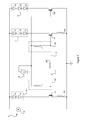
- FIG. 5 is an alternative example of light source circuitry in accordance with the present invention.
- FIG. 1 is an example of light source circuitry 1 in accordance with the present invention.
- the light source circuitry 1 comprises plural groups of LEDs 10 , 12 , 14 .
- the light source circuitry 1 of FIG. 1 comprises a first group of LEDs 10 , a second group of LEDs 12 and a third group of LEDs 14 .
- Each of the first, second and third groups of LEDs 10 , 12 , 14 comprises one or more LEDs e.g. 10 A, 12 A, 14 A.
- Each of the groups of LEDs 10 , 12 , 14 is operable to emit light of a different color.
- FIG. 1 is an example of light source circuitry 1 in accordance with the present invention.
- the light source circuitry 1 comprises plural groups of LEDs 10 , 12 , 14 .
- the light source circuitry 1 of FIG. 1 comprises a first group of LEDs 10 , a second group of LEDs 12 and a third group of LEDs 14 .
- the first group of LEDs 10 consists of plural LEDs 10 A, 10 B, in this instance two, which are operable to emit lime-colored light (hereafter referred to as lime LEDs).
- the second group of LEDs 12 consists of plural LEDs 12 A, 12 B 12 C, in this example three, which are operable to emit red-colored light (hereafter referred to as red LEDs).
- the third group of LEDs 14 consists of plural LEDs 14 A, 14 B, 14 C, in this instance three, which are operable to emit white-colored light (hereafter white LEDs).
- the LEDs within each of the first, second and third groups 10 , 12 , 14 are connected in series with one another.
- the plural groups of LEDs 10 , 12 , 14 are connected in parallel with one another. As such, a fixed current arriving at the circuitry is shared among the plural groups of LEDs 10 , 12 , 14 .
- the light source circuitry 1 also comprises a current source 70 which provides the fixed current.
- the light source circuitry 1 is configured such that a proportion of the fixed current that is provided to each of the first and second groups 10 , 12 is controllable in dependence on a received control signal.
- the circuitry is also configured such that the remainder of the fixed current is provided to the third group 14 .
- the light source circuitry 10 is configured such that when the control signal is at a first level, the majority of the fixed current flows through the white LEDs of the third group 14 .
- the control signal gradually moves towards a second level, the currents flowing through the lime and red LEDs of the first and second groups 10 , 12 respectively both increase.
- the current flowing through the lime LEDs 10 A, 10 B is larger than the current flowing through the red LEDs 12 A, 12 B, 12 C.
- the control signal gradually moves beyond the second level to a third level, the current in the lime LEDs 10 A, 10 B begins gradually to decrease, while the current in the red LEDs 12 A, 12 B, 12 C continues to increase.
- the current flowing in the white LEDs 14 A, 14 B, 14 C gradually decreases as the control signal moves from the first to third levels.
- the current in the white LEDs 14 A, 14 B, 14 C is nearly zero at the third level.
- the current flowing in the second group 12 becomes larger than the current flowing in the first group 10 .
- the light source circuitry 1 being configured in this way allows the chromaticity of the combined emissions of the first, second and third groups of LEDs 10 , 12 , 14 substantially to follow the Planckian locus (also known as the black body locus) as the control signal changes from the first to third levels.
- the first group of LEDs 10 is connected in series with a first transistor 16 .
- the second group of LEDs 12 is connected in series with a second transistor 18 .
- the first and second transistors 16 , 18 are n-channel bipolar junction transistors (BJTs).
- the base terminals of the first and second transistors 16 , 18 are connected to one another via a first resistor 20 .
- a first conductive path 19 connects the base terminal of the first transistor 16 and the first resistor 20 .
- a second conductive path 21 connects the base terminal of the second transistor 16 and the first resistor 20 .
- the presence of the first resistor 20 creates a dependency, so that the currents in the first and second groups of LEDs 10 , 12 do not differ from one another by too much. This is achieved because the first resistor 20 limits the difference that can exist between the voltages at the base terminals of the first and second transistors 16 , 18 .
- the first resistor 20 may be omitted from the circuitry 1 .
- the light source circuitry 1 comprises a controllable voltage supply 22 .
- This provides a voltage which acts as the control signal for varying the current that flows through the first and second groups of LEDs 10 , 12 .
- the controllable voltage supply 22 is connected to the base terminal of at least the second transistor 18 so as to vary the amount of current that flows through the second transistor 18 , and thus also through the second group of LEDs 12 .
- the controllable voltage supply is also connected to the base terminal of the first transistor 16 so as to vary the amount of current that flows through the first transistor 16 , and thus also through the first group of LEDs 10 .
- the first group of LEDs 10 is connected to the collector terminal of the first transistor 16 .
- the emitter terminal of the first transistor 16 is connected to ground, via a second resistor 64 .
- the second group of LEDs 12 is connected to the collector terminal of the second transistor 18 .
- the emitter terminal of the second transistor 18 is connected to ground, via a third resistor 68 .
- the resistances of the second and third resistors 64 , 68 are the same.
- the presence of the second and third resistors 64 , 68 makes the circuit more stable over a range of different temperatures and between different instances of the light source circuitry 1 . This is because their presence reduces the sensitivity to base-emitter voltage drift.
- the third group of LEDs 14 is connected to ground. Whereas the current flowing through the first and second groups of LEDs 10 , 12 is dependent on the control signal, the current through the third group of LEDs 14 is not directly controllable, but instead comprises the remainder of the first current that does not flow through the first and second groups 10 , 12 .
- the controllable voltage supply 22 is connected to the base terminal of the second transistor 18 via first control circuitry 24 A.
- the controllable voltage supply 22 is connected to the base terminal of the first transistor 16 via second control circuitry 24 B.
- the first and second control circuitries 24 A, 24 B are configured so as to ensure that the combined light emissions of the first, second and third groups of LEDs 10 , 12 , 14 follows the Planckian locus as closely as possible for as long as possible. In the example of FIG. 1 , this is achieved using analogue components, including diodes, resistors and transistors.
- micro-processor configured to receive a single voltage and to use this voltage to supply a suitable current to the base terminal of at least one of the first and second transistors 16 , 18 .
- this may be achieved using operational amplifiers.
- the first control circuitry 24 A comprises one or more, in this instance three, parallel circuit branches 26 A, 26 B, 26 C connected between the controllable voltage supply 22 and the second conductive path 21 .
- a first branch 26 A comprises a fourth resistor 28 .
- a second branch 26 B comprises a fifth resistor 30 in series with a reverse-biased first Zener diode 32 .
- a third branch 26 C comprises a sixth resistor 34 in series with a reverse-biased second Zener diode 36 .
- the presence of the first and second Zener diodes 32 , 36 means that a significant current flows through the second and third branches 26 B, 26 C only when the potential difference between the controllable voltage supply 22 and the second conductive path 21 exceeds a predetermined value (i.e.
- the reverse voltage of the Zener diodes 32 , 36 current always flows through the first branch 26 A as long as a potential difference exists.
- the first branch 26 A is connected to the second conductive path 21 at a location nearest to the base terminal of the second transistor 18 .
- the third branch 26 C is connected to the second conductive path 21 at a location nearest to the first resistor 20 .
- the second branch 26 B is connected to the second conductive path 21 at a location between the locations at which the first and third branches 26 A, 26 C are connected to the second conductive path 21 .
- the second control circuitry 24 B comprises one or more branches 38 A, 38 B, 38 C, in this instance three, connected in parallel between the controllable voltage supply 22 and the first conductive path 19 .
- a first branch 38 A comprises a seventh resistor 40 .
- a second branch 38 B comprises a forward biased conventional diode 42 connected in series with an eighth resistor 44 .
- a third branch 38 C comprises a ninth resistor 46 in series with a third reverse-biased Zener diode 48 .
- the presence of the first conventional diode in the second branch 38 B means that a significant current will only flow in the second branch when the potential difference between the controllable voltage supply and the first conductive path 19 is above the forward voltage of the diode 42 .
- the presence of the third Zener diode 48 means that a significant current will only flow in the third branch 38 C when the potential difference is greater than the reverse voltage of the third Zener diode 48 .
- a current will always flow in the first branch 38 A as long as a potential difference exists.
- the second branch 38 B is connected to the first conductive path 19 at a location nearest to the base terminal of the first transistor 16 .
- the third branch 38 C is connected to the first conductive path 19 at a location nearest to the first resistor 20 .
- the first branch 38 A is connected to the first conductive path 19 at a location between the locations at which the second and third branches 38 B, 38 C are connected to the first conductive path 19 .
- the second control circuitry 24 B also comprises first and second control transistors 50 , 52 .
- the first and second control transistors 50 , 52 comprise p-channel BJTs.
- the controllable voltage supply 22 is connected to the base terminal of the first control transistor 50 via a tenth resistor 54 connected in series with a fourth Zener diode 56 .
- the controllable voltage supply 22 is connected to the base terminal of the second control transistor 52 via an eleventh resistor 58 connected in series with a fifth Zener diode 60 .
- the collector of the first control transistor 50 is connected to the first conductive path 19 , in this example at a location between the locations at which the first and third branches 38 A, 38 C of the second control circuitry 24 B connect to the first conductive path 19 .
- the emitter of the first control transistor 50 is connected to ground.
- the collector of the second control transistor 52 is connected to the base terminal of the first transistor 16 , in this example at a location between the locations at which the first and second branches 38 A, 38 B of the second control circuitry 24 B connect to the first conductive path 19 .
- the emitter of the second control transistor 50 is connected to ground.
- the resistances of the tenth and eleventh resistors 45 , 58 may be the same.
- the presence of the first and second control transistors 50 , 52 means that, when a potential difference between the base terminals of the first and second control transistors 50 , 52 and the controllable voltage supply 22 is in excess of the reverse voltages of the fourth and fifth Zener diodes 56 , 60 , some current will flow through first and second control transistors from the first conductive path. As such, less current flows to the base terminal of the first transistor 16 , and so less current flows through the collector-emitter junction of the first transistor 16 which means less current also flows through the first group of LEDs 10 , thus reducing the intensity of the light emitted by the first group of LEDs 10 .
- Each of the first to fifth Zener diodes 32 , 36 , 48 , 56 , 60 may have a different reverse voltage.
- the reverse voltages of the Zener diodes 32 , 36 , 48 , 56 , 60 are selected based on the range of voltages of the control supply.
- Each of the Zener diodes is responsible for a change in the gradient of the chromaticity graph (see FIG. 2 ) of the light source circuitry 1 .
- the inclusion of the Zener diodes 32 , 36 , 48 , 56 , 60 allows the light source circuitry to track the Planckian Locus over a wider range of chromaticities. This will be apparent from a comparison of FIGS. 2 and 4 .
- the light source circuitry 1 may also comprise a current protection branch connected between the current source 70 and ground.
- a current protection branch may be connected in parallel with the first, second and third groups of LEDs 10 , 12 , 14 .
- the current protection branch may comprise at least a resistor connected in series with a reverse-biased Zener diode. When, the potential difference between the current source 70 and ground exceeds the reverse voltage of the Zener diode, the current protection branch begins to conduct current. This reduces the amount of current that can flow through the first, second and third groups of LEDs 10 , 12 , 14 thereby protecting the LEDs against damage due to excessive currents.
- the electrical components shown in FIG. 1 have the following electrical characteristics. It will be appreciated, however, that the below characteristics are examples only, and that components having different characteristics may instead be used:
- Table 1 shows the currents flowing through the lime, red and white LEDs in light source circuitry 1 having the above characteristics for a varying control signal:
- the first control signal level is between 1.0 and 1.5V.
- the second control signal level, at which the current flowing through the lime LEDs 10 A, 10 B, 10 C, begins to drop is located between 6.5V and 7.0V.
- Table 2 shows the chromaticity and the flux levels of the combined emissions of the first, second and third groups of LEDs 10 , 12 , 14 as the control signal changes gradually from a first level to the third level.
- FIG. 2 shows, by way of comparison, the Planckian locus, which is denoted by the line marked PL. It can, thus, be seen, that the chromaticity of the light source system substantially follows the Planckian locus.
- light source circuitry in accordance with the present invention allows the tint or color of light produced by the light source circuitry to be varied without the need to use PWM. In addition, it requires only a variation in a single control signal to obtain a wide range of different tints or colors, which in some embodiments follow closely the Planckian locus.
- the structural simplicity of the light source circuitry, and the fact that it needs only a single control signal to vary the tint across a wide range of chromaticities, means that the cost of manufacture of the light source circuitry and any appliance, such as a bulb, which includes the light source circuitry can remain relatively low.
- FIG. 3 shows an uncompensated version 3 of the light source circuitry of FIG. 1 .
- the uncompensated light source circuitry 3 is substantially the same as the circuitry 1 of FIG. 1 except that it includes much simplified control circuitries 24 A, 24 B.
- the first control circuitry 24 A is constituted by a resistor 27 connected between the controllable voltage supply 22 and the second conductive path 21 .
- the second control circuitry 24 B is constituted by a resistor 39 connected between the controllable voltage supply 22 and the first conductive path 21 .
- FIG. 4 shows a graph of the chromaticity of the combined emissions of light source circuitry 3 of FIG. 3 (denoted G 2 ) relative to the Planckian Locus (denoted PL). As can be seen, the combined emissions still track the Planckian Locus, but over a shorter range of chromaticities.
- the electrical characteristics of the components of the light source circuitry 3 were the same as the characteristics of the corresponding components listed above with reference to FIG. 1 (i.e.
- the resistances of the resistors 20 , 64 and 68 were the same, as well as the forward voltages of the LEDs 10 , 12 , 14 , and the voltage and current of the controllable voltage and current sources 22 , 70 respectively).
- the resistance of the resistor 27 of the first control circuitry 24 A was 4,200 ⁇ .
- the resistance of the resistor 39 of the second control circuitry 24 B was 2,400 ⁇ .
- FIG. 5 is an example of another alternative arrangement of light source circuitry 150 in accordance with the invention.
- the light source circuitry 5 of FIG. 5 is substantially the same as the uncompensated light source circuitry of FIG. 3 .
- the light source circuitry 5 of FIG. 5 also comprises a third transistor 500 connected in series with the third group of LEDs 14 .
- the third group of LEDs are connected to the collector terminal of the third transistor 500 .
- the emitter terminal of the third transistor 500 is connected to ground.
- the controllable voltage supply 22 is connected to the base terminal of the third transistor 500 .
- the connection between the controllable voltage supply 22 and the base terminal of the third transistor 500 may include no resistor, or may include a resistor that is of significantly lower resistance than the resistors 27 , 39 of the first and second control circuitries 24 A, 24 B.
- the light source circuitry 5 of FIG. 5 is configured such that when the control signal is at a first level, the majority of the current flows through the white LEDs of the third group 14 .
- the control signal gradually moves towards a second level, the currents flowing through the lime and red LEDs of the first second groups 10 , 12 respectively both increase.
- the current flowing through the LEDs in the first group 10 is larger than the current flowing through the LEDs of the second group 12 .
- the current flowing through the second group of LEDs 12 never becomes larger than the current flowing through first group of LEDs 10 .
- the combined emission of the light source circuitry 5 follows the Planckian locus over a shorter range of chromaticities than does the example of FIG.
- the current flowing in the third group 14 (i.e. the remainder of the current that is not flowing in the first and second groups 10 , 12 ) gradually decreases as the control signal moves from the first to third levels.
- the light source circuitry 5 of FIG. 5 operates in this way at least in part because the combined forward voltage of the third group of LEDs 14 is greater than the forward voltages of the first and second groups of LEDs 10 , 12 .
- the forward voltage of the second group of LEDs 12 is preferably similar to the forward voltage of the first group of LEDs 10 .
- the characteristics of the components of the circuitry 5 of FIG. 5 are substantially the same as those in FIG. 3 , except that the resistance of the resistor 27 of the first control circuitry 24 A is 2,400 ⁇ and the resistance of the resistor 39 of the second control circuitry 24 B is 3000 ⁇
- FIGS. 1, 3 and 5 show the fixed current source 70 as part of the light source circuitry 1 , 3 , 5 , it will be appreciated that this may be separable. As such, the circuitry 1 , 3 , 5 may instead be configured to be connectable to (and so not actually including) the fixed current source 70 .
- the fixed current source 70 may comprise, for example, a mains-power flyback converter. Alternatively, the fixed current source 70 may comprise any other means for providing a fixed current to the light source circuitry 1 , 3 , 5 .
- controllable voltage source 22 for providing the control signal may be separate or separable from the light source circuitry 1 , 3 , 5 .
- the controllable voltage source 22 may comprise, for example, a rectified mains signal with, for example, an output voltage between 1V and 10V.
- FIGS. 1, 3 and 5 show the groups of LEDs 10 , 12 , 14 connected to the collector terminals of the various transistors 16 , 18 , 500 , it will be understood that the groups of LEDs may instead be connected to the emitter terminals.
- the specific examples include n-channel BJTs, in some examples p-channel BJTs may be used.
- field effect transistors may be used. In examples which include field-effect transistors, where a connection is described above as being to the base terminal, the connection is instead to the gate terminal. Similarly, where a connection is described as being with the emitter terminal or collector terminal, in examples including field-effect transistors the connection is instead to the drain or source terminals respectively.
- the gate terminal and the base terminal of field-effect transistors and BJTs respectively may be collectively referred to herein as control terminals. This is because a signal provided to those terminals controls the current that flows through the transistor.
- each of the groups of LEDs 10 , 12 , 14 may include LEDs of different colors, the combined emissions of which result in light of a desired color.
- the first group of LEDs 14 instead of all being Lime LEDs, may be comprised of a mixture of green LEDs and amber LEDs to produce a lime-colored combined emission.
- the colors and quantities of LEDs are selected so as to be able to produce a combined emission that closely follows the Planckian locus.
- different colored LEDs to those described above may be used.
- different numbers of LEDs to those described above may be used.
- the Figures show the LEDs of each group connected in series, in some alternatives the LEDs of each group may be connected in parallel, or in a combination of in series an in parallel.
- the light source circuitry according to the present invention may be used to create LED light sources such as retrofit lamps, LED luminaires, or lamp for professional applications such as lamps used in theaters or lamps for illuminating steps.
Landscapes
- Circuit Arrangement For Electric Light Sources In General (AREA)
Priority Applications (1)
| Application Number | Priority Date | Filing Date | Title |
|---|---|---|---|
| US14/400,088 US9504115B2 (en) | 2012-05-15 | 2013-05-06 | Light source circuitry for controlling the color of emitted light |
Applications Claiming Priority (3)
| Application Number | Priority Date | Filing Date | Title |
|---|---|---|---|
| US201261646934P | 2012-05-15 | 2012-05-15 | |
| US14/400,088 US9504115B2 (en) | 2012-05-15 | 2013-05-06 | Light source circuitry for controlling the color of emitted light |
| PCT/IB2013/053619 WO2013171622A1 (en) | 2012-05-15 | 2013-05-06 | Light source circuitry |
Publications (2)
| Publication Number | Publication Date |
|---|---|
| US20150108919A1 US20150108919A1 (en) | 2015-04-23 |
| US9504115B2 true US9504115B2 (en) | 2016-11-22 |
Family
ID=48628757
Family Applications (1)
| Application Number | Title | Priority Date | Filing Date |
|---|---|---|---|
| US14/400,088 Active US9504115B2 (en) | 2012-05-15 | 2013-05-06 | Light source circuitry for controlling the color of emitted light |
Country Status (6)
| Country | Link |
|---|---|
| US (1) | US9504115B2 (enExample) |
| EP (1) | EP2850917B1 (enExample) |
| JP (1) | JP6389457B2 (enExample) |
| CN (1) | CN104303597B (enExample) |
| PL (1) | PL2850917T3 (enExample) |
| WO (1) | WO2013171622A1 (enExample) |
Cited By (1)
| Publication number | Priority date | Publication date | Assignee | Title |
|---|---|---|---|---|
| US11917737B2 (en) | 2021-08-02 | 2024-02-27 | Bio-Rad Laboratories, Inc. | Circuit for sharing current between parallel LEDs or parallel strings of LEDs |
Families Citing this family (6)
| Publication number | Priority date | Publication date | Assignee | Title |
|---|---|---|---|---|
| US10588190B2 (en) * | 2015-06-25 | 2020-03-10 | Signify Holding B.V. | LED lighting arrangement |
| DE102016125457A1 (de) | 2015-12-25 | 2017-06-29 | Panasonic Intellectual Property Management Co., Ltd. | Beleuchtungslicht-Kommunikationsvorrichtung und Kommunikationsmodul |
| US10104730B2 (en) * | 2017-03-07 | 2018-10-16 | B/E Aerospace, Inc. | LED bulb and method for operating same |
| US11997773B2 (en) * | 2019-09-03 | 2024-05-28 | Signify Holding B.V. | Light emitting diode, LED, based current splitter for splitting an LED current between a plurality of LED channels as well as a multi-channel light emitting diode, LED, based lighting device |
| JP7815130B2 (ja) * | 2020-03-10 | 2026-02-17 | アルコン インコーポレイティド | 発光ダイオードの制御点灯のためのシステム及び方法 |
| EP4489244A1 (en) * | 2023-07-03 | 2025-01-08 | Pepperl+Fuchs SE | Limiting circuit for use in explosion protection environments |
Citations (20)
| Publication number | Priority date | Publication date | Assignee | Title |
|---|---|---|---|---|
| US6305818B1 (en) | 1998-03-19 | 2001-10-23 | Ppt Vision, Inc. | Method and apparatus for L.E.D. illumination |
| US20030025120A1 (en) * | 2001-08-03 | 2003-02-06 | Koninklijke Philips Electronics N.V. | Integrated LED driving device with current sharing for multiple LED strings |
| US6538394B2 (en) * | 2001-03-30 | 2003-03-25 | Maxim Integrated Products, Inc. | Current source methods and apparatus for light emitting diodes |
| US6864641B2 (en) * | 2003-02-20 | 2005-03-08 | Visteon Global Technologies, Inc. | Method and apparatus for controlling light emitting diodes |
| US20060049782A1 (en) | 2004-09-08 | 2006-03-09 | Vornsand Steven J | Lighting apparatus having a plurality of independently controlled sources of different colors of light |
| US7122971B2 (en) * | 2003-11-05 | 2006-10-17 | Richtek Technology Corp. | Driver circuit for driving a plurality of DC lamp strings |
| US20070080911A1 (en) | 2005-10-11 | 2007-04-12 | Da Liu | Controller circuitry for light emitting diodes |
| US20070152909A1 (en) | 2006-01-05 | 2007-07-05 | Sanyo Electric Co., Ltd. | Led device |
| US20070205968A1 (en) | 2006-03-03 | 2007-09-06 | Pei-Ming Chen | Organic light-emitting diode display, organic light-emitting diode panel and driving device thereof |
| US20080116817A1 (en) * | 2006-11-16 | 2008-05-22 | Han-Yu Chao | Controlling apparatus for controlling a plurality of led strings and related light modules |
| JP2009152518A (ja) * | 2007-11-30 | 2009-07-09 | Omron Corp | 発光ダイオード駆動装置 |
| US20090322234A1 (en) * | 2008-06-30 | 2009-12-31 | Iwatt Inc. | Led driver with multiple feedback loops |
| US20100164403A1 (en) * | 2008-12-31 | 2010-07-01 | O2Micro, Inc. | Circuits and methods for controlling LCD backlights |
| WO2010122463A1 (en) | 2009-04-23 | 2010-10-28 | Koninklijke Philips Electronics N.V. | Driver for an led lamp |
| US20110080115A1 (en) * | 2009-10-01 | 2011-04-07 | Liangan Ge | Constant current control circuit with multiple outputs for led driver |
| US20110199019A1 (en) | 2010-02-16 | 2011-08-18 | Mcclear Mark | Color control of light emitting devices and applications thereof |
| US20120223657A1 (en) * | 2011-03-03 | 2012-09-06 | Cree, Inc. | Semiconductor Light Emitting Devices Having Selectable And/or Adjustable Color Points and Related Methods |
| US20130154484A1 (en) * | 2011-12-19 | 2013-06-20 | Peng Xu | LED Driving System for Driving Multi-String LEDS and the Method Thereof |
| US20130278151A1 (en) * | 2012-04-20 | 2013-10-24 | Trilumina Corporation | Addressable illuminator with eye-safety circuitry |
| US9018845B2 (en) * | 2011-04-02 | 2015-04-28 | Inventronics (Hangzhou), Inc. | Circuit for adjusting LED current |
Family Cites Families (3)
| Publication number | Priority date | Publication date | Assignee | Title |
|---|---|---|---|---|
| JPH11298044A (ja) * | 1998-04-16 | 1999-10-29 | Sony Corp | 光源駆動回路 |
| JP2007059260A (ja) * | 2005-08-25 | 2007-03-08 | Toshiba Lighting & Technology Corp | 照明装置及び照明器具 |
| JP5462535B2 (ja) * | 2009-06-25 | 2014-04-02 | パナソニック株式会社 | 照明装置 |
-
2013
- 2013-05-06 PL PL13729464T patent/PL2850917T3/pl unknown
- 2013-05-06 JP JP2015512160A patent/JP6389457B2/ja active Active
- 2013-05-06 US US14/400,088 patent/US9504115B2/en active Active
- 2013-05-06 WO PCT/IB2013/053619 patent/WO2013171622A1/en not_active Ceased
- 2013-05-06 CN CN201380025576.7A patent/CN104303597B/zh active Active
- 2013-05-06 EP EP13729464.1A patent/EP2850917B1/en active Active
Patent Citations (21)
| Publication number | Priority date | Publication date | Assignee | Title |
|---|---|---|---|---|
| US6305818B1 (en) | 1998-03-19 | 2001-10-23 | Ppt Vision, Inc. | Method and apparatus for L.E.D. illumination |
| US6538394B2 (en) * | 2001-03-30 | 2003-03-25 | Maxim Integrated Products, Inc. | Current source methods and apparatus for light emitting diodes |
| US20030025120A1 (en) * | 2001-08-03 | 2003-02-06 | Koninklijke Philips Electronics N.V. | Integrated LED driving device with current sharing for multiple LED strings |
| US6621235B2 (en) * | 2001-08-03 | 2003-09-16 | Koninklijke Philips Electronics N.V. | Integrated LED driving device with current sharing for multiple LED strings |
| US6864641B2 (en) * | 2003-02-20 | 2005-03-08 | Visteon Global Technologies, Inc. | Method and apparatus for controlling light emitting diodes |
| US7122971B2 (en) * | 2003-11-05 | 2006-10-17 | Richtek Technology Corp. | Driver circuit for driving a plurality of DC lamp strings |
| US20060049782A1 (en) | 2004-09-08 | 2006-03-09 | Vornsand Steven J | Lighting apparatus having a plurality of independently controlled sources of different colors of light |
| US20070080911A1 (en) | 2005-10-11 | 2007-04-12 | Da Liu | Controller circuitry for light emitting diodes |
| US20070152909A1 (en) | 2006-01-05 | 2007-07-05 | Sanyo Electric Co., Ltd. | Led device |
| US20070205968A1 (en) | 2006-03-03 | 2007-09-06 | Pei-Ming Chen | Organic light-emitting diode display, organic light-emitting diode panel and driving device thereof |
| US20080116817A1 (en) * | 2006-11-16 | 2008-05-22 | Han-Yu Chao | Controlling apparatus for controlling a plurality of led strings and related light modules |
| JP2009152518A (ja) * | 2007-11-30 | 2009-07-09 | Omron Corp | 発光ダイオード駆動装置 |
| US20090322234A1 (en) * | 2008-06-30 | 2009-12-31 | Iwatt Inc. | Led driver with multiple feedback loops |
| US20100164403A1 (en) * | 2008-12-31 | 2010-07-01 | O2Micro, Inc. | Circuits and methods for controlling LCD backlights |
| WO2010122463A1 (en) | 2009-04-23 | 2010-10-28 | Koninklijke Philips Electronics N.V. | Driver for an led lamp |
| US20110080115A1 (en) * | 2009-10-01 | 2011-04-07 | Liangan Ge | Constant current control circuit with multiple outputs for led driver |
| US20110199019A1 (en) | 2010-02-16 | 2011-08-18 | Mcclear Mark | Color control of light emitting devices and applications thereof |
| US20120223657A1 (en) * | 2011-03-03 | 2012-09-06 | Cree, Inc. | Semiconductor Light Emitting Devices Having Selectable And/or Adjustable Color Points and Related Methods |
| US9018845B2 (en) * | 2011-04-02 | 2015-04-28 | Inventronics (Hangzhou), Inc. | Circuit for adjusting LED current |
| US20130154484A1 (en) * | 2011-12-19 | 2013-06-20 | Peng Xu | LED Driving System for Driving Multi-String LEDS and the Method Thereof |
| US20130278151A1 (en) * | 2012-04-20 | 2013-10-24 | Trilumina Corporation | Addressable illuminator with eye-safety circuitry |
Non-Patent Citations (1)
| Title |
|---|
| Ivan Moreno; "Color Tunable Hybrid Lamp: LED-Incandescent and LED-Fluorescent", Sixth Symposium Optics Industry, Proc. of SPIE, vol. 6422, No. 1, 2007, pp. 1-7. |
Cited By (1)
| Publication number | Priority date | Publication date | Assignee | Title |
|---|---|---|---|---|
| US11917737B2 (en) | 2021-08-02 | 2024-02-27 | Bio-Rad Laboratories, Inc. | Circuit for sharing current between parallel LEDs or parallel strings of LEDs |
Also Published As
| Publication number | Publication date |
|---|---|
| CN104303597B (zh) | 2017-12-15 |
| JP6389457B2 (ja) | 2018-09-12 |
| CN104303597A (zh) | 2015-01-21 |
| US20150108919A1 (en) | 2015-04-23 |
| WO2013171622A1 (en) | 2013-11-21 |
| EP2850917A1 (en) | 2015-03-25 |
| PL2850917T3 (pl) | 2017-08-31 |
| JP2015522903A (ja) | 2015-08-06 |
| EP2850917B1 (en) | 2017-02-22 |
Similar Documents
| Publication | Publication Date | Title |
|---|---|---|
| EP2850917B1 (en) | Light source circuitry | |
| US10750592B1 (en) | Systems and methods for controlling color temperature and brightness of LED lighting using two wires | |
| US9730291B1 (en) | Color temperature adjustment based on dim level | |
| US8277078B2 (en) | Light emitting device | |
| US8004211B2 (en) | LED lighting device | |
| US9320097B2 (en) | Multi-string dimmable LED driver | |
| US9474111B2 (en) | Solid state lighting apparatus including separately driven LED strings and methods of operating the same | |
| US11812525B2 (en) | Methods and apparatus for controlling the current supplied to light emitting diodes | |
| US10182486B2 (en) | LED drive circuit | |
| US20130147359A1 (en) | Lighting Devices Including Current Shunting Responsive To LED Nodes And Related Methods | |
| US20140210361A1 (en) | Linear bypass electrical circuit for driving led strings | |
| WO2013118208A1 (ja) | 発光回路、発光モジュールおよび照明装置 | |
| CN110958731A (zh) | 发光二极管并联电路 | |
| JP2009009782A (ja) | 照明装置 | |
| US20090108772A1 (en) | Color-temperature adjustable light-emitting device and control circuitry thereof | |
| JP2012169195A (ja) | Led調光用点灯装置 | |
| JP6411261B2 (ja) | Led駆動回路 | |
| US7352137B2 (en) | Controlling color temperature of lighting fixture | |
| CN114651529B (zh) | 布置为发射跟随颜色空间中的普朗克轨迹的特定发射光的基于发光二极管led的照明设备 | |
| JP2020030905A (ja) | Led発光装置 | |
| CN114303443B (zh) | 用于在多个led通道之间分离led电流的基于发光二极管led的电流分离器以及基于多通道发光二极管led的照明设备 | |
| CN110856303A (zh) | Led灯色温与亮度线性控制电路 | |
| CN211297029U (zh) | 一种单路双色温的控制电路 | |
| JP2015008275A (ja) | Ledモジュール装置及びled照明装置 | |
| JP2013168383A (ja) | 点灯装置及び照明装置 |
Legal Events
| Date | Code | Title | Description |
|---|---|---|---|
| AS | Assignment |
Owner name: KONINKLIJKE PHILIPS ELECTRONICS N.V., NETHERLANDS Free format text: ASSIGNMENT OF ASSIGNORS INTEREST;ASSIGNOR:VAN ERP, JOSEPHUS ADRIANUS MARIA;REEL/FRAME:034135/0823 Effective date: 20131030 |
|
| AS | Assignment |
Owner name: PHILIPS LIGHTING HOLDING B.V., NETHERLANDS Free format text: ASSIGNMENT OF ASSIGNORS INTEREST;ASSIGNOR:KONINKLIJKE PHILIPS N.V.;REEL/FRAME:040060/0009 Effective date: 20160607 |
|
| STCF | Information on status: patent grant |
Free format text: PATENTED CASE |
|
| AS | Assignment |
Owner name: SIGNIFY HOLDING B.V., NETHERLANDS Free format text: CHANGE OF NAME;ASSIGNOR:PHILIPS LIGHTING HOLDING B.V.;REEL/FRAME:050837/0576 Effective date: 20190201 |
|
| MAFP | Maintenance fee payment |
Free format text: PAYMENT OF MAINTENANCE FEE, 4TH YEAR, LARGE ENTITY (ORIGINAL EVENT CODE: M1551); ENTITY STATUS OF PATENT OWNER: LARGE ENTITY Year of fee payment: 4 |
|
| MAFP | Maintenance fee payment |
Free format text: PAYMENT OF MAINTENANCE FEE, 8TH YEAR, LARGE ENTITY (ORIGINAL EVENT CODE: M1552); ENTITY STATUS OF PATENT OWNER: LARGE ENTITY Year of fee payment: 8 |