US9445965B2 - Methods for treating spine pathologies - Google Patents
Methods for treating spine pathologies Download PDFInfo
- Publication number
- US9445965B2 US9445965B2 US14/363,414 US201214363414A US9445965B2 US 9445965 B2 US9445965 B2 US 9445965B2 US 201214363414 A US201214363414 A US 201214363414A US 9445965 B2 US9445965 B2 US 9445965B2
- Authority
- US
- United States
- Prior art keywords
- protuberance
- another embodiment
- posterior
- anterior
- subject
- Prior art date
- Legal status (The legal status is an assumption and is not a legal conclusion. Google has not performed a legal analysis and makes no representation as to the accuracy of the status listed.)
- Active, expires
Links
- 238000000034 method Methods 0.000 title claims abstract description 63
- 230000007170 pathology Effects 0.000 title abstract description 82
- 210000002683 foot Anatomy 0.000 claims description 84
- 208000008035 Back Pain Diseases 0.000 claims description 67
- 230000002829 reductive effect Effects 0.000 claims description 31
- 210000003423 ankle Anatomy 0.000 claims description 28
- 206010039722 scoliosis Diseases 0.000 claims description 23
- 208000008930 Low Back Pain Diseases 0.000 claims description 11
- 241001227561 Valgus Species 0.000 claims description 8
- 241000469816 Varus Species 0.000 claims description 5
- 230000005021 gait Effects 0.000 description 126
- 208000002193 Pain Diseases 0.000 description 98
- 230000036407 pain Effects 0.000 description 95
- 125000006850 spacer group Chemical group 0.000 description 55
- 238000011282 treatment Methods 0.000 description 44
- 230000000694 effects Effects 0.000 description 40
- 210000002414 leg Anatomy 0.000 description 33
- 210000003414 extremity Anatomy 0.000 description 29
- 210000003205 muscle Anatomy 0.000 description 27
- 210000000474 heel Anatomy 0.000 description 24
- 230000033001 locomotion Effects 0.000 description 24
- 230000006872 improvement Effects 0.000 description 21
- 230000002354 daily effect Effects 0.000 description 20
- 230000001965 increasing effect Effects 0.000 description 18
- 208000024891 symptom Diseases 0.000 description 17
- 238000012360 testing method Methods 0.000 description 17
- 230000002401 inhibitory effect Effects 0.000 description 15
- 230000006870 function Effects 0.000 description 14
- 230000008569 process Effects 0.000 description 14
- 244000309466 calf Species 0.000 description 13
- 206010041591 Spinal osteoarthritis Diseases 0.000 description 12
- 210000000278 spinal cord Anatomy 0.000 description 12
- 208000005801 spondylosis Diseases 0.000 description 12
- 210000004705 lumbosacral region Anatomy 0.000 description 11
- 210000000115 thoracic cavity Anatomy 0.000 description 11
- 230000006378 damage Effects 0.000 description 10
- 230000007423 decrease Effects 0.000 description 10
- 230000001976 improved effect Effects 0.000 description 10
- 230000009467 reduction Effects 0.000 description 10
- 210000003141 lower extremity Anatomy 0.000 description 9
- 208000003618 Intervertebral Disc Displacement Diseases 0.000 description 8
- 208000037265 diseases, disorders, signs and symptoms Diseases 0.000 description 8
- 239000000463 material Substances 0.000 description 8
- 230000003387 muscular Effects 0.000 description 8
- 210000004197 pelvis Anatomy 0.000 description 8
- 230000002159 abnormal effect Effects 0.000 description 7
- 230000008901 benefit Effects 0.000 description 7
- 210000000459 calcaneus Anatomy 0.000 description 7
- 201000010099 disease Diseases 0.000 description 7
- 230000004064 dysfunction Effects 0.000 description 7
- 230000004044 response Effects 0.000 description 7
- 208000005198 spinal stenosis Diseases 0.000 description 7
- 238000001356 surgical procedure Methods 0.000 description 7
- 239000004677 Nylon Substances 0.000 description 6
- 208000036319 cervical spondylosis Diseases 0.000 description 6
- 239000011436 cob Substances 0.000 description 6
- 238000010411 cooking Methods 0.000 description 6
- 210000001624 hip Anatomy 0.000 description 6
- 238000003384 imaging method Methods 0.000 description 6
- 208000014674 injury Diseases 0.000 description 6
- 238000009533 lab test Methods 0.000 description 6
- 210000001872 metatarsal bone Anatomy 0.000 description 6
- 210000005036 nerve Anatomy 0.000 description 6
- 230000001537 neural effect Effects 0.000 description 6
- 230000000926 neurological effect Effects 0.000 description 6
- 229920001778 nylon Polymers 0.000 description 6
- 230000002035 prolonged effect Effects 0.000 description 6
- 206010061218 Inflammation Diseases 0.000 description 5
- 208000007101 Muscle Cramp Diseases 0.000 description 5
- 206010028836 Neck pain Diseases 0.000 description 5
- 210000004744 fore-foot Anatomy 0.000 description 5
- 210000000548 hind-foot Anatomy 0.000 description 5
- 230000004054 inflammatory process Effects 0.000 description 5
- 210000001503 joint Anatomy 0.000 description 5
- 210000003127 knee Anatomy 0.000 description 5
- 238000002560 therapeutic procedure Methods 0.000 description 5
- 208000010392 Bone Fractures Diseases 0.000 description 4
- 206010017076 Fracture Diseases 0.000 description 4
- 206010054197 Gait deviation Diseases 0.000 description 4
- 208000004044 Hypesthesia Diseases 0.000 description 4
- 210000000988 bone and bone Anatomy 0.000 description 4
- 210000004556 brain Anatomy 0.000 description 4
- 210000001217 buttock Anatomy 0.000 description 4
- 230000008859 change Effects 0.000 description 4
- 230000003247 decreasing effect Effects 0.000 description 4
- 230000006735 deficit Effects 0.000 description 4
- 230000007850 degeneration Effects 0.000 description 4
- 230000006866 deterioration Effects 0.000 description 4
- 229920001971 elastomer Polymers 0.000 description 4
- 230000003203 everyday effect Effects 0.000 description 4
- 239000003365 glass fiber Substances 0.000 description 4
- 208000034783 hypoesthesia Diseases 0.000 description 4
- 238000002595 magnetic resonance imaging Methods 0.000 description 4
- 238000005259 measurement Methods 0.000 description 4
- 230000004092 musculoskeletal function Effects 0.000 description 4
- 230000011514 reflex Effects 0.000 description 4
- 230000035807 sensation Effects 0.000 description 4
- 210000003371 toe Anatomy 0.000 description 4
- 230000008733 trauma Effects 0.000 description 4
- 210000000689 upper leg Anatomy 0.000 description 4
- 210000002517 zygapophyseal joint Anatomy 0.000 description 4
- 208000000187 Abnormal Reflex Diseases 0.000 description 3
- 206010002556 Ankylosing Spondylitis Diseases 0.000 description 3
- 206010006811 Bursitis Diseases 0.000 description 3
- 208000034656 Contusions Diseases 0.000 description 3
- 206010033425 Pain in extremity Diseases 0.000 description 3
- 208000005392 Spasm Diseases 0.000 description 3
- -1 but not limited to Substances 0.000 description 3
- 150000001875 compounds Chemical class 0.000 description 3
- 238000012937 correction Methods 0.000 description 3
- 230000002950 deficient Effects 0.000 description 3
- 230000005786 degenerative changes Effects 0.000 description 3
- 238000003745 diagnosis Methods 0.000 description 3
- 239000003814 drug Substances 0.000 description 3
- 230000001939 inductive effect Effects 0.000 description 3
- 238000003780 insertion Methods 0.000 description 3
- 230000037431 insertion Effects 0.000 description 3
- 230000007246 mechanism Effects 0.000 description 3
- 230000007659 motor function Effects 0.000 description 3
- 201000008482 osteoarthritis Diseases 0.000 description 3
- 238000004513 sizing Methods 0.000 description 3
- 208000020431 spinal cord injury Diseases 0.000 description 3
- ORILYTVJVMAKLC-UHFFFAOYSA-N Adamantane Natural products C1C(C2)CC3CC1CC2C3 ORILYTVJVMAKLC-UHFFFAOYSA-N 0.000 description 2
- 208000000094 Chronic Pain Diseases 0.000 description 2
- 206010010214 Compression fracture Diseases 0.000 description 2
- 208000005741 Failed Back Surgery Syndrome Diseases 0.000 description 2
- 244000043261 Hevea brasiliensis Species 0.000 description 2
- 208000029084 Hyperlordosis Diseases 0.000 description 2
- 208000003947 Knee Osteoarthritis Diseases 0.000 description 2
- 206010023509 Kyphosis Diseases 0.000 description 2
- 208000007623 Lordosis Diseases 0.000 description 2
- 206010072970 Meniscus injury Diseases 0.000 description 2
- 208000010428 Muscle Weakness Diseases 0.000 description 2
- 206010028372 Muscular weakness Diseases 0.000 description 2
- 208000031264 Nerve root compression Diseases 0.000 description 2
- 206010029260 Neuroblastoma Diseases 0.000 description 2
- 206010058119 Neurogenic shock Diseases 0.000 description 2
- 206010031252 Osteomyelitis Diseases 0.000 description 2
- 229930040373 Paraformaldehyde Natural products 0.000 description 2
- 206010057239 Post laminectomy syndrome Diseases 0.000 description 2
- 206010059604 Radicular pain Diseases 0.000 description 2
- 206010037779 Radiculopathy Diseases 0.000 description 2
- 206010039361 Sacroiliitis Diseases 0.000 description 2
- 208000008765 Sciatica Diseases 0.000 description 2
- 208000020307 Spinal disease Diseases 0.000 description 2
- 208000020339 Spinal injury Diseases 0.000 description 2
- 206010049679 Spinal shock Diseases 0.000 description 2
- 206010043255 Tendonitis Diseases 0.000 description 2
- 241000826860 Trapezium Species 0.000 description 2
- 208000027418 Wounds and injury Diseases 0.000 description 2
- 229910045601 alloy Inorganic materials 0.000 description 2
- 239000000956 alloy Substances 0.000 description 2
- 238000004873 anchoring Methods 0.000 description 2
- 238000005452 bending Methods 0.000 description 2
- 230000008468 bone growth Effects 0.000 description 2
- 208000034526 bruise Diseases 0.000 description 2
- 229940079593 drug Drugs 0.000 description 2
- 239000000806 elastomer Substances 0.000 description 2
- 206010020745 hyperreflexia Diseases 0.000 description 2
- 230000035859 hyperreflexia Effects 0.000 description 2
- 230000006698 induction Effects 0.000 description 2
- 230000003155 kinesthetic effect Effects 0.000 description 2
- 229910052751 metal Inorganic materials 0.000 description 2
- 239000002184 metal Substances 0.000 description 2
- 210000002161 motor neuron Anatomy 0.000 description 2
- 229920003052 natural elastomer Polymers 0.000 description 2
- 229920001194 natural rubber Polymers 0.000 description 2
- 230000002232 neuromuscular Effects 0.000 description 2
- 208000035824 paresthesia Diseases 0.000 description 2
- 201000006651 patellofemoral pain syndrome Diseases 0.000 description 2
- 230000002093 peripheral effect Effects 0.000 description 2
- 239000004033 plastic Substances 0.000 description 2
- 229920003023 plastic Polymers 0.000 description 2
- 229920006324 polyoxymethylene Polymers 0.000 description 2
- 230000002250 progressing effect Effects 0.000 description 2
- 230000009023 proprioceptive sensation Effects 0.000 description 2
- 238000013102 re-test Methods 0.000 description 2
- 230000008653 root damage Effects 0.000 description 2
- 239000005060 rubber Substances 0.000 description 2
- 230000001953 sensory effect Effects 0.000 description 2
- 230000037152 sensory function Effects 0.000 description 2
- 238000005728 strengthening Methods 0.000 description 2
- 210000001519 tissue Anatomy 0.000 description 2
- OGSPWJRAVKPPFI-UHFFFAOYSA-N Alendronic Acid Chemical compound NCCCC(O)(P(O)(O)=O)P(O)(O)=O OGSPWJRAVKPPFI-UHFFFAOYSA-N 0.000 description 1
- 206010003694 Atrophy Diseases 0.000 description 1
- 208000003174 Brain Neoplasms Diseases 0.000 description 1
- 229910001369 Brass Inorganic materials 0.000 description 1
- 229920000049 Carbon (fiber) Polymers 0.000 description 1
- 201000008370 Discitis Diseases 0.000 description 1
- 206010013935 Dysmenorrhoea Diseases 0.000 description 1
- 206010050256 Dysstasia Diseases 0.000 description 1
- 201000009273 Endometriosis Diseases 0.000 description 1
- 206010071309 Epidural fibrosis Diseases 0.000 description 1
- 206010061846 Extradural abscess Diseases 0.000 description 1
- 208000001640 Fibromyalgia Diseases 0.000 description 1
- 206010017577 Gait disturbance Diseases 0.000 description 1
- 208000010300 Genu Varum Diseases 0.000 description 1
- 206010020852 Hypertonia Diseases 0.000 description 1
- 206010020880 Hypertrophy Diseases 0.000 description 1
- 206010021089 Hyporeflexia Diseases 0.000 description 1
- 206010021118 Hypotonia Diseases 0.000 description 1
- 206010021639 Incontinence Diseases 0.000 description 1
- 206010061246 Intervertebral disc degeneration Diseases 0.000 description 1
- 206010050296 Intervertebral disc protrusion Diseases 0.000 description 1
- 208000012659 Joint disease Diseases 0.000 description 1
- 229920000271 Kevlar® Polymers 0.000 description 1
- 208000034693 Laceration Diseases 0.000 description 1
- 206010065433 Ligament rupture Diseases 0.000 description 1
- 206010025323 Lymphomas Diseases 0.000 description 1
- 208000007379 Muscle Hypotonia Diseases 0.000 description 1
- 206010028289 Muscle atrophy Diseases 0.000 description 1
- 206010028570 Myelopathy Diseases 0.000 description 1
- 206010028980 Neoplasm Diseases 0.000 description 1
- 206010061902 Pancreatic neoplasm Diseases 0.000 description 1
- 206010033799 Paralysis Diseases 0.000 description 1
- 206010033892 Paraplegia Diseases 0.000 description 1
- 208000037273 Pathologic Processes Diseases 0.000 description 1
- 239000004743 Polypropylene Substances 0.000 description 1
- 208000012287 Prolapse Diseases 0.000 description 1
- 206010037596 Pyelonephritis Diseases 0.000 description 1
- 206010037714 Quadriplegia Diseases 0.000 description 1
- 208000036367 Sensation of heaviness Diseases 0.000 description 1
- 206010072005 Spinal pain Diseases 0.000 description 1
- 208000006045 Spondylarthropathies Diseases 0.000 description 1
- 208000007103 Spondylolisthesis Diseases 0.000 description 1
- 206010041925 Staphylococcal infections Diseases 0.000 description 1
- 229910000831 Steel Inorganic materials 0.000 description 1
- 206010042928 Syringomyelia Diseases 0.000 description 1
- HCHKCACWOHOZIP-UHFFFAOYSA-N Zinc Chemical compound [Zn] HCHKCACWOHOZIP-UHFFFAOYSA-N 0.000 description 1
- 238000005299 abrasion Methods 0.000 description 1
- 229920000122 acrylonitrile butadiene styrene Polymers 0.000 description 1
- 239000004676 acrylonitrile butadiene styrene Substances 0.000 description 1
- 230000009471 action Effects 0.000 description 1
- 230000001154 acute effect Effects 0.000 description 1
- 208000005298 acute pain Diseases 0.000 description 1
- 208000022567 adolescent idiopathic scoliosis Diseases 0.000 description 1
- 229940062527 alendronate Drugs 0.000 description 1
- DCSBSVSZJRSITC-UHFFFAOYSA-M alendronate sodium trihydrate Chemical compound O.O.O.[Na+].NCCCC(O)(P(O)(O)=O)P(O)([O-])=O DCSBSVSZJRSITC-UHFFFAOYSA-M 0.000 description 1
- 229910052782 aluminium Inorganic materials 0.000 description 1
- XAGFODPZIPBFFR-UHFFFAOYSA-N aluminium Chemical compound [Al] XAGFODPZIPBFFR-UHFFFAOYSA-N 0.000 description 1
- 206010003074 arachnoiditis Diseases 0.000 description 1
- 210000000544 articulatio talocruralis Anatomy 0.000 description 1
- 230000037444 atrophy Effects 0.000 description 1
- 230000002567 autonomic effect Effects 0.000 description 1
- 230000037424 autonomic function Effects 0.000 description 1
- 210000003050 axon Anatomy 0.000 description 1
- 230000009286 beneficial effect Effects 0.000 description 1
- 230000002146 bilateral effect Effects 0.000 description 1
- 230000005540 biological transmission Effects 0.000 description 1
- 230000037396 body weight Effects 0.000 description 1
- 230000037182 bone density Effects 0.000 description 1
- 210000001185 bone marrow Anatomy 0.000 description 1
- 239000010951 brass Substances 0.000 description 1
- 239000002775 capsule Substances 0.000 description 1
- 239000004917 carbon fiber Substances 0.000 description 1
- 206010007821 cauda equina syndrome Diseases 0.000 description 1
- 210000004027 cell Anatomy 0.000 description 1
- 210000003169 central nervous system Anatomy 0.000 description 1
- 201000009058 cervical adenitis Diseases 0.000 description 1
- 208000012751 cervical lymphadenitis Diseases 0.000 description 1
- 210000000038 chest Anatomy 0.000 description 1
- 230000001684 chronic effect Effects 0.000 description 1
- 238000005352 clarification Methods 0.000 description 1
- 238000011284 combination treatment Methods 0.000 description 1
- 230000001447 compensatory effect Effects 0.000 description 1
- 238000002591 computed tomography Methods 0.000 description 1
- 238000010276 construction Methods 0.000 description 1
- 230000007547 defect Effects 0.000 description 1
- 208000018180 degenerative disc disease Diseases 0.000 description 1
- LTMHDMANZUZIPE-PUGKRICDSA-N digoxin Chemical compound C1[C@H](O)[C@H](O)[C@@H](C)O[C@H]1O[C@@H]1[C@@H](C)O[C@@H](O[C@@H]2[C@H](O[C@@H](O[C@@H]3C[C@@H]4[C@]([C@@H]5[C@H]([C@]6(CC[C@@H]([C@@]6(C)[C@H](O)C5)C=5COC(=O)C=5)O)CC4)(C)CC3)C[C@@H]2O)C)C[C@@H]1O LTMHDMANZUZIPE-PUGKRICDSA-N 0.000 description 1
- 208000035475 disorder Diseases 0.000 description 1
- 238000009826 distribution Methods 0.000 description 1
- 201000000165 epidural abscess Diseases 0.000 description 1
- 238000011156 evaluation Methods 0.000 description 1
- 239000000835 fiber Substances 0.000 description 1
- 239000012530 fluid Substances 0.000 description 1
- 239000012634 fragment Substances 0.000 description 1
- 238000011990 functional testing Methods 0.000 description 1
- 230000004927 fusion Effects 0.000 description 1
- 230000012010 growth Effects 0.000 description 1
- 210000004394 hip joint Anatomy 0.000 description 1
- 208000012285 hip pain Diseases 0.000 description 1
- 201000002972 idiopathic scoliosis Diseases 0.000 description 1
- 230000008595 infiltration Effects 0.000 description 1
- 238000001764 infiltration Methods 0.000 description 1
- 208000021600 intervertebral disc degenerative disease Diseases 0.000 description 1
- 230000003447 ipsilateral effect Effects 0.000 description 1
- 230000007794 irritation Effects 0.000 description 1
- 239000004761 kevlar Substances 0.000 description 1
- 210000000629 knee joint Anatomy 0.000 description 1
- 238000002684 laminectomy Methods 0.000 description 1
- 230000002045 lasting effect Effects 0.000 description 1
- 208000032839 leukemia Diseases 0.000 description 1
- 210000003041 ligament Anatomy 0.000 description 1
- 230000000670 limiting effect Effects 0.000 description 1
- 239000007937 lozenge Substances 0.000 description 1
- 230000003211 malignant effect Effects 0.000 description 1
- 208000015486 malignant pancreatic neoplasm Diseases 0.000 description 1
- 239000011159 matrix material Substances 0.000 description 1
- 229910001092 metal group alloy Inorganic materials 0.000 description 1
- 208000037819 metastatic cancer Diseases 0.000 description 1
- 208000011575 metastatic malignant neoplasm Diseases 0.000 description 1
- 206010061289 metastatic neoplasm Diseases 0.000 description 1
- 238000001000 micrograph Methods 0.000 description 1
- 230000037230 mobility Effects 0.000 description 1
- 230000020763 muscle atrophy Effects 0.000 description 1
- 201000000585 muscular atrophy Diseases 0.000 description 1
- 210000000653 nervous system Anatomy 0.000 description 1
- 230000003961 neuronal insult Effects 0.000 description 1
- 230000007171 neuropathology Effects 0.000 description 1
- 230000000399 orthopedic effect Effects 0.000 description 1
- 230000001009 osteoporotic effect Effects 0.000 description 1
- 201000008968 osteosarcoma Diseases 0.000 description 1
- 201000002528 pancreatic cancer Diseases 0.000 description 1
- 208000008443 pancreatic carcinoma Diseases 0.000 description 1
- 230000008506 pathogenesis Effects 0.000 description 1
- 230000009054 pathological process Effects 0.000 description 1
- 208000031232 peroneal neuropathy Diseases 0.000 description 1
- 230000002085 persistent effect Effects 0.000 description 1
- 238000000554 physical therapy Methods 0.000 description 1
- 229920001155 polypropylene Polymers 0.000 description 1
- 229920001296 polysiloxane Polymers 0.000 description 1
- 229920002635 polyurethane Polymers 0.000 description 1
- 239000004814 polyurethane Substances 0.000 description 1
- 238000003825 pressing Methods 0.000 description 1
- 238000011084 recovery Methods 0.000 description 1
- 208000037974 severe injury Diseases 0.000 description 1
- 230000009528 severe injury Effects 0.000 description 1
- 210000002027 skeletal muscle Anatomy 0.000 description 1
- 210000004872 soft tissue Anatomy 0.000 description 1
- 201000007400 spinal cord astrocytoma Diseases 0.000 description 1
- 206010062261 spinal cord neoplasm Diseases 0.000 description 1
- 208000002320 spinal muscular atrophy Diseases 0.000 description 1
- 201000005671 spondyloarthropathy Diseases 0.000 description 1
- 230000000087 stabilizing effect Effects 0.000 description 1
- 239000010935 stainless steel Substances 0.000 description 1
- 229910001220 stainless steel Inorganic materials 0.000 description 1
- 208000015339 staphylococcus aureus infection Diseases 0.000 description 1
- 239000010959 steel Substances 0.000 description 1
- 230000004936 stimulating effect Effects 0.000 description 1
- 230000008093 supporting effect Effects 0.000 description 1
- 230000002459 sustained effect Effects 0.000 description 1
- 230000009182 swimming Effects 0.000 description 1
- 229920003051 synthetic elastomer Polymers 0.000 description 1
- 239000005061 synthetic rubber Substances 0.000 description 1
- 210000004353 tibial menisci Anatomy 0.000 description 1
- 230000000451 tissue damage Effects 0.000 description 1
- 231100000827 tissue damage Toxicity 0.000 description 1
- 238000003325 tomography Methods 0.000 description 1
- 238000012549 training Methods 0.000 description 1
- 230000000007 visual effect Effects 0.000 description 1
Images




Classifications
-
- A—HUMAN NECESSITIES
- A61—MEDICAL OR VETERINARY SCIENCE; HYGIENE
- A61H—PHYSICAL THERAPY APPARATUS, e.g. DEVICES FOR LOCATING OR STIMULATING REFLEX POINTS IN THE BODY; ARTIFICIAL RESPIRATION; MASSAGE; BATHING DEVICES FOR SPECIAL THERAPEUTIC OR HYGIENIC PURPOSES OR SPECIFIC PARTS OF THE BODY
- A61H1/00—Apparatus for passive exercising; Vibrating apparatus; Chiropractic devices, e.g. body impacting devices, external devices for briefly extending or aligning unbroken bones
- A61H1/008—Apparatus for applying pressure or blows almost perpendicular to the body or limb axis, e.g. chiropractic devices for repositioning vertebrae, correcting deformation
-
- A—HUMAN NECESSITIES
- A43—FOOTWEAR
- A43B—CHARACTERISTIC FEATURES OF FOOTWEAR; PARTS OF FOOTWEAR
- A43B7/00—Footwear with health or hygienic arrangements
- A43B7/14—Footwear with health or hygienic arrangements with foot-supporting parts
-
- A—HUMAN NECESSITIES
- A43—FOOTWEAR
- A43B—CHARACTERISTIC FEATURES OF FOOTWEAR; PARTS OF FOOTWEAR
- A43B13/00—Soles; Sole-and-heel integral units
- A43B13/14—Soles; Sole-and-heel integral units characterised by the constructive form
- A43B13/143—Soles; Sole-and-heel integral units characterised by the constructive form provided with wedged, concave or convex end portions, e.g. for improving roll-off of the foot
- A43B13/145—Convex portions, e.g. with a bump or projection, e.g. 'Masai' type shoes
-
- A—HUMAN NECESSITIES
- A43—FOOTWEAR
- A43B—CHARACTERISTIC FEATURES OF FOOTWEAR; PARTS OF FOOTWEAR
- A43B7/00—Footwear with health or hygienic arrangements
-
- A—HUMAN NECESSITIES
- A43—FOOTWEAR
- A43B—CHARACTERISTIC FEATURES OF FOOTWEAR; PARTS OF FOOTWEAR
- A43B7/00—Footwear with health or hygienic arrangements
- A43B7/14—Footwear with health or hygienic arrangements with foot-supporting parts
- A43B7/1405—Footwear with health or hygienic arrangements with foot-supporting parts with pads or holes on one or more locations, or having an anatomical or curved form
- A43B7/1415—Footwear with health or hygienic arrangements with foot-supporting parts with pads or holes on one or more locations, or having an anatomical or curved form characterised by the location under the foot
- A43B7/144—Footwear with health or hygienic arrangements with foot-supporting parts with pads or holes on one or more locations, or having an anatomical or curved form characterised by the location under the foot situated under the heel, i.e. the calcaneus bone
-
- A—HUMAN NECESSITIES
- A43—FOOTWEAR
- A43B—CHARACTERISTIC FEATURES OF FOOTWEAR; PARTS OF FOOTWEAR
- A43B7/00—Footwear with health or hygienic arrangements
- A43B7/14—Footwear with health or hygienic arrangements with foot-supporting parts
- A43B7/1405—Footwear with health or hygienic arrangements with foot-supporting parts with pads or holes on one or more locations, or having an anatomical or curved form
- A43B7/1415—Footwear with health or hygienic arrangements with foot-supporting parts with pads or holes on one or more locations, or having an anatomical or curved form characterised by the location under the foot
- A43B7/1445—Footwear with health or hygienic arrangements with foot-supporting parts with pads or holes on one or more locations, or having an anatomical or curved form characterised by the location under the foot situated under the midfoot, i.e. the second, third or fourth metatarsal
-
- A—HUMAN NECESSITIES
- A43—FOOTWEAR
- A43B—CHARACTERISTIC FEATURES OF FOOTWEAR; PARTS OF FOOTWEAR
- A43B7/00—Footwear with health or hygienic arrangements
- A43B7/38—Elevating, i.e. height increasing
-
- A—HUMAN NECESSITIES
- A61—MEDICAL OR VETERINARY SCIENCE; HYGIENE
- A61H—PHYSICAL THERAPY APPARATUS, e.g. DEVICES FOR LOCATING OR STIMULATING REFLEX POINTS IN THE BODY; ARTIFICIAL RESPIRATION; MASSAGE; BATHING DEVICES FOR SPECIAL THERAPEUTIC OR HYGIENIC PURPOSES OR SPECIFIC PARTS OF THE BODY
- A61H39/00—Devices for locating or stimulating specific reflex points of the body for physical therapy, e.g. acupuncture
- A61H39/04—Devices for pressing such points, e.g. Shiatsu or Acupressure
-
- A—HUMAN NECESSITIES
- A63—SPORTS; GAMES; AMUSEMENTS
- A63B—APPARATUS FOR PHYSICAL TRAINING, GYMNASTICS, SWIMMING, CLIMBING, OR FENCING; BALL GAMES; TRAINING EQUIPMENT
- A63B21/00—Exercising apparatus for developing or strengthening the muscles or joints of the body by working against a counterforce, with or without measuring devices
- A63B21/0004—Exercising devices moving as a whole during exercise
-
- A—HUMAN NECESSITIES
- A63—SPORTS; GAMES; AMUSEMENTS
- A63B—APPARATUS FOR PHYSICAL TRAINING, GYMNASTICS, SWIMMING, CLIMBING, OR FENCING; BALL GAMES; TRAINING EQUIPMENT
- A63B21/00—Exercising apparatus for developing or strengthening the muscles or joints of the body by working against a counterforce, with or without measuring devices
- A63B21/40—Interfaces with the user related to strength training; Details thereof
- A63B21/4001—Arrangements for attaching the exercising apparatus to the user's body, e.g. belts, shoes or gloves specially adapted therefor
- A63B21/4011—Arrangements for attaching the exercising apparatus to the user's body, e.g. belts, shoes or gloves specially adapted therefor to the lower limbs
- A63B21/4015—Arrangements for attaching the exercising apparatus to the user's body, e.g. belts, shoes or gloves specially adapted therefor to the lower limbs to the foot
-
- A—HUMAN NECESSITIES
- A63—SPORTS; GAMES; AMUSEMENTS
- A63B—APPARATUS FOR PHYSICAL TRAINING, GYMNASTICS, SWIMMING, CLIMBING, OR FENCING; BALL GAMES; TRAINING EQUIPMENT
- A63B22/00—Exercising apparatus specially adapted for conditioning the cardio-vascular system, for training agility or co-ordination of movements
- A63B22/18—Exercising apparatus specially adapted for conditioning the cardio-vascular system, for training agility or co-ordination of movements with elements, i.e. platforms, having a circulating, nutating or rotating movement, generated by oscillating movement of the user, e.g. platforms wobbling on a centrally arranged spherical support
-
- A—HUMAN NECESSITIES
- A63—SPORTS; GAMES; AMUSEMENTS
- A63B—APPARATUS FOR PHYSICAL TRAINING, GYMNASTICS, SWIMMING, CLIMBING, OR FENCING; BALL GAMES; TRAINING EQUIPMENT
- A63B26/00—Exercising apparatus not covered by groups A63B1/00 - A63B25/00
- A63B26/003—Exercising apparatus not covered by groups A63B1/00 - A63B25/00 for improving balance or equilibrium
-
- A—HUMAN NECESSITIES
- A61—MEDICAL OR VETERINARY SCIENCE; HYGIENE
- A61H—PHYSICAL THERAPY APPARATUS, e.g. DEVICES FOR LOCATING OR STIMULATING REFLEX POINTS IN THE BODY; ARTIFICIAL RESPIRATION; MASSAGE; BATHING DEVICES FOR SPECIAL THERAPEUTIC OR HYGIENIC PURPOSES OR SPECIFIC PARTS OF THE BODY
- A61H2201/00—Characteristics of apparatus not provided for in the preceding codes
- A61H2201/16—Physical interface with patient
- A61H2201/1602—Physical interface with patient kind of interface, e.g. head rest, knee support or lumbar support
- A61H2201/165—Wearable interfaces
-
- A—HUMAN NECESSITIES
- A61—MEDICAL OR VETERINARY SCIENCE; HYGIENE
- A61H—PHYSICAL THERAPY APPARATUS, e.g. DEVICES FOR LOCATING OR STIMULATING REFLEX POINTS IN THE BODY; ARTIFICIAL RESPIRATION; MASSAGE; BATHING DEVICES FOR SPECIAL THERAPEUTIC OR HYGIENIC PURPOSES OR SPECIFIC PARTS OF THE BODY
- A61H2205/00—Devices for specific parts of the body
- A61H2205/12—Feet
- A61H2205/125—Foot reflex zones
-
- A—HUMAN NECESSITIES
- A63—SPORTS; GAMES; AMUSEMENTS
- A63B—APPARATUS FOR PHYSICAL TRAINING, GYMNASTICS, SWIMMING, CLIMBING, OR FENCING; BALL GAMES; TRAINING EQUIPMENT
- A63B22/00—Exercising apparatus specially adapted for conditioning the cardio-vascular system, for training agility or co-ordination of movements
- A63B22/18—Exercising apparatus specially adapted for conditioning the cardio-vascular system, for training agility or co-ordination of movements with elements, i.e. platforms, having a circulating, nutating or rotating movement, generated by oscillating movement of the user, e.g. platforms wobbling on a centrally arranged spherical support
- A63B2022/185—Exercising apparatus specially adapted for conditioning the cardio-vascular system, for training agility or co-ordination of movements with elements, i.e. platforms, having a circulating, nutating or rotating movement, generated by oscillating movement of the user, e.g. platforms wobbling on a centrally arranged spherical support specially adapted for using with a single foot or hand
-
- A—HUMAN NECESSITIES
- A63—SPORTS; GAMES; AMUSEMENTS
- A63B—APPARATUS FOR PHYSICAL TRAINING, GYMNASTICS, SWIMMING, CLIMBING, OR FENCING; BALL GAMES; TRAINING EQUIPMENT
- A63B2208/00—Characteristics or parameters related to the user or player
- A63B2208/02—Characteristics or parameters related to the user or player posture
- A63B2208/0204—Standing on the feet
-
- A—HUMAN NECESSITIES
- A63—SPORTS; GAMES; AMUSEMENTS
- A63B—APPARATUS FOR PHYSICAL TRAINING, GYMNASTICS, SWIMMING, CLIMBING, OR FENCING; BALL GAMES; TRAINING EQUIPMENT
- A63B2209/00—Characteristics of used materials
- A63B2209/10—Characteristics of used materials with adhesive type surfaces, i.e. hook and loop-type fastener
-
- A—HUMAN NECESSITIES
- A63—SPORTS; GAMES; AMUSEMENTS
- A63B—APPARATUS FOR PHYSICAL TRAINING, GYMNASTICS, SWIMMING, CLIMBING, OR FENCING; BALL GAMES; TRAINING EQUIPMENT
- A63B23/00—Exercising apparatus specially adapted for particular parts of the body
- A63B23/035—Exercising apparatus specially adapted for particular parts of the body for limbs, i.e. upper or lower limbs, e.g. simultaneously
- A63B23/04—Exercising apparatus specially adapted for particular parts of the body for limbs, i.e. upper or lower limbs, e.g. simultaneously for lower limbs
- A63B23/08—Exercising apparatus specially adapted for particular parts of the body for limbs, i.e. upper or lower limbs, e.g. simultaneously for lower limbs for ankle joints
-
- A—HUMAN NECESSITIES
- A63—SPORTS; GAMES; AMUSEMENTS
- A63B—APPARATUS FOR PHYSICAL TRAINING, GYMNASTICS, SWIMMING, CLIMBING, OR FENCING; BALL GAMES; TRAINING EQUIPMENT
- A63B23/00—Exercising apparatus specially adapted for particular parts of the body
- A63B23/20—Exercising apparatus specially adapted for particular parts of the body for vaginal muscles or other sphincter-type muscles
Definitions
- This invention is directed to; inter alia, methods for treating spinal disorders in a subject.
- the spinal cord is a long, thin, tubular bundle of nervous tissue and support cells that extends from the brain (the medulla specifically).
- the brain and spinal cord together make up the central nervous system.
- the spinal cord extends down to the space between the first and second lumbar vertebrae; it does not extend the entire length of the vertebral column.
- the spinal cord functions primarily in the transmission of neural signals between the brain and the rest of the body but also contains neural circuits that can independently control numerous reflexes and central pattern generators.
- the spinal cord has three major functions: A. Serve as a conduit for motor information, which travels down the spinal cord. B. Serve as a conduit for sensory information, which travels up the spinal cord. C. Serve as a center for coordinating certain reflexes.
- Spinal cord injuries can be caused by trauma to the spinal column, (stretching, bruising, applying pressure, severing, laceration, etc.).
- the vertebral bones or intervertebral disks can shatter, causing the spinal cord to be punctured by a sharp fragment of bone.
- victims of spinal cord injuries will suffer loss of feeling in certain parts of their body. In milder cases, a victim might only suffer loss of hand or foot function. More severe injuries may result in paraplegia, tetraplegia, or full body paralysis below the site of injury to the spinal cord.
- Damage to upper motor neuron axons in the spinal cord results in a characteristic pattern of ipsilateral deficits. These include hyperreflexia, hypertonia and muscle weakness.
- Lower motor neuronal damage results in its own characteristic pattern of deficits. Rather than an entire side of deficits, there is a pattern relating to the myotome affected by the damage. Additionally, lower motor neurons are characterized by muscle weakness, hypotonia, hyporeflexia and muscle atrophy.
- Spinal shock and neurogenic shock can occur from a spinal injury.
- Spinal shock is usually temporary, lasting only for 24-48 hours, and is a temporary absence of sensory and motor functions.
- Neurogenic shock lasts for weeks and can lead to a loss of muscle tone due to disuse of the muscles below the injured site.
- the present invention provides a method of treating a subject afflicted with a spinal pathology comprising the steps of: (a) securing a device to a subject's foot, whereby said device comprises a foot securing mean, a support member operably attached to said securing mean, and a moveable anterior protuberance and a moveable posterior protuberance, said anterior protuberance and said posterior protuberance are ground engaging; (b) calibrating said posterior protuberance and said anterior protuberance to: a balanced position, said balanced position comprises a position whereby said device provides a reduced inversion, a reduced eversion, or both to said subject's foot during the stance phases; and (a) fixing said posterior protuberance and said anterior protuberance to said support member; wherein said subject is able to walk, thereby treating a subject afflicted with a spinal pathology.
- a method of reducing pain associated with a spinal pathology in a subject afflicted with a spinal pathology comprising the steps of: (a) securing a device to a subject's foot, whereby said device comprises a foot securing mean, a support member operably attached to said securing mean, and a moveable anterior protuberance and a moveable posterior protuberance, said anterior protuberance and said posterior protuberance are ground engaging; (b) calibrating said posterior protuberance and said anterior protuberance to: a balanced position, said balanced position comprises a position whereby said device provides a reduced inversion, a reduced eversion, or both to said subject's foot during the stance phases; and (c) fixing said posterior protuberance and said anterior protuberance to said support member, wherein said subject is able to walk, thereby reducing pain associated with a spinal pathology in a subject afflicted with a spinal pathology.
- the calibrating comprises adjusting: (a) a resilience of said anterior protuberance, said posterior protuberance, or a combination thereof; (b) a hardness of said anterior protuberance, said posterior protuberance, or a combination thereof; (c) an elasticity of said anterior protuberance, said posterior protuberance, or a combination thereof; (d) or any combination of (a), (b), and (c).
- calibrating further comprises balancing timing of heel rise.
- calibrating comprises adjusting: (a) a height of said anterior protuberance, said posterior protuberance, or a combination thereof; (b) a convexity of said anterior protuberance, said posterior protuberance, or a combination thereof; (c) a weight of said anterior protuberance, said posterior protuberance, or a combination thereof (d) and a combination of (a), (b), and (c).
- the balanced position further comprises a position whereby a reduced valgus, varus, dorsal or plantar torque about the ankle is exerted by said device on said subject's foot.
- the posterior protuberance is a bulbous protuberance
- said anterior protuberance is a bulbous protuberance
- both said posterior protuberance and said anterior protuberance are bulbous protuberances.
- the posterior protuberance and the anterior protuberance are moveably mounted to said support member.
- the posterior protuberance is movable within a calcaneus support portion of said support member.
- the anterior protuberance is movable within phalanges or metatarsals support portion of said support member.
- the anterior protuberance, said posterior protuberance, or their combination comprise a cross-section with a shape of a conic section, said conic section comprising at least one of a circle, ellipse, parabola and hyperbola.
- the anterior protuberance is shaped differently from said posterior protuberance.
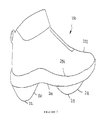
- FIG. 1 is a simplified pictorial illustration of footwear constructed and operative in accordance with an embodiment of the present invention
- FIGS. 2 and 3 are simplified side-view and rear-view illustrations, respectively, of the footwear of FIG. 1 ;
- FIG. 4 is a simplified top-view illustration of the footwear of FIG. 1 , showing further features of other embodiments of the present invention
- FIG. 5 is a simplified pictorial illustration of an alignment of the anterior (forward) and posterior (rearward) protuberances on a support member, according to embodiments of the present invention.
- FIG. 6 is a simplified pictorial illustration of another alignment of the anterior and posterior protuberances on a support member, according to embodiments of the present invention.
- FIG. 7 is a simplified pictorial illustration of a sneaker constructed and operative in accordance with an embodiment of the present invention, whose rearward protuberance has a greater height than the height of the forward protuberance.
- FIG. 8 is a simplified pictorial illustration of a sneaker constructed and operative in accordance with an embodiment of the present invention, whose forward protuberance has a greater height than the height of the rearward protuberance.
- FIG. 9 illustrates maximal area boundaries of positioning of the anterior and posterior protuberances with respect to a support surface, according to embodiments of the present invention.
- FIG. 10 illustrates effective area boundaries of positioning of the anterior and posterior protuberances with respect to a support surface, according to embodiments of the present invention.
- FIG. 11 illustrates the rails and certain area boundries of positioning of the anterior and posterior protuberances with respect to a support surface, according to embodiments of the present invention.
- FIG. 12 illustrates the rails and certain area boundries of positioning of the anterior and posterior protuberances with respect to a support surface, according to embodiments of the present invention.
- FIG. 13A is an isometric view of a protuberance suitable for use on a footwear, according to embodiments of the present invention.
- FIG. 13B is a frontal view of a protuberance suitable for use on a footwear, according to embodiments of the present invention.
- FIG. 13C is a side view of a protuberance suitable for use on a footwear, according to embodiments of the present invention.
- This invention provides, in one embodiment, a method of treating a subject suffering from a spinal disorder, a spinal pathology, a spinal injury, and/or a spinal related pathology comprising the steps of: (a) securing a device to a subject's foot, whereby the device comprises a foot securing mean, a support member operably attached to the securing mean, and a moveable/relocatable anterior protuberance and a moveable/relocatable posterior protuberance, wherein the anterior protuberance and the posterior protuberance are ground engaging; (b) calibrating the posterior protuberance and the anterior protuberance to: a balanced position; and (c) fixing said posterior protuberance and the anterior protuberance to the support member.
- a balanced position comprises a position whereby the device provides a reduced inversion, a reduced eversion, or both to the subject's foot during the stance phases.
- the subject is able to walk.
- the subject is able to walk with a walking aid such as but not limited to a walking cane.
- the subject is able to walk independently.
- walk is defined as the act of shifting the balance and base of support from one foot to the other while progressing in a certain direction.
- a subject treatable by the methods of the invention can walk. In another embodiment, a subject treatable by the methods of the invention can walk with prosthesis. In another embodiment, a subject treatable by the methods of the invention can walk with leg prosthesis. In another embodiment, a subject treatable by the methods of the invention can walk and has feet or feet like prosthesis to accommodate the device (footwear). Each possibility represents a separate embodiment of the present invention.
- a subject afflicted with a spinal pathology which prevents walking cannot benefit from the methods of the present invention.
- the methods described herein provide treatment for a subject who is able to walk and suffers from any spinal pathology in the nervous system (central and peripheral) or in musculoskeletal structures of the spine and pelvis. Each possibility represents a separate embodiment of the present invention.
- the present invention provides a method of reducing pain associated with a spinal pathology, comprising the steps of: (a) securing a device to a subject's foot, whereby the device comprises a foot securing mean, a support member operably attached to the securing mean, and a moveable/relocatable anterior protuberance and a moveable/relocatable posterior protuberance, the anterior protuberance and the posterior protuberance are ground engaging; (b) calibrating the posterior protuberance and the anterior protuberance to: a balanced position, wherein the balanced position comprises a position whereby the device provides a reduced inversion, a reduced eversion, or both to the subject's foot during the stance phases; and (c) fixing the posterior protuberance and the anterior protuberance to the support member; wherein the subject is able to walk, thereby reducing pain associated with a spinal pathology in a subject afflicted with a spinal pathology.
- reduce eversion, inversion, or both is during
- walk or walking comprises the stance phases.
- stance phases comprise initial contact of foot with ground, loading bodyweight onto the stance leg (loading response), mid-stance, heel off, and push off.
- calibration further comprises balanced timing of heel rise.
- balancing timing of heel rise comprises correcting instances wherein the heel is pulled off the ground earlier than normal—early-heel rise.
- the typical pattern is a whipping motion upwards and medial.
- correction comprises lifting a posterior protuberance thus bringing an ankle towards a plantar flexed position. This is done, in some embodiments, by the insertion of a 0.5-8 mm spacer (spacer being a mean for introducing/creating differential height or differential amount of protrusion) between the protuberance and the lower surface 24 or outsole, thus bringing the ankle towards a plantar flexed position.
- lifting a protuberance is increasing the height of a protuberance.
- a hard spacer was attached and fixed between the device and the posterior BP under the left leg and the right legs; this creates a slightly plantar flexed position of both ankles, inducing a more extended position of the lumbar spine.
- balancing timing of heel rise comprises correcting instances termed late-heel rise.
- late-heel rise is observed as a wobbling medial and lateral rocking motion of the foot.
- correction comprises lifting an anterior protuberance thus bringing an ankle towards a slightly more dorsi-flexed position. This is done, in some embodiments, by the insertion of a 0.5-8 mm spacer between the protuberance and the lower surface 24 or outsole, thus bringing the ankle towards a slightly more dorsi-flexed position.
- the methods disclosed herein are directed to methods of improving the proprioception and/or kinesthetic control in walking in a subject described herein having a spinal pathology.
- the methods disclosed herein are based on the unexpected discovery that by changing the center of pressure (COP) with which the foot contacts the ground, spinal pathologies and/or spinal pathologies related effects such as pain or defective gait can be treated and even cured.
- changing the center of pressure (COP) with which the foot contacts the ground is executed through calibrating the device (footwear) of the invention.
- COP is changed or altered via a perturbation induced by a protuberance as disclosed herein.
- a device of the invention alters COP thus changing the movement pattern of a lower limb. In another embodiment, a device of the invention alters COP thus changing the movement pattern of the lower back muscles. In another embodiment, a device of the invention alters COP thus changing the movement or load pattern of the spine and neighboring musculoskeletal tissues.
- the methods of the invention provide a controlled change in movement pattern and concomitantly avoiding damage, injury, trauma, or a combination thereof (such as but not limited to: falls, damaging gait, damaging lower limb neuromuscular control or activity) to the subject using the device, thus efficiently enabling the accomplishment of the methods provided herein.
- damage, injury, trauma, or a combination thereof such as but not limited to: falls, damaging gait, damaging lower limb neuromuscular control or activity
- the methods of the invention provide that the subject wearing the device performs activities such as: walking, standing, cooking or getting up from a chair with the device worn on both feet.
- the device is footwear comprising at least two protuberances wherein only the protuberances are ground engaging during activities such: walking, standing, cooking or getting up from a chair with the device worn on both feet.
- the device is footwear comprising at least two protuberances wherein predominantly the protuberances are ground engaging during activities such: walking, standing, cooking or getting up from a chair with the device worn on both feet.
- the device is footwear comprising at least two protuberances wherein only the protuberances are ground engaging during all stance phases.
- ground engaging period is the period (time) in seconds wherein part of the footwear is in contact with a ground surface. In another embodiment, ground engaging period is the period (time) in second wherein part of the footwear is in contact with a ground surface during gait and/or stance.
- a subject that can benefit from the methods described herein is suffering from spine pathology.
- a subject that can benefit from the methods described herein is suffering from spine pathology such as but not limited to: scoliosis, inflammation that targets the joints of the spine, Ankylosing spondylitis (AS), cervical dysfunction, spondylosis, cervical spondylosis, disc prolapse, fibromyalgia syndrome, cervical lymphadenitis, failed back surgery syndrome (FBSS), epidural fibrosis, disc herniation, instability of a segment of spine, reduction in pressure on the nerve root, arachnoiditis, permanent nerve root damage, facet joint disease, back pain or spine pathology, low back pain or spine pathology, degenerative disc disease, ruptured disc, sciatica, brain and spinal cord tumors can be either malignant or benign, spinal cord astrocytoma, syringomyelia, spinal muscular atrophy, kyphosis, or any combination thereof.
- a subject that can benefit from the methods described herein is suffering from nonspecific back pain.
- a subject that can benefit from the methods described herein is suffering from nonspecific neck pain.
- nonspecific back or neck pain is chronic (persistent).
- a subject suffering from back pain or spine pathology benefits from the methods of the invention.
- a subject suffering from back pain or spine pathology suffers from muscular strain.
- a subject suffering from back pain or spine pathology suffers from disk herniation.
- a subject suffering from back pain or spine pathology suffers from spondyloarthropathy.
- a subject suffering from back pain or spine pathology suffers from AS.
- a subject suffering from back pain or spine pathology suffers from sacroiliitis and LE oligoarthritis.
- a subject suffering from back pain or spine pathology suffers from scoliosis.
- a subject suffering from back pain or spine pathology suffers from hyperlordosis. In another embodiment, a subject suffering from back pain or spine pathology suffers from diskitis. In another embodiment, a subject suffering from back pain or spine pathology suffers from spine stiffness. In another embodiment, a subject suffering from back pain or spine pathology suffers from Staphylococcus aureus infection. In another embodiment, a subject suffering from back pain or spine pathology suffers from vertebral osteomyelitis. In another embodiment, a subject suffering from back pain or spine pathology suffers from acute transverse myelopathy. Each possibility represents a separate embodiment of the present invention.
- a subject suffering from back pain or spine pathology suffers from a primary spinal cord or column tumors (osteogenic sarcoma, neuroblastoma). In another embodiment, a subject suffering from back pain or spine pathology suffers from metastatic tumors (neuroblastoma). In another embodiment, a subject suffering from back pain or spine pathology suffers from bone marrow infiltration (leukemia, lymphoma). In another embodiment, a subject suffering from back pain or spine pathology suffers from menstrual cramps. In another embodiment, a subject suffering from back pain or spine pathology suffers from endometriosis. Each possibility represents a separate embodiment of the present invention.
- a subject suffering from back pain or spine pathology suffers from lower back pain.
- a subject suffering from back pain or spine pathology suffers from a musculoligamentous strain.
- a subject suffering from back pain or spine pathology suffers from lumbar disc herniation.
- a subject suffering from back pain or spine pathology suffers from osteoarthritis.
- a subject suffering from back pain or spine pathology suffers from a compression fracture.
- a subject suffering from back pain or spine pathology suffers from pyelonephritis.
- a subject suffering from back pain or spine pathology suffers from spondylolisthesis.
- a subject suffering from back pain or spine pathology suffers from a metastatic cancer.
- a subject suffering from back pain or spine pathology suffers from spinal stenosis or central spinal stenosis.
- a subject suffering from back pain or spine pathology suffers from a transverse process fracture.
- a subject suffering from back pain or spine pathology suffers from pancreatic cancer.
- a subject suffering from back pain or spine pathology suffers from sacroiliitis.
- a subject suffering from back pain or spine pathology suffers from cauda equina syndrome.
- a subject suffering from back pain or spine pathology suffers from vertebral osteomyelitis.
- a subject suffering from back pain or spine pathology suffers from an epidural abscess. In another embodiment, a subject suffering from back pain or spine pathology suffers from nerve root irritation. In another embodiment, a subject suffering from back pain or spine pathology suffers from degenerative changes of spinal structures. In another embodiment, a subject suffering from back pain or spine pathology suffers from non specific spinal pain.
- a subject suffering from back pain or spine pathology suffers from a radicular pain.
- a subject suffering from back pain or spine pathology suffers from ligamentous hypertrophy.
- a subject suffering from back pain or spine pathology suffers from deep lumbar muscle spasm.
- a subject suffering from back pain or spine pathology suffers from deep trochanteric bursitis.
- a subject suffering from back pain or spine pathology suffers from paresthesia.
- a subject suffering from back pain or spine pathology suffers from autonomic hyperreflexia.
- a subject suffering from spine pathology suffers from a pathology associated with any of the seven cervical vertebras.
- a subject suffering from spine pathology suffers from a pathology associated with muscles, ligaments, soft tissues, or any combination thereof that are located in proximity to the spine.
- a subject suffering from spine pathology suffers from a neck pain or disorder.
- a subject suffering from spine pathology suffers from a neuronal pathology known to be associated with a spinal pathology.
- a subject suffering from spine pathology suffers from pain and sensations.
- a subject suffering from spine pathology suffers from restricted movement but can still walk.
- the methods described herein are preformed by calibration of an anterior protuberance a posterior protuberance or both.
- the methods described herein involve wearing the device and performing daily activities with it, such as walking, household chores etc. Each possibility represents a separate embodiment of the present invention.
- the posterior protuberance, the anterior protuberance or both are calibrated in both the left and the right footwear to a position in which reduced inversion and/or reduced eversion of the ankle is achieved.
- the posterior protuberance, the anterior protuberance or both are calibrated in both the left and the right footwear to a position in which reduced inversion and/or reduced eversion of the foot is achieved.
- the posterior protuberance, the anterior protuberance or both are then fixed and the subject is given a treatment plan which details the amount of time the device should be worn per day. The treatment plan also details how much time out of the total wearing time should be spent in weight bearing (i.e. on ones feet). Each possibility represents a separate embodiment of the present invention.
- calibrating a protuberance comprises calibrating convexity, calibrating height, calibrating weight, calibrating position, calibrating base diameter or any combination thereof comprises reducing pain, inflammation, improving gait, delaying/stopping the physical deterioration of a subject as described herein, or any combination thereof.
- increase in convexity results in differential induction of muscles activity.
- increase in convexity results in differential muscle build-up.
- a protuberance of the invention comprises low convexity designated as convexity A, low-medium convexity designated as convexity B, medium convexity designated as convexity C, medium-high convexity designated as convexity D, or high convexity designated as convexity D.
- a protuberance of the invention has a base diameter of 55-120 mm. In another embodiment, a protuberance of the invention has a base diameter of 75-100 mm.
- convexity A protuberance has a base diameter of 70-100 mm and a height, which is a perpendicular line connecting the highest point and the base, of 10-13 mm.
- convexity B protuberance has a base diameter of 70-100 mm and a height, which is a perpendicular line connecting the highest point and the base, of 14-16 mm.
- convexity C protuberance has a base diameter of 70-100 mm and a height, which is a perpendicular line connecting the highest point and the base, of 16-18 mm.
- convexity D protuberance has a base diameter of 70-100 mm and a height, which is a perpendicular line connecting the highest point and the base, of 19-22 mm.
- the highest point is ground engaging.
- placement (being the function of the initial step of positioning a protuberance according to the invention) and calibration of a protuberance comprises the induction of a differential interference during gait or walking.
- the term “interference” comprises disturbance, interruption, interposition, perturbation, obstruction, or any combination thereof.
- the ability to fine-tune an induced interference under a foot of a subject enables minimizing inversion and/or eversion as described herein.
- the balanced position comprises a position whereby the device provides a reduced inversion, a reduced eversion, or both to the subject's feet during the stance phases.
- treating is reducing pain. In another embodiment, treating is alleviating pain. In another embodiment, treating is improving walking speed. In another embodiment, treating is correcting defective gait. In another embodiment, treating is improving defective gait. In another embodiment, treating is improving at least one phase and/or stage of gait such as but not limited to stance and swing phases. In another embodiment, treating is improving at least one phase and/or stage of gait such as but not limited to initial double stance, single limb stance, and/or terminal double limb stance. In another embodiment, treating is correcting scoliosis. In another embodiment, treating is correcting musculoskeletal spine pathology. In another embodiment, treating is improving neuronal spine pathology. In another embodiment, treating is alleviating pain stemming from neuronal spine pathology. In another embodiment, treating is improving posture in a subject afflicted with spine pathology.
- treating is reducing, inhibiting, and/or preventing inflammation that targets the joints of the spine.
- treating is reversing cervical dysfunction.
- treating cervical dysfunction is reducing neck pain.
- treating cervical dysfunction is reducing secondary muscle spasm.
- treating is inhibiting and/or reducing chronic pain in the back and/or in the neck.
- treating comprises reducing, inhibiting and/or controlling pain.
- treating comprises inhibiting the deterioration in musculoskeletal function.
- treating comprises increasing musculoskeletal function.
- treating comprises restoring the range of motion, flexibility, and/or core strengthening.
- treating comprises inhibiting degeneration.
- treating comprises reduction in muscular strain.
- treating comprises correction of muscle imbalances.
- treating comprises the reduction in pain and/or inflammation of the zygapophysial joints/facet joints.
- treating comprises reducing and/or inhibiting capsule tissue damage.
- treating is reducing and/or inhibiting radicular pain (sciatica).
- treating is reducing and/or inhibiting ‘non-specific’ back pain.
- treating is balancing timing of heel rise. In another embodiment, treating is balancing late-heel rise. In another embodiment, treating is balancing early-heel rise. In another embodiment, treating is inhibiting lateral rocking motion of the foot. In another embodiment, treating is improving the proprioception and/or kinesthetic control in a subject.
- treating is treating scoliosis comprising reversing abnormal scoliotic curvatures by an average of at least 10%. In another embodiment, treating is treating scoliosis comprising reversing abnormal scoliotic curvatures by an average of at least 20%. In another embodiment, treating is treating scoliosis comprising reversing abnormal scoliotic curvatures by an average of at least 30%. In another embodiment, treating is treating scoliosis comprising reversing abnormal scoliotic curvatures by an average of at least 40%. In another embodiment, treating is treating scoliosis comprising reversing abnormal scoliotic curvatures by an average of at least 50%.
- treating is treating scoliosis comprising reversing abnormal scoliotic curvatures by an average of at least 70%. In another embodiment, treating is treating scoliosis comprising reversing abnormal scoliotic curvatures by an average of at least 10%-80%.
- Each possibility represents a separate embodiment of the present invention.
- treating scoliosis prevents bracing.
- treating scoliosis comprises treating a patient with bone growth remaining and is generally implemented to hold the curve and prevent it from progressing to the point where surgery is recommended.
- treating scoliosis is inhibiting curving during bone growth.
- treating scoliosis is treating idiopathic curves.
- treating scoliosis is preventing the progression of more severe curves in young children, to buy the child time to grow before performing surgery, which would prevent further growth in the part of the spine affected.
- treating scoliosis is treating curves that are less than 50 degrees magnitude. Each possibility represents a separate embodiment of the present invention.
- treating is reducing, inhibiting, and/or preventing inflammation that targets the joints of the spine.
- treating is reversing cervical dysfunction.
- treating cervical dysfunction is reducing neck pain.
- treating cervical dysfunction is reducing secondary muscle spasm.
- treating is inhibiting and/or reducing chronic pain in the back and/or in the neck.
- treating spondylosis and/or cervical spondylosis comprises reducing, inhibiting and/or controlling pain.
- treating spondylosis and/or cervical spondylosis comprises inhibiting the deterioration in musculoskeletal function.
- treating spondylosis and/or cervical spondylosis comprises increasing musculoskeletal function.
- treating spondylosis and/or cervical spondylosis comprises restoring the range of motion, flexibility, and/or core strengthening.
- treating spondylosis and/or cervical spondylosis comprises inhibiting degeneration.
- treating disc herniation comprises expedited recovery. In another embodiment, treating disc herniation comprises reducing the risk or relapse. In another embodiment, treating disc herniation comprises reducing pain and/or alleviating acute pain. In another embodiment, treating disc herniation comprises stabilizing of a segment of spine. In another embodiment, treating disc herniation comprises reduction in pressure on the nerve root. In another embodiment, treating disc herniation comprises reducing permanent nerve root damage.
- the methods as described herein involve exercise with the device as described herein.
- exercise is walking or any other form of gait movement.
- exercise comprises standing.
- treating is curing the indication provided herein.
- the methods as described herein further comprises a combination treatment comprising the use of the device as described herein and a proper medication.
- the methods as described herein can be utilized prior to surgery or after surgery.
- the methods as described herein are used for rehabilitation of a subject in need thereof.
- one of skill in the art will readily diagnose and prescribe the proper medication to a subject suffering from a disease or a condition such as described herein.
- the outcome of treatment as provided herein is apparent immediately after the initial use of the device as described herein. In another embodiment, the outcome of treatment as provided herein is apparent after 10-1000000 meters of walking with the device as described herein. In another embodiment, the outcome of treatment as provided herein is apparent after 50-100000 meters of walking with the device as described herein. In another embodiment, the outcome of treatment as provided herein is apparent after 500-10000 meters of walking with the device as described herein. In another embodiment, the outcome of treatment as provided herein is apparent after 500-5000 meters of walking with the device as described herein. In another embodiment, the outcome of treatment as provided herein is apparent after 500-3000 meters of walking with the device as described herein. Each possibility represents a separate embodiment of the present invention.
- a device as disclosed herein has an immediate effect with regard to treating or treatment of a disease, a pathology, and/or pain as provided herein.
- short term immediate effect is apparent after walking with the device for 1-5 days.
- short term immediate effect is apparent after walking with the device for 30-600 minutes.
- short term immediate effect is apparent after walking with the device for 1-10 hours (hrs).
- short term immediate effect is apparent after walking with the device for 5-1000 hours (hrs).
- short term immediate effect is apparent after walking with the device for 12-96 hours (hrs).
- short term immediate effect is apparent after walking with the device for 1-10 days.
- short term immediate effect is apparent after walking with the device for 7-21 days.
- short term immediate effect is apparent walking with the device for 5-30 days.
- the effect is apparent after walking with the device for 1-2 months. In another embodiment, the effect is apparent after walking with the device for 1-24 months. In another embodiment, the effect is apparent after walking with the device for 2-6 months. In another embodiment, the effect is apparent after walking with the device for 4-10 months. In another embodiment, the effect is apparent after walking with the device for 6-48 months. In another embodiment, the effect is apparent in after walking with the device for 12-24 months. In another embodiment, the effect is apparent after walking with the device for 10-30 months. Each possibility represents a separate embodiment of the present invention.
- a device as described herein is prescribed to a subject according to the subject's physical condition. In another embodiment, a device as described herein is prescribed to a subject according to the subject's medical condition. In another embodiment, a device as described herein is prescribed to a subject according to the subject's medical history. In another embodiment, prescription includes directions of how to use the device. In another embodiment, prescription includes intensity of use, daily use, or daily distance directions.
- any prescription as described herein comprises increase in daily usage time as the subject's gait improves. In another embodiment, any prescription as described herein comprises increase in daily usage time as subject's incontinence/pain decreases. In another embodiment, any prescription as described herein comprises increase in daily usage time as subject's disease or condition as described herein, improves. In another embodiment, a prescription as described herein further comprises medicating the subject according to his or hers medical condition.
- a prescription as described herein further comprises adjustments of the device as subject's lower limb muscles are tuned or are off balance.
- adjustments of the device comprise calibrating or positioning a protuberance as described herein.
- the device is secured to a subject's foot directly.
- the term “secured to a subject's foot” comprises securing the device to any footwear such as but not limited to shoes, boots, etc that are secured to a subject's foot.
- a foot securing means secures the device such as footwear 10 to a subject's foot.
- various different foot securing means can be used.
- a foot securing mean comprises a plurality of securing means.
- a foot securing mean is a lace.
- a foot securing mean comprises a Velcro fastener.
- a foot securing mean comprises securing straps.
- FIGS. 1-4 illustrate footwear 10 constructed and operative in accordance with an embodiment of the present invention. Each possibility represents a separate embodiment of the present invention.
- the device is footwear comprising a shoe structure which includes at least two calibrated, disturbances in the form of protuberances under the patient's feet.
- the shoe structure serves as a platform for placing at least two calibrated, differential disturbances or protuberances under the patient's feet.
- the upper part of the shoe structure serves as fastening or securing means/platform, while the sole is a platform for placing at least two calibrated, differential disturbances or protuberances under the patient's foot.
- the outsole is a platform for placing at least two calibrated, differential disturbances or protuberances under the patient's foot.
- a support member is operably attached to the securing mean. In another embodiment, operably attached comprises sufficient attachment between the securing mean and the support member. In another embodiment, a support member comprises the sole. In another embodiment, a support member comprises the inner sole. In another embodiment, a support member comprises the outer sole. In another embodiment, a support member comprises the middle sole. In another embodiment, a support member comprises the upper (the part of the shoe that is on top of the foot). In another embodiment, the upper is operably attached to the securing mean (such as but not limited to laces). In another embodiment, the upper comprises straps or totally enclosing the foot). In another embodiment, the upper comprises straps that function as securing means (such as sandals). Each possibility represents a separate embodiment of the present invention.
- a device such as footwear 10 is supplied as one or more pairs of shoe-like devices, or alternatively, as just one of the shoe-like devices.
- footwear 10 comprises a support member 12 having a periphery in a shape of a shoe sole comprising an upper surface 14 .
- the upper surface 14 is indented with a peripheral ridge 16 , but it is appreciated that other configurations of upper surface 14 are within the scope of the invention.
- footwear 10 is attached to a foot of a user by means of a boot 18 and/or fasteners 20 , such as but not limited to, VELCRO straps, buckles, shoe laces, and the like.
- footwear 10 is attached to a foot of a user by means of a shoe.
- a shoe comprises a platform of a sneaker.
- the term sneaker comprises a boot.
- the term sneaker comprises a walking boot.
- a shoe comprises a platform of a running shoe.
- a shoe comprises a platform of an elegant shoe.
- a shoe comprises a platform of a walking shoe or boot.
- a device such as but not limited to boot 18 is fashioned for attachment to the user's foot with or without fasteners 20 .
- fasteners 20 are used as foot securing means to attach footwear 10 to the user's foot without boot 18 .
- Each possibility represents a separate embodiment of the present invention.
- the invention provides that the device such as footwear 10 comprises protuberances (BPs) in a fixed position.
- the invention provides that the device such as footwear 10 comprises protuberances having any shape known to one of skill in the art.
- the invention provides that the device comprises at least two bulbous protuberances.
- a protuberance is symmetrical.
- a protuberance is asymmetrical
- a protuberance comprises a shape of a: polygon, decagon, digon, dodecagon, nonagon, henagon hendecagon, heptagon, hexadecagon, hexagon icosagon, octagon, pentagon, triangle, Penrose tile, trapezium, isosceles, trapezium undecagon, quadrilateral, Lozenge, rhomboid, rectangle, square, rhombus, trapezoid, polydrafter, arbelos, circle, disc, circle, excircle, crescent, dome, ellipse, lune, oval, sphere, asteroid, or deltoid.
- each protuberance 22 has a curved outer contour 26 . In another embodiment, each protuberance has a different curved outer contour. In another embodiment, each protuberance 22 has a convexity.
- a protuberance comprises a dome shape.
- a protuberance as described herein comprises a dome shape which further comprises multiple different convexities.
- each protuberance 22 comprises a different convexity.
- each protuberance 22 comprises a different set of convexities.
- the cross-section of the contour 26 that is, either the cross-section taken with respect to a longitudinal axis 28 ( FIG. 4 ) of support member 12 (corresponding to the shape seen in FIG. 2 ) or the cross-section taken with respect to a latitudinal axis 30 ( FIG. 4 ) of support member 12 (corresponding to the shape seen in FIG. 3 ), or any other cross-section, may have any curvilinear shape.
- Each possibility represents a separate embodiment of the present invention.
- the contours 26 may have the shape of a conic section, that is, the shape of a circle, ellipse, parabola or hyperbola.
- the various cross-sections of the contours 26 of protuberance 22 may be shaped identically or differently.
- the shape of a protuberance is defined by equal arches.
- the shape of a protuberance is defined by a variety of arches of different radiuses which are tangent to each other.
- the shape of a protuberance is symmetrical.
- the shape of a protuberance is asymmetrical.
- a protuberance is a bulbous protuberance.
- the invention provides that the device such as footwear 10 supports the foot of a subject only by the two protuberances when the two protuberances are placed on a ground surface. In another embodiment, the invention provides that the device such as footwear 10 supports the foot of a subject during stance only by the two protuberances when the two protuberances are placed on a ground surface. In another embodiment, the invention provides that during stance only the 2 ground engaging surfaces of the protuberances (such as the peak or the surface facing the ground) are in contact with a ground surface. In another embodiment, the invention provides that during stance only the ground engaging surface in each protuberance is in contact with a ground surface. Each possibility represents a separate embodiment of the present invention.
- At least two bulbous protuberances 22 protrude from a lower surface 24 of support member 12 . In another embodiment, only two bulbous protuberances 22 protrude from a lower surface 24 of support member 12 . In another embodiment, a lower surface of support member is an outsole. In another embodiment, only two bulbous protuberances 22 protrude from a lower surface 24 of support member 12 .
- the ground engaging parts of the device are only the protuberances.
- the protuberances are the only parts of the device which are ground engaging.
- the protuberances 22 are the only parts of the device which are in direct contact with the ground.
- a protuberance as described herein is movable. In another embodiment, a protuberance as described herein is fixable to a certain location on the sole. In another embodiment, a protuberance as described herein is mountable. In another embodiment, a protuberance as described herein is replaceable. In another embodiment, a protuberance as described herein is movable along the outer surface of the support member. In another embodiment, a protuberance as described herein is movable along the outer surface of the outsole. In another embodiment, a protuberance as described herein can be positioned within the outer surface of the support member. Each possibility represents a separate embodiment of the present invention.
- a protuberance as described herein is movable or translatable such as in a track (e.g., forwards, backwards, sideways or diagonally) and/or rotatable about its own or other axis, or a combination of such motions.
- a track e.g., forwards, backwards, sideways or diagonally
- rotatable about its own or other axis e.g., forwards, backwards, sideways or diagonally
- a protuberance is movable within a predefined area. In another embodiment, a protuberance is movable within an area of 1 cm 2 to 18 cm 2 . In another embodiment, a protuberance is movable within an area of 1 cm 2 to 6 cm 2 . In another embodiment, a protuberance is movable within an area of 1 cm 2 to 4 cm 2 . In another embodiment, a protuberance is movable within an area of 2 cm 2 to 8 cm 2 . In another embodiment, a protuberance is movable within an area of 3 cm 2 to 6 cm 2 . In another embodiment, a protuberance is movable within an area of 4 cm 2 to 10 cm 2 .
- a protuberance is movable within an area of 5 cm 2 to 18 cm 2 . In another embodiment, a protuberance is movable within an area of 4 cm 2 to 12 cm 2 .
- a predefined area is a circle. In another embodiment, a predefined area is a square. In another embodiment, a predefined area is an ellipse. In another embodiment, a predefined area is a rectangle. In another embodiment, a predefined area is quadrangular. In another embodiment, a predefined area comprises any shape known to one of skill in the art. In another embodiment, a predefined area is shapeless. Each possibility represents a separate embodiment of the present invention.
- a protuberance can be positioned anywhere on the support member. In another embodiment, a protuberance can be fixed anywhere on the support member. In another embodiment, a protuberance can be positioned and/or fixed anywhere within a predefined area. In another embodiment, the protuberance is hooked to a rail. In another embodiment, the protuberance is connected to a rail. In another embodiment, the protuberance is connected to a rail and is movable along the rail. In another embodiment, the protuberance is connected to a rail, is movable along the rail, and can be positioned and/or fixed anywhere along the rail. Each possibility represents a separate embodiment of the present invention.
- a protuberance is slidingly mounted on support member.
- a protuberance is mounted on a track 36 ( FIG. 2 ) formed in the lower surface 24 of support member 12 , and is selectively positioned anywhere along the track and fastened and or fixed thereto.
- track 36 extends along a portion of the shoe sole or all along the length of the shoe sole.
- the amount of protrusion of a protuberance is adjusted, such as by mounting protuberance with a threaded fastener 38 ( FIG. 3 ) to support member 12 and tightening or releasing threaded fastener.
- fastening”, “fixing” and “securing” are used interchangeably. Each possibility represents a separate embodiment of the present invention.
- a device as described herein further comprises an additional bulbous protuberance or bulbous protuberances, non-bulbous protuberance 39 , or non-bulbous protuberances shown in FIG. 3 .
- protuberances 39 are formed in the shape of a peg, stud, bolt, pin, dowel and the like, although the invention is not limited to these shapes.
- protuberances 39 may be rigid or flexible.
- protuberances 39 are of different resilience or hardness, such as having different elasticity properties or Shore hardness.
- protuberances 39 protrude by different amounts from the lower surface 24 of support member 12 .
- the amount of protrusion of protuberances 39 or height is adjusted.
- protuberance 39 is fixed or movable at any place on the lower surface 24 of support member 12 . Each possibility represents a separate embodiment of the present invention.
- a protuberance is slidingly mounted on support member 12 .
- a device such as footwear 10 comprises a sliding/shifting mechanism for a protuberance inside the sole of footwear 10 .
- the sliding/shifting mechanism comprises, without limitation, a mechanism that floats in a viscous matrix (e.g., fluid in a chamber formed in the sole), that is suspended by inner cables, or a niche trapping a protuberance with a fixing mean.
- a protuberance 22 may be positioned more posteriorly than the other protuberance 22 .
- a device as described herein comprises at least one anterior protuberance.
- a device as described herein comprises at least one posterior protuberance.
- the device consists one anterior protuberance and one posterior protuberance.
- the device comprises at least one anterior protuberance and one moveable/relocatable posterior protuberance.
- the device comprises at least one moveable/relocatable anterior protuberance and one posterior protuberance.
- the device comprises at least one moveable/relocatable anterior protuberance and one moveable/relocatable posterior protuberance.
- the device consists one moveable/relocatable anterior protuberance and one moveable/relocatable posterior protuberance.
- each protuberance rise vertically and therefore each protuberance comprises a base end and a peak end.
- the surface area of the base is larger than the surface area of the peak.
- the peak is the ground engaging portion of a protuberance in the stance phase.
- the peak is the ground engaging portion of a protuberance in all gait phases.
- a protuberance such as a bulbous protuberance 22 protrudes from the upper surface 14 of support member 12 .
- FIGS. 1-4 illustrate footwear 10 constructed and operative in accordance with an embodiment of the present invention.
- Footwear 10 in one embodiment, is supplied as one or more pairs of shoe-like devices, or alternatively, as just one of the shoe-like devices.
- a shoe-like device comprises a shoe platform and protuberances.
- Footwear 10 in one embodiment, is designed to adapt on a shoe such as Footwear 10 .
- Footwear 10 in one embodiment, is a sandal or sandal-like footwear.
- the shoe platform is a boot.
- the shoe platform resembles a hiking boot.
- Each possibility represents a separate embodiment of the present invention.
- Each possibility represents a separate embodiment of the present invention.
- the footwear 10 comprises a support member 12 having a periphery in a shape of a shoe sole with an upper surface 14 .
- the footwear 10 comprises an insole placed on top of the upper surface 14 .
- the insole is the interior bottom of footwear 10 .
- the insole sits directly beneath the foot.
- the insole is removable, replaceable, or both.
- the insole adds comfort, control the shape, moisture, smell, or any combination thereof.
- the insole is placed to correct defects in the natural shape of the foot or positioning of the foot during standing or walking. Each possibility represents a separate embodiment of the present invention.
- a support member 12 comprises an outsole.
- a support member 12 comprises lower surface 24 or an outsole of support member 12 .
- lower surface 24 or an outsole is made of natural rubber or a synthetic imitation.
- lower surface 24 or an outsole comprises a single piece, or may comprise separate pieces of different materials.
- lower surface 24 or an outsole can be softer or harder.
- a support member 12 further comprises a midsole which is a layer in between the outsole and the insole the most pressure down.
- a support member 12 does not have a midsole.
- positioning at least a first bulbous protuberance and a second bulbous protuberance in a balanced position is the position in which the footwear exerts the least valgus, varus, dorsal or plantar torque about the ankle in a subject being examined.
- positioning at least a first bulbous protuberance and a second bulbous protuberance in a balanced position is the position in which the footwear exerts a reduced or the least valgus, varus, dorsal or plantar torque about the ankle in a subject being examined.
- positioning at least a first bulbous protuberance and a second bulbous protuberance in a balanced position is the position in which the footwear provides the least or minimal lower limbs muscle tonus.
- positioning at least a first bulbous protuberance and a second bulbous protuberance in a balanced position is the position in which the footwear provides balanced lower limbs muscle tonus. In another embodiment, positioning at least a first bulbous protuberance and a second bulbous protuberance in a balanced position is toning lower limb muscles. In another embodiment, positioning at least a first bulbous protuberance and a second bulbous protuberance in a balanced position is toning the amount of tension or resistance to movement in a muscle involved in gait. In another embodiment, positioning at least a first bulbous protuberance and a second bulbous protuberance in a balanced position is lower limb unloading that allows maximal ankle, knee, and hip joint mobility.
- positioning at least a first bulbous protuberance and a second bulbous protuberance in a balanced position is providing a reduction of muscle tone, larger passive ankle excursion, improved gait ability, or any combination thereof.
- positioning at least a first bulbous protuberance and a second bulbous protuberance in a balanced position is increasing stride length, stance symmetry, or a combination thereof.
- positioning at least a first bulbous protuberance and a second bulbous protuberance in a balanced position is increasing the length of the force point of action in lower limb muscles such as but not limited to: soleus, tibialis posterior, and both gastrocnemius muscles.
- positioning at least a first bulbous protuberance and a second bulbous protuberance in a balanced position is toning the plantar flexors. In another embodiment, positioning at least a first bulbous protuberance and a second bulbous protuberance in a balanced position is preventing excessive forward rotation as the body moves forward over the stationary foot. In another embodiment, positioning at least a first bulbous protuberance and a second bulbous protuberance in a balanced position is toning the push off of the heel.
- the protuberances are positioned on a common longitudinal axis of support member 12 , such as the centerline 28 of support member 12 .
- the protuberances are positioned on opposite sides of the latitudinal midline 30 .
- the protuberances are positioned offset from the centerline 28 of support member 12 , and on opposite sides of the latitudinal midline 30 .
- the bases of the protuberances are positioned on the centerline of the support member.
- the peaks of the protuberances are positioned on opposite sides of the centerline of support member.
- the meaning of “protuberance is positioned offset from the centerline” comprises that the peak or the ground engaging surface of a protuberances is positioned offset from the centerline. In some embodiments, the meaning of “protuberance is positioned offset from the centerline” comprises that only the peak or the ground engaging surface of a protuberances is positioned offset from the centerline but the centerline still crosses the protuberance.
- the peak or the ground engaging surface of the anterior protuberance is positioned laterally from the centerline of the support member. In another embodiment, the peak or the ground engaging surface engages the ground in an upright position. In another embodiment, the peak or the ground engaging surface of the anterior protuberance is positioned medially from the centerline of the support member. In another embodiment, the peak or the ground engaging surface of the anterior protuberance is positioned laterally from the centerline of the support member and the peak or the ground engaging surface of the posterior protuberance is aligned with centerline. In another embodiment, the peak or the ground engaging surface of the anterior protuberance is positioned medially from the centerline of the support member and the peak or the ground engaging surface of the posterior protuberance is aligned with centerline. Each possibility represents a separate embodiment of the present invention.
- the peak or the ground engaging surface of the posterior protuberance is positioned laterally from the centerline of the support member. In another embodiment, the peak or the ground engaging surface of the posterior protuberance is positioned medially from the centerline of the support member. In another embodiment, the peak or the ground engaging surface of the posterior protuberance is positioned laterally from the centerline of the support member and the peak or the ground engaging surface of the anterior protuberance is aligned with centerline. In another embodiment, the peak or the ground engaging surface of the posterior protuberance is positioned medially from the centerline of the support member and the peak or the ground engaging surface of the anterior protuberance is aligned with centerline.
- the peak or the ground engaging surface of the posterior protuberance is positioned laterally from the centerline of the support member and the peak or the ground engaging surface of the anterior protuberance is positioned medially from the centerline of the support member.
- the peak or the ground engaging surface of the anterior protuberance is positioned laterally from the centerline of the support member and the peak or the ground engaging surface of the posterior protuberance is positioned medially from the centerline of the support member.
- the centerline divides longitudinally the calcaneus support portion into two equal halves and further extends towards the phalanges and metatarsals support portion in a straight line. In another embodiment, the centerline divides longitudinally the arch of the calcaneus support portion into two equal halves and further extends towards the phalanges and metatarsals support portion in a straight line. In another embodiment, the centerline divides longitudinally the proximal arch of the calcaneus support portion into two equal halves and further extends towards the phalanges and metatarsals support portion in a straight line. In another embodiment, the centerline divides longitudinally the support portion as seen in FIGS.
- the longitudinal centerline is defined as a longitudinal straight line connecting middles of the short sides of a rectangle which delimits a contour of the support member.
- the bases of the protuberances are positioned on the centerline of the support member and the peaks of the protuberances are positioned on opposite sides of the centerline of support member. In another embodiment, the bases of the protuberances are positioned on the centerline of the support member but the peaks of the protuberances are offset from the centerline of the support member. In another embodiment, the bases of the protuberances are positioned on the centerline of the support member but the peaks of the protuberances are positioned on opposite sides of the centerline of the support member. In another embodiment, positioning a protuberance is positioning the peak or the ground engaging surface of a protuberance. In another embodiment, the terms “peak” and “ground engaging surface” are used interchangeably. Each possibility represents a separate embodiment of the present invention.
- the anterior protuberance is positioned medially from the centerline of the support member.
- the peak of the anterior protuberance is positioned medially from the centerline of the support member.
- the base of the anterior protuberance is position on the centerline of the support member but the peak of the anterior protuberance is positioned medially from the centerline of the support member.
- the anterior protuberance is positioned laterally from the centerline of the support member.
- the peak of the anterior protuberance is positioned laterally from the centerline of the support member.
- the base of the anterior protuberance is position on the centerline of the support member but the peak of the anterior protuberance is positioned laterally from the centerline of the support member.
- the posterior protuberance is positioned medially from the centerline of the support member. In another embodiment, the peak of the posterior protuberance is positioned medially from the centerline of the support member. In another embodiment, the base of the posterior protuberance is position on the centerline of the support member but the peak of the posterior protuberance is positioned medially from the centerline of the support member. In another embodiment, the posterior protuberance is positioned laterally from the centerline of the support member. In another embodiment, the peak of the posterior protuberance is positioned laterally from the centerline of the support member. In another embodiment, the base of the posterior protuberance is position on the centerline of the support member but the peak of the posterior protuberance is positioned laterally from the centerline of the support member.
- the posterior protuberance 22 P is positioned generally underneath a calcaneus (heel, ankle) support portion 23 of support member 12 .
- the anterior protuberance 22 A may be positioned generally underneath a metatarsals support portion 25 and/or phalanges support portion 27 of support member 12 .
- the anterior protuberances 22 A is aligned on a longitudinal axis with its peak offset from centerline 28
- the posterior protuberance 22 P is also is aligned on a longitudinal axis with its peak offset from centerline 28 but to the opposite direction of 22 A with respect to centerline 28 .
- FIG. 5 is a simplified pictorial illustration of an alignment of the anterior (forward) and posterior (rearward) protuberances on a support member 200 , according to embodiments of the present invention.
- Centerline 216 in the embodiment is defined as a longitudinal straight line (median) that connects the middles of short sides 214 of a rectangle 212 , the long sides 212 of which are parallel to centerline 216 , and which delimits the contour 210 of the support member.
- contour 210 is the contour ( 254 , see FIG. 7 ) of the foothold confined by the upper part ( 253 , see FIG. 7 ) of the footwear ( 250 , see FIG.
- contour 210 is the outermost contour of the footwear. In other embodiments of the present invention contour 210 is the contour of the bottom surface of the sole of the footwear.
- contour 210 is the contour of the terms “forward” and “anterior” are used interchangeably. In some embodiments, the terms “rearward” and “posterior” are used interchangeably. Each possibility represents a separate embodiment of the present invention.
- forward protuberance 218 at the anterior (phalanges) portion of the support member is positioned medially offset to centerline 216 .
- centerline 216 By “medially offset” is meant that a peak surface (which can be the ground engaging surface) of protuberance 218 (marked by cross 219 ) is shifted from centerline 216 medially towards the inner side of support surface 200 , facing the support member of the other foot (not shown in this figure).
- the peak surface is a surface on the protuberance which is furthest from the support surface with respect to other surfaces of the protuberance.
- rearward (posterior) protuberance 220 at the posterior (calcaneus) portion of the support member is positioned laterally offset to centerline 216 .
- laterally offset is meant that a peak surface (which can be the ground engaging surface) of protuberance 220 (marked by cross 221 ) is shifted from centerline 216 laterally towards the outer side of support surface 200 , away from the support member of the other foot (not shown in this figure).
- the alignment of the protuberances shown in FIG. 5 is useful, for example, for tuning muscles for users suffering from one or more of the following medical indications: medical compartment-knee osteoarthritis medical meniscus tear or damage, genu varus, patello-femoral pain syd, patello-femoral problem (malalignment), lateral collateral ligamental damage or tear, bone bruise MTP/MFC (AVN), low back pain or spine pathology, hip OA, hip labrum damage (TCM), trochanteric bursitis, pes anseninus bursitis, ankle instability (supination and ext rut), achilles tendonitis and metatrsalgia.
- medical compartment-knee osteoarthritis medical meniscus tear or damage
- genu varus patello-femoral pain syd
- patello-femoral problem malalignment
- lateral collateral ligamental damage or tear bone bruise MTP/MFC (AVN)
- FIG. 6 is a simplified pictorial illustration of another alignment of the anterior and posterior protuberances on a support member, according to embodiments of the present invention.
- forward (anterior) protuberance 218 is laterally offset to centerline 216
- rearward protuberance 220 is medially offset to centerline 216 .
- the alignment of the protuberances shown in FIG. 6 is a simplified pictorial illustration of another alignment of the anterior and posterior protuberances on a support member, according to embodiments of the present invention.
- forward (anterior) protuberance 218 is laterally offset to centerline 216
- rearward protuberance 220 is medially offset to centerline 216 .
- lateral meniscus tear or damage lateral compartment knee osteoarthritis
- valgus knee gene valgus
- patello-femoral pain syal patello-femoral problem
- malalignment MCL Ligament tear
- bone bruise LTP/LFC APN
- hip labrum damage or tear hip pain
- ankle instability pronoation
- achilles tendonitis tibilias insufficiency and metatansalgia.
- FIG. 7 is a simplified pictorial illustration of a sneaker 250 constructed and operative in accordance with an embodiment of the present invention, whose rearward protuberance 220 has a greater height (protrusion) than the height of the forward protuberance 218 . It is noticeable that such arrangement facilitates initial contact between rearward protuberance 220 and the supporting ground (not shown in this figure) when a user wears the sneaker, before the forward protuberance is brought in contact with the ground. When both protuberances are placed in contact with the ground the foot of the user wearing sneaker 250 acquires a downward inclination with respect to direction of gait of the user.
- Each possibility represents a separate embodiment of the present invention.
- FIG. 8 is a simplified pictorial illustration of a sneaker 250 constructed and operative in accordance with an embodiment of the present invention, whose forward protuberance 218 has a greater height than the height of the rearward protuberance 220 .
- the foot of the user wearing sneaker 250 acquires an upward inclination (with respect to the direction of gait of the user.
- Each possibility represents a separate embodiment of the present invention.
- FIG. 9 illustrates maximal area boundaries of positioning of the anterior and posterior protuberances with respect to a support surface, according to embodiments of the present invention.
- Shown in this figure is a bottom view of a sneaker designed to be worn on a right foot of a user.
- the medial side is thus the right side of the drawing, facing the arc of greater curvature of the side arcs of the sneaker.
- the lateral side is opposite to the medial side that is the left side of the drawing, facing the arc of lesser curvature of the side arcs of the sneaker.
- Indicated are the midsole 401 and last/shoe 402 , contour 403 of the foothold which is determined by the last used in the making of the sneaker.
- Front rail 404 and rear rail 405 are used for anchoring the protuberance.
- the area bordered by dotted line 406 marks the maximal area within which the peak surface of the anterior protuberance, i.e. the ground engaging surface of the anterior protuberance, may be located, according to some embodiments of the present invention.
- the area bordered by dotted line 407 marks the maximal area within which the peak surface of the posterior protuberance.
- FIG. 10 illustrates the effective area boundaries of positioning of the anterior and posterior protuberances with respect to a support surface, according to embodiments of the present invention.
- Indicated are the midsole 501 and outsole 502 , contour 503 of the foothold which is determined by the last used in the making of the sneaker.
- the area bordered by dotted line 504 marks the effective area within which the peak surface of the anterior protuberance, i.e. the ground engaging surface of the anterior protuberance, may be located, according to some embodiments of the present invention.
- the area bordered by dotted line 505 marks the effective area within which the peak surface of the posterior protuberance.
- “Effective” refers to the effectiveness of use of the footwear according to embodiments of the present invention, which facilitates treatment. For clarity both FIGS. 9 and 10 are divided to 36 equal parts. The effective locations will be within the same parts regardless of sizing. Each possibility represents a separate embodiment of the present invention.
- FIG. 11 illustrates the effective area boundaries of positioning of the anterior and posterior protuberances with respect to a support surface, according to embodiments of the present invention which include treatment and/or improvement of function and/or alleviation of pain for a subject which is at high risk of falls.
- Indicated is the area bordered by dotted line 710 which marks the effective area within which the peak surface of the anterior protuberance, i.e. the ground engaging surface of the anterior protuberance, may be located, while treating or alleviating pain for the diseases and/or conditions described for FIG. 11 hereinabove.
- Indicated is the area bordered by dotted line 720 which marks the effective area within which the peak surface of the posterior protuberance, i.e.
- the ground engaging surface of the posterior protuberance may be located, while treating or improving function or alleviating pain for the diseases and/or conditions described for FIG. 11 hereinabove.
- the areas bordered by dotted lines 710 and 720 are within the areas bordered by dotted lines 504 and 505 , respectively, in FIG. 10 .
- FIG. 10 is divided to 36 equal parts. The effective locations will be within these effective parts regardless of sizing. Each possibility represents a separate embodiment of the present invention.
- FIG. 12 illustrates the effective area boundaries of positioning of the anterior and posterior protuberances with respect to a support surface, according to embodiments of the present invention which include treatment and/or improvement of function and/or alleviation of pain of a subject which is at high risk of falls.
- Indicated are the midsole 601 and outsole 602 , last 603 of the foothold which is determined by the last used in the making of the sneaker.
- Front rail 604 and rear rail 605 are used for anchoring the protuberance.
- Indicated is the area bordered by dotted line 610 which marks the effective area within which the peak surface of the anterior protuberance, i.e. the ground engaging surface of the anterior protuberance, may be located, while treating or alleviating pain for the diseases and/or conditions described for FIG.
- FIG. 10 is divided to 36 equal parts. The effective locations will be within these effective parts regardless of sizing. Each possibility represents a separate embodiment of the present invention.
- FIG. 13A is an isometric view of a protuberance suitable for use on a footwear, according to embodiments of the present invention.
- Cleats 901 cover the ground engaging area of a protuberance, for facilitating enhanced grip of the surface on which the user stands or walks.
- FIG. 13B is a frontal view of a protuberance suitable for use on a footwear, according to embodiments of the present invention. The peak surface is marked by cross 902 .
- Bore 904 is provided for a screw or other fastening arrangement to fix the protuberance in the desired position.
- FIG. 13C is a side view of a protuberance suitable for use on a footwear, according to embodiments of the present invention.
- Convexity 905 of the protuberance is clearly seen.
- Various convexities may be employed, all of which define a peak surface, typically (but not necessarily) at the center of the protuberance, which is the surface which comes in contact with the ground, when the user attaches the support member to the foot, and walks or stands on the ground.
- FIG. 13 is a simplified pictorial illustration of a protuberance according to embodiments of the present invention.
- a protuberance is convex 905 ( FIG. 13C ).
- Each protuberance according to embodiments of the present invention, comprises a fixing hole (for fixing a protuberance) 904 in which a latch, a bolt, or a screw is placed therein.
- the peak of a protuberance which in some embodiments of the present invention, is placed within the center of the ground engaging area 902 is in contact with the ground during stance ( FIG. 13B ).
- calibrating comprises positioning a protuberance on a support member. In another embodiment, calibrating comprises adjusting the height (or the extent of protrusion) of a protuberance. In another embodiment, calibrating comprises adjusting a resilience of a protuberance. In another embodiment, calibrating comprises adjusting a hardness of a protuberance. In another embodiment, calibrating comprises adjusting an elasticity of a protuberance.
- a protuberance is compressible. In another embodiment, a protuberance is deformable. In another embodiment, a protuberance is compressible or deformable upon pressure exerted by subject's weight.
- a protuberances is constructed of any suitable material, such as but not limited to, elastomers or metal or a combination of materials, and have different properties.
- a protuberance comprises different resilience or hardness, such as having different elasticity properties or Shore hardness.
- a protuberance comprises spikes or grip means for providing better stability.
- a protuberance comprises spikes or grip means as anti-slippery means.
- FIG. 13 provides a protuberance comprising small rounded grip means.
- spikes or grip means are constructed of any suitable material, such as but not limited to: elastomers such as rubbers or plastic materials.
- spikes or grip means cover only a portion of a protuberance.
- spikes or grip means cover at least a ground engaging surface of a protuberance (the surface in contact with the ground during stance).
- a fixing means for securing a protuberance to the support portion is embedded within a spikes or a grip means.
- a fixing means for securing a protuberance to the support portion is places in between spikes or a grip means.
- a protuberance has a shore hardness of between 30 to 90 Sh A. In another embodiment, a protuberance has a shore hardness of between 40 to 55 Sh A. In another embodiment, a protuberance has a shore hardness of between 50 to 70 Sh A. In another embodiment, a protuberance has a shore hardness of between 65 to 90 Sh A. In another embodiment, a protuberance has a shore hardness of between 55 to 60 Sh A. In another embodiment, a protuberance has a shore hardness of between 65 to 70 Sh A. In another embodiment, an anterior and a posterior protuberance comprise identical shore hardness. In another embodiment, an anterior and a posterior protuberance comprise different shore hardness. Each possibility represents a separate embodiment of the present invention.
- a protuberance is a soft protuberance comprising a shore hardness of between 40 to 55 Sh A. In another embodiment, a protuberance is a medium hardness protuberance comprising a shore hardness of between 50 to 70 Sh A. In another embodiment, a protuberance is a hard protuberance comprising a shore hardness of between 65 to 90 Sh A.
- a protuberance has an abrasion between 1-60 mm 3 (by DIN 53516).
- a protuberance comprises a rubber cup.
- a protuberance comprises natural rubber compounds.
- a protuberance comprises synthetic rubber compounds such as TPU or TPR.
- a protuberance comprises silicone.
- a protuberance a plastic material such as PA 6 (nylon), PA6/6 (nylon)+glass fiber, ABS, Polypropylene, POM (Polyoxymethylene).
- a protuberance comprises a metal such as aluminum, steel, stainless steel, brass, or metal alloys.
- a protuberance comprises compound materials such as glass fibers, carbon fibers, kevlar, or any combination thereof. Each possibility represents a separate embodiment of the present invention.
- a protuberance has a base diameter of at least 35 mm. In another embodiment, a protuberance has a base diameter of at least 45 mm. In another embodiment, a protuberance has a base diameter of at least 55 mm. In another embodiment, a protuberance has a base diameter of at least 65 mm. In another embodiment, a protuberance has a base diameter of at least 75 mm. In another embodiment, a protuberance has a base diameter of at least 85 mm. In another embodiment, a protuberance has a base diameter of 35 to 95 mm. In another embodiment, a protuberance has a base diameter of 45 to 105 mm. In another embodiment, a protuberance has a base diameter of 45 to 95 mm.
- a protuberance has a base diameter of 55 to 95 mm.
- a wider base diameter is used to further stimulate weight bearing.
- the flexibility in choosing different base diameters allows balancing a patient suffering from imbalance by stimulating differential weight bearing.
- different heights of a protuberance can be used.
- a height of a protuberance is correlative or equal to the amount of protrusion.
- the amount of protrusion is the distance from the surface of the support member to the ground engaging portion of a protuberance.
- the amount of protrusion is the distance from the surface of the support member to the most distant ground engaging portion of a protuberance.
- height is calibrated by adding a spacer between a protuberance and the outsole.
- different weights of a protuberance can be used.
- weight is calibrated by adding a spacer between a protuberance and the outsole.
- the height of the anterior protuberance differs from the height of the posterior protuberance.
- the height of the anterior protuberance or of the posterior protuberance is adjusted with round spacers positioned between the support member or the outsole and the base portion of a protuberance.
- a spacer (for inducing further protrusion) is fixed between the outsole and base portion of a protuberance.
- muscular control around the pelvis in a scoliosis patient is induced by utilizing two weighted spacers secured to the right and the left posterior BPs.
- muscular control around the pelvis in a scoliosis patient is induced by utilizing two weighted spacers (disc), 3 mm high and 100 gr. in weight, secured to the right and the left posterior BPs.
- disc weighted spacers
- 100 gr. in weight secured to the right and the left posterior BPs.
- a spacer or a protuberance comprises a diameter of 50-150 mm. In another embodiment, a spacer or a protuberance comprises a diameter of 55-110 mm. In another embodiment, a spacer or a protuberance comprises a diameter of 60-100 mm. In another embodiment, a spacer or a protuberance comprises a diameter of 80-90 mm. In another embodiment, a spacer or a protuberance comprises a diameter of 85 mm. In another embodiment, a spacer or a protuberance or a protuberance comprises a thickness of 1-12 mm. In another embodiment, a spacer or a protuberance comprises a thickness of 1-4 mm.
- a spacer or a protuberance comprises a thickness of 3-10 mm. In another embodiment, a spacer or a protuberance comprises a thickness of 1-3 mm. In another embodiment, a spacer or a protuberance comprises hardness of 60-70 Shore A, which is a soft spacer. In another embodiment, a spacer or a protuberance comprises hardness of 90-100 Shore A, which is a hard spacer. In another embodiment, a spacer or a protuberance comprises hardness of 71-89 Shore A, which is medium hardness spacer.
- a spacer or a protuberance weighs 2-500 g. In another embodiment, a spacer or a protuberance weighs 2-250 g. In another embodiment, a spacer or a protuberance weighs 2-6 g. In another embodiment, a spacer or a protuberance weighs 2-20 g. In another embodiment, a spacer or a protuberance weighs 2-20 g is made of Nylon. In another embodiment, a spacer or a protuberance weighs 2-20 g is made of Nylon and fiber. In another embodiment, a spacer or a protuberance weighs 2-40 g is made of Nylon and glass fiber. In another embodiment, a spacer or a protuberance weighs 30-100 g.
- a spacer or a protuberance weighs 50-80 g. In another embodiment, a spacer or a protuberance weighs 60-100 g. In another embodiment, a spacer or a protuberance comprises: Nylon glass fiber polyurethane an alloy (such as but not limited to Zink alloy), or any combination thereof. Each possibility represents a separate embodiment of the present invention.
- VAS Visual analogue scale
- the device comprises 2 units of footwear: one for the left foot and one to the right foot.
- the footwear used is a light walking boot.
- Prescription includes a set of instructions to the patients. These instructions included: duration of wearing the device per day (usually 30-60 minutes daily). Daily use included wearing the device during routine activities that may include watching TV, computer activities; eating activities, etc. Actual walking constituted 10-25% of 30-60 minutes. Thus, if patient wore the device for 60 minutes per day, total of 5-10 minutes were dedicated, accumulatively, to walking.
- Gait measurements include spatio-temporal measurements performed by various computerized mats as well as three-dimensional gait labs or other gait lab that are able to measure velocity, step length and single limb support. Unless noted otherwise, the gait lab is done when patient is barefoot.
- a repeated shift is described in order to bring the patient to a reduced pain calibration.
- a shift of a protuberance(s) of 2 mm is repeated between 1-3 times until reaching the desired effect.
- the process can include shifting more than 3 times of over 2 mm, to eventually 1 cm or more from the “Balanced” position, until the desired effect is achieved. As long as the shift does not result in excessive eversion or inversion.
- Back range of motion is full in forward flexion and left and right rotations. It is limited to 75% of normal range in both left and right side flexion and limited to 20% of normal range in extension.
- Sustained extension (spinal stenosis test) produces pain and paraesthesia in both calves after 30 seconds.
- a neurological assessment revealed reduces Achilles reflex bilaterally, mild hypoesthesia in the posterior aspect of both calves and plantar aspects of both feet (S1-S2 dermatomes).
- Straight leg raise (SLR) was bilaterally limited to 45 degrees due to pain in the posterior aspect of the thigh and calve. Manual muscle testing did not reveal any weakness.
- a magnetic resonance imaging (MRI) performed 4 months prior to the date of the consultation shows mild to moderate narrowing of the central spinal canal due to a protrusion of L3-L4 disc and a central disc bulge of the L4-L5 disc, without narrowing of the spinal canal.
- Gait lab results showed a velocity of 78 cm/sec, single limb support of 39.7% in the right leg and 39.2% in the left leg.
- Right step length 46.1 cm.
- BPs Bulbous Protuberances
- Identical BPs with B convexity and “soft” resilience were attached and fixed to the footwear under the hind foot and fore-foot of the left and right device.
- a 100 gr. weighted spacer (disc) of 2.5 mm height was attached and fixed between the device and the posterior BP under the left leg and the right legs.
- a hard spacer and a soft spacer was introduced and fixed between the anterior BP and shoe both under the left leg and the right leg.
- the device was calibrated and fine tuned during repeated clinical gait assessments. During this process care was taken to reduce the eversion and inversion during heel strike, loading response, mid-stance and toe-off. In this particular case, the balanced position is medial to the longitudinal axis of the device (system)
- the posterior B.P.'s were calibrated and fixed 15 mm more posterior and 4 mm medially to the balanced position.
- the patient was asked to walk 20 meters with the device and he then reported feeling no lumbar pain, and his gait was balanced.
- two additional hard spacers were added and fixed under the anterior BPs of both the right and the left units. This brought both ankles to a dorsiflexed position.
- the patient reported feeling no pain or heavy sensation in the calves.
- the patient was asked to walk 10 meters back and forth in order to confirm that the gait is balanced with regard to ankle inversion and/or eversion angles and that the heel-rises in an appropriate timing. It was noted that the patient had an early heel-rise in both the right and left legs. In order to correct the early heel rise one of the hard spacers in the anterior B.P.'s was changed to soft spacers, bringing both feet to a slightly less dorsiflexed position. The patient was observed walking with the device and the timing of the heel rise was noted to have been corrected in the left leg.
- Each follow up consultation consisted of a Gaitlab test, an interview performed by the treating Therapist (including report of current symptom level rated on a VAS and report of difficulty in function), a clinical assessment of gait without and with the device and a treatment plan for the duration of time till the next follow up.
- the anterior and posterior B.P.'s in both units of the device were changed to a C convexity with soft resilience.
- a clinical gait assessment showed that the heel rise timing was normal and the patient reported feeling comfortable while walking with the device. He was then instructed to maintain the 2 hour and 10 minutes of wearing time of the device for the next 2 weeks so that he has time to adjust to the new level of perturbation. If he continued to feel comfortable with the device he was told to add 5 minutes of outdoor walking with the device starting from the third week, in addition to the above period of indoor wearing time. He was instructed to increase the outdoor walking by 5 minutes per week up to a maximum of 30 minutes per week.
- BPs Bulbous Protuberances
- Identical BPs with B convexity and “soft” resilience were attached and fixed to the footwear under the hind foot and fore-foot of the left and right device.
- a 100 gr. weighted spacer (disc) of 2.5 mm height was attached and fixed between the device and the anterior BP under the left leg and the right legs. This was done in order to functionally strengthen the dorsiflexors during swing.
- the patient's device was calibrated and fine tuned during repeated clinical gait assessments. During this process care was taken to reduce the eversion and inversion during heel strike, loading response, mid-stance and toe-off.
- the patient was asked to walk 10 meters back and forth in order to confirm that the gait is balanced with regard to ankle inversion and/or eversion angles and that the heel-rises in an appropriate timing. No apparent gait deviations were observed.
- Each follow up consultation consisted of a Gaitlab test, an interview performed by the treating Therapist (including report of current symptom level rated on a VAS and report of difficulty in function), a clinical assessment of gait without and with the device and a treatment plan for the duration of time till the next follow up.
- Clinical gait assessment showed a reduction in high stepping gait and manual muscle testing showed muscle strength of the right extensor digitorum longus, extensor hallucis longus and tibialis anterior improved to ⁇ 5/5.
- the hard spacers on the anterior and posterior B.P.'s of the right unit which were used for offloading were removed and the B.P.'s were fixed in the same position.
- the patient was asked to walk with the device and did not report any pain or symptoms.
- the posterior B convexity caps of the right and left units were changed to caps with a C level of convexity.
- the patient reported she enjoyed walking outdoor with the device and could walk for 30 minutes without difficulty pain or symptoms. She also continued wearing the device at home for 2 hours each day. She reported that she no longer had any back or referred leg pain unless she over exerted herself (for example, cooking for a period exceeding 2 hours). Her barefoot gait lab results showed further improvement (see table no. 2 for details). A manual muscle testing of the relevant muscles did not show any weakness. Walking on tip toes showed only a minor drop of the right foot (0.5 cm. in comparison to 4 cm. during the initial physical examination). In order to increase the level of perturbation the anterior caps of the right and left B.P.'s were changed from a B convexity to a C convexity.
- NSLBP Non-Specific Low Back Pain
- NSLBP Non-Specific Low Back Pain
- BPs Bulbous Protuberances
- the patient's device was calibrated and fine tuned during repeated clinical gait assessments. During this process care was taken to reduce the eversion and inversion during heel strike, loading response, mid-stance and toe-off. In this particular case, as is common in most spinal cases, the balanced position is medial to the longitudinal axis of the device (device).
- VAS 3/10 The patient reported she still felt low back pain after the above calibration was performed (VAS 3/10).
- VAS 1.5/10 The patient was asked to walk 20 meters with the device and she then reported feeling her lumbar pain was reduced (VAS 1.5/10).
- VAS 1.5/10 In order to reduce the pain further a hard spacer was inserted and fixed between the posterior right and left B.P.'s and the sole of the device. This brings the ankle to a plantar flexed position which is believed to bring the pelvis and lumbar spine to a more extended (anterior pelvic tilt) position. This was considered to be beneficial since the strongest pain was produced in lumbar flexion.
- Clinical gait assessment revealed that her gait was balanced.
- the patient was asked to walk 10 meters back and forth in order to confirm that the gait is balanced with regard to ankle inversion and/or eversion angles and that the heel-rises in an appropriate timing. No visible gait deviations were seen.
- Patient was instructed to increase overall daily wearing time of the device by 5 minutes every week for the initial 3 weeks, reaching 35 minutes wearing time with the device every day, while maintaining the 10-15% accumulative weight bearing time (thus reaching an accumulative weight bearing time of approximately 4-5 minutes).
- the patient was seen for follow-up consultations at the treatment center 3 weeks after her first visit, 6 weeks after her first visit, 14 weeks after her first visit and 6 months after the initial consultation.
- Each follow up consultation consisted of a Gaitlab test, an interview performed by the treating Therapist (including report of current symptom level rated on a VAS and report of difficulty in function), a clinical assessment of gait without and with the device and a treatment plan for the duration of time till the next follow up.
- the patient had a pelvic alignment of posterior pelvic tilt, hypo-lordosis and a as well as a hyper-kyphosis of the thoracic spine. Hip and knee alignment was normal. Lumbar movements reproduced her pain at 50% of the normal flexion range of motion and 80% of the normal extension range of motion. During clinical gait assessment decreased pelvic, lumbar and thoracic rotation which led to a reduction in arm swing was observed. The patient also reported of lumbar pain during the gait assessment which she rated verbally as 3/10. Neurological assessment of motor function and sensation in the lower limbs was normal.
- X-rays revealed a typical wedge shape of the vertebral body of L1.
- a narrowing of the intervertebral disc space was observed in the L4-5 and L5-S1 segments, accompanied by degenerative changes of the facet joints in these segments.
- Gait lab results revealed slow gait velocity at 87 cm/sec, with short step lengths (left step length: 48 cm. right step length: 48 cm).
- Left single limb support was 38.7 and right single limb support was 39.1 (see Table 4 for gait lab results).
- BPs Bulbous Protuberances
- the patient's device was calibrated and fine-tuned during repeated clinical gait assessments. During this process care was taken to reduce the eversion and inversion during heel strike, loading response, mid-stance and toe-off.
- a hard spacer was attached and fixed between the device and the posterior BP under the left leg and the right legs. This created a slightly plantar flexed position of both ankles, inducing a more extended position of the lumbar spine.
- the patient was asked to walk 20 m with the device and she reported a reduction of back pain (VAS 1/10).
- VAS 1/10 back pain
- the posterior BPs were recalibrated to a more posterior position (2 mm posteriorly). The patient then reported of no lumbar pain while walking with the device and her gait was observed to be balanced.
- the patient was asked to walk 10 m back and forth in order to confirm that the gait is balanced with regard to ankle inversion and/or eversion angles and that the heel-rises are in an appropriate timing. No apparent gait deviations were observed.
- the patient Upon the completion of the calibration process the patient had a significant decrease in lumbar pain.
- the patient was then briefed with safety instructions and was asked to wear the device at home for 25 minutes for the first week of the treatment. Out of this total wearing time she was instructed to spend an accumulative time of 3-4 (about 15% of total wearing time minutes) in weight bearing activities (walking or standing) while performing daily routine. She was instructed to increase overall daily wearing time of the device by 10 minutes every week for the initial 3 weeks, reaching 55 minutes of wearing time with the device every day, while maintaining the 15% accumulative weight bearing time (thus reaching an accumulative weight bearing time of approximately 8-10 minutes). The patient was seen for follow-up consultations at the treatment center 3 weeks after her initial consultation, 9 weeks after her initial consultation and 4 months after her initial consultation.
- Each follow up consultation consisted of a gait lab test, an interview performed by the treating physiotherapist (including report of current symptom level rated on a VAS and report of difficulty in function), a clinical assessment of gait with and without the device and a treatment plan for the duration of time till the next follow up.
- the caps of the posterior BPs were changed to a C level of convexity with soft resilience. Since the C caps are higher than the B caps, an increase in plantar flexion was introduced. In order to avoid this increase, the two hard spacers inserted between the posterior BPs and the device were removed from both right and left devices, and the BPs were fixed to their previous position. The patient was asked to walk with the device and did not report any pain or symptoms. Her gait was observed to be well balanced and heel rise timing appeared normal. The patient was instructed to decrease the overall wearing time of the device to 1.5 a day of wearing the device for the next two weeks in order to allow her to get used to the new device calibration. Following this period, she was asked to increase the wearing time by 20 minutes per week to a maximum wearing time of 4 hours.
- the patient has been diagnosed with thoraco-lumbar scoliosis, 4 months prior to her arrival at the treatment center. She has not been suffering from any symptoms such as pain or discomfort in her back. She has been menstruating irregularly for the past 8 months. Her treating orthopedic surgeon has considered the use of a brace in order to prevent deterioration of the scoliosis. Both the patient and her parents were eager to avoid the use of a brace.
- Her spine is hypo-lordotic and hypo-kyphotic with an apparent right main thoracic curve and a secondary left lumbar curve.
- Adam's test is positive with a hump apparent in the right rib cage. Ranges of motion of other spinal movements are within normal limits. Leg length measurements do not reveal any leg length discrepancy.
- X-rays revealed a right thoracic curve (Cobb angle of 33 degrees) with an accompanying right rotation of the vertebral bodies.
- the lumbar compensatory curve has a Cobb angle of 15 degrees.
- Risser sign was measured as Risser II.
- Gait lab results revealed normal velocity and step lengths (velocity 123 cm/sec, left step length: 57 cm. right step length: 57 cm.). Both the left and the right single limb supports were above the normal values (left 42.3, right 42.0) (see Table Y for gait lab results).
- the high single limb support values are considered a sign of poor muscular control around the pelvis during gait.
- BPs Bulbous Protuberances
- the patient's device was calibrated and fine-tuned during repeated clinical gait assessments. During this process care was taken to reduce the eversion and inversion during heel strike, loading response, mid-stance and toe-off.
- the anterior and posterior BPs of the left device were recalibrated 3 mm to a more medial position. The patient was then asked to walk back and forth for 10 meters and her gait was observed to be balanced. She also reported she felt comfortable walking with the device.
- the posterior BPs of both the left and the right devices were calibrated 4 mm anteriorly. The patient was asked to walk with the device again and her gait was again observed to be balanced.
- two weighted spacers (disc), 3 mm high and 100 gr. in weight were inserted and fixed between both the right and the left posterior BPs.
- the patient was asked to walk 10 meters back and forth in order to confirm that the gait is balanced with regard to ankle inversion and/or eversion angles and that the heel-rises in an appropriate timing. No apparent gait deviations were observed.
- the patient was asked to wear the device daily, indoors, for an hour. She was encouraged to be active while wearing the device performing such activities as walking about the house, doing her hair standing in front of the mirror etc. She was asked to increase the overall wearing time of the device by 20 minutes each week.
- the patient was seen for follow-up consultations at the treatment center 5 weeks after her initial consultation, 10 weeks after her initial consultation, 5 months after her initial consultation and 9 months into the treatment.
- Each follow up consultation consisted of a gait lab test, an interview and an observation of standing posture performed by the treating physiotherapist, a clinical assessment of gait without and with the device and a treatment plan for the duration of time till the next follow up. In addition any new X-rays were reviewed, measured and recorded.
- the patient reported she continued to wear the device according to prescribed treatment plan. She did not have any new X-rays so a careful observation of her standing posture was conducted. This revealed a further decrease of scoliotic posture as well as a decrease in thoracic vertebral rotation (assessed with the Adam's test). The patients gait was then observed and was considered well balanced. Her barefoot gait lab results showed maintained lower values of single limb support bilaterally, though these were still higher than normal values (see table 5). Due to the apparent improvements in scoliotic curvatures the anterior and posterior BPs of the left device were recalibrated and fixed 2 mm more laterally. The patients gait was observed and was considered well balanced. The patient also reported that she felt comfortable with the new calibration. She was then asked to continue wearing the device according to her current treatment plan.
Landscapes
- Health & Medical Sciences (AREA)
- General Health & Medical Sciences (AREA)
- Physical Education & Sports Medicine (AREA)
- Epidemiology (AREA)
- Public Health (AREA)
- Life Sciences & Earth Sciences (AREA)
- Orthopedic Medicine & Surgery (AREA)
- Rehabilitation Therapy (AREA)
- Biophysics (AREA)
- Pain & Pain Management (AREA)
- Veterinary Medicine (AREA)
- Animal Behavior & Ethology (AREA)
- Cardiology (AREA)
- Vascular Medicine (AREA)
- Gynecology & Obstetrics (AREA)
- Reproductive Health (AREA)
- Orthopedics, Nursing, And Contraception (AREA)
- Footwear And Its Accessory, Manufacturing Method And Apparatuses (AREA)
- Prostheses (AREA)
- Surgical Instruments (AREA)
Priority Applications (1)
| Application Number | Priority Date | Filing Date | Title |
|---|---|---|---|
| US14/363,414 US9445965B2 (en) | 2011-12-08 | 2012-12-10 | Methods for treating spine pathologies |
Applications Claiming Priority (3)
| Application Number | Priority Date | Filing Date | Title |
|---|---|---|---|
| US201161568211P | 2011-12-08 | 2011-12-08 | |
| PCT/IB2012/057129 WO2013084213A1 (en) | 2011-12-08 | 2012-12-10 | Methods for treating spine pathologies |
| US14/363,414 US9445965B2 (en) | 2011-12-08 | 2012-12-10 | Methods for treating spine pathologies |
Publications (2)
| Publication Number | Publication Date |
|---|---|
| US20140309692A1 US20140309692A1 (en) | 2014-10-16 |
| US9445965B2 true US9445965B2 (en) | 2016-09-20 |
Family
ID=47603873
Family Applications (1)
| Application Number | Title | Priority Date | Filing Date |
|---|---|---|---|
| US14/363,414 Active 2033-08-31 US9445965B2 (en) | 2011-12-08 | 2012-12-10 | Methods for treating spine pathologies |
Country Status (13)
| Country | Link |
|---|---|
| US (1) | US9445965B2 (enExample) |
| EP (1) | EP2787853B1 (enExample) |
| JP (1) | JP6199306B2 (enExample) |
| KR (1) | KR102017595B1 (enExample) |
| CN (1) | CN104203027B (enExample) |
| AU (1) | AU2012348506B2 (enExample) |
| BR (2) | BR212014013847Y1 (enExample) |
| CA (1) | CA2858536C (enExample) |
| ES (1) | ES2898610T3 (enExample) |
| IL (1) | IL233017B (enExample) |
| RU (1) | RU2635972C2 (enExample) |
| SG (2) | SG11201403025YA (enExample) |
| WO (1) | WO2013084213A1 (enExample) |
Cited By (4)
| Publication number | Priority date | Publication date | Assignee | Title |
|---|---|---|---|---|
| USD963302S1 (en) | 2020-07-20 | 2022-09-13 | Apos Medical Assets Ltd. | Shoe |
| US11896078B2 (en) | 2021-07-29 | 2024-02-13 | Apos Medical Assets Ltd. | Footwear having an outsole for reducing limb or back pain |
| USD1025570S1 (en) | 2020-07-15 | 2024-05-07 | Apos Medical Assets Ltd. | Pair of attachments to shoe soles for the purposes of mapping the shape of a foot for footwear |
| US12133574B2 (en) | 2018-12-13 | 2024-11-05 | Apos Medical Assets Ltd. | Footwear with a movable protuberance and an outsole map for protuberance positioning |
Families Citing this family (22)
| Publication number | Priority date | Publication date | Assignee | Title |
|---|---|---|---|---|
| US10466667B2 (en) | 2006-04-21 | 2019-11-05 | Donald Spector | Method for creating custom orthopedic supports from computerized data inputs |
| US11259951B2 (en) | 2006-04-21 | 2022-03-01 | Donald Spector | Method for creating custom orthopedic supports from computerized data inputs |
| US9910425B2 (en) * | 2006-04-21 | 2018-03-06 | Donald Spector | Method for creating custom orthopedic supports from computerized data inputs |
| EP2326293B1 (en) | 2008-05-15 | 2015-12-16 | Ossur HF | Circumferential walker |
| EP2787853B1 (en) * | 2011-12-08 | 2021-10-06 | APOS Medical Assets Ltd. | Device for treating spine pathologies |
| EP2908685B1 (en) * | 2013-04-20 | 2021-09-29 | Skia Designs Limited | Training footwear |
| EP3046435B1 (en) | 2013-09-18 | 2020-04-15 | Ossur Iceland EHF | Insole for an orthopedic device |
| US9839549B2 (en) | 2013-09-25 | 2017-12-12 | Ossur Iceland Ehf | Orthopedic device |
| CN105899169B (zh) | 2013-09-25 | 2018-07-13 | 奥索冰岛有限公司 | 矫形装置 |
| US9839548B2 (en) | 2013-09-25 | 2017-12-12 | Ossur Iceland Ehf | Orthopedic device |
| US9668907B2 (en) | 2013-09-25 | 2017-06-06 | Ossur Iceland Ehf | Orthopedic device |
| EP3079638B1 (en) | 2013-12-12 | 2018-03-07 | Ossur Iceland EHF | Outsole for orthopedic device |
| USD744111S1 (en) | 2014-03-27 | 2015-11-24 | Ossur Hf | Orthopedic device |
| USD742017S1 (en) | 2014-03-27 | 2015-10-27 | Ossur Hf | Shell for an orthopedic device |
| US10307281B2 (en) * | 2014-07-07 | 2019-06-04 | Medi Usa, L.P. | Foot pressure application method for treatment of identified medical conditions, illnesses, and diseases |
| WO2016123049A1 (en) | 2015-01-26 | 2016-08-04 | Ossur Iceland Ehf | Negative pressure wound therapy orthopedic device |
| US10702021B2 (en) * | 2015-05-22 | 2020-07-07 | Nike, Inc. | Ground-engaging structures for articles of footwear |
| US10750812B2 (en) | 2015-06-11 | 2020-08-25 | Apos Medical Assets Ltd. | Modular footwear protuberance assembly |
| RU174385U1 (ru) * | 2017-04-11 | 2017-10-11 | Федеральное государственное автономное образовательное учреждение высшего образования "Белгородский государственный национальный исследовательский университет" (НИУ "БелГУ") | Пояс гониометрический |
| US11253173B1 (en) | 2017-05-30 | 2022-02-22 | Verily Life Sciences Llc | Digital characterization of movement to detect and monitor disorders |
| CN111801071B (zh) | 2018-02-02 | 2023-02-28 | 奥索冰岛有限公司 | 矫形助行装置 |
| AU2019365223A1 (en) * | 2018-10-25 | 2021-06-03 | Scientific Motion Technologies Inc. | Gait modification apparatuses, systems and methods |
Citations (13)
| Publication number | Priority date | Publication date | Assignee | Title |
|---|---|---|---|---|
| US1021142A (en) * | 1911-04-25 | 1912-03-26 | Malcolm W Freeman | Pneumatic walking attachment. |
| US6115943A (en) * | 1995-10-02 | 2000-09-12 | Gyr; Kaj | Footwear having an articulating heel portion |
| US20030140523A1 (en) * | 2002-01-25 | 2003-07-31 | Issler David C. | Footbed plug |
| US20070051020A1 (en) * | 2003-10-22 | 2007-03-08 | Daichi Co., Ltd. | Footwear |
| US7621057B1 (en) * | 2006-12-22 | 2009-11-24 | Julian Michael K | Cushioning system for a shoe |
| US20100281716A1 (en) * | 2009-05-11 | 2010-11-11 | i-Generator L.L.C. | Footwear with balancing structure |
| US20100281710A1 (en) * | 2004-06-07 | 2010-11-11 | Killion David L | Full Suspension Footwear |
| US20100325919A1 (en) * | 2002-08-19 | 2010-12-30 | Avi Elbaz | Proprioceptive/kinesthetic apparatus and method |
| WO2012001685A1 (en) | 2010-07-02 | 2012-01-05 | Apos – Medical And Sports Technologies Ltd. | Device and methods for tuning a skeletal muscle |
| US20130185955A1 (en) * | 2012-01-19 | 2013-07-25 | Hsien-Hsiung Cheng | Ergonomic footwear |
| US20140309692A1 (en) * | 2011-12-08 | 2014-10-16 | Apos - Medical And Sports Technologies Ltd. | Methods for treating spine pathologies |
| US20140317959A1 (en) * | 2002-08-19 | 2014-10-30 | Apos - Medical And Sports Technologies Ltd. | Proprioceptive/kinesthetic appartus and method |
| US20150119767A1 (en) * | 2011-12-08 | 2015-04-30 | Apos-Medical And Sports Technologies Ltd. | Device and methods fo treating neurological disorders |
Family Cites Families (16)
| Publication number | Priority date | Publication date | Assignee | Title |
|---|---|---|---|---|
| US3402485A (en) * | 1966-05-13 | 1968-09-24 | United Shoe Machinery Corp | Animal track footwear soles |
| US3526976A (en) * | 1968-05-20 | 1970-09-08 | Charles E Jacobs | Interchangeable sports shoe |
| JPS4931233B1 (enExample) * | 1968-06-29 | 1974-08-20 | ||
| US3782011A (en) * | 1972-10-05 | 1974-01-01 | R Fisher | Safety sole for sport shoe |
| JPH114842A (ja) * | 1997-06-17 | 1999-01-12 | Kawamura Gishi Kk | 下肢疾患治療用足底装具及びそのホルダー |
| RU2343946C2 (ru) * | 2002-08-19 | 2009-01-20 | Ави ЭЛЬБАЗ | Проприоцептивное/кинестетическое устройство и способ |
| US7010867B2 (en) * | 2003-07-31 | 2006-03-14 | Wolverine World Wide, Inc. | Articulated welt footwear construction and related method of manufacture |
| JP2005081030A (ja) * | 2003-09-11 | 2005-03-31 | Etsuo Suzuki | 歩行矯正用履物、および該歩行矯正用履物を構成する装着底部材セット |
| WO2006006815A1 (en) * | 2004-07-10 | 2006-01-19 | Ji-Woog Kim | Method and apparatus for curing body status |
| JP2006055600A (ja) * | 2004-08-20 | 2006-03-02 | Yoshie Fujikuma | 美容・健康スリッパ、サンダル、靴 |
| JP4530886B2 (ja) * | 2005-03-11 | 2010-08-25 | 株式会社Comfort Lab | 簡易装具 |
| US7380353B2 (en) * | 2005-07-22 | 2008-06-03 | Ariat International, Inc. | Footwear sole with forefoot stabilizer, ribbed shank, and layered heel cushioning |
| US7617219B2 (en) * | 2006-06-22 | 2009-11-10 | International Business Machines Corporation | Enhanced handling of repeated information in a web form |
| KR20100000511A (ko) * | 2008-06-25 | 2010-01-06 | 박영은 | 척추측만증 자세교정 신발깔창 |
| US8171655B2 (en) * | 2009-03-18 | 2012-05-08 | Wolverine World Wide, Inc. | Sole construction and related method of manufacture |
| US20110047831A1 (en) * | 2009-08-25 | 2011-03-03 | Avi Elbaz | Proprioceptive element with adjustable height |
-
2012
- 2012-12-10 EP EP12818593.1A patent/EP2787853B1/en active Active
- 2012-12-10 SG SG11201403025YA patent/SG11201403025YA/en unknown
- 2012-12-10 ES ES12818593T patent/ES2898610T3/es active Active
- 2012-12-10 BR BR212014013847-3U patent/BR212014013847Y1/pt not_active IP Right Cessation
- 2012-12-10 US US14/363,414 patent/US9445965B2/en active Active
- 2012-12-10 BR BR112014013847A patent/BR112014013847A2/pt active IP Right Grant
- 2012-12-10 JP JP2014545445A patent/JP6199306B2/ja not_active Expired - Fee Related
- 2012-12-10 CA CA2858536A patent/CA2858536C/en active Active
- 2012-12-10 RU RU2014125154A patent/RU2635972C2/ru active
- 2012-12-10 AU AU2012348506A patent/AU2012348506B2/en active Active
- 2012-12-10 KR KR1020147018875A patent/KR102017595B1/ko not_active Expired - Fee Related
- 2012-12-10 WO PCT/IB2012/057129 patent/WO2013084213A1/en not_active Ceased
- 2012-12-10 CN CN201280069154.5A patent/CN104203027B/zh active Active
- 2012-12-10 SG SG10201700913PA patent/SG10201700913PA/en unknown
-
2014
- 2014-06-08 IL IL233017A patent/IL233017B/en active IP Right Grant
Patent Citations (13)
| Publication number | Priority date | Publication date | Assignee | Title |
|---|---|---|---|---|
| US1021142A (en) * | 1911-04-25 | 1912-03-26 | Malcolm W Freeman | Pneumatic walking attachment. |
| US6115943A (en) * | 1995-10-02 | 2000-09-12 | Gyr; Kaj | Footwear having an articulating heel portion |
| US20030140523A1 (en) * | 2002-01-25 | 2003-07-31 | Issler David C. | Footbed plug |
| US20140317959A1 (en) * | 2002-08-19 | 2014-10-30 | Apos - Medical And Sports Technologies Ltd. | Proprioceptive/kinesthetic appartus and method |
| US20100325919A1 (en) * | 2002-08-19 | 2010-12-30 | Avi Elbaz | Proprioceptive/kinesthetic apparatus and method |
| US20070051020A1 (en) * | 2003-10-22 | 2007-03-08 | Daichi Co., Ltd. | Footwear |
| US20100281710A1 (en) * | 2004-06-07 | 2010-11-11 | Killion David L | Full Suspension Footwear |
| US7621057B1 (en) * | 2006-12-22 | 2009-11-24 | Julian Michael K | Cushioning system for a shoe |
| US20100281716A1 (en) * | 2009-05-11 | 2010-11-11 | i-Generator L.L.C. | Footwear with balancing structure |
| WO2012001685A1 (en) | 2010-07-02 | 2012-01-05 | Apos – Medical And Sports Technologies Ltd. | Device and methods for tuning a skeletal muscle |
| US20140309692A1 (en) * | 2011-12-08 | 2014-10-16 | Apos - Medical And Sports Technologies Ltd. | Methods for treating spine pathologies |
| US20150119767A1 (en) * | 2011-12-08 | 2015-04-30 | Apos-Medical And Sports Technologies Ltd. | Device and methods fo treating neurological disorders |
| US20130185955A1 (en) * | 2012-01-19 | 2013-07-25 | Hsien-Hsiung Cheng | Ergonomic footwear |
Cited By (4)
| Publication number | Priority date | Publication date | Assignee | Title |
|---|---|---|---|---|
| US12133574B2 (en) | 2018-12-13 | 2024-11-05 | Apos Medical Assets Ltd. | Footwear with a movable protuberance and an outsole map for protuberance positioning |
| USD1025570S1 (en) | 2020-07-15 | 2024-05-07 | Apos Medical Assets Ltd. | Pair of attachments to shoe soles for the purposes of mapping the shape of a foot for footwear |
| USD963302S1 (en) | 2020-07-20 | 2022-09-13 | Apos Medical Assets Ltd. | Shoe |
| US11896078B2 (en) | 2021-07-29 | 2024-02-13 | Apos Medical Assets Ltd. | Footwear having an outsole for reducing limb or back pain |
Also Published As
| Publication number | Publication date |
|---|---|
| BR212014013847Y1 (pt) | 2022-08-23 |
| CA2858536A1 (en) | 2013-06-13 |
| BR212014013847U2 (enExample) | 2017-07-04 |
| CA2858536C (en) | 2021-02-16 |
| JP6199306B2 (ja) | 2017-09-20 |
| RU2635972C2 (ru) | 2017-11-17 |
| CN104203027B (zh) | 2017-03-08 |
| HK1204244A1 (en) | 2015-11-13 |
| EP2787853A1 (en) | 2014-10-15 |
| KR20150001714A (ko) | 2015-01-06 |
| ES2898610T3 (es) | 2022-03-08 |
| EP2787853B1 (en) | 2021-10-06 |
| RU2014125154A (ru) | 2016-01-27 |
| BR112014013847A2 (pt) | 2017-07-04 |
| IL233017A0 (en) | 2014-07-31 |
| US20140309692A1 (en) | 2014-10-16 |
| JP2015508295A (ja) | 2015-03-19 |
| SG11201403025YA (en) | 2014-07-30 |
| IL233017B (en) | 2020-06-30 |
| BR212014013847U8 (pt) | 2022-07-12 |
| SG10201700913PA (en) | 2017-04-27 |
| CN104203027A (zh) | 2014-12-10 |
| KR102017595B1 (ko) | 2019-09-05 |
| WO2013084213A1 (en) | 2013-06-13 |
| AU2012348506A1 (en) | 2014-07-03 |
| AU2012348506B2 (en) | 2017-01-12 |
Similar Documents
| Publication | Publication Date | Title |
|---|---|---|
| US9445965B2 (en) | Methods for treating spine pathologies | |
| US9693927B2 (en) | Device and methods of treating neurological disorders | |
| US12290145B2 (en) | Modular footwear protuberance assembly | |
| US10632006B2 (en) | Device and methods for treating a lower limb joint pathology and lower limb pain | |
| EP2949234B1 (en) | Proprioceptive/kinesthetic apparatus and method | |
| HK1204244B (en) | Methods for treating spine pathologies |
Legal Events
| Date | Code | Title | Description |
|---|---|---|---|
| AS | Assignment |
Owner name: APOS - MEDICAL AND SPORTS TECHNOLOGIES LTD., ISRAE Free format text: ASSIGNMENT OF ASSIGNORS INTEREST;ASSIGNORS:MOR, AMIT;ELBAZ, AVI;REEL/FRAME:033047/0050 Effective date: 20140522 |
|
| STCF | Information on status: patent grant |
Free format text: PATENTED CASE |
|
| AS | Assignment |
Owner name: APOS MEDICAL ASSETS LTD., ISRAEL Free format text: ASSIGNMENT OF ASSIGNORS INTEREST;ASSIGNOR:APOS - MEDICAL AND SPORTS TECHNOLOGIES LTD.;REEL/FRAME:046359/0062 Effective date: 20180625 |
|
| MAFP | Maintenance fee payment |
Free format text: PAYMENT OF MAINTENANCE FEE, 4TH YR, SMALL ENTITY (ORIGINAL EVENT CODE: M2551); ENTITY STATUS OF PATENT OWNER: SMALL ENTITY Year of fee payment: 4 |
|
| MAFP | Maintenance fee payment |
Free format text: PAYMENT OF MAINTENANCE FEE, 8TH YR, SMALL ENTITY (ORIGINAL EVENT CODE: M2552); ENTITY STATUS OF PATENT OWNER: SMALL ENTITY Year of fee payment: 8 |