US9362903B2 - Gate drivers for circuits based on semiconductor devices - Google Patents
Gate drivers for circuits based on semiconductor devices Download PDFInfo
- Publication number
- US9362903B2 US9362903B2 US14/708,627 US201514708627A US9362903B2 US 9362903 B2 US9362903 B2 US 9362903B2 US 201514708627 A US201514708627 A US 201514708627A US 9362903 B2 US9362903 B2 US 9362903B2
- Authority
- US
- United States
- Prior art keywords
- voltage
- switching device
- gate
- gate driver
- switching
- Prior art date
- Legal status (The legal status is an assumption and is not a legal conclusion. Google has not performed a legal analysis and makes no representation as to the accuracy of the status listed.)
- Active
Links
Images




Classifications
-
- H—ELECTRICITY
- H03—ELECTRONIC CIRCUITRY
- H03K—PULSE TECHNIQUE
- H03K17/00—Electronic switching or gating, i.e. not by contact-making and –breaking
- H03K17/16—Modifications for eliminating interference voltages or currents
- H03K17/161—Modifications for eliminating interference voltages or currents in field-effect transistor switches
- H03K17/162—Modifications for eliminating interference voltages or currents in field-effect transistor switches without feedback from the output circuit to the control circuit
-
- H01L21/28264—
-
- H01L29/2003—
-
- H01L29/402—
-
- H01L29/4236—
-
- H01L29/66522—
-
- H01L29/7786—
-
- H—ELECTRICITY
- H03—ELECTRONIC CIRCUITRY
- H03K—PULSE TECHNIQUE
- H03K17/00—Electronic switching or gating, i.e. not by contact-making and –breaking
- H03K17/16—Modifications for eliminating interference voltages or currents
- H03K17/161—Modifications for eliminating interference voltages or currents in field-effect transistor switches
- H03K17/162—Modifications for eliminating interference voltages or currents in field-effect transistor switches without feedback from the output circuit to the control circuit
- H03K17/163—Soft switching
-
- H—ELECTRICITY
- H10—SEMICONDUCTOR DEVICES; ELECTRIC SOLID-STATE DEVICES NOT OTHERWISE PROVIDED FOR
- H10D—INORGANIC ELECTRIC SEMICONDUCTOR DEVICES
- H10D30/00—Field-effect transistors [FET]
- H10D30/01—Manufacture or treatment
- H10D30/021—Manufacture or treatment of FETs having insulated gates [IGFET]
-
- H—ELECTRICITY
- H10—SEMICONDUCTOR DEVICES; ELECTRIC SOLID-STATE DEVICES NOT OTHERWISE PROVIDED FOR
- H10D—INORGANIC ELECTRIC SEMICONDUCTOR DEVICES
- H10D30/00—Field-effect transistors [FET]
- H10D30/40—FETs having zero-dimensional [0D], one-dimensional [1D] or two-dimensional [2D] charge carrier gas channels
- H10D30/47—FETs having zero-dimensional [0D], one-dimensional [1D] or two-dimensional [2D] charge carrier gas channels having two-dimensional [2D] charge carrier gas channels, e.g. nanoribbon FETs or high electron mobility transistors [HEMT]
- H10D30/471—High electron mobility transistors [HEMT] or high hole mobility transistors [HHMT]
- H10D30/475—High electron mobility transistors [HEMT] or high hole mobility transistors [HHMT] having wider bandgap layer formed on top of lower bandgap active layer, e.g. undoped barrier HEMTs such as i-AlGaN/GaN HEMTs
-
- H—ELECTRICITY
- H10—SEMICONDUCTOR DEVICES; ELECTRIC SOLID-STATE DEVICES NOT OTHERWISE PROVIDED FOR
- H10D—INORGANIC ELECTRIC SEMICONDUCTOR DEVICES
- H10D62/00—Semiconductor bodies, or regions thereof, of devices having potential barriers
- H10D62/80—Semiconductor bodies, or regions thereof, of devices having potential barriers characterised by the materials
- H10D62/85—Semiconductor bodies, or regions thereof, of devices having potential barriers characterised by the materials being Group III-V materials, e.g. GaAs
- H10D62/8503—Nitride Group III-V materials, e.g. AlN or GaN
-
- H—ELECTRICITY
- H10—SEMICONDUCTOR DEVICES; ELECTRIC SOLID-STATE DEVICES NOT OTHERWISE PROVIDED FOR
- H10D—INORGANIC ELECTRIC SEMICONDUCTOR DEVICES
- H10D64/00—Electrodes of devices having potential barriers
- H10D64/01—Manufacture or treatment
- H10D64/013—Manufacture or treatment of electrodes having a conductor capacitively coupled to a semiconductor by an insulator
- H10D64/01358—Manufacture or treatment of electrodes having a conductor capacitively coupled to a semiconductor by an insulator the insulator being formed after the semiconductor body, the semiconductor being a Group III-V material
-
- H—ELECTRICITY
- H10—SEMICONDUCTOR DEVICES; ELECTRIC SOLID-STATE DEVICES NOT OTHERWISE PROVIDED FOR
- H10D—INORGANIC ELECTRIC SEMICONDUCTOR DEVICES
- H10D64/00—Electrodes of devices having potential barriers
- H10D64/111—Field plates
-
- H—ELECTRICITY
- H10—SEMICONDUCTOR DEVICES; ELECTRIC SOLID-STATE DEVICES NOT OTHERWISE PROVIDED FOR
- H10D—INORGANIC ELECTRIC SEMICONDUCTOR DEVICES
- H10D64/00—Electrodes of devices having potential barriers
- H10D64/20—Electrodes characterised by their shapes, relative sizes or dispositions
- H10D64/27—Electrodes not carrying the current to be rectified, amplified, oscillated or switched, e.g. gates
- H10D64/311—Gate electrodes for field-effect devices
- H10D64/411—Gate electrodes for field-effect devices for FETs
- H10D64/511—Gate electrodes for field-effect devices for FETs for IGFETs
- H10D64/512—Disposition of the gate electrodes, e.g. buried gates
- H10D64/513—Disposition of the gate electrodes, e.g. buried gates within recesses in the substrate, e.g. trench gates, groove gates or buried gates
-
- H—ELECTRICITY
- H03—ELECTRONIC CIRCUITRY
- H03K—PULSE TECHNIQUE
- H03K17/00—Electronic switching or gating, i.e. not by contact-making and –breaking
- H03K17/51—Electronic switching or gating, i.e. not by contact-making and –breaking characterised by the components used
- H03K17/56—Electronic switching or gating, i.e. not by contact-making and –breaking characterised by the components used by the use, as active elements, of semiconductor devices
- H03K17/687—Electronic switching or gating, i.e. not by contact-making and –breaking characterised by the components used by the use, as active elements, of semiconductor devices the devices being field-effect transistors
- H03K2017/6875—Electronic switching or gating, i.e. not by contact-making and –breaking characterised by the components used by the use, as active elements, of semiconductor devices the devices being field-effect transistors using self-conductive, depletion FETs
Definitions
- This invention relates to electronic modules formed of semiconductor devices, and specifically to gate drivers for the semiconductor devices.
- FIG. 1 A prior art circuit schematic of a 3-phase bridge circuit 100 configured to drive a motor is shown in FIG. 1 .
- Each of the three half bridges 115 , 125 , and 135 in circuit 100 includes two transistors, 141 and 142 , 143 and 144 , and 145 and 146 , respectively, which are able to block voltage in a first direction and are capable of conducting current in the first direction or optionally in both directions.
- an anti-parallel diode may be connected to each of the transistors 141 - 146 .
- gate drivers 151 - 156 are each coupled between the gate and source of their respective transistor.
- Gate drivers 151 - 156 may each be individual circuits.
- the gate drivers of each half bridge 115 , 125 , and 135 can be integrated into a single gate drive circuit.
- the gate drivers of all of the transistors 141 - 146 in the bridge circuit can be integrated into a single gate drive circuit.
- Each of transistors 141 - 146 is capable of blocking a voltage at least as large as the high voltage (HV) source 101 of the circuit 100 when they are biased in the OFF state. That is, when the gate-source voltage VGS applied by the gate drive circuits 151 - 156 to any of transistors 141 - 146 , respectively, is less than the transistor threshold voltage V th , no substantial current flows through the transistor when the drain-source voltage VDS (i.e., the voltage at the drain relative to the source) is between 0V and HV. When biased in the ON state (i.e. with VGS greater than the transistor threshold voltage), the transistors 141 - 146 are each capable of conducting sufficiently high current for the application in which they are used.
- VGS high voltage
- blocking a voltage refers to a transistor, device, or component being in a state for which significant current, such as current that is greater than 0.001 times the average operating current during regular ON-state conduction, is prevented from flowing through the transistor, device, or component when a voltage is applied across the transistor, device, or component.
- significant current such as current that is greater than 0.001 times the average operating current during regular ON-state conduction
- the total current passing through the transistor, device, or component will not be greater than 0.001 times the average operating current during regular ON-state conduction.
- the transistors 141 - 146 may be enhancement mode or E-mode transistors (normally off, V th >0), or depletion mode or D-mode (normally on, V th ⁇ 0) transistors.
- enhancement mode devices are typically used to prevent accidental turn on which may cause damage to the devices or other circuit components.
- the transistors 141 - 146 can be replaced by a high-voltage D-mode transistor 201 and a low voltage E-mode transistor 202 connected in a cascode configuration 200 , as shown in FIG. 2 .
- the source 211 of D-mode transistor 201 is connected to the drain 216 of E-mode transistor 202
- the gate 212 of D-mode transistor 201 is electrically connected or electrically coupled to the source 214 of E-mode transistor 202 .
- Cascode device 200 is configured to operate as a high-voltage E-mode device, with node 221 functioning as the source, node 222 functioning as the gate, and node 223 functioning as the drain. Referring back to FIG. 1 , nodes 117 , 118 , and 119 are all coupled to one another via inductive loads, i.e., inductive components such as motor coils (not shown in FIG. 1 ).
- two or more contacts or other items such as conductive layers or components are said to be “electrically connected” if they are connected by a material which is sufficiently conducting to ensure that the electric potential at each of the contacts or other items is substantially the same or about the same regardless of bias conditions.
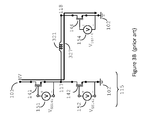
- FIG. 3B indicates the path of the current 327 during the time that transistor 141 is biased ON.
- the motor current flows through transistors 141 and 144 , while no current flows through transistor 142 because transistor 142 is biased OFF, and the voltage at node 117 is close to HV, so transistor 142 blocks a voltage which is close to HV.
- transistor 141 when transistor 141 is switched OFF, no current can flow through transistor 141 , so the motor current flows in the reverse direction through transistor 142 , which can occur whether transistor 142 is biased ON or OFF.
- an anti-parallel freewheeling diode (not shown) can be connected across transistor 142 , in which case the reverse current flows through the freewheeling diode.
- the inductive component 321 forces the voltage at node 117 to a sufficiently negative value to cause reverse conduction through transistor 142 , and transistor 141 blocks a voltage which is close to HV.
- a hard-switching circuit configuration is one in which the switching transistors are configured to have high currents passing through them as soon as they are switched ON, and to have high voltages across them as soon as they are switched OFF.
- the transistors are switched ON during periods where non-zero currents flow through the inductive load, so substantial current flows through the transistors immediately or soon after the transistors are switched ON, rather than the current rising gradually.
- the transistors are switched OFF during periods where high voltages must be blocked by the transistors, so substantial voltage is blocked by the transistors immediately or soon after the transistors are switched OFF, rather than the voltage rising gradually.
- Transistors switched under these conditions are said to be “hard-switched”.
- each of the transistors 141 - 146 has a maximum switching rate at which the device can switch from the OFF state to the ON state or vice-versa, the maximum switching rate being largely dependent on the particular switching characteristics of the device, but also partially depending on other adjacent components in the circuit.
- the switching time for the switching of the voltages at the output nodes 161 - 166 of each of the gate drivers 151 - 156 can be much less than the switching times of each of their respective switching devices 141 - 146 . Consequently, in the configurations of FIGS.
- the maximum output current that can be supplied by the gate drivers 151 - 156 is chosen to be high.
- the maximum output current of each of the gate drivers 151 - 156 is typically chosen to be at least 1/60 times the maximum rated output current of each of their respective switching devices 141 - 146 .
- hard-switched circuits tend to be simple to design and operate, hard-switched components tend to exhibit high levels of electro-magnetic interference (EMI) during operation, in particular in high voltage and/or high current applications in which the switching rate of each of the devices is very high. This can lead to circuit instability or catastrophic failure of the devices in the circuit.
- EMI electro-magnetic interference
- the circuit high voltage (HV) is large (e.g., greater than 300V) and/or the switching devices need to switch large currents (e.g., greater than 5 Amps)
- the circuits exhibit excessively high levels of EMI, become unstable, and cease to function properly.
- a soft-switching circuit configuration is one in which the switching transistors are configured to be switched ON during zero-current (or near zero-current) conditions and switched OFF during zero-voltage (or near zero-voltage) conditions.
- Soft-switching methods and configurations have been developed to address the high levels of EMI and associated ringing observed in hard-switched circuits, especially in high current and/or high voltage applications. While soft-switching can in many cases alleviate these problems, the circuitry required for soft switching typically includes many additional components, resulting in increased overall cost and complexity.
- Soft-switching also typically requires that the circuits be configured to switch only at specific times when the zero-current or zero-voltage conditions are met, hence limiting the control signals that can be applied and in many cases reducing circuit performance.
- alternative configurations and methods are desirable for power switching circuits in order to maintain sufficiently low levels of EMI while at the same time maintaining circuit stability.
- high-voltage circuits which include high-voltage switching devices.
- the gate drivers of the switching devices are configured to reduce the switching rates of the switching devices during operation and improve stability of the high-voltage circuits.
- an electronic component in a first aspect, includes a switching device comprising a source, a gate, and a drain, the switching device having a predetermined device switching rate.
- the electronic component further includes a gate driver electrically connected to the gate and coupled between the source and the gate of the switching device, the gate driver configured to switch a gate voltage of the switching device at a gate driver switching rate.
- the gate driver is configured such that in operation, an output current of the gate driver cannot exceed a first current level, wherein the first current level is sufficiently small to provide a switching rate of the switching device in operation to be less than the predetermined device switching rate.
- an electronic component in a second aspect, includes a switching device comprising a source, a gate, and a drain, the switching device being operable to block at least 300V when biased OFF.
- the electronic component further includes a gate driver coupled between the source and the gate of the switching device, the gate driver configured to switch voltage at an output of the gate driver at a gate driver switching rate.
- a resistance between the output of the gate driver and the gate of the switching device is less than 5 Ohms, and the gate driver is configured such that in operation, an output current of the gate driver is limited by circuitry of the gate driver such that the output current cannot exceed a first current level.
- a ratio of the first current level to a maximum rated current of the switching device is less than 1/100.
- a method of operating an electronic component includes a switching device comprising a source, a gate, and a drain, the switching device configured to have a predetermined device current switching rate.
- the electronic component also includes a gate driver coupled between the source and the gate of the switching device.
- the method includes causing the gate driver to switch an output voltage of the gate driver from a first state to a second state at a gate driver switching rate, whereby a gate voltage of the switching device is switched at substantially the same rate as the gate driver switching rate, and wherein switching of the output voltage of the gate driver from the first state to the second state causes current through the switching device to be switched at a current switching rate less than the predetermined device current switching rate.
- a circuit in a fourth aspect, includes a switching device having a maximum rated current and comprising a source, a gate, and a drain.
- the circuit also includes a first voltage supply which applies an output voltage of at least 300 Volts, and a gate driver connected to a second voltage supply and coupled between the source and the gate of the switching device, the gate driver configured to switch a gate voltage of the switching device at a gate driver switching rate.
- the gate driver is configured such that in operation, an output current of the gate driver cannot exceed a first current level.
- the switching device is configured to block the output voltage applied by the first voltage supply during at least a portion of operation of the circuit, a ratio of the first current level to the maximum rated current of the switching device is less than 1/100, and in operation of the circuit, a voltage switching rate of the switching device is greater than 100 Volts/nanosecond.
- the electronic components, circuits, and methods described herein can include one or more of the following features.
- the electronic component can be part of a half bridge circuit.
- the switching device can comprise a III-Nitride transistor.
- the switching device can comprise an enhancement-mode transistor coupled to a depletion-mode transistor.
- the depletion-mode transistor and the enhancement-mode transistor can be configured such that a source of the enhancement-mode transistor serves as the source of the switching device, a gate of the enhancement-mode transistor serves as the gate of the switching device, and a drain of the depletion-mode transistor serves as a gate of the switching device.
- the switching device can be operable to block at least 300V when biased OFF.
- a maximum rated current of the switching device can be at least 50 Amps.
- a ratio of the first current level to a maximum rated current of the switching device can be less than 1/100.
- the switching rate of the switching device in operation can be less than 0.5 times the predetermined device switching rate.
- the output of the gate driver can be directly connected to the gate of the switching device.
- the electronic component or circuit can further include a ferrite bead connected between the output of the gate driver and the gate of the switching device.
- An output of the gate driver can be electrically connected to the gate, and switching the output voltage of the gate driver from the first state to the second state can cause a voltage of at least 300V to be switched across the switching device.
- a maximum output current of the gate driver can be sufficiently small to cause the current switching rate of the switching device to be less than the predetermined device current switching rate.
- the circuit can be a half bridge. The half bridge can be connected to an inductive load, wherein in operation, a current greater than 1 Amp passes through the inductive load.
- the second voltage supply can apply an output voltage that is substantially less than the output voltage of the first voltage supply.
- the second voltage supply can apply an output voltage less than 25 Volts.
- An output of the gate driver can be electrically connected to the gate of the switching device.
- the circuit can further comprise a resistor between an output of the gate driver and the gate of the switching device, wherein the resistor has a resistance between 0 Ohms and 5 Ohms.
- the switching device can comprise a III-Nitrid
- FIG. 1 illustrates a circuit schematic of a prior art 3-phase bridge circuit.
- FIG. 2 is a prior art circuit schematic of two transistors arranged in a cascode configuration.
- FIGS. 3A-3C illustrate portions of the prior art 3-phase bridge circuit of FIG. 1 under various operating conditions.
- FIGS. 4-5 illustrate half bridge circuits configured to drive electrical loads.
- FIG. 6 is a cross-sectional schematic view of a III-Nitride enhancement-mode transistor.
- FIGS. 7-8 illustrate half bridge circuits configured to drive electrical loads.
- FIG. 9 is a circuit schematic of a cascode device that can be used as a switching device in the half bridge circuit of FIG. 8 .
- FIG. 10 is a cross-sectional schematic view of a III-Nitride depletion-mode transistor.
- FIGS. 11 and 12 are illustrations of bidirectional switches.
- FIG. 13 is a plot of voltage and current characteristics as a function of time for a switching device of the half bridge circuit of FIG. 8 during circuit operation.
- Described herein are configurations and methods for slowing the switching rate (i.e., the slew rate) of switching devices utilized in electronic components and circuits.
- This reduction in switching rate reduces levels of EMI in the circuits during and immediately following switching, thereby allowing for improved circuit stability, in particular in applications where high currents (e.g., 4 Amps or higher) and/or high voltages (e.g., greater than 300V) are being switched by the switching devices.
- Each of the transistors or other switching devices in the circuits and components described herein can be configured to be hard-switched, as previously described, at a particular switching rate.
- a transistor of one of the circuits herein When a transistor of one of the circuits herein is in the OFF state with no substantial current flowing through it, it supports a large voltage which can be about equal to or close to the circuit high voltage.
- a transistor of one of the circuits herein When a transistor of one of the circuits herein is in the ON state, it typically has substantial current passing through it with only a small voltage across it.
- the switching time of a switching transistor switched under hard-switching conditions is defined as follows. When the transistor is switched from the OFF state described above to the ON state described above, the current through the device begins to increase at the onset of switching, while the voltage across the device remains approximately the same.
- the voltage across the device does not begin to drop substantially until the point at which substantially all the load current passes through the transistor.
- the time that elapses between the onset of switching and the point at which the voltage begins to drop is referred to as the “delay time” of the device. This is also the time that is required for the output of the device to begin to respond to a signal applied to the input. After the delay time is reached, the voltage across the transistor begins to drop. The time that elapses from the onset of this voltage drop to the point at which the voltage reaches its steady-state value is referred to as the “transition time” of the device.
- the time that elapses between the onset of switching and the point at which the voltage across the device drops to its steady-state value, which is the sum of the delay time and the transition time, is referred to as the “switching time” for turning the transistor on.
- the total current switched divided by the delay time, (dI/dt) is referred to as the “current switching rate”.
- the total voltage switched across the device divided by the transition time, (dV/dt) is referred to as the “voltage switching rate”.
- EMI can degrade circuit components or damage them such that they may be rendered inoperable. Reducing the current and/or voltage switching rates of the switching devices during circuit operation can mitigate these deleterious effects.
- half bridge 415 includes high side switching device 441 and low side switching device 442 .
- Switching devices 441 and 442 are implemented as silicon-based power MOSFETs (metal-oxide-semiconductor field-effect transistors) or IGBTs (insulated gate bipolar transistors). Because MOSFETs and IGBTs have inherent low-performance anti-parallel diodes integrated into their device structures, external diodes 481 and 482 are connected anti-parallel to switches 441 and 442 , respectively, in order to minimize losses during times where the switches carry reverse freewheeling currents.
- the output node 417 of the half bridge 415 is connected to a load 421 .
- the gates of switching devices 441 and 442 are switched by gate drivers 451 and 452 , respectively.
- the voltages applied at the outputs of the gate drivers are provided by power supplies (e.g., voltage supplies) 491 and 492 , which are connected to each of the gate drivers 451 and 452 .
- Each gate driver is configured to apply this voltage at its output when the switching device is to be turned ON, and to remove this voltage (i.e., to apply 0 Volts) when the switching device is to be turned OFF.
- the voltages provided by voltage supplies 491 and 492 are typically much smaller than the circuit high voltage (HV) 401 , which is provided by a different power supply. For example, in high voltage applications where the circuit high voltage 401 is greater than 300 Volts, voltage supplies 491 and 492 typically provide a voltage of about 25 Volts or less, for example about 12 Volts.
- the switching time that elapses while gate drivers 451 and 452 switch the voltages at their respective outputs 461 and 462 can be much less than the minimum switching time of switching devices 441 and 442 .
- resistors 471 and 472 are inserted between the gates of switching devices 441 and 442 , respectively, and the outputs 461 and 462 of their respective gate drivers 451 and 452 . This causes the voltage at the gates of switching devices 441 and 442 to vary more slowly than at the outputs 461 and 462 of their respective gate drivers 451 and 452 , thereby slowing the switching rate of each of switches 441 and 442 to a value lower than their maximum switching rates.
- resistors 471 and 472 can be used for each of resistors 471 and 472 in order to achieve the desired reduction in switching rate.
- resistors 471 and 472 can each have a resistance that is substantially less than 40 ohms but greater than 8 ohms, for example between 10 and 20 ohms.
- the switching devices 441 and 442 which are IGBTs/MOSFETs, become unstable if a gate resistor 471 / 472 is not included between the gate driver and the gate of the switching device, or if the gate resistor is too small (e.g., less than about 7-8 ohms).
- the gate driver must have a maximum output current of at least 1.4 Amps and resistors 471 and 472 have at least about 10 ohms of resistance in order to prevent instability in the circuit. More generally, the ratio of maximum output current of the gate driver to maximum rated current of the switching device must be at least 1.4/60, and is typically much higher. This condition typically must be maintained when a resistor is connected between the gate driver and the gate of the switching device in order to reduce the device switching rate, as in FIG.
- gate drivers 451 and 452 are both configured to supply maximum output currents that are at least 1.4/60 times the maximum rated currents of switches 441 and 442 .
- the ratio of the maximum output current of the gate driver 451 or 452 to the maximum rated current of the IGBT or MOSFET switching device 441 or 442 may be less than 1/60.
- the half bridge 415 would be unstable and would not function properly.
- resistors 471 and 472 are required for proper operation of half bridge 415 , and each of the resistors needs to have a resistance of at least about 10 ohms.
- the maximum rated current of a transistor or other switching device is defined as follows. When the gate of the switching device is biased relative to the source at a voltage slightly higher than the device threshold voltage, the device is in the ON state, and current flows from the drain to the source when a small drain-source voltage (i.e., a drain-source voltage that is much smaller than the device breakdown voltage but greater than the device knee voltage) is applied. If the gate voltage is increased, the current increases up to a maximum value and then ceases to increase even if the gate voltage is further increased. This maximum value is larger if the current is only applied in short enough pulses (e.g., about 1 microsecond or less) that the device does not substantially heat up. This maximum value under short current pulse conditions is the maximum rated current of the switching device.
- a small drain-source voltage i.e., a drain-source voltage that is much smaller than the device breakdown voltage but greater than the device knee voltage
- FIG. 5 illustrates another half bridge circuit 515 in which III-Nitride transistors 541 and 542 , which for example can be III-Nitride high electron mobility transistors (HEMTs), are implemented as the high side and low side switch, respectively.
- III-Nitride transistors 541 and 542 have the same maximum current rating and voltage handling characteristics as devices 441 and 442 of FIG. 4 . Because the III-Nitride transistors are capable of flowing reverse freewheeling currents through their channels, even when their gates are biased OFF relative to their sources, freewheeling diodes such as diodes 481 and 482 shown in FIG. 4 are not required, although they may optionally be included.
- HEMTs III-Nitride high electron mobility transistors
- III-Nitride transistors are desirable for many of the applications in which high-voltage and/or high-current switching is required, due to their ability to incur minimal switching losses when they are hard-switched at high switching rates.
- these devices inherently have very high predetermined switching rates (much higher than silicon-based MOSFETs and IGBTs), it is often desirable to reduce the switching rate during operation in order to minimize EMI and associated instabilities.
- III-Nitride or III-N materials, layers, devices, structures, etc. refer to a material, layer, device, or structure comprised of a compound semiconductor material according to the stoichiometric formula B w Al x In y Ga z N, where w+x+y+z is about 1, 0 ⁇ w ⁇ 1, 0 ⁇ x ⁇ 1, 0 ⁇ y ⁇ 1, and 0 ⁇ z ⁇ 1.
- a III-Nitride or III-N device such as a transistor or HEMT, the conductive channel can be partially or entirely contained within a III-N material layer.
- device 60 is an enhancement-mode III-Nitride transistor.
- Device 60 includes a substrate 10 (although the substrate is optional), which can for example be silicon, and a III-Nitride material structure on the substrate, the III-Nitride material structure including a III-N channel layer 11 , which can for example be GaN, and a III-N barrier layer 12 , which can for example be AlGaN.
- a two-dimensional electron gas (2DEG) channel 19 is induced in the III-N channel layer 11 adjacent to the III-N barrier layer 12 due to a compositional difference between the III-N channel and barrier layers.
- Source contact 74 and drain contact 75 are on opposite sides of gate 88 and electrically contact the 2DEG channel 19 .
- Gate 88 is formed over a gate insulator layer 87 , and both layers 87 and 88 are in a recess that extends into the III-Nitride material structure.
- An insulating material structure which includes an insulating layer 22 , an etch stop layer 21 , and an electrode defining layer 33 is formed over the III-N material structure, and a recess 17 is formed in the insulating material structure.
- a source-connected field plate 71 extends from the source towards the gate, and a portion of field plate 71 is in the recess 17 .
- device 60 is a lateral device. That is, the transistor channel is contained within a semiconductor layer 11 of the transistor 60 , and the source, gate, and drain electrodes 74 , 88 , and 75 , respectively, are on the same side of the semiconductor layer 11 , as shown. Specifically, the portions of the source and drain electrodes 74 and 75 that form an ohmic contact to the channel in layer 11 , as well as the portion of the gate electrode 88 that modulates the current in the channel, are each on the same side of the semiconductor layer 11 .
- Half bridge 515 also uses the same gate drivers 451 and 452 and corresponding voltage supplies 491 and 492 as those used in the circuit of FIG. 4 to drive the gates of transistors 541 and 542 .
- Resistors 571 and 572 are inserted between the gates of switching devices 541 and 542 , respectively, and the outputs 461 and 462 of their respective gate drivers 451 and 452 , in order to reduce the switching rate of each of switches 541 and 542 to a value lower than their maximum switching rates.
- resistors 571 and 572 need to be made substantially larger than resistors 471 and 472 of FIG. 4 in order to sufficiently reduce the switching rate of transistors 541 and 542 .
- resistors 471 and 472 can each have a resistance that is at least 50 ohms in order to effectively reduce the switching rate of transistors 541 and 542 .
- V noise current noise (from thermal currents and/or other noise sources) I noise that passes through resistors 571 and 572 creates voltage noise (e.g., voltage fluctuations) V noise at the gates of transistors 541 and 542 .
- V noise I noise *R, where R is the resistance of resistors 571 and 572 .
- FIG. 7 illustrates a half bridge circuit 715 which is similar to half bridge circuit 515 of FIG. 5 , and uses the same switching transistors 541 and 542 , but resistors 571 and 572 have been omitted. Furthermore, gate drivers 451 and 452 and corresponding power supplies 491 and 492 of circuit 515 of FIG. 5 have been replaced by gate drivers 751 and 752 and corresponding power supplies 791 and 792 , which have specific properties that cause the current and/or voltage switching rates of transistors 541 and 542 to be reduced without the need for an intermediary gate resistor, as described in more detail below.
- the outputs 761 and 762 of gate drivers 751 and 752 are electrically connected (i.e., directly connected) to the gates of switching devices 541 and 542 .
- gate drivers 751 and 752 of half bridge circuit 715 are configured to have a much lower limit on their maximum rated output currents (i.e., the maximum output current that they are able to supply or sink during operation), as compared to the gate drivers 451 and 452 of half bridges 415 (in FIG. 4 ) and 515 (in FIG. 5 ).
- the circuitry of the gate driver can be configured to limit the output current of the gate driver such that it cannot exceed a predetermined value during operation.
- a half bridge 715 of FIG. 7 utilizing III-Nitride transistors 541 and 542 configured to block at least 300V in the OFF state and rated to support a maximum current of 60 Amps in the ON state
- the resistance between the output of the outputs of the gate drivers and the gates of their associated transistors is 0 Ohms or between 0 and 5 Ohms
- employing gate drivers 751 and 752 with maximum output currents of less than 1 Amp, for example about 0.5 Amps or less causes a substantial reduction in the current switching rate of the III-Nitride transistors during operation, hence increasing the switching time, and at the same time improves the stability of the circuit.
- employing gate drivers for which the ratio of the maximum output current of the gate driver to the maximum rated current of the III-Nitride transistors is less than 1/60, for example less than 1/100, or less than 1/150 reduces the switching rate of the III-Nitride transistors during operation while at the same time improving the stability of the circuit.
- switching devices 541 and 542 are each shown to be a single transistor, other devices could be used, provided that they have characteristics that allow their switching rates to be reduced by employing a gate driver with a low maximum current, and they do not become unstable or cause the circuit to become unstable when such a configuration is implemented.
- a high-voltage hybrid enhancement-mode device 900 shown in FIG. 9 , could be used in place of each of transistors 541 and 542 in the half bridge 715 of FIG. 7 .
- FIG. 8 illustrates another half bridge 815 that is the same as half bridge 715 of FIG. 7 , except that the high-side and low-side switches 841 and 842 , respectively, are each implemented as a high-voltage hybrid enhancement-mode device 900 , shown in FIG. 9 .
- a “high-voltage switching device”, such as a high-voltage switching transistor, is an electronic device which is optimized for high-voltage switching applications. That is, when the transistor is off, it is capable of blocking high voltages, such as about 300V or higher, about 600V or higher, about 1200V or higher, or about 1700V or higher, and when the transistor is on, it has a sufficiently low on-resistance (RoN) for the application in which it is used, i.e., it experiences sufficiently low conduction loss when a substantial current passes through the device.
- RoN on-resistance
- a high-voltage device can at least be capable of blocking a voltage equal to the high-voltage supply or the maximum voltage in the circuit for which it is used.
- a high-voltage device may be capable of blocking 300V, 600V, 1200V, 1700V, or other suitable blocking voltage required by the application.
- a high-voltage device can block any voltage between 0V and at least V max , where V max is the maximum voltage that could be supplied by the circuit or power supply.
- a high-voltage device can block any voltage between 0V and at least 2*V max .
- a “low-voltage device”, such as a low-voltage transistor is an electronic device which is capable of blocking low voltages, such as between 0V and V low (where V low is less than V max ), but is not capable of blocking voltages higher than V low .
- V low is equal to about
- V low is about 10V, about 20V, about 30V, about 40V, or between about 5V and 50V, such as between about 10V and 40V.
- V low is less than about 0.5*V max , less than about 0.3*V max , less than about 0.1*V max , less than about 0.05*V max , or less than about 0.02*V max .
- hybrid device 900 can be operated in the same way as a single high-voltage E-mode transistor, and in many cases achieves the same or similar output characteristics as a single high-voltage E-mode transistor.
- Hybrid device 900 includes a high-voltage III-N D-mode transistor 901 and a low-voltage E-mode transistor 902 , which can for example be a low-voltage silicon power MOSFET.
- E-mode transistor 902 can be a vertical transistor, having its drain electrode 916 on the opposite side of the device semiconductor layers from its source electrode 914 and gate electrode 915
- D-mode III-N transistor 901 can be a lateral transistor, having its source electrode 911 , gate electrode 912 , and drain electrode 913 all on the same side of the device III-N layers.
- other configurations for each of transistors 901 and 902 are possible as well.
- FIG. 10 illustrates an example III-N D-mode transistor 1000 that could be used for transistor 901 in FIG. 9 .
- Transistor 1000 includes a substrate 1010 (although the substrate is optional), which can for example be silicon, and a III-Nitride material structure on the substrate, the III-Nitride material structure including a III-N channel layer 1011 , which can for example be GaN, and a III-N barrier layer 1012 , which can for example be AlGaN.
- a two-dimensional electron gas (2DEG) channel 1019 is induced in the III-N channel layer 1011 adjacent to the III-N barrier layer 1012 due to a compositional difference between the III-N channel and barrier layers.
- 2DEG two-dimensional electron gas
- Source contact 1014 and drain contact 1015 are on opposite sides of electrode 1029 and electrically contact the 2DEG channel 19 .
- Electrode 1029 includes the device gate 1016 , as well as a field plate portion 1024 which extends from the gate 1016 towards the drain contact 1015 .
- Electrode-defining layer 1023 is formed of an insulating material.
- a gate dielectric (not shown) may optionally be included between the gate 1016 and the underlying III-N material layers.
- transistor 1000 is a lateral device. That is, the transistor channel is contained within a semiconductor layer 1011 of the transistor 1000 , and the source, gate, and drain electrodes 1014 , 1016 , and 1015 , respectively, are on the same side of the semiconductor layer 1011 . Specifically, the portions of the source and drain electrodes 1014 and 1015 that form an ohmic contact to the channel in layer 1011 , as well as the portion of the gate 1016 that modulates the current in the channel, are each on the same side of the semiconductor layer 1011 .
- the source electrode 914 of the low-voltage E-mode transistor 902 and the gate electrode 912 of the high-voltage D-mode transistor 901 are electrically connected together, for example with wire bonds or other metal interconnections if they are integrated into a single structure, and together form the source 921 of the hybrid device 900 .
- the gate electrode 915 of the low-voltage E-mode transistor 902 functions as the gate 922 of the hybrid device 900 .
- the drain electrode 913 of the high-voltage D-mode transistor 901 functions as the drain 923 of the hybrid device 900 .
- the source electrode 911 of the high-voltage D-mode transistor 901 is electrically connected to the drain electrode 916 of the low-voltage E-mode transistor 902 .
- a “hybrid enhancement-mode electronic device or component”, or simply a “hybrid device or component”, is an electronic device or component formed of a depletion-mode transistor and a enhancement-mode transistor, where the depletion-mode transistor is capable of a higher operating and/or breakdown voltage as compared to the enhancement-mode transistor, and the hybrid device or component is configured to operate similarly to a single enhancement-mode transistor with a breakdown and/or operating voltage about as high as that of the depletion-mode transistor. That is, a hybrid enhancement-mode device or component includes at least 3 nodes having the following properties.
- the hybrid enhancement-mode device or component can block a positive high voltage (i.e., a voltage larger than the maximum voltage that the enhancement-mode transistor is capable of blocking) applied to the third node (drain node) relative to the source node.
- a positive high voltage i.e., a voltage larger than the maximum voltage that the enhancement-mode transistor is capable of blocking
- the gate node is held at a sufficiently positive voltage (i.e., greater than the threshold voltage of the enhancement-mode transistor) relative to the source node, current passes from the source node to the drain node or from the drain node to the source node when a sufficiently positive voltage is applied to the drain node relative to the source node.
- the hybrid component can operate similarly to a single high-voltage enhancement-mode transistor.
- the depletion-mode transistor can have a breakdown and/or maximum operating voltage that is at least two times, at least three times, at least five times, at least ten times, or at least twenty times that of the enhancement-mode transistor.
- switches 841 and 842 where each of the switches is configured to block at least 300V in the OFF state and rated to support a maximum current of 60 Amps in the ON state
- employing gate drivers 751 and 752 with maximum rated output currents of less than 1 Amp, for example about 0.5 Amps or less causes a substantial reduction in the current switching rate of the hybrid devices during operation, and at the same time improves the stability of the circuit.
- This effect was also observed to occur when a small resistor (having a resistance between 0 and 5 Ohms) or a ferrite bead was inserted between the outputs of one or more of the gate drivers and the gates of their associated transistors. This result was unexpected for the same reasons provided above with reference to half bridge 715 of FIG. 7 .
- gate drivers with even lower output currents may additionally reduce the voltage switching rate of the hybrid devices during operation, thereby providing added stability.
- half bridge 815 of FIG. 8 employing gate drivers 751 and 752 with maximum output currents of less than 1 Amp causes a substantial reduction in the current switching rate of the hybrid devices during operation and at the same time improves the stability of the circuit.
- the voltage switching rate remains greater than 100 Volts/nanosecond. High voltage switching rates are desirable in many applications because they can reduce switching losses during operation. However, stable operation with such high device voltage switching rates typically cannot be achieved in conventional half bridge circuits.
- gate drivers 751 and 752 in which the maximum current level that the gate driver is capable of providing at its output is less than 1/100 times the maximum rated current of the switching devices 841 and 842 , allows for stable operation of the circuit, even with device voltage switching rates greater than 100 Volts/nanosecond. This result is unexpected for the same reasons previously provided.
- FIG. 13 is a plot of the current and voltage characteristics of high side switching device 841 of FIG. 8 during a switching sequence in the case where the circuit high voltage 401 was maintained at 450 Volts, such that a voltage greater than 400 Volts, and substantially greater than 300 Volts, was switched across switching device 841 .
- Gate drivers 751 and 752 were each configured such that the maximum current they were able to provide through their respective outputs was 0.5 Amps.
- Low side switching device 842 was kept OFF, while high side switching device 841 was switched, such that the mode of operation (in terms of the path that the current flowed) was similar to that shown for half bridge 115 in FIGS. 3B-3C .
- Switching devices 841 and 842 each had a maximum rated current level of 60 Amps, and were configured to be capable of blocking 600V.
- Curve 1320 is a plot of the voltage at node 417 as a function of time
- curve 1340 is a plot of the current passing through the load 421 as a function of time.
- the axis on the left hand side of the plot corresponds to curve 1320
- the axis on the right hand side of the curve corresponds to curve 1340 .
- the voltage switching rate of switching device 841 during operation was greater than 100 Volts/nanosecond.
- the voltage switched across the device 841 is indicated by arrow 1322 .
- the voltage across the device oscillates but eventually stabilizes.
- voltage oscillations 1324 occur after the second time during the switching sequence that switching device 841 is switched ON.
- the voltage overshoot above the desired voltage level that results from oscillations 1324 is indicated by arrow 1326 .
- the voltage overshoot remains less than 20% of the circuit high voltage (i.e., the approximate voltage switched across the switching device), even when the current switched through the switching device 841 is greater than 2 Amps.
- the maximum voltage across switching device 841 was at all times less than 1.3 times and also less than 1.2 times the circuit high voltage during operation of the half bridge. Because the voltage across switching device 841 at all times remained less than 1.5 times the circuit high voltage, the voltage blocking capabilities of the switching devices 841 and 842 did not need to be overspecified as highly as would be required in typical high voltage circuits, allowing for a wider range of operating voltages for the half bridge circuit. Similar low-noise operation was also obtained when the high side switching device 841 was continuously biased OFF and the low side switching device 842 was switched. Such a low voltage overshoot at such high switching rates resulted from the use of gate drivers 751 and 752 with low maximum output current levels.
- the device In typical power switching applications in which high-voltage switching devices are used, the device is, during the majority of time, in one of two states.
- the first state which is commonly referred to as the “on state”
- the voltage at the gate electrode relative to the source electrode is higher than the device threshold voltage, and substantial current flows through the device.
- the voltage difference between the source and drain is typically low, usually no more than a few volts, such as about 0.1-5 volts.
- the second state which is commonly referred to as the “off state”
- the voltage at the gate electrode relative to the source electrode is lower than the device threshold voltage, and no substantial current, apart from off-state leakage current, flows through the device.
- the voltage between the source and drain can range anywhere from about 0V to the value of the circuit high voltage supply, which in some cases can be as high as 100V, 300V, 600V, 1200V, 1700V, or higher, but can be less than the breakdown voltage of the device.
- inductive elements in the circuit cause the voltage between the source and drain to be even higher than the circuit high voltage supply.
- blocking a voltage refers to the ability of a transistor, device, or component to prevent significant current, such as current that is greater than 0.001 times the average operating current during regular on-state conduction, from flowing through the transistor, device, or component when a voltage is applied across the transistor, device, or component.
- significant current such as current that is greater than 0.001 times the average operating current during regular on-state conduction
- the total current passing through the transistor, device, or component will not be greater than 0.001 times the average operating current during regular on-state conduction.
- the same methods and configurations can be used to achieve the same results in other circuits, for example power factor correction (PFC) circuits or AC-AC conversion circuits such as matrix converters.
- PFC power factor correction
- AC-AC conversion circuits such as matrix converters.
- other types of switching devices may be utilized.
- the switching devices can each be bidirectional switches, such as a III-N bidirectional switch 1100 (shown in FIG. 11 ) or a hybrid III-N bidirectional switch 1200 (as shown in FIG. 12 ).
- III-N bidirectional switch 1100 includes substrate 10 , as well as III-N layers 11 and 12 , in which the device 2DEG channel 19 is contained.
- Switch 1100 also includes power electrodes 1124 and 1134 , which contact the channel 19 and both function as device sources and drains, depending on the direction of current flow or on the voltage polarity across the device.
- Gates 1128 and 1138 are between power electrodes 1124 and 1134 , and are configured similarly to gate 88 of the enhancement-mode transistor 60 shown in FIG. 6 .
- device 1100 is configured to be operated with two gate drivers. A first gate driver is connected between gate 1128 and power electrode 1124 , and a second gate driver is connected between gate 1138 and power electrode 1134 .
- Each gate driver can be similar to or the same as gate drivers 791 and 792 of FIGS. 7 and 8 . That is, in order to reduce the switching rate of switch 1100 and provide for stable operation of the circuit in which switch 1100 is used, the maximum current that each gate driver is capable of providing can be less than 1/100 times the maximum rated current of the bidirectional switch 1100 .
- bidirectional switch 1200 includes a high voltage depletion-mode III-N bidirectional switch 1210 connected in a cascode configuration to low voltage enhancement-mode transistors 1261 and 1262 to form a high voltage enhancement-mode bidirectional switch 1200 .
- Power electrode 1224 of the III-N bidirectional switch 1210 is connected to the drain of transistor 1261 .
- Power electrode 1234 of the III-N bidirectional switch 1210 is connected to the drain of transistor 1262 .
- Gate electrode 1228 of the III-N bidirectional switch 1210 is connected to the source of transistor 1261 .
- Gate electrode 1238 of the III-N bidirectional switch 1210 is connected to the source of transistor 1262 .
- Anti-parallel diodes 1271 and 1272 are optionally provided across transistors 1261 and 1262 , respectively.
- Gate driver 1251 is coupled between the gate and source of transistor 1261 .
- Gate driver 1252 is coupled between the gate and source of transistor 1262 .
- Each gate driver 1251 and 1252 can be similar to or the same as gate drivers 791 and 792 of FIGS. 7 and 8 . That is, in order to reduce the switching rate of switch 1200 and provide for stable operation of the circuit in which switch 1200 is used, the maximum current that each gate driver is capable of providing can be less than 1/100 times the maximum rated current of the bidirectional switch 1200 .
- resistors 471 and 472 are larger resistors (i.e., have a larger resistance). Accordingly, other implementations are within the scope of the following claims.
Landscapes
- Electronic Switches (AREA)
- Power Conversion In General (AREA)
Abstract
Description
Claims (19)
Priority Applications (1)
| Application Number | Priority Date | Filing Date | Title |
|---|---|---|---|
| US14/708,627 US9362903B2 (en) | 2013-04-01 | 2015-05-11 | Gate drivers for circuits based on semiconductor devices |
Applications Claiming Priority (3)
| Application Number | Priority Date | Filing Date | Title |
|---|---|---|---|
| US201361807258P | 2013-04-01 | 2013-04-01 | |
| US14/222,992 US9059076B2 (en) | 2013-04-01 | 2014-03-24 | Gate drivers for circuits based on semiconductor devices |
| US14/708,627 US9362903B2 (en) | 2013-04-01 | 2015-05-11 | Gate drivers for circuits based on semiconductor devices |
Related Parent Applications (1)
| Application Number | Title | Priority Date | Filing Date |
|---|---|---|---|
| US14/222,992 Continuation US9059076B2 (en) | 2013-04-01 | 2014-03-24 | Gate drivers for circuits based on semiconductor devices |
Publications (2)
| Publication Number | Publication Date |
|---|---|
| US20150249447A1 US20150249447A1 (en) | 2015-09-03 |
| US9362903B2 true US9362903B2 (en) | 2016-06-07 |
Family
ID=51620186
Family Applications (2)
| Application Number | Title | Priority Date | Filing Date |
|---|---|---|---|
| US14/222,992 Active US9059076B2 (en) | 2013-04-01 | 2014-03-24 | Gate drivers for circuits based on semiconductor devices |
| US14/708,627 Active US9362903B2 (en) | 2013-04-01 | 2015-05-11 | Gate drivers for circuits based on semiconductor devices |
Family Applications Before (1)
| Application Number | Title | Priority Date | Filing Date |
|---|---|---|---|
| US14/222,992 Active US9059076B2 (en) | 2013-04-01 | 2014-03-24 | Gate drivers for circuits based on semiconductor devices |
Country Status (3)
| Country | Link |
|---|---|
| US (2) | US9059076B2 (en) |
| TW (1) | TWI596899B (en) |
| WO (1) | WO2014165408A1 (en) |
Cited By (7)
| Publication number | Priority date | Publication date | Assignee | Title |
|---|---|---|---|---|
| US10630285B1 (en) | 2017-11-21 | 2020-04-21 | Transphorm Technology, Inc. | Switching circuits having drain connected ferrite beads |
| US10756207B2 (en) | 2018-10-12 | 2020-08-25 | Transphorm Technology, Inc. | Lateral III-nitride devices including a vertical gate module |
| US11749656B2 (en) | 2020-06-16 | 2023-09-05 | Transphorm Technology, Inc. | Module configurations for integrated III-Nitride devices |
| US11810971B2 (en) | 2019-03-21 | 2023-11-07 | Transphorm Technology, Inc. | Integrated design for III-Nitride devices |
| US11973138B2 (en) | 2020-08-05 | 2024-04-30 | Transphorm Technology, Inc. | N-polar devices including a depleting layer with improved conductivity |
| US12451468B1 (en) | 2021-08-25 | 2025-10-21 | Transphorm Technology, Inc. | III-N devices with improved reliability |
| US12550702B2 (en) | 2020-09-21 | 2026-02-10 | Transphorm Technology, Inc. | III-nitride devices with through-via structures |
Families Citing this family (17)
| Publication number | Priority date | Publication date | Assignee | Title |
|---|---|---|---|---|
| EP2784816A1 (en) * | 2013-03-28 | 2014-10-01 | Nxp B.V. | Cascode semiconductor device |
| US9059076B2 (en) | 2013-04-01 | 2015-06-16 | Transphorm Inc. | Gate drivers for circuits based on semiconductor devices |
| US9590494B1 (en) * | 2014-07-17 | 2017-03-07 | Transphorm Inc. | Bridgeless power factor correction circuits |
| US9748378B2 (en) * | 2015-03-12 | 2017-08-29 | Infineon Technologies Ag | Semiconductor device, integrated circuit and method of manufacturing a semiconductor device |
| WO2016205553A1 (en) * | 2015-06-16 | 2016-12-22 | Tagore Technology, Inc. | High performance radio frequency switch |
| US9960157B2 (en) * | 2015-10-15 | 2018-05-01 | Infineon Technologies Austria Ag | Bidirectional normally-off III-V high electron mobility transistor (HEMT)devices and circuits |
| US9755628B2 (en) * | 2016-01-07 | 2017-09-05 | Delta Electronics, Inc. | Driving circuit, converter and driving method |
| FR3059497A1 (en) * | 2016-11-25 | 2018-06-01 | Exagan | METHOD AND CIRCUIT FOR CONTROLLING A SWITCHING DEVICE OF A POWER CIRCUIT |
| US10574226B2 (en) * | 2017-02-16 | 2020-02-25 | Texas Instruments Incorporated | Gate driver including gate sense circuit |
| US10903830B2 (en) * | 2017-06-08 | 2021-01-26 | Nexus Technologies, Inc. | Short-circuit protection for a power semiconductor device |
| GB2565805B (en) | 2017-08-23 | 2020-05-13 | X Fab Semiconductor Foundries Gmbh | Noff III-nitride high electron mobility transistor |
| US10199487B1 (en) * | 2018-05-15 | 2019-02-05 | The Florida International University Board Of Trustees | Multi-drain gallium-nitride module with multiple voltage ratings |
| WO2020241469A1 (en) * | 2019-05-28 | 2020-12-03 | 日立オートモティブシステムズ株式会社 | Current control device |
| EP3905523B1 (en) * | 2020-04-30 | 2024-06-19 | Infineon Technologies Austria AG | Switching circuit, gate driver and method of operating a transistor device |
| US11264985B1 (en) * | 2021-03-04 | 2022-03-01 | Aes Global Holdings Pte Ltd. | Bipolar pulsed-voltage gate driver |
| US20240212639A1 (en) * | 2021-09-24 | 2024-06-27 | Boe Technology Group Co., Ltd. | Voltage providing unit, voltage providing method, display driving module and display device |
| US12451883B2 (en) * | 2022-09-13 | 2025-10-21 | Hamilton Sundstrand Corporation | Shoot through protection in motor drives with single supply gate drives |
Citations (120)
| Publication number | Priority date | Publication date | Assignee | Title |
|---|---|---|---|---|
| US4321489A (en) | 1978-07-31 | 1982-03-23 | Fujitsu Ltd. | Voltage detection circuit |
| US4384287A (en) | 1979-04-11 | 1983-05-17 | Nippon Electric Co., Ltd. | Inverter circuits using insulated gate field effect transistors |
| US4665508A (en) | 1985-05-23 | 1987-05-12 | Texas Instruments Incorporated | Gallium arsenide MESFET memory |
| US4728826A (en) | 1986-03-19 | 1988-03-01 | Siemens Aktiengesellschaft | MOSFET switch with inductive load |
| US4808853A (en) | 1987-11-25 | 1989-02-28 | Triquint Semiconductor, Inc. | Tristate output circuit with selectable output impedance |
| US5198964A (en) | 1990-09-27 | 1993-03-30 | Hitachi, Ltd. | Packaged semiconductor device and electronic device module including same |
| JPH0575040U (en) | 1992-03-13 | 1993-10-12 | 日信工業株式会社 | Negative pressure booster |
| JPH0667744B2 (en) | 1986-10-24 | 1994-08-31 | 本田技研工業株式会社 | Arrangement structure of fuel supply device in rough terrain vehicle |
| US5379209A (en) | 1993-02-09 | 1995-01-03 | Performance Controls, Inc. | Electronic switching circuit |
| US5493487A (en) | 1993-02-09 | 1996-02-20 | Performance Controls, Inc. | Electronic switching circuit |
| US5637922A (en) | 1994-02-07 | 1997-06-10 | General Electric Company | Wireless radio frequency power semiconductor devices using high density interconnect |
| US5789951A (en) | 1997-01-31 | 1998-08-04 | Motorola, Inc. | Monolithic clamping circuit and method of preventing transistor avalanche breakdown |
| US5812010A (en) | 1995-12-15 | 1998-09-22 | International Rectifier Corporation | Soft-switching driver output stage and method |
| US5952856A (en) | 1996-05-02 | 1999-09-14 | Shindengen Electric Manufacturing Co., Ltd. | Inductive load driving method and H-bridge circuit control device |
| US6008684A (en) | 1996-10-23 | 1999-12-28 | Industrial Technology Research Institute | CMOS output buffer with CMOS-controlled lateral SCR devices |
| JP2000101356A (en) | 1998-09-25 | 2000-04-07 | Murata Mfg Co Ltd | High frequency power amplifier circuit |
| JP2000124358A (en) | 1998-10-13 | 2000-04-28 | Matsushita Electric Ind Co Ltd | High frequency integrated circuit |
| US6107844A (en) | 1998-09-28 | 2000-08-22 | Tripath Technology, Inc. | Methods and apparatus for reducing MOSFET body diode conduction in a half-bridge configuration |
| US6130831A (en) | 1998-10-21 | 2000-10-10 | Haiden Laboratory Inc. | Positive-negative pulse type high frequency switching power supply unit |
| US6172550B1 (en) | 1996-08-16 | 2001-01-09 | American Superconducting Corporation | Cryogenically-cooled switching circuit |
| US20010044640A1 (en) | 2000-03-22 | 2001-11-22 | Naoto Akiyama | Semiconductor switch driving circuit |
| US6333617B1 (en) | 1999-06-10 | 2001-12-25 | Denso Corporation | Inductive load drive control for selectively extinguishing energy through switching devices or diodes |
| US6395593B1 (en) | 1999-05-06 | 2002-05-28 | Texas Instruments Incorporated | Method of manufacturing high side and low side guard rings for lowest parasitic performance in an H-bridge configuration |
| US20020125920A1 (en) | 2001-02-06 | 2002-09-12 | Stanley Gerald R. | Half-bridge gate driver circuit |
| US6521940B1 (en) | 1990-12-31 | 2003-02-18 | Kopin Corporation | High density electronic circuit modules |
| JP2003244943A (en) | 2002-02-13 | 2003-08-29 | Honda Motor Co Ltd | Power supply booster |
| US20030178654A1 (en) | 1999-06-02 | 2003-09-25 | Thornton Trevor J. | Complementary Schottky junction transistors and methods of forming the same |
| US6650169B2 (en) | 2001-10-01 | 2003-11-18 | Koninklijke Philips Electronics N.V. | Gate driver apparatus having an energy recovering circuit |
| JP2003338742A (en) | 2002-05-22 | 2003-11-28 | Nissan Motor Co Ltd | Driver circuit for current control type device |
| US20040120090A1 (en) | 2002-10-31 | 2004-06-24 | International Rectifier Corporation | Half-bridge high voltage gate driver providing protectin of a transistor |
| US6781423B1 (en) | 2003-07-04 | 2004-08-24 | Dialog Semiconductor Gmbh | High-voltage interface and driver control circuit |
| US20040178831A1 (en) | 2003-03-11 | 2004-09-16 | Ying-Hsin Li | [source follower capable of compensating the threshold voltage] |
| JP2004281454A (en) | 2003-03-12 | 2004-10-07 | Sharp Corp | Semiconductor device and manufacturing method thereof |
| US20050052221A1 (en) | 2003-09-05 | 2005-03-10 | Sanyo Electric Co., Ltd. | Power supply unit and power supply system having the same |
| US20050067716A1 (en) | 2003-01-02 | 2005-03-31 | Cree, Inc. | Group III nitride based flip-chip integrated circuit and method for fabricating |
| US20050077947A1 (en) | 2002-05-02 | 2005-04-14 | Eupec Europaische Gesellschaft Fur Leistungshalbleiter Mbh | Half-bridge circuit |
| US6900657B2 (en) | 2003-09-24 | 2005-05-31 | Saia-Burgess Automotive, Inc. | Stall detection circuit and method |
| US20050146310A1 (en) | 2003-12-24 | 2005-07-07 | Ray Orr | DC converters having buck or boost configurations |
| US20050189562A1 (en) | 2004-02-12 | 2005-09-01 | Kinzer Daniel M. | Integrated III-nitride power devices |
| US20050189561A1 (en) | 2004-02-12 | 2005-09-01 | Kinzer Daniel M. | III-Nitride bidirectional switch |
| US20050218964A1 (en) | 2004-03-31 | 2005-10-06 | Matsushita Electric Industrial Co., Ltd. | Active diode |
| US6975023B2 (en) | 2002-09-04 | 2005-12-13 | International Rectifier Corporation | Co-packaged control circuit, transistor and inverted diode |
| JP2006033723A (en) | 2004-07-21 | 2006-02-02 | Sharp Corp | Optical coupling device for power control and electronic device using the optical coupling device for power control |
| US20060033122A1 (en) | 2004-08-11 | 2006-02-16 | Mark Pavier | Half-bridge package |
| US20060043499A1 (en) | 2002-10-29 | 2006-03-02 | Koninklijke Philips Electronics, N.V. | Bi-directional double nmos switch |
| US20060060871A1 (en) | 2004-01-23 | 2006-03-23 | International Rectifier Corp. | Enhancement mode III-nitride FET |
| US20060102929A1 (en) | 2002-12-16 | 2006-05-18 | Yasuhiro Okamoto | Field-effect transistor |
| US20060108605A1 (en) | 2004-11-22 | 2006-05-25 | Matsushita Electric Industrial Co., Ltd. | Schottky barrier diode and integrated circuit using the same |
| JP2006173754A (en) | 2004-12-13 | 2006-06-29 | Oki Electric Ind Co Ltd | High frequency switch |
| US20060176007A1 (en) | 2005-01-31 | 2006-08-10 | Best Eric P | Method for stepper motor position referencing |
| US7116567B2 (en) | 2005-01-05 | 2006-10-03 | Velox Semiconductor Corporation | GaN semiconductor based voltage conversion device |
| US20060237825A1 (en) | 2005-04-25 | 2006-10-26 | International Rectifier Corporation | Device packages having a III-nitride based power semiconductor device |
| US20060238234A1 (en) | 2005-04-25 | 2006-10-26 | Triquint Semiconductor, Inc. | Producing reference voltages using transistors |
| US20060262581A1 (en) | 2005-05-19 | 2006-11-23 | Mstar Semiconductor, Inc. | Full-bridge soft switching inverter and driving method thereof |
| US20070018210A1 (en) | 2005-07-21 | 2007-01-25 | Cree, Inc. | Switch mode power amplifier using MIS-HEMT with field plate extension |
| JP2007036218A (en) | 2005-06-27 | 2007-02-08 | Internatl Rectifier Corp | Active drive of normally-on and normally-off cascode connection configuration device through unsymmetrical cmos |
| US20070080672A1 (en) | 2005-10-12 | 2007-04-12 | System General Corp. | High efficiency buck converter for both full load and light load operations |
| US20070090373A1 (en) | 2003-12-05 | 2007-04-26 | International Rectifier Corporation | III-Nitride device with improved layout geometry |
| US20070146045A1 (en) | 2003-03-26 | 2007-06-28 | Semiconductor Energy Laboratory Co., Ltd. | Source follower circuit or bootstrap circuit, driver circuit comprising such circuit, and display device comprising such driver circuit |
| JP2007215331A (en) | 2006-02-10 | 2007-08-23 | Hitachi Ltd | Booster circuit |
| US20070210329A1 (en) | 2006-03-08 | 2007-09-13 | Sanken Electric Co., Ltd. | Warp-free semiconductor wafer, and devices using the same |
| JP2007294769A (en) | 2006-04-26 | 2007-11-08 | Toshiba Corp | Nitride semiconductor device |
| US7304331B2 (en) | 2004-07-14 | 2007-12-04 | Kabushiki Kaisha Toshiba | Nitride semiconductor device such as transverse power FET for high frequency signal amplification or power control |
| US20070278518A1 (en) | 2005-11-29 | 2007-12-06 | The Hong Kong University Of Science And Technology | Enhancement-Mode III-N Devices, Circuits, and Methods |
| US20080017998A1 (en) | 2006-07-19 | 2008-01-24 | Pavio Jeanne S | Semiconductor component and method of manufacture |
| US20080018366A1 (en) | 2006-07-20 | 2008-01-24 | Enpirion, Inc. | Driver for switch and a method of driving the same |
| US7378883B1 (en) | 2007-01-03 | 2008-05-27 | Tpo Displays Corp. | Source follower and electronic system utilizing the same |
| US20080122418A1 (en) | 2006-11-28 | 2008-05-29 | Briere Michael A | Synchronous DC/DC converter |
| US20080121876A1 (en) | 2005-07-13 | 2008-05-29 | Sanken Electric Co., Ltd. | Surface-stabilized semiconductor device |
| US20080136390A1 (en) | 2006-12-11 | 2008-06-12 | Briere Michael A | Monolithically integrated III-nitride power converter |
| US20080158110A1 (en) | 2006-12-27 | 2008-07-03 | Sony Corporation | Pixel circuit, display, and method for driving pixel circuit |
| US20080191342A1 (en) | 2007-02-09 | 2008-08-14 | Infineon Technologies Ag | Multi-chip module |
| JP2008199771A (en) | 2007-02-13 | 2008-08-28 | Fujitsu Ten Ltd | Boosting circuit control device and boosting circuit |
| US20080203559A1 (en) | 2007-02-28 | 2008-08-28 | Lee Keun-Hyuk | Power device package and semiconductor package mold for fabricating the same |
| US7443648B2 (en) | 2003-04-15 | 2008-10-28 | Nxp, B.V. | Driver for inductive load |
| US7449730B2 (en) | 2005-12-28 | 2008-11-11 | Kabushiki Kaisha Toshiba | Nitride-based semiconductor device |
| US7453107B1 (en) | 2007-05-04 | 2008-11-18 | Dsm Solutions, Inc. | Method for applying a stress layer to a semiconductor device and device formed therefrom |
| US20080283844A1 (en) | 2007-05-16 | 2008-11-20 | Oki Electric Industry Co., Ltd. | Method for manufacturing a field effect transistor having a field plate |
| US7477082B2 (en) | 2007-05-15 | 2009-01-13 | Freescale Semiconductor, Inc. | Method and circuit for driving H-bridge that reduces switching noise |
| US20090050936A1 (en) | 2007-08-24 | 2009-02-26 | Tohru Oka | Nitride semiconductor device and power converter including the same |
| US7501669B2 (en) | 2003-09-09 | 2009-03-10 | Cree, Inc. | Wide bandgap transistor devices with field plates |
| US20090072269A1 (en) | 2007-09-17 | 2009-03-19 | Chang Soo Suh | Gallium nitride diodes and integrated components |
| WO2009036266A2 (en) | 2007-09-12 | 2009-03-19 | Transphorm Inc. | Iii-nitride bidirectional switches |
| US20090167411A1 (en) | 2007-12-26 | 2009-07-02 | Sanken Electric Co., Ltd. | Normally-off electronic switching device |
| US20090180304A1 (en) | 2008-01-11 | 2009-07-16 | Hamid Tony Bahramian | Integrated III-nitride power converter circuit |
| US20090201072A1 (en) | 2008-02-12 | 2009-08-13 | James Honea | Bridge circuits and their components |
| US20090215230A1 (en) | 2008-02-22 | 2009-08-27 | Renesas Technology Corp. | Manufacturing method of semiconductor device |
| US20090236728A1 (en) | 2003-06-30 | 2009-09-24 | Renesas Technology Corp. | Semiconductor device |
| US7612602B2 (en) | 2005-01-31 | 2009-11-03 | Queen's University At Kingston | Resonant gate drive circuits |
| US20090278513A1 (en) | 2008-05-06 | 2009-11-12 | International Rectifier Corporation (El Segundo, Ca) | Enhancement mode III-nitride switch with increased efficiency and operating frequency |
| US20090315594A1 (en) | 2008-06-23 | 2009-12-24 | Texas Instruments Incorporated | Source/Emitter Follower Buffer Driving a Switching Load and Having Improved Linearity |
| US7639064B2 (en) | 2008-01-21 | 2009-12-29 | Eutech Microelectronic Inc. | Drive circuit for reducing inductive kickback voltage |
| US20100067275A1 (en) | 2008-09-12 | 2010-03-18 | Chih-Liang Wang | Unidirectional mosfet and applications thereof |
| US20100073067A1 (en) | 2008-09-23 | 2010-03-25 | Transphorm Inc. | Inductive Load Power Switching Circuits |
| US20100097119A1 (en) | 2008-10-22 | 2010-04-22 | The Boeing Company | Gallium nitride switch methodology |
| US20100117095A1 (en) | 2008-11-10 | 2010-05-13 | Ju Jason Zhang | GaN-Based Device Cascoded with an Integrated FET/Schottky Diode Device |
| US7719055B1 (en) | 2007-05-10 | 2010-05-18 | Northrop Grumman Systems Corporation | Cascode power switch topologies |
| US7746020B2 (en) | 2007-01-22 | 2010-06-29 | Johnson Controls Technology Company | Common mode & differential mode filter for variable speed drive |
| WO2010090885A2 (en) | 2009-02-09 | 2010-08-12 | Transphorm Inc. | Iii-nitride devices and circuits |
| US7851825B2 (en) | 2007-12-10 | 2010-12-14 | Transphorm Inc. | Insulated gate e-mode transistors |
| US7855401B2 (en) | 2005-06-29 | 2010-12-21 | Cree, Inc. | Passivation of wide band-gap based semiconductor devices with hydrogen-free sputtered nitrides |
| US20110019450A1 (en) | 2009-07-21 | 2011-01-27 | Robert Callanan | High Speed Rectifier Circuit |
| US20110025397A1 (en) | 2009-01-20 | 2011-02-03 | University Of South Carolina | DRIVER CIRCUIT FOR GALLIUM NITRIDE (GaN) HETEROJUNCTION FIELD EFFECT TRANSISTORS (HFETs) |
| US7884395B2 (en) | 2007-06-26 | 2011-02-08 | Kabushiki Kaisha Toshiba | Semiconductor apparatus |
| US7898004B2 (en) | 2008-12-10 | 2011-03-01 | Transphorm Inc. | Semiconductor heterostructure diodes |
| US7906837B2 (en) | 2002-04-16 | 2011-03-15 | Fairchild Semiconductor Corporation | Robust leaded molded packages and methods for forming the same |
| US7915643B2 (en) | 2007-09-17 | 2011-03-29 | Transphorm Inc. | Enhancement mode gallium nitride power devices |
| US7920013B2 (en) | 2008-04-18 | 2011-04-05 | Linear Technology Corporation | Systems and methods for oscillation suppression in switching circuits |
| WO2011053981A2 (en) | 2009-11-02 | 2011-05-05 | Transphorm Inc. | Package configurations for low emi circuits |
| US20110169549A1 (en) | 2010-01-08 | 2011-07-14 | Transphorm Inc. | Electronic devices and components for high efficiency power circuits |
| WO2011097302A2 (en) | 2010-02-05 | 2011-08-11 | Transphorm Inc. | Semiconductor electronic components and circuits |
| US8013580B2 (en) | 2006-03-06 | 2011-09-06 | Enpirion, Inc. | Controller for a power converter and method of operating the same |
| US20110227095A1 (en) | 2010-03-19 | 2011-09-22 | Infineon Technologies Austria Ag | Semiconductor Device Including a Normally-On Transistor and a Normally-Off Transistor |
| US8089139B2 (en) | 2004-11-30 | 2012-01-03 | Alpha & Omega Semiconductor, Ltd. | Small outline package in which MOSFET and Schottky diode being co-packaged |
| US20120153390A1 (en) | 2010-12-15 | 2012-06-21 | Transphorm Inc. | Transistors with isolation regions |
| US20120306464A1 (en) | 2011-05-31 | 2012-12-06 | Infineon Technologies Austria Ag | Circuit Arrangement with an Adjustable Transistor Component |
| WO2013085839A2 (en) | 2011-12-07 | 2013-06-13 | Transphorm Inc. | Semiconductor modules and methods of forming the same |
| TW201347143A (en) | 2012-02-24 | 2013-11-16 | 全斯法姆公司 | Semiconductor power modules and devices |
| CN103477543A (en) | 2011-02-28 | 2013-12-25 | 特兰斯夫公司 | Electronic components with reactive filters |
| US20140292395A1 (en) | 2013-04-01 | 2014-10-02 | Transphorm Inc. | Gate drivers for circuits based on semiconductor devices |
Family Cites Families (11)
| Publication number | Priority date | Publication date | Assignee | Title |
|---|---|---|---|---|
| DE3529869A1 (en) | 1985-08-21 | 1987-02-26 | Basf Ag | METHOD FOR HYDROPHOBIZING LEATHER AND FURS |
| TW528939B (en) * | 2001-10-03 | 2003-04-21 | Realtek Semi Conductor Co Ltd | Output circuit having adjustment of output voltage slew rate |
| US20060158224A1 (en) * | 2005-01-14 | 2006-07-20 | Elite Semiconductor Memory Technology, Inc. | Output driver with feedback slew rate control |
| US7795642B2 (en) | 2007-09-14 | 2010-09-14 | Transphorm, Inc. | III-nitride devices with recessed gates |
| US8519438B2 (en) | 2008-04-23 | 2013-08-27 | Transphorm Inc. | Enhancement mode III-N HEMTs |
| US8742459B2 (en) | 2009-05-14 | 2014-06-03 | Transphorm Inc. | High voltage III-nitride semiconductor devices |
| US8390000B2 (en) | 2009-08-28 | 2013-03-05 | Transphorm Inc. | Semiconductor devices with field plates |
| US8389977B2 (en) | 2009-12-10 | 2013-03-05 | Transphorm Inc. | Reverse side engineered III-nitride devices |
| US8643062B2 (en) | 2011-02-02 | 2014-02-04 | Transphorm Inc. | III-N device structures and methods |
| US8716141B2 (en) | 2011-03-04 | 2014-05-06 | Transphorm Inc. | Electrode configurations for semiconductor devices |
| US8598937B2 (en) | 2011-10-07 | 2013-12-03 | Transphorm Inc. | High power semiconductor electronic components with increased reliability |
-
2014
- 2014-03-24 US US14/222,992 patent/US9059076B2/en active Active
- 2014-03-28 WO PCT/US2014/032241 patent/WO2014165408A1/en not_active Ceased
- 2014-04-01 TW TW103112163A patent/TWI596899B/en active
-
2015
- 2015-05-11 US US14/708,627 patent/US9362903B2/en active Active
Patent Citations (151)
| Publication number | Priority date | Publication date | Assignee | Title |
|---|---|---|---|---|
| US4321489A (en) | 1978-07-31 | 1982-03-23 | Fujitsu Ltd. | Voltage detection circuit |
| US4384287A (en) | 1979-04-11 | 1983-05-17 | Nippon Electric Co., Ltd. | Inverter circuits using insulated gate field effect transistors |
| US4665508A (en) | 1985-05-23 | 1987-05-12 | Texas Instruments Incorporated | Gallium arsenide MESFET memory |
| US4728826A (en) | 1986-03-19 | 1988-03-01 | Siemens Aktiengesellschaft | MOSFET switch with inductive load |
| JPH0667744B2 (en) | 1986-10-24 | 1994-08-31 | 本田技研工業株式会社 | Arrangement structure of fuel supply device in rough terrain vehicle |
| US4808853A (en) | 1987-11-25 | 1989-02-28 | Triquint Semiconductor, Inc. | Tristate output circuit with selectable output impedance |
| US5198964A (en) | 1990-09-27 | 1993-03-30 | Hitachi, Ltd. | Packaged semiconductor device and electronic device module including same |
| US6521940B1 (en) | 1990-12-31 | 2003-02-18 | Kopin Corporation | High density electronic circuit modules |
| JPH0575040U (en) | 1992-03-13 | 1993-10-12 | 日信工業株式会社 | Negative pressure booster |
| US5379209A (en) | 1993-02-09 | 1995-01-03 | Performance Controls, Inc. | Electronic switching circuit |
| US5493487A (en) | 1993-02-09 | 1996-02-20 | Performance Controls, Inc. | Electronic switching circuit |
| US5637922A (en) | 1994-02-07 | 1997-06-10 | General Electric Company | Wireless radio frequency power semiconductor devices using high density interconnect |
| US5812010A (en) | 1995-12-15 | 1998-09-22 | International Rectifier Corporation | Soft-switching driver output stage and method |
| US5952856A (en) | 1996-05-02 | 1999-09-14 | Shindengen Electric Manufacturing Co., Ltd. | Inductive load driving method and H-bridge circuit control device |
| US6172550B1 (en) | 1996-08-16 | 2001-01-09 | American Superconducting Corporation | Cryogenically-cooled switching circuit |
| US6008684A (en) | 1996-10-23 | 1999-12-28 | Industrial Technology Research Institute | CMOS output buffer with CMOS-controlled lateral SCR devices |
| US5789951A (en) | 1997-01-31 | 1998-08-04 | Motorola, Inc. | Monolithic clamping circuit and method of preventing transistor avalanche breakdown |
| JP2000101356A (en) | 1998-09-25 | 2000-04-07 | Murata Mfg Co Ltd | High frequency power amplifier circuit |
| US6107844A (en) | 1998-09-28 | 2000-08-22 | Tripath Technology, Inc. | Methods and apparatus for reducing MOSFET body diode conduction in a half-bridge configuration |
| JP2000124358A (en) | 1998-10-13 | 2000-04-28 | Matsushita Electric Ind Co Ltd | High frequency integrated circuit |
| US6130831A (en) | 1998-10-21 | 2000-10-10 | Haiden Laboratory Inc. | Positive-negative pulse type high frequency switching power supply unit |
| US6395593B1 (en) | 1999-05-06 | 2002-05-28 | Texas Instruments Incorporated | Method of manufacturing high side and low side guard rings for lowest parasitic performance in an H-bridge configuration |
| US20030178654A1 (en) | 1999-06-02 | 2003-09-25 | Thornton Trevor J. | Complementary Schottky junction transistors and methods of forming the same |
| US6333617B1 (en) | 1999-06-10 | 2001-12-25 | Denso Corporation | Inductive load drive control for selectively extinguishing energy through switching devices or diodes |
| US20010044640A1 (en) | 2000-03-22 | 2001-11-22 | Naoto Akiyama | Semiconductor switch driving circuit |
| US20020125920A1 (en) | 2001-02-06 | 2002-09-12 | Stanley Gerald R. | Half-bridge gate driver circuit |
| US6650169B2 (en) | 2001-10-01 | 2003-11-18 | Koninklijke Philips Electronics N.V. | Gate driver apparatus having an energy recovering circuit |
| JP2003244943A (en) | 2002-02-13 | 2003-08-29 | Honda Motor Co Ltd | Power supply booster |
| US7906837B2 (en) | 2002-04-16 | 2011-03-15 | Fairchild Semiconductor Corporation | Robust leaded molded packages and methods for forming the same |
| US20050077947A1 (en) | 2002-05-02 | 2005-04-14 | Eupec Europaische Gesellschaft Fur Leistungshalbleiter Mbh | Half-bridge circuit |
| JP2003338742A (en) | 2002-05-22 | 2003-11-28 | Nissan Motor Co Ltd | Driver circuit for current control type device |
| US6975023B2 (en) | 2002-09-04 | 2005-12-13 | International Rectifier Corporation | Co-packaged control circuit, transistor and inverted diode |
| US20060043499A1 (en) | 2002-10-29 | 2006-03-02 | Koninklijke Philips Electronics, N.V. | Bi-directional double nmos switch |
| US20040120090A1 (en) | 2002-10-31 | 2004-06-24 | International Rectifier Corporation | Half-bridge high voltage gate driver providing protectin of a transistor |
| US20060102929A1 (en) | 2002-12-16 | 2006-05-18 | Yasuhiro Okamoto | Field-effect transistor |
| US20050067716A1 (en) | 2003-01-02 | 2005-03-31 | Cree, Inc. | Group III nitride based flip-chip integrated circuit and method for fabricating |
| US20040178831A1 (en) | 2003-03-11 | 2004-09-16 | Ying-Hsin Li | [source follower capable of compensating the threshold voltage] |
| JP2004281454A (en) | 2003-03-12 | 2004-10-07 | Sharp Corp | Semiconductor device and manufacturing method thereof |
| US20070146045A1 (en) | 2003-03-26 | 2007-06-28 | Semiconductor Energy Laboratory Co., Ltd. | Source follower circuit or bootstrap circuit, driver circuit comprising such circuit, and display device comprising such driver circuit |
| US7443648B2 (en) | 2003-04-15 | 2008-10-28 | Nxp, B.V. | Driver for inductive load |
| US20090236728A1 (en) | 2003-06-30 | 2009-09-24 | Renesas Technology Corp. | Semiconductor device |
| US6781423B1 (en) | 2003-07-04 | 2004-08-24 | Dialog Semiconductor Gmbh | High-voltage interface and driver control circuit |
| US20050052221A1 (en) | 2003-09-05 | 2005-03-10 | Sanyo Electric Co., Ltd. | Power supply unit and power supply system having the same |
| US7501669B2 (en) | 2003-09-09 | 2009-03-10 | Cree, Inc. | Wide bandgap transistor devices with field plates |
| US6900657B2 (en) | 2003-09-24 | 2005-05-31 | Saia-Burgess Automotive, Inc. | Stall detection circuit and method |
| US20070090373A1 (en) | 2003-12-05 | 2007-04-26 | International Rectifier Corporation | III-Nitride device with improved layout geometry |
| US20050146310A1 (en) | 2003-12-24 | 2005-07-07 | Ray Orr | DC converters having buck or boost configurations |
| US20060060871A1 (en) | 2004-01-23 | 2006-03-23 | International Rectifier Corp. | Enhancement mode III-nitride FET |
| US20080248634A1 (en) | 2004-01-23 | 2008-10-09 | International Rectifier Corporation | Enhancement mode iii-nitride fet |
| US20050189561A1 (en) | 2004-02-12 | 2005-09-01 | Kinzer Daniel M. | III-Nitride bidirectional switch |
| US20050189562A1 (en) | 2004-02-12 | 2005-09-01 | Kinzer Daniel M. | Integrated III-nitride power devices |
| US20050218964A1 (en) | 2004-03-31 | 2005-10-06 | Matsushita Electric Industrial Co., Ltd. | Active diode |
| US7304331B2 (en) | 2004-07-14 | 2007-12-04 | Kabushiki Kaisha Toshiba | Nitride semiconductor device such as transverse power FET for high frequency signal amplification or power control |
| JP2006033723A (en) | 2004-07-21 | 2006-02-02 | Sharp Corp | Optical coupling device for power control and electronic device using the optical coupling device for power control |
| US20060033122A1 (en) | 2004-08-11 | 2006-02-16 | Mark Pavier | Half-bridge package |
| US20060108605A1 (en) | 2004-11-22 | 2006-05-25 | Matsushita Electric Industrial Co., Ltd. | Schottky barrier diode and integrated circuit using the same |
| US8089139B2 (en) | 2004-11-30 | 2012-01-03 | Alpha & Omega Semiconductor, Ltd. | Small outline package in which MOSFET and Schottky diode being co-packaged |
| JP2006173754A (en) | 2004-12-13 | 2006-06-29 | Oki Electric Ind Co Ltd | High frequency switch |
| US7116567B2 (en) | 2005-01-05 | 2006-10-03 | Velox Semiconductor Corporation | GaN semiconductor based voltage conversion device |
| US7612602B2 (en) | 2005-01-31 | 2009-11-03 | Queen's University At Kingston | Resonant gate drive circuits |
| US20060176007A1 (en) | 2005-01-31 | 2006-08-10 | Best Eric P | Method for stepper motor position referencing |
| US20060238234A1 (en) | 2005-04-25 | 2006-10-26 | Triquint Semiconductor, Inc. | Producing reference voltages using transistors |
| US20060261473A1 (en) | 2005-04-25 | 2006-11-23 | International Rectifier Corporation | Semiconductor device packages with substrates for redistributing semiconductor device electrodes |
| US20060237825A1 (en) | 2005-04-25 | 2006-10-26 | International Rectifier Corporation | Device packages having a III-nitride based power semiconductor device |
| US20060262581A1 (en) | 2005-05-19 | 2006-11-23 | Mstar Semiconductor, Inc. | Full-bridge soft switching inverter and driving method thereof |
| JP2007036218A (en) | 2005-06-27 | 2007-02-08 | Internatl Rectifier Corp | Active drive of normally-on and normally-off cascode connection configuration device through unsymmetrical cmos |
| US7855401B2 (en) | 2005-06-29 | 2010-12-21 | Cree, Inc. | Passivation of wide band-gap based semiconductor devices with hydrogen-free sputtered nitrides |
| US20080121876A1 (en) | 2005-07-13 | 2008-05-29 | Sanken Electric Co., Ltd. | Surface-stabilized semiconductor device |
| US7714360B2 (en) | 2005-07-13 | 2010-05-11 | Sanken Electric Co., Ltd. | Surface-stabilized semiconductor device |
| US7548112B2 (en) | 2005-07-21 | 2009-06-16 | Cree, Inc. | Switch mode power amplifier using MIS-HEMT with field plate extension |
| US7875914B2 (en) | 2005-07-21 | 2011-01-25 | Cree, Inc. | Switch mode power amplifier using mis-HEMT with field plate extension |
| US20070018210A1 (en) | 2005-07-21 | 2007-01-25 | Cree, Inc. | Switch mode power amplifier using MIS-HEMT with field plate extension |
| US20070080672A1 (en) | 2005-10-12 | 2007-04-12 | System General Corp. | High efficiency buck converter for both full load and light load operations |
| US20070278518A1 (en) | 2005-11-29 | 2007-12-06 | The Hong Kong University Of Science And Technology | Enhancement-Mode III-N Devices, Circuits, and Methods |
| US7755108B2 (en) | 2005-12-28 | 2010-07-13 | Kabushiki Kaisha Toshiba | Nitride-based semiconductor device |
| US20090032879A1 (en) | 2005-12-28 | 2009-02-05 | Kabushiki Kaisha Toshiba | Nitride-based semiconductor device |
| US7449730B2 (en) | 2005-12-28 | 2008-11-11 | Kabushiki Kaisha Toshiba | Nitride-based semiconductor device |
| JP2007215331A (en) | 2006-02-10 | 2007-08-23 | Hitachi Ltd | Booster circuit |
| US8013580B2 (en) | 2006-03-06 | 2011-09-06 | Enpirion, Inc. | Controller for a power converter and method of operating the same |
| US20070210329A1 (en) | 2006-03-08 | 2007-09-13 | Sanken Electric Co., Ltd. | Warp-free semiconductor wafer, and devices using the same |
| US20090218598A1 (en) | 2006-03-08 | 2009-09-03 | Sanken Electric Co., Ltd. | Warp-free semiconductor wafer, and devices using the same |
| JP2007294769A (en) | 2006-04-26 | 2007-11-08 | Toshiba Corp | Nitride semiconductor device |
| US20080017998A1 (en) | 2006-07-19 | 2008-01-24 | Pavio Jeanne S | Semiconductor component and method of manufacture |
| US20080018366A1 (en) | 2006-07-20 | 2008-01-24 | Enpirion, Inc. | Driver for switch and a method of driving the same |
| US7902809B2 (en) * | 2006-11-28 | 2011-03-08 | International Rectifier Corporation | DC/DC converter including a depletion mode power switch |
| US20080122418A1 (en) | 2006-11-28 | 2008-05-29 | Briere Michael A | Synchronous DC/DC converter |
| US20080136390A1 (en) | 2006-12-11 | 2008-06-12 | Briere Michael A | Monolithically integrated III-nitride power converter |
| US20080158110A1 (en) | 2006-12-27 | 2008-07-03 | Sony Corporation | Pixel circuit, display, and method for driving pixel circuit |
| US7378883B1 (en) | 2007-01-03 | 2008-05-27 | Tpo Displays Corp. | Source follower and electronic system utilizing the same |
| US7746020B2 (en) | 2007-01-22 | 2010-06-29 | Johnson Controls Technology Company | Common mode & differential mode filter for variable speed drive |
| US20080191342A1 (en) | 2007-02-09 | 2008-08-14 | Infineon Technologies Ag | Multi-chip module |
| JP2008199771A (en) | 2007-02-13 | 2008-08-28 | Fujitsu Ten Ltd | Boosting circuit control device and boosting circuit |
| US20080203559A1 (en) | 2007-02-28 | 2008-08-28 | Lee Keun-Hyuk | Power device package and semiconductor package mold for fabricating the same |
| US7453107B1 (en) | 2007-05-04 | 2008-11-18 | Dsm Solutions, Inc. | Method for applying a stress layer to a semiconductor device and device formed therefrom |
| US7719055B1 (en) | 2007-05-10 | 2010-05-18 | Northrop Grumman Systems Corporation | Cascode power switch topologies |
| US7477082B2 (en) | 2007-05-15 | 2009-01-13 | Freescale Semiconductor, Inc. | Method and circuit for driving H-bridge that reduces switching noise |
| US20080283844A1 (en) | 2007-05-16 | 2008-11-20 | Oki Electric Industry Co., Ltd. | Method for manufacturing a field effect transistor having a field plate |
| US7884395B2 (en) | 2007-06-26 | 2011-02-08 | Kabushiki Kaisha Toshiba | Semiconductor apparatus |
| US20090050936A1 (en) | 2007-08-24 | 2009-02-26 | Tohru Oka | Nitride semiconductor device and power converter including the same |
| JP2010539712A (en) | 2007-09-12 | 2010-12-16 | トランスフォーム インコーポレイテッド | III-nitride bidirectional switch |
| WO2009036266A2 (en) | 2007-09-12 | 2009-03-19 | Transphorm Inc. | Iii-nitride bidirectional switches |
| EP2188842B1 (en) | 2007-09-12 | 2015-02-18 | Transphorm Inc. | Iii-nitride bidirectional switches |
| US7875907B2 (en) | 2007-09-12 | 2011-01-25 | Transphorm Inc. | III-nitride bidirectional switches |
| US7915643B2 (en) | 2007-09-17 | 2011-03-29 | Transphorm Inc. | Enhancement mode gallium nitride power devices |
| US20110121314A1 (en) | 2007-09-17 | 2011-05-26 | Transphorm Inc. | Enhancement mode gallium nitride power devices |
| US20090072269A1 (en) | 2007-09-17 | 2009-03-19 | Chang Soo Suh | Gallium nitride diodes and integrated components |
| US7851825B2 (en) | 2007-12-10 | 2010-12-14 | Transphorm Inc. | Insulated gate e-mode transistors |
| US20090167411A1 (en) | 2007-12-26 | 2009-07-02 | Sanken Electric Co., Ltd. | Normally-off electronic switching device |
| US20090180304A1 (en) | 2008-01-11 | 2009-07-16 | Hamid Tony Bahramian | Integrated III-nitride power converter circuit |
| US7639064B2 (en) | 2008-01-21 | 2009-12-29 | Eutech Microelectronic Inc. | Drive circuit for reducing inductive kickback voltage |
| JP2011512119A (en) | 2008-02-12 | 2011-04-14 | トランスフォーム インコーポレーテッド | Bridge circuit and its components |
| EP2243213A2 (en) | 2008-02-12 | 2010-10-27 | Transphorm, Inc. | Bridge circuits and their components |
| US7965126B2 (en) | 2008-02-12 | 2011-06-21 | Transphorm Inc. | Bridge circuits and their components |
| CN101978589B (en) | 2008-02-12 | 2015-04-22 | 特兰斯夫公司 | Bridge circuit and its components |
| US20090201072A1 (en) | 2008-02-12 | 2009-08-13 | James Honea | Bridge circuits and their components |
| TW200941920A (en) | 2008-02-12 | 2009-10-01 | Transphorm Inc | Bridge circuits and their components |
| WO2009102732A2 (en) | 2008-02-12 | 2009-08-20 | Transphorm Inc. | Bridge circuits and their components |
| US20090215230A1 (en) | 2008-02-22 | 2009-08-27 | Renesas Technology Corp. | Manufacturing method of semiconductor device |
| US7920013B2 (en) | 2008-04-18 | 2011-04-05 | Linear Technology Corporation | Systems and methods for oscillation suppression in switching circuits |
| US20090278513A1 (en) | 2008-05-06 | 2009-11-12 | International Rectifier Corporation (El Segundo, Ca) | Enhancement mode III-nitride switch with increased efficiency and operating frequency |
| US7804328B2 (en) | 2008-06-23 | 2010-09-28 | Texas Instruments Incorporated | Source/emitter follower buffer driving a switching load and having improved linearity |
| US20090315594A1 (en) | 2008-06-23 | 2009-12-24 | Texas Instruments Incorporated | Source/Emitter Follower Buffer Driving a Switching Load and Having Improved Linearity |
| US20100067275A1 (en) | 2008-09-12 | 2010-03-18 | Chih-Liang Wang | Unidirectional mosfet and applications thereof |
| CN102165694B (en) | 2008-09-23 | 2014-05-28 | 特兰斯夫公司 | Inductive load power switch circuit |
| TW201027912A (en) | 2008-09-23 | 2010-07-16 | Transphorm Inc | Inductive load power switching circuits |
| WO2010039463A2 (en) | 2008-09-23 | 2010-04-08 | Transphorm Inc. | Inductive load power switching circuits |
| US20100073067A1 (en) | 2008-09-23 | 2010-03-25 | Transphorm Inc. | Inductive Load Power Switching Circuits |
| US20100097119A1 (en) | 2008-10-22 | 2010-04-22 | The Boeing Company | Gallium nitride switch methodology |
| US20100117095A1 (en) | 2008-11-10 | 2010-05-13 | Ju Jason Zhang | GaN-Based Device Cascoded with an Integrated FET/Schottky Diode Device |
| US7898004B2 (en) | 2008-12-10 | 2011-03-01 | Transphorm Inc. | Semiconductor heterostructure diodes |
| US20110025397A1 (en) | 2009-01-20 | 2011-02-03 | University Of South Carolina | DRIVER CIRCUIT FOR GALLIUM NITRIDE (GaN) HETEROJUNCTION FIELD EFFECT TRANSISTORS (HFETs) |
| EP2394303A2 (en) | 2009-02-09 | 2011-12-14 | Transphorm, Inc. | Iii-nitride devices and circuits |
| TW201036155A (en) | 2009-02-09 | 2010-10-01 | Transphorm Inc | III-nitride devices and circuits |
| WO2010090885A2 (en) | 2009-02-09 | 2010-08-12 | Transphorm Inc. | Iii-nitride devices and circuits |
| JP2012517699A (en) | 2009-02-09 | 2012-08-02 | トランスフォーム インコーポレーテッド | III-nitride devices and circuits |
| CN102308387A (en) | 2009-02-09 | 2012-01-04 | 特兰斯夫公司 | III-nitride devices and circuits |
| US20110019450A1 (en) | 2009-07-21 | 2011-01-27 | Robert Callanan | High Speed Rectifier Circuit |
| WO2011053981A2 (en) | 2009-11-02 | 2011-05-05 | Transphorm Inc. | Package configurations for low emi circuits |
| TW201126686A (en) | 2009-11-02 | 2011-08-01 | Transphorm Inc | Package configurations for low EMI circuits |
| TW201143017A (en) | 2010-01-08 | 2011-12-01 | Transphorm Inc | Electronic devices and components for high efficiency power circuits |
| WO2011085260A3 (en) | 2010-01-08 | 2011-11-10 | Transphorm Inc. | Electronic devices and components for high efficiency power circuits |
| US20110169549A1 (en) | 2010-01-08 | 2011-07-14 | Transphorm Inc. | Electronic devices and components for high efficiency power circuits |
| WO2011097302A2 (en) | 2010-02-05 | 2011-08-11 | Transphorm Inc. | Semiconductor electronic components and circuits |
| US20110227095A1 (en) | 2010-03-19 | 2011-09-22 | Infineon Technologies Austria Ag | Semiconductor Device Including a Normally-On Transistor and a Normally-Off Transistor |
| US20120153390A1 (en) | 2010-12-15 | 2012-06-21 | Transphorm Inc. | Transistors with isolation regions |
| CN103477543A (en) | 2011-02-28 | 2013-12-25 | 特兰斯夫公司 | Electronic components with reactive filters |
| US20120306464A1 (en) | 2011-05-31 | 2012-12-06 | Infineon Technologies Austria Ag | Circuit Arrangement with an Adjustable Transistor Component |
| TW201332085A (en) | 2011-12-07 | 2013-08-01 | 全斯法姆公司 | Semiconductor module and method of forming semiconductor module |
| WO2013085839A2 (en) | 2011-12-07 | 2013-06-13 | Transphorm Inc. | Semiconductor modules and methods of forming the same |
| TW201347143A (en) | 2012-02-24 | 2013-11-16 | 全斯法姆公司 | Semiconductor power modules and devices |
| US20140292395A1 (en) | 2013-04-01 | 2014-10-02 | Transphorm Inc. | Gate drivers for circuits based on semiconductor devices |
Non-Patent Citations (23)
| Title |
|---|
| Authorized officer Beate Giffo-Schmitt, International Preliminary Report on Patentability in PCT/US2010/021824, mailed Aug. 18, 2011, 6 pages. |
| Authorized officer Bon Gyoung Goo, International Search Report and Written Opinion in PCT/US2010/055129, mailed Jul. 1, 2011, 11 pages. |
| Authorized officer Dorothée Mülhausen, International Preliminary Report on Patentability in PCT/US2009/033699, mailed Aug. 26, 2010, 6 pages. |
| Authorized Officer Gijsbertus Beijer, International Preliminary Report on Patentability in PCT/US2009/057554, mailed Mar. 29, 2011, 7 pages. |
| Authorized officer Jae Woo Wee, International Search Report and Written Opinion in PCT/US2009/033699, mailed Sep. 21, 2009, 11 pages. |
| Authorized officer Kee Young Park, International Search Report and Written Opinion in PCT/US2011/023485, mailed Sep. 23, 2011, 10 pages. |
| Authorized officer Keon Hyeong Kim, International Search Report and Written Opinion in PCT/US2008/076160 mailed Mar. 18, 2009, 11 pages. |
| Authorized officer Kwak In Gu, International Search Report and Written Opinion in PCT/US2012/026810, mailed Jan. 23, 2013, 10 pages. |
| Authorized officer Lingfei Bai, International Preliminary Report on Patentability in PCT/US2012/026810, mailed Sep. 12, 2013, 6 pages. |
| Authorized officer Nora Lindner, International Preliminary Report on Patentability in PCT/US2011/023485, mailed Aug. 16, 2012, 7 pages. |
| Authorized officer Philippe Bécamel, International Preliminary Report on Patentability in PCT/US2011/020592, mailed Jul. 19, 2012, 7 pages. |
| Authorized officer Simin Baharlou, International Preliminary Report on Patentability in PCT/US2008/076160, mailed Mar. 25, 2010, 6 pages. |
| Authorized officer Sung Chan Chung, International Search Report and Written Opinion for PCT/US2010/021824, mailed Aug. 23, 2010, 9 pages. |
| Authorized officer Sung Gon Kim, International Search Report and Written Opinion in PCT/US2014/032241, mailed Aug. 11, 2014, 12 pages. |
| Authorized officer Sung Hee Kim, International Search Report and the Written Opinion in PCT/US2009/057554, mailed May 10, 2010, 13 pages. |
| Authorized officer Sung Joon Lee, International Search Report and Written Opinion in PCT/US2011/020592, mailed Sep. 19, 2011, 9 pages. |
| Authorized officer Yolaine Cussac, International Preliminary Report on Patentability in PCT/US2010/055129, mailed May 18, 2012, 6 pages. |
| Chen et al., "Single-Chip Boost Converter Using Monolithically Integrated AlGan/GaN Lateral Field-Effect Rectifier and Normally Off HEMT," IEEE Electron Device Letters, May 2009, 30(5):430-432. |
| Chinese First Office Action in Application No. 200980110230.0, mailed Jan. 24, 2014, 18 pages. |
| Japanese Office action in Application No. 2010-546867, mailed Sep. 24, 2013, 14 pages. |
| Napierala et al., "Selective GaN Epitaxy on Si(111) Substrates Using Porous Aluminum Oxide Buffer Layers," Journal of the Electrochemical Society, 2006. 153(2):G125-G127, 4 pages. |
| Search Report and Action in TW Application No. 098132132, issued Dec. 6, 2012, 8 pages. |
| Wu et al., "A 97.8% Efficient GaN HEMT Boost Converter with 300-W Output Power at 1MHz,"Electronic Device Letters, 2008, IEEE, 29(8):824-826. |
Cited By (12)
| Publication number | Priority date | Publication date | Assignee | Title |
|---|---|---|---|---|
| US10630285B1 (en) | 2017-11-21 | 2020-04-21 | Transphorm Technology, Inc. | Switching circuits having drain connected ferrite beads |
| US10897249B1 (en) | 2017-11-21 | 2021-01-19 | Transphorm Technology, Inc. | Switching circuits having drain connected ferrite beads |
| US11309884B1 (en) | 2017-11-21 | 2022-04-19 | Transphorm Technology, Inc. | Switching circuits having drain connected ferrite beads |
| US10756207B2 (en) | 2018-10-12 | 2020-08-25 | Transphorm Technology, Inc. | Lateral III-nitride devices including a vertical gate module |
| US12266725B2 (en) | 2018-10-12 | 2025-04-01 | Transphorm Technology, Inc. | Lateral III-nitride devices including a vertical gate module |
| US11810971B2 (en) | 2019-03-21 | 2023-11-07 | Transphorm Technology, Inc. | Integrated design for III-Nitride devices |
| US12324180B2 (en) | 2019-03-21 | 2025-06-03 | Transphorm Technology, Inc. | Integrated design for III-Nitride devices |
| US11749656B2 (en) | 2020-06-16 | 2023-09-05 | Transphorm Technology, Inc. | Module configurations for integrated III-Nitride devices |
| US12074150B2 (en) | 2020-06-16 | 2024-08-27 | Transphorm Technology, Inc. | Module configurations for integrated III-nitride devices |
| US11973138B2 (en) | 2020-08-05 | 2024-04-30 | Transphorm Technology, Inc. | N-polar devices including a depleting layer with improved conductivity |
| US12550702B2 (en) | 2020-09-21 | 2026-02-10 | Transphorm Technology, Inc. | III-nitride devices with through-via structures |
| US12451468B1 (en) | 2021-08-25 | 2025-10-21 | Transphorm Technology, Inc. | III-N devices with improved reliability |
Also Published As
| Publication number | Publication date |
|---|---|
| TWI596899B (en) | 2017-08-21 |
| US9059076B2 (en) | 2015-06-16 |
| TW201509129A (en) | 2015-03-01 |
| WO2014165408A1 (en) | 2014-10-09 |
| US20150249447A1 (en) | 2015-09-03 |
| US20140292395A1 (en) | 2014-10-02 |
Similar Documents
| Publication | Publication Date | Title |
|---|---|---|
| US9362903B2 (en) | Gate drivers for circuits based on semiconductor devices | |
| JP6705936B2 (en) | Method and circuit for operating a circuit | |
| US8493129B2 (en) | Inductive load power switching circuits | |
| US9741702B2 (en) | Semiconductor power modules and devices | |
| US9083343B1 (en) | Cascode switching circuit | |
| US20160240470A1 (en) | Semiconductor modules and methods of forming the same | |
| EP2390919A2 (en) | III-Nitride switching device with an emulated diode | |
| JP2018508176A (en) | Parallelization of switching devices for high power circuits | |
| US10027218B2 (en) | Power semiconductor element driving circuit |
Legal Events
| Date | Code | Title | Description |
|---|---|---|---|
| AS | Assignment |
Owner name: TRANSPHORM INC., CALIFORNIA Free format text: ASSIGNMENT OF ASSIGNORS INTEREST;ASSIGNORS:WU, YIFENG;ZHOU, LIANG;WANG, ZHAN;SIGNING DATES FROM 20130620 TO 20140317;REEL/FRAME:035900/0778 |
|
| STCF | Information on status: patent grant |
Free format text: PATENTED CASE |
|
| AS | Assignment |
Owner name: NEXPERIA B.V., NETHERLANDS Free format text: SECURITY INTEREST;ASSIGNOR:TRANSPHORM, INC.;REEL/FRAME:045853/0159 Effective date: 20180404 |
|
| MAFP | Maintenance fee payment |
Free format text: PAYMENT OF MAINTENANCE FEE, 4TH YR, SMALL ENTITY (ORIGINAL EVENT CODE: M2551); ENTITY STATUS OF PATENT OWNER: SMALL ENTITY Year of fee payment: 4 |
|
| AS | Assignment |
Owner name: TRANSPHORM TECHNOLOGY, INC., CALIFORNIA Free format text: CHANGE OF NAME;ASSIGNOR:TRANSPHORM, INC.;REEL/FRAME:052091/0697 Effective date: 20200212 |
|
| MAFP | Maintenance fee payment |
Free format text: PAYMENT OF MAINTENANCE FEE, 8TH YR, SMALL ENTITY (ORIGINAL EVENT CODE: M2552); ENTITY STATUS OF PATENT OWNER: SMALL ENTITY Year of fee payment: 8 |
|
| AS | Assignment |
Owner name: RENESAS ELECTRONICS AMERICA INC., JAPAN Free format text: SECURITY INTEREST;ASSIGNORS:TRANSPHORM TECHNOLOGY, INC.;TRANSPHORM, INC.;REEL/FRAME:066713/0531 Effective date: 20240301 |
|
| FEPP | Fee payment procedure |
Free format text: ENTITY STATUS SET TO UNDISCOUNTED (ORIGINAL EVENT CODE: BIG.); ENTITY STATUS OF PATENT OWNER: LARGE ENTITY |