US9327784B2 - Climbing robot for masts - Google Patents

Climbing robot for masts Download PDF

Info

Publication number
US9327784B2
US9327784B2 US14/374,944 US201314374944A US9327784B2 US 9327784 B2 US9327784 B2 US 9327784B2 US 201314374944 A US201314374944 A US 201314374944A US 9327784 B2 US9327784 B2 US 9327784B2
Authority
US
United States
Prior art keywords
load
belt
mast
bearing assembly
bearing
Prior art date
Legal status (The legal status is an assumption and is not a legal conclusion. Google has not performed a legal analysis and makes no representation as to the accuracy of the status listed.)
Expired - Fee Related
Application number
US14/374,944
Other versions
US20150090504A1 (en
Inventor
Mohsen Bagheri
Peter Dahmann
Current Assignee (The listed assignees may be inaccurate. Google has not performed a legal analysis and makes no representation or warranty as to the accuracy of the list.)
Fachhochschule Aachen
Original Assignee
Fachhochschule Aachen
Priority date (The priority date is an assumption and is not a legal conclusion. Google has not performed a legal analysis and makes no representation as to the accuracy of the date listed.)
Filing date
Publication date
Application filed by Fachhochschule Aachen filed Critical Fachhochschule Aachen
Assigned to FACHHOCHSCHULE AACHEN reassignment FACHHOCHSCHULE AACHEN ASSIGNMENT OF ASSIGNORS INTEREST (SEE DOCUMENT FOR DETAILS). Assignors: BAGHERI, MOHSEN, DAHMANN, PETER
Publication of US20150090504A1 publication Critical patent/US20150090504A1/en
Application granted granted Critical
Publication of US9327784B2 publication Critical patent/US9327784B2/en
Expired - Fee Related legal-status Critical Current
Anticipated expiration legal-status Critical

Links

Images

Classifications

    • BPERFORMING OPERATIONS; TRANSPORTING
    • B62LAND VEHICLES FOR TRAVELLING OTHERWISE THAN ON RAILS
    • B62DMOTOR VEHICLES; TRAILERS
    • B62D57/00Vehicles characterised by having other propulsion or other ground- engaging means than wheels or endless track, alone or in addition to wheels or endless track
    • B62D57/02Vehicles characterised by having other propulsion or other ground- engaging means than wheels or endless track, alone or in addition to wheels or endless track with ground-engaging propulsion means, e.g. walking members
    • B62D57/024Vehicles characterised by having other propulsion or other ground- engaging means than wheels or endless track, alone or in addition to wheels or endless track with ground-engaging propulsion means, e.g. walking members specially adapted for moving on inclined or vertical surfaces
    • EFIXED CONSTRUCTIONS
    • E04BUILDING
    • E04GSCAFFOLDING; FORMS; SHUTTERING; BUILDING IMPLEMENTS OR AIDS, OR THEIR USE; HANDLING BUILDING MATERIALS ON THE SITE; REPAIRING, BREAKING-UP OR OTHER WORK ON EXISTING BUILDINGS
    • E04G3/00Scaffolds essentially supported by building constructions, e.g. adjustable in height
    • E04G3/24Scaffolds essentially supported by building constructions, e.g. adjustable in height specially adapted for particular parts of buildings or for buildings of particular shape, e.g. chimney stacks or pylons
    • E04G3/243Scaffolds essentially supported by building constructions, e.g. adjustable in height specially adapted for particular parts of buildings or for buildings of particular shape, e.g. chimney stacks or pylons following the outside contour of a building
    • EFIXED CONSTRUCTIONS
    • E04BUILDING
    • E04GSCAFFOLDING; FORMS; SHUTTERING; BUILDING IMPLEMENTS OR AIDS, OR THEIR USE; HANDLING BUILDING MATERIALS ON THE SITE; REPAIRING, BREAKING-UP OR OTHER WORK ON EXISTING BUILDINGS
    • E04G3/00Scaffolds essentially supported by building constructions, e.g. adjustable in height
    • E04G3/28Mobile scaffolds; Scaffolds with mobile platforms
    • F03D1/003
    • F03D11/0091
    • FMECHANICAL ENGINEERING; LIGHTING; HEATING; WEAPONS; BLASTING
    • F03MACHINES OR ENGINES FOR LIQUIDS; WIND, SPRING, OR WEIGHT MOTORS; PRODUCING MECHANICAL POWER OR A REACTIVE PROPULSIVE THRUST, NOT OTHERWISE PROVIDED FOR
    • F03DWIND MOTORS
    • F03D17/00Monitoring or testing of wind motors, e.g. diagnostics
    • FMECHANICAL ENGINEERING; LIGHTING; HEATING; WEAPONS; BLASTING
    • F03MACHINES OR ENGINES FOR LIQUIDS; WIND, SPRING, OR WEIGHT MOTORS; PRODUCING MECHANICAL POWER OR A REACTIVE PROPULSIVE THRUST, NOT OTHERWISE PROVIDED FOR
    • F03DWIND MOTORS
    • F03D80/00Details, components or accessories not provided for in groups F03D1/00 - F03D17/00
    • F03D80/50Maintenance or repair
    • FMECHANICAL ENGINEERING; LIGHTING; HEATING; WEAPONS; BLASTING
    • F05INDEXING SCHEMES RELATING TO ENGINES OR PUMPS IN VARIOUS SUBCLASSES OF CLASSES F01-F04
    • F05BINDEXING SCHEME RELATING TO WIND, SPRING, WEIGHT, INERTIA OR LIKE MOTORS, TO MACHINES OR ENGINES FOR LIQUIDS COVERED BY SUBCLASSES F03B, F03D AND F03G
    • F05B2230/00Manufacture
    • F05B2230/80Repairing, retrofitting or upgrading methods
    • FMECHANICAL ENGINEERING; LIGHTING; HEATING; WEAPONS; BLASTING
    • F05INDEXING SCHEMES RELATING TO ENGINES OR PUMPS IN VARIOUS SUBCLASSES OF CLASSES F01-F04
    • F05BINDEXING SCHEME RELATING TO WIND, SPRING, WEIGHT, INERTIA OR LIKE MOTORS, TO MACHINES OR ENGINES FOR LIQUIDS COVERED BY SUBCLASSES F03B, F03D AND F03G
    • F05B2240/00Components
    • F05B2240/90Mounting on supporting structures or systems
    • F05B2240/91Mounting on supporting structures or systems on a stationary structure
    • F05B2240/912Mounting on supporting structures or systems on a stationary structure on a tower
    • YGENERAL TAGGING OF NEW TECHNOLOGICAL DEVELOPMENTS; GENERAL TAGGING OF CROSS-SECTIONAL TECHNOLOGIES SPANNING OVER SEVERAL SECTIONS OF THE IPC; TECHNICAL SUBJECTS COVERED BY FORMER USPC CROSS-REFERENCE ART COLLECTIONS [XRACs] AND DIGESTS
    • Y02TECHNOLOGIES OR APPLICATIONS FOR MITIGATION OR ADAPTATION AGAINST CLIMATE CHANGE
    • Y02EREDUCTION OF GREENHOUSE GAS [GHG] EMISSIONS, RELATED TO ENERGY GENERATION, TRANSMISSION OR DISTRIBUTION
    • Y02E10/00Energy generation through renewable energy sources
    • Y02E10/70Wind energy
    • Y02E10/72Wind turbines with rotation axis in wind direction
    • YGENERAL TAGGING OF NEW TECHNOLOGICAL DEVELOPMENTS; GENERAL TAGGING OF CROSS-SECTIONAL TECHNOLOGIES SPANNING OVER SEVERAL SECTIONS OF THE IPC; TECHNICAL SUBJECTS COVERED BY FORMER USPC CROSS-REFERENCE ART COLLECTIONS [XRACs] AND DIGESTS
    • Y02TECHNOLOGIES OR APPLICATIONS FOR MITIGATION OR ADAPTATION AGAINST CLIMATE CHANGE
    • Y02EREDUCTION OF GREENHOUSE GAS [GHG] EMISSIONS, RELATED TO ENERGY GENERATION, TRANSMISSION OR DISTRIBUTION
    • Y02E10/00Energy generation through renewable energy sources
    • Y02E10/70Wind energy
    • Y02E10/728Onshore wind turbines
    • YGENERAL TAGGING OF NEW TECHNOLOGICAL DEVELOPMENTS; GENERAL TAGGING OF CROSS-SECTIONAL TECHNOLOGIES SPANNING OVER SEVERAL SECTIONS OF THE IPC; TECHNICAL SUBJECTS COVERED BY FORMER USPC CROSS-REFERENCE ART COLLECTIONS [XRACs] AND DIGESTS
    • Y02TECHNOLOGIES OR APPLICATIONS FOR MITIGATION OR ADAPTATION AGAINST CLIMATE CHANGE
    • Y02PCLIMATE CHANGE MITIGATION TECHNOLOGIES IN THE PRODUCTION OR PROCESSING OF GOODS
    • Y02P70/00Climate change mitigation technologies in the production process for final industrial or consumer products
    • Y02P70/50Manufacturing or production processes characterised by the final manufactured product
    • Y02P70/523

Definitions

  • the invention relates to a mast-climbing robot, particularly for wind turbines, comprising at least one first load-bearing assembly and at least one second load-bearing assembly, where a vertical spacing between the load-bearing assemblies can be changed by at least one linear actuator and each load-bearing assembly comprises a respective clamp that can firmly grip the mast and slide on the mast.
  • the invention further relates to a mobile maintenance dock that can be fixed to a mast-climbing robot.
  • a climbing robot of this generic type can be used, for example, in wind turbines in order to climb up and down the mast (also referred to as a tower), for example for maintenance-related purposes.
  • the application is not limited to wind turbines and their masts. Rather, a climbing robot according to the invention can climb any mast, regardless of what is supported by the mast and what type of mast it is.
  • the maintenance dock which will be described further below, can also be used in one possible application in order to perform maintenance on wind turbines, particularly on their rotor blades.
  • the application is not limited to wind turbines. Rather, any device, particularly any device supported by masts, can be maintained by a maintenance dock as described below.
  • Wind turbines have become an important component of our power supply. Like all other technologies (for example aviation, astronautics, automobile, etc.), wind-power technology is subject to certain regulations with respect to development, production, operation and maintenance.
  • the requirement of the periodic inspection of the rotor blades is not limited merely to remedying visible damage, but rather to recognize, evaluate and remedy, as needed, all structural changes such as cracks or delamination under the (paint) surface as well so that safe operation can be ensured until the next inspection.
  • work conditions must be created that enable the use of suitable testing and repair methods (NDT, ZFP etc.). In doing so, it is important to create work conditions on the wind turbines that enable the many work steps that are currently carried out in a repair workshop to be carried out on site in an expedient manner independently of the weather conditions.
  • NDT Non-Destructive Testing
  • a climbing robot of the generic type cited at the outset is known, for example, from the publication DE 10 2005 053 782.
  • the clamp is formed here by traverses that can be moved opposite each other and pressed with their clamping brackets or jaws at several places against the mast surface in order to generate adhesive forces between climbing robot and mast.
  • the climbing robot can only be used in areas in which there are certain prescribed mast diameters and would otherwise have to have its dimensions reworked, and that the retaining forces are applied in this case with only four clamping brackets or jaws arranged around the periphery of a mast.
  • every one of the clamps comprises at least one belt that extends between two bearing or attachment points arranged on the load-bearing assembly and can engage flexibly circumferentially around a mast or tower and comprises at least one clamping actuator with which the length of the at least one belt can be increased and decreased between bearing or attachment points.
  • the cross section inherent to the mast or tower enclosed during climbing by a climbing robot according to the invention is conformed to by the respective belts and the load-bearing assemblies.
  • the load-bearing assemblies are pulled into a gripping position against the mast or tower outer surface, and a belt continues to be engaged around the mast or tower starting from a hinging or attachment point on a load-bearing assembly and is guided again to the load-bearing assembly on a hinging or attachment point.
  • the majority of the cross section enclosed by the load-bearing assembly and belts is formed by the belt, so that the acting forces for retaining are applied by substantially larger surfaces to the mast or tower than in the prior art.
  • the acting surface is determined by the height of a belt and the length of the contact between belt and mast or tower surface, as well as the area on which a respective load-bearing assembly is bearing. The static friction is thus increased significantly compared to the prior art.
  • the clamping of a load-bearing assembly of the climbing robot can be achieved by shortening the length of one or more belts with a clamping actuator, particularly the effectively acting length of a belt between the hinging or attachment points, particularly so that, as a result, the inner surface of a respective belt facing toward the tower or mast is pulled against the outer surface of the tower or mast and comes into contact with same.
  • the required retaining forces are predominantly applied accordingly through direct contact between the belt and the outer surface.
  • such an above-mentioned hinging or attachment point can be formed, for example, directly by an actuator or a portion thereof, for example by a winding roller, a guide roller, or the like.
  • At least one clamping actuator is provided inside the load-bearing assembly.
  • the load-bearing assembly can thus constitute the housing of the at least one clamping actuator or comprise such a housing.
  • Two ports are then provided where each belt enters or exits the load-bearing assembly.
  • the respective belt extends through the ports into the interior of the load-bearing assembly and is tensioned or released or relieved in the interior by the at least one clamping actuator.
  • the at least one clamping actuator With the at least one clamping actuator, the length of the belt lying outside of the load-bearing assembly can thus be increased or decreased.
  • a hinge point can lie inside the load-bearing assembly behind such a port.
  • the port can be formed by a sliding sleeve through which a belt can slide, optionally even in a contact-free manner.
  • the basic climbing function is achieved as follows: A load-bearing assembly is locked by the respective clamp to the mast or tower, particularly by reduction of the length of the at least one belt.
  • the load-bearing assembly that is not clamped which is to say the one that is loose with respect to the mast or tower, is moved by at least one linear actuator in the desired direction of movement, i.e., up or down. After this movement, the just-moved load-bearing assembly is clamped and the previously clamped load-bearing assembly is released.
  • the load-bearing assembly that was just released can then be moved in the desired direction of movement by the respective linear actuator. This results in a kind of stepping actuator in which the load-bearing assemblies are alternatingly clamped, released and moved linearly.
  • the linear movement can be achieved by at least one linear actuator, with which the vertical spacing between the load-bearing assemblies, particularly a minimum and maximum position, can be changed.
  • an actuator can be a threaded spindle that is rotated by a motor in one load-bearing assembly and the other load-bearing assembly is attached to a nut running on the spindle.
  • Such a spindle can preferably be self-locking.
  • the actuator can also be a hydraulic or pneumatic cylinder/piston assembly that is alternatingly pressurized and released.
  • Rack and pinion actuators are also possible, as well as other actuator designs that linearly and vertically move the load-bearing assemblies.
  • a belt of a load-bearing assembly is fixed at one end or region to the load-bearing assembly and the other end or another region is loosely attached, i.e., an actuator acts or engages on this loose end or to build up or release tension in it.
  • This structurally simple design merely has the drawback that the climbing robot moves around the mast or tower during clamping and releasing. This could be compensated for over the sum of all clamping and releasing actions if the belts of the different load-bearing assemblies are fixed at different sides and the two load-bearing assemblies move around in opposite directions. Compensation could also be achieved if two belts are provided in the clamp on one load-bearing assembly that have their stationary and moveable ends on opposite sides.
  • a belt has two belt regions or ends, particularly inside a load-bearing assembly, that are acted upon by a common actuator, particularly by a pulling or pushing or winding and unwinding of the belt.
  • each belt of a load-bearing assembly can have its own actuator or actuators; however, when there are several belts on a load-bearing assembly, all of the belts have one actuator or all of the belts have common actuators on their belt ends or parts lying on the same side.
  • tension can be generated or released simultaneously at both ends. This prevents the climbing robot from moving around the mast or tower.
  • the climbing robot can also be made to move around intentionally, however, if only one region or end is actuated during a current clamping or releasing step, even though both regions or ends could be actuated in principle.
  • the belt ends or regions are moved by a common actuator, this can be achieved, for example, with a switchable coupling with which it can be set using a control whether the common actuator acts on one or the other of the two belt regions or ends or on both simultaneously.
  • the actuators can drive toothed wheels, for example, whose teeth engage in recesses of the belts in order to apply pulling or pushing forces, thus bringing about a clamping or releasing.
  • One structurally simple embodiment is achieved if at least one winding roller is actuated with the at least one clamping actuator, and the respective belt is wound onto it in order to produce tension or unwound in order to release it.
  • both belt ends can be wound onto and off a common winding roller.
  • a separate winding roller can also be provided for each belt end, particularly if the two winding rollers have a common clamping actuator or common clamping actuators, as mentioned previously.
  • the belt is deflected lengthwise at a respective deflection point before the belt region or the belt end on which the at least one actuator is acting, particularly inside the load-bearing assembly.
  • a guide roller can be used, for example, for this deflection.
  • This embodiment offers the advantage that a shorter spacing can be implemented between two guide rollers associated with the respective belt regions or ends, particularly a shorter spacing in the circumferential direction of the mast or tower, than between the winding rollers or other actuator elements for clamping or releasing.
  • the cross section enclosed by a belt between the deflection points is greater than 300°, preferably greater than 330°. This way, a belt can therefore rest against the periphery of a mast or tower over a greater length.
  • each load-bearing assembly has at least two circumferentially spaced bearing elements by means of which it can be supported during a clamping action on the outer mast or tower surface.
  • These bearing elements can, for example, have grip faces that can engage radially inward against the mast or tower surface, for example.
  • the grip faces can also be curved, for example formed as a part-cylindrical surface.
  • each of the bearing elements can be moved radially inward against the mast or tower surface and out, particularly that all of them can be moved simultaneously.
  • the bearing elements can have at least one actuator, such as a common actuator, or they can also have separate actuators with which the bearing elements can be moved from a load-bearing assembly in the direction toward the mast or tower and retracted.
  • a load-bearing assembly when a load-bearing assembly is released from the tower or mast in order to move it with the at least one linear actuator in the vertical direction, it can be pulled away from the mast or tower surface before the movement with the at least one actuator of the bearing elements, so that a load-bearing assembly is disengaged from the mast or tower during its vertical movement. Before or during clamping, the bearing element can then be engaged on the surface of the mast or tower by movement toward it.
  • the circumferential spacing of the bearing elements is greater than the spacing of the deflection points of the belt.
  • two belts of different load-bearing assemblies can be connected by controllable linear actuators that can be changed in length, particularly on a side of a mast or tower facing away from the load-bearing assemblies.
  • a belt of a currently unclamped load-bearing assembly can thus be secured against sliding downward on the mast or tower in the direction of gravity, since it is also fastened via the linear actuator that is changeable in length to a belt that is currently clamped and hence fixed on the mast or tower.
  • the linear actuators connecting the belt or belts of the other load-bearing assemblies can also be actuated simultaneously, so that they change in length synchronously with respect to each other and to the at least one linear actuator of the load-bearing assemblies, which is to say their lengths decrease or increase depending on the direction of movement. In this way, even the belt regions that are farthest removed from the load-bearing assemblies are supported against gravity and moved along in the direction of movement of the loose load-bearing assembly.
  • At least one trolley or sliding carriage is mounted on the belt, particularly several dollies or sliding carriages be distributed over the periphery with which a belt can be lifted from the mast or tower surface upon release of the clamping.
  • a lifting-off of a region of a belt in which such a carriage is arranged can be achieved, for example, by a constant force load that pulls the belt radially to the carriage when the clamping action of the belt is released.
  • a released and lifted-off belt can then be moved more easily along the mast or tower, it being preferred that only the carriage rolls or slides on the mast or tower surface.
  • a trolley or sliding carriage can, for example, have an element that bridges over a belt in the vertical direction that can be or is engaged with both of its ends on a mast or tower surface by rollers or slide blocks arranged on the latter, with the side of the bridge element facing toward the mast or tower being connected to the belt by a tension spring.
  • This connection can be produced, for example, by a sleeve to which the tension spring is attached and in which the belt is arranged.
  • the climbing function of a climbing robot according to the invention is already ensured if two load-bearing assemblies are arranged over one another in the vertical direction. A more stable arrangement can be achieved if the two load-bearing assemblies are arranged so as to be interlaced with each other.
  • At least one of the two load-bearing assemblies with at least two parts vertically spaced with respect to each other and connected to each other, with each of the parts having at least one clamp, and with the other of the two load-bearing assemblies being arranged between two such parts completely or with at least one of several load-bearing assembly parts spaced apart from each other in the vertical direction and connected to each other.
  • two load-bearing assembly parts of one of the load-bearing assemblies can be connected to each other by vertical rails on which the other load-bearing assembly or one of several load-bearing assembly parts of the other load-bearing assembly is guided.
  • the belt that can be used here can be embodied, for example, as a link belt with several belt members that are connected to each other so as to swivel about a vertical axis, or, for example, also as a chain or as a flat belt made of a metal or fiber plastic composite or, especially preferably, as a textile band, particularly a belt.
  • a textile belt offers the advantage that, as a result of the weaving of the individual belt fibers, flexibility is achieved not only in the circumferential direction, but also in the vertical direction.
  • Such a textile belt can therefore lie especially well against masts or towers that have a conical shape in the vertical direction, since another circumferential length contacting the mast or tower can adapt without difficulty to a textile belt around the lower circumferential region, i.e. on the upper region.
  • a textile belt therefore adapts without difficulty to taper. This is especially advantageous in wind turbines, which usually have frustoconically tapered towers.
  • a mobile maintenance dock with at least one support beam that can be attached to a mast-climbing robots, particularly to a climbing robot of the previously described type, and with at least one dock shell that is attached to the at least one support beam such that it can be moved in at least one, particularly in at least two, preferably mutually perpendicular directions.
  • Such a maintenance dock can be fastened with the at least one beam to a climbing robot and raised, thus enabling maintenance work to be performed in the dock that could otherwise only be performed in a stationary workshop.
  • the at least one dock shell provides protection from wind and weather.
  • the at least one dock shell can, due to its movability, be moved toward a rotor blade.
  • the dock shell can be dimensioned such that the surface of the rotor blade closes the dock shell. This is facilitated especially well if the at least one dock shell is attached to the at least one support beam so as to be moveable in three mutually perpendicular directions.
  • the at least one dock shell can preferably be modified such that it is cut away at two ends vertically spaced from each other.
  • a vertically hanging wind turbine rotor blade can be received especially well in these cutouts; after which the dock shell is moved toward the rotor blade.
  • Such cutouts can be adapted in its contour, when viewed from above or below, to the aerodynamic profile of a rotor blade.
  • At least one seal element can be arranged at the ends of the cutout that can rest in a sealing manner against the contour of a maintenance object, such as a wind turbine rotor blade.
  • the at least one seal element can, for example, be slidably mounted, for example on telescoping actuators. The seal element can thus be pushed against the contour.
  • the seal element can be pumped up.
  • it can be for this purpose a hollow member that can be pumped up with a fluid, particularly a hose element.
  • it can adapt positively to a wind turbine rotor blade contour or also to the contour of another maintenance object and seal the dock from the influence of weather and wind. Provision can also be made to combine mobility and inflatability.
  • One preferred embodiment of the mobile maintenance dock which can be combined with all of the previously mentioned embodiments, is that it has two dock shells, particularly identically shaped dock shells, that have openings that face each other horizontally, with at least one of the dock shells, preferably both dock shells, being fastened to at least one support beam so as to be moveable in at least two directions.
  • the two docks can thus complement each other to form a complete dock when moved together, thus enclosing a maintenance object that passes through them, for example, in the case of a wind turbine rotor blade.
  • the opening of a dock shell can also be larger than a wind turbine rotor blade, since the dock shell need not absolutely be closed already by the rotor blade, but rather this weather-tight closing can also be achieved later by the second dock shell.
  • the recesses in both dock shells and hence the cross section remaining between the dock shells and the enclosed rotor can be closed by inflatable hollow elements.
  • a robot arm moveable on multiple axes can be provided in order to perform maintenance work or inspections.
  • Such a robot arm can be moved along the surface of the maintenance object, particularly of a wind turbine rotor blade, by a rail system that is located on the inner periphery of the at least one dock shell.
  • Rail systems that are inside both dock shells can be coupled to each other by moving the shells together, so that a robot arm or also another maintenance device guided on the rail system can be moved from one dock shell to the other.
  • FIG. 1 shows a wind turbine with a climbing robot according to the invention and a mobile maintenance dock according to the invention attached thereto;
  • FIG. 2 is a top view of the climbing robot with maintenance dock
  • FIG. 3 has several views of the climbing robot with maintenance dock
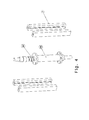
  • FIG. 4 shows the linear actuator of the load-bearing assemblies
  • FIG. 5 shows a clamp of one of the two load-bearing assembly parts
  • FIG. 6 shows the clamp of the other load-bearing assembly
  • FIG. 7 shows an actuator of a clamp
  • FIG. 8 shows the bearing elements of a load-bearing assembly
  • FIG. 9 shows a trolley that can be mounted on belts.
  • FIG. 1 shows an overview of the possible application of a climbing robot according to the invention and a maintenance dock according to the invention attached thereto in a wind turbine with a mast or tower 1 on which the climbing robot can step, which is to say climb up or down discontinuously, for example in order to perform maintenance work on a rotor blade 2 .
  • FIGS. 2 and 3 show the climbing robot 3 and the maintenance dock 4 in greater detail.
  • the climbing robot 3 comprises a first load-bearing assembly 5 and a second load-bearing assembly 6 .
  • the first load-bearing assembly 5 is subdivided into two load-bearing assembly parts 5 A and 5 B that are vertically spaced and connected by guide rails 7 on which the load-bearing assembly 6 can be moved up and down between the load-bearing assembly parts 5 A and 5 B by a linear actuator 8 .
  • This linear actuator 8 is shown in greater detail in FIG. 4 and comprises a spindle 8 A that can be rotated by a motor attached at both ends of the load-bearing assembly 5 .
  • the spindle bears a nut 8 B that is connected to the load-bearing assembly 6 .
  • the load-bearing assembly 6 is guided in or on the vertical rails 7 that connect the two load-bearing assembly parts of the load-bearing assembly 5 between their confronting edges.
  • the load-bearing assembly 5 comprises two clamps consisting of several components, with a clamp being arranged on the upper load-bearing assembly part 5 A and one being arranged on the lower load-bearing assembly part 5 B.
  • the load-bearing assembly 6 also has two clamps.
  • each clamp comprises a belt 9 .
  • Each belt can—as shown in FIG. 1 —engage around the outer periphery of a mast 1 and bears against same at least in the gripping position.
  • the ends of each belt 9 are guided through recesses and slide sleeves 10 therein into the interior of a load-bearing assembly 5 or 6 , and each end is wound onto or unwound from its own winding roller 11 .
  • a respective deflecting roller 27 shifts the belt 9 lengthwise between each sliding sleeve 10 and winding roller 11 .
  • the deflecting rollers are spaced more closely than the winding rollers.
  • each belt can bear against the circumference of a mast 1 over an angle ⁇ >300° as shown in FIG. 3 . This results in an especially large load transmission surface.
  • each of the load-bearing assemblies has bearing elements 12 shown in FIG. 8 and having surfaces 12 A that can bear radially inward against the surface of a mast or tower.
  • Prism-shaped bodies 12 B form the grip faces 12 A and can be pressed from the load-bearing assembly 5 or 6 toward the mast or pulled away from it by an actuator.
  • push rods 12 C can be used to which an actuator is coupled.
  • the movement of the climbing robot occurs such that one of the load-bearing assemblies 5 or 6 on the mast or tower 1 is locked by gripping the bearing elements against the mast through winding-up of the respective belts 9 , as a result of which the cross-sectional area defined within the belt 9 is reduced, thus firmly enclosing a mast.
  • the other load-bearing assembly is released by unwinding of the respective belt from the respective winding rollers 11 and retraction of the bearing elements 12 .
  • the linear actuator 8 then moves the released load-bearing assembly linearly vertically up or down relative to the fixed load-bearing assembly.
  • Linear actuators 13 that connect the belts 9 of different load-bearing assemblies are also extended or retracted synchronously to the width of motion of the load-bearing assemblies with respect to each other. As a result, the loose belts 9 are held against gravity in a horizontal position and moved along.
  • the linear actuators 13 are preferably only arranged in the cross-sectional halves facing away from the load-bearing assemblies 5 or 6 .
  • the moved load-bearing assembly is then clamped, and the previously clamped one is released and moved along in the same way.
  • FIG. 7 shows one possible mechanism of an actuator of the winding rollers 11 .
  • a motor 14 synchronously rotates two winding shafts 15 via a gear unit, or only one of the winding shafts 15 is coupled with the motor by a coupling 16 .
  • the winding shafts can have a locking mechanism 15 A that only permits rotation one direction of rotation, namely that which brings about a clamping of a belt 9 .
  • a locking element 15 B that blocks the reverse rotation of the shaft 15 is disengaged by an actuator (not shown here). In this way, it is ensured that an existing gripping position is not released in the event of a power outage.
  • FIG. 9 shows a trolley 17 that is mounted in multiple, equal design on the belt 9 , distributed over the periphery of the mast. Part of the belt 9 passes through a slotted retaining sleeve 18 . and the sleeve 18 and the belt 9 are attached to a bridge element 19 via a tension spring 20 with the element 19 bridging vertically over the belt 9 and bearing at ends via rollers on the surface of the mast or tower when a load-bearing assembly is moved with the released belt 9 .
  • the belt 9 When the belt 9 is released and the tension therein decreases, it is pulled off the mast surface by the tension spring 20 , so that the belt is moved further only by rolling. In contrast, if the tension is increased by winding up the belt with the winding rollers 11 , then the belt is pulled against the spring 20 onto the outer surface of the mast or tower and bears firmly against it with the spring 20 being maximally tensioned for the next retraction.
  • the maintenance dock shown in FIGS. 2 and 3 comprises two dock shells 21 A and 21 B whose openings face each other.
  • each dock shell is attached to two support beams 22 (here horizontal, for example) and can be moved in guide rails 23 in two mutually perpendicular directions.
  • the support beams are fastened on the outer corners of the load-bearing assembly parts 5 A and 5 B.
  • These load-bearing assemblies 5 A, 5 B, which are connected by guide rails 7 to a single load-bearing assembly 5 can thus form an assembly platform, for example, for the support beams of the maintenance dock that are shown here.
  • the height of the shells can be adjusted here with the climbing robot, with the spacing from the mast and spacing of the shells 21 A and 21 B from each other or from a rotor blade 2 being possible by moving the shells 21 A and 21 B in the rails 23 .
  • the shells 21 A and 21 B have vertically spaced cutouts 24 at the edges with which the cross section of a vertically hanging rotor blade can be enclosed when the shells are moved together.
  • the remaining residual cross section can optionally be closed by inflating a bladder in the edges of the recesses 24 .
  • Rails 25 are arranged inside the shells 21 A and 21 B with which a maintenance device 26 can be moved relative to the maintenance object, a rotor blade 2 in this case.
  • a measuring element that detects the movement of the dock shells can be provided, and the actuators can be controlled on the basis of its signal.

Landscapes

  • Engineering & Computer Science (AREA)
  • Architecture (AREA)
  • Mechanical Engineering (AREA)
  • Combustion & Propulsion (AREA)
  • Chemical & Material Sciences (AREA)
  • Structural Engineering (AREA)
  • Civil Engineering (AREA)
  • Sustainable Development (AREA)
  • Life Sciences & Earth Sciences (AREA)
  • Sustainable Energy (AREA)
  • General Engineering & Computer Science (AREA)
  • Transportation (AREA)
  • Wind Motors (AREA)

Abstract

A mast-climbing robot has first and load-bearing assemblies, at least one linear actuator connected between the assemblies for changing their vertical spacing, and a respective clamp on each load-bearing assembly that can secure the respective load-bearing assembly on the mast and release the respective load-bearing assembly therefrom. Each clamp has two bearing points on the respective load-bearing assembly, at least one flexible belt that extends between the two bearing or attachment points and circumferentially around the mast, and at least one clamping actuator with which the length of the at least one belt can be increased and decreased between the bearing or attachment points to tighten lock the respective belt about the mast and thereby lock the respective assembly on the mast.

Description

CROSS REFERENCE TO RELATED APPLICATIONS
This application is the US-national stage of PCT application PCT/EP2013/000270 filed 30 Jan. 2013 and claiming the priority of German patent application 102012001725.1 itself filed 31 Jan. 2012.
FIELD OF THE INVENTION
The invention relates to a mast-climbing robot, particularly for wind turbines, comprising at least one first load-bearing assembly and at least one second load-bearing assembly, where a vertical spacing between the load-bearing assemblies can be changed by at least one linear actuator and each load-bearing assembly comprises a respective clamp that can firmly grip the mast and slide on the mast.
The invention further relates to a mobile maintenance dock that can be fixed to a mast-climbing robot.
BACKGROUND OF THE INVENTION
A climbing robot of this generic type can be used, for example, in wind turbines in order to climb up and down the mast (also referred to as a tower), for example for maintenance-related purposes. According to the invention, however, the application is not limited to wind turbines and their masts. Rather, a climbing robot according to the invention can climb any mast, regardless of what is supported by the mast and what type of mast it is.
The maintenance dock, which will be described further below, can also be used in one possible application in order to perform maintenance on wind turbines, particularly on their rotor blades. Here as well, however, the application is not limited to wind turbines. Rather, any device, particularly any device supported by masts, can be maintained by a maintenance dock as described below.
Insofar as the application of the invention is described in the following with respect to a climbing robot and maintenance dock using the example of a wind turbine, this must not be understood as a limitation, but rather only as an example of one possible application among many possible ones.
Wind turbines have become an important component of our power supply. Like all other technologies (for example aviation, astronautics, automobile, etc.), wind-power technology is subject to certain regulations with respect to development, production, operation and maintenance.
Such regulations place special emphasis on safe operation and safe maintenance. Particularly noteworthy in this context are the periodic inspections of the rotor blades and of the wind towers (masts). The same or similar requirements also apply to other types of systems. To enable these inspections to be conducted, the industry needs certain systems that meet all of the requirements ranging from functional safety to the of maintenance as a complete solution.
The demand for economy and technology entails performing as many work steps as possible in a single operation at the site of operation in a cost-effective, fast, precise and safe manner. To this end, the tools required for this today have not been suitable for such on-site use. Our aim with this solution is to meet precisely these requirements with this climbing robot.
The requirement of the periodic inspection of the rotor blades is not limited merely to remedying visible damage, but rather to recognize, evaluate and remedy, as needed, all structural changes such as cracks or delamination under the (paint) surface as well so that safe operation can be ensured until the next inspection. In order to fulfill these requirements, work conditions must be created that enable the use of suitable testing and repair methods (NDT, ZFP etc.). In doing so, it is important to create work conditions on the wind turbines that enable the many work steps that are currently carried out in a repair workshop to be carried out on site in an expedient manner independently of the weather conditions.
Today, it is possible neither to perform Non-Destructive Testing (NDT) nor a rotor blade repair completely on the wind turbine. However, in order to deal with the cost pressure of the operators of wind turbines within an economically efficient range, it is essential to minimize down time. That can only be achieved with a comprehensive solution for inspection and repair on the wind turbines.
However, the periodically required inspection of rotor blades or of wind power towers per DIN EN 61400-23 (VDE 0127-23) requires a complete examination of the rotor for additional damage that may occur as a result of production or dynamic loading and oftentimes through operational vibration. Performing NDT on the rotor blade turns out to be quite difficult but, as described in the dissertation of Dr.-Dipl.-Geophys. Anne Jüngert, there are possibilities for performing NDT on the blade.
A climbing robot of the generic type cited at the outset is known, for example, from the publication DE 10 2005 053 782. The clamp is formed here by traverses that can be moved opposite each other and pressed with their clamping brackets or jaws at several places against the mast surface in order to generate adhesive forces between climbing robot and mast.
It must be viewed as a drawback here that the climbing robot can only be used in areas in which there are certain prescribed mast diameters and would otherwise have to have its dimensions reworked, and that the retaining forces are applied in this case with only four clamping brackets or jaws arranged around the periphery of a mast.
OBJECTS OF THE INVENTION
It is the object of the invention to provide a climbing robot that has a high degree of versatility, a high level of safety and stability and that can be used on a great number of different masts or towers.
It is also the object of the invention to provide a mobile maintenance dock in order to offer, in connection with the climbing robot according to the invention, as many work steps of maintenance as possible in one operation and, particularly, independently of the weather.
SUMMARY OF THE INVENTION
The object is achieved according to the invention with a climbing robot of the type described above in which, furthermore, at least part of the clamps, preferably every one of the clamps comprises at least one belt that extends between two bearing or attachment points arranged on the load-bearing assembly and can engage flexibly circumferentially around a mast or tower and comprises at least one clamping actuator with which the length of the at least one belt can be increased and decreased between bearing or attachment points.
In designing a climbing robot, it is essential that the retaining forces are not applied only in a “pointwise” manner with a few pairs of clamping brackets or jaws on the outer surface of a mast or of a tower, but rather that the forces are applied over a substantial portion of the entire periphery, which is achieved by circumferentially placing flexible belts, which is to say movable in a bendable or articulated manner, around the mast or tower. Accordingly, due to the flexibility, a belt of a clamp according to the invention bears against the outer surface of a mast or tower.
This also offers the advantage that a climbing robot according to the invention does not have to be adapted to the specific cross-sectional shape of the mast or tower, because such an adaptation occurs automatically in each individual case as a result of the flexibility of the belts. As a result, it is also easily possible to climb masts whose cross section changes along its extension, i.e. tapered, and whose diameter thus changes.
The cross section inherent to the mast or tower enclosed during climbing by a climbing robot according to the invention is conformed to by the respective belts and the load-bearing assemblies. The load-bearing assemblies are pulled into a gripping position against the mast or tower outer surface, and a belt continues to be engaged around the mast or tower starting from a hinging or attachment point on a load-bearing assembly and is guided again to the load-bearing assembly on a hinging or attachment point.
Accordingly, the majority of the cross section enclosed by the load-bearing assembly and belts is formed by the belt, so that the acting forces for retaining are applied by substantially larger surfaces to the mast or tower than in the prior art. Here, the acting surface is determined by the height of a belt and the length of the contact between belt and mast or tower surface, as well as the area on which a respective load-bearing assembly is bearing. The static friction is thus increased significantly compared to the prior art.
The clamping of a load-bearing assembly of the climbing robot can be achieved by shortening the length of one or more belts with a clamping actuator, particularly the effectively acting length of a belt between the hinging or attachment points, particularly so that, as a result, the inner surface of a respective belt facing toward the tower or mast is pulled against the outer surface of the tower or mast and comes into contact with same. Preferably, the required retaining forces are predominantly applied accordingly through direct contact between the belt and the outer surface.
In a load-bearing assembly in which the at least one clamping actuator lies outside of the load-bearing assembly, which is to say that it is not housed, for example, such an above-mentioned hinging or attachment point can be formed, for example, directly by an actuator or a portion thereof, for example by a winding roller, a guide roller, or the like.
In a preferred embodiment, at least one clamping actuator is provided inside the load-bearing assembly. The load-bearing assembly can thus constitute the housing of the at least one clamping actuator or comprise such a housing. Two ports are then provided where each belt enters or exits the load-bearing assembly. The respective belt extends through the ports into the interior of the load-bearing assembly and is tensioned or released or relieved in the interior by the at least one clamping actuator. With the at least one clamping actuator, the length of the belt lying outside of the load-bearing assembly can thus be increased or decreased. A hinge point can lie inside the load-bearing assembly behind such a port. The port can be formed by a sliding sleeve through which a belt can slide, optionally even in a contact-free manner.
The basic climbing function is achieved as follows: A load-bearing assembly is locked by the respective clamp to the mast or tower, particularly by reduction of the length of the at least one belt. The load-bearing assembly that is not clamped, which is to say the one that is loose with respect to the mast or tower, is moved by at least one linear actuator in the desired direction of movement, i.e., up or down. After this movement, the just-moved load-bearing assembly is clamped and the previously clamped load-bearing assembly is released. The load-bearing assembly that was just released can then be moved in the desired direction of movement by the respective linear actuator. This results in a kind of stepping actuator in which the load-bearing assemblies are alternatingly clamped, released and moved linearly.
The linear movement can be achieved by at least one linear actuator, with which the vertical spacing between the load-bearing assemblies, particularly a minimum and maximum position, can be changed. For example, such an actuator can be a threaded spindle that is rotated by a motor in one load-bearing assembly and the other load-bearing assembly is attached to a nut running on the spindle. Such a spindle can preferably be self-locking. The actuator can also be a hydraulic or pneumatic cylinder/piston assembly that is alternatingly pressurized and released. Rack and pinion actuators are also possible, as well as other actuator designs that linearly and vertically move the load-bearing assemblies.
In a simplest of embodiments, a belt of a load-bearing assembly is fixed at one end or region to the load-bearing assembly and the other end or another region is loosely attached, i.e., an actuator acts or engages on this loose end or to build up or release tension in it. This structurally simple design merely has the drawback that the climbing robot moves around the mast or tower during clamping and releasing. This could be compensated for over the sum of all clamping and releasing actions if the belts of the different load-bearing assemblies are fixed at different sides and the two load-bearing assemblies move around in opposite directions. Compensation could also be achieved if two belts are provided in the clamp on one load-bearing assembly that have their stationary and moveable ends on opposite sides.
In a particularly preferred embodiment, a belt has two belt regions or ends, particularly inside a load-bearing assembly, that are acted upon by a common actuator, particularly by a pulling or pushing or winding and unwinding of the belt. Here, each belt of a load-bearing assembly can have its own actuator or actuators; however, when there are several belts on a load-bearing assembly, all of the belts have one actuator or all of the belts have common actuators on their belt ends or parts lying on the same side.
In the above-mentioned embodiments, in which both belt regions or belt ends of a belt are driven, tension can be generated or released simultaneously at both ends. This prevents the climbing robot from moving around the mast or tower.
The climbing robot can also be made to move around intentionally, however, if only one region or end is actuated during a current clamping or releasing step, even though both regions or ends could be actuated in principle.
If the belt ends or regions are moved by a common actuator, this can be achieved, for example, with a switchable coupling with which it can be set using a control whether the common actuator acts on one or the other of the two belt regions or ends or on both simultaneously.
In contrast, if separate actuators are used for the belt ends or regions, only one of the actuators can be controlled in order to bring about movement around the mast; otherwise, both of the actuators operate synchronously.
The actuators can drive toothed wheels, for example, whose teeth engage in recesses of the belts in order to apply pulling or pushing forces, thus bringing about a clamping or releasing.
One structurally simple embodiment is achieved if at least one winding roller is actuated with the at least one clamping actuator, and the respective belt is wound onto it in order to produce tension or unwound in order to release it.
In one embodiment, when a belt has two actuated belt ends, both belt ends can be wound onto and off a common winding roller. A separate winding roller can also be provided for each belt end, particularly if the two winding rollers have a common clamping actuator or common clamping actuators, as mentioned previously.
In a preferred development, particularly of the embodiments with winding rollers, the belt is deflected lengthwise at a respective deflection point before the belt region or the belt end on which the at least one actuator is acting, particularly inside the load-bearing assembly. A guide roller can be used, for example, for this deflection.
This embodiment offers the advantage that a shorter spacing can be implemented between two guide rollers associated with the respective belt regions or ends, particularly a shorter spacing in the circumferential direction of the mast or tower, than between the winding rollers or other actuator elements for clamping or releasing.
The cross section enclosed by a belt between the deflection points is greater than 300°, preferably greater than 330°. This way, a belt can therefore rest against the periphery of a mast or tower over a greater length.
In order to achieve a secure and defined abutment of a respective load-bearing assembly on its side facing toward a mast or tower when clamped, each load-bearing assembly has at least two circumferentially spaced bearing elements by means of which it can be supported during a clamping action on the outer mast or tower surface. These bearing elements can, for example, have grip faces that can engage radially inward against the mast or tower surface, for example. The grip faces can also be curved, for example formed as a part-cylindrical surface.
In one development, each of the bearing elements can be moved radially inward against the mast or tower surface and out, particularly that all of them can be moved simultaneously. For this movement capability, the bearing elements can have at least one actuator, such as a common actuator, or they can also have separate actuators with which the bearing elements can be moved from a load-bearing assembly in the direction toward the mast or tower and retracted.
For example, when a load-bearing assembly is released from the tower or mast in order to move it with the at least one linear actuator in the vertical direction, it can be pulled away from the mast or tower surface before the movement with the at least one actuator of the bearing elements, so that a load-bearing assembly is disengaged from the mast or tower during its vertical movement. Before or during clamping, the bearing element can then be engaged on the surface of the mast or tower by movement toward it.
In a combination of the modified embodiments, the circumferential spacing of the bearing elements is greater than the spacing of the deflection points of the belt.
In a preferred development that can be combined with any of the preceding embodiments, two belts of different load-bearing assemblies can be connected by controllable linear actuators that can be changed in length, particularly on a side of a mast or tower facing away from the load-bearing assemblies. A belt of a currently unclamped load-bearing assembly can thus be secured against sliding downward on the mast or tower in the direction of gravity, since it is also fastened via the linear actuator that is changeable in length to a belt that is currently clamped and hence fixed on the mast or tower.
If the released load-bearing assembly shifts vertically by actuating the linear actuator connecting the load-bearing assemblies, then the linear actuators connecting the belt or belts of the other load-bearing assemblies can also be actuated simultaneously, so that they change in length synchronously with respect to each other and to the at least one linear actuator of the load-bearing assemblies, which is to say their lengths decrease or increase depending on the direction of movement. In this way, even the belt regions that are farthest removed from the load-bearing assemblies are supported against gravity and moved along in the direction of movement of the loose load-bearing assembly.
Moreover, at least one trolley or sliding carriage is mounted on the belt, particularly several dollies or sliding carriages be distributed over the periphery with which a belt can be lifted from the mast or tower surface upon release of the clamping. Such a lifting-off of a region of a belt in which such a carriage is arranged can be achieved, for example, by a constant force load that pulls the belt radially to the carriage when the clamping action of the belt is released. A released and lifted-off belt can then be moved more easily along the mast or tower, it being preferred that only the carriage rolls or slides on the mast or tower surface.
A trolley or sliding carriage can, for example, have an element that bridges over a belt in the vertical direction that can be or is engaged with both of its ends on a mast or tower surface by rollers or slide blocks arranged on the latter, with the side of the bridge element facing toward the mast or tower being connected to the belt by a tension spring. This connection can be produced, for example, by a sleeve to which the tension spring is attached and in which the belt is arranged.
The climbing function of a climbing robot according to the invention is already ensured if two load-bearing assemblies are arranged over one another in the vertical direction. A more stable arrangement can be achieved if the two load-bearing assemblies are arranged so as to be interlaced with each other.
This can be achieved, for example, by providing at least one of the two load-bearing assemblies with at least two parts vertically spaced with respect to each other and connected to each other, with each of the parts having at least one clamp, and with the other of the two load-bearing assemblies being arranged between two such parts completely or with at least one of several load-bearing assembly parts spaced apart from each other in the vertical direction and connected to each other.
For example, two load-bearing assembly parts of one of the load-bearing assemblies can be connected to each other by vertical rails on which the other load-bearing assembly or one of several load-bearing assembly parts of the other load-bearing assembly is guided.
The belt that can be used here can be embodied, for example, as a link belt with several belt members that are connected to each other so as to swivel about a vertical axis, or, for example, also as a chain or as a flat belt made of a metal or fiber plastic composite or, especially preferably, as a textile band, particularly a belt.
A textile belt offers the advantage that, as a result of the weaving of the individual belt fibers, flexibility is achieved not only in the circumferential direction, but also in the vertical direction. Such a textile belt can therefore lie especially well against masts or towers that have a conical shape in the vertical direction, since another circumferential length contacting the mast or tower can adapt without difficulty to a textile belt around the lower circumferential region, i.e. on the upper region. A textile belt therefore adapts without difficulty to taper. This is especially advantageous in wind turbines, which usually have frustoconically tapered towers.
Furthermore, the object of the invention described above is also achieved by a mobile maintenance dock with at least one support beam that can be attached to a mast-climbing robots, particularly to a climbing robot of the previously described type, and with at least one dock shell that is attached to the at least one support beam such that it can be moved in at least one, particularly in at least two, preferably mutually perpendicular directions.
Such a maintenance dock can be fastened with the at least one beam to a climbing robot and raised, thus enabling maintenance work to be performed in the dock that could otherwise only be performed in a stationary workshop. The at least one dock shell provides protection from wind and weather.
In wind turbines, for example, the at least one dock shell can, due to its movability, be moved toward a rotor blade. For example, the dock shell can be dimensioned such that the surface of the rotor blade closes the dock shell. This is facilitated especially well if the at least one dock shell is attached to the at least one support beam so as to be moveable in three mutually perpendicular directions.
The at least one dock shell can preferably be modified such that it is cut away at two ends vertically spaced from each other. A vertically hanging wind turbine rotor blade can be received especially well in these cutouts; after which the dock shell is moved toward the rotor blade. Such cutouts can be adapted in its contour, when viewed from above or below, to the aerodynamic profile of a rotor blade.
Independently of the above-described embodiment, but also combinable with it, at least one seal element can be arranged at the ends of the cutout that can rest in a sealing manner against the contour of a maintenance object, such as a wind turbine rotor blade. To facilitate this, the at least one seal element can, for example, be slidably mounted, for example on telescoping actuators. The seal element can thus be pushed against the contour. The seal element can be pumped up. For example, it can be for this purpose a hollow member that can be pumped up with a fluid, particularly a hose element. As a result of being pumped up, it can adapt positively to a wind turbine rotor blade contour or also to the contour of another maintenance object and seal the dock from the influence of weather and wind. Provision can also be made to combine mobility and inflatability.
One preferred embodiment of the mobile maintenance dock, which can be combined with all of the previously mentioned embodiments, is that it has two dock shells, particularly identically shaped dock shells, that have openings that face each other horizontally, with at least one of the dock shells, preferably both dock shells, being fastened to at least one support beam so as to be moveable in at least two directions.
The two docks can thus complement each other to form a complete dock when moved together, thus enclosing a maintenance object that passes through them, for example, in the case of a wind turbine rotor blade. In such an embodiment, the opening of a dock shell can also be larger than a wind turbine rotor blade, since the dock shell need not absolutely be closed already by the rotor blade, but rather this weather-tight closing can also be achieved later by the second dock shell. Here, too, the recesses in both dock shells and hence the cross section remaining between the dock shells and the enclosed rotor can be closed by inflatable hollow elements.
In at least one of the dock shells, a robot arm moveable on multiple axes can be provided in order to perform maintenance work or inspections. Such a robot arm can be moved along the surface of the maintenance object, particularly of a wind turbine rotor blade, by a rail system that is located on the inner periphery of the at least one dock shell. Rail systems that are inside both dock shells can be coupled to each other by moving the shells together, so that a robot arm or also another maintenance device guided on the rail system can be moved from one dock shell to the other.
BRIEF DESCRIPTION OF THE DRAWING
Embodiments of the invention are described below with reference to the drawing in which:
FIG. 1 shows a wind turbine with a climbing robot according to the invention and a mobile maintenance dock according to the invention attached thereto;
FIG. 2 is a top view of the climbing robot with maintenance dock;
FIG. 3 has several views of the climbing robot with maintenance dock;
FIG. 4 shows the linear actuator of the load-bearing assemblies;
FIG. 5 shows a clamp of one of the two load-bearing assembly parts;
FIG. 6 shows the clamp of the other load-bearing assembly;
FIG. 7 shows an actuator of a clamp;
FIG. 8 shows the bearing elements of a load-bearing assembly; and
FIG. 9 shows a trolley that can be mounted on belts.
SPECIFIC DESCRIPTION OF THE INVENTION
FIG. 1 shows an overview of the possible application of a climbing robot according to the invention and a maintenance dock according to the invention attached thereto in a wind turbine with a mast or tower 1 on which the climbing robot can step, which is to say climb up or down discontinuously, for example in order to perform maintenance work on a rotor blade 2.
FIGS. 2 and 3 show the climbing robot 3 and the maintenance dock 4 in greater detail.
The climbing robot 3 comprises a first load-bearing assembly 5 and a second load-bearing assembly 6. The first load-bearing assembly 5 is subdivided into two load- bearing assembly parts 5A and 5B that are vertically spaced and connected by guide rails 7 on which the load-bearing assembly 6 can be moved up and down between the load- bearing assembly parts 5A and 5B by a linear actuator 8. This linear actuator 8 is shown in greater detail in FIG. 4 and comprises a spindle 8A that can be rotated by a motor attached at both ends of the load-bearing assembly 5. The spindle bears a nut 8B that is connected to the load-bearing assembly 6. Motorized rotation of the spindle shifts the nut and load-bearing assembly 6 between two end positions. The load-bearing assembly 6 is guided in or on the vertical rails 7 that connect the two load-bearing assembly parts of the load-bearing assembly 5 between their confronting edges.
The load-bearing assembly 5 comprises two clamps consisting of several components, with a clamp being arranged on the upper load-bearing assembly part 5A and one being arranged on the lower load-bearing assembly part 5B. The load-bearing assembly 6 also has two clamps.
According to FIGS. 5 and 6, each clamp comprises a belt 9. Each belt can—as shown in FIG. 1—engage around the outer periphery of a mast 1 and bears against same at least in the gripping position. In order to tension or release tension, the ends of each belt 9 are guided through recesses and slide sleeves 10 therein into the interior of a load-bearing assembly 5 or 6, and each end is wound onto or unwound from its own winding roller 11.
A respective deflecting roller 27 shifts the belt 9 lengthwise between each sliding sleeve 10 and winding roller 11. The deflecting rollers are spaced more closely than the winding rollers. Despite the large winding rollers 11 and the components required to actuate them, each belt can bear against the circumference of a mast 1 over an angle α>300° as shown in FIG. 3. This results in an especially large load transmission surface.
For their part, each of the load-bearing assemblies has bearing elements 12 shown in FIG. 8 and having surfaces 12A that can bear radially inward against the surface of a mast or tower. Prism-shaped bodies 12B form the grip faces 12A and can be pressed from the load-bearing assembly 5 or 6 toward the mast or pulled away from it by an actuator. For this purpose, push rods 12C can be used to which an actuator is coupled.
The movement of the climbing robot occurs such that one of the load-bearing assemblies 5 or 6 on the mast or tower 1 is locked by gripping the bearing elements against the mast through winding-up of the respective belts 9, as a result of which the cross-sectional area defined within the belt 9 is reduced, thus firmly enclosing a mast. After clamping, the other load-bearing assembly is released by unwinding of the respective belt from the respective winding rollers 11 and retraction of the bearing elements 12.
The linear actuator 8 then moves the released load-bearing assembly linearly vertically up or down relative to the fixed load-bearing assembly. Linear actuators 13 that connect the belts 9 of different load-bearing assemblies are also extended or retracted synchronously to the width of motion of the load-bearing assemblies with respect to each other. As a result, the loose belts 9 are held against gravity in a horizontal position and moved along. The linear actuators 13 are preferably only arranged in the cross-sectional halves facing away from the load-bearing assemblies 5 or 6.
The moved load-bearing assembly is then clamped, and the previously clamped one is released and moved along in the same way.
FIG. 7 shows one possible mechanism of an actuator of the winding rollers 11. A motor 14 synchronously rotates two winding shafts 15 via a gear unit, or only one of the winding shafts 15 is coupled with the motor by a coupling 16. The winding shafts can have a locking mechanism 15A that only permits rotation one direction of rotation, namely that which brings about a clamping of a belt 9. To release it, a locking element 15B that blocks the reverse rotation of the shaft 15 is disengaged by an actuator (not shown here). In this way, it is ensured that an existing gripping position is not released in the event of a power outage.
FIG. 9 shows a trolley 17 that is mounted in multiple, equal design on the belt 9, distributed over the periphery of the mast. Part of the belt 9 passes through a slotted retaining sleeve 18. and the sleeve 18 and the belt 9 are attached to a bridge element 19 via a tension spring 20 with the element 19 bridging vertically over the belt 9 and bearing at ends via rollers on the surface of the mast or tower when a load-bearing assembly is moved with the released belt 9.
When the belt 9 is released and the tension therein decreases, it is pulled off the mast surface by the tension spring 20, so that the belt is moved further only by rolling. In contrast, if the tension is increased by winding up the belt with the winding rollers 11, then the belt is pulled against the spring 20 onto the outer surface of the mast or tower and bears firmly against it with the spring 20 being maximally tensioned for the next retraction.
The maintenance dock shown in FIGS. 2 and 3 comprises two dock shells 21A and 21B whose openings face each other. In this embodiment, each dock shell is attached to two support beams 22 (here horizontal, for example) and can be moved in guide rails 23 in two mutually perpendicular directions. The support beams are fastened on the outer corners of the load- bearing assembly parts 5A and 5B. These load- bearing assemblies 5A, 5B, which are connected by guide rails 7 to a single load-bearing assembly 5, can thus form an assembly platform, for example, for the support beams of the maintenance dock that are shown here.
The height of the shells can be adjusted here with the climbing robot, with the spacing from the mast and spacing of the shells 21A and 21B from each other or from a rotor blade 2 being possible by moving the shells 21A and 21B in the rails 23.
The shells 21A and 21B have vertically spaced cutouts 24 at the edges with which the cross section of a vertically hanging rotor blade can be enclosed when the shells are moved together. The remaining residual cross section can optionally be closed by inflating a bladder in the edges of the recesses 24.
Rails 25 are arranged inside the shells 21A and 21B with which a maintenance device 26 can be moved relative to the maintenance object, a rotor blade 2 in this case.
Provision can be made that, using the actuators with which the shells can be moved in the rails 23, the position of the dock shells is automatically stabilized, for example in order to compensate for rotor movements under a wind load. For this purpose, a measuring element that detects the movement of the dock shells can be provided, and the actuators can be controlled on the basis of its signal.

Claims (21)

The invention claimed is:
1. A mast-climbing robot comprising:
a first load-bearing assembly;
a second load-bearing assembly;
a linear actuator connected between the assemblies for changing a vertical spacing of the first and second load-bearing assemblies with respect to each other; and
a respective clamp on each load-bearing assembly that can secure the respective load-bearing assembly on the mast and release the respective load-bearing assembly therefrom, each of the clamps having
two bearing points on the respective load-bearing assembly,
a flexible belt between the respective two bearing points and circumferentially around the mast, and
a clamping actuator with which the length of the respective belt can be increased and decreased between the respective bearing points to tighten the respective belt about the mast and thereby lock the respective assembly on the mast.
2. The climbing robot defined in claim 1, wherein retaining forces are applied by each clamp to the mast by an acting surface of the respective belt determined by a height of the respective belt and a length of contact between the respective belt and the mast and by an area of surface with which the belt of the respective load-bearing assembly bears against the mast.
3. The climbing robot defined claim 1, wherein the clamping actuator is inside the respective load-bearing assembly and the respective belt extends through ports of the respective load-bearing assembly so as to increase or decrease the length of the respective belt outside the load-bearing assembly with the clamping actuator that is inside the assembly.
4. The climbing robot defined claim 3, wherein each belt has inside the respective load-bearing assembly two belt ends upon both of which the respective actuator acts by pulling or pushing or winding up the respective belt.
5. The climbing robot defined in claim 4, wherein each clamp has two of the actuators that on a respective one of the two belt ends or only one of the actuators that acts on both belt ends simultaneously through a switchable coupling.
6. The climbing robot defined in claim 4, wherein the belts are each deflected before the respective belt ends pass over a respective deflection point inside the respective load-bearing assembly.
7. The climbing robot defined in claim 6, wherein the mast is wrapped by each of the belts between the deflection points over more than 300°.
8. The climbing robot defined claim 1, wherein each load-bearing assembly has, on its side facing toward the mast, two bearing elements spaced apart angularly of the mast and that support the respective load-bearing assembly on an outer mast surface when secured by the respective clamp to the mast.
9. The climbing robot defined in claim 8, wherein the bearing elements of each assembly are movable in the respective load-bearing assembly toward and away from the mast surface simultaneously.
10. The climbing robot defined claim 1 wherein at least one of the belts is:
a link belt with several belt members connected to each other so as to swivel about a vertical axis, or
a flat belt made of a metal or fiber plastic composite, or
a textile belt.
11. The climbing robot defined claim 1, further comprising:
another linear actuator of controllable variable length connected between the belts of the load-bearing assemblies on a side of a mast facing away from the load-bearing assemblies.
12. The climbing robot defined in claim 1, further comprising:
a plurality of trolleys or sliding carriages distributed along each belt and serving to lift the respective belt from a mast surface when the respective belt is not tensioned by the respective actuator.
13. The climbing robot defined in claim 12, wherein each trolley or sliding carriage has an element that bridges over the respective belt vertically and that has ends that can be or are engaged on a mast surface by rollers or slide blocks, with a side of the bridge element facing toward the mast being connected to the respective belt by a tension spring via a sleeve to which the tension spring is attached and through which the respective belt passes.
14. The climbing robot defined claim 1, wherein one of the load-bearing assemblies has two parts that are vertically spaced from each other, connected to each other, and that each have at least one of the respective clamps, the other of the two load-bearing assemblies being completely between the two parts.
15. The climbing robot defined in claim 14, further comprising:
vertical rails connecting the two parts of the one load-bearing assembly to each other and on which the other load-bearing assembly is guided.
16. In combination with the climbing robot defined in claim 1, a mobile maintenance dock having:
a support beam attached to at least one of the assemblies of the mast-climbing robot and
a first dock shell attached to the support beam and movable thereon in at least two mutually perpendicular directions.
17. The maintenance dock defined in claim 16, wherein the first dock shell has two cut-back ends vertically spaced from each other for receiving a vertically hanging wind turbine rotor blade.
18. The maintenance dock defined in claim 17, further comprising:
seal elements that can be moved or inflated with a fluid in the cut-back ends and that can fit snugly to the contour of a maintenance object when moved or inflated.
19. The maintenance dock defined in claim 16, wherein the maintenance dock further including a second dock shell, said first and second dock shells are identically shaped dock shells and having openings that face each other horizontally, at least one of the two dock shells being fastened to the support beam so as to be moveable in at least two directions.
20. The maintenance dock defined in claim 16, further comprising:
a maintenance device movable on multiple axes in the dock shell.
21. The maintenance dock defined in claim 20, wherein the maintenance device can be moved along a surface of a maintenance object by a rail system located on an inner periphery of the dock shell.
US14/374,944 2012-01-31 2013-01-30 Climbing robot for masts Expired - Fee Related US9327784B2 (en)

Applications Claiming Priority (4)

Application Number Priority Date Filing Date Title
DE102012001725.1 2012-01-31
DE102012001725A DE102012001725A1 (en) 2012-01-31 2012-01-31 Climbing robot for masts
DE102012001725 2012-01-31
PCT/EP2013/000270 WO2013113494A2 (en) 2012-01-31 2013-01-30 Climbing robot for masts

Publications (2)

Publication Number Publication Date
US20150090504A1 US20150090504A1 (en) 2015-04-02
US9327784B2 true US9327784B2 (en) 2016-05-03

Family

ID=47740890

Family Applications (1)

Application Number Title Priority Date Filing Date
US14/374,944 Expired - Fee Related US9327784B2 (en) 2012-01-31 2013-01-30 Climbing robot for masts

Country Status (5)

Country Link
US (1) US9327784B2 (en)
EP (2) EP2809946B1 (en)
DE (1) DE102012001725A1 (en)
ES (1) ES2672493T3 (en)
WO (1) WO2013113494A2 (en)

Cited By (8)

* Cited by examiner, † Cited by third party
Publication number Priority date Publication date Assignee Title
CN106948593A (en) * 2017-02-28 2017-07-14 深圳市特辰科技股份有限公司 A kind of wheeled robot climbing frame
US20180009102A1 (en) * 2016-07-08 2018-01-11 ETAK Systems, LLC Mechanical tower climber for operations on cell towers
US20180274332A1 (en) * 2015-09-25 2018-09-27 Subsea 7 Limited Moving Tools on Offshore Structures with a Walking Carriage
CN109331431A (en) * 2018-09-21 2019-02-15 合肥尚伍信息科技有限公司 A kind of automatic climbing device for stablizing transport of climbing for vertical bar
CN109591906A (en) * 2019-01-28 2019-04-09 山东建筑大学 A kind of transmission tower climbing robot control system and control method
US20190134824A1 (en) * 2017-09-21 2019-05-09 Infrastructure Preservation Corporation Robotic repair system for high mast light poles
US11117267B2 (en) 2019-08-16 2021-09-14 Google Llc Robotic apparatus for operating on fixed frames
US11808250B2 (en) * 2016-09-23 2023-11-07 Leunamme Engineering S.L.U. Method and equipment for replacing wind turbine components

Families Citing this family (85)

* Cited by examiner, † Cited by third party
Publication number Priority date Publication date Assignee Title
CN103663309B (en) * 2013-11-12 2016-02-17 东莞市骏兴机械科技有限公司 The electrical servo gripping mobile system of roll weight
CN103603774B (en) * 2013-11-18 2016-03-16 长春理工大学 A kind of wind-powered electricity generation is from hoisting system
CN103692436B (en) * 2013-12-20 2016-05-04 马鞍山市力翔机械自动化科技有限公司 Climb cable robot
CN103644084B (en) * 2013-12-23 2017-01-25 长春理工大学 Phased-lifting method
ES2540790B1 (en) * 2014-01-11 2016-04-20 Cástor CASAS TOJO Self-adjusting and self-adjusting crane system for wind turbines
US10384804B2 (en) * 2015-04-14 2019-08-20 ETAK Systems, LLC Cell tower installation and maintenance systems and methods using robotic devices
CN105059415A (en) * 2015-08-06 2015-11-18 中国林业科学研究院林业新技术研究所 Climbing robot
CN105126316B (en) * 2015-09-20 2017-05-31 衢州妙凯节能科技有限公司 A telescopic pipe climbing machine
CN105253213A (en) * 2015-10-27 2016-01-20 昆明理工大学 Pole-climbing robot
CN105345806B (en) * 2015-12-07 2017-10-27 中国石油大学(北京) Autonomous lifting supervisory-controlled robot
JP6154921B1 (en) * 2016-01-15 2017-06-28 日綜産業株式会社 Gondola for blade maintenance in wind power generators
CN105947008B (en) * 2016-05-13 2018-02-16 陈奕冰 A kind of robot capable of climbing trees
CN106112993B (en) * 2016-08-22 2018-02-06 常州信息职业技术学院 A kind of alternative expression climbing level robot
CN106347516B (en) * 2016-11-01 2024-03-26 新疆大学 Design of pneumatic pole-climbing robot carrying platform
CN108340364B (en) * 2017-01-24 2020-09-15 南京原觉信息科技有限公司 Crawling machine device and deployment method thereof
CN107031747B (en) * 2017-03-28 2019-01-29 东南大学 A kind of variable diameters climbing level robot
WO2018184741A1 (en) * 2017-04-05 2018-10-11 Siemens Wind Power A/S Parking assembly
WO2018204490A1 (en) * 2017-05-02 2018-11-08 Infrastructure Preservation Corporation Robotic inspection system for high mast light poles
CN107472392B (en) * 2017-07-07 2023-04-07 武汉科技大学 Wheel type obstacle-crossing pole-climbing robot
CN107640242B (en) * 2017-09-21 2023-10-27 山东建筑大学 Rotating cargo platform and climbing robot with opening and closing structure
CN107877426A (en) * 2017-12-14 2018-04-06 广东电网有限责任公司惠州供电局 A kind of shaft tower tilts the fixture of monitoring sensor special
CN108252211B (en) * 2017-12-23 2024-03-26 香港中文大学(深圳) Climbing type detection robot
CN108644073B (en) * 2018-03-24 2020-03-13 北京工业大学 Cleaning robot for tower of wind driven generator
CN108516025A (en) * 2018-03-28 2018-09-11 李清花 A kind of automatic climbing pole device
CN109455241B (en) * 2018-04-09 2020-09-29 国家电网公司 An indexing rod climbing mechanism
CN108725621A (en) * 2018-06-14 2018-11-02 广东珺桦能源科技有限公司 A kind of climbing mechanism for the robot that chops at a tree
CN108555940B (en) * 2018-07-04 2020-07-07 南京原觉信息科技有限公司 Crawling robot and pole-climbing structure thereof
CN108891499B (en) * 2018-07-27 2023-10-20 贵州电网有限责任公司 Clamping device for pole climbing robot
CN108749945B (en) * 2018-07-27 2023-10-20 贵州电网有限责任公司 Multifunctional pole climbing robot
CN109484505A (en) * 2018-11-21 2019-03-19 杨聪智 Climb unit and climbing device
CN109895114B (en) * 2019-03-12 2024-02-27 广东机电职业技术学院 Pneumatic muscle driven climbing robot with polygonal structure
CN109819798B (en) * 2019-03-15 2021-03-30 广西大学 Eucalyptus pruning machine for increasing climbing force by utilizing self gravity
CN110227241A (en) * 2019-04-28 2019-09-13 王清国 A kind of electric power facility maintenance electric pole climbing tool
CN110255430B (en) * 2019-06-20 2023-11-03 深圳市翠箓科技绿化工程有限公司 Guide rail climbing robot
CN110254545B (en) * 2019-06-25 2024-07-23 北京史河科技有限公司 Wall climbing robot
CN112524401B (en) * 2019-08-29 2024-04-30 临颍县爬杆机器人有限公司 Tightening type carrying platform
CN112441153A (en) * 2019-08-29 2021-03-05 临颍县爬杆机器人有限公司 Pole-climbing robot
ES3014258T3 (en) * 2019-09-05 2025-04-21 Pp Energy Aps Blade access arrangement for a rotor blade of a wind power plant
CN110952443B (en) * 2019-11-21 2024-07-02 深圳市人工智能与机器人研究院 A split cable climbing detection robot
CN110757319A (en) * 2019-11-25 2020-02-07 沈阳工业大学 Column paint automatic cleaning and grinding machine with crawling function
CN111113441B (en) * 2019-12-13 2023-02-03 国网浙江嘉善县供电有限公司 Live working robot mobile device
CN110893977B (en) * 2019-12-16 2021-06-04 华能山东发电有限公司众泰电厂 Accessory conveyer is used in power generation equipment installation
CN111173692A (en) * 2019-12-31 2020-05-19 上海扩博智能技术有限公司 A maintenance instrument carry device for fan blade
CN111232080B (en) * 2020-03-12 2021-01-12 国网安徽省电力有限公司电力科学研究院 An embracing pole-climbing robot
CN111330895B (en) * 2020-04-07 2024-08-02 机械科学研究总院海西(福建)分院有限公司 Automatic cleaning device for highway reflecting plate
CN111661189B (en) * 2020-06-10 2021-08-13 邯郸职业技术学院 Pipeline crawling robot
CN111688837B (en) * 2020-06-19 2021-11-23 重庆大学 High-speed climbing robot based on active clamping device
CN111957017A (en) * 2020-08-28 2020-11-20 陈克俊 Automatic pole-climbing device for installing cross arm
CN111976858B (en) * 2020-08-31 2022-04-15 国家电网有限公司 Auxiliary climbing robot for electric power emergency
CN112278107B (en) * 2020-10-13 2025-04-04 国网安徽省电力有限公司 A gripper for a climbing robot
CN112356940B (en) * 2020-10-13 2023-01-06 国网安徽省电力有限公司 Climbing robot for angle steel tower
CN112290448B (en) * 2020-10-16 2021-12-03 重庆浪尖智能科技研究院有限公司 Climbing method of climbing robot
EP3995693A1 (en) 2020-11-10 2022-05-11 PP Energy ApS Temporary enclosure for at least a part of a rotor blade
CN112536798B (en) * 2020-12-01 2022-09-20 黑龙江大学 A high-voltage power transmission main tower crawling robot
CN112722102A (en) * 2020-12-03 2021-04-30 中国电力科学研究院有限公司 Encircling foot for power transmission line iron tower body climbing robot
CN112828499B (en) * 2020-12-30 2023-03-14 北京博清科技有限公司 Welding device, control method thereof, control device, processor and welding system
CN112855475B (en) * 2021-01-12 2021-11-26 哈尔滨理工大学 Device capable of automatically replacing main shaft bearing of wind driven generator
CN113428252B (en) * 2021-08-17 2022-07-12 深圳市人工智能与机器人研究院 Cable climbing robot
CN113685698B (en) * 2021-09-26 2022-10-11 七腾机器人有限公司 Synchronous belt pipeline crawling robot and circumferential rotation method
CN113877161B (en) * 2021-10-15 2024-09-17 国网江苏省电力有限公司东海县供电分公司 Gravity self-locking pole load-climbing robot
WO2023100122A1 (en) * 2021-12-01 2023-06-08 Aerones Engineering, Sia Wind-turbine maintenance device
CN114313045B (en) * 2021-12-23 2023-12-26 中国科学院宁波材料技术与工程研究所 Pole climbing robot
CN113984806B (en) * 2021-12-29 2022-03-08 山东东研智能科技有限公司 Radial detection auxiliary device for circumferential welded joint of pressure pipeline
PL4215747T3 (en) 2022-01-24 2025-05-19 Pp Energy Aps WIND TURBINE BLADE MAINTENANCE PLATFORM
CN114670946B (en) * 2022-04-11 2023-07-25 南京邮电大学 Travelling mechanism for climbing robot
CN117087782A (en) * 2022-05-13 2023-11-21 香港物流机械人研究中心有限公司 A pole-climbing robot based on chain transmission
NL2032171B1 (en) * 2022-06-15 2023-12-21 Ampelmann Holding B V A support structure, a wind turbine blade, a wind turbine and a method
CN115180038B (en) * 2022-06-24 2023-08-22 永康市光明送变电工程有限公司 A Robotic Way to Climb Lightning Rods
CN115234761A (en) * 2022-06-27 2022-10-25 河南高建工程管理有限公司 Bridge structure disease detection device and detection method thereof
CN114803966B (en) * 2022-06-30 2022-11-11 山西省安装集团股份有限公司 Tower cylinder climbing device for wind driven generator
CN115324848B (en) * 2022-08-23 2025-07-22 华能广西清洁能源有限公司 Belt type wind driven generator tower outer wall cleaning device
CN115817518B (en) * 2022-12-15 2023-07-14 天津大学 Multidimensional safety control device and method for wind power tower crawling device
CN116692731A (en) * 2023-02-14 2023-09-05 杭州夸克电力科技有限公司 Multifunctional detection equipment and detection method for pole-mounted circuit breaker
CN116135691B (en) * 2023-04-18 2023-06-30 广东智能无人系统研究院(南沙) Dual-mode underwater structure cleaning and detecting robot
CN116424451A (en) * 2023-04-20 2023-07-14 河海大学 A pole-climbing detection robot
CN116972275A (en) * 2023-07-14 2023-10-31 哈尔滨工业大学 A magnetic sensor driving device for parallel opening and closing obstacles with strong opening function
CN116876339B (en) * 2023-07-31 2025-11-25 安徽省公路桥梁工程有限公司 Bridge bearing maintenance devices and their construction technology in urban rail transit engineering
WO2025061245A1 (en) * 2023-09-20 2025-03-27 Vestas Wind Systems A/S Methods for using wind turbine rotor or blade maintenance tools and rotor or blade tools therefor
CN117404528B (en) * 2023-12-14 2024-03-29 临汾淼森能源工程有限公司 Pipeline fixing device for heat supply engineering construction
CN118208031B (en) * 2024-05-21 2024-08-09 融亿建工集团有限公司 Mounting device of chimney colored drawing hanging basket
CN119042088A (en) * 2024-08-13 2024-11-29 南通理工学院 Encircling constraint system for climbing variable-diameter tower drum of wind power generator
CN119459914B (en) * 2024-10-09 2025-09-26 国网河南省电力公司商丘供电公司 Power grid pole-climbing operation robot
CN119636939B (en) * 2024-12-12 2025-10-28 重庆邮电大学 Scalable flexible body climbing device
CN120099874A (en) * 2025-05-08 2025-06-06 交通运输部公路科学研究所 A variable diameter pier climbing robot and working method
CN120922264B (en) * 2025-10-14 2026-02-10 山东元开电气有限公司 A smart pole climbing spraying robot and method

Citations (13)

* Cited by examiner, † Cited by third party
Publication number Priority date Publication date Assignee Title
US350289A (en) 1886-10-05 Thirds to thomas andrew porter
US2906365A (en) 1957-01-11 1959-09-29 Arthur R Howard Automatic scaffolding machine
US3586127A (en) 1968-02-03 1971-06-22 Robert H Jones Stack-climbing systems
US4893512A (en) * 1987-06-12 1990-01-16 Doryokuro Kakunenryo Kaihatsu Jigyodan Swinging-type automatic examination apparatus for piping
DE19909698A1 (en) 1998-09-22 2000-04-13 Siebert Antonius J Device for carrying out repairs and services, in particular on rotor blades of wind turbines
DE102005016931B3 (en) 2004-12-17 2006-05-11 Carsten Paulsen Cleaning system for cleaning and/or conserving surface of e.g. tower of wind power plant, has liquid pipeline to supply liquid to scratch tape, and vertically movable drive unit including clamping units for tape and pipeline
DE102005053782A1 (en) 2004-11-09 2006-06-22 Ebf Dresden Gmbh Forschung, Entwicklung, Erprobung Self-climbing structure, for inspection and maintenance and repair at smooth masts, has a platform frame and a climbing frame with alternating movements between them to climb up the mast
US20110031066A1 (en) 2009-08-04 2011-02-10 General Electric Company Tower climbing and servicing device
US20110100734A1 (en) * 2008-03-28 2011-05-05 Thales Robot for Climbing Posts
US20120103705A1 (en) * 2010-09-30 2012-05-03 Schlee Keith L Multi-unit mobile robot
US8201787B2 (en) 2005-01-19 2012-06-19 Iti Scotland Limited Clamp, self-advancing climbing device, and method of coupling same to a tubular
US20130140801A1 (en) * 2011-12-02 2013-06-06 Helical Robotics, Llc Mobile robot
US8944192B2 (en) * 2010-04-20 2015-02-03 Savannah River Nuclear Solutions, Llc Robotic platform for traveling on vertical piping network

Family Cites Families (4)

* Cited by examiner, † Cited by third party
Publication number Priority date Publication date Assignee Title
DE29819391U1 (en) * 1998-09-22 1999-02-11 Robl, Klaus A., 59505 Bad Sassendorf Device for carrying out repairs and services, in particular on rotor blades of wind turbines
DE10118906B4 (en) * 2001-05-25 2009-04-09 Müller, Holger Apparatus and method for coating rotor blades of wind turbines
DE102010011365B4 (en) * 2010-03-12 2016-01-21 Andre Dochow Weather protection for work platforms on propeller blades of wind turbines
US8641374B2 (en) * 2010-06-30 2014-02-04 Vestas Wind Systems A/S Cleaning and inspecting apparatus for wind turbine and related methods

Patent Citations (13)

* Cited by examiner, † Cited by third party
Publication number Priority date Publication date Assignee Title
US350289A (en) 1886-10-05 Thirds to thomas andrew porter
US2906365A (en) 1957-01-11 1959-09-29 Arthur R Howard Automatic scaffolding machine
US3586127A (en) 1968-02-03 1971-06-22 Robert H Jones Stack-climbing systems
US4893512A (en) * 1987-06-12 1990-01-16 Doryokuro Kakunenryo Kaihatsu Jigyodan Swinging-type automatic examination apparatus for piping
DE19909698A1 (en) 1998-09-22 2000-04-13 Siebert Antonius J Device for carrying out repairs and services, in particular on rotor blades of wind turbines
DE102005053782A1 (en) 2004-11-09 2006-06-22 Ebf Dresden Gmbh Forschung, Entwicklung, Erprobung Self-climbing structure, for inspection and maintenance and repair at smooth masts, has a platform frame and a climbing frame with alternating movements between them to climb up the mast
DE102005016931B3 (en) 2004-12-17 2006-05-11 Carsten Paulsen Cleaning system for cleaning and/or conserving surface of e.g. tower of wind power plant, has liquid pipeline to supply liquid to scratch tape, and vertically movable drive unit including clamping units for tape and pipeline
US8201787B2 (en) 2005-01-19 2012-06-19 Iti Scotland Limited Clamp, self-advancing climbing device, and method of coupling same to a tubular
US20110100734A1 (en) * 2008-03-28 2011-05-05 Thales Robot for Climbing Posts
US20110031066A1 (en) 2009-08-04 2011-02-10 General Electric Company Tower climbing and servicing device
US8944192B2 (en) * 2010-04-20 2015-02-03 Savannah River Nuclear Solutions, Llc Robotic platform for traveling on vertical piping network
US20120103705A1 (en) * 2010-09-30 2012-05-03 Schlee Keith L Multi-unit mobile robot
US20130140801A1 (en) * 2011-12-02 2013-06-06 Helical Robotics, Llc Mobile robot

Cited By (14)

* Cited by examiner, † Cited by third party
Publication number Priority date Publication date Assignee Title
US20180274332A1 (en) * 2015-09-25 2018-09-27 Subsea 7 Limited Moving Tools on Offshore Structures with a Walking Carriage
US10590745B2 (en) * 2015-09-25 2020-03-17 Subsea 7 Limited Moving tools on offshore structures with a walking carriage
US20180009102A1 (en) * 2016-07-08 2018-01-11 ETAK Systems, LLC Mechanical tower climber for operations on cell towers
US10456906B2 (en) * 2016-07-08 2019-10-29 ETAK Systems, LLC Mechanical tower climber for operations on cell towers
US11808250B2 (en) * 2016-09-23 2023-11-07 Leunamme Engineering S.L.U. Method and equipment for replacing wind turbine components
CN106948593B (en) * 2017-02-28 2019-12-27 深圳市特辰科技股份有限公司 Wheeled robot climbs frame
CN106948593A (en) * 2017-02-28 2017-07-14 深圳市特辰科技股份有限公司 A kind of wheeled robot climbing frame
US10919590B2 (en) * 2017-09-21 2021-02-16 Infrastructure Preservation Corporation Robotic repair system for high mast light poles
US20190134824A1 (en) * 2017-09-21 2019-05-09 Infrastructure Preservation Corporation Robotic repair system for high mast light poles
CN109331431A (en) * 2018-09-21 2019-02-15 合肥尚伍信息科技有限公司 A kind of automatic climbing device for stablizing transport of climbing for vertical bar
CN109591906A (en) * 2019-01-28 2019-04-09 山东建筑大学 A kind of transmission tower climbing robot control system and control method
US11117267B2 (en) 2019-08-16 2021-09-14 Google Llc Robotic apparatus for operating on fixed frames
US11745358B2 (en) 2019-08-16 2023-09-05 Google Llc Robotic apparatus for operating on fixed frames
US12005571B2 (en) 2019-08-16 2024-06-11 Google Llc Robotic apparatus for operating on fixed frames

Also Published As

Publication number Publication date
WO2013113494A3 (en) 2013-10-03
US20150090504A1 (en) 2015-04-02
EP2809946A2 (en) 2014-12-10
DE102012001725A1 (en) 2013-08-01
EP2896823B1 (en) 2018-05-16
WO2013113494A2 (en) 2013-08-08
EP2896823A1 (en) 2015-07-22
EP2809946B1 (en) 2018-03-07
ES2672493T3 (en) 2018-06-14

Similar Documents

Publication Publication Date Title
US9327784B2 (en) Climbing robot for masts
CA2958307C (en) Gas turbine engine package and corresponding method
DE102013002886B3 (en) Device for driving on tower and/or tower-like structures e.g. wind turbines, has tubular connection profile with setting profile whose ends are provided with self-powered trolley, and guide roller that guides setting profile
EP2288568B1 (en) A clamping system and self advancing support platform
US9809308B2 (en) Load transport and restraining devices and methods for restraining loads
US10494235B2 (en) Crane system and an associated method thereof
CN106795866B (en) Main shaft fixing device
KR101487311B1 (en) Painting Unit for Tower Pipe Outer Surface
EP3299615B1 (en) System for the assembly/disassembly of blades in wind turbines
EP2771160B1 (en) A production apparatus and a method for manufacturing elongated products such as wind turbine blades
WO2015090282A1 (en) Retaining, lifting, and securing device for attaching to tall tower-like structures
CN114002069A (en) Electric pole mechanical property detection system based on artificial intelligence vision
KR20170103683A (en) A hoist tool for handling a shrink element of a gear system
US9188007B2 (en) Gas turbine shaft bearing system service tool and bearing system service method
US10982459B2 (en) Rotating a long vessel
WO2015003694A1 (en) Device for inspecting a wind turbine
CN118208628B (en) Composite pipeline external defect annular repairing device with variable diameter
CN215848291U (en) Telescopic working arm
WO2017000025A1 (en) A pipe forming assembly and method of use
WO2018215088A1 (en) Travel system for travelling the surfaces of towers or pipes
WO2005005822A1 (en) Apparatus and method for clamping friction surfaces to a tubular structure
US8631745B2 (en) Method and apparatus for tensioning a cable
CN223225576U (en) A device for retracting and unretracting a winding shaft
CN121134503A (en) A hoisting device for wind turbine operation and maintenance
CN104192469A (en) Electric tower sliding and conveying device and application method thereof

Legal Events

Date Code Title Description
AS Assignment

Owner name: FACHHOCHSCHULE AACHEN, GERMANY

Free format text: ASSIGNMENT OF ASSIGNORS INTEREST;ASSIGNORS:BAGHERI, MOHSEN;DAHMANN, PETER;REEL/FRAME:033599/0288

Effective date: 20140821

STCF Information on status: patent grant

Free format text: PATENTED CASE

MAFP Maintenance fee payment

Free format text: PAYMENT OF MAINTENANCE FEE, 4TH YR, SMALL ENTITY (ORIGINAL EVENT CODE: M2551); ENTITY STATUS OF PATENT OWNER: SMALL ENTITY

Year of fee payment: 4

FEPP Fee payment procedure

Free format text: ENTITY STATUS SET TO SMALL (ORIGINAL EVENT CODE: SMAL); ENTITY STATUS OF PATENT OWNER: SMALL ENTITY

FEPP Fee payment procedure

Free format text: MAINTENANCE FEE REMINDER MAILED (ORIGINAL EVENT CODE: REM.); ENTITY STATUS OF PATENT OWNER: SMALL ENTITY

LAPS Lapse for failure to pay maintenance fees

Free format text: PATENT EXPIRED FOR FAILURE TO PAY MAINTENANCE FEES (ORIGINAL EVENT CODE: EXP.); ENTITY STATUS OF PATENT OWNER: SMALL ENTITY

STCH Information on status: patent discontinuation

Free format text: PATENT EXPIRED DUE TO NONPAYMENT OF MAINTENANCE FEES UNDER 37 CFR 1.362

FP Lapsed due to failure to pay maintenance fee

Effective date: 20240503