US8921514B2 - Anti-viral compounds - Google Patents
Anti-viral compounds Download PDFInfo
- Publication number
- US8921514B2 US8921514B2 US12/964,027 US96402710A US8921514B2 US 8921514 B2 US8921514 B2 US 8921514B2 US 96402710 A US96402710 A US 96402710A US 8921514 B2 US8921514 B2 US 8921514B2
- Authority
- US
- United States
- Prior art keywords
- optionally substituted
- independently
- alkyl
- membered
- carbocycle
- Prior art date
- Legal status (The legal status is an assumption and is not a legal conclusion. Google has not performed a legal analysis and makes no representation as to the accuracy of the status listed.)
- Expired - Fee Related, expires
Links
- 0 [2H]CC(C*[Y])CBC Chemical compound [2H]CC(C*[Y])CBC 0.000 description 333
- YMZYTPVRQQQOSX-UHFFFAOYSA-N CC(C)(C)C(CCC1)N1C(C)(C)C Chemical compound CC(C)(C)C(CCC1)N1C(C)(C)C YMZYTPVRQQQOSX-UHFFFAOYSA-N 0.000 description 32
- CXXRMBJQMOBGPU-UHFFFAOYSA-N CC.CC(C)(C)N Chemical compound CC.CC(C)(C)N CXXRMBJQMOBGPU-UHFFFAOYSA-N 0.000 description 15
- QLPNXSSDHYYKBS-UHFFFAOYSA-N CC(C)C1=CC=C(C(C)(C)C)C=C1 Chemical compound CC(C)C1=CC=C(C(C)(C)C)C=C1 QLPNXSSDHYYKBS-UHFFFAOYSA-N 0.000 description 14
- XXHDYNDCBRHTOR-UHFFFAOYSA-N CC(C)(C)C(CCC1)C1C(C)(C)C Chemical compound CC(C)(C)C(CCC1)C1C(C)(C)C XXHDYNDCBRHTOR-UHFFFAOYSA-N 0.000 description 13
- YBRBMKDOPFTVDT-UHFFFAOYSA-N CC(C)(C)N Chemical compound CC(C)(C)N YBRBMKDOPFTVDT-UHFFFAOYSA-N 0.000 description 13
- PBDBLBUIIZLDPC-UHFFFAOYSA-N CC(C)C1=NC2=CC(C(C)(C)C)=CC=C2C1 Chemical compound CC(C)C1=NC2=CC(C(C)(C)C)=CC=C2C1 PBDBLBUIIZLDPC-UHFFFAOYSA-N 0.000 description 13
- XJEHIXZCPCNNLY-UHFFFAOYSA-N CC(C)(C)C1C2CC2CN1C(C)(C)C.CC(C)(C)C1CCCN1C(C)(C)C Chemical compound CC(C)(C)C1C2CC2CN1C(C)(C)C.CC(C)(C)C1CCCN1C(C)(C)C XJEHIXZCPCNNLY-UHFFFAOYSA-N 0.000 description 12
- XVPAMDCNOAHHAC-UHFFFAOYSA-N CC(C)C1=NC2=CC(C(C)(C)C)=C(F)C=C2C1 Chemical compound CC(C)C1=NC2=CC(C(C)(C)C)=C(F)C=C2C1 XVPAMDCNOAHHAC-UHFFFAOYSA-N 0.000 description 8
- LGMSHQBHXJPJEA-UHFFFAOYSA-N CC(C)(C)C1CC2CCCC2N1C(C)(C)C Chemical compound CC(C)(C)C1CC2CCCC2N1C(C)(C)C LGMSHQBHXJPJEA-UHFFFAOYSA-N 0.000 description 7
- IPAVXWCPSNNJHD-UHFFFAOYSA-N CC(C)(C)N.CCC Chemical compound CC(C)(C)N.CCC IPAVXWCPSNNJHD-UHFFFAOYSA-N 0.000 description 7
- QWYNVFYEROAZKD-UHFFFAOYSA-N CC(C)C(C(C)C)C(C)(C)C.CC(C)C(C(C)C)C(C)C.CC(C)CC(C)C.CCC(C(C)C)C(C)C.CCC(C)C(C(C)C)C(C)C Chemical compound CC(C)C(C(C)C)C(C)(C)C.CC(C)C(C(C)C)C(C)C.CC(C)CC(C)C.CCC(C(C)C)C(C)C.CCC(C)C(C(C)C)C(C)C QWYNVFYEROAZKD-UHFFFAOYSA-N 0.000 description 7
- CNNXFIFPPOAPFT-UHFFFAOYSA-N C.C.CC(C)(C)C1CCCN1C(C)(C)C Chemical compound C.C.CC(C)(C)C1CCCN1C(C)(C)C CNNXFIFPPOAPFT-UHFFFAOYSA-N 0.000 description 6
- ARYCFGMAAKFILB-UHFFFAOYSA-N CC(C)(C)C1=CC=C(C(C)(C)C)C1C(C)(C)C.CC(C)(C)C1CCC(C(C)(C)C)C1C(C)(C)C Chemical compound CC(C)(C)C1=CC=C(C(C)(C)C)C1C(C)(C)C.CC(C)(C)C1CCC(C(C)(C)C)C1C(C)(C)C ARYCFGMAAKFILB-UHFFFAOYSA-N 0.000 description 6
- UBGHUDGHVHFWAP-UHFFFAOYSA-N CC(C)(C)C1=CC=C2CC(C(C)(C)C)=NC2=C1 Chemical compound CC(C)(C)C1=CC=C2CC(C(C)(C)C)=NC2=C1 UBGHUDGHVHFWAP-UHFFFAOYSA-N 0.000 description 6
- RCRWHIOOMSSXJB-UHFFFAOYSA-N CC(C)(C)C1CC2CC2C1C(C)(C)C.CC(C)(C)C1CCCC1C(C)(C)C Chemical compound CC(C)(C)C1CC2CC2C1C(C)(C)C.CC(C)(C)C1CCCC1C(C)(C)C RCRWHIOOMSSXJB-UHFFFAOYSA-N 0.000 description 6
- VEPKERGYNNMTOO-UHFFFAOYSA-N CC(C)(C)C1CCC(C(C)(C)C)C1C(C)(C)C Chemical compound CC(C)(C)C1CCC(C(C)(C)C)C1C(C)(C)C VEPKERGYNNMTOO-UHFFFAOYSA-N 0.000 description 6
- HMHSKGHPPQUYJD-UHFFFAOYSA-N CC(C)C1=CC=C2CC(C(C)C)=NC2=C1 Chemical compound CC(C)C1=CC=C2CC(C(C)C)=NC2=C1 HMHSKGHPPQUYJD-UHFFFAOYSA-N 0.000 description 6
- KAEMNMADTSYWCY-UHFFFAOYSA-N CC.CC.CC(C)C1=CC=CC=C1 Chemical compound CC.CC.CC(C)C1=CC=CC=C1 KAEMNMADTSYWCY-UHFFFAOYSA-N 0.000 description 6
- QCWXDVFBZVHKLV-UHFFFAOYSA-N CC1=CC=C(C(C)(C)C)C=C1 Chemical compound CC1=CC=C(C(C)(C)C)C=C1 QCWXDVFBZVHKLV-UHFFFAOYSA-N 0.000 description 6
- OOWNNCMFKFBNOF-UHFFFAOYSA-N CC(C)(C)C1=CC=C(C(C)(C)C)C=C1 Chemical compound CC(C)(C)C1=CC=C(C(C)(C)C)C=C1 OOWNNCMFKFBNOF-UHFFFAOYSA-N 0.000 description 5
- SPPWGCYEYAMHDT-UHFFFAOYSA-N CC(C)C1=CC=C(C(C)C)C=C1 Chemical compound CC(C)C1=CC=C(C(C)C)C=C1 SPPWGCYEYAMHDT-UHFFFAOYSA-N 0.000 description 5
- MBOKXCGFUREZDN-UHFFFAOYSA-N C.C.C.CC(C)(C)C1=CC=C(C(C)(C)C)C1C(C)(C)C.CC(C)(C)C1CCC(C(C)(C)C)C1C(C)(C)C Chemical compound C.C.C.CC(C)(C)C1=CC=C(C(C)(C)C)C1C(C)(C)C.CC(C)(C)C1CCC(C(C)(C)C)C1C(C)(C)C MBOKXCGFUREZDN-UHFFFAOYSA-N 0.000 description 4
- ZRLVZNTUXCCPEA-UHFFFAOYSA-N C.C.C.CC(C)(C)C1C2CC2CN1C(C)(C)C.CC(C)(C)C1CCCN1C(C)(C)C Chemical compound C.C.C.CC(C)(C)C1C2CC2CN1C(C)(C)C.CC(C)(C)C1CCCN1C(C)(C)C ZRLVZNTUXCCPEA-UHFFFAOYSA-N 0.000 description 4
- UZCNHMBZQAOBQE-UHFFFAOYSA-N C.C.CC(C)(C)C1CCCC1C(C)(C)C Chemical compound C.C.CC(C)(C)C1CCCC1C(C)(C)C UZCNHMBZQAOBQE-UHFFFAOYSA-N 0.000 description 4
- BRXFPVOLRSSAFO-UHFFFAOYSA-N C.CC(C)C1=CC=C(C(C)(C)C)C=C1 Chemical compound C.CC(C)C1=CC=C(C(C)(C)C)C=C1 BRXFPVOLRSSAFO-UHFFFAOYSA-N 0.000 description 4
- ODYKVBSFWOURLS-UHFFFAOYSA-N C/C1=N/C2=CC(C(C)C)=CC=C2S1.CC(C)C1=CC2=C(C=C1)/C=N\N2.CC(C)C1=CC=C2CCCC2=C1.CC(C)C1=CC=C2OCOC2=C1.CC(C)C1=NC2=C(C=CC=C2)S1.CC(C)C1=NC2=C(CCCC2)S1 Chemical compound C/C1=N/C2=CC(C(C)C)=CC=C2S1.CC(C)C1=CC2=C(C=C1)/C=N\N2.CC(C)C1=CC=C2CCCC2=C1.CC(C)C1=CC=C2OCOC2=C1.CC(C)C1=NC2=C(C=CC=C2)S1.CC(C)C1=NC2=C(CCCC2)S1 ODYKVBSFWOURLS-UHFFFAOYSA-N 0.000 description 4
- CTJBKZOEIKCNFO-IEOVAKBOSA-N CC(C)(C)C.[2HH] Chemical compound CC(C)(C)C.[2HH] CTJBKZOEIKCNFO-IEOVAKBOSA-N 0.000 description 4
- JHHUQARGCPFNLY-UHFFFAOYSA-N CC(C)(C)C1=CC=C(C(C)(C)C)C=C1.CC(C)C1=CC=C2C/C(C(C)C)=N\C2=C1 Chemical compound CC(C)(C)C1=CC=C(C(C)(C)C)C=C1.CC(C)C1=CC=C2C/C(C(C)C)=N\C2=C1 JHHUQARGCPFNLY-UHFFFAOYSA-N 0.000 description 4
- JRRZZUHOYWXQTC-UHFFFAOYSA-N CC(C)C1=CC2=C(C=C1)N=C(C(C)(C)C)N2 Chemical compound CC(C)C1=CC2=C(C=C1)N=C(C(C)(C)C)N2 JRRZZUHOYWXQTC-UHFFFAOYSA-N 0.000 description 4
- WYZYZIGWXOYISR-UHFFFAOYSA-N CC(C)C1=CSC(C(C)C)=N1 Chemical compound CC(C)C1=CSC(C(C)C)=N1 WYZYZIGWXOYISR-UHFFFAOYSA-N 0.000 description 4
- REHYDIKYAJTXIA-UHFFFAOYSA-N CC.CC.CC(C)C1=CC=C(N)C=C1 Chemical compound CC.CC.CC(C)C1=CC=C(N)C=C1 REHYDIKYAJTXIA-UHFFFAOYSA-N 0.000 description 4
- UAFAGVNGRVGAQS-UHFFFAOYSA-N C.CC(C)C1=CN=C(C(C)C)C1.CC(C)C1=CN=C(C(C)C)C1 Chemical compound C.CC(C)C1=CN=C(C(C)C)C1.CC(C)C1=CN=C(C(C)C)C1 UAFAGVNGRVGAQS-UHFFFAOYSA-N 0.000 description 3
- BYHBHCVJNYRSEB-TXQJLUMCSA-N C1=CC=C(N2[C@@H](C3=CC4=C(C=C3)N=C(C3CCCN3)N4)CC[C@@H]2C2=C\C=C3\N=C(C4CCCN4)N\C3=C\2)C=C1 Chemical compound C1=CC=C(N2[C@@H](C3=CC4=C(C=C3)N=C(C3CCCN3)N4)CC[C@@H]2C2=C\C=C3\N=C(C4CCCN4)N\C3=C\2)C=C1 BYHBHCVJNYRSEB-TXQJLUMCSA-N 0.000 description 3
- YPMFBLDDLKKMCU-UHFFFAOYSA-N CC(C)(C)C1=CC=C(C(C)(C)C)N1C(C)(C)C.CC(C)(C)C1CCC(C(C)(C)C)N1C(C)(C)C Chemical compound CC(C)(C)C1=CC=C(C(C)(C)C)N1C(C)(C)C.CC(C)(C)C1CCC(C(C)(C)C)N1C(C)(C)C YPMFBLDDLKKMCU-UHFFFAOYSA-N 0.000 description 3
- ISXPXFQBHNIYCU-UHFFFAOYSA-N CC(C)(C)C1=CC=C(F)C=C1 Chemical compound CC(C)(C)C1=CC=C(F)C=C1 ISXPXFQBHNIYCU-UHFFFAOYSA-N 0.000 description 3
- AFCNTHDKAUYCFI-UHFFFAOYSA-N CC(C)(C)C1=NCCN1.CC(C)C.CC(C)C1=CC2=C(C=C1)N=C(C(C)(C)C)N2 Chemical compound CC(C)(C)C1=NCCN1.CC(C)C.CC(C)C1=CC2=C(C=C1)N=C(C(C)(C)C)N2 AFCNTHDKAUYCFI-UHFFFAOYSA-N 0.000 description 3
- LFTGOBMKRIBUQH-IMNPUCHESA-N CC(C)(C)C1C2CC2CN1C(C)(C)C.CC(C)(C)C1C2CCC(C2)N1C(C)(C)C.CC(C)(C)C1C=CCN1C(C)(C)C.CC(C)(C)C1CC2CCCC2N1C(C)(C)C.CC(C)(C)C1CCCCN1C(C)(C)C.CC(C)(C)C1CCCN1C(C)(C)C.CC(C)(C)C1CCN1C(C)(C)C.CC(C)(C)C1COCN1C(C)(C)C.CC(C)(C)C1CSCN1C(C)(C)C.CC(C)[C@@H]1CCCN1C(C)C.[H][C@]12C[C@@]1([H])CN(C(C)C)[C@@H]2C(C)C Chemical compound CC(C)(C)C1C2CC2CN1C(C)(C)C.CC(C)(C)C1C2CCC(C2)N1C(C)(C)C.CC(C)(C)C1C=CCN1C(C)(C)C.CC(C)(C)C1CC2CCCC2N1C(C)(C)C.CC(C)(C)C1CCCCN1C(C)(C)C.CC(C)(C)C1CCCN1C(C)(C)C.CC(C)(C)C1CCN1C(C)(C)C.CC(C)(C)C1COCN1C(C)(C)C.CC(C)(C)C1CSCN1C(C)(C)C.CC(C)[C@@H]1CCCN1C(C)C.[H][C@]12C[C@@]1([H])CN(C(C)C)[C@@H]2C(C)C LFTGOBMKRIBUQH-IMNPUCHESA-N 0.000 description 3
- NTZZEBUPDUXPKO-UHFFFAOYSA-N CC(C)(C)N.CC(C)(C)N Chemical compound CC(C)(C)N.CC(C)(C)N NTZZEBUPDUXPKO-UHFFFAOYSA-N 0.000 description 3
- LJKPKZPETWFBFJ-UHFFFAOYSA-N CC(C)C1=CC(C(C)C)=NN1.CC(C)C1=CN=C(C(C)C)C1.CC(C)C1=CN=C(C(C)C)C1.CC(C)C1=NN=C(C(C)C)N1 Chemical compound CC(C)C1=CC(C(C)C)=NN1.CC(C)C1=CN=C(C(C)C)C1.CC(C)C1=CN=C(C(C)C)C1.CC(C)C1=NN=C(C(C)C)N1 LJKPKZPETWFBFJ-UHFFFAOYSA-N 0.000 description 3
- ODMVQZWUSBVMFM-UHFFFAOYSA-N CC(C)C1=CN=C(C(C)C)C1 Chemical compound CC(C)C1=CN=C(C(C)C)C1 ODMVQZWUSBVMFM-UHFFFAOYSA-N 0.000 description 3
- VZOQZUNYRJFAPQ-UHFFFAOYSA-N CC.CC(C)C1=CC=C(N)C=C1.CCC Chemical compound CC.CC(C)C1=CC=C(N)C=C1.CCC VZOQZUNYRJFAPQ-UHFFFAOYSA-N 0.000 description 3
- LIQSFIBWGRSEBF-UHFFFAOYSA-N CC.CC.CC(C)(C)N.CC(C)(C)N Chemical compound CC.CC.CC(C)(C)N.CC(C)(C)N LIQSFIBWGRSEBF-UHFFFAOYSA-N 0.000 description 3
- YYZFWKMVDLXVAD-GUBZILKMSA-N [H][C@@]12CCC[C@]1([H])N(C(=O)OC(C)(C)C)[C@H](C(N)=O)C2 Chemical compound [H][C@@]12CCC[C@]1([H])N(C(=O)OC(C)(C)C)[C@H](C(N)=O)C2 YYZFWKMVDLXVAD-GUBZILKMSA-N 0.000 description 3
- FFOUCINEYFHKOB-UHFFFAOYSA-N C.C.CC(C)(C)C1=CC=C2CC(C(C)(C)C)=NC2=C1.CC(C)C1=CC=C2C=C(C(C)C)NC2=C1 Chemical compound C.C.CC(C)(C)C1=CC=C2CC(C(C)(C)C)=NC2=C1.CC(C)C1=CC=C2C=C(C(C)C)NC2=C1 FFOUCINEYFHKOB-UHFFFAOYSA-N 0.000 description 2
- BVBLSYBCYUWEGG-UHFFFAOYSA-N C.C.CC(C)(C)C1CC2CCCC2N1C(C)(C)C Chemical compound C.C.CC(C)(C)C1CC2CCCC2N1C(C)(C)C BVBLSYBCYUWEGG-UHFFFAOYSA-N 0.000 description 2
- BXTNNQRTPNFRPP-UHFFFAOYSA-N C.CC(C)C1=CN=C(C(C)C)C1 Chemical compound C.CC(C)C1=CN=C(C(C)C)C1 BXTNNQRTPNFRPP-UHFFFAOYSA-N 0.000 description 2
- ZAPDQNHLTOZLHN-UHFFFAOYSA-N C=C1[U]CC2[V]C(C(C)(C)C)N12 Chemical compound C=C1[U]CC2[V]C(C(C)(C)C)N12 ZAPDQNHLTOZLHN-UHFFFAOYSA-N 0.000 description 2
- JKKZKMRFYLUDOB-UHFFFAOYSA-N CC(C)(C)C1=C(C(C)(C)C)N(C(C)(C)C)C=C1.CC(C)(C)C1CCN(C(C)(C)C)C1C(C)(C)C.CC(C)C1CN(C(C)C)C1C(C)C Chemical compound CC(C)(C)C1=C(C(C)(C)C)N(C(C)(C)C)C=C1.CC(C)(C)C1CCN(C(C)(C)C)C1C(C)(C)C.CC(C)C1CN(C(C)C)C1C(C)C JKKZKMRFYLUDOB-UHFFFAOYSA-N 0.000 description 2
- PBASZBMKUUUGOG-UHFFFAOYSA-N CC(C)(C)C1=CC2=[W]([W][W])C(C(C)(C)C)=[W]([W])[W]=C2C1.CC(C)C1=CC2=[W]([W][W][W])[W]([W][W][W][W])=C(C(C)C)[W]([W][W][W][W][W])=C2C1 Chemical compound CC(C)(C)C1=CC2=[W]([W][W])C(C(C)(C)C)=[W]([W])[W]=C2C1.CC(C)C1=CC2=[W]([W][W][W])[W]([W][W][W][W])=C(C(C)C)[W]([W][W][W][W][W])=C2C1 PBASZBMKUUUGOG-UHFFFAOYSA-N 0.000 description 2
- NRYOZDBBZCIIOO-UHFFFAOYSA-N CC(C)(C)C1=CC=CC=C1.C[W] Chemical compound CC(C)(C)C1=CC=CC=C1.C[W] NRYOZDBBZCIIOO-UHFFFAOYSA-N 0.000 description 2
- GXPKVAJXSFRXOW-UHFFFAOYSA-N CC(C)(C)C1CC2CCCC2N1C(C)(C)C.CC(C)(C)C1CCCN1C(C)(C)C Chemical compound CC(C)(C)C1CC2CCCC2N1C(C)(C)C.CC(C)(C)C1CCCN1C(C)(C)C GXPKVAJXSFRXOW-UHFFFAOYSA-N 0.000 description 2
- ZZFXVPKYGJOBOG-UHFFFAOYSA-N CC(C)(C)C1CCC(C(C)(C)C)N1C(C)(C)C Chemical compound CC(C)(C)C1CCC(C(C)(C)C)N1C(C)(C)C ZZFXVPKYGJOBOG-UHFFFAOYSA-N 0.000 description 2
- WQSWGYXEWBYSAT-UHFFFAOYSA-N CC(C)(C)C1N(C)CCC1 Chemical compound CC(C)(C)C1N(C)CCC1 WQSWGYXEWBYSAT-UHFFFAOYSA-N 0.000 description 2
- DQFGHUJXSUOREE-UHFFFAOYSA-N CC(C)(C)N.CC(C)(C)N.CCC.CCC Chemical compound CC(C)(C)N.CC(C)(C)N.CCC.CCC DQFGHUJXSUOREE-UHFFFAOYSA-N 0.000 description 2
- WQVIVQDHNKQWTM-UHFFFAOYSA-N CC(C)(C)c(cc1)ccc1I Chemical compound CC(C)(C)c(cc1)ccc1I WQVIVQDHNKQWTM-UHFFFAOYSA-N 0.000 description 2
- JXXRJSSJPLJHRO-UHFFFAOYSA-N CC(C)C1=CN=C(C(C)(C)C)C=C1 Chemical compound CC(C)C1=CN=C(C(C)(C)C)C=C1 JXXRJSSJPLJHRO-UHFFFAOYSA-N 0.000 description 2
- JJJCPRSYKYXFGV-UHFFFAOYSA-N CC(C)C1=CN=C(C(C)C)C1.CC(C)C1=CN=C(C(C)C)C1 Chemical compound CC(C)C1=CN=C(C(C)C)C1.CC(C)C1=CN=C(C(C)C)C1 JJJCPRSYKYXFGV-UHFFFAOYSA-N 0.000 description 2
- XIODJABKYXBISG-UHFFFAOYSA-N CC(C)C1=CNC(C(C)C)=N1 Chemical compound CC(C)C1=CNC(C(C)C)=N1 XIODJABKYXBISG-UHFFFAOYSA-N 0.000 description 2
- PIEMIYQHYQLXOI-UHFFFAOYSA-N CC(C)C1=NC2=C(Cl)C(C(C)(C)C)=CC=C2C1.CC(C)C1=NC2=C(F)C(C(C)(C)C)=CC=C2C1.CC(C)C1=NC2=CC(C(C)(C)C)=C(F)C=C2C1.CC(C)C1=NC2=CC(C(C)(C)C)=CC=C2C1.CC1=C2N=C(C(C)C)CC2=CC=C1C(C)(C)C Chemical compound CC(C)C1=NC2=C(Cl)C(C(C)(C)C)=CC=C2C1.CC(C)C1=NC2=C(F)C(C(C)(C)C)=CC=C2C1.CC(C)C1=NC2=CC(C(C)(C)C)=C(F)C=C2C1.CC(C)C1=NC2=CC(C(C)(C)C)=CC=C2C1.CC1=C2N=C(C(C)C)CC2=CC=C1C(C)(C)C PIEMIYQHYQLXOI-UHFFFAOYSA-N 0.000 description 2
- BZHMBWZPUJHVEE-UHFFFAOYSA-N CC(C)CC(C)C Chemical compound CC(C)CC(C)C BZHMBWZPUJHVEE-UHFFFAOYSA-N 0.000 description 2
- FJGKREXPPCDOSE-JTQLQIEISA-N CC(C)[C@@H]1CCCN1C(C)C Chemical compound CC(C)[C@@H]1CCCN1C(C)C FJGKREXPPCDOSE-JTQLQIEISA-N 0.000 description 2
- YZGLQTJYRJFHOQ-UHFFFAOYSA-N CC.CC(C)C1=CC=C(N)C=C1 Chemical compound CC.CC(C)C1=CC=C(N)C=C1 YZGLQTJYRJFHOQ-UHFFFAOYSA-N 0.000 description 2
- XIERVKSJOWKUBC-UHFFFAOYSA-N CC1=NC2=CC(C(C)(C)C)=CC=C2C1 Chemical compound CC1=NC2=CC(C(C)(C)C)=CC=C2C1 XIERVKSJOWKUBC-UHFFFAOYSA-N 0.000 description 2
- PFMAJEGWCOSLHO-UHFFFAOYSA-N CCC(C)C(CC(=O)OC)C(=O)C(C)C.CCC(CC(=O)OC)C(=O)C(C)C.COC(=O)CC(C(=O)C(C)C)C(C)(C)C.COC(=O)CC(C(=O)C(C)C)C(C)(C)OC.COC(=O)CC(C(=O)C(C)C)C(C)C.COC(=O)CC(C(=O)C(C)C)C(C)OC.COC(=O)CC(C(=O)C(C)C)C1=CC=CC=C1.COC(=O)CC(C(=O)C(C)C)C1CC1.COC(=O)CC(C(=O)C(C)C)C1CCC1.COC(=O)CC(C(=O)C(C)C)C1CCCC1.COC(=O)CC(C(=O)C(C)C)C1CCCCC1.COC(=O)CC(C(=O)C(C)C)C1CCOC1.COC(=O)CC(C(=O)C(C)C)C1CCOCC1.COC(=O)CC(C)C(=O)C(C)C.COC(=O)CC(CCSC)C(=O)C(C)C.COC(=O)CCC(=O)C(C)C Chemical compound CCC(C)C(CC(=O)OC)C(=O)C(C)C.CCC(CC(=O)OC)C(=O)C(C)C.COC(=O)CC(C(=O)C(C)C)C(C)(C)C.COC(=O)CC(C(=O)C(C)C)C(C)(C)OC.COC(=O)CC(C(=O)C(C)C)C(C)C.COC(=O)CC(C(=O)C(C)C)C(C)OC.COC(=O)CC(C(=O)C(C)C)C1=CC=CC=C1.COC(=O)CC(C(=O)C(C)C)C1CC1.COC(=O)CC(C(=O)C(C)C)C1CCC1.COC(=O)CC(C(=O)C(C)C)C1CCCC1.COC(=O)CC(C(=O)C(C)C)C1CCCCC1.COC(=O)CC(C(=O)C(C)C)C1CCOC1.COC(=O)CC(C(=O)C(C)C)C1CCOCC1.COC(=O)CC(C)C(=O)C(C)C.COC(=O)CC(CCSC)C(=O)C(C)C.COC(=O)CCC(=O)C(C)C PFMAJEGWCOSLHO-UHFFFAOYSA-N 0.000 description 2
- ZGQRXTZVRYSTAE-UHFFFAOYSA-N CCC(C)C(CC(=O)OC)C(=O)C(C)C.COC(=O)CC(C(=O)C(C)C)C(C)(C)C.COC(=O)CC(C(=O)C(C)C)C(C)C.COC(=O)CC(C(=O)C(C)C)C(C)OC.COC(=O)CC(C(=O)C(C)C)C1CC1.COC(=O)CC(C(=O)C(C)C)C1CCC1.COC(=O)CC(C(=O)C(C)C)C1CCCC1.COC(=O)CC(C(=O)C(C)C)C1CCCCC1.COC(=O)CC(C(=O)C(C)C)C1CCOC1.COC(=O)CC(C(=O)C(C)C)C1CCOCC1 Chemical compound CCC(C)C(CC(=O)OC)C(=O)C(C)C.COC(=O)CC(C(=O)C(C)C)C(C)(C)C.COC(=O)CC(C(=O)C(C)C)C(C)C.COC(=O)CC(C(=O)C(C)C)C(C)OC.COC(=O)CC(C(=O)C(C)C)C1CC1.COC(=O)CC(C(=O)C(C)C)C1CCC1.COC(=O)CC(C(=O)C(C)C)C1CCCC1.COC(=O)CC(C(=O)C(C)C)C1CCCCC1.COC(=O)CC(C(=O)C(C)C)C1CCOC1.COC(=O)CC(C(=O)C(C)C)C1CCOCC1 ZGQRXTZVRYSTAE-UHFFFAOYSA-N 0.000 description 2
- FFNHCFYXOOVINZ-UHFFFAOYSA-N COC(=O)CC(C(=O)C(C)C)C1CC2=C(C=CC=C2)C1 Chemical compound COC(=O)CC(C(=O)C(C)C)C1CC2=C(C=CC=C2)C1 FFNHCFYXOOVINZ-UHFFFAOYSA-N 0.000 description 2
- CAAPOCLTWXDXFR-WLZUYWAZSA-N COC(=O)CCC(=O)N1CCC[C@H]1C(C)C.[H][C@@](C)(OC)[C@]([H])(CC(=O)OC)C(=O)N1CCC[C@H]1C(C)C.[H][C@@](CC(=O)OC)(C(=O)N1CCC[C@H]1C(C)C)C(C)(C)C.[H][C@@](CC(=O)OC)(C(=O)N1CCC[C@H]1C(C)C)C(C)C.[H][C@@](CC(=O)OC)(C(=O)N1CCC[C@H]1C(C)C)C1CCCCC1.[H][C@@](CC(=O)OC)(C(=O)N1CCC[C@H]1C(C)C)C1CCOCC1.[H][C@@](CC(=O)OC)(C(=O)N1CCC[C@H]1C(C)C)[C@@]([H])(C)OC Chemical compound COC(=O)CCC(=O)N1CCC[C@H]1C(C)C.[H][C@@](C)(OC)[C@]([H])(CC(=O)OC)C(=O)N1CCC[C@H]1C(C)C.[H][C@@](CC(=O)OC)(C(=O)N1CCC[C@H]1C(C)C)C(C)(C)C.[H][C@@](CC(=O)OC)(C(=O)N1CCC[C@H]1C(C)C)C(C)C.[H][C@@](CC(=O)OC)(C(=O)N1CCC[C@H]1C(C)C)C1CCCCC1.[H][C@@](CC(=O)OC)(C(=O)N1CCC[C@H]1C(C)C)C1CCOCC1.[H][C@@](CC(=O)OC)(C(=O)N1CCC[C@H]1C(C)C)[C@@]([H])(C)OC CAAPOCLTWXDXFR-WLZUYWAZSA-N 0.000 description 2
- HWBRHWKNQDYPAC-QZTJIDSGSA-N CS(=O)(=O)O[C@H](CC[C@@H](OS(C)(=O)=O)C1=CC=C(Br)C=C1)C1=CC=C(Br)C=C1 Chemical compound CS(=O)(=O)O[C@H](CC[C@@H](OS(C)(=O)=O)C1=CC=C(Br)C=C1)C1=CC=C(Br)C=C1 HWBRHWKNQDYPAC-QZTJIDSGSA-N 0.000 description 2
- QRBGAMBDTXIHBZ-UHFFFAOYSA-N FC1(C2=CC=CC=C2)CCNCC1 Chemical compound FC1(C2=CC=CC=C2)CCNCC1 QRBGAMBDTXIHBZ-UHFFFAOYSA-N 0.000 description 2
- MMWQHFBJRHGOPF-ACHIHNKUSA-N O=[N+]([O-])C1=CC=C([C@@H]2CC[C@@H](C3=CC=C([N+](=O)[O-])C=C3)N2C2=CC(F)=C(N3CCC(C4=CC=CC=C4)CC3)C(F)=C2)C=C1 Chemical compound O=[N+]([O-])C1=CC=C([C@@H]2CC[C@@H](C3=CC=C([N+](=O)[O-])C=C3)N2C2=CC(F)=C(N3CCC(C4=CC=CC=C4)CC3)C(F)=C2)C=C1 MMWQHFBJRHGOPF-ACHIHNKUSA-N 0.000 description 2
- XYRAWLRFGKLUMW-OWOJBTEDSA-N [H]C(=O)/C=C/C1=CC=C(Br)C=C1 Chemical compound [H]C(=O)/C=C/C1=CC=C(Br)C=C1 XYRAWLRFGKLUMW-OWOJBTEDSA-N 0.000 description 2
- QBCCFCWZFBYQQJ-UHFFFAOYSA-N [H]C(C)=C(C)C.[H]C(C)=C(C)C Chemical compound [H]C(C)=C(C)C.[H]C(C)=C(C)C QBCCFCWZFBYQQJ-UHFFFAOYSA-N 0.000 description 2
- CLIGGPOSHOWTHM-QJNAIMPTSA-N [H][C@@](C)(OC)[C@]([H])(CC(=O)OC)C(=O)N1CCC[C@H]1C(=O)NC(C)C.[H][C@@](CC(=O)OC)(C(=O)N1CCC[C@H]1C(=O)NC(C)C)C(C)(C)OC.[H][C@@](CC(=O)OC)(C(=O)N1CCC[C@H]1C(=O)NC(C)C)C1=CC=CC=C1.[H][C@@](CC(=O)OC)(C(=O)N1CCC[C@H]1C(=O)NC(C)C)[C@]([H])(C)CC.[H][C@](C)(CC)[C@]([H])(CC(=O)OC)C(=O)N1CCC[C@H]1C(=O)NC(C)C Chemical compound [H][C@@](C)(OC)[C@]([H])(CC(=O)OC)C(=O)N1CCC[C@H]1C(=O)NC(C)C.[H][C@@](CC(=O)OC)(C(=O)N1CCC[C@H]1C(=O)NC(C)C)C(C)(C)OC.[H][C@@](CC(=O)OC)(C(=O)N1CCC[C@H]1C(=O)NC(C)C)C1=CC=CC=C1.[H][C@@](CC(=O)OC)(C(=O)N1CCC[C@H]1C(=O)NC(C)C)[C@]([H])(C)CC.[H][C@](C)(CC)[C@]([H])(CC(=O)OC)C(=O)N1CCC[C@H]1C(=O)NC(C)C CLIGGPOSHOWTHM-QJNAIMPTSA-N 0.000 description 2
- YSFCJDMZXHXMIF-SDZGHMMYSA-N [H][C@@](C)(OC)[C@]([H])(CC(=O)OC)C(=O)N1CCC[C@H]1C1=NC=C(C(C)C)N1.[H][C@@](CC(=O)OC)(C(=O)N1CCC[C@H]1C(=O)NC(C)C)C(C)(C)C.[H][C@@](CC(=O)OC)(C(=O)N1CCC[C@H]1C(=O)NC(C)C)C(C)C.[H][C@@](CC(=O)OC)(C(=O)N1CCC[C@H]1C(=O)NC(C)C)[C@@]([H])(C)OC.[H][C@@](CC(=O)OC)(C(=O)N1CCC[C@H]1C1=NC=C(C(C)C)N1)C(C)(C)C.[H][C@@](CC(=O)OC)(C(=O)N1CCC[C@H]1C1=NC=C(C(C)C)N1)C(C)C.[H][C@@](CC(=O)OC)(C(=O)N1CCC[C@H]1C1=NC=C(C(C)C)N1)[C@@]([H])(C)OC Chemical compound [H][C@@](C)(OC)[C@]([H])(CC(=O)OC)C(=O)N1CCC[C@H]1C1=NC=C(C(C)C)N1.[H][C@@](CC(=O)OC)(C(=O)N1CCC[C@H]1C(=O)NC(C)C)C(C)(C)C.[H][C@@](CC(=O)OC)(C(=O)N1CCC[C@H]1C(=O)NC(C)C)C(C)C.[H][C@@](CC(=O)OC)(C(=O)N1CCC[C@H]1C(=O)NC(C)C)[C@@]([H])(C)OC.[H][C@@](CC(=O)OC)(C(=O)N1CCC[C@H]1C1=NC=C(C(C)C)N1)C(C)(C)C.[H][C@@](CC(=O)OC)(C(=O)N1CCC[C@H]1C1=NC=C(C(C)C)N1)C(C)C.[H][C@@](CC(=O)OC)(C(=O)N1CCC[C@H]1C1=NC=C(C(C)C)N1)[C@@]([H])(C)OC YSFCJDMZXHXMIF-SDZGHMMYSA-N 0.000 description 2
- IPVTZFDZHAACNG-VIFPVBQESA-N [H][C@@](CC(=O)OC)(C(=O)C(C)C)C(C)C Chemical compound [H][C@@](CC(=O)OC)(C(=O)C(C)C)C(C)C IPVTZFDZHAACNG-VIFPVBQESA-N 0.000 description 2
- MHOIOLLMOIIRTR-GUBZILKMSA-N [H][C@@]12CCC[C@]1([H])N(C(=O)OC(C)(C)C)[C@H](C(=O)O)C2 Chemical compound [H][C@@]12CCC[C@]1([H])N(C(=O)OC(C)(C)C)[C@H](C(=O)O)C2 MHOIOLLMOIIRTR-GUBZILKMSA-N 0.000 description 2
- CNEFVFRMLYFJKC-LRQYXZSNSA-J *.*.*.*.*.*.B.B.B.B.B.B.C.C.C.C.C.C.C.C.C.C.CC.CC.CC.CC.CC.CC.CC(=O)CCC(C)=O.CC(=O)CCCC(C)=O.CC(CCC(C)OS(C)(=O)=O)OS(C)(=O)=O.CC(CCCC(C)OS(C)(=O)=O)OS(C)(=O)=O.CC1CCC(C)N1C.CC1CCCC(C)N1C.CN.CN.C[Y].C[Y].C[Y].C[Y].C[Y].C[Y].II.I[IH]I.I[V]I.[2HH].[2HH].[2HH].[2HH].[V].[V]I.[V]I Chemical compound *.*.*.*.*.*.B.B.B.B.B.B.C.C.C.C.C.C.C.C.C.C.CC.CC.CC.CC.CC.CC.CC(=O)CCC(C)=O.CC(=O)CCCC(C)=O.CC(CCC(C)OS(C)(=O)=O)OS(C)(=O)=O.CC(CCCC(C)OS(C)(=O)=O)OS(C)(=O)=O.CC1CCC(C)N1C.CC1CCCC(C)N1C.CN.CN.C[Y].C[Y].C[Y].C[Y].C[Y].C[Y].II.I[IH]I.I[V]I.[2HH].[2HH].[2HH].[2HH].[V].[V]I.[V]I CNEFVFRMLYFJKC-LRQYXZSNSA-J 0.000 description 1
- LRDFWMKKAWMXBZ-FIDKDZEWSA-K *.*.*.B.B.B.C.C.C.C.C.C.CC.CC.CC.CC(=O)CCC(C)=O.CC(CCC(C)OS(C)(=O)=O)OS(C)(=O)=O.CC1CCC(C)N1C.CI.CN.C[Y].C[Y].C[Y].I[V](I)I.[2HH].[2HH] Chemical compound *.*.*.B.B.B.C.C.C.C.C.C.CC.CC.CC.CC(=O)CCC(C)=O.CC(CCC(C)OS(C)(=O)=O)OS(C)(=O)=O.CC1CCC(C)N1C.CI.CN.C[Y].C[Y].C[Y].I[V](I)I.[2HH].[2HH] LRDFWMKKAWMXBZ-FIDKDZEWSA-K 0.000 description 1
- HKQQWAQFMLPYDB-YWQSAXMBSA-N *.*.B.B.C.C.C.C.C.CC.CC.CC(=O)CCC(C)=O.CC1=CC=C(C)N1C.C[Y].C[Y].II.[2HH] Chemical compound *.*.B.B.C.C.C.C.C.CC.CC.CC(=O)CCC(C)=O.CC1=CC=C(C)N1C.C[Y].C[Y].II.[2HH] HKQQWAQFMLPYDB-YWQSAXMBSA-N 0.000 description 1
- OMFLFLNHPJYBCY-PJQWSMIXSA-N *.CC(C)(C)C1=CC=C(C(C)(C)C)C=C1.CC(C)C1=CC=C2CC(C(C)C)=NC2=C1.CC(C)C1=NC2=C/C(C(C)C)=C(F)\C=C\2C1.[2H][Y]N1CCC[C@H]1C(C)C Chemical compound *.CC(C)(C)C1=CC=C(C(C)(C)C)C=C1.CC(C)C1=CC=C2CC(C(C)C)=NC2=C1.CC(C)C1=NC2=C/C(C(C)C)=C(F)\C=C\2C1.[2H][Y]N1CCC[C@H]1C(C)C OMFLFLNHPJYBCY-PJQWSMIXSA-N 0.000 description 1
- FDNRNENNXPROTO-UHFFFAOYSA-N C.C.C.C.C.C.C.C.C.C.C.C.CC(C)(C)C1=CC=C2CC(C(C)(C)C)=NC2=C1.CC(C)(C)C1=CC=C2CC(C(C)(C)C)=NC2=C1.CC(C)C1=CC=C(C(C)(C)C)C=C1.CC(C)C1=CC=C2C=C(C(C)C)NC2=C1.CC(C)C1=CC=C2C=C(C(C)C)NC2=C1.CC(C)C1=CC=C2N=C(C(C)(C)C)NC2=C1.CC(C)C1=CN=C(C(C)(C)C)C=C1.CC(C)C1=CSC(C(C)C)=N1 Chemical compound C.C.C.C.C.C.C.C.C.C.C.C.CC(C)(C)C1=CC=C2CC(C(C)(C)C)=NC2=C1.CC(C)(C)C1=CC=C2CC(C(C)(C)C)=NC2=C1.CC(C)C1=CC=C(C(C)(C)C)C=C1.CC(C)C1=CC=C2C=C(C(C)C)NC2=C1.CC(C)C1=CC=C2C=C(C(C)C)NC2=C1.CC(C)C1=CC=C2N=C(C(C)(C)C)NC2=C1.CC(C)C1=CN=C(C(C)(C)C)C=C1.CC(C)C1=CSC(C(C)C)=N1 FDNRNENNXPROTO-UHFFFAOYSA-N 0.000 description 1
- MROMJRQCKHGLFN-UHFFFAOYSA-N C.C.C.C.C.C.C.C.C.C.CC(C)(C)C1=CC=C2CC(C(C)(C)C)=CC2=C1.CC(C)(C)C1=CC=C2CC(C(C)(C)C)=NC2=C1.CC(C)C1=CC=C(C(C)(C)C)C=C1.CC(C)C1=CC=C2C=C(C(C)C)NC2=C1.CC(C)C1=CN=C(C(C)(C)C)C=C1.CC(C)C1=CSC(C(C)C)=N1 Chemical compound C.C.C.C.C.C.C.C.C.C.CC(C)(C)C1=CC=C2CC(C(C)(C)C)=CC2=C1.CC(C)(C)C1=CC=C2CC(C(C)(C)C)=NC2=C1.CC(C)C1=CC=C(C(C)(C)C)C=C1.CC(C)C1=CC=C2C=C(C(C)C)NC2=C1.CC(C)C1=CN=C(C(C)(C)C)C=C1.CC(C)C1=CSC(C(C)C)=N1 MROMJRQCKHGLFN-UHFFFAOYSA-N 0.000 description 1
- FAKZUIQBKUWCQD-UHFFFAOYSA-N C.C.C.C.C.C.C.C.C.C.CC(C)C1=CC2=CC(C(C)(C)C)=CC=C2C1.CC(C)C1=CC2=CC=C(C(C)(C)C)C=C2N1.CC(C)C1=CC=C(C(C)(C)C)C=C1.CC(C)C1=CN=C(C(C)(C)C)C=C1.CC(C)C1=CSC(C(C)C)=N1.CC(C)C1=NC2=CC(C(C)(C)C)=CC=C2C1 Chemical compound C.C.C.C.C.C.C.C.C.C.CC(C)C1=CC2=CC(C(C)(C)C)=CC=C2C1.CC(C)C1=CC2=CC=C(C(C)(C)C)C=C2N1.CC(C)C1=CC=C(C(C)(C)C)C=C1.CC(C)C1=CN=C(C(C)(C)C)C=C1.CC(C)C1=CSC(C(C)C)=N1.CC(C)C1=NC2=CC(C(C)(C)C)=CC=C2C1 FAKZUIQBKUWCQD-UHFFFAOYSA-N 0.000 description 1
- HXHHNBCKZNMCAN-ZPFKRCIOSA-N C.C.C.C.C.C.C.[H][C@@](C)(OC)[C@]([H])(CC(=O)OC)C(=O)N1CCC[C@H]1C(=O)NC(C)C.[H][C@@](CC(=O)OC)(C(=O)N1CCC[C@H]1C(=O)NC(C)C)C(C)(C)OC.[H][C@@](CC(=O)OC)(C(=O)N1CCC[C@H]1C(=O)NC(C)C)C1=CC=CC=C1.[H][C@@](CC(=O)OC)(C(=O)N1CCC[C@H]1C(=O)NC(C)C)[C@@]([H])(C)OC.[H][C@@](CC(=O)OC)(C(=O)N1CCC[C@H]1C(=O)NC(C)C)[C@]([H])(C)CC.[H][C@](C)(CC)[C@]([H])(CC(=O)OC)C(=O)N1CCC[C@H]1C(=O)NC(C)C Chemical compound C.C.C.C.C.C.C.[H][C@@](C)(OC)[C@]([H])(CC(=O)OC)C(=O)N1CCC[C@H]1C(=O)NC(C)C.[H][C@@](CC(=O)OC)(C(=O)N1CCC[C@H]1C(=O)NC(C)C)C(C)(C)OC.[H][C@@](CC(=O)OC)(C(=O)N1CCC[C@H]1C(=O)NC(C)C)C1=CC=CC=C1.[H][C@@](CC(=O)OC)(C(=O)N1CCC[C@H]1C(=O)NC(C)C)[C@@]([H])(C)OC.[H][C@@](CC(=O)OC)(C(=O)N1CCC[C@H]1C(=O)NC(C)C)[C@]([H])(C)CC.[H][C@](C)(CC)[C@]([H])(CC(=O)OC)C(=O)N1CCC[C@H]1C(=O)NC(C)C HXHHNBCKZNMCAN-ZPFKRCIOSA-N 0.000 description 1
- KJEDEJPQLQTSGU-AIXWIQFZSA-N C.C.C.C.C.C.[H][C@@](C)(OC)[C@]([H])(CC(=O)OC)C(=O)N1CCC[C@H]1C1=NC=C(C(C)C)N1.[H][C@@](CC(=O)OC)(C(=O)N1CCC[C@H]1C(=O)NC(C)C)C(C)(C)C.[H][C@@](CC(=O)OC)(C(=O)N1CCC[C@H]1C(=O)NC(C)C)C(C)C.[H][C@@](CC(=O)OC)(C(=O)N1CCC[C@H]1C1=NC=C(C(C)C)N1)C(C)(C)C.[H][C@@](CC(=O)OC)(C(=O)N1CCC[C@H]1C1=NC=C(C(C)C)N1)C(C)C.[H][C@@](CC(=O)OC)(C(=O)N1CCC[C@H]1C1=NC=C(C(C)C)N1)[C@@]([H])(C)OC Chemical compound C.C.C.C.C.C.[H][C@@](C)(OC)[C@]([H])(CC(=O)OC)C(=O)N1CCC[C@H]1C1=NC=C(C(C)C)N1.[H][C@@](CC(=O)OC)(C(=O)N1CCC[C@H]1C(=O)NC(C)C)C(C)(C)C.[H][C@@](CC(=O)OC)(C(=O)N1CCC[C@H]1C(=O)NC(C)C)C(C)C.[H][C@@](CC(=O)OC)(C(=O)N1CCC[C@H]1C1=NC=C(C(C)C)N1)C(C)(C)C.[H][C@@](CC(=O)OC)(C(=O)N1CCC[C@H]1C1=NC=C(C(C)C)N1)C(C)C.[H][C@@](CC(=O)OC)(C(=O)N1CCC[C@H]1C1=NC=C(C(C)C)N1)[C@@]([H])(C)OC KJEDEJPQLQTSGU-AIXWIQFZSA-N 0.000 description 1
- NRZPNHYLKHHNRH-UHFFFAOYSA-N C.C.C.C.CC(C)(C)C1=CC2=[W]([W][W])C(C(C)(C)C)=[W]([W])[W]=C2C1.CC(C)(C)C1=CC2=[W]([W][W])C(C(C)(C)C)=[W]([W])[W]=C2C1.CC(C)C1=CC2=[W]([W][W][W])[W]([W][W][W][W])=C(C(C)C)[W]([W][W][W][W][W])=C2C1.CC(C)C1=[W]([W][W][W][W])[W]([W][W][W])=C2C=C(C(C)(C)C)CC2=[W]1[W][W][W][W][W] Chemical compound C.C.C.C.CC(C)(C)C1=CC2=[W]([W][W])C(C(C)(C)C)=[W]([W])[W]=C2C1.CC(C)(C)C1=CC2=[W]([W][W])C(C(C)(C)C)=[W]([W])[W]=C2C1.CC(C)C1=CC2=[W]([W][W][W])[W]([W][W][W][W])=C(C(C)C)[W]([W][W][W][W][W])=C2C1.CC(C)C1=[W]([W][W][W][W])[W]([W][W][W])=C2C=C(C(C)(C)C)CC2=[W]1[W][W][W][W][W] NRZPNHYLKHHNRH-UHFFFAOYSA-N 0.000 description 1
- BWUGACYBMOOFPA-UHFFFAOYSA-N C.C.CC(C)(C)C1=CC2=[W]([W][W])C(C(C)(C)C)=[W]([W])[W]=C2C1.CC(C)C1=[W]([W][W][W][W])[W]([W][W][W])=C2C=C(C(C)(C)C)CC2=[W]1[W][W][W][W][W] Chemical compound C.C.CC(C)(C)C1=CC2=[W]([W][W])C(C(C)(C)C)=[W]([W])[W]=C2C1.CC(C)C1=[W]([W][W][W][W])[W]([W][W][W])=C2C=C(C(C)(C)C)CC2=[W]1[W][W][W][W][W] BWUGACYBMOOFPA-UHFFFAOYSA-N 0.000 description 1
- GAPYTBWUFGJNGB-UHFFFAOYSA-N C.C.CC(C)(C)C1=CC=C2C=C(C(C)(C)C)NC2=C1.CC(C)(C)C1=CC=C2CC(C(C)(C)C)=NC2=C1 Chemical compound C.C.CC(C)(C)C1=CC=C2C=C(C(C)(C)C)NC2=C1.CC(C)(C)C1=CC=C2CC(C(C)(C)C)=NC2=C1 GAPYTBWUFGJNGB-UHFFFAOYSA-N 0.000 description 1
- YNSQCGHWIRYFKB-UHFFFAOYSA-N C.C.CC(C)C1=CC2=CC=C(C(C)(C)C)C=C2N1.CC(C)C1=NC2=CC(C(C)(C)C)=CC=C2C1 Chemical compound C.C.CC(C)C1=CC2=CC=C(C(C)(C)C)C=C2N1.CC(C)C1=NC2=CC(C(C)(C)C)=CC=C2C1 YNSQCGHWIRYFKB-UHFFFAOYSA-N 0.000 description 1
- OZRRJIQSEQVZSL-UHFFFAOYSA-N C.C.CC(C)C1=CC2=[W]([W][W])C(C(C)(C)C)=[W]([W])[W]=C2C1.CC(C)C1=CC2=[W]([W][W][W])[W]([W][W][W][W])=C(C(C)C)[W]([W][W][W][W][W])=C2C1 Chemical compound C.C.CC(C)C1=CC2=[W]([W][W])C(C(C)(C)C)=[W]([W])[W]=C2C1.CC(C)C1=CC2=[W]([W][W][W])[W]([W][W][W][W])=C(C(C)C)[W]([W][W][W][W][W])=C2C1 OZRRJIQSEQVZSL-UHFFFAOYSA-N 0.000 description 1
- SHNFNPINPIUDRO-UHFFFAOYSA-N C.C.CC(C)C1=CC=C2C=C(C(C)C)NC2=C1.CC(C)C1=NC2=CC(C(C)(C)C)=CC=C2C1 Chemical compound C.C.CC(C)C1=CC=C2C=C(C(C)C)NC2=C1.CC(C)C1=NC2=CC(C(C)(C)C)=CC=C2C1 SHNFNPINPIUDRO-UHFFFAOYSA-N 0.000 description 1
- ZOMPUWOAVHARDO-UHFFFAOYSA-N C.C.CC(C)C1=CN=C(C(C)C)C1.CC(C)C1=CN=C(C(C)C)C1 Chemical compound C.C.CC(C)C1=CN=C(C(C)C)C1.CC(C)C1=CN=C(C(C)C)C1 ZOMPUWOAVHARDO-UHFFFAOYSA-N 0.000 description 1
- MVWNVVSNWKTWCS-UHFFFAOYSA-N C.C=C(C(C)C)C(CC(=O)OC)C(C)(C)C.C=C(C(C)C)C(CC(=O)OC)C(C)C.C=C(C(C)C)C(CC(=O)OC)C(C)CC.C=C(C(C)C)C(CC(=O)OC)C(C)O.C=C(C(C)C)C(CC(=O)OC)C(CC)CC.C=C(C(C)C)C(CC(=O)OC)C1=CC=CC=C1.C=C(C(C)C)C(CC(=O)OC)C1CCCC1.C=C(C(C)C)C(CC(=O)OC)C1CCCCC1.C=C(C(C)C)C(CC(=O)OC)CC(C)C.C=C(C(C)C)C(CC)CC(=O)OC.C=C(C(C)C)C(CCC)CC(=O)OC.C=C(C(C)C)C(CO)CC(=O)OC.C=CCC(CC(=O)OC)C(=C)C(C)C.COC(=O)CC(CC1=CC=CC=C1)C(=O)C(C)C Chemical compound C.C=C(C(C)C)C(CC(=O)OC)C(C)(C)C.C=C(C(C)C)C(CC(=O)OC)C(C)C.C=C(C(C)C)C(CC(=O)OC)C(C)CC.C=C(C(C)C)C(CC(=O)OC)C(C)O.C=C(C(C)C)C(CC(=O)OC)C(CC)CC.C=C(C(C)C)C(CC(=O)OC)C1=CC=CC=C1.C=C(C(C)C)C(CC(=O)OC)C1CCCC1.C=C(C(C)C)C(CC(=O)OC)C1CCCCC1.C=C(C(C)C)C(CC(=O)OC)CC(C)C.C=C(C(C)C)C(CC)CC(=O)OC.C=C(C(C)C)C(CCC)CC(=O)OC.C=C(C(C)C)C(CO)CC(=O)OC.C=CCC(CC(=O)OC)C(=C)C(C)C.COC(=O)CC(CC1=CC=CC=C1)C(=O)C(C)C MVWNVVSNWKTWCS-UHFFFAOYSA-N 0.000 description 1
- RPYKQVSYOYUEHT-UHFFFAOYSA-N C.C=C(C(C)C)C(CC(=O)OC)C(C)(C)C.C=C(C(C)C)C(CC(=O)OC)C(C)C.C=C(C(C)C)C(CC(=O)OC)C(C)CC.C=C(C(C)C)C(CC(=O)OC)C(C)OC.C=C(C(C)C)C(CC(=O)OC)C1CC1.C=C(C(C)C)C(CC(=O)OC)C1CCC1.C=C(C(C)C)C(CC(=O)OC)C1CCCC1.C=C(C(C)C)C(CC(=O)OC)C1CCCCC1.C=C(C(C)C)C(CC(=O)OC)C1CCOC1.C=C(C(C)C)C(CC(=O)OC)C1CCOCC1 Chemical compound C.C=C(C(C)C)C(CC(=O)OC)C(C)(C)C.C=C(C(C)C)C(CC(=O)OC)C(C)C.C=C(C(C)C)C(CC(=O)OC)C(C)CC.C=C(C(C)C)C(CC(=O)OC)C(C)OC.C=C(C(C)C)C(CC(=O)OC)C1CC1.C=C(C(C)C)C(CC(=O)OC)C1CCC1.C=C(C(C)C)C(CC(=O)OC)C1CCCC1.C=C(C(C)C)C(CC(=O)OC)C1CCCCC1.C=C(C(C)C)C(CC(=O)OC)C1CCOC1.C=C(C(C)C)C(CC(=O)OC)C1CCOCC1 RPYKQVSYOYUEHT-UHFFFAOYSA-N 0.000 description 1
- BFWVPONDPIHLNL-UHFFFAOYSA-N C.C=C(C(C)C)C(CC(=O)OC)C(C)(C)O.C=C(C(C)C)C(CC(=O)OC)C(C)(C)OC.C=C(C(C)C)C(CC(=O)OC)C(C)OC.C=C(C(C)C)C(CCO)CC(=O)OC.CCN(C(C)=O)C(C(=O)C(C)C)C1=CC=CC=C1.COC(=O)CC(C(=O)C(C)C)C1CCOC1 Chemical compound C.C=C(C(C)C)C(CC(=O)OC)C(C)(C)O.C=C(C(C)C)C(CC(=O)OC)C(C)(C)OC.C=C(C(C)C)C(CC(=O)OC)C(C)OC.C=C(C(C)C)C(CCO)CC(=O)OC.CCN(C(C)=O)C(C(=O)C(C)C)C1=CC=CC=C1.COC(=O)CC(C(=O)C(C)C)C1CCOC1 BFWVPONDPIHLNL-UHFFFAOYSA-N 0.000 description 1
- WIOKGTARKYBXTM-UHFFFAOYSA-M C.CC(=O)N(C(=O)OC(C)(C)C)C1=C([N+](=O)[O-])C=C(C2CCC(C3=CC=C(CC(=O)OC(C)(C)C)C([N+](=O)[O-])=C3)N2C2=CC=C(F)C=C2)C=C1.CC(=O)NC1=C([N+](=O)[O-])C=C(C2CCC(C3=CC=C(C)C([N+](=O)[O-])=C3)N2C2=CC=C(F)C=C2)C=C1.CC(=O)NC1=CC=C(C2CCC(C3=CC=C(C)C=C3)N2C2=CC=C(F)C=C2)C=C1.II.I[IH]I.NC1=CC=C(C2CCC(C3=CC(N)=C(N)C=C3)N2C2=CC=C(F)C=C2)C=C1N.NC1=CC=C(C2CCC(C3=CC([N+](=O)[O-])=C(N)C=C3)N2C2=CC=C(F)C=C2)C=C1[N+](=O)[O-].[V].[V]I Chemical compound C.CC(=O)N(C(=O)OC(C)(C)C)C1=C([N+](=O)[O-])C=C(C2CCC(C3=CC=C(CC(=O)OC(C)(C)C)C([N+](=O)[O-])=C3)N2C2=CC=C(F)C=C2)C=C1.CC(=O)NC1=C([N+](=O)[O-])C=C(C2CCC(C3=CC=C(C)C([N+](=O)[O-])=C3)N2C2=CC=C(F)C=C2)C=C1.CC(=O)NC1=CC=C(C2CCC(C3=CC=C(C)C=C3)N2C2=CC=C(F)C=C2)C=C1.II.I[IH]I.NC1=CC=C(C2CCC(C3=CC(N)=C(N)C=C3)N2C2=CC=C(F)C=C2)C=C1N.NC1=CC=C(C2CCC(C3=CC([N+](=O)[O-])=C(N)C=C3)N2C2=CC=C(F)C=C2)C=C1[N+](=O)[O-].[V].[V]I WIOKGTARKYBXTM-UHFFFAOYSA-M 0.000 description 1
- CFDUHEMBZNAATB-UHFFFAOYSA-N C.CC(C)(C)C1=CC=C2CC([Y])=NC2=C1 Chemical compound C.CC(C)(C)C1=CC=C2CC([Y])=NC2=C1 CFDUHEMBZNAATB-UHFFFAOYSA-N 0.000 description 1
- HZNBNZYOFIMDHZ-UHFFFAOYSA-N C.CC(C)(C)N.CC(C)(C)N.CCC.CCC Chemical compound C.CC(C)(C)N.CC(C)(C)N.CCC.CCC HZNBNZYOFIMDHZ-UHFFFAOYSA-N 0.000 description 1
- VTZWIFDEJAVEAN-UHFFFAOYSA-N C.CC(C)C1=CC2=C(C=C1)N=C(C(C)(C)C)N2 Chemical compound C.CC(C)C1=CC2=C(C=C1)N=C(C(C)(C)C)N2 VTZWIFDEJAVEAN-UHFFFAOYSA-N 0.000 description 1
- XWULKIDZITUWPX-UHFFFAOYSA-N C.CC(C)C1=CNC(C(C)C)=N1 Chemical compound C.CC(C)C1=CNC(C(C)C)=N1 XWULKIDZITUWPX-UHFFFAOYSA-N 0.000 description 1
- TVEBQPCTFMENNL-UHFFFAOYSA-N C.CC(C)C1=NC2=CC(C(C)(C)C)=CC=C2C1 Chemical compound C.CC(C)C1=NC2=CC(C(C)(C)C)=CC=C2C1 TVEBQPCTFMENNL-UHFFFAOYSA-N 0.000 description 1
- OXDFDCOVDOUCNJ-UHFFFAOYSA-N C.CC(C)C1=NC=C(C(C)(C)C)C=C1 Chemical compound C.CC(C)C1=NC=C(C(C)(C)C)C=C1 OXDFDCOVDOUCNJ-UHFFFAOYSA-N 0.000 description 1
- BWMIYQNAKYLQMH-UHFFFAOYSA-N C.CC1=CC=C(C(C)(C)C)C=C1 Chemical compound C.CC1=CC=C(C(C)(C)C)C=C1 BWMIYQNAKYLQMH-UHFFFAOYSA-N 0.000 description 1
- JVYWRUCWDLUUBP-UHFFFAOYSA-N C=C(C(C)C)C(CC(=O)OC)C(C)(C)C.C=C(C(C)C)C(CC(=O)OC)C(C)(C)OC.C=C(C(C)C)C(CC(=O)OC)C(C)C.C=C(C(C)C)C(CC(=O)OC)C(C)CC.C=C(C(C)C)C(CC(=O)OC)C(C)OC.C=C(C(C)C)C(CC(=O)OC)C1=CC=CC=C1.C=C(C(C)C)C(CCSC)CC(=O)OC Chemical compound C=C(C(C)C)C(CC(=O)OC)C(C)(C)C.C=C(C(C)C)C(CC(=O)OC)C(C)(C)OC.C=C(C(C)C)C(CC(=O)OC)C(C)C.C=C(C(C)C)C(CC(=O)OC)C(C)CC.C=C(C(C)C)C(CC(=O)OC)C(C)OC.C=C(C(C)C)C(CC(=O)OC)C1=CC=CC=C1.C=C(C(C)C)C(CCSC)CC(=O)OC JVYWRUCWDLUUBP-UHFFFAOYSA-N 0.000 description 1
- UHJDBOQEAMXQEP-UHFFFAOYSA-N C=C(C(C)C)C(CC(=O)OC)C(C)(C)C.C=C(C(C)C)C(CC(=O)OC)C(C)C.C=C(C(C)C)C(CC(=O)OC)C(C)CC.C=C(C(C)C)C(CC(=O)OC)C(C)OC.C=C(C(C)C)C(CC(=O)OC)C1CC1.C=C(C(C)C)C(CC(=O)OC)C1CCC1.C=C(C(C)C)C(CC(=O)OC)C1CCCC1.C=C(C(C)C)C(CC(=O)OC)C1CCCCC1.C=C(C(C)C)C(CC(=O)OC)C1CCOC1.C=C(C(C)C)C(CC(=O)OC)C1CCOCC1 Chemical compound C=C(C(C)C)C(CC(=O)OC)C(C)(C)C.C=C(C(C)C)C(CC(=O)OC)C(C)C.C=C(C(C)C)C(CC(=O)OC)C(C)CC.C=C(C(C)C)C(CC(=O)OC)C(C)OC.C=C(C(C)C)C(CC(=O)OC)C1CC1.C=C(C(C)C)C(CC(=O)OC)C1CCC1.C=C(C(C)C)C(CC(=O)OC)C1CCCC1.C=C(C(C)C)C(CC(=O)OC)C1CCCCC1.C=C(C(C)C)C(CC(=O)OC)C1CCOC1.C=C(C(C)C)C(CC(=O)OC)C1CCOCC1 UHJDBOQEAMXQEP-UHFFFAOYSA-N 0.000 description 1
- WSXIDOYMEYDFQA-UHFFFAOYSA-N C=C(C(C)C)C(CC(=O)OC)C(C)(C)C.C=C(C(C)C)C(CC(=O)OC)C(C)C.C=C(C(C)C)C(CC(=O)OC)C(C)CC.C=C(C(C)C)C(CC(=O)OC)C(C)OC.C=C(C(C)C)C(CCSC)CC(=O)OC.COC(=O)CC(C(=O)C(C)C)C(C)(C)OC.COC(=O)CC(C(=O)C(C)C)C1=CC=CC=C1 Chemical compound C=C(C(C)C)C(CC(=O)OC)C(C)(C)C.C=C(C(C)C)C(CC(=O)OC)C(C)C.C=C(C(C)C)C(CC(=O)OC)C(C)CC.C=C(C(C)C)C(CC(=O)OC)C(C)OC.C=C(C(C)C)C(CCSC)CC(=O)OC.COC(=O)CC(C(=O)C(C)C)C(C)(C)OC.COC(=O)CC(C(=O)C(C)C)C1=CC=CC=C1 WSXIDOYMEYDFQA-UHFFFAOYSA-N 0.000 description 1
- BLENNJQYGHJMFW-UHFFFAOYSA-N C=C(C(C)C)C(OC(C)=O)C1=CC=CC=C1.CC(C)C(=O)C(C1=CC=CC=C1)C(C)C.CC(C)C(=O)C(C1=CC=CC=C1)C1(O)CCCC1.CC(C)C(=O)C(C1=CC=CC=C1)C1CCCC1.CC(C)C(=O)C(CC1=NC=CS1)C(C)(C)C.CCC(O)(CC)C(C(=O)C(C)C)C1=CC=CC=C1.[H]OC(C(=O)C(C)C)C1=CC=CC=C1 Chemical compound C=C(C(C)C)C(OC(C)=O)C1=CC=CC=C1.CC(C)C(=O)C(C1=CC=CC=C1)C(C)C.CC(C)C(=O)C(C1=CC=CC=C1)C1(O)CCCC1.CC(C)C(=O)C(C1=CC=CC=C1)C1CCCC1.CC(C)C(=O)C(CC1=NC=CS1)C(C)(C)C.CCC(O)(CC)C(C(=O)C(C)C)C1=CC=CC=C1.[H]OC(C(=O)C(C)C)C1=CC=CC=C1 BLENNJQYGHJMFW-UHFFFAOYSA-N 0.000 description 1
- HRTAFKJJFZBMHZ-RHDAZRLVSA-N C=C1C[C@@H](C(=O)O)N(C(=O)OC(C)(C)C)C1.C=C1C[C@@H](C(=O)OC(=O)OCC(C)C)N(C(=O)OC(C)(C)C)C1.C=C1C[C@@H](C(N)=O)N(C(=O)OC(C)(C)C)C1.N Chemical compound C=C1C[C@@H](C(=O)O)N(C(=O)OC(C)(C)C)C1.C=C1C[C@@H](C(=O)OC(=O)OCC(C)C)N(C(=O)OC(C)(C)C)C1.C=C1C[C@@H](C(N)=O)N(C(=O)OC(C)(C)C)C1.N HRTAFKJJFZBMHZ-RHDAZRLVSA-N 0.000 description 1
- FUDAZMSIZAYTRW-UHFFFAOYSA-N CB1OC(C)(C)C(C)(C)O1.CC1=CC=C(N2C(C3=CC=C(Cl)C([N+](=O)[O-])=C3)CCC2C2=CC([N+](=O)[O-])=C(Cl)C=C2)C=C1.O=[N+]([O-])C1=CC(C2CCC(C3=CC([N+](=O)[O-])=C(Cl)C=C3)N2C2=CC=C(I)C=C2)=CC=C1Cl Chemical compound CB1OC(C)(C)C(C)(C)O1.CC1=CC=C(N2C(C3=CC=C(Cl)C([N+](=O)[O-])=C3)CCC2C2=CC([N+](=O)[O-])=C(Cl)C=C2)C=C1.O=[N+]([O-])C1=CC(C2CCC(C3=CC([N+](=O)[O-])=C(Cl)C=C3)N2C2=CC=C(I)C=C2)=CC=C1Cl FUDAZMSIZAYTRW-UHFFFAOYSA-N 0.000 description 1
- JNOSOJWNRFOKPU-UHFFFAOYSA-N CC(=O)C1=C(F)C=C(Cl)C([N+](=O)O)=C1.O=C(CBr)C1=C(F)C=C(Cl)C([N+](=O)O)=C1 Chemical compound CC(=O)C1=C(F)C=C(Cl)C([N+](=O)O)=C1.O=C(CBr)C1=C(F)C=C(Cl)C([N+](=O)O)=C1 JNOSOJWNRFOKPU-UHFFFAOYSA-N 0.000 description 1
- BDEDYCJWDPETOQ-UHFFFAOYSA-N CC(=O)C1=C(F)C=C(Cl)C([N+](=O)O)=C1.O=C(CBr)C1=C(F)C=C(Cl)C([N+](=O)O)=C1.O=C(CCC(=O)C1=C(F)C=C(Cl)C([N+](=O)[O-])=C1)C1=CC([N+](=O)[O-])=C(Cl)C=C1F Chemical compound CC(=O)C1=C(F)C=C(Cl)C([N+](=O)O)=C1.O=C(CBr)C1=C(F)C=C(Cl)C([N+](=O)O)=C1.O=C(CCC(=O)C1=C(F)C=C(Cl)C([N+](=O)[O-])=C1)C1=CC([N+](=O)[O-])=C(Cl)C=C1F BDEDYCJWDPETOQ-UHFFFAOYSA-N 0.000 description 1
- LNKPWAYAVJCOAM-UHFFFAOYSA-O CC(=O)C1=C(F)C=C(Cl)C([N+](=O)O)=C1.O=C(O)C1=C(F)C=C(Cl)C([N+](=O)O)=C1 Chemical compound CC(=O)C1=C(F)C=C(Cl)C([N+](=O)O)=C1.O=C(O)C1=C(F)C=C(Cl)C([N+](=O)O)=C1 LNKPWAYAVJCOAM-UHFFFAOYSA-O 0.000 description 1
- KZEPKGPJHKENNZ-NSPFYZSMSA-G CC(=O)C1=CC=C([N+](=O)[O-])C=C1.CC[V][I-2].CC[V][I-4].CC[V][I-5].CC[V][I-6].CC[V][I-7].CC[V][I-8].CC[V][IH-3].CS(=O)(=O)OC(CCC(OS(C)(=O)=O)C1=CC=C([N+](=O)[O-])C=C1)C1=CC=C(Br)C=C1.I[IH]I.O=C(CBr)C1=CC=C(Br)C=C1.O=C(CCC(=O)C1=CC=C([N+](=O)[O-])C=C1)C1=CC=C(Br)C=C1.O=[N+]([O-])C1=CC=C(C(O)CCC(O)C2=CC=C(Br)C=C2)C=C1.[2H]N1C(C2=CC=C(B3OC(C)(C)C(C)(C)O3)C=C2)CCC1C1=CC=C([N+](=O)[O-])C=C1.[2H]N1C(C2=CC=C(Br)C=C2)CCC1C1=CC=C([N+](=O)[O-])C=C1.[2H]N1C(C2=CC=C(C3=CN=C(C4CCCN4C(=O)OC(C)(C)C)N3)C=C2)CCC1C1=CC=C([N+](=O)[O-])C=C1.[2H]N1C(C2=CC=C(CC(=O)C3CCCN3C(=O)OC(C)(C)C)C=C2)CCC1C1=CC=C(C2=CN=C(C3CCCN3C(=O)OC(C)(C)C)N2)C=C1.[2H]N1C(C2=CC=C(N)C=C2)CCC1C1=CC=C(C2=CN=C(C3CCCN3C(=O)OC(C)(C)C)N2)C=C1 Chemical compound CC(=O)C1=CC=C([N+](=O)[O-])C=C1.CC[V][I-2].CC[V][I-4].CC[V][I-5].CC[V][I-6].CC[V][I-7].CC[V][I-8].CC[V][IH-3].CS(=O)(=O)OC(CCC(OS(C)(=O)=O)C1=CC=C([N+](=O)[O-])C=C1)C1=CC=C(Br)C=C1.I[IH]I.O=C(CBr)C1=CC=C(Br)C=C1.O=C(CCC(=O)C1=CC=C([N+](=O)[O-])C=C1)C1=CC=C(Br)C=C1.O=[N+]([O-])C1=CC=C(C(O)CCC(O)C2=CC=C(Br)C=C2)C=C1.[2H]N1C(C2=CC=C(B3OC(C)(C)C(C)(C)O3)C=C2)CCC1C1=CC=C([N+](=O)[O-])C=C1.[2H]N1C(C2=CC=C(Br)C=C2)CCC1C1=CC=C([N+](=O)[O-])C=C1.[2H]N1C(C2=CC=C(C3=CN=C(C4CCCN4C(=O)OC(C)(C)C)N3)C=C2)CCC1C1=CC=C([N+](=O)[O-])C=C1.[2H]N1C(C2=CC=C(CC(=O)C3CCCN3C(=O)OC(C)(C)C)C=C2)CCC1C1=CC=C(C2=CN=C(C3CCCN3C(=O)OC(C)(C)C)N2)C=C1.[2H]N1C(C2=CC=C(N)C=C2)CCC1C1=CC=C(C2=CN=C(C3CCCN3C(=O)OC(C)(C)C)N2)C=C1 KZEPKGPJHKENNZ-NSPFYZSMSA-G 0.000 description 1
- ZJOAFYQUGOKSAB-UHFFFAOYSA-N CC(=O)CCC(=O)N1CCCC1C(=O)CC(C)C Chemical compound CC(=O)CCC(=O)N1CCCC1C(=O)CC(C)C ZJOAFYQUGOKSAB-UHFFFAOYSA-N 0.000 description 1
- HTJCLJQXBSLHJS-UHFFFAOYSA-N CC(=O)CCC(=O)N1CCCC1C(C)C Chemical compound CC(=O)CCC(=O)N1CCCC1C(C)C HTJCLJQXBSLHJS-UHFFFAOYSA-N 0.000 description 1
- LVLOQIPOJWLAEB-UHFFFAOYSA-N CC(C)(C)C(C(C)(C)C)C(C)(C)C Chemical compound CC(C)(C)C(C(C)(C)C)C(C)(C)C LVLOQIPOJWLAEB-UHFFFAOYSA-N 0.000 description 1
- QOEROIJPVQGDFT-KQTWMWABSA-N CC(C)(C)C(CC1)CCN1c(c(F)cc(N([C@H](CC1)c(cc2nc([C@H](CCC3)N3C([C@H](C3CCCC3)NC(OC)=O)=O)[nH]c2c2)c2F)[C@H]1c(cc1nc([C@H](CCC2)N2C([C@H](C2CCCC2)NC(OC)=O)=O)[nH]c1c1)c1F)c1)c1F Chemical compound CC(C)(C)C(CC1)CCN1c(c(F)cc(N([C@H](CC1)c(cc2nc([C@H](CCC3)N3C([C@H](C3CCCC3)NC(OC)=O)=O)[nH]c2c2)c2F)[C@H]1c(cc1nc([C@H](CCC2)N2C([C@H](C2CCCC2)NC(OC)=O)=O)[nH]c1c1)c1F)c1)c1F QOEROIJPVQGDFT-KQTWMWABSA-N 0.000 description 1
- BBKHQTZEEAZTSB-UHFFFAOYSA-N CC(C)(C)C1=C(C(C)(C)C)C(C(C)(C)C)C=C1.CC(C)(C)C1=C(C(C)(C)C)C(C(C)(C)C)CC1.CC(C)(C)C1=C(C(C)(C)C)N(C(C)(C)C)C=C1.CC(C)(C)C1=C(C(C)(C)C)N(C(C)(C)C)CC1.CC(C)(C)C1=CC=C(C(C)(C)C)C1C(C)(C)C.CC(C)(C)C1=CCC(C(C)(C)C)=C1C(C)(C)C.CC(C)(C)C1=CCC(C(C)(C)C)C1C(C)(C)C.CC(C)(C)C1C=CC(C(C)(C)C)C1C(C)(C)C.CC(C)(C)C1CCC(C(C)(C)C)C1C(C)(C)C Chemical compound CC(C)(C)C1=C(C(C)(C)C)C(C(C)(C)C)C=C1.CC(C)(C)C1=C(C(C)(C)C)C(C(C)(C)C)CC1.CC(C)(C)C1=C(C(C)(C)C)N(C(C)(C)C)C=C1.CC(C)(C)C1=C(C(C)(C)C)N(C(C)(C)C)CC1.CC(C)(C)C1=CC=C(C(C)(C)C)C1C(C)(C)C.CC(C)(C)C1=CCC(C(C)(C)C)=C1C(C)(C)C.CC(C)(C)C1=CCC(C(C)(C)C)C1C(C)(C)C.CC(C)(C)C1C=CC(C(C)(C)C)C1C(C)(C)C.CC(C)(C)C1CCC(C(C)(C)C)C1C(C)(C)C BBKHQTZEEAZTSB-UHFFFAOYSA-N 0.000 description 1
- DVGMHAXNIWOVGU-UHFFFAOYSA-N CC(C)(C)C1=C(C(C)(C)C)C(C(C)(C)C)CC1.CC(C)(C)C1=CC=C(C(C)(C)C)C1C(C)(C)C.CC(C)(C)C1CCC(C(C)(C)C)C1C(C)(C)C Chemical compound CC(C)(C)C1=C(C(C)(C)C)C(C(C)(C)C)CC1.CC(C)(C)C1=CC=C(C(C)(C)C)C1C(C)(C)C.CC(C)(C)C1CCC(C(C)(C)C)C1C(C)(C)C DVGMHAXNIWOVGU-UHFFFAOYSA-N 0.000 description 1
- MYZBIFTZVWGOHV-UHFFFAOYSA-N CC(C)(C)C1=CC2=[W]([W][W])C(C(C)(C)C)=[W]([W])[W]=C2C1 Chemical compound CC(C)(C)C1=CC2=[W]([W][W])C(C(C)(C)C)=[W]([W])[W]=C2C1 MYZBIFTZVWGOHV-UHFFFAOYSA-N 0.000 description 1
- JWEPZIGTZXGJHO-UHFFFAOYSA-N CC(C)(C)C1=CC2=[W]([W][W])C(C(C)(C)C)=[W]([W])[W]=C2C1.CC(C)C1=CC2=[W]([W][W])C(C(C)(C)C)=[W]([W])[W]=C2C1.CC(C)C1=CC2=[W]([W][W][W])[W]([W][W][W][W])=C(C(C)C)[W]([W][W][W][W][W])=C2C1.CC(C)C1=CC2=[W]([W][W][W][W][W])C(C(C)C)=[W]([W][W][W][W])[W]([W][W][W])=C2C1 Chemical compound CC(C)(C)C1=CC2=[W]([W][W])C(C(C)(C)C)=[W]([W])[W]=C2C1.CC(C)C1=CC2=[W]([W][W])C(C(C)(C)C)=[W]([W])[W]=C2C1.CC(C)C1=CC2=[W]([W][W][W])[W]([W][W][W][W])=C(C(C)C)[W]([W][W][W][W][W])=C2C1.CC(C)C1=CC2=[W]([W][W][W][W][W])C(C(C)C)=[W]([W][W][W][W])[W]([W][W][W])=C2C1 JWEPZIGTZXGJHO-UHFFFAOYSA-N 0.000 description 1
- YVGNWNUFMUDZOQ-UHFFFAOYSA-N CC(C)(C)C1=CC2=[W]([W][W])C(C(C)(C)C)=[W]([W])[W]=C2C1.CC(C)C1=CC2=[W]([W][W][W])[W]([W][W][W][W])=C(C(C)C)[W]([W][W][W][W][W])=C2C1 Chemical compound CC(C)(C)C1=CC2=[W]([W][W])C(C(C)(C)C)=[W]([W])[W]=C2C1.CC(C)C1=CC2=[W]([W][W][W])[W]([W][W][W][W])=C(C(C)C)[W]([W][W][W][W][W])=C2C1 YVGNWNUFMUDZOQ-UHFFFAOYSA-N 0.000 description 1
- QLEPRMYVTHSBQE-UHFFFAOYSA-N CC(C)(C)C1=CC=C(C(C#N)NC2=CC=C(Br)C=C2)C=C1 Chemical compound CC(C)(C)C1=CC=C(C(C#N)NC2=CC=C(Br)C=C2)C=C1 QLEPRMYVTHSBQE-UHFFFAOYSA-N 0.000 description 1
- WEWNLVMCTDVMKC-UHFFFAOYSA-N CC(C)(C)C1=CC=C(C(C)(C)C)C=C1.CC(C)(C)C1=CC=C2CC(C(C)(C)C)=NC2=C1 Chemical compound CC(C)(C)C1=CC=C(C(C)(C)C)C=C1.CC(C)(C)C1=CC=C2CC(C(C)(C)C)=NC2=C1 WEWNLVMCTDVMKC-UHFFFAOYSA-N 0.000 description 1
- XEQXJRVOCIHRST-UHFFFAOYSA-N CC(C)(C)C1=CC=C(C2=C(C3=CC=C(B4OC(C)(C)C(C)(C)O4)C=C3)C=CN2C2=CC=C(B3OC(C)(C)C(C)(C)O3)C=C2)C=C1 Chemical compound CC(C)(C)C1=CC=C(C2=C(C3=CC=C(B4OC(C)(C)C(C)(C)O4)C=C3)C=CN2C2=CC=C(B3OC(C)(C)C(C)(C)O3)C=C2)C=C1 XEQXJRVOCIHRST-UHFFFAOYSA-N 0.000 description 1
- NLMRCXRMLIAPBV-UHFFFAOYSA-N CC(C)(C)C1=CC=C(C2=C(C3=CC=C(Br)C=C3)C=CN2C2=CC=C(Br)C=C2)C=C1 Chemical compound CC(C)(C)C1=CC=C(C2=C(C3=CC=C(Br)C=C3)C=CN2C2=CC=C(Br)C=C2)C=C1 NLMRCXRMLIAPBV-UHFFFAOYSA-N 0.000 description 1
- NZZCBJJDNIUQCO-JSXFGMRASA-N CC(C)(C)C1=CC=C(C2=C(C3=CC=C(C4=CNC([C@@H]5CCCN5)=N4)C=C3)C=CN2C2=CC=C(C3=CCC([C@@H]4CCCN4)=N3)C=C2)C=C1 Chemical compound CC(C)(C)C1=CC=C(C2=C(C3=CC=C(C4=CNC([C@@H]5CCCN5)=N4)C=C3)C=CN2C2=CC=C(C3=CCC([C@@H]4CCCN4)=N3)C=C2)C=C1 NZZCBJJDNIUQCO-JSXFGMRASA-N 0.000 description 1
- GGNYHGDYLLOILF-UHFFFAOYSA-N CC(C)(C)C1=CC=C(N2C(C3=C/C4=C(\C=C/3)NC(C3CCCN3)=N4)CCC2C2=C/C=C3\NC(C4CCCN4)=N\C3=C\2)C=C1.CC(C)(C)OC(=O)N1CCCC1C1=NC2=C(/C=C\C(C3CCC(C4=C/C=C5\NC(C6CCCN6C(=O)OC(C)(C)C)=N\C5=C\4)N3C3=CC=C(C(C)(C)C)C=C3)=C/2)N1 Chemical compound CC(C)(C)C1=CC=C(N2C(C3=C/C4=C(\C=C/3)NC(C3CCCN3)=N4)CCC2C2=C/C=C3\NC(C4CCCN4)=N\C3=C\2)C=C1.CC(C)(C)OC(=O)N1CCCC1C1=NC2=C(/C=C\C(C3CCC(C4=C/C=C5\NC(C6CCCN6C(=O)OC(C)(C)C)=N\C5=C\4)N3C3=CC=C(C(C)(C)C)C=C3)=C/2)N1 GGNYHGDYLLOILF-UHFFFAOYSA-N 0.000 description 1
- SJPLAGFZPZEVAL-ABMNWKMLSA-N CC(C)(C)C1=CC=C(N2C(C3=C/C4=C(\C=C/3)NC(C3CCCN3)=N4)CCC2C2=C/C=C3\NC(C4CCCN4)=N\C3=C\2)C=C1.COC(=O)N[C@H](C(=O)N1CCCC1C1=NC2=C/C(C3CCC(C4=C/C5=C(\C=C/4)NC(C4CCCN4C(=O)[C@@H](C)C(C)C)=N5)N3C3=CC=C(C(C)(C)C)C=C3)=C\C=C\2N1)C(C)C Chemical compound CC(C)(C)C1=CC=C(N2C(C3=C/C4=C(\C=C/3)NC(C3CCCN3)=N4)CCC2C2=C/C=C3\NC(C4CCCN4)=N\C3=C\2)C=C1.COC(=O)N[C@H](C(=O)N1CCCC1C1=NC2=C/C(C3CCC(C4=C/C5=C(\C=C/4)NC(C4CCCN4C(=O)[C@@H](C)C(C)C)=N5)N3C3=CC=C(C(C)(C)C)C=C3)=C\C=C\2N1)C(C)C SJPLAGFZPZEVAL-ABMNWKMLSA-N 0.000 description 1
- GRVFHDQJVLYKQF-UHFFFAOYSA-N CC(C)(C)C1=CC=C(N2C(C3=CC=C(B4OC(C)(C)C(C)(C)O4)C=C3)=CC=C2C2=CC=C(B3OC(C)(C)C(C)(C)O3)C=C2)C=C1.CC(C)(C)C1=CC=C(N2C(C3=CC=C(Br)C=C3)=CC=C2C2=CC=C(Br)C=C2)C=C1 Chemical compound CC(C)(C)C1=CC=C(N2C(C3=CC=C(B4OC(C)(C)C(C)(C)O4)C=C3)=CC=C2C2=CC=C(B3OC(C)(C)C(C)(C)O3)C=C2)C=C1.CC(C)(C)C1=CC=C(N2C(C3=CC=C(Br)C=C3)=CC=C2C2=CC=C(Br)C=C2)C=C1 GRVFHDQJVLYKQF-UHFFFAOYSA-N 0.000 description 1
- KVXILKIVFMIJKC-UHFFFAOYSA-N CC(C)(C)C1=CC=C(N2C(C3=CC=C(B4OC(C)(C)C(C)(C)O4)C=C3)=CC=C2C2=CC=C(B3OC(C)(C)C(C)(C)O3)C=C2)C=C1.CC(C)(C)OC(=O)N1CCCC1C1=NC=C(C2=CC=C(C3=CC=C(C4=CC=C(C5=CN=C(C6CCCN6C(=O)OC(C)(C)C)N5)C=C4)N3C3=CC=C(C(C)(C)C)C=C3)C=C2)N1 Chemical compound CC(C)(C)C1=CC=C(N2C(C3=CC=C(B4OC(C)(C)C(C)(C)O4)C=C3)=CC=C2C2=CC=C(B3OC(C)(C)C(C)(C)O3)C=C2)C=C1.CC(C)(C)OC(=O)N1CCCC1C1=NC=C(C2=CC=C(C3=CC=C(C4=CC=C(C5=CN=C(C6CCCN6C(=O)OC(C)(C)C)N5)C=C4)N3C3=CC=C(C(C)(C)C)C=C3)C=C2)N1 KVXILKIVFMIJKC-UHFFFAOYSA-N 0.000 description 1
- YOBFMUPWLCLCJJ-UHFFFAOYSA-N CC(C)(C)C1=CC=C(N2C(C3=CC=C(B4OC(C)(C)C(C)(C)O4)C=C3)CCC2C2=CC=C(B3OC(C)(C)C(C)(C)O3)C=C2)C=C1.CC(C)(C)C1=CC=C(N2C(C3=CC=C(Br)C=C3)CCC2C2=CC=C(Br)C=C2)C=C1 Chemical compound CC(C)(C)C1=CC=C(N2C(C3=CC=C(B4OC(C)(C)C(C)(C)O4)C=C3)CCC2C2=CC=C(B3OC(C)(C)C(C)(C)O3)C=C2)C=C1.CC(C)(C)C1=CC=C(N2C(C3=CC=C(Br)C=C3)CCC2C2=CC=C(Br)C=C2)C=C1 YOBFMUPWLCLCJJ-UHFFFAOYSA-N 0.000 description 1
- BWFGTMNGNSFTTN-UHFFFAOYSA-N CC(C)(C)C1=CC=C(N2C(C3=CC=C(B4OC(C)(C)C(C)(C)O4)C=C3)CCC2C2=CC=C(B3OC(C)(C)C(C)(C)O3)C=C2)C=C1.CC(C)(C)OC(=O)N1CCCC1C1=NC=C(C2=CC=C(C3CCC(C4=CC=C(C5=CN=C(C6CCCN6C(=O)OC(C)(C)C)N5)C=C4)N3C3=CC=C(C(C)(C)C)C=C3)C=C2)N1 Chemical compound CC(C)(C)C1=CC=C(N2C(C3=CC=C(B4OC(C)(C)C(C)(C)O4)C=C3)CCC2C2=CC=C(B3OC(C)(C)C(C)(C)O3)C=C2)C=C1.CC(C)(C)OC(=O)N1CCCC1C1=NC=C(C2=CC=C(C3CCC(C4=CC=C(C5=CN=C(C6CCCN6C(=O)OC(C)(C)C)N5)C=C4)N3C3=CC=C(C(C)(C)C)C=C3)C=C2)N1 BWFGTMNGNSFTTN-UHFFFAOYSA-N 0.000 description 1
- IPGSCGXQLABCAB-NUUOMNQSSA-N CC(C)(C)C1=CC=C(N2C(C3=CC=C(CC(=O)[C@@H]4CCCN4)C=C3)CCC2C2=CC=C(CC(=O)[C@@H]3CCCN3)C=C2)C=C1.COC(=O)N[C@H](C(=O)N1CCC[C@H]1C(=O)CC1=CC=C(C2CCC(C3=CC=C(CC(=O)[C@@H]4CCCN4C(=O)[C@@H](C)C(C)C)C=C3)N2C2=CC=C(C(C)(C)C)C=C2)C=C1)C(C)C Chemical compound CC(C)(C)C1=CC=C(N2C(C3=CC=C(CC(=O)[C@@H]4CCCN4)C=C3)CCC2C2=CC=C(CC(=O)[C@@H]3CCCN3)C=C2)C=C1.COC(=O)N[C@H](C(=O)N1CCC[C@H]1C(=O)CC1=CC=C(C2CCC(C3=CC=C(CC(=O)[C@@H]4CCCN4C(=O)[C@@H](C)C(C)C)C=C3)N2C2=CC=C(C(C)(C)C)C=C2)C=C1)C(C)C IPGSCGXQLABCAB-NUUOMNQSSA-N 0.000 description 1
- MKNFNUJUUPODMV-UHFFFAOYSA-N CC(C)(C)C1=CC=C(N2C(C3=CC=C(Cl)C([N+](=O)[O-])=C3)CCC2C2=CC([N+](=O)[O-])=C(Cl)C=C2)C=C1.CC(C)(C)OC=O.CC(C)(C)OC=O.COC1=CC=C(CNC2=C(N)C=C(C3CCC(C4=CC=C(NCC5=CC=C(C)C=C5)C(N)=C4)N3C3=CC=C(C(C)(C)C)C=C3)C=C2)C=C1.COC1=CC=C(CNC2=C(NC(=O)C3CCCN3)C=C(C3CCC(C4=CC=C(NCC5=CC=C(C)C=C5)C(NC(=O)C5CCCN5)=C4)N3C3=CC=C(C(C)(C)C)C=C3)C=C2)C=C1.COC1=CC=C(CNC2=C([N+](=O)[O-])C=C(C3CCC(C4=CC=C(NCC5=CC=C(C)C=C5)C([N+](=O)[O-])=C4)N3C3=CC=C(C(C)(C)C)C=C3)C=C2)C=C1 Chemical compound CC(C)(C)C1=CC=C(N2C(C3=CC=C(Cl)C([N+](=O)[O-])=C3)CCC2C2=CC([N+](=O)[O-])=C(Cl)C=C2)C=C1.CC(C)(C)OC=O.CC(C)(C)OC=O.COC1=CC=C(CNC2=C(N)C=C(C3CCC(C4=CC=C(NCC5=CC=C(C)C=C5)C(N)=C4)N3C3=CC=C(C(C)(C)C)C=C3)C=C2)C=C1.COC1=CC=C(CNC2=C(NC(=O)C3CCCN3)C=C(C3CCC(C4=CC=C(NCC5=CC=C(C)C=C5)C(NC(=O)C5CCCN5)=C4)N3C3=CC=C(C(C)(C)C)C=C3)C=C2)C=C1.COC1=CC=C(CNC2=C([N+](=O)[O-])C=C(C3CCC(C4=CC=C(NCC5=CC=C(C)C=C5)C([N+](=O)[O-])=C4)N3C3=CC=C(C(C)(C)C)C=C3)C=C2)C=C1 MKNFNUJUUPODMV-UHFFFAOYSA-N 0.000 description 1
- VRGILQCYXWGTQP-FHSVMIAQSA-N CC(C)(C)C1=CC=C(N2C(C3=CC=C(N)C(NC(=O)C4CCCN4)=C3)CCC2C2=CC(NC(=O)C3CCCN3)=C(N)C=C2)C=C1.CC(C)(C)C1=CC=C(N2C(C3=C\C=C4\NC([C@@H]5CCCN5)=N\C4=C\3)CCC2C2=C/C3=C(\C=C/2)NC([C@@H]2CCCN2)=N3)C=C1.CC(C)(C)OC=O.CC(C)(C)OC=O.CC(C)(C)OC=O.CC(C)(C)OC=O Chemical compound CC(C)(C)C1=CC=C(N2C(C3=CC=C(N)C(NC(=O)C4CCCN4)=C3)CCC2C2=CC(NC(=O)C3CCCN3)=C(N)C=C2)C=C1.CC(C)(C)C1=CC=C(N2C(C3=C\C=C4\NC([C@@H]5CCCN5)=N\C4=C\3)CCC2C2=C/C3=C(\C=C/2)NC([C@@H]2CCCN2)=N3)C=C1.CC(C)(C)OC=O.CC(C)(C)OC=O.CC(C)(C)OC=O.CC(C)(C)OC=O VRGILQCYXWGTQP-FHSVMIAQSA-N 0.000 description 1
- GABPMHXCJQJNMD-RYUCHKQCSA-N CC(C)(C)C1=CC=C(N2C(C3=CC=C(N)C=C3)=CC=C2C2=CC=C(N)C=C2)C=C1.CC(C)(C)OC(=O)N1CCC[C@H]1C(=O)CC1=CC=C(C2=CC=C(C3=CC=C(CC(=O)[C@@H]4CCCN4C(=O)OC(C)(C)C)C=C3)N2C2=CC=C(C(C)(C)C)C=C2)C=C1 Chemical compound CC(C)(C)C1=CC=C(N2C(C3=CC=C(N)C=C3)=CC=C2C2=CC=C(N)C=C2)C=C1.CC(C)(C)OC(=O)N1CCC[C@H]1C(=O)CC1=CC=C(C2=CC=C(C3=CC=C(CC(=O)[C@@H]4CCCN4C(=O)OC(C)(C)C)C=C3)N2C2=CC=C(C(C)(C)C)C=C2)C=C1 GABPMHXCJQJNMD-RYUCHKQCSA-N 0.000 description 1
- TUHRUSZNBILLHN-MRPYTORDSA-N CC(C)(C)C1=CC=C(N2[C@@H](C3=C(F)C=C4N=C([C@@H]5CCCN5)NC4=C3)CC[C@@H]2C2=C/C3=C(\C=C/2F)N=C([C@@H]2CCCN2)N3)C=C1 Chemical compound CC(C)(C)C1=CC=C(N2[C@@H](C3=C(F)C=C4N=C([C@@H]5CCCN5)NC4=C3)CC[C@@H]2C2=C/C3=C(\C=C/2F)N=C([C@@H]2CCCN2)N3)C=C1 TUHRUSZNBILLHN-MRPYTORDSA-N 0.000 description 1
- NADNUKZFWKIYJS-UHFFFAOYSA-N CC(C)(C)C1=CC=C2CC(C(C)(C)C)=NC2=C1.CC(C)(C)C1=CC=C2CC(C(C)(C)C)=NC2=C1.CC(C)C1=CC=C2C=C(C(C)C)NC2=C1.CC(C)C1=CC=C2C=C(C(C)C)NC2=C1.CC(C)C1=CC=C2N=C(C(C)C)NC2=C1 Chemical compound CC(C)(C)C1=CC=C2CC(C(C)(C)C)=NC2=C1.CC(C)(C)C1=CC=C2CC(C(C)(C)C)=NC2=C1.CC(C)C1=CC=C2C=C(C(C)C)NC2=C1.CC(C)C1=CC=C2C=C(C(C)C)NC2=C1.CC(C)C1=CC=C2N=C(C(C)C)NC2=C1 NADNUKZFWKIYJS-UHFFFAOYSA-N 0.000 description 1
- XMPABZMPXPOGIY-UHFFFAOYSA-N CC(C)(C)C1=CC=C2CC(C(C)(C)C)=NC2=C1.CC(C)C1=CC=C2C=C(C(C)C)NC2=C1 Chemical compound CC(C)(C)C1=CC=C2CC(C(C)(C)C)=NC2=C1.CC(C)C1=CC=C2C=C(C(C)C)NC2=C1 XMPABZMPXPOGIY-UHFFFAOYSA-N 0.000 description 1
- XCYBLUJMBRMXTE-UHFFFAOYSA-N CC(C)(C)C1=CC=C2CC(C(C)(C)C)=NC2=C1.CC(C)C1=CC=C2CC(C(C)C)=NC2=C1 Chemical compound CC(C)(C)C1=CC=C2CC(C(C)(C)C)=NC2=C1.CC(C)C1=CC=C2CC(C(C)C)=NC2=C1 XCYBLUJMBRMXTE-UHFFFAOYSA-N 0.000 description 1
- BVAIEVYBUUZGKI-UHFFFAOYSA-N CC(C)(C)C1=CC=C2CC([Y])=NC2=C1 Chemical compound CC(C)(C)C1=CC=C2CC([Y])=NC2=C1 BVAIEVYBUUZGKI-UHFFFAOYSA-N 0.000 description 1
- BRKGAENTFAIPGC-UHFFFAOYSA-N CC(C)(C)C1CCCN1.CC(C)(C)OC(=O)N1CCCC1C(C)(C)C Chemical compound CC(C)(C)C1CCCN1.CC(C)(C)OC(=O)N1CCCC1C(C)(C)C BRKGAENTFAIPGC-UHFFFAOYSA-N 0.000 description 1
- ANYCFHWBSOZTEJ-UHFFFAOYSA-N CC(C)(C)C1CCN(C(C)(C)C)C1C(C)(C)C Chemical compound CC(C)(C)C1CCN(C(C)(C)C)C1C(C)(C)C ANYCFHWBSOZTEJ-UHFFFAOYSA-N 0.000 description 1
- SFSDUKXYUNVSJV-UHFFFAOYSA-N CC(C)(C)N.CC(C)(C)N.CCC Chemical compound CC(C)(C)N.CC(C)(C)N.CCC SFSDUKXYUNVSJV-UHFFFAOYSA-N 0.000 description 1
- DTNTWEAHPBCSEF-UHFFFAOYSA-N CC(C)(C)OC(=O)N1CCC(C(O)(C2=CC=CC=C2)C2=CC=CC=C2)CC1 Chemical compound CC(C)(C)OC(=O)N1CCC(C(O)(C2=CC=CC=C2)C2=CC=CC=C2)CC1 DTNTWEAHPBCSEF-UHFFFAOYSA-N 0.000 description 1
- UDHVWMMJMQJEBB-UHFFFAOYSA-N CC(C)(C)OC(=O)N1CCC(F)(C2=CC=CC=C2)CC1 Chemical compound CC(C)(C)OC(=O)N1CCC(F)(C2=CC=CC=C2)CC1 UDHVWMMJMQJEBB-UHFFFAOYSA-N 0.000 description 1
- WCRHVPARTWVTEE-UNNCEZCUSA-N CC(C)(C)OC(=O)N1CCCC1C(=O)NC1=C(N)C=C([C@H]2CCC(C3=CC=C(NC(=O)[C@@H]4CCCN4C(=O)OC(C)(C)C)C(N)=C3)N2C2=CC(F)=C(N3CCC(C4=CC=CC=C4)CC3)C(F)=C2)C=C1.CC(C)(C)OC(=O)N1CCCC1C1=NC2=C(/C=C([C@H]3CCC(C4=C\C=C5\N=C(C6CCCN6C(=O)OC(C)(C)C)N\C5=C\4)N3C3=CC(F)=C(N4CCC(C5=CC=CC=C5)CC4)C(F)=C3)\C=C/2)N1 Chemical compound CC(C)(C)OC(=O)N1CCCC1C(=O)NC1=C(N)C=C([C@H]2CCC(C3=CC=C(NC(=O)[C@@H]4CCCN4C(=O)OC(C)(C)C)C(N)=C3)N2C2=CC(F)=C(N3CCC(C4=CC=CC=C4)CC3)C(F)=C2)C=C1.CC(C)(C)OC(=O)N1CCCC1C1=NC2=C(/C=C([C@H]3CCC(C4=C\C=C5\N=C(C6CCCN6C(=O)OC(C)(C)C)N\C5=C\4)N3C3=CC(F)=C(N4CCC(C5=CC=CC=C5)CC4)C(F)=C3)\C=C/2)N1 WCRHVPARTWVTEE-UNNCEZCUSA-N 0.000 description 1
- OFBXZFWYRINAPB-MNRXMJQWSA-N CC(C)(C)OC(=O)N1CCCC1C(=O)NC1=CC(F)=C([C@H]2CC[C@H](C3=CC([N+](=O)[O-])=C(NC(=O)C4CCCN4C(=O)OC(C)(C)C)C=C3F)N2C2=CC(F)=C(N3CCCCC3)C(F)=C2)C=C1[N+](=O)[O-] Chemical compound CC(C)(C)OC(=O)N1CCCC1C(=O)NC1=CC(F)=C([C@H]2CC[C@H](C3=CC([N+](=O)[O-])=C(NC(=O)C4CCCN4C(=O)OC(C)(C)C)C=C3F)N2C2=CC(F)=C(N3CCCCC3)C(F)=C2)C=C1[N+](=O)[O-] OFBXZFWYRINAPB-MNRXMJQWSA-N 0.000 description 1
- YQUDAVJVUQRFEJ-UHFFFAOYSA-N CC(C)(C)OC(=O)N1CCCC1C(=O)NC1=CC=C(C2CCC(C3=CC(N)=C(NC(=O)C4CCCN4C(=O)OC(C)(C)C)C=C3)N2C2=CC=C(C(C)(C)C)C=C2)C=C1N.CC(C)(C)OC(=O)N1CCCC1C1=NC2=C(/C=C(C3CCC(C4=C/C=C5\N=C(C6CCCN6C(=O)OC(C)(C)C)N\C5=C\4)N3C3=CC=C(C(C)(C)C)C=C3)\C=C/2)N1 Chemical compound CC(C)(C)OC(=O)N1CCCC1C(=O)NC1=CC=C(C2CCC(C3=CC(N)=C(NC(=O)C4CCCN4C(=O)OC(C)(C)C)C=C3)N2C2=CC=C(C(C)(C)C)C=C2)C=C1N.CC(C)(C)OC(=O)N1CCCC1C1=NC2=C(/C=C(C3CCC(C4=C/C=C5\N=C(C6CCCN6C(=O)OC(C)(C)C)N\C5=C\4)N3C3=CC=C(C(C)(C)C)C=C3)\C=C/2)N1 YQUDAVJVUQRFEJ-UHFFFAOYSA-N 0.000 description 1
- VKRSNPKIPLDNJS-UHFFFAOYSA-N CC(C)(C)OC(=O)N1CCCC1C1=NC2=C(/C=C(F)\C(C3=CC=C(C4=C(F)/C=C5C(=C/4)/N=C(C4CCCN4C(=O)OC(C)(C)C)N/5COCC[Si](C)(C)C)O3)=C/2)N1COCC[Si](C)(C)C Chemical compound CC(C)(C)OC(=O)N1CCCC1C1=NC2=C(/C=C(F)\C(C3=CC=C(C4=C(F)/C=C5C(=C/4)/N=C(C4CCCN4C(=O)OC(C)(C)C)N/5COCC[Si](C)(C)C)O3)=C/2)N1COCC[Si](C)(C)C VKRSNPKIPLDNJS-UHFFFAOYSA-N 0.000 description 1
- TUGPNPCOSRVTRA-UHFFFAOYSA-N CC(C)(C)OC(=O)N1CCCC1C1=NC2=C(/C=C\C(C3CCC(C4=C/C=C5\NC(C6CCCN6C(=O)OC(C)(C)C)=N\C5=C\4)N3C3=CC=C(F)C=C3)=C/2)N1.FC1=CC=C(N2C(C3=C/C4=C(\C=C/3)NC(C3CCCN3)=N4)CCC2C2=C/C=C3\NC(C4CCCN4)=N\C3=C\2)C=C1 Chemical compound CC(C)(C)OC(=O)N1CCCC1C1=NC2=C(/C=C\C(C3CCC(C4=C/C=C5\NC(C6CCCN6C(=O)OC(C)(C)C)=N\C5=C\4)N3C3=CC=C(F)C=C3)=C/2)N1.FC1=CC=C(N2C(C3=C/C4=C(\C=C/3)NC(C3CCCN3)=N4)CCC2C2=C/C=C3\NC(C4CCCN4)=N\C3=C\2)C=C1 TUGPNPCOSRVTRA-UHFFFAOYSA-N 0.000 description 1
- DFMIKNUEFKTFCK-JXJNNIRPSA-N CC(C)(C)OC(=O)N1CCC[C@H]1C(=O)CC1=CC=C([C@H]2CC[C@H](C3=CC(N)=C(CC(=O)[C@@H]4CCCN4C(=O)OC(C)(C)C)C=C3)N2C2=CC=C(N3CCC(C4=CC=CC=C4)CC3)C=C2)C=C1N.CC(C)(C)OC(=O)N1CCC[C@H]1C(=O)CC1=CC=C([C@H]2CC[C@H](C3=CC([N+](=O)[O-])=C(CC(=O)[C@@H]4CCCN4C(=O)OC(C)(C)C)C=C3)N2C2=CC=C(N3CCC(C4=CC=CC=C4)CC3)C=C2)C=C1[N+](=O)[O-] Chemical compound CC(C)(C)OC(=O)N1CCC[C@H]1C(=O)CC1=CC=C([C@H]2CC[C@H](C3=CC(N)=C(CC(=O)[C@@H]4CCCN4C(=O)OC(C)(C)C)C=C3)N2C2=CC=C(N3CCC(C4=CC=CC=C4)CC3)C=C2)C=C1N.CC(C)(C)OC(=O)N1CCC[C@H]1C(=O)CC1=CC=C([C@H]2CC[C@H](C3=CC([N+](=O)[O-])=C(CC(=O)[C@@H]4CCCN4C(=O)OC(C)(C)C)C=C3)N2C2=CC=C(N3CCC(C4=CC=CC=C4)CC3)C=C2)C=C1[N+](=O)[O-] DFMIKNUEFKTFCK-JXJNNIRPSA-N 0.000 description 1
- UBROOHGETSLMAM-AXYJRABVSA-N CC(C)(C)OC(=O)N1CCC[C@H]1C(=O)NC1=CC=C([C@@H]2CC[C@@H](C3=CC=C(NC(=O)[C@@H]4CCCN4C(=O)OC(C)(C)C)C=C3)N2C2=CC(F)=C(N3CCC(C4=CC=CC=C4)CC3)C(F)=C2)C=C1 Chemical compound CC(C)(C)OC(=O)N1CCC[C@H]1C(=O)NC1=CC=C([C@@H]2CC[C@@H](C3=CC=C(NC(=O)[C@@H]4CCCN4C(=O)OC(C)(C)C)C=C3)N2C2=CC(F)=C(N3CCC(C4=CC=CC=C4)CC3)C(F)=C2)C=C1 UBROOHGETSLMAM-AXYJRABVSA-N 0.000 description 1
- DTLLDSKQHIHQNK-KMXWEJAZSA-N CC(C)(C)OC(=O)N1CCC[C@H]1C(=O)NC1=CC=C([C@H]2CC[C@H](C3=CC(N)=C(NC(=O)[C@@H]4CCCN4C(=O)OC(C)(C)C)C=C3)N2C2=CC(F)=C(N3CCC(C4=CC=CC=C4)CC3)C(F)=C2)C=C1N.CC(C)(C)OC(=O)N1CCC[C@H]1C(=O)NC1=CC=C([C@H]2CC[C@H](C3=CC([N+](=O)[O-])=C(NC(=O)[C@@H]4CCCN4C(=O)OC(C)(C)C)C=C3)N2C2=CC(F)=C(N3CCC(C4=CC=CC=C4)CC3)C(F)=C2)C=C1[N+](=O)[O-] Chemical compound CC(C)(C)OC(=O)N1CCC[C@H]1C(=O)NC1=CC=C([C@H]2CC[C@H](C3=CC(N)=C(NC(=O)[C@@H]4CCCN4C(=O)OC(C)(C)C)C=C3)N2C2=CC(F)=C(N3CCC(C4=CC=CC=C4)CC3)C(F)=C2)C=C1N.CC(C)(C)OC(=O)N1CCC[C@H]1C(=O)NC1=CC=C([C@H]2CC[C@H](C3=CC([N+](=O)[O-])=C(NC(=O)[C@@H]4CCCN4C(=O)OC(C)(C)C)C=C3)N2C2=CC(F)=C(N3CCC(C4=CC=CC=C4)CC3)C(F)=C2)C=C1[N+](=O)[O-] DTLLDSKQHIHQNK-KMXWEJAZSA-N 0.000 description 1
- GBRSEEOAARZKDR-QSECAXARSA-N CC(C)(C)OC(=O)N1CCC[C@H]1C(=O)NC1=CC=C([C@H]2CC[C@H](C3=CC([N+](=O)[O-])=C(NC(=O)[C@@H]4CCCN4C(=O)OC(C)(C)C)C=C3)N2C2=CC(F)=C(N3CCC(C4=CC=CC=C4)CC3)C(F)=C2)C=C1[N+](=O)[O-].O=[N+]([O-])C1=CC([C@H]2CC[C@H](C3=CC([N+](=O)[O-])=C(Cl)C=C3)N2C2=CC(F)=C(N3CCC(C4=CC=CC=C4)CC3)C(F)=C2)=CC=C1Cl Chemical compound CC(C)(C)OC(=O)N1CCC[C@H]1C(=O)NC1=CC=C([C@H]2CC[C@H](C3=CC([N+](=O)[O-])=C(NC(=O)[C@@H]4CCCN4C(=O)OC(C)(C)C)C=C3)N2C2=CC(F)=C(N3CCC(C4=CC=CC=C4)CC3)C(F)=C2)C=C1[N+](=O)[O-].O=[N+]([O-])C1=CC([C@H]2CC[C@H](C3=CC([N+](=O)[O-])=C(Cl)C=C3)N2C2=CC(F)=C(N3CCC(C4=CC=CC=C4)CC3)C(F)=C2)=CC=C1Cl GBRSEEOAARZKDR-QSECAXARSA-N 0.000 description 1
- FJLSOQLZFCOPRL-TXQZTKHGSA-N CC(C)(C)OC(=O)N1CCC[C@H]1C(=O)NC1=CC=C([C@H]2CC[C@H](C3=CC([N+](=O)[O-])=C(NC(=O)[C@@H]4CCCN4C(=O)OC(C)(C)C)C=C3)N2C2=CC=C(C3CCCCC3)C=C2)C=C1[N+](=O)[O-].O=[N+]([O-])C1=CC([C@H]2CC[C@H](C3=CC([N+](=O)[O-])=C(Cl)C=C3)N2C2=CC=C(C3CCCCC3)C=C2)=CC=C1Cl Chemical compound CC(C)(C)OC(=O)N1CCC[C@H]1C(=O)NC1=CC=C([C@H]2CC[C@H](C3=CC([N+](=O)[O-])=C(NC(=O)[C@@H]4CCCN4C(=O)OC(C)(C)C)C=C3)N2C2=CC=C(C3CCCCC3)C=C2)C=C1[N+](=O)[O-].O=[N+]([O-])C1=CC([C@H]2CC[C@H](C3=CC([N+](=O)[O-])=C(Cl)C=C3)N2C2=CC=C(C3CCCCC3)C=C2)=CC=C1Cl FJLSOQLZFCOPRL-TXQZTKHGSA-N 0.000 description 1
- VISWJASCXGWLQG-JTQLQIEISA-N CC(C)(C)OC(=O)N1CCC[C@H]1C1=NC(Br)=CC1 Chemical compound CC(C)(C)OC(=O)N1CCC[C@H]1C1=NC(Br)=CC1 VISWJASCXGWLQG-JTQLQIEISA-N 0.000 description 1
- FFPTWPACWLAFAG-CXNSMIOJSA-N CC(C)(C)OC(=O)N1CCC[C@H]1C1=NC(C2=CC=C(N3C=CC(C4=CC=C(C5=CNC([C@@H]6CCCN6C(=O)OC(C)(C)C)=N5)C=C4)=C3C3=CC=C(C(C)(C)C)C=C3)C=C2)=CC1 Chemical compound CC(C)(C)OC(=O)N1CCC[C@H]1C1=NC(C2=CC=C(N3C=CC(C4=CC=C(C5=CNC([C@@H]6CCCN6C(=O)OC(C)(C)C)=N5)C=C4)=C3C3=CC=C(C(C)(C)C)C=C3)C=C2)=CC1 FFPTWPACWLAFAG-CXNSMIOJSA-N 0.000 description 1
- VUZVFDIIEXIGOT-DSIMHHNMSA-N CC(C)(C)OC(=O)N1CCC[C@H]1C1=NC(C2=CC=C([C@H]3CC[C@H](C4=CC=C(C5=CNC([C@@H]6CCCN6C(=O)OC(C)(C)C)=N5)C=C4)N3C3=CC(F)=C(N4CCC(C5=CC=CC=C5)CC4)C(F)=C3)C=C2)=CC1 Chemical compound CC(C)(C)OC(=O)N1CCC[C@H]1C1=NC(C2=CC=C([C@H]3CC[C@H](C4=CC=C(C5=CNC([C@@H]6CCCN6C(=O)OC(C)(C)C)=N5)C=C4)N3C3=CC(F)=C(N4CCC(C5=CC=CC=C5)CC4)C(F)=C3)C=C2)=CC1 VUZVFDIIEXIGOT-DSIMHHNMSA-N 0.000 description 1
- ALLJIHLGXRISSV-GAQPVYIVSA-N CC(C)(C)OC(=O)N1CCC[C@H]1C1=NC2=C(C=C(F)C(C(=O)/C=C/C(=O)C3=C/C4=C(\C=C/3F)N(COCC[Si](C)(C)C)C([C@@H]3CCCN3C(=O)OC(C)(C)C)=N4)=C2)N1COCC[Si](C)(C)C Chemical compound CC(C)(C)OC(=O)N1CCC[C@H]1C1=NC2=C(C=C(F)C(C(=O)/C=C/C(=O)C3=C/C4=C(\C=C/3F)N(COCC[Si](C)(C)C)C([C@@H]3CCCN3C(=O)OC(C)(C)C)=N4)=C2)N1COCC[Si](C)(C)C ALLJIHLGXRISSV-GAQPVYIVSA-N 0.000 description 1
- SQDKPNOGDYXFPS-UWXQCODUSA-N CC(C)(C)OC(=O)N1CCC[C@H]1C1=NC2=C(C=C(F)C(C(=O)CCC(=O)C3=C/C4=C(\C=C/3F)N(COCC[Si](C)(C)C)C([C@@H]3CCCN3C(=O)OC(C)(C)C)=N4)=C2)N1COCC[Si](C)(C)C Chemical compound CC(C)(C)OC(=O)N1CCC[C@H]1C1=NC2=C(C=C(F)C(C(=O)CCC(=O)C3=C/C4=C(\C=C/3F)N(COCC[Si](C)(C)C)C([C@@H]3CCCN3C(=O)OC(C)(C)C)=N4)=C2)N1COCC[Si](C)(C)C SQDKPNOGDYXFPS-UWXQCODUSA-N 0.000 description 1
- QWMQXGPRMQRYSK-MXAOVZPPSA-N CC(C)(C)OC(=O)N1CCC[C@H]1C1=NC2=C(C=C(F)C([C@@H](O)CC[C@H](O)C3=C/C4=C(\C=C/3F)N(COCC[Si](C)(C)C)C([C@@H]3CCCN3C(=O)OC(C)(C)C)=N4)=C2)N1COCC[Si](C)(C)C Chemical compound CC(C)(C)OC(=O)N1CCC[C@H]1C1=NC2=C(C=C(F)C([C@@H](O)CC[C@H](O)C3=C/C4=C(\C=C/3F)N(COCC[Si](C)(C)C)C([C@@H]3CCCN3C(=O)OC(C)(C)C)=N4)=C2)N1COCC[Si](C)(C)C QWMQXGPRMQRYSK-MXAOVZPPSA-N 0.000 description 1
- ZWRTUMMZWQXSCN-QTIZPXICSA-N CC(C)(C)OC(=O)N1CCC[C@H]1C1=NC2=CC([C@H]3CC[C@H](C4=C/C5=C(\C=C/4F)N(COCC[Si](C)(C)C)C([C@@H]4CCCN4C(=O)OC(C)(C)C)=N5)N3C3=CC=C(C(C)(C)C)C=C3)=C(F)C=C2N1COCC[Si](C)(C)C Chemical compound CC(C)(C)OC(=O)N1CCC[C@H]1C1=NC2=CC([C@H]3CC[C@H](C4=C/C5=C(\C=C/4F)N(COCC[Si](C)(C)C)C([C@@H]4CCCN4C(=O)OC(C)(C)C)=N5)N3C3=CC=C(C(C)(C)C)C=C3)=C(F)C=C2N1COCC[Si](C)(C)C ZWRTUMMZWQXSCN-QTIZPXICSA-N 0.000 description 1
- JUOLQJALRNXSKA-RYUDHWBXSA-N CC(C)(C)OC(=O)N1C[C@@H](O[Si](C)(C)C(C)(C)C)C[C@H]1C(=O)O Chemical compound CC(C)(C)OC(=O)N1C[C@@H](O[Si](C)(C)C(C)(C)C)C[C@H]1C(=O)O JUOLQJALRNXSKA-RYUDHWBXSA-N 0.000 description 1
- MZVBIKFHQOZFGY-WQPRYCPKSA-N CC(C)(C)OC(=O)N1[C@H](C2=NC3=C(/C=C\C([C@H]4CC[C@H](C5=C\C=C6\NC([C@@H]7C[C@@H]8CCC[C@@H]8N7C(=O)OC(C)(C)C)=N\C6=C\5)N4C4=CC(F)=C(N5CCCCC5)C(F)=C4)=C/3)N2)C[C@@H]2CCC[C@@H]21.CC(C)(C)OC(=O)N1[C@H](C2=NC3=C/C([C@H]4CC[C@H](C5=C/C6=C(\C=C/5)NC([C@@H]5C[C@@H]7CCC[C@@H]7N5)=N6)N4C4=CC(F)=C(N5CCCCC5)C(F)=C4)=C/C=C\3N2)C[C@@H]2CCC[C@@H]21 Chemical compound CC(C)(C)OC(=O)N1[C@H](C2=NC3=C(/C=C\C([C@H]4CC[C@H](C5=C\C=C6\NC([C@@H]7C[C@@H]8CCC[C@@H]8N7C(=O)OC(C)(C)C)=N\C6=C\5)N4C4=CC(F)=C(N5CCCCC5)C(F)=C4)=C/3)N2)C[C@@H]2CCC[C@@H]21.CC(C)(C)OC(=O)N1[C@H](C2=NC3=C/C([C@H]4CC[C@H](C5=C/C6=C(\C=C/5)NC([C@@H]5C[C@@H]7CCC[C@@H]7N5)=N6)N4C4=CC(F)=C(N5CCCCC5)C(F)=C4)=C/C=C\3N2)C[C@@H]2CCC[C@@H]21 MZVBIKFHQOZFGY-WQPRYCPKSA-N 0.000 description 1
- IXQIMQSQRQDFEB-LMBUQHLNSA-N CC(C)(C)OC=O.CC(C)(C)OC=O.CC(C)(C)OC=O.CC(C)(C)OC=O.COC1=CC=C(CNC2=C([N+](=O)[O-])C=C(C3CCC(C4=CC=C(NCC5=CC=C(C)C=C5)C([N+](=O)[O-])=C4)N3C3=CC=C(F)C=C3)C=C2)C=C1.FC1=CC=C(N2C(C3=C\C=C4\NC([C@@H]5CCCN5)=N\C4=C\3)CCC2C2=C/C3=C(\C=C/2)NC([C@@H]2CCCN2)=N3)C=C1.NC1=CC=C(C2CCC(C3=CC(N)=C(N)C=C3)N2C2=CC=C(F)C=C2)C=C1N.NC1=CC=C(C2CCC(C3=CC(NC(=O)C4CCCN4)=C(N)C=C3)N2C2=CC=C(F)C=C2)C=C1NC(=O)C1CCCN1.NC1=CC=C(C2CCC(C3=CC([N+](=O)[O-])=C(N)C=C3)N2C2=CC=C(F)C=C2)C=C1[N+](=O)[O-].O=[N+]([O-])C1=CC(C2CCC(C3=CC([N+](=O)[O-])=C(Cl)C=C3)N2C2=CC=C(F)C=C2)=CC=C1Cl Chemical compound CC(C)(C)OC=O.CC(C)(C)OC=O.CC(C)(C)OC=O.CC(C)(C)OC=O.COC1=CC=C(CNC2=C([N+](=O)[O-])C=C(C3CCC(C4=CC=C(NCC5=CC=C(C)C=C5)C([N+](=O)[O-])=C4)N3C3=CC=C(F)C=C3)C=C2)C=C1.FC1=CC=C(N2C(C3=C\C=C4\NC([C@@H]5CCCN5)=N\C4=C\3)CCC2C2=C/C3=C(\C=C/2)NC([C@@H]2CCCN2)=N3)C=C1.NC1=CC=C(C2CCC(C3=CC(N)=C(N)C=C3)N2C2=CC=C(F)C=C2)C=C1N.NC1=CC=C(C2CCC(C3=CC(NC(=O)C4CCCN4)=C(N)C=C3)N2C2=CC=C(F)C=C2)C=C1NC(=O)C1CCCN1.NC1=CC=C(C2CCC(C3=CC([N+](=O)[O-])=C(N)C=C3)N2C2=CC=C(F)C=C2)C=C1[N+](=O)[O-].O=[N+]([O-])C1=CC(C2CCC(C3=CC([N+](=O)[O-])=C(Cl)C=C3)N2C2=CC=C(F)C=C2)=CC=C1Cl IXQIMQSQRQDFEB-LMBUQHLNSA-N 0.000 description 1
- YMZYTPVRQQQOSX-JTQLQIEISA-N CC(C)(C)[C@@H]1CCCN1C(C)(C)C Chemical compound CC(C)(C)[C@@H]1CCCN1C(C)(C)C YMZYTPVRQQQOSX-JTQLQIEISA-N 0.000 description 1
- IQNRMFLLTCRJML-UHFFFAOYSA-N CC(C)(C)c(c(N)c(c(I)c1C)N)c1N Chemical compound CC(C)(C)c(c(N)c(c(I)c1C)N)c1N IQNRMFLLTCRJML-UHFFFAOYSA-N 0.000 description 1
- LSILGHCPKOSYIJ-UHFFFAOYSA-N CC(C)(C)c(cc1)ccc1-[n]1c(-c(cc2)ccc2N)ccc1-c(cc1)ccc1N Chemical compound CC(C)(C)c(cc1)ccc1-[n]1c(-c(cc2)ccc2N)ccc1-c(cc1)ccc1N LSILGHCPKOSYIJ-UHFFFAOYSA-N 0.000 description 1
- XMEROCXZJSVTDY-YDAXCOIMSA-N CC(C)(C)c(cc1)ccc1-[n]1c(-c(cc2)ccc2NC([C@H](CCC2)N2C(OC(C)(C)C)=O)=O)ccc1-c(cc1)ccc1NC([C@H](CCC1)N1C(OC(C)(C)C)=O)=O Chemical compound CC(C)(C)c(cc1)ccc1-[n]1c(-c(cc2)ccc2NC([C@H](CCC2)N2C(OC(C)(C)C)=O)=O)ccc1-c(cc1)ccc1NC([C@H](CCC1)N1C(OC(C)(C)C)=O)=O XMEROCXZJSVTDY-YDAXCOIMSA-N 0.000 description 1
- YCTSHQBDBKIFLI-UHFFFAOYSA-N CC(C)C(=O)C(C(C)C)N1CCCC1=O.CC(C)C(=O)C(C1=CC=CC=C1)N(C)C.CC(C)C(=O)C(C1=CC=CC=C1)N1CCC(F)(F)CC1.CC(C)C(=O)C(C1=CC=CC=C1)N1CCC(F)C1.CC(C)C(=O)C(C1=CC=CC=C1)N1CCCC1.CC(C)C(=O)C(C1=CC=CC=C1)N1CCCC1=O.CC(C)C(=O)C(C1=CC=CC=C1)N1CCCCC1.CC(C)C(=O)C(C1=CC=CC=C1)N1CCOCC1.CC(C)C(=O)C(CC1=NC=CC=N1)C(C)(C)C.CC(C)C(=O)C(N1CCCNC1=O)C(C)(C)C.CC(C)C(=O)C(N1CCNC1=O)C(C)(C)C.CCN(C(C)C)C(C(=O)C(C)C)C1=CC=CC=C1.CCN(CC)C(C(=O)C(C)C)C1=CC=CC=C1.CCNC(C(=O)C(C)C)C1=CC=CC=C1 Chemical compound CC(C)C(=O)C(C(C)C)N1CCCC1=O.CC(C)C(=O)C(C1=CC=CC=C1)N(C)C.CC(C)C(=O)C(C1=CC=CC=C1)N1CCC(F)(F)CC1.CC(C)C(=O)C(C1=CC=CC=C1)N1CCC(F)C1.CC(C)C(=O)C(C1=CC=CC=C1)N1CCCC1.CC(C)C(=O)C(C1=CC=CC=C1)N1CCCC1=O.CC(C)C(=O)C(C1=CC=CC=C1)N1CCCCC1.CC(C)C(=O)C(C1=CC=CC=C1)N1CCOCC1.CC(C)C(=O)C(CC1=NC=CC=N1)C(C)(C)C.CC(C)C(=O)C(N1CCCNC1=O)C(C)(C)C.CC(C)C(=O)C(N1CCNC1=O)C(C)(C)C.CCN(C(C)C)C(C(=O)C(C)C)C1=CC=CC=C1.CCN(CC)C(C(=O)C(C)C)C1=CC=CC=C1.CCNC(C(=O)C(C)C)C1=CC=CC=C1 YCTSHQBDBKIFLI-UHFFFAOYSA-N 0.000 description 1
- PLIQFOROAMOJSN-UHFFFAOYSA-N CC(C)C1=C(C(C)(C)C)C=CC=C1C(C)(C)C.CC(C)C1=C(C(C)(C)C)C=CCC1C(C)(C)C.CC(C)C1=C(C(C)(C)C)C=CCN1C(C)(C)C.CC(C)C1=C(C(C)(C)C)CC=CC1C(C)(C)C.CC(C)C1=C(C(C)(C)C)CC=CN1C(C)(C)C.CC(C)C1=C(C(C)(C)C)CCC=C1C(C)(C)C.CC(C)C1=C(C(C)(C)C)CCCC1C(C)(C)C.CC(C)C1=C(C(C)(C)C)CCCN1C(C)(C)C.CC(C)C1C(C(C)(C)C)=CC=CC1C(C)(C)C.CC(C)C1C(C(C)(C)C)=CCC=C1C(C)(C)C.CC(C)C1C(C(C)(C)C)=CCCC1C(C)(C)C.CC(C)C1C(C(C)(C)C)C=CCC1C(C)(C)C.CC(C)C1C(C(C)(C)C)CCCC1C(C)(C)C Chemical compound CC(C)C1=C(C(C)(C)C)C=CC=C1C(C)(C)C.CC(C)C1=C(C(C)(C)C)C=CCC1C(C)(C)C.CC(C)C1=C(C(C)(C)C)C=CCN1C(C)(C)C.CC(C)C1=C(C(C)(C)C)CC=CC1C(C)(C)C.CC(C)C1=C(C(C)(C)C)CC=CN1C(C)(C)C.CC(C)C1=C(C(C)(C)C)CCC=C1C(C)(C)C.CC(C)C1=C(C(C)(C)C)CCCC1C(C)(C)C.CC(C)C1=C(C(C)(C)C)CCCN1C(C)(C)C.CC(C)C1C(C(C)(C)C)=CC=CC1C(C)(C)C.CC(C)C1C(C(C)(C)C)=CCC=C1C(C)(C)C.CC(C)C1C(C(C)(C)C)=CCCC1C(C)(C)C.CC(C)C1C(C(C)(C)C)C=CCC1C(C)(C)C.CC(C)C1C(C(C)(C)C)CCCC1C(C)(C)C PLIQFOROAMOJSN-UHFFFAOYSA-N 0.000 description 1
- QSNNVWWOZHECTQ-UHFFFAOYSA-N CC(C)C1=C(C(C)(C)C)N(C(C)(C)C)C1.CC(C)C1=C(C(C)(C)C)c(C(C)(C)C)c1 Chemical compound CC(C)C1=C(C(C)(C)C)N(C(C)(C)C)C1.CC(C)C1=C(C(C)(C)C)c(C(C)(C)C)c1 QSNNVWWOZHECTQ-UHFFFAOYSA-N 0.000 description 1
- ZLVJMMZHNHFDJP-UHFFFAOYSA-N CC(C)C1=C(C(C)C)N(C(C)C)C=C1.CC(C)C1=C(C(C)C)N(C(C)C)C=C1 Chemical compound CC(C)C1=C(C(C)C)N(C(C)C)C=C1.CC(C)C1=C(C(C)C)N(C(C)C)C=C1 ZLVJMMZHNHFDJP-UHFFFAOYSA-N 0.000 description 1
- MCJYNMOQHXECKG-UHFFFAOYSA-N CC(C)C1=CC2=C(C=C1)C=NN2.CC(C)C1=CC=C2CCCC2=C1.CC(C)C1=CC=C2OCOC2=C1.CC(C)C1=NC2=C(C=CC=C2)S1.CC(C)C1=NC2=C(CCCC2)S1.CC1=NC2=CC(C(C)C)=CC=C2C1 Chemical compound CC(C)C1=CC2=C(C=C1)C=NN2.CC(C)C1=CC=C2CCCC2=C1.CC(C)C1=CC=C2OCOC2=C1.CC(C)C1=NC2=C(C=CC=C2)S1.CC(C)C1=NC2=C(CCCC2)S1.CC1=NC2=CC(C(C)C)=CC=C2C1 MCJYNMOQHXECKG-UHFFFAOYSA-N 0.000 description 1
- ATYKFTPXEVNKGD-UHFFFAOYSA-N CC(C)C1=CC2=[W]([W][W])C(C(C)(C)C)=[W]([W])[W]=C2C1 Chemical compound CC(C)C1=CC2=[W]([W][W])C(C(C)(C)C)=[W]([W])[W]=C2C1 ATYKFTPXEVNKGD-UHFFFAOYSA-N 0.000 description 1
- PNPZIRZHTHZQPM-UHFFFAOYSA-N CC(C)C1=CC2=[W]([W][W])C(C(C)(C)C)=[W]([W])[W]=C2C1.CC(C)C1=CC2=[W]([W][W][W][W][W])C(C(C)C)=[W]([W][W][W][W])[W]([W][W][W])=C2C1 Chemical compound CC(C)C1=CC2=[W]([W][W])C(C(C)(C)C)=[W]([W])[W]=C2C1.CC(C)C1=CC2=[W]([W][W][W][W][W])C(C(C)C)=[W]([W][W][W][W])[W]([W][W][W])=C2C1 PNPZIRZHTHZQPM-UHFFFAOYSA-N 0.000 description 1
- RXFVNFZFHGPXAI-UHFFFAOYSA-N CC(C)C1=CC=C(C(C)C)C=C1.CC(C)C1=CC=C2C=C(C(C)C)NC2=C1.CC(C)C1=CC=C2CC(C(C)C)=NC2=C1.CC(C)C1=CC=C2CC(C(C)C)=NC2=C1.CC(C)C1=CC=C2N=C(C(C)C)NC2=C1.CC(C)C1=CN=C(C(C)C)C=C1.CC(C)C1=CSC(C(C)C)=N1.CC(C)C1=NC2=CC=CC=C2C1 Chemical compound CC(C)C1=CC=C(C(C)C)C=C1.CC(C)C1=CC=C2C=C(C(C)C)NC2=C1.CC(C)C1=CC=C2CC(C(C)C)=NC2=C1.CC(C)C1=CC=C2CC(C(C)C)=NC2=C1.CC(C)C1=CC=C2N=C(C(C)C)NC2=C1.CC(C)C1=CN=C(C(C)C)C=C1.CC(C)C1=CSC(C(C)C)=N1.CC(C)C1=NC2=CC=CC=C2C1 RXFVNFZFHGPXAI-UHFFFAOYSA-N 0.000 description 1
- FWKFZQOTMZEUOR-UHFFFAOYSA-N CC(C)C1=CC=C(C(C)C)N1C(C)C Chemical compound CC(C)C1=CC=C(C(C)C)N1C(C)C FWKFZQOTMZEUOR-UHFFFAOYSA-N 0.000 description 1
- IFMCBRIXGISHCQ-UHFFFAOYSA-N CC(C)C1=CC=C2C=C(C(C)C)NC2=C1.CC(C)C1=CC=C2C=C(C(C)C)NC2=C1.CC(C)C1=NC2=CC(C(C)(C)C)=CC=C2C1.CC(C)C1=NC2=CC(C(C)(C)C)=CC=C2C1.CC(C)C1=NC2=CC=C(C(C)(C)C)C=C2N1 Chemical compound CC(C)C1=CC=C2C=C(C(C)C)NC2=C1.CC(C)C1=CC=C2C=C(C(C)C)NC2=C1.CC(C)C1=NC2=CC(C(C)(C)C)=CC=C2C1.CC(C)C1=NC2=CC(C(C)(C)C)=CC=C2C1.CC(C)C1=NC2=CC=C(C(C)(C)C)C=C2N1 IFMCBRIXGISHCQ-UHFFFAOYSA-N 0.000 description 1
- YUUVNCLQCKKWAD-UHFFFAOYSA-N CC(C)C1=CC=C2C=C(C(C)C)NC2=C1.CC(C)C1=CC=C2CC(C(C)C)=NC2=C1 Chemical compound CC(C)C1=CC=C2C=C(C(C)C)NC2=C1.CC(C)C1=CC=C2CC(C(C)C)=NC2=C1 YUUVNCLQCKKWAD-UHFFFAOYSA-N 0.000 description 1
- ATSZBVWIODGQFG-UHFFFAOYSA-N CC(C)C1=NC2=C(Cl)C(C(C)(C)C)=CC=C2C1.CC(C)C1=NC2=C(Cl)C(C(C)(C)C)=CC=C2C1.CC(C)C1=NC2=C(F)C(C(C)(C)C)=CC=C2C1.CC(C)C1=NC2=CC(C(C)(C)C)=C(F)C=C2C1 Chemical compound CC(C)C1=NC2=C(Cl)C(C(C)(C)C)=CC=C2C1.CC(C)C1=NC2=C(Cl)C(C(C)(C)C)=CC=C2C1.CC(C)C1=NC2=C(F)C(C(C)(C)C)=CC=C2C1.CC(C)C1=NC2=CC(C(C)(C)C)=C(F)C=C2C1 ATSZBVWIODGQFG-UHFFFAOYSA-N 0.000 description 1
- OOBPPTHNLIZLTI-UHFFFAOYSA-N CC(C)C1=NC2=C(Cl)C(C(C)(C)C)=CC=C2C1.CC(C)C1=NC2=C(F)C(C(C)(C)C)=CC=C2C1.CC(C)C1=NC2=CC(C(C)(C)C)=C(F)C=C2C1.CC1=C2N=C(C(C)C)CC2=CC=C1C(C)(C)C Chemical compound CC(C)C1=NC2=C(Cl)C(C(C)(C)C)=CC=C2C1.CC(C)C1=NC2=C(F)C(C(C)(C)C)=CC=C2C1.CC(C)C1=NC2=CC(C(C)(C)C)=C(F)C=C2C1.CC1=C2N=C(C(C)C)CC2=CC=C1C(C)(C)C OOBPPTHNLIZLTI-UHFFFAOYSA-N 0.000 description 1
- PCYDYLZKGNKYNL-UHFFFAOYSA-N CC(C)C1=NC=C(C(C)(C)C)C=C1 Chemical compound CC(C)C1=NC=C(C(C)(C)C)C=C1 PCYDYLZKGNKYNL-UHFFFAOYSA-N 0.000 description 1
- OHQRKLQZXUXROE-VZOORQEZSA-N CC(C)C1C2CC2CN1C(C)(C)C.CC(C)C1C2CCC(C2)N1C(C)(C)C.CC(C)C1C=CCN1C(C)(C)C.CC(C)C1CC2CCCC2N1C(C)(C)C.CC(C)C1CCCCN1C(C)C.CC(C)C1CCCN1C(C)(C)C.CC(C)C1CCN1C(C)(C)C.CC(C)C1COCN1C(C)(C)C.CC(C)C1CSCN1C(C)(C)C.[H][C@]12C[C@@]1([H])CN(C(C)C)[C@@H]2C(C)C Chemical compound CC(C)C1C2CC2CN1C(C)(C)C.CC(C)C1C2CCC(C2)N1C(C)(C)C.CC(C)C1C=CCN1C(C)(C)C.CC(C)C1CC2CCCC2N1C(C)(C)C.CC(C)C1CCCCN1C(C)C.CC(C)C1CCCN1C(C)(C)C.CC(C)C1CCN1C(C)(C)C.CC(C)C1COCN1C(C)(C)C.CC(C)C1CSCN1C(C)(C)C.[H][C@]12C[C@@]1([H])CN(C(C)C)[C@@H]2C(C)C OHQRKLQZXUXROE-VZOORQEZSA-N 0.000 description 1
- PMHSDOFJFZEXHM-UHFFFAOYSA-N CC(C)C1CC(C(C)C)(C(C)C)C1.CC(C)C1CN(C(C)C)C1C(C)C Chemical compound CC(C)C1CC(C(C)C)(C(C)C)C1.CC(C)C1CN(C(C)C)C1C(C)C PMHSDOFJFZEXHM-UHFFFAOYSA-N 0.000 description 1
- LMHBEZPSFHIPPA-UHFFFAOYSA-N CC(C)C1CCC(C(C)C)N1C(C)C Chemical compound CC(C)C1CCC(C(C)C)N1C(C)C LMHBEZPSFHIPPA-UHFFFAOYSA-N 0.000 description 1
- GJXKQSIVHBYYRF-UHFFFAOYSA-N CC(C)C1CCN(C(C)C)C1C(C)C.CC(C)C1CCN(C(C)C)C1C(C)C Chemical compound CC(C)C1CCN(C(C)C)C1C(C)C.CC(C)C1CCN(C(C)C)C1C(C)C GJXKQSIVHBYYRF-UHFFFAOYSA-N 0.000 description 1
- RCGZBNQSLRDZLJ-UHFFFAOYSA-N CC(C)N1CC(C(C)C)(C(C)C)C1 Chemical compound CC(C)N1CC(C(C)C)(C(C)C)C1 RCGZBNQSLRDZLJ-UHFFFAOYSA-N 0.000 description 1
- NHVQVBXHTYLNBT-VNAPDVAPSA-N CC(C)[C@@H](C(N(CCC1)C1c1nc(cc([C@@H](CC[C@@H]2c3ccc4[nH]c([C@H]5NCCC5)nc4c3)N2c2ccc(C(C)(C)C)cc2)cc2)c2[nH]1)=O)NC(OC)=O Chemical compound CC(C)[C@@H](C(N(CCC1)C1c1nc(cc([C@@H](CC[C@@H]2c3ccc4[nH]c([C@H]5NCCC5)nc4c3)N2c2ccc(C(C)(C)C)cc2)cc2)c2[nH]1)=O)NC(OC)=O NHVQVBXHTYLNBT-VNAPDVAPSA-N 0.000 description 1
- JKXYAYOPUYYDJL-MVLDRWFYSA-N CC(C)[C@@H](C(N(CCC1)[C@@H]1C(Nc1ccc([C@@H](CC[C@@H]2c(cc3)cc(N)c3NC(C(CCC3)N3C([C@H](C(C)C)NC(OC)=O)=O)=O)N2c2nc(CCCC3)c3[s]2)cc1N)=O)=O)NC(OC)=O Chemical compound CC(C)[C@@H](C(N(CCC1)[C@@H]1C(Nc1ccc([C@@H](CC[C@@H]2c(cc3)cc(N)c3NC(C(CCC3)N3C([C@H](C(C)C)NC(OC)=O)=O)=O)N2c2nc(CCCC3)c3[s]2)cc1N)=O)=O)NC(OC)=O JKXYAYOPUYYDJL-MVLDRWFYSA-N 0.000 description 1
- VHFLJKAOUTUQMT-GNIJLLBNSA-N CC(C)[C@@H](C(N(CCC1)[C@@H]1c([nH]c1c2)nc1cc([C@@H](CC[C@@H]1c(cc3nc([C@H](CCC4)N4C([C@H](C(C)C)NC(OC)=O)=O)[nH]c3c3)c3F)N1c(cc1F)cc(F)c1N(CC1)CCC1C(C)(C)C)c2F)=O)NC(OC)=O Chemical compound CC(C)[C@@H](C(N(CCC1)[C@@H]1c([nH]c1c2)nc1cc([C@@H](CC[C@@H]1c(cc3nc([C@H](CCC4)N4C([C@H](C(C)C)NC(OC)=O)=O)[nH]c3c3)c3F)N1c(cc1F)cc(F)c1N(CC1)CCC1C(C)(C)C)c2F)=O)NC(OC)=O VHFLJKAOUTUQMT-GNIJLLBNSA-N 0.000 description 1
- LODMDFDDBQFNSS-IACAGKEYSA-N CC(C)[C@@H](C(N(CCC1)[C@@H]1c([nH]c1c2)nc1cc([C@@H](CC[C@@H]1c(cc3nc([C@H](CCC4)N4C([C@H](C(C)C)NC(OC)=O)=O)[nH]c3c3)c3F)N1c(cc1F)cc(F)c1N(CC1)CCN1c1ccc(C(F)(F)F)cc1)c2F)=O)NC(OC)=O Chemical compound CC(C)[C@@H](C(N(CCC1)[C@@H]1c([nH]c1c2)nc1cc([C@@H](CC[C@@H]1c(cc3nc([C@H](CCC4)N4C([C@H](C(C)C)NC(OC)=O)=O)[nH]c3c3)c3F)N1c(cc1F)cc(F)c1N(CC1)CCN1c1ccc(C(F)(F)F)cc1)c2F)=O)NC(OC)=O LODMDFDDBQFNSS-IACAGKEYSA-N 0.000 description 1
- NNSZIOMKYJFGPX-KNRXDVDISA-N CC(C)[C@@H](C(N(CCC1)[C@@H]1c1nc(c(Cl)c([C@@H](CC[C@@H]2c(ccc3c4nc([C@H](CCC5)N5C([C@H](C(C)C)NC(OC)=O)=O)[nH]3)c4Cl)N2c2ccc(C(C)(C)C)cc2)cc2)c2[nH]1)=O)NC(OC)=O Chemical compound CC(C)[C@@H](C(N(CCC1)[C@@H]1c1nc(c(Cl)c([C@@H](CC[C@@H]2c(ccc3c4nc([C@H](CCC5)N5C([C@H](C(C)C)NC(OC)=O)=O)[nH]3)c4Cl)N2c2ccc(C(C)(C)C)cc2)cc2)c2[nH]1)=O)NC(OC)=O NNSZIOMKYJFGPX-KNRXDVDISA-N 0.000 description 1
- DTFWUVODUMYWBM-KMTBPIHGSA-N CC(C)[C@@H](C(N(CCC1)[C@@H]1c1nc(cc([C@@H](CC[C@@H]2c3ccc4[nH]c([C@H](CCC5)N5C([C@H](C(C)C)NC(OC)=O)=O)nc4c3)N2c(cc2F)cc(F)c2N2[C@@H](C)CCC[C@H]2C)cc2)c2[nH]1)=O)NC(OC)=O Chemical compound CC(C)[C@@H](C(N(CCC1)[C@@H]1c1nc(cc([C@@H](CC[C@@H]2c3ccc4[nH]c([C@H](CCC5)N5C([C@H](C(C)C)NC(OC)=O)=O)nc4c3)N2c(cc2F)cc(F)c2N2[C@@H](C)CCC[C@H]2C)cc2)c2[nH]1)=O)NC(OC)=O DTFWUVODUMYWBM-KMTBPIHGSA-N 0.000 description 1
- JBEPELZELNCTKD-UEECLIOXSA-N CC(C)[C@@H](C(N(CCC1)[C@@H]1c1nc2c(C)c([C@@H](CC[C@@H]3c4ccc5[nH]c([C@H](CCC6)N6C([C@H](C(C)C)NC(OC)=O)=O)nc5c4C)N3c3ccc(C(C)(C)C)cc3)ccc2[nH]1)=O)NC(OC)=O Chemical compound CC(C)[C@@H](C(N(CCC1)[C@@H]1c1nc2c(C)c([C@@H](CC[C@@H]3c4ccc5[nH]c([C@H](CCC6)N6C([C@H](C(C)C)NC(OC)=O)=O)nc5c4C)N3c3ccc(C(C)(C)C)cc3)ccc2[nH]1)=O)NC(OC)=O JBEPELZELNCTKD-UEECLIOXSA-N 0.000 description 1
- DQYVEJVEHVFOSJ-VMQQTWHFSA-N CC(C)[C@@H](C(N(CCC1)[C@@H]1c1nc2cc([C@@H](CC[C@@H]3c(cc4)cc5c4[nH]c(C(CCC4)N4C([C@H](C(C)C)NC(OC)=O)=O)n5)N3c(cc3F)cc(F)c3N(CC3)CCC3(c3ccccc3)c3ccccc3)ccc2[nH]1)=O)NC(OC)=O Chemical compound CC(C)[C@@H](C(N(CCC1)[C@@H]1c1nc2cc([C@@H](CC[C@@H]3c(cc4)cc5c4[nH]c(C(CCC4)N4C([C@H](C(C)C)NC(OC)=O)=O)n5)N3c(cc3F)cc(F)c3N(CC3)CCC3(c3ccccc3)c3ccccc3)ccc2[nH]1)=O)NC(OC)=O DQYVEJVEHVFOSJ-VMQQTWHFSA-N 0.000 description 1
- SJXSJHQQCMFLSO-JIJYKOJWSA-N CC(C)[C@@H](C(N(CCC1)[C@@H]1c1nc2cc([C@@H](CC[C@@H]3c(cc4)cc5c4[nH]c([C@H](CCC4)N4C([C@H](C(C)C)NC(OC)=O)=O)n5)N3c(cc3F)cc(F)c3N(CC3)CCC3c(cc3F)ccc3F)ccc2[nH]1)=O)NC(OC)=O Chemical compound CC(C)[C@@H](C(N(CCC1)[C@@H]1c1nc2cc([C@@H](CC[C@@H]3c(cc4)cc5c4[nH]c([C@H](CCC4)N4C([C@H](C(C)C)NC(OC)=O)=O)n5)N3c(cc3F)cc(F)c3N(CC3)CCC3c(cc3F)ccc3F)ccc2[nH]1)=O)NC(OC)=O SJXSJHQQCMFLSO-JIJYKOJWSA-N 0.000 description 1
- MMGUXMFKCIQXRR-NGJHEQGUSA-N CC(C)[C@@H](C(N(CCC1)[C@@H]1c1nc2cc([C@@H](CC[C@@H]3c(cc4)cc5c4[nH]c([C@H](CCC4)N4C([C@H](C(C)C)NC(OC)=O)=O)n5)N3c(cc3F)ccc3N(CC3)CCC3c3ccccc3)ccc2[nH]1)=O)NC(OC)=O Chemical compound CC(C)[C@@H](C(N(CCC1)[C@@H]1c1nc2cc([C@@H](CC[C@@H]3c(cc4)cc5c4[nH]c([C@H](CCC4)N4C([C@H](C(C)C)NC(OC)=O)=O)n5)N3c(cc3F)ccc3N(CC3)CCC3c3ccccc3)ccc2[nH]1)=O)NC(OC)=O MMGUXMFKCIQXRR-NGJHEQGUSA-N 0.000 description 1
- OHPMEKIGVRIHGF-XQDNKLTGSA-N CC(C)[C@@H](C(N(CCC1)[C@@H]1c1nc2cc([C@@H](CC[C@@H]3c4ccc5[nH]c(C(CCC6)N6C([C@H](C(C)C)NC(OC)=O)=O)nc5c4)N3c(cc3)ccc3-c3ccccn3)ccc2[nH]1)=O)NC(OC)=O Chemical compound CC(C)[C@@H](C(N(CCC1)[C@@H]1c1nc2cc([C@@H](CC[C@@H]3c4ccc5[nH]c(C(CCC6)N6C([C@H](C(C)C)NC(OC)=O)=O)nc5c4)N3c(cc3)ccc3-c3ccccn3)ccc2[nH]1)=O)NC(OC)=O OHPMEKIGVRIHGF-XQDNKLTGSA-N 0.000 description 1
- QFYMSZNKWGCYNN-WSXNHISWSA-N CC(C)[C@@H](C(N(CCC1)[C@@H]1c1nc2cc([C@@H](CC[C@@H]3c4ccc5nc([C@H](CCC6)N6C([C@H](C(C)C)NC(OC)=O)=O)[nH]c5c4)N3c3ccc(C4CCCCC4)c(F)c3)ccc2[nH]1)=O)NC(OC)=O Chemical compound CC(C)[C@@H](C(N(CCC1)[C@@H]1c1nc2cc([C@@H](CC[C@@H]3c4ccc5nc([C@H](CCC6)N6C([C@H](C(C)C)NC(OC)=O)=O)[nH]c5c4)N3c3ccc(C4CCCCC4)c(F)c3)ccc2[nH]1)=O)NC(OC)=O QFYMSZNKWGCYNN-WSXNHISWSA-N 0.000 description 1
- MSMDJYHFCPJIMU-LGFMEWQSSA-N CC(C)[C@@H](C(N(CCC1)[C@@H]1c1nc2ccc([C@@H](CC[C@@H]3c(cc4)cc5c4nc(C(CCC4)N4C([C@H](C(C)C)NC(OC)=O)=O)[nH]5)N3c(cc3F)ccc3OC3CCCC3)cc2[nH]1)=O)NC(OC)=O Chemical compound CC(C)[C@@H](C(N(CCC1)[C@@H]1c1nc2ccc([C@@H](CC[C@@H]3c(cc4)cc5c4nc(C(CCC4)N4C([C@H](C(C)C)NC(OC)=O)=O)[nH]5)N3c(cc3F)ccc3OC3CCCC3)cc2[nH]1)=O)NC(OC)=O MSMDJYHFCPJIMU-LGFMEWQSSA-N 0.000 description 1
- IGWOUSOJHRBVPH-NUKWULQDSA-N CC(C)[C@@H](C(N(C[C@@H](C1)OC)[C@@H]1c1nc2cc([C@@H](CC[C@@H]3c4ccc5[nH]c([C@H](C[C@H](C6)OC)N6C([C@H](C(C)C)NC(OC)=O)=O)nc5c4)N3c(cc3F)cc(F)c3N3CCCCC3)ccc2[nH]1)=O)NC(OC)=O Chemical compound CC(C)[C@@H](C(N(C[C@@H](C1)OC)[C@@H]1c1nc2cc([C@@H](CC[C@@H]3c4ccc5[nH]c([C@H](C[C@H](C6)OC)N6C([C@H](C(C)C)NC(OC)=O)=O)nc5c4)N3c(cc3F)cc(F)c3N3CCCCC3)ccc2[nH]1)=O)NC(OC)=O IGWOUSOJHRBVPH-NUKWULQDSA-N 0.000 description 1
- NRQZXCZLTVGBIV-VMLBVEHOSA-N CC(C)[C@@H](C(N(C[C@H](C1)OC)[C@@H]1c1nc2cc([C@@H](CC[C@@H]3c4ccc5[nH]c([C@H](C[C@@H](C6)OC)N6C([C@H](C(C)C)NC(OC)=O)=O)nc5c4)N3c(cc3)ccc3F)ccc2[nH]1)=O)NC(OC)=O Chemical compound CC(C)[C@@H](C(N(C[C@H](C1)OC)[C@@H]1c1nc2cc([C@@H](CC[C@@H]3c4ccc5[nH]c([C@H](C[C@@H](C6)OC)N6C([C@H](C(C)C)NC(OC)=O)=O)nc5c4)N3c(cc3)ccc3F)ccc2[nH]1)=O)NC(OC)=O NRQZXCZLTVGBIV-VMLBVEHOSA-N 0.000 description 1
- NFIRPOLLDBDGBD-FXIOHDFQSA-N CC(C)[C@@H]1CC[C@@H](C(C)C)N1C(C)C.CC(C)[C@@H]1CC[C@H](C(C)C)N1C(C)C Chemical compound CC(C)[C@@H]1CC[C@@H](C(C)C)N1C(C)C.CC(C)[C@@H]1CC[C@H](C(C)C)N1C(C)C NFIRPOLLDBDGBD-FXIOHDFQSA-N 0.000 description 1
- LMHBEZPSFHIPPA-BETUJISGSA-N CC(C)[C@@H]1CC[C@H](C(C)C)N1C(C)C Chemical compound CC(C)[C@@H]1CC[C@H](C(C)C)N1C(C)C LMHBEZPSFHIPPA-BETUJISGSA-N 0.000 description 1
- LMHBEZPSFHIPPA-CHWSQXEVSA-N CC(C)[C@H]1CC[C@H](C(C)C)N1C(C)C Chemical compound CC(C)[C@H]1CC[C@H](C(C)C)N1C(C)C LMHBEZPSFHIPPA-CHWSQXEVSA-N 0.000 description 1
- QIKOVOAUYHIXHM-UHFFFAOYSA-N CC(C)c(c(N)c(c(I)c1C)N)c1N Chemical compound CC(C)c(c(N)c(c(I)c1C)N)c1N QIKOVOAUYHIXHM-UHFFFAOYSA-N 0.000 description 1
- WBVWBHXCNQGIQO-UHFFFAOYSA-N CC(C)c(cc1)cc2c1[nH]c(C)n2 Chemical compound CC(C)c(cc1)cc2c1[nH]c(C)n2 WBVWBHXCNQGIQO-UHFFFAOYSA-N 0.000 description 1
- PQJOSEVTIKYWLH-UHFFFAOYSA-N CC(C)c(cc1)ccc1I Chemical compound CC(C)c(cc1)ccc1I PQJOSEVTIKYWLH-UHFFFAOYSA-N 0.000 description 1
- QMUOHDUVVHAJRS-UHFFFAOYSA-N CC(C)c1nc(cc(C(C)(C)[F]2)c2c2)c2[nH]1 Chemical compound CC(C)c1nc(cc(C(C)(C)[F]2)c2c2)c2[nH]1 QMUOHDUVVHAJRS-UHFFFAOYSA-N 0.000 description 1
- CMANDZXJNOJFPE-UHFFFAOYSA-N CC(C)c1nc(cc(C(C)[F]2)c2c2)c2[nH]1 Chemical compound CC(C)c1nc(cc(C(C)[F]2)c2c2)c2[nH]1 CMANDZXJNOJFPE-UHFFFAOYSA-N 0.000 description 1
- VGUCJSBVDMSYSU-UHFFFAOYSA-N CC(C)c1ncc(C)[nH]1 Chemical compound CC(C)c1ncc(C)[nH]1 VGUCJSBVDMSYSU-UHFFFAOYSA-N 0.000 description 1
- IIGQKDBPCXGNPU-UHFFFAOYSA-N CC.CC(C)(C)N.CC(C)(C)N Chemical compound CC.CC(C)(C)N.CC(C)(C)N IIGQKDBPCXGNPU-UHFFFAOYSA-N 0.000 description 1
- RNVBZUXDRJBJHQ-UHFFFAOYSA-N CC.CC.CC(C)(C)C1=CC2=C(C=C1)NC(C1CCCC1)=N2.CC(C)(C)OC(=O)N1CCCC1C1=NC2=C(C=CC(C(C)(C)C)=C2)N1COCC[Si](C)(C)C Chemical compound CC.CC.CC(C)(C)C1=CC2=C(C=C1)NC(C1CCCC1)=N2.CC(C)(C)OC(=O)N1CCCC1C1=NC2=C(C=CC(C(C)(C)C)=C2)N1COCC[Si](C)(C)C RNVBZUXDRJBJHQ-UHFFFAOYSA-N 0.000 description 1
- SMHAEQFTNVHTRN-VCLZHCPVSA-N CC.CC.CC.CC(C)(C)OC(=O)N1CCC[C@H]1C1=NC2=CC(Br)=CC=C2C1.CC(C)(C)OC(=O)N1CCC[C@H]1C1=NC2=CC(Br)=CC=C2N1COCC[Si](C)(C)C.NC1=CC=C(Br)C=C1N Chemical compound CC.CC.CC.CC(C)(C)OC(=O)N1CCC[C@H]1C1=NC2=CC(Br)=CC=C2C1.CC(C)(C)OC(=O)N1CCC[C@H]1C1=NC2=CC(Br)=CC=C2N1COCC[Si](C)(C)C.NC1=CC=C(Br)C=C1N SMHAEQFTNVHTRN-VCLZHCPVSA-N 0.000 description 1
- WNSRLGVAGCTKBK-ZSJDYOACSA-N CC.CC.CC.CC.CC1=C([N+](=O)[O-])C=C(C(CCC(OS(C)(=O)=O)C2=CC([N+](=O)[O-])=C(C)C=C2)OS(C)(=O)=O)C=C1.[2H]N.[2H]N1C(C2=CC=C(C)C([N+](=O)[O-])=C2)CCC1C1=CC([N+](=O)[O-])=C(C)C=C1 Chemical compound CC.CC.CC.CC.CC1=C([N+](=O)[O-])C=C(C(CCC(OS(C)(=O)=O)C2=CC([N+](=O)[O-])=C(C)C=C2)OS(C)(=O)=O)C=C1.[2H]N.[2H]N1C(C2=CC=C(C)C([N+](=O)[O-])=C2)CCC1C1=CC([N+](=O)[O-])=C(C)C=C1 WNSRLGVAGCTKBK-ZSJDYOACSA-N 0.000 description 1
- IIVAZRWQPXCFLQ-UHFFFAOYSA-N CC.CC.CC.CC1=CC=C(N)C=C1.CC1=CC=C([N+](=O)[O-])C=C1.O=[N+]([O-])C1=CC=C(F)C=C1 Chemical compound CC.CC.CC.CC1=CC=C(N)C=C1.CC1=CC=C([N+](=O)[O-])C=C1.O=[N+]([O-])C1=CC=C(F)C=C1 IIVAZRWQPXCFLQ-UHFFFAOYSA-N 0.000 description 1
- WPNXZTPMOPETPW-UHFFFAOYSA-N CC.CC.CC1=CC=C(N)C=C1.CC1=CC=C(N)C=C1 Chemical compound CC.CC.CC1=CC=C(N)C=C1.CC1=CC=C(N)C=C1 WPNXZTPMOPETPW-UHFFFAOYSA-N 0.000 description 1
- GPVIGUYIKYYIQH-XRSDMRJBSA-N CC1(C)OB(C2=CC=C([C@H]3CC[C@H](C4=CC=C(B5OC(C)(C)C(C)(C)O5)C=C4)N3C3=CC(F)=C(N4CCC(C5=CC=CC=C5)CC4)C(F)=C3)C=C2)OC1(C)C Chemical compound CC1(C)OB(C2=CC=C([C@H]3CC[C@H](C4=CC=C(B5OC(C)(C)C(C)(C)O5)C=C4)N3C3=CC(F)=C(N4CCC(C5=CC=CC=C5)CC4)C(F)=C3)C=C2)OC1(C)C GPVIGUYIKYYIQH-XRSDMRJBSA-N 0.000 description 1
- HFPZCAJZSCWRBC-UHFFFAOYSA-N CC1=CC=C(C(C)C)C=C1 Chemical compound CC1=CC=C(C(C)C)C=C1 HFPZCAJZSCWRBC-UHFFFAOYSA-N 0.000 description 1
- BCFJEJCFZSTUIV-UHFFFAOYSA-N CC1=CC=C(N2C(C3=CC=C(Cl)C([N+](=O)[O-])=C3)CCC2C2=CC([N+](=O)[O-])=C(Cl)C=C2)C=C1.O=[N+]([O-])C1=CC(C2CCC(C3=CC([N+](=O)[O-])=C(Cl)C=C3)N2C2=CC=C(C3=CN=C(N4CCOCC4)C=C3)C=C2)=CC=C1Cl Chemical compound CC1=CC=C(N2C(C3=CC=C(Cl)C([N+](=O)[O-])=C3)CCC2C2=CC([N+](=O)[O-])=C(Cl)C=C2)C=C1.O=[N+]([O-])C1=CC(C2CCC(C3=CC([N+](=O)[O-])=C(Cl)C=C3)N2C2=CC=C(C3=CN=C(N4CCOCC4)C=C3)C=C2)=CC=C1Cl BCFJEJCFZSTUIV-UHFFFAOYSA-N 0.000 description 1
- RKSQRDIJQYZFSC-UHFFFAOYSA-N CCC(=O)N1CCCC1C(C)(C)C.CCC(=O)O.[CH2+]C(C)(C)C1CCCN1 Chemical compound CCC(=O)N1CCCC1C(C)(C)C.CCC(=O)O.[CH2+]C(C)(C)C1CCCN1 RKSQRDIJQYZFSC-UHFFFAOYSA-N 0.000 description 1
- NMYNLWNWAHWCKJ-RGURZIINSA-N CCC(N)N(CCC1)[C@@H]1C(C)C Chemical compound CCC(N)N(CCC1)[C@@H]1C(C)C NMYNLWNWAHWCKJ-RGURZIINSA-N 0.000 description 1
- SVJMCHPRWAOUOD-UHFFFAOYSA-N CCOC(=O)C(CC(=O)OC)=C(C)C Chemical compound CCOC(=O)C(CC(=O)OC)=C(C)C SVJMCHPRWAOUOD-UHFFFAOYSA-N 0.000 description 1
- WPOXCBVARDGAIP-ONIQJZILSA-N CCOC(N[C@@H](C(C)C)C(N(CCC1)[C@@H]1c1nc2cc([C@@H](CC[C@@H]3c4ccc5[nH]c([C@H](CCC6)N6C(C(C(C)C)NC(OCC)=O)=O)nc5c4)N3c(cc3F)cc(F)c3N(CC3)CCC3c3ccccc3)ccc2[nH]1)=O)=O Chemical compound CCOC(N[C@@H](C(C)C)C(N(CCC1)[C@@H]1c1nc2cc([C@@H](CC[C@@H]3c4ccc5[nH]c([C@H](CCC6)N6C(C(C(C)C)NC(OCC)=O)=O)nc5c4)N3c(cc3F)cc(F)c3N(CC3)CCC3c3ccccc3)ccc2[nH]1)=O)=O WPOXCBVARDGAIP-ONIQJZILSA-N 0.000 description 1
- ZJRTWRUGSWVZQB-AIPVWYMQSA-N CCOc(cc1)ccc1N([C@H](CC1)c(cc2)cc3c2nc([C@H](CCC2)N2C([C@H](C(C)C)NC(OC)=O)=O)[nH]3)[C@H]1c(cc1)cc2c1nc([C@H](CCC1)N1C([C@H](C(C)C)NC(OC)=O)=O)[nH]2 Chemical compound CCOc(cc1)ccc1N([C@H](CC1)c(cc2)cc3c2nc([C@H](CCC2)N2C([C@H](C(C)C)NC(OC)=O)=O)[nH]3)[C@H]1c(cc1)cc2c1nc([C@H](CCC1)N1C([C@H](C(C)C)NC(OC)=O)=O)[nH]2 ZJRTWRUGSWVZQB-AIPVWYMQSA-N 0.000 description 1
- DOGDQXHRKVRAEH-NSPFYZSMSA-E CC[V](I)(I)[I-2].CC[V](I)(I)[I-4].CC[V](I)(I)[I-5].[2H]N1C(C2=CC=C(CC(=O)C3CCCN3C(=O)OC(C)(C)C)C=C2)CCC1C1=CC=C(N)C(NC(=O)C2CCCN2C(=O)OC(C)(C)C)=C1.[2H]N1C(C2=CC=C(CC(=O)C3CCCN3C(=O)OC(C)(C)C)C=C2)CCC1C1=CC=C(NCC2=CC=C(C)C=C2)C(NC(=O)C2CCCN2C(=O)OC(C)(C)C)=C1.[2H]N1C(C2=CC=C(N)C=C2)CCC1C1=CC=C(NCC2=CC=C(C)C=C2)C(N)=C1.[2H]N1C(C2=CC=C([N+](=O)[O-])C=C2)CCC1C1=CC=C(Cl)C([N+](=O)[O-])=C1.[2H]N1C(C2=CC=C([N+](=O)[O-])C=C2)CCC1C1=CC=C(NCC2=CC=C(C)C=C2)C([N+](=O)[O-])=C1 Chemical compound CC[V](I)(I)[I-2].CC[V](I)(I)[I-4].CC[V](I)(I)[I-5].[2H]N1C(C2=CC=C(CC(=O)C3CCCN3C(=O)OC(C)(C)C)C=C2)CCC1C1=CC=C(N)C(NC(=O)C2CCCN2C(=O)OC(C)(C)C)=C1.[2H]N1C(C2=CC=C(CC(=O)C3CCCN3C(=O)OC(C)(C)C)C=C2)CCC1C1=CC=C(NCC2=CC=C(C)C=C2)C(NC(=O)C2CCCN2C(=O)OC(C)(C)C)=C1.[2H]N1C(C2=CC=C(N)C=C2)CCC1C1=CC=C(NCC2=CC=C(C)C=C2)C(N)=C1.[2H]N1C(C2=CC=C([N+](=O)[O-])C=C2)CCC1C1=CC=C(Cl)C([N+](=O)[O-])=C1.[2H]N1C(C2=CC=C([N+](=O)[O-])C=C2)CCC1C1=CC=C(NCC2=CC=C(C)C=C2)C([N+](=O)[O-])=C1 DOGDQXHRKVRAEH-NSPFYZSMSA-E 0.000 description 1
- APOZKHDUKXCUPD-JBISRTOLSA-I CC[V](I)[I-2].CC[V](I)[I-4].CC[V](I)[IH-3].O=C(CCC(=O)C1=CC=C([N+](=O)[O-])C=C1)C1=CC=C(Br)C=C1.[2H]N1C(C2=CC=C(Br)C=C2)=CC=C1C1=CC=C(CC(=O)C2CCCN2C(=O)OC(C)(C)C)C=C1.[2H]N1C(C2=CC=C(Br)C=C2)=CC=C1C1=CC=C([N+](=O)[O-])C=C1.[2H]N1C(C2=CC=C(CC(=O)C3CCCN3C(=O)OC(C)(C)C)C=C2)=CC=C1C1=CC=C(B2OC(C)(C)C(C)(C)O2)C=C1.[2H]N1C(C2=CC=C(N)C=C2)=CC=C1C1=CC=C(Br)C=C1 Chemical compound CC[V](I)[I-2].CC[V](I)[I-4].CC[V](I)[IH-3].O=C(CCC(=O)C1=CC=C([N+](=O)[O-])C=C1)C1=CC=C(Br)C=C1.[2H]N1C(C2=CC=C(Br)C=C2)=CC=C1C1=CC=C(CC(=O)C2CCCN2C(=O)OC(C)(C)C)C=C1.[2H]N1C(C2=CC=C(Br)C=C2)=CC=C1C1=CC=C([N+](=O)[O-])C=C1.[2H]N1C(C2=CC=C(CC(=O)C3CCCN3C(=O)OC(C)(C)C)C=C2)=CC=C1C1=CC=C(B2OC(C)(C)C(C)(C)O2)C=C1.[2H]N1C(C2=CC=C(N)C=C2)=CC=C1C1=CC=C(Br)C=C1 APOZKHDUKXCUPD-JBISRTOLSA-I 0.000 description 1
- IFYBFPMWAREVEX-UHFFFAOYSA-N CN1C2CCCC2CC1C(C)(C)C Chemical compound CN1C2CCCC2CC1C(C)(C)C IFYBFPMWAREVEX-UHFFFAOYSA-N 0.000 description 1
- XLMQPIAYTUWHON-ZQLFSSLDSA-N COC(=O)CC(C(=O)N1CCC[C@H]1C(C)C)=C(C)C.[H][C@@](CC(=O)OC)(C(=O)N1C2=C(C=CC=C2)C[C@H]1C(C)C)C(C)C.[H][C@@](CC(=O)OC)(C(=O)N1C2CCC(C2)[C@H]1C(C)C)C(C)C.[H][C@@](CC(=O)OC)(C(=O)N1C2CCC[C@H]2C[C@H]1C(C)C)C(C)C.[H][C@@](CC(=O)OC)(C(=O)N1C[C@H](F)C[C@H]1C(C)C)C(C)C.[H][C@@](CC(=O)OC)(C(=O)N1[C@H](C(C)C)CCC1(C)C)C(C)C Chemical compound COC(=O)CC(C(=O)N1CCC[C@H]1C(C)C)=C(C)C.[H][C@@](CC(=O)OC)(C(=O)N1C2=C(C=CC=C2)C[C@H]1C(C)C)C(C)C.[H][C@@](CC(=O)OC)(C(=O)N1C2CCC(C2)[C@H]1C(C)C)C(C)C.[H][C@@](CC(=O)OC)(C(=O)N1C2CCC[C@H]2C[C@H]1C(C)C)C(C)C.[H][C@@](CC(=O)OC)(C(=O)N1C[C@H](F)C[C@H]1C(C)C)C(C)C.[H][C@@](CC(=O)OC)(C(=O)N1[C@H](C(C)C)CCC1(C)C)C(C)C XLMQPIAYTUWHON-ZQLFSSLDSA-N 0.000 description 1
- XLMQPIAYTUWHON-SLCUNUAPSA-N COC(=O)CC(C(=O)N1CCC[C@H]1C(C)C)=C(C)C.[H][C@@](CC(=O)OC)(C(=O)N1C2=C(C=CC=C2)C[C@H]1C(C)C)C(C)C.[H][C@@](CC(=O)OC)(C(=O)N1C2CCC(C2)[C@H]1C(C)C)C(C)C.[H][C@@](CC(=O)OC)(C(=O)N1C[C@H](F)C[C@H]1C(C)C)C(C)C.[H][C@@](CC(=O)OC)(C(=O)N1[C@H](C(C)C)CC2CCC[C@@H]21)C(C)C.[H][C@@](CC(=O)OC)(C(=O)N1[C@H](C(C)C)CCC1(C)C)C(C)C Chemical compound COC(=O)CC(C(=O)N1CCC[C@H]1C(C)C)=C(C)C.[H][C@@](CC(=O)OC)(C(=O)N1C2=C(C=CC=C2)C[C@H]1C(C)C)C(C)C.[H][C@@](CC(=O)OC)(C(=O)N1C2CCC(C2)[C@H]1C(C)C)C(C)C.[H][C@@](CC(=O)OC)(C(=O)N1C[C@H](F)C[C@H]1C(C)C)C(C)C.[H][C@@](CC(=O)OC)(C(=O)N1[C@H](C(C)C)CC2CCC[C@@H]21)C(C)C.[H][C@@](CC(=O)OC)(C(=O)N1[C@H](C(C)C)CCC1(C)C)C(C)C XLMQPIAYTUWHON-SLCUNUAPSA-N 0.000 description 1
- HNRBMBFOADTSPS-UHFFFAOYSA-N COC(=O)CC(C(=O)O)=C(C)C Chemical compound COC(=O)CC(C(=O)O)=C(C)C HNRBMBFOADTSPS-UHFFFAOYSA-N 0.000 description 1
- UPUACGNHFVBBBT-UHFFFAOYSA-N COC(=O)CCC(=O)O.NCC(=O)O Chemical compound COC(=O)CCC(=O)O.NCC(=O)O UPUACGNHFVBBBT-UHFFFAOYSA-N 0.000 description 1
- VUBWYKJAGCUHJJ-IHGMSDBUSA-N COC(=O)C[C@H](C(=O)N1C2CCC(C2)[C@H]1C(=O)O)C(C)C.COC(=O)C[C@H](C(=O)N1C2CCC(C2)[C@H]1C(N)=O)C(C)C.N.O Chemical compound COC(=O)C[C@H](C(=O)N1C2CCC(C2)[C@H]1C(=O)O)C(C)C.COC(=O)C[C@H](C(=O)N1C2CCC(C2)[C@H]1C(N)=O)C(C)C.N.O VUBWYKJAGCUHJJ-IHGMSDBUSA-N 0.000 description 1
- CKILMQLSFWOSIS-VLBREUJESA-N COC(=O)C[C@H](C(=O)N1CCCC1C(=O)NC1=CC=C([C@H]2CC[C@H](C3=CC(N)=C(NC(=O)[C@@H]4CCCN4C(=O)[C@@H](CC(=O)OC)C(C)C)C=C3)N2C2=NC3=C(CCCC3)S2)C=C1N)C(C)C.COC(=O)C[C@H](C(=O)N1CCCC1C(=O)NC1=CC=C([C@H]2CC[C@H](C3=CC([N+](=O)[O-])=C(NC(=O)[C@@H]4CCCN4C(=O)[C@@H](CC(=O)OC)C(C)C)C=C3)N2C2=NC3=C(CCCC3)S2)C=C1[N+](=O)[O-])C(C)C Chemical compound COC(=O)C[C@H](C(=O)N1CCCC1C(=O)NC1=CC=C([C@H]2CC[C@H](C3=CC(N)=C(NC(=O)[C@@H]4CCCN4C(=O)[C@@H](CC(=O)OC)C(C)C)C=C3)N2C2=NC3=C(CCCC3)S2)C=C1N)C(C)C.COC(=O)C[C@H](C(=O)N1CCCC1C(=O)NC1=CC=C([C@H]2CC[C@H](C3=CC([N+](=O)[O-])=C(NC(=O)[C@@H]4CCCN4C(=O)[C@@H](CC(=O)OC)C(C)C)C=C3)N2C2=NC3=C(CCCC3)S2)C=C1[N+](=O)[O-])C(C)C CKILMQLSFWOSIS-VLBREUJESA-N 0.000 description 1
- TYZOJLSCFWNNKK-HEKLSFMDSA-N COC(=O)C[C@H](C(=O)N1CCC[C@H]1C(=O)NC1=CC=C([C@H]2CC[C@H](C3=CC(N)=C(NC(=O)[C@@H]4CCCN4C(=O)[C@@H](CC(=O)OC)C(C)C)C=C3)N2C2=CC(F)=C(Cl)C=C2)C=C1N)C(C)C.COC(=O)C[C@H](C(=O)N1CCC[C@H]1C(=O)NC1=CC=C([C@H]2CC[C@H](C3=CC([N+](=O)[O-])=C(NC(=O)[C@@H]4CCCN4C(=O)[C@@H](CC(=O)OC)C(C)C)C=C3)N2C2=CC(F)=C(Cl)C=C2)C=C1[N+](=O)[O-])C(C)C Chemical compound COC(=O)C[C@H](C(=O)N1CCC[C@H]1C(=O)NC1=CC=C([C@H]2CC[C@H](C3=CC(N)=C(NC(=O)[C@@H]4CCCN4C(=O)[C@@H](CC(=O)OC)C(C)C)C=C3)N2C2=CC(F)=C(Cl)C=C2)C=C1N)C(C)C.COC(=O)C[C@H](C(=O)N1CCC[C@H]1C(=O)NC1=CC=C([C@H]2CC[C@H](C3=CC([N+](=O)[O-])=C(NC(=O)[C@@H]4CCCN4C(=O)[C@@H](CC(=O)OC)C(C)C)C=C3)N2C2=CC(F)=C(Cl)C=C2)C=C1[N+](=O)[O-])C(C)C TYZOJLSCFWNNKK-HEKLSFMDSA-N 0.000 description 1
- QNOXKIDQDFNDRI-HYRADKNDSA-N COC(=O)C[C@H](C(=O)N1CCC[C@H]1C(=O)NC1=CC=C([C@H]2CC[C@H](C3=CC(N)=C(NC(=O)[C@@H]4CCCN4C(=O)[C@@H](CC(=O)OC)C(C)C)C=C3)N2C2=CC(F)=C(Cl)C=C2)C=C1N)C(C)C.COC(=O)N[C@H](C(=O)N1CCC[C@H]1C1=NC2=C(/C=C\C([C@H]3CC[C@H](C4=C/C=C5\NC([C@@H]6CCCN6C(=O)[C@@H](NC(=O)OC)C(C)C)=N\C5=C\4)N3C3=CC(F)=C(Cl)C=C3)=C/2)N1)C(C)C Chemical compound COC(=O)C[C@H](C(=O)N1CCC[C@H]1C(=O)NC1=CC=C([C@H]2CC[C@H](C3=CC(N)=C(NC(=O)[C@@H]4CCCN4C(=O)[C@@H](CC(=O)OC)C(C)C)C=C3)N2C2=CC(F)=C(Cl)C=C2)C=C1N)C(C)C.COC(=O)N[C@H](C(=O)N1CCC[C@H]1C1=NC2=C(/C=C\C([C@H]3CC[C@H](C4=C/C=C5\NC([C@@H]6CCCN6C(=O)[C@@H](NC(=O)OC)C(C)C)=N\C5=C\4)N3C3=CC(F)=C(Cl)C=C3)=C/2)N1)C(C)C QNOXKIDQDFNDRI-HYRADKNDSA-N 0.000 description 1
- NTLHYNMRHCMZRQ-OZHBFWFMSA-N COC(=O)C[C@H](C(=O)N1CCC[C@H]1C(=O)NC1=CC=C([C@H]2CC[C@H](C3=CC(N)=C(NC(=O)[C@@H]4CCCN4C(=O)[C@@H](CC(=O)OC)C(C)C)C=C3)N2C2=CC(F)=C(S(C)(=O)=O)C=C2)C=C1N)C(C)C.COC(=O)N[C@H](C(=O)N1CCC[C@H]1C1=NC2=C(/C=C([C@H]3CC[C@H](C4=C/C=C5\N=C([C@@H]6CCCN6C(=O)[C@@H](NC(=O)OC)C(C)C)N\C5=C\4)N3C3=CC(F)=C(S(C)(=O)=O)C=C3)\C=C/2)N1)C(C)C Chemical compound COC(=O)C[C@H](C(=O)N1CCC[C@H]1C(=O)NC1=CC=C([C@H]2CC[C@H](C3=CC(N)=C(NC(=O)[C@@H]4CCCN4C(=O)[C@@H](CC(=O)OC)C(C)C)C=C3)N2C2=CC(F)=C(S(C)(=O)=O)C=C2)C=C1N)C(C)C.COC(=O)N[C@H](C(=O)N1CCC[C@H]1C1=NC2=C(/C=C([C@H]3CC[C@H](C4=C/C=C5\N=C([C@@H]6CCCN6C(=O)[C@@H](NC(=O)OC)C(C)C)N\C5=C\4)N3C3=CC(F)=C(S(C)(=O)=O)C=C3)\C=C/2)N1)C(C)C NTLHYNMRHCMZRQ-OZHBFWFMSA-N 0.000 description 1
- JXXMFUWHXXKWBG-UOQLJMMKSA-N COC(=O)C[C@H](C(=O)N1CCC[C@H]1C(=O)NC1=CC=C([C@H]2CC[C@H](C3=CC([N+](=O)[O-])=C(Cl)C=C3)N2C2=CC(F)=C(N3CCC(C4=CC=CC=C4)CC3)C(F)=C2)C=C1[N+](=O)[O-])C(C)C Chemical compound COC(=O)C[C@H](C(=O)N1CCC[C@H]1C(=O)NC1=CC=C([C@H]2CC[C@H](C3=CC([N+](=O)[O-])=C(Cl)C=C3)N2C2=CC(F)=C(N3CCC(C4=CC=CC=C4)CC3)C(F)=C2)C=C1[N+](=O)[O-])C(C)C JXXMFUWHXXKWBG-UOQLJMMKSA-N 0.000 description 1
- ZILAUDFWWFWVGV-UWVGGRQHSA-N COC(=O)C[C@H](C(=O)N1CCC[C@H]1C(=O)O)C(C)C Chemical compound COC(=O)C[C@H](C(=O)N1CCC[C@H]1C(=O)O)C(C)C ZILAUDFWWFWVGV-UWVGGRQHSA-N 0.000 description 1
- YBPMOOGCMSLNNH-UWVGGRQHSA-N COC(=O)C[C@H](C(=O)N1CCC[C@H]1C(N)=O)C(C)C Chemical compound COC(=O)C[C@H](C(=O)N1CCC[C@H]1C(N)=O)C(C)C YBPMOOGCMSLNNH-UWVGGRQHSA-N 0.000 description 1
- XETITZQFCRRMTJ-QWRGUYRKSA-N COC(=O)C[C@H](C(=O)N1CCC[C@H]1C1=NC=C(Br)N1)C(C)C Chemical compound COC(=O)C[C@H](C(=O)N1CCC[C@H]1C1=NC=C(Br)N1)C(C)C XETITZQFCRRMTJ-QWRGUYRKSA-N 0.000 description 1
- XUIKIMSNOFEYMT-LURJTMIESA-N COC(=O)C[C@H](C(=O)O)C(C)C Chemical compound COC(=O)C[C@H](C(=O)O)C(C)C XUIKIMSNOFEYMT-LURJTMIESA-N 0.000 description 1
- SCQWMTKIOWJBIL-ZRLBSURWSA-N COC(=O)NC(C(=O)N1CCCC1C(N)=O)C(C)C.[2H]N1C(C2=CC=C(NC(=O)C3CCCN3C(=O)C(NC(=O)OC)C(C)C)C(N)=C2)CCC1C1=CC(N)=C(NC(=O)C2CCCN2C(=O)C(C)C(C)C)C=C1.[2H]N1C(C2=CC=C(NC(=O)C3CCCN3C(=O)C(NC(=O)OC)C(C)C)C([N+](=O)[O-])=C2)CCC1C1=CC([N+](=O)[O-])=C(NC(=O)C2CCCN2C(=O)C(C)C(C)C)C=C1.[2H]N1C(C2=CC=C3N=C(C4CCCN4C(=O)C(C)C(C)C)NC3=C2)CCC1C1=CC2=C(C=C1)N=C(C1CCCN1C(=O)C(NC(=O)OC)C(C)C)N2 Chemical compound COC(=O)NC(C(=O)N1CCCC1C(N)=O)C(C)C.[2H]N1C(C2=CC=C(NC(=O)C3CCCN3C(=O)C(NC(=O)OC)C(C)C)C(N)=C2)CCC1C1=CC(N)=C(NC(=O)C2CCCN2C(=O)C(C)C(C)C)C=C1.[2H]N1C(C2=CC=C(NC(=O)C3CCCN3C(=O)C(NC(=O)OC)C(C)C)C([N+](=O)[O-])=C2)CCC1C1=CC([N+](=O)[O-])=C(NC(=O)C2CCCN2C(=O)C(C)C(C)C)C=C1.[2H]N1C(C2=CC=C3N=C(C4CCCN4C(=O)C(C)C(C)C)NC3=C2)CCC1C1=CC2=C(C=C1)N=C(C1CCCN1C(=O)C(NC(=O)OC)C(C)C)N2 SCQWMTKIOWJBIL-ZRLBSURWSA-N 0.000 description 1
- INSZCYDGCUALIR-GGZIRNTQSA-N COC(=O)NC(C(=O)N1CCC[C@H]1C1=NC2=C(/C=C(F)\C([C@H]3CC[C@H](C4=C(F)/C=C5\NC([C@@H]6CCCN6C(=O)[C@@H](NC(=O)OC)C(C)C)=N\C5=C\4)N3C3=CC(F)=C(N4CCCCC4)C(F)=C3)=C/2)N1)C(C)C.FC1=CC(N2[C@@H](C3=C/C4=C(\C=C/3F)N=C([C@@H]3CCCN3)N4)CC[C@@H]2C2=C(F)/C=C3\N=C([C@@H]4CCCN4)N\C3=C\2)=CC(F)=C1N1CCCCC1 Chemical compound COC(=O)NC(C(=O)N1CCC[C@H]1C1=NC2=C(/C=C(F)\C([C@H]3CC[C@H](C4=C(F)/C=C5\NC([C@@H]6CCCN6C(=O)[C@@H](NC(=O)OC)C(C)C)=N\C5=C\4)N3C3=CC(F)=C(N4CCCCC4)C(F)=C3)=C/2)N1)C(C)C.FC1=CC(N2[C@@H](C3=C/C4=C(\C=C/3F)N=C([C@@H]3CCCN3)N4)CC[C@@H]2C2=C(F)/C=C3\N=C([C@@H]4CCCN4)N\C3=C\2)=CC(F)=C1N1CCCCC1 INSZCYDGCUALIR-GGZIRNTQSA-N 0.000 description 1
- MLOAXHYLBSFBDO-POBWTVCKSA-N COC(=O)N[C@H](C(=O)N1CCC[C@H]1C(=O)CC1=CC=C([C@H]2CC[C@H](C3=CC(N)=C(CC(=O)[C@@H]4CCCN4C(=O)[C@@H](NC(=O)OC)C(C)C)C=C3)N2C2=CC(F)=C(N3CC=C(C4=CC=CC=C4)CC3)C(F)=C2)C=C1N)C(C)C.COC(=O)N[C@H](C(=O)N1CCC[C@H]1C(=O)CC1=CC=C([C@H]2CC[C@H](C3=CC([N+](=O)[O-])=C(CC(=O)[C@@H]4CCCN4C(=O)[C@@H](NC(=O)OC)C(C)C)C=C3)N2C2=CC(F)=C(N3CC=C(C4=CC=CC=C4)CC3)C(F)=C2)C=C1[N+](=O)[O-])C(C)C Chemical compound COC(=O)N[C@H](C(=O)N1CCC[C@H]1C(=O)CC1=CC=C([C@H]2CC[C@H](C3=CC(N)=C(CC(=O)[C@@H]4CCCN4C(=O)[C@@H](NC(=O)OC)C(C)C)C=C3)N2C2=CC(F)=C(N3CC=C(C4=CC=CC=C4)CC3)C(F)=C2)C=C1N)C(C)C.COC(=O)N[C@H](C(=O)N1CCC[C@H]1C(=O)CC1=CC=C([C@H]2CC[C@H](C3=CC([N+](=O)[O-])=C(CC(=O)[C@@H]4CCCN4C(=O)[C@@H](NC(=O)OC)C(C)C)C=C3)N2C2=CC(F)=C(N3CC=C(C4=CC=CC=C4)CC3)C(F)=C2)C=C1[N+](=O)[O-])C(C)C MLOAXHYLBSFBDO-POBWTVCKSA-N 0.000 description 1
- QPKWNZGPPPVQHM-OZMZMWQMSA-N COC(=O)N[C@H](C(=O)N1CCC[C@H]1C(=O)CC1=CC=C([C@H]2CC[C@H](C3=CC([N+](=O)[O-])=C(CC(=O)[C@@H]4CCCN4C(=O)[C@@H](NC(=O)OC)C(C)C)C=C3)N2C2=CC(F)=C(N3CCOCC3)C=C2)C=C1[N+](=O)[O-])C(C)C.O=[N+]([O-])C1=CC([C@H]2CC[C@H](C3=CC([N+](=O)[O-])=C(Cl)C=C3)N2C2=CC(F)=C(N3CCOCC3)C=C2)=CC=C1Cl Chemical compound COC(=O)N[C@H](C(=O)N1CCC[C@H]1C(=O)CC1=CC=C([C@H]2CC[C@H](C3=CC([N+](=O)[O-])=C(CC(=O)[C@@H]4CCCN4C(=O)[C@@H](NC(=O)OC)C(C)C)C=C3)N2C2=CC(F)=C(N3CCOCC3)C=C2)C=C1[N+](=O)[O-])C(C)C.O=[N+]([O-])C1=CC([C@H]2CC[C@H](C3=CC([N+](=O)[O-])=C(Cl)C=C3)N2C2=CC(F)=C(N3CCOCC3)C=C2)=CC=C1Cl QPKWNZGPPPVQHM-OZMZMWQMSA-N 0.000 description 1
- LITKXCLUYWCNNS-KVXOYYPDSA-N COC(=O)N[C@H](C(=O)N1CCC[C@H]1C1=NC(C2=CC=C(N3C=CC(C4=CC=C(C5=CNC([C@@H]6CCCN6C(=O)[C@@H](NC(=O)OC)C(C)C)=N5)C=C4)=C3C3=CC=C(C(C)(C)C)C=C3)C=C2)=CC1)C(C)C Chemical compound COC(=O)N[C@H](C(=O)N1CCC[C@H]1C1=NC(C2=CC=C(N3C=CC(C4=CC=C(C5=CNC([C@@H]6CCCN6C(=O)[C@@H](NC(=O)OC)C(C)C)=N5)C=C4)=C3C3=CC=C(C(C)(C)C)C=C3)C=C2)=CC1)C(C)C LITKXCLUYWCNNS-KVXOYYPDSA-N 0.000 description 1
- HBWWERPGGKWNQK-UNHORJANSA-N COC(=O)N[C@H](C(=O)N1CCC[C@H]1C1=NC2=C(/C=C\C([C@@H]3CC[C@@H](C4=C/C=C5\NC([C@@H]6CCCN6C(=O)[C@@H](NC(=O)OC)C(C)C)=N\C5=C\4)N3C3=CC=C(F)C=C3)=C/2)N1)C(C)C Chemical compound COC(=O)N[C@H](C(=O)N1CCC[C@H]1C1=NC2=C(/C=C\C([C@@H]3CC[C@@H](C4=C/C=C5\NC([C@@H]6CCCN6C(=O)[C@@H](NC(=O)OC)C(C)C)=N\C5=C\4)N3C3=CC=C(F)C=C3)=C/2)N1)C(C)C HBWWERPGGKWNQK-UNHORJANSA-N 0.000 description 1
- HBWWERPGGKWNQK-CTSHUCBISA-N COC(=O)N[C@H](C(=O)N1CCC[C@H]1C1=NC2=C(/C=C\C([C@H]3CC[C@H](C4=C/C=C5\NC([C@@H]6CCCN6C(=O)[C@@H](NC(=O)OC)C(C)C)=N\C5=C\4)N3C3=CC=C(F)C=C3)=C/2)N1)C(C)C Chemical compound COC(=O)N[C@H](C(=O)N1CCC[C@H]1C1=NC2=C(/C=C\C([C@H]3CC[C@H](C4=C/C=C5\NC([C@@H]6CCCN6C(=O)[C@@H](NC(=O)OC)C(C)C)=N\C5=C\4)N3C3=CC=C(F)C=C3)=C/2)N1)C(C)C HBWWERPGGKWNQK-CTSHUCBISA-N 0.000 description 1
- JERMZHAAAFJEKM-JIJYKOJWSA-N COC(=O)N[C@H](C(=O)N1CCC[C@H]1C1=NC2=CC([C@H]3CC[C@H](C4=CC5=C(C=C4F)NC([C@@H]4CCCN4C(=O)[C@@H](NC(=O)OC)C(C)C)=N5)N3C3=CC(F)=C(N4CCC(C5=CC=CC=C5)CC4)C(F)=C3)=C(F)C=C2N1)C(C)C Chemical compound COC(=O)N[C@H](C(=O)N1CCC[C@H]1C1=NC2=CC([C@H]3CC[C@H](C4=CC5=C(C=C4F)NC([C@@H]4CCCN4C(=O)[C@@H](NC(=O)OC)C(C)C)=N5)N3C3=CC(F)=C(N4CCC(C5=CC=CC=C5)CC4)C(F)=C3)=C(F)C=C2N1)C(C)C JERMZHAAAFJEKM-JIJYKOJWSA-N 0.000 description 1
- IELDPIIQUCACBU-CNGYLHDYSA-N COC(=O)N[C@H](C(=O)N1CCC[C@H]1C1=NC2=CC([C@H]3CC[C@H](C4=CC5=C(C=C4F)NC([C@@H]4CCCN4C(=O)[C@@H](NC(=O)OC)C(C)C)=N5)N3C3=CC(F)=C(N4CCCCC4)C(F)=C3)=C(F)C=C2N1)C(C)C Chemical compound COC(=O)N[C@H](C(=O)N1CCC[C@H]1C1=NC2=CC([C@H]3CC[C@H](C4=CC5=C(C=C4F)NC([C@@H]4CCCN4C(=O)[C@@H](NC(=O)OC)C(C)C)=N5)N3C3=CC(F)=C(N4CCCCC4)C(F)=C3)=C(F)C=C2N1)C(C)C IELDPIIQUCACBU-CNGYLHDYSA-N 0.000 description 1
- FUOUYGRYWFIHTB-PSVUFWHMSA-N COC(=O)N[C@H](C(=O)N1CCC[C@H]1C1=NC2=CC([C@H]3CC[C@H](C4=CC5=C(C=C4F)NC([C@@H]4CCCN4C(=O)[C@@H](NC(=O)OC)C(C)C)=N5)N3C3=CC(F)=C(N4CCCCC4)C=C3)=C(F)C=C2N1)C(C)C Chemical compound COC(=O)N[C@H](C(=O)N1CCC[C@H]1C1=NC2=CC([C@H]3CC[C@H](C4=CC5=C(C=C4F)NC([C@@H]4CCCN4C(=O)[C@@H](NC(=O)OC)C(C)C)=N5)N3C3=CC(F)=C(N4CCCCC4)C=C3)=C(F)C=C2N1)C(C)C FUOUYGRYWFIHTB-PSVUFWHMSA-N 0.000 description 1
- DECGHBZIYADILC-GKDUDMRZSA-N COC(N[C@@H](C(C1)Cc2c1cccc2)C(N(CCC1)[C@@H]1c1nc2cc([C@@H](CC[C@@H]3c(cc4)cc5c4[nH]c([C@H](CCC4)N4C([C@H](C4Cc6ccccc6C4)NC(OC)=O)=O)n5)N3c(cc3F)cc(F)c3N(CC3)CCC3c3ccccc3)ccc2[nH]1)=O)=O Chemical compound COC(N[C@@H](C(C1)Cc2c1cccc2)C(N(CCC1)[C@@H]1c1nc2cc([C@@H](CC[C@@H]3c(cc4)cc5c4[nH]c([C@H](CCC4)N4C([C@H](C4Cc6ccccc6C4)NC(OC)=O)=O)n5)N3c(cc3F)cc(F)c3N(CC3)CCC3c3ccccc3)ccc2[nH]1)=O)=O DECGHBZIYADILC-GKDUDMRZSA-N 0.000 description 1
- WUOKHRGGCZQRAL-WTPKNXGYSA-N COC(N[C@@H](C1CCCC1)C(N(CCC1)[C@@H]1c([nH]c1c2)nc1cc([C@@H](CC[C@@H]1c(c(F)c3)cc4c3[nH]c([C@H](CCC3)N3C([C@H](C3CCCC3)NC(OC)=O)=O)n4)N1c(cc1F)cc(F)c1N1CCCCC1)c2F)=O)=O Chemical compound COC(N[C@@H](C1CCCC1)C(N(CCC1)[C@@H]1c([nH]c1c2)nc1cc([C@@H](CC[C@@H]1c(c(F)c3)cc4c3[nH]c([C@H](CCC3)N3C([C@H](C3CCCC3)NC(OC)=O)=O)n4)N1c(cc1F)cc(F)c1N1CCCCC1)c2F)=O)=O WUOKHRGGCZQRAL-WTPKNXGYSA-N 0.000 description 1
- AZRSXQWREOEBGF-WTPKNXGYSA-N COC(N[C@@H](C1CCOCC1)C(N(CCC1)[C@@H]1c([nH]c1c2)nc1cc([C@@H](CC[C@@H]1c(cc3nc([C@H](CCC4)N4C([C@H](C4CCOCC4)NC(OC)=O)=O)[nH]c3c3)c3F)N1c(cc1F)cc(F)c1N1CCCCC1)c2F)=O)=O Chemical compound COC(N[C@@H](C1CCOCC1)C(N(CCC1)[C@@H]1c([nH]c1c2)nc1cc([C@@H](CC[C@@H]1c(cc3nc([C@H](CCC4)N4C([C@H](C4CCOCC4)NC(OC)=O)=O)[nH]c3c3)c3F)N1c(cc1F)cc(F)c1N1CCCCC1)c2F)=O)=O AZRSXQWREOEBGF-WTPKNXGYSA-N 0.000 description 1
- XRTONVAVTOLDRB-UHFFFAOYSA-N COC1=CC=C(C2(O)CCN(CC3=CC=CC=C3)CC2)C=C1 Chemical compound COC1=CC=C(C2(O)CCN(CC3=CC=CC=C3)CC2)C=C1 XRTONVAVTOLDRB-UHFFFAOYSA-N 0.000 description 1
- DGODCJUPOVOBKP-UHFFFAOYSA-N COC1=CC=C(C2=CCN(CC3=CC=CC=C3)CC2)C=C1 Chemical compound COC1=CC=C(C2=CCN(CC3=CC=CC=C3)CC2)C=C1 DGODCJUPOVOBKP-UHFFFAOYSA-N 0.000 description 1
- VCRQRAYQLAPLJH-UHFFFAOYSA-N COC1=CC=C(C2CCNCC2)C=C1 Chemical compound COC1=CC=C(C2CCNCC2)C=C1 VCRQRAYQLAPLJH-UHFFFAOYSA-N 0.000 description 1
- QFQSSHBENQUMFH-PSFXMQAVSA-N CO[C@H]1C[C@@H](C(=O)O)N(C(=O)OC(C)(C)C)C1.CO[C@H]1C[C@@H](C(N)=O)N(C(=O)OC(C)(C)C)C1.N.O Chemical compound CO[C@H]1C[C@@H](C(=O)O)N(C(=O)OC(C)(C)C)C1.CO[C@H]1C[C@@H](C(N)=O)N(C(=O)OC(C)(C)C)C1.N.O QFQSSHBENQUMFH-PSFXMQAVSA-N 0.000 description 1
- UBKIMMVPVHSALP-ZSJDYOACSA-N CS(=O)(=O)OC(CCC(OS(C)(=O)=O)C1=CC=C(Br)C=C1)C1=CC=C(Br)C=C1.[2H]N.[2H]N1C(C2=CC=C(Br)C=C2)CCC1C1=CC=C(Br)C=C1 Chemical compound CS(=O)(=O)OC(CCC(OS(C)(=O)=O)C1=CC=C(Br)C=C1)C1=CC=C(Br)C=C1.[2H]N.[2H]N1C(C2=CC=C(Br)C=C2)CCC1C1=CC=C(Br)C=C1 UBKIMMVPVHSALP-ZSJDYOACSA-N 0.000 description 1
- JEXMDSFMHBDVLN-ZSJDYOACSA-N CS(=O)(=O)OC(CCC(OS(C)(=O)=O)C1=CC=C([N+](=O)[O-])C=C1)C1=CC=C([N+](=O)[O-])C=C1.[2H]N.[2H]N1C(C2=CC=C([N+](=O)[O-])C=C2)CCC1C1=CC=C([N+](=O)[O-])C=C1 Chemical compound CS(=O)(=O)OC(CCC(OS(C)(=O)=O)C1=CC=C([N+](=O)[O-])C=C1)C1=CC=C([N+](=O)[O-])C=C1.[2H]N.[2H]N1C(C2=CC=C([N+](=O)[O-])C=C2)CCC1C1=CC=C([N+](=O)[O-])C=C1 JEXMDSFMHBDVLN-ZSJDYOACSA-N 0.000 description 1
- QONOTXCWTGSQFJ-ROUUACIJSA-N CS(=O)(=O)O[C@@H](CC[C@H](OS(C)(=O)=O)C1=CC([N+](=O)[O-])=C(Cl)C=C1)C1=CC([N+](=O)[O-])=C(Cl)C=C1 Chemical compound CS(=O)(=O)O[C@@H](CC[C@H](OS(C)(=O)=O)C1=CC([N+](=O)[O-])=C(Cl)C=C1)C1=CC([N+](=O)[O-])=C(Cl)C=C1 QONOTXCWTGSQFJ-ROUUACIJSA-N 0.000 description 1
- ZMJRZUKSCFXLDR-ROUUACIJSA-N CS(=O)(=O)O[C@@H](CC[C@H](OS(C)(=O)=O)C1=CC([N+](=O)[O-])=C(Cl)C=C1F)C1=CC([N+](=O)[O-])=C(Cl)C=C1 Chemical compound CS(=O)(=O)O[C@@H](CC[C@H](OS(C)(=O)=O)C1=CC([N+](=O)[O-])=C(Cl)C=C1F)C1=CC([N+](=O)[O-])=C(Cl)C=C1 ZMJRZUKSCFXLDR-ROUUACIJSA-N 0.000 description 1
- CZWTYSISLJZVBX-ROUUACIJSA-N CS(=O)(=O)O[C@@H](CC[C@H](OS(C)(=O)=O)C1=CC([N+](=O)[O-])=C(Cl)C=C1F)C1=CC([N+](=O)[O-])=C(Cl)C=C1F Chemical compound CS(=O)(=O)O[C@@H](CC[C@H](OS(C)(=O)=O)C1=CC([N+](=O)[O-])=C(Cl)C=C1F)C1=CC([N+](=O)[O-])=C(Cl)C=C1F CZWTYSISLJZVBX-ROUUACIJSA-N 0.000 description 1
- QONOTXCWTGSQFJ-QZTJIDSGSA-N CS(=O)(=O)O[C@H](CC[C@@H](OS(C)(=O)=O)C1=CC([N+](=O)[O-])=C(Cl)C=C1)C1=CC([N+](=O)[O-])=C(Cl)C=C1 Chemical compound CS(=O)(=O)O[C@H](CC[C@@H](OS(C)(=O)=O)C1=CC([N+](=O)[O-])=C(Cl)C=C1)C1=CC([N+](=O)[O-])=C(Cl)C=C1 QONOTXCWTGSQFJ-QZTJIDSGSA-N 0.000 description 1
- HLZYXJLJCKAYJM-QZTJIDSGSA-N CS(=O)(=O)O[C@H](CC[C@@H](OS(C)(=O)=O)C1=CC=C([N+](=O)[O-])C=C1)C1=CC=C([N+](=O)[O-])C=C1 Chemical compound CS(=O)(=O)O[C@H](CC[C@@H](OS(C)(=O)=O)C1=CC=C([N+](=O)[O-])C=C1)C1=CC=C([N+](=O)[O-])C=C1 HLZYXJLJCKAYJM-QZTJIDSGSA-N 0.000 description 1
- NQHAZVXYSRRVLX-UHFFFAOYSA-N Cc(c(N)c(c(I)c1N)N)c1N Chemical compound Cc(c(N)c(c(I)c1N)N)c1N NQHAZVXYSRRVLX-UHFFFAOYSA-N 0.000 description 1
- GHPODDMCSOYWNE-UHFFFAOYSA-N Cc(cc1)cc2c1OCO2 Chemical compound Cc(cc1)cc2c1OCO2 GHPODDMCSOYWNE-UHFFFAOYSA-N 0.000 description 1
- ONSKLQPFRBYQAG-UHFFFAOYSA-N FC(C1=CC=CC=C1)(C1=CC=CC=C1)C1CCNCC1 Chemical compound FC(C1=CC=CC=C1)(C1=CC=CC=C1)C1CCNCC1 ONSKLQPFRBYQAG-UHFFFAOYSA-N 0.000 description 1
- AISKKPHNOXOTEH-UHFFFAOYSA-N FC1=C(F)C=C(C2CCNCC2)C=C1 Chemical compound FC1=C(F)C=C(C2CCNCC2)C=C1 AISKKPHNOXOTEH-UHFFFAOYSA-N 0.000 description 1
- YTQCWZFTGGZZDZ-UHFFFAOYSA-N FC1=CC(F)=CC(C2CCNCC2)=C1 Chemical compound FC1=CC(F)=CC(C2CCNCC2)=C1 YTQCWZFTGGZZDZ-UHFFFAOYSA-N 0.000 description 1
- YQVASNJYOZXZTC-ROJLCIKYSA-N FC1=CC(N2[C@@H](C3=CC=C(Br)C=C3)CC[C@@H]2C2=CC=C(Br)C=C2)=CC(F)=C1N1CCC(C2=CC=CC=C2)CC1 Chemical compound FC1=CC(N2[C@@H](C3=CC=C(Br)C=C3)CC[C@@H]2C2=CC=C(Br)C=C2)=CC(F)=C1N1CCC(C2=CC=CC=C2)CC1 YQVASNJYOZXZTC-ROJLCIKYSA-N 0.000 description 1
- JXEKZNJECJCTFM-WBCZNACESA-N FC1=CC(N2[C@@H](C3=CC=C(C4=CCC([C@@H]5CCCN5)=N4)C=C3)CC[C@@H]2C2=CC=C(C3=CNC([C@@H]4CCCN4)=N3)C=C2)=CC(F)=C1N1CCC(C2=CC=CC=C2)CC1 Chemical compound FC1=CC(N2[C@@H](C3=CC=C(C4=CCC([C@@H]5CCCN5)=N4)C=C3)CC[C@@H]2C2=CC=C(C3=CNC([C@@H]4CCCN4)=N3)C=C2)=CC(F)=C1N1CCC(C2=CC=CC=C2)CC1 JXEKZNJECJCTFM-WBCZNACESA-N 0.000 description 1
- AFYALJSDFPSAAZ-UHFFFAOYSA-N FC1=CC=C(C2CCNCC2)C=C1 Chemical compound FC1=CC=C(C2CCNCC2)C=C1 AFYALJSDFPSAAZ-UHFFFAOYSA-N 0.000 description 1
- MUGNVSQYRRFJSY-UHFFFAOYSA-N NC1=CC(F)=C(N2CCC(C3=CC(F)=C(F)C=C3)CC2)C(F)=C1 Chemical compound NC1=CC(F)=C(N2CCC(C3=CC(F)=C(F)C=C3)CC2)C(F)=C1 MUGNVSQYRRFJSY-UHFFFAOYSA-N 0.000 description 1
- IGASUTJNXCCYMD-UHFFFAOYSA-N NC1=CC=C(C2=CC=C(C3=CC=C(N)C=C3)N2C2=CC=C(F)C=C2)C=C1.O=[N+]([O-])C1=CC=C(C2=CC=C(C3=CC=C([N+](=O)[O-])C=C3)N2C2=CC=C(F)C=C2)C=C1 Chemical compound NC1=CC=C(C2=CC=C(C3=CC=C(N)C=C3)N2C2=CC=C(F)C=C2)C=C1.O=[N+]([O-])C1=CC=C(C2=CC=C(C3=CC=C([N+](=O)[O-])C=C3)N2C2=CC=C(F)C=C2)C=C1 IGASUTJNXCCYMD-UHFFFAOYSA-N 0.000 description 1
- NMNQYJDJDUDQTD-ACHIHNKUSA-N NC1=CC=C([C@@H]2CC[C@@H](C3=CC=C(N)C=C3)N2C2=CC(F)=C(N3CCC(C4=CC=CC=C4)CC3)C(F)=C2)C=C1 Chemical compound NC1=CC=C([C@@H]2CC[C@@H](C3=CC=C(N)C=C3)N2C2=CC(F)=C(N3CCC(C4=CC=CC=C4)CC3)C(F)=C2)C=C1 NMNQYJDJDUDQTD-ACHIHNKUSA-N 0.000 description 1
- WYSOWEHILOFQRC-YKKXUYLKSA-N O=C(NC1=CC=C([C@@H]2CC[C@@H](C3=CC=C(NC(=O)[C@@H]4CCCN4)C=C3)N2C2=CC(F)=C(N3CCC(C4=CC=CC=C4)CC3)C(F)=C2)C=C1)[C@@H]1CCCN1 Chemical compound O=C(NC1=CC=C([C@@H]2CC[C@@H](C3=CC=C(NC(=O)[C@@H]4CCCN4)C=C3)N2C2=CC(F)=C(N3CCC(C4=CC=CC=C4)CC3)C(F)=C2)C=C1)[C@@H]1CCCN1 WYSOWEHILOFQRC-YKKXUYLKSA-N 0.000 description 1
- LKKUBECGUXCFGH-UHFFFAOYSA-N O=C1CCN(C2=C(F)C=C([N+](=O)[O-])C=C2F)CC1 Chemical compound O=C1CCN(C2=C(F)C=C([N+](=O)[O-])C=C2F)CC1 LKKUBECGUXCFGH-UHFFFAOYSA-N 0.000 description 1
- CAXZNRBDCSSKBX-HOTGVXAUSA-N O=[N+]([O-])C1=C(Cl)C=C(F)C([C@@H](O)CC[C@H](O)C2=CC([N+](=O)[O-])=C(Cl)C=C2F)=C1 Chemical compound O=[N+]([O-])C1=C(Cl)C=C(F)C([C@@H](O)CC[C@H](O)C2=CC([N+](=O)[O-])=C(Cl)C=C2F)=C1 CAXZNRBDCSSKBX-HOTGVXAUSA-N 0.000 description 1
- FZFYRLRGASAZBY-HZPDHXFCSA-N O=[N+]([O-])C1=C(Cl)C=CC([C@H](O)CC[C@@H](O)C2=CC([N+](=O)[O-])=C(Cl)C=C2)=C1 Chemical compound O=[N+]([O-])C1=C(Cl)C=CC([C@H](O)CC[C@@H](O)C2=CC([N+](=O)[O-])=C(Cl)C=C2)=C1 FZFYRLRGASAZBY-HZPDHXFCSA-N 0.000 description 1
- CHZMQEVPDKMPRI-UHFFFAOYSA-N O=[N+]([O-])C1=CC(F)=C(N2CC=C(C3=CC(F)=C(F)C=C3)CC2)C(F)=C1 Chemical compound O=[N+]([O-])C1=CC(F)=C(N2CC=C(C3=CC(F)=C(F)C=C3)CC2)C(F)=C1 CHZMQEVPDKMPRI-UHFFFAOYSA-N 0.000 description 1
- SPSZRWFDHSKGEZ-UHFFFAOYSA-N O=[N+]([O-])C1=CC(F)=C(N2CC=C(OS(=O)(=O)C(F)(F)F)CC2)C(F)=C1 Chemical compound O=[N+]([O-])C1=CC(F)=C(N2CC=C(OS(=O)(=O)C(F)(F)F)CC2)C(F)=C1 SPSZRWFDHSKGEZ-UHFFFAOYSA-N 0.000 description 1
- DLEIRQMIYDUVBY-OWOJBTEDSA-N OC/C=C/C1=CC=C(Br)C=C1 Chemical compound OC/C=C/C1=CC=C(Br)C=C1 DLEIRQMIYDUVBY-OWOJBTEDSA-N 0.000 description 1
- GSLCIXYQIXTYDR-ZSJDYOACSA-N [2H]N1C(C2=C/C3=C(\C=C/2)N=C(C2CCCN2C(=O)OC(C)(C)C)N3)CCC1C1=C/C=C2\N=C(C3CCCN3C(=O)OC(C)(C)C)N\C2=C\1.[2H]N1C(C2=CC=C(NC(=O)C3CCCN3C(=O)OC(C)(C)C)C(N)=C2)CCC1C1=CC(N)=C(NC(=O)C2CCCN2C(=O)OC(C)(C)C)C=C1 Chemical compound [2H]N1C(C2=C/C3=C(\C=C/2)N=C(C2CCCN2C(=O)OC(C)(C)C)N3)CCC1C1=C/C=C2\N=C(C3CCCN3C(=O)OC(C)(C)C)N\C2=C\1.[2H]N1C(C2=CC=C(NC(=O)C3CCCN3C(=O)OC(C)(C)C)C(N)=C2)CCC1C1=CC(N)=C(NC(=O)C2CCCN2C(=O)OC(C)(C)C)C=C1 GSLCIXYQIXTYDR-ZSJDYOACSA-N 0.000 description 1
- RLEVXFGFTDNXBR-ZSJDYOACSA-N [2H]N1C(C2=CC=C(B3OC(C)(C)C(C)(C)O3)C=C2)=CC=C1C1=CC=C(B2OC(C)(C)C(C)(C)O2)C=C1.[2H]N1C(C2=CC=C(Br)C=C2)=CC=C1C1=CC=C(Br)C=C1 Chemical compound [2H]N1C(C2=CC=C(B3OC(C)(C)C(C)(C)O3)C=C2)=CC=C1C1=CC=C(B2OC(C)(C)C(C)(C)O2)C=C1.[2H]N1C(C2=CC=C(Br)C=C2)=CC=C1C1=CC=C(Br)C=C1 RLEVXFGFTDNXBR-ZSJDYOACSA-N 0.000 description 1
- CXGCBKQQEJJJPN-ZRLBSURWSA-N [2H]N1C(C2=CC=C(B3OC(C)(C)C(C)(C)O3)C=C2)=CC=C1C1=CC=C(B2OC(C)(C)C(C)(C)O2)C=C1.[2H]N1C(C2=CC=C(Br)C=C2)=CC=C1C1=CC=C(Br)C=C1.[2H]N1C(C2=CC=C(C3=CN=C(C4CCCN4C(=O)OC(C)(C)C)N3)C=C2)=CC=C1C1=CC=C(C2=CN=C(C3CCCN3C(=O)OC(C)(C)C)N2)C=C1 Chemical compound [2H]N1C(C2=CC=C(B3OC(C)(C)C(C)(C)O3)C=C2)=CC=C1C1=CC=C(B2OC(C)(C)C(C)(C)O2)C=C1.[2H]N1C(C2=CC=C(Br)C=C2)=CC=C1C1=CC=C(Br)C=C1.[2H]N1C(C2=CC=C(C3=CN=C(C4CCCN4C(=O)OC(C)(C)C)N3)C=C2)=CC=C1C1=CC=C(C2=CN=C(C3CCCN3C(=O)OC(C)(C)C)N2)C=C1 CXGCBKQQEJJJPN-ZRLBSURWSA-N 0.000 description 1
- WBZSBPVZBNNFFW-ZRLBSURWSA-N [2H]N1C(C2=CC=C(B3OC(C)(C)C(C)(C)O3)C=C2)CCC1C1=CC=C(B2OC(C)(C)C(C)(C)O2)C=C1.[2H]N1C(C2=CC=C(Br)C=C2)CCC1C1=CC=C(Br)C=C1.[2H]N1C(C2=CC=C(C3=CN=C(C4CCCN4C(=O)OC(C)(C)C)N3)C=C2)CCC1C1=CC=C(C2=CN=C(C3CCCN3C(=O)OC(C)(C)C)N2)C=C1 Chemical compound [2H]N1C(C2=CC=C(B3OC(C)(C)C(C)(C)O3)C=C2)CCC1C1=CC=C(B2OC(C)(C)C(C)(C)O2)C=C1.[2H]N1C(C2=CC=C(Br)C=C2)CCC1C1=CC=C(Br)C=C1.[2H]N1C(C2=CC=C(C3=CN=C(C4CCCN4C(=O)OC(C)(C)C)N3)C=C2)CCC1C1=CC=C(C2=CN=C(C3CCCN3C(=O)OC(C)(C)C)N2)C=C1 WBZSBPVZBNNFFW-ZRLBSURWSA-N 0.000 description 1
- KTGMNOYPFGKRGJ-NHBFMNQYSA-N [2H]N1C(C2=CC=C(CC(=O)[C@@H]3CCCN3C(=O)OC(C)(C)C)C=C2)=CC=C1C1=CC=C(CC(=O)[C@@H]2CCCN2C(=O)OC(C)(C)C)C=C1.[2H]N1C(C2=CC=C(N)C=C2)=CC=C1C1=CC=C(N)C=C1 Chemical compound [2H]N1C(C2=CC=C(CC(=O)[C@@H]3CCCN3C(=O)OC(C)(C)C)C=C2)=CC=C1C1=CC=C(CC(=O)[C@@H]2CCCN2C(=O)OC(C)(C)C)C=C1.[2H]N1C(C2=CC=C(N)C=C2)=CC=C1C1=CC=C(N)C=C1 KTGMNOYPFGKRGJ-NHBFMNQYSA-N 0.000 description 1
- POYMBSMGCHTQNN-VMAWIRBFSA-N [2H]N1C(C2=CC=C(CC(=O)[C@@H]3CCCN3C(=O)OC(C)(C)C)C=C2)CCC1C1=CC=C(CC(=O)[C@@H]2CCCN2C(=O)OC(C)(C)C)C=C1.[2H]N1C(C2=CC=C(N)C=C2)CCC1C1=CC=C(N)C=C1 Chemical compound [2H]N1C(C2=CC=C(CC(=O)[C@@H]3CCCN3C(=O)OC(C)(C)C)C=C2)CCC1C1=CC=C(CC(=O)[C@@H]2CCCN2C(=O)OC(C)(C)C)C=C1.[2H]N1C(C2=CC=C(N)C=C2)CCC1C1=CC=C(N)C=C1 POYMBSMGCHTQNN-VMAWIRBFSA-N 0.000 description 1
- NTQZIEBZAFADLJ-JBISRTOLSA-N [2H]N1C(C2=CC=C(Cl)C([N+](=O)[O-])=C2)CCC1C1=CC([N+](=O)[O-])=C(Cl)C=C1.[2H]N1C(C2=CC=C(NC(=O)C3CCCN3C(=O)OC(C)(C)C)C(N)=C2)CCC1C1=CC(N)=C(NC(=O)C2CCCN2C(=O)OC(C)(C)C)C=C1.[2H]N1C(C2=CC=C(NC(=O)C3CCCN3C(=O)OC(C)(C)C)C([N+](=O)[O-])=C2)CCC1C1=CC([N+](=O)[O-])=C(NC(=O)C2CCCN2C(=O)OC(C)(C)C)C=C1.[2H]N1C(C2=CC=C3N=C(C4CCCN4C(=O)OC(C)(C)C)NC3=C2)CCC1C1=CC2=C(C=C1)N=C(C1CCCN1C(=O)OC(C)(C)C)N2 Chemical compound [2H]N1C(C2=CC=C(Cl)C([N+](=O)[O-])=C2)CCC1C1=CC([N+](=O)[O-])=C(Cl)C=C1.[2H]N1C(C2=CC=C(NC(=O)C3CCCN3C(=O)OC(C)(C)C)C(N)=C2)CCC1C1=CC(N)=C(NC(=O)C2CCCN2C(=O)OC(C)(C)C)C=C1.[2H]N1C(C2=CC=C(NC(=O)C3CCCN3C(=O)OC(C)(C)C)C([N+](=O)[O-])=C2)CCC1C1=CC([N+](=O)[O-])=C(NC(=O)C2CCCN2C(=O)OC(C)(C)C)C=C1.[2H]N1C(C2=CC=C3N=C(C4CCCN4C(=O)OC(C)(C)C)NC3=C2)CCC1C1=CC2=C(C=C1)N=C(C1CCCN1C(=O)OC(C)(C)C)N2 NTQZIEBZAFADLJ-JBISRTOLSA-N 0.000 description 1
- WVPDNCIHMGCBBJ-ZSJDYOACSA-N [2H]N1C(C2=CC=C(Cl)C([N+](=O)[O-])=C2)CCC1C1=CC([N+](=O)[O-])=C(Cl)C=C1.[2H]N1C(C2=CC=C(NC(=O)C3CCCN3C(=O)OC(C)(C)C)C([N+](=O)[O-])=C2)CCC1C1=CC([N+](=O)[O-])=C(NC(=O)C2CCCN2C(=O)OC(C)(C)C)C=C1 Chemical compound [2H]N1C(C2=CC=C(Cl)C([N+](=O)[O-])=C2)CCC1C1=CC([N+](=O)[O-])=C(Cl)C=C1.[2H]N1C(C2=CC=C(NC(=O)C3CCCN3C(=O)OC(C)(C)C)C([N+](=O)[O-])=C2)CCC1C1=CC([N+](=O)[O-])=C(NC(=O)C2CCCN2C(=O)OC(C)(C)C)C=C1 WVPDNCIHMGCBBJ-ZSJDYOACSA-N 0.000 description 1
- CZPIRWZLXTZYQK-ZSJDYOACSA-N [2H]N1C(C2=CC=C(N)C=C2)=CC=C1C1=CC=C(N)C=C1.[2H]N1C(C2=CC=C([N+](=O)[O-])C=C2)=CC=C1C1=CC=C([N+](=O)[O-])C=C1 Chemical compound [2H]N1C(C2=CC=C(N)C=C2)=CC=C1C1=CC=C(N)C=C1.[2H]N1C(C2=CC=C([N+](=O)[O-])C=C2)=CC=C1C1=CC=C([N+](=O)[O-])C=C1 CZPIRWZLXTZYQK-ZSJDYOACSA-N 0.000 description 1
- BVRCBOVRKRHITB-ZSJDYOACSA-N [2H]N1C(C2=CC=C(N)C=C2)CCC1C1=CC=C(N)C=C1.[2H]N1C(C2=CC=C([N+](=O)[O-])C=C2)CCC1C1=CC=C([N+](=O)[O-])C=C1 Chemical compound [2H]N1C(C2=CC=C(N)C=C2)CCC1C1=CC=C(N)C=C1.[2H]N1C(C2=CC=C([N+](=O)[O-])C=C2)CCC1C1=CC=C([N+](=O)[O-])C=C1 BVRCBOVRKRHITB-ZSJDYOACSA-N 0.000 description 1
- ZZGVXIPPOJXMFU-ZSJDYOACSA-N [2H]N1C(C2=CC=C(NC(=O)C3CCCN3C(=O)OC(C)(C)C)C(N)=C2)CCC1C1=CC(N)=C(NC(=O)C2CCCN2C(=O)OC(C)(C)C)C=C1.[2H]N1C(C2=CC=C(NC(=O)C3CCCN3C(=O)OC(C)(C)C)C([N+](=O)[O-])=C2)CCC1C1=CC([N+](=O)[O-])=C(NC(=O)C2CCCN2C(=O)OC(C)(C)C)C=C1 Chemical compound [2H]N1C(C2=CC=C(NC(=O)C3CCCN3C(=O)OC(C)(C)C)C(N)=C2)CCC1C1=CC(N)=C(NC(=O)C2CCCN2C(=O)OC(C)(C)C)C=C1.[2H]N1C(C2=CC=C(NC(=O)C3CCCN3C(=O)OC(C)(C)C)C([N+](=O)[O-])=C2)CCC1C1=CC([N+](=O)[O-])=C(NC(=O)C2CCCN2C(=O)OC(C)(C)C)C=C1 ZZGVXIPPOJXMFU-ZSJDYOACSA-N 0.000 description 1
- FWJQWVRQVKARMP-UHFFFAOYSA-N [CH2-][C+](C)(C)C1=C(C(C)(C)C)C=CC=C1C(C)(C)C.[CH2-][C+](C)(C)C1=C(C(C)(C)C)N=CC=C1C(C)(C)C.[CH2-][C+](C)(C)C1=C(C(C)(C)C)N=CN=C1C(C)(C)C.[CH2-][C+](C)(C)C1=C(C(C)(C)C)N=CN=C1C(C)(C)C.[CH2-][C+](C)(C)C1=C(C(C)(C)C)N=NC=C1C(C)(C)C.[CH2-][C+](C)(C)N1C(C(C)(C)C)C2=C(NC=N2)C1C(C)(C)C.[CH2-][C+](C)(C)N1C(C(C)(C)C)C2=C(OC=N2)C1C(C)(C)C.[CH2-][C+](C)(C)N1C(C(C)(C)C)CCCC1C(C)(C)C.[CH2-][C+](C)(C)N1C(C(C)(C)C)CNCC1C(C)(C)C.[CH2-][C+](C)(C)N1C(C(C)(C)C)COCC1C(C)(C)C.[CH2-][C+](C)(C)N1C(C(C)(C)C)CSCC1C(C)(C)C.[CH2-][C+](C)(C)N1CC(C(C)C)(C(C)C)C1 Chemical compound [CH2-][C+](C)(C)C1=C(C(C)(C)C)C=CC=C1C(C)(C)C.[CH2-][C+](C)(C)C1=C(C(C)(C)C)N=CC=C1C(C)(C)C.[CH2-][C+](C)(C)C1=C(C(C)(C)C)N=CN=C1C(C)(C)C.[CH2-][C+](C)(C)C1=C(C(C)(C)C)N=CN=C1C(C)(C)C.[CH2-][C+](C)(C)C1=C(C(C)(C)C)N=NC=C1C(C)(C)C.[CH2-][C+](C)(C)N1C(C(C)(C)C)C2=C(NC=N2)C1C(C)(C)C.[CH2-][C+](C)(C)N1C(C(C)(C)C)C2=C(OC=N2)C1C(C)(C)C.[CH2-][C+](C)(C)N1C(C(C)(C)C)CCCC1C(C)(C)C.[CH2-][C+](C)(C)N1C(C(C)(C)C)CNCC1C(C)(C)C.[CH2-][C+](C)(C)N1C(C(C)(C)C)COCC1C(C)(C)C.[CH2-][C+](C)(C)N1C(C(C)(C)C)CSCC1C(C)(C)C.[CH2-][C+](C)(C)N1CC(C(C)C)(C(C)C)C1 FWJQWVRQVKARMP-UHFFFAOYSA-N 0.000 description 1
- CBUSLJDFONTDDD-UHFFFAOYSA-N [CH2-][C+](C)(C)C1=C(C(C)(C)C)C=CN1C(C)(C)C.[CH2-][C+](C)(C)C1=C(C(C)(C)C)C=NN1C(C)(C)C.[CH2-][C+](C)(C)C1=C(C(C)(C)C)CCN1C(C)(C)C.[CH2-][C+](C)(C)C1=C(C(C)(C)C)CNN1C(C)(C)C.[CH2-][C+](C)(C)C1=C(C(C)(C)C)N=CN1C(C)(C)C.[CH2-][C+](C)(C)C1=C(C(C)(C)C)N=NN1C(C)(C)C.[CH2-][C+](C)(C)C1=C(C(C)(C)C)NCN1C(C)(C)C.[CH2-][C+](C)(C)C1=C(C(C)(C)C)NN=C1C(C)(C)C.[CH2-][C+](C)(C)C1=C(C(C)(C)C)OCC1C(C)(C)C.[CH2-][C+](C)(C)C1=C(C(C)(C)C)OCN1C(C)(C)C.[CH2-][C+](C)(C)C1=C(C(C)(C)C)ON=C1C(C)(C)C.[CH2-][C+](C)(C)C1=C(C(C)(C)C)SCN1C(C)(C)C.[CH2-][C+](C)(C)C1=C(C(C)(C)C)SN=C1C(C)(C)C.[CH2-][C+](C)(C)N1C(C(C)(C)C)C2=C(N=CC=C2)C1C(C)(C)C.[CH2-][C+](C)(C)N1C(C(C)(C)C)C2=C(NC=C2)C1C(C)(C)C.[CH2-][C+](C)(C)N1C(C(C)(C)C)C2=C(SC=N2)C1C(C)(C)C Chemical compound [CH2-][C+](C)(C)C1=C(C(C)(C)C)C=CN1C(C)(C)C.[CH2-][C+](C)(C)C1=C(C(C)(C)C)C=NN1C(C)(C)C.[CH2-][C+](C)(C)C1=C(C(C)(C)C)CCN1C(C)(C)C.[CH2-][C+](C)(C)C1=C(C(C)(C)C)CNN1C(C)(C)C.[CH2-][C+](C)(C)C1=C(C(C)(C)C)N=CN1C(C)(C)C.[CH2-][C+](C)(C)C1=C(C(C)(C)C)N=NN1C(C)(C)C.[CH2-][C+](C)(C)C1=C(C(C)(C)C)NCN1C(C)(C)C.[CH2-][C+](C)(C)C1=C(C(C)(C)C)NN=C1C(C)(C)C.[CH2-][C+](C)(C)C1=C(C(C)(C)C)OCC1C(C)(C)C.[CH2-][C+](C)(C)C1=C(C(C)(C)C)OCN1C(C)(C)C.[CH2-][C+](C)(C)C1=C(C(C)(C)C)ON=C1C(C)(C)C.[CH2-][C+](C)(C)C1=C(C(C)(C)C)SCN1C(C)(C)C.[CH2-][C+](C)(C)C1=C(C(C)(C)C)SN=C1C(C)(C)C.[CH2-][C+](C)(C)N1C(C(C)(C)C)C2=C(N=CC=C2)C1C(C)(C)C.[CH2-][C+](C)(C)N1C(C(C)(C)C)C2=C(NC=C2)C1C(C)(C)C.[CH2-][C+](C)(C)N1C(C(C)(C)C)C2=C(SC=N2)C1C(C)(C)C CBUSLJDFONTDDD-UHFFFAOYSA-N 0.000 description 1
- FTEGXBDGXLHZPQ-UHFFFAOYSA-N [CH2-][C+](C)(C)C1=C(C(C)(C)C)CNC1C(C)(C)C.[CH2-][C+](C)(C)C1=C(C(C)(C)C)COC1C(C)(C)C.[CH2-][C+](C)(C)C1=C(C(C)(C)C)CSC1C(C)(C)C.[CH2-][C+](C)(C)C1=C(C(C)(C)C)NC=C1C(C)(C)C.[CH2-][C+](C)(C)C1=C(C(C)(C)C)NCC1C(C)(C)C.[CH2-][C+](C)(C)C1=C(C(C)(C)C)NNC1C(C)(C)C.[CH2-][C+](C)(C)C1=C(C(C)(C)C)OC=C1C(C)(C)C.[CH2-][C+](C)(C)C1=C(C(C)(C)C)SC=C1C(C)(C)C.[CH2-][C+](C)(C)C1=C(C(C)(C)C)SCC1C(C)(C)C.[CH2-][C+](C)(C)N1C(C(C)(C)C)=CC=C1C(C)(C)C.[CH2-][C+](C)(C)N1C(C(C)(C)C)=CCC1C(C)(C)C.[CH2-][C+](C)(C)N1C(C(C)(C)C)=CN=C1C(C)(C)C.[CH2-][C+](C)(C)N1C(C(C)(C)C)=CNC1C(C)(C)C.[CH2-][C+](C)(C)N1C(C(C)(C)C)=NCC1C(C)(C)C.[CH2-][C+](C)(C)N1C(C(C)(C)C)=NN=C1C(C)(C)C.[CH2-][C+](C)(C)N1C(C(C)(C)C)=NNC1C(C)(C)C.[CH2-][C+](C)(C)N1C(C(C)(C)C)C=CC1C(C)(C)C.[CH2-][C+](C)(C)N1C(C(C)(C)C)CCC1C(C)(C)C.[CH2-][C+](C)(C)N1C(C(C)(C)C)NNC1C(C)(C)C Chemical compound [CH2-][C+](C)(C)C1=C(C(C)(C)C)CNC1C(C)(C)C.[CH2-][C+](C)(C)C1=C(C(C)(C)C)COC1C(C)(C)C.[CH2-][C+](C)(C)C1=C(C(C)(C)C)CSC1C(C)(C)C.[CH2-][C+](C)(C)C1=C(C(C)(C)C)NC=C1C(C)(C)C.[CH2-][C+](C)(C)C1=C(C(C)(C)C)NCC1C(C)(C)C.[CH2-][C+](C)(C)C1=C(C(C)(C)C)NNC1C(C)(C)C.[CH2-][C+](C)(C)C1=C(C(C)(C)C)OC=C1C(C)(C)C.[CH2-][C+](C)(C)C1=C(C(C)(C)C)SC=C1C(C)(C)C.[CH2-][C+](C)(C)C1=C(C(C)(C)C)SCC1C(C)(C)C.[CH2-][C+](C)(C)N1C(C(C)(C)C)=CC=C1C(C)(C)C.[CH2-][C+](C)(C)N1C(C(C)(C)C)=CCC1C(C)(C)C.[CH2-][C+](C)(C)N1C(C(C)(C)C)=CN=C1C(C)(C)C.[CH2-][C+](C)(C)N1C(C(C)(C)C)=CNC1C(C)(C)C.[CH2-][C+](C)(C)N1C(C(C)(C)C)=NCC1C(C)(C)C.[CH2-][C+](C)(C)N1C(C(C)(C)C)=NN=C1C(C)(C)C.[CH2-][C+](C)(C)N1C(C(C)(C)C)=NNC1C(C)(C)C.[CH2-][C+](C)(C)N1C(C(C)(C)C)C=CC1C(C)(C)C.[CH2-][C+](C)(C)N1C(C(C)(C)C)CCC1C(C)(C)C.[CH2-][C+](C)(C)N1C(C(C)(C)C)NNC1C(C)(C)C FTEGXBDGXLHZPQ-UHFFFAOYSA-N 0.000 description 1
- BMPBVWCODKYFAI-NUGKEROBSA-N [CH2-][NH+]1C(C(C)C)=C(Br)C(Br)=C1C(C)C.[CH2-][NH+]1C(C(C)C)=C(Br)C(C(C)(C)C)=C1C(C)C.[CH2-][NH+]1C(C(C)C)=CC(Br)=C1C(C)C.[CH2-][NH+]1C(C(C)C)=CC(C(C)(C)C)=C1C(C)C.[CH2-][NH+]1C(C(C)C)=CC=C1C(C)C.[CH2-][NH+]1C(C(C)C)=NN=C1C(C)C.[CH2-][NH+]1[C@@H](C(C)C)CSC[C@H]1C(C)C.[CH2-][NH+]1[C@H](C(C)C)CS(=O)(=O)C[C@H]1C(C)C.[CH2-][NH+]1[C@H](C(C)C)CSC[C@H]1C(C)C Chemical compound [CH2-][NH+]1C(C(C)C)=C(Br)C(Br)=C1C(C)C.[CH2-][NH+]1C(C(C)C)=C(Br)C(C(C)(C)C)=C1C(C)C.[CH2-][NH+]1C(C(C)C)=CC(Br)=C1C(C)C.[CH2-][NH+]1C(C(C)C)=CC(C(C)(C)C)=C1C(C)C.[CH2-][NH+]1C(C(C)C)=CC=C1C(C)C.[CH2-][NH+]1C(C(C)C)=NN=C1C(C)C.[CH2-][NH+]1[C@@H](C(C)C)CSC[C@H]1C(C)C.[CH2-][NH+]1[C@H](C(C)C)CS(=O)(=O)C[C@H]1C(C)C.[CH2-][NH+]1[C@H](C(C)C)CSC[C@H]1C(C)C BMPBVWCODKYFAI-NUGKEROBSA-N 0.000 description 1
- LJLTUYWXMKXGDT-QFIQTODTSA-N [CH2-][NH+]1[C@H](C(C)C)CC[C@@H]1C(C)C.[CH2-][NH+]1[C@H](C(C)C)CC[C@H]1C(C)C.[CH2-][NH+]1[C@H](C(C)C)[C@H](OC)[C@@H](OC)[C@H]1C(C)C.[CH2-][NH+]1[C@H](C(C)C)[C@H](OCC)[C@@H](OCC)[C@H]1C(C)C.[CH2-][NH+]1[C@H](C(C)C)[C@H](OCCOC)[C@@H](OCCOC)[C@H]1C(C)C.[CH2-][NH+]1[C@H](C(C)C)[C@H](OCCOCCOC)[C@@H](OCCOCCOC)[C@H]1C(C)C Chemical compound [CH2-][NH+]1[C@H](C(C)C)CC[C@@H]1C(C)C.[CH2-][NH+]1[C@H](C(C)C)CC[C@H]1C(C)C.[CH2-][NH+]1[C@H](C(C)C)[C@H](OC)[C@@H](OC)[C@H]1C(C)C.[CH2-][NH+]1[C@H](C(C)C)[C@H](OCC)[C@@H](OCC)[C@H]1C(C)C.[CH2-][NH+]1[C@H](C(C)C)[C@H](OCCOC)[C@@H](OCCOC)[C@H]1C(C)C.[CH2-][NH+]1[C@H](C(C)C)[C@H](OCCOCCOC)[C@@H](OCCOCCOC)[C@H]1C(C)C LJLTUYWXMKXGDT-QFIQTODTSA-N 0.000 description 1
- SSZXNKKBQBTDGF-RUODAIHDSA-N [H]C(C)(C)[C@]([H])(CC(=O)OC)C(=O)N1[C@H](C(C)C)CC2CCC[C@@H]21.[H]C(C)(C)[C@]([H])(CC(=O)OC)C(=O)N1[C@H](C(C)C)CC2CCC[C@@H]21.[H][C@@](CC(=O)OC)(C(=O)N1CC(=C)C[C@H]1C(C)C)C(C)C.[H][C@@](CC(=O)OC)(C(=O)N1CCC[C@H]1C(C)C)C1CC2=C(C=CC=C2)C1.[H][C@@](CC(=O)OC)(C(=O)N1[C@H](C(C)C)CC2CCC[C@@H]21)C1CCOCC1 Chemical compound [H]C(C)(C)[C@]([H])(CC(=O)OC)C(=O)N1[C@H](C(C)C)CC2CCC[C@@H]21.[H]C(C)(C)[C@]([H])(CC(=O)OC)C(=O)N1[C@H](C(C)C)CC2CCC[C@@H]21.[H][C@@](CC(=O)OC)(C(=O)N1CC(=C)C[C@H]1C(C)C)C(C)C.[H][C@@](CC(=O)OC)(C(=O)N1CCC[C@H]1C(C)C)C1CC2=C(C=CC=C2)C1.[H][C@@](CC(=O)OC)(C(=O)N1[C@H](C(C)C)CC2CCC[C@@H]21)C1CCOCC1 SSZXNKKBQBTDGF-RUODAIHDSA-N 0.000 description 1
- GDCQZURQBLSKSB-UUSVKDLNSA-N [H][C@@](C)(OC)[C@]([H])(CC(=O)OC)C(=C)C(C)C.[H][C@@](CC(=O)OC)(C(=C)C(C)C)C(C)(C)C.[H][C@@](CC(=O)OC)(C(=C)C(C)C)C(C)(C)OC.[H][C@@](CC(=O)OC)(C(=C)C(C)C)C(C)C.[H][C@@](CC(=O)OC)(C(=C)C(C)C)C1=CC=CC=C1.[H][C@@](CC(=O)OC)(C(=C)C(C)C)C1CCCCC1.[H][C@@](CC(=O)OC)(C(=C)C(C)C)C1CCOC1.[H][C@@](CC(=O)OC)(C(=C)C(C)C)C1CCOCC1.[H][C@@](CC(=O)OC)(C(=C)C(C)C)[C@]([H])(C)CC.[H][C@@](CCSC)(CC(=O)OC)C(=C)C(C)C.[H][C@](C)(CC)[C@]([H])(CC(=O)OC)C(=C)C(C)C.[H][C@](C)(OC)[C@]([H])(CC(=O)OC)C(=C)C(C)C Chemical compound [H][C@@](C)(OC)[C@]([H])(CC(=O)OC)C(=C)C(C)C.[H][C@@](CC(=O)OC)(C(=C)C(C)C)C(C)(C)C.[H][C@@](CC(=O)OC)(C(=C)C(C)C)C(C)(C)OC.[H][C@@](CC(=O)OC)(C(=C)C(C)C)C(C)C.[H][C@@](CC(=O)OC)(C(=C)C(C)C)C1=CC=CC=C1.[H][C@@](CC(=O)OC)(C(=C)C(C)C)C1CCCCC1.[H][C@@](CC(=O)OC)(C(=C)C(C)C)C1CCOC1.[H][C@@](CC(=O)OC)(C(=C)C(C)C)C1CCOCC1.[H][C@@](CC(=O)OC)(C(=C)C(C)C)[C@]([H])(C)CC.[H][C@@](CCSC)(CC(=O)OC)C(=C)C(C)C.[H][C@](C)(CC)[C@]([H])(CC(=O)OC)C(=C)C(C)C.[H][C@](C)(OC)[C@]([H])(CC(=O)OC)C(=C)C(C)C GDCQZURQBLSKSB-UUSVKDLNSA-N 0.000 description 1
- LBNVKEJQWJOAHO-XLXBWWBNSA-N [H][C@@](C)(OC)[C@]([H])(CC(=O)OC)C(=O)C(C)C.[H][C@@](CC(=O)OC)(C(=C)C(C)C)C(C)(C)C.[H][C@@](CC(=O)OC)(C(=C)C(C)C)C(C)C.[H][C@@](CC(=O)OC)(C(=C)C(C)C)C1=CC=CC=C1.[H][C@@](CC(=O)OC)(C(=C)C(C)C)[C@]([H])(C)CC.[H][C@@](CC(=O)OC)(C(=O)C(C)C)C(C)(C)OC.[H][C@@](CCSC)(CC(=O)OC)C(=C)C(C)C.[H][C@](C)(CC)[C@]([H])(CC(=O)OC)C(=C)C(C)C.[H][C@](C)(OC)[C@]([H])(CC(=O)OC)C(=C)C(C)C Chemical compound [H][C@@](C)(OC)[C@]([H])(CC(=O)OC)C(=O)C(C)C.[H][C@@](CC(=O)OC)(C(=C)C(C)C)C(C)(C)C.[H][C@@](CC(=O)OC)(C(=C)C(C)C)C(C)C.[H][C@@](CC(=O)OC)(C(=C)C(C)C)C1=CC=CC=C1.[H][C@@](CC(=O)OC)(C(=C)C(C)C)[C@]([H])(C)CC.[H][C@@](CC(=O)OC)(C(=O)C(C)C)C(C)(C)OC.[H][C@@](CCSC)(CC(=O)OC)C(=C)C(C)C.[H][C@](C)(CC)[C@]([H])(CC(=O)OC)C(=C)C(C)C.[H][C@](C)(OC)[C@]([H])(CC(=O)OC)C(=C)C(C)C LBNVKEJQWJOAHO-XLXBWWBNSA-N 0.000 description 1
- DERLUPCNVVUGKD-MVPIYZKRSA-N [H][C@@](C)(OC)[C@]([H])(CC(=O)OC)C(=O)C(C)C.[H][C@@](CC(=O)OC)(C(=O)C(C)C)C(C)(C)C.[H][C@@](CC(=O)OC)(C(=O)C(C)C)C(C)(C)OC.[H][C@@](CC(=O)OC)(C(=O)C(C)C)C(C)C.[H][C@@](CC(=O)OC)(C(=O)C(C)C)C1=CC=CC=C1.[H][C@@](CC(=O)OC)(C(=O)C(C)C)[C@@]([H])(C)OC.[H][C@@](CC(=O)OC)(C(=O)C(C)C)[C@]([H])(C)CC.[H][C@](C)(CC)[C@]([H])(CC(=O)OC)C(=O)C(C)C.[H][C@](CCSC)(CC(=O)OC)C(=C)C(C)C Chemical compound [H][C@@](C)(OC)[C@]([H])(CC(=O)OC)C(=O)C(C)C.[H][C@@](CC(=O)OC)(C(=O)C(C)C)C(C)(C)C.[H][C@@](CC(=O)OC)(C(=O)C(C)C)C(C)(C)OC.[H][C@@](CC(=O)OC)(C(=O)C(C)C)C(C)C.[H][C@@](CC(=O)OC)(C(=O)C(C)C)C1=CC=CC=C1.[H][C@@](CC(=O)OC)(C(=O)C(C)C)[C@@]([H])(C)OC.[H][C@@](CC(=O)OC)(C(=O)C(C)C)[C@]([H])(C)CC.[H][C@](C)(CC)[C@]([H])(CC(=O)OC)C(=O)C(C)C.[H][C@](CCSC)(CC(=O)OC)C(=C)C(C)C DERLUPCNVVUGKD-MVPIYZKRSA-N 0.000 description 1
- AJSRWWNPXZNBLT-ISHJANNPSA-N [H][C@@](C)(OC)[C@]([H])(CC(=O)OC)C(=O)N1C2CCC[C@H]2C[C@H]1C(C)C.[H][C@@](CC(=O)OC)(C(=O)N1C2CCC[C@H]2C[C@H]1C(C)C)C1CCOCC1.[H][C@@](CC(=O)OC)(C(=O)N1C2CCC[C@H]2C[C@H]1C(C)C)[C@@]([H])(C)OC.[H][C@@](CC(=O)OC)(C(=O)N1CC(=C)C[C@H]1C(C)C)C(C)C.[H][C@@](CC(=O)OC)(C(=O)N1CCC[C@H]1C(C)C)C1CC2=C(C=CC=C2)C1 Chemical compound [H][C@@](C)(OC)[C@]([H])(CC(=O)OC)C(=O)N1C2CCC[C@H]2C[C@H]1C(C)C.[H][C@@](CC(=O)OC)(C(=O)N1C2CCC[C@H]2C[C@H]1C(C)C)C1CCOCC1.[H][C@@](CC(=O)OC)(C(=O)N1C2CCC[C@H]2C[C@H]1C(C)C)[C@@]([H])(C)OC.[H][C@@](CC(=O)OC)(C(=O)N1CC(=C)C[C@H]1C(C)C)C(C)C.[H][C@@](CC(=O)OC)(C(=O)N1CCC[C@H]1C(C)C)C1CC2=C(C=CC=C2)C1 AJSRWWNPXZNBLT-ISHJANNPSA-N 0.000 description 1
- QYQIVJQLLZCBRL-CZCAWLRQSA-N [H][C@@](CC(=O)OC)(C(=O)N1CCC[C@H]1C(C)C)C1CC1.[H][C@@](CC(=O)OC)(C(=O)N1CCC[C@H]1C(C)C)C1CCC1.[H][C@@](CC(=O)OC)(C(=O)N1CCC[C@H]1C(C)C)C1CCCC1.[H][C@@](CC(=O)OC)(C(=O)N1C[C@@H](C)C[C@H]1C(C)C)C(C)C.[H][C@@](CC(=O)OC)(C(=O)N1C[C@@H](F)C[C@H]1C(C)C)C(C)C.[H][C@@](CC(=O)OC)(C(=O)N1C[C@H](C)C[C@H]1C(C)C)C(C)C Chemical compound [H][C@@](CC(=O)OC)(C(=O)N1CCC[C@H]1C(C)C)C1CC1.[H][C@@](CC(=O)OC)(C(=O)N1CCC[C@H]1C(C)C)C1CCC1.[H][C@@](CC(=O)OC)(C(=O)N1CCC[C@H]1C(C)C)C1CCCC1.[H][C@@](CC(=O)OC)(C(=O)N1C[C@@H](C)C[C@H]1C(C)C)C(C)C.[H][C@@](CC(=O)OC)(C(=O)N1C[C@@H](F)C[C@H]1C(C)C)C(C)C.[H][C@@](CC(=O)OC)(C(=O)N1C[C@H](C)C[C@H]1C(C)C)C(C)C QYQIVJQLLZCBRL-CZCAWLRQSA-N 0.000 description 1
- JBRBDALPDNLLRY-XRSSKNSHSA-N [H][C@@](CC(=O)OC)(C(=O)N1CCC[C@H]1C(C)C)C1CC1.[H][C@@](CC(=O)OC)(C(=O)N1CCC[C@H]1C(C)C)C1CCC1.[H][C@@](CC(=O)OC)(C(=O)N1CCC[C@H]1C(C)C)C1CCCC1.[H][C@@](CC(=O)OC)(C(=O)N1C[C@@H](F)C[C@H]1C(C)C)C(C)C.[H][C@@](CC(=O)OC)(C(=O)N1C[C@@H](OC)C[C@H]1C(C)C)C(C)C.[H][C@@](CC(=O)OC)(C(=O)N1C[C@H](OC)C[C@H]1C(C)C)C(C)C Chemical compound [H][C@@](CC(=O)OC)(C(=O)N1CCC[C@H]1C(C)C)C1CC1.[H][C@@](CC(=O)OC)(C(=O)N1CCC[C@H]1C(C)C)C1CCC1.[H][C@@](CC(=O)OC)(C(=O)N1CCC[C@H]1C(C)C)C1CCCC1.[H][C@@](CC(=O)OC)(C(=O)N1C[C@@H](F)C[C@H]1C(C)C)C(C)C.[H][C@@](CC(=O)OC)(C(=O)N1C[C@@H](OC)C[C@H]1C(C)C)C(C)C.[H][C@@](CC(=O)OC)(C(=O)N1C[C@H](OC)C[C@H]1C(C)C)C(C)C JBRBDALPDNLLRY-XRSSKNSHSA-N 0.000 description 1
- NXEGYGPYSYLFSB-ULQDDVLXSA-N [H][C@@]12CCC[C@]1([H])N(C(=O)OC(C)(C)C)[C@H](C(=O)OCC1=CC=CC=C1)C2 Chemical compound [H][C@@]12CCC[C@]1([H])N(C(=O)OC(C)(C)C)[C@H](C(=O)OCC1=CC=CC=C1)C2 NXEGYGPYSYLFSB-ULQDDVLXSA-N 0.000 description 1
- DOXIZFLFGARGMJ-UHFFFAOYSA-N [O-][N+](c(c(Cl)c1)cc(C(CCC(c(c(F)c2)cc([N+]([O-])=O)c2Cl)=O)=O)c1F)=O Chemical compound [O-][N+](c(c(Cl)c1)cc(C(CCC(c(c(F)c2)cc([N+]([O-])=O)c2Cl)=O)=O)c1F)=O DOXIZFLFGARGMJ-UHFFFAOYSA-N 0.000 description 1
- QBHGGIVAHREZRU-UHFFFAOYSA-N [O-][N+](c(cc(C(CCC1c(cc2[N+]([O-])=O)ccc2Cl)N1c(cc1)ccc1I)cc1)c1Cl)=O Chemical compound [O-][N+](c(cc(C(CCC1c(cc2[N+]([O-])=O)ccc2Cl)N1c(cc1)ccc1I)cc1)c1Cl)=O QBHGGIVAHREZRU-UHFFFAOYSA-N 0.000 description 1
Classifications
-
- A—HUMAN NECESSITIES
- A61—MEDICAL OR VETERINARY SCIENCE; HYGIENE
- A61P—SPECIFIC THERAPEUTIC ACTIVITY OF CHEMICAL COMPOUNDS OR MEDICINAL PREPARATIONS
- A61P1/00—Drugs for disorders of the alimentary tract or the digestive system
- A61P1/16—Drugs for disorders of the alimentary tract or the digestive system for liver or gallbladder disorders, e.g. hepatoprotective agents, cholagogues, litholytics
-
- C—CHEMISTRY; METALLURGY
- C07—ORGANIC CHEMISTRY
- C07F—ACYCLIC, CARBOCYCLIC OR HETEROCYCLIC COMPOUNDS CONTAINING ELEMENTS OTHER THAN CARBON, HYDROGEN, HALOGEN, OXYGEN, NITROGEN, SULFUR, SELENIUM OR TELLURIUM
- C07F9/00—Compounds containing elements of Groups 5 or 15 of the Periodic Table
- C07F9/02—Phosphorus compounds
- C07F9/547—Heterocyclic compounds, e.g. containing phosphorus as a ring hetero atom
- C07F9/6558—Heterocyclic compounds, e.g. containing phosphorus as a ring hetero atom containing at least two different or differently substituted hetero rings neither condensed among themselves nor condensed with a common carbocyclic ring or ring system
- C07F9/65583—Heterocyclic compounds, e.g. containing phosphorus as a ring hetero atom containing at least two different or differently substituted hetero rings neither condensed among themselves nor condensed with a common carbocyclic ring or ring system each of the hetero rings containing nitrogen as ring hetero atom
-
- A—HUMAN NECESSITIES
- A61—MEDICAL OR VETERINARY SCIENCE; HYGIENE
- A61K—PREPARATIONS FOR MEDICAL, DENTAL OR TOILETRY PURPOSES
- A61K31/00—Medicinal preparations containing organic active ingredients
- A61K31/33—Heterocyclic compounds
- A61K31/395—Heterocyclic compounds having nitrogen as a ring hetero atom, e.g. guanethidine or rifamycins
- A61K31/40—Heterocyclic compounds having nitrogen as a ring hetero atom, e.g. guanethidine or rifamycins having five-membered rings with one nitrogen as the only ring hetero atom, e.g. sulpiride, succinimide, tolmetin, buflomedil
- A61K31/4025—Heterocyclic compounds having nitrogen as a ring hetero atom, e.g. guanethidine or rifamycins having five-membered rings with one nitrogen as the only ring hetero atom, e.g. sulpiride, succinimide, tolmetin, buflomedil not condensed and containing further heterocyclic rings, e.g. cromakalim
-
- A—HUMAN NECESSITIES
- A61—MEDICAL OR VETERINARY SCIENCE; HYGIENE
- A61P—SPECIFIC THERAPEUTIC ACTIVITY OF CHEMICAL COMPOUNDS OR MEDICINAL PREPARATIONS
- A61P31/00—Antiinfectives, i.e. antibiotics, antiseptics, chemotherapeutics
-
- A—HUMAN NECESSITIES
- A61—MEDICAL OR VETERINARY SCIENCE; HYGIENE
- A61P—SPECIFIC THERAPEUTIC ACTIVITY OF CHEMICAL COMPOUNDS OR MEDICINAL PREPARATIONS
- A61P31/00—Antiinfectives, i.e. antibiotics, antiseptics, chemotherapeutics
- A61P31/12—Antivirals
-
- A—HUMAN NECESSITIES
- A61—MEDICAL OR VETERINARY SCIENCE; HYGIENE
- A61P—SPECIFIC THERAPEUTIC ACTIVITY OF CHEMICAL COMPOUNDS OR MEDICINAL PREPARATIONS
- A61P31/00—Antiinfectives, i.e. antibiotics, antiseptics, chemotherapeutics
- A61P31/12—Antivirals
- A61P31/14—Antivirals for RNA viruses
-
- A—HUMAN NECESSITIES
- A61—MEDICAL OR VETERINARY SCIENCE; HYGIENE
- A61P—SPECIFIC THERAPEUTIC ACTIVITY OF CHEMICAL COMPOUNDS OR MEDICINAL PREPARATIONS
- A61P31/00—Antiinfectives, i.e. antibiotics, antiseptics, chemotherapeutics
- A61P31/12—Antivirals
- A61P31/14—Antivirals for RNA viruses
- A61P31/18—Antivirals for RNA viruses for HIV
-
- A—HUMAN NECESSITIES
- A61—MEDICAL OR VETERINARY SCIENCE; HYGIENE
- A61P—SPECIFIC THERAPEUTIC ACTIVITY OF CHEMICAL COMPOUNDS OR MEDICINAL PREPARATIONS
- A61P43/00—Drugs for specific purposes, not provided for in groups A61P1/00-A61P41/00
-
- C—CHEMISTRY; METALLURGY
- C07—ORGANIC CHEMISTRY
- C07C—ACYCLIC OR CARBOCYCLIC COMPOUNDS
- C07C201/00—Preparation of esters of nitric or nitrous acid or of compounds containing nitro or nitroso groups bound to a carbon skeleton
- C07C201/06—Preparation of nitro compounds
-
- C—CHEMISTRY; METALLURGY
- C07—ORGANIC CHEMISTRY
- C07C—ACYCLIC OR CARBOCYCLIC COMPOUNDS
- C07C205/00—Compounds containing nitro groups bound to a carbon skeleton
- C07C205/13—Compounds containing nitro groups bound to a carbon skeleton the carbon skeleton being further substituted by hydroxy groups
- C07C205/19—Compounds containing nitro groups bound to a carbon skeleton the carbon skeleton being further substituted by hydroxy groups having nitro groups bound to carbon atoms of six-membered aromatic rings and hydroxy groups bound to acyclic carbon atoms
-
- C—CHEMISTRY; METALLURGY
- C07—ORGANIC CHEMISTRY
- C07C—ACYCLIC OR CARBOCYCLIC COMPOUNDS
- C07C33/00—Unsaturated compounds having hydroxy or O-metal groups bound to acyclic carbon atoms
- C07C33/26—Polyhydroxylic alcohols containing only six-membered aromatic rings as cyclic part
-
- C—CHEMISTRY; METALLURGY
- C07—ORGANIC CHEMISTRY
- C07D—HETEROCYCLIC COMPOUNDS
- C07D207/00—Heterocyclic compounds containing five-membered rings not condensed with other rings, with one nitrogen atom as the only ring hetero atom
- C07D207/02—Heterocyclic compounds containing five-membered rings not condensed with other rings, with one nitrogen atom as the only ring hetero atom with only hydrogen or carbon atoms directly attached to the ring nitrogen atom
- C07D207/04—Heterocyclic compounds containing five-membered rings not condensed with other rings, with one nitrogen atom as the only ring hetero atom with only hydrogen or carbon atoms directly attached to the ring nitrogen atom having no double bonds between ring members or between ring members and non-ring members
- C07D207/08—Heterocyclic compounds containing five-membered rings not condensed with other rings, with one nitrogen atom as the only ring hetero atom with only hydrogen or carbon atoms directly attached to the ring nitrogen atom having no double bonds between ring members or between ring members and non-ring members with hydrocarbon radicals, substituted by hetero atoms, attached to ring carbon atoms
-
- C—CHEMISTRY; METALLURGY
- C07—ORGANIC CHEMISTRY
- C07D—HETEROCYCLIC COMPOUNDS
- C07D207/00—Heterocyclic compounds containing five-membered rings not condensed with other rings, with one nitrogen atom as the only ring hetero atom
- C07D207/02—Heterocyclic compounds containing five-membered rings not condensed with other rings, with one nitrogen atom as the only ring hetero atom with only hydrogen or carbon atoms directly attached to the ring nitrogen atom
- C07D207/04—Heterocyclic compounds containing five-membered rings not condensed with other rings, with one nitrogen atom as the only ring hetero atom with only hydrogen or carbon atoms directly attached to the ring nitrogen atom having no double bonds between ring members or between ring members and non-ring members
- C07D207/08—Heterocyclic compounds containing five-membered rings not condensed with other rings, with one nitrogen atom as the only ring hetero atom with only hydrogen or carbon atoms directly attached to the ring nitrogen atom having no double bonds between ring members or between ring members and non-ring members with hydrocarbon radicals, substituted by hetero atoms, attached to ring carbon atoms
- C07D207/09—Radicals substituted by nitrogen atoms, not forming part of a nitro radical
-
- C—CHEMISTRY; METALLURGY
- C07—ORGANIC CHEMISTRY
- C07D—HETEROCYCLIC COMPOUNDS
- C07D207/00—Heterocyclic compounds containing five-membered rings not condensed with other rings, with one nitrogen atom as the only ring hetero atom
- C07D207/02—Heterocyclic compounds containing five-membered rings not condensed with other rings, with one nitrogen atom as the only ring hetero atom with only hydrogen or carbon atoms directly attached to the ring nitrogen atom
- C07D207/04—Heterocyclic compounds containing five-membered rings not condensed with other rings, with one nitrogen atom as the only ring hetero atom with only hydrogen or carbon atoms directly attached to the ring nitrogen atom having no double bonds between ring members or between ring members and non-ring members
- C07D207/10—Heterocyclic compounds containing five-membered rings not condensed with other rings, with one nitrogen atom as the only ring hetero atom with only hydrogen or carbon atoms directly attached to the ring nitrogen atom having no double bonds between ring members or between ring members and non-ring members with hetero atoms or with carbon atoms having three bonds to hetero atoms with at the most one bond to halogen, e.g. ester or nitrile radicals, directly attached to ring carbon atoms
- C07D207/16—Carbon atoms having three bonds to hetero atoms with at the most one bond to halogen, e.g. ester or nitrile radicals
-
- C—CHEMISTRY; METALLURGY
- C07—ORGANIC CHEMISTRY
- C07D—HETEROCYCLIC COMPOUNDS
- C07D401/00—Heterocyclic compounds containing two or more hetero rings, having nitrogen atoms as the only ring hetero atoms, at least one ring being a six-membered ring with only one nitrogen atom
- C07D401/02—Heterocyclic compounds containing two or more hetero rings, having nitrogen atoms as the only ring hetero atoms, at least one ring being a six-membered ring with only one nitrogen atom containing two hetero rings
- C07D401/10—Heterocyclic compounds containing two or more hetero rings, having nitrogen atoms as the only ring hetero atoms, at least one ring being a six-membered ring with only one nitrogen atom containing two hetero rings linked by a carbon chain containing aromatic rings
-
- C—CHEMISTRY; METALLURGY
- C07—ORGANIC CHEMISTRY
- C07D—HETEROCYCLIC COMPOUNDS
- C07D401/00—Heterocyclic compounds containing two or more hetero rings, having nitrogen atoms as the only ring hetero atoms, at least one ring being a six-membered ring with only one nitrogen atom
- C07D401/14—Heterocyclic compounds containing two or more hetero rings, having nitrogen atoms as the only ring hetero atoms, at least one ring being a six-membered ring with only one nitrogen atom containing three or more hetero rings
-
- C—CHEMISTRY; METALLURGY
- C07—ORGANIC CHEMISTRY
- C07D—HETEROCYCLIC COMPOUNDS
- C07D403/00—Heterocyclic compounds containing two or more hetero rings, having nitrogen atoms as the only ring hetero atoms, not provided for by group C07D401/00
- C07D403/02—Heterocyclic compounds containing two or more hetero rings, having nitrogen atoms as the only ring hetero atoms, not provided for by group C07D401/00 containing two hetero rings
- C07D403/12—Heterocyclic compounds containing two or more hetero rings, having nitrogen atoms as the only ring hetero atoms, not provided for by group C07D401/00 containing two hetero rings linked by a chain containing hetero atoms as chain links
-
- C—CHEMISTRY; METALLURGY
- C07—ORGANIC CHEMISTRY
- C07D—HETEROCYCLIC COMPOUNDS
- C07D403/00—Heterocyclic compounds containing two or more hetero rings, having nitrogen atoms as the only ring hetero atoms, not provided for by group C07D401/00
- C07D403/14—Heterocyclic compounds containing two or more hetero rings, having nitrogen atoms as the only ring hetero atoms, not provided for by group C07D401/00 containing three or more hetero rings
-
- C—CHEMISTRY; METALLURGY
- C07—ORGANIC CHEMISTRY
- C07D—HETEROCYCLIC COMPOUNDS
- C07D405/00—Heterocyclic compounds containing both one or more hetero rings having oxygen atoms as the only ring hetero atoms, and one or more rings having nitrogen as the only ring hetero atom
- C07D405/14—Heterocyclic compounds containing both one or more hetero rings having oxygen atoms as the only ring hetero atoms, and one or more rings having nitrogen as the only ring hetero atom containing three or more hetero rings
-
- C—CHEMISTRY; METALLURGY
- C07—ORGANIC CHEMISTRY
- C07D—HETEROCYCLIC COMPOUNDS
- C07D413/00—Heterocyclic compounds containing two or more hetero rings, at least one ring having nitrogen and oxygen atoms as the only ring hetero atoms
- C07D413/14—Heterocyclic compounds containing two or more hetero rings, at least one ring having nitrogen and oxygen atoms as the only ring hetero atoms containing three or more hetero rings
-
- C—CHEMISTRY; METALLURGY
- C07—ORGANIC CHEMISTRY
- C07D—HETEROCYCLIC COMPOUNDS
- C07D417/00—Heterocyclic compounds containing two or more hetero rings, at least one ring having nitrogen and sulfur atoms as the only ring hetero atoms, not provided for by group C07D415/00
- C07D417/14—Heterocyclic compounds containing two or more hetero rings, at least one ring having nitrogen and sulfur atoms as the only ring hetero atoms, not provided for by group C07D415/00 containing three or more hetero rings
-
- C—CHEMISTRY; METALLURGY
- C07—ORGANIC CHEMISTRY
- C07D—HETEROCYCLIC COMPOUNDS
- C07D453/00—Heterocyclic compounds containing quinuclidine or iso-quinuclidine ring systems, e.g. quinine alkaloids
-
- C—CHEMISTRY; METALLURGY
- C07—ORGANIC CHEMISTRY
- C07D—HETEROCYCLIC COMPOUNDS
- C07D471/00—Heterocyclic compounds containing nitrogen atoms as the only ring hetero atoms in the condensed system, at least one ring being a six-membered ring with one nitrogen atom, not provided for by groups C07D451/00 - C07D463/00
- C07D471/02—Heterocyclic compounds containing nitrogen atoms as the only ring hetero atoms in the condensed system, at least one ring being a six-membered ring with one nitrogen atom, not provided for by groups C07D451/00 - C07D463/00 in which the condensed system contains two hetero rings
- C07D471/04—Ortho-condensed systems
-
- C—CHEMISTRY; METALLURGY
- C07—ORGANIC CHEMISTRY
- C07D—HETEROCYCLIC COMPOUNDS
- C07D491/00—Heterocyclic compounds containing in the condensed ring system both one or more rings having oxygen atoms as the only ring hetero atoms and one or more rings having nitrogen atoms as the only ring hetero atoms, not provided for by groups C07D451/00 - C07D459/00, C07D463/00, C07D477/00 or C07D489/00
- C07D491/02—Heterocyclic compounds containing in the condensed ring system both one or more rings having oxygen atoms as the only ring hetero atoms and one or more rings having nitrogen atoms as the only ring hetero atoms, not provided for by groups C07D451/00 - C07D459/00, C07D463/00, C07D477/00 or C07D489/00 in which the condensed system contains two hetero rings
- C07D491/10—Spiro-condensed systems
- C07D491/113—Spiro-condensed systems with two or more oxygen atoms as ring hetero atoms in the oxygen-containing ring
-
- C—CHEMISTRY; METALLURGY
- C07—ORGANIC CHEMISTRY
- C07D—HETEROCYCLIC COMPOUNDS
- C07D519/00—Heterocyclic compounds containing more than one system of two or more relevant hetero rings condensed among themselves or condensed with a common carbocyclic ring system not provided for in groups C07D453/00 or C07D455/00
-
- C—CHEMISTRY; METALLURGY
- C07—ORGANIC CHEMISTRY
- C07K—PEPTIDES
- C07K5/00—Peptides containing up to four amino acids in a fully defined sequence; Derivatives thereof
- C07K5/04—Peptides containing up to four amino acids in a fully defined sequence; Derivatives thereof containing only normal peptide links
- C07K5/06—Dipeptides
-
- C—CHEMISTRY; METALLURGY
- C07—ORGANIC CHEMISTRY
- C07K—PEPTIDES
- C07K5/00—Peptides containing up to four amino acids in a fully defined sequence; Derivatives thereof
- C07K5/04—Peptides containing up to four amino acids in a fully defined sequence; Derivatives thereof containing only normal peptide links
- C07K5/06—Dipeptides
- C07K5/06008—Dipeptides with the first amino acid being neutral
- C07K5/06017—Dipeptides with the first amino acid being neutral and aliphatic
- C07K5/06034—Dipeptides with the first amino acid being neutral and aliphatic the side chain containing 2 to 4 carbon atoms
-
- C—CHEMISTRY; METALLURGY
- C07—ORGANIC CHEMISTRY
- C07K—PEPTIDES
- C07K5/00—Peptides containing up to four amino acids in a fully defined sequence; Derivatives thereof
- C07K5/04—Peptides containing up to four amino acids in a fully defined sequence; Derivatives thereof containing only normal peptide links
- C07K5/06—Dipeptides
- C07K5/06008—Dipeptides with the first amino acid being neutral
- C07K5/06078—Dipeptides with the first amino acid being neutral and aromatic or cycloaliphatic
-
- C—CHEMISTRY; METALLURGY
- C07—ORGANIC CHEMISTRY
- C07K—PEPTIDES
- C07K5/00—Peptides containing up to four amino acids in a fully defined sequence; Derivatives thereof
- C07K5/04—Peptides containing up to four amino acids in a fully defined sequence; Derivatives thereof containing only normal peptide links
- C07K5/06—Dipeptides
- C07K5/06139—Dipeptides with the first amino acid being heterocyclic
Definitions
- the present invention relates to compounds effective in inhibiting replication of Hepatitis C virus (“HCV”).
- HCV Hepatitis C virus
- the present invention also relates to compositions comprising these compounds and methods of using these compounds to treat HCV infection.
- HCV is an RNA virus belonging to the Hepacivirus genus in the Flaviviridae family.
- the enveloped HCV virion contains a positive stranded RNA genome encoding all known virus-specific proteins in a single, uninterrupted, open reading frame.
- the open reading frame comprises approximately 9500 nucleotides and encodes a single large polyprotein of about 3000 amino acids.
- the polyprotein comprises a core protein, envelope proteins E1 and E2, a membrane bound protein p7, and the non-structural proteins NS2, NS3, NS4A, NS4B, NS5A and NS5B.
- HCV infection is associated with progressive liver pathology, including cirrhosis and hepatocellular carcinoma.
- Chronic hepatitis C may be treated with peginterferon-alpha in combination with ribavirin.
- Substantial limitations to efficacy and tolerability remain as many users suffer from side effects, and viral elimination from the body is often inadequate. Therefore, there is a need for new drugs to treat HCV infection.
- the present invention features compounds of Formulae I, I A , I B , I C , I D , I E , I F and I G and pharmaceutically acceptable salts thereof. These compounds and salts can inhibit the replication of HCV and therefore are useful for treating HCV infection.
- compositions comprising the compounds or salts of the present invention.
- the compositions can also include additional therapeutic agents, such as HCV helicase inhibitors, HCV polymerase inhibitors, HCV protease inhibitors, HCV NS5A inhibitors, CD81 inhibitors, cyclophilin inhibitors, or internal ribosome entry site (IRES) inhibitors.
- additional therapeutic agents such as HCV helicase inhibitors, HCV polymerase inhibitors, HCV protease inhibitors, HCV NS5A inhibitors, CD81 inhibitors, cyclophilin inhibitors, or internal ribosome entry site (IRES) inhibitors.
- the present invention further features methods of using the compounds or salts of the present invention to inhibit HCV replication.
- the methods comprise contacting cells infected with HCV virus with a compound or salt of the present invention, thereby inhibiting the replication of HCV virus in the cells.
- the present invention features methods of using the compounds or salts of the present invention, or compositions comprising the same, to treat HCV infection.
- the methods comprise administering a compound or salt of the present invention, or a pharmaceutical composition comprising the same, to a patient in need thereof, thereby reducing the blood or tissue level of HCV virus in the patient.
- the present invention also features use of the compounds or salts of the present invention for the manufacture of medicaments for the treatment of HCV infection.
- the present invention features processes of making the compounds or salts of the invention.
- the present invention features compounds having Formula I, and pharmaceutically acceptable salts thereof,
- T and T′ are each independently selected at each occurrence from bond, -L S -, -L S -M-L S ′-, or -L S -M-L S ′-M′-L S ′′-, wherein M and M′ are each independently selected at each occurrence from bond, —O—, —S—, —N(R B )—, —C(O)—, —S(O) 2 —, —S(O)—, —OS(O)—, —OS(O) 2 —, —S(O) 2 O—, —S(O)O—, —C(O)O—, —OC(O)—, —OC(O)O—, —OC(O)O—, —OC(O)O—, —C(O)N(R B )—, —N(R B )C(O)—, —N(R B )C(O)O—, —OC(O)N(
- a and B preferably are independently selected from C 5 -C 6 carbocycle (e.g., phenyl), 5- to 6-membered heterocycle (e.g., pyridinyl or thiazolyl), or 8- to 12-membered bicycles such as
- Z 1 is independently selected at each occurrence from O, S, NH or CH 2
- Z 2 is independently selected at each occurrence from N or CH
- Z 3 is independently selected at each occurrence from N or CH
- Z 4 is independently selected at each occurrence from O, S, NH or CH 2
- W 1 , W 2 , W 3 , W 4 , W 5 and W 6 are each independently selected at each occurrence from CH or N.
- a and B are each independently optionally substituted with one or more R A .
- A is selected from C 5 -C 6 carbocycle, 5- to 6-membered heterocycle,
- B is selected from C 5 -C 6 carbocycle, 5- to 6-membered heterocycle,
- Z 1 , Z 2 , Z 3 , Z 4 , W 1 , W 2 , W 3 , W 4 , W 5 , W 6 are as defined above.
- Z 3 is N and Z 4 is NH.
- A can be selected from
- R A is optionally substituted with one or more R A ; and B can be selected from phenyl
- both A and B are phenyl (e.g., both A and B are
- A is
- each A and B is independently optionally substituted with one or more R A .
- D preferably is selected from C 5 -C 6 carbocycle, 5- to 6-membered heterocycle, or 6- to 12-membered bicycles, and is optionally substituted with one or more R A .
- D can also be preferably selected from C 1 -C 6 alkyl, C 2 -C 6 alkenyl or C 2 -C 6 alkynyl, and is optionally substituted with one or more substituents selected from R L .
- D is C 5 -C 6 carbocycle (e.g., phenyl), 5- to 6-membered heterocycle (e.g., pyridinyl, pyrimidinyl, thiazolyl), or 6- to 12-membered bicycles (e.g., indanyl, 4,5,6,7-tetrahydrobenzo[d]thiazolyl, benzo[d]thiazolyl, indazolyl, benzo[d][1,3]dioxol-5-yl), and is substituted with one or more R M , where R M is halogen, nitro, oxo, phosphonoxy, phosphono, thioxo, cyano, or -L S -R E .
- D is phenyl, and is optionally substituted with one or more R A . More preferably, D is phenyl, and is substituted with one or more R M , wherein R M is as defined above.
- R M is as defined above, and each R N is independently selected from R D and preferably is hydrogen.
- R N can also preferably be halo such as F.
- D is also preferably pyridinyl, pyrimidinyl, or thiazolyl, optionally substituted with one or more R A . More preferably D is pyridinyl, pyrimidinyl, or thiazolyl, and is substituted with one or more R M . Highly preferably, D is
- R M is as defined above, and each R N is independently selected from R D and preferably is hydrogen.
- R N can also preferably be halo such as F.
- D is also preferably indanyl, 4,5,6,7-tetrahydrobenzo[d]thiazolyl, benzo[d]thiazolyl, or indazolyl, and is optionally substituted with one or more R A . More preferably D is indanyl, 4,5,6,7-tetrahydrobenzo[d]thiazolyl, benzo[d]thiazolyl, indazolyl, or benzo[d][1,3]dioxol-5-yl, and is substituted with one or more R M . Highly preferably, D is
- R M is halogen, hydroxy, mercapto, amino, carboxy, nitro, oxo, phosphonoxy, phosphono, thioxo, cyano; or C 1 -C 6 alkyl, C 2 -C 6 alkenyl or C 2 -C 6 alkynyl, each of which is independently optionally substituted at each occurrence with one or more substituents selected from halogen, hydroxy, mercapto, amino, carboxy, nitro, oxo, phosphonoxy, phosphono, thioxo, formyl or cyano; or C 3 -C 6 carbocycle or 3- to 6-membered heterocycle, each of which is independently optionally substituted at each occurrence with one or more substituents selected from halogen, hydroxy, mercapto, amino, carboxy, nitro, oxo, phosphonoxy, phosphono, thioxo, formyl, cyano, C 1 -C 6 alkyl,
- R M is halogen, hydroxy, mercapto, amino, carboxy; or C 1 -C 6 alkyl, C 2 -C 6 alkenyl or C 2 -C 6 alkynyl, each of which is independently optionally substituted at each occurrence with one or more substituents selected from halogen, hydroxy, mercapto, amino or carboxy.
- R M is C 1 -C 6 alkyl which is optionally substituted with one or more substituents selected from halogen, hydroxy, mercapto, amino or carboxy.
- R M is halogen, hydroxy, mercapto, amino, carboxy, nitro, oxo, phosphonoxy, phosphono, thioxo, or cyano; or R M is -L S -R E , wherein L S is a bond or C 1 -C 6 alkylene, and R E is —N(R S R S ′), —O—R S , —C(O)R S , —C(O)OR S , —C(O)N(R S R S ′), —N(R S )C(O)R S ′, —N(R S )C(O)OR S ′, —N(R S )SO 2 R S ′, —SO 2 R S , —SR S , or —P(O)(OR S ) 2 , wherein R S and R S ′ can be, for example, each independently selected at each occurrence from (1) hydrogen or (2) C 1 -C 6
- R M is halogen (e.g., fluoro, chloro, bromo, iodo), hydroxy, mercapto, amino, carboxy, or C 1 -C 6 alkyl (e.g., methyl, isopropyl, tert-butyl), C 2 -C 6 alkenyl or C 2 -C 6 alkynyl, each of which is independently optionally substituted at each occurrence with one or more substituents selected from halogen, hydroxy, mercapto, amino, cyano, or carboxy.
- halogen e.g., fluoro, chloro, bromo, iodo
- hydroxy, mercapto, amino, carboxy or C 1 -C 6 alkyl (e.g., methyl, isopropyl, tert-butyl)
- C 2 -C 6 alkenyl or C 2 -C 6 alkynyl each of which is independently optionally substituted at each occurrence with
- R M is CF 3 , —C(CF 3 ) 2 —OH, —C(CH 3 ) 2 —CN, —C(CH 3 ) 2 —CH 2 OH, or —C(CH 3 ) 2 —CH 2 NH 2 .
- R M is -L S -R E where L S is a bond and R E is —N(R S R S′ ), —O—R S , —N(R S )C(O)OR S ′, —N(R S )SO 2 R S ′, —SO 2 R S , or —SR S .
- R E is —N(C 1 -C 6 alkyl) 2 (e.g., —NMe 2 ); —N(C 1 -C 6 alkylene-O—C 1 -C 6 alkyl) 2 (e.g. —N(CH 2 CH 2 OMe) 2 ); —N(C 1 -C 6 alkyl)(C 1 -C 6 alkylene-O—C 1 -C 6 alkyl) (e.g.
- —O—CH 2 CH 2 -1-piperidyl —N(C 1 -C 6 alkyl)C(O)OC 1 -C 6 alkyl (e.g., —N(CH 3 )C(O)O—CH 2 CH(CH 3 ) 2 ), —N(C 1 -C 6 alkyl)SO 2 C 1 -C 6 alkyl (e.g., —N(CH 3 )SO 2 CH 3 ); —SO 2 C 1 -C 6 alkyl (e.g., —SO 2 Me); —SO 2 C 1 -C 6 haloalkyl (e.g., —SO 2 CF 3 ); or —S—C 1 -C 6 haloalkyl (e.g., SCF 3 ).
- SCF 3 —S—C 1 -C 6 haloalkyl
- R M is -L S -R E where L S is C 1 -C 6 alkylene (e.g., —CH 2 —, —C(CH 3 ) 2 —, —C(CH 3 ) 2 —CH 2 —) and R E is —O—R S , —C(O)OR S , —N(R S )C(O)OR S ′, or —P(O)(OR S ) 2 .
- L S is C 1 -C 6 alkylene (e.g., —CH 2 —, —C(CH 3 ) 2 —, —C(CH 3 ) 2 —CH 2 —) and R E is —O—R S , —C(O)OR S , —N(R S )C(O)OR S ′, or —P(O)(OR S ) 2 .
- R M is —C 1 -C 6 alkylene-O—R S (e.g., —C(CH 3 ) 2 —CH 2 —OMe); —C 1 -C 6 alkylene-C(O)OR S (e.g., —C(CH 3 ) 2 —C(O)OMe); —C 1 -C 6 alkylene-N(R S )C(O)OR S ′ (e.g., —C(CH 3 ) 2 —CH 2 —NHC(O)OCH 3 ); or —C 1 -C 6 alkylene-P(O)(OR S ) 2 (e.g., —CH 2 —P(O)(OEt) 2 ).
- R M is C 3 -C 6 carbocycle or 3- to 6-membered heterocycle, each of which is independently optionally substituted at each occurrence with one or more substituents selected from halogen, hydroxy, mercapto, amino, carboxy, nitro, oxo, phosphonoxy, phosphono, thioxo, formyl, cyano, C 1 -C 6 alkyl, C 2 -C 6 alkenyl, C 2 -C 6 alkynyl, C 1 -C 6 haloalkyl, C 2 -C 6 haloalkenyl, C 2 -C 6 haloalkynyl, —C(O)OR S , or —N(R S R S ′).
- R M is cycloalkyl (e.g., cyclopropyl, 2,2-dichloro-1-methylcycloprop-1-yl, cyclohexyl), phenyl, heterocyclyl (e.g., morpholin-4-yl, 1,1-dioxidothiomorpholin-4-yl, 4-methylpiperazin-1-yl, 4-methoxycarbonylpiperazin-1-yl, pyrrolidin-1-yl, piperidin-1-yl, 4-methylpiperidin-1-yl, 3,5-dimethylpiperidin-1-yl, 4,4-difluoropiperidin-1-yl, tetrahydropyran-4-yl, pyridinyl, pyridin-3-yl, 6-(dimethylamino)pyridin-3-yl).
- cycloalkyl e.g., cyclopropyl, 2,2-dichloro-1-methylcycloprop-1-yl, cyclo
- R M is C 1 -C 6 alkyl which is optionally substituted with one or more substituents selected from halogen, hydroxy, mercapto, amino or carboxy (e.g., tert-butyl, CF 3 ).
- D is C 5 -C 6 carbocycle, 5- to 6-membered heterocycle or 6- to 12-membered bicycle and is substituted with J and optionally substituted with one or more R A
- J is C 3 -C 6 carbocycle, 3- to 6-membered heterocycle or 6- to 12-membered bicycle and is optionally substituted with one or more R A .
- J is substituted with a C 3 -C 6 carbocycle or 3- to 6-membered heterocycle, wherein said C 3 -C 6 carbocycle or 3- to 6-membered heterocycle is independently optionally substituted with one or more substituents selected from halogen, hydroxy, mercapto, amino, carboxy, nitro, oxo, phosphonoxy, phosphono, thioxo, formyl, cyano, C 1 -C 6 alkyl, C 2 -C 6 alkenyl, C 2 -C 6 alkynyl, C 1 -C 6 haloalkyl, C 2 -C 6 haloalkenyl, C 2 -C 6 haloalkenyl, C(O)OR S or —N(R S R S ′), and J can also be optionally substituted with one or more R A .
- substituents selected from halogen, hydroxy, mercapto, amino, carboxy, nitro, oxo, phospho
- D is C 5 -C 6 carbocycle or 5- to 6-membered heterocycle and is substituted with J and optionally substituted with one or more R A
- J is C 3 -C 6 carbocycle or 3- to 6-membered heterocycle and is optionally substituted with one or more R A
- J is at least substituted with a C 3 -C 6 carbocycle or 3- to 6-membered heterocycle which is independently optionally substituted with one or more substituents selected from halogen, hydroxy, mercapto, amino, carboxy, nitro, oxo, phosphonoxy, phosphono, thioxo, formyl, cyano, C 1 -C 6 alkyl, C 2 -C 6 alkenyl, C 2 -C 6 alkynyl, C 1 -C 6 haloalkyl, C 2 -C 6 haloalkenyl, C 2 -C 6 haloalkynyl, C(O)OR S
- D is C 5 -C 6 carbocycle or 5- to 6-membered heterocycle and is substituted with J and optionally substituted with one or more R A
- J is 6- to 12-membered bicycle (e.g., a 7- to 12-membered fused, bridged or spiro bicycle comprising a nitrogen ring atom through which J is covalently attached to D) and is optionally substituted with one or more R A .
- D is phenyl and is substituted with J and optionally substituted with one or more R A
- J is C 3 -C 6 carbocycle, 3- to 6-membered heterocycle or 6- to 12-membered bicycle and is optionally substituted with one or more R A
- J is at least substituted with a C 3 -C 6 carbocycle or 3- to 6-membered heterocycle which is independently optionally substituted with one or more substituents selected from halogen, hydroxy, mercapto, amino, carboxy, nitro, oxo, phosphonoxy, phosphono, thioxo, formyl, cyano, C 1 -C 6 alkyl, C 2 -C 6 alkenyl, C 2 -C 6 alkynyl, C 1 -C 6 haloalkyl, C 2 -C 6 haloalkenyl, C 2 -C 6 haloalkynyl, C(O)OR S or —N(R S
- each R N is independently selected from R D and preferably is hydrogen or halogen
- J is C 3 -C 6 carbocycle, 3- to 6-membered heterocycle or 6- to 12-membered bicycle and is optionally substituted with one or more R A
- J is at least substituted with a C 3 -C 6 carbocycle or 3- to 6-membered heterocycle which is independently optionally substituted with one or more substituents selected from halogen, hydroxy, mercapto, amino, carboxy, nitro, oxo, phosphonoxy, phosphono, thioxo, formyl, cyano, C 1 -C 6 alkyl, C 2 -C 6 alkenyl, C 2 -C 6 alkynyl, C 1 -C 6 haloalkyl, C 2 -C 6 haloalkenyl, C 2 -C 6 haloalkynyl, C(O)OR S or —N(R S R S ′).
- each R N is independently selected from R D and preferably is hydrogen or halogen
- J is C 3 -C 6 carbocycle or 3- to 6-membered heterocycle and is substituted with a C 3 -C 6 carbocycle or 3- to 6-membered heterocycle which is independently optionally substituted with one or more substituents selected from halogen, hydroxy, mercapto, amino, carboxy, nitro, oxo, phosphonoxy, phosphono, thioxo, formyl, cyano, C 1 -C 6 alkyl, C 2 -C 6 alkenyl, C 2 -C 6 alkynyl, C 1 -C 6 haloalkyl, C 2 -C 6 haloalkenyl, C 2 -C 6 haloalkynyl, C(O)OR S or —N(R S R S ′), and J can also be optionally substituted with one or more R A .
- D is independently selected from R D and preferably is hydrogen
- J is C 3 -C 6 carbocycle or 3- to 6-membered heterocycle and is optionally substituted with one or more R A , and preferably J is at least substituted with a C 3 -C 6 carbocycle or 3- to 6-membered heterocycle which is independently optionally substituted with one or more substituents selected from halogen, hydroxy, mercapto, amino, carboxy, nitro, oxo, phosphonoxy, phosphono, thioxo, formyl, cyano, C 1 -C 6 alkyl, C 2 -C 6 alkenyl, C 2 -C 6 alkynyl, C 1 -C 6 haloalkyl, C 2 -C 6 haloalkenyl, C 2 -C 6 haloalkynyl, C(O)OR S or —N(R S R S ′).
- X preferably is C 5 -C 6 carbocycle, 5- to 6-membered heterocycle, or 6- to 12-membered bicycles, and is optionally substituted with one or more R A or R F .
- X can also be C 5 -C 6 carbocycle or 5- to 6-membered heterocycle which is optionally substituted with one or more R A or R F , wherein two adjacent R A on X, taken together with the ring atoms to which they are attached, optionally form a 5- to 6-membered carbocycle or heterocycle.
- X is
- X 3 is C(H) or preferably N and is directly appended to -L 3 -D;
- X 4 is C 2 -C 4 alkylene, C 2 -C 4 alkenylene or C 2 -C 4 alkynylene, each of which optionally contains one or two heteroatoms selected from O, S or N; and
- X is optionally substituted with one or more R A or R F , and two adjacent R A on X, taken together with the ring atoms to which they are attached, can optionally form a 5- to 6-membered carbocycle or heterocycle.
- X can be
- X 3 is C and is directly linked to -L 3 -D
- X 4 is C 2 -C 4 alkylene, C 2 -C 4 alkenylene or C 2 -C 4 alkynylene each of which optionally contains one or two heteroatoms selected from O, S or N
- X is optionally substituted with one or more R A or R F , and two adjacent R A on X, taken together with the ring atoms to which they are attached, optionally form a 5- to 6-membered carbocycle or heterocycle.
- X can be
- N is directly linked to L 3 -D
- X 4 is C 2 -C 4 alkylene, C 2 -C 4 alkenylene or C 2 -C 4 alkynylene each of which optionally contains one or two heteroatoms selected from O, S or N
- X is optionally substituted with one or more R A or R F , and two adjacent R A on X, taken together with the ring atoms to which they are attached, optionally form a 5- to 6-membered carbocycle or heterocycle.
- X can be
- X 1 is independently selected at each occurrence from CH 2 , O, S or NH
- X 2 is independently selected at each occurrence from CH or N
- X 3 is N and is directly linked to -L 3 -D
- X 3 ′ is C and is directly linked to -L 3 -D
- X is optionally substituted with one or more R A or R F , and two adjacent R A on X, taken together with the ring atoms to which they are attached, optionally form a 5- to 6-membered carbocycle or heterocycle.
- X is
- X 1 is independently selected at each occurrence from CH 2 , O, S or NH
- X 2 is independently selected at each occurrence from CH or N
- X 3 is N and is directly linked to -L 3 -D
- X 3 ′ is C and is directly linked to -L 3 -D
- X is optionally substituted with one or more R A or R F , and two adjacent R A on X, taken together with the ring atoms to which they are attached, optionally form a 5- to 6-membered carbocycle or heterocycle.
- X 3 is C(H) or N and is directly linked to -L 3 -D
- X 3 ′ is C and is directly linked to -L 3 -D
- X is optionally substituted with one or more R A or R F , and two adjacent R A on X, taken together with the ring atoms to which they are attached, optionally form a 5- to 6-membered carbocycle or heterocycle. More preferably, X 3 is N.
- Non-limiting examples of X include:
- Each X can be optionally substituted with one or more R A or R F , and two adjacent R A on X, taken together with the ring atoms to which they are attached, optionally form a 5- to 6-membered carbocycle or heterocycle.
- Non-limiting examples of preferred X include the following pyrrolidine rings, each of which is optionally substituted with one or more R A or R F :
- the relative stereochemistry at the 2- and 5-positions of the above pyrrolidine ring may be either cis or trans.
- the stereochemistries of optional substituents R A at the 3- or 4-positions of the pyrrolidine may vary relative to any substituent at any other position on the pyrrolidine ring.
- the stereochemistry at any carbon may be either (R) or (S).
- Non-limiting examples of preferred X also include the following pyrrole, triazole or thiomorpholine rings, each of which is optionally substituted with one or more R A or R F :
- the relative stereochemistry at the 3- and 5-positions of the thiomorpholine ring may be either cis or trans.
- the stereochemistry at any carbon may be either (R) or (S).
- X is
- R F is C 1 -C 10 alkyl, C 2 -C 10 alkenyl or C 2 -C 10 alkynyl, each of which contains 0, 1, 2, 3, 4 or 5 heteroatoms selected from O, S or N and is independently optionally substituted with one or more substituents selected from halogen, hydroxy, mercapto, amino, carboxy, nitro, oxo, phosphonoxy, phosphono, thioxo, formyl or cyano.
- R F is C 1 -C 10 alkyl, C 2 -C 10 alkenyl or C 2 -C 10 alkynyl, each of which contains 0, 1, 2, 3, 4 or 5 O and is independently optionally substituted with one or more R L .
- R F is —(R X -R Y ) Q —(R X -R Y ′), wherein Q is 0, 1, 2, 3 or 4; each R X is independently O, S or N(R B ); each R Y is independently C 1 -C 6 alkylene, C 2 -C 6 alkenylene or C 2 -C 6 alkynylene each of which is independently optionally substituted with one or more substituents selected from halogen, hydroxy, mercapto, amino, carboxy, nitro, oxo, phosphonoxy, phosphono, thioxo, formyl or cyano; and each R Y ′ is independently C 1 -C 6 alkyl, C 2 -C 6 alkenyl or C 2 -C 6 alkynyl each of which is independently optionally substituted with one or more substituents selected from halogen, hydroxy, mercapto, amino, carboxy, nitro, oxo, phosphonoxy
- each R X is O. More preferably, X is optionally substituted with one or more R A or R F , each R F is independently selected from C 1 -C 10 alkyl, C 2 -C 10 alkenyl or C 2 -C 10 alkynyl, each of which contains 0, 1, 2 or 3 O and is independently optionally substituted with one or more substituents selected from halogen, hydroxy, mercapto, amino, carboxy, nitro, oxo, phosphonoxy, phosphono, thioxo, formyl or cyano.
- X is optionally substituted with one or more R A or R F , each R F is independently selected from —(O—C 1 -C 6 alkylene) Q -(O—C 1 -C 6 alkyl), wherein Q preferably is 0, 1, 2 or 3.
- L 1 and L 2 are preferably independently bond or C 1 -C 6 alkylene
- L 3 is preferably selected from bond, C 1 -C 6 alkylene or —C(O)—
- L 1 , L 2 , and L 3 are each independently optionally substituted with one or more R L .
- L 1 , L 2 and L 3 are each independently bond or C 1 -C 6 alkylene (e.g., —CH 2 — or —CH 2 CH 2 —), and are each independently optionally substituted with one or more R L .
- L 1 , L 2 and L 3 are bond.
- Y is preferably selected from -L S -C(R 1 R 2 )N(R 5 )-T-R D , -L S -C(R 3 R 4 )C(R 6 R 7 )-T-R D , -G-C(R 1 R 2 )N(R 5 )-T-R D , -G-C(R 3 R 4 )C(R 6 R 7 )-T-R D , —N(R B )C(O)C(R 1 R 2 )N(R 5 )-T-R D , —N(R B )C(O)C(R 3 R 4 )C(R 6 R 7 )-T-R D , —C(O)N(R B )C(R 1 R 2 )N(R 5 )-T-R D , —C(O)N(R B )C(R 3 R 4 )C(R 6 R 7 )-T-R D , —C
- R A e.g., one or more chloro or bromo
- E preferably is a 7- to 12-membered bicycle (such as,
- U is independently selected at each occurrence from —(CH 2 )— or —(NH)—;
- V and Z 20 are each independently selected from C 1 -C 4 alkylene, C 2 -C 4 alkenylene or C 2 -C 4 alkynylene, in which at least one carbon atom can be independently optionally replaced with O, S or N), and is independently optionally substituted with one or more R A .
- R 1 is R C , and R 2 and R 5 , taken together with the atoms to which they are attached, form a 5- to 6-membered heterocycle or 6- to 12-membered bicycle
- R A which is optionally substituted with one or more R A (such as, but not limited to hydroxy, halo (e.g., fluoro), C 1 -C 6 alkyl (e.g., methyl), or C 2 -C 6 alkenyl (e.g., allyl)); and R 3 and R 6 are each independently R C , and R 4 and R 7 , taken together with the atoms to which they are attached, form a 5- to 6-membered carbocycle/heterocycle or 6- to 12-membered bicycle
- R A which is optionally substituted with one or more R A (such as, but not limited to hydroxy, halo (e.g., fluoro), C 1 -C 6 alkyl (e.g., methyl), or C 2 -C 6 alkenyl (e.g., allyl)).
- R A such as, but not limited to hydroxy, halo (e.g., fluoro), C 1 -C 6 alkyl (e.g., methyl), or C 2 -C 6 alkenyl (e.g., allyl)).
- Y can also be selected from -M-C(R 1 R 2 )N(R 5 )—C(O)-L Y ′-M′-R D , -M-C(R 1 R 2 )N(R 5 )-L Y ′-M′-R D , -L S -C(R 1 R 2 )N(R 5 )—C(O)-L Y ′-M′-R D , -L S -C(R 1 R 2 )N(R 5 )-L Y ′-M′-R D , -M-C(R 3 R 4 )C(R 6 R 7 )—C(O)-L Y ′-M′-R D , -M-C(R 3 R 4 )C(R 6 R 7 )-L Y ′-M′-R D , -L S -C(R 3 R 4 )C(R 6 R 7 )—C(O)-L Y
- R L is a substituent such as, but not limited to phenyl, —SMe, or methoxy.
- Any stereochemistry at a carbon within the group L Y ′ can be either (R) or (S). More preferably, R 1 is R C , and R 2 and R 5 , taken together with the atoms to which they are attached, form a 5- to 6-membered heterocycle or 6- to 12-membered bicycle
- R A e.g., one or more hydroxy
- R 3 and R 6 are each independently R C , and R 4 and R 7 , taken together with the atoms to which they are attached, form a 5- to 6-membered carbocycle/heterocycle or 6- to 12-membered bicycle
- Y is selected from —N(R B )CO—C(R 1 R 2 )N(R 5 )—C(O)-L Y ′-N(R B )C(O)O—R D , —N(R B )CO—C(R 1 R 2 )N(R 5 )—C(O)-L Y ′-N(R B )C(O)—R D , —N(R B )CO—C(R 1 R 2 )N(R 5 )—C(O)-L Y ′-N(R B )S(O) 2 —R D , —N(R B )CO—C(R 1 R 2 )N(R 5 )—C(O)-L Y ′-N(R B R B ′)—R D , —N(R B )CO—C(R 1 R 2 )N(R 5 )—C(O)-L Y ′-N(R B R B
- R 3 and R 6 may be each independently R C , and R 4 and R 7 , taken together with the atoms to which they are attached, may form a 5- to 6-membered carbocycle/heterocycle or 6- to 12-membered bicycle
- Y is selected from —N(R B ′′)CO—C(R 1 R 2 )N(R 5 )—C(O)-L Y -N(R B ′′)C(O)-L S -R E or —C(R 1 R 2 )N(R 5 )—C(O)-L Y -N(R B ′′)C(O)-L S -R E , or Y is -G-C(R 1 R 2 )N(R 5 )—C(O)-L Y -N(R B ′′)C(O)-L S -R E , wherein L Y is C 1 -C 6 alkylene optionally substituted with one or more R L , and R B ′′ is each independently R B .
- R B ′′ and R 1 are each preferably hydrogen or C 1 -C 6 alkyl, and R 2 and R 5 , taken together with the atoms to which they are attached, preferably form a 5- to 6-membered heterocycle or 6- to 12-membered bicycle
- R A which is optionally substituted with one or more R A (such as, but not limited to hydroxy, halo (e.g., fluoro), C 1 -C 6 alkyl (e.g., methyl), or C 2 -C 6 alkenyl (e.g., allyl)).
- R A such as, but not limited to hydroxy, halo (e.g., fluoro), C 1 -C 6 alkyl (e.g., methyl), or C 2 -C 6 alkenyl (e.g., allyl)).
- L Y is C 1 -C 6 alkylene substituted with one or more R L such as a C 3 -C 6 carbocycle 3- to 6-membered heterocycle which is independently optionally substituted with one or more substituents selected from halogen, hydroxy, mercapto, amino, carboxy, nitro, oxo, phosphonoxy, phosphono, thioxo, formyl, cyano, C 1 -C 6 alkyl, C 2 -C 6 alkenyl, C 2 -C 6 alkynyl, C 1 -C 6 haloalkyl, C 2 -C 6 haloalkenyl or C 2 -C 6 haloalkynyl.
- R L is C 1 -C 6 alkylene such as, but not limited to,
- L Y stereochemistry at a carbon within the group L Y can be either (R) or (S)
- L Y is independently optionally substituted with one or more R L , (e.g., one or more phenyl or methoxy)
- G preferably is
- R B ′′ is hydrogen; —C(R 1 R 2 )N(R 5 )— is
- L S is a bond
- R E is methoxy
- Non-limiting examples of preferred Y include:
- T and R D are as defined herein.
- T for example, can be -L S -M-L S ′-M′-L S ′′- where L S is a bond; M is C(O); L S ′ is C 1 -C 6 alkylene such as, but not limited to,
- L S ′ is independently optionally substituted with one or more R L ;
- R L is a substituent such as, but not limited to phenyl or methoxy;
- M′ is —NHC(O)— or —NMeC(O)—;
- L S ′′ is a bond.
- Any stereochemistry at a carbon within the group L S ′ can be either (R) or (S).
- R D for example is methoxy.
- T-R D includes, but is not limited to:
- T-R D may also include certain stereochemical configurations; thus T-R D includes, but is not limited to:
- Non-limiting examples of preferred Y also include:
- Z is preferably selected from -L S -C(R 8 R 9 )N(R 12 )-T-R D , -L S -C(R 10 R 11 )C(R 13 R 14 )-T-R D , -G-C(R 8 R 9 )N(R 12 )-T-R D , -G-C(R 10 R 11 )C(R 13 R 14 )-T-R D , —N(R B )C(O)C(R 8 R 9 )N(R 12 )-T-R D , —N(R B )C(O)C(R 10 R 11 )C(R 13 R 14 )-T-R D , —C(O)N(R B )C(R 8 R 9 )N(R 12 )-T-R D , —C(O)N(R B )C(R 8 R 9 )N(R 12 )-T-R D , —C(O)
- R A e.g., one or more chloro or bromo
- E preferably is a 8- to 12-membered bicycle (such as
- U is independently selected at each occurrence from —(CH 2 )— or —(NH)—; and V and Z 20 are each independently selected from C 1 -C 4 alkylene, C 2 -C 4 alkenylene or C 2 -C 4 alkynylene, in which at least one carbon atom is independently optionally replaced with O, S or N), and is independently optionally substituted with one or more R A .
- R 8 is R C , and R 9 and R 12 , taken together with the atoms to which they are attached, form a 5- to 6-membered heterocycle or 6- to 12-membered bicycle (e.g.,
- R A which is optionally substituted with one or more R A (such as, but not limited to hydroxy, halo (e.g., fluoro), C 1 -C 6 alkyl (e.g., methyl), or C 2 -C 6 alkenyl (e.g., allyl)); and R 10 and R 13 are each independently R C , and R 11 and R 14 , taken together with the atoms to which they are attached, form a 5- to 6-membered carbocycle/heterocycle or 6- to 12-membered bicycle
- R A which is optionally substituted with one or more R A (such as, but not limited to hydroxy, halo (e.g., fluoro), C 1 -C 6 alkyl (e.g., methyl), or C 2 -C 6 alkenyl (e.g., allyl)).
- R A such as, but not limited to hydroxy, halo (e.g., fluoro), C 1 -C 6 alkyl (e.g., methyl), or C 2 -C 6 alkenyl (e.g., allyl)).
- Z can also be selected from -M-C(R 8 R 9 )N(R 12 )—C(O)-L Y ′-M′-R D , -M-C(R 8 R 9 )N(R 12 )-L Y ′-M′-R D , -L S -C(R 8 R 9 )N(R 12 )—C(O)-L Y ′-M′-R D , -L S -C(R 8 R 9 )N(R 12 )-L Y ′-M′-R D , -M-C(R 10 R 11 )C(R 13 R 14 )—C(O)-L Y ′-M′-R D , -M-C(R 10 R 11 )C(R 13 R 14 )-L Y ′, M′-R D , -L S -, C(R 10 R 11 )C(R 13 R 14 )—C(O)-L Y
- R L is a substituent such as, but not limited to phenyl, —SMe, or methoxy.
- Any stereochemistry at a carbon within the group L Y ′ can be either (R) or (S). More preferably, R 8 is R C , and R 9 and R 12 , taken together with the atoms to which they are attached, form a 5- to 6-membered heterocycle or 6- to 12-membered bicycle
- R 10 and R 13 are each independently R C , and R 11 and R 14 , taken together with the atoms to which they are attached, form a 5- to 6-membered carbocycle/heterocycle or 6- to 12-membered bicycle
- Z is selected from —N(R B )CO—C(R 8 R 9 )N(R 12 )—C(O)-L Y ′-N(R B )C(O)O—R D , —N(R B )CO—C(R 8 R 9 )N(R 12 )—C(O)-L Y ′-N(R B )C(O)—R D , —N(R B )CO—C(R 8 R 9 )N(R 12 )—C(O)-L Y ′-N(R B )S(O) 2 —R D , —N(R B )CO—C(R 8 R 9 )N(R 12 )—C(O)-L Y ′-N(R B R B ′)—R D , —N(R B )CO—C(R 8 R 9 )N(R 12 )—C(O)-L Y ′-N(R B R B ′
- R 10 and R 13 may be each independently R C , and R 11 and R 14 , taken together with the atoms to which they are attached, may form a 5- to 6-membered carbocycle/heterocycle or 6- to 12-membered bicycle
- Z is selected from —N(R B ′′)CO—C(R 8 R 9 )N(R 12 )—C(O)-L Y -N(R B ′′)C(O)-L S -R E or —C(R 8 R 9 )N(R 12 )—C(O)-L Y -N(R B ′′)C(O)-L S -R E , or Z is -G-C(R 8 R 9 )N(R 12 )—C(O)-L Y -N(R B ′′)C(O)-L S -R E , wherein L Y is C 1 -C 6 alkylene optionally substituted with one or more R L , and R B ′′ is each independently R B .
- R B ′′ and R 8 are each preferably hydrogen or C 1 -C 6 alkyl, R 9 and R 12 , taken together with the atoms to which they are attached, preferably form a 5- to 6-membered heterocycle or 6- to 12-membered bicycle
- R A which is optionally substituted with one or more R A (such as, but not limited to hydroxy, halo (e.g., fluoro), C 1 -C 6 alkyl (e.g., methyl), or C 2 -C 6 alkenyl (e.g., allyl)).
- R A such as, but not limited to hydroxy, halo (e.g., fluoro), C 1 -C 6 alkyl (e.g., methyl), or C 2 -C 6 alkenyl (e.g., allyl)).
- L Y is C 1 -C 6 alkylene substituted with one or more R L such as a C 3 -C 6 carbocycle 3- to 6-membered heterocycle which is independently optionally substituted with one or more substituents selected from halogen, hydroxy, mercapto, amino, carboxy, nitro, oxo, phosphonoxy, phosphono, thioxo, formyl, cyano, C 1 -C 6 alkyl, C 2 -C 6 alkenyl, C 2 -C 6 alkynyl, C 1 -C 6 haloalkyl, C 2 -C 6 haloalkenyl or C 2 -C 6 haloalkynyl.
- R L is C 1 -C 6 alkylene such as, but not limited to,
- L Y stereochemistry at a carbon within the group L Y can be either (R) or (S)); L Y is independently optionally substituted with one or more R L (e.g., one or more phenyl or methoxy); G preferably is
- R B ′′ is hydrogen; —C(R 8 R 9 )N(R 12 )— is
- L S is a bond; and R E is methoxy.
- preferred Z include:
- T and R D are as defined herein.
- T for example, can be -L S -M-L S ′-M′-L S ′′- where L S is a bond; M is C(O); L S ′ is C 1 -C 6 alkylene such as, but not limited to,
- L S ′ is independently optionally substituted with one or more R L ; the optional R L is a substituent such as, but not limited to phenyl or methoxy; M′ is —NHC(O)— or —NMeC(O)—; and L S ′′ is a bond.
- R D for example is methoxy.
- T-R D includes, but is not limited to:
- T-R D may also include certain stereochemical configurations; thus T-R D includes, but is not limited to:
- Non-limiting examples of preferred Z also include:
- T can be, without limitation, independently selected at each occurrence from —C(O)-L S ′-, —C(O)O-L S ′-, —C(O)-L S ′-N(R B )C(O)-L S ′′-, —C(O)-L S ′-N(R B )C(O)O-L S ′′-, —N(R B )C(O)-L S ′-N(R B )C(O)-L S ′′-, —N(R B )C(O)-L S ′-N(R B )C(O)O-L S ′′-, or —N(R B )C(O)-L S ′-N(R B )-L S ′′-.
- T is independently selected at each occurrence from —C(O)-L S ′-M′-L S ′′- or —N(R B )C(O)-L S ′-M′-L S ′-. More preferably, T is independently selected at each occurrence from —C(O)-L S ′-N(R B )C(O)-L S - or —C(O)-L S ′-N(R B )C(O)O-L S ′′-.
- T can also be, for example, -L S -M-L S ′-M′-L S ′′- where L S is a bond; M is C(O); L S ′ is C 1 -C 6 alkylene
- L S ′ is independently optionally substituted with R T ;
- the optional R T is a substituent selected from —C 1 -C 6 alkyl, —C 2 -C 6 alkenyl, —C 1 -C 6 alkyl-OH, —C 1 -C 6 alkyl-O—C 1 -C 6 alkyl, 3- to 6-membered heterocycle (e.g., tetrahydrofuranyl), or C 3 -C 6 carbocyclyl (e.g., phenyl, cyclohexyl);
- M′ is —NHC(O)—, —N(Et)C(O)— or —N(Me)C(O)—; and
- L S ′′ is a bond.
- R D preferably is hydrogen, —C 1 -C 6 alkyl (e.g., methyl), —O—C 1 -C 6 alkyl (e.g., methoxy, tert-butoxy), methoxymethyl, or —N(C 1 -C 6 alkyl) 2 (e.g., —NMe 2 ).
- T-R D can be, without limitation,
- stereochemistry at a carbon within the group T-R D can be either (R) or (S).
- T can also be, without limitation, -L S -M-L S ′- where L S is a bond; M is C(O); L S ′ is C 1 -C 6 alkylene
- L S ′ is independently optionally substituted with R T ;
- the optional R T is a substituent selected from —C 1 -C 6 alkyl, —C 1 -C 6 alkyl-OH, —C 1 -C 6 alkyl-O—C 1 -C 6 alkyl, or a C 3 -C 6 carbocyclyl (e.g., phenyl, cyclohexyl).
- R D for example is —OH; —OC(O)Me; —NH(C 1 -C 6 alkyl) (e.g., —NHMe, —NHEt); —N(C 1 -C 6 alkyl) 2 (e.g., —NMe 2 , —NEt 2 ); a 3- to 10-membered heterocyclyl (e.g., pyrrolidinyl, imidazolidinyl, hexahydropyrimidinyl, morpholinyl, piperidinyl) optionally substituted with one or more halogen, oxo; C 3 -C 10 carbocycle (e.g., cyclopentyl) optionally substituted with —OH; —C 1 -C 6 alkyl (e.g., isopropyl, 3-pentyl) optionally substituted with —OH; or NHR T where R T is a 3- to 6-membered heterocyclyl (e.g.
- stereochemistry at a carbon within the group T-R D can be either (R) or (S).
- L K can also be independently selected at each occurrence from a bond; -L S ′-N(R B )C(O)-L S -; -L S ′-C(O)N(R B )-L S -; or C 1 -C 6 alkylene, C 2 -C 6 alkenylene, C 2 -C 6 alkynylene, C 3 -C 10 carbocycle or 3- to 10-membered heterocycle, each of which is independently optionally substituted at each occurrence with one or more substituents selected from halogen, R T , —O—R S , —S—R S , N(R S R S ′), —OC(O)R S , —C(O)OR S , nitro, oxo, phosphonoxy, phosphono, thioxo, formyl or cyano, wherein R T , R B , R S , R S ′, L S and L S ′
- R A preferably is halogen, hydroxy, mercapto, amino, carboxy, nitro, oxo, phosphonoxy, phosphono, thioxo, cyano; or C 1 -C 6 alkyl, C 2 -C 6 alkenyl or C 2 -C 6 alkynyl, each of which is independently optionally substituted at each occurrence with one or more substituents selected from halogen, hydroxy, mercapto, amino, carboxy, nitro, oxo, phosphonoxy, phosphono, thioxo, formyl or cyano; or C 3 -C 6 carbocycle or 3- to 6-membered heterocycle, each of which is independently optionally substituted at each occurrence with one or more substituents selected from halogen, hydroxy, mercapto, amino
- R A is halogen, hydroxy, mercapto, amino, carboxy, nitro, oxo, phosphonoxy, phosphono, thioxo, cyano; or C 1 -C 6 alkyl, C 2 -C 6 alkenyl or C 2 -C 6 alkynyl, each of which is independently optionally substituted at each occurrence with one or more substituents selected from halogen, hydroxy, mercapto, amino, carboxy, nitro, oxo, phosphonoxy, phosphono, thioxo, formyl or cyano; or C 3 -C 6 carbocycle or 3- to 6-membered heterocycle, each of which is independently optionally substituted at each occurrence with one or more substituents selected from halogen, hydroxy, mercapto, amino, carboxy, nitro, oxo, phosphonoxy, phosphono, thioxo, formyl, cyano, C 1 -C 6 alkyl,
- R A is halogen, hydroxy, mercapto, amino, carboxy, nitro, oxo, phosphonoxy, phosphono, thioxo, cyano; or C 1 -C 6 alkyl, C 2 -C 6 alkenyl or C 2 -C 6 alkynyl, each of which is independently optionally substituted at each occurrence with one or more substituents selected from halogen, hydroxy, mercapto, amino, carboxy, nitro, oxo, phosphonoxy, phosphono, thioxo, formyl or cyano.
- L S , L S ′ and L S ′′ preferably are each independently selected at each occurrence from bond; or C 1 -C 6 alkylene, C 2 -C 6 alkenylene or C 2 -C 6 alkynylene.
- a and B can be the same or different.
- L 1 and L 2 , or Y and Z, or Y-A- and Z—B—, or -A-L 1 - and —B-L 2 - can be the same or different.
- Y-A-L 1 - is identical to Z—B-L 2 -.
- Y-A-L 1 - is different from Z—B-L 2 -.
- a and B are each independently 5- or 6-membered carbocycle or heterocycle
- X is 5- or 6-membered carbocycle or heterocycle or 6- to 12-membered bicycle
- X 3 is N and is directly linked to -L 3 -D) and is optionally substituted with one or more R A .
- D is C 5 -C 6 carbocycle or 5- to 6-membered heterocycle (e.g., phenyl), and is optionally substituted with one or more R A , or is substituted with J and optionally substituted with one or more R A , wherein J is C 3 -C 6 carbocycle, 3- to 6-membered heterocycle or 6- to 12-membered bicycle and is optionally substituted with one or more R A .
- J is substituted with a C 3 -C 6 carbocycle or 3- to 6-membered heterocycle which is independently optionally substituted with one or more substituents selected from halogen, hydroxy, mercapto, amino, carboxy, nitro, oxo, phosphonoxy, phosphono, thioxo, formyl, cyano, C 1 -C 6 alkyl, C 2 -C 6 alkenyl, C 2 -C 6 alkynyl, C 1 -C 6 haloalkyl, C 2 -C 6 haloalkenyl, C 2 -C 6 haloalkynyl, C(O)OR S or —N(R S R S ′), and J can also be optionally substituted with one or more R A .
- substituents selected from halogen, hydroxy, mercapto, amino, carboxy, nitro, oxo, phosphonoxy, phosphono, thioxo, formyl, cyan
- D is N
- R M and R N are as defined above. Also preferably, D is
- L 1 and L 2 are each independently bond or C 1 -C 6 alkylene
- L 3 is bond, C 1 -C 6 alkylene or —C(O)—
- L 1 , L 2 , and L 3 are each independently optionally substituted with one or more R L .
- L 1 , L 2 , and L 3 are bond.
- Y is —N(R B )C(O)C(R 1 R 2 )N(R 5 )-T-R D , or —N(R B )C(O)C(R 3 R 4 )C(R 6 R 7 )-T-R D
- Z is —N(R B )C(O)C(R 8 R 9 )N(R 12 )-T-R D , or —N(R B )C(O)C(R 10 R 11 )C(R 13 R 14 )-T-R D .
- R 1 is R C , and R 2 and R 5 , taken together with the atoms to which they are attached, form a 5- to 6-membered heterocyclic ring
- R 3 and R 6 are each independently R C , and R 4 and R 7 , taken together with the atoms to which they are attached, form a 5- to 6-membered carbocyclic or heterocyclic ring
- R 8 is R C , and R 9 and R 12 , taken together with the atoms to which they are attached, form a 5- to 6-membered heterocyclic ring
- R 10 and R 13 are each independently R C , and R 11 and R 14 , taken together with the atoms to which they are attached, form a 5- to 6-membered carbocyclic or heterocyclic ring
- T is preferably independently selected at each occurrence from —C(O)-L Y ′-N(R B )C(O)-L S ′′- or —C(O)-L Y ′-N(R B )C(O)O-L S ′′-.
- L Y ′ is each independently L S ′ and, preferably, is each independently C 1 -C 6 alkylene (e.g., —CH 2 —) and optionally substituted with one or more substituents selected from R L .
- T can also be, without limitation, selected from —C(O)-L Y ′-L S ′′-, —C(O)-L Y ′-O-L S ′′-, —C(O)-L Y ′-N(R B )-L S ′′-, or —C(O)-L Y ′-N(R B )S(O) 2 -L S ′′-.
- at least one of Y and Z is, or both Y and Z are independently,
- R D include (1) —O—C 1 -C 6 alkyl, —O—C 2 -C 6 alkenyl, —O—C 2 -C 6 alkynyl, C 1 -C 6 alkyl, C 2 -C 6 alkenyl or C 2 -C 6 alkynyl, each of which is independently optionally substituted at each occurrence with one or more substituents selected from halogen, hydroxy, mercapto, amino, carboxy, nitro, oxo, phosphonoxy, phosphono, thioxo, formyl, cyano, C 3 -C 6 carbocycle or 3- to 6-membered heterocycle; or (2) C 3 -C 6 carbocycle or 3- to 6-membered heterocycle each of which is independently optionally substituted at each occurrence with one or more substituents selected from halogen, hydroxy, mercapto, amino, carboxy, nitro, oxo, phosphonoxy, phosphono, phosphono,
- A is N-(2-aminoethyl)-2-aminoethyl-N-(2-aminoethyl)-2-aminoethyl-N-(2-aminoethyl)-2-aminoethyl-N-(2-aminoethyl)-2-aminoethyl-N-(2-aminoethyl)-2-aminoethyl-N-phenyl
- Z 1 is independently selected at each occurrence from O, S, NH or CH 2 ; and Z 2 is independently selected at each occurrence from N or CH.
- X is 5- or 6-membered carbocycle or heterocycle or 6- to 12-membered bicycle
- X 3 is N and is directly linked to -L 3 -D) and is optionally substituted with one or more R A .
- D is C 5 -C 6 carbocycle or 5- to 6-membered heterocycle (e.g., phenyl), and is optionally substituted with one or more R A , or is substituted with J and optionally substituted with one or more R A , wherein J is C 3 -C 6 carbocycle, 3- to 6-membered heterocycle or 6- to 12-membered bicycle and is optionally substituted with one or more R A .
- J is substituted with a C 3 -C 6 carbocycle or 3- to 6-membered heterocycle which is independently optionally substituted with one or more substituents selected from halogen, hydroxy, mercapto, amino, carboxy, nitro, oxo, phosphonoxy, phosphono, thioxo, formyl, cyano, C 1 -C 6 alkyl, C 2 -C 6 alkenyl, C 2 -C 6 alkynyl, C 1 -C 6 haloalkyl, C 2 -C 6 haloalkenyl, C 2 -C 6 haloalkynyl, C(O)OR S or —N(R S R S ′), and J can also be optionally substituted with one or more R A .
- D is
- R M and R N are as defined above. Also preferably, D is
- L 1 and L 2 are each independently bond or C 1 -C 6 alkylene
- L 3 is bond, C 1 -C 6 alkylene or —C(O)—
- L 1 , L 2 , and L 3 are each independently optionally substituted with one or more R L .
- L 1 , L 2 , and L 3 are bond.
- Y is -L S -C(R 1 R 2 )N(R 5 )-T-R D or -L S -C(R 3 R 4 )C(R 6 R 7 )-T-R D
- Z is -L S -C(R 8 R 9 )N(R 12 )-T-R D or -L S -C(R 10 R 11 )C(R 13 R 14 )-T-R D .
- R 1 is R C , and R 2 and R 5 , taken together with the atoms to which they are attached, form a 5- to 6-membered heterocyclic ring
- R 3 and R 6 are each independently R C , and R 4 and R 7 , taken together with the atoms to which they are attached, form a 5- to 6-membered carbocyclic or heterocyclic ring
- R 8 is R C , and R 9 and R 12 , taken together with the atoms to which they are attached, form a 5- to 6-membered heterocyclic ring
- R 10 and R 13 are each independently R C , and R 11 and R 14 , taken together with the atoms to which they are attached, form a 5- to 6-membered carbocyclic or heterocyclic ring
- T is preferably independently selected at each occurrence from —C(O)-L Y ′-N(R B )C(O)-L S ′′- or —C(O)-L Y ′—N(R B )C(O)O-L S ′′-.
- L Y ′ is each independently L S ′ and, preferably, is independently C 1 -C 6 alkylene (e.g., —CH 2 —) and optionally substituted with one or more substituents selected from R L .
- T can also be, without limitation, selected from —C(O)-L Y ′-L S ′′-, —C(O)-L Y ′-O-L S ′′-, —C(O)-L Y ′-N(R B )-L S ′′-, or —C(O)-L Y ′-N(R B )S(O) 2 -L S ′′-.
- at least one of Y and Z is, or both Y and Z are independently,
- R D include (1) —O—C 1 -C 6 alkyl, —O—C 2 -C 6 alkenyl, —O—C 2 -C 6 alkynyl, C 1 -C 6 alkyl, C 2 -C 6 alkenyl or C 2 -C 6 alkynyl, each of which is independently optionally substituted at each occurrence with one or more substituents selected from halogen, hydroxy, mercapto, amino, carboxy, nitro, oxo, phosphonoxy, phosphono, thioxo, formyl, cyano, C 3 -C 6 carbocycle or 3- to 6-membered heterocycle; or (2) C 3 -C 6 carbocycle or 3- to 6-membered heterocycle each of which is independently optionally substituted at each occurrence with one or more substituents selected from halogen, hydroxy, mercapto, amino, carboxy, nitro, oxo, phosphonoxy, phosphono, phosphono,
- a and B are each independently 5- or 6-membered carbocycle or heterocycle (e.g., A and B are each independently phenyl, such as
- X is 5- or 6-membered carbocycle or heterocycle or 6- to 12-membered bicycle
- X 3 is N and is directly linked to -L 3 -D) and is optionally substituted with one or more R A .
- D can be, for example, C 5 -C 6 carbocycle or 5- to 6-membered heterocycle (e.g., phenyl), and is optionally substituted with one or more R A , or is substituted with J and optionally substituted with one or more R A , wherein J is C 3 -C 6 carbocycle, 3- to 6-membered heterocycle or 6- to 12-membered bicycle and is optionally substituted with one or more R A .
- J is substituted with a C 3 -C 6 carbocycle or 3- to 6-membered heterocycle which is independently optionally substituted with one or more substituents selected from halogen, hydroxy, mercapto, amino, carboxy, nitro, oxo, phosphonoxy, phosphono, thioxo, formyl, cyano, C 1 -C 6 alkyl, C 2 -C 6 alkenyl, C 2 -C 6 alkynyl, C 1 -C 6 haloalkyl, C 2 -C 6 haloalkenyl, C 2 -C 6 haloalkynyl, C(O)OR S or —N(R S R S ′), and J can also be optionally substituted with one or more R A .
- D is
- R M and R N are as defined above. Also preferably, D is
- L 1 and L 2 are each independently bond or C 1 -C 6 alkylene
- L 3 is bond, C 1 -C 6 alkylene or —C(O)—
- L 1 , L 2 , and L 3 are each independently optionally substituted with one or more R L .
- L 1 , L 2 , and L 3 are bond.
- Y is -G-C(R 1 R 2 )N(R 5 )-T-R D or -G-C(R 3 R 4 )C(R 6 R 7 )-T-R D
- Z is -G-C(R 8 R 9 )N(R 12 )-T-R D or -G-C(R 10 R 11 )C(R 13 R 14 )-T-R D
- G is independently C 5 -C 6 carbocycle or 5- to 6-membered heterocycle, such as
- R 1 is R C , and R 2 and R 5 , taken together with the atoms to which they are attached, form a 5- to 6-membered heterocyclic ring
- R 3 and R 6 are each independently R C , and R 4 and R 7 , taken together with the atoms to which they are attached, form a 5- to 6-membered carbocyclic or heterocyclic ring
- R 8 is R C , and R 9 and R 12 , taken together with the atoms to which they are attached, form a 5- to 6-membered heterocyclic ring
- R 10 and R 13 are each independently R C , and R 11 and R 14 , taken together with the atoms to which they are attached, form a 5- to 6-membered carbocyclic or heterocyclic ring
- T is preferably independently selected at each occurrence from —C(O)-L Y ′-N(R B )C(O)-L S ′′- or —C(O)-L Y ′-N(R B )C(O)O-L S ′′-.
- L Y ′ is each independently L S ′ and, preferably, is each independently C 1 -C 6 alkylene (e.g., —CH 2 —) and optionally substituted with one or more substituents selected from R L .
- T can also be, without limitation, selected from —C(O)-L Y ′-L S ′′-, —C(O)-L Y ′-O-L S ′′-, —C(O)-L Y ′-N(R B )-L S ′′-, or —C(O)-L Y ′-N(R B )S(O) 2 -L S ′′-.
- at least one of Y and Z is and Z are independently,
- R D include (1) —O—C 1 -C 6 alkyl, —O—C 2 -C 6 alkenyl, —O—C 2 -C 6 alkynyl, C 1 -C 6 alkyl, C 2 -C 6 alkenyl or C 2 -C 6 alkynyl, each of which is independently optionally substituted at each occurrence with one or more substituents selected from halogen, hydroxy, mercapto, amino, carboxy, nitro, oxo, phosphonoxy, phosphono, thioxo, formyl, cyano, C 3 -C 6 carbocycle or 3- to 6-membered heterocycle; or (2) C 3 -C 6 carbocycle or 3- to 6-membered heterocycle each of which is independently optionally substituted at each occurrence with one or more substituents selected from halogen, hydroxy, mercapto, amino, carboxy, nitro, oxo, phosphonoxy, phosphono, phosphono,
- a and B are each independently 5- or 6-membered carbocycle or heterocycle (e.g., A and B are each independently phenyl, such as
- X is 5- or 6-membered carbocycle or heterocycle or 6- to 12-membered bicycle
- X 3 is N and is directly linked to -L 3 -D) and is optionally substituted with one or more R A .
- D can be, for example, C 5 -C 6 carbocycle or 5- to 6-membered heterocycle (e.g., phenyl), and is optionally substituted with one or more R A , or is substituted with J and optionally substituted with one or more R A , wherein J is C 3 -C 6 carbocycle, 3- to 6-membered heterocycle or 6- to 12-membered bicycle and is optionally substituted with one or more R A .
- J is substituted with a C 3 -C 6 carbocycle or 3- to 6-membered heterocycle which is independently optionally substituted with one or more substituents selected from halogen, hydroxy, mercapto, amino, carboxy, nitro, oxo, phosphonoxy, phosphono, thioxo, formyl, cyano, C 1 -C 6 alkyl, C 2 -C 6 alkenyl, C 2 -C 6 alkynyl, C 1 -C 6 haloalkyl, C 2 -C 6 haloalkenyl, C 2 -C 6 haloalkynyl, C(O)OR S or —N(R S R S ′), and J can also be optionally substituted with one or more R A .
- D is
- R M and R N are as defined above. Also preferably, D is
- L 1 and L 2 are each independently bond or C 1 -C 6 alkylene
- L 3 is bond, C 1 -C 6 alkylene or —C(O)—
- L 1 , L 2 , and L 3 are each independently optionally substituted with one or more R L .
- L 1 , L 2 , and L 3 are bond.
- Y is —N(R B )C(O)C(R 1 R 2 )N(R 5 )-T-R D or —N(R B )C(O)C(R 3 R 4 )C(R 6 R 7 )-T-R D
- Z is -G-C(R 8 R 9 )N(R 12 )-T-R D or -G-C(R 10 R 11 )C(R 13 R 14 )-T-R D
- Y is -G-C(R 1 R 2 )N(R 5 )-T-R D or -G-C(R 3 R 4 )C(R 6 R 7 )-T-R D
- Z is —N(R B )C(O)C(R 8 R 9 )N(R 12 )-T-R D or —N(R B )C(O)C(R 10 R 11 )C(R 13 R 14 )-T-R D .
- R 1 is R C
- R 3 and R 6 are each independently R C , and R 4 and R 7 , taken together with the atoms to which they are attached, form a 5- to 6-membered carbocyclic or heterocyclic ring
- R 8 is R C , and R 9 and R 12 , taken together with the atoms to which they are attached, form a 5- to 6-membered heterocyclic ring
- R 10 and R 13 are each independently R C , and R 11 and R 14 , taken together with the atoms to which they are attached, form a 5- to 6-membered carbocyclic or heterocyclic ring
- G is independently C 5 -C 6 carbocycle or 5- to 6-membered heterocycle, such as
- T is preferably independently selected at each occurrence from —C(O)-L Y ′-N(R B )C(O)-L S ′′- or —C(O)-L Y ′-N(R B )C(O)O-L S ′′-.
- L Y ′ is each independently L S ′ and, preferably, is each independently C 1 -C 6 alkylene (e.g., —CH 2 —) and optionally substituted with one or more substituents selected from R L .
- T can also be, without limitation, selected from —C(O)-L Y ′-L S ′′-, —C(O)-L Y ′-O-L S ′′-, —C(O)-L Y ′-N(R B )-L S ′′-, or —C(O)-L Y ′-N(R B )S(O) 2 -L S ′′-.
- Y is
- A is 5- or 6-membered carbocycle or heterocycle (e.g., phenyl such as
- B is 5- or 6-membered carbocycle or heterocycle (e.g., phenyl such as
- a and B are each independently optionally substituted with one or more R A .
- Z 1 is independently selected at each occurrence from O, S, NH or CH 2 ; and Z 2 is independently selected at each occurrence from N or CH.
- X is 5- or 6-membered carbocycle or heterocycle or 6- to 12-membered bicycle
- X 3 is N and is directly linked to -L 3 -D) and is optionally substituted with one or more R A .
- D is C 5 -C 6 carbocycle or 5- to 6-membered heterocycle (e.g., phenyl), and is optionally substituted with one or more R A , or is substituted with J and optionally substituted with one or more R A , wherein J is C 3 -C 6 carbocycle, 3- to 6-membered heterocycle or 6- to 12-membered bicycle and is optionally substituted with one or more R A .
- J is substituted with a C 3 -C 6 carbocycle or 3- to 6-membered heterocycle which is independently optionally substituted with one or more substituents selected from halogen, hydroxy, mercapto, amino, carboxy, nitro, oxo, phosphonoxy, phosphono, thioxo, formyl, cyano, C 1 -C 6 alkyl, C 2 -C 6 alkenyl, C 2 -C 6 alkynyl, C 1 -C 6 haloalkyl, C 2 -C 6 haloalkenyl, C 2 -C 6 haloalkynyl, C(O)OR S or —N(R S R S ′), and J can also be optionally substituted with one or more R A .
- D is
- R M and R N are as defined above. Also preferably, D is
- L 1 and L 2 are each independently bond or C 1 -C 6 alkylene
- L 3 is bond, C 1 -C 6 alkylene or —C(O)—
- L 1 , L 2 , and L 3 are each independently optionally substituted with one or more R L .
- L 1 , L 2 , and L 3 are bond.
- A is 5- or 6-membered carbocycle or heterocycle (e.g., phenyl such as
- Y is —N(R B )C(O)C(R 1 R 2 )N(R S )-T-R D , —N(R B )C(O)C(R 3 R 4 )C(R 6 R 7 )-T-R D , -G-C(R 1 R 2 )N(R S )-T-R D or -G-C(R 3 R 4 )C(R 6 R 7 )-T-R D , and Z is -L S -C(R 8 R 9 )N(R 12 )-T-R D or -L S -C(R 10 R 11 )C(R 13 R 14 )-T-R D .
- B is 5- or 6-membered carbocycle or heterocycle (e.g., phenyl such as
- Y is -L S -C(R 1 R 2 )N(R S )-T-R D or -L S -C(R 3 R 4 )C(R 6 R 7 )-T-R D
- Z is —N(R B )C(O)C(R 8 R 9 )N(R 12 )-T-R D , —N(R B )C(O)C(R 10 R 11 )C(R 13 R 14 )-T-R D , -G-C(R 8 R 9 )N(R 12 )-T-R D or -G-C(R 10 R 11 )C(R 13 R 14 )-T-R D .
- R 1 is R C , and R 2 and R 5 , taken together with the atoms to which they are attached, form a 5- to 6-membered heterocyclic ring
- R 3 and R 6 are each independently R C , and R 4 and R 7 , taken together with the atoms to which they are attached, form a 5- to 6-membered carbocyclic or heterocyclic ring
- R 8 is R C , and R 9 and R 12 , taken together with the atoms to which they are attached, form a 5- to 6-membered heterocyclic ring
- R 10 and R 13 are each independently R C , and R 11 and R 14 , taken together with the atoms to which they are attached, form a 5- to 6-membered carbocyclic or heterocyclic ring
- G is independently C 5 -C 6 carbocycle or 5- to 6-membered heterocycle, such as
- T is preferably independently selected at each occurrence from —C(O)-L Y ′-N(R B )C(O)-L S ′′- or —C(O)-L Y ′-N(R B )C(O)O-L S ′′-.
- L Y ′ is each independently L S ′ and, preferably, is each independently C 1 -C 6 alkylene (e.g., —CH 2 —) and optionally substituted with one or more substituents selected from R L .
- T can also be, without limitation, selected from —C(O)-L Y ′-L S ′′-, —C(O)-L Y ′-O-L S ′′-, —C(O)-L Y ′-N(R B )-L S ′′-, or —C(O)-L Y ′-N(R B )S(O) 2 -L S ′′-.
- A is 5- or 6-membered carbocycle or heterocycle (e.g., phenyl such as
- B is 5- or 6-membered carbocycle or heterocycle (e.g., phenyl such as
- the present invention also features compounds of Formulae I, I A , I B , I C and I D as described herein (including each embodiment described hereunder) and pharmaceutically acceptable salts thereof, wherein:
- a and B are each independently 5- or 6-membered carbocycle or heterocycle (preferably, A and B are each independently phenyl such as
- X is 5- or 6-membered carbocycle or heterocycle or 6- to 12-membered bicycle (preferably, X is
- X 3 is N and is directly linked to -L 3 -D), and is optionally substituted with one or more R A .
- D is a C 5 -C 6 carbocycle or 5- to 6-membered heterocycle (e.g., phenyl), and is substituted with J and optionally substituted with one or more R A .
- J is C 3 -C 6 carbocycle, 3- to 6-membered heterocycle, 6- to 12-membered bicycle, 10- to 15-membered tricycle, or 13- to 15-membered carbocycle/heterocycle, and J is optionally substituted with one or more R A .
- J is substituted with a C 3 -C 6 carbocycle, 3- to 6-membered heterocycle, 6- to 12-membered bicycle or 7- to 12-membered carbocycle/heterocycle, which is independently optionally substituted with one or more substituents selected from (1) halogen, hydroxy, mercapto, amino, carboxy, nitro, oxo, phosphonoxy, phosphono, thioxo, formyl, cyano, C 1 -C 6 alkyl, C 2 -C 6 alkenyl, C 2 -C 6 alkynyl, C 1 -C 6 haloalkyl, C 2 -C 6 haloalkenyl, C 2 -C 6 haloalkynyl, —C(O)OR S or —N(R S R S ′), or (2) trimethylsilyl, —O—R S , —S—R S , —C(O)R S ; and J can also be optional
- L 1 and L 2 are each independently bond or C 1 -C 6 alkylene, and L 3 is bond, C 1 -C 6 alkylene or —C(O)—, and L 1 , L 2 , and L 3 are each independently optionally substituted with one or more R L .
- L 1 , L 2 , and L 3 are bond.
- Y is —N(R B )C(O)C(R 1 R 2 )N(R 5 )-T-R D , —N(R B )C(O)C(R 3 R 4 )C(R 6 R 7 )-T-R D , -G-C(R 1 R 2 )N(R 5 )-T-R D or -G-C(R 3 R 4 )C(R 6 R 7 )-T-R D .
- Z is —N(R B )C(O)C(R 8 R 9 )N(R 12 )-T-R D , —N(R B )C(O)C(R 10 R 11 )C(R 13 R 14 )-T-R D , -G-C(R 8 R 9 )N(R 12 )-T-R D or -G-C(R 10 R 11 )C(R 13 R 14 )-T-R D .
- R 1 is R C ; and R 2 and R 5 , taken together with the atoms to which they are attached, form a 5- to 6-membered heterocyclic ring
- R 3 and R 6 are each independently R C , and R 4 and R 7 , taken together with the atoms to which they are attached, form a 5- to 6-membered carbocyclic or heterocyclic ring
- R 8 is R C ; and R 9 and R 12 , taken together with the atoms to which they are attached, form a 5- to 6-membered heterocyclic ring
- R 10 and R 13 are each independently R C , and R 11 and R 14 , taken together with the atoms to which they are attached, form a 5- to 6-membered carbocyclic or heterocyclic ring
- G is independently C 5 -C 6 carbocycle or 5- to 6-membered heterocycle, such as
- T is preferably independently selected at each occurrence from —C(O)-L Y ′-N(R B )C(O)-L S ′′- or —C(O)-L Y ′-N(R B )C(O)O-L S ′′-.
- L Y ′ is each independently L S ′ and, preferably, is each independently C 1 -C 6 alkylene (e.g., —CH 2 —) and optionally substituted with one or more substituents selected from R L .
- T can also be, without limitation, selected from —C(O)-L Y ′-L S ′′-, —C(O)-L Y ′-O-L S ′′-, —C(O)-L Y ′-N(R B )-L S ′′-, or —C(O)-L Y ′-N(R B )S(O) 2 -L S ′′-.
- Y is
- A is N-(2-aminoethyl)-2-aminoethyl-N-(2-aminoethyl)-2-aminoethyl-N-(2-aminoethyl)-2-aminoethyl-N-(2-aminoethyl)-2-aminoethyl-N-(2-aminoethyl)-2-aminoethyl-N-phenyl
- Z 1 is independently selected at each occurrence from O, S, NH or CH 2 ; and Z 2 is independently selected at each occurrence from N or CH.
- a and B are each independently substituted with at least one halo such as F.
- X is 5- or 6-membered carbocycle or heterocycle or 6- to 12-membered bicycle (preferably, X is
- X 3 is N and is directly linked to -L 3 -D), and is optionally substituted with one or more R A .
- D is a C 5 -C 6 carbocycle or 5- to 6-membered heterocycle (e.g., phenyl), and is substituted with J and optionally substituted with one or more R A .
- J is C 3 -C 6 carbocycle, 3- to 6-membered heterocycle, 6- to 12-membered bicycle, 10- to 15-membered tricycle or 13- to 15-membered carbocycle/heterocycle, and J is optionally substituted with one or more R A .
- J is substituted with a C 3 -C 6 carbocycle, 3- to 6-membered heterocycle, 6- to 12-membered bicycle or 7- to 12-membered carbocycle/heterocycle, which is independently optionally substituted with one or more substituents selected from (1) halogen, hydroxy, mercapto, amino, carboxy, nitro, oxo, phosphonoxy, phosphono, thioxo, formyl, cyano, C 1 -C 6 alkyl, C 2 -C 6 alkenyl, C 2 -C 6 alkynyl, C 1 -C 6 haloalkyl, C 2 -C 6 haloalkenyl, C 2 -C 6 haloalkynyl, —C(O)OR S or —N(R S R S ′), or (2) trimethylsilyl, —O—R S , —S—R S , or —C(O)R S ; and J can also be
- L 1 and L 2 are each independently bond or C 1 -C 6 alkylene, and L 3 is bond, C 1 -C 6 alkylene or —C(O)—, and L 1 , L 2 , and L 3 are each independently optionally substituted with one or more R L .
- L 1 , L 2 , and L 3 are bond.
- Y is -L S -C(R 1 R 2 )N(R 5 )-T-R D or -L S -C(R 3 R 4 )C(R 6 R 7 )-T-R D .
- Z is -L S -C(R 8 R 9 )N(R 12 )-T-R D or -L S -C(R 10 R 11 )C(R 13 R 14 )-T-R D .
- R 1 is R C ; and R 2 and R 5 , taken together with the atoms to which they are attached, form a 5- to 6-membered heterocyclic ring
- R 3 and R 6 are each independently R C , and R 4 and R 7 , taken together with the atoms to which they are attached, form a 5- to 6-membered carbocyclic or heterocyclic ring
- R 8 is R C ; and R 9 and R 12 , taken together with the atoms to which they are attached, form a 5- to 6-membered heterocyclic ring
- R 10 and R 13 are each independently R C , and R 11 and R 14 , taken together with the atoms to which they are attached, form a 5- to 6-membered carbocyclic or heterocyclic ring
- T is preferably independently selected at each occurrence from —C(O)-L Y ′-N(R B )C(O)-L S ′′- or —C(O)-L Y ′-N(R B )C(O)O-L S ′′-.
- L Y ′ is each independently L S ′ and, preferably, is each independently C 1 -C 6 alkylene (e.g., —CH 2 —) and optionally substituted with one or more substituents selected from R L .
- T can also be, without limitation, selected from —C(O)-L Y ′-L S ′′-, —C(O)-L Y ′-O-L S ′′, —C(O)-L Y ′-N(R B )-L S ′′-, or —C(O)-L Y ′-N(R B )S(O) 2 -L S ′′-.
- Y and Z are independently
- R D include (1) —O—C 1 -C 6 alkyl, —O—C 2 -C 6 alkenyl, —O—C 2 -C 6 alkynyl, C 1 -C 6 alkyl, C 2 -C 6 alkenyl or C 2 -C 6 alkynyl, each of which is independently optionally substituted at each occurrence with one or more substituents selected from halogen, hydroxy, mercapto, amino, carboxy, nitro, oxo, phosphonoxy, phosphono, thioxo, formyl, cyano, C 3 -C 6 carbocycle or 3- to 6-membered heterocycle; or (2) C 3 -C 6 carbocycle or 3- to 6-membered heterocycle each of which is independently optionally substituted at each occurrence with one or more substituents selected from halogen, hydroxy, mercapto, amino, carboxy, nitro, oxo, phosphonoxy, phosphono, phosphono,
- the present invention features compounds of Formula I A and pharmaceutically acceptable salts thereof.
- A, B, D, X, L 1 , L 2 , L 3 , T, R A , R B , R C , and R D are as described above in Formula I.
- a and B preferably are independently selected from C 5 -C 6 carbocycle or 5- to 6-membered heterocycle, and are each independently optionally substituted with one or more R A . More preferably, at least one of A and B is phenyl
- both A and B are each independently phenyl
- D preferably is selected from C 5 -C 6 carbocycle, 5- to 6-membered heterocycle, or 8- to 12-membered bicycles, and is optionally substituted with one or more R A .
- D can also be preferably selected from C 1 -C 6 alkyl, C 2 -C 6 alkenyl or C 2 -C 6 alkynyl, and is optionally substituted with one or more R L .
- D is C 5 -C 6 carbocycle, 5- to 6-membered heterocycle, or 6- to 12-membered bicycles, and is substituted with one or more R M , where R M is halogen, nitro, oxo, phosphonoxy, phosphono, thioxo, cyano, or -L S -R E .
- D is phenyl, and is optionally substituted with one or more R A . More preferably, D is phenyl, and is substituted with one or more R M , wherein R M is as defined above. Highly preferably, D is
- R M is as defined above, and each R N is independently selected from R D and preferably is hydrogen.
- R N can also preferably be halo such as F.
- D is also preferably pyridinyl, pyrimidinyl, or thiazolyl, optionally substituted with one or more R A . More preferably D is pyridinyl, pyrimidinyl, or thiazolyl, and is substituted with one or more R M . Highly preferably, D is
- R M is as defined above, and each R N is independently selected from R D and preferably is hydrogen.
- R N can also preferably be halo such as F.
- D is also preferably indanyl, 4,5,6,7-tetrahydrobenzo[d]thiazolyl, benzo[d]thiazolyl, or indazolyl, and is optionally substituted with one or more R A . More preferably D is indanyl, 4,5,6,7-tetrahydrobenzo[d]thiazolyl, benzo[d]thiazolyl, indazolyl, or benzo[d][1,3]dioxol-5-yl, and is substituted with one or more R M . Highly preferably, D is
- R M is halogen, hydroxy, mercapto, amino, carboxy, nitro, oxo, phosphonoxy, phosphono, thioxo, cyano; or C 1 -C 6 alkyl, C 2 -C 6 alkenyl or C 2 -C 6 alkynyl, each of which is independently optionally substituted at each occurrence with one or more substituents selected from halogen, hydroxy, mercapto, amino, carboxy, nitro, oxo, phosphonoxy, phosphono, thioxo, formyl or cyano; or C 3 -C 6 carbocycle or 3- to 6-membered heterocycle, each of which is independently optionally substituted at each occurrence with one or more substituents selected from halogen, hydroxy, mercapto, amino, carboxy, nitro, oxo, phosphonoxy, phosphono, thioxo, formyl, cyano, C 1 -C 6 alkyl,
- R M is halogen, hydroxy, mercapto, amino, carboxy; or C 1 -C 6 alkyl, C 2 -C 6 alkenyl or C 2 -C 6 alkynyl, each of which is independently optionally substituted at each occurrence with one or more substituents selected from halogen, hydroxy, mercapto, amino or carboxy.
- R M is C 1 -C 6 alkyl which is independently optionally substituted with one or more substituents selected from halogen, hydroxy, mercapto, amino or carboxy.
- R M is halogen, hydroxy, mercapto, amino, carboxy, nitro, oxo, phosphonoxy, phosphono, thioxo, or cyano; or R M is -L S -R E , wherein L S is a bond or C 1 -C 6 alkylene, and R E is —N(R S R S ′), —O—R S , —C(O)R S , —C(O)OR S , —C(O)N(R S R S ′), N(R S )C(O)R S ′, N(R S )C(O)OR S ′, —N(R S )SO 2 R S ′, —SO 2 R S , —SR S , or —P(O)(OR S ) 2 , wherein R S and R S ′ can be, for example, each independently selected at each occurrence from (1) hydrogen or (2) C 1 -C 6 alkyl optional
- R M is halogen (e.g., fluoro, chloro, bromo, iodo), hydroxy, mercapto, amino, carboxy, or C 1 -C 6 alkyl (e.g., methyl, isopropyl, tert-butyl), C 2 -C 6 alkenyl or C 2 -C 6 alkynyl, each of which is independently optionally substituted at each occurrence with one or more substituents selected from halogen, hydroxy, mercapto, amino, cyano, or carboxy.
- halogen e.g., fluoro, chloro, bromo, iodo
- hydroxy, mercapto, amino, carboxy or C 1 -C 6 alkyl (e.g., methyl, isopropyl, tert-butyl)
- C 2 -C 6 alkenyl or C 2 -C 6 alkynyl each of which is independently optionally substituted at each occurrence with
- R M is CF 3 , —C(CF 3 ) 2 —OH, —C(CH 3 ) 2 —CN, —C(CH 3 ) 2 —CH 2 OH, or —C(CH 3 ) 2 —CH 2 NH 2 .
- R M is -L S -R E where L S is a bond and R E is —N(R S R S′ ), —O—R S , —N(R S )C(O)OR S ′, —N(R S )SO 2 R S ′, —SO 2 R S , or —SR S .
- R E is —N(C 1 -C 6 alkyl) 2 (e.g., —NMe 2 ); —N(C 1 -C 6 alkylene-O—C 1 -C 6 alkyl) 2 (e.g. —N(CH 2 CH 2 OMe) 2 ); —N(C 1 -C 6 alkyl)(C 1 -C 6 alkylene-O—C 1 -C 6 alkyl) (e.g.
- R M is -L S -R E where L S is C 1 -C 6 alkylene (e.g., —CH 2 —, —C(CH 3 ) 2 —, —C(CH 3 ) 2 —CH 2 —) and R E is —O—R S , —C(O)OR S , —N(R S )C(O)OR S ′, or —P(O)(OR S ) 2 .
- L S is C 1 -C 6 alkylene (e.g., —CH 2 —, —C(CH 3 ) 2 —, —C(CH 3 ) 2 —CH 2 —) and R E is —O—R S , —C(O)OR S , —N(R S )C(O)OR S ′, or —P(O)(OR S ) 2 .
- R M is —C 1 -C 6 alkylene-O—R S (e.g., —C(CH 3 ) 2 —CH 2 —OMe); —C 1 -C 6 alkylene-C(O)OR S (e.g., —C(CH 3 ) 2 —C(O)OMe); —C 1 -C 6 alkylene-N(R S )C(O)OR S ′ (e.g., —C(CH 3 ) 2 —CH 2 —NHC(O)OCH 3 ); or —C 1 -C 6 alkylene-P(O)(OR S ) 2 (e.g., —CH 2 —P(O)(OEt) 2 ).
- R M is C 3 -C 6 carbocycle or 3- to 6-membered heterocycle, each of which is independently optionally substituted at each occurrence with one or more substituents selected from halogen, hydroxy, mercapto, amino, carboxy, nitro, oxo, phosphonoxy, phosphono, thioxo, formyl, cyano, C 1 -C 6 alkyl, C 2 -C 6 alkenyl, C 2 -C 6 alkynyl, C 1 -C 6 haloalkyl, C 2 -C 6 haloalkenyl, C 2 -C 6 haloalkynyl, —C(O)OR S , or —N(R S R S ′).
- R M is cycloalkyl (e.g., cyclopropyl, 2,2-dichloro-1-methylcycloprop-1-yl, cyclohexyl), phenyl, heterocyclyl (e.g., morpholin-4-yl, 1,1-dioxidothiomorpholin-4-yl, 4-methylpiperazin-1-yl, 4-methoxycarbonylpiperazin-1-yl, pyrrolidin-1-yl, piperidin-1-yl, 4-methylpiperidin-1-yl, 3,5-dimethylpiperidin-1-yl, 4,4-difluoropiperidin-1-yl, tetrahydropyran-4-yl, pyridinyl, pyridin-3-yl, 6-(dimethylamino)pyridin-3-yl).
- cycloalkyl e.g., cyclopropyl, 2,2-dichloro-1-methylcycloprop-1-yl, cyclo
- R M is C 1 -C 6 alkyl which is independently optionally substituted with one or more substituents selected from halogen, hydroxy, mercapto, amino or carboxy (e.g., tert-butyl, CF 3 ).
- D is C 5 -C 6 carbocycle, 5- to 6-membered heterocycle or 6- to 12-membered bicycle and is substituted with J and optionally substituted with one or more R A
- J is C 3 -C 6 carbocycle, 3- to 6-membered heterocycle or 6- to 12-membered bicycle and is optionally substituted with one or more R A .
- J is substituted with a C 3 -C 6 carbocycle or 3- to 6-membered heterocycle, wherein said C 3 -C 6 carbocycle or 3- to 6-membered heterocycle is independently optionally substituted with one or more substituents selected from halogen, hydroxy, mercapto, amino, carboxy, nitro, oxo, phosphonoxy, phosphono, thioxo, formyl, cyano, C 1 -C 6 alkyl, C 2 -C 6 alkenyl, C 2 -C 6 alkynyl, C 1 -C 6 haloalkyl, C 2 -C 6 haloalkenyl, C 2 -C 6 haloalkynyl, C(O)OR S or —N(R S R S ′), and J can also be optionally substituted with one or more R A .
- substituents selected from halogen, hydroxy, mercapto, amino, carboxy, nitro, oxo,
- D is C 5 -C 6 carbocycle or 5- to 6-membered heterocycle and is substituted with J and optionally substituted with one or more R A
- J is C 3 -C 6 carbocycle or 3- to 6-membered heterocycle and is optionally substituted with one or more R A
- J is at least substituted with a C 3 -C 6 carbocycle or 3- to 6-membered heterocycle which is independently optionally substituted with one or more substituents selected from halogen, hydroxy, mercapto, amino, carboxy, nitro, oxo, phosphonoxy, phosphono, thioxo, formyl, cyano, C 1 -C 6 alkyl, C 2 -C 6 alkenyl, C 2 -C 6 alkynyl, C 1 -C 6 haloalkyl, C 2 -C 6 haloalkenyl, C 2 -C 6 haloalkynyl, C(O)OR S
- D is C 5 -C 6 carbocycle or 5- to 6-membered heterocycle and is substituted with J and optionally substituted with one or more R A
- J is 6- to 12-membered bicycle (e.g., a 7- to 12-membered fused, bridged or spiro bicycle comprising a nitrogen ring atom through which J is covalently attached to D) and is optionally substituted with one or more R A .
- D is phenyl and is substituted with J and optionally substituted with one or more R A
- J is C 3 -C 6 carbocycle, 3- to 6-membered heterocycle or 6- to 12-membered bicycle and is optionally substituted with one or more R A
- J is at least substituted with a C 3 -C 6 carbocycle or 3- to 6-membered heterocycle which is independently optionally substituted with one or more substituents selected from halogen, hydroxy, mercapto, amino, carboxy, nitro, oxo, phosphonoxy, phosphono, thioxo, formyl, cyano, C 1 -C 6 alkyl, C 2 -C 6 alkenyl, C 2 -C 6 alkynyl, C 1 -C 6 haloalkyl, C 2 -C 6 haloalkenyl, C 2 -C 6 haloalkynyl, C(O)OR S or —N(R S
- each R N is independently selected from R D and preferably is hydrogen or halogen
- J is C 3 -C 6 carbocycle, 3- to 6-membered heterocycle or 6- to 12-membered bicycle and is optionally substituted with one or more R A
- J is at least substituted with a C 3 -C 6 carbocycle or 3- to 6-membered heterocycle which is independently optionally substituted with one or more substituents selected from halogen, hydroxy, mercapto, amino, carboxy, nitro, oxo, phosphonoxy, phosphono, thioxo, formyl, cyano, C 1 -C 6 alkyl, C 2 -C 6 alkenyl, C 2 -C 6 alkynyl, C 1 -C 6 haloalkyl, C 2 -C 6 haloalkenyl, C 2 -C 6 haloalkynyl, C(O)OR S or —N(R S R S ′).
- each R N is independently selected from R D and preferably is hydrogen or halogen
- J is C 3 -C 6 carbocycle or 3- to 6-membered heterocycle and is substituted with a C 3 -C 6 carbocycle or 3- to 6-membered heterocycle which is independently optionally substituted with one or more substituents selected from halogen, hydroxy, mercapto, amino, carboxy, nitro, oxo, phosphonoxy, phosphono, thioxo, formyl, cyano, C 1 -C 6 alkyl, C 2 -C 6 alkenyl, C 2 -C 6 alkynyl, C 1 -C 6 haloalkyl, C 2 -C 6 haloalkenyl, C 2 -C 6 haloalkynyl, C(O)OR S or —N(R S R S ′), and J can also be optionally substituted with one or more R A .
- D is independently selected from R D and preferably is hydrogen
- J is C 3 -C 6 carbocycle or 3- to 6-membered heterocycle and is optionally substituted with one or more R A , and preferably J is at least substituted with a C 3 -C 6 carbocycle or 3- to 6-membered heterocycle which is independently optionally substituted with one or more substituents selected from halogen, hydroxy, mercapto, amino, carboxy, nitro, oxo, phosphonoxy, phosphono, thioxo, formyl, cyano, C 1 -C 6 alkyl, C 2 -C 6 alkenyl, C 2 -C 6 alkynyl, C 1 -C 6 haloalkyl, C 2 -C 6 haloalkenyl, C 2 -C 6 haloalkynyl, C(O)OR S or —N(R S R S ′).
- X preferably is C 5 -C 6 carbocycle, 5- to 6-membered heterocycle, or 6- to 12-membered bicycles
- X 3 is N and is directly linked to -L 3 -D), and is optionally substituted with one or more R A or R F .
- R A or R F is optionally substituted with one or more R A or R F .
- L 1 and L 2 are preferably independently bond or C 1 -C 6 alkylene
- L 3 is preferably selected from bond, C 1 -C 6 alkylene or —C(O)—
- L 1 , L 2 , and L 3 are each independently optionally substituted with one or more R L .
- L 1 , L 2 and L 3 are each independently bond or C 1 -C 6 alkylene (e.g., —CH 2 — or —CH 2 CH 2 —), and are each independently optionally substituted with one or more R L .
- L 1 , L 2 and L 3 are bond.
- R 2 and R 5 taken together with the atoms to which they are attached, preferably form a 5- to 6-membered heterocycle or 6- to 12-membered bicycle
- R 9 and R 12 taken together with the atoms to which they are attached, preferably form a 5- to 6-membered heterocycle or 6- to 12-membered bicycle
- -T-R D ′ can be, without limitation, independently selected at each occurrence from —C(O)-L Y ′-, —C(O)O-L Y ′-R D ′, —C(O)-L Y′-N(R B )C(O)-L S ′′-R D ′, —C(O)-L Y ′-N(R B )C(O)O-L S ′′-R D ′′, —N(R B )C(O)-L Y ′-N(R B )C(O)-L S ′′-R D ′, —N(R B )C(O)-L Y ′-N(R B )C(O)O-L S ′′-R D ′, or —N(R B )C(O)-L Y ′-N(R B )-L S ′′-R D ′, wherein L Y ′ is each independently L S ′
- -T-R D ′ is independently selected at each occurrence from —C(O)-L Y ′-M′-L S ′′-R D ′ or —N(R B )C(O)-L Y ′-M′-L S ′′-R D ′. More preferably, -T-R D ′ is independently selected at each occurrence from —C(O)-L Y ′-N(R B )C(O)-L S ′′-R D ′ or —C(O)-L Y ′-N(R B )C(O)O-L S ′′-R D ′.
- -T-R D ′ is independently selected at each occurrence from —C(O)-L Y ′-N(R B )C(O)—R D ′ or —C(O)-L Y ′-N(R B )C(O)O—R D ′, wherein L Y ′ preferably is each independently C 1 -C 6 alkylene (e.g., —CH 2 —) and optionally substituted with one or more substituents selected from R L .
- R NB and R C ′ are preferably hydrogen, and R D ′ preferably is independently selected at each occurrence from R E . More preferably, R D ′ is independently selected at each occurrence from C 1 -C 6 alkyl, C 2 -C 6 alkenyl or C 2 -C 6 alkynyl, each of which is independently optionally substituted at each occurrence with one or more substituents selected from halogen, hydroxy, mercapto, amino, carboxy, nitro, oxo, phosphonoxy, phosphono, thioxo, formyl, cyano, C 3 -C 6 carbocycle or 3- to 6-membered heterocycle; or C 3 -C 6 carbocycle or 3- to 6-membered heterocycle, each of which is independently optionally substituted at each occurrence with one or more substituents selected from halogen, hydroxy, mercapto, amino, carboxy, nitro, oxo, phosphonoxy, phosphono, thioxo,
- R A preferably is halogen, hydroxy, mercapto, amino, carboxy, nitro, oxo, phosphonoxy, phosphono, thioxo, cyano; or C 1 -C 6 alkyl, C 2 -C 6 alkenyl or C 2 -C 6 alkynyl, each of which is independently optionally substituted at each occurrence with one or more substituents selected from halogen, hydroxy, mercapto, amino, carboxy, nitro, oxo, phosphonoxy, phosphono, thioxo, formyl or cyano; or C 3 -C 6 carbocycle or 3- to 6-membered heterocycle, each of which is independently optionally substituted at each occurrence with one or more substituents selected from halogen, hydroxy, mercapto, amino, carboxy, nitro, oxo, phosphonoxy, phosphono, thioxo, formyl, cyano, C 1 -C 6 alky
- R A is halogen, hydroxy, mercapto, amino, carboxy, nitro, oxo, phosphonoxy, phosphono, thioxo, cyano; or C 1 -C 6 alkyl, C 2 -C 6 alkenyl or C 2 -C 6 alkynyl, each of which is independently optionally substituted at each occurrence with one or more substituents selected from halogen, hydroxy, mercapto, amino, carboxy, nitro, oxo, phosphonoxy, phosphono, thioxo, formyl or cyano; or C 3 -C 6 carbocycle or 3- to 6-membered heterocycle, each of which is independently optionally substituted at each occurrence with one or more substituents selected from halogen, hydroxy, mercapto, amino, carboxy, nitro, oxo, phosphonoxy, phosphono, thioxo, formyl, cyano, C 1 -C 6 alkyl,
- R A is halogen, hydroxy, mercapto, amino, carboxy, nitro, oxo, phosphonoxy, phosphono, thioxo, cyano; or C 1 -C 6 alkyl, C 2 -C 6 alkenyl or C 2 -C 6 alkynyl, each of which is independently optionally substituted at each occurrence with one or more substituents selected from halogen, hydroxy, mercapto, amino, carboxy, nitro, oxo, phosphonoxy, phosphono, thioxo, formyl or cyano.
- L S , L S ′ and L S ′′ preferably are each independently selected at each occurrence from bond; or C 1 -C 6 alkylene, C 2 -C 6 alkenylene or C 2 -C 6 alkynylene.
- a and B can be the same or different.
- L 1 and L 2 can be the same or different.
- a and B are each independently phenyl, and are each independently optionally substituted with one or more R A ;
- D is phenyl, and is optionally substituted with one or more R A , or is substituted with J and optionally substituted with one or more R A , wherein J is C 3 -C 6 carbocycle, 3- to 6-membered heterocycle or 6- to 12-membered bicycle and is optionally substituted with one or more R A .
- J is substituted with a C 3 -C 6 carbocycle or 3- to 6-membered heterocycle which is independently optionally substituted with one or more substituents selected from halogen, hydroxy, mercapto, amino, carboxy, nitro, oxo, phosphonoxy, phosphono, thioxo, formyl, cyano, C 1 -C 6 alkyl, C 2 -C 6 alkenyl, C 2 -C 6 alkynyl, C 1 -C 6 haloalkyl, C 2 -C 6 haloalkenyl, C 2 -C 6 haloalkynyl, C(O)OR S or —N(R S R S ′), and J can also be optionally substituted with one or more R A .
- substituents selected from halogen, hydroxy, mercapto, amino, carboxy, nitro, oxo, phosphonoxy, phosphono, thioxo, formyl, cyan
- D is N
- R M and R N are as defined above. Also preferably, D is
- L 1 and L 2 are each independently bond or C 1 -C 6 alkylene
- L 3 is bond, C 1 -C 6 alkylene or —C(O)—
- L 1 , L 2 , and L 3 are each independently optionally substituted with one or more R L .
- L 1 , L 2 , and L 3 are bond.
- -T-R D ′ is independently selected at each occurrence from —C(O)-L Y ′-N(R B )C(O)-L S ′′-R D ′ or —C(O)-L Y ′-N(R B )C(O)O-L S ′′-R D ′, wherein L Y ′ is C 1 -C 6 alkylene (e.g., —CH 2 —) and optionally substituted with one or more substituents selected from R L , and L S ′′ preferably is bond.
- -T-R D ′ can also be, without limitation, selected from —C(O)-L Y ′-L S ′′-R D ′, —C(O)-L Y ′-O-L S ′′-R D ′, —C(O)-L Y ′-N(R B )-L S ′′-R D ′, or —C(O)-L Y ′-N(R B )S(O) 2 -L S ′′-R D ′.
- R 2 and R 5 taken together with the atoms to which they are attached, form
- a and B are each independently phenyl
- R A preferably, A and B are each independently substituted with at least one halo such as F).
- X is
- X 3 is N and is directly linked to -L 3 -D, and X is optionally substituted with one or more R A or R F .
- D is phenyl, and is substituted with J and optionally substituted with one or more R A .
- J is C 3 -C 6 carbocycle, 3- to 6-membered heterocycle, 6- to 12-membered bicycle, 10- to 15-membered tricycle or 13- to 15-membered carbocycle/heterocycle, and J is optionally substituted with one or more R A .
- J is substituted with a C 3 -C 6 carbocycle, 3- to 6-membered heterocycle, 6- to 12-membered bicycle or 7- to 12-membered carbocycle/heterocycle, which is independently optionally substituted with one or more substituents selected from (1) halogen, hydroxy, mercapto, amino, carboxy, nitro, oxo, phosphonoxy, phosphono, thioxo, formyl, cyano, C 1 -C 6 alkyl, C 2 -C 6 alkenyl, C 2 -C 6 alkynyl, C 1 -C 6 haloalkyl, C 2 -C 6 haloalkenyl, C 2 -C 6 haloalkynyl, —C(O)OR S or —N(R S R S ′), or (2) trimethylsilyl, —O—R S , —S—R S or —C(O)R S ; and J can also be optionally
- L 1 and L 2 are each independently bond or C 1 -C 6 alkylene, and L 3 is bond, C 1 -C 6 alkylene or —C(O)—, and L 1 , L 2 , and L 3 are each independently optionally substituted with one or more R L .
- L 1 , L 2 , and L 3 are bond.
- -T-R D ′ is independently selected at each occurrence from —C(O)-L Y ′-N(R B )C(O)-L S ′′-R D ′ or —C(O)-L Y ′-N(R D )C(O)O-L S ′′-R D ′, wherein L Y ′ is C 1 -C 6 alkylene (e.g., —CH 2 —) and optionally substituted with one or more substituents selected from R L , and L S ′′ preferably is bond.
- -T-R D ′ can also be, without limitation, selected from —C(O)-L Y ′-L S ′′-R D ′, —C(O)-L Y ′-O-L S ′′-R D ′, —C(O)-L Y ′-N(R B )-L S ′′-R D ′, or —C(O)-L Y ′-N(R B )S(O) 2 -L S ′′-R D ′.
- R 2 and R 5 taken together with the atoms to which they are attached, form a 5- to 6-membered heterocyclic ring
- R A is optionally substituted with one or more R A ; and R 9 and R 12 , taken together with the atoms to which they are attached, form a 5- to 6-membered heterocyclic ring
- the present invention features compounds of Formula I B and pharmaceutically acceptable salts thereof:
- a and B preferably are independently selected from 8- to 12-membered bicycles such as
- Z 1 is independently selected at each occurrence from O, S, NH or CH 2
- Z 2 is independently selected at each occurrence from N or CH
- Z 3 is independently selected at each occurrence from N or CH
- Z 4 is independently selected at each occurrence from O, S, NH or CH 2
- W 1 , W 2 , W 3 , W 4 , W 5 and W 6 are each independently selected at each occurrence from CH or N.
- a and B are each independently optionally substituted with one or more R A .
- A is selected from
- Z 1 , Z 2 , Z 3 , Z 4 , W 1 , W 2 , W 3 , W 4 , W 5 , W 6 are as defined above.
- Z 3 is N and Z 4 is NH.
- A can be selected from
- R A is optionally substituted with one or more R A ; and B can be selected from
- A is
- A′ and B′ are independently selected from C 5 -C 6 carbocycle or 5- to 6-membered heterocycle, and A and B are independently optionally substituted with one or more R A .
- D preferably is selected from C 5 -C 6 carbocycle, 5- to 6-membered heterocycle, or 6- to 12-membered bicycles, and is optionally substituted with one or more R A .
- D can also be preferably selected from C 1 -C 6 alkyl, C 2 -C 6 alkenyl or C 2 -C 6 alkynyl, and is optionally substituted with one or more substituents selected from R L .
- D is C 5 -C 6 carbocycle, 5- to 6-membered heterocycle, or 6- to 12-membered bicycles, and is substituted with one or more R M , where R M is halogen, nitro, oxo, phosphonoxy, phosphono, thioxo, cyano, or -L S -R E .
- D is phenyl, and is optionally substituted with one or more R A . More preferably, D is phenyl, and is substituted with one or more R M , wherein R M is as defined above. Highly preferably, D is
- R M is as defined above, and each R N is independently selected from R D and preferably is hydrogen.
- R N can also preferably be halo such as F.
- D is also preferably pyridinyl, pyrimidinyl, or thiazolyl, optionally substituted with one or more R A . More preferably D is pyridinyl, pyrimidinyl, or thiazolyl, and is substituted with one or more R M . Highly preferably, D is
- R M is as defined above, and each R N is independently selected from R D and preferably is hydrogen.
- R N can also preferably be halo such as F.
- D is also preferably indanyl, 4,5,6,7-tetrahydrobenzo[d]thiazolyl, benzo[d]thiazolyl, or indazolyl, and is optionally substituted with one or more R A . More preferably D is indanyl, 4,5,6,7-tetrahydrobenzo[d]thiazolyl, benzo[d]thiazolyl, indazolyl, or benzo[d][1,3]dioxol-5-yl, and is substituted with one or more R M . Highly preferably, D is
- R M is halogen, hydroxy, mercapto, amino, carboxy, nitro, oxo, phosphonoxy, phosphono, thioxo, cyano; or C 1 -C 6 alkyl, C 2 -C 6 alkenyl or C 2 -C 6 alkynyl, each of which is independently optionally substituted at each occurrence with one or more substituents selected from halogen, hydroxy, mercapto, amino, carboxy, nitro, oxo, phosphonoxy, phosphono, thioxo, formyl or cyano; or C 3 -C 6 carbocycle or 3- to 6-membered heterocycle, each of which is independently optionally substituted at each occurrence with one or more substituents selected from halogen, hydroxy, mercapto, amino, carboxy, nitro, oxo, phosphonoxy, phosphono, thioxo, formyl, cyano, C 1 -C 6 alkyl,
- R M is halogen, hydroxy, mercapto, amino, carboxy; or C 1 -C 6 alkyl, C 2 -C 6 alkenyl or C 2 -C 6 alkynyl, each of which is independently optionally substituted at each occurrence with one or more substituents selected from halogen, hydroxy, mercapto, amino or carboxy.
- R M is C 1 -C 6 alkyl which is optionally substituted with one or more substituents selected from halogen, hydroxy, mercapto, amino or carboxy.
- R M is halogen, hydroxy, mercapto, amino, carboxy, nitro, oxo, phosphonoxy, phosphono, thioxo, or cyano; or R M is -L S -R E , wherein L S is a bond or C 1 -C 6 alkylene, and R E is —N(R S R S ′), —O—R S , —C(O)R S , —C(O)OR S , —C(O)N(R S R S ′), —N(R S )C(O)R S ′, —N(R S )C(O)OR S ′, —N(R S )SO 2 R S ′, —SO 2 R S , —SR S , or —P(O)(OR S ) 2 , wherein R S and R S ′ can be, for example, each independently selected at each occurrence from (1) hydrogen or (2) C 1 -C 6
- R M is halogen (e.g., fluoro, chloro, bromo, iodo), hydroxy, mercapto, amino, carboxy, or C 1 -C 6 alkyl (e.g., methyl, isopropyl, tert-butyl), C 2 -C 6 alkenyl or C 2 -C 6 alkynyl, each of which is independently optionally substituted at each occurrence with one or more substituents selected from halogen, hydroxy, mercapto, amino, cyano, or carboxy.
- halogen e.g., fluoro, chloro, bromo, iodo
- hydroxy, mercapto, amino, carboxy or C 1 -C 6 alkyl (e.g., methyl, isopropyl, tert-butyl)
- C 2 -C 6 alkenyl or C 2 -C 6 alkynyl each of which is independently optionally substituted at each occurrence with
- R M is CF 3 , —C(CF 3 ) 2 —OH, —C(CH 3 ) 2 —CN, —C(CH 3 ) 2 —CH 2 OH, or —C(CH 3 ) 2 —CH 2 NH 2 .
- R M is -L S -R E where L S is a bond and R E is —N(R S R S′ ), —O—R S , —N(R S )C(O)OR S ′, —N(R S )SO 2 R S ′, —SO 2 R S , or —SR S .
- R E is —N(C 1 -C 6 alkyl) 2 (e.g., —NMe 2 ); —N(C 1 -C 6 alkylene-O—C 1 -C 6 alkyl) 2 (e.g. —N(CH 2 CH 2 OMe) 2 ); —N(C 1 -C 6 alkyl)(C 1 -C 6 alkylene-O—C 1 -C 6 alkyl) (e.g.
- R M is -L S -R E where L S is C 1 -C 6 alkylene (e.g., —CH 2 —, —C(CH 3 ) 2 —, —C(CH 3 ) 2 —CH 2 —) and R E is —O—R S , —C(O)OR S , —N(R S )C(O)OR S ′, or —P(O)(OR S ) 2 .
- L S is C 1 -C 6 alkylene (e.g., —CH 2 —, —C(CH 3 ) 2 —, —C(CH 3 ) 2 —CH 2 —) and R E is —O—R S , —C(O)OR S , —N(R S )C(O)OR S ′, or —P(O)(OR S ) 2 .
- R M is —C 1 -C 6 alkylene-O—R S (e.g., —C(CH 3 ) 2 —CH 2 —OMe); —C 1 -C 6 alkylene-C(O)OR S (e.g., —C(CH 3 ) 2 —C(O)OMe); —C 1 -C 6 alkylene-N(R S )C(O)OR S ′ (e.g., —C(CH 3 ) 2 —CH 2 —NHC(O)OCH 3 ); or —C 1 -C 6 alkylene-P(O)(OR S ) 2 (e.g., —CH 2 —P(O)(OEt) 2 ).
- R M is C 3 -C 6 carbocycle or 3- to 6-membered heterocycle, each of which is independently optionally substituted at each occurrence with one or more substituents selected from halogen, hydroxy, mercapto, amino, carboxy, nitro, oxo, phosphonoxy, phosphono, thioxo, formyl, cyano, C 1 -C 6 alkyl, C 2 -C 6 alkenyl, C 2 -C 6 alkynyl, C 1 -C 6 haloalkyl, C 2 -C 6 haloalkenyl, C 2 -C 6 haloalkynyl, —C(O)OR S , or —N(R S R S ′).
- R M is cycloalkyl (e.g., cyclopropyl, 2,2-dichloro-1-methylcycloprop-1-yl, cyclohexyl), phenyl, heterocyclyl (e.g., morpholin-4-yl, 1,1-dioxidothiomorpholin-4-yl, 4-methylpiperazin-1-yl, 4-methoxycarbonylpiperazin-1-yl, pyrrolidin-1-yl, piperidin-1-yl, 4-methylpiperidin-1-yl, 3,5-dimethylpiperidin-1-yl, 4,4-difluoropiperidin-1-yl, tetrahydropyran-4-yl, pyridinyl, pyridin-3-yl, 6-(dimethylamino)pyridin-3-yl).
- cycloalkyl e.g., cyclopropyl, 2,2-dichloro-1-methylcycloprop-1-yl, cyclo
- R M is C 1 -C 6 alkyl which is optionally substituted with one or more substituents selected from halogen, hydroxy, mercapto, amino or carboxy (e.g., tert-butyl, CF 3 ).
- D is C 5 -C 6 carbocycle, 5- to 6-membered heterocycle or 6- to 12-membered bicycle and is substituted with J and optionally substituted with one or more R A
- J is C 3 -C 6 carbocycle, 3- to 6-membered heterocycle or 6- to 12-membered bicycle and is optionally substituted with one or more R A .
- J is substituted with a C 3 -C 6 carbocycle or 3- to 6-membered heterocycle, wherein said C 3 -C 6 carbocycle or 3- to 6-membered heterocycle is independently optionally substituted with one or more substituents selected from halogen, hydroxy, mercapto, amino, carboxy, nitro, oxo, phosphonoxy, phosphono, thioxo, formyl, cyano, C 1 -C 6 alkyl, C 2 -C 6 alkenyl, C 2 -C 6 alkynyl, C 1 -C 6 haloalkyl, C 2 -C 6 haloalkenyl, C 2 -C 6 haloalkynyl, C(O)OR S or —N(R S R S ′), and J can also be optionally substituted with one or more R A .
- substituents selected from halogen, hydroxy, mercapto, amino, carboxy, nitro, oxo,
- D is C 5 -C 6 carbocycle or 5- to 6-membered heterocycle and is substituted with J and optionally substituted with one or more R A
- J is C 3 -C 6 carbocycle or 3- to 6-membered heterocycle and is optionally substituted with one or more R A
- J is at least substituted with a C 3 -C 6 carbocycle or 3- to 6-membered heterocycle which is independently optionally substituted with one or more substituents selected from halogen, hydroxy, mercapto, amino, carboxy, nitro, oxo, phosphonoxy, phosphono, thioxo, formyl, cyano, C 1 -C 6 alkyl, C 2 -C 6 alkenyl, C 2 -C 6 alkynyl, C 1 -C 6 haloalkyl, C 2 -C 6 haloalkenyl, C 2 -C 6 haloalkynyl, C(O)OR S
- D is C 5 -C 6 carbocycle or 5- to 6-membered heterocycle and is substituted with J and optionally substituted with one or more R A
- J is 6- to 12-membered bicycle (e.g., a 7- to 12-membered fused, bridged or spiro bicycle comprising a nitrogen ring atom through which J is covalently attached to D) and is optionally substituted with one or more R A .
- D is phenyl and is substituted with J and optionally substituted with one or more R A
- J is C 3 -C 6 carbocycle, 3- to 6-membered heterocycle or 6- to 12-membered bicycle and is optionally substituted with one or more R A
- J is at least substituted with a C 3 -C 6 carbocycle or 3- to 6-membered heterocycle which is independently optionally substituted with one or more substituents selected from halogen, hydroxy, mercapto, amino, carboxy, nitro, oxo, phosphonoxy, phosphono, thioxo, formyl, cyano, C 1 -C 6 alkyl, C 2 -C 6 alkenyl, C 2 -C 6 alkynyl, C 1 -C 6 haloalkyl, C 2 -C 6 haloalkenyl, C 2 -C 6 haloalkynyl, C(O)OR S or —N(R S
- each R N is independently selected from R D and preferably is hydrogen or halogen
- J is C 3 -C 6 carbocycle, 3- to 6-membered heterocycle or 6- to 12-membered bicycle and is optionally substituted with one or more R A
- J is at least substituted with a C 3 -C 6 carbocycle or 3- to 6-membered heterocycle which is independently optionally substituted with one or more substituents selected from halogen, hydroxy, mercapto, amino, carboxy, nitro, oxo, phosphonoxy, phosphono, thioxo, formyl, cyano, C 1 -C 6 alkyl, C 2 -C 6 alkenyl, C 2 -C 6 alkynyl, C 1 -C 6 haloalkyl, C 2 -C 6 haloalkenyl, C 2 -C 6 haloalkynyl, C(O)OR S or —N(R S R S ′).
- each R N is independently selected from R D and preferably is hydrogen or halogen
- J is C 3 -C 6 carbocycle or 3- to 6-membered heterocycle and is substituted with a C 3 -C 6 carbocycle or 3- to 6-membered heterocycle which is independently optionally substituted with one or more substituents selected from halogen, hydroxy, mercapto, amino, carboxy, nitro, oxo, phosphonoxy, phosphono, thioxo, formyl, cyano, C 1 -C 6 alkyl, C 2 -C 6 alkenyl, C 2 -C 6 alkynyl, C 1 -C 6 haloalkyl, C 2 -C 6 haloalkenyl, C 2 -C 6 haloalkynyl, C(O)OR S or —N(R S R S ′), and J can also be optionally substituted with one or more R A .
- D is independently selected from R D and preferably is hydrogen
- J is C 3 -C 6 carbocycle or 3- to 6-membered heterocycle and is optionally substituted with one or more R A , and preferably J is at least substituted with a C 3 -C 6 carbocycle or 3- to 6-membered heterocycle which is independently optionally substituted with one or more substituents selected from halogen, hydroxy, mercapto, amino, carboxy, nitro, oxo, phosphonoxy, phosphono, thioxo, formyl, cyano, C 1 -C 6 alkyl, C 2 -C 6 alkenyl, C 2 -C 6 alkynyl, C 1 -C 6 haloalkyl, C 2 -C 6 haloalkenyl, C 2 -C 6 haloalkynyl, C(O)OR S or —N(R S R S ′).
- X preferably is C 5 -C 6 carbocycle, 5- to 6-membered heterocycle, or 6- to 12-membered bicycles
- X 3 is N and is directly linked to -L 3 -D), and is optionally substituted with one or more R A or R F .
- R A or R F is optionally substituted with one or more R A or R F .
- L 1 and L 2 are preferably independently bond or C 1 -C 6 alkylene
- L 3 is preferably selected from bond, C 1 -C 6 alkylene or —C(O)—
- L 1 , L 2 , and L 3 are each independently optionally substituted with one or more R L .
- L 1 , L 2 and L 3 are each independently bond or C 1 -C 6 alkylene (e.g., —CH 2 — or —CH 2 CH 2 —), and are each independently optionally substituted with one or more R L .
- L 1 , L 2 and L 3 are bond.
- R 2 and R 5 taken together with the atoms to which they are attached, preferably form a 5- to 6-membered heterocycle or 6- to 12-membered bicycle
- R 9 and R 12 taken together with the atoms to which they are attached, preferably form a 5- to 6-membered heterocycle or 6- to 12-membered bicycle
- -T-R D ′ can be, without limitation, independently selected at each occurrence from —C(O)-L Y ′-R D ′, —C(O)O-L Y ′-R D ′, —C(O)-L Y ′-N(R B )C(O)-L S ′′-R D ′, —C(O)-L Y ′-N(R B )C(O)O-L S ′′-R D ′, —N(R B )C(O)-L Y ′-N(R B )C(O)-L S ′′-R D ′, —N(R B )C(O)-L Y ′-N(R B )C(O)O-L S ′′-R D ′, —N(R B )C(O)-L Y ′-N(R B )C(O)O-L S ′′-R D ′, or —N(
- -T-R D ′ is independently selected at each occurrence from —C(O)-L Y ′-M′-L S ′′-R D ′ or —N(R B )C(O)-L Y ′-M′-L S ′′-R D ′. More preferably, -T-R D ′ is independently selected at each occurrence from —C(O)-L Y ′-N(R B )C(O)-L S ′′-R D ′ or —C(O)-L Y ′-N(R B )C(O)O-L S ′′-R D ′.
- -T-R D ′ is independently selected at each occurrence from —C(O)-L Y ′-N(R B )C(O)—R D ′ or —C(O)-L Y ′-N(R B )C(O)O—R D ′, wherein L Y ′ preferably is each independently C 1 -C 6 alkylene (e.g., —CH 2 —) and optionally substituted with one or more substituents selected from R L .
- R C ′ is preferably hydrogen, and R D ′ preferably is independently selected at each occurrence from R E . More preferably, R D ′ is independently selected at each occurrence from C 1 -C 6 alkyl, C 2 -C 6 alkenyl or C 2 -C 6 alkynyl, each of which is independently optionally substituted at each occurrence with one or more substituents selected from halogen, hydroxy, mercapto, amino, carboxy, nitro, oxo, phosphonoxy, phosphono, thioxo, formyl, cyano, C 3 -C 6 carbocycle or 3- to 6-membered heterocycle; or C 3 -C 6 carbocycle or 3- to 6-membered heterocycle, each of which is independently optionally substituted at each occurrence with one or more substituents selected from halogen, hydroxy, mercapto, amino, carboxy, nitro, oxo, phosphonoxy, phosphono, thioxo, formyl,
- R A preferably is halogen, hydroxy, mercapto, amino, carboxy, nitro, oxo, phosphonoxy, phosphono, thioxo, cyano; or C 1 -C 6 alkyl, C 2 -C 6 alkenyl or C 2 -C 6 alkynyl, each of which is independently optionally substituted at each occurrence with one or more substituents selected from halogen, hydroxy, mercapto, amino, carboxy, nitro, oxo, phosphonoxy, phosphono, thioxo, formyl or cyano; or C 3 -C 6 carbocycle or 3- to 6-membered heterocycle, each of which is independently optionally substituted at each occurrence with one or more substituents selected from halogen, hydroxy, mercapto, amino, carboxy, nitro, oxo, phosphonoxy, phosphono, thioxo, formyl, cyano, C 1 -C 6 alky
- R A is halogen, hydroxy, mercapto, amino, carboxy, nitro, oxo, phosphonoxy, phosphono, thioxo, cyano; or C 1 -C 6 alkyl, C 2 -C 6 alkenyl or C 2 -C 6 alkynyl, each of which is independently optionally substituted at each occurrence with one or more substituents selected from halogen, hydroxy, mercapto, amino, carboxy, nitro, oxo, phosphonoxy, phosphono, thioxo, formyl or cyano; or C 3 -C 6 carbocycle or 3- to 6-membered heterocycle, each of which is independently optionally substituted at each occurrence with one or more substituents selected from halogen, hydroxy, mercapto, amino, carboxy, nitro, oxo, phosphonoxy, phosphono, thioxo, formyl, cyano, C 1 -C 6 alkyl,
- R A is halogen, hydroxy, mercapto, amino, carboxy, nitro, oxo, phosphonoxy, phosphono, thioxo, cyano; or C 1 -C 6 alkyl, C 2 -C 6 alkenyl or C 2 -C 6 alkynyl, each of which is independently optionally substituted at each occurrence with one or more substituents selected from halogen, hydroxy, mercapto, amino, carboxy, nitro, oxo, phosphonoxy, phosphono, thioxo, formyl or cyano.
- L S , L S ′ and L S ′′ preferably are each independently selected at each occurrence from bond; or C 1 -C 6 alkylene, C 2 -C 6 alkenylene or C 2 -C 6 alkynylene.
- a and B can be the same or different.
- L 1 and L 2 can be the same or different.
- A is N-(2-aminoethyl)-2-aminoethyl-N-(2-aminoethyl)-2-aminoethyl-N-(2-aminoethyl)-2-aminoethyl-N-(2-aminoethyl)-2-aminoethyl-N-(2-aminoethyl)-2-aminoethyl-N-phenyl
- D is C 5 -C 6 carbocycle or 5- to 6-membered heterocycle (e.g., phenyl), and is optionally substituted with one or more R A , or is substituted with J and optionally substituted with one or more R A , wherein J is C 3 -C 6 carbocycle, 3- to 6-membered heterocycle or 6- to 12-membered bicycle and is optionally substituted with one or more R A .
- J is substituted with a C 3 -C 6 carbocycle or 3- to 6-membered heterocycle which is independently optionally substituted with one or more substituents selected from halogen, hydroxy, mercapto, amino, carboxy, nitro, oxo, phosphonoxy, phosphono, thioxo, formyl, cyano, C 1 -C 6 alkyl, C 2 -C 6 alkenyl, C 2 -C 6 alkynyl, C 1 -C 6 haloalkyl, C 2 -C 6 haloalkenyl, C 2 -C 6 haloalkynyl, C(O)OR S or —N(R S R S ′), and J can also be optionally substituted with one or more R A .
- D is
- R M and R N are as defined above. Also preferably, D is
- Z 1 is independently selected at each occurrence from O, S, NH or CH 2 ; and Z 2 is independently selected at each occurrence from N or CH.
- L 1 and L 2 are each independently bond or C 1 -C 6 alkylene, and L 3 is bond, C 1 -C 6 alkylene or —C(O)—, and L 1 , L 2 , and L 3 are each independently optionally substituted with one or more R L .
- L 1 , L 2 , and L 3 are bond.
- -T-R D ′ is independently selected at each occurrence from —C(O)-L Y ′-N(R B )C(O)-L S ′′-R D ′ or —C(O)-L Y ′-N(R B )C(O)O-L S ′′-R D ′, wherein L Y ′ is C 1 -C 6 alkylene (e.g., —CH 2 —) and optionally substituted with one or more substituents selected from R L , and L S ′′ preferably is bond.
- -T-R D ′ can also be, without limitation, selected from —C(O)-L Y ′-L S ′′-R D ′, —C(O)-L Y ′-O-L S ′′-R D ′, —C(O)-L Y ′-N(R B )-L S ′′-R D ′, or —C(O)-L Y ′-N(R B )S(O) 2 -L S ′′-R D ′.
- A is N-(2-aminoethyl)-2-aminoethyl-N-(2-aminoethyl)-2-aminoethyl-N-(2-aminoethyl)-2-aminoethyl-N-(2-aminoethyl)-2-aminoethyl-N-(2-aminoethyl)-2-aminoethyl-N-phenyl
- R A e.g., halogen
- R A e.g., halogen
- D is C 5 -C 6 carbocycle or 5- to 6-membered heterocycle (e.g., phenyl), and is optionally substituted with one or more R A , or is substituted with J and optionally substituted with one or more R A , wherein J is C 3 -C 6 carbocycle, 3- to 6-membered heterocycle or 6- to 12-membered bicycle and is optionally substituted with one or more R A .
- J is substituted with a C 3 -C 6 carbocycle or 3- to 6-membered heterocycle which is independently optionally substituted with one or more substituents selected from halogen, hydroxy, mercapto, amino, carboxy, nitro, oxo, phosphonoxy, phosphono, thioxo, formyl, cyano, C 1 -C 6 alkyl, C 2 -C 6 alkenyl, C 2 -C 6 alkynyl, C 1 -C 6 haloalkyl, C 2 -C 6 haloalkenyl, C 2 -C 6 haloalkynyl, C(O)OR S or —N(R S R S ′), and J can also be optionally substituted with one or more R A .
- D is
- R M and R N are as defined above. Also preferably, D is
- L 1 and L 2 are each independently bond or C 1 -C 6 alkylene
- L 3 is bond, C 1 -C 6 alkylene or —C(O)—
- L 1 , L 2 , and L 3 are each independently optionally substituted with one or more R L .
- L 1 , L 2 , and L 3 are bond.
- -T-R D ′ is independently selected at each occurrence from —C(O)-L Y ′-N(R B )C(O)-L S ′′-R D ′ or —C(O)-L Y ′-N(R B )C(O)O-L S ′′-R D ′, wherein L Y ′ is C 1 -C 6 alkylene (e.g., —CH 2 —) and optionally substituted with one or more substituents selected from R L , and L S ′′ preferably is bond.
- -T-R D ′ can also be, without limitation, selected from —C(O)-L Y ′-L S ′′-R D ′, —C(O)-L Y ′-O-L S ′′-R D ′, —C(O)-L Y ′-N(R B )-L S ′′-R D ′, or —C(O)-L Y ′-N(R B )S(O) 2 -L S ′′-R D ′.
- R 2 and R 5 taken together with the atoms to which they are attached, preferably form a 5- to 6-membered heterocycle or 6- to 12-membered bicycle
- R 9 and R 12 taken together with the atoms to which they are attached, preferably form a 5- to 6-membered heterocycle or 6- to 12-membered bicycle
- R 2 and R 5 taken together with the atoms to which they are attached, form
- A is N-(2-aminoethyl)-2-aminoethyl-N-(2-aminoethyl)-2-aminoethyl-N-(2-aminoethyl)-2-aminoethyl-N-(2-aminoethyl)-2-aminoethyl-N-(2-aminoethyl)-2-aminoethyl-N-phenyl
- R A preferably, A is substituted with at least one halogen such as F
- B is
- R A is optionally substituted with one or more R A (preferably, B is substituted with at least one halogen such as F).
- X is
- X 3 is N and is directly linked to -L 3 -D, and X is optionally substituted with one or more R A or R F .
- D is phenyl, and is substituted with J and optionally substituted with one or more R A .
- J is C 3 -C 6 carbocycle, 3- to 6-membered heterocycle, 6- to 12-membered bicycle, 10- to 15-membered tricycle or 13- to 15-membered carbocycle/heterocycle, and J is optionally substituted with one or more R A .
- J is substituted with a C 3 -C 6 carbocycle, 3- to 6-membered heterocycle, 6- to 12-membered bicycle or 7- to 12-membered carbocycle/heterocycle, which is independently optionally substituted with one or more substituents selected from (1) halogen, hydroxy, mercapto, amino, carboxy, nitro, oxo, phosphonoxy, phosphono, thioxo, formyl, cyano, C 1 -C 6 alkyl, C 2 -C 6 alkenyl, C 2 -C 6 alkynyl, C 1 -C 6 haloalkyl, C 2 -C 6 haloalkenyl, C 2 -C 6 haloalkynyl, —C(O)OR S or —N(R S R S ′), or (2) trimethylsilyl, —O—R S , —S—R S or —C(O)R S ; and J can also be optionally
- L 1 and L 2 are each independently bond or C 1 -C 6 alkylene, and L 3 is bond, C 1 -C 6 alkylene or —C(O)—, and L 1 , L 2 , and L 3 are each independently optionally substituted with one or more R L .
- L 1 , L 2 , and L 3 are bond.
- -T-R D ′ is independently selected at each occurrence from —C(O)-L Y ′-N(R B )C(O)-L S ′′-R D ′ or —C(O)-L Y ′-N(R B )C(O)O-L S ′′-R D ′, wherein L Y ′ is C 1 -C 6 alkylene (e.g., —CH 2 —) and optionally substituted with one or more substituents selected from R L , and L S ′′ preferably is bond.
- -T-R D ′ can also be, without limitation, selected from —C(O)-L Y ′-L S ′′-R D ′, —C(O)-L Y ′-O-L S ′′-R D ′, —C(O)-L Y ′-N(R B )-L S ′′-R D ′, or —C(O)-L Y ′-N(R B )S(O) 2 -L S ′′-R D ′.
- R 2 and R 5 taken together with the atoms to which they are attached, preferably form a 5- to 6-membered heterocycle or 6- to 12-membered bicycle
- R 9 and R 12 taken together with the atoms to which they are attached, preferably form a 5- to 6-membered heterocycle or 6- to 12-membered bicycle
- R 2 and R 5 taken together with the atoms to which they are attached, form
- the present invention further features compounds of Formula I C and pharmaceutically acceptable salts thereof.
- A preferably is C 5 -C 6 carbocycle or 5- to 6-membered heterocycle, and is optionally substituted with one or more R A ; and B preferably is 8- to 12-membered bicycle (such as
- Z 1 is O, S, NH or CH 2 ;
- Z 2 is N or CH;
- Z 3 is N or CH;
- Z 4 is O, S, NH or CH 2 ;
- W 1 , W 2 , W 3 , W 4 , W 5 and W 6 are each independently selected from CH or N.
- A is phenyl
- Z 1 , Z 2 , Z 3 , Z 4 , W 1 , W 2 , W 3 , W 4 , W 5 , W 6 are as defined above.
- Z 3 is N and Z 4 is NH.
- B can be
- A is C 5 -C 6 carbocycle (e.g., phenyl such as
- B′ is selected from C 5 -C 6 carbocycle or 5- to 6-membered heterocycle.
- a and B are independently optionally substituted with one or more R A .
- D preferably is selected from C 5 -C 6 carbocycle, 5- to 6-membered heterocycle, or 6- to 12-membered bicycles, and is optionally substituted with one or more R A .
- D can also be preferably selected from C 1 -C 6 alkyl, C 2 -C 6 alkenyl or C 2 -C 6 alkynyl, and is optionally substituted with one or more substituents selected from R L .
- D is C 5 -C 6 carbocycle, 5- to 6-membered heterocycle, or 6- to 12-membered bicycles, and is substituted with one or more R M , where R M is halogen, nitro, oxo, phosphonoxy, phosphono, thioxo, cyano, or -L S -R E .
- D is phenyl, and is optionally substituted with one or more R A . More preferably, D is phenyl, and is substituted with one or more R M , wherein R M is as defined above. Highly preferably, D is
- R M is as defined above, and each R N is independently selected from R D and preferably is hydrogen.
- R N can also preferably be halo such as F.
- D is also preferably pyridinyl, pyrimidinyl, or thiazolyl, optionally substituted with one or more R A . More preferably D is pyridinyl, pyrimidinyl, or thiazolyl, and is substituted with one or more R M . Highly preferably, D is
- R M is as defined above, and each R N is independently selected from R D and preferably is hydrogen.
- R N can also preferably be halo such as F.
- D is also preferably indanyl, 4,5,6,7-tetrahydrobenzo[d]thiazolyl, benzo[d]thiazolyl, or indazolyl, and is optionally substituted with one or more R A . More preferably D is indanyl, 4,5,6,7-tetrahydrobenzo[d]thiazolyl, benzo[d]thiazolyl, indazolyl, or benzo[d][1,3]dioxol-5-yl, and is substituted with one or more R M . Highly preferably, D is
- R M is halogen, hydroxy, mercapto, amino, carboxy, nitro, oxo, phosphonoxy, phosphono, thioxo, cyano; or C 1 -C 6 alkyl, C 2 -C 6 alkenyl or C 2 -C 6 alkynyl, each of which is independently optionally substituted at each occurrence with one or more substituents selected from halogen, hydroxy, mercapto, amino, carboxy, nitro, oxo, phosphonoxy, phosphono, thioxo, formyl or cyano; or C 3 -C 6 carbocycle or 3- to 6-membered heterocycle, each of which is independently optionally substituted at each occurrence with one or more substituents selected from halogen, hydroxy, mercapto, amino, carboxy, nitro, oxo, phosphonoxy, phosphono, thioxo, formyl, cyano, C 1 -C 6 alkyl,
- R M is halogen, hydroxy, mercapto, amino, carboxy; or C 1 -C 6 alkyl, C 2 -C 6 alkenyl or C 2 -C 6 alkynyl, each of which is independently optionally substituted at each occurrence with one or more substituents selected from halogen, hydroxy, mercapto, amino or carboxy.
- R M is C 1 -C 6 alkyl which is optionally substituted with one or more substituents selected from halogen, hydroxy, mercapto, amino or carboxy.
- R M is halogen, hydroxy, mercapto, amino, carboxy, nitro, oxo, phosphonoxy, phosphono, thioxo, or cyano; or R M is -L S -R E , wherein L S is a bond or C 1 -C 6 alkylene, and R E is —N(R S R S ′), —O—R S , —C(O)R S , —C(O)OR S , —C(O)N(R S R S ′), —N(R S )C(O)R S ′, —N(R S )C(O)OR S ′, —N(R S )SO 2 R S ′, —SO 2 R S , —SR S , or —P(O)(OR S ) 2 , wherein R S and R S ′ can be, for example, each independently selected at each occurrence from (1) hydrogen or (2) C 1 -C 6
- R M is halogen (e.g., fluoro, chloro, bromo, iodo), hydroxy, mercapto, amino, carboxy, or C 1 -C 6 alkyl (e.g., methyl, isopropyl, tert-butyl), C 2 -C 6 alkenyl or C 2 -C 6 alkynyl, each of which is independently optionally substituted at each occurrence with one or more substituents selected from halogen, hydroxy, mercapto, amino, cyano, or carboxy.
- halogen e.g., fluoro, chloro, bromo, iodo
- hydroxy, mercapto, amino, carboxy or C 1 -C 6 alkyl (e.g., methyl, isopropyl, tert-butyl)
- C 2 -C 6 alkenyl or C 2 -C 6 alkynyl each of which is independently optionally substituted at each occurrence with
- R M is CF 3 , —C(CF 3 ) 2 —OH, —C(CH 3 ) 2 —CN, —C(CH 3 ) 2 —CH 2 OH, or —C(CH 3 ) 2 —CH 2 NH 2 .
- R M is -L S -R E where L S is a bond and R E is —N(R S R S′ ), —O—R S , —N(R S )C(O)OR S ′, —N(R S )SO 2 R S ′, —SO 2 R S , or —SR S .
- R E is —N(C 1 -C 6 alkyl) 2 (e.g., —NMe 2 ); —N(C 1 -C 6 alkylene-O—C 1 -C 6 alkyl) 2 (e.g. —N(CH 2 CH 2 OMe) 2 ); —N(C 1 -C 6 alkyl)(C 1 -C 6 alkylene-O—C 1 -C 6 alkyl) (e.g.
- R M is -L S -R E where L S is C 1 -C 6 alkylene (e.g., —CH 2 —, —C(CH 3 ) 2 —, —C(CH 3 ) 2 —CH 2 —) and R E is —O—R S , —C(O)OR S , —N(R S )C(O)OR S ′, or —P(O)(OR S ) 2 .
- L S is C 1 -C 6 alkylene (e.g., —CH 2 —, —C(CH 3 ) 2 —, —C(CH 3 ) 2 —CH 2 —) and R E is —O—R S , —C(O)OR S , —N(R S )C(O)OR S ′, or —P(O)(OR S ) 2 .
- R M is —C 1 -C 6 alkylene-O—R S (e.g., —C(CH 3 ) 2 —CH 2 —OMe); —C 1 -C 6 alkylene-C(O)OR S (e.g., —C(CH 3 ) 2 —C(O)OMe); —C 1 -C 6 alkylene-N(R S )C(O)OR S ′ (e.g., —C(CH 3 ) 2 —CH 2 —NHC(O)OCH 3 ); or —C 1 -C 6 alkylene-P(O)(OR S ) 2 (e.g., —CH 2 —P(O)(OEt) 2 ).
- R M is C 3 -C 6 carbocycle or 3- to 6-membered heterocycle, each of which is independently optionally substituted at each occurrence with one or more substituents selected from halogen, hydroxy, mercapto, amino, carboxy, nitro, oxo, phosphonoxy, phosphono, thioxo, formyl, cyano, C 1 -C 6 alkyl, C 2 -C 6 alkenyl, C 2 -C 6 alkynyl, C 1 -C 6 haloalkyl, C 2 -C 6 haloalkenyl, C 2 -C 6 haloalkynyl, —C(O)OR S , or —N(R S R S ′).
- R M is cycloalkyl (e.g., cyclopropyl, 2,2-dichloro-1-methylcycloprop-1-yl, cyclohexyl), phenyl, heterocyclyl (e.g., morpholin-4-yl, 1,1-dioxidothiomorpholin-4-yl, 4-methylpiperazin-1-yl, 4-methoxycarbonylpiperazin-1-yl, pyrrolidin-1-yl, piperidin-1-yl, 4-methylpiperidin-1-yl, 3,5-dimethylpiperidin-1-yl, 4,4-difluoropiperidin-1-yl, tetrahydropyran-4-yl, pyridinyl, pyridin-3-yl, 6-(dimethylamino)pyridin-3-yl).
- cycloalkyl e.g., cyclopropyl, 2,2-dichloro-1-methylcycloprop-1-yl, cyclo
- R M is C 1 -C 6 alkyl which is optionally substituted with one or more substituents selected from halogen, hydroxy, mercapto, amino or carboxy (e.g., tert-butyl, CF 3 ).
- D is C 5 -C 6 carbocycle, 5- to 6-membered heterocycle or 6- to 12-membered bicycle and is substituted with J and optionally substituted with one or more R A
- J is C 3 -C 6 carbocycle, 3- to 6-membered heterocycle or 6- to 12-membered bicycle and is optionally substituted with one or more R A .
- J is substituted with a C 3 -C 6 carbocycle or 3- to 6-membered heterocycle, wherein said C 3 -C 6 carbocycle or 3- to 6-membered heterocycle is independently optionally substituted with one or more substituents selected from halogen, hydroxy, mercapto, amino, carboxy, nitro, oxo, phosphonoxy, phosphono, thioxo, formyl, cyano, C 1 -C 6 alkyl, C 2 -C 6 alkenyl, C 2 -C 6 alkynyl, C 1 -C 6 haloalkyl, C 2 -C 6 haloalkenyl, C 2 -C 6 haloalkynyl, C(O)OR S or —N(R S R S ′), and J can also be optionally substituted with one or more R A .
- substituents selected from halogen, hydroxy, mercapto, amino, carboxy, nitro, oxo,
- D is C 5 -C 6 carbocycle or 5- to 6-membered heterocycle and is substituted with J and optionally substituted with one or more R A
- J is C 3 -C 6 carbocycle or 3- to 6-membered heterocycle and is optionally substituted with one or more R A
- J is at least substituted with a C 3 -C 6 carbocycle or 3- to 6-membered heterocycle which is independently optionally substituted with one or more substituents selected from halogen, hydroxy, mercapto, amino, carboxy, nitro, oxo, phosphonoxy, phosphono, thioxo, formyl, cyano, C 1 -C 6 alkyl, C 2 -C 6 alkenyl, C 2 -C 6 alkynyl, C 1 -C 6 haloalkyl, C 2 -C 6 haloalkenyl, C 2 -C 6 haloalkynyl, C(O)OR S
- D is C 5 -C 6 carbocycle or 5- to 6-membered heterocycle and is substituted with J and optionally substituted with one or more R A
- J is 6- to 12-membered bicycle (e.g., a 7- to 12-membered fused, bridged or spiro bicycle comprising a nitrogen ring atom through which J is covalently attached to D) and is optionally substituted with one or more R A .
- D is phenyl and is substituted with J and optionally substituted with one or more R A
- J is C 3 -C 6 carbocycle, 3- to 6-membered heterocycle or 6- to 12-membered bicycle and is optionally substituted with one or more R A
- J is at least substituted with a C 3 -C 6 carbocycle or 3- to 6-membered heterocycle which is independently optionally substituted with one or more substituents selected from halogen, hydroxy, mercapto, amino, carboxy, nitro, oxo, phosphonoxy, phosphono, thioxo, formyl, cyano, C 1 -C 6 alkyl, C 2 -C 6 alkenyl, C 2 -C 6 alkynyl, C 1 -C 6 haloalkyl, C 2 -C 6 haloalkenyl, C 2 -C 6 haloalkynyl, C(O)OR S or —N(R S
- each R N is independently selected from R D and preferably is hydrogen or halogen
- J is C 3 -C 6 carbocycle, 3- to 6-membered heterocycle or 6- to 12-membered bicycle and is optionally substituted with one or more R A
- J is at least substituted with a C 3 -C 6 carbocycle or 3- to 6-membered heterocycle which is independently optionally substituted with one or more substituents selected from halogen, hydroxy, mercapto, amino, carboxy, nitro, oxo, phosphonoxy, phosphono, thioxo, formyl, cyano, C 1 -C 6 alkyl, C 2 -C 6 alkenyl, C 2 -C 6 alkynyl, C 1 -C 6 haloalkyl, C 2 -C 6 haloalkenyl, C 2 -C 6 haloalkynyl, C(O)OR S or —N(R S R S ′).
- each R N is independently selected from R D and preferably is hydrogen or halogen
- J is C 3 -C 6 carbocycle or 3- to 6-membered heterocycle and is substituted with a C 3 -C 6 carbocycle or 3- to 6-membered heterocycle which is independently optionally substituted with one or more substituents selected from halogen, hydroxy, mercapto, amino, carboxy, nitro, oxo, phosphonoxy, phosphono, thioxo, formyl, cyano, C 1 -C 6 alkyl, C 2 -C 6 alkenyl, C 2 -C 6 alkynyl, C 1 -C 6 haloalkyl, C 2 -C 6 haloalkenyl, C 2 -C 6 haloalkynyl, C(O)OR S or —N(R S R S ′), and J can also be optionally substituted with one or more R A .
- D is independently selected from R D and preferably is hydrogen
- J is C 3 -C 6 carbocycle or 3- to 6-membered heterocycle and is optionally substituted with one or more R A , and preferably J is at least substituted with a C 3 -C 6 carbocycle or 3- to 6-membered heterocycle which is independently optionally substituted with one or more substituents selected from halogen, hydroxy, mercapto, amino, carboxy, nitro, oxo, phosphonoxy, phosphono, thioxo, formyl, cyano, C 1 -C 6 alkyl, C 2 -C 6 alkenyl, C 2 -C 6 alkynyl, C 1 -C 6 haloalkyl, C 2 -C 6 haloalkenyl, C 2 -C 6 haloalkynyl, C(O)OR S or —N(R S R S ′).
- X preferably is C 5 -C 6 carbocycle, 5- to 6-membered heterocycle, or 6- to 12-membered bicycles
- X 3 is N and is directly linked to -L 3 -D), and is optionally substituted with one or more R A or R F .
- R A or R F is optionally substituted with one or more R A or R F .
- L 1 and L 2 are preferably independently bond or C 1 -C 6 alkylene
- L 3 is preferably selected from bond, C 1 -C 6 alkylene or —C(O)—
- L 1 , L 2 , and L 3 are each independently optionally substituted with one or more R L .
- L 1 , L 2 and L 3 are each independently bond or C 1 -C 6 alkylene (e.g., —CH 2 — or —CH 2 CH 2 —), and are each independently optionally substituted with one or more R L .
- L 1 , L 2 and L 3 are bond.
- L 1 and L 2 can be the same or different.
- R 2 and R 5 taken together with the atoms to which they are attached, preferably form a 5- to 6-membered heterocycle or 6- to 12-membered bicycle
- R 9 and R 12 taken together with the atoms to which they are attached, preferably form a 5- to 6-membered heterocycle or 6- to 12-membered bicycle
- -T-R D ′ can be, without limitation, independently selected at each occurrence from —C(O)-L Y ′-R D ′, —C(O)O-L Y ′-R D ′, —C(O)-L Y ′-N(R B )C(O)-L S ′′-R D ′, —C(O)-L Y ′-N(R B )C(O)O-L S ′′-R D ′, —N(R B )C(O)-L Y ′-N(R B )C(O)-L S ′′-R D ′, —N(R B )C(O)-L Y ′-N(R B )C(O)O-L S ′′-R D ′, —N(R B )C(O)-L Y ′-N(R B )C(O)O-L S ′′-R D ′, or —N(
- -T-R D ′ is independently selected at each occurrence from —C(O)-L Y ′-M′-L S ′′-R D ′ or —N(R B )C(O)-L Y ′-M′-L S ′′-R D ′. More preferably, -T-R D ′ is independently selected at each occurrence from —C(O)-L Y ′-N(R B )C(O)-L S ′′-R D ′ or —C(O)-L Y ′-N(R B )C(O)O-L S ′′-R D ′.
- -T-R D ′ is independently selected at each occurrence from —C(O)-L Y ′-N(R B )C(O)—R D ′ or —C(O)-L Y ′-N(R B )C(O)O—R D ′, wherein L Y ′ preferably is each independently C 1 -C 6 alkylene (e.g., —CH 2 —) and optionally substituted with one or more substituents selected from R L .
- R NB and R C ′ are preferably hydrogen, and R D ′ preferably is independently selected at each occurrence from R E . More preferably, R D ′ is independently selected at each occurrence from C 1 -C 6 alkyl, C 2 -C 6 alkenyl or C 2 -C 6 alkynyl, each of which is independently optionally substituted at each occurrence with one or more substituents selected from halogen, hydroxy, mercapto, amino, carboxy, nitro, oxo, phosphonoxy, phosphono, thioxo, formyl, cyano, C 3 -C 6 carbocycle or 3- to 6-membered heterocycle; or C 3 -C 6 carbocycle or 3- to 6-membered heterocycle, each of which is independently optionally substituted at each occurrence with one or more substituents selected from halogen, hydroxy, mercapto, amino, carboxy, nitro, oxo, phosphonoxy, phosphono, thioxo,
- R A preferably is halogen, hydroxy, mercapto, amino, carboxy, nitro, oxo, phosphonoxy, phosphono, thioxo, cyano; or C 1 -C 6 alkyl, C 2 -C 6 alkenyl or C 2 -C 6 alkynyl, each of which is independently optionally substituted at each occurrence with one or more substituents selected from halogen, hydroxy, mercapto, amino, carboxy, nitro, oxo, phosphonoxy, phosphono, thioxo, formyl or cyano; or C 3 -C 6 carbocycle or 3- to 6-membered heterocycle, each of which is independently optionally substituted at each occurrence with one or more substituents selected from halogen, hydroxy, mercapto, amino, carboxy, nitro, oxo, phosphonoxy, phosphono, thioxo, formyl, cyano, C 1 -C 6 alky
- R A is halogen, hydroxy, mercapto, amino, carboxy, nitro, oxo, phosphonoxy, phosphono, thioxo, cyano; or C 1 -C 6 alkyl, C 2 -C 6 alkenyl or C 2 -C 6 alkynyl, each of which is independently optionally substituted at each occurrence with one or more substituents selected from halogen, hydroxy, mercapto, amino, carboxy, nitro, oxo, phosphonoxy, phosphono, thioxo, formyl or cyano; or C 3 -C 6 carbocycle or 3- to 6-membered heterocycle, each of which is independently optionally substituted at each occurrence with one or more substituents selected from halogen, hydroxy, mercapto, amino, carboxy, nitro, oxo, phosphonoxy, phosphono, thioxo, formyl, cyano, C 1 -C 6 alkyl,
- R A is halogen, hydroxy, mercapto, amino, carboxy, nitro, oxo, phosphonoxy, phosphono, thioxo, cyano; or C 1 -C 6 alkyl, C 2 -C 6 alkenyl or C 2 -C 6 alkynyl, each of which is independently optionally substituted at each occurrence with one or more substituents selected from halogen, hydroxy, mercapto, amino, carboxy, nitro, oxo, phosphonoxy, phosphono, thioxo, formyl or cyano.
- L S , L S ′ and L S ′′ preferably are each independently selected at each occurrence from bond; or C 1 -C 6 alkylene, C 2 -C 6 alkenylene or C 2 -C 6 alkynylene.
- A is phenyl, and is optionally substituted with one or more R A ; and B is
- D is C 5 -C 6 carbocycle or 5- to 6-membered heterocycle (e.g., phenyl), and is optionally substituted with one or more R A , or is substituted with J and optionally substituted with one or more R A , wherein J is C 3 -C 6 carbocycle, 3- to 6-membered heterocycle or 6- to 12-membered bicycle and is optionally substituted with one or more R A .
- J is substituted with a C 3 -C 6 carbocycle or 3- to 6-membered heterocycle which is independently optionally substituted with one or more substituents selected from halogen, hydroxy, mercapto, amino, carboxy, nitro, oxo, phosphonoxy, phosphono, thioxo, formyl, cyano, C 1 -C 6 alkyl, C 2 -C 6 alkenyl, C 2 -C 6 alkynyl, C 1 -C 6 haloalkyl, C 2 -C 6 haloalkenyl, C 2 -C 6 haloalkynyl, C(O)OR S or —N(R S R S ′), and J can also be optionally substituted with one or more R A .
- D is
- R M and R N are as defined above. Also preferably, D is
- L 1 and L 2 are each independently bond or C 1 -C 6 alkylene
- L 3 is bond, C 1 -C 6 alkylene or —C(O)—
- L 1 , L 2 , and L 3 are each independently optionally substituted with one or more R L .
- L 1 , L 2 , and L 3 are bond.
- -T-R D ′ is independently selected at each occurrence from —C(O)-L Y ′-N(R B )C(O)-L S ′′-R D ′ or —C(O)-L Y ′-N(R B )C(O)O-L S ′′-R D ′, wherein L Y ′ is C 1 -C 6 alkylene (e.g., —CH 2 —) and optionally substituted with one or more substituents selected from R L , and L S ′′ preferably is bond.
- -T-R D ′ can also be, without limitation, selected from —C(O)-L Y ′-L S ′′-R D ′, —C(O)-L Y ′-O-L S ′′-R D ′, —C(O)-L Y ′-N(R B )-L S ′′-R D ′, or —C(O)-L Y ′-N(R B )S(O) 2 -L S ′′-R D ′.
- R 2 and R 5 taken together with the atoms to which they are attached, form
- A is phenyl
- R A is optionally substituted with one or more R A (preferably, A is substituted with at least one halogen such as F); and B is
- R A is optionally substituted with one or more R A (preferably, B is substituted with at least one halogen such as F).
- X is
- X 3 is N and is directly linked to -L 3 -D, and X is optionally substituted with one or more R A or R F .
- D is phenyl, and is substituted with J and optionally substituted with one or more R A .
- J is C 3 -C 6 carbocycle, 3- to 6-membered heterocycle, 6- to 12-membered bicycle, 10- to 15-membered tricycle or 13- to 15-membered carbocycle/heterocycle, and J is optionally substituted with one or more R A .
- J is substituted with a C 3 -C 6 carbocycle, 3- to 6-membered heterocycle, 6- to 12-membered bicycle or 7- to 12-membered carbocycle/heterocycle, which is independently optionally substituted with one or more substituents selected from (1) halogen, hydroxy, mercapto, amino, carboxy, nitro, oxo, phosphonoxy, phosphono, thioxo, formyl, cyano, C 1 -C 6 alkyl, C 2 -C 6 alkenyl, C 2 -C 6 alkynyl, C 1 -C 6 haloalkyl, C 2 -C 6 haloalkenyl, C 2 -C 6 haloalkynyl, —C(O)OR S or —N(R S R S ′), or (2) trimethylsilyl, —O—R S , —S—R S or —C(O)R S ; and J can also be optionally
- L 1 and L 2 are each independently bond or C 1 -C 6 alkylene, and L 3 is bond, C 1 -C 6 alkylene or —C(O)—, and L 1 , L 2 , and L 3 are each independently optionally substituted with one or more R L .
- L 1 , L 2 , and L 3 are bond.
- -T-R D ′ is independently selected at each occurrence from —C(O)-L Y ′-N(R B )C(O)-L S ′′-R D ′ or —C(O)-L Y ′-N(R B )C(O)O-L S ′′-R D ′, wherein L Y ′ is C 1 -C 6 alkylene (e.g., —CH 2 —) and optionally substituted with one or more substituents selected from R L , and L S ′′ preferably is bond.
- -T-R D ′ can also be, without limitation, selected from —C(O)-L Y ′-L S ′′-R D ′, —C(O)-L Y ′-O-L S ′′-R D ′, —C(O)-L Y ′-N(R B )-L S ′′-R D ′, or —C(O)-L Y ′-N(R B )S(O) 2 -L S ′′-R D ′.
- R 2 and R 5 taken together with the atoms to which they are attached, form a 5- to 6-membered heterocyclic ring
- R 9 and R 12 taken together with the atoms to which they are attached, form a 5- to 6-membered heterocyclic ring
- the present invention features compounds of Formula I D and pharmaceutically acceptable salts thereof.
- a and B preferably are independently selected from C 5 -C 6 carbocycle or 5- to 6-membered heterocycle, and are each independently optionally substituted with one or more R A . More preferably, at least one of A and B is phenyl
- both A and B are each independently phenyl
- D preferably is selected from C 5 -C 6 carbocycle, 5- to 6-membered heterocycle, or 8- to 12-membered bicycles, and is optionally substituted with one or more R A .
- D can also be preferably selected from C 1 -C 6 alkyl, C 2 -C 6 alkenyl or C 2 -C 6 alkynyl, and is optionally substituted with one or more R L .
- D is C 5 -C 6 carbocycle, 5- to 6-membered heterocycle, or 6- to 12-membered bicycles, and is substituted with one or more R M , where R M is halogen, nitro, oxo, phosphonoxy, phosphono, thioxo, cyano, or -L S -R E .
- D is phenyl, and is optionally substituted with one or more R A . More preferably, D is phenyl, and is substituted with one or more R M , wherein R M is as defined above. Highly preferably, D is
- R M is as defined above, and each R N is independently selected from R D and preferably is hydrogen.
- R N can also preferably be halo such as F.
- D is also preferably pyridinyl, pyrimidinyl, or thiazolyl, optionally substituted with one or more R A . More preferably D is pyridinyl, pyrimidinyl, or thiazolyl, and is substituted with one or more R M . Highly preferably, D is
- R M is as defined above, and each R N is independently selected from R D and preferably is hydrogen.
- R N can also preferably be halo such as F.
- D is also preferably indanyl, 4,5,6,7-tetrahydrobenzo[d]thiazolyl, benzo[d]thiazolyl, or indazolyl, and is optionally substituted with one or more R A . More preferably D is indanyl, 4,5,6,7-tetrahydrobenzo[d]thiazolyl, benzo[d]thiazolyl, indazolyl, or benzo[d][1,3]dioxol-5-yl, and is substituted with one or more R M . Highly preferably, D is
- R M is halogen, hydroxy, mercapto, amino, carboxy, nitro, oxo, phosphonoxy, phosphono, thioxo, cyano; or C 1 -C 6 alkyl, C 2 -C 6 alkenyl or C 2 -C 6 alkynyl, each of which is independently optionally substituted at each occurrence with one or more substituents selected from halogen, hydroxy, mercapto, amino, carboxy, nitro, oxo, phosphonoxy, phosphono, thioxo, formyl or cyano; or C 3 -C 6 carbocycle or 3- to 6-membered heterocycle, each of which is independently optionally substituted at each occurrence with one or more substituents selected from halogen, hydroxy, mercapto, amino, carboxy, nitro, oxo, phosphonoxy, phosphono, thioxo, formyl, cyano, C 1 -C 6 alkyl,
- R M is halogen, hydroxy, mercapto, amino, carboxy; or C 1 -C 6 alkyl, C 2 -C 6 alkenyl or C 2 -C 6 alkynyl, each of which is independently optionally substituted at each occurrence with one or more substituents selected from halogen, hydroxy, mercapto, amino or carboxy.
- R M is C 1 -C 6 alkyl which is optionally substituted with one or more substituents selected from halogen, hydroxy, mercapto, amino or carboxy.
- R M is halogen, hydroxy, mercapto, amino, carboxy, nitro, oxo, phosphonoxy, phosphono, thioxo, or cyano; or R M is -L S -R E , wherein L S is a bond or C 1 -C 6 alkylene, and R E is —N(R S R S ′), —O—R S , —C(O)R S , —C(O)OR S , —C(O)N(R S R S ′), —N(R S )C(O)R S ′, —N(R S )C(O)OR S ′, —N(R S )SO 2 R S ′, —SO 2 R S , —SR S , or —P(O)(OR S ) 2 , wherein R S and R S ′ can be, for example, each independently selected at each occurrence from (1) hydrogen or (2) C 1 -C 6
- R M is halogen (e.g., fluoro, chloro, bromo, iodo), hydroxy, mercapto, amino, carboxy, or C 1 -C 6 alkyl (e.g., methyl, isopropyl, tert-butyl), C 2 -C 6 alkenyl or C 2 -C 6 alkynyl, each of which is independently optionally substituted at each occurrence with one or more substituents selected from halogen, hydroxy, mercapto, amino, cyano, or carboxy.
- halogen e.g., fluoro, chloro, bromo, iodo
- hydroxy, mercapto, amino, carboxy or C 1 -C 6 alkyl (e.g., methyl, isopropyl, tert-butyl)
- C 2 -C 6 alkenyl or C 2 -C 6 alkynyl each of which is independently optionally substituted at each occurrence with
- R M is CF 3 , —C(CF 3 ) 2 —OH, —C(CH 3 ) 2 —CN, —C(CH 3 ) 2 —CH 2 OH, or —C(CH 3 ) 2 —CH 2 NH 2 .
- R M is -L S -R E where L S is a bond and R E is —N(R S R S′ ), —O—R S , —N(R S )C(O)OR S ′, —N(R S )SO 2 R S ′, —SO 2 R S , or —SR S .
- R E is —N(C 1 -C 6 alkyl) 2 (e.g., —NMe 2 ); —N(C 1 -C 6 alkylene-O—C 1 -C 6 alkyl) 2 (e.g. —N(CH 2 CH 2 OMe) 2 ); —N(C 1 -C 6 alkyl)(C 1 -C 6 alkylene-O—C 1 -C 6 alkyl) (e.g.
- R M is -L S -R E where L S is C 1 -C 6 alkylene (e.g., —CH 2 —, —C(CH 3 ) 2 —, —C(CH 3 ) 2 —CH 2 —) and R E is —O—R S , —C(O)OR S , —N(R S )C(O)OR S ′, or —P(O)(OR S ) 2 .
- L S is C 1 -C 6 alkylene (e.g., —CH 2 —, —C(CH 3 ) 2 —, —C(CH 3 ) 2 —CH 2 —) and R E is —O—R S , —C(O)OR S , —N(R S )C(O)OR S ′, or —P(O)(OR S ) 2 .
- R M is —C 1 -C 6 alkylene-O—R S (e.g., —C(CH 3 ) 2 —CH 2 —OMe); —C 1 -C 6 alkylene-C(O)OR S (e.g., —C(CH 3 ) 2 —C(O)OMe); —C 1 -C 6 alkylene-N(R S )C(O)OR S ′ (e.g., —C(CH 3 ) 2 —CH 2 —NHC(O)OCH 3 ); or —C 1 -C 6 alkylene-P(O)(OR S ) 2 (e.g., —CH 2 —P(O)(OEt) 2 ).
- R M is C 3 -C 6 carbocycle or 3- to 6-membered heterocycle, each of which is independently optionally substituted at each occurrence with one or more substituents selected from halogen, hydroxy, mercapto, amino, carboxy, nitro, oxo, phosphonoxy, phosphono, thioxo, formyl, cyano, C 1 -C 6 alkyl, C 2 -C 6 alkenyl, C 2 -C 6 alkynyl, C 1 -C 6 haloalkyl, C 2 -C 6 haloalkenyl, C 2 -C 6 haloalkynyl, —C(O)OR S , or —N(R S R S ′).
- R M is cycloalkyl (e.g., cyclopropyl, 2,2-dichloro-1-methylcycloprop-1-yl, cyclohexyl), phenyl, heterocyclyl (e.g., morpholin-4-yl, 1,1-dioxidothiomorpholin-4-yl, 4-methylpiperazin-1-yl, 4-methoxycarbonylpiperazin-1-yl, pyrrolidin-1-yl, piperidin-1-yl, 4-methylpiperidin-1-yl, 3,5-dimethylpiperidin-1-yl, 4,4-difluoropiperidin-1-yl, tetrahydropyran-4-yl, pyridinyl, pyridin-3-yl, 6-(dimethylamino)pyridin-3-yl).
- cycloalkyl e.g., cyclopropyl, 2,2-dichloro-1-methylcycloprop-1-yl, cyclo
- R M is C 1 -C 6 alkyl which is optionally substituted with one or more substituents selected from halogen, hydroxy, mercapto, amino or carboxy (e.g., tert-butyl, CF 3 ).
- D is C 5 -C 6 carbocycle, 5- to 6-membered heterocycle or 6- to 12-membered bicycle and is substituted with J and optionally substituted with one or more R A
- J is C 3 -C 6 carbocycle, 3- to 6-membered heterocycle or 6- to 12-membered bicycle and is optionally substituted with one or more R A .
- J is substituted with a C 3 -C 6 carbocycle or 3- to 6-membered heterocycle, wherein said C 3 -C 6 carbocycle or 3- to 6-membered heterocycle is independently optionally substituted with one or more substituents selected from halogen, hydroxy, mercapto, amino, carboxy, nitro, oxo, phosphonoxy, phosphono, thioxo, formyl, cyano, C 1 -C 6 alkyl, C 2 -C 6 alkenyl, C 2 -C 6 alkynyl, C 1 -C 6 haloalkyl, C 2 -C 6 haloalkenyl, C 2 -C 6 haloalkynyl, C(O)OR S or —N(R S R S ′), and J can also be optionally substituted with one or more R A .
- substituents selected from halogen, hydroxy, mercapto, amino, carboxy, nitro, oxo,
- D is C 5 -C 6 carbocycle or 5- to 6-membered heterocycle and is substituted with J and optionally substituted with one or more R A
- J is C 3 -C 6 carbocycle or 3- to 6-membered heterocycle and is optionally substituted with one or more R A
- J is at least substituted with a C 3 -C 6 carbocycle or 3- to 6-membered heterocycle which is independently optionally substituted with one or more substituents selected from halogen, hydroxy, mercapto, amino, carboxy, nitro, oxo, phosphonoxy, phosphono, thioxo, formyl, cyano, C 1 -C 6 alkyl, C 2 -C 6 alkenyl, C 2 -C 6 alkynyl, C 1 -C 6 haloalkyl, C 2 -C 6 haloalkenyl, C 2 -C 6 haloalkynyl, C(O)OR S
- D is C 5 -C 6 carbocycle or 5- to 6-membered heterocycle and is substituted with J and optionally substituted with one or more R A
- J is 6- to 12-membered bicycle (e.g., a 7- to 12-membered fused, bridged or spiro bicycle comprising a nitrogen ring atom through which J is covalently attached to D) and is optionally substituted with one or more R A .
- D is phenyl and is substituted with J and optionally substituted with one or more R A
- J is C 3 -C 6 carbocycle, 3- to 6-membered heterocycle or 6- to 12-membered bicycle and is optionally substituted with one or more R A
- J is at least substituted with a C 3 -C 6 carbocycle or 3- to 6-membered heterocycle which is independently optionally substituted with one or more substituents selected from halogen, hydroxy, mercapto, amino, carboxy, nitro, oxo, phosphonoxy, phosphono, thioxo, formyl, cyano, C 1 -C 6 alkyl, C 2 -C 6 alkenyl, C 2 -C 6 alkynyl, C 1 -C 6 haloalkyl, C 2 -C 6 haloalkenyl, C 2 -C 6 haloalkynyl, C(O)OR S or —N(R S
- each R N is independently selected from R D and preferably is hydrogen or halogen
- J is C 3 -C 6 carbocycle, 3- to 6-membered heterocycle or 6- to 12-membered bicycle and is optionally substituted with one or more R A
- J is at least substituted with a C 3 -C 6 carbocycle or 3- to 6-membered heterocycle which is independently optionally substituted with one or more substituents selected from halogen, hydroxy, mercapto, amino, carboxy, nitro, oxo, phosphonoxy, phosphono, thioxo, formyl, cyano, C 1 -C 6 alkyl, C 2 -C 6 alkenyl, C 2 -C 6 alkynyl, C 1 -C 6 haloalkyl, C 2 -C 6 haloalkenyl, C 2 -C 6 haloalkynyl, C(O)OR S or —N(R S R S ′).
- each R N is independently selected from R D and preferably is hydrogen or halogen
- J is C 3 -C 6 carbocycle or 3- to 6-membered heterocycle and is substituted with a C 3 -C 6 carbocycle or 3- to 6-membered heterocycle which is independently optionally substituted with one or more substituents selected from halogen, hydroxy, mercapto, amino, carboxy, nitro, oxo, phosphonoxy, phosphono, thioxo, formyl, cyano, C 1 -C 6 alkyl, C 2 -C 6 alkenyl, C 2 -C 6 alkynyl, C 1 -C 6 haloalkyl, C 2 -C 6 haloalkenyl, C 2 -C 6 haloalkynyl, C(O)OR S or —N(R S R S ′), and J can also be optionally substituted with one or more R A .
- D is independently selected from R D and preferably is hydrogen
- J is C 3 -C 6 carbocycle or 3- to 6-membered heterocycle and is optionally substituted with one or more R A , and preferably J is at least substituted with a C 3 -C 6 carbocycle or 3- to 6-membered heterocycle which is independently optionally substituted with one or more substituents selected from halogen, hydroxy, mercapto, amino, carboxy, nitro, oxo, phosphonoxy, phosphono, thioxo, formyl, cyano, C 1 -C 6 alkyl, C 2 -C 6 alkenyl, C 2 -C 6 alkynyl, C 1 -C 6 haloalkyl, C 2 -C 6 haloalkenyl, C 2 -C 6 haloalkynyl, C(O)OR S or —N(R S R S ′).
- X preferably is C 5 -C 6 carbocycle, 5- to 6-membered heterocycle, or 6- to 12-membered bicycles
- X 3 is N and is directly linked to -L 3 -D), and is optionally substituted with one or more R A or R F .
- R A or R F is optionally substituted with one or more R A or R F .
- L 1 and L 2 are preferably independently bond or C 1 -C 6 alkylene
- L 3 is preferably selected from bond, C 1 -C 6 alkylene or —C(O)—
- L 1 , L 2 , and L 3 are each independently optionally substituted with one or more R L .
- L 1 , L 2 and L 3 are each independently bond or C 1 -C 6 alkylene (e.g., —CH 2 — or —CH 2 CH 2 —), and are each independently optionally substituted with one or more R L .
- L 1 , L 2 and L 3 are bond.
- R 2 and R 5 taken together with the atoms to which they are attached, preferably form a 5- to 6-membered heterocycle or 6- to 12-membered bicycle
- R 9 and R 12 taken together with the atoms to which they are attached, preferably form a 5- to 6-membered heterocycle or 6- to 12-membered bicycle
- G 1 and G 2 preferably are each independently selected from
- G 1 is
- each G 1 and G 2 is independently optionally substituted with one or more R A (e.g., one or more chloro or bromo).
- -T-R D ′ can be, without limitation, independently selected at each occurrence from —C(O)-L Y ′-, —C(O)O-L Y ′-R D ′, —C(O)-L Y ′-N(R B )C(O)-L S ′′-R D ′, —C(O)-L Y ′-N(R B )C(O)O-L S ′′-R D ′, —N(R B )C(O)-L Y ′-N(R B )C(O)-L S ′′-R D ′, —N(R B )C(O)-L Y ′-N(R B )C(O)O-L S ′′-R D ′, or N(R B )C(O)-L Y ′—N(R B )-L S ′′-R D ′, wherein L Y ′ is each independently L S ′ and
- -T-R D ′ is independently selected at each occurrence from —C(O)-L Y ′-N(R B )C(O)-L S ′′-R D ′ or —C(O)-L Y ′-N(R B )C(O)O-L S ′′-R D ′.
- -T-R D ′ is independently selected at each occurrence from —C(O)-L Y ′-N(R B )C(O)—R D ′ or —C(O)-L Y ′-N(R B )C(O)O—R D ′, wherein L Y ′ preferably is each independently C 1 -C 6 alkylene (e.g., —CH 2 —) and optionally substituted with one or more substituents selected from R L .
- R C ′ is preferably hydrogen, and R D ′ preferably is independently selected at each occurrence from R E . More preferably, R D ′ is independently selected at each occurrence from C 1 -C 6 alkyl, C 2 -C 6 alkenyl or C 2 -C 6 alkynyl, each of which is independently optionally substituted at each occurrence with one or more substituents selected from halogen, hydroxy, mercapto, amino, carboxy, nitro, oxo, phosphonoxy, phosphono, thioxo, formyl, cyano, C 3 -C 6 carbocycle or 3- to 6-membered heterocycle; or C 3 -C 6 carbocycle or 3- to 6-membered heterocycle, each of which is independently optionally substituted at each occurrence with one or more substituents selected from halogen, hydroxy, mercapto, amino, carboxy, nitro, oxo, phosphonoxy, phosphono, thioxo, formyl,
- R A preferably is halogen, hydroxy, mercapto, amino, carboxy, nitro, oxo, phosphonoxy, phosphono, thioxo, cyano; or C 1 -C 6 alkyl, C 2 -C 6 alkenyl or C 2 -C 6 alkynyl, each of which is independently optionally substituted at each occurrence with one or more substituents selected from halogen, hydroxy, mercapto, amino, carboxy, nitro, oxo, phosphonoxy, phosphono, thioxo, formyl or cyano; or C 3 -C 6 carbocycle or 3- to 6-membered heterocycle, each of which is independently optionally substituted at each occurrence with one or more substituents selected from halogen, hydroxy, mercapto, amino, carboxy, nitro, oxo, phosphonoxy, phosphono, thioxo, formyl, cyano, C 1 -C 6 alky
- R A is halogen, hydroxy, mercapto, amino, carboxy, nitro, oxo, phosphonoxy, phosphono, thioxo, cyano; or C 1 -C 6 alkyl, C 2 -C 6 alkenyl or C 2 -C 6 alkynyl, each of which is independently optionally substituted at each occurrence with one or more substituents selected from halogen, hydroxy, mercapto, amino, carboxy, nitro, oxo, phosphonoxy, phosphono, thioxo, formyl or cyano; or C 3 -C 6 carbocycle or 3- to 6-membered heterocycle, each of which is independently optionally substituted at each occurrence with one or more substituents selected from halogen, hydroxy, mercapto, amino, carboxy, nitro, oxo, phosphonoxy, phosphono, thioxo, formyl, cyano, C 1 -C 6 alkyl,
- R A is halogen, hydroxy, mercapto, amino, carboxy, nitro, oxo, phosphonoxy, phosphono, thioxo, cyano; or C 1 -C 6 alkyl, C 2 -C 6 alkenyl or C 2 -C 6 alkynyl, each of which is independently optionally substituted at each occurrence with one or more substituents selected from halogen, hydroxy, mercapto, amino, carboxy, nitro, oxo, phosphonoxy, phosphono, thioxo, formyl or cyano.
- L S , L S ′ and L S ′′ preferably are each independently selected at each occurrence from bond; or C 1 -C 6 alkylene, C 2 -C 6 alkenylene or C 2 -C 6 alkynylene.
- a and B can be the same or different.
- L 1 and L 2 can be the same or different.
- a and B are each independently phenyl, and are each independently optionally substituted with one or more R A ;
- D is phenyl, and is independently optionally substituted with one or more R A , or is substituted with J and optionally substituted with one or more R A , wherein J is C 3 -C 6 carbocycle, 3- to 6-membered heterocycle or 6- to 12-membered bicycle and is optionally substituted with one or more R A .
- J is substituted with a C 3 -C 6 carbocycle or 3- to 6-membered heterocycle which is independently optionally substituted with one or more substituents selected from halogen, hydroxy, mercapto, amino, carboxy, nitro, oxo, phosphonoxy, phosphono, thioxo, formyl, cyano, C 1 -C 6 alkyl, C 2 -C 6 alkenyl, C 2 -C 6 alkynyl, C 1 -C 6 haloalkyl, C 2 -C 6 haloalkenyl, C 2 -C 6 haloalkynyl, C(O)OR S or —N(R S R S ′), and J can also be optionally substituted with one or more R A ; and G 1 is
- each G 1 and G 2 is independently optionally substituted with one or more R A (e.g., one or more chloro or bromo).
- R A e.g., one or more chloro or bromo.
- D is
- R M and R N are as defined above. Also preferably, D is
- L 1 and L 2 are each independently bond or C 1 -C 6 alkylene
- L 3 is bond, C 1 -C 6 alkylene or —C(O)—
- L 1 , L 2 , and L 3 are each independently optionally substituted with one or more R L .
- L 1 , L 2 , and L 3 are bond.
- -T-R D ′ is independently selected at each occurrence from —C(O)-L Y ′-N(R B )C(O)-L S ′′-R D ′ or —C(O)-L Y ′-N(R B )C(O)O-L S ′′-R D ′, wherein L Y ′ is C 1 -C 6 alkylene (e.g., —CH 2 —) and optionally substituted with one or more substituents selected from R L , and L S ′′ preferably is bond.
- -T-R D ′ can also be, without limitation, selected from —C(O)-L Y ′-L S ′′-R D ′, —C(O)-L Y ′-O-L S ′′-R D ′, —C(O)-L Y ′-N(R B )-L S ′′-R D ′, or —C(O)-L Y ′-N(R B )S(O) 2 -L S ′′-R D ′.
- R 2 and R 5 taken together with the atoms to which they are attached, form
- a and B are each independently phenyl
- R A preferably, A and B are each independently substituted with at least one halogen such as F).
- X is
- X 3 is N and is directly linked to -L 3 -D, and X is optionally substituted with one or more R A or R F .
- D is phenyl, and is substituted with J and optionally substituted with one or more R A .
- J is C 3 -C 6 carbocycle, 3- to 6-membered heterocycle, 6- to 12-membered bicycle, 10- to 15-membered tricycle or 13- to 15-membered carbocycle/heterocycle, and J is optionally substituted with one or more R A .
- J is substituted with a C 3 -C 6 carbocycle, 3- to 6-membered heterocycle, 6- to 12-membered bicycle or 7- to 12-membered carbocycle/heterocycle, which is independently optionally substituted with one or more substituents selected from (1) halogen, hydroxy, mercapto, amino, carboxy, nitro, oxo, phosphonoxy, phosphono, thioxo, formyl, cyano, C 1 -C 6 alkyl, C 2 -C 6 alkenyl, C 2 -C 6 alkynyl, C 1 -C 6 haloalkyl, C 2 -C 6 haloalkenyl, C 2 -C 6 haloalkynyl, —C(O)OR S or —N(R S R S ′), or (2) trimethylsilyl, —O—R S , —S—R S or —C(O)R S ; and J can also be optionally
- each R N is independently selected from R D and preferably is hydrogen or halo such as F.
- G 1 is
- each G 1 and G 2 is independently optionally substituted with one or more R A (e.g., one or more chloro or bromo).
- R A e.g., one or more chloro or bromo.
- L 1 and L 2 are each independently bond or C 1 -C 6 alkylene, and L 3 is bond, C 1 -C 6 alkylene or —C(O)—, and L 1 , L 2 , and L 3 are each independently optionally substituted with one or more R L .
- L 1 , L 2 , and L 3 are bond.
- -T-R D ′ is independently selected at each occurrence from —C(O)-L Y ′-N(R B )C(O)-L S ′-R D ′ or —C(O)-L Y ′-N(R B )C(O)O-L S ′′-R D ′, wherein L Y ′ is C 1 -C 6 alkylene (e.g., —CH 2 —) and optionally substituted with one or more substituents selected from R L , and L S ′′ preferably is bond.
- -T-R D ′ can also be, without limitation, selected from —C(O)-L Y ′-L S ′′-R D ′, —C(O)-L Y ′-O-L S ′′-R D ′, —C(O)-L Y ′-N(R B )-L S ′′-R D ′, or —C(O)-L Y ′-N(R B )S(O) 2 -L S ′′-R D ′.
- R 2 and R 5 taken together with the atoms to which they are attached, form a 5- to 6-membered heterocyclic ring
- R 9 and R 12 taken together with the atoms to which they are attached, form a 5- to 6-membered heterocyclic ring
- the present invention features compounds having Formula I E and pharmaceutically acceptable salts thereof,
- Z 1 is independently selected at each occurrence from O, S, NH or CH 2
- Z 3 is independently selected at each occurrence from N or CH
- W 1 , W 2 , and W 3 are each independently selected at each occurrence from CH or N
- a and B are each independently optionally substituted with one or more R A .
- Z 1 is independently selected at each occurrence from O, S, NH or CH 2
- Z 3 is independently selected at each occurrence from N or CH
- W 1 , W 2 , and W 3 are each independently selected at each occurrence from CH or N
- a and B are each independently optionally substituted with one or more R A .
- A is selected from
- B is selected from
- both A and B are phenyl (e.g., both A and B are
- each A and B is independently optionally substituted with one or more R A .
- a and B are substituted by one or more R A , wherein each R A is independently selected from halogen (e.g., fluoro, chloro), L S -R E (where L S is bond and R E is —C 1 -C 6 alkyl (e.g., methyl), —O—R S (e.g., —O—C 1 -C 6 alkyl, —OCH 3 ), or —C 1 -C 6 alkyl optionally substituted with one or more halogen (e.g., —CF 3 ), or L S -R E (where L S is C 1 -C 6 alkylene and R E is —O—R S (e.g., —C 1 -C 6 alkyl-O—C 1 -C 6 alkyl, —CH 2 OCH 3 )).
- R A is independently selected from halogen (e.g., fluoro, chloro), L S -R E (where L S is bond and R E is
- B is as defined hereinabove. In certain other embodiments B is
- A is as defined hereinabove. In still other embodiments A is
- D is C 6 -C 10 carbocycle or 3- to 12-membered heterocycle optionally substituted by one or more R M .
- D is C 6 -C 10 aryl (e.g., phenyl, naphthyl, indanyl), or 5- to 10-membered heteroaryl (pyridinyl, thiazolyl, 4,5,6,7-tetrahydrobenzo[d]thiazolyl, benzo[d]thiazolyl, indazolyl, benzo[d][1,3]dioxol-5-yl), and D is substituted with one or more R M .
- aryl e.g., phenyl, naphthyl, indanyl
- 5- to 10-membered heteroaryl pyridinyl, thiazolyl, 4,5,6,7-tetrahydrobenzo[d]thiazolyl, benzo[d]thiazolyl, indazolyl, benzo[d][1,
- D is preferably phenyl substituted by one or more R M , wherein each R M is independently halogen (e.g., fluoro, chloro, bromo); C 1 -C 6 alkyl (e.g., tert-butyl); C 1 -C 6 alkyl substituted with one or more halogen (e.g., CF 3 ); —O—R S such as —O—C 1 -C 6 alkyl (e.g., —O—CH 2 CH 3 ); or —O—C 1 -C 6 alkyl substituted at each occurrence with one or more halogen (e.g., —O—CF 3 , —O—CH 2 CHF 2 ) or —O—C 1 -C 6 alkyl (e.g., —O—CH 2 CH 2 OCH 3 ); —O—R S (e.g., —O—C 1 -C 6 alkyl, such as
- D is preferably phenyl or pyridyl and is substituted by one or more R M where one R M is G 2 .
- D is substituted by G 2
- G 2 is 3- to 12-membered heterocycle (e.g., pyridinyl, piperidinyl, pyrrolidinyl, azetidinyl, oxazolyl) and is optionally substituted with one or more halogen (e.g., fluoro, chloro), hydroxy, oxo, cyano, C 1 -C 6 alkyl (e.g., methyl), C 2 -C 6 alkenyl, C 2 -C 6 alkynyl, C 1 -C 6 haloalkyl (e.g., CF 3 ), C 2 -C 6 haloalkenyl, C 2 -C 6 haloalkyn
- D is phenyl or pyridyl and G 2 is, for example, a monocyclic 3-8 membered carbocycle or monocyclic 4-8 membered heterocycle substituted with L 4 -G 3 and optionally substituted with one or more R G2 wherein L 4 , G 3 and R G2 are as defined herein.
- L 4 for example is a bond, a C 1 -C 6 alkylene (e.g., —CH 2 —, —CH 2 CH 2 —, —CH 2 CH 2 CH 2 —, etc.), —O—, or —S(O) 2 —.
- G 3 is for example a C 3 -C 12 carbocycle optionally substituted with one or more R G3 .
- R G2 and R G3 are each independently at each occurrence halogen, —C(O)C 1 -C 6 alkyl, —C 1 -C 6 alkyl, —C 1 -C 6 haloalkyl, —O—C 1 -C 6 alkyl, or —O—C 1 -C 6 haloalkyl.
- G 2 is
- R G2 is optionally substituted with R G2 and G 3 is optionally substituted with R G3 .
- D can be, for example, 3-phenylazetidin-1-yl, 3-phenylpyrrolidin-1-yl, 4-phenylpiperazin-1-yl, 4-phenylpiperidin-1-yl, 4-phenyl-3,6-dihydropyridin-1(2H)-yl, 4,4-diphenylpiperidin-1-yl, 4-acetyl-4-phenylpiperidin-1-yl, 4-(4-methoxyphenyl)piperidin-1-yl, 4-(4-fluorophenyl)piperidin-1-yl, or 3-phenylpiperidin-1-yl, and wherein D can be further optionally substituted with one or more R M (e.g., fluoro, chloro, methyl, methoxy).
- R M e.g., fluoro, chloro, methyl, methoxy
- L 4 is a C 1 -C 6 alkylene, —O—, or —S(O) 2 —
- G 2 is
- D is phenyl or pyridyl
- D is substituted by G 2 and G 2 is a spiro, bridged, or fused bicyclic carbocycle or heterocycle optionally substituted with L 4 -G 3 and one or more R G2 , wherein D is optionally substituted with one or more R M and R M , L 4 , G 3 , and R G2 are as defined herein.
- G 2 is
- spiro, bridged, or fused bicyclic nitrogen-containing heterocycle e.g., 3-azabicyclo[3.2.0]hept-3-yl, 2-azabicyclo[2.2.2]oct-2-yl, 6-azaspiro[2.5]oct-6-yl, octahydro-2H-isoindol-2-yl, 3-azaspiro[5.5]undec-3-yl, 1,3-dihydro-2H-isoindol-2-yl, 1,4-dioxa-8-azaspiro[4.5]dec-8-yl) attached to the parent molecular moiety through a nitrogen atom and optionally substituted with G 3 and one or more R G2 .
- G 2 is 3-azabicyclo[3.2.0]hept-3-yl, 2-azabicyclo[2.2.2]oct-2-yl, 6-azaspiro[2.5]oct-6-yl, octahydro-2H-isoindol-2-yl, 3-azaspiro[5.5]undec-3-yl, 1,3-dihydro-2H-isoindol-2-yl, or 1,4-dioxa-8-azaspiro[4.5]dec-8-yl;
- L 4 is a bond and D is optionally substitute with one or more R M (e.g., fluoro, chloro, methyl, methoxy).
- D is
- R M is as defined above in connection with Formula I E , and D is optionally substituted by one or more additional R M .
- D is
- R M can be fluoro, chloro, tert-butyl, —O—CH 2 CH 3 , —O—CF 3 , —O—CH 2 CHF 2 , —O—CH 2 CH 2 OCH 3 , —O—CH 2 -(3-ethyloxetan-3-yl), —O—CH 2 -(1,3-dioxolan-4-yl), —O— cyclopentyl, —O-cyclohexyl, —O-phenyl, —O-(1,3-dioxan-5-yl), cyclopropyl, cyclohexyl, phenyl, SF 5 , —SO 2 Me, or —N(t-Bu)C(O)Me and D can be optionally substituted by one or more additional R M selected from the group consisting of halogen (e.g., fluoro, chloro) and C 1 -C 6 alkyl (e.g.
- D is N-(2-aminoethyl)-2-aminoethyl
- R M is fluoro, chloro, tert-butyl, —O—CH 2 CH 3 , —O—CF 3 , —O—CH 2 CHF 2 , —O—CH 2 CH 2 OCH 3 , SF 5 , —SO 2 Me, or —N(t-Bu)C(O)Me and D is optionally substituted by one or more additional R M selected from the group consisting of halogen (e.g., fluoro, chloro) and C 1 -C 6 alkyl (e.g., methyl).
- halogen e.g., fluoro, chloro
- C 1 -C 6 alkyl e.g., methyl
- D is N-(2-aminoethyl)-2-aminoethyl
- R M is cyclopropyl, cyclohexyl, or phenyl and D is optionally substituted by one or more additional R M selected from the group consisting of halogen (e.g., fluoro, chloro) and C 1 -C 6 alkyl (e.g., methyl).
- halogen e.g., fluoro, chloro
- C 1 -C 6 alkyl e.g., methyl
- D is N-(2-aminoethyl)-2-aminoethyl
- R M is —O—CH 2 -(3-ethyloxetan-3-yl), —O—CH 2 -(1,3-dioxolan-4-yl), —O-cyclopentyl, —O-cyclohexyl, —O-phenyl, or —O-(1,3-dioxan-5-yl) and D is optionally substituted by one or more additional R M selected from the group consisting of halogen (e.g., fluoro, chloro) and C 1 -C 6 alkyl (e.g., methyl).
- halogen e.g., fluoro, chloro
- C 1 -C 6 alkyl e.g., methyl
- D is N-(2-aminoethyl)-2-aminoethyl
- G 2 is pyridinyl (e.g., pyridin-2-yl), piperidin-1-yl, 4,4-dimethylpiperidin-1-yl, 4,4-difluoropiperidin-1-yl, 2,6-dimethylpiperidin-1-yl, 4-(propan-2-yl)piperidin-1-yl, 4-fluoropiperidin-1-yl, 3,5-dimethylpiperidin-1-yl, 4-(trifluoromethyl)piperidin-1-yl, 4-methylpiperidin-1-yl, 4-tert-butylpiperidin-1-yl, 2-oxopiperidin-1-yl, 3,3-dimethylazetidin-1-yl, or oxazolyl (e.g., 1,3-oxazol-2-yl) and D is optionally substituted by one or more additional R M selected from the group consisting of halogen (e.g., fluoro, chloro) and C 1 -C 6
- G 1 is N, C—H, or C—R M ;
- G 2 is
- L 4 is a bond, C 1 -C 6 alkylene, —O—, or —S(O) 2 —
- G 3 is aryl (e.g., phenyl), cycloalkyl (e.g., cyclohexyl), or heterocycle (e.g., thienyl) wherein each G 3 is optionally substituted with one or more R G3 ;
- R G2 and R G3 at each occurrence are each independently halogen, —C(O)C 1 -C 6 alkyl, —C 1 -C 6 alkyl, —C 1 -C 6 haloalkyl, —O—C 1
- G 3 is phenyl optionally substituted with one or two R G3 ; g is 0, 1, or 2; R M is each independently fluoro, chloro, methyl, methoxy, trifluoromethyl, or trifluoromethoxy; and
- G 3 is phenyl optionally substituted with one or two R G3 ;
- R M1 is each independently hydrogen, fluoro, chloro, or methyl; and
- R G2 is an optional substituent as described herein.
- D is
- L 4 is C 1 -C 6 alkylene, —O—, or —S(O) 2 —;
- G 3 is phenyl optionally substituted with one or two R G3 ;
- g is 0, 1, or 2;
- R M is each independently fluoro, chloro, methyl, methoxy, trifluoromethyl, or trifluoromethoxy;
- R G3 are as defined above.
- G 1 is N, C—H, or C—R M ;
- G 2 is
- L 4 is a bond, C 1 -C 6 alkylene, —O—, or —S(O) 2 —;
- G 3 is aryl (e.g., phenyl), cycloalkyl (e.g.,
- R M is each independently fluoro, chloro, methyl, methoxy, trifluoromethyl, or trifluoromethoxy
- R M1 is each independently hydrogen, fluoro, chloro, or methyl
- R G2 is a monocyclic 4-8 membered nitrogen-containing heterocycle (e.g., azetidinyl, pyrrolidinyl, piperidinyl) substituted with one or more R G2 , wherein R G2 at each occurrence is each independently halogen, —C(O)C 1 -C 6 alkyl, —C 1 -C 6 alkyl, —C 1 -C 6 haloalkyl, —O—C 1 -C 6 alkyl, or —O—C 1 -C 6 haloalkyl; and R M is each independently halogen, -C 1 -C 6 alkyl, -C 1 -C 6 haloalkyl, —O—C 1 -C 6 alkyl, or —O—C 1 -C 6 haloalkyl.
- R G2 at each occurrence is each independently halogen, —C(O)C 1 -C 6 alkyl, —C
- R G2 is azetidinyl, pyrrolidinyl, or piperidinyl substituted with one or two R G2 , wherein R G2 at each occurrence is each independently methyl, ethyl, isopropyl, tert-butyl, fluoro, chloro, or trifluoromethyl; and R M is each independently fluoro, chloro, or methyl.
- Compounds of Formula I E include those where the variable X is selected from the group consisting of X-1, X-2, X-3, and X-4 wherein X-1, X-2, X-3, and X-4 retain the same orientation as structure X′ relative to the remainder of the molecule; wherein the presence of in X-1, X-2, and X-3 represents single or double bonds, X 1 is C 1 -C 2 alkylene or C 2 alkenylene, X 2 and X 3 are each C 1 -C 2 alkylene or C 2 alkenylene, and X 4 is C 1 -C 2 alkylene.
- X is pyrrolyl and is attached to the remainder of the molecule as shown in Formula X A :
- X is pyrrolidinyl and is attached to the remainder of the molecule as shown in Formula X B :
- Embodiments according to Formula X B may exist in cis (X B1 ) or trans (X B2 ) forms:
- Chiral carbon atoms in X B , X B1 , and X B2 may have either the (R) or (S) absolute stereochemistry.
- X is pyrrolyl and is attached to the remainder of the molecule as shown in Formulae X C1 or X C2 :
- X is pyrrolidinyl and is attached to the remainder of the molecule as shown in Formulae X D1 or X D2 :
- Embodiments according to Formulae X D1 or X D2 may exist in cis or trans forms and chiral carbon atoms in X D1 and X D2 may have either the (R) or (S) absolute stereochemistry.
- X is azetidinyl and is attached to the remainder of the molecule as shown in Formulae X E1 or X E2 :
- Chiral carbon atoms in X E1 and X E2 may independently have either the (R) or (S) absolute stereochemistry.
- X is X A , X B , X B1 , X B2 , X C1 , or X C2 and L 1 , L 2 , and L 3 are each a bond.
- X is X D1 , X D2 , X E1 , or X E2 and L 1 , L 2 , and L 3 are each a bond.
- X is X E1 and L 1 and L 2 are each methylene (i.e. —CH 2 —), and L 3 is a bond.
- Y is -T′-C(R 1 R 2 )N(R S )-T-R D and Z is -T′-C(R 8 R 9 )N(R 12 )-T-R D ; wherein T′, R 1 , R 2 , R 5 , R 8 , R 9 , R 12 , T, and R D are as defined herein.
- R 1 , R 2 , R 5 , R 8 , R 9 , and R 12 are each independently hydrogen; C 1 -C 6 alkyl; or 3- to 6-membered carbocycle or heterocycle, wherein each 3- to 6-membered carbocycle or heterocycle is independently optionally substituted at each occurrence with one or more substituents selected from halogen or C 1 -C 6 alkyl; wherein R 2 and R 5 , taken together with the atoms to which they are attached, optionally form a 3- to 12-membered heterocycle which is substituted with 0, 1, 2, 3, or 4 R A , and R 9 and R 12 taken together with the atoms to which they are attached, optionally form a 3- to 12-membered heterocycle which is substituted with 0, 1, 2, 3, or 4 R A wherein R A is as defined herein.
- R 1 is hydrogen and R 2 and R 5 , taken together with the atoms to which they are attached form a 3- to 12-membered heterocycle
- R A wherein R A is halogen (e.g., fluoro, chloro); cyano; L S -R E where L S is a single bond and R E is C 1 -C 6 alkyl (e.g., methyl, ethyl), —O—C 1 -C 6 alkyl (e.g., methoxy), or —O—C 1 -C 6 haloalkyl (e.g., trifluoromethoxy); or L S -R E where L S is a double bond and R E is ⁇ C(R S R S ′)
- R 2 and R 5 taken together with the atoms to which they are attached form a pyrrolidine ring
- R A is fluoro, methoxy, methyl, ethyl, or cyano.
- R 2 and R 5 taken together with the atoms to which they are attached form a pyrrolidine ring
- R 8 is hydrogen and R 9 and R 12 , taken together with the atoms to which they are attached form a 3- to 12-membered heterocycle (e.g.,
- R A wherein R A is halogen (e.g., fluoro, chloro); cyano; L S -R E where L S is a single bond and R E is C 1 -C 6 alkyl (e.g., methyl, ethyl), —O—C 1 -C 6 alkyl (e.g., methoxy), or —O—C 1 -C 6 haloalkyl (e.g., trifluoromethoxy); or L S -R E where L S is a double bond and R E is ⁇ C(R S R S ′)
- R 9 and R 12 taken together with the atoms to which they are attached form a pyrrolidine ring
- R 9 and R 12 taken together with the atoms to which they are attached form a pyrrolidine ring
- a chiral carbon in any rings formed by joining R 2 and R 5 or R 9 and R 12 may possess either (R) or (S) stereochemistry.
- R 2 and R 5 or R 9 and R 12 preferably possesses the (S) stereochemistry
- T′ is independently selected at each occurrence from a bond, —C(O)N(R B )—, —N(R B )C(O)—, or 3- to 12-membered heterocycle, and wherein said 3- to 12-membered heterocycle is each independently optionally substituted at each occurrence with one or more R A , and R A and R B are as described herein.
- R B can be hydrogen (i.e., T′ is —C(O)N(H)—).
- T′ is imidazolyl
- R A is halogen (e.g., fluoro, chloro), C 1 -C 6 alkyl (e.g., methyl, ethyl), or C 1 -C 6 haloalkyl (e.g., trifluoromethyl).
- R A is halogen (e.g., fluoro, chloro), C 1 -C 6 alkyl (e.g., methyl, ethyl), or C 1 -C 6 haloalkyl (e.g., trifluoromethyl).
- T′ is imidazolyl
- This aspect of the invention contemplates particular combinations of A with Y and B with Z.
- Non-limiting examples of preferred Y when A is C 5 -C 6 carbocycle (e.g., phenyl) or 5- to 6-membered heterocycle (e.g., pyridinyl or thiazolyl) and preferred Z when B is C 5 -C 6 carbocycle (e.g., phenyl) or 5- to 6-membered heterocycle (e.g., pyridinyl or thiazolyl) include:
- T and R D are as defined herein.
- T and R D are as defined herein.
- B is
- T and R D are as defined herein.
- T at each occurrence is independently a bond or —C(O)-L S ′-, wherein L S ′ is as defined herein.
- L S ′ includes, but is not limited to,
- L S ′ is optionally substituted with one or more R L ; and R L is a substituent such as, but not limited to carbocycle (e.g., cyclohexyl, cyclopentyl, cyclobutyl, cyclopropyl, phenyl), methoxy, or heterocycle (e.g., tetrahydropyranyl, tetrahydropyranyl).
- carbocycle e.g., cyclohexyl, cyclopentyl, cyclobutyl, cyclopropyl, phenyl
- heterocycle e.g., tetrahydropyranyl, tetrahydropyranyl
- R D is hydrogen or R A wherein R A is as defined herein.
- R D includes, but is not limited to, R A wherein R A is L S -R E , and L S and R E are as defined herein.
- R D includes, but is not limited to, L S -R E wherein L S is a bond and R E is —N(R S R S ′), —N(R S )C(O)R S ′, —N(R S )C(O)N(R S ′R S ′′), —N(R S )SO 2 R S ′, —N(R S )SO 2 N(R S ′R S ′′), —N(R S )S(O)N(R S ′R S ′′), —N(R S )C(O)OR S ′, or —N(R S )S(O)—R S ′; or C 3 -C 12 carbocycle or 3- to 12-membered heterocycle, each of
- R D is L S -R E wherein L S is a bond and R E is —N(R S )C(O)OR S ′ or 3- to 12-membered heterocycle (e.g., pyrrolidine, piperidine, azepanyl) wherein R S and R S ′ are as defined herein.
- R D is preferably L S -R E wherein L s is a bond and R E is —N(H)C(O)OMe.
- T-R D includes, but is not limited to:
- T-R D may also include particular stereochemical configurations; thus T-R D includes, but is not limited to:
- non-limiting examples of preferred Y when A is C 5 -C 6 carbocycle (e.g., phenyl) or 5- to 6-membered heterocycle (e.g., pyridinyl or thiazolyl) and preferred Z when B is C 5 -C 6 carbocycle (e.g., phenyl) or 5- to 6-membered heterocycle (e.g., pyridinyl or thiazolyl) include:
- the present invention features compounds of Formula I F and pharmaceutically acceptable salts thereof:
- A is optionally substituted with one or more R A ;
- B is optionally substituted with one or more R A ;
- Y, Z, R A , and D are as described hereinabove (e.g., Y, Z, R A , and D as described for Formula I, I A , I B , I C , I D , or I E , preferably as described for Formula I E ).
- A is optionally substituted with one or more R A ;
- B is
- R A , T and R D are as defined hereinabove (e.g., as described for Formula I, I A , I B , I C , I D or I E , preferably as described for Formula I E ).
- a or B are optionally substituted with one or more substituents selected from: R A wherein R A is each independently halogen (e.g., fluoro, chloro); L S -R E where L S is a single bond, and R E is —C 1 -C 6 alkyl (e.g., methyl), —O—R S (e.g., —O—C 1 -C 6 alkyl, —OCH 3 ), or —C 1 -C 6 alkyl optionally substituted with one or more halogen (e.g., —CF 3 ); or L S -R E where L S is a C 1 -C 6 alkylene and R E is —O—R S (e.g., —C 1 -C 6 alkyl-O—C 1 -C 6 alkyl, —CH 2 OCH 3 ).
- R A is each independently halogen (e.g., fluoro, chloro)
- L S -R E where L
- This embodiment includes compounds where A and B are both substituted by one R A ; compounds where A and B are both substituted by zero R A ; compounds where A is substituted by one R A and B is substituted by zero R A ; and compounds where A is substituted by zero R A and B is substituted by one R A .
- A is
- T-R D is independently selected at each occurrence from the group consisting of
- this aspect of the invention features compound of Formula I F and pharmaceutically acceptable salts thereof, wherein:
- A is optionally substituted with one or more R A ;
- B is
- R A , T and R D are as defined hereinabove.
- a particular subgroup according to this embodiment includes compounds where A is
- T-R D is each independently
- this aspect of the invention features compounds of Formula I F and pharmaceutically acceptable salts thereof, wherein: X is
- a and B are each
- Y and Z are each independently
- T and R D are as defined hereinabove.
- a particular subgroup according to this embodiment includes compounds where T-R D is each independently selected from
- R M is fluoro, chloro, tert-butyl, —O—CH 2 CH 3 , —O—CF 3 , —O—CH 2 CHF 2 , —O—CH 2 CH 2 OCH 3 , —O—CH 2 -(3-ethyloxetan-3-yl), —O—CH 2 -(1,3-dioxolan-4-yl), —O-cyclopentyl, —O-cyclohexyl, —O-phenyl, —O-(1,3-dioxan-5-yl), cyclopropyl, cyclohexyl, phenyl, SF 5 , —SO 2 Me, or —N(t-Bu)C(O)Me and D is optionally substituted by one or more additional R M , selected from the group consisting of halogen (e.g., fluoro, chloro) or C 1 -C 6 alkyl (e.g.,
- G 2 is pyridinyl (e.g., pyridin-2-yl), piperidin-1-yl, 4,4-dimethylpiperidin-1-yl, 4,4-difluoropiperidin-1-yl, 2,6-dimethylpiperidin-1-yl, 4-(propan-2-yl)piperidin-1-yl, 4-fluoropiperidin-1-yl, 3,5-dimethylpiperidin-1-yl, 4-(trifluoromethyl)piperidin-1-yl, 4-methylpiperidin-1-yl, 4-tert-butylpiperidin-1-yl, 2-oxopiperidin-1-yl, 3,3-dimethylazetidin-1-yl, or oxazolyl (e.g., 1,3-oxazol-2-yl) and D is optionally substituted by one or more additional R M selected from the group consisting of halogen (e.g., fluoro, chloro), or C 1 -C 6
- G 2 is piperidin-1-yl, 4,4-dimethylpiperidin-1-yl, 4,4-difluoropiperidin-1-yl, 2,6-dimethylpiperidin-1-yl, 4-(propan-2-yl)piperidin-1-yl, 4-fluoropiperidin-1-yl, 3,5-dimethylpiperidin-1-yl, 4-(trifluoromethyl)piperidin-1-yl, 4-methylpiperidin-1-yl, 4-tert-butylpiperidin-1-yl, 2-oxopiperidin-1-yl, or 3,3-dimethylazetidin-1-yl; and R M1 is each independently hydrogen, fluoro, chloro, or methyl.
- G 1 is N, C—H, or C—R M ;
- G 2 is
- R M is each independently fluoro, chloro, methyl, methoxy, trifluoromethyl, or trifluoromethoxy; g is 0, 1, or 2; and
- R M is each independently fluoro, chloro, methyl, methoxy, trifluoromethyl, or trifluoromethoxy; and g is 0, 1, or 2.
- R M is each independently fluoro, chloro, methyl, methoxy, trifluoromethyl, or trifluoromethoxy; and g is 0, 1, or 2.
- R M is each independently fluoro, chloro, methyl, methoxy, trifluoromethyl, or trifluoromethoxy; and g is 0, 1, or 2.
- R M is each independently fluoro, chloro, methyl, methoxy, trifluoromethyl, or trifluoromethoxy
- g is 0, 1, or 2.
- G 3 is phenyl optionally substituted with one or two R G3 ; g is 0, 1, or 2; R M is each independently fluoro, chloro, methyl, methoxy, trifluoromethyl, or trifluoromethoxy; and
- L 4 is C 1 -C 6 alkylene, —O—, or —S(O) 2 —;
- G 3 is phenyl optionally substituted with one or two R G3 ;
- g is 0, 1, or 2;
- R M is each independently fluoro, chloro, methyl, methoxy, trifluoromethyl, or trifluoromethoxy;
- G 3 is phenyl optionally substituted with one or two R G3 as defined hereinabove;
- R M1 is each independently hydrogen, fluoro, chloro, or methyl;
- R G2 is an optional substituent, as described above, selected from the group consisting of —C(O)C 1 -C 6 alkyl, —C 1 -C 6 alkyl, —C 1 -C 6 haloalkyl, —O—C 1 -C 6 alkyl, and —O—C 1 -C 6 haloalkyl.
- G 1 is N, C—H, or C—R M ;
- G 2 is
- R M is each independently fluoro, chloro, methyl, methoxy, trifluoromethyl, or trifluoromethoxy; g is 0, 1, or 2; and
- R M is each independently fluoro, chloro, methyl, methoxy, trifluoromethyl, or trifluoromethoxy
- R M1 is each independently hydrogen, fluoro, chloro, or methyl
- R G2 is a monocyclic 4-8 membered nitrogen-containing heterocycle (e.g., azetidinyl, pyrrolidinyl, piperidinyl) substituted with one or more R G2 , wherein R G2 at each occurrence is each independently halogen, —C(O)C 1 -C 6 alkyl, —C 1 -C 6 alkyl, —C 1 -C 6 haloalkyl, —O—C 1 -C 6 alkyl, or —O—C 1 -C 6 haloalkyl; and R M is each independently halogen, —C 1 -C 6 alkyl, —C 1 -C 6 haloalkyl, —O—C 1 -C 6 alkyl, or —O—C 1 -C 6 haloalkyl.
- R G2 at each occurrence is each independently halogen, —C(O)C 1 -C 6 alkyl, —C
- R G2 is azetidinyl, pyrrolidinyl, or piperidinyl substituted with one or two R G2 , wherein R G2 at each occurrence is each methyl, ethyl, isopropyl, tert-butyl, fluoro, chloro, or trifluoromethyl; and R M is each independently fluoro, chloro, or methyl.
- the present invention features compounds of Formula I G and pharmaceutically acceptable salts thereof,
- A is optionally substituted with one or more R A ;
- B is optionally substituted with one or more R A ;
- Y, Z, R A , and D are as described hereinabove (e.g., as described for Formula I, I A , I B , I C , I D , I E or I F , preferably as described for Formula I E ).
- this aspect of the invention features compounds of Formula I G and pharmaceutically acceptable salts thereof, wherein: X is
- A is optionally substituted with one R A ;
- B is
- B is optionally substituted with one R A ;
- R A is halogen (e.g., fluoro, chloro);
- L S -R E where L S is a single bond and R E is —C 1 -C 6 alkyl (e.g., methyl), —O—R S (e.g., —O—C 1 -C 6 alkyl, —OCH 3 ), or —C 1 -C 6 alkyl optionally substituted with one or more halogen (e.g., —CF 3 ); or L S -R E where L S is a C 1 -C 6 alkylene and R E is —O—R S (e.g., —C 1 -C 6 alkyl-O—C 1 -C 6 alkyl, —CH 2 OCH 3 ); Y and Z are each independently
- T-R D is each independently
- this aspect of the invention features compounds of Formula I G and pharmaceutically acceptable salts thereof, wherein X is
- A is optionally substituted with one R A ;
- B is
- B is optionally substituted with one R A ;
- R A is halogen (e.g., fluoro, chloro);
- L S -R E where L S is a single bond and R E is —C 1 -C 6 alkyl (e.g., methyl), —O—R S (e.g., —O—C 1 -C 6 alkyl, —OCH 3 ), or —C 1 -C 6 alkyl optionally substituted with one or more halogen (e.g., —CF 3 ); or L S -R E where L S is a C 1 -C 6 alkylene and R E is —O—R S (e.g., —C 1 -C 6 alkyl-O—C 1 -C 6 alkyl, —CH 2 OCH 3 ); Y and Z are each independently
- T-R D is each independently
- This subgroup includes compounds where A and B are both substituted by one R A ; compounds where A and B are both substituted by zero R A ; compounds where A is substituted by one R A and B is substituted by zero R A ; and compounds where A is substituted by zero R A and B is substituted by one R A .
- compounds where A is substituted by zero R A and B is substituted by one R A are included compounds where A is
- Groups of compounds according to this aspect of the invention include compounds where D is C 6 -C 10 aryl (e.g., phenyl, naphthyl, indanyl), or 5- to 10-membered heteroaryl (pyridinyl, thiazolyl, 4,5,6,7-tetrahydrobenzo[d]thiazolyl, benzo[d]thiazolyl, indazolyl, benzo[d][1,3]dioxol-5-yl), and D is substituted with one or more R M .
- R M is halogen (e.g., fluoro, chloro, bromo); C 1 -C 6 alkyl (e.g., tert-butyl); C 1 -C 6 alkyl substituted with one or more halogen (e.g., CF 3 ); —O—C 1 -C 6 alkyl (e.g., —O—CH 2 CH 3 ); —O—C 1 -C 6 alkyl substituted at each occurrence with one or more halogen (e.g., —O—CF 3 , —O—CH 2 CHF 2 ) or —O—C 1 -C 6 alkyl (—O—CH 2 CH 2 OCH 3 ); —O—C 1 -C 6 alkyl (e.g., —O—CH 2 ) substituted with an optionally substituted 3- to 12-membered heterocycle (e.g., 3-ethyloxetan
- Other subgroups according to this embodiment include compounds wherein D is phenyl substituted by G 2 and optionally substituted by one or more R M , wherein G 2 is a 3- to 12-membered heterocycle (e.g., pyridinyl, piperidinyl, pyrrolidinyl, azetidinyl, oxazolyl) wherein the heterocycle is optionally substituted with one or more substituents selected from halogen, hydroxy, oxo, cyano, C 1 -C 6 alkyl (e.g., methyl), C 2 -C 6 alkenyl, C 2 -C 6 alkynyl, C 1 -C 6 haloalkyl (e.g., CF 3 ), C 2 -C 6 haloalkenyl, C 2 -C 6 haloalkynyl, —O—C 1 -C 6 alkyl (e.g.
- R M is halogen (e.g., fluoro, chloro), alkyl (e.g., methyl), haloalkyl (e.g., CF 3 ), or —O—C 1 -C 6 alkyl (e.g., —O—CH 3 ); and L 4 , G 3 , R S , and R S ′ are as defined hereinabove.
- R M is fluoro, chloro, tert-butyl, —O—CH 2 CH 3 , —O—CF 3 , —O—CH 2 CHF 2 , —O—CH 2 CH 2 OCH 3 , —O—CH 2 -(3-ethyloxetan-3-yl), —O—CH 2 -(1,3-dioxolan-4-yl), —O-cyclopentyl, —O-cyclohexyl, —O-phenyl, —O-(1,3-dioxan-5-yl), cyclopropyl, cyclohexyl, phenyl, SF 5 , —SO 2 Me, or —N(t-Bu)C(O)Me and D is optionally substituted by one or more additional R M , selected from the group consisting of halogen (e.g., fluoro, chloro) or C 1 -C 6 alkyl (e.g.,
- G 2 is pyridinyl (e.g., pyridin-2-yl), piperidin-1-yl, 4,4-dimethylpiperidin-1-yl, 4,4-difluoropiperidin-1-yl, 2,6-dimethylpiperidin-1-yl, 4-(propan-2-yl)piperidin-1-yl, 4-fluoropiperidin-1-yl, 3,5-dimethylpiperidin-1-yl, 4-(trifluoromethyl)piperidin-1-yl, 4-methylpiperidin-1-yl, 4-tert-butylpiperidin-1-yl, 2-oxopiperidin-1-yl, 3,3-dimethylazetidin-1-yl, or oxazolyl (e.g., 1,3-oxazol-2-yl) and D is optionally substituted by one or more additional R M selected from the group consisting of halogen (e.g., fluoro, chloro), or C 1 -C 6
- G 2 is piperidin-1-yl, 4,4-dimethylpiperidin-1-yl, 4,4-difluoropiperidin-1-yl, 2,6-dimethylpiperidin-1-yl, 4-(propan-2-yl)piperidin-1-yl, 4-fluoropiperidin-1-yl, 3,5-dimethylpiperidin-1-yl, 4-(trifluoromethyl)piperidin-1-yl, 4-methylpiperidin-1-yl, 4-tert-butylpiperidin-1-yl, 2-oxopiperidin-1-yl, or 3,3-dimethylazetidin-1-yl; and R M1 is each independently hydrogen, fluoro, chloro, or methyl.
- G 1 is N, C—H, or C—R M ;
- G 2 is
- R M is each independently fluoro, chloro, methyl, methoxy, trifluoromethyl, or trifluoromethoxy; g is 0, 1, or 2; and
- R M is each independently fluoro, chloro, methyl, methoxy, trifluoromethyl, or trifluoromethoxy; and g is 0, 1, or 2.
- R M is each independently fluoro, chloro, methyl, methoxy, trifluoromethyl, or trifluoromethoxy; and g is 0, 1, or 2.
- R M is each independently fluoro, chloro, methyl, methoxy, trifluoromethyl, or trifluoromethoxy; and g is 0, 1, or 2.
- R M is each independently fluoro, chloro, methyl, methoxy, trifluoromethyl, or trifluoromethoxy
- g is 0, 1, or 2.
- G 3 is phenyl optionally substituted with one or two R G3 ; g is 0, 1, or 2; R M is each independently fluoro, chloro, methyl, methoxy, trifluoromethyl, or trifluoromethoxy; and
- L 4 is C 1 -C 6 alkylene, —O—, or —S(O) 2 —;
- G 3 is phenyl optionally substituted with one or two R G3 ;
- g is 0, 1, or 2;
- R M is each independently fluoro, chloro, methyl, methoxy, trifluoromethyl, or trifluoromethoxy;
- G 3 is phenyl optionally substituted with one or two R G3 as defined hereinabove;
- R M1 is each independently hydrogen, fluoro, chloro, or methyl;
- R G2 is an optional substituent, as described above, selected from the group consisting of —C(O)C 1 -C 6 alkyl, —C 1 -C 6 alkyl, —C 1 -C 6 haloalkyl, —O—C 1 -C 6 alkyl, and —O—C 1 -C 6 haloalkyl.
- G 1 is N, C—H, or C—R M ;
- G 2 is
- R M is each independently fluoro, chloro, methyl, methoxy, trifluoromethyl, or trifluoromethoxy; g is 0, 1, or 2; and
- R M is each independently fluoro, chloro, methyl, methoxy, trifluoromethyl, or trifluoromethoxy
- R M1 is each independently hydrogen, fluoro, chloro, or methyl
- R G2 is a monocyclic 4-8 membered nitrogen-containing heterocycle (e.g., azetidinyl, pyrrolidinyl, piperidinyl) substituted with one or more R G2 , wherein R G2 at each occurrence is each independently halogen, —C(O)C 1 -C 6 alkyl, —C 1 -C 6 alkyl, —C 1 -C 6 haloalkyl, —O—C 1 -C 6 alkyl, or —O—C 1 -C 6 haloalkyl; and R M is each independently halogen, —C 1 -C 6 alkyl, —C 1 -C 6 haloalkyl, —O—C 1 -C 6 alkyl, or —O—C 1 -C 6 haloalkyl.
- R G2 at each occurrence is each independently halogen, —C(O)C 1 -C 6 alkyl, —C
- R G2 is azetidinyl, pyrrolidinyl, or piperidinyl substituted with one or two R G2 , wherein R G2 at each occurrence is each methyl, ethyl, isopropyl, tert-butyl, fluoro, chloro, or trifluoromethyl; and R M is each independently fluoro, chloro, or methyl.
- the present invention also features compounds of Formulae I E , I F and I G as described herein (including each embodiment described hereunder) and pharmaceutically acceptable salts thereof, wherein:
- the compounds of the present invention can be used in the form of salts.
- a salt of a compound may be advantageous due to one or more of the salt's physical properties, such as enhanced pharmaceutical stability under certain conditions or desired solubility in water or oil.
- a salt of a compound may be useful for the isolation or purification of the compound.
- salt preferably is pharmaceutically acceptable.
- Pharmaceutically acceptable salts include, but are not limited to, acid addition salts, base addition salts, and alkali metal salts.
- Pharmaceutically acceptable acid addition salts may be prepared from inorganic or organic acids.
- suitable inorganic acids include, but are not limited to, hydrochloric, hydrobromic, hydroionic, nitric, carbonic, sulfuric, and phosphoric acid.
- suitable organic acids include, but are not limited to, aliphatic, cycloaliphatic, aromatic, araliphatic, heterocyclyl, carboxylic, and sulfonic classes of organic acids.
- suitable organic acids include acetate, trifluoroacetate, formate, propionate, succinate, glycolate, gluconate, digluconate, lactate, malate, tartaric acid, citrate, ascorbate, glucuronate, maleate, fumarate, pyruvate, aspartate, glutamate, benzoate, anthranilic acid, mesylate, stearate, salicylate, p-hydroxybenzoate, phenylacetate, mandelate, embonate (pamoate), methanesulfonate, ethanesulfonate, benzenesulfonate, pantothenate, toluenesulfonate, 2-hydroxyethanesulfonate, sufanilate, cyclohexylaminosulfonate, algenic acid, b-hydroxybutyric acid, galactarate, galacturonate, adipate, alginate, bisulfate, buty
- Pharmaceutically acceptable base addition salts include, but are not limited to, metallic salts and organic salts.
- suitable metallic salts include alkali metal (group Ia) salts, alkaline earth metal (group IIa) salts, and other pharmaceutically acceptable metal salts.
- Such salts may be made, without limitation, from aluminum, calcium, lithium, magnesium, potassium, sodium, or zinc.
- suitable organic salts can be made from tertiary amines and quaternary amine, such as tromethamine, diethylamine, N,N′-dibenzylethylenediamine, chloroprocaine, choline, diethanolamine, ethylenediamine, meglumine (N-methylglucamine), and procaine.
- Basic nitrogen-containing groups can be quaternized with agents such as alkyl halides (e.g., methyl, ethyl, propyl, butyl, decyl, lauryl, myristyl, and stearyl chlorides/bromides/iodides), dialkyl sulfates (e.g., dimethyl, diethyl, dibuytl, and diamyl sulfates), aralkyl halides (e.g., benzyl and phenethyl bromides), and others.
- alkyl halides e.g., methyl, ethyl, propyl, butyl, decyl, lauryl, myristyl, and stearyl chlorides/bromides/iodides
- dialkyl sulfates e.g., dimethyl, diethyl, dibuytl, and diamyl sulfates
- the compounds or salts of the present invention may exist in the form of solvates, such as with water (i.e., hydrates), or with organic solvents (e.g., with methanol, ethanol or acetonitrile to form, respectively, methanolate, ethanolate or acetonitrilate).
- solvates such as with water (i.e., hydrates), or with organic solvents (e.g., with methanol, ethanol or acetonitrile to form, respectively, methanolate, ethanolate or acetonitrilate).
- the compounds or salts of the present invention may also be used in the form of prodrugs.
- Some prodrugs are aliphatic or aromatic esters derived from acidic groups on the compounds of the invention. Others are aliphatic or aromatic esters of hydroxyl or amino groups on the compounds of the invention. Phosphate prodrugs of hydroxyl groups are preferred prodrugs.
- the compounds of the invention may comprise asymmetrically substituted carbon atoms known as chiral centers. These compounds may exist, without limitation, as single stereoisomers (e.g., single enantiomers or single diastereomer), mixtures of stereoisomers (e.g. a mixture of enantiomers or diastereomers), or racemic mixtures. Compounds identified herein as single stereoisomers are meant to describe compounds that are present in a form that is substantially free from other stereoisomers (e.g., substantially free from other enantiomers or diastereomers).
- substantially free it means that at least 80% of the compound in a composition is the described stereoisomer; preferably, at least 90% of the compound in a composition is the described stereoisomer; and more preferably, at least 95%, 96%, 97%, 98% or 99% of the compound in a composition is the described stereoisomer.
- the stereochemistry of a chiral carbon is not specified in the chemical structure of a compound, the chemical structure is intended to encompass compounds containing either stereoisomer of the chiral center.
- Individual stereoisomers of the compounds of this invention can be prepared using a variety of methods known in the art. These methods include, but are not limited to, stereospecific synthesis, chromatographic separation of diastereomers, chromatographic resolution of enantiomers, conversion of enantiomers in an enantiomeric mixture to diastereomers followed by chromatographically separation of the diastereomers and regeneration of the individual enantiomers, and enzymatic resolution.
- Stereospecific synthesis typically involves the use of appropriate optically pure (enantiomerically pure) or substantial optically pure materials and synthetic reactions that do not cause racemization or inversion of stereochemistry at the chiral centers.
- Mixtures of stereoisomers of compounds, including racemic mixtures, resulting from a synthetic reaction may be separated, for example, by chromatographic techniques as appreciated by those of ordinary skill in the art. Chromatographic resolution of enantiomers can be accomplished by using chiral chromatography resins, many of which are commercially available.
- racemate is placed in solution and loaded onto the column containing a chiral stationary phase. Enantiomers can then be separated by HPLC.
- Resolution of enantiomers can also be accomplished by converting enantiomers in a mixture to diastereomers by reaction with chiral auxiliaries.
- the resulting diastereomers can be separated by column chromatography or crystallization/re-crystallization. This technique is useful when the compounds to be separated contain a carboxyl, amino or hydroxyl group that will form a salt or covalent bond with the chiral auxiliary.
- suitable chiral auxiliaries include chirally pure amino acids, organic carboxylic acids or organosulfonic acids.
- Enzymes such as esterases, phosphatases or lipases, can be useful for the resolution of derivatives of enantiomers in an enantiomeric mixture.
- an ester derivative of a carboxyl group in the compounds to be separated can be treated with an enzyme which selectively hydrolyzes only one of the enantiomers in the mixture.
- the resulting enantiomerically pure acid can then be separated from the unhydrolyzed ester.
- salts of enantiomers in a mixture can be prepared using any suitable method known in the art, including treatment of the carboxylic acid with a suitable optically pure base such as alkaloids or phenethylamine, followed by precipitation or crystallization/re-crystallization of the enantiomerically pure salts.
- a suitable optically pure base such as alkaloids or phenethylamine
- Methods suitable for the resolution/separation of a mixture of stereoisomers, including racemic mixtures can be found in E NANTIOMERS , R ACEMATES, AND R ESOLUTIONS (Jacques et al., 1981, John Wiley and Sons, New York, N.Y.).
- a compound of this invention may possess one or more unsaturated carbon-carbon double bonds. All double bond isomers, such as the cis (Z) and trans (E) isomers, and mixtures thereof are intended to be encompassed within the scope of a recited compound unless otherwise specified. In addition, where a compound exists in various tautomeric forms, a recited compound is not limited to any one specific tautomer, but rather is intended to encompass all tautomeric forms.
- Certain compounds of the invention may exist in different stable conformational forms which may be separable. Torsional asymmetry due to restricted rotations about an asymmetric single bond, for example because of steric hindrance or ring strain, may permit separation of different conformers.
- the invention encompasses each conformational isomer of these compounds and mixtures thereof.
- Certain compounds of the invention may also exist in zwitterionic form and the invention encompasses each zwitterionic form of these compounds and mixtures thereof.
- the compounds of the present invention are generally described herein using standard nomenclature. For a recited compound having asymmetric center(s), it should be understood that all of the stereoisomers of the compound and mixtures thereof are encompassed in the present invention unless otherwise specified. Non-limiting examples of stereoisomers include enantiomers, diastereomers, and cis-transisomers. Where a recited compound exists in various tautomeric forms, the compound is intended to encompass all tautomeric forms. Certain compounds are described herein using general formulas that include variables (e.g., A, B, D, X, L 1 , L 2 , L 3 , Y, Z, T, R A or R B ,).
- variables e.g., A, B, D, X, L 1 , L 2 , L 3 , Y, Z, T, R A or R B ,).
- each variable within such a formula is defined independently of any other variable, and any variable that occurs more than one time in a formula is defined independently at each occurrence. If moieties are described as being “independently” selected from a group, each moiety is selected independently from the other. Each moiety therefore can be identical to or different from the other moiety or moieties.
- C x -C y The number of carbon atoms in a hydrocarbyl moiety can be indicated by the prefix “C x -C y ,” where x is the minimum and y is the maximum number of carbon atoms in the moiety.
- C 1 -C 6 alkyl refers to an alkyl substituent containing from 1 to 6 carbon atoms.
- C 3 -C 6 cycloalkyl means a saturated hydrocarbyl ring containing from 3 to 6 carbon ring atoms.
- a prefix attached to a multiple-component substituent only applies to the first component that immediately follows the prefix.
- the term “carbocyclylalkyl” contains two components: carbocyclyl and alkyl.
- C 3 -C 6 carbocyclylC 1 -C 6 alkyl refers to a C 3 -C 6 carbocyclyl appended to the parent molecular moiety through a C 1 -C 6 alkyl group.
- a linking element links two other elements in a depicted chemical structure
- the leftmost-described component of the linking element is bound to the left element in the depicted structure
- the rightmost-described component of the linking element is bound to the right element in the depicted structure.
- the chemical structure is -L S -M-L S ′- and M is —N(R B )S(O)—
- the chemical structure is -L S -N(R B )S(O)-L S ′-.
- a linking element in a depicted structure is a bond
- the element left to the linking element is joined directly to the element right to the linking element via a covalent bond.
- a chemical structure is depicted as -L S -M-L S ′- and M is selected as bond
- the chemical structure will be -L S -L S ′-.
- two or more adjacent linking elements in a depicted structure are bonds, then the element left to these linking elements is joined directly to the element right to these linking elements via a covalent bond.
- the dash(s) indicates the portion of the moiety that has the free valence(s).
- a moiety is described as being “optionally substituted”, the moiety may be either substituted or unsubstituted. If a moiety is described as being optionally substituted with up to a particular number of non-hydrogen radicals, that moiety may be either unsubstituted, or substituted by up to that particular number of non-hydrogen radicals or by up to the maximum number of substitutable positions on the moiety, whichever is less. Thus, for example, if a moiety is described as a heterocycle optionally substituted with up to three non-hydrogen radicals, then any heterocycle with less than three substitutable positions will be optionally substituted by up to only as many non-hydrogen radicals as the heterocycle has substitutable positions.
- tetrazolyl (which has only one substitutable position) will be optionally substituted with up to one non-hydrogen radical.
- an amino nitrogen is described as being optionally substituted with up to two non-hydrogen radicals, then a primary amino nitrogen will be optionally substituted with up to two non-hydrogen radicals, whereas a secondary amino nitrogen will be optionally substituted with up to only one non-hydrogen radical.
- a moiety is substituted with oxo or thioxo, it means that the moiety contains a carbon atom covalently bonded to at least two hydrogens (e.g., CH 2 ), and the two hydrogen radicals are substituted with oxo or thioxo to form C ⁇ O or C ⁇ S, respectively.
- alkenyl means a straight or branched hydrocarbyl chain containing one or more double bonds. Each carbon-carbon double bond may have either cis or trans geometry within the alkenyl moiety, relative to groups substituted on the double bond carbons.
- alkenyl groups include ethenyl (vinyl), 2-propenyl, 3-propenyl, 1,4-pentadienyl, 1,4-butadienyl, 1-butenyl, 2-butenyl, and 3-butenyl.
- alkenylene refers to a divalent unsaturated hydrocarbyl chain which may be linear or branched and which has at least one carbon-carbon double bond.
- alkenylene groups include —C(H) ⁇ C(H)—, —C(H) ⁇ C(H)—CH 2 —, —C(H) ⁇ C(H)—CH 2 —CH 2 —, —CH 2 —C(H) ⁇ C(H)—CH 2 —, —C(H) ⁇ C(H)—CH(CH 3 )—, and —CH 2 —C(H) ⁇ C(H)—CH(CH 2 CH 3 )—.
- alkyl means a straight or branched saturated hydrocarbyl chain.
- alkyl groups include methyl, ethyl, n-propyl, isopropyl, n-butyl, isobutyl, sec-butyl, t-butyl, pentyl, iso-amyl, and hexyl.
- alkylene denotes a divalent saturated hydrocarbyl chain which may be linear or branched.
- Representative examples of alkylene include, but are not limited to, —CH 2 —, —CH 2 CH 2 —, —CH 2 CH 2 CH 2 —, —CH 2 CH 2 CH 2 CH 2 —, and —CH 2 CH(CH 3 )CH 2 —.
- alkynyl means a straight or branched hydrocarbyl chain containing one or more triple bonds.
- Non-limiting examples of alkynyl include ethynyl, 1-propynyl, 2-propynyl, 3-propynyl, decynyl, 1-butynyl, 2-butynyl, and 3-butynyl.
- alkynylene refers to a divalent unsaturated hydrocarbon group which may be linear or branched and which has at least one carbon-carbon triple bonds.
- Representative alkynylene groups include, by way of example, —C ⁇ C—, —C ⁇ C—CH 2 —, —C ⁇ C—CH 2 —CH 2 —, —CH 2 —C ⁇ C—CH 2 —, —C ⁇ C—CH(CH 3 )—, and —CH 2 —C ⁇ C—CH(CH 2 CH 3 )—.
- Carbocycle or “carbocyclic” or “carbocyclyl” refers to a saturated (e.g., “cycloalkyl”), partially saturated (e.g., “cycloalkenyl” or “cycloalkynyl”) or completely unsaturated (e.g., “aryl”) ring system containing zero heteroatom ring atom.
- Ring atoms or “ring members” are the atoms bound together to form the ring or rings.
- a carbocyclyl may be, without limitation, a single ring, two fused rings, or bridged or spiro rings.
- a substituted carbocyclyl may have either cis or trans geometry.
- carbocyclyl groups include, but are not limited to, cyclopropyl, cyclobutyl, cyclopentyl, cyclohexyl, cycloheptyl, cyclooctyl, cyclopentenyl, cyclopentadienyl, cyclohexadienyl, adamantyl, decahydro-naphthalenyl, octahydro-indenyl, cyclohexenyl, phenyl, naphthyl, indanyl, 1,2,3,4-tetrahydro-naphthyl, indenyl, isoindenyl, decalinyl, and norpinanyl.
- a carbocycle group can be attached to the parent molecular moiety through any substitutable carbon ring atom.
- a carbocycle group is a divalent moiety linking two other elements in a depicted chemical structure (such as A in Formula I)
- the carbocycle group can be attached to the two other elements through any two substitutable ring atoms.
- a carbocycle group is a trivalent moiety linking three other elements in a depicted chemical structure (such as X in Formula I)
- the carbocycle group can be attached to the three other elements through any three substitutable ring atoms, respectively.
- Carbocyclylalkyl refers to a carbocyclyl group appended to the parent molecular moiety through an alkylene group.
- C 3 -C 6 carbocyclylC 1 -C 6 alkyl refers to a C 3 -C 6 carbocyclyl group appended to the parent molecular moiety through C 1 -C 6 alkylene.
- cycloalkenyl refers to a non-aromatic, partially unsaturated carbocyclyl moiety having zero heteroatom ring member.
- Representative examples of cycloalkenyl groups include, but are not limited to, cyclobutenyl, cyclopentenyl, cyclohexenyl, and octahydronaphthalenyl.
- cycloalkyl refers to a saturated carbocyclyl group containing zero heteroatom ring member.
- Non-limiting examples of cycloalkyls include cyclopropyl, cyclobutyl, cyclopentyl, cyclohexyl, cycloheptyl, cyclooctyl, decalinyl and norpinanyl.
- C 1 -C 6 haloalkyl means a C 1 -C 6 alkyl substituent wherein one or more hydrogen atoms are replaced with independently selected halogen radicals.
- Non-limiting examples of C 1 -C 6 haloalkyl include chloromethyl, 1-bromoethyl, fluoromethyl, difluoromethyl, trifluoromethyl, and 1,1,1-trifluoroethyl. It should be recognized that if a substituent is substituted by more than one halogen radical, those halogen radicals may be identical or different (unless otherwise stated).
- heterocycle or “heterocyclo” or “heterocyclyl” refers to a saturated (e.g., “heterocycloalkyl”), partially unsaturated (e.g., “heterocycloalkenyl” or “heterocycloalkynyl”) or completely unsaturated (e.g., “heteroaryl”) ring system where at least one of the ring atoms is a heteroatom (i.e., nitrogen, oxygen or sulfur), with the remaining ring atoms being independently selected from the group consisting of carbon, nitrogen, oxygen and sulfur.
- a heterocycle may be, without limitation, a single ring, two fused rings, or bridged or spiro rings.
- a heterocycle group can be linked to the parent molecular moiety via any substitutable carbon or nitrogen atom(s) in the group.
- a heterocycle group is a divalent moiety that links two other elements in a depicted chemical structure (such as A in Formula I)
- the heterocycle group can be attached to the two other elements through any two substitutable ring atoms.
- a heterocycle group is a trivalent moiety that links three other elements in a depicted chemical structure (such as X in Formula I)
- the heterocycle group can be attached to the three other elements through any three substitutable ring atoms, respectively.
- a heterocyclyl may be, without limitation, a monocycle which contains a single ring.
- monocycles include furanyl, dihydrofuranyl, tetrahydrofuranyl, pyrrolyl, isopyrrolyl, pyrrolinyl, pyrrolidinyl, imidazolyl, isoimidazolyl, imidazolinyl, imidazolidinyl, pyrazolyl, pyrazolinyl, pyrazolidinyl, triazolyl, tetrazolyl, dithiolyl, oxathiolyl, oxazolyl, isoxazolyl, thiazolyl, isothiazolyl, thiazolinyl, isothiazolinyl, thiazolidinyl, isothiazolidinyl, thiodiazolyl, oxathiazolyl, oxadiazolyl (including 1,2,3-oxadiazolyl
- a heterocyclyl may also be, without limitation, a bicycle containing two fused rings, such as, for example, naphthyridinyl (including [1,8] naphthyridinyl, and [1,6] naphthyridinyl), thiazolpyrimidinyl, thienopyrimidinyl, pyrimidopyrimidinyl, pyridopyrimidinyl, pyrazolopyrimidinyl, indolizinyl, pyrindinyl, pyranopyrrolyl, 4H-quinolizinyl, purinyl, pyridopyridinyl (including pyrido[3,4-b]-pyridinyl, pyrido[3,2-b]-pyridinyl, and pyrido[4,3-b]-pyridinyl), pyridopyrimidine, and pteridinyl.
- naphthyridinyl including [1,8]
- fused-ring heterocycles include benzo-fused heterocyclyls, such as indolyl, isoindolyl, indoleninyl (also known as “pseudoindolyl”), isoindazolyl (also known as “benzpyrazolyl” or indazolyl), benzazinyl (including quinolinyl (also known as “1-benzazinyl”) and isoquinolinyl (also known as “2-benzazinyl”)), benzimidazolyl, phthalazinyl, quinoxalinyl, benzodiazinyl (including cinnolinyl (also known as “1,2-benzodiazinyl”) and quinazolinyl (also known as “1,3-benzodiazinyl”)), benzopyranyl (including “chromenyl” and “isochromenyl”), benzothiopyranyl (also known as “thiochromenyl”), benzox
- a heterocyclyl may also be, without limitation, a spiro ring system, such as, for example, 1,4-dioxa-8-azaspiro[4.5]decanyl.
- a heterocyclyl may comprise one or more sulfur atoms as ring members; and in some cases, the sulfur atom(s) is oxidized to SO or SO 2 .
- the nitrogen heteroatom(s) in a heterocyclyl may or may not be quaternized, and may or may not be oxidized to N-oxide. In addition, the nitrogen heteroatom(s) may or may not be N-protected.
- pharmaceutically acceptable is used adjectivally to mean that the modified noun is appropriate for use as a pharmaceutical product or as a part of a pharmaceutical product.
- terapéuticaally effective amount refers to the total amount of each active substance that is sufficient to show a meaningful patient benefit, e.g. a reduction in viral load.
- prodrug refers to derivatives of the compounds of the invention which have chemically or metabolically cleavable groups and become, by solvolysis or under physiological conditions, the compounds of the invention which are pharmaceutically active in vivo.
- a prodrug of a compound may be formed in a conventional manner by reaction of a functional group of the compound (such as an amino, hydroxy, carboxy or phosphate group).
- Prodrugs often offer advantages of solubility, tissue compatibility, or delayed release in mammals (see, Bungard, H., D ESIGN OF P RODRUGS , pp. 7-9, 21-24, Elsevier, Amsterdam 1985).
- Prodrugs include acid derivatives well known to practitioners of the art, such as, for example, esters prepared by reaction of the parent acidic compound with a suitable alcohol, or amides prepared by reaction of the parent acid compound with a suitable amine.
- Examples of prodrugs include, but are not limited to, acetate, formate, benzoate or other acylated derivatives of alcohol or amine functional groups within the compounds of the invention, or phosphate esters of the compounds of the invention.
- solvate refers to the physical association of a compound of this invention with one or more solvent molecules, whether organic or inorganic. This physical association often includes hydrogen bonding. In certain instances the solvate will be capable of isolation, for example when one or more solvent molecules are incorporated in the crystal lattice of the crystalline solid. “Solvate” encompasses both solution-phase and isolable solvates. Exemplary solvates include, but are not limited to, hydrates, ethanolates, and methanolates.
- N-protecting group or “N-protected” refers to those groups capable of protecting an amino group against undesirable reactions. Commonly used N-protecting groups are described in Greene and Wuts, P ROTECTING G ROUPS IN C HEMICAL S YNTHESIS (3 rd ed., John Wiley & Sons, NY (1999).
- Non-limiting examples of N-protecting groups include acyl groups such as formyl, acetyl, propionyl, pivaloyl, t-butylacetyl, 2-chloroacetyl, 2-bromoacetyl, trifluoroacetyl, trichloroacetyl, phthalyl, o-nitrophenoxyacetyl, benzoyl, 4-chlorobenzoyl, 4-bromobenzoyl, or 4-nitrobenzoyl; sulfonyl groups such as benzenesulfonyl or p-toluenesulfonyl; sulfenyl groups such as phenylsulfenyl (phenyl-S—) or triphenylmethylsulfenyl (trityl-S—); sulfinyl groups such as p-methylphenylsulfinyl (p-methylphenyl-S(O)—)
- N-protecting groups include formyl, acetyl, benzoyl, pivaloyl, t-butylacetyl, phenylsulfonyl, benzyl, t-butyloxycarbonyl (Boc) and benzyloxycarbonyl (Cbz).
- the compounds of the present invention can be prepared using a variety of methods.
- Formula V (X 4 can be, for example, O or NR A , where R A is as described hereinabove and is preferably H or R E as defined above such as C1-C6alkyl, 3- to 12-membered carbocycle or heterocycle, —C(O)R S , —C(O)OR S , —C(O)N(R S R S ′), —SO 2 N(R S R S ′), —S(O) 2 OR S , —S(O)OR S , —S(O)N(R S R S ′), or a suitable protecting group such as Boc or Fmoc), or Formula VIII (E can be, for example, 3- to 7-membered carbocycle or heterocycle and is optionally substituted with one or more R A
- the 1,4-diketones II, V, and VIII can be reduced to the 1,4-diols using the methods described below, and the resultant racemic, enantiomerically enriched, or meso 1,4-diols may be converted to the dimesylates III, VI, or IX, or alternatively to ditriflates, ditosylates, or dihalides by the methods described below.
- the dimesylates III, VI, and IX, ditriflates, ditosylates, or dihalides may be reacted with an amine, including but not limited to, aniline, 3,5-difluoroaniline, 3,4-difluoroaniline, 4-fluoroaniline, 3-fluoroaniline, 4-trifluoromethylaniline, 4-chloroaniline, heteroaryl amines, alkyl amines, cycloalkyl amines, substituted benzylamines, or allylamine, under the conditions described below to give the compounds of the invention.
- L 1 and L 2 can be readily introduced to Formulae II, V and VIII, as appreciated by those skilled in the art in light of the present invention.
- D-L 3 -NH 2 can be used instead of D-NH 2 , as appreciated by those skilled in the art.
- the compounds of the present invention can be prepared starting from compounds of Formula II and Formula III as shown in Scheme II.
- the 1,4-diketones such as Formula IV may be prepared using known methods (see Nevar, et al., Synthesis: 1259-1262 (2000), such as the reaction of ⁇ -bromoketones such as Formula II with methyl ketones such as Formula III in the presence of a suitable Lewis acid such as ZnCl 2 or Ti(OiPr) 4 .
- reaction of II (1 equivalent) with III (1.5 equivalents) in the presence of ZnCl 2 (2 equivalents), diethylamine (1.5 equivalents) and tert-butanol (1.5 equivalents) in a solvent such as benzene at around room temperature can provide the diketones IV.
- the 1,4-diketones IV may be reduced to the 1,4-diols such as V by the action of NaBH 4 , LiAlH 4 , or DIBAL.
- 1,4-diketones such as Formula IV
- enantioselective reduction of 1,4-diketones such as Formula IV
- analogy with reported methods (see Chong, et al., Tetrahedron: Asymmetry 6:409-418 (1995), Li, et al., Tetrahedron 63:8046-8053 (2007), Aldous, et al., Tetrahedron: Asymmetry 11:2455-2462 (2000), Masui, et al., Synlett: 273-274 (1997), Jing, et al., Adv. Synth. Catal.
- the diketones IV (1 equivalent) can be reduced by NaBH4 (3 equivalents) in solvents such as tetrahydrofuran with heating to about 50° C.
- the diketones IV (1 equivalent) can be enantioselectively reduced upon addition to a mixture made from N,N-diethylaniline borane (about 2 equivalents), trimethylborate (about 0.2 equivalents) and either (S) or (R) ⁇ , ⁇ -diphenyl-2-pyrrolidinemethanol (about 0.17 equivalents) in a solvent such as THF at temperatures ranging from about 10° C. to about 30° C. (Synthesis 2507-2510 (2003)).
- the resultant racemic, enantiomerically enriched, or meso 1,4-diols V may be reacted with methanesulfonyl chloride or methanesulfonic anhydride to provide the dimesylate Formula VI.
- diols V (1 equivalent) can be reacted with methanesulfonic anhydride (about 2.5 equivalents) in the presence of a base such as diisopropylethylamine (about 4 equivalents) in a solvent such as tetrahydrofuran or 2-methyltetrahydrofuran at temperatures starting from about ⁇ 15° C. to ⁇ 25° C. and increasing to about room temperature.
- Formula V may be converted to a ditriflate or ditosylate by the action of p-toluenesulfonyl chloride or triflic anhydride, or to a dihalide such as a dibromide or dichloride by the action of PPh 3 in the presence of CCl 4 or CBr 4 , or by the action of SOCl 2 , POCl 3 , or PBr 3 .
- the dimesylate, ditriflate, ditosylate, or dihalide may be reacted with an amine, such as 4-fluoroaniline (as shown for illustration in Scheme II), with or without a co-solvent such as DMF at room temperature to 100° C., to give the pyrrolidines such as Formula VII.
- an amine such as 4-fluoroaniline (as shown for illustration in Scheme II)
- a co-solvent such as DMF at room temperature to 100° C.
- the dimesylate VI (1 equivalent) (or in the alternative the ditriflate, ditosylate, or dihalide) may be reacted with between 1 to 20 equiv of an amine D-NH 2 , such as, for example, a substituted aniline in solvents such as tetrahydrofuran or 2-methyltetrahydrofuran with or without a co-solvent such as DMF, at about room temperature to about 100° C., to give the pyrrolidines such as Formula VII.
- amine D-NH 2 such as, for example, a substituted aniline in solvents such as tetrahydrofuran or 2-methyltetrahydrofuran with or without a co-solvent such as DMF
- a base such as diisopropylethylamine can be added to promote the reaction.
- the amine can be used in a large excess (i.e., as reaction solvent).
- reaction solvent i.e., as reaction solvent
- the reaction of a dimesylate (1 equivalent) with excess aniline (about 6.5 equivalents) can be conducted by heating to 65° C. in 2-methyltetrahydrofuran until completion of the reaction.
- the dinitro Formula VII may be reduced to the diamino Formula VIII using Fe in the presence of NH 4 Cl, HCl, or acetic acid, or by treatment with a hydride reducing agent, such as sodium borohydride (with or without the addition of a transition metal salt, such as BiCl 3 , SbCl 3 , NiCl 2 , Cu 2 Cl 2 , or CoCl 2 ) in a solvent such as ethanol or THF.
- a hydride reducing agent such as sodium borohydride (with or without the addition of a transition metal salt, such as BiCl 3 , SbCl 3 , NiCl 2 , Cu 2 Cl 2 , or CoCl 2 ) in a solvent such as ethanol or THF.
- a hydride reducing agent such as sodium borohydride (with or without the addition of a transition metal salt, such as BiCl 3 , SbCl 3 , NiCl 2 , Cu 2 Cl 2 , or CoCl 2
- Formula VII can be reduced to the product Formula VIII by hydrogenation in the presence of a suitable catalyst, such as a palladium or platinum catalyst or Raney-nickel.
- a suitable catalyst such as a palladium or platinum catalyst or Raney-nickel.
- reduction of VII to VIII can be effected by exposure to 30 psig hydrogen gas in the presence of Raney-nickel Grace 2800 in a solvent such as tetrahydrofuran with shaking.
- the diamine Formula VIII may be reacted with a suitably protected proline acid (Boc is shown, although Cbz, Troc, or Fmoc may be substituted) in the presence of a peptide coupling reagent, such as EDAC/HOBT, PyBOP, HATU, T3P or DEPBT, in a solvent such as THF, DMF, dichloromethane, ethyl acetate, or DMSO, with or without the addition of an amine base such as N-methylmorpholine, Hunig's base, pyridine, 2,6-lutidine, or triethylamine, to give Formula IX.
- a peptide coupling reagent such as EDAC/HOBT, PyBOP, HATU, T3P or DEPBT
- a solvent such as THF, DMF, dichloromethane, ethyl acetate, or DMSO
- an amine base such as N-methylmorpholine, Hunig's base,
- reaction of VIII (1 equivalent) with 1-(tert-butoxycarbonyl)pyrrolidine-2-carboxylic acid (2.5 equivalents) and HATU (2.5 equivalents) in the presence of diisopropylethylamine (3 equivalents) in DMSO at about room temperature can provide the product IX.
- Removal of the Boc protecting groups to give X may be accomplished by treatment with an acid, such as TFA, HCl, or formic acid.
- reaction of IX (1 equivalent) with TFA:CH 2 Cl 2 (1:1) at room temperature can provide compounds X.
- Compounds XI may be prepared by coupling of Formula X with an acid of choice using the standard peptide coupling reagents and conditions described above.
- X(1 equivalent) can be reacted with acids (2 equivalents) such as, but not limited to, 2-(methoxycarbonylamino)-3-methylbutanoic acid, 2-(methoxycarbonylamino)-3,3-dimethylbutanoic acid, 2-cyclohexyl-2-(methoxycarbonylamino)acetic acid, 2-(methoxycarbonylamino)-2-(tetrahydro-2H-pyran-4-yl)acetic acid, or acids listed under General Procedure 19.
- acids (2 equivalents) such as, but not limited to, 2-(methoxycarbonylamino)-3-methylbutanoic acid, 2-(methoxycarbonylamino)-3,3-dimethylbutanoic acid, 2-cyclohexyl-2-(methoxycarbonylamino)acetic acid, 2-(methoxycarbonylamino)-2-(tetrahydro-2H-pyran-4-yl)acetic acid, or acids listed under General Procedure 19.
- diamine VIII may be reacted directly with an appropriately N-substituted proline in the presence of a peptide coupling reagent such as EDAC/HOBT, PyBOP, HATU, T3P, or DEPBT, in a solvent such as THF, DMF, dichloromethane, or DMSO, with or without the addition of an amine base such as N-methylmorpholine, Hunig's base, pyridine, 2,6-lutidine, or triethylamine, to directly give compounds XI.
- a peptide coupling reagent such as EDAC/HOBT, PyBOP, HATU, T3P, or DEPBT
- a solvent such as THF, DMF, dichloromethane, or DMSO
- an amine base such as N-methylmorpholine, Hunig's base, pyridine, 2,6-lutidine, or triethylamine
- VIII (1 equivalent) can be reacted directly with 1-(2-(methoxycarbonylamino)-3-methylbutanoyl)pyrrolidine-2-carboxylic acid (about 2 equivalents) and T3P (about 2.8 equivalents) in the presence of diisopropylethylamine (about 5.5 equivalents) in a solvent such as ethyl acetate at temperatures from about 0° C. to about room temperature to provide XI.
- a solvent such as ethyl acetate
- the compounds of the present invention can be prepared starting from compounds of Formula II and Formula III as shown in Scheme III, where A, B, D, Y, and Z are as described above, using conditions similar to those described above for the preparation of IV in Scheme II.
- the resulting 1,4-diketone IV may be reduced to the 1,4-diols V using the methods described above for Scheme II.
- the resultant racemic, enantiomerically enriched, or meso 1,4-diols V may be converted to the dimesylate VI or alternatively to a ditriflate, ditosylate, or dihalide by the methods described above.
- the dimesylate VI, ditriflate, ditosylate, or dihalide may be reacted with an amine, including but not limited to, aniline, 3,5-difluoroaniline, 3,4-difluoroaniline, 4-fluoroaniline, 3-fluoroaniline, 4-trifluoromethylaniline, 4-chloroaniline, heteroaryl amines, alkyl amines, cycloalkyl amines, substituted benzylamines, or allylamine, under the conditions described above the give the compounds of the invention.
- an amine including but not limited to, aniline, 3,5-difluoroaniline, 3,4-difluoroaniline, 4-fluoroaniline, 3-fluoroaniline, 4-trifluoromethylaniline, 4-chloroaniline, heteroaryl amines, alkyl amines, cycloalkyl amines, substituted benzylamines, or allylamine, under the conditions described above the
- Amine IX may be reacted with an aryl halide or triflate such as X (iodide shown for illustration) employing the Buchwald-Hartwig reaction in the presence of a palladium catalyst (such as Pd(OAc) 2 or Pd 2 (dba) 3 ) and a phosphine ligand (such as triphenylphosphine or XantPhos) and a base (such as sodium bis(trimethylsilyl)amide, potassium tert-butoxide, or K 3 PO 4 ) to give the compounds of the present invention.
- a palladium catalyst such as Pd(OAc) 2 or Pd 2 (dba) 3
- a phosphine ligand such as triphenylphosphine or XantPhos
- a base such as sodium bis(trimethylsilyl)amide, potassium tert-butoxide, or K 3 PO 4
- the compounds of the present invention may be obtained by reaction of IX with an aldehyde or ketone through reductive amination in the presence of a hydride reducing agent, such as sodium borohydride or sodium cyanoborohydride (with or without the addition of an acid, such as acetic acid) in a solvent such as ethanol, toluene, THF, or dichloromethane.
- a hydride reducing agent such as sodium borohydride or sodium cyanoborohydride (with or without the addition of an acid, such as acetic acid) in a solvent such as ethanol, toluene, THF, or dichloromethane.
- a suitable catalyst such as a palladium or platinum catalyst or Raney nickel.
- amine IX may react with electrophilic reagents, such as alkyl halides, or with aryl electrophiles (suitably electron deficient aryl and heteroaryl halides and triflates) through nucleophilic aromatic substitution reactions to give the compounds of the present invention.
- electrophilic reagents such as alkyl halides, or with aryl electrophiles (suitably electron deficient aryl and heteroaryl halides and triflates) through nucleophilic aromatic substitution reactions to give the compounds of the present invention.
- the compounds of XIII can be prepared starting from compounds of Formula II and Formula III as shown in Scheme IV, where X 5 in Formula II and Formula III represents a halogen (e.g., Cl, Br, or F) or a nitro group. Additionally, each phenyl ring can be substituted with X 13 , wherein X 13 is X 5 , H, alkyl, haloalkyl, alkoxy, or haloalkoxy.
- the 1,4-diketones such as IV may be prepared using known methods described above for the preparation of IV for Scheme II.
- the 1,4-diketones IV may be reduced to the 1,4-diols such as V by the action of NaBH 4 , LiAlH 4 , or DIBAL.
- enantioselective reduction of 1,4-diketone such as IV can be accomplished by the methods described above for the preparation of V in Scheme II.
- the resultant racemic, enantiomerically enriched, or meso 1,4-diols V may be reacted with methansulfonyl chloride or methanesulfonic anhydride to provide the dimesylate VI.
- V may be converted to a ditriflate or ditosylate by the methods described above for Scheme II.
- the dimesylate, ditriflate, ditosylate, or dihalide may be reacted, analogously to Scheme II, with an amine D-NH 2 including but not limited to those amines described or referred to in Scheme II to give VII.
- X 5 in Formula VII is nitro
- the nitro groups may be reduced to the tetraamino product IX using Fe in the presence of NH 4 Cl, HCl, or acetic acid, or with a hydride reducing agent, such as sodium borohydride (with or without the addition of a transition metal salt, such as BiCl 3 , SbCl 3 , NiCl 2 , Cu 2 Cl 2 , or CoCl 2 ) in a solvent such as ethanol or THF.
- a transition metal salt such as BiCl 3 , SbCl 3 , NiCl 2 , Cu 2 Cl 2 , or CoCl 2
- a suitable catalyst such as a palladium or platinum catalyst or Raney nickel.
- an acid such as TFA or HCl
- R 4-methoxybenzyl or 2,4-dimethoxybenzyl
- hydrogenolysis with a Pd catalyst for R substituted benzyl
- Formula IX may be reacted with a suitably protected proline acid (Boc is shown, although Cbz, Troc, or Fmoc may be substituted) in the presence of a peptide coupling reagent, such as EDAC/HOBT, PyBOP, HATU, T3P, or DEPBT, in a solvent such as THF, DMF, dichloromethane, or DMSO, with or without the addition of an amine base, such as N-methylmorpholine, Hunig's base, pyridine, 2,6-lutidine, or triethylamine, to give X as a mixture of the amide products.
- a peptide coupling reagent such as EDAC/HOBT, PyBOP, HATU, T3P, or DEPBT
- a solvent such as THF, DMF, dichloromethane, or DMSO
- an amine base such as N-methylmorpholine, Hunig's base, pyridine, 2,6-lutidine
- formula X depicts reaction taking place on a specific NH 2 group, the reaction may take place at either NH 2 .
- Conversion to the benzimidazole compound XI may be accomplished by heating X in acetic acid (50-100° C.).
- XI may be prepared by reaction of IX with an aldehyde, followed by treatment with an oxidant, such as Cu(OAc) 2 or MnO 2 (see Penning, et al., Bioorg. Med. Chem. 2008, 16, 6965-6975.
- the compounds of the present invention may be prepared by coupling of the resulting diamine XII with an acid of choice using the standard peptide coupling reagents and conditions described above for Scheme II to give XIII.
- IX in Scheme IV may be prepared from a compound of Formula II as shown in Scheme V.
- Compound VIII from Scheme II may be treated with an acylating agent such as acetyl chloride or acetic anhydride to give compound II (Scheme V).
- Nitration of compound II to provide III may be accomplished using known methods, such as treatment with nitric acid or potassium nitrate in the presence of an acid such as sulfuric acid or treatment with NO 2 BF 4 .
- Removal of the acetamide protecting group may be accomplished by treatment with Boc anhydride in the presence of DMAP to give IV, followed by sequential treatment of IV with hydroxide (such as NaOH, KOH, or LiOH) to remove the acetyl group and a strong acid such as TFA or HCl to remove the Boc protecting group to provide V.
- hydroxide such as NaOH, KOH, or LiOH
- TFA or HCl a strong acid
- the nitro groups in V may be reduced to amino groups using the methods described above for Scheme IV to provide IX.
- the compounds of the present invention can be prepared starting from compounds of Formula II as shown in Scheme VI, where A, B, D, Y, and Z are as described above.
- a 1,4-diketone compound of Formula II (prepared as described in Scheme III) may be reacted with an amine, including but not limited to, aniline, 3,5-difluoroaniline, 3,4-difluoroaniline, 4-fluoroaniline, 3-fluoroaniline, 4-trifluoromethylaniline, 4-chloroaniline, heteroaryl amines, alkyl amines, cycloalkyl amines, substituted benzylamines, or allylamine, under acid catalyzed conditions, such as acetic acid, TFA, formic acid or HCl, to give the compounds of the invention.
- the compounds of the present invention can be prepared from a compound of Formula II as shown in Scheme VII.
- a compound of Formula II, where R X is a halogen, such as bromo, chloro, or iodo, or a triflate or a nonaflate may be converted to a boronic acid or ester such as Formula III, using the chemistry analogous to that of Scheme II to prepare VII (in Scheme II); for example, by starting with 1-(4-bromophenyl)ethanone and 2-bromo-1-(4-bromophenyl)ethanone.
- a compound of Formula II, where R X is a halogen, such as bromo, chloro, or iodo, or a triflate or a nonaflate may be converted to a boronic acid or ester such as Formula III, (e.g., a cyclic pinacolate ester) where R is hydrogen, methyl, ethyl, or a cyclic pinacolate ester.
- a boronic acid or ester such as Formula III, (e.g., a cyclic pinacolate ester) where R is hydrogen, methyl, ethyl, or a cyclic pinacolate ester.
- a compound of Formula II can be transformed to a compound of III by treatment with pinacol-borane in the presence of a catalyst such as, for example, tris(dibenzylidineacetone)palladium (0), and a ligand such as, for example, tri-t-butylphosphine, in solvents such as, for example, tetrahydrofuran, dioxane, or toluene at temperatures ranging from ambient to about 130° C.
- a catalyst such as, for example, tris(dibenzylidineacetone)palladium (0)
- a ligand such as, for example, tri-t-butylphosphine
- solvents such as, for example, tetrahydrofuran, dioxane, or toluene at temperatures ranging from ambient to about 130° C.
- compound II can be reacted with bis(pinacolato)diboron in the presence of a catalyst such as, for example, Combipho
- a ligand such as, for example, 2-dicyclohexylphosphino-2′,4′,6′-triisopropylbiphenyl (XPhos)
- XPhos 2-dicyclohexylphosphino-2′,4′,6′-triisopropyl
- a compound of Formula II may be reacted with an organolithium reagent, such an n-BuLi, sec-BuLi, or t-BuLi, followed by reaction with trimethyl borate or triethyl borate, to give a compound of Formula III.
- organolithium reagent such as n-BuLi, sec-BuLi, or t-BuLi
- a compound of Formula III in Scheme VII can be coupled with a compound of Formula IV, where R Y is a halogen, such as bromo, chloro or iodo, under Suzuki reaction conditions to provide a compound of Formula V.
- a palladium catalyst such as, for example, tris(dibenzylidineacetone)palladium (0), palladium acetate, bis(triphenylphosphine)palladium (II) chloride, tetrakis(triphenylphosphine)palladium, or dichloro[1,1′-bis(diphenylphosphino)ferrocene]palladium (II) dichloromethane adduct; base such as, for example, potassium carbonate, potassium phosphate, potassium t-butoxide, sodium carbonate, cesium carbonate, or cesium fluoride; and solvent such as, for example, toluene, ethanol, water, or tetrahydrofuran
- Removal of the Boc protecting groups from V may be accomplished by treatment with an acid, such as TFA, HCl, or formic acid.
- Certain compounds of the present invention such as VI may be prepared by coupling the resulting amino compounds with an acid of choice using the standard peptide coupling reagents, such as EDAC/HOBT, PyBOP, HATU, or DEPBT, in a solvent such as THF, DMF, dichloromethane, or DMSO, with or without the addition of an amine base such as N-methymorpholine, Hunig's base, pyridine, 2,6-lutidine, or triethylamine.
- Each R Z is independently -L Y ′-M′-R D (e.g., -L Y -N(R B ′′)C(O)-L S -R E ), and D, L 3 , R 1 , R 2 , R 5 , L Y , R B ′′, L S , R E , L Y ′, M′ and R D are as defined above.
- T-R D can similarly be introduced following removal of the Boc protecting groups in V give compounds of Formula VII.
- the compounds of the present invention can be prepared according to Scheme VIII starting from the compound of Formula II, initially cleaving the diol in oxidative fashion followed by subsequent acid hydrolysis of the acetonide.
- This dialdehyde intermediate is then treated with an aryl boronate or aryl boronic acid (compound IV where A and Y are as described previously, or compound VII) and aniline III (where W is R M or J, and R M and J are as defined above) resulting in the formation of Formula V or Formula VIII respectively.
- Formula V can be derivatized by deprotonating the hydroxyl groups with a strong base such as sodium hydride, butyl lithium, or potassium hydride, followed by alkylation with R S -halogen.
- Formula VIII can be deprotonated with a strong base (e.g., sodium hydride) and alkylated with R S -halogen as well, followed by acid hydrolysis of the phenol protecting groups.
- a strong base e.g., sodium hydride
- R S -halogen e.g., sodium hydride
- the sulfonylation of the phenols with nonafluorobutylsulfonyl fluoride in the presence of a neutralizing agent such as potassium carbonate in a polar aprotic solvent such as DMF, followed by heating provides a compound of Formula IX.
- Boronate of Formula X is produced by heating Formula IX with bis(pinacolato)diboron in the presence of X-phos and a palladium catalyst, such as Pd2(dba)3 and a base such as potassium acetate in an organic solvent such as dioxane.
- Formula X is further derivatized to final product by heating a suitably substituted heteroarylhalide in the presence of a palladium catalyst such as PdCl2(dppf) in the presence of a base such as sodium carbonate in a mixture of toluene and ethanol.
- R S is as defined above.
- the compounds of the present invention can be prepared according to Scheme IX starting from the compounds of Formula II and Formula III.
- Formula III carboxylic acid is activated towards coupling using reagents such as isobutylchloroformate, DCC, EDAC, or HATU in the presence of an organic base, such as diisopropylethylamine.
- reagents such as isobutylchloroformate, DCC, EDAC, or HATU
- an organic base such as diisopropylethylamine.
- dianiline of Formula II is added to the reaction, with the isolation of an intermediate amide, which is heated in acetic acid, preferably at 60° C., to yield the compound of Formula IV.
- the benzimidazole of Formula IV is treated with SEM-Cl in the presence of a base in an aprotic solvent such as THF, yielding two protected benzimidazole regioisomers V.
- the boronate esters VI are produced by heating Formula V with bis(pinacolato)diboron in the presence of a palladium catalyst, such as PdCl2(dppf), X-Phos, and a base such as potassium acetate in an organic solvent such as dioxane. Heating yields both benzimidazole regioisomers VI.
- Diol VII is cleaved in oxidative fashion followed by subsequent acid hydrolysis of the acetonide.
- This dialdehyde intermediate is then treated with an aryl boronate VI and aniline VIII (where W is R M or J, and R M and J are as defined above) resulting in the formation of the 3 benzimidazole regioisomers of Formula IX.
- Formula X is produced by deprotonating the hydroxyl groups with a strong base such as sodium hydride, butyl lithium, or potassium hydride, followed by alkylation with R S -halogen, followed by acid hydrolysis of the pyrrolidine and benzimidazole protecting groups, preferably by treatment with mineral acid, such as hydrochloric acid in an alcoholic solvent such as methanol.
- the carboxylic acid R Z —COOH is activated towards coupling using reagents such as isobutylchloroformate, DCC, EDAC, or HATU in the presence of an organic base, such as diisopropylethylamine.
- reagents such as isobutylchloroformate, DCC, EDAC, or HATU
- organic base such as diisopropylethylamine.
- the diketone (3) can be converted to the bisboronate (4) by reaction with bis(pinacolato)diborane in the presence of a base such as potassium acetate, a catalyst such as PdCl 2 (dppf)-CH 2 Cl 2 , in a solvent such as DMSO, dimethoxyethane or dioxane with heating to between 60-100° C.
- Bisboronate (4) can be converted to the intermediate (5) by Suzuki reaction using, in analogous fashion, the Suzuki conditions described in Scheme VII.
- the intermediate (5) can be converted to (6) by reaction with an amine D-NH 2 under the analogous conditions described in Scheme VI.
- reaction of (5) with D-NH 2 in the presence of an acid such as, but not limited to, TFA, in a solvent such as, but not limited to, toluene and with heating up to 110° C. can provide intermediates of general structure (6).
- Compounds (6) can be converted to compounds of general formulas (7) and then (8) using, in analogous fashion, the methods described in Scheme VII.
- the functionality of T-R D can be similarly introduced to compounds of Formula (7) to give compounds of Formula (X-1).
- the intermediates (6) can also be prepared using the route depicted in Scheme XI.
- the intermediate (3) can be reacted with an amine D-NH 2 using, in analogous fashion, the conditions described in Schemes VI and X to provide intermediates (9), which can be converted to (10) using, analogously, conditions as described above in Scheme X; and (10), in turn, can be converted to compounds (6) using the Suzuki reaction conditions described in Scheme VII.
- the compounds of the invention of general formula (15), where R 20 is -L S ′-M′-L S ′′-R D and D is as described above can be prepared as shown in Scheme XII.
- a 1,4-diketone compound (3) may be reacted with an amine D-NH 2 , under acid catalyzed conditions, such as acetic acid, TFA, formic acid or HCl, to give the compounds (11).
- a diketone (3) (1 equivalent) can be reacted with an aniline (1.2 equivalents) and TFA (2 equivalents) in a solvent such as toluene with heating to between around 80 and 120° C. to provide the compounds (11).
- a diketone (3) can be reacted with an aniline (about 10 equivalents) with heating in acetic acid to around about 70° C. to provide the compounds (11)
- Amines that can be reacted according to the foregoing description include but are not limited to, those amines described or referred to in Scheme II as suitable for reacting with intermediate (5).
- Compounds of formula (11) can be converted to compounds of formula (12) by reduction with iron in the presence of ammonium chloride.
- reaction of compounds (11) (1 equivalent) with iron powder (about 6 equivalents) in the presence of ammonium chloride (about 3 equivalents) in a mixed solvent of ethanol:THF:water (1:1:0.25) at reflux can provide compounds (12).
- the conversion of (11) to (12) may also be effected by other methods described above in Scheme II to convert VII to VIII, for example by catalytic hydrogenation.
- Compounds (12) (1 equivalent) can be converted to compounds (13) using the peptide coupling condition described for the conversion of VIII to IX in Scheme II, for example using EDAC/HOBt (2 equivalents) and an appropriate acid in solvents such as DMF at around room temperature.
- Compounds (13) can be converted to compounds (14) using TFA/CH 2 Cl 2 as described above for converting IX to X in Scheme II.
- Compounds (14) can be converted to compounds (15) using procedures analogous to those in Scheme II to convert X to XI, such as the coupling procedure to convert (12) to (13).
- the functionality of T-R D can be similarly introduced to compounds of Formula (14) to give compounds of Formula (XII-1).
- This Buchwald reaction can be conducted in the presence of a base (e.g., cesium carbonate), a palladium catalyst (e.g., tris(dibenzylideneacetone)dipalladium(0)), a phosphine ligand (e.g., 4,5-bis(diphenylphosphino)-9,9-dimethylxanthene) in solvent such as dioxane with heating to about 80-120° C.
- a base e.g., cesium carbonate
- a palladium catalyst e.g., tris(dibenzylideneacetone)dipalladium(0)
- a phosphine ligand e.g., 4,5-bis(diphenylphosphino)-9,9-dimethylxanthene
- solvent such as dioxane
- Compounds of formula (24) can be converted to compounds of formula (25) (Sonogashira reaction) by reaction with trimethylsilylacetylene, a palladium catalyst (e.g., bis(triphenylphosphine)palladium(II)chloride), a copper catalyst (e.g., copper(I)iodide), and a base (e.g., triethylamine) wherein an amine base can also be used as solvent.
- a palladium catalyst e.g., bis(triphenylphosphine)palladium(II)chloride
- a copper catalyst e.g., copper(I)iodide
- a base e.g., triethylamine
- the compounds (25) can be desilylated to compounds (26) by reaction with a fluoride source (e.g., tetrabutylammonium fluoride) in a solvent such as THF.
- a fluoride source e.g., tetrabutylammonium fluoride
- Compounds (26) can be converted to compounds (27) by formation of the dianion of (26) with n-butyllithium and subsequent reaction with a Weinreb amide (e.g., N-(tert-butoxycarbonyl)-L-proline-N′-methoxy-N′methylamide). This reaction can be conducted in an appropriate solvent such as THF or dimethoxyethane.
- Compounds (27) can be converted to compounds (28) by reaction with hydrazine in a solvent such as ethanol.
- the compounds (28) can be converted to compounds (29) using the methods described generally in the foregoing Schemes.
- the functionality of T-R D can be similarly introduced to compounds
- Certain compounds of the invention of general formula (34), where R 20 is -L S ′-M′-L S ′′-R D and D is as described above, can be prepared according to the methods of Scheme XVI.
- Compounds (24) can be converted to compounds (30) by reaction of (24) with CO(g) under pressure (ca. 60 psi) in the presence of a palladium catalyst (e.g., PdCl 2 (dppf)) in methanol as solvent and with heating to around 100° C.
- a palladium catalyst e.g., PdCl 2 (dppf)
- Compounds (30) can be converted to compounds (31) by reaction with hydrazine in a solvent such as methanol with heating to about 60-80° C.
- Compounds (31) can be converted to compounds (32) by reaction with N-Boc-2-cyano-pyrrolidine in the presence of a base (e.g., potassium carbonate) in a solvent such as butanol and with heating to around 150° C. with irradiation in a microwave reactor.
- a base e.g., potassium carbonate
- Compounds (32) can be deprotected to compounds (33) and acylated to (34) using, in analogous fashion, the conditions described generally in the foregoing Schemes.
- the functionality of T-R D can be similarly introduced to compounds of Formula (33) to give compounds of Formula (XVI-1).
- Certain compounds of the invention of general formula (38), where R 20 is -L S ′-M′-L S ′′-R D and D is as described above, can be prepared according to the methods of Scheme XVII.
- Compounds of formula (24) can be converted to compounds (35) by reaction with CuCN in a solvent such as DMF and with heating to about 160° C. with microwave irradiation.
- Compounds (35) can be converted to compounds (36) by reaction with HCl(g) in anhydrous methanol at 0° C. with warming to room temperature.
- Compounds (36) can be converted to compounds (37) by reaction with NH 3 (g) in anhydrous methanol at 0° C. with warming to room temperature.
- Compounds (37) can be converted to compounds (38) by reaction with (41) in THF in the presence of a base (e.g., potassium carbonate).
- a base e.g., potassium carbonate
- T-R D can be similarly introduced to compounds of Formula (33) to give compounds of Formula (XVII-1).
- Compounds of formula (41), where R 20 is -L S ′-M′-L S ′′R D can be prepared using the methods of Scheme XVIII.
- Compounds (39) can be converted to compounds (40) by sequential reaction of (39) with isobutylchloroformate in THF at 0° C. followed by diazomethane.
- Compounds (40) can be converted to compounds (41) by reaction with HBr in acetic acid.
- compounds of formula (XVIII-1) can be converted to compounds of formula (XVIII-2) and then (XVIII-3), wherein T-R D are as defined above.
- Compounds (51) can be converted to (52) by reaction first with oxalylchloride, and treatment of the intermediate acid chloride with diazomethane at 0° C.
- Compounds (52) can be converted to (53) by reaction with aqueous HBr.
- Compounds (53) can be converted to compounds (54) by reaction with thiourea in ethanol or like solvent.
- Compounds (54) can be converted to compounds (55) using, in analogous fashion, the conditions described above in Scheme II.
- the functionality of T-R D wherein T and R D are as defined above, can be introduced to compounds of Formula (54) to give compounds of Formula (XX-1).
- Certain compounds of the invention of general formula (60), where R 20 is -L S ′-M′-L S ′′-R D and D is as described above, can be prepared according to the methods of Scheme XXI.
- Compound (56) can be reacted with compound (57) in pyridine with heating to about 135° C. to form compound (58).
- Compound (58) can be converted to compounds (59) by reaction of an amine D-NH 2 with POCl 3 followed by addition of (58) and heating at about 200° C. in 1,2-dichlorobenzene.
- Compounds (59) can be converted to compounds (60) using, in analogous fashion, the conditions described above in Scheme VII.
- the functionality of T-R D wherein T and R D are as defined above, can be introduced to compounds of Formula (59) to give compounds of Formula (XXI-1).
- Certain compounds of the invention of general formula (66), where R 20 is -L S ′-M′-L S ′′-R D and D are as described above, can be prepared according to the methods of Scheme XXII.
- Compounds of general formula (61) can be reacted with borontribromide in dichloromethane at 0° C. to give compounds (62), which can be subjected to hydrogenation conditions using platinum(II) oxide to give compounds (63).
- Coupling between compounds (63) and proline derivatives (64) can be carried out using standard coupling conditions described above to give compounds (65), which can be converted to (66) by the action of diethylazodicarboxylate and triphenylphosphine in THF.
- Compound (69) can be reacted with SEM-Cl and diisopropylethylamine in dichloromethane to give (70), which can be coupled with (71) using a palladium catalyst such as PXPd using a base such as cesium fluoride in a solvent such as N,N-dimethylformamide at 100° C. to give (72).
- Compound (72) can be converted to (73) by reaction with Selectfluor in a mixture of THF and water, followed by hydrogenation using 3% Pt on carbon in ethylacetate and then reduction using sodium borohydride in methanol.
- Compound (77) can be reacted with SEM-Cl and diisopropylethylamine in dichloromethane to give (78).
- the SEM protecting groups on the benzimidazoles are shown attached to particular nitrogens of the benzimidazole.
- the actual substitution positions of the SEM groups may be at either nitrogen (i.e., (78) may be a mixture of regioisomers).
- the positional isomerism of the SEM group results in mixtures of SEM regioisomers that may or may not be separable.
- the SEM regioisomers can be carried through as mixtures.
- Compound (78) can be reacted with (71) as described above to give (79).
- Compound (79) can be converted to (80) using Selectfluor in a mixture of THF and water, followed by hydrogenation with Pt on carbon in ethylacetate and reduction with sodium borohydride in methanol or chiral reduction conditions with (S) or (R) ⁇ , ⁇ -diphenyl-2-pyrrolidinemethanol, diethylaniline borane and trimethylborane.
- Compound (80) can be converted to compounds (81) by mesylation with methanesulfonyl chloride and triethylamine at temperatures less than 0° C., followed by reaction with primary amine H 2 N-D and deprotection using 4 N HCl in 1,4-dioxane.
- T-R D wherein T and R D are as defined above, can be introduced to compounds of Formula (77) to give compounds of Formula (XXIV-1) at the end of the synthetic sequence.
- amines, D-NH 2 in the foregoing Schemes are represented by formula (84), and may be prepared according to the general method shown in Scheme XXV, wherein R N is as defined above (e.g., halogen, alkyl, haloalkyl) and R M is —N(R S R S ′) (e.g., —NEt 2 ), heterocyclyl (e.g., pyrrolidin-1-yl, piperidin-1-yl,
- R M is —N(R S R S′ ) (e.g., —NEt 2 ) or heterocyclyl (e.g., pyrrolidin-1-yl, piperidin-1-yl,
- Fluoronitrobenzenes (82) can also be reacted with alkali metal alkoxides (e.g., potassium tert-butoxide) to give intermediates (83), wherein R M is —OR S (e.g., —O-t-butyl, —O-isopropyl, etc.).
- Intermediates (83) may be converted to (84) using well-known nitro reduction conditions.
- (83) can be converted to (84) by catalytic hydrogenation using palladium on carbon.
- (83) can be converted to (84) by reaction with iron/ammonium chloride in THF/methanol/water as solvent.
- Other conditions for effecting nitro reduction include those described in the foregoing schemes and those generally known to one skilled in the art.
- Certain compounds of the present invention can be prepared as shown generally in Scheme XXVI, where D, T, and R D are as described above. Reaction of compounds (1) with compounds (III), using the conditions described generally in Scheme II for the preparation of compounds (IV), can provide diketone compounds (XXVI-1). Compounds (XXVI-1) can be converted to compounds (XXVI-2) using the general conditions of Scheme II for the conversion of (IV) to (V). Compounds (XXVI-2) can be converted to compounds (XXVI-3) using the general conditions of Scheme II for the conversion of (V) to (VI). Compounds (XXVI-3) can be converted to compounds (XXVI-4) using the general conditions of Scheme II for the conversion of (VI) to (VII).
- Compounds of formula (XXVI-4) can be converted to compounds (XXVI-5) using the general conditions of Scheme VII for the conversion of (II) to (III).
- Compounds (XXVI-5) can be converted to compounds (XXVI-6) using the general conditions of Scheme VII for the conversion of (III) to (IV).
- Compounds (XXVI-6) can be converted to compounds (XXVI-7) using the general conditions of Scheme II for the conversion of (VII) to (VIII).
- compounds (XXVI-6) (1 equivalent) can be reduced with hydrogen gas (1 atm) in the presence of PtO 2 (about 0.2 equivalents) in a solvent such as ethanol:THF (1:1).
- Compounds (XXVI-7) can be converted to compounds (XXVI-8) using the methods described generally in Scheme II for conversion of (VIII) to (IX).
- reaction of (XXVI-7) (1 equivalent) with 1-(tert-butoxycarbonyl)pyrrolidine-2-carboxylic acid (1.5 to 3 equivalents) and HATU (about 1.6 equivalents) in the presence of diisopropylethylamine (3 equivalents) in DMSO at about room temperature can provide the compounds (XXVI-8).
- Compounds (XXVI-8) can be converted to compounds (XXVI-9) using the methods described generally in Scheme II for conversion of (IX) to (X).
- reaction of (XXVI-8) (1 equivalent) with HCl in dioxane at about room temperature can provide the compounds (XXVI-9).
- Compounds (XXVI-9) can be converted to compounds (XXVI-10) by reaction with an appropriate acid using the methods described generally in Scheme II for the conversion of (X) to (XI).
- reaction of (XXVI-9) (1 equivalent) with 2-(methoxycarbonylamino)-3-methylbutanoic acid (about 2 to 3 equivalents), HATU (about 2.5 to 3.5 equivalents), and diisopropylethylamine (about 10 equivalents) in a solvent such as DMSO can provide the products (XXVI-10).
- XXVII-7 Certain compounds of the present invention (XXVII-7) can be prepared as shown generally in Scheme XXVII, where D, T, and R D are as described above.
- Compounds (XXVI-1) can be converted to compounds (XXVII-1) using the general conditions of Scheme XII for the conversion of (3) to (11).
- Compounds (XXVII-1) can be converted to compounds (XXVII-2) by reduction using conditions described generally above in Scheme II.
- (XXVII-1) (1 equivalent) can be reduced with iron powder (about 6 equivalents) and ammonium chloride (about 3 equivalents) in ethanol:THF:water (1:1:0.25) with heating up to the reflux temperature to provide (XXVII-2).
- Compounds (XXVII-2) can be converted to compounds (XXVII-3) using the conditions described above for conversion of VIII to IX in Scheme II, (12) to (13) in Scheme XII, or (XXVI-7) to (XXVI-8) in Scheme XXVI.
- Compounds (XXVII-3) can be converted sequentially to compounds (XXVII-4) and (XXVII-5) using the methods and conditions described generally in Scheme VII for the conversion of (II) to (III) to (V).
- Compounds (XXVII-5) can be converted sequentially to compounds (XXVII-6) and (XXVII-7) using the methods and conditions described generally above, for example using the methods to convert (IX) to (X) to (XI) in Scheme II.
- Certain compounds of the invention of general formula (XXVIII-7), where D, T, and R D are as described above, can be prepared according to the sequence of Scheme XXVIII.
- Compounds (XXVIII-1) can be prepared from 2-bromo-1-(4-nitrophenyl)ethanone, 1-(4-chloro-3-nitrophenyl)ethanone, and an amine D-NH 2 according to the methods described above to prepare compounds (VII) in Scheme II, (XXVI-4) in Scheme XXVI- and (VII) in Scheme IV.
Landscapes
- Chemical & Material Sciences (AREA)
- Organic Chemistry (AREA)
- Health & Medical Sciences (AREA)
- Life Sciences & Earth Sciences (AREA)
- General Health & Medical Sciences (AREA)
- Medicinal Chemistry (AREA)
- Molecular Biology (AREA)
- Veterinary Medicine (AREA)
- Public Health (AREA)
- Animal Behavior & Ethology (AREA)
- Pharmacology & Pharmacy (AREA)
- Biochemistry (AREA)
- Chemical Kinetics & Catalysis (AREA)
- General Chemical & Material Sciences (AREA)
- Nuclear Medicine, Radiotherapy & Molecular Imaging (AREA)
- Virology (AREA)
- Genetics & Genomics (AREA)
- Proteomics, Peptides & Aminoacids (AREA)
- Biophysics (AREA)
- Oncology (AREA)
- Communicable Diseases (AREA)
- Engineering & Computer Science (AREA)
- Bioinformatics & Cheminformatics (AREA)
- Tropical Medicine & Parasitology (AREA)
- AIDS & HIV (AREA)
- Epidemiology (AREA)
- Gastroenterology & Hepatology (AREA)
- Pharmaceuticals Containing Other Organic And Inorganic Compounds (AREA)
- Medicines That Contain Protein Lipid Enzymes And Other Medicines (AREA)
- Nitrogen Condensed Heterocyclic Rings (AREA)
- Plural Heterocyclic Compounds (AREA)
- Peptides Or Proteins (AREA)
- Pyrrole Compounds (AREA)
- Heterocyclic Carbon Compounds Containing A Hetero Ring Having Nitrogen And Oxygen As The Only Ring Hetero Atoms (AREA)
- Pyridine Compounds (AREA)
- Acyclic And Carbocyclic Compounds In Medicinal Compositions (AREA)
Abstract
Description

wherein:
-
- X is C3-C12carbocycle or 3- to 12-membered heterocycle, and is optionally substituted with one or more RA or RF;
- L1 and L2 are each independently selected from bond; or C1-C6alkylene, C2-C6alkenylene or C2-C6alkynylene, each of which is independently optionally substituted at each occurrence with one or more RL;
- L3 is bond or -LS-K-LS′-, wherein K is selected from bond, —O—, —S—, —N(RB)—, —C(O)—, —S(O)2—, —S(O)—, —OS(O)—, —OS(O)2—, —S(O)2O—, —S(O)O—, —C(O)O—, —OC(O)—, —OC(O)O—, —C(O)N(RB)—, —N(RB)C(O)—, —N(RB)C(O)O—, —OC(O)N(RB)—, —N(RB)S(O)—, —N(RB)S(O)2—, —S(O)N(RB)—, —S(O)2N(RB)—, —C(O)N(RB)C(O)—, —N(RB)C(O)N(RB′)—, —N(RB)SO2N(RB′)—, or —N(RB)S(O)N(RB′)—;
- A and B are each independently C3-C12carbocycle or 3- to 12-membered heterocycle, and are each independently optionally substituted with one or more RA;
- D is C3-C12carbocycle or 3- to 12-membered heterocycle, and is optionally substituted with one or more RA; or D is C3-C12carbocycle or 3- to 12-membered heterocycle which is substituted with J and optionally substituted with one or more RA, where J is C3-C12carbocycle or 3- to 12-membered heterocycle and is optionally substituted with one or more RA, or J is —SF5; or D is hydrogen or RA;
- Y is selected from -T′-C(R1R2)N(R5)-T-RD, -T′-C(R3R4)C(R6R7)-T-RD, -LK-T-RD, or -LK-E;
- R1 and R2 are each independently RC, and R5 is RB; or R1 is RC, and R2 and R5, taken together with the atoms to which they are attached, form a 3- to 12-membered heterocycle which is optionally substituted with one or more RA;
- R3, R4, R6, and R7 are each independently RC; or R3 and R6 are each independently RC, and R4 and R7, taken together with the atoms to which they are attached, form a 3- to 12-membered carbocycle or heterocycle which is optionally substituted with one or more RA;
- Z is selected from -T′-C(R8R9)N(R12)-T-RD, -T′-C(R10R11)C(R13R14)-T-RD, -LK-T-RD, or -LK-E;
- R8 and R9 are each independently RC, and R12 is RB; or R8 is RC, and R9 and R12, taken together with the atoms to which they are attached, form a 3- to 12-membered heterocycle which is optionally substituted with one or more RA;
- R10, R11, R13, and R14 are each independently RC; or R10 and R13 are each independently RC, and R11 and R14, taken together with the atoms to which they are attached, form a 3- to 12-membered carbocycle or heterocycle which is optionally substituted with one or more RA;
-
- LK is independently selected at each occurrence from bond, -LS-N(RB)C(O)-LS′- or -LS-C(O)N(RB)-LS′-; or C1-C6alkylene, C2-C6alkenylene or C2-C6alkynylene, each of which is independently optionally substituted at each occurrence with one or more RL; or C3-C12carbocycle or 3- to 12-membered heterocycle, each of which is independently optionally substituted at each occurrence with one or more RA;
- E is independently selected at each occurrence from C3-C12carbocycle or 3- to 12-membered heterocycle, and is independently optionally substituted at each occurrence with one or more RA;
- RD is each independently selected at each occurrence from hydrogen or RA;
- RA is independently selected at each occurrence from halogen, nitro, oxo, phosphonoxy, phosphono, thioxo, cyano, or -LS-RE, wherein two adjacent RA, taken together with the atoms to which they are attached and any atoms between the atoms to which they are attached, can optionally form carbocycle or heterocycle;
- RB and RB′ are each independently selected at each occurrence from hydrogen; or C1-C6alkyl, C2-C6alkenyl or C2-C6alkynyl, each of which is independently optionally substituted at each occurrence with one or more substituents selected from halogen, hydroxy, mercapto, amino, carboxy, nitro, oxo, phosphonoxy, phosphono, thioxo, formyl, cyano or 3- to 6-membered carbocycle or heterocycle; or 3- to 6-membered carbocycle or heterocycle; wherein each 3- to 6-membered carbocycle or heterocycle in RB or RB′ is independently optionally substituted at each occurrence with one or more substituents selected from halogen, hydroxy, mercapto, amino, carboxy, nitro, oxo, phosphonoxy, phosphono, thioxo, formyl, cyano, C1-C6alkyl, C2-C6alkenyl, C2-C6alkynyl, C1-C6haloalkyl, C2-C6haloalkenyl or C2-C6haloalkynyl;
- RC is independently selected at each occurrence from hydrogen, halogen, hydroxy, mercapto, amino, carboxy, nitro, oxo, phosphonoxy, phosphono, thioxo, formyl or cyano; or C1-C6alkyl, C2-C6alkenyl or C2-C6alkynyl, each of which is independently optionally substituted at each occurrence with one or more substituents selected from halogen, hydroxy, mercapto, amino, carboxy, nitro, oxo, phosphonoxy, phosphono, thioxo, formyl, cyano or 3- to 6-membered carbocycle or heterocycle; or 3- to 6-membered carbocycle or heterocycle; wherein each 3- to 6-membered carbocycle or heterocycle in RC is independently optionally substituted at each occurrence with one or more substituents selected from halogen, hydroxy, mercapto, amino, carboxy, nitro, oxo, phosphonoxy, phosphono, thioxo, formyl, cyano, C1-C6alkyl, C2-C6alkenyl, C2-C6alkynyl, C1-C6haloalkyl, C2-C6haloalkenyl or C2-C6haloalkynyl;
- RE is independently selected at each occurrence from —O—RS, —S—RS, —C(O)RS, —OC(O)RS, C(O)ORS, —N(RSRS′), —S(O)RS, —SO2RS, —C(O)N(RSRS′), —N(RS)C(O)RS′, —N(RS)C(O)N(RS′RS″), —N(RS)SO2RS′, —SO2N(RSRS′), —N(RS)SO2N(RS′RS″), —N(RS)S(O)N(RS′RS″), —OS(O)—RS, —OS(O)2—RS, —S(O)2ORS, —S(O)ORS, —OC(O)ORS, —N(RS)C(O)ORS′, —OC(O)N(RSRS′), —N(RS)S(O)—RS′, —S(O)N(RSRS′), —P(O)(ORS)2, or —C(O)N(RS)C(O)—RS′; or C1-C6alkyl, C2-C6alkenyl or C2-C6alkynyl, each of which is independently optionally substituted at each occurrence with one or more substituents selected from halogen, hydroxy, mercapto, amino, carboxy, nitro, oxo, phosphonoxy, phosphono, thioxo, formyl or cyano; or C3-C6carbocycle or 3- to 6-membered heterocycle, each of which is independently optionally substituted at each occurrence with one or more substituents selected from halogen, hydroxy, mercapto, amino, carboxy, nitro, oxo, phosphonoxy, phosphono, thioxo, formyl, cyano, C1-C6alkyl, C2-C6alkenyl, C2-C6alkynyl, C1-C6haloalkyl, C2-C6haloalkenyl, C2-C6haloalkynyl, C(O)ORS, or —N(RSRS′);
- RF is independently selected at each occurrence from C1-C10alkyl, C2-C10alkenyl or C2-C10alkynyl, each of which contains 0, 1, 2, 3, 4 or 5 heteroatoms selected from O, S or N and is independently optionally substituted with one or more RL; or —(RX-RY)Q—(RX-RY′), wherein Q is 0, 1, 2, 3 or 4, and each RX is independently O, S or N(RB), wherein each RY is independently C1-C6alkylene, C2-C6alkenylene or C2-C6alkynylene each of which is independently optionally substituted with one or more substituents selected from halogen, hydroxy, mercapto, amino, carboxy, nitro, oxo, phosphonoxy, phosphono, thioxo, formyl or cyano, and wherein each RY′ is independently C1-C6alkyl, C2-C6alkenyl or C2-C6alkynyl each of which is independently optionally substituted with one or more substituents selected from halogen, hydroxy, mercapto, amino, carboxy, nitro, oxo, phosphonoxy, phosphono, thioxo, formyl or cyano;
- RL is independently selected at each occurrence from halogen, nitro, oxo, phosphonoxy, phosphono, thioxo, cyano, —O—RS, —S—RS, —C(O)RS, —OC(O)RS, —C(O)ORS, —N(RSRS′), —S(O)RS, —SO2RS, —C(O)N(RSRS′) or —N(RS)C(O)RS′; or C3-C6carbocycle 3- to 6-membered heterocycle, each of which is independently optionally substituted at each occurrence with one or more substituents selected from halogen, hydroxy, mercapto, amino, carboxy, nitro, oxo, phosphonoxy, phosphono, thioxo, formyl, cyano, C1-C6alkyl, C2-C6alkenyl, C2-C6alkynyl, C1-C6haloalkyl, C2-C6haloalkenyl or C2-C6haloalkynyl; wherein two adjacent RL, taken together with the atoms to which they are attached and any atoms between the atoms to which they are attached, can optionally form carbocycle or heterocycle;
- LS, LS′ and LS″ are each independently selected at each occurrence from bond; or C1-C6alkylene, C2-C6alkenylene or C2-C6alkynylene, each of which is independently optionally substituted at each occurrence with one or more RL; and
- RS, RS′ and RS″ are each independently selected at each occurrence from hydrogen; C1-C6alkyl, C2-C6alkenyl or C2-C6alkynyl, each of which is independently optionally substituted at each occurrence with one or more substituents selected from halogen, hydroxy, mercapto, amino, carboxy, nitro, oxo, phosphonoxy, phosphono, thioxo, formyl, cyano, —O—C1-C6alkyl, —O—C1-C6alkylene-O—C1-C6alkyl, or 3- to 6-membered carbocycle or heterocycle; or 3- to 6-membered carbocycle or heterocycle; wherein each 3- to 6-membered carbocycle or heterocycle in RS, RS′ or RS′ is independently optionally substituted at each occurrence with one or more substituents selected from halogen, hydroxy, mercapto, amino, carboxy, nitro, oxo, phosphonoxy, phosphono, thioxo, formyl, cyano, C1-C6alkyl, C2-C6alkenyl, C2-C6alkynyl, C1-C6haloalkyl, C2-C6haloalkenyl or C2-C6haloalkynyl.

where Z1 is independently selected at each occurrence from O, S, NH or CH2, Z2 is independently selected at each occurrence from N or CH, Z3 is independently selected at each occurrence from N or CH, Z4 is independently selected at each occurrence from O, S, NH or CH2, and W1, W2, W3, W4, W5 and W6 are each independently selected at each occurrence from CH or N. A and B are each independently optionally substituted with one or more RA.

and is optionally substituted with one or more RA; B is selected from C5-C6carbocycle, 5- to 6-membered heterocycle,

and is optionally substituted with one or more RA; where Z1, Z2, Z3, Z4, W1, W2, W3, W4, W5, W6 are as defined above. Preferably, Z3 is N and Z4 is NH. For instance, A can be selected from

and is optionally substituted with one or more RA; and B can be selected from phenyl

and is optionally substituted with one or more RA. Highly preferably, both A and B are phenyl (e.g., both A and B are

Also highly preferably, A is

and B is

or A is

and B is

or A is

and B is

or A is

and B is

or A is

and B is

wherein each A and B is independently optionally substituted with one or more RA.

wherein RM is as defined above, and each RN is independently selected from RD and preferably is hydrogen. One or more RN can also preferably be halo such as F.

wherein RM is as defined above, and each RN is independently selected from RD and preferably is hydrogen. One or more RN can also preferably be halo such as F. D is also preferably indanyl, 4,5,6,7-tetrahydrobenzo[d]thiazolyl, benzo[d]thiazolyl, or indazolyl, and is optionally substituted with one or more RA. More preferably D is indanyl, 4,5,6,7-tetrahydrobenzo[d]thiazolyl, benzo[d]thiazolyl, indazolyl, or benzo[d][1,3]dioxol-5-yl, and is substituted with one or more RM. Highly preferably, D is

and is optionally substituted with one or more RM.

wherein each RN is independently selected from RD and preferably is hydrogen or halogen, and J is C3-C6carbocycle, 3- to 6-membered heterocycle or 6- to 12-membered bicycle and is optionally substituted with one or more RA, and preferably J is at least substituted with a C3-C6carbocycle or 3- to 6-membered heterocycle which is independently optionally substituted with one or more substituents selected from halogen, hydroxy, mercapto, amino, carboxy, nitro, oxo, phosphonoxy, phosphono, thioxo, formyl, cyano, C1-C6alkyl, C2-C6alkenyl, C2-C6alkynyl, C1-C6haloalkyl, C2-C6haloalkenyl, C2-C6haloalkynyl, C(O)ORS or —N(RSRS′). Also preferably, D is

wherein each RN is independently selected from RD and preferably is hydrogen or halogen, and J is C3-C6carbocycle or 3- to 6-membered heterocycle and is substituted with a C3-C6carbocycle or 3- to 6-membered heterocycle which is independently optionally substituted with one or more substituents selected from halogen, hydroxy, mercapto, amino, carboxy, nitro, oxo, phosphonoxy, phosphono, thioxo, formyl, cyano, C1-C6alkyl, C2-C6alkenyl, C2-C6alkynyl, C1-C6haloalkyl, C2-C6haloalkenyl, C2-C6haloalkynyl, C(O)ORS or —N(RSRS′), and J can also be optionally substituted with one or more RA. Also preferably, D is

and J is C3-C6carbocycle or 3- to 6-membered heterocycle and is optionally substituted with one or more RA, and preferably J is at least substituted with a C3-C6carbocycle or 3- to 6-membered heterocycle which is independently optionally substituted with one or more substituents selected from halogen, hydroxy, mercapto, amino, carboxy, nitro, oxo, phosphonoxy, phosphono, thioxo, formyl, cyano, C1-C6alkyl, C2-C6alkenyl, C2-C6alkynyl, C1-C6haloalkyl, C2-C6haloalkenyl, C2-C6haloalkynyl, C(O)ORS or —N(RSRS′).

wherein X3 is C(H) or preferably N and is directly appended to -L3-D; X4 is C2-C4alkylene, C2-C4alkenylene or C2-C4alkynylene, each of which optionally contains one or two heteroatoms selected from O, S or N; and X is optionally substituted with one or more RA or RF, and two adjacent RA on X, taken together with the ring atoms to which they are attached, can optionally form a 5- to 6-membered carbocycle or heterocycle. In addition, X can be

wherein X3 is C and is directly linked to -L3-D, X4 is C2-C4alkylene, C2-C4alkenylene or C2-C4alkynylene each of which optionally contains one or two heteroatoms selected from O, S or N, and X is optionally substituted with one or more RA or RF, and two adjacent RA on X, taken together with the ring atoms to which they are attached, optionally form a 5- to 6-membered carbocycle or heterocycle. Moreover, X can be

wherein N is directly linked to L3-D, X4 is C2-C4alkylene, C2-C4alkenylene or C2-C4alkynylene each of which optionally contains one or two heteroatoms selected from O, S or N, and X is optionally substituted with one or more RA or RF, and two adjacent RA on X, taken together with the ring atoms to which they are attached, optionally form a 5- to 6-membered carbocycle or heterocycle.

wherein X1 is independently selected at each occurrence from CH2, O, S or NH, X2 is independently selected at each occurrence from CH or N, X3 is N and is directly linked to -L3-D, and X3′ is C and is directly linked to -L3-D; and X is optionally substituted with one or more RA or RF, and two adjacent RA on X, taken together with the ring atoms to which they are attached, optionally form a 5- to 6-membered carbocycle or heterocycle. For another example, X is

wherein X1 is independently selected at each occurrence from CH2, O, S or NH, X2 is independently selected at each occurrence from CH or N, X3 is N and is directly linked to -L3-D, and X3′ is C and is directly linked to -L3-D; and wherein X is optionally substituted with one or more RA or RF, and two adjacent RA on X, taken together with the ring atoms to which they are attached, optionally form a 5- to 6-membered carbocycle or heterocycle.

wherein X3 is C(H) or N and is directly linked to -L3-D, X3′ is C and is directly linked to -L3-D, and wherein X is optionally substituted with one or more RA or RF, and two adjacent RA on X, taken together with the ring atoms to which they are attached, optionally form a 5- to 6-membered carbocycle or heterocycle. More preferably, X3 is N.


wherein “→” indicates the covalent attachment to -L3-D. Each X can be optionally substituted with one or more RA or RF, and two adjacent RA on X, taken together with the ring atoms to which they are attached, optionally form a 5- to 6-membered carbocycle or heterocycle.

As shown, the relative stereochemistry at the 2- and 5-positions of the above pyrrolidine ring may be either cis or trans. The stereochemistries of optional substituents RA at the 3- or 4-positions of the pyrrolidine may vary relative to any substituent at any other position on the pyrrolidine ring. Depending on the particular substituents attached to the pyrrolidine, the stereochemistry at any carbon may be either (R) or (S).

As shown, the relative stereochemistry at the 3- and 5-positions of the thiomorpholine ring may be either cis or trans. Depending on the particular substituents attached to the thiomorpholine, the stereochemistry at any carbon may be either (R) or (S).

wherein X3 is N and is directly linked to -L3-D, and X is optionally substituted with one or more RA or RF. Preferably, RF is C1-C10alkyl, C2-C10alkenyl or C2-C10alkynyl, each of which contains 0, 1, 2, 3, 4 or 5 heteroatoms selected from O, S or N and is independently optionally substituted with one or more substituents selected from halogen, hydroxy, mercapto, amino, carboxy, nitro, oxo, phosphonoxy, phosphono, thioxo, formyl or cyano. Also preferably, RF is C1-C10alkyl, C2-C10alkenyl or C2-C10alkynyl, each of which contains 0, 1, 2, 3, 4 or 5 O and is independently optionally substituted with one or more RL. Also preferably, RF is —(RX-RY)Q—(RX-RY′), wherein Q is 0, 1, 2, 3 or 4; each RX is independently O, S or N(RB); each RY is independently C1-C6alkylene, C2-C6alkenylene or C2-C6alkynylene each of which is independently optionally substituted with one or more substituents selected from halogen, hydroxy, mercapto, amino, carboxy, nitro, oxo, phosphonoxy, phosphono, thioxo, formyl or cyano; and each RY′ is independently C1-C6alkyl, C2-C6alkenyl or C2-C6alkynyl each of which is independently optionally substituted with one or more substituents selected from halogen, hydroxy, mercapto, amino, carboxy, nitro, oxo, phosphonoxy, phosphono, thioxo, formyl or cyano. Preferably, each RX is O. More preferably, X is optionally substituted with one or more RA or RF, each RF is independently selected from C1-C10alkyl, C2-C10alkenyl or C2-C10alkynyl, each of which contains 0, 1, 2 or 3 O and is independently optionally substituted with one or more substituents selected from halogen, hydroxy, mercapto, amino, carboxy, nitro, oxo, phosphonoxy, phosphono, thioxo, formyl or cyano. Also preferably, X is optionally substituted with one or more RA or RF, each RF is independently selected from —(O—C1-C6alkylene)Q-(O—C1-C6alkyl), wherein Q preferably is 0, 1, 2 or 3.

and is optionally substituted with one or more RA (e.g., one or more chloro or bromo). E preferably is a 7- to 12-membered bicycle (such as,

wherein U is independently selected at each occurrence from —(CH2)— or —(NH)—; V and Z20 are each independently selected from C1-C4alkylene, C2-C4alkenylene or C2-C4alkynylene, in which at least one carbon atom can be independently optionally replaced with O, S or N), and is independently optionally substituted with one or more RA. More preferably, R1 is RC, and R2 and R5, taken together with the atoms to which they are attached, form a 5- to 6-membered heterocycle or 6- to 12-membered bicycle

which is optionally substituted with one or more RA (such as, but not limited to hydroxy, halo (e.g., fluoro), C1-C6alkyl (e.g., methyl), or C2-C6alkenyl (e.g., allyl)); and R3 and R6 are each independently RC, and R4 and R7, taken together with the atoms to which they are attached, form a 5- to 6-membered carbocycle/heterocycle or 6- to 12-membered bicycle

which is optionally substituted with one or more RA (such as, but not limited to hydroxy, halo (e.g., fluoro), C1-C6alkyl (e.g., methyl), or C2-C6alkenyl (e.g., allyl)).

and the optional RL is a substituent such as, but not limited to phenyl, —SMe, or methoxy. Any stereochemistry at a carbon within the group LY′ can be either (R) or (S). More preferably, R1 is RC, and R2 and R5, taken together with the atoms to which they are attached, form a 5- to 6-membered heterocycle or 6- to 12-membered bicycle

which is optionally substituted with one or more RA (e.g., one or more hydroxy); and R3 and R6 are each independently RC, and R4 and R7, taken together with the atoms to which they are attached, form a 5- to 6-membered carbocycle/heterocycle or 6- to 12-membered bicycle

which is optionally substituted with one or more RA.

which is optionally substituted with one or more RA; and R3 and R6 may be each independently RC, and R4 and R7, taken together with the atoms to which they are attached, may form a 5- to 6-membered carbocycle/heterocycle or 6- to 12-membered bicycle

which is optionally substituted with one or more RA.

which is optionally substituted with one or more RA (such as, but not limited to hydroxy, halo (e.g., fluoro), C1-C6alkyl (e.g., methyl), or C2-C6alkenyl (e.g., allyl)). Preferably, LY is C1-C6alkylene substituted with one or more RL such as a C3-C6carbocycle 3- to 6-membered heterocycle which is independently optionally substituted with one or more substituents selected from halogen, hydroxy, mercapto, amino, carboxy, nitro, oxo, phosphonoxy, phosphono, thioxo, formyl, cyano, C1-C6alkyl, C2-C6alkenyl, C2-C6alkynyl, C1-C6haloalkyl, C2-C6haloalkenyl or C2-C6haloalkynyl. Highly preferably, LY is a C1-C6alkylene such as, but not limited to,

(stereochemistry at a carbon within the group LY can be either (R) or (S)), LY is independently optionally substituted with one or more RL, (e.g., one or more phenyl or methoxy), G preferably is

RB″ is hydrogen; —C(R1R2)N(R5)— is

LS is a bond; and RE is methoxy.


wherein T and RD are as defined herein. T, for example, can be -LS-M-LS′-M′-LS″- where LS is a bond; M is C(O); LS′ is C1-C6alkylene such as, but not limited to,

where LS′ is independently optionally substituted with one or more RL; RL is a substituent such as, but not limited to phenyl or methoxy; M′ is —NHC(O)— or —NMeC(O)—; and LS″ is a bond. Any stereochemistry at a carbon within the group LS′ can be either (R) or (S). RD, for example is methoxy. T-RD includes, but is not limited to:

T-RD may also include certain stereochemical configurations; thus T-RD includes, but is not limited to:


and is optionally substituted with one or more RA (e.g., one or more chloro or bromo). E preferably is a 8- to 12-membered bicycle (such as

wherein U is independently selected at each occurrence from —(CH2)— or —(NH)—; and V and Z20 are each independently selected from C1-C4alkylene, C2-C4alkenylene or C2-C4alkynylene, in which at least one carbon atom is independently optionally replaced with O, S or N), and is independently optionally substituted with one or more RA. More preferably, R8 is RC, and R9 and R12, taken together with the atoms to which they are attached, form a 5- to 6-membered heterocycle or 6- to 12-membered bicycle (e.g.,

which is optionally substituted with one or more RA (such as, but not limited to hydroxy, halo (e.g., fluoro), C1-C6alkyl (e.g., methyl), or C2-C6alkenyl (e.g., allyl)); and R10 and R13 are each independently RC, and R11 and R14, taken together with the atoms to which they are attached, form a 5- to 6-membered carbocycle/heterocycle or 6- to 12-membered bicycle

which is optionally substituted with one or more RA (such as, but not limited to hydroxy, halo (e.g., fluoro), C1-C6alkyl (e.g., methyl), or C2-C6alkenyl (e.g., allyl)).

and the optional RL is a substituent such as, but not limited to phenyl, —SMe, or methoxy. Any stereochemistry at a carbon within the group LY′ can be either (R) or (S). More preferably, R8 is RC, and R9 and R12, taken together with the atoms to which they are attached, form a 5- to 6-membered heterocycle or 6- to 12-membered bicycle

which is optionally substituted with one or more RA (e.g., one or more hydroxy); and R10 and R13 are each independently RC, and R11 and R14, taken together with the atoms to which they are attached, form a 5- to 6-membered carbocycle/heterocycle or 6- to 12-membered bicycle

which is optionally substituted with one or more RA.

which is optionally substituted with one or more RA; and R10 and R13 may be each independently RC, and R11 and R14, taken together with the atoms to which they are attached, may form a 5- to 6-membered carbocycle/heterocycle or 6- to 12-membered bicycle

which is optionally substituted with one or more RA.

which is optionally substituted with one or more RA (such as, but not limited to hydroxy, halo (e.g., fluoro), C1-C6alkyl (e.g., methyl), or C2-C6alkenyl (e.g., allyl)). Preferably, LY is C1-C6alkylene substituted with one or more RL such as a C3-C6carbocycle 3- to 6-membered heterocycle which is independently optionally substituted with one or more substituents selected from halogen, hydroxy, mercapto, amino, carboxy, nitro, oxo, phosphonoxy, phosphono, thioxo, formyl, cyano, C1-C6alkyl, C2-C6alkenyl, C2-C6alkynyl, C1-C6haloalkyl, C2-C6haloalkenyl or C2-C6haloalkynyl. Highly preferably, LY is a C1-C6alkylene such as, but not limited to,

(stereochemistry at a carbon within the group LY can be either (R) or (S)); LY is independently optionally substituted with one or more RL (e.g., one or more phenyl or methoxy); G preferably is

RB″ is hydrogen; —C(R8R9)N(R12)— is

LS is a bond; and RE is methoxy. Non-limiting examples of preferred Z include:


wherein T and RD are as defined herein. T, for example, can be -LS-M-LS′-M′-LS″- where LS is a bond; M is C(O); LS′ is C1-C6alkylene such as, but not limited to,

where LS′ is independently optionally substituted with one or more RL; the optional RL is a substituent such as, but not limited to phenyl or methoxy; M′ is —NHC(O)— or —NMeC(O)—; and LS″ is a bond. Any stereochemistry at a carbon within the group LS′ can be either (R) or (S). RD, for example is methoxy. T-RD includes, but is not limited to:

T-RD may also include certain stereochemical configurations; thus T-RD includes, but is not limited to:


where LS′ is independently optionally substituted with RT; the optional RT is a substituent selected from —C1-C6alkyl, —C2-C6alkenyl, —C1-C6alkyl-OH, —C1-C6alkyl-O—C1-C6alkyl, 3- to 6-membered heterocycle (e.g., tetrahydrofuranyl), or C3-C6carbocyclyl (e.g., phenyl, cyclohexyl); M′ is —NHC(O)—, —N(Et)C(O)— or —N(Me)C(O)—; and LS″ is a bond. RD preferably is hydrogen, —C1-C6alkyl (e.g., methyl), —O—C1-C6alkyl (e.g., methoxy, tert-butoxy), methoxymethyl, or —N(C1-C6alkyl)2 (e.g., —NMe2).


wherein the stereochemistry at a carbon within the group T-RD can be either (R) or (S).

where LS′ is independently optionally substituted with RT; the optional RT is a substituent selected from —C1-C6alkyl, —C1-C6alkyl-OH, —C1-C6alkyl-O—C1-C6alkyl, or a C3-C6carbocyclyl (e.g., phenyl, cyclohexyl). RD, for example is —OH; —OC(O)Me; —NH(C1-C6alkyl) (e.g., —NHMe, —NHEt); —N(C1-C6alkyl)2 (e.g., —NMe2, —NEt2); a 3- to 10-membered heterocyclyl (e.g., pyrrolidinyl, imidazolidinyl, hexahydropyrimidinyl, morpholinyl, piperidinyl) optionally substituted with one or more halogen, oxo; C3-C10carbocycle (e.g., cyclopentyl) optionally substituted with —OH; —C1-C6alkyl (e.g., isopropyl, 3-pentyl) optionally substituted with —OH; or NHRT where RT is a 3- to 6-membered heterocyclyl (e.g., thiazolyl, pyrimidinyl). T-RD includes, but is not limited to:


wherein the stereochemistry at a carbon within the group T-RD can be either (R) or (S).

and are each independently optionally substituted with one or more RA. X is 5- or 6-membered carbocycle or heterocycle or 6- to 12-membered bicycle

wherein X3 is N and is directly linked to -L3-D) and is optionally substituted with one or more RA. Specific examples of X are described hereinabove. D is C5-C6carbocycle or 5- to 6-membered heterocycle (e.g., phenyl), and is optionally substituted with one or more RA, or is substituted with J and optionally substituted with one or more RA, wherein J is C3-C6carbocycle, 3- to 6-membered heterocycle or 6- to 12-membered bicycle and is optionally substituted with one or more RA. Preferably, J is substituted with a C3-C6carbocycle or 3- to 6-membered heterocycle which is independently optionally substituted with one or more substituents selected from halogen, hydroxy, mercapto, amino, carboxy, nitro, oxo, phosphonoxy, phosphono, thioxo, formyl, cyano, C1-C6alkyl, C2-C6alkenyl, C2-C6alkynyl, C1-C6haloalkyl, C2-C6haloalkenyl, C2-C6haloalkynyl, C(O)ORS or —N(RSRS′), and J can also be optionally substituted with one or more RA.

wherein RM and RN are as defined above. Also preferably, D is

wherein J and RN are as defined above. L1 and L2 are each independently bond or C1-C6alkylene, and L3 is bond, C1-C6alkylene or —C(O)—, and L1, L2, and L3 are each independently optionally substituted with one or more RL. Preferably, L1, L2, and L3 are bond. Y is —N(RB)C(O)C(R1R2)N(R5)-T-RD, or —N(RB)C(O)C(R3R4)C(R6R7)-T-RD, and Z is —N(RB)C(O)C(R8R9)N(R12)-T-RD, or —N(RB)C(O)C(R10R11)C(R13R14)-T-RD. R1 is RC, and R2 and R5, taken together with the atoms to which they are attached, form a 5- to 6-membered heterocyclic ring

which is optionally substituted with one or more RA; R3 and R6 are each independently RC, and R4 and R7, taken together with the atoms to which they are attached, form a 5- to 6-membered carbocyclic or heterocyclic ring

which is optionally substituted with one or more RA. R8 is RC, and R9 and R12, taken together with the atoms to which they are attached, form a 5- to 6-membered heterocyclic ring

which is optionally substituted with one or more RA; and R10 and R13 are each independently RC, and R11 and R14, taken together with the atoms to which they are attached, form a 5- to 6-membered carbocyclic or heterocyclic ring

which is optionally substituted with one or more RA. T is preferably independently selected at each occurrence from —C(O)-LY′-N(RB)C(O)-LS″- or —C(O)-LY′-N(RB)C(O)O-LS″-. LY′ is each independently LS′ and, preferably, is each independently C1-C6alkylene (e.g., —CH2—) and optionally substituted with one or more substituents selected from RL. T can also be, without limitation, selected from —C(O)-LY′-LS″-, —C(O)-LY′-O-LS″-, —C(O)-LY′-N(RB)-LS″-, or —C(O)-LY′-N(RB)S(O)2-LS″-. In some cases, at least one of Y and Z is, or both Y and Z are independently,

wherein non-limiting examples of RD include (1) —O—C1-C6alkyl, —O—C2-C6alkenyl, —O—C2-C6alkynyl, C1-C6alkyl, C2-C6alkenyl or C2-C6alkynyl, each of which is independently optionally substituted at each occurrence with one or more substituents selected from halogen, hydroxy, mercapto, amino, carboxy, nitro, oxo, phosphonoxy, phosphono, thioxo, formyl, cyano, C3-C6carbocycle or 3- to 6-membered heterocycle; or (2) C3-C6carbocycle or 3- to 6-membered heterocycle each of which is independently optionally substituted at each occurrence with one or more substituents selected from halogen, hydroxy, mercapto, amino, carboxy, nitro, oxo, phosphonoxy, phosphono, thioxo, formyl, cyano, C1-C6alkyl, C2-C6alkenyl, C2-C6alkynyl, C1-C6haloalkyl, C2-C6haloalkenyl or C2-C6haloalkynyl; and non-limiting examples of LY′ include C1-C6alkylene optionally substituted with halogen, hydroxy, mercapto, amino, carboxy, phosphonoxy, —O—C1-C6alkyl, —O—C2-C6alkenyl, —O—C2-C6alkynyl, or 3- to 6-membered carbocycle or heterocycle, said 3- to 6-membered carbocycle or heterocycle being optionally substituted with one or more substituents selected from halogen, hydroxy, mercapto, amino, carboxy, nitro, oxo, phosphonoxy, phosphono, thioxo, formyl, cyano, C1-C6alkyl, C2-C6alkenyl, C2-C6alkynyl, C1-C6haloalkyl, C2-C6haloalkenyl or C2-C6haloalkynyl.

and is optionally substituted with one or more RA; B is

and is optionally substituted with one or more RA. Z1 is independently selected at each occurrence from O, S, NH or CH2; and Z2 is independently selected at each occurrence from N or CH. X is 5- or 6-membered carbocycle or heterocycle or 6- to 12-membered bicycle

wherein X3 is N and is directly linked to -L3-D) and is optionally substituted with one or more RA. Specific examples of X are described hereinabove. D is C5-C6carbocycle or 5- to 6-membered heterocycle (e.g., phenyl), and is optionally substituted with one or more RA, or is substituted with J and optionally substituted with one or more RA, wherein J is C3-C6carbocycle, 3- to 6-membered heterocycle or 6- to 12-membered bicycle and is optionally substituted with one or more RA. Preferably, J is substituted with a C3-C6carbocycle or 3- to 6-membered heterocycle which is independently optionally substituted with one or more substituents selected from halogen, hydroxy, mercapto, amino, carboxy, nitro, oxo, phosphonoxy, phosphono, thioxo, formyl, cyano, C1-C6alkyl, C2-C6alkenyl, C2-C6alkynyl, C1-C6haloalkyl, C2-C6haloalkenyl, C2-C6haloalkynyl, C(O)ORS or —N(RSRS′), and J can also be optionally substituted with one or more RA. Preferably, D is

wherein RM and RN are as defined above. Also preferably, D is

wherein J and RN are as defined above. L1 and L2 are each independently bond or C1-C6alkylene, and L3 is bond, C1-C6alkylene or —C(O)—, and L1, L2, and L3 are each independently optionally substituted with one or more RL. Preferably, L1, L2, and L3 are bond. Y is -LS-C(R1R2)N(R5)-T-RD or -LS-C(R3R4)C(R6R7)-T-RD, and Z is -LS-C(R8R9)N(R12)-T-RD or -LS-C(R10R11)C(R13R14)-T-RD. R1 is RC, and R2 and R5, taken together with the atoms to which they are attached, form a 5- to 6-membered heterocyclic ring

which is optionally substituted with one or more RA; R3 and R6 are each independently RC, and R4 and R7, taken together with the atoms to which they are attached, form a 5- to 6-membered carbocyclic or heterocyclic ring

which is optionally substituted with one or more RA. R8 is RC, and R9 and R12, taken together with the atoms to which they are attached, form a 5- to 6-membered heterocyclic ring

which is optionally substituted with one or more RA; and R10 and R13 are each independently RC, and R11 and R14, taken together with the atoms to which they are attached, form a 5- to 6-membered carbocyclic or heterocyclic ring

which is optionally substituted with one or more RA. T is preferably independently selected at each occurrence from —C(O)-LY′-N(RB)C(O)-LS″- or —C(O)-LY′—N(RB)C(O)O-LS″-. LY′ is each independently LS′ and, preferably, is independently C1-C6alkylene (e.g., —CH2—) and optionally substituted with one or more substituents selected from RL. T can also be, without limitation, selected from —C(O)-LY′-LS″-, —C(O)-LY′-O-LS″-, —C(O)-LY′-N(RB)-LS″-, or —C(O)-LY′-N(RB)S(O)2-LS″-. In some cases, at least one of Y and Z is, or both Y and Z are independently,

wherein non-limiting examples of RD include (1) —O—C1-C6alkyl, —O—C2-C6alkenyl, —O—C2-C6alkynyl, C1-C6alkyl, C2-C6alkenyl or C2-C6alkynyl, each of which is independently optionally substituted at each occurrence with one or more substituents selected from halogen, hydroxy, mercapto, amino, carboxy, nitro, oxo, phosphonoxy, phosphono, thioxo, formyl, cyano, C3-C6carbocycle or 3- to 6-membered heterocycle; or (2) C3-C6carbocycle or 3- to 6-membered heterocycle each of which is independently optionally substituted at each occurrence with one or more substituents selected from halogen, hydroxy, mercapto, amino, carboxy, nitro, oxo, phosphonoxy, phosphono, thioxo, formyl, cyano, C1-C6alkyl, C2-C6alkenyl, C2-C6alkynyl, C1-C6haloalkyl, C2-C6haloalkenyl or C2-C6haloalkynyl; and non-limiting examples of LY′ include C1-C6alkylene optionally substituted with halogen, hydroxy, mercapto, amino, carboxy, phosphonoxy, —O—C1-C6alkyl, —O—C2-C6alkenyl, —O—C2-C6alkynyl, or 3- to 6-membered carbocycle or heterocycle, said 3- to 6-membered carbocycle or heterocycle being optionally substituted with one or more substituents selected from halogen, hydroxy, mercapto, amino, carboxy, nitro, oxo, phosphonoxy, phosphono, thioxo, formyl, cyano, C1-C6alkyl, C2-C6alkenyl, C2-C6alkynyl, C1-C6haloalkyl, C2-C6haloalkenyl or C2-C6haloalkynyl.

and are each independently optionally substituted with one or more RA. X is 5- or 6-membered carbocycle or heterocycle or 6- to 12-membered bicycle

wherein X3 is N and is directly linked to -L3-D) and is optionally substituted with one or more RA. Specific examples of X are described hereinabove. D can be, for example, C5-C6carbocycle or 5- to 6-membered heterocycle (e.g., phenyl), and is optionally substituted with one or more RA, or is substituted with J and optionally substituted with one or more RA, wherein J is C3-C6carbocycle, 3- to 6-membered heterocycle or 6- to 12-membered bicycle and is optionally substituted with one or more RA. Preferably, J is substituted with a C3-C6carbocycle or 3- to 6-membered heterocycle which is independently optionally substituted with one or more substituents selected from halogen, hydroxy, mercapto, amino, carboxy, nitro, oxo, phosphonoxy, phosphono, thioxo, formyl, cyano, C1-C6alkyl, C2-C6alkenyl, C2-C6alkynyl, C1-C6haloalkyl, C2-C6haloalkenyl, C2-C6haloalkynyl, C(O)ORS or —N(RSRS′), and J can also be optionally substituted with one or more RA. Preferably, D is

wherein RM and RN are as defined above. Also preferably, D is

wherein J and RN are as defined above. L1 and L2 are each independently bond or C1-C6alkylene, and L3 is bond, C1-C6alkylene or —C(O)—, and L1, L2, and L3 are each independently optionally substituted with one or more RL. Preferably, L1, L2, and L3 are bond. Y is -G-C(R1R2)N(R5)-T-RD or -G-C(R3R4)C(R6R7)-T-RD, and Z is -G-C(R8R9)N(R12)-T-RD or -G-C(R10R11)C(R13R14)-T-RD. G is independently C5-C6carbocycle or 5- to 6-membered heterocycle, such as

and is independently optionally substituted with one or more RA. R1 is RC, and R2 and R5, taken together with the atoms to which they are attached, form a 5- to 6-membered heterocyclic ring

which is optionally substituted with one or more RA; R3 and R6 are each independently RC, and R4 and R7, taken together with the atoms to which they are attached, form a 5- to 6-membered carbocyclic or heterocyclic ring

which is optionally substituted with one or more RA. R8 is RC, and R9 and R12, taken together with the atoms to which they are attached, form a 5- to 6-membered heterocyclic ring

which is optionally substituted with one or more RA; and R10 and R13 are each independently RC, and R11 and R14, taken together with the atoms to which they are attached, form a 5- to 6-membered carbocyclic or heterocyclic ring

which is optionally substituted with one or more RA. T is preferably independently selected at each occurrence from —C(O)-LY′-N(RB)C(O)-LS″- or —C(O)-LY′-N(RB)C(O)O-LS″-. LY′ is each independently LS′ and, preferably, is each independently C1-C6alkylene (e.g., —CH2—) and optionally substituted with one or more substituents selected from RL. T can also be, without limitation, selected from —C(O)-LY′-LS″-, —C(O)-LY′-O-LS″-, —C(O)-LY′-N(RB)-LS″-, or —C(O)-LY′-N(RB)S(O)2-LS″-. In some cases, at least one of Y and Z is and Z are independently,

wherein non-limiting examples of RD include (1) —O—C1-C6alkyl, —O—C2-C6alkenyl, —O—C2-C6alkynyl, C1-C6alkyl, C2-C6alkenyl or C2-C6alkynyl, each of which is independently optionally substituted at each occurrence with one or more substituents selected from halogen, hydroxy, mercapto, amino, carboxy, nitro, oxo, phosphonoxy, phosphono, thioxo, formyl, cyano, C3-C6carbocycle or 3- to 6-membered heterocycle; or (2) C3-C6carbocycle or 3- to 6-membered heterocycle each of which is independently optionally substituted at each occurrence with one or more substituents selected from halogen, hydroxy, mercapto, amino, carboxy, nitro, oxo, phosphonoxy, phosphono, thioxo, formyl, cyano, C1-C6alkyl, C2-C6alkenyl, C2-C6alkynyl, C1-C6haloalkyl, C2-C6haloalkenyl or C2-C6haloalkynyl; and non-limiting examples of LY′ include C1-C6alkylene optionally substituted with halogen, hydroxy, mercapto, amino, carboxy, phosphonoxy, —O—C1-C6alkyl, —O—C2-C6alkenyl, —O—C2-C6alkynyl, or 3- to 6-membered carbocycle or heterocycle, said 3- to 6-membered carbocycle or heterocycle being optionally substituted with one or more substituents selected from halogen, hydroxy, mercapto, amino, carboxy, nitro, oxo, phosphonoxy, phosphono, thioxo, formyl, cyano, C1-C6alkyl, C2-C6alkenyl, C2-C6alkynyl, C1-C6haloalkyl, C2-C6haloalkenyl or C2-C6haloalkynyl.

and are each independently optionally substituted with one or more RA. X is 5- or 6-membered carbocycle or heterocycle or 6- to 12-membered bicycle

wherein X3 is N and is directly linked to -L3-D) and is optionally substituted with one or more RA. Specific examples of X are described hereinabove. D can be, for example, C5-C6carbocycle or 5- to 6-membered heterocycle (e.g., phenyl), and is optionally substituted with one or more RA, or is substituted with J and optionally substituted with one or more RA, wherein J is C3-C6carbocycle, 3- to 6-membered heterocycle or 6- to 12-membered bicycle and is optionally substituted with one or more RA. Preferably, J is substituted with a C3-C6carbocycle or 3- to 6-membered heterocycle which is independently optionally substituted with one or more substituents selected from halogen, hydroxy, mercapto, amino, carboxy, nitro, oxo, phosphonoxy, phosphono, thioxo, formyl, cyano, C1-C6alkyl, C2-C6alkenyl, C2-C6alkynyl, C1-C6haloalkyl, C2-C6haloalkenyl, C2-C6haloalkynyl, C(O)ORS or —N(RSRS′), and J can also be optionally substituted with one or more RA. Preferably, D is

wherein RM and RN are as defined above. Also preferably, D is

wherein J and RN are as defined above. L1 and L2 are each independently bond or C1-C6alkylene, and L3 is bond, C1-C6alkylene or —C(O)—, and L1, L2, and L3 are each independently optionally substituted with one or more RL. Preferably, L1, L2, and L3 are bond. Y is —N(RB)C(O)C(R1R2)N(R5)-T-RD or —N(RB)C(O)C(R3R4)C(R6R7)-T-RD, and Z is -G-C(R8R9)N(R12)-T-RD or -G-C(R10R11)C(R13R14)-T-RD; or Y is -G-C(R1R2)N(R5)-T-RD or -G-C(R3R4)C(R6R7)-T-RD, and Z is —N(RB)C(O)C(R8R9)N(R12)-T-RD or —N(RB)C(O)C(R10R11)C(R13R14)-T-RD. R1 is RC, and R2 and R5, taken together with the atoms to which they are attached, form a 5- to 6-membered heterocyclic ring

which is optionally substituted with one or more RA; R3 and R6 are each independently RC, and R4 and R7, taken together with the atoms to which they are attached, form a 5- to 6-membered carbocyclic or heterocyclic ring

which is optionally substituted with one or more RA. R8 is RC, and R9 and R12, taken together with the atoms to which they are attached, form a 5- to 6-membered heterocyclic ring

which is optionally substituted with one or more RA; and R10 and R13 are each independently RC, and R11 and R14, taken together with the atoms to which they are attached, form a 5- to 6-membered carbocyclic or heterocyclic ring

which is optionally substituted with one or more RA. G is independently C5-C6carbocycle or 5- to 6-membered heterocycle, such as

and is independently optionally substituted with one or more RA. T is preferably independently selected at each occurrence from —C(O)-LY′-N(RB)C(O)-LS″- or —C(O)-LY′-N(RB)C(O)O-LS″-. LY′ is each independently LS′ and, preferably, is each independently C1-C6alkylene (e.g., —CH2—) and optionally substituted with one or more substituents selected from RL. T can also be, without limitation, selected from —C(O)-LY′-LS″-, —C(O)-LY′-O-LS″-, —C(O)-LY′-N(RB)-LS″-, or —C(O)-LY′-N(RB)S(O)2-LS″-. In some cases, Y is

as described above, and Z is

as described above. In some other cases, Y is

as described above, and Z is

as described above.

and B is

and B is 5- or 6-membered carbocycle or heterocycle (e.g., phenyl such as

A and B are each independently optionally substituted with one or more RA. Z1 is independently selected at each occurrence from O, S, NH or CH2; and Z2 is independently selected at each occurrence from N or CH. X is 5- or 6-membered carbocycle or heterocycle or 6- to 12-membered bicycle

wherein X3 is N and is directly linked to -L3-D) and is optionally substituted with one or more RA. Specific examples of X are described hereinabove. D is C5-C6carbocycle or 5- to 6-membered heterocycle (e.g., phenyl), and is optionally substituted with one or more RA, or is substituted with J and optionally substituted with one or more RA, wherein J is C3-C6carbocycle, 3- to 6-membered heterocycle or 6- to 12-membered bicycle and is optionally substituted with one or more RA. Preferably, J is substituted with a C3-C6carbocycle or 3- to 6-membered heterocycle which is independently optionally substituted with one or more substituents selected from halogen, hydroxy, mercapto, amino, carboxy, nitro, oxo, phosphonoxy, phosphono, thioxo, formyl, cyano, C1-C6alkyl, C2-C6alkenyl, C2-C6alkynyl, C1-C6haloalkyl, C2-C6haloalkenyl, C2-C6haloalkynyl, C(O)ORS or —N(RSRS′), and J can also be optionally substituted with one or more RA. Preferably, D is

wherein RM and RN are as defined above. Also preferably, D is

wherein J and RN are as defined above. L1 and L2 are each independently bond or C1-C6alkylene, and L3 is bond, C1-C6alkylene or —C(O)—, and L1, L2, and L3 are each independently optionally substituted with one or more RL. Preferably, L1, L2, and L3 are bond. When A is 5- or 6-membered carbocycle or heterocycle (e.g., phenyl such as

Y is —N(RB)C(O)C(R1R2)N(RS)-T-RD, —N(RB)C(O)C(R3R4)C(R6R7)-T-RD, -G-C(R1R2)N(RS)-T-RD or -G-C(R3R4)C(R6R7)-T-RD, and Z is -LS-C(R8R9)N(R12)-T-RD or -LS-C(R10R11)C(R13R14)-T-RD.

Y is -LS-C(R1R2)N(RS)-T-RD or -LS-C(R3R4)C(R6R7)-T-RD, and Z is —N(RB)C(O)C(R8R9)N(R12)-T-RD, —N(RB)C(O)C(R10R11)C(R13R14)-T-RD, -G-C(R8R9)N(R12)-T-RD or -G-C(R10R11)C(R13R14)-T-RD. R1 is RC, and R2 and R5, taken together with the atoms to which they are attached, form a 5- to 6-membered heterocyclic ring

which is optionally substituted with one or more RA; R3 and R6 are each independently RC, and R4 and R7, taken together with the atoms to which they are attached, form a 5- to 6-membered carbocyclic or heterocyclic ring

which is optionally substituted with one or more RA. R8 is RC, and R9 and R12, taken together with the atoms to which they are attached, form a 5- to 6-membered heterocyclic ring

which is optionally substituted with one or more RA; and R10 and R13 are each independently RC, and R11 and R14, taken together with the atoms to which they are attached, form a 5- to 6-membered carbocyclic or heterocyclic ring

which is optionally substituted with one or more RA. G is independently C5-C6carbocycle or 5- to 6-membered heterocycle, such as

and is independently optionally substituted with one or more RA. T is preferably independently selected at each occurrence from —C(O)-LY′-N(RB)C(O)-LS″- or —C(O)-LY′-N(RB)C(O)O-LS″-. LY′ is each independently LS′ and, preferably, is each independently C1-C6alkylene (e.g., —CH2—) and optionally substituted with one or more substituents selected from RL. T can also be, without limitation, selected from —C(O)-LY′-LS″-, —C(O)-LY′-O-LS″-, —C(O)-LY′-N(RB)-LS″-, or —C(O)-LY′-N(RB)S(O)2-LS″-. In some cases when A is 5- or 6-membered carbocycle or heterocycle (e.g., phenyl such as

Y is

as described above, and Z is

as described above. In some other cases when B is 5- or 6-membered carbocycle or heterocycle (e.g., phenyl such as

Y is

as described above, and Z is

as described above.
-
- D is C3-C12carbocycle or 3- to 12-membered heterocycle, and is optionally substituted with one or more RA; or D is C3-C12carbocycle or 3- to 12-membered heterocycle which is substituted with J and optionally substituted with one or more RA, where J is C3-C15carbocycle or 3- to 15-membered heterocycle (e.g., a 3- to 6-membered monocycle, a 6- to 12-membered fused, bridged or spiro bicycle, a 10- to 15-membered tricycle containing fused, bridged or spiro rings, or a 13- to 15-membered carbocycle or heterocycle) and is optionally substituted with one or more RA, or J is —SF5; or D is hydrogen or RA;
- RE is independently selected at each occurrence from —O—RS, —S—RS, —C(O)RS, —OC(O)RS, —C(O)ORS, —N(RSRS′), —S(O)RS, —SO2RS, —C(O)N(RSRS′), —N(RS)C(O)RS′, —N(RS)C(O)N(RS′RS″), —N(RS)SO2RS′, —SO2N(RSRS′), —N(RS)SO2N(RS′RS″), —N(RS)S(O)N(RS′RS″), —OS(O)—RS, —OS(O)2—RS, —S(O)2ORS, —S(O)ORS, —OC(O)ORS, —N(RS)C(O)ORS′, —OC(O)N(RSRS′), —N(RS)S(O)—RS′, —S(O)N(RSRS′), —P(O)(ORS)2, ═C(RSRS′), or —C(O)N(RS)C(O)—RS′; or C1-C6alkyl, C2-C6alkenyl or C2-C6alkynyl, each of which is independently optionally substituted at each occurrence with one or more substituents selected from halogen, hydroxy, mercapto, amino, carboxy, nitro, oxo, phosphonoxy, phosphono, thioxo, formyl or cyano; or C3-C12carbocycle or 3- to 12-membered heterocycle (e.g., 7- of 12-membered carbocycle or heterocycle), each of which is independently optionally substituted at each occurrence with one or more substituents selected from halogen, hydroxy, mercapto, amino, carboxy, nitro, oxo, phosphonoxy, phosphono, thioxo, formyl, cyano, trimethylsilyl, C1-C6alkyl, C2-C6alkenyl, C2-C6alkynyl, C1-C6haloalkyl, C2-C6haloalkenyl, C2-C6haloalkynyl, —O—RS, —S—RS, —C(O)RS, —C(O)ORS, or —N(RSRS′).

and are each independently optionally substituted with one or more RA (preferably, A and B are each independently substituted with at least one halo such as F). X is 5- or 6-membered carbocycle or heterocycle or 6- to 12-membered bicycle (preferably, X is

wherein X3 is N and is directly linked to -L3-D), and is optionally substituted with one or more RA. D is a C5-C6carbocycle or 5- to 6-membered heterocycle (e.g., phenyl), and is substituted with J and optionally substituted with one or more RA. J is C3-C6carbocycle, 3- to 6-membered heterocycle, 6- to 12-membered bicycle, 10- to 15-membered tricycle, or 13- to 15-membered carbocycle/heterocycle, and J is optionally substituted with one or more RA. Preferably, J is substituted with a C3-C6carbocycle, 3- to 6-membered heterocycle, 6- to 12-membered bicycle or 7- to 12-membered carbocycle/heterocycle, which is independently optionally substituted with one or more substituents selected from (1) halogen, hydroxy, mercapto, amino, carboxy, nitro, oxo, phosphonoxy, phosphono, thioxo, formyl, cyano, C1-C6alkyl, C2-C6alkenyl, C2-C6alkynyl, C1-C6haloalkyl, C2-C6haloalkenyl, C2-C6haloalkynyl, —C(O)ORS or —N(RSRS′), or (2) trimethylsilyl, —O—RS, —S—RS, —C(O)RS; and J can also be optionally substituted with one or more RA. Preferably, D is

wherein J is as defined above, and each RN is independently selected from RD and preferably is hydrogen or halo such as F. L1 and L2 are each independently bond or C1-C6alkylene, and L3 is bond, C1-C6alkylene or —C(O)—, and L1, L2, and L3 are each independently optionally substituted with one or more RL. Preferably, L1, L2, and L3 are bond. Y is —N(RB)C(O)C(R1R2)N(R5)-T-RD, —N(RB)C(O)C(R3R4)C(R6R7)-T-RD, -G-C(R1R2)N(R5)-T-RD or -G-C(R3R4)C(R6R7)-T-RD. Z is —N(RB)C(O)C(R8R9)N(R12)-T-RD, —N(RB)C(O)C(R10R11)C(R13R14)-T-RD, -G-C(R8R9)N(R12)-T-RD or -G-C(R10R11)C(R13R14)-T-RD. R1 is RC; and R2 and R5, taken together with the atoms to which they are attached, form a 5- to 6-membered heterocyclic ring

or 6- to 12-membered bicycle (e.g.,

which is optionally substituted with one or more RA; R3 and R6 are each independently RC, and R4 and R7, taken together with the atoms to which they are attached, form a 5- to 6-membered carbocyclic or heterocyclic ring

or 6- to 12-membered bicycle which is optionally substituted with one or more RA. R8 is RC; and R9 and R12, taken together with the atoms to which they are attached, form a 5- to 6-membered heterocyclic ring

or 6- to 12-membered bicycle

which is optionally substituted with one or more RA; and R10 and R13 are each independently RC, and R11 and R14, taken together with the atoms to which they are attached, form a 5- to 6-membered carbocyclic or heterocyclic ring

or 6- to 12-membered bicycle which is optionally substituted with one or more RA. G is independently C5-C6carbocycle or 5- to 6-membered heterocycle, such as

and is independently optionally substituted with one or more RA. T is preferably independently selected at each occurrence from —C(O)-LY′-N(RB)C(O)-LS″- or —C(O)-LY′-N(RB)C(O)O-LS″-. LY′ is each independently LS′ and, preferably, is each independently C1-C6alkylene (e.g., —CH2—) and optionally substituted with one or more substituents selected from RL. T can also be, without limitation, selected from —C(O)-LY′-LS″-, —C(O)-LY′-O-LS″-, —C(O)-LY′-N(RB)-LS″-, or —C(O)-LY′-N(RB)S(O)2-LS″-. In some cases, Y is

as described above, and Z is

as described above.

and is optionally substituted with one or more RA; B is

and is optionally substituted with one or more RA. Z1 is independently selected at each occurrence from O, S, NH or CH2; and Z2 is independently selected at each occurrence from N or CH. Preferably, A and B are each independently substituted with at least one halo such as F. X is 5- or 6-membered carbocycle or heterocycle or 6- to 12-membered bicycle (preferably, X is

wherein X3 is N and is directly linked to -L3-D), and is optionally substituted with one or more RA. D is a C5-C6carbocycle or 5- to 6-membered heterocycle (e.g., phenyl), and is substituted with J and optionally substituted with one or more RA. J is C3-C6carbocycle, 3- to 6-membered heterocycle, 6- to 12-membered bicycle, 10- to 15-membered tricycle or 13- to 15-membered carbocycle/heterocycle, and J is optionally substituted with one or more RA. Preferably, J is substituted with a C3-C6carbocycle, 3- to 6-membered heterocycle, 6- to 12-membered bicycle or 7- to 12-membered carbocycle/heterocycle, which is independently optionally substituted with one or more substituents selected from (1) halogen, hydroxy, mercapto, amino, carboxy, nitro, oxo, phosphonoxy, phosphono, thioxo, formyl, cyano, C1-C6alkyl, C2-C6alkenyl, C2-C6alkynyl, C1-C6haloalkyl, C2-C6haloalkenyl, C2-C6haloalkynyl, —C(O)ORS or —N(RSRS′), or (2) trimethylsilyl, —O—RS, —S—RS, or —C(O)RS; and J can also be optionally substituted with one or more RA. Preferably, D is

wherein J is as defined above, and each RN is independently selected from RD and preferably is hydrogen or halo such as F. L1 and L2 are each independently bond or C1-C6alkylene, and L3 is bond, C1-C6alkylene or —C(O)—, and L1, L2, and L3 are each independently optionally substituted with one or more RL. Preferably, L1, L2, and L3 are bond. Y is -LS-C(R1R2)N(R5)-T-RD or -LS-C(R3R4)C(R6R7)-T-RD. Z is -LS-C(R8R9)N(R12)-T-RD or -LS-C(R10R11)C(R13R14)-T-RD. R1 is RC; and R2 and R5, taken together with the atoms to which they are attached, form a 5- to 6-membered heterocyclic ring

or 6- to 12-membered bicycle

which is optionally substituted with one or more RA; R3 and R6 are each independently RC, and R4 and R7, taken together with the atoms to which they are attached, form a 5- to 6-membered carbocyclic or heterocyclic ring

or 6- to 12-membered bicycle which is optionally substituted with one or more RA. R8 is RC; and R9 and R12, taken together with the atoms to which they are attached, form a 5- to 6-membered heterocyclic ring

or 6- to 12-membered bicycle

which is optionally substituted with one or more RA; and R10 and R13 are each independently RC, and R11 and R14, taken together with the atoms to which they are attached, form a 5- to 6-membered carbocyclic or heterocyclic ring

or 6- to 12-membered bicycle which is optionally substituted with one or more RA. T is preferably independently selected at each occurrence from —C(O)-LY′-N(RB)C(O)-LS″- or —C(O)-LY′-N(RB)C(O)O-LS″-. LY′ is each independently LS′ and, preferably, is each independently C1-C6alkylene (e.g., —CH2—) and optionally substituted with one or more substituents selected from RL. T can also be, without limitation, selected from —C(O)-LY′-LS″-, —C(O)-LY′-O-LS″, —C(O)-LY′-N(RB)-LS″-, or —C(O)-LY′-N(RB)S(O)2-LS″-. In some cases, Y and Z are independently

wherein non-limiting examples of RD include (1) —O—C1-C6alkyl, —O—C2-C6alkenyl, —O—C2-C6alkynyl, C1-C6alkyl, C2-C6alkenyl or C2-C6alkynyl, each of which is independently optionally substituted at each occurrence with one or more substituents selected from halogen, hydroxy, mercapto, amino, carboxy, nitro, oxo, phosphonoxy, phosphono, thioxo, formyl, cyano, C3-C6carbocycle or 3- to 6-membered heterocycle; or (2) C3-C6carbocycle or 3- to 6-membered heterocycle each of which is independently optionally substituted at each occurrence with one or more substituents selected from halogen, hydroxy, mercapto, amino, carboxy, nitro, oxo, phosphonoxy, phosphono, thioxo, formyl, cyano, C1-C6alkyl, C2-C6alkenyl, C2-C6alkynyl, C1-C6haloalkyl, C2-C6haloalkenyl or C2-C6haloalkynyl; and non-limiting examples of LY′ include C1-C6alkylene optionally substituted with halogen, hydroxy, mercapto, amino, carboxy, phosphonoxy, —O—C1-C6alkyl, —O—C2-C6alkenyl, —O—C2-C6alkynyl, or 3- to 6-membered carbocycle or heterocycle, said 3- to 6-membered carbocycle or heterocycle being optionally substituted with one or more substituents selected from halogen, hydroxy, mercapto, amino, carboxy, nitro, oxo, phosphonoxy, phosphono, thioxo, formyl, cyano, C1-C6alkyl, C2-C6alkenyl, C2-C6alkynyl, C1-C6haloalkyl, C2-C6haloalkenyl or C2-C6haloalkynyl.

wherein:
-
- RNB is each independently selected from RB;
- RC′ is each independently selected from RC;
- RD′ is each independently selected from RD;
- R2 and R5, taken together with the atoms to which they are attached, form a 3- to 12-membered heterocycle which is optionally substituted with one or more RA;
- R9 and R12, taken together with the atoms to which they are attached, form a 3- to 12-membered heterocycle which is optionally substituted with one or more RA;

and is optionally substituted with one or more RA. Highly preferably, both A and B are each independently phenyl

and are each independently optionally substituted with one or more RA.

wherein RM is as defined above, and each RN is independently selected from RD and preferably is hydrogen. One or more RN can also preferably be halo such as F.

wherein RM is as defined above, and each RN is independently selected from RD and preferably is hydrogen. One or more RN can also preferably be halo such as F. D is also preferably indanyl, 4,5,6,7-tetrahydrobenzo[d]thiazolyl, benzo[d]thiazolyl, or indazolyl, and is optionally substituted with one or more RA. More preferably D is indanyl, 4,5,6,7-tetrahydrobenzo[d]thiazolyl, benzo[d]thiazolyl, indazolyl, or benzo[d][1,3]dioxol-5-yl, and is substituted with one or more RM. Highly preferably, D is

and is optionally substituted with one or more RM.

wherein each RN is independently selected from RD and preferably is hydrogen or halogen, and J is C3-C6carbocycle, 3- to 6-membered heterocycle or 6- to 12-membered bicycle and is optionally substituted with one or more RA, and preferably J is at least substituted with a C3-C6carbocycle or 3- to 6-membered heterocycle which is independently optionally substituted with one or more substituents selected from halogen, hydroxy, mercapto, amino, carboxy, nitro, oxo, phosphonoxy, phosphono, thioxo, formyl, cyano, C1-C6alkyl, C2-C6alkenyl, C2-C6alkynyl, C1-C6haloalkyl, C2-C6haloalkenyl, C2-C6haloalkynyl, C(O)ORS or —N(RSRS′). Also preferably, D is

wherein each RN is independently selected from RD and preferably is hydrogen or halogen, and J is C3-C6carbocycle or 3- to 6-membered heterocycle and is substituted with a C3-C6carbocycle or 3- to 6-membered heterocycle which is independently optionally substituted with one or more substituents selected from halogen, hydroxy, mercapto, amino, carboxy, nitro, oxo, phosphonoxy, phosphono, thioxo, formyl, cyano, C1-C6alkyl, C2-C6alkenyl, C2-C6alkynyl, C1-C6haloalkyl, C2-C6haloalkenyl, C2-C6haloalkynyl, C(O)ORS or —N(RSRS′), and J can also be optionally substituted with one or more RA. Also preferably, D is

and J is C3-C6carbocycle or 3- to 6-membered heterocycle and is optionally substituted with one or more RA, and preferably J is at least substituted with a C3-C6carbocycle or 3- to 6-membered heterocycle which is independently optionally substituted with one or more substituents selected from halogen, hydroxy, mercapto, amino, carboxy, nitro, oxo, phosphonoxy, phosphono, thioxo, formyl, cyano, C1-C6alkyl, C2-C6alkenyl, C2-C6alkynyl, C1-C6haloalkyl, C2-C6haloalkenyl, C2-C6haloalkynyl, C(O)ORS or —N(RSRS′).

wherein X3 is N and is directly linked to -L3-D), and is optionally substituted with one or more RA or RF. Non-limiting examples of X are described hereinabove.

which is optionally substituted with one or more RA.

which is optionally substituted with one or more RA.

wherein RM and RN are as defined above. Also preferably, D is

wherein J and RN are as defined above. L1 and L2 are each independently bond or C1-C6alkylene, and L3 is bond, C1-C6alkylene or —C(O)—, and L1, L2, and L3 are each independently optionally substituted with one or more RL. Preferably, L1, L2, and L3 are bond. -T-RD′ is independently selected at each occurrence from —C(O)-LY′-N(RB)C(O)-LS″-RD′ or —C(O)-LY′-N(RB)C(O)O-LS″-RD′, wherein LY′ is C1-C6alkylene (e.g., —CH2—) and optionally substituted with one or more substituents selected from RL, and LS″ preferably is bond. -T-RD′ can also be, without limitation, selected from —C(O)-LY′-LS″-RD′, —C(O)-LY′-O-LS″-RD′, —C(O)-LY′-N(RB)-LS″-RD′, or —C(O)-LY′-N(RB)S(O)2-LS″-RD′. Preferably, R2 and R5, taken together with the atoms to which they are attached, form

which is optionally substituted with one or more RA; R9 and R12, taken together with the atoms to which they are attached, form

which is optionally substituted with one or more RA.

and are each independently optionally substituted with one or more RA (preferably, A and B are each independently substituted with at least one halo such as F). X is

wherein X3 is N and is directly linked to -L3-D, and X is optionally substituted with one or more RA or RF. D is phenyl, and is substituted with J and optionally substituted with one or more RA. J is C3-C6carbocycle, 3- to 6-membered heterocycle, 6- to 12-membered bicycle, 10- to 15-membered tricycle or 13- to 15-membered carbocycle/heterocycle, and J is optionally substituted with one or more RA. Preferably, J is substituted with a C3-C6carbocycle, 3- to 6-membered heterocycle, 6- to 12-membered bicycle or 7- to 12-membered carbocycle/heterocycle, which is independently optionally substituted with one or more substituents selected from (1) halogen, hydroxy, mercapto, amino, carboxy, nitro, oxo, phosphonoxy, phosphono, thioxo, formyl, cyano, C1-C6alkyl, C2-C6alkenyl, C2-C6alkynyl, C1-C6haloalkyl, C2-C6haloalkenyl, C2-C6haloalkynyl, —C(O)ORS or —N(RSRS′), or (2) trimethylsilyl, —O—RS, —S—RS or —C(O)RS; and J can also be optionally substituted with one or more RA. Preferably, D is

wherein J is as defined above, and each RN is independently selected from RD and preferably is hydrogen or halo such as F. L1 and L2 are each independently bond or C1-C6alkylene, and L3 is bond, C1-C6alkylene or —C(O)—, and L1, L2, and L3 are each independently optionally substituted with one or more RL. Preferably, L1, L2, and L3 are bond. -T-RD′ is independently selected at each occurrence from —C(O)-LY′-N(RB)C(O)-LS″-RD′ or —C(O)-LY′-N(RD)C(O)O-LS″-RD′, wherein LY′ is C1-C6alkylene (e.g., —CH2—) and optionally substituted with one or more substituents selected from RL, and LS″ preferably is bond. -T-RD′ can also be, without limitation, selected from —C(O)-LY′-LS″-RD′, —C(O)-LY′-O-LS″-RD′, —C(O)-LY′-N(RB)-LS″-RD′, or —C(O)-LY′-N(RB)S(O)2-LS″-RD′. R2 and R5, taken together with the atoms to which they are attached, form a 5- to 6-membered heterocyclic ring

or 6- to 12-membered bicycle which

is optionally substituted with one or more RA; and R9 and R12, taken together with the atoms to which they are attached, form a 5- to 6-membered heterocyclic ring

or 6- to 12-membered bicycle

which is optionally substituted with one or more RA.

wherein:
-
- RC′ is each independently selected from RC;
- RD′ is each independently selected from RD;
- R2 and R5, taken together with the atoms to which they are attached, form a 3- to 12-membered heterocycle which is optionally substituted with one or more RA;
- R9 and R12, taken together with the atoms to which they are attached, form a 3- to 12-membered heterocycle which is optionally substituted with one or more RA;
- A, B, D, X, L1, L2, L3, T, RA, RC, and RD are as described above in Formula I.

where Z1 is independently selected at each occurrence from O, S, NH or CH2, Z2 is independently selected at each occurrence from N or CH, Z3 is independently selected at each occurrence from N or CH, Z4 is independently selected at each occurrence from O, S, NH or CH2, and W1, W2, W3, W4, W5 and W6 are each independently selected at each occurrence from CH or N. A and B are each independently optionally substituted with one or more RA.

and is
optionally substituted with one or more RA; B is selected from

and is optionally substituted with one or more RA, where Z1, Z2, Z3, Z4, W1, W2, W3, W4, W5, W6 are as defined above. Preferably, Z3 is N and Z4 is NH. For instance, A can be selected from

and is optionally substituted with one or more RA; and B can be selected from

and is optionally substituted with one or more RA.

and B is

wherein A′ and B′ are independently selected from C5-C6carbocycle or 5- to 6-membered heterocycle, and A and B are independently optionally substituted with one or more RA.

wherein RM is as defined above, and each RN is independently selected from RD and preferably is hydrogen. One or more RN can also preferably be halo such as F.

wherein RM is as defined above, and each RN is independently selected from RD and preferably is hydrogen. One or more RN can also preferably be halo such as F. D is also preferably indanyl, 4,5,6,7-tetrahydrobenzo[d]thiazolyl, benzo[d]thiazolyl, or indazolyl, and is optionally substituted with one or more RA. More preferably D is indanyl, 4,5,6,7-tetrahydrobenzo[d]thiazolyl, benzo[d]thiazolyl, indazolyl, or benzo[d][1,3]dioxol-5-yl, and is substituted with one or more RM. Highly preferably, D is

and is optionally substituted with one or more RM.

wherein each RN is independently selected from RD and preferably is hydrogen or halogen, and J is C3-C6carbocycle, 3- to 6-membered heterocycle or 6- to 12-membered bicycle and is optionally substituted with one or more RA, and preferably J is at least substituted with a C3-C6carbocycle or 3- to 6-membered heterocycle which is independently optionally substituted with one or more substituents selected from halogen, hydroxy, mercapto, amino, carboxy, nitro, oxo, phosphonoxy, phosphono, thioxo, formyl, cyano, C1-C6alkyl, C2-C6alkenyl, C2-C6alkynyl, C1-C6haloalkyl, C2-C6haloalkenyl, C2-C6haloalkynyl, C(O)ORS or —N(RSRS′). Also preferably, D is
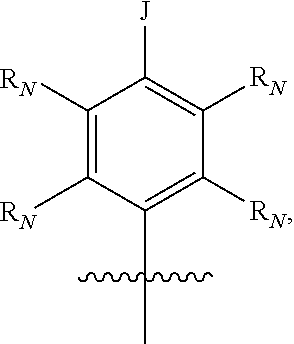
wherein each RN is independently selected from RD and preferably is hydrogen or halogen, and J is C3-C6carbocycle or 3- to 6-membered heterocycle and is substituted with a C3-C6carbocycle or 3- to 6-membered heterocycle which is independently optionally substituted with one or more substituents selected from halogen, hydroxy, mercapto, amino, carboxy, nitro, oxo, phosphonoxy, phosphono, thioxo, formyl, cyano, C1-C6alkyl, C2-C6alkenyl, C2-C6alkynyl, C1-C6haloalkyl, C2-C6haloalkenyl, C2-C6haloalkynyl, C(O)ORS or —N(RSRS′), and J can also be optionally substituted with one or more RA. Also preferably, D is

and J is C3-C6carbocycle or 3- to 6-membered heterocycle and is optionally substituted with one or more RA, and preferably J is at least substituted with a C3-C6carbocycle or 3- to 6-membered heterocycle which is independently optionally substituted with one or more substituents selected from halogen, hydroxy, mercapto, amino, carboxy, nitro, oxo, phosphonoxy, phosphono, thioxo, formyl, cyano, C1-C6alkyl, C2-C6alkenyl, C2-C6alkynyl, C1-C6haloalkyl, C2-C6haloalkenyl, C2-C6haloalkynyl, C(O)ORS or —N(RSRS′).

wherein X3 is N and is directly linked to -L3-D), and is optionally substituted with one or more RA or RF. Non-limiting examples of X are described hereinabove.

which is optionally substituted with one or more RA. R9 and R12, taken together with the atoms to which they are attached, preferably form a 5- to 6-membered heterocycle or 6- to 12-membered bicycle

which is optionally substituted with one or more RA.

and is optionally substituted with one or more RA; B is

and is optionally substituted with one or more RA; and D is C5-C6carbocycle or 5- to 6-membered heterocycle (e.g., phenyl), and is optionally substituted with one or more RA, or is substituted with J and optionally substituted with one or more RA, wherein J is C3-C6carbocycle, 3- to 6-membered heterocycle or 6- to 12-membered bicycle and is optionally substituted with one or more RA. Preferably, J is substituted with a C3-C6carbocycle or 3- to 6-membered heterocycle which is independently optionally substituted with one or more substituents selected from halogen, hydroxy, mercapto, amino, carboxy, nitro, oxo, phosphonoxy, phosphono, thioxo, formyl, cyano, C1-C6alkyl, C2-C6alkenyl, C2-C6alkynyl, C1-C6haloalkyl, C2-C6haloalkenyl, C2-C6haloalkynyl, C(O)ORS or —N(RSRS′), and J can also be optionally substituted with one or more RA. Preferably, D is

wherein RM and RN are as defined above. Also preferably, D is

wherein J and RN are as defined above. Z1 is independently selected at each occurrence from O, S, NH or CH2; and Z2 is independently selected at each occurrence from N or CH. L1 and L2 are each independently bond or C1-C6alkylene, and L3 is bond, C1-C6alkylene or —C(O)—, and L1, L2, and L3 are each independently optionally substituted with one or more RL. Preferably, L1, L2, and L3 are bond. -T-RD′ is independently selected at each occurrence from —C(O)-LY′-N(RB)C(O)-LS″-RD′ or —C(O)-LY′-N(RB)C(O)O-LS″-RD′, wherein LY′ is C1-C6alkylene (e.g., —CH2—) and optionally substituted with one or more substituents selected from RL, and LS″ preferably is bond. -T-RD′ can also be, without limitation, selected from —C(O)-LY′-LS″-RD′, —C(O)-LY′-O-LS″-RD′, —C(O)-LY′-N(RB)-LS″-RD′, or —C(O)-LY′-N(RB)S(O)2-LS″-RD′.

and optionally substituted with one or more RA (e.g., halogen); B is

and is optionally substituted with one or more RA (e.g., halogen); and D is C5-C6carbocycle or 5- to 6-membered heterocycle (e.g., phenyl), and is optionally substituted with one or more RA, or is substituted with J and optionally substituted with one or more RA, wherein J is C3-C6carbocycle, 3- to 6-membered heterocycle or 6- to 12-membered bicycle and is optionally substituted with one or more RA. Preferably, J is substituted with a C3-C6carbocycle or 3- to 6-membered heterocycle which is independently optionally substituted with one or more substituents selected from halogen, hydroxy, mercapto, amino, carboxy, nitro, oxo, phosphonoxy, phosphono, thioxo, formyl, cyano, C1-C6alkyl, C2-C6alkenyl, C2-C6alkynyl, C1-C6haloalkyl, C2-C6haloalkenyl, C2-C6haloalkynyl, C(O)ORS or —N(RSRS′), and J can also be optionally substituted with one or more RA. Preferably, D is

wherein RM and RN are as defined above. Also preferably, D is

wherein J and RN are as defined above. L1 and L2 are each independently bond or C1-C6alkylene, and L3 is bond, C1-C6alkylene or —C(O)—, and L1, L2, and L3 are each independently optionally substituted with one or more RL. Preferably, L1, L2, and L3 are bond. -T-RD′ is independently selected at each occurrence from —C(O)-LY′-N(RB)C(O)-LS″-RD′ or —C(O)-LY′-N(RB)C(O)O-LS″-RD′, wherein LY′ is C1-C6alkylene (e.g., —CH2—) and optionally substituted with one or more substituents selected from RL, and LS″ preferably is bond. -T-RD′ can also be, without limitation, selected from —C(O)-LY′-LS″-RD′, —C(O)-LY′-O-LS″-RD′, —C(O)-LY′-N(RB)-LS″-RD′, or —C(O)-LY′-N(RB)S(O)2-LS″-RD′. R2 and R5, taken together with the atoms to which they are attached, preferably form a 5- to 6-membered heterocycle or 6- to 12-membered bicycle

which is optionally substituted with one or more RA. R9 and R12, taken together with the atoms to which they are attached, preferably form a 5- to 6-membered heterocycle or 6- to 12-membered bicycle

which is optionally substituted with one or more RA. More preferably, R2 and R5, taken together with the atoms to which they are attached, form

which is optionally substituted with one or more RA; R9 and R12, taken together with the atoms to which they are attached, form

which is optionally substituted with one or more RA.

and optionally substituted with one or more RA (preferably, A is substituted with at least one halogen such as F); B is

and is optionally substituted with one or more RA (preferably, B is substituted with at least one halogen such as F). X is

wherein X3 is N and is directly linked to -L3-D, and X is optionally substituted with one or more RA or RF. D is phenyl, and is substituted with J and optionally substituted with one or more RA. J is C3-C6carbocycle, 3- to 6-membered heterocycle, 6- to 12-membered bicycle, 10- to 15-membered tricycle or 13- to 15-membered carbocycle/heterocycle, and J is optionally substituted with one or more RA. Preferably, J is substituted with a C3-C6carbocycle, 3- to 6-membered heterocycle, 6- to 12-membered bicycle or 7- to 12-membered carbocycle/heterocycle, which is independently optionally substituted with one or more substituents selected from (1) halogen, hydroxy, mercapto, amino, carboxy, nitro, oxo, phosphonoxy, phosphono, thioxo, formyl, cyano, C1-C6alkyl, C2-C6alkenyl, C2-C6alkynyl, C1-C6haloalkyl, C2-C6haloalkenyl, C2-C6haloalkynyl, —C(O)ORS or —N(RSRS′), or (2) trimethylsilyl, —O—RS, —S—RS or —C(O)RS; and J can also be optionally substituted with one or more RA. Preferably, D is

wherein J is as defined above, and each RN is independently selected from RD and preferably is hydrogen or halo such as F. L1 and L2 are each independently bond or C1-C6alkylene, and L3 is bond, C1-C6alkylene or —C(O)—, and L1, L2, and L3 are each independently optionally substituted with one or more RL. Preferably, L1, L2, and L3 are bond. -T-RD′ is independently selected at each occurrence from —C(O)-LY′-N(RB)C(O)-LS″-RD′ or —C(O)-LY′-N(RB)C(O)O-LS″-RD′, wherein LY′ is C1-C6alkylene (e.g., —CH2—) and optionally substituted with one or more substituents selected from RL, and LS″ preferably is bond. -T-RD′ can also be, without limitation, selected from —C(O)-LY′-LS″-RD′, —C(O)-LY′-O-LS″-RD′, —C(O)-LY′-N(RB)-LS″-RD′, or —C(O)-LY′-N(RB)S(O)2-LS″-RD′. R2 and R5, taken together with the atoms to which they are attached, preferably form a 5- to 6-membered heterocycle or 6- to 12-membered bicycle

which is optionally substituted with one or more RA. R9 and R12, taken together with the atoms to which they are attached, preferably form a 5- to 6-membered heterocycle or 6- to 12-membered bicycle

which is optionally substituted with one or more RA. More preferably, R2 and R5, taken together with the atoms to which they are attached, form

which is optionally substituted with one or more RA; R9 and R12, taken together with the atoms to which they are attached, form

which is optionally substituted with one or more RA.

wherein:
-
- RNB is RB;
- RC′ is each independently selected from RC;
- RD′ is each independently selected from RD;
- R2 and R5, taken together with the atoms to which they are attached, form a 3- to 12-membered heterocycle which is optionally substituted with one or more RA;
- R9 and R12, taken together with the atoms to which they are attached, form a 3- to 12-membered heterocycle which is optionally substituted with one or more RA;
- A, B, D, X, L1, L2, L3, T, RA, RB, RC, and RD are as described above in Formula I.

and is optionally substituted with one or more RA. Z1 is O, S, NH or CH2; Z2 is N or CH; Z3 is N or CH; Z4 is O, S, NH or CH2; and W1, W2, W3, W4, W5 and W6 are each independently selected from CH or N.

and is optionally substituted with one or more RA; and B is

and is optionally substituted with one or more RA, where Z1, Z2, Z3, Z4, W1, W2, W3, W4, W5, W6 are as defined above. Preferably, Z3 is N and Z4 is NH. For instance, B can be

and is optionally substituted with one or more RA.

or 5- to 6-membered heterocycle; and B is

wherein B′ is selected from C5-C6carbocycle or 5- to 6-membered heterocycle. A and B are independently optionally substituted with one or more RA.

wherein RM is as defined above, and each RN is independently selected from RD and preferably is hydrogen. One or more RN can also preferably be halo such as F.

wherein RM is as defined above, and each RN is independently selected from RD and preferably is hydrogen. One or more RN can also preferably be halo such as F. D is also preferably indanyl, 4,5,6,7-tetrahydrobenzo[d]thiazolyl, benzo[d]thiazolyl, or indazolyl, and is optionally substituted with one or more RA. More preferably D is indanyl, 4,5,6,7-tetrahydrobenzo[d]thiazolyl, benzo[d]thiazolyl, indazolyl, or benzo[d][1,3]dioxol-5-yl, and is substituted with one or more RM. Highly preferably, D is

and is optionally substituted with one or more RM.

wherein each RN is independently selected from RD and preferably is hydrogen or halogen, and J is C3-C6carbocycle, 3- to 6-membered heterocycle or 6- to 12-membered bicycle and is optionally substituted with one or more RA, and preferably J is at least substituted with a C3-C6carbocycle or 3- to 6-membered heterocycle which is independently optionally substituted with one or more substituents selected from halogen, hydroxy, mercapto, amino, carboxy, nitro, oxo, phosphonoxy, phosphono, thioxo, formyl, cyano, C1-C6alkyl, C2-C6alkenyl, C2-C6alkynyl, C1-C6haloalkyl, C2-C6haloalkenyl, C2-C6haloalkynyl, C(O)ORS or —N(RSRS′). Also preferably, D is

wherein each RN is independently selected from RD and preferably is hydrogen or halogen, and J is C3-C6carbocycle or 3- to 6-membered heterocycle and is substituted with a C3-C6carbocycle or 3- to 6-membered heterocycle which is independently optionally substituted with one or more substituents selected from halogen, hydroxy, mercapto, amino, carboxy, nitro, oxo, phosphonoxy, phosphono, thioxo, formyl, cyano, C1-C6alkyl, C2-C6alkenyl, C2-C6alkynyl, C1-C6haloalkyl, C2-C6haloalkenyl, C2-C6haloalkynyl, C(O)ORS or —N(RSRS′), and J can also be optionally substituted with one or more RA. Also preferably, D is

and J is C3-C6carbocycle or 3- to 6-membered heterocycle and is optionally substituted with one or more RA, and preferably J is at least substituted with a C3-C6carbocycle or 3- to 6-membered heterocycle which is independently optionally substituted with one or more substituents selected from halogen, hydroxy, mercapto, amino, carboxy, nitro, oxo, phosphonoxy, phosphono, thioxo, formyl, cyano, C1-C6alkyl, C2-C6alkenyl, C2-C6alkynyl, C1-C6haloalkyl, C2-C6haloalkenyl, C2-C6haloalkynyl, C(O)ORS or —N(RSRS′).

wherein X3 is N and is directly linked to -L3-D), and is optionally substituted with one or more RA or RF. Non-limiting examples of X are described hereinabove.

which is optionally substituted with one or more RA. R9 and R12, taken together with the atoms to which they are attached, preferably form a 5- to 6-membered heterocycle or 6- to 12-membered bicycle

which is optionally substituted with one or more RA.

and is optionally substituted with one or more RA, wherein Z1 is O, S, NH or CH2; and Z2 is N or CH. D is C5-C6carbocycle or 5- to 6-membered heterocycle (e.g., phenyl), and is optionally substituted with one or more RA, or is substituted with J and optionally substituted with one or more RA, wherein J is C3-C6carbocycle, 3- to 6-membered heterocycle or 6- to 12-membered bicycle and is optionally substituted with one or more RA. Preferably, J is substituted with a C3-C6carbocycle or 3- to 6-membered heterocycle which is independently optionally substituted with one or more substituents selected from halogen, hydroxy, mercapto, amino, carboxy, nitro, oxo, phosphonoxy, phosphono, thioxo, formyl, cyano, C1-C6alkyl, C2-C6alkenyl, C2-C6alkynyl, C1-C6haloalkyl, C2-C6haloalkenyl, C2-C6haloalkynyl, C(O)ORS or —N(RSRS′), and J can also be optionally substituted with one or more RA. Preferably, D is

wherein RM and RN are as defined above. Also preferably, D is

wherein J and RN are as defined above. L1 and L2 are each independently bond or C1-C6alkylene, and L3 is bond, C1-C6alkylene or —C(O)—, and L1, L2, and L3 are each independently optionally substituted with one or more RL. Preferably, L1, L2, and L3 are bond. -T-RD′ is independently selected at each occurrence from —C(O)-LY′-N(RB)C(O)-LS″-RD′ or —C(O)-LY′-N(RB)C(O)O-LS″-RD′, wherein LY′ is C1-C6alkylene (e.g., —CH2—) and optionally substituted with one or more substituents selected from RL, and LS″ preferably is bond. -T-RD′ can also be, without limitation, selected from —C(O)-LY′-LS″-RD′, —C(O)-LY′-O-LS″-RD′, —C(O)-LY′-N(RB)-LS″-RD′, or —C(O)-LY′-N(RB)S(O)2-LS″-RD′. Preferably, R2 and R5, taken together with the atoms to which they are attached, form

which is optionally substituted with one or more RA; R9 and R12, taken together with the atoms to which they are attached, form

which is optionally substituted with one or more RA.

and is optionally substituted with one or more RA (preferably, A is substituted with at least one halogen such as F); and B is

and is optionally substituted with one or more RA (preferably, B is substituted with at least one halogen such as F). X is

wherein X3 is N and is directly linked to -L3-D, and X is optionally substituted with one or more RA or RF. D is phenyl, and is substituted with J and optionally substituted with one or more RA. J is C3-C6carbocycle, 3- to 6-membered heterocycle, 6- to 12-membered bicycle, 10- to 15-membered tricycle or 13- to 15-membered carbocycle/heterocycle, and J is optionally substituted with one or more RA. Preferably, J is substituted with a C3-C6carbocycle, 3- to 6-membered heterocycle, 6- to 12-membered bicycle or 7- to 12-membered carbocycle/heterocycle, which is independently optionally substituted with one or more substituents selected from (1) halogen, hydroxy, mercapto, amino, carboxy, nitro, oxo, phosphonoxy, phosphono, thioxo, formyl, cyano, C1-C6alkyl, C2-C6alkenyl, C2-C6alkynyl, C1-C6haloalkyl, C2-C6haloalkenyl, C2-C6haloalkynyl, —C(O)ORS or —N(RSRS′), or (2) trimethylsilyl, —O—RS, —S—RS or —C(O)RS; and J can also be optionally substituted with one or more RA. Preferably, D is

wherein J is as defined above, and each RN is independently selected from RD and preferably is hydrogen or halo such as F. L1 and L2 are each independently bond or C1-C6alkylene, and L3 is bond, C1-C6alkylene or —C(O)—, and L1, L2, and L3 are each independently optionally substituted with one or more RL. Preferably, L1, L2, and L3 are bond. -T-RD′ is independently selected at each occurrence from —C(O)-LY′-N(RB)C(O)-LS″-RD′ or —C(O)-LY′-N(RB)C(O)O-LS″-RD′, wherein LY′ is C1-C6alkylene (e.g., —CH2—) and optionally substituted with one or more substituents selected from RL, and LS″ preferably is bond. -T-RD′ can also be, without limitation, selected from —C(O)-LY′-LS″-RD′, —C(O)-LY′-O-LS″-RD′, —C(O)-LY′-N(RB)-LS″-RD′, or —C(O)-LY′-N(RB)S(O)2-LS″-RD′. Preferably, R2 and R5, taken together with the atoms to which they are attached, form a 5- to 6-membered heterocyclic ring

or 6- to 12-membered bicycle

which is optionally substituted with one or more RA; R9 and R12, taken together with the atoms to which they are attached, form a 5- to 6-membered heterocyclic ring

or 6- to 12-membered bicycle

which is optionally substituted with one or more RA.

wherein:
-
- G1 and G2 are each independently selected from C5-C6carbocycle or 5- to 6-membered heterocycle, and are each independently optionally substituted with one or more RA;
- RC′ is each independently selected from RC;
- RD′ is each independently selected from RD;
- R2 and R5, taken together with the atoms to which they are attached, form a 3- to 12-membered heterocycle which is optionally substituted with one or more RA;
- R9 and R12, taken together with the atoms to which they are attached, form a 3- to 12-membered heterocycle which is optionally substituted with one or more RA;
- A, B, D, X, L1, L2, L3, T, RA, RC, and RD are as described above in Formula I.

and is optionally substituted with one or more RA. Highly preferably, both A and B are each independently phenyl

and are each independently optionally substituted with one or more RA.

wherein RM is as defined above, and each RN is independently selected from RD and preferably is hydrogen. One or more RN can also preferably be halo such as F.

wherein RM is as defined above, and each RN is independently selected from RD and preferably is hydrogen. One or more RN can also preferably be halo such as F. D is also preferably indanyl, 4,5,6,7-tetrahydrobenzo[d]thiazolyl, benzo[d]thiazolyl, or indazolyl, and is optionally substituted with one or more RA. More preferably D is indanyl, 4,5,6,7-tetrahydrobenzo[d]thiazolyl, benzo[d]thiazolyl, indazolyl, or benzo[d][1,3]dioxol-5-yl, and is substituted with one or more RM. Highly preferably, D is

and is optionally substituted with one or more RM.

wherein each RN is independently selected from RD and preferably is hydrogen or halogen, and J is C3-C6carbocycle, 3- to 6-membered heterocycle or 6- to 12-membered bicycle and is optionally substituted with one or more RA, and preferably J is at least substituted with a C3-C6carbocycle or 3- to 6-membered heterocycle which is independently optionally substituted with one or more substituents selected from halogen, hydroxy, mercapto, amino, carboxy, nitro, oxo, phosphonoxy, phosphono, thioxo, formyl, cyano, C1-C6alkyl, C2-C6alkenyl, C2-C6alkynyl, C1-C6haloalkyl, C2-C6haloalkenyl, C2-C6haloalkynyl, C(O)ORS or —N(RSRS′). Also preferably, D is

wherein each RN is independently selected from RD and preferably is hydrogen or halogen, and J is C3-C6carbocycle or 3- to 6-membered heterocycle and is substituted with a C3-C6carbocycle or 3- to 6-membered heterocycle which is independently optionally substituted with one or more substituents selected from halogen, hydroxy, mercapto, amino, carboxy, nitro, oxo, phosphonoxy, phosphono, thioxo, formyl, cyano, C1-C6alkyl, C2-C6alkenyl, C2-C6alkynyl, C1-C6haloalkyl, C2-C6haloalkenyl, C2-C6haloalkynyl, C(O)ORS or —N(RSRS′), and J can also be optionally substituted with one or more RA. Also preferably, D is

and J is C3-C6carbocycle or 3- to 6-membered heterocycle and is optionally substituted with one or more RA, and preferably J is at least substituted with a C3-C6carbocycle or 3- to 6-membered heterocycle which is independently optionally substituted with one or more substituents selected from halogen, hydroxy, mercapto, amino, carboxy, nitro, oxo, phosphonoxy, phosphono, thioxo, formyl, cyano, C1-C6alkyl, C2-C6alkenyl, C2-C6alkynyl, C1-C6haloalkyl, C2-C6haloalkenyl, C2-C6haloalkynyl, C(O)ORS or —N(RSRS′).

wherein X3 is N and is directly linked to -L3-D), and is optionally substituted with one or more RA or RF. Non-limiting examples of X are described hereinabove.

which is optionally substituted with one or more RA.

which is optionally substituted with one or more RA.

and are each independently optionally substituted with one or more RA (e.g., one or more chloro or bromo). More preferably, G1 is

(including any tautomer thereof), and G2 is

(including any tautomer thereof), and each G1 and G2 is independently optionally substituted with one or more RA (e.g., one or more chloro or bromo).

G2 is

and each G1 and G2 is independently optionally substituted with one or more RA (e.g., one or more chloro or bromo). Preferably, D is

wherein RM and RN are as defined above. Also preferably, D is

wherein J and RN are as defined above. L1 and L2 are each independently bond or C1-C6alkylene, and L3 is bond, C1-C6alkylene or —C(O)—, and L1, L2, and L3 are each independently optionally substituted with one or more RL. Preferably, L1, L2, and L3 are bond. -T-RD′ is independently selected at each occurrence from —C(O)-LY′-N(RB)C(O)-LS″-RD′ or —C(O)-LY′-N(RB)C(O)O-LS″-RD′, wherein LY′ is C1-C6alkylene (e.g., —CH2—) and optionally substituted with one or more substituents selected from RL, and LS″ preferably is bond. -T-RD′ can also be, without limitation, selected from —C(O)-LY′-LS″-RD′, —C(O)-LY′-O-LS″-RD′, —C(O)-LY′-N(RB)-LS″-RD′, or —C(O)-LY′-N(RB)S(O)2-LS″-RD′. Preferably, R2 and R5, taken together with the atoms to which they are attached, form

which is optionally substituted with one or more RA; R9
and R12, taken together with the atoms to which they are attached, form

which is optionally substituted with one or more RA.

and are each independently optionally substituted with one or more RA (preferably, A and B are each independently substituted with at least one halogen such as F). X is

wherein X3 is N and is directly linked to -L3-D, and X is optionally substituted with one or more RA or RF. D is phenyl, and is substituted with J and optionally substituted with one or more RA. J is C3-C6carbocycle, 3- to 6-membered heterocycle, 6- to 12-membered bicycle, 10- to 15-membered tricycle or 13- to 15-membered carbocycle/heterocycle, and J is optionally substituted with one or more RA. Preferably, J is substituted with a C3-C6carbocycle, 3- to 6-membered heterocycle, 6- to 12-membered bicycle or 7- to 12-membered carbocycle/heterocycle, which is independently optionally substituted with one or more substituents selected from (1) halogen, hydroxy, mercapto, amino, carboxy, nitro, oxo, phosphonoxy, phosphono, thioxo, formyl, cyano, C1-C6alkyl, C2-C6alkenyl, C2-C6alkynyl, C1-C6haloalkyl, C2-C6haloalkenyl, C2-C6haloalkynyl, —C(O)ORS or —N(RSRS′), or (2) trimethylsilyl, —O—RS, —S—RS or —C(O)RS; and J can also be optionally substituted with one or more RA. Preferably, D is

wherein J is as defined above, and each RN is independently selected from RD and preferably is hydrogen or halo such as F. G1 is

G2 is

and each G1 and G2 is independently optionally substituted with one or more RA (e.g., one or more chloro or bromo). L1 and L2 are each independently bond or C1-C6alkylene, and L3 is bond, C1-C6alkylene or —C(O)—, and L1, L2, and L3 are each independently optionally substituted with one or more RL. Preferably, L1, L2, and L3 are bond. -T-RD′ is independently selected at each occurrence from —C(O)-LY′-N(RB)C(O)-LS′-RD′ or —C(O)-LY′-N(RB)C(O)O-LS″-RD′, wherein LY′ is C1-C6alkylene (e.g., —CH2—) and optionally substituted with one or more substituents selected from RL, and LS″ preferably is bond. -T-RD′ can also be, without limitation, selected from —C(O)-LY′-LS″-RD′, —C(O)-LY′-O-LS″-RD′, —C(O)-LY′-N(RB)-LS″-RD′, or —C(O)-LY′-N(RB)S(O)2-LS″-RD′. Preferably, R2 and R5, taken together with the atoms to which they are attached, form a 5- to 6-membered heterocyclic ring

or 6- to 12-membered bicycle

which is optionally substituted with one or more RA; R9 and R12, taken together with the atoms to which they are attached, form a 5- to 6-membered heterocyclic ring

or 6- to 12-membered bicycle

which is optionally substituted with one or more RA.

wherein:
-
- X is 4- to 8-membered heterocycle, and is optionally substituted with one or more RA;
- L1 and L2 are each independently selected from bond or C1-C6alkylene which is independently optionally substituted at each occurrence with one or more halo, hydroxy, —O—C1-C6alkyl, or —O—C1-C6haloalkyl;
- L3 is bond or C1-C6alkylene;
- A and B are each independently phenyl, pyridinyl, thiazolyl, or

where Z1 is independently selected at each occurrence from O, S, NH or CH2, Z3 is independently selected at each occurrence from N or CH, and W1, W2, and W3 are each independently selected at each occurrence from CH or N; A and B are each independently optionally substituted with one or more RA.
-
- D is C6-C10carbocycle or 5- to 12-membered heterocycle, each of which is optionally substituted with one or more RM;
- Y is -T′-C(R1R2)N(R5)-T-RD;
- Z is -T′-C(R8R9)N(R12)-T-RD;
- R1 is hydrogen, C1-C6alkyl, C1-C6haloalkyl, or 3- to 6-membered carbocycle or heterocycle, wherein each said 3- to 6-membered carbocycle or heterocycle is independently optionally substituted at each occurrence with one or more substituents selected from halogen, C1-C6alkyl, C1-C6haloalkyl, —O—C1-C6alkyl or —O—C1-C6haloalkyl;
- R2 and R5 are each independently hydrogen, C1-C6alkyl, C1-C6haloalkyl, or 3- to 6-membered carbocycle or heterocycle, wherein each said 3- to 6-membered carbocycle or heterocycle is independently optionally substituted at each occurrence with one or more substituents selected from halogen, C1-C6alkyl, C1-C6haloalkyl, —O—C1-C6alkyl or —O—C1-C6haloalkyl; or R2 and R5, taken together with the atoms to which they are attached, form a 3- to 12-membered heterocycle which is optionally substituted with one or more RA (e.g., 1, 2, 3, or 4 RA);
- R8 is hydrogen, C1-C6alkyl, C1-C6haloalkyl, or 3- to 6-membered carbocycle or heterocycle, wherein each said 3- to 6-membered carbocycle or heterocycle is independently optionally substituted at each occurrence with one or more substituents selected from halogen, C1-C6alkyl, C1-C6haloalkyl, —O—C1-C6alkyl or —O—C1-C6haloalkyl;
- R9 and R12 are each independently hydrogen, C1-C6alkyl, C1-C6haloalkyl, or 3- to 6-membered carbocycle or heterocycle, wherein each said 3- to 6-membered carbocycle or heterocycle is independently optionally substituted at each occurrence with one or more substituents selected from halogen, C1-C6alkyl, C1-C6haloalkyl, —O—C1-C6alkyl or —O—C1-C6haloalkyl; or R9 and R12, taken together with the atoms to which they are attached, form a 3- to 12-membered heterocycle which is optionally substituted with one or more RA (e.g., 1, 2, 3, or 4 RA);
- T is independently selected at each occurrence from bond or —C(O)-LS′-;
- T′ is independently selected at each occurrence from bond, —C(O)N(RB)—, —N(RB)C(O)—, or 3- to 12-membered heterocycle, wherein said 3- to 12-membered heterocycle is independently optionally substituted at each occurrence with one or more RA;
- RD is each independently selected at each occurrence from hydrogen or RA;
- RA is independently selected at each occurrence from halogen, nitro, oxo, phosphonoxy, phosphono, thioxo, cyano, or -LS-RE;
- RB and RB′ are each independently selected at each occurrence from hydrogen; or C1-C6alkyl which is independently optionally substituted at each occurrence with one or more substituents selected from halogen or 3- to 6-membered carbocycle or heterocycle; or 3- to 6-membered carbocycle or heterocycle; wherein each 3- to 6-membered carbocycle or heterocycle in RB or RB′ is independently optionally substituted at each occurrence with one or more substituents selected from halogen, hydroxy, C1-C6alkyl, C1-C6haloalkyl, —O—C1-C6alkyl, or —O—C1-C6haloalkyl;
- RE is independently selected at each occurrence from —O—RS, —S—RS, —C(O)RS, —OC(O)RS, —C(O)ORS, —N(RSRS′), —S(O)RS, —SO2RS, —C(O)N(RSRS′), —N(RS)C(O)RS′, —N(RS)C(O)N(RS′RS″), —N(RS)SO2RS′, —SO2N(RSRS′), —N(RS)SO2N(RS′RS″), —N(RS)S(O)N(RS′RS″), —OS(O)—RS, —OS(O)2—RS, —S(O)2ORS, —S(O)ORS, —OC(O)ORS, —N(RS)C(O)ORS′, —OC(O)N(RSRS′), —N(RS)S(O)—RS′, —S(O)N(RSRS′), —C(O)N(RS)C(O)—RS′, or ═C(RSRS′); or C1-C6alkyl, C2-C6alkenyl or C2-C6alkynyl, each of which is independently optionally substituted at each occurrence with one or more substituents selected from halogen, hydroxy, mercapto, amino, carboxy, nitro, oxo, phosphonoxy, phosphono, thioxo, formyl or cyano; or C3-C12carbocycle or 3- to 12-membered heterocycle, each of which is independently optionally substituted at each occurrence with one or more substituents selected from halogen, hydroxy, mercapto, amino, carboxy, nitro, oxo, phosphonoxy, phosphono, thioxo, formyl, cyano, C1-C6alkyl, C2-C6alkenyl, C2-C6alkynyl, C1-C6haloalkyl, C2-C6haloalkenyl or C2-C6haloalkynyl;
- RL is independently selected at each occurrence from halogen, nitro, oxo, phosphonoxy, phosphono, thioxo, cyano, —O—RS, —S—RS, —C(O)RS, —OC(O)RS, —C(O)ORS, —N(RSRS′), —S(O)RS, —SO2RS, —C(O)N(RSRS′), or —N(RS)C(O)RS′; or C3-C12carbocycle or 3- to 12-membered heterocycle, each of which is independently optionally substituted at each occurrence with one or more substituents selected from halogen, hydroxy, mercapto, amino, carboxy, nitro, oxo, phosphonoxy, phosphono, thioxo, formyl, cyano, C1-C6alkyl, C2-C6alkenyl, C2-C6alkynyl, C1-C6haloalkyl, C2-C6haloalkenyl or C2-C6haloalkynyl;
- LS is independently selected at each occurrence from bond; or C1-C6alkylene, C2-C6alkenylene or C2-C6alkynylene, each independently optionally substituted with halogen;
- LS′ is independently selected at each occurrence from bond; or C1-C6alkylene, C2-C6alkenylene or C2-C6alkynylene, each of which is independently optionally substituted at each occurrence with one or more RL;
- RS, RS′ and RS″ are each independently selected at each occurrence from hydrogen; C1-C6alkyl, C2-C6alkenyl or C2-C6alkynyl, each of which is independently optionally substituted at each occurrence with one or more substituents selected from halogen, hydroxy, mercapto, amino, carboxy, nitro, oxo, phosphonoxy, phosphono, thioxo, formyl, cyano, —O—C1-C6alkyl, —O—C1-C6haloalkyl, or 3- to 12-membered carbocycle or heterocycle; or 3- to 12-membered carbocycle or heterocycle; wherein each 3- to 12-membered carbocycle or heterocycle in RS, RS′ or RS″ is independently optionally substituted at each occurrence with one or more substituents selected from halogen, hydroxy, mercapto, amino, carboxy, nitro, oxo, phosphonoxy, phosphono, thioxo, formyl, cyano, C1-C6alkyl, C2-C6alkenyl, C2-C6alkynyl, C1-C6haloalkyl, C2-C6haloalkenyl or C2-C6haloalkynyl;
- RM is independently selected at each occurrence from:
- halogen, hydroxy, mercapto, amino, carboxy, nitro, oxo, phosphonoxy, phosphono, thioxo, cyano, SF5, —N(RSRS′), —O—RS, —OC(O)RS, —OC(O)ORS, —OC(O)N(RSRS′), —C(O)RS, —C(O)ORS, —C(O)N(RSRS′), —N(RS)C(O)RS′, —N(RS)C(O)ORS′, —N(RS)SO2RS′, —S(O)RS, —SO2RS, —S(O)N(RSRS′), —SRS, —Si(RS)3, or —P(O)(ORS)2;
- C1-C6alkyl, C2-C6alkenyl or C2-C6alkynyl, each of which is independently optionally substituted at each occurrence with one or more substituents selected from halogen, hydroxy, mercapto, amino, carboxy, nitro, oxo, phosphonoxy, phosphono, thioxo, formyl, cyano, —N(RSRS′), —O—RS, —OC(O)RS, —OC(O)ORS, —OC(O)N(RSRS′), —C(O)RS, —C(O)ORS, —C(O)N(RSRS′), —N(RS)C(O)RS′, —N(RS)C(O)ORS′, —N(RS)SO2RS′, —S(O)RS, —SO2RS, —S(O)N(RSRS′), —SRS, or —P(O)(ORS)2; or
- G2, wherein G2 is a C3-C12carbocycle or 3- to 12-membered heterocycle, each of which is independently optionally substituted at each occurrence with one or more RG2, and each RG2 is independently selected from halogen, hydroxy, mercapto, amino, carboxy, nitro, oxo, phosphonoxy, phosphono, thioxo, formyl, cyano, C1-C6alkyl, C2-C6alkenyl, C2-C6alkynyl, C1-C6haloalkyl, C2-C6haloalkenyl, C2-C6haloalkynyl, —O—RS, —C(O)ORS, —C(O)RS, —N(RSRS′), or -L4-G3;
- L4 is a bond, C1-C6alkylene, C2-C6alkenylene, C2-C6alkynylene, —O—, —S—, —N(RB)—, —C(O)—, —S(O)2—, —S(O)—, —C(O)O—, —OC(O)—, —OC(O)O—, —C(O)N(RB)—, —N(RB)C(O)—, —N(RB)C(O)O—, —OC(O)N(RB)—, —N(RB)S(O)—, —N(RB)S(O)2—, —S(O)N(RB)—, —S(O)2N(RB)—, —N(RB)C(O)N(RB′)—, —N(RB)SO2N(RB′)—, or —N(RB)S(O)N(RB′)—;
- G3 is a C3-C12carbocycle or 3- to 12-membered heterocycle, and is optionally substituted with one or more RG3; and
- RG3 is each independently, at each occurrence, halogen, —C1-C6alkyl, —C(O)C1-C6alkyl, -C1-C6haloalkyl, —O—C1-C6alkyl, —O—C1-C6haloalkyl, C3-C6carbocycle, or 3- to 6-membered heterocycle.

where Z1 is independently selected at each occurrence from O, S, NH or CH2, Z3 is independently selected at each occurrence from N or CH, and W1, W2, and W3 are each independently selected at each occurrence from CH or N; A and B are each independently optionally substituted with one or more RA.

and is optionally substituted with one or more RA.

and is optionally substituted with one or more RA.

or A is

and B is

or A is

and B is

or A is

and B is

or A is

and B is

or A is

and B is

wherein each A and B is independently optionally substituted with one or more RA.

and B is as defined hereinabove. In certain other embodiments B is

and A is as defined hereinabove. In still other embodiments A is

and B is


wherein

is a monocyclic 4-8 membered nitrogen-containing heterocycle (e.g., azetidinyl, pyrrolidinyl, piperidinyl, piperazinyl) attached to the parent molecular moiety through a nitrogen atom and substituted with one or two L4-G3 and optionally substituted with one or more RG2. Thus, in certain embodiments where L4 is a bond G2 is

is optionally substituted with
RG2 and G3 is optionally substituted with RG3. Thus

can be, for example, 3-phenylazetidin-1-yl, 3-phenylpyrrolidin-1-yl, 4-phenylpiperazin-1-yl, 4-phenylpiperidin-1-yl, 4-phenyl-3,6-dihydropyridin-1(2H)-yl, 4,4-diphenylpiperidin-1-yl, 4-acetyl-4-phenylpiperidin-1-yl, 4-(4-methoxyphenyl)piperidin-1-yl, 4-(4-fluorophenyl)piperidin-1-yl, or 3-phenylpiperidin-1-yl, and wherein D can be further optionally substituted with one or more RM (e.g., fluoro, chloro, methyl, methoxy).

is as defined above and is optionally substituted with RG2 and G3 is as defined above and is optionally substituted with RG3. Thus,

can be, for example, 4-tosylpiperazin-1-yl, 4-phenoxypiperidin-1-yl, 3-phenoxypyrrolidin-1-yl, 4-benzylpiperidin-1-yl, 4-phenethylpiperidin-1-yl, or 3-phenylpropyl)piperidin-1-yl.

is a spiro, bridged, or fused bicyclic nitrogen-containing heterocycle (e.g., 3-azabicyclo[3.2.0]hept-3-yl, 2-azabicyclo[2.2.2]oct-2-yl, 6-azaspiro[2.5]oct-6-yl, octahydro-2H-isoindol-2-yl, 3-azaspiro[5.5]undec-3-yl, 1,3-dihydro-2H-isoindol-2-yl, 1,4-dioxa-8-azaspiro[4.5]dec-8-yl) attached to the parent molecular moiety through a nitrogen atom and optionally substituted with G3 and one or more RG2. Thus, G2 is 3-azabicyclo[3.2.0]hept-3-yl, 2-azabicyclo[2.2.2]oct-2-yl, 6-azaspiro[2.5]oct-6-yl, octahydro-2H-isoindol-2-yl, 3-azaspiro[5.5]undec-3-yl, 1,3-dihydro-2H-isoindol-2-yl, or 1,4-dioxa-8-azaspiro[4.5]dec-8-yl; L4 is a bond and D is optionally substitute with one or more RM (e.g., fluoro, chloro, methyl, methoxy).

wherein RM is as defined above in connection with Formula IE, and D is optionally substituted by one or more additional RM. For instance, where D is

RM can be fluoro, chloro, tert-butyl, —O—CH2CH3, —O—CF3, —O—CH2CHF2, —O—CH2CH2OCH3, —O—CH2-(3-ethyloxetan-3-yl), —O—CH2-(1,3-dioxolan-4-yl), —O— cyclopentyl, —O-cyclohexyl, —O-phenyl, —O-(1,3-dioxan-5-yl), cyclopropyl, cyclohexyl, phenyl, SF5, —SO2Me, or —N(t-Bu)C(O)Me and D can be optionally substituted by one or more additional RM selected from the group consisting of halogen (e.g., fluoro, chloro) and C1-C6alkyl (e.g., methyl).

wherein RM is fluoro, chloro, tert-butyl, —O—CH2CH3, —O—CF3, —O—CH2CHF2, —O—CH2CH2OCH3, SF5, —SO2Me, or —N(t-Bu)C(O)Me and D is optionally substituted by one or more additional RM selected from the group consisting of halogen (e.g., fluoro, chloro) and C1-C6alkyl (e.g., methyl).

wherein RM is cyclopropyl, cyclohexyl, or phenyl and D is optionally substituted by one or more additional RM selected from the group consisting of halogen (e.g., fluoro, chloro) and C1-C6alkyl (e.g., methyl).

wherein RM is —O—CH2-(3-ethyloxetan-3-yl), —O—CH2-(1,3-dioxolan-4-yl), —O-cyclopentyl, —O-cyclohexyl, —O-phenyl, or —O-(1,3-dioxan-5-yl) and D is optionally substituted by one or more additional RM selected from the group consisting of halogen (e.g., fluoro, chloro) and C1-C6alkyl (e.g., methyl).

wherein G2 is pyridinyl (e.g., pyridin-2-yl), piperidin-1-yl, 4,4-dimethylpiperidin-1-yl, 4,4-difluoropiperidin-1-yl, 2,6-dimethylpiperidin-1-yl, 4-(propan-2-yl)piperidin-1-yl, 4-fluoropiperidin-1-yl, 3,5-dimethylpiperidin-1-yl, 4-(trifluoromethyl)piperidin-1-yl, 4-methylpiperidin-1-yl, 4-tert-butylpiperidin-1-yl, 2-oxopiperidin-1-yl, 3,3-dimethylazetidin-1-yl, or oxazolyl (e.g., 1,3-oxazol-2-yl) and D is optionally substituted by one or more additional RM selected from the group consisting of halogen (e.g., fluoro, chloro) and C1-C6alkyl (e.g., methyl).

wherein G1 is N,
C—H, or C—RM; G2 is

is a monocyclic 4-8 membered nitrogen-containing heterocycle (e.g., azetidinyl, pyrrolidinyl, piperidinyl) attached to the parent molecular moiety through a nitrogen atom and substituted by L4-G3 and optionally substituted with one or more RG2; L4 is a bond, C1-C6 alkylene, —O—, or —S(O)2—; G3 is aryl (e.g., phenyl), cycloalkyl (e.g., cyclohexyl), or heterocycle (e.g., thienyl) wherein each G3 is optionally substituted with one or more RG3; RG2 and RG3 at each occurrence are each independently halogen, —C(O)C1-C6alkyl, —C1-C6alkyl, —C1-C6haloalkyl, —O—C1-C6alkyl, or —O—C1-C6haloalkyl; g is 0, 1, 2, or 3; and RM is as defined above in connection with Formula IE. In one group of compounds according to this embodiment, D is

wherein G3 is phenyl optionally substituted with one or two RG3; g is 0, 1, or 2; RM is each independently fluoro, chloro, methyl, methoxy, trifluoromethyl, or trifluoromethoxy; and

and RG3 are as defined above. In a further subgroup of compounds of this embodiment, D is

wherein G3 is phenyl optionally substituted with one or two RG3; RM1 is each independently hydrogen, fluoro, chloro, or methyl; and RG2 is an optional substituent as described herein. In another group of compounds according to this embodiment, D is

wherein L4 is C1-C6 alkylene, —O—, or —S(O)2—; G3 is phenyl optionally substituted with one or two RG3; g is 0, 1, or 2; RM is each independently fluoro, chloro, methyl, methoxy, trifluoromethyl, or trifluoromethoxy; and

and RG3 are as defined above.

wherein G1 is N, C—H, or C—RM; G2 is

is a spiro, bridged, or fused bicyclic nitrogen-containing heterocycle (e.g., 3-azabicyclo[3.2.0]hept-3-yl, 2-azabicyclo[2.2.2]oct-2-yl, 6-azaspiro[2.5]oct-6-yl, octahydro-2H-isoindol-2-yl, 3-azaspiro[5.5]undec-3-yl, 1,3-dihydro-2H-isoindol-2-yl, 1,4-dioxa-8-azaspiro[4.5]dec-8-yl) attached to the parent molecular moiety through a nitrogen atom and optionally substituted with L4-G3 and one or more RG2; L4 is a bond, C1-C6 alkylene, —O—, or —S(O)2—; G3 is aryl (e.g., phenyl), cycloalkyl (e.g., cyclohexyl), or heterocycle (e.g., thienyl) wherein each G3 is optionally substituted with one or more RG3; RG2 and RG3 at each occurrence are each independently halogen, —C(O)C1-C6alkyl, —C1-C6alkyl, —C1-C6haloalkyl, —O—C1-C6alkyl, or —O—C1-C6haloalkyl; g is 0, 1, 2, or 3; and RM is as defined above in connection with Formula IE. In one group of compounds according to this embodiment, D is

wherein g is 0, 1, or 2; RM is each independently fluoro, chloro, methyl, methoxy, trifluoromethyl, or trifluoromethoxy; and

is as defined above. In a further subgroup of compounds D is

wherein RM1 is each independently hydrogen, fluoro, chloro, or methyl, and

is as defined above (e.g., 3-azabicyclo[3.2.0]hept-3-yl, octahydro-2H-isoindol-2-yl, 2-azabicyclo[2.2.2]oct-2-yl, 6-azaspiro[2.5]oct-6-yl, 3-azaspiro[5.5]undec-3-yl, 1,3-dihydro-2H-isoindol-2-yl, 1,4-dioxa-8-azaspiro[4.5]dec-8-yl).

is a monocyclic 4-8 membered nitrogen-containing heterocycle (e.g., azetidinyl, pyrrolidinyl, piperidinyl) substituted with one or more RG2, wherein RG2 at each occurrence is each independently halogen, —C(O)C1-C6alkyl, —C1-C6alkyl, —C1-C6haloalkyl, —O—C1-C6alkyl, or —O—C1-C6haloalkyl; and RM is each independently halogen, -C1-C6alkyl, -C1-C6haloalkyl, —O—C1-C6alkyl, or —O—C1-C6haloalkyl. In one group of compounds according to this embodiment,

is azetidinyl, pyrrolidinyl, or piperidinyl substituted with one or two RG2, wherein RG2 at each occurrence is each independently methyl, ethyl, isopropyl, tert-butyl, fluoro, chloro, or trifluoromethyl; and RM is each independently fluoro, chloro, or methyl. For example

is 4,4-dimethylpiperidin-1-yl, 4,4-difluoropiperidin-1-yl, 2,6-dimethylpiperidin-1-yl, 4-(propan-2-yl)piperidin-1-yl, 4-fluoropiperidin-1-yl, 3,5-dimethylpiperidin-1-yl, 4-(trifluoromethyl)piperidin-1-yl, 4-methylpiperidin-1-yl, 4-tert-butylpiperidin-1-yl, 2-oxopiperidin-1-yl, or 3,3-dimethylazetidin-1-yl.

attachment of X to the remainder of the molecule can be conveniently depicted by the abbreviated structural Formula X′, wherein the groups attached to X maintain the same relative spatial orientation as drawn in Formula IE It is understood that in subsequent depictions of the variable group X, the substituents of X will retain the same relative positions and orientation as in Formula IE and Formula X′.


In certain embodiments, X is pyrrolidinyl and is attached to the remainder of the molecule as shown in Formula XB:

Embodiments according to Formula XB may exist in cis (XB1) or trans (XB2) forms:

Chiral carbon atoms in XB, XB1, and XB2 may have either the (R) or (S) absolute stereochemistry.

In certain embodiments, X is pyrrolidinyl and is attached to the remainder of the molecule as shown in Formulae XD1 or XD2:

Embodiments according to Formulae XD1 or XD2 may exist in cis or trans forms and chiral carbon atoms in XD1 and XD2 may have either the (R) or (S) absolute stereochemistry. In certain embodiments, X is azetidinyl and is attached to the remainder of the molecule as shown in Formulae XE1 or XE2:

Chiral carbon atoms in XE1 and XE2 may independently have either the (R) or (S) absolute stereochemistry. In certain preferred embodiments of this aspect of the invention, X is XA, XB, XB1, XB2, XC1, or XC2 and L1, L2, and L3 are each a bond. In certain other embodiments, X is XD1, XD2, XE1, or XE2 and L1, L2, and L3 are each a bond. In another embodiment, X is XE1 and L1 and L2 are each methylene (i.e. —CH2—), and L3 is a bond.

substituted with 0, 1, 2, 3, or 4 RA wherein RA is halogen (e.g., fluoro, chloro); cyano; LS-RE where LS is a single bond and RE is C1-C6alkyl (e.g., methyl, ethyl), —O—C1-C6alkyl (e.g., methoxy), or —O—C1-C6haloalkyl (e.g., trifluoromethoxy); or LS-RE where LS is a double bond and RE is ═C(RSRS′)

In a preferred embodiment R2 and R5, taken together with the atoms to which they are attached form a pyrrolidine ring

substituted with 0 or 1 RA wherein RA is fluoro, methoxy, methyl, ethyl, or cyano. In another preferred embodiment R2 and R5, taken together with the atoms to which they are attached form a pyrrolidine ring


substituted with 0, 1, 2, 3, or 4 RA wherein RA is halogen (e.g., fluoro, chloro); cyano; LS-RE where LS is a single bond and RE is C1-C6alkyl (e.g., methyl, ethyl), —O—C1-C6alkyl (e.g., methoxy), or —O—C1-C6haloalkyl (e.g., trifluoromethoxy); or LS-RE where LS is a double bond and RE is ═C(RSRS′)

In a preferred embodiment, R9 and R12, taken together with the atoms to which they are attached form
a pyrrolidine ring

substituted with 0 or 1 RA wherein RA is fluoro, methoxy, methyl, ethyl, or cyano. In another preferred embodiment R9 and R12, taken together with the atoms to which they are attached form a pyrrolidine ring


formed from either R2 and R5 or R9 and R12 preferably possesses the (S) stereochemistry


optionally substituted at each occurrence with one or more RA wherein RA is halogen (e.g., fluoro, chloro), C1-C6alkyl (e.g., methyl, ethyl), or C1-C6haloalkyl (e.g., trifluoromethyl). In certain embodiments, T′ is imidazolyl


wherein T and RD are as defined herein.

optionally substituted with one or more RA as described herein, or Y-A is

and non-limiting examples of preferred Y, where T′ is a bond, include:

wherein T and RD are as defined herein.

optionally substituted with one or more RA as described herein, or B—Z is

and non-limiting examples of preferred Z, where T′ is a bond, include:

wherein T and RD are as defined herein.

where LS′ is optionally substituted with one or more RL; and RL is a substituent such as, but not limited to carbocycle (e.g., cyclohexyl, cyclopentyl, cyclobutyl, cyclopropyl, phenyl), methoxy, or heterocycle (e.g., tetrahydropyranyl, tetrahydropyranyl).


T-RD may also include particular stereochemical configurations; thus T-RD includes, but is not limited to:

etc.


optionally substituted with one or more RA as described herein, and Y-A is

include:


optionally substituted with one or more RA as described herein, and B—Z is

include:


wherein:

wherein X is optionally substituted with one or more RA

wherein A is optionally substituted with one or more RA;

wherein B is optionally substituted with one or more RA; and

A is

wherein A is optionally substituted with one or more RA; B is

wherein B is optionally substituted with one or more RA; Y is

and D, RA, T and RD are as defined hereinabove (e.g., as described for Formula I, IA, IB, IC, ID or IE, preferably as described for Formula IE).

and B is

or A is

and B is

or A is

and B is

or A is

and B is


wherein compounds having (S) stereochemistry

are preferred and wherein D is as defined hereinabove.

A is

wherein A is optionally substituted with one or more RA; B is

wherein B is optionally substituted with one or more RA; Y is

Z is

and D, RA, T and RD are as defined hereinabove. A particular subgroup according to this embodiment includes compounds where A is

Z is

T-RD is each independently

and D is as defined hereinabove.

A and B are each

Y and Z are each independently

and D, T and RD are as defined hereinabove. A particular subgroup according to this embodiment includes compounds where T-RD is each independently selected from

and D is as defined hereinabove.

where RM is fluoro, chloro, tert-butyl, —O—CH2CH3, —O—CF3, —O—CH2CHF2, —O—CH2CH2OCH3, —O—CH2-(3-ethyloxetan-3-yl), —O—CH2-(1,3-dioxolan-4-yl), —O-cyclopentyl, —O-cyclohexyl, —O-phenyl, —O-(1,3-dioxan-5-yl), cyclopropyl, cyclohexyl, phenyl, SF5, —SO2Me, or —N(t-Bu)C(O)Me and D is optionally substituted by one or more additional RM, selected from the group consisting of halogen (e.g., fluoro, chloro) or C1-C6alkyl (e.g., methyl).

wherein G2 is pyridinyl (e.g., pyridin-2-yl), piperidin-1-yl, 4,4-dimethylpiperidin-1-yl, 4,4-difluoropiperidin-1-yl, 2,6-dimethylpiperidin-1-yl, 4-(propan-2-yl)piperidin-1-yl, 4-fluoropiperidin-1-yl, 3,5-dimethylpiperidin-1-yl, 4-(trifluoromethyl)piperidin-1-yl, 4-methylpiperidin-1-yl, 4-tert-butylpiperidin-1-yl, 2-oxopiperidin-1-yl, 3,3-dimethylazetidin-1-yl, or oxazolyl (e.g., 1,3-oxazol-2-yl) and D is optionally substituted by one or more additional RM selected from the group consisting of halogen (e.g., fluoro, chloro), or C1-C6alkyl (e.g., methyl). In particular according to these groups are compounds where D is

G2 is piperidin-1-yl, 4,4-dimethylpiperidin-1-yl, 4,4-difluoropiperidin-1-yl, 2,6-dimethylpiperidin-1-yl, 4-(propan-2-yl)piperidin-1-yl, 4-fluoropiperidin-1-yl, 3,5-dimethylpiperidin-1-yl, 4-(trifluoromethyl)piperidin-1-yl, 4-methylpiperidin-1-yl, 4-tert-butylpiperidin-1-yl, 2-oxopiperidin-1-yl, or 3,3-dimethylazetidin-1-yl; and RM1 is each independently hydrogen, fluoro, chloro, or methyl.

wherein G1 is N, C—H, or C—RM; G2 is

RM, and g are as defined hereinabove. In particular according to these groups, RM is each independently fluoro, chloro, methyl, methoxy, trifluoromethyl, or trifluoromethoxy; g is 0, 1, or 2; and

is as defined hereinabove. In further subgroups L4 is a bond; G2 is

RM is each independently fluoro, chloro, methyl, methoxy, trifluoromethyl, or trifluoromethoxy; and g is 0, 1, or 2. In particular subgroups,

is 3-phenylazetidin-1-yl, 3-phenylpyrrolidin-1-yl, 4-phenylpiperazin-1-yl, 4-phenylpiperidin-1-yl, 4-phenyl-3,6-dihydropyridin-1(2H)-yl, 4,4-diphenylpiperidin-1-yl, 4-acetyl-4-phenylpiperidin-1-yl, 4-(4-methoxyphenyl)piperidin-1-yl, 4-(4-fluorophenyl)piperidin-1-yl, or 3-phenylpiperidin-1-yl; RM is each independently fluoro, chloro, methyl, methoxy, trifluoromethyl, or trifluoromethoxy; and g is 0, 1, or 2. In other subgroups L4 is C1-C6 alkylene, —O—, or —S(O)2—; G2 is

RM is each independently fluoro, chloro, methyl, methoxy, trifluoromethyl, or trifluoromethoxy; and g is 0, 1, or 2. In particular subgroups,

is 4-tosylpiperazin-1-yl, 4-phenoxypiperidin-1-yl, 3-phenoxypyrrolidin-1-yl, 4-benzylpiperidin-1-yl, 4-phenethylpiperidin-1-yl, or 3-phenylpropyl)piperidin-1-yl; RM is each independently fluoro, chloro, methyl, methoxy, trifluoromethyl, or trifluoromethoxy; and g is 0, 1, or 2. In further subgroups of compounds D is

wherein G3 is phenyl optionally substituted with one or two RG3; g is 0, 1, or 2; RM is each independently fluoro, chloro, methyl, methoxy, trifluoromethyl, or trifluoromethoxy; and

and RG3 are as defined above. In other groups of compounds D is

wherein L4 is C1-C6 alkylene, —O—, or —S(O)2—; G3 is phenyl optionally substituted with one or two RG3; g is 0, 1, or 2; RM is each independently fluoro, chloro, methyl, methoxy, trifluoromethyl, or trifluoromethoxy; and

and RG3 are as defined above. In further subgroups of compounds D is

wherein G3 is phenyl optionally substituted with one or two RG3 as defined hereinabove; RM1 is each independently hydrogen, fluoro, chloro, or methyl; and RG2 is an optional substituent, as described above, selected from the group consisting of —C(O)C1-C6alkyl, —C1-C6alkyl, —C1-C6haloalkyl, —O—C1-C6alkyl, and —O—C1-C6haloalkyl.

wherein G1 is N, C—H, or C—RM; G2 is

RM, and g are as defined hereinabove. In particular according to these subgroups, RM is each independently fluoro, chloro, methyl, methoxy, trifluoromethyl, or trifluoromethoxy; g is 0, 1, or 2; and

is 3-azabicyclo[3.2.0]hept-3-yl, 2-azabicyclo[2.2.2]oct-2-yl, 6-azaspiro[2.5]oct-6-yl, octahydro-2H-isoindol-2-yl, 3-azaspiro[5.5]undec-3-yl, 1,3-dihydro-2H-isoindol-2-yl, or 1,4-dioxa-8-azaspiro[4.5]dec-8-yl. In further subgroups of compounds D is

wherein g is 0, 1, or 2; RM is each independently fluoro, chloro, methyl, methoxy, trifluoromethyl, or trifluoromethoxy; and

is as defined above. In further subgroups of compounds D is

wherein RM1 is each independently hydrogen, fluoro, chloro, or methyl and

is as defined above (e.g., 3-azabicyclo[3.2.0]hept-3-yl, octahydro-2H-isoindol-2-yl, 2-azabicyclo[2.2.2]oct-2-yl, 6-azaspiro[2.5]oct-6-yl, 3-azaspiro[5.5]undec-3-yl, 1,3-dihydro-2H-isoindol-2-yl, 1,4-dioxa-8-azaspiro[4.5]dec-8-yl).

is a monocyclic 4-8 membered nitrogen-containing heterocycle (e.g., azetidinyl, pyrrolidinyl, piperidinyl) substituted with one or more RG2, wherein RG2 at each occurrence is each independently halogen, —C(O)C1-C6alkyl, —C1-C6alkyl, —C1-C6haloalkyl, —O—C1-C6alkyl, or —O—C1-C6haloalkyl; and RM is each independently halogen, —C1-C6alkyl, —C1-C6haloalkyl, —O—C1-C6alkyl, or —O—C1-C6haloalkyl. In each group of compounds according to the foregoing embodiments

is azetidinyl, pyrrolidinyl, or piperidinyl substituted with one or two RG2, wherein RG2 at each occurrence is each methyl, ethyl, isopropyl, tert-butyl, fluoro, chloro, or trifluoromethyl; and RM is each independently fluoro, chloro, or methyl. For example

is 4,4-dimethylpiperidin-1-yl, 4,4-difluoropiperidin-1-yl, 2,6-dimethylpiperidin-1-yl, 4-(propan-2-yl)piperidin-1-yl, 4-fluoropiperidin-1-yl, 3,5-dimethylpiperidin-1-yl, 4-(trifluoromethyl)piperidin-1-yl, 4-methylpiperidin-1-yl, 4-tert-butylpiperidin-1-yl, 2-oxopiperidin-1-yl, or 3,3-dimethylazetidin-1-yl.


wherein X is optionally substituted with one or more RA

wherein A is optionally substituted with one or more RA;

wherein B is optionally substituted with one or more RA; and

A is

wherein A is optionally substituted with one RA; B is

wherein B is optionally substituted with one RA; RA is halogen (e.g., fluoro, chloro); LS-RE where LS is a single bond and RE is —C1-C6alkyl (e.g., methyl), —O—RS (e.g., —O—C1-C6alkyl, —OCH3), or —C1-C6alkyl optionally substituted with one or more halogen (e.g., —CF3); or LS-RE where LS is a C1-C6alkylene and RE is —O—RS (e.g., —C1-C6alkyl-O—C1-C6alkyl, —CH2OCH3); Y and Z are each independently

T-RD is each independently

and D is as defined hereinabove.

A is

wherein A is optionally substituted with one RA; B is

wherein B is optionally substituted with one RA; RA is halogen (e.g., fluoro, chloro); LS-RE where LS is a single bond and RE is —C1-C6alkyl (e.g., methyl), —O—RS (e.g., —O—C1-C6alkyl, —OCH3), or —C1-C6alkyl optionally substituted with one or more halogen (e.g., —CF3); or LS-RE where LS is a C1-C6alkylene and RE is —O—RS (e.g., —C1-C6alkyl-O—C1-C6alkyl, —CH2OCH3); Y and Z are each independently

T-RD is each independently

wherein compounds having (S) stereochemistry

are particularly contemplated; and D is as defined hereinabove. This subgroup includes compounds where A and B are both substituted by one RA; compounds where A and B are both substituted by zero RA; compounds where A is substituted by one RA and B is substituted by zero RA; and compounds where A is substituted by zero RA and B is substituted by one RA. In particular, according to this subgroup are included compounds where A is

and B is

or A is

and B is

or A is

and B is

or A is

and B is


where RM is fluoro, chloro, tert-butyl, —O—CH2CH3, —O—CF3, —O—CH2CHF2, —O—CH2CH2OCH3, —O—CH2-(3-ethyloxetan-3-yl), —O—CH2-(1,3-dioxolan-4-yl), —O-cyclopentyl, —O-cyclohexyl, —O-phenyl, —O-(1,3-dioxan-5-yl), cyclopropyl, cyclohexyl, phenyl, SF5, —SO2Me, or —N(t-Bu)C(O)Me and D is optionally substituted by one or more additional RM, selected from the group consisting of halogen (e.g., fluoro, chloro) or C1-C6alkyl (e.g., methyl).

wherein G2 is pyridinyl (e.g., pyridin-2-yl), piperidin-1-yl, 4,4-dimethylpiperidin-1-yl, 4,4-difluoropiperidin-1-yl, 2,6-dimethylpiperidin-1-yl, 4-(propan-2-yl)piperidin-1-yl, 4-fluoropiperidin-1-yl, 3,5-dimethylpiperidin-1-yl, 4-(trifluoromethyl)piperidin-1-yl, 4-methylpiperidin-1-yl, 4-tert-butylpiperidin-1-yl, 2-oxopiperidin-1-yl, 3,3-dimethylazetidin-1-yl, or oxazolyl (e.g., 1,3-oxazol-2-yl) and D is optionally substituted by one or more additional RM selected from the group consisting of halogen (e.g., fluoro, chloro), or C1-C6alkyl (e.g., methyl). In particular according to these groups are compounds where D is

G2 is piperidin-1-yl, 4,4-dimethylpiperidin-1-yl, 4,4-difluoropiperidin-1-yl, 2,6-dimethylpiperidin-1-yl, 4-(propan-2-yl)piperidin-1-yl, 4-fluoropiperidin-1-yl, 3,5-dimethylpiperidin-1-yl, 4-(trifluoromethyl)piperidin-1-yl, 4-methylpiperidin-1-yl, 4-tert-butylpiperidin-1-yl, 2-oxopiperidin-1-yl, or 3,3-dimethylazetidin-1-yl; and RM1 is each independently hydrogen, fluoro, chloro, or methyl.

wherein G1 is N, C—H, or C—RM; G2 is

RM, and g are as defined hereinabove. In particular according to these groups, RM is each independently fluoro, chloro, methyl, methoxy, trifluoromethyl, or trifluoromethoxy; g is 0, 1, or 2; and

is as defined hereinabove. In further subgroups L4 is a bond; G2 is

RM is each independently fluoro, chloro, methyl, methoxy, trifluoromethyl, or trifluoromethoxy; and g is 0, 1, or 2. In particular subgroups,

is 3-phenylazetidin-1-yl, 3-phenylpyrrolidin-1-yl, 4-phenylpiperazin-1-yl, 4-phenylpiperidin-1-yl, 4-phenyl-3,6-dihydropyridin-1(2H)-yl, 4,4-diphenylpiperidin-1-yl, 4-acetyl-4-phenylpiperidin-1-yl, 4-(4-methoxyphenyl)piperidin-1-yl, 4-(4-fluorophenyl)piperidin-1-yl, or 3-phenylpiperidin-1-yl; RM is each independently fluoro, chloro, methyl, methoxy, trifluoromethyl, or trifluoromethoxy; and g is 0, 1, or 2. In other subgroups L4 is C1-C6 alkylene, —O—, or —S(O)2—; G2 is

RM is each independently fluoro, chloro, methyl, methoxy, trifluoromethyl, or trifluoromethoxy; and g is 0, 1, or 2. In particular subgroups,

is 4-tosylpiperazin-1-yl, 4-phenoxypiperidin-1-yl, 3-phenoxypyrrolidin-1-yl, 4-benzylpiperidin-1-yl, 4-phenethylpiperidin-1-yl, or 3-phenylpropyl)piperidin-1-yl; RM is each independently fluoro, chloro, methyl, methoxy, trifluoromethyl, or trifluoromethoxy; and g is 0, 1, or 2. In further subgroups of compounds D is

wherein G3 is phenyl optionally substituted with one or two RG3; g is 0, 1, or 2; RM is each independently fluoro, chloro, methyl, methoxy, trifluoromethyl, or trifluoromethoxy; and

and RG3 are as defined above. In other groups of compounds D is

wherein L4 is C1-C6 alkylene, —O—, or —S(O)2—; G3 is phenyl optionally substituted with one or two RG3; g is 0, 1, or 2; RM is each independently fluoro, chloro, methyl, methoxy, trifluoromethyl, or trifluoromethoxy; and

and RG3 are as defined above. In further subgroups of compounds D is

wherein G3 is phenyl optionally substituted with one or two RG3 as defined hereinabove; RM1 is each independently hydrogen, fluoro, chloro, or methyl; and RG2 is an optional substituent, as described above, selected from the group consisting of —C(O)C1-C6alkyl, —C1-C6alkyl, —C1-C6haloalkyl, —O—C1-C6alkyl, and —O—C1-C6haloalkyl.

wherein G1 is N, C—H, or C—RM; G2 is

RM, and g are as defined hereinabove. In particular according to these subgroups, RM is each independently fluoro, chloro, methyl, methoxy, trifluoromethyl, or trifluoromethoxy; g is 0, 1, or 2; and

is 3-azabicyclo[3.2.0]hept-3-yl, 2-azabicyclo[2.2.2]oct-2-yl, 6-azaspiro[2.5]oct-6-yl, octahydro-2H-isoindol-2-yl, 3-azaspiro[5.5]undec-3-yl, 1,3-dihydro-2H-isoindol-2-yl, or 1,4-dioxa-8-azaspiro[4.5]dec-8-yl. In further subgroups of compounds D is

wherein g is 0, 1, or 2; RM is each independently fluoro, chloro, methyl, methoxy, trifluoromethyl, or trifluoromethoxy; and

is as defined above. In further subgroups of compounds D is

wherein RM1 is each independently hydrogen, fluoro, chloro, or methyl and

is as defined above (e.g., 3-azabicyclo[3.2.0]hept-3-yl, octahydro-2H-isoindol-2-yl, 2-azabicyclo[2.2.2]oct-2-yl, 6-azaspiro[2.5]oct-6-yl, 3-azaspiro[5.5]undec-3-yl, 1,3-dihydro-2H-isoindol-2-yl, 1,4-dioxa-8-azaspiro[4.5]dec-8-yl).

is a monocyclic 4-8 membered nitrogen-containing heterocycle (e.g., azetidinyl, pyrrolidinyl, piperidinyl) substituted with one or more RG2, wherein RG2 at each occurrence is each independently halogen, —C(O)C1-C6alkyl, —C1-C6alkyl, —C1-C6haloalkyl, —O—C1-C6alkyl, or —O—C1-C6haloalkyl; and RM is each independently halogen, —C1-C6alkyl, —C1-C6haloalkyl, —O—C1-C6alkyl, or —O—C1-C6haloalkyl. In each group of compounds according to the foregoing embodiments

is azetidinyl, pyrrolidinyl, or piperidinyl substituted with one or two RG2, wherein RG2 at each occurrence is each methyl, ethyl, isopropyl, tert-butyl, fluoro, chloro, or trifluoromethyl; and RM is each independently fluoro, chloro, or methyl. For example

is 4,4-dimethylpiperidin-1-yl, 4,4-difluoropiperidin-1-yl, 2,6-dimethylpiperidin-1-yl, 4-(propan-2-yl)piperidin-1-yl, 4-fluoropiperidin-1-yl, 3,5-dimethylpiperidin-1-yl, 4-(trifluoromethyl)piperidin-1-yl, 4-methylpiperidin-1-yl, 4-tert-butylpiperidin-1-yl, 2-oxopiperidin-1-yl, or 3,3-dimethylazetidin-1-yl.
-
- RE is independently selected at each occurrence from —O—RS, —S—RS, —C(O)RS, —C(O)RS, —C(O)ORS, —N(RSRS′), —S(O)RS, —SO2RS, —C(O)N(RSRS′), —N(RS)C(O)RS′, —N(RS)C(O)N(RS′RS″), —N(RS)SO2RS′, —SO2N(RSRS′), —N(RS)SO2N(RS′RS″), —N(RS)S(O)N(RS′RS″), —OS(O)—RS, —OS(O)2—RS, —S(O)2ORS, —OC(O)ORS, —N(RS)C(O)ORS′, —OC(O)N(RSRS′), —N(RS)S(O)—RS′, —S(O)N(RSRS′), —P(O)(ORS)2, ═C(RSRS′), or —C(O)N(RS)C(O)—RS′; or C1-C6alkyl, C2-C6alkenyl or C2-C6alkynyl, each of which is independently optionally substituted at each occurrence with one or more substituents selected from halogen, hydroxy, mercapto, amino, carboxy, nitro, oxo, phosphonoxy, phosphono, thioxo, formyl or cyano; or C3-C12carbocycle or 3- to 12-membered heterocycle, each of which is independently optionally substituted at each occurrence with one or more substituents selected from halogen, hydroxy, mercapto, amino, carboxy, nitro, oxo, phosphonoxy, phosphono, thioxo, formyl, cyano, trimethylsilyl, C1-C6alkyl, C2-C6alkenyl, C2-C6alkynyl, C1-C6haloalkyl, C2-C6-haloalkenyl, C2-C6haloalkynyl, —O—RS, —S—RS, —C(O)RS, —C(O)ORS, or —N(RSRS′).


in each Formula within Scheme II can be replaced with

where D is defined above, and such compounds can be readily prepared according to the process described in Scheme II (including making compound XI directly from compound VIII). Likewise, compounds of Formula XII can be prepared from compounds of Formula X or directly from compounds of Formula VIII.


in each Formula within Scheme IV can be replaced with

where D is defined above, and such compounds can be readily prepared according to the process described in Scheme IV. Compounds of Formula XIV can be similarly prepared from compounds of Formula XII.


in each Formula within Scheme V can be replaced with

where D is defined above, and such compounds can be readily prepared according to the process described in Scheme V.


in each Formula within Scheme VIII can be replaced with

where D is defined above, and such compounds can be readily prepared according to the process described in Scheme VIII.


in each Formula within Scheme IX can be replaced with

where D is defined above, and such compounds can be readily prepared according to the process described in Scheme IX.


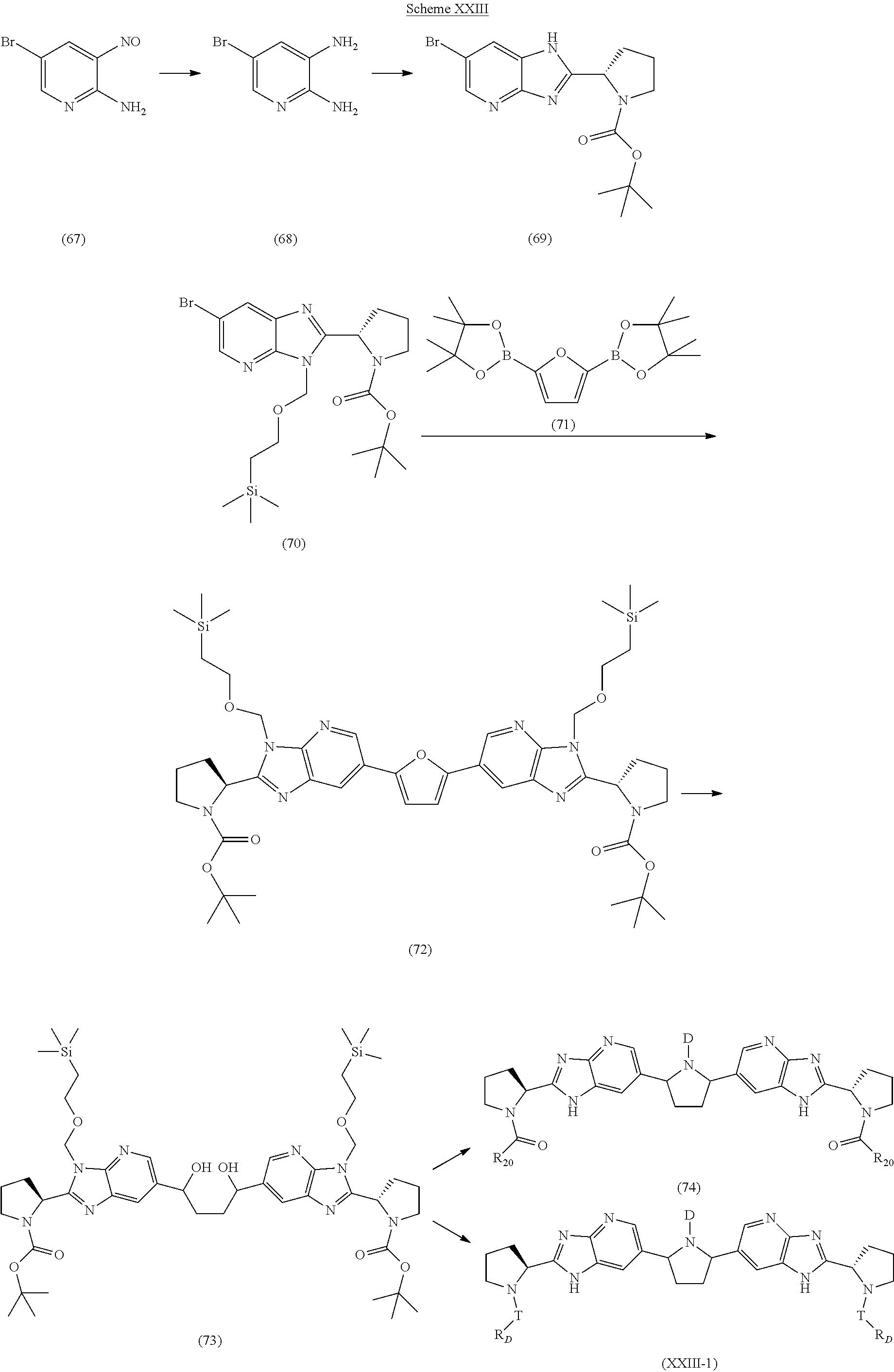


etc., wherein G3 is defined above,

is a nitrogen containing heterocycle substituted with G3, and

is a nitrogen containing bridged, bicyclic heterocycle), or —ORS (e.g., —O-t-butyl, —O-isopropyl, etc.). Fluoronitrobenzenes (82) can be reacted with an appropriate amine in the presence of dibasic potassium phosphate in a solvent such as DMSO optionally with heating to give intermediates (83), wherein RM is —N(RSRS′) (e.g., —NEt2) or heterocyclyl (e.g., pyrrolidin-1-yl, piperidin-1-yl,

etc.). Fluoronitrobenzenes (82) can also be reacted with alkali metal alkoxides (e.g., potassium tert-butoxide) to give intermediates (83), wherein RM is —ORS (e.g., —O-t-butyl, —O-isopropyl, etc.). Intermediates (83) may be converted to (84) using well-known nitro reduction conditions. For example, (83) can be converted to (84) by catalytic hydrogenation using palladium on carbon. Alternatively, (83) can be converted to (84) by reaction with iron/ammonium chloride in THF/methanol/water as solvent. Other conditions for effecting nitro reduction include those described in the foregoing schemes and those generally known to one skilled in the art.


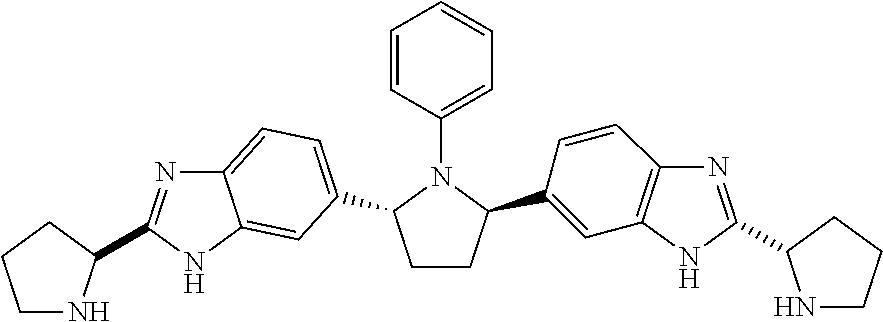
is given the following names:
- (S)-6,6′-((2R,5R)-1-phenylpyrrolidine-2,5-diyl)bis(2-((S)-pyrrolidin-2-yl)-1H-benzo[d]imidazole) (Chemdraw v9);
- 6,6′-[(2R,5R)-1-phenylpyrrolidine-2,5-diyl]bis{2-[(2S)-pyrrolidin-2-yl]-1H-benzoimidazole} (ACD Name v12).

is given the following names:
- (S)-5,5′-(2R,5R)-1-phenylpyrrolidine-2,5-diyl)bis(2-((S)-pyrrolidin-2-yl)-1H-benzo[d]imidazole) (Chemdraw v9);
- 5,5′-[(2R,5R)-1-phenylpyrrolidine-2,5-diyl]bis{2-[(2S)-pyrrolidin-2-yl]-1H-benzoimidazole} (ACD Name v12).

is given the following names:
- (S)-5,5′-((2R,5R)-1-phenylpyrrolidine-2,5-diyl)bis(2-((S)-pyrrolidin-2-yl)-1H-benzo[d]imidazole) (Chemdraw v9);
- 5-[(2R,5R)-1-phenyl-5-{2-[(2S)-pyrrolidin-2-yl]-1H-benzimidazol-6-yl}pyrrolidin-2-yl]-2-[(2S)-pyrrolidin-2-yl]-1H-benzimidazole (ACD Name v12).


represents any amine group that can be present in RM and attached through nitrogen, in the presence of dibasic potassium phosphate (equivalents)) or potassium carbonate in a solvent such as DMSO optionally with heating and optional microwave irradiation. Step 2 can be accomplished by standard nitro reduction conditions such as catalytic hydrogenation using palladium on carbon or Raney-nickel. Alternatively, the reduction can be effected with iron/ammonium chloride in THF/methanol/water as solvent. Where the group

is an optionally substituted cyclic amine (e.g., piperidine, pyrrolidine), the optionally substituted cyclic amines can be accessed as described herein or using generally known methodologies. See for example the methods shown in Patel et al. J Medicinal Chemistry 49(25) 7450 (2006).
- 4-(4,4-dimethylpiperidin-1-yl)-3,5-difluoroaniline;
- 4-(2-azabicyclo[2.2.2]octan-2-yl)-3,5-difluoroaniline;
- 3,5-difluoro-4-(4-isopropylpiperidin-1-yl)aniline;
- 3,5-difluoro-4-(4-(trifluoromethyl)piperidin-1-yl)aniline;
- 4-(4-tert-butylpiperidin-1-yl)-3,5-difluoroaniline;
- 3,5-difluoro-4-(6-azaspiro[2.5]octan-6-yl)aniline;
- 4-(3,3-dimethylazetidin-1-yl)-3,5-difluoroaniline;
- 4-(4,4-difluoropiperidin-1-yl)-3,5-difluoroaniline;
- 3,5-difluoro-4-(4-fluoropiperidin-1-yl)aniline;
- 3,5-difluoro-4-(piperidin-1-yl)aniline;
- 2,3,5,6-tetrafluoro-4-(piperidin-1-yl)aniline;
- 3-methyl-4-(piperidin-1-yl)aniline;
- 3,5-difluoro-4-((3aR,7aS)-1H-isoindol-2(3H,3aH,4H,5H,6H,7H,7aH)-yl)aniline;
- N1-tert-butyl-2-fluorobenzene-1,4-diamine;
- 3,5-difluoro-4-(4-methylpiperidin-1-yl)aniline;
- 3,5-dichloro-4-(piperidin-1-yl)aniline;
- 2,5-difluoro-4-(piperidin-1-yl)aniline;
- 4-((2R,6S)-2,6-dimethylpiperidin-1-yl)-3,5-difluoroaniline;
- 2,3,5-trifluoro-4-(piperidin-1-yl)aniline;
- 4-((1R,5S)-3-azabicyclo[3.2.0]heptan-3-yl)-3,5-difluoroaniline;
- 3-fluoro-4-(piperidin-1-yl)aniline;
- 3,5-difluoro-4-(3-azaspiro[5.5]undecan-3-yl)aniline;
- 3,5-difluoro-4-(isoindolin-2-yl)aniline;
- 3,5-difluoro-4-(1,4-dioxa-8-azaspiro[4.5]decan-8-yl)aniline;
- 4-(4-phenyl-5,6-dihydropyridin-1(2H)-yl)aniline;
- 3-fluoro-4-(4-phenylpiperidin-1-yl)aniline;
- 4-(4,4-diphenylpiperidin-1-yl)-3,5-difluoroaniline;
- 4-(4-phenylpiperidin-1-yl)aniline;
- 1-(1-(4-amino-2,6-difluorophenyl)-4-phenylpiperidin-4-yl)ethanone;
- 3,5-difluoro-4-(4-(3-phenylpropyl)piperidin-1-yl)aniline;
- 3,5-difluoro-4-(8-azaspiro[4.5]decan-8-yl)aniline;
- 3,5-difluoro-4-(3-phenylpiperidin-1-yl)aniline;
- 3,5-difluoro-4-(3-phenylpyrrolidin-1-yl)aniline;
- 3,5-difluoro-4-(4-(4-(trifluoromethyl)phenyl)piperazin-1-yl)aniline;
- 3,5-difluoro-4-(4-phenylpiperazin-1-yl)aniline;
- 4-(4-(2,6-difluorophenyl)piperazin-1-yl)-3,5-difluoroaniline;
- 3,5-difluoro-4-(4-(pyrimidin-2-yl)piperazin-1-yl)aniline;
- 3,5-difluoro-4-(2-phenylmorpholino)aniline;
- (S)-3,5-difluoro-4-(2-phenylmorpholino)aniline
- 3,5-difluoro-4-(2-phenylpiperidin-1-yl)aniline;
- 4-((2S,6R)-2,6-dimethylmorpholino)-3,5-difluoroaniline;
- 4-(4-cyclohexylpiperidin-1-yl)-3,5-difluoroaniline;
- 4-(4-benzylpiperidin-1-yl)-3,5-difluoroaniline;
- 3,5-difluoro-4-(4-(4-methoxyphenyl)piperidin-1-yl)aniline;
- 3,5-difluoro-4-(4-(4-fluorophenyl)piperidin-1-yl)aniline;
- 4-(4-(3,4-difluorophenyl)piperidin-1-yl)-3,5-difluoroaniline;
- 4-(4-(3,5-difluorophenyl)piperidin-1-yl)-3,5-difluoroaniline;
- 3,5-difluoro-4-(4-fluoro-4-phenylpiperidin-1-yl)aniline;
- 3,5-difluoro-4-(4-(fluorodiphenylmethyl)piperidin-1-yl)aniline;
- 4-(4-fluoro-4-phenylpiperidin-1-yl)aniline;
- 3,5-difluoro-4-(4-(pyridin-2-yl)piperidin-1-yl)aniline;
- 3,5-difluoro-4-(4-(naphthalen-2-yl)piperidin-1-yl)aniline;
- 3,5-difluoro-4-(4-(naphthalen-1-yl)piperidin-1-yl)aniline; and
- 3,5-difluoro-4-(4-(4-(trimethylsilyl)phenyl)piperidin-1-yl)aniline.

- 4-((3-ethyloxetan-3-yl)methoxy)-3,5-difluoroaniline;
- 4-((1,3-dioxolan-4-yl)methoxy)aniline;
- 4-(1,3-dioxan-5-yloxy)aniline.


- 3,5-difluoro-4-(4-(4-fluorophenyl)piperidin-1-yl)aniline; and
- 3,5-difluoro-4-(4-(3-(trimethylsilyl)phenyl)piperidin-1-yl)aniline.


- 1-(4-((2R,5R)-2,5-bis(4-chloro-3-nitrophenyl)pyrrolidin-1-yl)-2,6-difluorophenyl)-4,4-dimethylpiperidine;
- 2-(4-((2R,5R)-2,5-bis(4-chloro-3-nitrophenyl)pyrrolidin-1-yl)-2,6-difluorophenyl)-2-azabicyclo[2.2.2]octane;
- 1-(4-((2R,5R)-2,5-bis(4-chloro-3-nitrophenyl)pyrrolidin-1-yl)-2,6-difluorophenyl)-4-isopropylpiperidine;
- 1-(4-((2R,5R)-2,5-bis(4-chloro-3-nitrophenyl)pyrrolidin-1-yl)-2,6-difluorophenyl)-4-(trifluoromethyl)piperidine;
- 1-(4-((2R,5R)-2,5-bis(4-chloro-3-nitrophenyl)pyrrolidin-1-yl)-2,6-difluorophenyl)-4-tert-butylpiperidine;
- 6-(4-((2R,5R)-2,5-bis(4-chloro-3-nitrophenyl)pyrrolidin-1-yl)-2,6-difluorophenyl)-6-azaspiro[2.5]octane;
- 1-(4-((2R,5R)-2,5-bis(4-chloro-3-nitrophenyl)pyrrolidin-1-yl)-2,6-difluorophenyl)-4,4-dimethylpiperidine;
- (2R,5R)-2,5-bis(4-chloro-3-nitrophenyl)-1-(4-(3,3-dimethylazetidin-1-yl)-3,5-difluorophenyl)pyrrolidine;
- (2R,5R)-2,5-bis(4-chloro-3-nitrophenyl)-1-(4-phenoxyphenyl)pyrrolidine;
- 1-(4-((2R,5R)-2,5-bis(4-chloro-3-nitrophenyl)pyrrolidin-1-yl)phenyl)pyridin-2(1H)-one;
- (2R,5R)-2,5-bis(4-chloro-3-nitrophenyl)-1-(2,5-difluoro-4-(trifluoromethyl)phenyl)pyrrolidine;
- 2-(4-((2R,5R)-2,5-bis(4-chloro-3-nitrophenyl)pyrrolidin-1-yl)phenyl)oxazole;
- 4-((2R,5R)-2,5-bis(4-chloro-3-nitrophenyl)pyrrolidin-1-yl)-2-fluoropyridine;
- (2R,5R)-1-(4-chloro-3-fluorophenyl)-2,5-bis(4-chloro-3-nitrophenyl)pyrrolidine;
- 1-(4-((2R,5R)-2,5-bis(4-chloro-3-nitrophenyl)pyrrolidin-1-yl)-2,6-difluorophenyl)-4,4-difluoropiperidine;
- 1-(4-((2R,5R)-2,5-bis(4-chloro-3-nitrophenyl)pyrrolidin-1-yl)-2,6-difluorophenyl)-4-fluoropiperidine;
- 1-(4-((2R,5R)-2,5-bis(4-chloro-3-nitrophenyl)pyrrolidin-1-yl)-2,6-difluorophenyl)piperidine;
- (2R,5R)-2,5-bis(4-chloro-3-nitrophenyl)-1-(4-fluorophenyl)pyrrolidine;
- (2R,5R)-1-(4-tert-butylphenyl)-2,5-bis(4-chloro-3-nitrophenyl)pyrrolidine;
- (2R,5R)-2,5-bis(4-chloro-3-nitrophenyl)-1-(4-cyclopropyl-3,5-difluorophenyl)pyrrolidine;
- (2R,5R)-2,5-bis(4-chloro-3-nitrophenyl)-1-(4-cyclohexyl-3-fluorophenyl)pyrrolidine;
- (2R,5R)-2,5-bis(4-chloro-3-nitrophenyl)-1-(3,4-difluorophenyl)pyrrolidine;
- (2R,5R)-2,5-bis(4-chloro-3-nitrophenyl)-1-(4-(2,2-difluoroethoxy)phenyl)pyrrolidine;
- 1-(4-((2R,5R)-2,5-bis(4-chloro-3-nitrophenyl)pyrrolidin-1-yl)-2,6-difluorophenyl)-3,5-dimethylpiperidine;
- (2R,5R)-2,5-bis(4-chloro-3-nitrophenyl)-1-[4-(pentafluoro-λ6-sulfanyl)phenyl]pyrrolidine (ACD Name v12);
- 2-(4-((2R,5R)-2,5-bis(4-chloro-3-nitrophenyl)pyrrolidin-1-yl)phenyl)pyridine;
- (2R,5R)-2,5-bis(4-chloro-3-nitrophenyl)-1-(3-chloro-4-(trifluoromethoxy)phenyl)pyrrolidine;
- (2R,5R)-2,5-bis(4-chloro-3-nitrophenyl)-1-(4-(2-methoxyethoxy)-3-methylphenyl)pyrrolidine;
- (2R,5R)-2,5-bis(4-chloro-3-nitrophenyl)-1-(4-chlorophenyl)pyrrolidine;
- (2R,5R)-2,5-bis(4-chloro-3-nitrophenyl)-1-(4-((3-ethyloxetan-3-yl)methoxy)phenyl)pyrrolidine;
- (2R,5R)-1-(biphenyl-4-yl)-2,5-bis(4-chloro-3-nitrophenyl)pyrrolidine;
- (2R,5R)-1-(4-(1,3-dioxan-5-yloxy)phenyl)-2,5-bis(4-chloro-3-nitrophenyl)pyrrolidine;
- (2R,5R)-1-(4-((1,3-dioxolan-4-yl)methoxy)phenyl)-2,5-bis(4-chloro-3-nitrophenyl)pyrrolidine;
- (2R,5R)-2,5-bis(4-chloro-3-nitrophenyl)-1-(4-((3-ethyloxetan-3-yl)methoxy)-3,5-difluorophenyl)pyrrolidine;
- 1-(4-((2R,5R)-2,5-bis(4-chloro-3-nitrophenyl)pyrrolidin-1-yl)-2,3,5,6-tetrafluorophenyl)piperidine;
- 1-(4-((2R,5R)-2,5-bis(4-chloro-3-nitrophenyl)pyrrolidin-1-yl)-2-methylphenyl)piperidine;
- (3aR,7aS)-2-(4-((2R,5R)-2,5-bis(4-chloro-3-nitrophenyl)pyrrolidin-1-yl)-2,6-difluorophenyl)octahydro-1H-isoindole;
- 4-((2R,5R)-2,5-bis(4-chloro-3-nitrophenyl)pyrrolidin-1-yl)-N-tert-butyl-2-fluoroaniline;
- 1-(4-((2R,5R)-2,5-bis(4-chloro-3-nitrophenyl)pyrrolidin-1-yl)-2,6-difluorophenyl)-4-methylpiperidine;
- (2R,5R)-2,5-bis(4-chloro-3-nitrophenyl)-1-(4-(cyclopentyloxy)-3-fluorophenyl)pyrrolidine;
- (2R,5R)-2,5-bis(4-chloro-3-nitrophenyl)-1-(3-fluoro-4-(methylthio)phenyl)pyrrolidine
- 1-(4-((2R,5R)-2,5-bis(4-chloro-3-nitrophenyl)pyrrolidin-1-yl)-2,6-dichlorophenyl)piperidine;
- 1-(4-((2R,5R)-2,5-bis(4-chloro-3-nitrophenyl)pyrrolidin-1-yl)-2,5-difluorophenyl)piperidine;
- (2R,6S)-1-(4-((2R,5R)-2,5-bis(4-chloro-3-nitrophenyl)pyrrolidin-1-yl)-2,6-difluorophenyl)-2,6-dimethylpiperidine;
- 1-(4-((2R,5R)-2,5-bis(4-chloro-3-nitrophenyl)pyrrolidin-1-yl)-2,3,6-trifluorophenyl)piperidine;
- (2R,5R)-2,5-bis(4-chloro-3-nitrophenyl)-1-(4-cyclopropylphenyl)pyrrolidine;
- (1R,5S)-3-(4-((2R,5R)-2,5-bis(4-chloro-3-nitrophenyl)pyrrolidin-1-yl)-2,6-difluorophenyl)-3-azabicyclo[3.2.0]heptane;
- (2R,5R)-2,5-bis(4-chloro-3-nitrophenyl)-1-(4-cyclopropyl-2-fluorophenyl)pyrrolidine;
- 1-(4-((2R,5R)-2,5-bis(4-chloro-3-nitrophenyl)pyrrolidin-1-yl)-2-fluorophenyl)piperidine;
- 1-(4-((2R,5R)-2,5-bis(4-chloro-3-nitrophenyl)pyrrolidin-1-yl)phenyl)-4-phenylpiperidine;
- 3-(4-((2R,5R)-2,5-bis(4-chloro-3-nitrophenyl)pyrrolidin-1-yl)-2,6-difluorophenyl)-3-azaspiro[5.5]undecane;
- 2-(4-((2R,5R)-2,5-bis(4-chloro-3-nitrophenyl)pyrrolidin-1-yl)-2,6-difluorophenyl)isoindoline;
- 8-(4-((2R,5R)-2,5-bis(4-chloro-3-nitrophenyl)pyrrolidin-1-yl)-2,6-difluorophenyl)-1,4-dioxa-8-azaspiro[4.5]decane;
- 1-(4-((2R,5R)-2,5-bis(4-chloro-3-nitrophenyl)pyrrolidin-1-yl)-2,6-difluorophenyl)-4-phenyl-1,2,3,6-tetrahydropyridine;
- 1-(4-((2R,5R)-2,5-bis(4-chloro-3-nitrophenyl)pyrrolidin-1-yl)-2,6-difluorophenyl)-4,4-diphenylpiperidine;
- 1-(1-(4-((2R,5R)-2,5-bis(4-chloro-3-nitrophenyl)pyrrolidin-1-yl)-2,6-difluorophenyl)-4-phenylpiperidin-4-yl)ethanone;
- 1-(4-((2R,5R)-2,5-bis(4-chloro-2-fluoro-5-nitrophenyl)pyrrolidin-1-yl)-2,6-difluorophenyl)piperidine;
- 1-(4-(2,5-bis(4-chloro-2-fluoro-5-nitrophenyl)pyrrolidin-1-yl)-2,6-difluorophenyl)piperidine;
- 1-(4-((2R,5R)-2,5-bis(4-chloro-3-nitrophenyl)pyrrolidin-1-yl)-2,6-difluorophenyl)-4-(3-phenylpropyl)piperidine;
- 8-(4-((2R,5R)-2,5-bis(4-chloro-3-nitrophenyl)pyrrolidin-1-yl)-2,6-difluorophenyl)-8-azaspiro[4.5]decane;
- 1-(4-((2R,5R)-2,5-bis(4-chloro-3-nitrophenyl)pyrrolidin-1-yl)-2,6-difluorophenyl)-4-(naphthalen-2-yl)piperidine;
- 2-(1-(4-((2R,5R)-2,5-bis(4-chloro-3-nitrophenyl)pyrrolidin-1-yl)-2,6-difluorophenyl)piperidin-4-yl)pyridine;
- 1-(4-((2R,5R)-2,5-bis(4-chloro-3-nitrophenyl)pyrrolidin-1-yl)-2,6-difluorophenyl)-4-(4-(trimethylsilyl)phenyl)piperidine;
- 1-(4-((2R,5R)-2,5-bis(4-chloro-3-nitrophenyl)pyrrolidin-1-yl)-2,6-difluorophenyl)-4-(naphthalen-1-yl)piperidine;
- 1-(4-((2R,5R)-2,5-bis(4-chloro-2-fluoro-5-nitrophenyl)pyrrolidin-1-yl)-2,6-difluorophenyl)-4-(3-phenylpropyl)piperidine;
- 6-(4-(2R,5R)-2,5-bis(4-chloro-2-fluoro-5-nitrophenyl)pyrrolidin-1-yl)-2,6-difluorophenyl)-6-azaspiro[2.5]octane;
- 1-(4-((2R,5R)-2,5-bis(4-chloro-2-fluoro-5-nitrophenyl)pyrrolidin-1-yl)-2,6-difluorophenyl)-4-tert-butylpiperidine;
- 1-(4-((2R,5R)-2,5-bis(4-chloro-2-fluoro-5-nitrophenyl)pyrrolidin-1-yl)-2,6-difluorophenyl)-4-(naphthalen-2-yl)piperidine;
- 1-(4-((2R,5R)-2,5-bis(4-chloro-2-fluoro-5-nitrophenyl)pyrrolidin-1-yl)-2,6-difluorophenyl)-3,5-dimethylpiperidine;
- 1′-(4-((2R,5R)-2,5-bis(4-chloro-2-fluoro-5-nitrophenyl)pyrrolidin-1-yl)-2,6-difluorophenyl)-2,3-dihydrospiro[indene-1,4′-piperidine];
- 1-(4-((2R,5R)-2,5-bis(4-chloro-3-nitrophenyl)pyrrolidin-1-yl)-2,6-difluorophenyl)-3-phenylpiperidine;
- (2R,5R)-2,5-bis(4-chloro-3-nitrophenyl)-1-(3,5-difluoro-4-(3-phenylpyrrolidin-1-yl)phenyl)pyrrolidine;
- 1-(4-((2R,5R)-2,5-bis(4-chloro-3-nitrophenyl)pyrrolidin-1-yl)-2,6-difluorophenyl)-4-(4-methoxyphenyl)piperidine;
- 1-(4-((2R,5R)-2,5-bis(4-chloro-3-nitrophenyl)pyrrolidin-1-yl)-2,6-difluorophenyl)-4-fluoro-4-phenylpiperidine;
- 1-(4-((2R,5R)-2,5-bis(4-chloro-3-nitrophenyl)pyrrolidin-1-yl)phenyl)-4-fluoro-4-phenylpiperidine;
- 1-(4-((2R,5R)-2,5-bis(4-chloro-2-fluoro-5-nitrophenyl)pyrrolidin-1-yl)-2,6-difluorophenyl)-4-(fluorodiphenylmethyl)piperidine;
- 1-(4-((2R,5R)-2,5-bis(4-chloro-2-fluoro-5-nitrophenyl)pyrrolidin-1-yl)-2,6-difluorophenyl)-4-phenylpiperidine;
- 1-(4-((2R,5R)-2,5-bis(4-chloro-3-nitrophenyl)pyrrolidin-1-yl)-2,6-difluorophenyl)-4-(4-fluorophenyl)piperidine;
- 1-(4-((2R,5R)-2,5-bis(4-chloro-3-nitrophenyl)pyrrolidin-1-yl)-2,6-difluorophenyl)-4-(3,4-difluorophenyl)piperidine;
- 1-(4-((2R,5R)-2,5-bis(4-chloro-3-nitrophenyl)pyrrolidin-1-yl)-2,6-difluorophenyl)-4-(3,5-difluorophenyl)piperidine;
- 1-(4-((2R,5R)-2,5-bis(4-chloro-3-nitrophenyl)pyrrolidin-1-yl)-2,6-difluorophenyl)-4-(3-(trimethylsilyl)phenyl)piperidine;
- (2R,5R)-1-(4-(benzyloxy)phenyl)-2,5-bis(4-chloro-3-nitrophenyl)pyrrolidine;
- 1-(4-((2R,5R)-2,5-bis(4-chloro-2-fluoro-5-nitrophenyl)pyrrolidin-1-yl)-2,6-difluorophenyl)-4-(4-(trifluoromethyl)phenyl)piperazine;
- 1-(4-((2R,5R)-2-(4-chloro-2-fluoro-5-nitrophenyl)-5-(4-chloro-3-nitrophenyl)pyrrolidin-1-yl)-2,6-difluorophenyl)piperidine;
- 4-benzyl-1-(4-((2R,5R)-2,5-bis(4-chloro-2-fluoro-5-nitrophenyl)pyrrolidin-1-yl)-2,6-difluorophenyl)piperidine;
- 4-(4-((2R,5R)-2,5-bis(4-chloro-3-nitrophenyl)pyrrolidin-1-yl)-2,6-difluorophenyl)-2-phenylmorpholine;
- 1-(4-((2R,5R)-2,5-bis(4-chloro-3-nitrophenyl)pyrrolidin-1-yl)-2,6-difluorophenyl)-2-phenylpiperidine;
- (2S,6R)-4-(4-((2R,5R)-2,5-bis(4-chloro-2-fluoro-5-nitrophenyl)pyrrolidin-1-yl)-2,6-difluorophenyl)-2,6-dimethylmorpholine;
- 3-(4-((2R,5R)-2,5-bis(4-chloro-2-fluoro-5-nitrophenyl)pyrrolidin-1-yl)-2,6-difluorophenyl)-3-azaspiro[5.5]undecane;
- 1-(4-((2R,5R)-2,5-bis(4-chloro-2-fluoro-5-nitrophenyl)pyrrolidin-1-yl)-2,6-difluorophenyl)-4-cyclohexylpiperidine;
- (S)-4-(4-((2R,5R)-2,5-bis(4-chloro-3-nitrophenyl)pyrrolidin-1-yl)-2,6-difluorophenyl)-2-phenylmorpholine;
- 1-(4-((2R,5R)-2,5-bis(4-chloro-2-fluoro-5-nitrophenyl)pyrrolidin-1-yl)-2,6-difluorophenyl)-4-(3,4-difluorophenyl)piperidine;
- 1-(4-((2R,5R)-2,5-bis(4-chloro-2-fluoro-5-nitrophenyl)pyrrolidin-1-yl)-2,6-difluorophenyl)-4-(4-fluorophenyl)piperidine;
- 1-(4-((2R,5R)-2,5-bis(4-chloro-3-nitrophenyl)pyrrolidin-1-yl)-2,6-difluorophenyl)-4-phenylpiperazine;
- 1-(4-((2R,5R)-2,5-bis(4-chloro-3-nitrophenyl)pyrrolidin-1-yl)-2,6-difluorophenyl)-4-(4-(trifluoromethyl)phenyl)piperazine;
- 1-(4-((2R,5R)-2,5-bis(4-chloro-2-fluoro-5-nitrophenyl)pyrrolidin-1-yl)-2,6-difluorophenyl)-4-(2,6-difluorophenyl)piperazine; and
- 2-(4-(4-((2R,5R)-2,5-bis(4-chloro-2-fluoro-5-nitrophenyl)pyrrolidin-1-yl)-2,6-difluorophenyl)piperazin-1-yl)pyrimidine.


and trans,

pyrrolidines, the cis and trans diastereomers may be subject to separation using standard chromatographic methods (e.g., normal phase silica gel or reverse phase). For example, compounds of general type 11-1 and 11-2 can be separated in this manner.


- (S)-6,6′-((2R,5R)-1-(4-(pyridin-2-yl)phenyl)pyrrolidine-2,5-diyl)bis(2-((S)-pyrrolidin-2-yl)-1H-benzo[d]imidazole);
- (S)-6,6′-((2R,5R)-1-(3-chloro-4-(trifluoromethoxy)phenyl)pyrrolidine-2,5-diyl)bis(2-((S)-pyrrolidin-2-yl)-1H-benzo[d]imidazole);
- (S)-6,6′-((2R,5R)-1-(4-(2-methoxyethoxy)phenyl)pyrrolidine-2,5-diyl)bis(2-((S)-pyrrolidin-2-yl)-1H-benzo[d]imidazole);
- (S)-6,6′-((2R,5R)-1-(4-chlorophenyl)pyrrolidine-2,5-diyl)bis(2-((S)-pyrrolidin-2-yl)-1H-benzo[d]imidazole);
- (S)-6,6′-((2R,5R)-1-(3-methyl-4-(piperidin-1-yl)phenyl)pyrrolidine-2,5-diyl)bis(2-((S)-pyrrolidin-2-yl)-1H-benzo[d]imidazole);
- (S)-6,6′-((2S,5S)-1-(4-cyclopropyl-3,5-difluorophenyl)pyrrolidine-2,5-diyl)bis(2-((S)-pyrrolidin-2-yl)-1H-benzo[d]imidazole);
- (S)-6,6′-((2S,5S)-1-(4-cyclopropyl-2-fluorophenyl)pyrrolidine-2,5-diyl)bis(2-((S)-pyrrolidin-2-yl)-1H-benzo[d]imidazole);
- (S)-6,6′-((2R,5R)-1-(3-fluoro-4-(piperidin-1-yl)phenyl)pyrrolidine-2,5-diyl)bis(2-((S)-pyrrolidin-2-yl)-1H-benzo[d]imidazole);
- (S)-6,6′-((2R,5R)-1-(3,5-difluoro-4-(4-(trifluoromethyl)piperidin-1-yl)phenyl)pyrrolidine-2,5-diyl)bis(2-((S)-pyrrolidin-2-yl)-1H-benzo[d]imidazole);
- (S)-6,6′-((2R,5R)-1-(4-(4-tert-butylpiperidin-1-yl)-3,5-difluorophenyl)pyrrolidine-2,5-diyl)bis(2-((S)-pyrrolidin-2-yl)-1H-benzo[d]imidazole);
- (S)-6,6′-((2R,5R)-1-(4-(4,4-dimethylpiperidin-1-yl)-3,5-difluorophenyl)pyrrolidine-2,5-diyl)bis(2-((S)-pyrrolidin-2-yl)-1H-benzo[a]imidazole);
- (S)-6,6′-((2R,5R)-1-(3,5-difluoro-4-(6-azaspiro[2.5]octan-6-yl)phenyl)pyrrolidine-2,5-diyl)bis(2-((S)-pyrrolidin-2-yl)-1H-benzo[d]imidazole);
- (S)-6,6′-((2R,5R)-1-(3,5-difluoro-4-(isoindolin-2-yl)phenyl)pyrrolidine-2,5-diyl)bis(2-((S)-pyrrolidin-2-yl)-1H-benzo[d]imidazole);
- 2-(4-((2R,5R)-2,5-bis(2-((S)-pyrrolidin-2-yl)-1H-benzo[d]imidazol-6-yl)pyrrolidin-1-yl)-2,6-difluorophenyl)-2-azabicyclo[2.2.2]octane;
- (S)-6,6′-((2R,5R)-1-(3,5-difluoro-4-(4-isopropylpiperidin-1-yl)phenyl)pyrrolidine-2,5-diyl)bis(2-((S)-pyrrolidin-2-yl)-1H-benzo[d]imidazole);
- (S)-6,6′-((2R,5R)-1-(4-(3,3-dimethylazetidin-1-yl)-3,5-difluorophenyl)pyrrolidine-2,5-diyl)bis(2-((S)-pyrrolidin-2-yl)-1H-benzo[d]imidazole);
- (S)-6,6′-((2R,5R)-1-(4-(4-phenylpiperidin-1-yl)phenyl)pyrrolidine-2,5-diyl)bis(2-((S)-pyrrolidin-2-yl)-1H-benzo[d]imidazole);
- 6,6′-{(2R,5R)-1-[3,5-difluoro-4-(piperidin-1-yl)phenyl]pyrrolidine-2,5-diyl}bis{5-fluoro-2-[(2S)-pyrrolidin-2-yl]-1H-benzimidazole} (ACD Name v12);
- (S)-6,6′-((2S,5R)-1-(3,5-difluoro-4-(piperidin-1-yl)phenyl)pyrrolidine-2,5-diyl)bis(5-fluoro-2-((S)-pyrrolidin-2-yl)-1H-benzo[d]imidazole)
- (S,S,S)-6,6′-((2R,5R)-1-(3,5-difluoro-4-(piperidin-1-yl)phenyl)pyrrolidine-2,5-diyl)bis(5-fluoro-2-((2S,3aS,6aS)-octahydrocyclopenta[b]pyrrol-2-yl)-1H-benzo[d]imidazole);
- (S,S,S)-6,6′-((2R,5R)-1-(3,5-difluoro-4-(piperidin-1-yl)phenyl)pyrrolidine-2,5-diyl)bis(2-((2S,3aS,6aS)-octahydrocyclopenta[b]pyrrol-2-yl)-1H-benzo[d]imidazole);
- (S)-6,6′-((2R,5R)-1-(4-(2,3-dihydrospiro[indene-1,4′-piperidine]-1′-yl)-3,5-difluorophenyl)pyrrolidine-2,5-diyl)bis(5-fluoro-2-((S)-pyrrolidin-2-yl)-1H-benzo[d]imidazole);
- (S)-6,6′-((2R,5R)-1-(3,5-difluoro-4-(4-(4-methoxyphenyl)piperidin-1-yl)phenyl)pyrrolidine-2,5-diyl)bis(2-((S)-pyrrolidin-2-yl)-1H-benzo[d]imidazole);
- (S)-6,6′-((2R,5R)-1-(3,5-difluoro-4-(4-fluoro-4-phenylpiperidin-1-yl)phenyl)pyrrolidine-2,5-diyl)bis(2-((S)-pyrrolidin-2-yl)-1H-benzo[d]imidazole);
- (S)-6,6′-((2R,5R)-1-(4-(4-fluoro-4-phenylpiperidin-1-yl)phenyl)pyrrolidine-2,5-diyl)bis(2-((S)-pyrrolidin-2-yl)-1H-benzo[d]imidazole);
- (S)-6,6′-((2R,5R)-1-(3,5-difluoro-4-(4-(fluorodiphenylmethyl)piperidin-1-yl)phenyl)pyrrolidine-2,5-diyl)bis(5-fluoro-2-((S)-pyrrolidin-2-yl)-1H-benzo[d]imidazole);
- (S)-6,6′-((2R,5R)-1-(3,5-difluoro-4-(4-(4-fluorophenyl)piperidin-1-yl)phenyl)pyrrolidine-2,5-diyl)bis(2-((S)-pyrrolidin-2-yl)-1H-benzo[d]imidazole);
- (S)-6,6′-((2R,5R)-1-(3,5-difluoro-4-(4-(3-(trimethylsilyl)phenyl)piperidin-1-yl)phenyl)pyrrolidine-2,5-diyl)bis(2-((S)-pyrrolidin-2-yl)-1H-benzo[d]imidazole);
- (S)-6,6′-((2R,5R)-1-(4-(4-(3,4-difluorophenyl)piperidin-1-yl)-3,5-difluorophenyl)pyrrolidine-2,5-diyl)bis(2-((S)-pyrrolidin-2-yl)-1H-benzo[d]imidazole);
- (S)-6,6′-((2R,5R)-1-(4-(4-(3,5-difluorophenyl)piperidin-1-yl)-3,5-difluorophenyl)pyrrolidine-2,5-diyl)bis(2-((S)-pyrrolidin-2-yl)-1H-benzo[d]imidazole);
- (S)-6,6′-((2R,5R)-1-(3,5-difluoro-4-(4-(4-(trifluoromethyl)phenyl)piperazin-1-yl)phenyl)pyrrolidine-2,5-diyl)bis(5-fluoro-2-((S)-pyrrolidin-2-yl)-1H-benzo[d]imidazole);
- 6-((2R,5R)-1-(3,5-difluoro-4-(piperidin-1-yl)phenyl)-5-(2-((S)-pyrrolidin-2-yl)-1H-benzo[d]imidazol-6-yl)pyrrolidin-2-yl)-5-fluoro-2-((S)-pyrrolidin-2-yl)-1H-benzo[d]imidazole;
- (S)-6,6′-((2R,5R)-1-(4-(4-benzylpiperidin-1-yl)-3,5-difluorophenyl)pyrrolidine-2,5-diyl)bis(5-fluoro-2-((S)-pyrrolidin-2-yl)-1H-benzo[d]imidazole);
- (S)-6,6′-((2R,5R)-1-(4-(4-benzylpiperidin-1-yl)-3,5-difluorophenyl)pyrrolidine-2,5-diyl)bis(2-((S)-pyrrolidin-2-yl)-1H-benzo[d]imidazole);
- (S)-6,6′-((2S,5R)-1-(3,5-difluoro-4-(4-phenylpiperidin-1-yl)phenyl)pyrrolidine-2,5-diyl)bis(2-((S)-pyrrolidin-2-yl)-1H-benzo[d]imidazole);
- 4-(4-((2R,5R)-2,5-bis(2-((S)-pyrrolidin-2-yl)-1H-benzo[d]imidazol-6-yl)pyrrolidin-1-yl)-2,6-difluorophenyl)-2-phenylmorpholine;
- (S)-6,6′-((2R,5R)-1-(3,5-difluoro-4-(2-phenylpiperidin-1-yl)phenyl)pyrrolidine-2,5-diyl)bis(2-((S)-pyrrolidin-2-yl)-1H-benzo[d]imidazole);
- (2S,6R)-4-(4-((2R,5R)-2,5-bis(5-fluoro-2-((S)-pyrrolidin-2-yl)-1H-benzo[d]imidazol-6-yl)pyrrolidin-1-yl)-2,6-difluorophenyl)-2,6-dimethylmorpholine;
- (S)-6,6′-((2R,5R)-1-(3,5-difluoro-4-(3-azaspiro[5.5]undecan-3-yl)phenyl)pyrrolidine-2,5-diyl)bis(5-fluoro-2-((S)-pyrrolidin-2-yl)-1H-benzo[d]imidazole);
- (S)-6,6′-((2R,5R)-1-(4-(4-cyclohexylpiperidin-1-yl)-3,5-difluorophenyl)pyrrolidine-2,5-diyl)bis(5-fluoro-2-((S)-pyrrolidin-2-yl)-1H-benzo[d]imidazole);
- (S)-4-(4-((2R,5R)-2,5-bis(5-fluoro-2-((S)-pyrrolidin-2-yl)-1H-benzo[d]imidazol-6-yl)pyrrolidin-1-yl)-2,6-difluorophenyl)-2-phenylmorpholine;
- (S)-6,6′-((2R,5R)-1-(3,5-difluoro-4-(4-phenylpiperazin-1-yl)phenyl)pyrrolidine-2,5-diyl)bis(2-((S)-pyrrolidin-2-yl)-1H-benzo[d]imidazole);
- (S,R)-6,6′-((2R,5R)-1-(3,5-difluoro-4-(piperidin-1-yl)phenyl)pyrrolidine-2,5-diyl)bis(2-((2S,4R)-4-fluoropyrrolidin-2-yl)-1H-benzo[d]imidazole);
- (S)-6,6′-((2R,5R)-1-(4-(4-(2,6-difluorophenyl)piperazin-1-yl)-3,5-difluorophenyl)pyrrolidine-2,5-diyl)bis(5-fluoro-2-((S)-pyrrolidin-2-yl)-1H-benzo[d]imidazole);
- (S)-6,6′-((2R,5R)-1-(4-(4-(3,4-difluorophenyl)piperidin-1-yl)-3,5-difluorophenyl)pyrrolidine-2,5-diyl)bis(5-fluoro-2-((S)-pyrrolidin-2-yl)-1H-benzo[d]imidazole); and
- (S)-6,6′-((2R,5R)-1-(3,5-difluoro-4-(4-(4-fluorophenyl)piperidin-1-yl)phenyl)pyrrolidine-2,5-diyl)bis(5-fluoro-2-((S)-pyrrolidin-2-yl)-1H-benzo[d]imidazole).
- (S)-6,6′-((2R,5R)-1-(biphenyl-4-yl)pyrrolidine-2,5-diyl)bis(2-((S)-pyrrolidin-2-yl)-1H-benzo[d]imidazole);
- (S)-6,6′-((2R,5R)-1-(4-(cyclopentyloxy)-3-fluorophenyl)pyrrolidine-2,5-diyl)bis(2-((S)-pyrrolidin-2-yl)-1H-benzo[d]imidazole);
- (S)-6,6′-((2R,5R)-1-(3,5-difluoro-4-((3aR,7aS)-1H-isoindol-2(3H,3aH,4H,5H,6H,7H,7aH)-yl)phenyl)pyrrolidine-2,5-diyl)bis(2-((S)-pyrrolidin-2-yl)-1H-benzo[d]imidazole);
- (S)-6,6′-((2R,5R)-1-(3,5-dichloro-4-(piperidin-1-yl)phenyl)pyrrolidine-2,5-diyl)bis(2-((S)-pyrrolidin-2-yl)-1H-benzo[d]imidazole);
- (S)-6,6′-((2R,5R)-1-(2,5-difluoro-4-(piperidin-1-yl)phenyl)pyrrolidine-2,5-diyl)bis(2-((S)-pyrrolidin-2-yl)-1H-benzo[d]imidazole);
- (S)-6,6′-((2R,5R)-1-(4-((2R,6S)-2,6-dimethylpiperidin-1-yl)-3,5-difluorophenyl)pyrrolidine-2,5-diyl)bis(2-((S)-pyrrolidin-2-yl)-1H-benzo[d]imidazole);
- (S)-6,6′-((2R,5R)-1-(2,3,5-trifluoro-4-(piperidin-1-yl)phenyl)pyrrolidine-2,5-diyl)bis(2-((S)-pyrrolidin-2-yl)-1H-benzo[d]imidazole);
- (S)-6,6′-((2R,5R)-1-(4-cyclohexyl-3-fluorophenyl)pyrrolidine-2,5-diyl)bis(2-((S)-pyrrolidin-2-yl)-1H-benzo[d]imidazole);
- (S)-6,6′-((2R,5R)-1-(3,4-difluorophenyl)pyrrolidine-2,5-diyl)bis(2-((S)-pyrrolidin-2-yl)-1H-benzo[d]imidazole);
- (S)-6,6′-((2R,5R)-1-(4-ethoxyphenyl)pyrrolidine-2,5-diyl)bis(2-((S)-pyrrolidin-2-yl)-1H-benzo[d]imidazole);
- (S)-6,6′-((2R,5R)-1-(4-(2,2-difluoroethoxy)phenyl)pyrrolidine-2,5-diyl)bis(2-((S)-pyrrolidin-2-yl)-1H-benzo[d]imidazole);
- (S)-6,6′-((2R,5R)-1-(4-(3,5-dimethylpiperidin-1-yl)-3,5-difluorophenyl)pyrrolidine-2,5-diyl)bis(2-((S)-pyrrolidin-2-yl)-1H-benzo[d]imidazole);
- 6,6′-{(2R,5R)-1-[4-(pentafluoro-λ6-sulfanyl)phenyl]pyrrolidine-2,5-diyl}bis{2-[(2S)-pyrrolidin-2-yl]-1H-benzimidazole} (ACD Name v12);
- (S)-6,6′-((2S,5S)-1-(4-cyclopropylphenyl)pyrrolidine-2,5-diyl)bis(2-((S)-pyrrolidin-2-yl)-1H-benzo[d]imidazole);
- (S)-6,6′-((2R,5R)-1-(4-tert-butylphenyl)pyrrolidine-2,5-diyl)bis(2-((S)-pyrrolidin-2-yl)-1H-benzo[d]imidazole);
- (S,S)-6,6′-((2R,5R)-1-(3,5-difluoro-4-(piperidin-1-yl)phenyl)pyrrolidine-2,5-diyl)bis(2-((2S,4S)-4-methoxypyrrolidin-2-yl)-1H-benzo[d]imidazole);
- (S,S)-6,6′-((2R,5R)-1-(3,5-difluoro-4-(piperidin-1-yl)phenyl)pyrrolidine-2,5-diyl)bis(2-((2S,4S)-4-fluoropyrrolidin-2-yl)-1H-benzo[d]imidazole);
- (S,S)-6,6′-((2R,5R)-1-(4-fluorophenyl)pyrrolidine-2,5-diyl)bis(2-((2S,4S)-4-fluoropyrrolidin-2-yl)-1H-benzo[d]imidazole);
- (S,S)-6,6′-((2R,5R)-1-(4-fluorophenyl)pyrrolidine-2,5-diyl)bis(2-((2S,4S)-4-methoxypyrrolidin-2-yl)-1H-benzo[d]imidazole);
- (S)-6,6′-((2R,5R)-1-(4-tert-butylphenyl)pyrrolidine-2,5-diyl)bis(2-((S)-5,5-dimethylpyrrolidin-2-yl)-1H-benzo[d]imidazole);
- (S,S)-6,6′-((2R,5R)-1-(4-tert-butylphenyl)pyrrolidine-2,5-diyl)bis(2-((2S,4S)-4-fluoropyrrolidin-2-yl)-1H-benzo[d]imidazole);
- (S)-6,6′-((2R,5R)-1-(3,5-difluoro-4-(piperidin-1-yl)phenyl)pyrrolidine-2,5-diyl)bis(2-((3S)-2-azabicyclo[2.2.1]heptan-3-yl)-1H-benzo[d]imidazole);
- (S)-6,6′-((2R,5R)-1-(3,5-difluoro-4-(piperidin-1-yl)phenyl)pyrrolidine-2,5-diyl)bis(2-((S)-indolin-2-yl)-1H-benzo[d]imidazole);
- (S,R)-6,6′-((2R,5R)-1-(3,5-difluoro-4-(piperidin-1-yl)phenyl)pyrrolidine-2,5-diyl)bis(2-((2S,4R)-4-methoxypyrrolidin-2-yl)-1H-benzo[d]imidazole);
- (S)-6,6′-((2R,5R)-1-(4-tert-butylphenyl)pyrrolidine-2,5-diyl)bis(2-((S)-4-methylenepyrrolidin-2-yl)-1H-benzo[d]imidazole);
- (S)-6,6′-((2R,5R)-1-(4-(4,4-diphenylpiperidin-1-yl)-3,5-difluorophenyl)pyrrolidine-2,5-diyl)bis(2-((S)-pyrrolidin-2-yl)-1H-benzo[d]imidazole);
- 1-(1-(4-((2R,5R)-2,5-bis(2-((S)-pyrrolidin-2-yl)-1H-benzo[d]imidazol-6-yl)pyrrolidin-1-yl)-2,6-difluorophenyl)-4-phenylpiperidin-4-yl)ethanone;
- (S)-6,6′-((2R,5R)-1-(3,5-difluoro-4-(piperidin-1-yl)phenyl)pyrrolidine-2,5-diyl)bis(2-((S)-pyrrolidin-2-yl)-1H-benzo[d]imidazole);
- (S,S,S)-6,6′-((2R,5R)-1-(3,5-difluoro-4-(piperidin-1-yl)phenyl)pyrrolidine-2,5-diyl)bis(2-((2S,3aS,6aS)-octahydrocyclopenta[b]pyrrol-2-yl)-1H-benzo[d]imidazole);
- (S,S,S)-6,6′-((2R,5R)-1-(4-tert-butylphenyl)pyrrolidine-2,5-diyl)bis(2-((2S,3aS,6aS)-octahydrocyclopenta[b]pyrrol-2-yl)-1H-benzo[d]imidazole);
- (S)-6,6′-((2R,5R)-1-(3,5-difluoro-4-(3-azaspiro[5.5]undecan-3-yl)phenyl)pyrrolidine-2,5-diyl)bis(2-((S)-pyrrolidin-2-yl)-1H-benzo[d]imidazole);
- (S)-6,6′-((2R,5R)-1-(3-fluoro-4-(4-phenylpiperidin-1-yl)phenyl)pyrrolidine-2,5-diyl)bis(2-((S)-pyrrolidin-2-yl)-1H-benzo[d]imidazole);
- (S,S,S)-6,6′-((2R,5R)-1-(3,5-difluoro-4-(4-phenylpiperidin-1-yl)phenyl)pyrrolidine-2,5-diyl)bis(2-((2S,3aS,6aS)-octahydrocyclopenta[b]pyrrol-2-yl)-1H-benzo[d]imidazole);
- (S)-6,6′-((2R,5R)-1-(3,5-difluoro-4-(3-phenylpiperidin-1-yl)phenyl)pyrrolidine-2,5-diyl)bis(2-((S)-pyrrolidin-2-yl)-1H-benzo[d]imidazole);
- (S)-6,6′-((2R,5R)-1-(3,5-difluoro-4-(3-phenylpyrrolidin-1-yl)phenyl)pyrrolidine-2,5-diyl)bis(2-((S)-pyrrolidin-2-yl)-1H-benzo[d]imidazole); and
- (S)-6,6′-((2R,5R)-1-(3,5-difluoro-4-(4-(pyrimidin-2-yl)piperazin-1-yl)phenyl)pyrrolidine-2,5-diyl)bis(5-fluoro-2-((S)-pyrrolidin-2-yl)-1H-benzo[d]imidazole).
- (S)-6,6′-((2R,5R)-1-(3,5-difluoro-4-(4-(3-phenylpropyl)piperidin-1-yl)phenyl)pyrrolidine-2,5-diyl)bis(5-fluoro-2-((S)-pyrrolidin-2-yl)-1H-benzo[d]imidazole);
- (S)-6,6′-((2R,5R)-1-(3,5-difluoro-4-(6-azaspiro[2.5]octan-6-yl)phenyl)pyrrolidine-2,5-diyl)bis(5-fluoro-2-((S)-pyrrolidin-2-yl)-1H-benzo[d]imidazole);
- (S)-6,6′-((2R,5R)-1-(4-(4-tert-butylpiperidin-1-yl)-3,5-difluorophenyl)pyrrolidine-2,5-diyl)bis(5-fluoro-2-((S)-pyrrolidin-2-yl)-1H-benzo[d]imidazole);
- (S)-6,6′-((2R,5R)-1-(3,5-difluoro-4-(4-(naphthalen-2-yl)piperidin-1-yl)phenyl)pyrrolidine-2,5-diyl)bis(5-fluoro-2-((S)-pyrrolidin-2-yl)-1H-benzo[d]imidazole); and
- (S)-6,6′-((2R,5R)-1-(4-(benzyloxy)phenyl)pyrrolidine-2,5-diyl)bis(2-((S)-pyrrolidin-2-yl)-1H-benzo[d]imidazole).


The five steps illustrated above are described by the following experimental procedures:

The five steps illustrated above are described by the following experimental procedures:


- (2S,4R)-tert-butyl 2-carbamoyl-4-methoxypyrrolidine-1-carboxylate;
- (2S,4S)-tert-butyl 2-carbamoyl-4-fluoropyrrolidine-1-carboxylate; and
- (S)-tert-butyl 5-carbamoyl-2,2-dimethylpyrrolidine-1-carboxylate.


- (S)-2-(methoxycarbonylamino)-2-(tetrahydro-2H-pyran-4-yl)acetic acid;
- (S)-2-cyclohexyl-2-(methoxycarbonylamino)acetic acid;
- (S)-2-cyclopentyl-2-(methoxycarbonylamino)acetic acid;
- (S)-2-cyclobutyl-2-(methoxycarbonylamino)acetic acid;
- (S)-2-cyclopropyl-2-(methoxycarbonylamino)acetic acid;
- (S)-2-(methoxycarbonylamino)-3,3-dimethylbutanoic acid;
- (2S,3R)-3-methoxy-2-(methoxycarbonylamino)butanoic acid;
- (2S,3S)-3-methoxy-2-(methoxycarbonylamino)butanoic acid;
- (S)-2-(methoxycarbonylamino)-2-((R)-tetrahydrofuran-3-yl)acetic acid;
- (S)-2-(methoxycarbonylamino)-2((S)-tetrahydrofuran-3-yl)acetic acid;
- (S)-2-(2,3-dihydro-1H-inden-2-yl)-2-(methoxycarbonylamino)acetic acid.
- (S)-3-ethyl-2-(methoxycarbonylamino)pentanoic acid; and
- (S)-2-(ethoxycarbonylamino)-3-methylbutanoic acid.

- (S)-tert-butyl 2-(5-bromo-1-((2-(trimethylsilyl)ethoxy)methyl)-1H-benzo[d]imidazol-2-yl)pyrrolidine-1-carboxylate;
- (S)-tert-butyl 2-(5-bromo-4-methyl-1-((2-(trimethylsilyl)ethoxy)methyl)-1H-benzo[d]imidazol-2-yl)pyrrolidine-1-carboxylate;
- (S)-tert-butyl 2-(5-bromo-4-chloro-1-((2-(trimethylsilyl)ethoxy)methyl)-1H-benzo[d]imidazol-2-yl)pyrrolidine-1-carboxylate;
- (S)-tert-butyl 2-(5-bromo-4-fluoro-1-((2-(trimethylsilyl)ethoxy)methyl)-1H-benzo[d]imidazol-2-yl)pyrrolidine-1-carboxylate;
- (S)-tert-butyl 2-(6-bromo-3-((2-(trimethylsilyl)ethoxy)methyl)-3H-imidazo[4,5-b]pyridin-2-yl)pyrrolidine-1-carboxylate;
- (S)-tert-butyl 2-(5-bromo-7-methyl-1-((2-(trimethylsilyl)ethoxy)methyl)-1H-benzo[d]imidazol-2-yl)pyrrolidine-1-carboxylate;
- (S)-tert-butyl 2-(5-bromo-6-methyl-1-((2-(trimethylsilyl)ethoxy)methyl)-1H-benzo[d]imidazol-2-yl)pyrrolidine-1-carboxylate;
- (S)-tert-butyl 2-(5-bromo-6-(trifluoromethyl)-1-((2-(trimethylsilyl)ethoxy)methyl)-1H-benzo[d]imidazol-2-yl)pyrrolidine-1-carboxylate;
- (S)-tert-butyl 2-(5-bromo-7-(trifluoromethyl)-1-((2-(trimethylsilyl)ethoxy)methyl)-1H-benzo[d]imidazol-2-yl)pyrrolidine-1-carboxylate;
- (S)-tert-butyl 2-(5-bromo-6-methoxy-1-((2-(trimethylsilyl)ethoxy)methyl)-1H-benzo[d]imidazol-2-yl)pyrrolidine-1-carboxylate;
- (S)-tert-butyl 2-(5-bromo-7-methoxy-1-((2-(trimethylsilyl)ethoxy)methyl)-1H-benzo[d]imidazol-2-yl)pyrrolidine-1-carboxylate; and
- (S)-methyl 5-bromo-2-(1-(tert-butoxycarbonyl)pyrrolidin-2-yl)-1-((2-(trimethylsilyl)ethoxy)methyl)-1H-benzo[d]imidazole-7-carboxylate.


- 4-bromo-3-methylbenzene-1,2-diamine;
- 5-bromo-3-fluorobenzene-1,2-diamine;
- 4-bromo-3-fluorobenzene-1,2-diamine;
- 4-bromo-3-chlorobenzene-1,2-diamine; and
- 4-bromo-5-fluorobenzene-1,2-diamine.
can be subjected to a sequence of General Procedures 20/20A, 21/21A, 22/22A, 23/23A to give the following compounds: - 6,6′-[1-(4-tert-butylphenyl)pyrrolidine-2,5-diyl]bis{4-fluoro-2-[(2S)-pyrrolidin-2-yl]-1H-benzimidazole} (ACD Name v12);
- 6,6′-[(2R,5R)-1-(4-tert-butylphenyl)pyrrolidine-2,5-diyl]bis{7-fluoro-2-[(2S)-pyrrolidin-2-yl]-1H-benzimidazole} (ACD Name v12);
- 6,6′-[(2R,5S)-1-(4-tert-butylphenyl)pyrrolidine-2,5-diyl]bis{7-fluoro-2-[(25)-pyrrolidin-2-yl]-1H-benzimidazole} (ACD Name v12);
- 6,6′-[(2R,5R)-1-(4-tert-butylphenyl)pyrrolidine-2,5-diyl]bis{7-chloro-2-[(2S)-pyrrolidin-2-yl]-1H-benzimidazole} (ACD Name v12);
- 6,6′-[(2R,5S)-1-(4-tert-butylphenyl)pyrrolidine-2,5-diyl]bis{7-chloro-2-[(2S)-pyrrolidin-2-yl]-1H-benzimidazole} (ACD Name v12);
- 6,6′-[(2R,5R)-1-(4-tert-butylphenyl)pyrrolidine-2,5-diyl]bis{7-methyl-2-[(2S)-pyrrolidin-2-yl]-1H-benzimidazole} (ACD Name v12);
- 6,6′-[(2R,5S)-1-(4-tert-butylphenyl)pyrrolidine-2,5-diyl]bis{7-methyl-2-[(2S)-pyrrolidin-2-yl]-1H-benzimidazole} (ACD Name v12);
- 6,6′-{(2R,5R)-1-[3-fluoro-4-(piperidin-1-yl)phenyl]pyrrolidine-2,5-diyl}bis{5-fluoro-2-[(2S)-pyrrolidin-2-yl]-1H-benzimidazole} (ACD Name v12);
- 6,6′-{(2R,5R)-1-[3,5-difluoro-4-(piperidin-1-yl)phenyl]pyrrolidine-2,5-diyl}bis{5-fluoro-2-[(2S)-pyrrolidin-2-yl]-1H-benzimidazole} (ACD Name v12); and
- 6,6′-{(2R,5R)-1-[3,5-difluoro-4-(4-phenylpiperidin-1-yl)phenyl]pyrrolidine-2,5-diyl}bis{5-fluoro-2-[(2S)-pyrrolidin-2-yl]-1H-benzimidazole} (ACD Name v12).
- (2R,5R)-2,5-bis(4-chloro-3-nitrophenyl)-1-(4-phenoxyphenyl)pyrrolidine;
- 1-(4-((2R,5R)-2,5-bis(4-chloro-3-nitrophenyl)pyrrolidin-1-yl)phenyl)pyridin-2(1H)-one;
- (2R,5R)-2,5-bis(4-chloro-3-nitrophenyl)-1-(2,5-difluoro-4-(trifluoromethyl)phenyl)pyrrolidine;
- 4-((2R,5R)-2,5-bis(4-chloro-3-nitrophenyl)pyrrolidin-1-yl)-2-fluoropyridine;
- 1-(4-((2R,5R)-2,5-bis(4-chloro-3-nitrophenyl)pyrrolidin-1-yl)-2,6-difluorophenyl)-4,4-difluoropiperidine;
- 1-(4-((2R,5R)-2,5-bis(4-chloro-3-nitrophenyl)pyrrolidin-1-yl)-2,6-difluorophenyl)-4-fluoropiperidine;
- (2R,5R)-2,5-bis(4-chloro-3-nitrophenyl)-1-(4-((3-ethyloxetan-3-yl)methoxy)phenyl)pyrrolidine; and
- (1R,5S)-3-(4-((2R,5R)-2,5-bis(4-chloro-3-nitrophenyl)pyrrolidin-1-yl)-2,6-difluorophenyl)-3-azabicyclo[3.2.0]heptane.


- 2-(4-((2R,5R)-2,5-bis(4-chloro-3-nitrophenyl)pyrrolidin-1-yl)phenyl)oxazole;
- (2R,5R)-1-(4-chloro-3-fluorophenyl)-2,5-bis(4-chloro-3-nitrophenyl)pyrrolidine;
- (2R,5R)-1-(4-(1,3-dioxan-5-yloxy)phenyl)-2,5-bis(4-chloro-3-nitrophenyl)pyrrolidine;
- (2R,5R)-1-(4-((1,3-dioxolan-4-yl)methoxy)phenyl)-2,5-bis(4-chloro-3-nitrophenyl)pyrrolidine;
- (2R,5R)-2,5-bis(4-chloro-3-nitrophenyl)-1-(4-((3-ethyloxetan-3-yl)methoxy)-3,5-difluorophenyl)pyrrolidine;
- 1-(4-((2R,5R)-2,5-bis(4-chloro-3-nitrophenyl)pyrrolidin-1-yl)-2,3,5,6-tetrafluorophenyl)piperidine;
- (2R,5R)-2,5-bis(4-chloro-3-nitrophenyl)-1-(3-fluoro-4-(methylsulfonyl)phenyl)pyrrolidine (obtained by mCPBA oxidation of (2R,5R)-2,5-bis(4-chloro-3-nitrophenyl)-1-(3-fluoro-4-(methylthio)phenyl)pyrrolidine);
- 4-((2R,5R)-2,5-bis(4-chloro-3-nitrophenyl)pyrrolidin-1-yl)-N-tert-butyl-2-fluoroaniline;
- 1-(4-((2R,5R)-2,5-bis(4-chloro-3-nitrophenyl)pyrrolidin-1-yl)-2,6-difluorophenyl)-4-methylpiperidine;
- 1-(4-((2R,5R)-2,5-bis(4-chloro-3-nitrophenyl)pyrrolidin-1-yl)-2,6-difluorophenyl)-4-(3-phenylpropyl)piperidine;
- 8-(4-((2R,5R)-2,5-bis(4-chloro-3-nitrophenyl)pyrrolidin-1-yl)-2,6-difluorophenyl)-8-azaspiro[4.5]decane;
- 1-(4-((2R,5R)-2,5-bis(4-chloro-3-nitrophenyl)pyrrolidin-1-yl)-2,6-difluorophenyl)-4-(naphthalen-2-yl)piperidine;
- 2-(1-(4-((2R,5R)-2,5-bis(4-chloro-3-nitrophenyl)pyrrolidin-1-yl)-2,6-difluorophenyl)piperidin-4-yl)pyridine;
- 1-(4-((2R,5R)-2,5-bis(4-chloro-3-nitrophenyl)pyrrolidin-1-yl)-2,6-difluorophenyl)-4-(4-(trimethylsilyl)phenyl)piperidine;
- 1-(4-((2R,5R)-2,5-bis(4-chloro-3-nitrophenyl)pyrrolidin-1-yl)-2,6-difluorophenyl)-4-(naphthalen-1-yl)piperidine;
- 1-(4-((2R,5R)-2,5-bis(4-chloro-2-fluoro-5-nitrophenyl)pyrrolidin-1-yl)-2,6-difluorophenyl)-3,5-dimethylpiperidine; and
- 1-(4-((2R,5R)-2,5-bis(4-chloro-3-nitrophenyl)pyrrolidin-1-yl)-2,6-difluorophenyl)-4-(4-(trifluoromethyl)phenyl)piperazine.


- (S)-6,6′-((2R,5R)-1-(4-(pyridin-2-yl)phenyl)pyrrolidine-2,5-diyl)bis(2-((S)-pyrrolidin-2-yl)-1H-benzo[d]imidazole);
- (S)-6,6′-((2R,5R)-1-(3-chloro-4-(trifluoromethoxy)phenyl)pyrrolidine-2,5-diyl)bis(2-((S)-pyrrolidin-2-yl)-1H-benzo[d]imidazole);
- (S)-6,6′-((2R,5R)-1-(4-(2-methoxyethoxy)phenyl)pyrrolidine-2,5-diyl)bis(2-((S)-pyrrolidin-2-yl)-1H-benzo[d]imidazole);
- (S)-6,6′-((2R,5R)-1-(4-chlorophenyl)pyrrolidine-2,5-diyl)bis(2-((S)-pyrrolidin-2-yl)-1H-benzo[d]imidazole);
- (S)-6,6′-((2R,5R)-1-(biphenyl-4-yl)pyrrolidine-2,5-diyl)bis(2-((S)-pyrrolidin-2-yl)-1H-benzo[d]imidazole);
- (S)-6,6′-((2R,5R)-1-(4-tert-butylphenyl)pyrrolidine-2,5-diyl)bis(2-((S)-pyrrolidin-2-yl)-1H-benzo[d]imidazole);
- (S,S)-6,6′-((2R,5R)-1-(3,5-difluoro-4-(piperidin-1-yl)phenyl)pyrrolidine-2,5-diyl)bis(2-((2S,4S)-4-methoxypyrrolidin-2-yl)-1H-benzo[d]imidazole);
- (S,S)-6,6′-((2R,5R)-1-(3,5-difluoro-4-(piperidin-1-yl)phenyl)pyrrolidine-2,5-diyl)bis(2-((2S,4S)-4-fluoropyrrolidin-2-yl)-1H-benzo[d]imidazole);
- (S,S)-6,6′-((2R,5R)-1-(4-fluorophenyl)pyrrolidine-2,5-diyl)bis(2-((2S,4S)-4-fluoropyrrolidin-2-yl)-1H-benzo[d]imidazole);
- (S,S)-6,6′-((2R,5R)-1-(4-fluorophenyl)pyrrolidine-2,5-diyl)bis(2-((2S,4S)-4-methoxypyrrolidin-2-yl)-1H-benzo[d]imidazole);
- (S)-6,6′-((2R,5R)-1-(4-tert-butylphenyl)pyrrolidine-2,5-diyl)bis(2-((S)-5,5-dimethylpyrrolidin-2-yl)-1H-benzo[d]imidazole);
- (S,S)-6,6′-((2R,5R)-1-(4-tert-butylphenyl)pyrrolidine-2,5-diyl)bis(2-((2S,4S)-4-fluoropyrrolidin-2-yl)-1H-benzo[d]imidazole);
- (S)-6,6′-((2S,5S)-1-(4-cyclopropyl-2-fluorophenyl)pyrrolidine-2,5-diyl)bis(2-((S)-pyrrolidin-2-yl)-1H-benzo[d]imidazole);
- (S)-6,6′-((2R,5R)-1-(3-fluoro-4-(piperidin-1-yl)phenyl)pyrrolidine-2,5-diyl)bis(2-((S)-pyrrolidin-2-yl)-1H-benzo[d]imidazole);
- (S)-6,6′-((2R,5R)-1-(3,5-difluoro-4-(piperidin-1-yl)phenyl)pyrrolidine-2,5-diyl)bis(2-((S)-pyrrolidin-2-yl)-1H-benzo[d]imidazole);
- (S)-6,6′-((2R,5R)-1-(3-fluoro-4-(4-phenylpiperidin-1-yl)phenyl)pyrrolidine-2,5-diyl)bis(2-((S)-pyrrolidin-2-yl)-1H-benzo[d]imidazole);
- (S)-6,6′-((2R,5R)-1-(3,5-difluoro-4-(4-phenylpiperidin-1-yl)phenyl)pyrrolidine-2,5-diyl)bis(2-((S)-pyrrolidin-2-yl)-1H-benzo[d]imidazole);
- (S)-6,6′-((2R,5R)-1-(3,5-difluoro-4-(piperidin-1-yl)phenyl)pyrrolidine-2,5-diyl)bis(2-((3S)-2-azabicyclo[2.2.1]heptan-3-yl)-1H-benzo[d]imidazole);
- (S)-6,6′-((2R,5R)-1-(3,5-difluoro-4-(piperidin-1-yl)phenyl)pyrrolidine-2,5-diyl)bis(2-((S)-indolin-2-yl)-1H-benzo[d]imidazole);
- (S)-6,6′-((2R,5R)-1-(4-tert-butylphenyl)pyrrolidine-2,5-diyl)bis(2-((S)-4-methylenepyrrolidin-2-yl)-1H-benzo[d]imidazole);
- (S,S,S)-6,6′-((2R,5R)-1-(3,5-difluoro-4-(4-phenylpiperidin-1-yl)phenyl)pyrrolidine-2,5-diyl)bis(2-((2S,3aS,6aS)-octahydrocyclopenta[b]pyrrol-2-yl)-1H-benzo[d]imidazole);
- (S,S,S)-6,6′-((2R,5R)-1-(3,5-difluoro-4-(piperidin-1-yl)phenyl)pyrrolidine-2,5-diyl)bis(2-((2S,3aS,6aS)-octahydrocyclopenta[b]pyrrol-2-yl)-1H-benzo[d]imidazole);
- (S)-6,6′-((2R,5R)-1-(3,5-difluoro-4-(4-phenylpiperidin-1-yl)phenyl)pyrrolidine-2,5-diyl)bis(2-((S)-pyrrolidin-2-yl)-1H-benzo[d]imidazole);
- 6,6′-{(2R,5R)-1-[3,5-difluoro-4-(piperidin-1-yl)phenyl]pyrrolidine-2,5-diyl}bis{5-fluoro-2-[(2S)-pyrrolidin-2-yl]-1H-benzimidazole} (ACD Name v12);
- (S,S,S)-6,6′-((2R,5R)-1-(3,5-difluoro-4-(piperidin-1-yl)phenyl)pyrrolidine-2,5-diyl)bis(5-fluoro-2-((2S,3aS,6aS)-octahydrocyclopenta[b]pyrrol-2-yl)-1H-benzo[d]imidazole);
- (S)-6,6′-((2R,5R)-1-(3,5-difluoro-4-(4-(4-fluorophenyl)piperidin-1-yl)phenyl)pyrrolidine-2,5-diyl)bis(2(S)-pyrrolidin-2-yl)-1H-benzo[d]imidazole);
- (S)-6,6′-((2R,5R)-1-(3,5-difluoro-4-(4-(3-(trimethylsilyl)phenyl)piperidin-1-yl)phenyl)pyrrolidine-2,5-diyl)bis(2-((S)-pyrrolidin-2-yl)-1H-benzo[d]imidazole);
- (S)-6,6′-((2R,5R)-1-(4-(4-(3,4-difluorophenyl)piperidin-1-yl)-3,5-difluorophenyl)pyrrolidine-2,5-diyl)bis(2((S)-pyrrolidin-2-yl)-1H-benzo[d]imidazole); and
- (S)-6,6′-((2R,5R)-1-(4-(4-(3,5-difluorophenyl)piperidin-1-yl)-3,5-difluorophenyl)pyrrolidine-2,5-diyl)bis(2-((S)-pyrrolidin-2-yl)-1H-benzo[d]imidazole).
Intermediate Acids: - (S)-2-(methoxycarbonylamino)-3-methylbutanoic acid;
- (S)-2-(methoxycarbonylamino)-2-(tetrahydro-2H-pyran-4-yl)acetic acid;
- (S)-2-cyclohexyl-2-(methoxycarbonylamino)acetic acid;
- (S)-2-cyclopentyl-2-(methoxycarbonylamino)acetic acid;
- (S)-2-(methoxycarbonylamino)-3,3-dimethylbutanoic acid;
- (2S,3R)-3-methoxy-2-(methoxycarbonylamino)butanoic acid;
- (2S,3S)-3-methoxy-2-(methoxycarbonylamino)butanoic acid;
- (S)-2-(methoxycarbonylamino)-2-((R)-tetrahydrofuran-3-yl)acetic acid;
- (S)-2-(methoxycarbonylamino)-2-((S)-tetrahydrofuran-3-yl)acetic acid;
- (S)-2-(2,3-dihydro-1H-inden-2-yl)-2-(methoxycarbonylamino)acetic acid;
- 2-(tert-butoxycarbonylamino)acetic acid;
- 2-(methoxycarbonylamino)-3-methylbut-2-enoic acid;
- (S)-tetrahydrofuran-2-carboxylic acid
- (S)-3-ethyl-2-(methoxycarbonylamino)pentanoic acid; and
- (S)-2-(ethoxycarbonylamino)-3-methylbutanoic acid.


- (S)-6,6′-((2R,5R)-1-(4-(cyclopentyloxy)-3-fluorophenyl)pyrrolidine-2,5-diyl)bis(2-((S)-pyrrolidin-2-yl)-1H-benzo[d]imidazole);
- (S)-6,6′-((2R,5R)-1-(3-methyl-4-(piperidin-1-yl)phenyl)pyrrolidine-2,5-diyl)bis(2-((S)-pyrrolidin-2-yl)-1H-benzo[d]imidazole);
- (S)-6,6′-((2R,5R)-1-(3,5-difluoro-4-((3aR,7aS)-1H-isoindol-2(3H,3aH,4H,5H,6H,7H,7aH)-yl)phenyl)pyrrolidine-2,5-diyl)bis(2-((S)-pyrrolidin-2-yl)-1H-benzo[d]imidazole);
- (S)-6,6′-((2R,5R)-1-(3,5-dichloro-4-(piperidin-1-yl)phenyl)pyrrolidine-2,5-diyl)bis(2-((S)-pyrrolidin-2-yl)-1H-benzo[d]imidazole);
- (S)-6,6′-((2R,5R)-1-(2,5-difluoro-4-(piperidin-1-yl)phenyl)pyrrolidine-2,5-diyl)bis(2-((S)-pyrrolidin-2-yl)-1H-benzo[d]imidazole);
- (S)-6,6′-((2R,5R)-1-(4-((2R,6S)-2,6-dimethylpiperidin-1-yl)-3,5-difluorophenyl)pyrrolidine-2,5-diyl)bis(2-((S)-pyrrolidin-2-yl)-1H-benzo[d]imidazole);
- (S)-6,6′-((2R,5R)-1-(2,3,5-trifluoro-4-(piperidin-1-yl)phenyl)pyrrolidine-2,5-diyl)bis(2-((S)-pyrrolidin-2-yl)-1H-benzo[d]imidazole);
- (S)-6,6′-((2R,5R)-1-(4-cyclohexyl-3-fluorophenyl)pyrrolidine-2,5-diyl)bis(2-((S)-pyrrolidin-2-yl)-1H-benzo[d]imidazole);
- (S)-6,6′-((2R,5R)-1-(3,4-difluorophenyl)pyrrolidine-2,5-diyl)bis(2-((S)-pyrrolidin-2-yl)-1H-benzo[d]imidazole);
- (S)-6,6′-((2R,5R)-1-(4-ethoxyphenyl)pyrrolidine-2,5-diyl)bis(2-((S)-pyrrolidin-2-yl)-1H-benzo[d]imidazole);
- (S)-6,6′-((2R,5R)-1-(4-(2,2-difluoroethoxy)phenyl)pyrrolidine-2,5-diyl)bis(2-((S)-pyrrolidin-2-yl)-1H-benzo[d]imidazole);
- (S)-6,6′-((2R,5R)-1-(4-(3,5-dimethylpiperidin-1-yl)-3,5-difluorophenyl)pyrrolidine-2,5-diyl)bis(2-((S)-pyrrolidin-2-yl)-1H-benzo[d]imidazole);
- 6,6′-{(2R,5R)-1-[4-(pentafluoro-λ6-sulfanyl)phenyl]pyrrolidine-2,5-diyl}bis{2-[(2S)-pyrrolidin-2-yl]-1H-benzimidazole} (ACD Name v12);
- (S)-6,6′-((2S,5S)-1-(4-cyclopropylphenyl)pyrrolidine-2,5-diyl)bis(2-((S)-pyrrolidin-2-yl)-1H-benzo[d]imidazole);
- (S)-6,6′-((2S,5S)-1-(4-cyclopropyl-3,5-difluorophenyl)pyrrolidine-2,5-diyl)bis(2-((S)-pyrrolidin-2-yl)-1H-benzo[d]imidazole);
- (S)-6,6′-((2R,5R)-1-(4-tert-butylphenyl)pyrrolidine-2,5-diyl)bis(2-((S)-pyrrolidin-2-yl)-1H-benzo[d]imidazole);
- 1-(1-(4-((2R,5R)-2,5-bis(2-((S)-pyrrolidin-2-yl)-1H-benzo[d]imidazol-6-yl)pyrrolidin-1-yl)-2,6-difluorophenyl)-4-phenylpiperidin-4-yl)ethanone;
- (S,S,S)-6,6′-((2R,5R)-1-(3,5-difluoro-4-(piperidin-1-yl)phenyl)pyrrolidine-2,5-diyl)bis(2-((2S,3aS,6aS)-octahydrocyclopenta[b]pyrrol-2-yl)-1H-benzo[d]imidazole);
- (S,S,S)-6,6′-((2R,5R)-1-(4-tert-butylphenyl)pyrrolidine-2,5-diyl)bis(2S,3aS,6aS)-octahydrocyclopenta[b]pyrrol-2-yl)-1H-benzo[d]imidazole);
- 2-(4-((2R,5R)-2,5-bis(2-((S)-pyrrolidin-2-yl)-1H-benzo[d]imidazol-6-yl)pyrrolidin-1-yl)-2,6-difluorophenyl)-2-azabicyclo[2.2.2]octane;
- (S)-6,6′-((2R,5R)-1-(3,5-difluoro-4-(4-isopropylpiperidin-1-yl)phenyl)pyrrolidine-2,5-diyl)bis(2-((S)-pyrrolidin-2-yl)-1H-benzo[d]imidazole);
- (S)-6,6′-((2R,5R)-1-(4-(4,4-dimethylpiperidin-1-yl)-3,5-difluorophenyl)pyrrolidine-2,5-diyl)bis(2-((S)-pyrrolidin-2-yl)-1H-benzo[d]imidazole);
- (S)-6,6′-((2R,5R)-1-(4-(3,3-dimethylazetidin-1-yl)-3,5-difluorophenyl)pyrrolidine-2,5-diyl)bis(2-((S)-pyrrolidin-2-yl)-1H-benzo[d]imidazole);
- (S)-6,6′-((2R,5R)-1-(4-(4-phenylpiperidin-1-yl)phenyl)pyrrolidine-2,5-diyl)bis(2-((S)-pyrrolidin-2-yl)-1H-benzo[d]imidazole);
- (S)-6,6′-((2R,5R)-1-(3,5-difluoro-4-(4-(3-phenylpropyl)piperidin-1-yl)phenyl)pyrrolidine-2,5-diyl)bis(5-fluoro-2((S)-pyrrolidin-2-yl)-1H-benzo[d]imidazole);
- (S)-6,6′-((2R,5R)-1-(4-(4-tert-butylpiperidin-1-yl)-3,5-difluorophenyl)pyrrolidine-2,5-diyl)bis(5-fluoro-2-((S)-pyrrolidin-2-yl)-1H-benzo[d]imidazole);
- (S)-6,6′-((2R,5R)-1-(3,5-difluoro-4-(4-(naphthalen-2-yl)piperidin-1-yl)phenyl)pyrrolidine-2,5-diyl)bis(5-fluoro-2-((S)-pyrrolidin-2-yl)-1H-benzo[d]imidazole);
- (S)-6,6′-((2R,5R)-1-(4-(2,3-dihydrospiro[indene-1,4′-piperidine]-1′-yl)-3,5-difluorophenyl)pyrrolidine-2,5-diyl)bis(5-fluoro-2((S)-pyrrolidin-2-yl)-1H-benzo[d]imidazole);
- (S)-6,6′-((2R,5R)-1-(3,5-difluoro-4-(3-phenylpiperidin-1-yl)phenyl)pyrrolidine-2,5-diyl)bis(2-((S)-pyrrolidin-2-yl)-1H-benzo[d]imidazole);
- (S)-6,6′-((2R,5R)-1-(3,5-difluoro-4-(3-phenylpyrrolidin-1-yl)phenyl)pyrrolidine-2,5-diyl)bis(2-((S)-pyrrolidin-2-yl)-1H-benzo[d]imidazole);
- (S)-6,6′-((2R,5R)-1-(3,5-difluoro-4-(4-(4-methoxyphenyl)piperidin-1-yl)phenyl)pyrrolidine-2,5-diyl)bis(2-((S)-pyrrolidin-2-yl)-1H-benzo[d]imidazole);
- (S)-6,6′-((2R,5R)-1-(3,5-difluoro-4-(4-fluoro-4-phenylpiperidin-1-yl)phenyl)pyrrolidine-2,5-diyl)bis(2-((S)-pyrrolidin-2-yl)-1H-benzo[d]imidazole);
- (S)-6,6′-((2R,5R)-1-(4-(4-fluoro-4-phenylpiperidin-1-yl)phenyl)pyrrolidine-2,5-diyl)bis(2-((S)-pyrrolidin-2-yl)-1H-benzo[d]imidazole);
- (S)-6,6′-((2R,5R)-1-(3,5-difluoro-4-(4-(fluorodiphenylmethyl)piperidin-1-yl)phenyl)pyrrolidine-2,5-diyl)bis(5-fluoro-2-((S)-pyrrolidin-2-yl)-1H-benzo[d]imidazole);
- (S)-6,6′-((2R,5R)-1-(3,5-difluoro-4-(4-phenylpiperidin-1-yl)phenyl)pyrrolidine-2,5-diyl)bis(5-fluoro-2((S)-pyrrolidin-2-yl)-1H-benzo[d]imidazole);
- (S)-6,6′-((2R,5R)-1-(4-(benzyloxy)phenyl)pyrrolidine-2,5-diyl)bis(2-((S)-pyrrolidin-2-yl)-1H-benzo[d]imidazole);
- (S)-6,6′-((2R,5R)-1-(3,5-difluoro-4-(4-(4-(trifluoromethyl)phenyl)piperazin-1-yl)phenyl)pyrrolidine-2,5-diyl)bis(5-fluoro-2-((S)-pyrrolidin-2-yl)-1H-benzo[d]imidazole);
- 6-((2R,5R)-1-(3,5-difluoro-4-(piperidin-1-yl)phenyl)-5-(2-((S)-pyrrolidin-2-yl)-1H-benzo[d]imidazol-6-yl)pyrrolidin-2-yl)-5-fluoro-2-((S)-pyrrolidin-2-yl)-1H-benzo[d]imidazole;
- (S)-6,6′-((2R,5R)-1-(4-(4-benzylpiperidin-1-yl)-3,5-difluorophenyl)pyrrolidine-2,5-diyl)bis(5-fluoro-2-((S)-pyrrolidin-2-yl)-1H-benzo[d]imidazole);
- (S)-6,6′-((2R,5R)-1-(4-(4-benzylpiperidin-1-yl)-3,5-difluorophenyl)pyrrolidine-2,5-diyl)bis(2-((S)-pyrrolidin-2-yl)-1H-benzo[d]imidazole);
- (S)-6,6′-((2S,5R)-1-(3,5-difluoro-4-(4-phenylpiperidin-1-yl)phenyl)pyrrolidine-2,5-diyl)bis(2-((S)-pyrrolidin-2-yl)-1H-benzo[d]imidazole);
- 4-(4-((2R,5R)-2,5-bis(2-((S)-pyrrolidin-2-yl)-1H-benzo[d]imidazol-6-yl)pyrrolidin-1-yl)-2,6-difluorophenyl)-2-phenylmorpholine;
- (S)-6,6′-((2R,5R)-1-(3,5-difluoro-4-(2-phenylpiperidin-1-yl)phenyl)pyrrolidine-2,5-diyl)bis(2-((S)-pyrrolidin-2-yl)-1H-benzo[d]imidazole);
- (2S,6R)-4-(4-((2R,5R)-2,5-bis(5-fluoro-2-((S)-pyrrolidin-2-yl)-1H-benzo[d]imidazol-6-yl)pyrrolidin-1-yl)-2,6-difluorophenyl)-2,6-dimethylmorpholine;
- (S)-6,6′-((2R,5R)-1-(3,5-difluoro-4-(3-azaspiro[5.5]undecan-3-yl)phenyl)pyrrolidine-2,5-diyl)bis(5-fluoro-2((S)-pyrrolidin-2-yl)-1H-benzo[d]imidazole);
- (S)-6,6′-((2R,5R)-1-(4-(4-cyclohexylpiperidin-1-yl)-3,5-difluorophenyl)pyrrolidine-2,5-diyl)bis(5-fluoro-2-((S)-pyrrolidin-2-yl)-1H-benzo[d]imidazole);
- (S)-4-(4-((2R,5R)-2,5-bis(5-fluoro-2((S)-pyrrolidin-2-yl)-1H-benzo[d]imidazol-6-yl)pyrrolidin-1-yl)-2,6-difluorophenyl)-2-phenylmorpholine;
- (S)-6,6′-((2S,5R)-1-(3,5-difluoro-4-(piperidin-1-yl)phenyl)pyrrolidine-2,5-diyl)bis(5-fluoro-2-((S)-pyrrolidin-2-yl)-1H-benzo[d]imidazole);
- (S)-6,6′-((2R,5R)-1-(3,5-difluoro-4-(4-phenylpiperazin-1-yl)phenyl)pyrrolidine-2,5-diyl)bis(2-((S)-pyrrolidin-2-yl)-1H-benzo[d]imidazole);
- (S,R)-6,6′-((2R,5R)-1-(3,5-difluoro-4-(piperidin-1-yl)phenyl)pyrrolidine-2,5-diyl)bis(2-((2S,4R)-4-fluoropyrrolidin-2-yl)-1H-benzo[d]imidazole);
- (S)-6,6′-((2R,5R)-1-(3,5-difluoro-4-(4-(pyrimidin-2-yl)piperazin-1-yl)phenyl)pyrrolidine-2,5-diyl)bis(5-fluoro-2-((S)-pyrrolidin-2-yl)-1H-benzo[d]imidazole);
- (S)-6,6′-((2R,5R)-1-(4-(4-(3,4-difluorophenyl)piperidin-1-yl)-3,5-difluorophenyl)pyrrolidine-2,5-diyl)bis(5-fluoro-2-((S)-pyrrolidin-2-yl)-1H-benzo[d]imidazole); and
- (S)-6,6′-((2R,5R)-1-(3,5-difluoro-4-(4-(4-fluorophenyl)piperidin-1-yl)phenyl)pyrrolidine-2,5-diyl)bis(5-fluoro-2-((S)-pyrrolidin-2-yl)-1H-benzo[d]imidazole).
Intermediate Acids: - (S)-2-(methoxycarbonylamino)-3-methylbutanoic acid;
- (S)-2-(methoxycarbonylamino)-2-(tetrahydro-2H-pyran-4-yl)acetic acid;
- (2S,3R)-3-methoxy-2-(methoxycarbonylamino)butanoic acid;
- (S)-2-cyclopropyl-2-(methoxycarbonylamino)acetic acid;
- (2S,3R)-3-tert-butoxy-2-(methoxycarbonylamino)butanoic acid;
- (S)-2-(methoxycarbonylamino)-2-(tetrahydro-2H-pyran-4-yl)acetic acid;
- (S)-2-cyclopentyl-2-(methoxycarbonylamino)acetic acid; and
- (2S,3R)-3-methoxy-2-(methoxycarbonylamino)butanoic acid.


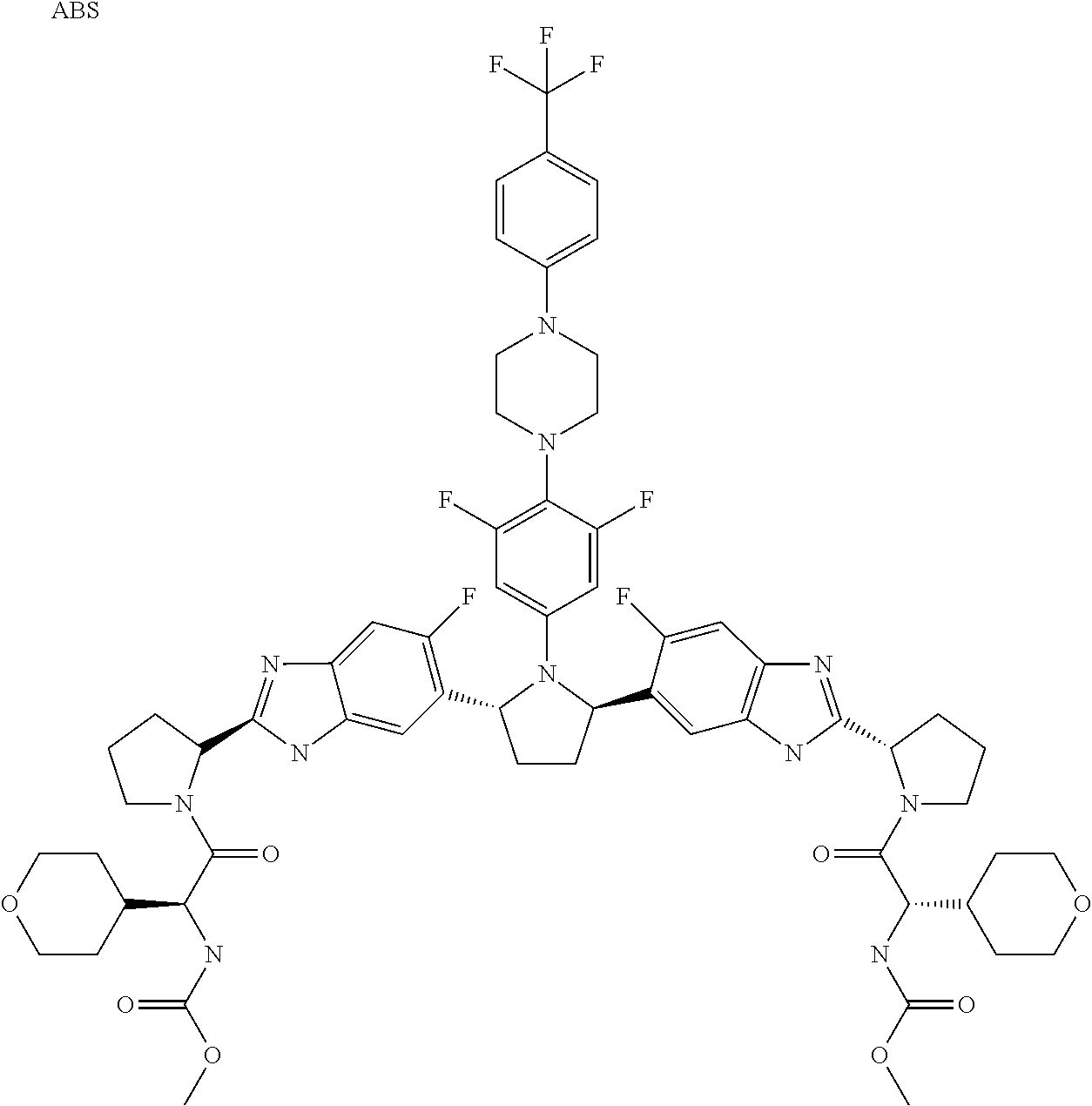


- 6,6′-[(2R,5R)-1-(4-tert-butylphenyl)pyrrolidine-2,5-diyl]bis{7-fluoro-2-[(2S)-pyrrolidin-2-yl]-1H-benzimidazole} (ACD Name v12);
- 6,6′-[(2R,5S)-1-(4-tert-butylphenyl)pyrrolidine-2,5-diyl]bis{7-fluoro-2-[(2S)-pyrrolidin-2-yl]-1H-benzimidazole} (ACD Name v12);
- 6,6′-[(2R,5R)-1-(4-tert-butylphenyl)pyrrolidine-2,5-diyl]bis{7-chloro-2-[(2S)-pyrrolidin-2-yl]-1H-benzimidazole} (ACD Name v12);
- 6,6′-[(2R,5S)-1-(4-tert-butylphenyl)pyrrolidine-2,5-diyl]bis{7-chloro-2-[(2S)-pyrrolidin-2-yl]-1H-benzimidazole} (ACD Name v12);
- 6,6′-[(2R,5R)-1-(4-tert-butylphenyl)pyrrolidine-2,5-diyl]bis{7-methyl-2-[(2S)-pyrrolidin-2-yl]-1H-benzimidazole} (ACD Name v12);
- 6,6′-[(2R,5S)-1-(4-tert-butylphenyl)pyrrolidine-2,5-diyl]bis{7-methyl-2-[(2S)-pyrrolidin-2-yl]-1H-benzimidazole} (ACD Name v12);
- 6,6′-{(2R,5R)-1-fluoro-4-(piperidin-1-yl)phenyl]pyrrolidine-2,5-diyl}bis{5-fluoro-2-[(2S)-pyrrolidin-2-yl]-1H-benzimidazole} (ACD Name v12);
- 6,6′-{(2R,5R)-1-[3,5-difluoro-4-(piperidin-1-yl)phenyl]pyrrolidine-2,5-diyl}bis{5-fluoro-2-[(2S)-pyrrolidin-2-yl]-1H-benzimidazole} (ACD Name v12); and
- 6,6′-{(2R,5R)-1-[3,5-difluoro-4-(4-phenylpiperidin-1-yl)phenyl]pyrrolidine-2,5-diyl}bis{5-fluoro-2-[(2S)-pyrrolidin-2-yl]-1H-benzimidazole} (ACD Name v12).


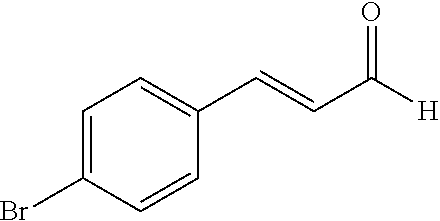


Claims (7)


Priority Applications (78)
| Application Number | Priority Date | Filing Date | Title |
|---|---|---|---|
| US12/964,027 US8921514B2 (en) | 2009-06-11 | 2010-12-09 | Anti-viral compounds |
| US13/100,827 US8937150B2 (en) | 2009-06-11 | 2011-05-04 | Anti-viral compounds |
| CN201410324323.6A CN104193729A (en) | 2010-10-13 | 2011-10-12 | Anti-viral compounds |
| PL13191041T PL2692346T3 (en) | 2010-10-13 | 2011-10-12 | Antiviral derivative of 1-phenyl-2,5-dibenzimidazol-5-yl-pyrrolidine |
| MEP-2016-14A ME02328B (en) | 2010-10-13 | 2011-10-12 | An antiviral 1- phenyl- 2,5-dibenzimidazol-5-yl-pyrrolidine derivative |
| DK13191041.6T DK2692346T3 (en) | 2010-10-13 | 2011-10-12 | Antiviral 1-phenyl-2,5-DIBENZIMIDAZOL-5-yl-pyrrolidine derivative |
| ARP110103777A AR083398A1 (en) | 2010-10-13 | 2011-10-12 | ANTIVIRAL COMPOUNDS |
| SI201130697T SI2692346T1 (en) | 2010-10-13 | 2011-10-12 | An antiviral 1-phenyl-2,5-dibenzimidazol-5-yl-pyrrolidine derivative |
| PH1/2013/500708A PH12013500708B1 (en) | 2010-10-13 | 2011-10-12 | Anti-viral compounds |
| CA2938547A CA2938547A1 (en) | 2010-10-13 | 2011-10-12 | Anti-viral compounds |
| KR1020137009554A KR101586215B1 (en) | 2010-10-13 | 2011-10-12 | Anti-viral compounds |
| SG2013014766A SG188951A1 (en) | 2010-10-13 | 2011-10-12 | Anti-viral compounds |
| CN201611007410.4A CN106986861A (en) | 2010-10-13 | 2011-10-12 | Antiviral compound |
| MX2013004150A MX344092B (en) | 2010-10-13 | 2011-10-12 | ANTIVIRAL COMPOUNDS. |
| CN201180048951.0A CN103153988B (en) | 2010-10-13 | 2011-10-12 | antiviral compound |
| CA2807847A CA2807847C (en) | 2010-10-13 | 2011-10-12 | Anti-viral compounds |
| EP18196401.6A EP3438106A1 (en) | 2010-10-13 | 2011-10-12 | Anti-viral compounds |
| PCT/US2011/056045 WO2012051361A1 (en) | 2010-10-13 | 2011-10-12 | Anti-viral compounds |
| TW102143104A TWI621611B (en) | 2010-10-13 | 2011-10-12 | Anti-viral compounds |
| EP11773371.7A EP2627651A1 (en) | 2010-10-13 | 2011-10-12 | Anti-viral compounds |
| EA201390538A EA024100B1 (en) | 2010-10-13 | 2011-10-12 | METHYL {(2S, 3R) -1 - [(2S) -2- {5 - [(2R, 5R) -1- {3,5-DIFTOR-4- [4- (4-Fluoro-phenyl) Piperidin-1- IL] PHENYL} -5- (6-FTOR-2 - {(2S) -1- [N- (METOXYCARBONIL) -O-METHYL-L-TREONIL] PYRROLIDIN-2-IL} -1H-BENZIMIDAZOLE-5-IL ) PYRROLIDIN-2-IL] -6-FTOR-1H-BENZIMIDAZOLE-OL-4-IL-3-METHOXY-OL-OXOBUTAN-2-IL} CARBAMAT, PHARMACEUTICAL COMPOSITION-OP-IL-CARBAMAT, PHARMACEUTICAL COMPOSITION-O-IL-OP-IL-6 HEPATITIS C INFECTIONS |
| AU2011316506A AU2011316506B2 (en) | 2010-10-13 | 2011-10-12 | Anti-viral compounds |
| EP20130191049 EP2692726A1 (en) | 2010-10-13 | 2011-10-12 | Anti-viral compounds |
| BR112013005701-7A BR112013005701B1 (en) | 2010-10-13 | 2011-10-12 | Compounds effective in inhibiting hepatitis c virus (hcv) replication |
| TW100137049A TWI419874B (en) | 2010-10-13 | 2011-10-12 | Antiviral compound |
| UY0001033667A UY33667A (en) | 2010-10-13 | 2011-10-12 | ANTIVIRAL COMPOUNDS |
| NZ715562A NZ715562A (en) | 2010-10-13 | 2011-10-12 | Anti-viral compounds |
| JP2013533986A JP5834085B2 (en) | 2010-10-13 | 2011-10-12 | Antiviral compounds |
| RS20160128A RS54619B1 (en) | 2010-10-13 | 2011-10-12 | 1-PHENYL-2,5-DIBENZIMIDAZOL-5-IL-PYROLIDINE ANTIVIRUS DERIVATIVE |
| PE2014000057A PE20140835A1 (en) | 2010-10-13 | 2011-10-12 | ANTIVIRAL COMPOUNDS |
| KR1020187004491A KR101990936B1 (en) | 2010-10-13 | 2011-10-12 | Anti-viral compounds |
| HUE13191041A HUE026832T2 (en) | 2010-10-13 | 2011-10-12 | An antiviral 1-phenyl-2,5-dibenzimidazol-5-yl-pyrrolidine derivative |
| KR1020147025969A KR101831154B1 (en) | 2010-10-13 | 2011-10-12 | Anti-viral compounds |
| PE2013000838A PE20140038A1 (en) | 2010-10-13 | 2011-10-12 | ANTIVIRAL COMPOUNDS |
| PT131910416T PT2692346E (en) | 2010-10-13 | 2011-10-12 | An antiviral 1-phenyl-2,5-dibenzimidazol-5-yl-pyrrolidine derivative |
| MYPI2013700273A MY164064A (en) | 2010-10-13 | 2011-10-12 | Anti-viral compounds |
| EP13191041.6A EP2692346B1 (en) | 2010-10-13 | 2011-10-12 | An antiviral 1-phenyl-2,5-dibenzimidazol-5-yl-pyrrolidine derivative |
| EA201301158A EA033332B1 (en) | 2010-10-13 | 2011-10-12 | PROCESS FOR PREPARING METHYL{(2S,3R)-1-[(2S)-2-{5-[(2R,5R)-1-{3,5-DIFLUORO-4-[4-(4-FLUOROPHENYL)PIPERIDINE-1-YL]PHENYL}-5-(6-FLUORO-2-{(2S)-1-[N-(METHOXYCARBONYL)-O-METHYL-L-THREONYL]PYRROLIDINE-2-YL}-1H-BENZIMIDAZOLE-5-YL)pyrrolidinePYRROLIDINE-2-YL]-6-FLUORO-1H-BENZIMIDAZOLE-2-YL}PYRROLIDINE-1-YL]-3-METHOXY-1-OXOBUTANE-2-YL}CARBAMATE |
| NZ606645A NZ606645A (en) | 2010-10-13 | 2011-10-12 | Anti-viral compounds |
| ES13191041.6T ES2560842T3 (en) | 2010-10-13 | 2011-10-12 | An antiviral 1-phenyl-2,5-dibenzimidazol-5-yl-pyrrolidine derivative |
| UAA201305877A UA113048C2 (en) | 2010-10-13 | 2011-12-10 | ANTI-VIRUS COMPOUNDS |
| US13/328,848 US9394279B2 (en) | 2009-06-11 | 2011-12-16 | Anti-viral compounds |
| IL225010A IL225010A (en) | 2010-10-13 | 2013-02-28 | Methyl {(2s,3r)-1-[(2s)-2-{5-[(2r,5r)-1-{3,5-difluoro-4-[4-(4-fluorophenyl)piperidin-1-yl]phenyl}-5-(6-fluoro-2-{(2s)-1-[n-(methoxycarbonyl)-o-methyl-l-threonyl]pyrrolidin-2-yl}-1h-benzimidazol-5-yl)pyrrolidin-2-yl]-6-fluoro-1h-benzimidazol-2-yl}pyrrolidin-1-yl]-3-methoxy-1-oxobutan-5 2-yl}carbamate and a pharmaceutical composition comprising it |
| ZA2013/02269A ZA201302269B (en) | 2010-10-13 | 2013-03-26 | Anti-viral compounds |
| GT201300093A GT201300093A (en) | 2010-10-13 | 2013-04-08 | ANTIVIRAL COMPOUNDS |
| CL2013000970A CL2013000970A1 (en) | 2010-10-13 | 2013-04-10 | Compounds derived from substituted nitrogen heterocycles; its pharmaceutical compositions, and use as inhibitors of hcv replication for the treatment of hepatitis c. |
| DO2013000078A DOP2013000078A (en) | 2010-10-13 | 2013-04-10 | COMPOSITE DERIVED FROM NITROGEN REPLACED NITROGEN, EFFECTIVE AS AN INHIBITOR OF THE REPAIR OF THE HEPATITIS C VIRUS, COMPOSITION THAT INCLUDES IT AND ITS USE |
| MX2020002151A MX2020002151A (en) | 2010-10-13 | 2013-04-12 | ANTIVIRAL COMPOUNDS. |
| CR20130170A CR20130170A (en) | 2010-10-13 | 2013-04-15 | ANTIVIRAL COMPOUNDS |
| CO13116472A CO6761348A2 (en) | 2010-10-13 | 2013-05-09 | Antiviral compounds |
| ECSP13012622 ECSP13012622A (en) | 2010-10-13 | 2013-05-13 | ANTIVIRAL COMPOUNDS |
| CL2014000059A CL2014000059A1 (en) | 2010-10-13 | 2014-01-09 | Compounds derived from substituted nitrogen heterocycles; Preparation process; intermediate compound; pharmaceutical compositions; Useful as inhibitors of hcv replication to treat hepatitis c. (div. sun. 970-13) |
| GT201300093AK GT201300093AA (en) | 2010-10-13 | 2014-01-13 | ANTIVIRAL COMPOUNDS (FRACTIONARY DIVISIONAL APPLICATION OF THE APPLICATION A-2013-00093) |
| UY0001035266A UY35266A (en) | 2010-10-13 | 2014-01-13 | ANTIVIRAL COMPOUNDS |
| CR20140021A CR20140021A (en) | 2010-10-13 | 2014-01-16 | ANTIVIRAL COMPOUNDS |
| HK14101772.6A HK1188717B (en) | 2010-10-13 | 2014-02-25 | An antiviral 1-phenyl-2,5-dibenzimidazol-5-yl-pyrrolidine derivative |
| ECSP14012622 ECSP14012622A (en) | 2010-10-13 | 2014-03-21 | ANTIVIRAL COMPOUNDS |
| US14/558,318 US9586978B2 (en) | 2009-06-11 | 2014-12-02 | Anti-viral compounds |
| JP2015212539A JP2016106075A (en) | 2010-10-13 | 2015-10-29 | Anti-virus compound |
| HRP20151389TT HRP20151389T1 (en) | 2010-10-13 | 2015-12-17 | An antiviral 1-phenyl-2,5-dibenzimidazol-5-yl-pyrrolidine derivative |
| CY20161100115T CY1117188T1 (en) | 2010-10-13 | 2016-02-12 | ANTI-VICTIVE PRODUCT 1-FENYL-2,5-DIVENZIMIDAZOL-5-YL-PYRROLIDINE |
| US15/431,069 US10039754B2 (en) | 2009-06-11 | 2017-02-13 | Anti-viral compounds |
| US15/434,789 US10028937B2 (en) | 2009-06-11 | 2017-02-16 | Anti-viral compounds |
| ZA2017/05519A ZA201705519B (en) | 2010-10-13 | 2017-08-15 | Anti-viral compounds |
| LU00038C LUC00038I2 (en) | 2010-10-13 | 2017-10-10 | |
| CY2017031C CY2017031I1 (en) | 2010-10-13 | 2017-10-18 | 1-PHENYL-2,5-DIBENZIMIDAZOLE-5-YL-PYRROLIDINE ANTIVIRAL DERIVATIVE |
| FR17C1040C FR17C1040I2 (en) | 2010-10-13 | 2017-10-20 | ANTIVIRAL DERIVATIVE OF 2,5-DIBENZIMIDAZOL-5-YL-1-PHENYL-PYRROLIDINE |
| LTPA2017033C LTC2692346I2 (en) | 2010-10-13 | 2017-10-24 | An antiviral derivative of 1-phenyl-2,5-dibenzimidazol-5-yl-pyrrolidine |
| NL300901C NL300901I2 (en) | 2010-10-13 | 2017-10-27 | pibrentasvir or a pharmaceutically acceptable salt thereof |
| NO2017057C NO2017057I2 (en) | 2010-10-13 | 2017-11-10 | pibrentasvir or a pharmaceutically acceptable salt thereof |
| JP2017224527A JP6586147B2 (en) | 2010-10-13 | 2017-11-22 | Antiviral compounds |
| US16/042,447 US20190015402A1 (en) | 2009-06-11 | 2018-07-23 | Anti-Viral Compounds |
| IL261206A IL261206B (en) | 2010-10-13 | 2018-08-16 | Anti-viral compounds |
| ZA2019/03284A ZA201903284B (en) | 2010-10-13 | 2019-05-24 | Anti-viral compounds |
| JP2019161909A JP6790202B2 (en) | 2010-10-13 | 2019-09-05 | Antiviral compound |
| JP2020183474A JP2021035964A (en) | 2010-10-13 | 2020-11-02 | Antiviral compound |
| NO2021039C NO2021039I1 (en) | 2010-10-13 | 2021-09-16 | pibrentasvir or a pharmaceutically acceptable salt thereof - prolonged SPC |
| US17/941,090 US20230285378A1 (en) | 2009-06-11 | 2022-09-09 | Anti-Viral Compounds |
Applications Claiming Priority (6)
| Application Number | Priority Date | Filing Date | Title |
|---|---|---|---|
| US18629109P | 2009-06-11 | 2009-06-11 | |
| US24283609P | 2009-09-16 | 2009-09-16 | |
| US24359609P | 2009-09-18 | 2009-09-18 | |
| US12/813,301 US8691938B2 (en) | 2009-06-11 | 2010-06-10 | Anti-viral compounds |
| US12/903,822 US20110092415A1 (en) | 2009-06-11 | 2010-10-13 | Anti-Viral Compounds |
| US12/964,027 US8921514B2 (en) | 2009-06-11 | 2010-12-09 | Anti-viral compounds |
Related Parent Applications (1)
| Application Number | Title | Priority Date | Filing Date |
|---|---|---|---|
| US12/903,822 Continuation-In-Part US20110092415A1 (en) | 2009-06-11 | 2010-10-13 | Anti-Viral Compounds |
Related Child Applications (3)
| Application Number | Title | Priority Date | Filing Date |
|---|---|---|---|
| US13/100,827 Continuation-In-Part US8937150B2 (en) | 2009-06-11 | 2011-05-04 | Anti-viral compounds |
| US13/100,827 Continuation US8937150B2 (en) | 2009-06-11 | 2011-05-04 | Anti-viral compounds |
| US13/328,848 Continuation-In-Part US9394279B2 (en) | 2009-06-11 | 2011-12-16 | Anti-viral compounds |
Publications (2)
| Publication Number | Publication Date |
|---|---|
| US20110207699A1 US20110207699A1 (en) | 2011-08-25 |
| US8921514B2 true US8921514B2 (en) | 2014-12-30 |
Family
ID=43066241
Family Applications (5)
| Application Number | Title | Priority Date | Filing Date |
|---|---|---|---|
| US12/813,301 Active 2032-04-13 US8691938B2 (en) | 2009-06-11 | 2010-06-10 | Anti-viral compounds |
| US12/903,822 Abandoned US20110092415A1 (en) | 2009-06-11 | 2010-10-13 | Anti-Viral Compounds |
| US12/964,027 Expired - Fee Related US8921514B2 (en) | 2009-06-11 | 2010-12-09 | Anti-viral compounds |
| US14/180,886 Active US9006387B2 (en) | 2009-06-11 | 2014-02-14 | Anti-viral compounds |
| US14/683,910 Abandoned US20150218194A1 (en) | 2009-06-11 | 2015-04-10 | Anti-Viral Compounds |
Family Applications Before (2)
| Application Number | Title | Priority Date | Filing Date |
|---|---|---|---|
| US12/813,301 Active 2032-04-13 US8691938B2 (en) | 2009-06-11 | 2010-06-10 | Anti-viral compounds |
| US12/903,822 Abandoned US20110092415A1 (en) | 2009-06-11 | 2010-10-13 | Anti-Viral Compounds |
Family Applications After (2)
| Application Number | Title | Priority Date | Filing Date |
|---|---|---|---|
| US14/180,886 Active US9006387B2 (en) | 2009-06-11 | 2014-02-14 | Anti-viral compounds |
| US14/683,910 Abandoned US20150218194A1 (en) | 2009-06-11 | 2015-04-10 | Anti-Viral Compounds |
Country Status (39)
| Country | Link |
|---|---|
| US (5) | US8691938B2 (en) |
| EP (5) | EP2628481B1 (en) |
| JP (6) | JP5530514B2 (en) |
| KR (2) | KR101452916B1 (en) |
| CN (4) | CN103819537A (en) |
| AR (3) | AR077060A1 (en) |
| AU (1) | AU2010258769C1 (en) |
| BR (1) | BRPI1004894B8 (en) |
| CA (1) | CA2737601C (en) |
| CL (2) | CL2011000689A1 (en) |
| CO (1) | CO6440538A2 (en) |
| CY (2) | CY1114356T1 (en) |
| DK (3) | DK2628481T3 (en) |
| DO (2) | DOP2011000087A (en) |
| EA (3) | EA020031B1 (en) |
| EC (3) | ECSP11010937A (en) |
| ES (4) | ES2414934T3 (en) |
| HR (3) | HRP20130671T1 (en) |
| HU (2) | HUE028825T2 (en) |
| IL (4) | IL211792A (en) |
| LT (1) | LTC2368890I2 (en) |
| LU (1) | LU92668I2 (en) |
| MX (2) | MX2011005673A (en) |
| MY (1) | MY186633A (en) |
| NL (1) | NL300731I1 (en) |
| NO (1) | NO2015012I1 (en) |
| NZ (1) | NZ591973A (en) |
| PE (2) | PE20110679A1 (en) |
| PH (1) | PH12015500289B1 (en) |
| PL (3) | PL2455376T3 (en) |
| PT (2) | PT2455376E (en) |
| RS (3) | RS52854B (en) |
| SG (2) | SG10201702522UA (en) |
| SI (2) | SI2455376T1 (en) |
| TW (4) | TWI402070B (en) |
| UA (1) | UA118080C2 (en) |
| UY (2) | UY32699A (en) |
| WO (1) | WO2010144646A2 (en) |
| ZA (3) | ZA201102425B (en) |
Cited By (1)
| Publication number | Priority date | Publication date | Assignee | Title |
|---|---|---|---|---|
| US11484534B2 (en) | 2013-03-14 | 2022-11-01 | Abbvie Inc. | Methods for treating HCV |
Families Citing this family (137)
| Publication number | Priority date | Publication date | Assignee | Title |
|---|---|---|---|---|
| JP2534622Y2 (en) | 1990-06-04 | 1997-05-07 | 健治 今井 | Simple heating furnace |
| US8546405B2 (en) | 2008-12-23 | 2013-10-01 | Abbott Laboratories | Anti-viral compounds |
| SG172352A1 (en) | 2008-12-23 | 2011-07-28 | Abbott Lab | Anti-viral compounds |
| US8314135B2 (en) | 2009-02-09 | 2012-11-20 | Enanta Pharmaceuticals, Inc. | Linked dibenzimidazole antivirals |
| US8188132B2 (en) | 2009-02-17 | 2012-05-29 | Enanta Pharmaceuticals, Inc. | Linked dibenzimidazole derivatives |
| US8394968B2 (en) | 2009-02-17 | 2013-03-12 | Bristol-Myers Squibb Company | Hepatitis C virus inhibitors |
| US8242156B2 (en) | 2009-02-17 | 2012-08-14 | Enanta Pharmaceuticals, Inc. | Linked dibenzimidazole derivatives |
| US9765087B2 (en) | 2009-02-27 | 2017-09-19 | Enanta Pharmaceuticals, Inc. | Benzimidazole derivatives |
| US8101643B2 (en) | 2009-02-27 | 2012-01-24 | Enanta Pharmaceuticals, Inc. | Benzimidazole derivatives |
| US8673954B2 (en) | 2009-02-27 | 2014-03-18 | Enanta Pharmaceuticals, Inc. | Benzimidazole derivatives |
| TWI476190B (en) * | 2009-03-30 | 2015-03-11 | 必治妥美雅史谷比公司 | Hepatitis c virus inhibitors |
| US20110237636A1 (en) * | 2009-03-30 | 2011-09-29 | Bristol-Myers Squibb Company | Hepatitis C Virus Inhibitors |
| US8796466B2 (en) | 2009-03-30 | 2014-08-05 | Bristol-Myers Squibb Company | Hepatitis C virus inhibitors |
| TW201038559A (en) | 2009-04-09 | 2010-11-01 | Bristol Myers Squibb Co | Hepatitis C virus inhibitors |
| US8143414B2 (en) | 2009-04-13 | 2012-03-27 | Bristol-Myers Squibb Company | Hepatitis C virus inhibitors |
| US9278922B2 (en) | 2009-04-15 | 2016-03-08 | Abbvie Inc. | Anti-viral compounds |
| HUE030465T2 (en) | 2009-05-13 | 2017-05-29 | Antiviral compounds | |
| US8211928B2 (en) | 2009-05-29 | 2012-07-03 | Bristol-Myers Squibb Company | Hepatitis C virus inhibitors |
| US8138215B2 (en) | 2009-05-29 | 2012-03-20 | Bristol-Myers Squibb Company | Hepatitis C virus inhibitors |
| US9394279B2 (en) * | 2009-06-11 | 2016-07-19 | Abbvie Inc. | Anti-viral compounds |
| US8716454B2 (en) | 2009-06-11 | 2014-05-06 | Abbvie Inc. | Solid compositions |
| US8937150B2 (en) | 2009-06-11 | 2015-01-20 | Abbvie Inc. | Anti-viral compounds |
| EA020031B1 (en) | 2009-06-11 | 2014-08-29 | Эббви Бахамаз Лтд. | Anti-viral compounds |
| US8221737B2 (en) | 2009-06-16 | 2012-07-17 | Enanta Pharmaceuticals, Inc. | Hepatitis C virus inhibitors |
| AU2010274001A1 (en) | 2009-07-16 | 2012-02-23 | Vertex Pharmaceuticals Incorporated | Benzimidazole analogues for the treatment or prevention of Flavivirus infections |
| CN102480971B (en) | 2009-09-04 | 2014-11-26 | 杨森制药公司 | Chemical compounds |
| US8759332B2 (en) | 2009-09-11 | 2014-06-24 | Enanta Pharmaceuticals, Inc. | Hepatitis C virus inhibitors |
| US9156818B2 (en) | 2009-09-11 | 2015-10-13 | Enanta Pharmaceuticals, Inc. | Hepatitis C virus inhibitors |
| US20110269956A1 (en) | 2009-11-11 | 2011-11-03 | Bristol-Myers Squibb Company | Hepatitis C Virus Inhibitors |
| US20110274648A1 (en) | 2009-11-11 | 2011-11-10 | Bristol-Myers Squibb Company | Hepatitis C Virus Inhibitors |
| US20110281910A1 (en) | 2009-11-12 | 2011-11-17 | Bristol-Myers Squibb Company | Hepatitis C Virus Inhibitors |
| US20110137633A1 (en) * | 2009-12-03 | 2011-06-09 | Abbott Laboratories | Anti-viral compounds and methods of identifying the same |
| US8653070B2 (en) | 2009-12-14 | 2014-02-18 | Enanta Pharmaceuticals, Inc. | Hepatitis C virus inhibitors |
| US8377980B2 (en) | 2009-12-16 | 2013-02-19 | Bristol-Myers Squibb Company | Hepatitis C virus inhibitors |
| US20110152246A1 (en) * | 2009-12-18 | 2011-06-23 | Intermune, Inc. | Novel inhibitors of hepatitis c virus replication |
| MX2012006877A (en) | 2009-12-18 | 2012-08-31 | Idenix Pharmaceuticals Inc | 5,5-fused arylene or heteroarylene hepatitis c virus inhibitors. |
| US8362020B2 (en) | 2009-12-30 | 2013-01-29 | Bristol-Myers Squibb Company | Hepatitis C virus inhibitors |
| US8933110B2 (en) | 2010-01-25 | 2015-01-13 | Enanta Pharmaceuticals, Inc. | Hepatitis C virus inhibitors |
| PE20130244A1 (en) | 2010-01-25 | 2013-03-10 | Enanta Pharm Inc | HEPATITIS C VIRUS INHIBITORS |
| US8623814B2 (en) | 2010-02-23 | 2014-01-07 | Enanta Pharmaceuticals, Inc. | Antiviral agents |
| US8178531B2 (en) | 2010-02-23 | 2012-05-15 | Enanta Pharmaceuticals, Inc. | Antiviral agents |
| CN102858157A (en) | 2010-03-04 | 2013-01-02 | 埃南塔制药公司 | Combination pharmaceutical agents as inhibitors of hcv replication |
| CN102869657A (en) | 2010-03-24 | 2013-01-09 | 沃泰克斯药物股份有限公司 | Analogues for the treatment or prevention of flavivirus infections |
| EP2555622A4 (en) | 2010-04-09 | 2013-09-18 | Enanta Pharm Inc | Hepatitis c virus inhibitors |
| US8778938B2 (en) | 2010-06-04 | 2014-07-15 | Enanta Pharmaceuticals, Inc. | Hepatitis C virus inhibitors |
| AU2014200725B2 (en) * | 2010-06-10 | 2016-05-12 | Abbvie Ireland Unlimited Company | Solid compositions |
| NZ605440A (en) | 2010-06-10 | 2014-05-30 | Abbvie Bahamas Ltd | Solid compositions comprising an hcv inhibitor |
| PT3012258T (en) | 2010-06-24 | 2018-12-14 | Gilead Sciences Inc | PHARMACEUTICAL COMPOSITION UNDERSTANDING A PIRAZOLE [1,5-A] PYRIMIDINE DERIVATIVE AS AN ANTIVIRAL AGENT |
| WO2012021704A1 (en) | 2010-08-12 | 2012-02-16 | Enanta Pharmaceuticals, Inc. | Hepatitis c virus inhibitors |
| AU2014203655B2 (en) * | 2010-10-13 | 2016-07-07 | Abbvie Ireland Unlimited Company | Anti-viral compounds |
| AU2016238925B2 (en) * | 2010-10-13 | 2018-12-20 | Abbvie Ireland Unlimited Company | Anti-viral compounds |
| PT2692346E (en) * | 2010-10-13 | 2016-03-22 | Abbvie Bahamas Ltd | An antiviral 1-phenyl-2,5-dibenzimidazol-5-yl-pyrrolidine derivative |
| CA3152557A1 (en) | 2010-10-29 | 2012-05-03 | Abbvie Inc. | Solid dispersions containing an apoptosis-inducing agent |
| UA113500C2 (en) | 2010-10-29 | 2017-02-10 | MEL EXTRUSION SOLID DISPERSIONS CONTAINING AN APOPTOSIS-INDUCING AGENT | |
| WO2012083048A2 (en) * | 2010-12-15 | 2012-06-21 | Abbott Laboratories | Anti-viral compounds |
| JP5906253B2 (en) * | 2010-12-16 | 2016-04-20 | アッヴィ・インコーポレイテッド | Antiviral compounds |
| US8552047B2 (en) | 2011-02-07 | 2013-10-08 | Bristol-Myers Squibb Company | Hepatitis C virus inhibitors |
| US9546160B2 (en) | 2011-05-12 | 2017-01-17 | Bristol-Myers Squibb Company | Hepatitis C virus inhibitors |
| US10201584B1 (en) | 2011-05-17 | 2019-02-12 | Abbvie Inc. | Compositions and methods for treating HCV |
| WO2012158861A2 (en) | 2011-05-18 | 2012-11-22 | Enanta Pharmaceuticals, Inc. | Processes for the preparation of 5-azaspiro[2.4]heptane-6-carboxylic acid and its derivatives |
| WO2012162578A2 (en) * | 2011-05-26 | 2012-11-29 | Abbvie Inc. | Anti-viral compounds |
| WO2012162580A2 (en) * | 2011-05-26 | 2012-11-29 | Abbvie Inc | Anti-viral compounds |
| EP2709613B2 (en) | 2011-09-16 | 2020-08-12 | Gilead Pharmasset LLC | Methods for treating hcv |
| EP2583677A3 (en) | 2011-10-21 | 2013-07-03 | Abbvie Inc. | Methods for treating HCV comprising at least two direct acting antiviral agent, ribavirin but not interferon. |
| AU2015200715A1 (en) * | 2011-10-21 | 2015-03-05 | Abbvie Ireland Unlimited Company | Methods for treating HCV |
| AU2015100285B4 (en) * | 2011-10-21 | 2015-06-11 | Abbvie Ireland Unlimited Company | Methods for treating HCV |
| US8466159B2 (en) | 2011-10-21 | 2013-06-18 | Abbvie Inc. | Methods for treating HCV |
| ES2529144B1 (en) * | 2011-10-21 | 2015-10-26 | Abbvie Inc. | ADB COMBINATION FOR USE IN HCV TREATMENT |
| AU2013201758B2 (en) * | 2011-10-21 | 2014-11-27 | Abbvie Ireland Unlimited Company | Methods for treating HCV |
| US8492386B2 (en) | 2011-10-21 | 2013-07-23 | Abbvie Inc. | Methods for treating HCV |
| DE202012012955U1 (en) | 2011-10-21 | 2014-07-14 | Abbvie Inc. | A combination of at least two direct-acting antiviral agents (DAAs) for use in the treatment of HCV |
| EP2602248A1 (en) * | 2011-12-05 | 2013-06-12 | University Of Leicester | Novel pyrrole compounds |
| JP6122868B2 (en) | 2011-12-22 | 2017-04-26 | ギリアード サイエンシーズ, インコーポレイテッド | Pyrazolo [1,5-A] pyrimidine as an antiviral agent |
| EP2797594A1 (en) * | 2011-12-28 | 2014-11-05 | AbbVie Inc. | Methods for treating hcv |
| WO2013101550A1 (en) * | 2011-12-29 | 2013-07-04 | Abbvie Inc. | Solid compositions comprising an hcv inhibitor |
| US9034832B2 (en) | 2011-12-29 | 2015-05-19 | Abbvie Inc. | Solid compositions |
| US9326973B2 (en) * | 2012-01-13 | 2016-05-03 | Bristol-Myers Squibb Company | Hepatitis C virus inhibitors |
| AU2013249280B2 (en) | 2012-04-17 | 2017-10-12 | Gilead Sciences, Inc. | Compounds and methods for antiviral treatment |
| EP2866807A2 (en) | 2012-06-27 | 2015-05-06 | Abbvie Inc. | Methods for treating hcv |
| US20140080886A1 (en) * | 2012-09-18 | 2014-03-20 | Abbvie Inc. | Methods for Treating HCV |
| WO2014047046A1 (en) | 2012-09-18 | 2014-03-27 | Abbvie Inc. | Methods for treating hepatitis c |
| EP2950786B1 (en) | 2013-01-31 | 2019-11-27 | Gilead Pharmasset LLC | Combination formulation of two antiviral compounds |
| JP6563894B2 (en) * | 2013-03-14 | 2019-08-21 | アッヴィ・インコーポレイテッド | Combination of ribavirin with a direct acting antiviral agent to treat HCV patients |
| US20150011481A1 (en) | 2013-07-02 | 2015-01-08 | Abbvie Inc. | Methods for Treating HCV |
| US20150023913A1 (en) | 2013-07-02 | 2015-01-22 | Bristol-Myers Squibb Company | Hepatitis C Virus Inhibitors |
| US9717712B2 (en) | 2013-07-02 | 2017-08-01 | Bristol-Myers Squibb Company | Combinations comprising tricyclohexadecahexaene derivatives for use in the treatment of hepatitis C virus |
| US9775831B2 (en) | 2013-07-17 | 2017-10-03 | Bristol-Myers Squibb Company | Combinations comprising biphenyl derivatives for use in the treatment of HCV |
| PT3038601T (en) | 2013-08-27 | 2020-06-30 | Gilead Pharmasset Llc | Combination formulation of two antiviral compounds |
| LT3043803T (en) | 2013-09-11 | 2022-08-10 | Emory University | COMPOSITIONS OF NUCLEOTIDES AND NUCLEOSIDES AND THEIR USE |
| US20150141351A1 (en) * | 2013-11-18 | 2015-05-21 | AbbVie Deutschland GmbH & Co. KG | Solid Pharmaceutical Compositions |
| WO2015103490A1 (en) | 2014-01-03 | 2015-07-09 | Abbvie, Inc. | Solid antiviral dosage forms |
| WO2015116594A1 (en) | 2014-01-28 | 2015-08-06 | Abbvie Inc. | Dose adjustment in combination therapy of hepatitis c |
| CU24442B1 (en) * | 2014-04-04 | 2019-09-04 | X Rx Inc | DERIVATIVES OF N- (1- (SPIROCYCLIC) OXO) AMIDE REPLACED AS AUTOTAXIN INHIBITORS |
| CN104030959B (en) * | 2014-06-24 | 2016-08-24 | 苏州东南药业股份有限公司 | A kind of deuterated hepatitis C virus inhibitors |
| US20160074462A1 (en) | 2014-09-11 | 2016-03-17 | Abbvie Inc. | Method of Treating HCV |
| CN104402776B (en) * | 2014-12-05 | 2017-06-13 | 中国石油天然气股份有限公司 | A kind of dihydric alcohol sulfonate compound and its preparation method and application |
| WO2016134053A1 (en) | 2015-02-18 | 2016-08-25 | Abbvie Inc. | Anti-viral compounds |
| WO2016134054A1 (en) | 2015-02-18 | 2016-08-25 | Abbvie Inc. | Anti-viral compounds |
| WO2016134057A1 (en) | 2015-02-18 | 2016-08-25 | Abbvie Inc. | Anti-viral compounds |
| WO2016134058A1 (en) | 2015-02-18 | 2016-08-25 | Abbvie Inc. | Combinations useful to treat hepatitis c virus |
| WO2016134056A1 (en) | 2015-02-18 | 2016-08-25 | Abbvie Inc. | Anti-viral compounds |
| WO2016134050A1 (en) | 2015-02-18 | 2016-08-25 | Abbvie Inc. | Anti-viral compounds |
| WO2016134051A1 (en) | 2015-02-18 | 2016-08-25 | Abbvie Inc. | Anti-viral compounds |
| GB201506658D0 (en) | 2015-04-20 | 2015-06-03 | Cellcentric Ltd | Pharmaceutical compounds |
| GB201506660D0 (en) | 2015-04-20 | 2015-06-03 | Cellcentric Ltd | Pharmaceutical compounds |
| JO3637B1 (en) | 2015-04-28 | 2020-08-27 | Janssen Sciences Ireland Uc | Rsv antiviral pyrazolo- and triazolo-pyrimidine compounds |
| US20160375017A1 (en) | 2015-06-26 | 2016-12-29 | Abbvie Inc. | Solid Pharmaceutical Compositions for Treating HCV |
| RU2018102809A (en) * | 2015-06-26 | 2019-07-29 | Эббви Инк. | SOLID PHARMACEUTICAL COMPOSITIONS FOR TREATMENT OF HEPATITIS C VIRUS |
| WO2017023631A1 (en) | 2015-08-06 | 2017-02-09 | Bristol-Myers Squibb Company | Hepatitis c virus inhibitors |
| JP6743135B2 (en) | 2015-09-02 | 2020-08-19 | アッヴィ・インコーポレイテッド | Antiviral tetrahydrofuran derivative |
| CN105294828B (en) * | 2015-11-11 | 2018-09-04 | 苏州明锐医药科技有限公司 | The preparation method of Ao Beitawei |
| TW201718608A (en) * | 2015-11-23 | 2017-06-01 | Chia Tai Tianqing Pharmaceutical Group Co Ltd | Silicone-containing compound for resisting hepatitis c virus infection |
| UA120571C2 (en) | 2016-03-22 | 2019-12-26 | Мерк Шарп Енд Дохме Корп. | ALOSTERIC MODULATORS OF NICOTINE ACETYLCHOLINE RECEPTORS |
| EA201892448A1 (en) | 2016-04-28 | 2019-06-28 | Эмори Юниверсити | ALKYN-CONTAINING NUCLEOTIDE AND NUCLEOSIDE THERAPEUTIC COMPOSITIONS AND RELATED APPLICATION METHODS |
| US20190202812A1 (en) | 2016-04-28 | 2019-07-04 | Abbvie Inc. | Crystal Forms |
| RU2659388C1 (en) | 2017-02-28 | 2018-07-02 | Васильевич Иващенко Александр | Nucleotides including n-[(s)-1-cyclobutoxycarbonyl]phosphoramidate fragment, their analogs and their application |
| RU2650610C1 (en) | 2017-02-28 | 2018-04-16 | Васильевич Иващенко Александр | Antiviral composition and method of its application |
| WO2018171660A1 (en) * | 2017-03-22 | 2018-09-27 | 正大天晴药业集团股份有限公司 | Silicon-containing compound for resistance to hepatitis c virus infection |
| BR102018007822A2 (en) | 2017-04-20 | 2018-11-06 | Gilead Sciences, Inc. | compound, methods for inhibiting pd-1, pd-11 and / or interaction of pd-1 / pd-11 and for cancer treatment, pharmaceutical composition, and kit for treating or preventing cancer or a disease or condition |
| CN108727345B (en) * | 2017-04-25 | 2023-06-27 | 广东东阳光药业有限公司 | A kind of preparation method of imidazole ring intermediate |
| GB201706806D0 (en) * | 2017-04-28 | 2017-06-14 | Sentinel Oncology Ltd | Pharmaceutical compounds |
| CN107474105B (en) * | 2017-08-01 | 2021-08-31 | 安徽拜善晟制药有限公司 | Preparation method of bulk drug obitasvir |
| CN107987083A (en) * | 2017-11-24 | 2018-05-04 | 江苏亚盛医药开发有限公司 | For treating and/or preventing double diazabicyclo compounds of relevant with hepatitis viruse disease or illness |
| TW201932470A (en) | 2017-11-29 | 2019-08-16 | 愛爾蘭商健生科學愛爾蘭無限公司 | Pyrazolopyrimidines having activity against RSV |
| SG11202006141RA (en) | 2018-01-31 | 2020-07-29 | Janssen Sciences Ireland Unlimited Co | Cycloalkyl substituted pyrazolopyrimidines having activity against rsv |
| CR20200347A (en) | 2018-02-13 | 2020-09-23 | Gilead Sciences Inc | Pd-1/pd-l1 inhibitors |
| TWI712412B (en) | 2018-04-19 | 2020-12-11 | 美商基利科學股份有限公司 | Pd-1/pd-l1 inhibitors |
| US11708369B2 (en) | 2018-04-23 | 2023-07-25 | Janssen Sciences Ireland Unlimited Company | Heteroaromatic compounds having activity against RSV |
| US10934279B2 (en) | 2018-06-13 | 2021-03-02 | Pfizer Inc. | GLP-1 receptor agonists and uses thereof |
| SG11202012425QA (en) | 2018-07-13 | 2021-01-28 | Gilead Sciences Inc | Pd-1/pd-l1 inhibitors |
| WO2020086556A1 (en) | 2018-10-24 | 2020-04-30 | Gilead Sciences, Inc. | Pd-1/pd-l1 inhibitors |
| JP7684282B2 (en) * | 2020-03-31 | 2025-05-27 | 田辺三菱製薬株式会社 | Hydroxypyrrolidine derivatives and their medical uses |
| WO2021236475A1 (en) * | 2020-05-18 | 2021-11-25 | Asinex Corporation | Compounds that inhibit asparagine synthetase and their methods of use |
| US12497408B2 (en) | 2021-05-21 | 2025-12-16 | Gilead Sciences, Inc. | Tetracyclic compounds and methods for the treatment of Zika virus infection |
| US12037340B2 (en) | 2021-05-21 | 2024-07-16 | Gilead Sciences, Inc. | Pentacyclic derivatives as Zika virus inhibitors |
| CN115594591A (en) * | 2021-06-28 | 2023-01-13 | 凯特立斯(深圳)科技有限公司(Cn) | A kind of method for preparing Pirentasvir intermediate by catalytic asymmetric hydrogenation |
| CN114656389B (en) * | 2022-04-27 | 2023-12-15 | 河南大学 | Synthesis method of 1-phenylpyrrolidine |
Citations (191)
| Publication number | Priority date | Publication date | Assignee | Title |
|---|---|---|---|---|
| DE75755C (en) | 1894-06-14 | DAHL & COMP, in Barmen | Process for the preparation of aromatically substituted amidodinaphthyl methanes. | |
| WO1994027627A1 (en) | 1993-05-24 | 1994-12-08 | Smithkline Beecham Corporation | Hemoregulatory peptides |
| US5683999A (en) | 1995-03-17 | 1997-11-04 | The Dupont Merck Pharmaceutical Company | Cyclic urea HIV protease inhibitors |
| US5935982A (en) | 1997-02-28 | 1999-08-10 | The University Of North Carolina At Chapel Hill | Methods of treating retroviral infection and compounds useful therefor |
| WO1999061020A1 (en) | 1998-05-22 | 1999-12-02 | Avanir Pharmaceuticals | BENZIMIDAZOLE ANALOGS AS DOWN-REGULATORS OF IgE |
| WO2000000179A1 (en) | 1998-06-27 | 2000-01-06 | Won Jin Biopharma Co., Ltd. | Solid dispersed preparation of poorly water-soluble drug containing oil, fatty acid or mixtures thereof |
| WO2000012521A1 (en) | 1998-08-26 | 2000-03-09 | Abbott Laboratories | 3', 3'-n-bis-desmethyl-3'-n-cycloalkyl erythromycin derivatives as lhrh antagonists |
| US6042847A (en) | 1995-05-19 | 2000-03-28 | Lek, Tovarna Farmacevtskih In Kemicnih Izdelkov, D.D. | Three-phase pharmaceutical form with constant and controlled release of amorphous active ingredient for single daily application |
| US6235493B1 (en) | 1997-08-06 | 2001-05-22 | The Regents Of The University Of California | Amino acid substituted-cresyl violet, synthetic fluorogenic substrates for the analysis of agents in individual in vivo cells or tissue |
| WO2002014314A2 (en) | 2000-08-14 | 2002-02-21 | Ortho Mcneil Pharmaceutical, Inc. | Substituted pyrazoles |
| US6369091B1 (en) | 1998-05-22 | 2002-04-09 | Avanir Pharmaceuticals | Benzimidazole analogs as down-regulators of IgE |
| US6388093B1 (en) | 2001-01-05 | 2002-05-14 | Sun Chemical Corporation | Syntheses for preparing 1,4-diketopyrrolo [3,4-c]pyrroles |
| US20020183319A1 (en) | 1999-12-21 | 2002-12-05 | Congxin Liang | 4-substituted 7-aza-indolin-2-ones and their use as protein kinase inhibitors |
| US20030004203A1 (en) | 1998-05-22 | 2003-01-02 | Sircar Jagadish C. | Benzimidazole derivatives as modulators of IgE |
| US20030100582A1 (en) | 1998-05-22 | 2003-05-29 | Sircar Jagadish C. | Benzimidazole compounds for regulating IgE |
| US6599528B1 (en) | 1999-03-25 | 2003-07-29 | Abbott Gmbh & Co. Kg | Mechanically stable pharmaceutical presentations form containing liquid or semisolid surface-active substances |
| WO2003068738A1 (en) | 2002-02-11 | 2003-08-21 | Neurocrine Biosciences, Inc. | Pyrrole derivatives as ligands of melanocortin receptors |
| JP2003282270A (en) | 2002-03-25 | 2003-10-03 | Konica Corp | Organic electroluminescence element and display device using the same |
| WO2003082186A2 (en) | 2002-03-25 | 2003-10-09 | Avanir Pharmaceuticals | Use of benzimidazole analogs in the treatment of cell proliferation |
| WO2004005283A1 (en) | 2002-07-09 | 2004-01-15 | Vertex Pharmaceuticals Incorporated | Imidazoles, oxazoles and thiazoles with protein kinase inhibiting activities |
| US20040013697A1 (en) | 2000-05-30 | 2004-01-22 | Gunther Berndl | Self-emulsifying active substance formulation and use of this formulation |
| WO2004014852A2 (en) | 2002-08-12 | 2004-02-19 | Bristol-Myers Squibb Company | Iminothiazolidinones as inhibitors of hcv replication |
| US20040034189A1 (en) * | 2002-08-12 | 2004-02-19 | Korea Institute Of Science And Technology | Pyrrole compounds, polymers thereof and EL element using the same |
| US6703403B2 (en) | 1995-06-29 | 2004-03-09 | Abbott Laboratories | Method for improving pharmacokinetics |
| US6846802B2 (en) | 2000-04-05 | 2005-01-25 | Schering Corporation | Macrocyclic NS3-serine protease inhibitors of hepatitis C virus comprising N-cyclic P2 moieties |
| US6881741B2 (en) | 2001-06-11 | 2005-04-19 | Virochem Pharma Inc. | Compounds and methods for the treatment or prevention of Flavivirus infections |
| US20050084529A1 (en) | 2003-08-28 | 2005-04-21 | Joerg Rosenberg | Solid pharmaceutical dosage form |
| US6923988B2 (en) | 1999-11-23 | 2005-08-02 | Lipocine, Inc. | Solid carriers for improved delivery of active ingredients in pharmaceutical compositions |
| US20060003942A1 (en) | 2003-10-27 | 2006-01-05 | Roger Tung | Combinations for HCV treatment |
| BRPI0401908A (en) | 2004-06-04 | 2006-01-17 | Univ Rio De Janeiro | Serine protease inhibitor compounds, process for obtaining and using for treatment of flaviviroses |
| WO2006020951A1 (en) | 2004-08-13 | 2006-02-23 | Praecis Pharmaceuticals, Inc. | Methods and compositions for modulating sphingosine-1-phosphate (s1p) receptor activity |
| US20060052602A1 (en) | 2004-07-27 | 2006-03-09 | Gilead Sciences, Inc. | Imidazo[4,5-d]pyrimidines, their uses and methods of preparation |
| US20060058317A1 (en) | 2002-12-19 | 2006-03-16 | Astrazeneca Ab | Oxazolidinone derivatives as antibacterial |
| US20060105997A1 (en) | 2002-06-14 | 2006-05-18 | Arrington Kenneth L | Mitotic kinesin inhibitors |
| US7065453B1 (en) | 2000-06-15 | 2006-06-20 | Accelrys Software, Inc. | Molecular docking technique for screening of combinatorial libraries |
| WO2006093867A1 (en) | 2005-02-28 | 2006-09-08 | The Rockefeller University | Structure of the hepatitits c virus ns5a protein |
| RU2286343C2 (en) | 2001-08-10 | 2006-10-27 | Орто-Макнейл Фармасьютикал, Инк. | Substituted pyrazoles |
| US7141574B2 (en) | 2001-07-25 | 2006-11-28 | Boehringer Ingelheim (Canada) Ltd. | Viral polymerase inhibitors |
| WO2006133326A1 (en) | 2005-06-06 | 2006-12-14 | Bristol-Myers Squibb Company | Inhibitors of hcv replication |
| US20070004741A1 (en) | 2005-06-30 | 2007-01-04 | Richard Apodaca | N-heteroarylpiperazinyl ureas as modulators of fatty acid amide hydrolase |
| US7183270B2 (en) | 2003-02-12 | 2007-02-27 | Bristol-Myers Squibb Company | Cyclic derivatives as modulators of chemokine receptor activity |
| WO2007070600A2 (en) | 2005-12-12 | 2007-06-21 | Genelabs Technologies, Inc. | N-(5-membered heteroaromatic ring)-amido anti-viral compounds |
| WO2007070556A2 (en) | 2005-12-12 | 2007-06-21 | Genelabs Technologies, Inc. | N-(6-membered aromatic ring)-amido anti-viral compounds |
| US20070142434A1 (en) | 2005-12-21 | 2007-06-21 | Decode Chemistry, Inc. | N-linked aryl heteroaryl inhibitors of lta4h for treating inflammation |
| WO2007076035A2 (en) | 2005-12-21 | 2007-07-05 | Abbott Laboratories | Anti-viral compounds |
| WO2007076034A2 (en) | 2005-12-21 | 2007-07-05 | Abbott Laboratories | Anti-viral compounds |
| WO2007081517A2 (en) | 2005-12-21 | 2007-07-19 | Abbott Laboratories | Anti-viral compounds |
| WO2007082554A1 (en) | 2006-01-23 | 2007-07-26 | Istituto Di Ricerche Di Biologia Molecolare P Angeletti Spa | Modulators of hcv replication |
| WO2007131366A1 (en) | 2006-05-16 | 2007-11-22 | Aegera Therapeutics Inc. | Iap bir domain binding compounds |
| JP2007320925A (en) | 2006-06-02 | 2007-12-13 | Mitsubishi Chemicals Corp | Triarylamine compound, electrophotographic photosensitive member and image forming apparatus using the same |
| WO2007144174A1 (en) | 2006-06-16 | 2007-12-21 | Syngenta Participations Ag | Ethenyl carboxamide derivatives useful as microbiocides |
| US20070299068A1 (en) | 2004-07-14 | 2007-12-27 | Karp Gary M | Methods for treating hepatitis C |
| WO2008014236A1 (en) | 2006-07-24 | 2008-01-31 | Tetralogic Pharmaceuticals Corporation | Dimeric iap inhibitors |
| WO2008014238A2 (en) | 2006-07-24 | 2008-01-31 | Tetralogic Pharmaceuticals Corporation | Dimeric iap inhibitors |
| WO2008021936A2 (en) | 2006-08-11 | 2008-02-21 | Bristol-Myers Squibb Company | Hepatitis c virus inhibitors |
| WO2008021927A2 (en) | 2006-08-11 | 2008-02-21 | Bristol-Myers Squibb Company | Hepatitis c virus inhibitors |
| US20080044379A1 (en) | 2006-08-11 | 2008-02-21 | Bristol-Myers Squibb Company | Hepatitis C Virus Inhibitors |
| US20080075696A1 (en) * | 2004-12-16 | 2008-03-27 | Ian Parsons | Treatment Of Hepatitis C In The Asian Population With Interferon-Beta |
| WO2008064218A2 (en) | 2006-11-21 | 2008-05-29 | Smithkline Beecham Corporation | Amido anti-viral compounds |
| WO2008070447A2 (en) | 2006-11-21 | 2008-06-12 | Smithkline Beecham Corporation | Anti-viral compounds |
| WO2008074450A2 (en) | 2006-12-20 | 2008-06-26 | Nicox S.A. | Non-peptidic renin inhibitors nitroderivatives |
| US20080221107A1 (en) | 2005-07-15 | 2008-09-11 | Astrazeneca Ab | Therapeutic Agents |
| WO2008128121A1 (en) | 2007-04-12 | 2008-10-23 | Joyant Pharmaceuticals, Inc. | Smac mimetic dimers and trimers useful as anti-cancer agents |
| WO2008133753A2 (en) | 2006-12-20 | 2008-11-06 | Abbott Laboratories | Anti-viral compounds |
| WO2008144380A1 (en) | 2007-05-17 | 2008-11-27 | Bristol-Myers Squibb Company | Hepatitis c virus inhibitors |
| US20080299075A1 (en) | 2006-08-11 | 2008-12-04 | Bristol-Myers Squibb Company | Hepatitis c virus inhibitors |
| WO2009003009A1 (en) | 2007-06-26 | 2008-12-31 | Enanta Pharmaceuticals, Inc. | Substituted pyrrolidine as anti-infectives |
| US7488832B2 (en) | 2005-02-14 | 2009-02-10 | Wyeth | Azolylacylguanidines as β-secretase inhibitors |
| WO2009020534A2 (en) | 2007-08-03 | 2009-02-12 | Schering Corporation | Method of treating cxcr3 mediated diseases using heterocyclic substituted piperazines |
| US20090041716A1 (en) | 2007-08-08 | 2009-02-12 | Bristol-Myers Squibb Company | Crystalline form of methyl ((1s)-1-(((2s)-2-(5-(4'-(2-((2s)-1((2s)-2-((methoxycarbonyl)amino)-3-methylbutanoyl)-2-pyrrolidinyl)-1h-imidazol-5-yl)-4-biphenylyl)-1h-imidazol-2-yl)-1-pyrrolidinyl)carbonyl)-2-methylpropyl)carbamate dihydrochloride salt |
| US20090043107A1 (en) | 2007-08-08 | 2009-02-12 | Bristol-Myers Squibb Company | Process for Synthesizing Compounds Useful for Treating Hepatitis C |
| US20090068140A1 (en) | 2006-08-11 | 2009-03-12 | Bristol-Myers Squibb Company | Hepatitis c virus inhibitors |
| US20090093456A1 (en) | 2006-06-08 | 2009-04-09 | Eli Lilly And Company | Novel mch receptor antagonists |
| WO2009093082A1 (en) | 2008-01-23 | 2009-07-30 | Acal Energy Limited | Redox fuel cells |
| WO2009094224A1 (en) | 2008-01-25 | 2009-07-30 | Millennium Pharmaceuticals, Inc. | Thiophenes and their use as phosphatidylinositol 3-kinase (pi3k) inhibitors |
| US20090202483A1 (en) | 2008-02-13 | 2009-08-13 | Bristol-Myers Squibb Company | Hepatitis C Virus Inhibitors |
| US20090202478A1 (en) | 2008-02-13 | 2009-08-13 | Bristol-Myers Squibb Company | Hepatitis C Virus Inhibitors |
| WO2009102694A1 (en) | 2008-02-12 | 2009-08-20 | Bristol-Myers Squibb Company | Heterocyclic derivatives as hepatitis c virus inhibitors |
| WO2009102325A1 (en) | 2008-02-13 | 2009-08-20 | Bristol-Myers Squibb Company | Imidazolyl biphenyl imidazoles as hepatitis c virus inhibitors |
| WO2009102318A1 (en) | 2008-02-12 | 2009-08-20 | Bristol-Myers Squibb Company | Hepatitis c virus inhibitors |
| WO2009136290A1 (en) | 2008-05-05 | 2009-11-12 | Aegera Therapeutics, Inc. | Functionalized pyrrolidines and use thereof as iap inhibitors |
| WO2009143361A1 (en) | 2008-05-22 | 2009-11-26 | Smithkline Beecham Corporation | Amido anti-viral compounds |
| WO2009155709A1 (en) | 2008-06-27 | 2009-12-30 | Aegera Therapeutics Inc. | Bridged secondary amines and use thereof as iap bir domain binding compounds |
| US20100021540A1 (en) | 2008-02-28 | 2010-01-28 | Abbott Laboratories | Tablets and Preparation Thereof |
| US20100029666A1 (en) | 2008-07-22 | 2010-02-04 | Steven Harper | Macrocyclic Quinoxaline Compounds as HCV NS3 Protease Inhibitors |
| WO2010017035A2 (en) | 2008-08-02 | 2010-02-11 | Genentech, Inc. | Inhibitors of iap |
| WO2010015090A1 (en) | 2008-08-07 | 2010-02-11 | Aegera Therapeutics Inc. | Functionalized pyrrolidines and use thereof as iap inhibitors |
| WO2010017401A1 (en) | 2008-08-07 | 2010-02-11 | Bristol-Myers Squibb Company | Bi-1h-benzimidazoles as hepatitis c virus inhibitors |
| US20100080772A1 (en) | 2008-10-01 | 2010-04-01 | Bristol-Myers Squibb Company | Hepatitis C Virus Inhibitors |
| WO2010059858A1 (en) | 2008-11-19 | 2010-05-27 | Duke University | Manassantin compounds and methods of making and using same |
| WO2010062821A1 (en) | 2008-11-28 | 2010-06-03 | Glaxosmithkline Llc | Anti-viral compounds, compositions, and methods of use |
| US7732457B2 (en) | 2005-02-01 | 2010-06-08 | Wyeth Llc | Amino-pyridines as inhibitors of β-secretase |
| WO2010065668A1 (en) | 2008-12-03 | 2010-06-10 | Presidio Pharmaceuticals, Inc. | Inhibitors of hcv ns5a |
| WO2010065674A1 (en) | 2008-12-03 | 2010-06-10 | Presidio Pharmaceuticals, Inc. | Inhibitors of hcv ns5a |
| JP2010126571A (en) | 2008-11-26 | 2010-06-10 | Toyo Ink Mfg Co Ltd | Organic electroluminescent element material and organic electroluminescent element |
| US20100160355A1 (en) | 2008-12-23 | 2010-06-24 | Abbott Laboratories | Anti-Viral Compounds |
| US20100158862A1 (en) | 2006-08-11 | 2010-06-24 | Bristol-Myers Squibb Company | Hepatitis C Virus Inhibitors |
| WO2010075376A2 (en) | 2008-12-23 | 2010-07-01 | Abbott Laboratories | Anti-viral compounds |
| WO2010091413A1 (en) | 2009-02-09 | 2010-08-12 | Enanta Pharmaceuticals, Inc. | Linked dibenzimidazole derivatives |
| US20100215618A1 (en) | 2009-02-23 | 2010-08-26 | Arrow Therapeutics Limited | Novel compounds - 644 |
| US20100215616A1 (en) | 2009-02-17 | 2010-08-26 | Bristol-Myers Squibb Company | Hepatitis C Virus Inhibitors |
| WO2010096777A1 (en) | 2009-02-23 | 2010-08-26 | Presidio Pharmaceuticals, Inc. | Inhibitors of hcv ns5a |
| WO2010096462A1 (en) | 2009-02-17 | 2010-08-26 | Enanta Pharmaceuticals, Inc | Linked diimidazole derivatives |
| WO2010099527A1 (en) | 2009-02-27 | 2010-09-02 | Enanta Pharmaceuticals, Inc. | Hepatitis c virus inhibitors |
| US20100221216A1 (en) | 2009-02-27 | 2010-09-02 | Yat Sun Or | Hepatitis c virus inhibitors |
| US20100221215A1 (en) | 2009-02-17 | 2010-09-02 | Yao-Ling Qiu | Linked dibenzimidazole derivatives |
| US20100221214A1 (en) | 2009-02-17 | 2010-09-02 | Yat Sun Or | Linked dibenzimidazole derivatives |
| US20100226882A1 (en) | 2009-02-17 | 2010-09-09 | Yat Sun Or | Linked diimidazole antivirals |
| US20100226883A1 (en) | 2009-02-17 | 2010-09-09 | Yao-Ling Qiu | Linked diimidazole derivatives |
| US20100233122A1 (en) | 2009-02-27 | 2010-09-16 | Yao-Ling Qiu | Novel benzimidazole derivatives |
| WO2010111673A1 (en) | 2009-03-27 | 2010-09-30 | Presidio Pharmaceuticals, Inc. | Substituted bicyclic hcv inhibitors |
| WO2010111483A1 (en) | 2009-03-27 | 2010-09-30 | Merck Sharp & Dohme Corp. | Inhibitors of hepatitis c virus replication |
| WO2010111534A1 (en) | 2009-03-27 | 2010-09-30 | Presidio Pharmaceuticals, Inc. | Fused ring inhibitors of hepatitis c |
| US20100249190A1 (en) | 2009-03-30 | 2010-09-30 | Bristol-Myers Squibb Company | Hepatitis C Virus Inhibitors |
| US20100260708A1 (en) | 2009-04-09 | 2010-10-14 | Bristol-Myers Squibb Company | Hepatitis C Virus Inhibitors |
| WO2010115767A1 (en) | 2009-04-08 | 2010-10-14 | Basf Se | Pyrrolopyrrole derivatives, their manufacture and use as semiconductors |
| US20100260715A1 (en) | 2009-03-06 | 2010-10-14 | Yat Sun Or | Hepatitis c virus inhibitors |
| WO2010117635A1 (en) | 2009-03-30 | 2010-10-14 | Bristol-Myers Squibb Company | Hepatitis c virus inhibitors |
| WO2010120935A1 (en) | 2009-04-15 | 2010-10-21 | Abbott Laboratories | Anti-viral compounds |
| WO2010120621A1 (en) | 2009-04-13 | 2010-10-21 | Bristol-Myers Squibb Company | Hepatitis c virus inhibitors |
| US20100266543A1 (en) | 2009-02-09 | 2010-10-21 | Yao-Ling Qiu | Linked dibenzimidazole antivirals |
| WO2010122162A1 (en) | 2009-04-24 | 2010-10-28 | Tibotec Pharmaceuticals | Diaryl ethers |
| WO2010132601A1 (en) | 2009-05-13 | 2010-11-18 | Gilead Sciences, Inc. | Antiviral compounds |
| WO2010132538A1 (en) | 2009-05-12 | 2010-11-18 | Schering Corporation | Fused tricyclic aryl compounds useful for the treatment of viral diseases |
| WO2010138790A1 (en) | 2009-05-29 | 2010-12-02 | Schering Corporation | Antiviral compounds composed of three aligned aryl moieties to treat diseases such as hepatitis c |
| WO2010138488A1 (en) | 2009-05-29 | 2010-12-02 | Bristol-Myers Squibb Company | Hepatitis c virus inhibitors |
| WO2010138791A1 (en) | 2009-05-29 | 2010-12-02 | Schering Corporation | Antiviral compounds composed of three linked aryl moieties to treat diseases such as hepatitis c |
| WO2010138368A1 (en) | 2009-05-29 | 2010-12-02 | Bristol-Myers Squibb Company | Hepatitis c virus inhibitors |
| US20100316607A1 (en) | 2009-06-16 | 2010-12-16 | Yat Sun Or | Hepatitis c virus inhibitors |
| WO2010144646A2 (en) | 2009-06-11 | 2010-12-16 | Abbott Laboratories | Anti-viral compounds |
| WO2010148006A1 (en) | 2009-06-16 | 2010-12-23 | Enanta Pharmaceuticals, Inc. | Hepatitis c virus inhibitors |
| US20110008288A1 (en) | 2009-07-02 | 2011-01-13 | Yat Sun Or | Hepatitis c virus inhibitors |
| WO2011004276A1 (en) | 2009-07-06 | 2011-01-13 | Pfizer Limited | Hepatitis c virus inhibitors |
| WO2011009084A2 (en) | 2009-07-16 | 2011-01-20 | Vertex Pharmaceuticals Incorporated | Benzimidazole analogues for the treatment or prevention of flavivirus infections |
| WO2011015658A1 (en) | 2009-08-07 | 2011-02-10 | Tibotec Pharmaceuticals | Bis-benzimidazole derivatives as hepatitis c virus inhibitors |
| WO2011028596A1 (en) | 2009-09-04 | 2011-03-10 | Glaxosmithkline Llc | Chemical compounds |
| WO2011026920A1 (en) | 2009-09-03 | 2011-03-10 | Tibotec Pharmaceuticals | Bis-benzimidazole derivatives |
| US20110064695A1 (en) | 2009-09-11 | 2011-03-17 | Yao-Ling Qiu | Hepatitis c virus inhibitors |
| WO2011031934A1 (en) | 2009-09-11 | 2011-03-17 | Enanta Pharmaceuticals, Inc. | Hepatitis c virus inhibitors |
| US20110064697A1 (en) | 2009-09-11 | 2011-03-17 | Yao-Ling Qiu | Hepatitis c virus inhibitors |
| WO2011031904A1 (en) | 2009-09-11 | 2011-03-17 | Enanta Pharmaceuticals, Inc | Hepatitis c virus inhibitors |
| US20110064696A1 (en) | 2009-09-11 | 2011-03-17 | Yat Sun Or | Hepatitis c virus inhibitors |
| US20110070197A1 (en) | 2009-09-11 | 2011-03-24 | Yat Sun Or | Hepatitis c virus inhibitors |
| US20110070196A1 (en) | 2009-09-11 | 2011-03-24 | Yao-Ling Qiu | Hepatitis c virus inhibitors |
| WO2011050146A1 (en) | 2009-10-23 | 2011-04-28 | Glaxosmithkline Llc | Chemical compounds |
| WO2011054834A1 (en) | 2009-11-04 | 2011-05-12 | Tibotec Pharmaceuticals | Benzimidazole-imidazole derivatives |
| WO2011060000A1 (en) | 2009-11-12 | 2011-05-19 | Bristol-Myers Squibb Company | Hepatitis c virus inhibitors |
| WO2011059887A1 (en) | 2009-11-11 | 2011-05-19 | Bristol-Myers Squibb Company | Hepatitis c virus inhibitors |
| WO2011059850A1 (en) | 2009-11-11 | 2011-05-19 | Bristol-Myers Squibb Company | Hepatitis c virus inhibitors |
| WO2011066241A1 (en) | 2009-11-25 | 2011-06-03 | Schering Corporation | Fused tricyclic compounds and derivatives thereof useful for the treatment of viral diseases |
| US20110136799A1 (en) | 2009-12-04 | 2011-06-09 | National Health Research Institutes | Proline derivatives |
| US20110142798A1 (en) | 2009-12-14 | 2011-06-16 | Yao-Ling Qiu | Hepatitis c virus inhibitors |
| WO2011075439A1 (en) | 2009-12-16 | 2011-06-23 | Bristol-Myers Squibb Company | Hepatitis c virus inhibitors |
| WO2011075615A1 (en) | 2009-12-18 | 2011-06-23 | Idenix Pharmaceuticals, Inc. | 5,5-fused arylene or heteroarylene hepatitis c virus inhibitors |
| WO2011075607A1 (en) | 2009-12-18 | 2011-06-23 | Intermune, Inc. | Novel inhibitors of hepatitis c virus replication |
| WO2011079327A1 (en) | 2009-12-24 | 2011-06-30 | Vertex Pharmaceuticals Incorporated | Analogues for the treatment or prevention of flavivirus infections |
| WO2011082077A1 (en) | 2009-12-30 | 2011-07-07 | Bristol-Myers Squibb Company | Hepatitis c virus inhibitors |
| WO2011087740A1 (en) | 2009-12-22 | 2011-07-21 | Schering Corporation | Fused tricyclic compounds and methods of use thereof for the treatment of viral diseases |
| WO2011091446A1 (en) | 2010-01-22 | 2011-07-28 | Glaxosmithkline Llc | Chemical compounds |
| WO2011091417A1 (en) | 2010-01-25 | 2011-07-28 | Enanta Pharmaceuticals, Inc. | Hepatitis c virus inhibitors |
| WO2011091532A1 (en) | 2010-01-28 | 2011-08-04 | Boehringer Ingelheim International Gmbh | Hepatitis c inhibitor compounds |
| US20110195044A1 (en) | 2009-02-17 | 2011-08-11 | Bristol-Myers Squibb Company | Hepatitis C Virus Inhibitors |
| US20110217261A1 (en) | 2010-03-04 | 2011-09-08 | Enanta Pharmaceuticals, Inc. | Combination pharmaceutical agents as inhibitors of hcv replication |
| US20110218175A1 (en) | 2010-02-23 | 2011-09-08 | Yat Sun Or | Antiviral agents |
| WO2011112429A1 (en) | 2010-03-09 | 2011-09-15 | Schering Corporation | Fused tricyclic silyl compounds and methods of use thereof for the treatment of viral diseases |
| WO2011119858A1 (en) | 2010-03-24 | 2011-09-29 | Vertex Pharmaceuticals Incorporated | Analogues for the treatment or prevention of flavivirus infections |
| WO2011119870A1 (en) | 2010-03-24 | 2011-09-29 | Vertex Pharmaceuticals Incorporated | Analogues for the treatment or prevention of flavivirus infections |
| WO2011119860A1 (en) | 2010-03-24 | 2011-09-29 | Vertex Pharmaceuticals Incorporated | Analogues for the treatment or prevention of flavivirus infections |
| WO2011119853A1 (en) | 2010-03-24 | 2011-09-29 | Vertex Pharmaceuticals Incorporated | Analogues for the treatment or prevention of flavivirus infections |
| US20110237636A1 (en) | 2009-03-30 | 2011-09-29 | Bristol-Myers Squibb Company | Hepatitis C Virus Inhibitors |
| WO2011127350A1 (en) | 2010-04-09 | 2011-10-13 | Enanta Pharmaceuticals, Inc. | Hepatitis c virus inhibitors |
| WO2011146401A1 (en) | 2010-05-17 | 2011-11-24 | Intermune, Inc. | Novel inhibitors of hepatitis c virus replication |
| WO2011150243A1 (en) | 2010-05-28 | 2011-12-01 | Presidio Pharmaceuticals, Inc. | Inhibitors of hcv ns5a |
| US20110300104A1 (en) | 2010-06-04 | 2011-12-08 | Yao-Ling Qiu | Hepatitis c virus inhibitors |
| WO2011156578A1 (en) | 2010-06-10 | 2011-12-15 | Abbott Laboratories | Solid compositions |
| WO2011156543A2 (en) | 2010-06-09 | 2011-12-15 | Presidio Pharmaceuticals, Inc. | Inhibitors of hcv ns5a protein |
| US20120004196A1 (en) | 2009-06-11 | 2012-01-05 | Abbott Labaoratories | Anti-Viral Compounds |
| US20120076756A1 (en) | 2009-02-27 | 2012-03-29 | Enanta Pharmaceuticals, Inc. | Novel benzimidazole derivatives |
| WO2012040389A2 (en) | 2010-09-22 | 2012-03-29 | Presidio Pharmaceuticals, Inc. | Substituted bicyclic hcv inhibitors |
| WO2012039717A1 (en) | 2010-09-24 | 2012-03-29 | Bristol-Myers Squibb Company | Hepatitis c virus inhibitors |
| WO2012040924A1 (en) | 2010-09-29 | 2012-04-05 | Merck Sharp & Dohme Corp. | Fused tetracyclic heterocycle compounds and methods of use thereof for treatment of viral diseases |
| WO2012041014A1 (en) | 2010-09-29 | 2012-04-05 | Merck Sharp & Dohme Corp. | Tetracyclic indole derivatives for treating hepatitis c virus infection |
| WO2012040923A1 (en) | 2010-09-29 | 2012-04-05 | Merck Sharp & Dohme Corp. | Tetracyclic indole derivatives and methods of use thereof for the treatment of viral diseases |
| WO2012041227A1 (en) | 2010-09-29 | 2012-04-05 | Merck Sharp & Dohme Corp. | Tetracyclic heterocycle compounds for treating hepatitis c viral infection |
| WO2012050850A1 (en) | 2010-09-29 | 2012-04-19 | Merck Sharp & Dohme Corp. | Polycyclic heterocycle derivatives and methods of use thereof for the treatment of viral diseases |
| WO2012050848A1 (en) | 2010-09-29 | 2012-04-19 | Schering Corporation | Fused tetracycle derivatives and methods of use thereof for the treatment of viral diseases |
| US20120114600A1 (en) | 2010-11-04 | 2012-05-10 | Theravance, Inc. | Novel inhibitors of hepatitis c virus |
| WO2012068234A2 (en) | 2010-11-17 | 2012-05-24 | Gilead Sciences, Inc. | Antiviral compounds |
| WO2012074437A2 (en) | 2010-11-30 | 2012-06-07 | Алла Хем, Ллс | Substituted azoles, anti-viral active ingredient, pharmaceutical composition, method for the production and use thereof |
| WO2012087976A2 (en) | 2010-12-21 | 2012-06-28 | Intermune, Inc. | Novel inhibitors of hepatitis c virus replication |
| US20120172290A1 (en) | 2009-06-11 | 2012-07-05 | Abbott Laboratories | Anti-Viral Compounds |
Family Cites Families (10)
| Publication number | Priority date | Publication date | Assignee | Title |
|---|---|---|---|---|
| US3225061A (en) * | 1962-10-17 | 1965-12-21 | Nat Distillers Chem Corp | Derivatives of 2,5-diarylpyrrole |
| JPS62195307A (en) * | 1986-02-24 | 1987-08-28 | Kumiai Chem Ind Co Ltd | Fungicide for agriculture and horticulture |
| JPH09255949A (en) * | 1996-03-21 | 1997-09-30 | Idemitsu Kosan Co Ltd | Organic electroluminescence device |
| JP3968933B2 (en) * | 1998-12-25 | 2007-08-29 | コニカミノルタホールディングス株式会社 | Electroluminescence element |
| CA2518960C (en) * | 2003-03-14 | 2013-08-27 | Sinexus, Inc. | Sinus delivery of sustained release therapeutics |
| CN102911161A (en) * | 2004-02-20 | 2013-02-06 | 贝林格尔.英格海姆国际有限公司 | Viral polymerase inhibitors |
| CN101223161A (en) * | 2005-06-24 | 2008-07-16 | 健亚生物科技公司 | Heteroaryl derivatives for the treatment of viral infections |
| CN110724124A (en) * | 2007-05-17 | 2020-01-24 | 株式会社半导体能源研究所 | Triazole derivatives |
| JP2009246097A (en) * | 2008-03-31 | 2009-10-22 | Konica Minolta Holdings Inc | Organic electroluminescence device, display device, and illuminating device |
| CN102420414A (en) * | 2010-09-27 | 2012-04-18 | 通领科技集团有限公司 | High-sensitivity leakage current detection circuit breaker |
-
2010
- 2010-06-10 EA EA201170401A patent/EA020031B1/en not_active IP Right Cessation
- 2010-06-10 ES ES11160830T patent/ES2414934T3/en active Active
- 2010-06-10 WO PCT/US2010/038077 patent/WO2010144646A2/en not_active Ceased
- 2010-06-10 DK DK13167828.6T patent/DK2628481T3/en active
- 2010-06-10 SI SI201030870T patent/SI2455376T1/en unknown
- 2010-06-10 PT PT121559918T patent/PT2455376E/en unknown
- 2010-06-10 PL PL12155991T patent/PL2455376T3/en unknown
- 2010-06-10 KR KR1020117007715A patent/KR101452916B1/en active Active
- 2010-06-10 ES ES13167828.6T patent/ES2565536T3/en active Active
- 2010-06-10 SG SG10201702522UA patent/SG10201702522UA/en unknown
- 2010-06-10 CN CN201310683080.0A patent/CN103819537A/en active Pending
- 2010-06-10 RS RSP20130301 patent/RS52854B/en unknown
- 2010-06-10 DK DK12155991T patent/DK2455376T3/en active
- 2010-06-10 RS RS20160359A patent/RS54790B1/en unknown
- 2010-06-10 SG SG2011023421A patent/SG171708A1/en unknown
- 2010-06-10 MX MX2011005673A patent/MX2011005673A/en active IP Right Grant
- 2010-06-10 UA UAA201307357A patent/UA118080C2/en unknown
- 2010-06-10 EA EA201300495A patent/EA023570B1/en not_active IP Right Cessation
- 2010-06-10 AR ARP100102058 patent/AR077060A1/en active IP Right Grant
- 2010-06-10 CN CN201410012469.7A patent/CN103819459B/en not_active Expired - Fee Related
- 2010-06-10 PL PL13167828T patent/PL2628481T3/en unknown
- 2010-06-10 US US12/813,301 patent/US8691938B2/en active Active
- 2010-06-10 CN CN201310069132.5A patent/CN103172620B/en active Active
- 2010-06-10 EP EP13167828.6A patent/EP2628481B1/en active Active
- 2010-06-10 PL PL11160830T patent/PL2368890T3/en unknown
- 2010-06-10 HU HUE13167828A patent/HUE028825T2/en unknown
- 2010-06-10 TW TW99119001A patent/TWI402070B/en not_active IP Right Cessation
- 2010-06-10 PT PT11160830T patent/PT2368890E/en unknown
- 2010-06-10 TW TW102117266A patent/TWI486159B/en active
- 2010-06-10 RS RS20150123A patent/RS53856B1/en unknown
- 2010-06-10 JP JP2012515122A patent/JP5530514B2/en active Active
- 2010-06-10 SI SI201031187A patent/SI2628481T1/en unknown
- 2010-06-10 MY MYPI2013002542A patent/MY186633A/en unknown
- 2010-06-10 CA CA2737601A patent/CA2737601C/en active Active
- 2010-06-10 BR BRPI1004894A patent/BRPI1004894B8/en active IP Right Grant
- 2010-06-10 NZ NZ59197310A patent/NZ591973A/en unknown
- 2010-06-10 PE PE2011000800A patent/PE20110679A1/en active IP Right Grant
- 2010-06-10 DK DK11160830T patent/DK2368890T3/en active
- 2010-06-10 EP EP20100724656 patent/EP2337781B1/en active Active
- 2010-06-10 EP EP20120155991 patent/EP2455376B1/en active Active
- 2010-06-10 EP EP14190636.2A patent/EP2853531A3/en not_active Withdrawn
- 2010-06-10 ES ES12155991.8T patent/ES2526908T3/en active Active
- 2010-06-10 CN CN2010800034652A patent/CN102333772B/en active Active
- 2010-06-10 TW TW102112194A patent/TWI469780B/en active
- 2010-06-10 TW TW104106421A patent/TW201519891A/en unknown
- 2010-06-10 KR KR1020147005631A patent/KR101677481B1/en active Active
- 2010-06-10 PE PE2013001987A patent/PE20141083A1/en active IP Right Grant
- 2010-06-10 ES ES10724656.3T patent/ES2511440T3/en active Active
- 2010-06-10 EA EA201400115A patent/EA026848B1/en unknown
- 2010-06-10 UY UY32699A patent/UY32699A/en active IP Right Grant
- 2010-06-10 AU AU2010258769A patent/AU2010258769C1/en active Active
- 2010-06-10 EP EP20110160830 patent/EP2368890B9/en active Active
- 2010-10-13 US US12/903,822 patent/US20110092415A1/en not_active Abandoned
- 2010-12-09 US US12/964,027 patent/US8921514B2/en not_active Expired - Fee Related
-
2011
- 2011-03-17 IL IL211792A patent/IL211792A/en active IP Right Grant
- 2011-03-29 CL CL2011000689A patent/CL2011000689A1/en unknown
- 2011-03-29 DO DO2011000087A patent/DOP2011000087A/en unknown
- 2011-03-30 CO CO11038996A patent/CO6440538A2/en active IP Right Grant
- 2011-03-30 EC ECSP11010937 patent/ECSP11010937A/en unknown
- 2011-03-31 ZA ZA2011/02425A patent/ZA201102425B/en unknown
- 2011-05-27 MX MX2015002738A patent/MX339989B/en unknown
-
2012
- 2012-05-14 ZA ZA2012/03502A patent/ZA201203502B/en unknown
- 2012-05-14 ZA ZA2012/03503A patent/ZA201203503B/en unknown
-
2013
- 2013-06-26 CY CY20131100518T patent/CY1114356T1/en unknown
- 2013-07-16 HR HRP20130671 patent/HRP20130671T1/en unknown
- 2013-08-07 CL CL2013002299A patent/CL2013002299A1/en unknown
- 2013-08-13 DO DO2013000185A patent/DOP2013000185A/en unknown
- 2013-08-21 UY UY34983A patent/UY34983A/en not_active Application Discontinuation
- 2013-09-10 AR ARP130103220A patent/AR092505A2/en not_active Application Discontinuation
- 2013-09-20 EC ECSP13010937 patent/ECSP13010937A/en unknown
- 2013-11-01 JP JP2013228032A patent/JP5911838B2/en active Active
- 2013-11-04 IL IL229248A patent/IL229248A/en active IP Right Grant
-
2014
- 2014-02-14 US US14/180,886 patent/US9006387B2/en active Active
- 2014-02-17 AR ARP140100499A patent/AR094816A2/en unknown
- 2014-04-17 JP JP2014085271A patent/JP5922699B2/en active Active
- 2014-07-29 IL IL233857A patent/IL233857A/en not_active IP Right Cessation
- 2014-09-22 IL IL234781A patent/IL234781A/en not_active IP Right Cessation
-
2015
- 2015-01-08 HR HRP20150017TT patent/HRP20150017T1/en unknown
- 2015-02-09 PH PH12015500289A patent/PH12015500289B1/en unknown
- 2015-02-25 LU LU92668C patent/LU92668I2/en unknown
- 2015-03-04 LT LTPA2015012C patent/LTC2368890I2/en unknown
- 2015-03-26 CY CY2015012C patent/CY2015012I1/en unknown
- 2015-04-08 NL NL300731C patent/NL300731I1/nl unknown
- 2015-04-10 US US14/683,910 patent/US20150218194A1/en not_active Abandoned
- 2015-04-15 HU HUS1500019C patent/HUS1500019I1/en unknown
- 2015-04-22 NO NO2015012C patent/NO2015012I1/en not_active IP Right Cessation
-
2016
- 2016-01-14 JP JP2016005394A patent/JP6159830B2/en active Active
- 2016-04-19 HR HRP20160408TT patent/HRP20160408T1/en unknown
-
2017
- 2017-06-09 JP JP2017114480A patent/JP6559736B2/en active Active
- 2017-09-29 EC ECIEPI201764986A patent/ECSP17064986A/en unknown
-
2019
- 2019-07-18 JP JP2019132715A patent/JP2019194254A/en active Pending
Patent Citations (263)
| Publication number | Priority date | Publication date | Assignee | Title |
|---|---|---|---|---|
| DE75755C (en) | 1894-06-14 | DAHL & COMP, in Barmen | Process for the preparation of aromatically substituted amidodinaphthyl methanes. | |
| WO1994027627A1 (en) | 1993-05-24 | 1994-12-08 | Smithkline Beecham Corporation | Hemoregulatory peptides |
| US5830867A (en) | 1993-05-24 | 1998-11-03 | Smithkline Beecham Corporation | Hemoregulatory peptides for stimulating the myelopoietic system |
| US5683999A (en) | 1995-03-17 | 1997-11-04 | The Dupont Merck Pharmaceutical Company | Cyclic urea HIV protease inhibitors |
| US6042847A (en) | 1995-05-19 | 2000-03-28 | Lek, Tovarna Farmacevtskih In Kemicnih Izdelkov, D.D. | Three-phase pharmaceutical form with constant and controlled release of amorphous active ingredient for single daily application |
| US6703403B2 (en) | 1995-06-29 | 2004-03-09 | Abbott Laboratories | Method for improving pharmacokinetics |
| US5935982A (en) | 1997-02-28 | 1999-08-10 | The University Of North Carolina At Chapel Hill | Methods of treating retroviral infection and compounds useful therefor |
| US6235493B1 (en) | 1997-08-06 | 2001-05-22 | The Regents Of The University Of California | Amino acid substituted-cresyl violet, synthetic fluorogenic substrates for the analysis of agents in individual in vivo cells or tissue |
| WO1999061020A1 (en) | 1998-05-22 | 1999-12-02 | Avanir Pharmaceuticals | BENZIMIDAZOLE ANALOGS AS DOWN-REGULATORS OF IgE |
| US6369091B1 (en) | 1998-05-22 | 2002-04-09 | Avanir Pharmaceuticals | Benzimidazole analogs as down-regulators of IgE |
| US20030004203A1 (en) | 1998-05-22 | 2003-01-02 | Sircar Jagadish C. | Benzimidazole derivatives as modulators of IgE |
| US20030100582A1 (en) | 1998-05-22 | 2003-05-29 | Sircar Jagadish C. | Benzimidazole compounds for regulating IgE |
| US6919366B2 (en) | 1998-05-22 | 2005-07-19 | Avanir Pharmaceuticals | Benzimidazole derivatives as modulators of IgE |
| US20050075343A1 (en) | 1998-05-22 | 2005-04-07 | Sircar Jagadish C. | Benzimidazole derivatives as modulators of IgE |
| WO2000000179A1 (en) | 1998-06-27 | 2000-01-06 | Won Jin Biopharma Co., Ltd. | Solid dispersed preparation of poorly water-soluble drug containing oil, fatty acid or mixtures thereof |
| WO2000012521A1 (en) | 1998-08-26 | 2000-03-09 | Abbott Laboratories | 3', 3'-n-bis-desmethyl-3'-n-cycloalkyl erythromycin derivatives as lhrh antagonists |
| US6599528B1 (en) | 1999-03-25 | 2003-07-29 | Abbott Gmbh & Co. Kg | Mechanically stable pharmaceutical presentations form containing liquid or semisolid surface-active substances |
| US6923988B2 (en) | 1999-11-23 | 2005-08-02 | Lipocine, Inc. | Solid carriers for improved delivery of active ingredients in pharmaceutical compositions |
| US20020183319A1 (en) | 1999-12-21 | 2002-12-05 | Congxin Liang | 4-substituted 7-aza-indolin-2-ones and their use as protein kinase inhibitors |
| US6846802B2 (en) | 2000-04-05 | 2005-01-25 | Schering Corporation | Macrocyclic NS3-serine protease inhibitors of hepatitis C virus comprising N-cyclic P2 moieties |
| US20040013697A1 (en) | 2000-05-30 | 2004-01-22 | Gunther Berndl | Self-emulsifying active substance formulation and use of this formulation |
| US7065453B1 (en) | 2000-06-15 | 2006-06-20 | Accelrys Software, Inc. | Molecular docking technique for screening of combinatorial libraries |
| WO2002014314A2 (en) | 2000-08-14 | 2002-02-21 | Ortho Mcneil Pharmaceutical, Inc. | Substituted pyrazoles |
| US6388093B1 (en) | 2001-01-05 | 2002-05-14 | Sun Chemical Corporation | Syntheses for preparing 1,4-diketopyrrolo [3,4-c]pyrroles |
| US6881741B2 (en) | 2001-06-11 | 2005-04-19 | Virochem Pharma Inc. | Compounds and methods for the treatment or prevention of Flavivirus infections |
| US7141574B2 (en) | 2001-07-25 | 2006-11-28 | Boehringer Ingelheim (Canada) Ltd. | Viral polymerase inhibitors |
| RU2286343C2 (en) | 2001-08-10 | 2006-10-27 | Орто-Макнейл Фармасьютикал, Инк. | Substituted pyrazoles |
| WO2003068738A1 (en) | 2002-02-11 | 2003-08-21 | Neurocrine Biosciences, Inc. | Pyrrole derivatives as ligands of melanocortin receptors |
| JP2003282270A (en) | 2002-03-25 | 2003-10-03 | Konica Corp | Organic electroluminescence element and display device using the same |
| US20050197375A1 (en) | 2002-03-25 | 2005-09-08 | Sircar Jagadish C. | Use of benzimidazole analogs in the treatment of cell proliferation |
| WO2003082186A2 (en) | 2002-03-25 | 2003-10-09 | Avanir Pharmaceuticals | Use of benzimidazole analogs in the treatment of cell proliferation |
| US20060105997A1 (en) | 2002-06-14 | 2006-05-18 | Arrington Kenneth L | Mitotic kinesin inhibitors |
| WO2004005283A1 (en) | 2002-07-09 | 2004-01-15 | Vertex Pharmaceuticals Incorporated | Imidazoles, oxazoles and thiazoles with protein kinase inhibiting activities |
| WO2004014852A2 (en) | 2002-08-12 | 2004-02-19 | Bristol-Myers Squibb Company | Iminothiazolidinones as inhibitors of hcv replication |
| WO2004014852A3 (en) | 2002-08-12 | 2004-04-22 | Bristol Myers Squibb Co | Iminothiazolidinones as inhibitors of hcv replication |
| WO2004014313A3 (en) | 2002-08-12 | 2005-12-15 | Bristol Myers Squibb Co | Combination pharmaceutical agents as inhibitors of hcv replication |
| WO2004014313A2 (en) | 2002-08-12 | 2004-02-19 | Bristol-Myers Squibb Company | Combination pharmaceutical agents as inhibitors of hcv replication |
| US20040034189A1 (en) * | 2002-08-12 | 2004-02-19 | Korea Institute Of Science And Technology | Pyrrole compounds, polymers thereof and EL element using the same |
| US20060058317A1 (en) | 2002-12-19 | 2006-03-16 | Astrazeneca Ab | Oxazolidinone derivatives as antibacterial |
| US7183270B2 (en) | 2003-02-12 | 2007-02-27 | Bristol-Myers Squibb Company | Cyclic derivatives as modulators of chemokine receptor activity |
| US20050084529A1 (en) | 2003-08-28 | 2005-04-21 | Joerg Rosenberg | Solid pharmaceutical dosage form |
| US20060003942A1 (en) | 2003-10-27 | 2006-01-05 | Roger Tung | Combinations for HCV treatment |
| BRPI0401908A (en) | 2004-06-04 | 2006-01-17 | Univ Rio De Janeiro | Serine protease inhibitor compounds, process for obtaining and using for treatment of flaviviroses |
| US20070299068A1 (en) | 2004-07-14 | 2007-12-27 | Karp Gary M | Methods for treating hepatitis C |
| US20060052602A1 (en) | 2004-07-27 | 2006-03-09 | Gilead Sciences, Inc. | Imidazo[4,5-d]pyrimidines, their uses and methods of preparation |
| WO2006033703A1 (en) | 2004-07-27 | 2006-03-30 | Gilead Sciences, Inc. | Imidazo[4,5-d]pyrimidines, their uses and methods of preparation |
| WO2006020951A1 (en) | 2004-08-13 | 2006-02-23 | Praecis Pharmaceuticals, Inc. | Methods and compositions for modulating sphingosine-1-phosphate (s1p) receptor activity |
| US20080075696A1 (en) * | 2004-12-16 | 2008-03-27 | Ian Parsons | Treatment Of Hepatitis C In The Asian Population With Interferon-Beta |
| US7732457B2 (en) | 2005-02-01 | 2010-06-08 | Wyeth Llc | Amino-pyridines as inhibitors of β-secretase |
| US7488832B2 (en) | 2005-02-14 | 2009-02-10 | Wyeth | Azolylacylguanidines as β-secretase inhibitors |
| WO2006093867A1 (en) | 2005-02-28 | 2006-09-08 | The Rockefeller University | Structure of the hepatitits c virus ns5a protein |
| US20090004111A1 (en) | 2005-02-28 | 2009-01-01 | The Rockefeller University | Structure of the Hepatitis C Ns5a Protein |
| WO2006133326A1 (en) | 2005-06-06 | 2006-12-14 | Bristol-Myers Squibb Company | Inhibitors of hcv replication |
| US20070004741A1 (en) | 2005-06-30 | 2007-01-04 | Richard Apodaca | N-heteroarylpiperazinyl ureas as modulators of fatty acid amide hydrolase |
| US20080221107A1 (en) | 2005-07-15 | 2008-09-11 | Astrazeneca Ab | Therapeutic Agents |
| WO2007070556A2 (en) | 2005-12-12 | 2007-06-21 | Genelabs Technologies, Inc. | N-(6-membered aromatic ring)-amido anti-viral compounds |
| WO2007070556A3 (en) | 2005-12-12 | 2007-08-30 | Genelabs Tech Inc | N-(6-membered aromatic ring)-amido anti-viral compounds |
| WO2007070600A3 (en) | 2005-12-12 | 2007-11-15 | Genelabs Tech Inc | N-(5-membered heteroaromatic ring)-amido anti-viral compounds |
| WO2007070600A2 (en) | 2005-12-12 | 2007-06-21 | Genelabs Technologies, Inc. | N-(5-membered heteroaromatic ring)-amido anti-viral compounds |
| US20070197558A1 (en) | 2005-12-21 | 2007-08-23 | Betebenner David A | Anti-viral compounds |
| US20070232645A1 (en) | 2005-12-21 | 2007-10-04 | Rockway Todd W | Anti-viral compounds |
| US20070232627A1 (en) | 2005-12-21 | 2007-10-04 | Betebenner David A | Anti-viral compounds |
| US7763731B2 (en) | 2005-12-21 | 2010-07-27 | Abbott Laboratories | Anti-viral compounds |
| WO2007081517A2 (en) | 2005-12-21 | 2007-07-19 | Abbott Laboratories | Anti-viral compounds |
| WO2007076035A2 (en) | 2005-12-21 | 2007-07-05 | Abbott Laboratories | Anti-viral compounds |
| WO2007076034A2 (en) | 2005-12-21 | 2007-07-05 | Abbott Laboratories | Anti-viral compounds |
| US20070142434A1 (en) | 2005-12-21 | 2007-06-21 | Decode Chemistry, Inc. | N-linked aryl heteroaryl inhibitors of lta4h for treating inflammation |
| WO2007082554A1 (en) | 2006-01-23 | 2007-07-26 | Istituto Di Ricerche Di Biologia Molecolare P Angeletti Spa | Modulators of hcv replication |
| WO2007131366A1 (en) | 2006-05-16 | 2007-11-22 | Aegera Therapeutics Inc. | Iap bir domain binding compounds |
| JP2007320925A (en) | 2006-06-02 | 2007-12-13 | Mitsubishi Chemicals Corp | Triarylamine compound, electrophotographic photosensitive member and image forming apparatus using the same |
| US20090093456A1 (en) | 2006-06-08 | 2009-04-09 | Eli Lilly And Company | Novel mch receptor antagonists |
| WO2007144174A1 (en) | 2006-06-16 | 2007-12-21 | Syngenta Participations Ag | Ethenyl carboxamide derivatives useful as microbiocides |
| WO2008014238A2 (en) | 2006-07-24 | 2008-01-31 | Tetralogic Pharmaceuticals Corporation | Dimeric iap inhibitors |
| US20100143499A1 (en) | 2006-07-24 | 2010-06-10 | Tetralogic Pharmaceuticals Corporation | Dimeric iap inhibitors |
| WO2008014236A1 (en) | 2006-07-24 | 2008-01-31 | Tetralogic Pharmaceuticals Corporation | Dimeric iap inhibitors |
| WO2008021936A2 (en) | 2006-08-11 | 2008-02-21 | Bristol-Myers Squibb Company | Hepatitis c virus inhibitors |
| US20080044380A1 (en) | 2006-08-11 | 2008-02-21 | Bristol-Myers Squibb Company | Hepatitis C Virus Inhibitors |
| WO2008021927A3 (en) | 2006-08-11 | 2008-05-29 | Bristol Myers Squibb Co | Hepatitis c virus inhibitors |
| WO2008021927A2 (en) | 2006-08-11 | 2008-02-21 | Bristol-Myers Squibb Company | Hepatitis c virus inhibitors |
| US20090068140A1 (en) | 2006-08-11 | 2009-03-12 | Bristol-Myers Squibb Company | Hepatitis c virus inhibitors |
| WO2008021936A3 (en) | 2006-08-11 | 2008-04-17 | Bristol Myers Squibb Co | Hepatitis c virus inhibitors |
| US20080044379A1 (en) | 2006-08-11 | 2008-02-21 | Bristol-Myers Squibb Company | Hepatitis C Virus Inhibitors |
| US7659270B2 (en) | 2006-08-11 | 2010-02-09 | Bristol-Myers Squibb Company | Hepatitis C virus inhibitors |
| US20100158862A1 (en) | 2006-08-11 | 2010-06-24 | Bristol-Myers Squibb Company | Hepatitis C Virus Inhibitors |
| US20100233120A1 (en) | 2006-08-11 | 2010-09-16 | Bristol-Myers Squibb Company | Hepatitis C Virus Inhibitors |
| US20080299075A1 (en) | 2006-08-11 | 2008-12-04 | Bristol-Myers Squibb Company | Hepatitis c virus inhibitors |
| WO2008021928A3 (en) | 2006-08-11 | 2008-03-27 | Bristol Myers Squibb Co | Hepatitis c virus inhibitors |
| US7759495B2 (en) | 2006-08-11 | 2010-07-20 | Bristol-Myers Squibb Company | Hepatitis C virus inhibitors |
| US20080050336A1 (en) | 2006-08-11 | 2008-02-28 | Bristol-Myers Squibb Company | Hepatitis C Virus Inhibitors |
| WO2008021928A2 (en) | 2006-08-11 | 2008-02-21 | Bristol-Myers Squibb Company | Hepatitis c virus inhibitors |
| US7745636B2 (en) | 2006-08-11 | 2010-06-29 | Bristol-Myers Squibb Company | Hepatitis C virus inhibitors |
| WO2008064218A3 (en) | 2006-11-21 | 2008-10-23 | Genelabs Tech Inc | Amido anti-viral compounds |
| WO2008064218A2 (en) | 2006-11-21 | 2008-05-29 | Smithkline Beecham Corporation | Amido anti-viral compounds |
| WO2008070447A3 (en) | 2006-11-21 | 2009-03-05 | Genelabs Tech Inc | Anti-viral compounds |
| WO2008070447A2 (en) | 2006-11-21 | 2008-06-12 | Smithkline Beecham Corporation | Anti-viral compounds |
| US20100055071A1 (en) | 2006-11-21 | 2010-03-04 | Martin Robert Leivers | Anti-Viral Compounds |
| WO2008133753A2 (en) | 2006-12-20 | 2008-11-06 | Abbott Laboratories | Anti-viral compounds |
| WO2008074450A2 (en) | 2006-12-20 | 2008-06-26 | Nicox S.A. | Non-peptidic renin inhibitors nitroderivatives |
| WO2008128121A1 (en) | 2007-04-12 | 2008-10-23 | Joyant Pharmaceuticals, Inc. | Smac mimetic dimers and trimers useful as anti-cancer agents |
| US20090104151A1 (en) | 2007-04-12 | 2009-04-23 | Joyant Pharmaceuticals, Inc | Smac mimetic dimers and trimers useful as anti-cancer agents |
| US7741347B2 (en) | 2007-05-17 | 2010-06-22 | Bristol-Myers Squibb Company | Hepatitis C virus inhibitors |
| WO2008144380A1 (en) | 2007-05-17 | 2008-11-27 | Bristol-Myers Squibb Company | Hepatitis c virus inhibitors |
| US20080311075A1 (en) | 2007-05-17 | 2008-12-18 | Bristol-Myers Squibb Company | Hepatitis C Virus Inhibitors |
| WO2009003009A1 (en) | 2007-06-26 | 2008-12-31 | Enanta Pharmaceuticals, Inc. | Substituted pyrrolidine as anti-infectives |
| WO2009020534A2 (en) | 2007-08-03 | 2009-02-12 | Schering Corporation | Method of treating cxcr3 mediated diseases using heterocyclic substituted piperazines |
| US7728027B2 (en) | 2007-08-08 | 2010-06-01 | Bristol-Myers Squibb Company | Process for synthesizing compounds useful for treating hepatitis C |
| US20090041716A1 (en) | 2007-08-08 | 2009-02-12 | Bristol-Myers Squibb Company | Crystalline form of methyl ((1s)-1-(((2s)-2-(5-(4'-(2-((2s)-1((2s)-2-((methoxycarbonyl)amino)-3-methylbutanoyl)-2-pyrrolidinyl)-1h-imidazol-5-yl)-4-biphenylyl)-1h-imidazol-2-yl)-1-pyrrolidinyl)carbonyl)-2-methylpropyl)carbamate dihydrochloride salt |
| US20090043107A1 (en) | 2007-08-08 | 2009-02-12 | Bristol-Myers Squibb Company | Process for Synthesizing Compounds Useful for Treating Hepatitis C |
| WO2009020825A1 (en) | 2007-08-08 | 2009-02-12 | Bristol-Myers Squibb Company | Process for synthesizing compounds useful for treating hepatitis c |
| WO2009020828A1 (en) | 2007-08-08 | 2009-02-12 | Bristol-Myers Squibb Company | Crystalline form of methyl ((1s)-1-(((2s)-2-(5-(4'-(2-((2s)-1-((2s)-2-((methoxycarbonyl)amino)-3-methylbutanoyl)-2-pyrrolidinyl)-1h-imidazol-5-yl)-4-biphenylyl)-1h-imidazol-2-yl)-1-pyrrolidinyl)carbonyl)-2-methylpropyl)carbamate dihydrochloride salt |
| WO2009093082A1 (en) | 2008-01-23 | 2009-07-30 | Acal Energy Limited | Redox fuel cells |
| WO2009094224A1 (en) | 2008-01-25 | 2009-07-30 | Millennium Pharmaceuticals, Inc. | Thiophenes and their use as phosphatidylinositol 3-kinase (pi3k) inhibitors |
| WO2009102694A1 (en) | 2008-02-12 | 2009-08-20 | Bristol-Myers Squibb Company | Heterocyclic derivatives as hepatitis c virus inhibitors |
| WO2009102318A1 (en) | 2008-02-12 | 2009-08-20 | Bristol-Myers Squibb Company | Hepatitis c virus inhibitors |
| EP2242751A1 (en) | 2008-02-12 | 2010-10-27 | Bristol-Myers Squibb Company | Heterocyclic derivatives as hepatitis c virus inhibitors |
| US20090202478A1 (en) | 2008-02-13 | 2009-08-13 | Bristol-Myers Squibb Company | Hepatitis C Virus Inhibitors |
| US20090202483A1 (en) | 2008-02-13 | 2009-08-13 | Bristol-Myers Squibb Company | Hepatitis C Virus Inhibitors |
| WO2009102633A1 (en) | 2008-02-13 | 2009-08-20 | Bristol-Myers Squibb Company | Hepatitis c virus inhibitors |
| WO2009102568A1 (en) | 2008-02-13 | 2009-08-20 | Bristol-Myers Squibb Company | Conformationally restricted biphenyl derivatives for use as hepatitis c virus inhibitors |
| US7704992B2 (en) | 2008-02-13 | 2010-04-27 | Bristol-Myers Squibb Company | Hepatitis C virus inhibitors |
| WO2009102325A1 (en) | 2008-02-13 | 2009-08-20 | Bristol-Myers Squibb Company | Imidazolyl biphenyl imidazoles as hepatitis c virus inhibitors |
| US20100021540A1 (en) | 2008-02-28 | 2010-01-28 | Abbott Laboratories | Tablets and Preparation Thereof |
| WO2009136290A1 (en) | 2008-05-05 | 2009-11-12 | Aegera Therapeutics, Inc. | Functionalized pyrrolidines and use thereof as iap inhibitors |
| WO2009143361A1 (en) | 2008-05-22 | 2009-11-26 | Smithkline Beecham Corporation | Amido anti-viral compounds |
| WO2009155709A1 (en) | 2008-06-27 | 2009-12-30 | Aegera Therapeutics Inc. | Bridged secondary amines and use thereof as iap bir domain binding compounds |
| US20100029666A1 (en) | 2008-07-22 | 2010-02-04 | Steven Harper | Macrocyclic Quinoxaline Compounds as HCV NS3 Protease Inhibitors |
| WO2010017035A2 (en) | 2008-08-02 | 2010-02-11 | Genentech, Inc. | Inhibitors of iap |
| US20100068176A1 (en) | 2008-08-07 | 2010-03-18 | Bristol-Myers Squibb Company | Hepatitis c virus inhibitors |
| US7906655B2 (en) | 2008-08-07 | 2011-03-15 | Bristol-Myers Squibb Company | Hepatitis C virus inhibitors |
| WO2010017401A1 (en) | 2008-08-07 | 2010-02-11 | Bristol-Myers Squibb Company | Bi-1h-benzimidazoles as hepatitis c virus inhibitors |
| WO2010015090A1 (en) | 2008-08-07 | 2010-02-11 | Aegera Therapeutics Inc. | Functionalized pyrrolidines and use thereof as iap inhibitors |
| US20100080772A1 (en) | 2008-10-01 | 2010-04-01 | Bristol-Myers Squibb Company | Hepatitis C Virus Inhibitors |
| WO2010039793A1 (en) | 2008-10-01 | 2010-04-08 | Bristol-Myers Squibb Company | Hepatitis c virus inhibitors |
| WO2010059858A1 (en) | 2008-11-19 | 2010-05-27 | Duke University | Manassantin compounds and methods of making and using same |
| JP2010126571A (en) | 2008-11-26 | 2010-06-10 | Toyo Ink Mfg Co Ltd | Organic electroluminescent element material and organic electroluminescent element |
| WO2010062821A1 (en) | 2008-11-28 | 2010-06-03 | Glaxosmithkline Llc | Anti-viral compounds, compositions, and methods of use |
| WO2010065668A1 (en) | 2008-12-03 | 2010-06-10 | Presidio Pharmaceuticals, Inc. | Inhibitors of hcv ns5a |
| US20110237579A1 (en) | 2008-12-03 | 2011-09-29 | Presidio Pharmaceuticals, Inc. | Inhibitors of hcv ns5a |
| US20120122864A1 (en) | 2008-12-03 | 2012-05-17 | Presidio Pharmaceuticals, Inc. | Inhibitors of hcv ns5a |
| WO2010065681A1 (en) | 2008-12-03 | 2010-06-10 | Presidio Pharmaceuticals, Inc. | Inhibitors of hcv ns5a |
| WO2010065674A1 (en) | 2008-12-03 | 2010-06-10 | Presidio Pharmaceuticals, Inc. | Inhibitors of hcv ns5a |
| US20100168138A1 (en) | 2008-12-23 | 2010-07-01 | Abbott Laboratories | Anti-Viral Compounds |
| WO2010075376A2 (en) | 2008-12-23 | 2010-07-01 | Abbott Laboratories | Anti-viral compounds |
| US20100160355A1 (en) | 2008-12-23 | 2010-06-24 | Abbott Laboratories | Anti-Viral Compounds |
| WO2010091413A1 (en) | 2009-02-09 | 2010-08-12 | Enanta Pharmaceuticals, Inc. | Linked dibenzimidazole derivatives |
| US20100266543A1 (en) | 2009-02-09 | 2010-10-21 | Yao-Ling Qiu | Linked dibenzimidazole antivirals |
| WO2010096302A1 (en) | 2009-02-17 | 2010-08-26 | Bristol-Myers Squibb Company | Hepatitis c virus inhibitors |
| WO2010096462A1 (en) | 2009-02-17 | 2010-08-26 | Enanta Pharmaceuticals, Inc | Linked diimidazole derivatives |
| US20100221214A1 (en) | 2009-02-17 | 2010-09-02 | Yat Sun Or | Linked dibenzimidazole derivatives |
| US20100226882A1 (en) | 2009-02-17 | 2010-09-09 | Yat Sun Or | Linked diimidazole antivirals |
| US20100226883A1 (en) | 2009-02-17 | 2010-09-09 | Yao-Ling Qiu | Linked diimidazole derivatives |
| US20110195044A1 (en) | 2009-02-17 | 2011-08-11 | Bristol-Myers Squibb Company | Hepatitis C Virus Inhibitors |
| US20100215616A1 (en) | 2009-02-17 | 2010-08-26 | Bristol-Myers Squibb Company | Hepatitis C Virus Inhibitors |
| US20100221215A1 (en) | 2009-02-17 | 2010-09-02 | Yao-Ling Qiu | Linked dibenzimidazole derivatives |
| WO2010096777A1 (en) | 2009-02-23 | 2010-08-26 | Presidio Pharmaceuticals, Inc. | Inhibitors of hcv ns5a |
| US20100215618A1 (en) | 2009-02-23 | 2010-08-26 | Arrow Therapeutics Limited | Novel compounds - 644 |
| US20120040977A1 (en) | 2009-02-23 | 2012-02-16 | Presidio Pharmaceuticals, Inc. | Inhibitors of hcv ns5a |
| US20100233122A1 (en) | 2009-02-27 | 2010-09-16 | Yao-Ling Qiu | Novel benzimidazole derivatives |
| US20120076756A1 (en) | 2009-02-27 | 2012-03-29 | Enanta Pharmaceuticals, Inc. | Novel benzimidazole derivatives |
| US8101643B2 (en) | 2009-02-27 | 2012-01-24 | Enanta Pharmaceuticals, Inc. | Benzimidazole derivatives |
| WO2010099527A1 (en) | 2009-02-27 | 2010-09-02 | Enanta Pharmaceuticals, Inc. | Hepatitis c virus inhibitors |
| US20100221216A1 (en) | 2009-02-27 | 2010-09-02 | Yat Sun Or | Hepatitis c virus inhibitors |
| US20100260715A1 (en) | 2009-03-06 | 2010-10-14 | Yat Sun Or | Hepatitis c virus inhibitors |
| WO2010111483A1 (en) | 2009-03-27 | 2010-09-30 | Merck Sharp & Dohme Corp. | Inhibitors of hepatitis c virus replication |
| US20120028978A1 (en) | 2009-03-27 | 2012-02-02 | Presidio Pharmaceuticals, Inc. | Substituted bicyclic hcv inhibitors |
| WO2010111534A1 (en) | 2009-03-27 | 2010-09-30 | Presidio Pharmaceuticals, Inc. | Fused ring inhibitors of hepatitis c |
| WO2010111673A1 (en) | 2009-03-27 | 2010-09-30 | Presidio Pharmaceuticals, Inc. | Substituted bicyclic hcv inhibitors |
| WO2010117635A1 (en) | 2009-03-30 | 2010-10-14 | Bristol-Myers Squibb Company | Hepatitis c virus inhibitors |
| US20110077280A1 (en) | 2009-03-30 | 2011-03-31 | Bristol-Myers Squibb Company | Hepatitis C Virus Inhibitors |
| US20110237636A1 (en) | 2009-03-30 | 2011-09-29 | Bristol-Myers Squibb Company | Hepatitis C Virus Inhibitors |
| US20100249190A1 (en) | 2009-03-30 | 2010-09-30 | Bristol-Myers Squibb Company | Hepatitis C Virus Inhibitors |
| WO2010117704A1 (en) | 2009-03-30 | 2010-10-14 | Bristol-Myers Squibb Company | Hepatitis c virus inhibitors |
| WO2010115767A1 (en) | 2009-04-08 | 2010-10-14 | Basf Se | Pyrrolopyrrole derivatives, their manufacture and use as semiconductors |
| US20100260708A1 (en) | 2009-04-09 | 2010-10-14 | Bristol-Myers Squibb Company | Hepatitis C Virus Inhibitors |
| WO2010117977A1 (en) | 2009-04-09 | 2010-10-14 | Bristol-Myers Squibb Company | Hepatitis c virus inhibitors |
| WO2010120621A1 (en) | 2009-04-13 | 2010-10-21 | Bristol-Myers Squibb Company | Hepatitis c virus inhibitors |
| WO2010120935A1 (en) | 2009-04-15 | 2010-10-21 | Abbott Laboratories | Anti-viral compounds |
| US20100267634A1 (en) | 2009-04-15 | 2010-10-21 | Abbott Labaoratories | Anti-Viral Compounds |
| WO2010122162A1 (en) | 2009-04-24 | 2010-10-28 | Tibotec Pharmaceuticals | Diaryl ethers |
| WO2010132538A1 (en) | 2009-05-12 | 2010-11-18 | Schering Corporation | Fused tricyclic aryl compounds useful for the treatment of viral diseases |
| US20100310512A1 (en) | 2009-05-13 | 2010-12-09 | Hongyan Guo | Antiviral compounds |
| WO2010132601A1 (en) | 2009-05-13 | 2010-11-18 | Gilead Sciences, Inc. | Antiviral compounds |
| US20100303755A1 (en) | 2009-05-29 | 2010-12-02 | Bristol-Myers Squibb Company | Hepatitis C Virus Inhibitors |
| WO2010138368A1 (en) | 2009-05-29 | 2010-12-02 | Bristol-Myers Squibb Company | Hepatitis c virus inhibitors |
| WO2010138791A1 (en) | 2009-05-29 | 2010-12-02 | Schering Corporation | Antiviral compounds composed of three linked aryl moieties to treat diseases such as hepatitis c |
| WO2010138488A1 (en) | 2009-05-29 | 2010-12-02 | Bristol-Myers Squibb Company | Hepatitis c virus inhibitors |
| WO2010138790A1 (en) | 2009-05-29 | 2010-12-02 | Schering Corporation | Antiviral compounds composed of three aligned aryl moieties to treat diseases such as hepatitis c |
| US20110207699A1 (en) | 2009-06-11 | 2011-08-25 | Abbott Labaoratories | Anti-Viral Compounds |
| US20110092415A1 (en) | 2009-06-11 | 2011-04-21 | Abbott Labaoratories | Anti-Viral Compounds |
| US8691938B2 (en) | 2009-06-11 | 2014-04-08 | Abbvie Inc. | Anti-viral compounds |
| US20120172290A1 (en) | 2009-06-11 | 2012-07-05 | Abbott Laboratories | Anti-Viral Compounds |
| WO2010144646A2 (en) | 2009-06-11 | 2010-12-16 | Abbott Laboratories | Anti-viral compounds |
| US20100317568A1 (en) | 2009-06-11 | 2010-12-16 | Abbott Labaoratories | Anti-Viral Compounds |
| US20120004196A1 (en) | 2009-06-11 | 2012-01-05 | Abbott Labaoratories | Anti-Viral Compounds |
| US20100316607A1 (en) | 2009-06-16 | 2010-12-16 | Yat Sun Or | Hepatitis c virus inhibitors |
| WO2010148006A1 (en) | 2009-06-16 | 2010-12-23 | Enanta Pharmaceuticals, Inc. | Hepatitis c virus inhibitors |
| US20110008288A1 (en) | 2009-07-02 | 2011-01-13 | Yat Sun Or | Hepatitis c virus inhibitors |
| US20110112100A1 (en) | 2009-07-06 | 2011-05-12 | Pfizer Inc. | Hepatitis C Virus Inhibitors |
| WO2011004276A1 (en) | 2009-07-06 | 2011-01-13 | Pfizer Limited | Hepatitis c virus inhibitors |
| WO2011009084A2 (en) | 2009-07-16 | 2011-01-20 | Vertex Pharmaceuticals Incorporated | Benzimidazole analogues for the treatment or prevention of flavivirus infections |
| WO2011015658A1 (en) | 2009-08-07 | 2011-02-10 | Tibotec Pharmaceuticals | Bis-benzimidazole derivatives as hepatitis c virus inhibitors |
| WO2011026920A1 (en) | 2009-09-03 | 2011-03-10 | Tibotec Pharmaceuticals | Bis-benzimidazole derivatives |
| WO2011028596A1 (en) | 2009-09-04 | 2011-03-10 | Glaxosmithkline Llc | Chemical compounds |
| US20110070196A1 (en) | 2009-09-11 | 2011-03-24 | Yao-Ling Qiu | Hepatitis c virus inhibitors |
| US20110064696A1 (en) | 2009-09-11 | 2011-03-17 | Yat Sun Or | Hepatitis c virus inhibitors |
| US20110064698A1 (en) | 2009-09-11 | 2011-03-17 | Yat Sun Or | Hepatitis c virus inhibitors |
| WO2011031904A1 (en) | 2009-09-11 | 2011-03-17 | Enanta Pharmaceuticals, Inc | Hepatitis c virus inhibitors |
| US20110070197A1 (en) | 2009-09-11 | 2011-03-24 | Yat Sun Or | Hepatitis c virus inhibitors |
| US20110064697A1 (en) | 2009-09-11 | 2011-03-17 | Yao-Ling Qiu | Hepatitis c virus inhibitors |
| WO2011031934A1 (en) | 2009-09-11 | 2011-03-17 | Enanta Pharmaceuticals, Inc. | Hepatitis c virus inhibitors |
| US20110064695A1 (en) | 2009-09-11 | 2011-03-17 | Yao-Ling Qiu | Hepatitis c virus inhibitors |
| WO2011050146A1 (en) | 2009-10-23 | 2011-04-28 | Glaxosmithkline Llc | Chemical compounds |
| WO2011054834A1 (en) | 2009-11-04 | 2011-05-12 | Tibotec Pharmaceuticals | Benzimidazole-imidazole derivatives |
| US20110274648A1 (en) | 2009-11-11 | 2011-11-10 | Bristol-Myers Squibb Company | Hepatitis C Virus Inhibitors |
| WO2011059887A1 (en) | 2009-11-11 | 2011-05-19 | Bristol-Myers Squibb Company | Hepatitis c virus inhibitors |
| WO2011059850A1 (en) | 2009-11-11 | 2011-05-19 | Bristol-Myers Squibb Company | Hepatitis c virus inhibitors |
| US20110281910A1 (en) | 2009-11-12 | 2011-11-17 | Bristol-Myers Squibb Company | Hepatitis C Virus Inhibitors |
| WO2011060000A1 (en) | 2009-11-12 | 2011-05-19 | Bristol-Myers Squibb Company | Hepatitis c virus inhibitors |
| WO2011066241A1 (en) | 2009-11-25 | 2011-06-03 | Schering Corporation | Fused tricyclic compounds and derivatives thereof useful for the treatment of viral diseases |
| US20110136799A1 (en) | 2009-12-04 | 2011-06-09 | National Health Research Institutes | Proline derivatives |
| WO2011068941A2 (en) | 2009-12-04 | 2011-06-09 | National Health Research Institutes | Proline derivatives |
| WO2011081918A1 (en) | 2009-12-14 | 2011-07-07 | Enanta Pharmaceuticals, Inc | Hepatitis c virus inhibitors |
| US20110142798A1 (en) | 2009-12-14 | 2011-06-16 | Yao-Ling Qiu | Hepatitis c virus inhibitors |
| WO2011075439A1 (en) | 2009-12-16 | 2011-06-23 | Bristol-Myers Squibb Company | Hepatitis c virus inhibitors |
| US20110286961A1 (en) | 2009-12-16 | 2011-11-24 | Bristol-Myers Squibb Company | Hepatitis C Virus Inhibitors |
| WO2011075615A1 (en) | 2009-12-18 | 2011-06-23 | Idenix Pharmaceuticals, Inc. | 5,5-fused arylene or heteroarylene hepatitis c virus inhibitors |
| WO2011075607A1 (en) | 2009-12-18 | 2011-06-23 | Intermune, Inc. | Novel inhibitors of hepatitis c virus replication |
| US20110152246A1 (en) | 2009-12-18 | 2011-06-23 | Intermune, Inc. | Novel inhibitors of hepatitis c virus replication |
| US20110150827A1 (en) | 2009-12-18 | 2011-06-23 | Idenix Pharmaceuticals, Inc. | 5,5-fused arylene or heteroarylene hepatitis c virus inhibitors |
| WO2011087740A1 (en) | 2009-12-22 | 2011-07-21 | Schering Corporation | Fused tricyclic compounds and methods of use thereof for the treatment of viral diseases |
| WO2011079327A1 (en) | 2009-12-24 | 2011-06-30 | Vertex Pharmaceuticals Incorporated | Analogues for the treatment or prevention of flavivirus infections |
| US20110294819A1 (en) | 2009-12-30 | 2011-12-01 | Bristol-Myers Squibb Company | Hepatitis C Virus Inhibitors |
| WO2011082077A1 (en) | 2009-12-30 | 2011-07-07 | Bristol-Myers Squibb Company | Hepatitis c virus inhibitors |
| WO2011091446A1 (en) | 2010-01-22 | 2011-07-28 | Glaxosmithkline Llc | Chemical compounds |
| US20110189129A1 (en) | 2010-01-25 | 2011-08-04 | Yao-Ling Qiu | Hepatitis c virus inhibitors |
| WO2011091417A1 (en) | 2010-01-25 | 2011-07-28 | Enanta Pharmaceuticals, Inc. | Hepatitis c virus inhibitors |
| WO2011091532A1 (en) | 2010-01-28 | 2011-08-04 | Boehringer Ingelheim International Gmbh | Hepatitis c inhibitor compounds |
| US20110218175A1 (en) | 2010-02-23 | 2011-09-08 | Yat Sun Or | Antiviral agents |
| US20110217261A1 (en) | 2010-03-04 | 2011-09-08 | Enanta Pharmaceuticals, Inc. | Combination pharmaceutical agents as inhibitors of hcv replication |
| US20110223134A1 (en) | 2010-03-09 | 2011-09-15 | Anilkumar Gopinadhan Nair | Fused tricyclic silyl compounds and methods of use thereof for the treatment of viral diseases |
| WO2011112429A1 (en) | 2010-03-09 | 2011-09-15 | Schering Corporation | Fused tricyclic silyl compounds and methods of use thereof for the treatment of viral diseases |
| WO2011119858A1 (en) | 2010-03-24 | 2011-09-29 | Vertex Pharmaceuticals Incorporated | Analogues for the treatment or prevention of flavivirus infections |
| WO2011119870A1 (en) | 2010-03-24 | 2011-09-29 | Vertex Pharmaceuticals Incorporated | Analogues for the treatment or prevention of flavivirus infections |
| WO2011119853A1 (en) | 2010-03-24 | 2011-09-29 | Vertex Pharmaceuticals Incorporated | Analogues for the treatment or prevention of flavivirus infections |
| WO2011119860A1 (en) | 2010-03-24 | 2011-09-29 | Vertex Pharmaceuticals Incorporated | Analogues for the treatment or prevention of flavivirus infections |
| WO2011127350A1 (en) | 2010-04-09 | 2011-10-13 | Enanta Pharmaceuticals, Inc. | Hepatitis c virus inhibitors |
| WO2011146401A1 (en) | 2010-05-17 | 2011-11-24 | Intermune, Inc. | Novel inhibitors of hepatitis c virus replication |
| WO2011150243A1 (en) | 2010-05-28 | 2011-12-01 | Presidio Pharmaceuticals, Inc. | Inhibitors of hcv ns5a |
| US20110300104A1 (en) | 2010-06-04 | 2011-12-08 | Yao-Ling Qiu | Hepatitis c virus inhibitors |
| WO2011156543A2 (en) | 2010-06-09 | 2011-12-15 | Presidio Pharmaceuticals, Inc. | Inhibitors of hcv ns5a protein |
| WO2011156578A1 (en) | 2010-06-10 | 2011-12-15 | Abbott Laboratories | Solid compositions |
| WO2012040389A2 (en) | 2010-09-22 | 2012-03-29 | Presidio Pharmaceuticals, Inc. | Substituted bicyclic hcv inhibitors |
| WO2012039717A1 (en) | 2010-09-24 | 2012-03-29 | Bristol-Myers Squibb Company | Hepatitis c virus inhibitors |
| WO2012050850A1 (en) | 2010-09-29 | 2012-04-19 | Merck Sharp & Dohme Corp. | Polycyclic heterocycle derivatives and methods of use thereof for the treatment of viral diseases |
| WO2012040924A1 (en) | 2010-09-29 | 2012-04-05 | Merck Sharp & Dohme Corp. | Fused tetracyclic heterocycle compounds and methods of use thereof for treatment of viral diseases |
| WO2012050848A1 (en) | 2010-09-29 | 2012-04-19 | Schering Corporation | Fused tetracycle derivatives and methods of use thereof for the treatment of viral diseases |
| WO2012041014A1 (en) | 2010-09-29 | 2012-04-05 | Merck Sharp & Dohme Corp. | Tetracyclic indole derivatives for treating hepatitis c virus infection |
| WO2012040923A1 (en) | 2010-09-29 | 2012-04-05 | Merck Sharp & Dohme Corp. | Tetracyclic indole derivatives and methods of use thereof for the treatment of viral diseases |
| WO2012041227A1 (en) | 2010-09-29 | 2012-04-05 | Merck Sharp & Dohme Corp. | Tetracyclic heterocycle compounds for treating hepatitis c viral infection |
| US20120114600A1 (en) | 2010-11-04 | 2012-05-10 | Theravance, Inc. | Novel inhibitors of hepatitis c virus |
| WO2012068234A2 (en) | 2010-11-17 | 2012-05-24 | Gilead Sciences, Inc. | Antiviral compounds |
| WO2012074437A2 (en) | 2010-11-30 | 2012-06-07 | Алла Хем, Ллс | Substituted azoles, anti-viral active ingredient, pharmaceutical composition, method for the production and use thereof |
| WO2012087976A2 (en) | 2010-12-21 | 2012-06-28 | Intermune, Inc. | Novel inhibitors of hepatitis c virus replication |
Non-Patent Citations (143)
| Title |
|---|
| Abagyan R., et al., "ICM-A New Method for Protein Modeling and Design: Applications to Docking and Structure Prediction from the Distorted Native Conformation," Journal of Computational Chemistry, 1994, vol. 15 (5), pp. 488-506. |
| Adjabeng G., et al., "Novel Class of Tertiary Phosphine Ligands Based on a Phospha-adamantane Framework and use in the Suzuki cross-Coupling Reactions of Aryl Halides Under Mild Conditions," Organic Letters, 2003, vol. 5 (6), pp. 953-955. |
| Adjabeng G., et al., "Palladium Complexes of 1,3,5,7-tetramethy1-2,4,8-trioxa-6-phenyl-6-phosphaadamantane: Synthesis, Crystal Structure and Use in the Suzuki and Sonogashira Reactions and the Alpha-arylation of Ketones," The Journal of Organic Chemistry, 2004, vol. 69 (15), pp. 5082-5086. |
| Aldous D.J., et al. , "A Simple Enantioselective Preparation of (2S,5S)-2,5-diphenylpyrrolidine and Related Diaryl Amines," Tetrahedron Asymmetry, 2000, vol. 11, pp. 2455-2462. |
| Alesso E.N., et al., "Synthesis of Diastereoisomeric 1,2,3-Triphenylindans," Australian Journal of Chemistry, 1997, vol. 50, pp. 149-152. |
| Altschuel S.F., et al., "Basic Local Alignment Search Tool," Journal of Molecular Biology, 1990, 215 (3), 403-410. |
| Altschul S.F., et al., "Gapped BLAST and PSI-BLAST: A New Generation of Protein Database Search Programs," Nucleic Acids Research, 1997, 25 (17), 3389-3402. |
| Angiolini M., et al., "Synthesis of Azabicycloalkane Amino Acid Scaffolds as Reverse-Turn Inducer Dipeptide Mimics ," European Journal Organization Chemistry, 2000, pp. 2571-2581. |
| Baker D., et al., "Protein Structure Prediction and Structural Genomics," Science, 2001, vol. 294 (5540), pp. 93-96. |
| Bartenschlager R., "Hepatitis C Virus Molecular Clones: From cDNA to Infectious Virus Particles in Cell Culture," Current Opinion in Microbiology, 2006, vol. 9 (4), pp. 416-422. |
| Bartenschlager R., "Hepatitis C Virus Replicons: Potential Role for Drug Development," Nature Reviews Drug Discovery, 2002, vol. 1 (11), pp. 911-916. |
| Boehm T., et al., "Uber Die Bildung Von Gamma-Piperidonderivaten Aus Azetessigester, Aromatischen Aldehyden and Aminen, Eine Modifikation Der Hantzschschen Pyridinsynthese," Pharmaceutical,1943, vol. 281, pp. 62-77. |
| Bohm H.J., "The Computer Program LUDI: A New Method for the De Novo Design of Enzyme Inhibitors," Journal of Computer-Aided Molecular Design, vol. 6, pp. 61-78, 1992. |
| Breitenbach J., et al., "Confocal Raman-Spectroscopy: Analytical Approach to Solid Dispersions and Mapping of Drugs," 1999, vol. 16 (7), pp. 1109-1113. |
| Brettle R., et al., "A Highly Efficient Enzymic Route to Novel Chiral Liquid Crystals based on 3-Aryl-2-cycloalken-1-ones," Journal of the Chemical Society, Chemical Communications, 1994, pp. 2305-2306. |
| Brunger A.T., et al., "Recent Developments for the Efficient Crystallographic Refinement of Macromolecular Structures," Current Opinion in Structural Biology, 1998, vol. 8, pp. 606-611. |
| Bundgaard H., "Design of Pro Drugs," 1985, pp. 1-6. |
| Bundgaard H., "Design of Prodrugs", Elsevier Science Publishers, 1985, pp. 7-9 & 1-6 & 21-24. |
| Charifson P.S., et al., "Novel Dual-Targeting Benzimidazole Urea Inhibitors of DNA Gyrase and Topoisomerase IV Possessing Potent Antibacterial Activity: Intelligent Design and Evolution through the Judicious Use of Structure-Guided Design and Stucture-Activity Relationships," Journal of Medicinal Chemistry, 2008, vol. 51 (17), pp. 5243-5263. |
| Chiou W.L., et al., "Pharmaceutical Applications of Solid Dispersion Systems," Journal of Pharmaceutical Science, 1971, vol. 60 (9), pp. 1281-1302. |
| Chong J.M., et al. , "Asymmetric Synthesis of trans.2,5-Diphenylpyrrolidine: A C2-Symmetric Chirai Amine," Tetrahedron Asymmetry, 1995, vol. 6 (2), pp. 409-418. |
| Clark W.M., et al., "A Highly Enantioselective Conjugate Reduction of 3-Arylinden-1-ones Using Bakers' Yeast for the Preparation of (S)-3-Arylindan-1-ones," Organic Letters, 1999, vol. 1 (11), pp. 1839-1842. |
| Clarke P.A., et al., "Pot, Atom and Step Economic (Pase) Synthesis of Highly Functionalized Piperidines: A Five-Component Condensation," Tetrahedron Letters , 2007, vol. 48 , pp. 5209-5212. |
| Clarke P.A., et al., "Pot, Atom and Step Economic (PASE) Synthesis of Highly Substituted Piperidines:A Five-Component Condensation," Synthesis, 2008, No. 28, pp. 3530-3532. |
| Collado I., et al , "Stereoselective Addition of Grignard-Derived Organocopper Reagents to N-Acyliminium Ions: Synthesis of Enantiopure 5- and 4,5-Substituted Prolinates ," Journal of Organic Chemistry , 1995, vol. 60, pp. 5011-5015. |
| Conte I., et al., "Synthesis and SAR of Piperazinyl-N-Phenylbenzamides as Inhibitors of Hepatitis C Virus RNA Replication in Cell Culture," Bioorganic and Medicinal Chemistry Letters, 2009, vol. 19 (6), pp. 1779-1783. |
| Co-pending U.S. Appl. No. 13/404,429, filed Feb. 24, 2012. |
| Cornell, W.D., et al., "A Second Generation Force Field for the Simulation of Proteins, Nucleic Acids, and Organic Molecules," Journal of the American Chemical Society, 1995, vol. 117, pp. 5179-5197. |
| De Francesco R., et al., "Challenges and Successes in Developing New Therapies for Hepatitis C," Nature, 2005, vol. 436 (7053), pp. 953-960. |
| Dell'Erba C., et al., "Synthetic Exploitation of the Ring-Opening of 3,4-Dinitrothiophene, IX Pyrrolidines, Pyrrolines and Pyrroles from 1,4-Diaryl-2,3-Dinitro-1,3-Butadienes Via a 5-Endo-Trig Cyclization," European Journal of Organic Chemistry, 2000, pp. 903-912. |
| Effenberger F., et al., "Synthesis, Structure, and Spectral Behavior of Donor-Acceptor Substituted Biphenyls," The Journal of Organic Chemistry, 1983, vol. 48, pp. 4649-4658. |
| Eldridge M.D., et al., "Empirical Scoring Functions: I. The Development of a Fast Empirical Scoring Function to Estimate the Binding Affinity of Ligands in Receptor Complexes," Journal of Computer Aided Molecular Design, 1997, vol. 11 (5), pp. 425-445. |
| Eswar N., et al., "Comparative Protein Structure Modeling Using Modeller," Current Protocols in Bioinformatics, 2006, Suppl. 15, 5.6.1-5.6.30. |
| European Search Report for Application No. EP11160830, mailed on Aug. 12, 2011, 2 pages. |
| European Search Report for Application No. EP12155991, mailed on Mar. 29, 2012, 2 pages. |
| European Search Report for Application No. EP13191041, mailed on Dec. 9, 2013, 2 pages. |
| European Search Report for Application No. EP13191049, mailed on Dec. 13, 2013, 2 pages. |
| Excipients & Activities for Pharma, ExAct, No. 20, May 2008. |
| Extended European Search Report for Application No. EP13167828, mailed on Jun. 21, 2013, 6 pages. |
| Fan X., et al., "An Efficient and Practical Synthesis of the HIV Protease Inhibitor Atazanavir via a Highly Diastereoselective Reduction Approach," Organic Process Research and Development, 2008, vol. 12 (1), pp. 69-75. |
| Feig M., et al., "Performance Comparison of Generalized Born and Poisson Methods in the Calculation of Electrostatic Solvation Energies for Protein Structures," Journal of Computational Chemistry, 2004, vol. 25 (2), pp. 265-284. |
| Fiedler., "Encyclopedia of Excipients for Pharmaceuticals, Cosmetics and related Areas," 5th Edition, Hoepfner E.M., et al., eds., Editio Cantor Verlag Aulendorf, 2002, Table of Contents. |
| Fiser A., et al., "Modeling of Loops in Protein Structures," Protein Science, 2000, vol. 9 (9), pp. 1753-1773. |
| Forster A., et al., "Selection of Excipients for Melt Extrusion with Two Poorly Water-Soluble Drugs by Solubility Parameter Calculation and Thermal Analysis," 2001, vol. 226, pp. 147-161. |
| Galun E., et al., "Hepatitis C Virus Viremia in SCID-BNX Mouse Chimera," Journal of Infectious Diseases, 1995, vol. 172 (1), pp. 25-30. |
| Gastreich M., et al., "Ultrafast De Novo Docking Combining Pharmacophores and Combinatorics," Journal of Computer-Aided Molecular Design, 2006, vol. 20 (12), pp. 717-734. |
| Gillet V., et al., "Sprout: A Program for Structure Generation," Journal of Computer-Aided Molecular Design, 1993, vol. 7 (2), pp. 127-153. |
| Gohlke H., et al., "Approaches to the Description and Prediction of the Binding Affinity of Small-Molecule Ligands to Macromolecular Receptors," Angewandte Chemie International Edition, 2002, vol. 41 (15), pp. 2644-2676. |
| Goodford P.J., "A Computational Procedure for Determining Energetically Favorable Binding Sites on Biologically Important Macromolecules," Journal of Medicinal Chemistry, 1985, vol. 28 (7), pp. 849-857. |
| Goodsell D.S., et al., "Automated Docking of Substrates to Proteins by Simulated Annealing," Proteins, 1990, vol. 8 (3), pp. 195-202. |
| Gordon T.D., et al , "Synthetic Approaches to the Azole Peptide Mimetics," Tetrahedron Letters, 1993, vol. 34(12), pp. 1901-1904. |
| Greene T.W., et al., "Protection for the Amino group," Protective Groups in Organic Synthesis, 1999, Third Edition, pp. 494-653. |
| Greene T.W., et al., in: Protective Groups in Organic Synthesis, 3rd Edition, John Wiley and Sons, Inc., 1999, Preface, Table of Contents, Abbreviations. |
| Halperin I., et al., "Principles of Docking: An Overview of Search Algorithms and a Guide to Scoring Functions," Proteins, 2002, vol. 47 (4), pp. 409-443. |
| Hartwig J.F., et al., "III.3.2 Palladium-Catalyzed Amination of Aryl Halides and Related Reactions," Handbook of Organopalladium Chemistry for Organic Synthesis, 2002, pp. 1051-1096. |
| Hoover J.E, Remington's Pharmaceutical Sciences, Tbl of Cont, 1975. |
| Hubbard S.R., et al., "Src Autoinhibition: Let us Count the Ways," Nature Structural Biology, 1999, vol. 6 (8), pp. 711-714. |
| International Preliminary Report on Patentability and Written Opinion for Application No. PCT/US2009/069188, mailed on Jun. 29, 2011, 10 pages. |
| International Preliminary Report on Patentability and Written Opinion for the Application No. PCT/US2010/031102, mailed on Oct. 18, 2011, 7 pages. |
| International Preliminary Report on Patentability for Application No. PCT/US2009/069177, mailed on Jun. 29, 2011, 1 page. |
| International Search Report and Written Opinion for Application No. PCT/US2009/038077, mailed on Jan. 21, 2011, 16 pages. |
| International Search Report and Written Opinion for Application No. PCT/US2009/069177, mailed on Aug. 10, 2010, 17 pages. |
| International Search Report for Application No. PCT/US2009/069188, mailed on Jun. 8, 2010, 4 pages. |
| International Search Report for Application No. PCT/US2011/039769, mailed on Oct. 6, 2011, 4 pages. |
| International Search Report for Application No. PCT/US2011/056045, mailed on Apr. 2, 2012, 4 pages. |
| International Search Report for Application No. PCT/US2011/065206, mailed on May 22, 2012, 3 pages. |
| International Search Report for Application No. PCT/US2011/065215, mailed on Jun. 12, 2012, 3 pages. |
| International Search Report for Application No. PCT/US2011/065224, mailed on Jun. 12, 2012, 3 pages. |
| International Search Report for Application No. PCT/US2011/065239, mailed on Jul. 30, 2012, 3 pages. |
| International Search Report for Application No. PCT/US2011/065242, mailed on May 22, 2012, 3 pages. |
| International Search Report for Application No. PCT/US2011/065247, mailed on Jun. 12, 2012, 3 pages. |
| International Search Report for Application No. PCT/US2011/065468, mailed on Mar. 26, 2012, 3 pages. |
| International Search Report for Application No. PCT/US2012/026456, mailed on Jun. 22, 2012, 3 pages. |
| International Search Report for the Application No. PCT/US2010/031102, mailed on Sep. 1, 2010, 4 pages. |
| Jacques et al., "Enantiomers, Racemates, and Resolutions," J. Wiley & Sons, Chapter 3, pp. 197-213, 1981. |
| Jeffrey J.L., et al., "Concise Synthesis of Pauciflorol F Using a Larock Annulation," Organic Letters, 2009, vol. 11 (23), pp. 5450-5453. |
| Jing Q., et al., "Bulky Achiral Triarylphosphines Mimic BINAP in Ru(II)-Catalyzed Asymmetric Hydrogenation of Ketones," Advanced Synthesis & Catalysis, 2005, vol. 347, pp. 1193-1197. |
| Jones G., et al., "Development and Validation of a Genetic Algorithm for Flexible Docking," Journal of Molecular Biology, 1997, vol. 267 (3), pp. 727-748. |
| Jones G., et al., "Docking Small-Molecule Ligands into Active Sites," Current Opinion in Biotechnology, 1995, vol. 6 (6), pp. 652-656. |
| Jones G., et al., "Molecular Recognition of Receptor Sites using a Genetic Algorithm with a Description of Desolvation," Journal of Molecular Biology, 1995, vol. 245 (1), pp. 43-53. |
| Kelly et. al., Bisubstrate Reaction Templates. Examination of Consequences of Identical versus Different bonding Sites. J. Am. Chem. Soc. 1990, 112, 8024-8034). * |
| Khan A.T., et al., "Effects of Substituents in the ?-Position of 1,3-Dicarbonyl Compounds in Bromodimethylsulfonium Bromide-Catalyzed Multicomponent Reactions: A Facile Access to Functionalized Piperidines," Journal of organic chemistry, 2008, vol. 73 , pp. 8398-8402. |
| Kolykhalov A.A., et al., "Transmission of Hepatitis C by Intrahepatic Inoculation with Transcribed RNA," Science, 1997, vol. 277 (5325), pp. 570-574. |
| Kuethe J.T., et al., "Asymmetric Synthesis of 1,2,3-Trisubstituted Cyclopentanes and Cyclohexanes as Key Components of Substance P Antagonists," The Journal of Organic Chemistry, 2002, vol. 67 (17), pp. 5993-6000. |
| Kuntz I.D., et al., "A Geometric Approach to Macromolecule-Ligand Interactions," Journal of Molecular Biology, 1982, vol. 161 (2), pp. 269-288. |
| Lattman, E., "Use of the Rotation and Translation Functions," Meth. in Enzymol., 1985, 115, 55-77. |
| Li Chuan-Ying., et al., "Olefination of Ketenes for the Enantioselective Synthesis of Allenes via an Ylide Route," Tetrahedron, 2007, vol. 63, pp. 8046-8053. |
| Lieberman L., et al., eds., Pharmaceutical Dosage Forms, vol. 1, Marcel Dekker, Inc., 1980, Table of Contents. |
| Louie J., et al., "Palladium-Catalyzed Amination of Aryl Triflates and Importance of Triflate Addition Rate," Journal of Organic Chemistry, 1997, vol. 62 (5), pp. 1268-1273. |
| L-selectride, Retrieved from the Internet<URL: http://en.wikipedia.org/w/index.php?oldid=488453454>. |
| Lucas S., et al.,"In Vivo Active Aldosterone Synthase Inhibitors with Improved Aelectivity: Lead Optimization Providing a Series of Pyridine Substituted 3,4-Dihydro-1H-Quinolin-2-one Derivatives," Journal of Medicinal Chemistry, 2008, vol. 51 (24), pp. 8077-8087. |
| Marti-Renom M.A., et al., "Comparative Protein Structure Modeling of Genes and Genomes," Annual Review of Biophysics and Biomolecular Structure, 2000, vol. 29, pp. 291-325. |
| Masters K., "Spray Drying Handbook" 4th Edition, John Wiley & Sons, 1985, Table of Contents. |
| Masui M., et al., "A Practical Method for Asymmetric Borane Reduction of Prochiral Ketones Using Chiral Amino Alcohols and Trimethyl Borate," Synlett, 1997, pp. 273-274. |
| Matzeit A., et al., "Radical Tandem Cyclizations by Anodic Decarboxylation of Carboxylic Acids," Synthesis, 1995, pp. 1432-1444. |
| Mercer D.F., et al., "Hepatitis C Virus Replication in Mice with Chimeric Human Livers," Nature Medicine, 2001, vol. 7 (8), pp. 927-933. |
| Miranker A., et al., "Functionality Maps of Binding Sites: A Multiple Copy Simultaneous Search Method," Proteins, 1991, vol. 11 (1), pp. 29-34. |
| Misra M., et al., "Organocatalyzed Highly Atom Economic One Pot Synthesis of Tetrahydropyridines as Antimalarials," Bioorganic & Medicinal Chemistry, 2009, vol. 17 , pp. 625-633. |
| Moinet C., et al., "Novel Non-Peptide Ligands for the Somatostatin sst3 Receptor," Bioorganic & Medicinal Chemistry Letters, 2001, vol. 11 (8), pp. 991-995. |
| Muci A.R., et al., "Practical Palladium Catalysts for C—N and C—O Bond Formation," Topics in Current Chemistry, 2002, vol. 219, pp. 131-209. |
| Muri E.M.F., et al., "Pseudo-Peptides Derived From Isomannide as Potential Inhibitors of Serine Proteases," Amino Acids, 2005, vol. 28 (4), pp. 413-419. |
| Navaza J., "AMoRe: An Automated Package for Molecular Replacement," Acta Crystallographica, 1994, vol. A50 (2), pp. 157-163. |
| Naylor E.M., et al. , "3-Pyridylethanolamines: Potent and Selective Human 63 Adrenergic Receptor Agonists," Bioorganic & Medicinal Chemistry Letters, 1998, vol. 8 (21), pp. 3087-3092. |
| Nevar N.M., et al., "One Step Preparation of 1,4-Diketones from Methyl Ketones and a-Bromomethyl Ketones in the Presence of ZnCl2•t-BuOH•Et2NR as a Condensation Agent," Synthesis, 2000, vol. 9, pp. 1259-1262. |
| Nishibata Y., et al., "Confirmation of Usefulness of a Structure Construction Program Based on Three-Dimensional Receptor Structure for Rational Lead Generation," Journal of Medicinal Chemistry, 1993, vol. 36 (20), pp. 2921-2928. |
| Pak V.D., et al., "Catalytic Condensation of Schiff's Base With P-Methoxybenzal Acetone," Catalytic Synthesis of Organic Nitrate Compounds, 1970, vol. 68 (Part 4), pp. 66-71. |
| Peng T., et al., "Construction of a Library of Rhodol Fluorophores for Developing New Fluorescent Probes," Organic Letters, 2010, vol. 12 (3), pp. 496-499. |
| Penning T.D., et al, "Discovery and SAR of 2-(1-Propylpiperidin-4-yl)-1H-Benzimidazole-4-Carboxamide: A Potent Inhibitor of Poly(ADP-ribose) Polymerase (PARP) for the Treatment of Cancer ," Bioorganic & Medicinal Chemistry, 2008, vol. 16(14), pp. 6965-6975. |
| Polymer Handbook, Brandrup J., et al., Eds., Interscience Publishers, 1975, Table of Contents. |
| Rao S.N., et al., "Validation Studies of the Site-Directed Docking Program LibDock," Journal of Chemical Information and Modeling, 2007, vol. 47 (6), pp. 2159-2171. |
| Rarey M., et al., "A Fast Flexible Docking Method using an Incremental Construction Algorithm," Journal of Molecular Biology, 1996, vol. 261 (3), pp. 470-489. |
| Rosen M.H., et al., "Contraceptive Agents from Cycloaddition Reactions of Diarylcyclopropenones and Diarylthiirene 1, 1-Dioxides," Journal of Medicinal Chemistry, 1976, vol. 19 (3), pp. 414-419. |
| Rosenberg J., et al., "Novel Therapeutic Delivery System," Journal of Controlled Release, 2003, vol. 87, pp. 264-267. |
| Rossmann M.G., "The Molecular Replacement Method: A Collection of Papers on the Use of Non-Crystallographic Symmetry" Gordon and Breach Science Publishers, 1972, Table of Contents. |
| Sali A., et al., "Comparative Protein Modelling by Satisfaction of Spatial Restraints," Journal of Molecular Biology, 1993, vol. 234 (3), pp. 779-815. |
| Sato H., et al., "Prediction of Multiple Binding Modes of the CDK2 Inhibitors, Anilinopyrazoles, Using the Automated Docking Programs GOLD, FlexX, and LigandFit: An Evaluation of Performance," Journal of Chemical Information and Modeling, 2006, vol. 46 (6), pp. 2552-2562. |
| Sato M., et al., "Efficient Preparation of Optically Pure C2-Symmetrical Cyclic Amines for Chiral Auxiliary," Synthesis, 2004, vol. 9, pp. 1434-1438. |
| Sawyer J.S., et al., "Synthetic and Structure/Activity Studies on Acid-Substituted 2-Arylphenols:Discovery of 2-[2-Propyl-3-[3-[2-ethyl-4-(4-fluorophenyl)-5-hydroxyphenoxy]-propoxy]phenoxy] benzoic Acid, a High-Affinity Leukotriene B4 Receptor Antagonist," Journal of Medicinal Chemistry, 1995, vol. 38 (22), pp. 4411-4432. |
| Serajuddin A.T., "Solid Dispersion of Poorly Water-Soluble Drugs: Early Promises, Subsequent Problems, and Recent Breakthroughs," Journal of Pharmaceutical Sciences, 1999, vol. 88 (10), pp. 1058-1066. |
| Smith A.B., et al., "Indole Diterpene Synthetic Studies: Development of a Second-Generation Synthetic Strategy for (+)-Nodulisporic Acids A and B," Journal of Organic Chemistry, 2007, vol. 72 (13), pp. 4611-4620. |
| Smith D.C., et al., "Reissert Compound Chemistry. XXVI. The Syntheses of Bis-Benzylisoquinolines," Journal of Heterocyclic Chemistry, 1976, vol. 13, pp. 573-576. |
| Sousa S.F., et al., "Protein-Ligand Docking: Current Status and Future Challenges," Proteins, 2006, vol. 65 (1), pp. 15-26. |
| Sperling L. H., "Introduction to Physical Polymer Science," 2nd Edition, John Wiley & Sons, Inc., 1992, Table of Contents. |
| Sugawara M., et al., "Remarkable gamma-Effect of Tin: Acid-Promoted Cyclopropanation Reactions of alpha-((alkoxycarbonyl)oxy)stannanes with Alkenes," Journal of the American Chemical Society, 1997, vol. 119 (49), pp. 11986-11987. |
| Takagi S., et al., "Antimicrobial Agents From Bletilla striata," Phyrochemisrry, 1983, vol. 22 (4), pp. 1011-1015. |
| Tatsumi K., et al., "Enzyme-Mediated Coupling of 3,4-Dichloroaniline and Ferulic Acid: A Model for Pollutant Binding to Humic Materials," Environmental Science & Technology, 1994, vol. 28 , pp. 210-215. |
| Tellinghuisen T.L., et al., "Structure of the Zinc-Binding Domain of an Essential Component of the Hepatitis C Virus Replicase," Nature, 2005, vol. 435 (7040), pp. 374-379. |
| Thayer A. M., "Finding Solutions, Custom manufacturers take on drug solubility issues to help pharmaceutical firms move products through development," Chemical & Engineering News, 2010, vol. 88 (22), pp. 13-18. |
| Vagin A., et al., "MOLREP: An Automated Program for Molecular Replacement," Journal of Applied Crystallography, 1997, vol. 30, pp. 1022-1025. |
| Vallee R.J., et al., "Photoannelation Reactions of 3-(Alk-1-ynyl)cyclohept-2-en-1-ones," Helvetica Chimica Acta, 2010, vol. 93 (1), pp. 17-24. |
| Verboom W., et al., ""tert-Amino effect" in Heterocyclic Synthesis. Formation of N-Heterocycles by Ring Closure Reactions of Substituted 2-vinyl-N,N-dialkylanilines," Journal of Organic Chemistry, 1984, vol. 49 (2), pp. 269-276. |
| Voigt R., "Pharmaceutical Technology" for Students and Professionals, 7th revised Edition, 2000, pp. 80-85. |
| Warren G.L., et al., "A Critical Assessment of Docking Programs and Scoring Functions," Journal of Medicinal Chemistry, 2006, vol. 49 (20), pp. 5912-5931. |
| Willis M.C., et al., "Palladium-Catalyzed Tandem Alkenyl and Aryl C—N Bond Formation: A Cascade N-Annulation Route to 1-Functionalized Indoles," Angewandte Chemie International Edition, 2005, vol. 44 (3), pp. 403-406. |
| Wolfe J.P., et al., "Palladium-Catalyzed Amination of Aryl Triflates," Journal of Organic Chemistry, 1997, vol. 62 (5), pp. 1264-1267. |
| Wu G.Y., et al., "A Novel Immunocompetent Rat Model of HCV Infection and Hepatitis," Gastroenterology, 2005, vol. 128 (5), pp. 1416-1423. |
| Xiao D., et al., "A Practical Synthetic Pathway to Polysubstituted Tetrahydropyridines via Multicomponent Reactions Catalyzed by BF3•OEt2," Synlett, 2005, vol. 10, pp. 1531-1534. |
| Xie Z.C., et al., "Transmission of Hepatitis C Virus Infection to Tree Shrews," Virology, 1998, vol. 244 (2), pp. 513-520. |
| Yanagi M., et al., "Transcripts from a Single Full-Length cDNA Clone of Hepatitis C Virus are Infectious when Directly Transfected into the Liver of a Chimpanzee," Proceedings of the National Academy of Sciences, 1997, vol. 94 (16), pp. 8738-8743. |
| Yu H., et al., "The Discovery of Novel Vascular Endothelial Growth Factor Receptor Tyrosine Kinases Inhibitors: Pharmacophore Modeling, Virtual Screening and Docking Studies," Chemical Biology and Drug Design, 2007, vol. 69 (3), pp. 204-211. |
| Zhang J., et al., "Stereoselective Bromination-Suzuki Cross-Coupling of Dehydroamino Acids to Form Novel Reverse-Turn Peptidomimetics: Substituted Unsaturated and Saturated Indolizidinone Amino Acids," Journal of the American Chemical Society , 2002, vol. 4(23), pp. 4029-4032. |
| Zhu Q., et al., "Novel Robust Hepatitis C Virus Mouse Efficacy Model," Antimicrobial Agents and Chemotherapy, 2006, vol. 50 (10), pp. 3260-3268. |
| Zuckerman E., et al., "Management of Hepatitis C Virus-related Arthritis," BioDrugs, 2001, vol. 15 (9), pp. 573-584. |
Cited By (1)
| Publication number | Priority date | Publication date | Assignee | Title |
|---|---|---|---|---|
| US11484534B2 (en) | 2013-03-14 | 2022-11-01 | Abbvie Inc. | Methods for treating HCV |
Also Published As
Similar Documents
| Publication | Publication Date | Title |
|---|---|---|
| US8921514B2 (en) | Anti-viral compounds | |
| US10028937B2 (en) | Anti-viral compounds | |
| US20120220562A1 (en) | Anti-Viral Compounds | |
| JP6790202B2 (en) | Antiviral compound | |
| US20230285378A1 (en) | Anti-Viral Compounds | |
| AU2016238925B2 (en) | Anti-viral compounds | |
| AU2014203655B2 (en) | Anti-viral compounds | |
| HK1187053A (en) | Anti-viral compounds | |
| HK1187053B (en) | Anti-viral compounds | |
| HK1188717B (en) | An antiviral 1-phenyl-2,5-dibenzimidazol-5-yl-pyrrolidine derivative |
Legal Events
| Date | Code | Title | Description |
|---|---|---|---|
| AS | Assignment |
Owner name: ABBOTT LABORATORIES, ILLINOIS Free format text: ASSIGNMENT OF ASSIGNORS INTEREST;ASSIGNORS:DEGOEY, DAVID A.;KATI, WARREN M.;HUTCHINS, CHARLES W.;AND OTHERS;SIGNING DATES FROM 20110301 TO 20110415;REEL/FRAME:026231/0660 |
|
| AS | Assignment |
Owner name: ABBOTT LABORATORIES, ILLINOIS Free format text: ASSIGNMENT OF ASSIGNORS INTEREST;ASSIGNOR:GAO, YI;REEL/FRAME:026775/0499 Effective date: 20110816 |
|
| AS | Assignment |
Owner name: ABBVIE INC., ILLINOIS Free format text: ASSIGNMENT OF ASSIGNORS INTEREST;ASSIGNOR:ABBOTT LABORATORIES;REEL/FRAME:030137/0198 Effective date: 20120801 |
|
| STCF | Information on status: patent grant |
Free format text: PATENTED CASE |
|
| MAFP | Maintenance fee payment |
Free format text: PAYMENT OF MAINTENANCE FEE, 4TH YEAR, LARGE ENTITY (ORIGINAL EVENT CODE: M1551) Year of fee payment: 4 |
|
| FEPP | Fee payment procedure |
Free format text: MAINTENANCE FEE REMINDER MAILED (ORIGINAL EVENT CODE: REM.); ENTITY STATUS OF PATENT OWNER: LARGE ENTITY |
|
| LAPS | Lapse for failure to pay maintenance fees |
Free format text: PATENT EXPIRED FOR FAILURE TO PAY MAINTENANCE FEES (ORIGINAL EVENT CODE: EXP.); ENTITY STATUS OF PATENT OWNER: LARGE ENTITY |
|
| STCH | Information on status: patent discontinuation |
Free format text: PATENT EXPIRED DUE TO NONPAYMENT OF MAINTENANCE FEES UNDER 37 CFR 1.362 |
|
| FP | Lapsed due to failure to pay maintenance fee |
Effective date: 20221230 |