US8898040B2 - Method and system for empirical modeling of time-varying, parameter-varying, and nonlinear systems via iterative linear subspace computation - Google Patents
Method and system for empirical modeling of time-varying, parameter-varying, and nonlinear systems via iterative linear subspace computation Download PDFInfo
- Publication number
- US8898040B2 US8898040B2 US12/875,456 US87545610A US8898040B2 US 8898040 B2 US8898040 B2 US 8898040B2 US 87545610 A US87545610 A US 87545610A US 8898040 B2 US8898040 B2 US 8898040B2
- Authority
- US
- United States
- Prior art keywords
- state
- arx
- equations
- nonlinear
- model
- Prior art date
- Legal status (The legal status is an assumption and is not a legal conclusion. Google has not performed a legal analysis and makes no representation as to the accuracy of the status listed.)
- Active, expires
Links
Images


Classifications
-
- G06F17/5018—
-
- G—PHYSICS
- G06—COMPUTING OR CALCULATING; COUNTING
- G06F—ELECTRIC DIGITAL DATA PROCESSING
- G06F17/00—Digital computing or data processing equipment or methods, specially adapted for specific functions
-
- G—PHYSICS
- G06—COMPUTING OR CALCULATING; COUNTING
- G06F—ELECTRIC DIGITAL DATA PROCESSING
- G06F17/00—Digital computing or data processing equipment or methods, specially adapted for specific functions
- G06F17/10—Complex mathematical operations
- G06F17/18—Complex mathematical operations for evaluating statistical data, e.g. average values, frequency distributions, probability functions, regression analysis
-
- G—PHYSICS
- G06—COMPUTING OR CALCULATING; COUNTING
- G06F—ELECTRIC DIGITAL DATA PROCESSING
- G06F17/00—Digital computing or data processing equipment or methods, specially adapted for specific functions
- G06F17/10—Complex mathematical operations
- G06F17/16—Matrix or vector computation, e.g. matrix-matrix or matrix-vector multiplication, matrix factorization
-
- G—PHYSICS
- G06—COMPUTING OR CALCULATING; COUNTING
- G06F—ELECTRIC DIGITAL DATA PROCESSING
- G06F30/00—Computer-aided design [CAD]
- G06F30/20—Design optimisation, verification or simulation
- G06F30/23—Design optimisation, verification or simulation using finite element methods [FEM] or finite difference methods [FDM]
-
- G06F9/00496—
-
- G—PHYSICS
- G06—COMPUTING OR CALCULATING; COUNTING
- G06F—ELECTRIC DIGITAL DATA PROCESSING
- G06F9/00—Arrangements for program control, e.g. control units
- G06F9/06—Arrangements for program control, e.g. control units using stored programs, i.e. using an internal store of processing equipment to receive or retain programs
- G06F9/46—Multiprogramming arrangements
- G06F9/48—Program initiating; Program switching, e.g. by interrupt
-
- G—PHYSICS
- G06—COMPUTING OR CALCULATING; COUNTING
- G06F—ELECTRIC DIGITAL DATA PROCESSING
- G06F2111/00—Details relating to CAD techniques
- G06F2111/10—Numerical modelling
-
- G06F2217/16—
-
- G—PHYSICS
- G06—COMPUTING OR CALCULATING; COUNTING
- G06F—ELECTRIC DIGITAL DATA PROCESSING
- G06F2218/00—Aspects of pattern recognition specially adapted for signal processing
Definitions
- the general problem of identification of nonlinear systems is known as a general nonlinear canonical variate analysis (CVA) procedure.
- CVA canonical variate analysis
- Lorenz attractor a chaotic nonlinear system described by a simple nonlinear difference equation.
- nonlinear functions of the past and future are determined to describe the state of the process that is, in turn used to express the nonlinear state equations for the system.
- One major difficulty in this approach is to find a feasible computational implementation since the number of required nonlinear functions of past and future expand exponentially as is well known. This difficulty has often been encountered in finding a solution to the system identification problem that applies to general nonlinear systems.
- FIG. 3 is an exemplary flow chart showing an iterated algorithm that may be implemented for iterated subspace identification.
- FIG. 5 is an exemplary table of equations used in an iterative algorithm.
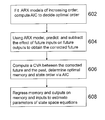
- FIG. 6 is an exemplary flow chart showing steps executed in an algorithm.
- FIG. 2 may show an exemplary flow chart where a linear, parameter varying system of difference equations may be utilized.
- a set of linear parameter varying state space equations such as those shown below as equation 1 and equation 2, may be used.
- x t+1 A 0 x t +B 0 u t +[A 1 ⁇ t (1)+ . . . + A s ⁇ t ( s )] x t +[B 1 ⁇ t (1)+ . . . + B s ⁇ t ( s )] u t
- y t C 0 x t +D 0 u t +[C 1 ⁇ t (1)+ . . . + C s ⁇ ( s )] x t +[D 1 ⁇ t (1)+ . . . + D s ⁇ t ( s )] u t (Equation 2)
- the convergence can be checked.
- the change in the values of the log likelihood function and the state orders between iteration k ⁇ 1 and iteration k can be compared. If, in some examples, the state order is the same and the log likelihood function change is less than a chosen threshold ⁇ . This threshold in many examples may be less than one, for example 0.01, then the iterations may end or be stopped. Otherwise, where the value is above a chosen threshold ⁇ , step 306 above may be returned to and iteration k+1 may be performed. Following the performance of iteration k+1, the convergence may then be checked again.
- y t C 0 x t +D 0 u t +[C 1 . . . C s ]( ⁇ t x t )+[ D 1 . . . D s ]( ⁇ t u t ) (Equation 14)
- Equations 13 and 14 above can then also be written as shown below in the formats of equations 15 and 16.
- the feedback ⁇ t inputs can now be considered as actual inputs to the LTI system.
- the matrices [A ⁇ B ⁇ ;C ⁇ D ⁇ ] of the LPV system description can be the appropriate quantities to describe the LTI feedback representation of the LPV system.
- an LPV system can be expressed as a linear time-invariant system with nonlinear internal feedback that can involve the known parameter varying functions ⁇ t .
- the system matrices P i of rank r i may be factored for each i with 1 ⁇ i ⁇ s using a singular value decomposition, such as that shown in equation 19.
- Scheduling parameters ⁇ t 406 , inputs u t 408 and outputs y t 446 are variables
- the upper four boxes are multiplication from left to right by B 0 418 , A 0 420 , B ⁇ 414 , A ⁇ 416 , respectively.
- the lower boxes are multiplication with A replaced by C and B replaced by D, depicted as D ⁇ 424 , C ⁇ 426 , D 0 428 and C 0 430 .
- the Kronecker products involving p, and successively x t and u t are formed in 410 and 412 respectively.
- equations 15 and 16 this can be equivalent to the LPV form shown in equations 15 and 16 where the state equations can be linear in the scheduling parameter vector ⁇ .
- equations 28 and 29 may be the same as equations 15 and 16.
- the LPV coefficient matrix P i [A i B i ;C i D i ] can be the regression matrix of the left hand side state equation variables (x t+1 ; y t ) on the vector of nonlinear terms [ ⁇ i,t x t ; ⁇ i,t u t ].
- the LTI nonlinear feedback representation can solve a major barrier to applying existing subspace identification algorithms to the identification of LPV systems and overcomes previous problems with exponentially growing numbers of nonlinear terms used in other methods.
- the above LTI nonlinear feedback representation can make it clear that nonlinear terms ( ⁇ t x t ; ⁇ t u t ) can be interpreted as inputs to an LTI nonlinear feedback system. Therefore it may be possible to directly estimate the matrices of the LTI system state space equations using linear subspace methods that can be accurate for processes with inputs and feedback. This can directly involve the use of the outputs y t as well as augmented inputs [u t ;( ⁇ t x t ; ⁇ t u t )] of the LTI nonlinear feedback system.
- One example may be to consider the polynomial system as a linear system in x and u with additional additive input terms in the higher order product terms so the additional inputs are ⁇ t x t and ⁇ t u t .
- the scheduling variables p t are assumed to be available in real time as operating points or measured variables. If accurate estimates of the state x t are also available, then the problem could be only a direct application of the iterative algorithm for system identification. Since the variables x t are not available until after the solution of the system identification, a different approach may be utilized.
- an initial estimate of the state vector may be made.
- system identification may be performed on the terms in the state equations involving the variables x t , u t and ⁇ t u t but not the variables ⁇ t x t .
- LTI linear time invariant
- an iterate estimate of the state vectors may be made.
- the state vector X 1,N [1] can be used as an initial estimates for x t in the terms ⁇ t x t in equations 15 and 16.
- the iterative algorithm can be applied to obtain an estimate of the system matrices A, B, C, and D and a refined estimate of X 1,N [2] . Further, this step may then be iterated until a desired convergence is achieved.
- the ARX model fitting can have a linear regression problem that makes no prior assumptions on the ARX order other than the maximum ARX order considered. If the identified ARX order is near a maximum considered, the maximum ARX order considered can be doubled and the regression recomputed.
- the ARX order lagp identified can be substantially higher due to the nonlinear input terms and depending on the statistically significant dynamics present among the output and augmented input variables.
- the computation can involve computation of an SVD on the data covariance matrix that is dimension of the dimua*lagp where lagp is the maximum ARX order considered.
- the computation that may be utilized for the SVD is of the order of 60*(dimua*lagp) 3 , so the computation increases proportional to (dimp(dimx+dimu)/dimu) 3 .
- one consequence of augmenting the system inputs by the nonlinear terms ⁇ t x t and ⁇ t u t may be to increase the past by a factor dimp(dimx+dimu)/dimu, and to increase the computation by this factor cubed.
- this can be very significant, however there is no exponential explosion in the number of terms or the computation time.
- the result of the CVA in exemplary step 606 is the computation of an estimate, denoted as m t , of the state sequence x t .
- the symbol ‘m’ is used as in the word ‘memory’ to distinguish it from the actual state vector and various estimates of the state vector as used in the EM algorithm discussed below.
- the estimate ⁇ circumflex over (m) ⁇ t in combination with the maximization step of the EM algorithm can be shown to be a maximum likelihood solution of the system identification problem for the case of a linear time-invariant system. In that case, the global ML solution can be obtained in only one iteration of the algorithm. This may be different with the EM and gradient search methods that almost always utilize many iterations.
- the convergence of the iterative algorithm for the case of LPV may be described.
- a substantially similar approach may be taken for other forms of nonlinear difference equations.
- the replacements that can be made in the GN discussion to obtain the LPV algorithm may be as follows: replace the LTI state equations with the LPV state equations and, for the missing data, replace the state estimate from the Kalman smoother with the ‘memory’ vector m t in the iterative algorithm.
- the consequence of this can be significant because for linear systems as in GN the iterative algorithm described herein can obtain the global ML parameter estimates in one step in large samples. On the other hand, for linear systems it may take the EM algorithm many iterations to obtain the ML solution.
- the subspace approach can specify the CVA state estimate m t or ‘memory’, as the missing data.
- the memory m t is the estimate of the state vector obtained by a canonical variate analysis between the corrected future and the past obtained in exemplary step 606 of the iterative algorithm using the input and output vectors specified in FIG. 5 .
- This may be similar to a Kalman filter state estimate at the global ML parameter estimates associated with the output and input data at iteration k rather than a Kalman smoother state estimate at the last estimated parameter value.
- a difference is that in the exemplary step 608 of the CVA algorithm the expectation can be with respect to the true global ML estimates associated with the output and input data at iteration k whereas the GN estimate is an expectation with respect to the parameter value obtained in the previous iteration.
- Lemma 3.1 of GN holds but also can achieve the global ML estimate associated with the input-output vectors of exemplary FIG. 5 in one step.
- Lemma 3.2 of GN can be replaced by the iterative algorithm to obtain the memory estimates ⁇ circumflex over (m) ⁇ t [k] .
- Lemma 3.3 of GN is the same result as obtained in the iterative algorithm.
- An additional step may be used to compute ⁇ circumflex over (x) ⁇ t [k] from the estimates ⁇ [k] and the linear time-varying state equations given by the LPV state equations. This step may be desired to obtain the state estimate ⁇ circumflex over (x) ⁇ t [k] for starting the next iteration k 1 .
- equation 17 and equation 18 with noise v t in innovation form may be written as equations 32 and 33 below.
- x t+1 Ax t +Bu t +Kv t (Equation 32)
- y t Cx t +Du t +v t (Equation 33)
- equation 35 Through recursively substituting the right hand side of equation 34 for x t can provide equation 35 below.
- ⁇ t can be the original inputs such that u t can include the nonlinear Kronecker product terms.
- J can be arbitrarily close to constant for a sufficiently large iteration k such that
- the convergence of the iterative linear subspace computation may be affected by the stability of the LPV difference equations and, more specifically, the stability of the LPV linear subspace system identification described herein.
- a set of time-invariant linear state space difference equations may be stable if and only if all of the eigenvalues of the state transition matrix are stable, for example the eigenvalues are less than 1.
- the LPV case is more complex, but for the purposes of this exemplary embodiment, the rate of growth or contraction per sample time can be given for each eigenvector component of the state vector x t by the respective eigenvalues of the LPV state transition matrix from equation 9 and now shown as equation 37 below.
- the difficulty can lie in that the algorithm initialization and sample size since at the optimal solution with a large sample, the algorithm is stable and convergent. If it was possible to compute with infinite precision, then problems with illconditioning could be avoided; however, with 15 or 30 decimal place accuracy, for example, some real data sets such as for the aircraft wing flutter, can benefit from further consideration.
- some exemplary embodiments may deal with manners of correcting for or otherwise lessening any undesired effects that may result from algorithm instability. For example, if the state sequence ⁇ circumflex over (x) ⁇ t [k] is sufficiently close to the optimum as based upon the terminal convergence results described previously, the iterative algorithm may be stable provided it is assumed that the LPV system is stable. Therefore, in some examples, large initial errors in the estimate ⁇ circumflex over (x) ⁇ t [1] can lead to an unstable computation.
- outlier editing of unstable regions may be performed.
- the time intervals with significant instabilities can be determined and removed from the computation.
- a general nonlinear, time varying, parameter varying dynamic system can be described by a system of nonlinear state equations, such as those shown in equations 38 and 39.
- x t+1 f ( x t ,u t , ⁇ t ,v t ) (Equation 38)
- y t h ( x t ,u t , ⁇ t ,v t ) (Equation 39)
- u t ⁇ u t (1) ;u t (2) ; . . . u t (J) ⁇ ; (Equation 43)
- the coefficient matrices (A, B, C, D) may be linear functions of scheduling parameters ⁇ t , denoted as (A( ⁇ t ),B( ⁇ t ),C( ⁇ t )D( ⁇ t )) and in state-affine form as in equations 9 through 12.
- the scheduling parameters ⁇ t may be nonlinear functions of the operating point or other known or accurately measured variables. For example, since the inputs u t are multiplicative and can be assumed to be known in real time or accurately measured, they can be absorbed into the scheduling parameters ⁇ t , thereby possibly decreasing their dimension.
- the bilinear equations can then become those shown in equations 46 and 47 below.
Landscapes
- Engineering & Computer Science (AREA)
- Physics & Mathematics (AREA)
- Theoretical Computer Science (AREA)
- General Physics & Mathematics (AREA)
- Data Mining & Analysis (AREA)
- Mathematical Physics (AREA)
- General Engineering & Computer Science (AREA)
- Computational Mathematics (AREA)
- Mathematical Analysis (AREA)
- Mathematical Optimization (AREA)
- Pure & Applied Mathematics (AREA)
- Software Systems (AREA)
- Databases & Information Systems (AREA)
- Algebra (AREA)
- Evolutionary Biology (AREA)
- Probability & Statistics with Applications (AREA)
- Operations Research (AREA)
- Bioinformatics & Computational Biology (AREA)
- Bioinformatics & Cheminformatics (AREA)
- Life Sciences & Earth Sciences (AREA)
- Evolutionary Computation (AREA)
- Computer Hardware Design (AREA)
- Geometry (AREA)
- Computing Systems (AREA)
- Complex Calculations (AREA)
- Management, Administration, Business Operations System, And Electronic Commerce (AREA)
- Feedback Control In General (AREA)
- Testing And Monitoring For Control Systems (AREA)
Priority Applications (2)
| Application Number | Priority Date | Filing Date | Title |
|---|---|---|---|
| US12/875,456 US8898040B2 (en) | 2009-09-03 | 2010-09-03 | Method and system for empirical modeling of time-varying, parameter-varying, and nonlinear systems via iterative linear subspace computation |
| US14/520,791 US20150039280A1 (en) | 2009-09-03 | 2014-10-22 | Method and system for empirical modeling of time-varying, parameter-varying, and nonlinear systems via iterative linear subspace computation |
Applications Claiming Priority (2)
| Application Number | Priority Date | Filing Date | Title |
|---|---|---|---|
| US23974509P | 2009-09-03 | 2009-09-03 | |
| US12/875,456 US8898040B2 (en) | 2009-09-03 | 2010-09-03 | Method and system for empirical modeling of time-varying, parameter-varying, and nonlinear systems via iterative linear subspace computation |
Related Child Applications (1)
| Application Number | Title | Priority Date | Filing Date |
|---|---|---|---|
| US14/520,791 Continuation US20150039280A1 (en) | 2009-09-03 | 2014-10-22 | Method and system for empirical modeling of time-varying, parameter-varying, and nonlinear systems via iterative linear subspace computation |
Publications (2)
| Publication Number | Publication Date |
|---|---|
| US20110054863A1 US20110054863A1 (en) | 2011-03-03 |
| US8898040B2 true US8898040B2 (en) | 2014-11-25 |
Family
ID=43626135
Family Applications (2)
| Application Number | Title | Priority Date | Filing Date |
|---|---|---|---|
| US12/875,456 Active 2033-01-16 US8898040B2 (en) | 2009-09-03 | 2010-09-03 | Method and system for empirical modeling of time-varying, parameter-varying, and nonlinear systems via iterative linear subspace computation |
| US14/520,791 Abandoned US20150039280A1 (en) | 2009-09-03 | 2014-10-22 | Method and system for empirical modeling of time-varying, parameter-varying, and nonlinear systems via iterative linear subspace computation |
Family Applications After (1)
| Application Number | Title | Priority Date | Filing Date |
|---|---|---|---|
| US14/520,791 Abandoned US20150039280A1 (en) | 2009-09-03 | 2014-10-22 | Method and system for empirical modeling of time-varying, parameter-varying, and nonlinear systems via iterative linear subspace computation |
Country Status (7)
| Country | Link |
|---|---|
| US (2) | US8898040B2 (enExample) |
| EP (1) | EP2465050A4 (enExample) |
| JP (2) | JP2013504133A (enExample) |
| KR (1) | KR101894288B1 (enExample) |
| CN (1) | CN102667755B (enExample) |
| CA (1) | CA2771583C (enExample) |
| WO (1) | WO2011029015A2 (enExample) |
Cited By (2)
| Publication number | Priority date | Publication date | Assignee | Title |
|---|---|---|---|---|
| US20160355278A1 (en) * | 2015-06-04 | 2016-12-08 | The Boeing Company | Systems and methods for analyzing flutter test data using damped sine curve fitting with the closed form shape fit |
| US10344615B2 (en) | 2017-06-22 | 2019-07-09 | General Electric Company | Method and system for schedule predictive lead compensation |
Families Citing this family (38)
| Publication number | Priority date | Publication date | Assignee | Title |
|---|---|---|---|---|
| CA2771583C (en) * | 2009-09-03 | 2018-10-30 | Wallace E. Larimore | Method and system for empirical modeling of time-varying, parameter-varying, and nonlinear systems via iterative linear subspace computation |
| US20120330717A1 (en) * | 2011-06-24 | 2012-12-27 | Oracle International Corporation | Retail forecasting using parameter estimation |
| US20140278303A1 (en) * | 2013-03-15 | 2014-09-18 | Wallace LARIMORE | Method and system of dynamic model identification for monitoring and control of dynamic machines with variable structure or variable operation conditions |
| AT512977B1 (de) * | 2013-05-22 | 2014-12-15 | Avl List Gmbh | Methode zur Ermittlung eines Modells einer Ausgangsgröße eines technischen Systems |
| US10417353B2 (en) | 2013-06-14 | 2019-09-17 | Wallace LARIMORE | Method and system of dynamic model identification for monitoring and control of dynamic machines with variable structure or variable operation conditions |
| JP6239294B2 (ja) * | 2013-07-18 | 2017-11-29 | 株式会社日立ハイテクノロジーズ | プラズマ処理装置及びプラズマ処理装置の運転方法 |
| US20180299847A1 (en) * | 2015-06-02 | 2018-10-18 | Nec Corporation | Linear parameter-varying model estimation system, method, and program |
| US10552408B2 (en) * | 2016-11-02 | 2020-02-04 | Oracle International Corporation | Automatic linearizability checking of operations on concurrent data structures |
| CN106845016B (zh) * | 2017-02-24 | 2019-10-15 | 西北工业大学 | 一种基于事件驱动的量测调度方法 |
| CN106934124B (zh) * | 2017-02-24 | 2020-02-21 | 西北工业大学 | 一种基于量测变化检测的自适应变划窗方法 |
| CN107122611A (zh) * | 2017-04-28 | 2017-09-01 | 中国石油大学(华东) | 青霉素发酵过程质量相关故障检测方法 |
| CN107168053B (zh) * | 2017-05-04 | 2020-10-30 | 南京理工大学 | 一种具有随机滤波增益变化的有限域滤波器设计方法 |
| CN107065557B (zh) * | 2017-05-04 | 2020-04-28 | 南京理工大学 | 一种具有随机滤波增益变化的有限域滤波器设计方法 |
| CN107194110A (zh) * | 2017-06-13 | 2017-09-22 | 哈尔滨工业大学 | 一种线性变参数双率系统的全局鲁棒参数辨识及输出估计方法 |
| US20190271608A1 (en) * | 2018-03-01 | 2019-09-05 | GM Global Technology Operations LLC | Method to estimate compressor inlet pressure for a turbocharger |
| CN108764680B (zh) * | 2018-05-18 | 2022-04-19 | 秦皇岛港股份有限公司 | 一种用于港前待泊区的船舶调度方法 |
| CN109033021B (zh) * | 2018-07-20 | 2021-07-20 | 华南理工大学 | 一种基于变参收敛神经网络的线性方程求解器设计方法 |
| WO2020118512A1 (zh) * | 2018-12-11 | 2020-06-18 | 大连理工大学 | 一种基于lft的航空发动机传感器及执行机构故障诊断方法 |
| CN109840069B (zh) * | 2019-03-12 | 2021-04-09 | 烟台职业学院 | 一种改进的自适应快速迭代收敛解方法及系统 |
| CN110298060B (zh) * | 2019-04-30 | 2023-04-07 | 哈尔滨工程大学 | 一种基于改进自适应遗传算法的间冷燃气轮机状态空间模型辨识方法 |
| CN110513198B (zh) * | 2019-08-13 | 2021-07-06 | 大连理工大学 | 一种涡扇发动机控制系统主动容错控制方法 |
| CN110597230B (zh) * | 2019-09-24 | 2020-08-18 | 清华大学深圳国际研究生院 | 一种主动故障诊断方法、计算机可读存储介质、控制方法 |
| JP7107339B2 (ja) * | 2019-09-30 | 2022-07-27 | 株式会社村田製作所 | 非線形特性計算の方法、非線形特性計算プログラムとその使用方法、並びに記録媒体 |
| JP7094377B2 (ja) | 2019-12-23 | 2022-07-01 | 株式会社日立ハイテク | プラズマ処理方法およびプラズマ処理に用いる波長選択方法 |
| CN111324852B (zh) * | 2020-03-06 | 2020-11-24 | 常熟理工学院 | 基于状态滤波和参数估计的cstr反应器时延系统的方法 |
| CN111538237B (zh) * | 2020-03-20 | 2021-10-29 | 北京航空航天大学 | 一种倾转旋翼无人机非线性浅灰模型辨识与校正方法 |
| CN112199856B (zh) * | 2020-10-23 | 2023-03-17 | 中国核动力研究设计院 | 基于modelica核反应堆管路系统模型构建与强耦合方法及装置 |
| CN112487618B (zh) * | 2020-11-19 | 2024-06-21 | 华北电力大学 | 基于等值信息交换的分布式抗差状态估计方法 |
| CN112610330B (zh) * | 2020-12-08 | 2023-05-09 | 孚创动力控制技术(启东)有限公司 | 一种内燃机运行状态的监测及分析系统和方法 |
| CN112613252B (zh) * | 2020-12-29 | 2024-04-05 | 大唐环境产业集团股份有限公司 | 一种吸收塔搅拌器的节能运行方法 |
| CN113626983B (zh) * | 2021-07-06 | 2022-09-13 | 南京理工大学 | 基于状态方程递推预测高炮射弹脱靶量的方法 |
| CN113486523B (zh) * | 2021-07-09 | 2024-06-11 | 南京航空航天大学 | 一种线性变参数振动系统全局辨识方法 |
| CN113641100B (zh) * | 2021-07-14 | 2023-11-28 | 苏州国科医工科技发展(集团)有限公司 | 针对未知非线性系统的通用辩识方法 |
| CN113704981B (zh) * | 2021-08-11 | 2024-04-09 | 武汉理工大学 | 温升过程中高速轴承时变动力学行为分析方法 |
| CN113742936B (zh) * | 2021-09-14 | 2024-04-30 | 贵州大学 | 基于函数型状态空间模型的复杂制造过程建模与预测方法 |
| WO2025009470A1 (ja) * | 2023-07-03 | 2025-01-09 | 東京エレクトロン株式会社 | 情報処理方法、コンピュータプログラム及び情報処理装置 |
| CN118297097A (zh) * | 2024-04-09 | 2024-07-05 | 南通大学 | 基于递阶极大似然和粒子群的电液伺服模型参数估计方法 |
| CN118412155B (zh) * | 2024-04-24 | 2025-03-04 | 西南交通大学 | 一种压水堆燃料组件非线性动力学特性的计算方法 |
Citations (21)
| Publication number | Priority date | Publication date | Assignee | Title |
|---|---|---|---|---|
| US5465321A (en) * | 1993-04-07 | 1995-11-07 | The United States Of America As Represented By The Administrator Of The National Aeronautics And Space Administration | Hidden markov models for fault detection in dynamic systems |
| US6173240B1 (en) * | 1998-11-02 | 2001-01-09 | Ise Integrated Systems Engineering Ag | Multidimensional uncertainty analysis |
| US6349272B1 (en) | 1999-04-07 | 2002-02-19 | Cadence Design Systems, Inc. | Method and system for modeling time-varying systems and non-linear systems |
| US20020129038A1 (en) * | 2000-12-18 | 2002-09-12 | Cunningham Scott Woodroofe | Gaussian mixture models in a data mining system |
| US20030125644A1 (en) * | 2001-10-12 | 2003-07-03 | Sharp Kabushiki Kaisha | Method of preparing fluid-structure interactive numerical model and method of manufacturing fluttering robot using the same |
| US20050021319A1 (en) | 2003-06-03 | 2005-01-27 | Peng Li | Methods, systems, and computer program products for modeling nonlinear systems |
| US20050114098A1 (en) * | 2002-03-28 | 2005-05-26 | Yuichi Nagahara | Random number generation method based on multivariate non-normal distribution, parameter estimation method thereof, and application to simulation of financial field and semiconductor ion implantation |
| US20060001673A1 (en) * | 2004-06-30 | 2006-01-05 | Mitsubishi Electric Research Laboratories, Inc. | Variable multilinear models for facial synthesis |
| US7082388B2 (en) * | 2000-12-05 | 2006-07-25 | Honda Giken Kogyo Kabushiki Kaisha | Flutter test model |
| US20070028220A1 (en) * | 2004-10-15 | 2007-02-01 | Xerox Corporation | Fault detection and root cause identification in complex systems |
| US20080126028A1 (en) * | 2006-09-26 | 2008-05-29 | Chang Gung University | Method of reducing a multiple-inputs multiple-outputs (MIMO) interconnect circuit system in a global lanczos algorithm |
| US7493240B1 (en) * | 2000-05-15 | 2009-02-17 | Cadence Design Systems, Inc. | Method and apparatus for simulating quasi-periodic circuit operating conditions using a mixed frequency/time algorithm |
| US7536282B1 (en) * | 2004-09-01 | 2009-05-19 | Alereon, Inc. | Method and system for statistical filters and design of statistical filters |
| US20100225390A1 (en) * | 2008-11-11 | 2010-09-09 | Axis Network Technology Ltd. | Resource Efficient Adaptive Digital Pre-Distortion System |
| US7840389B2 (en) * | 2007-01-05 | 2010-11-23 | Airbus France | Method of optimizing stiffened panels under stress |
| US7881815B2 (en) * | 2007-07-12 | 2011-02-01 | Honeywell International Inc. | Method and system for process control |
| US20110054863A1 (en) * | 2009-09-03 | 2011-03-03 | Adaptics, Inc. | Method and system for empirical modeling of time-varying, parameter-varying, and nonlinear systems via iterative linear subspace computation |
| US20120109600A1 (en) * | 2010-10-27 | 2012-05-03 | King Fahd University Of Petroleum And Minerals | Variable step-size least mean square method for estimation in adaptive networks |
| US8346693B2 (en) * | 2009-11-24 | 2013-01-01 | King Fahd University Of Petroleum And Minerals | Method for hammerstein modeling of steam generator plant |
| US20130013086A1 (en) * | 2011-07-06 | 2013-01-10 | Honeywell International Inc. | Dynamic model generation for implementing hybrid linear/non-linear controller |
| US20130030554A1 (en) * | 2011-07-27 | 2013-01-31 | Honeywell International Inc. | Integrated linear/non-linear hybrid process controller |
Family Cites Families (9)
| Publication number | Priority date | Publication date | Assignee | Title |
|---|---|---|---|---|
| JPH0250701A (ja) * | 1988-08-12 | 1990-02-20 | Fuji Electric Co Ltd | 適応制御方法 |
| JPH0695707A (ja) * | 1992-09-11 | 1994-04-08 | Toshiba Corp | モデル予測制御装置 |
| JPH0962652A (ja) * | 1995-08-29 | 1997-03-07 | Nippon Telegr & Teleph Corp <Ntt> | 最尤推定方法 |
| US5991525A (en) * | 1997-08-22 | 1999-11-23 | Voyan Technology | Method for real-time nonlinear system state estimation and control |
| US7035782B2 (en) * | 2000-06-02 | 2006-04-25 | Cadence Design Systems, Inc. | Method and device for multi-interval collocation for efficient high accuracy circuit simulation |
| US7487078B1 (en) * | 2002-12-20 | 2009-02-03 | Cadence Design Systems, Inc. | Method and system for modeling distributed time invariant systems |
| JP2005242581A (ja) * | 2004-02-25 | 2005-09-08 | Osaka Prefecture | パラメータ推定方法、状態監視方法、パラメータ推定装置、状態監視装置及びコンピュータプログラム |
| JP2007245768A (ja) * | 2006-03-13 | 2007-09-27 | Nissan Motor Co Ltd | ステアリング装置、自動車、及びステアリング制御方法 |
| US7603185B2 (en) * | 2006-09-14 | 2009-10-13 | Honeywell International Inc. | System for gain scheduling control |
-
2010
- 2010-09-03 CA CA2771583A patent/CA2771583C/en active Active
- 2010-09-03 EP EP10814565.7A patent/EP2465050A4/en not_active Withdrawn
- 2010-09-03 KR KR1020127008660A patent/KR101894288B1/ko active Active
- 2010-09-03 JP JP2012528092A patent/JP2013504133A/ja active Pending
- 2010-09-03 WO PCT/US2010/047832 patent/WO2011029015A2/en not_active Ceased
- 2010-09-03 CN CN201080050251.0A patent/CN102667755B/zh active Active
- 2010-09-03 US US12/875,456 patent/US8898040B2/en active Active
-
2014
- 2014-10-22 US US14/520,791 patent/US20150039280A1/en not_active Abandoned
-
2015
- 2015-06-03 JP JP2015112742A patent/JP2015181041A/ja active Pending
Patent Citations (22)
| Publication number | Priority date | Publication date | Assignee | Title |
|---|---|---|---|---|
| US5465321A (en) * | 1993-04-07 | 1995-11-07 | The United States Of America As Represented By The Administrator Of The National Aeronautics And Space Administration | Hidden markov models for fault detection in dynamic systems |
| US6173240B1 (en) * | 1998-11-02 | 2001-01-09 | Ise Integrated Systems Engineering Ag | Multidimensional uncertainty analysis |
| US6349272B1 (en) | 1999-04-07 | 2002-02-19 | Cadence Design Systems, Inc. | Method and system for modeling time-varying systems and non-linear systems |
| US7493240B1 (en) * | 2000-05-15 | 2009-02-17 | Cadence Design Systems, Inc. | Method and apparatus for simulating quasi-periodic circuit operating conditions using a mixed frequency/time algorithm |
| US20090210202A1 (en) * | 2000-05-15 | 2009-08-20 | Cadence Design Systems, Inc. | Method and apparatus for simulating quasi-periodic circuit operating conditions using a mixed frequency/time algorithm |
| US7082388B2 (en) * | 2000-12-05 | 2006-07-25 | Honda Giken Kogyo Kabushiki Kaisha | Flutter test model |
| US20020129038A1 (en) * | 2000-12-18 | 2002-09-12 | Cunningham Scott Woodroofe | Gaussian mixture models in a data mining system |
| US20030125644A1 (en) * | 2001-10-12 | 2003-07-03 | Sharp Kabushiki Kaisha | Method of preparing fluid-structure interactive numerical model and method of manufacturing fluttering robot using the same |
| US20050114098A1 (en) * | 2002-03-28 | 2005-05-26 | Yuichi Nagahara | Random number generation method based on multivariate non-normal distribution, parameter estimation method thereof, and application to simulation of financial field and semiconductor ion implantation |
| US20050021319A1 (en) | 2003-06-03 | 2005-01-27 | Peng Li | Methods, systems, and computer program products for modeling nonlinear systems |
| US20060001673A1 (en) * | 2004-06-30 | 2006-01-05 | Mitsubishi Electric Research Laboratories, Inc. | Variable multilinear models for facial synthesis |
| US7536282B1 (en) * | 2004-09-01 | 2009-05-19 | Alereon, Inc. | Method and system for statistical filters and design of statistical filters |
| US20070028220A1 (en) * | 2004-10-15 | 2007-02-01 | Xerox Corporation | Fault detection and root cause identification in complex systems |
| US20080126028A1 (en) * | 2006-09-26 | 2008-05-29 | Chang Gung University | Method of reducing a multiple-inputs multiple-outputs (MIMO) interconnect circuit system in a global lanczos algorithm |
| US7840389B2 (en) * | 2007-01-05 | 2010-11-23 | Airbus France | Method of optimizing stiffened panels under stress |
| US7881815B2 (en) * | 2007-07-12 | 2011-02-01 | Honeywell International Inc. | Method and system for process control |
| US20100225390A1 (en) * | 2008-11-11 | 2010-09-09 | Axis Network Technology Ltd. | Resource Efficient Adaptive Digital Pre-Distortion System |
| US20110054863A1 (en) * | 2009-09-03 | 2011-03-03 | Adaptics, Inc. | Method and system for empirical modeling of time-varying, parameter-varying, and nonlinear systems via iterative linear subspace computation |
| US8346693B2 (en) * | 2009-11-24 | 2013-01-01 | King Fahd University Of Petroleum And Minerals | Method for hammerstein modeling of steam generator plant |
| US20120109600A1 (en) * | 2010-10-27 | 2012-05-03 | King Fahd University Of Petroleum And Minerals | Variable step-size least mean square method for estimation in adaptive networks |
| US20130013086A1 (en) * | 2011-07-06 | 2013-01-10 | Honeywell International Inc. | Dynamic model generation for implementing hybrid linear/non-linear controller |
| US20130030554A1 (en) * | 2011-07-27 | 2013-01-31 | Honeywell International Inc. | Integrated linear/non-linear hybrid process controller |
Non-Patent Citations (14)
| Title |
|---|
| A Generalized Likelihood Ratio Approach to the Detection and Estimation of Jumps in Linear Systems; Alan S. Willsky et al; EEE Transactions on Automatic Control, Feb. 1976, pp. 108-112. * |
| Buchholz, et al., Subspace identification of an aircraft linear parameter-varying flutter model, Jun. 17-19, 2013, American Control Conference (pp. 2263-2267), Washington, DC. |
| Extended European Search Report in PCT/US2010047832 dated Jan. 8, 2014. |
| Flutter Boundary Prediction of an Adaptive Smart Wing during Process of Adaptation; Yuji Matsuzaki* et al; Apr. 28, 2005; Smart Structures and Materials 2005: Smart Structures and Integrated Systems, edited by Alison B. Flatau, Proc. of SPIE vol. 5764 (SPIE, Bellingham, WA, 2005) pp. 203-213. * |
| Identification of Flutter Parameters for a Wing Model; Carlos De Marqui Junior et al; J. of the Braz. Soc. of Mech. Sci. & Eng. Copyright 2006 by ABCM Jul.-Sep. 2006, vol. XXVIII, No. 3 pp. 339-346. * |
| International Search Report dated May 26, 2011, from corresponding International Patent Application PCT/US2010/047832, Sep. 3, 2010-3 pages. |
| Larimore, et al., Identification of linear parameter-varying engine models, Jun. 17-19, 2013, American Control Conference (pp. 2274-2279), Washington, DC. |
| Larimore, W., Identification of nonlinear parameter-varying systems via canonical variate analysis, Jun. 17-19, 2013, American Control Conference (pp. 2247-2262), Washington, DC. |
| P. Lopes Dos Santos et al., Identification of Linear Parameter Varying Systems Using an Iterative Deterministic-Stochastic Subspace Approach, Proceedings of the European Control Conference, Jul. 5, 2007, pp. 4868-4869. |
| P. Lopes dos Santos, et al., "Identifciation of LPV Systems Using Successive Approximations", Proceedings of the European Control Conference, Jul. 2-5, 2007, pp. 4867-4873. |
| P. Lopes dos Santos, et al., "Subspace identification of linear parameter-varying systems with innovation-type noise models driven by general inputs and a measurable white noise time-varying parameter vector", International Journal of Systems Science, vol. 39, No. 9, Sep. 2008, pp. 897-911. |
| Robust Complexity Criteria for Nonlinear Regression in NARX Models; Jos De Brabanter et al; pp. 1-6; Apr. 18, 2003 (from doc properties). * |
| Subspace Identification of Linear Parameter Varying Systems With Innovation-Type Noise Models; Paulo Lopes dos Santos et al; pp. 1-3; Jun. 13, 2006. * |
| Verdult, Vincent et al., Identification of Multivariable Linear Parameter-Varying Systems Based on Subspace Techniques, 39th IEEE Conference on Decision and Control, Dec. 15, 2000, pp. 1567-1572, vol. 2. |
Cited By (3)
| Publication number | Priority date | Publication date | Assignee | Title |
|---|---|---|---|---|
| US20160355278A1 (en) * | 2015-06-04 | 2016-12-08 | The Boeing Company | Systems and methods for analyzing flutter test data using damped sine curve fitting with the closed form shape fit |
| US10634580B2 (en) * | 2015-06-04 | 2020-04-28 | The Boeing Company | Systems and methods for analyzing flutter test data using damped sine curve fitting with the closed form shape fit |
| US10344615B2 (en) | 2017-06-22 | 2019-07-09 | General Electric Company | Method and system for schedule predictive lead compensation |
Also Published As
| Publication number | Publication date |
|---|---|
| CA2771583C (en) | 2018-10-30 |
| JP2013504133A (ja) | 2013-02-04 |
| CN102667755B (zh) | 2016-08-03 |
| CA2771583A1 (en) | 2011-03-10 |
| WO2011029015A3 (en) | 2011-07-21 |
| US20150039280A1 (en) | 2015-02-05 |
| CN102667755A (zh) | 2012-09-12 |
| JP2015181041A (ja) | 2015-10-15 |
| WO2011029015A2 (en) | 2011-03-10 |
| EP2465050A4 (en) | 2014-01-29 |
| KR20120092588A (ko) | 2012-08-21 |
| EP2465050A2 (en) | 2012-06-20 |
| KR101894288B1 (ko) | 2018-09-03 |
| US20110054863A1 (en) | 2011-03-03 |
Similar Documents
| Publication | Publication Date | Title |
|---|---|---|
| US20150039280A1 (en) | Method and system for empirical modeling of time-varying, parameter-varying, and nonlinear systems via iterative linear subspace computation | |
| US10996643B2 (en) | Method and system of dynamic model identification for monitoring and control of dynamic machines with variable structure or variable operation conditions | |
| US20140278303A1 (en) | Method and system of dynamic model identification for monitoring and control of dynamic machines with variable structure or variable operation conditions | |
| Galioto et al. | Bayesian system ID: optimal management of parameter, model, and measurement uncertainty | |
| AU2020326407A1 (en) | Extending finite rank deep kernel learning to forecasting over long time horizons | |
| Larimore | Identification of nonlinear parameter-varying systems via canonical variate analysis | |
| Li et al. | Extended explicit pseudo two-step RKN methods for oscillatory systems y ″+ M y= f (y) | |
| Gašperin et al. | Application of unscented transformation in nonlinear system identification | |
| Larimore et al. | ADAPT-LPV software for identification of nonlinear parameter-varying systems | |
| Chu et al. | A deep learning approach for epistemic uncertainty quantification of turbulent flow simulations | |
| Singh et al. | Echo state networks as state-space models: A systems perspective | |
| Wack et al. | Towards the Stability of Waveform Relaxation in Distributed Process Co‐Simulation | |
| Benner et al. | Parametric model order reduction with a small ℋ 2-error using radial basis functions | |
| Li et al. | L1 Regularization Paths in Linear Models by Parametric Gaussian Message Passing | |
| Hairer et al. | Numerical analysis of ordinary differential equations | |
| Sadeghi et al. | Utilizing ARMA Models for System Identification in Stirred Tank Heater: Different Approaches | |
| Gubarev et al. | Interval state estimator for linear systems with known structure | |
| Maharani et al. | Shooting-Interpolation Algorithm for Solving Boundary Value Problems in Second-Order Singular ODEs | |
| Pandey | Parameter Robustness in Data-Driven Estimation of Dynamical Systems | |
| Goethals et al. | NARX identification of Hammerstein systems using least-squares support vector machines | |
| Davies et al. | An Adaptive Method for Optimal Control Problems Constrained by Parabolic Differential Equations | |
| Bidar et al. | parameter models, Chemometrics and Intelligent Laboratory Systems | |
| Yin et al. | Data-Driven Prediction and Control of Hammerstein-Wiener Systems with Implicit Gaussian Processes | |
| Karapetyants et al. | Computing singular solutions of polynomial systems: towards superlinear convergence without deflation | |
| Dimiccoli | Fundamentals of cone regression |
Legal Events
| Date | Code | Title | Description |
|---|---|---|---|
| AS | Assignment |
Owner name: ADAPTICS, INC., VIRGINIA Free format text: ASSIGNMENT OF ASSIGNORS INTEREST;ASSIGNOR:LARIMORE, WALLACE E.;REEL/FRAME:033569/0579 Effective date: 20140814 |
|
| STCF | Information on status: patent grant |
Free format text: PATENTED CASE |
|
| MAFP | Maintenance fee payment |
Free format text: PAYMENT OF MAINTENANCE FEE, 4TH YR, SMALL ENTITY (ORIGINAL EVENT CODE: M2551) Year of fee payment: 4 |
|
| MAFP | Maintenance fee payment |
Free format text: PAYMENT OF MAINTENANCE FEE, 8TH YR, SMALL ENTITY (ORIGINAL EVENT CODE: M2552); ENTITY STATUS OF PATENT OWNER: SMALL ENTITY Year of fee payment: 8 |
|
| MAFP | Maintenance fee payment |
Free format text: PAYMENT OF MAINTENANCE FEE, 12TH YR, SMALL ENTITY (ORIGINAL EVENT CODE: M2553); ENTITY STATUS OF PATENT OWNER: SMALL ENTITY Year of fee payment: 12 |