US8772475B2 - AZA compounds and production method thereof, and metal complexes as MRI contrast agents - Google Patents
AZA compounds and production method thereof, and metal complexes as MRI contrast agents Download PDFInfo
- Publication number
- US8772475B2 US8772475B2 US12/743,777 US74377708A US8772475B2 US 8772475 B2 US8772475 B2 US 8772475B2 US 74377708 A US74377708 A US 74377708A US 8772475 B2 US8772475 B2 US 8772475B2
- Authority
- US
- United States
- Prior art keywords
- group
- complex
- formula
- substituent
- compound
- Prior art date
- Legal status (The legal status is an assumption and is not a legal conclusion. Google has not performed a legal analysis and makes no representation as to the accuracy of the status listed.)
- Expired - Fee Related, expires
Links
- 0 *N(C)CC.C.C Chemical compound *N(C)CC.C.C 0.000 description 21
- UZFXSNVZGLHAOX-UHFFFAOYSA-N C.C.CCNC Chemical compound C.C.CCNC UZFXSNVZGLHAOX-UHFFFAOYSA-N 0.000 description 1
- GHXWZRMUSDPUJJ-FVGYRXGTSA-N C=CC1=CC=C(CCl)C=C1.OC[C@H](O)C1=CC=C(CCl)C=C1 Chemical compound C=CC1=CC=C(CCl)C=C1.OC[C@H](O)C1=CC=C(CCl)C=C1 GHXWZRMUSDPUJJ-FVGYRXGTSA-N 0.000 description 1
- BDSUXUXUPRRERL-UHFFFAOYSA-N CC1(C)OCC(C2=CC=C(CCl)C=C2)O1.CC1=CC=C(O)C=C1.CP(CC1=CC=C(C2COC(C)(C)O2)C=C1)P=O Chemical compound CC1(C)OCC(C2=CC=C(CCl)C=C2)O1.CC1=CC=C(O)C=C1.CP(CC1=CC=C(C2COC(C)(C)O2)C=C1)P=O BDSUXUXUPRRERL-UHFFFAOYSA-N 0.000 description 1
- HQAXZBNKHAHVJF-QKWFRNNBSA-N CC1(C)OCC(C2=CC=C(CCl)C=C2)O1.COC(C)(C)C.OC[C@H](O)C1=CC=C(CCl)C=C1 Chemical compound CC1(C)OCC(C2=CC=C(CCl)C=C2)O1.COC(C)(C)C.OC[C@H](O)C1=CC=C(CCl)C=C1 HQAXZBNKHAHVJF-QKWFRNNBSA-N 0.000 description 1
- CKFPZFVHEVLMMU-NZULJDBFSA-N CC1(C)OCC(C2=CC=C(CCl)C=C2)O1.CP(CC1=CC=C([C@@H](O)CO)C=C1)P=O.CP(CC1=CC=C([C@H](COCC2=CC=C(C3COC(C)(C)O3)C=C2)OCC2=CC=C(C3COC(C)(C)O3)C=C2)C=C1)P=O Chemical compound CC1(C)OCC(C2=CC=C(CCl)C=C2)O1.CP(CC1=CC=C([C@@H](O)CO)C=C1)P=O.CP(CC1=CC=C([C@H](COCC2=CC=C(C3COC(C)(C)O3)C=C2)OCC2=CC=C(C3COC(C)(C)O3)C=C2)C=C1)P=O CKFPZFVHEVLMMU-NZULJDBFSA-N 0.000 description 1
- ITVOKRYMHJXSFS-CGOOSNSJSA-N CC1(C)OCC(C2=CC=C(COC[C@H](OCC3=CC=C(C4COC(C)(C)O4)C=C3)C3=CC=C(CBr)C=C3)C=C2)O1.CC1(C)OCC(C2=CC=C(COC[C@H](OCC3=CC=C(C4COC(C)(C)O4)C=C3)C3=CC=C(CO)C=C3)C=C2)O1 Chemical compound CC1(C)OCC(C2=CC=C(COC[C@H](OCC3=CC=C(C4COC(C)(C)O4)C=C3)C3=CC=C(CBr)C=C3)C=C2)O1.CC1(C)OCC(C2=CC=C(COC[C@H](OCC3=CC=C(C4COC(C)(C)O4)C=C3)C3=CC=C(CO)C=C3)C=C2)O1 ITVOKRYMHJXSFS-CGOOSNSJSA-N 0.000 description 1
- FCXVIELZNWJTOV-UORLXHSKSA-N CC1(C)OCC(C2=CC=C(COC[C@H](OCC3=CC=C(C4COC(C)(C)O4)C=C3)C3=CC=C(CO)C=C3)C=C2)O1.CP(CC1=CC=C([C@H](COCC2=CC=C(C3COC(C)(C)O3)C=C2)OCC2=CC=C(C3COC(C)(C)O3)C=C2)C=C1)P=O Chemical compound CC1(C)OCC(C2=CC=C(COC[C@H](OCC3=CC=C(C4COC(C)(C)O4)C=C3)C3=CC=C(CO)C=C3)C=C2)O1.CP(CC1=CC=C([C@H](COCC2=CC=C(C3COC(C)(C)O3)C=C2)OCC2=CC=C(C3COC(C)(C)O3)C=C2)C=C1)P=O FCXVIELZNWJTOV-UORLXHSKSA-N 0.000 description 1
- IXIVOSQXHUWNEI-OHPKLYQHSA-N CC1(C)OCC(CCOC[C@@H](CCBr)OCCC2COC(C)(C)O2)O1.CC1(C)OCC(CCOC[C@@H](CCN2CCN(CC[C@H](COCCC3COC(C)(C)O3)OCCC3COC(C)(C)O3)CCN(CC[C@H](COCCC3COC(C)(C)O3)OCCC3COC(C)(C)O3)CC2)OCCC2COC(C)(C)O2)O1.[H][H]1CC[H]([H])CCN([H])CC1 Chemical compound CC1(C)OCC(CCOC[C@@H](CCBr)OCCC2COC(C)(C)O2)O1.CC1(C)OCC(CCOC[C@@H](CCN2CCN(CC[C@H](COCCC3COC(C)(C)O3)OCCC3COC(C)(C)O3)CCN(CC[C@H](COCCC3COC(C)(C)O3)OCCC3COC(C)(C)O3)CC2)OCCC2COC(C)(C)O2)O1.[H][H]1CC[H]([H])CCN([H])CC1 IXIVOSQXHUWNEI-OHPKLYQHSA-N 0.000 description 1
- UOBOQEHCRMWZRG-KYJHVVMCSA-N CC1(C)OCC(CCOC[C@@H](CCN2CCN(CC[C@H](COCCC3COC(C)(C)O3)OCCC3COC(C)(C)O3)CCN(CC[C@H](COCCC3COC(C)(C)O3)OCCC3COC(C)(C)O3)CC2)OCCC2COC(C)(C)O2)O1.OC[C@H](O)CCOC[C@@H](CCN1CCN(CC[C@H](COCC[C@@H](O)CO)OCC[C@@H](O)CO)CCN(CC[C@H](COCC[C@@H](O)CO)OCC[C@@H](O)CO)CC1)OCC[C@@H](O)CO Chemical compound CC1(C)OCC(CCOC[C@@H](CCN2CCN(CC[C@H](COCCC3COC(C)(C)O3)OCCC3COC(C)(C)O3)CCN(CC[C@H](COCCC3COC(C)(C)O3)OCCC3COC(C)(C)O3)CC2)OCCC2COC(C)(C)O2)O1.OC[C@H](O)CCOC[C@@H](CCN1CCN(CC[C@H](COCC[C@@H](O)CO)OCC[C@@H](O)CO)CCN(CC[C@H](COCC[C@@H](O)CO)OCC[C@@H](O)CO)CC1)OCC[C@@H](O)CO UOBOQEHCRMWZRG-KYJHVVMCSA-N 0.000 description 1
- RAULDQDFKFYGHL-NNGKAWDESA-N CC1(C)OCC(CCOC[C@@H](CCN2CCN(CC[C@H](COCCC3COC(C)(C)O3)OCCC3COC(C)(C)O3)CCN(CC[C@H](COCC[C@@H]3COC(C)(C)O3)OCC[C@@H]3COC(C)(C)O3)CCN(CC[C@H](COCCC3COC(C)(C)O3)OCCC3COC(C)(C)O3)CC2)OCCC2COC(C)(C)O2)O1 Chemical compound CC1(C)OCC(CCOC[C@@H](CCN2CCN(CC[C@H](COCCC3COC(C)(C)O3)OCCC3COC(C)(C)O3)CCN(CC[C@H](COCC[C@@H]3COC(C)(C)O3)OCC[C@@H]3COC(C)(C)O3)CCN(CC[C@H](COCCC3COC(C)(C)O3)OCCC3COC(C)(C)O3)CC2)OCCC2COC(C)(C)O2)O1 RAULDQDFKFYGHL-NNGKAWDESA-N 0.000 description 1
- QFDGGTCFABCLNR-UHFFFAOYSA-N CCC(OCC(O)C(O)C(Cl)(Cl)Cl)C(OCC(O)C(O)C(Cl)(Cl)Cl)C(Cl)(Cl)Cl.CCC(OCC(O)C(O)[Si](C)(C)C)C(OCC(O)C(O)[Si](C)(C)C)[Si](C)(C)C.CCC1=CC=C(OCC(COCC2=CC=C(OCC(O)CO)C=C2)OCC2=CC=C(OCC(O)CO)C=C2)C=C1.CCCCCC(COCCCCC(O)CO)OCCCCC(O)CO Chemical compound CCC(OCC(O)C(O)C(Cl)(Cl)Cl)C(OCC(O)C(O)C(Cl)(Cl)Cl)C(Cl)(Cl)Cl.CCC(OCC(O)C(O)[Si](C)(C)C)C(OCC(O)C(O)[Si](C)(C)C)[Si](C)(C)C.CCC1=CC=C(OCC(COCC2=CC=C(OCC(O)CO)C=C2)OCC2=CC=C(OCC(O)CO)C=C2)C=C1.CCCCCC(COCCCCC(O)CO)OCCCCC(O)CO QFDGGTCFABCLNR-UHFFFAOYSA-N 0.000 description 1
- LIWAQLJGPBVORC-UHFFFAOYSA-N CCNC Chemical compound CCNC LIWAQLJGPBVORC-UHFFFAOYSA-N 0.000 description 1
- MURMHXNPQZBGMV-PCJAOAOQSA-N CC[C@H](O)CCOC[C@@H](CCN1CCN(CC[C@H](COCC[C@@H](O)CO)OCC[C@@H](O)CO)CCN(CC[C@H](COCC[C@@H](O)CO)OCC[C@@H](O)CO)CC1)OCC[C@@H](O)CO Chemical compound CC[C@H](O)CCOC[C@@H](CCN1CCN(CC[C@H](COCC[C@@H](O)CO)OCC[C@@H](O)CO)CCN(CC[C@H](COCC[C@@H](O)CO)OCC[C@@H](O)CO)CC1)OCC[C@@H](O)CO MURMHXNPQZBGMV-PCJAOAOQSA-N 0.000 description 1
- PZCRVGOPIZBBFO-UHFFFAOYSA-N COC(O)(C1=CC=C(COC(C2=CC=CC=C2)C(OC)(OCC2=CC=C(C(C)(O)C(O)C3=CC=CC=C3)C=C2)C2=CC=C(C)C=C2)C=C1)C(O)C1=CC=CC=C1 Chemical compound COC(O)(C1=CC=C(COC(C2=CC=CC=C2)C(OC)(OCC2=CC=C(C(C)(O)C(O)C3=CC=CC=C3)C=C2)C2=CC=C(C)C=C2)C=C1)C(O)C1=CC=CC=C1 PZCRVGOPIZBBFO-UHFFFAOYSA-N 0.000 description 1
- IDRJBRMWLNJABM-DPALEJNTSA-N CP(CC1=CC=C(C2COC(C)(C)O2)C=C1)P=O.CP(CC1=CC=C([C@@H](O)CO)C=C1)P=O Chemical compound CP(CC1=CC=C(C2COC(C)(C)O2)C=C1)P=O.CP(CC1=CC=C([C@@H](O)CO)C=C1)P=O IDRJBRMWLNJABM-DPALEJNTSA-N 0.000 description 1
- JFTGDCGAUVOFPT-VIFPVBQESA-N OC[C@H](O)C1=CC=C(CCl)C=C1 Chemical compound OC[C@H](O)C1=CC=C(CCl)C=C1 JFTGDCGAUVOFPT-VIFPVBQESA-N 0.000 description 1
Images


Classifications
-
- C—CHEMISTRY; METALLURGY
- C07—ORGANIC CHEMISTRY
- C07F—ACYCLIC, CARBOCYCLIC OR HETEROCYCLIC COMPOUNDS CONTAINING ELEMENTS OTHER THAN CARBON, HYDROGEN, HALOGEN, OXYGEN, NITROGEN, SULFUR, SELENIUM OR TELLURIUM
- C07F5/00—Compounds containing elements of Groups 3 or 13 of the Periodic Table
- C07F5/003—Compounds containing elements of Groups 3 or 13 of the Periodic Table without C-Metal linkages
-
- A—HUMAN NECESSITIES
- A61—MEDICAL OR VETERINARY SCIENCE; HYGIENE
- A61K—PREPARATIONS FOR MEDICAL, DENTAL OR TOILETRY PURPOSES
- A61K49/00—Preparations for testing in vivo
- A61K49/06—Nuclear magnetic resonance [NMR] contrast preparations; Magnetic resonance imaging [MRI] contrast preparations
- A61K49/08—Nuclear magnetic resonance [NMR] contrast preparations; Magnetic resonance imaging [MRI] contrast preparations characterised by the carrier
- A61K49/10—Organic compounds
- A61K49/101—Organic compounds the carrier being a complex-forming compound able to form MRI-active complexes with paramagnetic metals
- A61K49/106—Organic compounds the carrier being a complex-forming compound able to form MRI-active complexes with paramagnetic metals the complex-forming compound being cyclic, e.g. DOTA
-
- C—CHEMISTRY; METALLURGY
- C07—ORGANIC CHEMISTRY
- C07D—HETEROCYCLIC COMPOUNDS
- C07D255/00—Heterocyclic compounds containing rings having three nitrogen atoms as the only ring hetero atoms, not provided for by groups C07D249/00 - C07D253/00
- C07D255/02—Heterocyclic compounds containing rings having three nitrogen atoms as the only ring hetero atoms, not provided for by groups C07D249/00 - C07D253/00 not condensed with other rings
-
- C—CHEMISTRY; METALLURGY
- C07—ORGANIC CHEMISTRY
- C07D—HETEROCYCLIC COMPOUNDS
- C07D257/00—Heterocyclic compounds containing rings having four nitrogen atoms as the only ring hetero atoms
- C07D257/02—Heterocyclic compounds containing rings having four nitrogen atoms as the only ring hetero atoms not condensed with other rings
-
- C—CHEMISTRY; METALLURGY
- C07—ORGANIC CHEMISTRY
- C07D—HETEROCYCLIC COMPOUNDS
- C07D259/00—Heterocyclic compounds containing rings having more than four nitrogen atoms as the only ring hetero atoms
-
- C—CHEMISTRY; METALLURGY
- C07—ORGANIC CHEMISTRY
- C07D—HETEROCYCLIC COMPOUNDS
- C07D405/00—Heterocyclic compounds containing both one or more hetero rings having oxygen atoms as the only ring hetero atoms, and one or more rings having nitrogen as the only ring hetero atom
- C07D405/14—Heterocyclic compounds containing both one or more hetero rings having oxygen atoms as the only ring hetero atoms, and one or more rings having nitrogen as the only ring hetero atom containing three or more hetero rings
Definitions
- the present invention relates to a compound and a production method thereof, a metal complex and a production method thereof, and an MRI contrast agent.
- Magnetic resonance imaging is a method for obtaining an image of a tissue or structure or the like in the living body using nuclear magnetic resonance in a magnetic field.
- the signal strength of magnetic resonance (MR) depends on the longitudinal relaxation time (T1), transverse relaxation time (T2) and the like. Consequently, the contrast of the resulting image may be increased by controlling T1 or T2.
- gadolinium complex which is stabilized by coordinating an organic ligand to a gadolinium ion, has been used as a contrast agent, and many proposals have been made regarding it (refer to U.S. Pat. No. 5,695,739, U.S. Pat. No. 5,798,092, U.S. Pat. No. 6,039,931, U.S. Pat. No. 6,149,890 and U.S. Pat. No. 6,177,562).
- the T1-reducing effect of Gd 3+ is considered to depend on the coordination of a free water molecule to Gd 3+ .
- a gadolinium complex which is generally used as an MRI contrast agent, forms a chelate complex by the coordination of 7 or 8 coordinating functional groups (N or COOH) in a ligand to Gd 3+ . If Gd 3+ is a metal ion in a nine-coordination geometry, it is more likely that the T1-reducing ability intrinsic to Gd 3+ is not sufficiently derived from such a general gadolinium complex. This point is the same as in the case of a complex using a metal ion other than Gd 3+ .
- an object of the present invention is to provide a metal complex that exhibits a T1-reducing effect superior to that of a conventional one, a compound which is a ligand used for the metal complex and an intermediate compound used for the production of the metal complex.
- another object of the present invention is to provide an MRI contrast agent which exhibits a T1-reducing effect superior to that of a conventional MRI contrast agent.
- a compound with a cyclic structure according to the present invention is characterized by being a compound represented by the following Formula (A):
- n is an integer of 1 or more
- k is an integer of 3 or more and 8 or less
- R represents a group represented by the following Formula (1):
- R 1 is an arylene group which may have a substituent, an alkylene group which may have a substituent or a group in which an arylene group which may have a substituent and an alkylene group which may have a substituent are bonded together
- R 8 is H, an alkyl group, a halogenated alkyl group, an alkoxyl group, an aryl group, an aryloxy group, a silyl group, a silyloxy group or COOR 10
- R 10 is H, an aryl group or an alkyl group
- R 9 is H, an alkyl group, a halogenated alkyl group, an alkoxyl group, an aryl group, an aryloxy group, a silyl group, a silyloxy group or COOR 10
- R 10 is H, an aryl group or an alkyl group
- m is an integer of 1 or more
- R 2 and R 3 are an end-group represented by the following Formula (2-1)
- R 1 is an arylene group which may have a substituent, an alkylene group which may have a substituent or a group in which an arylene group which may have a substituent and an alkylene group which may have a substituent are bonded together
- R 8 is H, an alkyl group, a halogenated alkyl group, an alkoxyl group, an aryl group, an aryloxy group, a silyl group, a silyloxy group or COOR 10
- R 10 is H, an aryl group or an alkyl group
- R 9 is H, an alkyl group, a halogenated alkyl group, an alkoxyl group, an aryl group, an aryloxy group, a silyl group, a silyloxy group or COOR 10
- R 10 is H, an aryl group or an alkyl group
- R 4 and R 5 are each independently H, OH, COOH, NH 2 , an alkyl group which may be
- R 1 is an arylene group which may have a substituent, an alkylene group which may have a substituent or a group in which an arylene group which may have a substituent and an alkylene group which may have a substituent are bonded together
- R 8 is H, an alkyl group, a halogenated alkyl group, an alkoxyl group, an aryl group, an aryloxy group, a silyl group, a silyloxy group or COOR 10
- R 10 is H, an aryl group or an alkyl group
- R 9 is H, an alkyl group, a halogenated alkyl group, an alkoxyl group, an aryl group, an aryloxy group, a silyl group, a silyloxy group or COOR 10
- R 10 is H, an aryl group or an alkyl group
- R 6 and R 7 are each independently H, an alkyl group which may have a substituent or an alkoxy
- a metal complex of the present invention is characterized in that the compound in the above Formula (A) is bonded to a metal ion with a T1-reducing effect by a coordination bond.
- a contrast agent of the present invention is characterized by containing the metal complex as a contrast component.
- a compound, which is useful as a raw material compound for the synthesis of a compound of the above Formula (A) according to the present invention is characterized by being represented by the following Formula (3):
- R 1 is any of an arylene group which may have a substituent, an alkylene group which may have a substituent or a group in which an arylene group which may have a substituent and an alkylene group which may have a substituent are bonded together
- R 8 is H, an alkyl group, a halogenated alkyl group, an alkoxyl group, an aryl group, an aryloxy group, a silyl group, a silyloxy group or COOR 10
- R 10 is H, an aryl group or an alkyl group
- R 9 is H, an alkyl group, a halogenated alkyl group, an alkoxyl group, an aryl group, an aryloxy group, a silyl group, a silyloxy group or COOR 10
- R 10 is H, an aryl group or an alkyl group
- m is an integer of 1 or more
- R 2 and R 3 are an end-group
- R 1 is any an arylene group which may have a substituent, an alkylene group which may have a substituent or a group in which an arylene group which may have a substituent and an alkylene group which may have a substituent are bonded together
- R 8 is H, an alkyl group, a halogenated alkyl group, an alkoxyl group, an aryl group, an aryloxy group, a silyl group, a silyloxy group or COOR 10
- R 10 is H, an aryl group or an alkyl group
- R 9 is H, an alkyl group, a halogenated alkyl group, an alkoxyl group, an aryl group, an aryloxy group, a silyl group, a silyloxy group or COOR 10
- R 10 is an aryl group or an alkyl group
- R 4 and R 5 are each independently H, OH, COOH, NH 2 , an alkyl group which may have
- R 1 is an arylene group which may have a substituent, an alkylene group which may have a substituent or a group in which an arylene group which may have a substituent and an alkylene group which may have a substituent are bonded together
- R 8 is H, an alkyl group, a halogenated alkyl group, an alkoxyl group, an aryl group, an aryloxy group, a silyl group, a silyloxy group or COOR 10
- R 10 is H, an aryl group or an alkyl group
- R 9 is H, an alkyl group, a halogenated alkyl group, an alkoxyl group, an aryl group, an aryloxy group, a silyl group, a silyloxy group or COOR 10
- R 10 is H, an aryl group or an alkyl group
- R 6 and R 7 are each independently H, an alkyl group which may have a substituent or an alkoxy
- m is an integer of 2 or more, to at least one of the R 2 side and R 3 side of a first repeating unit containing R 1 , the methylene group side of a next repeating unit containing R 1 is bonded, and this bonding is repeated according to the value of m).
- a method for producing a compound of the above Formula (A) according to the present invention is characterized by comprising at least a step of reacting a cyclic structure compound represented by the following Formula (B) and a compound represented by the above Formula (3):
- n is an integer of 1 or more and k is an integer of 3 to 8.
- a method for producing a metal complex according to the present invention is characterized by comprising at least a step of coordinating the compound represented by the above Formula (A) to a metal ion with a T1-reducing effect.
- FIG. 1 shows T1 relaxation time measurement data of a sample water prepared by adding 10% heavy water to an aqueous solution of 0.13 mM complex (R)-11, as measured by using a 500 MHz NMR apparatus in Example 4.
- FIG. 2 shows T1 relaxation time measurement data of a sample water prepared by adding 10% heavy water to an aqueous solution of 0.13 mM Gd (DTPA), as measured by using a 500 MHz NMR apparatus in Comparative Example 1.
- DTPA 0.13 mM Gd
- FIG. 3 shows T1 relaxation time measurement data of a sample water prepared by adding 10% heavy water to an aqueous solution of 0.13 mM GdCl 3 , as measured by using a 500 MHz NMR apparatus in Comparative Example 1.
- FIG. 4 shows T1 relaxation time measurement data of an aqueous solution of 1.3 mM, 0.65 mM, 0.325 mM, 0.13 mM, 0.026 mM, and 0.013 mM complex (R)-11 and purified water, as measured by a 7T MRI apparatus in Example 5.
- FIG. 5 shows a graph of the relation between the concentration of the complex (R)-11 and 1/T1 in Example 5.
- FIG. 6 shows T1 relaxation time measurement data of water for an aqueous solution of 1.3 mM GdCl 3 and an aqueous solution of 1.3 mM Gd (DTPA), as measured by a 7T MRI apparatus in Comparative Example 2.
- FIG. 7 shows a graph of the relation of the concentration between the Gd (DTPA) and 1/T1 in Comparative Example 2.
- FIG. 8 shows an MRI image of a phantom of an aqueous solution of complex (R)-11 (1.3 mM), GdCl 3 (1.3 mM) and Gd (DTPA) (1.3 and 0.5 mM) and water, as measured by changing the TR using 7T MRI apparatus.
- FIGS. 9A and 9B shows MRI images of a mouse as measured by using a 7T MRI apparatus in Example 6;
- FIG. 9A shows an image before the administration of a complex, and
- FIG. 9B shows an image after the administration of a Gd triamine 2nd G-12-ol-dendrimer complex (11).
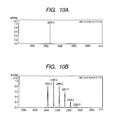
- FIGS. 10A and 10B shows ESI-TOS MS spectra of the 2nd Generation-chiral-acetonide tetraamine dendrimer (R)-9a synthesized in Example 9.
- a compound with a cyclic structure according to the present invention is represented by the following Formula (A):
- a unit comprising —N—(CH 2 ) n — is serially repeated in predetermined numbers and both ends are bonded to form a structure comprising a ring chain.
- a core site is formed by the cyclic structure, and multiple Ns in the ring chain of the core site form a coordination site of a metal ion.
- n in the Formula (A) is an integer of 1 or more and k is an integer from 3 to 8. Further, the value of n may be different for each —N—(CH 2 ) n —.
- R in Formula (A) is a side chain to the core site and has a structure with the following Formula (1):
- R 1 is an arylene group which may have a substituent, an alkylene group which may have a substituent or a group in which an arylene group which may have a substituent and an alkylene group which may have a substituent are bonded together
- R 8 is H, an alkyl group, a halogenated alkyl group, an alkoxyl group, an aryl group, an aryloxy group, a silyl group, a silyloxy group or COOR 10
- R 10 is H, an aryl group or an alkyl group
- R 9 is H, an alkyl group, a halogenated alkyl group, an alkoxyl group, an aryl group, an aryloxy group, a silyl group, a silyloxy group or COOR 10
- R 10 is H, an aryl group or an alkyl group
- m is an integer of 1 or more
- R 2 and R 3 are an end-group represented by the following Formula (2-1)
- R 1 is an arylene group which may have a substituent, an alkylene group which may have a substituent or a group in which an arylene group which may have a substituent and an alkylene group which may have a substituent are bonded together
- R 8 is H, an alkyl group, a halogenated alkyl group, an alkoxyl group, an aryl group, an aryloxy group, a silyl group, a silyloxy group or COOR 10
- R 10 is H, an aryl group or an alkyl group
- R 9 is H, an alkyl group, a halogenated alkyl group, an alkoxyl group, an aryl group, an aryloxy group, a silyl group, a silyloxy group or COOR 10
- R 10 is H, an aryl group or an alkyl group
- R 4 and R 5 are each independently H, OH, COOH, NH 2 , an alkyl group which may be
- R 1 is an arylene group which may have a substituent, an alkylene group which may have a substituent or a group in which an arylene group which may have a substituent and an alkylene group which may have a substituent are bonded together
- R 8 is H, an alkyl group, a halogenated alkyl group, an alkoxyl group, an aryl group, an aryloxy group, a silyl group, a silyloxy group or COOR 10
- R 10 is H, an aryl group or an alkyl group
- R 9 is H, an alkyl group, a halogenated alkyl group, an alkoxyl group, an aryl group, an aryloxy group, a silyl group, a silyloxy group or COOR 10
- R 10 is H, an aryl group or an alkyl group
- R 6 and R 7 are each independently H, an alkyl group which may have a substituent or an alkoxy
- the substituent on R 1 that increases the water-solubility of the finally obtained metal complex is preferred.
- the substituent on R 1 is preferably a group that is not coordinated to a central metal during the formation of a metal complex.
- the substituent on R 1 is preferably an ether group.
- R 1 examples include an arylene group such as a phenylene group, a naphthalenediyl group, an anthracenediyl group and the like, and an arylene group with an ether group as a substituent such as an oxyphenylene group and the like; an alkyl group such as a methylene group, an ethylene group, a propylene group, a butylene group and the like; an alkyl group with an ether group as a substituent such as an oxymethylene group, an oxyethylene group, an oxypropylene group, an oxybutylene group and the like; and a group in which an arylene group which may have a substituent and an alkylene group which may have a substituent are bonded, such as a methylenephenylene group, an oxymethylenephenylene group, an oxyphenylenemethylene group and the like.
- n 1 or more
- the preferred range is 1 or more and 8 or less.
- R 4 or R 5 is an alkyl group or an alkoxy group
- the preferred carbon number is 1 or more and 3 or less.
- R 6 or R 7 is an alkyl group, the preferred carbon number is 1 or more and 3 or less.
- the substituents which R 4 , R 5 , R 6 and R 7 may have include halogen, NH 3 , COOH and the like.
- R 8 is an alkyl group, a halogenated alkyl group and or alkoxyl group
- the preferred carbon number is 1 or more and 3 or less.
- the aryl portion is preferably a phenyl group.
- the silyl portion is preferably either a trimethylsilyl group or a trimethoxysilyl group.
- R 10 is either an aryl group or an alkyl group, the carbon number is preferably 1 or more and 3 or less.
- the methylene group side of a next repeating unit containing R 1 is bonded, and the bonding is repeated according to the value of m.
- the next repeating unit is bonded to at least one of position b of the R 2 side and position c of the R 3 side at position a of the methylene group side. Further, the repeating unit is bonded depending on the value of m and elongation of the side chain is ultimately stopped in a state where R 2 and R 3 are bonded to the ends.
- R 1 is an arylene group which may have a substituent, an alkylene group which may have a substituent or a group in which an arylene group which may have a substituent and an alkylene group which may have a substituent are bonded, and is independent for each repeating unit when there are several of the above repeating units.
- R 1 may be different in each repeating unit.
- an end-group with R 2 and R 3 represents an end-group that is independent of each end-group and is represented by the above-described Formula (2-1) or Formula (2-2). Of these, a group in which R 1 in each repeating unit is the same and each end-group is the same is preferred.
- the coordination site of the compound in Formula (A) may be coordinated to a metal ion with a T1-reducing effect to obtain a metal complex that is useful as a contrast component (effective component) of a contrast agent.
- the metal ion with a T1-reducing effect includes any of a lanthanoid ion, a manganese ion, a chromium ion, an iron ion and the like.
- an MRI contrast agent may be prepared by using at least one of these metal complexes as an effective component.
- X is a halogen atom and m, R 1 to R 3 , R 8 and R 9 are defined in the same manner as in Formula (1).
- the compound represented by the Formula (A) may be produced by a method comprising at least one step of reacting a cyclic structure compound represented by the following Formula (B) with a compound represented by Formula (3).
- a metal complex may be produced according to the present invention by a method that includes at least one step of coordinating the compound of the Formula (A) to a metal ion having the T1-reducing effect.
- an asymmetric dihydroxylation is preferably used for the synthesis of a compound in Formula (3).
- a commercially available one may be used as a compound in which k is 3 or more and 6 or less.
- a compound in which k is 7 or 8 may be synthesized by a well-known synthetic method (For the former, for example, Atkins, T. J.; Richman, J. E.; Dettle, W. F. Org. Synth. 1978, 58, 86.
- Bianchi A.; Mangani, S.; Micheloni, M.; Nanini, V.; Orioli, P.; Paoletti, P.; Seghi, B. Inorg. Chem. 1985, 24, 1182).
- a compound in which n is different for each (—NH(CH 2 ) n —) may be obtained by purchasing a commercially available product or through synthesis.
- a cycloamine that includes (—NH(CH 2 ) 2 —) and (—NH(CH 2 ) 3 —) in which k is 4 is available commercially.
- the value (that is, the number of atoms constituting a ring) represented by k(n+1) is preferably 8 or more and 24 or less.
- a compound represented by the Formula (A) according to the present invention is a compound that can become a ligand of a chelate complex.
- the specifically preferred embodiment of the compound includes, for example, a compound of the following Formula (5).
- R 8 comprehensively represents the end of the side chain and corresponds to R 2 and R 3 in Formula (2) (which is abbreviated for simplicity and multiple ends are present in each L 1 ).
- the important point is in that at least one of the end-most ends (hereinafter simply referred to as an “end”) of the end portions is other than COOH.
- end When a complex is formed, it is considered that COOH is strongly coordinated to a central metal ion such as Gd 3+ and the like.
- Gd 3+ a central metal ion
- the probability that free water is coordinated is significantly reduced, the T1-reducing effect of a central metal is considered to be impaired.
- a structure represented by the above Formula (2-2) is selected as an end portion of the side chain, before being used as a ligand, it is preferably dihydroxylated by hydrolyzing at least part of it.
- the end portion of the side chain may be arbitrarily designed depending on the kind of central metal ion or the structure of other portions of the ligand or the like. With regard to relatively difficult coordination to the central metal ion, an OH group is preferably selected as at least one of the ends.
- n or k of the core of a cyclic structure represented by Formula (B) a suitable value may be selected primarily depending on the kind of central metal ion.
- the preferred value of k is an integer of 3 or more and 5 or less.
- the preferred value of n is an integer of 2 or more and 4 or lees.
- m in the Formula (1) is an integer of 1 or more and preferably 1 or more and 9 or less.
- the first compound may be an optically active compound. This is the same as in the case of the following compounds.
- a second compound of the present invention is a metal complex with a structure in which the above first compound is coordinated to a metal ion.
- a metal ion As the central metal ion, an ion with a T1-reducing effect is selected.
- a metal ion can include lanthanoid ion, manganese ion, chromium ion and iron ion, and gadolinium ion is preferable.
- the second compound of the present invention has an excellent T1-reducing effect because many free water molecules can get close to the central metal ion compared to the conventional complex for an MRI contrast agent.
- the T1-reducing effect may be increased by reducing the mobility of the molecules of a complex themselves.
- Such reduction of the mobility of the molecules themselves may be achieved by increasing the molecular weight of the molecules of a complex, especially a ligand. Since the second compound of the present invention has a considerably large molecular weight compared to a complex for a commercially available MRI contrast agent, the T1-reducing effect is further increased due to the reduction of the mobility of the molecules of a complex themselves.
- the stability of the complex itself is one of the important performance factors.
- the second compound of the present invention contributes to the stability of the complex itself by a protecting effect due to the high cubic bulk of the ligand.
- the present invention is an excellent method for synthesizing a ligand with such a large molecular weight both uniformly and selectively.
- a third compound of the present invention is a compound represented by the Formula (3) described previously. This compound can be used as an intermediate for the synthesis of the compound in Formula (1).
- a side chain represented by the Formula (3) be synthesized and then reacted with a compound represented by the Formula (B) to form the core of a cyclic structure.
- an asymmetric dihydroxylation is preferred. The specific technique is described later in the Examples.
- Kondo et al. “H.-T. Chang, C.-T. Chen, T. Kondo, G. Siuzdak, and K. B. Sharpless, Asymmetric Dihydroxylation Enables Rapid Construction of Chiral Dendrimers, Agnew. Chem., 35, 182 (1996)”, is used as a reference.
- only a single diastereomer may be synthesized by using asymmetric dihydroxylation.
- An MRI contrast agent of the present invention contains the above-mentioned metal complex (second compound of the present invention).
- the second compound of the present invention may be used alone as an MRI contrast agent and may be mixed with other compounds and the like which can function as a contrast component for use as an MRI contrast agent.
- the second compound may be used by mixing it with a carrier or diluent where necessary.
- the second compound of the present invention since the second compound of the present invention has an excellent T1-reducing effect, it is suitable as an MRI contrast agent.
- the second compound should preferably have a structure with increased water-solubility (specifically, a water-soluble group such as an ether group, a COOH group and the like should be introduced as mentioned above).
- a water-soluble group such as an ether group, a COOH group and the like should be introduced as mentioned above.
- the second compound has a structure in which the water-solubility is not too increased and the lipid-solubility is increased to some extent, the retention properties in the liver can be improved and the contrast effect in the liver can be increased.
- the resulting product was checked by HPLC equipped with a chiral column.
- the various conditions of the HPLC analysis were as follows.
- PMP is a 4-methoxyphenyl group.
- purification may be performed by recrystallization (hexane and ethyl acetate).
- the resulting mixture was transferred to a separating funnel and the water layer was extracted three times with ethyl acetate.
- the organic layer was collected and washed twice with a 5% K 2 CO 3 aqueous solution.
- the washing solution was washed twice with ethyl acetate.
- the organic layer was all collected and washed with a 10% Na 2 SO 4 aqueous solution and then with a 5% K 2 CO 3 aqueous solution, and thereafter dehydrated with brine and MgSO 4 and concentrated by an evaporator.
- a dendrimer was synthesized according to the following scheme.
- ⁇ represents a “phenylene group” (hereinafter the same).
- a gadolinium complex was synthesized according to the following scheme.
- the T1 relaxation time measurement was performed using a broadband probe on a 500 MHz NMR apparatus (Avance 500 manufactured by Bruker Biospin K.K.). The T1 relaxation times were measured at 27° C. using an inversion recovery method.
- a Gd triamine 2nd G-12-ol-dendrimer complex (R)-11 was dissolved in 1 ml of ultrapure water to prepare an aqueous solution in which the concentration of complex (R)-11 was 24.05 mM.
- the concentration of complex (R)-11 was determined from the Gd concentration by inductive coupled plasma emission spectrometry (ICP emission spectrometry).
- the aqueous solution was diluted with ultrapure water and heavy water so that the concentration of complex (R)-11 was 0.13 mM and the concentration of heavy water was 10%, and the resulting aqueous solution was used as an NMR measurement sample.
- FIG. 1 shows the T1 time measurement data of water of the prepared sample. The data shown in FIG. 1 clarified that the T1 time of water of the complex (R)-11 aqueous solution was 429 ms.
- the T1 relaxation time was measured in the same manner as in Example 4.
- a GdCl 3 aqueous solution was prepared by dissolving commercially available GdCl 3 .6H 2 O in ultrapure water and heavy water so that the concentration of GdCl 3 was adjusted to 0.13 mM and the concentration of heavy water was adjusted to 10%, and used as an NMR measurement sample.
- a Gd (DTPA) aqueous solution was prepared by diluting a commercially available Gd (DTPA) aqueous solution (630 mM) with ultrapure water and heavy water so that the concentration of Gd (DTPA) was adjusted to 0.13 mM and the concentration of heavy water was adjusted to 10%, and used as an NMR measurement sample.
- FIG. 2 shows the T1 time measurement data of water for the Gd (DTPA) aqueous solution sample
- FIG. 3 shows the same data for the GdCl 3 aqueous solution sample.
- the T1 relaxation time of water for the Gd (DTPA) aqueous solution sample determined from the data shown in FIG. 2 was 1333 ms, which is considerably longer than the T1 relaxation time of complex (R)-11. This result suggests that complex (R)-11 of the present invention has considerably greater T1-reducing ability than Gd (DTPA) which is a commercially available MRI contrast agent.
- T1 time of water for the GdCl 3 aqueous solution (0.13 mM) determined from the data shown in FIG. 3 was 712 ms, which is greater than the T1 relaxation time of complex (R)-11 shown in Example 4. This suggests that complex (R)-11 has greater T1 relaxation ability than GdCl 3 .
- Table 1 summarizes the T1 relaxation time of water for each of the above samples.
- Aqueous solutions of six different concentrations (1.3 mM, 0.65 mM, 0.325 mM, 0.13 mM, 0.026 mM and 0.013 mM) were prepared by dissolving complex (R)-11 in ultrapure water, and each of the aqueous solutions was placed into an Eppendorf tube and used directly as a measurement sample.
- FIG. 4 shows the T1 relaxation time measurement data for complex (R)-11 at each concentration
- Table 2 shows the T1 relaxation time and T1 relaxation rate (1/T1) of water at each concentration determined from the T1 relaxation time measurement data
- FIG. 5 shows a graph of the concentration vs 1/T1 of the complex (R)-11. As shown in FIG. 5 , 1/T1 and the sample concentration showed an excellent linear relationship. Based on the value of the slope, the T1 relaxation ability of complex (R)-11, r1 was 23.649 (L/mmol ⁇ s).
- the T1 relaxation time was measured in the same manner as in Example 5.
- a GdCl 3 aqueous solution was prepared by dissolving commercially available GdCl 3 .6H 2 O in ultrapure water so that the concentration was adjusted to 1.3 mM
- Gd (DTPA) aqueous solutions were prepared by diluting a commercially available Gd (DTPA) aqueous solution (630 mM) with ultrapure water so that the concentration was adjusted to 2.0, 1.3, 1.0, 0.5 and 0.25 mM, respectively.
- Each of the aqueous solutions was placed into an Eppendorf tube and used directly as a measurement sample.
- T1 relaxation time measurement for the GdCl 3 aqueous solution (1.3 mM) and Gd (DTPA) aqueous solution (1.3 mM)
- Table 3 shows a summary of the T1 relaxation time determined from the results.
- the T1 relaxation time of water for the Gd (DTPA) aqueous solution was 205.653 ms, which is a considerably longer than the T1 relaxation time (32.116 ms) of water for complex (R)-11 at the same concentration as determined in Example 5.
- the T1 relaxation ability was determined at 24° C. using Gd (DTPA) aqueous solutions of 2.0, 1.0, 0.5 and 0.25 mM by a saturation recovery spin echo method, and as a result r1 was 4.661 (L/mmol ⁇ s) ( FIG. 7 ).
- the r1 of Gd (DTPA) was approximately one-fifth of the r1 (23.649 (L/mmol ⁇ s)) of complex (R)-11 determined in Example 5, and it was clear that complex (R)-11 of the present invention had a T1-reducing ability that was about five-fold higher than that of the MRI contrast agent Gd (DTPA), which is currently commercially available.
- FIG. 8 shows MRI images of each sample (complex (R)-11 (1.3 mM), GdCl 3 (1.3 m), Gd (DTPA) (1.3 and 0.5 mM) and water) obtained by a saturation recovery spin echo method.
- complex (R)-11 gives a greater contrast than Gd (DTPA). Therefore, complex (R)-11 of the present invention has a high T1 relaxation ability that is superior to that of a commercially available contrast agent as a positive MRI contrast agent.
- the contrast imaging of a mouse by MRI was performed by using a circularly polarized RF resonator with an internal diameter of 72 mm manufactured by Bruker Biospin K.K. on a 7T MRI apparatus (BioSpec 70/20 manufactured by Bruker Biospin K.K.).
- T 1 -weighted images were taken before and after the administration of a contrast agent using male C57/BL6 mice (21 to 24 g, 8 weeks age) under 1 to 1.5% isoflurane anesthesia.
- the administration of the contrast agent was administered by administering complex (R)-11 prepared so that the Gd concentration was 1 mmol/L in the mouse tail vein. During the administration period, no acute toxicity caused by the administration was observed.
- FIG. 9A shows the T 1 -weighted image of the mouse before the administration of complex (R)-11
- FIG. 9B shows the T 1 -weighted image of the mouse after the administration of complex (R)-11.
- a high contrast was obtained, especially in the liver site (near the center of the image).
- the T1 time was measured in the same manner as in Example 4 except that the NMR measurement sample was changed to an FBS (fetal bovine serum) solution of the complex (R)-11 (FBS concentration: 80%, heavy water concentration: 10%, H 2 O concentration: 10%).
- FBS fetal bovine serum
- the T1 time of water for the FBS solution of the complex (R)-11 was 1135 ms.
- the T1 time was measured in the same manner as in Comparative Example 1 except that the NMR measurement sample was changed to an FBS (fetal bovine serum) solution of GdCl 3 or Gd (DTPA) (FBS concentration: 80%, heavy water concentration: 10%, H 2 O concentration: 10%).
- FBS fetal bovine serum
- DTPA Gd
- the T1 relaxation time of water for the Gd (DTPA) FBS solution was 1429 ms
- the T1 time of water for the GdCl 3 FBS solution was 1708 ms.
- the number of the coordinated water molecules was estimated by removing background from XAFS spectra and performing fitting using Fourier transformation or Fourier inverse transformation.
- the XAFS spectra were obtained by a transmission method using an ion chamber for a pellet (in a powder state) of the complex ((R)-11) and a fluorescence method using a multi-element semiconductor detector for an aqueous solution of the complex ((R)-11), respectively.
- a 2nd Generation-chiral acetonide tetraamine dendrimer (R)-9a which differs from (R)-9 only in the core site, was synthesized in the same manner as in Example 2 except that 1,4,7,10-tetraazacyclododecane was used instead of TACN as a raw material of the core site.
- FIG. 10A and FIG. 10B show the ESI-TOS MS spectra.
- a 2nd Generation-chiral-16-ol-tetraamine dendrimer (R)-10a was obtained by hydrolyzing (R)-9a in the same manner as in Example 2.
- a 2nd Generation-chiral-12-ol-tetraamine dendrimer gadolinium Complex (R)-11a was obtained by coordinating the 2nd Generation-chiral-12-ol-tetraamine dendrimer (R)-10a to Gd in the same manner as in Example 3.
- T1 relaxation time of complex (R)-11a was measured by 7T MRI in the same manner as in Example 4.
- a metal complex which exhibits a T1-reducing effect superior to that of a conventional compound and an MRI contrast agent containing the metal complex.
Landscapes
- Chemical & Material Sciences (AREA)
- Organic Chemistry (AREA)
- Health & Medical Sciences (AREA)
- Nuclear Medicine, Radiotherapy & Molecular Imaging (AREA)
- Animal Behavior & Ethology (AREA)
- Radiology & Medical Imaging (AREA)
- Epidemiology (AREA)
- Life Sciences & Earth Sciences (AREA)
- Medicinal Chemistry (AREA)
- General Health & Medical Sciences (AREA)
- Public Health (AREA)
- Veterinary Medicine (AREA)
- Organic Low-Molecular-Weight Compounds And Preparation Thereof (AREA)
- Medicines Containing Antibodies Or Antigens For Use As Internal Diagnostic Agents (AREA)
- Plural Heterocyclic Compounds (AREA)
- Low-Molecular Organic Synthesis Reactions Using Catalysts (AREA)
Applications Claiming Priority (5)
| Application Number | Priority Date | Filing Date | Title |
|---|---|---|---|
| JP2007309087 | 2007-11-29 | ||
| JP2007-309087 | 2007-11-29 | ||
| JP2008040990 | 2008-02-22 | ||
| JP2008-040990 | 2008-02-22 | ||
| PCT/JP2008/072113 WO2009069833A1 (en) | 2007-11-29 | 2008-11-28 | Aza compounds and production method thereof, and metal complexes as mri contrast agents. |
Related Parent Applications (1)
| Application Number | Title | Priority Date | Filing Date |
|---|---|---|---|
| PCT/JP2008/072113 A-371-Of-International WO2009069833A1 (en) | 2007-11-29 | 2008-11-28 | Aza compounds and production method thereof, and metal complexes as mri contrast agents. |
Related Child Applications (1)
| Application Number | Title | Priority Date | Filing Date |
|---|---|---|---|
| US14/288,495 Division US9115153B2 (en) | 2007-11-29 | 2014-05-28 | Aza metal complexes |
Publications (2)
| Publication Number | Publication Date |
|---|---|
| US20110028713A1 US20110028713A1 (en) | 2011-02-03 |
| US8772475B2 true US8772475B2 (en) | 2014-07-08 |
Family
ID=40393996
Family Applications (2)
| Application Number | Title | Priority Date | Filing Date |
|---|---|---|---|
| US12/743,777 Expired - Fee Related US8772475B2 (en) | 2007-11-29 | 2008-11-28 | AZA compounds and production method thereof, and metal complexes as MRI contrast agents |
| US14/288,495 Active US9115153B2 (en) | 2007-11-29 | 2014-05-28 | Aza metal complexes |
Family Applications After (1)
| Application Number | Title | Priority Date | Filing Date |
|---|---|---|---|
| US14/288,495 Active US9115153B2 (en) | 2007-11-29 | 2014-05-28 | Aza metal complexes |
Country Status (3)
| Country | Link |
|---|---|
| US (2) | US8772475B2 (enExample) |
| JP (1) | JP5451041B2 (enExample) |
| WO (1) | WO2009069833A1 (enExample) |
Families Citing this family (2)
| Publication number | Priority date | Publication date | Assignee | Title |
|---|---|---|---|---|
| WO2012070681A1 (ja) * | 2010-11-26 | 2012-05-31 | 国立大学法人九州大学 | 常磁性を有する水溶性ハイパーブランチポリマー |
| WO2017170884A1 (ja) * | 2016-03-31 | 2017-10-05 | 富山化学工業株式会社 | 新規なヒドロキサム酸誘導体の製造方法およびその中間体 |
Citations (5)
| Publication number | Priority date | Publication date | Assignee | Title |
|---|---|---|---|---|
| US5695739A (en) | 1989-06-30 | 1997-12-09 | Schering Aktiengesellschaft | Derivatized DTPA complexes, pharmaceutical agents containing these compounds, their use, and processes for their production |
| EP0872479A1 (en) | 1997-04-18 | 1998-10-21 | BRACCO S.p.A. | Chelated complexes of paramagnetic metals with low toxicity |
| US6039931A (en) | 1989-06-30 | 2000-03-21 | Schering Aktiengesellschaft | Derivatized DTPA complexes, pharmaceutical agents containing these compounds, their use, and processes for their production |
| US20100248279A1 (en) | 2007-09-07 | 2010-09-30 | Kyoto University | Substrate probe, enzyme-activity detection method by a multi-dimensional nuclear magnetic resonance method and enzyme-activity imaging method |
| US20100247444A1 (en) | 2007-09-07 | 2010-09-30 | Kyoto University | Compound, diagnostic agent, nuclear magnetic resonance analysis method, nuclear magnetic resonance imaging method, mass spectrometry method and mass spectrometry imaging method |
-
2008
- 2008-11-28 WO PCT/JP2008/072113 patent/WO2009069833A1/en not_active Ceased
- 2008-11-28 US US12/743,777 patent/US8772475B2/en not_active Expired - Fee Related
- 2008-12-01 JP JP2008306627A patent/JP5451041B2/ja active Active
-
2014
- 2014-05-28 US US14/288,495 patent/US9115153B2/en active Active
Patent Citations (8)
| Publication number | Priority date | Publication date | Assignee | Title |
|---|---|---|---|---|
| US5695739A (en) | 1989-06-30 | 1997-12-09 | Schering Aktiengesellschaft | Derivatized DTPA complexes, pharmaceutical agents containing these compounds, their use, and processes for their production |
| US5798092A (en) | 1989-06-30 | 1998-08-25 | Schering Aktiengesellschaft | Derivatized DTPA complexes pharmaceutical agents containing these compounds, their use, and processes for their production |
| US6039931A (en) | 1989-06-30 | 2000-03-21 | Schering Aktiengesellschaft | Derivatized DTPA complexes, pharmaceutical agents containing these compounds, their use, and processes for their production |
| EP0872479A1 (en) | 1997-04-18 | 1998-10-21 | BRACCO S.p.A. | Chelated complexes of paramagnetic metals with low toxicity |
| US6149890A (en) | 1997-04-18 | 2000-11-21 | Dibra S.P.A. | Chelated complexes of paramagnetic metals with low toxicity |
| US6177562B1 (en) | 1997-04-18 | 2001-01-23 | Dibra S.P.A. | Chelated complexes of paramagnetic metals with low toxicity |
| US20100248279A1 (en) | 2007-09-07 | 2010-09-30 | Kyoto University | Substrate probe, enzyme-activity detection method by a multi-dimensional nuclear magnetic resonance method and enzyme-activity imaging method |
| US20100247444A1 (en) | 2007-09-07 | 2010-09-30 | Kyoto University | Compound, diagnostic agent, nuclear magnetic resonance analysis method, nuclear magnetic resonance imaging method, mass spectrometry method and mass spectrometry imaging method |
Non-Patent Citations (3)
| Title |
|---|
| Bianchi Antonio et al., "Dicopper(II) Complex of the Large Polyazacycloalkane 1,4,7,10,13,16,19,22-Octaazacyclotetracosane (bistrien). Synthesis, Crystal Structure, Electrochemistry, and Thermodynamics of Formation," Inorg. Chem. 1985, 24, 1182-1187. |
| Han-Ting Chang et al., "Asymmeteric Dihydroxylation Enables Rapid Construction of Chiral Dendrimers Based on 1,2-Diols," 35 Angew. Chem. Int. Ed. Engl. 182-186 (1996). |
| T. J. Atkins et al., "Macrocyclic Polyamines: 1,4,7,10,13,16-Hexaäzacycloöctadecane," Organic Syntheses, vol. 58, p. 86 (1978). |
Also Published As
| Publication number | Publication date |
|---|---|
| US20110028713A1 (en) | 2011-02-03 |
| US20140275521A1 (en) | 2014-09-18 |
| JP5451041B2 (ja) | 2014-03-26 |
| JP2009221187A (ja) | 2009-10-01 |
| WO2009069833A1 (en) | 2009-06-04 |
| US9115153B2 (en) | 2015-08-25 |
Similar Documents
| Publication | Publication Date | Title |
|---|---|---|
| CN108368067B (zh) | 二聚造影剂 | |
| US5405601A (en) | Functionalized tripodal ligands for imaging applications | |
| US11007283B2 (en) | Contrast agents | |
| JP4689775B2 (ja) | 低毒性の常磁性金属のキレート錯体 | |
| JP2018538294A (ja) | 造影剤 | |
| CA2226544A1 (en) | 2,2-dideutero-5-aminolevulinic acid | |
| US11542267B2 (en) | Cryptate compounds | |
| KR102724256B1 (ko) | 다이머 조영제 | |
| US9115153B2 (en) | Aza metal complexes | |
| US11246949B2 (en) | Imaging contrast agents and uses thereof | |
| JP6375231B2 (ja) | 新しいクラスのジアゼピン誘導体キレート化剤およびmri造影剤としてのその常磁性金属との錯体 | |
| US12358880B2 (en) | 1,4-bis-(2-hydroxy-benzyl)-1,4,7-triazacyclononane derivatives and similar compounds as ligands in iron(III) complexes for use as MRI contrast agents | |
| US20240228524A1 (en) | Iron(iii) macrocyclic complexes with mixed hyroxyl pendants as mri contrast agents | |
| US20230293734A1 (en) | Fluorine-containing compound and contrast agent | |
| JPH09507837A (ja) | ポリアザ大環状化合物の製造法 | |
| US20240156994A1 (en) | Fluorine-containing compound and contrast medium | |
| WO2022196523A1 (ja) | 含フッ素化合物および造影剤 | |
| US8299283B2 (en) | Contrast agent containing silsesquioxane | |
| JP2009517465A (ja) | 多量体の磁気共鳴造影剤 | |
| JP7763075B2 (ja) | 含フッ素化合物および造影剤 | |
| US20240173439A1 (en) | Fluorine-containing compound and contrast medium | |
| CN121159452A (zh) | 一种过渡金属磁共振造影剂及其合成方法和应用 | |
| WO1995032004A1 (en) | Functionalized bicyclo[2.2.1] heptane and [2.2.2] octane system as preorganized ligands for imaging applications | |
| US20110077417A1 (en) | Intermediates for Hydroxylated Contrast Enhancement Agents | |
| HK1257515B (en) | Dimeric contrast agents |
Legal Events
| Date | Code | Title | Description |
|---|---|---|---|
| AS | Assignment |
Owner name: CANON KABUSHIKI KAISHA, JAPAN Free format text: ASSIGNMENT OF ASSIGNORS INTEREST;ASSIGNORS:KONDO, TERUYUKI;TSUJITA, HIROSHI;SIDDIQUE, ZAINUL ABEDIN;AND OTHERS;SIGNING DATES FROM 20100628 TO 20100820;REEL/FRAME:024956/0192 Owner name: KYOTO UNIVERSITY, JAPAN Free format text: ASSIGNMENT OF ASSIGNORS INTEREST;ASSIGNORS:KONDO, TERUYUKI;TSUJITA, HIROSHI;SIDDIQUE, ZAINUL ABEDIN;AND OTHERS;SIGNING DATES FROM 20100628 TO 20100820;REEL/FRAME:024956/0192 |
|
| AS | Assignment |
Owner name: CANON KABUSHIKI KAISHA, JAPAN Free format text: ASSIGNMENT OF ASSIGNORS INTEREST;ASSIGNOR:KYOTO UNIVERSITY;REEL/FRAME:026402/0379 Effective date: 20110526 |
|
| STCF | Information on status: patent grant |
Free format text: PATENTED CASE |
|
| MAFP | Maintenance fee payment |
Free format text: PAYMENT OF MAINTENANCE FEE, 4TH YEAR, LARGE ENTITY (ORIGINAL EVENT CODE: M1551) Year of fee payment: 4 |
|
| MAFP | Maintenance fee payment |
Free format text: PAYMENT OF MAINTENANCE FEE, 8TH YEAR, LARGE ENTITY (ORIGINAL EVENT CODE: M1552); ENTITY STATUS OF PATENT OWNER: LARGE ENTITY Year of fee payment: 8 |
|
| FEPP | Fee payment procedure |
Free format text: MAINTENANCE FEE REMINDER MAILED (ORIGINAL EVENT CODE: REM.); ENTITY STATUS OF PATENT OWNER: LARGE ENTITY |
|
| LAPS | Lapse for failure to pay maintenance fees |
Free format text: PATENT EXPIRED FOR FAILURE TO PAY MAINTENANCE FEES (ORIGINAL EVENT CODE: EXP.); ENTITY STATUS OF PATENT OWNER: LARGE ENTITY |
|
| STCH | Information on status: patent discontinuation |
Free format text: PATENT EXPIRED DUE TO NONPAYMENT OF MAINTENANCE FEES UNDER 37 CFR 1.362 |