US8701341B2 - Control method and apparatus of wind machine for plant frost protection - Google Patents

Control method and apparatus of wind machine for plant frost protection Download PDF

Info

Publication number
US8701341B2
US8701341B2 US13/054,141 US200813054141A US8701341B2 US 8701341 B2 US8701341 B2 US 8701341B2 US 200813054141 A US200813054141 A US 200813054141A US 8701341 B2 US8701341 B2 US 8701341B2
Authority
US
United States
Prior art keywords
temperature
thermal inversion
wind
control method
inversion layer
Prior art date
Legal status (The legal status is an assumption and is not a legal conclusion. Google has not performed a legal analysis and makes no representation as to the accuracy of the status listed.)
Active, expires
Application number
US13/054,141
Other versions
US20110247263A1 (en
Inventor
Yong-guang Hu
Pingping Li
Xiuhong Wang
Xiliang Zhang
Current Assignee (The listed assignees may be inaccurate. Google has not performed a legal analysis and makes no representation or warranty as to the accuracy of the list.)
JIANGSU YINCHUNBIYA TEA RESEARCH INSTITUTE Co Ltd
Jiangsu University
Original Assignee
Jiangsu Yinchunbiya Tea Research Institute Co Ltd
Jiangsu University
Priority date (The priority date is an assumption and is not a legal conclusion. Google has not performed a legal analysis and makes no representation as to the accuracy of the date listed.)
Filing date
Publication date
Application filed by Jiangsu Yinchunbiya Tea Research Institute Co Ltd, Jiangsu University filed Critical Jiangsu Yinchunbiya Tea Research Institute Co Ltd
Assigned to JIANGSU YINCHUNBIYA TEA RESEARCH INSTITUTE CO., LTD., JIANGSU UNIVERSITY reassignment JIANGSU YINCHUNBIYA TEA RESEARCH INSTITUTE CO., LTD. ASSIGNMENT OF ASSIGNORS INTEREST (SEE DOCUMENT FOR DETAILS). Assignors: HU, Yong-guang, LI, PINGPING, WANG, XIUHONG, Zhang, Xiliang
Publication of US20110247263A1 publication Critical patent/US20110247263A1/en
Application granted granted Critical
Publication of US8701341B2 publication Critical patent/US8701341B2/en
Active legal-status Critical Current
Adjusted expiration legal-status Critical

Links

Images

Classifications

    • AHUMAN NECESSITIES
    • A01AGRICULTURE; FORESTRY; ANIMAL HUSBANDRY; HUNTING; TRAPPING; FISHING
    • A01GHORTICULTURE; CULTIVATION OF VEGETABLES, FLOWERS, RICE, FRUIT, VINES, HOPS OR SEAWEED; FORESTRY; WATERING
    • A01G13/00Protection of plants
    • A01G13/08Mechanical apparatus for circulating the air

Definitions

  • This invention belongs to the domain of agro-meteorological disaster monitoring and control.
  • This invention relates to control method and apparatus of wind machine for plant frost protection, particularly automatic control of wind machine based on both meteorological and plant physiological factors: critical temperature at which plants begin to suffer frost damage, and temperature difference between the top and bottom of the thermal inversion layer near ground.
  • Frost damage and freezing injury occurs with certain characteristics. The extent of freezing injury depends on low temperature climatic conditions and biological sensitivity of resistance to freezing. Firstly, frost damage usually occurs under thermal inversion conditions during early spring. Plants and the ground absorb large amounts of solar radiation in the daytime, and consecutively radiate heat away from the surface to the atmosphere in the nighttime, so that air temperature near ground falls quickly, resulting in thermal inversion. Secondly, plants are most vulnerable to frost and freezing during the period of frequent late frost (which is also the period of bud burst and leaf spreading).
  • temperature of this lower layer can be effectively increased to avoid and reduce frost damage, and also advance maturing stage of plant products after convecting thermal inversion layer near ground by wind machines to push upper warmer air downward to plant canopy below.
  • determination of the start and stop timing of wind machines remains a key and difficult issue of this domain.
  • JP2007000096, JP2000050749 and JP10113076 disclose axial flow wind machines used for tea farms and orchards, but control method and apparatus of the wind machines were not discussed.
  • Hu Yongguang et al. (2007) developed a frost protection system with an axial flow wind machine as its core part and tested wind speed distribution, temperature distribution and temperature rise effect, but control method and apparatus for wind machines were not involved.
  • Li Pingping et al (2008) reported spatiotemporal distribution characteristics of near-ground temperature of a tea farm under thermal inversion conditions in early spring. However, it only provided full demonstration for feasibility of application of elevated frost protection wind machines based on air turbulence method.
  • Purpose of this invention Aimed to eliminate the defects of control on start of wind machines for frost protection, which depends only on critical temperature, wind speed, or empirical value of temperature. An effective control method and corresponding apparatus are proposed to avoid incorrect operation and null operation for controlling wind machine.
  • this invention of the control method and apparatus of wind machine for frost protection considers both plant biological freezing resistance and specific thermal inversion meteorological conditions.
  • the main contents are as follows:
  • Timing to start or stop a wind machine will be determined according to 2 factors: plant critical damage temperature and temperature difference between the top and bottom of the thermal inversion layers. The technical scheme is described below:
  • Said control method of wind machine for frost protection is: when temperature at plant canopy is lower than set critical damage temperature, and temperature difference between the top and bottom of the thermal inversion layers is larger than set threshold, wind machine will be automatically started; otherwise it will remain off.
  • Set temperature difference threshold is 1.5 ⁇ 6.0° C. according to different thermal inversion strengths and installation height of the wind machine.
  • Said wind machine control device mainly comprises of temperature sensor 5 provided at the top of near-ground atmospheric thermal inversion layer 8 , temperature sensor 7 at the bottom of thermal inversion layer 8 , and controller 4 .
  • Said temperature sensors are used to detect temperatures in real time and transmit them to said controller, which receives temperature information for data analysis and automatically controls start and stop of wind machines according to preset conditions.
  • temperature sensor 5 at the top of thermal inversion layer 8 will be provided in the range 4 ⁇ 10 m above ground, to detect temperature t 1 at the top of thermal inversion layer 8 in real time; and temperature sensor 7 will be provided at the bottom of layer 8 , i.e. at plant canopy, to detect temperature t 2 below layer 8 in real time.
  • t 1 minus t 2 is the temperature difference through near ground thermal inversion layer.
  • plant canopy temperature can be effectively increased by 1 ⁇ 4° C., to avoid and mitigate frost and freeze damage to plants.
  • this method and device can reliably ensure operation of wind machines only in case of thermal inversion by comparing temperature difference between the top and bottom of the thermal inversion layers in real time, the possibility of running wind machines can be excluded when there is no thermal inversion, otherwise wind machines could blow cold air toward the plants, aggravating frost and freeze damage and resulting in even greater loss.
  • temperature difference threshold wind machines will blow warm air at the upper part of the thermal inversion layer to the relatively cold plant canopy under sufficient strength of thermal inversion.
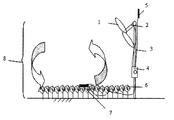
  • FIG. 1 is a schematic of the wind machine used to mitigate and potentially prevent frost and freeze damage to plants.
  • 1 is the axial flow wind machine
  • 2 is the rotating cradle head
  • 3 is the vertical column
  • 4 is the controller
  • 5 is the temperature sensor at the top of thermal inversion layer
  • 6 is the plant
  • 7 is the temperature sensor at the bottom of thermal inversion layer
  • 8 is the thermal inversion layer.
  • Parameters of the used frost protection wind machine rotary diameter of 900 mm, rotation speed of 998 r/min, installed height of 7 m, installed dip of 20°, head swaying range of 90°, swaying period of 2 min, and driving motor power of 3 KW.
  • Control device of frost protection wind machines mainly includes the two temperature sensors 5 and 7 , controller 4 , housing, AC contactor, and electric leakage protector.
  • the wind machine 1 is connected to vertical column 3 via rotating cradle head 2 .
  • Temperature sensor 5 is installed at height of the wind machine 1 at the top of thermal inversion layer 8 , and away from the wind machine 1 to avoid this sensor being affected by the wind machine after it starts.
  • the other temperature sensor 7 is installed at the bottom of thermal inversion layer 8 and at height of plant canopy 6 (about 1.2 m) in the scope of action of the wind machine 1 . Since tea plants are subject to slight freezing injury when temperature is lower than 2° C. critical damage temperature is set to 2° C. in controller 4 . Considering that new tea buds and leaves in early spring are extremely vulnerable to freezing, temperature difference threshold is set to 2° C.
  • Parameters of used frost protection wind machines rotary diameter of 2000 mm, rotation speed of 730 r/min, installed height of 10 m, installed dip of 20°, head swaying range of 180°, swaying period of 4 min, and driving motor power of 15 KW.
  • compositions of control device and temperature sensors setting method of this frost protection wind machines are the same as preferred embodiment 1. Particular parameters are as follows:
  • critical damage temperature for the apple tree canopy should be set to ⁇ 1.5° C., and height of temperature sensor 7 at the bottom of thermal inversion layer is determined to be 4 m. Temperature difference can be set to 3° C. and temperature sensor 5 at the top of thermal inversion layer is installed at 10 m.

Landscapes

  • Engineering & Computer Science (AREA)
  • Mechanical Engineering (AREA)
  • Health & Medical Sciences (AREA)
  • General Health & Medical Sciences (AREA)
  • Toxicology (AREA)
  • Life Sciences & Earth Sciences (AREA)
  • Environmental Sciences (AREA)
  • Control Of Positive-Displacement Air Blowers (AREA)
  • Greenhouses (AREA)

Abstract

This invention relates to control method and apparatus of wind machine for plant frost protection, and belongs to the domain of agro-meteorological disaster monitoring and control. Existing wind machines for plant frost protection only rely on critical damage temperature or wind speed as a condition to start. If there is no thermal inversion, operation of the wind machine will aggravate freezing injury to plants. If the strength of thermal inversion is weak, the effect will be minimal. The feature of this invention is that when temperature at the plant canopy is lower than the critical damage temperature of a certain plant and temperature difference between the top and bottom of the thermal inversion layers exceeds set threshold, wind machine will start automatically. Otherwise it will remain off. The control apparatus mainly consists of sensor 5 at the top of thermal inversion layer, sensor 7 at bottom of thermal inversion layer, and controller 4. This invention of the control of frost protection wind machine ensures rational and effective operation and avoids aggravated freezing risk due to misuse of energy and incorrect operation.

Description

TECHNICAL FIELD
This invention belongs to the domain of agro-meteorological disaster monitoring and control. This invention relates to control method and apparatus of wind machine for plant frost protection, particularly automatic control of wind machine based on both meteorological and plant physiological factors: critical temperature at which plants begin to suffer frost damage, and temperature difference between the top and bottom of the thermal inversion layer near ground.
BACKGROUND OF THE INVENTION
Frost damage in early spring and low temperature freezing injury in winter bring about serious losses to agricultural and forestry plants. Frost damage and freezing injury occurs with certain characteristics. The extent of freezing injury depends on low temperature climatic conditions and biological sensitivity of resistance to freezing. Firstly, frost damage usually occurs under thermal inversion conditions during early spring. Plants and the ground absorb large amounts of solar radiation in the daytime, and consecutively radiate heat away from the surface to the atmosphere in the nighttime, so that air temperature near ground falls quickly, resulting in thermal inversion. Secondly, plants are most vulnerable to frost and freezing during the period of frequent late frost (which is also the period of bud burst and leaf spreading). By making full use of distribution characteristics of temperature field under thermal inversion, temperature of this lower layer can be effectively increased to avoid and reduce frost damage, and also advance maturing stage of plant products after convecting thermal inversion layer near ground by wind machines to push upper warmer air downward to plant canopy below. However, determination of the start and stop timing of wind machines remains a key and difficult issue of this domain.
Previous research results show that existing wind machine systems used for plant frost protection only rely on a critical damage temperature, wind speed or an empirical temperature as control condition to start wind machines. For example, Snyder (2005) reported that the startup temperature of frost protection method used for orchards and vineyards in Europe and America is less than 0° C. and wind speed is used as the condition for the start of wind machines: when wind speed exceeds 2.5 m/s, wind machines will be stopped. As for anti-frost fans used in Japan for tea plants, temperature of canopy or a lower place in tea field is normally used as a condition to start wind machines. Empirical value of this temperature is about 3° C. Ribeiro (2006) evaluated temperature rise effect after operation of wind machines using the principle of energy balance and he figured out that the temperature at 1.5 m above ground could be chosen for the start of wind machine. USA patents numbered U.S. Pat. No. 4,753,034, U.S. Pat. No. 5,244,346 and U.S. Pat. No. 4,501,089 disclose devices that use centrifugal wind machines to suck lower cold air up to the sky, or use axial flow wind machines to blow upper warm air downward, to prevent frost for fruit trees and grape vines, but corresponding control method and apparatus were not discussed. Japanese patents numbered JP2007000096, JP2000050749 and JP10113076 disclose axial flow wind machines used for tea farms and orchards, but control method and apparatus of the wind machines were not discussed. In China, Hu Yongguang et al. (2007) developed a frost protection system with an axial flow wind machine as its core part and tested wind speed distribution, temperature distribution and temperature rise effect, but control method and apparatus for wind machines were not involved. Li Pingping et al (2008) reported spatiotemporal distribution characteristics of near-ground temperature of a tea farm under thermal inversion conditions in early spring. However, it only provided full demonstration for feasibility of application of elevated frost protection wind machines based on air turbulence method.
In fact, if a temperature or wind speed is used as the condition for system startup, the system will push upper cold air downward to the plants in case of absence of thermal inversion, so that frost damage would be aggravated (incorrect operation), resulting in greater loss. On the other hand, the frost protection effect of wind machine will be less (null operation), and consequently energy will be wasted if the system starts with less thermal inversion temperature difference (difference between temperature above near-ground thermal inversion layer and air temperature at plant canopy).
SUMMARY OF THE INVENTION
Purpose of this invention: Aimed to eliminate the defects of control on start of wind machines for frost protection, which depends only on critical temperature, wind speed, or empirical value of temperature. An effective control method and corresponding apparatus are proposed to avoid incorrect operation and null operation for controlling wind machine.
To this end, this invention of the control method and apparatus of wind machine for frost protection considers both plant biological freezing resistance and specific thermal inversion meteorological conditions. The main contents are as follows:
Timing to start or stop a wind machine will be determined according to 2 factors: plant critical damage temperature and temperature difference between the top and bottom of the thermal inversion layers. The technical scheme is described below:
Said control method of wind machine for frost protection is: when temperature at plant canopy is lower than set critical damage temperature, and temperature difference between the top and bottom of the thermal inversion layers is larger than set threshold, wind machine will be automatically started; otherwise it will remain off. Set temperature difference threshold is 1.5˜6.0° C. according to different thermal inversion strengths and installation height of the wind machine.
Said wind machine control device mainly comprises of temperature sensor 5 provided at the top of near-ground atmospheric thermal inversion layer 8, temperature sensor 7 at the bottom of thermal inversion layer 8, and controller 4. Said temperature sensors are used to detect temperatures in real time and transmit them to said controller, which receives temperature information for data analysis and automatically controls start and stop of wind machines according to preset conditions.
For example, according to heights of growth of different types of farming/forestry plants, temperature sensor 5 at the top of thermal inversion layer 8 will be provided in the range 4˜10 m above ground, to detect temperature t1 at the top of thermal inversion layer 8 in real time; and temperature sensor 7 will be provided at the bottom of layer 8, i.e. at plant canopy, to detect temperature t2 below layer 8 in real time. t1 minus t2 is the temperature difference through near ground thermal inversion layer. After the temperature collected by sensor 5 and sensor 7 is transmitted to controller 4, comparison with critical damage temperature setting and temperature difference threshold in controller 4 will be automatically performed. If t2 is less than critical damage temperature setting of this plant and measured temperature difference exceeds thermal inversion temperature different threshold, then wind machines will be started. Otherwise they will remain off.
By means of this control method and device, plant canopy temperature can be effectively increased by 1˜4° C., to avoid and mitigate frost and freeze damage to plants. As this method and device can reliably ensure operation of wind machines only in case of thermal inversion by comparing temperature difference between the top and bottom of the thermal inversion layers in real time, the possibility of running wind machines can be excluded when there is no thermal inversion, otherwise wind machines could blow cold air toward the plants, aggravating frost and freeze damage and resulting in even greater loss. On the other hand, by setting temperature difference threshold, wind machines will blow warm air at the upper part of the thermal inversion layer to the relatively cold plant canopy under sufficient strength of thermal inversion. Thus protection effect of wind machines decreases when strength of thermal inversion is relatively weak, which would result in a waste of energy, and at the same time would shorten the service life of wind machines. This control method and device of frost protection wind machines can not only effectively avoid or reduce frost and freeze damage to plants, but also increase output of farming and forestry plants, improve the quality, allow earlier harvesting of products, and ensure stable supply of farming and forestry products.
BRIEF DESCRIPTION OF THE DRAWING
FIG. 1 is a schematic of the wind machine used to mitigate and potentially prevent frost and freeze damage to plants. In this FIGURE, 1 is the axial flow wind machine, 2 is the rotating cradle head, 3 is the vertical column, 4 is the controller, 5 is the temperature sensor at the top of thermal inversion layer, 6 is the plant, 7 is the temperature sensor at the bottom of thermal inversion layer, and 8 is the thermal inversion layer.
DESCRIPTION OF PREFERRED EMBODIMENTS Preferred Embodiment 1
The following describes a preferred embodiment of this method and device with control of frost protection wind machine for a tea farm as an example.
Parameters of the used frost protection wind machine: rotary diameter of 900 mm, rotation speed of 998 r/min, installed height of 7 m, installed dip of 20°, head swaying range of 90°, swaying period of 2 min, and driving motor power of 3 KW.
Control device of frost protection wind machines mainly includes the two temperature sensors 5 and 7, controller 4, housing, AC contactor, and electric leakage protector. In the system shown in FIG. 1, the wind machine 1 is connected to vertical column 3 via rotating cradle head 2. Temperature sensor 5 is installed at height of the wind machine 1 at the top of thermal inversion layer 8, and away from the wind machine 1 to avoid this sensor being affected by the wind machine after it starts. The other temperature sensor 7 is installed at the bottom of thermal inversion layer 8 and at height of plant canopy 6 (about 1.2 m) in the scope of action of the wind machine 1. Since tea plants are subject to slight freezing injury when temperature is lower than 2° C. critical damage temperature is set to 2° C. in controller 4. Considering that new tea buds and leaves in early spring are extremely vulnerable to freezing, temperature difference threshold is set to 2° C.
On early spring evenings when thermal inversion occurs, frost is extremely likely. When temperature sensor 7 detects that temperature at the tea canopy is 1.5° C., and temperature at 7 m is 5.2° C., the wind machine 1 is found running and no frost occurs on tea plants. During operation, once temperature at the tea canopy is detected as exceeding 2° C., the wind machine 1 automatically stops. At dawn of the following day as thermal inversion layer 8 disappears, temperature difference between the top and bottom of the thermal inversion layers is less than threshold of 2° C., and the wind machine automatically stops.
Preferred Embodiment 2
The following continues to describe preferred embodiment of this method and device with control of frost protection wind machines for an apple orchard as an example.
Parameters of used frost protection wind machines: rotary diameter of 2000 mm, rotation speed of 730 r/min, installed height of 10 m, installed dip of 20°, head swaying range of 180°, swaying period of 4 min, and driving motor power of 15 KW.
Compositions of control device and temperature sensors setting method of this frost protection wind machines are the same as preferred embodiment 1. Particular parameters are as follows:
Since apple trees can be as high as 4 m and have relatively strong resistance to freezing, critical damage temperature of frost and freeze damage is about −1.5° C. Therefore, critical damage temperature for the apple tree canopy should be set to −1.5° C., and height of temperature sensor 7 at the bottom of thermal inversion layer is determined to be 4 m. Temperature difference can be set to 3° C. and temperature sensor 5 at the top of thermal inversion layer is installed at 10 m.
This invention is not limited to these disclosed implementation schemes and will cover the range described in the patent as well as variations and equivalent changes in the scope of claims.
Claims (6)

What is claimed is:
1. A control method for controlling one or more wind machines used to mitigate and potentially prevent frost and freeze damage to a plant, comprising:
automatically starting the one or more wind machines when a temperature at a plant canopy is lower than a critical damage temperature, and a temperature difference through a thermal inversion layer exceeds a certain threshold; and
automatically stopping the one or more wind machines if the temperature at the plant canopy is not lower than the critical damage temperature or if the temperature difference through the thermal inversion layer does not exceed the certain threshold.
2. The control method of claim 1, wherein the certain threshold is 1.5˜6.0° C.
3. The control method of claim 1, wherein a control device of the control method includes a first temperature sensor at a top of near-ground atmospheric thermal inversion layer, a second temperature sensor at a bottom of thermal inversion layer, and a controller, further wherein the first and second temperature sensors are used to detect temperature in real time and transmit temperature information to the controller, the controller being used for sensing temperature, data analysis and automatic control of the start or stop of the one or more wind machines according to current conditions.
4. The control method of claim 3, wherein the first temperature sensor at the top of near-ground thermal inversion layer is installed within a range of 4˜10 m above ground.
5. The control method of claim 3, wherein the second temperature sensor at the bottom of thermal inversion layer is installed at the plant canopy.
6. The control method of claim 3, wherein the current conditions are:
if the temperature at the plant canopy temperature is lower than the critical damage temperature and the temperature difference through the thermal inversion layer exceeds the certain threshold, the one or more wind machines will start.
US13/054,141 2008-07-16 2008-09-05 Control method and apparatus of wind machine for plant frost protection Active 2029-09-22 US8701341B2 (en)

Applications Claiming Priority (4)

Application Number Priority Date Filing Date Title
CN2008101244347A CN101322466B (en) 2008-07-16 2008-07-16 A fan system control method and device for preventing plant frost damage
CN200810124434 2008-07-16
CN200810124434.7 2008-07-16
PCT/CN2008/001584 WO2010006473A1 (en) 2008-07-16 2008-09-05 Control method and apparatus of wind machine for plant frost protection

Publications (2)

Publication Number Publication Date
US20110247263A1 US20110247263A1 (en) 2011-10-13
US8701341B2 true US8701341B2 (en) 2014-04-22

Family

ID=40186307

Family Applications (1)

Application Number Title Priority Date Filing Date
US13/054,141 Active 2029-09-22 US8701341B2 (en) 2008-07-16 2008-09-05 Control method and apparatus of wind machine for plant frost protection

Country Status (3)

Country Link
US (1) US8701341B2 (en)
CN (1) CN101322466B (en)
WO (1) WO2010006473A1 (en)

Cited By (1)

* Cited by examiner, † Cited by third party
Publication number Priority date Publication date Assignee Title
US20190186677A1 (en) * 2016-05-09 2019-06-20 Jiangsu University Frost prevention machine support with adjustable bottom structure

Families Citing this family (16)

* Cited by examiner, † Cited by third party
Publication number Priority date Publication date Assignee Title
CN103392540B (en) * 2013-07-10 2015-06-24 江苏大学 Method and device for mechanization plant frost prevention
CN103688810B (en) * 2013-12-18 2015-12-02 江苏大学 A kind of method improving frost prevention effect of plant frost prevention machine
JP6341752B2 (en) * 2014-05-22 2018-06-13 フルタ電機株式会社 Anti-frost / freezing device
CN104457936B (en) * 2014-11-10 2017-02-22 江苏大学 Potted plant growing trend dynamic detection device and detection method thereof
CN105432387B (en) * 2015-11-28 2019-02-12 江苏吟春碧芽股份有限公司 A kind of plant frost prevention jelly method
CN105475056A (en) * 2015-11-28 2016-04-13 江苏吟春碧芽股份有限公司 Tea garden airflow disturbance frost prevention control system and method
CN105475057B (en) * 2015-11-28 2018-10-30 江苏吟春碧芽股份有限公司 Tea fruit garden intelligence frost prevention swing mechanism
CN105511527A (en) * 2015-12-04 2016-04-20 天水锻压机床(集团)有限公司 Intelligent control system of orchard frost-prevention machine
CN105766500B (en) * 2016-04-20 2018-10-26 新昌县三新空调风机有限公司 A kind of plant frost prevention jelly fog machine
CN105935034B (en) * 2016-05-09 2019-03-29 江苏大学 A kind of vertical column fixing device of frost preventing machine
CN107624462A (en) * 2017-09-30 2018-01-26 仪征市清源茶叶科技示范园 A kind of aligning method and structure of tea fruit garden frost prevention blower fan
US10827693B2 (en) * 2018-02-14 2020-11-10 Deere & Company Sprayers in a temperature inversion
CN113498706A (en) * 2021-06-30 2021-10-15 宝鸡市农业机械化发展中心 Automatic orchard frost prevention system and method for measuring number of frost prevention fans
CN114009284A (en) * 2021-12-02 2022-02-08 延安大学 Apple frost protection method
CN115855282B (en) * 2022-11-28 2026-01-27 安康市气象局 Spring tea low-temperature frost monitoring and disaster early warning method
CN117079151B (en) * 2023-07-04 2025-08-26 中国科学院城市环境研究所 Method, system and device for inverting material inventory distribution of offshore wind turbines based on satellite imagery

Citations (10)

* Cited by examiner, † Cited by third party
Publication number Priority date Publication date Assignee Title
US4501089A (en) 1982-08-10 1985-02-26 Cobden Turbines Pty. Ltd. Frost control
US4753034A (en) 1986-01-21 1988-06-28 Philip Brown Anti-frost fan
US5244346A (en) 1991-02-07 1993-09-14 Fergusson Alec H B Portable wind machine
JPH10113076A (en) 1996-10-09 1998-05-06 Matsushita Seiko Eng Kk Frost prevention fan
JP2000050749A (en) 1998-08-12 2000-02-22 Fulta Electric Machinery Co Ltd Height-adjustable low-lying frost-preventing fan unit for tea garden
JP2007000096A (en) 2005-06-24 2007-01-11 Fulta Electric Machinery Co Ltd Anti-frost fan device with automatic folding neck mechanism
JP2007129978A (en) 2005-11-11 2007-05-31 Fulta Electric Machinery Co Ltd Method for blowing crop using frost protection fan which effectively uses warm air of inversion layer and continuous air blowing
JP2008035775A (en) 2006-08-04 2008-02-21 Fulta Electric Machinery Co Ltd Method for sending air to crop using frost protection fan effectively utilizing warm air of inversion layer and continuous air blowing
JP2008118863A (en) 2006-11-08 2008-05-29 Fulta Electric Machinery Co Ltd Blowing method to crop using frost protection fan
JP2008131871A (en) 2006-11-27 2008-06-12 Fulta Electric Machinery Co Ltd Method of blowing air and/or stopping air blow of anti-frosting fan

Family Cites Families (1)

* Cited by examiner, † Cited by third party
Publication number Priority date Publication date Assignee Title
US8083481B2 (en) * 2006-05-22 2011-12-27 Hill Daryl G Method for siting and operating a crop protection wind machine array

Patent Citations (10)

* Cited by examiner, † Cited by third party
Publication number Priority date Publication date Assignee Title
US4501089A (en) 1982-08-10 1985-02-26 Cobden Turbines Pty. Ltd. Frost control
US4753034A (en) 1986-01-21 1988-06-28 Philip Brown Anti-frost fan
US5244346A (en) 1991-02-07 1993-09-14 Fergusson Alec H B Portable wind machine
JPH10113076A (en) 1996-10-09 1998-05-06 Matsushita Seiko Eng Kk Frost prevention fan
JP2000050749A (en) 1998-08-12 2000-02-22 Fulta Electric Machinery Co Ltd Height-adjustable low-lying frost-preventing fan unit for tea garden
JP2007000096A (en) 2005-06-24 2007-01-11 Fulta Electric Machinery Co Ltd Anti-frost fan device with automatic folding neck mechanism
JP2007129978A (en) 2005-11-11 2007-05-31 Fulta Electric Machinery Co Ltd Method for blowing crop using frost protection fan which effectively uses warm air of inversion layer and continuous air blowing
JP2008035775A (en) 2006-08-04 2008-02-21 Fulta Electric Machinery Co Ltd Method for sending air to crop using frost protection fan effectively utilizing warm air of inversion layer and continuous air blowing
JP2008118863A (en) 2006-11-08 2008-05-29 Fulta Electric Machinery Co Ltd Blowing method to crop using frost protection fan
JP2008131871A (en) 2006-11-27 2008-06-12 Fulta Electric Machinery Co Ltd Method of blowing air and/or stopping air blow of anti-frosting fan

Non-Patent Citations (7)

* Cited by examiner, † Cited by third party
Title
Antonio C. Ribeiro et al; Apple orchard frost protection with wind machine operation; Agricultural and Forest Meteorology 141 (2006); pp. 71-81.
Hu Yongguang et al: System Design and Experiment on Elevated Wind Machine for Tea Frost Protection; 4 pages.
International Preliminary Report on Patentability issued Jan. 18, 2011; PCT/CN2008/001584; Int'l File Date: Sep. 5, 2008; 6 pages.
International Search Report issued Apr. 7, 2009; PCT/CN2008/001584; Int'l File Date: Sep. 5, 2008; 6 pages.
Li Pingping et al:Temporal and Spatial Distribution Characteristics of Near Ground Temperature in Tea Farm Under Temperature Inversion in Early Spring; Journal of Ecology and Rural Environment; 2008, 24 (1): 39-42.
Richard L. Snyder et al: Frost Protection: Fundamentals, Practice and Economics, vol. 1, Food and Agriculture Organization of the United Nations Rome, 2005; 240 pages.
Written Opinion issued Apr. 7, 2009; PCT/CN2008/001584; Int'l File Date: Sep. 5, 2008; 5 pages.

Cited By (1)

* Cited by examiner, † Cited by third party
Publication number Priority date Publication date Assignee Title
US20190186677A1 (en) * 2016-05-09 2019-06-20 Jiangsu University Frost prevention machine support with adjustable bottom structure

Also Published As

Publication number Publication date
CN101322466A (en) 2008-12-17
WO2010006473A1 (en) 2010-01-21
CN101322466B (en) 2010-09-29
US20110247263A1 (en) 2011-10-13

Similar Documents

Publication Publication Date Title
US8701341B2 (en) Control method and apparatus of wind machine for plant frost protection
RU2633295C2 (en) Wind power plant and method for wind power plant operation
KR101115792B1 (en) Frost prevention system using frost prevention fan device
CN103472799B (en) Based on the intelligent curtain rolling machine system of image processing techniques
CN202842011U (en) Automatic control system for greenhouse
CN203930548U (en) Intelligence is driven damp temperature regulating device
JP6306384B2 (en) Method for controlling irrigation supply in plant cultivation and controller thereof
CA2801539A1 (en) Method for operating a wind turbine in which a risk of icing is determined on the basis of meteorological data, as well as a wind turbine for performing the method
CN105511527A (en) Intelligent control system of orchard frost-prevention machine
CN103062847A (en) Top-outlet air conditioner outdoor unit, air conditioner and control method of air conditioner
CN102969556B (en) Dehumidifier for bell mouth surface of satellite antenna
CN107278490A (en) A kind of intelligent grass-removing and its control method
CN205068187U (en) Dampproofing controlling means of automatically controlled cabinet
CN205623553U (en) Orchard smog controlling means that prevents frostbite
TWI417042B (en) Environmental automatic regulation system of wax apples cultivation
CN201536226U (en) A terminal box capable of automatically dehumidifying
CN204860192U (en) Between forage grass storage
CN104106430A (en) Sunlight greenhouse covering control system and method
CN117882601A (en) A method for preventing frost by combining three aspects of orchard machinery and technology
CN107624462A (en) A kind of aligning method and structure of tea fruit garden frost prevention blower fan
KR20180022078A (en) Snow removal and catchment device with automatic heating system
CN219803127U (en) Automatic spraying control system for frost prevention of crops
CN207054238U (en) A kind of warmhouse booth
CN222941437U (en) A garden intelligent supervision system
CN220105321U (en) Low temperature and frost early warning monitoring device based on drone

Legal Events

Date Code Title Description
AS Assignment

Owner name: JIANGSU YINCHUNBIYA TEA RESEARCH INSTITUTE CO., LT

Free format text: ASSIGNMENT OF ASSIGNORS INTEREST;ASSIGNORS:HU, YONG-GUANG;LI, PINGPING;WANG, XIUHONG;AND OTHERS;REEL/FRAME:025639/0688

Effective date: 20110114

Owner name: JIANGSU UNIVERSITY, CHINA

Free format text: ASSIGNMENT OF ASSIGNORS INTEREST;ASSIGNORS:HU, YONG-GUANG;LI, PINGPING;WANG, XIUHONG;AND OTHERS;REEL/FRAME:025639/0688

Effective date: 20110114

STCF Information on status: patent grant

Free format text: PATENTED CASE

CC Certificate of correction
MAFP Maintenance fee payment

Free format text: PAYMENT OF MAINTENANCE FEE, 4TH YR, SMALL ENTITY (ORIGINAL EVENT CODE: M2551)

Year of fee payment: 4

MAFP Maintenance fee payment

Free format text: PAYMENT OF MAINTENANCE FEE, 8TH YR, SMALL ENTITY (ORIGINAL EVENT CODE: M2552); ENTITY STATUS OF PATENT OWNER: SMALL ENTITY

Year of fee payment: 8

FEPP Fee payment procedure

Free format text: MAINTENANCE FEE REMINDER MAILED (ORIGINAL EVENT CODE: REM.); ENTITY STATUS OF PATENT OWNER: SMALL ENTITY