US8645809B2 - Method and apparatus for channel coding and decoding in a communication system using a low-density parity-check code - Google Patents
Method and apparatus for channel coding and decoding in a communication system using a low-density parity-check code Download PDFInfo
- Publication number
- US8645809B2 US8645809B2 US13/103,640 US201113103640A US8645809B2 US 8645809 B2 US8645809 B2 US 8645809B2 US 201113103640 A US201113103640 A US 201113103640A US 8645809 B2 US8645809 B2 US 8645809B2
- Authority
- US
- United States
- Prior art keywords
- parity
- check matrix
- column
- group
- column groups
- Prior art date
- Legal status (The legal status is an assumption and is not a legal conclusion. Google has not performed a legal analysis and makes no representation as to the accuracy of the status listed.)
- Expired - Fee Related, expires
Links
Images




Classifications
-
- H—ELECTRICITY
- H03—ELECTRONIC CIRCUITRY
- H03M—CODING; DECODING; CODE CONVERSION IN GENERAL
- H03M13/00—Coding, decoding or code conversion, for error detection or error correction; Coding theory basic assumptions; Coding bounds; Error probability evaluation methods; Channel models; Simulation or testing of codes
- H03M13/03—Error detection or forward error correction by redundancy in data representation, i.e. code words containing more digits than the source words
- H03M13/05—Error detection or forward error correction by redundancy in data representation, i.e. code words containing more digits than the source words using block codes, i.e. a predetermined number of check bits joined to a predetermined number of information bits
- H03M13/11—Error detection or forward error correction by redundancy in data representation, i.e. code words containing more digits than the source words using block codes, i.e. a predetermined number of check bits joined to a predetermined number of information bits using multiple parity bits
- H03M13/1102—Codes on graphs and decoding on graphs, e.g. low-density parity check [LDPC] codes
- H03M13/1148—Structural properties of the code parity-check or generator matrix
-
- H—ELECTRICITY
- H03—ELECTRONIC CIRCUITRY
- H03M—CODING; DECODING; CODE CONVERSION IN GENERAL
- H03M13/00—Coding, decoding or code conversion, for error detection or error correction; Coding theory basic assumptions; Coding bounds; Error probability evaluation methods; Channel models; Simulation or testing of codes
- H03M13/03—Error detection or forward error correction by redundancy in data representation, i.e. code words containing more digits than the source words
- H03M13/033—Theoretical methods to calculate these checking codes
-
- H—ELECTRICITY
- H03—ELECTRONIC CIRCUITRY
- H03M—CODING; DECODING; CODE CONVERSION IN GENERAL
- H03M13/00—Coding, decoding or code conversion, for error detection or error correction; Coding theory basic assumptions; Coding bounds; Error probability evaluation methods; Channel models; Simulation or testing of codes
- H03M13/03—Error detection or forward error correction by redundancy in data representation, i.e. code words containing more digits than the source words
- H03M13/05—Error detection or forward error correction by redundancy in data representation, i.e. code words containing more digits than the source words using block codes, i.e. a predetermined number of check bits joined to a predetermined number of information bits
- H03M13/11—Error detection or forward error correction by redundancy in data representation, i.e. code words containing more digits than the source words using block codes, i.e. a predetermined number of check bits joined to a predetermined number of information bits using multiple parity bits
- H03M13/1102—Codes on graphs and decoding on graphs, e.g. low-density parity check [LDPC] codes
-
- H—ELECTRICITY
- H03—ELECTRONIC CIRCUITRY
- H03M—CODING; DECODING; CODE CONVERSION IN GENERAL
- H03M13/00—Coding, decoding or code conversion, for error detection or error correction; Coding theory basic assumptions; Coding bounds; Error probability evaluation methods; Channel models; Simulation or testing of codes
- H03M13/03—Error detection or forward error correction by redundancy in data representation, i.e. code words containing more digits than the source words
- H03M13/05—Error detection or forward error correction by redundancy in data representation, i.e. code words containing more digits than the source words using block codes, i.e. a predetermined number of check bits joined to a predetermined number of information bits
- H03M13/11—Error detection or forward error correction by redundancy in data representation, i.e. code words containing more digits than the source words using block codes, i.e. a predetermined number of check bits joined to a predetermined number of information bits using multiple parity bits
- H03M13/1102—Codes on graphs and decoding on graphs, e.g. low-density parity check [LDPC] codes
- H03M13/1148—Structural properties of the code parity-check or generator matrix
- H03M13/118—Parity check matrix structured for simplifying encoding, e.g. by having a triangular or an approximate triangular structure
- H03M13/1185—Parity check matrix structured for simplifying encoding, e.g. by having a triangular or an approximate triangular structure wherein the parity-check matrix comprises a part with a double-diagonal
-
- H—ELECTRICITY
- H03—ELECTRONIC CIRCUITRY
- H03M—CODING; DECODING; CODE CONVERSION IN GENERAL
- H03M13/00—Coding, decoding or code conversion, for error detection or error correction; Coding theory basic assumptions; Coding bounds; Error probability evaluation methods; Channel models; Simulation or testing of codes
- H03M13/29—Coding, decoding or code conversion, for error detection or error correction; Coding theory basic assumptions; Coding bounds; Error probability evaluation methods; Channel models; Simulation or testing of codes combining two or more codes or code structures, e.g. product codes, generalised product codes, concatenated codes, inner and outer codes
- H03M13/2906—Coding, decoding or code conversion, for error detection or error correction; Coding theory basic assumptions; Coding bounds; Error probability evaluation methods; Channel models; Simulation or testing of codes combining two or more codes or code structures, e.g. product codes, generalised product codes, concatenated codes, inner and outer codes using block codes
-
- H—ELECTRICITY
- H03—ELECTRONIC CIRCUITRY
- H03M—CODING; DECODING; CODE CONVERSION IN GENERAL
- H03M13/00—Coding, decoding or code conversion, for error detection or error correction; Coding theory basic assumptions; Coding bounds; Error probability evaluation methods; Channel models; Simulation or testing of codes
- H03M13/61—Aspects and characteristics of methods and arrangements for error correction or error detection, not provided for otherwise
- H03M13/618—Shortening and extension of codes
-
- H—ELECTRICITY
- H03—ELECTRONIC CIRCUITRY
- H03M—CODING; DECODING; CODE CONVERSION IN GENERAL
- H03M13/00—Coding, decoding or code conversion, for error detection or error correction; Coding theory basic assumptions; Coding bounds; Error probability evaluation methods; Channel models; Simulation or testing of codes
- H03M13/63—Joint error correction and other techniques
- H03M13/635—Error control coding in combination with rate matching
- H03M13/6362—Error control coding in combination with rate matching by puncturing
-
- H—ELECTRICITY
- H03—ELECTRONIC CIRCUITRY
- H03M—CODING; DECODING; CODE CONVERSION IN GENERAL
- H03M13/00—Coding, decoding or code conversion, for error detection or error correction; Coding theory basic assumptions; Coding bounds; Error probability evaluation methods; Channel models; Simulation or testing of codes
- H03M13/03—Error detection or forward error correction by redundancy in data representation, i.e. code words containing more digits than the source words
- H03M13/05—Error detection or forward error correction by redundancy in data representation, i.e. code words containing more digits than the source words using block codes, i.e. a predetermined number of check bits joined to a predetermined number of information bits
- H03M13/13—Linear codes
- H03M13/15—Cyclic codes, i.e. cyclic shifts of codewords produce other codewords, e.g. codes defined by a generator polynomial, Bose-Chaudhuri-Hocquenghem [BCH] codes
- H03M13/151—Cyclic codes, i.e. cyclic shifts of codewords produce other codewords, e.g. codes defined by a generator polynomial, Bose-Chaudhuri-Hocquenghem [BCH] codes using error location or error correction polynomials
- H03M13/152—Bose-Chaudhuri-Hocquenghem [BCH] codes
Definitions
- the present invention relates generally to a communication system using linear block codes, and more particularly, to a channel coding and decoding method and apparatus for generating specific types of linear block codes
- a Low-Density Parity-Check (LDPC) code which is a type of linear block code, may be expressed using a bipartite graph, which is generally defined as a parity check matrix and referred to as a Tanner graph.
- the bipartite graph is a graph whose vertexes are divided into two different types.
- the LDPC code is expressed with a bipartite graph including vertexes called variable nodes and check nodes.
- the variable nodes correspond to coded bits on a one-to-one basis.
- FIG. 1 illustrates an example of a parity check matrix H 1 of an LDPC code including 4 rows and 8 columns.
- the parity check matrix H 1 generates a codeword with a length of 8 because it has 8 columns.
- a code generated using the parity check matrix H 1 is an LDPC code, and its columns correspond to 8 coded bits.
- FIG. 2 illustrates a Tanner graph corresponding to the parity check matrix H 1 in FIG. 1 .
- the Tanner graph for the LDPC code includes 8 variable nodes x 1 202 , x 2 204 , x 3 206 , x 4 208 , x 5 210 , x 6 212 , x 7 214 , and x 8 216 , and 4 check nodes 218 , 220 , 222 , and 224 .
- An i-th column and a j-th row of the parity check matrix H 1 of the LDPC code correspond to a variable node X, and a j-th check node, respectively.
- a value of 1 (i.e., a non-zero value) in a point where an i-th column and a j-th row of the parity check matrix H 1 of the LDPC code cross each other, indicates the existence of an edge connecting the variable node X i to the j-th check node on the Tanner graph in FIG. 2 .
- a degree of a variable node or a check node indicates the number of edges connected to the node, and is equal to the number of non-zero entries in a column or a row corresponding to the node in the parity check matrix.
- degrees of the variable nodes x 1 202 , x 2 204 , x 3 206 , x 4 208 , x 5 210 , x 6 212 , x 7 214 , and x 8 216 are 4, 3, 3, 3, 2, 2, 2, and 2, respectively, and degrees of the check nodes 218 , 220 , 222 , and 224 are 6, 5, 5, and 5, respectively.
- the numbers of non-zero entries in columns of the parity check matrix H 1 in FIG. 1 which correspond to the variable nodes in FIG. 2 , are equal to the degrees 4, 3, 3, 3, 2, 2, 2, and 2 of the variable nodes on a one-to-one basis
- the numbers of non-zero entries in rows of the parity check matrix H 1 in FIG. 1 which correspond to the check nodes in FIG. 2 , are equal to the degrees 6, 5, 5, and 5 of the check nodes on a one-to-one basis.
- an i-th codeword bit c i an i-th column h i in the parity check matrix, and an i-th variable node x i on the Tanner graph correspond to one another.
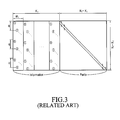
- FIG. 3 is a diagram schematically illustrating a structure of an LDPC code.
- N 1 represents a length of an LDPC codeword, and is equal to a length of the parity check matrix.
- K 1 represents a length of an information word, and is equal to a length of an information part of the parity check matrix.
- (N 1 ⁇ K 1 ) represents a length of parity bits, and is equal to a length of a parity part of the parity check matrix.
- K 1 /M 1 may also be an integer.
- the parity check matrix in FIG. 3 will be assumed to be a first parity check matrix H 1 .
- a structure of the portion of 0-th to (K 1 ⁇ 1)-th columns, which corresponds to the information part of the parity check matrix, is made according to the following rules.
- Rule 1 A total of K 1 /M 1 column groups are made by grouping K 1 columns corresponding to the information word in the parity check matrix into a plurality of groups each including M 1 columns. Columns in each column group are made according to the following Rule 2.
- a sequence of an i-th column group sequentially represents information about rows with a weight of 1 in a 0-th column in an i-th column group.
- the LDPC code may be coded generally by a formula in which the results of binary multiplication on the parity check matrix H and the codeword c become a zero (0) matrix.
- FIG. 4 is a diagram illustrating an example of a parity check matrix of an LDPC code.
- an LDPC code having the same concept as the LDPC code illustrated in FIG. 3 may be generated as illustrated in FIG. 4 .
- information bits (or information word bits) with a length of K 1 are represented as (i 0 , i 1 , . . . , i K 1 ⁇ 1 ), and parity bits with a length of (N 1 ⁇ K 1 ) are represented as (p 0 , p 1 , . . . , p N 1 ⁇ K 1 ⁇ 1 ).
- Equation (2) specific parity bits p x are updated as shown in Equation (2) below.
- p 0 p 0 ⁇ i 0
- p 2084 p 2084 ⁇ i 0
- p 1618 p 1618 ⁇ i 0
- p 1548 p 1548 ⁇ i 0
- p 1286 p 1286 ⁇ i 0
- p 1460 p 1460 ⁇ i 0
- p 3196 p 3196 ⁇ i 0
- p 4297 p 4297 ⁇ i 0
- p 2481 p 2481 ⁇ i 0
- p 3369 p 3369 ⁇ i 0
- p 3451 p 3451 ⁇ i 0
- p 4620 p 4620 ⁇ i 0
- p 2622 p 2622 ⁇ i 0
- Equation (3) a similar operation to Equation (2) is performed using the values calculated in Equation (3).
- p ⁇ x+(m mod M 1 ⁇ q) ⁇ mod(N 1 ⁇ K 1 ) is updated.
- Equation (4) a similar operation to Equation (2) is performed using the values calculated in Equation (3).
- m 1, 2, . . . , 359.
- p ⁇ x+(m mod M 1 ) ⁇ q ⁇ mod(N 1 ⁇ K 1 ) is updated by applying Equation (3) in a similar way.
- Step 5 For all of 360 information bit groups, Steps 2, 3 and 4 are repeated. Finally, parity bits are determined using Equation (5) below.
- Equation (5) P i represents LDPC-coded parity bits.
- the LDPC code In order to apply an LDPC code to an actual communication system, the LDPC code should be designed to be appropriate for a data rate required in the communication system. Particularly, not only in an adaptive communication system using Hybrid Automatic Retransmission reQuest (HARQ) and Adaptive Modulation and Coding (AMC), but also in a communication system supporting various broadcast services, LDPC codes having various codeword lengths are used to support various data rates according to the requirements of the systems.
- HARQ Hybrid Automatic Retransmission reQuest
- AMC Adaptive Modulation and Coding
- puncturing and shortening methods may be used.
- the puncturing avoids transmitting a portion of a generated codeword.
- An aspect of the present invention is to provide a channel coding and decoding method and apparatus for generating a parity check matrix to generate linear block codes having various codeword lengths in a communication system using an LDPC code.
- Another aspect of the present invention is to provide a channel coding and decoding method and apparatus for generating an LDPC code with a different codeword length from a given LDPC code by shortening or puncturing in a communication system using an LDPC code.
- Another aspect of the present invention is to provide a channel coding and decoding method and apparatus optimizing performance of an LDPC code taking into account its structure in a communication system using an LDPC code having a specific structure.
- a channel coding method in a communication system using an LDPC code includes determining a degree distribution for a plurality of column groups of an information part and a plurality of column groups of a parity part; determining degrees for the plurality of column groups of the information part using the degree distribution; determining a shortening order based on the degrees; generating a parity check matrix based on the shortening order; and performing coding using the generated parity check matrix.
- a channel coding apparatus in a communication system using an LDPC code includes a controller for determining a degree distribution for a plurality of column groups of an information part and a plurality of column groups of a parity part, determining degrees for the plurality of column groups of the information part using the degree distribution, and determining a shortening order based on the degrees; and a coder for generating a parity check matrix based on the shortening order, and performing coding using the generated parity check matrix.
- a channel decoding method in a communication system using an LDPC code includes receiving a coded signal from a transmitter; and decoding the received signal using a parity check matrix.
- the parity check matrix is generated by determining a degree distribution for a plurality of column groups of an information part and a plurality of column groups of a parity part, determining degrees for the plurality of column groups of the information part using the degree distribution, and determining a shortening order based on the degrees.
- a channel decoding apparatus in a communication system using an LDPC code includes a receiver for receiving a coded signal from a transmitter; and a decoder for decoding the received signal using a parity check matrix.
- the parity check matrix is generated by determining a degree distribution for a plurality of column groups of an information part and a plurality of column groups of a parity part, determining degrees for the plurality of column groups of the information part using the degree distribution, and determining a shortening order based on the degrees.
- FIG. 1 is a diagram illustrating an example of a parity check matrix of an LDPC code with a length of 8;
- FIG. 2 is a diagram illustrating a Tanner graph for a parity check matrix of an LDPC code with a length of 8;
- FIG. 3 is a diagram schematically illustrating a structure of an LDPC code
- FIG. 5 illustrates the generation of an LDPC code with a different codeword length from a parity check matrix of a given LDPC code according to an embodiment of the present invention
- FIG. 6 illustrates an LDPC code according to an embodiment of the present invention
- FIG. 7 illustrates an LDPC code according to an embodiment of the present invention
- FIG. 8 illustrates an information part of an LDPC code
- FIG. 9 illustrates of column-group by column-group shortening on an LDPC code
- FIG. 10 is a flowchart illustrating a method of determining a parity check matrix supporting various codeword lengths based on Rules 3 to 5, according to an embodiment of the present invention
- FIG. 13 illustrates a parity check matrix in which a column group C 0 of an information part is added, based on the parity check matrix illustrated in FIG. 12 , according to an embodiment of the present invention
- FIG. 14 is a block diagram illustrating a transceiver in a communication system using an LDPC code according to an embodiment of the present invention
- FIG. 16 is a block diagram illustrating a receiver using an LDPC code according to an embodiment of the present invention.
- FIG. 17 is a flowchart illustrating a reception operation in a receiver using an LDPC code according to an embodiment of the present invention.
- the parity check matrixes of the LDPC codes in FIGS. 3 and 4 will be described in more detail. Additionally, although various embodiments of the present invention will be described below based on the LDPC code, the present invention is not limited to the LDPC code.
- the full length of the parity check matrix of the LDPC code in FIG. 3 is N 1 , and a front portion of the parity check matrix corresponds to information bits (i 0 , i 1 , . . . , i K i ⁇ 1 ) with a length of K 1 , while a rear portion of the parity check matrix corresponds to parity bits (p 0 , p 1 , . . . , p N 1 ⁇ K 1 ⁇ 1 ) with a length of (N 1 ⁇ K 1 ).
- the information bits correspond to an information part of the parity check matrix, and a bit group refers to a group of information bits corresponding to its associated column group of the parity check matrix.
- the puncturing method may be applied generally to both the information bits and the parity bits. Although the puncturing and shortening methods are equal in that they reduce a length of the LDPC code, the puncturing method does not limit values of specific bits, unlike the shortening method.
- the puncturing method merely avoids transmitting a specific portion of specific information bits or generated parity bits so that a receiver may regard the non-transmitted portion as an erased portion. Because position information of the punctured bits may be shared or estimated by a transmitter and a receiver during system setup, the receiver may consider the punctured bits as erased bits during decoding.
- the puncturing and shortening methods for the LDPC code will now be described.
- the LDPC code used in the shortening method has a specific structure. Therefore, unlike a general LDPC code, this LDPC code may undergo shortening and puncturing more efficiently.
- a desired LDPC code finally obtained from an LDPC code with a codeword length of N 1 and an information word length of K 1 , by shortening and puncturing has a codeword length of N 2 and an information word length of K 2 .
- An i-th weight-1 position sequence in an i-th column sequentially represents position information of rows with a weight of 1 in a 0-th column in an i-th column group.
- FIG. 5 illustrates the generation of an LDPC code with a different codeword length from a parity check matrix of a given LDPC code according to an embodiment of the present invention. Specifically, FIG. 5 illustrates an example of the LDPC code in FIG. 4 , to which regular puncturing is applied.
- a puncturing pattern is applied to the parity check matrix in FIG. 4 .
- information bits corresponding to all column groups are connected to two punctured bits in the same way.
- a position with a weight of 1 in a first column determines a position with a weight of 1 in the other columns.
- Indexes of rows with a weight of 1 in the other columns are different from an index of a row with a weight of 1 in the first column by a multiple of q, for modulo (N 1 ⁇ K 1 ), where N 1 represents an LDPC codeword length and K 1 represents an information word length. More specifically, indexes of rows with a weight of 1 in two consecutive columns among the columns of a parity check matrix, which correspond to a specific parity part, are different from each other by q, for modulo (N 1 -K 1 ).
- Another LDPC code is characterized by a submatrix corresponding to a parity part in its parity check matrix.
- the parity part has a structure of a lower triangular matrix in which 1 exists along the full diagonal portion, and an i-th parity bit corresponds to 1 in an i-th row.
- variable nodes on the Tanner graph which correspond to the parity bits punctured in a specific parity group
- variable nodes on the Tanner graph which correspond to the information bits shortened in the information part
- variable nodes corresponding to the entire information word are equal in degree and less than one 1 is distributed in one row, if the puncturing pattern is applied, information bits corresponding to columns in one parity check matrix are connected to the same number of punctured bits. Therefore, the connection between the punctured bits and the information bits may be regular, ensuring stable decoding in the decoding process.
- a parity group to be punctured and determine the order of the parity group.
- (N 1 ⁇ K 1 ) parity bits are ⁇ p 0 , p 1 , p 2 , . . . , p N 1 ⁇ K 1 ⁇ 1 ⁇
- a j-th parity group including q entries may be made using Equation (6) below.
- P j ⁇ p k
- k mod q j, 0 ⁇ k ⁇ N 1 ⁇ K 1 ⁇ for 0 ⁇ j ⁇ q (6)
- FIG. 6 illustrates an example of a structure of an LDPC code according to an embodiment of the present invention.
- the parity group will be described with reference to FIG. 6 .
- the parity group may be expressed in different ways.
- the parity group may be made after only the parity bits are interleaved.
- a first specific column group fully undergoes puncturing according to the predetermined order. If there are any remaining bits to be punctured, columns corresponding to a predetermined second specific parity group in the parity check matrix fully undergoes puncturing. If there are still any remaining bits to be punctured, a predetermined third specific column group fully undergoes puncturing. This process is repeated, and if the number of remaining bits to be punctured is less than the size M 1 of one column group, a portion of the column group is punctured, completing the puncturing process.
- the predetermined puncturing order is called a puncturing pattern, which is denoted by indexes of the columns.
- the LDPC code is generally concatenated to a Bose-Chaudhuri-Hocquenghem (BCH) code as illustrated in FIG. 8
- BCH Bose-Chaudhuri-Hocquenghem
- the LDPC code has a special structure designed on a column group basis, it is beneficial that when necessary, the LDPC code undergoes column-group by column-group shortening rather than bit by bit shortening, to achieve superior performance.
- FIG. 9 illustrates an example of column-group by column-group shortening on an LDPC code according to an embodiment of the present invention.
- a shaded portion 910 indicates bits being shortened.
- a first specific column group or bit group fully undergoes shortening according to the predetermined order.
- a third column group or bit group 914 corresponds thereto. If there are any remaining bits to be shortened, a predetermined second specific column group or bit group fully undergoes shortening.
- a (K 1 /M 1 ⁇ 2)-th column group or bit group 916 corresponds thereto. If there are still any remaining bits to be shortened, a predetermined third specific column group fully undergoes shortening.
- a (K 1 /M 1 ⁇ 3)-th column group or bit group 915 corresponds thereto.
- an embodiment of the present invention designs its parity check matrix having an optimal performance for each length.
- the parity check matrix is designed according to the following rules.
- a length of a codeword is N 1
- a codeword length is K 1
- the number of columns constituting one column group is M 1
- the number of column groups of an informant part is L 1 .
- K 1 M 1 ⁇ L 1 .
- the number of column groups of the information part is a value obtained by subtracting the number of shortened columns from L 1 , and the number of parity groups of the parity part may be determined according to the coding rate.
- Equation (9) The degree distribution may be expressed as shown in Equation (9) below.
- D ( x ) f 1 x 1 +f 2 x 2 + . . . +f n x n (9)
- Equation (9) x may be considered a variable indicating a degree, and f i denotes a ratio of the number of variable nodes with a degree of i to the total number of variable nodes. More specifically, f i indicates a ratio of the number of column groups with a degree of i among column groups of a codeword.
- the column groups of the codeword are subject to change according to the number of column groups undergoing shortening
- FIG. 10 is a flowchart illustrating a method of determining a parity check matrix supporting various codeword lengths based on Rules 3 to 5, according to an embodiment of the present invention
- the number of column groups undergoing shortening is L 1 ⁇ 2
- the degree distribution when the number of column groups is S should be able to include a degree distribution for when the number of column groups is S ⁇ 1.
- a minimum threshold is determined, which becomes a maximum value for various cases meeting the above relationships.
- the number of parity groups of the parity part may be determined.
- the ‘column groups of the parity part’ refers to a group of columns in a parity check matrix, which correspond to the bits included in the parity group.
- the ‘number of column groups of the parity part’ refers to the number of groups of columns in a parity check matrix, which correspond to the bits included in the parity group.
- the number of column groups of a codeword is a sum of the number of column groups of the information part and the number of column groups of the parity part.
- step 1012 the controller determines non-zero positions in column groups (i.e., i-th column groups) of the information part, which were determined in step 1010 .
- the non-zero positions in column groups of the parity part may be determined to have a dual diagonal structure.
- the puncturing patterns of the parity groups are (0, 9, 18, 27) (5, 14, 23, 32) (3, 12, 21, 30) (7, 16, 25, 34) (2, 11, 20, 29) (6, 15, 24, 33) (1, 10, 19, 28) (4, 13, 22, 31) (8, 17, 26, 35).
- positions with a weight of 1 may be determined for the last column group C 7 undergoing shortening. Weights (or degrees) of rows may be as uniform as possible.
- the parity check matrix may be extended by edge splitting the existing parity check matrix.
- edge splitting refers to a technique of splitting edges of check nodes on the factor graph.
- one row may be split into two rows, and a non-zero position may be disposed in one of the two split rows.
- the number of rows of the new parity check matrix is twice that of the existing parity check matrix. That is, one row in the existing parity check matrix is split into two rows in the new parity check matrix. A position with a weight of 1 is mapped to one of the two rows. Even in this case, weights (or degrees) of rows may be as uniform as possible.
- FIG. 13 illustrates a parity check matrix in which a column group C 0 of an information part is added, based on the parity check matrix of FIG. 12 , according to an embodiment of the present invention. Even in this case, weights (or degrees) of rows may be as uniform as possible.
- parity check matrix Examples of a parity check matrix will be given below, which is generated by the above-described rules and order for the parity check matrix generation method.
- Puncturing pattern (29, 4, 1, 17, 38, 28, 9, 12, 19, 31, 33, 36, 14, 6, 18, 7, 20, 0, 13, 23, 26, 2, 10, 21, 27, 35, 3, 15, 25, 37, 8, 24, 39, 16, 34, 22, 5, 40, 11, 32, 30)
- Position information of rows with a weight of 1 in 0-th columns in column groups of an information part of the parity check matrix is as follows:
- Puncturing pattern (10, 18, 26, 37, 4, 13, 23, 31, 7, 21, 29, 34, 1, 12, 15, 36, 6, 17, 25, 32, 2, 9, 20, 28, 0, 8, 16, 24, 33, 3, 11, 19, 27, 35, 5, 14, 22, 30)
- Position information of rows with a weight of 1 in 0-th columns in column groups of an information part of the parity check matrix is as follows:
- FIG. 14 is a block diagram illustrating a transceiver in a communication system using an LDPC code according to an embodiment of the present invention.
- the transmitter includes an LDPC code parity check matrix extractor 1510 , a controller 1530 , an LDPC coder 1550 , and a puncturing/shortening pattern extractor 1570 .
- the parity check matrix of an LDPC code may be extracted using a parity check matrix generation method, or may be extracted from a memory in which the parity check matrix generation is stored in advance. Alternatively, the parity check matrix may be given in, or generated by the transmitter. Parity check matrix information may be a portion of the parity check matrix, and may include parameters (e.g., information about weight-1 position sequences, a length of column groups of the parity check matrix, and the number of column groups) of the parity check matrix.
- the controller 1530 may determine a required parity check matrix with a specific codeword length or information word length according to the system requirements. More specifically, the controller 1530 determines degrees for a plurality of column groups in the parity check matrix. The degrees may be defined as shown above in Tables 1, 2, and 3.
- FIG. 16 is a block diagram illustrating a receiver according to an embodiment of the present invention, in which the receiver receives a signal transmitted from a communication system using the re-designed LDPC code, and restores user-desired data from the received signal.
- the receiver includes a demodulator 1610 , a parity check matrix and puncturing/shortening pattern determiner 1630 , an LDPC code parity check matrix extractor 1670 , a controller 1650 , an LDPC decoder 1690 , and a puncturing/shortening pattern extractor 1600 .
- FIG. 17 illustrates a reception operation of a receiver according to an embodiment of the present invention.
- a parity check matrix and puncturing/shortening pattern determiner 1630 determines a parity check matrix and a puncturing/shortening pattern used in the system from a received signal.
- the parity check matrix and puncturing/shortening pattern determiner 1630 provides the determined information to an LDPC code parity check matrix extractor 1670 and a puncturing/shortening pattern extractor 1600 .
- the LDPC code parity check matrix extractor 1670 extracts a required parity check matrix and provides information about it to an LDPC decoder 1690 .
- step 1740 the puncturing/shortening pattern extractor 1600 extracts a required puncturing/shortening pattern and provides information about it to the LDPC decoder 1690 .
- step 1750 the LDPC decoder 1690 performs decoding.
- embodiments of the present invention generate LDPC codes with various information word lengths using a given parity check matrix and a shortening method in a communication system employing an LDPC code.
- LDPC codes can be generated with various codeword lengths using information about a given parity check matrix in a communication system employing an LDPC code.
- embodiments of the present invention efficiently design a parity check matrix of an LDPC code, whose codeword length is relatively long, from a parity check matrix whose codeword length is relatively short, while maintaining the sub-optimized cycle characteristics on the Tanner graph.
Landscapes
- Physics & Mathematics (AREA)
- Probability & Statistics with Applications (AREA)
- Engineering & Computer Science (AREA)
- Theoretical Computer Science (AREA)
- Mathematical Physics (AREA)
- Algebra (AREA)
- General Physics & Mathematics (AREA)
- Pure & Applied Mathematics (AREA)
- Error Detection And Correction (AREA)
Abstract
Description
R i,j (k) =R i,(j-1) (k) +q mod(N 1 −K 1) k=1,2, . . . ,D i , i=0,1, . . . K 1 /M 1−1, j=1,2, . . . ,M 1−1 (1)
R 1,0 (1)=1, R 1,0 (2)=2, R 1,0 (3)=8, R 1,0 (4)=10,
R 2,0 (1)=0, R 2,0 (2)=9, R 2,0 (3)=13,
R 3,0 (1)=0, R 3,0 (2)=14.
p 0 =p 1 = . . . =p N
R 1,0 (1)=0, R 1,0 (2)=2084, R 1,0 (3)=1613, R 1,0 (4)=1548,
R 1,0 (5)=1286, R 1,0 (6)=1460, R 1,0 (7)=3196, R 1,0 (8)=4297,
R 1,0 (9)=2481, R 1,0 (10)=3369, R 1,0 (11)=3451, R 1,0 (12)=4620.
R 1,0 (13)=2622
p 0 =p 0 ⊕i 0 , p 2084 =p 2084 ⊕i 0 , p 1618 =p 1618 ⊕i 0,
p 1548 =p 1548 ⊕i 0 , p 1286 =p 1286 ⊕i 0 , p 1460 =p 1460 ⊕i 0,
p 3196 =p 3196 ⊕i 0 , p 4297 =p 4297 ⊕i 0 , p 2481 =p 2481 ⊕i 0,
p 3369 =p 3369 ⊕i 0 , p 3451 =p 3451 ⊕i 0 , p 4620 =p 4620 ⊕i 0,
p 2622 =p 2622 ⊕i 0 (2)
{x+(m mod M 1)×q} mod(N 1 −K 1), m=1,2, . . . ,359 (3)
p 15 =p 15 ⊕i 1 , p 2099 =p 2099 ⊕i 1 , p 1628 =p 1628 ⊕i 1,
p 1568 =p 1568 ⊕i 1 , p 1301 =p 1301 ⊕i 1 , p 1475 =p 1475 ⊕i 1,
p 3211 =p 3211 ⊕i 1 , p 4312 =p 4312 ⊕i 1 , p 2496 =p 2496 ⊕i 1,
p 3384 =p 3384 ⊕i 1 , p 3466 =p 3466 ⊕i 1 , p 4635 =p 4635 ⊕i 1,
p 2637 =p 2637 ⊕i 1 (4)
p i =p i ⊕p i-1 ,i=1,2, . . . ,N 1 −K 1−1 (5)
P j ={p k |k mod q=j,0≦k<N 1 −K 1} for 0≦j<q (6)
{tilde over (c)} i =c i for 0≦i<K 1 (information part noninterleaved)
{tilde over (c)} K
P j ={p k|(j−1)M≦k<jM,0≦k<(N 1 −K 1)} for 0≦j<q (8)
D(x)=f 1 x 1 +f 2 x 2 + . . . +f n x n (9)
| TABLE 1 | ||
| i | Degree distribution | Threshold |
| L1 − 1 | DL1−1, 0 (x) | ThL1−1, 0 |
| L1 − 1 | DL1−1, 1 (x) | ThL1−1, 1 |
| . | . | . |
| . | . | . |
| . | . | . |
| L1 − 1 | DL1−1, n (x) | ThL1−1, n |
| TABLE 2 | ||
| i | Degree distribution | Threshold |
| L1 − 2 | DL1−2, 0 (x) | ThL1−2, 0 |
| L1 − 2 | DL1−2, 1 (x) | ThL1−2, 1 |
| . | . | . |
| . | . | . |
| . | . | . |
| L1 − 2 | DL1−2, m (x) | ThL1−2, m |
| TABLE 3 | ||
| i | Degree distribution | Threshold |
| 0 | D0, 0 (x) | Th0, 0 |
| 0 | D0, 1 (x) | Th0, 1 |
| . | . | . |
| . | . | . |
| . | . | . |
| 0 | D0, 1 (x) | Th0, 1 |
| TABLE 4 | ||||
| Number (a) of | Number (a + b) | |||
| Number of | column groups | Number (b) of | of column | |
| shortened | of information | column groups | groups of | |
| columns | part | of parity part | codeword | Degree distribution D(x) |
| 7 | 1 | 4 | 5 | 4/5x2 + 1/ |
| 6 | 2 | 8 | 10 | 8/10x2 + 1/10x3 + 1/ |
| 5 | 3 | 12 | 15 | 12/15x2 + 1/15x3 + 2/ |
| 4 | 4 | 16 | 20 | 16/20x2 + 2/20x3 + 2/ |
| 3 | 5 | 20 | 25 | 20/25x2 + 3/25x3 + 2/ |
| 2 | 6 | 24 | 30 | 24/30x2 + 3/30x3 + 3/ |
| 1 | 7 | 28 | 35 | 28/35x2 + 4/35x3 + 3/ |
| 0 | 8 | 32 | 40 | 32/40x2 + 5/40x3 + 3/40x6 |
Claims (28)
Priority Applications (1)
| Application Number | Priority Date | Filing Date | Title |
|---|---|---|---|
| US14/148,143 US9197250B2 (en) | 2010-05-07 | 2014-01-06 | Method and apparatus for channel coding and decoding in a communication system using a low-density parity-check code |
Applications Claiming Priority (2)
| Application Number | Priority Date | Filing Date | Title |
|---|---|---|---|
| KR1020100043236A KR101670511B1 (en) | 2010-05-07 | 2010-05-07 | Apparatus and method for channel encoding and decoding in communication system using low-density parity-check codes |
| KR10-2010-0043236 | 2010-05-07 |
Related Child Applications (1)
| Application Number | Title | Priority Date | Filing Date |
|---|---|---|---|
| US14/148,143 Continuation US9197250B2 (en) | 2010-05-07 | 2014-01-06 | Method and apparatus for channel coding and decoding in a communication system using a low-density parity-check code |
Publications (2)
| Publication Number | Publication Date |
|---|---|
| US20110276855A1 US20110276855A1 (en) | 2011-11-10 |
| US8645809B2 true US8645809B2 (en) | 2014-02-04 |
Family
ID=44902777
Family Applications (2)
| Application Number | Title | Priority Date | Filing Date |
|---|---|---|---|
| US13/103,640 Expired - Fee Related US8645809B2 (en) | 2010-05-07 | 2011-05-09 | Method and apparatus for channel coding and decoding in a communication system using a low-density parity-check code |
| US14/148,143 Active US9197250B2 (en) | 2010-05-07 | 2014-01-06 | Method and apparatus for channel coding and decoding in a communication system using a low-density parity-check code |
Family Applications After (1)
| Application Number | Title | Priority Date | Filing Date |
|---|---|---|---|
| US14/148,143 Active US9197250B2 (en) | 2010-05-07 | 2014-01-06 | Method and apparatus for channel coding and decoding in a communication system using a low-density parity-check code |
Country Status (6)
| Country | Link |
|---|---|
| US (2) | US8645809B2 (en) |
| EP (1) | EP2567462B1 (en) |
| KR (1) | KR101670511B1 (en) |
| CA (1) | CA2798931C (en) |
| MX (1) | MX2012012942A (en) |
| WO (1) | WO2011139133A2 (en) |
Families Citing this family (17)
| Publication number | Priority date | Publication date | Assignee | Title |
|---|---|---|---|---|
| KR101503059B1 (en) * | 2008-02-26 | 2015-03-19 | 삼성전자주식회사 | Apparatus and method for channel encoding and decoding in communication system using low-density parity-check codes |
| KR101670511B1 (en) | 2010-05-07 | 2016-10-28 | 삼성전자주식회사 | Apparatus and method for channel encoding and decoding in communication system using low-density parity-check codes |
| US9043681B2 (en) * | 2012-03-28 | 2015-05-26 | Intel Corporation | Reconstructing codewords using a side channel |
| WO2015041480A1 (en) * | 2013-09-18 | 2015-03-26 | Samsung Electronics Co., Ltd. | Transmitter and signal processing method thereof |
| CN106464421B (en) * | 2014-04-30 | 2019-10-18 | 华为技术有限公司 | A data transmission method and device |
| KR101776273B1 (en) | 2015-02-25 | 2017-09-07 | 삼성전자주식회사 | Transmitter and method for generating additional parity thereof |
| CN112054807B (en) | 2015-02-25 | 2023-09-01 | 三星电子株式会社 | Sending method and receiving method |
| CN104917588A (en) * | 2015-04-13 | 2015-09-16 | 李焱 | Channel coding method improving transmission reliability of non-line of sight millimeter wave indoor communication system |
| CN106158046B (en) * | 2015-05-15 | 2021-03-30 | 爱思开海力士有限公司 | Miscorrection avoidance for TURBO product codes |
| CN105846827B (en) * | 2016-03-17 | 2019-02-01 | 哈尔滨工程大学 | Iterative joint message source and channel interpretation method based on arithmetic code and low density parity check code |
| JP2017224874A (en) * | 2016-06-13 | 2017-12-21 | 富士通株式会社 | Encoding device, transmission device, and encoding method |
| US10819372B2 (en) | 2016-11-04 | 2020-10-27 | Lg Electronics Inc. | Method for dividing transport block of LDPC code and apparatus therefor |
| CN110574473A (en) * | 2017-03-02 | 2019-12-13 | 株式会社Ntt都科摩 | User terminal and wireless communication method |
| CN110583023B (en) | 2017-05-04 | 2022-03-01 | 三星电子株式会社 | Method and apparatus for channel coding and decoding in a communication or broadcast system |
| WO2019107912A1 (en) * | 2017-11-29 | 2019-06-06 | 연세대학교 산학협력단 | Ldpc encoding device and method which have low latency and high reliability characteristics |
| JP7077627B2 (en) * | 2018-01-18 | 2022-05-31 | ソニーグループ株式会社 | Transmitter, transmitter, receiver, and receiver |
| US10606697B2 (en) * | 2018-06-21 | 2020-03-31 | Goke Us Research Laboratory | Method and apparatus for improved data recovery in data storage systems |
Citations (7)
| Publication number | Priority date | Publication date | Assignee | Title |
|---|---|---|---|---|
| KR20050118056A (en) | 2004-05-12 | 2005-12-15 | 삼성전자주식회사 | Method and apparatus for channel encoding and decoding in mobile communication systems using multi-rate block ldpc codes |
| KR20080077992A (en) | 2005-12-20 | 2008-08-26 | 미쓰비시덴키 가부시키가이샤 | Test matrix generation method, coding method, communication device, communication system, encoder |
| US20090217129A1 (en) | 2008-02-26 | 2009-08-27 | Samsung Electronics Co., Ltd. | Method and apparatus for channel encoding and decoding in a communication system using low-density-parity-check codes |
| US20090217130A1 (en) | 2008-02-26 | 2009-08-27 | Samsung Electronics Co., Ltd. | Method and apparatus for channel encoding and decoding in a communication system using low-density parity-check codes |
| US20090259915A1 (en) * | 2004-10-12 | 2009-10-15 | Michael Livshitz | Structured low-density parity-check (ldpc) code |
| US20110138262A1 (en) * | 2009-12-07 | 2011-06-09 | Samsung Electronics Co., Ltd. | Method and apparatus for channel encoding and decoding in a communication system using a low-density parity check code |
| US20110276855A1 (en) * | 2010-05-07 | 2011-11-10 | Samsung Electronics Co., Ltd. | Method and apparatus for channel coding and decoding in a communication system using a low-density parity-check code |
Family Cites Families (5)
| Publication number | Priority date | Publication date | Assignee | Title |
|---|---|---|---|---|
| US7165205B2 (en) * | 2004-05-14 | 2007-01-16 | Motorola, Inc. | Method and apparatus for encoding and decoding data |
| KR20070014895A (en) * | 2005-07-29 | 2007-02-01 | 삼성전자주식회사 | System and method for transmitting and receiving channel quality information in broadband wireless access communication system |
| KR100946905B1 (en) * | 2005-09-27 | 2010-03-09 | 삼성전자주식회사 | Signal transceiving device and method in communication system using low density parity check code |
| KR20090113869A (en) * | 2007-01-24 | 2009-11-02 | 콸콤 인코포레이티드 | LDPC encoding and decoding of packets of variable sizes |
| KR20080076635A (en) * | 2007-02-16 | 2008-08-20 | 삼성전자주식회사 | Signal transceiving device and method in communication system |
-
2010
- 2010-05-07 KR KR1020100043236A patent/KR101670511B1/en not_active Expired - Fee Related
-
2011
- 2011-05-09 MX MX2012012942A patent/MX2012012942A/en active IP Right Grant
- 2011-05-09 CA CA2798931A patent/CA2798931C/en active Active
- 2011-05-09 EP EP11777614.6A patent/EP2567462B1/en not_active Not-in-force
- 2011-05-09 WO PCT/KR2011/003441 patent/WO2011139133A2/en not_active Ceased
- 2011-05-09 US US13/103,640 patent/US8645809B2/en not_active Expired - Fee Related
-
2014
- 2014-01-06 US US14/148,143 patent/US9197250B2/en active Active
Patent Citations (12)
| Publication number | Priority date | Publication date | Assignee | Title |
|---|---|---|---|---|
| KR20050118056A (en) | 2004-05-12 | 2005-12-15 | 삼성전자주식회사 | Method and apparatus for channel encoding and decoding in mobile communication systems using multi-rate block ldpc codes |
| US20050283708A1 (en) | 2004-05-12 | 2005-12-22 | Samsung Electronics Co., Ltd. | Apparatus and method for encoding and decoding block low density parity check codes with a variable coding rate |
| US20090259915A1 (en) * | 2004-10-12 | 2009-10-15 | Michael Livshitz | Structured low-density parity-check (ldpc) code |
| KR20080077992A (en) | 2005-12-20 | 2008-08-26 | 미쓰비시덴키 가부시키가이샤 | Test matrix generation method, coding method, communication device, communication system, encoder |
| US20090164864A1 (en) | 2005-12-20 | 2009-06-25 | Mitsubishi Electric Corporation | Inspection matrix generation method, encoding method, communication device, communication system, and encoder |
| US20090217129A1 (en) | 2008-02-26 | 2009-08-27 | Samsung Electronics Co., Ltd. | Method and apparatus for channel encoding and decoding in a communication system using low-density-parity-check codes |
| US20090217130A1 (en) | 2008-02-26 | 2009-08-27 | Samsung Electronics Co., Ltd. | Method and apparatus for channel encoding and decoding in a communication system using low-density parity-check codes |
| KR20090092197A (en) | 2008-02-26 | 2009-08-31 | 삼성전자주식회사 | Apparatus and method for encoding and decoding channel in communication system using low-density parity-check codes |
| KR20090092196A (en) | 2008-02-26 | 2009-08-31 | 삼성전자주식회사 | Apparatus and method for encoding and decoding channel in communication system using low-density parity-check codes |
| EP2096760A1 (en) | 2008-02-26 | 2009-09-02 | Samsung Electronics Co., Ltd. | Method and apparatus for channel encoding and decoding in a communication system using low-density parity-check codes |
| US20110138262A1 (en) * | 2009-12-07 | 2011-06-09 | Samsung Electronics Co., Ltd. | Method and apparatus for channel encoding and decoding in a communication system using a low-density parity check code |
| US20110276855A1 (en) * | 2010-05-07 | 2011-11-10 | Samsung Electronics Co., Ltd. | Method and apparatus for channel coding and decoding in a communication system using a low-density parity-check code |
Non-Patent Citations (5)
| Title |
|---|
| Hyo Yol Park et al., "Structured Puncturing for Rate-Compatible B-LDPC Codes with Dual-Diagonal Parity Structure", XP-002711770, IEEE Transactions on Wireless Communications, vol. 7, No. 10, Oct. 2008. |
| Jacobsen, N.; Soni, R., "Design of Rate-Compatible Irregular LDPC Codes Based on Edge Growth and Parity Splitting," Vehicular Technology Conference, 2007. VTC-2007 Fall. 2007 IEEE 66th , vol., No., pp. 1052, 1056, Sep. 30-Oct. 3, 2007. * |
| Konstantinos Liolis et al., DVB-RCS Mobile: "Further Simulation Results on DVB-S2 LDPC Code Shortening for Latency Reduction in SCPC-based Return Link", Dec. 7, 2007. |
| Tao Tian et al., "Construction of Rate-Compatible LDPC Codes Utilizing Information Shortening and Parity Puncturing", EURASIP Journal on Wireless Communications and Networking, Oct. 5, 2005, Jul. 2005. |
| Vila Casado, A.I.; Wen-Yen Weng; Wesel, R.D., "Multiple rate low-density parity-check codes with constant blocklength," Signals, Systems and Computers, 2004. Conference Record of the Thirty-Eighth Asilomar Conference on , vol. 2, No., pp. 2010,2014 vol. 2, Nov. 7-10, 2004. * |
Also Published As
| Publication number | Publication date |
|---|---|
| US20110276855A1 (en) | 2011-11-10 |
| EP2567462A4 (en) | 2013-10-02 |
| CA2798931C (en) | 2016-01-19 |
| CA2798931A1 (en) | 2011-11-10 |
| KR20110123637A (en) | 2011-11-15 |
| US9197250B2 (en) | 2015-11-24 |
| EP2567462B1 (en) | 2021-10-27 |
| WO2011139133A3 (en) | 2012-04-19 |
| MX2012012942A (en) | 2013-01-17 |
| KR101670511B1 (en) | 2016-10-28 |
| EP2567462A2 (en) | 2013-03-13 |
| US20140122961A1 (en) | 2014-05-01 |
| WO2011139133A2 (en) | 2011-11-10 |
Similar Documents
| Publication | Publication Date | Title |
|---|---|---|
| US8645809B2 (en) | Method and apparatus for channel coding and decoding in a communication system using a low-density parity-check code | |
| US11616514B2 (en) | Method and apparatus for channel encoding and decoding in a communication system using a low-density parity check code | |
| JP5506099B2 (en) | Channel coding method and apparatus in communication system using low density parity check code | |
| JP5354979B2 (en) | Low density parity check convolutional code (LDPC-CC) encoder and LDPC-CC decoder | |
| JP4555334B2 (en) | Apparatus and method for encoding / decoding block low density parity check code having variable block length | |
| EP2099135B1 (en) | Apparatus and method for channel encoding and decoding in communication system using low-density parity-check codes | |
| JP5301575B2 (en) | Channel coding apparatus and method in digital broadcast communication system using low density parity check code | |
| KR101552355B1 (en) | Channel coding and decoding apparatus and method in communication system using low density parity check code |
Legal Events
| Date | Code | Title | Description |
|---|---|---|---|
| AS | Assignment |
Owner name: SAMSUNG ELECTRONICS CO., LTD., KOREA, REPUBLIC OF Free format text: ASSIGNMENT OF ASSIGNORS INTEREST;ASSIGNORS:JEONG, HONG-SIL;YUN, SUNG-RYUL;YANG, HYUN-KOO;REEL/FRAME:026409/0896 Effective date: 20110509 |
|
| FEPP | Fee payment procedure |
Free format text: PAYOR NUMBER ASSIGNED (ORIGINAL EVENT CODE: ASPN); ENTITY STATUS OF PATENT OWNER: LARGE ENTITY |
|
| STCF | Information on status: patent grant |
Free format text: PATENTED CASE |
|
| FPAY | Fee payment |
Year of fee payment: 4 |
|
| MAFP | Maintenance fee payment |
Free format text: PAYMENT OF MAINTENANCE FEE, 8TH YEAR, LARGE ENTITY (ORIGINAL EVENT CODE: M1552); ENTITY STATUS OF PATENT OWNER: LARGE ENTITY Year of fee payment: 8 |
|
| FEPP | Fee payment procedure |
Free format text: MAINTENANCE FEE REMINDER MAILED (ORIGINAL EVENT CODE: REM.); ENTITY STATUS OF PATENT OWNER: LARGE ENTITY |
|
| LAPS | Lapse for failure to pay maintenance fees |
Free format text: PATENT EXPIRED FOR FAILURE TO PAY MAINTENANCE FEES (ORIGINAL EVENT CODE: EXP.); ENTITY STATUS OF PATENT OWNER: LARGE ENTITY |
|
| STCH | Information on status: patent discontinuation |
Free format text: PATENT EXPIRED DUE TO NONPAYMENT OF MAINTENANCE FEES UNDER 37 CFR 1.362 |