US8552300B2 - Printed board fixing apparatus - Google Patents
Printed board fixing apparatus Download PDFInfo
- Publication number
- US8552300B2 US8552300B2 US13/223,824 US201113223824A US8552300B2 US 8552300 B2 US8552300 B2 US 8552300B2 US 201113223824 A US201113223824 A US 201113223824A US 8552300 B2 US8552300 B2 US 8552300B2
- Authority
- US
- United States
- Prior art keywords
- boards
- tin
- printed board
- board
- rigid printed
- Prior art date
- Legal status (The legal status is an assumption and is not a legal conclusion. Google has not performed a legal analysis and makes no representation as to the accuracy of the status listed.)
- Expired - Fee Related, expires
Links
Images




Classifications
-
- H—ELECTRICITY
- H05—ELECTRIC TECHNIQUES NOT OTHERWISE PROVIDED FOR
- H05K—PRINTED CIRCUITS; CASINGS OR CONSTRUCTIONAL DETAILS OF ELECTRIC APPARATUS; MANUFACTURE OF ASSEMBLAGES OF ELECTRICAL COMPONENTS
- H05K3/00—Apparatus or processes for manufacturing printed circuits
- H05K3/46—Manufacturing multilayer circuits
- H05K3/4688—Composite multilayer circuits, i.e. comprising insulating layers having different properties
- H05K3/4691—Rigid-flexible multilayer circuits comprising rigid and flexible layers, e.g. having in the bending regions only flexible layers
-
- H—ELECTRICITY
- H05—ELECTRIC TECHNIQUES NOT OTHERWISE PROVIDED FOR
- H05K—PRINTED CIRCUITS; CASINGS OR CONSTRUCTIONAL DETAILS OF ELECTRIC APPARATUS; MANUFACTURE OF ASSEMBLAGES OF ELECTRICAL COMPONENTS
- H05K2201/00—Indexing scheme relating to printed circuits covered by H05K1/00
- H05K2201/04—Assemblies of printed circuits
- H05K2201/042—Stacked spaced PCBs; Planar parts of folded flexible circuits having mounted components in between or spaced from each other
-
- H—ELECTRICITY
- H05—ELECTRIC TECHNIQUES NOT OTHERWISE PROVIDED FOR
- H05K—PRINTED CIRCUITS; CASINGS OR CONSTRUCTIONAL DETAILS OF ELECTRIC APPARATUS; MANUFACTURE OF ASSEMBLAGES OF ELECTRICAL COMPONENTS
- H05K2201/00—Indexing scheme relating to printed circuits covered by H05K1/00
- H05K2201/05—Flexible printed circuits [FPCs]
- H05K2201/055—Folded back on itself
-
- H—ELECTRICITY
- H05—ELECTRIC TECHNIQUES NOT OTHERWISE PROVIDED FOR
- H05K—PRINTED CIRCUITS; CASINGS OR CONSTRUCTIONAL DETAILS OF ELECTRIC APPARATUS; MANUFACTURE OF ASSEMBLAGES OF ELECTRICAL COMPONENTS
- H05K2201/00—Indexing scheme relating to printed circuits covered by H05K1/00
- H05K2201/10—Details of components or other objects attached to or integrated in a printed circuit board
- H05K2201/10227—Other objects, e.g. metallic pieces
- H05K2201/10409—Screws
Definitions
- the present invention relates to a printed board fixing device. More specifically, the present invention relates to a printed board fixing device which can fix a single flex rigid printed board in a folded state used in an information apparatus, an electronic apparatus, and the like.
- the board when the board is a flex rigid printed board, for example, a flexible part of the board exhibits flexibility. Therefore, it is necessary to fix it by using some kind of methods.
- Patent Document 1 Japanese Unexamined Patent Publication 2003-264353 (Patent Document 1), for example).
- the mobile radio device disclosed in Patent Document 1 keeps the space between the two boards by the spacer. Further, the tip of the flexible board is held by a connector main body and a cover.
- Patent Document 2 Japanese Unexamined Patent Publication 2008-270234 (Patent Document 2), for example).
- the two boards are fixed by using the spacer, and the spacer part is fixed to the board by a clamping/fixing screw or the like.
- Patent Document 3 Japanese Unexamined Patent Publication 2009-164387
- the fixing member is formed with a first fixing part, a second fixing part, and a first middle fixing part.
- the fixing member is so structured that the space between the two boards can be changed through the use of the first middle fixing part of different lengths.
- Patent Document 4 Japanese Unexamined Patent Publication Hei 10-308570
- the inter-printed board connecting module disclosed in Patent Document 4 is so structured that a fixing pin can be easily inserted into a pin hole of a connecter mounted to the boards by utilizing the attaching guide.
- the fixing device 50 is placed between one board 22 out of two-folded boards and the other board 23 in parallel to each other of a printed board 20 , and it is formed by including two fixing bolts 53 which connect and fix the one and the other boards 22 and 23 to each other as described above. And each of the boards 22 and 23 is two-folded by folding a board flexible part 21 .
- each of the fixing bolts 53 is provided via a spacer 52 for keeping the space between each of the boards 22 and 23 .
- the spacer 52 is formed by a round pipe made of a resin such as PP (polypropylene).
- each of the fixing bolts 53 is provided on both ends in the longitudinal direction of the one and the other boards 22 and 23 , which are on a diagonal line of one end where the board flexible part 21 is provided in the width direction (lower right portion of FIG. 1 ) and the opposite-side end thereof.
- Patent Documents 1 to 4 uses the board fixing spacer, the connecter, and the like, so that the structure becomes complicated. Further, there are such issues that the end of the spacer becomes extruded to the outer circumference of the parallel boards and the required board area for mounting the components becomes reduced because of the spacer, the connecter, and the like.
- the one and the other boards 22 and 23 are fixed by the fixing bolts 53 .
- the heads 53 A and the nuts 53 B of the fixing bolts 53 are extruded towards the outer side of the one and the other boards 22 and 23 , respectively, so that it is difficult to be formed thin because of the extruded parts. As a result, it becomes difficult to reduce the size.
- the printed board fixing device is characterized as a printed board fixing device, comprising a coupling member which two-folds a flex rigid printed board including one and other rigid printed boards via a flexible part and mutually couples and fixes the one and the other boards, wherein length of the coupling member is set to be within a range of entire thickness including the one and the other rigid printed boards.
- FIG. 1 is an overall plan view showing an exemplary embodiment of a printed board fixing device according to the present invention
- FIG. 2 is a view taken along an arrow II of FIG. 1 ;
- FIG. 3 is a view taken along an arrow III of FIG. 1 ;
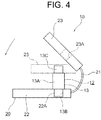
- FIG. 4 is an illustration showing an action of assembling one and the other boards of the printed board fixing device of the exemplary embodiment
- FIG. 5 is an overall plan view showing a modification example of the printed board fixing device according to the present invention.
- FIG. 6 is an overall plan view showing another modification example of the printed board fixing device according to the present invention.
- FIG. 7 is an overall plan view showing a related technique of the printed board fixing device
- FIG. 8 is a view taken along an arrow VIII of FIG. 7 ;
- FIG. 9 is a view taken along an arrow IX of FIG. 7 .
- FIG. 1 to FIG. 4 an exemplary embodiment of a printed board fixing device according to the present invention will be described by referring to FIG. 1 to FIG. 4 .
- same reference numerals as those of the related technique are applied to the structures that are same as the members used in the fixing device 50 of the related technique.
- a printed board fixing device (simply referred to as a fixing device hereinafter) 10 of the exemplary embodiment fixes a flex rigid printed board (simply referred to as a printed board hereinafter) 20 in a folded state used for small communication optical modules such as SFP (Small Form Factor Pluggable), XFP (10 Gigabit Small Form Factor Pluggable), etc.
- SFP Small Form Factor Pluggable
- XFP Gigabit Small Form Factor Pluggable
- FIG. 1 shows an overall plan view of the fixing device 10 of the exemplary embodiment
- FIG. 2 shows an overall side view of the fixing device 10
- FIG. 3 shows an overall front view of the fixing device 10 .
- the fixing device 10 fixes the printed board 20 in a two-folded state by folding a board flexible part 21 which constitutes the printed board 20 .
- the fixing device 10 is placed between one rigid printed board (simply referred to as one board hereinafter) 22 and the other rigid printed board (simply referred to as the other board hereinafter) 23 of the printed board 20 , which are folded in two to be in parallel to each other, and the fixing device 10 is formed by including a coupling member 12 which couples and fixes the one and the other boards 22 and 23 to each other.
- the length of the coupling member 12 is set to be within a range of the entire thickness including the one and the other boards 22 and 23 in a two-folded state.
- the coupling member 12 is provided at two points of the one and the other boards 22 and 23 .
- a fixing pin 13 as a first coupling member out of the coupling members 12 provided at two points is provided on one end of a side where the flexible part 21 of the one and the other boards 22 , 23 is located, i.e., at a first point A.
- a linear member as a second coupling member out of the coupling members 12 provided at two points is provided at the other end part that is on the opposite side of the side where the flexible part of the one and the other boards 22 , 23 is placed, i.e., at a second point B. Further, this linear member is formed by a tin-plated wire having electric conductivity.
- the fixing pin 13 is formed in a shape which includes a pin main body 13 A of a prescribed outer diameter, and a first pin header 13 B as well as a second pin header 13 C of a smaller diameter than the outer diameter of the pin main body 13 A, which are provided at both ends of the pin main body 13 A, respectively.
- the first pin header 13 B of the pin main body 13 A is fitted into a fitting hole 22 A opened on the one board 22 by being press-fitted, for example.
- the second pin header 13 C of the pin main body 13 A is also fitted into a fitting hole 23 A opened on the other board 23 by being press-fitted, for example.
- the length between the both ends of the first pin header 13 B and the second pin header 13 C is so set that each of the end faces is slightly recessed from the outer surface of each of the boards 22 , 23 so as not to be extruded from the external surfaces of each of those boards 22 , 23 as shown in FIG. 2 . That is, as described above, it is set to be within a range of the thickness of the one and the other boards 22 and 23 in a two-folded state.
- both end faces of the pin main body 13 A in the axial direction abut against the opposing faces of the one and the other boards 22 and 23 . That is, the both ends of the first pin header 13 B and the second pin header 13 C of the pin main body 13 A also work as a spacer for maintaining the space between each of the boards 22 and 23 .
- the tin-plated wire 16 is formed substantially in a crank state when viewed from a side, and it is placed across between the one and the other opposing boards 22 and 23 .
- a lower horizontal end part of the tin-plated wire 16 is provided on the top face of the one board 22 via a first pad 17
- an upper horizontal end part of the tin-plated wire 16 is provided on the top face of the other board 23 via a second pad 18 .
- the first pad 17 and the second pad 18 are covered by a thin copper foil having electric conductivity, for example, and as shown in FIG. 1 , the positions thereof are shifted by one pad, for example, in the longitudinal direction of the one and the other boards 22 and 23 .
- the first pad 17 is fixed to the top face of the one board 22 by soldering. Further, the second pad 18 is embedded in a recessed part 23 B formed on the top face of the other board 23 , and fixed to the board 23 by soldering.
- the lower one end of the tin-plated wire 16 is fixed to the top face of the second pad 18 by soldering, and the upper one end is fixed to the top face of the first pad 17 by soldering.
- the tin-plated wire 16 is provided obliquely to be along a diagonal line of the first pad 17 and the second pad 18 , and it is formed to be able to secure the length of the lower one and the upper one end to be in a length required for a soldering work.
- the soldering work for attaching the lower one end and upper one end of the tin-plated wiring 16 to the first pad 17 and the second pad 18 , respectively, can be done easily.
- the depth of the recessed part 23 B, the thickness of the second pad 18 , and the diameter of the tin-plated wire 16 are so set in advance that the top face height of one end of the tin-plated wire 16 at least becomes equal to the top face height of the other board 23 , more preferably, becomes lower than the top face height of the other board 23 when the upper horizontal one end of the tin-plated wire 16 is fixed to the top face of the second pad 18 .
- the second pad 18 may be directly attached to the top face of the board 23 and the upper horizontal one end of the tin-plated wire 16 may be attached thereon without forming the recessed part 23 B on the top face of the other board 23 .
- This also makes it possible to achieve the exemplary object of the present invention, since the second pad 18 is extremely thin and the diameter of the tin-plated wire 16 is also small so that the influence upon reduction in the thickness of the device is small.
- the tin-plated wire 16 may only need to have a physical strength which can electrically connect the one and the other boards 22 , 23 and can keep the coupling state of each of the boards 22 , 23 . Therefore, it is not limited to the case of using the tin-plated wire 16 as the linear member.
- a copper wire may be used.
- the tin-plated wire 16 Since the tin-plated wire 16 exhibits the electric conductivity, the tin-plated wire 16 also functions as an earth in addition to coupling and fixing each of the boards 22 , 23 when soldering the tin-plated wire 16 and each of the pads 17 , 18 . Further, the tin-plated wire is less expensive compared to the fixing pin 13 and the existing fixing bolt 53 .
- the first pin header 13 B of the fixing pin 13 is fitted by press-fitting, for example, into the fitting hole 22 A opened in a prescribed position of the one board 22 .
- the board flexible part 21 is bent in such a manner that the other board 23 becomes in parallel to the one board 22 .
- the person working on this presses the other board 23 against the second pin header 13 C to fit the fitting hole 23 A opened in the other board 23 and the second pin header 13 C of the fixing pin 13 while checking the positions of the fitting hole 23 A and the second pin header 13 C so as to fit the fitting hole 23 A and the header 13 C with each other by press-fitting, for example.
- the one board 22 and the other board 23 are coupled and fixed to each other.
- the lower horizontal end of the tin-platted wire 16 is soldered to the first pad 17 that is provided in advance to the one board 22 .
- the upper horizontal end of the tin-plated wire 16 is soldered to be in an oblique state to the second pad 18 that is provided in advance to the other board 23 so as to couple and fix the one board 22 and the other board 23 .
- the order of attaching the tin-plated wire 16 to each of the pads 17 and 18 may be inverted. That is, the upper horizontal end of the tin-plated wire 16 may be fixed to the other board 23 first, and the lower horizontal end may be fixed to the one board 22 thereafter.
- each of the lengths of the fixing pin 13 and the tin-plated wire 16 constituting the coupling member 12 is set to be within the range of the entire thickness including the one and the other boards 22 and 23 , both ends of the fixing pin 13 and the tin-plated wire 16 are not projected to the outer side of each of the boards 22 and 23 . As a result, it becomes possible to reduce the thickness and the size of the device with a simple structure.
- the coupling member 12 is formed with two members of the fixing pin 13 as the first coupling member provided at the first point A and the tin-plated wire 16 as the second coupling member provided at the second point B, and the fixing pin 13 and the tin-plated wire 16 are arranged in a well-balanced manner by being set on a diagonal of the one and the other boards 22 and 23 . This makes it possible to achieve a stable coupling and fixing state.
- the fixing pin 13 includes the first pin header 13 B and the second pin header 13 C, and the first pin header 13 B is press-fitted into the fitting hole 22 A opened in the one board 22 and the second pin header 13 C is press-fitted into the fitting hole 23 A opened in the other board 23 . Therefore, after the boards 22 and 23 are coupled and fixed to each other, those are not returned to the original uncoupled state. Thus, the coupled and fixed state of each of the boards 22 and 23 can be secured.
- the both end faces in the axial direction of the pin main body 13 A which constitutes the fixing pin 13 are designed to abut against the opposing faces of the one and the other boards 22 and 23 which are in parallel to each other. Therefore, the fixing pin 13 can also function to keep the space between each of the boards 22 and 23 .
- the fixing pin 13 simply needs to couple and fix the one and the other boards 22 and 23 .
- the pin main body 13 A, the first pin header 13 B, and the second pin header 13 C to be in the minimum necessary size, it is possible to suppress reduction of the component mounting area in each of the boards 22 and 23 .
- the first pad 17 and the second pad 18 are arranged on the one and the other boards 22 and 23 by being shifted for one pad and the tin-plated wire 16 is provided obliquely to be along the diagonal line of each of the pads 17 and 18 , the length of the lower horizontal end and the upper horizontal end can be secured to be in the length required for the soldering work. This makes it easy to perform the soldering work for attaching the lower and upper ends of the tin-plated wire 16 to the first pad 17 and the second pad 18 , respectively.
- the printed board fixing device is structured in the manner described above. According to this, as an exemplary advantage according to the invention, the length of the coupling member is set to be within the range of the entire thickness including the one and the other rigid printed boards, so that both ends of the coupling member are not extruded towards the outer side of the one and the other rigid printed boards. As a result, it becomes possible to reduce the thickness and size with a simple structure.
- the fixing pin 13 is placed on the one end side of the longitudinal direction of the one and the other boards 22 , 23 , which is the end of the side where the flexible part 21 is provided, and the tin-plated wire 16 is placed on the other end side of the longitudinal direction of each of the boards 22 , 23 .
- the layout of the fixing pin 13 and the tin-plated wire 16 may be inverted therefrom in the longitudinal direction of each of the boards 22 and 23 .
- the fixing pin 13 may be placed on the other end side of the longitudinal direction of one and the other boards 22 , 23 , and the tin-plated wire 16 may be placed on one end side of the longitudinal direction of each of the boards 22 , 23 . Even with such structure, it is also possible to achieve the same effects as those described in (1) to (6).
- the present invention is not limited only to that.
- a fixing device 10 A which includes a coupling/fixing structure formed only with the fixing pin 13 .
- the fixing pin 13 is provided substantially in the center part of the longitudinal direction of the one and the other boards 22 , 23 and at the end on the opposite side of the end of the side where the flexible part 21 is provided in the width direction of each of the boards 22 , 23 .
- Each of the boards 22 and 23 is coupled and fixed only by the fixing pin 13 , so that the tin-plated wire 16 , the first pad 17 , and the second pad 18 become unnecessary.
- the structure can be simplified. Further, the expense for the material thereof and for the processing work becomes unnecessary, so that the cost can be reduced.
- the fixing pin 13 is provided substantially in the center part in the longitudinal direction of the one and the other boards 22 and 23 , it is possible to couple and fix the one and the other boards 22 and 23 in a well-balanced manner.
- the present invention is not limited only to that.
- a fixing device 10 B which includes a coupling/fixing structure formed only with the tin-plated wire 16 .
- the tin-plated wire 16 is provided substantially in the center part of the longitudinal direction of the one and the other boards 22 , 23 and at the end on the opposite side of the end of the side where the flexible part 21 is provided in the width direction of each of the boards 22 , 23 . Further, the tin-plated wire 16 is less expensive compared to the fixing pin 13 including the first pin header 13 B and the second pin header 13 C and compared to already-used bolts and nuts.
- Each of the boards 22 and 23 is coupled and fixed only by the tin-plated wire 16 , so that the fixing pin 13 becomes unnecessary.
- the structure can be simplified. Further, the expense for the material thereof and for processing work becomes unnecessary, so that the cost can be reduced.
- the tin-plated wire 16 can be made less expensively compared to the fixing pin 13 including the first pin header 13 B and the second pin header 13 C and compared to existing bolts and nuts.
- the coupling members 12 are formed with the fixing pin 13 and the tin-plated wire 16 , and the fixing pin 13 is placed at the first point A and the tin-plated wire 16 is placed at the second point B in the exemplary embodiment, the present invention is not limited only to that.
- the fixing pin 13 may be placed at the first point A and the second point B, respectively. With this structure, it is also possible to achieve the same effects as those described in (1) to (6).
- a printed board fixing device which includes a coupling member which two-folds a flex rigid printed board including one and other rigid printed boards via a flexible part and mutually couples and fixes the one and the other boards, wherein length of the coupling member is set to be within a range of entire thickness including the one and the other rigid printed boards.
- a first coupling member out of the coupling members provided at the two points is provided at one end of a side where the flexible part of the one and the other printed boards is located; and a second coupling member out of the coupling members provided at the two points is provided on other end of an opposite side of the side where the flexible part of the one and the other printed boards is located.
- the present invention can be utilized for a printed board fixing device when fixing and holding a single flex rigid printed board in a folded state used for information apparatuses, electronic apparatuses, etc.
Landscapes
- Engineering & Computer Science (AREA)
- Manufacturing & Machinery (AREA)
- Microelectronics & Electronic Packaging (AREA)
- Combinations Of Printed Boards (AREA)
- Mounting Of Printed Circuit Boards And The Like (AREA)
Abstract
Description
Claims (4)
Applications Claiming Priority (2)
| Application Number | Priority Date | Filing Date | Title |
|---|---|---|---|
| JP2010-207934 | 2010-09-16 | ||
| JP2010207934A JP5879678B2 (en) | 2010-09-16 | 2010-09-16 | Printed circuit board fixing device |
Publications (2)
| Publication Number | Publication Date |
|---|---|
| US20120069539A1 US20120069539A1 (en) | 2012-03-22 |
| US8552300B2 true US8552300B2 (en) | 2013-10-08 |
Family
ID=45817601
Family Applications (1)
| Application Number | Title | Priority Date | Filing Date |
|---|---|---|---|
| US13/223,824 Expired - Fee Related US8552300B2 (en) | 2010-09-16 | 2011-09-01 | Printed board fixing apparatus |
Country Status (3)
| Country | Link |
|---|---|
| US (1) | US8552300B2 (en) |
| JP (1) | JP5879678B2 (en) |
| CN (1) | CN102438393B (en) |
Families Citing this family (9)
| Publication number | Priority date | Publication date | Assignee | Title |
|---|---|---|---|---|
| CN103974533B (en) * | 2014-04-30 | 2017-03-15 | 苏州倍辰莱电子科技有限公司 | A kind of folded double-layered printed circuit board (PCB) |
| JP6537100B2 (en) * | 2015-04-15 | 2019-07-03 | 矢崎総業株式会社 | Multi-stage substrate connection structure and electrical connection box |
| KR102558558B1 (en) * | 2016-02-12 | 2023-07-24 | 엘지이노텍 주식회사 | Substrate module having three-dimension structure shape and camera module having the same |
| WO2019106736A1 (en) * | 2017-11-29 | 2019-06-06 | 株式会社日立製作所 | Storage drive and storage system |
| CN107920417A (en) * | 2017-12-18 | 2018-04-17 | 广州兴森快捷电路科技有限公司 | Wiring board and its manufacture method |
| KR20190099709A (en) * | 2018-02-19 | 2019-08-28 | 삼성전기주식회사 | Printed circuit board |
| CN110972393A (en) * | 2018-09-29 | 2020-04-07 | 鹏鼎控股(深圳)股份有限公司 | Circuit board connecting method |
| CN109683262B (en) * | 2019-01-25 | 2020-10-16 | 东莞市金厚田光电有限公司 | Parallel optical transceiving component for broadband high-speed transmission |
| CN114501791A (en) * | 2020-11-12 | 2022-05-13 | 荣耀终端有限公司 | Circuit board assembly and electronic equipment |
Citations (6)
| Publication number | Priority date | Publication date | Assignee | Title |
|---|---|---|---|---|
| JPH10308570A (en) | 1997-05-02 | 1998-11-17 | Ricoh Co Ltd | Connection means between printed circuit boards |
| US6614664B2 (en) * | 2000-10-24 | 2003-09-02 | Samsung Electronics Co., Ltd. | Memory module having series-connected printed circuit boards |
| JP2003264353A (en) | 2002-03-11 | 2003-09-19 | Matsushita Electric Ind Co Ltd | Portable wireless devices |
| US20060082985A1 (en) * | 2004-10-14 | 2006-04-20 | Kyocera Mita Corporation | Bi-fold mounted printed wiring board |
| JP2008270234A (en) | 2007-04-16 | 2008-11-06 | Seiko Epson Corp | Substrate fixing structure, substrate fixing spacer and substrate unit |
| US20090175015A1 (en) * | 2008-01-08 | 2009-07-09 | Fujitsu Limited | Printed board unit and fixing parts thereof |
Family Cites Families (12)
| Publication number | Priority date | Publication date | Assignee | Title |
|---|---|---|---|---|
| JPS608453Y2 (en) * | 1980-05-29 | 1985-03-25 | 富士通株式会社 | Circuit board mounting structure |
| JPS58122479U (en) * | 1982-02-12 | 1983-08-20 | 松下電器産業株式会社 | electronic circuit unit |
| JPH01273384A (en) * | 1988-04-26 | 1989-11-01 | Matsushita Electric Ind Co Ltd | integrated circuit device |
| JPH02116780U (en) * | 1989-03-08 | 1990-09-19 | ||
| JPH05136552A (en) * | 1991-11-15 | 1993-06-01 | Nec Niigata Ltd | Printed board |
| JPH09246685A (en) * | 1996-03-07 | 1997-09-19 | Fujitsu I Network Syst Ltd | Printed circuit board linkage system |
| JP2001177209A (en) * | 1999-12-15 | 2001-06-29 | Fujitsu I-Network Systems Ltd | Fixing structure of circuit board for stack structure |
| JP2003158356A (en) * | 2001-11-20 | 2003-05-30 | Murata Mfg Co Ltd | Electronic circuit device |
| JP2003283072A (en) * | 2002-03-20 | 2003-10-03 | Canon Inc | Printed wiring board unit |
| JP2004311926A (en) * | 2002-10-07 | 2004-11-04 | Sony Corp | Multilayer printed wiring board, electronic device, method of manufacturing multilayer printed wiring board, and apparatus for manufacturing the same |
| JP2006108367A (en) * | 2004-10-05 | 2006-04-20 | Nec Saitama Ltd | Three-dimensional inter-substrate connection component and its mounting structure |
| CN1805219A (en) * | 2005-01-12 | 2006-07-19 | 华为技术有限公司 | Connecting apparatus |
-
2010
- 2010-09-16 JP JP2010207934A patent/JP5879678B2/en not_active Expired - Fee Related
-
2011
- 2011-09-01 US US13/223,824 patent/US8552300B2/en not_active Expired - Fee Related
- 2011-09-15 CN CN201110273099.9A patent/CN102438393B/en active Active
Patent Citations (7)
| Publication number | Priority date | Publication date | Assignee | Title |
|---|---|---|---|---|
| JPH10308570A (en) | 1997-05-02 | 1998-11-17 | Ricoh Co Ltd | Connection means between printed circuit boards |
| US6614664B2 (en) * | 2000-10-24 | 2003-09-02 | Samsung Electronics Co., Ltd. | Memory module having series-connected printed circuit boards |
| JP2003264353A (en) | 2002-03-11 | 2003-09-19 | Matsushita Electric Ind Co Ltd | Portable wireless devices |
| US20060082985A1 (en) * | 2004-10-14 | 2006-04-20 | Kyocera Mita Corporation | Bi-fold mounted printed wiring board |
| JP2008270234A (en) | 2007-04-16 | 2008-11-06 | Seiko Epson Corp | Substrate fixing structure, substrate fixing spacer and substrate unit |
| US20090175015A1 (en) * | 2008-01-08 | 2009-07-09 | Fujitsu Limited | Printed board unit and fixing parts thereof |
| JP2009164387A (en) | 2008-01-08 | 2009-07-23 | Fujitsu Ltd | Printed circuit board unit and printed circuit board unit fixture |
Also Published As
| Publication number | Publication date |
|---|---|
| JP5879678B2 (en) | 2016-03-08 |
| US20120069539A1 (en) | 2012-03-22 |
| CN102438393A (en) | 2012-05-02 |
| JP2012064763A (en) | 2012-03-29 |
| CN102438393B (en) | 2016-05-11 |
Similar Documents
| Publication | Publication Date | Title |
|---|---|---|
| US20120069539A1 (en) | Printed board fixing apparatus | |
| US8277253B2 (en) | Electrical connector and circuit board assembly | |
| US7695289B1 (en) | Connector | |
| JP5162332B2 (en) | High frequency module and radio apparatus | |
| US10062993B1 (en) | Flexible cable for pluggable modules | |
| JPWO2008072322A1 (en) | Coaxial cable unit and test apparatus | |
| JP6533572B2 (en) | Imaging device | |
| JPWO2007000814A1 (en) | Connectors, circuit boards and electronic devices | |
| EP2575214B1 (en) | Socket for two cameras, camera module and terminal device | |
| WO2018168352A1 (en) | Receptacle | |
| CN105814743A (en) | Contact connecting of shielded data lines to a board and method for contacting a number of shielded data lines with a board | |
| KR101993374B1 (en) | Connecting device for electronic components of portable terminal | |
| JP2011146259A (en) | Opto-electric composite cable with substrate | |
| US10396505B2 (en) | Filter connector | |
| JP2009060302A (en) | Portable communication terminal | |
| US20090298327A1 (en) | Connecting module | |
| JP4872847B2 (en) | In-vehicle device | |
| JP4358269B2 (en) | Electronic component module | |
| CN215981500U (en) | Camera fixing structure and electronic equipment | |
| JP6032422B2 (en) | Photoelectric composite connector device | |
| CN102722006B (en) | Small pluggable module of optical fiber connector | |
| US20250047019A1 (en) | Compliant pin | |
| CN210579470U (en) | Circuit board assembly and automotive electronics | |
| JP6836960B2 (en) | Substrate assembly and manufacturing method of substrate assembly | |
| CN102238837B (en) | Electronic apparatus |
Legal Events
| Date | Code | Title | Description |
|---|---|---|---|
| AS | Assignment |
Owner name: NEC CORPORATION, JAPAN Free format text: ASSIGNMENT OF ASSIGNORS INTEREST;ASSIGNOR:KOZATO, ATSUSHI;REEL/FRAME:026870/0317 Effective date: 20110407 |
|
| STCF | Information on status: patent grant |
Free format text: PATENTED CASE |
|
| FPAY | Fee payment |
Year of fee payment: 4 |
|
| MAFP | Maintenance fee payment |
Free format text: PAYMENT OF MAINTENANCE FEE, 8TH YEAR, LARGE ENTITY (ORIGINAL EVENT CODE: M1552); ENTITY STATUS OF PATENT OWNER: LARGE ENTITY Year of fee payment: 8 |
|
| FEPP | Fee payment procedure |
Free format text: MAINTENANCE FEE REMINDER MAILED (ORIGINAL EVENT CODE: REM.); ENTITY STATUS OF PATENT OWNER: LARGE ENTITY |
|
| LAPS | Lapse for failure to pay maintenance fees |
Free format text: PATENT EXPIRED FOR FAILURE TO PAY MAINTENANCE FEES (ORIGINAL EVENT CODE: EXP.); ENTITY STATUS OF PATENT OWNER: LARGE ENTITY |
|
| STCH | Information on status: patent discontinuation |
Free format text: PATENT EXPIRED DUE TO NONPAYMENT OF MAINTENANCE FEES UNDER 37 CFR 1.362 |
|
| FP | Lapsed due to failure to pay maintenance fee |
Effective date: 20251008 |