US8330637B2 - Time-to-digital converter and operation method thereof - Google Patents

Time-to-digital converter and operation method thereof Download PDF

Info

Publication number
US8330637B2
US8330637B2 US13/089,558 US201113089558A US8330637B2 US 8330637 B2 US8330637 B2 US 8330637B2 US 201113089558 A US201113089558 A US 201113089558A US 8330637 B2 US8330637 B2 US 8330637B2
Authority
US
United States
Prior art keywords
phase
tdc
input signal
delay
signals
Prior art date
Legal status (The legal status is an assumption and is not a legal conclusion. Google has not performed a legal analysis and makes no representation as to the accuracy of the status listed.)
Active, expires
Application number
US13/089,558
Other versions
US20110260902A1 (en
Inventor
Jae-Sup Lee
Kang-yoon Lee
An-Soo PARK
Young-Gun PU
Joon-Sung PARK
Current Assignee (The listed assignees may be inaccurate. Google has not performed a legal analysis and makes no representation or warranty as to the accuracy of the list.)
KONKUK UNIVERSITY INDUSTRY COOPERATION CORP
Samsung Electronics Co Ltd
University Industry Cooperation Corporation of Konkuk University
Original Assignee
Samsung Electronics Co Ltd
University Industry Cooperation Corporation of Konkuk University
Priority date (The priority date is an assumption and is not a legal conclusion. Google has not performed a legal analysis and makes no representation as to the accuracy of the date listed.)
Filing date
Publication date
Application filed by Samsung Electronics Co Ltd, University Industry Cooperation Corporation of Konkuk University filed Critical Samsung Electronics Co Ltd
Assigned to SAMSUNG ELECTRONICS CO., LTD., KONKUK UNIVERSITY INDUSTRY COOPERATION CORP. reassignment SAMSUNG ELECTRONICS CO., LTD. ASSIGNMENT OF ASSIGNORS INTEREST (SEE DOCUMENT FOR DETAILS). Assignors: LEE, JAE-SUP, LEE, KANG-YOON, PARK, AN-SOO, PARK, JOON-SUNG, PU, YOUNG-GUN
Publication of US20110260902A1 publication Critical patent/US20110260902A1/en
Application granted granted Critical
Publication of US8330637B2 publication Critical patent/US8330637B2/en
Active legal-status Critical Current
Adjusted expiration legal-status Critical

Links

Images

Classifications

    • GPHYSICS
    • G04HOROLOGY
    • G04FTIME-INTERVAL MEASURING
    • G04F10/00Apparatus for measuring unknown time intervals by electric means
    • G04F10/005Time-to-digital converters [TDC]

Definitions

  • the present invention relates to a Time-to-Digital Converter (TDC) and an operation method thereof. More particularly, the present invention relates to a TDC having a high resolution at a Radio Frequency (RF) input frequency by using a Phase-Interpolation (PI) technique and a Time Amplifier (TA), and an operation method thereof.
  • TDC Time-to-Digital Converter
  • PI Phase-Interpolation
  • TA Time Amplifier
  • a wireless communication transceiver and the like include a phase-locked loop to provide a Local Oscillator (LO) frequency.
  • an analog phase-locked loop is used, which may cause a reduction in process scale.
  • the analog phase-locked loop may be digitally constructed. In this case, however, the analog phase-locked loop may be insensitive to process variations.
  • a digital phase-locked loop is used.
  • a Time-to-Digital Converter (TDC) is used to detect a phase difference between an output frequency of a digital oscillator and a reference frequency, and the performance of the digital phase looked loop depends on a resolution of the TDC.
  • TDC Time-to-Digital Converter
  • the TDC receives two input signals, and delays one of the input signals through a delay line step by step.
  • the TDC compares a waveform of the input signal delayed step by step with a waveform of the other input signal in terms of the rising edge, and outputs the comparison results in a digital code.
  • a phase difference between the two input signals may be identified based on the output digital code.
  • FIG. 1 schematically illustrates a TDC with a single delay line according to the related art.
  • a TDC 100 includes two input signal lines, L inverters 106 - 1 ⁇ 106 -L for signal delay, and (L+1) comparators 108 - 0 ⁇ 108 -L, which are implemented with their associated flip-flops.
  • the TDC 100 receives two input signals: a Digital Controlled Oscillator (DCO) frequency F DCO 102 and a reference frequency F REF 104 .
  • the F DCO 102 is delayed by each of the L inverters 106 - 1 ⁇ 106 -L and then input to each of the (L+1) comparators 108 - 0 ⁇ 108 -L.
  • Each of the (L+1) comparators 108 - 0 ⁇ 108 -L compares a rising edge of the F DCO delayed by each of the inverters 106 - 1 ⁇ 106 -L with a rising edge of the F REF 104 , and outputs the comparison results in a digital code.
  • a phase difference between the input signals may be identified based on the output digital code.
  • a resolution of the TDC 100 is determined by a delay time of the inverters 106 - 1 ⁇ 106 -L. Since a delay time of an inverter is determined by a size of a transistor constituting the inverter, a resolution of the TDC may be limited to a specific value in a specific process.
  • RF Radio Frequency
  • PI Phase-Interpolation
  • TA Time Amplifier
  • an aspect of the present invention is to provide a Time-to-Digital Converter (TDC) using a Phase-Interpolation (PI) technique and a Time Amplifier (TA), and an operation method thereof.
  • TDC Time-to-Digital Converter
  • PI Phase-Interpolation
  • TA Time Amplifier
  • Another aspect of the present invention is to provide a TDC using a PI technique that uses a resistor auto-tuning scheme, and a TA that increases its gain with a time difference caused by the use of additional inverters, and an operation method thereof.
  • Another aspect of the present invention is to provide a TDC having a high resolution at a Radio Frequency (RF) input frequency, and an operation method thereof.
  • RF Radio Frequency
  • a TDC includes a first TDC unit for receiving a first input signal and a second input signal, delaying the first input signal on a specific time basis using each of first delay blocks, generating first phase-divided signals by performing first phase division on signals of input/output nodes for each of the first delay blocks on a predefined PI delay time basis, and outputting the second input signal and a phase-divided signal closest to the second input signal, among the first phase-divided signals, a time amplifier for independently time-amplifying the second input signal and the phase-divided signal closest to the second input signal, and a second TDC unit for delaying a phase-divided signal closest to the time-amplified second input signal on a specific time basis using each of second delay blocks, and generating second phase-divided signals by performing second phase division on signals of input/output nodes for each of the second delay blocks on a predefined PI delay time basis.
  • a method for operating a TDC includes receiving a first input signal and a second input signal, delaying the first input signal on a specific time basis using each of first delay blocks, generating first phase-divided signals by performing first phase division on signals of input/output nodes for each of the first delay bocks on a predefined PI delay time basis, and outputting the second input signal and a phase-divided signal closest to the second input signal, among the first phase-divided signals, independently time-amplifying the second input signal and the phase-divided signal closest to the second input signal, delaying the phase-divided signal closest to the time-amplified second input signal on a specific time basis using each of the second delay blocks, and generating second phase-divided signals by performing second phase division on signals of input/output nodes for each of the second delay blocks on a predefined PI delay time basis.
  • FIG. 1 is a schematic diagram illustrating a Time-to-Digital Converter (TDC) with a single delay line according to the related art
  • FIG. 2 is a flowchart illustrating a flow of an input signal in a TDC according to an exemplary embodiment of the present invention
  • FIG. 3 is a schematic diagram illustrating a structure of a TDC according to an exemplary embodiment of the present invention
  • FIG. 4 is a block diagram illustrating an overall structure of a TDC according to an exemplary embodiment of the present invention.
  • FIG. 5 is a block diagram illustrating a structure of a Phase-Interpolation (PI) block to which resistor auto-tuning is applied according to an exemplary embodiment of the present invention
  • FIGS. 6A through 6C are block diagrams illustrating a structure of a PI block according to an exemplary embodiment of the present invention.
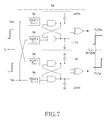
  • FIG. 7 is a block diagram illustrating a structure of a Time Amplifier (TA) according to an exemplary embodiment of the present invention.
  • TA Time Amplifier
  • Exemplary embodiments of the present invention provide a Time-to-Digital Converter (TDC) having a high resolution at a Radio Frequency (RF) input frequency by using a Phase-Interpolation (PI) technique and a Time Amplifier (TA), and an operation method thereof.
  • TDC Time-to-Digital Converter
  • RF Radio Frequency
  • PI Phase-Interpolation
  • TA Time Amplifier
  • FIGS. 2 through 7 discussed below, and the various exemplary embodiments used to describe the principles of the present disclosure in this patent document are by way of illustration only and should not be construed in any way that would limit the scope of the disclosure. Those skilled in the art will understand that the principles of the present disclosure may be implemented in any suitably arranged communications system.
  • the terms used to describe various embodiments are exemplary. It should be understood that these are provided to merely aid the understanding of the description, and that their use and definitions in no way limit the scope of the invention. Terms first, second, and the like are used to differentiate between objects having the same terminology and are in no way intended to represent a chronological order, unless where explicitly state otherwise.
  • a set is defined as a non-empty set including at least one element.
  • FIG. 2 is a flowchart illustrating a flow of an input signal in a TDC according to an exemplary embodiment of the present invention.
  • a TDC determines in step 200 whether F DCO is input. If it is determined in step 200 that the F DCO is input, the TDC proceeds to step 205 . However, if it is determined in step 200 that no F DCO is input, the TDC waits until the F DCO is input. In step 205 , the TDC delays the F DCO on a specific time basis step by step using each of its inverters, which are assumed to be identical in delay time.
  • step 210 the TDC phase-divides the delayed F DCO in units of a predefined PI delay time, which is less than a delay time of each of the inverters.
  • step 215 the TDC compares a rising edge of each F DCO delayed by each of the inverters with a rising edge of the other input signal F REF , and outputs the comparison results in a digital code.
  • the F REF is an original signal that is not time-delayed.
  • step 217 the TDC time-amplifies each of the F REF and the time-delayed F DCO which is closest to the F REF , among the F DCO values time-delayed on a specific time basis by the inverters.
  • step 218 the TDC time-delays again the time-amplified F DCO ‘TA_F DCO ’ on a specific time basis using each of the inverters.
  • the delay time of each of the inverters, used in step 218 is also assumed to be identical.
  • step 220 the TDC phase-divides the TA_F DCO in units of a predefined PI delay time, which is less than a delay time of each of the inverters.
  • step 225 the TDC compares each TA_F DCO phase-divided by each of the inverters with the time-amplified F REF ‘TA_F REF ’ in terms of the rising edge, and outputs the comparison results in a digital code.
  • FIG. 3 is a schematic diagram illustrating a structure of a TDC according to an exemplary embodiment of the present invention.
  • a TDC includes a coarse TDC 300 , a TA 310 , and a fine TDC 320 .
  • the coarse TDC 300 includes a PI block 302 , a resistor auto-tuning unit # 1 304 , a comparator # 1 306 , and a multiplexer (MUX) 308 .
  • the resistor auto-tuning unit # 1 304 includes resistors for tuning resistances used in a voltage dividing operation involved in phase division so that the PI block 302 may not operate sensitively to process variations. An operation of the resistor auto-tuning unit # 1 304 will be described below.
  • Two input signals F DCO and F REF are input to the coarse TDC 300 .
  • the F DCO is delayed on a specific time basis by multiple delays each of which is implemented with an inverter as illustrated in FIG. 1 , and each of the delays delivers its delayed input signal to the PI block 302 .
  • the F REF is delivered to the comparator # 1 306 and the MUX 308 without any signal distortion.
  • the PI block 302 divides the delayed F DCO on a predefined PI delay time basis. For example, it is assumed in a block 330 that if the PI delay time is 5 ps, a delay range of the F DCO is 155 ps. In this case, the delayed F DCO is divided into a total of 32 5-ps PI waves PI( 0 ), . . . , PI( 31 ), and then input to the comparator # 1 306 and the MUX 308 .
  • the comparator # 1 306 compares each of the PI( 0 ), . . . , PI( 31 ) with the F REF in terms of the rising edge, and outputs a thermometer code CTDC_O (31:0).
  • the MUX 308 selects a PI(n) which is closest to the rising edge of the F REF , from among the 31 PI waveforms, and outputs it to the TA 310 together with the F REF .
  • the TA 310 time-amplifies each of the PI(n) and the F REF , and outputs each of the time-amplified PI TA_PI(n) and the time-amplified F REF TA_F REF as an input to the fine TDC 320 .
  • the fine TDC 320 includes a PI block 322 , a resistor auto-tuning unit # 2 324 , and a comparator # 2 326 .
  • the resistor auto-tuning unit # 2 324 includes resistors for tuning resistances used in a voltage dividing operation involved in phase division so that the PI block 322 may not operate sensitively to process variations. An operation of the resistor auto-tuning unit # 2 324 will be described below.
  • the TA_PI(n) is delayed on a specific time basis by multiple delays each of which is implemented with an inverter as illustrated in FIG. 1 , and each of the delays delivers its delayed input signal to the PI block 322 .
  • the TA_F REF is delivered to the comparator # 2 326 without any signal distortion.
  • the PI block 322 divides the delayed TA_PI(n) on a predefined PI delay time basis. For example, it is assumed in a block 340 that if the PI delay time is 5 ps, a delay range of the TA_PI(n) is 60 ps. In this case, the delayed TA_PI(n) is divided into a total of 16 5-ps PI waves PI( 0 ), . . . , PI( 15 ), and then input to the comparator # 2 326 .
  • the comparator # 2 326 compares each of the PI( 0 ), . . . , PI( 15 ) with the TA_F REF in terms of the rising edge, and outputs a thermometer code FTDC_O(15:0).
  • T2B Thermometer-to-Binary
  • FIG. 4 is a block diagram illustrating an overall structure of a TDC according to an exemplary embodiment of the present invention.
  • a TDC includes a coarse TDC 400 , a TA 418 , and a fine TDC 420 .
  • the coarse TDC 400 includes delay blocks 402 and 404 each including 2 inverters, a resistor auto-tuning unit 406 , a total of 4 8-PI blocks 408 each outputting 8 PIs, comparators 412 each including a flip-flop, an edge detector 414 , and a MUX 416 .
  • the coarse TDC 400 receives F DCO and F REF as its input signals.
  • the F REF is a reference frequency provided from a crystal Oscillator (OSC).
  • the F DCO is output after being delayed by the delay blocks 402 and 404 .
  • Output signals generated by delaying the F DCO on a specific time basis are D( 0 ), D( 1 ), . . . , D( 4 ), and for example, a delay time in each of the D( 0 ), D( 1 ), . . . , D( 4 ), i.e., a delay time in each of the delay blocks 402 and 404 is assumed to be 40 ps. Signals output from the D( 0 ), D( 1 ), . . .
  • D( 4 ) are input to each of the 8-PI blocks 408 two by two. More particularly, each of the 8-PI blocks 408 phase-divides two input signals, for example, D( 0 ) and D( 1 ) into a total of 8 signals PI( 0 ) to PI( 7 ). A delay time of each PI is assumed to be 5 ps, which is less than the delay time of each of the delay blocks 402 and 404 .
  • the coarse TDC 400 outputs PI( 0 ) to PI( 31 ) by phase-dividing the delayed F DCO on a 5 ps basis using the total of 4 8-PI blocks 408 .
  • each of the total of 4 8-PI blocks 408 needs a voltage dividing procedure to output phase-divided PI(n), and resistors are used in the voltage dividing procedure.
  • the resistors have error values by process variations. Therefore, each of the total of 4 8-PI blocks 408 receives R TUNE (3:0) output from the resistor auto-tuning unit 406 and automatically recovers errors caused by process variations for the voltage used in voltage division, to their original values.
  • each of the comparators 412 compares a rising edge of each of PI( 0 ) to PI( 31 ) output from each of the total of 4 8-PI blocks 408 with a rising edge of the F REF , and outputs the comparison results in a thermometer code CTDC_O(31:0).
  • the edge detector 414 detects a PI(n) closest to the rising edge of the F REF , and outputs it to the MUX 416 . For example, two signals having been input to a comparator having output ‘10’ from CTDC_O(31:0) are assumed to be a PI(n) closest to the rising edge of the F REF .
  • the TA 418 amplifies a time difference between the PI(n) output from the coarse TDC 400 and the F REF in the time domain, and outputs the time-amplified TA_PI(n) and TA_F REF .
  • the fine TDC 420 includes delay blocks 422 and 424 each including 2 inverters, a resistor auto-tuning unit 426 , a total of 2 8-PI blocks 428 and 430 each outputting 8 PIs, and comparators 432 each including a flip-flop.
  • the TA_PI(n) is time-delayed by each of the delay blocks 422 and 424 .
  • the output signals generated by delaying the TA_PI(n) are D( 0 ), D( 1 ), . . . , D( 4 ), and for example, a delay time in each of the D( 0 ), D( 1 ), . . . , D( 4 ), i.e., a delay time of each of the delay blocks 422 and 424 is assumed to be 40 ps.
  • Signals output from the D( 0 ), D( 1 ), . . . , D( 4 ) are input to each of the 8-PI blocks 428 and 430 two by two.
  • the 8-PI block 428 phase-divides two input signals, for example, D( 0 ) and D( 1 ) into a total of 8 signals PI( 0 ) to PI( 7 ).
  • a delay time of each PI is assumed to be 5 ps, which is less than the delay time of each of the delay blocks 422 and 424 .
  • the 8-PI block 430 phase-divides two input signals, for example, D( 3 ) and D( 4 ) into a total of 8 signals PI( 8 ) to PI( 15 ).
  • the fine TDC 420 outputs a total of 16 phase-shifted signals PI( 0 ) to PI( 15 ) using the total of 2 8-PI blocks 428 and 430 .
  • Each of the 8-PI blocks 428 and 430 receives R TUNE (3:0) output from the resistor auto-tuning unit 426 and automatically recovers resistances changed by process variations to their original values. Specific operations of the resistor auto-tuning units 406 and 426 will be described below with reference to FIG. 7 .
  • each of the comparators 432 compares a rising edge of each of the PI( 0 ) to the PI( 15 ) output from each of the 8-PI blocks 428 and 430 with a rising edge of the TA_F REF , and outputs the comparison results in a thermometer code FTDC_O (15:0).
  • FIG. 5 is a block diagram illustrating a structure of a PI block to which resistor auto-tuning is applied according to an exemplary embodiment of the present invention.
  • a PI block includes 8 resistor tuning arrays # 0 through # 7 ( 500 through 507 ), and their associated buffers 508 through 512 .
  • the PI block receives 2 delay signals, for example, D( 0 ) and D( 1 ) generated by delaying an input F DCO on a specific time basis in the previous step by a delay block including two inverters, and voltage-divides a voltage difference between the D( 0 ) and the D( 1 ) by resistors.
  • a time difference between the D( 0 ) and the D( 1 ) is T D .
  • the D( 0 ) and the D( 1 ) undergo voltage division by the 8 resistor tuning arrays # 0 through # 7 ( 500 through 507 ), and then are delivered to the buffers 508 through 512 .
  • the buffers 508 through 512 output 8 signals PI( 0 ) to PI( 7 ), respectively, by phase-dividing a time interval between the voltage-divided D( 0 ) and D( 1 ) on a predefined PI delay time basis.
  • a time difference among the PI( 0 ) to the PI( 7 ) is T D /8.
  • an exemplary embodiment of the present invention employs a resistor auto-tuning scheme in which even though resistances of resistors used for voltage division for PI are changed due to process variations, the resistances of resistors may be automatically recovered to their original resistances. That is, a resistor auto-tuning unit 514 automatically tunes errors of the resistor tuning arrays # 0 through # 7 using control bits of a tuning resistance R TUNE (3:0).
  • FIGS. 6A through 6C are block diagrams illustrating a structure of a PI block according to an exemplary embodiment of the present invention.
  • a block 600 includes a resistor auto-tuning unit and resistor tuning arrays # 0 through # 7 connected to thereto.
  • Each of the resistor tuning arrays # 0 through # 7 may tune its resistance according to the control bits of R TUNE (3:0) output from the resistor auto-tuning unit.
  • a block 610 represents a structure of each of the resistor tuning arrays # 0 through # 7 .
  • R 0 represents a main resistor used for voltage division in a PI operation of a TDC
  • R 1 , R 2 , R 3 and R 4 represent sub resistors capable of tuning an error of ⁇ 15%, which may occur in the R 0 .
  • the ⁇ 15% error of the R 0 may be tuned.
  • each of the resistor tuning arrays # 0 through # 7 may include the main resistor R 0 and the sub resistors R 1 , R 2 , R 3 and R 4 , which are connected in parallel, or in series.
  • a block 620 represents a structure of the resistor auto-tuning unit.
  • the resistor auto-tuning unit includes a band-gap reference block 622 , a comparator 624 , a digital controller 626 , and a duplicated-resistor unit 628 .
  • the band-gap reference block 622 As the band-gap reference block 622 generates a reference current I REF having a specific level and applies it to duplicated resistors created in the same connection form as that of the sub resistors connected to the main resistor in the block 610 , a specific voltage V TUNE is formed on the duplicated resistors.
  • the comparator 624 compares the formed V TUNE and a reference voltage V REF to calculate a difference there between, and generates a compensation resistance R TUNE (3:0) by means of the digital controller 626 .
  • the R TUNE (3:0) is connected to switches in the duplicated-resistor unit 628 , and applies control bits for turning on/off the switches, thereby compensating for an error of the R 0 .
  • a resistance of the main resistor R 0 in the resistor tuning array 610 becomes lower than its original value due to process variations
  • a resistance of the R 0 in the duplicated-resistor unit 628 also becomes lower than its original value because the duplicated-resistor unit 628 has the same connection structure as that of the resistor tuning array 610 , for example, because the R 0 and the sub resistors are connected in parallel.
  • the V TUNE is also reduced.
  • the digital controller 626 compares the lowered V TUNE with the V REF , and increases resistances of the duplicated resistors by increasing the R TUNE (3:0) because the resistance of the R 0 became lower than its original value.
  • the resistor auto-tuning unit 620 generates R TUNE (3:0) that serves as a negative feedback and compensates the main resistor R 0 .
  • R TUNE (3:0) is applied to the resistor tuning array 610 , output waveforms for PI are finally output at regular phase intervals regardless of the process variations.
  • FIG. 7 is a block diagram illustrating a structure of a TA according to an exemplary embodiment of the present invention.
  • a TA 700 receives, as input signals, F REF and PI(n) which is selected by a MUX in a coarse TDC, amplifies a time interval T D between the PI(n) and the F REF widely in the time domain, and multiplies the time interval T D by a gain TA of the TA 700 (T D ⁇ TA).
  • the TA 700 includes two latches 710 and 720 , and delay units # 1 through # 4 ( 702 through 708 ) having different delay times.
  • the delay unit # 1 ( 702 ) and the delay unit # 4 ( 708 ) have a delay time T off+ ⁇
  • the delay unit # 2 ( 704 ) and the delay unit # 3 ( 706 ) have a delay time T off .
  • As ( ⁇ ) may be realized by a delay time caused by an inverter, i.e., a value much smaller than T off , a gain of the TA 700 may be increased. This will be described below.
  • a gain of the TA 700 is represented as shown in Equation (1) below. That is, the gain of the TA 700 is inversely proportional to a transconductance (g m ) of NAND gates and a time difference ( ⁇ ) between two inputs to the latches 710 and 720 , and is proportional to output Capacitances (C) of the latches 710 and 720 .
  • a capacitance of the C is reduced as much as possible and the time difference ⁇ between two inputs to the latches 710 and 720 is set to its minimum value to increase the gain of the TA.
  • the time difference ⁇ between two inputs to the latches 710 and 720 is set to its minimum value to increase the gain of the TA.
  • one of the two input signals is additionally delayed. For the delay, a delay time of an inverter is commonly used.
  • exemplary embodiments of the present invention provide a TDC using a PI technique that uses a resistor auto-tuning scheme, and a TA that increases its gain with a time difference caused by the use of additional inverters.
  • the TDC may have a high resolution at an RF input frequency.

Landscapes

  • Physics & Mathematics (AREA)
  • General Physics & Mathematics (AREA)
  • Manipulation Of Pulses (AREA)
  • Pulse Circuits (AREA)
  • Stabilization Of Oscillater, Synchronisation, Frequency Synthesizers (AREA)

Abstract

A Time-to-Digital Converter (TDC) is provided. The TDC includes a first TDC unit for receiving a first input signal and a second input signal, delaying the first input signal on a specific time basis using each of first delay blocks, generating first phase-divided signals by performing first phase division on signals of input/output nodes for each of the first delay blocks on a predefined Phase-Interpolation (PI) delay time basis, and outputting the second input signal and a phase-divided signal closest to the second input signal, among the first phase-divided signals, a time amplifier for independently time-amplifying the second input signal and the phase-divided signal closest to the second input signal, and a second TDC unit for delaying a phase-divided signal closest to the time-amplified second input signal on a specific time basis using each of second delay blocks, and generating second phase-divided signals by performing second phase division on signals of input/output nodes for each of the second delay blocks on a predefined PI delay time basis.

Description

PRIORITY
This application claims the benefit under 35 U.S.C. §119(a) of a Korean patent application filed in the Korean Intellectual Property Office on Apr. 23, 2010 and assigned Serial No. 10-2010-0038067, the entire disclosure of which is hereby incorporated by reference.
BACKGROUND OF THE INVENTION
1. Field of the Invention
The present invention relates to a Time-to-Digital Converter (TDC) and an operation method thereof. More particularly, the present invention relates to a TDC having a high resolution at a Radio Frequency (RF) input frequency by using a Phase-Interpolation (PI) technique and a Time Amplifier (TA), and an operation method thereof.
2. Description of the Related Art
A wireless communication transceiver and the like include a phase-locked loop to provide a Local Oscillator (LO) frequency. Conventionally, an analog phase-locked loop is used, which may cause a reduction in process scale. To solve these and other problems, the analog phase-locked loop may be digitally constructed. In this case, however, the analog phase-locked loop may be insensitive to process variations. To overcome the insensitivity of the analog phase-locked loop, a digital phase-locked loop is used. In the digital phase-locked loop, a Time-to-Digital Converter (TDC) is used to detect a phase difference between an output frequency of a digital oscillator and a reference frequency, and the performance of the digital phase looked loop depends on a resolution of the TDC. The TDC receives two input signals, and delays one of the input signals through a delay line step by step. The TDC compares a waveform of the input signal delayed step by step with a waveform of the other input signal in terms of the rising edge, and outputs the comparison results in a digital code. A phase difference between the two input signals may be identified based on the output digital code.
FIG. 1 schematically illustrates a TDC with a single delay line according to the related art.
Referring to FIG. 1, a TDC 100 includes two input signal lines, L inverters 106-1˜106-L for signal delay, and (L+1) comparators 108-0˜108-L, which are implemented with their associated flip-flops.
The TDC 100 receives two input signals: a Digital Controlled Oscillator (DCO) frequency F DCO 102 and a reference frequency F REF 104. The F DCO 102 is delayed by each of the L inverters 106-1˜106-L and then input to each of the (L+1) comparators 108-0˜108-L. Each of the (L+1) comparators 108-0˜108-L compares a rising edge of the FDCO delayed by each of the inverters 106-1˜106-L with a rising edge of the F REF 104, and outputs the comparison results in a digital code. A phase difference between the input signals may be identified based on the output digital code.
A resolution of the TDC 100 is determined by a delay time of the inverters 106-1˜106-L. Since a delay time of an inverter is determined by a size of a transistor constituting the inverter, a resolution of the TDC may be limited to a specific value in a specific process.
Therefore, a need exists for a TDC having a high resolution at a Radio Frequency (RF) input frequency by using a Phase-Interpolation (PI) technique and a Time Amplifier (TA), and an operation method thereof.
SUMMARY OF THE INVENTION
Aspects of the present invention are to address at least the above-mentioned problems and/or disadvantages and to provide at least the advantages described below. Accordingly, an aspect of the present invention is to provide a Time-to-Digital Converter (TDC) using a Phase-Interpolation (PI) technique and a Time Amplifier (TA), and an operation method thereof.
Another aspect of the present invention is to provide a TDC using a PI technique that uses a resistor auto-tuning scheme, and a TA that increases its gain with a time difference caused by the use of additional inverters, and an operation method thereof.
Another aspect of the present invention is to provide a TDC having a high resolution at a Radio Frequency (RF) input frequency, and an operation method thereof.
In accordance with an aspect of the present invention, a TDC is provided. The TDC includes a first TDC unit for receiving a first input signal and a second input signal, delaying the first input signal on a specific time basis using each of first delay blocks, generating first phase-divided signals by performing first phase division on signals of input/output nodes for each of the first delay blocks on a predefined PI delay time basis, and outputting the second input signal and a phase-divided signal closest to the second input signal, among the first phase-divided signals, a time amplifier for independently time-amplifying the second input signal and the phase-divided signal closest to the second input signal, and a second TDC unit for delaying a phase-divided signal closest to the time-amplified second input signal on a specific time basis using each of second delay blocks, and generating second phase-divided signals by performing second phase division on signals of input/output nodes for each of the second delay blocks on a predefined PI delay time basis.
In accordance with another aspect of the present invention, a method for operating a TDC is provided. The method includes receiving a first input signal and a second input signal, delaying the first input signal on a specific time basis using each of first delay blocks, generating first phase-divided signals by performing first phase division on signals of input/output nodes for each of the first delay bocks on a predefined PI delay time basis, and outputting the second input signal and a phase-divided signal closest to the second input signal, among the first phase-divided signals, independently time-amplifying the second input signal and the phase-divided signal closest to the second input signal, delaying the phase-divided signal closest to the time-amplified second input signal on a specific time basis using each of the second delay blocks, and generating second phase-divided signals by performing second phase division on signals of input/output nodes for each of the second delay blocks on a predefined PI delay time basis.
Other aspects, advantages, and salient features of the invention will become apparent to those skilled in the art from the following detailed description, which, taken in conjunction with the annexed drawings, discloses exemplary embodiments of the invention.
BRIEF DESCRIPTION OF THE DRAWINGS
The above and other aspects, features, and advantages of certain exemplary embodiments of the present invention will be more apparent from the following description taken in conjunction with the accompanying drawings, in which:
FIG. 1 is a schematic diagram illustrating a Time-to-Digital Converter (TDC) with a single delay line according to the related art;
FIG. 2 is a flowchart illustrating a flow of an input signal in a TDC according to an exemplary embodiment of the present invention;
FIG. 3 is a schematic diagram illustrating a structure of a TDC according to an exemplary embodiment of the present invention;
FIG. 4 is a block diagram illustrating an overall structure of a TDC according to an exemplary embodiment of the present invention;
FIG. 5 is a block diagram illustrating a structure of a Phase-Interpolation (PI) block to which resistor auto-tuning is applied according to an exemplary embodiment of the present invention;
FIGS. 6A through 6C are block diagrams illustrating a structure of a PI block according to an exemplary embodiment of the present invention; and
FIG. 7 is a block diagram illustrating a structure of a Time Amplifier (TA) according to an exemplary embodiment of the present invention.
Throughout the drawings, like reference numerals will be understood to refer to like parts, components, and structures.
DETAILED DESCRIPTION OF EXEMPLARY EMBODIMENTS
The following description with reference to the accompanying drawings is provided to assist in a comprehensive understanding of exemplary embodiments of the invention as defined by the claims and their equivalents. It includes various specific details to assist in that understanding but these are to be regarded as merely exemplary. Accordingly, those of ordinary skill in the art will recognize that various changes and modifications of the embodiments described herein can be made without departing from the scope and spirit of the invention. In addition, descriptions of well-known functions and constructions may be omitted for clarity and conciseness.
The terms and words used in the following description and claims are not limited to the bibliographical meanings, but, are merely used by the inventor to enable a clear and consistent understanding of the invention. Accordingly, it should be apparent to those skilled in the art that the following description of exemplary embodiments of the present invention is provided for illustration purpose only and not for the purpose of limiting the invention as defined by the appended claims and their equivalents.
It is to be understood that the singular forms “a,” “an,” and “the” include plural referents unless the context clearly dictates otherwise. Thus, for example, reference to “a component surface” includes reference to one or more of such surfaces.
By the term “substantially” it is meant that the recited characteristic, parameter, or value need not be achieved exactly, but that deviations or variations, including for example, tolerances, measurement error, measurement accuracy limitations and other factors known to skill in the art, may occur in amounts that do not preclude the effect the characteristic was intended to provide.
Exemplary embodiments of the present invention provide a Time-to-Digital Converter (TDC) having a high resolution at a Radio Frequency (RF) input frequency by using a Phase-Interpolation (PI) technique and a Time Amplifier (TA), and an operation method thereof.
FIGS. 2 through 7, discussed below, and the various exemplary embodiments used to describe the principles of the present disclosure in this patent document are by way of illustration only and should not be construed in any way that would limit the scope of the disclosure. Those skilled in the art will understand that the principles of the present disclosure may be implemented in any suitably arranged communications system. The terms used to describe various embodiments are exemplary. It should be understood that these are provided to merely aid the understanding of the description, and that their use and definitions in no way limit the scope of the invention. Terms first, second, and the like are used to differentiate between objects having the same terminology and are in no way intended to represent a chronological order, unless where explicitly state otherwise. A set is defined as a non-empty set including at least one element.
FIG. 2 is a flowchart illustrating a flow of an input signal in a TDC according to an exemplary embodiment of the present invention.
Referring to FIG. 2, a TDC determines in step 200 whether FDCO is input. If it is determined in step 200 that the FDCO is input, the TDC proceeds to step 205. However, if it is determined in step 200 that no FDCO is input, the TDC waits until the FDCO is input. In step 205, the TDC delays the FDCO on a specific time basis step by step using each of its inverters, which are assumed to be identical in delay time.
In step 210, the TDC phase-divides the delayed FDCO in units of a predefined PI delay time, which is less than a delay time of each of the inverters.
In step 215, the TDC compares a rising edge of each FDCO delayed by each of the inverters with a rising edge of the other input signal FREF, and outputs the comparison results in a digital code. The FREF is an original signal that is not time-delayed.
In step 217, the TDC time-amplifies each of the FREF and the time-delayed FDCO which is closest to the FREF, among the FDCO values time-delayed on a specific time basis by the inverters. In step 218, the TDC time-delays again the time-amplified FDCO ‘TA_FDCO’ on a specific time basis using each of the inverters. The delay time of each of the inverters, used in step 218, is also assumed to be identical.
In step 220, the TDC phase-divides the TA_FDCO in units of a predefined PI delay time, which is less than a delay time of each of the inverters.
In step 225, the TDC compares each TA_FDCO phase-divided by each of the inverters with the time-amplified FREF ‘TA_FREF’ in terms of the rising edge, and outputs the comparison results in a digital code.
As a result, the digital code that underwent two comparisons in steps 215 and 225 is output as the final results.
FIG. 3 is a schematic diagram illustrating a structure of a TDC according to an exemplary embodiment of the present invention.
Referring to FIG. 3, a TDC includes a coarse TDC 300, a TA 310, and a fine TDC 320.
The coarse TDC 300 includes a PI block 302, a resistor auto-tuning unit # 1 304, a comparator # 1 306, and a multiplexer (MUX) 308. The resistor auto-tuning unit # 1 304 includes resistors for tuning resistances used in a voltage dividing operation involved in phase division so that the PI block 302 may not operate sensitively to process variations. An operation of the resistor auto-tuning unit # 1 304 will be described below.
Two input signals FDCO and FREF are input to the coarse TDC 300. Although not illustrated in the drawing, the FDCO is delayed on a specific time basis by multiple delays each of which is implemented with an inverter as illustrated in FIG. 1, and each of the delays delivers its delayed input signal to the PI block 302. On the other hand, the FREF is delivered to the comparator # 1 306 and the MUX 308 without any signal distortion.
The PI block 302 divides the delayed FDCO on a predefined PI delay time basis. For example, it is assumed in a block 330 that if the PI delay time is 5 ps, a delay range of the FDCO is 155 ps. In this case, the delayed FDCO is divided into a total of 32 5-ps PI waves PI(0), . . . , PI(31), and then input to the comparator # 1 306 and the MUX 308.
The comparator # 1 306 compares each of the PI(0), . . . , PI(31) with the FREF in terms of the rising edge, and outputs a thermometer code CTDC_O (31:0).
The MUX 308 selects a PI(n) which is closest to the rising edge of the FREF, from among the 31 PI waveforms, and outputs it to the TA 310 together with the FREF.
The TA 310 time-amplifies each of the PI(n) and the FREF, and outputs each of the time-amplified PI TA_PI(n) and the time-amplified FREF TA_FREF as an input to the fine TDC 320.
The fine TDC 320 includes a PI block 322, a resistor auto-tuning unit # 2 324, and a comparator # 2 326. The resistor auto-tuning unit # 2 324 includes resistors for tuning resistances used in a voltage dividing operation involved in phase division so that the PI block 322 may not operate sensitively to process variations. An operation of the resistor auto-tuning unit # 2 324 will be described below.
Although not illustrated in the drawing, the TA_PI(n) is delayed on a specific time basis by multiple delays each of which is implemented with an inverter as illustrated in FIG. 1, and each of the delays delivers its delayed input signal to the PI block 322. On the other hand, the TA_FREF is delivered to the comparator # 2 326 without any signal distortion. The PI block 322 divides the delayed TA_PI(n) on a predefined PI delay time basis. For example, it is assumed in a block 340 that if the PI delay time is 5 ps, a delay range of the TA_PI(n) is 60 ps. In this case, the delayed TA_PI(n) is divided into a total of 16 5-ps PI waves PI(0), . . . , PI(15), and then input to the comparator # 2 326.
The comparator # 2 326 compares each of the PI(0), . . . , PI(15) with the TA_FREF in terms of the rising edge, and outputs a thermometer code FTDC_O(15:0).
The CTDC_O(31:0) and FTDC_O(15:0), which are output from the coarse TDC 300 and the fine TDC 320, respectively, are converted into a 5-bit binary code and a 4-bit binary code by their associated Thermometer-to-Binary (T2B) blocks or binary code converters, respectively, and then output as a TDC_O(8:0).
FIG. 4 is a block diagram illustrating an overall structure of a TDC according to an exemplary embodiment of the present invention.
Referring to FIG. 4, a TDC includes a coarse TDC 400, a TA 418, and a fine TDC 420.
The coarse TDC 400 includes delay blocks 402 and 404 each including 2 inverters, a resistor auto-tuning unit 406, a total of 4 8-PI blocks 408 each outputting 8 PIs, comparators 412 each including a flip-flop, an edge detector 414, and a MUX 416.
The coarse TDC 400 receives FDCO and FREF as its input signals. The FREF is a reference frequency provided from a crystal Oscillator (OSC). The FDCO is output after being delayed by the delay blocks 402 and 404. Output signals generated by delaying the FDCO on a specific time basis are D(0), D(1), . . . , D(4), and for example, a delay time in each of the D(0), D(1), . . . , D(4), i.e., a delay time in each of the delay blocks 402 and 404 is assumed to be 40 ps. Signals output from the D(0), D(1), . . . , D(4) are input to each of the 8-PI blocks 408 two by two. More particularly, each of the 8-PI blocks 408 phase-divides two input signals, for example, D(0) and D(1) into a total of 8 signals PI(0) to PI(7). A delay time of each PI is assumed to be 5 ps, which is less than the delay time of each of the delay blocks 402 and 404. The coarse TDC 400 outputs PI(0) to PI(31) by phase-dividing the delayed FDCO on a 5 ps basis using the total of 4 8-PI blocks 408. Although not illustrated in FIG. 4, each of the total of 4 8-PI blocks 408 needs a voltage dividing procedure to output phase-divided PI(n), and resistors are used in the voltage dividing procedure. However, the resistors have error values by process variations. Therefore, each of the total of 4 8-PI blocks 408 receives RTUNE(3:0) output from the resistor auto-tuning unit 406 and automatically recovers errors caused by process variations for the voltage used in voltage division, to their original values.
Thereafter, each of the comparators 412 compares a rising edge of each of PI(0) to PI(31) output from each of the total of 4 8-PI blocks 408 with a rising edge of the FREF, and outputs the comparison results in a thermometer code CTDC_O(31:0). The edge detector 414 detects a PI(n) closest to the rising edge of the FREF, and outputs it to the MUX 416. For example, two signals having been input to a comparator having output ‘10’ from CTDC_O(31:0) are assumed to be a PI(n) closest to the rising edge of the FREF.
The TA 418 amplifies a time difference between the PI(n) output from the coarse TDC 400 and the FREF in the time domain, and outputs the time-amplified TA_PI(n) and TA_FREF.
The fine TDC 420 includes delay blocks 422 and 424 each including 2 inverters, a resistor auto-tuning unit 426, a total of 2 8- PI blocks 428 and 430 each outputting 8 PIs, and comparators 432 each including a flip-flop.
The TA_PI(n) is time-delayed by each of the delay blocks 422 and 424. The output signals generated by delaying the TA_PI(n) are D(0), D(1), . . . , D(4), and for example, a delay time in each of the D(0), D(1), . . . , D(4), i.e., a delay time of each of the delay blocks 422 and 424 is assumed to be 40 ps. Signals output from the D(0), D(1), . . . , D(4) are input to each of the 8- PI blocks 428 and 430 two by two. More particularly, the 8-PI block 428 phase-divides two input signals, for example, D(0) and D(1) into a total of 8 signals PI(0) to PI(7). A delay time of each PI is assumed to be 5 ps, which is less than the delay time of each of the delay blocks 422 and 424. Similarly, the 8-PI block 430 phase-divides two input signals, for example, D(3) and D(4) into a total of 8 signals PI(8) to PI(15). As a result, the fine TDC 420 outputs a total of 16 phase-shifted signals PI(0) to PI(15) using the total of 2 8- PI blocks 428 and 430. Each of the 8- PI blocks 428 and 430 receives RTUNE(3:0) output from the resistor auto-tuning unit 426 and automatically recovers resistances changed by process variations to their original values. Specific operations of the resistor auto-tuning units 406 and 426 will be described below with reference to FIG. 7.
Thereafter, each of the comparators 432 compares a rising edge of each of the PI(0) to the PI(15) output from each of the 8- PI blocks 428 and 430 with a rising edge of the TA_FREF, and outputs the comparison results in a thermometer code FTDC_O (15:0).
The CTDC_O(31:0) and FTDC_O(15:0) output from the coarse TDC 400 and the fine TDC 420, respectively, are converted into a 5-bit binary code and a 4-bit binary code by their associated T2B blocks, respectively, and finally output as a TDC_O(8:0).
FIG. 5 is a block diagram illustrating a structure of a PI block to which resistor auto-tuning is applied according to an exemplary embodiment of the present invention.
Referring to FIG. 5, a PI block includes 8 resistor tuning arrays # 0 through #7 (500 through 507), and their associated buffers 508 through 512.
The PI block receives 2 delay signals, for example, D(0) and D(1) generated by delaying an input FDCO on a specific time basis in the previous step by a delay block including two inverters, and voltage-divides a voltage difference between the D(0) and the D(1) by resistors. A time difference between the D(0) and the D(1) is TD. The D(0) and the D(1) undergo voltage division by the 8 resistor tuning arrays # 0 through #7 (500 through 507), and then are delivered to the buffers 508 through 512. The buffers 508 through 512 output 8 signals PI(0) to PI(7), respectively, by phase-dividing a time interval between the voltage-divided D(0) and D(1) on a predefined PI delay time basis. A time difference among the PI(0) to the PI(7) is TD/8.
In order for a PI block to output input signals in divided signals to have the identical phases, no error should exist in resistances of resistors used in voltage division. However, resistors used for voltage division may have errors of approximately ±15% due to process variations. In order to reduce or eliminate the errors of resistors, an exemplary embodiment of the present invention employs a resistor auto-tuning scheme in which even though resistances of resistors used for voltage division for PI are changed due to process variations, the resistances of resistors may be automatically recovered to their original resistances. That is, a resistor auto-tuning unit 514 automatically tunes errors of the resistor tuning arrays # 0 through #7 using control bits of a tuning resistance RTUNE(3:0).
FIGS. 6A through 6C are block diagrams illustrating a structure of a PI block according to an exemplary embodiment of the present invention.
Referring to FIGS. 6A through 6C, a block 600 includes a resistor auto-tuning unit and resistor tuning arrays # 0 through #7 connected to thereto. Each of the resistor tuning arrays # 0 through #7 may tune its resistance according to the control bits of RTUNE(3:0) output from the resistor auto-tuning unit.
A block 610 represents a structure of each of the resistor tuning arrays # 0 through #7. R0 represents a main resistor used for voltage division in a PI operation of a TDC, and R1, R2, R3 and R4 represent sub resistors capable of tuning an error of ±15%, which may occur in the R0. By turning on/off switches S0, S1, S2 and S3 connected in parallel to the sub resistors R1, R2, R3 and R4 depending on the RTUNE(3:0), the ±15% error of the R0 may be tuned. As illustrated in the block 610, each of the resistor tuning arrays # 0 through #7 may include the main resistor R0 and the sub resistors R1, R2, R3 and R4, which are connected in parallel, or in series.
A block 620 represents a structure of the resistor auto-tuning unit. The resistor auto-tuning unit includes a band-gap reference block 622, a comparator 624, a digital controller 626, and a duplicated-resistor unit 628.
As the band-gap reference block 622 generates a reference current IREF having a specific level and applies it to duplicated resistors created in the same connection form as that of the sub resistors connected to the main resistor in the block 610, a specific voltage VTUNE is formed on the duplicated resistors. The comparator 624 compares the formed VTUNE and a reference voltage VREF to calculate a difference there between, and generates a compensation resistance RTUNE(3:0) by means of the digital controller 626. The RTUNE(3:0) is connected to switches in the duplicated-resistor unit 628, and applies control bits for turning on/off the switches, thereby compensating for an error of the R0. For example, if a resistance of the main resistor R0 in the resistor tuning array 610 becomes lower than its original value due to process variations, a resistance of the R0 in the duplicated-resistor unit 628 also becomes lower than its original value because the duplicated-resistor unit 628 has the same connection structure as that of the resistor tuning array 610, for example, because the R0 and the sub resistors are connected in parallel. In this case, because the IREF is constant, the VTUNE is also reduced. The digital controller 626 compares the lowered VTUNE with the VREF, and increases resistances of the duplicated resistors by increasing the RTUNE(3:0) because the resistance of the R0 became lower than its original value. As described above, the resistor auto-tuning unit 620 generates RTUNE(3:0) that serves as a negative feedback and compensates the main resistor R0. As the RTUNE(3:0) is applied to the resistor tuning array 610, output waveforms for PI are finally output at regular phase intervals regardless of the process variations.
FIG. 7 is a block diagram illustrating a structure of a TA according to an exemplary embodiment of the present invention.
Referring to FIG. 7, a TA 700 receives, as input signals, FREF and PI(n) which is selected by a MUX in a coarse TDC, amplifies a time interval TD between the PI(n) and the FREF widely in the time domain, and multiplies the time interval TD by a gain TA of the TA 700 (TD×TA).
The TA 700 includes two latches 710 and 720, and delay units # 1 through #4 (702 through 708) having different delay times. The delay unit #1 (702) and the delay unit #4 (708) have a delay time Toff+α, and the delay unit #2 (704) and the delay unit #3 (706) have a delay time Toff. As (α) may be realized by a delay time caused by an inverter, i.e., a value much smaller than Toff, a gain of the TA 700 may be increased. This will be described below.
A gain of the TA 700 is represented as shown in Equation (1) below. That is, the gain of the TA 700 is inversely proportional to a transconductance (gm) of NAND gates and a time difference (α) between two inputs to the latches 710 and 720, and is proportional to output Capacitances (C) of the latches 710 and 720.
TASmall - SignalGain = 2 C g m × α ( 1 )
C is increased to increase a gain of the TA, but the increase in C restricts an operation of the TA at a high frequency. Therefore, in the TA proposed by exemplary embodiments of the present invention, a capacitance of the C is reduced as much as possible and the time difference α between two inputs to the latches 710 and 720 is set to its minimum value to increase the gain of the TA. To create a time difference between two input signals to the latches 710 and 720, one of the two input signals is additionally delayed. For the delay, a delay time of an inverter is commonly used. In this case, because the minimum value of a delay time of the inverter is limited due to process difficulties, different delay times Toff and Toff+α are applied to input signals to the latches 710 and 720 and a difference therebetween is used. As the α may be realized by a delay time of the inverter, i.e., a value much smaller than Toff, a gain of the TA 700 may be increased. In addition, because input signals to the latches 710 and 720 are delayed by delay units having different delay times, and a difference between the delay times is used, even though delay times of the delay units are changed due to process variations, a difference between the delay times is always constant, ensuring insensitivity to the process variations.
As is apparent from the foregoing description, exemplary embodiments of the present invention provide a TDC using a PI technique that uses a resistor auto-tuning scheme, and a TA that increases its gain with a time difference caused by the use of additional inverters. Thus, the TDC may have a high resolution at an RF input frequency.
While the invention has been shown and described with reference to certain exemplary embodiments thereof, it will be understood by those skilled in the art that various changes in form and details may be made therein without departing from the spirit and scope of the invention as defined by the appended claims and their equivalents.

Claims (16)

1. A Time-to-Digital Converter (TDC) comprising:
a first TDC unit for receiving a first input signal and a second input signal, delaying the first input signal on a specific time basis using each of first delay blocks, generating first phase-divided signals by performing first phase division on signals of input/output nodes for each of the first delay blocks on a predefined Phase-Interpolation (PI) delay time basis, and outputting the second input signal and a phase-divided signal closest to the second input signal, among the first phase-divided signals;
a time amplifier for independently time-amplifying the second input signal and the phase-divided signal closest to the second input signal; and
a second TDC unit for delaying a phase-divided signal closest to the time-amplified second input signal on a specific time basis using each of second delay blocks, and generating second phase-divided signals by performing second phase division on signals of input/output nodes for each of the second delay blocks on a predefined PI delay time basis.
2. The TDC of claim 1, wherein the first TDC unit comprises:
a first comparison unit for comparing a rising edge of each of waveforms corresponding to the first phase-divided signals with a rising edge of a waveform corresponding to the second input signal, and converting the comparison results into a thermometer code; and
a converter for converting the thermometer code output from the first comparison unit into a binary code.
3. The TDC of claim 1, wherein the second TDC unit comprises:
a second comparison unit for comparing a rising edge of each of waveforms corresponding to the second phase-divided signals with a rising edge of a waveform corresponding to the time-amplified second input signal, and converting the comparison results into a thermometer code; and
a converter for converting the thermometer code output from the second comparison unit into a binary code.
4. The TDC of claim 1, wherein the first TDC unit comprises:
resistor tuning arrays for voltage-dividing a voltage difference between signals of input/output nodes for each of the first delay blocks; and
a resistor compensation unit for compensating for errors of resistors constituting each of the resistor tuning arrays.
5. The TDC of claim 4, wherein each of the resistor tuning arrays comprises:
a main resistor used for the voltage division; and
sub resistors connected in parallel or series to the main resistor to compensate for an error occurring in the main resistor, wherein the sub resistors are turned on/off according to a control signal received from the resistor compensation unit.
6. The TDC of claim 5, wherein the resistor compensation unit comprises:
a band-gap reference block for generating a reference current;
a duplicated-resistor unit including resistors duplicated in the same connection form as that of the main resistor and the sub resistors;
a comparator for comparing a voltage generated by applying the reference current to the duplicated-resistor unit, with the reference voltage; and
a digital controller for outputting the control signal for controlling turning on/off of the duplicated resistors according to the comparison results.
7. The TDC of claim 6, wherein the time amplifier comprises:
third and fourth delay blocks for respectively delaying input signals in units of different delay times; and
a latch for receiving and latching two signals output from the third and fourth delay blocks.
8. The TDC of claim 7, wherein a gain of the time amplifier is inversely proportional to a difference between delay times of the third and fourth delay blocks, wherein the difference between delay times of the third and fourth delay blocks is set to a minimum value.
9. The TDC of claim 5, wherein the error occurring in the main resistor is compensated for by applying control bits for turning on/off switches connected in parallel to the sub resistors.
10. A method for operating a Time-to-Digital Converter (TDC), the method comprising:
receiving a first input signal and a second input signal;
delaying the first input signal on a specific time basis using each of first delay blocks;
generating first phase-divided signals by performing first phase division on signals of input/output nodes for each of the first delay bocks on a predefined Phase-Interpolation (PI) delay time basis, and outputting the second input signal and a phase-divided signal closest to the second input signal, among the first phase-divided signals;
independently time-amplifying the second input signal and the phase-divided signal closest to the second input signal;
delaying the phase-divided signal closest to the time-amplified second input signal on a specific time basis using each of the second delay blocks; and
generating second phase-divided signals by performing second phase division on signals of input/output nodes for each of the second delay blocks on a predefined PI delay time basis.
11. The method of claim 10, further comprising:
comparing a rising edge of each of waveforms corresponding to the first phase-divided signals with a rising edge of a waveform corresponding to the second input signal, and converting the comparison results into a thermometer code; and
converting the thermometer code into a binary code.
12. The method of claim 10, further comprising:
comparing a rising edge of each of waveforms corresponding to the second phase-divided signals with a rising edge of a waveform corresponding to the time-amplified second input signal, and converting the comparison results into a thermometer code; and
converting the thermometer code into a binary code.
13. The method of claim 10, further comprising:
voltage-dividing a voltage difference between signals of input/output nodes for each of the first delay blocks,
wherein sub resistors are connected in parallel or series to a main resistor used for the voltage division, and turned on/off according to a control signal to tune an error occurring in the main resistor.
14. The method of claim 13, wherein the control signal is generated by comparing a reference voltage with a voltage generated by applying a reference current to a duplicated-resistor unit including resistors duplicated in the same connection form as that of the main resistor and the sub resistors, and wherein the control signal is used to control turning on/off of the duplicated resistors.
15. The method of claim 14, wherein the time-amplifying is performed by a time amplifier whose gain is inversely proportional to a difference between delay times of third and fourth delay blocks for delaying input signals in units of different delay times,
wherein the difference between delay times of the third and fourth delay blocks is set to a minimum value.
16. The TDC of claim 13, wherein the error occurring in the main resistor is compensated for by applying control bits for turning on/off switches connected in parallel to the sub resistors.
US13/089,558 2010-04-23 2011-04-19 Time-to-digital converter and operation method thereof Active 2031-07-28 US8330637B2 (en)

Applications Claiming Priority (2)

Application Number Priority Date Filing Date Title
KR10-2010-0038067 2010-04-23
KR1020100038067A KR101629970B1 (en) 2010-04-23 2010-04-23 A time to digital converter and proceesing method of the time to converter

Publications (2)

Publication Number Publication Date
US20110260902A1 US20110260902A1 (en) 2011-10-27
US8330637B2 true US8330637B2 (en) 2012-12-11

Family

ID=44815347

Family Applications (1)

Application Number Title Priority Date Filing Date
US13/089,558 Active 2031-07-28 US8330637B2 (en) 2010-04-23 2011-04-19 Time-to-digital converter and operation method thereof

Country Status (2)

Country Link
US (1) US8330637B2 (en)
KR (1) KR101629970B1 (en)

Cited By (6)

* Cited by examiner, † Cited by third party
Publication number Priority date Publication date Assignee Title
US20140062735A1 (en) * 2012-08-30 2014-03-06 Texas Instruments Incorporated Asynchronous analog-to-digital converter having adapative reference control
US8754797B2 (en) * 2012-08-30 2014-06-17 Texas Instruments Incorporated Asynchronous analog-to-digital converter having rate control
US20140210532A1 (en) * 2013-01-29 2014-07-31 Perceptia Devices Australia Pty Ltd. Phase-Locked Loop Apparatus and Method
US20140247173A1 (en) * 2013-03-01 2014-09-04 Texas Instruments Incorporated Asynchronous to synchronous sampling using akima algorithm
US9188961B1 (en) * 2015-02-18 2015-11-17 Micrel, Inc. Time-to-digital converter
US20190111892A1 (en) * 2017-10-13 2019-04-18 Kabushiki Kaisha Tokai Rika Denki Seisakusho Start switch device

Families Citing this family (19)

* Cited by examiner, † Cited by third party
Publication number Priority date Publication date Assignee Title
KR101300828B1 (en) * 2010-12-23 2013-08-29 건국대학교 산학협력단 Time to digital converter using Successive Approximation and the method thereof
JP5703324B2 (en) * 2013-03-13 2015-04-15 株式会社半導体理工学研究センター Time amplification circuit and program for executing characteristic test thereof
US8957712B2 (en) 2013-03-15 2015-02-17 Qualcomm Incorporated Mixed signal TDC with embedded T2V ADC
KR102013840B1 (en) 2013-03-15 2019-08-23 삼성전자주식회사 multi-phase generator
KR101506661B1 (en) 2013-04-19 2015-03-31 연세대학교 산학협력단 Time amplifier and method for controlling the same
CN103634010B (en) * 2013-05-14 2016-09-21 中国科学院电子学研究所 A kind of High-precision large-range time-to-digital converter based on difference charging
KR101624509B1 (en) * 2014-03-27 2016-06-07 한국과학기술원 Time to digital convertor and method of converting time to digital
KR101636610B1 (en) * 2014-06-17 2016-07-06 인하대학교 산학협력단 Method and Apparatus for Time Amplifier using Voltage Controlled Delay Line
US9746832B1 (en) * 2016-09-09 2017-08-29 Samsung Electronics Co., Ltd System and method for time-to-digital converter fine-conversion using analog-to-digital converter (ADC)
US10108148B1 (en) * 2017-04-14 2018-10-23 Innophase Inc. Time to digital converter with increased range and sensitivity
KR102029551B1 (en) * 2017-12-19 2019-10-07 인하대학교 산학협력단 Two-step time-to-digital converter using nand-gate ring oscillator time-amplifier
CN108549205B (en) * 2018-04-12 2020-08-04 中国科学院微电子研究所 A Two-Step Time-to-Digital Converter Based on Time Amplifier
CN109450398B (en) * 2018-09-30 2022-11-29 南京邮电大学 A Programmable Time Amplifier
CN113196184B (en) * 2018-10-22 2022-10-18 盈诺飞公司 Wide-measuring-range high-sensitivity time-to-digital converter
CN110515292B (en) * 2019-08-12 2021-04-27 南京理工大学 TDC circuit and measurement method based on bidirectional running ring carry chain
CN110824889B (en) * 2019-11-08 2021-05-28 中山大学 A Time-to-Digital Converter Based on a Novel Time Amplifier
US11774915B2 (en) 2020-04-24 2023-10-03 Telefonaktiebolaget Lm Ericsson (Publ) Time to digital converter arrangement with increased detection range
TWI809918B (en) * 2022-06-06 2023-07-21 國立中山大學 Time amplifier
US12476780B2 (en) * 2023-04-28 2025-11-18 Analog Devices International Unlimited Company Passive phase interpolator

Citations (6)

* Cited by examiner, † Cited by third party
Publication number Priority date Publication date Assignee Title
US20090153377A1 (en) * 2007-10-16 2009-06-18 Mediatek Inc. Time to digital converter with error protection
US7928888B1 (en) * 2009-10-09 2011-04-19 Industrial Technology Research Institute Pipeline time-to-digital converter
US7932847B1 (en) * 2009-12-04 2011-04-26 Realtek Semiconductor Corp. Hybrid coarse-fine time-to-digital converter
US7973578B2 (en) * 2008-12-01 2011-07-05 Samsung Electronics Co., Ltd. Time-to-digital converter and all-digital phase-locked loop
US7978111B2 (en) * 2008-03-03 2011-07-12 Qualcomm Incorporated High resolution time-to-digital converter
US8219343B2 (en) * 2008-04-24 2012-07-10 Realtek Semiconductor Corp. Method and apparatus for calibrating a delay chain

Family Cites Families (3)

* Cited by examiner, † Cited by third party
Publication number Priority date Publication date Assignee Title
KR100738236B1 (en) * 2005-07-11 2007-07-12 엘지전자 주식회사 Phase interpolation circuit.
JP5231068B2 (en) * 2008-03-31 2013-07-10 株式会社ダイヘン High frequency power supply
KR100998475B1 (en) * 2008-06-04 2010-12-06 에스케이텔레콤 주식회사 Local wireless signal transmission apparatus and method using digital high frequency processing technology

Patent Citations (6)

* Cited by examiner, † Cited by third party
Publication number Priority date Publication date Assignee Title
US20090153377A1 (en) * 2007-10-16 2009-06-18 Mediatek Inc. Time to digital converter with error protection
US7978111B2 (en) * 2008-03-03 2011-07-12 Qualcomm Incorporated High resolution time-to-digital converter
US8219343B2 (en) * 2008-04-24 2012-07-10 Realtek Semiconductor Corp. Method and apparatus for calibrating a delay chain
US7973578B2 (en) * 2008-12-01 2011-07-05 Samsung Electronics Co., Ltd. Time-to-digital converter and all-digital phase-locked loop
US7928888B1 (en) * 2009-10-09 2011-04-19 Industrial Technology Research Institute Pipeline time-to-digital converter
US7932847B1 (en) * 2009-12-04 2011-04-26 Realtek Semiconductor Corp. Hybrid coarse-fine time-to-digital converter

Cited By (14)

* Cited by examiner, † Cited by third party
Publication number Priority date Publication date Assignee Title
US8754797B2 (en) * 2012-08-30 2014-06-17 Texas Instruments Incorporated Asynchronous analog-to-digital converter having rate control
US20140062735A1 (en) * 2012-08-30 2014-03-06 Texas Instruments Incorporated Asynchronous analog-to-digital converter having adapative reference control
US8830106B2 (en) * 2012-08-30 2014-09-09 Texas Instruments Incorporated Asynchronous analog-to-digital converter having adapative reference control
US8994423B2 (en) * 2013-01-29 2015-03-31 Perceptia Devices Australia, Pty Ltd. Phase-locked loop apparatus and method
US20140210532A1 (en) * 2013-01-29 2014-07-31 Perceptia Devices Australia Pty Ltd. Phase-Locked Loop Apparatus and Method
US9184761B2 (en) * 2013-03-01 2015-11-10 Texas Instruments Incorporated Asynchronous to synchronous sampling using Akima algorithm
US20140247173A1 (en) * 2013-03-01 2014-09-04 Texas Instruments Incorporated Asynchronous to synchronous sampling using akima algorithm
US9188961B1 (en) * 2015-02-18 2015-11-17 Micrel, Inc. Time-to-digital converter
WO2016133566A1 (en) * 2015-02-18 2016-08-25 Micrel, Inc. Time-to-digital converter
TWI568195B (en) * 2015-02-18 2017-01-21 麥奎爾股份有限公司 Time-to-digital converter
US20190111892A1 (en) * 2017-10-13 2019-04-18 Kabushiki Kaisha Tokai Rika Denki Seisakusho Start switch device
US10518749B2 (en) * 2017-10-13 2019-12-31 Kabushiki Kaisha Tokai Rika Denki Seisakusho Start switch device
US11161478B2 (en) 2017-10-13 2021-11-02 Kabushiki Kaisha Tokai Rika Denki Seisakusho Start switch device
US11679739B2 (en) 2017-10-13 2023-06-20 Kabushiki Kaisha Tokai Rika Denki Seisakusho Start switch device

Also Published As

Publication number Publication date
KR20110118458A (en) 2011-10-31
US20110260902A1 (en) 2011-10-27
KR101629970B1 (en) 2016-06-13

Similar Documents

Publication Publication Date Title
US8330637B2 (en) Time-to-digital converter and operation method thereof
US10523219B2 (en) Phase locked loop and control method therefor
US7973578B2 (en) Time-to-digital converter and all-digital phase-locked loop
US8264260B2 (en) Delay locked loop and method of driving delay locked loop
US7916064B2 (en) Voltage-to-time converter, and voltage-to-digital converting device having the same
US8692625B2 (en) Precision oscillator with temperature compensation
US10164574B2 (en) Method for generating a plurality of oscillating signals with different phases and associated circuit and local oscillator
WO2011001652A1 (en) Pll circuit, and radio communication device equipped therewith
EP2264902A1 (en) Analogue/digital delay locked loop
US8085071B2 (en) Phase-locked loop circuit and delay-locked loop circuit
US11841738B2 (en) Multi-phase clock signal phase difference detection and calculation circuit and method and digital phase modulation system
US20170201259A1 (en) Digital phase locked loop and method of driving the same
US9698807B1 (en) Time signal conversion using dual time-based digital-to-analog converters
US6348823B1 (en) Digital controlled oscillating circuit of digital phase lock loops
US9391622B2 (en) Oscillator circuit and frequency synthesizer
US20140347109A1 (en) Hybrid phase-locked loops
US10447253B2 (en) High performance PLL based on PVT independent stable oscillator
JP2010021686A (en) Digital phase detector and digital phase-locked loop circuit
US8872558B1 (en) Hybrid phase-locked loops
JP2016048841A (en) PLL circuit, control method of PLL circuit, and electronic device
Buhr et al. A 10 bit phase-interpolator-based digital-to-phase converter for accurate time synchronization in Ethernet applications
Huang et al. A time-to-digital converter based AFC for wideband frequency synthesizer
KR100905836B1 (en) Phase locked loop with improved loop stability
US10177752B2 (en) Frequency comparator and early-late detector
US12537533B2 (en) Asynchronous successive approximation register with asynchronous clock control

Legal Events

Date Code Title Description
AS Assignment

Owner name: KONKUK UNIVERSITY INDUSTRY COOPERATION CORP., KORE

Free format text: ASSIGNMENT OF ASSIGNORS INTEREST;ASSIGNORS:LEE, JAE-SUP;LEE, KANG-YOON;PARK, AN-SOO;AND OTHERS;REEL/FRAME:026149/0566

Effective date: 20110419

Owner name: SAMSUNG ELECTRONICS CO., LTD., KOREA, REPUBLIC OF

Free format text: ASSIGNMENT OF ASSIGNORS INTEREST;ASSIGNORS:LEE, JAE-SUP;LEE, KANG-YOON;PARK, AN-SOO;AND OTHERS;REEL/FRAME:026149/0566

Effective date: 20110419

STCF Information on status: patent grant

Free format text: PATENTED CASE

FEPP Fee payment procedure

Free format text: PAYOR NUMBER ASSIGNED (ORIGINAL EVENT CODE: ASPN); ENTITY STATUS OF PATENT OWNER: LARGE ENTITY

FPAY Fee payment

Year of fee payment: 4

MAFP Maintenance fee payment

Free format text: PAYMENT OF MAINTENANCE FEE, 8TH YEAR, LARGE ENTITY (ORIGINAL EVENT CODE: M1552); ENTITY STATUS OF PATENT OWNER: LARGE ENTITY

Year of fee payment: 8

MAFP Maintenance fee payment

Free format text: PAYMENT OF MAINTENANCE FEE, 12TH YEAR, LARGE ENTITY (ORIGINAL EVENT CODE: M1553); ENTITY STATUS OF PATENT OWNER: LARGE ENTITY

Year of fee payment: 12