US8324130B2 - Synergistic active ingredient combinations - Google Patents
Synergistic active ingredient combinations Download PDFInfo
- Publication number
- US8324130B2 US8324130B2 US12/301,150 US30115007A US8324130B2 US 8324130 B2 US8324130 B2 US 8324130B2 US 30115007 A US30115007 A US 30115007A US 8324130 B2 US8324130 B2 US 8324130B2
- Authority
- US
- United States
- Prior art keywords
- formula
- spp
- compound
- seed
- species
- Prior art date
- Legal status (The legal status is an assumption and is not a legal conclusion. Google has not performed a legal analysis and makes no representation as to the accuracy of the status listed.)
- Expired - Fee Related, expires
Links
- 0 *N(CC1=CN=C(Cl)C=C1)C1=CC(=O)OC1 Chemical compound *N(CC1=CN=C(Cl)C=C1)C1=CC(=O)OC1 0.000 description 26
- FSCWZHGZWWDELK-UHFFFAOYSA-N C=CC1(C)OC(=O)N(C2=CC(Cl)=CC(Cl)=C2)C1=O Chemical compound C=CC1(C)OC(=O)N(C2=CC(Cl)=CC(Cl)=C2)C1=O FSCWZHGZWWDELK-UHFFFAOYSA-N 0.000 description 2
- YEGIVZPZMYYGHT-UHFFFAOYSA-N CC(C)CC(C)C1=CC=CC=C1NC(=O)C1=C(C(F)(F)F)C=CC=C1 Chemical compound CC(C)CC(C)C1=CC=CC=C1NC(=O)C1=C(C(F)(F)F)C=CC=C1 YEGIVZPZMYYGHT-UHFFFAOYSA-N 0.000 description 2
- BMVBXRJVLUMWNN-MRVPVSSYSA-N CC(C)[C@@H](C)NC1=C(C2=C(F)C=C(F)C=C2F)C(Cl)=NC2=NC=NN21 Chemical compound CC(C)[C@@H](C)NC1=C(C2=C(F)C=C(F)C=C2F)C(Cl)=NC2=NC=NN21 BMVBXRJVLUMWNN-MRVPVSSYSA-N 0.000 description 2
- UFNOUKDBUJZYDE-UHFFFAOYSA-N CC(C1CC1)C(O)(CN1C=NC=N1)C1=CC=C(Cl)C=C1 Chemical compound CC(C1CC1)C(O)(CN1C=NC=N1)C1=CC=C(Cl)C=C1 UFNOUKDBUJZYDE-UHFFFAOYSA-N 0.000 description 2
- UMOMRQUSSZNSJH-UHFFFAOYSA-N CC1=NN(C)C(F)=C1C(=O)NC1=CC=C(F)C=C1C1=CC=C(Cl)C(Cl)=C1 Chemical compound CC1=NN(C)C(F)=C1C(=O)NC1=CC=C(F)C=C1C1=CC=C(Cl)C(Cl)=C1 UMOMRQUSSZNSJH-UHFFFAOYSA-N 0.000 description 2
- ZHQZDQULYDJQBU-UHFFFAOYSA-N CC1=NOC(C)=C1S(=O)(=O)N1C(Cl)=NC2=C1C=C1OC(F)(F)OC1=C2 Chemical compound CC1=NOC(C)=C1S(=O)(=O)N1C(Cl)=NC2=C1C=C1OC(F)(F)OC1=C2 ZHQZDQULYDJQBU-UHFFFAOYSA-N 0.000 description 2
- HTUXYLSVGUNMGT-UHFFFAOYSA-N CCCC1=C(OC(C)CCC)OC2=CC=C(I)C=C2C1=O Chemical compound CCCC1=C(OC(C)CCC)OC2=CC=C(I)C=C2C1=O HTUXYLSVGUNMGT-UHFFFAOYSA-N 0.000 description 2
- XODZOJBRMYSETR-UHFFFAOYSA-N CCCCC1=NC2=C(C=C(Cl)S2)C(=O)N1CCCC Chemical compound CCCCC1=NC2=C(C=C(Cl)S2)C(=O)N1CCCC XODZOJBRMYSETR-UHFFFAOYSA-N 0.000 description 2
- WZZLDXDUQPOXNW-UHFFFAOYSA-N CCCOC(=O)NCCCN(C)C Chemical compound CCCOC(=O)NCCCN(C)C WZZLDXDUQPOXNW-UHFFFAOYSA-N 0.000 description 2
- RQRMKMRFKZIYOG-UHFFFAOYSA-N CN(CC1=CN=C(Cl)C=C1)C1=CC(=O)OC1 Chemical compound CN(CC1=CN=C(Cl)C=C1)C1=CC(=O)OC1 RQRMKMRFKZIYOG-UHFFFAOYSA-N 0.000 description 2
- IBSNKSODLGJUMQ-SDNWHVSQSA-N CO/C=C(/C(=O)OC)C1=C(COC2=NC(C(F)(F)F)=CC=C2)C=CC=C1 Chemical compound CO/C=C(/C(=O)OC)C1=C(COC2=NC(C(F)(F)F)=CC=C2)C=CC=C1 IBSNKSODLGJUMQ-SDNWHVSQSA-N 0.000 description 2
- CIEXPHRYOLIQQD-UHFFFAOYSA-N COC(=O)C(C)N(C(=O)C1=CC=CO1)C1=C(C)C=CC=C1C Chemical compound COC(=O)C(C)N(C(=O)C1=CC=CO1)C1=C(C)C=CC=C1C CIEXPHRYOLIQQD-UHFFFAOYSA-N 0.000 description 2
- BKBSMMUEEAWFRX-JXAWBTAJSA-N COC1=CC=C(/C(=C\C(=O)N2CCOCC2)C2=CC=C(F)C=C2)C=C1OC Chemical compound COC1=CC=C(/C(=C\C(=O)N2CCOCC2)C2=CC=C(F)C=C2)C=C1OC BKBSMMUEEAWFRX-JXAWBTAJSA-N 0.000 description 2
- LHZURONWXNELKW-UHFFFAOYSA-N COC1=CC=C(Br)C(C)=C1OC1=C(C)C=C(OC)C(OC)=C1OC Chemical compound COC1=CC=C(Br)C(C)=C1OC1=C(C)C=C(OC)C(OC)=C1OC LHZURONWXNELKW-UHFFFAOYSA-N 0.000 description 2
- AKNQMEBLVAMSNZ-UHFFFAOYSA-N ClC1=CC(Cl)=C(C2(CN3C=NC=N3)OCCO2)C=C1 Chemical compound ClC1=CC(Cl)=C(C2(CN3C=NC=N3)OCCO2)C=C1 AKNQMEBLVAMSNZ-UHFFFAOYSA-N 0.000 description 2
- OILIYWFQRJOPAI-UHFFFAOYSA-N ClC1=CC=CC=C1C1=NC2=CC=CC=C2N1 Chemical compound ClC1=CC=CC=C1C1=NC2=CC=CC=C2N1 OILIYWFQRJOPAI-UHFFFAOYSA-N 0.000 description 2
- LDVVMCZRFWMZSG-UHFFFAOYSA-N O=C1C2CC=CCC2C(=O)N1SC(Cl)(Cl)Cl Chemical compound O=C1C2CC=CCC2C(=O)N1SC(Cl)(Cl)Cl LDVVMCZRFWMZSG-UHFFFAOYSA-N 0.000 description 2
- VYYVIYOMJIBVTK-UHFFFAOYSA-N O=C1C=C(N(CC2=CN=C(Cl)C=C2)C2CC2)CO1 Chemical compound O=C1C=C(N(CC2=CN=C(Cl)C=C2)C2CC2)CO1 VYYVIYOMJIBVTK-UHFFFAOYSA-N 0.000 description 2
- KZHIWGPIWVANPY-FNORWQNLSA-N C/C(/C1=NOCCO1)=N\OC Chemical compound C/C(/C1=NOCCO1)=N\OC KZHIWGPIWVANPY-FNORWQNLSA-N 0.000 description 1
- UYJUZNLFJAWNEZ-UHFFFAOYSA-N C1=CC=C2NC(C3=CC=CO3)=NC2=C1 Chemical compound C1=CC=C2NC(C3=CC=CO3)=NC2=C1 UYJUZNLFJAWNEZ-UHFFFAOYSA-N 0.000 description 1
- WJCNZQLZVWNLKY-UHFFFAOYSA-N C1=CC=C2NC(C3=CSC=N3)=NC2=C1 Chemical compound C1=CC=C2NC(C3=CSC=N3)=NC2=C1 WJCNZQLZVWNLKY-UHFFFAOYSA-N 0.000 description 1
- WEHSXESRORACSY-JAWGCSEPSA-N C=C(OC)N(C)OC.CCC(=O)/C(C)=C/OC.CO/N=C(\C)C1=NOCCO1.COC1=NN(C)C(=O)N1C Chemical compound C=C(OC)N(C)OC.CCC(=O)/C(C)=C/OC.CO/N=C(\C)C1=NOCCO1.COC1=NN(C)C(=O)N1C WEHSXESRORACSY-JAWGCSEPSA-N 0.000 description 1
- WBTYBAGIHOISOQ-UHFFFAOYSA-N C=CCCCOC(=O)C(CC)N(CC1=CC=CO1)C(=O)N1C=CN=C1 Chemical compound C=CCCCOC(=O)C(CC)N(CC1=CC=CO1)C(=O)N1C=CN=C1 WBTYBAGIHOISOQ-UHFFFAOYSA-N 0.000 description 1
- MXMXHPPIGKYTAR-UHFFFAOYSA-N C=CCNC(=O)C1=C([Si](C)(C)C)SC(C)=C1C Chemical compound C=CCNC(=O)C1=C([Si](C)(C)C)SC(C)=C1C MXMXHPPIGKYTAR-UHFFFAOYSA-N 0.000 description 1
- WHHIPMZEDGBUCC-UHFFFAOYSA-N C=CCOC1=NS(=O)(=O)C2=CC=CC=C21 Chemical compound C=CCOC1=NS(=O)(=O)C2=CC=CC=C21 WHHIPMZEDGBUCC-UHFFFAOYSA-N 0.000 description 1
- CIFWZNRJIBNXRE-UHFFFAOYSA-N CC#CC1=CC(C)=NC(NC2=CC=CC=C2)=N1 Chemical compound CC#CC1=CC(C)=NC(NC2=CC=CC=C2)=N1 CIFWZNRJIBNXRE-UHFFFAOYSA-N 0.000 description 1
- SJFAQWKKPLXRFZ-UHFFFAOYSA-N CC#CCOC1=C(CCC)C(=O)C2=CC(I)=CC=C2O1 Chemical compound CC#CCOC1=C(CCC)C(=O)C2=CC(I)=CC=C2O1 SJFAQWKKPLXRFZ-UHFFFAOYSA-N 0.000 description 1
- PDNVDHJCDRAOFQ-UHFFFAOYSA-N CC(=O)O.N=C(N)NCCNCCNC(=N)N Chemical compound CC(=O)O.N=C(N)NCCNCCNC(=N)N PDNVDHJCDRAOFQ-UHFFFAOYSA-N 0.000 description 1
- CGWBIHLHAGNJCX-UHFFFAOYSA-O CC(=O)[O-].CCCCNC(N)=[NH2+] Chemical compound CC(=O)[O-].CCCCNC(N)=[NH2+] CGWBIHLHAGNJCX-UHFFFAOYSA-O 0.000 description 1
- WURBVZBTWMNKQT-UHFFFAOYSA-N CC(C)(C)C(=O)C(OC1=CC=C(Cl)C=C1)N1C=NC=N1 Chemical compound CC(C)(C)C(=O)C(OC1=CC=C(Cl)C=C1)N1C=NC=N1 WURBVZBTWMNKQT-UHFFFAOYSA-N 0.000 description 1
- PXMNMQRDXWABCY-UHFFFAOYSA-N CC(C)(C)C(O)(CCC1=CC=C(Cl)C=C1)CN1C=NC=N1 Chemical compound CC(C)(C)C(O)(CCC1=CC=C(Cl)C=C1)CN1C=NC=N1 PXMNMQRDXWABCY-UHFFFAOYSA-N 0.000 description 1
- VGPIBGGRCVEHQZ-UHFFFAOYSA-N CC(C)(C)C(O)C(OC1=CC=C(C2=CC=CC=C2)C=C1)N1C=NC=N1 Chemical compound CC(C)(C)C(O)C(OC1=CC=C(C2=CC=CC=C2)C=C1)N1C=NC=N1 VGPIBGGRCVEHQZ-UHFFFAOYSA-N 0.000 description 1
- BAZVSMNPJJMILC-UHFFFAOYSA-N CC(C)(C)C(O)C(OC1=CC=C(Cl)C=C1)N1C=NC=N1 Chemical compound CC(C)(C)C(O)C(OC1=CC=C(Cl)C=C1)N1C=NC=N1 BAZVSMNPJJMILC-UHFFFAOYSA-N 0.000 description 1
- QTYCMDBMOLSEAM-UHFFFAOYSA-N CC(C)C1CCC(CC2=CC=C(Cl)C=C2)C1(O)CN1C=NC=N1 Chemical compound CC(C)C1CCC(CC2=CC=C(Cl)C=C2)C1(O)CN1C=NC=N1 QTYCMDBMOLSEAM-UHFFFAOYSA-N 0.000 description 1
- JILLWYOFJGHBEP-UHFFFAOYSA-N CC(C)CC(C)C1=C(NC(=O)C2=CN(C)N=C2C(F)(F)F)C=CC=C1 Chemical compound CC(C)CC(C)C1=C(NC(=O)C2=CN(C)N=C2C(F)(F)F)C=CC=C1 JILLWYOFJGHBEP-UHFFFAOYSA-N 0.000 description 1
- PFFIDZXUXFLSSR-UHFFFAOYSA-N CC(C)CC(C)C1=C(NC(=O)C2=CN(C)N=C2C(F)(F)F)C=CS1 Chemical compound CC(C)CC(C)C1=C(NC(=O)C2=CN(C)N=C2C(F)(F)F)C=CS1 PFFIDZXUXFLSSR-UHFFFAOYSA-N 0.000 description 1
- GMMOMHSLRVQSRX-UHFFFAOYSA-N CC(C)CC(C)C1=CC=CC=C1NC(=O)C1=C(I)C=CC=C1 Chemical compound CC(C)CC(C)C1=CC=CC=C1NC(=O)C1=C(I)C=CC=C1 GMMOMHSLRVQSRX-UHFFFAOYSA-N 0.000 description 1
- ONUFESLQCSAYKA-UHFFFAOYSA-N CC(C)NC(=O)N1CC(=O)N(C2=CC(Cl)=CC(Cl)=C2)C1=O Chemical compound CC(C)NC(=O)N1CC(=O)N(C2=CC(Cl)=CC(Cl)=C2)C1=O ONUFESLQCSAYKA-UHFFFAOYSA-N 0.000 description 1
- UFHLMYOGRXOCSL-UHFFFAOYSA-N CC(C)OC(=O)C(C(=O)OC(C)C)=C1SCCS1 Chemical compound CC(C)OC(=O)C(C(=O)OC(C)C)=C1SCCS1 UFHLMYOGRXOCSL-UHFFFAOYSA-N 0.000 description 1
- USRKFGIXLGKMKU-ABAIWWIYSA-N CC(C)OC(=O)N[C@H](C(=O)N[C@H](C)/C1=N/C2=C(C=C(F)C=C2)S1)C(C)C Chemical compound CC(C)OC(=O)N[C@H](C(=O)N[C@H](C)/C1=N/C2=C(C=C(F)C=C2)S1)C(C)C USRKFGIXLGKMKU-ABAIWWIYSA-N 0.000 description 1
- PTCGDEVVHUXTMP-UHFFFAOYSA-N CC(C)OC1=CC=CC(NC(=O)C2=CC=CC=C2C(F)(F)F)=C1 Chemical compound CC(C)OC1=CC=CC(NC(=O)C2=CC=CC=C2C(F)(F)F)=C1 PTCGDEVVHUXTMP-UHFFFAOYSA-N 0.000 description 1
- RYAUSSKQMZRMAI-UHFFFAOYSA-N CC(CC1=CC=C(C(C)(C)C)C=C1)CN1CC(C)OC(C)C1 Chemical compound CC(CC1=CC=C(C(C)(C)C)C=C1)CN1CC(C)OC(C)C1 RYAUSSKQMZRMAI-UHFFFAOYSA-N 0.000 description 1
- YEJGPFZQLRMXOI-UHFFFAOYSA-N CC(NC(=O)C(C#N)C(C)(C)C)C1=C(Cl)C=C(Cl)C=C1 Chemical compound CC(NC(=O)C(C#N)C(C)(C)C)C1=C(Cl)C=C(Cl)C=C1 YEJGPFZQLRMXOI-UHFFFAOYSA-N 0.000 description 1
- IUOKJNROJISWRO-UHFFFAOYSA-N CC(OC1=C(Cl)C=C(Cl)C=C1)C(=O)NC(C)(C#N)C(C)C Chemical compound CC(OC1=C(Cl)C=C(Cl)C=C1)C(=O)NC(C)(C#N)C(C)C IUOKJNROJISWRO-UHFFFAOYSA-N 0.000 description 1
- VDLGAVXLJYLFDH-UHFFFAOYSA-N CC1(C(=O)NC2=CC=C(O)C(Cl)=C2Cl)CCCCC1 Chemical compound CC1(C(=O)NC2=CC=C(O)C(Cl)=C2Cl)CCCCC1 VDLGAVXLJYLFDH-UHFFFAOYSA-N 0.000 description 1
- PPDBOQMNKNNODG-UHFFFAOYSA-N CC1(C)CCC(=CC2=CC=C(Cl)C=C2)C1(O)CN1C=NC=N1 Chemical compound CC1(C)CCC(=CC2=CC=C(Cl)C=C2)C1(O)CN1C=NC=N1 PPDBOQMNKNNODG-UHFFFAOYSA-N 0.000 description 1
- XWPZUHJBOLQNMN-UHFFFAOYSA-N CC1(C)CCC(CC2=CC=C(Cl)C=C2)C1(O)CN1C=NC=N1 Chemical compound CC1(C)CCC(CC2=CC=C(Cl)C=C2)C1(O)CN1C=NC=N1 XWPZUHJBOLQNMN-UHFFFAOYSA-N 0.000 description 1
- PCCSBWNGDMYFCW-UHFFFAOYSA-N CC1(C2=CC=C(OC3=CC=CC=C3)C=C2)OC(=O)N(NC2=CC=CC=C2)C1=O Chemical compound CC1(C2=CC=C(OC3=CC=CC=C3)C=C2)OC(=O)N(NC2=CC=CC=C2)C1=O PCCSBWNGDMYFCW-UHFFFAOYSA-N 0.000 description 1
- QXJKBPAVAHBARF-UHFFFAOYSA-N CC12CC1(C)C(=O)N(C1=CC(Cl)=CC(Cl)=C1)C2=O Chemical compound CC12CC1(C)C(=O)N(C1=CC(Cl)=CC(Cl)=C1)C2=O QXJKBPAVAHBARF-UHFFFAOYSA-N 0.000 description 1
- GYSSRZJIHXQEHQ-UHFFFAOYSA-N CC1=C(C(=O)NC2=CC=CC=C2)SCCO1 Chemical compound CC1=C(C(=O)NC2=CC=CC=C2)SCCO1 GYSSRZJIHXQEHQ-UHFFFAOYSA-N 0.000 description 1
- NGYCJKLJPYZVHX-UHFFFAOYSA-N CC1=C(Cl)C([N+](=O)[O-])=C(NC2=NC=C(C(F)(F)F)C=C2Cl)C([N+](=O)[O-])=C1 Chemical compound CC1=C(Cl)C([N+](=O)[O-])=C(NC2=NC=C(C(F)(F)F)C=C2Cl)C([N+](=O)[O-])=C1 NGYCJKLJPYZVHX-UHFFFAOYSA-N 0.000 description 1
- GOWLARCWZRESHU-QGOAFFKASA-N CC1=CC(C)=NC(N/N=C(\C)C2=CC=CC=C2C)=N1 Chemical compound CC1=CC(C)=NC(N/N=C(\C)C2=CC=CC=C2C)=N1 GOWLARCWZRESHU-QGOAFFKASA-N 0.000 description 1
- ZLIBICFPKPWGIZ-UHFFFAOYSA-N CC1=CC(C)=NC(NC2=CC=CC=C2)=N1 Chemical compound CC1=CC(C)=NC(NC2=CC=CC=C2)=N1 ZLIBICFPKPWGIZ-UHFFFAOYSA-N 0.000 description 1
- NWUWYYSKZYIQAE-WMCAAGNKSA-N CC1=CC=C(C(C)NC(=O)[C@@H](NC(=O)OC(C)C)C(C)C)C=C1 Chemical compound CC1=CC=C(C(C)NC(=O)[C@@H](NC(=O)OC(C)C)C(C)C)C=C1 NWUWYYSKZYIQAE-WMCAAGNKSA-N 0.000 description 1
- KKJAYAKCRSKZKO-UHFFFAOYSA-N CC1=CC=C(C2=C(NC(=O)C3=CN(C)N=C3C(F)(F)F)SC=C2)C=C1 Chemical compound CC1=CC=C(C2=C(NC(=O)C3=CN(C)N=C3C(F)(F)F)SC=C2)C=C1 KKJAYAKCRSKZKO-UHFFFAOYSA-N 0.000 description 1
- HYVWIQDYBVKITD-UHFFFAOYSA-N CC1=CC=C(N(SC(F)(Cl)Cl)S(=O)(=O)N(C)C)C=C1 Chemical compound CC1=CC=C(N(SC(F)(Cl)Cl)S(=O)(=O)N(C)C)C=C1 HYVWIQDYBVKITD-UHFFFAOYSA-N 0.000 description 1
- VJQYLJSMBWXGDV-UHFFFAOYSA-N CC1=CC=C(NC(=O)C2=C(C)N=NS2)C=C1Cl Chemical compound CC1=CC=C(NC(=O)C2=C(C)N=NS2)C=C1Cl VJQYLJSMBWXGDV-UHFFFAOYSA-N 0.000 description 1
- DQJCHOQLCLEDLL-UHFFFAOYSA-N CC1=CC=CC2=C1N1C=NN=C1S2 Chemical compound CC1=CC=CC2=C1N1C=NN=C1S2 DQJCHOQLCLEDLL-UHFFFAOYSA-N 0.000 description 1
- JZEQFZVQDSBWBY-UHFFFAOYSA-N CC1=NC(C(F)(F)F)=C(C(=O)NC2=CC=CC=C2C2=CC(Cl)=C(Cl)C=C2)S1 Chemical compound CC1=NC(C(F)(F)F)=C(C(=O)NC2=CC=CC=C2C2=CC(Cl)=C(Cl)C=C2)S1 JZEQFZVQDSBWBY-UHFFFAOYSA-N 0.000 description 1
- HEQWTZGQCWAMBQ-UHFFFAOYSA-N CC1=NC(C(F)(F)F)=C(C(=O)NC2=CC=CC=C2C2=CC=C(Cl)C(F)=C2)S1 Chemical compound CC1=NC(C(F)(F)F)=C(C(=O)NC2=CC=CC=C2C2=CC=C(Cl)C(F)=C2)S1 HEQWTZGQCWAMBQ-UHFFFAOYSA-N 0.000 description 1
- NOTMCFVPRDIUAV-UHFFFAOYSA-N CC1=NC(C(F)F)=C(C(=O)NC2=CC=CC=C2C2=CC=C(Br)C=C2)S1 Chemical compound CC1=NC(C(F)F)=C(C(=O)NC2=CC=CC=C2C2=CC=C(Br)C=C2)S1 NOTMCFVPRDIUAV-UHFFFAOYSA-N 0.000 description 1
- WQMVTGCKCKMBSJ-UHFFFAOYSA-N CC1=NC(C(F)F)=C(C(=O)NC2=CC=CC=C2C2=CC=C(C(F)(F)F)C=C2)S1 Chemical compound CC1=NC(C(F)F)=C(C(=O)NC2=CC=CC=C2C2=CC=C(C(F)(F)F)C=C2)S1 WQMVTGCKCKMBSJ-UHFFFAOYSA-N 0.000 description 1
- AYVPXJFRSYHRJX-UHFFFAOYSA-N CC1=NC(C(F)F)=C(C(=O)NC2=CC=CC=C2C2=CC=C(Cl)C(F)=C2)S1 Chemical compound CC1=NC(C(F)F)=C(C(=O)NC2=CC=CC=C2C2=CC=C(Cl)C(F)=C2)S1 AYVPXJFRSYHRJX-UHFFFAOYSA-N 0.000 description 1
- ZBCYASQOTTWDIV-UHFFFAOYSA-N CC1=NC(C(F)F)=C(C(=O)NC2=CC=CC=C2C2=CC=C(Cl)C=C2)S1 Chemical compound CC1=NC(C(F)F)=C(C(=O)NC2=CC=CC=C2C2=CC=C(Cl)C=C2)S1 ZBCYASQOTTWDIV-UHFFFAOYSA-N 0.000 description 1
- HAORKNGNJCEJBX-UHFFFAOYSA-N CC1=NC(NC2=CC=CC=C2)=NC(C2CC2)=C1 Chemical compound CC1=NC(NC2=CC=CC=C2)=NC(C2CC2)=C1 HAORKNGNJCEJBX-UHFFFAOYSA-N 0.000 description 1
- STLKDQJDTZIDSD-UHFFFAOYSA-N CC1=NC=C(CN(C)C2=CC(=O)OC2)C=C1 Chemical compound CC1=NC=C(CN(C)C2=CC(=O)OC2)C=C1 STLKDQJDTZIDSD-UHFFFAOYSA-N 0.000 description 1
- MTRAYEPRYNBOPO-UHFFFAOYSA-N CC1=NC=C(CN(C2=CC(=O)OC2)C2CC2)C=C1 Chemical compound CC1=NC=C(CN(C2=CC(=O)OC2)C2CC2)C=C1 MTRAYEPRYNBOPO-UHFFFAOYSA-N 0.000 description 1
- NRTLIYOWLVMQBO-UHFFFAOYSA-N CC1=NN(C)C(Cl)=C1C(=O)NC1=C2C(=CC=C1)C(C)(C)OC2C Chemical compound CC1=NN(C)C(Cl)=C1C(=O)NC1=C2C(=CC=C1)C(C)(C)OC2C NRTLIYOWLVMQBO-UHFFFAOYSA-N 0.000 description 1
- GOFJDXZZHFNFLV-UHFFFAOYSA-N CC1=NN(C)C(F)=C1C(=O)NC1=C(C(C)CC(C)C)C=CC=C1 Chemical compound CC1=NN(C)C(F)=C1C(=O)NC1=C(C(C)CC(C)C)C=CC=C1 GOFJDXZZHFNFLV-UHFFFAOYSA-N 0.000 description 1
- KDJVKWYVUGSJQR-UHFFFAOYSA-N CC1CC(C)(C)C2=C1C(NC(=O)C1=CC=CN=C1Cl)=CC=C2 Chemical compound CC1CC(C)(C)C2=C1C(NC(=O)C1=CC=CN=C1Cl)=CC=C2 KDJVKWYVUGSJQR-UHFFFAOYSA-N 0.000 description 1
- BPJQBJUREDQRRC-UHFFFAOYSA-N CC1CCN(C2=C(C3=C(Cl)C=CC=C3F)C(Cl)=NC3=NC=NN32)CC1 Chemical compound CC1CCN(C2=C(C3=C(Cl)C=CC=C3F)C(Cl)=NC3=NC=NN32)CC1 BPJQBJUREDQRRC-UHFFFAOYSA-N 0.000 description 1
- ASMNSUBMNZQTTG-UHFFFAOYSA-N CC1CCN(C2=C(C3=C(F)C=C(F)C=C3F)C(Cl)=NC3=NC=NN32)CC1 Chemical compound CC1CCN(C2=C(C3=C(F)C=C(F)C=C3F)C(Cl)=NC3=NC=NN32)CC1 ASMNSUBMNZQTTG-UHFFFAOYSA-N 0.000 description 1
- JMXKCYUTURMERF-UHFFFAOYSA-N CC1CN(C2CCCCCCCCCCC2)CC(C)O1 Chemical compound CC1CN(C2CCCCCCCCCCC2)CC(C)O1 JMXKCYUTURMERF-UHFFFAOYSA-N 0.000 description 1
- BQYJATMQXGBDHF-UHFFFAOYSA-N CC1COC(CN2C=NC=N2)(C2=C(Cl)C=C(OC3=CC=C(Cl)C=C3)C=C2)O1 Chemical compound CC1COC(CN2C=NC=N2)(C2=C(Cl)C=C(OC3=CC=C(Cl)C=C3)C=C2)O1 BQYJATMQXGBDHF-UHFFFAOYSA-N 0.000 description 1
- PVTHJAPFENJVNC-UHFFFAOYSA-N CC1OC(OC2C(O)C(O)C(O)C(O)C2O)C(N)CC1NC(=N)C(=O)O Chemical compound CC1OC(OC2C(O)C(O)C(O)C(O)C2O)C(N)CC1NC(=N)C(=O)O PVTHJAPFENJVNC-UHFFFAOYSA-N 0.000 description 1
- SOUGWDPPRBKJEX-UHFFFAOYSA-N CCC(C)(NC(=O)C1=CC(Cl)=C(C)C(Cl)=C1)C(=O)CCl Chemical compound CCC(C)(NC(=O)C1=CC(Cl)=C(C)C(Cl)=C1)C(=O)CCl SOUGWDPPRBKJEX-UHFFFAOYSA-N 0.000 description 1
- RXDMAYSSBPYBFW-UHFFFAOYSA-N CCC1(C(=O)NC(C)C2=CC=C(Cl)C=C2)C(C)C1(Cl)Cl Chemical compound CCC1(C(=O)NC(C)C2=CC=C(Cl)C=C2)C(C)C1(Cl)Cl RXDMAYSSBPYBFW-UHFFFAOYSA-N 0.000 description 1
- SFCRAUZCKNDIHE-UHFFFAOYSA-N CCC1=CC=C(C(=NOC)C(=O)NCCC2=CC(OC)=C(OC)C=C2)C=C1 Chemical compound CCC1=CC=C(C(=NOC)C(=O)NCCC2=CC(OC)=C(OC)C=C2)C=C1 SFCRAUZCKNDIHE-UHFFFAOYSA-N 0.000 description 1
- DWRKFAJEBUWTQM-UHFFFAOYSA-N CCC1COC(CN2C=NC=N2)(C2=C(Cl)C=C(Cl)C=C2)O1 Chemical compound CCC1COC(CN2C=NC=N2)(C2=C(Cl)C=C(Cl)C=C2)O1 DWRKFAJEBUWTQM-UHFFFAOYSA-N 0.000 description 1
- WKBPZYKAUNRMKP-UHFFFAOYSA-N CCCC(CN1C=NC=N1)C1=C(Cl)C=C(Cl)C=C1 Chemical compound CCCC(CN1C=NC=N1)C1=C(Cl)C=C(Cl)C=C1 WKBPZYKAUNRMKP-UHFFFAOYSA-N 0.000 description 1
- GKVQZPHJTZNANS-UHFFFAOYSA-N CCCC1=C(OCC)OC2=CC=C(I)C=C2C1=O Chemical compound CCCC1=C(OCC)OC2=CC=C(I)C=C2C1=O GKVQZPHJTZNANS-UHFFFAOYSA-N 0.000 description 1
- STJLVHWMYQXCPB-UHFFFAOYSA-N CCCC1COC(CN2C=NC=N2)(C2=C(Cl)C=C(Cl)C=C2)O1 Chemical compound CCCC1COC(CN2C=NC=N2)(C2=C(Cl)C=C(Cl)C=C2)O1 STJLVHWMYQXCPB-UHFFFAOYSA-N 0.000 description 1
- HZJKXKUJVSEEFU-UHFFFAOYSA-N CCCCC(C#N)(CN1C=NC=N1)C1=CC=C(Cl)C=C1 Chemical compound CCCCC(C#N)(CN1C=NC=N1)C1=CC=C(Cl)C=C1 HZJKXKUJVSEEFU-UHFFFAOYSA-N 0.000 description 1
- STMIIPIFODONDC-UHFFFAOYSA-N CCCCC(O)(CN1C=NC=N1)C1=C(Cl)C=C(Cl)C=C1 Chemical compound CCCCC(O)(CN1C=NC=N1)C1=C(Cl)C=C(Cl)C=C1 STMIIPIFODONDC-UHFFFAOYSA-N 0.000 description 1
- DCOHNGVPSJBFBA-UHFFFAOYSA-N CCCCC1=C(OC(C)C)OC2=CC=C(I)C=C2C1=O Chemical compound CCCCC1=C(OC(C)C)OC2=CC=C(I)C=C2C1=O DCOHNGVPSJBFBA-UHFFFAOYSA-N 0.000 description 1
- MZOOYGRZWKJUFA-UHFFFAOYSA-N CCCCN1CC(C)OC(C)C1 Chemical compound CCCCN1CC(C)OC(C)C1 MZOOYGRZWKJUFA-UHFFFAOYSA-N 0.000 description 1
- RIOXQFHNBCKOKP-UHFFFAOYSA-N CCCCNC(=O)N1C2=CC=CC=C2N=C1NC(=O)OC Chemical compound CCCCNC(=O)N1C2=CC=CC=C2N=C1NC(=O)OC RIOXQFHNBCKOKP-UHFFFAOYSA-N 0.000 description 1
- ZQMRDENWZKMOTM-UHFFFAOYSA-N CCCCOC1=C(CCC)C(=O)C2=CC(I)=CC=C2O1 Chemical compound CCCCOC1=C(CCC)C(=O)C2=CC(I)=CC=C2O1 ZQMRDENWZKMOTM-UHFFFAOYSA-N 0.000 description 1
- PUYXTUJWRLOUCW-UHFFFAOYSA-N CCCN(CC)CC1COC2(CCC(C(C)(C)C)CC2)O1 Chemical compound CCCN(CC)CC1COC2(CCC(C(C)(C)C)CC2)O1 PUYXTUJWRLOUCW-UHFFFAOYSA-N 0.000 description 1
- TVLSRXXIMLFWEO-UHFFFAOYSA-N CCCN(CCOC1=C(Cl)C=C(Cl)C=C1Cl)C(=O)N1C=CN=C1 Chemical compound CCCN(CCOC1=C(Cl)C=C(Cl)C=C1Cl)C(=O)N1C=CN=C1 TVLSRXXIMLFWEO-UHFFFAOYSA-N 0.000 description 1
- QOXQMYWIODKZRE-UHFFFAOYSA-N CCCN1CC(C)OC(C)C1 Chemical compound CCCN1CC(C)OC(C)C1 QOXQMYWIODKZRE-UHFFFAOYSA-N 0.000 description 1
- XMNCJCWIFNWXAC-UHFFFAOYSA-N CCCOC(=O)NCCC[NH+](C)C.CCO[PH](=O)[O-] Chemical compound CCCOC(=O)NCCC[NH+](C)C.CCO[PH](=O)[O-] XMNCJCWIFNWXAC-UHFFFAOYSA-N 0.000 description 1
- NUTKUZBTFOZHPW-UHFFFAOYSA-N CCCOC1=C(CCC)C(=O)C2=CC(I)=CC=C2O1 Chemical compound CCCOC1=C(CCC)C(=O)C2=CC(I)=CC=C2O1 NUTKUZBTFOZHPW-UHFFFAOYSA-N 0.000 description 1
- VTGNSECJXREURF-UHFFFAOYSA-N CCCOC1=N(CCC)C(=O)C2=CC(I)=CC=C2N1 Chemical compound CCCOC1=N(CCC)C(=O)C2=CC(I)=CC=C2N1 VTGNSECJXREURF-UHFFFAOYSA-N 0.000 description 1
- XERJKGMBORTKEO-VZUCSPMQSA-N CCNC(=O)NC(=O)/C(C#N)=N/OC Chemical compound CCNC(=O)NC(=O)/C(C#N)=N/OC XERJKGMBORTKEO-VZUCSPMQSA-N 0.000 description 1
- NQRFDNJEBWAUBL-UHFFFAOYSA-N CCNC1=NC(CC)=C(C(=O)NC(C#N)C2=CC=CS2)S1 Chemical compound CCNC1=NC(CC)=C(C(=O)NC(C#N)C2=CC=CS2)S1 NQRFDNJEBWAUBL-UHFFFAOYSA-N 0.000 description 1
- YFNCATAIYKQPOO-UHFFFAOYSA-N CCOC(=O)NC(=S)NC1=CC=CC=C1NC(=S)NC(=O)OCC Chemical compound CCOC(=O)NC(=S)NC1=CC=CC=C1NC(=S)NC(=O)OCC YFNCATAIYKQPOO-UHFFFAOYSA-N 0.000 description 1
- LNJNFVJKDJYTEU-UHFFFAOYSA-N CCOC1=C(OCC)C=C(NC(=O)OC(C)C)C=C1 Chemical compound CCOC1=C(OCC)C=C(NC(=O)OC(C)C)C=C1 LNJNFVJKDJYTEU-UHFFFAOYSA-N 0.000 description 1
- AWZOLILCOUMRDG-UHFFFAOYSA-N CCOP(=O)(SC1=CC=CC=C1)SC1=CC=CC=C1 Chemical compound CCOP(=O)(SC1=CC=CC=C1)SC1=CC=CC=C1 AWZOLILCOUMRDG-UHFFFAOYSA-N 0.000 description 1
- IBUHLTJAMZJKHR-UHFFFAOYSA-N CCO[PH](=O)O.[AlH3] Chemical compound CCO[PH](=O)O.[AlH3] IBUHLTJAMZJKHR-UHFFFAOYSA-N 0.000 description 1
- RXDMAYSSBPYBFW-RULNRJAQSA-N CC[C@@]1(C(=O)N[C@H](C)C2=CC=C(Cl)C=C2)[C@@H](C)C1(Cl)Cl Chemical compound CC[C@@]1(C(=O)N[C@H](C)C2=CC=C(Cl)C=C2)[C@@H](C)C1(Cl)Cl RXDMAYSSBPYBFW-RULNRJAQSA-N 0.000 description 1
- RXDMAYSSBPYBFW-ISTVAULSSA-N CC[C@]1(C(=O)N[C@H](C)C2=CC=C(Cl)C=C2)[C@H](C)C1(Cl)Cl Chemical compound CC[C@]1(C(=O)N[C@H](C)C2=CC=C(Cl)C=C2)[C@H](C)C1(Cl)Cl RXDMAYSSBPYBFW-ISTVAULSSA-N 0.000 description 1
- XMRDNYNZIUDSIR-UHFFFAOYSA-N CN(C(OC)=O)OC Chemical compound CN(C(OC)=O)OC XMRDNYNZIUDSIR-UHFFFAOYSA-N 0.000 description 1
- BMEIGUQCIYLQRT-UHFFFAOYSA-N CN(C)C(=O)C1=CC=C(NC(=O)C(C)(C)F)C=C1Cl Chemical compound CN(C)C(=O)C1=CC=C(NC(=O)C(C)(C)F)C=C1Cl BMEIGUQCIYLQRT-UHFFFAOYSA-N 0.000 description 1
- KUAZQDVKQLNFPE-UHFFFAOYSA-N CN(C)C(=S)SSC(=S)N(C)C Chemical compound CN(C)C(=S)SSC(=S)N(C)C KUAZQDVKQLNFPE-UHFFFAOYSA-N 0.000 description 1
- DUBNHZYBDBBJHD-UHFFFAOYSA-L CN(C)C(=S)S[Zn]SC(=S)N(C)C Chemical compound CN(C)C(=S)S[Zn]SC(=S)N(C)C DUBNHZYBDBBJHD-UHFFFAOYSA-L 0.000 description 1
- WURGXGVFSMYFCG-UHFFFAOYSA-N CN(C)S(=O)(=O)N(SC(F)(Cl)Cl)C1=CC=CC=C1 Chemical compound CN(C)S(=O)(=O)N(SC(F)(Cl)Cl)C1=CC=CC=C1 WURGXGVFSMYFCG-UHFFFAOYSA-N 0.000 description 1
- LQYZWSCOUFJVAV-UHFFFAOYSA-N CN1C(OC)=NN(C)C1=O Chemical compound CN1C(OC)=NN(C)C1=O LQYZWSCOUFJVAV-UHFFFAOYSA-N 0.000 description 1
- LDLMOOXUCMHBMZ-UHFFFAOYSA-N CN1C=C(C(=O)NC2=CC=C(F)C=C2C2=CC=C(Cl)C(Cl)=C2)C(C(F)F)=N1 Chemical compound CN1C=C(C(=O)NC2=CC=C(F)C=C2C2=CC=C(Cl)C(Cl)=C2)C(C(F)F)=N1 LDLMOOXUCMHBMZ-UHFFFAOYSA-N 0.000 description 1
- PQHXFGUTAAIHOC-XZZSYSLUSA-N CNC(=O)/C(=N/OC)C1=C(/C=N/OC(C)C2=CC=CC(C(F)(F)F)=C2)C=CC=C1 Chemical compound CNC(=O)/C(=N/OC)C1=C(/C=N/OC(C)C2=CC=CC(C(F)(F)F)=C2)C=CC=C1 PQHXFGUTAAIHOC-XZZSYSLUSA-N 0.000 description 1
- JHIPUJPTQJYEQK-ZLHHXESBSA-N CNC(=O)/C(=N/OC)C1=C(CO/N=C(C)/C(=N/OC)C(/C)=N/OC)C=CC=C1 Chemical compound CNC(=O)/C(=N/OC)C1=C(CO/N=C(C)/C(=N/OC)C(/C)=N/OC)C=CC=C1 JHIPUJPTQJYEQK-ZLHHXESBSA-N 0.000 description 1
- WXUZAHCNPWONDH-DYTRJAOYSA-N CNC(=O)/C(=N/OC)C1=C(COC2=C(C)C=CC(C)=C2)C=CC=C1 Chemical compound CNC(=O)/C(=N/OC)C1=C(COC2=C(C)C=CC(C)=C2)C=CC=C1 WXUZAHCNPWONDH-DYTRJAOYSA-N 0.000 description 1
- HIIRDDUVRXCDBN-OBGWFSINSA-N CNC(=O)/C(=N/OC)C1=C(OC2=CC=CC=C2)C=CC=C1 Chemical compound CNC(=O)/C(=N/OC)C1=C(OC2=CC=CC=C2)C=CC=C1 HIIRDDUVRXCDBN-OBGWFSINSA-N 0.000 description 1
- VPWGKZJMAGHQMR-OVVQPSECSA-N CNC(=O)/C(=N/OC)C1=C(OC2=NC=NC(OC3=CC=CC(Cl)=C3C)=C2F)C=CC=C1 Chemical compound CNC(=O)/C(=N/OC)C1=C(OC2=NC=NC(OC3=CC=CC(Cl)=C3C)=C2F)C=CC=C1 VPWGKZJMAGHQMR-OVVQPSECSA-N 0.000 description 1
- YMGYZSKZZAFXJG-GMNNJQJHSA-N CNC(=O)/C(=N/OC)C1=CC=CC=C1CO/N=C(\C)C1=CC(C(F)(F)F)=CC=C1 Chemical compound CNC(=O)/C(=N/OC)C1=CC=CC=C1CO/N=C(\C)C1=CC(C(F)(F)F)=CC=C1 YMGYZSKZZAFXJG-GMNNJQJHSA-N 0.000 description 1
- WFDXOXNFNRHQEC-GHRIWEEISA-N CO/C=C(/C(=O)OC)C1=C(OC2=NC=NC(OC3=CC=CC=C3C#N)=C2)C=CC=C1 Chemical compound CO/C=C(/C(=O)OC)C1=C(OC2=NC=NC(OC3=CC=CC=C3C#N)=C2)C=CC=C1 WFDXOXNFNRHQEC-GHRIWEEISA-N 0.000 description 1
- ONCZDRURRATYFI-TVJDWZFNSA-N CO/N=C(/C(=O)OC)C1=C(CO/N=C(\C)C2=CC(C(F)(F)F)=CC=C2)C=CC=C1 Chemical compound CO/N=C(/C(=O)OC)C1=C(CO/N=C(\C)C2=CC(C(F)(F)F)=CC=C2)C=CC=C1 ONCZDRURRATYFI-TVJDWZFNSA-N 0.000 description 1
- ZOTBXTZVPHCKPN-HTXNQAPBSA-N CO/N=C(/C(=O)OC)C1=C(COC2=C(C)C=CC=C2)C=CC=C1 Chemical compound CO/N=C(/C(=O)OC)C1=C(COC2=C(C)C=CC=C2)C=CC=C1 ZOTBXTZVPHCKPN-HTXNQAPBSA-N 0.000 description 1
- UFEODZBUAFNAEU-NLRVBDNBSA-N CO/N=C(/C1=NOCCO1)C1=C(OC2=NC=NC(OC3=CC=CC=C3Cl)=C2F)C=CC=C1 Chemical compound CO/N=C(/C1=NOCCO1)C1=C(OC2=NC=NC(OC3=CC=CC=C3Cl)=C2F)C=CC=C1 UFEODZBUAFNAEU-NLRVBDNBSA-N 0.000 description 1
- JHPLCHZJZZSZGU-KIBLKLHPSA-N CO/N=C/C1=CC=C(C2=CC=CC=C2NC(=O)C2=CN(C)N=C2C(F)(F)F)C=C1F Chemical compound CO/N=C/C1=CC=C(C2=CC=CC=C2NC(=O)C2=CN(C)N=C2C(F)(F)F)C=C1F JHPLCHZJZZSZGU-KIBLKLHPSA-N 0.000 description 1
- YINRVYFMJRYHQS-YSURURNPSA-N CO/N=C/C1=CC=C(C2=CC=CC=C2NC(=O)C2=CN(C)N=C2C(F)F)C=C1F Chemical compound CO/N=C/C1=CC=C(C2=CC=CC=C2NC(=O)C2=CN(C)N=C2C(F)F)C=C1F YINRVYFMJRYHQS-YSURURNPSA-N 0.000 description 1
- CJPQIRJHIZUAQP-UHFFFAOYSA-N COC(=O)C(C)N(C(=O)CC1=CC=CC=C1)C1=C(C)C=CC=C1C Chemical compound COC(=O)C(C)N(C(=O)CC1=CC=CC=C1)C1=C(C)C=CC=C1C CJPQIRJHIZUAQP-UHFFFAOYSA-N 0.000 description 1
- HZRSNVGNWUDEFX-UHFFFAOYSA-N COC(=O)N(OC)C1=C(COC2=NN(C3=CC=C(Cl)C=C3)C=C2)C=CC=C1 Chemical compound COC(=O)N(OC)C1=C(COC2=NN(C3=CC=C(Cl)C=C3)C=C2)C=CC=C1 HZRSNVGNWUDEFX-UHFFFAOYSA-N 0.000 description 1
- QGHREAKMXXNCOA-UHFFFAOYSA-N COC(=O)NC(=S)NC1=CC=CC=C1NC(=S)NC(=O)OC Chemical compound COC(=O)NC(=S)NC1=CC=CC=C1NC(=S)NC(=O)OC QGHREAKMXXNCOA-UHFFFAOYSA-N 0.000 description 1
- TWFZGCMQGLPBSX-UHFFFAOYSA-N COC(=O)NC1=NC2=CC=CC=C2N1 Chemical compound COC(=O)NC1=NC2=CC=CC=C2N1 TWFZGCMQGLPBSX-UHFFFAOYSA-N 0.000 description 1
- CJPQIRJHIZUAQP-MRXNPFEDSA-N COC(=O)[C@@H](C)N(C(=O)CC1=CC=CC=C1)C1=C(C)C=CC=C1C Chemical compound COC(=O)[C@@H](C)N(C(=O)CC1=CC=CC=C1)C1=C(C)C=CC=C1C CJPQIRJHIZUAQP-MRXNPFEDSA-N 0.000 description 1
- QNBTYORWCCMPQP-JXAWBTAJSA-N COC1=CC=C(/C(=C\C(=O)N2CCOCC2)C2=CC=C(Cl)C=C2)C=C1OC Chemical compound COC1=CC=C(/C(=C\C(=O)N2CCOCC2)C2=CC=C(Cl)C=C2)C=C1OC QNBTYORWCCMPQP-JXAWBTAJSA-N 0.000 description 1
- OAWUUPVZMNKZRY-UHFFFAOYSA-N COC1=CC=CC=C1C(=O)NS(=O)(=O)C1=CC=C(C(=O)NC2CC2)C=C1 Chemical compound COC1=CC=CC=C1C(=O)NS(=O)(=O)C1=CC=C(C(=O)NC2CC2)C=C1 OAWUUPVZMNKZRY-UHFFFAOYSA-N 0.000 description 1
- ITBSXCCVPWUAHO-DHRITJCHSA-N COC1=NN(C)C(=O)N1C1=CC=CC=C1CO/N=C(\C)C1=CC(C(F)(F)F)=CC=C1 Chemical compound COC1=NN(C)C(=O)N1C1=CC=CC=C1CO/N=C(\C)C1=CC(C(F)(F)F)=CC=C1 ITBSXCCVPWUAHO-DHRITJCHSA-N 0.000 description 1
- ZQEIXNIJLIKNTD-UHFFFAOYSA-N COCC(=O)N(C1=C(C)C=CC=C1C)C(C)C(=O)OC Chemical compound COCC(=O)N(C1=C(C)C=CC=C1C)C(C)C(=O)OC ZQEIXNIJLIKNTD-UHFFFAOYSA-N 0.000 description 1
- UWVQIROCRJWDKL-UHFFFAOYSA-N COCC(=O)N(C1=C(C)C=CC=C1C)N1CCOC1=O Chemical compound COCC(=O)N(C1=C(C)C=CC=C1C)N1CCOC1=O UWVQIROCRJWDKL-UHFFFAOYSA-N 0.000 description 1
- ZQEIXNIJLIKNTD-GFCCVEGCSA-N COCC(=O)N(C1=C(C)C=CC=C1C)[C@H](C)C(=O)OC Chemical compound COCC(=O)N(C1=C(C)C=CC=C1C)[C@H](C)C(=O)OC ZQEIXNIJLIKNTD-GFCCVEGCSA-N 0.000 description 1
- VBLANKWAHCHHPX-UHFFFAOYSA-N CON=C(C(=O)NCCC1=CC(OC)=C(OC)C=C1)C1=CC=C(Br)C=C1 Chemical compound CON=C(C(=O)NCCC1=CC(OC)=C(OC)C=C1)C1=CC=C(Br)C=C1 VBLANKWAHCHHPX-UHFFFAOYSA-N 0.000 description 1
- REUONIBEWFCMIR-UHFFFAOYSA-N CON=C(C(=O)NCCC1=CC(OC)=C(OC)C=C1)C1=CC=C(C)C=C1 Chemical compound CON=C(C(=O)NCCC1=CC(OC)=C(OC)C=C1)C1=CC=C(C)C=C1 REUONIBEWFCMIR-UHFFFAOYSA-N 0.000 description 1
- OMKACZRYRKFLFN-UHFFFAOYSA-N CON=C(C(=O)NCCC1=CC(OC)=C(OC)C=C1)C1=CC=C(Cl)C=C1 Chemical compound CON=C(C(=O)NCCC1=CC(OC)=C(OC)C=C1)C1=CC=C(Cl)C=C1 OMKACZRYRKFLFN-UHFFFAOYSA-N 0.000 description 1
- NILFJBSJBKCDOF-UHFFFAOYSA-N CON=C(C(=O)NCCC1=CC(OC)=C(OC)C=C1)C1=CC=C2CCCC2=C1 Chemical compound CON=C(C(=O)NCCC1=CC(OC)=C(OC)C=C1)C1=CC=C2CCCC2=C1 NILFJBSJBKCDOF-UHFFFAOYSA-N 0.000 description 1
- ARLSIVYGMXINCU-UHFFFAOYSA-N CON=C(C(=O)NCCC1=CC(OC)=C(OC)C=C1)C1=CC=C2CCCCC2=C1 Chemical compound CON=C(C(=O)NCCC1=CC(OC)=C(OC)C=C1)C1=CC=C2CCCCC2=C1 ARLSIVYGMXINCU-UHFFFAOYSA-N 0.000 description 1
- OBZIQQJJIKNWNO-UHFFFAOYSA-N COP(=S)(OC)OC1=C(Cl)C=C(C)C=C1Cl Chemical compound COP(=S)(OC)OC1=C(Cl)C=C(C)C=C1Cl OBZIQQJJIKNWNO-UHFFFAOYSA-N 0.000 description 1
- KWLVWJPJKJMCSH-UHFFFAOYSA-N COc1cc(CCNC(C(c(cc2)ccc2Cl)OCC#C)=O)ccc1OCC#C Chemical compound COc1cc(CCNC(C(c(cc2)ccc2Cl)OCC#C)=O)ccc1OCC#C KWLVWJPJKJMCSH-UHFFFAOYSA-N 0.000 description 1
- UELITFHSCLAHKR-UHFFFAOYSA-N CSC(=O)C1=C2SN=NC2=CC=C1 Chemical compound CSC(=O)C1=C2SN=NC2=CC=C1 UELITFHSCLAHKR-UHFFFAOYSA-N 0.000 description 1
- ZSJUXCCHECKXFA-UHFFFAOYSA-M CSC(=S)NC(C)CNC(=S)S[Zn]C Chemical compound CSC(=S)NC(C)CNC(=S)S[Zn]C ZSJUXCCHECKXFA-UHFFFAOYSA-M 0.000 description 1
- GNJPPMCDTMTHGQ-UHFFFAOYSA-M CSC(=S)NCCNC(=S)S[Mn]C Chemical compound CSC(=S)NCCNC(=S)S[Mn]C GNJPPMCDTMTHGQ-UHFFFAOYSA-M 0.000 description 1
- PBORMUZAFAEHCA-UHFFFAOYSA-M CSC(=S)NCCNC(=S)S[Zn]C Chemical compound CSC(=S)NCCNC(=S)S[Zn]C PBORMUZAFAEHCA-UHFFFAOYSA-M 0.000 description 1
- MGSIJDCPNJZOHF-YFKPBYRVSA-N C[C@H](NC1=C(C2=C(F)C=C(F)C=C2F)C(Cl)=NC2=NC=NN21)C(F)(F)F Chemical compound C[C@H](NC1=C(C2=C(F)C=C(F)C=C2F)C(Cl)=NC2=NC=NN21)C(F)(F)F MGSIJDCPNJZOHF-YFKPBYRVSA-N 0.000 description 1
- YABFPHSQTSFWQB-UHFFFAOYSA-N C[Si](C)(C)CC(O)(CN1C=NC=N1)C1=CC=C(F)C=C1 Chemical compound C[Si](C)(C)CC(O)(CN1C=NC=N1)C1=CC=C(F)C=C1 YABFPHSQTSFWQB-UHFFFAOYSA-N 0.000 description 1
- FQKUGOMFVDPBIZ-UHFFFAOYSA-N C[Si](CN1C=NC=N1)(C1=CC=C(F)C=C1)C1=CC=C(F)C=C1 Chemical compound C[Si](CN1C=NC=N1)(C1=CC=C(F)C=C1)C1=CC=C(F)C=C1 FQKUGOMFVDPBIZ-UHFFFAOYSA-N 0.000 description 1
- LNCPEGLVNQABBU-UHFFFAOYSA-M C[Y]NC(C)=O Chemical compound C[Y]NC(C)=O LNCPEGLVNQABBU-UHFFFAOYSA-M 0.000 description 1
- HJJVPARKXDDIQD-UHFFFAOYSA-N ClC1=CC(Cl)=C(C2(CN3C=NC=N3)CC(Br)CO2)C=C1 Chemical compound ClC1=CC(Cl)=C(C2(CN3C=NC=N3)CC(Br)CO2)C=C1 HJJVPARKXDDIQD-UHFFFAOYSA-N 0.000 description 1
- LQDARGUHUSPFNL-UHFFFAOYSA-N FC(F)C(F)(F)OCC(CN1C=NC=N1)C1=C(Cl)C=C(Cl)C=C1 Chemical compound FC(F)C(F)(F)OCC(CN1C=NC=N1)C1=C(Cl)C=C(Cl)C=C1 LQDARGUHUSPFNL-UHFFFAOYSA-N 0.000 description 1
- ZMYFCFLJBGAQRS-UHFFFAOYSA-N FC1=CC=C(C2(CN3C=NC=N3)OC2C2=C(Cl)C=CC=C2)C=C1 Chemical compound FC1=CC=C(C2(CN3C=NC=N3)OC2C2=C(Cl)C=CC=C2)C=C1 ZMYFCFLJBGAQRS-UHFFFAOYSA-N 0.000 description 1
- WRPIRSINYZBGPK-UHFFFAOYSA-N FC1=CC=C(OC2=C3C(Cl)=CC(Cl)=CC3=NC=C2)C=C1 Chemical compound FC1=CC=C(OC2=C3C(Cl)=CC(Cl)=CC3=NC=C2)C=C1 WRPIRSINYZBGPK-UHFFFAOYSA-N 0.000 description 1
- RQDJADAKIFFEKQ-UHFFFAOYSA-N N#CC(CCC1=CC=C(Cl)C=C1)(CN1C=NC=N1)C1=CC=CC=C1 Chemical compound N#CC(CCC1=CC=C(Cl)C=C1)(CN1C=NC=N1)C1=CC=CC=C1 RQDJADAKIFFEKQ-UHFFFAOYSA-N 0.000 description 1
- PYZSVQVRHDXQSL-UHFFFAOYSA-N N#CC1=C(C#N)SC2=C(S1)C(=O)C1=CC=CC=C1C2=O Chemical compound N#CC1=C(C#N)SC2=C(S1)C(=O)C1=CC=CC=C1C2=O PYZSVQVRHDXQSL-UHFFFAOYSA-N 0.000 description 1
- CRQQGFGUEAVUIL-UHFFFAOYSA-N N#CC1=C(Cl)C(Cl)=C(Cl)C(C#N)=C1Cl Chemical compound N#CC1=C(Cl)C(Cl)=C(Cl)C(C#N)=C1Cl CRQQGFGUEAVUIL-UHFFFAOYSA-N 0.000 description 1
- MUBNJDOORQHCRY-UHFFFAOYSA-N O=C(C1=CC=CC=C1I)N(C(=O)C1=C(I)C=CC=C1)C1=C(C2=CC=C(Cl)C=C2)C=NC=N1 Chemical compound O=C(C1=CC=CC=C1I)N(C(=O)C1=C(I)C=CC=C1)C1=C(C2=CC=C(Cl)C=C2)C=NC=N1 MUBNJDOORQHCRY-UHFFFAOYSA-N 0.000 description 1
- OGYFATSSENRIKG-UHFFFAOYSA-N O=C(NC1=CC=CC=C1)N(CC1=CC=C(Cl)C=C1)C1CCCC1 Chemical compound O=C(NC1=CC=CC=C1)N(CC1=CC=C(Cl)C=C1)C1CCCC1 OGYFATSSENRIKG-UHFFFAOYSA-N 0.000 description 1
- WYEMLYFITZORAB-UHFFFAOYSA-N O=C(NC1=CC=CC=C1C1=CC=C(Cl)C=C1)C1=CC=CN=C1Cl Chemical compound O=C(NC1=CC=CC=C1C1=CC=C(Cl)C=C1)C1=CC=CN=C1Cl WYEMLYFITZORAB-UHFFFAOYSA-N 0.000 description 1
- GBOYJIHYACSLGN-UHFFFAOYSA-N O=C(NCC1=NC=C(C(F)(F)F)C=C1Cl)C1=C(Cl)C=CC=C1Cl Chemical compound O=C(NCC1=NC=C(C(F)(F)F)C=C1Cl)C1=C(Cl)C=CC=C1Cl GBOYJIHYACSLGN-UHFFFAOYSA-N 0.000 description 1
- IJJVMEJXYNJXOJ-UHFFFAOYSA-N O=C1C2=C(C=CC(F)=C2)N=C(N2C=NC=N2)N1C1=CC=C(Cl)C=C1Cl Chemical compound O=C1C2=C(C=CC(F)=C2)N=C(N2C=NC=N2)N1C1=CC=C(Cl)C=C1Cl IJJVMEJXYNJXOJ-UHFFFAOYSA-N 0.000 description 1
- OVFHHJZHXHZIHT-UHFFFAOYSA-N O=C1C2=C(C=CC=C2)N=C(N2C=NC=N2)N1C1=CC=C(Cl)C=C1Cl Chemical compound O=C1C2=C(C=CC=C2)N=C(N2C=NC=N2)N1C1=CC=C(Cl)C=C1Cl OVFHHJZHXHZIHT-UHFFFAOYSA-N 0.000 description 1
- HKIOYBQGHSTUDB-UHFFFAOYSA-N O=C1C2=CC=CC=C2C(=O)N1SC(Cl)(Cl)Cl Chemical compound O=C1C2=CC=CC=C2C(=O)N1SC(Cl)(Cl)Cl HKIOYBQGHSTUDB-UHFFFAOYSA-N 0.000 description 1
- VNDUFOQKKVVWDP-UHFFFAOYSA-N O=C1C2CC=CCC2C(=O)N1[SH]1C(Cl)Cl1C(Cl)Cl Chemical compound O=C1C2CC=CCC2C(=O)N1[SH]1C(Cl)Cl1C(Cl)Cl VNDUFOQKKVVWDP-UHFFFAOYSA-N 0.000 description 1
- NMWKWBPNKPGATC-UHFFFAOYSA-N O=C1OCC2=C(Cl)C(Cl)=C(Cl)C(Cl)=C12 Chemical compound O=C1OCC2=C(Cl)C(Cl)=C(Cl)C(Cl)=C12 NMWKWBPNKPGATC-UHFFFAOYSA-N 0.000 description 1
- QJBZDBLBQWFTPZ-UHFFFAOYSA-N O=[N+]([O-])C1=C(Cl)C=CC=C1C1=CNC=C1Cl Chemical compound O=[N+]([O-])C1=C(Cl)C=CC=C1C1=CNC=C1Cl QJBZDBLBQWFTPZ-UHFFFAOYSA-N 0.000 description 1
- ABLZXFCXXLZCGV-UHFFFAOYSA-N O=[PH](O)O Chemical compound O=[PH](O)O ABLZXFCXXLZCGV-UHFFFAOYSA-N 0.000 description 1
- JARSMBYCMHKCGB-UHFFFAOYSA-N OC(CC1=C(Cl)C=CC=C1)(CN1N=CN=C1S)C1(Cl)CC1.OC(CC1=C(Cl)C=CC=C1)(CN1N=CNC1=S)C1(Cl)CC1 Chemical compound OC(CC1=C(Cl)C=CC=C1)(CN1N=CN=C1S)C1(Cl)CC1.OC(CC1=C(Cl)C=CC=C1)(CN1N=CNC1=S)C1(Cl)CC1 JARSMBYCMHKCGB-UHFFFAOYSA-N 0.000 description 1
- JWUCHKBSVLQQCO-UHFFFAOYSA-N OC(CN1C=NC=N1)(C1=CC=C(F)C=C1)C1=CC=CC=C1F Chemical compound OC(CN1C=NC=N1)(C1=CC=C(F)C=C1)C1=CC=CC=C1F JWUCHKBSVLQQCO-UHFFFAOYSA-N 0.000 description 1
- UTEGSSIVQURLBT-UHFFFAOYSA-N [C-]#[N+]C1=CNC=C1C1=CC=CC(Cl)=C1Cl Chemical compound [C-]#[N+]C1=CNC=C1C1=CC=CC(Cl)=C1Cl UTEGSSIVQURLBT-UHFFFAOYSA-N 0.000 description 1
- KILNHWQNYUWXJI-UHFFFAOYSA-N [C-]#[N+]C1=CNC=C1C1=CC=CC2=C1OC(F)(F)O2 Chemical compound [C-]#[N+]C1=CNC=C1C1=CC=CC2=C1OC(F)(F)O2 KILNHWQNYUWXJI-UHFFFAOYSA-N 0.000 description 1
- HZETWYHZWOQKEZ-UHFFFAOYSA-N [C-]#[N+]C1=NC(Cl)=C(C2=CC=C(C)C=C2)N1S(=O)(=O)N(C)C Chemical compound [C-]#[N+]C1=NC(Cl)=C(C2=CC=C(C)C=C2)N1S(=O)(=O)N(C)C HZETWYHZWOQKEZ-UHFFFAOYSA-N 0.000 description 1
- IQGKIPDJXCAMSM-UHFFFAOYSA-N [O-][N+]1=NC(N2C=CN=C2)=NC2=C1C=C(Cl)C=C2 Chemical compound [O-][N+]1=NC(N2C=CN=C2)=NC2=C1C=C(Cl)C=C2 IQGKIPDJXCAMSM-UHFFFAOYSA-N 0.000 description 1
Classifications
-
- A—HUMAN NECESSITIES
- A01—AGRICULTURE; FORESTRY; ANIMAL HUSBANDRY; HUNTING; TRAPPING; FISHING
- A01N—PRESERVATION OF BODIES OF HUMANS OR ANIMALS OR PLANTS OR PARTS THEREOF; BIOCIDES, e.g. AS DISINFECTANTS, AS PESTICIDES OR AS HERBICIDES; PEST REPELLANTS OR ATTRACTANTS; PLANT GROWTH REGULATORS
- A01N43/00—Biocides, pest repellants or attractants, or plant growth regulators containing heterocyclic compounds
- A01N43/34—Biocides, pest repellants or attractants, or plant growth regulators containing heterocyclic compounds having rings with one nitrogen atom as the only ring hetero atom
- A01N43/40—Biocides, pest repellants or attractants, or plant growth regulators containing heterocyclic compounds having rings with one nitrogen atom as the only ring hetero atom six-membered rings
-
- A—HUMAN NECESSITIES
- A01—AGRICULTURE; FORESTRY; ANIMAL HUSBANDRY; HUNTING; TRAPPING; FISHING
- A01N—PRESERVATION OF BODIES OF HUMANS OR ANIMALS OR PLANTS OR PARTS THEREOF; BIOCIDES, e.g. AS DISINFECTANTS, AS PESTICIDES OR AS HERBICIDES; PEST REPELLANTS OR ATTRACTANTS; PLANT GROWTH REGULATORS
- A01N37/00—Biocides, pest repellants or attractants, or plant growth regulators containing organic compounds containing a carbon atom having three bonds to hetero atoms with at the most two bonds to halogen, e.g. carboxylic acids
- A01N37/44—Biocides, pest repellants or attractants, or plant growth regulators containing organic compounds containing a carbon atom having three bonds to hetero atoms with at the most two bonds to halogen, e.g. carboxylic acids containing at least one carboxylic group or a thio analogue, or a derivative thereof, and a nitrogen atom attached to the same carbon skeleton by a single or double bond, this nitrogen atom not being a member of a derivative or of a thio analogue of a carboxylic group, e.g. amino-carboxylic acids
- A01N37/46—N-acyl derivatives
-
- A—HUMAN NECESSITIES
- A01—AGRICULTURE; FORESTRY; ANIMAL HUSBANDRY; HUNTING; TRAPPING; FISHING
- A01N—PRESERVATION OF BODIES OF HUMANS OR ANIMALS OR PLANTS OR PARTS THEREOF; BIOCIDES, e.g. AS DISINFECTANTS, AS PESTICIDES OR AS HERBICIDES; PEST REPELLANTS OR ATTRACTANTS; PLANT GROWTH REGULATORS
- A01N37/00—Biocides, pest repellants or attractants, or plant growth regulators containing organic compounds containing a carbon atom having three bonds to hetero atoms with at the most two bonds to halogen, e.g. carboxylic acids
- A01N37/44—Biocides, pest repellants or attractants, or plant growth regulators containing organic compounds containing a carbon atom having three bonds to hetero atoms with at the most two bonds to halogen, e.g. carboxylic acids containing at least one carboxylic group or a thio analogue, or a derivative thereof, and a nitrogen atom attached to the same carbon skeleton by a single or double bond, this nitrogen atom not being a member of a derivative or of a thio analogue of a carboxylic group, e.g. amino-carboxylic acids
- A01N37/50—Biocides, pest repellants or attractants, or plant growth regulators containing organic compounds containing a carbon atom having three bonds to hetero atoms with at the most two bonds to halogen, e.g. carboxylic acids containing at least one carboxylic group or a thio analogue, or a derivative thereof, and a nitrogen atom attached to the same carbon skeleton by a single or double bond, this nitrogen atom not being a member of a derivative or of a thio analogue of a carboxylic group, e.g. amino-carboxylic acids the nitrogen atom being doubly bound to the carbon skeleton
Definitions
- the present invention relates to novel active compound combinations comprising firstly a known compound of the formula (I) and secondly at least one known fungicidally active compound, which novel active compound combinations are highly suitable for controlling unwanted animal pests such as insects and unwanted phytopathogenic fungi.
- substituted halopyrimidines have fungicidal properties (cf. DE-A1-196 46 407, EP-B-712 396).
- the fungicidal action of the active compound combinations according to the invention is considerably better than the sum of the activities of the individual active compounds.
- an unforeseeable true synergistic effect is present, and not just an addition of actions.
- insecticidal action of the active compound combinations according to the invention is considerably better than the sum of the activities of the individual active compounds.
- an unforeseeable true synergistic effect is present, and not just an addition of actions.
- active compound combinations according to the invention which, in addition to the compound of the formula (Ia), comprise one or more, preferably one, active compound of Groups (2) to (24).
- active compound combinations according to the invention which, in addition to the compound of the formula (Ib), comprise one or more, preferably one, active compound of Groups (2) to (24).
- Preferred mixing partners of group (5) are
- Preferred mixing partners of group (7) are
- Preferred mixing partners of group (12) are:
- Preferred mixing partners of group (14) are:
- the formula (XII) embraces the following preferred mixing partners of group (18) which are known from WO 96/23793 and can in each case be present as E or Z isomers. Accordingly, compounds of the formula (XII) can be present as a mixture of different isomers or else in the form of a single isomer. Preference is given to compounds of the formula (XII) in the form of their E isomer:
- Preferred mixing partners of group (20) are:
- Preferred mixing partners of group (21) are:
- Preferred mixing partners of group (22) are:
- Preferred mixing partners of group (24) are:
- compound (6-7) carpropamid, has three asymmetrically substituted carbon atoms. Accordingly, compound (6-7) can be present as a mixture of different isomers or else in the form of a single component. Particular preference is given to the compounds
- Particularly preferred active compounds of groups (2) to (24) are the following active compounds:
- Very particularly preferred active compounds of the groups (2) to (24) are the following active compounds:
- Especially preferred mixing partners are the following active compounds:
- Active compound Active compound of group 1 of groups 2 to 24 (Ia) (2-2) fluoxastrobin (Ia) (2-4) trifloxystrobin (Ia) (3-15) prothioconazole (Ia) (3-17) tebuconazole (Ia) (3-18) ipconazole (Ia) (3-20) triticonazole (Ia) (3-22) triadimenol (Ia) (6-7) carpropamid (Ia) (6-18) N-[2-(1,3-dimethylbutyl)phenyl]-5-fluoro-1,3-dimethyl- 1H-pyrazole-4-carboxamide (Ia) (7-5) thiram (Ia) (8-3) metalaxyl (Ia) (8-4) metalaxyl-M (Ia) (19-21) cyprosulfamide (Ia) (20-1) pencycuron (Ia) (24-1) N-(3′,4′-dichloro-5-fluoro-1
- Embodiments of the invention which are emphasized for the treatment of seed are mixtures comprising (Ia) and fluoxastrobin (2-2) and/or trifloxystrobin (2-4) and/or prothioconazole (3-15) and/or tebuconazole (3-17) and/or ipconazole (3-18) and/or triticonazole (3-20) and/or triadimenol (3-22) and/or carpropamid (6-7) and/or N-[2-(1,3-dimethylbutyl)phenyl]-5-fluoro-1,3-dimethyl-1H-pyrazole-4-carboxamide (6-18) and/or thiram (7-5) and/or metalaxyl (8-3) and/or metalaxyl-M (8-4) and/or N-( ⁇ 4-[(cyclopropylamino)carbonyl]phenyl ⁇ sulphonyl)-2-methoxybenzamide (19-21) and/or pencycuron (20-1) and/
- Embodiments of the invention which are emphasized for the treatment of seed are furthermore mixtures comprising (Ib) and fluoxastrobin (2-2) and/or trifloxystrobin (2-4) and/or prothioconazole (3-15) and/or tebuconazole (3-17) and/or ipconazole (3-18) and/or triticonazole (3-20) and/or triadimenol (3-22) and/or carpropamid (6-7) and/or N-[2-(1,3-dimethylbutyl)phenyl]-5-fluoro-1,3-dimethyl-1H-pyrazole-4-carboxamide (6-18) and/or thiram (7-5) and/or metalaxyl (8-3) and/or metalaxyl-M (8-4) and/or N-( ⁇ 4-[(cyclopropylamino)carbonyl]phenyl ⁇ sulphonyl)-2-methoxybenzamide (19-21) and/or pencycuron (20-1)
- the active compound combinations according to the invention comprise at least one active compound from the compounds of groups (2) to (24). In addition, they may also comprise further fungicidally active additives.
- the active compounds in the active compound combinations according to the invention are present in certain weight ratios, the synergistic effect is particularly pronounced.
- the weight ratios of the active compounds in the active compound combinations can be varied within a relatively wide range.
- the active compound combinations according to the invention comprise active compounds of the formula (I) and a mixing partner from one of the groups 2 to 24 in the mixing ratios listed in an exemplary manner in the table below.
- the mixing ratios are based on ratios by weight.
- the ratio is to be understood as active compound of the formula (I): mixing partner
- the mixing ratio is to be chosen such that a synergistic mixture is obtained.
- the mixing ratios between the compound of the formula (I) and a compound of one of the groups (2) to (24) may also vary between the individual compounds of a group.
- the active compound combinations according to the invention have very good fungicidal properties and are suitable for controlling phytopathogenic fungi, such as Plasmodiophoromycetes, Oomycetes, Chytridiomycetes, Zygomycetes, Ascomycetes, Basidiomycetes, Deuteromycetes, etc.
- the active compound combinations according to the invention are particularly suitable for controlling Phytophthora infestans, Plasmopara viticola and Botrytis cinerea.
- the active compound combinations according to the invention have a strong microbicidal action and can be used for controlling unwanted microorganisms, such as fungi and bacteria, in crop protection and in the protection of materials.
- fungicides can be used for controlling Plasmodiophoromycetes, Oomycetes, Chytridiomycetes, Zygomycetes, Ascomycetes, Basidiomycetes and Deuteromycetes.
- bactericides can be used for controlling Pseudomonadaceae, Rhizobiaceae, Enterobacteriaceae, Corynebacteriaceae and Streptomycetaceae.
- Blumeria species such as, for example, Blumeria graminis
- Podosphaera species such as, for example, Podosphaera leucotricha
- Sphaerotheca species such as, for example, Sphaerotheca fuliginea
- Uncinula species such as, for example, Uncinula necator
- Gymnosporangium species such as, for example, Gymnosporangium sabinae
- Hemileia species such as, for example, Hemileia vastatrix
- Phakopsora species such as, for example, Phakopsora pachyrhizi and Phakopsora meibomiae;
- Puccinia species such as, for example, Puccinia recondita
- Uromyces species such as, for example, Uromyces appendiculatus
- Bremia species such as, for example, Bremia lactucae
- Peronospora species such as, for example, Peronospora pisi or P. brassicae;
- Phytophthora species such as, for example Phytophthora infestans
- Plasmopara species such as, for example, Plasmopara viticola
- Pseudoperonospora species such as, for example, Pseudoperonospora humuli or Pseudoperonospora cubensis;
- Pythium species such as, for example, Pythium ultimum
- Leaf blotch diseases and leaf wilt diseases caused, for example, by
- Alternaria species such as, for example, Alternaria solani;
- Cercospora species such as, for example, Cercospora beticola
- Cladiosporium species such as, for example, Cladiosporium cucumerinum;
- Cochliobolus species such as, for example, Cochliobolus sativus
- Drechslera (conidia form: Drechslera , Syn: Helminthosporium );
- Colletotrichum species such as, for example, Colletotrichum lindemuthanium;
- Cycloconium species such as, for example, Cycloconium oleaginum
- Diaporthe species such as, for example, Diaporthe citri;
- Elsinoe species such as, for example, Elsinoe fawcettii;
- Gloeosporium species such as, for example, Gloeosporium laeticolor
- Glomerella species such as, for example, Glomerella cingulata
- Guignardia species such as, for example, Guignardia bidwelli;
- Leptosphaeria species such as, for example, Leptosphaeria maculans;
- Magnaporthe species such as, for example, Magnaporthe grisea
- Mycosphaerella species such as, for example, Mycosphaerelle graminicola
- Phaeosphaeria species such as, for example, Phaeosphaeria nodorum
- Pyrenophora species such as, for example, Pyrenophora teres
- Ramularia species such as, for example, Ramularia collo - cygni;
- Rhynchosporium species such as, for example, Rhynchosporium secalis
- Septoria species such as, for example, Septoria apii;
- Typhula species such as, for example, Typhula incamata
- Venturia species such as, for example, Venturia inaequalis
- Root and stem diseases caused, for example, by
- Corticium species such as, for example, Corticium graminearum
- Fusarium species such as, for example, Fusarium oxysporum
- Gaeumannomyces species such as, for example, Gaeumannomyces graminis;
- Rhizoctonia species such as, for example Rhizoctonia solani;
- Tapesia species such as, for example, Tapesia acuformis
- Thielaviopsis species such as, for example, Thielaviopsis basicola;
- Ear and panicle diseases caused, for example, by
- Alternaria species such as, for example, Alternaria spp.;
- Aspergillus species such as, for example, Aspergillus flavus;
- Cladosporium species such as, for example, Cladosporium spp.;
- Claviceps species such as, for example, Claviceps purpurea
- Fusarium species such as, for example, Fusarium culmorum
- Gibberella species such as, for example, Gibberella zeae
- Monographella species such as, for example, Monographella nivalis;
- Sphacelotheca species such as, for example, Sphacelotheca reiliana
- Tilletia species such as, for example, Tilletia caries
- Urocystis species such as, for example, Urocystis occulta
- Ustilago species such as, for example, Ustilago nuda
- Aspergillus species such as, for example, Aspergillus flavus;
- Botrytis species such as, for example, Botrytis cinerea
- Penicillium species such as, for example, Penicillium expansum
- Sclerotinia species such as, for example, Sclerotinia sclerotiorum
- Verticilium species such as, for example, Verticilium alboatrum
- Seed- and soil-borne rot and wilt diseases, and also diseases of seedlings caused, for example, by
- Fusarium species such as, for example, Fusarium culmorum
- Phytophthora species such as, for example, Phytophthora cactorum
- Pythium species such as, for example, Pythium ultimum
- Rhizoctonia species such as, for example, Rhizoctonia solani;
- Sclerotium species such as, for example, Sclerotium rolfsii;
- Nectria species such as, for example, Nectria galligena
- Monilinia species such as, for example, Monilinia laxa;
- Taphrina species such as, for example, Taphrina deformans
- Esca species such as, for example, Phaemoniella clamydospora
- Botrytis species such as, for example, Botrytis cinerea
- Rhizoctonia species such as, for example, Rhizoctonia solani;
- Xanthomonas species such as, for example, Xanthomonas campestris pv. oryzae;
- Pseudomonas species such as, for example, Pseudomonas syringae pv. lachrymans;
- Erwinia species such as, for example, Erwinia amylovora.
- alternaria leaf spot Alternaria spec. atrans tenuissima ), anthracnose ( Colletotrichum gloeosporoides dematium var. truncatum ), brown spot ( Septoria glycines ), cercospora leaf spot and blight ( Cercospora kikuchii ), choanephora leaf blight ( Choanephora infundibulifera trispora (Syn.)), dactuliophora leaf spot ( Dactuliophora glycines ), downy mildew ( Peronospora manshurica ), drechslera blight ( Drechslera glycini ), frogeye leaf spot ( Cercospora sojina ), leptosphaerulina leaf spot ( Leptosphaerulina trifolii ), phyllostica leaf spot ( Phyllostica sojaecola ), powdery mildew ( Microsphaera diffusa
- Rhizoctonia solani sclerotinia stem decay ( Sclerotinia sclerotiorum ), sclerotinia southern blight ( Sclerotinia rolfsii ), thielaviopsis root rot ( Thielaviopsis basicola ).
- the fact that the active compound combinations are well tolerated by plants at the concentrations required for controlling plant diseases permits a treatment of entire plants (above-ground parts of plants and roots), of propagation stock and seed, and of the soil.
- the active compound combinations according to the invention can be used for foliar application or else as seed dressings.
- the active compounds which can be used are well tolerated by plants at the concentrations required for controlling plant diseases permits a treatment of the seed. Accordingly, the active compounds according to the invention can be used as seed dressings.
- the present invention therefore in particular also relates to a method for the protection of seed and germinating plants from attack by phytopathogenic fungi, by treating the seed with a composition according to the invention.
- the invention likewise relates to the use of the compositions according to the invention for the treatment of seed for protecting the seed and the germinating plant from phytopathogenic fungi.
- the invention relates to seed which has been treated with a composition according to the invention so as to afford protection from phytopathogenic fungi.
- compositions according to the invention mean that treatment of the seed with these compositions not only protects the seed itself, but also the resulting plants after emergence, from phytopathogenic fungi. In this manner, the immediate treatment of the crop at the time of sowing or shortly thereafter can be dispensed with.
- mixtures according to the invention can also be employed in particular in transgenic seed.
- compositions according to the invention are suitable for protecting seed of any plant variety which is employed in agriculture, in the greenhouse, in forests or in horticulture.
- this takes the form of seed of cereals (such as wheat, barley, rye, millet and oats), maize, cotton, soya beans, rice, potatoes, sunflowers, beans, coffee, beet (for example sugar beet and fodder beet), peanuts, vegetables (such as tomatoes, cucumbers, onions and lettuce), lawn and ornamental plants.
- cereals such as wheat, barley, rye, millet and oats
- maize cotton, soya beans, rice, potatoes, sunflowers, beans, coffee, beet (for example sugar beet and fodder beet)
- peanuts such as tomatoes, cucumbers, onions and lettuce
- lawn and ornamental plants such as tomatoes, cucumbers, onions and lettuce
- the composition according to the invention is applied to the seed either alone or in a suitable formulation.
- the seed is treated in a state in which it is stable enough to avoid damage during treatment.
- the seed may be treated at any point in time between harvest and sowing.
- the seed usually used has been separated from the plant and freed from cobs, shells, stalks, coats, hairs or the flesh of the fruits.
- seed which has been harvested, cleaned and dried to a moisture content of below 15% by weight.
- the amount of the composition according to the invention applied to the seed and/or the amount of further additives is chosen in such a way that the germination of the seed is not adversely affected, or that the resulting plant is not damaged. This must be borne in mind in particular in the case of active compounds which may have phytotoxic effects at certain application rates.
- compositions according to the invention can be applied directly, that is to say without comprising further components and without having been diluted.
- suitable formulations and methods for the treatment of seed are known to the skilled worker and are described, for example, in the following documents: U.S. Pat. No. 4,272,417 A, U.S. Pat. No. 4,245,432 A, U.S. Pat. No. 4,808,430 A, U.S. Pat. No. 5,876,739 A, US 2003/0176428 A1, WO 2002/080675 A1, WO 2002/028186 A2.
- the active compound combinations according to the invention are also suitable for increasing the harvest yield. In addition, they show reduced toxicity and are well tolerated by plants.
- the active compound combinations according to the invention also have a potent strengthening effect in plants. They are therefore suitable for mobilizing the plants' defences against attack by undesired microorganisms.
- Plant-strengthening (resistance-inducing) compounds are understood as meaning, in the present context, those substances which are capable of stimulating the defence system of plants in such a way that, when subsequently inoculated with undesired microorganisms, the treated plants display a substantial degree of resistance to these microorganisms.
- undesired microorganisms are understood as meaning phytopathogenic fungi, bacteria and viruses.
- the compounds according to the invention can be employed for protecting plants against attack by the abovementioned pathogens within a certain period of time after the treatment.
- the period of time within which their protection is effected generally extends from 1 to 10 days, preferably from 1 to 7 days, after the plants have been treated with the active compounds.
- the active compound combinations according to the invention can be used with particularly good results for controlling cereal diseases, such as, for example, against Puccinia species, and diseases in viticulture and in the cultivation of fruit and vegetables, such as, for example, against Botrytis, Venturia or Alternaria species.
- the active compound combinations according to the invention are also suitable for increasing the harvest yield. Moreover, they display a low degree of toxicity and are well tolerated by plants.
- the active compound combinations according to the invention can also be used in certain concentrations and application rates as herbicides, for influencing plant growth and for controlling animal pests. If appropriate, they can also be employed as intermediates and precursors for the synthesis of further active compounds.
- Plants are to be understood here as meaning all plants and plant populations, such as desired and undesired wild plants or crop plants (including naturally occurring crop plants).
- Crop plants can be plants which can be obtained by conventional breeding and optimization methods or by biotechnological and genetic engineering methods or combinations of these methods, including the transgenic plants and including plant cultivars which can or cannot be protected by plant breeders' certificates.
- Parts of plants are to be understood as meaning all above-ground and below-ground parts and organs of plants, such as shoot, leaf, flower and root, examples which may be mentioned being leaves, needles, stems, trunks, flowers, fruit-bodies, fruits and seeds and also roots, tubers and rhizomes.
- Parts of plants also include harvested material and vegetative and generative propagation material, for example seedlings, tubers, rhizomes, cuttings and seeds.
- the treatment of the plants and parts of plants according to the invention with the active compound combinations is carried out directly or by action on their environment, habitat or storage area according to customary treatment methods, for example by dipping, spraying, evaporating, atomizing, broadcasting, brushing-on and, in the case of propagation material, in particular in the case of seeds, furthermore by one- or multilayer coating.
- the active compound combinations can be prepared prior to the treatment by mixing the individual active compounds.
- the treatment is carried out in succession by initially applying a phthalamide of group (1) followed by treatment with an active compound of groups (2) to (24).
- the active compound combinations according to the invention can be employed for protecting industrial materials against attack and destruction by undesired microorganisms.
- industrial materials are understood as meaning non-live materials which have been made for use in technology.
- industrial materials which are to be protected by active compounds according to the invention from microbial modification or destruction can be glues, sizes, paper and board, textiles, leather, wood, paints and plastic articles, cooling lubricants and other materials which are capable of being attacked or destroyed by microorganisms.
- Parts of production plants, for example cooling-water circuits, which can be adversely affected by the multiplication of microorganisms may also be mentioned within the materials to be protected.
- Industrial materials which may be mentioned with preference for the purposes of the present invention are glues, sizes, paper and board, leather, wood, paints, cooling lubricants and heat-transfer fluids, particularly preferably wood.
- Microorganisms which are capable of bringing about a degradation or modification of the industrial materials and which may be mentioned are, for example, bacteria, fungi, yeasts, algae and slime organisms.
- the active compounds according to the invention are preferably active against fungi, in particular moulds, wood-discolouring and wood-destroying fungi (Basidiomycetes) and against slime organisms and algae.
- microorganisms of the following genera are microorganisms of the following genera:
- Alternaria such as Alternaria tenuis
- Aspergillus such as Aspergillus niger
- Chaetomium such as Chaetomium globosum
- Coniophora such as Coniophora puetana
- Lentinus such as Lentinus tigrinus
- Penicillium such as Penicillium glaucum
- Polyporus such as Polyporus versicolor
- Aureobasidium such as Aureobasidium pullulans
- Sclerophoma such as Sclerophoma pityophila
- Trichoderma such as Trichoderma viride
- Escherichia such as Escherichia coli
- Pseudomonas such as Pseudomonas aeruginosa
- Staphylococcus such as Staphylococcus aureus.
- the active compound combinations according to the invention also have very good antimycotic activity. They have a very broad antimycotic spectrum of action, in particular against dermatophytes and budding fungi, moulds and diphasic fungi (for example against Candida species such as Candida albicans, Candida glabrata ) and Epidermophyton floccosum, Aspergillus species such as Aspergillus niger and Aspergillus fumigatus, Trichophyton species such as Trichophyton mentagrophytes, Microsporon species such as Microsporon canis and audouinii .
- the enumeration of these fungi is no restriction whatsoever of the mycotic spectrum which can be controlled and is provided by illustration only.
- the active compound combinations can be employed as such, in the form of their formulations or the use forms prepared therefrom, such as ready-to-use solutions, suspensions, wettable powders, pastes, soluble powders, dusts and granules. They are applied in the customary manner, for example by pouring, spraying, atomizing, broadcasting, dusting, foaming, painting on and the like. It is furthermore possible to apply the active compounds by the ultra-low-volume method, or to inject the active compound preparation or the active compound itself into the soil. The seed of the plants can also be treated.
- the application rates can be varied within a substantial range, depending on the type of application.
- the application rates of active compound are generally between 0.1 and 10 000 g/ha, preferably between 10 and 1000 g/ha.
- the application rates of active compound are generally between 0.001 and 50 g per kilogram of seed, preferably between 0.01 and 10 g per kilogram of seed.
- the application rates of active compound are generally between 0.1 and 10 000 g/ha, preferably between 1 and 5000 g/ha.
- the plants listed can be treated particularly advantageously with the active compound mixtures.
- the preferred ranges indicated above for the active compounds and mixtures also apply to the treatment of these plants. Particular emphasis is given to the treatment of plants with the compounds or mixtures specifically indicated in the present text.
- the active compound combinations according to the invention are also suitable for controlling animal pests, preferably arthropods and nematodes, in particular nematodes and insects, which are encountered in agriculture, in animal health, in forestry, in the protection of stored products and of materials, and in the hygiene sector. They are active against normally sensitive and resistant species and against all or some stages of development.
- animal pests preferably arthropods and nematodes, in particular nematodes and insects, which are encountered in agriculture, in animal health, in forestry, in the protection of stored products and of materials, and in the hygiene sector. They are active against normally sensitive and resistant species and against all or some stages of development.
- the abovementioned pests include:
- Isopoda for example, Oniscus asellus, Armadillidium vulgare and Porcellio scaber.
- Chilopoda for example, Geophilus carpophagus and Scutigera spp.
- Symphyla for example, Scutigerella immaculata.
- Thysanura for example, Lepisma saccharina.
- Orthoptera From the order of the Orthoptera, for example, Acheta domesticus, Gryllotalpa spp., Locusta migratoria migratorioides, Melanoplus spp. and Schistocerca gregaria.
- Phthiraptera From the order of the Phthiraptera, for example, Pediculus humanus corporis, Haematopinus spp., Linognathus spp., Trichodectes spp. and Damalinia spp.
- Thysanoptera From the order of the Thysanoptera, for example, Hercinothrips femoralis, Thrips tabaci, Thrips palmi and Frankliniella occidentalis.
- From the order of the Homoptera for example, Aleurodes brassicae, Bemisia tabaci, Trialeurodes, vaporariorum, Aphis gossypii, Brevicoryne brassicae, Cryptomyzus ribis, Aphis fabae, Aphis pomi, Eriosoma lanigerum, Hyalopterus arundinis, Phylloxera vastatrix, Pemphigus spp., Macrosiphum avenae, Myzus spp., Phorodon humuli, Rhopalosiphum padi, Empoasca spp., Euscelis bilobatus, Nephotettix cincticeps, Lecanium comi, Saissetia oleae, Laodelphax striatellus, Nilaparvata lugens, Aonidiella aurantii, Aspidiotus hederae, Ps
- Hymenoptera From the order of the Hymenoptera, for example, Diprion spp., Hoplocampa spp., Lasius spp., Monomorium pharaonis and Vespa spp.
- Scorpio maurus Latrodectus mactans, Acarus siro, Argas spp., Ornithodoros spp., Dermanyssus gallinae, Eriophyes ribis, Phyllocoptruta oleivora, Boophilus spp., Rhipicephalus spp., Amblyomma spp., Hyalomma spp., Ixodes spp., Psoroptes spp., Chorioptes spp., Sarcoptes spp., Tarsonemus spp., Bryobia praetiosa, Panonychus spp., Tetranychus spp., Hemitarsonemus spp. and Brevipalpus spp.
- the phytoparasitic nematodes include, for example, Pratylenchus spp., Radopholus similis, Ditylenchus dipsaci, Tylenchulus semipenetrans, Heterodera spp., Globodera spp., Meloidogyne spp., Aphelenchoides spp., Longidorus spp., Xiphinema spp., Trichodorus spp. and Bursaphelenchus spp.
- the active compound combinations can be converted into the customary formulations, such as solutions, emulsions, wettable powders, suspensions, powders, foams, dusts, pastes, soluble powders, granules, aerosols, suspoemulsion concentrates, natural and synthetic materials impregnated with active compound, microencapsulations in polymeric substances and in coating materials for seeds, and ULV cool and warm fogging formulations.
- customary formulations such as solutions, emulsions, wettable powders, suspensions, powders, foams, dusts, pastes, soluble powders, granules, aerosols, suspoemulsion concentrates, natural and synthetic materials impregnated with active compound, microencapsulations in polymeric substances and in coating materials for seeds, and ULV cool and warm fogging formulations.
- formulations are produced in a known manner, for example by mixing the active compounds with extenders, that is liquid solvents and/or solid carriers, optionally with the use of surfactants, that is emulsifiers and/or dispersants, and/or foam formers.
- suitable liquid solvents are: aromatics such as xylene, toluene, or alkylnaphthalenes, chlorinated aromatics and chlorinated aliphatic hydrocarbons such as chlorobenzenes, chloroethylenes or methylene chloride, aliphatic hydrocarbons such as cyclohexane or paraffins, for example petroleum fractions, mineral and vegetable oils, alcohols such as butanol or glycol and their ethers and esters, ketones such as acetone, methyl ethyl ketone, methyl isobutyl ketone or cyclohexanone, strongly polar solvents such as dimethylformamide or dimethyl sulphoxide, or else water.
- aromatics such as xylene, toluene, or alkylnaphthalenes
- chlorinated aromatics and chlorinated aliphatic hydrocarbons such as chlorobenzenes, chloroethylenes or methylene chloride
- Suitable solid carriers are:
- suitable solid carriers for granules are: for example crushed and fractionated natural rocks such as calcite, marble, pumice, sepiolite and dolomite, or else synthetic granules of inorganic and organic meals, and granules of organic material such as sawdust, coconut shells, maize cobs and tobacco stalks;
- suitable emulsifiers and/or foam formers are: for example nonionic and anionic emulsifiers, such as polyoxyethylene fatty acid esters, polyoxyethylene fatty alcohol ethers, for example alkylaryl polyglycol ethers, alkylsulphonates, alkyl sulphates, arylsulphonates, or else protein hydrolysates;
- suitable dispers such as polyoxyethylene fatty acid esters, polyoxyethylene fatty alcohol ethers, for example alkylaryl polyglycol ethers, alkylsulphonates, alkyl sulphates, arylsulphonates, or else protein hydro
- Tackifiers such as carboxymethylcellulose, natural and synthetic polymers in the form of powders, granules or latices, such as gum arabic, polyvinyl alcohol and polyvinyl acetate, or else natural phospholipids such as cephalins and lecithins and synthetic phospholipids can be used in the formulations.
- Other possible additives are mineral and vegetable oils.
- colorants such as inorganic pigments, for example iron oxide, titanium oxide and Prussian Blue, and organic dyestuffs such as alizarin dyestuffs, azo dyestuffs and metal phthalocyanine dyestuffs, and trace nutrients such as salts of iron, manganese, boron, copper, cobalt, molybdenum and zinc.
- inorganic pigments for example iron oxide, titanium oxide and Prussian Blue
- organic dyestuffs such as alizarin dyestuffs, azo dyestuffs and metal phthalocyanine dyestuffs
- trace nutrients such as salts of iron, manganese, boron, copper, cobalt, molybdenum and zinc.
- the formulations generally comprise between 0.1 and 95% by weight of active compound, preferably between 0.5 and 90%.
- the active compound combinations according to the invention can be present in commercially available formulations and in the use forms, prepared from these formulations, as a mixture with other active compounds, such as insecticides, attractants, sterilants, bactericides, acaricides, nematicides, fungicides, growth-regulating substances or herbicides.
- active compounds such as insecticides, attractants, sterilants, bactericides, acaricides, nematicides, fungicides, growth-regulating substances or herbicides.
- the insecticides include, for example, phosphates, carbamates, carboxylates, chlorinated hydrocarbons, phenylureas and substances produced by microorganisms, inter alia.
- the active compound combinations according to the invention can furthermore be present in their commercially available formulations and in the use forms, prepared from these formulations, as a mixture with synergists.
- Synergists are compounds which increase the action of the active compounds, without it being necessary for the synergist added to be active itself.
- the active compound content of the use forms prepared from the commercially available formulations can vary within wide limits.
- the active compound concentration of the use forms can be from 0.0000001 to 95% by weight of active compound, preferably between 0.0001 and 1% by weight.
- the active compound combinations are distinguished by an excellent residual action on wood and clay as well as good stability to alkali on limed substrates.
- the active compound combinations according to the invention are not only active against plant pests, hygiene pests and stored-product pests, but also, in the veterinary medicine sector, against animal parasites (ectoparasites) such as hard ticks, soft ticks, mange mites, harvest mites, flies (stinging and licking), parasitizing fly larvae, lice, head lice, bird lice and fleas.
- animal parasites ectoparasites
- ectoparasites such as hard ticks, soft ticks, mange mites, harvest mites, flies (stinging and licking), parasitizing fly larvae, lice, head lice, bird lice and fleas.
- parasites include:
- Anoplurida for example, Haematopinus spp., Linognathus spp., Pediculus spp., Phtirus spp., Solenopotes spp.
- Nematocerina and Brachycerina for example, Aedes spp., Anopheles spp., Culex spp., Simulium spp., Eusimulium spp., Phlebotomus spp., Lutzomyia spp., Culicoides spp., Chrysops spp., Hybomitra spp., Atylotus spp., Tabanus spp., Haematopota spp., Philipomyia spp., Braula spp., Musca spp., Hydrotaea spp., Stomoxys spp., Haematobia spp., Morellia spp., Fannia spp., Glossina spp., Calliphora spp., Glossina spp., Chrysomyia spp.
- Siphonaptrida From the order of the Siphonaptrida, for example, Pulex spp., Ctenocephalides spp., Xenopsylla spp., Ceratophyllus spp.
- Actinedida Prostigmata
- Acaridida Acaridida
- Acarapis spp. Cheyletiella spp., Ornitrocheyletia spp., Myobia spp., Psorergates spp., Demodex spp., Trombicula spp., Listrophorus spp., Acarus spp., Tyrophagus spp., Caloglyphus spp., Hypodectes spp., Pterolichus spp., Psoroptes spp., Chorioptes spp., Otodectes spp., Sarcoptes spp., Notoedres spp., Knemidocoptes spp., Cytodites spp., Laminosioptes spp.
- the active compound combinations according to the invention are also suitable for controlling arthropods which attack agricultural livestock such as, for example, cattle, sheep, goats, horses, pigs, donkeys, camels, buffaloes, rabbits, chickens, turkeys, ducks, geese, honey-bees, other domestic animals such as, for example, dogs, cats, caged birds, aquarium fish and so-called experimental animals such as, for example, hamsters, guinea pigs, rats and mice.
- arthropods cases of death and reductions in productivity (for meat, milk, wool, hides, eggs, honey and the like) should be diminished, so that more economical and simpler animal husbandry is possible by the use of the active compound combinations according to the invention.
- the active compound combinations according to the invention are used in the veterinary sector in a known manner by enteral administration in the form of, for example, tablets, capsules, potions, drenches, granules, pastes, boluses, the feed-through method, suppositories, by parenteral administration such as, for example, by injections (intramuscularly, subcutaneously, intravenously, intraperitoneally and the like), implants, by nasal administration, by dermal administration in the form of, for example, immersing or dipping, spraying, pouring-on, spotting-on, washing, dusting, and with the aid of active-compound-comprising moulded articles such as collars, ear tags, tail tags, limb bands, halters, marking devices and the like.
- enteral administration in the form of, for example, tablets, capsules, potions, drenches, granules, pastes, boluses, the feed-through method, suppositories
- the active compound combinations When used for cattle, poultry, domestic animals and the like, the active compound combinations can be applied as formulations (for example powders, emulsions, flowables) comprising the active compounds in an amount of 1 to 80% by weight, either directly or after 100- to 10 000-fold dilution, or they may be used as a chemical dip.
- formulations for example powders, emulsions, flowables
- the active compounds in an amount of 1 to 80% by weight, either directly or after 100- to 10 000-fold dilution, or they may be used as a chemical dip.
- the active compound combinations according to the invention show a potent insecticidal action against insects which destroy industrial materials.
- insects may be mentioned by way of example and with preference, but not by way of limitation:
- Hymenopterons such as Sirex juvencus, Urocerus gigas, Urocerus gigas taignus, Urocerus augur.
- Termites such as Kalotermes flavicollis, Cryptotermes brevis, Heterotermes indicola, Reticulitermes flavipes, Reticulitermes santonensis, Reticulitermes lucifugus, Mastotermes darwiniensis, Zootermopsis nevadensis, Coptotermes formosanus.
- Bristle-tails such as Lepisma saccharina.
- Industrial materials in the present context are understood as meaning non-living materials such as, preferably, polymers, glues, sizes, paper and board, leather, wood, timber products and paints.
- the material which is to be protected from insect attack is very particularly preferably wood and timber products.
- Wood and timber products which can be protected by the composition according to the invention, or mixtures comprising it, are to be understood as meaning, for example: construction timber, wooden beams, railway sleepers, bridge components, jetties, vehicles made of wood, boxes, pallets, containers, telephone poles, wood lagging, windows and doors made of wood, plywood, chipboard, joinery, or timber products which quite generally are used in house construction or building joinery.
- the active compound combinations can be used as such, in the form of concentrates or generally customary formulations such as powders, granules, solutions, suspensions, emulsions or pastes.
- formulations can be prepared in a manner known per se, for example by mixing the active compounds with at least one solvent or diluent, emulsifier, dispersant and/or binder or fixative, water repellant, if desired desiccants and UV stabilizers, and if desired colorants and pigments and other processing auxiliaries.
- the insecticidal compositions or concentrates used for protecting wood and timber products comprise the active compound according to the invention in a concentration of 0.0001 to 95% by weight, in particular 0.001 to 60% by weight.
- composition or concentrate employed depends on the species and the abundance of the insects and on the medium.
- the optimal quantity to be employed can be determined in each case by test series upon application. In general, however, it will suffice to employ 0.0001 to 20% by weight, preferably 0.001 to 10% by weight, of the active compound, based on the material to be protected.
- a suitable solvent and/or diluent is an organochemical solvent or solvent mixture and/or an oily or oil-type organochemical solvent or solvent mixture of low volatility and/or a polar organochemical solvent or solvent mixture and/or water and, if appropriate, an emulsifier and/or wetter.
- Organochemical solvents which are preferably employed are oily or oil-type solvents with an evaporation number of above 35 and a flash point of above 30° C., preferably above 45° C.
- oily and oil-type solvents which are insoluble in water and of low volatility and which are used are suitable mineral oils or their aromatic fractions or mineral-oil-containing solvent mixtures, preferably white spirit, petroleum and/or alkylbenzene.
- Mineral oils with a boiling range of 170 to 220° C. white spirit with a boiling range of 170 to 220° C., spindle oil with a boiling range of 250 to 350° C., petroleum and aromatics with a boiling range of 160 to 280° C., oil of turpentine, and the like are advantageously used.
- liquid aliphatic hydrocarbons with a boiling range of 180 to 210° C. or high-boiling mixtures of aromatic and aliphatic hydrocarbons with a boiling range of 180 to 220° C. and/or spindle oil and/or monochloronaphthalene, preferably ⁇ -monochloronaphthalene, are used.
- organic oily or oil-type solvents of low volatility and with an evaporation number of above 35 and a flash point of above 30° C., preferably above 45° C. can be replaced in part by organochemical solvents of high or medium volatility, with the proviso that the solvent mixture also has an evaporation number of above 35 and a flash point of above 30° C., preferably above 45° C., and that the mixture is soluble or emulsifiable in this solvent mixture.
- organochemical solvent or solvent mixture or an aliphatic polar organochemical solvent or solvent mixture is replaced.
- Aliphatic organochemical solvents which contain hydroxyl and/or ester and/or ether groups are preferably used, such as, for example, glycol ethers, esters or the like.
- Organochemical binders used for the purposes of the present invention are the synthetic resins and/or binding drying oils which are known per se and which can be diluted in water and/or dissolved or dispersed or emulsified in the organochemical solvents employed, in particular binders composed of, or comprising, an acrylate resin, a vinyl resin, for example polyvinyl acetate, polyester resin, polycondensation or polyaddition resin, polyurethane resin, alkyd resin or modified alkyd resin, phenol resin, hydrocarbon resin such as indene/coumarone resin, silicone resin, drying vegetable and/or drying oils and/or physically drying binders based on a natural and/or synthetic resin.
- binders composed of, or comprising, an acrylate resin, a vinyl resin, for example polyvinyl acetate, polyester resin, polycondensation or polyaddition resin, polyurethane resin, alkyd resin or modified alkyd resin, phenol resin, hydrocarbon resin such as indene/cou
- the synthetic resin employed as binder can be employed in the form of an emulsion, dispersion or solution. Bitumen or bituminous substances may also be used as binders, in amounts of up to 10% by weight.
- colorants, pigments, water repellants, odour-masking agents, and inhibitors or anticorrosive agents and the like can be employed.
- the composition or the concentrate preferably comprises, as organochemical binders, at least one alkyd resin or modified alkyd resin and/or a drying vegetable oil.
- Alkyd resins which are preferably used in accordance with the invention are those with an oil content of over 45% by weight, preferably 50 to 68% by weight.
- binder can be replaced by a fixative (mixture) or plasticizer (mixture).
- fixative mixture
- plasticizer mixture
- additives are intended to prevent volatilization of the active compounds, and also crystallization or precipitation. They preferably replace 0.01 to 30% of the binder (based on 100% of binder employed).
- the plasticizers are from the chemical classes of the phthalic esters, such as dibutyl phthalate, dioctyl phthalate or benzyl butyl phthalate, phosphoric esters such as tributyl phosphate, adipic esters such as di(2-ethylhexyl) adipate, stearates such as butyl stearate or amyl stearate, oleates such as butyl oleate, glycerol ethers or higher-molecular-weight glycol ethers, glycerol esters and p-toluenesulphonic esters.
- phthalic esters such as dibutyl phthalate, dioctyl phthalate or benzyl butyl phthalate
- phosphoric esters such as tributyl phosphate
- adipic esters such as di(2-ethylhexyl) adipate
- Fixatives are based chemically on polyvinyl alkyl ethers such as, for example, polyvinyl methyl ether, or ketones such as benzophenone and ethylenebenzophenone.
- Suitable solvents or diluents are, in particular, water, if appropriate as a mixture with one or more of the abovementioned organochemical solvents or diluents, emulsifiers and dispersants.
- the active compound combinations according to the invention can equally be employed for protecting objects which come into contact with saltwater or brackish water, such as hulls, screens, nets, buildings, quaysides and signalling systems, against fouling.
- Ledamorpha group such as various Lepas and Scalpellum species
- Balanomorpha group acorn barnacles
- Balanus or Pollicipes species increases the frictional drag of ships and, as a consequence, leads to a marked increase in operation costs owing to higher energy consumption and additionally frequent stops in the dry dock.
- active compound combinations according to the invention allows the use of heavy metals such as, for example, in bis(trialkyltin) sulphides, tri-n-butyltin laurate, tri-n-butyltin chloride, copper(I) oxide, triethyltin chloride, tri-n-butyl(2-phenyl-4-chlorophenoxy)tin, tributyltin oxide, molybdenum disulphide, antimony oxide, polymeric butyl titanate, phenyl(bispyridine)bismuth chloride, tri-n-butyltin fluoride, manganese ethylenebisthiocarbamate, zinc dimethyldithiocarbamate, zinc ethylenebisthiocarbamate, zinc salts and copper salts of 2-pyridinethiol 1-oxide, bisdimethyldithiocarbamoylzinc ethylenebisthiocarbamate, zinc oxide, copper(I) ethylenebisdithiocarbamate, copper
- the ready-to-use antifouling paints can additionally comprise other active compounds, preferably algicides, fungicides, herbicides, molluscicides, or other antifouling active compounds.
- Preferable suitable components in combinations with the antifouling compositions according to the invention are:
- algicides such as 2-tert-butylamino-4-cyclopropylamino-6-methylthio-1,3,5-triazine, dichlorophen, diuron, endothal, fentin acetate, isoproturon, methabenzthiazuron, oxyfluorfen, quinoclamine and terbutryn;
- fungicides such as benzo[b]thiophenecarboxylic acid cyclohexylamide S,S-dioxide, dichlofluanid, fluorfolpet, 3-iodo-2-propynyl butylcarbamate, tolylfluanid and azoles such as azaconazole, cyproconazole, epoxyconazole, hexaconazole, metconazole, propiconazole and tebuconazole; molluscicides such as fentin acetate, metaldehyde, methiocarb, niclosamid, thiodicarb and trimethacarb; or conventional antifouling active compounds such as 4,5-dichloro-2-octyl-4-isothiazolin-3-one, diiodomethylparatryl sulphone, 2-(N,N-dimethylthiocarbamoylthio)-5-nitrothiazyl,
- the antifouling compositions used comprise the active compound combinations according to the invention in a concentration of 0.001 to 50% by weight, in particular 0.01 to 20% by weight.
- antifouling compositions according to the invention comprise the customary components such as, for example, those described in Ungerer, Chem. Ind. 1985, 37, 730-732 and Williams, Antifouling Marine Coatings, Noyes, Park Ridge, 1973.
- antifouling paints comprise, in particular, binders.
- Examples of recognized binders are polyvinyl chloride in a solvent system, chlorinated rubber in a solvent system, acrylic resins in a solvent system, in particular in an aqueous system, vinyl chloride/vinyl acetate copolymer systems in the form of aqueous dispersions or in the form of organic solvent systems, butadiene/styrene/acrylonitrile rubbers, drying oils such as linseed oil, resin esters or modified hardened resins in combination with tar or bitumens, asphalt and epoxy compounds, small amounts of chlorine rubber, chlorinated polypropylene and vinyl resins.
- paints also comprise inorganic pigments, organic pigments or colorants which are preferably insoluble in seawater. Paints may furthermore comprise materials such as colophonium to allow controlled release of the active compounds. Furthermore, the paints may comprise plasticizers, modifiers which affect the rheological properties and other conventional constituents.
- the compounds according to the invention or the abovementioned mixtures may also be incorporated into self-polishing antifouling systems.
- insects in particular insects, arachnids and mites, which are found in enclosed spaces such as, for example, dwellings, factory halls, offices, vehicle cabins and the like. They can be employed in domestic insecticide products for controlling these pests. They are active against sensitive and resistant species and against all developmental stages. These pests include:
- Acarina for example, Argas persicus, Argas reflexus, Bryobia ssp., Dermanyssus gallinae, Glyciphagus domesticus, Ornithodorus moubat, Rhipicephalus sanguineus, Trombicula alfreddugesi, Neutrombicula autumnalis, Dermatophagoides pteronissimus, Dermatophagoides forinae.
- Opiliones From the order of the Opiliones, for example, Pseudoscorpiones chelifer, Pseudoscorpiones cheiridium, Opiliones phalangium.
- Saltatoria for example, Acheta domesticus.
- Anthrenus spp. From the order of the Coleptera, for example, Anthrenus spp., Attagenus spp., Dermestes spp., Latheticus oryzae, Necrobia spp., Ptinus spp., Rhizopertha dominica, Sitophilus granarius, Sitophilus oryzae, Sitophilus zeamais, Stegobium paniceum.
- Aedes aegypti Aedes albopictus, Aedes taeniorhynchus, Anopheles spp., Calliphora erythrocephala, Chrysozona pluvialis, Culex quinquefasciatus, Culex pipiens, Culex tarsalis, Drosophila spp., Fannia canicularis, Musca domestica, Phlebotomus spp., Sarcophaga carnaria, Simulium spp., Stomoxys calcitrans, Tipula paludosa.
- Lepidoptera From the order of the Lepidoptera, for example, Achroia grisella, Galleria mellonella, Plodia interpunctella, Tinea cloacella, Tinea pellionella, Tineola bisselliella.
- Ctenocephalides canis Ctenocephalides felis, Pulex irritans, Tunga penetrans, Xenopsylla cheopis.
- Hymenoptera From the order of the Hymenoptera, for example, Camponotus herculeanus, Lasius fuliginosus, Lasius niger, Lasius umbratus, Monomorium pharaonis, Paravespula spp., Tetramorium caespitum.
- Plants are to be understood here as meaning all plants and plant populations such as desired and undesired wild plants or crop plants (including naturally occurring crop plants).
- Crop plants can be plants which can be obtained by conventional breeding and optimization methods or by biotechnological and genetic engineering methods or combinations of these methods, including the transgenic plants and including the plant cultivars which can or cannot be protected by plant breeders' certificates.
- Parts of plants are to be understood as meaning all above-ground and below-ground parts and organs of plants, such as shoot, leaf, flower and root, examples which may be mentioned being leaves, needles, stems, trunks, flowers, fruit-bodies, fruits and seeds and also roots, tubers and rhizomes.
- Parts of plants also include harvested plants and vegetative and generative propagation material, for example seedlings, tubers, rhizomes, cuttings and seeds.
- plants and their parts it is possible to treat all plants and their parts according to the invention.
- wild plant species and plant cultivars or those obtained by conventional biological breeding, such as crossing or protoplast fusion, and parts thereof, are treated.
- transgenic plants and plant cultivars obtained by genetic engineering if appropriate in combination with conventional methods (Genetically Modified Organisms), and parts thereof, are treated.
- the term “parts” or “parts of plants” or “plant parts” has been explained above.
- plants of the plant cultivars which are in each case commercially available or in use are treated according to the invention.
- the treatment according to the invention may also result in superadditive (“synergistic”) effects.
- superadditive for example, reduced application rates and/or a widening of the activity spectrum and/or an increase in the activity of the substances and compositions which can be used according to the invention, better plant growth, increased tolerance to high or low temperatures, increased tolerance to drought or to water or soil salt content, increased flowering performance, easier harvesting, accelerated maturation, higher harvest yields, better quality and/or a higher nutritional value of the harvested products, better storage stability and/or processability of the harvested products are possible which exceed the effects which were actually to be expected.
- transgenic plants or plant cultivars which are preferably to be treated according to the invention include all plants which, in the genetic modification, received genetic material which imparted particularly advantageous useful properties (“traits”) to these plants.
- traits particularly advantageous useful properties
- Examples of such properties are better plant growth, increased tolerance to high or low temperatures, increased tolerance to drought or to water or soil salt content, increased flowering performance, easier harvesting, accelerated maturation, higher harvest yields, better quality and/or a higher nutritional value of the harvested products, better storage stability and/or processability of the harvested products.
- transgenic plants which may be mentioned are the important crop plants, such as cereals (wheat, rice), maize, soya beans, potatoes, cotton, oilseed rape and also fruit plants (with the fruits apples, pears, citrus fruits and grapes), and particular emphasis is given to maize, soya beans, potatoes, cotton and oilseed rape.
- Traits that are emphasized are in particular increased defence of the plants against insects, by toxins formed in the plants, in particular those formed in the plants by the genetic material from Bacillus thuringiensis (for example by the genes CryIA(a), CryIA(b), CryIA(c), CryIIA, CryIIIA, CryIIIB2, Cry9c, Cry2Ab, Cry3Bb and CryIF and also combinations thereof) (hereinbelow referred to as “Bt plants”).
- Plant plants which may be mentioned are maize varieties, cotton varieties, soya bean varieties and potato varieties which are sold under the trade names YIELD GARD® (for example maize, cotton, soya beans), KnockOut® (for example maize), StarLink® (for example maize), Bollgard® (cotton), Nucotn® (cotton) and NewLeaf® (potato).
- herbicide-tolerant plants examples include maize varieties, cotton varieties and soya bean varieties which are sold under the trade names Roundup Ready® (tolerance to glyphosate, for example maize, cotton, soya bean), Liberty Link® (tolerance to phosphinotricin, for example oilseed rape), IMI® (tolerance to imidazolinones) and STS® (tolerance to sulphonylureas, for example maize).
- Herbicide-resistant plants plants bred in a conventional manner for herbicide tolerance
- Clearfield® for example maize.
- the plants listed may particularly advantageously, according to the invention, be treated with the active compound mixtures according to the invention.
- the preference ranges given above for the mixtures also apply to the treatment of these plants. Particular emphasis is given to the treatment of plants with the mixtures listed specifically in the current text.
- a synergistic effect in the insecticides and fungicides is always present when the insecticidal or fungicidal action of the active compound combinations exceeds the total of the action of the active compounds when applied individually.
- the expected insecticidal or fungicidal action for a given combination of two active compounds can be calculated as follows, according to S. R. Colby (“Calculating Synergistic and Antagonistic Responses of Herbicide Combinations”, Weeds 1967, 15, 20-22):
- the kill rate or efficacy is determined in %. 0% means a kill rate or efficacy which corresponds to that of the control, whereas a kill rate of 100% means that all the animals are dead and an efficacy of 100% means that no infection is observed.
- the action of the combination is superadditive, i.e. a synergistic effect is present.
- the actually observed efficacy must exceed the value calculated using the above formula for the expected efficacy (E).
- Emulsifier 2 parts by weight of alkylaryl polyglycol ether
- active compound 1 part by weight of active compound is mixed with the stated amounts of solvent and emulsifier, and the concentrate is diluted with emulsifier-containing water to the desired concentration.
- Cotton leaves which are heavily infested by the cotton aphid ( Aphis gossypii ) are treated by being dipped into the preparation of active compound of the desired concentration.
- the kill in % is determined. 100% means that all aphids have been killed; 0% means that none of the aphids have been killed.
- the kill rates determined are entered into Colby's formula (see page 1).
- Emulsifier 2 parts by weight of alkylaryl polyglycol ether
- active compound 1 part by weight of active compound is mixed with the stated amounts of solvent and emulsifier, and the concentrate is diluted with emulsifier-containing water to the desired concentration.
- Cabbage leaves Brassica oleracea
- Green peach aphid Myzus persicae
- the kill in % is determined. 100% means that all aphids have been killed; 0% means that none of the aphids have been killed.
- the kill rates determined are entered into Colby's formula (see page 1).
- Emulsifier 2 parts by weight of alkylaryl polyglycol ether
- active compound 1 part by weight of active compound is mixed with the stated amounts of solvent and emulsifier, and the concentrate is diluted with emulsifier-containing water to the desired concentration.
- Cabbage leaves Brassica oleracea
- Cabbage leaves Brassica oleracea
- the active compound preparation of the desired concentration and are populated with larvae of the mustard beetle ( Phaedon cochleariae ) while the leaves are still moist.
- the kill in % is determined. 100% means that all beetle larvae have been killed; 0% means that none of the beetle larvae have been killed.
- the kill rates determined are entered into Colby's formula (see page 1).
Landscapes
- Life Sciences & Earth Sciences (AREA)
- Agronomy & Crop Science (AREA)
- Pest Control & Pesticides (AREA)
- Plant Pathology (AREA)
- Health & Medical Sciences (AREA)
- Engineering & Computer Science (AREA)
- Dentistry (AREA)
- General Health & Medical Sciences (AREA)
- Wood Science & Technology (AREA)
- Zoology (AREA)
- Environmental Sciences (AREA)
- Agricultural Chemicals And Associated Chemicals (AREA)
- Pharmaceuticals Containing Other Organic And Inorganic Compounds (AREA)
- Medicines Containing Plant Substances (AREA)
- Organic Low-Molecular-Weight Compounds And Preparation Thereof (AREA)
Abstract
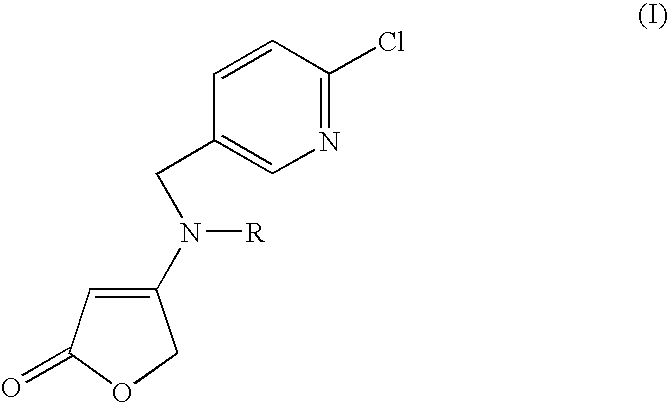
-
- where
- R represents methyl or cyclopropyl,
and at least one compound selected from the active compound groups (1) to (24) listed in the description have very good insecticidal and fungicidal properties.
Description

-
- where
- R represents methyl or cyclopropyl,
and at least one active compound selected from Groups (2) to (24) below:
Group (2) Strobilurins of the General Formula (II)

in which
- A1 represents one of the groups

- A2 represents NH or O,
- A3 represents N or CH,
- L represents one of the groups

-
- where the bond marked with an asterisk (*) is attached to the phenyl ring,
- R11 represents phenyl, phenoxy or pyridinyl, each of which is optionally mono- or disubstituted by identical or different substituents from the group consisting of chlorine, cyano, methyl and trifluoromethyl, or represents 1-(4-chlorophenyl)pyrazol-3-yl or represents 1,2-propanedione-bis(O-methyloxime)-1-yl,
- R12 represents hydrogen or fluorine;
Group (3) Triazoles of the General Formula (III)

in which
- Q represents hydrogen or SH,
- m represents 0 or 1,
- R13 represents hydrogen, fluorine, chlorine, phenyl or 4-chlorophenoxy,
- R14 represents hydrogen or chlorine,
- A4 represents a direct bond, —CH2—, —(CH2)2—, —O—, represents *—CH2—CHR17— or *—CH═CR17—, where the bond marked with * is attached to the phenyl ring, in which case
- R15 and R17 together represent —CH2—CH2—CH[CH(CH3)2]— or —CH2—CH2—C(CH3)2—,
- A5 represents C or Si (silicon),
- A4 further represents —N(R17)— and A5 furthermore together with R15 and R16 represents the group C═N—R18, in which case R17 and R18 together represent the group

- where the bond marked with * is attached to R17,
- R15 represents hydrogen, hydroxyl or cyano,
- R16 represents 1-cyclopropylethyl, 1-chlorocyclopropyl, C1-C4-alkyl, C1-C6-hydroxyalkyl, C1-C4-alkylcarbonyl, C1-C2-haloalkoxy-C1-C2-alkyl, trimethylsilyl-C1-C2-alkyl, monofluorophenyl or phenyl,
- R15 and R16 furthermore together represent —O—CH2—CH(R18)—O—, —O—CH2—CH(R18)—CH2—, or —O—CH-(2-chlorophenyl)-,
- R18 represents hydrogen, C1-C4-alkyl or bromine;
Group (4) Sulphenamides of the General Formula (IV)

in which R19 represents hydrogen or methyl;
Group (5) Valinamides Selected from
- (5-1) iprovalicarb
- (5-2) N1-[2-(4-{[3-(4-chlorophenyl)-2-propynyl]oxy}-3-methoxyphenyl)ethyl]-N2-(methylsulphonyl)-D-valinamide
- (5-3) benthiavalicarb
Group (6) Carboxamides of the General Formula (V)

in which
- X represents 2-chloro-3-pyridinyl, represents 1-methylpyrazol-4-yl which is substituted in the 3-position by methyl or trifluoromethyl and in the 5-position by hydrogen or chlorine, represents 4-ethyl-2-ethylamino-1,3-thiazol-5-yl, represents 1-methylcyclohexyl, represents 2,2-dichloro-1-ethyl-3-methylcyclopropyl, represents 2-fluoro-2-propyl, 3,4-dichloroisothiazol-5-yl, 5,6-dihydro-2-methyl-1,4-oxathiin-3-yl, 4-methyl-1,2,3-thiadiazol-5-yl, 4,5-dimethyl-2-trimethylsilylthiophen-3-yl, 1-methylpyrrol-3-yl which is substituted in the 4-position by methyl or trifluoromethyl and in the 5-position by hydrogen or chlorine, or represents phenyl which is mono- to trisubstituted by identical or different substituents from the group consisting of chlorine, methyl and trifluoromethyl,
- Y represents a direct bond, C1-C6-alkanediyl (alkylene) which is optionally substituted by chlorine, cyano or oxo, represents C2-C6-alkenediyl (alkenylene) or thiophenediyl,
- Z represents hydrogen, C1-C6-alkyl or the group

in which
- A6 represents CH or N,
- R20 represents hydrogen, chlorine, cyano, C1-C6-alkyl, phenyl which is optionally mono- or disubstituted by identical or different substituents from the group consisting of chlorine and di(C1-C3-alkyl)aminocarbonyl,
- R21 represents hydrogen, chlorine or isopropoxy,
- R22 represents hydrogen, chlorine, hydroxyl, methyl, trifluoromethyl or di(C1-C3-alkyl)aminocarbonyl,
- R20 and R21 furthermore together represent *—CH(CH3)—CH2—C(CH3)2— or *—CH(CH3)—O—C(CH3)2— where the bond marked with * is attached to R20;
Group (7) Dithiocarbamates Selected from - (7-1) mancozeb
- (7-2) maneb
- (7-3) metiram
- (7-4) propineb
- (7-5) thiram
- (7-6) zineb
- (7-7) ziram
Group (8) Acylalanines of the General Formula (VI)

in which
- * marks a carbon atom in the R or the S configuration, preferably in the S configuration,
- R23 represents benzyl, furyl or methoxymethyl;
Group (9): Anilinopyrimidines of the General Formula (VII)

in which
- R24 represents methyl, cyclopropyl or 1-propynyl;
Group (10): Benzimidazoles of the General Formula (VIII)

in which
- R25 and R26 each represent hydrogen or together represent —O—CF2—O—,
- R27 represents hydrogen, C1-C4-alkylaminocarbonyl or represents 3,5-dimethylisoxazol-4-ylsulphonyl,
- R28 represents chlorine, methoxycarbonylamino, chlorophenyl, furyl or thiazolyl;
Group (11): Carbamates of the General Formula (IX)

in which
- R29 represents n- or isopropyl,
- R30 represents di(C1-C2-alkyl)amino-C2-C4-alkyl or diethoxyphenyl,
- salts of these compounds also being included;
Group (12): Dicarboximides Selected from - (12-1) captafol
- (12-2) captan
- (12-3) folpet
- (12-4) iprodione
- (12-5) procymidone
- (12-6) vinclozolin
Group (13): Guanidines Selected from - (13-1) dodine
- (13-2) guazatine
- (13-3) iminoctadine triacetate
- (13-4) iminoctadine tris(albesilate)
Group (14): Imidazoles Selected from - (14-1) cyazofamid
- (14-2) prochloraz
- (14-3) triazoxide
- (14-4) pefurazoate
Group (15): Morpholines of the General Formula (X)

in which
- R31 and R32 independently of one another represent hydrogen or methyl,
- R33 represents C1-C14-alkyl (preferably C12-C14-alkyl), C5-C12-cycloalkyl (preferably C10-C12-cycloalkyl), phenyl-C1-C4-alkyl, which may be substituted in the phenyl moiety by halogen or C1-C4-alkyl or represents acrylyl which is substituted by chlorophenyl and dimethoxyphenyl;
Group (16): Pyrroles of the General Formula (XI)

in which
- R34 represents chlorine or cyano,
- R35 represents chlorine or nitro,
- R36 represents chlorine,
- R35 and R36 furthermore together represent —O—CF2—O—;
Group (17): (Thio)phosphonates Selected from - (17-1) fosetyl-Al,
- (17-2) phosphonic acid,
- (17-3) tolclophos-methyl;
Group (18): Phenylethanamides of the General Formula (XII)

in which
- R37 represents unsubstituted or fluorine-, chlorine-, bromine-, methyl- or ethyl-substituted phenyl, 2-naphthyl, 1,2,3,4-tetrahydronaphthyl or indanyl;
Group (19): Fungicides Selected from - (19-1) acibenzolar-5-methyl
- (19-2) chlorothalonil
- (19-3) cymoxanil
- (19-4) edifenphos
- (19-5) famoxadone
- (19-6) fluazinam
- (19-7) copper oxychloride
- (19-8) copper hydroxide
- (19-9) oxadixyl
- (19-10) spiroxamine
- (19-11) dithianon
- (19-12) metrafenone
- (19-14) 2,3-dibutyl-6-chlorothieno[2,3-d]pyrimidin-4(3H)-one
- (19-15) probenazole
- (19-16) isoprothiolane
- (19-17) kasugamycin
- (19-18) phthalide
- (19-19) ferimzone
- (19-20) tricyclazole
- (19-21) cyprosulfamide
- (19-22) mandipropamid
- (19-23) quinoxyfen (known from EP-A 326 330) of the formula

- (19-24) proquinazid (known from WO 94/26722) of the formula

Group (20): (Thio)urea Derivatives Selected from
- (20-1) pencycuron
- (20-2) thiophanate-methyl
- (20-3) thiophanate-ethyl
Group (21): Amides of the General Formula (XIII)

in which
- A7 represents a direct bond or —O—,
- A8 represents —C(═O)NH— or —NHC(═O)—,
- R38 represents hydrogen or C1-C4-alkyl,
- R39 represents C1-C6-alkyl;
Group (22): Triazolopyrimidines of the General Formula (XIV)

in which
- R40 represents C1-C6-alkyl or C2-C6-alkenyl,
- R41 represents C1-C6-alkyl,
- R40 and R41 furthermore together represent C4-C5-alkanediyl (alkylene) which is mono- or disubstituted by C1-C6-alkyl,
- R42 represents bromine or chlorine,
- R43 and R47 independently of one another represent hydrogen, fluorine, chlorine or methyl,
- R44 and R46 independently of one another represent hydrogen or fluorine,
- R45 represents hydrogen, fluorine or methyl,
Group (23): Iodochromones of the General Formula (XV)

in which
- R48 represents C1-C6-alkyl,
- R49 represents C1-C6-alkyl, C2-C6-alkenyl or C2-C6-alkynyl;
Group (24): Biphenylcarboxamides of the General Formula (XVI)

in which
- R50 represents hydrogen or fluorine,
- R51 represents fluorine, chlorine, bromine, methyl, trifluoromethyl, trifluoromethoxy, —CH═N—OMe or —C(Me)═N—OMe,
- R52 represents hydrogen, fluorine, chlorine, bromine, methyl or trifluoromethyl,
- Het represents one of the radicals Heti to Het? below:

- R53 represents iodine, methyl, difluoromethyl or trifluoromethyl,
- R54 represents hydrogen, fluorine, chlorine or methyl,
- R55 represents methyl, difluoromethyl or trifluoromethyl,
- R56 represents chlorine, bromine, iodine, methyl, difluoromethyl or trifluoromethyl,
- R57 represents methyl or trifluoromethyl.


- (2-1) azoxystrobin (known from EP-A 0 382 375) of the formula

- (2-2) fluoxastrobin (known from DE-A 196 02 095) of the formula

- (2-3) (2E)-2-(2-{[6-(3-chloro-2-methylphenoxy)-5-fluoro-4-pyrimidinyl]oxy}phenyl)-2-(methoxyimino)-N-methylethanamide (known from DE-A 196 46 407, EP-B 0 712 396) of the formula

- (2-4) trifloxystrobin (known from EP-A 0 460 575) of the formula

- (2-5) (2E)-2-(methoxyimino)-N-methyl-2-(2-{[({(1E)-1-[3-(trifluoromethyl)phenyl]ethylidene}-amino)oxy]methyl}phenyl)ethanamide (known from EP-A 0 569 384) of the formula

- (2-6) (2E)-2-(methoxyimino)-N-methyl-2-{2-[(E)-({1-[3-(trifluoromethyl)phenyl)ethoxy}imino)methyl]phenyl}ethanamide (known from EP-A 0 596 254) of the formula

- (2-7) orysastrobin (known from DE-A 195 39 324) of the formula

- (2-8) 5-methoxy-2-methyl-4-(2-{[({(1E)-1-[3-(trifluoromethyl)phenyl]ethylidene}amino)oxy]-methyl}phenyl)-2,4-dihydro-3H-1,2,4-triazol-3-one (known from WO 98/23155) of the formula

- (2-9) kresoxim-methyl (known from EP-A 0 253 213) of the formula

- (2-10) dimoxystrobin (known from EP-A 0 398 692) of the formula

- (2-11) picoxystrobin (known from EP-A 0 278 595) of the formula

- (2-12) pyraclostrobin (known from DE-A 44 23 612) of the formula

- (2-13) metominostrobin (known from EP-A 0 398 692) of the formula

- (3-1) azaconazole (known from DE-A 25 51 560) of the formula

- (3-2) etaconazole (known from DE-A 25 51 560) of the formula

- (3-3) propiconazole (known from DE-A 25 51 560) of the formula

- (3-4) difenoconazole (known from EP-A 0 112 284) of the formula

- (3-5) bromuconazole (known from EP-A 0 258 161) of the formula

- (3-6) cyproconazole (known from DE-A 34 06 993) of the formula

- (3-7) hexaconazole (known from DE-A 30 42 303) of the formula

- (3-8) penconazole (known from DE-A 27 35 872) of the formula

- (3-9) myclobutanil (known from EP-A 0 145 294) of the formula

- (3-10) tetraconazole (known from EP-A 0 234 242) of the formula

- (3-11) flutriafol (known from EP-A 0 015 756) of the formula

- (3-12) epoxiconazole (known from EP-A 0 196 038) of the formula

- (3-13) flusilazole (known from EP-A 0 068 813) of the formula

- (3-14) simeconazole (known from EP-A 0 537 957) of the formula

- (3-15) prothioconazole (known from WO 96/16048) of the formula

- (3-16) fenbuconazole (known from DE-A 37 21 786) of the formula

- (3-17) tebuconazole (known from EP-A 0 040 345) of the formula

- (3-18) ipconazole (known from EP-A 0 329 397) of the formula

- (3-19) metconazole (known from EP-A 0 329 397) of the formula

- (3-20) triticonazole (known from EP-A 0 378 953) of the formula

- (3-21) bitertanol (known from DE-A 23 24 010) of the formula

- (3-22) triadimenol (known from DE-A 23 24 010) of the formula

- (3-23) triadimefon (known from DE-A 22 01 063) of the formula

- (3-24) fluquinconazole (known from EP-A 0 183 458) of the formula

- (3-25) quinconazole (known from EP-A 0 183 458) of the formula

- (4-1) dichlofluanid (known from DE-A 11 93 498) of the formula

- (4-2) tolylfluanid (known from DE-A 11 93 498) of the formula

- (5-1) iprovalicarb (known from DE-A 40 26 966) of the formula

- (5-3) benthiavalicarb (known from WO 96/04252) of the formula

- (6-1) 2-chloro-N-(1,1,3-trimethylindan-4-yl)nicotinamide (known from EP-A 0 256 503) of the formula

- (6-2) boscalid (known from DE-A 195 31 813) of the formula

- (6-3) furametpyr (known from EP-A 0 315 502) of the formula
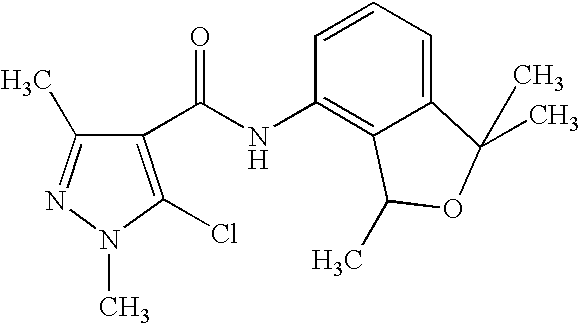
- (6-4) N-(3-p-tolylthiophen-2-yl)-1-methyl-3-trifluoromethyl-1H-pyrazole-4-carboxamide (known from EP-A 0 737 682) of the formula

- (6-5) ethaboxam (known from EP-A 0 639 574) of the formula

- (6-6) fenhexamid (known from EP-A 0 339 418) of the formula

- (6-7) carpropamid (known from EP-A 0 341 475) of the formula

- (6-8) 2-chloro-4-(2-fluoro-2-methylpropionylamino)-N,N-dimethylbenzamide (known from EP-A 0 600 629) of the formula

- (6-9) fluopicolid (known from WO 99/42447) of the formula

- (6-10) zoxamide (known from EP-A 0 604 019) of the formula

- (6-12) carboxin (known from U.S. Pat. No. 3,249,499) of the formula

- (6-13) tiadinil (known from U.S. Pat. No. 6,616,054) of the formula

- (6-14) penthiopyrad (known from EP-A 0 737 682) of the formula

- (6-15) silthiofam (known from WO 96/18631) of the formula

- (6-16) N-[2-(1,3-dimethylbutyl)phenyl]-1-methyl-4-(trifluoromethyl)-1H-pyrrole-3-carboxamide (known from WO 02/38542) of the formula

- (6-17) flutolanil (known from DE-A 27 31 522) of the formula

- (6-18) N-[2-(1,3-dimethylbutyl)phenyl]-5-fluoro-1,3-dimethyl-1H-pyrazole-4-carboxamide (known from EP-A 1 414 803) of the formula

- (6-20) N-[2-(1,3-dimethylbutyl)phenyl]-2-(trifluoromethyl)benzamide (known from EP-A 1 519 913) of the formula

- (6-21) N-[2-(1,3-dimethylbutyl)phenyl]-2-iodobenzamide (known from EP-A 1 519 913) of the formula

- (6-22) N-(4′-chloro-3′-fluorobiphenyl-2-yl)-4-(difluoromethyl)-2-methyl-1,3-thiazole-5-carboxamide (known from EP-A 1 404 407) of the formula

- (6-23) N-[5-(4-chlorophenyl)pyrimidin-4-yl]-2-iodo-N-(2-iodobenzoyl)benzamide of the formula

- (6-24) N-(3′,4′-dichlorobiphenyl-2-yl)-2-methyl-4-(trifluoromethyl)-1,3-thiazole-5-carboxamide (known from EP-A 1 474 406) of the formula

- (7-1) mancozeb (known from DE-A 12 34 704) having the IUPAC name manganese ethylenebis(dithiocarbamate) (polymeric) complex with zinc salt
- (7-2) maneb (known from U.S. Pat. No. 2,504,404) of the formula

- (7-3) metiram (known from DE-A 10 76 434) having the IUPAC name zinc ammoniate ethylenebis(dithiocarbamate)-poly(ethylenethiuram disulphide)
- (7-4) propineb (known from GB 935 981) of the formula

- (7-5) thiram (known from U.S. Pat. No. 1,972,961) of the formula

- (7-6) zineb (known from DE-A 10 81 446) of the formula

- (7-7) ziram (known from U.S. Pat. No. 2,588,428) of the formula

- (8-1) benalaxyl (known from DE-A 29 03 612) of the formula

- (8-2) furalaxyl (known from DE-A 25 13 732) of the formula

- (8-3) metalaxyl (known from DE-A 25 15 091) of the formula

- (8-4) metalaxyl-M (known from WO 96/01559) of the formula

- (8-5) benalaxyl-M of the formula

- (9-1) cyprodinil (known from EP-A 0 310 550) of the formula

- (9-2) mepanipyrim (known from EP-A 0 270 111) of the formula

- (9-3) pyrimethanil (known from DD 151 404) of the formula

- (10-1) 6-chloro-5-[(3,5-dimethylisoxazol-4-yl)sulphonyl]-2,2-difluoro-5H-[1,3]dioxolo[4,5-f]-benzimidazole (known from WO 97/06171) of the formula

- (10-2) benomyl (known from U.S. Pat. No. 3,631,176) of the formula

- (10-3) carbendazim (known from U.S. Pat. No. 3,010,968) of the formula

- (10-4) chlorfenazole of the formula

- (10-5) fuberidazole (known from DE-A 12 09 799) of the formula

- (10-6) thiabendazole (known from U.S. Pat. No. 3,206,468) of the formula

- (11-1) diethofencarb (known from EP-A 0 078 663) of the formula

- (11-2) propamocarb (known from U.S. Pat. No. 3,513,241) of the formula

- (11-3) propamocarb-hydrochloride (known from U.S. Pat. No. 3,513,241) of the formula

- (11-4) propamocarb-fosetyl of the formula

- (12-1) captafol (known from U.S. Pat. No. 3,178,447) of the formula

- (12-2) captan (known from U.S. Pat. No. 2,553,770) of the formula
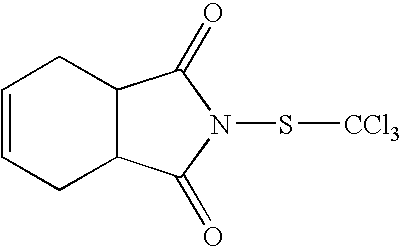
- (12-3) folpet (known from U.S. Pat. No. 2,553,770) of the formula

- (12-4) iprodione (known from DE-A 21 49 923) of the formula

- (12-5) procymidone (known from DE-A 20 12 656) of the formula

- (12-6) vinclozolin (known from DE-A 22 07 576) of the formula

- (13-1) dodine (known from GB 11 03 989) of the formula

- (13-2) guazatine (known from GB 11 14 155)
- (13-3) iminoctadine triacetate (known from EP-A 0 155 509) of the formula

- (14-1) cyazofamid (known from EP-A 0 298 196) of the formula

- (14-2) prochloraz (known from DE-A 24 29 523) of the formula

- (14-3) triazoxide (known from DE-A 28 02 488) of the formula

- (14-4) pefurazoate (known from EP-A 0 248 086) of the formula

- (15-1) aldimorph (known from DD 140 041) of the formula

- (15-2) tridemorph (known from GB 988 630) of the formula

- (15-3) dodemorph (known from DE-A 25 432 79) of the formula

- (15-4) fenpropimorph (known from DE-A 26 56 747) of the formula

- (15-5) dimethomorph (known from EP-A 0 219 756) of the formula

- (15-6) flumorph (known from EP-A 0 860 438) of the formula

- (16-1) fenpiclonil (known from EP-A 0 236 272) of the formula

- (16-2) fludioxonil (known from EP-A 0 206 999) of the formula

- (16-3) pyrrolnitrin (known from JP 65-25876) of the formula

- (17-1) fosetyl-Al (known from DE-A 24 56 627) of the formula

- (17-2) phosphonic acid (known chemical) of the formula

- (17-3) tolclofos-methyl (known from DE-A 25 01 040) of the formula

- (18-1) the compound 2-(2,3-dihydro-1H-inden-5-yl)-N-[2-(3,4-dimethoxyphenyl)ethyl]-2-(methoxyimino)acetamide of the formula

- (18-2) the compound N-[2-(3,4-dimethoxyphenyl)ethyl]-2-(methoxyimino)-2-(5,6,7,8-tetrahydro-naphthalen-2-yl)acetamide of the formula

- (18-3) the compound 2-(4-chlorophenyl)-N-[2-(3,4-dimethoxyphenyl)ethyl]-2-(methoxyimino)-acetamide of the formula

- (18-4) the compound 2-(4-bromophenyl)-N-[2-(3,4-dimethoxyphenyl)ethyl]-2-(methoxyimino)-acetamide of the formula

- (18-5) the compound 2-(4-methylphenyl)-N-[2-(3,4-dimethoxyphenyl)ethyl]-2-(methoxyimino)-acetamide of the formula

- (18-6) the compound 2-(4-ethylphenyl)-N-[2-(3,4-dimethoxyphenyl)ethyl]-2-(methoxyimino)-acetamide of the formula

- (19-1) acibenzolar-5-methyl (known from EP-A 0 313 512) of the formula

- (19-2) chlorothalonil (known from U.S. Pat. No. 3,290,353) of the formula

- (19-3) cymoxanil (known from DE-A 23 12 956) of the formula

- (19-4) edifenphos (known from DE-A 14 93 736) of the formula

- (19-5) famoxadone (known from EP-A 0 393 911) of the formula

- (19-6) fluazinam (known from EP-A 0 031 257) of the formula

- (19-7) copper oxychloride
- (19-9) oxadixyl (known from DE-A 30 30 026) of the formula

- (19-10) spiroxamine (known from DE-A 37 35 555) of the formula

- (19-11) dithianon (known from JP-A 44-29464) of the formula

- (19-12) metrafenone (known from EP-A 0 897 904) of the formula

- (19-13) 2,3-dibutyl-6-chlorothieno[2,3-d]pyrimidin-4(3H)one (known from WO 99/14202) of the formula

- (19-14) probenazole (known from U.S. Pat. No. 3,629,428) of the formula

- (19-15) isoprothiolane (known from U.S. Pat. No. 3,856,814) of the formula

- (19-16) kasugamycin (known from GB 1 094 567) of the formula

- (19-17) phthalide (known from JP-A 57-55844) of the formula

- (19-18) ferimzone (known from EP-A 0 019 450) of the formula

- (19-19) tricyclazole (known from DE-A 22 50 077) of the formula

- (19-20) cyprosulfamide of the formula

- (19-21) mandipropamid (known from WO 01/87822) of the formula

- (20-1) pencycuron (known from DE-A 27 32 257) of the formula

- (20-2) thiophanate-methyl (known from DE-A 18 06 123) of the formula

- (20-3) thiophanate-ethyl (known from DE-A 18 06 123) of the formula

- (21-1) fenoxanil (known from EP-A 0 262 393) of the formula

- (21-2) diclocymet (known from JP-A 7-206608) of the formula

- (22-1) 5-chloro-N-[(1S)-2,2,2-trifluoro-1-methylethyl]-6-(2,4,6-trifluorophenyl) [1,2,4]triazolo-[1,5-a]pyrimidine-7-amine (known from U.S. Pat. No. 5,986,135) of the formula

- (22-2) 5-chloro-N-[(1R)-1,2-dimethylpropyl]-6-(2,4,6-trifluorophenyl) [1,2,4]triazolo[1,5-a]-pyrimidine-7-amine (known from WO 02/38565) of the formula

- (22-3) 5-chloro-6-(2-chloro-6-fluorophenyl)-7-(4-methylpiperidin-1-yl) [1,2,4]triazolo[1,5-a]-pyrimidine (known from U.S. Pat. No. 5,593,996) of the formula

- (22-4) 5-chloro-6-(2,4,6-trifluorophenyl)-7-(4-methylpiperidin-1-yl) [1,2,4]triazolo[1,5-a]-pyrimidine (known from DE-A 101 24 208) of the formula

- (23-1) 2-butoxy-6-iodo-3-propylbenzopyran-4-one (known from WO 03/014103) of the formula

- (23-2) 2-ethoxy-6-iodo-3-propylbenzopyran-4-one (known from WO 03/014103) of the formula

- (23-3) 6-iodo-2-propoxy-3-propylbenzopyran-4-one (known from WO 03/014103) of the formula

- (23-4) 2-but-2-ynyloxy-6-iodo-3-propylbenzopyran-4-one (known from WO 03/014103) of the formula

- (23-5) 6-iodo-2-(1-methylbutoxy)-3-propylbenzopyran-4-one (known from WO 03/014103) of the formula

- (23-6) 2-but-3-enyloxy-6-iodobenzopyran-4-one (known from WO 03/014103) of the formula

- (23-7) 3-butyl-6-iodo-2-isopropoxybenzopyran-4-one (known from WO 03/014103) of the formula

- (24-1) N-(3′,4′-dichloro-5-fluoro-1,1′-biphenyl-2-yl)-3-(difluoromethyl)-1-methyl-1H-pyrazole-4-carboxamide (known from WO 03/070705) of the formula

- (24-2) 3-(difluoromethyl)-N-{3′-fluoro-4′-[(E)-(methoxyimino)methyl]-1,1′-biphenyl-2-yl}-1-methyl-1H-pyrazole-4-carboxamide (known from WO 02/08197) of the formula

- (24-3) 3-(trifluoromethyl)-N-{3′-fluoro-4′-[(E)-(methoxyimino)methyl]-1,1′-biphenyl-2-yl}-1-methyl-1H-pyrazole-4-carboxamide (known from WO 02/08197) of the formula

- (24-4) N-(3′,4′-dichloro-1,1′-biphenyl-2-yl)-5-fluoro-1,3-dimethyl-1H-pyrazole-4-carboxamide (known from WO 00/14701) of the formula

- (24-5) N-(4′-chloro-3′-fluoro-1,1′-biphenyl-2-yl)-2-methyl-4-(trifluoromethyl)-1,3-thiazole-5-carboxamide (known from WO 03/066609) of the formula

- (24-6) N-(4′-chloro-1,1′-biphenyl-2-yl)-4-(difluoromethyl)-2-methyl-1,3-thiazole-5-carboxamide (known from WO 03/066610) of the formula

- (24-7) N-(4′-bromo-1,1′-biphenyl-2-yl)-4-(difluoromethyl)-2-methyl-1,3-thiazole-5-carboxamide (known from WO 03/066610) of the formula

- (24-8) 4-(difluoromethyl)-2-methyl-N-[4′-(trifluoromethyl)-1,1′-biphenyl-2-yl]-1,3-thiazole-5-carboxamide (known from WO 03/066610) of the formula


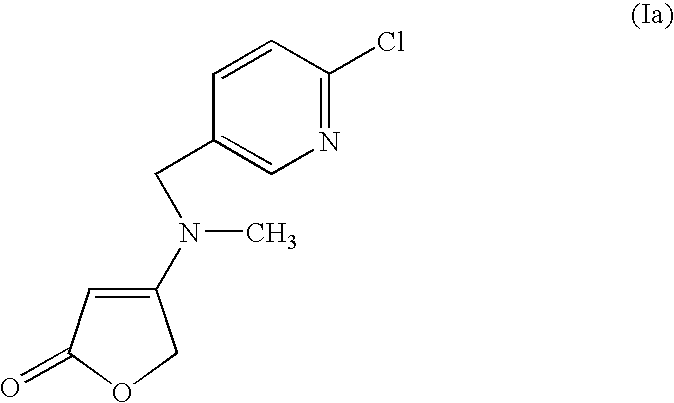
and a compound selected from Groups (2) to (24).

and a compound selected from Groups (2) to (24).
- (2-1) azoxystrobin
- (2-2) fluoxastrobin
- (2-3) (2E)-2-(2-{[6-(3-chloro-2-methylphenoxy)-5-fluoro-4-pyrimidinyl]oxy}phenyl)-2-(methoxyimino)-N-methylethanamide
- (2-4) trifloxystrobin
- (2-5) (2E)-2-(methoxyimino)-N-methyl-2-(2-{[({(1E)-1-[3-(trifluoromethyl)-phenyl]ethylidene}amino)oxy]methyl}phenyl)ethanamide
- (2-6) (2E)-2-(methoxyimino)-N-methyl-2-{2-[(E)-({1-[3-(trifluoromethyl)phenyl]-ethoxy}imino)methyl]phenyl}ethanamide
- (2-8) 5-methoxy-2-methyl-4-(2-{[({(1E)-1-[3-(trifluoromethyl)phenyl]ethylidene}-amino)oxy]methyl}phenyl)-2,4-dihydro-3H-1,2,4-triazol-3-one
- (2-9) kresoxim-methyl
- (2-10) dimoxystrobin
- (2-11) picoxystrobin
- (2-12) pyraclostrobin
- (2-13) metominostrobin
- (3-3) propiconazole
- (3-4) difenoconazole
- (3-6) cyproconazole
- (3-7) hexaconazole
- (3-8) penconazole
- (3-9) myclobutanil
- (3-10) tetraconazole
- (3-12) epoxiconazole
- (3-13) flusilazole
- (3-15) prothioconazole
- (3-16) fenbuconazole
- (3-17) tebuconazole
- (3-18) ipconazole
- (3-19) metconazole
- (3-20) triticonazole
- (3-21) bitertanol
- (3-22) triadimenol
- (3-23) triadimefon
- (3-24) fluquinconazole
- (4-1) dichlofluanid
- (4-2) tolylfluanid
- (5-1) iprovalicarb
- (5-3) benthiavalicarb
- (6-2) boscalid
- (6-5) ethaboxam
- (6-6) fenhexamid
- (6-7) carpropamid
- (6-8) 2-chloro-4-[(2-fluoro-2-methylpropanoyl)amino]-N,N-dimethylbenzamide
- (6-9) fluopicolid
- (6-10) zoxamide
- (6-11) 3,4-dichloro-N-(2-cyanophenyl)isothiazole-5-carboxamide
- (6-14) penthiopyrad
- (6-16) N-[2-(1,3-dimethylbutyl)phenyl]-1-methyl-4-(trifluoromethyl)-1H-pyrrole-3-carboxamide
- (6-17) flutolanil
- (6-18) N-[2-(1,3-dimethylbutyl)phenyl]-5-fluoro-1,3-dimethyl-1H-pyrazole-4-carboxamide
- (7-1) mancozeb
- (7-2) maneb
- (7-4) propineb
- (7-5) thiram
- (7-6) zineb
- (8-1) benalaxyl
- (8-2) furalaxyl
- (8-3) metalaxyl
- (8-4) metalaxyl-M
- (8-5) benalaxyl-M
- (9-1) cyprodinil
- (9-2) mepanipyrim
- (9-3) pyrimethanil
- (10-1) 6-chloro-5-[(3,5-dimethylisoxazol-4-yl)sulphonyl]-2,2-difluoro-5H-[1,3]dioxolo[4,5-f]-benzimidazole
- (10-3) carbendazim
- (11-1) diethofencarb
- (11-2) propamocarb
- (11-3) propamocarb-hydrochloride
- (11-4) propamocarb-fosetyl
- (12-2) captan
- (12-3) folpet
- (12-4) iprodione
- (12-5) procymidone
- (13-1) dodine
- (13-2) guazatine
- (13-3) iminoctadine triacetate
- (14-1) cyazofamid
- (14-2) prochloraz
- (14-3) triazoxide
- (15-4) fenpropimorph
- (15-5) dimethomorph
- (15-6) flumorph
- (16-2) fludioxonil
- (17-1) fosetyl-Al
- (17-2) phosphonic acid
- (17-3) tolclofos-methyl
- (19-1) acibenzolar-5-methyl
- (19-2) chlorothalonil
- (19-3) cymoxanil
- (19-5) famoxadone
- (19-6) fluazinam
- (19-7) copper oxychloride
- (19-9) oxadixyl
- (19-10) spiroxamine
- (19-21) cyprosulfamide
- (19-22) mandipropamid
- (20-1) pencycuron
- (20-2) thiophanate-methyl
- (22-1) 5-chloro-N-[(1S)-2,2,2-trifluoro-1-methylethyl]-6-(2,4,6-trifluorophenyl) [1,2,4]-triazolo[1,5-a]pyrimidine-7-amine
- (22-2) 5-chloro-N-[(1R)-1,2-dimethylpropyl]-6-(2,4,6-trifluorophenyl) [1,2,4]triazolo[1,5-a]-pyrimidine-7-amine
- (22-4) 5-chloro-6-(2,4,6-trifluorophenyl)-7-(4-methylpiperidin-1-yl)[1,2,4-triazolo[1,5-a]pyrimidine
- (23-1) 2-butoxy-6-iodo-3-propylbenzopyran-4-one
- (23-2) 2-ethoxy-6-iodo-3-propylbenzopyran-4-one
- (23-3) 6-iodo-2-propoxy-3-propylbenzopyran-4-one
- (24-1) N-(3′,4′-dichloro-5-fluoro-1,1′-biphenyl-2-yl)-3-(difluoromethyl)-1-methyl-1H-pyrazole-4-carboxamide
- (24-3) 3-(trifluoromethyl)-N-{3′-fluoro-4′-[(E)-(methoxyimino)methyl]-1,1′-biphenyl-2-yl}-1-methyl-1H-pyrazole-4-carboxamide
- (24-7) N-(4′-bromo-1,1′-biphenyl-2-yl)-4-(difluoromethyl)-2-methyl-1,3-thiazole-5-carboxamide.
- (2-2) fluoxastrobin
- (2-3) (2E)-2-(2-{[6-(3-chloro-2-methylphenoxy)-5-fluoro-4-pyrimidinyl]oxy}phenyl)-2-(methoxyimino)-N-methylethanamide
- (2-4) trifloxystrobin
- (3-15) prothioconazole
- (3-17) tebuconazole
- (3-18) ipconazole
- (3-20) triticonazole
- (3-21) bitertanol
- (3-22) triadimenol
- (3-24) fluquinconazole
- (4-1) dichlofluanid
- (4-2) tolylfluanid
- (5-1) iprovalicarb
- (6-6) fenhexamid
- (6-7) carpropamid
- (6-9) fluopicolid
- (6-14) penthiopyrad
- (6-17) flutolanil
- (6-18) N-[2-(1,3-dimethylbutyl)phenyl]-5-fluoro-1,3-dimethyl-1H-pyrazole-4-carboxamide
- (7-4) propineb
- (7-5) thiram
- (8-3) metalaxyl
- (8-4) metalaxyl-M
- (8-5) benalaxyl-M
- (9-3) pyrimethanil
- (10-3) carbendazim
- (11-4) propamocarb-fosetyl
- (12-4) iprodione
- (14-2) prochloraz
- (14-3) triazoxide
- (16-2) fludioxonil
- (17-3) tolclofos-methyl
- (19-10) spiroxamine
- (19-21) cyprosulfamide
- (19-22) mandipropamid
- (20-1) pencycuron
- (22-4) 5-chloro-6-(2,4,6-trifluorophenyl)-7-(4-methylpiperidin-1-yl) [1,2,4]triazolo[1,5-a]-pyrimidine
- (24-1) N-(3′,4′-dichloro-5-fluoro-1,1′-biphenyl-2-yl)-3-(difluoromethyl)-1-methyl-1H-pyrazole-4-carboxamide.
- (2-2) fluoxastrobin
- (2-4) trifloxystrobin
- (3-15) prothioconazole
- (3-17) tebuconazole
- (3-18) ipconazole
- (3-20) triticonazole
- (3-22) triadimenol
- (6-7) carpropamid
- (6-18) N-[2-(1,3-dimethylbutyl)phenyl]-5-fluoro-1,3-dimethyl-1H-pyrazole-4-carboxamide
- (7-5) thiram
- (8-3) metalaxyl
- (8-4) metalaxyl-M
- (19-21) cyprosulfamide
- (20-1) pencycuron
- (24-1) N-(3′,4′-dichloro-5-fluoro-1,1′-biphenyl-2-yl)-3-(difluoromethyl)-1-methyl-1H-pyrazole-4-carboxamide.
| Active | |
| compound | Active compound |
| of group 1 | of groups 2 to 24 |
| (Ia) | (2-2) fluoxastrobin |
| (Ia) | (2-4) trifloxystrobin |
| (Ia) | (3-15) prothioconazole |
| (Ia) | (3-17) tebuconazole |
| (Ia) | (3-18) ipconazole |
| (Ia) | (3-20) triticonazole |
| (Ia) | (3-22) triadimenol |
| (Ia) | (6-7) carpropamid |
| (Ia) | (6-18) N-[2-(1,3-dimethylbutyl)phenyl]-5-fluoro-1,3-dimethyl- |
| 1H-pyrazole-4-carboxamide | |
| (Ia) | (7-5) thiram |
| (Ia) | (8-3) metalaxyl |
| (Ia) | (8-4) metalaxyl-M |
| (Ia) | (19-21) cyprosulfamide |
| (Ia) | (20-1) pencycuron |
| (Ia) | (24-1) N-(3′,4′-dichloro-5-fluoro-1,1′-biphenyl-2-yl)-3- |
| (difluoromethyl)-1-methyl-1H-pyrazole-4-carboxamide | |
| (Ib) | (2-2) fluoxastrobin |
| (Ib) | (2-4) trifloxystrobin |
| (Ib) | (3-15) prothioconazole |
| (Ib) | (3-17) tebuconazole |
| (Ib) | (3-18) ipconazole |
| (Ib) | (3-20) triticonazole |
| (Ib) | (3-22) triadimenol |
| (Ib) | (6-7) carpropamid |
| (Ib) | (6-18) N-[2-(1,3-dimethylbutyl)phenyl]-5-fluoro-1,3-dimethyl- |
| 1H-pyrazole-4-carboxamide | |
| (Ib) | (7-5) thiram |
| (Ib) | (8-3) metalaxyl |
| (Ib) | (8-4) metalaxyl-M |
| (Ib) | (19-21) cyprosulfamide |
| (Ib) | (20-1) pencycuron |
| (Ib) | (24-1) N-(3′,4′-dichloro-5-fluoro-1,1′-biphenyl-2-yl)-3- |
| (difluoromethyl)-1-methyl-1H-pyrazole-4-carboxamide | |
| Particularly | ||
| Preferred | preferred | |
| Mixing partner | mixing ratio | mixing ratio |
| Group (2): | strobilurins | 125:1 to 1:2000 | 50:1 to 1:1000 |
| Group (3): | triazoles | 125:1 to 1:2000 | 50:1 to 1:1000 |
| Group (4): | sulphenamides | 500:1 to 1:25 | 250:1 to 1:1 |
| Group (5): | valinamides | 125:1 to 1:2000 | 50:1 to 1:1000 |
| Group (6): | carboxamides except | 125:1 to 1:2000 | 50:1 to 1:1000 |
| for (6-6) | |||
| (6-6) | 500:1 to 1:25 | 250:1 to 1:1 | |
| Group (7): | dithiocarbamates | 500:1 to 1:25 | 250:1 to 1:1 |
| Group (8): | acylalanines | 125:1 to 1:2000 | 50:1 to 1:1000 |
| Group (9): | anilinopyrimidines | 500:1 to 1:25 | 250:1 to 1:1 |
| Group (10): | benzimidazoles | 125:1 to 1:2000 | 50:1 to 1:1000 |
| Group (11): | carbamates | 500:1 to 1:25 | 250:1 to 1:1 |
| Group (12): | dicarboximides | 500:1 to 1:25 | 250:1 to 1:1 |
| Group (13): | guanidines | 125:1 to 1:2000 | 50:1 to 1:1000 |
| Group (14): | imidazoles | 125:1 to 1:2000 | 50:1 to 1:1000 |
| Group (15): | morpholines | 125:1 to 1:2000 | 50:1 to 1:1000 |
| Group (16): | pyrroles | 125:1 to 1:2000 | 50:1 to 1:1000 |
| Group (17): | (thio)phosphonates | 500:1 to 1:25 | 250:1 to 1:1 |
| Group (18): | phenylethanamides | 125:1 to 1:2000 | 50:1 to 1:1000 |
| (19-1): | acibenzolar-S-methyl | 125:1 to 1:2000 | 50:1 to 1:1000 |
| (19-2): | chlorothalonil | 500:1 to 1:25 | 250:1 to 1:1 |
| (19-3): | cymoxanil | 125:1 to 1:2000 | 50:1 to 1:1000 |
| (19-4): | edifenphos | 125:1 to 1:2000 | 50:1 to 1:1000 |
| (19-5): | famoxadone | 125:1 to 1:2000 | 50:1 to 1:1000 |
| (19-6): | fluazinam | 125:1 to 1:2000 | 50:1 to 1:1000 |
| (19-7): | copper oxychloride | 500:1 to 1:25 | 250:1 to 1:1 |
| (19-8): | copper hydroxide | 500:1 to 1:25 | 250:1 to 1:1 |
| (19-9): | oxadixyl | 125:1 to 1:2000 | 50:1 to 1:1000 |
| (19-10): | spiroxamine | 125:1 to 1:2000 | 50:1 to 1:1000 |
| (19-11) | dithianon | 500:1 to 1:25 | 250:1 to 1:1 |
| (19-12) | metrafenone | 125:1 to 1:2000 | 50:1 to 1:1000 |
| (19-14): | 2,3-dibutyl-6-chlorothieno- | 125:1 to 1:2000 | 50:1 to 1:1000 |
| [2,3-d]pyrimidin-4(3H)one | |||
| (19-15): | probenazole | 125:1 to 1:2000 | 50:1 to 1:1000 |
| (19-16): | isoprothiolane | 125:1 to 1:2000 | 50:1 to 1:1000 |
| (19-17): | kasugamycin | 125:1 to 1:2000 | 50:1 to 1:1000 |
| (19-18): | phthalide | 125:1 to 1:2000 | 50:1 to 1:1000 |
| (19-19): | ferimzone | 125:1 to 1:2000 | 50:1 to 1:1000 |
| (19-20): | tricyclazole | 125:1 to 1:2000 | 50:1 to 1:1000 |
| (19-21): | cyprosulfamide | 125:1 to 1:2000 | 50:1 to 1:1000 |
| (19-22) | 2-(4-chlorophenyl)-N-{2- | 125:1 to 1:2000 | 50:1 to 1:1000 |
| [3-methoxy-4-(prop-2-yn- | |||
| 1-yloxy)-phenyl]ethyl}- | |||
| 2-prop-2-yn-1- | |||
| yloxy)acetamide | |||
| Group (20): | (thio)urea derivatives | 125:1 to 1:2000 | 50:1 to 1:1000 |
| Group (21): | amides | 125:1 to 1:2000 | 50:1 to 1:1000 |
| Group (22): | triazolopyrimidines | 125:1 to 1:2000 | 50:1 to 1:1000 |
| Group (23): | iodochromones | 125:1 to 1:2000 | 50:1 to 1:1000 |
| Group (24): | biphenylcarboxamides | 125:1 to 1:2000 | 50:1 to 1:1000 |
molluscicides such as fentin acetate, metaldehyde, methiocarb, niclosamid, thiodicarb and trimethacarb;
or conventional antifouling active compounds such as 4,5-dichloro-2-octyl-4-isothiazolin-3-one, diiodomethylparatryl sulphone, 2-(N,N-dimethylthiocarbamoylthio)-5-nitrothiazyl, potassium salts, copper salts, sodium salts and zinc salts of 2-pyridinethiol 1-oxide, pyridine-triphenylborane, tetrabutyldistannoxane, 2,3,5,6-tetrachloro-4-(methylsulphonyl)pyridine, 2,4,5,6-tetrachloroisophthalonitrile, tetramethylthiuram disulphide and 2,4,6-trichlorophenylmaleimide.
- X is the kill rate or efficacy, expressed in % of the untreated control, when employing active compound A at an application rate of m ppm or g/ha,
- Y is the kill rate or efficacy, expressed in % of the untreated control, when employing active compound B at an application rate of n ppm or g/ha and
- E is the kill rate or efficacy, expressed in % of the untreated control, when employing active compounds A and B at application rates of m and n ppm or g/ha,
then
| TABLE A |
| Plant-damaging insects |
| Aphis gossypii test |
| Concentration | Kill | |
| Active compound | in ppm | in % after 1d |
| compound (Ib) | 0.8 | 30 |
| metalaxyl | 100 | 10 |
| found* | calc.** | ||
| compound (Ib) + metalaxyl | 0.8 + 100 | 60 | 37 |
| (1:125) according to the invention | |||
| Concentration | Kill | |
| Active compound | in ppm | in % after 6d |
| compound (Ia) | 0.8 | 70 |
| 0.16 | 40 | |
| compound (Ib) | 0.8 | 40 |
| fludioxonil | 100 | 0 |
| found* | calc.** | ||
| compound (Ia) + fludioxonil | 0.8 + 100 | 95 | 70 |
| (1:125) according to the invention | |||
| trifloxystrobin | 100 | 40 |
| found* | calc.** | ||
| compound (Ia) + trifloxystrobin | 0.8 + 100 | 95 | 82 |
| (1:125) according to the invention | 0.16 + 100 | 80 | 64 |
| found* | calc.** | ||
| compound (Ib) + trifloxystrobin | 0.8 + 100 | 95 | 64 |
| (1:125) according to the invention | |||
| *found = activity found | |||
| **calc. = activity calculated using Colby's formula | |||
| TABLE B |
| Plant-damaging insects |
| Myzus persicae test |
| Concentration | Kill | |
| Active compound | in ppm | in % after 1d |
| compound (Ia) | 0.8 | 40 |
| 0.16 | 0 | |
| compound (Ib) | 4 | 75 |
| fludioxonil | 100 | 0 |
| found* | calc.** | ||
| compound (Ia) + fludioxonil | 0.16 + 100 | 30 | 0 |
| (1:625) according to the invention | |||
| metalaxyl | 100 | 0 |
| found* | calc.** | ||
| compound (Ia) + metalaxyl | 0.8 + 100 | 70 | 40 |
| (1:125) according to the invention | |||
| prothioconazole | 100 | 0 |
| found* | calc.** | ||
| compound (Ib) + prothioconazole | 4 + 100 | 95 | 75 |
| (1:25) according to the invention | |||
| Concentration | Kill | |
| Active compound | in ppm | in % after 6d |
| compound (Ia) | 0.8 | 75 |
| prothioconazole | 100 | 0 |
| found* | calc.** | ||
| compound (Ia) + prothioconazole | 0.8 + 100 | 98 | 75 |
| (1:125) according to the invention | |||
| *found = activity found | |||
| **calc. = activity calculated using Colby's formula | |||
| TABLE C |
| Plant-damaging insects |
| Phaedon cochleariae test |
| Concentration | Kill | |
| Active compound | in ppm | in % after 3d |
| compound (Ib) | 200 | 60 |
| propamocarb | 200 | 5 |
| found* | calc.** | ||
| compound (Ib) + propamocarb | 200 + 200 | 80 | 62 |
| (1:1) according to the invention | |||
| *found = activity found | |||
| **calc. = activity calculated using Colby's formula | |||
Claims (22)


Applications Claiming Priority (4)
| Application Number | Priority Date | Filing Date | Title |
|---|---|---|---|
| DE102006023263 | 2006-05-18 | ||
| DE102006023263A DE102006023263A1 (en) | 2006-05-18 | 2006-05-18 | Synergistic drug combinations |
| DE102006023263.1 | 2006-05-18 | ||
| PCT/EP2007/004375 WO2007134778A2 (en) | 2006-05-18 | 2007-05-16 | Synergistic active ingredient combinations |
Publications (2)
| Publication Number | Publication Date |
|---|---|
| US20090280981A1 US20090280981A1 (en) | 2009-11-12 |
| US8324130B2 true US8324130B2 (en) | 2012-12-04 |
Family
ID=38607938
Family Applications (1)
| Application Number | Title | Priority Date | Filing Date |
|---|---|---|---|
| US12/301,150 Expired - Fee Related US8324130B2 (en) | 2006-05-18 | 2007-05-16 | Synergistic active ingredient combinations |
Country Status (14)
| Country | Link |
|---|---|
| US (1) | US8324130B2 (en) |
| EP (1) | EP2023724B8 (en) |
| JP (1) | JP2009537468A (en) |
| KR (1) | KR20090011012A (en) |
| CN (1) | CN101448396B (en) |
| AT (1) | ATE541461T1 (en) |
| AU (1) | AU2007251932A1 (en) |
| BR (1) | BRPI0711919B1 (en) |
| DE (1) | DE102006023263A1 (en) |
| MX (1) | MX2008014416A (en) |
| RU (1) | RU2008149768A (en) |
| UA (1) | UA93714C2 (en) |
| WO (1) | WO2007134778A2 (en) |
| ZA (1) | ZA200809714B (en) |
Cited By (1)
| Publication number | Priority date | Publication date | Assignee | Title |
|---|---|---|---|---|
| US9241493B2 (en) | 2011-06-14 | 2016-01-26 | Bayer Intellectual Property Gmbh | Use of an enaminocarbonyl compound in combination with a biological control agent |
Families Citing this family (10)
| Publication number | Priority date | Publication date | Assignee | Title |
|---|---|---|---|---|
| DE102006046161A1 (en) * | 2006-09-29 | 2008-04-03 | Bayer Cropscience Ag | New crystalline modified 4-((6-chloro-pyridin-3-ylmethyl)-methyl-amino)-5H-furan-2-one exhibiting reflex positions using copper potassium-alpha-radiation, useful e.g. to combat pest and harmful insects |
| EP2107058A1 (en) * | 2008-03-31 | 2009-10-07 | Bayer CropScience AG | Substituted enaminothiocarbonyl compounds |
| CN104255733B (en) * | 2009-03-25 | 2016-05-04 | 拜尔农作物科学股份公司 | There is synergistic active ingredient combination |
| UA104887C2 (en) | 2009-03-25 | 2014-03-25 | Баєр Кропсаєнс Аг | Synergic combinations of active ingredients |
| CN101755755B (en) * | 2009-11-03 | 2012-11-14 | 深圳诺普信农化股份有限公司 | Bactericidal composite taking fluazinam as main ingredient |
| CN102057907B (en) * | 2010-11-26 | 2013-06-26 | 广东中迅农科股份有限公司 | Sterilization composite containing dithianon and chlorothalonil and application thereof |
| CN102246760A (en) * | 2011-04-30 | 2011-11-23 | 江西海科瑞特作物科学有限公司 | Bactericidal composition containing fluopicolide and metalaxyl |
| CN103783057B (en) * | 2014-01-26 | 2016-04-06 | 上海艳紫化工科技有限公司 | Thiophanate-methyl and the composite agricultural chemicals suspension agent of Tebuconazole |
| CN103798291B (en) * | 2014-02-18 | 2016-01-20 | 中国水稻研究所 | A kind of Recompounded pesticide containing triazolone and Cupravit |
| CN106135252A (en) * | 2015-04-13 | 2016-11-23 | 南京华洲药业有限公司 | A kind of containing Boscalid and the bactericidal composition of prochloraz-manganese chloride complex and application |
Citations (130)
| Publication number | Priority date | Publication date | Assignee | Title |
|---|---|---|---|---|
| US1972961A (en) | 1931-05-26 | 1934-09-11 | Du Pont | Disinfectant |
| US2504404A (en) | 1946-06-12 | 1950-04-18 | Du Pont | Manganous ethylene bis-dithiocarbamate and fungicidal compositions containing same |
| US2553770A (en) | 1948-05-18 | 1951-05-22 | Standard Oil Dev Co | Parasiticidal compounds containing the nsccll3 group |
| US2588428A (en) | 1945-04-02 | 1952-03-11 | Goodrich Co B F | Complex amine products with dialkyl zinc dithiocarbamates as pesticides |
| US3010968A (en) | 1959-11-25 | 1961-11-28 | Du Pont | Process for manufacture of certain alkyl esters of benzimidazole carbamic acids |
| GB935981A (en) | 1960-12-28 | 1963-09-04 | Bayer Ag | Fungicidal carbamic acid salts |
| GB988630A (en) | 1961-02-22 | 1965-04-07 | Basf Ag | N-substituted morpholines having fungicidal activity |
| US3178447A (en) | 1964-05-05 | 1965-04-13 | California Research Corp | N-polyhaloalkylthio compounds |
| US3206468A (en) | 1963-11-15 | 1965-09-14 | Merck & Co Inc | Methods of preparing benzimidazoles |
| US3248400A (en) | 1957-08-17 | 1966-04-26 | Basf Ag | Fungicidal agents containing dithiocarbamate and thiuram disulfide radicals |
| US3249499A (en) | 1965-04-26 | 1966-05-03 | Us Rubber Co | Control of plant diseases |
| US3285929A (en) | 1960-11-03 | 1966-11-15 | Bayer Ag | Fungicidal compounds containing the nscfcl2-groups |
| US3290353A (en) | 1963-04-01 | 1966-12-06 | Diamond Alkali Co | Halogenated aromatic nitriles |
| GB1094567A (en) | 1964-06-23 | 1967-12-13 | Zh Biseibutsu Kagaku Kenkyukai | Plant disease protective and curative compositions |
| GB1103989A (en) | 1967-02-10 | 1968-02-21 | Union Carbide Corp | Fungicidal concentrates |
| GB1114155A (en) | 1964-08-24 | 1968-05-15 | Evans Medical Ltd | Guanidino derivatives |
| US3499951A (en) | 1965-08-26 | 1970-03-10 | Bayer Ag | O-alkyl,s,s-diaryl dithiophosphates |
| US3513241A (en) | 1966-12-17 | 1970-05-19 | Schering Ag | Fungicidal and fungistatic n-(dialkylaminoalkyl) - carbamic acid and thiocarbamic acid esters |
| US3546813A (en) | 1964-05-14 | 1970-12-15 | Bayer Ag | Fungicidal compositions |
| US3629428A (en) | 1967-09-07 | 1971-12-21 | Meiji Seika Kaisha | Pesticide for controlling bacterial and fungal diseases of rice plant |
| US3631176A (en) | 1970-07-20 | 1971-12-28 | Du Pont | Carbamoyl substituted 2-aminobenzimidazoles |
| US3745170A (en) | 1969-03-19 | 1973-07-10 | Sumitomo Chemical Co | Novel n-(3,5-dihalophenyl)-imide compounds |
| US3745187A (en) | 1967-10-30 | 1973-07-10 | Nippon Soda Co | Bis-thioureido-benzenes and preparation thereof |
| US3755350A (en) | 1970-10-06 | 1973-08-28 | Rhone Poulenc Sa | Substituted 3-phenyl hydantoins useful as fungicides |
| US3856814A (en) | 1971-02-02 | 1974-12-24 | Nihon Nohyaku Co Ltd | Olan-2-ylidenemalonates |
| US3912752A (en) | 1972-01-11 | 1975-10-14 | Bayer Ag | 1-Substituted-1,2,4-triazoles |
| US3952002A (en) | 1973-05-12 | 1976-04-20 | Bayer Aktiengesellschaft | Triazolyl-O,N-acetals |
| US3966750A (en) | 1972-02-18 | 1976-06-29 | Basf Aktiengesellschaft | N-3,5-dichlorophenyloxazalidines |
| US3991071A (en) | 1973-06-21 | 1976-11-09 | The Boots Company Limited | Fungicidal compositions containing substituted imidazoles |
| US4046911A (en) | 1974-04-02 | 1977-09-06 | Ciba-Geigy Corporation | N-(substituted phenyl)-n-furanoyl-alanine methyl esters and their use in fungicidal composition and methods |
| CA1022458A (en) | 1971-10-12 | 1977-12-13 | Charles J. Paget (Jr.) | Benzothiazole compounds for controlling plant pathogenic organisms |
| US4068077A (en) | 1975-09-27 | 1978-01-10 | Basf Aktiengesellschaft | Manufacture of N-substituted tetrahydro-1,4-oxazines |
| US4079062A (en) | 1974-11-18 | 1978-03-14 | Janssen Pharmaceutica N.V. | Triazole derivatives |
| US4093743A (en) | 1976-07-12 | 1978-06-06 | Nihon Nohyaku Co., Ltd. | Novel benzoic anilide derivative and fungicide containing same |
| CA1040530A (en) | 1972-03-15 | 1978-10-17 | E.I. Du Pont De Nemours And Company | 2-cyano-2-hydroxyiminoacetamides and acetates as plant disease control agents |
| US4127673A (en) | 1976-07-20 | 1978-11-28 | Nihon Tokushu Noyaku Seizo K.K. | Combating fungi with new N-4-halobenzyl-N-cycloalkyl-N'-phenylureas and thioureas |
| US4139616A (en) | 1973-12-14 | 1979-02-13 | Pepro | Fungicidal compositions based on phosphorous acid esters and salts thereof |
| CA1049547A (en) | 1974-01-14 | 1979-02-27 | Toshiro Kato | Soil fungicidal phosphorothioate |
| US4151299A (en) | 1974-04-09 | 1979-04-24 | Ciba-Geigy Corporation | Certain aniline derivatives as microbicidal agents |
| CA1086734A (en) | 1976-12-15 | 1980-09-30 | Walter Himmele | Morpholine derivatives |
| US4239760A (en) | 1978-01-20 | 1980-12-16 | Bayer Aktiengesellschaft | Combating fungi and bacteria with 3-azolyl-benzo-1,2,4-triazines and 1-oxides thereof |
| DE3030026A1 (en) | 1980-08-08 | 1981-03-26 | Sandoz-Patent-GmbH, 79539 Lörrach | Fungicidal 3-acylamino-oxazolidinone derivs. - prepd. by cyclisation of 2-haloethyl 2-acyl-2-phenyl-hydrazine carboxylate cpds. |
| US4291049A (en) | 1978-02-02 | 1981-09-22 | Montedison S.P.A. | Acyl anilines exerting a fungicidal action |
| US4331670A (en) | 1979-12-25 | 1982-05-25 | Ishihara Sangyo Kaisha, Ltd. | Pyridylanilines |
| US4341782A (en) | 1979-05-15 | 1982-07-27 | Takeda Chemical Industries, Ltd. | Pyrimidine derivatives and agricultural uses |
| US4432989A (en) | 1980-07-18 | 1984-02-21 | Sandoz, Inc. | αAryl-1H-imidazole-1-ethanols |
| US4496551A (en) | 1981-06-24 | 1985-01-29 | E. I. Du Pont De Nemours And Company | Fungicidal imidazole derivatives |
| US4532341A (en) | 1980-05-16 | 1985-07-30 | Bayer Aktiengesellschaft | Oxirane compounds |
| US4551469A (en) | 1979-03-07 | 1985-11-05 | Imperial Chemical Industries Plc | Antifungal triazole ethanol derivatives |
| US4598085A (en) | 1977-04-27 | 1986-07-01 | Janssen Pharmaceutica N.V. | Fungicidal 1-(2-aryl-2-R-ethyl)-1H-1,2,4-triazoles |
| US4608385A (en) | 1981-10-29 | 1986-08-26 | Sumitomo Chemical Company, Limited | Fungicidal N-phenylcarbamates |
| US4652580A (en) | 1985-03-29 | 1987-03-24 | Basf Aktiengesellschaft | Application of azolylmethyloxiranes for the treatment of viral diseases |
| US4659739A (en) | 1984-02-24 | 1987-04-21 | Dainippon Ink And Chemicals, Inc. | Agricultural and horticultural guanidine-type fungicide and process for production thereof |
| US4664696A (en) | 1983-03-04 | 1987-05-12 | Sandoz Ltd. | α-phenyl- or benzyl-α-cyclopropylalkylene-1H-imidazole- and 1,2,4-triazole-1-ethanols and use against fungus |
| US4705800A (en) | 1985-06-21 | 1987-11-10 | Ciba-Geigy Corporation | Difluorbenzodioxyl cyanopyrrole microbicidal compositions |
| EP0258161A2 (en) | 1986-08-22 | 1988-03-02 | Rhone-Poulenc Agrochimie | 2,5-Dihydrofuran derivatives with a triazole or imidazole group, preparation process, use as a fungicide |
| US4731106A (en) | 1984-11-24 | 1988-03-15 | Schering Agrochemicals Limited | Fungicidal azole compounds |
| EP0262393A1 (en) | 1986-08-29 | 1988-04-06 | Shell Internationale Researchmaatschappij B.V. | Derivatives of aryloxycarbonic acids, their preparation and their use |
| US4829085A (en) | 1986-07-16 | 1989-05-09 | Basf Aktiengesellschaft | Oxime ethers and fungicides containing these compounds |
| US4840959A (en) | 1986-08-12 | 1989-06-20 | Mitsubishi Chemical Industries Limited | Pyridinecarboxamide derivatives and their use as fungicide |
| US4851405A (en) | 1987-03-07 | 1989-07-25 | Bayer Aktiengesellschaft | Aminomethyl heterocyclic compounds |
| EP0329397A1 (en) | 1988-02-16 | 1989-08-23 | Kureha Kagaku Kogyo Kabushiki Kaisha | Process for producing azolylmethylcyclopentanol derivatives |
| US4877441A (en) | 1987-11-06 | 1989-10-31 | Sumitomo Chemical Company Ltd. | Fungicidal substituted carboxylic acid derivatives |
| US4902705A (en) | 1985-12-12 | 1990-02-20 | Ube Industries, Ltd. | Imidazole derivatives, an antibacterial and antifungal agent comprising said derivatives, and a process for the production of said imidazole derivatives |
| US4910200A (en) | 1985-10-09 | 1990-03-20 | Celamerck Gmbh & Co. Kg | Acrylic acid morpholides, fungicidal compositions and use |
| US4920139A (en) | 1983-11-10 | 1990-04-24 | Rohm And Haas Company | Alpha-alkyl-alpha-(4-halophenyl)-1H-1,2,4-triazole-1-propanenitrile |
| US4931560A (en) | 1987-09-28 | 1990-06-05 | Ciba-Geigy Corporation | Pesticides |
| US4931581A (en) | 1987-08-21 | 1990-06-05 | Ciba-Geigy Corporation | Process and a composition for immunizing plants against diseases |
| US4957933A (en) | 1989-04-21 | 1990-09-18 | E. I. Du Pont De Nemours And Company | Fungicidal oxazolidinones |
| US4988734A (en) | 1988-05-07 | 1991-01-29 | Bayer Aktiengesellschaft | Fungicidal stereoisomers of N-(R)-(1-aryl-ethyl)-1-alkyl-2,2,-dichloro-cyclopropanecarboxamides |
| US4992438A (en) | 1986-12-03 | 1991-02-12 | Kumiai Chemical Industry Co., Ltd. | Pyrimidine derivatives, process for preparing the same and agricultural or horticultural fungicidal composition containing the same |
| US4995898A (en) | 1987-03-13 | 1991-02-26 | Ishihara Sangyo Kaisha, Ltd. | Imidazole compounds and biocidal composition comprising the same for controlling harmful organisms |
| US5021581A (en) | 1987-02-09 | 1991-06-04 | Imperial Chemical Industries Plc | Fungicides |
| US5059623A (en) | 1988-04-29 | 1991-10-22 | Bayer Aktiengesellschaft | Substituted cycloalkyl- and heterocyclyl-carboxanilides |
| US5081141A (en) | 1986-01-23 | 1992-01-14 | Montedison S.P.A. | Fungicidal azolyl-derivatives |
| US5087635A (en) | 1986-07-02 | 1992-02-11 | Rohm And Haas Company | Alpha-aryl-alpha-phenylethyl-1H-1,2,4-triazole-1-propanenitriles |
| US5112849A (en) | 1986-03-04 | 1992-05-12 | Ciba-Geigy Corporation | Fungicidal use of a cyanopyrrole derivative and method for producing same |
| US5145856A (en) | 1989-02-10 | 1992-09-08 | Imperial Chemical Industries Plc | Fungicides |
| US5185342A (en) | 1989-05-17 | 1993-02-09 | Shionogi Seiyaku Kabushiki Kaisha | Alkoxyiminoacetamide derivatives and their use as fungicides |
| EP0539588A1 (en) | 1990-07-05 | 1993-05-05 | Nippon Soda Co., Ltd. | Amine derivative |
| US5221691A (en) | 1991-01-30 | 1993-06-22 | Imperial Chemical Industries Plc | Fungicides aromatic oxime amides |
| US5254584A (en) | 1992-12-18 | 1993-10-19 | Rohm And Haas Company | N-acetonylbenzamides and their use as fungicides |
| US5256683A (en) | 1988-12-29 | 1993-10-26 | Rhone-Poulenc Agrochimie | Fungicidal compositions containing (benzylidene)-azolylmethylcycloalkane |
| US5266585A (en) | 1981-05-12 | 1993-11-30 | Ciba-Geigy Corporation | Arylphenyl ether derivatives, compositions containing these compounds and use thereof |
| US5304572A (en) | 1992-12-01 | 1994-04-19 | Rohm And Haas Company | N-acetonylbenzamides and their use as fungicides |
| US5306712A (en) | 1991-10-09 | 1994-04-26 | Sanyo Company, Limited | Fungicidal silicon-containing compounds and their agrochemical and medicinal uses |
| US5334607A (en) | 1991-05-28 | 1994-08-02 | Basf Aktiengesellschaft | Methods for treating mycoses |
| US5407902A (en) | 1992-10-02 | 1995-04-18 | Mitsubishi Kasei Corporation | Methoxyiminoacetic acid derivative and agricultural/horticultural fungicide containing the same as active ingredient |
| US5453531A (en) | 1990-08-25 | 1995-09-26 | Bayer Aktiengesellschaft | Substituted valinamide derivatives |
| US5486621A (en) | 1994-12-15 | 1996-01-23 | Monsanto Company | Fungicides for the control of take-all disease of plants |
| US5514643A (en) | 1993-08-16 | 1996-05-07 | Lucky Ltd. | 2-aminothiazolecarboxamide derivatives, processes for preparing the same and use thereof for controlling phytopathogenic organisms |
| US5593996A (en) | 1991-12-30 | 1997-01-14 | American Cyanamid Company | Triazolopyrimidine derivatives |
| US5679676A (en) | 1993-08-11 | 1997-10-21 | Bayer Aktiengesellschaft | Substituted azadioxacycloalkenes and their use as fungicides |
| US5723491A (en) | 1994-07-11 | 1998-03-03 | Novartis Corporation | Fungicidal composition and method of controlling fungus infestation |
| US5747497A (en) | 1993-05-12 | 1998-05-05 | E. I. Du Pont De Nemours And Company | Fungicidal fused bicyclic pyrimidinones |
| US5747518A (en) | 1995-04-11 | 1998-05-05 | Mitsui Toatsu Chemicals, Inc. | Substituted thiophene derivative and agricultural and horticultural fungicide containing the same as active ingredient |
| WO1998023155A1 (en) | 1996-11-26 | 1998-06-04 | E.I. Du Pont De Nemours And Company | Arthropodicidal and fungicidal cyclic amides |
| US5789428A (en) | 1994-08-03 | 1998-08-04 | Kumiai Chemical Industry Co. Ltd. | Amino-acid amide derivatives, processes for preparing the same, agricultural or horticultural fungicides, and method for killing fungi |
| US5789430A (en) | 1994-11-21 | 1998-08-04 | Bayer Aktiengesellschaft | Triazolyl derivatives |
| EP0860438A1 (en) | 1997-02-21 | 1998-08-26 | Shenyang Research Institute of Chemical Industry | Fluorine-containing diphenyl acrylamide antimicrobial agents |
| US5869517A (en) | 1994-07-06 | 1999-02-09 | Basf Aktiengesellschaft | 2- (dihydro)pyrazol-3'-yloxymethylene!anilides, their preparation and their use |
| US5922905A (en) | 1997-08-20 | 1999-07-13 | American Cyanamid Company | 5-bromo-2-methoxy-6-alkyl benzoic acids |
| US5948932A (en) | 1995-10-23 | 1999-09-07 | Basf Aktiengesellschaft | Phenylacetic acid derivatives, processes and intermediates for use in producing them and agents containing them |
| US5986135A (en) | 1998-09-25 | 1999-11-16 | American Cyanamid Company | Fungicidal trifluoromethylalkylamino-triazolopyrimidines |
| US5998450A (en) | 1995-08-30 | 1999-12-07 | Basf Aktiengesellschaft | Heterocyclically substituted biphenylamine derivatives, their preparation and their use as fungicides |
| US6056554A (en) | 1998-09-09 | 2000-05-02 | Samole; Sidney | Apparatus and method for finding and identifying nighttime sky objects |
| US6103717A (en) | 1996-01-22 | 2000-08-15 | Bayer Aktiengesellschaft | Halogen pyrimidines and its use thereof as parasite abatement means |
| US6277858B1 (en) | 1997-09-12 | 2001-08-21 | Syngenta Crop Protection, Inc. | Pyrimidin-4-one and pyrimidin-4-thione as fungicide |
| US20010018442A1 (en) | 1996-11-11 | 2001-08-30 | Herbert Gayer | Halogen pyrimidinyl aryl (thio)ethers as pesticides |
| US6355634B1 (en) | 1990-06-05 | 2002-03-12 | Bayer Aktiengesellschaft | Aromatic compounds |
| US20020198222A1 (en) | 2001-05-18 | 2002-12-26 | Rainer Bruns | Use of triazolopyrimidine derivatives as microbicides |
| US20030027842A1 (en) | 1995-08-10 | 2003-02-06 | Lutz Assmann | Halogenobenzimidazoles |
| US20030093133A1 (en) | 2001-07-12 | 2003-05-15 | Crowe Louis Michael | Method and apparatus for electrical stimulation |
| US6616054B1 (en) | 2001-07-02 | 2003-09-09 | Bellsouth Intellectual Property Corporation | External power supply system, apparatus and method for smart card |
| US20030171410A1 (en) | 1998-02-19 | 2003-09-11 | Aventis Cropscience Uk Limited | 2-pyridylmethylamine derivatives useful as fungicides |
| US6683211B1 (en) | 2000-05-17 | 2004-01-27 | Syngenta Crop Protection, Inc. | Phenyl-propargylether derivatives |
| US20040039043A1 (en) | 2000-07-24 | 2004-02-26 | Hans-Ludwig Elbe | Biphenyl carboxamides |
| US20040110771A1 (en) | 2000-11-13 | 2004-06-10 | Blasco Jordi Tormo I | 7-(r)-aminotriazolopyrimidines, the production thereof and use of the same for combatting phytopathogenic fungi |
| WO2004080181A1 (en) | 2003-03-13 | 2004-09-23 | Bayer Cropscience Aktiengesellschaft | Synergistic active substance combinations |
| US20040192672A1 (en) | 2001-08-03 | 2004-09-30 | Thomas Wegmann | Iodobenzopyran-4-one derivatives having fungicidal activity |
| US20040204470A1 (en) | 2001-07-25 | 2004-10-14 | Hans-Ludwig Elbe | Pyrazoylcarboxanilides as fungicides |
| US20050119130A1 (en) | 2000-11-08 | 2005-06-02 | Harald Walter | Pyrrolcarboxamides and pyrrolcarbothioamides and their agrochemical uses |
| US20050124815A1 (en) | 2002-02-04 | 2005-06-09 | Hans-Ludwig Elbe | Difluoromethyl thiazolyl carboxanilides |
| US20050143428A1 (en) | 2002-02-04 | 2005-06-30 | Ralf Dunkel | Disubstituted thiazolyl carboxanilides and their use as microbicides |
| WO2006037475A1 (en) * | 2004-10-01 | 2006-04-13 | Bayer Cropscience Ag | Agents used for the treatment of seeds |
| WO2006040016A1 (en) * | 2004-10-08 | 2006-04-20 | Bayer Cropscience Aktiengesellschaft | Fungicidal combinations of active ingredients |
| US20060116414A1 (en) | 2002-02-19 | 2006-06-01 | Ralf Dunkel | Disubstituted pyrazolyl carboxanilides |
| US20060211771A1 (en) | 2002-07-02 | 2006-09-21 | Hans-Ludwig Elbe | Phenyl benzamides |
| US20070060579A1 (en) | 2003-10-10 | 2007-03-15 | Ulrike Wachendorff-Neumann | Synergistic fungicidal active substance combinations |
| US20090018015A1 (en) | 2003-10-23 | 2009-01-15 | Ulrike Wachendorff-Neumann | Synergistic Fungicidal Active Combinations |
Family Cites Families (20)
| Publication number | Priority date | Publication date | Assignee | Title |
|---|---|---|---|---|
| AR205189A1 (en) | 1974-04-02 | 1976-04-12 | Ciba Geigy Ag | DERIVATIVES OF N- (1 "-METOXI-CARBONILETIL) -N- (FURAN- (2") CARBONIL) 2-6-DIMETILANILINA USEFUL AS MICROBICIDE AGENTS LESS FOR PHARMACEUTICAL USES AND PROCEDURE FOR OBTAINING THEM |
| OA04979A (en) | 1974-04-09 | 1980-11-30 | Ciba Geigy | New aniline derivatives useful as microbicidal agents and their preparation process. |
| NZ179111A (en) | 1974-11-18 | 1978-03-06 | Janssen Pharmaceutica Nv | I-(aryl)-ethyl-1h-1,2,4-triazole ketals,anti-microbial and plant growth controlling compositions |
| AU515134B2 (en) | 1976-08-10 | 1981-03-19 | Janssen Pharmaceutica N.V. | 1-(2-aryl-2-r-ethyl)-1h-1,2,4-triazoles |
| US4654332A (en) | 1979-03-07 | 1987-03-31 | Imperial Chemical Industries Plc | Heterocyclic compounds |
| US4272417A (en) | 1979-05-22 | 1981-06-09 | Cargill, Incorporated | Stable protective seed coating |
| US4245432A (en) | 1979-07-25 | 1981-01-20 | Eastman Kodak Company | Seed coatings |
| DE3042303A1 (en) | 1979-11-13 | 1981-08-27 | Sandoz-Patent-GmbH, 7850 Lörrach | ORGANIC COMPOUNDS, THEIR PRODUCTION AND USE |
| BR8203631A (en) | 1981-06-24 | 1983-06-14 | Du Pont | AGRICULTURAL COMPOUND PROCESS FOR ITS PREPARATION AND COMPOSITION TO CONTROL MOLESTIES CAUSED BY FUNGI |
| FI834141A7 (en) | 1982-11-16 | 1984-05-17 | Ciba Geigy Ag | FOERFARANDE FOER FRAMSTAELLNING AV NYA ARYL PHENYLETHER DERIVATIVES. |
| CA1227801A (en) | 1983-11-10 | 1987-10-06 | Ted T. Fujimoto | .alpha.-ALKYL-.alpha.-(4-HALOPHENYL)-1H-1,2,4-TRIAZOLE-1- PROPANENITRILES |
| IL78175A (en) | 1985-03-29 | 1989-10-31 | Basf Ag | Azolylmethyloxiranes,their preparation and their use as fungicide crop protection agents |
| CA1321588C (en) | 1986-07-02 | 1993-08-24 | Katherine Eleanor Flynn | Alpha-aryl-alpha-phenylethyl-1h-1,2,4-triazole-1- propanenitriles |
| US4808430A (en) | 1987-02-27 | 1989-02-28 | Yazaki Corporation | Method of applying gel coating to plant seeds |
| CA2006309C (en) | 1988-12-29 | 2001-12-18 | Jean Hutt | Azolylmethylcyclopentane benzylidene fungicide |
| GB8903019D0 (en) | 1989-02-10 | 1989-03-30 | Ici Plc | Fungicides |
| US5876739A (en) | 1996-06-13 | 1999-03-02 | Novartis Ag | Insecticidal seed coating |
| US6503904B2 (en) | 1998-11-16 | 2003-01-07 | Syngenta Crop Protection, Inc. | Pesticidal composition for seed treatment |
| US6660690B2 (en) | 2000-10-06 | 2003-12-09 | Monsanto Technology, L.L.C. | Seed treatment with combinations of insecticides |
| US20020134012A1 (en) | 2001-03-21 | 2002-09-26 | Monsanto Technology, L.L.C. | Method of controlling the release of agricultural active ingredients from treated plant seeds |
-
2006
- 2006-05-18 DE DE102006023263A patent/DE102006023263A1/en not_active Withdrawn
-
2007
- 2007-05-16 WO PCT/EP2007/004375 patent/WO2007134778A2/en not_active Ceased
- 2007-05-16 MX MX2008014416A patent/MX2008014416A/en not_active Application Discontinuation
- 2007-05-16 US US12/301,150 patent/US8324130B2/en not_active Expired - Fee Related
- 2007-05-16 AU AU2007251932A patent/AU2007251932A1/en not_active Abandoned
- 2007-05-16 CN CN2007800178962A patent/CN101448396B/en not_active Expired - Fee Related
- 2007-05-16 KR KR1020087029890A patent/KR20090011012A/en not_active Withdrawn
- 2007-05-16 EP EP07725290A patent/EP2023724B8/en not_active Not-in-force
- 2007-05-16 AT AT07725290T patent/ATE541461T1/en active
- 2007-05-16 JP JP2009510350A patent/JP2009537468A/en not_active Withdrawn
- 2007-05-16 UA UAA200814562A patent/UA93714C2/en unknown
- 2007-05-16 RU RU2008149768/04A patent/RU2008149768A/en not_active Application Discontinuation
- 2007-05-16 BR BRPI0711919A patent/BRPI0711919B1/en not_active IP Right Cessation
-
2008
- 2008-11-14 ZA ZA200809714A patent/ZA200809714B/en unknown
Patent Citations (133)
| Publication number | Priority date | Publication date | Assignee | Title |
|---|---|---|---|---|
| US1972961A (en) | 1931-05-26 | 1934-09-11 | Du Pont | Disinfectant |
| US2588428A (en) | 1945-04-02 | 1952-03-11 | Goodrich Co B F | Complex amine products with dialkyl zinc dithiocarbamates as pesticides |
| US2504404A (en) | 1946-06-12 | 1950-04-18 | Du Pont | Manganous ethylene bis-dithiocarbamate and fungicidal compositions containing same |
| US2553770A (en) | 1948-05-18 | 1951-05-22 | Standard Oil Dev Co | Parasiticidal compounds containing the nsccll3 group |
| US3248400A (en) | 1957-08-17 | 1966-04-26 | Basf Ag | Fungicidal agents containing dithiocarbamate and thiuram disulfide radicals |
| US3010968A (en) | 1959-11-25 | 1961-11-28 | Du Pont | Process for manufacture of certain alkyl esters of benzimidazole carbamic acids |
| US3285929A (en) | 1960-11-03 | 1966-11-15 | Bayer Ag | Fungicidal compounds containing the nscfcl2-groups |
| GB935981A (en) | 1960-12-28 | 1963-09-04 | Bayer Ag | Fungicidal carbamic acid salts |
| GB988630A (en) | 1961-02-22 | 1965-04-07 | Basf Ag | N-substituted morpholines having fungicidal activity |
| US3290353A (en) | 1963-04-01 | 1966-12-06 | Diamond Alkali Co | Halogenated aromatic nitriles |
| US3206468A (en) | 1963-11-15 | 1965-09-14 | Merck & Co Inc | Methods of preparing benzimidazoles |
| US3178447A (en) | 1964-05-05 | 1965-04-13 | California Research Corp | N-polyhaloalkylthio compounds |
| US3546813A (en) | 1964-05-14 | 1970-12-15 | Bayer Ag | Fungicidal compositions |
| GB1094567A (en) | 1964-06-23 | 1967-12-13 | Zh Biseibutsu Kagaku Kenkyukai | Plant disease protective and curative compositions |
| GB1114155A (en) | 1964-08-24 | 1968-05-15 | Evans Medical Ltd | Guanidino derivatives |
| US3249499A (en) | 1965-04-26 | 1966-05-03 | Us Rubber Co | Control of plant diseases |
| US3499951A (en) | 1965-08-26 | 1970-03-10 | Bayer Ag | O-alkyl,s,s-diaryl dithiophosphates |
| US3513241A (en) | 1966-12-17 | 1970-05-19 | Schering Ag | Fungicidal and fungistatic n-(dialkylaminoalkyl) - carbamic acid and thiocarbamic acid esters |
| GB1103989A (en) | 1967-02-10 | 1968-02-21 | Union Carbide Corp | Fungicidal concentrates |
| US3629428A (en) | 1967-09-07 | 1971-12-21 | Meiji Seika Kaisha | Pesticide for controlling bacterial and fungal diseases of rice plant |
| US3745187A (en) | 1967-10-30 | 1973-07-10 | Nippon Soda Co | Bis-thioureido-benzenes and preparation thereof |
| US3745170A (en) | 1969-03-19 | 1973-07-10 | Sumitomo Chemical Co | Novel n-(3,5-dihalophenyl)-imide compounds |
| US3631176A (en) | 1970-07-20 | 1971-12-28 | Du Pont | Carbamoyl substituted 2-aminobenzimidazoles |
| US3755350A (en) | 1970-10-06 | 1973-08-28 | Rhone Poulenc Sa | Substituted 3-phenyl hydantoins useful as fungicides |
| US3856814A (en) | 1971-02-02 | 1974-12-24 | Nihon Nohyaku Co Ltd | Olan-2-ylidenemalonates |
| CA1022458A (en) | 1971-10-12 | 1977-12-13 | Charles J. Paget (Jr.) | Benzothiazole compounds for controlling plant pathogenic organisms |
| US3912752A (en) | 1972-01-11 | 1975-10-14 | Bayer Ag | 1-Substituted-1,2,4-triazoles |
| US3966750A (en) | 1972-02-18 | 1976-06-29 | Basf Aktiengesellschaft | N-3,5-dichlorophenyloxazalidines |
| CA1040530A (en) | 1972-03-15 | 1978-10-17 | E.I. Du Pont De Nemours And Company | 2-cyano-2-hydroxyiminoacetamides and acetates as plant disease control agents |
| US3952002A (en) | 1973-05-12 | 1976-04-20 | Bayer Aktiengesellschaft | Triazolyl-O,N-acetals |
| US3991071A (en) | 1973-06-21 | 1976-11-09 | The Boots Company Limited | Fungicidal compositions containing substituted imidazoles |
| US4139616A (en) | 1973-12-14 | 1979-02-13 | Pepro | Fungicidal compositions based on phosphorous acid esters and salts thereof |
| CA1049547A (en) | 1974-01-14 | 1979-02-27 | Toshiro Kato | Soil fungicidal phosphorothioate |
| US4046911A (en) | 1974-04-02 | 1977-09-06 | Ciba-Geigy Corporation | N-(substituted phenyl)-n-furanoyl-alanine methyl esters and their use in fungicidal composition and methods |
| US4151299A (en) | 1974-04-09 | 1979-04-24 | Ciba-Geigy Corporation | Certain aniline derivatives as microbicidal agents |
| US4079062A (en) | 1974-11-18 | 1978-03-14 | Janssen Pharmaceutica N.V. | Triazole derivatives |
| US4068077A (en) | 1975-09-27 | 1978-01-10 | Basf Aktiengesellschaft | Manufacture of N-substituted tetrahydro-1,4-oxazines |
| US4093743A (en) | 1976-07-12 | 1978-06-06 | Nihon Nohyaku Co., Ltd. | Novel benzoic anilide derivative and fungicide containing same |
| US4127673A (en) | 1976-07-20 | 1978-11-28 | Nihon Tokushu Noyaku Seizo K.K. | Combating fungi with new N-4-halobenzyl-N-cycloalkyl-N'-phenylureas and thioureas |
| CA1086734A (en) | 1976-12-15 | 1980-09-30 | Walter Himmele | Morpholine derivatives |
| US4598085A (en) | 1977-04-27 | 1986-07-01 | Janssen Pharmaceutica N.V. | Fungicidal 1-(2-aryl-2-R-ethyl)-1H-1,2,4-triazoles |
| US4239760A (en) | 1978-01-20 | 1980-12-16 | Bayer Aktiengesellschaft | Combating fungi and bacteria with 3-azolyl-benzo-1,2,4-triazines and 1-oxides thereof |
| US4291049A (en) | 1978-02-02 | 1981-09-22 | Montedison S.P.A. | Acyl anilines exerting a fungicidal action |
| US4551469A (en) | 1979-03-07 | 1985-11-05 | Imperial Chemical Industries Plc | Antifungal triazole ethanol derivatives |
| US4341782A (en) | 1979-05-15 | 1982-07-27 | Takeda Chemical Industries, Ltd. | Pyrimidine derivatives and agricultural uses |
| US4331670A (en) | 1979-12-25 | 1982-05-25 | Ishihara Sangyo Kaisha, Ltd. | Pyridylanilines |
| US4532341A (en) | 1980-05-16 | 1985-07-30 | Bayer Aktiengesellschaft | Oxirane compounds |
| US4432989A (en) | 1980-07-18 | 1984-02-21 | Sandoz, Inc. | αAryl-1H-imidazole-1-ethanols |
| DE3030026A1 (en) | 1980-08-08 | 1981-03-26 | Sandoz-Patent-GmbH, 79539 Lörrach | Fungicidal 3-acylamino-oxazolidinone derivs. - prepd. by cyclisation of 2-haloethyl 2-acyl-2-phenyl-hydrazine carboxylate cpds. |
| US5266585A (en) | 1981-05-12 | 1993-11-30 | Ciba-Geigy Corporation | Arylphenyl ether derivatives, compositions containing these compounds and use thereof |
| US4496551A (en) | 1981-06-24 | 1985-01-29 | E. I. Du Pont De Nemours And Company | Fungicidal imidazole derivatives |
| US4608385A (en) | 1981-10-29 | 1986-08-26 | Sumitomo Chemical Company, Limited | Fungicidal N-phenylcarbamates |
| US4664696A (en) | 1983-03-04 | 1987-05-12 | Sandoz Ltd. | α-phenyl- or benzyl-α-cyclopropylalkylene-1H-imidazole- and 1,2,4-triazole-1-ethanols and use against fungus |
| US4920139A (en) | 1983-11-10 | 1990-04-24 | Rohm And Haas Company | Alpha-alkyl-alpha-(4-halophenyl)-1H-1,2,4-triazole-1-propanenitrile |
| US4659739A (en) | 1984-02-24 | 1987-04-21 | Dainippon Ink And Chemicals, Inc. | Agricultural and horticultural guanidine-type fungicide and process for production thereof |
| US4731106A (en) | 1984-11-24 | 1988-03-15 | Schering Agrochemicals Limited | Fungicidal azole compounds |
| US4652580A (en) | 1985-03-29 | 1987-03-24 | Basf Aktiengesellschaft | Application of azolylmethyloxiranes for the treatment of viral diseases |
| US4705800A (en) | 1985-06-21 | 1987-11-10 | Ciba-Geigy Corporation | Difluorbenzodioxyl cyanopyrrole microbicidal compositions |
| US4910200A (en) | 1985-10-09 | 1990-03-20 | Celamerck Gmbh & Co. Kg | Acrylic acid morpholides, fungicidal compositions and use |
| US4902705A (en) | 1985-12-12 | 1990-02-20 | Ube Industries, Ltd. | Imidazole derivatives, an antibacterial and antifungal agent comprising said derivatives, and a process for the production of said imidazole derivatives |
| US5081141A (en) | 1986-01-23 | 1992-01-14 | Montedison S.P.A. | Fungicidal azolyl-derivatives |
| US5112849A (en) | 1986-03-04 | 1992-05-12 | Ciba-Geigy Corporation | Fungicidal use of a cyanopyrrole derivative and method for producing same |
| US5087635A (en) | 1986-07-02 | 1992-02-11 | Rohm And Haas Company | Alpha-aryl-alpha-phenylethyl-1H-1,2,4-triazole-1-propanenitriles |
| US4829085A (en) | 1986-07-16 | 1989-05-09 | Basf Aktiengesellschaft | Oxime ethers and fungicides containing these compounds |
| US4840959A (en) | 1986-08-12 | 1989-06-20 | Mitsubishi Chemical Industries Limited | Pyridinecarboxamide derivatives and their use as fungicide |
| EP0258161A2 (en) | 1986-08-22 | 1988-03-02 | Rhone-Poulenc Agrochimie | 2,5-Dihydrofuran derivatives with a triazole or imidazole group, preparation process, use as a fungicide |
| EP0262393A1 (en) | 1986-08-29 | 1988-04-06 | Shell Internationale Researchmaatschappij B.V. | Derivatives of aryloxycarbonic acids, their preparation and their use |
| US4992438A (en) | 1986-12-03 | 1991-02-12 | Kumiai Chemical Industry Co., Ltd. | Pyrimidine derivatives, process for preparing the same and agricultural or horticultural fungicidal composition containing the same |
| US5021581A (en) | 1987-02-09 | 1991-06-04 | Imperial Chemical Industries Plc | Fungicides |
| US4851405A (en) | 1987-03-07 | 1989-07-25 | Bayer Aktiengesellschaft | Aminomethyl heterocyclic compounds |
| US4995898A (en) | 1987-03-13 | 1991-02-26 | Ishihara Sangyo Kaisha, Ltd. | Imidazole compounds and biocidal composition comprising the same for controlling harmful organisms |
| US4931581A (en) | 1987-08-21 | 1990-06-05 | Ciba-Geigy Corporation | Process and a composition for immunizing plants against diseases |
| US4931560A (en) | 1987-09-28 | 1990-06-05 | Ciba-Geigy Corporation | Pesticides |
| US4877441A (en) | 1987-11-06 | 1989-10-31 | Sumitomo Chemical Company Ltd. | Fungicidal substituted carboxylic acid derivatives |
| EP0329397A1 (en) | 1988-02-16 | 1989-08-23 | Kureha Kagaku Kogyo Kabushiki Kaisha | Process for producing azolylmethylcyclopentanol derivatives |
| US5059623A (en) | 1988-04-29 | 1991-10-22 | Bayer Aktiengesellschaft | Substituted cycloalkyl- and heterocyclyl-carboxanilides |
| US4988734A (en) | 1988-05-07 | 1991-01-29 | Bayer Aktiengesellschaft | Fungicidal stereoisomers of N-(R)-(1-aryl-ethyl)-1-alkyl-2,2,-dichloro-cyclopropanecarboxamides |
| US5256683A (en) | 1988-12-29 | 1993-10-26 | Rhone-Poulenc Agrochimie | Fungicidal compositions containing (benzylidene)-azolylmethylcycloalkane |
| US5145856A (en) | 1989-02-10 | 1992-09-08 | Imperial Chemical Industries Plc | Fungicides |
| US4957933A (en) | 1989-04-21 | 1990-09-18 | E. I. Du Pont De Nemours And Company | Fungicidal oxazolidinones |
| US5185342A (en) | 1989-05-17 | 1993-02-09 | Shionogi Seiyaku Kabushiki Kaisha | Alkoxyiminoacetamide derivatives and their use as fungicides |
| US6355634B1 (en) | 1990-06-05 | 2002-03-12 | Bayer Aktiengesellschaft | Aromatic compounds |
| EP0539588A1 (en) | 1990-07-05 | 1993-05-05 | Nippon Soda Co., Ltd. | Amine derivative |
| EP0539588A4 (en) | 1990-07-05 | 1995-03-15 | ||
| US5453531A (en) | 1990-08-25 | 1995-09-26 | Bayer Aktiengesellschaft | Substituted valinamide derivatives |
| US5221691A (en) | 1991-01-30 | 1993-06-22 | Imperial Chemical Industries Plc | Fungicides aromatic oxime amides |
| US5334607A (en) | 1991-05-28 | 1994-08-02 | Basf Aktiengesellschaft | Methods for treating mycoses |
| US5306712A (en) | 1991-10-09 | 1994-04-26 | Sanyo Company, Limited | Fungicidal silicon-containing compounds and their agrochemical and medicinal uses |
| US5593996A (en) | 1991-12-30 | 1997-01-14 | American Cyanamid Company | Triazolopyrimidine derivatives |
| US5407902A (en) | 1992-10-02 | 1995-04-18 | Mitsubishi Kasei Corporation | Methoxyiminoacetic acid derivative and agricultural/horticultural fungicide containing the same as active ingredient |
| US5304572A (en) | 1992-12-01 | 1994-04-19 | Rohm And Haas Company | N-acetonylbenzamides and their use as fungicides |
| US5254584A (en) | 1992-12-18 | 1993-10-19 | Rohm And Haas Company | N-acetonylbenzamides and their use as fungicides |
| US5747497A (en) | 1993-05-12 | 1998-05-05 | E. I. Du Pont De Nemours And Company | Fungicidal fused bicyclic pyrimidinones |
| US5679676A (en) | 1993-08-11 | 1997-10-21 | Bayer Aktiengesellschaft | Substituted azadioxacycloalkenes and their use as fungicides |
| US5514643A (en) | 1993-08-16 | 1996-05-07 | Lucky Ltd. | 2-aminothiazolecarboxamide derivatives, processes for preparing the same and use thereof for controlling phytopathogenic organisms |
| US5869517A (en) | 1994-07-06 | 1999-02-09 | Basf Aktiengesellschaft | 2- (dihydro)pyrazol-3'-yloxymethylene!anilides, their preparation and their use |
| US5723491A (en) | 1994-07-11 | 1998-03-03 | Novartis Corporation | Fungicidal composition and method of controlling fungus infestation |
| US5789428A (en) | 1994-08-03 | 1998-08-04 | Kumiai Chemical Industry Co. Ltd. | Amino-acid amide derivatives, processes for preparing the same, agricultural or horticultural fungicides, and method for killing fungi |
| US5789430A (en) | 1994-11-21 | 1998-08-04 | Bayer Aktiengesellschaft | Triazolyl derivatives |
| US5486621A (en) | 1994-12-15 | 1996-01-23 | Monsanto Company | Fungicides for the control of take-all disease of plants |
| US5747518A (en) | 1995-04-11 | 1998-05-05 | Mitsui Toatsu Chemicals, Inc. | Substituted thiophene derivative and agricultural and horticultural fungicide containing the same as active ingredient |
| US20030027842A1 (en) | 1995-08-10 | 2003-02-06 | Lutz Assmann | Halogenobenzimidazoles |
| US5998450A (en) | 1995-08-30 | 1999-12-07 | Basf Aktiengesellschaft | Heterocyclically substituted biphenylamine derivatives, their preparation and their use as fungicides |
| US5948932A (en) | 1995-10-23 | 1999-09-07 | Basf Aktiengesellschaft | Phenylacetic acid derivatives, processes and intermediates for use in producing them and agents containing them |
| US6103717A (en) | 1996-01-22 | 2000-08-15 | Bayer Aktiengesellschaft | Halogen pyrimidines and its use thereof as parasite abatement means |
| US20010018442A1 (en) | 1996-11-11 | 2001-08-30 | Herbert Gayer | Halogen pyrimidinyl aryl (thio)ethers as pesticides |
| WO1998023155A1 (en) | 1996-11-26 | 1998-06-04 | E.I. Du Pont De Nemours And Company | Arthropodicidal and fungicidal cyclic amides |
| EP0860438A1 (en) | 1997-02-21 | 1998-08-26 | Shenyang Research Institute of Chemical Industry | Fluorine-containing diphenyl acrylamide antimicrobial agents |
| US5922905A (en) | 1997-08-20 | 1999-07-13 | American Cyanamid Company | 5-bromo-2-methoxy-6-alkyl benzoic acids |
| US6277858B1 (en) | 1997-09-12 | 2001-08-21 | Syngenta Crop Protection, Inc. | Pyrimidin-4-one and pyrimidin-4-thione as fungicide |
| US20030171410A1 (en) | 1998-02-19 | 2003-09-11 | Aventis Cropscience Uk Limited | 2-pyridylmethylamine derivatives useful as fungicides |
| US6056554A (en) | 1998-09-09 | 2000-05-02 | Samole; Sidney | Apparatus and method for finding and identifying nighttime sky objects |
| US5986135A (en) | 1998-09-25 | 1999-11-16 | American Cyanamid Company | Fungicidal trifluoromethylalkylamino-triazolopyrimidines |
| US6683211B1 (en) | 2000-05-17 | 2004-01-27 | Syngenta Crop Protection, Inc. | Phenyl-propargylether derivatives |
| US20040039043A1 (en) | 2000-07-24 | 2004-02-26 | Hans-Ludwig Elbe | Biphenyl carboxamides |
| US20050119130A1 (en) | 2000-11-08 | 2005-06-02 | Harald Walter | Pyrrolcarboxamides and pyrrolcarbothioamides and their agrochemical uses |
| US20040110771A1 (en) | 2000-11-13 | 2004-06-10 | Blasco Jordi Tormo I | 7-(r)-aminotriazolopyrimidines, the production thereof and use of the same for combatting phytopathogenic fungi |
| US20020198222A1 (en) | 2001-05-18 | 2002-12-26 | Rainer Bruns | Use of triazolopyrimidine derivatives as microbicides |
| US6616054B1 (en) | 2001-07-02 | 2003-09-09 | Bellsouth Intellectual Property Corporation | External power supply system, apparatus and method for smart card |
| US20030093133A1 (en) | 2001-07-12 | 2003-05-15 | Crowe Louis Michael | Method and apparatus for electrical stimulation |
| US20040204470A1 (en) | 2001-07-25 | 2004-10-14 | Hans-Ludwig Elbe | Pyrazoylcarboxanilides as fungicides |
| US20040192672A1 (en) | 2001-08-03 | 2004-09-30 | Thomas Wegmann | Iodobenzopyran-4-one derivatives having fungicidal activity |
| US20050143428A1 (en) | 2002-02-04 | 2005-06-30 | Ralf Dunkel | Disubstituted thiazolyl carboxanilides and their use as microbicides |
| US20050124815A1 (en) | 2002-02-04 | 2005-06-09 | Hans-Ludwig Elbe | Difluoromethyl thiazolyl carboxanilides |
| US20060116414A1 (en) | 2002-02-19 | 2006-06-01 | Ralf Dunkel | Disubstituted pyrazolyl carboxanilides |
| US20060211771A1 (en) | 2002-07-02 | 2006-09-21 | Hans-Ludwig Elbe | Phenyl benzamides |
| WO2004080181A1 (en) | 2003-03-13 | 2004-09-23 | Bayer Cropscience Aktiengesellschaft | Synergistic active substance combinations |
| US20070060579A1 (en) | 2003-10-10 | 2007-03-15 | Ulrike Wachendorff-Neumann | Synergistic fungicidal active substance combinations |
| US20090018015A1 (en) | 2003-10-23 | 2009-01-15 | Ulrike Wachendorff-Neumann | Synergistic Fungicidal Active Combinations |
| WO2006037475A1 (en) * | 2004-10-01 | 2006-04-13 | Bayer Cropscience Ag | Agents used for the treatment of seeds |
| US20080280953A1 (en) | 2004-10-01 | 2008-11-13 | Bayer Cropscience Ag | Agents Used for the Treatment of Seeds |
| WO2006040016A1 (en) * | 2004-10-08 | 2006-04-20 | Bayer Cropscience Aktiengesellschaft | Fungicidal combinations of active ingredients |
| US20070298966A1 (en) * | 2004-10-08 | 2007-12-27 | Bayercropscience Ag | Fungicidal Combinations of Active Ingredients |
Non-Patent Citations (5)
| Title |
|---|
| Colby, S.R., "Calculating Synergistic and Atagonistic Responses of Herbicide Combinations," Weeds, 1967, pp. 20-22. |
| Fungicide Manual, 1991, pp. 249 and 827. |
| International Search Report for PCT/EP2007/004375 dated Sep. 30, 2008 (6 pages). |
| Ungerer, "Marine paints-a speciality of the coastal coatings industry," Chem. Ind. XXXVII, Oct. 1985, pp. 730-732 (english translation). |
| Williams, Alec, "Antifouling Marine Coatings," Noyes Data Coporation, 1973, pp. 1-249. |
Cited By (1)
| Publication number | Priority date | Publication date | Assignee | Title |
|---|---|---|---|---|
| US9241493B2 (en) | 2011-06-14 | 2016-01-26 | Bayer Intellectual Property Gmbh | Use of an enaminocarbonyl compound in combination with a biological control agent |
Also Published As
| Publication number | Publication date |
|---|---|
| ATE541461T1 (en) | 2012-02-15 |
| JP2009537468A (en) | 2009-10-29 |
| WO2007134778A3 (en) | 2008-12-11 |
| EP2023724B8 (en) | 2012-06-06 |
| CN101448396A (en) | 2009-06-03 |
| KR20090011012A (en) | 2009-01-30 |
| DE102006023263A1 (en) | 2007-11-22 |
| WO2007134778A2 (en) | 2007-11-29 |
| MX2008014416A (en) | 2008-11-27 |
| BRPI0711919A2 (en) | 2012-02-22 |
| EP2023724A2 (en) | 2009-02-18 |
| CN101448396B (en) | 2012-11-14 |
| ZA200809714B (en) | 2010-01-27 |
| EP2023724B1 (en) | 2012-01-18 |
| UA93714C2 (en) | 2011-03-10 |
| RU2008149768A (en) | 2010-06-27 |
| AU2007251932A1 (en) | 2007-11-29 |
| BRPI0711919B1 (en) | 2016-12-27 |
| US20090280981A1 (en) | 2009-11-12 |
Similar Documents
| Publication | Publication Date | Title |
|---|---|---|
| EP1876897B1 (en) | Active substance combinations | |
| US7288572B2 (en) | Active substance combinations having insecticidal and acaricidal properties | |
| US8778895B2 (en) | Active agent combinations with insecticidal and acaricidal properties | |
| US8865683B2 (en) | Active compound combinations having insecticidal properties | |
| US8268751B2 (en) | Combination of active substances with insecticidal properties | |
| US20090280981A1 (en) | Synergistic active ingredient combinations | |
| WO2007101547A2 (en) | Synergistic combinations of active ingredients | |
| US8735431B2 (en) | Active compound combinations having insecticidal properties | |
| ES2351440T3 (en) | COMBINATIONS OF ACTIVE PRINCIPLES. | |
| US20040102326A1 (en) | Active ingredient combinations with insecticidal, fungicidal and acaricidal properties | |
| DE10310906A1 (en) | Synergistic active agent combination, useful as insecticide, acaricide and/or fungicide, comprises N,N'-disubstituted phthalamide derivative and other active agent(s), e.g. strobilurins or triazoles | |
| ZA200207092B (en) | Active substance combinations having insecticidal and acaricidal properties. | |
| WO2007101541A2 (en) | Synergistic compositions | |
| US20070142463A1 (en) | Active agents combination exhibiting insecticidal and acaricide properties | |
| US20090156669A1 (en) | Combination of active ingredients with insecticidal and acaricidal properties | |
| AU2012101195A4 (en) | Active agent combinations with insecticidal and acaricidal properties | |
| ZA200603764B (en) | Combination of active substances with insectidical properties |
Legal Events
| Date | Code | Title | Description |
|---|---|---|---|
| AS | Assignment |
Owner name: BAYER CROPSCIENCE AG, GERMANY Free format text: ASSIGNMENT OF ASSIGNORS INTEREST;ASSIGNORS:JESCHKE, PETER, DR.;VELTEN, ROBERT, DR.;SCHENKE, THOMAS, DR.;AND OTHERS;REEL/FRAME:022338/0370;SIGNING DATES FROM 20081112 TO 20090204 Owner name: BAYER CROPSCIENCE AG, GERMANY Free format text: ASSIGNMENT OF ASSIGNORS INTEREST;ASSIGNORS:JESCHKE, PETER, DR.;VELTEN, ROBERT, DR.;SCHENKE, THOMAS, DR.;AND OTHERS;SIGNING DATES FROM 20081112 TO 20090204;REEL/FRAME:022338/0370 |
|
| ZAAA | Notice of allowance and fees due |
Free format text: ORIGINAL CODE: NOA |
|
| ZAAB | Notice of allowance mailed |
Free format text: ORIGINAL CODE: MN/=. |
|
| STCF | Information on status: patent grant |
Free format text: PATENTED CASE |
|
| FEPP | Fee payment procedure |
Free format text: PAYOR NUMBER ASSIGNED (ORIGINAL EVENT CODE: ASPN); ENTITY STATUS OF PATENT OWNER: LARGE ENTITY |
|
| FPAY | Fee payment |
Year of fee payment: 4 |
|
| AS | Assignment |
Owner name: BAYER INTELLECTUAL PROPERTY GMBH, GERMANY Free format text: ASSIGNMENT OF ASSIGNORS INTEREST;ASSIGNOR:BAYER CROPSCIENCE AG;REEL/FRAME:046041/0157 Effective date: 20180524 |
|
| MAFP | Maintenance fee payment |
Free format text: PAYMENT OF MAINTENANCE FEE, 8TH YEAR, LARGE ENTITY (ORIGINAL EVENT CODE: M1552); ENTITY STATUS OF PATENT OWNER: LARGE ENTITY Year of fee payment: 8 |
|
| FEPP | Fee payment procedure |
Free format text: MAINTENANCE FEE REMINDER MAILED (ORIGINAL EVENT CODE: REM.); ENTITY STATUS OF PATENT OWNER: LARGE ENTITY |
|
| LAPS | Lapse for failure to pay maintenance fees |
Free format text: PATENT EXPIRED FOR FAILURE TO PAY MAINTENANCE FEES (ORIGINAL EVENT CODE: EXP.); ENTITY STATUS OF PATENT OWNER: LARGE ENTITY |
|
| STCH | Information on status: patent discontinuation |
Free format text: PATENT EXPIRED DUE TO NONPAYMENT OF MAINTENANCE FEES UNDER 37 CFR 1.362 |
|
| FP | Lapsed due to failure to pay maintenance fee |
Effective date: 20241204 |