US7833678B2 - Fuel cell stack - Google Patents

Fuel cell stack Download PDF

Info

Publication number
US7833678B2
US7833678B2 US11/206,839 US20683905A US7833678B2 US 7833678 B2 US7833678 B2 US 7833678B2 US 20683905 A US20683905 A US 20683905A US 7833678 B2 US7833678 B2 US 7833678B2
Authority
US
United States
Prior art keywords
fuel cell
cell stack
spring
spring module
stack according
Prior art date
Legal status (The legal status is an assumption and is not a legal conclusion. Google has not performed a legal analysis and makes no representation as to the accuracy of the status listed.)
Active, expires
Application number
US11/206,839
Other versions
US20050277012A1 (en
Inventor
Toshiyuki Inagaki
Current Assignee (The listed assignees may be inaccurate. Google has not performed a legal analysis and makes no representation or warranty as to the accuracy of the list.)
Toyota Motor Corp
Original Assignee
Toyota Motor Corp
Priority date (The priority date is an assumption and is not a legal conclusion. Google has not performed a legal analysis and makes no representation as to the accuracy of the date listed.)
Filing date
Publication date
Application filed by Toyota Motor Corp filed Critical Toyota Motor Corp
Assigned to TOYOTA JIDOSHA KABUSHIKI KAISHA reassignment TOYOTA JIDOSHA KABUSHIKI KAISHA ASSIGNMENT OF ASSIGNORS INTEREST (SEE DOCUMENT FOR DETAILS). Assignors: INAGAKI, TOSHIYUKI
Publication of US20050277012A1 publication Critical patent/US20050277012A1/en
Application granted granted Critical
Publication of US7833678B2 publication Critical patent/US7833678B2/en
Active legal-status Critical Current
Adjusted expiration legal-status Critical

Links

Images

Classifications

    • HELECTRICITY
    • H01ELECTRIC ELEMENTS
    • H01MPROCESSES OR MEANS, e.g. BATTERIES, FOR THE DIRECT CONVERSION OF CHEMICAL ENERGY INTO ELECTRICAL ENERGY
    • H01M8/00Fuel cells; Manufacture thereof
    • H01M8/24Grouping of fuel cells, e.g. stacking of fuel cells
    • H01M8/2465Details of groupings of fuel cells
    • H01M8/247Arrangements for tightening a stack, for accommodation of a stack in a tank or for assembling different tanks
    • HELECTRICITY
    • H01ELECTRIC ELEMENTS
    • H01MPROCESSES OR MEANS, e.g. BATTERIES, FOR THE DIRECT CONVERSION OF CHEMICAL ENERGY INTO ELECTRICAL ENERGY
    • H01M8/00Fuel cells; Manufacture thereof
    • H01M8/24Grouping of fuel cells, e.g. stacking of fuel cells
    • YGENERAL TAGGING OF NEW TECHNOLOGICAL DEVELOPMENTS; GENERAL TAGGING OF CROSS-SECTIONAL TECHNOLOGIES SPANNING OVER SEVERAL SECTIONS OF THE IPC; TECHNICAL SUBJECTS COVERED BY FORMER USPC CROSS-REFERENCE ART COLLECTIONS [XRACs] AND DIGESTS
    • Y02TECHNOLOGIES OR APPLICATIONS FOR MITIGATION OR ADAPTATION AGAINST CLIMATE CHANGE
    • Y02EREDUCTION OF GREENHOUSE GAS [GHG] EMISSIONS, RELATED TO ENERGY GENERATION, TRANSMISSION OR DISTRIBUTION
    • Y02E60/00Enabling technologies; Technologies with a potential or indirect contribution to GHG emissions mitigation
    • Y02E60/30Hydrogen technology
    • Y02E60/50Fuel cells

Definitions

  • the present invention generally relates to a fuel cell stack. More specifically, the present invention relates to a fuel cell stack wherein a method for affording a fastening load to a fuel cell stack is improved.
  • a fastening load of a fuel cell stack has to be uniform over an entire range of a transverse cross section of an electrode portion of a stack in order to decrease electrode contact resistance and seal gas and water. Moreover, the fastening load must not vary substantially.
  • the fastening load of the fuel cell stack must be uniform over the entire range of the fuel cell surface.
  • a temperature of the fuel cell may repeatedly change between an environmental temperature when operation is stopped (e.g., 20° C.) and a temperature of cooling water during operation (about 80° C.), and the fastening load of the fuel cell stack may change because of the fuel cell temperature changes.
  • the fastening load of the fuel stack will also change because of a creep of an electrolyte membrane and electrodes after a long period of time.
  • load changing factors must be absorbed and the fastening load of the fuel cell stack must not vary substantially.
  • Japanese Patent Publication HEI 8-115737 discloses a fastening structure of a fuel cell stack where, in order to uniformly fasten the fuel cell stack, a single integral elastic resilient member is disposed at a central position between a first rigid fastening plate of a first size located at a first end of the fuel cell stack and a second rigid fastening plate of a second size smaller than the first size located at the first end of the fuel cell stack, and at four corners of the second fastening plate, the second fastening plate located at the first end of the fuel cell stack and the first fastening plate located at a second, opposite end of the fuel cell stack are fastened by a bolt and nut extending in a fuel cell piling direction.
  • the fastening structure can follow an inclination of an end surface of the pile of the fuel cells by inclining the fastening plate after deformation of the resilient member, the fastening plate cannot follow a wavy deformation of the end surface of the pile of the fuel cells because the fastening plate is a rigid plate.
  • the fastening structure cannot follow a change in a length of the pile of fuel cells in the fuel cell piling direction. Therefore, the fastening structure cannot follow a thermal expansion of the pile of fuel cells nor can the fastening structure absorb a change in a load in the fuel cell piling direction resulting from a creep of the electrolyte membrane and the electrodes.
  • An object of the present invention is to address the aforementioned problems by providing a fuel cell stack which can follow not only an inclination of an end surface of the pile of fuel cells, but also a change of a length of the pile of fuel cells in the fuel cell piling direction.
  • Another object of the present invention is to address the aforementioned problems by providing a fuel cell stack which can make a fastening load uniform over an entire range of the fuel cell plane and can decrease alteration of the load in the fuel cell piling direction.
  • a fuel cell stack including a pile of fuel cells and a spring module disposed in series with the pile of fuel cells; and the spring module includes a first member and a second member, capable of inclining relative to each other and moving in a direction toward and away from each other, and a plurality of springs independent of each other and disposed in parallel with each other between the first member and the second member.
  • a fuel cell stack according to the first embodiment above, wherein the fuel cell stack includes an end plate and an adjust screw; the spring module is disposed between the end plate and the pile of fuel cells; and the adjust screw is disposed between the spring module and the end plate.
  • a fuel cell stack according to the first embodiment above, wherein the first member includes a first casing and the second member includes a second casing; and the spring module includes a casing assembly housing the plurality of springs therein.
  • a casing among the first and second casings located closer to the pile of fuel cells includes a bottom wall having such a rigidity that when the wall is pushed by the plurality of springs independent of each other, the wall is deformed in a fuel cell piling direction in which the fuel cells are piled, to be deformed in a form of a wave.
  • a fuel cell stack according to the third embodiment above, wherein the spring module includes a plurality of spring seat members; and each of the plurality of spring seat members has an end portion which extends through an aperture formed in the wall of the casing located closer to the pile of fuel cells and contacts a member contacting the wall of the casing.
  • a fuel cell stack according to the fifth embodiment above wherein the end portion of each of the plurality of spring seat members has an end surface which is convexly curved.
  • a seventh embodiment of the present invention there is provided a fuel cell stack according to the third embodiment above, wherein the first and second casings of the spring module have a side wall where a load expressing portion is provided.
  • a fuel cell stack according to either the first or the third embodiment above, wherein the spring module is disposed at an intermediate portion of the pile of fuel cells in a fuel cell piling direction in which the fuel cells are piled.
  • a ninth embodiment of the present invention there is provided a fuel cell stack according to the eighth embodiment above, wherein the first member and the second member are electrically connected to each other by an electrically conductive member other than the plurality of springs.
  • a fuel cell stack according to either the first or the third embodiment above, wherein the spring module is disposed at each of opposite ends of the fuel cell stack in a fuel cell piling direction in which the fuel cells are piled.
  • a fuel cell stack according to either the first or the third embodiment above, wherein the spring module further includes a shock absorber located between the first member and the second member.
  • a fuel cell stack according to either the first or the third embodiment above, wherein the spring module further includes a plurality of shock absorbers; and each of the plurality of shock absorbers and each of the plurality of springs are coaxially arranged with each other.
  • a fuel cell stack according to the first embodiment above, wherein the spring module includes a plurality of types of resilient members having moduli of elasticity different from each other.
  • a fourteenth embodiment of the present invention there is provided a fuel cell stack according to the thirteenth embodiment above, wherein the plurality of types of resilient members are disposed parallel to each other.
  • a fuel cell stack according to the thirteenth embodiment above wherein one type of resilient members among the plurality of types of resilient members hold another type of resilient members among the plurality of types of resilient members.
  • a sixteenth embodiment of the present invention there is provided a fuel cell stack according to either the thirteenth or the fourteenth embodiment above, wherein the plurality of types of resilient members are formed so as to be integral with each other.
  • a fuel cell stack according to the thirteenth embodiment above wherein one type of resilient members among the plurality of types of resilient members has a spring constant changing in magnitude corresponding to a speed of deformation and a spring constant corresponding to a high speed of deformation is greater than a spring constant corresponding to a slow speed of deformation.
  • a fuel cell stack according to the thirteenth embodiment above wherein the plurality of types of resilient members includes a spring type and a low-resilience sponge type.
  • a fuel cell stack according to the thirteenth embodiment above wherein the plurality of types of resilient members comprises types of resilient members combined such that the spring module presents a load versus deformation characteristic bending at an intermediate deformation point in a full deformation range.
  • a fuel cell stack according to the thirteenth embodiment above, wherein the spring module has a low spring constant; and the spring module is precompressed or is used at a large deformation range.
  • a fuel cell stack according to the first embodiment above, wherein the resilient member and the first and second members are made from corrosion-resistant materials.
  • the plurality of springs can be deformed independently of each other, the plurality of springs can follow not only an inclination of an end surface and a wavy deformation of the inclined end surface of the pile of fuel cells, but also a change of a length of the pile of fuel cells in the fuel cell piling direction.
  • the fastening load is made uniform over an entire range of the fuel cell plane. Further, alteration of the load in the fuel cell piling direction can be decreased.
  • the spherical seat member containing a load cell when compared with a structure such as that illustrated in FIG. 20 wherein a layered assembly of a plurality of coned disk springs, a spherical seat member containing a load cell, and an adjust screw are disposed between an end plate and a pile of fuel cells, the spherical seat member containing a load cell and the layered assembly of a plurality of coned disk springs can be removed.
  • the spring module is made in the form of a casing assembly.
  • the load loaded on the pile of fuel cells from the spring module can be made more uniform over the entire fuel cell surface, since the bottom wall of the casing can be deformed to be wavy, than in the case of Japanese Patent Publication HEI 8-115737 wherein the load is loaded on the pile of fuel cells from the rigid plate.
  • the spring since the end portion of the spring seat member extends through the aperture formed in the wall of the casing, the spring can follow the wavy, convex, and concave deformation of the end surface of the member which contacts the spring module plane-to-plane, so that a fastening load is made uniform over an entire range of the fuel cell surface.
  • the end surface of the spring seat member is convexly curved by constructing the spring seat member from a ball, for example, even if a transverse load (a load directed in a direction perpendicular to the fuel cell piling direction) is loaded on the spring module from the member which contacts the spring module plane-to-plane, the spring seat can easily release the transverse load by rotating.
  • the spring module is disposed at an intermediate portion of the pile of fuel cells in a fuel cell piling direction, inclination and fluctuation of the thickness of each fuel cell can be released at the intermediate portion of the pile of fuel cells before they are summed over an entire length of the pile of fuel cells.
  • the spring characteristic and the electrical conductivity are maintained independent of each other and respectively good.
  • the spring module is disposed at each of the opposite ends of the fuel cell stack in a fuel cell piling direction, when an impact load acts on the fuel cell stack and a first spring module located at a first end of the fuel cell stack is shrunk, a second spring module located at a second, opposite end of the fuel cell stack is temporarily expanded whereby the fastening load acting on the fuel cell stack is prevented from being temporarily decreased.
  • the spring module since the spring module includes a shock absorber, even if an impact load acts on the fuel cell stack to operate to shrink the spring module, the shock absorber operates as if it were rigid against deformation of a high speed whereby the fastening load of the fuel cell stack is prevented from being temporarily loosened. Against deformation of a low speed such as a thermal deformation, the shock absorber can be deformed smoothly, generating little mechanical resistance.
  • the spring module since the spring module includes a plurality of types of resilient members having moduli of elasticity different from each other, even if the fastening load loaded on the pile of fuel cells by one type of resilient members is lost, the fastening load loaded on the pile of fuel cells is maintained by the other type of resilient members.
  • one type of resilient members among the plurality of types of resilient members has a spring constant changing in magnitude corresponding to a speed of deformation and a spring constant corresponding to a high speed of deformation is greater than a spring constant corresponding to a slow speed of deformation, the one type of resilient members becomes rigid against a high speed of deformation, whereby loss of a fastening load loaded on the fastened object (the pile of fuel cells) is prevented.
  • the plurality of types of resilient members includes a spring type and a low-resilience sponge type, the low-resilience sponge becomes rigid against a high speed of deformation, whereby loss of a fastening load on the biased object (the fuel cell) is prevented.
  • the spring module since the spring module presents a load versus deformation characteristic bending at an intermediate deformation point in a full deformation range, the one type of resilient members becomes rigid against a high speed of deformation, whereby loss of a fastening load loaded on the fastened object (the pile of fuel cells) is prevented.
  • the spring module since the spring module has a low spring constant and the spring module is precompressed or is used at a large deformation range, loss of a fastening load loaded on the fastened object (the pile of fuel cells) is prevented.
  • the resilient member and the first and second members are made from corrosion-resistant materials, rust which will be generated affected by water drops caused by a change in temperature will be suppressed.
  • FIG. 1 is a side elevational view of a fuel cell stack according to the present invention
  • FIG. 2 is an enlarged cross-sectional view of one portion of the fuel cell stack of FIG. 1 ;
  • FIG. 3 is a cross-sectional view of a spring module of a fuel cell stack according to a first embodiment of the present invention
  • FIG. 4 is a cross-sectional view of a spring module and a vicinity thereof of a fuel cell stack according to a second embodiment of the present invention
  • FIG. 5 is a cross-sectional view of a spring module of a fuel cell stack according to a third embodiment of the present invention.
  • FIG. 6 is a cross-sectional view of a spring module and a vicinity thereof of a fuel cell stack according to a fourth embodiment of the present invention.
  • FIG. 7 is a perspective view of a spring module of a fuel cell stack according to a fifth embodiment of the present invention.
  • FIG. 8 is a cross-sectional view of a spring module of a fuel cell stack according to a sixth embodiment of the present invention.
  • FIG. 9 is a side elevational view of a fuel cell stack according to a seventh embodiment of the present invention.
  • FIG. 10 is a cross-sectional view of a spring module of a fuel cell stack according to an eighth embodiment of the present invention.
  • FIG. 11 is a side elevational view of one spring and one shock absorber of a spring module of a fuel cell stack according to a ninth embodiment of the present invention.
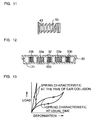
  • FIG. 12 is a cross-sectional view of a spring module of a fuel cell stack according to a tenth embodiment of the present invention.
  • FIG. 13 is a graph illustrating a load versus deformation characteristic of the spring module of the fuel cell stack according to the tenth embodiment of the present invention.
  • FIG. 14 is a perspective view of a spring module of a fuel cell stack according to an eleventh embodiment of the present invention.
  • FIG. 15 is a perspective view of a spring module of a fuel cell stack according to a twelfth embodiment of the present invention.
  • FIG. 16 is a cross-sectional view of a spring module before a load is loaded, of a fuel cell stack according to a thirteenth embodiment of the present invention.
  • FIG. 17 is a cross-sectional view of the spring module after a load has been loaded, of the fuel cell stack according to the thirteenth embodiment of the present invention.
  • FIG. 18 is a graph illustrating a load versus deformation characteristic of the spring module of the fuel cell stack according to the thirteenth embodiment of the present invention.
  • FIG. 19 is a graph illustrating a load versus deformation characteristic of a spring module of a fuel cell stack according to a fourteenth embodiment of the present invention.
  • FIG. 20 is a cross-sectional view of an end portion of a fuel cell stack of a comparison example.
  • FIGS. 1-3 are applicable to all embodiments of the present invention. Portions common to or similar throughout all embodiments of the present invention are denoted with the same reference numerals throughout all of the description and illustrations of the embodiments of the present invention.
  • FIG. 20 illustrates a comparison example which is not included within the scope of the present invention.
  • a fuel cell 10 of a fuel cell stack of the present invention is of a low-temperature type, for example, a Polymer Electrolyte Fuel Cell (PEFC) type.
  • the fuel cell 10 can be mounted to a vehicle, for example, but is not limited to use with a vehicle in any way.
  • PEFC Polymer Electrolyte Fuel Cell
  • the PEFC 10 includes a layer of a membrane-electrode assembly (MEA) and a separator 18 .
  • the MEA includes an electrolyte membrane 11 of an ion-exchange membrane, an electrode 14 (an anode, a fuel electrode) including a catalyst layer 12 disposed on one side of the membrane 11 , and an electrode 17 (a cathode, an air electrode) including a catalyst layer 15 disposed on the other side of the membrane 11 .
  • Diffusion layers 13 and 16 may be disposed between the MEA and the separators on the anode side and the cathode side, respectively.
  • a fuel gas passages 27 for supplying fuel gas (e.g., hydrogen) to the anode and an oxidant gas passage 28 for supplying oxidant gas (e.g., oxygen, usually, air) to the cathode are formed in the separators 18 , and/or a coolant passage 26 for letting coolant (e.g., cooling water) flow is formed in the separators 18 .
  • At least one fuel cell 10 forms a fuel cell module 19 .
  • a plurality of fuel cell modules are piled in a fuel cell piling direction to form a pile of fuel cells and electrical terminals 20 , electrical insulators 21 , and end plates 22 are disposed at opposite ends of the pile of fuel cells.
  • the end plates 22 are coupled to a fastening member (for example, a tension plate 24 ) extending in the fuel cell piling direction outside the pile of fuel cells by bolts 25 and/or nuts, thereby forming a fuel cell stack 23 .
  • the pile of fuel cells is tightened in the fuel cell piling direction.
  • the fuel cell stack 23 may be directed in any direction, that is, it may be directed in a vertical direction or in a horizontal direction.
  • the pile of fuel cells is restricted from side surfaces thereof by an outside restricting member 50 which is made from, for example, a sponge.
  • each fuel cell 10 On the anode 14 of each fuel cell 10 , there occurs a reaction whereby hydrogen changes to hydrogen ions (i.e., protons) and electrons.
  • the hydrogen ions move through the electrolyte membrane 11 to the cathode 17 where the hydrogen ions react with oxygen supplied and electrons (which are generated at an anode of an adjacent MEA and move to the cathode of the instant MEA through a separator 18 ) to form water as follows:
  • the fuel cell stack 23 When the pile of fuel cells is tightened, the fuel cell stack 23 is given a fastening load to decrease an electrical contact resistance of the electrodes and seal the reactant gas and coolant.
  • the fastening load must be uniform over an entire range of a fuel cell plane and may not substantially change in magnitude even if the pile of fuel cells is shrunk or elongated in the fuel cell piling direction.
  • a spring module 30 (which may also be called an elastically deformable module) is disposed in the fuel cell stack 23 including the pile of fuel cells so as to be in series with the pile of fuel cells in the fuel cell piling direction.
  • the spring module 30 includes a first member 31 and a second member 32 which can be inclined relative to each other and may move in a direction toward and away from each other, and a plurality of springs 33 (resilient members) independent of each other which are arranged in parallel or in series with each other.
  • the spring (resilient member) 33 may be a metal spring or a spring made from materials other than metal.
  • the spring 33 may be a coil spring, a coned disk spring, or a member made from elastic material, for example, sponge, low-resilient sponge, rubber, elastic synthetic resin, etc.
  • the plurality of springs 33 may comprise one type of springs or a plurality of types of springs.
  • the plurality of springs 33 may have a common, single spring constant or a plurality of different spring constants.
  • Each spring 33 can be a metal coil spring or a combination of a metal coil spring and a low-resilience sponge, for example, but the springs 33 are not limited to those examples in any way.
  • the number of the springs 33 is preferably five or more, more preferably ten or more, and even more preferably about sixty per spring module.
  • the spring module 30 can advantageously be made in the form of a unit (module) before the spring module 30 is mounted to the fuel cell stack 23 . Therefore, the first member 31 , the second member 32 , and the springs 33 are handled and managed as a single unit (module) and are mounted to a predetermined position or predetermined positions of the fuel cell stack 23 .
  • the predetermined position or predetermined positions of the fuel cell stack 23 may be one end of the pile of fuel cells, opposite ends of the pile of fuel cells, or an intermediate position of the pile of fuel cell located between the opposite ends.
  • the number of spring modules provided per fuel cell stack may be one, two, or more than two.
  • walls perpendicular to the fuel cell piling direction of the first member 31 and the second member 32 of the spring module 30 have a rigidity such that the walls are deformed so as to be convex and/or concave in the fuel cell piling direction and to be wavy when the walls receive loads from the plurality of springs 33 independent of each other.
  • the walls perpendicular to the fuel cell piling direction of the first member 31 and the second member 32 are not a rigid plate, but a deformable plate which can elastically be deformed to be convex and/or concave in the fuel cell piling direction and to be wavy.
  • the spring module 30 is disposed between the end plate 22 located at one end of the fuel cell stack 23 and the pile of fuel cells. Between the spring module 30 and the end plate 22 , a position adjust screw 34 is provided. Therefore, in a direction from the end plate 22 to the pile of fuel cells, the end plate 22 , the adjust screw 34 , a pressure plate 35 , the spring module 30 , the electrical insulator 21 , the electrical terminal 20 , and the pile of fuel cells are arranged in that order.
  • the arrangement order of the spring module 30 , the electrical insulator 21 , the electrical terminal 20 , and the pile of fuel cells may be instead ordered as the electrical insulator 21 , the electrical terminal 20 , the spring module 30 , and the pile of fuel cells, or as the electrical insulator 21 , the spring module 30 , the electrical terminal 20 , and the pile of fuel cells.
  • the plurality of springs 33 can be deformed independently of each other and the first member 31 and the second member 32 of the spring module 30 are not a rigid plate, the plurality of springs 33 can follow not only an inclination of an end surface and a wavy deformation of the inclined end surface of the pile of fuel cells, but also a change of a length (a shrinkage or an expansion) of the pile of fuel cells in the fuel cell piling direction.
  • the fastening load is made uniform over an entire range of the fuel cell plane. Further, alteration of the load in the fuel cell piling direction can be decreased.
  • the structure including the end plate 22 , adjust screw 34 , the spherical seat member 36 , the load cell 37 , the plurality of coned disk springs 38 , and the pressure plate 35 follows an inclination of the end surface of the pile of fuel cells.
  • the pressure plate 35 is a rigid plate, the pressure plate 35 cannot follow a wavy deformation of the end surface of the pile of fuel cells which is deformed to be convex and concave in the fuel cell piling direction, so that the pressure plate 35 cannot solve the problem of fluctuation of the load due to that wavy deformation.
  • the fastening load is made uniform over an entire range of the fuel cell plane.
  • the plurality of springs 33 are assembled in one unit (one module), it is easy to handle the spring module 30 , to manage the load, and to mount the spring module 30 to the predetermined position of the fuel cell stack 23 .
  • the spherical seat member containing the load cell, and the adjust screw are disposed between the end plate and the pile of fuel cells
  • the spherical seat member containing the load cell and the layered assembly of the plurality of coned disk springs can be removed.
  • the spring module 30 since layering of the plurality of coned disk springs and managing of the load are conducted during assembly of the fuel cell stack, the work is difficult.
  • the spring module 30 due to the spring module 30 , it is possible to assemble the fuel cell stack and to manage the load before assembling the fuel cell stack, and the work is much easier than that of the comparison example.
  • the fastening load can be more uniform over the entire range of the fuel cell plane. More particularly, when the number of the springs is about sixty, the fastening load becomes substantially uniform over the entire range of the fuel cell plane, and the bearing load of each spring 33 becomes small. As a result, a length of each spring 33 becomes short, and the spring module 30 becomes short in an axial direction and compact.
  • the spring module 30 is disposed at the intermediate portion of the pile of fuel cells in a fuel cell piling direction, inclination and fluctuation of thickness of each fuel cell can be released at the intermediate portion of the pile of fuel cells before they are summed over the entire length of the pile of fuel cells.
  • the first member 31 is constructed from a first casing (since the first casing is the same member as the first member 31 , a reference numeral of the first casing is selected to be 31 ), and the second member 32 is constructed from a second casing (since the second casing is the same member as the second member 32 , a reference numeral of the second casing is selected to be 32 ).
  • the spring module 30 is a casing assembly (configured in the form of a box) which houses the plurality of springs.
  • the first casing 31 and the second casing 32 have bottom walls 31 a and 32 a parallel to the fuel cell plane and side walls 31 b and 32 b which extend toward the opposing casing 32 and 31 from outer peripheral portions of the bottom walls 31 a and 32 a .
  • the springs 33 are disposed in a space enclosed by the first casing 31 and the second casing 32 .
  • the first embodiment is technically advantageous since the spring module 30 is formed in the form of a casing assembly and the spring module 30 can thus be assembled in the fuel cell stack 23 by the form of a single assembly so that it is easy to mount the spring module 30 to the fuel cell stack 23 . Further, since the load management is conducted at the spring module 30 , the load management is easy compared with a case where each of the plurality of springs is managed.
  • the walls perpendicular to the fuel cell piling direction (the bottom walls 31 a and 32 a ) of the first casing 31 and the second casing 32 (especially, the bottom wall 31 a of a casing 31 among the first and second casings 31 and 32 located closer to the pile of fuel cells) have such a rigidity that when the walls are pushed by the plurality of springs 33 independent of each other, the walls are deformed to be convex or concave in the fuel cell piling direction and are deformed in a form of a wave.
  • the bottom walls are not a rigid plate, but a plate elastically deformable in a wavy form by being deformed convex and/or concave in the fuel cell piling direction.
  • the second embodiment is technically advantageous since when the flat plane perpendicular to the fuel cell piling direction of the member contacting the spring module 30 is inclined from a plane perpendicular to the fuel cell piling direction, the first casing 31 and the second casing 32 are inclined relative to each other so that the spring module 30 can follow the inclination of the flat plane of the member contacting the spring module.
  • the spring module 30 can follow the wavy deformation of the plane of the member contacting the spring module 30 by a wavy deformation of at least one of the bottom walls of the first and the second casings 31 and 32 .
  • the fastening load can be more uniform over the entire range of the fuel cell plane than in a case where a fastening load is loaded on the pile of fuel cells through a rigid plate.
  • the spring module 30 includes a plurality of spring seat members 39 .
  • the number of the spring seat members 39 is the same as that of the plurality of springs 33 .
  • Each of the plurality of spring seat members 39 has a first end portion (opposite a second end portion where the spring seat member 39 contacts the spring 33 ) which extends through an aperture 40 formed in the bottom wall 31 a of the casing 31 among the first casing 31 and the second casing 32 , located closer to the pile of fuel cells and contacts a member contacting the bottom wall 31 a of the casing 31 .
  • the third embodiment is technically advantageous since the end portion of the spring seat member 39 extends through the aperture 40 formed in the bottom wall 31 a of the casing 31 , and the spring 33 can thus follow the wavy, convex and concave deformation of the end surface of the member which plane-to-plane contacts the spring module 30 without being affected the rigidity of the bottom wall 31 a of the casing, so that the fastening load is made uniform over the entire range of the fuel cell plane.
  • the spring module 30 includes a plurality of spring seat members 39 .
  • the number of the spring seat members 39 is the same as that of the plurality of springs 33 .
  • Each of the plurality of spring seat members 39 has a first end portion (opposite a second end portion where the spring seat member 39 contacts the spring 33 ) which extends through an aperture 40 formed in the bottom wall 31 a of the casing 31 among the first casing 31 and the second casing 32 , located closer to the pile of fuel cells and contacts a member contacting the bottom wall 31 a of the casing 31 .
  • each spring seat member 39 has an end surface which is convexly curved.
  • the spring seat member 39 is constructed from a ball so that the spring seat member 39 has a spherical end surface.
  • the fourth embodiment is technically advantageous since the end portion of the spring seat member 39 extends through the aperture 40 formed in the bottom wall 31 a of the casing 31 , and the spring 33 can thus follow the wavy, convex and concave deformation of the end surface of the member which plane-to-plane contacts the spring module 30 without being affected the rigidity of the bottom wall 31 a of the casing, so that the fastening load is made uniform over the entire range of the fuel cell plane.
  • the end surface of the spring seat member 39 is convexly curved, for example, by constructing the spring seat member from a ball, even if a transverse load (a load directed in a direction perpendicular to the fuel cell piling direction) is loaded on the spring module from the member which contacts the spring module 30 plane-to-plane, the spring seat 39 can easily release the transverse load by its rotating. Furthermore, by constructing a protrusion protruding from the bottom wall of the casing by a ball, the spring seat member 39 can point-contact the member which contacts the spring module 30 plane-to-plane, so that an in-plane strain occurring in a plane-to-plane contact can be removed. As a result, the fastening load is made further uniform over the entire range of the fuel cell plane.
  • the first casing 31 of the spring module 30 has a side wall 31 b and the second casing 32 of the spring module 30 has a side wall 32 b .
  • a load expressing portion 41 is provided in the side walls 31 b and 32 b .
  • the load expressing portion 41 is a mechanical load sensor.
  • the mechanical load sensor includes a coil spring, the load versus deformation characteristic is linear. Adjustment of load L is conducted beforehand.
  • the fifth embodiment is technically advantageous since the load expressing portion 41 is provided in the side walls 31 b and 32 b of the casings 31 and 32 , and it is thus unnecessary in the present invention to provide the load cell of the comparison example of FIG. 20 .
  • the first member 31 for example, the first casing 31
  • the second member 32 for example, the second casing 32
  • an electrically conductive member 42 other than the plurality of springs 33 .
  • the spring module 30 may be disposed at an intermediate portion of the pile of fuel cells in a fuel cell piling direction in which the fuel cells are piled, or the spring module 30 may be disposed between the end surface of the pile of fuel cells and the electrical terminal 20 .
  • the sixth embodiment is technically advantageous since the first member 31 (for example, the first casing 31 ) and the second member 32 (for example, the second casing 32 ) are electrically connected to each other by the electrically conductive member 42 other than the plurality of springs 33 , and the spring characteristic and the electrical conductivity are thus maintained respectively good. Due to this structure, even when the spring module 30 is disposed at an intermediate portion of the pile of fuel cells in a fuel cell piling direction in which the fuel cells are piled, or the spring module 30 is disposed between the end surface of the pile of fuel cells and the electrical terminal 20 , no conductive problem occurs.
  • the spring module 30 is disposed at each of opposite ends of the fuel cell stack 23 in the fuel cell piling direction in which the fuel cells are piled (for example, inside the end plate 22 of the fuel cell stack).
  • the seventh embodiment is technically advantageous since the spring module 30 is disposed at each of the opposite ends of the fuel cell stack 23 in the fuel cell piling direction, and thus when an impact load Ls temporarily acts on the fuel cell stack 23 and a first spring module 30 located at a first end of the fuel cell stack 23 is shrunk, a second spring module 30 located at a second, opposite end of the fuel cell stack 23 is temporarily expanded whereby the fastening load acting on the fuel cell stack 23 is prevented from being temporarily lost.
  • the spring module 30 further includes a shock absorber 43 located between the first member 31 (the first casing 31 ) and the second member 32 (the second casing 32 ).
  • the shock absorber 43 is located at a central portion of the first member 31 and the second member 32 .
  • the shock absorber 43 includes a cylinder 43 a and a piston 43 b where a small aperture 43 c formed in the piston 43 b .
  • the cylinder 43 a is filled with oil.
  • the eighth embodiment is technically advantageous because when the piston 43 b moves at a high speed, the resistance of the oil passing through the aperture 43 c becomes large. As a result, when a shock load acts on the pile of fuel cells, the shock absorber 43 operates as if it were rigid and suppresses movement of the pile of fuel cells whereby the fastening load of the fuel cell stack is prevented from being temporarily lost. Contrarily, when the piston 43 b moves at a low speed, the resistance of the oil passing through the aperture 43 c becomes small.
  • the shock absorber 43 can be deformed without resistance, whereby the shock absorber 23 can follow the thermal expansion and shrinkage without loosening the fastening load of the fuel cell stack.
  • the spring module 30 includes a plurality of shock absorbers 43 , for example, the same number of shock absorbers 43 as the number of the springs 33 . As illustrated in FIG. 11 , each of the plurality of shock absorbers 43 and each of the plurality of springs 33 are coaxially arranged with each other.
  • the ninth embodiment has the same technical advantages as those of the eighth embodiment.
  • each shock absorber 43 can be disposed at the position of each spring 33 , and a space required for disposing the springs 33 and the shock absorbers 43 therein can be minimized.
  • the spring module 30 includes a plurality of types of resilient members 33 a and 33 b having moduli of elasticity different from each other.
  • the number of resilient members of each type may be one, two or more.
  • the plurality of types of resilient members 33 a and 33 b are disposed parallel to each other.
  • one type of resilient members 33 a among the plurality of types of resilient members 33 a and 33 b is a sponge of a low-resilience type
  • the other type of resilient members 33 b is a metal coil spring.
  • the sponge 33 a of a low-resilience type is called as a sponge of a slow recovery type.
  • the sponge 33 a of a low-resilience type has a spring constant changing in magnitude corresponding to speed of deformation where a spring constant corresponding to a high speed of deformation is greater than a spring constant corresponding to a slow speed of deformation.
  • the sponge 33 a of a low-resilience type presents a characteristic of a high gradient where a load rises rapidly in a small deformation, for a deformation of a high speed which occurs at the time of a vehicle collision, to show a large and high spring constant.
  • the sponge 33 a of a low-resilience type presents a characteristic of a low gradient where a load rises slowly in a large deformation, to shown a small and low spring constant.
  • the tenth embodiment is technically advantageous since the spring module 30 includes a plurality of types of resilient members 33 a and 33 b having moduli of elasticity different from each other, so that even if the fastening load loaded on the pile of fuel cells by one type of resilient members 33 a is lost, the fastening load loaded on the pile of fuel cells is maintained by the other type of resilient members 33 b.
  • the spring 33 b For a slow deformation of the fuel cell stack 23 , the spring 33 b is dominant. For a shock load, the sponge 33 a bears the load, whereby the spring module can be prevented from being shrunk. More particularly, in the case where a spring module housing springs only therein is disposed only at one end of the fuel cell stack and the stack is mounted to a vehicle with that one end directed ahead of the vehicle, when the vehicle occurs a front collision, the spring module is shrunk whereby the fastening load of the fuel cell stack will be lost or decreased temporarily. However, in the tenth embodiment, since the spring module 30 houses the sponge 33 a of a low-resilience type, the shrinkage of the spring module is prevented and the temporal loss of the fastening load is prevented.
  • one type of resilient member 33 a among the plurality of types of resilient members 33 a and 33 b holds the other type of resilient members 33 b among the plurality of types of resilient members 33 a and 33 b.
  • the one type of resilient member 33 a is a sponge of a low-resilience type and the other type of resilient members 33 b are a metal coil spring.
  • the resilient member 33 a of a low-resilience type is formed to be a single integral member, and in the single integral sponge 33 a , the same number of holes 33 c (each having a diameter equal to an outer diameter of the coil spring 33 b ) as the number of the coil springs 33 b are formed.
  • Each coil spring 33 b is set in each hole 33 .
  • the eleventh embodiment is technically advantageous since the one type of resilient member 33 a holds the other type of resilient member 33 b , and thus mounting the springs 33 to the casing of the spring module 30 and mounting the spring module 30 to the fuel cell stack 23 are easy tasks compared with a case where cut and bent portions are formed in a casing and springs are set to the cut and bent portions.
  • the plurality of types of resilient members 33 a and 33 b are formed so as to be integral with each other.
  • one type of resilient member 33 a is a sponge of a low-resilience type and the other type of resilient members 33 b are a metal coil spring.
  • the coil springs 33 b are embedded in the sponge 33 a of a low-resilience type so as to be integral with the sponge 33 a.
  • the twelfth embodiment is technically advantageous since the coil springs 33 b are embedded in the sponge 33 a of a low-resilience type so as to be integral with the sponge 33 a , and thus mounting the integral assembly of the springs 33 b and the sponge 33 a to the casing of the spring module 30 and mounting the spring module 30 to the fuel cell stack 23 are easy tasks.
  • the sponge 33 a can be inserted even into a space inside the spring 33 b , the area where the sponge 33 a is disposed can be increased. As a result, the effect due to the sponge 33 a can be increased.
  • the plurality of types of resilient members 33 a and 33 b are combined such that the spring module 30 presents a load versus deformation characteristic bending at an intermediate deformation point W 1 in a full deformation range W.
  • one type of resilient member 33 a and the other type of resilient member 33 b are arranged in parallel with each other.
  • a length H of the resilient member 33 a in a free, not-compressed state is not equal to a space (H+H′) between the first and second casings, and the length H is shorter than the space (H+H′) by H′.
  • the load is zero, there is a space of H′ between the spring casing and the resilient member 33 a .
  • the resilient member 33 a begins to receive a load.
  • the load versus deformation characteristic is shown in FIG.
  • the one type of resilient members 33 a and the other type of resilient members 33 b are combined such that up to a predetermined deformation of the spring module, the one type of resilient members 33 b only are deformed, and above the predetermined deformation of the spring module, both types of resilient members 33 a and 33 b are deformed, whereby the load versus deformation characteristic of FIG. 18 is obtained.
  • the spring module presents a low spring constant up to the predetermined deformation of the spring module, and presents a high spring constant above the predetermined deformation of the spring constant. According to a required characteristic, combination of the types of springs may be changed.
  • a synthetic spring constant of the plurality of resilient members 33 of the spring module 30 is set to be low, and the spring module 30 is used in a precompressed state or at a large deformation range.
  • the spring module is used at a use range B on line A of FIG. 19 .
  • the synthetic spring constant of the spring module 30 is set low and the spring module 30 is used at a large deformation range, the spring module is used at a use range D on line C of FIG. 19 .
  • the fourteenth embodiment is technically advantageous since, in the case where the spring module is precompressed, the temporal loss of the fastening load is prevented. Further, since the synthetic spring constant is set to be low, a large amount of dimensional fluctuations in the length of the pile of fuel cells can be absorbed in a predetermined load range.
  • the resilient member 33 and the first and second members 31 and 32 are made from corrosion-resistant materials.
  • the corrosion-resistant materials may include stainless steel and synthetic resin.
  • the fifteenth embodiment is technically advantageous since the corrosion-resistance level is set high, so that a bad influence on the fuel cell by a rust such as iron oxide can be avoided. Since the spring module 30 and the separator 18 spatially communicate with each other, iron oxide powder from the spring module may promote corrosion of the separator and metal ions may raise an electrical conductivity of the vicinity of the spring module. However, in the present invention, by suppressing generation of iron rust, the bad influence of the rust on the fuel cell can be removed.
  • the fuel cell stack according to the present invention is useful as a fuel cell stack which can follow not only an inclination of the end surface of the pile of fuel cells, but also a change of the length of the pile of fuel cells in the fuel cell piling direction.
  • the fuel cell stack according to the present invention is useful as a fuel cell stack which can make a fastening load uniform over an entire range of the fuel cell plane and can decrease alteration of the load in the fuel cell piling direction.

Landscapes

  • Life Sciences & Earth Sciences (AREA)
  • Engineering & Computer Science (AREA)
  • Manufacturing & Machinery (AREA)
  • Sustainable Development (AREA)
  • Sustainable Energy (AREA)
  • Chemical & Material Sciences (AREA)
  • Chemical Kinetics & Catalysis (AREA)
  • Electrochemistry (AREA)
  • General Chemical & Material Sciences (AREA)
  • Fuel Cell (AREA)
  • Vibration Prevention Devices (AREA)
  • Springs (AREA)

Abstract

A spring module is mounted to a fuel cell stack. The spring module includes a first member and a second member capable of inclining relative to each other and moving in a direction toward and away from each other, and a plurality of springs independent of each other and disposed in parallel with each other between the first and second members. The spring module is disposed between an end plate and the pile of fuel cells. The first member includes a first casing, and the second member includes a second casing, whereby the sparing module includes a casing assembly housing the springs. The bottom surface of the casings is deformable to be wavy. The spring module may include a shock absorber. The plurality of springs may include a coil spring and a sponge of a low-resilience type.

Description

CROSS-REFERENCE TO RELATED APPLICATIONS
This application is a continuation and claims the benefit under 35 U.S.C. §119 of the earliest filing date of International Application No. PCT/JP2003/016020 filed on Dec. 15, 2003, which is hereby incorporated by reference in its entirety.
BACKGROUND OF THE INVENTION
1. Field of the Invention
The present invention generally relates to a fuel cell stack. More specifically, the present invention relates to a fuel cell stack wherein a method for affording a fastening load to a fuel cell stack is improved.
2. Background of the Invention
When stacking fuel cells, a fastening load of a fuel cell stack has to be uniform over an entire range of a transverse cross section of an electrode portion of a stack in order to decrease electrode contact resistance and seal gas and water. Moreover, the fastening load must not vary substantially.
For example, even if a fuel cell surface is inclined because of a variance in a thickness of a separator, which variance may be caused by the manufacture of the separator, the fastening load of the fuel cell stack must be uniform over the entire range of the fuel cell surface. Further, a temperature of the fuel cell may repeatedly change between an environmental temperature when operation is stopped (e.g., 20° C.) and a temperature of cooling water during operation (about 80° C.), and the fastening load of the fuel cell stack may change because of the fuel cell temperature changes. Furthermore, the fastening load of the fuel stack will also change because of a creep of an electrolyte membrane and electrodes after a long period of time. However, such load changing factors must be absorbed and the fastening load of the fuel cell stack must not vary substantially.
Japanese Patent Publication HEI 8-115737 discloses a fastening structure of a fuel cell stack where, in order to uniformly fasten the fuel cell stack, a single integral elastic resilient member is disposed at a central position between a first rigid fastening plate of a first size located at a first end of the fuel cell stack and a second rigid fastening plate of a second size smaller than the first size located at the first end of the fuel cell stack, and at four corners of the second fastening plate, the second fastening plate located at the first end of the fuel cell stack and the first fastening plate located at a second, opposite end of the fuel cell stack are fastened by a bolt and nut extending in a fuel cell piling direction.
However, the above-described fastening structure of the fuel cell stack presents the following problems:
First, although the fastening structure can follow an inclination of an end surface of the pile of the fuel cells by inclining the fastening plate after deformation of the resilient member, the fastening plate cannot follow a wavy deformation of the end surface of the pile of the fuel cells because the fastening plate is a rigid plate.
Second, since the second fastening plate located at the first end of the fuel cell stack and the first fastening plate located at a second, opposite end of the fuel cell stack are fastened by a bolt extending in a fuel cell piling direction and since the bolt is not elongated, the fastening structure cannot follow a change in a length of the pile of fuel cells in the fuel cell piling direction. Therefore, the fastening structure cannot follow a thermal expansion of the pile of fuel cells nor can the fastening structure absorb a change in a load in the fuel cell piling direction resulting from a creep of the electrolyte membrane and the electrodes.
SUMMARY OF THE INVENTION
An object of the present invention is to address the aforementioned problems by providing a fuel cell stack which can follow not only an inclination of an end surface of the pile of fuel cells, but also a change of a length of the pile of fuel cells in the fuel cell piling direction.
Another object of the present invention is to address the aforementioned problems by providing a fuel cell stack which can make a fastening load uniform over an entire range of the fuel cell plane and can decrease alteration of the load in the fuel cell piling direction.
According to a first embodiment of the present invention, there is provided a fuel cell stack including a pile of fuel cells and a spring module disposed in series with the pile of fuel cells; and the spring module includes a first member and a second member, capable of inclining relative to each other and moving in a direction toward and away from each other, and a plurality of springs independent of each other and disposed in parallel with each other between the first member and the second member.
According to a second embodiment of the present invention, there is provided a fuel cell stack according to the first embodiment above, wherein the fuel cell stack includes an end plate and an adjust screw; the spring module is disposed between the end plate and the pile of fuel cells; and the adjust screw is disposed between the spring module and the end plate.
According to a third embodiment of the present invention, there is provided a fuel cell stack according to the first embodiment above, wherein the first member includes a first casing and the second member includes a second casing; and the spring module includes a casing assembly housing the plurality of springs therein.
According to a third embodiment of the present invention, there is provided a fuel cell stack according to the third embodiment above, wherein a casing among the first and second casings located closer to the pile of fuel cells includes a bottom wall having such a rigidity that when the wall is pushed by the plurality of springs independent of each other, the wall is deformed in a fuel cell piling direction in which the fuel cells are piled, to be deformed in a form of a wave.
According to a fifth embodiment of the present invention, there is provided a fuel cell stack according to the third embodiment above, wherein the spring module includes a plurality of spring seat members; and each of the plurality of spring seat members has an end portion which extends through an aperture formed in the wall of the casing located closer to the pile of fuel cells and contacts a member contacting the wall of the casing.
According to a sixth embodiment of the present invention, there is provided a fuel cell stack according to the fifth embodiment above, wherein the end portion of each of the plurality of spring seat members has an end surface which is convexly curved.
According to a seventh embodiment of the present invention, there is provided a fuel cell stack according to the third embodiment above, wherein the first and second casings of the spring module have a side wall where a load expressing portion is provided.
According to an eighth embodiment of the present invention, there is provided a fuel cell stack according to either the first or the third embodiment above, wherein the spring module is disposed at an intermediate portion of the pile of fuel cells in a fuel cell piling direction in which the fuel cells are piled.
According to a ninth embodiment of the present invention, there is provided a fuel cell stack according to the eighth embodiment above, wherein the first member and the second member are electrically connected to each other by an electrically conductive member other than the plurality of springs.
According to a tenth embodiment of the present invention, there is provided a fuel cell stack according to either the first or the third embodiment above, wherein the spring module is disposed at each of opposite ends of the fuel cell stack in a fuel cell piling direction in which the fuel cells are piled.
According to an eleventh embodiment of the present invention, there is provided a fuel cell stack according to either the first or the third embodiment above, wherein the spring module further includes a shock absorber located between the first member and the second member.
According to a twelfth embodiment of the present invention, there is provided a fuel cell stack according to either the first or the third embodiment above, wherein the spring module further includes a plurality of shock absorbers; and each of the plurality of shock absorbers and each of the plurality of springs are coaxially arranged with each other.
According to a thirteenth embodiment of the present invention, there is provided a fuel cell stack according to the first embodiment above, wherein the spring module includes a plurality of types of resilient members having moduli of elasticity different from each other.
According to a fourteenth embodiment of the present invention, there is provided a fuel cell stack according to the thirteenth embodiment above, wherein the plurality of types of resilient members are disposed parallel to each other.
According to a fifteenth embodiment of the present invention, there is provided a fuel cell stack according to the thirteenth embodiment above, wherein one type of resilient members among the plurality of types of resilient members hold another type of resilient members among the plurality of types of resilient members.
According to a sixteenth embodiment of the present invention, there is provided a fuel cell stack according to either the thirteenth or the fourteenth embodiment above, wherein the plurality of types of resilient members are formed so as to be integral with each other.
According to a seventeenth embodiment of the present invention, there is provided a fuel cell stack according to the thirteenth embodiment above, wherein one type of resilient members among the plurality of types of resilient members has a spring constant changing in magnitude corresponding to a speed of deformation and a spring constant corresponding to a high speed of deformation is greater than a spring constant corresponding to a slow speed of deformation.
According to a eighteenth embodiment of the present invention, there is provided a fuel cell stack according to the thirteenth embodiment above, wherein the plurality of types of resilient members includes a spring type and a low-resilience sponge type.
According to a nineteenth embodiment of the present invention, there is provided a fuel cell stack according to the thirteenth embodiment above, wherein the plurality of types of resilient members comprises types of resilient members combined such that the spring module presents a load versus deformation characteristic bending at an intermediate deformation point in a full deformation range.
According to a twentieth embodiment of the present invention, there is provided a fuel cell stack according to the thirteenth embodiment above, wherein the spring module has a low spring constant; and the spring module is precompressed or is used at a large deformation range.
According to a twenty-first embodiment of the present invention, there is provided a fuel cell stack according to the first embodiment above, wherein the resilient member and the first and second members are made from corrosion-resistant materials.
Technical Advantages of the Present Invention
In the fuel cell stack according to the first embodiment above, since the plurality of springs can be deformed independently of each other, the plurality of springs can follow not only an inclination of an end surface and a wavy deformation of the inclined end surface of the pile of fuel cells, but also a change of a length of the pile of fuel cells in the fuel cell piling direction. As a result, the fastening load is made uniform over an entire range of the fuel cell plane. Further, alteration of the load in the fuel cell piling direction can be decreased.
In the fuel cell stack according to the second embodiment above, when compared with a structure such as that illustrated in FIG. 20 wherein a layered assembly of a plurality of coned disk springs, a spherical seat member containing a load cell, and an adjust screw are disposed between an end plate and a pile of fuel cells, the spherical seat member containing a load cell and the layered assembly of a plurality of coned disk springs can be removed.
In the fuel cell stack according to the third embodiment above, it is easy to mount the spring module to the fuel cell stack since the spring module is made in the form of a casing assembly.
In the fuel cell stack according to the fourth embodiment above, the load loaded on the pile of fuel cells from the spring module can be made more uniform over the entire fuel cell surface, since the bottom wall of the casing can be deformed to be wavy, than in the case of Japanese Patent Publication HEI 8-115737 wherein the load is loaded on the pile of fuel cells from the rigid plate.
In the fuel cell stack according to the fifth embodiment above, since the end portion of the spring seat member extends through the aperture formed in the wall of the casing, the spring can follow the wavy, convex, and concave deformation of the end surface of the member which contacts the spring module plane-to-plane, so that a fastening load is made uniform over an entire range of the fuel cell surface.
In the fuel cell stack according to the sixth embodiment above, since the end surface of the spring seat member is convexly curved by constructing the spring seat member from a ball, for example, even if a transverse load (a load directed in a direction perpendicular to the fuel cell piling direction) is loaded on the spring module from the member which contacts the spring module plane-to-plane, the spring seat can easily release the transverse load by rotating.
In the fuel cell stack according to the seventh embodiment above, it is unnecessary to provide a load cell in the present invention since the load expressing portion is provided in the side wall of the casing.
In the fuel cell stack according to the eighth embodiment above, since the spring module is disposed at an intermediate portion of the pile of fuel cells in a fuel cell piling direction, inclination and fluctuation of the thickness of each fuel cell can be released at the intermediate portion of the pile of fuel cells before they are summed over an entire length of the pile of fuel cells.
In the fuel cell stack according to the ninth embodiment above, since the first member and the second member are electrically connected to each other by an electrically conductive member other than the plurality of springs, the spring characteristic and the electrical conductivity are maintained independent of each other and respectively good.
In the fuel cell stack according to the tenth embodiment above, since the spring module is disposed at each of the opposite ends of the fuel cell stack in a fuel cell piling direction, when an impact load acts on the fuel cell stack and a first spring module located at a first end of the fuel cell stack is shrunk, a second spring module located at a second, opposite end of the fuel cell stack is temporarily expanded whereby the fastening load acting on the fuel cell stack is prevented from being temporarily decreased.
In the fuel cell stack according to the eleventh or twelfth embodiment above, since the spring module includes a shock absorber, even if an impact load acts on the fuel cell stack to operate to shrink the spring module, the shock absorber operates as if it were rigid against deformation of a high speed whereby the fastening load of the fuel cell stack is prevented from being temporarily loosened. Against deformation of a low speed such as a thermal deformation, the shock absorber can be deformed smoothly, generating little mechanical resistance.
In the fuel cell stack according to the thirteenth or fourteenth embodiment above, since the spring module includes a plurality of types of resilient members having moduli of elasticity different from each other, even if the fastening load loaded on the pile of fuel cells by one type of resilient members is lost, the fastening load loaded on the pile of fuel cells is maintained by the other type of resilient members.
In the fuel cell stack according to the fifteenth or sixteenth embodiment above, since one type of resilient members hold another type of resilient members or the plurality of types of resilient members comprises resilient members formed integrally with each other, it is easy to mount the spring module to the fuel cell stack.
In the fuel cell stack according to the seventeenth embodiment above, since one type of resilient members among the plurality of types of resilient members has a spring constant changing in magnitude corresponding to a speed of deformation and a spring constant corresponding to a high speed of deformation is greater than a spring constant corresponding to a slow speed of deformation, the one type of resilient members becomes rigid against a high speed of deformation, whereby loss of a fastening load loaded on the fastened object (the pile of fuel cells) is prevented.
In the fuel cell stack according to the eighteenth embodiment above, since the plurality of types of resilient members includes a spring type and a low-resilience sponge type, the low-resilience sponge becomes rigid against a high speed of deformation, whereby loss of a fastening load on the biased object (the fuel cell) is prevented.
In the fuel cell stack according to the nineteenth embodiment above, since the spring module presents a load versus deformation characteristic bending at an intermediate deformation point in a full deformation range, the one type of resilient members becomes rigid against a high speed of deformation, whereby loss of a fastening load loaded on the fastened object (the pile of fuel cells) is prevented.
In the fuel cell stack according to the twentieth embodiment above, since the spring module has a low spring constant and the spring module is precompressed or is used at a large deformation range, loss of a fastening load loaded on the fastened object (the pile of fuel cells) is prevented.
In the fuel cell stack according to the twenty-first embodiment above, since the resilient member and the first and second members are made from corrosion-resistant materials, rust which will be generated affected by water drops caused by a change in temperature will be suppressed.
BRIEF DESCRIPTION OF THE DRAWINGS
A more complete appreciation of the invention and many of the attendant advantages thereof will be readily obtained as the same becomes better understood by reference to the following detailed description when considered in connection with the accompanying drawings, in which:
FIG. 1 is a side elevational view of a fuel cell stack according to the present invention;
FIG. 2 is an enlarged cross-sectional view of one portion of the fuel cell stack of FIG. 1;
FIG. 3 is a cross-sectional view of a spring module of a fuel cell stack according to a first embodiment of the present invention;
FIG. 4 is a cross-sectional view of a spring module and a vicinity thereof of a fuel cell stack according to a second embodiment of the present invention;
FIG. 5 is a cross-sectional view of a spring module of a fuel cell stack according to a third embodiment of the present invention;
FIG. 6 is a cross-sectional view of a spring module and a vicinity thereof of a fuel cell stack according to a fourth embodiment of the present invention;
FIG. 7 is a perspective view of a spring module of a fuel cell stack according to a fifth embodiment of the present invention;
FIG. 8 is a cross-sectional view of a spring module of a fuel cell stack according to a sixth embodiment of the present invention;
FIG. 9 is a side elevational view of a fuel cell stack according to a seventh embodiment of the present invention;
FIG. 10 is a cross-sectional view of a spring module of a fuel cell stack according to an eighth embodiment of the present invention;
FIG. 11 is a side elevational view of one spring and one shock absorber of a spring module of a fuel cell stack according to a ninth embodiment of the present invention;
FIG. 12 is a cross-sectional view of a spring module of a fuel cell stack according to a tenth embodiment of the present invention;
FIG. 13 is a graph illustrating a load versus deformation characteristic of the spring module of the fuel cell stack according to the tenth embodiment of the present invention;
FIG. 14 is a perspective view of a spring module of a fuel cell stack according to an eleventh embodiment of the present invention;
FIG. 15 is a perspective view of a spring module of a fuel cell stack according to a twelfth embodiment of the present invention;
FIG. 16 is a cross-sectional view of a spring module before a load is loaded, of a fuel cell stack according to a thirteenth embodiment of the present invention;
FIG. 17 is a cross-sectional view of the spring module after a load has been loaded, of the fuel cell stack according to the thirteenth embodiment of the present invention;
FIG. 18 is a graph illustrating a load versus deformation characteristic of the spring module of the fuel cell stack according to the thirteenth embodiment of the present invention;
FIG. 19 is a graph illustrating a load versus deformation characteristic of a spring module of a fuel cell stack according to a fourteenth embodiment of the present invention; and
FIG. 20 is a cross-sectional view of an end portion of a fuel cell stack of a comparison example.
DESCRIPTION OF THE PREFERRED EMBODIMENTS
A fuel cell stack according to the present invention will be explained with reference to FIGS. 1-20. FIGS. 1-3 are applicable to all embodiments of the present invention. Portions common to or similar throughout all embodiments of the present invention are denoted with the same reference numerals throughout all of the description and illustrations of the embodiments of the present invention. FIG. 20 illustrates a comparison example which is not included within the scope of the present invention.
The portions common to or similar throughout all embodiments of the present invention will now be explained with reference to FIGS. 1-3.
A fuel cell 10 of a fuel cell stack of the present invention is of a low-temperature type, for example, a Polymer Electrolyte Fuel Cell (PEFC) type. The fuel cell 10 can be mounted to a vehicle, for example, but is not limited to use with a vehicle in any way.
As illustrated in FIGS. 1 and 2, the PEFC 10 includes a layer of a membrane-electrode assembly (MEA) and a separator 18. The MEA includes an electrolyte membrane 11 of an ion-exchange membrane, an electrode 14 (an anode, a fuel electrode) including a catalyst layer 12 disposed on one side of the membrane 11, and an electrode 17 (a cathode, an air electrode) including a catalyst layer 15 disposed on the other side of the membrane 11. Diffusion layers 13 and 16 may be disposed between the MEA and the separators on the anode side and the cathode side, respectively. In the separators 18, a fuel gas passages 27 for supplying fuel gas (e.g., hydrogen) to the anode and an oxidant gas passage 28 for supplying oxidant gas (e.g., oxygen, usually, air) to the cathode are formed in the separators 18, and/or a coolant passage 26 for letting coolant (e.g., cooling water) flow is formed in the separators 18. At least one fuel cell 10 forms a fuel cell module 19. A plurality of fuel cell modules are piled in a fuel cell piling direction to form a pile of fuel cells and electrical terminals 20, electrical insulators 21, and end plates 22 are disposed at opposite ends of the pile of fuel cells. The end plates 22 are coupled to a fastening member (for example, a tension plate 24) extending in the fuel cell piling direction outside the pile of fuel cells by bolts 25 and/or nuts, thereby forming a fuel cell stack 23. The pile of fuel cells is tightened in the fuel cell piling direction. The fuel cell stack 23 may be directed in any direction, that is, it may be directed in a vertical direction or in a horizontal direction. The pile of fuel cells is restricted from side surfaces thereof by an outside restricting member 50 which is made from, for example, a sponge.
On the anode 14 of each fuel cell 10, there occurs a reaction whereby hydrogen changes to hydrogen ions (i.e., protons) and electrons. The hydrogen ions move through the electrolyte membrane 11 to the cathode 17 where the hydrogen ions react with oxygen supplied and electrons (which are generated at an anode of an adjacent MEA and move to the cathode of the instant MEA through a separator 18) to form water as follows:
    • At the anode: H2→2H++2e
    • At the cathode: 2H++2e +(1/2)O2→H2O
When the pile of fuel cells is tightened, the fuel cell stack 23 is given a fastening load to decrease an electrical contact resistance of the electrodes and seal the reactant gas and coolant. The fastening load must be uniform over an entire range of a fuel cell plane and may not substantially change in magnitude even if the pile of fuel cells is shrunk or elongated in the fuel cell piling direction.
In order to satisfy the above requirement, in the fuel cell 10 of the present invention, as illustrated in FIG. 1, a spring module 30 (which may also be called an elastically deformable module) is disposed in the fuel cell stack 23 including the pile of fuel cells so as to be in series with the pile of fuel cells in the fuel cell piling direction. As illustrated in FIG. 3, the spring module 30 includes a first member 31 and a second member 32 which can be inclined relative to each other and may move in a direction toward and away from each other, and a plurality of springs 33 (resilient members) independent of each other which are arranged in parallel or in series with each other.
The spring (resilient member) 33 may be a metal spring or a spring made from materials other than metal. The spring 33 may be a coil spring, a coned disk spring, or a member made from elastic material, for example, sponge, low-resilient sponge, rubber, elastic synthetic resin, etc. The plurality of springs 33 may comprise one type of springs or a plurality of types of springs. The plurality of springs 33 may have a common, single spring constant or a plurality of different spring constants. Each spring 33 can be a metal coil spring or a combination of a metal coil spring and a low-resilience sponge, for example, but the springs 33 are not limited to those examples in any way. The number of the springs 33 is preferably five or more, more preferably ten or more, and even more preferably about sixty per spring module.
The spring module 30 can advantageously be made in the form of a unit (module) before the spring module 30 is mounted to the fuel cell stack 23. Therefore, the first member 31, the second member 32, and the springs 33 are handled and managed as a single unit (module) and are mounted to a predetermined position or predetermined positions of the fuel cell stack 23. The predetermined position or predetermined positions of the fuel cell stack 23 may be one end of the pile of fuel cells, opposite ends of the pile of fuel cells, or an intermediate position of the pile of fuel cell located between the opposite ends. The number of spring modules provided per fuel cell stack may be one, two, or more than two.
Preferably, walls perpendicular to the fuel cell piling direction of the first member 31 and the second member 32 of the spring module 30 have a rigidity such that the walls are deformed so as to be convex and/or concave in the fuel cell piling direction and to be wavy when the walls receive loads from the plurality of springs 33 independent of each other. Preferably, the walls perpendicular to the fuel cell piling direction of the first member 31 and the second member 32 are not a rigid plate, but a deformable plate which can elastically be deformed to be convex and/or concave in the fuel cell piling direction and to be wavy.
In FIG. 1, the spring module 30 is disposed between the end plate 22 located at one end of the fuel cell stack 23 and the pile of fuel cells. Between the spring module 30 and the end plate 22, a position adjust screw 34 is provided. Therefore, in a direction from the end plate 22 to the pile of fuel cells, the end plate 22, the adjust screw 34, a pressure plate 35, the spring module 30, the electrical insulator 21, the electrical terminal 20, and the pile of fuel cells are arranged in that order. However, the arrangement order of the spring module 30, the electrical insulator 21, the electrical terminal 20, and the pile of fuel cells may be instead ordered as the electrical insulator 21, the electrical terminal 20, the spring module 30, and the pile of fuel cells, or as the electrical insulator 21, the spring module 30, the electrical terminal 20, and the pile of fuel cells.
Effects and technical advantages of the above-described portions common to or similar throughout all of the embodiments of the present invention will be explained.
In the fuel cell 10 of the present invention, since the plurality of springs 33 can be deformed independently of each other and the first member 31 and the second member 32 of the spring module 30 are not a rigid plate, the plurality of springs 33 can follow not only an inclination of an end surface and a wavy deformation of the inclined end surface of the pile of fuel cells, but also a change of a length (a shrinkage or an expansion) of the pile of fuel cells in the fuel cell piling direction. As a result, the fastening load is made uniform over an entire range of the fuel cell plane. Further, alteration of the load in the fuel cell piling direction can be decreased.
More particularly, in the comparison example of FIG. 20, the structure including the end plate 22, adjust screw 34, the spherical seat member 36, the load cell 37, the plurality of coned disk springs 38, and the pressure plate 35 follows an inclination of the end surface of the pile of fuel cells. However, since the pressure plate 35 is a rigid plate, the pressure plate 35 cannot follow a wavy deformation of the end surface of the pile of fuel cells which is deformed to be convex and concave in the fuel cell piling direction, so that the pressure plate 35 cannot solve the problem of fluctuation of the load due to that wavy deformation. In contrast, in the present invention, since the plurality of springs 33 can follow not only an inclination of an end surface, but also a wavy deformation of the inclined end surface of the pile of fuel cells, the fastening load is made uniform over an entire range of the fuel cell plane.
Since the plurality of springs 33 are assembled in one unit (one module), it is easy to handle the spring module 30, to manage the load, and to mount the spring module 30 to the predetermined position of the fuel cell stack 23.
Further, compared with the structure of the comparison example illustrated in FIG. 20 wherein the layered assembly of the plurality of coned disk springs, the spherical seat member containing the load cell, and the adjust screw are disposed between the end plate and the pile of fuel cells, in the present invention, the spherical seat member containing the load cell and the layered assembly of the plurality of coned disk springs can be removed. In the comparison example, since layering of the plurality of coned disk springs and managing of the load are conducted during assembly of the fuel cell stack, the work is difficult. In contrast, in the present invention, due to the spring module 30, it is possible to assemble the fuel cell stack and to manage the load before assembling the fuel cell stack, and the work is much easier than that of the comparison example.
Further, when the number of the springs 33 is large, the fastening load can be more uniform over the entire range of the fuel cell plane. More particularly, when the number of the springs is about sixty, the fastening load becomes substantially uniform over the entire range of the fuel cell plane, and the bearing load of each spring 33 becomes small. As a result, a length of each spring 33 becomes short, and the spring module 30 becomes short in an axial direction and compact.
Further, in the case where the spring module 30 is disposed at the intermediate portion of the pile of fuel cells in a fuel cell piling direction, inclination and fluctuation of thickness of each fuel cell can be released at the intermediate portion of the pile of fuel cells before they are summed over the entire length of the pile of fuel cells.
Next, structures and technical advantages thereof unique to each embodiment of the present invention will be explained.
With the first embodiment of the present invention, as illustrated in FIG. 3, in the spring module 30, the first member 31 is constructed from a first casing (since the first casing is the same member as the first member 31, a reference numeral of the first casing is selected to be 31), and the second member 32 is constructed from a second casing (since the second casing is the same member as the second member 32, a reference numeral of the second casing is selected to be 32). Due to this structure, the spring module 30 is a casing assembly (configured in the form of a box) which houses the plurality of springs.
The first casing 31 and the second casing 32 have bottom walls 31 a and 32 a parallel to the fuel cell plane and side walls 31 b and 32 b which extend toward the opposing casing 32 and 31 from outer peripheral portions of the bottom walls 31 a and 32 a. The springs 33 are disposed in a space enclosed by the first casing 31 and the second casing 32.
The first embodiment is technically advantageous since the spring module 30 is formed in the form of a casing assembly and the spring module 30 can thus be assembled in the fuel cell stack 23 by the form of a single assembly so that it is easy to mount the spring module 30 to the fuel cell stack 23. Further, since the load management is conducted at the spring module 30, the load management is easy compared with a case where each of the plurality of springs is managed.
With the second embodiment of the present invention, as illustrated in FIG. 4, in the spring module 30, the walls perpendicular to the fuel cell piling direction (the bottom walls 31 a and 32 a) of the first casing 31 and the second casing 32 (especially, the bottom wall 31 a of a casing 31 among the first and second casings 31 and 32 located closer to the pile of fuel cells) have such a rigidity that when the walls are pushed by the plurality of springs 33 independent of each other, the walls are deformed to be convex or concave in the fuel cell piling direction and are deformed in a form of a wave. The bottom walls are not a rigid plate, but a plate elastically deformable in a wavy form by being deformed convex and/or concave in the fuel cell piling direction.
The second embodiment is technically advantageous since when the flat plane perpendicular to the fuel cell piling direction of the member contacting the spring module 30 is inclined from a plane perpendicular to the fuel cell piling direction, the first casing 31 and the second casing 32 are inclined relative to each other so that the spring module 30 can follow the inclination of the flat plane of the member contacting the spring module. Further, even when the flat plane perpendicular to the fuel cell piling direction of the member contacting the spring module 30 is deformed to convex and/or concave in the fuel cell piling direction and to be wavy, from the flat plane perpendicular to the fuel cell piling direction or the inclined flat plane, the spring module 30 can follow the wavy deformation of the plane of the member contacting the spring module 30 by a wavy deformation of at least one of the bottom walls of the first and the second casings 31 and 32. As a result, the fastening load can be more uniform over the entire range of the fuel cell plane than in a case where a fastening load is loaded on the pile of fuel cells through a rigid plate.
With the third embodiment of the present invention, as illustrated in FIG. 5, the spring module 30 includes a plurality of spring seat members 39. For example, the number of the spring seat members 39 is the same as that of the plurality of springs 33. Each of the plurality of spring seat members 39 has a first end portion (opposite a second end portion where the spring seat member 39 contacts the spring 33) which extends through an aperture 40 formed in the bottom wall 31 a of the casing 31 among the first casing 31 and the second casing 32, located closer to the pile of fuel cells and contacts a member contacting the bottom wall 31 a of the casing 31. Because the springs 33 are independent of each other, forces of the spring seat members 39 pushing the member contacting the spring module 30 are independent of each other, and protruding amounts of the end portions of the spring seat members protruding from the bottom wall of the casing are independent of each other.
The third embodiment is technically advantageous since the end portion of the spring seat member 39 extends through the aperture 40 formed in the bottom wall 31 a of the casing 31, and the spring 33 can thus follow the wavy, convex and concave deformation of the end surface of the member which plane-to-plane contacts the spring module 30 without being affected the rigidity of the bottom wall 31 a of the casing, so that the fastening load is made uniform over the entire range of the fuel cell plane.
With the fourth embodiment of the present invention, as illustrated in FIG. 6, the spring module 30 includes a plurality of spring seat members 39. For example, the number of the spring seat members 39 is the same as that of the plurality of springs 33. Each of the plurality of spring seat members 39 has a first end portion (opposite a second end portion where the spring seat member 39 contacts the spring 33) which extends through an aperture 40 formed in the bottom wall 31 a of the casing 31 among the first casing 31 and the second casing 32, located closer to the pile of fuel cells and contacts a member contacting the bottom wall 31 a of the casing 31. Because the springs 33 are independent of each other, forces of the spring seat members 39 pushing the member contacting the spring module 30 are independent of each other, and protruding amounts of the end portions of the spring seat members protruding from the bottom wall of the casing are independent of each other.
The first end portion (opposite the second end portion where the spring seat member 39 contacts the spring 33) of each spring seat member 39 has an end surface which is convexly curved. For example, the spring seat member 39 is constructed from a ball so that the spring seat member 39 has a spherical end surface.
The fourth embodiment is technically advantageous since the end portion of the spring seat member 39 extends through the aperture 40 formed in the bottom wall 31 a of the casing 31, and the spring 33 can thus follow the wavy, convex and concave deformation of the end surface of the member which plane-to-plane contacts the spring module 30 without being affected the rigidity of the bottom wall 31 a of the casing, so that the fastening load is made uniform over the entire range of the fuel cell plane.
Further, since the end surface of the spring seat member 39 is convexly curved, for example, by constructing the spring seat member from a ball, even if a transverse load (a load directed in a direction perpendicular to the fuel cell piling direction) is loaded on the spring module from the member which contacts the spring module 30 plane-to-plane, the spring seat 39 can easily release the transverse load by its rotating. Furthermore, by constructing a protrusion protruding from the bottom wall of the casing by a ball, the spring seat member 39 can point-contact the member which contacts the spring module 30 plane-to-plane, so that an in-plane strain occurring in a plane-to-plane contact can be removed. As a result, the fastening load is made further uniform over the entire range of the fuel cell plane.
With the fifth embodiment of the present invention, as illustrated in FIG. 7, the first casing 31 of the spring module 30 has a side wall 31 b and the second casing 32 of the spring module 30 has a side wall 32 b. In the side walls 31 b and 32 b, a load expressing portion 41 is provided. The load expressing portion 41 is a mechanical load sensor. When the mechanical load sensor includes a coil spring, the load versus deformation characteristic is linear. Adjustment of load L is conducted beforehand.
The fifth embodiment is technically advantageous since the load expressing portion 41 is provided in the side walls 31 b and 32 b of the casings 31 and 32, and it is thus unnecessary in the present invention to provide the load cell of the comparison example of FIG. 20.
With the sixth embodiment of the present invention, as illustrated in FIG. 8, the first member 31 (for example, the first casing 31) and the second member 32 (for example, the second casing 32) are electrically connected to each other by an electrically conductive member 42 other than the plurality of springs 33.
In this case, the spring module 30 may be disposed at an intermediate portion of the pile of fuel cells in a fuel cell piling direction in which the fuel cells are piled, or the spring module 30 may be disposed between the end surface of the pile of fuel cells and the electrical terminal 20.
The sixth embodiment is technically advantageous since the first member 31 (for example, the first casing 31) and the second member 32 (for example, the second casing 32) are electrically connected to each other by the electrically conductive member 42 other than the plurality of springs 33, and the spring characteristic and the electrical conductivity are thus maintained respectively good. Due to this structure, even when the spring module 30 is disposed at an intermediate portion of the pile of fuel cells in a fuel cell piling direction in which the fuel cells are piled, or the spring module 30 is disposed between the end surface of the pile of fuel cells and the electrical terminal 20, no conductive problem occurs.
When the spring module 30 is disposed at an intermediate portion of the pile of fuel cells, inclination and fluctuation of thickness of each fuel cell can be released at the intermediate portion of the pile of fuel cells before they are summed over the entire length of the pile of fuel cells.
With the seventh embodiment of the present invention, as illustrated in FIG. 9, the spring module 30 is disposed at each of opposite ends of the fuel cell stack 23 in the fuel cell piling direction in which the fuel cells are piled (for example, inside the end plate 22 of the fuel cell stack).
The seventh embodiment is technically advantageous since the spring module 30 is disposed at each of the opposite ends of the fuel cell stack 23 in the fuel cell piling direction, and thus when an impact load Ls temporarily acts on the fuel cell stack 23 and a first spring module 30 located at a first end of the fuel cell stack 23 is shrunk, a second spring module 30 located at a second, opposite end of the fuel cell stack 23 is temporarily expanded whereby the fastening load acting on the fuel cell stack 23 is prevented from being temporarily lost.
With the eighth embodiment of the present invention, as illustrated in FIG. 10, the spring module 30 further includes a shock absorber 43 located between the first member 31 (the first casing 31) and the second member 32 (the second casing 32). The shock absorber 43 is located at a central portion of the first member 31 and the second member 32. The shock absorber 43 includes a cylinder 43 a and a piston 43 b where a small aperture 43 c formed in the piston 43 b. The cylinder 43 a is filled with oil.
The eighth embodiment is technically advantageous because when the piston 43 b moves at a high speed, the resistance of the oil passing through the aperture 43 c becomes large. As a result, when a shock load acts on the pile of fuel cells, the shock absorber 43 operates as if it were rigid and suppresses movement of the pile of fuel cells whereby the fastening load of the fuel cell stack is prevented from being temporarily lost. Contrarily, when the piston 43 b moves at a low speed, the resistance of the oil passing through the aperture 43 c becomes small. As a result, against a piston movement at a low speed such as a thermal expansion and shrinkage, the shock absorber 43 can be deformed without resistance, whereby the shock absorber 23 can follow the thermal expansion and shrinkage without loosening the fastening load of the fuel cell stack.
With the ninth embodiment of the present invention, the spring module 30 includes a plurality of shock absorbers 43, for example, the same number of shock absorbers 43 as the number of the springs 33. As illustrated in FIG. 11, each of the plurality of shock absorbers 43 and each of the plurality of springs 33 are coaxially arranged with each other.
The ninth embodiment has the same technical advantages as those of the eighth embodiment. In addition, when compared with the eighth embodiment, since the spring 33 and the shock absorber 43 are coaxially arranged in the ninth embodiment, each shock absorber 43 can be disposed at the position of each spring 33, and a space required for disposing the springs 33 and the shock absorbers 43 therein can be minimized.
With the tenth embodiment of the present invention, as illustrated in FIGS. 12 and 13, the spring module 30 includes a plurality of types of resilient members 33 a and 33 b having moduli of elasticity different from each other. The number of resilient members of each type may be one, two or more.
The plurality of types of resilient members 33 a and 33 b are disposed parallel to each other. In FIG. 12, one type of resilient members 33 a among the plurality of types of resilient members 33 a and 33 b is a sponge of a low-resilience type, and the other type of resilient members 33 b is a metal coil spring. The sponge 33 a of a low-resilience type is called as a sponge of a slow recovery type. The sponge 33 a of a low-resilience type has a spring constant changing in magnitude corresponding to speed of deformation where a spring constant corresponding to a high speed of deformation is greater than a spring constant corresponding to a slow speed of deformation. FIG. 13 illustrates a load versus deformation characteristic of the sponge 33 a of a low-resilience type. As illustrated in FIG. 13, the sponge 33 a of a low-resilience type presents a characteristic of a high gradient where a load rises rapidly in a small deformation, for a deformation of a high speed which occurs at the time of a vehicle collision, to show a large and high spring constant. In contrast, for a usual deformation of a low speed, the sponge 33 a of a low-resilience type presents a characteristic of a low gradient where a load rises slowly in a large deformation, to shown a small and low spring constant.
The tenth embodiment is technically advantageous since the spring module 30 includes a plurality of types of resilient members 33 a and 33 b having moduli of elasticity different from each other, so that even if the fastening load loaded on the pile of fuel cells by one type of resilient members 33 a is lost, the fastening load loaded on the pile of fuel cells is maintained by the other type of resilient members 33 b.
For a slow deformation of the fuel cell stack 23, the spring 33 b is dominant. For a shock load, the sponge 33 a bears the load, whereby the spring module can be prevented from being shrunk. More particularly, in the case where a spring module housing springs only therein is disposed only at one end of the fuel cell stack and the stack is mounted to a vehicle with that one end directed ahead of the vehicle, when the vehicle occurs a front collision, the spring module is shrunk whereby the fastening load of the fuel cell stack will be lost or decreased temporarily. However, in the tenth embodiment, since the spring module 30 houses the sponge 33 a of a low-resilience type, the shrinkage of the spring module is prevented and the temporal loss of the fastening load is prevented.
With the eleventh embodiment of the present invention, as illustrated in FIG. 14, one type of resilient member 33 a among the plurality of types of resilient members 33 a and 33 b holds the other type of resilient members 33 b among the plurality of types of resilient members 33 a and 33 b.
For example, the one type of resilient member 33 a is a sponge of a low-resilience type and the other type of resilient members 33 b are a metal coil spring. The resilient member 33 a of a low-resilience type is formed to be a single integral member, and in the single integral sponge 33 a, the same number of holes 33 c (each having a diameter equal to an outer diameter of the coil spring 33 b) as the number of the coil springs 33 b are formed. Each coil spring 33 b is set in each hole 33.
The eleventh embodiment is technically advantageous since the one type of resilient member 33 a holds the other type of resilient member 33 b, and thus mounting the springs 33 to the casing of the spring module 30 and mounting the spring module 30 to the fuel cell stack 23 are easy tasks compared with a case where cut and bent portions are formed in a casing and springs are set to the cut and bent portions.
With the twelfth embodiment of the present invention, as illustrated in FIG. 15, the plurality of types of resilient members 33 a and 33 b are formed so as to be integral with each other.
For example, one type of resilient member 33 a is a sponge of a low-resilience type and the other type of resilient members 33 b are a metal coil spring. The coil springs 33 b are embedded in the sponge 33 a of a low-resilience type so as to be integral with the sponge 33 a.
The twelfth embodiment is technically advantageous since the coil springs 33 b are embedded in the sponge 33 a of a low-resilience type so as to be integral with the sponge 33 a, and thus mounting the integral assembly of the springs 33 b and the sponge 33 a to the casing of the spring module 30 and mounting the spring module 30 to the fuel cell stack 23 are easy tasks.
Further, since the sponge 33 a can be inserted even into a space inside the spring 33 b, the area where the sponge 33 a is disposed can be increased. As a result, the effect due to the sponge 33 a can be increased.
With the thirteenth embodiment of the present invention, as illustrated in FIGS. 16-18, the plurality of types of resilient members 33 a and 33 b are combined such that the spring module 30 presents a load versus deformation characteristic bending at an intermediate deformation point W1 in a full deformation range W.
In FIGS. 16 and 17, one type of resilient member 33 a and the other type of resilient member 33 b are arranged in parallel with each other. A length H of the resilient member 33 a in a free, not-compressed state is not equal to a space (H+H′) between the first and second casings, and the length H is shorter than the space (H+H′) by H′. When the load is zero, there is a space of H′ between the spring casing and the resilient member 33 a. When a load is loaded on the first and second casings and the space (H+H′) between the first and second casings becomes short by the amount of H′, the resilient member 33 a begins to receive a load. The load versus deformation characteristic is shown in FIG. 18. The one type of resilient members 33 a and the other type of resilient members 33 b are combined such that up to a predetermined deformation of the spring module, the one type of resilient members 33 b only are deformed, and above the predetermined deformation of the spring module, both types of resilient members 33 a and 33 b are deformed, whereby the load versus deformation characteristic of FIG. 18 is obtained. In the characteristic, the spring module presents a low spring constant up to the predetermined deformation of the spring module, and presents a high spring constant above the predetermined deformation of the spring constant. According to a required characteristic, combination of the types of springs may be changed.
With the fourteenth embodiment of the present invention, as illustrated in FIG. 19, a synthetic spring constant of the plurality of resilient members 33 of the spring module 30 is set to be low, and the spring module 30 is used in a precompressed state or at a large deformation range. When the synthetic spring constant of the spring module 30 is set low and the spring module 30 is used in a precompressed state, the spring module is used at a use range B on line A of FIG. 19. When the synthetic spring constant of the spring module 30 is set low and the spring module 30 is used at a large deformation range, the spring module is used at a use range D on line C of FIG. 19.
The fourteenth embodiment is technically advantageous since, in the case where the spring module is precompressed, the temporal loss of the fastening load is prevented. Further, since the synthetic spring constant is set to be low, a large amount of dimensional fluctuations in the length of the pile of fuel cells can be absorbed in a predetermined load range.
With the fifteenth embodiment of the present invention, the resilient member 33 and the first and second members 31 and 32 are made from corrosion-resistant materials. The corrosion-resistant materials may include stainless steel and synthetic resin.
The fifteenth embodiment is technically advantageous since the corrosion-resistance level is set high, so that a bad influence on the fuel cell by a rust such as iron oxide can be avoided. Since the spring module 30 and the separator 18 spatially communicate with each other, iron oxide powder from the spring module may promote corrosion of the separator and metal ions may raise an electrical conductivity of the vicinity of the spring module. However, in the present invention, by suppressing generation of iron rust, the bad influence of the rust on the fuel cell can be removed.
INDUSTRIAL APPLICABILITY
The fuel cell stack according to the present invention is useful as a fuel cell stack which can follow not only an inclination of the end surface of the pile of fuel cells, but also a change of the length of the pile of fuel cells in the fuel cell piling direction.
Further, the fuel cell stack according to the present invention is useful as a fuel cell stack which can make a fastening load uniform over an entire range of the fuel cell plane and can decrease alteration of the load in the fuel cell piling direction.
Although the present invention has been described with reference to specific exemplary embodiments, it will be appreciated by those skilled in the art that various modifications and alterations can be made to the particular embodiments shown without materially departing from the novel teachings and advantages of the present invention. Accordingly, it is to be understood that all such modifications and alterations are included within the spirit and scope of the present invention as defined by the following claims.

Claims (20)

1. A fuel cell stack comprising:
a pile of fuel cells; and
a spring module disposed in series with said pile of fuel cells, said spring module including:
a first member and a second member capable of inclining relative to each other and moving in a direction toward and away from each other; and
a plurality of springs independent of each other and disposed in parallel with each other between said first member and said second member, wherein:
said first member includes a first casing and said second member includes a second casing; and
said spring module includes a casing assembly housing said plurality of springs,
wherein a casing among said first and second casings located closer to said pile of fuel cells includes a bottom wall having a rigidity such that when said wall is pushed by said plurality of springs independent of each other, said wall is elastically deformable in a wavy form in a fuel cell piling direction in which said fuel cells are piled.
2. A fuel cell stack according to claim 1, wherein:
said fuel cell stack includes an end plate and an adjust screw;
said spring module is disposed between said end plate and said pile of fuel cells; and
said adjust screw is disposed between said spring module and said end plate.
3. A fuel cell stack according to claim 1, wherein:
said first and second casings of said spring module have a side wall where a load expressing portion is provided.
4. A fuel cell stack according to claim 1, wherein:
said spring module is disposed at an intermediate portion of said pile of fuel cells in a fuel cell piling direction in which said fuel cells are piled.
5. A fuel cell stack according to claim 4, wherein:
said first member and said second member are electrically connected to each other by an electrically conductive member other than said plurality of springs.
6. A fuel cell stack according to claim 1, wherein:
said spring module is disposed at each of opposite ends of said fuel cell stack in a fuel cell piling direction in which said fuel cells are piled.
7. A fuel cell stack according to claim 1, wherein:
said spring module further includes a shock absorber located between said first member and said second member.
8. A fuel cell stack according to claim 1, wherein:
said spring module further includes a plurality of shock absorbers; and
said plurality of shock absorbers and said plurality of springs are coaxially arranged with each other.
9. A fuel cell stack according to claim 1, wherein:
said spring module includes a plurality of types of resilient members having moduli of elasticity different from each other.
10. A fuel cell stack according to claim 9, wherein:
said plurality of types of resilient members are disposed parallel to each other.
11. A fuel cell stack according to claim 10, wherein:
said plurality of types of resilient members are formed so as to be integral with each other.
12. A fuel cell stack according to claim 9, wherein:
one type of resilient members among said plurality of types of resilient members holds another type of resilient members among said plurality of types of resilient members.
13. A fuel cell stack according to claim 9, wherein:
said plurality of types of resilient members are formed so as to be integral with each other.
14. A fuel cell stack according to claim 9, wherein:
one type of resilient members among said plurality of types of resilient members has a spring constant changing in magnitude corresponding to a speed of deformation; and
a spring constant corresponding to a high speed of deformation is greater than a spring constant corresponding to a slow speed of deformation.
15. A fuel cell stack according to claim 9, wherein:
said plurality of types of resilient members includes a spring and a sponge that has a lower resilience than the spring.
16. A fuel cell stack according to claim 9, wherein:
said plurality of types of resilient members comprises resilient members combined such that said spring module presents a load versus deformation characteristic bending at an intermediate deformation point in a full deformation range.
17. A fuel cell stack according to claim 9, wherein:
said spring module is precompressed or is used at a deformation range.
18. A fuel cell stack according to claim 1, wherein:
said resilient member and said first and second members are made from corrosion-resistant materials.
19. A fuel cell stack comprising:
a pile of fuel cells; and
a spring module disposed in series with said pile of fuel cells, said spring module including:
a first member and a second member capable of inclining relative to each other and moving in a direction toward and away from each other; and
a plurality of springs independent of each other and disposed in parallel with each other between said first member and said second member, wherein:
said first member includes a first casing and said second member includes a second casing; and
said spring module includes a casing assembly housing said plurality of springs wherein:
said spring module includes a plurality of spring seat members; and
each of said plurality of spring seat members has an end portion which extends through an aperture formed in said bottom wall of said casing located closer to said pile of fuel cells and contacts a member contacting said wall of said casing.
20. A fuel cell stack according to claim 19, wherein:
said end portion of each of said plurality of spring seat members has an end surface which is convexly curved.
US11/206,839 2003-03-06 2005-08-19 Fuel cell stack Active 2027-06-07 US7833678B2 (en)

Applications Claiming Priority (5)

Application Number Priority Date Filing Date Title
JP2003059618 2003-03-06
JP2003-059618 2003-03-06
JP2003-390629 2003-11-20
JP2003390629A JP4639583B2 (en) 2003-03-06 2003-11-20 Fuel cell
PCT/JP2003/016020 WO2004079850A1 (en) 2003-03-06 2003-12-15 Fuel cell

Related Parent Applications (1)

Application Number Title Priority Date Filing Date
PCT/JP2003/016020 Continuation WO2004079850A1 (en) 2003-03-06 2003-12-15 Fuel cell

Publications (2)

Publication Number Publication Date
US20050277012A1 US20050277012A1 (en) 2005-12-15
US7833678B2 true US7833678B2 (en) 2010-11-16

Family

ID=32964901

Family Applications (1)

Application Number Title Priority Date Filing Date
US11/206,839 Active 2027-06-07 US7833678B2 (en) 2003-03-06 2005-08-19 Fuel cell stack

Country Status (8)

Country Link
US (1) US7833678B2 (en)
EP (2) EP1601041B1 (en)
JP (1) JP4639583B2 (en)
KR (2) KR100745844B1 (en)
CN (2) CN100385725C (en)
CA (1) CA2516935C (en)
DE (1) DE60336590D1 (en)
WO (1) WO2004079850A1 (en)

Cited By (10)

* Cited by examiner, † Cited by third party
Publication number Priority date Publication date Assignee Title
US20090061300A1 (en) * 2005-03-23 2009-03-05 Helmut Ringel Interconnector for high temperature fuel cells
US20090176145A1 (en) * 2006-06-20 2009-07-09 Toshiyuki Inagaki Fuel cell
US20090258268A1 (en) * 2008-03-25 2009-10-15 Kemal Ozgur Fuel cell system with fuel cell stack receptacle
US20090280388A1 (en) * 2006-06-20 2009-11-12 Toyota Jidosha Kabushiki Kaisha Fuel cell
US20090317688A1 (en) * 2006-06-20 2009-12-24 Toshiyuki Inagaki Fuel cell
US20110123894A1 (en) * 2007-01-26 2011-05-26 Niels Erikstrup Fuel cell stack clamping structure and solid oxide fuel cell stack
US20130273452A1 (en) * 2012-04-17 2013-10-17 Eveready Battery Company, Inc. Fuel Cell Stack and Compression System Therefor
US20150068416A1 (en) * 2013-09-11 2015-03-12 Hamilton Sundstrand Space Systems International, Inc. Low profile laminate assemblies
US20160121752A1 (en) * 2014-11-04 2016-05-05 Toyota Jidosha Kabushiki Kaisha Vehicle
US11005122B2 (en) 2018-03-07 2021-05-11 Samsung Electronics Co., Ltd. Battery housing structure including plurality of elastic members, and battery apparatus including the same

Families Citing this family (70)

* Cited by examiner, † Cited by third party
Publication number Priority date Publication date Assignee Title
JP4639583B2 (en) 2003-03-06 2011-02-23 トヨタ自動車株式会社 Fuel cell
US8541054B2 (en) 2003-09-08 2013-09-24 Honda Motor Co., Ltd Methods for preparation of one-dimensional carbon nanostructures
JP4956890B2 (en) * 2003-11-25 2012-06-20 トヨタ自動車株式会社 Fuel cell
CN100388548C (en) * 2004-10-11 2008-05-14 上海神力科技有限公司 An improved fuel cell stack pressing device
JP4696523B2 (en) * 2004-10-15 2011-06-08 トヨタ自動車株式会社 Fuel cell
KR100709223B1 (en) * 2005-11-09 2007-04-18 삼성에스디아이 주식회사 Direct oxidation fuel cell
JP2007184203A (en) * 2006-01-10 2007-07-19 Toyota Motor Corp Fuel cell
JP5109268B2 (en) * 2006-03-06 2012-12-26 トヨタ自動車株式会社 Fuel cell and its elastic module
JP5098493B2 (en) * 2006-08-28 2012-12-12 トヨタ自動車株式会社 Assembly inspection system for fuel cells
JP5002219B2 (en) * 2006-09-01 2012-08-15 中央発條株式会社 Cell pressure assembly for fuel cell
DE102006060810B4 (en) * 2006-12-21 2015-01-15 Staxera Gmbh Housing for receiving and clamping at least one fuel cell stack and fuel cell system
JP5181473B2 (en) * 2006-12-27 2013-04-10 トヨタ自動車株式会社 Fuel cell
KR100784444B1 (en) * 2006-12-29 2007-12-11 두산중공업 주식회사 Stack pressure device
JP2008181812A (en) 2007-01-25 2008-08-07 Toyota Motor Corp Fuel cell manufacturing apparatus and fuel cell
JP5338065B2 (en) * 2007-02-16 2013-11-13 日産自動車株式会社 FUEL CELL, FUEL CELL ASSEMBLY METHOD AND ASSEMBLY DEVICE
DE102007012763B4 (en) * 2007-03-16 2014-04-10 Staxera Gmbh Housing for receiving at least one fuel cell stack and fuel cell system with such a housing
US20110094892A1 (en) * 2007-05-10 2011-04-28 Zdenek Cerny Electrolyser
CN101542815B (en) * 2007-06-06 2011-11-16 松下电器产业株式会社 Polymer electrolyte fuel cell
US7851102B2 (en) * 2007-06-14 2010-12-14 Gm Global Technology Operations, Inc. Fuel cell stack compression retention system using overlapping sheets
US20090162726A1 (en) * 2007-12-20 2009-06-25 Kemal Ozgur Compression apparatus for fuel cell stack
JP5200533B2 (en) * 2007-12-28 2013-06-05 トヨタ自動車株式会社 Fuel cell unit and fuel cell
CN101577336B (en) * 2008-05-07 2012-09-19 财团法人工业技术研究院 End plate for battery system and battery system using the end plate
WO2010066464A1 (en) * 2008-12-12 2010-06-17 Ezelleron Gmbh Fuel cell system with reoxidation barrier
JP4621815B2 (en) 2009-03-17 2011-01-26 パナソニック株式会社 Fuel cell stack
DE102010006705B3 (en) * 2010-02-02 2011-04-14 Mtu Onsite Energy Gmbh A fuel cell assembly
DE102010007982A1 (en) * 2010-02-15 2011-08-18 Daimler AG, 70327 Device for compressing a fuel cell assembly by means of variable spring elements
JP2011253730A (en) * 2010-06-02 2011-12-15 Toyota Motor Corp Fuel cell stack
KR101106237B1 (en) * 2010-07-30 2012-01-20 한국에너지기술연구원 Fastening device of fuel cell stack
DE102010038681A1 (en) * 2010-07-30 2012-02-02 Bayerische Motoren Werke Aktiengesellschaft Device for power supply with a cooling arrangement
KR101173870B1 (en) 2010-08-18 2012-08-14 에스비리모티브 주식회사 Battery module
JP5607561B2 (en) * 2011-03-11 2014-10-15 日本特殊陶業株式会社 Solid oxide fuel cell
DE102012220393A1 (en) * 2012-11-08 2014-05-08 Robert Bosch Gmbh Battery module with two tension plates and two clamping plates
KR101887704B1 (en) * 2012-12-14 2018-08-10 현대자동차주식회사 Fastning apparatus for fuel cell stack
JP5834059B2 (en) * 2013-10-22 2015-12-16 トヨタ自動車株式会社 Fuel cell
JP5903564B2 (en) 2013-12-13 2016-04-13 パナソニックIpマネジメント株式会社 Assembled battery
KR101579124B1 (en) * 2013-12-30 2015-12-21 두산중공업 주식회사 End plate for fuel cell stack
DE102014217425A1 (en) * 2014-09-01 2016-03-03 Robert Bosch Gmbh Clamping device for battery cells and battery module, battery, battery system, vehicle and method for producing a battery module
DE112015005088B4 (en) 2014-11-10 2023-09-21 Kabushiki Kaisha Toyota Jidoshokki BATTERY MODULE
KR101734622B1 (en) * 2014-11-21 2017-05-11 현대자동차주식회사 Combination structure of fuel cell stack
KR101806606B1 (en) 2015-04-17 2017-12-07 현대자동차주식회사 Structure for mounting fuel cell stack
JP6388004B2 (en) * 2016-06-21 2018-09-12 トヨタ自動車株式会社 Fuel cell and fuel cell manufacturing method
CN105870487B (en) * 2016-06-24 2019-01-01 苏州弗尔赛能源科技股份有限公司 A kind of pem fuel cell stack steel band clamp device
KR102371046B1 (en) * 2016-07-15 2022-03-07 현대자동차주식회사 End cell heater for fuel cell
DE102016122442B4 (en) * 2016-11-22 2025-12-24 Audi Ag Pressing device for pressing a fuel cell stack and fuel cell device with pressing device
JP6844400B2 (en) * 2017-04-21 2021-03-17 トヨタ自動車株式会社 Fuel cell vehicle
CN110959203B (en) * 2017-08-10 2022-09-13 松下知识产权经营株式会社 Battery pack and method for manufacturing same
WO2019058902A1 (en) * 2017-09-22 2019-03-28 日産自動車株式会社 Spring member, fuel cell unit, fuel cell stack, and method for manufacturing fuel cell stack
JP7027902B2 (en) * 2018-01-17 2022-03-02 トヨタ自動車株式会社 Power storage device
JP2019128979A (en) * 2018-01-19 2019-08-01 トヨタ自動車株式会社 Battery module
DE102018204363A1 (en) * 2018-03-22 2019-09-26 Audi Ag Clamping system for fuel cell stack and fuel cell system with such
JP6637096B2 (en) * 2018-03-27 2020-01-29 株式会社Subaru Automotive battery
CA3107252A1 (en) * 2018-03-30 2019-10-03 Osaka Gas Co., Ltd. Electrochemical module, method for assembling electrochemical module, electrochemical device, and energy system
CN108511648A (en) * 2018-04-18 2018-09-07 中国石油大学(华东) A kind of novel impact resistant power battery module
CN108615839A (en) * 2018-05-04 2018-10-02 芜湖盛科环保技术有限公司 A new energy vehicle battery module shock absorbing structure
CN109037517A (en) * 2018-06-21 2018-12-18 杭州青杉奇勋科技有限公司 A kind of battery fixing structure of the VR aircraft of antidetonation
CA3125890A1 (en) 2019-02-07 2020-08-13 Mardit MATIAN Fuel cell stack with compression means
JP7224224B2 (en) * 2019-03-29 2023-02-17 大阪瓦斯株式会社 Electrochemical modules, electrochemical devices and energy systems
JP7169523B2 (en) * 2019-04-02 2022-11-11 トヨタ自動車株式会社 assembled battery
DE102019219782A1 (en) 2019-12-17 2021-06-17 Robert Bosch Gmbh Cell stack with at least one clamping device
CN113437427A (en) * 2020-03-05 2021-09-24 奥迪股份公司 Battery system and vehicle
JP7388708B2 (en) * 2020-03-19 2023-11-29 株式会社アストム Filter press type dialysis device and spring jig
EP3944385B1 (en) 2020-07-23 2023-04-19 AVL List GmbH Removable load cell design for fuel cell stack
JP7272376B2 (en) 2021-01-27 2023-05-12 トヨタ自動車株式会社 Load applying device and power storage device
CN115149062B (en) * 2021-03-31 2025-06-03 未势能源科技有限公司 Buffer and fuel cell stack
AT524562B1 (en) 2021-08-13 2022-07-15 H2i GreenHydrogen GmbH Sealing device as a cell periphery for an electrolytic cell stack
US12315977B2 (en) * 2021-11-01 2025-05-27 GM Global Technology Operations LLC Shock-force mitigation systems and methods for electrochemical fuel cell stacks
WO2024015392A1 (en) * 2022-07-12 2024-01-18 Paccar Inc Battery pack enclosures for modular and scalable battery packs
CN115347223B (en) * 2022-08-19 2025-01-21 东方电气(成都)氢燃料电池科技有限公司 Compensation mechanism, stacked battery packaging structure and full-operating packaging force control method
KR102620799B1 (en) * 2023-02-17 2024-01-05 (주)넥슨스타 Power vertically oriented water electrolysis stack
KR20250082850A (en) * 2023-11-30 2025-06-09 삼성에스디아이 주식회사 All-solid rechargeable battery

Citations (33)

* Cited by examiner, † Cited by third party
Publication number Priority date Publication date Assignee Title
JPS58115772A (en) 1981-12-26 1983-07-09 Toshiba Corp Fuel cell equipment
US4431714A (en) 1982-07-01 1984-02-14 The United States Of America As Represented By The United States Department Of Energy Fuel cell design and assembly
JPS6139373A (en) 1984-07-28 1986-02-25 Fuji Electric Corp Res & Dev Ltd Structure of cell stack assembly for fuel cell
JPS61248368A (en) 1985-04-25 1986-11-05 Mitsubishi Electric Corp Clamping device of layer-built type fuel cell
JPS6231942A (en) 1985-08-02 1987-02-10 Furukawa Electric Co Ltd:The Stacked battery
JPS62165874A (en) 1986-01-17 1987-07-22 Hitachi Ltd Fuel cell
US4689280A (en) 1986-02-20 1987-08-25 Energy Research Corporation Fuel cell stack end plate structure
JPS62271364A (en) 1986-05-19 1987-11-25 Yamaha Motor Co Ltd Fuel cell
JPH01281681A (en) 1988-04-15 1989-11-13 Hitachi Ltd fuel cell stack
JPH02220364A (en) 1989-02-22 1990-09-03 Mitsubishi Electric Corp Fuel cell lamination body
JPH0845535A (en) 1994-08-01 1996-02-16 Ishikawajima Harima Heavy Ind Co Ltd Fuel cell tightening device
JPH0888018A (en) 1994-09-16 1996-04-02 Toshiba Corp Polymer electrolyte fuel cell
JPH08115737A (en) 1994-10-17 1996-05-07 Tanaka Kikinzoku Kogyo Kk Cell stack fastening method for polymer electrolyte fuel cell
US5547777A (en) 1994-02-23 1996-08-20 Richards Engineering Fuel cell having uniform compressive stress distribution over active area
JPH09115531A (en) 1995-10-16 1997-05-02 Toshiba Corp Fuel cell
JPH09289027A (en) 1996-04-24 1997-11-04 Tanaka Kikinzoku Kogyo Kk Carbon nonwoven fabric and stack structure for fuel cells
US5686200A (en) 1993-12-22 1997-11-11 Ballard Power Systems Inc. Electrochemical fuel cell assembly with compliant compression mechanism
JPH1032015A (en) 1996-07-17 1998-02-03 Ishikawajima Harima Heavy Ind Co Ltd Fuel cell tightening method
JPH10228918A (en) 1997-02-13 1998-08-25 Ishikawajima Harima Heavy Ind Co Ltd End cell structure of fuel cell
JPH117975A (en) 1997-06-19 1999-01-12 Yoyu Tansanengata Nenryo Denchi Hatsuden Syst Gijutsu Kenkyu Kumiai Fastening control device for fuel cell
JPH1197054A (en) 1997-09-22 1999-04-09 Sanyo Electric Co Ltd Fastening structure and method of layered body
JP2000113896A (en) 1998-10-02 2000-04-21 Mitsubishi Electric Corp Polymer electrolyte fuel cell and its system
DE10041532A1 (en) 1999-09-01 2001-03-08 Honda Motor Co Ltd Fuel cell stack has burner gas feed/outlet line and feed/outlet line carrying gas containing oxygen feeding gas containing combustible gas or oxygen to each fuel cell unit in stack
US6210823B1 (en) 1998-08-19 2001-04-03 Matsushita Electric Industrial Co. Ltd. Polymer electrolyte fuel cell
US6270917B1 (en) 1999-03-16 2001-08-07 Mitsubishi Denki Kabushiki Kaisha Fuel cell
US20020034672A1 (en) 1998-06-05 2002-03-21 Kazuo Saito Fuel cell separator
US20020034673A1 (en) * 2000-07-19 2002-03-21 Toyota Jidosha Kabushiki Kaisha Fuel cell apparatus
JP2002124291A (en) 2000-08-07 2002-04-26 Toyota Motor Corp Fuel cell
JP2002260708A (en) 2001-02-28 2002-09-13 Toshiba Corp Fuel cell laminated structure
JP2002302785A (en) 2001-04-04 2002-10-18 Mitsubishi Heavy Ind Ltd Solid high-polymer water electrolytic cell structure
DE10213558A1 (en) 2001-03-30 2002-11-21 Honda Motor Co Ltd fuel cell stack
EP1601041A1 (en) 2003-03-06 2005-11-30 Toyota Jidosha Kabushiki Kaisha Fuel cell
EP1445815B1 (en) 2003-02-04 2006-05-24 Honda Motor Co., Ltd Fuel cell with metal clip members

Patent Citations (36)

* Cited by examiner, † Cited by third party
Publication number Priority date Publication date Assignee Title
JPS58115772A (en) 1981-12-26 1983-07-09 Toshiba Corp Fuel cell equipment
US4431714A (en) 1982-07-01 1984-02-14 The United States Of America As Represented By The United States Department Of Energy Fuel cell design and assembly
JPS6139373A (en) 1984-07-28 1986-02-25 Fuji Electric Corp Res & Dev Ltd Structure of cell stack assembly for fuel cell
JPS61248368A (en) 1985-04-25 1986-11-05 Mitsubishi Electric Corp Clamping device of layer-built type fuel cell
JPS6231942A (en) 1985-08-02 1987-02-10 Furukawa Electric Co Ltd:The Stacked battery
JPS62165874A (en) 1986-01-17 1987-07-22 Hitachi Ltd Fuel cell
US4689280A (en) 1986-02-20 1987-08-25 Energy Research Corporation Fuel cell stack end plate structure
JPS62271364A (en) 1986-05-19 1987-11-25 Yamaha Motor Co Ltd Fuel cell
JPH01281681A (en) 1988-04-15 1989-11-13 Hitachi Ltd fuel cell stack
JPH02220364A (en) 1989-02-22 1990-09-03 Mitsubishi Electric Corp Fuel cell lamination body
US5686200A (en) 1993-12-22 1997-11-11 Ballard Power Systems Inc. Electrochemical fuel cell assembly with compliant compression mechanism
US5547777A (en) 1994-02-23 1996-08-20 Richards Engineering Fuel cell having uniform compressive stress distribution over active area
JPH0845535A (en) 1994-08-01 1996-02-16 Ishikawajima Harima Heavy Ind Co Ltd Fuel cell tightening device
JPH0888018A (en) 1994-09-16 1996-04-02 Toshiba Corp Polymer electrolyte fuel cell
JPH08115737A (en) 1994-10-17 1996-05-07 Tanaka Kikinzoku Kogyo Kk Cell stack fastening method for polymer electrolyte fuel cell
JPH09115531A (en) 1995-10-16 1997-05-02 Toshiba Corp Fuel cell
JPH09289027A (en) 1996-04-24 1997-11-04 Tanaka Kikinzoku Kogyo Kk Carbon nonwoven fabric and stack structure for fuel cells
JPH1032015A (en) 1996-07-17 1998-02-03 Ishikawajima Harima Heavy Ind Co Ltd Fuel cell tightening method
JPH10228918A (en) 1997-02-13 1998-08-25 Ishikawajima Harima Heavy Ind Co Ltd End cell structure of fuel cell
JPH117975A (en) 1997-06-19 1999-01-12 Yoyu Tansanengata Nenryo Denchi Hatsuden Syst Gijutsu Kenkyu Kumiai Fastening control device for fuel cell
JPH1197054A (en) 1997-09-22 1999-04-09 Sanyo Electric Co Ltd Fastening structure and method of layered body
US20020034672A1 (en) 1998-06-05 2002-03-21 Kazuo Saito Fuel cell separator
US6210823B1 (en) 1998-08-19 2001-04-03 Matsushita Electric Industrial Co. Ltd. Polymer electrolyte fuel cell
JP2000113896A (en) 1998-10-02 2000-04-21 Mitsubishi Electric Corp Polymer electrolyte fuel cell and its system
US6270917B1 (en) 1999-03-16 2001-08-07 Mitsubishi Denki Kabushiki Kaisha Fuel cell
US6613470B1 (en) 1999-09-01 2003-09-02 Honda Giken Kogyo Kabushiki Kaisha Solid polymer electrolyte fuel cell stack
DE10041532A1 (en) 1999-09-01 2001-03-08 Honda Motor Co Ltd Fuel cell stack has burner gas feed/outlet line and feed/outlet line carrying gas containing oxygen feeding gas containing combustible gas or oxygen to each fuel cell unit in stack
US20020034673A1 (en) * 2000-07-19 2002-03-21 Toyota Jidosha Kabushiki Kaisha Fuel cell apparatus
US6645659B2 (en) 2000-07-19 2003-11-11 Toyota Jidosha Kabushiki Kaisha Fuel cell apparatus
JP2002124291A (en) 2000-08-07 2002-04-26 Toyota Motor Corp Fuel cell
JP2002260708A (en) 2001-02-28 2002-09-13 Toshiba Corp Fuel cell laminated structure
DE10213558A1 (en) 2001-03-30 2002-11-21 Honda Motor Co Ltd fuel cell stack
US6855448B2 (en) 2001-03-30 2005-02-15 Honda Giken Kogyo Kabushiki Kaisha Fuel cell stack
JP2002302785A (en) 2001-04-04 2002-10-18 Mitsubishi Heavy Ind Ltd Solid high-polymer water electrolytic cell structure
EP1445815B1 (en) 2003-02-04 2006-05-24 Honda Motor Co., Ltd Fuel cell with metal clip members
EP1601041A1 (en) 2003-03-06 2005-11-30 Toyota Jidosha Kabushiki Kaisha Fuel cell

Cited By (16)

* Cited by examiner, † Cited by third party
Publication number Priority date Publication date Assignee Title
US20090061300A1 (en) * 2005-03-23 2009-03-05 Helmut Ringel Interconnector for high temperature fuel cells
US8153327B2 (en) * 2005-03-23 2012-04-10 Forschungszentrum Juelich Gmbh Interconnector for high temperature fuel cells
US20090317688A1 (en) * 2006-06-20 2009-12-24 Toshiyuki Inagaki Fuel cell
US7951502B2 (en) * 2006-06-20 2011-05-31 Toyota Jidosha Kabushiki Kaisha Fuel cell
US20090280388A1 (en) * 2006-06-20 2009-11-12 Toyota Jidosha Kabushiki Kaisha Fuel cell
US7901828B2 (en) * 2006-06-20 2011-03-08 Toyota Jidosha Kabushiki Kaisha Fuel cell
US20090176145A1 (en) * 2006-06-20 2009-07-09 Toshiyuki Inagaki Fuel cell
US8232022B2 (en) * 2007-01-26 2012-07-31 Topsoe Fuel Cell A/S Fuel cell stack clamping structure and solid oxide fuel cell stack
US20110123894A1 (en) * 2007-01-26 2011-05-26 Niels Erikstrup Fuel cell stack clamping structure and solid oxide fuel cell stack
US20090258268A1 (en) * 2008-03-25 2009-10-15 Kemal Ozgur Fuel cell system with fuel cell stack receptacle
US20130273452A1 (en) * 2012-04-17 2013-10-17 Eveready Battery Company, Inc. Fuel Cell Stack and Compression System Therefor
US9029040B2 (en) * 2012-04-17 2015-05-12 Intelligent Energy Limited Fuel cell stack and compression system therefor
US20150068416A1 (en) * 2013-09-11 2015-03-12 Hamilton Sundstrand Space Systems International, Inc. Low profile laminate assemblies
US20160121752A1 (en) * 2014-11-04 2016-05-05 Toyota Jidosha Kabushiki Kaisha Vehicle
US9566876B2 (en) * 2014-11-04 2017-02-14 Toyota Jidosha Kabushiki Kaisha Vehicle with fuel cell mounted therein
US11005122B2 (en) 2018-03-07 2021-05-11 Samsung Electronics Co., Ltd. Battery housing structure including plurality of elastic members, and battery apparatus including the same

Also Published As

Publication number Publication date
EP2169754A1 (en) 2010-03-31
EP1601041A1 (en) 2005-11-30
CN100385725C (en) 2008-04-30
KR20070052798A (en) 2007-05-22
KR100745844B1 (en) 2007-08-02
DE60336590D1 (en) 2011-05-12
KR100808622B1 (en) 2008-02-29
KR20050106092A (en) 2005-11-08
CA2516935C (en) 2009-05-26
EP1601041A4 (en) 2008-05-28
CA2516935A1 (en) 2004-09-16
CN1757132A (en) 2006-04-05
EP1601041B1 (en) 2011-03-30
WO2004079850A1 (en) 2004-09-16
JP4639583B2 (en) 2011-02-23
CN101174704A (en) 2008-05-07
US20050277012A1 (en) 2005-12-15
JP2004288618A (en) 2004-10-14

Similar Documents

Publication Publication Date Title
US7833678B2 (en) Fuel cell stack
US8197984B2 (en) Fuel cell stack
US7803474B2 (en) Thermal stress tolerant fuel cell assembly within a housing
CA2545132C (en) Fuel cell stack
US7070872B2 (en) Fuel cell stack
US20090081509A1 (en) Fuel cell
US20060046130A1 (en) Flexible bipolar plate
CN101752589A (en) Fuel cell stack
JP4645092B2 (en) Fuel cell device
JP2012059712A (en) Fuel battery
US7368199B2 (en) Fuel cell stack
KR100569133B1 (en) Fuel cell module for electric vehicle
KR100514375B1 (en) A device for tightening stacks of fuel cell in electric vehicles
US6991871B2 (en) Fuel cell
US7261964B2 (en) Fuel cell stack housing
EP1965455B1 (en) Sealing structure for fuel cell
WO2007080472A2 (en) Fuel cell
CN220692080U (en) Insulating carrier
WO2025204406A1 (en) Fuel cell stack

Legal Events

Date Code Title Description
AS Assignment

Owner name: TOYOTA JIDOSHA KABUSHIKI KAISHA, JAPAN

Free format text: ASSIGNMENT OF ASSIGNORS INTEREST;ASSIGNOR:INAGAKI, TOSHIYUKI;REEL/FRAME:016908/0675

Effective date: 20050715

STCF Information on status: patent grant

Free format text: PATENTED CASE

FEPP Fee payment procedure

Free format text: PAYOR NUMBER ASSIGNED (ORIGINAL EVENT CODE: ASPN); ENTITY STATUS OF PATENT OWNER: LARGE ENTITY

FPAY Fee payment

Year of fee payment: 4

MAFP Maintenance fee payment

Free format text: PAYMENT OF MAINTENANCE FEE, 8TH YEAR, LARGE ENTITY (ORIGINAL EVENT CODE: M1552)

Year of fee payment: 8

MAFP Maintenance fee payment

Free format text: PAYMENT OF MAINTENANCE FEE, 12TH YEAR, LARGE ENTITY (ORIGINAL EVENT CODE: M1553); ENTITY STATUS OF PATENT OWNER: LARGE ENTITY

Year of fee payment: 12