US7720847B2 - Apparatus and computerised method for determining constituent words of a compound word - Google Patents
Apparatus and computerised method for determining constituent words of a compound word Download PDFInfo
- Publication number
- US7720847B2 US7720847B2 US11/092,653 US9265305A US7720847B2 US 7720847 B2 US7720847 B2 US 7720847B2 US 9265305 A US9265305 A US 9265305A US 7720847 B2 US7720847 B2 US 7720847B2
- Authority
- US
- United States
- Prior art keywords
- compound word
- word
- constituent words
- documents containing
- determining
- Prior art date
- Legal status (The legal status is an assumption and is not a legal conclusion. Google has not performed a legal analysis and makes no representation as to the accuracy of the status listed.)
- Expired - Fee Related, expires
Links
Images


Classifications
-
- G—PHYSICS
- G06—COMPUTING OR CALCULATING; COUNTING
- G06F—ELECTRIC DIGITAL DATA PROCESSING
- G06F40/00—Handling natural language data
- G06F40/20—Natural language analysis
- G06F40/268—Morphological analysis
-
- G—PHYSICS
- G06—COMPUTING OR CALCULATING; COUNTING
- G06F—ELECTRIC DIGITAL DATA PROCESSING
- G06F40/00—Handling natural language data
- G06F40/20—Natural language analysis
- G06F40/279—Recognition of textual entities
- G06F40/284—Lexical analysis, e.g. tokenisation or collocates
Definitions
- the present invention relates to an apparatus for determining constituent words of a compound word.
- the invention also relates to an information retrieval system incorporating such an apparatus and a computerized method for determining constituent words of a compound word.
- a compound of words is common in a number of languages such as German, Dutch, Danish, Greek, Norwegian, Swedish, Icelandic and Finnish. Since compound words may be joined freely, this vastly increases the vocabulary size. These languages are likely to include very long words that are not found in any dictionary of the language.
- a typical example of such a word is the German compound word “Abusings.” This compound word is constructed by concatenating the two words “Abpreparing” and “sky” by means of the linking morpheme “s”.
- the decomposition of a compound word into its constituent words and linking morphemes is referred to as a segmentation of the compound, or splitting the constituent words of a compound word into the words in a separated form, and is represented by character strings separated by the symbol “+”.
- the segmentation of the compound word “Abusingsdes” is represented as “Abveraging+s+22”.
- Other linking morphemes such as “ ⁇ ” or “es” could be used.
- Word compounding is an active way of creating new words in these languages. This gives challenges for a number of applications such as machine translation, speech recognition, text classification, information extraction, and information retrieval. Finding constituent words constituting a compound word showed to be a challenge. There are basically three solutions known in the art.
- the first solution is to keep a list of ‘all’ the compound words that exist in a language and the way the compound word should be split.
- a drawback is that it is impossible to keep a list of all the compound words in a language, for there are literally an endless number of compound words in the compound word languages. For this reason the precision of this solution is low and this method is tedious. The approach applies for one language.
- the second solution is simple: finding constituent words constituting the compound words based on rules, sometimes combined with statistics that state when to split.
- the problem here, however, is that this method often splits the compound word in words that do not exist or in word combinations that do not relate to the meaning of the compound word. Further, it works for the general cases of compound words, but is not robust. The approach applies for one language.
- the third and last solution uses a digital dictionary. Based on the dictionary and some rules, the finding of constituent words constituting the compound word takes place.
- An example of this last solution is disclosed by U.S. Patent Application Publication No. U.S. 2003/0097252A1.
- finding the constituent words is based upon a set of compound word probabilistic breakpoints. Breakpoint weights are assigned to the breakpoints in the compound word based on an analysis of n-graphs drawn from an appropriate lexicon. This method may find words within a compound word, but the main drawback is that wrong word splitting can occur.
- a method including determining a ratio between the number of documents containing the compound word and the number of documents containing the constituent words constituting the compound word, and splitting the compound word in the constituent words when the ratio is smaller than a threshold value.
- This method according to an embodiment of the invention is based upon the observation that when the ratio between the number of documents containing a compound word and the number of documents containing the constituent words constituting the compound word is smaller than a threshold value, then the compound word is correctly split into the fond constituent words.
- the method according to the invention comprises detecting a linking morpheme in the compound word.
- the detection of a linking morpheme in the compound word is essential for finding the constituent words.
- the method according to the invention comprises a word list derived from the document collection and means for finding the constituent words constituting the compound word by using the word list.
- the detection of constituent words constituting the compound word is more efficient when a priori a word list is prepared containing all words of the document collection.
- the method according to the invention comprises a word list derived from the document collection and means for determining from the word list the number of documents containing the compound word. It is efficient to have a word list from which the number of documents containing the compound word can be derived.
- the method according to the invention comprises a word list derived from the document collection and means for determining from the word list the number of documents containing the constituent words constituting the compound word. It is efficient to have a word list from which the number of documents containing the constituent words constituting the compound word can be derived.
- the invention also provides an apparatus/system and computer software for implementing the methods of the present invention.
- the apparatus/system according to the invention is incorporated in an information retrieval system.
- a user enters a search term and, if this term is a compound word, it is split in its constituent words and a search is carried out for the constituent words. This way the operator can create a search on which all documents are found that contain the constituent words complying the split decision criteria constituting the compound word.
- the threshold value is selected depending on the document collection. This makes it possible to select the threshold value depending the used document collection. This to optimize the splitting of the compound word.
- the threshold value is 3. This shows to be the optimal threshold value for a Dutch document collection.
- the compound word and constituent words belong to the grammatical category of nouns.
- the apparatus and method according to the invention comprise the word list includes the single and plural form of each noun. This results in that all constituent words constituting the compound word are found.
- FIG. 1 is a block diagram of an embodiment of a document management system according to the present invention
- FIG. 2 is a block diagram of an embodiment of the search engine and document database of FIG. 1 according to the present invention
- FIG. 3 is a flow diagram of an embodiment of the split compound decision module of FIG. 1 ;
- FIG. 4 is a flow diagram of an embodiment of the method to find the constituent words of the compound word according to the present invention.
- FIG. 5 is an embodiment of Tables 1 and 2 according to the present invention.
- FIG. 6 is an embodiment of an example of a word list according to the present invention.
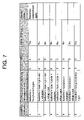
- FIG. 7 shows an example of the intermediate results of the method for the compound word “basketbalkampioenschappen” according to the present invention.
- FIG. 1 illustrates an embodiment of an information retrieval system such as a document management system or web search system according to the present invention.
- the document management system comprises an operator console ( 101 ), a search engine front-end ( 104 ), a search engine ( 105 ), and a document database ( 106 ), all operatively coupled.
- the operator console provides a user interface to the system according to the invention, and is provided with a display ( 102 ) and data entry means, e.g. a keyboard ( 103 ).
- the search engine front-end ( 104 ) converts all data that is received from the operator console ( 101 ) into a search to be carried out by the search engine ( 105 ).
- the search engine ( 105 ) carries out the search on the database ( 106 ) and takes care that search results are returned to the submitter.
- the database ( 106 ) contains the documents to search for.
- FIG. 1 all components of FIG. 1 may be incorporated into one personal computer.
- the search engine ( 105 ), search engine front end ( 104 ) and document database ( 106 ) are embodied in a server, and numerous operator consoles ( 101 ), embodied as workstations, may access as client the server and use a web browser as access means to the server.
- FIG. 2 presents an embodiment of the search engine ( 105 ) and document database ( 106 ) according to the invention.
- the document collection ( 201 ) may contain any form of written information such as reports, newspaper articles, and webpages.
- all words of the document collection ( 201 ) are collected by means of for example a semantic network ( 202 ) and are put in order in a word list ( 203 ) in the database ( 106 ).
- a semantic network 202
- 203 word list
- best results are obtained by considering only the words that exist in the document collection. Collecting all words from the document collection and putting these words in an ordered form in a word list does this.
- the search process starts when the search engine ( 105 ) receives a search from the search engine front-end ( 104 ).
- An example of a search containing T terms is t 1 AND t 2 AND . . . AND t T where a term t i is a term from the group of used terms; t i ⁇ (t 1 , . . . , t T ).
- a term can be any word. Between terms any logical operator can be used such as AND, OR, and NOT.
- the search has T terms, where T is at least one.
- the person skilled in the art will also understand that the invention is fully capable of handling one or more terms within the search.
- the split compound decision module ( 204 ) of the search engine ( 105 ) decides for every term within a search whether the term contains constituent words that should be applied in a separate form in the search.
- the result of the split compound decision module ( 204 ) is a modified search that contains the constituent words of the compound words in a separated form.
- the retrieve and rank documents module ( 205 ) of the search engine ( 105 ) uses this modified search and the word list to get document references to calculate the relevance score per document reference, to rank the found document references and to communicate the ranked document references with their relevance scores to the search engine front-end ( 104 ).
- FIG. 3 presents an embodiment of the split compound decision module ( 204 ) according to the invention.
- the split compound decision module ( 204 ) decides per term t i of a search whether the term is a compound word and whether to split the constituent words into separated words.
- the term counter i is set to 1.
- the constituent words are derived from the word list ( 204 ). Several different constituent words combinations may exist constructing the same compound word, each combination is called a constituent words set.
- the word list is used to find a combination of words constituting the compound word.
- step S 303 When constituent words are found (step S 303 (Y)), then the constituent words set counter j is initialized to 1 in step S 304 .
- step S 305 determines the number of documents that contain the compound word t i . This function is called DT(i).
- Step S 305 also determines the number of documents containing the constituent words of set j, this function being called DP(i,j).
- the function results of DT(i), and DP(i,j) can be found by means of the word list as will be demonstrated later.
- step S 306 the split decision criterion DT(i) ⁇ 3*DP(i,j) is evaluated for each j th set of constituent words. If it is determined that DT(i) ⁇ 3*DP(i,j), then in step S 307 the constituent words set j constituting the compound word t i is split to the words in a separated form. If at step S 306 it is determined that DT(i) ⁇ 3*DP(i,j) is not obtained, then the process is continued in step S 308 .
- the split decision criterion is evaluated for every term t i and eventually will result in a modified search.
- step S 308 the constituent words set counter value j is increased with one and in step S 309 it is evaluated whether all constituent words sets are handled. When not all constituent words sets are handled (N at step S 309 ), then for the next constituent words set j the method is continued at step S 305 . When all constituent words sets are handled (Y at step S 309 ), then the term counter value i is increased with one in step S 310 . The same yields when in step S 303 no constituent words constituting the compound word are found (N at step S 303 ) resulting in continuation in step S 310 .
- step S 311 it is evaluated whether all terms t i are handled. When not all terms t i are handled (N at step S 311 ) then the method continues in step S 303 . But, when all terms t i are handled (Y at step S 311 ), then the method stops in step S 312 .
- an embodiment of the invention is capable of handling one or more terms within the search and is capable to split the terms that are constituent words complying to the split decision criteria of step S 306 .
- Joining existing words together creates compound words.
- linking morpheme letters may be inserted at the joint. Since there are no simple rules for when such linking morpheme letters may be inserted, it must be checked for between any two words. For German compound words, “s” and “es” as linking morphemes are used. For Dutch, as linking morpheme the “s” is allowed.
- FIG. 4 shows a flow diagram of an embodiment of the method (step S 303 of FIG. 3 ) to find constituent words constituting the term t i .
- the embodiment of FIG. 4 is for the Dutch language, where as an example only the linking morpheme “s” is considered.
- linking morpheme “s” is considered.
- one skilled in the art will understand that for other compound languages other linking morphemes and more than one linking morpheme can be checked for and react on correspondingly.
- step S 403 When in step S 403 , the penultimate character of string w s L is not reached by character position c(level), so L ⁇ c(level) is ⁇ 2 (Y at step S 403 ), then step S 404 evaluates whether string w s c(level) is a word by consulting a word list. When w s c(level) is not a word (N at step S 404 ) then in step S 408 the word character end position value c(level) is increased with one. But when w s c(level) is a word (Y at step S 404 ), then in step S 405 the word is stored in a word store based on the actual word level.
- step S 406 the situation value is determined, which is one of the eight situations (Table 1) that will be explained later in more detail now continuing with step S 407 .
- step S 407 depending on the situation value and the flag value, some actions are executed (Table 2). For instance, word character start position s and word character end position c(level) are adapted to new character positions and possibly a word is found and stored, which will be explained later in detail.
- step S 407 the method continues with step S 403 .
- step S 403 the penultimate character of string W s L is reached, so L ⁇ c(level) ⁇ 2 (N at step S 403 )
- step S 409 results in “yes” and continues with step S 407 when the flag status is “true”. For example this is the case when the process of trying to split the word w L c(level)+1 is finished, and the process must continue to try to split the word w L c(level)+2 .
- the flag will become “false” and step S 409 results in “no” (N at step S 409 ) and will continue at step S 410 in which the word level is decreased with one.
- step S 411 it is checked whether all word levels are evaluated on finding other words.
- the process continues with expanding the word to another word by first increasing the word character end position value c(level) with one in step S 412 and updating the word character start position value s with c(level ⁇ 1)+1, and the process is continued at step S 403 .
- step S 413 checks whether constituent words constituting t i are found and thereafter the method finishes in step S 414 .
- FIG. 5 shows an embodiment of the internals of Table 1 (S 406 ) and Table 2 (S 407 ) in detail.
- Table 1 (S 406 ) four decision criteria determine the situation value.
- the decision criteria are: the flag status (true or false), the remainder w L c(level)+1 is a word (yes or no), character position w c(level)+1 c(level)+1 is a “s” (yes or no), and the remainder w L c(level)+2 is a word (yes or no).
- the assigned situation value is shown. There is no situation value update when the flag value is true, as depicted in the last cell of the last row of Table 1. Thereafter Table 2 (S 407 ) is entered with the eventual updated situation.
- the character positions values c(level)+2 and c(level)+3 are stored in helper constants respectively “sf” and “cf” for later use (to try to split the word w L c(level)+2 into two words after first trying to split the word w L c(level)+1 ), and the character position values s and c(level) are updated respectively with c(level)+1 and c(level)+2 and the method leaves Table 2 to continue at step S 403 ( FIG. 4 ) to try to split word w L c(level)+1 into two words.
- the English translation is “basketball championships”.
- the split compound decision module ( 204 ) will find all constituent nouns constituting this compound word by means of the word list ( 203 ) including all nouns derived from the document collection ( 201 ).
- the word list of FIG. 6 is used as an example, of which the first column of the word list contains all nouns available in the document collection in alphabetical order.
- the second column contains for each noun all document references from the document collection that incorporate this noun.
- the third column contains the number of documents from the document collection containing this noun.
- An embodiment of the word list can contain only the first two columns.
- the third column can be derived from the second column.
- the word list can be expanded with additional information such as the third column, or including other word types such as verbs and indicate the nouns with a noun indicator.
- the person skilled in the art will understand from FIG. 6 that the number of documents (third column) containing the compound word t i (first column) can be derived from the word list.
- the first main step (S 303 ) is to determine all constituent words possibilities called sets constituting “basketbalkampioenschappen” by using the word list ( 203 ) of FIG. 6 .
- the split compound decision module ( 204 ) finds 8 constituent nouns sets as shown in FIG. 7 .
- FIG. 7 all 8 found constituent words sets are presented in the second column.
- step S 305 the number of documents DT(i) containing the compound word t i “basketbalkampioenschappen” is determined.
- the compound word “basketbalkampioenschappen” is not found in any document within the document collection ( 201 ) by the semantic network module ( 202 ) as indicated by DT(i) being 0.
- Next action in step S 305 is to determine the number of documents, DP(i,j), that contain all constituent words of set j.
- FIG. 7 at fourth column the DP(i,j) values are presented.
- step S 306 the split decision criteria DT(i) ⁇ 3*DP(i,j) per constituent words set j are evaluated.
- the result of this evaluation is presented in column 5 of FIG. 7 .
- the split result of step S 307 for this example is presented in column 6 of FIG. 7 .
- Such computer program(s) may be stored in memories such as RAM, ROM, PROM, etc. associated with computers. Alternatively, such computer program(s) may be stored in a different storage medium such as a magnetic disc, optical disc, magneto-optical disc, etc. Such computer program(s) may also take the form of a signal propagating across the Internet, extranet, intranet or other network and arriving at the destination device for storage and implementation.
- the computer programs are readable using a known computer or computer-based device.
Landscapes
- Engineering & Computer Science (AREA)
- Theoretical Computer Science (AREA)
- Health & Medical Sciences (AREA)
- Artificial Intelligence (AREA)
- Audiology, Speech & Language Pathology (AREA)
- Computational Linguistics (AREA)
- General Health & Medical Sciences (AREA)
- Physics & Mathematics (AREA)
- General Engineering & Computer Science (AREA)
- General Physics & Mathematics (AREA)
- Machine Translation (AREA)
- Information Retrieval, Db Structures And Fs Structures Therefor (AREA)
Applications Claiming Priority (3)
| Application Number | Priority Date | Filing Date | Title |
|---|---|---|---|
| EP04075975 | 2004-03-31 | ||
| EP04075975.5 | 2004-03-31 | ||
| EP04075975 | 2004-03-31 |
Publications (2)
| Publication Number | Publication Date |
|---|---|
| US20050222998A1 US20050222998A1 (en) | 2005-10-06 |
| US7720847B2 true US7720847B2 (en) | 2010-05-18 |
Family
ID=34928127
Family Applications (1)
| Application Number | Title | Priority Date | Filing Date |
|---|---|---|---|
| US11/092,653 Expired - Fee Related US7720847B2 (en) | 2004-03-31 | 2005-03-30 | Apparatus and computerised method for determining constituent words of a compound word |
Country Status (3)
| Country | Link |
|---|---|
| US (1) | US7720847B2 (ja) |
| JP (1) | JP4754247B2 (ja) |
| CN (1) | CN1677402A (ja) |
Cited By (5)
| Publication number | Priority date | Publication date | Assignee | Title |
|---|---|---|---|---|
| US20070260451A1 (en) * | 2006-03-27 | 2007-11-08 | Casio Computer Co., Ltd. | Information display control apparatus and recording medium recording information display control program |
| US20110010165A1 (en) * | 2009-07-13 | 2011-01-13 | Samsung Electronics Co., Ltd. | Apparatus and method for optimizing a concatenate recognition unit |
| US20110202330A1 (en) * | 2010-02-12 | 2011-08-18 | Google Inc. | Compound Splitting |
| US20140025368A1 (en) * | 2012-07-18 | 2014-01-23 | International Business Machines Corporation | Fixing Broken Tagged Words |
| US9563665B2 (en) | 2012-05-22 | 2017-02-07 | Alibaba Group Holding Limited | Product search method and system |
Families Citing this family (33)
| Publication number | Priority date | Publication date | Assignee | Title |
|---|---|---|---|---|
| US7680333B2 (en) * | 2005-04-21 | 2010-03-16 | Microsoft Corporation | System and method for binary persistence format for a recognition result lattice |
| US8086599B1 (en) | 2006-10-24 | 2011-12-27 | Google Inc. | Method and apparatus for automatically identifying compunds |
| US8661029B1 (en) | 2006-11-02 | 2014-02-25 | Google Inc. | Modifying search result ranking based on implicit user feedback |
| CN100498790C (zh) * | 2007-02-06 | 2009-06-10 | 腾讯科技(深圳)有限公司 | 一种搜索方法和系统 |
| CN101261623A (zh) * | 2007-03-07 | 2008-09-10 | 国际商业机器公司 | 基于搜索的无词边界标记语言的分词方法以及装置 |
| US8938463B1 (en) | 2007-03-12 | 2015-01-20 | Google Inc. | Modifying search result ranking based on implicit user feedback and a model of presentation bias |
| US8694374B1 (en) | 2007-03-14 | 2014-04-08 | Google Inc. | Detecting click spam |
| US9092510B1 (en) | 2007-04-30 | 2015-07-28 | Google Inc. | Modifying search result ranking based on a temporal element of user feedback |
| US8694511B1 (en) | 2007-08-20 | 2014-04-08 | Google Inc. | Modifying search result ranking based on populations |
| US8046355B2 (en) * | 2007-09-04 | 2011-10-25 | Google Inc. | Word decompounder |
| US8909655B1 (en) | 2007-10-11 | 2014-12-09 | Google Inc. | Time based ranking |
| US8396865B1 (en) | 2008-12-10 | 2013-03-12 | Google Inc. | Sharing search engine relevance data between corpora |
| US9009146B1 (en) * | 2009-04-08 | 2015-04-14 | Google Inc. | Ranking search results based on similar queries |
| US8447760B1 (en) | 2009-07-20 | 2013-05-21 | Google Inc. | Generating a related set of documents for an initial set of documents |
| US8498974B1 (en) | 2009-08-31 | 2013-07-30 | Google Inc. | Refining search results |
| US8972391B1 (en) | 2009-10-02 | 2015-03-03 | Google Inc. | Recent interest based relevance scoring |
| US8874555B1 (en) | 2009-11-20 | 2014-10-28 | Google Inc. | Modifying scoring data based on historical changes |
| US8615514B1 (en) | 2010-02-03 | 2013-12-24 | Google Inc. | Evaluating website properties by partitioning user feedback |
| US8924379B1 (en) | 2010-03-05 | 2014-12-30 | Google Inc. | Temporal-based score adjustments |
| US8959093B1 (en) | 2010-03-15 | 2015-02-17 | Google Inc. | Ranking search results based on anchors |
| US9623119B1 (en) | 2010-06-29 | 2017-04-18 | Google Inc. | Accentuating search results |
| US8832083B1 (en) | 2010-07-23 | 2014-09-09 | Google Inc. | Combining user feedback |
| CN102479191B (zh) * | 2010-11-22 | 2014-03-26 | 阿里巴巴集团控股有限公司 | 提供多粒度分词结果的方法及其装置 |
| US9002867B1 (en) | 2010-12-30 | 2015-04-07 | Google Inc. | Modifying ranking data based on document changes |
| JP5834772B2 (ja) * | 2011-10-27 | 2015-12-24 | カシオ計算機株式会社 | 情報処理装置及びプログラム |
| JP5250709B1 (ja) * | 2012-03-12 | 2013-07-31 | 楽天株式会社 | 情報処理装置、情報処理方法、情報処理装置用プログラム、および、記録媒体 |
| US9104750B1 (en) | 2012-05-22 | 2015-08-11 | Google Inc. | Using concepts as contexts for query term substitutions |
| CN103870472B (zh) * | 2012-12-11 | 2018-07-10 | 百度国际科技(深圳)有限公司 | 一种复合词挖掘方法及装置 |
| US9183499B1 (en) | 2013-04-19 | 2015-11-10 | Google Inc. | Evaluating quality based on neighbor features |
| CN104679778B (zh) * | 2013-11-29 | 2019-03-26 | 腾讯科技(深圳)有限公司 | 一种搜索结果的生成方法及装置 |
| JP5979650B2 (ja) | 2014-07-28 | 2016-08-24 | インターナショナル・ビジネス・マシーンズ・コーポレーションInternational Business Machines Corporation | 用語を適切な粒度で分割する方法、並びに、用語を適切な粒度で分割するためのコンピュータ及びそのコンピュータ・プログラム |
| US10362060B2 (en) * | 2015-12-30 | 2019-07-23 | International Business Machines Corporation | Curtailing search engines from obtaining and controlling information |
| US10572586B2 (en) * | 2018-02-27 | 2020-02-25 | International Business Machines Corporation | Technique for automatically splitting words |
Citations (8)
| Publication number | Priority date | Publication date | Assignee | Title |
|---|---|---|---|---|
| US5778361A (en) * | 1995-09-29 | 1998-07-07 | Microsoft Corporation | Method and system for fast indexing and searching of text in compound-word languages |
| US5867812A (en) | 1992-08-14 | 1999-02-02 | Fujitsu Limited | Registration apparatus for compound-word dictionary |
| US6396699B1 (en) * | 2001-01-19 | 2002-05-28 | Lsi Logic Corporation | Heat sink with chip die EMC ground interconnect |
| US6549897B1 (en) * | 1998-10-09 | 2003-04-15 | Microsoft Corporation | Method and system for calculating phrase-document importance |
| US20030097252A1 (en) | 2001-10-18 | 2003-05-22 | Mackie Andrew William | Method and apparatus for efficient segmentation of compound words using probabilistic breakpoint traversal |
| US20040064447A1 (en) * | 2002-09-27 | 2004-04-01 | Simske Steven J. | System and method for management of synonymic searching |
| US20040172378A1 (en) * | 2002-11-15 | 2004-09-02 | Shanahan James G. | Method and apparatus for document filtering using ensemble filters |
| US20050091031A1 (en) * | 2003-10-23 | 2005-04-28 | Microsoft Corporation | Full-form lexicon with tagged data and methods of constructing and using the same |
Family Cites Families (4)
| Publication number | Priority date | Publication date | Assignee | Title |
|---|---|---|---|---|
| JPH0827635B2 (ja) * | 1986-09-17 | 1996-03-21 | 富士通株式会社 | 文―音声変換装置に用いる複合語処理装置 |
| JPH07262191A (ja) * | 1994-03-24 | 1995-10-13 | Sony Corp | 単語分割方法、および音声合成装置 |
| JP2001249921A (ja) * | 2000-03-03 | 2001-09-14 | Nippon Telegr & Teleph Corp <Ntt> | 複合語解析方法、装置、および複合語解析プログラムを記録した記録媒体 |
| JP2002245062A (ja) * | 2001-02-14 | 2002-08-30 | Ricoh Co Ltd | 文書検索装置、文書検索方法、プログラムおよび記録媒体 |
-
2005
- 2005-03-29 JP JP2005095536A patent/JP4754247B2/ja not_active Expired - Fee Related
- 2005-03-30 US US11/092,653 patent/US7720847B2/en not_active Expired - Fee Related
- 2005-03-31 CN CNA2005100629781A patent/CN1677402A/zh active Pending
Patent Citations (8)
| Publication number | Priority date | Publication date | Assignee | Title |
|---|---|---|---|---|
| US5867812A (en) | 1992-08-14 | 1999-02-02 | Fujitsu Limited | Registration apparatus for compound-word dictionary |
| US5778361A (en) * | 1995-09-29 | 1998-07-07 | Microsoft Corporation | Method and system for fast indexing and searching of text in compound-word languages |
| US6549897B1 (en) * | 1998-10-09 | 2003-04-15 | Microsoft Corporation | Method and system for calculating phrase-document importance |
| US6396699B1 (en) * | 2001-01-19 | 2002-05-28 | Lsi Logic Corporation | Heat sink with chip die EMC ground interconnect |
| US20030097252A1 (en) | 2001-10-18 | 2003-05-22 | Mackie Andrew William | Method and apparatus for efficient segmentation of compound words using probabilistic breakpoint traversal |
| US20040064447A1 (en) * | 2002-09-27 | 2004-04-01 | Simske Steven J. | System and method for management of synonymic searching |
| US20040172378A1 (en) * | 2002-11-15 | 2004-09-02 | Shanahan James G. | Method and apparatus for document filtering using ensemble filters |
| US20050091031A1 (en) * | 2003-10-23 | 2005-04-28 | Microsoft Corporation | Full-form lexicon with tagged data and methods of constructing and using the same |
Non-Patent Citations (9)
| Title |
|---|
| Aitao Chen, "Multilingual Information Retrieval Using English and Chinese Queries" CLEF 2001 Workshop, ′Online! Sep. 3, 2001, XP002292376. |
| Aitao Chen, "Multilingual Information Retrieval Using English and Chinese Queries" CLEF 2001 Workshop, 'Online! Sep. 3, 2001, XP002292376. |
| Berton et al., "Compound words in large-vocabulary German speech recognition systems", Spoken Language, 1996. ICSLP 96. Proceedings., Fourth International Conference, 1996, pp. 1165-1168. Download: http://ieeexplore.ieee.org/stamp/stamp.jsp?tp=&arnumber=607814&isnumber=13324. * |
| J. Kamps et al. "Language-dependent and Language-independent Approaches to Cross-Lingual Text Retrieval" ′Online! 2003, XP002292374. |
| J. Kamps et al. "Language-dependent and Language-independent Approaches to Cross-Lingual Text Retrieval" 'Online! 2003, XP002292374. |
| R. Brand et al."Oce at CLEF 2003" ′Online! XP002292379. |
| R. Brand et al."Oce at CLEF 2003" 'Online! XP002292379. |
| Resnik, Philip, CMSC 838L Programming Assignment 2 Online! Sep. 26, 2001, XP002292375. |
| Soan et al., "Data-Driven Approach to Designing Compound Words for Continuous Speech Recognition", CiteSeerx, 1999. pp. 327-332. Download: http://citeseerx.ist.psu.edu/viewdoc/summary?doi=10.1.1.28.758. * |
Cited By (8)
| Publication number | Priority date | Publication date | Assignee | Title |
|---|---|---|---|---|
| US20070260451A1 (en) * | 2006-03-27 | 2007-11-08 | Casio Computer Co., Ltd. | Information display control apparatus and recording medium recording information display control program |
| US8027831B2 (en) * | 2006-03-27 | 2011-09-27 | Casio Computer Co., Ltd. | Information display control apparatus and recording medium recording information display control program |
| US20110010165A1 (en) * | 2009-07-13 | 2011-01-13 | Samsung Electronics Co., Ltd. | Apparatus and method for optimizing a concatenate recognition unit |
| US20110202330A1 (en) * | 2010-02-12 | 2011-08-18 | Google Inc. | Compound Splitting |
| US9075792B2 (en) * | 2010-02-12 | 2015-07-07 | Google Inc. | Compound splitting |
| US9563665B2 (en) | 2012-05-22 | 2017-02-07 | Alibaba Group Holding Limited | Product search method and system |
| US20140025368A1 (en) * | 2012-07-18 | 2014-01-23 | International Business Machines Corporation | Fixing Broken Tagged Words |
| US20140025373A1 (en) * | 2012-07-18 | 2014-01-23 | International Business Machines Corporation | Fixing Broken Tagged Words |
Also Published As
| Publication number | Publication date |
|---|---|
| JP4754247B2 (ja) | 2011-08-24 |
| US20050222998A1 (en) | 2005-10-06 |
| CN1677402A (zh) | 2005-10-05 |
| JP2005293582A (ja) | 2005-10-20 |
Similar Documents
| Publication | Publication Date | Title |
|---|---|---|
| US7720847B2 (en) | Apparatus and computerised method for determining constituent words of a compound word | |
| US6173251B1 (en) | Keyword extraction apparatus, keyword extraction method, and computer readable recording medium storing keyword extraction program | |
| US6490549B1 (en) | Automatic orthographic transformation of a text stream | |
| US8370128B2 (en) | Semantically-driven extraction of relations between named entities | |
| JP4306894B2 (ja) | 自然言語処理装置及びその方法、及び自然言語認識装置 | |
| US20040260558A1 (en) | Method and system for segmenting and identifying events in images using spoken annotations | |
| EP1214643B1 (en) | System and method for parsing a document | |
| US8170867B2 (en) | System for extracting information from a natural language text | |
| US8327265B1 (en) | System and method for parsing a document | |
| Giri et al. | A survey of automatic text summarization system for different regional language in India | |
| US20040193584A1 (en) | Method and device for relevant document search | |
| JP3735336B2 (ja) | 文書要約方法及びシステム | |
| Fachrurrozi et al. | Frequent term based text summarization for Bahasa Indonesia | |
| Pouliquen et al. | Automatic construction of multilingual name dictionaries | |
| JPH0934905A (ja) | キーセンテンス抽出方式及び抄録方式及び文検索方式 | |
| EP1582996A2 (en) | Apparatus and computerised method for determining constituent words of a compound word | |
| CN112269852B (zh) | 生成舆情专题方法、系统及存储介质 | |
| CN115169328A (zh) | 一种高准确性的中文拼写检查方法、系统及介质 | |
| Cholakov et al. | Automated verb sense labelling based on linked lexical resources | |
| JPS61248160A (ja) | 文書情報登録方式 | |
| JPH07134720A (ja) | 文章作成システムにおける関連情報提示方法及び装置 | |
| Alansary | Shallow Parsing for Automatic Arabic Text Summarization | |
| Sedlácek et al. | Automatic Processing of Czech Inflectional and Derivative Morphology | |
| JP2897942B2 (ja) | 日本語形態素解析システム及び形態素解析方式 | |
| Osenova et al. | Learning a token classification from a large corpus.(A case study in abbreviations) |
Legal Events
| Date | Code | Title | Description |
|---|---|---|---|
| AS | Assignment |
Owner name: OCE-TECHNOLOGIES B.V., NETHERLANDS Free format text: ASSIGNMENT OF ASSIGNORS INTEREST;ASSIGNORS:DRIESSEN, SAMUEL J.;LLJIN, PAVEL M.;REEL/FRAME:016435/0897;SIGNING DATES FROM 20050309 TO 20050310 Owner name: OCE-TECHNOLOGIES B.V.,NETHERLANDS Free format text: ASSIGNMENT OF ASSIGNORS INTEREST;ASSIGNORS:DRIESSEN, SAMUEL J.;LLJIN, PAVEL M.;SIGNING DATES FROM 20050309 TO 20050310;REEL/FRAME:016435/0897 |
|
| FEPP | Fee payment procedure |
Free format text: PAYOR NUMBER ASSIGNED (ORIGINAL EVENT CODE: ASPN); ENTITY STATUS OF PATENT OWNER: LARGE ENTITY |
|
| FEPP | Fee payment procedure |
Free format text: PAYER NUMBER DE-ASSIGNED (ORIGINAL EVENT CODE: RMPN); ENTITY STATUS OF PATENT OWNER: LARGE ENTITY Free format text: PAYOR NUMBER ASSIGNED (ORIGINAL EVENT CODE: ASPN); ENTITY STATUS OF PATENT OWNER: LARGE ENTITY |
|
| FPAY | Fee payment |
Year of fee payment: 4 |
|
| FEPP | Fee payment procedure |
Free format text: MAINTENANCE FEE REMINDER MAILED (ORIGINAL EVENT CODE: REM.) |
|
| LAPS | Lapse for failure to pay maintenance fees |
Free format text: PATENT EXPIRED FOR FAILURE TO PAY MAINTENANCE FEES (ORIGINAL EVENT CODE: EXP.) |
|
| STCH | Information on status: patent discontinuation |
Free format text: PATENT EXPIRED DUE TO NONPAYMENT OF MAINTENANCE FEES UNDER 37 CFR 1.362 |
|
| FP | Lapsed due to failure to pay maintenance fee |
Effective date: 20180518 |