US7686958B2 - Method for the production of a chemical reaction product with the aid of a fixed-bed reactor - Google Patents
Method for the production of a chemical reaction product with the aid of a fixed-bed reactor Download PDFInfo
- Publication number
- US7686958B2 US7686958B2 US10/586,065 US58606505A US7686958B2 US 7686958 B2 US7686958 B2 US 7686958B2 US 58606505 A US58606505 A US 58606505A US 7686958 B2 US7686958 B2 US 7686958B2
- Authority
- US
- United States
- Prior art keywords
- reaction product
- reactants
- particle bed
- bed
- supplied
- Prior art date
- Legal status (The legal status is an assumption and is not a legal conclusion. Google has not performed a legal analysis and makes no representation as to the accuracy of the status listed.)
- Expired - Fee Related, expires
Links
Images




Classifications
-
- B—PERFORMING OPERATIONS; TRANSPORTING
- B01—PHYSICAL OR CHEMICAL PROCESSES OR APPARATUS IN GENERAL
- B01D—SEPARATION
- B01D15/00—Separating processes involving the treatment of liquids with solid sorbents; Apparatus therefor
- B01D15/08—Selective adsorption, e.g. chromatography
- B01D15/10—Selective adsorption, e.g. chromatography characterised by constructional or operational features
- B01D15/18—Selective adsorption, e.g. chromatography characterised by constructional or operational features relating to flow patterns
- B01D15/1892—Selective adsorption, e.g. chromatography characterised by constructional or operational features relating to flow patterns the sorbent material moving as a whole, e.g. continuous annular chromatography, true moving beds or centrifugal chromatography
-
- B—PERFORMING OPERATIONS; TRANSPORTING
- B01—PHYSICAL OR CHEMICAL PROCESSES OR APPARATUS IN GENERAL
- B01J—CHEMICAL OR PHYSICAL PROCESSES, e.g. CATALYSIS OR COLLOID CHEMISTRY; THEIR RELEVANT APPARATUS
- B01J8/00—Chemical or physical processes in general, conducted in the presence of fluids and solid particles; Apparatus for such processes
- B01J8/02—Chemical or physical processes in general, conducted in the presence of fluids and solid particles; Apparatus for such processes with stationary particles, e.g. in fixed beds
- B01J8/0242—Chemical or physical processes in general, conducted in the presence of fluids and solid particles; Apparatus for such processes with stationary particles, e.g. in fixed beds the fluid flow within the bed being predominantly vertical
- B01J8/0257—Chemical or physical processes in general, conducted in the presence of fluids and solid particles; Apparatus for such processes with stationary particles, e.g. in fixed beds the fluid flow within the bed being predominantly vertical in a cylindrical annular shaped bed
-
- B—PERFORMING OPERATIONS; TRANSPORTING
- B01—PHYSICAL OR CHEMICAL PROCESSES OR APPARATUS IN GENERAL
- B01J—CHEMICAL OR PHYSICAL PROCESSES, e.g. CATALYSIS OR COLLOID CHEMISTRY; THEIR RELEVANT APPARATUS
- B01J8/00—Chemical or physical processes in general, conducted in the presence of fluids and solid particles; Apparatus for such processes
- B01J8/02—Chemical or physical processes in general, conducted in the presence of fluids and solid particles; Apparatus for such processes with stationary particles, e.g. in fixed beds
- B01J8/0285—Heating or cooling the reactor
-
- B—PERFORMING OPERATIONS; TRANSPORTING
- B01—PHYSICAL OR CHEMICAL PROCESSES OR APPARATUS IN GENERAL
- B01J—CHEMICAL OR PHYSICAL PROCESSES, e.g. CATALYSIS OR COLLOID CHEMISTRY; THEIR RELEVANT APPARATUS
- B01J2208/00—Processes carried out in the presence of solid particles; Reactors therefor
- B01J2208/00008—Controlling the process
- B01J2208/00017—Controlling the temperature
- B01J2208/00106—Controlling the temperature by indirect heat exchange
- B01J2208/00168—Controlling the temperature by indirect heat exchange with heat exchange elements outside the bed of solid particles
- B01J2208/00212—Plates; Jackets; Cylinders
-
- Y—GENERAL TAGGING OF NEW TECHNOLOGICAL DEVELOPMENTS; GENERAL TAGGING OF CROSS-SECTIONAL TECHNOLOGIES SPANNING OVER SEVERAL SECTIONS OF THE IPC; TECHNICAL SUBJECTS COVERED BY FORMER USPC CROSS-REFERENCE ART COLLECTIONS [XRACs] AND DIGESTS
- Y02—TECHNOLOGIES OR APPLICATIONS FOR MITIGATION OR ADAPTATION AGAINST CLIMATE CHANGE
- Y02P—CLIMATE CHANGE MITIGATION TECHNOLOGIES IN THE PRODUCTION OR PROCESSING OF GOODS
- Y02P20/00—Technologies relating to chemical industry
- Y02P20/50—Improvements relating to the production of bulk chemicals
- Y02P20/582—Recycling of unreacted starting or intermediate materials
Definitions
- the present invention relates to a method for preparing a chemical reaction product from one or more reactants through the contact with a heterogeneous catalyst in a fixed-bed reactor.
- a typical P-CAC (preparative continuous annular chromatography) device consists of an annular particle bed which is packed inside the gap (annular clearance) between two concentric cylinders. During the rotation of the particle bed around its axis, a feed solution containing the mixture to be separated and one or more eluents is continuously supplied from the top. Such procedures are known in the art (see EP-A-371,648, for example). P-CAC devices have been used for chromatographic separation of mixed substances only.
- the applicant of the present invention has, for the first time, described the use of such a continuously operating annular chromatograph as a reaction medium, with the particle bed being divided into two or more zones comprising at least one reaction zone and at least one separation zone, which are separated from one another by separating layers made of diaphragms, non-porous inert materials or electrically non-conductive materials.
- a chemical product formed in the reaction zone under the action of the catalyst is then chromatographically purified from starting materials, by-products, if any, and catalyst in at least one separation zone and is recovered from the reactor/chromatograph in substantially pure form.
- this type of “reactive chromatography” is material intensive and costly as it is necessary to provide different particle-bed materials for the reaction and separation zones, or at least differently coated bed materials (with metals, metal complexes or enzymes) for the reaction and separation zones, often also to provide different solvents and/or eluents as well as one or more separating layers.
- Providing varying flow cross-sections for locally controlling the flow rate e.g. for concentrating process flows prior to passing into the next zone, which is also disclosed therein, further increases the complexity of the device as well as the costs.
- the aim of the present invention is to provide a method for synthesizing chemical products and separating the reactants, products and by-products in a fixed chromatographic bed of a continuously operated annular chromatograph while reducing the complexity of the device, the materials involved and the costs in comparison with the previously described AT-A-405,026, which is considered the closest prior art.
- the above aim is achieved by a method for preparating at least one chemical reaction product by means of chemical reaction of one or more reactants, optionally dissolved in one or more solvents, which are supplied as a feed flow, through the contact with a heterogeneous catalyst in a continuously operated fixed-bed reactor packed with a particle bed, a continuous annular chromatograph (CAC), packed with the particle bed, being used as fixed-bed reactor in which the at least one reaction product is formed and purified and the at least one purified reaction product as well as any by-products and/or unreacted reactants present are withdrawn from the annular chromatograph, each at a different and predetermined rotational angle position, the method being characterized in that only one type of particulate material in a single particle bed is used as both the catalyst for the formation of the at least one reaction product in the particle bed and the chromatographic medium for the purification thereof.
- CAC continuous annular chromatograph
- chromatographic reactors have the inherent characteristic of showing different levels of affinity to different materials in order to allow their separation on the basis of the resulting differences in their rates of flow through the chromatographic bed.
- this method of the invention allows the continuous operation of the annular chromatograph, the reaction equilibrium being shifted towards the final product by continuously withdrawing the reaction product, so that the reactant(s) is/are preferably converted into reaction product(s), whereby a substantially quantitative conversion is preferably brought about.
- Unreacted reactants and/or by-products are preferably recirculated and reused in the chemical reaction. This ensures efficient use of the chemicals employed.
- the catalyst material is uniformly distributed in or on the particulate material.
- the particulate material entirely consists of catalyst material. This increases the surface and time of contact between the reactants and the catalyst, which in turn leads to improved conversion.
- an ion exchange resin is used as particulate material in another preferred embodiment, certain molecules can be retained in the resin.
- a zeolite as particulate material, in order to further increase the separation efficiency, as will be explained in more detail below.
- reaction/separation medium By heating and cooling the reaction/separation medium in a particularly preferred embodiment, highly sensitive control of the reaction parameters is possible, enabling the creation of several zones having different temperatures. For example, a continuous temperature gradient may be generated by heating and/or cooling during reaction. Adjusting different temperature values may be important, when a given reaction temperature must be kept; however, as temperature can also influence the chromatographic separation, various temperature ranges fall within the scope of the invention.
- zeolites for example, are temperature-dependent. Some representatives of this class of silicates release crystal water when the temperature is elevated (without changing their crystal structure). For example, some zeolites have catalytic effects at temperatures above 150° C., while below this value, i.e. with a higher crystal water content, they show separating effects similar to those of a chromatographic gel. Using certain zeolites and generating different temperature zones, especially a temperature gradient which decreases from top to bottom, it is therefore possible to mainly use the catalytic effect of the respective zeolite in the upper, hotter bed sections first and then to mainly use its separating effect in the lower, cooler sections, without the laborious operation of coating the particulate material.
- At least one reactant preferably, in order to enhance the reaction rate, all reactants, is/are dissolved in a solvent.
- this solvent may at the same time serve as the eluent.
- at least one of the reactants itself acts as solvent, which further simplifies the reaction procedure and saves costs.
- a polyvalent reactant is used as reactant which is able to form several different reaction products by reacting with the other reactant.
- the procedure is preferably controlled by controlling the operating parameters so as to enable the preferential recovery of one of the possible reaction products. It is particularly preferred to recover substantially only this product.
- acetic acid and glycerol are supplied and substantially triacetin only is recovered as the preferred reaction product, i.e. monoacetin and diacetin are further reacted with acetic acid and do not accumulate as by-products.
- phenol and acetone are supplied and bisphenol A is recovered as the preferred reaction product.
- acetic acid and methanol are supplied and methyl acetate is quantitatively recovered.
- FIG. 1 schematically shows an embodiment of the present invention, ie an annular chromatograph having a chromatographic bed 1 inside an annular column, which is made of a material inert against the components of the reactants and the solvents and which rotates about an axis 3 , and a thermo-jacket 2 .
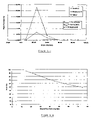
- FIGS. 2.1 to 2 . 8 show concentration profiles for reactions of glycerol with acetic acid at different eluent flow rates, feed flow rates and rotation speeds.
- FIGS. 3.1 to 3 . 8 show concentration profiles for reactions of phenol with acetone at different eluent flow rates, feed flow rates and rotation speeds.
- FIGS. 4.1 to 4 . 5 show concentration profiles for reactions of glycerol with acetic acid at different eluent flow rates, feed flow rates and rotation speeds.
- FIG. 1 shows a schematic cross-section through a P-CAC device as it is used for carrying out methods according to the present invention.
- Reference numeral 1 designates the particulate fixed-bed which is usually contained in a hollow cylindrical container, e.g. made of glass or stainless steel, which rotates about an axis 3 during operation. According to the present invention, this particle bed acts as both reaction catalyst and separating medium; these two functions may be carried out either simultaneously or successively, such as in the case of controlling temperature values along the height of the fixed-bed.
- Such temperature control may, for example, be effected using thermo-jackets which are designated with reference numerals 2 a and 2 b in FIG. 1 .
- thermo-jackets which are designated with reference numerals 2 a and 2 b in FIG. 1 .
- a zeolite which shows an increased catalytic effect at elevated temperatures and a higher separating effect at lower temperatures, as has been mentioned above, it is possible to take advantage of this effect by selecting locally different temperatures.
- the upper heating jacket 2 a in FIG. 1 is operated with a heating medium at high temperatures, e.g. more than 150° C., while a medium of lower temperature, e.g. of 60 to 80° C., passes through the lower heating jacket 2 b .
- thermo-jackets 2 are provided one below the other, enabling the creation of several “hot reaction zones” which may be separated from each other by lower temperature zones, said zones, as opposed to prior art, being present in one single particle bed.
- thermo-jackets 2 are provided one below the other, enabling the creation of several “hot reaction zones” which may be separated from each other by lower temperature zones, said zones, as opposed to prior art, being present in one single particle bed.
- thermo-jackets are not particularly limited. In practice, however, one to three at most, usually one or two, jackets are preferred, in order to keep the reaction procedure simple and therefore its costs low.
- each thermo-jacket i.e. its relative height to the overall height of the particle bed
- Procedures in which a continuous temperature gradient is obtained in the particle bed of catalyst/separating medium are preferred according to the invention, in order to avoid any side reactions, which are caused by all-too-sudden changes in temperature and which are often hard to foresee, to the highest extent possible.
- the particulate material it is possible to use, for example, a substantially inert material coated with at least one substance which is active as a catalyst and/or separating medium, or a material which is, for example, active as a separating medium and has been coated with a catalyst component, or vice-versa. It is further possible to use a mixture of separating and catalyst materials.
- preferred embodiments employ just one type of particulate material, which is particularly preferred to consist entirely of catalyst/separating medium.
- specific ion exchange resins or zeolites are used.
- the at least one reactant is dissolved in a solvent when being supplied, as this effectively avoids local fluctuations in concentration and leads to a more complete conversion.
- the solvent also acts as eluent, which lowers the number of chemicals used and the complexity of the device, resulting in an overall reduction of costs.
- the invention comprises reactions in which at least one reactant is converted into at least one final product, with the particle bed serving as catalyst for the reaction(s) on the one hand and as separating medium for the purification of the at least one final product on the other. It is also possible to pre-purify one or more reactants. This means that the at least one reactant must pass through a separating zone before entering the reaction zone, whereupon it may eventually be purified in a second separating zone. This may be realized, for example, by arranging a thermo-jacket at medium height of the particle bed only.
- reactions in which only one reactant is reacted include decomposition reactions or rearrangement reactions, where a desired final product can be prepared and additionally also purified from occurring by-products in the same fixed bed using the method according to the present invention.
- the invention is particularly suitable for reactions of polyvalent reactants with which more than just one reaction product is obtainable.
- the method according to the present invention also allows the by-products (which can be obtained in pure form, too) to be recirculated to the feed, by using a preparative annular chromatograph from which different substances are withdrawn through outlets provided at different angular positions, and subsequently to be reacted (and purified) once again in the particle bed.
- the annular chromatograph was packed to a height of 21.4 cm with a bed consisting if 569.4 g of DOWEX 50 W X 8TM (Dow Chemical Company; sulfonated polystyrene/divinylbenzene-based highly acidic cation exchange resin) ion exchange resin with a particle size of 200-400 mesh.
- DOWEX 50 W X 8TM Low Chemical Company; sulfonated polystyrene/divinylbenzene-based highly acidic cation exchange resin
- a feed mixture of 1004.9 g of acetic acid and 564.3 g of glycerol was used, while pure acetic acid was used as the eluent.
- the feed mixture was injected at a flow rate of 0.6 ml/min, and the eluent flow rate was set at 25 ml/min.
- the annular chromatograph was rotated at 70°/h, and the resulting width of the feed band was 3.4 cm.
- Tubings were attached to 28 of the 90 outlets at the bottom of the annular chromatograph and bundled to groups of four. Each group of four tubings was connected to a glass container so that seven different fractions were collected.
- Example 1.1 all of the operating conditions were the same as in Example 1.1, except that the eluent flow rate was 45 ml/min.
- the feed band was 2.5 cm in width.
- the resulting concentration profile is shown in FIG. 2.2 .
- the eluent acetic acid is again excluded to obtain a better overview of the products.
- the product peaks are shifted to lower angles, which can be assumed to be the result of the higher linear velocity and the lower residence time at a higher eluent rate.
- the triacetin fractions contained less water and less diacetin.
- the injection of the acetic acid as eluent at higher flow rates had several effects.
- the water on the ion exchange resin was displaced faster, which led to a better regeneration of the chromatographic bed.
- acetic acid was also a reactant, higher flow rates led to a shift of the chemical equilibrium in favor of the products.
- One negative effect, which can be seen in FIG. 2.2 was the further dilution of the product. This effect led to the lower maximum of the triacetin peak.
- the advantages of the better regeneration of the column and the shift of the chemical equilibrium overweighed.
- the parameters were all the same as in the previous examples, except that the eluent flow rate was 65 ml/min.
- the feed band was 1.8 cm in width.
- the measured concentration profile is shown in FIG. 2.3 .
- Example 1.2 The concentration of the impurities in the triacetin fractions, i.e. diacetin and water, were also higher than in Example 1.2.
- a lower residence time allowed less opportunity for the reaction and the separation of products to take place. If less time is left for the reaction, the shift of the chemical equilibrium, which is caused by a higher flow rate of acetic acid, cannot show any effect.
- FIG. 2.7 shows the concentration profile for the same conditions as in Example 4, except that the rotation speed was increased to 80°/h. As expected, the peaks are shifted to higher angles. However, no triacetin fractions with a purity of more than 90% were collected and the total yield of triacetin was 80.3%, as opposed to 96.9% in Example 1.4. This means that the effect of dilution, which was mentioned in Example 1.4, has already outweighed the possibility of better separation of the products. The dilution of the products becomes more obvious in Example 1.6.
- the rotation speed was further increased to 90°/h.
- the resulting concentration profile is shown in FIG. 2.8 .
- the peaks were further shifted to higher angles and the maximum of the triacetin peak was lower than in the previous examples.
- the lower maximum was a clear sign of the dilution of the products. This means that the eluent flow rate of 55 ml/min was too high to see the effect of better separation at increased rotation speeds because the residence time was too low. As a result, only the dilution of the products could be observed.
- the aim of this example, as well as of Examples 2.2 and 2.3, is to determine the effect of the eluent flow rate on the purity of bisphenol A.
- the eluent flow rate should be minimized for economic reasons, but has to be high enough to enable the regeneration of the chromatographic bed.
- the bisphenol A peak was relatively broad and appeared very late.
- water is especially difficult to displace from the resin, but in this case there was virtually no water present at low angles. Since only one reaction takes place, less water is produced than in the preparation of triacetin. As a result, the regeneration of the column was achieved more easily. However, the bisphenol A was rather diluted because the regeneration of the bed required a relatively large amount of phenol.
- FIG. 3.3 shows the concentration profile.
- the peak of bisphenol A is much narrower than before and the position is hardly shifted, compared to Example 2.2, because less bisphenol A has been produced.
- FIG. 3.3 shows a large peak of unreacted acetone. Under these conditions, the effect of the high linear velocity, which allows less time for reaction and separation, was dominant because small amounts of water also appeared in the fractions of bisphenol A. On the other hand, the shift of the chemical equilibrium no longer played a role. Unlike in the previous examples, no fraction of pure bisphenol A could be obtained.
- FIG. 3.4 shows the total yield of bisphenol A, with respect to acetone, as a function of the eluent flow rate.
- FIG. 3.5 the dependency of the amount of bisphenol A produced per unit of time on the eluent flow rate is shown. The total yield decreases continuously.
- the production of pure bisphenol A shows a clear maximum, due to the two major effects mentioned above. At low flow rates, the regeneration of the column was not as good as at higher rates, and the chemical equilibrium can still be shifted in favor of the products. Beyond the maximum of production, an increase in the eluent flow rate, and with it an increase in linear velocity, allowed less time for reaction and separation. At high flow rates, the production of pure bisphenol A did not decrease as quickly as the production of pure triacetin. Since there were only two products, the separation of bisphenol A and water was much easier than the separation of similar products such as triacetin and diacetin.
- the next step was to study the influence of the rotation speed on the concentration profile. It was decided to use an eluent flow rate of 25 ml/min and a feed flow rate of 1.6 ml/min. The bisphenol A production with this eluent flow rate is to the left of the maximum shown in FIG. 3.5 . The concentration profile for a rotation speed of 70°/h is shown in FIG. 3.6 .
- FIG. 3.6 shows that there was still a large amount of bisphenol A, but an acetone peak had already started to appear at 40°.
- Increasing the rotation speed meant that the components of the bands which came from the acetone used were shifted to higher angles and therefore exposed to a broader section of the resin bed.
- the exposure to more of the resin bed could achieve better separation of the components, but also led to dilution, because the resin was saturated with eluent, just as in the case of triacetin.
- FIG. 3.6 shows that the regeneration of the column was complete and the residence time still long enough to allow high conversion of acetone. As a result, there was enough room for an increase in the rotation speed.
- FIG. 3.7 shows the resulting concentration profile. The amount of unreacted acetone was slightly lower than in the previous case.
- Example 2.4 The total yield of bisphenol A, with respect to acetone, was 87.9%, compared to 85.8% in Example 2.4. However, since the increase in the total yield was quite small, it was not possible to collect more fractions of bisphenol A which had a purity of more than 90%. This is because of the dilution of the products, due to the exposure to more eluent, as mentioned in Example 2.4. This becomes clearer by considering the fraction at 24°. In Example 2.4, this fraction still contained 4.9% of bisphenol A, while in Example 2.5 it contained only 1.6%. Although this fraction did not appear at the peak maximum, it did not contain any acetone like the fractions above 40°.
- FIG. 3.8 shows the concentration profile at a rotation speed of 90°/h.
- the peak of bisphenol A was slightly shifted to higher angles, although the peak maximum was at the same point as for Example 2.5. No further increase in the total yield was obtained and the production of bisphenol with a purity of over 90% decreased from 146 g/h to 141 g/h. There was no major content of bisphenol A at 24° and nearly all other fractions contained some unreacted acetone.
- FIG. 4.1 shows the resulting concentration profile. In order to give a better overview, the eluent methanol is left out.
- FIG. 4.1 shows one advantage of the higher retention angle.
- the feed band encounters a large amount of resin in a broad sector of the column before reaching the outlets.
- the large amount of eluent that is required must be taken in to consideration.
- the eluent flow rate was increased to 115 ml/min, while all other conditions were the same as in the previous examples. Two eluent pumps were required to achieve this flow rate.
- the resulting concentration profile is shown in FIG. 4.3 .
- the methyl acetate peak is again shifted, and there is only one methyl acetate fraction of over 50%.
- the influence of the low residence time still did not show any effects and has been compensated by the better regeneration.
Landscapes
- Chemical & Material Sciences (AREA)
- Chemical Kinetics & Catalysis (AREA)
- Organic Chemistry (AREA)
- Physics & Mathematics (AREA)
- Fluid Mechanics (AREA)
- Analytical Chemistry (AREA)
- Organic Low-Molecular-Weight Compounds And Preparation Thereof (AREA)
Applications Claiming Priority (4)
| Application Number | Priority Date | Filing Date | Title |
|---|---|---|---|
| ATA42/2004 | 2004-01-15 | ||
| ATA042/2004 | 2004-01-15 | ||
| AT0004204A AT413338B (de) | 2004-01-15 | 2004-01-15 | Verfahren zur herstellung eines chemischen reaktionsprodukts mittels festbettreaktor |
| PCT/AT2005/000002 WO2005068042A1 (de) | 2004-01-15 | 2005-01-13 | Verfahren zur herstellung eines chemischen reaktionsprodukts mittels festbettreaktor |
Publications (2)
| Publication Number | Publication Date |
|---|---|
| US20080132722A1 US20080132722A1 (en) | 2008-06-05 |
| US7686958B2 true US7686958B2 (en) | 2010-03-30 |
Family
ID=34715929
Family Applications (1)
| Application Number | Title | Priority Date | Filing Date |
|---|---|---|---|
| US10/586,065 Expired - Fee Related US7686958B2 (en) | 2004-01-15 | 2005-01-13 | Method for the production of a chemical reaction product with the aid of a fixed-bed reactor |
Country Status (4)
| Country | Link |
|---|---|
| US (1) | US7686958B2 (de) |
| EP (1) | EP1703957A1 (de) |
| AT (1) | AT413338B (de) |
| WO (1) | WO2005068042A1 (de) |
Families Citing this family (3)
| Publication number | Priority date | Publication date | Assignee | Title |
|---|---|---|---|---|
| JP5225088B2 (ja) * | 2005-09-07 | 2013-07-03 | ハイドラノーティックス | Rfidタグによって電力を供給される流量計及び導電度計を有する逆浸透濾過装置 |
| CN112930222A (zh) * | 2018-10-31 | 2021-06-08 | 瑞普利金公司 | 填充的不可压缩色谱树脂及其制备方法 |
| CN115814711B (zh) * | 2021-11-12 | 2026-01-02 | 浙江新和成股份有限公司 | 多模块式反应系统及甲基丙烯酸甲酯的制备方法 |
Citations (3)
| Publication number | Priority date | Publication date | Assignee | Title |
|---|---|---|---|---|
| US3971842A (en) | 1974-08-08 | 1976-07-27 | Atlantic Richfield Company | Continuous displacement chromatographic separation |
| US5470479A (en) * | 1994-06-23 | 1995-11-28 | Westinghouse Electric Corporation | Continuous, steady-state, chromatographic separation of gadolinium isotopes |
| AT405026B (de) | 1997-12-09 | 1999-04-26 | Prior Eng Ag | Annularchromatograph |
-
2004
- 2004-01-15 AT AT0004204A patent/AT413338B/de not_active IP Right Cessation
-
2005
- 2005-01-13 WO PCT/AT2005/000002 patent/WO2005068042A1/de not_active Ceased
- 2005-01-13 US US10/586,065 patent/US7686958B2/en not_active Expired - Fee Related
- 2005-01-13 EP EP05700003A patent/EP1703957A1/de not_active Withdrawn
Patent Citations (4)
| Publication number | Priority date | Publication date | Assignee | Title |
|---|---|---|---|---|
| US3971842A (en) | 1974-08-08 | 1976-07-27 | Atlantic Richfield Company | Continuous displacement chromatographic separation |
| US5470479A (en) * | 1994-06-23 | 1995-11-28 | Westinghouse Electric Corporation | Continuous, steady-state, chromatographic separation of gadolinium isotopes |
| AT405026B (de) | 1997-12-09 | 1999-04-26 | Prior Eng Ag | Annularchromatograph |
| WO1999029388A1 (de) * | 1997-12-09 | 1999-06-17 | Prior Separation Technology Gmbh | Annularchromatograph |
Non-Patent Citations (1)
| Title |
|---|
| Prior Separation Technology GMBH, WO 99/29388, 1999, English translation 6 pages. * |
Also Published As
| Publication number | Publication date |
|---|---|
| ATA422004A (de) | 2005-07-15 |
| WO2005068042A1 (de) | 2005-07-28 |
| US20080132722A1 (en) | 2008-06-05 |
| EP1703957A1 (de) | 2006-09-27 |
| AT413338B (de) | 2006-02-15 |
Similar Documents
| Publication | Publication Date | Title |
|---|---|---|
| US5405992A (en) | Process for concurrent esterification and separation using a simulated moving bed | |
| CA2355669A1 (en) | Method for preparing formic acid | |
| Wang et al. | Chiral separation of β-blocker drug (nadolol) by five-zone simulated moving bed chromatography | |
| TWI291362B (en) | High performance continuous reaction/separation process using a liquid-solid contactor | |
| WO2025113534A1 (zh) | 一种连续合成2,2,5,5-四甲基四氢呋喃的方法 | |
| US7686958B2 (en) | Method for the production of a chemical reaction product with the aid of a fixed-bed reactor | |
| Coca et al. | Gas and liquid chromatographic reactors | |
| KR100196040B1 (ko) | 감소된 열중성자 반응 단면적을 갖는 지르코늄을 얻기위한 상업공정 | |
| AU740246B2 (en) | Annular chromatograph | |
| Kaspereit et al. | Process concepts | |
| US4478723A (en) | Adsorptive separation method | |
| US6933416B2 (en) | Process for the production of bisphenol-A | |
| EP2991965B1 (de) | Verfahren für gleichgewichtsbegrenzte reaktionen | |
| KR20050062527A (ko) | 비스페놀-a의 제조 방법 | |
| Haginaka et al. | Separation of enantiomers on a chiral stationary phase based on pepsin. II. Stabilization by a mixed protein phase with chicken ovomucoid | |
| JP4077253B2 (ja) | カルボニル化合物の製造方法 | |
| CN116422013B (zh) | 利用模拟移动床色谱分离螺环二酚的方法 | |
| JP6829600B2 (ja) | 平衡制限反応のための反応クロマトグラフィープロセス | |
| JP3258513B2 (ja) | 擬似移動層式クロマト分離操作を用いる有用物質の製造方法 | |
| CN115368375B (zh) | 一种制备氧杂-降冰片烯的方法 | |
| CN121377999A (zh) | 一种制备马来酸二甲酯的装置及其方法 | |
| WO2026018279A1 (en) | "process of preparation of ethyl acetate by reactive chromatography" | |
| CN111518063A (zh) | 一种由呋喃一步法制备苯并呋喃方法 | |
| Brebion et al. | Addition of bis-sulfinyl anions to ketones: Stereoselective synthesis of allylic alcohols through evans-mislow rearrangement based domino reactions | |
| JPH026744B2 (de) |
Legal Events
| Date | Code | Title | Description |
|---|---|---|---|
| AS | Assignment |
Owner name: A.L.P. TECHNOLOGY AG, SWITZERLAND Free format text: ASSIGNMENT OF ASSIGNORS INTEREST;ASSIGNORS:MORBIDELLI, MASSIMO;MAZZOTTI, MARCO;PRIOR, ADALBERT;AND OTHERS;REEL/FRAME:019818/0424;SIGNING DATES FROM 20070201 TO 20070728 Owner name: A.L.P. TECHNOLOGY AG,SWITZERLAND Free format text: ASSIGNMENT OF ASSIGNORS INTEREST;ASSIGNORS:MORBIDELLI, MASSIMO;MAZZOTTI, MARCO;PRIOR, ADALBERT;AND OTHERS;SIGNING DATES FROM 20070201 TO 20070728;REEL/FRAME:019818/0424 |
|
| REMI | Maintenance fee reminder mailed | ||
| LAPS | Lapse for failure to pay maintenance fees | ||
| STCH | Information on status: patent discontinuation |
Free format text: PATENT EXPIRED DUE TO NONPAYMENT OF MAINTENANCE FEES UNDER 37 CFR 1.362 |
|
| STCH | Information on status: patent discontinuation |
Free format text: PATENT EXPIRED DUE TO NONPAYMENT OF MAINTENANCE FEES UNDER 37 CFR 1.362 |
|
| FP | Lapsed due to failure to pay maintenance fee |
Effective date: 20140330 |