US7448429B2 - Method for squeezing foundry sand, a match plate, and an upper and a lower flask - Google Patents

Method for squeezing foundry sand, a match plate, and an upper and a lower flask Download PDF

Info

Publication number
US7448429B2
US7448429B2 US11/587,633 US58763306A US7448429B2 US 7448429 B2 US7448429 B2 US 7448429B2 US 58763306 A US58763306 A US 58763306A US 7448429 B2 US7448429 B2 US 7448429B2
Authority
US
United States
Prior art keywords
plate
squeeze
foundry sand
flask
match plate
Prior art date
Legal status (The legal status is an assumption and is not a legal conclusion. Google has not performed a legal analysis and makes no representation as to the accuracy of the status listed.)
Expired - Lifetime, expires
Application number
US11/587,633
Other versions
US20070227684A1 (en
Inventor
Minoru Hirata
Tokiya Terabe
Koichi Sakaguchi
Current Assignee (The listed assignees may be inaccurate. Google has not performed a legal analysis and makes no representation or warranty as to the accuracy of the list.)
Sintokogio Ltd
Original Assignee
Sintokogio Ltd
Priority date (The priority date is an assumption and is not a legal conclusion. Google has not performed a legal analysis and makes no representation as to the accuracy of the date listed.)
Filing date
Publication date
Application filed by Sintokogio Ltd filed Critical Sintokogio Ltd
Assigned to SINTOKOGIO, LTD. reassignment SINTOKOGIO, LTD. ASSIGNMENT OF ASSIGNORS INTEREST (SEE DOCUMENT FOR DETAILS). Assignors: HIRATA, MINORU, SAKAGUCHI, KOICHI, TERABE, TOKIYA
Publication of US20070227684A1 publication Critical patent/US20070227684A1/en
Application granted granted Critical
Publication of US7448429B2 publication Critical patent/US7448429B2/en
Adjusted expiration legal-status Critical
Expired - Lifetime legal-status Critical Current

Links

Images

Classifications

    • BPERFORMING OPERATIONS; TRANSPORTING
    • B22CASTING; POWDER METALLURGY
    • B22CFOUNDRY MOULDING
    • B22C15/00Moulding machines characterised by the compacting mechanism; Accessories therefor
    • B22C15/02Compacting by pressing devices only
    • BPERFORMING OPERATIONS; TRANSPORTING
    • B22CASTING; POWDER METALLURGY
    • B22DCASTING OF METALS; CASTING OF OTHER SUBSTANCES BY THE SAME PROCESSES OR DEVICES
    • B22D18/00Pressure casting; Vacuum casting
    • B22D18/02Pressure casting making use of mechanical pressure devices, e.g. cast-forging
    • BPERFORMING OPERATIONS; TRANSPORTING
    • B22CASTING; POWDER METALLURGY
    • B22CFOUNDRY MOULDING
    • B22C19/00Components or accessories for moulding machines
    • B22C19/02Mould tables
    • BPERFORMING OPERATIONS; TRANSPORTING
    • B22CASTING; POWDER METALLURGY
    • B22CFOUNDRY MOULDING
    • B22C21/00Flasks; Accessories therefor

Definitions

  • This invention relates to a method for squeezing sand and producing a match plate. Particularly, it relates to a method for squeezing the foundry sand filled in an upper and a lower molding space defined by a match plate, an upper and a lower flask, and an upper and a lower squeeze plate. Further, it relates to the match plate and the upper and the lower flask.
  • the inventors of this invention have developed the following apparatus for molding a mold:
  • the apparatus is comprised of an upper and a lower molding space, an aeration mechanism to discharge foundry sand into the molding spaces, and a squeezing mechanism to squeeze the foundry sand,
  • the upper and the lower molding space are defined by an upper and a lower flask each having intakes disposed at their side walls for foundry sand, a match plate disposed between the upper and the lower flask, and the squeezing mechanism having squeeze plates, which can be inserted in openings of the upper and the lower flask having no match plate.
  • the squeezing mechanism squeezes the foundry sand in the upper and the lower molding space by causing the upper and the lower squeeze plates to further approach each other.
  • Patent document 1 Japanese Patent Laid-open Publication No. H 0 6-277800
  • Patent document 2 Japanese Patent Laid-open Publication No. S59-024552
  • the problem to be solved by the present invention is that the hardness and strength near the inner surface that corresponds to the match plate, of an upper and a lower mold that are made by using the conventional apparatus that can perform the following process, are not high enough:
  • the process is comprised of:
  • this is a method for squeezing foundry sand filled in an upper and a lower molding space defined by a match plate, an upper and a lower flask, and an upper and a lower squeeze plate, comprising:
  • a first squeezing step to squeeze the foundry sand in the upper and the lower molding space by causing the upper and the lower squeeze plate to further approach each other
  • a second squeezing step to squeeze the foundry sand in the upper and the lower molding space by causing the pattern portions of the match plate to move to each of the upper and the lower squeeze plate.
  • a method for squeezing foundry sand comprising:
  • the match plate being comprised of:
  • a first squeezing step to squeeze the foundry sand in the upper and lower molding space by causing the upper and the lower squeeze plate to further approach each other
  • a second squeezing step to squeeze the foundry sand in the upper and the lower molding space by causing the pattern and/or the plate of the pattern portions of the match plate to move to each of the upper and the lower squeeze plate.
  • this invention is composed of the following:
  • the process is further comprised of a step to squeeze the foundry sand of the upper and the lower molding space by causing the upper and the lower squeeze plate to further approach each other, and a step to squeeze the foundry sand of the upper and the lower molding space by causing the pattern portions of the match plate to move to each of the upper and the lower squeeze plate.
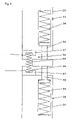
  • FIG. 1 shows a diagram to explain the processes of the preferred embodiments of this invention.
  • FIG. 2 shows an elevational view of a major portion of an apparatus for molding an upper and a lower mold having no flask which is used in this invention.
  • FIG. 3 shows an enlarged view of a part “A” of FIG. 2 .
  • FIG. 4( a ) shows a plain view indicating an embodiment of an arrangement of compression coil springs 10 , 10 .
  • FIG. 4( b ) shows a plain view indicating another embodiment of an arrangement of the compression coil springs 10 , 10 .
  • FIG. 4( c ) shows a plain view indicating another embodiment of an arrangement of the compression coil springs 10 , 10 .
  • FIG. 5( a ) shows a cross section of an elevational view indicating a state before squeezing foundry sand in an embodiment of this invention.
  • FIG. 5( b ) shows a cross section of an elevational view indicating a state while squeezing foundry sand in an embodiment of this invention.
  • FIG. 6 shows an enlarged view of a part “B” of FIG. 5( a ).
  • FIG. 7( a ) shows a plain view indicating an embodiment of an arrangement of compression coil springs 23 , 23 .
  • FIG. 7( b ) shows a plain view indicating another embodiment of an arrangement of the compression coil springs 23 , 23 .
  • FIG. 7( c ) shows a plain view indicating another embodiment of an arrangement of the compression coil springs 23 , 23 .
  • FIG. 8( a ) shows a cross section of an elevational view indicating a state before squeezing foundry sand in an embodiment of this invention.
  • FIG. 8( b ) shows a cross section of an elevational view indicating a state while squeezing foundry sand in an embodiment of this invention.
  • FIG. 9 shows an enlarged view of a part “C” of FIG. 8( a ).
  • FIG. 10 shows a plain view indicating an embodiment of an arrangement of pins 33 , 33 and the compression coil springs 23 , 23 .
  • FIG. 11 shows a cross section of an elevational view of another embodiment of this invention.
  • the present invention which uses an apparatus for molding an upper and a lower mold having no flask, is now explained in detail based on FIG. 2 .
  • the apparatus is comprised of:
  • the apparatus for molding molds which uses the match plate can be used regardless of whether the molds have a flask.
  • this invention can be applied to an apparatus for molding molds having not only one set of flasks, but also two sets of flasks.
  • the squeeze means of this invention is comprised of actuators and squeeze plates or squeeze feet.
  • the squeeze means can individually squeeze the foundry sand.
  • the actuators that are driven by hydraulic pressure, air pressure, and electric motors can be used as the actuators. It is preferable to use the actuators driven by the hydraulic pressure from the aspect of the magnitude of the output of the power. It is further preferable to use the actuators driven by the electric motors since they need no piping system for the hydraulic pressure.
  • green sand as foundry sand, which green sand uses bentonite as a binder.
  • An expanding and contracting means 8 is disposed at the peripheral border of the pattern portion of the body 3 a of the match plate as shown in FIGS. 2-4 , wherein the expanding and contracting means 8 can be expanded and contracted by being pressed with end surfaces of an upper and a lower flask 1 , 2 , which surfaces oppose the match plate 3 . As shown in FIG.
  • the expanding and contracting means 8 is comprised of a plurality of compression coil-springs 10 , 10 disposed in a plurality of through-holes 9 , 9 formed at the body 3 a of the match plate, and support members 11 , 11 having a frame-like structure to hold the plurality of the compression coil-springs 10 , 10 by compressing them at both sides of the coil-springs 10 , 10 , wherein the support members 11 , 11 are mounted on the body 3 a of the match plate.
  • the total force of the coil-springs should be more than the force that can support the weight of the upper and the lower flask 1 , 2 .
  • the foundry sand is filled in the upper and the lower molding space defined by a match plate 3 , an upper and a lower flask 1 , 2 , and an upper and a lower squeeze plate 4 , 5 as shown in FIG. 1( a ). Then, the foundry sand in the upper and the lower molding space is squeezed by causing the upper and the lower squeeze plate 4 , 5 to further approach each other as shown in FIG.
  • the compression coil-springs 10 , 10 of the expanding and contracting means 8 of the match plate 3 are compressed by pressing the lower flask 2 toward the match plate 3 by causing the cylinders 14 , 14 to expand.
  • each of the pattern portions of the match plate 3 moves relatively toward the upper and the lower squeeze plate 4 , 5 . Consequently, the foundry sand in the upper and the lower molding space is further squeezed.
  • the upper and the lower lifting and lowering frame 12 , 13 are fixed by tie-rods (not shown).
  • the expanding and contracting means 20 is disposed at the peripheral border of the pattern portion of the match plate 21 as shown in FIGS. 5-7 , wherein the expanding and contracting means 20 can be expanded and contracted by being pressed with the end surfaces of an upper and a lower flask 1 , 2 , which surfaces oppose the match plate 21 .
  • the expanding and contracting means 20 is comprised of a plurality of compression coil-springs 23 , 23 disposed in a plurality of through-holes 22 , 22 formed at the match plate 21 , and support members 24 , 24 having a frame-like structure and a U-like configuration at its cross section to.
  • FIG. 7 it is possible to dispose a plurality of the compression coil-springs 23 , 23 of the expanding and contracting means 20 with the following arrangements: arranging them at the entire circumference of the peripheral border of the pattern portion at even intervals as shown in FIG. 7( a ), arranging them at two longitudinal sides of the peripheral border of the pattern portion at even intervals as shown in FIG. 7( b ) and arranging them at two lateral sides of the peripheral border of the pattern portion at even intervals as shown in FIG. 7( c ).
  • the total force of the coil-springs should be more than the force that can support the weight of the upper and the lower flask 1 , 2 .
  • the foundry sand is filled in the upper and the lower molding space defined by a match plate 21 , an upper and a lower flask 1 , 2 , and an upper and a lower squeeze plate 4 , 5 as shown in FIG. 5( a ). Then, the foundry sand in the upper and the lower molding space is squeezed by causing the upper and the lower squeeze plate 4 , 5 to further approach each other as shown in FIG. 5( b ). Next, the compression coil-springs 23 , 23 of the expanding and contracting means 20 of the match plate 21 are compressed by pressing the lower flask 2 toward the match plate 21 until the ends of the support members 24 , 24 contact both end surfaces of the match plate 21 . When the compression coil-springs 23 , 23 are compressed, each of the pattern portions of the match plate 21 moves relatively toward the upper and the lower squeeze plate 4 , 5 . Consequently, the foundry sand in the upper and the lower molding space is further squeezed.
  • the first expanding and contracting means 32 is disposed at the end surfaces of the upper and the lower flask 30 , 31 , which surfaces oppose the match plate 21 , as shown in FIGS. 8-10 , wherein the first expanding and contracting means 32 can be expanded and contracted by being pressed with the end surfaces of an upper and a lower flask 30 , 31 , which surfaces oppose the match plate 21 . As shown in FIG. 8-10 ,
  • the first expanding and contracting means 32 is comprised of pins 33 , 33 that are slidably disposed in the upper and the lower flask 30 , 31 and protrude from the flasks, and a plurality of compression coil-springs 34 , 34 to apply the force so that the pins 33 , 33 are expanded.
  • the end surfaces of the pins 33 , 33 extend toward and contact the end surfaces of the match plate 21 .
  • the pins 33 , 33 disposed at the first expanding and contracting means 32 contact the four corners of the match plate 21 as shown in FIG. 10 .
  • the second expanding and contracting means 35 is disposed at the peripheral border of the pattern portion of the match plate 21 as shown in FIGS. 8-10 .
  • the second expanding and contracting means 35 can be expanded and contracted by being pressed with end surfaces of an upper and a lower flask 30 , 31 , which surfaces oppose the match plate 21 . As shown in FIG.
  • the second expanding and contracting means 35 is comprised of a plurality of compression coil-springs 36 , 36 disposed in a plurality of through-holes 22 , 22 formed at the match plate 21 , and support members 37 , 37 having a frame-like structure and a U-like configuration at its cross section to hold the plurality of the compression coil-springs 23 , 23 by compressing them with both sides of the coil-springs 23 , 23 .
  • the plurality of the compression coil-springs disposed at the second expanding and contracting means 35 are located at the four corners of the support members 37 , 37 as shown in FIG. 10 .
  • the foundry sand is filled in the upper and the lower molding space defined by a match plate 21 , an upper and a lower flask 30 , 31 , and an upper and a lower squeeze plate 4 , 5 as shown in FIG. 8( a ). Then, the foundry sand in the upper and the lower molding space is squeezed by causing the upper and the lower squeeze plate 4 , 5 to further approach each other as shown in FIG. 8( b ). Next, the compression coil-springs 36 , 36 of the second expanding and contracting means 35 are compressed by pressing the lower flask 31 toward the match plate 21 until the ends of the support members 37 , 37 contact both end surfaces of the match plate 21 .
  • the pins 33 , 33 of the first expanding and contracting means 32 are pushed into the upper and the lower flask 30 , 31 . Consequently, the compression coil-springs 34 , 34 are compressed.
  • Each of the pattern portions of the match plate 21 move relatively toward the upper and the lower squeeze plate 4 , 5 by the reaction force of the compression coil-springs 34 , 34 and 36 , 36 . Consequently, the foundry sand in the upper and the lower molding space is further squeezed.
  • the compression coil-springs of the first expanding and contracting means 32 are disposed in the upper and the lower flask 30 , 31 , and since the length of the coil-springs can be longer than that of the coil-springs of the second expanding and contracting means 35 , it is possible to increase the force of the coil-springs. Thus, it is possible to reduce the number of the coil-springs that are needed to produce the force to support the weight of the upper and the lower flask.
  • the foundry sand in the upper and the lower molding space is squeezed by the relative movement between the upper and the lower flask and the pattern portion of the match plate.
  • the method for squeezing the foundry sand is not restricted to these embodiments. It is also possible to squeeze the foundry sand in the upper and the lower molding space by individually moving the pattern portions 41 , 41 of the match plate 40 by any of the actuators 42 , 42 as shown in FIG. 11 .
  • the methods use compression coil-springs as the expanding and contracting means.
  • the expanding and contracting means is not restricted to the compression coil-springs. It is also possible to use hydraulic cylinders or gas springs as the expanding and contracting means.
  • This invention can be widely applied to a molding machine having a match plate, such as a molding machine producing a mold having a flask or having no flask. Further, while the foundry sand is filled or squeezed, it is possible to freely determine the position of the upper and the lower flask.
  • the upper and the lower flask can be arranged horizontally or vertically. Further, it is possible to cause the relative position of the upper and the lower flask at the time when the foundry sand is filled to differ from that when it is squeezed.

Landscapes

  • Engineering & Computer Science (AREA)
  • Mechanical Engineering (AREA)
  • Casting Devices For Molds (AREA)
  • Molds, Cores, And Manufacturing Methods Thereof (AREA)
  • Mold Materials And Core Materials (AREA)
  • Processing Of Solid Wastes (AREA)

Abstract

A method for squeezing foundry sand filled in an upper and a lower molding space, comprising: a step to squeeze the foundry sand by causing the upper and the lower squeeze plate to further approach each other, and a step to squeeze it by causing pattern portions of the match plate to move to each of the upper and the lower squeeze plate.

Description

TECHNICAL FIELD
This invention relates to a method for squeezing sand and producing a match plate. Particularly, it relates to a method for squeezing the foundry sand filled in an upper and a lower molding space defined by a match plate, an upper and a lower flask, and an upper and a lower squeeze plate. Further, it relates to the match plate and the upper and the lower flask.
BACKGROUND OF THE INVENTION
The inventors of this invention have developed the following apparatus for molding a mold:
The apparatus is comprised of an upper and a lower molding space, an aeration mechanism to discharge foundry sand into the molding spaces, and a squeezing mechanism to squeeze the foundry sand,
wherein the upper and the lower molding space are defined by an upper and a lower flask each having intakes disposed at their side walls for foundry sand, a match plate disposed between the upper and the lower flask, and the squeezing mechanism having squeeze plates, which can be inserted in openings of the upper and the lower flask having no match plate. After filling the upper and the lower molding space with the foundry sand through the intakes of the upper and the lower flask by the aeration mechanism, the squeezing mechanism squeezes the foundry sand in the upper and the lower molding space by causing the upper and the lower squeeze plates to further approach each other. (See patent documents 1 and 2.)
However, the hardness and the strength near the inner surface that corresponds to the match plate, of the upper and the lower mold that are made by using the apparatus explained above, are not high enough.
Patent document 1: Japanese Patent Laid-open Publication No. H06-277800
Patent document 2: Japanese Patent Laid-open Publication No. S59-024552
DISCLOSURE OF INVENTION
The problem to be solved by the present invention is that the hardness and strength near the inner surface that corresponds to the match plate, of an upper and a lower mold that are made by using the conventional apparatus that can perform the following process, are not high enough:
The process is comprised of:
a step to define an upper and a lower molding space by an upper and a lower squeeze means, an upper and a lower flask, and a match plate,
a step to fill the molding spaces with foundry sand, and
a step to squeeze the foundry sand of the molding spaces by causing the upper and the lower squeeze plate to further approach each other.
To solve the problem, the following method is applied in this invention.
Namely, this is a method for squeezing foundry sand filled in an upper and a lower molding space defined by a match plate, an upper and a lower flask, and an upper and a lower squeeze plate, comprising:
a first squeezing step to squeeze the foundry sand in the upper and the lower molding space by causing the upper and the lower squeeze plate to further approach each other, and
a second squeezing step to squeeze the foundry sand in the upper and the lower molding space by causing the pattern portions of the match plate to move to each of the upper and the lower squeeze plate.
Further, a second method is applied in this invention to solve the problem:
Namely, a method for squeezing foundry sand, comprising:
a filling step to fill an upper and a lower molding space defined by any of the match plates, an upper and a lower flask, and an upper and a lower squeeze plate with the foundry sand, the match plate being comprised of:
    • a pattern portion disposed at both sides of the match plate, wherein both sides contact end surfaces of the upper and the lower flask, and
    • at least one actuator to cause the pattern and the plate of the pattern portion to move toward the upper and the lower squeeze plate,
a first squeezing step to squeeze the foundry sand in the upper and lower molding space by causing the upper and the lower squeeze plate to further approach each other, and
a second squeezing step to squeeze the foundry sand in the upper and the lower molding space by causing the pattern and/or the plate of the pattern portions of the match plate to move to each of the upper and the lower squeeze plate.
As explained above, this invention is composed of the following:
a process for squeezing the foundry sand filled in the upper and the lower molding space defined by a match plate, an upper and a lower flask, and an upper and a lower squeeze plate,
wherein the process is further comprised of a step to squeeze the foundry sand of the upper and the lower molding space by causing the upper and the lower squeeze plate to further approach each other, and a step to squeeze the foundry sand of the upper and the lower molding space by causing the pattern portions of the match plate to move to each of the upper and the lower squeeze plate.
Thus, since it becomes possible to further squeeze the foundry sand near the inner surface that corresponds to the match plate, of the upper and the lower flask, by causing the pattern portions of the match plate to move to each of the upper and the lower squeeze plate, it is possible to produce an upper and a lower mold having desirable hardness and strength near the inner surface of the upper and the lower flask. Namely, this invention has practical and excellent effects.
BRIEF DESCRIPTIONS OF THE DRAWINGS
FIG. 1 shows a diagram to explain the processes of the preferred embodiments of this invention.
FIG. 2 shows an elevational view of a major portion of an apparatus for molding an upper and a lower mold having no flask which is used in this invention.
FIG. 3 shows an enlarged view of a part “A” of FIG. 2.
FIG. 4( a) shows a plain view indicating an embodiment of an arrangement of compression coil springs 10, 10.
FIG. 4( b) shows a plain view indicating another embodiment of an arrangement of the compression coil springs 10, 10.
FIG. 4( c) shows a plain view indicating another embodiment of an arrangement of the compression coil springs 10, 10.
FIG. 5( a) shows a cross section of an elevational view indicating a state before squeezing foundry sand in an embodiment of this invention.
FIG. 5( b) shows a cross section of an elevational view indicating a state while squeezing foundry sand in an embodiment of this invention.
FIG. 6 shows an enlarged view of a part “B” of FIG. 5( a).
FIG. 7( a) shows a plain view indicating an embodiment of an arrangement of compression coil springs 23,23.
FIG. 7( b) shows a plain view indicating another embodiment of an arrangement of the compression coil springs 23, 23.
FIG. 7( c) shows a plain view indicating another embodiment of an arrangement of the compression coil springs 23, 23.
FIG. 8( a) shows a cross section of an elevational view indicating a state before squeezing foundry sand in an embodiment of this invention.
FIG. 8( b) shows a cross section of an elevational view indicating a state while squeezing foundry sand in an embodiment of this invention.
FIG. 9 shows an enlarged view of a part “C” of FIG. 8( a).
FIG. 10 shows a plain view indicating an embodiment of an arrangement of pins 33, 33 and the compression coil springs 23, 23.
FIG. 11 shows a cross section of an elevational view of another embodiment of this invention.
PREFERRED EMBODIMENTS OF THE INVENTION
The present invention, which uses an apparatus for molding an upper and a lower mold having no flask, is now explained in detail based on FIG. 2.
The major portion of the apparatus for molding an:upper and a lower mold having no flask, which is used in this invention, is shown in FIG. 2. The apparatus is comprised of:
an upper and a lower flask 1, 2 each having intakes disposed at their side walls for foundry sand,
a match plate 3 that is held between the upper and the lower flask 1, 2, and which have a special mechanism,
an upper and a lower squeeze means 6, 7 having squeeze plates 4, 5, which can be inserted in openings of the upper and the lower flask 1, 2 having no match plate 3,
an upper and a lower lifting and lowering frame 12, 13 provided with the upper and the lower squeeze means 6, 7, and
cylinders 14, 14, which are mounted on the lower lifting and lowering frame 13, to press the lower flask 2 toward the match plate 3.
In this invention the apparatus for molding molds which uses the match plate can be used regardless of whether the molds have a flask.
Further, this invention can be applied to an apparatus for molding molds having not only one set of flasks, but also two sets of flasks.
The squeeze means of this invention is comprised of actuators and squeeze plates or squeeze feet. The squeeze means can individually squeeze the foundry sand. The actuators that are driven by hydraulic pressure, air pressure, and electric motors can be used as the actuators. It is preferable to use the actuators driven by the hydraulic pressure from the aspect of the magnitude of the output of the power. It is further preferable to use the actuators driven by the electric motors since they need no piping system for the hydraulic pressure.
In this invention, it is preferable to use green sand as foundry sand, which green sand uses bentonite as a binder.
Embodiment 1
Below, an embodiment for a method for squeezing foundry sand and a match plate of this invention is explained in detail based on FIGS. 1-4.
An expanding and contracting means 8 is disposed at the peripheral border of the pattern portion of the body 3 a of the match plate as shown in FIGS. 2-4, wherein the expanding and contracting means 8 can be expanded and contracted by being pressed with end surfaces of an upper and a lower flask 1, 2, which surfaces oppose the match plate 3. As shown in FIG. 3, the expanding and contracting means 8 is comprised of a plurality of compression coil- springs 10, 10 disposed in a plurality of through- holes 9, 9 formed at the body 3 a of the match plate, and support members 11, 11 having a frame-like structure to hold the plurality of the compression coil- springs 10, 10 by compressing them at both sides of the coil- springs 10, 10, wherein the support members 11, 11 are mounted on the body 3 a of the match plate.
As shown in FIG. 4, it is possible to dispose a plurality of the compression coil- springs 10, 10 of the expanding and contracting means 8 with the following arrangements: arranging them at the entire circumference of the peripheral border of the pattern portion at even intervals as shown in FIG. 4( a), arranging them at two longitudinal sides of the peripheral border of the pattern portion at even intervals as shown in FIG. 4( b), or arranging them at two lateral sides of the peripheral border of the pattern portion at even intervals as shown in FIG. 4( c). In all arrangements of the compression coil-springs explained above based on FIGS. 4( a), (b), and (c), the total force of the coil-springs should be more than the force that can support the weight of the upper and the lower flask 1, 2.
Below, the method for molding molds by using the apparatus of embodiment 1 is explained in detail.
The foundry sand is filled in the upper and the lower molding space defined by a match plate 3, an upper and a lower flask 1, 2, and an upper and a lower squeeze plate 4, 5 as shown in FIG. 1( a). Then, the foundry sand in the upper and the lower molding space is squeezed by causing the upper and the lower squeeze plate 4, 5 to further approach each other as shown in FIG.
1(b). Next, the compression coil- springs 10, 10 of the expanding and contracting means 8 of the match plate 3 are compressed by pressing the lower flask 2 toward the match plate 3 by causing the cylinders 14, 14 to expand. When the compression coil- springs 10, 10 are compressed, each of the pattern portions of the match plate 3 moves relatively toward the upper and the lower squeeze plate 4, 5. Consequently, the foundry sand in the upper and the lower molding space is further squeezed. At that time, the upper and the lower lifting and lowering frame 12, 13 are fixed by tie-rods (not shown). Then, when the cylinders 14, 14 are contracted, the upper and the lower flask 1, 2 are separated by the reaction force of the compression coil- springs 10, 10 of the expanding and contracting means 8. Consequently, the molded molds made by squeezing the foundry sand are separated from the match plate 3.
Embodiment 2
Below, an embodiment using another expanding and contracting means is explained based on FIGS. 5-7. The expanding and contracting means 20 is disposed at the peripheral border of the pattern portion of the match plate 21 as shown in FIGS. 5-7, wherein the expanding and contracting means 20 can be expanded and contracted by being pressed with the end surfaces of an upper and a lower flask 1, 2, which surfaces oppose the match plate 21. As shown in FIG. 6, the expanding and contracting means 20 is comprised of a plurality of compression coil- springs 23, 23 disposed in a plurality of through- holes 22, 22 formed at the match plate 21, and support members 24, 24 having a frame-like structure and a U-like configuration at its cross section to. hold the plurality of the compression coil- springs 23, 23 by compressing them at both sides of the coil- springs 23, 23. As shown in FIG. 7, it is possible to dispose a plurality of the compression coil- springs 23, 23 of the expanding and contracting means 20 with the following arrangements: arranging them at the entire circumference of the peripheral border of the pattern portion at even intervals as shown in FIG. 7( a), arranging them at two longitudinal sides of the peripheral border of the pattern portion at even intervals as shown in FIG. 7( b) and arranging them at two lateral sides of the peripheral border of the pattern portion at even intervals as shown in FIG. 7( c). In all arrangements of the compression coil-springs explained above based on FIGS. 7( a), (b), and (c), the total force of the coil-springs should be more than the force that can support the weight of the upper and the lower flask 1, 2.
Below, the method for molding molds by using the apparatus of embodiment 2 is explained in detail.
The foundry sand is filled in the upper and the lower molding space defined by a match plate 21, an upper and a lower flask 1, 2, and an upper and a lower squeeze plate 4, 5 as shown in FIG. 5( a). Then, the foundry sand in the upper and the lower molding space is squeezed by causing the upper and the lower squeeze plate 4, 5 to further approach each other as shown in FIG. 5( b). Next, the compression coil- springs 23, 23 of the expanding and contracting means 20 of the match plate 21 are compressed by pressing the lower flask 2 toward the match plate 21 until the ends of the support members 24, 24 contact both end surfaces of the match plate 21. When the compression coil- springs 23, 23 are compressed, each of the pattern portions of the match plate 21 moves relatively toward the upper and the lower squeeze plate 4, 5. Consequently, the foundry sand in the upper and the lower molding space is further squeezed.
Embodiment 3
Below, an embodiment using another expanding and contracting means is explained based on FIGS. 8-10. The first expanding and contracting means 32 is disposed at the end surfaces of the upper and the lower flask 30, 31, which surfaces oppose the match plate 21, as shown in FIGS. 8-10, wherein the first expanding and contracting means 32 can be expanded and contracted by being pressed with the end surfaces of an upper and a lower flask 30, 31, which surfaces oppose the match plate 21. As shown in FIG. 9, the first expanding and contracting means 32 is comprised of pins 33, 33 that are slidably disposed in the upper and the lower flask 30, 31 and protrude from the flasks, and a plurality of compression coil- springs 34, 34 to apply the force so that the pins 33, 33 are expanded. The end surfaces of the pins 33, 33 extend toward and contact the end surfaces of the match plate 21. The pins 33, 33 disposed at the first expanding and contracting means 32 contact the four corners of the match plate 21 as shown in FIG. 10.
The second expanding and contracting means 35 is disposed at the peripheral border of the pattern portion of the match plate 21 as shown in FIGS. 8-10. The second expanding and contracting means 35 can be expanded and contracted by being pressed with end surfaces of an upper and a lower flask 30, 31, which surfaces oppose the match plate 21. As shown in FIG. 9, the second expanding and contracting means 35 is comprised of a plurality of compression coil- springs 36, 36 disposed in a plurality of through- holes 22, 22 formed at the match plate 21, and support members 37, 37 having a frame-like structure and a U-like configuration at its cross section to hold the plurality of the compression coil- springs 23, 23 by compressing them with both sides of the coil- springs 23, 23. The plurality of the compression coil-springs disposed at the second expanding and contracting means 35 are located at the four corners of the support members 37, 37 as shown in FIG. 10.
Below, the method for molding molds by using the apparatus of embodiment 3 is explained in detail.
The foundry sand is filled in the upper and the lower molding space defined by a match plate 21, an upper and a lower flask 30, 31, and an upper and a lower squeeze plate 4, 5 as shown in FIG. 8( a). Then, the foundry sand in the upper and the lower molding space is squeezed by causing the upper and the lower squeeze plate 4, 5 to further approach each other as shown in FIG. 8( b). Next, the compression coil- springs 36, 36 of the second expanding and contracting means 35 are compressed by pressing the lower flask 31 toward the match plate 21 until the ends of the support members 37, 37 contact both end surfaces of the match plate 21. The pins 33, 33 of the first expanding and contracting means 32 are pushed into the upper and the lower flask 30, 31. Consequently, the compression coil- springs 34, 34 are compressed. Each of the pattern portions of the match plate 21 move relatively toward the upper and the lower squeeze plate 4, 5 by the reaction force of the compression coil- springs 34, 34 and 36, 36. Consequently, the foundry sand in the upper and the lower molding space is further squeezed.
Since the compression coil-springs of the first expanding and contracting means 32 are disposed in the upper and the lower flask 30, 31, and since the length of the coil-springs can be longer than that of the coil-springs of the second expanding and contracting means 35, it is possible to increase the force of the coil-springs. Thus, it is possible to reduce the number of the coil-springs that are needed to produce the force to support the weight of the upper and the lower flask.
In the above three embodiments, the foundry sand in the upper and the lower molding space is squeezed by the relative movement between the upper and the lower flask and the pattern portion of the match plate. However, the method for squeezing the foundry sand is not restricted to these embodiments. It is also possible to squeeze the foundry sand in the upper and the lower molding space by individually moving the pattern portions 41, 41 of the match plate 40 by any of the actuators 42, 42 as shown in FIG. 11.
Further, in the above three embodiments, while squeezing the foundry sand in the upper and the lower molding space by causing the upper and the lower squeeze plates 4, 5 to further approach each other, it is possible to effectively and further increase the hardness and strength of the molds near the inner surfaces of the upper and the lower flask by keeping the distance constant between the upper and the lower flask.
In the above three embodiments, the methods use compression coil-springs as the expanding and contracting means. However, the expanding and contracting means is not restricted to the compression coil-springs. It is also possible to use hydraulic cylinders or gas springs as the expanding and contracting means.
This invention can be widely applied to a molding machine having a match plate, such as a molding machine producing a mold having a flask or having no flask. Further, while the foundry sand is filled or squeezed, it is possible to freely determine the position of the upper and the lower flask. For example, the upper and the lower flask can be arranged horizontally or vertically. Further, it is possible to cause the relative position of the upper and the lower flask at the time when the foundry sand is filled to differ from that when it is squeezed.

Claims (10)

1. A method for squeezing foundry sand filled in an upper and a lower molding space defined by a match plate, an upper and a lower flask, and an upper and a lower squeeze plate, comprising:
a first squeezing step to squeeze the foundry sand in the upper and the lower molding space by causing the upper and the lower squeeze plate to further approach each other, and
a second squeezing step to squeeze the foundry sand in the upper and the lower molding space by causing pattern portions of the match plate to move to each of the upper and the lower squeeze plate.
2. A method for squeezing foundry sand filled in an upper and a lower molding space defined by a match plate, an upper and a lower flask, and an upper and a lower squeeze plate, comprising:
a first squeezing step to squeeze the foundry sand in the upper and the lower molding space by causing the upper and the lower squeeze plate to further approach each other, and
a second squeezing step to squeeze the foundry sand in the upper and the lower molding space by causing pattern portions of the match plate and the plate of the pattern portions to move to each of the upper and the lower squeeze plate by means of causing the upper and the lower flask to further approach each other.
3. A method for squeezing foundry sand filled in an upper and a lower molding space defined by a match plate, an upper and a lower flask, and an upper and a lower squeeze plate, comprising:
a first squeezing step to squeeze the foundry sand in the upper and the lower molding space by causing the upper and the lower squeeze plate to further approach each other, while maintaining a constant distance between the upper and the lower flask, and
a second squeezing step to squeeze the foundry sand in the upper and the lower molding space by causing pattern portions of the match plate and the plate of the pattern portions to move to each of the upper and the lower squeeze plate by means of causing the upper and the lower flask to further approach each other.
4. A match plate in a molding assembly for squeezing foundry sand filled in an upper and a lower molding space defined by the match plate, an upper and a lower flask, and an upper and a lower squeeze plate, comprising:
a pattern portion disposed at both sides of the match plate, wherein both sides contact end surfaces of the upper and the lower flask, and
an expanding and contracting means disposed at the peripheral border of the pattern portion, wherein the expanding and contracting means can be expanded and contracted by being pressed by the end surfaces of the upper and the lower flask opposing the match plate.
5. A match plate in a molding assembly for squeezing foundry sand filled in an upper and a lower molding space defined by the match plate, an upper and a lower flask, and an upper and a lower squeeze plate, comprising:
a pattern portion disposed at both sides of the match plate, wherein both sides contact end surfaces of the upper and the lower flask, and
at least one actuator to cause the pattern portion to individually move from the plate of the pattern portion, or at least one actuator to cause the plate of the pattern portion to individually move from pattern portion.
6. A match plate in a molding assembly for squeezing foundry sand filled in an upper and a lower molding space defined by the match plate, an upper and a lower flask, and an upper and a lower squeeze plate, comprising:
a pattern portion disposed at both sides of the match plate, wherein both sides contact end surfaces of the upper and the lower flask, and
at least one actuator to cause the plate of the pattern portion to move toward the upper and the lower squeeze plate.
7. A method for squeezing foundry sand, comprising:
a filling step to fill an upper and a lower molding space defined by the match plate of any one of claims 4, 5, and 6, an upper and a lower flask, and an upper and a lower squeeze plate with the foundry sand,
a first squeezing step to squeeze the foundry sand in the upper and lower molding space by causing the upper and the lower squeeze plate to further approach each other, and
a second squeezing step to squeeze the foundry sand in the upper and the lower molding space by causing the pattern and/or the plate of the pattern portions of the match plate to move to the upper and the lower squeeze plate.
8. An upper and a lower flask in a molding assembly for squeezing foundry sand filled in an upper and a lower molding space defined by a match plate, the upper and the lower flask, and an upper and a lower squeeze plate, comprising:
a plurality of pins contacting both sides of the match plate, and
an expanding and contracting means to expand and contract the pins by pressing them between the upper and the lower flask and both sides of the match plate.
9. A method for squeezing foundry sand filled in an upper and a lower molding space defined by a match plate, an upper and a lower flask, and an upper and a lower squeeze plate, comprising:
a first squeezing step to squeeze the foundry sand in the upper and the lower molding space by causing the upper and the lower squeeze plate to further approach each other, and
a second squeezing step to squeeze the foundry sand in the upper and the lower molding space by causing pattern portions of the match plate and the plate of the pattern portions to move to the upper and the lower squeeze plate by means of causing the upper and the lower flask to further approach each other, wherein the upper and the lower flask are comprised of:
a plurality of pins contacting both sides of the match plate, and an expanding and contracting means to expand and contract the pins by pressing them between the upper and the lower flask and both sides of the match plate.
10. A method for squeezing foundry sand filled in an upper and a lower molding space defined by a match plate, an upper and a lower flask, and an upper and a lower squeeze plate, comprising:
a first squeezing step to squeeze the foundry sand in the upper and the lower molding space by causing the upper and the lower squeeze plate to further approach each other, and
a second squeezing step to squeeze the foundry sand in the upper and the lower molding space by causing pattern portions of the match plate and the plate of the pattern portions to move to each of the upper and the lower squeeze plate by means of causing the upper and the lower flask to further approach each other, wherein the upper and the lower flask is comprised of:
a plurality of pins contacting both sides of the match plate, and
an expanding and contracting means to expand and contract the pins by pressing them between the upper and the lower flask and both sides of the match plate,
and wherein the match plate is the match plate of any one of claims 4, 5, and 6.
US11/587,633 2004-04-28 2005-04-27 Method for squeezing foundry sand, a match plate, and an upper and a lower flask Expired - Lifetime US7448429B2 (en)

Applications Claiming Priority (3)

Application Number Priority Date Filing Date Title
JP2004133547 2004-04-28
JP2005119147 2005-04-18
PCT/JP2005/007969 WO2005105339A1 (en) 2004-04-28 2005-04-27 Method of squeezing foundry sand, match plate, and upper and lower flasks

Publications (2)

Publication Number Publication Date
US20070227684A1 US20070227684A1 (en) 2007-10-04
US7448429B2 true US7448429B2 (en) 2008-11-11

Family

ID=35241486

Family Applications (1)

Application Number Title Priority Date Filing Date
US11/587,633 Expired - Lifetime US7448429B2 (en) 2004-04-28 2005-04-27 Method for squeezing foundry sand, a match plate, and an upper and a lower flask

Country Status (12)

Country Link
US (1) US7448429B2 (en)
EP (1) EP1741504B1 (en)
JP (1) JP4301292B2 (en)
KR (1) KR100863104B1 (en)
CN (1) CN1968770B (en)
AT (1) ATE450330T1 (en)
BR (1) BRPI0510454B1 (en)
DE (1) DE602005018034D1 (en)
DK (1) DK1741504T3 (en)
EA (1) EA008631B1 (en)
MX (1) MXPA06012488A (en)
WO (1) WO2005105339A1 (en)

Families Citing this family (4)

* Cited by examiner, † Cited by third party
Publication number Priority date Publication date Assignee Title
JP5076670B2 (en) * 2006-08-04 2012-11-21 新東工業株式会社 Frameless mold making machine
DE602007006892D1 (en) * 2006-12-18 2010-07-15 Sintokogio Ltd forming machine
ES2636953T5 (en) 2008-08-07 2020-10-20 Loramendi S Coop Device for driving a closing plate in a vertical molding machine for molds without a box and a machine that includes said device
CN107685138B (en) * 2017-09-21 2024-01-30 江苏康柏斯机械科技有限公司 Casting sand box

Citations (14)

* Cited by examiner, † Cited by third party
Publication number Priority date Publication date Assignee Title
US365711A (en) * 1887-06-28 Haeeis taboe
US485764A (en) * 1892-11-08 Mulder s flask
US3406738A (en) * 1967-04-06 1968-10-22 Heatherwill Co Automatic matchplate moulding machine
US4030535A (en) * 1974-04-19 1977-06-21 Hitachi Metals, Ltd. Molding system
JPS57142745A (en) * 1981-02-26 1982-09-03 Ikeda Seisakusho:Kk Sand blowing device in automatic molding machine
JPS5924552A (en) 1982-07-30 1984-02-08 Sintokogio Ltd Simultaneous forming machine of flaskless type top and bottom molds
JPS60158949A (en) * 1984-01-30 1985-08-20 Mitsubishi Heavy Ind Ltd Method and device for forming casting mold
EP0468355A2 (en) * 1990-07-27 1992-01-29 Sintokogio Ltd. Flaskless molding machine
EP0493977A2 (en) 1991-01-02 1992-07-08 Taiyo Chuki Co., Ltd. Molding machine
DE4340401A1 (en) 1992-11-27 1994-06-01 Sintokogio Ltd Appts for simultaneous production of the top and bottom halves of a mould - with sensors for determining the pressure plate displacements and electrodes for probing the electric resistance of the mould halves
JPH06277800A (en) 1993-03-26 1994-10-04 Sintokogio Ltd BLOWING MOLD MOLDING METHOD AND DEVICE THEREOF
JPH08187544A (en) 1994-12-28 1996-07-23 Kooyoo:Kk Device for spraying mold releasing agent for removing casting from sand mold
JP2000317579A (en) 1999-04-30 2000-11-21 Metal Eng Kk Molding apparatus for mold and molding method
JP2002361368A (en) 2001-06-12 2002-12-17 Metal Eng Kk Filling method and device for molding sand of frameless forming device

Family Cites Families (1)

* Cited by examiner, † Cited by third party
Publication number Priority date Publication date Assignee Title
JP2000167647A (en) * 1998-12-04 2000-06-20 Taiyo Machinery Co Ltd Automatic vibration molding machine for green mold

Patent Citations (15)

* Cited by examiner, † Cited by third party
Publication number Priority date Publication date Assignee Title
US365711A (en) * 1887-06-28 Haeeis taboe
US485764A (en) * 1892-11-08 Mulder s flask
US3406738A (en) * 1967-04-06 1968-10-22 Heatherwill Co Automatic matchplate moulding machine
US4030535A (en) * 1974-04-19 1977-06-21 Hitachi Metals, Ltd. Molding system
JPS57142745A (en) * 1981-02-26 1982-09-03 Ikeda Seisakusho:Kk Sand blowing device in automatic molding machine
JPS5924552A (en) 1982-07-30 1984-02-08 Sintokogio Ltd Simultaneous forming machine of flaskless type top and bottom molds
JPS60158949A (en) * 1984-01-30 1985-08-20 Mitsubishi Heavy Ind Ltd Method and device for forming casting mold
EP0468355A2 (en) * 1990-07-27 1992-01-29 Sintokogio Ltd. Flaskless molding machine
EP0493977A2 (en) 1991-01-02 1992-07-08 Taiyo Chuki Co., Ltd. Molding machine
DE4340401A1 (en) 1992-11-27 1994-06-01 Sintokogio Ltd Appts for simultaneous production of the top and bottom halves of a mould - with sensors for determining the pressure plate displacements and electrodes for probing the electric resistance of the mould halves
US5409052A (en) 1992-11-27 1995-04-25 Sintokogio, Ltd. Device for simultaneously forming cope and drag molds
JPH06277800A (en) 1993-03-26 1994-10-04 Sintokogio Ltd BLOWING MOLD MOLDING METHOD AND DEVICE THEREOF
JPH08187544A (en) 1994-12-28 1996-07-23 Kooyoo:Kk Device for spraying mold releasing agent for removing casting from sand mold
JP2000317579A (en) 1999-04-30 2000-11-21 Metal Eng Kk Molding apparatus for mold and molding method
JP2002361368A (en) 2001-06-12 2002-12-17 Metal Eng Kk Filling method and device for molding sand of frameless forming device

Also Published As

Publication number Publication date
KR100863104B1 (en) 2008-10-13
JPWO2005105339A1 (en) 2008-03-13
CN1968770B (en) 2010-12-22
US20070227684A1 (en) 2007-10-04
ATE450330T1 (en) 2009-12-15
JP4301292B2 (en) 2009-07-22
KR20070012511A (en) 2007-01-25
CN1968770A (en) 2007-05-23
EP1741504B1 (en) 2009-12-02
EA008631B1 (en) 2007-06-29
MXPA06012488A (en) 2007-01-31
BRPI0510454B1 (en) 2013-04-09
EA200601996A1 (en) 2007-02-27
EP1741504A1 (en) 2007-01-10
DE602005018034D1 (en) 2010-01-14
WO2005105339A1 (en) 2005-11-10
EP1741504A4 (en) 2007-09-12
DK1741504T3 (en) 2010-04-06
BRPI0510454A (en) 2007-10-30

Similar Documents

Publication Publication Date Title
EP2514540B1 (en) Molding process for simultaneously making an upper mold and a lower mold and a flaskless molding machine
CN201760499U (en) Backward deep drawing die with outer edge subject to back pressure of forward pressure belt
CN209550365U (en) In-mold stripping assembly and mold
US7448429B2 (en) Method for squeezing foundry sand, a match plate, and an upper and a lower flask
JP2001300692A (en) Method and apparatus for compressing foundry sand
CN110534332B (en) Sintered magnet preparation method and pressure forming equipment thereof
CN216659017U (en) Forming die of power inductance
JP2000135599A (en) Hot press device
KR100297192B1 (en) Movable frame type press
CN207373392U (en) A kind of hydraulic press for being used to produce Dinas brickes
CN213793823U (en) Mould of multifunctional environment-friendly equipment
JP4352395B2 (en) Method and apparatus for compressing foundry sand
CN222552008U (en) A steel bar pressing device
CN215241555U (en) Automatic moulding cold isostatic compaction mould
CN214561727U (en) Ceramic structure spare dry pressing make-up machine
JPS6135301Y2 (en)
JP3453408B2 (en) Press device with clamping means
JPH01119604A (en) Powder molding method
JPH09157702A (en) Compacting equipment
JPS638727Y2 (en)
CN106476129A (en) A kind of charge car device that can achieve two-way compacting
CN121244781A (en) A shell stamping die
CN118544443A (en) Manual compression molding die for ceramic powder and molding method thereof
TH35844B (en) Method for squeezing casting sand, double-sided sheet and top and bottom casting cavity
JPH0910892A (en) Mold molding method

Legal Events

Date Code Title Description
AS Assignment

Owner name: SINTOKOGIO, LTD., JAPAN

Free format text: ASSIGNMENT OF ASSIGNORS INTEREST;ASSIGNORS:HIRATA, MINORU;TERABE, TOKIYA;SAKAGUCHI, KOICHI;REEL/FRAME:018485/0153

Effective date: 20061012

STCF Information on status: patent grant

Free format text: PATENTED CASE

FPAY Fee payment

Year of fee payment: 4

FPAY Fee payment

Year of fee payment: 8

FEPP Fee payment procedure

Free format text: PAYOR NUMBER ASSIGNED (ORIGINAL EVENT CODE: ASPN); ENTITY STATUS OF PATENT OWNER: LARGE ENTITY

Free format text: PAYER NUMBER DE-ASSIGNED (ORIGINAL EVENT CODE: RMPN); ENTITY STATUS OF PATENT OWNER: LARGE ENTITY

MAFP Maintenance fee payment

Free format text: PAYMENT OF MAINTENANCE FEE, 12TH YEAR, LARGE ENTITY (ORIGINAL EVENT CODE: M1553); ENTITY STATUS OF PATENT OWNER: LARGE ENTITY

Year of fee payment: 12