US7429604B2 - Six-membered heterocycles useful as serine protease inhibitors - Google Patents

Six-membered heterocycles useful as serine protease inhibitors Download PDF

Info

Publication number
US7429604B2
US7429604B2 US11/151,627 US15162705A US7429604B2 US 7429604 B2 US7429604 B2 US 7429604B2 US 15162705 A US15162705 A US 15162705A US 7429604 B2 US7429604 B2 US 7429604B2
Authority
US
United States
Prior art keywords
phenyl
substituted
alkyl
occurrence
independently
Prior art date
Legal status (The legal status is an assumption and is not a legal conclusion. Google has not performed a legal analysis and makes no representation as to the accuracy of the status listed.)
Active, expires
Application number
US11/151,627
Other versions
US20060009455A1 (en
Inventor
James R. Corte
Jon J. Hangeland
Miml L. Quan
Joanne M. Smallheer
Tianan Fang
Current Assignee (The listed assignees may be inaccurate. Google has not performed a legal analysis and makes no representation or warranty as to the accuracy of the list.)
Bristol Myers Squibb Co
Original Assignee
Bristol Myers Squibb Co
Priority date (The priority date is an assumption and is not a legal conclusion. Google has not performed a legal analysis and makes no representation as to the accuracy of the date listed.)
Filing date
Publication date
Family has litigation
US case filed in District Of Columbia District Court litigation Critical https://portal.unifiedpatents.com/litigation/District%20Of%20Columbia%20District%20Court/case/1%3A09-cv-01330 Source: District Court Jurisdiction: District Of Columbia District Court "Unified Patents Litigation Data" by Unified Patents is licensed under a Creative Commons Attribution 4.0 International License.
First worldwide family litigation filed litigation https://patents.darts-ip.com/?family=35276485&utm_source=google_patent&utm_medium=platform_link&utm_campaign=public_patent_search&patent=US7429604(B2) "Global patent litigation dataset” by Darts-ip is licensed under a Creative Commons Attribution 4.0 International License.
Application filed by Bristol Myers Squibb Co filed Critical Bristol Myers Squibb Co
Priority to US11/151,627 priority Critical patent/US7429604B2/en
Priority to MXPA06014799A priority patent/MXPA06014799A/en
Priority to EP05787697A priority patent/EP1773775B1/en
Priority to AU2005255029A priority patent/AU2005255029A1/en
Priority to CN2005800274852A priority patent/CN101010299B/en
Priority to JP2007516646A priority patent/JP4834663B2/en
Priority to AT05787697T priority patent/ATE520662T1/en
Priority to PCT/US2005/020971 priority patent/WO2005123680A1/en
Assigned to BRISTOL-MYERS SQUIBB COMPANY reassignment BRISTOL-MYERS SQUIBB COMPANY ASSIGNMENT OF ASSIGNORS INTEREST (SEE DOCUMENT FOR DETAILS). Assignors: CORTE, JAMES R., FANG, TIANAN, HANGELAND, JON J., QUAN, MIMI L., SMALLHEER, JOANNE M.
Publication of US20060009455A1 publication Critical patent/US20060009455A1/en
Priority to NO20070201A priority patent/NO20070201L/en
Publication of US7429604B2 publication Critical patent/US7429604B2/en
Application granted granted Critical
Active legal-status Critical Current
Adjusted expiration legal-status Critical

Links

Classifications

    • CCHEMISTRY; METALLURGY
    • C07ORGANIC CHEMISTRY
    • C07DHETEROCYCLIC COMPOUNDS
    • C07D401/00Heterocyclic compounds containing two or more hetero rings, having nitrogen atoms as the only ring hetero atoms, at least one ring being a six-membered ring with only one nitrogen atom
    • C07D401/02Heterocyclic compounds containing two or more hetero rings, having nitrogen atoms as the only ring hetero atoms, at least one ring being a six-membered ring with only one nitrogen atom containing two hetero rings
    • C07D401/10Heterocyclic compounds containing two or more hetero rings, having nitrogen atoms as the only ring hetero atoms, at least one ring being a six-membered ring with only one nitrogen atom containing two hetero rings linked by a carbon chain containing aromatic rings
    • AHUMAN NECESSITIES
    • A61MEDICAL OR VETERINARY SCIENCE; HYGIENE
    • A61PSPECIFIC THERAPEUTIC ACTIVITY OF CHEMICAL COMPOUNDS OR MEDICINAL PREPARATIONS
    • A61P11/00Drugs for disorders of the respiratory system
    • A61P11/16Central respiratory analeptics
    • AHUMAN NECESSITIES
    • A61MEDICAL OR VETERINARY SCIENCE; HYGIENE
    • A61PSPECIFIC THERAPEUTIC ACTIVITY OF CHEMICAL COMPOUNDS OR MEDICINAL PREPARATIONS
    • A61P13/00Drugs for disorders of the urinary system
    • A61P13/12Drugs for disorders of the urinary system of the kidneys
    • AHUMAN NECESSITIES
    • A61MEDICAL OR VETERINARY SCIENCE; HYGIENE
    • A61PSPECIFIC THERAPEUTIC ACTIVITY OF CHEMICAL COMPOUNDS OR MEDICINAL PREPARATIONS
    • A61P19/00Drugs for skeletal disorders
    • A61P19/02Drugs for skeletal disorders for joint disorders, e.g. arthritis, arthrosis
    • AHUMAN NECESSITIES
    • A61MEDICAL OR VETERINARY SCIENCE; HYGIENE
    • A61PSPECIFIC THERAPEUTIC ACTIVITY OF CHEMICAL COMPOUNDS OR MEDICINAL PREPARATIONS
    • A61P29/00Non-central analgesic, antipyretic or antiinflammatory agents, e.g. antirheumatic agents; Non-steroidal antiinflammatory drugs [NSAID]
    • AHUMAN NECESSITIES
    • A61MEDICAL OR VETERINARY SCIENCE; HYGIENE
    • A61PSPECIFIC THERAPEUTIC ACTIVITY OF CHEMICAL COMPOUNDS OR MEDICINAL PREPARATIONS
    • A61P31/00Antiinfectives, i.e. antibiotics, antiseptics, chemotherapeutics
    • A61P31/04Antibacterial agents
    • AHUMAN NECESSITIES
    • A61MEDICAL OR VETERINARY SCIENCE; HYGIENE
    • A61PSPECIFIC THERAPEUTIC ACTIVITY OF CHEMICAL COMPOUNDS OR MEDICINAL PREPARATIONS
    • A61P41/00Drugs used in surgical methods, e.g. surgery adjuvants for preventing adhesion or for vitreum substitution
    • AHUMAN NECESSITIES
    • A61MEDICAL OR VETERINARY SCIENCE; HYGIENE
    • A61PSPECIFIC THERAPEUTIC ACTIVITY OF CHEMICAL COMPOUNDS OR MEDICINAL PREPARATIONS
    • A61P43/00Drugs for specific purposes, not provided for in groups A61P1/00-A61P41/00
    • AHUMAN NECESSITIES
    • A61MEDICAL OR VETERINARY SCIENCE; HYGIENE
    • A61PSPECIFIC THERAPEUTIC ACTIVITY OF CHEMICAL COMPOUNDS OR MEDICINAL PREPARATIONS
    • A61P7/00Drugs for disorders of the blood or the extracellular fluid
    • A61P7/02Antithrombotic agents; Anticoagulants; Platelet aggregation inhibitors
    • AHUMAN NECESSITIES
    • A61MEDICAL OR VETERINARY SCIENCE; HYGIENE
    • A61PSPECIFIC THERAPEUTIC ACTIVITY OF CHEMICAL COMPOUNDS OR MEDICINAL PREPARATIONS
    • A61P7/00Drugs for disorders of the blood or the extracellular fluid
    • A61P7/10Antioedematous agents; Diuretics
    • AHUMAN NECESSITIES
    • A61MEDICAL OR VETERINARY SCIENCE; HYGIENE
    • A61PSPECIFIC THERAPEUTIC ACTIVITY OF CHEMICAL COMPOUNDS OR MEDICINAL PREPARATIONS
    • A61P9/00Drugs for disorders of the cardiovascular system
    • AHUMAN NECESSITIES
    • A61MEDICAL OR VETERINARY SCIENCE; HYGIENE
    • A61PSPECIFIC THERAPEUTIC ACTIVITY OF CHEMICAL COMPOUNDS OR MEDICINAL PREPARATIONS
    • A61P9/00Drugs for disorders of the cardiovascular system
    • A61P9/06Antiarrhythmics
    • AHUMAN NECESSITIES
    • A61MEDICAL OR VETERINARY SCIENCE; HYGIENE
    • A61PSPECIFIC THERAPEUTIC ACTIVITY OF CHEMICAL COMPOUNDS OR MEDICINAL PREPARATIONS
    • A61P9/00Drugs for disorders of the cardiovascular system
    • A61P9/10Drugs for disorders of the cardiovascular system for treating ischaemic or atherosclerotic diseases, e.g. antianginal drugs, coronary vasodilators, drugs for myocardial infarction, retinopathy, cerebrovascula insufficiency, renal arteriosclerosis
    • AHUMAN NECESSITIES
    • A61MEDICAL OR VETERINARY SCIENCE; HYGIENE
    • A61PSPECIFIC THERAPEUTIC ACTIVITY OF CHEMICAL COMPOUNDS OR MEDICINAL PREPARATIONS
    • A61P9/00Drugs for disorders of the cardiovascular system
    • A61P9/12Antihypertensives
    • AHUMAN NECESSITIES
    • A61MEDICAL OR VETERINARY SCIENCE; HYGIENE
    • A61PSPECIFIC THERAPEUTIC ACTIVITY OF CHEMICAL COMPOUNDS OR MEDICINAL PREPARATIONS
    • A61P9/00Drugs for disorders of the cardiovascular system
    • A61P9/14Vasoprotectives; Antihaemorrhoidals; Drugs for varicose therapy; Capillary stabilisers
    • CCHEMISTRY; METALLURGY
    • C07ORGANIC CHEMISTRY
    • C07DHETEROCYCLIC COMPOUNDS
    • C07D213/00Heterocyclic compounds containing six-membered rings, not condensed with other rings, with one nitrogen atom as the only ring hetero atom and three or more double bonds between ring members or between ring members and non-ring members
    • C07D213/02Heterocyclic compounds containing six-membered rings, not condensed with other rings, with one nitrogen atom as the only ring hetero atom and three or more double bonds between ring members or between ring members and non-ring members having three double bonds between ring members or between ring members and non-ring members
    • C07D213/04Heterocyclic compounds containing six-membered rings, not condensed with other rings, with one nitrogen atom as the only ring hetero atom and three or more double bonds between ring members or between ring members and non-ring members having three double bonds between ring members or between ring members and non-ring members having no bond between the ring nitrogen atom and a non-ring member or having only hydrogen or carbon atoms directly attached to the ring nitrogen atom
    • C07D213/24Heterocyclic compounds containing six-membered rings, not condensed with other rings, with one nitrogen atom as the only ring hetero atom and three or more double bonds between ring members or between ring members and non-ring members having three double bonds between ring members or between ring members and non-ring members having no bond between the ring nitrogen atom and a non-ring member or having only hydrogen or carbon atoms directly attached to the ring nitrogen atom with substituted hydrocarbon radicals attached to ring carbon atoms
    • C07D213/36Radicals substituted by singly-bound nitrogen atoms
    • C07D213/40Acylated substituent nitrogen atom
    • CCHEMISTRY; METALLURGY
    • C07ORGANIC CHEMISTRY
    • C07DHETEROCYCLIC COMPOUNDS
    • C07D213/00Heterocyclic compounds containing six-membered rings, not condensed with other rings, with one nitrogen atom as the only ring hetero atom and three or more double bonds between ring members or between ring members and non-ring members
    • C07D213/02Heterocyclic compounds containing six-membered rings, not condensed with other rings, with one nitrogen atom as the only ring hetero atom and three or more double bonds between ring members or between ring members and non-ring members having three double bonds between ring members or between ring members and non-ring members
    • C07D213/04Heterocyclic compounds containing six-membered rings, not condensed with other rings, with one nitrogen atom as the only ring hetero atom and three or more double bonds between ring members or between ring members and non-ring members having three double bonds between ring members or between ring members and non-ring members having no bond between the ring nitrogen atom and a non-ring member or having only hydrogen or carbon atoms directly attached to the ring nitrogen atom
    • C07D213/24Heterocyclic compounds containing six-membered rings, not condensed with other rings, with one nitrogen atom as the only ring hetero atom and three or more double bonds between ring members or between ring members and non-ring members having three double bonds between ring members or between ring members and non-ring members having no bond between the ring nitrogen atom and a non-ring member or having only hydrogen or carbon atoms directly attached to the ring nitrogen atom with substituted hydrocarbon radicals attached to ring carbon atoms
    • C07D213/54Radicals substituted by carbon atoms having three bonds to hetero atoms with at the most one bond to halogen, e.g. ester or nitrile radicals
    • C07D213/55Acids; Esters
    • CCHEMISTRY; METALLURGY
    • C07ORGANIC CHEMISTRY
    • C07DHETEROCYCLIC COMPOUNDS
    • C07D213/00Heterocyclic compounds containing six-membered rings, not condensed with other rings, with one nitrogen atom as the only ring hetero atom and three or more double bonds between ring members or between ring members and non-ring members
    • C07D213/02Heterocyclic compounds containing six-membered rings, not condensed with other rings, with one nitrogen atom as the only ring hetero atom and three or more double bonds between ring members or between ring members and non-ring members having three double bonds between ring members or between ring members and non-ring members
    • C07D213/04Heterocyclic compounds containing six-membered rings, not condensed with other rings, with one nitrogen atom as the only ring hetero atom and three or more double bonds between ring members or between ring members and non-ring members having three double bonds between ring members or between ring members and non-ring members having no bond between the ring nitrogen atom and a non-ring member or having only hydrogen or carbon atoms directly attached to the ring nitrogen atom
    • C07D213/24Heterocyclic compounds containing six-membered rings, not condensed with other rings, with one nitrogen atom as the only ring hetero atom and three or more double bonds between ring members or between ring members and non-ring members having three double bonds between ring members or between ring members and non-ring members having no bond between the ring nitrogen atom and a non-ring member or having only hydrogen or carbon atoms directly attached to the ring nitrogen atom with substituted hydrocarbon radicals attached to ring carbon atoms
    • C07D213/54Radicals substituted by carbon atoms having three bonds to hetero atoms with at the most one bond to halogen, e.g. ester or nitrile radicals
    • C07D213/56Amides
    • CCHEMISTRY; METALLURGY
    • C07ORGANIC CHEMISTRY
    • C07DHETEROCYCLIC COMPOUNDS
    • C07D213/00Heterocyclic compounds containing six-membered rings, not condensed with other rings, with one nitrogen atom as the only ring hetero atom and three or more double bonds between ring members or between ring members and non-ring members
    • C07D213/02Heterocyclic compounds containing six-membered rings, not condensed with other rings, with one nitrogen atom as the only ring hetero atom and three or more double bonds between ring members or between ring members and non-ring members having three double bonds between ring members or between ring members and non-ring members
    • C07D213/04Heterocyclic compounds containing six-membered rings, not condensed with other rings, with one nitrogen atom as the only ring hetero atom and three or more double bonds between ring members or between ring members and non-ring members having three double bonds between ring members or between ring members and non-ring members having no bond between the ring nitrogen atom and a non-ring member or having only hydrogen or carbon atoms directly attached to the ring nitrogen atom
    • C07D213/24Heterocyclic compounds containing six-membered rings, not condensed with other rings, with one nitrogen atom as the only ring hetero atom and three or more double bonds between ring members or between ring members and non-ring members having three double bonds between ring members or between ring members and non-ring members having no bond between the ring nitrogen atom and a non-ring member or having only hydrogen or carbon atoms directly attached to the ring nitrogen atom with substituted hydrocarbon radicals attached to ring carbon atoms
    • C07D213/54Radicals substituted by carbon atoms having three bonds to hetero atoms with at the most one bond to halogen, e.g. ester or nitrile radicals
    • C07D213/57Nitriles
    • CCHEMISTRY; METALLURGY
    • C07ORGANIC CHEMISTRY
    • C07DHETEROCYCLIC COMPOUNDS
    • C07D213/00Heterocyclic compounds containing six-membered rings, not condensed with other rings, with one nitrogen atom as the only ring hetero atom and three or more double bonds between ring members or between ring members and non-ring members
    • C07D213/02Heterocyclic compounds containing six-membered rings, not condensed with other rings, with one nitrogen atom as the only ring hetero atom and three or more double bonds between ring members or between ring members and non-ring members having three double bonds between ring members or between ring members and non-ring members
    • C07D213/04Heterocyclic compounds containing six-membered rings, not condensed with other rings, with one nitrogen atom as the only ring hetero atom and three or more double bonds between ring members or between ring members and non-ring members having three double bonds between ring members or between ring members and non-ring members having no bond between the ring nitrogen atom and a non-ring member or having only hydrogen or carbon atoms directly attached to the ring nitrogen atom
    • C07D213/60Heterocyclic compounds containing six-membered rings, not condensed with other rings, with one nitrogen atom as the only ring hetero atom and three or more double bonds between ring members or between ring members and non-ring members having three double bonds between ring members or between ring members and non-ring members having no bond between the ring nitrogen atom and a non-ring member or having only hydrogen or carbon atoms directly attached to the ring nitrogen atom with hetero atoms or with carbon atoms having three bonds to hetero atoms with at the most one bond to halogen, e.g. ester or nitrile radicals, directly attached to ring carbon atoms
    • C07D213/61Halogen atoms or nitro radicals
    • CCHEMISTRY; METALLURGY
    • C07ORGANIC CHEMISTRY
    • C07DHETEROCYCLIC COMPOUNDS
    • C07D213/00Heterocyclic compounds containing six-membered rings, not condensed with other rings, with one nitrogen atom as the only ring hetero atom and three or more double bonds between ring members or between ring members and non-ring members
    • C07D213/02Heterocyclic compounds containing six-membered rings, not condensed with other rings, with one nitrogen atom as the only ring hetero atom and three or more double bonds between ring members or between ring members and non-ring members having three double bonds between ring members or between ring members and non-ring members
    • C07D213/04Heterocyclic compounds containing six-membered rings, not condensed with other rings, with one nitrogen atom as the only ring hetero atom and three or more double bonds between ring members or between ring members and non-ring members having three double bonds between ring members or between ring members and non-ring members having no bond between the ring nitrogen atom and a non-ring member or having only hydrogen or carbon atoms directly attached to the ring nitrogen atom
    • C07D213/60Heterocyclic compounds containing six-membered rings, not condensed with other rings, with one nitrogen atom as the only ring hetero atom and three or more double bonds between ring members or between ring members and non-ring members having three double bonds between ring members or between ring members and non-ring members having no bond between the ring nitrogen atom and a non-ring member or having only hydrogen or carbon atoms directly attached to the ring nitrogen atom with hetero atoms or with carbon atoms having three bonds to hetero atoms with at the most one bond to halogen, e.g. ester or nitrile radicals, directly attached to ring carbon atoms
    • C07D213/62Oxygen or sulfur atoms
    • C07D213/63One oxygen atom
    • C07D213/64One oxygen atom attached in position 2 or 6
    • CCHEMISTRY; METALLURGY
    • C07ORGANIC CHEMISTRY
    • C07DHETEROCYCLIC COMPOUNDS
    • C07D213/00Heterocyclic compounds containing six-membered rings, not condensed with other rings, with one nitrogen atom as the only ring hetero atom and three or more double bonds between ring members or between ring members and non-ring members
    • C07D213/02Heterocyclic compounds containing six-membered rings, not condensed with other rings, with one nitrogen atom as the only ring hetero atom and three or more double bonds between ring members or between ring members and non-ring members having three double bonds between ring members or between ring members and non-ring members
    • C07D213/04Heterocyclic compounds containing six-membered rings, not condensed with other rings, with one nitrogen atom as the only ring hetero atom and three or more double bonds between ring members or between ring members and non-ring members having three double bonds between ring members or between ring members and non-ring members having no bond between the ring nitrogen atom and a non-ring member or having only hydrogen or carbon atoms directly attached to the ring nitrogen atom
    • C07D213/60Heterocyclic compounds containing six-membered rings, not condensed with other rings, with one nitrogen atom as the only ring hetero atom and three or more double bonds between ring members or between ring members and non-ring members having three double bonds between ring members or between ring members and non-ring members having no bond between the ring nitrogen atom and a non-ring member or having only hydrogen or carbon atoms directly attached to the ring nitrogen atom with hetero atoms or with carbon atoms having three bonds to hetero atoms with at the most one bond to halogen, e.g. ester or nitrile radicals, directly attached to ring carbon atoms
    • C07D213/72Nitrogen atoms
    • C07D213/73Unsubstituted amino or imino radicals
    • CCHEMISTRY; METALLURGY
    • C07ORGANIC CHEMISTRY
    • C07DHETEROCYCLIC COMPOUNDS
    • C07D213/00Heterocyclic compounds containing six-membered rings, not condensed with other rings, with one nitrogen atom as the only ring hetero atom and three or more double bonds between ring members or between ring members and non-ring members
    • C07D213/02Heterocyclic compounds containing six-membered rings, not condensed with other rings, with one nitrogen atom as the only ring hetero atom and three or more double bonds between ring members or between ring members and non-ring members having three double bonds between ring members or between ring members and non-ring members
    • C07D213/04Heterocyclic compounds containing six-membered rings, not condensed with other rings, with one nitrogen atom as the only ring hetero atom and three or more double bonds between ring members or between ring members and non-ring members having three double bonds between ring members or between ring members and non-ring members having no bond between the ring nitrogen atom and a non-ring member or having only hydrogen or carbon atoms directly attached to the ring nitrogen atom
    • C07D213/60Heterocyclic compounds containing six-membered rings, not condensed with other rings, with one nitrogen atom as the only ring hetero atom and three or more double bonds between ring members or between ring members and non-ring members having three double bonds between ring members or between ring members and non-ring members having no bond between the ring nitrogen atom and a non-ring member or having only hydrogen or carbon atoms directly attached to the ring nitrogen atom with hetero atoms or with carbon atoms having three bonds to hetero atoms with at the most one bond to halogen, e.g. ester or nitrile radicals, directly attached to ring carbon atoms
    • C07D213/72Nitrogen atoms
    • C07D213/74Amino or imino radicals substituted by hydrocarbon or substituted hydrocarbon radicals
    • CCHEMISTRY; METALLURGY
    • C07ORGANIC CHEMISTRY
    • C07DHETEROCYCLIC COMPOUNDS
    • C07D213/00Heterocyclic compounds containing six-membered rings, not condensed with other rings, with one nitrogen atom as the only ring hetero atom and three or more double bonds between ring members or between ring members and non-ring members
    • C07D213/02Heterocyclic compounds containing six-membered rings, not condensed with other rings, with one nitrogen atom as the only ring hetero atom and three or more double bonds between ring members or between ring members and non-ring members having three double bonds between ring members or between ring members and non-ring members
    • C07D213/89Heterocyclic compounds containing six-membered rings, not condensed with other rings, with one nitrogen atom as the only ring hetero atom and three or more double bonds between ring members or between ring members and non-ring members having three double bonds between ring members or between ring members and non-ring members with hetero atoms directly attached to the ring nitrogen atom
    • CCHEMISTRY; METALLURGY
    • C07ORGANIC CHEMISTRY
    • C07DHETEROCYCLIC COMPOUNDS
    • C07D239/00Heterocyclic compounds containing 1,3-diazine or hydrogenated 1,3-diazine rings
    • C07D239/02Heterocyclic compounds containing 1,3-diazine or hydrogenated 1,3-diazine rings not condensed with other rings
    • C07D239/24Heterocyclic compounds containing 1,3-diazine or hydrogenated 1,3-diazine rings not condensed with other rings having three or more double bonds between ring members or between ring members and non-ring members
    • C07D239/26Heterocyclic compounds containing 1,3-diazine or hydrogenated 1,3-diazine rings not condensed with other rings having three or more double bonds between ring members or between ring members and non-ring members with only hydrogen atoms, hydrocarbon or substituted hydrocarbon radicals, directly attached to ring carbon atoms
    • CCHEMISTRY; METALLURGY
    • C07ORGANIC CHEMISTRY
    • C07DHETEROCYCLIC COMPOUNDS
    • C07D401/00Heterocyclic compounds containing two or more hetero rings, having nitrogen atoms as the only ring hetero atoms, at least one ring being a six-membered ring with only one nitrogen atom
    • C07D401/02Heterocyclic compounds containing two or more hetero rings, having nitrogen atoms as the only ring hetero atoms, at least one ring being a six-membered ring with only one nitrogen atom containing two hetero rings
    • C07D401/04Heterocyclic compounds containing two or more hetero rings, having nitrogen atoms as the only ring hetero atoms, at least one ring being a six-membered ring with only one nitrogen atom containing two hetero rings directly linked by a ring-member-to-ring-member bond
    • CCHEMISTRY; METALLURGY
    • C07ORGANIC CHEMISTRY
    • C07DHETEROCYCLIC COMPOUNDS
    • C07D401/00Heterocyclic compounds containing two or more hetero rings, having nitrogen atoms as the only ring hetero atoms, at least one ring being a six-membered ring with only one nitrogen atom
    • C07D401/02Heterocyclic compounds containing two or more hetero rings, having nitrogen atoms as the only ring hetero atoms, at least one ring being a six-membered ring with only one nitrogen atom containing two hetero rings
    • C07D401/12Heterocyclic compounds containing two or more hetero rings, having nitrogen atoms as the only ring hetero atoms, at least one ring being a six-membered ring with only one nitrogen atom containing two hetero rings linked by a chain containing hetero atoms as chain links
    • CCHEMISTRY; METALLURGY
    • C07ORGANIC CHEMISTRY
    • C07DHETEROCYCLIC COMPOUNDS
    • C07D401/00Heterocyclic compounds containing two or more hetero rings, having nitrogen atoms as the only ring hetero atoms, at least one ring being a six-membered ring with only one nitrogen atom
    • C07D401/14Heterocyclic compounds containing two or more hetero rings, having nitrogen atoms as the only ring hetero atoms, at least one ring being a six-membered ring with only one nitrogen atom containing three or more hetero rings
    • CCHEMISTRY; METALLURGY
    • C07ORGANIC CHEMISTRY
    • C07DHETEROCYCLIC COMPOUNDS
    • C07D409/00Heterocyclic compounds containing two or more hetero rings, at least one ring having sulfur atoms as the only ring hetero atoms
    • C07D409/02Heterocyclic compounds containing two or more hetero rings, at least one ring having sulfur atoms as the only ring hetero atoms containing two hetero rings
    • C07D409/04Heterocyclic compounds containing two or more hetero rings, at least one ring having sulfur atoms as the only ring hetero atoms containing two hetero rings directly linked by a ring-member-to-ring-member bond
    • CCHEMISTRY; METALLURGY
    • C07ORGANIC CHEMISTRY
    • C07DHETEROCYCLIC COMPOUNDS
    • C07D409/00Heterocyclic compounds containing two or more hetero rings, at least one ring having sulfur atoms as the only ring hetero atoms
    • C07D409/14Heterocyclic compounds containing two or more hetero rings, at least one ring having sulfur atoms as the only ring hetero atoms containing three or more hetero rings
    • CCHEMISTRY; METALLURGY
    • C07ORGANIC CHEMISTRY
    • C07DHETEROCYCLIC COMPOUNDS
    • C07D413/00Heterocyclic compounds containing two or more hetero rings, at least one ring having nitrogen and oxygen atoms as the only ring hetero atoms
    • C07D413/02Heterocyclic compounds containing two or more hetero rings, at least one ring having nitrogen and oxygen atoms as the only ring hetero atoms containing two hetero rings
    • C07D413/04Heterocyclic compounds containing two or more hetero rings, at least one ring having nitrogen and oxygen atoms as the only ring hetero atoms containing two hetero rings directly linked by a ring-member-to-ring-member bond
    • CCHEMISTRY; METALLURGY
    • C07ORGANIC CHEMISTRY
    • C07DHETEROCYCLIC COMPOUNDS
    • C07D413/00Heterocyclic compounds containing two or more hetero rings, at least one ring having nitrogen and oxygen atoms as the only ring hetero atoms
    • C07D413/14Heterocyclic compounds containing two or more hetero rings, at least one ring having nitrogen and oxygen atoms as the only ring hetero atoms containing three or more hetero rings

Definitions

  • the present invention relates generally to compounds that inhibit serine proteases.
  • it is directed to novel six-membered heterocycle derivatives of Formula (I):
  • the compounds of Formula (I) are useful as selective inhibitors of serine protease enzymes of the coagulation cascade and/or contact activation system; for example thrombin, factor XIa, factor Xa, factor IXa, factor VIIa, and/or plasma kallikrein.
  • thrombin thrombin
  • factor XIa serine protease enzymes of the coagulation cascade and/or contact activation system
  • factor XIa factor Xa
  • factor IXa factor VIIa
  • plasma kallikrein relates to compounds that are selective factor XIa inhibitors or dual inhibitors of fXIa and plasma kallikrein.
  • This invention also relates to pharmaceutical compositions comprising these compounds and methods of using the same.
  • Factor XIa is a plasma serine protease involved in the regulation of blood coagulation. While blood coagulation is a necessary and important part of the regulation of an organism's homeostasis, abnormal blood coagulation can also have deleterious effects. For instance, thrombosis is the formation or presence of a blood clot inside a blood vessel or cavity of the heart. Such a blood clot can lodge in a blood vessel blocking circulation and inducing a heart attack or stroke. Thromboembolic disorders are the largest cause of mortality and disability in the industrialized world.
  • Blood coagulation is initiated in vivo by the binding of tissue factor (TF) to Factor VII (FVII) to generate Factor VIIa (FVIIa).
  • TF tissue factor
  • FVIIa Factor VIIa
  • the resulting TF:FVIIa complex activates Factor IX (FIX) and Factor X (FX) which leads to the production of Factor Xa (FXa).
  • the FXa that is generated catalyzes the transformation of prothrombin into small amounts of thrombin before this pathway is shut down by tissue factor pathway inhibitor (TFPI).
  • TFPI tissue factor pathway inhibitor
  • the process of coagulation is then further propagated via the feedback activation of Factors V, VIII and XI by catalytic amounts of thrombin.
  • Factor XIa plays a key role in propagating this amplification loop and is thus an attractive target for anti-thrombotic therapy.
  • Factor XIIa (or XIIf) has a number of target proteins, including plasma prekallikrein and factor XI. Active plasma kallikrein further activates factor XII, leading to an amplification of contact activation.
  • Contact activation is a surface mediated process responsible in part for the regulation of thrombosis and inflammation, and is mediated, at least in part, by fibrinolytic-, complement-, kininogen/kinin-, and other humoral and cellular pathways (for review, Coleman, R. Contact Activation Pathway , pages 103-122 in Hemostasis and Thrombosis, Lippincott Williams & Wilkins 2001; Schmaier A. H. Contact Activation , pages 105-128 in Thrombosis and Hemorrhage , 1998).
  • Factor XI is a zymogen of a trypsin-like serine protease and is present in plasma at a relatively low concentration. Proteolytic activation at an internal R369-1370 bond yields a heavy chain (369 amino acids) and a light chain (238 amino acids). The latter contains a typical trypsin-like catalytic triad (H413, D464, and S557). Activation of factor XI by thrombin is believed to occur on negatively charged surfaces, most likely on the surface of activated platelets. Platelets contain high affinity (0.8 nM) specific sites (130-500/platelet) for activated factor XI. After activation, factor XIa remains surface bound and recognizes factor 1 ⁇ as its normal macromolecular substrate. (Galiani, D. Trends Cardiovasc. Med . 2000, 10, 198-204.)
  • thrombin activates thrombin activated fibrinolysis inhibitor (TAFI), a plasma carboxypeptidase that cleaves C-terminal lysine and arginine residues on fibrin, reducing the ability of fibrin to enhance tissue-type plasminogen activator (tPA) dependent plasminogen activation.
  • TAFI thrombin activated fibrinolysis inhibitor
  • tPA tissue-type plasminogen activator
  • factor XI is not required for normal homeostasis, implying a superior safety profile of the factor XI mechanism compared to competing antithrombotic mechanisms.
  • hemophilia A factor VIII deficiency
  • hemophilia B factor IX deficiency
  • mutations of the factor XI gene causing factor XI deficiency result in only a mild to moderate bleeding diathesis characterized primarily by postoperative or posttraumatic, but rarely spontaneous hemorrhage. Postoperative bleeding occurs mostly in tissue with high concentrations of endogenous fibrinolytic activity (e.g., oral cavity, and urogenital system). The majority of the cases are fortuitously identified by preoperative prolongation of APTT (intrinsic system) without any prior bleeding history.
  • factor XI activation can be determined by complex formation with either C1 inhibitor or alpha 1 antitrypsin.
  • AMI acute myocardial infarction
  • factor XI activation contributes to thrombin formation (Minnema, M. C. et al. Arterioscler. Thromb. Vasc. Biol . 2000, 20, 2489-2493).
  • a second study establishes a positive correlation between the extent of coronary arteriosclerosis and factor XIa in complex with alpha 1 antitrypsin (Murakami, T.
  • Plasma kallikrein is a zymogen of a trypsin-like serine protease and is present in plasma at 35 to 50 ⁇ g/mL.
  • the gene structure is similar to that of factor XI, overall, the amino acid sequence of plasma kallikrein has 58% homology to factor XI.
  • Proteolytic activation by factor XIIa at an internal 1389R390 bond yields a heavy chain (371 amino acids) and a light chain (248 amino acids).
  • the active site of kallikrein is contained in the light chain.
  • the light chain of plasma kallikrein reacts with protease inhibitors, including alpha 2 macroglobulin and C 1 -inhibitor.
  • HMWK high molecular weight kininogen
  • Proteins or peptides that reportedly inhibit Factor XIa are disclosed in WO 01/27079. There are advantages in using small organic compounds, however, in preparing pharmaceuticals, e.g., small compounds generally have better oral bioavailability and compatibility in making formulations to aid in delivery of the drug as compared with large proteins or peptides. Small molecule inhibitors of Factor XIa are disclosed in U.S. Patent Application Publication U.S. 20040235847A1 and US Patent Application Publication U.S. 20040220206A1.
  • new compounds with improved pharmacological characteristics compared with known serine protease inhibitors. For example, it is preferred to find new compounds with improved factor XIa inhibitory activity and selectivity for factor XIa versus other serine proteases. Also, it is preferred to find new compounds with improved plasma kallikrein inhibitory activity and selectivity for plasma kallikrein versus other serine proteases.
  • compositions with advantageous and improved characteristics in one or more of the following categories, but are not limited to: (a) pharmaceutical properties; (b) dosage requirements; (c) factors which decrease blood concentration peak-to-trough characteristics; (d) factors that increase the concentration of active drug at the receptor; (e) factors that decrease the liability for clinical drug-drug interactions; (f) factors that decrease the potential for adverse side-effects; and (g) factors that improve manufacturing costs or feasibility.
  • the present invention provides novel six-membered heterocycle derivatives, and analogues thereof, which are useful as selective inhibitors of serine protease enzymes, especially factor XIa and/or plasma kallikrein, or stereoisomers or pharmaceutically acceptable salts, solvates, or prodrugs thereof.
  • the present invention also provides processes and intermediates for making the compounds of the present invention or a stereoisomer or a pharmaceutically acceptable salt, solvate, or prodrug form thereof.
  • the present invention also provides pharmaceutical compositions comprising a pharmaceutically acceptable carrier and a therapeutically effective amount of at least one of the compounds of the present invention or a pharmaceutically acceptable salt, solvate or prodrug form thereof.
  • the present invention also provides a method for modulation of the coagulation cascade and/or the contact activation system comprising administering to a host in need of such treatment a therapeutically effective amount of at least one of the compounds of the present invention or a pharmaceutically acceptable salt, solvate, or prodrug form thereof.
  • the present invention also provides a method for treating thromboembolic disorders comprising administering to a host in need of such treatment a therapeutically effective amount of at least one of the compounds of the present invention or a pharmaceutically acceptable salt, solvate, or prodrug form thereof.
  • the present invention also provides a method for treating inflammatory diseases disorders comprising administering to a host in need of such treatment a therapeutically effective amount of at least one of the compounds of the present invention or a pharmaceutically acceptable salt, solvate, or prodrug form thereof.
  • the present invention also provides novel six-membered heterocycle derivatives, and analogues thereof, for use in therapy.
  • the present invention also provides the use of six-membered heterocycle derivatives, and analogues thereof, for the manufacture of a medicament for the treatment of a thromboembolic disorder.
  • the present invention also provides the use of six-membered heterocycle derivatives, and analogues thereof, for the manufacture of a medicament for the treatment of an inflammatory disorder.
  • the present invention provides, inter alia, a compound of Formula (I):
  • A is C 3-7 cycloalkyl substituted with 0-1 R 1 and 0-2 R 2 , C 3-7 cycloalkenyl substituted with 0-1 R 1 and 0-2 R 2 , phenyl substituted with 0-1 R 1 and 0-3 R 2 , naphthyl substituted with 0-1 R 1 and 0-3 R 2 , or a 5- to 12-membered heterocycle comprising: carbon atoms and 1-4 heteroatoms selected from N, O, and S(O) p , wherein said heterocycle is substituted 0-1 R 1 and 0-3 R 2 ;
  • X 1 , X 2 , X 3 , and X 4 are independently CR 3 , CR 4 , N, NR 6 , N ⁇ O, or C(O); provided that at least one of X 1 , X 2 , X 3 , and X 4 is CR 3 ;
  • X 5 is N, NR 6 or N ⁇ O
  • Z is —CH(R 11 ) or NR 13 ;
  • L is —C(O)NR 10 —, —NR 10 C(O)—, —CH 2 C(O)NR 10 —, —CH 2 NR 10 C(O)—, —C(O)NR 10 CH 2 —, or —NR 10 C(O)CH 2 —;
  • R 1 is, independently at each occurrence, —NH 2 , —NH(C 1-3 alkyl), —N(C 1-3 alkyl) 2 , —C( ⁇ NH)NH 2 , —C(O)NH 2 , —CH 2 NH 2 , —(CH 2 ) r NR 7 R 8 , —CH 2 NH(C 1-3 alkyl), —CH 2 N(C 1-3 alkyl) 2 , —CH 2 CH 2 NH 2 , —CH 2 CH 2 NH(C 1-3 alkyl), —CH 2 CH 2 N(C 1-3 alkyl) 2 , —CH(C 1-4 alkyl)NH 2 , —C(C 1-4 alkyl) 2 NH 2 , —C( ⁇ NR 8a )NR 7 R 8 , —NR 8 CR 8 ( ⁇ NR 8a ), —NHC( ⁇ NR 8a )NR 7 R 8 , —NR 8 , —C(O)NR
  • R 1a is H, —C( ⁇ NR 8a )NR 7 R 8 , —NHC( ⁇ NR 8a )NR 7 R 8 , —NR 8 CR 8 ( ⁇ NR 8a ), —NR 7 R 8 , —C(O)NR 8 R 9 , F, OCF 3 , CF 3 , OR a , SR a , CN, —NR 8 SO 2 NR 8 R 9 , —NR 8 SO 2 R c , —S(O) p —C 1-4 alkyl, —S(O) p -phenyl, or —(CF 2 ) r CF 3 ;
  • R 2 is, independently at each occurrence, H, ⁇ O, F, Cl, Br, I, OCF 3 , CF 3 , CHF 2 , CN, NO 2 , OR a , SR a , —C(O)R a , —C(O)OR a , —OC(O)R a , —NR 7 R 8 , —C(O)NR 7 R 8 , —NR 7 C(O)R b , —S(O) p NR 8 R 9 , —NR 8 S(O) 2 R c , —S(O)R c , —S(O) 2 R c , C 1-6 alkyl substituted with 0-2 R 2a , C 2-6 alkenyl substituted with 0-2 R 2a , C 2-6 alkynyl substituted with 0-2 R 2a , —(CH 2 ) r —C 3-10 carbocycle substituted with 0-3 R 2
  • R 2a is, independently at each occurrence, H, F, Cl, Br, I, ⁇ O, ⁇ NR 8 , CN, OCF 3 , CF 3 , OR a , SR a , —NR 7 R 8 , —C(O)NR 8 R 9 , —NR 7 C(O)R b , —S(O) p NR 8 R 9 , —NR 8 SO 2 R c , —S(O)R c , or —S(O) 2 R c ;
  • R 2b is, independently at each occurrence, H, F, Cl, Br, I, ⁇ O, ⁇ NR 8 , CN, NO 2 , OR a , SR a , —C(O)R a , —C(O)OR a , —OC(O)R a , —NR 7 R 8 , —C(O)NR 7 R 8 , —NR 7 C(O)R b , —S(O) p NR 8 R 9 , —SO 2 R c , —NR 8 SO 2 NR 8 R 9 , —NR 8 SO 2 R c , —(CF 2 ) r CF 3 , C 1-6 alkyl, C 2-6 alkenyl, C 2-6 alkynyl, C 3-6 cycloalkyl, C 1-4 haloalkyl, or C 1-4 haloalkyloxy-;
  • R 1 and R 2 when R 1 and R 2 are substituted on adjacent ring atoms, they can be taken together with the ring atoms to which they are attached to form a 5- to 7-membered carbocycle or heterocycle comprising: carbon atoms and 0-4 heteroatoms selected from N, O, and S(O) p , wherein said carbocycle or heterocycle is substituted with 0-2 R 2b ;
  • R 3 is, independently at each occurrence, —(CH 2 ) r C(O)NR 8 R 9 , —(CH 2 ) r C(O)NR 8 (CH 2 ) s CO 2 R 3b , —(CH 2 ) r CO 2 R 3b , —(CH 2 ) r -phenyl substituted with 0-3 R 3a and 0-1 R 3d , or —(CH 2 ) r -5- to 10-membered heterocycle comprising: carbon atoms and 1-4 heteroatoms selected from N, O, and S(O) p , wherein said heterocycle is substituted with 0-3 R 3a and 0-1 R 3d ;
  • R 3a is, independently at each occurrence, ⁇ O, F, Cl, Br, I, OCF 3 , CF 3 , CN, NO 2 , —(CH 2 ) r OR 3b , —(CH 2 ) r SR 3b , —(CH 2 ) r NR 7 R 8 , —C( ⁇ NR 8a )NR 8 R 9 , —NHC( ⁇ NR 8a )NR 7 R 8 , —NR 8 CR 8 ( ⁇ NR 8a ), —(CH 2 ) r NR 8 C(O)R 3b , ⁇ NR 8 , —(CH 2 ) r NR 8 C(O)R 3b , —(CH 2 ) r NR 8 C(O) 2 R 3b , —(CH 2 ) r NR 8 C(O) 2 R 3b , —(CH 2 ) r S(O) p NR 8 R 9 , —(CH 2 )
  • R 3a groups when two R 3a groups are substituted on adjacent atoms, they can be taken together with the atoms to which they are attached to form a C 3-10 carbocycle substituted with 0-2 R 3d , or a 5- to 10-membered heterocycle comprising: carbon atoms and 1-4 heteroatoms selected from N, O, and S(O) p , wherein said heterocycle is substituted with 0-2 R 3d ;
  • R 3b is, independently at each occurrence, H, C 1-6 alkyl substituted with 0-2 R 3d , C 2-6 alkenyl substituted with 0-2 R 3d , C 2-6 alkynyl substituted with 0-2 R 3d , —(CH 2 ) r —C 3-10 carbocycle substituted with 0-3 R 3d , or —(CH 2 ) r -5- to 10-membered heterocycle comprising: carbon atoms and 1-4 heteroatoms selected from N, O, and S(O) p , wherein said heterocycle is substituted with 0-3 R 3d ;
  • R 3c is, independently at each occurrence, C 1-6 alkyl substituted with 0-2 R 3d , C 2-6 alkenyl substituted with 0-2 R 3d , C 2-6 alkynyl substituted with 0-2 R 3d , —(CH 2 ) r —C 3-10 carbocycle substituted with 0-3 R 3d , or —(CH 2 ) r -5- to 10-membered heterocycle comprising: carbon atoms and 1-4 heteroatoms selected from N, O, and S(O) p , wherein said heterocycle is substituted with 0-3 R 3d ;
  • R 3d is, independently at each occurrence, H, ⁇ O, —(CH 2 ) r OR a , F, Cl, Br, CN, NO 2 , —(CH 2 ) r NR 7 R 8 , —C(O)R a , —C(O)OR a , —OC(O)R a , —NR 7 C(O)R b , —C(O)NR 8 R 9 , —S(O) 2 NR 8 R 9 , —NR 8 S(O) 2 NR 8 R 9 , —NR 8 S(O) 2 NR 8 R 9 , —NR 8 S(O) 2 R c , —S(O) p R c , —(CF 2 ) r CF 3 , C 1-6 alkyl substituted with 0-2 R e , C 2-6 alkenyl substituted with 0-2 R e , C 2-6 alkynyl substituted with 0-2
  • R 4a is, independently at each occurrence, H, F, ⁇ O, C 1-4 alkyl, OR a , SR a , CF 3 , CN, NO 2 , —C(O)R a , —C(O)OR a , —NR 7 R 8 , —C(O)NR 8 R 9 , —NR 7 C(O)R b , —S(O) p NR 8 R 9 , —NR 8 S(O) p R c , —S(O)R c , or —S(O) 2 R c ;
  • R 4b is, independently at each occurrence, H, ⁇ O, ⁇ NR 8 , F, Cl, Br, I, OR a , SR a , CN, NO 2 , —NR 7 R 8 , —C(O)R a , —C(O)OR a , —NR 7 C(O)R b , —C(O)NR 8 R 9 , —SO 2 NR 8 R 9 , —S(O) 2 R c , C 1-6 alkyl, C 2-6 alkenyl, C 2-6 alkynyl, C 3-6 cycloalkyl, C 1-4 haloalkyl, or C 1-4 haloalkyloxy-;
  • R 3 and R 4 groups when located on adjacent atoms can be taken together to form a C 3-10 carbocycle substituted with 0-2 R 3d or a 5- to 10-membered heterocycle comprising: carbon atoms and 1-4 heteroatoms selected from N, O, and S(O) p , wherein said heterocycle is substituted with 0-2 R 3d ;
  • R 6 is, independently at each occurrence, H, C 1-6 alkyl, C 1-4 haloalkyl, —CH 2 OR a , —C(O)R c , —C(O) 2 R c , —S(O) 2 R c , or —(CH 2 ) r -phenyl substituted with 0-3 R d ;
  • R 7 is, independently at each occurrence, H, C 1-6 alkyl, —(CH 2 ) n —C 3-10 carbocycle, —(CH 2 ) n -(5-10 membered heteroaryl), —C(O)R c , —CHO, —C(O) 2 R c , —S(O) 2 R c , —CONR 8 R c , —OCONHR c , —C(O)O—(C 1-4 alkyl)OC(O)—(C 1-4 alkyl), or —C(O)O—(C 1-4 alkyl)OC(O)—(C 6 — 0 aryl); wherein said alkyl, carbocycle, heteroaryl, and aryl are optionally substituted with 0-2 R f ;
  • R 8 is, independently at each occurrence, H, C 1-6 alkyl, —(CH 2 ) n -phenyl, or —(CH 2 ) n -5-10 membered heterocycle comprising: carbon atoms and 1-4 heteroatoms selected from N, O, and S(O) p ; wherein said alkyl, phenyl and heterocycle are optionally substituted with 0-2 R f ;
  • R 7 and R 8 when attached to the same nitrogen, combine to form a 5- to 10-membered heterocycle comprising: carbon atoms and 0-2 additional heteroatoms selected from N, O, and S(O) p , wherein said heterocycle is substituted with 0-2 R d ;
  • R 8a is, independently at each occurrence, R 7 , OH, C 1-6 alkyl, C 1-4 alkoxy, (C 6-10 aryl)-C 1-4 alkoxy, —(CH 2 ) n -phenyl, —(CH 2 ) n -(5-10 membered heteroaryl); wherein said phenyl, aryl and heteroaryl are optionally substituted with 0-2 R f ;
  • R 9 is, independently at each occurrence, H, C 1-6 alkyl, or —(CH 2 ) n -phenyl; wherein said alkyl and phenyl are optionally substituted with 0-2 R f ;
  • R 9a is, independently at each occurrence, H, C 1-6 alkyl, or —(CH 2 ) n -phenyl;
  • R 8 and R 9 when attached to the same nitrogen, combine to form a 5- to 10-membered heterocycle comprising: carbon atoms and 0-2 additional heteroatoms selected from N, O, and S(O) p , wherein said heterocycle is substituted with 0-2 R d ;
  • R 10 is, independently at each occurrence, H, C 1-6 alkyl substituted with 0-2 R 10a , C 2-6 alkenyl substituted with 0-3 R 10a , C 2-6 alkynyl substituted with 0-3 R 10a , —(CH 2 ) r —C 3-10 carbocycle substituted with 0-3 R d , or —(CH 2 ) r -5- to 10-membered heterocycle comprising carbon atoms and 1-4 heteroatoms selected from N, O, and S(O) p , wherein said heterocycle is substituted with 0-3 R d ;
  • R 10a is, independently at each occurrence, H, ⁇ O, C 1-4 alkyl, OR a , SR a , F, CF 3 , CN, NO 2 , —C(O)R a , —C(O)OR a , —C(O)NR 7 R 8 , —NR 7 C(O)R b , —S(O) p NR 8 R 9 , —NR 8 S(O) p R c , —S(O)R c , or —S(O) 2 R c ;
  • R 11 is C 1-4 haloalkyl, —(CH 2 ) r —C(O)NR 8 R 9 , C 1-6 alkyl substituted with 0-3 R 11a , C 2-6 alkenyl substituted with 0-3 R 11a , C 2-6 alkynyl substituted with 0-3 R 11a , —(CR 14 R 15 ) r —C 3-10 carbocycle substituted with 0-3 R 11b , or —(CR 14 R 15 ) r -5- to 10-membered heterocycle comprising: carbon atoms and 1-4 heteroatoms selected from N, O, and S(O) p , wherein said heterocycle is substituted with 0-3 R 11b ;
  • R 11a is, independently at each occurrence, H, ⁇ O, C 1-4 alkyl, OR a , SR a , F, CF 3 , CN, NO 2 , —NR 7 R 8 , —C(O)R a , —C(O)OR a , —C(O)NR 7 R 8 , —NR 7 C(O)R b , —S(O) p NR 8 R 9 , —NR 8 S(O) p R c , —S(O) p R c , C 3-6 cycloalkyl, C 1-4 haloalkyl, C 1-4 haloalkyloxy-, —(CH 2 ) r —C 3-10 carbocycle substituted with 0-3 R d , or —(CH 2 ) r -5- to 10-membered heterocycle comprising carbon atoms and 1-4 heteroatoms selected from N, O, and S(O) p ,
  • R 11b is, independently at each occurrence, H, ⁇ O, ⁇ NR 8 , OR a , F, Cl, Br, CN, NO 2 , CF 3 , OCF 3 , OCHF 2 , —NR 7 R 8 , —C(O)R a , —C(O)OR a , —C(O)NR 7 R 8 , —NR 7 C(O)R b , —NR 8 C(O) 2 R c , —S(O) p NR 8 R 9 , —NR 8 S(O) p R c , —S(O) p R c , C 1-6 alkyl, C 2-6 alkenyl, C 2-6 alkynyl, C 3-6 cycloalkyl, C 1-4 haloalkyl, C 1-4 haloalkyloxy-, —(CH 2 ) r —C 3-10 carbocycle substituted with 0-3 R d , or
  • R 11b groups when two R 11b groups are substituents on adjacent atoms they may be taken together with the atoms to which they are attached to form a 5- to 7-membered heterocycle comprising carbon atoms and 1-4 heteroatoms selected from N, O, and S(O) p and substituted with 0-2 R g ;
  • R 13 is H, C 1-6 alkyl, —C(O)R c , —C(O)OR c , —CONR 8 R c , —OCONR 8 R c , —S(O) 2 R c , —(CH 2 ) n -phenyl, —(CH 2 ) n -(5-10 membered heteroaryl), —C(O)O—(C 1-4 alkyl)-OC(O)—(C 1-4 alkyl), or —C(O)O—(C 1-4 alkyl)-OC(O)—(C 6-10 aryl); wherein said alkyl, phenyl, aryl, and heteroaryl are optionally substituted with 0-2 R f ;
  • R 14 and R 15 are, independently at each occurrence, H, F, or C 1-4 alkyl
  • R 14 combines with R 15 to form ⁇ O;
  • R a is, independently at each occurrence, H, CF 3 , C 1-6 alkyl, —(CH 2 ) r —C 3-7 cycloalkyl, —(CH 2 ) r —C 6-10 aryl, or —(CH 2 ) r -5- to 10-membered heterocycle comprising: carbon atoms and 1-4 heteroatoms selected from N, O, and S(O) p ; wherein said cycloalkyl, aryl and heterocycle groups are optionally substituted with 0-2 R f ;
  • R b is, independently at each occurrence, CF 3 , OH, C 1-4 alkoxy, C 1-6 alkyl, —(CH 2 ) r —C 3-10 carbocycle substituted with 0-3 R d , or —(CH 2 ) r -5- to 10-membered heterocycle comprising: carbon atoms and 1-4 heteroatoms selected from N, O, and S(O) p and substituted with 0-2 R d ;
  • R c is, independently at each occurrence, CF 3 , C 1-6 alkyl substituted with 0-2 R f , C 3-6 cycloalkyl substituted with 0-2 R f , C 6-10 aryl, 5- to 10-membered heteroaryl, (C 6-10 aryl)-C 1-4 alkyl, or (5- to 10-membered heteroaryl)-C 1-4 alkyl, wherein said aryl and heteroaryl groups are substituted with 0-3 R f ;
  • R d is, independently at each occurrence, H, ⁇ O, ⁇ NR 8 , OR a , F, Cl, Br, I, CN, NO 2 , —NR 7 R 8 , —C(O)R a , —C(O)OR a , —OC(O)R a , —NR 8 C(O)R a , —C(O)NR 7 R 8 , —SO 2 NR 8 R 9 , —NR 8 SO 2 NR 8 R 9 , —NR 8 SO 2 NR 8 R 9 , —NR 8 SO 2 —C 1-4 alkyl, —NR 8 SO 2 CF 3 , —NR 8 SO 2 -phenyl, —S(O) 2 CF 3 , —S(O) p —C 1-4 alkyl, —S(O) p -phenyl, —(CF 2 ) r CF 3 , C 1-6 alkyl substituted with 0-2 R
  • R e is, independently at each occurrence, ⁇ O, OR a , F, Cl, Br, I, CN, NO 2 , —NR 8 R 9 , —C(O)R a , —C(O)OR a , —NR 8 C(O)R a , —C(O)NR 7 R 8 , —SO 2 NR 8 R 9 , —NR 8 SO 2 NR 8 R 9 , —NR 8 SO 2 —C 1-4 alkyl, —NR 8 SO 2 CF 3 , —NR 8 SO 2 -phenyl, —S(O) 2 CF 3 , —S(O) p —C 1-4 alkyl, —S(O) p -phenyl, or —(CF 2 ) r CF 3 ;
  • R f is, independently at each occurrence, H, ⁇ O, —(CH 2 ) r OR 9 , F, Cl, Br, I, CN, NO 2 , —NR 9a R 9a , —C(O)R 9 , —C(O)OR g , —NR 9a C(O)R 9 , —C(O)NR 9a R 9a , —SO 2 NR 9a R 9a , —NR 9a SO 2 NR 9a R 9a , —NR 9a SO 2 NR 9a R 9a , —NR 9a SO 2 —C 1-4 alkyl, —NR 9a SO 2 CF 3 , —NR 9a SO 2 -phenyl, —S(O) 2 CF 3 , —S(O) p —C 1-4 alkyl, —S(O) p -phenyl, —(CF 2 ) r CF 3 , C 1-6 alkyl, C
  • R g is, independently at each occurrence, H, C 1-6 alkyl, or —(CH 2 ) n -phenyl;
  • n at each occurrence, is selected from 0, 1, 2, 3, and 4;
  • p at each occurrence, is selected from 0, 1, and 2;
  • r at each occurrence, is selected from 0, 1, 2, 3, and 4;
  • s at each occurrence, is selected from 1, 2, 3, and 4.
  • the present invention includes a compound of Formula (I), within the scope of the first aspect wherein:
  • the present invention includes a compound of Formula (I), within the scope of the first aspect wherein:
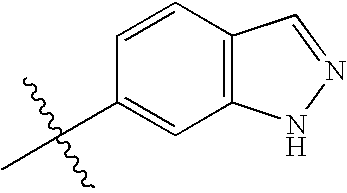
  • A is substituted with 0-1 R 1 and 0-2 R 2 and selected from; C 3-7 cycloalkyl, phenyl, naphthyl, pyridyl, 1,2,3,4-tetrahydronaphthyl, indazolyl, benzimidazolyl, benzisoxazolyl, isoquinolinyl, 5,6,7,8-tetrahydroisoquinolinyl, 1,2,3,4-tetrahydroisoquinolinyl, quinazolinyl, 1H-quinazolin-4-onyl, 2H-isoquinolin-1-onyl, 3H-quinazolin-4-onyl, 3,4-dihydro-2H-isoquinolin-1-onyl, 2,3-dihydroisoindolinonyl, and phthalazinyl;
  • L is —C(O)NR 10 —, or —NR 10 C(O)—;
  • Z is CHR 11 ;
  • R 4 is, independently at each occurrence, H, F, Cl, Br, I, OCF 3 , CF 3 , CN, NO 2 , OR a , SR a , —C(O)R a , —C(O)OR a , —NR 7 R 8 , —C(O)NR 8 R 9 , —NR 7 C(O)R b , —S(O) p NR 8 R 9 , —NR 8 S(O) p R c , —S(O)R c , —S(O) 2 R c , C 1-6 alkyl substituted with 0-2 R 4a , C 2-6 alkenyl substituted with 0-2 R 4a , C 2-6 alkynyl substituted with 0-2 R 4a , phenyl substituted with 0-2 R 4b , or a 5-10 membered heterocycle comprising: carbon atoms and 1-4 heteroatoms selected from N, O,
  • R 6 is H, or C 1-4 alkyl
  • R 10 is, independently at each occurrence, H, C 1-6 alkyl substituted with 0-2 R 10a , —(CH 2 ) r -phenyl substituted with 0-2 R d , or —(CH 2 ) r -5-10 membered heterocycle comprising carbon atoms and 1-4 heteroatoms selected from N, O, and S(O) p , wherein said heterocycle is substituted with 0-2 R d ; and
  • R 11 is C 1-4 haloalkyl, —(CH 2 ) r —CONR 8 R 9 , C 1-6 alkyl substituted with 0-2 R 11a , C 2-6 alkenyl substituted with 0-2 R 11a , C 2-6 alkynyl substituted with 0-2 R 11a , —(CH 2 ) r —C 3-0 carbocycle substituted with 0-3 R 11b , or —(CH 2 ) r -5- to 10-membered heterocycle comprising carbon atoms and 1-4 heteroatoms selected from N, O, and S(O) p , wherein said heterocycle is substituted with 0-3 R 11b .
  • the present invention includes a compound of Formula (I), within the scope of the third aspect wherein:
  • R 1 is, independently at each occurrence, F, Cl, Me, Et, —NH 2 , —C( ⁇ NH)NH 2 , —C(O)NH 2 , —CH 2 NH 2 , —CH 2 CH 2 NH 2 , —CH 2 NHCO 2 Bn, —CH 2 NHCO 2 (t-Bu), —CH(Me)NH 2 , —CMe 2 NH 2 , —NHEt, —NHCO 2 (t-Bu), —NHCO 2 Bn, —SO 2 NH 2 , OR a , or —CH 2 R 1a ;
  • R 3 is —CO 2 H, —CO 2 Me, —C(O)NHCH 2 CO 2 H, —C(O)NHCH 2 CO 2 Et, —C(O)NH 2 , —C(O)NHMe, —C(O)NHBn, —(CH 2 ) r -phenyl substituted with 0-2 R 3a and 0-1 R 3d , naphthyl substituted with 0-2 R 3a and 0-1 R 3d , indanyl substituted with 0-2 R 3a and 0-1 R 3d , or a 5- to 10-membered heterocycle selected from N, O, and S(O) p , wherein said heterocycle is substituted with 0-2 R 3a and 0-1 R 3d ;
  • R 4 is H, F, Cl, Br, OMe, NH 2 , CF 3 , CO 2 H, CO 2 Me, CO 2 Et, —CONR 8 R 9 , C 1-6 alkyl substituted with 0-2 R 4a , phenyl substituted with 0-2 R 4b , or a 5-10 membered heterocycle comprising: carbon atoms and 1-4 heteroatoms selected from N, O, and S(O) p , wherein said heterocycle is substituted with 0-3 R 4b ;
  • R 6 is H
  • R 10 is H
  • R 11 is C 1-6 alkyl, —(CH 2 ) r —C(O)NR 8 R 9 , —CH 2 OBn, —CH 2 SBn, —(CH 2 ) s —cyclohexyl substituted with 0-2 R 11b , —(CH 2 ) s -phenyl substituted with 0-2 R 11b , —(CH 2 ) s -naphthyl substituted with 0-2 R 11b , —(CH 2 ) s -5- to 10-membered heteroaryl substituted with 0-1 R 11b ; wherein said heteroaryl selected from thiazolyl, imidazolyl, pyridyl, indolyl benzimidazolyl, and benzothiazolyl.
  • the present invention includes a compound of Formula (I), within the scope of the fourth aspect wherein:
  • L is —C(O)NH—
  • R 11 is phenylmethyl, 4-imidazolylmethyl, 4-thiazolylmethyl, 2-benzthiazolylmethyl, 2-pyridylmethyl, 3-pyridylmethyl, 4-pyridylmethyl, 3-indolylmethyl, 2-benzimidazolylmethyl, 1-naphthylmethyl, 2-naphthylmethyl, cyclohexylmethyl, —CH 2 C(O)NHCH 2 -pyridin-2-yl or —(CH 2 ) 2 C(O)NHCH 2 -pyridin-2-yl, wherein each phenyl, naphthyl, imidazolyl, thiazolyl, benzthiazolyl, pyridinyl, or cyclohexyl group is substituted with 0-2 R 11b ;
  • R 11b is, independently at each occurrence, H, F, Cl, Br, CF 3 , OMe, OCF 3 , OCHF 2 , OPh, OBn, NO 2 , —NH 2 , —C(O)Ph, —NHC(O)Bn, —NHC(O)CH 2 CH 2 Ph, —NHS(O) 2 Ph, —C(O)NR 7 R 8 , —NR 7 C(O)R b , —S(O) p NR 8 R 9 , —NR 8 S(O) p R c , Ph, or Bn;
  • R 11b groups when two R 11b groups are substituents on adjacent atoms they may be taken together with the atoms to which they are attached to form a 5- to 7-membered heterocycle comprising carbon atoms and 1-4 heteroatoms selected from N, O, and S(O) p and substituted with 0-2 R g .
  • the present invention includes a compound of Formula (I), within the scope of the fifth aspect wherein:
  • R 3 is phenyl substituted with 0-2 R 3a , naphthyl substituted with 0-2 R 3a , indanone substituted with 0-2 R 3a , or a 5- to 10-membered heterocycle substituted with 0-2 R 3a and selected from: pyridine, pyridinone, pyrimidine, pyrrole, pyrazole, indole, 2-oxoindole, indazole, benzofuran, benzothiophene, benzimidazole, benzisoxazole, benzoxazole, quinazoline, 3H-quinazolin-4-one, phthalazine, 2H-phthalazin-1-one, 1H-quinolin-4-one, isoquinoline, and 2H-3,4-dihydroisoquinolin-1-one.
  • the present invention includes a compound of Formula (I), within the scope of the sixth aspect wherein:
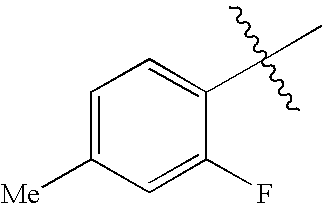
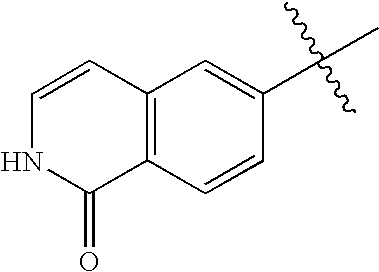
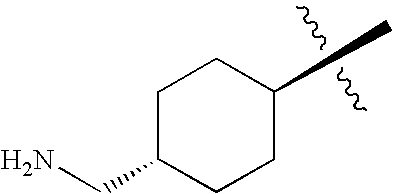
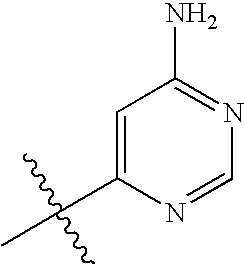
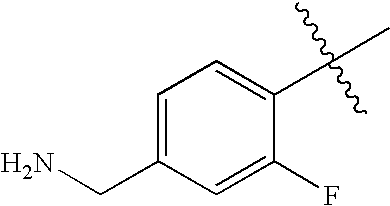
  • A is 4-aminomethyl-cyclohexyl, 4-carbamoyl-cyclohexyl, 4-amidino-phenyl, 4-benzyloxycarbonylamino-cyclohexyl, phenyl, 1,2,3,4-tetrahydronaphth-2-yl, 4-aminomethyl-phenyl, 4-carbamoyl-phenyl, 4 aminomethyl-2-fluoro-phenyl, 2-F-5-OMe-phenyl, 2-F-4-Me-phenyl, 2-F-4-Cl-phenyl, 2-F-4-carbamoyl-phenyl, 2-OMe-4-carbamoyl-phenyl, 3-OMe-4-carbamoyl-phenyl, 2-Et-4-aminomethyl-phenyl, 2-NH 2 -pyridin-4-yl, 2-ethylamino-4-aminomethyl-phenyl, 1-aminoisoquinolin-6-yl,
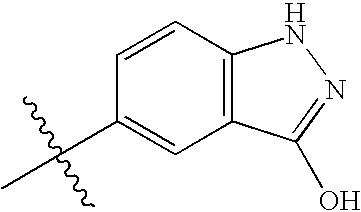
  • R 3 is phenyl, 3-OH-phenyl, 3,4-methylenedioxyphenyl, 2-naphthyl, 1-naphthyl, 3-NMe 2 -phenyl, 4-benzyloxyphenyl, 4-t-butoxyphenyl, 4-methylsulfonylphenyl, 4-Cl-phenyl, 2-OMe-phenyl, 3-OMe-phenyl, 4-OMe-phenyl, 2-F-phenyl, 3-F-phenyl, 4-F-phenyl, 4-Br-phenyl, 3-CF 3 -phenyl, 3-NH 2 -phenyl, 4-NH 2 -phenyl, 3-CN-phenyl, 4-CN-phenyl, 3-CO 2 H-phenyl, 4-CO 2 H-phenyl, 3-CO 2 Me-phenyl, 4-CO 2 Me-phenyl, 3-OH-phenyl, 3-CH 2 CO 2 H-phenyl, 3-CH 2 CO 2 Me-phenyl, 3-CH 2
  • the present invention provides a compound of Formula (Ia):
  • A is C 3-7 cycloalkyl substituted with 0-1 R 1 and 0-2 R 2 , C 3-7 cycloalkenyl substituted with 0-1 R 1 and 0-2 R 2 , phenyl substituted with 0-1 R 1 and 0-3 R 2 , naphthyl substituted with 0-1 R 1 and 0-3 R 2 , or a 5- to 10-membered heterocycle comprising: carbon atoms and 1-4 heteroatoms selected from N, O, and S(O) p , wherein said heterocycle is substituted 0-1 R 1 and 0-3 R 2 ;
  • L is —C(O)NR 10 —, —NR 10 C(O)—, —CH 2 C(O)NR 10 —, —CH 2 NR 10 C(O)—, —C(O)NR 11 CH 2 —, or —NR 10 C(O)CH 2 —;
  • R 1 is, independently at each occurrence, —NH 2 , —NH(C 1-3 alkyl), —N(C 1-3 alkyl) 2 , —C( ⁇ NH)NH 2 , —C(O)NH 2 , —CH 2 NH 2 , —(CH 2 ) r NR 7 R 8 , —CH 2 NH(C 1-3 alkyl), —CH 2 N(C 1-3 alkyl) 2 , —CH 2 CH 2 NH 2 , —CH 2 CH 2 NH(C 1-3 alkyl), —CH 2 CH 2 N(C 1-3 alkyl) 2 , —CH(C 1-4 alkyl)NH 2 , —C(C 1-4 alkyl) 2 NH 2 , C( ⁇ NR 8a )NR 7 R 8 , —NR 8 CR 8 ( ⁇ NR 8a ), —NHC(—NR 8a )NR 7 R 8 , ⁇ NR 8 , —C(O)NR 8 R
  • R 1a is H, —C( ⁇ NR 8a )NR 7 R 8 , —NHC( ⁇ NR 8a )NR 7 R 8 , —NR 8 CR 8 ( ⁇ NR 8a ), —NR 7 R 8 , —C(O)NR 8 R 9 , F, OCF 3 , CF 3 , OR a , SR a , CN, —NR 8 SO 2 NR 8 R 9 , NR 8 SO 2 R c , —S(O) p —C 4 alkyl, —S(O) p -phenyl, or —(CF 2 ) r CF 3 ;
  • R 2 is, independently at each occurrence, H, ⁇ O, F, Cl, Br, I, OCF 3 , CF 3 , CHF 2 , CN, NO 2 , OR a , SR a , —C(O)R a , —C(O)OR a , —OC(O)R a , —NR 7 R 8 , —C(O)NR 7 R 8 , —NR 7 C(O)R b , —S(O) p NR 8 R 9 , —NR 8 S(O) 2 R c , —S(O)R c , —S(O) 2 R c , C 1-6 alkyl, C 2-6 alkenyl, C 2-6 alkynyl, —(CH 2 ) r -phenyl substituted with 0-2 R 2b , or —(CH 2 ) r -5- to 6-membered heterocycle comprising: carbon atoms and 1-4
  • R 2b is, independently at each occurrence, H, F, Cl, Br, I, ⁇ O, ⁇ NR 8 , CN, NO 2 , CF 3 , OR a , SR a , —C(O)R a , —C(O)OR a , —OC(O)R a , —NR 7 R 8 , —C(O)NR 7 R 8 , —NR 7 C(O)R b , —S(O) p NR 8 R 9 , —SO 2 R c , —NR 8 SO 2 NR 8 R 9 , —NR 8 SO 2 R c , —(CF 2 ) r CF 3 , C 1-6 alkyl, C 2-6 alkenyl, C 2-6 alkynyl, C 3-6 cycloalkyl, C 1-4 haloalkyl, or C 1-4 haloalkyloxy-;
  • R 1 and R 2 when R 1 and R 2 are substituted on adjacent ring atoms, they can be taken together with the ring atoms to which they are attached to form a 5- to 7-membered carbocycle or heterocycle comprising: carbon atoms and 0-4 heteroatoms selected from N, O, and S(O) p , wherein said carbocycle or heterocycle is substituted with 0-2 R 2b ;
  • R 3 is, independently at each occurrence, —(CH 2 ) r C(O)NR 8 R 9 , —(CH 2 ) r C(O)NR 8 (CH 2 ) s CO 2 R 3b , —(CH 2 ) r CO 2 R 3b , —(CH 2 ) r -phenyl substituted with 0-3 R 3a and 0-1 R 3d , or —(CH 2 ) r -5- to 10-membered heterocycle comprising: carbon atoms and 1-4 heteroatoms selected from N, O, and S(O) p , wherein said heterocycle is substituted with 0-3 R 3a and 0-1 R 3d ;
  • R 3a is, independently at each occurrence, —O, F, Cl, Br, I, OCF 3 , CF 3 , CN, NO 2 , —(CH 2 ) r OR 3b , SR 3b , —(CH 2 ) r NR 7 R 8 , —C( ⁇ NR 8a )NR 8 R 9 , —NHC( ⁇ NR 8a )NR 7 R 8 , —NR 8 CR 8 ( ⁇ NR 8a ), —(CH 2 ) r NR 8 C(O)R 3b , ⁇ NR 8 , —(CH 2 ) r NR 8 C(O)R 3b , —(CH 2 ) r NR 8 C(O) 2 R 3b , —(CH 2 ) r NR 8 C(O) 2 R 3b , —(CH 2 ) r S(O) p NR 8 R 9 , —(CH 2 ) r NR 8 S(O)
  • R 3a groups when two R 3a groups are substituted on adjacent atoms, they can be taken together with the atoms to which they are attached to form a C 3-10 carbocycle substituted with 0-2 R 3d , or a 5- to 10-membered heterocycle comprising: carbon atoms and 1-4 heteroatoms selected from N, O, and S(O) p , wherein said heterocycle is substituted with 0-2 R 3d ;
  • R 3b is, independently at each occurrence, H, C 1-6 alkyl substituted with 0-2 R 3d , C 2-6 alkenyl substituted with 0-2 R 3d , C 2-6 alkynyl substituted with 0-2 R 3d , —(CH 2 ) r —C 3-10 carbocycle substituted with 0-3 R 3d , or —(CH 2 ) r -5- to 10-membered heterocycle comprising: carbon atoms and 1-4 heteroatoms selected from N, O, and S(O) p , wherein said heterocycle is substituted with 0-3 R 3d ;
  • R 3c is, independently at each occurrence, C 1-6 alkyl substituted with 0-2 R 3d , C 2-6 alkenyl substituted with 0-2 R 3d , C 2-6 alkynyl substituted with 0-2 R 3d , —(CH 2 ) r —C 3-10 carbocycle substituted with 0-3 R 3d , or —(CH 2 ) r -5- to 10-membered heterocycle comprising: carbon atoms and 1-4 heteroatoms selected from N, O, and S(O) p , wherein said heterocycle is substituted with 0-3 R 3d ;
  • R 3d is, independently at each occurrence, H, ⁇ O, —(CH 2 ) r OR a , F, Cl, Br, CN, NO 2 , —(CH 2 ) r NR 7 R 8 , —C(O)R a , —C(O)OR a , —OC(O)R a , —NR 7 C(O)R b , —C(O)NR 8 R 9 , —S(O) 2 NR 8 R 9 , —NR 8 S(O) 2 NR 8 R 9 , —NR 8 S(O) 2 NR 8 R 9 , —NR 8 S(O) 2 R c , —S(O) p R c , —(CF 2 ) r CF 3 , C 1-6 alkyl substituted with 0-2 R e , C 2-6 alkenyl substituted with 0-2 R e , C 2-6 alkynyl substituted with 0-2
  • R 4 is, independently at each occurrence, H, ⁇ O, F, Cl, Br, I, OCF 3 , CF 3 , CN, NO 2 , OR a , SR a , —C(O)R a , —C(O)OR a , —OC(O)R a , —NR 7 R 8 , —C(O)NR 8 R 9 , —NR 7 C(O)R b , —S(O) p NR 8 R 9 , —NR 8 S(O) p R c , —S(O) 2 R c , C 1-6 alkyl substituted with 0-2 R 4a , C 2-6 alkenyl substituted with 0-2 R 4a , C 2-6 alkynyl substituted with 0-2 R 4a , —(CH 2 ) r —C 3-10 carbocycle substituted with 0-3 R 4b , or —(CH 2 ) r -5
  • R 4a is, independently at each occurrence, H, F, ⁇ O, C 1-4 alkyl, OR a , SR a , CF 3 , CN, NO 2 , —C(O)R a , —C(O)OR a , —NR 7 R 8 , —C(O)NR 8 R 9 , —NR 7 C(O)R b , —S(O) p NR 8 R 9 , —NR 8 S(O) p R c , —S(O)R c , or —S(O) 2 R c ;
  • R 4b is, independently at each occurrence, H, ⁇ O, ⁇ NR 8 , F, Cl, Br, I, OR a , SR a , CN, NO 2 , —NR 7 R 8 , —C(O)R a , —C(O)OR a , —NR 7 C(O)R b , —C(O)NR 8 R 9 , —SO 2 NR 8 R 9 , —S(O) 2 R c , C 1-6 alkyl, C 2-6 alkenyl, C 2-6 alkynyl, C 3-6 cycloalkyl, C 1-4 haloalkyl, or C 1-4 haloalkyloxy-;
  • R 3 and R 4 groups when located on adjacent atoms can be taken together to form a C 3-10 carbocycle substituted with 0-2 R 3d or a 5- to 10-membered heterocycle comprising: carbon atoms and 1-4 heteroatoms selected from N, O, and S(O) p , wherein said heterocycle is substituted with 0-2 R 3d ;
  • R 6 is, independently at each occurrence, H, C 1-6 alkyl, C 1-4 haloalkyl, —CH 2 OR a , —C(O)R c , —C(O) 2 R c , —S(O) 2 R c , or —(CH 2 ) r -phenyl substituted with 0-3 R d ;
  • R 7 is, independently at each occurrence, H, C 1-6 alkyl, —(CH 2 ) n —C 3-10 carbocycle, —(CH 2 ) n -(5-10 membered heteroaryl), —C(O)R c , —CHO, —C(O) 2 R c , —S(O) 2 R c , —CONR 8 R c , —OCONHR c , —C(O)O—(C 1-4 alkyl)OC(O)—(C 1-4 alkyl), or —C(O)O—(C 1-4 alkyl)OC(O)—(C 6-10 aryl); wherein said alkyl, carbocycle, heteroaryl, and aryl are optionally substituted with 0-2 R f ;
  • R 8 is, independently at each occurrence, H, C 1-6 alkyl, —(CH 2 ) n -phenyl, or —(CH 2 ) n -5-10 membered heterocycle comprising: carbon atoms and 1-4 heteroatoms selected from N, O, and S(O) p ; wherein said alkyl, phenyl and heterocycle are optionally substituted with 0-2 R f ;
  • R 7 and R 8 when attached to the same nitrogen, combine to form a 5- to 10-membered heterocycle comprising: carbon atoms and 0-2 additional heteroatoms selected from N, O, and S(O) p , wherein said heterocycle is substituted with 0-2 R d ;
  • R 8a is, independently at each occurrence, R 7 , OH, C 1-6 alkyl, C 1-4 alkoxy, (C 6-10 aryl)-C 1-4 alkoxy; wherein said aryl is optionally substituted with 0-2 R f ;
  • R 9 is, independently at each occurrence, H, C 1-6 alkyl, or —(CH 2 ) n -phenyl; wherein said alkyl and phenyl are optionally substituted with 0-2 R f ;
  • R 9a is, independently at each occurrence, H, C 1-6 alkyl, or —(CH 2 ) n -phenyl;
  • R 8 and R 9 when attached to the same nitrogen, combine to form a 5- to 10-membered heterocycle comprising: carbon atoms and 0-2 additional heteroatoms selected from N, O, and S(O) p , wherein said heterocycle is substituted with 0-2 R d ;
  • R 10 is, independently at each occurrence, H, C 1-6 alkyl substituted with 0-2 R 10a , —(CH 2 ) r -phenyl substituted with 0-3 R d , or —(CH 2 ) r -5- to 10-membered heterocycle comprising carbon atoms and 1-4 heteroatoms selected from N, O, and S(O) p , wherein said heterocycle is substituted with 0-3 R d ;
  • R 10a is, independently at each occurrence, H, —O, C 1-4 alkyl, OR a , SR a , F, CF 3 , CN, NO 2 , —C(O)R a , —C(O)OR a , —C(O)NR 7 R 8 , —NR 7 C(O)R b , —S(O) p NR 8 R 9 , —NR 8 S(O) p R c , —S(O)R c , or —S(O) 2 R c ;
  • R 11 is C 1-4 haloalkyl, —(CH 2 ) r —C(O)NR 8 R 9 , C 1-6 alkyl substituted with 0-3 R 11a , C 2-4 alkenyl substituted with 0-3 R 11a , C 2-4 alkynyl substituted with 0-3 R 11a , —(CH 2 ) s —C 3-7 cycloalkyl substituted with 0-3 R 11b , —(CH 2 ) s -phenyl substituted with 0-3 R 11b , or —(CH 2 ) s -5- to 10-membered heterocycle comprising: carbon atoms and 1-4 heteroatoms selected from N, O, and S(O) p , wherein said heterocycle is substituted with 0-3 R 11b ;
  • R 11a is, independently at each occurrence, H, ⁇ O, C 1-4 alkyl, OR a , SR a , F, CF 3 , CN, NO 2 , —NR 7 R 8 , —C(O)R a , —C(O)OR a , —C(O)NR 7 R 8 , —NR 7 C(O)R b , —S(O) p NR 8 R 9 , —NR 8 S(O) p R c , or —S(O) p R c , C 3-6 cycloalkyl, C 1-4 haloalkyl, C 1-4 haloalkyloxy-, —(CH 2 ) r —C 3-10 carbocycle substituted with 0-3 R d , or —(CH 2 ) r -5- to 10-membered heterocycle comprising carbon atoms and 1-4 heteroatoms selected from N, O, and S(O) p
  • R 11b is, independently at each occurrence, H, ⁇ O, ⁇ NR 8 , OR a , F, Cl, Br, CN, NO 2 , CF 3 , OCF 3 , OCHF 2 , —NR 7 R 8 , —C(O)R a , —C(O)OR a , —C(O)NR 7 R 8 , —NR 7 C(O)R b , —NR 8 C(O) 2 R c , —S(O) p NR 8 R 9 , —NR 8 S(O) p R c , —S(O) p R c , C 1-6 alkyl, C 2-6 alkenyl, C 2-6 alkynyl, C 3-6 cycloalkyl, C 1-4 haloalkyl, C 1-4 haloalkyloxy-, —(CH 2 ) r —C 3-10 carbocycle substituted with 0-3 R d , or
  • R 11b groups when two R 11b groups are substituents on adjacent atoms they may be taken together with the atoms to which they are attached to form a 5- to 7-membered heterocycle comprising carbon atoms and 1-4 heteroatoms selected from N, O, and S(O) p and substituted with 0-2 R g ;
  • R 13 is H, C 1-6 alkyl, —C(O)R c , —C(O)OR c , —CONR 8 R c , —OCONR 8 R c , —S(O) 2 R c , —(CH 2 ) n -phenyl, —(CH 2 ) n -(5-10 membered heteroaryl), —C(O)O—(C 1-4 alkyl)-OC(O)—(C 1-4 alkyl), or —C(O)O—(C 1-4 alkyl)-OC(O)—(C 6-10 aryl); wherein said alkyl, phenyl, aryl, and heteroaryl are optionally substituted with 0-2 R f ;
  • R a is, independently at each occurrence, H, CF 3 , C 1-6 alkyl, —(CH 2 ) r —C 3-7 cycloalkyl, —(CH 2 ) r —C 6-10 aryl, or —(CH 2 ) r -5- to 10-membered heterocycle comprising: carbon atoms and 1-4 heteroatoms selected from N, O, and S(O) p ; wherein said cycloalkyl, aryl and heterocycle groups are optionally substituted with 0-2 R f ;
  • R b is, independently at each occurrence, CF 3 , OH, C 1-4 alkoxy, C 1-6 alkyl, —(CH 2 ) r C 3-10 carbocycle substituted with 0-3 R d , or —(CH 2 ) r -5- to 10-membered heterocycle comprising: carbon atoms and 1-4 heteroatoms selected from N, O, and S(O) p and substituted with 0-2 R d ;
  • R c is, independently at each occurrence, CF 3 , C 1-6 alkyl substituted with 0-2 R f , C 3-6 cycloalkyl substituted with 0-2 R f , C 6-10 aryl, 5- to 10-membered heteroaryl, (C 6-10 aryl)-C 1-4 alkyl, or (5- to 10-membered heteroaryl)-C 1-4 alkyl, wherein said aryl and heteroaryl groups are substituted with 0-3 R f ;
  • R d is, independently at each occurrence, H, ⁇ O, ⁇ NR 8 , OR a , F, Cl, Br, I, CN, NO 2 , —NR 7 R 8 , —C(O)R a , —C(O)OR a , —OC(O)R a , —NR 8 C(O)R a , —C(O)NR 7 R 8 , —SO 2 NR 8 R 9 , —NR 8 SO 2 NR 8 R 9 , —NR 8 SO 2 NR 8 R 9 , —NR 8 SO 2 —C 1-4 alkyl, —NR 8 SO 2 CF 3 , —NR 8 SO 2 -phenyl, —S(O) 2 CF 3 , —S(O) p —C 1-4 alkyl, —S(O) p -phenyl, —(CF 2 ) r CF 3 , C 1-6 alkyl substituted with 0-2 R
  • R e is, independently at each occurrence, ⁇ O, OR a , F, Cl, Br, I, CN, NO 2 , —NR 8 R 9 , —C(O)R a , —C(O)OR a , —NR 8 C(O)R a , —C(O)NR 7 R 8 , —SO 2 NR 8 R 9 , —NR 8 SO 2 NR 8 R 9 , —NR 8 SO 2 —C 1-4 alkyl, —NR 8 SO 2 CF 3 , —NR 8 SO 2 -phenyl, —S(O) 2 CF 3 , —S(O) p —C 1-4 alkyl, —S(O) p -phenyl, or —(CF 2 ) r CF 3 ;
  • R f is, independently at each occurrence, H, ⁇ O, —(CH 2 ) r OR g , F, Cl, Br, I, CN, NO 2 , —NR 9a R 9a , —C(O)R 9 , —C(O)OR g , —NR 9a C(O)R 9 , —C(O)NR 9a R 9a , —SO 2 NR 9a R 9a , —NR 9a SO 2 NR 9a R 9a , —NR 9a SO 2 C 1-4 alkyl, —NR 9a SO 2 CF 3 , —NR 9a SO 2 -phenyl, —S(O) 2 CF 3 , —S(O) p —C 1-4 alkyl, —S(O) p -phenyl, —(CF 2 ) r CF 3 , C 1-6 alkyl, C 2-6 alkenyl, C 2-6 alkynyl, or
  • R g is, independently at each occurrence, H, C 1-6 alkyl, or —(CH 2 ) n -phenyl;
  • n at each occurrence, is selected from 0, 1, 2, 3, and 4;
  • p at each occurrence, is selected from 0, 1, and 2;
  • r at each occurrence, is selected from 0, 1, 2, 3, and 4;
  • s at each occurrence, is selected from 1, 2, 3, and 4.
  • the present invention includes compounds of Formula (Ia), within the scope of the eighth aspect wherein:
  • A is substituted with 0-1 R 1 and 0-2 R 2 and selected from; C 3-7 cycloalkyl, phenyl, naphthyl, pyridyl, 1,2,3,4-tetrahydronaphthyl, indazolyl, benzimidazolyl, benzisoxazolyl, isoquinolinyl, 5,6,7,8-tetrahydroisoquinolinyl, 1,2,3,4-tetrahydroisoquinolinyl, quinazolinyl, 1H-quinazolin-4-onyl, 2H-isoquinolin-1-onyl, 3H-quinazolin-4-onyl, 3,4-dihydro-2H-isoquinolin-1-onyl, 2,3-dihydroisoindolinonyl, and phthalazinyl;
  • L is —C(O)NR 10 —, or —NR 10 C(O)—;
  • R 4 is, independently at each occurrence, H, F, Cl, Br, I, CF 3 , CN, NO 2 , OR a , SR a , —C(O)R a , —C(O)OR a , —NR 7 R 8 , —C(O)NR 8 R 9 , —NR 7 C(O)R b , —S(O) p NR 8 R 9 , —NR 8 S(O) p R c , —S(O) 2 R c , C 1-6 alkyl substituted with 0-2 R 4a , C 2-6 alkenyl substituted with 0-2 R 4a , C 2-6 alkynyl substituted with 0-2 R 4a ; and
  • R 6 is H, or C 1-4 alkyl.
  • the present invention includes compounds of Formula (Ia), within the scope of the ninth aspect wherein:
  • R 1 is, independently at each occurrence, F, Cl, Me, Et, —NH 2 , —C( ⁇ NH)NH 2 , —C(O)NH 2 , —CH 2 NH 2 , —CH 2 NHCO 2 Bn, —CH 2 NHCO 2 (t-Bu), —CH(Me)NH 2 , —CMe 2 NH 2 , —NHEt, —NHCO 2 (t-Bu), —NHCO 2 Bn, —SO 2 NH 2 , OR a , or —CH 2 R 1a ;
  • R 2 is, independently at each occurrence, F, Cl, Me, OMe, OEt, Bn, —CH 2 OMe, —CH 2 OEt, or —CH 2 OPh;
  • R 3 is —CO 2 H, —CO 2 Me, —C(O)NHCH 2 CO 2 H, —C(O)NHCH 2 CO 2 Et, —C(O)NH 2 , —C(O)NHMe, —C(O)NHBn, phenyl substituted with 0-2 R 3a , naphthyl substituted with 0-2 R 3a , indane substituted with 0-2 R 3a , or a 5- to 10-membered heterocycle selected from N, O, and S(O) p , wherein said heterocycle is substituted with 0-2 R 3 a;
  • R 3a is, independently at each occurrence, ⁇ O, F, Cl, Br, Me, CN, OH, NH 2 , OMe, O(t-Bu), OBn, CF 3 , CO 2 H, CO 2 Me, —CH 2 CO 2 H, —CH 2 CO 2 Me, —CH 2 CO 2 Et, —NHCOMe, —CONH 2 , —CH 2 CONH 2 , —CONHMe, —CONMe 2 , —C( ⁇ NH)NH 2 , —NR 7 R 8 , SO 2 Me, —SO 2 NH 2 , Ph, or 2-oxo-piperidin-1-yl; wherein two of the R 3a groups located on adjacent atoms can be taken together to form 5- to 10-membered heterocycle with 0-2 R 3d ;
  • R 4 is H, F, Cl, Br, OMe, or NH 2 ;
  • R 6 is H
  • R 10 is H
  • R 11 is —(CH 2 ) r —C(O)NR 8 R 9 , —CH 2 OBn, —CH 2 SBn, —(CH 2 ) s -cyclohexyl substituted with 0-2 R 11b , —(CH 2 ) s -phenyl substituted with 0-2 R 11b , —(CH 2 ) s -naphthyl substituted with 0-2 R 11b , —(CH 2 ) s -5- to 10-membered heteroaryl substituted with 0-1 R 11b ; wherein said heteroaryl selected from thiazolyl, imidazolyl, pyridyl, indolyl benzimidazolyl, and benzothiazolyl.
  • the present invention includes compounds of Formula (Ia), within the scope of the tenth aspect wherein:
  • L is —C(O)NH—
  • R 11 is phenylmethyl, 4-imidazolylmethyl, 4-thiazolylmethyl, 2-benzthiazolylmethyl, 2-pyridylmethyl, 3-pyridylmethyl, 4-pyridylmethyl, 3-indolylmethyl, 2-benzimidazolylmethyl, 1-naphthylmethyl, 2-naphthylmethyl, cyclohexylmethyl, —CH 2 C(O)NHCH 2 -pyridin-2-yl or —(CH 2 ) 2 C(O)NHCH 2 -pyridin-2-yl, wherein each phenyl, naphthyl, imidazolyl, thiazolyl, benzthiazolyl, pyridinyl, or cyclohexyl group is substituted with 0-2 R 11b ;
  • R 11b is, independently at each occurrence, H, F, Cl, Br, CF 3 , OMe, OCF 3 , OCHF 2 , OPh, OBn, NO 2 , —NH 2 , —C(O)Ph, —NHC(O)Bn, —NHC(O)CH 2 CH 2 Ph, —NHS(O) 2 Ph, —C(O)NR 7 R 8 , —NR 7 C(O)R b , —S(O) p NR 8 R 9 , —NR 8 S(O) p R c , Ph, or Bn;
  • R 11b groups when two R 11b groups are substituents on adjacent atoms they may be taken together with the atoms to which they are attached to form a 5- to 7-membered heterocycle comprising carbon atoms and 1-4 heteroatoms selected from N, O, and S(O) p and substituted with 0-2 R g .
  • the present invention includes compounds of Formula (Ia), within the scope of the eleventh aspect wherein:
  • R 3 is phenyl substituted with 0-2 R 3a , naphthyl substituted with 0-2 R 3a , indanone substituted with 0-2 R 3a , or a 5- to 10-membered heterocycle substituted with 0-2 R 3a and selected from: pyridine, pyridinone, pyrimidine, pyrrole, pyrazole, indole, 2-oxoindole, indazole, benzofuran, benzothiophene, benzimidazole, benzisoxazole, benzoxazole, quinazoline, 3H-quinazolin-4-one, phthalazine, 2H-phthalazin-1-one, 1H-quinolin-4-one, isoquinoline, and 2H-3,4-dihydroisoquinolin-1-one.
  • the present invention includes compounds of Formula (Ia), within the scope of the twelfth aspect wherein:
  • A is 4-aminomethyl-cyclohexyl; 4-carbamoyl-cyclohexyl, 4-amidino-phenyl, 4-benzyloxycarbonylamino-cyclohexyl, phenyl, 1,2,3,4-tetrahydronaphth-2-yl, 4-aminomethyl-phenyl, 4-carbamoyl-phenyl, 4 aminomethyl-2-fluoro-phenyl, 2-F-5-OMe-phenyl, 2-F-4-Me-phenyl, 2-F-4-Cl-phenyl, 2-F-4-carbamoyl-phenyl, 2-OMe-4-carbamoyl-phenyl, 3-OMe-4-carbamoyl-phenyl, 2-Et-4-aminomethyl-phenyl, 2-NH 2 -pyridin-4-yl, 2-ethylamino-4-aminomethyl-phenyl, 1-aminoisoquinolin-6-yl,
  • R 3 is phenyl, 3-OH-phenyl, 3,4-methylenedioxyphenyl, 2-naphthyl, 1-naphthyl, 3-NMe 2 -phenyl, 4-benzyloxyphenyl, 4-t-butoxyphenyl, 4-methylsulfonylphenyl, 4-Cl-phenyl, 2-OMe-phenyl, 3-OMe-phenyl, 4-OMe-phenyl, 2-F-phenyl, 3-F-phenyl, 4-F-phenyl, 4-Br-phenyl, 3-CF 3 -phenyl, 3-NH 2 -phenyl, 4-NH 2 -phenyl, 3-CN-phenyl, 4-CN-phenyl, 3-CO 2 H-phenyl, 4-CO 2 H-phenyl, 3-CO 2 Me-phenyl, 4-CO 2 Me-phenyl, 3-OH-phenyl, 3-CH 2 CO 2 H-phenyl, 3-CH 2 CO 2 Me-phenyl, 3-CH 2
  • the present invention includes compounds of Formula (Ia), within the scope of the thirteenth aspect wherein:
  • A is 4-aminomethyl-cyclohexyl
  • the present invention provides a compound selected from the exemplified examples or stereoisomers or pharmaceutically acceptable salts, solvates, or prodrugs thereof.
  • the present invention includes, inter alia, compounds of Formula (III):
  • A is C 3-10 carbocycle substituted with 0-1 R 1 and 0-3 R 2 , or a 5- to 10-membered heterocycle comprising: carbon atoms and 1-4 heteroatoms selected from N, O, and S(O) p , wherein said heterocycle is substituted 0-1 R 1 and 0-3 R 2 ;
  • X is C, CH, or N
  • X 1 , X 2 , X 3 , X 4 , and X 5 are independently CR 3 , CR 4 , CR 5 , CR 4 R 5 , O, S(O) p , N, NR 3 , NR 6 , N ⁇ O, or C(O); provided that at least one of X 1 , X 2 , X 3 , X 4 , and X 5 is CR 3 ; no S—S, S—O, or O—O bond is present in the ring; and when X is C or CH, at least one of X 1 , X 2 , X 3 , X 4 , and X 5 is selected from N, NR 3 , NR 6 , and N ⁇ O;
  • Z is —C(R 11 )(R 12 )— or —NR 13 —;
  • L is —C(O)NR 10 —, —NR 10 C(O)—, —CH 2 C(O)NR 10 —, —CH 2 NR 10 C(O)—, —C(O)NR 10 CH 2 —, —NR 10 C(O)CH 2 —, —S(O) 2 NR O—, —NR 10 S(O) 2 —, —CH 2 S(O) 2 NR 10 —, —CH 2 NR 10 S(O) 2 —, —S(O) 2 NR 10 CH 2 —, —NR 10 S(O) 2 CH 2 —, —CH 2 CH 2 —, —CH 2 NR 7 —, —NR 7 CH 2 —, —CH 2 CH 2 NR 7 —, —NR 7 CH 2 CH 2 —, —CH 2 O—, —OCH 2 —, —CH 2 CH 2 O—, —OCH 2 —, —CH 2 CH 2 O—, —OCH
  • R 1 is, independently at each occurrence, —NH 2 , —NH(C 1-3 alkyl), —N(C 1-3 alkyl) 2 , —C( ⁇ NH)NH 2 , —C(O)NH 2 , —CH 2 NH 2 , —(CH 2 ) r NR 7 R 8 , —CH 2 NH(C 1-3 alkyl), —CH 2 N(C 1-3 alkyl) 2 , —CH 2 CH 2 NH 2 , —CH 2 CH 2 NH(C 1-3 alkyl), —CH 2 CH 2 N(C 1-3 alkyl) 2 , —CH(C 1-4 alkyl)NH 2 , —C(C 1-4 alkyl) 2 NH 2 , —C( ⁇ NR 8a )NR 7 R 8 , —NR 8 CR 8 ( ⁇ NR 8a ), —NHC( ⁇ NR 8a )NR 7 R 8 , ⁇ NR 8 , —C(O)NR
  • R 1a is H, —C( ⁇ NR 8a )NR 8 R 9 , —NHC( ⁇ NR 8a )NR 8 R 9 , —NR 8 CR 8 ( ⁇ NR 8a ), —NR 7 R 8 , —C(O)NR 7 R 8 , F, OCF 3 , CF 3 , OR a , SR a , CN, —NR 8 SO 2 NR 8 R 9 , —NR 8 SO 2 R c , —S(O) p —C 1-4 alkyl, —S(O) p -phenyl, or —(CF 2 ) r CF 3 ;
  • R 2 is, independently at each occurrence, H, ⁇ O, F, Cl, Br, I, OCF 3 , CF 3 , CHF 2 , CN, NO 2 , OR a , SR a , —C(O)R a , —C(O)OR a , —OC(O)R a , —NR 7 R 8 , —C(O)NR 7 R 8 , —NR 7 C(O)R b , —S(O) p NR 8 R 9 , —NR 8 S(O) 2 R c , —S(O)R c , —S(O) 2 R c , C 1-6 alkyl substituted with 0-2 R 2a , C 2-6 alkenyl substituted with 0-2 R 2a , C 2-6 alkynyl substituted with 0-2 R 2a , —(CH 2 ) r —C 3-10 carbocycle substituted with 0-3 R 2
  • R 2a is, independently at each occurrence, H, F, Cl, Br, I, ⁇ O, ⁇ NR 8 , CN, OCF 3 , CF 3 , OR a , SR a , —NR 7 R 8 , —C(O)NR 8 R 9 , —NR 7 C(O)R b , —S(O) p NR 8 R 9 , —NR 8 SO 2 R c , —S(O)R c , or —S(O) 2 R c ;
  • R 2b is, independently at each occurrence, H, F, Cl, Br, I, ⁇ O, ⁇ NR 8 , CN, NO 2 , CF 3 , OR a , SR a , —C(O)R a , —C(O)OR a , —OC(O)R a , —NR 7 R 8 , —C(O)NR 7 R 8 , —NR 7 C(O)R b , —S(O) p NR 8 R 9 , —SO 2 R c , —NR 8 SO 2 NR 8 R 9 , —NR 8 SO 2 R c , —(CF 2 ) r CF 3 , C 1-6 alkyl, C 2-6 alkenyl, C 2-6 alkynyl, C 3-6 cycloalkyl, C 1-4 haloalkyl, or C 1-4 haloalkyloxy-;
  • R 1 and R 2 when R 1 and R 2 are substituted on adjacent ring atoms, they can be taken together with the ring atoms to which they are attached to form a 5- to 7-membered carbocycle or heterocycle comprising: carbon atoms and 0-4 heteroatoms selected from N, O, and S(O) p , wherein said carbocycle or heterocycle is substituted with 0-2 R 2b ;
  • R 3 is, independently at each occurrence, —(CH 2 ) r C(O)NR 8 R 9 , —(CH 2 ) r C(O)NR 8 (CH 2 ) s CO 2 R 3b , —(CH 2 ) r CO 2 R 3b , —(CH 2 ) r —C 3-10 carbocycle substituted with 0-3 R 3a and 0-1 R 3d , or —(CH 2 ) r -5- to 10-membered heterocycle comprising: carbon atoms and 1-4 heteroatoms selected from N, O, and S(O) p , wherein said heterocycle is substituted with 0-3 R 3a and 0-1 R 3d ;
  • R 3a is, independently at each occurrence, ⁇ O, F, Cl, Br, I, OCF 3 , CF 3 , CN, NO 2 , —(CH 2 ) r OR 3b , SR 3b , —(CH 2 ) r NR 7 R 8 , —C( ⁇ NR 8a )NR 8 R 9 , —NHC( ⁇ NR 8a )NR 8 R 9 , —NR 8 CR 8 ( ⁇ NR 8a ), —(CH 2 ) r NR 8 C(O)R 3b , ⁇ NR 8 , —(CH 2 ) r NR 8 C(O) 2 R 3b , —(CH 2 ) r S(O) p NR 8 R 9 , —(CH 2 ) r NR 8 S(O) p R 3c , —S(O)R 3c , —S(O) 2 R 3c , C 1-6 alkyl substituted by R 3e ,
  • R 3a groups when two R 3a groups are substituted on adjacent atoms, they can be taken together with the atoms to which they are attached to form a C 3-10 carbocycle substituted with 0-2 R 3d , or a 5- to 10-membered heterocycle comprising: carbon atoms and 1-4 heteroatoms selected from N, O, and S(O) p , wherein said heterocycle is substituted with 0-2 R 3d ;
  • R 3b is, independently at each occurrence, H, C 1-6 alkyl substituted with 0-2 R 3d , C 2-6 alkenyl substituted with 0-2 R 3d , C 2-6 alkynyl substituted with 0-2 R 3d , —(CH 2 ) r —C 3-10 carbocycle substituted with 0-3 R 3d , or —(CH 2 ) r -5- to 10-membered heterocycle comprising: carbon atoms and 1-4 heteroatoms selected from N, O, and S(O) p , wherein said heterocycle is substituted with 0-3 R 3d ;
  • R 3c is, independently at each occurrence, C 1-6 alkyl substituted with 0-2 R 3d , C 2-6 alkenyl substituted with 0-2 R 3d , C 2-6 alkynyl substituted with 0-2 R 3d , —(CH 2 ) r —C 3-10 carbocycle substituted with 0-3 R 3d , or —(CH 2 ) r -5- to 10-membered heterocycle comprising: carbon atoms and 1-4 heteroatoms selected from N, O, and S(O) p , wherein said heterocycle is substituted with 0-3 R 3d ;
  • R 3d is, independently at each occurrence, H, ⁇ O, —(CH 2 ) r OR a , F, Cl, Br, CN, NO 2 , —(CH 2 ) r NR 7 R 8 , —C(O)R a , —C(O)OR a , —OC(O)R a , —NR 7 C(O)R b , —C(O)NR 8 R 9 , —S(O) 2 NR 8 R 9 , —NR 8 S(O) 2 NR 8 R 9 , —NR 8 S(O) 2 NR 8 R 9 , —NR 8 S(O) 2 R c , —S(O) p R c , —(CF 2 ) r CF 3 , C 1-6 alkyl substituted with 0-2 R e , C 2-6 alkenyl substituted with 0-2 R e , C 2-6 alkynyl substituted with 0-2
  • R 3e is, independently at each occurrence, H, —(CH 2 ) r OR a , F, Cl, Br, I, CN, NO 2 , —(CH 2 ) r NR 7 R 8 , —C(O)R a , —C(O)OR a , —OC(O)R a , —NR 7 C(O)R b , —C(O)NR 8 R 9 , —S(O) 2 NR 8 R 9 , —NR 8 S(O) 2 NR 8 R 9 , —NR 8 S(O) 2 NR 8 R 9 , —NR 8 S(O) 2 R c , —S(O) p R c , —(CF 2 ) r CF 3 , C 1-6 alkyl substituted with 0-2 R e , C 2-6 alkenyl substituted with 0-2 R e , C 2-6 alkynyl substituted with 0-2 R
  • R 4 is, independently at each occurrence, H, ⁇ O, F, Cl, Br, I, OCF 3 , CF 3 , CN, NO 2 , OR a , SR a , —C(O)R a , —C(O)OR a , —OC(O)R a , —NR 7 R 8 , —C(O)NR 8 R 9 , —NR 7 C(O)R b , —S(O) p NR 8 R 9 , —NR 8 S(O) p R c , —S(O) 2 R c , C 1-6 alkyl substituted with 0-2 R 4a , C 2-6 alkenyl substituted with 0-2 R 4a , C 2-6 alkynyl substituted with 0-2 R 4a , —(CH 2 ) r —C 3-10 carbocycle substituted with 0-3 R 4b , or —(CH 2 ) r -5
  • R 4a is, independently at each occurrence, H, F, ⁇ O, C 1-4 alkyl, OR a , SR a , CF 3 , CN, NO 2 , —C(O)R a , —C(O)OR a , —NR 7 R 8 , —C(O)NR 8 R 9 , —NR 7 C(O)R b , —S(O) p NR 8 R 9 , —NR 8 S(O) p R c , —S(O)R c , or —S(O) 2 R c ;
  • R 4b is, independently at each occurrence, H, ⁇ O, ⁇ NR 8 , OR a , F, Cl, Br, I, CN, NO 2 , —NR 7 R 8 , —C(O)R a , —C(O)OR a , —NR 7 C(O)R b , —C(O)NR 8 R 9 , —SO 2 NR 8 R 9 , —S(O) 2 R c , C 1-6 alkyl, C 2-6 alkenyl, C 2-6 alkynyl, C 3-6 cycloalkyl, C 1-4 haloalkyl, or C 1-4 haloalkyloxy-;
  • R 3 and R 4 groups when located on adjacent atoms can be taken together to form a C 3-10 carbocycle substituted with 0-2 R 3d or a 5- to 10-membered heterocycle comprising: carbon atoms and 1-4 heteroatoms selected from N, O, and S(O) p , wherein said heterocycle is substituted with 0-2 R 3d ;
  • R 5 is, independently at each occurrence, H, F, Cl, Br, I, OCF 3 , CF 3 , OR a , SR a , CN, NO 2 , —C(O)R a , —C(O)OR a , —OC(O)R a , —NR 7 R 8 , —C(O)NR 7 R 8 , —NR 7 C(O)R b , —S(O) p NR 8 R 9 , —NR 8 S(O) p R c , —S(O)R c , —S(O) 2 R c , C 1-6 alkyl substituted with 0-2 R 5a , C 2-6 alkenyl substituted with 0-2 R 5a , C 2-6 alkynyl substituted with 0-2 R 5a , —(CH 2 ) r —C 3-10 carbocycle substituted with 0-3 R 5b , or —(CH
  • R 5a is, independently at each occurrence, H, ⁇ O, F, Cl, Br, I, OCF 3 , CF 3 , OR a , SR a , CN, NO 2 , —NR 7 R 8 , —C(O)NR 7 R 8 , —NR 7 C(O)R b , —S(O) p NR 8 R 9 , NR 8 S(O) p R c , —S(O)R c , or —S(O) 2 R c ;
  • R 5b is, independently at each occurrence, H, ⁇ O, OR a , F. Cl, Br, I, CN, NO 2 , —NR 7 R 8 , —C(O)R a , —C(O)OR a , —NR 7 C(O)R b , —C(O)NR 8 R 9 , —SO 2 NR 8 R 9 , —S(O) 2 R c , C 1-6 alkyl, C 2-6 alkenyl, C 2-6 alkynyl, C 3-6 cycloalkyl, C 1-4 haloalkyl, C 1-4 haloalkyloxy-, C 1-4 alkyloxy-, C 1-4 alkylthio-, C 1-4 alkyl-C(O)—, or C 1-4 alkyl-C(O)NH—;
  • R 3 , R 4 , or R 5 when R 3 , R 4 , or R 5 are substituted on adjacent atoms, two of them can be taken together with the carbon atoms to which they are attached to form a 5- to 7-membered carbocycle or heterocycle substituted with 0-3 R 3a and 0-1 R 3d ;
  • R 6 is, independently at each occurrence, H, C 1-6 alkyl substituted with 0-2 R 6a , C 2-6 alkenyl substituted with 0-2 R 6a , C 2-6 alkynyl substituted with 0-2 R 6a , —C(O)R c , —S(O) 2 R c , —CO 2 R c , —C(O)NHR c , —OC(O)NHR c , —C(O)N(C 1-6 alkyl)R c , —(CH 2 ) r —C 3-10 carbocycle substituted with 0-3 R d , or —(CH 2 ) r -5- to 10-membered heterocycle comprising: carbon atoms and 1-4 heteroatoms selected from N, O, and S(O) p , wherein said heterocycle is substituted with 0-3 R d ;
  • R 6a is, independently at each occurrence, H, ⁇ O, F, OCF 3 , CF 3 , OR a , SR a , CN, NO 2 , —NR 7 R 8 , —C(O)NR 7 R 8 , —NR 7 C(O)R b , —S(O) p NR 8 R 9 , —NR 8 S(O) p R c , —S(O)R c , or —S(O) 2 R c ;
  • R 7 is, independently at each occurrence, H, C 1-6 alkyl, —(CH 2 ) n —C 3-10 carbocycle, —(CH 2 ) n -(5-10 membered heteroaryl), —CHO, —C(O)R c , —C(O)OR c , —CONR 8 R c , —OC(O)NHR c , —S(O) 2 R c , —C(O)O—(C 1-4 alkyl)-OC(O)—(C 1-4 alkyl), or —C(O)O—(C 1-4 alkyl)-OC(O)—(C 6-10 aryl); wherein said alkyl, carbocycle, aryl, and heteroaryl are optionally substituted with 0-2 R f ;
  • R 8 is, independently at each occurrence, H, C 1-6 alkyl, or —(CH 2 ) n -phenyl, or —(CH 2 ) n -5-10 membered heterocycle comprising: carbon atoms and 1-4 heteroatoms selected from N, O, and S(O) p ; wherein said alkyl, phenyl and heterocycle are optionally substituted with 0-2 R f ,
  • R 7 and R 8 when attached to the same nitrogen, combine to form a 5- to 10-membered heterocycle comprising: carbon atoms and 0-2 additional heteroatoms selected from N, O, and S(O) p , wherein said heterocycle is substituted with 0-2 R d ;
  • R 8a is, independently at each occurrence, R 7 , OH, C 1-4 alkoxy, (C 6-10 aryl)-C 1-4 alkoxy, —(CH 2 ) n -phenyl, —(CH 2 ) n -(5-10 membered heteroaryl); wherein said aryl, and heteroaryl is optionally substituted with 0-2 R f ;
  • R 9 is, independently at each occurrence, H, C 1-6 alkyl, or —(CH 2 ) n -phenyl; wherein said alkyl and phenyl are optionally substituted with 0-2 R f ;
  • R 9a is, independently at each occurrence, H, C 1-6 alkyl, or —(CH 2 ) n -phenyl;
  • R 8 and R 9 when attached to the same nitrogen, combine to form a 5- to 10-membered heterocycle comprising: carbon atoms and 0-2 additional heteroatoms selected from N, O, and S(O) p , wherein said heterocycle is substituted with 0-2 R d ;
  • R 10 is, independently at each occurrence, H, C 1-6 alkyl substituted with 0-3 R 10a , C 2-6 alkenyl substituted with 0-3 R 10a , C 2-6 alkynyl substituted with 0-3 R 10a , —(CH 2 ) r —C 3-10 carbocycle substituted with 0-3 R d , or —(CH 2 ) r -5- to 10-membered heterocycle comprising carbon atoms and 1-4 heteroatoms selected from N, O, and S(O) p , wherein said heterocycle is substituted with 0-3 R d ;
  • R 10a is, independently at each occurrence, H, ⁇ O, C 1-4 alkyl, OR a , SR a , F, CF 3 , CN, NO 2 , —C(O)R a , —C(O)OR a , —C(O)NR 7 R 8 , —NR 7 C(O)R b , —S(O) p NR 8 R 9 , —NR 8 S(O) p R c , —S(O)R c , or —S(O) 2 R c ;
  • R 11 is C 1-4 haloalkyl, —(CH 2 ) r —C(O)NR 7 R 8 , C 1-6 alkyl substituted with 0-3 R 11a , C 2-6 alkenyl substituted with 0-3 R 11a , C 2-6 alkynyl substituted with 0-3 R 11a , —(CR 14 R 15 ) r —C 3-10 carbocycle substituted with 0-3 R 11b , or —(CR 14 R 15 ) r -5- to 10-membered heterocycle comprising: carbon atoms and 1-4 heteroatoms selected from N, O, and S(O) p , wherein said heterocycle is substituted with 0-3 R 11b ;
  • R 11a is, independently at each occurrence, H, —O, C 1-4 alkyl, OR a , F, CN, NO 2 , —NR 7 R 8 , —C(O)R a , —C(O)OR a , —C(O)NR 7 R 8 , —NR 7 C(O)R b , —S(O) p NR 8 R 9 , —NR 8 S(O) p R c , —S(O) p R c , C 3-6 cycloalkyl, C 1-4 haloalkyl, C 1-4 haloalkyloxy-, —(CH 2 ) r —C 3-10 carbocycle substituted with 0-3 R d , or —(CH 2 ) r -5- to 10-membered heterocycle comprising carbon atoms and 1-4 heteroatoms selected from N, O, and S(O) p , and substituted with 0-3 R d
  • R 11b is, independently at each occurrence, H, ⁇ O, ⁇ NR 8 , OR a , F, Cl, Br, CN, NO 2 , CF 3 , OCF 3 , OCHF 2 , —NR 7 R 8 , —C(O)R a , —C(O)OR a , —C(O)NR 7 R 8 , —NR 7 C(O)R b , —S(O) p NR 8 R 9 , —NR 8 S(O) p R c , —S(O) p R c , C 1-6 alkyl, C 2-6 alkenyl, C 2-6 alkynyl, C 3-6 cycloalkyl, C 1-4 haloalkyl, C 1-4 haloalkyloxy-, —(CH 2 ) r —C 3-10 carbocycle substituted with 0-3 R d , or —(CH 2 ) r -5- to 10-
  • R 11b groups when two R 11b groups are substituents on adjacent atoms they may be taken together with the atoms to which they are attached to form a 5- to 7-membered carbocycle or heterocycle comprising carbon atoms and 0-4 heteroatoms selected from N, O, and S(O) p and substituted with 0-2 R g ;
  • R 12 is H, F, C 1-4 haloalkyl, C 1-6 alkyl substituted with 0-3 R 12a , C 2-6 alkenyl substituted with 0-3 R 12a , C 2-6 alkynyl substituted with 0-3 R 12a , —(CH 2 ) r —C 3-10 carbocycle substituted with 0-3 R 12b , or —(CH 2 ) r -5- to 10-membered heterocycle comprising: carbon atoms and 1-4 heteroatoms selected from N, O, and S(O) p , wherein said heterocycle is substituted with 0-3 R 12b ;
  • R 12a is, independently at each occurrence, H, ⁇ O, C 1-4 alkyl, OR a , F, Cl, Br, CN, NO 2 , —NR 7 R 8 , —C(O)R a , —C(O)OR a , —C(O)NR 7 R 8 , —NR 7 C(O)R b , —S(O) p NR 8 R 9 , —NR 8 S(O) p R c , or —S(O) p R c ;
  • R 12b is, independently at each occurrence, H, ⁇ O, OR a , F, Cl, Br, CN, NO 2 , —NR 7 R 8 , —C(O)OR a , —C(O)NR 7 R 8 , —S(O) 2 R c , C 1-6 alkyl, C 2-6 alkenyl, C 2-6 alkynyl, C 3-6 cycloalkyl, C 1-4 haloalkyl, C 1-4 haloalkyloxy-, C 1-4 alkyloxy-, C 1-4 alkylthio-, C 1-4 alkyl-C(O)—, or C 1-4 alkyl-C(O)NH—;
  • R 11 and R 12 can be taken together to form a C 3-10 carbocycle substituted with 0-2 R 12b , or a 5- to 10-membered heterocycle comprising: carbon atoms and 1-4 heteroatoms selected from N, O, and S(O) p , wherein said heterocycle is substituted with 0-2 R 12b ;
  • R 11 or R 12 can be taken together with R 10 to form a 5- to 10-membered heterocycle comprising: carbon atoms and 1-4 heteroatoms selected from N, O, and S(O) p , wherein said heterocycle is substituted with 0-2 R 12b ;
  • R 11 or R 12 can be taken together with R 7 , when R 7 is a substituent on L, to form a 5- to 10-membered heterocycle comprising: carbon atoms and 1-4 heteroatoms selected from N, O, and S(O) p , wherein said heterocycle is substituted with 0-2 R 12b ;
  • R 13 is H, C 1-6 alkyl, —C(O)R c , —C(O)OR c , —CONR 8 R c , —OCONR 8 R c , —S(O) 2 R c , —(CH 2 ) n -phenyl, —(CH 2 ) n -(5-10 membered heteroaryl), —C(O)O—(C 1-4 alkyl)-OC(O)—(C 1-4 alkyl), or —C(O)O—(C 1-4 alkyl)-OC(O)—(C 6-10 aryl); wherein said alkyl, phenyl, aryl, and heteroaryl are optionally substituted with 0-2 R f ;
  • R 13 can be taken together with R 10 to form a 5- to 10-membered heterocycle comprising: carbon atoms and 1-4 heteroatoms selected from N, O, and S(O) p , wherein said heterocycle is substituted with 0-2 R d ;
  • R 14 is, independently at each occurrence, H, C 1-4 alkyl, OR a , F, CN, NO 2 , —NR 7 R 8 , —C(O)R a , —C(O)OR a , —C(O)NR 7 R 8 , —NR 7 C(O)R b , —S(O) p NR 8 R 9 , —NR 8 S(O) p R c , or —S(O) p R c ;
  • R 15 is, independently at each occurrence, H, F, or C 1-4 alkyl
  • R 14 combines with R 15 to form ⁇ O;
  • R a is, independently at each occurrence, H, CF 3 , C 1-6 alkyl, —(CH 2 ) r —C 3-7 cycloalkyl, —(CH 2 ) r —C 6-10 aryl, or —(CH 2 ) r -5- to 10-membered heterocycle comprising: carbon atoms and 1-4 heteroatoms selected from N, O, and S(O) p ; wherein said cycloalkyl, aryl and heterocycle groups are optionally substituted with 0-2 R f ;
  • R b is, independently at each occurrence, CF 3 , OH, C 1-4 alkoxy, C 1-6 alkyl, —(CH 2 ) r —C 3-10 carbocycle substituted with 0-2 R d , or —(CH 2 ) r -5- to 10-membered heterocycle comprising: carbon atoms and 1-4 heteroatoms selected from N, O, and S(O) p and substituted with 0-2 R d ;
  • R c is, independently at each occurrence, CF 3 , C 1-6 alkyl substituted with 0-2 R f , C 3-6 cycloalkyl substituted with 0-2 R f , C 6-10 aryl, 5- to 10-membered heteroaryl, (C 6-10 aryl)-C 1-4 alkyl, or (5- to 10-membered heteroaryl)-C 1-4 alkyl, wherein said aryl and heteroaryl groups are substituted with 0-3 R f ;
  • R d is, independently at each occurrence, H, ⁇ O, ⁇ NR 8 , OR a , F, Cl, Br, I, CN, NO 2 , —NR 7 R 8 , —C(O)R a , —C(O)OR a , —OC(O)R a , —NR 8 C(O)R a , —C(O)NR 7 R 8 , —SO 2 NR 8 R 9 , —NR 8 SO 2 NR 8 R 9 , —NR 8 SO 2 NR 8 R 9 , —NR 8 SO 2 —C 1-4 alkyl, —NR 8 SO 2 CF 3 , —NR 8 SO 2 -phenyl, —S(O) 2 CF 3 , —S(O) p —C 1-4 alkyl, —S(O) p -phenyl, —(CF 2 ) r CF 3 , C 1-6 alkyl substituted with 0-2 R
  • R e is, independently at each occurrence, ⁇ O, OR a , F, Cl, Br, I, CN, NO 2 , —NR 8 R 9 , —C(O)R a , —C(O)OR a , —NR 8 C(O)R a , —C(O)NR 7 R 8 , —SO 2 NR 8 R 9 , —NR 8 SO 2 NR 8 R 9 , —NR 8 SO 2 —C 1-4 alkyl, —NR 8 SO 2 CF 3 , —NR 8 SO 2 -phenyl, —S(O) 2 CF 3 , —S(O) p —C 1-4 alkyl, —S(O) p -phenyl, or —(CF 2 ) r CF 3 ;
  • R f is, independently at each occurrence, H, ⁇ O, —(CH 2 ) r OR g , F, Cl, Br, I, CN, NO 2 , —NR 9a R 9a , —C(O)R g , —C(O)OR g , —NR 9a C(O)R 9 , —C(O)NR 9a R 9a , —SO 2 NR 9a R 9a , —NR 9a SO 2 NR 9a R 9a , —NR 9a SO 2 C 1-4 alkyl, —NR 9a SO 2 CF 3 , —NR 9a SO 2 -phenyl, —S(O) 2 CF 3 , —S(O) p —C 1-4 alkyl, —S(O) p -phenyl, —(CF 2 ) r CF 3 , C 1-6 alkyl, C 2-6 alkenyl, C 2-6 alkynyl,
  • R g is, independently at each occurrence, H, C 1-6 alkyl, or —(CH 2 ) n -phenyl;
  • n at each occurrence, is selected from 0, 1, 2, 3, and 4;
  • p at each occurrence, is selected from 0, 1, and 2;
  • r at each occurrence, is selected from 0, 1, 2, 3, and 4;
  • s at each occurrence, is selected from 1, 2, 3, and 4.
  • the present invention includes compounds of Formula (III) or a stereoisomer or pharmaceutically acceptable salts, solvates, or prodrugs thereof, wherein:
  • A is C 3-8 cycloalkyl substituted with 0-1 R 1 and 0-3 R 2
  • A is C 3-8 cycloalkenyl substituted with 0-1 R 1 and 0-3 R 2 , phenyl substituted with 0-1 R 1 and 0-3 R 2 , naphthyl substituted with 0-1 R 1 and 0-3 R 2 , or a 5- to 10-membered heterocycle comprising: carbon atoms and 1-4 heteroatoms selected from N, O, and S(O) p , wherein said heterocycle is substituted 0-1 R 1 and 0-3 R 2 ;
  • Z is —C(R 11 )(R 12 )—
  • L is —C(O)NR 10 —, —NR 10 C(O)—, —CH 2 C(O)NR 10 —, —CH 2 NR 10 C(O)—, —C(O)NR 10 CH 2 —, or —NR 10 C(O)CH 2 —;
  • R 3 is, independently at each occurrence, —(CH 2 ) r C(O)NR 8 R 9 , —(CH 2 ) r C(O)NR 8 (CH 2 ) s CO 2 R 3b , —(CH 2 ) r CO 2 R 3b , —(CH 2 ) r —C 3-8 cycloalkyl substituted with 0-2 R 3a and 0-1 R 3d , —(CH 2 ) r -phenyl substituted with 0-3 R 3a and 0-1 R 3d , or —(CH 2 ) r -5- to 10-membered heterocycle comprising: carbon atoms and 1-4 heteroatoms selected from N, O, and S(O) p , wherein said heterocycle is substituted with 0-3 R 3a and 0-1 R 3d ;
  • R 6 is, independently at each occurrence, H, C 1-6 alkyl substituted with 0-2 R 6a , C 2-6 alkenyl substituted with 0-2 R 6a , C 2-6 alkynyl substituted with 0-2 R 6a , (C 1-6 alkyl)C(O)—, (C 3-6 cycloalkyl)C 1-3 alkyl-C(O)—, (C 3-6 cycloalkyl)C(O)—, phenyl-C(O)—, benzyl-C(O)—, benzyl-S(O) 2 —, (C 1-6 alkyl)-S(O) 2 —, phenyl-S(O) 2 —, —(CH 2 ) r —C 3-10 carbocycle substituted with 0-3 R d , or —(CH 2 ) r -5- to 10-membered heterocycle comprising: carbon atoms and 1-4 heteroatoms selected from N, O, and
  • R 10 is, independently at each occurrence, H, C 1-6 alkyl substituted with 0-3 R 10a , —(CH 2 ) r —C 3-10 carbocycle substituted with 0-3 R d , or —(CH 2 ) r -5- to 10-membered heterocycle comprising carbon atoms and 1-4 heteroatoms selected from N, O, and S(O) p , and substituted with 0-3 R d ; and
  • R 11 is C 1-4 haloalkyl, C 1-6 alkyl substituted with 0-3 R 11a , C 2-6 alkenyl substituted with 0-3 R 11a , C 2-6 alkynyl substituted with 0-3 R 11a , —(CH 2 ) r —C 3-10 carbocycle substituted with 0-3 R 11b , or —(CH 2 ) r -5- to 10-membered heterocycle comprising: carbon atoms and 1-4 heteroatoms selected from N, O, and S(O) p , wherein said heterocycle is substituted with 0-3 R 11b .
  • the present invention includes compounds of Formula (III) or a stereoisomer or pharmaceutically acceptable salts, solvates, or prodrugs thereof, wherein:
  • A is C 5-6 cycloalkyl substituted with 0-1 R 1 and 0-2 R 2
  • A is C 5-6 cycloalkenyl substituted with 0-1 R 1 and 0-2 R 2 , phenyl substituted with 0-1 R 1 and 0-3 R 2 , naphthyl substituted with 0-1 R 1 and 0-3 R 2 , or a 5- to 10-membered heterocycle comprising: carbon atoms and 1-4 heteroatoms selected from N, O, and S(O) p , wherein said heterocycle is substituted 0-1 R 1 and 0-3 R 2 ;
  • R 3 is, independently at each occurrence, —(CH 2 ) r C(O)NR 8 R 9 , —(CH 2 ) r C(O)NR 8 (CH 2 ) s CO 2 R 3b , —(CH 2 ) r CO 2 R 3b , —(CH 2 ) r -phenyl substituted with 0-3 R 3a and 0-1 R 3d , or —(CH 2 ) r -5- to 10-membered heterocycle comprising: carbon atoms and 1-4 heteroatoms selected from N, O, and S(O) p , wherein said heterocycle is substituted with 0-3 R 3a and 0-1 R 3d ;
  • R 6 is, independently at each occurrence, H, or C 1-6 alkyl substituted with 0-2 R 6a ;
  • R 10 is, independently at each occurrence, H, C 1-6 alkyl substituted with 0-2 R 10a , —(CH 2 ) r -phenyl substituted with 0-3 R d , or —(CH 2 ) r -5- to 10-membered heterocycle comprising carbon atoms and 1-4 heteroatoms selected from N, O, and S(O) p , and substituted with 0-3 R d ;
  • R 11 is C 1-6 alkyl substituted with 0-3 R 11a , —(CH 2 ) r -phenyl substituted with 0-3 R 11b , or —(CH 2 ) r -5- to 10-membered heterocycle comprising: carbon atoms and 1-4 heteroatoms selected from N, O, and S(O) p , wherein said heterocycle is substituted with 0-3 R 11b ; and
  • R 12 is H, F, C 1-4 haloalkyl, C 1-6 alkyl, phenyl, or benzyl.
  • the present invention provides a novel pharmaceutical composition, comprising: a pharmaceutically acceptable carrier and a therapeutically effective amount of a compound of the present invention or a stereoisomer or a pharmaceutically acceptable salt, solvate or prodrug form thereof.
  • the present invention provides a novel process for making a compound of the present invention or a stereoisomer or pharmaceutically acceptable salt, solvate or prodrug form thereof.
  • the present invention provides a novel intermediate for making a compound of the present invention or a stereoisomer or pharmaceutically acceptable salt, solvate or prodrug form thereof.
  • the present invention provides a pharmaceutical composition further comprising additional therapeutic agent(s) selected from potassium channel openers, calcium channel blockers, sodium hydrogen exchanger inhibitors, antiarrhythmic agents, antiatherosclerotic agents, anticoagulants, antithrombotic agents, prothrombolytic agents, fibrinogen antagonists, diuretics, antihypertensive agents, ATPase inhibitors, mineralocorticoid receptor antagonists, phospodiesterase inhibitors, antidiabetic agents, anti-inflammatory agents, antioxidants, angiogenesis modulators, antiosteoporosis agents, hormone replacement therapies, hormone receptor modulators, oral contraceptives, antiobesity agents, antidepressants, antianxiety agents, antipsychotic agents, antiproliferative agents, antitumor agents, antiulcer and gastroesophageal reflux disease agents, growth hormone agents and/or growth hormone secretagogues, thyroid mimetics, anti-infective agents, antiviral agents, antibacterial agents, antifungal agents, cholesterol/lipid/lipid phosphat
  • the present invention provides a pharmaceutical composition further comprising additional therapeutic agent(s) selected from an anti-arrhythmic agent, an anti-hypertensive agent, an anti-coagulant agent, an anti-platelet agent, a thrombin inhibiting agent, a thrombolytic agent, a fibrinolytic agent, a calcium channel blocker, a cholesterol/lipid lowering agent, or a combination thereof.
  • additional therapeutic agent(s) selected from an anti-arrhythmic agent, an anti-hypertensive agent, an anti-coagulant agent, an anti-platelet agent, a thrombin inhibiting agent, a thrombolytic agent, a fibrinolytic agent, a calcium channel blocker, a cholesterol/lipid lowering agent, or a combination thereof.
  • the present invention provides a pharmaceutical composition further comprising additional therapeutic agent(s) selected from warfarin, unfractionated heparin, low molecular weight heparin, synthetic pentasaccharide, hirudin, argatroban, aspirin, ibuprofen, naproxen, sulindac, indomethacin, mefenamate, dipyridamol, droxicam, diclofenac, sulfinpyrazone, piroxicam, ticlopidine, clopidogrel, tirofiban, eptifibatide, abciximab, melagatran, ximelagatran, disulfatohirudin, tissue plasminogen activator, modified tissue plasminogen activator, anistreplase, urokinase, and streptokinase, or a combination thereof.
  • additional therapeutic agent(s) selected from warfarin, unfractionated heparin, low molecular weight heparin
  • the present invention provides a pharmaceutical composition wherein the additional therapeutic agent is an antihypertensive agent selected from ACE inhibitors, AT-1 receptor antagonists, ET receptor antagonists, dual ET/AII receptor antagonists, and vasopepsidase inhibitors, an antiarrythmic agent selected from IKur inhibitors, or an antithrombotic agent selected from anticoagulants selected from thrombin inhibitors, other factor XIa inhibitors, other kallikrein inhibitors, factor VIIa inhibitors and factor Xa inhibitors, and antiplatelet agents selected from GPIIb/IIIa blockers, P2Y 1 and P2Y 12 antagonists, thromboxane receptor antagonists, and aspirin, or a combination thereof.
  • the additional therapeutic agent is an antihypertensive agent selected from ACE inhibitors, AT-1 receptor antagonists, ET receptor antagonists, dual ET/AII receptor antagonists, and vasopepsidase inhibitors, an antiarrythmic agent selected from IKur inhibitors, or an antithro
  • the present invention provides pharmaceutical composition, wherein the additional therapeutic agent(s) are an anti-platelet agent or a combination thereof.
  • the present invention provides a pharmaceutical composition, wherein the additional therapeutic agent is the anti-platelet agent clopidogrel.
  • the present invention provides a method for modulation of the coagulation cascade and/or contact activation system comprising administering to a patient in need of such treatment a therapeutically effective amount of at least one of the compounds of the present invention or a pharmaceutically acceptable salt, solvate or prodrug form thereof.
  • the present invention provides a novel method for treating thromboembolic disorders comprising: administering to a patient in need of such treatment a therapeutically effective amount of at least one of the compounds of the present invention or a pharmaceutically acceptable salt, solvate or prodrug form thereof.
  • the present invention provides a novel method, wherein the thromboembolic disorder is selected from the group consisting of arterial cardiovascular thromboembolic disorders, venous cardiovascular thromboembolic disorders, arterial cerebrovascular thromboembolic disorders, and venous cerebrovascular thromboembolic disorders.
  • the present invention provides a novel method, wherein the thromboembolic disorder is selected unstable angina, an acute coronary syndrome, atrial fibrillation, first myocardial infarction, recurrent myocardial infarction, ischemic sudden death, transient ischemic attack, stroke, atherosclerosis, peripheral occlusive arterial disease, venous thrombosis, deep vein thrombosis, thrombophlebitis, arterial embolism, coronary arterial thrombosis, cerebral arterial thrombosis, cerebral embolism, kidney embolism, pulmonary embolism, and thrombosis resulting from (a) prosthetic valves or other implants, (b) indwelling catheters, (c) stents, (d) cardiopulmonary bypass, (e) hemodialysis, and (f) other procedures in which blood is exposed to an artificial surface that promotes thrombosis.
  • the thromboembolic disorder is selected unstable angina, an acute coronary syndrome, atrial fibrillation,
  • the present invention provides a method for treating inflammatory disorders comprising: administering to a patient in need of such treatment a therapeutically effective amount of at least one of the compounds of the present invention or a pharmaceutically acceptable salt or prodrug form thereof.
  • the present invention provides a method, wherein the inflammatory disorder is selected from the group consisting of sepsis, acute respiratory dystress syndrome, and systemic inflammatory response syndrome.
  • the present invention provides a novel method of treating a patient in need of thromboembolic disorder treatment, comprising: administering a compound of the present invention or a pharmaceutically acceptable salt, solvate, or prodrug form thereof in an amount effective to treat a thromboembolic disorder.
  • the present invention provides a method of treating a patient in need of inflammatory disorder treatment, comprising: administering a compound of the present invention or a pharmaceutically acceptable salt form thereof in an amount effective to treat an inflammatory disorder.
  • the present invention provides a novel article of manufacture, comprising:
  • the present invention provides a novel article of manufacture, further comprising:
  • the present invention provides a novel article of manufacture, comprising:
  • the present invention provides a novel article of manufacture, further comprising:
  • the present invention provides a novel method, comprising: administering a compound of the present invention or a pharmaceutically acceptable salt, solvate, or prodrug form thereof in an amount effective to treat a thromboembolic and/or inflammatory disorder.
  • the present invention provides a compound of the present invention or a pharmaceutically acceptable salt, solvate, or prodrug form thereof, for use in therapy.
  • the present invention also provides the use of a compound of the present invention or a pharmaceutically acceptable salt, solvate, or prodrug form thereof, for the manufacture of a medicament for the treatment of a thromboembolic and/or inflammatory disorder.
  • Compounds of this invention may have one or more asymmetric centers. Unless otherwise indicated, all chiral (enantiomeric and diastereomeric) and racemic forms of compounds of the present invention are included in the present invention. Many geometric isomers of olefins, C ⁇ N double bonds, and the like can also be present in the compounds, and all such stable isomers are contemplated in the present invention. Accordingly, the present compounds can be isolated in optically active or racemic forms. It is well known in the art how to prepare optically active forms, such as by resolution of racemic forms or by synthesis from optically active starting materials.
  • the molecular weight of compounds of the present invention is less than about 500, 550, 600, 650, 700, 750, or 800 grams per mole.
  • the molecular weight is less than about 800 grams per mole. More preferably, the molecular weight is less than about 750 grams per mole. Even more preferably, the molecular weight is less than about 700 grams per mole.
  • alkyl or “alkylene” is intended to include both branched and straight-chain saturated aliphatic hydrocarbon groups having the specified number of carbon atoms.
  • C 1 -C 10 alkyl or “C 1-10 alkyl” (or alkylene) is intended to include C 1 , C 2 , C 3 , C 4 , C 5 , C 6 , C 7 , C 8 , C 9 , and C 10 alkyl groups.
  • C 1-6 alkyl denotes alkyl having 1 to 6 carbon atoms.
  • Alkyl groups can be unsubstituted or substituted so that one or more of its hydrogens are replaced by another chemical group.
  • Example alkyl groups include, but are not limited to, methyl (Me), ethyl (Et), propyl (e.g., n-propyl and isopropyl), butyl (e.g., n-butyl, isobutyl, t-butyl), pentyl (e.g., n-pentyl, isopentyl, neopentyl), and the like.
  • Alkenyl or “alkenylene” is intended to include hydrocarbon chains of either straight or branched configuration having one or more double carbon-carbon bonds that may occur in any stable point along the chain.
  • C 2-6 alkenyl (or alkenylene), is intended to include C 2 , C 3 , C 4 , C 5 , and C 6 alkenyl groups.
  • alkenyl examples include, but are not limited to, ethenyl, 1-propenyl, 2-propenyl, 2-butenyl, 3-butenyl, 2-pentenyl, 3, pentenyl, 4-pentenyl, 2-hexenyl, 3-hexenyl, 4-hexenyl, 5-hexenyl, 2-methyl-2-propenyl, 4-methyl-3-pentenyl, and the like.
  • Alkynyl or “alkynylene” is intended to include hydrocarbon chains of either straight or branched configuration and having one or more triple carbon-carbon bonds that may occur in any stable point along the chain.
  • C 2-6 alkynyl (or alkynylene), is intended to include C 2 , C 3 , C 4 , C 5 , and C 6 alkynyl groups; such as ethynyl, propynyl, butynyl, pentynyl, hexynyl and the like.
  • Halo or halogen includes fluoro, chloro, bromo, and iodo.
  • Haloalkyl refers to branched and straight-chained, having one or more halogen substituents.
  • Example haloalkyl groups include, but are not limited to, CF 3 , C 2 F 5 , CHF 2 , CCl 3 , CHCl 2 , C 2 C 5 , and the like.
  • alkoxy refers to an O-alkyl group.
  • C 1-6 alkoxy (or alkyloxy), is intended to include C 1 , C 2 , C 3 , C 4 , C 5 , and C 6 alkoxy groups.
  • Example alkoxy groups include, but are not limited to, methoxy, ethoxy, propoxy (e.g., n-propoxy and isopropoxy), and t-butoxy, and the like.
  • alkylthio or “thioalkoxy” represents an alkyl group as defined above with the indicated number of carbon atoms attached through a sulphur bridge; for example methyl-S—, ethyl-S—, and the like.
  • Haloalkoxy or “haloalkyloxy” represents a haloalkyl group as defined above with the indicated number of carbon atoms attached through an oxygen bridge.
  • C 1-6 haloalkoxy is intended to include C 1 , C 2 , C 3 , C 4 , C 5 , and C 6 haloalkoxy groups.
  • Examples of haloalkoxy include, but are not limited to, trifluoromethoxy, 2,2,2-trifluoroethoxy, pentafluorothoxy, and the like.
  • haloalkylthio or “thiohaloalkoxy” represents a haloalkyl group as defined above with the indicated number of carbon atoms attached through a sulphur bridge; for example trifluoromethyl-S—, pentafluoroethyl-S—, and the like.
  • cycloalkyl refers to cyclized alkyl groups, including mono-, bi- or poly-cyclic ring systems.
  • C 3-7 cycloalkyl is intended to include C 3 , C 4 , C 5 , C 6 , and C 7 cycloalkyl groups.
  • Example cycloalkyl groups include, but are not limited to, cyclopropyl, cyclobutyl, cyclopentyl, cyclohexyl, norbornyl, and the like.
  • “carbocycle” or “carbocyclic residue” is intended to mean any stable 3, 4, 5, 6, or 7-membered monocyclic or bicyclic or 7, 8, 9, 10, 11, 12, or 13-membered bicyclic or tricyclic ring, any of which may be saturated, partially unsaturated, unsaturated or aromatic.
  • carbocycles include, but are not limited to, cyclopropyl, cyclobutyl, cyclobutenyl, cyclopentyl, cyclopentenyl, cyclohexyl, cycloheptenyl, cycloheptyl, cycloheptenyl, adamantyl, cyclooctyl, cyclooctenyl, cyclooctadienyl, [3.3.0]bicyclooctane, [4.3.0]bicyclononane, [4.4.0]bicyclodecane, [2.2.2]bicyclooctane, fluorenyl, phenyl, naphthyl, indanyl, adamantyl, anthracenyl, and tetrahydronaphthyl (tetralin).
  • bridged rings are also included in the definition of carbocycle (e.g., [2.2.2]bicyclooctane).
  • carbocycles e.g., [2.2.2]bicyclooctane
  • Preferred carbocycles are cyclopropyl, cyclobutyl, cyclopentyl, cyclohexyl, phenyl, and indanyl.
  • carbocycle When the term “carbocycle” is used, it is intended to include “aryl”.
  • a bridged ring occurs when one or more carbon atoms link two non-adjacent carbon atoms.
  • Preferred bridges are one or two carbon atoms. It is noted that a bridge always converts a monocyclic ring into a tricyclic ring. When a ring is bridged, the substituents recited for the ring may also be present on the bridge.
  • Aryl groups refer to monocyclic or polycyclic aromatic hydrocarbons, including, for example, phenyl, naphthyl, phenanthranyl, and the like. Aryl moieties are well known and described, for example, in Hawley's Condensed Chemical Dictionary (13 ed.), R. J. Lewis, ed., J. Wiley & Sons, Inc., New York (1997). Aryl groups can be substituted or unsubstituted.
  • heterocycle or “heterocyclic group” is intended to mean a stable 5, 6, or 7-membered monocyclic or bicyclic or 7, 8, 9, 10, 11, 12, 13, or 14-membered bicyclic heterocyclic ring which is saturated, partially unsaturated or fully unsaturated, and which consists of carbon atoms and 1, 2, 3 or 4 heteroatoms independently selected from N, O and S; and including any bicyclic group in which any of the above-defined heterocyclic rings is fused to a benzene ring.
  • the nitrogen and sulfur heteroatoms may optionally be oxidized (i.e., N ⁇ O and S(O) p ).
  • the nitrogen atom may be substituted or unsubstituted (i.e., N or NR wherein R is H or another substituent, if defined).
  • the heterocyclic ring may be attached to its pendant group at any heteroatom or carbon atom that results in a stable structure.
  • the heterocyclic rings described herein may be substituted on carbon or on a nitrogen atom if the resulting compound is stable.
  • a nitrogen in the heterocycle may optionally be quaternized. It is preferred that when the total number of S and O atoms in the heterocycle exceeds 1, then these heteroatoms are not adjacent to one another. It is preferred that the total number of S and O atoms in the heterocycle is not more than 1.
  • heterocycle it is intended to include heteroaryl.
  • heterocycles include, but are not limited to, acridinyl, azocinyl, benzimidazolyl, benzofuranyl, benzothiofuranyl, benzoxazolyl, benzoxazolinyl, benzthiazolyl, benztriazolyl, benztetrazolyl, benzisoxazolyl, benzisothiazolyl, benzimidazolinyl, carbazolyl, 4aH-carbazolyl, carbolinyl, chromanyl, chromenyl, cinnolinyl, decahydroquinolinyl, 2H,6H-1,5,2-dithiazinyl, dihydrofuro[2,3-b]tetrahydrofuran, furanyl, furazanyl, imidazolidinyl, imidazolinyl, imidazolyl, 1H-indazolyl, indolenyl, indolinyl
  • Preferred 5 to 10 membered heterocycles include, but are not limited to, pyridinyl, furanyl, thienyl, pyrrolyl, pyrazolyl, pyrazinyl, piperazinyl, piperidinyl, imidazolyl, imidazolidinyl, indolyl, tetrazolyl, isoxazolyl, morpholinyl, oxazolyl, oxazolidinyl, tetrahydrofuranyl, thiadiazinyl, thiadiazolyl, thiazolyl, triazinyl, triazolyl, benzimidazolyl, 1H-indazolyl, benzofuranyl, benzothiofuranyl, benztetrazolyl, benzotriazolyl, benzisoxazolyl, benzoxazolyl, oxindolyl, benzoxazolinyl, benzthiazolyl, benzis
  • Preferred 5 to 6 membered heterocycles include, but are not limited to, pyridinyl, furanyl, thienyl, pyrrolyl, pyrazolyl, pyrazinyl, piperazinyl, piperidinyl, imidazolyl, imidazolidinyl, indolyl, tetrazolyl, isoxazolyl, morpholinyl, oxazolyl, oxazolidinyl, tetrahydrofuranyl, thiadiazinyl, thiadiazolyl, thiazolyl, triazinyl, and triazolyl. Also included are fused ring and spiro compounds containing, for example, the above heterocycles.
  • aromatic heterocyclic group or “heteroaryl” is intended to mean a stable monocyclic and polycyclic aromatic hydrocarbons that include at least one heteroatom ring member such as sulfur, oxygen, or nitrogen.
  • Heteroaryl groups include, without limitation, pyridyl, pyrimidinyl, pyrazinyl, pyridazinyl, triazinyl, furyl, quinolyl, isoquinolyl, thienyl, imidazolyl, thiazolyl, indolyl, pyrroyl, oxazolyl, benzofuryl, benzothienyl, benzthiazolyl, isoxazolyl, pyrazolyl, triazolyl, tetrazolyl, indazolyl, 1,2,4-thiadiazolyl, isothiazolyl, purinyl, carbazolyl, benzimidazolyl, indolinyl, benzodi
  • Heteroaryl groups can be substituted or unsubstituted.
  • the nitrogen atom may be substituted or unsubstituted (i.e., N or NR wherein R is H or another substituent, if defined).
  • the nitrogen and sulfur heteroatoms may optionally be oxidized (i.e., N ⁇ O and S(O) p ). It is to be noted that total number of S and O atoms in the aromatic heterocycle is not more than 1.
  • Bridged rings are also included in the definition of heterocycle. A bridged ring occurs when one or more atoms (i.e., C, O, N, or S) link two non-adjacent carbon or nitrogen atoms.
  • Preferred bridges include, but are not limited to, one carbon atom, two carbon atoms, one nitrogen atom, two nitrogen atoms, and a carbon-nitrogen group. It is noted that a bridge always converts a monocyclic ring into a tricyclic ring. When a ring is bridged, the substituents recited for the ring may also be present on the bridge.
  • counterion is used to represent a small, negatively charged species such as chloride, bromide, hydroxide, acetate, and sulfate.
  • substituted means that one or more hydrogen atoms is replaced with a non-hydrogen group, provided that normal valencies are maintained and that the substitution results in a stable compound.
  • a substituent is keto (i.e., ⁇ O)
  • 2 hydrogens on the atom are replaced.
  • Keto substituents are not present on aromatic moieties.
  • a ring system e.g., carbocyclic or heterocyclic
  • the carbonyl group or double bond be part (i.e., within) of the ring.
  • any variable e.g., R 2a , R 2b , etc.
  • its definition at each occurrence is independent of its definition at every other occurrence.
  • R 2b the definition of R 2b
  • R 2b at each occurrence is selected independently from the definition of R 2b .
  • combinations of substituents and/or variables are permissible only if such combinations result in stable compounds.
  • a dotted ring When a dotted ring is used within a ring structure, this indicates that the ring structure may be saturated, partially saturated or unsaturated.
  • phrases “pharmaceutically acceptable” is employed herein to refer to those compounds, materials, compositions, and/or dosage forms which are, within the scope of sound medical judgment, suitable for use in contact with the tissues of human beings and animals without excessive toxicity, irritation, allergic response, or other problem or complication, commensurate with a reasonable benefit/risk ratio.
  • pharmaceutically acceptable salt refers to acid or base salts of the compounds described herein.
  • examples of pharmaceutically acceptable salts include, but are not limited to, mineral or organic acid salts of basic residues such as amines; alkali or organic salts of acidic residues such as carboxylic acids; and the like.
  • Pharmaceutically acceptable salts of the compounds of the invention can be prepared by reacting the free acid or base forms of these compounds with a stoichiometric amount of the appropriate base or acid in water or in an organic solvent, or in a mixture of the two; generally, nonaqueous media like ether, ethyl acetate, ethanol, isopropanol, or acetonitrile are preferred.
  • salts examples include, but are not limited to, mineral or organic acid salts of basic residues such as amines; alkali or organic salts of acidic residues such as carboxylic acids; and the like.
  • Pharmaceutically acceptable salts include the conventional non-toxic salts or the quaternary ammonium salts of the parent compound formed, for example, from non-toxic inorganic or organic acids.
  • Such conventional non-toxic salts include those derived from inorganic acids such as hydrochloric, hydrobromic, sulfuric, sulfamic, phosphoric, nitric, and the like; and the salts prepared from organic acids such as acetic, propionic, succinic, glycolic, stearic, lactic, malic, tartaric, citric, ascorbic, pamoic, maleic, hydroxymaleic, phenylacetic, glutamic, benzoic, salicylic, sulfanilic, 2-acetoxybenzoic, fumaric, toluenesulfonic, methanesulfonic, ethane disulfonic, oxalic, isethionic, and the like.
  • inorganic acids such as hydrochloric, hydrobromic, sulfuric, sulfamic, phosphoric, nitric, and the like
  • organic acids such as acetic, propionic, succinic, glycolic, stearic,
  • compounds of formula I may have prodrug forms. Any compound that will be converted in vivo to provide the bioactive agent (i.e., a compound of formula I) is a prodrug within the scope and spirit of the invention.
  • a prodrug within the scope and spirit of the invention.
  • Various forms of prodrugs are well known in the art. For examples of such prodrug derivatives, see:
  • prodrugs are well known in the art and described in, for example, Medicinal Chemistry: Principles and Practice , ed. F. D. King, The Royal Society of Chemistry, Cambridge, UK, 1994, which is incorporated herein by reference in its entirety.
  • Radiolabelled compounds of the present invention i.e., wherein one or more of the atoms described are replaced by a radioactive isotope of that atom (e.g., C replaced by 13 C or by 14 C; and isotopes of hydrogen include tritium and deuterium), are also provided herein.
  • a radioactive isotope of that atom e.g., C replaced by 13 C or by 14 C; and isotopes of hydrogen include tritium and deuterium
  • Such compounds have a variety of potential uses, e.g., as standards and reagents in determining the ability of a potential pharmaceutical to bind to target proteins or receptors, or for imaging compounds of this invention bound to biological receptors in vivo or in vitro.
  • Compounds of the present invention are, subsequent to their preparation, preferably isolated and purified to obtain a composition containing an amount by weight equal to or greater than 98%, preferably 99%, compound of the present invention (“substantially pure”), which is then used or formulated as described herein. Such “substantially pure” compounds are also contemplated herein as part of the present invention.
  • “Stable compound” and “stable structure” are meant to indicate a compound that is sufficiently robust to survive isolation to a useful degree of purity from a reaction mixture, and formulation into an efficacious therapeutic agent. It is preferred that compounds of the present invention do not contain a N-halo, S(O) 2 H, or S(O)H group.
  • solvates e.g., hydrates
  • Methods of solvation are generally known in the art.
  • treating cover the treatment of a disease-state in a mammal, particularly in a human, and include: (a) preventing the disease-state from occurring in a mammal, in particular, when such mammal is predisposed to the disease-state but has not yet been diagnosed as having it; (b) inhibiting the disease-state, i.e., arresting it development; and/or (c) relieving the disease-state, i.e., causing regression of the disease state.
  • “Therapeutically effective amount” is intended to include an amount of a compound of the present invention that is effective when administered alone or in combination to inhibit factor XIa and/or plasma kallikrein. “Therapeutically effective amount” is also intended to include an amount of the combination of compounds claimed that is effective to inhibit factor XIa and/or plasma kallikrein.
  • the combination of compounds is preferably a synergistic combination. Synergy, as described, for example, by Chou and Talalay, Adv. Enzyme Regul . 1984, 22:27-55, occurs when the effect (in this case, inhibition of factor XIa and/or plasma kallikrein) of the compounds when administered in combination is greater than the additive effect of the compounds when administered alone as a single agent.
  • Synergistic effect is most clearly demonstrated at sub-optimal concentrations of the compounds.
  • Synergy can be in terms of lower cytotoxicity, increased antithrombotic and/or anti-inflammatory effect, or some other beneficial effect of the combination compared with the individual components.
  • the present invention further includes compositions comprising one or more compounds of the present invention and a pharmaceutically acceptable carrier.
  • a “pharmaceutically acceptable carrier” refers to media generally accepted in the art for the delivery of biologically active agents to animals, in particular, mammals.
  • Pharmaceutically acceptable carriers are formulated according to a number of factors well within the purview of those of ordinary skill in the art. These include, without limitation: the type and nature of the active agent being formulated; the subject to which the agent-containing composition is to be administered; the intended route of administration of the composition; and the therapeutic indication being targeted.
  • Pharmaceutically acceptable carriers include both aqueous and non-aqueous liquid media, as well as a variety of solid and semi-solid dosage forms.
  • Such carriers can include a number of different ingredients and additives in addition to the active agent, such additional ingredients being included in the formulation for a variety of reasons, e.g., stabilization of the active agent, binders, etc., well known to those of ordinary skill in the art.
  • suitable pharmaceutically acceptable carriers, and factors involved in their selection are found in a variety of readily available sources such as, for example, Remington's Pharmaceutical Sciences , 17th ed., Mack Publishing Company, Easton, Pa., 1985, which is incorporated herein by reference in its entirety.
  • the compounds of the present invention can be prepared in a number of ways known to one skilled in the art of organic synthesis.
  • the compounds of the present invention can be synthesized using the methods described below, together with synthetic methods known in the art of synthetic organic chemistry, or by variations thereon as appreciated by those skilled in the art. Preferred methods include, but are not limited to, those described below.
  • the reactions are performed in a solvent appropriate to the reagents and materials employed and suitable for the transformations being effected. It will be understood by those skilled in the art of organic synthesis that the functionality present on the molecule should be consistent with the transformations proposed. This will sometimes require a judgment to modify the order of the synthetic steps or to select one particular process scheme over another in order to obtain a desired compound of the invention.
  • pyridine compounds of this invention can be prepared as shown in Scheme 1.
  • Suzuki coupling between an appropriately functionalized pyridine, such as 1a and an appropriately substituted aryl or heteroaryl boronic acid or ester 1b in the presence of a base such as anhydrous potassium carbonate in a solvent such as methanol or THF using a catalyst such as PXPd2 provides the biaryl compound.
  • a base such as anhydrous potassium carbonate
  • a solvent such as methanol or THF
  • PXPd2 a catalyst
  • the 2-chloropyridine derivative is treated with trimethylsilyl bromide in propionitrile at elevated temperature in a microwave to give the 2-bromopyridine derivative 1c.
  • the pyridine N-oxide derivatives 1 h can be prepared by oxidation of 1 g with a suitable oxidant such as m-chloroperbenzoic acid in chloroform. Further manipulation of functional groups on R 3 and R 4 using methods known to one skilled in the art of organic synthesis will give additional compounds of the invention.
  • R 3 moiety can be introduced via a Suzuki coupling strategy later in the synthesis as shown in Scheme 2.
  • Compound 2c can be prepared in three steps according to a modified procedure described by Negi (Negi, S. et al. Synthesis , 1996, 991). Addition of Grignard or lithium reagents to a suitably substituted ester or Weinreb amide 2a yields ketone 2b. Condensation of 2b with hydroxylamine hydrochloride generates the oxime which can be reduced to the primary amine 2c with zinc dust and TFA. Amide coupling between 2c and carboxylic acid 1f employing suitable coupling reagents as described in Scheme 1 gives 2d.
  • the boron pinacolate intermediates can be used in place of boronic acids for coupling to the aryl/heteroaryl halides or triflates or the boron pinacolate intermediate can be converted to the boronic acids.
  • the corresponding boronic acids can be prepared by metal-halogen exchange of the aryl/heteroaryl halide, quenching with a trialkoxyborate reagent, and aqueous workup to provide the boronic acids (Miyaura, N.; Suzuki, A. Chem. Review , 1995, 95, 2457).
  • pyrimidine and pyrimidone compounds of this invention can be prepared as shown in Scheme 3.
  • a suitably substituted amino nitrile 3a can be converted to the corresponding amidine 3b by treatment with N-acetylcysteine and ammonium acetate in the presence of dithiothreitol.
  • Condensation of amidine 3b with an appropriately substituted aryl propynone 3 g in the presence of a base such as sodium carbonate and in a solvent such as acetonitrile provides the pyrimidine compound 3c (Bagley, C. Synlett 2003, 2, 259-261).
  • the amine is coupled with carboxylic acid 1f employing suitable amide coupling conditions as described in Scheme 1 to yield 3d.
  • the pyrimidone derivatives 3e can be prepared similarly by condensation of amidine 3b with an appropriately substituted aryl propiolate 3 h in the presence of a base such as Hunig's base and in a solvent such as ethanol (Gupta, K. A, et al. Indian J. Chem ., 1983, 22B, 384). After deprotection with TFA, the amine is coupled with carboxylic acid 1f as described above to yield 3f. Further manipulation of functional groups on A and R 3 using methods known to one skilled in the art of organic synthesis will give additional compounds of the invention.
  • Representative pyridone compounds of this invention can be prepared as shown in Scheme 4.
  • Compound 4d can be prepared in two steps according to a modified procedure described by Resmini (Resmini, M. et al., Tetrahedron Asymmetry , 2004, 15, 1847).
  • a suitably substituted amino ester 4a can be converted to the corresponding ⁇ -ketophosphonate 4b by treatment with lithium dimethylmethylphosphonate.
  • Homer-Wadsworth-Emmons reaction of 4b and a suitably substituted aldehyde 4c in the presence of base such as potassium carbonate in a solvent such as ethanol or tetrahydrofuran gives the ⁇ , ⁇ -unsaturated ketone 4d.
  • pyridine and pyridone compounds of this invention can be prepared as shown in Scheme 5.
  • Compound 5c can be prepared in two steps from ⁇ -ketophosphonate 5a as described Scheme 4.
  • Selective O-alkylation as described by Rao can be achieved with silver carbonate and an alkyl iodide, such as methyl iodide, in a solvent, such as benzene or chloroform, to give 5d.
  • 5c can be treated with phosphorus oxychloride to give chloropyridine 5e.
  • a suitably substituted carboxylic acid (A-CO 2 H, 1f) is used in the amide coupling shown in Scheme 1-5.
  • carboxylic acids are commercially available. In cases where the carboxylic acids are not commercially available, they can be prepared using methods known in the art (Scheme 7).
  • Carboxylic acids suitable for use in preparing compounds of this invention may be obtained through oxidation of the corresponding alcohol 7a or aldehyde 7b as taught in “ Advanced Organic Chemistry ” (Jerry March, Wiley Interscience, 4th Edition, pg 1196 and 701-703 and references therein).
  • R 1 and R 2 groups can be further manipulated using methods known in the art to provide additional compounds of this invention.
  • R 1 when R 1 is a cyano group, it can be reduced to give CH 2 NH 2 with a suitable reducing agent.
  • the nitrile can also be converted to an amidine by reaction with hydroxylamine followed hydrogenolysis with a palladium catalyst under a hydrogen atmosphere or via a Pinner reaction followed by ammonolysis.
  • Scheme 9 describes the synthesis of specific examples of A-CO 2 H (1f) when A is the 4-amino-quinazoline moiety.
  • aldehydes 4c are not commericially available, the suitable aldehydes useful for the synthesis of compounds in Schemes 4 and 5 are accessible from a variety of straightforward chemical transformations known to one skilled in the art.
  • aldehydes 4c (when R 3 is phenyl) suitable for use in preparing compounds of this invention may be obtained through oxidation of the corresponding alcohols or halides 10a as taught in “ Advanced Organic Chemistry ” (Jerry March, Wiley Interscience, 4 th Edition, pp. 1167-1171, 1190, and 1193 and references therein).
  • suitable aldehydes may be prepared by hydrogenation of the corresponding carboxylic acids 10b in the presence of palladium complexes and pivalic anhydride (Nagayama et al. Chemistry Letters 1998, 27, 1143-1144) or by reduction of the corresponding carboxylic acid 10b with borane followed by oxidation of the intermediate alcohol with manganese dioxide or Dess-Martin periodinane.
  • Additional aryl aldehydes may be obtained from the corresponding toluene derivatives 10c by direct oxidation or by a two step procedure which involves formation of the dibromide intermediate and subsequent conversion to the aldehyde with a silver salt, hexamethylenetetramine, or morpholine (with silver: Demir, A. S.; Reis, O. Tetrahedron , 2004, 60, 3803; hexamethylenetetramine: Tidwell, R. R.; et al. J. Med. Chem ., 1978, 21(7), 613; morpholine: published WO patent WO2002/32884). Additional suitable aldehydes may be prepared through formylation of the aromatic ring 10d as taught in “ Advanced Organic Chemistry ” (Jerry March, Wiley Interscience, 4th Edition, pp. 542-546 and references therein).
  • Scheme 11 A modification of Scheme 2 is shown in Scheme 11. Reacting 4-chloropyridine 2b with TMSBr or acetyl bromide at elevated temperatures as described in Scheme 1 provides 4-bromopyridine 11a. Compound 11a can be carried through the sequence described in Scheme 2 to give 1 g. Alternately, the Suzuki coupling strategy can be reversed. The 4-bromopyridine 11c can be converted to either the boronate or boronic acid derivative as described previously to yield 11d.
  • Suzuki coupling between 4-pyridineboronic acid 11d and an appropriately substituted aryl or heteroaryl halide or pseudohalide 11e in the presence of a base such as anhydrous cesium carbonate, potassium fluoride, or potassium phosphate in a solvent, such as dioxane, dimethylsulfoxide, or dimethylformamide, using a catalyst such as tetrakis(triphenylphosphine)palladium(0), tris(dibenzylideneacetone)dipalladium(0) and tri-t-butylphosphonium tetrafluoroborate or Pd(dppf) 2 Cl 2•CH 2 Cl 2 complex provides the biaryl compound 1g.
  • a catalyst such as tetrakis(triphenylphosphine)palladium(0), tris(dibenzylideneacetone)dipalladium(0) and tri-t-butylphosphonium tetrafluoroborate or Pd(dppf) 2 Cl 2•CH
  • Fluoropyridine 12a can be displaced with amines, such as ammonium hydroxide, to give aminopyridine 12b, alkoxides, such as sodium methoxide, to give 12c, or sodium hydroxide to give 12d according to a modified procedures described by Queguiner (Queguiner, G. et al. J. Org. Chem ., 1988, 53, 2740.)
  • amines such as ammonium hydroxide
  • R 3 is a pyrimidine ring system
  • Condensation of amidine 13b, which can be synthesized from cyanopyridine 13a via the Pinner reaction, with an appropriately substituted propiolate can provide pyrimidone 13c.
  • Pyrimidone 13c can be converted to the aminopyrimidine 13d in two steps.
  • a regioisomeric pyrimidine synthesis is described in Scheme 14.
  • the ⁇ -ketonitrile 14b can be prepared from the acid 14a according to a modified procedure described by Katritzky (Katritzky, A. R. et al. J. Org. Chem ., 2003, 68, 4932).
  • stereoisomer of a compound of Formula I may display superior activity compared with the others.
  • each stereoisomer of a compound of Formula I is considered to be a part of the present invention.
  • separation of the racemic material can be achieved by HPLC using a chiral column or by a resolution using a resolving agent such as described in Wilen, S. H. Tables of Resolving Agents and Optical Resolutions 1972, 308 or using enantiomerically pure acids and bases.
  • Example 1 To a clear, colorless solution of 1D (0.086 g, 0.167 mmol) in CH 2 Cl 2 (3.0 mL) was added TFA (0.9 mL). After 1 h, the reaction was concentrated. CH 2 Cl 2 was added and the reaction was concentrated again. The above process was repeated again to give a yellow residue. Prep. HPLC [21.2 ⁇ 100 mm; 10 min. gradient; 20-100% B; 20 mL/min.] afforded Example 1 (0.0484 g, 45%) as a white solid.
  • Example 2 (0.0328 g, 45%) as a white solid.
  • Example 3 To a flame-dried 1 dram vial (with a teflon cap) was added 3D (0.050 g, 0.106 mmol), 3-(methoxycarbonyl)phenylboronic acid (0.0248 g, 0.138 mmol), tris(dibenzylideneacetone)dipalladium (0) (0.0048 g, 0.0053 mmol), tri-t-butylphosphonium tetrafluoroborate (0.0037 g, 0.0127 mmol), and cesium carbonate (0.069 g, 0.212 mmol). The vial was purged with argon for several minutes and degassed dioxane (0.53 mL) was added.
  • the vial was capped with a Teflon-coated cap under a blanket of argon.
  • the purple suspension was stirred at rt for 1 h and then placed in a preheated (90° C.) shaker or oil bath. After 15.5 h, the reaction was cooled to rt, diluted with CH 2 Cl 2 , and filtered through a 0.45 ⁇ m nylon filter and the filtrate was concentrated to yield a yellow residue.
  • the residue was dissolved in CH 2 Cl 2 (2.5 mL) followed by the addition of TFA (0.75 mL). The bright yellow solution stirred at rt for 45 min and then concentrated.
  • Prep. HPLC [21.2 ⁇ 100 mm; 10 min.
  • Example 3 (0.035 g, 47%) as a white solid.
  • Example 7 was treated according to the procedure described for 1E. The crude product was re-dissolved in MeOH/H 2 O (9:1) containing 0.1% TFA and purified by prep HPLC to yield 40 mg (42%) of Example 7.
  • 1 H NMR 500 MHz, d 4 -MeOH
  • Example 8 16 mg, 0.041 mmol was converted to Example 8 using the procedures described in 7D-F with the exception that HOAt was used in place of HOBt.
  • 1 H NMR 500 MHz, d 4 -MeOH
  • HRMS m/z
  • Example 13 To a clear, brown solution of 13A (0.013 g, 0.0165 mmol) in THF (0.23 mL) was added 1.0 M TBAF in THF (0.046 mL, 0.046 mmol). After 30 min, a few drops of water were added and the reaction was concentrated to give a brown residue. Prep. HPLC [21.2 ⁇ 100 mm; 8 min. gradient; 0-100% B, 25 mL/min.] provided Example 13 (0.0044 g, 42%) as an off-white solid.
  • the purple suspension was stirred at rt for 1 h and then placed in a preheated (90° C.) oil bath. After 14 h, the reaction was cooled to rt, diluted with CH 2 Cl 2 , and filtered through a 0.45 ⁇ m nylon filter and the filtrate was concentrated to yield a yellow solid.
  • the solid was dissolved in CH 2 Cl 2 and NH 4 OH was added and the biphasic mixture was stirred vigorously for 10 min. The layers were separated and the organic layer was washed with brine, dried over MgSO 4 , filtered, and concentrated to give an off-white solid weighing 0.200 g. The solid was dissolved in 30% TFA in CH 2 Cl 2 (10 mL).
  • Example 21 (0.146 g, 67%) as a white solid.
  • (+)-3D 0.258 g, 0.546 mmol
  • 4-cyano-3-fluoro phenylboronic acid (0.225 g, 1.36 mmol)
  • tris(dibenzylideneacetone)dipalladium (0) 0.247 g, 0.027 mmol
  • tri-t-butylphosphonium tetrafluoroborate 0.0188 g, 0.065 mmol
  • cesium carbonate 0.355 g, 1.09 mmol.
  • the flask was purged with argon for several minutes and degassed dioxane (2.7 mL) was added.
  • Example 21 A suspension of Example 21 (0.0261 g, 0.038 mmol) in n-butanol (0.38 mL) and hydrazine monohydrate (0.14 mL, 4.56 mmol) was microwaved at 150° C. for 10 min. The resulting clear, yellow solution was concentrated. Prep HPLC [21.2 ⁇ 100 mm; 8 min. gradient; 0-100% B, 25 mL/min] gave Example 25 (0.0195 g, 63%) as a yellow solid.
  • Example 27 (0.0073 g, 20%) as a pale, yellow solid.
  • 1 H NMR 500 MHz, CD 3 OD
  • Example 29 was prepared from 23 following the procedures described in Example 27.
  • Example 33 To a sealable tube was added Pd(dppf)Cl 2 •CH 2 Cl 2 complex (0.016 g, 0.15 mmol), K 3 PO 4 (0.106 g, 0.5 mmol), 33A (0.168 g, 0.6 mmol), 3D (0.095 g, 0.2 mmol), and DMSO (3 mL). The mixture was degassed by bubbling argon for 10 min, and then the reaction was heated at 95° C. After 18 h, the reaction was cooled to rt, diluted with EtOAc (10 mL), washed with water (10 mL), brine (10 mL), dried over Na 2 SO 4 , filtered and concentrated.
  • Example 33 Alternative preparation of Example 33: A mixture of Example 52 in 1-butanol and hydrazine monohydrate was microwaved at 160° C. for 1 h. Concentration and purification by Prep HPLC as described above gave Example 33.
  • 34C 1-(6-Methoxy-4-phenyl-pyridin-2-yl)-2-phenyl-ethylamine, bis-trifluoroacetic acid salt: To a cooled (0° C.) solution of 34B (0.055 g, 0.26 mmol) in THF (0.52 mL) was added 1.0 M LiHMDS in THF (0.28 mL, 0.28 mmol). After 15 min, 2.0 M BnMgCl in THF (0.15 mL, 0.30 mmol) was added dropwise. The resulting solution was stirred at 0° C. for 30 min and then quenched with sat. NH 4 Cl (1 mL) and then diluted with water.
  • Example 34 To a solution of 34C (0.067 g, 0.13 mmol) in DMF (2 mL) was added Boc-tranexamic acid (0.036 mL, 0.14 mmol), triethylamine (0.088 mL, 0.63 mmol), HOBt (0.026 g, 0.19 mmol), and EDCI (0.036 g, 0.19 mmol). The reaction mixture was stirred at rt for 2 h, at 40° C. for 2 h, and then at rt for 18 h. The reaction mixture was diluted with EtOAc (25 mL), washed with water, sat. NaHCO 3 , brine, dried over Na 2 SO 4 , filtered and concentrated to give the amide (0.090 g) as a yellow solid. MS 544.4 (M+H) + .
  • Example 36 Compound 36A was converted to Example 36 according to the procedures described in 34D.
  • 1 H NMR 500 MHz, CD 3 OD
  • HRMS m/z Calc'd
  • Example 37 To a sealable tube was added 37C (0.045 g, 0.082 mmol), benzophenone imine (0.028 mL, 0.16 mmol), Pd(OAc) 2 (0.0018 g, 0.0082 mmol), BINAP (0.0077 g, 0.012 mmol), CS 2 CO 3 (0.064 g, 0.2 mmol) and DMSO (0.55 mL). The mixture was degassed by bubbling argon for 10 min, the tube was sealed, and the reaction was heated at 85° C. After 18 h, the reaction was cooled to rt, poured into water and extracted with CH 2 Cl 2 (3 ⁇ ). The combined organic layers were washed with brine, dried over Na 2 SO 4 , filtered and concentrated to give the benzophenone imine derivative (0.10 g) as a yellow oil. MS 693.2 (M+H) + .
  • Example 38 can be prepared by deprotection of the Boc-protected 37C with TFA as was previously described.
  • 1 H NMR 500 MHz, CD 3 OD
  • HRMS m/z Calc'd for C 27 H 31 ClN 3 O (
  • 39B 4-[6-(1-Amino-2-phenyl-ethyl)-2-oxo-1,2-dihydro-pyridin-4-yl]-2-fluoro-benzonitrile: A suspension of 39A (3.17 g, 8.0 mmol), (1.62 g, 8.0 mmol), and ammonium acetate (12.4 g, 161 mmol) in ethanol (40 mL) was stirred at rt for 10 min. and then placed in a preheated oil bath (80° C.). After 20-30 min, a clear orange solution formed and then a precipitate formed. Additional ethanol (100 mL) was added to facilitate stirring.
  • Example 39D A suspension of 39C (0.125 g), 1-butanol (3 mL) and hydrazine monohydrate (1 mL) was microwaved at 150° C. for 10 min. The reaction mixture was cooled to rt and concentrated to give a residue. Prep. HPLC (30 ⁇ 250 mm, 20 min. gradient, 30 to 100% B, 30 mL/min.) gave Example 39 (0.029 g, 33% over three steps) as a white solid.
  • Example 52 was prepared from 3D following the procedures described in 3E using 3-carboxy-4-fluorophenylboronic acid in place of 3-(methoxycarbonyl)phenylboronic acid.
  • 1 H NMR 500 MHz, CD 3 OD
  • Example 54 Deprotection of 54B following the procedure from 1E gave Example 54.
  • 1 H NMR 500 MHz, CD 3 OD
  • HRMS m/z Calc'd for C 29 H 35 N 4 O 3 [M+H] + : 487.27
  • Example 57 was prepared from 3D following the procedures described in 3E using 6-(5,5-Dimethyl-1,3,2-dioxaborinan-2-yl)-4-methoxy-quinoline, prepared following the procedure in 54A, in place of 3-(methoxycarbonyl)phenylboronic acid.
  • 58A 6-[2-(1-Amino-2-phenyl-ethyl)-pyridin-4-yl]-1H-quinolin-4-one, tris-trifluoroacetic acid salt: A mixture of 57 (0.062 g, 0.074 mmol) in concentrated HCl (0.5 mL) and 1,2-dichloroethane (1.0 mL) was heated to 130° C. in a sealed tube. After 22 h, the reaction was concentrated. Prep. HPLC (Phenomenex Luna 5u 21.2 ⁇ 100 nun; 8 min. gradient, 20 to 100% B; 20 mL/min.) gave 58A (0.031 g, 92%) as a clear, colorless oil. MS 342.2 (M+H) + .
  • Example 58 To a solution of the oil in DMF (2 mL) was added Boc-tranexamic acid (0.023 g, 0.089 mmol), BOP reagent (0.0393 g, 0.089 mmol) and triethylamine (0.041 mL, 0.30 mmol). After 2 h, water was added and the reaction was extracted with EtOAc. The combined organic layers were washed with brine, dried over Na 2 SO 4 , filtered and concentrated. Prep. HPLC (Phenomenex Luna 5u 21.2 ⁇ 100 mm; 8 min. gradient; 30 to 100% B; 20 mL/min.) gave 0.014 g of the amide as a white solid.
  • the compounds of this invention are inhibitors of factor XIa and are useful as anticoagulants for the treatment or prevention of thromboembolic disorders in mammals (i.e., factor XIa-associated disorders).
  • a thromboembolic disorder is a circulatory disease caused by blood clots (i.e., diseases involving fibrin formation, platelet activation, and/or platelet aggregation).
  • blood clots i.e., diseases involving fibrin formation, platelet activation, and/or platelet aggregation.
  • thromboembolic disorders as used herein includes arterial cardiovascular thromboembolic disorders, venous cardiovascular or cerebovascular thromboembolic disorders, and thromboembolic disorders in the chambers of the heart.
  • thromboembolic disorders also includes specific disorders selected from, but not limited to, unstable angina or other acute coronary syndromes, atrial fibrillation, first or recurrent myocardial infarction, ischemic sudden death, transient ischemic attack, stroke, atherosclerosis, peripheral occlusive arterial disease, venous thrombosis, deep vein thrombosis, thrombophlebitis, arterial embolism, coronary arterial thrombosis, cerebral arterial thrombosis, cerebral embolism, kidney embolism, pulmonary embolism, and thrombosis resulting from (a) prosthetic valves or other implants, (b) indwelling catheters, (c) stents, (d) cardiopulmonary bypass, (e) hemodialysis, or (f) other procedures in which blood is exposed to an artificial surface that promotes thrombosis.
  • thrombosis includes occlusion (e.g., after a bypass) and reocclusion (e.g., during or after percutaneous transluminal coronary angioplasty).
  • the thromboembolic disorders may result from conditions including but not limited to atherosclerosis, surgery or surgical complications, prolonged immobilization, arterial fibrillation, congenital thrombophilia, cancer, diabetes, effects of medications or hormones, and complications of pregnancy.
  • the anticoagulant effect of compounds of the present invention is believed to be due to inhibition of serine proteases involved in the coagulation cascade and/or contact activation system, more specifically, inhibition of the coagulation factors: factor XIa, factor VIIa, factor IXa, factor Xa, plasma kallikrein or thrombin.
  • the compounds of this invention also are inhibitors of plasma kallikrein and are useful as anti-inflammatory agents for the treatment or prevention of diseases associated with an activation of the contact activation system (i.e., plasma kallikrein associated disorders).
  • a contact activation system disorder is a disease caused by activation of blood on artificial surfaces, including prosthetic valves or other implants, indwelling catheters, stents, cardiopulmonary bypass, hemodialysis, microorganism (e.g., bacteria, virus), or other procedures in which blood is exposed to an artificial surface that promotes contact activation, blood clots (i.e., diseases involving fibrin formation, platelet activation, and/or platelet aggregation).
  • systemic inflammatory response syndrome sepsis, acute respiratory distress syndrome, hereditary angioedema or other inherited or aquired deficencies of contact activation components or their inhibitors (plasma kallikrein, factor XIIa, high molecular weight kininogen, C1-esterase inhibitor). It may also include acute and chronic inflammations of joints, vessels, or other mammalian organs.
  • the effectiveness of compounds of the present invention as inhibitors of the coagulation factors XIa, VIIa, IXa, Xa, plasma kallikrein or thrombin can be determined using a relevant purified serine protease, respectively, and an appropriate synthetic substrate.
  • the rate of hydrolysis of the chromogenic or fluorogenic substrate by the relevant serine protease was measured both in the absence and presence of compounds of the present invention.
  • Factor XIa determinations were made in 50 mM HEPES buffer at pH 7.4 containing 145 mM NaCl, 5 mM KCl, and 0.1% PEG 8000 (polyethylene glycol; JT Baker or Fisher Scientific). Determinations were made using purified human Factor XIa at a final concentration of 75-200 pM (Haematologic Technologies) and the synthetic substrate S-2366 (pyroGlu-Pro-Arg-pNA; Chromogenix) at a concentration of 0.0002-0.00025 M.
  • preferred compounds of the present invention such as the particular compounds disclosed in the above examples, have been identified to be active and exhibit K i 's of equal to or less than 15 ⁇ M in the Factor XIa assay, thereby demonstrating the utility of the compounds of the present invention as especially effective inhibitors of coagulation Factor XIa. More preferred compounds have K i 's of equal to or less than 5 ⁇ M, preferably equal to or less than 1 ⁇ M, more preferably equal to or less than 0.5 ⁇ M.
  • Factor VIIa determinations were made in 0.005 M calcium chloride, 0.15 M sodium chloride, 0.05 M HEPES buffer containing 0.5% PEG 8000 at a pH of 7.4. Determinations were made using purified human Factor VIIa (Haematologic Technologies) or recombinant human Factor VIIa (Novo Nordisk) at a final assay concentration of 2-5 nM, recombinant soluble tissue factor at a concentration of 18-35 nM and the synthetic substrate H-D-Ile-Pro-Arg-pNA (S-2288; Chromogenix or BMPM-2; AnaSpec) at a concentration of 0.001 M. In general, compounds tested in the Factor VIIa assay are considered to be active if they exhibit a K i of equal to or less than 15 ⁇ M.
  • Factor IXa determinations were made in 0.005 M calcium chloride, 0.1 M sodium chloride, 0.05 M TRIS base and 0.5% PEG 8000 at a pH of 7.4. Determinations were made using purified human Factor IXa (Haematologic Technologies) at a final assay concentration of 20-100 nM and the synthetic substrate PCIXA2100-B (CenterChem) or Pefafluor IXa 3688 (H-D-Leu-Ph′Gly-Arg-AMC; CenterChem) at a concentration of 0.0004-0.0005 M. In general, compounds tested in the Factor IXa assay are considered to be active if they exhibit a K i of equal to or less than 15 ⁇ M.
  • Factor Xa determinations were made in 0.1 M sodium phosphate buffer at a pH of 7.4 containing 0.2 M sodium chloride and 0.5% PEG 8000. Determinations were made using purified human Factor Xa (Haematologic Technologies) at a final assay concentration of 150-1000 pM and the synthetic substrate S-2222 (Bz-Ile-Glu (gamma-OMe, 50%)-Gly-Arg-pNA; Chromogenix) at a concentration of 0.0002-0.0003 M. In general, compounds tested in the Factor Xa assay are considered to be active if they exhibit a K i of equal to or less than 15 ⁇ M.
  • Plasma kallikrein determinations were made in 0.1 M sodium phosphate buffer at a pH of 7.4 containing 0.2 M sodium chloride and 0.5% PEG 8000. Determinations were made using purified human kallikrein (Enzyme Research Laboratories) at a final assay concentration of 200 pM and the synthetic substrate S-2302 (H-(D)-Pro-Phe-Arg-pNA; Chromogenix) at a concentration of 0.00008-0.0004 M. The Km value used for calculation of K i was 0.00005 to 0.00007 M. In general, Compounds tested in the plasma kallikrein assay are considered to be active if they exhibit a K i of equal to or less than 15 ⁇ M.
  • Thrombin determinations were made in 0.1 M sodium phosphate buffer at a pH of 7.4 containing 0.2 M sodium chloride and 0.5% PEG 8000. Determinations were made using purified human alpha thrombin (Haematologic Technologies or Enzyme Research Laboratories) at a final assay concentration of 200-250 pM and the synthetic substrate S-2366 (pyroGlu-Pro-Arg-pNA; Chromogenix) at a concentration of 0.0002 M. In general, compounds tested in the thrombin assay are considered to be active if they exhibit a K i of equal to or less than 15 ⁇ M.
  • preferred compounds of the present invention have demonstrated K i values of equal to or less than 15 ⁇ M in at least one of the above assays, thereby confirming the utility of the compounds of the present invention as effective inhibitors of the coagulation cascade and/or contact activation system, and useful as anticoagulants for the prevention or treatment of thromboembolic disorders in mammals and/or as anti-inflammatory agents for the prevention or treatment of inflammatory disorders in mammals.
  • K m The Michaelis constant, K m , for substrate hydrolysis by each protease was determined at 25° C. using the method of Lineweaver and Burk. Values of K i were determined by allowing the protease to react with the substrate in the presence of the inhibitor. Reactions were allowed to go for periods of 20-180 minutes (depending on the protease) and the velocities (rate of absorbance or fluorescence change versus time) were measured. The following relationships were used to calculate K i values:
  • the effectiveness of compounds of the present invention as inhibitors of the coagulation factors XIa, VIIa, IXa, Xa, or thrombin can be determined using relevant in vivo thrombosis models, including In Vivo Electrically-induced Carotid Artery Thrombosis Models and In Vivo Rabbit Arterio-venous Shunt Thrombosis Models.
  • the antithrombotic effect of compounds of the present invention can be demonstrated in the electrically-induced carotid artery thrombosis (ECAT) model in rabbits.
  • ECAT electrically-induced carotid artery thrombosis
  • rabbits are anesthetized with a mixture of ketamine (50 mg/kg i.m.) and xylazine (10 mg/kg i.m.).
  • a femoral vein and a femoral artery are isolated and catheterized.
  • the carotid artery is also isolated such that its blood flow can be measured with a calibrated flow probe that is linked to a flowmeter.
  • a stainless steel bipolar hook electrode is placed on the carotid artery and positioned caudally in relationship to the flow probe as a means of applying electrical stimulus.
  • a piece of Parafilm is placed under the electrode.
  • Test compounds are considered to be effective as anticoagulants based on their ability to maintain blood flow in the carotid artery following the induction of thrombosis by an electrical stimulus.
  • a test compound or vehicle is given as continuous intravenous infusion via the femoral vein, starting 1 hour before electrical stimulation and continuing to the end of the test.
  • Thrombosis is induced by applying a direct electrical current of 4 mA for 3 min to the external arterial surface, using a constant current unit and a d.c. stimulator.
  • the carotid blood flow is monitored and the time to occlusion (decrease of blood flow to zero following induction of thrombosis) in minutes is noted.
  • the change in observed blood flow is calculated as a percentage of the blood flow prior to induction of thrombosis and provides a measure of the effect of a test compound when compared to the case where no compound is administered. This information is used to estimate the ED 50 value, the dose that increases blood flow to 50% of the control (blood flow prior to induction of thrombosis) and is accomplished by nonlinear least square regression.
  • the antithrombotic effect of compounds of the present invention can be demonstrated in a rabbit arterio-venous (AV) shunt thrombosis model.
  • AV arterio-venous
  • rabbits weighing 2-3 kg anesthetized with a mixture of xylazine (10 mg/kg i.m.) and ketamine (50 mg/kg i.m.) are used.
  • a saline-filled AV shunt device is connected between the femoral arterial and the femoral venous cannulae.
  • the AV shunt device consists of a piece of 6-cm tygon tubing that contains a piece of silk thread. Blood will flow from the femoral artery via the AV-shunt into the femoral vein.
  • the exposure of flowing blood to a silk thread will induce the formation of a significant thrombus.
  • the shunt is disconnected and the silk thread covered with thrombus is weighed.
  • Test agents or vehicle will be given (i.v., i.p., s.c., or orally) prior to the opening of the AV shunt.
  • the percentage inhibition of thrombus formation is determined for each treatment group.
  • the ID 50 values dose which produces 50% inhibition of thrombus formation) are estimated by linear regression.
  • mice are dosed with a compound of the present invention, Evans Blue is injected via the tail vein, and extravasation of the blue dye is determined by spectrophotometric means from tissue extracts.
  • the ability of the compounds of the current invention to reduce or prevent the systemic inflammatory response syndrome can be tested in in vitro perfusion systems, or by on-pump surgical procedures in larger mammals, including dogs and baboons.
  • Read-outs to assess the benefit of the compounds of the present invention include for example reduced platelet loss, reduced platelet/white blood cell complexes, reduced neutrophil elastase levels in plasma, reduced activation of complement factors, and reduced activation and/or consumption of contact activation proteins (plasma kallikrein, factor XII, factor XI, high molecular weight kininogen, C1-esterase inhibitors).
  • the utility of the compounds of the current invention to reduce or prevent the morbidity and/or mortality of sepsis can be assessed by injecting a mammalian host with bacteria or viruses or extracts there of and compounds of the present invention.
  • Typical read-outs of the efficacy include changes in the LD50 and blood pressure preservation.
  • the compounds of the present invention may also be useful as inhibitors of additional serine proteases, notably human thrombin, human plasma kallikrein and human plasmin. Because of their inhibitory action, these compounds are indicated for use in the prevention or treatment of physiological reactions, including blood coagulation, fibrinolysis, blood pressure regulation and inflammation, and wound healing catalyzed by the aforesaid class of enzymes.
  • the compounds have utility as drugs for the treatment of diseases arising from elevated thrombin activity of the aforementioned serine proteases, such as myocardial infarction, and as reagents used as anticoagulants in the processing of blood to plasma for diagnostic and other commercial purposes.
  • the compounds of the present invention can be administered alone or in combination with one or more additional therapeutic agents.
  • additional therapeutic agents include other anti-coagulant or coagulation inhibitory agents, anti-platelet or platelet inhibitory agents, anti-inflammatory agents, thrombin inhibitors, or thrombolytic or fibrinolytic agents.
  • the compounds are administered to a mammal in a therapeutically effective amount.
  • therapeutically effective amount it is meant an amount of a compound of the present invention that, when administered alone or in combination with an additional therapeutic agent to a mammal, is effective to treat (i.e. prevent, inhibit or ameliorate) the thromboembolic and/or inflammatory disease condition or treat the progression of the disease in a host.
  • the compounds of the invention are preferably administered alone to a mammal in a therapeutically effective amount.
  • the compounds of the invention can also be administered in combination with an additional therapeutic agent, as define below, to a mammal in a therapeutically effective amount.
  • the combination of compounds is preferably, but not necessarily, a synergistic combination.
  • Synergy as described for example by Chou and Talalay, Adv. Enzyme Regul . 1984, 22, 27-55, occurs when the effect (in this case, inhibition of the desired target) of the compounds when administered in combination is greater than the additive effect of the compounds when administered alone as a single agent.
  • a synergistic effect is most clearly demonstrated at suboptimal concentrations of the compounds.
  • Synergy can be in terms of lower cytotoxicity, increased anticoagulant effect, or some other beneficial effect of the combination compared with the individual components.
  • administered in combination or “combination therapy” it is meant that the compound of the present invention and one or more additional therapeutic agents are administered concurrently to the mammal being treated.
  • each component may be administered at the same time or sequentially in any order at different points in time.
  • each component may be administered separately but sufficiently closely in time so as to provide the desired therapeutic effect.
  • Compounds which can be administered in combination with the compounds of the present invention include, but are not limited to, anticoagulants, anti-thrombin agents, anti-platelet agents, fibrinolytics, hypolipideric agents, antihypertensive agents, and anti-ischemic agents.
  • anticoagulant agents or coagulation inhibitory agents
  • warfarin heparin (either unfractionated heparin or any commercially available low molecular weight heparin, for example LOVENOXTM), aprotinin, synthetic pentasaccharide, direct acting thrombin inhibitors including hirudin and argatroban, as well as other factor VIIa, VIIIa, IXa, Xa, XIa, thrombin, TAFI, and fibrinogen inhibitors known in the art.
  • heparin either unfractionated heparin or any commercially available low molecular weight heparin, for example LOVENOXTM
  • aprotinin synthetic pentasaccharide
  • direct acting thrombin inhibitors including hirudin and argatroban, as well as other factor VIIa, VIIIa, IXa, Xa, XIa, thrombin, TAFI, and fibrinogen inhibitors known in the art.
  • anti-platelet agents denotes agents that inhibit platelet function, for example, by inhibiting the aggregation, adhesion or granular secretion of platelets.
  • agents include, but are not limited to, the various known non-steroidal anti-inflammatory drugs (NSAIDS) such as aspirin, ibuprofen, naproxen, sulindac, indomethacin, mefenamate, droxicam, diclofenac, sulfinpyrazone, and piroxicam, including pharmaceutically acceptable salts or prodrugs thereof.
  • NSAIDS non-steroidal anti-inflammatory drugs
  • aspirin acetylsalicylic acid or ASA
  • piroxicam are preferred.
  • platelet inhibitory agents include IIb/IIa antagonists (e.g., tirofiban, eptifibatide, and abciximab), thromboxane-A2-receptor antagonists (e.g., ifetroban), thromboxane-A2-synthetase inhibitors, phosphodiesterase-III (PDE-III) inhibitors (e.g., dipyridamole, cilostazol), and PDE V inhibitors (such as sildenafil), and pharmaceutically acceptable salts or prodrugs thereof.
  • IIb/IIa antagonists e.g., tirofiban, eptifibatide, and abciximab
  • thromboxane-A2-receptor antagonists e.g., ifetroban
  • thromboxane-A2-synthetase inhibitors e.g., ifetroban
  • PDE-III phosphodiesterase-III
  • anti-platelet agents is also intended to include ADP (adenosine diphosphate) receptor antagonists, preferably antagonists of the purinergic receptors P 2 Y 1 and P 2 Y 12 , with P 2 Y 12 being even more preferred.
  • Preferred P 2 Y 12 receptor antagonists include ticlopidine and clopidogrel, including pharmaceutically acceptable salts or prodrugs thereof.
  • Clopidogrel is an even more preferred agent.
  • Ticlopidine and clopidogrel are also preferred compounds since they are known to be gentle on the gastro-intestinal tract in use.
  • the compounds of the present invention may also be dosed in combination with aprotinin.
  • thrombin inhibitors denotes inhibitors of the serine protease thrombin.
  • various thrombin-mediated processes such as thrombin-mediated platelet activation (that is, for example, the aggregation of platelets, and/or the granular secretion of plasminogen activator inhibitor-1 and/or serotonin), endothelial cell activation, inflammatory reactions, and/or fibrin formation are disrupted.
  • thrombin inhibitors are known to one of skill in the art and these inhibitors are contemplated to be used in combination with the present compounds.
  • Such inhibitors include, but are not limited to, boroarginine derivatives, boropeptides, heparins, hirudin and argatroban, including pharmaceutically acceptable salts and prodrugs thereof.
  • Boroarginine derivatives and boropeptides include N-acetyl and peptide derivatives of boronic acid, such as C-terminal alpha-aminoboronic acid derivatives of lysine, ornithine, arginine, homoarginine and corresponding isothiouronium analogs thereof.
  • hirudin includes suitable derivatives or analogs of hirudin, referred to herein as hirulogs, such as disulfatohirudin.
  • thrombolytic agents denotes agents that lyse blood clots (thrombi).
  • agents include tissue plasminogen activator (TPA, natural or recombinant) and modified forms thereof, anistreplase, urokinase, streptokinase, tenecteplase (TNK), lanoteplase (nPA), factor VIIa inhibitors, PAI-I inhibitors (i.e., inactivators of tissue plasminogen activator inhibitors), alpha-2-antiplasmin inhibitors, and anisoylated plasminogen streptokinase activator complex, including pharmaceutically acceptable salts or prodrugs thereof.
  • TPA tissue plasminogen activator
  • TNK tenecteplase
  • nPA lanoteplase
  • PAI-I inhibitors i.e., inactivators of tissue plasminogen activator inhibitors
  • alpha-2-antiplasmin inhibitors alpha-2-antiplasmin inhibitors
  • anistreplase refers to anisoylated plasminogen streptokinase activator complex, as described, for example, in European Patent Application No. 028,489, the disclosure of which is hereby incorporated herein by reference herein.
  • urokinase as used herein, is intended to denote both dual and single chain urokinase, the latter also being referred to herein as prourokinase.
  • Suitable anti-arrythmic agents for use in combination with the present compounds include: Class I agents (such as propafenone); Class II agents (such as carvadiol and propranolol); Class III agents (such as sotalol, dofetilide, amiodarone, azimilide and ibutilide); Class IV agents (such as ditiazem and verapamil); K + channel openers such as I Ach inhibitors, and I Kur inhibitors (e.g., compounds such as those disclosed in WO01/40231).
  • Class I agents such as propafenone
  • Class II agents such as carvadiol and propranolol
  • Class III agents such as sotalol, dofetilide, amiodarone, azimilide and ibutilide
  • Class IV agents such as ditiazem and verapamil
  • K + channel openers such as I Ach inhibitors, and I Kur inhibitors (e.g., compounds such as those disclosed in WO01/
  • antihypertensive agents include: alpha adrenergic blockers; beta adrenergic blockers; calcium channel blockers (e.g., diltiazem, verapamil, nifedipine, amlodipine and mybefradil); diruetics (e.g., chlorothiazide, hydrochlorothiazide, flumethiazide, hydroflumethiazide, bendroflumethiazide, methylchlorothiazide, trichloromethiazide, polythiazide, benzthiazide, ethacrynic acid tricrynafen, chlorthalidone, furosemide, musolimine, bumetanide, triamtrenene, amiloride, spironolactone); renin inhibitors; angiotensin-converting enzyme (ACE) inhibitors (e.g., captopril, lisino
  • ACE angioten
  • Dual ET/AII antagonist e.g., compounds disclosed in WO 00/01389
  • neutral endopeptidase (NEP) inhibitors neutral endopeptidase (NEP) inhibitors
  • vasopepsidase inhibitors dual ACE/NEP inhibitors, e.g., omapatrilat, gemopatrilat, nitrates
  • ⁇ -blockers e.g., propanolol, nadolo, or carvedilol.
  • Suitable cholesterol/lipid lowering agents and lipid profile therapies for use in combination with the compounds of the present invention include: HMG-CoA reductase inhibitors (e.g., pravastatin, lovastatin, atorvastatin, simvastatin, fluvastatin, NK-104 (a.k.a. itavastatin, or nisvastatin or nisbastatin) and ZD-4522 (a.k.a.
  • HMG-CoA reductase inhibitors e.g., pravastatin, lovastatin, atorvastatin, simvastatin, fluvastatin, NK-104 (a.k.a. itavastatin, or nisvastatin or nisbastatin)
  • ZD-4522 a.k.a.
  • rosuvastatin, or atavastatin or visastatin rosuvastatin, or atavastatin or visastatin
  • squalene synthetase inhibitors include fibrates; bile acid sequestrants (such as questran); ACAT inhibitors; MTP inhibitors; lipooxygenase inhibitors; choesterol absorption inhibitors; and cholesterol ester transfer protein inhibitors (e.g., CP-529414).
  • Suitable anti-diabetic agents for use in combination with the compounds of the present invention include: biguanides (e.g., metformin); glucosidase inhibitors (e.g., acarbose); insulins (including insulin secretagogues or insulin sensitizers); meglitinides (e.g., repaglinide); sulfonylureas (e.g., glimepiride, glyburide and glipizide); biguanide/glyburide combinations (e.g., glucovance), thiozolidinediones (e.g., troglitazone, rosiglitazone and pioglitazone), PPAR-alpha agonists, PPAR-gamma agonists, PPAR alpha/gamma dual agonists, SGLT2 inhibitors, inhibitors of fatty acid binding protein (aP2) such as those disclosed in WO00/59506, glucagon-
  • Suitable anti-depressant agents for use in combination with the compounds of the present invention include nefazodone and sertraline.
  • Suitable anti-inflammatory agents for use in combination with the compounds of the present invention include: prednisone; dexamethasone; enbrel; protein tyrosine kinase (PTK) inhibitors; cyclooxygenase inhibitors (including NSAIDs, and COX-1 and/or COX-2 inhibitors); aspirin; indomethacin; ibuprofen; prioxicam; naproxen; celecoxib; and/or rofecoxib.
  • PTK protein tyrosine kinase
  • cyclooxygenase inhibitors including NSAIDs, and COX-1 and/or COX-2 inhibitors
  • aspirin indomethacin
  • ibuprofen prioxicam
  • naproxen naproxen
  • celecoxib celecoxib
  • rofecoxib examples include: aspirin; indomethacin; ibuprofen; prioxicam; naproxen; cele
  • Suitable anti-osteoporosis agents for use in combination with the compounds of the present invention include alendronate and raloxifene.
  • suitable hormone replacement therapies for use in combination with the compounds of the present invention include estrogen (e.g., congugated estrogens) and estradiol.
  • Suitable anti-obesity agents for use in combination with the compounds of the present invention include orlistat and aP2 inhibitors (such as those disclosed in WO00/59506).
  • Suitable anti-anxiety agents for use in combination with the compounds of the present invention include diazepam, lorazepam, buspirone, and hydroxyzine pamoate.
  • Suitable anti-anxiety agents for use in combination with the compounds of the present invention include diazepam, lorazepam, buspirone, and hydroxyzine pamoate.
  • Suitable anti-proliferative agents for use in combination with the compounds of the present invention include cyclosporin A, paclitaxel, adriamycin; epithilones, cisplatin, and carboplatin.
  • Suitable anti-ulcer and gastroesophageal reflux disease agents for use in combination with the compounds of the present invention include famotidine, ranitidine, and omeprazole.
  • Administration of the compounds of the present invention i.e., a first therapeutic agent in combination with at least one additional therapeutic agent (i.e., a second therapeutic agent), preferably affords an efficacy advantage over the compounds and agents alone, preferably while permitting the use of lower doses of each.
  • a lower dosage minimizes the potential of side effects, thereby providing an increased margin of safety.
  • at least one of the therapeutic agents is administered in a sub-therapeutic dose. It is even more preferred that all of the therapeutic agents be administered in sub-therapeutic doses.
  • Sub-therapeutic is intended to mean an amount of a therapeutic agent that by itself does not give the desired therapeutic effect for the condition or disease being treated. Synergistic combination is intended to mean that the observed effect of the combination is greater than the sum of the individual agents administered alone.
  • the compounds of the present invention are also useful as standard or reference compounds, for example as a quality standard or control, in tests or assays involving the inhibition of thrombin, Factor VIIa, IXa, Xa, XIa, and/or plasma kallikrein.
  • Such compounds may be provided in a commercial kit, for example, for use in pharmaceutical research involving thrombin, Factor VIIa, IXa, Xa, XIa, and/or plasma kallikrein.
  • XIa for example, a compound of the present invention could be used as a reference in an assay to compare its known activity to a compound with an unknown activity. This would ensure the experimenter that the assay was being performed properly and provide a basis for comparison, especially if the test compound was a derivative of the reference compound.
  • compounds according to the present invention could be used to test their effectiveness.
  • the compounds of the present invention may also be used in diagnostic assays involving thrombin, Factor VIIa, IXa, Xa, XIa, and/or plasma kallikrein.
  • thrombin, Factor VIIa, IXa, Xa XIa, and/or plasma kallikrein in an unknown sample could be determined by addition of the relevant chromogenic substrate, for example S2366 for Factor XIa, to a series of solutions containing test sample and optionally one of the compounds of the present invention. If production of pNA is observed in the solutions containing test sample, but not in the presence of a compound of the present invention, then one would conclude Factor XIa was present.
  • Extremely potent and selective compounds of the present invention those having K i values less than or equal to 0.001 ⁇ M against the target protease and greater than or equal to 0.1 ⁇ M against the other proteases, may also be used in diagnostic assays involving the quantitation of thrombin, Factor VIIa, IXa, Xa, XIa, and/or plasma kallikrein in serum samples.
  • the amount of Factor XIa in serum samples could be determined by careful titration of protease activity in the presence of the relevant chromogenic substrate, S2366, with a potent and selective Factor XIa inhibitor of the present invention.
  • the present invention also encompasses an article of manufacture.
  • article of manufacture is intended to include, but not be limited to, kits and packages.
  • the article of manufacture of the present invention comprises: (a) a first container; (b) a pharmaceutical composition located within the first container, wherein the composition, comprises: a first therapeutic agent, comprising: a compound of the present invention or a pharmaceutically acceptable salt form thereof; and, (c) a package insert stating that the pharmaceutical composition can be used for the treatment of a thromboembolic and/or inflammatory disorder (as defined previously).
  • the package insert states that the pharmaceutical composition can be used in combination (as defined previously) with a second therapeutic agent to treat a thromboembolic and/or inflammatory disorder.
  • the article of manufacture can further comprise: (d) a second container, wherein components (a) and (b) are located within the second container and component (c) is located within or outside of the second container. Located within the first and second containers means that the respective container holds the item within its boundaries.
  • the first container is a receptacle used to hold a pharmaceutical composition.
  • This container can be for manufacturing, storing, shipping, and/or individual/bulk selling.
  • First container is intended to cover a bottle, jar, vial, flask, syringe, tube (e.g., for a cream preparation), or any other container used to manufacture, hold, store, or distribute a pharmaceutical product.
  • the second container is one used to hold the first container and, optionally, the package insert.
  • the second container include, but are not limited to, boxes (e.g., cardboard or plastic), crates, cartons, bags (e.g., paper or plastic bags), pouches, and sacks.
  • the package insert can be physically attached to the outside of the first container via tape, glue, staple, or another method of attachment, or it can rest inside the second container without any physical means of attachment to the first container.
  • the package insert is located on the outside of the second container. When located on the outside of the second container, it is preferable that the package insert is physically attached via tape, glue, staple, or another method of attachment. Alternatively, it can be adjacent to or touching the outside of the second container without being physically attached.
  • the package insert is a label, tag, marker, etc. that recites information relating to the pharmaceutical composition located within the first container.
  • the information recited will usually be determined by the regulatory agency governing the area in which the article of manufacture is to be sold (e.g., the United States Food and Drug Administration).
  • the package insert specifically recites the indications for which the pharmaceutical composition has been approved.
  • the package insert may be made of any material on which a person can read information contained therein or thereon.
  • the package insert is a printable material (e.g., paper, plastic, cardboard, foil, adhesive-backed paper or plastic, etc.) on which the desired information has been formed (e.g., printed or applied).
  • the compounds of this invention can be administered in such oral dosage forms as tablets, capsules (each of which includes sustained release or timed release formulations), pills, powders, granules, elixirs, tinctures, suspensions, syrups, and emulsions. They may also be administered in intravenous (bolus or infusion), intraperitoneal, subcutaneous, or intramuscular form, all using dosage forms well known to those of ordinary skill in the pharmaceutical arts. They can be administered alone, but generally will be administered with a pharmaceutical carrier selected on the basis of the chosen route of administration and standard pharmaceutical practice.
  • the dosage regimen for the compounds of the present invention will, of course, vary depending upon known factors, such as the pharmacodynamic characteristics of the particular agent and its mode and route of administration; the species, age, sex, health, medical condition, and weight of the recipient; the nature and extent of the symptoms; the kind of concurrent treatment; the frequency of treatment; the route of administration, the renal and hepatic function of the patient, and the effect desired.
  • a physician or veterinarian can determine and prescribe the effective amount of the drug required to prevent, counter, or arrest the progress of the thromboembolic disorder.
  • the daily oral dosage of each active ingredient when used for the indicated effects, will range between about 0.001 to 1000 mg/kg of body weight, preferably between about 0.01 to 100 mg/kg of body weight per day, and most preferably between about 1.0 to 20 mg/kg/day.
  • the most preferred doses will range from about 1 to about 10 mg/kg/minute during a constant rate infusion.
  • Compounds of this invention may be administered in a single daily dose, or the total daily dosage may be administered in divided doses of two, three, or four times daily.
  • Compounds of this invention can be administered in intranasal form via topical use of suitable intranasal vehicles, or via transdermal routes, using transdermal skin patches.
  • suitable intranasal vehicles or via transdermal routes, using transdermal skin patches.
  • the dosage administration will, of course, be continuous rather than intermittent throughout the dosage regimen.
  • the compounds are typically administered in admixture with suitable pharmaceutical diluents, excipients, or carriers (collectively referred to herein as pharmaceutical carriers) suitably selected with respect to the intended form of administration, that is, oral tablets, capsules, elixirs, syrups and the like, and consistent with conventional pharmaceutical practices.
  • suitable pharmaceutical diluents, excipients, or carriers suitably selected with respect to the intended form of administration, that is, oral tablets, capsules, elixirs, syrups and the like, and consistent with conventional pharmaceutical practices.
  • the active drug component can be combined with an oral, non-toxic, pharmaceutically acceptable, inert carrier such as lactose, starch, sucrose, glucose, methyl cellulose, magnesium stearate, dicalcium phosphate, calcium sulfate, mannitol, sorbitol and the like; for oral administration in liquid form, the oral drug components can be combined with any oral, non-toxic, pharmaceutically acceptable inert carrier such as ethanol, glycerol, water, and the like.
  • suitable binders, lubricants, disintegrating agents, and coloring agents can also be incorporated into the mixture.
  • Suitable binders include starch, gelatin, natural sugars such as glucose or beta-lactose, corn sweeteners, natural and synthetic gums such as acacia, tragacanth, or sodium alginate, carboxymethylcellulose, polyethylene glycol, waxes, and the like.
  • Lubricants used in these dosage forms include sodium oleate, sodium stearate, magnesium stearate, sodium benzoate, sodium acetate, sodium chloride, and the like.
  • Disintegrators include, without limitation, starch, methyl cellulose, agar, bentonite, xanthan gum, and the like.
  • the compounds of the present invention can also be administered in the form of liposome delivery systems, such as small unilamellar vesicles, large unilamellar vesicles, and multilamellar vesicles.
  • Liposomes can be formed from a variety of phospholipids, such as cholesterol, stearylamine, or phosphatidylcholines.
  • Compounds of the present invention may also be coupled with soluble polymers as targetable drug carriers.
  • soluble polymers can include polyvinylpyrrolidone, pyran copolymer, polyhydroxypropylmethacrylamide-phenol, polyhydroxyethylaspartamidephenol, or polyethyleneoxide-polylysine substituted with palmitoyl residues.
  • the compounds of the present invention may be coupled to a class of biodegradable polymers useful in achieving controlled release of a drug, for example, polylactic acid, polyglycolic acid, copolymers of polylactic and polyglycolic acid, polyepsilon caprolactone, polyhydroxy butyric acid, polyorthoesters, polyacetals, polydihydropyrans, polycyanoacylates, and crosslinked or amphipathic block copolymers of hydrogels.
  • a drug for example, polylactic acid, polyglycolic acid, copolymers of polylactic and polyglycolic acid, polyepsilon caprolactone, polyhydroxy butyric acid, polyorthoesters, polyacetals, polydihydropyrans, polycyanoacylates, and crosslinked or amphipathic block copolymers of hydrogels.
  • Dosage forms suitable for administration may contain from about 1 milligram to about 100 milligrams of active ingredient per dosage unit.
  • the active ingredient will ordinarily be present in an amount of about 0.5-95% by weight based on the total weight of the composition.
  • Gelatin capsules may contain the active ingredient and powdered carriers, such as lactose, starch, cellulose derivatives, magnesium stearate, stearic acid, and the like. Similar diluents can be used to make compressed tablets. Both tablets and capsules can be manufactured as sustained release products to provide for continuous release of medication over a period of hours. Compressed tablets can be sugar coated or film coated to mask any unpleasant taste and protect the tablet from the atmosphere, or enteric coated for selective disintegration in the gastrointestinal tract.
  • powdered carriers such as lactose, starch, cellulose derivatives, magnesium stearate, stearic acid, and the like. Similar diluents can be used to make compressed tablets. Both tablets and capsules can be manufactured as sustained release products to provide for continuous release of medication over a period of hours. Compressed tablets can be sugar coated or film coated to mask any unpleasant taste and protect the tablet from the atmosphere, or enteric coated for selective disintegration in the gastrointestinal tract.
  • Liquid dosage forms for oral administration can contain coloring and flavoring to increase patient acceptance.
  • parenteral solutions In general, water, a suitable oil, saline, aqueous dextrose (glucose), and related sugar solutions and glycols such as propylene glycol or polyethylene glycols are suitable carriers for parenteral solutions.
  • Solutions for parenteral administration preferably contain a water soluble salt of the active ingredient, suitable stabilizing agents, and if necessary, buffer substances.
  • Antioxidizing agents such as sodium bisulfite, sodium sulfite, or ascorbic acid, either alone or combined, are suitable stabilizing agents.
  • citric acid and its salts and sodium EDTA are also used.
  • parenteral solutions can contain preservatives, such as benzalkonium chloride, methyl- or propyl-paraben, and chlorobutanol.
  • Suitable pharmaceutical carriers are described in Remington's Pharmaceutical Sciences , Mack Publishing Company, a standard reference text in this field.
  • a daily dosage may be about 0.1 to 100 milligrams of the compound of the present invention and about 1 to 7.5 milligrams of the second anticoagulant, per kilogram of patient body weight.
  • the compounds of this invention generally may be present in an amount of about 5 to 10 milligrams per dosage unit, and the second anti-coagulant in an amount of about 1 to 5 milligrams per dosage unit.
  • a daily dosage may be about 0.01 to 25 milligrams of the compound of the present invention and about 50 to 150 milligrams of the anti-platelet agent, preferably about 0.1 to 1 milligrams of the compound of the present invention and about 1 to 3 milligrams of antiplatelet agents, per kilogram of patient body weight.
  • a daily dosage may be about 0.1 to 1 milligrams of the compound of the present invention, per kilogram of patient body weight and, in the case of the thrombolytic agents, the usual dosage of the thrombolyic agent when administered alone may be reduced by about 70-80% when administered with a compound of the present invention.
  • the amount of each component in a typical daily dosage and typical dosage form may be reduced relative to the usual dosage of the agent when administered alone, in view of the additive or synergistic effect of the therapeutic agents when administered in combination.
  • one active ingredient may be enteric coated.
  • enteric coating one of the active ingredients it is possible not only to minimize the contact between the combined active ingredients, but also, it is possible to control the release of one of these components in the gastrointestinal tract such that one of these components is not released in the stomach but rather is released in the intestines.
  • One of the active ingredients may also be coated with a material that affects a sustained-release throughout the gastrointestinal tract and also serves to minimize physical contact between the combined active ingredients.
  • the sustained-released component can be additionally enteric coated such that the release of this component occurs only in the intestine.
  • Still another approach would involve the formulation of a combination product in which the one component is coated with a sustained and/or enteric release polymer, and the other component is also coated with a polymer such as a low viscosity grade of hydroxypropyl methylcellulose (HPMC) or other appropriate materials as known in the art, in order to further separate the active components.
  • HPMC hydroxypropyl methylcellulose
  • the polymer coating serves to form an additional barrier to interaction with the other component.

Landscapes

  • Chemical & Material Sciences (AREA)
  • Organic Chemistry (AREA)
  • Health & Medical Sciences (AREA)
  • Veterinary Medicine (AREA)
  • Bioinformatics & Cheminformatics (AREA)
  • Engineering & Computer Science (AREA)
  • Chemical Kinetics & Catalysis (AREA)
  • General Chemical & Material Sciences (AREA)
  • Medicinal Chemistry (AREA)
  • Nuclear Medicine, Radiotherapy & Molecular Imaging (AREA)
  • Public Health (AREA)
  • Pharmacology & Pharmacy (AREA)
  • Life Sciences & Earth Sciences (AREA)
  • Animal Behavior & Ethology (AREA)
  • General Health & Medical Sciences (AREA)
  • Heart & Thoracic Surgery (AREA)
  • Cardiology (AREA)
  • Diabetes (AREA)
  • Rheumatology (AREA)
  • Urology & Nephrology (AREA)
  • Hematology (AREA)
  • Vascular Medicine (AREA)
  • Pulmonology (AREA)
  • Oncology (AREA)
  • Pain & Pain Management (AREA)
  • Communicable Diseases (AREA)
  • Surgery (AREA)
  • Immunology (AREA)
  • Orthopedic Medicine & Surgery (AREA)
  • Physical Education & Sports Medicine (AREA)
  • Pharmaceuticals Containing Other Organic And Inorganic Compounds (AREA)
  • Plural Heterocyclic Compounds (AREA)
  • Medicines That Contain Protein Lipid Enzymes And Other Medicines (AREA)
  • Pyridine Compounds (AREA)

Abstract

The present invention provides compounds of Formula (I):
Figure US07429604-20080930-C00001

or a stereoisomer or pharmaceutically acceptable salt or solvate form thereof, wherein the variables A, L, Z, X1, X2, X3, X4, and X5 are as defined herein. The compounds of Formula (I) are useful as selective inhibitors of serine protease enzymes of the coagulation cascade and/or contact activation system; for example thrombin, factor Xa, factor XIa, factor IXa, factor VIIa and/or plasma kallikrein. In particular, it relates to compounds that are selective factor XIa inhibitors. This invention also relates to pharmaceutical compositions comprising these compounds and methods of treating thromboembolic and/or inflammatory disorders using the same.

Description

CROSS-REFERENCE TO RELATED APPLICATIONS
The present application claims the priority benefit of U.S. Provisional Application No. 60/579,637, filed Jun. 11, 2004 and the priority benefit of U.S. Provisional Application No. 60/683,838, filed May 24, 2005, all of which are expressly incorporated fully herein by reference.
FIELD OF THE INVENTION
The present invention relates generally to compounds that inhibit serine proteases. In particular it is directed to novel six-membered heterocycle derivatives of Formula (I):
Figure US07429604-20080930-C00002

or a stereoisomer or pharmaceutically acceptable salt or solvate form thereof, wherein the variables A, L, Z, X1, X2, X3, X4, and X5 are as defined herein. The compounds of Formula (I) are useful as selective inhibitors of serine protease enzymes of the coagulation cascade and/or contact activation system; for example thrombin, factor XIa, factor Xa, factor IXa, factor VIIa, and/or plasma kallikrein. In particular, it relates to compounds that are selective factor XIa inhibitors or dual inhibitors of fXIa and plasma kallikrein. This invention also relates to pharmaceutical compositions comprising these compounds and methods of using the same.
BACKGROUND OF THE INVENTION
Factor XIa is a plasma serine protease involved in the regulation of blood coagulation. While blood coagulation is a necessary and important part of the regulation of an organism's homeostasis, abnormal blood coagulation can also have deleterious effects. For instance, thrombosis is the formation or presence of a blood clot inside a blood vessel or cavity of the heart. Such a blood clot can lodge in a blood vessel blocking circulation and inducing a heart attack or stroke. Thromboembolic disorders are the largest cause of mortality and disability in the industrialized world.
Blood coagulation is initiated in vivo by the binding of tissue factor (TF) to Factor VII (FVII) to generate Factor VIIa (FVIIa). The resulting TF:FVIIa complex activates Factor IX (FIX) and Factor X (FX) which leads to the production of Factor Xa (FXa). The FXa that is generated catalyzes the transformation of prothrombin into small amounts of thrombin before this pathway is shut down by tissue factor pathway inhibitor (TFPI). The process of coagulation is then further propagated via the feedback activation of Factors V, VIII and XI by catalytic amounts of thrombin. (Walsh, P. N. Thromb. Haemostasis. 1999, 82, 234-242.) Factor XIa plays a key role in propagating this amplification loop and is thus an attractive target for anti-thrombotic therapy.
An alternative way of initiation of coagulation is operative when blood is exposed to artificial surfaces (e.g., during hemodialysis, ‘on-pump’ cardiovascular surgery, vessel grafts, bacterial sepsis). This process is also termed contact activation. Surface absorption of factor XII leads to a conformational change in the factor XII molecule, thereby facilitating activation to proteolytic active factor XII molecules (factor XIIa and factor XIIf). Factor XIIa (or XIIf) has a number of target proteins, including plasma prekallikrein and factor XI. Active plasma kallikrein further activates factor XII, leading to an amplification of contact activation. Contact activation is a surface mediated process responsible in part for the regulation of thrombosis and inflammation, and is mediated, at least in part, by fibrinolytic-, complement-, kininogen/kinin-, and other humoral and cellular pathways (for review, Coleman, R. Contact Activation Pathway, pages 103-122 in Hemostasis and Thrombosis, Lippincott Williams & Wilkins 2001; Schmaier A. H. Contact Activation, pages 105-128 in Thrombosis and Hemorrhage, 1998).
Factor XI is a zymogen of a trypsin-like serine protease and is present in plasma at a relatively low concentration. Proteolytic activation at an internal R369-1370 bond yields a heavy chain (369 amino acids) and a light chain (238 amino acids). The latter contains a typical trypsin-like catalytic triad (H413, D464, and S557). Activation of factor XI by thrombin is believed to occur on negatively charged surfaces, most likely on the surface of activated platelets. Platelets contain high affinity (0.8 nM) specific sites (130-500/platelet) for activated factor XI. After activation, factor XIa remains surface bound and recognizes factor 1× as its normal macromolecular substrate. (Galiani, D. Trends Cardiovasc. Med. 2000, 10, 198-204.)
In addition to the feedback activation mechanisms described above, thrombin activates thrombin activated fibrinolysis inhibitor (TAFI), a plasma carboxypeptidase that cleaves C-terminal lysine and arginine residues on fibrin, reducing the ability of fibrin to enhance tissue-type plasminogen activator (tPA) dependent plasminogen activation. In the presence of antibodies to FXIa, clot lysis can occur more rapidly independent of plasma TAFI concentration. (Bouma, B. N. et al. Thromb. Res. 2001, 101, 329-354.) Thus, inhibitors of factor XIa are expected to be anticoagulant and profibrinolytic.
Genetic evidence indicates that factor XI is not required for normal homeostasis, implying a superior safety profile of the factor XI mechanism compared to competing antithrombotic mechanisms. In contrast to hemophilia A (factor VIII deficiency) or hemophilia B (factor IX deficiency), mutations of the factor XI gene causing factor XI deficiency (hemophilia C) result in only a mild to moderate bleeding diathesis characterized primarily by postoperative or posttraumatic, but rarely spontaneous hemorrhage. Postoperative bleeding occurs mostly in tissue with high concentrations of endogenous fibrinolytic activity (e.g., oral cavity, and urogenital system). The majority of the cases are fortuitously identified by preoperative prolongation of APTT (intrinsic system) without any prior bleeding history.
The increased safety of inhibition of XIa as an anticoagulation therapy is further supported by the fact that Factor XI knock-out mice, which have no detectable factor XI protein, undergo normal development, and have a normal life span. No evidence for spontaneous bleeding has been noted. The APTT (intrinsic system) is prolonged in a gene dose-dependent fashion. Interestingly, even after severe stimulation of the coagulation system (tail transection), the bleeding time is not significantly prolonged compared to wild-type and heterozygous litter mates. (Gailiani, D. Frontiers in Bioscience 2001, 6, 201-207; Gailiani, D. et al. Blood Coagulation and Fibrinolysis 1997, 8, 134-144.) Taken together, these observations suggest that high levels of inhibition of factor XIa should be well tolerated. This is in contrast to gene targeting experiments with other coagulation factors.
In vivo activation of factor XI can be determined by complex formation with either C1 inhibitor or alpha 1 antitrypsin. In a study of 50 patients with acute myocardial infarction (AMI), approximately 25% of the patients had values above the upper normal range of the complex ELISA. This study can be viewed as evidence that at least in a subpopulation of patients with AMI, factor XI activation contributes to thrombin formation (Minnema, M. C. et al. Arterioscler. Thromb. Vasc. Biol. 2000, 20, 2489-2493). A second study establishes a positive correlation between the extent of coronary arteriosclerosis and factor XIa in complex with alpha 1 antitrypsin (Murakami, T. et al. Arterioscler Thromb Vasc Biol 1995, 15, 1107-1113.). In another study, Factor XI levels above the 90th percentile in patients were associated with a 2.2-fold increased risk for venous thrombosis (Meijers, J. C. M. et al. N. Engl. J. Med. 2000, 342, 696-701.).
Plasma kallikrein is a zymogen of a trypsin-like serine protease and is present in plasma at 35 to 50 μg/mL. The gene structure is similar to that of factor XI, overall, the amino acid sequence of plasma kallikrein has 58% homology to factor XI. Proteolytic activation by factor XIIa at an internal 1389R390 bond yields a heavy chain (371 amino acids) and a light chain (248 amino acids). The active site of kallikrein is contained in the light chain. The light chain of plasma kallikrein reacts with protease inhibitors, including alpha 2 macroglobulin and C1-inhibitor. Interestingly, heparin significantly accelerates the inhibition of plasma kallikrein by antithrombin III in the presence of high molecular weight kininogen (HMWK). In blood, the majority of plasma kallikrein circulates in complex with HMWK. Kallikrein cleaves HMWK to liberate bradykinin. Bradykinin release results in increase of vascular permeability and vasodilation (for review, Coleman, R. Contact Activation Pathway, pages 103-122 in Hemostasis and Thrombosis, Lippincott Williams & Wilkins 2001; Schmaier A. H. Contact Activation, pages 105-128 in Thrombosis and Hemorrhage, 1998).
Proteins or peptides that reportedly inhibit Factor XIa are disclosed in WO 01/27079. There are advantages in using small organic compounds, however, in preparing pharmaceuticals, e.g., small compounds generally have better oral bioavailability and compatibility in making formulations to aid in delivery of the drug as compared with large proteins or peptides. Small molecule inhibitors of Factor XIa are disclosed in U.S. Patent Application Publication U.S. 20040235847A1 and US Patent Application Publication U.S. 20040220206A1.
Moreover, it is also desirable to find new compounds with improved pharmacological characteristics compared with known serine protease inhibitors. For example, it is preferred to find new compounds with improved factor XIa inhibitory activity and selectivity for factor XIa versus other serine proteases. Also, it is preferred to find new compounds with improved plasma kallikrein inhibitory activity and selectivity for plasma kallikrein versus other serine proteases. It is also desirable and preferable to find compounds with advantageous and improved characteristics in one or more of the following categories, but are not limited to: (a) pharmaceutical properties; (b) dosage requirements; (c) factors which decrease blood concentration peak-to-trough characteristics; (d) factors that increase the concentration of active drug at the receptor; (e) factors that decrease the liability for clinical drug-drug interactions; (f) factors that decrease the potential for adverse side-effects; and (g) factors that improve manufacturing costs or feasibility.
SUMMARY OF THE INVENTION
The present invention provides novel six-membered heterocycle derivatives, and analogues thereof, which are useful as selective inhibitors of serine protease enzymes, especially factor XIa and/or plasma kallikrein, or stereoisomers or pharmaceutically acceptable salts, solvates, or prodrugs thereof.
The present invention also provides processes and intermediates for making the compounds of the present invention or a stereoisomer or a pharmaceutically acceptable salt, solvate, or prodrug form thereof.
The present invention also provides pharmaceutical compositions comprising a pharmaceutically acceptable carrier and a therapeutically effective amount of at least one of the compounds of the present invention or a pharmaceutically acceptable salt, solvate or prodrug form thereof.
The present invention also provides a method for modulation of the coagulation cascade and/or the contact activation system comprising administering to a host in need of such treatment a therapeutically effective amount of at least one of the compounds of the present invention or a pharmaceutically acceptable salt, solvate, or prodrug form thereof.
The present invention also provides a method for treating thromboembolic disorders comprising administering to a host in need of such treatment a therapeutically effective amount of at least one of the compounds of the present invention or a pharmaceutically acceptable salt, solvate, or prodrug form thereof.
The present invention also provides a method for treating inflammatory diseases disorders comprising administering to a host in need of such treatment a therapeutically effective amount of at least one of the compounds of the present invention or a pharmaceutically acceptable salt, solvate, or prodrug form thereof.
The present invention also provides novel six-membered heterocycle derivatives, and analogues thereof, for use in therapy.
The present invention also provides the use of six-membered heterocycle derivatives, and analogues thereof, for the manufacture of a medicament for the treatment of a thromboembolic disorder.
The present invention also provides the use of six-membered heterocycle derivatives, and analogues thereof, for the manufacture of a medicament for the treatment of an inflammatory disorder.
These and other embodiments, which will become apparent during the following detailed description, have been achieved by the inventors' discovery that the presently claimed novel compounds of the present invention, or pharmaceutically acceptable salt or prodrug forms thereof, are effective factor XIa inhibitors and/or plasma kallikrein inhibitors.
DETAILED DESCRIPTION OF THE INVENTION
In a first aspect, the present invention provides, inter alia, a compound of Formula (I):
Figure US07429604-20080930-C00003

or a stereoisomer or pharmaceutically acceptable salt, solvate, or prodrug thereof, wherein:
A is C3-7 cycloalkyl substituted with 0-1 R1 and 0-2 R2, C3-7 cycloalkenyl substituted with 0-1 R1 and 0-2 R2, phenyl substituted with 0-1 R1 and 0-3 R2, naphthyl substituted with 0-1 R1 and 0-3 R2, or a 5- to 12-membered heterocycle comprising: carbon atoms and 1-4 heteroatoms selected from N, O, and S(O)p, wherein said heterocycle is substituted 0-1 R1 and 0-3 R2;
X1, X2, X3, and X4, are independently CR3, CR4, N, NR6, N→O, or C(O); provided that at least one of X1, X2, X3, and X4 is CR3;
X5 is N, NR6 or N→O;
Z is —CH(R11) or NR13;
L is —C(O)NR10—, —NR10C(O)—, —CH2C(O)NR10—, —CH2NR10C(O)—, —C(O)NR10CH2—, or —NR10C(O)CH2—;
R1 is, independently at each occurrence, —NH2, —NH(C1-3 alkyl), —N(C1-3 alkyl)2, —C(═NH)NH2, —C(O)NH2, —CH2NH2, —(CH2)rNR7R8, —CH2NH(C1-3 alkyl), —CH2N(C1-3 alkyl)2, —CH2CH2NH2, —CH2CH2NH(C1-3 alkyl), —CH2CH2N(C1-3 alkyl)2, —CH(C1-4 alkyl)NH2, —C(C1-4 alkyl)2NH2, —C(═NR8a)NR7R8, —NR8CR8(═NR8a), —NHC(═NR8a)NR7R8, —NR8, —C(O)NR8R9, —S(O)pNR8R9, —(CH2)rNR7C(O)ORa, F, Cl, Br, I, OCF3, CF3, ORa, SRa, CN, —NH2-1-cyclopropyl, or C1-6 alkyl substituted with 0-1 R1a;
R1a is H, —C(═NR8a)NR7R8, —NHC(═NR8a)NR7R8, —NR8CR8(═NR8a), —NR7R8, —C(O)NR8R9, F, OCF3, CF3, ORa, SRa, CN, —NR8SO2NR8R9, —NR8SO2Rc, —S(O)p—C1-4 alkyl, —S(O)p-phenyl, or —(CF2)rCF3;
R2 is, independently at each occurrence, H, ═O, F, Cl, Br, I, OCF3, CF3, CHF2, CN, NO2, ORa, SRa, —C(O)Ra, —C(O)ORa, —OC(O)Ra, —NR7R8, —C(O)NR7R8, —NR7C(O)Rb, —S(O)pNR8R9, —NR8S(O)2Rc, —S(O)Rc, —S(O)2Rc, C1-6 alkyl substituted with 0-2 R2a, C2-6 alkenyl substituted with 0-2 R2a, C2-6 alkynyl substituted with 0-2 R2a, —(CH2)r—C3-10 carbocycle substituted with 0-3 R2b, or —(CH2)r-5- to 10-membered heterocycle comprising: carbon atoms and 1-4 heteroatoms selected from N, O, and S(O)p, wherein said heterocycle is substituted with 0-3 R2b;
R2a is, independently at each occurrence, H, F, Cl, Br, I, ═O, ═NR8, CN, OCF3, CF3, ORa, SRa, —NR7R8, —C(O)NR8R9, —NR7C(O)Rb, —S(O)pNR8R9, —NR8SO2Rc, —S(O)Rc, or —S(O)2Rc;
R2b is, independently at each occurrence, H, F, Cl, Br, I, ═O, ═NR8, CN, NO2, ORa, SRa, —C(O)Ra, —C(O)ORa, —OC(O)Ra, —NR7R8, —C(O)NR7R8, —NR7C(O)Rb, —S(O)pNR8R9, —SO2Rc, —NR8SO2NR8R9, —NR8SO2Rc, —(CF2)rCF3, C1-6 alkyl, C2-6 alkenyl, C2-6 alkynyl, C3-6 cycloalkyl, C1-4 haloalkyl, or C1-4 haloalkyloxy-;
alternately, when R1 and R2 are substituted on adjacent ring atoms, they can be taken together with the ring atoms to which they are attached to form a 5- to 7-membered carbocycle or heterocycle comprising: carbon atoms and 0-4 heteroatoms selected from N, O, and S(O)p, wherein said carbocycle or heterocycle is substituted with 0-2 R2b;
R3 is, independently at each occurrence, —(CH2)rC(O)NR8R9, —(CH2)rC(O)NR8(CH2)sCO2R3b, —(CH2)rCO2R3b, —(CH2)r-phenyl substituted with 0-3 R3a and 0-1 R3d, or —(CH2)r-5- to 10-membered heterocycle comprising: carbon atoms and 1-4 heteroatoms selected from N, O, and S(O)p, wherein said heterocycle is substituted with 0-3 R3a and 0-1 R3d;
R3a is, independently at each occurrence, ═O, F, Cl, Br, I, OCF3, CF3, CN, NO2, —(CH2)rOR3b, —(CH2)rSR3b, —(CH2)rNR7R8, —C(═NR8a)NR8R9, —NHC(═NR8a)NR7R8, —NR8CR8(═NR8a), —(CH2)rNR8C(O)R3b, ═NR8, —(CH2)rNR8C(O)R3b, —(CH2)rNR8C(O)2R3b, —(CH2)rS(O)pNR8R9, —(CH2)rNR8S(O)pR3c, —S(O)R3c, —S(O)2R3c, —C(O)—C1-4 alkyl, —(CH2)rCO2R3b, —(CH2)rC(O)NR8R9, —(CH2)rOC(O)NR8R9, —NHCOCF3, —NHSO2CF3, —SO2NHR3b, —SO2NHCOR3c, —SO2NHCO2R3c, —CONHSO2R3c, —NHSO2R3c, —CONHOR3b, C1-4 haloalkyl, C1-4 haloalkyloxy-, C1-6 alkyl substituted by R3d, C2-6 alkenyl substituted by R3d, C1-6 alkynyl substituted by R3d, C3-6 cycloalkyl substituted by 0-1 R3d, —(CH2)r—C3-10 carbocycle substituted with 0-3 R3d, or —(CH2)r-5- to 10-membered heterocycle comprising: carbon atoms and 1-4 heteroatoms selected from N, O, and S(O)p, wherein said heterocycle is substituted with 0-3 R3d;
alternately, when two R3a groups are substituted on adjacent atoms, they can be taken together with the atoms to which they are attached to form a C3-10 carbocycle substituted with 0-2 R3d, or a 5- to 10-membered heterocycle comprising: carbon atoms and 1-4 heteroatoms selected from N, O, and S(O)p, wherein said heterocycle is substituted with 0-2 R3d;
R3b is, independently at each occurrence, H, C1-6 alkyl substituted with 0-2 R3d, C2-6 alkenyl substituted with 0-2 R3d, C2-6 alkynyl substituted with 0-2 R3d, —(CH2)r—C3-10 carbocycle substituted with 0-3 R3d, or —(CH2)r-5- to 10-membered heterocycle comprising: carbon atoms and 1-4 heteroatoms selected from N, O, and S(O)p, wherein said heterocycle is substituted with 0-3 R3d;
R3c is, independently at each occurrence, C1-6 alkyl substituted with 0-2 R3d, C2-6 alkenyl substituted with 0-2 R3d, C2-6 alkynyl substituted with 0-2 R3d, —(CH2)r—C3-10 carbocycle substituted with 0-3 R3d, or —(CH2)r-5- to 10-membered heterocycle comprising: carbon atoms and 1-4 heteroatoms selected from N, O, and S(O)p, wherein said heterocycle is substituted with 0-3 R3d;
R3d is, independently at each occurrence, H, ═O, —(CH2)rORa, F, Cl, Br, CN, NO2, —(CH2)rNR7R8, —C(O)Ra, —C(O)ORa, —OC(O)Ra, —NR7C(O)Rb, —C(O)NR8R9, —S(O)2NR8R9, —NR8S(O)2NR8R9, —NR8S(O)2Rc, —S(O)pRc, —(CF2)rCF3, C1-6 alkyl substituted with 0-2 Re, C2-6 alkenyl substituted with 0-2 Re, C2-6 alkynyl substituted with 0-2 Re, —(CH2)r—C3-10 carbocycle substituted with 0-3 Rd, or —(CH2)r-5- to 10-membered heterocycle comprising: carbon atoms and 1-4 heteroatoms selected from N, O, and S(O)p, wherein said heterocycle is substituted with 0-3 Rd;
  • R4 is, independently at each occurrence, H, ═O, F, Cl, Br, I, OCF3, CF3, CN, NO2, ORa, SRa, —C(O)Ra, —C(O)ORa, —OC(O)Ra, —NR7R8, —C(O)NR8R9, —NR7C(O)Rb, —S(O)pNR8R9, —NR8S(O)pRc, —S(O)2Rc, C1-6 alkyl substituted with 0-2 R4a, C2-6 alkenyl substituted with 0-2 R4a, C2-6 alkynyl substituted with 0-2 R4a, —(CH2)r—C3-10 carbocycle substituted with 0-3 R4b, or —(CH2)r-5- to 10-membered heterocycle comprising: carbon atoms and 1-4 heteroatoms selected from N, O, and S(O)p, wherein said heterocycle is substituted with 0-3 R4b;
R4a is, independently at each occurrence, H, F, ═O, C1-4 alkyl, ORa, SRa, CF3, CN, NO2, —C(O)Ra, —C(O)ORa, —NR7R8, —C(O)NR8R9, —NR7C(O)Rb, —S(O)pNR8R9, —NR8S(O)pRc, —S(O)Rc, or —S(O)2Rc;
R4b is, independently at each occurrence, H, ═O, ═NR8, F, Cl, Br, I, ORa, SRa, CN, NO2, —NR7R8, —C(O)Ra, —C(O)ORa, —NR7C(O)Rb, —C(O)NR8R9, —SO2NR8R9, —S(O)2Rc, C1-6 alkyl, C2-6 alkenyl, C2-6 alkynyl, C3-6 cycloalkyl, C1-4 haloalkyl, or C1-4 haloalkyloxy-;
alternately, R3 and R4 groups when located on adjacent atoms, can be taken together to form a C3-10 carbocycle substituted with 0-2 R3d or a 5- to 10-membered heterocycle comprising: carbon atoms and 1-4 heteroatoms selected from N, O, and S(O)p, wherein said heterocycle is substituted with 0-2 R3d;
R6 is, independently at each occurrence, H, C1-6 alkyl, C1-4 haloalkyl, —CH2ORa, —C(O)Rc, —C(O)2Rc, —S(O)2Rc, or —(CH2)r-phenyl substituted with 0-3 Rd;
R7 is, independently at each occurrence, H, C1-6 alkyl, —(CH2)n—C3-10 carbocycle, —(CH2)n-(5-10 membered heteroaryl), —C(O)Rc, —CHO, —C(O)2Rc, —S(O)2Rc, —CONR8Rc, —OCONHRc, —C(O)O—(C1-4 alkyl)OC(O)—(C1-4 alkyl), or —C(O)O—(C1-4 alkyl)OC(O)—(C60 aryl); wherein said alkyl, carbocycle, heteroaryl, and aryl are optionally substituted with 0-2 Rf;
R8 is, independently at each occurrence, H, C1-6 alkyl, —(CH2)n-phenyl, or —(CH2)n-5-10 membered heterocycle comprising: carbon atoms and 1-4 heteroatoms selected from N, O, and S(O)p; wherein said alkyl, phenyl and heterocycle are optionally substituted with 0-2 Rf;
alternatively, R7 and R8, when attached to the same nitrogen, combine to form a 5- to 10-membered heterocycle comprising: carbon atoms and 0-2 additional heteroatoms selected from N, O, and S(O)p, wherein said heterocycle is substituted with 0-2 Rd;
R8a is, independently at each occurrence, R7, OH, C1-6 alkyl, C1-4 alkoxy, (C6-10 aryl)-C1-4 alkoxy, —(CH2)n-phenyl, —(CH2)n-(5-10 membered heteroaryl); wherein said phenyl, aryl and heteroaryl are optionally substituted with 0-2 Rf;
R9 is, independently at each occurrence, H, C1-6 alkyl, or —(CH2)n-phenyl; wherein said alkyl and phenyl are optionally substituted with 0-2 Rf;
R9a is, independently at each occurrence, H, C1-6 alkyl, or —(CH2)n-phenyl;
alternatively, R8 and R9, when attached to the same nitrogen, combine to form a 5- to 10-membered heterocycle comprising: carbon atoms and 0-2 additional heteroatoms selected from N, O, and S(O)p, wherein said heterocycle is substituted with 0-2 Rd;
R10 is, independently at each occurrence, H, C1-6 alkyl substituted with 0-2 R10a, C2-6 alkenyl substituted with 0-3 R10a, C2-6 alkynyl substituted with 0-3 R10a, —(CH2)r—C3-10 carbocycle substituted with 0-3 Rd, or —(CH2)r-5- to 10-membered heterocycle comprising carbon atoms and 1-4 heteroatoms selected from N, O, and S(O)p, wherein said heterocycle is substituted with 0-3 Rd;
R10a is, independently at each occurrence, H, ═O, C1-4 alkyl, ORa, SRa, F, CF3, CN, NO2, —C(O)Ra, —C(O)ORa, —C(O)NR7R8, —NR7C(O)Rb, —S(O)pNR8R9, —NR8S(O)pRc, —S(O)Rc, or —S(O)2Rc;
R11 is C1-4 haloalkyl, —(CH2)r—C(O)NR8R9, C1-6 alkyl substituted with 0-3 R11a, C2-6 alkenyl substituted with 0-3 R11a, C2-6 alkynyl substituted with 0-3 R11a, —(CR14R15)r—C3-10 carbocycle substituted with 0-3 R11b, or —(CR14R15)r-5- to 10-membered heterocycle comprising: carbon atoms and 1-4 heteroatoms selected from N, O, and S(O)p, wherein said heterocycle is substituted with 0-3 R11b;
R11a is, independently at each occurrence, H, ═O, C1-4 alkyl, ORa, SRa, F, CF3, CN, NO2, —NR7R8, —C(O)Ra, —C(O)ORa, —C(O)NR7R8, —NR7C(O)Rb, —S(O)pNR8R9, —NR8S(O)pRc, —S(O)pRc, C3-6 cycloalkyl, C1-4 haloalkyl, C1-4 haloalkyloxy-, —(CH2)r—C3-10 carbocycle substituted with 0-3 Rd, or —(CH2)r-5- to 10-membered heterocycle comprising carbon atoms and 1-4 heteroatoms selected from N, O, and S(O)p, and substituted with 0-3 Rd;
R11b is, independently at each occurrence, H, ═O, ═NR8, ORa, F, Cl, Br, CN, NO2, CF3, OCF3, OCHF2, —NR7R8, —C(O)Ra, —C(O)ORa, —C(O)NR7R8, —NR7C(O)Rb, —NR8C(O)2Rc, —S(O)pNR8R9, —NR8S(O)pRc, —S(O)pRc, C1-6 alkyl, C2-6 alkenyl, C2-6 alkynyl, C3-6 cycloalkyl, C1-4 haloalkyl, C1-4 haloalkyloxy-, —(CH2)r—C3-10 carbocycle substituted with 0-3 Rd, or —(CH2)r-5- to 10-membered heterocycle comprising carbon atoms and 1-4 heteroatoms selected from N, O, and S(O)p, and substituted with 0-3 Rd;
alternately, when two R11b groups are substituents on adjacent atoms they may be taken together with the atoms to which they are attached to form a 5- to 7-membered heterocycle comprising carbon atoms and 1-4 heteroatoms selected from N, O, and S(O)p and substituted with 0-2 Rg;
R13 is H, C1-6 alkyl, —C(O)Rc, —C(O)ORc, —CONR8Rc, —OCONR8Rc, —S(O)2Rc, —(CH2)n-phenyl, —(CH2)n-(5-10 membered heteroaryl), —C(O)O—(C1-4 alkyl)-OC(O)—(C1-4 alkyl), or —C(O)O—(C1-4 alkyl)-OC(O)—(C6-10 aryl); wherein said alkyl, phenyl, aryl, and heteroaryl are optionally substituted with 0-2 Rf;
R14 and R15 are, independently at each occurrence, H, F, or C1-4 alkyl;
alternately, R14 combines with R15 to form ═O;
Ra is, independently at each occurrence, H, CF3, C1-6 alkyl, —(CH2)r—C3-7 cycloalkyl, —(CH2)r—C6-10 aryl, or —(CH2)r-5- to 10-membered heterocycle comprising: carbon atoms and 1-4 heteroatoms selected from N, O, and S(O)p; wherein said cycloalkyl, aryl and heterocycle groups are optionally substituted with 0-2 Rf;
Rb is, independently at each occurrence, CF3, OH, C1-4 alkoxy, C1-6 alkyl, —(CH2)r—C3-10 carbocycle substituted with 0-3 Rd, or —(CH2)r-5- to 10-membered heterocycle comprising: carbon atoms and 1-4 heteroatoms selected from N, O, and S(O)p and substituted with 0-2 Rd;
Rc is, independently at each occurrence, CF3, C1-6 alkyl substituted with 0-2 Rf, C3-6 cycloalkyl substituted with 0-2 Rf, C6-10 aryl, 5- to 10-membered heteroaryl, (C6-10 aryl)-C1-4 alkyl, or (5- to 10-membered heteroaryl)-C1-4 alkyl, wherein said aryl and heteroaryl groups are substituted with 0-3 Rf;
Rd is, independently at each occurrence, H, ═O, ═NR8, ORa, F, Cl, Br, I, CN, NO2, —NR7R8, —C(O)Ra, —C(O)ORa, —OC(O)Ra, —NR8C(O)Ra, —C(O)NR7R8, —SO2NR8R9, —NR8SO2NR8R9, —NR8SO2—C1-4 alkyl, —NR8SO2CF3, —NR8SO2-phenyl, —S(O)2CF3, —S(O)p—C1-4 alkyl, —S(O)p-phenyl, —(CF2)rCF3, C1-6 alkyl substituted with 0-2 Re, C2-6 alkenyl substituted with 0-2 Re, or C2-6 alkynyl substituted with 0-2 Re;
Re is, independently at each occurrence, ═O, ORa, F, Cl, Br, I, CN, NO2, —NR8R9, —C(O)Ra, —C(O)ORa, —NR8C(O)Ra, —C(O)NR7R8, —SO2NR8R9, —NR8SO2NR8R9, —NR8SO2—C1-4 alkyl, —NR8SO2CF3, —NR8SO2-phenyl, —S(O)2CF3, —S(O)p—C1-4 alkyl, —S(O)p-phenyl, or —(CF2)rCF3;
Rf is, independently at each occurrence, H, ═O, —(CH2)rOR9, F, Cl, Br, I, CN, NO2, —NR9aR9a, —C(O)R9, —C(O)ORg, —NR9aC(O)R9, —C(O)NR9aR9a, —SO2NR9aR9a, —NR9aSO2NR9aR9a, —NR9aSO2—C1-4 alkyl, —NR9aSO2CF3, —NR9aSO2-phenyl, —S(O)2CF3, —S(O)p—C1-4 alkyl, —S(O)p-phenyl, —(CF2)rCF3, C1-6 alkyl, C2-6 alkenyl, C2-6 alkynyl, or —(CH2)n-phenyl;
Rg is, independently at each occurrence, H, C1-6 alkyl, or —(CH2)n-phenyl;
n, at each occurrence, is selected from 0, 1, 2, 3, and 4;
p, at each occurrence, is selected from 0, 1, and 2; and
r, at each occurrence, is selected from 0, 1, 2, 3, and 4; and
s, at each occurrence, is selected from 1, 2, 3, and 4.
In a second aspect, the present invention includes a compound of Formula (I), within the scope of the first aspect wherein:
the group
Figure US07429604-20080930-C00004

is selected from:
Figure US07429604-20080930-C00005
In a third aspect, the present invention includes a compound of Formula (I), within the scope of the first aspect wherein:
A is substituted with 0-1 R1 and 0-2 R2 and selected from; C3-7 cycloalkyl, phenyl, naphthyl, pyridyl, 1,2,3,4-tetrahydronaphthyl, indazolyl, benzimidazolyl, benzisoxazolyl, isoquinolinyl, 5,6,7,8-tetrahydroisoquinolinyl, 1,2,3,4-tetrahydroisoquinolinyl, quinazolinyl, 1H-quinazolin-4-onyl, 2H-isoquinolin-1-onyl, 3H-quinazolin-4-onyl, 3,4-dihydro-2H-isoquinolin-1-onyl, 2,3-dihydroisoindolinonyl, and phthalazinyl;
the group
Figure US07429604-20080930-C00006

is selected from:
Figure US07429604-20080930-C00007
L is —C(O)NR10—, or —NR10C(O)—;
Z is CHR11;
R4 is, independently at each occurrence, H, F, Cl, Br, I, OCF3, CF3, CN, NO2, ORa, SRa, —C(O)Ra, —C(O)ORa, —NR7R8, —C(O)NR8R9, —NR7C(O)Rb, —S(O)pNR8R9, —NR8S(O)pRc, —S(O)Rc, —S(O)2Rc, C1-6 alkyl substituted with 0-2 R4a, C2-6 alkenyl substituted with 0-2 R4a, C2-6 alkynyl substituted with 0-2 R4a, phenyl substituted with 0-2 R4b, or a 5-10 membered heterocycle comprising: carbon atoms and 1-4 heteroatoms selected from N, O, and S(O)p, wherein said heterocycle is substituted with 0-3 R4b;
R6 is H, or C1-4 alkyl;
R10 is, independently at each occurrence, H, C1-6 alkyl substituted with 0-2 R10a, —(CH2)r-phenyl substituted with 0-2 Rd, or —(CH2)r-5-10 membered heterocycle comprising carbon atoms and 1-4 heteroatoms selected from N, O, and S(O)p, wherein said heterocycle is substituted with 0-2 Rd; and
R11 is C1-4 haloalkyl, —(CH2)r—CONR8R9, C1-6 alkyl substituted with 0-2 R11a, C2-6 alkenyl substituted with 0-2 R11a, C2-6 alkynyl substituted with 0-2 R11a, —(CH2)r—C3-0 carbocycle substituted with 0-3 R11b, or —(CH2)r-5- to 10-membered heterocycle comprising carbon atoms and 1-4 heteroatoms selected from N, O, and S(O)p, wherein said heterocycle is substituted with 0-3 R11b.
In a fourth aspect, the present invention includes a compound of Formula (I), within the scope of the third aspect wherein:
R1 is, independently at each occurrence, F, Cl, Me, Et, —NH2, —C(═NH)NH2, —C(O)NH2, —CH2NH2, —CH2CH2NH2, —CH2NHCO2Bn, —CH2NHCO2(t-Bu), —CH(Me)NH2, —CMe2NH2, —NHEt, —NHCO2(t-Bu), —NHCO2Bn, —SO2NH2, ORa, or —CH2R1a;
R3 is —CO2H, —CO2Me, —C(O)NHCH2CO2H, —C(O)NHCH2CO2Et, —C(O)NH2, —C(O)NHMe, —C(O)NHBn, —(CH2)r-phenyl substituted with 0-2 R3a and 0-1 R3d, naphthyl substituted with 0-2 R3a and 0-1 R3d, indanyl substituted with 0-2 R3a and 0-1 R3d, or a 5- to 10-membered heterocycle selected from N, O, and S(O)p, wherein said heterocycle is substituted with 0-2 R3a and 0-1 R3d;
R4 is H, F, Cl, Br, OMe, NH2, CF3, CO2H, CO2Me, CO2Et, —CONR8R9, C1-6 alkyl substituted with 0-2 R4a, phenyl substituted with 0-2 R4b, or a 5-10 membered heterocycle comprising: carbon atoms and 1-4 heteroatoms selected from N, O, and S(O)p, wherein said heterocycle is substituted with 0-3 R4b;
R6 is H;
R10 is H; and
R11 is C1-6 alkyl, —(CH2)r—C(O)NR8R9, —CH2OBn, —CH2SBn, —(CH2)s—cyclohexyl substituted with 0-2 R11b, —(CH2)s-phenyl substituted with 0-2 R11b, —(CH2)s-naphthyl substituted with 0-2 R11b, —(CH2)s-5- to 10-membered heteroaryl substituted with 0-1 R11b; wherein said heteroaryl selected from thiazolyl, imidazolyl, pyridyl, indolyl benzimidazolyl, and benzothiazolyl.
In a fifth aspect, the present invention includes a compound of Formula (I), within the scope of the fourth aspect wherein:
L is —C(O)NH—; and
R11 is phenylmethyl, 4-imidazolylmethyl, 4-thiazolylmethyl, 2-benzthiazolylmethyl, 2-pyridylmethyl, 3-pyridylmethyl, 4-pyridylmethyl, 3-indolylmethyl, 2-benzimidazolylmethyl, 1-naphthylmethyl, 2-naphthylmethyl, cyclohexylmethyl, —CH2C(O)NHCH2-pyridin-2-yl or —(CH2)2C(O)NHCH2-pyridin-2-yl, wherein each phenyl, naphthyl, imidazolyl, thiazolyl, benzthiazolyl, pyridinyl, or cyclohexyl group is substituted with 0-2 R11b;
R11b is, independently at each occurrence, H, F, Cl, Br, CF3, OMe, OCF3, OCHF2, OPh, OBn, NO2, —NH2, —C(O)Ph, —NHC(O)Bn, —NHC(O)CH2CH2Ph, —NHS(O)2Ph, —C(O)NR7R8, —NR7C(O)Rb, —S(O)pNR8R9, —NR8S(O)pRc, Ph, or Bn;
alternately, when two R11b groups are substituents on adjacent atoms they may be taken together with the atoms to which they are attached to form a 5- to 7-membered heterocycle comprising carbon atoms and 1-4 heteroatoms selected from N, O, and S(O)p and substituted with 0-2 Rg.
In a sixth aspect, the present invention includes a compound of Formula (I), within the scope of the fifth aspect wherein:
R3 is phenyl substituted with 0-2 R3a, naphthyl substituted with 0-2 R3a, indanone substituted with 0-2 R3a, or a 5- to 10-membered heterocycle substituted with 0-2 R3a and selected from: pyridine, pyridinone, pyrimidine, pyrrole, pyrazole, indole, 2-oxoindole, indazole, benzofuran, benzothiophene, benzimidazole, benzisoxazole, benzoxazole, quinazoline, 3H-quinazolin-4-one, phthalazine, 2H-phthalazin-1-one, 1H-quinolin-4-one, isoquinoline, and 2H-3,4-dihydroisoquinolin-1-one.
In a seventh aspect, the present invention includes a compound of Formula (I), within the scope of the sixth aspect wherein:
A is 4-aminomethyl-cyclohexyl, 4-carbamoyl-cyclohexyl, 4-amidino-phenyl, 4-benzyloxycarbonylamino-cyclohexyl, phenyl, 1,2,3,4-tetrahydronaphth-2-yl, 4-aminomethyl-phenyl, 4-carbamoyl-phenyl, 4 aminomethyl-2-fluoro-phenyl, 2-F-5-OMe-phenyl, 2-F-4-Me-phenyl, 2-F-4-Cl-phenyl, 2-F-4-carbamoyl-phenyl, 2-OMe-4-carbamoyl-phenyl, 3-OMe-4-carbamoyl-phenyl, 2-Et-4-aminomethyl-phenyl, 2-NH2-pyridin-4-yl, 2-ethylamino-4-aminomethyl-phenyl, 1-aminoisoquinolin-6-yl, 1-NH2-5,6,7,8-tetrahydroisoquinolin-6-yl, 1-NH2-1,2,3,4-tetrahydroisoquinolin-6-yl, 3-NH2-benzisoxazol-5-yl, 3-NH2-benzisoxazol-6-yl, 3-NH2-indazol-6-yl, 3-NH2-indazol-5-yl, I-Me-3-NH2-indazoly-6-yl, 1,2,3,4-tetrahydroisoquinolin-3-yl, 1,2,3,4-tetrahydroisoquinolin-1-on-6-yl, isoquinolin-6-yl, 1-NH2-isoquinolin-6-yl, 1-NH2-5,6,7,8-tetrahydroisoquinolin-6-yl, 1,2,3,4-tetrahydroisoquinolin-6-yl, 1H-quinazolin-4-onyl, 2H-isoquinolin-1-onyl, 3H-quinazolin-4-onyl, 3,4-dihydro-2H-isoquinolin-1-onyl, 2,3-dihydroisoindolinonyl, or 1-NH2-phthalazin-6-yl; and
R3 is phenyl, 3-OH-phenyl, 3,4-methylenedioxyphenyl, 2-naphthyl, 1-naphthyl, 3-NMe2-phenyl, 4-benzyloxyphenyl, 4-t-butoxyphenyl, 4-methylsulfonylphenyl, 4-Cl-phenyl, 2-OMe-phenyl, 3-OMe-phenyl, 4-OMe-phenyl, 2-F-phenyl, 3-F-phenyl, 4-F-phenyl, 4-Br-phenyl, 3-CF3-phenyl, 3-NH2-phenyl, 4-NH2-phenyl, 3-CN-phenyl, 4-CN-phenyl, 3-CO2H-phenyl, 4-CO2H-phenyl, 3-CO2Me-phenyl, 4-CO2Me-phenyl, 3-OH-phenyl, 3-CH2CO2H-phenyl, 3-CH2CO2Me-phenyl, 3-CH2CO2Et-phenyl, 3-CONH2-phenyl, 4-CONH2-phenyl, 4-CH2CO2Et-phenyl, 3-CH2C(O)NH2-phenyl, 4-C(O)NHMe-phenyl, 3-NHCOMe-phenyl, 4-NHCO2Me-phenyl, 2,4-diF-phenyl, 3-F-4-CN-phenyl, 3-CN-4-F-phenyl, 3-OMe-4-CONH2-phenyl, 3-OH-4-CONH2-phenyl, 3-NH2-4-CONH2-phenyl, 3-CO2Me-4-NH2-phenyl, 3-CO2H-4-NH2-phenyl, 3-CONH2-4-NH2-phenyl, 3-CO2H-4-F-phenyl, pyrrol-3-yl, pyrazol-3-yl, pyrazol-4-yl, 3-NH2-pyrazol-5-yl, pyridyl-2-yl, pyrid-3-yl, pyrid-4-yl, 2-F-pyrid-4-yl, 2-F-pyrid-5-yl, 2-OMe-pyrid-4-yl, 2-OMe-pyrid-5-yl, 2-NH2-pyrid-3-yl, 2-NH2-pyrid-4-yl, 2-NH2-pyrid-5-yl, 2-NH2-pyrid-6-yl, 2-NHMe-pyrid-4-yl, 2-NMe2-pyrid-4-yl, 2-CONH2-pyrid-4-yl, 2-CO2H-pyrid-4-yl, 2-CONH2-pyrid-5-yl, 2-OMe-6-NH2-pyridyl-4-yl, 4-NH2-pyrimidin-6-yl, 4-NH2-pyrimidin-2-yl, 2-NH2-pyrimidin-4-yl, 2-NH2-pyrimidin-5-yl, indol-5-yl, indol-6-yl, indazol-5-yl, indazol-6-yl, 3-OH-indazol-5-yl, 3-OH-indazol-6-yl, 3-OMe-indazol-5-yl, 3-OMe-indazol-6-yl, 3-NH2-indazol-5-yl, 3-NH2-indazol-6-yl, benzisoxalol-6-yl, benzisoxazol-5-yl, 3-NH2-benzoisoxazol-5-yl, 3-NH2-benzoisoxazol-6-yl, 4-OMe-quinolin-6-yl, 1-NH2-phthalazin-6-yl, 1-NH2-phthalazin-7-yl, 4-NH2-quinazolin-6-yl, 2-Me-4-amino-quinazolin-6-yl, 4-NH2-quinazolin-7-yl, 2-Me-4-NH2-quinazolin-7-yl, 2,4-di-NH2-quinazolin-7-yl,
Figure US07429604-20080930-C00008
In an eighth aspect, the present invention provides a compound of Formula (Ia):
Figure US07429604-20080930-C00009

or a stereoisomer or pharmaceutically acceptable salt, solvate, or prodrug thereof, wherein:
A is C3-7 cycloalkyl substituted with 0-1 R1 and 0-2 R2, C3-7 cycloalkenyl substituted with 0-1 R1 and 0-2 R2, phenyl substituted with 0-1 R1 and 0-3 R2, naphthyl substituted with 0-1 R1 and 0-3 R2, or a 5- to 10-membered heterocycle comprising: carbon atoms and 1-4 heteroatoms selected from N, O, and S(O)p, wherein said heterocycle is substituted 0-1 R1 and 0-3 R2;
the group
Figure US07429604-20080930-C00010

is selected from:
Figure US07429604-20080930-C00011
L is —C(O)NR10—, —NR10C(O)—, —CH2C(O)NR10—, —CH2NR10C(O)—, —C(O)NR11CH2—, or —NR10C(O)CH2—;
R1 is, independently at each occurrence, —NH2, —NH(C1-3 alkyl), —N(C1-3 alkyl)2, —C(═NH)NH2, —C(O)NH2, —CH2NH2, —(CH2)rNR7R8, —CH2NH(C1-3 alkyl), —CH2N(C1-3 alkyl)2, —CH2CH2NH2, —CH2CH2NH(C1-3 alkyl), —CH2CH2N(C1-3 alkyl)2, —CH(C1-4 alkyl)NH2, —C(C1-4 alkyl)2NH2, C(═NR8a)NR7R8, —NR8CR8(═NR8a), —NHC(—NR8a)NR7R8, ═NR8, —C(O)NR8R9, —S(O)pNR8R9, —(CH2)rNR7C(O)ORa, F, Cl, Br, I, OCF3, CF3, ORa, SRa, CN, 1-NH2-1-cyclopropyl, or C1-6 alkyl substituted with 0-1 R1a;
R1a is H, —C(═NR8a)NR7R8, —NHC(═NR8a)NR7R8, —NR8CR8(═NR8a), —NR7R8, —C(O)NR8R9, F, OCF3, CF3, ORa, SRa, CN, —NR8SO2NR8R9, NR8SO2Rc, —S(O)p—C4 alkyl, —S(O)p-phenyl, or —(CF2)rCF3;
R2 is, independently at each occurrence, H, ═O, F, Cl, Br, I, OCF3, CF3, CHF2, CN, NO2, ORa, SRa, —C(O)Ra, —C(O)ORa, —OC(O)Ra, —NR7R8, —C(O)NR7R8, —NR7C(O)Rb, —S(O)pNR8R9, —NR8S(O)2Rc, —S(O)Rc, —S(O)2Rc, C1-6 alkyl, C2-6 alkenyl, C2-6 alkynyl, —(CH2)r-phenyl substituted with 0-2 R2b, or —(CH2)r-5- to 6-membered heterocycle comprising: carbon atoms and 1-4 heteroatoms selected from N, O, and S(O)p, wherein said heterocycle is substituted with 0-3 R2b;
R2b is, independently at each occurrence, H, F, Cl, Br, I, ═O, ═NR8, CN, NO2, CF3, ORa, SRa, —C(O)Ra, —C(O)ORa, —OC(O)Ra, —NR7R8, —C(O)NR7R8, —NR7C(O)Rb, —S(O)pNR8R9, —SO2Rc, —NR8SO2NR8R9, —NR8SO2Rc, —(CF2)rCF3, C1-6 alkyl, C2-6 alkenyl, C2-6 alkynyl, C3-6 cycloalkyl, C1-4 haloalkyl, or C1-4 haloalkyloxy-;
alternately, when R1 and R2 are substituted on adjacent ring atoms, they can be taken together with the ring atoms to which they are attached to form a 5- to 7-membered carbocycle or heterocycle comprising: carbon atoms and 0-4 heteroatoms selected from N, O, and S(O)p, wherein said carbocycle or heterocycle is substituted with 0-2 R2b;
R3 is, independently at each occurrence, —(CH2)rC(O)NR8R9, —(CH2)rC(O)NR8(CH2)sCO2R3b, —(CH2)rCO2R3b, —(CH2)r-phenyl substituted with 0-3 R3a and 0-1 R3d, or —(CH2)r-5- to 10-membered heterocycle comprising: carbon atoms and 1-4 heteroatoms selected from N, O, and S(O)p, wherein said heterocycle is substituted with 0-3 R3a and 0-1 R3d;
R3a is, independently at each occurrence, —O, F, Cl, Br, I, OCF3, CF3, CN, NO2, —(CH2)rOR3b, SR3b, —(CH2)rNR7R8, —C(═NR8a)NR8R9, —NHC(═NR8a)NR7R8, —NR8CR8(═NR8a), —(CH2)rNR8C(O)R3b, ═NR8, —(CH2)rNR8C(O)R3b, —(CH2)rNR8C(O)2R3b, —(CH2)rS(O)pNR8R9, —(CH2)rNR8S(O)pR3c, —S(O)R3c, —S(O)2R3c, —C(O)—C1-4 alkyl, —(CH2)rCO2R3b, —(CH2)rC(O)NR8R9, —(CH2)rOC(O)NR8R9, —NHCOCF3, —NHSO2CF3, —SO2NHR3b, —SO2NHCOR3c, —SO2NHCO2R3c, —CONHSO2R3c, —NHSO2R3c, —CONHOR3b, C1-4 haloalkyl, C1-4 haloalkyloxy-, C1-6 alkyl substituted by R3d, C2-6 alkenyl substituted by R3d, C1-6 alkynyl substituted by R3d, C3-6 cycloalkyl substituted by 0-1 R3d, —(CH2)r—C3-10 carbocycle substituted with 0-3 R3d, or —(CH2)r-5- to 10-membered heterocycle comprising: carbon atoms and 1-4 heteroatoms selected from N, O, and S(O)p, wherein said heterocycle is substituted with 0-3 R3d;
alternately, when two R3a groups are substituted on adjacent atoms, they can be taken together with the atoms to which they are attached to form a C3-10 carbocycle substituted with 0-2 R3d, or a 5- to 10-membered heterocycle comprising: carbon atoms and 1-4 heteroatoms selected from N, O, and S(O)p, wherein said heterocycle is substituted with 0-2 R3d;
R3b is, independently at each occurrence, H, C1-6 alkyl substituted with 0-2 R3d, C2-6 alkenyl substituted with 0-2 R3d, C2-6 alkynyl substituted with 0-2 R3d, —(CH2)r—C3-10 carbocycle substituted with 0-3 R3d, or —(CH2)r-5- to 10-membered heterocycle comprising: carbon atoms and 1-4 heteroatoms selected from N, O, and S(O)p, wherein said heterocycle is substituted with 0-3 R3d;
R3c is, independently at each occurrence, C1-6 alkyl substituted with 0-2 R3d, C2-6 alkenyl substituted with 0-2 R3d, C2-6 alkynyl substituted with 0-2 R3d, —(CH2)r—C3-10 carbocycle substituted with 0-3 R3d, or —(CH2)r-5- to 10-membered heterocycle comprising: carbon atoms and 1-4 heteroatoms selected from N, O, and S(O)p, wherein said heterocycle is substituted with 0-3 R3d;
R3d is, independently at each occurrence, H, ═O, —(CH2)rORa, F, Cl, Br, CN, NO2, —(CH2)rNR7R8, —C(O)Ra, —C(O)ORa, —OC(O)Ra, —NR7C(O)Rb, —C(O)NR8R9, —S(O)2NR8R9, —NR8S(O)2NR8R9, —NR8S(O)2Rc, —S(O)pRc, —(CF2)rCF3, C1-6 alkyl substituted with 0-2 Re, C2-6 alkenyl substituted with 0-2 Re, C2-6 alkynyl substituted with 0-2 Re, —(CH2)rC3-10 carbocycle substituted with 0-3 Rd, or —(CH2)r-5- to 10-membered heterocycle comprising: carbon atoms and 1-4 heteroatoms selected from N, O, and S(O)p, wherein said heterocycle is substituted with 0-3 Rd;
R4 is, independently at each occurrence, H, ═O, F, Cl, Br, I, OCF3, CF3, CN, NO2, ORa, SRa, —C(O)Ra, —C(O)ORa, —OC(O)Ra, —NR7R8, —C(O)NR8R9, —NR7C(O)Rb, —S(O)pNR8R9, —NR8S(O)pRc, —S(O)2Rc, C1-6 alkyl substituted with 0-2 R4a, C2-6 alkenyl substituted with 0-2 R4a, C2-6 alkynyl substituted with 0-2 R4a, —(CH2)r—C3-10 carbocycle substituted with 0-3 R4b, or —(CH2)r-5- to 10-membered heterocycle comprising: carbon atoms and 1-4 heteroatoms selected from N, O, and S(O)p, wherein said heterocycle is substituted with 0-3 R4b;
R4a is, independently at each occurrence, H, F, ═O, C1-4 alkyl, ORa, SRa, CF3, CN, NO2, —C(O)Ra, —C(O)ORa, —NR7R8, —C(O)NR8R9, —NR7C(O)Rb, —S(O)pNR8R9, —NR8S(O)pRc, —S(O)Rc, or —S(O)2Rc;
R4b is, independently at each occurrence, H, ═O, ═NR8, F, Cl, Br, I, ORa, SRa, CN, NO2, —NR7R8, —C(O)Ra, —C(O)ORa, —NR7C(O)Rb, —C(O)NR8R9, —SO2NR8R9, —S(O)2Rc, C1-6 alkyl, C2-6 alkenyl, C2-6 alkynyl, C3-6 cycloalkyl, C1-4 haloalkyl, or C1-4 haloalkyloxy-;
alternately, R3 and R4 groups when located on adjacent atoms, can be taken together to form a C3-10 carbocycle substituted with 0-2 R3d or a 5- to 10-membered heterocycle comprising: carbon atoms and 1-4 heteroatoms selected from N, O, and S(O)p, wherein said heterocycle is substituted with 0-2 R3d;
R6 is, independently at each occurrence, H, C1-6 alkyl, C1-4 haloalkyl, —CH2ORa, —C(O)Rc, —C(O)2Rc, —S(O)2Rc, or —(CH2)r-phenyl substituted with 0-3 Rd;
R7 is, independently at each occurrence, H, C1-6 alkyl, —(CH2)n—C3-10 carbocycle, —(CH2)n-(5-10 membered heteroaryl), —C(O)Rc, —CHO, —C(O)2Rc, —S(O)2Rc, —CONR8Rc, —OCONHRc, —C(O)O—(C1-4 alkyl)OC(O)—(C1-4 alkyl), or —C(O)O—(C1-4 alkyl)OC(O)—(C6-10 aryl); wherein said alkyl, carbocycle, heteroaryl, and aryl are optionally substituted with 0-2 Rf;
R8 is, independently at each occurrence, H, C1-6 alkyl, —(CH2)n-phenyl, or —(CH2)n-5-10 membered heterocycle comprising: carbon atoms and 1-4 heteroatoms selected from N, O, and S(O)p; wherein said alkyl, phenyl and heterocycle are optionally substituted with 0-2 Rf;
alternatively, R7 and R8, when attached to the same nitrogen, combine to form a 5- to 10-membered heterocycle comprising: carbon atoms and 0-2 additional heteroatoms selected from N, O, and S(O)p, wherein said heterocycle is substituted with 0-2 Rd;
R8a is, independently at each occurrence, R7, OH, C1-6alkyl, C1-4 alkoxy, (C6-10 aryl)-C1-4 alkoxy; wherein said aryl is optionally substituted with 0-2 Rf;
R9 is, independently at each occurrence, H, C1-6 alkyl, or —(CH2)n-phenyl; wherein said alkyl and phenyl are optionally substituted with 0-2 Rf;
R9a is, independently at each occurrence, H, C1-6 alkyl, or —(CH2)n-phenyl;
alternatively, R8 and R9, when attached to the same nitrogen, combine to form a 5- to 10-membered heterocycle comprising: carbon atoms and 0-2 additional heteroatoms selected from N, O, and S(O)p, wherein said heterocycle is substituted with 0-2 Rd;
R10 is, independently at each occurrence, H, C1-6 alkyl substituted with 0-2 R10a, —(CH2)r-phenyl substituted with 0-3 Rd, or —(CH2)r-5- to 10-membered heterocycle comprising carbon atoms and 1-4 heteroatoms selected from N, O, and S(O)p, wherein said heterocycle is substituted with 0-3 Rd;
R10a is, independently at each occurrence, H, —O, C1-4 alkyl, ORa, SRa, F, CF3, CN, NO2, —C(O)Ra, —C(O)ORa, —C(O)NR7R8, —NR7C(O)Rb, —S(O)pNR8R9, —NR8S(O)pRc, —S(O)Rc, or —S(O)2Rc;
R11 is C1-4 haloalkyl, —(CH2)r—C(O)NR8R9, C1-6 alkyl substituted with 0-3 R11a, C2-4 alkenyl substituted with 0-3 R11a, C2-4 alkynyl substituted with 0-3 R11a, —(CH2)s—C3-7 cycloalkyl substituted with 0-3 R11b, —(CH2)s-phenyl substituted with 0-3 R11b, or —(CH2)s-5- to 10-membered heterocycle comprising: carbon atoms and 1-4 heteroatoms selected from N, O, and S(O)p, wherein said heterocycle is substituted with 0-3 R11b;
R11a is, independently at each occurrence, H, ═O, C1-4 alkyl, ORa, SRa, F, CF3, CN, NO2, —NR7R8, —C(O)Ra, —C(O)ORa, —C(O)NR7R8, —NR7C(O)Rb, —S(O)pNR8R9, —NR8S(O)pRc, or —S(O)pRc, C3-6 cycloalkyl, C1-4 haloalkyl, C1-4 haloalkyloxy-, —(CH2)r—C3-10 carbocycle substituted with 0-3 Rd, or —(CH2)r-5- to 10-membered heterocycle comprising carbon atoms and 1-4 heteroatoms selected from N, O, and S(O)p, and substituted with 0-3 Rd;
R11b is, independently at each occurrence, H, ═O, ═NR8, ORa, F, Cl, Br, CN, NO2, CF3, OCF3, OCHF2, —NR7R8, —C(O)Ra, —C(O)ORa, —C(O)NR7R8, —NR7C(O)Rb, —NR8C(O)2Rc, —S(O)pNR8R9, —NR8S(O)pRc, —S(O)pRc, C1-6 alkyl, C2-6 alkenyl, C2-6 alkynyl, C3-6 cycloalkyl, C1-4 haloalkyl, C1-4 haloalkyloxy-, —(CH2)r—C3-10 carbocycle substituted with 0-3 Rd, or —(CH2)r-5- to 10-membered heterocycle comprising carbon atoms and 1-4 heteroatoms selected from N, O, and S(O)p, and substituted with 0-3 Rd;
alternately, when two R11b groups are substituents on adjacent atoms they may be taken together with the atoms to which they are attached to form a 5- to 7-membered heterocycle comprising carbon atoms and 1-4 heteroatoms selected from N, O, and S(O)p and substituted with 0-2 Rg;
R13 is H, C1-6 alkyl, —C(O)Rc, —C(O)ORc, —CONR8Rc, —OCONR8Rc, —S(O)2Rc, —(CH2)n-phenyl, —(CH2)n-(5-10 membered heteroaryl), —C(O)O—(C1-4 alkyl)-OC(O)—(C1-4 alkyl), or —C(O)O—(C1-4 alkyl)-OC(O)—(C6-10 aryl); wherein said alkyl, phenyl, aryl, and heteroaryl are optionally substituted with 0-2 Rf;
Ra is, independently at each occurrence, H, CF3, C1-6 alkyl, —(CH2)r—C3-7 cycloalkyl, —(CH2)r—C6-10 aryl, or —(CH2)r-5- to 10-membered heterocycle comprising: carbon atoms and 1-4 heteroatoms selected from N, O, and S(O)p; wherein said cycloalkyl, aryl and heterocycle groups are optionally substituted with 0-2 Rf;
Rb is, independently at each occurrence, CF3, OH, C1-4 alkoxy, C1-6 alkyl, —(CH2)rC3-10 carbocycle substituted with 0-3 Rd, or —(CH2)r-5- to 10-membered heterocycle comprising: carbon atoms and 1-4 heteroatoms selected from N, O, and S(O)p and substituted with 0-2 Rd;
Rc is, independently at each occurrence, CF3, C1-6 alkyl substituted with 0-2 Rf, C3-6 cycloalkyl substituted with 0-2 Rf, C6-10 aryl, 5- to 10-membered heteroaryl, (C6-10 aryl)-C1-4 alkyl, or (5- to 10-membered heteroaryl)-C1-4 alkyl, wherein said aryl and heteroaryl groups are substituted with 0-3 Rf;
Rd is, independently at each occurrence, H, ═O, ═NR8, ORa, F, Cl, Br, I, CN, NO2, —NR7R8, —C(O)Ra, —C(O)ORa, —OC(O)Ra, —NR8C(O)Ra, —C(O)NR7R8, —SO2NR8R9, —NR8SO2NR8R9, —NR8SO2—C1-4 alkyl, —NR8SO2CF3, —NR8SO2-phenyl, —S(O)2CF3, —S(O)p—C1-4 alkyl, —S(O)p-phenyl, —(CF2)rCF3, C1-6 alkyl substituted with 0-2 Re, C2-6 alkenyl substituted with 0-2 Re, or C2-6 alkynyl substituted with 0-2 Re;
Re is, independently at each occurrence, ═O, ORa, F, Cl, Br, I, CN, NO2, —NR8R9, —C(O)Ra, —C(O)ORa, —NR8C(O)Ra, —C(O)NR7R8, —SO2NR8R9, —NR8SO2NR8R9, —NR8SO2—C1-4 alkyl, —NR8SO2CF3, —NR8SO2-phenyl, —S(O)2CF3, —S(O)p—C1-4 alkyl, —S(O)p-phenyl, or —(CF2)rCF3;
Rf is, independently at each occurrence, H, ═O, —(CH2)rORg, F, Cl, Br, I, CN, NO2, —NR9aR9a, —C(O)R9, —C(O)ORg, —NR9aC(O)R9, —C(O)NR9aR9a, —SO2NR9aR9a, —NR9aSO2NR9aR9a, —NR9aSO2C1-4 alkyl, —NR9aSO2CF3, —NR9aSO2-phenyl, —S(O)2CF3, —S(O)p—C1-4 alkyl, —S(O)p-phenyl, —(CF2)rCF3, C1-6 alkyl, C2-6 alkenyl, C2-6 alkynyl, or —(CH2)n-phenyl;
Rg is, independently at each occurrence, H, C1-6 alkyl, or —(CH2)n-phenyl;
n, at each occurrence, is selected from 0, 1, 2, 3, and 4;
p, at each occurrence, is selected from 0, 1, and 2; and
r, at each occurrence, is selected from 0, 1, 2, 3, and 4; and
s, at each occurrence, is selected from 1, 2, 3, and 4.
In a ninth aspect, the present invention includes compounds of Formula (Ia), within the scope of the eighth aspect wherein:
A is substituted with 0-1 R1 and 0-2 R2 and selected from; C3-7 cycloalkyl, phenyl, naphthyl, pyridyl, 1,2,3,4-tetrahydronaphthyl, indazolyl, benzimidazolyl, benzisoxazolyl, isoquinolinyl, 5,6,7,8-tetrahydroisoquinolinyl, 1,2,3,4-tetrahydroisoquinolinyl, quinazolinyl, 1H-quinazolin-4-onyl, 2H-isoquinolin-1-onyl, 3H-quinazolin-4-onyl, 3,4-dihydro-2H-isoquinolin-1-onyl, 2,3-dihydroisoindolinonyl, and phthalazinyl;
L is —C(O)NR10—, or —NR10C(O)—;
R4 is, independently at each occurrence, H, F, Cl, Br, I, CF3, CN, NO2, ORa, SRa, —C(O)Ra, —C(O)ORa, —NR7R8, —C(O)NR8R9, —NR7C(O)Rb, —S(O)pNR8R9, —NR8S(O)pRc, —S(O)2Rc, C1-6 alkyl substituted with 0-2 R4a, C2-6 alkenyl substituted with 0-2 R4a, C2-6 alkynyl substituted with 0-2 R4a; and
R6 is H, or C1-4 alkyl.
In a tenth aspect, the present invention includes compounds of Formula (Ia), within the scope of the ninth aspect wherein:
R1 is, independently at each occurrence, F, Cl, Me, Et, —NH2, —C(═NH)NH2, —C(O)NH2, —CH2NH2, —CH2NHCO2Bn, —CH2NHCO2(t-Bu), —CH(Me)NH2, —CMe2NH2, —NHEt, —NHCO2(t-Bu), —NHCO2Bn, —SO2NH2, ORa, or —CH2R1a;
R2 is, independently at each occurrence, F, Cl, Me, OMe, OEt, Bn, —CH2OMe, —CH2OEt, or —CH2OPh;
R3 is —CO2H, —CO2Me, —C(O)NHCH2CO2H, —C(O)NHCH2CO2Et, —C(O)NH2, —C(O)NHMe, —C(O)NHBn, phenyl substituted with 0-2 R3a, naphthyl substituted with 0-2 R3a, indane substituted with 0-2 R3a, or a 5- to 10-membered heterocycle selected from N, O, and S(O)p, wherein said heterocycle is substituted with 0-2 R3a;
R3a is, independently at each occurrence, ═O, F, Cl, Br, Me, CN, OH, NH2, OMe, O(t-Bu), OBn, CF3, CO2H, CO2Me, —CH2CO2H, —CH2CO2Me, —CH2CO2Et, —NHCOMe, —CONH2, —CH2CONH2, —CONHMe, —CONMe2, —C(═NH)NH2, —NR7R8, SO2Me, —SO2NH2, Ph, or 2-oxo-piperidin-1-yl; wherein two of the R3a groups located on adjacent atoms can be taken together to form 5- to 10-membered heterocycle with 0-2 R3d;
R4 is H, F, Cl, Br, OMe, or NH2;
R6 is H;
R10 is H; and
R11 is —(CH2)r—C(O)NR8R9, —CH2OBn, —CH2SBn, —(CH2)s-cyclohexyl substituted with 0-2 R11b, —(CH2)s-phenyl substituted with 0-2 R11b, —(CH2)s-naphthyl substituted with 0-2 R11b, —(CH2)s-5- to 10-membered heteroaryl substituted with 0-1 R11b; wherein said heteroaryl selected from thiazolyl, imidazolyl, pyridyl, indolyl benzimidazolyl, and benzothiazolyl.
In an eleventh aspect, the present invention includes compounds of Formula (Ia), within the scope of the tenth aspect wherein:
L is —C(O)NH—; and
R11 is phenylmethyl, 4-imidazolylmethyl, 4-thiazolylmethyl, 2-benzthiazolylmethyl, 2-pyridylmethyl, 3-pyridylmethyl, 4-pyridylmethyl, 3-indolylmethyl, 2-benzimidazolylmethyl, 1-naphthylmethyl, 2-naphthylmethyl, cyclohexylmethyl, —CH2C(O)NHCH2-pyridin-2-yl or —(CH2)2C(O)NHCH2-pyridin-2-yl, wherein each phenyl, naphthyl, imidazolyl, thiazolyl, benzthiazolyl, pyridinyl, or cyclohexyl group is substituted with 0-2 R11b;
R11b is, independently at each occurrence, H, F, Cl, Br, CF3, OMe, OCF3, OCHF2, OPh, OBn, NO2, —NH2, —C(O)Ph, —NHC(O)Bn, —NHC(O)CH2CH2Ph, —NHS(O)2Ph, —C(O)NR7R8, —NR7C(O)Rb, —S(O)pNR8R9, —NR8S(O)pRc, Ph, or Bn;
alternately, when two R11b groups are substituents on adjacent atoms they may be taken together with the atoms to which they are attached to form a 5- to 7-membered heterocycle comprising carbon atoms and 1-4 heteroatoms selected from N, O, and S(O)p and substituted with 0-2 Rg.
In a twelfth aspect, the present invention includes compounds of Formula (Ia), within the scope of the eleventh aspect wherein:
R3 is phenyl substituted with 0-2 R3a, naphthyl substituted with 0-2 R3a, indanone substituted with 0-2 R3a, or a 5- to 10-membered heterocycle substituted with 0-2 R3a and selected from: pyridine, pyridinone, pyrimidine, pyrrole, pyrazole, indole, 2-oxoindole, indazole, benzofuran, benzothiophene, benzimidazole, benzisoxazole, benzoxazole, quinazoline, 3H-quinazolin-4-one, phthalazine, 2H-phthalazin-1-one, 1H-quinolin-4-one, isoquinoline, and 2H-3,4-dihydroisoquinolin-1-one.
In a thirteenth aspect, the present invention includes compounds of Formula (Ia), within the scope of the twelfth aspect wherein:
A is 4-aminomethyl-cyclohexyl; 4-carbamoyl-cyclohexyl, 4-amidino-phenyl, 4-benzyloxycarbonylamino-cyclohexyl, phenyl, 1,2,3,4-tetrahydronaphth-2-yl, 4-aminomethyl-phenyl, 4-carbamoyl-phenyl, 4 aminomethyl-2-fluoro-phenyl, 2-F-5-OMe-phenyl, 2-F-4-Me-phenyl, 2-F-4-Cl-phenyl, 2-F-4-carbamoyl-phenyl, 2-OMe-4-carbamoyl-phenyl, 3-OMe-4-carbamoyl-phenyl, 2-Et-4-aminomethyl-phenyl, 2-NH2-pyridin-4-yl, 2-ethylamino-4-aminomethyl-phenyl, 1-aminoisoquinolin-6-yl, 1-NH2-5,6,7,8-tetrahydroisoquinolin-6-yl, 1-NH2-1,2,3,4-tetrahydroisoquinolin-6-yl, 3-NH2-benzisoxazol-5-yl, 3-NH2-benzisoxazol-6-yl, 3-NH2-indazol-6-yl, 3-NH2-indazol-5-yl, 1-Me-3-NH2-indazoly-6-yl, 1,2,3,4-tetrahydroisoquinolin-3-yl, 1,2,3,4-tetrahydroisoquinolin-1-on-6-yl, isoquinolin-6-yl, 1-NH2-isoquinolin-6-yl, 1-NH2-5,6,7,8-tetrahydroisoquinolin-6-yl, 1,2,3,4-tetrahydroisoquinolin-6-yl, 1H-quinazolin-4-onyl, 2H-isoquinolin-1-onyl, 3H-quinazolin-4-onyl, 3,4-dihydro-2H-isoquinolin-1-onyl, 2,3-dihydroisoindolinonyl, or 1-NH2-phthalazin-6-yl; and
R3 is phenyl, 3-OH-phenyl, 3,4-methylenedioxyphenyl, 2-naphthyl, 1-naphthyl, 3-NMe2-phenyl, 4-benzyloxyphenyl, 4-t-butoxyphenyl, 4-methylsulfonylphenyl, 4-Cl-phenyl, 2-OMe-phenyl, 3-OMe-phenyl, 4-OMe-phenyl, 2-F-phenyl, 3-F-phenyl, 4-F-phenyl, 4-Br-phenyl, 3-CF3-phenyl, 3-NH2-phenyl, 4-NH2-phenyl, 3-CN-phenyl, 4-CN-phenyl, 3-CO2H-phenyl, 4-CO2H-phenyl, 3-CO2Me-phenyl, 4-CO2Me-phenyl, 3-OH-phenyl, 3-CH2CO2H-phenyl, 3-CH2CO2Me-phenyl, 3-CH2CO2Et-phenyl, 3-CONH2-phenyl, 4-CONH2-phenyl, 4-CH2CO2Et-phenyl, 3-CH2C(O)NH2-phenyl, 4-C(O)NHMe-phenyl, 3-NHCOMe-phenyl, 4-NHCO2Me-phenyl, 2,4-diF-phenyl, 3-F-4-CN-phenyl, 3-CN-4-F-phenyl, 3-OMe-4-CONH2-phenyl, 3-OH-4-CONH2-phenyl, 3-NH2-4-CONH2-phenyl, 3-CO2Me-4-NH2-phenyl, 3-CO2H-4-NH2-phenyl, 3-CONH2-4-NH2-phenyl, 3-CO2H-4-F-phenyl, pyrrol-3-yl, pyrazol-3-yl, pyrazol-4-yl, 3-NH2-pyrazol-5-yl, pyridyl-2-yl, pyrid-3-yl, pyrid-4-yl, 2-F-pyrid-4-yl, 2-F-pyrid-5-yl, 2-OMe-pyrid-4-yl, 2-OMe-pyrid-5-yl, 2-NH2-pyrid-3-yl, 2-NH2-pyrid-4-yl, 2-NH2-pyrid-5-yl, 2-NH2-pyrid-6-yl, 2-NHMe-pyrid-4-yl, 2-NMe2-pyrid-4-yl, 2-CONH2-pyrid-4-yl, 2-CO2H-pyrid-4-yl, 2-CONH2-pyrid-5-yl, 2-OMe-6-NH2-pyridyl-4-yl, 4-NH2-pyrimidin-6-yl, 4-NH2-pyrimidin-2-yl, 2-NH2-pyrimidin-4-yl, 2-NH2-pyrimidin-5-yl, indol-5-yl, indol-6-yl, indazol-5-yl, indazol-6-yl, 3-OH-indazol-5-yl, 3-OH-indazol-6-yl, 3-OMe-indazol-5-yl, 3-OMe-indazol-6-yl, 3-NH2-indazol-5-yl, 3-NH2-indazol-6-yl, benzisoxalol-6-yl, benzisoxazol-5-yl, 3-NH2-benzoisoxazol-5-yl, 3-NH2-benzoisoxazol-6-yl, 4-OMe-quinolin-6-yl, 1-NH2-phthalazin-6-yl, 1-NH2-phthalazin-7-yl, 4-NH2-quinazolin-6-yl, 2-Me-4-amino-quinazolin-6-yl, 4-NH2-quinazolin-7-yl, 2-Me-4-NH2-quinazolin-7-yl, 2,4-di-NH2-quinazolin-7-yl,
Figure US07429604-20080930-C00012
In a fourteenth aspect, the present invention includes compounds of Formula (Ia), within the scope of the thirteenth aspect wherein:
A is 4-aminomethyl-cyclohexyl; and
the group
Figure US07429604-20080930-C00013
In a fifteenth aspect, the present invention provides a compound selected from the exemplified examples or stereoisomers or pharmaceutically acceptable salts, solvates, or prodrugs thereof.
In another aspect, the present invention includes, inter alia, compounds of Formula (III):
Figure US07429604-20080930-C00014

or a stereoisomer or pharmaceutically acceptable salts, solvates, or prodrugs thereof, wherein:
A is C3-10 carbocycle substituted with 0-1 R1 and 0-3 R2, or a 5- to 10-membered heterocycle comprising: carbon atoms and 1-4 heteroatoms selected from N, O, and S(O)p, wherein said heterocycle is substituted 0-1 R1 and 0-3 R2;
X is C, CH, or N;
X1, X2, X3, X4, and X5 are independently CR3, CR4, CR5, CR4R5, O, S(O)p, N, NR3, NR6, N→O, or C(O); provided that at least one of X1, X2, X3, X4, and X5 is CR3; no S—S, S—O, or O—O bond is present in the ring; and when X is C or CH, at least one of X1, X2, X3, X4, and X5 is selected from N, NR3, NR6, and N→O;
Z is —C(R11)(R12)— or —NR13—;
L is —C(O)NR10—, —NR10C(O)—, —CH2C(O)NR10—, —CH2NR10C(O)—, —C(O)NR10CH2—, —NR10C(O)CH2—, —S(O)2NR O—, —NR10S(O)2—, —CH2S(O)2NR10—, —CH2NR10S(O)2—, —S(O)2NR10CH2—, —NR10S(O)2CH2—, —CH2CH2—, —CH2CH2CH2—, —CH2NR7—, —NR7CH2—, —CH2CH2NR7—, —NR7CH2CH2—, —CH2NR7CH2—, —CH2O—, —OCH2—, —CH2CH2O—, —OCH2CH2—, —CH2OCH2—, —CH2S(O)p—, —S(O)pCH2—, —CH2CH2S(O)p—, —S(O)pCH2CH2—, —CH2S(O)pCH2—, —CH2C(O), —C(O)CH2—, —CH2CH2C(O)—, —C(O)CH2CH2—, or —CH2C(O)CH2—;
R1 is, independently at each occurrence, —NH2, —NH(C1-3 alkyl), —N(C1-3 alkyl)2, —C(═NH)NH2, —C(O)NH2, —CH2NH2, —(CH2)rNR7R8, —CH2NH(C1-3 alkyl), —CH2N(C1-3 alkyl)2, —CH2CH2NH2, —CH2CH2NH(C1-3 alkyl), —CH2CH2N(C1-3 alkyl)2, —CH(C1-4 alkyl)NH2, —C(C1-4 alkyl)2NH2, —C(═NR8a)NR7R8, —NR8CR8(═NR8a), —NHC(═NR8a)NR7R8, ═NR8, —C(O)NR8R9, —S(O)pNR8R9, —(CH2)rNR7C(O)ORa, F, Cl, Br, I, OCF3, CF3, ORa, SRa, CN, 1-NH2-1-cyclopropyl, or C1-6 alkyl substituted with 0-1 R1a;
R1a is H, —C(═NR8a)NR8R9, —NHC(═NR8a)NR8R9, —NR8CR8(═NR8a), —NR7R8, —C(O)NR7R8, F, OCF3, CF3, ORa, SRa, CN, —NR8SO2NR8R9, —NR8SO2Rc, —S(O)p—C1-4 alkyl, —S(O)p-phenyl, or —(CF2)rCF3;
R2 is, independently at each occurrence, H, ═O, F, Cl, Br, I, OCF3, CF3, CHF2, CN, NO2, ORa, SRa, —C(O)Ra, —C(O)ORa, —OC(O)Ra, —NR7R8, —C(O)NR7R8, —NR7C(O)Rb, —S(O)pNR8R9, —NR8S(O)2Rc, —S(O)Rc, —S(O)2Rc, C1-6 alkyl substituted with 0-2 R2a, C2-6 alkenyl substituted with 0-2 R2a, C2-6 alkynyl substituted with 0-2 R2a, —(CH2)r—C3-10 carbocycle substituted with 0-3 R2b, or —(CH2)r-5- to 10-membered heterocycle comprising: carbon atoms and 1-4 heteroatoms selected from N, O, and S(O)p, wherein said heterocycle is substituted with 0-3 R2b;
R2a is, independently at each occurrence, H, F, Cl, Br, I, ═O, ═NR8, CN, OCF3, CF3, ORa, SRa, —NR7R8, —C(O)NR8R9, —NR7C(O)Rb, —S(O)pNR8R9, —NR8SO2Rc, —S(O)Rc, or —S(O)2Rc;
R2b is, independently at each occurrence, H, F, Cl, Br, I, ═O, ═NR8, CN, NO2, CF3, ORa, SRa, —C(O)Ra, —C(O)ORa, —OC(O)Ra, —NR7R8, —C(O)NR7R8, —NR7C(O)Rb, —S(O)pNR8R9, —SO2Rc, —NR8SO2NR8R9, —NR8SO2Rc, —(CF2)rCF3, C1-6 alkyl, C2-6 alkenyl, C2-6 alkynyl, C3-6 cycloalkyl, C1-4 haloalkyl, or C1-4 haloalkyloxy-;
alternately, when R1 and R2 are substituted on adjacent ring atoms, they can be taken together with the ring atoms to which they are attached to form a 5- to 7-membered carbocycle or heterocycle comprising: carbon atoms and 0-4 heteroatoms selected from N, O, and S(O)p, wherein said carbocycle or heterocycle is substituted with 0-2 R2b;
R3 is, independently at each occurrence, —(CH2)rC(O)NR8R9, —(CH2)rC(O)NR8(CH2)sCO2R3b, —(CH2)rCO2R3b, —(CH2)r—C3-10 carbocycle substituted with 0-3 R3a and 0-1 R3d, or —(CH2)r-5- to 10-membered heterocycle comprising: carbon atoms and 1-4 heteroatoms selected from N, O, and S(O)p, wherein said heterocycle is substituted with 0-3 R3a and 0-1 R3d;
R3a is, independently at each occurrence, ═O, F, Cl, Br, I, OCF3, CF3, CN, NO2, —(CH2)rOR3b, SR3b, —(CH2)rNR7R8, —C(═NR8a)NR8R9, —NHC(═NR8a)NR8R9, —NR8CR8(═NR8a), —(CH2)rNR8C(O)R3b, ═NR8, —(CH2)rNR8C(O)2R3b, —(CH2)rS(O)pNR8R9, —(CH2)rNR8S(O)pR3c, —S(O)R3c, —S(O)2R3c, C1-6 alkyl substituted by R3e, C2-6 alkenyl substituted by R3e, C1-6 alkynyl substituted by R3e, C3-6 cycloalkyl substituted by 0-1 R3d, C1-4 haloalkyl, C1-4 haloalkyloxy-, —(CH2)rCO2R3b, —(CH2)rC(O)NR8R9, —(CH2)rOC(O)NR8R9, —(CH2)rSO3H, —OSO3H, —(CH2)rPO3H, —OPO3H2, —PO3H2, —NHCOCF3, —NHSO2CF3, —CONHNHSO2CF3, —C(CF3)2OH, —SO2NHR3b, —CONHSO2NHR3b, —SO2NHCOR3c, —SO2NHCO2R3c, —CONHSO2R3c, —NHSO2R3c, —CONHOR3b,
Figure US07429604-20080930-C00015
alternately, when two R3a groups are substituted on adjacent atoms, they can be taken together with the atoms to which they are attached to form a C3-10 carbocycle substituted with 0-2 R3d, or a 5- to 10-membered heterocycle comprising: carbon atoms and 1-4 heteroatoms selected from N, O, and S(O)p, wherein said heterocycle is substituted with 0-2 R3d;
R3b is, independently at each occurrence, H, C1-6 alkyl substituted with 0-2 R3d, C2-6 alkenyl substituted with 0-2 R3d, C2-6 alkynyl substituted with 0-2 R3d, —(CH2)r—C3-10 carbocycle substituted with 0-3 R3d, or —(CH2)r-5- to 10-membered heterocycle comprising: carbon atoms and 1-4 heteroatoms selected from N, O, and S(O)p, wherein said heterocycle is substituted with 0-3 R3d;
R3c is, independently at each occurrence, C1-6 alkyl substituted with 0-2 R3d, C2-6 alkenyl substituted with 0-2 R3d, C2-6 alkynyl substituted with 0-2 R3d, —(CH2)r—C3-10 carbocycle substituted with 0-3 R3d, or —(CH2)r-5- to 10-membered heterocycle comprising: carbon atoms and 1-4 heteroatoms selected from N, O, and S(O)p, wherein said heterocycle is substituted with 0-3 R3d;
R3d is, independently at each occurrence, H, ═O, —(CH2)rORa, F, Cl, Br, CN, NO2, —(CH2)rNR7R8, —C(O)Ra, —C(O)ORa, —OC(O)Ra, —NR7C(O)Rb, —C(O)NR8R9, —S(O)2NR8R9, —NR8S(O)2NR8R9, —NR8S(O)2Rc, —S(O)pRc, —(CF2)rCF3, C1-6 alkyl substituted with 0-2 Re, C2-6 alkenyl substituted with 0-2 Re, C2-6 alkynyl substituted with 0-2 Re, —(CH2)r—C3-10 carbocycle substituted with 0-3 Rd, or —(CH2)r-5- to 10-membered heterocycle comprising: carbon atoms and 1-4 heteroatoms selected from N, O, and S(O)p, wherein said heterocycle is substituted with 0-3 Rd;
R3e is, independently at each occurrence, H, —(CH2)rORa, F, Cl, Br, I, CN, NO2, —(CH2)rNR7R8, —C(O)Ra, —C(O)ORa, —OC(O)Ra, —NR7C(O)Rb, —C(O)NR8R9, —S(O)2NR8R9, —NR8S(O)2NR8R9, —NR8S(O)2Rc, —S(O)pRc, —(CF2)rCF3, C1-6 alkyl substituted with 0-2 Re, C2-6 alkenyl substituted with 0-2 Re, C2-6 alkynyl substituted with 0-2 Re, —(CH2)r—C3-10 carbocycle substituted with 0-3 Rd, or —(CH2)r-5- to 10-membered heterocycle comprising: carbon atoms and 1-4 heteroatoms selected from N, O, and S(O)p, wherein said heterocycle is substituted with 0-3 Rd;
R4 is, independently at each occurrence, H, ═O, F, Cl, Br, I, OCF3, CF3, CN, NO2, ORa, SRa, —C(O)Ra, —C(O)ORa, —OC(O)Ra, —NR7R8, —C(O)NR8R9, —NR7C(O)Rb, —S(O)pNR8R9, —NR8S(O)pRc, —S(O)2Rc, C1-6 alkyl substituted with 0-2 R4a, C2-6 alkenyl substituted with 0-2 R4a, C2-6 alkynyl substituted with 0-2 R4a, —(CH2)r—C3-10 carbocycle substituted with 0-3 R4b, or —(CH2)r-5- to 10-membered heterocycle comprising: carbon atoms and 1-4 heteroatoms selected from N, O, and S(O)p, wherein said heterocycle is substituted with 0-3 R4b;
R4a is, independently at each occurrence, H, F, ═O, C1-4 alkyl, ORa, SRa, CF3, CN, NO2, —C(O)Ra, —C(O)ORa, —NR7R8, —C(O)NR8R9, —NR7C(O)Rb, —S(O)pNR8R9, —NR8S(O)pRc, —S(O)Rc, or —S(O)2Rc;
R4b is, independently at each occurrence, H, ═O, ═NR8, ORa, F, Cl, Br, I, CN, NO2, —NR7R8, —C(O)Ra, —C(O)ORa, —NR7C(O)Rb, —C(O)NR8R9, —SO2NR8R9, —S(O)2Rc, C1-6 alkyl, C2-6 alkenyl, C2-6 alkynyl, C3-6 cycloalkyl, C1-4 haloalkyl, or C1-4 haloalkyloxy-;
alternately, R3 and R4 groups when located on adjacent atoms, can be taken together to form a C3-10 carbocycle substituted with 0-2 R3d or a 5- to 10-membered heterocycle comprising: carbon atoms and 1-4 heteroatoms selected from N, O, and S(O)p, wherein said heterocycle is substituted with 0-2 R3d;
R5 is, independently at each occurrence, H, F, Cl, Br, I, OCF3, CF3, ORa, SRa, CN, NO2, —C(O)Ra, —C(O)ORa, —OC(O)Ra, —NR7R8, —C(O)NR7R8, —NR7C(O)Rb, —S(O)pNR8R9, —NR8S(O)pRc, —S(O)Rc, —S(O)2Rc, C1-6 alkyl substituted with 0-2 R5a, C2-6 alkenyl substituted with 0-2 R5a, C2-6 alkynyl substituted with 0-2 R5a, —(CH2)r—C3-10 carbocycle substituted with 0-3 R5b, or —(CH2)r-5- to 10-membered heterocycle comprising: carbon atoms and 1-4 heteroatoms selected from N, O, and S(O)p, and substituted with 0-3 R5b;
R5a is, independently at each occurrence, H, ═O, F, Cl, Br, I, OCF3, CF3, ORa, SRa, CN, NO2, —NR7R8, —C(O)NR7R8, —NR7C(O)Rb, —S(O)pNR8R9, NR8S(O)pRc, —S(O)Rc, or —S(O)2Rc;
R5b is, independently at each occurrence, H, ═O, ORa, F. Cl, Br, I, CN, NO2, —NR7R8, —C(O)Ra, —C(O)ORa, —NR7C(O)Rb, —C(O)NR8R9, —SO2NR8R9, —S(O)2Rc, C1-6 alkyl, C2-6 alkenyl, C2-6 alkynyl, C3-6 cycloalkyl, C1-4 haloalkyl, C1-4 haloalkyloxy-, C1-4 alkyloxy-, C1-4 alkylthio-, C1-4 alkyl-C(O)—, or C1-4 alkyl-C(O)NH—;
alternately, when R3, R4, or R5 are substituted on adjacent atoms, two of them can be taken together with the carbon atoms to which they are attached to form a 5- to 7-membered carbocycle or heterocycle substituted with 0-3 R3a and 0-1 R3d;
R6 is, independently at each occurrence, H, C1-6 alkyl substituted with 0-2 R6a, C2-6 alkenyl substituted with 0-2 R6a, C2-6 alkynyl substituted with 0-2 R6a, —C(O)Rc, —S(O)2Rc, —CO2Rc, —C(O)NHRc, —OC(O)NHRc, —C(O)N(C1-6 alkyl)Rc, —(CH2)r—C3-10 carbocycle substituted with 0-3 Rd, or —(CH2)r-5- to 10-membered heterocycle comprising: carbon atoms and 1-4 heteroatoms selected from N, O, and S(O)p, wherein said heterocycle is substituted with 0-3 Rd;
R6a is, independently at each occurrence, H, ═O, F, OCF3, CF3, ORa, SRa, CN, NO2, —NR7R8, —C(O)NR7R8, —NR7C(O)Rb, —S(O)pNR8R9, —NR8S(O)pRc, —S(O)Rc, or —S(O)2Rc;
R7 is, independently at each occurrence, H, C1-6 alkyl, —(CH2)n—C3-10 carbocycle, —(CH2)n-(5-10 membered heteroaryl), —CHO, —C(O)Rc, —C(O)ORc, —CONR8Rc, —OC(O)NHRc, —S(O)2Rc, —C(O)O—(C1-4 alkyl)-OC(O)—(C1-4 alkyl), or —C(O)O—(C1-4 alkyl)-OC(O)—(C6-10 aryl); wherein said alkyl, carbocycle, aryl, and heteroaryl are optionally substituted with 0-2 Rf;
R8 is, independently at each occurrence, H, C1-6 alkyl, or —(CH2)n-phenyl, or —(CH2)n-5-10 membered heterocycle comprising: carbon atoms and 1-4 heteroatoms selected from N, O, and S(O)p; wherein said alkyl, phenyl and heterocycle are optionally substituted with 0-2 Rf,
alternatively, R7 and R8, when attached to the same nitrogen, combine to form a 5- to 10-membered heterocycle comprising: carbon atoms and 0-2 additional heteroatoms selected from N, O, and S(O)p, wherein said heterocycle is substituted with 0-2 Rd;
R8a is, independently at each occurrence, R7, OH, C1-4 alkoxy, (C6-10 aryl)-C1-4 alkoxy, —(CH2)n-phenyl, —(CH2)n-(5-10 membered heteroaryl); wherein said aryl, and heteroaryl is optionally substituted with 0-2 Rf;
R9 is, independently at each occurrence, H, C1-6 alkyl, or —(CH2)n-phenyl; wherein said alkyl and phenyl are optionally substituted with 0-2 Rf;
R9a is, independently at each occurrence, H, C1-6 alkyl, or —(CH2)n-phenyl;
alternatively, R8 and R9, when attached to the same nitrogen, combine to form a 5- to 10-membered heterocycle comprising: carbon atoms and 0-2 additional heteroatoms selected from N, O, and S(O)p, wherein said heterocycle is substituted with 0-2 Rd;
R10 is, independently at each occurrence, H, C1-6 alkyl substituted with 0-3 R10a, C2-6 alkenyl substituted with 0-3 R10a, C2-6 alkynyl substituted with 0-3 R10a, —(CH2)r—C3-10 carbocycle substituted with 0-3 Rd, or —(CH2)r-5- to 10-membered heterocycle comprising carbon atoms and 1-4 heteroatoms selected from N, O, and S(O)p, wherein said heterocycle is substituted with 0-3 Rd;
R10a is, independently at each occurrence, H, ═O, C1-4 alkyl, ORa, SRa, F, CF3, CN, NO2, —C(O)Ra, —C(O)ORa, —C(O)NR7R8, —NR7C(O)Rb, —S(O)pNR8R9, —NR8S(O)pRc, —S(O)Rc, or —S(O)2Rc;
R11 is C1-4 haloalkyl, —(CH2)r—C(O)NR7R8, C1-6 alkyl substituted with 0-3 R11a, C2-6 alkenyl substituted with 0-3 R11a, C2-6 alkynyl substituted with 0-3 R11a, —(CR14R15)r—C3-10 carbocycle substituted with 0-3 R11b, or —(CR14R15)r-5- to 10-membered heterocycle comprising: carbon atoms and 1-4 heteroatoms selected from N, O, and S(O)p, wherein said heterocycle is substituted with 0-3 R11b;
R11a is, independently at each occurrence, H, —O, C1-4 alkyl, ORa, F, CN, NO2, —NR7R8, —C(O)Ra, —C(O)ORa, —C(O)NR7R8, —NR7C(O)Rb, —S(O)pNR8R9, —NR8S(O)pRc, —S(O)pRc, C3-6 cycloalkyl, C1-4 haloalkyl, C1-4 haloalkyloxy-, —(CH2)r—C3-10 carbocycle substituted with 0-3 Rd, or —(CH2)r-5- to 10-membered heterocycle comprising carbon atoms and 1-4 heteroatoms selected from N, O, and S(O)p, and substituted with 0-3 Rd;
R11b is, independently at each occurrence, H, ═O, ═NR8, ORa, F, Cl, Br, CN, NO2, CF3, OCF3, OCHF2, —NR7R8, —C(O)Ra, —C(O)ORa, —C(O)NR7R8, —NR7C(O)Rb, —S(O)pNR8R9, —NR8S(O)pRc, —S(O)pRc, C1-6 alkyl, C2-6 alkenyl, C2-6 alkynyl, C3-6 cycloalkyl, C1-4 haloalkyl, C1-4 haloalkyloxy-, —(CH2)r—C3-10 carbocycle substituted with 0-3 Rd, or —(CH2)r-5- to 10-membered heterocycle comprising carbon atoms and 1-4 heteroatoms selected from N, O, and S(O)p, and substituted with 0-3 Rd;
alternately, when two R11b groups are substituents on adjacent atoms they may be taken together with the atoms to which they are attached to form a 5- to 7-membered carbocycle or heterocycle comprising carbon atoms and 0-4 heteroatoms selected from N, O, and S(O)p and substituted with 0-2 Rg;
R12 is H, F, C1-4 haloalkyl, C1-6 alkyl substituted with 0-3 R12a, C2-6 alkenyl substituted with 0-3 R12a, C2-6 alkynyl substituted with 0-3 R12a, —(CH2)r—C3-10 carbocycle substituted with 0-3 R12b, or —(CH2)r-5- to 10-membered heterocycle comprising: carbon atoms and 1-4 heteroatoms selected from N, O, and S(O)p, wherein said heterocycle is substituted with 0-3 R12b;
R12a is, independently at each occurrence, H, ═O, C1-4 alkyl, ORa, F, Cl, Br, CN, NO2, —NR7R8, —C(O)Ra, —C(O)ORa, —C(O)NR7R8, —NR7C(O)Rb, —S(O)pNR8R9, —NR8S(O)pRc, or —S(O)pRc;
R12b is, independently at each occurrence, H, ═O, ORa, F, Cl, Br, CN, NO2, —NR7R8, —C(O)ORa, —C(O)NR7R8, —S(O)2Rc, C1-6 alkyl, C2-6 alkenyl, C2-6 alkynyl, C3-6 cycloalkyl, C1-4 haloalkyl, C1-4 haloalkyloxy-, C1-4 alkyloxy-, C1-4 alkylthio-, C1-4 alkyl-C(O)—, or C1-4 alkyl-C(O)NH—;
alternately, R11 and R12 can be taken together to form a C3-10 carbocycle substituted with 0-2 R12b, or a 5- to 10-membered heterocycle comprising: carbon atoms and 1-4 heteroatoms selected from N, O, and S(O)p, wherein said heterocycle is substituted with 0-2 R12b;
alternately, R11 or R12 can be taken together with R10 to form a 5- to 10-membered heterocycle comprising: carbon atoms and 1-4 heteroatoms selected from N, O, and S(O)p, wherein said heterocycle is substituted with 0-2 R12b;
alternately, R11 or R12 can be taken together with R7, when R7 is a substituent on L, to form a 5- to 10-membered heterocycle comprising: carbon atoms and 1-4 heteroatoms selected from N, O, and S(O)p, wherein said heterocycle is substituted with 0-2 R12b;
R13 is H, C1-6 alkyl, —C(O)Rc, —C(O)ORc, —CONR8Rc, —OCONR8Rc, —S(O)2Rc, —(CH2)n-phenyl, —(CH2)n-(5-10 membered heteroaryl), —C(O)O—(C1-4 alkyl)-OC(O)—(C1-4 alkyl), or —C(O)O—(C1-4 alkyl)-OC(O)—(C6-10 aryl); wherein said alkyl, phenyl, aryl, and heteroaryl are optionally substituted with 0-2 Rf;
alternately, R13 can be taken together with R10 to form a 5- to 10-membered heterocycle comprising: carbon atoms and 1-4 heteroatoms selected from N, O, and S(O)p, wherein said heterocycle is substituted with 0-2 Rd;
R14 is, independently at each occurrence, H, C1-4 alkyl, ORa, F, CN, NO2, —NR7R8, —C(O)Ra, —C(O)ORa, —C(O)NR7R8, —NR7C(O)Rb, —S(O)pNR8R9, —NR8S(O)pRc, or —S(O)pRc;
R15 is, independently at each occurrence, H, F, or C1-4 alkyl;
alternately, R14 combines with R15 to form ═O;
Ra is, independently at each occurrence, H, CF3, C1-6 alkyl, —(CH2)r—C3-7 cycloalkyl, —(CH2)r—C6-10 aryl, or —(CH2)r-5- to 10-membered heterocycle comprising: carbon atoms and 1-4 heteroatoms selected from N, O, and S(O)p; wherein said cycloalkyl, aryl and heterocycle groups are optionally substituted with 0-2 Rf;
Rb is, independently at each occurrence, CF3, OH, C1-4 alkoxy, C1-6 alkyl, —(CH2)r—C3-10 carbocycle substituted with 0-2 Rd, or —(CH2)r-5- to 10-membered heterocycle comprising: carbon atoms and 1-4 heteroatoms selected from N, O, and S(O)p and substituted with 0-2 Rd;
Rc is, independently at each occurrence, CF3, C1-6 alkyl substituted with 0-2 Rf, C3-6 cycloalkyl substituted with 0-2 Rf, C6-10 aryl, 5- to 10-membered heteroaryl, (C6-10 aryl)-C1-4 alkyl, or (5- to 10-membered heteroaryl)-C1-4 alkyl, wherein said aryl and heteroaryl groups are substituted with 0-3 Rf;
Rd is, independently at each occurrence, H, ═O, ═NR8, ORa, F, Cl, Br, I, CN, NO2, —NR7R8, —C(O)Ra, —C(O)ORa, —OC(O)Ra, —NR8C(O)Ra, —C(O)NR7R8, —SO2NR8R9, —NR8SO2NR8R9, —NR8SO2—C1-4 alkyl, —NR8SO2CF3, —NR8SO2-phenyl, —S(O)2CF3, —S(O)p—C1-4 alkyl, —S(O)p-phenyl, —(CF2)rCF3, C1-6 alkyl substituted with 0-2 Re, C2-6 alkenyl substituted with 0-2 Re, or C2-6 alkynyl substituted with 0-2 Re;
Re is, independently at each occurrence, ═O, ORa, F, Cl, Br, I, CN, NO2, —NR8R9, —C(O)Ra, —C(O)ORa, —NR8C(O)Ra, —C(O)NR7R8, —SO2NR8R9, —NR8SO2NR8R9, —NR8SO2—C1-4 alkyl, —NR8SO2CF3, —NR8SO2-phenyl, —S(O)2CF3, —S(O)p—C1-4 alkyl, —S(O)p-phenyl, or —(CF2)rCF3;
Rf is, independently at each occurrence, H, ═O, —(CH2)rORg, F, Cl, Br, I, CN, NO2, —NR9aR9a, —C(O)Rg, —C(O)ORg, —NR9aC(O)R9, —C(O)NR9aR9a, —SO2NR9aR9a, —NR9aSO2NR9aR9a, —NR9aSO2C1-4 alkyl, —NR9aSO2CF3, —NR9aSO2-phenyl, —S(O)2CF3, —S(O)p—C1-4 alkyl, —S(O)p-phenyl, —(CF2)rCF3, C1-6 alkyl, C2-6 alkenyl, C2-6 alkynyl, or —(CH2)n-phenyl;
Rg is, independently at each occurrence, H, C1-6 alkyl, or —(CH2)n-phenyl;
n, at each occurrence, is selected from 0, 1, 2, 3, and 4;
p, at each occurrence, is selected from 0, 1, and 2; and
r, at each occurrence, is selected from 0, 1, 2, 3, and 4; and
s, at each occurrence, is selected from 1, 2, 3, and 4.
In another aspect, the present invention includes compounds of Formula (III) or a stereoisomer or pharmaceutically acceptable salts, solvates, or prodrugs thereof, wherein:
A is C3-8 cycloalkyl substituted with 0-1 R1 and 0-3 R2, A is C3-8 cycloalkenyl substituted with 0-1 R1 and 0-3 R2, phenyl substituted with 0-1 R1 and 0-3 R2, naphthyl substituted with 0-1 R1 and 0-3 R2, or a 5- to 10-membered heterocycle comprising: carbon atoms and 1-4 heteroatoms selected from N, O, and S(O)p, wherein said heterocycle is substituted 0-1 R1 and 0-3 R2;
Z is —C(R11)(R12)—;
L is —C(O)NR10—, —NR10C(O)—, —CH2C(O)NR10—, —CH2NR10C(O)—, —C(O)NR10CH2—, or —NR10C(O)CH2—;
R3 is, independently at each occurrence, —(CH2)rC(O)NR8R9, —(CH2)rC(O)NR8(CH2)sCO2R3b, —(CH2)rCO2R3b, —(CH2)r—C3-8 cycloalkyl substituted with 0-2 R3a and 0-1 R3d, —(CH2)r-phenyl substituted with 0-3 R3a and 0-1 R3d, or —(CH2)r-5- to 10-membered heterocycle comprising: carbon atoms and 1-4 heteroatoms selected from N, O, and S(O)p, wherein said heterocycle is substituted with 0-3 R3a and 0-1 R3d;
R6 is, independently at each occurrence, H, C1-6 alkyl substituted with 0-2 R6a, C2-6 alkenyl substituted with 0-2 R6a, C2-6 alkynyl substituted with 0-2 R6a, (C1-6 alkyl)C(O)—, (C3-6 cycloalkyl)C1-3 alkyl-C(O)—, (C3-6 cycloalkyl)C(O)—, phenyl-C(O)—, benzyl-C(O)—, benzyl-S(O)2—, (C1-6 alkyl)-S(O)2—, phenyl-S(O)2—, —(CH2)r—C3-10 carbocycle substituted with 0-3 Rd, or —(CH2)r-5- to 10-membered heterocycle comprising: carbon atoms and 1-4 heteroatoms selected from N, O, and S(O)p, wherein said heterocycle is substituted with 0-3 Rd;
R10 is, independently at each occurrence, H, C1-6 alkyl substituted with 0-3 R10a, —(CH2)r—C3-10 carbocycle substituted with 0-3 Rd, or —(CH2)r-5- to 10-membered heterocycle comprising carbon atoms and 1-4 heteroatoms selected from N, O, and S(O)p, and substituted with 0-3 Rd; and
R11 is C1-4 haloalkyl, C1-6 alkyl substituted with 0-3 R11a, C2-6 alkenyl substituted with 0-3 R11a, C2-6 alkynyl substituted with 0-3 R11a, —(CH2)r—C3-10 carbocycle substituted with 0-3 R11b, or —(CH2)r-5- to 10-membered heterocycle comprising: carbon atoms and 1-4 heteroatoms selected from N, O, and S(O)p, wherein said heterocycle is substituted with 0-3 R11b.
In another aspect, the present invention includes compounds of Formula (III) or a stereoisomer or pharmaceutically acceptable salts, solvates, or prodrugs thereof, wherein:
A is C5-6 cycloalkyl substituted with 0-1 R1 and 0-2 R2, A is C5-6 cycloalkenyl substituted with 0-1 R1 and 0-2 R2, phenyl substituted with 0-1 R1 and 0-3 R2, naphthyl substituted with 0-1 R1 and 0-3 R2, or a 5- to 10-membered heterocycle comprising: carbon atoms and 1-4 heteroatoms selected from N, O, and S(O)p, wherein said heterocycle is substituted 0-1 R1 and 0-3 R2;
R3 is, independently at each occurrence, —(CH2)rC(O)NR8R9, —(CH2)rC(O)NR8(CH2)sCO2R3b, —(CH2)rCO2R3b, —(CH2)r-phenyl substituted with 0-3 R3a and 0-1 R3d, or —(CH2)r-5- to 10-membered heterocycle comprising: carbon atoms and 1-4 heteroatoms selected from N, O, and S(O)p, wherein said heterocycle is substituted with 0-3 R3a and 0-1 R3d;
R6 is, independently at each occurrence, H, or C1-6 alkyl substituted with 0-2 R6a;
R10 is, independently at each occurrence, H, C1-6 alkyl substituted with 0-2 R10a, —(CH2)r-phenyl substituted with 0-3 Rd, or —(CH2)r-5- to 10-membered heterocycle comprising carbon atoms and 1-4 heteroatoms selected from N, O, and S(O)p, and substituted with 0-3 Rd;
R11 is C1-6 alkyl substituted with 0-3 R11a, —(CH2)r-phenyl substituted with 0-3 R11b, or —(CH2)r-5- to 10-membered heterocycle comprising: carbon atoms and 1-4 heteroatoms selected from N, O, and S(O)p, wherein said heterocycle is substituted with 0-3 R11b; and
R12 is H, F, C1-4 haloalkyl, C1-6 alkyl, phenyl, or benzyl.
In another embodiment, the present invention provides a novel pharmaceutical composition, comprising: a pharmaceutically acceptable carrier and a therapeutically effective amount of a compound of the present invention or a stereoisomer or a pharmaceutically acceptable salt, solvate or prodrug form thereof.
In another embodiment, the present invention provides a novel process for making a compound of the present invention or a stereoisomer or pharmaceutically acceptable salt, solvate or prodrug form thereof.
In another embodiment, the present invention provides a novel intermediate for making a compound of the present invention or a stereoisomer or pharmaceutically acceptable salt, solvate or prodrug form thereof.
In another embodiment, the present invention provides a pharmaceutical composition further comprising additional therapeutic agent(s) selected from potassium channel openers, calcium channel blockers, sodium hydrogen exchanger inhibitors, antiarrhythmic agents, antiatherosclerotic agents, anticoagulants, antithrombotic agents, prothrombolytic agents, fibrinogen antagonists, diuretics, antihypertensive agents, ATPase inhibitors, mineralocorticoid receptor antagonists, phospodiesterase inhibitors, antidiabetic agents, anti-inflammatory agents, antioxidants, angiogenesis modulators, antiosteoporosis agents, hormone replacement therapies, hormone receptor modulators, oral contraceptives, antiobesity agents, antidepressants, antianxiety agents, antipsychotic agents, antiproliferative agents, antitumor agents, antiulcer and gastroesophageal reflux disease agents, growth hormone agents and/or growth hormone secretagogues, thyroid mimetics, anti-infective agents, antiviral agents, antibacterial agents, antifungal agents, cholesterol/lipid lowering agents and lipid profile therapies, and agents that mimic ischemic preconditioning and/or myocardial stunning, or a combination thereof.
In another embodiment, the present invention provides a pharmaceutical composition further comprising additional therapeutic agent(s) selected from an anti-arrhythmic agent, an anti-hypertensive agent, an anti-coagulant agent, an anti-platelet agent, a thrombin inhibiting agent, a thrombolytic agent, a fibrinolytic agent, a calcium channel blocker, a cholesterol/lipid lowering agent, or a combination thereof.
In another embodiment, the present invention provides a pharmaceutical composition further comprising additional therapeutic agent(s) selected from warfarin, unfractionated heparin, low molecular weight heparin, synthetic pentasaccharide, hirudin, argatroban, aspirin, ibuprofen, naproxen, sulindac, indomethacin, mefenamate, dipyridamol, droxicam, diclofenac, sulfinpyrazone, piroxicam, ticlopidine, clopidogrel, tirofiban, eptifibatide, abciximab, melagatran, ximelagatran, disulfatohirudin, tissue plasminogen activator, modified tissue plasminogen activator, anistreplase, urokinase, and streptokinase, or a combination thereof.
In a preferred embodiment, the present invention provides a pharmaceutical composition wherein the additional therapeutic agent is an antihypertensive agent selected from ACE inhibitors, AT-1 receptor antagonists, ET receptor antagonists, dual ET/AII receptor antagonists, and vasopepsidase inhibitors, an antiarrythmic agent selected from IKur inhibitors, or an antithrombotic agent selected from anticoagulants selected from thrombin inhibitors, other factor XIa inhibitors, other kallikrein inhibitors, factor VIIa inhibitors and factor Xa inhibitors, and antiplatelet agents selected from GPIIb/IIIa blockers, P2Y1 and P2Y12 antagonists, thromboxane receptor antagonists, and aspirin, or a combination thereof.
In a preferred embodiment, the present invention provides pharmaceutical composition, wherein the additional therapeutic agent(s) are an anti-platelet agent or a combination thereof.
In a preferred embodiment, the present invention provides a pharmaceutical composition, wherein the additional therapeutic agent is the anti-platelet agent clopidogrel.
In another embodiment the present invention provides a method for modulation of the coagulation cascade and/or contact activation system comprising administering to a patient in need of such treatment a therapeutically effective amount of at least one of the compounds of the present invention or a pharmaceutically acceptable salt, solvate or prodrug form thereof.
In another embodiment, the present invention provides a novel method for treating thromboembolic disorders comprising: administering to a patient in need of such treatment a therapeutically effective amount of at least one of the compounds of the present invention or a pharmaceutically acceptable salt, solvate or prodrug form thereof.
In another embodiment, the present invention provides a novel method, wherein the thromboembolic disorder is selected from the group consisting of arterial cardiovascular thromboembolic disorders, venous cardiovascular thromboembolic disorders, arterial cerebrovascular thromboembolic disorders, and venous cerebrovascular thromboembolic disorders.
In another embodiment, the present invention provides a novel method, wherein the thromboembolic disorder is selected unstable angina, an acute coronary syndrome, atrial fibrillation, first myocardial infarction, recurrent myocardial infarction, ischemic sudden death, transient ischemic attack, stroke, atherosclerosis, peripheral occlusive arterial disease, venous thrombosis, deep vein thrombosis, thrombophlebitis, arterial embolism, coronary arterial thrombosis, cerebral arterial thrombosis, cerebral embolism, kidney embolism, pulmonary embolism, and thrombosis resulting from (a) prosthetic valves or other implants, (b) indwelling catheters, (c) stents, (d) cardiopulmonary bypass, (e) hemodialysis, and (f) other procedures in which blood is exposed to an artificial surface that promotes thrombosis.
In another embodiment, the present invention provides a method for treating inflammatory disorders comprising: administering to a patient in need of such treatment a therapeutically effective amount of at least one of the compounds of the present invention or a pharmaceutically acceptable salt or prodrug form thereof.
In another embodiment, the present invention provides a method, wherein the inflammatory disorder is selected from the group consisting of sepsis, acute respiratory dystress syndrome, and systemic inflammatory response syndrome.
In another embodiment, the present invention provides a novel method of treating a patient in need of thromboembolic disorder treatment, comprising: administering a compound of the present invention or a pharmaceutically acceptable salt, solvate, or prodrug form thereof in an amount effective to treat a thromboembolic disorder.
In another embodiment, the present invention provides a method of treating a patient in need of inflammatory disorder treatment, comprising: administering a compound of the present invention or a pharmaceutically acceptable salt form thereof in an amount effective to treat an inflammatory disorder.
In another embodiment, the present invention provides a novel article of manufacture, comprising:
    • (a) a first container;
    • (b) a pharmaceutical composition located within the first container, wherein the composition, comprises: a first therapeutic agent, comprising: a compound of the present invention or a pharmaceutically acceptable salt, solvate, or prodrug form thereof; and
    • (c) a package insert stating that the pharmaceutical composition can be used for the treatment of a thromboembolic and/or inflammatory disorder.
In another preferred embodiment, the present invention provides a novel article of manufacture, further comprising:
    • (d) a second container;
      wherein components (a) and (b) are located within the second container and component (c) is located within or outside of the second container.
In another embodiment, the present invention provides a novel article of manufacture, comprising:
    • (a) a first container;
    • (b) a pharmaceutical composition located within the first container, wherein the composition, comprises: a first therapeutic agent, comprising: a compound of the present invention or a pharmaceutically acceptable salt, solvate, or prodrug form thereof; and
    • (c) a package insert stating that the pharmaceutical composition can be used in combination with a second therapeutic agent to treat a thromboembolic and/or inflammatory disorder.
In another preferred embodiment, the present invention provides a novel article of manufacture, further comprising:
    • (d) a second container;
      wherein components (a) and (b) are located within the second container and component (c) is located within or outside of the second container.
In another embodiment, the present invention provides a novel method, comprising: administering a compound of the present invention or a pharmaceutically acceptable salt, solvate, or prodrug form thereof in an amount effective to treat a thromboembolic and/or inflammatory disorder.
In another embodiment, the present invention provides a compound of the present invention or a pharmaceutically acceptable salt, solvate, or prodrug form thereof, for use in therapy.
In another embodiment, the present invention also provides the use of a compound of the present invention or a pharmaceutically acceptable salt, solvate, or prodrug form thereof, for the manufacture of a medicament for the treatment of a thromboembolic and/or inflammatory disorder.
The present invention may be embodied in other specific forms without departing from the spirit or essential attributes thereof. This invention encompasses all combinations of preferred aspects of the invention noted herein. It is understood that any and all embodiments of the present invention may be taken in conjunction with any other embodiment or embodiments to describe additional more preferred embodiments. It is also to be understood that each individual element of the preferred embodiments is its own independent preferred embodiment. Furthermore, any element of an embodiment is meant to be combined with any and all other elements from any embodiment to describe an additional embodiment.
Definitions
Compounds of this invention may have one or more asymmetric centers. Unless otherwise indicated, all chiral (enantiomeric and diastereomeric) and racemic forms of compounds of the present invention are included in the present invention. Many geometric isomers of olefins, C═N double bonds, and the like can also be present in the compounds, and all such stable isomers are contemplated in the present invention. Accordingly, the present compounds can be isolated in optically active or racemic forms. It is well known in the art how to prepare optically active forms, such as by resolution of racemic forms or by synthesis from optically active starting materials. All chiral, (enantiomeric and diastereomeric) and racemic forms and all geometric isomeric forms of a structure are intended, unless the specific stereochemistry or isomer form is specifically indicated. All tautomers of shown or described compounds are also considered to be part of the present invention.
Preferably, the molecular weight of compounds of the present invention is less than about 500, 550, 600, 650, 700, 750, or 800 grams per mole. Preferably, the molecular weight is less than about 800 grams per mole. More preferably, the molecular weight is less than about 750 grams per mole. Even more preferably, the molecular weight is less than about 700 grams per mole.
As used herein, the term “alkyl” or “alkylene” is intended to include both branched and straight-chain saturated aliphatic hydrocarbon groups having the specified number of carbon atoms. For example, “C1-C10 alkyl” or “C1-10 alkyl” (or alkylene), is intended to include C1, C2, C3, C4, C5, C6, C7, C8, C9, and C10 alkyl groups. Additionally, for example, “C1-6 alkyl” denotes alkyl having 1 to 6 carbon atoms. Alkyl groups can be unsubstituted or substituted so that one or more of its hydrogens are replaced by another chemical group. Example alkyl groups include, but are not limited to, methyl (Me), ethyl (Et), propyl (e.g., n-propyl and isopropyl), butyl (e.g., n-butyl, isobutyl, t-butyl), pentyl (e.g., n-pentyl, isopentyl, neopentyl), and the like.
Alkenyl” or “alkenylene” is intended to include hydrocarbon chains of either straight or branched configuration having one or more double carbon-carbon bonds that may occur in any stable point along the chain. For example, “C2-6 alkenyl” (or alkenylene), is intended to include C2, C3, C4, C5, and C6 alkenyl groups. Examples of alkenyl include, but are not limited to, ethenyl, 1-propenyl, 2-propenyl, 2-butenyl, 3-butenyl, 2-pentenyl, 3, pentenyl, 4-pentenyl, 2-hexenyl, 3-hexenyl, 4-hexenyl, 5-hexenyl, 2-methyl-2-propenyl, 4-methyl-3-pentenyl, and the like.
“Alkynyl” or “alkynylene” is intended to include hydrocarbon chains of either straight or branched configuration and having one or more triple carbon-carbon bonds that may occur in any stable point along the chain. For example, “C2-6 alkynyl” (or alkynylene), is intended to include C2, C3, C4, C5, and C6 alkynyl groups; such as ethynyl, propynyl, butynyl, pentynyl, hexynyl and the like.
“Halo” or “halogen” includes fluoro, chloro, bromo, and iodo. “Haloalkyl” refers to branched and straight-chained, having one or more halogen substituents. Example haloalkyl groups include, but are not limited to, CF3, C2F5, CHF2, CCl3, CHCl2, C2C5, and the like.
The term “alkoxy” or “alkyloxy” refers to an O-alkyl group. “C1-6 alkoxy” (or alkyloxy), is intended to include C1, C2, C3, C4, C5, and C6 alkoxy groups. Example alkoxy groups include, but are not limited to, methoxy, ethoxy, propoxy (e.g., n-propoxy and isopropoxy), and t-butoxy, and the like. Similarly, “alkylthio” or “thioalkoxy” represents an alkyl group as defined above with the indicated number of carbon atoms attached through a sulphur bridge; for example methyl-S—, ethyl-S—, and the like.
“Haloalkoxy” or “haloalkyloxy” represents a haloalkyl group as defined above with the indicated number of carbon atoms attached through an oxygen bridge. For example, “C1-6 haloalkoxy”, is intended to include C1, C2, C3, C4, C5, and C6 haloalkoxy groups. Examples of haloalkoxy include, but are not limited to, trifluoromethoxy, 2,2,2-trifluoroethoxy, pentafluorothoxy, and the like. Similarly, “haloalkylthio” or “thiohaloalkoxy” represents a haloalkyl group as defined above with the indicated number of carbon atoms attached through a sulphur bridge; for example trifluoromethyl-S—, pentafluoroethyl-S—, and the like.
The term “cycloalkyl” refers to cyclized alkyl groups, including mono-, bi- or poly-cyclic ring systems. C3-7 cycloalkyl is intended to include C3, C4, C5, C6, and C7 cycloalkyl groups. Example cycloalkyl groups include, but are not limited to, cyclopropyl, cyclobutyl, cyclopentyl, cyclohexyl, norbornyl, and the like.
As used herein, “carbocycle” or “carbocyclic residue” is intended to mean any stable 3, 4, 5, 6, or 7-membered monocyclic or bicyclic or 7, 8, 9, 10, 11, 12, or 13-membered bicyclic or tricyclic ring, any of which may be saturated, partially unsaturated, unsaturated or aromatic. Examples of such carbocycles include, but are not limited to, cyclopropyl, cyclobutyl, cyclobutenyl, cyclopentyl, cyclopentenyl, cyclohexyl, cycloheptenyl, cycloheptyl, cycloheptenyl, adamantyl, cyclooctyl, cyclooctenyl, cyclooctadienyl, [3.3.0]bicyclooctane, [4.3.0]bicyclononane, [4.4.0]bicyclodecane, [2.2.2]bicyclooctane, fluorenyl, phenyl, naphthyl, indanyl, adamantyl, anthracenyl, and tetrahydronaphthyl (tetralin). As shown above, bridged rings are also included in the definition of carbocycle (e.g., [2.2.2]bicyclooctane). Preferred carbocycles, unless otherwise specified, are cyclopropyl, cyclobutyl, cyclopentyl, cyclohexyl, phenyl, and indanyl. When the term “carbocycle” is used, it is intended to include “aryl”. A bridged ring occurs when one or more carbon atoms link two non-adjacent carbon atoms. Preferred bridges are one or two carbon atoms. It is noted that a bridge always converts a monocyclic ring into a tricyclic ring. When a ring is bridged, the substituents recited for the ring may also be present on the bridge.
“Aryl” groups refer to monocyclic or polycyclic aromatic hydrocarbons, including, for example, phenyl, naphthyl, phenanthranyl, and the like. Aryl moieties are well known and described, for example, in Hawley's Condensed Chemical Dictionary (13 ed.), R. J. Lewis, ed., J. Wiley & Sons, Inc., New York (1997). Aryl groups can be substituted or unsubstituted.
As used herein, the term “heterocycle” or “heterocyclic group” is intended to mean a stable 5, 6, or 7-membered monocyclic or bicyclic or 7, 8, 9, 10, 11, 12, 13, or 14-membered bicyclic heterocyclic ring which is saturated, partially unsaturated or fully unsaturated, and which consists of carbon atoms and 1, 2, 3 or 4 heteroatoms independently selected from N, O and S; and including any bicyclic group in which any of the above-defined heterocyclic rings is fused to a benzene ring. The nitrogen and sulfur heteroatoms may optionally be oxidized (i.e., N→O and S(O)p). The nitrogen atom may be substituted or unsubstituted (i.e., N or NR wherein R is H or another substituent, if defined). The heterocyclic ring may be attached to its pendant group at any heteroatom or carbon atom that results in a stable structure. The heterocyclic rings described herein may be substituted on carbon or on a nitrogen atom if the resulting compound is stable. A nitrogen in the heterocycle may optionally be quaternized. It is preferred that when the total number of S and O atoms in the heterocycle exceeds 1, then these heteroatoms are not adjacent to one another. It is preferred that the total number of S and O atoms in the heterocycle is not more than 1. When the term “heterocycle” is used, it is intended to include heteroaryl.
Examples of heterocycles include, but are not limited to, acridinyl, azocinyl, benzimidazolyl, benzofuranyl, benzothiofuranyl, benzoxazolyl, benzoxazolinyl, benzthiazolyl, benztriazolyl, benztetrazolyl, benzisoxazolyl, benzisothiazolyl, benzimidazolinyl, carbazolyl, 4aH-carbazolyl, carbolinyl, chromanyl, chromenyl, cinnolinyl, decahydroquinolinyl, 2H,6H-1,5,2-dithiazinyl, dihydrofuro[2,3-b]tetrahydrofuran, furanyl, furazanyl, imidazolidinyl, imidazolinyl, imidazolyl, 1H-indazolyl, indolenyl, indolinyl, indolizinyl, indolyl, 3H-indolyl, isatinoyl, isobenzofuranyl, isochromanyl, isoindazolyl, isoindolinyl, isoindolyl, isoquinolinyl, isothiazolyl, isothiazolopyridinyl, isoxazolyl, isoxazolopyridinyl, methylenedioxyphenyl, morpholinyl, naphthyridinyl, octahydroisoquinolinyl, oxadiazolyl, 1,2,3-oxadiazolyl, 1,2,4-oxadiazolyl, 1,2,5-oxadiazolyl, 1,3,4-oxadiazolyl, oxazolidinyl, oxazolyl, oxindolyl, pyrimidinyl, phenanthridinyl, phenanthrolinyl, phenazinyl, phenothiazinyl, phenoxathinyl, phenoxazinyl, phthalazinyl, piperazinyl, piperidinyl, piperidonyl, 4-piperidonyl, piperonyl, pteridinyl, purinyl, pyranyl, pyrazinyl, pyrazolidinyl, pyrazolinyl, pyrazolyl, pyridazinyl, pyridooxazole, pyridoimidazole, pyridothiazole, pyridinyl, pyrimidinyl, pyrrolidinyl, pyrrolinyl, 2-pyrrolidonyl, 2H-pyrrolyl, pyrrolyl, quinazolinyl, quinolinyl, 4H-quinolizinyl, quinoxalinyl, quinuclidinyl, tetrahydrofuranyl, tetrahydroisoquinolinyl, tetrahydroquinolinyl, tetrazolyl, 6H-1,2,5-thiadiazinyl, 1,2,3-thiadiazolyl, 1,2,4-thiadiazolyl, 1,2,5-thiadiazolyl, 1,3,4-thiadiazolyl, thianthrenyl, thiazolyl, thienyl, thienothiazolyl, thienooxazolyl, thienoimidazolyl, thiophenyl, triazinyl, 1,2,3-triazolyl, 1,2,4-triazolyl, 1,2,5-triazolyl, 1,3,4-triazolyl, and xanthenyl. Also included are fused ring and spiro compounds containing, for example, the above heterocycles.
Preferred 5 to 10 membered heterocycles include, but are not limited to, pyridinyl, furanyl, thienyl, pyrrolyl, pyrazolyl, pyrazinyl, piperazinyl, piperidinyl, imidazolyl, imidazolidinyl, indolyl, tetrazolyl, isoxazolyl, morpholinyl, oxazolyl, oxazolidinyl, tetrahydrofuranyl, thiadiazinyl, thiadiazolyl, thiazolyl, triazinyl, triazolyl, benzimidazolyl, 1H-indazolyl, benzofuranyl, benzothiofuranyl, benztetrazolyl, benzotriazolyl, benzisoxazolyl, benzoxazolyl, oxindolyl, benzoxazolinyl, benzthiazolyl, benzisothiazolyl, isatinoyl, isoquinolinyl, octahydroisoquinolinyl, tetrahydroisoquinolinyl, tetrahydroquinolinyl, isoxazolopyridinyl, quinazolinyl, quinolinyl, isothiazolopyridinyl, thiazolopyridinyl, oxazolopyridinyl, imidazolopyridinyl, and pyrazolopyridinyl.
Preferred 5 to 6 membered heterocycles include, but are not limited to, pyridinyl, furanyl, thienyl, pyrrolyl, pyrazolyl, pyrazinyl, piperazinyl, piperidinyl, imidazolyl, imidazolidinyl, indolyl, tetrazolyl, isoxazolyl, morpholinyl, oxazolyl, oxazolidinyl, tetrahydrofuranyl, thiadiazinyl, thiadiazolyl, thiazolyl, triazinyl, and triazolyl. Also included are fused ring and spiro compounds containing, for example, the above heterocycles.
As used herein, the term “aromatic heterocyclic group” or “heteroaryl” is intended to mean a stable monocyclic and polycyclic aromatic hydrocarbons that include at least one heteroatom ring member such as sulfur, oxygen, or nitrogen. Heteroaryl groups include, without limitation, pyridyl, pyrimidinyl, pyrazinyl, pyridazinyl, triazinyl, furyl, quinolyl, isoquinolyl, thienyl, imidazolyl, thiazolyl, indolyl, pyrroyl, oxazolyl, benzofuryl, benzothienyl, benzthiazolyl, isoxazolyl, pyrazolyl, triazolyl, tetrazolyl, indazolyl, 1,2,4-thiadiazolyl, isothiazolyl, purinyl, carbazolyl, benzimidazolyl, indolinyl, benzodioxolanyl, benzodioxane, and the like. Heteroaryl groups can be substituted or unsubstituted. The nitrogen atom may be substituted or unsubstituted (i.e., N or NR wherein R is H or another substituent, if defined). The nitrogen and sulfur heteroatoms may optionally be oxidized (i.e., N→O and S(O)p). It is to be noted that total number of S and O atoms in the aromatic heterocycle is not more than 1. Bridged rings are also included in the definition of heterocycle. A bridged ring occurs when one or more atoms (i.e., C, O, N, or S) link two non-adjacent carbon or nitrogen atoms. Preferred bridges include, but are not limited to, one carbon atom, two carbon atoms, one nitrogen atom, two nitrogen atoms, and a carbon-nitrogen group. It is noted that a bridge always converts a monocyclic ring into a tricyclic ring. When a ring is bridged, the substituents recited for the ring may also be present on the bridge.
The term “counterion” is used to represent a small, negatively charged species such as chloride, bromide, hydroxide, acetate, and sulfate.
As referred to herein, the term “substituted” means that one or more hydrogen atoms is replaced with a non-hydrogen group, provided that normal valencies are maintained and that the substitution results in a stable compound. When a substituent is keto (i.e., ═O), then 2 hydrogens on the atom are replaced. Keto substituents are not present on aromatic moieties. When a ring system (e.g., carbocyclic or heterocyclic) is said to be substituted with a carbonyl group or a double bond, it is intended that the carbonyl group or double bond be part (i.e., within) of the ring.
When any variable (e.g., R2a, R2b, etc.) occurs more than one time in any constituent or formula for a compound, its definition at each occurrence is independent of its definition at every other occurrence. Thus, for example, if a group is shown to be substituted with 0-3 R2b, then said group may optionally be substituted with up to three R2b groups and R2b at each occurrence is selected independently from the definition of R2b. Also, combinations of substituents and/or variables are permissible only if such combinations result in stable compounds.
When a bond to a substituent is shown to cross a bond connecting two atoms in a ring, then such substituent may be bonded to any atom on the ring. When a substituent is listed without indicating the atom via which such substituent is bonded to the rest of the compound of a given formula, then such substituent may be bonded via any atom in such substituent. Combinations of substituents and/or variables are permissible only if such combinations result in stable compounds.
When a dotted ring is used within a ring structure, this indicates that the ring structure may be saturated, partially saturated or unsaturated.
The phrase “pharmaceutically acceptable” is employed herein to refer to those compounds, materials, compositions, and/or dosage forms which are, within the scope of sound medical judgment, suitable for use in contact with the tissues of human beings and animals without excessive toxicity, irritation, allergic response, or other problem or complication, commensurate with a reasonable benefit/risk ratio.
The term “pharmaceutically acceptable salt” refers to acid or base salts of the compounds described herein. Examples of pharmaceutically acceptable salts include, but are not limited to, mineral or organic acid salts of basic residues such as amines; alkali or organic salts of acidic residues such as carboxylic acids; and the like. Pharmaceutically acceptable salts of the compounds of the invention can be prepared by reacting the free acid or base forms of these compounds with a stoichiometric amount of the appropriate base or acid in water or in an organic solvent, or in a mixture of the two; generally, nonaqueous media like ether, ethyl acetate, ethanol, isopropanol, or acetonitrile are preferred. Lists of suitable salts are found in Remington's Pharmaceutical Sciences, 17th ed., Mack Publishing Company, Easton, Pa., 1985, p. 1418, the disclosure of which is hereby incorporated by reference in its entirety. Examples of pharmaceutically acceptable salts include, but are not limited to, mineral or organic acid salts of basic residues such as amines; alkali or organic salts of acidic residues such as carboxylic acids; and the like. Pharmaceutically acceptable salts include the conventional non-toxic salts or the quaternary ammonium salts of the parent compound formed, for example, from non-toxic inorganic or organic acids. Such conventional non-toxic salts include those derived from inorganic acids such as hydrochloric, hydrobromic, sulfuric, sulfamic, phosphoric, nitric, and the like; and the salts prepared from organic acids such as acetic, propionic, succinic, glycolic, stearic, lactic, malic, tartaric, citric, ascorbic, pamoic, maleic, hydroxymaleic, phenylacetic, glutamic, benzoic, salicylic, sulfanilic, 2-acetoxybenzoic, fumaric, toluenesulfonic, methanesulfonic, ethane disulfonic, oxalic, isethionic, and the like.
In addition, compounds of formula I may have prodrug forms. Any compound that will be converted in vivo to provide the bioactive agent (i.e., a compound of formula I) is a prodrug within the scope and spirit of the invention. Various forms of prodrugs are well known in the art. For examples of such prodrug derivatives, see:
    • a) Design of Prodrugs, edited by H. Bundgaard, (Elsevier, 1985), and Methods in Enzymology, Vol. 42, at pp. 309-396, edited by K. Widder, et. al. (Academic Press, 1985);
    • b) A Textbook of Drug Design and Development, edited by Krosgaard-Larsen and H. Bundgaard, Chapter 5, “Design and Application of Prodrugs,” by H. Bundgaard, at pp. 113-191 (1991);
    • c) H. Bundgaard, Advanced Drug Delivery Reviews, Vol. 8, p. 1-38 (1992);
    • d) H. Bundgaard, et al., Journal of Pharmaceutical Sciences, Vol. 77, p. 285 (1988); and
    • e) N. Kakeya, et. al., Chem Phar Bull., Vol. 32, p. 692 (1984).
Preparation of prodrugs is well known in the art and described in, for example, Medicinal Chemistry: Principles and Practice, ed. F. D. King, The Royal Society of Chemistry, Cambridge, UK, 1994, which is incorporated herein by reference in its entirety.
Radiolabelled compounds of the present invention, i.e., wherein one or more of the atoms described are replaced by a radioactive isotope of that atom (e.g., C replaced by 13C or by 14C; and isotopes of hydrogen include tritium and deuterium), are also provided herein. Such compounds have a variety of potential uses, e.g., as standards and reagents in determining the ability of a potential pharmaceutical to bind to target proteins or receptors, or for imaging compounds of this invention bound to biological receptors in vivo or in vitro.
Compounds of the present invention are, subsequent to their preparation, preferably isolated and purified to obtain a composition containing an amount by weight equal to or greater than 98%, preferably 99%, compound of the present invention (“substantially pure”), which is then used or formulated as described herein. Such “substantially pure” compounds are also contemplated herein as part of the present invention.
“Stable compound” and “stable structure” are meant to indicate a compound that is sufficiently robust to survive isolation to a useful degree of purity from a reaction mixture, and formulation into an efficacious therapeutic agent. It is preferred that compounds of the present invention do not contain a N-halo, S(O)2H, or S(O)H group.
It should further be understood that solvates (e.g., hydrates) of the compounds of the present invention are also with the scope of the present invention. Methods of solvation are generally known in the art.
As used herein, “treating” or “treatment” cover the treatment of a disease-state in a mammal, particularly in a human, and include: (a) preventing the disease-state from occurring in a mammal, in particular, when such mammal is predisposed to the disease-state but has not yet been diagnosed as having it; (b) inhibiting the disease-state, i.e., arresting it development; and/or (c) relieving the disease-state, i.e., causing regression of the disease state.
“Therapeutically effective amount” is intended to include an amount of a compound of the present invention that is effective when administered alone or in combination to inhibit factor XIa and/or plasma kallikrein. “Therapeutically effective amount” is also intended to include an amount of the combination of compounds claimed that is effective to inhibit factor XIa and/or plasma kallikrein. The combination of compounds is preferably a synergistic combination. Synergy, as described, for example, by Chou and Talalay, Adv. Enzyme Regul. 1984, 22:27-55, occurs when the effect (in this case, inhibition of factor XIa and/or plasma kallikrein) of the compounds when administered in combination is greater than the additive effect of the compounds when administered alone as a single agent. In general, a synergistic effect is most clearly demonstrated at sub-optimal concentrations of the compounds. Synergy can be in terms of lower cytotoxicity, increased antithrombotic and/or anti-inflammatory effect, or some other beneficial effect of the combination compared with the individual components.
The present invention further includes compositions comprising one or more compounds of the present invention and a pharmaceutically acceptable carrier.
A “pharmaceutically acceptable carrier” refers to media generally accepted in the art for the delivery of biologically active agents to animals, in particular, mammals. Pharmaceutically acceptable carriers are formulated according to a number of factors well within the purview of those of ordinary skill in the art. These include, without limitation: the type and nature of the active agent being formulated; the subject to which the agent-containing composition is to be administered; the intended route of administration of the composition; and the therapeutic indication being targeted. Pharmaceutically acceptable carriers include both aqueous and non-aqueous liquid media, as well as a variety of solid and semi-solid dosage forms. Such carriers can include a number of different ingredients and additives in addition to the active agent, such additional ingredients being included in the formulation for a variety of reasons, e.g., stabilization of the active agent, binders, etc., well known to those of ordinary skill in the art. Descriptions of suitable pharmaceutically acceptable carriers, and factors involved in their selection, are found in a variety of readily available sources such as, for example, Remington's Pharmaceutical Sciences, 17th ed., Mack Publishing Company, Easton, Pa., 1985, which is incorporated herein by reference in its entirety.
Synthesis
The compounds of the present invention can be prepared in a number of ways known to one skilled in the art of organic synthesis. The compounds of the present invention can be synthesized using the methods described below, together with synthetic methods known in the art of synthetic organic chemistry, or by variations thereon as appreciated by those skilled in the art. Preferred methods include, but are not limited to, those described below. The reactions are performed in a solvent appropriate to the reagents and materials employed and suitable for the transformations being effected. It will be understood by those skilled in the art of organic synthesis that the functionality present on the molecule should be consistent with the transformations proposed. This will sometimes require a judgment to modify the order of the synthetic steps or to select one particular process scheme over another in order to obtain a desired compound of the invention. Also, in the description of the synthetic methods described below, it is to be understood that all proposed reaction conditions, including choice of solvent, reaction atmosphere, reaction temperature, duration of the experiment and workup procedures, are chosen to be the conditions standard for that reaction, which should be readily recognized by one skilled in the art. It is understood by one skilled in the art of organic synthesis that the functionality present on various portions of the molecule must be compatible with the reagents and reactions proposed. Such restrictions to the substituents that are compatible with the reaction conditions will be readily apparent to one skilled in the art and alternate methods must then be used.
It will also be recognized that another major consideration in the planning of any synthetic route in this field is the judicious choice of the protecting group used for protection of the reactive functional groups present in the compounds described in this invention. An authoritative account describing the many alternatives to the trained practitioner is Greene and Wuts (Protective Groups In Organic Synthesis, Wiley-Interscience, 3rd Edition, 1999).
All references cited herein are hereby incorporated in their entirety herein by reference. Methods for synthesis of a large variety of substituted pyridine and pyridone compounds useful as starting materials for the preparation of compounds of the present invention are well known in the art and have been extensively reviewed. (For examples of methods useful for the preparation of pyridine and pyridone starting materials see: Krohnke, F. Synthesis, 1976, 1.; Pyridine and Its Derivatives. In The Chemistry of Heterocyclic Compounds, Abramovitch, R. A., Ed.; John Wiley and Sons: New York, 1974; Vol 14; Supplemental 1-4.; Comprehensive Heterocyclic Chemistry, Vol. 2, Boulton, A. J. and McKillop, A, Eds. Pergamon Press, New York, 1984, pp 165-524; Comprehensive Heterocyclic Chemistry, Vol. 5, McKillop, A, Ed. Pergamon Press, New York, 1996, pp 1-300). Methods for synthesis of a large variety of substituted pyrimidine and pyrimidone compounds useful as starting materials for the preparation of compounds of the present invention are well known in the art and have been extensively reviewed. (For examples of methods useful for the preparation of pyrimidine and pyrimidone starting materials see: The Pyrimidines. In The Chemistry of Heterocyclic Compounds, Taylor, E. C., Ed.; John Wiley and Sons: New York, 1993; Vol 52).
Representative pyridine compounds of this invention can be prepared as shown in Scheme 1. Suzuki coupling between an appropriately functionalized pyridine, such as 1a and an appropriately substituted aryl or heteroaryl boronic acid or ester 1b in the presence of a base such as anhydrous potassium carbonate in a solvent such as methanol or THF using a catalyst such as PXPd2 provides the biaryl compound. Using a modification of the procedure described by Schlosser (Schlosser, M. and Cottet, F. Eur. J. Org. Chem., 2002, 24, 4181-4184), the 2-chloropyridine derivative is treated with trimethylsilyl bromide in propionitrile at elevated temperature in a microwave to give the 2-bromopyridine derivative 1c. Metal-halogen exchange with n-butyllithium and quenching the intermediate anion with a suitable formyl source such as 1-formyl piperidine or DMF provides aldehyde 1d. Using a modification of the procedure described by Hart (Hart, D. J. et al. J. Org. Chem., 1983, 48(3), 289-294), in situ generation of N-trimethylsilylaldimines from 1d and lithium bis(trimethylsilyl)amide, followed by the addition of Grignard or alkyllithium reagents give after aqueous work up the primary amine 1e. Amide coupling between 1e and appropriately substituted carboxylic acid (1f), for example, Boc-tranexamic acid, employing suitable coupling reagents, such as EDCI, HOBt, and base generates 1 g (for alternative coupling reagents see: Han, S-Y; Kim, Y-A. Tetrahedron, 2004, 60, 2447). Further manipulation of functional groups on A using methods known to one skilled in the art of organic synthesis will give additional compounds of the invention. For instance, when A is a Boc-tranexamic acid moiety, the Boc group can be deprotected with TFA to give the cyclohexyl methyl amine derivative. The pyridine N-oxide derivatives 1 h can be prepared by oxidation of 1 g with a suitable oxidant such as m-chloroperbenzoic acid in chloroform. Further manipulation of functional groups on R3 and R4 using methods known to one skilled in the art of organic synthesis will give additional compounds of the invention.
Figure US07429604-20080930-C00016
Alternately, the R3 moiety can be introduced via a Suzuki coupling strategy later in the synthesis as shown in Scheme 2. Compound 2c can be prepared in three steps according to a modified procedure described by Negi (Negi, S. et al. Synthesis, 1996, 991). Addition of Grignard or lithium reagents to a suitably substituted ester or Weinreb amide 2a yields ketone 2b. Condensation of 2b with hydroxylamine hydrochloride generates the oxime which can be reduced to the primary amine 2c with zinc dust and TFA. Amide coupling between 2c and carboxylic acid 1f employing suitable coupling reagents as described in Scheme 1 gives 2d. Suzuki coupling between 4-chloropyridine 2d and an appropriately substituted aryl or heteroaryl boronic acid or ester 1b in the presence of a base such as anhydrous cesium carbonate, potassium fluoride, or potassium phosphate in a solvent, such as dioxane, dimethylsulfoxide, or dimethylformamide, using a catalyst such as tetrakis(triphenylphosphine)palladium(0), tris(dibenzylideneacetone)dipalladium(0) and tri-t-butylphosphonium tetrafluoroborate or Pd(dppf)2Cl2•CH2Cl2 complex provides the biaryl compound 1g. Further manipulation of functional groups on A, R3, and R4 using methods known to one skilled in the art of organic synthesis will give additional compounds of the invention.
Figure US07429604-20080930-C00017
In cases where suitably substituted boronic acids are not commercially available, a modification to this approach may be adopted wherein an aryl halide is subjected to a palladium mediated coupling with a diboron species such as bis(pinacolato) diboron to provide the corresponding 4,4,5,5-tetramethyl-[1,3,2]dioxaborolane intermediate using the method of Ishiyama, T. et al. (J. Org. Chem. 1995, 60(23), 7508-7510). Alternately, this same intermediate can be prepared by reaction of the intermediate halide with the corresponding dialkoxyhydroborane as described by Murata et al. (J. Org. Chem. 1997, 62(19), 6458-6459). The boron pinacolate intermediates can be used in place of boronic acids for coupling to the aryl/heteroaryl halides or triflates or the boron pinacolate intermediate can be converted to the boronic acids. Alternately, the corresponding boronic acids can be prepared by metal-halogen exchange of the aryl/heteroaryl halide, quenching with a trialkoxyborate reagent, and aqueous workup to provide the boronic acids (Miyaura, N.; Suzuki, A. Chem. Review, 1995, 95, 2457).
It is also realized that the scope of intermediate synthesis can be further extended outside the use of Suzuki methodology since the precursor aryl halides or triflates described above are also precursors for Stille, Negishi, Hiyama, and Kumada-type cross coupling methodologies (Tsuji, J. Transition Metal Reagents and Catalysts: Innovations in Organic Synthesis, John Wiley & Sons, 2000; Tsuji, J. Palladium Reagents and Catalysts: Innovations in Organic Synthesis, John Wiley & Sons, 1996.)
Representative pyrimidine and pyrimidone compounds of this invention can be prepared as shown in Scheme 3. A suitably substituted amino nitrile 3a can be converted to the corresponding amidine 3b by treatment with N-acetylcysteine and ammonium acetate in the presence of dithiothreitol. Condensation of amidine 3b with an appropriately substituted aryl propynone 3 g in the presence of a base such as sodium carbonate and in a solvent such as acetonitrile provides the pyrimidine compound 3c (Bagley, C. Synlett 2003, 2, 259-261). After deprotection with TFA, the amine is coupled with carboxylic acid 1f employing suitable amide coupling conditions as described in Scheme 1 to yield 3d. The pyrimidone derivatives 3e can be prepared similarly by condensation of amidine 3b with an appropriately substituted aryl propiolate 3 h in the presence of a base such as Hunig's base and in a solvent such as ethanol (Gupta, K. A, et al. Indian J. Chem., 1983, 22B, 384). After deprotection with TFA, the amine is coupled with carboxylic acid 1f as described above to yield 3f. Further manipulation of functional groups on A and R3 using methods known to one skilled in the art of organic synthesis will give additional compounds of the invention.
Figure US07429604-20080930-C00018
Representative pyridone compounds of this invention can be prepared as shown in Scheme 4. Compound 4d can be prepared in two steps according to a modified procedure described by Resmini (Resmini, M. et al., Tetrahedron Asymmetry, 2004, 15, 1847). A suitably substituted amino ester 4a can be converted to the corresponding β-ketophosphonate 4b by treatment with lithium dimethylmethylphosphonate. Homer-Wadsworth-Emmons reaction of 4b and a suitably substituted aldehyde 4c in the presence of base such as potassium carbonate in a solvent such as ethanol or tetrahydrofuran gives the α,β-unsaturated ketone 4d. Condensation of 4d with 1-(ethoxycarbonylmethyl)-pyrdinium chloride or 1-(carbamoylmethyl)-pyridinium chloride in the presence of ammonium acetate in a solvent such as ethanol or glacial acetic acid generates the pyridone 4e. After deprotection with TFA, the amine is coupled with carboxylic acid 1f employing suitable amide coupling reagents as described in Scheme 1 to yield 4f. Further manipulation of functional groups on A and R3 using methods known to one skilled in the art of organic synthesis will give additional compounds of the invention.
Figure US07429604-20080930-C00019
Alternately, pyridine and pyridone compounds of this invention can be prepared as shown in Scheme 5. Compound 5c can be prepared in two steps from β-ketophosphonate 5a as described Scheme 4. Selective O-alkylation as described by Rao (Rao, J. M., et al Tetrahedron, 1989, 45(22), 7093 and references cited there in) can be achieved with silver carbonate and an alkyl iodide, such as methyl iodide, in a solvent, such as benzene or chloroform, to give 5d. Alternatively, 5c can be treated with phosphorus oxychloride to give chloropyridine 5e. Dibromination of 5d/5e with NBS and subsequent reaction with morpholine at elevated temperatures followed by hydrolysis gives aldehydes 5 f and 5 g which can be converted to 5 j and 5 k, respectively, as described in Scheme 1. The chloro compound 5 k is converted to the amine 51 via a modification of the procedure described by Buchwald (Buchwald, S. L. et al, Tetrahedron Letters, 1997, 38(36), 6363). After demethylation of 5h with HCl or BBr3, the amine is converted to the imine via transimination with benzophenone imine according to a modified procedure described by O'Donnell (O'Donnell, M. J., Polt, R. L. J. Org Chem., 1982, 47, 2663). Deprotonation of the pyridone with a base such as sodium hydride in a solvent such as THF or DMF and quenching with an alkyl halide, such as methyl iodide, gives the N-alkyl derivative. Following hydrolysis of the imine with aqueous HCl, the amine is coupled with carboxylic acid 1f employing suitable amide coupling reagents as described in Scheme 1 to yield 5m. Further manipulation of functional groups on A and R3 using methods known to one skilled in the art of organic synthesis will give additional compounds of the invention.
Figure US07429604-20080930-C00020
Representative examples of manipulation of functional groups on R3 using methods known to one skilled in the art of organic synthesis are shown in Scheme 6. Heating 6a and 6b/6c with hydrazine monohydrate in n-butanol gives the 3-aminoindazole 6d and the 3-hydroxy indazole 6e, respectively. Reacting 6a with acetohydroxamic acid and potassium tert-butoxide in DMF according to a modified procedure described by Palermo (Palermo, M. G. Tetrahedron Letters, 1996, 37(17), 2885) provides 3-aminobenzisoxazole 6f. Alternately, heating 6a with formamidine acetate or acetamidine acetate in DMA, according to a modified procedure described by Lam (Lam, P. Y. S. et al, J. Med. Chem. 2003, 46, 4405.) gives 4-amino quinazolines 6 g and 6 h. Quinazolinone 6 k may be prepared similarly by heating the corresponding anthranilic acid derivatives 6i with formamide as described by Alexandre et al. (Tet. Lett. 2002 43, 3911). Alternatively, quinazolinone 6 k can be prepared by heating 6j with ammonium acetate and trimethylorthoformate according to a modified procedure from published WO patent WO2005/012264.
Figure US07429604-20080930-C00021
It is understood that the pyridine ring system depicted in Scheme 6 can be interchanged with pyrimidine, pyrimidone, pyridone, and additional ring systems claimed in this invention.
A suitably substituted carboxylic acid (A-CO2H, 1f) is used in the amide coupling shown in Scheme 1-5. Many of these carboxylic acids are commercially available. In cases where the carboxylic acids are not commercially available, they can be prepared using methods known in the art (Scheme 7). Carboxylic acids suitable for use in preparing compounds of this invention may be obtained through oxidation of the corresponding alcohol 7a or aldehyde 7b as taught in “Advanced Organic Chemistry” (Jerry March, Wiley Interscience, 4th Edition, pg 1196 and 701-703 and references therein). Alternately, oxidation of aromatic side chains in 7c gives aromatic carboxylic acids as taught in “Advanced Organic Chemistry” (Jerry March, Wiley Interscience, 4th Edition, pg 1183-1184 and references therein). Alternately, hydrolysis of esters 7d or nitrites 7e yields the carboxylic acid as taught in “Advanced Organic Chemistry” (Jerry March, Wiley Interscience, 4th Edition, pg 378-383 and 887-889 and references therein). Alternately, carbonylation of bromide 7f gives the carboxylic acid as taught in “Advanced Organic Chemistry” (Jerry March, Wiley Interscience, 4th Edition, pg 484-486, 546-547, and 664-665 and references therein). The R1 and R2 groups can be further manipulated using methods known in the art to provide additional compounds of this invention. For example, when R1 is a cyano group, it can be reduced to give CH2NH2 with a suitable reducing agent. The nitrile can also be converted to an amidine by reaction with hydroxylamine followed hydrogenolysis with a palladium catalyst under a hydrogen atmosphere or via a Pinner reaction followed by ammonolysis.
Figure US07429604-20080930-C00022
Schemes 8 and 9 describe the synthesis of additional examples of acids A-CO2H (1f) useful for preparing compounds of this invention. When A is an isoquinoline moiety, a modified procedure from published US patent U.S. 2004/0077865 is followed. Heating the 2-methyl benzonitrile derivative 8a with 1-(t-butoxy)-N—N—N′—N′-tetramethylmethanediamine in a suitable solvent such as DMF gives the enamine 8b. Condensation of enamine 8b and 2,4-dimethoxybenzylamine in DMPU at elevated temperatures gives the 1-imino-1,2-dihydroisoquinoline skeleton and subsequent hydrolysis provides 8c. Debenzylation of 8c with anisole in TFA at elevated temperatures provides 1-amino-isoquinoline 8d. When A is a 5,6,7,8-tetrahydroisoquinoline moiety, a modified procedure described by McEachern is followed (McEachem, E. J. et al. J. Org. Chem. 2002, 67, 7890). Acid 8c is converted to the ester 8e. Debenzylation of 8e with anisole in TFA at elevated temperatures and acetylation with acetyl chloride and triethylamine yields 8f Hydrogenation over platinum oxide in the presence of TFA provides the 1-amino-5,6,7,8-tetrahydroisoquinoline. Saponification of the ester with NaOH and hydrolysis of the amide under acidic conditions gives 8 g.
Figure US07429604-20080930-C00023
Scheme 9 describes the synthesis of specific examples of A-CO2H (1f) when A is the 4-amino-quinazoline moiety. Heating an appropriately substituted ortho-fluoro benzonitrile 9a with formamidine acetate or acetamidine acetate in DMA, according to a modified procedure described by Lam (Lam, P. Y. S. et al. J. Med. Chem. 2003, 46, 4405.) gives 4-amino quinazoline 9b and 9c. Saponification of the ester under basic conditions provides 9d and 9e.
Figure US07429604-20080930-C00024
In cases where suitably substituted aldehydes 4c are not commericially available, the suitable aldehydes useful for the synthesis of compounds in Schemes 4 and 5 are accessible from a variety of straightforward chemical transformations known to one skilled in the art. As outlined in Scheme 10, aldehydes 4c (when R3 is phenyl) suitable for use in preparing compounds of this invention may be obtained through oxidation of the corresponding alcohols or halides 10a as taught in “Advanced Organic Chemistry” (Jerry March, Wiley Interscience, 4th Edition, pp. 1167-1171, 1190, and 1193 and references therein). Alternatively suitable aldehydes may be prepared by hydrogenation of the corresponding carboxylic acids 10b in the presence of palladium complexes and pivalic anhydride (Nagayama et al. Chemistry Letters 1998, 27, 1143-1144) or by reduction of the corresponding carboxylic acid 10b with borane followed by oxidation of the intermediate alcohol with manganese dioxide or Dess-Martin periodinane. In addition, the ester (10b; R=alkyl) can be reduced with DIBAL-H (Chandrasekhar et al. Tetrahedron Letters 1998, 39, 909-910) to give the aldehyde 4c. Additional aryl aldehydes may be obtained from the corresponding toluene derivatives 10c by direct oxidation or by a two step procedure which involves formation of the dibromide intermediate and subsequent conversion to the aldehyde with a silver salt, hexamethylenetetramine, or morpholine (with silver: Demir, A. S.; Reis, O. Tetrahedron, 2004, 60, 3803; hexamethylenetetramine: Tidwell, R. R.; et al. J. Med. Chem., 1978, 21(7), 613; morpholine: published WO patent WO2002/32884). Additional suitable aldehydes may be prepared through formylation of the aromatic ring 10d as taught in “Advanced Organic Chemistry” (Jerry March, Wiley Interscience, 4th Edition, pp. 542-546 and references therein).
Figure US07429604-20080930-C00025
A modification of Scheme 2 is shown in Scheme 11. Reacting 4-chloropyridine 2b with TMSBr or acetyl bromide at elevated temperatures as described in Scheme 1 provides 4-bromopyridine 11a. Compound 11a can be carried through the sequence described in Scheme 2 to give 1 g. Alternately, the Suzuki coupling strategy can be reversed. The 4-bromopyridine 11c can be converted to either the boronate or boronic acid derivative as described previously to yield 11d. Suzuki coupling between 4-pyridineboronic acid 11d and an appropriately substituted aryl or heteroaryl halide or pseudohalide 11e in the presence of a base such as anhydrous cesium carbonate, potassium fluoride, or potassium phosphate in a solvent, such as dioxane, dimethylsulfoxide, or dimethylformamide, using a catalyst such as tetrakis(triphenylphosphine)palladium(0), tris(dibenzylideneacetone)dipalladium(0) and tri-t-butylphosphonium tetrafluoroborate or Pd(dppf)2Cl2•CH 2Cl2 complex provides the biaryl compound 1g. Further manipulation of functional groups on A, R3, and R4 using methods known to one skilled in the art of organic synthesis will give additional compounds of the invention.
Figure US07429604-20080930-C00026
Representative examples of manipulation of functional groups on R3 using methods known to one skilled in the art of organic synthesis are shown in Scheme 12. Fluoropyridine 12a can be displaced with amines, such as ammonium hydroxide, to give aminopyridine 12b, alkoxides, such as sodium methoxide, to give 12c, or sodium hydroxide to give 12d according to a modified procedures described by Queguiner (Queguiner, G. et al. J. Org. Chem., 1988, 53, 2740.)
Figure US07429604-20080930-C00027
Representative examples of this invention when R3 is a pyrimidine ring system are shown in Schemes 13 and 14. Condensation of amidine 13b, which can be synthesized from cyanopyridine 13a via the Pinner reaction, with an appropriately substituted propiolate can provide pyrimidone 13c. Pyrimidone 13c can be converted to the aminopyrimidine 13d in two steps. A regioisomeric pyrimidine synthesis is described in Scheme 14. The β-ketonitrile 14b can be prepared from the acid 14a according to a modified procedure described by Katritzky (Katritzky, A. R. et al. J. Org. Chem., 2003, 68, 4932). Condensation of 14b with formamide and ammonia according to a modified procedure of Hirota (Hirota, T. et al. Synthesis, 1991, 303.) can provide aminopyrimidine 14c. The β-ketonitrile 14b can also be used to synthesize pyrazoles (Watson, S. P. et al. Tetrahedron Letters, 1997, 38, 9065.)
Figure US07429604-20080930-C00028
Figure US07429604-20080930-C00029
Other features of the invention will become apparent in the course of the following descriptions of exemplary embodiments that are given for illustration of the invention and are not intended to be limiting thereof.
Solution ratio expresses a volume relationship, unless stated otherwise. NMR chemical shifts (δ) are reported in parts per million. Flash chromatography was carried out on silica gel according to Still's method (Still, W. C. et al. J. Org. Chem. 1978, 43, 2923). Preparatory HPLC was carried out on Phenomenex Luna columns with the specific conditions designated in the experimentals with the following solvent system: Solvent A: 90% water, 10% methanol, and 0.1% TFA. Solvent B: 10% water, 90% methanol, and 0.1% TFA.
As used throughout the specification, the following abbreviations for chemical reagents apply:
    • AcOH or HOAc=acetic acid
    • Bn=benzyl
    • Bu=butyl
    • t-Bu=tertiary butyl
    • Boc=tert-butyl oxycarbonyl
    • CH2Cl2=dichloromethane
    • DCE=1,2-dichloroethane
    • DMF=dimethylformamide
    • DMSO=dimethyl sulfoxide
    • DTT=dithiothreitol
    • EDCI=1-(3-(dimethylamine)propyl)-3-ethylcarbodiimide hydrochloride
    • Et=ethyl
    • Et2O=diethyl ether
    • EtOH=ethanol
    • EtOAc=ethyl acetate
    • HCl=hydrochloric acid
    • HOAt=7-aza-1-hydroxybenzotriazole
    • HOBt=1-hydroxybenzotriazole
    • LiHMDS=Lithium hexamethyldisilazide
    • Me=methyl
    • MeOH=methanol
    • mCPBA=m-chloroperbenzoic acid
    • NaOAc=sodium actetate
    • Na2SO4=sodium sulfate
    • NMM=N-methylmorpholine
    • OAc=acetate
    • Ph=phenyl
    • Pr=propyl
    • i-Pr=isopropyl
    • i-PrOH=isopropanol
    • PXPd2=Bis[di-tert-butyl phosphinous chloride-kP]di-m-chlorodichloro dipalladium
    • TFA=trifluoroacetic acid
    • THF=tetrahydrofuran
    • ° C.=degrees Celsius
    • anh.=anhydrous
    • atm=atmosphere
    • conc.=concentrated
    • eq=equivalent(s)
    • h or hr=hour(s)
    • g=gram(s)
    • mg=milligram(s)
    • L=liter(s)
    • mL=milliliter(s)
    • μL=microliter(s)
    • mmol=millimolar
    • M=molar
    • meq=milliequivalent(s)
    • min=minute(s)
    • MW=molecular weight
    • mp=melting point
    • rt or RT=room temperature
    • sat or sat'd=saturated
    • sec=second(s)
    • ESI=electrospray ionization mass spectroscopy
    • HPLC=high performance liquid chromatography
    • MS=mass spectrometry
    • LC/MS=liquid chromatography mass spectrometry
    • NMR=nuclear magnetic resonance spectroscopy
    • TLC=thin layer chromatography
“α”, “β”, “R”, “S”, “E”, and “Z” are stereochemical designations familiar to one skilled in the art. One stereoisomer of a compound of Formula I may display superior activity compared with the others. Thus, each stereoisomer of a compound of Formula I is considered to be a part of the present invention. When required, separation of the racemic material can be achieved by HPLC using a chiral column or by a resolution using a resolving agent such as described in Wilen, S. H. Tables of Resolving Agents and Optical Resolutions 1972, 308 or using enantiomerically pure acids and bases.
The following Examples have been prepared, isolated and characterized using the methods disclosed herein. The following Examples demonstrate a partial scope of the invention and are not meant to be limiting of the scope of the invention.
EXAMPLES Example 1 4-Aminomethyl-cyclohexanecarboxylic acid [2-phenyl-1-(4-phenyl-pyridin-2-yl)-ethyl]-amide, bistrifluoroacetic acid salt
1A. 2-Chloro-4-phenylpyridine: A flask was charged with 2-chloro-4-iodo pyridine (2.5 g, 10.4 mmol), phenylboronic acid (1.33 g, 10.96 mmol), K2CO3 (4.54 g, 32.88 mmol), PXPd2 (0.186 g, 0.261 mmol), and methanol (34.8 mL). Argon was blown through flask for 30 sec. The dark brown suspension was stirred for 3 h and then filtered, washing with methanol. The filtrate was concentrated to give 2.15 g as a brown solid. Column chromatography (120 g silica gel column; gradient elution; 0-35% ethyl acetate/hexane) afforded 1A (1.79 g, 90%) as a yellow solid. 1H-NMR (400 MHz, CDCl3) δ: 8.43 (d, J=5.3 Hz, 1H), 7.61 (dd, J=8.2, 1.5 Hz, 2H), 7.54 (d, J=2.2 Hz, 1H), 7.52-7.47 (m, 3H), 7.43 (dd, J=5.1, 1.5 Hz, 1H).
13C-NMR (125 MHz, CDCl3) δ: 152.2, 151.5, 149.9, 136.8, 129.6, 129.2, 127.0, 122.0, 120.4. MS 190.0 (M+H)+ and 192.0 (M+2+H)+.
1B. 4-Phenyl-pyridine-2-carbaldehyde: To a clear, colorless solution of 1A (0.850 g, 4.5 mmol) in propionitrile (4.5 mmol) was added trimethylsilyl bromide (2.95 mL, 22.4 mmol). The resulting orange suspension was microwaved in a sealed tube at 150° C. for 10 min. The reaction was cooled to rt and poured into 1.0 N NaOH containing ice. The aqueous layer was extracted with diethyl ether (2×). The combined organic layers were washed with sat. NaHCO3, brine, dried over Na2SO4, filtered and concentrated to give 1.07 g of 2-bromo-4-phenyl pyridine as an off-white solid. MS 233.9 (M+H)+ and 235.9 (M+2+H)+.
To a cooled (−78° C.) clear, slightly yellow solution of 2-bromo-4-phenyl-pyridine (0.500 g, 2.14 mmol) in THF (8.6 mL) was added dropwise 2.5 M n-BuLi in hexane (0.86 mL, 2.14 mmol). The resulting red solution was stirred at −78° C. for 1 h, then 1-formylpiperidine (0.48 mL, 4.28 mmol) was added dropwise. The reaction was allowed to warm to 0° C. over 1 h and then stirred at 0° C. for 1 h. The reaction was quenched with 1.0 N HCl. The reaction was extracted with ethyl acetate. The combined organic layers were washed with sat. NaHCO3, brine, dried over Na2SO4, filtered, and concentrated to give 0.555 gas a golden oil. Column chromatography (40 g silica gel; gradient elution; 0-40% ethyl acetate/hexane) provided 1B (0.194 g, 49%) as a yellow solid. 1H-NMR (400 MHz, CDCl3) δ: 10.16 (s, 1H), 8.84 (d, J=5.3 Hz, 1H), 8.21 (d, J=1.3 Hz, 1H), 7.75 (dd, J=5.3, 1.8 Hz, 1H), 7.71-7.69 (m, 2H), 7.55-7.48 (m, 3H). MS 184.1 (M+H)+.
1C. 2-Phenyl-1-(4-phenylpyridin-2-yl)-ethanamine, bis-trifluoroacetic acid salt: To a cooled (0° C.), clear, yellow solution of 1B (0.184 g, 1.00 mmol) in THF (2.0 mL) was added dropwise 1.0 N lithium bis(trimethylsilyl)amide in THF (1.10 mL, 1.10 mmol). The resulting brown-yellow solution was stirred at 0° C. for 15 min. Subsequently, a 2.0 M benzylmagnesium chloride solution in THF (0.60 mL, 1.20 mmol) was added dropwise to give a red solution. The reaction was stirred at 0° C. for 20 min and then warmed to rt. After 30 min, the reaction was quenched with sat. NH4Cl, diluted with water and diethyl ether. The layers were separated and the organic layer was washed with sat. NaHCO3, brine, dried over Na2SO4, filtered, and concentrated to a thick orange residue. Prep. HPLC [21.2×100 mm; 10 min. gradient; 20-100% B; 20 mL/min.] afforded 1C (0.238 g, 47%) as an off-white foam. 1H-NMR (500 MHz, MeOD4) δ: 8.69 (d, J=5.5 Hz, 1H); 7.64 (dd, J=5.5, 1.6 Hz, 1H), 7.56-7.51 (m, 2H), 7.47-7.42 (m, 3H), 7.29-7.23 (m, 4H), 7.11-7.09 (m, 2H), 5.25 (bs, 2H), 4.77 (dd, J=9.4, 6.0 Hz, 1H), 3.41 (dd, J=13.2, 6.0 Hz, 1H), 3.22 (dd, J=13.2, 9.4 Hz, 1H). MS 275.1 (M+H)+.
1D. {4-[2-Phenyl-1-(4-phenyl-pyridin-2-yl)-ethylcarbamoyl]-cyclohexylmethyl}-carbamic acid tert-butyl ester: To a cooled (0° C.), clear, orange solution of 1C (0.138 g, 0.275 mmol) in DMF (0.9 mL) was added Hunig's base (0.11 mL, 0.605 mmol). To the resulting clear, yellow solution was added sequentially BOC-transexamic acid (0.078 g, 0.302 mmol), HOBt (0.0557 g, 0.412 mmol), and EDCI (0.079 g, 0.412 mmol). After 15 min at 0° C., the suspension was warmed to rt. After 2.5 h, the solution was diluted with water to give a suspension. The reaction was extracted with CH2Cl2. The combined organic layers were washed with brine, dried over MgSO4, filtered and concentrated to give 1D (0.155 g) as an off-white solid. The material was carried onto the next step without further purification or characterization. MS 514.22 (M+H)+.
1E. Example 1: To a clear, colorless solution of 1D (0.086 g, 0.167 mmol) in CH2Cl2 (3.0 mL) was added TFA (0.9 mL). After 1 h, the reaction was concentrated. CH2Cl2 was added and the reaction was concentrated again. The above process was repeated again to give a yellow residue. Prep. HPLC [21.2×100 mm; 10 min. gradient; 20-100% B; 20 mL/min.] afforded Example 1 (0.0484 g, 45%) as a white solid. 1H-NMR (500 MHz, MeOD4) δ: 8.68 (d, J=6.0 Hz, 1H), 8.12-8.10 (m, 2H), 7.86-7.84 (m, 2H), 7.61-7.58 (m, 3H), 7.29-7.26 (m, 2H), 7.23-7.20 (m, 3H), 5.38 (t, J=8.1 Hz, 1H), 3.34-3.26 (m, 2H), 2.77 (d, J=7.4 Hz, 2H), 2.34-2.28 (m, 1H), 1.85-1.83 (m, 3H), 1.77-1.75 (m, 1H), 1.61-1.53 (m, 1H), 1.42-1.31 (m, 2H), 1.11-1.02 (m, 2H). HRMS m/z calc'd. for C27H32N3O (M+H)+: 414.2545. Found 414.2545.
Example 2 4-Aminomethyl-cyclohexanecarboxylic acid [1-(1-oxy-4-phenyl-pyridin-2-yl)-2-phenyl-ethyl]-amide, bistrifluoroacetic acid salt
To a clear, slightly yellow solution of 1D (0.069 g, 0.134 mmol) in chloroform (0.54 mL) was added m-chloroperbenzoic acid (0.039 g, 0.174 mmol). After 2 h, the reaction was diluted with CH2Cl2 and washed with sat. sodium sulfite, sat. NaHCO3, brine, dried over MgSO4, filtered and concentrated to give an off-white solid. This solid was dissolved in 30% TFA in CH2Cl2 (3 mL). After 1 h, the reaction was concentrated. CH2Cl2 was added and the reaction was concentrated again. The above process was repeated again to give a yellow residue. Prep. HPLC [21.2×100 mm; 10 min. gradient; 20-100% B; 20 mL/min.] yielded Example 2 (0.0328 g, 45%) as a white solid. 1H-NMR (500 MHz, MeOD4) δ: 8.40 (d, J=6.6 Hz, 1H), 7.74 (dd, J=6.6, 2.8 Hz, 1H), 7.72 (d, J=2.8 Hz, 1H), 7.68-7.66 (m, 2H), 7.52-7.44 (m, 3H), 7.32 (d, J=7.2 Hz, 2H), 7.27 (t, J=7.4 Hz, 2H), 7.19 (t, J=7.2 Hz, 1H), 5.76 (dd, J=9.6, 4.7 Hz, 1H), 3.48 (dd, J=13.8, 4.4 Hz, 1H), 2.91 (dd, J=13.2, 9.9 Hz, 1H), 2.76 (d, J=7.2 Hz, 2H), 2.28-2.22 (m, 1H), 1.87-1.81 (m, 3H), 1.68-1.65 (m, 1H), 1.59-1.51 (m, 1H), 1.43-1.27 (m, 2H), 1.09-0.99 (m, 2H). HRMS m/z calc'd for C27H32N3O2 (M+H)+: 430.2495. Found 430.2480.
Example 3 3-(2-{1-[(4-Aminomethyl-cyclohexanecarbonyl)-amino]-2-phenyl-ethyl}-pyridin-4-yl)-benzoic acid methyl ester, bis-trifluoroacetic acid salt
3A. 4-Chloro-pyridine-2-carboxylic acid methyl ester (according to a modified procedure described by Varlet, D. et al, Heterocycles, 2000, 53(4), 797): A green suspension of 2-picolinic acid (50.0 g, 406 mmol) in thionyl chloride (200 mL) was warmed to reflux. After 41 h, the clear, red-orange solution was cooled to rt and the excess thionyl chloride was removed via rotary evaporation to obtain a red-orange liquid containing a small amount of solid. Dichloroethane (200 mL) was added and the reaction was concentrated. The above process was repeated a second time to obtain an orange residue. Diethyl ether (1.4 L) was added to obtain a suspension and the reaction mixture was cooled to 0° C. and vigorously stirred as methanol (200 mL) was added dropwise. The resulting yellow suspension was stirred at 0° C. for 30 min and then warmed to rt and stirred for 1 h. Filtration provided a yellow solid which was washed with diethyl ether, air-dried, and dried under vacuum to obtain 21.20 g (95% pure) of solid 1. The filtrate was concentrated to dryness and diethyl ether (500 mL) was added and sonication yielded a fine suspension. Filtration provided a yellow solid which was washed with diethyl ether, air-dried, and dried under vacuum to produce 35.5 g (50% pure) of solid 2.
To a cooled (0° C.) suspension of solid 2 (35.5 g) in CH2Cl2 (500 mL) was added sat. NaHCO3 (300 mL). The suspension was stirred vigorously to dissolve most of the solid. The layers were separated and the aqueous layer was extracted with CH2Cl2 (200 mL). The combined organic layers were washed with brine, dried over MgSO4, filtered and concentrated to give an orange liquid weighing 28 g. Column chromatography on silica gel (0-10% ethyl acetate in CH2Cl2 and then 15:1 CH2Cl2:ethyl acetate) yielded 13.0 g of 3A as a white solid. Solid 1 was neutralized as described in the above procedure to give an additional 17.4 g of 3A as a white solid. A total of 30.4 g (44%) of 3A was obtained. 1H-NMR (400 MHz, CDCl3) δ: 8.66 (d, J=5.2 Hz, 1H), 8.15 (d, J=2.6 Hz, 1H), 7.50 (dd, J=5.0, 2.0 Hz, 1H), 4.02 (s, 3H).
3B. 1-(4-Chloro-pyridin-2-yl)-2-phenyl-ethanone: To a cooled (−40° C.) solution of 3A (14.5 g, 84.5 mmol) in THF (192 mL) was added rapidly via cannula a cooled (−40° C.), pale brown solution of 0.6 M benzylmagnesium chloride (142 mL, 84.5 mmol) in THF. The resulting, clear orange solution was stirred at −40° C. for 1 h and then the reaction was quenched with glacial acetic acid (5.4 mL, 93 mmol). The reaction was allowed to warm to rt. The reaction was partitioned between ethyl acetate and sat. NaHCO3. The layers were separated and the aqueous layer was extracted with ethyl acetate. The combined organic layers were washed with brine, dried over Na2SO4, filtered, and concentrated to give 21.6 g red-brown liquid. Column chromatography on silica gel (1.5:1 CH2Cl2:hexane) gave 3B (10.1 g, 52%) as an orange liquid. 1H-NMR (500 MHz, CDCl3) δ: 8.63 (d, J=5.5 Hz, 1H), 8.03 (d, J=2.2 Hz, 1H), 7.46 (dd, J=5.0, 2.2 Hz, 1H), 7.34-7.28 (m, 4H), 7.27-7.22 (m, 1H), 4.52 (s, 2H). MS 232.1 (M+H)+ and 234.0 (M+2+H)+.
3C. 1-(4-chloropyridin-2-yl)-2-phenylethanamine: To a clear, yellow solution of 3B (3.96 g, 17.1 mmol) in methanol (34 mL) was added hydroxylamine hydrochloride (3.56 g, 51.3 mmol). The suspension was stirred at rt. Over time the hydroxylamine hydrochloride went into solution. After 14 h the reaction was concentrated to produce a yellow solid. The solid was dissolved in ethyl acetate and washed with sat. NaHCO3. The layers were separated and the aqueous layer was extracted with ethyl acetate. The combined organic layers were washed with brine, dried over Na2SO4, filtered, and concentrated to yield the oxime as a pink solid weighing 4.13 g.
To a cooled (5° C.), clear, yellow solution of oxime (4.13 g) in TFA (39.5 mL) was added zinc dust (11.18 g, 171 mmol) in portions so as to keep the temperature below 25° C. After 1.5 h, the reaction was filtered through a cotton plug to remove most of the zinc and the zinc residue was rinsed with TFA (50 mL). The filtrate was poured slowly into a cold (0° C.), vigorously stirred suspension of 2 M NaOH (700 mL) and CH2Cl2 (500 mL). The layers were separated and the aqueous layer was extracted with CH2Cl2. The combined organic layers were washed with brine, dried over MgSO4, filtered and concentrated to obtain 3.64 g of the product as a clear, orange-brown liquid. Column chromatography (5% methanol in CH2Cl2 with 0.5% ammonium hydroxide) yielded 3C (2.93 g, 74%) as a clear yellow oil. 1H-NMR (500 MHz, CDCl3) δ: 8.47 (d, J=5.0 Hz, 1H), 7.31-7.25 (m, 3H), 7.23-7.20 (m, 1H), 7.17-7.14 (m, 3H), 4.21 (dd, J=8.8, 5.5 Hz, 1H), 3.15 (dd, J=13.8, 5.0 Hz, 1H), 2.82 (dd, J=13.8, 8.8 Hz, 1H). MS 233.1 (M+H)+ and 235.1 (M+2+H)+.
3D. {4-[f-(4-Chloro-pyridin-2-yl)-2-phenyl-ethylcarbamoyl]-cyclohexylmethyl}-carbamic acid tert-butyl ester: To a cooled (0° C.), clear, yellow solution of 3C (2.93 g, 12.6 mmol) in DMF (42 mL) was added sequentially, Boc-tranexamic acid (3.56 g, 13.8 mmol), HOBt (2.55 g, 18.8 mmol), and EDC (3.62 g, 18.8 mmol). After 15 min at 0° C., the reaction was warmed to rt. After 4 h, the reaction was poured into vigorously stirred cold water (0° C., 200 mL) to obtain a white suspension. Buchner funnel filtration generated a white solid which was washed with water. The white solid was dissolved in CH2Cl2 and washed with water, 0.5 M HCl, sat. NaHCO3, brine, dried over MgSO4, filtered and concentrated to give 11 g as a white solid. Column chromatography on silica gel (3:1 CH2Cl2:ethyl acetate) gave 3D (3.91 g, 66%) as a white solid. 1H-NMR (500 MHz, CDCl3) δ: 8.41 (d, J=5.4 Hz, 1H), 7.23-7.16 (m, 4H), 6.93-6.92 (m, 2H), 6.89 (d, J=1.3 Hz, 1H), 6.66 (d, J=8.0 Hz, 1H), 5.22 (dd, J=13.8, 7.7 Hz, 1H), 4.58 (bs, 1H), 3.16 (dd, J=12.8, 6.0 Hz, 1H), 3.03 (dd, J=13.4, 7.4 Hz, 1H), 2.97-2.95 (m, 2H), 2.07-2.02 (m, 1H), 1.89-1.79 (m, 4H), 1.50-1.37 (m, 12H), 0.97-0.88 (m, 2H). HRMS m/z calc'd. for C26H35N3O3C1 (M+H)+: 472.2367. Found 472.2357. Separation of the enantiomers of 3D on a Daicel Chiralcel OD column gave enantiomer A [[α]D 25=+1.68 (c=1.0; CHCl3)] as (+)-3D and enantiomer B [[α]D 25=−1.79 (c=1.1; CHCl3)] as (−)-3D.
3E. Example 3: To a flame-dried 1 dram vial (with a teflon cap) was added 3D (0.050 g, 0.106 mmol), 3-(methoxycarbonyl)phenylboronic acid (0.0248 g, 0.138 mmol), tris(dibenzylideneacetone)dipalladium (0) (0.0048 g, 0.0053 mmol), tri-t-butylphosphonium tetrafluoroborate (0.0037 g, 0.0127 mmol), and cesium carbonate (0.069 g, 0.212 mmol). The vial was purged with argon for several minutes and degassed dioxane (0.53 mL) was added. The vial was capped with a Teflon-coated cap under a blanket of argon. The purple suspension was stirred at rt for 1 h and then placed in a preheated (90° C.) shaker or oil bath. After 15.5 h, the reaction was cooled to rt, diluted with CH2Cl2, and filtered through a 0.45 μm nylon filter and the filtrate was concentrated to yield a yellow residue. The residue was dissolved in CH2Cl2 (2.5 mL) followed by the addition of TFA (0.75 mL). The bright yellow solution stirred at rt for 45 min and then concentrated. Prep. HPLC [21.2×100 mm; 10 min. gradient; 0-100% B; 25 mL/min.] afforded Example 3 (0.035 g, 47%) as a white solid. 1H-NMR (500 MHz, MeOD4) δ: 8.66 (d, J=6.0 Hz, 1H), 8.35 (bs, 1H), 8.17 (d, J=7.7 Hz, 1H), 7.99 (d, J=6.6 Hz, 1H), 7.87 (dd, J=5.5, 1.6 Hz, 1H), 7.80 (s, 1H), 7.68 (t, J=7.7 Hz, 1H), 7.28-7.25 (m, 2H), 7.22-7.19 (m, 3H), 5.33 (dd, J=8.8, 7.2 Hz, 1H), 3.97 (s, 3H), 3.26 (dd, J=13.8, 7.2 Hz, 1H), 3.18 (dd, J=13.8, 8.8 Hz, 1H), 2.77 (d, J=7.2 Hz, 2H), 2.29-2.25 (m, 3H), 1.86-1.84 (m, 3H), 1.75-1.73 (m, 1H), 1.60-1.53 (m, 1H), 1.42-1.35 (m, 2H), 1.10-1.04 (m, 2H). HRMS m/z calc'd for C29H34N3O3 (M+H)+: 472.2600. Found 472.2607.
Example 4 4-Aminomethyl-cyclohexanecarboxylic acid {1-[4-(3-acetylamino-phenyl)-pyridin-2-yl]-2-phenyl-ethyl}-amide, bistrifluoroacetic acid salt
This compound was prepared from 3D following the procedures described in 3E using 3-acetamidobenzeneboronic acid in place of 3-(methoxycarbonyl)phenylboronic acid. 1H-NMR (500 MHz, MeOD4) δ: 8.65 (d, J=5.5 Hz, 1H), 8.27 (s, 1H), 8.03-8.01 (m, 2H), 7.58-7.53 (m, 3H), 7.28-7.25 (m, 2H), 7.23-7.19 (m, 3H), 5.34 (t, J=8.0 Hz, 1H), 3.28 (d, J=8.3 Hz, 2H), 2.76 (d, J=6.6 Hz, 2H), 2.31-2.26 (m, 1H), 2.18 (s, 3H), 1.86-1.84 (m, 3H), 1.77-1.74 (m, 1H), 1.57-1.55 (m, 1H), 1.39-1.34 (m, 2H), 1.09-1.02 (m, 2H). HRMS m/z calc'd for C29H35N4O2 (M+H)+: 471.2760. Found 471.2772.
Example 5 4-Aminomethyl-cyclohexanecarboxylic acid {1-[4-(3-hydroxy-phenyl)-pyridin-2-yl]-2-phenyl-ethyl}-amide, bistrifluoroacetic acid salt
This compound was prepared from 3D following the procedures described in 3E using 3-hydroxyphenylboronic acid in place of 3-(methoxycarbonyl)phenylboronic acid. 1H-NMR (500 MHz, DMSO-d6) δ: 8.60 (d, J=5.5 Hz, 1H), 8.36 (d, J=8.2 Hz, 1H), 7.66 (bs, 4H), 7.61 (d, J=4.4 Hz, 1H), 7.33 (t, J=7.7 Hz, 1H), 7.26-7.20 (m, 4H), 7.18-7.16 (m, 2H), 7.12 (s, 1H), 6.90 (dd, J=7.7, 2.2 Hz, 1H), 5.22-5.18 (m, 1H), 3.17 (dd, J=13.8, 5.0 Hz, 1H), 2.98 (dd, J=13.8, 9.9 Hz, 1H), 2.64-2.61 (m, 2H), 2.13-2.09 (m, 1H), 1.73-1.65 (m, 3H), 1.57-1.55 (m, 1H), 1.46-1.40 (m, 1H), 1.22-1.12 (m, 2H), 0.93-0.86 (m, 2H). HRMS m/z calc'd for C27H32N3O2 (M+H)+: 430.2495. Found 430.2493.
Example 6 4-Aminomethyl-cyclohexanecarboxylic acid {1-[4-(3-amino-phenyl)-pyridin-2-yl]-2-phenyl-ethyl}-amide, tristrifluoroacetic acid salt
This compound was prepared from 3D following the procedures described in 3E using 3-aminophenylboronic acid hydrochloride in place of 3-(methoxycarbonyl)phenylboronic acid. 1H-NMR (500 MHz, MeOD4) δ: 8.64 (d, J=5.5 Hz, 1H), 7.85 (d, J=5.5 Hz, 1H), 7.82 (s, 1H), 7.51 (t, J=8.0 Hz, 1H), 7.48-7.46 (m, 1H), 7.43 (bs, 1H), 7.27-7.24 (m, 3H), 7.21-7.17 (m, 3H), 5.32 (t, J=8.0 Hz, 1H), 3.24-3.22 (m, 2H), 2.76 (d, J=7.2 Hz, 2H), 2.29-2.24 (m, 1H), 1.85-1.73 (m, 4H), 1.57-1.54 (m, 1H), 1.40-1.34 (m, 2H), 1.08-1.01 (m, 2H). HRMS m/z calc'd for C27H33N4O (M+H)+: 429.2654. Found 429.2658.
Example 7 4-Aminomethyl-cyclohexanecarboxylic acid [(S)-2-phenyl-1-(4-phenyl-pyrimidin-2-yl)-ethyl]-amide, trifluoroacetic acid salt
7A. ((S)-1-Carbamimidoyl-2-phenyl-ethyl)-carbamic acid tert-butyl ester: To a solution containing (S)-tert-butyl 1-cyano-2-phenylethylcarbamate (500 mg, 2.05 mmol) in MeOH (25 mL) was added N-acetylcysteine (335 mg, 2.05 mmol) and NH4OAc (316 mg, 4.10 mmol). The reaction mixture was heated to reflux overnight. Additional N-acetylcysteine (335 mg, 2.05 mmol) and NH4OAc (335 mg, 2.05 mmol) were added to the reaction mixture and heating at reflux was continued for another 24 h. The reaction was cooled to rt and evaporated in vacuo. The residue was re-dissolved in MeOH/H2O (9:1) containing 0.1% TFA and purified by prep HPLC to yield 228 mg (33%) of 7A. MS 264.1 (M+H)+.
7B. 1-Phenyl-propynone: To a solution of 1-phenylprop-2-yn-1-ol (0.5 g, 3.8 mmol) in CH2Cl2 (10 mL) was added Dess-Martin Periodinane (1.6 g, 3.8 mmol). The reaction was stirred at rt for 5 min. The reaction was diluted with CH2Cl2 (10 mL) and washed with a 1:1 mixture of 10% aqueous Na2S2O3 and saturated aqueous NaHCO3 (200 mL), water and brine. The organic layer was dried over MgSO4, filtered and evaporated in vacuo to provide 1.12 g of a light tan solid. The crude product was purified by silca gel chromatography to produce 600 mg of a white solid which was used without further purification in the next step. 1H NMR (500 MHz, d-CHCl3) δ 3.45 (s, 1H) 7.51 (t, J=7.97 Hz, 2H) 7.64 (t, J=7.42 Hz, 1H) 8.17 (d, J=7.15 Hz, 2H).
7C. [(S)-2-Phenyl-1-(4-phenyl-pyrimidin-2-yl)-ethyl]-carbamic acid tert-butyl ester: 7A (57 mg, 0.15 mmol), 7B (16 mg, 0.12 mmol), and Na2CO3 (31 mg, 0.30 mmol) were dissolved in acetonitrile and heated to 120° C. for 40 min using microwave irradiation. The reaction was cooled to rt and filtered. The filtrate was dried in vacuo to yield 75 mg (100%) of 7C which was carried onto the next step without further purification. MS 276.1 (M+1)+.
7D. (S)-2-Phenyl-1-(4-phenylpyrimidin-2-yl)ethanamine: 7C (56 mg, 0.15 mmol) was dissolved in CH2Cl2 (2.7 mL) and treated with TFA (0.3 mL, 10% v/v) for 24 h at rt. The solvent and TFA were evaporated in vacuo and the residue redissolved in MeOH. The MeOH was evaporated to yield 59 mg (100%) of 7D. MS 276.1 (M+1)+.
7E. {4-[(S)-2-Phenyl-1-(4-phenyl-pyrimidin-2-yl)-ethylcarbamoyl]-cyclohexylmethyl}-carbamic acid tert-butyl ester: 7D (59 mg, 0.15 mmol), N-Boc-tranexamic acid (39 mg, 0.15 mmol) and HOBt (24 mg, 0.18 mmol) were dissolved in DMF (1 mL). N-methylmorpholine (61 mg, 0.6 mmol) and EDCI (35 mg, 0.18 mmol) were added sequentially and the reaction mixture was stirred at rt for 4 h. The reaction was diluted with EtOAc, washed with aqueous sodium choloride solution (5×), dried over MgSO4, filtered and evaporated to dryness to yield 75 mg (97%) of 7E. MS 515.1 (M+H)+.
7F. Example 7: 7E was treated according to the procedure described for 1E. The crude product was re-dissolved in MeOH/H2O (9:1) containing 0.1% TFA and purified by prep HPLC to yield 40 mg (42%) of Example 7. 1H NMR (500 MHz, d4-MeOH) δ 1.40 (m, 2H) 1.57 (m, 1H) 1.76 (br d, J=13.20 Hz, 1H) 1.84 (br d, J=12.65 Hz, 3H) 2.29 (tt, J=12.10, 3.57 Hz, 1H) 2.77 (d, J=6.60 Hz, 2H) 3.14 (dd, J=13.75, 8.80 Hz, 1H) 3.37 (dd, J=13.92, 6.25 Hz, 1H) 5.42 (dd, J=8.80, 6.05 Hz, 1H) 7.16 (m, 3H) 7.21 (m, 2H) 7.53 (m, 3H) 7.83 (d, J=5.50 Hz, 1H) 8.17 (d, J=7.70 Hz, 2H) 8.73 (d, J=5.50 Hz, 1H). HRMS m/z calc'd for C26H31N4O (M+H)+: 415.2498. Found 415.2488.
Example 8 4-Aminomethyl-cyclohexanecarboxylic acid [(S)-1-(6-oxo-4-phenyl-1,6-dihydro-pyrimidin-2-yl)-2-phenyl-ethyl]-amide, trifluoroacetic acid salt
8A: [(S)-1-(6-Oxo-4-phenyl-1,6-dihydro-pyrimidin-2-yl)-2-phenyl-ethyl]-carbamic acid tert-butyl ester: 7A (50 mg, 0.13 mmol), ethyl 3-phenylpropiolate (46 mg, 0.26 mmol), and Hunig's base (34 mg, 0.26 mmol) were dissolved in EtOH (1 mL) and heated to reflux for 3 d. The reaction was cooled to rt and the solvent evaporated to dryness in vacuo. The residue was re-dissolved in MeOH/H2O (9:1) containing 0.1% TFA and isolated by prep HPLC to yield 16 mg of the desired product (31% yield). MS 392.1 (M+H)+.
8B. Example 8: 8A (16 mg, 0.041 mmol) was converted to Example 8 using the procedures described in 7D-F with the exception that HOAt was used in place of HOBt. 1H NMR (500 MHz, d4-MeOH) δ 1.05 (m, 2H) 1.39 (m, 2H) 1.56 (m, 1H) 1.73 (br d, J=12.10 Hz, 1H) 1.85 (br t, J=14.57 Hz, 3H) 2.26 (tt, J=12.40, 3.60 Hz, 1H) 2.76 (d, J=7.15 Hz, 2H) 3.13 (dd, J=13.20, 8.80 Hz, 1H) 5.06 (m, 1H) 6.74 (s, 1H) 7.23 (m, 5H) 7.48 (m, 3H) 8.05 (d, J=8.25 Hz, 2H) 8.47 (d, J=7.70 Hz, 0.5H). HRMS m/z calc'd for C26H30N4O2 (M+H)+: 431.2447. Found 431.2467.
Example 10 3-(2-{1-[(4-Aminomethyl-cyclohexanecarbonyl)-amino]-2-phenyl-ethyl}-pyridin-4-yl)-benzoic acid, bis-trifluoroacetic acid salt
A clear colorless solution of 3E (0.013 g, 0.018 mmol) in MeOH (0.55 mL) and 1.0 N NaOH (0.15 mL, 0.15 mmol) was heated to 60° C. After 1 h, the reaction was cooled to rt, acidified with TFA and concentrated. Prep. HPLC [21.2×100 mm; 10 min. gradient; 0-100% B, 25 mL/min] gave Example 10 (0.013 g, quantitative) as a white solid. 1H NMR (500 MHz, CD3OD) δ: 8.72 (d, J=6.0 Hz, 1H), 8.44 (s, 1H), 8.24 (d, J=7.7 Hz, 1H), 8.11-8.06 (m, 3H), 7.72 (t, J=8.0 Hz, 1H), 7.29-7.26 (m, 2H), 7.24-7.21 (m, 3H), 5.38 (t, J=8.0 Hz, 1H), 3.31-3.28 (m, 2H), 2.77 (d, J=7.2 Hz, 2H), 2.32-2.28 (m, 1H), 1.86-1.84 (m, 3H), 1.77-1.75 (m, 1H), 1.58-1.55 (m, 1H), 1.42-1.32 (m, 2H), 1.10-1.02 (m, 2H). HRMS m/z calc'd for C28H32N3O3 (M+H)+: 458.2444. Found 458.2453.
Example 13 4-Aminomethyl-cyclohexanecarboxylic acid {2-phenyl-1-[4-(1H-pyrrol-3-yl)-pyridin-2-yl]-ethyl}-amide, bis-trifluoroacetic acid
13A. 4-Aminomethyl-cyclohexanecarboxylic acid {2-phenyl-1-[4-(1-triisopropylsilanyl-1H-pyrrol-3-yl)-pyridin-2-yl]-ethyl}-amide, bis-trifluoroacetic acid salt: This compound was prepared from 3D following the procedures described in example 3E using 1-(Triisopropylsilyl)pyrrole-3-boronic acid in place of 3-(methoxycarbonyl)phenylboronic acid to give 13A (0.013 g, 16%) as a brown residue. MS 559.3 (M+H)+.
13B. Example 13: To a clear, brown solution of 13A (0.013 g, 0.0165 mmol) in THF (0.23 mL) was added 1.0 M TBAF in THF (0.046 mL, 0.046 mmol). After 30 min, a few drops of water were added and the reaction was concentrated to give a brown residue. Prep. HPLC [21.2×100 mm; 8 min. gradient; 0-100% B, 25 mL/min.] provided Example 13 (0.0044 g, 42%) as an off-white solid.
hu 1H NMR (500 MHz, CD3OD) δ: 8.29 (d, J=6.6 Hz, 1H), 7.92 (bs, 1H), 7.89 (dd, J=6.6, 1.6 Hz, 1H), 7.75 (t, J=1.6 Hz, 1H), 7.29-7.26 (m, 2H), 7.24-7.20 (m, 3H), 6.96 (dd, J=3.3, 1.6 Hz, 1H), 6.76 (dd, J=3.3, 1.6 Hz, 1H), 5.23 (t, J=8.2 Hz, 1H), 3.27-3.21 (m, 2H), 2.77 (d, J=7.2 Hz, 2H), 2.29-2.25 (m, 1H), 1.89-1.83 (m, 3H), 1.76-1.73 (m, 1H), 1.70-1.64 (m, 1H), 1.43-1.33 (m, 2H), 1.10-1.04 (m, 2H). HRMS m/z calc'd for C25H31N4O (M+H)+: 403.2498. Found 403.2483.
Example 15 4-Aminomethyl-cyclohexanecarboxylic acid [1-(2′-amino-[4,4′]bipyridinyl-2-yl)-2-phenyl-ethyl]-amide, tris-trifluoroacetic acid salt
To a sealable vial with a teflon cap was added 3D (0.094 g, 0.2 mmol), Pd(dppf)Cl2•CH2Cl2 complex (0.122 g, 0.15 mmol), K3PO4 (0.106 g, 0.5 mmol), 2-fluropyridine-4-boronic acid (0.042 g, 0.3 mmol), and DMSO (3 mL). The mixture was degassed by bubbling argon for 10 min, the tube was sealed, and the reaction was placed in a preheated oil bath (95° C.). After 18 h, the reaction mixture was cooled to rt, diluted with EtOAc (10 mL), washed with water (10 mL), brine (10 mL), dried over Na2SO4, filtered and concentrated. The residue was dissolved in 50% TFA/CH2Cl2 (2 mL). After 18 h the reaction was concentrated. Prep. HPLC [30×100 mm, 12 min. gradient, 30 to 100% B, 30 mL/min.) provided 0.096 g of the bipyridyl derivative as a white solid.
A suspension of the bipyridyl derivative in concentrated NH4OH (5 mL) was microwaved at 140° C. for 140 min. The reaction mixture was cooled to rt, filtered, and concentrated. Prep. HPLC [30×100 mm, 10 min. gradient, 20 to 100% B, 30 mL/min.) gave Example 15 (0.0030 g, 1.9%) as a white solid. 1H NMR (500 MHz, CD3OD) δ: 0.98-1.09 (m, 2H), 1.33-1.44 (m, 2H), 1.54-1.59 (m, 1H), 1.72-1.85 (in, 4H), 2.21-2.27 (m, 1H), 2.76 (d, J=7.2 Hz, 2H), 3.12-3.23 (m, 2H), 5.30-5.33 (m, 1H), 7.10-7.23 (m, 7H), 7.50 (s, 1H), 7.61 (d, J=5.5 Hz, 1H), 7.94 (d, J=6.6 Hz, 1H), 8.74 (d, J=5.5 Hz, 1H). HRMS m/z calc'd for C26H32N5O (M+H)+: 430.2607. Found 430.2601.
Example 21 4-Aminomethyl-cyclohexanecarboxylic acid {1-[4-(4-cyano-3-fluoro-phenyl)-pyridin-2-yl]-2-phenyl-ethyl}-amide, bis-trifluoroacetic acid salt
To a flame-dried flask was added 3D (0.150 g, 0.318 mmol), 4-cyano-3-fluoro phenylboronic acid (0.131 g, 0.795 mmol), tris(dibenzylideneacetone)dipalladium (0) (0.0146 g, 0.0159 mmol), tri-t-butylphosphonium tetrafluoroborate (0.0111 g, 0.038 mmol), and cesium carbonate (0.207 g, 0.636 mmol). The flask was purged with argon for several minutes and degassed dioxane (1.6 mL) was added. The purple suspension was stirred at rt for 1 h and then placed in a preheated (90° C.) oil bath. After 14 h, the reaction was cooled to rt, diluted with CH2Cl2, and filtered through a 0.45 μm nylon filter and the filtrate was concentrated to yield a yellow solid. The solid was dissolved in CH2Cl2 and NH4OH was added and the biphasic mixture was stirred vigorously for 10 min. The layers were separated and the organic layer was washed with brine, dried over MgSO4, filtered, and concentrated to give an off-white solid weighing 0.200 g. The solid was dissolved in 30% TFA in CH2Cl2 (10 mL). The reaction was stirred at rt for 1 h and then concentrated. Prep, HPLC [21.2×100 mm; 8 min. gradient; 0-100% B; 25 mL/min.] afforded Example 21 (0.146 g, 67%) as a white solid. 1H NMR (500 MHz, CD3OD) δ: 8.70 (d, J=5.0 Hz, 1H), 7.93-7.90 (m, 1H), 7.77 (dd, J=5.5, 1.6 Hz, 1H), 7.74 (dd, J=10.4, 1.6 Hz, 1H), 7.71-7.68 (m, 2H), 7.25-7.23 (m, 2H), 7.20-7.17 (m, 3H), 5.33 (dd, J=8.8, 7.2 Hz, 1H), 3.24 (dd, J=13.5, 6.9 Hz, 1H), 3.16 (dd, J=13.5, 8.5 Hz, 1H), 2.76 (d, J=7.2 Hz, 2H), 2.28-2.23 (m, 1H), 1.85-1.72 (m, 4H), 1.58-1.54 (m, 1H), 1.41-1.34 (m, 2H), 1.08-1.00 (m, 2H).
19F NMR (470 MHz, CD3OD) δ: −77.27, −108.45. HRMS m/z calc'd for C28H30N4° F. (M+H)+: 457.2404. Found 457.2420.
Example 22 4-Aminomethyl-cyclohexanecarboxylic acid {1-[4-(4-cyano-3-fluoro-phenyl)-pyridin-2-yl]-2-phenyl-ethyl}-amide, bis-trifluoroacetic acid salt
To a flame-dried flask was added (+)-3D (0.258 g, 0.546 mmol), 4-cyano-3-fluoro phenylboronic acid (0.225 g, 1.36 mmol), tris(dibenzylideneacetone)dipalladium (0) (0.0247 g, 0.027 mmol), tri-t-butylphosphonium tetrafluoroborate (0.0188 g, 0.065 mmol), and cesium carbonate (0.355 g, 1.09 mmol). The flask was purged with argon for several minutes and degassed dioxane (2.7 mL) was added. The purple suspension was stirred at rt for 1 h and then placed in a preheated (90° C.) oil bath. After 14 h, the reaction was cooled to rt, diluted with CH2Cl2, and filtered through a 0.45 μm nylon filter and the filtrate was concentrated to yield a yellow residue weighing 0.419 g. The residue was dissolved in CH2Cl2 (10 mL) followed by the addition of TFA (4.0 mL). The reaction was stirred at rt for 1 h and then concentrated. Prep. HPLC [30×100 mm; 12 min. gradient; 25-100% B; 30 mL/min.] afforded Example 22 (0.119 g, 32%) as a white solid.
Example 23 4-Aminomethyl-cyclohexanecarboxylic acid {1-[4-(4-cyano-3-fluoro-phenyl)-pyridin-2-yl]-2-phenyl-ethyl}-amide, bis-trifluoroacetic acid salt
To a flame-dried flask was added (−)-3D (0.234 g, 0.495 mmol), 4-cyano-3-fluoro phenylboronic acid (0.204 g, 1.24 mmol), tris(dibenzylideneacetone)dipalladium (0) (0.0226 g, 0.025 mmol), tri-t-butylphosphonium tetrafluoroborate (0.0172 g, 0.059 mmol), and cesium carbonate (0.322 g, 0.99 mmol). The flask was purged with argon for several minutes and degassed dioxane (2.5 mL) was added. The purple suspension was stirred at rt for 1 h and then placed in a preheated (90° C.) oil bath. After 14 h, the reaction was cooled to rt, diluted with CH2Cl2, and filtered through a 0.45 μm nylon filter and the filtrate was concentrated to yield a yellow residue weighing 0.420 g. The residue was dissolved in CH2Cl2 (10 mL) followed by the addition of TFA (4.0 mL). The reaction was stirred at rt for 1 h and then concentrated. Preparatory HPLC [30×100 mm; 12 min. gradient; 25-100% B; 30 mL/min.] afforded Example 23 (0.142 g, 42%) as a white solid.
Alternative coupling procedure: To a flame-dried flask was placed chiral, nonracemic (−)-3D (0.300 g, 0.635 mmol), 4-cyano-3-fluoro phenylboronic acid (0.262 g, 1.59 mmol), Pd(dppf)Cl2•CH2Cl2 (0.0518 g, 0.0635 mmol) and K3PO4 (0.337 g, 1.59 mmol). The flask was purged with Argon for several minutes and then DMSO (degassed, 4.20 mL) was added. The suspension was heated to 90° C. After 15 h, the reaction was cooled to rt and additional 4-cyano-3-fluoro phenylboronic acid (0.105 g, 0.635 mmol), Pd(dppf)Cl2•CH2Cl2 (0.0518 g, 0.0635 mmol) and K3PO4 (0.134 g, 0.635 mmol) were added. Argon was bubbled through the reaction for 5 min. and then the reaction was placed in a preheated oil bath (90° C.). After 5 h, the reaction was cooled to rt, diluted with CH2Cl2 (400 mL), washed with water, 2.0 N Na2CO3, brine, dried over MgSO4, filtered and concentrated to give 0.575 g as a red-brown solid. The red-brown solid was dissolved in 30% TFA/CH2Cl2 (30 mL). After 30 min, the reaction was concentrated. Prep. HPLC [30×250 mm, 30 min gradient, 30-100% B, 30 mL/min.] gave Example 23 (0.234 g, 54%) as a white solid.
Example 25 4-Aminomethyl-cyclohexanecarboxylic acid {1-[4-(3-amino-1H-indazol-6-yl)-pyridin-2-yl]-2-phenyl-ethyl}-amide, bis-trifluoroacetic acid
A suspension of Example 21 (0.0261 g, 0.038 mmol) in n-butanol (0.38 mL) and hydrazine monohydrate (0.14 mL, 4.56 mmol) was microwaved at 150° C. for 10 min. The resulting clear, yellow solution was concentrated. Prep HPLC [21.2×100 mm; 8 min. gradient; 0-100% B, 25 mL/min] gave Example 25 (0.0195 g, 63%) as a yellow solid. 1H NMR (500 MHz, CD3OD) δ: 8.69 (d, J=5.5 Hz, 1H), 8.02 (d, J=8.2 Hz, 1H), 7.92 (dd, J=5.8, 1.9 Hz, 1H), 7.85 (bs, 1H), 7.75 (bs, 1H), 7.49 (dd, J=8.5, 1.4 Hz, 1H), 7.28-7.25 (m, 2H), 7.22-7.19 (m, 3H), 5.35 (t, J=7.7 Hz, 1H), 3.25 (d, J=8.2 Hz, 2H), 2.77 (d, J=6.6 Hz, 2H), 2.30-2.25 (m, 1H), 1.86-1.74 (m, 4H), 1.59-1.54 (m, 1H), 1.43-1.33 (m, 2H), 1.10-1.01 (m, 2H). HRMS m/z calc'd for C28H33N6O (M+H)+: 469.2716. Found 469.2699.
Example 26 (+)-4-Aminomethyl-cyclohexanecarboxylic acid {1-[4-(3-amino-1H-indazol-6-yl)-pyridin-2-yl]-2-phenyl-ethyl}-amide, bis-trifluoroacetic acid
A suspension of Example 23 (0.095 g) in n-butanol (3.0 mL) and hydrazine monohydrate (1.0 mL) was microwaved at 150° C. for 10 min. The resulting clear, bright yellow solution was concentrated. Prep HPLC [21.2×100 mm; 8 min. gradient; 20-100% B, 20 mL/min.] gave Example 26 (0.069 g, 71%) as a yellow solid. [α]D 25.2=+5.52 (c=0.80; MeOH).
Example 27 4-Aminomethyl-cyclohexanecarboxylic acid {1-[4-(3-amino-1,2-benzisoxazol-6-yl)-pyridin-2-yl]-2-phenyl-ethyl}-amide, bis-trifluoroacetic acid
To a clear, colorless solution of acetohydroxamic acid (0.0148 g, 0.197 mmol) in DMF (0.66 mL) was added potassium tert-butoxide (0.0221 g, 0.197 mmol). The resulting white suspension was stirred vigorously for 30 min. and then Example 21 (0.030 g, 0.0438 mmol) was added. After 7.5 h, the reaction was stopped by adding brine and extracting with EtOAc (5×). The combined organic layers were washed with brine, dried over Na2SO4, filtered, and concentrated to give a clear, colorless residue. Prep. HPLC [21.2×100 mm; 8 min. gradient; 0-100% B, 20 mL/min.] gave Example 27 (0.0073 g, 20%) as a pale, yellow solid. 1H NMR (500 MHz, CD3OD) δ: 8.69 (d, J=6.0 Hz, 1H), 8.00 (dd, J=5.8, 2.0 Hz, 1H), 7.97 (bs, 1H), 7.94 (d, J=8.2 Hz, 1H), 7.82 (s, 1H), 7.65 (dd, J=8.2, 1.6 Hz, 1H), 7.29-7.26 (m, 2H), 7.23-7.20 (m, 3H), 5.36 (t, J=8.0 Hz, 1H), 3.28-3.25 (m, 2H), 2.77 (d, J=7.2 Hz, 2H), 2.31-2.26 (m, 1H), 1.85-1.82 (m, 3H), 1.76-1.74 (m, 1H), 1.57-1.54 (m, 1H), 1.41-1.34 (m, 2H), 1.10-1.04 (m, 2H). HRMS m/z calc'd for C28H32N5O2 (M+H)+: 470.2556. Found 470.2549.
Example 28 (+)-4-Aminomethyl-cyclohexanecarboxylic acid {1-[4-(3-amino-1,2-benzisoxazol-6-yl)-pyridin-2-yl]-2-phenyl-ethyl}-amide, bis-trifluoroacetic acid
Example 28 was prepared from Example 22 following the procedures described in Example 27. [α]D 25=+3.14 (c=1.0; MeOH).
Example 29 (−)-4-Aminomethyl-cyclohexanecarboxylic acid {1-[4-(3-amino-1,2-benzisoxazol-6-yl)-pyridin-2-yl]-2-phenyl-ethyl}-amide, bis-trifluoroacetic acid
Example 29 was prepared from 23 following the procedures described in Example 27.
Example 33 4-Aminomethyl-cyclohexanecarboxylic acid {1-[4-(3-hydroxy-1H-indazol-5-yl)-pyridin-2-yl]-2-phenyl-ethyl}-amide, bis-trifluoroacetic acid salt
33A. 2-Fluoro-5-(4,4,5,5-tetramethyl-1,3,2-dioxaborolan-2-yl)-benzoic acid methyl ester: A suspension of 5-bromo-2-fluorobenzoic acid (1.116 g, 5.1 mmol) and thionyl chloride (1.49 mL, 20.4 mmol) in 1,2-dichloroethane (10 mL) was heated at 85° C. After for 3.5 h, the reaction was cooled to rt and concentrated. Methanol (10 mL) was added carefully, and the resulting solution was stirred at rt. After 30 min, the reaction was concentrated. The residue was dissolved in EtOAc (25 mL), washed with sat. NaHCO3, brine, dried over Na2SO4, filtered and concentrated to give the ester (1.18 g, 99%) as a colorless oil. MS 233.0 (M+H)+.
To a round-bottomed flask equipped with a condenser was added the ester (0.7 g, 3.0 mmol), Pd(dppf)Cl2•CH2Cl2 complex (0.073 g, 0.090 nmol), KOAc (0.884 g, 9.0 mmol), bis(pinacolato)diboron (1.524 g, 6.0 mmol), and DMSO (20 mL). The mixture was degassed by bubbling argon for 10 min, and then the reaction was heated at 80° C. After 4 h, the reaction was cooled to rt, diluted with EtOAc, washed with water, brine, dried over Na2SO4, filtered and concentrated. Column chromatography on silica gel (gradient elution 0-10% EtOAc/Hexane, then 10% EtOAc/Hexane) gave 33A (1.2 g) as a white solid. MS 281.09 (M+H)+.
33B. Example 33:To a sealable tube was added Pd(dppf)Cl2•CH2Cl2 complex (0.016 g, 0.15 mmol), K3PO4 (0.106 g, 0.5 mmol), 33A (0.168 g, 0.6 mmol), 3D (0.095 g, 0.2 mmol), and DMSO (3 mL). The mixture was degassed by bubbling argon for 10 min, and then the reaction was heated at 95° C. After 18 h, the reaction was cooled to rt, diluted with EtOAc (10 mL), washed with water (10 mL), brine (10 mL), dried over Na2SO4, filtered and concentrated. The residue was dissolved in 50% TFA/CH2Cl2 (2 mL) and stirred at rt. After 2 h, the reaction was concentrated. Prep. HPLC (30×100 mm, 12 min. gradient, 30 to 100% B, 30 mL/min.) provided the biphenyl compound (0.054 g) as a white solid.
A suspension of the biphenyl compound (0.054 g) in 1-butanol (3 mL) and hydrazine monohydrate (1 mL) was microwaved at 150° C. for 10 min. The reaction was cooled to rt and concentrated. Prep. HPLC (21.2×100 mm, 8 min. gradient, 20 to 100% B, 20 mL/min.) gave Example 33 (0.008 g, 6%) as a yellow solid. 1H NMR (500 MHz, CD3OD) δ: 1.03-1.10 (m, 2 H), 1.32-1.43 (m, 2 H), 1.54-1.60 (m, 1 H), 1.75-1.77 (m, 1 H), 1.84-1.86 (m, 3 H), 2.27-2.32 (m, 1 H), 2.77 (d, J=7.1 Hz, 2 H), 3.27-3.34 (m, 2 H), 5.33-5.36 (m, 1 H), 7.21-7.29 (m, 5 H), 7.48 (d, J=8.8 Hz, 1 H), 7.91 (dd, J=1.6 Hz, 8.8 Hz, 1 H), 8.05-8.06 (m, 2 H), 8.26 (d, J=1.6 Hz, 1 H), 8.59 (d, J=6.6 Hz, 1 H). HRMS m/z Calc'd for C28H32N5O2 (M+H)+: 470.2556. Found 470.2566.
Alternative preparation of Example 33: A mixture of Example 52 in 1-butanol and hydrazine monohydrate was microwaved at 160° C. for 1 h. Concentration and purification by Prep HPLC as described above gave Example 33.
Example 34 4-Aminomethyl-cyclohexanecarboxylic acid [1-(6-methoxy-4-phenyl-pyridin-2-yl)-2-phenyl-ethyl]-amide, bis-trifluoroacetic acid salt
34A. 2-methoxy-6-methyl-4-phenylpyridine: To a solution of 6-methyl-4-phenyl-1H-pyridin-2-one (0.185 g, 1 mmol, prepared according to a modified procedure described by Thesing, J. and Muller, A. Chem. Ber., 1957, 90, 711.) in chloroform (4 mL) was added Ag2CO3 (0.386 g, 1.4 mmol) and iodomethane (0.62 mL, 10 mmol). The resulting suspension was stirred in the dark for 18 h. The reaction was filtered and the solid was washed with CH2Cl2. The filtrate was concentrated to give a residue. Column chromatography on silica gel (0-10% EtOAc/Hexane) afforded 34A (0.14 g, 70%) as a clear, colorless oil. MS 200.2 (M+H)+.
34B. 6-Methoxy-4-phenyl-pyridine-2-carbaldehyde: A solution of compound of 34A (0.14 g, 0.7 mmol), N-bromosuccinimide (0.25 g, 1.4 mmol), and benzoyl peroxide (0.0085 g, 0.035 mmol) in CCl4 (3 mL) was heated at 80° C. After 24 h, the reaction was cooled to rt, diluted with EtOAc (10 mL), washed with water, sat. NaHCO3, brine, dried over Na2SO4, filtered and concentrated to give a brown residue. The brown residue was dissolved in morpholine (2 mL), heated at 60° C. for 3 h, and then cooled to rt. The reaction mixture was diluted with EtOAc (15 mL), washed with 5% citric acid solution (until the aqueous layer had a pH 4), sat. NaHCO3, brine, dried over Na2SO4, filtered and concentrated. Column chromatography on silica gel (0-5% EtOAc) afforded 34B (0.055 g, 37%) as a white solid. 1H NMR (400 MHz, CDCl3) δ: 4.08 (s, 3 H), 7.18 (d, J=1.3 Hz, 1 H), 7.46-7.52 (m, 3 H), 7.64-7.67 (m, 2 H), 7.83 (d, J=1.3 Hz, 1 H), 10.02 (s, 1 H). HRMS m/z Calc'd for C1-3H12NO2 (M+H)+: 214.0868. Found 214.0868.
34C. 1-(6-Methoxy-4-phenyl-pyridin-2-yl)-2-phenyl-ethylamine, bis-trifluoroacetic acid salt: To a cooled (0° C.) solution of 34B (0.055 g, 0.26 mmol) in THF (0.52 mL) was added 1.0 M LiHMDS in THF (0.28 mL, 0.28 mmol). After 15 min, 2.0 M BnMgCl in THF (0.15 mL, 0.30 mmol) was added dropwise. The resulting solution was stirred at 0° C. for 30 min and then quenched with sat. NH4Cl (1 mL) and then diluted with water. The reaction was extracted with EtOAc (15 mL). The combined organic layers were washed with sat. NaHCO3, brine, dried over Na2SO4, filtered and concentrated. Prep. HPLC (30×100 mm, 12 min. gradient, 30 to 100% B, 30 mL/min.) gave 34C (0.067 g, 48%) as a white solid. 1H NMR (500 MHz, CD3OD) δ: 3.24 (dd, J=9.3 Hz, 13.2 Hz, 1 H), 3.30-3.35 (m, 1 H), 4.04 (s, 3 H), 4.65 (dd, J=6.1 Hz, 8.8 Hz, 1 H), 6.82 (d, J=1.1 Hz, 1 H), 6.98 (d, J=1.1 Hz, 1 H), 7.11-7.13 (m, 2 H), 7.23-7.30 (m, 3 H), 7.39-7.49 (m, 5 H). HRMS m/z Calc'd for C20H21N2O (M+H)+: 305.1654. Found 305.1645.
34D. Example 34: To a solution of 34C (0.067 g, 0.13 mmol) in DMF (2 mL) was added Boc-tranexamic acid (0.036 mL, 0.14 mmol), triethylamine (0.088 mL, 0.63 mmol), HOBt (0.026 g, 0.19 mmol), and EDCI (0.036 g, 0.19 mmol). The reaction mixture was stirred at rt for 2 h, at 40° C. for 2 h, and then at rt for 18 h. The reaction mixture was diluted with EtOAc (25 mL), washed with water, sat. NaHCO3, brine, dried over Na2SO4, filtered and concentrated to give the amide (0.090 g) as a yellow solid. MS 544.4 (M+H)+.
The yellow solid (0.045 g, 0.08 mmol) was dissolved in 50% TFA/CH2Cl2 (2 mL). After 2 h, the reaction was concentrated to give a residue. Prep. HPLC (30×250 mm, 20 min. gradient, 30 to 100% B, 30 mL/min.) gave Example 34 (0.024 g, 57%) as a white solid. 1H NMR (500 MHz, CD3OD) δ: 1.01-1.09 (m, 2 H), 1.34-1.48 (m, 2 H), 1.53-1.60 (m, 1 H), 1.70-1.73 (m, 1 H), 1.83-1.85 (m, 3 H), 2.22-2.29 (m, 1 H), 2.76 (d, J=7.2 Hz, 2 H), 3.07 (dd, J=8.8 Hz, 13.8 Hz, 1 H), 3.27-3.31 (m, 1 H), 4.00 (s, 3 H), 5.21-5.24 (m, 1 H), 6.91 (d, J=1.1 Hz, 1 H), 7.04 (d, J=0.8 Hz, 1 H), 7.15-7.25 (m, 5 H), 7.40-7.47 (m, 3 H), 7.58-7.60 (m, 2 H). HRMS m/z Calc'd for C28H34N3O2 (M+H)+: 444.2651. Found 444.2646.
Example 35 4-Aminomethyl-cyclohexanecarboxylic acid [1-(6-oxo-4-phenyl-1,6-dihydro-pyridin-2-yl)-2-phenyl-ethyl]-amide, trifluoroacetic acid salt
To a cooled (0° C.) solution of the amide from 34D (0.045 g, 0.08 mmol) in CH2Cl2 (1 mL) was added BBr3 (0.078 mL, 0.8 mmol). The reaction was warmed to rt. After 2 h, the reaction was cooled to 0° C., quenched with MeOH, and then concentrated. Prep. HPLC (30×250 mm, 20 min. gradient, 30 to 100% B, 30 mL/min.) gave the bis-TFA salt of the cyclohexyl methylamine derivative (0.034 g, 61%) as a white solid.
A solution of the bis-TFA salt of the cyclohexyl methylamine derivative (0.028 g, 0.042 mmol) and BBr3 (1.0 M in CH2Cl2, 0.42 mL, 0.42 mmol) in CH2Cl2 (1 mL) was heated at 60° C. After 2 h, the reaction was cooled to 0° C., quenched with MeOH, and concentrated. Prep. HPLC (21.2×100 mm, 8 min. gradient, 20 to 100% B, 20 mL/min.) afforded Example 35 (0.008 g, 35%) as a pink solid. 1H NMR (500 MHz, CD3OD) δ: 0.96-1.09 (m, 2 H), 1.27-1.46 (m, 2 H), 1.51-1.62 (m, 2 H), 1.81-1.85 (m, 3 H), 2.15-2.22 (in, 1 H), 2.76 (d, J=7.2 Hz, 2 H), 3.02 (dd, J=9.9 Hz, 13.7 Hz, 1 H), 3.23 (dd, J=6.0 Hz, 13.7 Hz, 1 H), 5.11 (dd, J=6.0 Hz, 9.9 Hz, 1 H), 6.62 (s, 2 H), 7.18-7.31 (m, 5 H), 7.46-7.51 (m, 3 H), 7.60-7.62 (m, 2 H). HRMS m/z Calc'd for C27H32N3O2 (M+H)+: 430.2495. Found 430.2497.
Example 36 4-Aminomethyl-cyclohexanecarboxylic acid [1-(1-methyl-6-oxo-4-phenyl-1,6-dihydro-pyridin-2-yl)-2-phenyl-ethyl]-amide, trifluoroacetic acid salt
36A. 6-(1-Amino-2-phenyl-ethyl)-1-methyl-4-phenyl-1H-pyridin-2-one: A solution of 34C (0.15 g, 0.28 mmol) in concentrated HCl (1 mL) was heated at 130° C. After 3 h, the reaction was cooled to rt and concentrated. The residue was suspended in CH2Cl2 (4 mL) and benzophenone imine (0.047 mL, 0.28 mmol) was added. The reaction was stirred at rt with exclusion of moisture via a drying tube. After 18 h, triethylamine (0.039 mL, 0.28 mmol) and additional benzophenone imine (0.047 mL, 0.28 mmol) were added and the mixture was refluxed. After 18 h, the reaction was cooled to rt, diluted with CH2Cl2, washed with brine, dried over Na2SO4, filtered, and concentrated. Column chromatography on silica gel (0-10% EtOAc/hexane, then 10% EtOAc/hexanes, and then 100% EtOAc) afforded the imine (0.18 g) as an off-white gum. HRMS m/z Calc'd for C32H27N2O (M+H)+: 455.2123. Found 455.2114.
To a solution of the imine in DMF (4 mL) was added NaH (60% dispersion in mineral oil, 0.018 g, 0.44 mmol). The brown suspension was stirred at rt for 30 min and then iodomethane (0.027 mL, 0.44 mmol) was added. After 1 h, the reaction was quenched with water and extracted with EtOAc. The combined organic layers were washed with sat. NaHCO3, brine, dried over Na2SO4, filtered, and concentrated. Column chromatography on silica gel (0-50% EtOAc/hexane) afforded a 2:1 mixture of the N-methylpyridone and O-methylpyridone (0.12 g) as a brown oil.
A solution of the N-methylpyridone and O-methylpyridone mixture (0.12 g, 0.26 mmol) in ether (4 mL) and 1.0 N HCl (3 mL) was stirred at rt. After 18 h, the reaction was concentrated. Prep. HPLC (21.2×250 mm, 30 min. gradient, 30 to 100% B, 30 mL/min.) afforded 36A (0.050 g, 43%) as a white solid. 1H NMR (500 MHz, CD3OD) δ: 3.29-3.34 (m, 4H), 3.41 (dd, J=6.1 Hz, 13.2 Hz, 1H), 5.03 (dd, J=6.6 Hz, 8.8 Hz, 1 H), 6.80 (d, J=2.2 Hz, 1 H), 7.05 (d, J=1.6 Hz, 1 H), 7.20-7.22 (m, 2 H), 7.29-7.35 (m, 3 H), 7.49-7.54 (m, 3 H), 7.71-7.73 (m, 2 H). HRMS m/z Calc'd for C20H21N2O (M+H)+: 305.1654. Found 305.1645.
36B. Example 36: Compound 36A was converted to Example 36 according to the procedures described in 34D. 1H NMR (500 MHz, CD3OD) δ: 0.99-1.08 (m, 2 H), 1.36-1.43 (m, 2 H), 1.53-1.58 (m, 1 H), −1.69-1.71 (m, 1 H), 1.79-1.85 (m, 3 H), 2.18-2.24 (m, 1 H), 2.75 (d, J=7.2 Hz, 2 H), 3.10 (dd, J=8.8 Hz, 13.8 Hz, 1 H), 3.23 (dd, J=6.6 Hz, 13.8 Hz, 1 H), 3.55 (s, 3 H), 5.37-5.41 (m, 1 H), 6.70 (d, J=1.6 Hz, 1H), 6.85 (d, J=2.2 Hz, 1H), 7.21-7.30 (m, 5H), 7.46-7.53 (m, 3H), 7.66-7.68 (m, 2 H). HRMS m/z Calc'd for C28H33N3O2 (M+H)+: 444.2651. Found 444.2669.
Example 37 4-Aminomethyl-cyclohexanecarboxylic acid [1-(6-amino-4-phenyl-pyridin-2-yl)-2-phenyl-ethyl]-amide, bis-trifluoracetic acid salt
37A. 2-chloro-6-methyl-4-phenylpyridine: A suspension 6-methyl-4-phenyl-1H-pyridin-2-one (0.185 g, 1.0 mmol) and POCl3 (0.56 mL, 6 mmol) in DMF (1 mL) was heated to 110° C. After 1.5 h, the reaction was cooled to rt, quenched with water and extracted with EtOAc. The combined organic layers were washed with sat. NaHCO3, brine, dried over Na2SO4, filtered, and concentrated. Column chromatography on silica gel (0-10% EtOAc/Hexane) provided 37A (0.143 g, 70%) as a yellow oil. MS 204.1 (M+H)+ and 206.1 (M+2+H)+.
37B. 1-(6-chloro-4-phenyl-pyridin-2-yl)-2-phenyl-ethylamine, bis-trifluoroacetic acid salt: Compound 37A was converted to 37B according to the procedures described in examples 34B and 34C. 1H NMR (400 MHz, CD3OD) δ: 3.16-3.35 (m, 2 H), 4.74 (dd, J=6.6 Hz, 8.8 Hz, 1 H), 7.14 (d, J=6.2 Hz, 1H), 7.20 (d, J=1.8 Hz, 1 H), 7.25-7.33 (m, 4 H), 7.46-7.54 (m, 5 H), 7.71 (d, J=1.8 Hz, 1 H). HRMS m/z Calc'd for C19H18ClN2 (M+H)+: 309.1159. Found 309.1151.
37C. {4-[1-(6-Chloro-4-phenyl-pyridin-2-yl)-2-phenyl-ethylcarbamoyl]-cyclohexylmethyl}-carbamic acid tert-butyl ester: To a solution of 37B (0.067 g, 0.12 mmol) in DMF (3 mL) was added Boc-tranexamic acid (0.035 mL, 0.14 mmol), triethylamine (0.087 mL, 0.62 mmol), HOBt (0.025 g, 0.19 mmol), and EDCI (0.036 g, 0.19 mmol). The reaction mixture was stirred at rt for 18 h. The reaction mixture was diluted with EtOAc (25 mL), washed with water, sat. NaHCO3, brine, dried over Na2SO4, filtered and concentrated. Column chromatography on silica gel (0-50% EtOAc/hexane) gave the amide 37C (0.045 g, 68%) as a white solid. MS 548.3 (M+H)+ and 550.4 (M+2+H)+.
37D. Example 37: To a sealable tube was added 37C (0.045 g, 0.082 mmol), benzophenone imine (0.028 mL, 0.16 mmol), Pd(OAc)2 (0.0018 g, 0.0082 mmol), BINAP (0.0077 g, 0.012 mmol), CS2CO3 (0.064 g, 0.2 mmol) and DMSO (0.55 mL). The mixture was degassed by bubbling argon for 10 min, the tube was sealed, and the reaction was heated at 85° C. After 18 h, the reaction was cooled to rt, poured into water and extracted with CH2Cl2 (3×). The combined organic layers were washed with brine, dried over Na2SO4, filtered and concentrated to give the benzophenone imine derivative (0.10 g) as a yellow oil. MS 693.2 (M+H)+.
The benzophenone imine derivative was dissolved in THF (1 mL) and 4.0 M HCl in 1,4-dioxane (1.0 mL) was added, followed by water (0.5 mL). After 1 h, the solvent was removed, and the residue was dissolved in 50% TFA/CH2Cl2 (4 mL). After 0.5 h, the reaction was concentrated. Prep. HPLC (21.2×100 mm, 8 min. gradient, 20 to 100% B. 0.20 mL/min.) gave Example 37 (0.020 g, 37%) as a white solid. 1H NMR (500 MHz, CD3OD) δ: 1.00-1.08 (m, 2H), 1.28-1.44 (m, 2H), 1.52-1.60 (m, 1 H), 1.69-1.72 (m, 1 H), 1.82-1.85 (m, 3 H), 2.21-2.26 (m, 1 H), 2.76 (d, J=7.2 Hz, 2 H), 3.15-3.26 (m, 2 H), 5.15-5.18 (m, 1 H), 7.05 (s, 2 H), 7.22-7.31 (m, 5H), 7.53-7.56 (m, 3 H), 7.68-7.70 (m, 2 H). HRMS m/z Calc'd for C27H33N4O (M+H)+: 429.2654. Found 429.2655.
Example 38 4-Aminomethyl-cyclohexanecarboxylic acid [1-(6-chloro-4-phenyl-pyridin-2-yl)-2-phenyl-ethyl]-amide, bis-trifluoroacetic acid salt
Example 38 can be prepared by deprotection of the Boc-protected 37C with TFA as was previously described. 1H NMR (500 MHz, CD3OD) δ: 1.00-1.09 (m, 2 H), 1.31-1.46 (m, 2 H), 1.51-1.59 (m, 1 H), 1.67-1.73 (m, 1 H), 1.80-1.87 (m, 3H), 2.20-2.27 (m, 1 H), 2.76 (d, J=7.2 Hz, 2 H), 3.07 (dd, J=9.6 Hz, 13.5 Hz, 1 H), 3.21 (dd, J=6.3 Hz, 13.5 Hz, 1 H), 5.24-5.27 (m, 1 H), 7.15-7.26 (m, 5 H), 7.37 (s, 1H), 7.44-7.51 (m, 3 H), 7.58 (d, J=1.6 Hz, 1 H), 7.61-7.63 (m, 2 H). HRMS m/z Calc'd for C27H31ClN3O (M+H)+: 448.2156. Found 448.2157.
Example 39 4-Aminomethyl-cyclohexanecarboxylic acid {1-[4-(3-amino-1H-indazol-6-yl)-6-oxo-1,6-dihydro-pyridin-2-yl]-2-phenyl-ethyl}-amide, trifluoroacetic acid salt
39A. [(E)-1-Benzyl-4-(4-cyano-3-fluoro-phenyl)-2-oxo-but-3-enyl]-carbamic acid tert-butyl ester: To a clear colorless solution of (3-tert-Butoxycarbonylamino-2-oxo-4-phenyl-butyl)-phosphonic acid dimethyl ester (5.45 g, 14.7 mmol; Resmini, M. et al., Tetrahedron Asymmetry, 2004, 15, 1847.) and 2-fluoro-4-formyl-benzonitrile (2.19 g, 14.7 mmol; Graham, S., J. Med. Chem., 2003, 46(14), 2973) in THF (210 mL) was added potassium carbonate (2.02 g, 14.7 mmol). The resulting suspension was vigorously stirred at rt to give a cloudy yellow suspension. After 54 h, additional (3-tert-Butoxycarbonylamino-2-oxo-4-phenyl-butyl)-phosphonic acid dimethyl ester (2, 72 g, 7.35 mmol) and potassium carbonate (1.0 g, 7.35 mmol) were added. After 2 h the reaction was stopped, filtered to remove the solid, and the solid was rinsed with ethyl acetate. The filtrate was diluted with ethyl acetate and then washed with water, brine, dried over Na2SO4, filtered and concentrated to give 10.38 g as a yellow solid. Column chromatography on silica gel (20% CH2Cl2/hexane, then 20-100% CH2Cl2/hexane, then 40% EtOAc/hexane) gave 39A (4.37 g, 75%) as a pale yellow solid. 1H NMR (500 MHz, CDCl3) δ: 7.63 (t, J=7.2 Hz, 1H), 7.48 (d, J=16.5 Hz, 1H), 7.31-7.22 (m, 5H), 7.17 (d, J=8.2, 2H), 6.65 (d, J=16.0 Hz, 1H), 5.27 (d, J=7.2 Hz, 1H), 4.86-4.82 (m, 1H), 3.14-3.05 (m, 2H), 1.43 (bs, 9H). 19F NMR (470 MHz, CDCl3) δ: −105.4. MS 417.1 (M+Na)+ and 295.1 (M-C5H9O2+H)+.
39B. 4-[6-(1-Amino-2-phenyl-ethyl)-2-oxo-1,2-dihydro-pyridin-4-yl]-2-fluoro-benzonitrile: A suspension of 39A (3.17 g, 8.0 mmol), (1.62 g, 8.0 mmol), and ammonium acetate (12.4 g, 161 mmol) in ethanol (40 mL) was stirred at rt for 10 min. and then placed in a preheated oil bath (80° C.). After 20-30 min, a clear orange solution formed and then a precipitate formed. Additional ethanol (100 mL) was added to facilitate stirring. After 4 h, the reaction was cooled to rt, filtered to collect solid, the solid was rinsed with ethanol, air-dried, dried under vacuum to give the pyridone (2.09 g, 60%) as a white cloth-like solid. 1H NMR (500 MHz, DMSO-d6) δ: 8.07 (t, J=7.7 Hz, 1H), 7.84 (d, J=11.0 Hz, 1H), 7.68 (d, J=7.7 Hz, 1H), 7.33-7.26 (m, 4H), 7.20-7.16 (m, 1H), 6.63 (bs, 1H), 6.53 (bs, 1H), 4.76-4.70 (m, 1H), 3.16-2.99 (m, 1H), 2.83-2.76 (m, 1H), 1.25 (s, 9H). 19F NMR (470 MHz, DMSO-d6) δ: −107.6. HRMS m/z Calc'd for C25H25N3O3F (M+H)+: 434.1880. Found 434.1885.
To a suspension of the pyridone (2.09 g, 4.82 mmol) in dichloromethane (120 mL) was added TFA (30 mL) to give a clear, slightly yellow solution. After 1.5 h, the reaction was concentrated, redissolved in dichloromethane, and then concentrated. The above process was repeated. The residue was dissolved in dichloromethane and washed with sat. NaHCO3. The layers were separated and the aqueous layer was extracted with dichloromethane. The combined organic layers were washed with brine, dried MgSO4, filtered and concentrated to give 39B (1.60 g, 100%) as a pale yellow solid. 1H NMR (400 MHz, CDCl3) δ: 7.71 (dd, J=7.9, 6.6 Hz, 1H), 7.40 (dd, J=7.9, 1.3 Hz, 1H), 7.35-7.31 (m, 3H), 7.28-7.22 (m, 3H), 6.65 (d, J=1.8 Hz, 1H), 6.26 (d, J=1.6 Hz, 1H), 4.20 (dd, J=8.4, 5.7 Hz, 1H), 3.17 (dd, J=13.2, 5.7 Hz, 1H), 2.95 (dd, J=13.2, 8.5 Hz, 1H). 19F NMR (375 MHz, CDCl3) δ: −105.1 (d, J=9.2 Hz). HRMS m/z Calc'd for C20H17N3° F. (M+H)+: 334.1356. Found 334.1363.
39C. 4-Aminomethyl-cyclohexanecarboxylic acid {1-[4-(4-cyano-3-fluoro-phenyl)-6-oxo-1,6-dihydro-pyridin-2-yl]-2-phenyl-ethyl}-amide: To a solution of 39B (0.096 g, 0.29 mmol) in DMF (4 mL) was added Boc-tranexamic acid (0.082 mL, 0.32 mmol), triethylamine (0.2 mL, 1.44 mmol), HOBt (0.058 g, 0.43 mmol), and EDCI (0.083 g, 0.43 mmol). The reaction mixture was stirred at rt for 2 h and additional DMF (3 mL) was added. After 2 h, water was added to afford a white solid. The solid was collected to give the amide (0.16 g, 96%) as a white solid. MS 573.3 (M+H)+.
To a suspension of the amide (0.16 g, 0.28 mmol)) in CH2Cl2 (2 mL) was added TFA (2 mL). The resulting clear solution was stirred for 2 h and then concentrated to give 39C (0.25 g) as a white solid. 1H NMR (400 MHz, CD3OD) δ: 0.98-1.08 (m, 2 H), 1.25-1.45 (m, 2 H), 1.50-1.65 (m, 2 H), 1.80-1.86 (m, 3 H), 2.15-2.21 (m, 1 H), 2.76 (d, J=7.0 Hz, 2 H), 2.99-3.05 (dd, J=10.1 Hz, 14.1 Hz, 1 H), 3.22 (dd, J=6.2 Hz, 14.1 Hz, 1 H), 5.08-5.12 (m, 1 H), 6.57 (s, 1 H), 6.68 (d, J=1.8 Hz, 1 H), 7.20-7.30 (m, 5 H), 7.60-7.65 (m, 2 H), 7.86-7.90 (m, 1 H). MS 473.2 (M+H)+.
39D. Example 39: A suspension of 39C (0.125 g), 1-butanol (3 mL) and hydrazine monohydrate (1 mL) was microwaved at 150° C. for 10 min. The reaction mixture was cooled to rt and concentrated to give a residue. Prep. HPLC (30×250 mm, 20 min. gradient, 30 to 100% B, 30 mL/min.) gave Example 39 (0.029 g, 33% over three steps) as a white solid. 1H NMR (500 MHz, CD3OD) δ: 0.98-1.08 (m, 2 H), 1.28-1.46 (m, 2 H), 1.52-1.66 (m, 2 H), 1.81-1.85 (m, 3 H), 2.17-2.24 (m, 1 H), 2.75 (d, J=7.2 Hz, 2 H), 3.06 (dd, J=9.9 Hz, 13.7 Hz, 1 H), 3.06 (dd, J=6.3 Hz, 13.7 Hz, 1 H), 5.08-5.15 (m, 1 H), 6.63 (d, J=1.1 Hz, 1 H), 6.68 (d, J=1.7 Hz, 1 H), 7.20-7.31 (m, 5 H), 7.38-7.40 (m, 1 H), 7.61 (s, 1 H), 7.98 (d, J=8.2 Hz, 1 H). HRMS m/z Calc'd for C28H33N6O2 (M+H)+: 485.2665. Found 485.2686.
Example 40 4-Aminomethyl-cyclohexanecarboxylic acid {1-[4-(3-amino-1,2-benzisoxazol-6-yl)-6-oxo-1,6-dihydro-pyridin-2-yl]-2-phenyl-ethyl}-amide, trifluoroacetic acid salt
To a solution of acetohydroxamic acid (0.023 g, 0.31 mmol) in DMF (2 mL) was added t-BuOK (0.034 g, 0.31 mmol). This suspension was vigorously stirred for 30 min, then 39C (0.040 g, 0.068 mmol) was added. After 18 h, the reaction mixture was quenched with water and extracted with EtOAc (3×10 mL). The combined organic layers were washed with brine, dried over Na2SO4, filtered and concentrated. Prep HPLC (21.2×100 mm, 8 min. gradient, 20 to 100% B, 20 mL/min.) provided Example 40 (0.0050 g, 12%) as a white solid. 1H NMR (500 MHz, CD3OD) δ: 0.98-1.08 (m, 2 H), 1.28-1.45 (m, 2 H), 1.50-1.65 (m, 2 H), 1.81-1.85 (m, 3 H), 2.16-2.22 (m, 1 H), 2.75 (d, J=6.6 Hz, 2 H), 3.02 (dd, J=9.9 Hz, 13.8 Hz, 1 H), 3.24 (dd, J=6.0 Hz, 13.8 Hz, 1 H), 5.10-5.15 (m, 1 H), 6.65 (s, 1 H), 6.69 (s, 1 H), 7.21-7.31 (m, 5 H), 7.50 (d, J=8.2 Hz, 1 H), 7.63 (s, 1 H), 7.86 (d, J=8.2 Hz, 1 H). HRMS m/z Calc'd for C28H32N5O3 (M+H)+: 486.2505. Found 486.2519.
Example 52 5-(2-{1-[(4-Aminomethyl-cyclohexanecarbonyl)-amino]-2-phenyl-ethyl}-pyridin-4-yl)-2-fluoro-benzoic acid, bis-trifluoroacetic acid salt
Example 52 was prepared from 3D following the procedures described in 3E using 3-carboxy-4-fluorophenylboronic acid in place of 3-(methoxycarbonyl)phenylboronic acid. 1H NMR (500 MHz, CD3OD) δ: 1.01-1.10 (m, 2 H), 1.32-1.43 (m, 2 H), 1.52-1.60 (m, 1 H), 1.73-1.86 (m, 4 H), 2.26-2.31 (m, 1 H), 2.77 (d, J=7.2 Hz, 2 H), 3.23-3.26 (m, 2 H), 5.33-5.36 (m. 1 H), 7.19-7.28 (m, 5H), 7.43 (dd, J=8.8 Hz, 9.9 Hz, 1 H), 7.92 (s, 1 H), 7.96 (dd, J=1.6 Hz, 6.0 Hz, 1H), 8.03-8.05 (m, 1 H), 8.33 (dd, J=2.7 Hz, 6.6 Hz, 1 H), 8.67 (d, J=5.5 Hz, 1 H). HRMS m/z Calc'd for C28H31FN3O3 [M+H]+: 476.2349. Found 476.2342.
Example 54 2-Amino-5-(2-{1-[(4-aminomethyl-cyclohexanecarbonyl)-amino]-2-phenyl-ethyl}-pyridin-4-yl)-benzoic acid methyl ester, tris-trifluroacetic acid salt
54A. 2-Amino-5-(5,5-dimethyl-1,3,2-dioxaborinan-2-yl)-benzoic acid methyl ester: To a flame-dried, round-bottom flask equipped with a condenser was added 2-Amino-5-bromo-benzoic acid methyl ester (0.7 g, 3.0 mmol), Pd(dppf)Cl2•CH2Cl2 complex (0.106 g, 0.130 mmol), KOAc (1.28 g, 13.0 mmol), and bis(neopentyl glycolato)diboron (1.08 g, 4.78 mmol). Next degassed DMSO (29 mL) was added and the reaction was stirred at 80° C. After 5 h, the reaction was cooled to rt, diluted with EtOAc (100 mL), washed with water, brine, dried over Na2SO4, filtered and concentrated. Column chromatography on silica gel (gradient elution 0-20% EtOAc/Hexane) gave 54A (0.858 g, 75%) as a white solid. 1H NMR (400 MHz, CDCl3)δ: 1.01 (s, 6 H), 3.74 (s, 4 H), 3.86 (s, 3 H), 5.91 (bs, 2 H), 6.63 (d, J=8.3 Hz, 1 H), 7.66-7.68 (m, 1 H), 8.33 (s, 1 H). MS 196.1 (M−C5H8+H)
54B. 2-Amino-5-[2-(1-{[4-(tert-butoxycarbonylamino-methyl)-cyclohexanecarbonyl]-amino}-2-phenyl-ethyl)-pyridin-4-yl]-benzoic acid methyl ester: 54B was prepared from 3D following the procedures described in 3E using 54A in place of 3-(methoxycarbonyl)phenylboronic acid. MS 587.41 (M+H)+.
54C. Example 54: Deprotection of 54B following the procedure from 1E gave Example 54. 1H NMR (500 MHz, CD3OD) δ: 1.03-1.12 (m, 2 H), 1.32-1.43 (m, 2 H), 1.52-1.60 (m, 1 H), 1.73-1.86 (m, 4 H), 2.26-2.31 (m, 1 H), 2.77 (d, J=6.6 Hz, 2 H), 3.25-3.31 (m, 2 H), 3.03 (s, 3 H), 5.28-5.31 (m, 1 H), 6.95 (d, J=8.8 Hz, 1 H), 7.20-7.30 (m, 5 H), 7.86 (dd, J=2.2 Hz, 8.8 Hz, 1 H), 8.02-8.05 (m, 2 H), 8.43 (d, J=2.2 Hz, 1 H), 8.47 (d, J=6.6 Hz, 1 H). HRMS m/z Calc'd for C29H35N4O3 [M+H]+: 487.2709. Found 487.2710.
Example 55 4-Aminomethyl-cyclohexanecarboxylic acid {1-[4-(4-oxo-3,4-dihydro-quinazolin-6-yl)-pyridin-2-yl]-2-phenyl-ethyl}-amide, bis-trifluoroacefic acid salt
A yellow suspension of 54B (0.085 g, 0.145 mmol), ammonium acetate (0.112 g, 1.45 mmol), and trimethyl orthoformate (0.15 mL, 1.45=mmol) in methanol (1.4 mL) was heated to 100° C. in a sealed tube. After 8 h, the reaction was filtered hot, and the solid was rinsed with methanol, air-dried, and dried under vacuum to give a white solid. The solid was dissolved in 30% TFA/CH2Cl2 (5 mL). After 30 min, the reaction was concentrated. Prep HPLC [21.1×100 mm; 8 min. grad.; 30-100% B; 20 mL/min) gave, after lyophilization, Example 55 (0.034 g, 33%) as a white solid. 1H NMR (500 MHz, CD3OD) δ: 8.69 (t, J=4.7 Hz, 1H), 8.63 (bs, 1H), 8.26-8.23 (m. 2H), 8.18-7.96 (m, 2H), 7.88 (d, J=8.8 Hz, 1H), 7.29-7.26 (m, 2H), 7.22-7.18 (m, 3H), 5.40-5.35 (m, 1H), 3.30-3.20 (m, 2H), 2.77 (d, J=6.6 Hz, 2H), 2.32-2.26 (m, 1H), 1.87-1.82 (m, 3H), 1.77-1.74 (m, 1H), 1.62-1.52 (m, 1H), 1.42-1.34 (m, 2H), 1.10-1.02 (m, 2H). HRMS m/z Calc'd for C29H32N5O2 (M+H)+: 485.2556. Found 485.2532.
Example 56 2-Amino-5-(2-{1-[(4-aminomethyl-cyclohexanecarbonyl)-amino]-2-phenyl-ethyl}-pyridin-4-yl)-benzoic acid, tris-trifluoroacefic acid salt
A yellow suspension of 54B (0.036 g, 0.061 mmol) and 1.0 N NaOH (0.31 mL) in methanol (0.60 mL) was heated to 60° C. After 4 h, the clear, yellow solution was concentrated to give a yellow residue. The yellow residue was dissolved in 30% TFA/CH2Cl2 (5 mL). After 30 min., the reaction was concentrated. Prep HPLC [21.1×100 mm; 8 min. grad.; 30-100% B; 20 mL/min) gave Example 56 (0.0031 g, 7%) as a yellow solid. 1H NMR (500 MHz, CD3OD) δ: 8.47-8.44 (m, 2H), 8.01-7.97 (m, 2H), 7.85-7.81 (m, 1H), 7.31-7.26 (m, 2H), 7.25-7.19 (m, 3H), 6.93 (d, J=8.8 Hz, 1H), 5.29 (t, J=8.0 Hz, 1H), 3.29-3.22 (m, 2H), 2.77 (d, J=7.2 Hz, 2H), 2.33-2.26 (m, 1H), 1.89-1.83 (m, 3H), 1.79-1.73 (m, 1H), 1.62-1.54 (m, 1H), 1.42-1.32 (m, 2H), 1.10-1.03 (m, 2H). HRMS m/z Calc'd for C28H33N4O3 (M+H)+: 473.2553. Found 473.2531.
Example 57 4-Aminomethyl-cyclohexanecarboxylic acid {1-[4-(4-methoxy-quinolin-6-yl)-pyridin-2-yl]-2-phenyl-ethyl}-amide, tris-trifluoroacetic acid salt
Example 57 was prepared from 3D following the procedures described in 3E using 6-(5,5-Dimethyl-1,3,2-dioxaborinan-2-yl)-4-methoxy-quinoline, prepared following the procedure in 54A, in place of 3-(methoxycarbonyl)phenylboronic acid. 1H NMR (500 MHz, CD3OD) δ: 1.01-1.12 (m, 2 H), 1.32-1.46 (m, 2 H), 1.53-1.60 (m, 1 H), 1.75-1.86 (m, 4 H), 2.26-2.31 (m, 1 H), 2.77 (d, J=7.2 Hz, 2 H), 3.25 (d, J=7.7 Hz, 2 H), 4.44 (s, 3 H), 5.36 (t, J=7.7 Hz, 1 H), 7.19-7.28 (m, 5H), 7.60 (d, J=6.6 Hz, 1 H), 7.85 (s, 1 H), 7.95 (dd, J=1.7 Hz, 5.5 Hz, 1 H), 8.25 (d, J=9.3 Hz, I H), 8.43 (dd, J=2.2 Hz, 9.3 Hz, 1 H), 8.73 (d, J=2.2 Hz, 1 H), 8.77 (d, J=5.5 Hz, I H), 9.10 (d, J=6.6 Hz, 1 H). HRMS m/z Calc'd for C31H35N4O2 [M+H]+: 495.2760. Found 495.2773.
Example 58 4-Aminomethyl-cyclohexanecarboxylic acid {1-[4-(4-oxo-1,4-dihydro-quinolin-6-yl)-pyridin-2-yl]-2-phenyl-ethyl}-amide, tris-trifluoroacetic acid salt
58A. 6-[2-(1-Amino-2-phenyl-ethyl)-pyridin-4-yl]-1H-quinolin-4-one, tris-trifluoroacetic acid salt: A mixture of 57 (0.062 g, 0.074 mmol) in concentrated HCl (0.5 mL) and 1,2-dichloroethane (1.0 mL) was heated to 130° C. in a sealed tube. After 22 h, the reaction was concentrated. Prep. HPLC (Phenomenex Luna 5u 21.2×100 nun; 8 min. gradient, 20 to 100% B; 20 mL/min.) gave 58A (0.031 g, 92%) as a clear, colorless oil. MS 342.2 (M+H)+.
58B. Example 58: To a solution of the oil in DMF (2 mL) was added Boc-tranexamic acid (0.023 g, 0.089 mmol), BOP reagent (0.0393 g, 0.089 mmol) and triethylamine (0.041 mL, 0.30 mmol). After 2 h, water was added and the reaction was extracted with EtOAc. The combined organic layers were washed with brine, dried over Na2SO4, filtered and concentrated. Prep. HPLC (Phenomenex Luna 5u 21.2×100 mm; 8 min. gradient; 30 to 100% B; 20 mL/min.) gave 0.014 g of the amide as a white solid. The solid was dissolved in 50% TFA in CH2Cl2 (2 mL). After 1 h the reaction was concentrated. Prep. HPLC (Phenomenex Luna 5u 21.2×100 mm; 8 min. gradient; 20 to 100% B; 25 mL/min.) gave, after lyophilization, Example 58 (0.010 g, 16% over three steps) as a pale, yellow solid. 1H NMR (500 MHz, CD3OD) δ: 1.01-1.11 (m, 2 H), 1.34-1.45 (m, 2 H), 1.55-1.60 (m, 1 H), 1.75-1.90 (m, 4 H), 2.28-2.33 (m, 1 H), 2.78 (d, J=7.2 Hz, 2 H), 3.27-3.31 (m, 2H), 5.35-5.38 (m, 1 H), 6.53 (d, J=7.2 Hz, 1 H), 7.22-7.30 (m, 5 H), 7.85 (d, J=8.8 Hz, 1 H), 8.11-8.13 (m, 2 H), 8.16 (d, J=7.2 Hz, 1 H), 8.23 (dd, J=1.6 Hz, 8.8 Hz, 1H), 8.69 (d, J=6.1 Hz, 1 H), 8.76 (d, J=1.6 Hz, 1 H). MS 481.4 (M+H)+.
Examples 9, 11-12, 14, 16-20, 24, 30-32, 41-51, 53, and 59-60 were prepared using procedures similar to those described above. Table 1 below summarizes representative examples of the compounds in the present invention.
TABLE 1
(Id)
Figure US07429604-20080930-C00030
MS
Ex # R (M + H)+
 1
Figure US07429604-20080930-C00031
414.2
 2
Figure US07429604-20080930-C00032
430.2
 3
Figure US07429604-20080930-C00033
472.2
 4
Figure US07429604-20080930-C00034
471.4
 5
Figure US07429604-20080930-C00035
430.3
 6
Figure US07429604-20080930-C00036
429.4
 7
Figure US07429604-20080930-C00037
415.2
 8
Figure US07429604-20080930-C00038
431.2
 9
Figure US07429604-20080930-C00039
439.3
10
Figure US07429604-20080930-C00040
458.3
11
Figure US07429604-20080930-C00041
444.3
12
Figure US07429604-20080930-C00042
444.3
13
Figure US07429604-20080930-C00043
403.4
14
Figure US07429604-20080930-C00044
415.4
15
Figure US07429604-20080930-C00045
430.1
16
Figure US07429604-20080930-C00046
444.4
17
Figure US07429604-20080930-C00047
457.4
18
Figure US07429604-20080930-C00048
457.4
19
Figure US07429604-20080930-C00049
458.4
20
Figure US07429604-20080930-C00050
439.4
21
Figure US07429604-20080930-C00051
457.4
(+)-22
Figure US07429604-20080930-C00052
457.4
(−)-23
Figure US07429604-20080930-C00053
457.4
24
Figure US07429604-20080930-C00054
457.4
25
Figure US07429604-20080930-C00055
469.4
(+)-26
Figure US07429604-20080930-C00056
469.4
27
Figure US07429604-20080930-C00057
470.4
(+)-28
Figure US07429604-20080930-C00058
470.4
(−)-29
Figure US07429604-20080930-C00059
470.4
30
Figure US07429604-20080930-C00060
470.4
31
Figure US07429604-20080930-C00061
469.4
32
Figure US07429604-20080930-C00062
470.4
33
Figure US07429604-20080930-C00063
470.3
34
Figure US07429604-20080930-C00064
444.3
35
Figure US07429604-20080930-C00065
430.2
36
Figure US07429604-20080930-C00066
444.3
37
Figure US07429604-20080930-C00067
429.3
38
Figure US07429604-20080930-C00068
448.2
39
Figure US07429604-20080930-C00069
485.3
40
Figure US07429604-20080930-C00070
486.2
41
Figure US07429604-20080930-C00071
454.2
42
Figure US07429604-20080930-C00072
415.2
43
Figure US07429604-20080930-C00073
433.2
44
Figure US07429604-20080930-C00074
444.3
45
Figure US07429604-20080930-C00075
458.3
46
Figure US07429604-20080930-C00076
445.3
47
Figure US07429604-20080930-C00077
431.2
48
Figure US07429604-20080930-C00078
433.2
49
Figure US07429604-20080930-C00079
430.3
50
Figure US07429604-20080930-C00080
445.3
51
Figure US07429604-20080930-C00081
431.3
52
Figure US07429604-20080930-C00082
476.2
53
Figure US07429604-20080930-C00083
404.2
54
Figure US07429604-20080930-C00084
487.3
55
Figure US07429604-20080930-C00085
482.4
56
Figure US07429604-20080930-C00086
473.4
57
Figure US07429604-20080930-C00087
495.3
58
Figure US07429604-20080930-C00088
481.4
59
Figure US07429604-20080930-C00089
429.4
60
Figure US07429604-20080930-C00090
487.4
Using combinations of the above described synthetic routes and experimental procedures along with methods known to one skilled in the art of organic synthesis, additional compounds of this invention such as Examples 61-321 shown below in Table 2 and Examples 322-580 shown below in Table 3 can be prepared.
TABLE 2
(Ie)
Figure US07429604-20080930-C00091
Ex # A R11 R3
61
Figure US07429604-20080930-C00092
benzyl
Figure US07429604-20080930-C00093
62
Figure US07429604-20080930-C00094
benzyl
Figure US07429604-20080930-C00095
63
Figure US07429604-20080930-C00096
benzyl
Figure US07429604-20080930-C00097
64
Figure US07429604-20080930-C00098
benzyl
Figure US07429604-20080930-C00099
65
Figure US07429604-20080930-C00100
benzyl
Figure US07429604-20080930-C00101
66
Figure US07429604-20080930-C00102
benzyl
Figure US07429604-20080930-C00103
67
Figure US07429604-20080930-C00104
benzyl
Figure US07429604-20080930-C00105
68
Figure US07429604-20080930-C00106
benzyl
Figure US07429604-20080930-C00107
69
Figure US07429604-20080930-C00108
benzyl
Figure US07429604-20080930-C00109
70
Figure US07429604-20080930-C00110
benzyl
Figure US07429604-20080930-C00111
71
Figure US07429604-20080930-C00112
benzyl
Figure US07429604-20080930-C00113
72
Figure US07429604-20080930-C00114
benzyl
Figure US07429604-20080930-C00115
73
Figure US07429604-20080930-C00116
benzyl
Figure US07429604-20080930-C00117
74
Figure US07429604-20080930-C00118
benzyl
Figure US07429604-20080930-C00119
75
Figure US07429604-20080930-C00120
benzyl
Figure US07429604-20080930-C00121
76
Figure US07429604-20080930-C00122
benzyl
Figure US07429604-20080930-C00123
77
Figure US07429604-20080930-C00124
benzyl
Figure US07429604-20080930-C00125
78
Figure US07429604-20080930-C00126
benzyl
Figure US07429604-20080930-C00127
79
Figure US07429604-20080930-C00128
benzyl
Figure US07429604-20080930-C00129
81
Figure US07429604-20080930-C00130
benzyl
Figure US07429604-20080930-C00131
82
Figure US07429604-20080930-C00132
benzyl
Figure US07429604-20080930-C00133
83
Figure US07429604-20080930-C00134
benzyl
Figure US07429604-20080930-C00135
84
Figure US07429604-20080930-C00136
benzyl
Figure US07429604-20080930-C00137
85
Figure US07429604-20080930-C00138
benzyl
Figure US07429604-20080930-C00139
86
Figure US07429604-20080930-C00140
Figure US07429604-20080930-C00141
Figure US07429604-20080930-C00142
87
Figure US07429604-20080930-C00143
benzyl
Figure US07429604-20080930-C00144
88
Figure US07429604-20080930-C00145
benzyl
Figure US07429604-20080930-C00146
89
Figure US07429604-20080930-C00147
Figure US07429604-20080930-C00148
Figure US07429604-20080930-C00149
91
Figure US07429604-20080930-C00150
Figure US07429604-20080930-C00151
Figure US07429604-20080930-C00152
92
Figure US07429604-20080930-C00153
Figure US07429604-20080930-C00154
Figure US07429604-20080930-C00155
93
Figure US07429604-20080930-C00156
Figure US07429604-20080930-C00157
Figure US07429604-20080930-C00158
94
Figure US07429604-20080930-C00159
Figure US07429604-20080930-C00160
Figure US07429604-20080930-C00161
95
Figure US07429604-20080930-C00162
Figure US07429604-20080930-C00163
Figure US07429604-20080930-C00164
96
Figure US07429604-20080930-C00165
Figure US07429604-20080930-C00166
Figure US07429604-20080930-C00167
97
Figure US07429604-20080930-C00168
Figure US07429604-20080930-C00169
Figure US07429604-20080930-C00170
98
Figure US07429604-20080930-C00171
Figure US07429604-20080930-C00172
Figure US07429604-20080930-C00173
99
Figure US07429604-20080930-C00174
Figure US07429604-20080930-C00175
Figure US07429604-20080930-C00176
100
Figure US07429604-20080930-C00177
Figure US07429604-20080930-C00178
Figure US07429604-20080930-C00179
101
Figure US07429604-20080930-C00180
Figure US07429604-20080930-C00181
Figure US07429604-20080930-C00182
102
Figure US07429604-20080930-C00183
Figure US07429604-20080930-C00184
Figure US07429604-20080930-C00185
103
Figure US07429604-20080930-C00186
Figure US07429604-20080930-C00187
Figure US07429604-20080930-C00188
104
Figure US07429604-20080930-C00189
Figure US07429604-20080930-C00190
Figure US07429604-20080930-C00191
105
Figure US07429604-20080930-C00192
Figure US07429604-20080930-C00193
Figure US07429604-20080930-C00194
106
Figure US07429604-20080930-C00195
Figure US07429604-20080930-C00196
Figure US07429604-20080930-C00197
107
Figure US07429604-20080930-C00198
Figure US07429604-20080930-C00199
Figure US07429604-20080930-C00200
108
Figure US07429604-20080930-C00201
Figure US07429604-20080930-C00202
Figure US07429604-20080930-C00203
109
Figure US07429604-20080930-C00204
Figure US07429604-20080930-C00205
Figure US07429604-20080930-C00206
110
Figure US07429604-20080930-C00207
Figure US07429604-20080930-C00208
Figure US07429604-20080930-C00209
111
Figure US07429604-20080930-C00210
Figure US07429604-20080930-C00211
Figure US07429604-20080930-C00212
112
Figure US07429604-20080930-C00213
Figure US07429604-20080930-C00214
Figure US07429604-20080930-C00215
113
Figure US07429604-20080930-C00216
Figure US07429604-20080930-C00217
Figure US07429604-20080930-C00218
114
Figure US07429604-20080930-C00219
Figure US07429604-20080930-C00220
Figure US07429604-20080930-C00221
115
Figure US07429604-20080930-C00222
Figure US07429604-20080930-C00223
Figure US07429604-20080930-C00224
116
Figure US07429604-20080930-C00225
Figure US07429604-20080930-C00226
Figure US07429604-20080930-C00227
117
Figure US07429604-20080930-C00228
Figure US07429604-20080930-C00229
Figure US07429604-20080930-C00230
118
Figure US07429604-20080930-C00231
Figure US07429604-20080930-C00232
Figure US07429604-20080930-C00233
119
Figure US07429604-20080930-C00234
Figure US07429604-20080930-C00235
Figure US07429604-20080930-C00236
120
Figure US07429604-20080930-C00237
Figure US07429604-20080930-C00238
Figure US07429604-20080930-C00239
121
Figure US07429604-20080930-C00240
Figure US07429604-20080930-C00241
Figure US07429604-20080930-C00242
122
Figure US07429604-20080930-C00243
Figure US07429604-20080930-C00244
Figure US07429604-20080930-C00245
123
Figure US07429604-20080930-C00246
Figure US07429604-20080930-C00247
Figure US07429604-20080930-C00248
124
Figure US07429604-20080930-C00249
Figure US07429604-20080930-C00250
Figure US07429604-20080930-C00251
125
Figure US07429604-20080930-C00252
Figure US07429604-20080930-C00253
Figure US07429604-20080930-C00254
126
Figure US07429604-20080930-C00255
Figure US07429604-20080930-C00256
Figure US07429604-20080930-C00257
127
Figure US07429604-20080930-C00258
Figure US07429604-20080930-C00259
Figure US07429604-20080930-C00260
128
Figure US07429604-20080930-C00261
Figure US07429604-20080930-C00262
Figure US07429604-20080930-C00263
129
Figure US07429604-20080930-C00264
Figure US07429604-20080930-C00265
Figure US07429604-20080930-C00266
130
Figure US07429604-20080930-C00267
Figure US07429604-20080930-C00268
Figure US07429604-20080930-C00269
131
Figure US07429604-20080930-C00270
Figure US07429604-20080930-C00271
Figure US07429604-20080930-C00272
132
Figure US07429604-20080930-C00273
Figure US07429604-20080930-C00274
Figure US07429604-20080930-C00275
133
Figure US07429604-20080930-C00276
benzyl
Figure US07429604-20080930-C00277
134
Figure US07429604-20080930-C00278
benzyl
Figure US07429604-20080930-C00279
135
Figure US07429604-20080930-C00280
benzyl
Figure US07429604-20080930-C00281
136
Figure US07429604-20080930-C00282
benzyl
Figure US07429604-20080930-C00283
137
Figure US07429604-20080930-C00284
benzyl
Figure US07429604-20080930-C00285
138
Figure US07429604-20080930-C00286
benzyl
Figure US07429604-20080930-C00287
139
Figure US07429604-20080930-C00288
benzyl
Figure US07429604-20080930-C00289
140
Figure US07429604-20080930-C00290
benzyl
Figure US07429604-20080930-C00291
141
Figure US07429604-20080930-C00292
benzyl
Figure US07429604-20080930-C00293
142
Figure US07429604-20080930-C00294
Figure US07429604-20080930-C00295
Figure US07429604-20080930-C00296
143
Figure US07429604-20080930-C00297
Figure US07429604-20080930-C00298
Figure US07429604-20080930-C00299
144
Figure US07429604-20080930-C00300
Figure US07429604-20080930-C00301
Figure US07429604-20080930-C00302
145
Figure US07429604-20080930-C00303
Figure US07429604-20080930-C00304
Figure US07429604-20080930-C00305
146
Figure US07429604-20080930-C00306
Figure US07429604-20080930-C00307
Figure US07429604-20080930-C00308
147
Figure US07429604-20080930-C00309
Figure US07429604-20080930-C00310
Figure US07429604-20080930-C00311
148
Figure US07429604-20080930-C00312
Figure US07429604-20080930-C00313
Figure US07429604-20080930-C00314
149
Figure US07429604-20080930-C00315
Figure US07429604-20080930-C00316
Figure US07429604-20080930-C00317
150
Figure US07429604-20080930-C00318
Figure US07429604-20080930-C00319
Figure US07429604-20080930-C00320
151
Figure US07429604-20080930-C00321
Figure US07429604-20080930-C00322
Figure US07429604-20080930-C00323
152
Figure US07429604-20080930-C00324
Figure US07429604-20080930-C00325
Figure US07429604-20080930-C00326
153
Figure US07429604-20080930-C00327
Figure US07429604-20080930-C00328
Figure US07429604-20080930-C00329
154
Figure US07429604-20080930-C00330
Figure US07429604-20080930-C00331
Figure US07429604-20080930-C00332
155
Figure US07429604-20080930-C00333
Figure US07429604-20080930-C00334
Figure US07429604-20080930-C00335
156
Figure US07429604-20080930-C00336
Figure US07429604-20080930-C00337
Figure US07429604-20080930-C00338
157
Figure US07429604-20080930-C00339
Figure US07429604-20080930-C00340
Figure US07429604-20080930-C00341
158
Figure US07429604-20080930-C00342
Figure US07429604-20080930-C00343
Figure US07429604-20080930-C00344
159
Figure US07429604-20080930-C00345
Figure US07429604-20080930-C00346
Figure US07429604-20080930-C00347
160
Figure US07429604-20080930-C00348
Figure US07429604-20080930-C00349
Figure US07429604-20080930-C00350
161
Figure US07429604-20080930-C00351
Figure US07429604-20080930-C00352
Figure US07429604-20080930-C00353
162
Figure US07429604-20080930-C00354
Figure US07429604-20080930-C00355
Figure US07429604-20080930-C00356
163
Figure US07429604-20080930-C00357
Figure US07429604-20080930-C00358
Figure US07429604-20080930-C00359
164
Figure US07429604-20080930-C00360
Figure US07429604-20080930-C00361
Figure US07429604-20080930-C00362
165
Figure US07429604-20080930-C00363
Figure US07429604-20080930-C00364
Figure US07429604-20080930-C00365
166
Figure US07429604-20080930-C00366
Figure US07429604-20080930-C00367
Figure US07429604-20080930-C00368
167
Figure US07429604-20080930-C00369
Figure US07429604-20080930-C00370
Figure US07429604-20080930-C00371
168
Figure US07429604-20080930-C00372
Figure US07429604-20080930-C00373
Figure US07429604-20080930-C00374
169
Figure US07429604-20080930-C00375
Figure US07429604-20080930-C00376
Figure US07429604-20080930-C00377
170
Figure US07429604-20080930-C00378
Figure US07429604-20080930-C00379
Figure US07429604-20080930-C00380
171
Figure US07429604-20080930-C00381
Figure US07429604-20080930-C00382
Figure US07429604-20080930-C00383
172
Figure US07429604-20080930-C00384
Figure US07429604-20080930-C00385
Figure US07429604-20080930-C00386
173
Figure US07429604-20080930-C00387
Figure US07429604-20080930-C00388
Figure US07429604-20080930-C00389
174
Figure US07429604-20080930-C00390
Figure US07429604-20080930-C00391
Figure US07429604-20080930-C00392
175
Figure US07429604-20080930-C00393
Figure US07429604-20080930-C00394
Figure US07429604-20080930-C00395
176
Figure US07429604-20080930-C00396
Figure US07429604-20080930-C00397
Figure US07429604-20080930-C00398
177
Figure US07429604-20080930-C00399
Figure US07429604-20080930-C00400
Figure US07429604-20080930-C00401
178
Figure US07429604-20080930-C00402
benzyl
Figure US07429604-20080930-C00403
179
Figure US07429604-20080930-C00404
benzyl
Figure US07429604-20080930-C00405
180
Figure US07429604-20080930-C00406
benzyl
Figure US07429604-20080930-C00407
181
Figure US07429604-20080930-C00408
benzyl
Figure US07429604-20080930-C00409
182
Figure US07429604-20080930-C00410
benzyl
Figure US07429604-20080930-C00411
183
Figure US07429604-20080930-C00412
benzyl
Figure US07429604-20080930-C00413
184
Figure US07429604-20080930-C00414
benzyl
Figure US07429604-20080930-C00415
185
Figure US07429604-20080930-C00416
benzyl
Figure US07429604-20080930-C00417
186
Figure US07429604-20080930-C00418
benzyl
Figure US07429604-20080930-C00419
187
Figure US07429604-20080930-C00420
Figure US07429604-20080930-C00421
Figure US07429604-20080930-C00422
188
Figure US07429604-20080930-C00423
Figure US07429604-20080930-C00424
Figure US07429604-20080930-C00425
189
Figure US07429604-20080930-C00426
Figure US07429604-20080930-C00427
Figure US07429604-20080930-C00428
190
Figure US07429604-20080930-C00429
Figure US07429604-20080930-C00430
Figure US07429604-20080930-C00431
191
Figure US07429604-20080930-C00432
Figure US07429604-20080930-C00433
Figure US07429604-20080930-C00434
192
Figure US07429604-20080930-C00435
Figure US07429604-20080930-C00436
Figure US07429604-20080930-C00437
193
Figure US07429604-20080930-C00438
Figure US07429604-20080930-C00439
Figure US07429604-20080930-C00440
194
Figure US07429604-20080930-C00441
Figure US07429604-20080930-C00442
Figure US07429604-20080930-C00443
195
Figure US07429604-20080930-C00444
Figure US07429604-20080930-C00445
Figure US07429604-20080930-C00446
196
Figure US07429604-20080930-C00447
Figure US07429604-20080930-C00448
Figure US07429604-20080930-C00449
197
Figure US07429604-20080930-C00450
Figure US07429604-20080930-C00451
Figure US07429604-20080930-C00452
198
Figure US07429604-20080930-C00453
Figure US07429604-20080930-C00454
Figure US07429604-20080930-C00455
199
Figure US07429604-20080930-C00456
Figure US07429604-20080930-C00457
Figure US07429604-20080930-C00458
200
Figure US07429604-20080930-C00459
Figure US07429604-20080930-C00460
Figure US07429604-20080930-C00461
201
Figure US07429604-20080930-C00462
Figure US07429604-20080930-C00463
Figure US07429604-20080930-C00464
202
Figure US07429604-20080930-C00465
Figure US07429604-20080930-C00466
Figure US07429604-20080930-C00467
203
Figure US07429604-20080930-C00468
Figure US07429604-20080930-C00469
Figure US07429604-20080930-C00470
204
Figure US07429604-20080930-C00471
Figure US07429604-20080930-C00472
Figure US07429604-20080930-C00473
205
Figure US07429604-20080930-C00474
Figure US07429604-20080930-C00475
Figure US07429604-20080930-C00476
206
Figure US07429604-20080930-C00477
Figure US07429604-20080930-C00478
Figure US07429604-20080930-C00479
207
Figure US07429604-20080930-C00480
Figure US07429604-20080930-C00481
Figure US07429604-20080930-C00482
208
Figure US07429604-20080930-C00483
Figure US07429604-20080930-C00484
Figure US07429604-20080930-C00485
209
Figure US07429604-20080930-C00486
Figure US07429604-20080930-C00487
Figure US07429604-20080930-C00488
210
Figure US07429604-20080930-C00489
Figure US07429604-20080930-C00490
Figure US07429604-20080930-C00491
211
Figure US07429604-20080930-C00492
Figure US07429604-20080930-C00493
Figure US07429604-20080930-C00494
212
Figure US07429604-20080930-C00495
Figure US07429604-20080930-C00496
Figure US07429604-20080930-C00497
213
Figure US07429604-20080930-C00498
Figure US07429604-20080930-C00499
Figure US07429604-20080930-C00500
214
Figure US07429604-20080930-C00501
Figure US07429604-20080930-C00502
Figure US07429604-20080930-C00503
215
Figure US07429604-20080930-C00504
Figure US07429604-20080930-C00505
Figure US07429604-20080930-C00506
216
Figure US07429604-20080930-C00507
Figure US07429604-20080930-C00508
Figure US07429604-20080930-C00509
217
Figure US07429604-20080930-C00510
Figure US07429604-20080930-C00511
Figure US07429604-20080930-C00512
218
Figure US07429604-20080930-C00513
Figure US07429604-20080930-C00514
Figure US07429604-20080930-C00515
219
Figure US07429604-20080930-C00516
Figure US07429604-20080930-C00517
Figure US07429604-20080930-C00518
220
Figure US07429604-20080930-C00519
Figure US07429604-20080930-C00520
Figure US07429604-20080930-C00521
221
Figure US07429604-20080930-C00522
Figure US07429604-20080930-C00523
Figure US07429604-20080930-C00524
222
Figure US07429604-20080930-C00525
Figure US07429604-20080930-C00526
Figure US07429604-20080930-C00527
223
Figure US07429604-20080930-C00528
benzyl
Figure US07429604-20080930-C00529
224
Figure US07429604-20080930-C00530
benzyl
Figure US07429604-20080930-C00531
225
Figure US07429604-20080930-C00532
benzyl
Figure US07429604-20080930-C00533
226
Figure US07429604-20080930-C00534
benzyl
Figure US07429604-20080930-C00535
227
Figure US07429604-20080930-C00536
benzyl
Figure US07429604-20080930-C00537
228
Figure US07429604-20080930-C00538
benzyl
Figure US07429604-20080930-C00539
229
Figure US07429604-20080930-C00540
benzyl
Figure US07429604-20080930-C00541
230
Figure US07429604-20080930-C00542
benzyl
Figure US07429604-20080930-C00543
231
Figure US07429604-20080930-C00544
benzyl
Figure US07429604-20080930-C00545
232
Figure US07429604-20080930-C00546
Figure US07429604-20080930-C00547
Figure US07429604-20080930-C00548
233
Figure US07429604-20080930-C00549
Figure US07429604-20080930-C00550
Figure US07429604-20080930-C00551
234
Figure US07429604-20080930-C00552
Figure US07429604-20080930-C00553
Figure US07429604-20080930-C00554
235
Figure US07429604-20080930-C00555
Figure US07429604-20080930-C00556
Figure US07429604-20080930-C00557
236
Figure US07429604-20080930-C00558
Figure US07429604-20080930-C00559
Figure US07429604-20080930-C00560
237
Figure US07429604-20080930-C00561
Figure US07429604-20080930-C00562
Figure US07429604-20080930-C00563
238
Figure US07429604-20080930-C00564
Figure US07429604-20080930-C00565
Figure US07429604-20080930-C00566
239
Figure US07429604-20080930-C00567
Figure US07429604-20080930-C00568
Figure US07429604-20080930-C00569
240
Figure US07429604-20080930-C00570
Figure US07429604-20080930-C00571
Figure US07429604-20080930-C00572
241
Figure US07429604-20080930-C00573
Figure US07429604-20080930-C00574
Figure US07429604-20080930-C00575
242
Figure US07429604-20080930-C00576
Figure US07429604-20080930-C00577
Figure US07429604-20080930-C00578
243
Figure US07429604-20080930-C00579
Figure US07429604-20080930-C00580
Figure US07429604-20080930-C00581
244
Figure US07429604-20080930-C00582
Figure US07429604-20080930-C00583
Figure US07429604-20080930-C00584
245
Figure US07429604-20080930-C00585
Figure US07429604-20080930-C00586
Figure US07429604-20080930-C00587
246
Figure US07429604-20080930-C00588
Figure US07429604-20080930-C00589
Figure US07429604-20080930-C00590
247
Figure US07429604-20080930-C00591
Figure US07429604-20080930-C00592
Figure US07429604-20080930-C00593
248
Figure US07429604-20080930-C00594
Figure US07429604-20080930-C00595
Figure US07429604-20080930-C00596
249
Figure US07429604-20080930-C00597
Figure US07429604-20080930-C00598
Figure US07429604-20080930-C00599
250
Figure US07429604-20080930-C00600
Figure US07429604-20080930-C00601
Figure US07429604-20080930-C00602
251
Figure US07429604-20080930-C00603
Figure US07429604-20080930-C00604
Figure US07429604-20080930-C00605
252
Figure US07429604-20080930-C00606
Figure US07429604-20080930-C00607
Figure US07429604-20080930-C00608
253
Figure US07429604-20080930-C00609
Figure US07429604-20080930-C00610
Figure US07429604-20080930-C00611
254
Figure US07429604-20080930-C00612
Figure US07429604-20080930-C00613
Figure US07429604-20080930-C00614
255
Figure US07429604-20080930-C00615
Figure US07429604-20080930-C00616
Figure US07429604-20080930-C00617
256
Figure US07429604-20080930-C00618
Figure US07429604-20080930-C00619
Figure US07429604-20080930-C00620
257
Figure US07429604-20080930-C00621
Figure US07429604-20080930-C00622
Figure US07429604-20080930-C00623
258
Figure US07429604-20080930-C00624
Figure US07429604-20080930-C00625
Figure US07429604-20080930-C00626
259
Figure US07429604-20080930-C00627
Figure US07429604-20080930-C00628
Figure US07429604-20080930-C00629
260
Figure US07429604-20080930-C00630
Figure US07429604-20080930-C00631
Figure US07429604-20080930-C00632
261
Figure US07429604-20080930-C00633
Figure US07429604-20080930-C00634
Figure US07429604-20080930-C00635
262
Figure US07429604-20080930-C00636
Figure US07429604-20080930-C00637
Figure US07429604-20080930-C00638
263
Figure US07429604-20080930-C00639
Figure US07429604-20080930-C00640
Figure US07429604-20080930-C00641
264
Figure US07429604-20080930-C00642
Figure US07429604-20080930-C00643
Figure US07429604-20080930-C00644
265
Figure US07429604-20080930-C00645
Figure US07429604-20080930-C00646
Figure US07429604-20080930-C00647
266
Figure US07429604-20080930-C00648
Figure US07429604-20080930-C00649
Figure US07429604-20080930-C00650
267
Figure US07429604-20080930-C00651
Figure US07429604-20080930-C00652
Figure US07429604-20080930-C00653
268
Figure US07429604-20080930-C00654
benzyl
Figure US07429604-20080930-C00655
269
Figure US07429604-20080930-C00656
benzyl
Figure US07429604-20080930-C00657
270
Figure US07429604-20080930-C00658
benzyl
Figure US07429604-20080930-C00659
271
Figure US07429604-20080930-C00660
benzyl
Figure US07429604-20080930-C00661
272
Figure US07429604-20080930-C00662
benzyl
Figure US07429604-20080930-C00663
273
Figure US07429604-20080930-C00664
benzyl
Figure US07429604-20080930-C00665
274
Figure US07429604-20080930-C00666
benzyl
Figure US07429604-20080930-C00667
275
Figure US07429604-20080930-C00668
benzyl
Figure US07429604-20080930-C00669
276
Figure US07429604-20080930-C00670
benzyl
Figure US07429604-20080930-C00671
277
Figure US07429604-20080930-C00672
Figure US07429604-20080930-C00673
Figure US07429604-20080930-C00674
278
Figure US07429604-20080930-C00675
Figure US07429604-20080930-C00676
Figure US07429604-20080930-C00677
279
Figure US07429604-20080930-C00678
Figure US07429604-20080930-C00679
Figure US07429604-20080930-C00680
280
Figure US07429604-20080930-C00681
Figure US07429604-20080930-C00682
Figure US07429604-20080930-C00683
281
Figure US07429604-20080930-C00684
Figure US07429604-20080930-C00685
Figure US07429604-20080930-C00686
282
Figure US07429604-20080930-C00687
Figure US07429604-20080930-C00688
Figure US07429604-20080930-C00689
283
Figure US07429604-20080930-C00690
Figure US07429604-20080930-C00691
Figure US07429604-20080930-C00692
284
Figure US07429604-20080930-C00693
Figure US07429604-20080930-C00694
Figure US07429604-20080930-C00695
285
Figure US07429604-20080930-C00696
Figure US07429604-20080930-C00697
Figure US07429604-20080930-C00698
286
Figure US07429604-20080930-C00699
Figure US07429604-20080930-C00700
Figure US07429604-20080930-C00701
287
Figure US07429604-20080930-C00702
Figure US07429604-20080930-C00703
Figure US07429604-20080930-C00704
288
Figure US07429604-20080930-C00705
Figure US07429604-20080930-C00706
Figure US07429604-20080930-C00707
289
Figure US07429604-20080930-C00708
Figure US07429604-20080930-C00709
Figure US07429604-20080930-C00710
290
Figure US07429604-20080930-C00711
Figure US07429604-20080930-C00712
Figure US07429604-20080930-C00713
291
Figure US07429604-20080930-C00714
Figure US07429604-20080930-C00715
Figure US07429604-20080930-C00716
292
Figure US07429604-20080930-C00717
Figure US07429604-20080930-C00718
Figure US07429604-20080930-C00719
293
Figure US07429604-20080930-C00720
Figure US07429604-20080930-C00721
Figure US07429604-20080930-C00722
294
Figure US07429604-20080930-C00723
Figure US07429604-20080930-C00724
Figure US07429604-20080930-C00725
295
Figure US07429604-20080930-C00726
Figure US07429604-20080930-C00727
Figure US07429604-20080930-C00728
296
Figure US07429604-20080930-C00729
Figure US07429604-20080930-C00730
Figure US07429604-20080930-C00731
297
Figure US07429604-20080930-C00732
Figure US07429604-20080930-C00733
Figure US07429604-20080930-C00734
298
Figure US07429604-20080930-C00735
Figure US07429604-20080930-C00736
Figure US07429604-20080930-C00737
299
Figure US07429604-20080930-C00738
Figure US07429604-20080930-C00739
Figure US07429604-20080930-C00740
300
Figure US07429604-20080930-C00741
Figure US07429604-20080930-C00742
Figure US07429604-20080930-C00743
301
Figure US07429604-20080930-C00744
Figure US07429604-20080930-C00745
Figure US07429604-20080930-C00746
302
Figure US07429604-20080930-C00747
Figure US07429604-20080930-C00748
Figure US07429604-20080930-C00749
303
Figure US07429604-20080930-C00750
Figure US07429604-20080930-C00751
Figure US07429604-20080930-C00752
304
Figure US07429604-20080930-C00753
Figure US07429604-20080930-C00754
Figure US07429604-20080930-C00755
305
Figure US07429604-20080930-C00756
Figure US07429604-20080930-C00757
Figure US07429604-20080930-C00758
306
Figure US07429604-20080930-C00759
Figure US07429604-20080930-C00760
Figure US07429604-20080930-C00761
307
Figure US07429604-20080930-C00762
Figure US07429604-20080930-C00763
Figure US07429604-20080930-C00764
308
Figure US07429604-20080930-C00765
Figure US07429604-20080930-C00766
Figure US07429604-20080930-C00767
309
Figure US07429604-20080930-C00768
Figure US07429604-20080930-C00769
Figure US07429604-20080930-C00770
310
Figure US07429604-20080930-C00771
Figure US07429604-20080930-C00772
Figure US07429604-20080930-C00773
311
Figure US07429604-20080930-C00774
Figure US07429604-20080930-C00775
Figure US07429604-20080930-C00776
312
Figure US07429604-20080930-C00777
Figure US07429604-20080930-C00778
Figure US07429604-20080930-C00779
313
Figure US07429604-20080930-C00780
benzyl
Figure US07429604-20080930-C00781
314
Figure US07429604-20080930-C00782
benzyl
Figure US07429604-20080930-C00783
315
Figure US07429604-20080930-C00784
benzyl
Figure US07429604-20080930-C00785
316
Figure US07429604-20080930-C00786
benzyl
Figure US07429604-20080930-C00787
317
Figure US07429604-20080930-C00788
benzyl
Figure US07429604-20080930-C00789
318
Figure US07429604-20080930-C00790
benzyl
Figure US07429604-20080930-C00791
319
Figure US07429604-20080930-C00792
benzyl
Figure US07429604-20080930-C00793
320
Figure US07429604-20080930-C00794
benzyl
Figure US07429604-20080930-C00795
321
Figure US07429604-20080930-C00796
benzyl
Figure US07429604-20080930-C00797
TABLE 3
(Ie)
Figure US07429604-20080930-C00798
Ex # A R11 R3
322
Figure US07429604-20080930-C00799
benzyl
Figure US07429604-20080930-C00800
323
Figure US07429604-20080930-C00801
benzyl
Figure US07429604-20080930-C00802
324
Figure US07429604-20080930-C00803
benzyl
Figure US07429604-20080930-C00804
325
Figure US07429604-20080930-C00805
benzyl
Figure US07429604-20080930-C00806
326
Figure US07429604-20080930-C00807
benzyl
Figure US07429604-20080930-C00808
327
Figure US07429604-20080930-C00809
benzyl
Figure US07429604-20080930-C00810
328
Figure US07429604-20080930-C00811
benzyl
Figure US07429604-20080930-C00812
329
Figure US07429604-20080930-C00813
benzyl
Figure US07429604-20080930-C00814
330
Figure US07429604-20080930-C00815
benzyl
Figure US07429604-20080930-C00816
331
Figure US07429604-20080930-C00817
benzyl
Figure US07429604-20080930-C00818
332
Figure US07429604-20080930-C00819
benzyl
Figure US07429604-20080930-C00820
333
Figure US07429604-20080930-C00821
benzyl
Figure US07429604-20080930-C00822
334
Figure US07429604-20080930-C00823
benzyl
Figure US07429604-20080930-C00824
335
Figure US07429604-20080930-C00825
benzyl
Figure US07429604-20080930-C00826
336
Figure US07429604-20080930-C00827
benzyl
Figure US07429604-20080930-C00828
337
Figure US07429604-20080930-C00829
benzyl
Figure US07429604-20080930-C00830
338
Figure US07429604-20080930-C00831
benzyl
Figure US07429604-20080930-C00832
339
Figure US07429604-20080930-C00833
benzyl
Figure US07429604-20080930-C00834
340
Figure US07429604-20080930-C00835
benzyl
Figure US07429604-20080930-C00836
341
Figure US07429604-20080930-C00837
benzyl
Figure US07429604-20080930-C00838
342
Figure US07429604-20080930-C00839
benzyl
Figure US07429604-20080930-C00840
343
Figure US07429604-20080930-C00841
benzyl
Figure US07429604-20080930-C00842
344
Figure US07429604-20080930-C00843
benzyl
Figure US07429604-20080930-C00844
345
Figure US07429604-20080930-C00845
benzyl
Figure US07429604-20080930-C00846
346
Figure US07429604-20080930-C00847
Figure US07429604-20080930-C00848
Figure US07429604-20080930-C00849
347
Figure US07429604-20080930-C00850
benzyl
Figure US07429604-20080930-C00851
348
Figure US07429604-20080930-C00852
benzyl
Figure US07429604-20080930-C00853
349
Figure US07429604-20080930-C00854
Figure US07429604-20080930-C00855
Figure US07429604-20080930-C00856
350
Figure US07429604-20080930-C00857
Figure US07429604-20080930-C00858
Figure US07429604-20080930-C00859
351
Figure US07429604-20080930-C00860
Figure US07429604-20080930-C00861
Figure US07429604-20080930-C00862
352
Figure US07429604-20080930-C00863
Figure US07429604-20080930-C00864
Figure US07429604-20080930-C00865
353
Figure US07429604-20080930-C00866
Figure US07429604-20080930-C00867
Figure US07429604-20080930-C00868
354
Figure US07429604-20080930-C00869
Figure US07429604-20080930-C00870
Figure US07429604-20080930-C00871
355
Figure US07429604-20080930-C00872
Figure US07429604-20080930-C00873
Figure US07429604-20080930-C00874
356
Figure US07429604-20080930-C00875
Figure US07429604-20080930-C00876
Figure US07429604-20080930-C00877
357
Figure US07429604-20080930-C00878
Figure US07429604-20080930-C00879
Figure US07429604-20080930-C00880
358
Figure US07429604-20080930-C00881
Figure US07429604-20080930-C00882
Figure US07429604-20080930-C00883
359
Figure US07429604-20080930-C00884
Figure US07429604-20080930-C00885
Figure US07429604-20080930-C00886
360
Figure US07429604-20080930-C00887
Figure US07429604-20080930-C00888
Figure US07429604-20080930-C00889
361
Figure US07429604-20080930-C00890
Figure US07429604-20080930-C00891
Figure US07429604-20080930-C00892
362
Figure US07429604-20080930-C00893
Figure US07429604-20080930-C00894
Figure US07429604-20080930-C00895
363
Figure US07429604-20080930-C00896
Figure US07429604-20080930-C00897
Figure US07429604-20080930-C00898
364
Figure US07429604-20080930-C00899
Figure US07429604-20080930-C00900
Figure US07429604-20080930-C00901
365
Figure US07429604-20080930-C00902
Figure US07429604-20080930-C00903
Figure US07429604-20080930-C00904
366
Figure US07429604-20080930-C00905
Figure US07429604-20080930-C00906
Figure US07429604-20080930-C00907
367
Figure US07429604-20080930-C00908
Figure US07429604-20080930-C00909
Figure US07429604-20080930-C00910
368
Figure US07429604-20080930-C00911
Figure US07429604-20080930-C00912
Figure US07429604-20080930-C00913
369
Figure US07429604-20080930-C00914
Figure US07429604-20080930-C00915
Figure US07429604-20080930-C00916
370
Figure US07429604-20080930-C00917
Figure US07429604-20080930-C00918
Figure US07429604-20080930-C00919
371
Figure US07429604-20080930-C00920
Figure US07429604-20080930-C00921
Figure US07429604-20080930-C00922
372
Figure US07429604-20080930-C00923
Figure US07429604-20080930-C00924
Figure US07429604-20080930-C00925
373
Figure US07429604-20080930-C00926
Figure US07429604-20080930-C00927
Figure US07429604-20080930-C00928
374
Figure US07429604-20080930-C00929
Figure US07429604-20080930-C00930
Figure US07429604-20080930-C00931
375
Figure US07429604-20080930-C00932
Figure US07429604-20080930-C00933
Figure US07429604-20080930-C00934
376
Figure US07429604-20080930-C00935
Figure US07429604-20080930-C00936
Figure US07429604-20080930-C00937
377
Figure US07429604-20080930-C00938
Figure US07429604-20080930-C00939
Figure US07429604-20080930-C00940
378
Figure US07429604-20080930-C00941
Figure US07429604-20080930-C00942
Figure US07429604-20080930-C00943
379
Figure US07429604-20080930-C00944
Figure US07429604-20080930-C00945
Figure US07429604-20080930-C00946
380
Figure US07429604-20080930-C00947
Figure US07429604-20080930-C00948
Figure US07429604-20080930-C00949
381
Figure US07429604-20080930-C00950
Figure US07429604-20080930-C00951
Figure US07429604-20080930-C00952
382
Figure US07429604-20080930-C00953
Figure US07429604-20080930-C00954
Figure US07429604-20080930-C00955
383
Figure US07429604-20080930-C00956
Figure US07429604-20080930-C00957
Figure US07429604-20080930-C00958
384
Figure US07429604-20080930-C00959
Figure US07429604-20080930-C00960
Figure US07429604-20080930-C00961
385
Figure US07429604-20080930-C00962
Figure US07429604-20080930-C00963
Figure US07429604-20080930-C00964
386
Figure US07429604-20080930-C00965
Figure US07429604-20080930-C00966
Figure US07429604-20080930-C00967
387
Figure US07429604-20080930-C00968
Figure US07429604-20080930-C00969
Figure US07429604-20080930-C00970
388
Figure US07429604-20080930-C00971
Figure US07429604-20080930-C00972
Figure US07429604-20080930-C00973
389
Figure US07429604-20080930-C00974
Figure US07429604-20080930-C00975
Figure US07429604-20080930-C00976
390
Figure US07429604-20080930-C00977
Figure US07429604-20080930-C00978
Figure US07429604-20080930-C00979
391
Figure US07429604-20080930-C00980
Figure US07429604-20080930-C00981
Figure US07429604-20080930-C00982
392
Figure US07429604-20080930-C00983
benzyl
Figure US07429604-20080930-C00984
393
Figure US07429604-20080930-C00985
benzyl
Figure US07429604-20080930-C00986
394
Figure US07429604-20080930-C00987
benzyl
Figure US07429604-20080930-C00988
395
Figure US07429604-20080930-C00989
benzyl
Figure US07429604-20080930-C00990
396
Figure US07429604-20080930-C00991
benzyl
Figure US07429604-20080930-C00992
397
Figure US07429604-20080930-C00993
benzyl
Figure US07429604-20080930-C00994
398
Figure US07429604-20080930-C00995
benzyl
Figure US07429604-20080930-C00996
399
Figure US07429604-20080930-C00997
benzyl
Figure US07429604-20080930-C00998
400
Figure US07429604-20080930-C00999
benzyl
Figure US07429604-20080930-C01000
401
Figure US07429604-20080930-C01001
Figure US07429604-20080930-C01002
Figure US07429604-20080930-C01003
402
Figure US07429604-20080930-C01004
Figure US07429604-20080930-C01005
Figure US07429604-20080930-C01006
403
Figure US07429604-20080930-C01007
Figure US07429604-20080930-C01008
Figure US07429604-20080930-C01009
404
Figure US07429604-20080930-C01010
Figure US07429604-20080930-C01011
Figure US07429604-20080930-C01012
405
Figure US07429604-20080930-C01013
Figure US07429604-20080930-C01014
Figure US07429604-20080930-C01015
406
Figure US07429604-20080930-C01016
Figure US07429604-20080930-C01017
Figure US07429604-20080930-C01018
407
Figure US07429604-20080930-C01019
Figure US07429604-20080930-C01020
Figure US07429604-20080930-C01021
408
Figure US07429604-20080930-C01022
Figure US07429604-20080930-C01023
Figure US07429604-20080930-C01024
409
Figure US07429604-20080930-C01025
Figure US07429604-20080930-C01026
Figure US07429604-20080930-C01027
410
Figure US07429604-20080930-C01028
Figure US07429604-20080930-C01029
Figure US07429604-20080930-C01030
411
Figure US07429604-20080930-C01031
Figure US07429604-20080930-C01032
Figure US07429604-20080930-C01033
412
Figure US07429604-20080930-C01034
Figure US07429604-20080930-C01035
Figure US07429604-20080930-C01036
413
Figure US07429604-20080930-C01037
Figure US07429604-20080930-C01038
Figure US07429604-20080930-C01039
414
Figure US07429604-20080930-C01040
Figure US07429604-20080930-C01041
Figure US07429604-20080930-C01042
415
Figure US07429604-20080930-C01043
Figure US07429604-20080930-C01044
Figure US07429604-20080930-C01045
416
Figure US07429604-20080930-C01046
Figure US07429604-20080930-C01047
Figure US07429604-20080930-C01048
417
Figure US07429604-20080930-C01049
Figure US07429604-20080930-C01050
Figure US07429604-20080930-C01051
418
Figure US07429604-20080930-C01052
Figure US07429604-20080930-C01053
Figure US07429604-20080930-C01054
419
Figure US07429604-20080930-C01055
Figure US07429604-20080930-C01056
Figure US07429604-20080930-C01057
420
Figure US07429604-20080930-C01058
Figure US07429604-20080930-C01059
Figure US07429604-20080930-C01060
421
Figure US07429604-20080930-C01061
Figure US07429604-20080930-C01062
Figure US07429604-20080930-C01063
422
Figure US07429604-20080930-C01064
Figure US07429604-20080930-C01065
Figure US07429604-20080930-C01066
423
Figure US07429604-20080930-C01067
Figure US07429604-20080930-C01068
Figure US07429604-20080930-C01069
424
Figure US07429604-20080930-C01070
Figure US07429604-20080930-C01071
Figure US07429604-20080930-C01072
425
Figure US07429604-20080930-C01073
Figure US07429604-20080930-C01074
Figure US07429604-20080930-C01075
426
Figure US07429604-20080930-C01076
Figure US07429604-20080930-C01077
Figure US07429604-20080930-C01078
427
Figure US07429604-20080930-C01079
Figure US07429604-20080930-C01080
Figure US07429604-20080930-C01081
428
Figure US07429604-20080930-C01082
Figure US07429604-20080930-C01083
Figure US07429604-20080930-C01084
429
Figure US07429604-20080930-C01085
Figure US07429604-20080930-C01086
Figure US07429604-20080930-C01087
430
Figure US07429604-20080930-C01088
Figure US07429604-20080930-C01089
Figure US07429604-20080930-C01090
431
Figure US07429604-20080930-C01091
Figure US07429604-20080930-C01092
Figure US07429604-20080930-C01093
432
Figure US07429604-20080930-C01094
Figure US07429604-20080930-C01095
Figure US07429604-20080930-C01096
433
Figure US07429604-20080930-C01097
Figure US07429604-20080930-C01098
Figure US07429604-20080930-C01099
434
Figure US07429604-20080930-C01100
Figure US07429604-20080930-C01101
Figure US07429604-20080930-C01102
435
Figure US07429604-20080930-C01103
Figure US07429604-20080930-C01104
Figure US07429604-20080930-C01105
436
Figure US07429604-20080930-C01106
Figure US07429604-20080930-C01107
Figure US07429604-20080930-C01108
437
Figure US07429604-20080930-C01109
benzyl
Figure US07429604-20080930-C01110
438
Figure US07429604-20080930-C01111
benzyl
Figure US07429604-20080930-C01112
439
Figure US07429604-20080930-C01113
benzyl
Figure US07429604-20080930-C01114
440
Figure US07429604-20080930-C01115
benzyl
Figure US07429604-20080930-C01116
441
Figure US07429604-20080930-C01117
benzyl
Figure US07429604-20080930-C01118
442
Figure US07429604-20080930-C01119
benzyl
Figure US07429604-20080930-C01120
443
Figure US07429604-20080930-C01121
benzyl
Figure US07429604-20080930-C01122
444
Figure US07429604-20080930-C01123
benzyl
Figure US07429604-20080930-C01124
445
Figure US07429604-20080930-C01125
benzyl
Figure US07429604-20080930-C01126
446
Figure US07429604-20080930-C01127
Figure US07429604-20080930-C01128
Figure US07429604-20080930-C01129
447
Figure US07429604-20080930-C01130
Figure US07429604-20080930-C01131
Figure US07429604-20080930-C01132
448
Figure US07429604-20080930-C01133
Figure US07429604-20080930-C01134
Figure US07429604-20080930-C01135
449
Figure US07429604-20080930-C01136
Figure US07429604-20080930-C01137
Figure US07429604-20080930-C01138
450
Figure US07429604-20080930-C01139
Figure US07429604-20080930-C01140
Figure US07429604-20080930-C01141
451
Figure US07429604-20080930-C01142
Figure US07429604-20080930-C01143
Figure US07429604-20080930-C01144
452
Figure US07429604-20080930-C01145
Figure US07429604-20080930-C01146
Figure US07429604-20080930-C01147
453
Figure US07429604-20080930-C01148
Figure US07429604-20080930-C01149
Figure US07429604-20080930-C01150
454
Figure US07429604-20080930-C01151
Figure US07429604-20080930-C01152
Figure US07429604-20080930-C01153
455
Figure US07429604-20080930-C01154
Figure US07429604-20080930-C01155
Figure US07429604-20080930-C01156
456
Figure US07429604-20080930-C01157
Figure US07429604-20080930-C01158
Figure US07429604-20080930-C01159
457
Figure US07429604-20080930-C01160
Figure US07429604-20080930-C01161
Figure US07429604-20080930-C01162
458
Figure US07429604-20080930-C01163
Figure US07429604-20080930-C01164
Figure US07429604-20080930-C01165
459
Figure US07429604-20080930-C01166
Figure US07429604-20080930-C01167
Figure US07429604-20080930-C01168
460
Figure US07429604-20080930-C01169
Figure US07429604-20080930-C01170
Figure US07429604-20080930-C01171
461
Figure US07429604-20080930-C01172
Figure US07429604-20080930-C01173
Figure US07429604-20080930-C01174
462
Figure US07429604-20080930-C01175
Figure US07429604-20080930-C01176
Figure US07429604-20080930-C01177
463
Figure US07429604-20080930-C01178
Figure US07429604-20080930-C01179
Figure US07429604-20080930-C01180
464
Figure US07429604-20080930-C01181
Figure US07429604-20080930-C01182
Figure US07429604-20080930-C01183
465
Figure US07429604-20080930-C01184
Figure US07429604-20080930-C01185
Figure US07429604-20080930-C01186
466
Figure US07429604-20080930-C01187
Figure US07429604-20080930-C01188
Figure US07429604-20080930-C01189
467
Figure US07429604-20080930-C01190
Figure US07429604-20080930-C01191
Figure US07429604-20080930-C01192
468
Figure US07429604-20080930-C01193
Figure US07429604-20080930-C01194
Figure US07429604-20080930-C01195
469
Figure US07429604-20080930-C01196
Figure US07429604-20080930-C01197
Figure US07429604-20080930-C01198
470
Figure US07429604-20080930-C01199
Figure US07429604-20080930-C01200
Figure US07429604-20080930-C01201
471
Figure US07429604-20080930-C01202
Figure US07429604-20080930-C01203
Figure US07429604-20080930-C01204
472
Figure US07429604-20080930-C01205
Figure US07429604-20080930-C01206
Figure US07429604-20080930-C01207
473
Figure US07429604-20080930-C01208
Figure US07429604-20080930-C01209
Figure US07429604-20080930-C01210
474
Figure US07429604-20080930-C01211
Figure US07429604-20080930-C01212
Figure US07429604-20080930-C01213
475
Figure US07429604-20080930-C01214
Figure US07429604-20080930-C01215
Figure US07429604-20080930-C01216
476
Figure US07429604-20080930-C01217
Figure US07429604-20080930-C01218
Figure US07429604-20080930-C01219
477
Figure US07429604-20080930-C01220
Figure US07429604-20080930-C01221
Figure US07429604-20080930-C01222
478
Figure US07429604-20080930-C01223
Figure US07429604-20080930-C01224
Figure US07429604-20080930-C01225
479
Figure US07429604-20080930-C01226
Figure US07429604-20080930-C01227
Figure US07429604-20080930-C01228
480
Figure US07429604-20080930-C01229
Figure US07429604-20080930-C01230
Figure US07429604-20080930-C01231
481
Figure US07429604-20080930-C01232
Figure US07429604-20080930-C01233
Figure US07429604-20080930-C01234
482
Figure US07429604-20080930-C01235
benzyl
Figure US07429604-20080930-C01236
483
Figure US07429604-20080930-C01237
benzyl
Figure US07429604-20080930-C01238
484
Figure US07429604-20080930-C01239
benzyl
Figure US07429604-20080930-C01240
485
Figure US07429604-20080930-C01241
benzyl
Figure US07429604-20080930-C01242
486
Figure US07429604-20080930-C01243
benzyl
Figure US07429604-20080930-C01244
487
Figure US07429604-20080930-C01245
benzyl
Figure US07429604-20080930-C01246
488
Figure US07429604-20080930-C01247
benzyl
Figure US07429604-20080930-C01248
489
Figure US07429604-20080930-C01249
benzyl
Figure US07429604-20080930-C01250
490
Figure US07429604-20080930-C01251
benzyl
Figure US07429604-20080930-C01252
491
Figure US07429604-20080930-C01253
Figure US07429604-20080930-C01254
Figure US07429604-20080930-C01255
492
Figure US07429604-20080930-C01256
Figure US07429604-20080930-C01257
Figure US07429604-20080930-C01258
493
Figure US07429604-20080930-C01259
Figure US07429604-20080930-C01260
Figure US07429604-20080930-C01261
494
Figure US07429604-20080930-C01262
Figure US07429604-20080930-C01263
Figure US07429604-20080930-C01264
495
Figure US07429604-20080930-C01265
Figure US07429604-20080930-C01266
Figure US07429604-20080930-C01267
496
Figure US07429604-20080930-C01268
Figure US07429604-20080930-C01269
Figure US07429604-20080930-C01270
497
Figure US07429604-20080930-C01271
Figure US07429604-20080930-C01272
Figure US07429604-20080930-C01273
498
Figure US07429604-20080930-C01274
Figure US07429604-20080930-C01275
Figure US07429604-20080930-C01276
499
Figure US07429604-20080930-C01277
Figure US07429604-20080930-C01278
Figure US07429604-20080930-C01279
500
Figure US07429604-20080930-C01280
Figure US07429604-20080930-C01281
Figure US07429604-20080930-C01282
501
Figure US07429604-20080930-C01283
Figure US07429604-20080930-C01284
Figure US07429604-20080930-C01285
502
Figure US07429604-20080930-C01286
Figure US07429604-20080930-C01287
Figure US07429604-20080930-C01288
503
Figure US07429604-20080930-C01289
Figure US07429604-20080930-C01290
Figure US07429604-20080930-C01291
504
Figure US07429604-20080930-C01292
Figure US07429604-20080930-C01293
Figure US07429604-20080930-C01294
505
Figure US07429604-20080930-C01295
Figure US07429604-20080930-C01296
Figure US07429604-20080930-C01297
506
Figure US07429604-20080930-C01298
Figure US07429604-20080930-C01299
Figure US07429604-20080930-C01300
507
Figure US07429604-20080930-C01301
Figure US07429604-20080930-C01302
Figure US07429604-20080930-C01303
508
Figure US07429604-20080930-C01304
Figure US07429604-20080930-C01305
Figure US07429604-20080930-C01306
509
Figure US07429604-20080930-C01307
Figure US07429604-20080930-C01308
Figure US07429604-20080930-C01309
510
Figure US07429604-20080930-C01310
Figure US07429604-20080930-C01311
Figure US07429604-20080930-C01312
511
Figure US07429604-20080930-C01313
Figure US07429604-20080930-C01314
Figure US07429604-20080930-C01315
512
Figure US07429604-20080930-C01316
Figure US07429604-20080930-C01317
Figure US07429604-20080930-C01318
513
Figure US07429604-20080930-C01319
Figure US07429604-20080930-C01320
Figure US07429604-20080930-C01321
514
Figure US07429604-20080930-C01322
Figure US07429604-20080930-C01323
Figure US07429604-20080930-C01324
515
Figure US07429604-20080930-C01325
Figure US07429604-20080930-C01326
Figure US07429604-20080930-C01327
516
Figure US07429604-20080930-C01328
Figure US07429604-20080930-C01329
Figure US07429604-20080930-C01330
517
Figure US07429604-20080930-C01331
Figure US07429604-20080930-C01332
Figure US07429604-20080930-C01333
518
Figure US07429604-20080930-C01334
Figure US07429604-20080930-C01335
Figure US07429604-20080930-C01336
519
Figure US07429604-20080930-C01337
Figure US07429604-20080930-C01338
Figure US07429604-20080930-C01339
520
Figure US07429604-20080930-C01340
Figure US07429604-20080930-C01341
Figure US07429604-20080930-C01342
521
Figure US07429604-20080930-C01343
Figure US07429604-20080930-C01344
Figure US07429604-20080930-C01345
522
Figure US07429604-20080930-C01346
Figure US07429604-20080930-C01347
Figure US07429604-20080930-C01348
523
Figure US07429604-20080930-C01349
Figure US07429604-20080930-C01350
Figure US07429604-20080930-C01351
524
Figure US07429604-20080930-C01352
Figure US07429604-20080930-C01353
Figure US07429604-20080930-C01354
525
Figure US07429604-20080930-C01355
Figure US07429604-20080930-C01356
Figure US07429604-20080930-C01357
526
Figure US07429604-20080930-C01358
Figure US07429604-20080930-C01359
Figure US07429604-20080930-C01360
527
Figure US07429604-20080930-C01361
benzyl
Figure US07429604-20080930-C01362
528
Figure US07429604-20080930-C01363
benzyl
Figure US07429604-20080930-C01364
529
Figure US07429604-20080930-C01365
benzyl
Figure US07429604-20080930-C01366
530
Figure US07429604-20080930-C01367
benzyl
Figure US07429604-20080930-C01368
531
Figure US07429604-20080930-C01369
benzyl
Figure US07429604-20080930-C01370
532
Figure US07429604-20080930-C01371
benzyl
Figure US07429604-20080930-C01372
533
Figure US07429604-20080930-C01373
benzyl
Figure US07429604-20080930-C01374
534
Figure US07429604-20080930-C01375
benzyl
Figure US07429604-20080930-C01376
535
Figure US07429604-20080930-C01377
benzyl
Figure US07429604-20080930-C01378
536
Figure US07429604-20080930-C01379
Figure US07429604-20080930-C01380
Figure US07429604-20080930-C01381
537
Figure US07429604-20080930-C01382
Figure US07429604-20080930-C01383
Figure US07429604-20080930-C01384
538
Figure US07429604-20080930-C01385
Figure US07429604-20080930-C01386
Figure US07429604-20080930-C01387
539
Figure US07429604-20080930-C01388
Figure US07429604-20080930-C01389
Figure US07429604-20080930-C01390
540
Figure US07429604-20080930-C01391
Figure US07429604-20080930-C01392
Figure US07429604-20080930-C01393
541
Figure US07429604-20080930-C01394
Figure US07429604-20080930-C01395
Figure US07429604-20080930-C01396
542
Figure US07429604-20080930-C01397
Figure US07429604-20080930-C01398
Figure US07429604-20080930-C01399
543
Figure US07429604-20080930-C01400
Figure US07429604-20080930-C01401
Figure US07429604-20080930-C01402
544
Figure US07429604-20080930-C01403
Figure US07429604-20080930-C01404
Figure US07429604-20080930-C01405
545
Figure US07429604-20080930-C01406
Figure US07429604-20080930-C01407
Figure US07429604-20080930-C01408
546
Figure US07429604-20080930-C01409
Figure US07429604-20080930-C01410
Figure US07429604-20080930-C01411
547
Figure US07429604-20080930-C01412
Figure US07429604-20080930-C01413
Figure US07429604-20080930-C01414
548
Figure US07429604-20080930-C01415
Figure US07429604-20080930-C01416
Figure US07429604-20080930-C01417
549
Figure US07429604-20080930-C01418
Figure US07429604-20080930-C01419
Figure US07429604-20080930-C01420
550
Figure US07429604-20080930-C01421
Figure US07429604-20080930-C01422
Figure US07429604-20080930-C01423
551
Figure US07429604-20080930-C01424
Figure US07429604-20080930-C01425
Figure US07429604-20080930-C01426
552
Figure US07429604-20080930-C01427
Figure US07429604-20080930-C01428
Figure US07429604-20080930-C01429
553
Figure US07429604-20080930-C01430
Figure US07429604-20080930-C01431
Figure US07429604-20080930-C01432
554
Figure US07429604-20080930-C01433
Figure US07429604-20080930-C01434
Figure US07429604-20080930-C01435
555
Figure US07429604-20080930-C01436
Figure US07429604-20080930-C01437
Figure US07429604-20080930-C01438
556
Figure US07429604-20080930-C01439
Figure US07429604-20080930-C01440
Figure US07429604-20080930-C01441
557
Figure US07429604-20080930-C01442
Figure US07429604-20080930-C01443
Figure US07429604-20080930-C01444
558
Figure US07429604-20080930-C01445
Figure US07429604-20080930-C01446
Figure US07429604-20080930-C01447
559
Figure US07429604-20080930-C01448
Figure US07429604-20080930-C01449
Figure US07429604-20080930-C01450
560
Figure US07429604-20080930-C01451
Figure US07429604-20080930-C01452
Figure US07429604-20080930-C01453
561
Figure US07429604-20080930-C01454
Figure US07429604-20080930-C01455
Figure US07429604-20080930-C01456
562
Figure US07429604-20080930-C01457
Figure US07429604-20080930-C01458
Figure US07429604-20080930-C01459
563
Figure US07429604-20080930-C01460
Figure US07429604-20080930-C01461
Figure US07429604-20080930-C01462
564
Figure US07429604-20080930-C01463
Figure US07429604-20080930-C01464
Figure US07429604-20080930-C01465
565
Figure US07429604-20080930-C01466
Figure US07429604-20080930-C01467
Figure US07429604-20080930-C01468
566
Figure US07429604-20080930-C01469
Figure US07429604-20080930-C01470
Figure US07429604-20080930-C01471
567
Figure US07429604-20080930-C01472
Figure US07429604-20080930-C01473
Figure US07429604-20080930-C01474
568
Figure US07429604-20080930-C01475
Figure US07429604-20080930-C01476
Figure US07429604-20080930-C01477
569
Figure US07429604-20080930-C01478
Figure US07429604-20080930-C01479
Figure US07429604-20080930-C01480
570
Figure US07429604-20080930-C01481
Figure US07429604-20080930-C01482
Figure US07429604-20080930-C01483
571
Figure US07429604-20080930-C01484
Figure US07429604-20080930-C01485
Figure US07429604-20080930-C01486
572
Figure US07429604-20080930-C01487
benzyl
Figure US07429604-20080930-C01488
573
Figure US07429604-20080930-C01489
benzyl
Figure US07429604-20080930-C01490
574
Figure US07429604-20080930-C01491
benzyl
Figure US07429604-20080930-C01492
575
Figure US07429604-20080930-C01493
benzyl
Figure US07429604-20080930-C01494
576
Figure US07429604-20080930-C01495
benzyl
Figure US07429604-20080930-C01496
577
Figure US07429604-20080930-C01497
benzyl
Figure US07429604-20080930-C01498
578
Figure US07429604-20080930-C01499
benzyl
Figure US07429604-20080930-C01500
579
Figure US07429604-20080930-C01501
benzyl
Figure US07429604-20080930-C01502
580
Figure US07429604-20080930-C01503
benzyl
Figure US07429604-20080930-C01504

Utility
The compounds of this invention are inhibitors of factor XIa and are useful as anticoagulants for the treatment or prevention of thromboembolic disorders in mammals (i.e., factor XIa-associated disorders). In general, a thromboembolic disorder is a circulatory disease caused by blood clots (i.e., diseases involving fibrin formation, platelet activation, and/or platelet aggregation). The term “thromboembolic disorders” as used herein includes arterial cardiovascular thromboembolic disorders, venous cardiovascular or cerebovascular thromboembolic disorders, and thromboembolic disorders in the chambers of the heart. The term “thromboembolic disorders” as used herein also includes specific disorders selected from, but not limited to, unstable angina or other acute coronary syndromes, atrial fibrillation, first or recurrent myocardial infarction, ischemic sudden death, transient ischemic attack, stroke, atherosclerosis, peripheral occlusive arterial disease, venous thrombosis, deep vein thrombosis, thrombophlebitis, arterial embolism, coronary arterial thrombosis, cerebral arterial thrombosis, cerebral embolism, kidney embolism, pulmonary embolism, and thrombosis resulting from (a) prosthetic valves or other implants, (b) indwelling catheters, (c) stents, (d) cardiopulmonary bypass, (e) hemodialysis, or (f) other procedures in which blood is exposed to an artificial surface that promotes thrombosis. It is noted that thrombosis includes occlusion (e.g., after a bypass) and reocclusion (e.g., during or after percutaneous transluminal coronary angioplasty). The thromboembolic disorders may result from conditions including but not limited to atherosclerosis, surgery or surgical complications, prolonged immobilization, arterial fibrillation, congenital thrombophilia, cancer, diabetes, effects of medications or hormones, and complications of pregnancy. The anticoagulant effect of compounds of the present invention is believed to be due to inhibition of serine proteases involved in the coagulation cascade and/or contact activation system, more specifically, inhibition of the coagulation factors: factor XIa, factor VIIa, factor IXa, factor Xa, plasma kallikrein or thrombin.
The compounds of this invention also are inhibitors of plasma kallikrein and are useful as anti-inflammatory agents for the treatment or prevention of diseases associated with an activation of the contact activation system (i.e., plasma kallikrein associated disorders). In general, a contact activation system disorder is a disease caused by activation of blood on artificial surfaces, including prosthetic valves or other implants, indwelling catheters, stents, cardiopulmonary bypass, hemodialysis, microorganism (e.g., bacteria, virus), or other procedures in which blood is exposed to an artificial surface that promotes contact activation, blood clots (i.e., diseases involving fibrin formation, platelet activation, and/or platelet aggregation). It also includes systemic inflammatory response syndrome, sepsis, acute respiratory distress syndrome, hereditary angioedema or other inherited or aquired deficencies of contact activation components or their inhibitors (plasma kallikrein, factor XIIa, high molecular weight kininogen, C1-esterase inhibitor). It may also include acute and chronic inflammations of joints, vessels, or other mammalian organs.
The effectiveness of compounds of the present invention as inhibitors of the coagulation factors XIa, VIIa, IXa, Xa, plasma kallikrein or thrombin, can be determined using a relevant purified serine protease, respectively, and an appropriate synthetic substrate. The rate of hydrolysis of the chromogenic or fluorogenic substrate by the relevant serine protease was measured both in the absence and presence of compounds of the present invention. Hydrolysis of the substrate resulted in the release of pNA (para nitroaniline), which was monitored spectrophotometrically by measuring the increase in absorbance at 405 nm, or the release of AMC (amino methylcoumarin, which was monitored spectrofluorometrically by measuring the increase in emission at 460 nm with excitation at 380 nm. A decrease in the rate of absorbance or fluorescence change in the presence of inhibitor is indicative of enzyme inhibition. Such methods are known to one skilled in the art. The results of this assay are expressed as the inhibitory constant, Ki.
Factor XIa determinations were made in 50 mM HEPES buffer at pH 7.4 containing 145 mM NaCl, 5 mM KCl, and 0.1% PEG 8000 (polyethylene glycol; JT Baker or Fisher Scientific). Determinations were made using purified human Factor XIa at a final concentration of 75-200 pM (Haematologic Technologies) and the synthetic substrate S-2366 (pyroGlu-Pro-Arg-pNA; Chromogenix) at a concentration of 0.0002-0.00025 M. In general, preferred compounds of the present invention, such as the particular compounds disclosed in the above examples, have been identified to be active and exhibit Ki's of equal to or less than 15 μM in the Factor XIa assay, thereby demonstrating the utility of the compounds of the present invention as especially effective inhibitors of coagulation Factor XIa. More preferred compounds have Ki's of equal to or less than 5 μM, preferably equal to or less than 1 μM, more preferably equal to or less than 0.5 μM.
Factor VIIa determinations were made in 0.005 M calcium chloride, 0.15 M sodium chloride, 0.05 M HEPES buffer containing 0.5% PEG 8000 at a pH of 7.4. Determinations were made using purified human Factor VIIa (Haematologic Technologies) or recombinant human Factor VIIa (Novo Nordisk) at a final assay concentration of 2-5 nM, recombinant soluble tissue factor at a concentration of 18-35 nM and the synthetic substrate H-D-Ile-Pro-Arg-pNA (S-2288; Chromogenix or BMPM-2; AnaSpec) at a concentration of 0.001 M. In general, compounds tested in the Factor VIIa assay are considered to be active if they exhibit a Ki of equal to or less than 15 μM.
Factor IXa determinations were made in 0.005 M calcium chloride, 0.1 M sodium chloride, 0.05 M TRIS base and 0.5% PEG 8000 at a pH of 7.4. Determinations were made using purified human Factor IXa (Haematologic Technologies) at a final assay concentration of 20-100 nM and the synthetic substrate PCIXA2100-B (CenterChem) or Pefafluor IXa 3688 (H-D-Leu-Ph′Gly-Arg-AMC; CenterChem) at a concentration of 0.0004-0.0005 M. In general, compounds tested in the Factor IXa assay are considered to be active if they exhibit a Ki of equal to or less than 15 μM.
Factor Xa determinations were made in 0.1 M sodium phosphate buffer at a pH of 7.4 containing 0.2 M sodium chloride and 0.5% PEG 8000. Determinations were made using purified human Factor Xa (Haematologic Technologies) at a final assay concentration of 150-1000 pM and the synthetic substrate S-2222 (Bz-Ile-Glu (gamma-OMe, 50%)-Gly-Arg-pNA; Chromogenix) at a concentration of 0.0002-0.0003 M. In general, compounds tested in the Factor Xa assay are considered to be active if they exhibit a Ki of equal to or less than 15 μM.
Plasma kallikrein determinations were made in 0.1 M sodium phosphate buffer at a pH of 7.4 containing 0.2 M sodium chloride and 0.5% PEG 8000. Determinations were made using purified human kallikrein (Enzyme Research Laboratories) at a final assay concentration of 200 pM and the synthetic substrate S-2302 (H-(D)-Pro-Phe-Arg-pNA; Chromogenix) at a concentration of 0.00008-0.0004 M. The Km value used for calculation of Ki was 0.00005 to 0.00007 M. In general, Compounds tested in the plasma kallikrein assay are considered to be active if they exhibit a Ki of equal to or less than 15 μM.
Thrombin determinations were made in 0.1 M sodium phosphate buffer at a pH of 7.4 containing 0.2 M sodium chloride and 0.5% PEG 8000. Determinations were made using purified human alpha thrombin (Haematologic Technologies or Enzyme Research Laboratories) at a final assay concentration of 200-250 pM and the synthetic substrate S-2366 (pyroGlu-Pro-Arg-pNA; Chromogenix) at a concentration of 0.0002 M. In general, compounds tested in the thrombin assay are considered to be active if they exhibit a Ki of equal to or less than 15 μM.
In general, preferred compounds of the present invention have demonstrated Ki values of equal to or less than 15 μM in at least one of the above assays, thereby confirming the utility of the compounds of the present invention as effective inhibitors of the coagulation cascade and/or contact activation system, and useful as anticoagulants for the prevention or treatment of thromboembolic disorders in mammals and/or as anti-inflammatory agents for the prevention or treatment of inflammatory disorders in mammals.
The Michaelis constant, Km, for substrate hydrolysis by each protease was determined at 25° C. using the method of Lineweaver and Burk. Values of Ki were determined by allowing the protease to react with the substrate in the presence of the inhibitor. Reactions were allowed to go for periods of 20-180 minutes (depending on the protease) and the velocities (rate of absorbance or fluorescence change versus time) were measured. The following relationships were used to calculate Ki values:
    • (vo−vs)/vs=I/(Ki(1+S/Km)) for a competitive inhibitor with one binding site; or
    • vs/vo=A+((B−A)/1+((IC50/(I)n))) and
    • Ki=IC50/(1+S/Km) for a competitive inhibitor
    • where:
    • vo is the velocity of the control in the absence of inhibitor;
    • vs is the velocity in the presence of inhibitor;
    • I is the concentration of inhibitor;
    • A is the minimum activity remaining (usually locked at zero);
    • B is the maximum activity remaining (usually locked at 1.0);
    • n is the Hill coefficient, a measure of the number and cooperativity of potential inhibitor binding sites;
    • IC50 is the concentration of inhibitor that produces 50% inhibition under the assay conditions;
    • Ki is the dissociation constant of the enzyme:inhibitor complex;
    • S is the concentration of substrate; and
    • Km is the Michaelis constant for the substrate.
The effectiveness of compounds of the present invention as inhibitors of the coagulation factors XIa, VIIa, IXa, Xa, or thrombin, can be determined using relevant in vivo thrombosis models, including In Vivo Electrically-induced Carotid Artery Thrombosis Models and In Vivo Rabbit Arterio-venous Shunt Thrombosis Models.
In Vivo Electrically-induced Carotid Artery Thrombosis Model:
The antithrombotic effect of compounds of the present invention can be demonstrated in the electrically-induced carotid artery thrombosis (ECAT) model in rabbits. In this model, rabbits are anesthetized with a mixture of ketamine (50 mg/kg i.m.) and xylazine (10 mg/kg i.m.). A femoral vein and a femoral artery are isolated and catheterized. The carotid artery is also isolated such that its blood flow can be measured with a calibrated flow probe that is linked to a flowmeter. A stainless steel bipolar hook electrode is placed on the carotid artery and positioned caudally in relationship to the flow probe as a means of applying electrical stimulus. In order to protect the surrounding tissue, a piece of Parafilm is placed under the electrode.
Test compounds are considered to be effective as anticoagulants based on their ability to maintain blood flow in the carotid artery following the induction of thrombosis by an electrical stimulus. A test compound or vehicle is given as continuous intravenous infusion via the femoral vein, starting 1 hour before electrical stimulation and continuing to the end of the test. Thrombosis is induced by applying a direct electrical current of 4 mA for 3 min to the external arterial surface, using a constant current unit and a d.c. stimulator. The carotid blood flow is monitored and the time to occlusion (decrease of blood flow to zero following induction of thrombosis) in minutes is noted. The change in observed blood flow is calculated as a percentage of the blood flow prior to induction of thrombosis and provides a measure of the effect of a test compound when compared to the case where no compound is administered. This information is used to estimate the ED50 value, the dose that increases blood flow to 50% of the control (blood flow prior to induction of thrombosis) and is accomplished by nonlinear least square regression.
In Vivo Rabbit Arterio-venous Shunt Thrombosis Model:
The antithrombotic effect of compounds of the present invention can be demonstrated in a rabbit arterio-venous (AV) shunt thrombosis model. In this model, rabbits weighing 2-3 kg anesthetized with a mixture of xylazine (10 mg/kg i.m.) and ketamine (50 mg/kg i.m.) are used. A saline-filled AV shunt device is connected between the femoral arterial and the femoral venous cannulae. The AV shunt device consists of a piece of 6-cm tygon tubing that contains a piece of silk thread. Blood will flow from the femoral artery via the AV-shunt into the femoral vein. The exposure of flowing blood to a silk thread will induce the formation of a significant thrombus. After forty minutes, the shunt is disconnected and the silk thread covered with thrombus is weighed. Test agents or vehicle will be given (i.v., i.p., s.c., or orally) prior to the opening of the AV shunt. The percentage inhibition of thrombus formation is determined for each treatment group. The ID50 values (dose which produces 50% inhibition of thrombus formation) are estimated by linear regression.
The anti-inflammatory effect of these compounds can be demonstrated in an Evans Blue dye extravasation assay using C1-esterase inhibitor deficient mice. In this model, mice are dosed with a compound of the present invention, Evans Blue is injected via the tail vein, and extravasation of the blue dye is determined by spectrophotometric means from tissue extracts.
The ability of the compounds of the current invention to reduce or prevent the systemic inflammatory response syndrome, for example, as observed during on-pump cardiovascular procedures, can be tested in in vitro perfusion systems, or by on-pump surgical procedures in larger mammals, including dogs and baboons. Read-outs to assess the benefit of the compounds of the present invention include for example reduced platelet loss, reduced platelet/white blood cell complexes, reduced neutrophil elastase levels in plasma, reduced activation of complement factors, and reduced activation and/or consumption of contact activation proteins (plasma kallikrein, factor XII, factor XI, high molecular weight kininogen, C1-esterase inhibitors).
The utility of the compounds of the current invention to reduce or prevent the morbidity and/or mortality of sepsis can be assessed by injecting a mammalian host with bacteria or viruses or extracts there of and compounds of the present invention. Typical read-outs of the efficacy include changes in the LD50 and blood pressure preservation.
The compounds of the present invention may also be useful as inhibitors of additional serine proteases, notably human thrombin, human plasma kallikrein and human plasmin. Because of their inhibitory action, these compounds are indicated for use in the prevention or treatment of physiological reactions, including blood coagulation, fibrinolysis, blood pressure regulation and inflammation, and wound healing catalyzed by the aforesaid class of enzymes. Specifically, the compounds have utility as drugs for the treatment of diseases arising from elevated thrombin activity of the aforementioned serine proteases, such as myocardial infarction, and as reagents used as anticoagulants in the processing of blood to plasma for diagnostic and other commercial purposes.
The compounds of the present invention can be administered alone or in combination with one or more additional therapeutic agents. These include other anti-coagulant or coagulation inhibitory agents, anti-platelet or platelet inhibitory agents, anti-inflammatory agents, thrombin inhibitors, or thrombolytic or fibrinolytic agents.
The compounds are administered to a mammal in a therapeutically effective amount. By “therapeutically effective amount” it is meant an amount of a compound of the present invention that, when administered alone or in combination with an additional therapeutic agent to a mammal, is effective to treat (i.e. prevent, inhibit or ameliorate) the thromboembolic and/or inflammatory disease condition or treat the progression of the disease in a host.
The compounds of the invention are preferably administered alone to a mammal in a therapeutically effective amount. However, the compounds of the invention can also be administered in combination with an additional therapeutic agent, as define below, to a mammal in a therapeutically effective amount. When administered in a combination, the combination of compounds is preferably, but not necessarily, a synergistic combination. Synergy, as described for example by Chou and Talalay, Adv. Enzyme Regul. 1984, 22, 27-55, occurs when the effect (in this case, inhibition of the desired target) of the compounds when administered in combination is greater than the additive effect of the compounds when administered alone as a single agent. In general, a synergistic effect is most clearly demonstrated at suboptimal concentrations of the compounds. Synergy can be in terms of lower cytotoxicity, increased anticoagulant effect, or some other beneficial effect of the combination compared with the individual components.
By “administered in combination” or “combination therapy” it is meant that the compound of the present invention and one or more additional therapeutic agents are administered concurrently to the mammal being treated. When administered in combination each component may be administered at the same time or sequentially in any order at different points in time. Thus, each component may be administered separately but sufficiently closely in time so as to provide the desired therapeutic effect.
Compounds which can be administered in combination with the compounds of the present invention include, but are not limited to, anticoagulants, anti-thrombin agents, anti-platelet agents, fibrinolytics, hypolipideric agents, antihypertensive agents, and anti-ischemic agents.
Other anticoagulant agents (or coagulation inhibitory agents) that may be used in combination with the compounds of this invention include warfarin, heparin (either unfractionated heparin or any commercially available low molecular weight heparin, for example LOVENOX™), aprotinin, synthetic pentasaccharide, direct acting thrombin inhibitors including hirudin and argatroban, as well as other factor VIIa, VIIIa, IXa, Xa, XIa, thrombin, TAFI, and fibrinogen inhibitors known in the art.
The term anti-platelet agents (or platelet inhibitory agents), as used herein, denotes agents that inhibit platelet function, for example, by inhibiting the aggregation, adhesion or granular secretion of platelets. Such agents include, but are not limited to, the various known non-steroidal anti-inflammatory drugs (NSAIDS) such as aspirin, ibuprofen, naproxen, sulindac, indomethacin, mefenamate, droxicam, diclofenac, sulfinpyrazone, and piroxicam, including pharmaceutically acceptable salts or prodrugs thereof. Of the NSAIDS, aspirin (acetylsalicylic acid or ASA), and piroxicam are preferred. Other suitable platelet inhibitory agents include IIb/IIa antagonists (e.g., tirofiban, eptifibatide, and abciximab), thromboxane-A2-receptor antagonists (e.g., ifetroban), thromboxane-A2-synthetase inhibitors, phosphodiesterase-III (PDE-III) inhibitors (e.g., dipyridamole, cilostazol), and PDE V inhibitors (such as sildenafil), and pharmaceutically acceptable salts or prodrugs thereof.
The term anti-platelet agents (or platelet inhibitory agents), as used herein, is also intended to include ADP (adenosine diphosphate) receptor antagonists, preferably antagonists of the purinergic receptors P2Y1 and P2Y12, with P2Y12 being even more preferred. Preferred P2Y12 receptor antagonists include ticlopidine and clopidogrel, including pharmaceutically acceptable salts or prodrugs thereof. Clopidogrel is an even more preferred agent. Ticlopidine and clopidogrel are also preferred compounds since they are known to be gentle on the gastro-intestinal tract in use. The compounds of the present invention may also be dosed in combination with aprotinin.
The term thrombin inhibitors (or anti-thrombin agents), as used herein, denotes inhibitors of the serine protease thrombin. By inhibiting thrombin, various thrombin-mediated processes, such as thrombin-mediated platelet activation (that is, for example, the aggregation of platelets, and/or the granular secretion of plasminogen activator inhibitor-1 and/or serotonin), endothelial cell activation, inflammatory reactions, and/or fibrin formation are disrupted. A number of thrombin inhibitors are known to one of skill in the art and these inhibitors are contemplated to be used in combination with the present compounds. Such inhibitors include, but are not limited to, boroarginine derivatives, boropeptides, heparins, hirudin and argatroban, including pharmaceutically acceptable salts and prodrugs thereof. Boroarginine derivatives and boropeptides include N-acetyl and peptide derivatives of boronic acid, such as C-terminal alpha-aminoboronic acid derivatives of lysine, ornithine, arginine, homoarginine and corresponding isothiouronium analogs thereof. The term hirudin, as used herein, includes suitable derivatives or analogs of hirudin, referred to herein as hirulogs, such as disulfatohirudin.
The term thrombolytic (or fibrinolytic) agents (or thrombolytics or fibrinolytics), as used herein, denotes agents that lyse blood clots (thrombi). Such agents include tissue plasminogen activator (TPA, natural or recombinant) and modified forms thereof, anistreplase, urokinase, streptokinase, tenecteplase (TNK), lanoteplase (nPA), factor VIIa inhibitors, PAI-I inhibitors (i.e., inactivators of tissue plasminogen activator inhibitors), alpha-2-antiplasmin inhibitors, and anisoylated plasminogen streptokinase activator complex, including pharmaceutically acceptable salts or prodrugs thereof. The term anistreplase, as used herein, refers to anisoylated plasminogen streptokinase activator complex, as described, for example, in European Patent Application No. 028,489, the disclosure of which is hereby incorporated herein by reference herein. The term urokinase, as used herein, is intended to denote both dual and single chain urokinase, the latter also being referred to herein as prourokinase.
Examples of suitable anti-arrythmic agents for use in combination with the present compounds include: Class I agents (such as propafenone); Class II agents (such as carvadiol and propranolol); Class III agents (such as sotalol, dofetilide, amiodarone, azimilide and ibutilide); Class IV agents (such as ditiazem and verapamil); K+ channel openers such as IAch inhibitors, and IKur inhibitors (e.g., compounds such as those disclosed in WO01/40231).
The term antihypertensive agents, as used herein, include: alpha adrenergic blockers; beta adrenergic blockers; calcium channel blockers (e.g., diltiazem, verapamil, nifedipine, amlodipine and mybefradil); diruetics (e.g., chlorothiazide, hydrochlorothiazide, flumethiazide, hydroflumethiazide, bendroflumethiazide, methylchlorothiazide, trichloromethiazide, polythiazide, benzthiazide, ethacrynic acid tricrynafen, chlorthalidone, furosemide, musolimine, bumetanide, triamtrenene, amiloride, spironolactone); renin inhibitors; angiotensin-converting enzyme (ACE) inhibitors (e.g., captopril, lisinopril, fosinopril, enalapril, ceranopril, cilazopril, delapril, pentopril, quinapril, ramipril, lisinopril); angiotensin-II receptor antagonists (e.g., irbestatin, losartan, valsartan); ET receptor antagonists (e.g., sitaxsentan, atrsentan and compounds disclosed in U.S. Pat. Nos. 5,612,359 and 6,043,265); Dual ET/AII antagonist (e.g., compounds disclosed in WO 00/01389); neutral endopeptidase (NEP) inhibitors; vasopepsidase inhibitors (dual ACE/NEP inhibitors, e.g., omapatrilat, gemopatrilat, nitrates); and β-blockers (e.g., propanolol, nadolo, or carvedilol).
Examples of suitable cardiac glycosides for use in combination with the compounds of the present invention include digitalis and ouabain.
Examples of suitable mineralocorticoid receptor antagonists for use in combination with the compounds of the present invention include sprionolactone and eplirinone.
Examples of suitable cholesterol/lipid lowering agents and lipid profile therapies for use in combination with the compounds of the present invention include: HMG-CoA reductase inhibitors (e.g., pravastatin, lovastatin, atorvastatin, simvastatin, fluvastatin, NK-104 (a.k.a. itavastatin, or nisvastatin or nisbastatin) and ZD-4522 (a.k.a. rosuvastatin, or atavastatin or visastatin)); squalene synthetase inhibitors; fibrates; bile acid sequestrants (such as questran); ACAT inhibitors; MTP inhibitors; lipooxygenase inhibitors; choesterol absorption inhibitors; and cholesterol ester transfer protein inhibitors (e.g., CP-529414).
Examples of suitable anti-diabetic agents for use in combination with the compounds of the present invention include: biguanides (e.g., metformin); glucosidase inhibitors (e.g., acarbose); insulins (including insulin secretagogues or insulin sensitizers); meglitinides (e.g., repaglinide); sulfonylureas (e.g., glimepiride, glyburide and glipizide); biguanide/glyburide combinations (e.g., glucovance), thiozolidinediones (e.g., troglitazone, rosiglitazone and pioglitazone), PPAR-alpha agonists, PPAR-gamma agonists, PPAR alpha/gamma dual agonists, SGLT2 inhibitors, inhibitors of fatty acid binding protein (aP2) such as those disclosed in WO00/59506, glucagon-like peptide-1 (GLP-1), and dipeptidyl peptidase IV (DP4) inhibitors.
Examples of suitable anti-depressant agents for use in combination with the compounds of the present invention include nefazodone and sertraline.
Examples of suitable anti-inflammatory agents for use in combination with the compounds of the present invention include: prednisone; dexamethasone; enbrel; protein tyrosine kinase (PTK) inhibitors; cyclooxygenase inhibitors (including NSAIDs, and COX-1 and/or COX-2 inhibitors); aspirin; indomethacin; ibuprofen; prioxicam; naproxen; celecoxib; and/or rofecoxib.
Examples of suitable anti-osteoporosis agents for use in combination with the compounds of the present invention include alendronate and raloxifene.
Examples of suitable hormone replacement therapies for use in combination with the compounds of the present invention include estrogen (e.g., congugated estrogens) and estradiol.
Examples of suitable anti-obesity agents for use in combination with the compounds of the present invention include orlistat and aP2 inhibitors (such as those disclosed in WO00/59506).
Examples of suitable anti-anxiety agents for use in combination with the compounds of the present invention include diazepam, lorazepam, buspirone, and hydroxyzine pamoate.
Examples of suitable anti-proliferative agents for use in combination with the compounds of the present invention include cyclosporin A, paclitaxel, adriamycin; epithilones, cisplatin, and carboplatin.
Examples of suitable anti-ulcer and gastroesophageal reflux disease agents for use in combination with the compounds of the present invention include famotidine, ranitidine, and omeprazole.
Administration of the compounds of the present invention (i.e., a first therapeutic agent) in combination with at least one additional therapeutic agent (i.e., a second therapeutic agent), preferably affords an efficacy advantage over the compounds and agents alone, preferably while permitting the use of lower doses of each. A lower dosage minimizes the potential of side effects, thereby providing an increased margin of safety. It is preferred that at least one of the therapeutic agents is administered in a sub-therapeutic dose. It is even more preferred that all of the therapeutic agents be administered in sub-therapeutic doses. Sub-therapeutic is intended to mean an amount of a therapeutic agent that by itself does not give the desired therapeutic effect for the condition or disease being treated. Synergistic combination is intended to mean that the observed effect of the combination is greater than the sum of the individual agents administered alone.
The compounds of the present invention are also useful as standard or reference compounds, for example as a quality standard or control, in tests or assays involving the inhibition of thrombin, Factor VIIa, IXa, Xa, XIa, and/or plasma kallikrein. Such compounds may be provided in a commercial kit, for example, for use in pharmaceutical research involving thrombin, Factor VIIa, IXa, Xa, XIa, and/or plasma kallikrein. XIa. For example, a compound of the present invention could be used as a reference in an assay to compare its known activity to a compound with an unknown activity. This would ensure the experimenter that the assay was being performed properly and provide a basis for comparison, especially if the test compound was a derivative of the reference compound. When developing new assays or protocols, compounds according to the present invention could be used to test their effectiveness.
The compounds of the present invention may also be used in diagnostic assays involving thrombin, Factor VIIa, IXa, Xa, XIa, and/or plasma kallikrein. For example, the presence of thrombin, Factor VIIa, IXa, Xa XIa, and/or plasma kallikrein in an unknown sample could be determined by addition of the relevant chromogenic substrate, for example S2366 for Factor XIa, to a series of solutions containing test sample and optionally one of the compounds of the present invention. If production of pNA is observed in the solutions containing test sample, but not in the presence of a compound of the present invention, then one would conclude Factor XIa was present.
Extremely potent and selective compounds of the present invention, those having Ki values less than or equal to 0.001 μM against the target protease and greater than or equal to 0.1 μM against the other proteases, may also be used in diagnostic assays involving the quantitation of thrombin, Factor VIIa, IXa, Xa, XIa, and/or plasma kallikrein in serum samples. For example, the amount of Factor XIa in serum samples could be determined by careful titration of protease activity in the presence of the relevant chromogenic substrate, S2366, with a potent and selective Factor XIa inhibitor of the present invention.
The present invention also encompasses an article of manufacture. As used herein, article of manufacture is intended to include, but not be limited to, kits and packages. The article of manufacture of the present invention, comprises: (a) a first container; (b) a pharmaceutical composition located within the first container, wherein the composition, comprises: a first therapeutic agent, comprising: a compound of the present invention or a pharmaceutically acceptable salt form thereof; and, (c) a package insert stating that the pharmaceutical composition can be used for the treatment of a thromboembolic and/or inflammatory disorder (as defined previously). In another embodiment, the package insert states that the pharmaceutical composition can be used in combination (as defined previously) with a second therapeutic agent to treat a thromboembolic and/or inflammatory disorder. The article of manufacture can further comprise: (d) a second container, wherein components (a) and (b) are located within the second container and component (c) is located within or outside of the second container. Located within the first and second containers means that the respective container holds the item within its boundaries.
The first container is a receptacle used to hold a pharmaceutical composition. This container can be for manufacturing, storing, shipping, and/or individual/bulk selling. First container is intended to cover a bottle, jar, vial, flask, syringe, tube (e.g., for a cream preparation), or any other container used to manufacture, hold, store, or distribute a pharmaceutical product.
The second container is one used to hold the first container and, optionally, the package insert. Examples of the second container include, but are not limited to, boxes (e.g., cardboard or plastic), crates, cartons, bags (e.g., paper or plastic bags), pouches, and sacks. The package insert can be physically attached to the outside of the first container via tape, glue, staple, or another method of attachment, or it can rest inside the second container without any physical means of attachment to the first container. Alternatively, the package insert is located on the outside of the second container. When located on the outside of the second container, it is preferable that the package insert is physically attached via tape, glue, staple, or another method of attachment. Alternatively, it can be adjacent to or touching the outside of the second container without being physically attached.
The package insert is a label, tag, marker, etc. that recites information relating to the pharmaceutical composition located within the first container. The information recited will usually be determined by the regulatory agency governing the area in which the article of manufacture is to be sold (e.g., the United States Food and Drug Administration). Preferably, the package insert specifically recites the indications for which the pharmaceutical composition has been approved. The package insert may be made of any material on which a person can read information contained therein or thereon. Preferably, the package insert is a printable material (e.g., paper, plastic, cardboard, foil, adhesive-backed paper or plastic, etc.) on which the desired information has been formed (e.g., printed or applied).
Dosage and Formulation
The compounds of this invention can be administered in such oral dosage forms as tablets, capsules (each of which includes sustained release or timed release formulations), pills, powders, granules, elixirs, tinctures, suspensions, syrups, and emulsions. They may also be administered in intravenous (bolus or infusion), intraperitoneal, subcutaneous, or intramuscular form, all using dosage forms well known to those of ordinary skill in the pharmaceutical arts. They can be administered alone, but generally will be administered with a pharmaceutical carrier selected on the basis of the chosen route of administration and standard pharmaceutical practice.
The dosage regimen for the compounds of the present invention will, of course, vary depending upon known factors, such as the pharmacodynamic characteristics of the particular agent and its mode and route of administration; the species, age, sex, health, medical condition, and weight of the recipient; the nature and extent of the symptoms; the kind of concurrent treatment; the frequency of treatment; the route of administration, the renal and hepatic function of the patient, and the effect desired. A physician or veterinarian can determine and prescribe the effective amount of the drug required to prevent, counter, or arrest the progress of the thromboembolic disorder.
By way of general guidance, the daily oral dosage of each active ingredient, when used for the indicated effects, will range between about 0.001 to 1000 mg/kg of body weight, preferably between about 0.01 to 100 mg/kg of body weight per day, and most preferably between about 1.0 to 20 mg/kg/day. Intravenously, the most preferred doses will range from about 1 to about 10 mg/kg/minute during a constant rate infusion. Compounds of this invention may be administered in a single daily dose, or the total daily dosage may be administered in divided doses of two, three, or four times daily.
Compounds of this invention can be administered in intranasal form via topical use of suitable intranasal vehicles, or via transdermal routes, using transdermal skin patches. When administered in the form of a transdermal delivery system, the dosage administration will, of course, be continuous rather than intermittent throughout the dosage regimen.
The compounds are typically administered in admixture with suitable pharmaceutical diluents, excipients, or carriers (collectively referred to herein as pharmaceutical carriers) suitably selected with respect to the intended form of administration, that is, oral tablets, capsules, elixirs, syrups and the like, and consistent with conventional pharmaceutical practices.
For instance, for oral administration in the form of a tablet or capsule, the active drug component can be combined with an oral, non-toxic, pharmaceutically acceptable, inert carrier such as lactose, starch, sucrose, glucose, methyl cellulose, magnesium stearate, dicalcium phosphate, calcium sulfate, mannitol, sorbitol and the like; for oral administration in liquid form, the oral drug components can be combined with any oral, non-toxic, pharmaceutically acceptable inert carrier such as ethanol, glycerol, water, and the like. Moreover, when desired or necessary, suitable binders, lubricants, disintegrating agents, and coloring agents can also be incorporated into the mixture. Suitable binders include starch, gelatin, natural sugars such as glucose or beta-lactose, corn sweeteners, natural and synthetic gums such as acacia, tragacanth, or sodium alginate, carboxymethylcellulose, polyethylene glycol, waxes, and the like. Lubricants used in these dosage forms include sodium oleate, sodium stearate, magnesium stearate, sodium benzoate, sodium acetate, sodium chloride, and the like. Disintegrators include, without limitation, starch, methyl cellulose, agar, bentonite, xanthan gum, and the like.
The compounds of the present invention can also be administered in the form of liposome delivery systems, such as small unilamellar vesicles, large unilamellar vesicles, and multilamellar vesicles. Liposomes can be formed from a variety of phospholipids, such as cholesterol, stearylamine, or phosphatidylcholines.
Compounds of the present invention may also be coupled with soluble polymers as targetable drug carriers. Such polymers can include polyvinylpyrrolidone, pyran copolymer, polyhydroxypropylmethacrylamide-phenol, polyhydroxyethylaspartamidephenol, or polyethyleneoxide-polylysine substituted with palmitoyl residues. Furthermore, the compounds of the present invention may be coupled to a class of biodegradable polymers useful in achieving controlled release of a drug, for example, polylactic acid, polyglycolic acid, copolymers of polylactic and polyglycolic acid, polyepsilon caprolactone, polyhydroxy butyric acid, polyorthoesters, polyacetals, polydihydropyrans, polycyanoacylates, and crosslinked or amphipathic block copolymers of hydrogels.
Dosage forms (pharmaceutical compositions) suitable for administration may contain from about 1 milligram to about 100 milligrams of active ingredient per dosage unit. In these pharmaceutical compositions the active ingredient will ordinarily be present in an amount of about 0.5-95% by weight based on the total weight of the composition.
Gelatin capsules may contain the active ingredient and powdered carriers, such as lactose, starch, cellulose derivatives, magnesium stearate, stearic acid, and the like. Similar diluents can be used to make compressed tablets. Both tablets and capsules can be manufactured as sustained release products to provide for continuous release of medication over a period of hours. Compressed tablets can be sugar coated or film coated to mask any unpleasant taste and protect the tablet from the atmosphere, or enteric coated for selective disintegration in the gastrointestinal tract.
Liquid dosage forms for oral administration can contain coloring and flavoring to increase patient acceptance.
In general, water, a suitable oil, saline, aqueous dextrose (glucose), and related sugar solutions and glycols such as propylene glycol or polyethylene glycols are suitable carriers for parenteral solutions. Solutions for parenteral administration preferably contain a water soluble salt of the active ingredient, suitable stabilizing agents, and if necessary, buffer substances. Antioxidizing agents such as sodium bisulfite, sodium sulfite, or ascorbic acid, either alone or combined, are suitable stabilizing agents. Also used are citric acid and its salts and sodium EDTA. In addition, parenteral solutions can contain preservatives, such as benzalkonium chloride, methyl- or propyl-paraben, and chlorobutanol.
Suitable pharmaceutical carriers are described in Remington's Pharmaceutical Sciences, Mack Publishing Company, a standard reference text in this field.
Where the compounds of this invention are combined with other anticoagulant agents, for example, a daily dosage may be about 0.1 to 100 milligrams of the compound of the present invention and about 1 to 7.5 milligrams of the second anticoagulant, per kilogram of patient body weight. For a tablet dosage form, the compounds of this invention generally may be present in an amount of about 5 to 10 milligrams per dosage unit, and the second anti-coagulant in an amount of about 1 to 5 milligrams per dosage unit.
Where the compounds of the present invention are administered in combination with an anti-platelet agent, by way of general guidance, typically a daily dosage may be about 0.01 to 25 milligrams of the compound of the present invention and about 50 to 150 milligrams of the anti-platelet agent, preferably about 0.1 to 1 milligrams of the compound of the present invention and about 1 to 3 milligrams of antiplatelet agents, per kilogram of patient body weight.
Where the compounds of the present invention are administered in combination with thrombolytic agent, typically a daily dosage may be about 0.1 to 1 milligrams of the compound of the present invention, per kilogram of patient body weight and, in the case of the thrombolytic agents, the usual dosage of the thrombolyic agent when administered alone may be reduced by about 70-80% when administered with a compound of the present invention.
Where two or more of the foregoing second therapeutic agents are administered with the compound of the present invention, generally the amount of each component in a typical daily dosage and typical dosage form may be reduced relative to the usual dosage of the agent when administered alone, in view of the additive or synergistic effect of the therapeutic agents when administered in combination.
Particularly when provided as a single dosage unit, the potential exists for a chemical interaction between the combined active ingredients. For this reason, when the compound of Formula I and a second therapeutic agent are combined in a single dosage unit they are formulated such that although the active ingredients are combined in a single dosage unit, the physical contact between the active ingredients is minimized (that is, reduced). For example, one active ingredient may be enteric coated. By enteric coating one of the active ingredients, it is possible not only to minimize the contact between the combined active ingredients, but also, it is possible to control the release of one of these components in the gastrointestinal tract such that one of these components is not released in the stomach but rather is released in the intestines. One of the active ingredients may also be coated with a material that affects a sustained-release throughout the gastrointestinal tract and also serves to minimize physical contact between the combined active ingredients. Furthermore, the sustained-released component can be additionally enteric coated such that the release of this component occurs only in the intestine. Still another approach would involve the formulation of a combination product in which the one component is coated with a sustained and/or enteric release polymer, and the other component is also coated with a polymer such as a low viscosity grade of hydroxypropyl methylcellulose (HPMC) or other appropriate materials as known in the art, in order to further separate the active components. The polymer coating serves to form an additional barrier to interaction with the other component.
These as well as other ways of minimizing contact between the components of combination products of the present invention, whether administered in a single dosage form or administered in separate forms but at the same time by the same manner, will be readily apparent to those skilled in the art, once armed with the present disclosure.

Claims (20)

1. A compound of Formula (I):
Figure US07429604-20080930-C01505
or a stereoisomer or pharmaceutically acceptable salt, or solvate thereof, wherein:
A is C3-7 cycloalkyl substituted with 0-1 R1 and 0-2 R2, C3-7 cycloalkenyl substituted with 0-1 R1 and 0-2 R2, phenyl substituted with 0-1 R1 and 0-3 R2, naphthyl substituted with 0-1 R1 and 0-3 R2, or a 5- to 12-membered heterocycle comprising: carbon atoms and 1-4 heteroatoms selected from N, O, and S(O)p, wherein said heterocycle is substituted 0-1 R1 and 0-3 R2;
the group
Figure US07429604-20080930-C01506
is selected from:
Figure US07429604-20080930-C01507
Z is —CH(R11);
L is —C(O)NR10;
R1 is, independently at each occurrence, —NH2, —NH(C1-3 alkyl), —N(C1-3 alkyl)2, —C(═NH)NH2, —C(O)NH2, —CH2NH2, —(CH2)rNR7R8, —CH2NH(C1-3 alkyl), —CH2N(C1-3 alkyl)2, —CH2CH2NH2, —CH2CH2NH(C1-3 alkyl), —CH2CH2N(C1-3 alkyl)2, —CH(C1-4 alkyl)NH2, —C(C1-4 alkyl)2NH2, —C(═NR8a)NR7R8, —NR8CR8(═NR8a), —NHC(═NR8a)NR7R8, ═NR8, —C(O)NR8R9, —S(O)pNR8R9, —(CH2)rNR7C(O)ORa, F, Cl, Br, I, OCF3, CF3, ORa, SRa, CN, 1-NH2-1-cyclopropyl, or C1-6 alkyl substituted with 0-1 R1a;
R1a is H, —C(═NR8a)NR7R8, —NHC(═NR8a)NR7R8, —NR8CR8(═NR8a), —NR7R8, —C(O)NR8R9, F, OCF3, CF3, ORa, SRa, CN, —NR8SO2NR8R9, —NR8SO2Rc, —S(O)p—C1-4 alkyl, —S(O)p-phenyl, or —(CF2)rCF3;
R2 is, independently at each occurrence, H, ═O, F, Cl, Br, I, OCF3, CF3, CHF2, CN, NO2, ORa, SRa, —C(O)Ra, —C(O)ORa, —OC(O)Ra, —NR7R8, —C(O)NR7R8, —NR7C(O)Rb, —S(O)pNR8R9, —NR8S(O)2Rc, —S(O)Rc, —S(O)2Rc, C1-6 alkyl substituted with 0-2 R2a, C2-6 alkenyl substituted with 0-2 R2a, C2-6 alkynyl substituted with 0-2 R2a, —(CH2)r—C3-10 carbocycle substituted with 0-3 R2b, or —(CH2)r-5- to 10-membered heterocycle comprising: carbon atoms and 1-4 heteroatoms selected from N, O, and S(O)p, wherein said heterocycle is substituted with 0-3 R2b;
R2a is, independently at each occurrence, H, F, Cl, Br, I, ═O, ═NR8, CN, OCF3, CF3, ORa, SRa, —NR7R8, —C(O)NR8R9, —NR7C(O)Rb, —S(O)pNR8R9, —NR8SO2Rc, —S(O)Rc, or —S(O)2Rc;
R2b is, independently at each occurrence, H, F, Cl, Br, I, ═O, ═NR8, CN, NO2, ORa, SRa, —C(O)Ra, —C(O)ORa, —OC(O)Ra, —NR7R8, —C(O)NR7R8, —NR7C(O)Rb, —S(O)pNR8R9, —SO2Rc, —NR8SO2NR8R9, —NR8SO2Rc, —(CF2)rCF3, C1-6 alkyl, C2-6 alkenyl, C2-6 alkynyl, C3-6 cycloalkyl, C1-4 haloalkyl, or C1-4 haloalkyloxy-;
alternately, when R1 and R2 are substituted on adjacent ring atoms, they can be taken together with the ring atoms to which they are attached to form a 5- to 7-membered carbocycle or heterocycle comprising: carbon atoms and 0-4 heteroatoms selected from N, O, and S(O)p, wherein said carbocycle or heterocycle is substituted with 0-2 R2b;
R3 is, independently at each occurrence, —(CH2)rC(O)NR8R9, —(CH2)rC(O)NR8(CH2)sCO2R3b, —(CH2)rCO2R3b, —(CH2)r-phenyl substituted with 0-3 R3a and 0-1 R3d, or —(CH2)r-5- to 10-membered heterocycle comprising: carbon atoms and 1-4 heteroatoms selected from N, O, and S(O)p, wherein said heterocycle is substituted with 0-3 R3a and 0-1 R3d;
R3a is, independently at each occurrence, ═O, F, Cl, Br, I, OCF3, CF3, CN, NO2, —(CH2)rOR3b, —(CH2)rSR3b, —(CH2)rNR7R8, —C(═NR8a)NR8R9, —N HC(═NR8a)NR7R8, —NR8CR8(═NR8a), —(CH2)rNR8C(O)R3b, ═NR8, —(CH2)rNR8C(O)R3b, —(CH2)rNR8C(O)2R3b, —(CH2)rS(O)pNR8R9, —(CH2)rNR8S(O)pR3c, —S(O)R3c, —S(O)2R3c, —C(O)—C1-4 alkyl, —(CH2)rCO2R3b, —(CH2)rC(O)NR8R9, —(CH2)rOC(O)NR8R9, —NHCOCF3, —NHSO2CF3, —SO2NHR3b, —SO2NHCOR3c, —SO2NHCO2R3c, —CONHSO2R3c, —NHSO2R3c, —CONHOR3b, C1-4 haloalkyl, C1-4 haloalkyloxy-, C1-6 alkyl substituted by R3d, C2-6 alkenyl substituted by R3d, C1-6 alkynyl substituted by R3d, C3-6 cycloalkyl substituted by 0-1 R3d, —(CH2)r—C3-10 carbocycle substituted with 0-3 R3d, or —(CH2)r-5- to 10-membered heterocycle comprising: carbon atoms and 1-4 heteroatoms selected from N, O, and S(O)p, wherein said heterocycle is substituted with 0-3 R3d;
alternately, when two R3a groups are substituted on adjacent atoms, they can be taken together with the atoms to which they are attached to form a C3-10 carbocycle substituted with 0-2 R3d, or a 5- to 10-membered heterocycle comprising: carbon atoms and 1-4 heteroatoms selected from N, O, and S(O)p, wherein said heterocycle is substituted with 0-2 R3d;
R3b is, independently at each occurrence, H, C1-6 alkyl substituted with 0-2 R3d, C2-6 alkenyl substituted with 0-2 R3d, C2-6 alkynyl substituted with 0-2 R3d, —(CH2)r—C3-10 carbocycle substituted with 0-3 R3d, or —(CH2)r-5- to 10-membered heterocycle comprising: carbon atoms and 1-4 heteroatoms selected from N, O, and S(O)p, wherein said heterocycle is substituted with 0-3 R3d;
R3c is, independently at each occurrence, C1-6 alkyl substituted with 0-2 R3d, C2-6 alkenyl substituted with 0-2 R3d, C2-6 alkynyl substituted with 0-2 R3d, —(CH2)r—C3-10 carbocycle substituted with 0-3 R3d, or —(CH2)r-5- to 10-membered heterocycle comprising: carbon atoms and 1-4 heteroatoms selected from N, O, and S(O)p, wherein said heterocycle is substituted with 0-3 R3d;
R3d is, independently at each occurrence, H, ═O, —(CH2)rORa, F, Cl, Br, CN, NO2, —(CH2)rNR7R8, —C(O)Ra, —C(O)ORa, —OC(O)Ra, —NR7C(O)Rb, —C(O)NR8R9, —S(O)2NR8R9, —NR8S(O)2NR8R9, —NR8S(O)2Rc, —S(O)pRc, —(CF2)rCF3, C1-6 alkyl substituted with 0-2 Re, C2-6 alkenyl substituted with 0-2 Re, C2-6 alkynyl substituted with 0-2 Re, —(CH2)r—C3-10 carbocycle substituted with 0-3 Rd, or —(CH2)r-5- to 10-membered heterocycle comprising: carbon atoms and 1-4 heteroatoms selected from N, O, and S(O)p, wherein said heterocycle is substituted with 0-3 Rd;
R4 is, independently at each occurrence, H, ═O, F, Cl, Br, I, OCF3, CF3, CN, NO2, ORa, SRa, —C(O)Ra, —C(O)ORa, —OC(O)Ra, —NR7R8, —C(O)NR8R9, —NR7C(O)Rb, —S(O)pNR8R9, —NR8S(O)pRc, —S(O)2Rc, C1-6 alkyl substituted with 0-2 R4a, C2-6 alkenyl substituted with 0-2 R4a, C2-6 alkynyl substituted with 0-2 R4a, —(CH2)r—C3-10 carbocycle substituted with 0-3 R4b, or —(CH2)r-5- to 10-membered heterocycle comprising: carbon atoms and 1-4 heteroatoms selected from N, O, and S(O)p, wherein said heterocycle is substituted with 0-3 R4b;
R4a is, independently at each occurrence, H, F, ═O, C1-4 alkyl, ORa, SRa, CF3, CN, NO2, —C(O)Ra, —C(O)ORa, —NR7R8, —C(O)NR8R9, —NR7C(O)Rb, —S(O)pNR8R9, —NR8S(O)pRc, —S(O)Rc, or —S(O)2Rc;
R4b is, independently at each occurrence, H, ═O, ═NR8, F, Cl, Br, I, ORa, SRa, CN, NO2, —NR7R8, —C(O)Ra, —C(O)ORa, —NR7C(O)Rb, —C(O)NR8R9, —SO2NR8R9, —S(O)2Rc, C1-6 alkyl, C2-6 alkenyl, C2-6 alkynyl, C3-6 cycloalkyl, C1-4 haloalkyl, or C1-4 haloalkyloxy-;
alternately, R3 and R4 groups when located on adjacent atoms, can be taken together to form a C3-10 carbocycle substituted with 0-2 R3d or a 5- to 10-membered heterocycle comprising: carbon atoms and 1-4 heteroatoms selected from N, O, and S(O)p, wherein said heterocycle is substituted with 0-2 R3d;
R6 is, independently at each occurrence, H, C1-6 alkyl, C1-4 haloalkyl, —CH2ORa, —C(O)Rc, —C(O)2Rc, —S(O)2Rc, or —(CH2)r-phenyl substituted with 0-3 Rd;
R7 is, independently at each occurrence, H, C1-6 alkyl, —(CH2)n—C3-10 carbocycle, —(CH2)n-(5-10 membered heteroaryl), —C(O)Rc, —CHO, —C(O)2Rc, —S(O)2Rc, —CONR8Rc, —OCONHRc, —C(O)O—(C1-4 alkyl)OC(O)—(C1-4 alkyl), or —C(O)O—(C1-4 alkyl)OC(O)—(C6-10 aryl); wherein said alkyl, carbocycle, heteroaryl, and aryl are optionally substituted with 0-2 Rf;
R8 is, independently at each occurrence, H, C1-6 alkyl, —(CH2)n-phenyl, or —(CH2)n-5-10 membered heterocycle comprising: carbon atoms and 1-4 heteroatoms selected from N, O, and S(O)p; wherein said alkyl, phenyl and heterocycle are optionally substituted with 0-2 Rf;
alternatively, R7 and R8, when attached to the same nitrogen, combine to form a 5- to 10-membered heterocycle comprising: carbon atoms and 0-2 additional heteroatoms selected from N, O, and S(O)p, wherein said heterocycle is substituted with 0-2 Rd;
R8a is, independently at each occurrence, R7, OH, C1-6 alkyl, C1-4 alkoxy, (C6-1 10 aryl)-C1-4 alkoxy, —(CH2)n-phenyl, —(CH2)n-(5-10 membered heteroaryl); wherein said phenyl, aryl and heteroaryl are optionally substituted with 0-2 Rf;
R9 is, independently at each occurrence, H, C1-6 alkyl, or —(CH2)n-phenyl; wherein said alkyl and phenyl are optionally substituted with 0-2 Rf;
R9a is, independently at each occurrence, H, C1-6 alkyl, or —(CH2)n-phenyl;
alternatively, R8 and R9, when attached to the same nitrogen, combine to form a 5- to 10-membered heterocycle comprising: carbon atoms and 0-2 additional heteroatoms selected from N, O, and S(O)p, wherein said heterocycle is substituted with 0-2 Rd;
R10 is, independently at each occurrence, H, C1-6 alkyl substituted with 0-2 R10a, C2-6 alkenyl substituted with 0-3 R10a, C2-6 alkynyl substituted with 0-3 R10a, —(CH2)r—C3-10 carbocycle substituted with 0-3 Rd, or —(CH2)r-5- to 10-membered heterocycle comprising carbon atoms and 1-4 heteroatoms selected from N, O, and S(O)p, wherein said heterocycle is substituted with 0-3 Rd;
R10a is, independently at each occurrence, H, ═O, C1-4 alkyl, ORa, SRa, F, CF3, CN, NO2, —C(O)Ra, —C(O)ORa, —C(O)NR7R8, —NR7C(O)Rb, —S(O)pNR8R9, —NR8S(O)pRc, —S(O)Rc, or —S(O)2Rc;
R11 is C1-4 haloalkyl, —(CH2)r—C(O)NR8R9, C1-6 alkyl substituted with 0-3 R11a, C2-6 alkenyl substituted with 0-3 R11a, C2-6 alkynyl substituted with 0-3 R11a, —(CR14R15)r—C3-10 carbocycle substituted with 0-3 R11b, or —(CR14R15)r-5- to 10-membered heterocycle comprising: carbon atoms and 1-4 heteroatoms selected from N, O, and S(O)p, wherein said heterocycle is substituted with 0-3 R11b;
R11a is, independently at each occurrence, H, ═O, C1-4 alkyl, ORa, SRa, F, CF3, CN, NO2, —NR7R8, —C(O)Ra, —C(O)ORa, —C(O)NR7R8, —NR7C(O)Rb, —S(O)pNR8R9, —NR8S(O)pRc, —S(O)pRc, C3-6 cycloalkyl, C1-4 haloalkyl, C1-4 haloalkyloxy-, —(CH2)r—C3-10 carbocycle substituted with 0-3 Rd, or —(CH2)r-5- to 10-membered heterocycle comprising carbon atoms and 1-4 heteroatoms selected from N, O, and S(O)p, and substituted with 0-3 Rd;
R11b is, independently at each occurrence, H, ═O, ═NR8, ORa, F, Cl, Br, CN, NO2, CF3, OCF3, OCHF2, —NR7R8, —C(O)Ra, —C(O)ORa, —C(O)NR7R8, —NR7C(O)Rb, —NR8C(O)2Rc, —S(O)pNR8R9, —NR8S(O)pRc, —S(O)pRc, C1-6 alkyl, C2-6 alkenyl, C2-6 alkynyl, C3-6 cycloalkyl, C1-4 haloalkyl, C1-4 haloalkyloxy-, —(CH2)r—C30 carbocycle substituted with 0-3 Rd, or
—(CH2)r-5- to 10-membered heterocycle comprising carbon atoms and 1-4 heteroatoms selected from N, O, and S(O)p, and substituted with 0-3 Rd;
alternately, when two R11b groups are substituents on adjacent atoms they may be taken together with the atoms to which they are attached to form a 5- to 7-membered heterocycle comprising carbon atoms and 1-4 heteroatoms selected from N, O, and S(O)p and substituted with 0-2 Rg;
R13 is H, C1-6 alkyl, —C(O)Rc, —C(O)ORc, —CONR8Rc, —OCONR8Rc, —S(O)2Rc, —(CH2)n-phenyl, —(CH2)n-(5-10 membered heteroaryl), —C(O)O—(C1-4 alkyl)-OC(O)—(C1-4 alkyl), or —C(O)O—(C1-4 alkyl)-OC(O)—(C6-10 aryl);
wherein said alkyl, phenyl, aryl, and heteroaryl are optionally substituted with 0-2 Rf;
R14 and R15 are, independently at each occurrence, H, F, or C1-4 alkyl;
alternately, R14 combines with R15 to form ═O;
Ra is, independently at each occurrence, H, CF3, C1-6 alkyl, —(CH2)r—C3-7 cycloalkyl, —(CH2)r—C6-10 aryl, or —(CH2)r-5- to 10-membered heterocycle comprising: carbon atoms and 1-4 heteroatoms selected from N, O, and S(O)p; wherein said cycloalkyl, aryl and heterocycle groups are optionally substituted with 0-2 Rf;
Rb is, independently at each occurrence, CF3, OH, C1-4 alkoxy, C1-6 alkyl, —(CH2)r—C3-10 carbocycle substituted with 0-3 Rd, or —(CH2)r-5- to 10-membered heterocycle comprising: carbon atoms and 1-4 heteroatoms selected from N, O, and S(O)p and substituted with 0-2 Rd;
Rc is, independently at each occurrence, CF3, C1-6 alkyl substituted with 0-2 Rf, C3-6 cycloalkyl substituted with 0-2 Rf, C6-10 aryl, 5- to 10-membered heteroaryl, (C6-10 aryl)-C1-4 alkyl, or (5- to 10-membered heteroaryl)-C1-4 alkyl, wherein said aryl and heteroaryl groups are substituted with 0-3 Rf;
Rd is, independently at each occurrence, H, ═O, ═NR8, ORa, F, Cl, Br, I, CN, NO2, —NR7R8, —C(O)Ra, —C(O)ORa, —OC(O)Ra, —NR8C(O)Ra, —C(O)NR7R8, —SO2NR8R9, —NR8SO2NR8R9, —NR8SO2—C1-4 alkyl, —NR8SO2CF3, —NR8SO2-phenyl, —S(O)2CF3, —S(O)p—C1-4 alkyl, —S(O)p-phenyl, —(CF2)rCF3, C1-6 alkyl substituted with 0-2 Re, C2-6 alkenyl substituted with 0-2 Re, or C2-6 alkynyl substituted with 0-2 Re;
Re is, independently at each occurrence, ═O, ORa, F, Cl, Br, I, CN, NO2, —NR8R9, —C(O)Ra, —C(O)ORa, —NR8C(O)Ra, —C(O)NR7R8, —SO2NR8R9, —NR8SO2NR8R9, —NR8SO2—C1-4 alkyl, —NR8SO2CF3, —NR8SO2-phenyl, —S(O)2CF3, —S(O)p—C1-4 alkyl, —S(O)p-phenyl, or —(CF2)rCF3;
Rf is, independently at each occurrence, H, ═O, —(CH2)rORg, F, Cl, Br, I, CN, NO2, —NR9aR9a, —C(O)Rg, —C(O)OR9, —NR9aC(O)Rg, —C(O)NR9aR9a, —SO2NR9aR9a, —NR9aSO2NR9aR9a, —NR9aSO2—C1-4 alkyl, —NR9aSO2CF3, —NR9aSO2-phenyl, —S(O)2CF3, —S(O)p—C1-4 alkyl, —S(O)p-phenyl, —(CF2)rCF3, C1-6 alkyl, C2-6 alkenyl, C2-6 alkynyl, or —(CH2)n-phenyl;
Rg is, independently at each occurrence, H, C1-6 alkyl, or —(CH2)n-phenyl;
n, at each occurrence, is selected from 0, 1, 2, 3, and 4;
p, at each occurrence, is selected from 0, 1, and 2; and
r, at each occurrence, is selected from 0, 1, 2, 3, and 4; and
s, at each occurrence, is selected from 1, 2, 3, and 4.
2. A compound according to claim 1, wherein:
A is substituted with 0-1 R1 and 0-2 R2 and selected from; C3-7 cycloalkyl, phenyl, napthyl, pyridyl, 1,2,3,4-tetrahydronaphthyl, indazolyl, benzimidazolyl, benzisoxazolyl, isoquinolinyl, 5,6,7,8-tetrahydroisoquinolinyl, 1,2,3,4-tetrahydroisoquinolinyl, quinazolinyl, 1,1H-quinazolin-4-onyl, 2H-isoquinolin-1-onyl, 3H-quinazolin-4-onyl, 3,4-dihydro-2H-isoquinolin-1-onyl, 2,3-dihydroisoindolinonyl, and phthalazinyl;
R4 is, independently at each occurrence, H, F, Cl, Br, I, OCF3, CF3, CN, NO2, ORa, SRa, —C(O)Ra, —C(O)ORa, —NR7R8, —C(O)NR8R9, —NR7C(O)Rb, —S(O)pNR8R9, —NR8S(O)pRc, —S(O)Rc, —S(O)2Rc, C1-6 alkyl substituted with 0-2 R4a, C2-6 alkenyl substituted with 0-2 R4a, C2-6 alkynyl substituted with 0-2 R4a, phenyl substituted with 0-2 R4b, or a 5-10 membered heterocycle comprising: carbon atoms and 1-4 heteroatoms selected from N, O, and S(O)p, wherein said heterocycle is substituted with 0-3 R4b;
R6 is H, or C1-4alkyl;
R10 is, independently at each occurrence, H, C1-6 alkyl substituted with 0-2 R10a, —(CH2)r-phenyl substituted with 0-2 Rd, or —(CH2)r-5-10 membered heterocycle comprising carbon atoms and 1-4 heteroatoms selected from N, O, and S(O)p, wherein said heterocycle is substituted with 0-2 Rd; and
R11 is C1-4 haloalkyl, —(CH2)r—CONR8R9, C1-6 alkyl substituted with 0-2R11a, C2-6 alkenyl substituted with 0-2 R11a, C2-6 alkynyl substituted with 0-2 R11a, —(CH2)r—C3-10 carbocycle substituted with 0-3 R11b, or —(CH2)r-5- to 10-membered heterocycle comprising carbon atoms and 1-4 heteroatoms selected from N, O, and S(O)p, wherein said heterocycle is substituted with 0-3 R11b.
3. A compound according to claim 2, wherein:
R1 is, independently at each occurrence, F, Cl, Me, Et, —NH2, —C(═NH)NH2, —C(O)NH2, —CH2NH2, —CH2CH2NH2, —CH2NHCO2Bn, —CH2NHCO2(t-Bu), —CH(Me)NH2, —CMe2NH2, —NHEt, —NHCO2(t-Bu), —NHCO2Bn, —SO2NH2, ORa, or —CH2R1a;
R3 is —CO2H, —CO2Me, —C(O)NHCH2CO2H, —C(O)NHCH2CO2Et, —C(O)NH2, —C(O)NHMe, —C(O)NHBn, —(CH2)r-phenyl substituted with 0-2 R3a and 0-1 R3d, naphthyl substituted with 0-2 R3a and 0-1 R3d, indanyl substituted with 0-2 R3a and 0-1 R3d, or a 5- to 10-membered heterocycle selected from N, O, and S(O)p, wherein said heterocycle is substituted with 0-2 R3a and 0-1 R3d;
R4 is H, F, Cl, Br, OMe, NH2, CF3, CO2H, CO2Me, CO2Et, —CONR8R9, C1-6 alkyl substituted with 0-2 R4a, phenyl substituted with 0-2 R4b, or a 5-10 membered heterocycle comprising: carbon atoms and 1-4 heteroatoms selected from N, O, and S(O)p, wherein said heterocycle is substituted with 0-3 R4b;
R6 is H;
R10 is H; and
R11 is C1-6 alkyl, —(CH2)r—C(O)NR8R9, —CH2OBn, —CH2SBn, —(CH2)s-cyclohexyl substituted with 0-2 R11b, —(CH2)s-phenyl substituted with 0-2 R11b, —(CH2)s-naphthyl substituted with 0-2 R11b, —(CH2)s-5- to 10-membered heteroaryl substituted with 0-1 R11b; wherein said heteroaryl selected from thiazolyl, imidazolyl, pyridyl, indolyl benzimidazolyl, and benzothiazolyl.
4. A compound according to claim 3, wherein:
L is —C(O)NH—; and
R11 is phenylmethyl, 4-imidazolylmethyl, 4-thiazolylmethyl, 2-benzthiazolylmethyl, 2-pyridylmethyl, 3-pyridylmethyl, 4-pyridylmethyl, 3-indolylmethyl, 2-benzimidazolylmethyl, 1-naphthylmethyl, 2-naphthylmethyl, cyclohexylmethyl, —CH2C(O)NHCH2-pyridin-2-yl or —(CH2)2C(O)NHCH2-pyridin-2-yl, wherein each phenyl, naphthyl, imidazolyl, thiazolyl, benzthiazolyl, pyridinyl, or cyclohexyl group is substituted with 0-2 R11b;
R11b is, independently at each occurrence, H, F, Cl, Br, CF3, OMe, OCF3, OCHF2, OPh, OBn, NO2, —NH2, —C(O)Ph, —NHC(O)Bn, —NHC(O)CH2CH2Ph, —NHS(O)2Ph, —C(O)NR7R8, —NR7C(O)Rb, —S(O)pNR8R9, —NR8S(O)pRc, Ph, or Bn;
alternately, when two R11b groups are substituents on adjacent atoms they may be taken together with the atoms to which they are attached to form a 5- to 7-membered heterocycle comprising carbon atoms and 1-4 heteroatoms selected from N, O, and S(O)p and substituted with 0-2 Rg.
5. A compound according to claim 4, wherein:
R3 is phenyl substituted with 0-2 R3a, naphthyl substituted with 0-2 R3a, indanone substituted with 0-2 R3a, or a 5- to 10-membered heterocycle substituted with 0-2 R3a and selected from: pyridine, pyridinone, pyrimidine, pyrrole, pyrazole, indole, 2-oxoindole, indazole, benzofuran, benzothiophene, benzimidazole, benzisoxazole, benzoxazole, quinazoline, 3H-quinazolin-4-one, phthalazine, 2H-phthalazin-1-one, 1H-quinolin-4-one, isoquinoline, and 2H-3,4-dihydroisoquinolin-1-one.
6. A compound according to claim 5, wherein:
A is 4-aminomethyl-cyclohexyl, 4-carbamoyl-cyclohexyl, 4-amidino-phenyl, 4-benzyloxycarbonylamino-cyclohexyl, phenyl, 1,2,3,4-tetrahydronaphth-2-yl, 4-aminomethyl-phenyl, 4-carbamoyl-phenyl, 4 aminomethyl-2-fluoro-phenyl, 2-F-5-OMe-phenyl, 2-F-4-Me-phenyl, 2-F-4-Cl-phenyl, 2-F-4-carbamoyl-phenyl, 2-OMe-4-carbamoyl-phenyl, 3-OMe-4-carbamoyl-phenyl, 2-Et-4-aminomethyl-phenyl, 2-NH2-pyridin-4-yl, 2-ethylamino-4-aminomethyl-phenyl, 1-aminoisoquinolin-6-yl, 1-NH2-5,6,7,8-tetrahydroisoquinolin-6-yl, 1-NH2-1,2,3,4-tetrahydroisoquinolin-6-yl, 3-NH2-benzisoxazol-5-yl, 3-NH2-benzisoxazol-6-yl, 3-NH2-indazol-6-yl, 3-NH2-indazol-5-yl, 1-Me-3-NH2-indazoly-6-yl, 1,2,3,4-tetrahydroisoquinolin-3-yl, 1,2,3,4-tetrahydroisoquinolin-1-on-6-yl, isoquinolin-6-yl, 1-NH2-isoquinolin-6-yl, 1-NH2-5,6,7,8-tetrahydroisoquinolin-6-yl, 1,2,3,4-tetrahydroisoquinolin-6-yl, 1H-quinazolin-4-onyl, 2H-isoquinolin-1-onyl, 3H-quinazolin-4-onyl, 3,4-dihydro-2H-isoquinolin-1-onyl, 2,3-dihydroisoindolinonyl, or 1-NH2-phthalazin-6-yl; and
R3 is phenyl, 3-OH-phenyl, 3,4-methylenedioxyphenyl, 2-naphthyl, 1-naphthyl, 3-NMe2-phenyl, 4-benzyloxyphenyl, 4-t-butoxyphenyl, 4-methylsulfonylphenyl, 4-Cl-phenyl, 2-OMe-phenyl, 3-OMe-phenyl, 4-OMe-phenyl, 2-F-phenyl, 3-F-phenyl, 4-F-phenyl, 4-Br-phenyl, 3-CF3-phenyl, 3-NH2-phenyl, 4-NH2-phenyl, 3-CN-phenyl, 4-CN-phenyl, 3-CO2H-phenyl, 4-CO2H-phenyl, 3-CO2Me-phenyl, 4-CO2Me-phenyl, 3-OH-phenyl, 3-CH2CO2H-phenyl, 3-CH2CO2Me-phenyl, 3-CH2CO2Et-phenyl, 3-CONH2-phenyl, 4-CONH2-phenyl, 4-CH2CO2Et-phenyl, 3-CH2C(O)NH2-phenyl, 4-C(O)NHMe-phenyl, 3-NHCOMe-phenyl, 4-NHCO2Me-phenyl, 2,4-diF-phenyl, 3-F-4-CN-phenyl, 3-CN-4-F-phenyl, 3-OMe-4-CONH2-phenyl, 3-OH-4-CONH2-phenyl, 3-NH2-4-CONH2-phenyl, 3-CO2Me-4-NH2-phenyl, 3-CO2H-4-NH2-phenyl, 3-CONH2-4-NH2-phenyl, 3-CO2H-4-F-phenyl, pyrrol-3-yl, pyrazol-3-yl, pyrazol-4-yl, 3-NH2-pyrazol-5-yl, pyridyl-2-yl, pyrid-3-yl, pyrid-4-yl, 2-F-pyrid-4-yl, 2-F-pyrid-5-yl, 2-OMe-pyrid-4-yl, 2-OMe-pyrid-5-yl, 2-NH2-pyrid-3-yl, 2-NH2-pyrid-4-yl, 2-NHH2-pyrid-5-yl, 2-NH2-pyrid-6-yl, 2-NHMe-pyrid-4-yl, 2-NMe2-pyrid-4-yl, 2-CONH2-pyrid-4-yl, 2-CO2H-pyrid-4-yl, 2-CONH2-pyrid-5-yl, 2-OMe-6-NH2-pyridyl-4-yl, 4-NH2-pyrimidin-6-yl, 4-NH2-pyrimidin-2-yl, 2-NH2-pyrimidin-4-yl, 2-NH2-pyrimidin-5-yl, indol-5-yl, indol-6-yl, indazol-5-yl, indazol-6-yl, 3-OH-indazol-5-yl, 3-OH-indazol-6-yl, 3-OMe-indazol-5-yl, 3-OMe-indazol-6-yl, 3-NH2-indazol-5-yl, 3-NH2-indazol-6-yl, benzisoxalol-6-yl, benzisoxazol-5-yl, 3-NH2-benzoisoxazol-5-yl, 3-NH2-benzoisoxazol-6-yl, 4-OMe-quinolin-6-yl, 1-NH2-phthalazin-6-yl, 1-NH2-phthalazin-7-yl, 4-NH2-quinazolin-6-yl, 2-Me-4-amino-quinazolin-6-yl, 4-NH2-quinazolin-7-yl, 2-Me-4-NH2-quinazolin-7-yl, 2,4-di-NH2-quinazolin-7-yl,
Figure US07429604-20080930-C01508
7. A compound of Formula (Ia):
Figure US07429604-20080930-C01509
or a stereoisomer or pharmaceutically acceptable salt, or solvate thereof, wherein:
A is C3-7 cycloalkyl substituted with 0-1 R1 and 0-2 R2, C3-7 cycloalkenyl substituted with 0-1 R1 and 0-2 R2, phenyl substituted with 0-1 R1 and 0-3 R2, naphthyl substituted with 0-1 R1 and 0-3 R2, or a 5- to 10-membered heterocycle comprising: carbon atoms and 1-4 heteroatoms selected from N, O, and S(O)p, wherein said heterocycle is substituted 0-1 R1 and 0-3 R2;
the group
Figure US07429604-20080930-C01510
is selected from:
Figure US07429604-20080930-C01511
L is —C(O)NR10—;
R1 is, independently at each occurrence, —NH2, —NH(C1-3 alkyl), —N(C1-3 alkyl)2, —C(═NH)NH2, —C(O)NH2, —CH2NH2, —(CH2)rNR7R8, —CH2NH(C1-3 alkyl), —CH2N(C1-3 alkyl)2, —CH2CH2NH2, —CH2CH2NH(C1-3 alkyl), —CH2CH2N(C1-3 alkyl)2, —CH(C1-4 alkyl)NH2, —C(C1-4 alkyl)2NH2, —C(═NR8a)NR7R8, —NR8CR8(═NR8a), —NHC(═NR8a)NR7R8, ═NR8, —C(O)NR8R9, —S(O)pNR8R9, —(CH2)rNR7C(O)ORa, F, Cl, Br, I, OCF3, CF3, ORa, SRa, CN, 1-NH2-1-cyclopropyl, or C1-6 alkyl substituted with 0-1 R1a;
R1a is H, —C(═NR8a)NR7R8, —NHC(═NR8a)NR7R8, —NR8CR8(═NR8a), —NR7R8, —C(O)NR8R9, F, OCF3, CF3, ORa, SRa, CN, —NR8SO2NR8R9, —NR8SO2Rc, —S(O)p—C1-4 alkyl, —S(O)p-phenyl, or —(CF2)rCF3;
R2 is, independently at each occurrence, H, ═O, F, Cl, Br, I, OCF3, CF3, CHF2, CN, NO2, ORa, SRa, —C(O)Ra, —C(O)ORa, —OC(O)Ra, —NR7R8, —C(O)NR7R8, —NR7C(O)Rb, —S(O)pNR8R9, —NR8S(O)2Rc, —S(O)Rc, —S(O)2Rc, C1-6 alkyl, C2-6 alkenyl, C2-6 alkynyl, —(CH2)r-phenyl substituted with 0-2 R2b, or —(CH2)r-5- to 6-membered heterocycle comprising: carbon atoms and 1-4 heteroatoms selected from N, O, and S(O)p, wherein said heterocycle is substituted with 0-3 R2b;
R2b is, independently at each occurrence, H, F, Cl, Br, I, ═O, ═NR8, CN, NO2, CF3, ORa, SRa, —C(O)Ra, —C(O)ORa, —OC(O)Ra, —NR7R8, —C(O)NR7R8, —NR7C(O)Rb, —S(O)pNR8R9, —SO2Rc, —NR8SO2NR8R9, —NR8SO2Rc, —(CF2)rCF3, C1-6 alkyl, C2-6 alkenyl, C2-6 alkynyl, C3-6 cycloalkyl, C1-4 haloalkyl, or C1-4 haloalkyloxy-;
alternately, when R1 and R2 are substituted on adjacent ring atoms, they can be taken together with the ring atoms to which they are attached to form a 5- to 7-membered carbocycle or heterocycle comprising: carbon atoms and 0-4 heteroatoms selected from N, O, and S(O)p, wherein said carbocycle or heterocycle is substituted with 0-2 R2b;
R3 is, independently at each occurrence, —(CH2)rC(O)NR8R9, —(CH2)rC(O)NR8(CH2)sCO2R3b, —(CH2)rCO2R3b, —(CH2)r-phenyl substituted with 0-3 R3a and 0-1 R3d, or —(CH2)r-5- to 10-membered heterocycle comprising: carbon atoms and 1-4 heteroatoms selected from N, O, and S(O)p, wherein said heterocycle is substituted with 0-3 R3a and 0-1 R3d;
R3a is, independently at each occurrence, ═O, F, Cl, Br, I, OCF3, CF3, CN, NO2, —(CH2)rOR3b, SR3b, —(CH2)rNR7R8, —C(═NR8a)NR8R9, —NHC(═NR8a)NR7R8, —NR8CR8(═NR8a), —(CH2)rNR8C(O)R3b, ═NR8, —(CH2)rNR8C(O)R3b, —(CH2)rNR8C(O)2R3b, —(CH2)rS(O)pNR8R9, —(CH2)rNR8S(O)pR3c, —S(O)R3c, —S(O)2R3c, —C(O)—C1-4 alkyl, —(CH2)rCO2R3b, —(CH2)rC(O)NR8R9, —(C H2)rOC(O)NR8R9, —NHCOCF3, —NHSO2CF3, —SO2NHR3b, —SO2NHCOR3c, —SO2NHCO2R3c, —CONHSO2R3c, —NHSO2R3c, —CONHOR3b, C1-4 haloalkyl, C1-4 haloalkyloxy-, C1-6 alkyl substituted by R3d, C2-6 alkenyl substituted by R3d, C1-6 alkynyl substituted by R3d, C3-6 cycloalkyl substituted by 0-1 R3d, —(CH2)r—C3-10 carbocycle substituted with 0-3 R3d, or —(CH2)r-5- to 10-membered heterocycle comprising: carbon atoms and 1-4 heteroatoms selected from N, O, and S(O)p, wherein said heterocycle is substituted with 0-3 R3d;
alternately, when two R3a groups are substituted on adjacent atoms, they can be taken together with the atoms to which they are attached to form a C3-10 carbocycle substituted with 0-2 R3d, or a 5- to 10-membered heterocycle comprising: carbon atoms and 1-4 heteroatoms selected from N, O, and S(O)p, wherein said heterocycle is substituted with 0-2 R3d;
R3b is, independently at each occurrence, H, C1-6 alkyl substituted with 0-2 R3d, C2-6 alkenyl substituted with 0-2 R3d, C2-6 alkynyl substituted with 0-2 R3d, —(CH2)r—C3-10 carbocycle substituted with 0-3 R3d, or —(CH2)r-5- to 10-membered heterocycle comprising: carbon atoms and 1-4 heteroatoms selected from N, O, and S(O)p, wherein said heterocycle is substituted with 0-3 R3d;
R3c is, independently at each occurrence, C1-6 alkyl substituted with 0-2 R3d, C2-6 alkenyl substituted with 0-2 R3d, C2-6 alkynyl substituted with 0-2 R3d, —(CH2)r—C3-10 carbocycle substituted with 0-3 R3d, or —(CH2)r-5- to 10-membered heterocycle comprising:
carbon atoms and 1-4 heteroatoms selected from N, O, and S(O)p, wherein said heterocycle is substituted with 0-3 R3d;
R3d is, independently at each occurrence, H, ═O, —(CH2)rORa, F, Cl, Br, CN, NO2, —(CH2)rNR7R8, —C(O)Ra, —C(O)ORa, —OC(O)Ra, —NR7C(O)Rb, —C(O)NR8R9, —S(O)2NR8R9, —NR8S(O)2NR8R9, —NR8S(O)2Rc, —S(O)pRc, —(CF2)rCF3, C1-6 alkyl substituted with 0-2 Re, C2-6 alkenyl substituted with 0-2 Re, C2-6 alkynyl substituted with 0-2 Re, —(CH2)r—C3-10 carbocycle substituted with 0-3 Rd, or —(CH2)r-5- to 10-membered heterocycle comprising: carbon atoms and 1-4 heteroatoms selected from N, O, and S(O)p, wherein said heterocycle is substituted with 0-3 Rd;
R4 is, independently at each occurrence, H, ═O, F, Cl, Br, I, OCF3, CF3, CN, NO2, ORa, SRa, —C(O)Ra, —C(O)ORa, —OC(O)Ra, —NR7R8, —C(O)NR8R9, —NR7C(O)Rb, —S(O)pNR8R9, —NR8S(O)pRc, —S(O)2Rc, C1-6 alkyl substituted with 0-2 R4a, C2-6 alkenyl substituted with 0-2 R4a, C2-6 alkynyl substituted with 0-2 R4a, —(CH2)r—C3-10 carbocycle substituted with 0-3 R4b, or —(CH2)r-5- to 10-membered heterocycle comprising: carbon atoms and 1-4 heteroatoms selected from N, O, and S(O)p, wherein said heterocycle is substituted with 0-3 R4b;
R4a is, independently at each occurrence, H, F, —O, C1-4 alkyl, ORa, SRa, CF3, CN, NO2, —C(O)Ra, —C(O)ORa, —NR7R8, —C(O)NR8R9, —NR7C(O)Rb, —S(O)pNR8R9, —NR8S(O)pRc, —S(O)Rc, or —S(O)2Rc;
R4b is, independently at each occurrence, H, ═O, ═NR8, F, Cl, Br, I, ORa, SRa, CN, NO2, —NR7R8, —C(O)Ra, —C(O)ORa, —NR7C(O)Rb, —C(O)NR8R9, —SO2NR8R9, —S(O)2Rc, C1-6 alkyl, C2-6 alkenyl, C2-6 alkynyl, C3-6 cycloalkyl, C1-4 haloalkyl, or C1-4 haloalkyloxy-;
alternately, R3 and R4 groups when located on adjacent atoms, can be taken together to form a C3-10 carbocycle substituted with 0-2 R3d or a 5- to 10-membered heterocycle comprising: carbon atoms and 1-4 heteroatoms selected from N, O, and S(O)p, wherein said heterocycle is substituted with 0-2 R3d;
R6 is, independently at each occurrence, H, C1-6 alkyl, C1-4 haloalkyl, —CH2ORa, —C(O)Rc, —C(O)2Rc, —S(O)2Rc, or —(CH2)r-phenyl substituted with 0-3 Rd;
R7 is, independently at each occurrence, H, C1-6 alkyl, —(CH2)n—C3-10 carbocycle, —(CH2)n-(5-10 membered heteroaryl), —C(O)Rc, —CHO, —C(O)2Rc, —S(O)2Rc, —CONR8Rc, —OCONHRc, —C(O)O—(C1-4 alkyl)OC(O)—(C1-4 alkyl), or —C(O)O—(C1-4 alkyl)OC(O)—(C6-10 aryl); wherein said alkyl, carbocycle, heteroaryl, and aryl are optionally substituted with 0-2 Rf;
R8 is, independently at each occurrence, H, C1-6 alkyl, —(CH2)n-phenyl, or —(CH2)n-5-10 membered heterocycle comprising: carbon atoms and 1-4 heteroatoms selected from N, O, and S(O)p; wherein said alkyl, phenyl and heterocycle are optionally substituted with 0-2 Rf;
alternatively, R7 and R8, when attached to the same nitrogen, combine to form a 5- to 10-membered heterocycle comprising: carbon atoms and 0-2 additional heteroatoms selected from N, O, and S(O)p, wherein said heterocycle is substituted with 0-2 Rd;
R8a is, independently at each occurrence, R7, OH, C1-6 alkyl, C1-4 alkoxy, (C6-10 aryl)-C1-4 alkoxy; wherein said aryl is optionally substituted with 0-2 Rf;
R9 is, independently at each occurrence, H, C1-6 alkyl, or —(CH2)n-phenyl; wherein said alkyl and phenyl are optionally substituted with 0-2 Rf;
R9a is, independently at each occurrence, H, C1-6 alkyl, or —(CH2)n-phenyl;
alternatively, R8 and R9, when attached to the same nitrogen, combine to form a 5- to 10-membered heterocycle comprising: carbon atoms and 0-2 additional heteroatoms selected from N, O, and S(O)p, wherein said heterocycle is substituted with 0-2 Rd;
R10 is, independently at each occurrence, H, C1-6 alkyl substituted with 0-2 R10a, —(CH2)r-phenyl substituted with 0-3 Rd, or —(CH2)r-5- to 10-membered heterocycle comprising carbon atoms and 1-4 heteroatoms selected from N, O, and S(O)p, wherein said heterocycle is substituted with 0-3 Rd;
R10a is, independently at each occurrence, H, ═O, C1-4 alkyl, ORa, SRa, F, CF3, CN, NO2, —C(O)Ra, —C(O)ORa, —C(O)NR7R8, —NR7C(O)Rb, —S(O)pNR8R9, —NR8S(O)pRc, —S(O)Rc, or —S(O)2Rc;
R11 is C1-4 haloalkyl, —(CH2)r—C(O)NR8R9, C1-6 alkyl substituted with 0-3 R11a, C2-4 alkenyl substituted with 0-3 R11a, C2-4 alkynyl substituted with 0-3 R11a, —(CH2)s—C3-7 cycloalkyl substituted with 0-3 R11b, —(CH2)s-phenyl substituted with 0-3 R11b, or —(CH2)s-5- to 10-membered heterocycle comprising: carbon atoms and 1-4 heteroatoms selected from N, O, and S(O)p, wherein said heterocycle is substituted with 0-3 R11b;
R11a is, independently at each occurrence, H, ═O, C1-4 alkyl, ORa, SRa, F, CF3, CN, NO2, —NR7R8, —C(O)Ra, —C(O)ORa, —C(O)NR7R8, —NR7C(O)Rb, —S(O)pNR8R9, —NR8S(O)pRc, or —S(O)pRc, C3-6 cycloalkyl, C1-4 haloalkyl, C1-4 haloalkyloxy-, —(CH2)r—C3-10 carbocycle substituted with 0-3 Rd, or —(CH2)r-5- to 10-membered heterocycle comprising carbon atoms and 1-4 heteroatoms selected from N, O, and S(O)p, and substituted with 0-3 Rd;
R11b is, independently at each occurrence, H, ═O, ═NR8, ORa, F, Cl, Br, CN, NO2, CF3, OCF3, OCHF2, —NR7R8, —C(O)Ra, —C(O)ORa, —C(O)NR7R8, —NR7C(O)Rb, —NR8C(O)2Rc, —S(O)pNR8R9, —NR8S(O)pRc, —S(O)pRc, C1-6 alkyl, C2-6 alkenyl, C2-6 alkynyl, C3-6 cycloalkyl, C1-4 haloalkyl, C1-4 haloalkyloxy-, —(CH2)r—C3-10 carbocycle substituted with 0-3 Rd, or —(CH2)r-5- to 10-membered heterocycle comprising carbon atoms and 1-4 heteroatoms selected from N, O, and S(O)p, and substituted with 0-3 Rd;
alternately, when two R11b groups are substituents on adjacent atoms they may be taken together with the atoms to which they are attached to form a 5- to 7-membered heterocycle comprising carbon atoms and 1-4 heteroatoms selected from N, O, and S(O)p and substituted with 0-2 Rg;
R13 is H, C1-6 alkyl, —C(O)Rc, —C(O)ORc, —CONR8Rc, —OCONR8Rc, —S(O)2Rc, —(CH2)n-phenyl, —(CH2)n-(5-10 membered heteroaryl), —C(O)O—(C1-4 alkyl)-OC(O)—(C1-4 alkyl), or —C(O)O—(C1-4 alkyl)-OC(O)—(C6-10 aryl);
wherein said alkyl, phenyl, aryl, and heteroaryl are optionally substituted with 0-2 Rf;
Ra is, independently at each occurrence, H, CF3, C1-6 alkyl, —(CH2)r—C3-7 cycloalkyl, —(CH2)r—C6-10 aryl, or —(CH2)r-5- to 10-membered heterocycle comprising: carbon atoms and 1-4 heteroatoms selected from N, O, and S(O)p; wherein said cycloalkyl, aryl and heterocycle groups are optionally substituted with 0-2 Rf;
Rb is, independently at each occurrence, CF3, OH, C1-4 alkoxy, C1-6 alkyl, —(CH2)r—C3-10 carbocycle substituted with 0-3 Rd, or —(CH2)r-5- to 10-membered heterocycle comprising: carbon atoms and 1-4 heteroatoms selected from N, O, and S(O)p and substituted with 0-2 Rd;
Rc is, independently at each occurrence, CF3, C1-6 alkyl substituted with 0-2 Rf, C3-6 cycloalkyl substituted with 0-2 Rf, C6-10 aryl, 5- to 10-membered heteroaryl, (C6-10 aryl)-C1-4 alkyl, or (5- to 10-membered heteroaryl)-C1-4 alkyl, wherein said aryl and heteroaryl groups are substituted with 0-3 Rf;
Rd is, independently at each occurrence, H, ═O, ═NR8, ORa, F, Cl, Br, I, CN, NO2, —NR7R8, —C(O)Ra, —C(O)ORa, —OC(O)Ra, —NR8C(O)Ra, —C(O)NR7R8, —SO2NR8R9, —NR8SO2NR8R9, —NR8SO2—C1-4 alkyl, —NR8SO2CF3, —NR8SO2-phenyl, —S(O)2CF3, —S(O)p—C1-4 alkyl, —S(O)p-phenyl, —(CF2)rCF3, C1-6 alkyl substituted with 0-2 Re, C2-6 alkenyl substituted with 0-2 Re, or C2-6 alkynyl substituted with 0-2 Re;
Re is, independently at each occurrence, ═O, ORa, F, Cl, Br, I, CN, NO2, —NR8R9, —C(O)Ra, —C(O)ORa, —NR8C(O)Ra, —C(O)NR7R8, —SO2NR8R9, —NR8SO2NR8R9, —NR8SO2—C1-4 alkyl, —NR8SO2CF3, —NR8SO2-phenyl, —S(O)2CF3, —S(O)p—C1-4 alkyl, —S(O)p-phenyl, or —(CF2)rCF3;
Rf is, independently at each occurrence, H, ═O, —(CH2)rORg, F, Cl, Br, I, CN, NO2, —NR9aR9a, —C(O)Rg, —C(O)ORg, —NR9aC(O)Rg, —C(O)NR9aR9a, —SO2NR9aR9a, —NR9aSO2NR9aR9a, —NR9aSO2—C1-4 alkyl, —NR9aSO2CF3, —NR9aSO2-phenyl, —S(O)2CF3, —S(O)p—C1-4 alkyl, —S(O)p-phenyl, —(CF2)rCF3, C1-6 alkyl, C2-6 alkenyl, C2-6 alkynyl, or —(CH2)n-phenyl;
Rg is, independently at each occurrence, H, C1-6 alkyl, or —(CH2)n-phenyl;
n, at each occurrence, is selected from 0, 1, 2, 3, and 4;
p, at each occurrence, is selected from 0, 1, and 2; and
r, at each occurrence, is selected from 0, 1, 2, 3, and 4; and
s, at each occurrence, is selected from 1, 2, 3, and 4.
8. A compound according to claim 7, wherein:
A is substituted with 0-1 R1 and 0-2 R2 and selected from; C3-7 cycloalkyl, phenyl, naphthyl, pyridyl, 1,2,3,4-tetrahydronaphthyl, indazolyl, benzimidazolyl, benzisoxazolyl, isoquinolinyl, 5,6,7,8-tetrahydroisoquinolinyl, 1,2,3,4-tetrahydroisoquinolinyl, quinazolinyl, 1H-quinazolin-4-onyl, 2H-isoquinolin-1-onyl, 3H-quinazolin-4-onyl, 3,4-dihydro-2H-isoquinolin-1-onyl, 2,3-dihydroisoindolinonyl, and phthalazinyl;
R4 is, independently at each occurrence, H, F, Cl, Br, I, CF3, CN, NO2, ORa, SRa, —C(O)Ra, —C(O)ORa, —NR7R8, —C(O)NR8R9, —NR7C(O)Rb, —S(O)pNR8R9, —NR8S(O)pRc, —S(O)2Rc, C1-6 alkyl substituted with 0-2 R4a, C2-6 alkenyl substituted with 0-2 R4a, C2-6 alkynyl substituted with 0-2 R4a; and
R6 is H, or C1-4 alkyl.
9. A compound according to claim 8, wherein:
R1 is, independently at each occurrence, F, Cl, Me, Et, —NH2, —C(═NH)NH2, —C(O)NH2, —CH2NH2, —CH2NHCO2Bn, —CH2NHCO2(t-Bu), —CH(Me)NH2, —CMe2NH2, —NHEt, —NHCO2(t-Bu), —NHCO2Bn, —SO2NH2, ORa, or —CH2R1a;
R2 is, independently at each occurrence, F, Cl, Me, OMe, OEt, Bn, —CH2OMe, —CH2OEt, or —CH2OPh;
R3 is —CO2H, —CO2Me, —C(O)NHCH2CO2H, —C(O)NHCH2CO2Et, —C(O)NH2, —C(O)NHMe, —C(O)NHBn, phenyl substituted with 0-2 R3a, naphthyl substituted with 0-2 R3a, indane substituted with 0-2 R3a, or a 5- to 10-membered heterocycle selected from N, O, and S(O)p, wherein said heterocycle is substituted with 0-2 R3a;
R3a is, independently at each occurrence, ═O, F, Cl, Br, Me, CN, OH, NH2, OMe, O(t-Bu), OBn, CF3, CO2H, CO2Me, —CH2CO2H, —CH2CO2Me, —CH2CO2Et, —NHCOMe, —CONH2, —CH2CONH2, —CONHMe, —CONMe2, —C(═NH)NH2, —NR7R8, SO2Me, —SO2NH2, Ph, or 2-oxo-piperidin-1-yl; wherein two of the R3a groups located on adjacent atoms can be taken together to form 5- to 10-membered heterocycle with 0-2 R3d;
R4 is H, F, Cl, Br, OMe, or NH2;
R6 is H;
R10 is H; and
R11 is —(CH2)r—C(O)NR8R9, —CH2OBn, —CH2SBn, —(CH2)s-cyclohexyl substituted with 0-2 R11b, —(CH2)s-phenyl substituted with 0-2 R11b, —(CH2)s-naphthyl substituted with 0-2 R11b, —(CH2)s-5- to 10-membered heteroaryl substituted with 0-1 R11b; wherein said heteroaryl selected from thiazolyl, imidazolyl, pyridyl, indolyl benzimidazolyl, and benzothiazolyl.
10. A compound according to claim 9, wherein:
L is —C(O)NH—; and
R11 is phenylmethyl, 4-imidazolylmethyl, 4-thiazolylmethyl, 2-benzthiazolylmethyl, 2-pyridylmethyl, 3-pyridylmethyl, 4-pyridylmethyl, 3-indolylmethyl, 2-benzimidazolylmethyl, 1-naphthylmethyl, 2-naphthylmethyl, cyclohexylmethyl, —CH2C(O)NHCH2-pyridin-2-yl or —(CH2)2C(O)NHCH2-pyridin-2-yl, wherein each phenyl, naphthyl, imidazolyl, thiazolyl, benzthiazolyl, pyridinyl, or cyclohexyl group is substituted with 0-2 R11b;
R11b is, independently at each occurrence, H, F, Cl, Br, CF3, OMe, OCF3, OCHF2, OPh, OBn, NO2, —NH2, —C(O)Ph, —NHC(O)Bn, —NHC(O)CH2CH2Ph, —NHS(O)2Ph, —C(O)NR7R8, —NR7C(O)Rb, —S(O)pNR8R9, —NR8S(O)pRc, Ph, or Bn;
alternately, when two R11b groups are substituents on adjacent atoms they may be taken together with the atoms to which they are attached to form a 5- to 7-membered heterocycle comprising carbon atoms and 1-4 heteroatoms selected from N, O, and S(O)p and substituted with 0-2 Rg.
11. A compound according to claim 10, wherein:
R3 is phenyl substituted with 0-2 R3a, naphthyl substituted with 0-2 R3a, indanone substituted with 0-2 R3a, or a 5- to 10-membered heterocycle substituted with 0-2 R3a and selected from: pyridine, pyridinone, pyrimidine, pyrrole, pyrazole, indole, 2-oxoindole, indazole, benzofuran, benzothiophene, benzimidazole, benzisoxazole, benzoxazole, quinazoline, 3H-quinazolin-4-one, phthalazine, 2H-phthalazin-1-one, 1H-quinolin-4-one, isoquinoline, and 2H-3,4-dihydroisoquinolin-1-one.
12. A compound according to claim 11, wherein:
A is 4-aminomethyl-cyclohexyl, 4-carbamoyl-cyclohexyl, 4-amidino-phenyl, 4-benzyloxycarbonylamino-cyclohexyl, phenyl, 1,2,3,4-tetrahydronaphth-2-yl, 4-aminomethyl-phenyl, 4-carbamoyl-phenyl, 4 aminomethyl-2-fluoro-phenyl, 2-F-5-OMe-phenyl, 2-F-4-Me-phenyl, 2-F-4-Cl-phenyl, 2-F-4-carbamoyl-phenyl, 2-OMe-4-carbamoyl-phenyl, 3-OMe-4-carbamoyl-phenyl, 2-Et-4-aminomethyl-phenyl, 2-NH2-pyridin-4-yl, 2-ethylamino-4-aminomethyl-phenyl, 1-aminoisoquinolin-6-yl, 1-NH2-5,6,7,8-tetrahydroisoquinolin-6-yl, 1-NH2-1,2,3,4-tetrahydroisoquinolin-6-yl, 3-NH2-benzisoxazol-5-yl, 3-NH2-berzisoxazol-6-yl, 3-NH2-indazol-6-yl, 3-NH2-indazol-5-yl, 1-Me-3-NH2-indazoly-6-yl, 1,2,3,4-tetrahydroisoquinolin-3-yl, 1,2,3,4-tetrahydroisoquinolin-1-on-6-yl, isoquinolin-6-yl, 1-NH2-isoquinolin-6-yl, 1-NH2-5,6,7,8-tetrahydroisoquinolin-6-yl, 1,2,3,4-tetrahydroisoquinolin-6-yl, 1H-quinazolin-4-onyl, 2H-isoquinolin-1-onyl, 3H-quinazolin-4-onyl, 3,4-dihydro-2H-isoquinolin-1-onyl, 2,3-dihydroisoindolinonyl, or 1-NH2-phthalazin-6-yl; and
R3 is phenyl, 3-OH-phenyl, 3,4-methylenedioxyphenyl, 2-naphthyl, 1-naphthyl, 3-NMe2-phenyl, 4-benzyloxyphenyl, 4-t-butoxyphenyl, 4-methylsulfonylphenyl, 4-Cl-phenyl, 2-OMe-phenyl, 3-OMe-phenyl, 4-OMe-phenyl, 2-F-phenyl, 3-F-phenyl, 4-F-phenyl, 4-Br-phenyl, 3-CF3-phenyl, 3-NH2-phenyl, 4-NH2-phenyl, 3-CN-phenyl, 4-CN-phenyl, 3-CO2H-phenyl, 4-CO2H-phenyl, 3-CO2Me-phenyl, 4-CO2Me-phenyl, 3-OH-phenyl, 3-CH2CO2H-phenyl, 3-CH2CO2Me-phenyl, 3-CH2CO2Et-phenyl, 3-CONH2-phenyl, 4-CONH2-phenyl, 4-CH2CO2Et-phenyl, 3-CH2C(O)NH2-phenyl, 4-C(O)NHMe-phenyl, 3-NHCOMe-phenyl, 4-NHCO2Me-phenyl, 2,4-diF-phenyl, 3-F-4-CN-phenyl, 3-CN-4-F-phenyl, 3-OMe-4-CONH2-phenyl, 3-OH-4-CONH2-phenyl, 3-NH2-4-CONH2-phenyl, 3-CO2Me-4-NH2-phenyl, 3-CO2H-4-NH2-phenyl, 3-CONH2-4-NH2-phenyl, 3-CO2H-4-F-phenyl, pyrrol-3-yl, pyrazol-3-yl, pyrazol-4-yl, 3-NH2-pyrazol-5-yl, pyridyl-2-yl, pyrid-3-yl, pyrid-4-yl, 2-F-pyrid-4-yl, 2-F-pyrid-5-yl, 2-OMe-pyrid-4-yl, 2-OMe-pyrid-5-yl, 2-NH2-pyrid-3-yl, 2-NH2-pyrid-4-yl, 2-NH2-pyrid-5-yl, 2-NH2-pyrid-6-yl, 2-NHMe-pyrid-4-yl, 2-NMe2-pyrid-4-yl, 2-CONH2-pyrid-4-yl, 2-CO2H-pyrid-4-yl, 2-CONH2-pyrid-5-yl, 2-OMe-6-NH2-pyridyl-4-yl, 4-NH2-pyrimidin-6-yl, 4-NH2-pyrimidin-2-yl, 2-NH2-pyrimidin-4-yl, 2-NH2-pyrimidin-5-yl, indol-5-yl, indol-6-yl, indazol-5-yl, indazol-6-yl, 3-OH-indazol-5-yl, 3-OH-indazol-6-yl, 3-OMe-indazol-5-yl, 3-OMe-indazol-6-yl, 3-NH2-indazol-5-yl, 3-NH2-indazol-6-yl, benzisoxalol-6-yl, benzisoxazol-5-yl, 3-NH2-benzoisoxazol-5-yl, 3-NH2-benzoisoxazol-6-yl, 4-OMe-quinolin-6-yl, 1-NH2-phthalazin-6-yl, 1-NH2-phthalazin-7-yl, 4-NH2-quinazolin-6-yl, 2-Me-4-amino-quinazolin-6-yl, 4-NH2-quinazolin-7-yl, 2-Me-4-NH2-quinazolin-7-yl, 2,4-di-NH2-quinazolin-7-yl,
Figure US07429604-20080930-C01512
13. A compound according to claim 12, wherein:
A is 4-aminomethyl-cyclohexyl; and
the group
Figure US07429604-20080930-C01513
14. A compound according to claim 7, wherein the compound is selected from:
4-aminomethyl-[2-phenyl-1-(4-phenyl-pyridin-2-yl)-ethyl]-trans cyclohexanecarboxamide,
4-aminomethyl-[1-(1-oxy-4-phenyl-pyridin-2-yl)-2-phenyl-ethyl]-cyclohexanecarboxamide,
3-(2-{1-[trans-(4-aminomethyl-cyclohexanecarboxamido]-2-phenyl-ethyl}-pyridin-4-yl)-benzoic acid methyl ester,
4-aminomethyl-{1-[4-(3-acetylamino-phenyl)-pyridin-2-yl]-2-phenyl-ethyl}-trans-cyclohexanecarboxamide,
4-aminomethyl-{1-[4-(3-hydroxy-phenyl)-pyridin-2-yl]-2-phenyl-ethyl}-trans-cyclohexanecarboxamide,
4-aminomethyl-{1-[4-(3-amino-phenyl)-pyridin-2-yl]-2-phenyl-ethyl}-trans-cyclobexanecarboxamide,
4-aminomethyl-N-{1-[4-(3-cyano-phenyl)-pyridin-2-yl]-2-phenyl-ethyl}-trans-cyclohexanecarboxamide,
3-(2-{1-[trans-(4-aminomethyl-cyclohexanecarboxamido]-2-phenyl-ethyl}-pyridin-4-yl)-benzoic acid,
4-aminomethyl-N-{1-[4-(4-methoxy-phenyl)-pyridin-2-yl]-2-phenyl-ethyl}-trans-cyclohexanecarboxamide,
4-aminomethyl-N-{1-[4-(3-methoxy-phenyl)-pyridin-2-yl]-2-phenyl-ethyl]-trans-cyclohexanecarboxamide,
4-aminomethyl-N-{2-phenyl-1-[4-(1H-pyrrol-3-yl)-pyridin-2-yl]-ethyl}-trans-cyclohexanecarboxamide,
4-aminomethyl-N-(1-[3,4′]bipyridinyl-2′-yl-2-phenyl-ethyl)-trans-cyclohexanecarboxamide,
4-aminomethyl-[1-(2′-amino-[4,4′]bipyridinyl-2-yl)-2-phenyl-ethyl]-trans-cyclobexanecarboxamide,
4-aminomethyl-N-{1-[4-(2-methoxy-phenyl)-pyridin-2-yl]-2-phenyl-ethyl}-trans-cyclohexanecarboxamide,
4-aminomethyl-N-{1-[4-(3-cyano-4-fluoro-phenyl)-pyridin-2-yl]-2-phenyl-ethyl}-trans-cyclohexanecarboxamide,
3-(2-{1-[(4-aminomethyl-cyclohexanecarboxamido]-2-phenyl-ethyl}-pyridin-4-yl)-benzamide,
4-(2-{1-[(4-aminomethyl-cyclohexanecarboxamido]-2-phenyl-ethyl}-pyridin-4-yl)-benzoic acid,
4-aminomethyl-N-{1-[4-(4-cyano-phenyl)-pyridin-2-yl]-2-phenyl-ethyl}-trans-cyclohexanecarboxamide,
(+)-4-aminomethyl-N-{1-[4-(4-cyano-3-fluoro-phenyl)-pyridin-2-yl]-2-phenyl-ethyl}-trans-cyclohexanecarboxamide,
(−)-4-aminomethyl-N-{1-[4-(4-cyano-3-fluoro-phenyl)-pyridin-2-yl]-2-phenyl-ethyl}-trans-cyclohexanecarboxamide,
4-(2-{1-[(4-aminomethyl-cyclohexanecarboxamido]-2-phenyl-ethyl}-pyridin-4-yl)-benzamide,
4-aminomethyl-{1-[4-(3-amino-1H-indazol-6-yl)-pyridin-2-yl]-2-phenyl-ethyl}-trans-cyclohexanecarboxamide,
(+)-4-aminomethyl-N-{1-[4-(3-amino-1H-indazol-6-yl)-pyridin-2-yl]-2-phenyl-ethyl}-trans-cyclohexanecarboxamide,
4-aminomethyl-N-{1-[4-(3-amino-1,2-benzisoxazol-6-yl)-pyridin-2-yl]-2-phenyl-ethyl}-trans-cyclohexanecarboxamide,
(+)-4-aminomethyl-N-{1-[4-(3-amino-1,2-benzisoxazol-6-yl)-pyridin-2-yl]-2-phenyl-ethyl}-trans-cyclohexanecarboxamide,
(−)-4-aminomethyl-N′-1-[4-(3-amino-1,2-benzisoxazol-6-yl)-pyridin-2-yl]-2-phenyl-ethyl}-trans-cyclohexanecarboxamide,
4-aminomethyl-N-{1-[4-(3-hydroxy-1H-indazol-6-yl)-pyridin-2-yl]-2-phenyl-ethyl}-trans-cyclohexanecarboxamide,
4-aminomethyl-N-{1-[4-(3-amino-1H-indazol-5-yl)-pyridin-2-yl]-2-phenyl-ethyl}-trans-cyclohexanecarboxamide,
4-aminomethyl-N-{1-[4-(3-amino-1,2-benzisoxazol-5-yl)-pyridin-2-yl]-2-phenyl-ethyl}-trans-cyclohexanecarboxamide,
4-aminomethyl-N-{1-[4-(3-hydroxy-1H-indazol-5-yl)-pyridin-2-yl]-2-phenyl-ethyl}-trans-cyclohexanecarboxamide,
4-aminomethyl-[1-(6-methoxy-4-phenyl-pyridin-2-yl)-2-phenyl-ethyl]-trans-cyclohexanecarboxamide,
4-aminomethyl-[1-(6-oxo-4-phenyl-1,6-dihydro-pyridin-2-yl)-2-phenyl-ethyl]-trans-cyclohexanecarboxamide,
4-aminomethyl-[1-(1-methyl-6-oxo-4-phenyl-1,6-dihydro-pyridin-2-yl)-2-phenyl-ethyl]-trans-cyclohexanecarboxamide,
4-aminomethyl-[1-(6-amino-4-phenyl-pyridin-2-yl)-2-phenyl-ethyl]-trans-cyclohexanecarboxamide,
4-aminomethyl-[1-(6-chloro-4-phenyl-pyridin-2-yl)-2-phenyl-ethyl]-trans-cyclohexanecarboxamide,
4-aminomethyl-N-{1-[4-(3-amino-1H-indazol-6-yl)-6-oxo-1,6-dihydro-pyridin-2-yl]-2-phenyl-ethyl}-trans-cyclohexanecarboxamide,
4-aminomethyl-N-{1-[4-(3-amino-1,2-benzisoxazol-6-yl)-6-oxo-1,6-dihydro-pyridin-2-yl]-2-phenyl-ethyl}-trans-cyclohexanecarboxamide,
4-aminomethyl-N-{1-[4-(1H-indazol-5-yl)-pyridin-2-yl]-2-phenyl-ethyl}-trans-cyclohexanecarboxamide,
4-aminomethyl-N-(1-[4,4′]bipyridinyl-2-yl-2-phenyl-ethyl)-trans-cyclohexanecarboxamide,
4-aminomethyl-N-(1-(2′-fluoro-[4,4′]bipyridinyl-2-yl-2-phenyl-ethyl)-trans-cyclohexanecarboxamide,
4-aminomethyl-N-[1-(2′-methylamino-[4,4′]bipyridinyl-2-yl)-2-phenyl-ethyl]-trans-cyclohexanecarboxamide,
4-aminomethyl-N-[1-(2′-dimethylamino-[4,4′]bipyridinyl-2-yl)-2-phenyl-ethyl]-trans-cyclohexanecarboxamide,
4-aminomethyl-N-[1-(2′-methoxy-[4,4′]bipyridinyl-2-yl)-2-phenyl-ethyl]-trans-cyclohexanecarboxamide,
4-aminomethyl-N-[1-(2′-oxo-1′,2′-dihydro-[4,4′]bipyridinyl-2-yl)-2-phenyl-ethyl]-trans-cyclohexanecarboxamide,
4-aminomethyl-N-(1-(6-fluoro-[3,4′]bipyridinyl-2′-yl-2-phenyl-ethyl)-trans-cyclobexanecarboxamide,
4-aminomethyl-N-(1-(6-amino-[3,4′]bipyridinyl-2′-yl-2-phenyl-ethyl)-trans-cyclohexanecarboxamide,
4-aminomethyl-N-(1-(6-methoxy-[3,4′]bipyridinyl-2′-yl-2-phenyl-ethyl)-trans-cyclohexanecarboxamide,
4-aminomethyl-N-[1-(6-oxo-1,6-dihydro-[3,4′]bipyridinyl-2′-yl)-2-phenyl-ethyl]-trans-cyclohexanecarboxamide,
5-(2-{1-[(4-aminomethyl-cyclohexanecarboxamido]-2-phenyl-ethyl}-pyridin-4-yl)-2-fluoro-benzoic acid,
4-aminomethyl-N-{2-phenyl-1-[4-(1H-pyrazol-4-yl)-pyridin-2-yl]-ethyl}-trans-cyclohexanecarboxamide,
2-amino-5-(2-{1-[trans-(4-aminomethyl-cyclohexanecarboxamido]-2-phenyl-ethyl}-pyridin-4-yl)-benzoic acid methyl ester,
4-aminomethyl-N-{1-[4-(4-oxo-3,4-dihydro-quinazolin-6-yl)-pyridin-2-yl]-2-phenyl-ethyl}-trans-cyclohexanecarboxamide,
2-amino-5-(2-{1-[trans-4-aminomethyl-cyclohexanecarboxamido]-2-phenyl-ethyl}-pyridin-4-yl)-benzoic acid,
4-aminomethyl-N-{1-[4-(4-methoxy-quinolin-6-yl)-pyridin-2-yl]-2-phenyl-ethyl}-trans-cyclohexanecarboxamide,
4-aminomethyl-N-{1-[4-(4-oxo-1,4-dihydro-quinolin-6-yl)-pyridin-2-yl]-2-phenyl-ethyl}-trans-cyclohexanecarboxamide,
4-aminomethyl-N-{1-[4-(4-amino-phenyl)-pyridin-2-yl]-2-phenyl-ethyl}-trans-cyclobexanecarboxamide, and
[4-(2-{1-[4-aminomethyl-cyclohexanecarboamido]-2-phenyl-ethyl}-pyridin-4-yl)-phenyl]-carbamic acid methyl ester,
or a stereoisomer or pharmaceutically acceptable salt, or solvate thereof.
15. A compound according to claim 1, wherein:
R11 is —(CH2)r—C(O)NR8R9, C1-6 alkyl substituted with 0-3 R11a, C2-4 alkenyl substituted with 0-3 R11a, C2-4 alkynyl substituted with 0-3 R11a, —(CH2)s—C3-7 cycloalkyl substituted with 0-3 R11b, —(CH2)s-phenyl substituted with 0-3 R11b, or —(CH2)s-5- to 10-membered heterocycle comprising: carbon atoms and 1-4 heteroatoms selected from N, O, and S(O)p, wherein said heterocycle is substituted with 0-3 R11b;
R11a is, independently at each occurrence, ═O, ORa, SRa, CN, NO2, —NR7R8, —C(O)Ra, —C(O)ORa, —C(O)NR7R8, —NR7C(O)Rb, —S(O)pNR8R9, —NR8S(O)pRc, —S(O)pRc, C3-6 cycloalkyl, C1-4 haloalkyloxy-, —(CH2)r—C3-10 carbocycle substituted with 0-3 Rd, or —(CH2)r-5- to 10-membered heterocycle comprising carbon atoms and 1-4 heteroatoms selected from N, O, and S(O)p, and substituted with 0-3 Rd;
R11b is, independently at each occurrence, H, ═O, ═NR8, ORa, F, Cl, Br, CN, NO2, CF3, OCF3, OCHF2, —NR7R8, —C(O)Ra, —C(O)ORa, —C(O)NR7R8, —NR7C(O)Rb, —NR8C(O)2Rc, —S(O)pNR8R9, —NR8S(O)pRc, —S(O)pRc, C1-6 alkyl, C2-6 alkenyl, C2-6 alkynyl, C3-6 cycloalkyl, C1-4 haloalkyl, C1-4 haloalkyloxy-, —(CH2)r—C3-10 carbocycle substituted with 0-3 Rd, or —(CH2)r-5- to 10-membered heterocycle comprising carbon atoms and 1-4 heteroatoms selected from N, O, and S(O)p, and substituted with 0-3 Rd;
alternately, when two R11b groups are substituents on adjacent atoms they may be taken together with the atoms to which they are attached to form a 5- to 7-membered heterocycle comprising carbon atoms and 1-4 heteroatoms selected from N, O, and S(O)p and substituted with 0-2 Rg.
16. A compound according to claim 7, wherein:
R11 is —(CH2)r—C(O)NR8R9, C1-6 alkyl substituted with 0-3 R11a, C2-4 alkenyl substituted with 0-3 R11a, C2-4 alkynyl substituted with 0-3 R11a, —(CH2)sC3-7 cycloalkyl substituted with 0-3 R11b, —(CH2)s-phenyl substituted with 0-3 R11b, or —(CH2)s-5- to 10-membered heterocycle comprising: carbon atoms and 1-4 heteroatoms selected from N, O, and S(O)p, wherein said heterocycle is substituted with 0-3 R11b;
R11a is, independently at each occurrence, ═O, ORa, SRa, CN, NO2, —NR7R8, —C(O)Ra, —C(O)ORa, —C(O)NR7R8, —NR7C(O)Rb, —S(O)pNR8R9, —NR8S(O)pRc, —S(O)pRc, C3-6 cycloalkyl, C1-4 haloalkyloxy-, —(CH2)r—C3-10 carbocycle substituted with 0-3 Rd, or —(CH2)r-5- to 10-membered heterocycle comprising carbon atoms and 1-4 heteroatoms selected from N, O, and S(O)p, and substituted with 0-3 Rd;
R11b is, independently at each occurrence, H, ═O, ═NR8, ORa, F, Cl, Br, CN, NO2, CF3, OCF3, OCHF2, —NR7R8, —C(O)Ra, —C(O)ORa, —C(O)NR7R8, —NR7C(O)Rb, —NR8C(O)2Rc, —S(O)pNR8R9, —NR8S(O)pRc, —S(O)pRc, C1-6 alkyl, C2-6 alkenyl, C2-6 alkynyl, C3-6 cycloalkyl, C1-4 haloalkyl, C1-4 haloalkyloxy-, —(CH2)r—C3-10 carbocycle substituted with 0-3 Rd, or —(CH2)r-5- to 10-membered heterocycle comprising carbon atoms and 1-4 heteroatoms selected from N, O, and S(O)p, and substituted with 0-3 Rd;
alternately, when two R11b groups are substituents on adjacent atoms they may be taken together with the atoms to which they are attached to form a 5- to 7-membered heterocycle comprising carbon atoms and 1-4 heteroatoms selected from N, O, and S(O)p and substituted with 0-2 Rg.
17. A pharmaceutical composition, comprising: a pharmaceutically acceptable carrier and a therapeutically effective amount of a compound of claim 1.
18. A pharmaceutical composition, comprising: a pharmaceutically acceptable carrier and a therapeutically effective amount of a compound of claim 14.
19. A method of treating a thromboembolic disorder, comprising: administering to a patient in need thereof a therapeutically effective amount of a compound of claim 1, wherein the thromboembolic disorder is selected from the group consisting of arterial cardiovascular thromboembolic disorders, venous cardiovascular thromboembolic disorders, and thromboembolic disorders in the chambers of the heart.
20. A method of treating a thromboembolic disorder according to claim 19, wherein the thromboembolic disorder is selected from unstable angina, an acute coronary syndrome, atrial fibrillation, first myocardial infarction, recurrent myocardial infarction, ischemic sudden death, transient ischemic attack, stroke, atherosclerosis, peripheral occlusive arterial disease, venous thrombosis, deep vein thrombosis, thrombophlebitis, arterial embolism, coronary arterial thrombosis, cerebral arterial thrombosis, cerebral embolism, kidney embolism, pulmonary embolism, and thrombosis resulting from (a) prosthetic valves or other implants, (b) indwelling catheters, (c) stents, (d) cardiopulmonary bypass, (e) hemodialysis, or (f) other procedures in which blood is exposed to an artificial surface that promotes thrombosis.
US11/151,627 2004-06-15 2005-06-13 Six-membered heterocycles useful as serine protease inhibitors Active 2026-12-05 US7429604B2 (en)

Priority Applications (9)

Application Number Priority Date Filing Date Title
US11/151,627 US7429604B2 (en) 2004-06-15 2005-06-13 Six-membered heterocycles useful as serine protease inhibitors
EP05787697A EP1773775B1 (en) 2004-06-15 2005-06-14 Six-membered heterocycles useful as serine protease inhibitors
JP2007516646A JP4834663B2 (en) 2004-06-15 2005-06-14 6-membered heterocycles useful as serine protease inhibitors
PCT/US2005/020971 WO2005123680A1 (en) 2004-06-15 2005-06-14 Six-membered heterocycles useful as serine protease inhibitors
AU2005255029A AU2005255029A1 (en) 2004-06-15 2005-06-14 Six-membered heterocycles useful as serine protease inhibitors
CN2005800274852A CN101010299B (en) 2004-06-15 2005-06-14 Six-membered heterocycles useful as serine protease inhibitors
MXPA06014799A MXPA06014799A (en) 2004-06-15 2005-06-14 Six-membered heterocycles useful as serine protease inhibitors.
AT05787697T ATE520662T1 (en) 2004-06-15 2005-06-14 SIX-MEMBERED HETEROCYCLENES AS SERINE PROTEASE INHIBITORS
NO20070201A NO20070201L (en) 2004-06-15 2007-01-11 Six-membered heterocycles useful as serine protease inhibitors

Applications Claiming Priority (3)

Application Number Priority Date Filing Date Title
US57963704P 2004-06-15 2004-06-15
US68383805P 2005-05-24 2005-05-24
US11/151,627 US7429604B2 (en) 2004-06-15 2005-06-13 Six-membered heterocycles useful as serine protease inhibitors

Publications (2)

Publication Number Publication Date
US20060009455A1 US20060009455A1 (en) 2006-01-12
US7429604B2 true US7429604B2 (en) 2008-09-30

Family

ID=35276485

Family Applications (1)

Application Number Title Priority Date Filing Date
US11/151,627 Active 2026-12-05 US7429604B2 (en) 2004-06-15 2005-06-13 Six-membered heterocycles useful as serine protease inhibitors

Country Status (9)

Country Link
US (1) US7429604B2 (en)
EP (1) EP1773775B1 (en)
JP (1) JP4834663B2 (en)
CN (1) CN101010299B (en)
AT (1) ATE520662T1 (en)
AU (1) AU2005255029A1 (en)
MX (1) MXPA06014799A (en)
NO (1) NO20070201L (en)
WO (1) WO2005123680A1 (en)

Cited By (18)

* Cited by examiner, † Cited by third party
Publication number Priority date Publication date Assignee Title
US20080039862A1 (en) * 2006-08-14 2008-02-14 Alcon, Inc. Lens delivery system
US20080161373A1 (en) * 2005-12-14 2008-07-03 Pinto Donald J P Arylpropionamide, arylacrylamide, arylpropynamide, or arylmethylurea analogs as factor xia inhibitors
US20090036438A1 (en) * 2004-06-15 2009-02-05 Bristol-Myers Squibb Company Five-membered heterocycles useful as serine protease inhibitors
US20090062287A1 (en) * 2005-01-13 2009-03-05 Bristol-Myers Squibb Company Substituted biaryl compounds as factor xia inhibitors
US20100016316A1 (en) * 2006-12-15 2010-01-21 Pinto Donald J P Arylpropionamide, arylacrylamide, arylpropynamide, or arylmethylurea analogs as factor xia inhibitors
US20100173899A1 (en) * 2007-06-13 2010-07-08 Bristol-Myers Squibb Company Dipeptide analogs as coagulation factor inhibitors
US20110021492A1 (en) * 2008-03-13 2011-01-27 Bristol-Myers Squibb Company Pyridazine derivatives as factor xia inhibitors
US20110118241A1 (en) * 2008-05-06 2011-05-19 Universitat Des Saarlandes 6-Pyridin-3-YL-3,4-Dihydro-1H-Quinolin-2-One Derivatives and Related Compounds as Inhibitors of the Human Aldosterone Synthase CYP11B2
US9290485B2 (en) 2010-08-04 2016-03-22 Novartis Ag N-((6-amino-pyridin-3-yl)methyl)-heteroaryl-carboxamides
US9980945B2 (en) 2015-01-13 2018-05-29 Vanderbilt University Benzoisoxazole-substituted compounds as MGLUR4 allosteric potentiators, compositions, and methods of treating neurological dysfunction
US10260089B2 (en) 2012-10-29 2019-04-16 The Research Foundation Of The State University Of New York Compositions and methods for recognition of RNA using triple helical peptide nucleic acids
US20190359586A1 (en) * 2014-09-17 2019-11-28 Verseon Corporation Pyrazolyl-substituted pyridone compounds as serine protease inhibitors
US10526323B2 (en) 2015-01-30 2020-01-07 Vanderbilt University Indazole and azaindazole substituted compounds as mGluR4 allosteric potentiators, compositions, and methods of treating neurological dysfunction
US10532995B2 (en) 2015-02-27 2020-01-14 Verseon Corporation Substituted pyrazole compounds as serine protease inhibitors
US10653674B2 (en) 2010-03-30 2020-05-19 Verseon Corporation Multisubstituted aromatic compounds as inhibitors of thrombin
US10709714B2 (en) 2013-11-22 2020-07-14 Clifton Life Sciences LLC Gastrin antagonists for treatment and prevention of osteoporosis
US12448369B2 (en) 2023-03-27 2025-10-21 Edgewise Therapeutics, Inc. Quinolinone amide compounds and uses thereof
US12509431B2 (en) 2022-09-26 2025-12-30 Edgewise Therapeutics, Inc. 1,4-dihydroquinazolinone compounds and uses thereof

Families Citing this family (102)

* Cited by examiner, † Cited by third party
Publication number Priority date Publication date Assignee Title
US8641644B2 (en) 2000-11-21 2014-02-04 Sanofi-Aventis Deutschland Gmbh Blood testing apparatus having a rotatable cartridge with multiple lancing elements and testing means
US9427532B2 (en) 2001-06-12 2016-08-30 Sanofi-Aventis Deutschland Gmbh Tissue penetration device
US7025774B2 (en) 2001-06-12 2006-04-11 Pelikan Technologies, Inc. Tissue penetration device
US9795747B2 (en) 2010-06-02 2017-10-24 Sanofi-Aventis Deutschland Gmbh Methods and apparatus for lancet actuation
US8579831B2 (en) 2002-04-19 2013-11-12 Sanofi-Aventis Deutschland Gmbh Method and apparatus for penetrating tissue
US9248267B2 (en) 2002-04-19 2016-02-02 Sanofi-Aventis Deustchland Gmbh Tissue penetration device
US8702624B2 (en) 2006-09-29 2014-04-22 Sanofi-Aventis Deutschland Gmbh Analyte measurement device with a single shot actuator
US9795334B2 (en) 2002-04-19 2017-10-24 Sanofi-Aventis Deutschland Gmbh Method and apparatus for penetrating tissue
US8784335B2 (en) 2002-04-19 2014-07-22 Sanofi-Aventis Deutschland Gmbh Body fluid sampling device with a capacitive sensor
WO2005065414A2 (en) 2003-12-31 2005-07-21 Pelikan Technologies, Inc. Method and apparatus for improving fluidic flow and sample capture
EP1751546A2 (en) 2004-05-20 2007-02-14 Albatros Technologies GmbH & Co. KG Printable hydrogel for biosensors
US20060183771A1 (en) * 2005-02-17 2006-08-17 Seiffert Dietmar A Novel combination of selective factor VIIa and/or factor XIa inhibitors and selective plasma kallikrein inhibitors
CA2610903A1 (en) * 2005-06-16 2006-12-21 Pfizer Inc. N-(pyridin-2-yl)-sulfonamide derivatives
CN101341124A (en) * 2005-12-14 2009-01-07 布里斯托尔-迈尔斯斯奎布公司 6-membered heterocycle useful as a serine protease inhibitor
WO2007070816A2 (en) * 2005-12-14 2007-06-21 Bristol-Myers Squibb Company Thiophene derivatives as factor xia inhibitors
JP2009523177A (en) * 2006-01-11 2009-06-18 ブリストル−マイヤーズ スクイブ カンパニー Human glucagon-like peptide-1 modulator and its use in the treatment of diabetes and related conditions
WO2007089618A2 (en) * 2006-01-27 2007-08-09 Phenomix Corporation Hepatitis c serine protease inhibitors and uses therefor
EP2079739A2 (en) * 2006-10-04 2009-07-22 Pfizer Products Inc. Pyrido[4,3-d]pyrimidin-4(3h)-one derivatives as calcium receptor antagonists
US8648069B2 (en) 2007-06-08 2014-02-11 Abbvie Inc. 5-substituted indazoles as kinase inhibitors
MX2009013213A (en) * 2007-06-08 2010-03-30 Abbott Lab 5-heteroaryl substituted indazoles as kinase inhibitors.
US20100016609A1 (en) * 2008-07-15 2010-01-21 Wyeth Methods for the preparation of azole compounds
EP2534154B1 (en) 2010-02-11 2020-08-05 Bristol-Myers Squibb Company Macrocycles as factor xia inhibitors
CA2828478C (en) 2011-02-28 2019-12-31 Array Biopharma Inc. Serine/threonine kinase inhibitors
AU2012278976B2 (en) * 2011-07-06 2017-05-11 Gilead Sciences, Inc. Compounds for the treatment of HIV
BR112014002675A2 (en) 2011-08-04 2017-02-21 Array Biopharma Inc "Quinazoline as serine / threonine kinase inhibitors, their uses, and composition"
TW201311689A (en) 2011-08-05 2013-03-16 必治妥美雅史谷比公司 Novel macrocyclic compounds as factor XIA inhibitors
TW201319068A (en) 2011-08-05 2013-05-16 必治妥美雅史谷比公司 Cyclic P1 linkers as factor XIa inhibitors
CN103987696B (en) 2011-10-14 2016-12-21 百时美施贵宝公司 Substituted tetrahydro isoquinoline compound as factor XI, plasma thromboplastin antecedent A inhibitor
PH12014500625B1 (en) 2011-10-14 2018-12-12 Bristol Myers Squibb Co Substituted tetrahydroisoquinoline compounds as factor xia inhibitors
WO2013055984A1 (en) 2011-10-14 2013-04-18 Bristol-Myers Squibb Company Substituted tetrahydroisoquinoline compounds as factor xia inhibitors
ES2857649T3 (en) 2012-03-01 2021-09-29 Array Biopharma Inc Serine / threonine kinase inhibitors
PL2882734T3 (en) 2012-08-03 2017-05-31 Bristol-Myers Squibb Company Dihydropyridone as factor xia inhibitors
SMT201700240T1 (en) 2012-08-03 2017-07-18 Bristol Myers Squibb Co Dihydropyridone p1 as factor xia inhibitors
JP6378182B2 (en) 2012-08-27 2018-08-22 アレイ バイオファーマ、インコーポレイテッド Hyperproliferative | Serine / threonine kinase inhibitor for treatment of disease
EP2906541B1 (en) 2012-10-12 2017-11-22 Bristol-Myers Squibb Company Guanidine and amine substituted tetrahydroisoquinoline compounds as factor xia inhibitors
EP2906552B1 (en) 2012-10-12 2017-11-22 Bristol-Myers Squibb Company Guanidine substituted tetrahydroisoquinoline compounds as factor xia inhibitors
TR201807316T4 (en) 2012-10-12 2018-06-21 Bristol Myers Squibb Co Crystalline forms of a factor XIa inhibitor.
PH12015501492A1 (en) 2013-01-08 2015-09-28 Kalvista Pharmaceuticals Ltd Benzylamine derivatives
GB201300304D0 (en) 2013-01-08 2013-02-20 Kalvista Pharmaceuticals Ltd Benzylamine derivatives
GB2510407A (en) 2013-02-04 2014-08-06 Kalvista Pharmaceuticals Ltd Aqueous suspensions of kallikrein inhibitors for parenteral administration
ES2712699T3 (en) 2013-03-25 2019-05-14 Bristol Myers Squibb Co Tetrahydroisoquinolines containing substituted azoles as inhibitors of factor XIa
PT3305778T (en) 2013-05-23 2022-05-02 Kalvista Pharmaceuticals Ltd Inhibitors of plasma kallikrein
GB2517908A (en) 2013-08-14 2015-03-11 Kalvista Pharmaceuticals Ltd Bicyclic inhibitors
TWI636047B (en) 2013-08-14 2018-09-21 英商卡爾維斯塔製藥有限公司 Heterocyclic derivatives
WO2015022546A1 (en) * 2013-08-14 2015-02-19 Kalvista Pharmaceuticals Limited Inhibitors of plasma kallikrein
NO2760821T3 (en) 2014-01-31 2018-03-10
SI3099687T1 (en) 2014-01-31 2018-08-31 Bristol-Myers Squibb Company MACROCYCLES WITH HETEROCYCLIC P2 'GROUPS AS FACTOR XIA INHIBITORS
EP3104703B1 (en) 2014-02-11 2020-11-18 Merck Sharp & Dohme Corp. Factor xia inhibitors
US9676723B2 (en) 2014-02-11 2017-06-13 Merck Sharp & Dohme Corp Factor XIa inhibitors
US10202353B2 (en) 2014-02-28 2019-02-12 Gilead Sciences, Inc. Therapeutic compounds
WO2015164308A1 (en) 2014-04-22 2015-10-29 Merck Sharp & Dohme Corp. FACTOR XIa INHIBITORS
EP3148542B1 (en) * 2014-05-28 2019-02-27 Merck Sharp & Dohme Corp. Factor xia inhibitors
US9868727B2 (en) 2014-07-28 2018-01-16 Merck Sharp & Dohme Corp. Factor XIa inhibitors
EP3189047B1 (en) 2014-09-04 2018-12-26 Bristol-Myers Squibb Company Diamide macrocycles that are fxia inhibitors
US9453018B2 (en) 2014-10-01 2016-09-27 Bristol-Myers Squibb Company Pyrimidinones as factor XIa inhibitors
CN104326974B (en) * 2014-11-02 2017-04-05 浙江医药高等专科学校 The trans cvclohexvl alkyl amide compound of 4 pyridine radicals and purposes
CN104356058B (en) * 2014-11-02 2016-08-17 浙江医药高等专科学校 Trans cvclohexvl alkyl amide compound containing alkoxy pyridines and purposes
GB201421085D0 (en) 2014-11-27 2015-01-14 Kalvista Pharmaceuticals Ltd New enzyme inhibitors
GB201421088D0 (en) 2014-11-27 2015-01-14 Kalvista Pharmaceuticals Ltd New enzyme inhibitors
GB201421083D0 (en) 2014-11-27 2015-01-14 Kalvista Pharmaceuticals Ltd Enzyme inhibitors
EP3310777B1 (en) 2015-06-19 2019-10-09 Bristol-Myers Squibb Company Diamide macrocycles as factor xia inhibitors
CN107922393A (en) 2015-07-29 2018-04-17 百时美施贵宝公司 A New Macrocycle of Factor XIA Carrying a Non-aromatic P2, Group
EP3328851B1 (en) 2015-07-29 2020-04-22 Bristol-Myers Squibb Company Factor xia macrocyclic inhibitors bearing alkyl or cycloalkyl p2' moieties
MX387515B (en) 2015-10-29 2025-03-18 Merck Sharp & Dohme Llc FACTOR XIA INHIBITORS.
WO2017074833A1 (en) 2015-10-29 2017-05-04 Merck Sharp & Dohme Corp. Macrocyclic spirocarbamate derivatives as factor xia inhibitors, pharmaceutically acceptable compositions and their use
US10472344B2 (en) 2015-12-02 2019-11-12 Merck Sharp & Dohme Corp. Factor XIa inhibitors
ME03794B (en) 2016-05-31 2021-04-20 Kalvista Pharmaceuticals Ltd Pyrazole derivatives as plasma kallikrein inhibitors
GB201609603D0 (en) 2016-06-01 2016-07-13 Kalvista Pharmaceuticals Ltd Polymorphs of N-[(6-cyano-2-fluoro-3-methoxyphenyl)Methyl]-3-(methoxymethyl)-1-({4-[(2-ox opyridin-1-YL)Methyl]phenyl}methyl)pyrazole-4-carboxamide
GB201609607D0 (en) 2016-06-01 2016-07-13 Kalvista Pharmaceuticals Ltd Polymorphs of N-(3-Fluoro-4-methoxypyridin-2-yl)methyl)-3-(methoxymethyl)-1-({4-((2-oxopy ridin-1-yl)methyl)phenyl}methyl)pyrazole-4-carboxamide and salts
TWI853404B (en) 2016-08-19 2024-08-21 美商基利科學股份有限公司 Therapeutic compounds
EP3500556B1 (en) 2016-08-22 2023-08-02 Merck Sharp & Dohme LLC Pyridine-1-oxide derivatives and their use as factor xia inhibitors
WO2018108156A1 (en) * 2016-12-16 2018-06-21 成都先导药物开发有限公司 Rock inhibitor and application thereof
TW202024061A (en) 2017-08-17 2020-07-01 美商基利科學股份有限公司 Solid forms of an hiv capsid inhibitor
AR112412A1 (en) 2017-08-17 2019-10-23 Gilead Sciences Inc CHOLINE SALT FORMS OF AN HIV CAPSID INHIBITOR
US11242334B2 (en) 2017-08-22 2022-02-08 Js Innopharm (Shanghai) Ltd. Heterocyclic compounds as kinase inhibitors, compositions comprising the heterocyclic compound, and methods of use thereof
DK3716952T3 (en) 2017-11-29 2022-03-14 Kalvista Pharmaceuticals Ltd DOSAGE FORMS INCLUDING A PLASMA CALLICIRE INHIBITOR
GB201719881D0 (en) 2017-11-29 2018-01-10 Kalvista Pharmaceuticals Ltd Solid forms of plasma kallikrein inhibitor and salts thereof
AU2019221568B2 (en) 2018-02-15 2021-04-22 Gilead Sciences, Inc. Pyridine derivatives and their use for treating HIV infection
TWI823164B (en) 2018-02-16 2023-11-21 美商基利科學股份有限公司 Methods and intermediates for preparing therapeutic compounds
SG11202008352YA (en) 2018-04-10 2020-09-29 Bayer Pharma AG A substituted oxopyridine derivative
TWI814350B (en) 2018-07-16 2023-09-01 美商基利科學股份有限公司 Capsid inhibitors for the treatment of hiv
GB201910125D0 (en) 2019-07-15 2019-08-28 Kalvista Pharmaceuticals Ltd Treatments of angioedema
GB201910116D0 (en) 2019-07-15 2019-08-28 Kalvista Pharmaceuticals Ltd Treatments of hereditary angioedema
WO2021028645A1 (en) 2019-08-09 2021-02-18 Kalvista Pharmaceuticals Limited Plasma kallikrein inhibitors
EP4065116B1 (en) 2019-11-26 2026-01-21 Gilead Sciences, Inc. Capsid inhibitors for the prevention of hiv
CN114929685B (en) 2019-11-29 2023-12-12 江苏恒瑞医药股份有限公司 Fused pyridine ring derivatives, preparation method thereof and medical application thereof
GB201918994D0 (en) 2019-12-20 2020-02-05 Kalvista Pharmaceuticals Ltd Treatments of diabetic macular edema and impaired visual acuity
GB2591730A (en) 2019-12-09 2021-08-11 Kalvista Pharmaceuticals Ltd New polymorphs
TWI858267B (en) 2020-06-25 2024-10-11 美商基利科學股份有限公司 Capsid inhibitors for the treatment of hiv
WO2022079446A1 (en) 2020-10-15 2022-04-21 Kalvista Pharmaceuticals Limited Treatments of angioedema
US20230381162A1 (en) 2020-10-23 2023-11-30 Kalvista Pharmaceuticals Limited Treatments of angioedema
WO2022172006A1 (en) 2021-02-09 2022-08-18 Kalvista Pharmaceuticals Limited Treatments of hereditary angioedema
WO2023002219A1 (en) 2021-07-23 2023-01-26 Kalvista Pharmaceuticals Limited Treatments of hereditary angioedema
SI4440702T1 (en) 2021-12-03 2025-09-30 Gilead Sciences, Inc. Therapeutic compounds for hiv virus infection
AU2022403012B2 (en) 2021-12-03 2026-02-12 Gilead Sciences, Inc. Therapeutic compounds for hiv virus infection
CA3237155A1 (en) 2021-12-03 2023-06-08 Zhimin Du Therapeutic compounds for hiv virus infection
AU2023225832A1 (en) * 2022-02-24 2024-08-29 Sunshine Lake Pharma Co., Ltd. Pyrimido aromatic ring compound and use thereof in drug
MA63248B1 (en) 2022-04-27 2024-11-29 Kalvista Pharmaceuticals Limited FORMULATIONS OF A PLASMA KALLICREIN INHIBITOR
CN115553292A (en) * 2022-10-24 2023-01-03 安徽瑞辰植保工程有限公司 A kind of environment-friendly processing method of agricultural herbicide
WO2024180100A1 (en) 2023-02-27 2024-09-06 Kalvista Pharmaceuticals Limited New solid form of a plasma kallikrein inhibitor
WO2025172692A1 (en) 2024-02-13 2025-08-21 Kalvista Pharmaceuticals Limited Oral sebetralstat for the treatment of an attack of hereditary angioedema
WO2025172693A1 (en) 2024-02-13 2025-08-21 Kalvista Pharmaceuticals Limited Oral sebetralstat for the treatment of an attack of hereditary angioedema

Citations (24)

* Cited by examiner, † Cited by third party
Publication number Priority date Publication date Assignee Title
WO1992002513A1 (en) 1990-08-06 1992-02-20 Fujisawa Pharmaceutical Co., Ltd. Heterocyclic compounds
US5622982A (en) 1994-05-18 1997-04-22 Sandoz Ltd. Acylated aminoalkanimidazoles and - triazoles
WO2000071512A1 (en) 1999-05-24 2000-11-30 Cor Therapeutics, Inc. INHIBITORS OF FACTOR Xa
WO2001027079A2 (en) 1999-10-14 2001-04-19 Entremed, Inc. Compositions and methods of use of ligands that bind components of the blood coagulation/clotting pathway for the treatment of cancer and angiogenic-based disease
WO2002044273A1 (en) 2000-11-29 2002-06-06 Vantico Ag Filled epoxy resin system having high mechanical strength values
WO2002064559A2 (en) 2001-02-09 2002-08-22 Merck & Co., Inc. Thrombin inhibitors
US6448281B1 (en) 2000-07-06 2002-09-10 Boehringer Ingelheim (Canada) Ltd. Viral polymerase inhibitors
US6465493B1 (en) 1999-04-09 2002-10-15 Smithkline Beecham Corporation Triarylimidazoles
US6503933B1 (en) 1998-02-19 2003-01-07 Aventis Cropscience Uk Limited 2-pyridylmethylamine derivatives useful as fungicides
WO2003035076A1 (en) * 2001-10-26 2003-05-01 Istituto Di Ricerche Di Biologia Molecolare P. Angeletti Spa Dihydroxypyrimidine carboxamide inhibitors of hiv integrase
WO2003062222A1 (en) 2002-01-21 2003-07-31 Nihon Nohyaku Co., Ltd. Pyrazolecarboxamides, intermediates thereof and pesticides containing the same as the active ingredient
US20030153604A1 (en) 1998-12-24 2003-08-14 Aventis Pharmaceuticals Inc. Substituted (aminoiminomethyl or aminomethyl) benzoheteroaryl compounds
US20030225131A1 (en) 2002-04-05 2003-12-04 Burgey Christopher S. Thrombin inhibitors
WO2004014844A2 (en) 2002-08-09 2004-02-19 Transtech Pharma, Inc. Aryl and heteroaryl compounds and methods to modulate coagulation
WO2004019868A2 (en) 2002-08-29 2004-03-11 Merck & Co., Inc. N-biarylmethyl aminocycloalkanecarboxamide derivatives
US20040214888A1 (en) 2001-06-04 2004-10-28 Fumiyoshi Matsuura Carboxylic acid derivative and medicine comprising salt or ester of the same
US20040220206A1 (en) 2003-04-16 2004-11-04 Smallheer Joanne M. Biarylmethyl indolines, indoles and tetrahydroquinolines, useful as serine protease inhibitors
US20040235847A1 (en) 2003-03-11 2004-11-25 Quan Mimi L. Tetrahydroquinoline derivatives useful as serine protease inhibitors
WO2005007627A1 (en) 2003-07-18 2005-01-27 Nihon Nohyaku Co., Ltd. Phenylpyridine derivative, intermediate therefor, and herbicide containing the same as active ingredient
WO2005063690A1 (en) 2003-12-22 2005-07-14 Merck & Co., Inc. Alpha-hydroxy amides as bradykinin antagonists or inverse agonists
WO2005085198A2 (en) 2004-03-02 2005-09-15 Merck & Co., Inc. Amino cyclopropane carboxamide derivatives as bradykinin antagonists
US20050228000A1 (en) 2004-04-13 2005-10-13 Smallheer Joanne M Bicyclic heterocycles useful as serine protease inhibitors
US20050282805A1 (en) 2004-06-15 2005-12-22 Hangeland Jon J Five-membered heterocycles useful as serine protease inhibitors
US20060154915A1 (en) 2005-01-13 2006-07-13 Corte James R Substituted biaryl compounds as factor XIa inhibitors

Family Cites Families (1)

* Cited by examiner, † Cited by third party
Publication number Priority date Publication date Assignee Title
AU2002227269A1 (en) 2000-11-07 2002-06-03 Bristol-Myers Squibb Company Acid derivatives useful as serine protease inhibitors

Patent Citations (24)

* Cited by examiner, † Cited by third party
Publication number Priority date Publication date Assignee Title
WO1992002513A1 (en) 1990-08-06 1992-02-20 Fujisawa Pharmaceutical Co., Ltd. Heterocyclic compounds
US5622982A (en) 1994-05-18 1997-04-22 Sandoz Ltd. Acylated aminoalkanimidazoles and - triazoles
US6503933B1 (en) 1998-02-19 2003-01-07 Aventis Cropscience Uk Limited 2-pyridylmethylamine derivatives useful as fungicides
US20030153604A1 (en) 1998-12-24 2003-08-14 Aventis Pharmaceuticals Inc. Substituted (aminoiminomethyl or aminomethyl) benzoheteroaryl compounds
US6465493B1 (en) 1999-04-09 2002-10-15 Smithkline Beecham Corporation Triarylimidazoles
WO2000071512A1 (en) 1999-05-24 2000-11-30 Cor Therapeutics, Inc. INHIBITORS OF FACTOR Xa
WO2001027079A2 (en) 1999-10-14 2001-04-19 Entremed, Inc. Compositions and methods of use of ligands that bind components of the blood coagulation/clotting pathway for the treatment of cancer and angiogenic-based disease
US6448281B1 (en) 2000-07-06 2002-09-10 Boehringer Ingelheim (Canada) Ltd. Viral polymerase inhibitors
WO2002044273A1 (en) 2000-11-29 2002-06-06 Vantico Ag Filled epoxy resin system having high mechanical strength values
WO2002064559A2 (en) 2001-02-09 2002-08-22 Merck & Co., Inc. Thrombin inhibitors
US20040214888A1 (en) 2001-06-04 2004-10-28 Fumiyoshi Matsuura Carboxylic acid derivative and medicine comprising salt or ester of the same
WO2003035076A1 (en) * 2001-10-26 2003-05-01 Istituto Di Ricerche Di Biologia Molecolare P. Angeletti Spa Dihydroxypyrimidine carboxamide inhibitors of hiv integrase
WO2003062222A1 (en) 2002-01-21 2003-07-31 Nihon Nohyaku Co., Ltd. Pyrazolecarboxamides, intermediates thereof and pesticides containing the same as the active ingredient
US20030225131A1 (en) 2002-04-05 2003-12-04 Burgey Christopher S. Thrombin inhibitors
WO2004014844A2 (en) 2002-08-09 2004-02-19 Transtech Pharma, Inc. Aryl and heteroaryl compounds and methods to modulate coagulation
WO2004019868A2 (en) 2002-08-29 2004-03-11 Merck & Co., Inc. N-biarylmethyl aminocycloalkanecarboxamide derivatives
US20040235847A1 (en) 2003-03-11 2004-11-25 Quan Mimi L. Tetrahydroquinoline derivatives useful as serine protease inhibitors
US20040220206A1 (en) 2003-04-16 2004-11-04 Smallheer Joanne M. Biarylmethyl indolines, indoles and tetrahydroquinolines, useful as serine protease inhibitors
WO2005007627A1 (en) 2003-07-18 2005-01-27 Nihon Nohyaku Co., Ltd. Phenylpyridine derivative, intermediate therefor, and herbicide containing the same as active ingredient
WO2005063690A1 (en) 2003-12-22 2005-07-14 Merck & Co., Inc. Alpha-hydroxy amides as bradykinin antagonists or inverse agonists
WO2005085198A2 (en) 2004-03-02 2005-09-15 Merck & Co., Inc. Amino cyclopropane carboxamide derivatives as bradykinin antagonists
US20050228000A1 (en) 2004-04-13 2005-10-13 Smallheer Joanne M Bicyclic heterocycles useful as serine protease inhibitors
US20050282805A1 (en) 2004-06-15 2005-12-22 Hangeland Jon J Five-membered heterocycles useful as serine protease inhibitors
US20060154915A1 (en) 2005-01-13 2006-07-13 Corte James R Substituted biaryl compounds as factor XIa inhibitors

Non-Patent Citations (14)

* Cited by examiner, † Cited by third party
Title
Artis et al., "Structure-Based Design of Six Novel Classes of Nonpeptide Antagonists of the Bradykinin B<SUB>2 </SUB>Receptor," Bioorganic & Medicinal Chemistry Letters, vol. 10, pp. 2421-2425, 2000.
Bouma, B.N. et al., "Thrombin-Activatable Fibrinolysis Inhibitor (TAFI, Plasma Procarboxypeptidase B, Procarboxypeptidase R, Procarboxypeptidase U)", Thrombosis. Research, 2001, 101, pp. 329-354.
Colman, R. Contact Activation Pathway: Inflammatory, Fibrinolytic, Anticoagulant, Antiadhesive, and Antiangiogenic Activities, Hemostasis and thrombosis: basic principles and clinical practice, Lippincott Williams & Wilkins, 2001, pp. 103-122.
Desai et al., "Synthesis and biological activity of cyanopyridine, isoxazole and pyrazoline derivatives having thymol moiety," Indian Journal of Chemistry, Section B: Organic Chemistry Including Medicinal Chemistry, vol. 42B(2), pp. 382-385, 2003.
Gailani, D., "Gene Targeting in Hemostasis. Factor XI", Frontiers in Bioscience, 2001, 6, pp. d201-d207.
Gailani, D., et al., "A murine model of factor XI deficiency", Blood Coagulation and Fibrinolysis, 1997, vol. 8, pp. 134-144.
Galiani, D., "Activation of Factor IX by Factor XIa", Trends in Cardiovascular Medicine, vol. 10, No. 5, 2000. pp. 198-204.
Meijers, J.C.M., et al., "High Levels of Coagulation Factor XI as a Risk Factor for Venous Thrombosis", N. Engl. J. Med., 2000, vol. 342, No. 10, pp. 696-701.
Minnema, M.C., et al., "Activation of Clotting Factors XI and IX in Patients with Acute Myocardial Infarction", Arterioscler. Thromb. Vasc. Biol., 2000, 20, pp. 2489-2493.
Murakami, T., et al., "Evaluation of Factor XIa-alpha<SUB>1 </SUB>-Antitrypsin in Plasma, a Contact Phase-Activated Coagulation Factor-Inhibitor Complex, in Patients With Coronary Artery Disease", Arterioscler. Thromb. Vasc. Biol., 1995, 15, pp. 1107-1113.
Schmaier, A.H., "Contact Activation", Thrombosis and Hemorrhage, Williams & Wilkins, 1998, pp. 105-128.
U.S. Appl. No. 11/151,667, filed Jun. 13, 2005, Hangeland et al.
U.S. Appl. No. 11/610,027, Pinto et al.
Walsh, P.N., "Platelets and Factor XI Bypass the Contact System of Blood Coagulation", Thromb. Haemostasis. 82(2), pp. 234-242, 1999.

Cited By (34)

* Cited by examiner, † Cited by third party
Publication number Priority date Publication date Assignee Title
US9079860B2 (en) 2004-06-15 2015-07-14 Bristol-Myers Squibb Company Five-membered heterocycles useful as serine protease inhibitors
US8101778B2 (en) 2004-06-15 2012-01-24 Bristol-Myers Squibb Company Five-membered heterocycles useful as serine protease inhibitors
US20090036438A1 (en) * 2004-06-15 2009-02-05 Bristol-Myers Squibb Company Five-membered heterocycles useful as serine protease inhibitors
US8716492B2 (en) 2004-06-15 2014-05-06 Bristol-Myers Squibb Company Five-membered heterocycles useful as serine protease inhibitors
US10112936B2 (en) 2004-06-15 2018-10-30 Bristol-Myers Squibb Company Five-membered heterocycles useful as serine protease inhibitors
US9617224B2 (en) 2004-06-15 2017-04-11 Bristol-Myers Squibb Company Five-membered heterocycles useful as serine protease inhibitors
US7645799B2 (en) 2005-01-13 2010-01-12 Bristol-Myers Squibb Company Substituted biaryl compounds as factor XIa inhibitors
US20090062287A1 (en) * 2005-01-13 2009-03-05 Bristol-Myers Squibb Company Substituted biaryl compounds as factor xia inhibitors
US20100022506A1 (en) * 2005-12-14 2010-01-28 Bristol-Myers Squibb Company Arylpropionamide, arylacrylamide, arylpropynamide, or arylmethylurea analogs as factor xia inhibitors
US20080161373A1 (en) * 2005-12-14 2008-07-03 Pinto Donald J P Arylpropionamide, arylacrylamide, arylpropynamide, or arylmethylurea analogs as factor xia inhibitors
US7842708B2 (en) 2005-12-14 2010-11-30 Bristol-Myers Squibb Company Arylpropionamide, arylacrylamide, arylpropynamide, or arylmethylurea analogs as factor XIa inhibitors
US20110028446A1 (en) * 2005-12-14 2011-02-03 Bristol-Myers Squibb Company Arylpropionamide, arylacrylamide, arylpropynamide, or arylmethylurea analogs as factor xia inhibitors
US8604056B2 (en) 2005-12-14 2013-12-10 Bristol-Myers Squibb Company Arylpropionamide, arylacrylamide, arylpropynamide, or arylmethylurea analogs as factor XIa inhibitors
US7626039B2 (en) 2005-12-14 2009-12-01 Bristol-Myers Squibb Company Arylpropionamide, arylacrylamide, ayrlpropynamide, or arylmethylurea analogs as factor XIa inhibitors
US8252830B2 (en) 2005-12-14 2012-08-28 Bristol-Myers Squibb Company Arylpropionamide, arylacrylamide, arylpropynamide, or arylmethylurea analogs as factor XIa inhibitors
US20080039862A1 (en) * 2006-08-14 2008-02-14 Alcon, Inc. Lens delivery system
US20100016316A1 (en) * 2006-12-15 2010-01-21 Pinto Donald J P Arylpropionamide, arylacrylamide, arylpropynamide, or arylmethylurea analogs as factor xia inhibitors
US8410155B2 (en) 2006-12-15 2013-04-02 Bristol-Myers Squibb Company Arylpropionamide, arylacrylamide, arylpropynamide, or arylmethylurea analogs as factor XIA inhibitors
US8367709B2 (en) 2007-06-13 2013-02-05 Bristol-Myers Squibb Company Dipeptide analogs as coagulation factor inhibitors
US20100173899A1 (en) * 2007-06-13 2010-07-08 Bristol-Myers Squibb Company Dipeptide analogs as coagulation factor inhibitors
US8324199B2 (en) 2008-03-13 2012-12-04 Bristol-Myers Squibb Company Pyridazine derivatives as factor xia inhibitors
US20110021492A1 (en) * 2008-03-13 2011-01-27 Bristol-Myers Squibb Company Pyridazine derivatives as factor xia inhibitors
US20110118241A1 (en) * 2008-05-06 2011-05-19 Universitat Des Saarlandes 6-Pyridin-3-YL-3,4-Dihydro-1H-Quinolin-2-One Derivatives and Related Compounds as Inhibitors of the Human Aldosterone Synthase CYP11B2
US8685960B2 (en) 2008-05-06 2014-04-01 Elexopharm Gmbh 6-pyridin-3-yl-3,4-dihydro-1h-quinolin-2-one derivatives and related compounds as inhibitors of the human aldosterone synthase CYP11B2
US10653674B2 (en) 2010-03-30 2020-05-19 Verseon Corporation Multisubstituted aromatic compounds as inhibitors of thrombin
US9290485B2 (en) 2010-08-04 2016-03-22 Novartis Ag N-((6-amino-pyridin-3-yl)methyl)-heteroaryl-carboxamides
US10260089B2 (en) 2012-10-29 2019-04-16 The Research Foundation Of The State University Of New York Compositions and methods for recognition of RNA using triple helical peptide nucleic acids
US10709714B2 (en) 2013-11-22 2020-07-14 Clifton Life Sciences LLC Gastrin antagonists for treatment and prevention of osteoporosis
US20190359586A1 (en) * 2014-09-17 2019-11-28 Verseon Corporation Pyrazolyl-substituted pyridone compounds as serine protease inhibitors
US9980945B2 (en) 2015-01-13 2018-05-29 Vanderbilt University Benzoisoxazole-substituted compounds as MGLUR4 allosteric potentiators, compositions, and methods of treating neurological dysfunction
US10526323B2 (en) 2015-01-30 2020-01-07 Vanderbilt University Indazole and azaindazole substituted compounds as mGluR4 allosteric potentiators, compositions, and methods of treating neurological dysfunction
US10532995B2 (en) 2015-02-27 2020-01-14 Verseon Corporation Substituted pyrazole compounds as serine protease inhibitors
US12509431B2 (en) 2022-09-26 2025-12-30 Edgewise Therapeutics, Inc. 1,4-dihydroquinazolinone compounds and uses thereof
US12448369B2 (en) 2023-03-27 2025-10-21 Edgewise Therapeutics, Inc. Quinolinone amide compounds and uses thereof

Also Published As

Publication number Publication date
WO2005123680B1 (en) 2006-03-16
AU2005255029A1 (en) 2005-12-29
WO2005123680A1 (en) 2005-12-29
ATE520662T1 (en) 2011-09-15
NO20070201L (en) 2007-03-12
JP2008502692A (en) 2008-01-31
EP1773775A1 (en) 2007-04-18
US20060009455A1 (en) 2006-01-12
EP1773775B1 (en) 2011-08-17
CN101010299B (en) 2011-04-20
JP4834663B2 (en) 2011-12-14
MXPA06014799A (en) 2007-02-16
CN101010299A (en) 2007-08-01

Similar Documents

Publication Publication Date Title
US7429604B2 (en) Six-membered heterocycles useful as serine protease inhibitors
US7645799B2 (en) Substituted biaryl compounds as factor XIa inhibitors
US8163749B2 (en) Six-membered heterocycles useful as serine protease inhibitors
US8466295B2 (en) Thiophene derivatives as factor XIa inhibitors
US7417063B2 (en) Bicyclic heterocycles useful as serine protease inhibitors
US7129264B2 (en) Biarylmethyl indolines and indoles as antithromboembolic agents
US10112936B2 (en) Five-membered heterocycles useful as serine protease inhibitors
US7138412B2 (en) Tetrahydroquinoline derivatives useful as serine protease inhibitors
ES2370053T3 (en) HETEROCICLES OF SIX USEFUL MEMBERS AS INHIBITORS OF SERINA PROTEASA.
KR20070022867A (en) 6-membered heterocycle useful as a serine protease inhibitor
MX2008007296A (en) Six-membered heterocycles useful as serine protease inhibitors

Legal Events

Date Code Title Description
AS Assignment

Owner name: BRISTOL-MYERS SQUIBB COMPANY, NEW JERSEY

Free format text: ASSIGNMENT OF ASSIGNORS INTEREST;ASSIGNORS:CORTE, JAMES R.;HANGELAND, JON J.;QUAN, MIMI L.;AND OTHERS;REEL/FRAME:016422/0548

Effective date: 20050705

ZAAA Notice of allowance and fees due

Free format text: ORIGINAL CODE: NOA

ZAAB Notice of allowance mailed

Free format text: ORIGINAL CODE: MN/=.

CC Certificate of correction
STCV Information on status: appeal procedure

Free format text: APPLICATION INVOLVED IN COURT PROCEEDINGS

FPAY Fee payment

Year of fee payment: 4

FPAY Fee payment

Year of fee payment: 8

MAFP Maintenance fee payment

Free format text: PAYMENT OF MAINTENANCE FEE, 12TH YEAR, LARGE ENTITY (ORIGINAL EVENT CODE: M1553); ENTITY STATUS OF PATENT OWNER: LARGE ENTITY

Year of fee payment: 12

STCV Information on status: appeal procedure

Free format text: COURT PROCEEDINGS TERMINATED