US6920342B2 - Electronic device having an operating mode and an energy saving standby mode, and a method for switching between the two modes - Google Patents
Electronic device having an operating mode and an energy saving standby mode, and a method for switching between the two modes Download PDFInfo
- Publication number
- US6920342B2 US6920342B2 US10/174,059 US17405902A US6920342B2 US 6920342 B2 US6920342 B2 US 6920342B2 US 17405902 A US17405902 A US 17405902A US 6920342 B2 US6920342 B2 US 6920342B2
- Authority
- US
- United States
- Prior art keywords
- information
- frequency band
- wake
- electronic device
- carrying
- Prior art date
- Legal status (The legal status is an assumption and is not a legal conclusion. Google has not performed a legal analysis and makes no representation as to the accuracy of the status listed.)
- Expired - Lifetime, expires
Links
- 238000000034 method Methods 0.000 title claims description 27
- 238000012545 processing Methods 0.000 claims abstract description 5
- 238000001208 nuclear magnetic resonance pulse sequence Methods 0.000 claims description 11
- 230000005540 biological transmission Effects 0.000 claims description 8
- 230000006835 compression Effects 0.000 claims description 7
- 238000007906 compression Methods 0.000 claims description 7
- 238000001914 filtration Methods 0.000 claims description 5
- 230000002618 waking effect Effects 0.000 claims description 5
- 239000003990 capacitor Substances 0.000 claims description 2
- 230000008569 process Effects 0.000 description 8
- 230000008901 benefit Effects 0.000 description 3
- 230000006872 improvement Effects 0.000 description 3
- 230000004044 response Effects 0.000 description 3
- 230000035945 sensitivity Effects 0.000 description 3
- 230000008859 change Effects 0.000 description 2
- 238000010586 diagram Methods 0.000 description 2
- 230000005855 radiation Effects 0.000 description 2
- 238000010276 construction Methods 0.000 description 1
- 238000013497 data interchange Methods 0.000 description 1
- 239000006185 dispersion Substances 0.000 description 1
- 230000000694 effects Effects 0.000 description 1
- 238000005265 energy consumption Methods 0.000 description 1
- 238000005516 engineering process Methods 0.000 description 1
- 230000010354 integration Effects 0.000 description 1
- 230000003993 interaction Effects 0.000 description 1
- 238000012986 modification Methods 0.000 description 1
- 230000004048 modification Effects 0.000 description 1
- 238000012544 monitoring process Methods 0.000 description 1
- 230000003287 optical effect Effects 0.000 description 1
- 230000009467 reduction Effects 0.000 description 1
- 238000001228 spectrum Methods 0.000 description 1
- 238000010897 surface acoustic wave method Methods 0.000 description 1
- 238000012360 testing method Methods 0.000 description 1
Images
Classifications
-
- H—ELECTRICITY
- H04—ELECTRIC COMMUNICATION TECHNIQUE
- H04B—TRANSMISSION
- H04B1/00—Details of transmission systems, not covered by a single one of groups H04B3/00 - H04B13/00; Details of transmission systems not characterised by the medium used for transmission
- H04B1/06—Receivers
- H04B1/16—Circuits
- H04B1/1607—Supply circuits
- H04B1/1615—Switching on; Switching off, e.g. remotely
-
- H—ELECTRICITY
- H04—ELECTRIC COMMUNICATION TECHNIQUE
- H04W—WIRELESS COMMUNICATION NETWORKS
- H04W52/00—Power management, e.g. Transmission Power Control [TPC] or power classes
- H04W52/02—Power saving arrangements
- H04W52/0209—Power saving arrangements in terminal devices
- H04W52/0225—Power saving arrangements in terminal devices using monitoring of external events, e.g. the presence of a signal
- H04W52/0229—Power saving arrangements in terminal devices using monitoring of external events, e.g. the presence of a signal where the received signal is a wanted signal
- H04W52/0235—Power saving arrangements in terminal devices using monitoring of external events, e.g. the presence of a signal where the received signal is a wanted signal where the received signal is a power saving command
-
- Y—GENERAL TAGGING OF NEW TECHNOLOGICAL DEVELOPMENTS; GENERAL TAGGING OF CROSS-SECTIONAL TECHNOLOGIES SPANNING OVER SEVERAL SECTIONS OF THE IPC; TECHNICAL SUBJECTS COVERED BY FORMER USPC CROSS-REFERENCE ART COLLECTIONS [XRACs] AND DIGESTS
- Y02—TECHNOLOGIES OR APPLICATIONS FOR MITIGATION OR ADAPTATION AGAINST CLIMATE CHANGE
- Y02D—CLIMATE CHANGE MITIGATION TECHNOLOGIES IN INFORMATION AND COMMUNICATION TECHNOLOGIES [ICT], I.E. INFORMATION AND COMMUNICATION TECHNOLOGIES AIMING AT THE REDUCTION OF THEIR OWN ENERGY USE
- Y02D30/00—Reducing energy consumption in communication networks
- Y02D30/70—Reducing energy consumption in communication networks in wireless communication networks
Definitions
- the invention relates to an electronic device having an operating mode and an energy saving standby mode, and to a method for switching between the two modes.
- the field of the present invention preferably covers receivers and transmitter/receivers (transceivers) that are supplied with voltage by a battery.
- Devices and methods for energy saving are used to prevent the batteries in these appliances from quickly becoming dead or empty.
- this appliance can be switched from a normal operating mode to an energy saving standby mode. In this case, all those parts of the appliance that result in a high current draw are generally switched off. The only parts that remain active are those used for switching back to the operating mode. This switching-back process is generally carried out automatically by identifying a valid external signal. This drastically reduces the overall current draw of the electronic device.
- the appliance Since, in the case of battery-powered electronic devices, the time in the standby mode is generally many times longer than the time in the operating mode, it is desirable for the appliance to have a very sparing current draw in the standby mode, in order to maximize the useful life of the battery.
- the receiver includes an input-side antenna element for receiving a signal carrying information, in this case in the form of an RF (radio frequency) radio signal.
- RF radio frequency
- the term antenna element is defined as an input-side element of the electronic device, which converts radiation energy to energy carried by cables for the receiving unit.
- radiowaves, microwaves, lightwaves or waves in some other frequency spectrum that is suitable for transporting information can be received by the antenna element as radiation energy.
- the “antenna element” may thus also be a photoelement in order to receive lightwaves. If energy supplied by cables is already available on the input side, then it may even be possible to dispense entirely with the antenna element, replacing it by a suitable interface—for example by a socket arrangement.
- a receiving unit that is connected downstream from the antenna element has a demodulator for recovering the AF (audio frequency) radio signal as basic information that has been modulated on the RF signal in accordance with the modulation method used at the transmitter end.
- An optical indication for the operating parameters, various control elements for manually adjusting the receiver, as well as a loudspeaker for emitting the AF radio signal are controlled by a central controller, which controls their interaction.
- a battery is provided as the voltage supply unit for providing the supply voltage required for operating the receiver.
- the receiver has an operating mode and a standby mode. Switching devices for switching between the two modes are integrated into the central controller.
- Switching from the operating mode to the standby mode is carried out automatically when a noise switching-off signal is present.
- the receiver In the standby mode, the receiver is not ready to operate.
- the system is woken up from the standby mode by periodically switching on the operating mode at defined time intervals.
- a timer whose time consumption is as low as possible, runs in the standby mode for this purpose.
- the controller When the receiver is ready to operate, the controller thus very quickly checks whether a valid RF radio signal is being received on the input side. If a noise switching-off signal is present instead of this, then the receiver returns to the standby mode again.
- This method has the disadvantage that the process of switching on the operating mode on a sample, time-controlled basis, which is often unsuccessful, results in quite a high current draw.
- a method for waking up from the standby mode is also generally known, in which the problems discussed above are avoided by ensuring that the electronic device is ready to operate all of the time, despite being in a standby mode with restricted functionality.
- circuit components whose current draw is high are switched off in the standby mode.
- the only circuit components which are kept in operation are those which are used for monitoring the status of devices on the input side, such as receivers, sensors, detectors. In this way, it is possible to confirm when there is once again a requirement to switch on the other circuit components whose current draw is high, in order to initiate the process of waking up from the standby mode to the operating mode.
- the receiver sensitivity can be reduced in the standby mode.
- the receiver can then distinguish only roughly between the system's own signals and external signals, but draws less current in the process.
- the receiver changes fully or partially to the operating mode in order to check the validity of the signal.
- the transmitter may admittedly transmit signals in a pulse manner in this method; however, since it is necessary for the circuit components to be permanently active, the current draw is generally greater.
- the reduced sensitivity it is also difficult to distinguish between disturbances and the system's own signals, which leads to spurious changes to the operating mode. This results in a disadvantageous increase in the energy consumption.
- the invention includes the technical teaching that the incoming signal carrying the information includes a number of modulated frequency bands (Fg, Fa), of which at least one frequency band (Fg) is intended for the basic information (g) to be processed by a receiving unit, and another frequency band (Fa) contains wake-up information (a) for actuating a switching unit for switching between the operating mode and the standby mode.
- Fg, Fa modulated frequency bands
- This solution offers the advantage that a separate frequency band (Fa) which is separated from the transmission of the basic information (g)—for example speech information—is available on its own for implementing the wake-up function, thus ensuring that the waking-up process is carried out as required with powerful wake-up-information (a) that is intrinsic to the system.
- the data interchange with the transmitter may take place continuously, so that no information loss occurs and so that it is also possible, in the case of a transceiver, to use a so-called backscattering method for sending back information, which also saves transmission power. There is no need to carry out any complicated validity test of the content of the entire signal carrying the information in the operating mode, which, furthermore, also shortens the wake-up time.
- the separate frequency band (Fa) containing the wake-up information (a) can be passively filtered out of the incoming signal carrying the information, the current draw in the standby mode is minimal. Either only a small number of, active circuit parts or no parts that draw current are thus required to identify the signal.
- the last-mentioned advantage can be implemented by connecting a filter unit downstream from the antenna unit.
- This filter unit separates the frequency band (Fa) for the wake-up information (a) from the signal carrying the information, and supplies the frequency band (Fa) to a passive demodulation unit for demodulating the wake-up information (a).
- the demodulation unit demodulation unit finally actuates the switching unit.
- a further measure that improves the invention consists in using a single filter element not only for frequency filtering for the frequency band (Fg) for the basic information (g), but also for frequency filtering for the frequency band (Fa) for the wake-up information (a), in order to minimize the circuitry component complexity.
- the filter element is preferably in the form of an SAW filter (Surface Acoustic Wave) which, as is known, can be manufactured with a high level of reproduction accuracy and stability.
- SAW filter Surface Acoustic Wave
- the integration of the frequency filtering in a single component using the SAW filter is also advantageous because, in this case, the amplitude response and the phase response can be dimensioned independently of one another. This opens up the capability, if required, of combining the narrowband bandpath filters used in the receiver with dispersion filters, in a simple manner.
- a further improvement of the invention provides that the wake-up information (a) is processed using chirp compression in order to increase the magnitude of the pulses in the frequency band (Fa).
- Chirp compression which is generally known from the prior art, relates to a pulse whose carrier frequency rises or falls in a defined manner during the pulse. This pulse is transmitted for a relatively long time by the transmitter, at the maximum permissible power level. At the receiver end, this pulse passes through the SAW filter element with a passive compression filter, whose delay times differ for different frequencies. The received power is thus concentrated in a relatively short time period, thus increasing the amplitude.
- This increase in the amplitude of the pulses in the frequency band (Fa) for the wake-up information (a) by using chirp compression results in an improvement in the wake-up function's susceptibility to disturbances and in a reduction in the error rate, since the incoming signal carrying the information can be selected not only on the basis of frequency but also on the basis of the chirp function.
- the improvement in the signal-to-noise ratio which is possible using chirp technology may also optionally be used to reduce the transmission power or to increase the range and signal-to-noise ratio.
- a further measure that improves the invention with regard to reliable passive identification of the wake-up signal provides for the wake-up information (a) to be modulated as a pulse sequence (burst).
- the wake-up information (a) may be a frequency-modulated pulse signal, in which case the passive demodulation element may be designed in a simple manner in the form of a passive tuned circuit which is tuned to the pulse repetition frequency, in order to filter out the pulse sequence.
- the nature of the modulation that is to say in this case the frequency of the pulse sequence—provides the identification facility to reliably distinguish between the system's own signal and disturbances.
- the invention allows a suitable frequency band, which is subject to standardized approval conditions, to be chosen for each of the two frequency bands (Fa, Fg).
- the frequency band (Fa), which includes the wake-up information (a) may thus advantageously be located in the generally usable frequency band in the band range from 869.4 to 869.65 MHz.
- the restriction of the maximum permissible duty ratio to 360 s in one hour that is required in this case has no disadvantageous effect on the wake-up functionality of the receiver.
- an electronic device including an antenna element for receiving a signal carrying information.
- the signal, carrying the information includes at least a first modulated frequency band for carrying basic information and a second modulated frequency band for carrying wake-up information.
- the electronic device also includes a receiving unit for processing the basic information carried on the signal.
- the receiving unit has an operating mode and an energy saving standby mode.
- the electronic device also includes a voltage supply unit for providing a supply voltage required for operation, and a switching unit for switching between the operating mode and the standby mode. The switching unit is actuated by the wake-up information.
- a filter unit connected downstream from the antenna unit.
- the filter unit separates the second frequency band carrying the wake-up information from the signal carrying the information.
- a demodulation unit is also provided, which obtains the second frequency band from the filter unit.
- the demodulation unit demodulates the wake-up information.
- the demodulation unit is at least partially passive and actuates the switching unit.
- the demodulation unit is as passive as possible, and can be completely passive.
- the filter element is also designed for separating the first frequency band, carrying the basic information, from the signal carrying the information.
- the filter unit is SAW filter.
- the wake-up information is processed by chirp compression t o increase a magnitude of pulses in the second frequency band.
- the wake-up information is modulated to be a single pulse or a pulse sequence.
- the wake-up information is a pulse sequence having a pulse repetition frequency.
- the demodulation unit is designed as a passive tuned circuit that is tuned to the pulse repetition frequency in order to filter out the pulse sequence.
- the second frequency band, carrying the wake-up information is a standardized, generally usable frequency band in a band range from 869.4 MHz to 869.65 MHz.
- the first frequency band carrying the basic information is a standardized frequency band for transmitting at a transmission power level of up to 5 mW in a band range from 869.7 MHz to 870.0 MHz.
- the voltage supply unit is a disposable battery or a rechargeable battery.
- the antenna element is matched to a nature of the signal carrying the information.
- the antenna element is in a dipole, a coil, a capacitor plate, or a photoelement.
- a method for switching from an energy saving standby mode to an operating mode includes steps of: receiving a signal having a plurality of modulated frequency bands and carrying information; filtering the signal to obtain a first frequency band for carrying basic information and a second frequency band for carrying wake-up information; demodulating the second frequency band to obtain the wake-up information; waking up from the standby mode to the operating mode when the second frequency band contains the wake-up information, and subsequently processing the basic information carried in the first frequency band; and remaining in the standby mode for as long as no wake-up information is being carried by the second frequency band.
- the electronic device is switched from the standby mode to the operating mode.
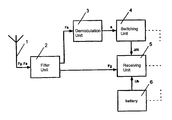
- FIG. 1 shows a block diagram of a configuration for switching from an energy saving standby mode to an operating mode in a receiver
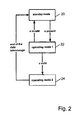
- FIG. 2 shows a state diagram to illustrate a method for switching between the modes using the configuration shown in FIG. 1 .
- a receiver having an input connected to an antenna element 1 for receiving a signal, carrying information, in the form of a modulated RF signal.
- the signal carrying the information covers two modulated frequency bands (Fg, Fa).
- One frequency band (Fg) is intended for the basic information (g), for example, an AF signal (speech) that is modulated onto the RF carrier frequency.
- the other frequency band (Fa) contains wake-up information (a) that is transmitted from the transmitter in order to switch the receiver from a standby mode to an operating mode in which the basic information (g) can be subsequently received and processed.
- a filter unit 2 which is connected downstream from the antenna unit 1 , separates the frequency band (Fa) for the wake-up information (a) from the incoming signal carrying the information.
- the filter unit 2 is in the form of a SAW filter.
- the wake-up information (a) has been modulated in the frequency band (Fa) using chirp pulses, and is evaluated in an appropriate manner by the filter element 2 .
- the wake-up information (a) in the frequency band (Fa) may in this case be in the form of a pulse sequence (burst).
- the pulse sequence contained in the separated frequency band (Fa) is supplied to a passive demodulation unit 3 for demodulating the wake-up information (a).
- the passive demodulation unit 3 is connected downstream from the filter unit 2 .
- the passive demodulation unit 3 is in the form of a passive tuned circuit that is tuned to the pulse repetition frequency, in order to filter out the pulse sequence containing the wake-up information (a) from the frequency band (Fa).
- the wake-up information (a) obtained in this way is passed to a switching unit 4 .
- the switching unit 4 switches a receiving unit 5 , and possibly, further components in the receiver (dashed lines) to the operating mode.
- the receiving unit 5 is now able to select the subsequent basic information (g) from the frequency band (Fg), as it is made available by the filter element 2 .
- a voltage supply unit 6 in the form of a battery is provided for the receiver.
- the voltage supply unit 6 supplies the receiving unit 5 , and possibly, further components in the receiver (dashed lines) with the necessary supply voltage.
- the switching unit 4 Since the switching unit 4 is used for switching between the operating mode and the standby mode, the receiving unit 5 and possibly, further active components are switched back to the standby mode when their wake-up information (a) is not present, or when specific information for selecting the standby mode is predetermined by the receiving unit 5 or by downstream logic circuits.
- the configuration described above for switching from the energy saving standby mode to the operating mode operates as follows, when considered as an entity.
- a signal carrying information is received in a number of modulated frequency bands (Fg, Fa).
- the signal relating to the frequency band (Fg) is then filtered for basic information (g) and the signal relating to the frequency band (Fa) is filtered for wake-up information (a).
- the frequency band (Fa) is then demodulated in order to obtain the wake-up information (a).
- the process of waking up from the standby mode to the operating mode takes place when the frequency band (Fa) contains wake-up information (a).
- the basic information (g) which is contained in the frequency band (Fg) can then be processed in some suitable way. Otherwise, the system remains in the standby mode for as long as the frequency band (Fa) does not contain any wake-up information (a).
- FIG. 2 shows the circuit in a first state, namely in the power-saving standby mode as indicated by the reference numeral 20 .
- the frequency band (Fa) is monitored, preferably using passive components, for the presence of wake-up information (a), and minimal current is drawn.
- the presence of the wake-up information (a) is required to change into a second circuit state, namely the operating mode 1 , which is indicated by the reference numeral 22 .
- the operating mode 1 the validity of the wake-up information is checked, during which only a small amount of current is being drawn. The small amount of current that is drawn likewise results from using mostly passive components for this checking process. If the wake-up information (a) is not valid, then the circuit switches back to the standby mode again.
- the operating mode 2 is the full-operation mode.
- the regular current is drawn by the circuit, the signal in the frequency band (Fg) is received, and the basic information (g) contained in the signal in the frequency band (Fg) is processed after being demodulated. If required, an acknowledgement response may also be transmitted using circuit components provided for this purpose.
- the first circuit state that is to say, the power-saving standby mode, is assumed once again.
- the invention is not just restricted to the preferred exemplary embodiment described above.
- a number of variants are feasible, which also using fundamentally different types of embodiments of the invention.
- the invention is not just applicable to a receiver of the type described above, but it is intended to be applicable in general form to all electronic devices in which a function for switching from an energy saving standby mode to an operating mode will be provided.
- the invention is likewise feasible for the invention to be applied not only to battery-powered electronic devices but also to mains-powered electronic devices—for example, with voltage being supplied via a bus system—in order to this extent to reduce the current draw in the standby mode.
Landscapes
- Engineering & Computer Science (AREA)
- Computer Networks & Wireless Communication (AREA)
- Signal Processing (AREA)
- Circuits Of Receivers In General (AREA)
- Mobile Radio Communication Systems (AREA)
- Power Sources (AREA)
- Control Of Ac Motors In General (AREA)
- Debugging And Monitoring (AREA)
Applications Claiming Priority (3)
| Application Number | Priority Date | Filing Date | Title |
|---|---|---|---|
| EP99125116.6 | 1999-12-16 | ||
| EP99125116 | 1999-12-16 | ||
| PCT/DE2000/004283 WO2001045280A1 (de) | 1999-12-16 | 2000-12-01 | Elektronisches gerät mit einem betriebsmodus und einem energiesparenden ruhemodus und verfahren zum umschalten zwischen beiden modi |
Related Parent Applications (1)
| Application Number | Title | Priority Date | Filing Date |
|---|---|---|---|
| PCT/DE2000/004283 Continuation WO2001045280A1 (de) | 1999-12-16 | 2000-12-01 | Elektronisches gerät mit einem betriebsmodus und einem energiesparenden ruhemodus und verfahren zum umschalten zwischen beiden modi |
Publications (2)
| Publication Number | Publication Date |
|---|---|
| US20020169009A1 US20020169009A1 (en) | 2002-11-14 |
| US6920342B2 true US6920342B2 (en) | 2005-07-19 |
Family
ID=8239633
Family Applications (1)
| Application Number | Title | Priority Date | Filing Date |
|---|---|---|---|
| US10/174,059 Expired - Lifetime US6920342B2 (en) | 1999-12-16 | 2002-06-17 | Electronic device having an operating mode and an energy saving standby mode, and a method for switching between the two modes |
Country Status (6)
| Country | Link |
|---|---|
| US (1) | US6920342B2 (de) |
| EP (1) | EP1238467B1 (de) |
| JP (1) | JP2003517242A (de) |
| AT (1) | ATE306147T1 (de) |
| DE (1) | DE50011304D1 (de) |
| WO (1) | WO2001045280A1 (de) |
Cited By (9)
| Publication number | Priority date | Publication date | Assignee | Title |
|---|---|---|---|---|
| US20040124970A1 (en) * | 2002-11-19 | 2004-07-01 | Robert Fischer | Dual configuration receiver |
| US20050047356A1 (en) * | 2003-06-25 | 2005-03-03 | International Business Machines Corporation | Wireless wake-on-LAN power management |
| US20060094450A1 (en) * | 2004-02-11 | 2006-05-04 | Samsung Electronics Co., Ltd. | Method for controlling an operation mode of a mobile terminal in a broadband wireless access communication system |
| US20060128349A1 (en) * | 2004-12-09 | 2006-06-15 | Yoon Chang-June C | Energy-efficient medium access control protocol and system for sensor networks |
| US20070149244A1 (en) * | 2003-02-04 | 2007-06-28 | Gana Choi | Power-save system and method |
| US20110057768A1 (en) * | 2009-09-10 | 2011-03-10 | Hong Fu Jin Precision Industry (Shenzhen) Co., Ltd. | Electronic device with remote control function |
| US8938202B1 (en) * | 2009-09-25 | 2015-01-20 | Rockwell Collins, Inc. | System and method for reducing operational power and weight of an unmanned aerial device's payload |
| US9065698B2 (en) | 2010-03-31 | 2015-06-23 | Panasonic Intellectual Property Management Co., Ltd. | Communications apparatus, communications system, communications method and integrated circuit |
| US12363638B2 (en) | 2018-03-16 | 2025-07-15 | Sony Corporation | Wake-up transmission on a separate carrier |
Families Citing this family (27)
| Publication number | Priority date | Publication date | Assignee | Title |
|---|---|---|---|---|
| IT1314992B1 (it) * | 2000-11-06 | 2003-01-21 | Advanced Microwave Engineering | Sistema trasponder a doppia banda |
| DE10061507C2 (de) * | 2000-12-06 | 2003-04-24 | Ralf Heck | Verfahren zur aktuellen, standortbezogenen Information von Personen durch akustische und/oder optische Informationen |
| GB2375690A (en) * | 2001-05-15 | 2002-11-20 | Motorola Inc | Radio communication device and the scheduling of its inactive mode |
| KR100396778B1 (ko) * | 2001-06-25 | 2003-09-02 | 엘지전자 주식회사 | 이동통신 단말기의 전력 제어방법 |
| JP3857082B2 (ja) * | 2001-07-24 | 2006-12-13 | 花王株式会社 | 衣料用洗濯前処理剤組成物 |
| DE10208732B4 (de) * | 2002-02-28 | 2004-04-22 | Siemens Ag | Verfahren zur Steuerung der Energieversorgung eines mobilen Datenspeichers, Anwendung des Verfahrens in einem Identifikationssystem mit zumindest einem mobilen Datenspeicher und einem Schreib-/Lesegerät |
| US7567792B2 (en) | 2002-02-28 | 2009-07-28 | Siemens Aktiengesellschaft | Method for controlling the power supply of a mobile data memory, use of said method in an identification system having at least one mobile data memory |
| US7735113B2 (en) | 2003-04-03 | 2010-06-08 | Panasonic Corporation | Receiving apparatus, and display apparatus and television broadcasting system therewith |
| DE10334398B4 (de) | 2003-07-28 | 2008-04-03 | Siemens Ag | Verfahren zur Reduktion des Stromverbrauchs eines mobilen Datenspeichers, Anwendung des Verfahrens in einem Identifikationssystem mit zumindest einem Schreib-/Lesegerät und einem mobilen Datenspeicher |
| CN100438355C (zh) * | 2003-08-28 | 2008-11-26 | 皇家飞利浦电子股份有限公司 | 在无线网络设备中进行节省能量的信号检测的系统和方法 |
| US7319867B2 (en) | 2003-09-15 | 2008-01-15 | Atheros Communications, Inc. | Method and apparatus for wake on wireless systems |
| US20050224003A1 (en) * | 2004-04-12 | 2005-10-13 | Sharper Image Corporation | Method and apparatus for training and feeding an animal using positive reinforcement techniques |
| WO2006044828A2 (en) * | 2004-10-18 | 2006-04-27 | Sharper Image Corp | Animal positive behavior reinforcement trainging and-feeding |
| GB2439685B (en) * | 2005-03-24 | 2010-04-28 | Siport Inc | Low power digital media broadcast receiver with time division |
| US7916711B2 (en) * | 2005-03-24 | 2011-03-29 | Siport, Inc. | Systems and methods for saving power in a digital broadcast receiver |
| US7945233B2 (en) * | 2005-06-16 | 2011-05-17 | Siport, Inc. | Systems and methods for dynamically controlling a tuner |
| US8335484B1 (en) | 2005-07-29 | 2012-12-18 | Siport, Inc. | Systems and methods for dynamically controlling an analog-to-digital converter |
| US8077012B2 (en) | 2006-06-16 | 2011-12-13 | Intelleflex Corporation | RFID device with first clock for data acquisition and/or calibration of second clock |
| US8199769B2 (en) | 2007-05-25 | 2012-06-12 | Siport, Inc. | Timeslot scheduling in digital audio and hybrid audio radio systems |
| US8895483B2 (en) * | 2008-05-05 | 2014-11-25 | Schlumberger Technology Corporation | Disproportionate permeability reduction using a viscoelastic surfactant |
| US8869748B2 (en) * | 2009-04-30 | 2014-10-28 | Sophia Yin | System and method for training an animal |
| US8320823B2 (en) | 2009-05-04 | 2012-11-27 | Siport, Inc. | Digital radio broadcast transmission using a table of contents |
| US8489053B2 (en) | 2011-01-16 | 2013-07-16 | Siport, Inc. | Compensation of local oscillator phase jitter |
| DK2959509T3 (en) | 2013-02-14 | 2018-08-13 | Nanopareil Llc | Electrospun hybrid nanofiber felt, method of making it and method of purifying biomolecules |
| US9451425B2 (en) * | 2014-05-30 | 2016-09-20 | Apple Inc. | Unified message delivery between portable electronic devices |
| JP2016208120A (ja) * | 2015-04-16 | 2016-12-08 | 株式会社日本自動車部品総合研究所 | ネットワーク制御装置 |
| CN106354055A (zh) * | 2016-08-31 | 2017-01-25 | 深圳市中工巨能科技有限公司 | 一种零功耗待机和信号唤醒装置 |
Citations (10)
| Publication number | Priority date | Publication date | Assignee | Title |
|---|---|---|---|---|
| US4131764A (en) * | 1977-04-04 | 1978-12-26 | U.S. Philips Corporation | Arrangement for converting discrete signals into a discrete single-sideband frequency division-multiplex-signal and vice versa |
| US4857917A (en) | 1986-05-16 | 1989-08-15 | Alps Electric Co., Ltd. | Remote control apparatus providing leader pulse followed by data pulses |
| EP0601820A1 (de) | 1992-12-11 | 1994-06-15 | Matsushita Electric Industrial Co., Ltd. | Mobiles Funkgerät |
| EP0609694A2 (de) | 1993-02-04 | 1994-08-10 | Robert Bosch Gmbh | Verfahren zum Aussenden und Empfangen digitaler Informationen sowie Sender und Empfänger zur Durchführung der Verfahren |
| EP0554386B1 (de) | 1990-10-24 | 1997-07-16 | Motorola Inc. | Empfänger mit batteriesparanordnung |
| EP0797308A2 (de) | 1996-03-22 | 1997-09-24 | Kazuo Tsubouchi | Funkdatensender und -empfänger |
| US5790946A (en) * | 1993-07-15 | 1998-08-04 | Rotzoll; Robert R. | Wake up device for a communications system |
| WO1999003219A1 (de) | 1997-07-10 | 1999-01-21 | Efkon - Entwicklung, Forschung & Konstruktion Von Sondermaschinen Ges.M.B.H. | Aufweckschaltung für ein elektronisches gerät |
| US6198913B1 (en) * | 1997-08-31 | 2001-03-06 | Samsung Electronics Co., Ltd. | Automatic wake-up device for radio automatic recognition terminal and communication method using the terminal |
| US6445937B1 (en) * | 1999-12-02 | 2002-09-03 | Lucent Technologies Inc. | Methods and apparatus for mobile phone power management |
-
2000
- 2000-12-01 JP JP2001545451A patent/JP2003517242A/ja not_active Withdrawn
- 2000-12-01 AT AT00989820T patent/ATE306147T1/de not_active IP Right Cessation
- 2000-12-01 EP EP00989820A patent/EP1238467B1/de not_active Expired - Lifetime
- 2000-12-01 DE DE50011304T patent/DE50011304D1/de not_active Expired - Lifetime
- 2000-12-01 WO PCT/DE2000/004283 patent/WO2001045280A1/de not_active Ceased
-
2002
- 2002-06-17 US US10/174,059 patent/US6920342B2/en not_active Expired - Lifetime
Patent Citations (11)
| Publication number | Priority date | Publication date | Assignee | Title |
|---|---|---|---|---|
| US4131764A (en) * | 1977-04-04 | 1978-12-26 | U.S. Philips Corporation | Arrangement for converting discrete signals into a discrete single-sideband frequency division-multiplex-signal and vice versa |
| US4857917A (en) | 1986-05-16 | 1989-08-15 | Alps Electric Co., Ltd. | Remote control apparatus providing leader pulse followed by data pulses |
| EP0554386B1 (de) | 1990-10-24 | 1997-07-16 | Motorola Inc. | Empfänger mit batteriesparanordnung |
| EP0601820A1 (de) | 1992-12-11 | 1994-06-15 | Matsushita Electric Industrial Co., Ltd. | Mobiles Funkgerät |
| EP0609694A2 (de) | 1993-02-04 | 1994-08-10 | Robert Bosch Gmbh | Verfahren zum Aussenden und Empfangen digitaler Informationen sowie Sender und Empfänger zur Durchführung der Verfahren |
| US5790946A (en) * | 1993-07-15 | 1998-08-04 | Rotzoll; Robert R. | Wake up device for a communications system |
| EP0797308A2 (de) | 1996-03-22 | 1997-09-24 | Kazuo Tsubouchi | Funkdatensender und -empfänger |
| WO1999003219A1 (de) | 1997-07-10 | 1999-01-21 | Efkon - Entwicklung, Forschung & Konstruktion Von Sondermaschinen Ges.M.B.H. | Aufweckschaltung für ein elektronisches gerät |
| US6681080B1 (en) | 1997-07-10 | 2004-01-20 | Efkon Entwicklung Forschung & Konstruktion Von Sondermaschinen Ges. M..B.H. | Wake-up circuit for an electronic apparatus |
| US6198913B1 (en) * | 1997-08-31 | 2001-03-06 | Samsung Electronics Co., Ltd. | Automatic wake-up device for radio automatic recognition terminal and communication method using the terminal |
| US6445937B1 (en) * | 1999-12-02 | 2002-09-03 | Lucent Technologies Inc. | Methods and apparatus for mobile phone power management |
Cited By (13)
| Publication number | Priority date | Publication date | Assignee | Title |
|---|---|---|---|---|
| US7664479B2 (en) * | 2002-11-19 | 2010-02-16 | Siemens Aktiengesellschaft | Receiver and method for scanning and receiving wake-up signals with multiple configurations |
| US20040124970A1 (en) * | 2002-11-19 | 2004-07-01 | Robert Fischer | Dual configuration receiver |
| US20070149244A1 (en) * | 2003-02-04 | 2007-06-28 | Gana Choi | Power-save system and method |
| US20050047356A1 (en) * | 2003-06-25 | 2005-03-03 | International Business Machines Corporation | Wireless wake-on-LAN power management |
| US7792066B2 (en) * | 2003-06-25 | 2010-09-07 | Lenovo (Singapore) Pte. Ltd. | Wireless wake-on-LAN power management |
| US20060094450A1 (en) * | 2004-02-11 | 2006-05-04 | Samsung Electronics Co., Ltd. | Method for controlling an operation mode of a mobile terminal in a broadband wireless access communication system |
| US20060128349A1 (en) * | 2004-12-09 | 2006-06-15 | Yoon Chang-June C | Energy-efficient medium access control protocol and system for sensor networks |
| US7496059B2 (en) | 2004-12-09 | 2009-02-24 | Itt Manufacturing Enterprises, Inc. | Energy-efficient medium access control protocol and system for sensor networks |
| US20110057768A1 (en) * | 2009-09-10 | 2011-03-10 | Hong Fu Jin Precision Industry (Shenzhen) Co., Ltd. | Electronic device with remote control function |
| US8258922B2 (en) * | 2009-09-10 | 2012-09-04 | Hong Fu Jin Precision Industry (Shenzhen) Co., Ltd. | Electronic device with remote control function |
| US8938202B1 (en) * | 2009-09-25 | 2015-01-20 | Rockwell Collins, Inc. | System and method for reducing operational power and weight of an unmanned aerial device's payload |
| US9065698B2 (en) | 2010-03-31 | 2015-06-23 | Panasonic Intellectual Property Management Co., Ltd. | Communications apparatus, communications system, communications method and integrated circuit |
| US12363638B2 (en) | 2018-03-16 | 2025-07-15 | Sony Corporation | Wake-up transmission on a separate carrier |
Also Published As
| Publication number | Publication date |
|---|---|
| WO2001045280A1 (de) | 2001-06-21 |
| ATE306147T1 (de) | 2005-10-15 |
| EP1238467B1 (de) | 2005-10-05 |
| US20020169009A1 (en) | 2002-11-14 |
| JP2003517242A (ja) | 2003-05-20 |
| EP1238467A1 (de) | 2002-09-11 |
| DE50011304D1 (de) | 2005-11-10 |
Similar Documents
| Publication | Publication Date | Title |
|---|---|---|
| US6920342B2 (en) | Electronic device having an operating mode and an energy saving standby mode, and a method for switching between the two modes | |
| EP1353447A1 (de) | Verfahren zur Leistungseinsparung in Kommunicationsvorrichtungen | |
| US8538544B2 (en) | Implantable RF telemetry devices with power saving mode | |
| US6198913B1 (en) | Automatic wake-up device for radio automatic recognition terminal and communication method using the terminal | |
| KR100691539B1 (ko) | 저전력 무선 장치의 트랜스폰더 보조 웨이크업 방법 및장치 | |
| WO2004032349A1 (en) | Radio frequency identification devices, backscatter communication device wake-up methods, communication device wake-up methods and a radio frequency identification device wake-up method | |
| US20070205872A1 (en) | Low-power wireless communication apparatus and method | |
| US20060128414A1 (en) | Wireless communication systems | |
| KR101442576B1 (ko) | 데이터의 무선 수신용 에너지 절약 수신기 어셈블리 | |
| AU2010303188B2 (en) | HDX demodulator | |
| US20250253890A1 (en) | Nfc electric field detection systems and methods, and nfc devices | |
| US20220141772A1 (en) | Rf communication devices and operating methods | |
| US6831953B2 (en) | Method of, and a radio terminal for, detecting the presence of a 2-FSK signal | |
| USRE45619E1 (en) | Apparatus for controlling sensitivity by using digital gating in receiver and receiver with the same | |
| CN101989885A (zh) | 频率调制接收机及其接收方法 | |
| CN117641520A (zh) | 通信节能方法、通信终端和存储介质 | |
| US20050221777A1 (en) | Radiofrequency data signal reception device and method for implementing the same | |
| JPH09134492A (ja) | 無線検針装置 | |
| US6885256B2 (en) | Input circuit for an HF-transmitting component | |
| JP2007027899A (ja) | 無線通信装置、無線通信方法および通信データのデータ構造 | |
| Eliezer et al. | A multi-mode software-defined cmos bpsk receiver soc for the newly enhanced wwvb atomic clock broadcast | |
| KR20200099282A (ko) | 저전력 무선통신 시스템 | |
| CN112751581A (zh) | 用于具有降低的功耗和延迟的射频接收机的装置及相关方法 | |
| JPH0226133A (ja) | 受信波妨害検出装置 | |
| JPH07147549A (ja) | 無線受信機 |
Legal Events
| Date | Code | Title | Description |
|---|---|---|---|
| AS | Assignment |
Owner name: INFINEON TECHNOLOGIES AG, GERMANY Free format text: ASSIGNMENT OF ASSIGNORS INTEREST;ASSIGNOR:REINER, ROBERT;REEL/FRAME:016343/0816 Effective date: 20020615 |
|
| STCF | Information on status: patent grant |
Free format text: PATENTED CASE |
|
| FPAY | Fee payment |
Year of fee payment: 4 |
|
| FPAY | Fee payment |
Year of fee payment: 8 |
|
| FPAY | Fee payment |
Year of fee payment: 12 |