US6908589B2 - High manganese cast iron containing spheroidal vanadium carbide and method for making therof - Google Patents
High manganese cast iron containing spheroidal vanadium carbide and method for making therof Download PDFInfo
- Publication number
- US6908589B2 US6908589B2 US10/461,622 US46162203A US6908589B2 US 6908589 B2 US6908589 B2 US 6908589B2 US 46162203 A US46162203 A US 46162203A US 6908589 B2 US6908589 B2 US 6908589B2
- Authority
- US
- United States
- Prior art keywords
- weight
- high manganese
- vanadium carbide
- wear
- cast iron
- Prior art date
- Legal status (The legal status is an assumption and is not a legal conclusion. Google has not performed a legal analysis and makes no representation as to the accuracy of the status listed.)
- Expired - Lifetime, expires
Links
Images




Classifications
-
- C—CHEMISTRY; METALLURGY
- C22—METALLURGY; FERROUS OR NON-FERROUS ALLOYS; TREATMENT OF ALLOYS OR NON-FERROUS METALS
- C22C—ALLOYS
- C22C37/00—Cast-iron alloys
- C22C37/10—Cast-iron alloys containing aluminium or silicon
Definitions
- the present invention relates to high manganese cast iron containing spheroidal vanadium carbide and method for making thereof, and its object is to provide the high manganese cast iron containing spheroidal vanadium carbide and method for making thereof that had superior mechanical properties such as abrasion-resistance and toughness and nonmagnetic properties by crystallizing spheroidal vanadium carbide in an austenite matrix, and is not needed water toughening heat treating which has been needed when nonmagnetic high manganese steel (high manganese cast steel) is obtained.
- the high manganese steel (high manganese cast steel) containing manganese which is more than 10 weight % is known as Hadfield steel.
- the Hadfield steel contains C within the range of 0.9 ⁇ 1.4 weight %, and Mn 10 ⁇ 15 weight %, the high manganese iron containing C 1.1 ⁇ 1.2 weight % and M 12 ⁇ 13 weight % is manufactured most for an economical reason.
- the Hadfield steel can be manufactured by casting, forging or rolling. However, as the Hadfield steel remains molded condition, ferrous carbide precipitates at crystal grain boundary and a part of austenite matrix transforms into martensite. As a result, tensile strength is 400 ⁇ 500 N/mm 2 and elongation is less than 1% and the Hadfield steel becomes embrittled. Consequently, heat treatment(called water toughening) which carries out water quenching around from 1273 ⁇ 1473 K is necessary (Iron and Steel Institute of Japan. “Heat treatment of steel”. Maruzen Co., Ltd., 1981.p.447-450).
- the Hadfield steel manufactured by water-cooling process around at 1273 ⁇ 1473 K has an austenite matrix, and its toughness, work hardenability and wear-resistance are superior. Further, proof strength is 295 N/mm 2 , and about 100 N/mm 2 larger than 18-8 stainless steel.
- the Hadfield steel is nonmagnetic, it is used as a structural material of a superconducting device, linear motor track or cryogenic strong magnetic field. Magnetic permeability is less than 1.5 and hardly changes even if the Hadfield steel is machined.
- ASTM A-128 (1969) D etc. to which nickel is added are known.
- JIS G-5131 (1969) SCMnH11, SCMnH21, ASTMA-128 (1969) C, etc. are known as added Cr.
- the JIS G-5131 (1969) SCMnH21 etc. is known as added V.
- spheroidal carbide cast iron which is consisted of C 0.6 ⁇ 4.0 weight %, V 4 ⁇ 15 weight %, Al 0.05 ⁇ 1.0 weight %, Mg 0.01 ⁇ 0.2 weight %, Si 0.2 ⁇ 4.5 weight %, Cr 13 ⁇ 30 weight %, Mn 0.2 ⁇ 3.0 weight %, Ni 4 ⁇ 15 weight %, remaining iron (Fe) and inevitable impurities and which the covalent binding spheroidal vanadium carbide is crystallized in its structure of cast iron.
- This spheroidal carbide cast iron had enough properties such as corrosion-resistance, wear-resistance and toughness.
- high manganese steel high manganese cast steel
- the high manganese steel has caused work hardening on a steel surface by impact load, and has caused wear-resistance. Therefore, its wear-resistance is inferior in circumstances like sliding wear and abrasive wear which do not cause work hardening.
- the high manganese steel has been produced by casting, there are much ferrous carbide is precipitated and mechanical properties deteriorated. The heat treatment called water toughening which removes ferrous carbide was required.
- the high manganese steel is embrittled and moreover, magnetic permeability is 1.5 ⁇ 2.5.Therefore, nonmagnetic high manganese steel cannot be obtained.
- the applicants found that by applying spheroidizing process of the vanadium carbide which has been found out previously by the applicants to the high manganese cast steel, the high manganese cast iron containing spheroidal vanadium carbide crystallized in the austenite matrix is obtained, and this high manganese cast iron is nonmagnetic, and superior mechanical properties such as wear-resistance and toughness without heat treatment called water toughening which is required in manufacturing of conventional high manganese cast iron. As a result, the present invention has been accomplished.
- FIG. 1 is an optical micrograph of metal structure of Example 1.
- FIG. 2 is an optical micrograph of metal structure of Example 2.
- FIG. 3 is an optical micrograph of metal structure of Example 3.
- FIG. 4 is an optical micrograph of metal structure of Example 4.
- FIG. 5 is an optical micrograph of metal structure of Example 5.
- FIG. 6 is an optical micrograph of metal structure of Example 6.
- FIG. 7 is an optical micrograph of metal structure of Example 7.
- FIG. 8 is an optical micrograph of metal structure of Example 8.
- FIG. 9 is an optical micrograph of metal structure of Example 9.
- FIG. 10 is an optical micrograph of metal structure of Example 10.
- FIG. 11 is an optical micrograph of metal structure of Example 11.
- FIG. 12 is an optical micrograph of metal structure of Example 12.
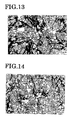
- FIG. 13 is an optical micrograph of metal structure of Example 13.
- FIG. 14 is an optical micrograph of metal structure of Example 14.
- FIG. 15 is an optical micrograph of metal structure of Example 15.
- FIG. 16 is an optical micrograph of metal structure of Example 16.
- FIG. 17 is an optical micrograph of metal structure of Example 17.
- FIG. 18 is an optical micrograph of metal structure of Comparative Example 2.
- FIGS. 19 ( a ), ( b ), and ( c ) are pictures of wear-craters observed at sample surface after sand blasting test.
- (b) and (c) are pictures of samples of Comparative Example 1, Comparative Example 2, and Example 11 respectively.
- FIG. 20 is a graph showing that the relative wear-resistance ratio, which was calculated to divide wear weight losses of Comparative Example 1 by wear weight losses of Examples, were described in relation to vanadium contents and carbon contents when angle to impact blast materials (impact angle) was 30°.
- FIG. 21 is a graph showing that the relative wear-resistance ratio, which was calculated to divide wear weight losses of Comparative Example 1 by wear weight losses of Examples, were described in relation to vanadium contents and carbon contents when impact angle was 45°.
- FIG. 22 is a graph showing that the relative wear-resistance ratio, which was calculated to divide wear weight losses of Comparative Example 1 by wear weight losses of Examples, were described in relation to vanadium contents and carbon contents when impact angle was 60°
- FIG. 23 is a graph showing that the relative wear-resistance ratio, which was calculated to divide wear weight losses of Comparative Example 1 by wear weight losses of Examples, were described in relation to vanadium contents and carbon contents when impact angle was 90°.
- FIG. 24 is a graph showing that the relative wear-resistance ratio, which was calculated to divide wear weight losses of Comparative Example 2 by wear weight losses of Examples, were described in relation to vanadium contents and carbon contents when impact angle was 30°.
- FIG. 25 is a graph showing that the relative wear-resistance ratio, which was calculated to divide wear weight losses of Comparative Example 2 by wear weight losses of Examples, were described in relation to vanadium contents and carbon contents when impact angle was 45°.
- FIG. 26 is a graph showing that the relative wear-resistance ratio, which was calculated to divide wear weight losses of Comparative Example 2 by wear weight losses of Examples, were described in relation to vanadium contents and carbon contents when impact angle was 60°.
- FIG. 27 is a graph showing that the relative wear-resistance ratio, which was calculated to divide wear weight losses of Comparative Example 2 by wear weight losses of Examples, were described in relation to vanadium contents and carbon contents when impact angle was 90°.
- FIG. 28 is a graph of Example 7 putting down with wear weight losses (g) of Comparative Example 1 and Comparative Example 2 in a graph taking the wear weight losses (g) as vertical axis and the angles to impact blast materials (impact angle) as horizontal axis.
- FIG. 29 is a graph of Example 15 putting down with wear weight losses (g) of Comparative Example 1 and Comparative Example 2 in a graph taking the wear weight losses (g) as vertical axis and the angles to impact blast materials (impact angle) as horizontal axis.
- FIG. 30 is a result of X-ray diffraction test of Example 9.
- FIG. 31 is a result of X-ray diffraction test of Example 11.
- FIG. 32 is a graph showing the effect of vanadium contents and carbon contents on magnetic permeability ( ⁇ ).
- the high manganese cast iron containing spheroidal vanadium carbide which relates to the present invention consists of C 1.5 ⁇ 4.0 weight %, V 6 ⁇ 15 weight %, Si 0.2 ⁇ 4.0 weight %, Mn 10 ⁇ 18 weight %, Mg 0.01 ⁇ 0.1 weight %, remaining iron (Fe) and inevitable impurities.
- Carbon(C) and vanadium(V) are added in order to crystallize spherioidal vanadium carbide.
- the content of carbon should be 1.5 ⁇ 4.0 weight %, preferably 1.9 ⁇ 3.5 weight %, more preferably 2.1 ⁇ 3.3 weight %.
- the vanadium carbide which is not enough spheroidized increases, but when it is more than 1.5 weight %, spheroidization of the vanadium carbide is stabilized.
- a part of C becomes plate-like carbide of Fe—C system (i.e. cementite) which makes it lower toughness.
- the content of vanadium should be 6.0 ⁇ 15 weight %, preferably 8 ⁇ 14 weight %, more preferably 9 ⁇ 13.5 weight %. When the content is less than 6.0 weight %, the vanadium carbide cannot be enough spheroidized, and no better effect can be expected with the content more than 15 weight % which it easily cause segregation on the contrary. Neither of the above cases are desirable. It should added that the content of V is as 3 ⁇ 6 times in weight as that of C, preferably about 3.5 ⁇ 5.5 times and more preferably about 4 times, since the ratio of atomicity is about 1:1 (weight ratio is 4:1) in spheroidal vanaium carbide.
- Silicon (Si) and manganese (Mn) are added for improving mechanical properties such as castability, wear-resistance and toughness.
- Silicone (Si) is added for oxidation prevention and deoxidation of molton metal in melting process and for castability.
- the content of silicone should be 0.2 ⁇ 4.0 weight %, preferably 0.5 ⁇ 4.0 weight % and more preferably 0.5 ⁇ 2.0 weight %. The reason is that if the content is less than 0.2 weight %, the effect by the Si containing cannot be shown because of decreasing of the yield of V, whereas toughness decreases when exceeding 4.0 weight %; therefore, neither cases are desirable.
- Manganese (Mn) is contained so as to make a matrix to be the austenite.
- the content of manganese should be 10 ⁇ 18 weight %, preferably 11 ⁇ 16 weight % and more preferably 12 ⁇ 15 weight %. This reason is that if the content is less than 10 weight %, the matrix is difficult to become an austenite single-phase, and if it is more than 18 weight %, segregation of manganese tends to occur in as-cast conditions; therefore, neither of the cases are preferable.
- Magnesium (Mg) is necessary to spheroidize vanadium carbide.
- the content of magnesium should be 0.01 ⁇ 0.1 weight %, preferably 0.02 ⁇ 0.08 weight % and more preferably 0.03 ⁇ 0.08 weight %. This reason is that if the content is less than 0.01 weight %, spheroidization of vanadium carbide is incomplete, and if it more than 0.1 weight %, much of an oxide of magnesium is scattered, and this is not desirable as material.
- the above-mentioned elements are the necessary components that are contained in iron (Fe) of a main component.
- P and S can be contained in the above-mentioned necessary component.
- the content of phosphorous (P) should be 0.02 ⁇ 0.1 weight %, preferably 0.02 ⁇ 0.08 weight % and more preferably 0.02 ⁇ 0.06 weight %. This reason is that it is difficult to be the content less than 0.01 weight % in the materials used at present. On the other hand, if the content exceeds 0.1 weight %, segregation and brittleness occurs; therefore, neither of the cases are preferable.
- the content of sulfur (S) should be 0.006 ⁇ 0.08 weight %, preferably 0.015 ⁇ 0.05 weight %. This reason is that it is difficult to be the content less than 0.006 weight % in the materials used at present, if it is more than 0.08 weight %, MnS (sulfuric manganese) tends to crystallize and wear-resistance lowers; therefore, neither of the cases are preferable.
- an alloy element selected at least one or more kinds from the group consisting of (a) Ni 0.5 ⁇ 8.0 weight %, (b) Mo 0.5 ⁇ 4.0 weight %, (c) at least two or more kinds of alloy elements selected from the group consisting of Ta, Ti, W and Nb 0.5 ⁇ 3.5 weight %, (d) at least two or more kinds of alloy elements selected from the group consisting of Ca, Ba and Sr 0.01 ⁇ 0.1 weight %, can be contained.
- Ni nickel
- the content of Ni should be 0.5 ⁇ 8.0 weight %, preferably 0.5 ⁇ 6.0 weight % and more preferably 0.5 ⁇ 4.0 weight %. This reason is that if the content is less than 0.5 weight %, an effect by containing Ni cannot be obtained. On the other hand, if it is more than 8.0 weight %, segregation is remarkably occurred; therefore, neither of the cases are preferable.
- Molybdenum (Mo) is effective in preventing crysatllization of primary graphite and in stabilizing the matrix.
- its content should be 0.5 ⁇ 4.0 weight %, preferably 0.5 ⁇ 3.0 weight % and more preferably 0.5 ⁇ 2.0 weight %. This reason is that if the content is less than 0.5 weight %, an effect cannot be obtained by containing Mo and if it is more than 4.0 weight %, a carbide except for spheroidal vanadium carbide is crystallized; therefore, neither cases are preferable.
- Tantalum (Ta), titanium (Ti), tungsten (W) and niobium (Nb) are effective in decreasing of amounts of nitrogen in molten iron and in refining metal strucure. Although it is effective even if these alloy elements are added independently, more than two alloy elements are added in the present invention, since combining and adding can obtain more excellent effect. However, since it is not effective even if these alloy elements are added at random, and total weight of the content is 0.5 ⁇ 3.5 weight %, preferably 0.5 ⁇ 2.0 weight % and more preferably 0.5 ⁇ 1.5 weight %.
- Ca calcium
- Ba barium
- strontium strontium
- Mg alloy Pure magnesium, Mg alloy, chloride of Mg and the fluoride of Mg etc.
- Mg alloy Pure magnesium, Mg alloy, chloride of Mg and the fluoride of Mg etc.
- Mg alloy Pure magnesium, Mg alloy, chloride of Mg and the fluoride of Mg etc.
- a lump or briquette of Mg—Ni, Mg—Fe, Mg—Si—Fe, Mg—Cu, Mg—Al etc. can explain as examples of Mg alloy.
- Practical bubbling reaction temperature is 1773 ⁇ 2073 K, preferably 1773 ⁇ 1950 K and more preferably 1873 ⁇ 1950 K. Since microscopic magnesium bubble is not dispersed when melting temperature is less than 1773 K, spheroidal vanadium carbide is not formed, non-spheroidal vanadium carbide is crystallized in the matrix, castability of molten iron becomes worse and casting is difficult. On the other hand, when dissolution temperature is more than 2073 K, there is no problem in spheroidization, but yield of magnesium bubble lowers, and this is not desirable.
- spheroidal vanadium carbide which is a hard particle
- the present invention has superior mechanical properties such as wear-resistance and toughness to conventional high manganese steel (high manganese cast steel).
- almost all carbon is used to constitute crystallizing vanadium carbide, an amount of carbon in the matrix decreases remarkably.
- magnetic permeability in as-cast condition becomes about not over than 1.5, preferably about not over than 1.1, which is different to the conventional high manganese steel (high manganese cast steel), and nonmagnetic material can be obtained.
- the high manganese cast iron containing spheroidal vanadium carbide which is comprising from the above-mentioned composition can be obtained in as-cast condition through pouring molten iron into a casting mold.
- the as-cast structure is basically consisted of the austenite ( ⁇ ) phase and vanadium carbide phase.
- the water toughing process is not needed in the present invention.
- said prepared samples are melted with using high frequency induction furnace of 5 Kg capacity in melting weight (magnesia crucible).
- high frequency induction furnace of 5 Kg capacity in melting weight (magnesia crucible).
- Mg was added and, micro structure observation test pieces, mechanical test pieces (60 ⁇ 10 ⁇ 70 mm) and wear-resistance test pieces (55 ⁇ 55 ⁇ 11 mm) were cast to the sand mold at 1873 K.
- Sample of Comparative Example 1 is a general structural rolled steel called SS400, which is regulated by JISG-3101.
- Comparative Example 2 is high manganese cast steel corresponding to JIS G-5131 SCMnH2.
- Example 1 Example 2
- Example 3 Example 4
- Example 5 Example 6
- Example 7 Example 8
- Example 9 C 2.1 2.1 2.1 2.4 2.4 2.4 2.7 2.7 V 6.0 8.0 10.0 6.0 8.0 10.0 8.0 10.0 12.8 Si 0.5 0.5 0.5 0.5 0.5 0.5 0.5 0.5 0.5 Mn 13.0 13.0 13.0 13.0 13.0 13.0 13.0 13.0 13.0 Mg 0.05 0.05 0.05 0.05 0.05 0.05 0.05 0.05 0.05 0.05 0.05 0.05 0.05 0.05 0.05 0.05 0.05 0.05 0.05 0.05 0.05 0.05 0.05 0.05 0.05 0.05 0.05 0.05 0.05 0.05 0.05 0.05 0.05 0.05 0.05 0.05 0.05 0.05 0.05 0.05 0.05 0.05 0.05 0.05 0.05 0.05 0.05 0.05 0.05 0.05 0.05 0.05 0.05 0.05 0.05 0.05 0.05 0.05 0.05 0.05 0.05 0.05 0.05 0.05 0.05 0.05 0.05 0.05 0.05 0.05 0.05 0.05 0.05 0.05 0.05
- Example 1 Example 2
- Example 3 Example 4
- Example 5 Example 6
- Example 7 Example 8
- Example 9 H R C 35.1 32.4 36.0 40.1 33.0 33.6 39.1 32.6 36.2
- Example Example Example Example Example Example Example Example Example Comparative 10 11 12 13 14 15 16 17
- Example2 H R C 41.3 39.0 32.0 43.4 41.2 35.3 42.1 34.9 8.8 (Test 3) Wear Resistance Test
- SGK-3 sand blast machine
- Blast materials is that martensite steel shot 180 ⁇ m ⁇ , impact pressure is 0.466 MPa, impact angle is that 30°, 45°, 60°, 90°, impact quantity rate of blast material is 3.57 ⁇ 10 ⁇ 2 kg/s, impact time is 1.8 ks, distance between impact nozzle and materials to be tested is 5 ⁇ 10 ⁇ 2 m, diameter of impact nozzle is 7 ⁇ 10 ⁇ 3 m
- FIGS. 20 ⁇ 29 Wear-resistance properties of samples were shown in FIGS. 20 ⁇ 29 .
- FIGS. 20 ⁇ 23 were graphs showing that the relative wear-resistance ratio, which was calculated to divide wear weight losses of Comparative Example 1 by wear weight losses of Examples, were described in relation to vanadium contents and carbon contents when angles to impact blast materials (impact angles) were 30°, 45°, 60°, and 90° respectively.
- FIGS. 24 ⁇ 27 were graphs showing that the relative wear-resistance ratio, which was calculated to divide wear weight losses of Comparative Example 2 by wear weight losses of Examples, were described in relation to vanadium contents and carbon contents when impact angles were 30°, 45°, 60°, and 90° respectively.
- FIGS. 28 and 29 were graphs of Example 7 and Example 15 respectively putting down with wear weight losses (g) of Comparative Example 1 and Comparative Example 2 in a graph taking the wear weight losses (g) as vertical axis and the impact angles as horizontal axis.
- wear-resistance of samples of Example is superior to that of general structural rolled steel (SS400) of Comparative Example 1 and high manganese cast steel SCMnH2 of Comparative Example 2.
- Radiation source is Cuk ⁇ 40 kV 150 mA
- counter is scintillation counter
- scan speed is 4.000 deg/min
- scan step is 0.020 deg/step
- scanning axis is 2 ⁇
- scanning range is 10.000 ⁇ 100.000 deg
- Example 9 X-ray diffraction results of Example 9 and 11 were shown in FIGS. 30 and 31 respectively.
- Effective magnetic field Hoff (Oe) and magnetic flux density B (Gauss) were calculated using the following equation 1 (Formula 1).
- Magnetic permeability ( ⁇ ) was calculated using the following equation 2 (Formula 2).
- FIG. 32 shows the effect of vanadium contents and carbon contents on magnetic permeability ( ⁇ ).
- magnetic permeability of samples of Examples is less than 1.007, and samples of Examples are nonmagnetic.
- the high manganese cast iron containing spheroidal vanadium carbide and method for making thereof in the invention as set forth in claim 1 shows that the high manganese cast iron containing spheroidal vanadium carbide, which is nonmagnetic as well as superior mechanical properties such as wear-resistance, toughness and so forth, can be obtained by crystallizing spheroidal vanadium carbide in austenite matrix.
- the high manganese cast iron containing spheroidal vanadium carbide and method for making thereof in the invention as set forth in claim shows that the high manganese cast iron containing spheroidal vanadium carbide which has improved mechanical properties such as wear-resistance, toughness and so forth can be obtained in accordance with purposes.
- the high manganese cast iron containing spheroidal vanadium carbide and method for making thereof in the invention as set forth in claim 3 , 4 , 5 and 6 shows that the high manganese cast iron containing spheroidal vanadium carbide, which is nonmagnetic as well as superior mechanical properties such as wear-resistance, toughness and so forth, can be obtained by crystallizing spheroidal vanadium carbide in austenite matrix. It also does not need for water toughening heat treatment which is necessary when obtaining nonmagnetic high manganese steel, and can be produced in an as-cast condition after melting and casting alloy raw materials.
Landscapes
- Chemical & Material Sciences (AREA)
- Engineering & Computer Science (AREA)
- Materials Engineering (AREA)
- Mechanical Engineering (AREA)
- Metallurgy (AREA)
- Organic Chemistry (AREA)
- Refinement Of Pig-Iron, Manufacture Of Cast Iron, And Steel Manufacture Other Than In Revolving Furnaces (AREA)
Abstract
Description
| TABLE 1 | ||||||||||
| Example 1 | Example 2 | Example 3 | Example 4 | Example 5 | Example 6 | Example 7 | Example 8 | Example 9 | ||
| C | 2.1 | 2.1 | 2.1 | 2.4 | 2.4 | 2.4 | 2.7 | 2.7 | 2.7 |
| V | 6.0 | 8.0 | 10.0 | 6.0 | 8.0 | 10.0 | 8.0 | 10.0 | 12.8 |
| Si | 0.5 | 0.5 | 0.5 | 0.5 | 0.5 | 0.5 | 0.5 | 0.5 | 0.5 |
| Mn | 13.0 | 13.0 | 13.0 | 13.0 | 13.0 | 13.0 | 13.0 | 13.0 | 13.0 |
| Mg | 0.05 | 0.05 | 0.05 | 0.05 | 0.05 | 0.05 | 0.05 | 0.05 | 0.05 |
| Fe + Impurities | Remaining | Remaining | Remaining | Remaining | Remaining | Remaining | Remaining | Remaining | Remaining |
| Total | 100.0 | 100.0 | 100.0 | 100.0 | 100.0 | 100.0 | 100.0 | 100.0 | 100.0 |
| TABLE 2 | |||||||||||
| Ex- | Ex- | Ex- | Ex- | Ex- | Ex- | Ex- | Ex- | Com- | Com- | ||
| ample | ample | ample | ample | ample | ample | ample | ample | parative | parative | ||
| 10 | 11 | 12 | 13 | 14 | 15 | 16 | 17 | Example 1 | Example 2 | ||
| C | 3.0 | 3.0 | 3.0 | 3.3 | 3.3 | 3.3 | 3.5 | 3.5 | 0.2 | 1.0 |
| V | 8.0 | 10.0 | 12.8 | 8.0 | 10.0 | 12.8 | 10.0 | 12.8 | 0 | 0 |
| Si | 0.5 | 0.5 | 0.5 | 0.5 | 0.5 | 0.5 | 0.5 | 0.5 | 0.2 | 0.5 |
| Mn | 13.0 | 13.0 | 13.0 | 13.0 | 13.0 | 13.0 | 13.0 | 13.0 | 0.5 | 13.0 |
| Mg | 0.05 | 0.05 | 0.05 | 0.05 | 0.05 | 0.05 | 0.05 | 0.05 | 0.05 | — |
| Fe + Impurities | Re- | Re- | Re- | Re- | Re- | Re- | Re- | Re- | Re- | Re- |
| maining | maining | maining | maining | maining | maining | maining | maining | maining | maining | |
| Total | 100.0 | 100.0 | 100.0 | 100.0 | 100.0 | 100.0 | 100.0 | 100.0 | 100.0 | 100.0 |
(Test 1)
Observation with Optical Microscope
| TABLE 3 | ||||||||||
| Example 1 | Example 2 | Example 3 | Example 4 | Example 5 | Example 6 | Example 7 | Example 8 | Example 9 | ||
| HRC | 35.1 | 32.4 | 36.0 | 40.1 | 33.0 | 33.6 | 39.1 | 32.6 | 36.2 | |
| Example | Example | Example | Example | Example | Example | | Example | Comparative | ||
| 10 | 11 | 12 | 13 | 14 | 15 | 16 | 17 | Example2 | ||
| HRC | 41.3 | 39.0 | 32.0 | 43.4 | 41.2 | 35.3 | 42.1 | 34.9 | 8.8 | |
(Test 3)
Wear Resistance Test
| TABLE 4 | |||
| Wear weight losses (g) | |||
| |
30° | 45° | 60° | 90° | ||
| Example 1 | 0.09 | — | 0.0321 | — | ||
| Example 2 | 0.23 | — | 0.0333 | — | ||
| Example 3 | 0.08 | — | 0.0266 | — | ||
| Example 4 | 0.09 | — | 0.0479 | 0.0146 | ||
| Example 5 | 0.27 | — | 0.0211 | 0.0183 | ||
| Example 6 | 0.23 | 0.0319 | 0.0349 | 0.0157 | ||
| Example 7 | 0.07 | 0.0337 | 0.0263 | 0.0158 | ||
| Example 8 | 0.07 | 0.0242 | 0.0239 | 0.0139 | ||
| Example 9 | 0.06 | 0.0394 | 0.0265 | 0.017 | ||
| Example 10 | 0.0478 | 0.0323 | 0.0307 | 0.011 | ||
| Example 11 | 0.08 | 0.0276 | 0.0175 | 0.0135 | ||
| Example 12 | 0.0434 | 0.0423 | 0.0336 | 0.016 | ||
| Example 13 | 0.0427 | 0.0395 | 0.0551 | 0.0154 | ||
| Example 14 | 0.0428 | 0.0287 | 0.0367 | 0.0153 | ||
| Example 15 | 0.0322 | 0.0228 | 0.0231 | 0.0122 | ||
| Example 16 | 0.0298 | 0.0296 | 0.0289 | 0.0151 | ||
| Example 17 | 0.045 | 0.0224 | 0.0256 | 0.0137 | ||
| Comparative | 1.24 | 0.7259 | 0.4509 | 0.3285 | ||
| Example 1 | ||||||
| Comparative | 0.48 | 0.0606 | 0.048 | 0.025 | ||
| Example 2 | ||||||
H eff =Ho−kI
B=I+H eff
(I=4πM/V (Gauss), and V means sample volume (cm3))
μ=B/H eff
Claims (6)
Applications Claiming Priority (2)
| Application Number | Priority Date | Filing Date | Title |
|---|---|---|---|
| JP2003022639A JP3737803B2 (en) | 2003-01-30 | 2003-01-30 | Spherical vanadium carbide-containing high manganese cast iron material and method for producing the same |
| JP2003-022639 | 2003-01-30 |
Publications (2)
| Publication Number | Publication Date |
|---|---|
| US20040151612A1 US20040151612A1 (en) | 2004-08-05 |
| US6908589B2 true US6908589B2 (en) | 2005-06-21 |
Family
ID=32767558
Family Applications (1)
| Application Number | Title | Priority Date | Filing Date |
|---|---|---|---|
| US10/461,622 Expired - Lifetime US6908589B2 (en) | 2003-01-30 | 2003-06-13 | High manganese cast iron containing spheroidal vanadium carbide and method for making therof |
Country Status (2)
| Country | Link |
|---|---|
| US (1) | US6908589B2 (en) |
| JP (1) | JP3737803B2 (en) |
Cited By (7)
| Publication number | Priority date | Publication date | Assignee | Title |
|---|---|---|---|---|
| CN100378331C (en) * | 2006-09-30 | 2008-04-02 | 刘朝晖 | Non-magnetic alloy balance block for compressor use |
| US20100147247A1 (en) * | 2008-12-16 | 2010-06-17 | L. E. Jones Company | Superaustenitic stainless steel and method of making and use thereof |
| RU2475560C1 (en) * | 2012-02-09 | 2013-02-20 | Юлия Алексеевна Щепочкина | Cast-iron |
| RU2475559C1 (en) * | 2012-02-09 | 2013-02-20 | Юлия Алексеевна Щепочкина | Cast-iron |
| US8735776B2 (en) * | 2006-02-16 | 2014-05-27 | Stoody Company | Hard-facing alloys having improved crack resistance |
| RU2540008C1 (en) * | 2014-02-26 | 2015-01-27 | Федеральное государственное бюджетное образовательное учреждение высшего профессионального образования "Воронежская государственная лесотехническая академия" | Wear-resistant cast iron |
| RU2645803C1 (en) * | 2017-06-01 | 2018-02-28 | Юлия Алексеевна Щепочкина | Wear resistant alloy based on iron |
Families Citing this family (7)
| Publication number | Priority date | Publication date | Assignee | Title |
|---|---|---|---|---|
| US20060079187A1 (en) * | 2004-10-03 | 2006-04-13 | Struck James T | GPS, infrasonics, audio tools armband for location and assistance in response to astronomical and other crises |
| ES2441598T3 (en) * | 2007-08-31 | 2014-02-05 | Kabushiki Kaisha Toyota Jidoshokki | Austenitic cast iron, process for making it, castings of austenitic cast iron and parts of the gas discharge system |
| RU2624548C1 (en) * | 2016-09-12 | 2017-07-04 | Юлия Алексеевна Щепочкина | Wear-resistanting alloy on base of iron |
| RU2718849C1 (en) * | 2019-05-21 | 2020-04-15 | Федеральное государственное бюджетное образовательное учреждение высшего образования "Петербургский государственный университет путей сообщения Императора Александра I" (ФГБОУ ВО ПГУПС) | Nonmagnetic iron |
| CN114134286B (en) * | 2021-10-12 | 2023-03-31 | 广西富川正辉机械有限公司 | System for refining high-purity manganese 18 high-manganese steel and application thereof |
| PL443988A1 (en) * | 2023-03-07 | 2024-09-09 | Akademia Górniczo-Hutnicza Im.Stanisława Staszica W Krakowie | Method of modifying primary carbide precipitates in iron casting alloys |
| CN116516256B (en) * | 2023-05-06 | 2025-04-15 | 内蒙古环投环保技术有限公司 | Rare earth modified V-Cr-Mn iron-based wear-resistant alloy material and preparation method thereof |
Citations (4)
| Publication number | Priority date | Publication date | Assignee | Title |
|---|---|---|---|---|
| US5308408A (en) * | 1990-09-12 | 1994-05-03 | Lokomo Oy | Austenitic wear resistant steel and method for heat treatment thereof |
| US6406563B2 (en) * | 1999-04-28 | 2002-06-18 | Yutaka Kawano | Stainless spheroidal carbide cast iron |
| US6511544B2 (en) * | 1999-09-23 | 2003-01-28 | Ut-Battelle, Llc | Control system for use when growing thin-films on semiconductor-based materials |
| US6761777B1 (en) * | 2002-01-09 | 2004-07-13 | Roman Radon | High chromium nitrogen bearing castable alloy |
Family Cites Families (2)
| Publication number | Priority date | Publication date | Assignee | Title |
|---|---|---|---|---|
| JP3937128B2 (en) * | 2001-03-15 | 2007-06-27 | 株式会社岡本 | Spheroidal carbide alloy white cast iron |
| JP3710053B2 (en) * | 2001-07-05 | 2005-10-26 | 大阪府 | Stainless spheroidal carbide cast iron material |
-
2003
- 2003-01-30 JP JP2003022639A patent/JP3737803B2/en not_active Expired - Lifetime
- 2003-06-13 US US10/461,622 patent/US6908589B2/en not_active Expired - Lifetime
Patent Citations (4)
| Publication number | Priority date | Publication date | Assignee | Title |
|---|---|---|---|---|
| US5308408A (en) * | 1990-09-12 | 1994-05-03 | Lokomo Oy | Austenitic wear resistant steel and method for heat treatment thereof |
| US6406563B2 (en) * | 1999-04-28 | 2002-06-18 | Yutaka Kawano | Stainless spheroidal carbide cast iron |
| US6511544B2 (en) * | 1999-09-23 | 2003-01-28 | Ut-Battelle, Llc | Control system for use when growing thin-films on semiconductor-based materials |
| US6761777B1 (en) * | 2002-01-09 | 2004-07-13 | Roman Radon | High chromium nitrogen bearing castable alloy |
Cited By (8)
| Publication number | Priority date | Publication date | Assignee | Title |
|---|---|---|---|---|
| US8735776B2 (en) * | 2006-02-16 | 2014-05-27 | Stoody Company | Hard-facing alloys having improved crack resistance |
| CN100378331C (en) * | 2006-09-30 | 2008-04-02 | 刘朝晖 | Non-magnetic alloy balance block for compressor use |
| US20100147247A1 (en) * | 2008-12-16 | 2010-06-17 | L. E. Jones Company | Superaustenitic stainless steel and method of making and use thereof |
| US8430075B2 (en) | 2008-12-16 | 2013-04-30 | L.E. Jones Company | Superaustenitic stainless steel and method of making and use thereof |
| RU2475560C1 (en) * | 2012-02-09 | 2013-02-20 | Юлия Алексеевна Щепочкина | Cast-iron |
| RU2475559C1 (en) * | 2012-02-09 | 2013-02-20 | Юлия Алексеевна Щепочкина | Cast-iron |
| RU2540008C1 (en) * | 2014-02-26 | 2015-01-27 | Федеральное государственное бюджетное образовательное учреждение высшего профессионального образования "Воронежская государственная лесотехническая академия" | Wear-resistant cast iron |
| RU2645803C1 (en) * | 2017-06-01 | 2018-02-28 | Юлия Алексеевна Щепочкина | Wear resistant alloy based on iron |
Also Published As
| Publication number | Publication date |
|---|---|
| JP3737803B2 (en) | 2006-01-25 |
| JP2004232032A (en) | 2004-08-19 |
| US20040151612A1 (en) | 2004-08-05 |
Similar Documents
| Publication | Publication Date | Title |
|---|---|---|
| JP4834292B2 (en) | Super duplex stainless steel with excellent corrosion resistance, embrittlement resistance, castability and hot workability with reduced formation of intermetallic compounds | |
| KR102206319B1 (en) | Austenitic abrasion-resistant steel sheet | |
| US4531974A (en) | Work-hardenable austenitic manganese steel and method for the production thereof | |
| Glavas et al. | The properties of silicon alloyed ferritic ductile irons | |
| US20040151612A1 (en) | High manganese cast iron containing spheroidal vanadium carbide and method for making thereof | |
| JP5712560B2 (en) | Spheroidal graphite cast iron products with excellent wear resistance | |
| EP0526467B1 (en) | Air hardening steel | |
| JP2012097297A (en) | High chromium cast iron | |
| JP4548263B2 (en) | Manufacturing method of cast iron products with excellent wear resistance | |
| Bedolla-Jacuinde | Niobium in cast irons | |
| CA1232780A (en) | Work-hardenable austenitic manganese steel and method for the production thereof | |
| TW390910B (en) | High strength spheroidal graphite cast iron | |
| El-Fawkhry et al. | Eliminating heat treatment of Hadfield steel in stress abrasion wear applications | |
| JP5282546B2 (en) | High-strength, thick-walled spheroidal graphite cast iron with excellent wear resistance | |
| Caldera et al. | Precipitation and dissolution of carbides in low alloy ductile iron plates of varied thickness | |
| JP5712525B2 (en) | Spheroidal graphite cast iron products with excellent wear resistance | |
| CN105671438B (en) | A kind of manganese-tungsten-titanium alloy steel and its processing technology | |
| KR20100139117A (en) | High Stiffness High Damping Cast Iron | |
| KR100628795B1 (en) | Heavy wall steel material having superior weldability and method for producing the same | |
| JP2803331B2 (en) | Manufacturing method of high toughness cast steel | |
| CN117144246A (en) | An earthquake-resistant fire-resistant steel bar and its preparation method | |
| JPH0230731A (en) | High-strength ductile cast iron material with excellent elongation and its manufacturing method | |
| JP2007154295A (en) | Abrasion resistant cast steel and method for producing the same | |
| JP5712531B2 (en) | Spheroidal graphite cast iron products with excellent wear resistance | |
| JP2636008B2 (en) | High strength and high wear resistant ductile cast iron material and method of manufacturing the same |
Legal Events
| Date | Code | Title | Description |
|---|---|---|---|
| AS | Assignment |
Owner name: KABUSHIKI KAISHA SANKYOGOKIN CHUZOSHO, JAPAN Free format text: ASSIGNMENT OF ASSIGNORS INTEREST;ASSIGNORS:KITUDO, TADASHI;TAKEMURA, MAMORU;MATUMORO, MITUAKI;AND OTHERS;REEL/FRAME:014187/0558 Effective date: 20030604 Owner name: OKAMOTO CO., LTD., JAPAN Free format text: ASSIGNMENT OF ASSIGNORS INTEREST;ASSIGNORS:KITUDO, TADASHI;TAKEMURA, MAMORU;MATUMORO, MITUAKI;AND OTHERS;REEL/FRAME:014187/0558 Effective date: 20030604 Owner name: OSAKA PREFECTURE, JAPAN Free format text: ASSIGNMENT OF ASSIGNORS INTEREST;ASSIGNORS:KITUDO, TADASHI;TAKEMURA, MAMORU;MATUMORO, MITUAKI;AND OTHERS;REEL/FRAME:014187/0558 Effective date: 20030604 |
|
| STCF | Information on status: patent grant |
Free format text: PATENTED CASE |
|
| FEPP | Fee payment procedure |
Free format text: PAT HOLDER CLAIMS SMALL ENTITY STATUS, ENTITY STATUS SET TO SMALL (ORIGINAL EVENT CODE: LTOS); ENTITY STATUS OF PATENT OWNER: SMALL ENTITY |
|
| FPAY | Fee payment |
Year of fee payment: 4 |
|
| AS | Assignment |
Owner name: TECHNOLOGY RESEARCH INSTITUTE OF OSAKA PREFECTURE, Free format text: GOVERNMENTAL REORGANIZATION;ASSIGNOR:OSAKA PREFECTURE, (OSAKA PREFECTURAL GOVERNMENT) OSAKA, JAPAN;REEL/FRAME:029359/0852 Effective date: 20120624 |
|
| FPAY | Fee payment |
Year of fee payment: 8 |
|
| FPAY | Fee payment |
Year of fee payment: 12 |
|
| AS | Assignment |
Owner name: OSAKA RESEARCH INSTITUTE OF INDUSTRIAL SCIENCE AND TECHNOLOGY, JAPAN Free format text: MERGER;ASSIGNOR:TECHNOLOGY RESEARCH INSTITUTE OF OSAKA PREFECTURE;REEL/FRAME:044794/0161 Effective date: 20170401 Owner name: OSAKA RESEARCH INSTITUTE OF INDUSTRIAL SCIENCE AND Free format text: MERGER;ASSIGNOR:TECHNOLOGY RESEARCH INSTITUTE OF OSAKA PREFECTURE;REEL/FRAME:044794/0161 Effective date: 20170401 |
|
| AS | Assignment |
Owner name: OSAKA RESEARCH INSTITUTE OF INDUSTRIAL SCIENCE AND TECHNOLOGY, JAPAN Free format text: CORRECTIVE ASSIGNMENT TO CORRECT THE ASSIGNEE ADDRESS PREVIOUSLY RECORDED AT REEL: 044794 FRAME: 0161. ASSIGNOR(S) HEREBY CONFIRMS THE MERGER;ASSIGNOR:TECHNOLOGY RESEARCH INSTITUTE OF OSAKA PREFECTURE;REEL/FRAME:045302/0840 Effective date: 20170401 Owner name: OSAKA RESEARCH INSTITUTE OF INDUSTRIAL SCIENCE AND Free format text: CORRECTIVE ASSIGNMENT TO CORRECT THE ASSIGNEE ADDRESS PREVIOUSLY RECORDED AT REEL: 044794 FRAME: 0161. ASSIGNOR(S) HEREBY CONFIRMS THE MERGER;ASSIGNOR:TECHNOLOGY RESEARCH INSTITUTE OF OSAKA PREFECTURE;REEL/FRAME:045302/0840 Effective date: 20170401 |