US681663A - Corset. - Google Patents
Corset. Download PDFInfo
- Publication number
- US681663A US681663A US1638300A US1900016383A US681663A US 681663 A US681663 A US 681663A US 1638300 A US1638300 A US 1638300A US 1900016383 A US1900016383 A US 1900016383A US 681663 A US681663 A US 681663A
- Authority
- US
- United States
- Prior art keywords
- corset
- parts
- abdomen
- lower portion
- edges
- Prior art date
- Legal status (The legal status is an assumption and is not a legal conclusion. Google has not performed a legal analysis and makes no representation as to the accuracy of the status listed.)
- Expired - Lifetime
Links
- 210000001015 abdomen Anatomy 0.000 description 13
- 229910000831 Steel Inorganic materials 0.000 description 9
- 239000010959 steel Substances 0.000 description 9
- 238000010276 construction Methods 0.000 description 5
- 210000003205 muscle Anatomy 0.000 description 5
- 230000006835 compression Effects 0.000 description 3
- 238000007906 compression Methods 0.000 description 3
- 230000001684 chronic effect Effects 0.000 description 2
- 238000011161 development Methods 0.000 description 2
- 230000018109 developmental process Effects 0.000 description 2
- 201000006549 dyspepsia Diseases 0.000 description 2
- 210000002784 stomach Anatomy 0.000 description 2
- 208000027418 Wounds and injury Diseases 0.000 description 1
- 230000006978 adaptation Effects 0.000 description 1
- 238000005452 bending Methods 0.000 description 1
- 230000006378 damage Effects 0.000 description 1
- 230000000694 effects Effects 0.000 description 1
- 230000003028 elevating effect Effects 0.000 description 1
- 208000014674 injury Diseases 0.000 description 1
- 210000004185 liver Anatomy 0.000 description 1
- 238000007493 shaping process Methods 0.000 description 1
- 210000004291 uterus Anatomy 0.000 description 1
Images
Classifications
-
- A—HUMAN NECESSITIES
- A41—WEARING APPAREL
- A41C—CORSETS; BRASSIERES
- A41C1/00—Corsets or girdles
Definitions
- T0 (tZZ whom it may concern:
- My invention relates to corsets, and has for its object to provide a corset of such construction that when secured in position upon the body of the wearer will support the abdomen and muscles of the bust without compression upon either and will permit freedom of movement to all the muscles of the body, especially those of the bust, sides, abdomen, and chest in any reasonable labor or recreation requiring activity of movement or exercise of the voice in singing or speaking.
- a further feature of my construction consists in so shaping the component parts of which the corset is made up that the seams by which they are united are convex, the seams from the front to the seams immediately above the hips presenting their convexity toward the front edges and those from the back toward the seams immediately above the hips presenting their convexity toward the back.
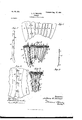
- Figure 1 is a side view of the component parts of one-half of my corset, the parts being shown before they are secured together.
- Fig. 2 is a side view of one-half of my corset laid fiat.
- Fig. 3 is a front view of my corset with its front edges clasped as in use.
- Fig. 4 is an edge view of the front edge of my corset.
- Fig. 5 is a front View of the same, showing the curved lower portion; and
- Fig. 6 is a front view showing the front edge portions of my corset ready to be clasped together.
- A indicates one half of my corset.
- This half-corset is made up of the parts a, b, c, d, e,f, g, h, and t', united by seams, as shown.
- These parts are of such shape that with the exception of that joining the parts 01 and e, which is the seam immediately above the hip, the lines of junction between adjoining parts is convexin a greater or less degree, either toward the front or toward the back, as clearly indicated in Fig. 2, the lines of junction between the parts a b, be, and c d being convex toward the front and the lines of junction between the parts cf, fg, g 7t, and h t'being convex toward the back.
- the front steel n has its upper portion it substantially straight, whether viewed in front view, as in Figs. 2, 5, and 6, or in edge View, as in Fig. 4, while its lower portion 91 is both concaved inward, as shown in Fig. 4, to fit over the curve of the abdomen, and is also curved or beveled away from the line of its upper portion, as shown in Figs. 2, 5, and 6.
- B indicates the other half of my corset, and is made up of parts similar to those of which A is made up, and it will not be necessary to describe these parts in detail.
- the parts a b, c (1, cf, fg, g h, and hi are seamed together from the upper to the lower line of the corset.
- 0 denotes the bust edge of the corset
- p denotes the back edge
- g the waist edge
- -r denotes the parts of the clasp carried by the front steels n
- t denotes the eyelets arranged along the back edges of the corset to receive the lacing by which the parts A and B are secured together at the back.
- the upper ends of the parts a, b, and c extend only to the bust-line for the purpose of elevating and lifting up the bust, thereby giving an appearance of added length to the waist-line in front, the increased length being from half an inch to one inch.
- the parts b 0 may be adjusted by the lacing s.
- this support is efiected without pressure on the abdomen, so thatin bending or stooping the flesh instead of being pressed downward is held upward and is allowed to fill this convexity.
- my corset differs essentially from the ordinary corset, in which the front edge of the front steel is a straight line, the lower portion of the steel being concave, with the result that when the wearer bends or stoops the flesh is pressed downward, making the wearer uncomfortable and ungainly in appearance.
- corset presses upon and greatly constricts many important muscles of the body in the region of the stomach, chest, hips, ribs, and back, and is the reverse of easy and comfortable. There is no doubt that many ills and complaints of the body may be traced to the wearing of corsets not made upon hygienic principles, and that the development and growth of the muscles of the body, especially those of the bust, are retarded by the compression caused by its use.
- corset constructed as above set forth meets the-demand for a hygienic healthful corset adapted to every condition, occupation, or recreation in life, that it can not only be worn without injury to the health by any girl or woman, but that a slim bustless girl or woman may develop a full and natural bust by wearing it, since, unlike other corsets, my corset does not compress the bust and thus interfere with the natural develop ment.
- a corset made upon the lines described above neither depresses the stomach nor causes inertia of the muscles over the heart, liver, or spine, but adapts itself to the form instead of the form to it.
- a corset having the lower portion of its front concaved to fit over the abdomen, and having the front edges of said lower portion beveled away, whereby when the front edges are united the concave of the front is maintained without pressure on the abdomen; substantially as described.
- a corset cutaway above the hips, and having the lower portion of its front concaved to fit over the abdomen, and having the front edges of said lower portion beveled away, whereby when the front edges are united, the concave of the front is maintained without pressure on the abdomen; substantially as described.
- a corset having its upper edge terminating at the bust-line, cut away over the hips, and having the lower portion of its front concaved to fit over the abdomen, and having the front edges of said lower portion beveled away, whereby when the front edges are domen, and having the front edges of said lower portion beveled away, whereby when the front edges are united the concave of the front is maintained without pressure on the abdomen; substantially as described.
Landscapes
- Engineering & Computer Science (AREA)
- Textile Engineering (AREA)
- Corsets Or Brassieres (AREA)
Description
Patented Aug. 27, 1901. L. G. WALKER.
CUBS ET.
(Application filed May 11, 1800.)
(No Model.)
Jd'zm a. mica-I UNTTED STATES PATENT OFFICE.
LTLLIAN G. \VALKER, OF BOSTON, MASSACHUSETTS, ASSIGNOR TO TIIE WALKER CORSET COMPANY, OF MAINE.
I CORSET.
SPECIFICATION forming part of Letters Patent No. 681,663, dated August 27, 1901.
Application filed May 11. 1900.
T0 (tZZ whom it may concern:
Be it known that 1, LILLIAN G. WALKER, a citizen of the United States, residing at Boston, in the county of Suffolk and State of Massachusetts, have invented a certain new and useful Corset, of which the following is a specification, reference being had therein to the accompanying drawings.
My invention relates to corsets, and has for its object to provide a corset of such construction that when secured in position upon the body of the wearer will support the abdomen and muscles of the bust without compression upon either and will permit freedom of movement to all the muscles of the body, especially those of the bust, sides, abdomen, and chest in any reasonable labor or recreation requiring activity of movement or exercise of the voice in singing or speaking.
The particular features of construction by which I secure the results above set forth are hereinafter pointed out in the claims. The most important of these features is the shape given to the front edges of the corset by curving or beveling these lower portions away from the line of their upper portion, so'that when the two front edgesare clasped together a recess or hollow is formed of such shape as to receive and support the abdomen without compression and without forcing it out of its natural position.
A further feature of my construction, and this is of especial importance in connection with the feature above described, consists in so shaping the component parts of which the corset is made up that the seams by which they are united are convex, the seams from the front to the seams immediately above the hips presenting their convexity toward the front edges and those from the back toward the seams immediately above the hips presenting their convexity toward the back. By reason of the features of construction I am enabled to maintain the shape of the corset when in position upon the body of the wearer, particularly the lower portion of the front, and at the same time cut away the sides of the corset, so as to leave the hips entirely free from pressure.
A further feature of practical importance in connection with the features above set Serial No. 16,383. (No model.)
forth consists in making the upper part of the corset terminate at the bust-line.
Referring to the drawings, Figure 1 is a side view of the component parts of one-half of my corset, the parts being shown before they are secured together. Fig. 2 is a side view of one-half of my corset laid fiat. Fig. 3 is a front view of my corset with its front edges clasped as in use. Fig. 4 is an edge view of the front edge of my corset. Fig. 5 is a front View of the same, showing the curved lower portion; and Fig. 6 is a front view showing the front edge portions of my corset ready to be clasped together.
In the drawings, A indicates one half of my corset. This half-corset is made up of the parts a, b, c, d, e,f, g, h, and t', united by seams, as shown. These parts are of such shape that with the exception of that joining the parts 01 and e, which is the seam immediately above the hip, the lines of junction between adjoining parts is convexin a greater or less degree, either toward the front or toward the back, as clearly indicated in Fig. 2, the lines of junction between the parts a b, be, and c d being convex toward the front and the lines of junction between the parts cf, fg, g 7t, and h t'being convex toward the back. The front steel n has its upper portion it substantially straight, whether viewed in front view, as in Figs. 2, 5, and 6, or in edge View, as in Fig. 4, while its lower portion 91 is both concaved inward, as shown in Fig. 4, to fit over the curve of the abdomen, and is also curved or beveled away from the line of its upper portion, as shown in Figs. 2, 5, and 6.
B indicates the other half of my corset, and is made up of parts similar to those of which A is made up, and it will not be necessary to describe these parts in detail. The parts a b, c (1, cf, fg, g h, and hi are seamed together from the upper to the lower line of the corset. The parts I) c and d eare united along-aportion of their edges only, the parts b a being seamed together between the points :1; 00 (see Fig. 1) having the slit m, the upper and lower portions of the edges of these parts being adjustably secured together by the lacings s and s and the parts d 0 being seamed together between the points 3 y having the slit Z, the lower portions of the edges of these parts being adj ustably secured together by the lacing s.
'n, denotes the steels which form the front edges of the corset.
0 denotes the bust edge of the corset, p denotes the back edge, and g the waist edge.
-r denotes the parts of the clasp carried by the front steels n, and t denotes the eyelets arranged along the back edges of the corset to receive the lacing by which the parts A and B are secured together at the back. The upper ends of the parts a, b, and c extend only to the bust-line for the purpose of elevating and lifting up the bust, thereby giving an appearance of added length to the waist-line in front, the increased length being from half an inch to one inch. The parts b 0 may be adjusted by the lacing s. The lower ends of the parts (1, e, and fextend only to the waist-line or slightly below it above the hips, making what may be properly termed hipless corsets, thereby permitting perfect ease and freedom of movement of the hips and at the same time giving the wearer the appearance of a small waist. The parts d, e, andfmay be adjusted by the lacings s. The lower edges of the parts a, b, and 0 form a long slant from the waist-line just in front of the hip, down over the abdomen to the lowermost point of the front steel a, following the natural lines of the body and supporting the abdomen. By reason ,of the convexity of these parts above described this support is efiected without pressure on the abdomen, so thatin bending or stooping the flesh instead of being pressed downward is held upward and is allowed to fill this convexity. In this feature of construction my corset differs essentially from the ordinary corset, in which the front edge of the front steel is a straight line, the lower portion of the steel being concave, with the result that when the wearer bends or stoops the flesh is pressed downward, making the wearer uncomfortable and ungainly in appearance.
The ordinary corset, as is well known, presses upon and greatly constricts many important muscles of the body in the region of the stomach, chest, hips, ribs, and back, and is the reverse of easy and comfortable. There is no doubt that many ills and complaints of the body may be traced to the wearing of corsets not made upon hygienic principles, and that the development and growth of the muscles of the body, especially those of the bust, are retarded by the compression caused by its use. The disadvantages of the ordinary corset are avoided by the use of my corset, constructed as above described, with the convex front steel, and made up of the component parts above described, with the convex lines or seams joining them, and as the convexity of these lines or seams ceases at the sides and from the side seams toward the back are convex in reverse direction, then results such a perfect adaptation of the corset to the forni of the back that the ridge over the shoulderblades usually made by the general run of corsets is entirely absent, giving the back a beautiful smooth appearance and adding strength and support to the spine.
I believe that a corset constructed as above set forth meets the-demand for a hygienic healthful corset adapted to every condition, occupation, or recreation in life, that it can not only be worn without injury to the health by any girl or woman, but that a slim bustless girl or woman may develop a full and natural bust by wearing it, since, unlike other corsets, my corset does not compress the bust and thus interfere with the natural develop ment. A corset made upon the lines described above neither depresses the stomach nor causes inertia of the muscles over the heart, liver, or spine, but adapts itself to the form instead of the form to it. Its use prevents and, if existent, relieves and cures flatulency, dyspepsia, and indigestion, and I believe that the chronic complaints such as fiat busts, weakened uterus, and childless ness, if not hopelessly chronic, can be cured by its use and that a perfection, healthful ness, and roundness of form such as a girl in youth should have can be secured by wearing such a corset as I have described.
By the term bevel as applied to the form given to the lower portion of the front steel it is not to be understood that I contemplate or intend that the front line of this portion shall form a sharp angle with the upper portion of the steel. On the contrary, while the general direction of this lower portion is at an angle to the line of the upper portion it is united to the upper portion on gently-curving lines substantially as shown, the angle of the general direction of this lower portion being varied, as may be found desirable.
Having thus described my invention, what I claim, and desire to secure by Letters Patent, is
1. A corset having the lower portion of its front concaved to fit over the abdomen, and having the front edges of said lower portion beveled away, whereby when the front edges are united the concave of the front is maintained without pressure on the abdomen; substantially as described.
2. A corset, cutaway above the hips, and having the lower portion of its front concaved to fit over the abdomen, and having the front edges of said lower portion beveled away, whereby when the front edges are united, the concave of the front is maintained without pressure on the abdomen; substantially as described.
3. A corset having its upper edge terminating at the bust-line, cut away over the hips, and having the lower portion of its front concaved to fit over the abdomen, and having the front edges of said lower portion beveled away, whereby when the front edges are domen, and having the front edges of said lower portion beveled away, whereby when the front edges are united the concave of the front is maintained without pressure on the abdomen; substantially as described.
In witness whereof I have hereunto affixed my signature, this 25th day of April, A. D. 1900, in the presence of two Witnesses.
LILLIAN G. WALKER.
Witnesses:
N. L. FROTHINGHAM, LYNDE SULLIVAN.
Priority Applications (1)
| Application Number | Priority Date | Filing Date | Title |
|---|---|---|---|
| US1638300A US681663A (en) | 1900-05-11 | 1900-05-11 | Corset. |
Applications Claiming Priority (1)
| Application Number | Priority Date | Filing Date | Title |
|---|---|---|---|
| US1638300A US681663A (en) | 1900-05-11 | 1900-05-11 | Corset. |
Publications (1)
| Publication Number | Publication Date |
|---|---|
| US681663A true US681663A (en) | 1901-08-27 |
Family
ID=2750206
Family Applications (1)
| Application Number | Title | Priority Date | Filing Date |
|---|---|---|---|
| US1638300A Expired - Lifetime US681663A (en) | 1900-05-11 | 1900-05-11 | Corset. |
Country Status (1)
| Country | Link |
|---|---|
| US (1) | US681663A (en) |
-
1900
- 1900-05-11 US US1638300A patent/US681663A/en not_active Expired - Lifetime
Similar Documents
| Publication | Publication Date | Title |
|---|---|---|
| US2370170A (en) | Body molding garment | |
| US2333434A (en) | Brassiere pad | |
| US933610A (en) | Corset. | |
| US3433229A (en) | Brassiere | |
| US657133A (en) | Apparel-corset. | |
| US3507286A (en) | Differential stretch girdle | |
| US3221749A (en) | Girdle | |
| US595554A (en) | Corset | |
| US1293427A (en) | Corset. | |
| US2805421A (en) | Girdle | |
| US594177A (en) | Corset | |
| US2040810A (en) | Corset | |
| US187840A (en) | Improvement in under-waists | |
| US2899963A (en) | Spitzer | |
| US436431A (en) | Corset | |
| US1880795A (en) | Athletic supporter | |
| US928669A (en) | Apparel-corset. | |
| US638544A (en) | Corset. | |
| US578926A (en) | Corset | |
| US1137539A (en) | Corset. | |
| US1191785A (en) | Corset. | |
| US390162A (en) | Elizabeth glass | |
| US1127024A (en) | Apparel-corset. | |
| US353237A (en) | swaetwout | |
| US291335A (en) | g-eiswold |