US6455223B1 - Resist compositions and patterning process - Google Patents
Resist compositions and patterning process Download PDFInfo
- Publication number
- US6455223B1 US6455223B1 US09/534,351 US53435100A US6455223B1 US 6455223 B1 US6455223 B1 US 6455223B1 US 53435100 A US53435100 A US 53435100A US 6455223 B1 US6455223 B1 US 6455223B1
- Authority
- US
- United States
- Prior art keywords
- group
- carbon atoms
- resist composition
- branched
- polymer
- Prior art date
- Legal status (The legal status is an assumption and is not a legal conclusion. Google has not performed a legal analysis and makes no representation as to the accuracy of the status listed.)
- Expired - Lifetime
Links
- 239000000203 mixture Substances 0.000 title claims abstract description 62
- 238000000034 method Methods 0.000 title claims description 13
- 230000008569 process Effects 0.000 title claims description 8
- 238000000059 patterning Methods 0.000 title description 3
- 239000000126 substance Substances 0.000 claims abstract description 14
- 230000003321 amplification Effects 0.000 claims abstract description 10
- 229920000736 dendritic polymer Polymers 0.000 claims abstract description 10
- 238000003199 nucleic acid amplification method Methods 0.000 claims abstract description 10
- 229920000587 hyperbranched polymer Polymers 0.000 claims abstract description 8
- 150000002989 phenols Chemical class 0.000 claims abstract description 6
- -1 1-ethoxyethyl Chemical group 0.000 claims description 179
- 125000004432 carbon atom Chemical group C* 0.000 claims description 129
- 229920000642 polymer Polymers 0.000 claims description 102
- 239000002253 acid Substances 0.000 claims description 44
- 238000006243 chemical reaction Methods 0.000 claims description 38
- 125000000217 alkyl group Chemical group 0.000 claims description 35
- 125000002887 hydroxy group Chemical group [H]O* 0.000 claims description 31
- 125000002947 alkylene group Chemical group 0.000 claims description 30
- 239000001257 hydrogen Substances 0.000 claims description 30
- 229910052739 hydrogen Inorganic materials 0.000 claims description 30
- 239000002585 base Substances 0.000 claims description 25
- 229920005989 resin Polymers 0.000 claims description 25
- 239000011347 resin Substances 0.000 claims description 25
- 125000003118 aryl group Chemical group 0.000 claims description 24
- 239000004971 Cross linker Substances 0.000 claims description 20
- 238000004090 dissolution Methods 0.000 claims description 20
- 125000003178 carboxy group Chemical group [H]OC(*)=O 0.000 claims description 18
- 125000004435 hydrogen atom Chemical group [H]* 0.000 claims description 17
- 238000004132 cross linking Methods 0.000 claims description 15
- 125000002496 methyl group Chemical group [H]C([H])([H])* 0.000 claims description 15
- 150000007514 bases Chemical class 0.000 claims description 14
- 125000006165 cyclic alkyl group Chemical group 0.000 claims description 14
- 125000001495 ethyl group Chemical group [H]C([H])([H])C([H])([H])* 0.000 claims description 13
- 239000000758 substrate Substances 0.000 claims description 13
- UFHFLCQGNIYNRP-UHFFFAOYSA-N Hydrogen Chemical compound [H][H] UFHFLCQGNIYNRP-UHFFFAOYSA-N 0.000 claims description 12
- 239000003960 organic solvent Substances 0.000 claims description 11
- 239000003513 alkali Substances 0.000 claims description 10
- 125000002915 carbonyl group Chemical group [*:2]C([*:1])=O 0.000 claims description 10
- 125000004122 cyclic group Chemical group 0.000 claims description 10
- 229920002120 photoresistant polymer Polymers 0.000 claims description 10
- 125000000999 tert-butyl group Chemical group [H]C([H])([H])C(*)(C([H])([H])[H])C([H])([H])[H] 0.000 claims description 9
- 125000000113 cyclohexyl group Chemical group [H]C1([H])C([H])([H])C([H])([H])C([H])(*)C([H])([H])C1([H])[H] 0.000 claims description 8
- 238000010894 electron beam technology Methods 0.000 claims description 8
- 125000001997 phenyl group Chemical group [H]C1=C([H])C([H])=C(*)C([H])=C1[H] 0.000 claims description 8
- 125000004665 trialkylsilyl group Chemical group 0.000 claims description 7
- 238000010539 anionic addition polymerization reaction Methods 0.000 claims description 6
- 125000005843 halogen group Chemical group 0.000 claims description 6
- 125000005188 oxoalkyl group Chemical group 0.000 claims description 6
- 125000001436 propyl group Chemical group [H]C([*])([H])C([H])([H])C([H])([H])[H] 0.000 claims description 6
- 125000002723 alicyclic group Chemical group 0.000 claims description 5
- 125000001931 aliphatic group Chemical group 0.000 claims description 5
- 125000002029 aromatic hydrocarbon group Chemical group 0.000 claims description 5
- 125000000623 heterocyclic group Chemical group 0.000 claims description 5
- 125000001449 isopropyl group Chemical group [H]C([H])([H])C([H])(*)C([H])([H])[H] 0.000 claims description 5
- 125000002252 acyl group Chemical group 0.000 claims description 4
- 229910052799 carbon Inorganic materials 0.000 claims description 4
- 125000001511 cyclopentyl group Chemical group [H]C1([H])C([H])([H])C([H])([H])C([H])(*)C1([H])[H] 0.000 claims description 4
- 125000005842 heteroatom Chemical group 0.000 claims description 4
- 125000004108 n-butyl group Chemical group [H]C([H])([H])C([H])([H])C([H])([H])C([H])([H])* 0.000 claims description 4
- 230000005855 radiation Effects 0.000 claims description 4
- NAWXUBYGYWOOIX-SFHVURJKSA-N (2s)-2-[[4-[2-(2,4-diaminoquinazolin-6-yl)ethyl]benzoyl]amino]-4-methylidenepentanedioic acid Chemical compound C1=CC2=NC(N)=NC(N)=C2C=C1CCC1=CC=C(C(=O)N[C@@H](CC(=C)C(O)=O)C(O)=O)C=C1 NAWXUBYGYWOOIX-SFHVURJKSA-N 0.000 claims description 3
- JQCSUVJDBHJKNG-UHFFFAOYSA-N 1-methoxy-ethyl Chemical group C[CH]OC JQCSUVJDBHJKNG-UHFFFAOYSA-N 0.000 claims description 3
- 125000006232 ethoxy propyl group Chemical group [H]C([H])([H])C([H])([H])OC([H])([H])C([H])([H])C([H])([H])* 0.000 claims description 3
- 125000000959 isobutyl group Chemical group [H]C([H])([H])C([H])(C([H])([H])[H])C([H])([H])* 0.000 claims description 3
- 229930195734 saturated hydrocarbon Natural products 0.000 claims description 2
- 125000003718 tetrahydrofuranyl group Chemical group 0.000 claims description 2
- 125000001412 tetrahydropyranyl group Chemical group 0.000 claims description 2
- 125000001183 hydrocarbyl group Chemical group 0.000 claims 1
- 238000001312 dry etching Methods 0.000 abstract description 9
- 150000001875 compounds Chemical class 0.000 description 45
- 239000000243 solution Substances 0.000 description 34
- HQABUPZFAYXKJW-UHFFFAOYSA-N butan-1-amine Chemical compound CCCCN HQABUPZFAYXKJW-UHFFFAOYSA-N 0.000 description 26
- 108010001843 pregnancy-associated glycoprotein 2 Proteins 0.000 description 25
- ISWSIDIOOBJBQZ-UHFFFAOYSA-N Phenol Chemical compound OC1=CC=CC=C1 ISWSIDIOOBJBQZ-UHFFFAOYSA-N 0.000 description 20
- RTZKZFJDLAIYFH-UHFFFAOYSA-N Diethyl ether Chemical compound CCOCC RTZKZFJDLAIYFH-UHFFFAOYSA-N 0.000 description 17
- 125000003342 alkenyl group Chemical group 0.000 description 16
- CSCPPACGZOOCGX-UHFFFAOYSA-N Acetone Chemical compound CC(C)=O CSCPPACGZOOCGX-UHFFFAOYSA-N 0.000 description 15
- 125000004430 oxygen atom Chemical group O* 0.000 description 15
- 125000000732 arylene group Chemical group 0.000 description 13
- QJGQUHMNIGDVPM-UHFFFAOYSA-N nitrogen group Chemical group [N] QJGQUHMNIGDVPM-UHFFFAOYSA-N 0.000 description 13
- WYURNTSHIVDZCO-UHFFFAOYSA-N Tetrahydrofuran Chemical compound C1CCOC1 WYURNTSHIVDZCO-UHFFFAOYSA-N 0.000 description 12
- 238000006116 polymerization reaction Methods 0.000 description 11
- 230000035945 sensitivity Effects 0.000 description 11
- 150000002431 hydrogen Chemical class 0.000 description 10
- 239000000463 material Substances 0.000 description 10
- XLYOFNOQVPJJNP-UHFFFAOYSA-N water Substances O XLYOFNOQVPJJNP-UHFFFAOYSA-N 0.000 description 10
- OKKJLVBELUTLKV-UHFFFAOYSA-N Methanol Chemical compound OC OKKJLVBELUTLKV-UHFFFAOYSA-N 0.000 description 9
- 229960000834 vinyl ether Drugs 0.000 description 9
- HSFWRNGVRCDJHI-UHFFFAOYSA-N alpha-acetylene Natural products C#C HSFWRNGVRCDJHI-UHFFFAOYSA-N 0.000 description 8
- 239000000178 monomer Substances 0.000 description 8
- GRFNSWBVXHLTCI-UHFFFAOYSA-N 1-ethenyl-4-[(2-methylpropan-2-yl)oxy]benzene Chemical compound CC(C)(C)OC1=CC=C(C=C)C=C1 GRFNSWBVXHLTCI-UHFFFAOYSA-N 0.000 description 7
- 239000006096 absorbing agent Substances 0.000 description 7
- 125000003545 alkoxy group Chemical group 0.000 description 7
- 230000015572 biosynthetic process Effects 0.000 description 7
- 239000007787 solid Substances 0.000 description 7
- 238000003756 stirring Methods 0.000 description 7
- 125000000472 sulfonyl group Chemical group *S(*)(=O)=O 0.000 description 7
- YXHKONLOYHBTNS-UHFFFAOYSA-N Diazomethane Chemical class C=[N+]=[N-] YXHKONLOYHBTNS-UHFFFAOYSA-N 0.000 description 6
- 239000007983 Tris buffer Substances 0.000 description 6
- 125000004183 alkoxy alkyl group Chemical group 0.000 description 6
- 150000001491 aromatic compounds Chemical class 0.000 description 6
- 125000003710 aryl alkyl group Chemical group 0.000 description 6
- 238000005530 etching Methods 0.000 description 6
- 238000001914 filtration Methods 0.000 description 6
- 238000003786 synthesis reaction Methods 0.000 description 6
- YLQBMQCUIZJEEH-UHFFFAOYSA-N tetrahydrofuran Natural products C=1C=COC=1 YLQBMQCUIZJEEH-UHFFFAOYSA-N 0.000 description 6
- WGTYBPLFGIVFAS-UHFFFAOYSA-M tetramethylammonium hydroxide Chemical compound [OH-].C[N+](C)(C)C WGTYBPLFGIVFAS-UHFFFAOYSA-M 0.000 description 6
- LJHFIVQEAFAURQ-ZPUQHVIOSA-N (NE)-N-[(2E)-2-hydroxyiminoethylidene]hydroxylamine Chemical class O\N=C\C=N\O LJHFIVQEAFAURQ-ZPUQHVIOSA-N 0.000 description 5
- LXOFYPKXCSULTL-UHFFFAOYSA-N 2,4,7,9-tetramethyldec-5-yne-4,7-diol Chemical compound CC(C)CC(C)(O)C#CC(C)(O)CC(C)C LXOFYPKXCSULTL-UHFFFAOYSA-N 0.000 description 5
- NECRQCBKTGZNMH-UHFFFAOYSA-N 3,5-dimethylhex-1-yn-3-ol Chemical compound CC(C)CC(C)(O)C#C NECRQCBKTGZNMH-UHFFFAOYSA-N 0.000 description 5
- AFVFQIVMOAPDHO-UHFFFAOYSA-N Methanesulfonic acid Chemical compound CS(O)(=O)=O AFVFQIVMOAPDHO-UHFFFAOYSA-N 0.000 description 5
- 150000001412 amines Chemical group 0.000 description 5
- 238000004458 analytical method Methods 0.000 description 5
- 239000007789 gas Substances 0.000 description 5
- 239000003999 initiator Substances 0.000 description 5
- 108010001861 pregnancy-associated glycoprotein 1 Proteins 0.000 description 5
- 238000000425 proton nuclear magnetic resonance spectrum Methods 0.000 description 5
- 150000003839 salts Chemical class 0.000 description 5
- 229910052717 sulfur Inorganic materials 0.000 description 5
- ZRZHXNCATOYMJH-UHFFFAOYSA-N 1-(chloromethyl)-4-ethenylbenzene Chemical compound ClCC1=CC=C(C=C)C=C1 ZRZHXNCATOYMJH-UHFFFAOYSA-N 0.000 description 4
- QGZKDVFQNNGYKY-UHFFFAOYSA-N Ammonia Chemical compound N QGZKDVFQNNGYKY-UHFFFAOYSA-N 0.000 description 4
- VEXZGXHMUGYJMC-UHFFFAOYSA-M Chloride anion Chemical compound [Cl-] VEXZGXHMUGYJMC-UHFFFAOYSA-M 0.000 description 4
- VEXZGXHMUGYJMC-UHFFFAOYSA-N Hydrochloric acid Chemical compound Cl VEXZGXHMUGYJMC-UHFFFAOYSA-N 0.000 description 4
- OJGMBLNIHDZDGS-UHFFFAOYSA-N N-Ethylaniline Chemical compound CCNC1=CC=CC=C1 OJGMBLNIHDZDGS-UHFFFAOYSA-N 0.000 description 4
- JUJWROOIHBZHMG-UHFFFAOYSA-N Pyridine Chemical compound C1=CC=NC=C1 JUJWROOIHBZHMG-UHFFFAOYSA-N 0.000 description 4
- YXFVVABEGXRONW-UHFFFAOYSA-N Toluene Chemical compound CC1=CC=CC=C1 YXFVVABEGXRONW-UHFFFAOYSA-N 0.000 description 4
- 125000005073 adamantyl group Chemical group C12(CC3CC(CC(C1)C3)C2)* 0.000 description 4
- 125000000484 butyl group Chemical group [H]C([*])([H])C([H])([H])C([H])([H])C([H])([H])[H] 0.000 description 4
- 238000001035 drying Methods 0.000 description 4
- 238000005516 engineering process Methods 0.000 description 4
- FJKIXWOMBXYWOQ-UHFFFAOYSA-N ethenoxyethane Chemical compound CCOC=C FJKIXWOMBXYWOQ-UHFFFAOYSA-N 0.000 description 4
- LZCLXQDLBQLTDK-UHFFFAOYSA-N ethyl 2-hydroxypropanoate Chemical compound CCOC(=O)C(C)O LZCLXQDLBQLTDK-UHFFFAOYSA-N 0.000 description 4
- 150000002430 hydrocarbons Chemical group 0.000 description 4
- WGOPGODQLGJZGL-UHFFFAOYSA-N lithium;butane Chemical compound [Li+].CC[CH-]C WGOPGODQLGJZGL-UHFFFAOYSA-N 0.000 description 4
- LLHKCFNBLRBOGN-UHFFFAOYSA-N propylene glycol methyl ether acetate Chemical compound COCC(C)OC(C)=O LLHKCFNBLRBOGN-UHFFFAOYSA-N 0.000 description 4
- 239000002904 solvent Substances 0.000 description 4
- 238000006467 substitution reaction Methods 0.000 description 4
- 125000004434 sulfur atom Chemical group 0.000 description 4
- MWZJGRDWJVHRDV-UHFFFAOYSA-N 1,4-bis(ethenoxy)butane Chemical compound C=COCCCCOC=C MWZJGRDWJVHRDV-UHFFFAOYSA-N 0.000 description 3
- JOLQKTGDSGKSKJ-UHFFFAOYSA-N 1-ethoxypropan-2-ol Chemical compound CCOCC(C)O JOLQKTGDSGKSKJ-UHFFFAOYSA-N 0.000 description 3
- ARXJGSRGQADJSQ-UHFFFAOYSA-N 1-methoxypropan-2-ol Chemical compound COCC(C)O ARXJGSRGQADJSQ-UHFFFAOYSA-N 0.000 description 3
- HTQNYBBTZSBWKL-UHFFFAOYSA-N 2,3,4-trihydroxbenzophenone Chemical compound OC1=C(O)C(O)=CC=C1C(=O)C1=CC=CC=C1 HTQNYBBTZSBWKL-UHFFFAOYSA-N 0.000 description 3
- HZAXFHJVJLSVMW-UHFFFAOYSA-N 2-Aminoethan-1-ol Chemical compound NCCO HZAXFHJVJLSVMW-UHFFFAOYSA-N 0.000 description 3
- UHOVQNZJYSORNB-UHFFFAOYSA-N Benzene Chemical compound C1=CC=CC=C1 UHOVQNZJYSORNB-UHFFFAOYSA-N 0.000 description 3
- PAPNRQCYSFBWDI-UHFFFAOYSA-N DMP Natural products CC1=CC=C(C)N1 PAPNRQCYSFBWDI-UHFFFAOYSA-N 0.000 description 3
- ZMXDDKWLCZADIW-UHFFFAOYSA-N N,N-Dimethylformamide Chemical compound CN(C)C=O ZMXDDKWLCZADIW-UHFFFAOYSA-N 0.000 description 3
- RWRDLPDLKQPQOW-UHFFFAOYSA-N Pyrrolidine Chemical compound C1CCNC1 RWRDLPDLKQPQOW-UHFFFAOYSA-N 0.000 description 3
- XUIMIQQOPSSXEZ-UHFFFAOYSA-N Silicon Chemical compound [Si] XUIMIQQOPSSXEZ-UHFFFAOYSA-N 0.000 description 3
- ZMANZCXQSJIPKH-UHFFFAOYSA-N Triethylamine Chemical compound CCN(CC)CC ZMANZCXQSJIPKH-UHFFFAOYSA-N 0.000 description 3
- 230000001476 alcoholic effect Effects 0.000 description 3
- IYABWNGZIDDRAK-UHFFFAOYSA-N allene Chemical group C=C=C IYABWNGZIDDRAK-UHFFFAOYSA-N 0.000 description 3
- 150000001408 amides Chemical class 0.000 description 3
- 125000001797 benzyl group Chemical group [H]C1=C([H])C([H])=C(C([H])=C1[H])C([H])([H])* 0.000 description 3
- 125000004956 cyclohexylene group Chemical group 0.000 description 3
- 238000000276 deep-ultraviolet lithography Methods 0.000 description 3
- 238000009826 distribution Methods 0.000 description 3
- 125000001033 ether group Chemical group 0.000 description 3
- 125000005448 ethoxyethyl group Chemical group [H]C([H])([H])C([H])([H])OC([H])([H])C([H])([H])* 0.000 description 3
- 125000002534 ethynyl group Chemical group [H]C#C* 0.000 description 3
- GVEPBJHOBDJJJI-UHFFFAOYSA-N fluoranthene Chemical compound C1=CC(C2=CC=CC=C22)=C3C2=CC=CC3=C1 GVEPBJHOBDJJJI-UHFFFAOYSA-N 0.000 description 3
- 125000004464 hydroxyphenyl group Chemical group 0.000 description 3
- RAXXELZNTBOGNW-UHFFFAOYSA-N imidazole Natural products C1=CNC=N1 RAXXELZNTBOGNW-UHFFFAOYSA-N 0.000 description 3
- 150000003949 imides Chemical class 0.000 description 3
- IQPQWNKOIGAROB-UHFFFAOYSA-N isocyanate group Chemical group [N-]=C=O IQPQWNKOIGAROB-UHFFFAOYSA-N 0.000 description 3
- 125000001624 naphthyl group Chemical group 0.000 description 3
- 239000002244 precipitate Substances 0.000 description 3
- 125000004805 propylene group Chemical group [H]C([H])([H])C([H])([*:1])C([H])([H])[*:2] 0.000 description 3
- 125000006239 protecting group Chemical group 0.000 description 3
- 229910052710 silicon Inorganic materials 0.000 description 3
- 239000010703 silicon Substances 0.000 description 3
- 125000001424 substituent group Chemical group 0.000 description 3
- 239000004094 surface-active agent Substances 0.000 description 3
- DVKJHBMWWAPEIU-UHFFFAOYSA-N toluene 2,4-diisocyanate Chemical compound CC1=CC=C(N=C=O)C=C1N=C=O DVKJHBMWWAPEIU-UHFFFAOYSA-N 0.000 description 3
- JOXIMZWYDAKGHI-UHFFFAOYSA-M toluene-4-sulfonate Chemical compound CC1=CC=C(S([O-])(=O)=O)C=C1 JOXIMZWYDAKGHI-UHFFFAOYSA-M 0.000 description 3
- ITMCEJHCFYSIIV-UHFFFAOYSA-M triflate Chemical compound [O-]S(=O)(=O)C(F)(F)F ITMCEJHCFYSIIV-UHFFFAOYSA-M 0.000 description 3
- BJUOQSZSDIHZNP-UHFFFAOYSA-N 1,4,7,10-tetraoxa-13-azacyclopentadecane Chemical compound C1COCCOCCOCCOCCN1 BJUOQSZSDIHZNP-UHFFFAOYSA-N 0.000 description 2
- RYHBNJHYFVUHQT-UHFFFAOYSA-N 1,4-Dioxane Chemical compound C1COCCO1 RYHBNJHYFVUHQT-UHFFFAOYSA-N 0.000 description 2
- VXNZUUAINFGPBY-UHFFFAOYSA-N 1-Butene Chemical group CCC=C VXNZUUAINFGPBY-UHFFFAOYSA-N 0.000 description 2
- OXHNLMTVIGZXSG-UHFFFAOYSA-N 1-Methylpyrrole Chemical compound CN1C=CC=C1 OXHNLMTVIGZXSG-UHFFFAOYSA-N 0.000 description 2
- WNQSKPOIYILBMI-UHFFFAOYSA-N 1-[butylsulfonyl(diazo)methyl]sulfonylbutane Chemical compound CCCCS(=O)(=O)C(=[N+]=[N-])S(=O)(=O)CCCC WNQSKPOIYILBMI-UHFFFAOYSA-N 0.000 description 2
- GLYOFBNLYMTEPS-UHFFFAOYSA-N 1-[diazo(2-methylpropylsulfonyl)methyl]sulfonyl-2-methylpropane Chemical compound CC(C)CS(=O)(=O)C(=[N+]=[N-])S(=O)(=O)CC(C)C GLYOFBNLYMTEPS-UHFFFAOYSA-N 0.000 description 2
- WUYAQJZXAJBVFT-UHFFFAOYSA-N 1-[diazo(propylsulfonyl)methyl]sulfonylpropane Chemical compound CCCS(=O)(=O)C(=[N+]=[N-])S(=O)(=O)CCC WUYAQJZXAJBVFT-UHFFFAOYSA-N 0.000 description 2
- GYQQFWWMZYBCIB-UHFFFAOYSA-N 1-[diazo-(4-methylphenyl)sulfonylmethyl]sulfonyl-4-methylbenzene Chemical compound C1=CC(C)=CC=C1S(=O)(=O)C(=[N+]=[N-])S(=O)(=O)C1=CC=C(C)C=C1 GYQQFWWMZYBCIB-UHFFFAOYSA-N 0.000 description 2
- YBYIRNPNPLQARY-UHFFFAOYSA-N 1H-indene Chemical compound C1=CC=C2CC=CC2=C1 YBYIRNPNPLQARY-UHFFFAOYSA-N 0.000 description 2
- HPYNZHMRTTWQTB-UHFFFAOYSA-N 2,3-dimethylpyridine Chemical compound CC1=CC=CN=C1C HPYNZHMRTTWQTB-UHFFFAOYSA-N 0.000 description 2
- XGLVDUUYFKXKPL-UHFFFAOYSA-N 2-(2-methoxyethoxy)-n,n-bis[2-(2-methoxyethoxy)ethyl]ethanamine Chemical compound COCCOCCN(CCOCCOC)CCOCCOC XGLVDUUYFKXKPL-UHFFFAOYSA-N 0.000 description 2
- NRTKFSQKHCMEMO-UHFFFAOYSA-N 2-(methoxymethoxy)-n,n-bis[2-(methoxymethoxy)ethyl]ethanamine Chemical compound COCOCCN(CCOCOC)CCOCOC NRTKFSQKHCMEMO-UHFFFAOYSA-N 0.000 description 2
- KKOOSMDBEULUDH-UHFFFAOYSA-N 2-[butan-2-ylsulfonyl(diazo)methyl]sulfonylbutane Chemical compound CCC(C)S(=O)(=O)C(=[N+]=[N-])S(=O)(=O)C(C)CC KKOOSMDBEULUDH-UHFFFAOYSA-N 0.000 description 2
- DRYBUHKBBRHEAE-UHFFFAOYSA-N 2-[diazo(propan-2-ylsulfonyl)methyl]sulfonylpropane Chemical compound CC(C)S(=O)(=O)C(=[N+]=[N-])S(=O)(=O)C(C)C DRYBUHKBBRHEAE-UHFFFAOYSA-N 0.000 description 2
- SAFWZKVQMVOANB-UHFFFAOYSA-N 2-[tert-butylsulfonyl(diazo)methyl]sulfonyl-2-methylpropane Chemical compound CC(C)(C)S(=O)(=O)C(=[N+]=[N-])S(=O)(=O)C(C)(C)C SAFWZKVQMVOANB-UHFFFAOYSA-N 0.000 description 2
- KDSNLYIMUZNERS-UHFFFAOYSA-N 2-methylpropanamine Chemical compound CC(C)CN KDSNLYIMUZNERS-UHFFFAOYSA-N 0.000 description 2
- 125000000094 2-phenylethyl group Chemical group [H]C1=C([H])C([H])=C(C([H])=C1[H])C([H])([H])C([H])([H])* 0.000 description 2
- VQGHOUODWALEFC-UHFFFAOYSA-N 2-phenylpyridine Chemical compound C1=CC=CC=C1C1=CC=CC=N1 VQGHOUODWALEFC-UHFFFAOYSA-N 0.000 description 2
- JJYPMNFTHPTTDI-UHFFFAOYSA-N 3-methylaniline Chemical compound CC1=CC=CC(N)=C1 JJYPMNFTHPTTDI-UHFFFAOYSA-N 0.000 description 2
- VVBLNCFGVYUYGU-UHFFFAOYSA-N 4,4'-Bis(dimethylamino)benzophenone Chemical compound C1=CC(N(C)C)=CC=C1C(=O)C1=CC=C(N(C)C)C=C1 VVBLNCFGVYUYGU-UHFFFAOYSA-N 0.000 description 2
- FUGYGGDSWSUORM-UHFFFAOYSA-N 4-hydroxystyrene Chemical class OC1=CC=C(C=C)C=C1 FUGYGGDSWSUORM-UHFFFAOYSA-N 0.000 description 2
- 125000004172 4-methoxyphenyl group Chemical group [H]C1=C([H])C(OC([H])([H])[H])=C([H])C([H])=C1* 0.000 description 2
- AOMKYCIOFLWFBM-UHFFFAOYSA-M 4-methylbenzenesulfonate;[4-[(2-methylpropan-2-yl)oxy]phenyl]-diphenylsulfanium Chemical compound CC1=CC=C(S([O-])(=O)=O)C=C1.C1=CC(OC(C)(C)C)=CC=C1[S+](C=1C=CC=CC=1)C1=CC=CC=C1 AOMKYCIOFLWFBM-UHFFFAOYSA-M 0.000 description 2
- YXZXRYDYTRYFAF-UHFFFAOYSA-M 4-methylbenzenesulfonate;triphenylsulfanium Chemical compound CC1=CC=C(S([O-])(=O)=O)C=C1.C1=CC=CC=C1[S+](C=1C=CC=CC=1)C1=CC=CC=C1 YXZXRYDYTRYFAF-UHFFFAOYSA-M 0.000 description 2
- MJGQMEJOQAULGB-UHFFFAOYSA-M 4-methylbenzenesulfonate;tris[4-[(2-methylpropan-2-yl)oxy]phenyl]sulfanium Chemical compound CC1=CC=C(S([O-])(=O)=O)C=C1.C1=CC(OC(C)(C)C)=CC=C1[S+](C=1C=CC(OC(C)(C)C)=CC=1)C1=CC=C(OC(C)(C)C)C=C1 MJGQMEJOQAULGB-UHFFFAOYSA-M 0.000 description 2
- XLSZMDLNRCVEIJ-UHFFFAOYSA-N 4-methylimidazole Chemical compound CC1=CNC=N1 XLSZMDLNRCVEIJ-UHFFFAOYSA-N 0.000 description 2
- 125000000590 4-methylphenyl group Chemical group [H]C1=C([H])C(=C([H])C([H])=C1*)C([H])([H])[H] 0.000 description 2
- DLFVBJFMPXGRIB-UHFFFAOYSA-N Acetamide Chemical compound CC(N)=O DLFVBJFMPXGRIB-UHFFFAOYSA-N 0.000 description 2
- 102100030891 Actin-associated protein FAM107A Human genes 0.000 description 2
- VHUUQVKOLVNVRT-UHFFFAOYSA-N Ammonium hydroxide Chemical compound [NH4+].[OH-] VHUUQVKOLVNVRT-UHFFFAOYSA-N 0.000 description 2
- PAYRUJLWNCNPSJ-UHFFFAOYSA-N Aniline Chemical compound NC1=CC=CC=C1 PAYRUJLWNCNPSJ-UHFFFAOYSA-N 0.000 description 2
- KXDAEFPNCMNJSK-UHFFFAOYSA-N Benzamide Chemical compound NC(=O)C1=CC=CC=C1 KXDAEFPNCMNJSK-UHFFFAOYSA-N 0.000 description 2
- CURLTUGMZLYLDI-UHFFFAOYSA-N Carbon dioxide Chemical compound O=C=O CURLTUGMZLYLDI-UHFFFAOYSA-N 0.000 description 2
- FBPFZTCFMRRESA-FSIIMWSLSA-N D-Glucitol Natural products OC[C@H](O)[C@H](O)[C@@H](O)[C@H](O)CO FBPFZTCFMRRESA-FSIIMWSLSA-N 0.000 description 2
- FBPFZTCFMRRESA-JGWLITMVSA-N D-glucitol Chemical compound OC[C@H](O)[C@@H](O)[C@H](O)[C@H](O)CO FBPFZTCFMRRESA-JGWLITMVSA-N 0.000 description 2
- ROSDSFDQCJNGOL-UHFFFAOYSA-N Dimethylamine Chemical compound CNC ROSDSFDQCJNGOL-UHFFFAOYSA-N 0.000 description 2
- QUSNBJAOOMFDIB-UHFFFAOYSA-N Ethylamine Chemical compound CCN QUSNBJAOOMFDIB-UHFFFAOYSA-N 0.000 description 2
- XPDWGBQVDMORPB-UHFFFAOYSA-N Fluoroform Chemical compound FC(F)F XPDWGBQVDMORPB-UHFFFAOYSA-N 0.000 description 2
- ZHNUHDYFZUAESO-UHFFFAOYSA-N Formamide Chemical compound NC=O ZHNUHDYFZUAESO-UHFFFAOYSA-N 0.000 description 2
- DHMQDGOQFOQNFH-UHFFFAOYSA-N Glycine Chemical compound NCC(O)=O DHMQDGOQFOQNFH-UHFFFAOYSA-N 0.000 description 2
- 239000005057 Hexamethylene diisocyanate Substances 0.000 description 2
- 101001063917 Homo sapiens Actin-associated protein FAM107A Proteins 0.000 description 2
- VQTUBCCKSQIDNK-UHFFFAOYSA-N Isobutene Chemical group CC(C)=C VQTUBCCKSQIDNK-UHFFFAOYSA-N 0.000 description 2
- 101150016871 LTI6B gene Proteins 0.000 description 2
- BAVYZALUXZFZLV-UHFFFAOYSA-N Methylamine Chemical compound NC BAVYZALUXZFZLV-UHFFFAOYSA-N 0.000 description 2
- KWYHDKDOAIKMQN-UHFFFAOYSA-N N,N,N',N'-tetramethylethylenediamine Chemical compound CN(C)CCN(C)C KWYHDKDOAIKMQN-UHFFFAOYSA-N 0.000 description 2
- JLTDJTHDQAWBAV-UHFFFAOYSA-N N,N-dimethylaniline Chemical compound CN(C)C1=CC=CC=C1 JLTDJTHDQAWBAV-UHFFFAOYSA-N 0.000 description 2
- MZRVEZGGRBJDDB-UHFFFAOYSA-N N-Butyllithium Chemical compound [Li]CCCC MZRVEZGGRBJDDB-UHFFFAOYSA-N 0.000 description 2
- AFBPFSWMIHJQDM-UHFFFAOYSA-N N-methylaniline Chemical compound CNC1=CC=CC=C1 AFBPFSWMIHJQDM-UHFFFAOYSA-N 0.000 description 2
- ATHHXGZTWNVVOU-UHFFFAOYSA-N N-methylformamide Chemical compound CNC=O ATHHXGZTWNVVOU-UHFFFAOYSA-N 0.000 description 2
- UFWIBTONFRDIAS-UHFFFAOYSA-N Naphthalene Chemical compound C1=CC=CC2=CC=CC=C21 UFWIBTONFRDIAS-UHFFFAOYSA-N 0.000 description 2
- PVNIIMVLHYAWGP-UHFFFAOYSA-N Niacin Chemical compound OC(=O)C1=CC=CN=C1 PVNIIMVLHYAWGP-UHFFFAOYSA-N 0.000 description 2
- KAESVJOAVNADME-UHFFFAOYSA-N Pyrrole Chemical compound C=1C=CNC=1 KAESVJOAVNADME-UHFFFAOYSA-N 0.000 description 2
- SMWDFEZZVXVKRB-UHFFFAOYSA-N Quinoline Chemical compound N1=CC=CC2=CC=CC=C21 SMWDFEZZVXVKRB-UHFFFAOYSA-N 0.000 description 2
- 101100370098 Saccharomyces cerevisiae (strain ATCC 204508 / S288c) TOR2 gene Proteins 0.000 description 2
- ZJCCRDAZUWHFQH-UHFFFAOYSA-N Trimethylolpropane Chemical compound CCC(CO)(CO)CO ZJCCRDAZUWHFQH-UHFFFAOYSA-N 0.000 description 2
- SLGBZMMZGDRARJ-UHFFFAOYSA-N Triphenylene Natural products C1=CC=C2C3=CC=CC=C3C3=CC=CC=C3C2=C1 SLGBZMMZGDRARJ-UHFFFAOYSA-N 0.000 description 2
- HKKMPPDCCCBZHM-UHFFFAOYSA-M [4-[(2-methylpropan-2-yl)oxy]phenyl]-diphenylsulfanium;trifluoromethanesulfonate Chemical compound [O-]S(=O)(=O)C(F)(F)F.C1=CC(OC(C)(C)C)=CC=C1[S+](C=1C=CC=CC=1)C1=CC=CC=C1 HKKMPPDCCCBZHM-UHFFFAOYSA-M 0.000 description 2
- QFKJMDYQKVPGNM-UHFFFAOYSA-N [benzenesulfonyl(diazo)methyl]sulfonylbenzene Chemical compound C=1C=CC=CC=1S(=O)(=O)C(=[N+]=[N-])S(=O)(=O)C1=CC=CC=C1 QFKJMDYQKVPGNM-UHFFFAOYSA-N 0.000 description 2
- GLGXSTXZLFQYKJ-UHFFFAOYSA-N [cyclohexylsulfonyl(diazo)methyl]sulfonylcyclohexane Chemical compound C1CCCCC1S(=O)(=O)C(=[N+]=[N-])S(=O)(=O)C1CCCCC1 GLGXSTXZLFQYKJ-UHFFFAOYSA-N 0.000 description 2
- 125000004036 acetal group Chemical group 0.000 description 2
- 230000009471 action Effects 0.000 description 2
- 125000004453 alkoxycarbonyl group Chemical group 0.000 description 2
- 125000005036 alkoxyphenyl group Chemical group 0.000 description 2
- 125000005037 alkyl phenyl group Chemical group 0.000 description 2
- 150000003862 amino acid derivatives Chemical class 0.000 description 2
- HOPRXXXSABQWAV-UHFFFAOYSA-N anhydrous collidine Natural products CC1=CC=NC(C)=C1C HOPRXXXSABQWAV-UHFFFAOYSA-N 0.000 description 2
- 150000001448 anilines Chemical class 0.000 description 2
- MWPLVEDNUUSJAV-UHFFFAOYSA-N anthracene Chemical compound C1=CC=CC2=CC3=CC=CC=C3C=C21 MWPLVEDNUUSJAV-UHFFFAOYSA-N 0.000 description 2
- 229940027991 antiseptic and disinfectant quinoline derivative Drugs 0.000 description 2
- CUFNKYGDVFVPHO-UHFFFAOYSA-N azulene Chemical compound C1=CC=CC2=CC=CC2=C1 CUFNKYGDVFVPHO-UHFFFAOYSA-N 0.000 description 2
- GRDUSJSTMWOZIA-UHFFFAOYSA-N benzene-1,3-dicarboxylic acid;ethenoxyethene Chemical compound C=COC=C.OC(=O)C1=CC=CC(C(O)=O)=C1 GRDUSJSTMWOZIA-UHFFFAOYSA-N 0.000 description 2
- WGQKYBSKWIADBV-UHFFFAOYSA-N benzylamine Chemical compound NCC1=CC=CC=C1 WGQKYBSKWIADBV-UHFFFAOYSA-N 0.000 description 2
- 229910052794 bromium Inorganic materials 0.000 description 2
- 230000003197 catalytic effect Effects 0.000 description 2
- 239000000460 chlorine Substances 0.000 description 2
- 229910052801 chlorine Inorganic materials 0.000 description 2
- MVPPADPHJFYWMZ-UHFFFAOYSA-N chlorobenzene Chemical compound ClC1=CC=CC=C1 MVPPADPHJFYWMZ-UHFFFAOYSA-N 0.000 description 2
- WDECIBYCCFPHNR-UHFFFAOYSA-N chrysene Chemical compound C1=CC=CC2=CC=C3C4=CC=CC=C4C=CC3=C21 WDECIBYCCFPHNR-UHFFFAOYSA-N 0.000 description 2
- 239000011248 coating agent Substances 0.000 description 2
- 238000000576 coating method Methods 0.000 description 2
- 230000000052 comparative effect Effects 0.000 description 2
- 238000007796 conventional method Methods 0.000 description 2
- JHIVVAPYMSGYDF-UHFFFAOYSA-N cyclohexanone Chemical compound O=C1CCCCC1 JHIVVAPYMSGYDF-UHFFFAOYSA-N 0.000 description 2
- PAFZNILMFXTMIY-UHFFFAOYSA-N cyclohexylamine Chemical compound NC1CCCCC1 PAFZNILMFXTMIY-UHFFFAOYSA-N 0.000 description 2
- 125000004979 cyclopentylene group Chemical group 0.000 description 2
- 230000007423 decrease Effects 0.000 description 2
- 239000000412 dendrimer Substances 0.000 description 2
- 238000011161 development Methods 0.000 description 2
- 230000018109 developmental process Effects 0.000 description 2
- IYYZUPMFVPLQIF-UHFFFAOYSA-N dibenzothiophene Chemical compound C1=CC=C2C3=CC=CC=C3SC2=C1 IYYZUPMFVPLQIF-UHFFFAOYSA-N 0.000 description 2
- JQVDAXLFBXTEQA-UHFFFAOYSA-N dibutylamine Chemical compound CCCCNCCCC JQVDAXLFBXTEQA-UHFFFAOYSA-N 0.000 description 2
- ZBCBWPMODOFKDW-UHFFFAOYSA-N diethanolamine Chemical compound OCCNCCO ZBCBWPMODOFKDW-UHFFFAOYSA-N 0.000 description 2
- 238000009792 diffusion process Methods 0.000 description 2
- SBZXBUIDTXKZTM-UHFFFAOYSA-N diglyme Chemical compound COCCOCCOC SBZXBUIDTXKZTM-UHFFFAOYSA-N 0.000 description 2
- 230000002708 enhancing effect Effects 0.000 description 2
- 235000019441 ethanol Nutrition 0.000 description 2
- APXMUPAOVOERQV-UHFFFAOYSA-N ethenoxyethene phthalic acid Chemical compound C(=C)OC=C.C(C=1C(C(=O)O)=CC=CC1)(=O)O APXMUPAOVOERQV-UHFFFAOYSA-N 0.000 description 2
- PWLIMLYJXOZPSJ-UHFFFAOYSA-N ethenoxyethene;terephthalic acid Chemical compound C=COC=C.OC(=O)C1=CC=C(C(O)=O)C=C1 PWLIMLYJXOZPSJ-UHFFFAOYSA-N 0.000 description 2
- 229940116333 ethyl lactate Drugs 0.000 description 2
- 125000000524 functional group Chemical group 0.000 description 2
- RRAMGCGOFNQTLD-UHFFFAOYSA-N hexamethylene diisocyanate Chemical compound O=C=NCCCCCCN=C=O RRAMGCGOFNQTLD-UHFFFAOYSA-N 0.000 description 2
- 125000004051 hexyl group Chemical group [H]C([H])([H])C([H])([H])C([H])([H])C([H])([H])C([H])([H])C([H])([H])* 0.000 description 2
- 239000004615 ingredient Substances 0.000 description 2
- 229910052740 iodine Inorganic materials 0.000 description 2
- 230000031700 light absorption Effects 0.000 description 2
- 238000010550 living polymerization reaction Methods 0.000 description 2
- 125000000040 m-tolyl group Chemical group [H]C1=C([H])C(*)=C([H])C(=C1[H])C([H])([H])[H] 0.000 description 2
- 238000004519 manufacturing process Methods 0.000 description 2
- 229940098779 methanesulfonic acid Drugs 0.000 description 2
- 125000004184 methoxymethyl group Chemical group [H]C([H])([H])OC([H])([H])* 0.000 description 2
- JDEJGVSZUIJWBM-UHFFFAOYSA-N n,n,2-trimethylaniline Chemical compound CN(C)C1=CC=CC=C1C JDEJGVSZUIJWBM-UHFFFAOYSA-N 0.000 description 2
- 125000000740 n-pentyl group Chemical group [H]C([H])([H])C([H])([H])C([H])([H])C([H])([H])C([H])([H])* 0.000 description 2
- 125000004123 n-propyl group Chemical group [H]C([H])([H])C([H])([H])C([H])([H])* 0.000 description 2
- CDZOGLJOFWFVOZ-UHFFFAOYSA-N n-propylaniline Chemical compound CCCNC1=CC=CC=C1 CDZOGLJOFWFVOZ-UHFFFAOYSA-N 0.000 description 2
- 150000004767 nitrides Chemical class 0.000 description 2
- IZJVVXCHJIQVOL-UHFFFAOYSA-N nitro(phenyl)methanesulfonic acid Chemical class OS(=O)(=O)C([N+]([O-])=O)C1=CC=CC=C1 IZJVVXCHJIQVOL-UHFFFAOYSA-N 0.000 description 2
- 125000002868 norbornyl group Chemical group C12(CCC(CC1)C2)* 0.000 description 2
- 230000000269 nucleophilic effect Effects 0.000 description 2
- RNVCVTLRINQCPJ-UHFFFAOYSA-N o-toluidine Chemical compound CC1=CC=CC=C1N RNVCVTLRINQCPJ-UHFFFAOYSA-N 0.000 description 2
- 125000003261 o-tolyl group Chemical group [H]C1=C([H])C(*)=C(C([H])=C1[H])C([H])([H])[H] 0.000 description 2
- 229910052760 oxygen Inorganic materials 0.000 description 2
- RZXMPPFPUUCRFN-UHFFFAOYSA-N p-toluidine Chemical compound CC1=CC=C(N)C=C1 RZXMPPFPUUCRFN-UHFFFAOYSA-N 0.000 description 2
- DPBLXKKOBLCELK-UHFFFAOYSA-N pentan-1-amine Chemical compound CCCCCN DPBLXKKOBLCELK-UHFFFAOYSA-N 0.000 description 2
- YNPNZTXNASCQKK-UHFFFAOYSA-N phenanthrene Chemical compound C1=CC=C2C3=CC=CC=C3C=CC2=C1 YNPNZTXNASCQKK-UHFFFAOYSA-N 0.000 description 2
- 125000000843 phenylene group Chemical group C1(=C(C=CC=C1)*)* 0.000 description 2
- GBROPGWFBFCKAG-UHFFFAOYSA-N picene Chemical compound C1=CC2=C3C=CC=CC3=CC=C2C2=C1C1=CC=CC=C1C=C2 GBROPGWFBFCKAG-UHFFFAOYSA-N 0.000 description 2
- 239000005056 polyisocyanate Substances 0.000 description 2
- 229920001228 polyisocyanate Polymers 0.000 description 2
- 150000003139 primary aliphatic amines Chemical class 0.000 description 2
- WGYKZJWCGVVSQN-UHFFFAOYSA-N propylamine Chemical compound CCCN WGYKZJWCGVVSQN-UHFFFAOYSA-N 0.000 description 2
- BBEAQIROQSPTKN-UHFFFAOYSA-N pyrene Chemical compound C1=CC=C2C=CC3=CC=CC4=CC=C1C2=C43 BBEAQIROQSPTKN-UHFFFAOYSA-N 0.000 description 2
- UBQKCCHYAOITMY-UHFFFAOYSA-N pyridin-2-ol Chemical compound OC1=CC=CC=N1 UBQKCCHYAOITMY-UHFFFAOYSA-N 0.000 description 2
- UMJSCPRVCHMLSP-UHFFFAOYSA-N pyridine Natural products COC1=CC=CN=C1 UMJSCPRVCHMLSP-UHFFFAOYSA-N 0.000 description 2
- 150000003222 pyridines Chemical class 0.000 description 2
- 150000003235 pyrrolidines Chemical class 0.000 description 2
- 150000003248 quinolines Chemical class 0.000 description 2
- 238000010526 radical polymerization reaction Methods 0.000 description 2
- 239000011541 reaction mixture Substances 0.000 description 2
- 230000007261 regionalization Effects 0.000 description 2
- 150000005619 secondary aliphatic amines Chemical class 0.000 description 2
- 238000000926 separation method Methods 0.000 description 2
- 239000000600 sorbitol Substances 0.000 description 2
- PWEBUXCTKOWPCW-UHFFFAOYSA-N squaric acid Chemical class OC1=C(O)C(=O)C1=O PWEBUXCTKOWPCW-UHFFFAOYSA-N 0.000 description 2
- KZNICNPSHKQLFF-UHFFFAOYSA-N succinimide Chemical compound O=C1CCC(=O)N1 KZNICNPSHKQLFF-UHFFFAOYSA-N 0.000 description 2
- 150000005846 sugar alcohols Polymers 0.000 description 2
- 150000003871 sulfonates Chemical class 0.000 description 2
- 150000003459 sulfonic acid esters Chemical class 0.000 description 2
- DYHSDKLCOJIUFX-UHFFFAOYSA-N tert-butoxycarbonyl anhydride Chemical compound CC(C)(C)OC(=O)OC(=O)OC(C)(C)C DYHSDKLCOJIUFX-UHFFFAOYSA-N 0.000 description 2
- 150000003510 tertiary aliphatic amines Chemical class 0.000 description 2
- 238000002834 transmittance Methods 0.000 description 2
- TUODWSVQODNTSU-UHFFFAOYSA-M trifluoromethanesulfonate;tris[4-[(2-methylpropan-2-yl)oxy]phenyl]sulfanium Chemical compound [O-]S(=O)(=O)C(F)(F)F.C1=CC(OC(C)(C)C)=CC=C1[S+](C=1C=CC(OC(C)(C)C)=CC=1)C1=CC=C(OC(C)(C)C)C=C1 TUODWSVQODNTSU-UHFFFAOYSA-M 0.000 description 2
- GETQZCLCWQTVFV-UHFFFAOYSA-N trimethylamine Chemical compound CN(C)C GETQZCLCWQTVFV-UHFFFAOYSA-N 0.000 description 2
- 125000000026 trimethylsilyl group Chemical group [H]C([H])([H])[Si]([*])(C([H])([H])[H])C([H])([H])[H] 0.000 description 2
- FAYMLNNRGCYLSR-UHFFFAOYSA-M triphenylsulfonium triflate Chemical compound [O-]S(=O)(=O)C(F)(F)F.C1=CC=CC=C1[S+](C=1C=CC=CC=1)C1=CC=CC=C1 FAYMLNNRGCYLSR-UHFFFAOYSA-M 0.000 description 2
- 238000005406 washing Methods 0.000 description 2
- OKJFKPFBSPZTAH-UHFFFAOYSA-N (2,4-dihydroxyphenyl)-(4-hydroxyphenyl)methanone Chemical compound C1=CC(O)=CC=C1C(=O)C1=CC=C(O)C=C1O OKJFKPFBSPZTAH-UHFFFAOYSA-N 0.000 description 1
- GCIYMCNGLUNWNR-UHFFFAOYSA-N (2,4-dinitrophenyl)methyl 4-methylbenzenesulfonate Chemical compound C1=CC(C)=CC=C1S(=O)(=O)OCC1=CC=C([N+]([O-])=O)C=C1[N+]([O-])=O GCIYMCNGLUNWNR-UHFFFAOYSA-N 0.000 description 1
- MCJPJAJHPRCILL-UHFFFAOYSA-N (2,6-dinitrophenyl)methyl 4-methylbenzenesulfonate Chemical compound C1=CC(C)=CC=C1S(=O)(=O)OCC1=C([N+]([O-])=O)C=CC=C1[N+]([O-])=O MCJPJAJHPRCILL-UHFFFAOYSA-N 0.000 description 1
- RBGBQMOBKHHECH-VKHMYHEASA-N (2s)-2-(methoxyamino)propanoic acid Chemical compound CON[C@@H](C)C(O)=O RBGBQMOBKHHECH-VKHMYHEASA-N 0.000 description 1
- VABRJGOVVLYNCR-UHFFFAOYSA-N (3,5-dihydroxyphenyl)-phenylmethanone Chemical compound OC1=CC(O)=CC(C(=O)C=2C=CC=CC=2)=C1 VABRJGOVVLYNCR-UHFFFAOYSA-N 0.000 description 1
- ZRDYULMDEGRWRC-UHFFFAOYSA-N (4-hydroxyphenyl)-(2,3,4-trihydroxyphenyl)methanone Chemical compound C1=CC(O)=CC=C1C(=O)C1=CC=C(O)C(O)=C1O ZRDYULMDEGRWRC-UHFFFAOYSA-N 0.000 description 1
- BPMMHGIISLRQDW-TYYBGVCCSA-N (e)-but-2-enedioic acid;ethenoxyethene Chemical compound C=COC=C.OC(=O)\C=C\C(O)=O BPMMHGIISLRQDW-TYYBGVCCSA-N 0.000 description 1
- BPMMHGIISLRQDW-ODZAUARKSA-N (z)-but-2-enedioic acid;ethenoxyethene Chemical compound C=COC=C.OC(=O)\C=C/C(O)=O BPMMHGIISLRQDW-ODZAUARKSA-N 0.000 description 1
- JGTNAGYHADQMCM-UHFFFAOYSA-M 1,1,2,2,3,3,4,4,4-nonafluorobutane-1-sulfonate Chemical compound [O-]S(=O)(=O)C(F)(F)C(F)(F)C(F)(F)C(F)(F)F JGTNAGYHADQMCM-UHFFFAOYSA-M 0.000 description 1
- VLLPVDKADBYKLM-UHFFFAOYSA-M 1,1,2,2,3,3,4,4,4-nonafluorobutane-1-sulfonate;triphenylsulfanium Chemical compound [O-]S(=O)(=O)C(F)(F)C(F)(F)C(F)(F)C(F)(F)F.C1=CC=CC=C1[S+](C=1C=CC=CC=1)C1=CC=CC=C1 VLLPVDKADBYKLM-UHFFFAOYSA-M 0.000 description 1
- GPHWXFINOWXMDN-UHFFFAOYSA-N 1,1-bis(ethenoxy)hexane Chemical compound CCCCCC(OC=C)OC=C GPHWXFINOWXMDN-UHFFFAOYSA-N 0.000 description 1
- 150000005045 1,10-phenanthrolines Chemical class 0.000 description 1
- WACNXHCZHTVBJM-UHFFFAOYSA-N 1,2,3,4,5-pentafluorobenzene Chemical compound FC1=CC(F)=C(F)C(F)=C1F WACNXHCZHTVBJM-UHFFFAOYSA-N 0.000 description 1
- CYIGRWUIQAVBFG-UHFFFAOYSA-N 1,2-bis(2-ethenoxyethoxy)ethane Chemical compound C=COCCOCCOCCOC=C CYIGRWUIQAVBFG-UHFFFAOYSA-N 0.000 description 1
- ZXHDVRATSGZISC-UHFFFAOYSA-N 1,2-bis(ethenoxy)ethane Chemical compound C=COCCOC=C ZXHDVRATSGZISC-UHFFFAOYSA-N 0.000 description 1
- LXSVCBDMOGLGFA-UHFFFAOYSA-N 1,2-bis(ethenoxy)propane Chemical compound C=COC(C)COC=C LXSVCBDMOGLGFA-UHFFFAOYSA-N 0.000 description 1
- LEEANUDEDHYDTG-UHFFFAOYSA-N 1,2-dimethoxypropane Chemical compound COCC(C)OC LEEANUDEDHYDTG-UHFFFAOYSA-N 0.000 description 1
- KETQAJRQOHHATG-UHFFFAOYSA-N 1,2-naphthoquinone Chemical compound C1=CC=C2C(=O)C(=O)C=CC2=C1 KETQAJRQOHHATG-UHFFFAOYSA-N 0.000 description 1
- 229940105324 1,2-naphthoquinone Drugs 0.000 description 1
- GEYOCULIXLDCMW-UHFFFAOYSA-N 1,2-phenylenediamine Chemical compound NC1=CC=CC=C1N GEYOCULIXLDCMW-UHFFFAOYSA-N 0.000 description 1
- GXQDWDBEBPVVPE-UHFFFAOYSA-N 1,3,4,5,6-pentafluorocyclohexa-2,4-diene-1-sulfonic acid Chemical compound OS(=O)(=O)C1(F)C=C(F)C(F)=C(F)C1F GXQDWDBEBPVVPE-UHFFFAOYSA-N 0.000 description 1
- JIHQDMXYYFUGFV-UHFFFAOYSA-N 1,3,5-triazine Chemical compound C1=NC=NC=N1 JIHQDMXYYFUGFV-UHFFFAOYSA-N 0.000 description 1
- XDWRKTULOHXYGN-UHFFFAOYSA-N 1,3-bis(ethenoxy)-2,2-bis(ethenoxymethyl)propane Chemical compound C=COCC(COC=C)(COC=C)COC=C XDWRKTULOHXYGN-UHFFFAOYSA-N 0.000 description 1
- AITKNDQVEUUYHE-UHFFFAOYSA-N 1,3-bis(ethenoxy)-2,2-dimethylpropane Chemical compound C=COCC(C)(C)COC=C AITKNDQVEUUYHE-UHFFFAOYSA-N 0.000 description 1
- QVOHHWQAOFEPOQ-UHFFFAOYSA-N 1,3-bis(ethenoxy)butane Chemical compound C=COC(C)CCOC=C QVOHHWQAOFEPOQ-UHFFFAOYSA-N 0.000 description 1
- QOYBXUIKQOIDQO-UHFFFAOYSA-N 1,3-bis(ethenoxy)propane Chemical compound C=COCCCOC=C QOYBXUIKQOIDQO-UHFFFAOYSA-N 0.000 description 1
- NBXKUSNBCPPKRA-UHFFFAOYSA-N 1,4,7,10,13-pentaoxa-16-azacyclooctadecane Chemical compound C1COCCOCCOCCOCCOCCN1 NBXKUSNBCPPKRA-UHFFFAOYSA-N 0.000 description 1
- CGHMMUAOPPRRMX-UHFFFAOYSA-N 1,4-bis(ethenoxy)cyclohexane Chemical compound C=COC1CCC(OC=C)CC1 CGHMMUAOPPRRMX-UHFFFAOYSA-N 0.000 description 1
- DQNSRQYYCSXZDF-UHFFFAOYSA-N 1,4-bis(ethenoxymethyl)cyclohexane Chemical compound C=COCC1CCC(COC=C)CC1 DQNSRQYYCSXZDF-UHFFFAOYSA-N 0.000 description 1
- 125000004955 1,4-cyclohexylene group Chemical group [H]C1([H])C([H])([H])C([H])([*:1])C([H])([H])C([H])([H])C1([H])[*:2] 0.000 description 1
- SBJCUZQNHOLYMD-UHFFFAOYSA-N 1,5-Naphthalene diisocyanate Chemical compound C1=CC=C2C(N=C=O)=CC=CC2=C1N=C=O SBJCUZQNHOLYMD-UHFFFAOYSA-N 0.000 description 1
- ZDMUQORPCCGPPK-UHFFFAOYSA-N 1-(1-ethoxyethoxy)-4-[4-(1-ethoxyethoxy)phenyl]sulfinylbenzene Chemical compound C1=CC(OC(C)OCC)=CC=C1S(=O)C1=CC=C(OC(C)OCC)C=C1 ZDMUQORPCCGPPK-UHFFFAOYSA-N 0.000 description 1
- XYLHZXIQPDDWFX-UHFFFAOYSA-N 1-(1-ethoxyethoxy)-4-[4-(1-ethoxyethoxy)phenyl]sulfonylbenzene Chemical compound C1=CC(OC(C)OCC)=CC=C1S(=O)(=O)C1=CC=C(OC(C)OCC)C=C1 XYLHZXIQPDDWFX-UHFFFAOYSA-N 0.000 description 1
- YJSUJSFXQCWNFU-UHFFFAOYSA-N 1-(1-ethoxypropoxy)-4-[4-(1-ethoxypropoxy)phenyl]sulfonylbenzene Chemical compound C1=CC(OC(CC)OCC)=CC=C1S(=O)(=O)C1=CC=C(OC(CC)OCC)C=C1 YJSUJSFXQCWNFU-UHFFFAOYSA-N 0.000 description 1
- FLNQAPQQAZVRDA-UHFFFAOYSA-N 1-(2-(2-Hydroxyethoxy)ethyl)piperazine Chemical compound OCCOCCN1CCNCC1 FLNQAPQQAZVRDA-UHFFFAOYSA-N 0.000 description 1
- UEIPWOFSKAZYJO-UHFFFAOYSA-N 1-(2-ethenoxyethoxy)-2-[2-(2-ethenoxyethoxy)ethoxy]ethane Chemical compound C=COCCOCCOCCOCCOC=C UEIPWOFSKAZYJO-UHFFFAOYSA-N 0.000 description 1
- WDQFELCEOPFLCZ-UHFFFAOYSA-N 1-(2-hydroxyethyl)pyrrolidin-2-one Chemical compound OCCN1CCCC1=O WDQFELCEOPFLCZ-UHFFFAOYSA-N 0.000 description 1
- FJLUATLTXUNBOT-UHFFFAOYSA-N 1-Hexadecylamine Chemical compound CCCCCCCCCCCCCCCCN FJLUATLTXUNBOT-UHFFFAOYSA-N 0.000 description 1
- KUOWYACGFUZQMX-UHFFFAOYSA-N 1-[(2-methylpropan-2-yl)oxy]-4-[4-[(2-methylpropan-2-yl)oxy]phenyl]sulfinylbenzene Chemical compound C1=CC(OC(C)(C)C)=CC=C1S(=O)C1=CC=C(OC(C)(C)C)C=C1 KUOWYACGFUZQMX-UHFFFAOYSA-N 0.000 description 1
- WQDCNPYLISZVKQ-UHFFFAOYSA-N 1-[(2-methylpropan-2-yl)oxy]-4-[4-[(2-methylpropan-2-yl)oxy]phenyl]sulfonylbenzene Chemical compound C1=CC(OC(C)(C)C)=CC=C1S(=O)(=O)C1=CC=C(OC(C)(C)C)C=C1 WQDCNPYLISZVKQ-UHFFFAOYSA-N 0.000 description 1
- JEIHSRORUWXJGF-UHFFFAOYSA-N 1-[(2-methylpropan-2-yl)oxy]propan-2-yl acetate Chemical compound CC(=O)OC(C)COC(C)(C)C JEIHSRORUWXJGF-UHFFFAOYSA-N 0.000 description 1
- INVPZZAWURTZET-UHFFFAOYSA-N 1-[diazo(3-methylbutylsulfonyl)methyl]sulfonyl-3-methylbutane Chemical compound CC(C)CCS(=O)(=O)C(=[N+]=[N-])S(=O)(=O)CCC(C)C INVPZZAWURTZET-UHFFFAOYSA-N 0.000 description 1
- DDPLKUDCQKROTF-UHFFFAOYSA-N 1-cyclohexyl-2-methyl-2-(4-methylphenyl)sulfonylpropan-1-one Chemical compound C1=CC(C)=CC=C1S(=O)(=O)C(C)(C)C(=O)C1CCCCC1 DDPLKUDCQKROTF-UHFFFAOYSA-N 0.000 description 1
- CZAVRNDQSIORTH-UHFFFAOYSA-N 1-ethenoxy-2,2-bis(ethenoxymethyl)butane Chemical compound C=COCC(CC)(COC=C)COC=C CZAVRNDQSIORTH-UHFFFAOYSA-N 0.000 description 1
- LIPRQQHINVWJCH-UHFFFAOYSA-N 1-ethoxypropan-2-yl acetate Chemical compound CCOCC(C)OC(C)=O LIPRQQHINVWJCH-UHFFFAOYSA-N 0.000 description 1
- BMVXCPBXGZKUPN-UHFFFAOYSA-N 1-hexanamine Chemical compound CCCCCCN BMVXCPBXGZKUPN-UHFFFAOYSA-N 0.000 description 1
- BRAJQLYTRXKQAW-UHFFFAOYSA-N 1-methyl-4-phenyl-2h-pyridine Chemical compound C1=CN(C)CC=C1C1=CC=CC=C1 BRAJQLYTRXKQAW-UHFFFAOYSA-N 0.000 description 1
- DVVGIUUJYPYENY-UHFFFAOYSA-N 1-methylpyridin-2-one Chemical compound CN1C=CC=CC1=O DVVGIUUJYPYENY-UHFFFAOYSA-N 0.000 description 1
- AVFZOVWCLRSYKC-UHFFFAOYSA-N 1-methylpyrrolidine Chemical compound CN1CCCC1 AVFZOVWCLRSYKC-UHFFFAOYSA-N 0.000 description 1
- RUFPHBVGCFYCNW-UHFFFAOYSA-N 1-naphthylamine Chemical compound C1=CC=C2C(N)=CC=CC2=C1 RUFPHBVGCFYCNW-UHFFFAOYSA-N 0.000 description 1
- KWKAKUADMBZCLK-UHFFFAOYSA-N 1-octene Chemical group CCCCCCC=C KWKAKUADMBZCLK-UHFFFAOYSA-N 0.000 description 1
- GEOQDCBHAVUVST-UHFFFAOYSA-N 10-diazoniophenanthren-9-olate Chemical compound C1=CC=C2C([O-])=C([N+]#N)C3=CC=CC=C3C2=C1 GEOQDCBHAVUVST-UHFFFAOYSA-N 0.000 description 1
- BAXOFTOLAUCFNW-UHFFFAOYSA-N 1H-indazole Chemical class C1=CC=C2C=NNC2=C1 BAXOFTOLAUCFNW-UHFFFAOYSA-N 0.000 description 1
- OMEVEHLSJRKSEF-UHFFFAOYSA-N 1h-indol-3-ylmethanol;hydrate Chemical compound O.C1=CC=C2C(CO)=CNC2=C1 OMEVEHLSJRKSEF-UHFFFAOYSA-N 0.000 description 1
- SUFSXWBMZQUYOC-UHFFFAOYSA-N 2,2-bis(ethenoxymethyl)propane-1,3-diol Chemical compound C=COCC(CO)(CO)COC=C SUFSXWBMZQUYOC-UHFFFAOYSA-N 0.000 description 1
- OFAQZCPBQBALHS-UHFFFAOYSA-N 2,2-dibromo-4,7,7-trimethylbicyclo[2.2.1]heptan-3-one Chemical compound C1CC2(C)C(=O)C(Br)(Br)C1C2(C)C OFAQZCPBQBALHS-UHFFFAOYSA-N 0.000 description 1
- YQTCQNIPQMJNTI-UHFFFAOYSA-N 2,2-dimethylpropan-1-one Chemical group CC(C)(C)[C]=O YQTCQNIPQMJNTI-UHFFFAOYSA-N 0.000 description 1
- WBDPKZCMVAISAL-UHFFFAOYSA-N 2,3,4-triethylpyridine Chemical compound CCC1=CC=NC(CC)=C1CC WBDPKZCMVAISAL-UHFFFAOYSA-N 0.000 description 1
- QHUHPERZCBUMRK-UHFFFAOYSA-N 2,3-dimethoxypyridine Chemical compound COC1=CC=CN=C1OC QHUHPERZCBUMRK-UHFFFAOYSA-N 0.000 description 1
- WKAXDAMWMOBXMP-UHFFFAOYSA-N 2,3-diphenylpyridine Chemical compound C1=CC=CC=C1C1=CC=CN=C1C1=CC=CC=C1 WKAXDAMWMOBXMP-UHFFFAOYSA-N 0.000 description 1
- BSWWXRFVMJHFBN-UHFFFAOYSA-N 2,4,6-tribromophenol Chemical compound OC1=C(Br)C=C(Br)C=C1Br BSWWXRFVMJHFBN-UHFFFAOYSA-N 0.000 description 1
- ZXDDPOHVAMWLBH-UHFFFAOYSA-N 2,4-Dihydroxybenzophenone Chemical compound OC1=CC(O)=CC=C1C(=O)C1=CC=CC=C1 ZXDDPOHVAMWLBH-UHFFFAOYSA-N 0.000 description 1
- MFFMQGGZCLEMCI-UHFFFAOYSA-N 2,4-dimethyl-1h-pyrrole Chemical compound CC1=CNC(C)=C1 MFFMQGGZCLEMCI-UHFFFAOYSA-N 0.000 description 1
- MOLRNXJUYCXJTN-UHFFFAOYSA-N 2,4-dimethyl-2-(4-methylphenyl)sulfonylpentan-3-one Chemical compound CC(C)C(=O)C(C)(C)S(=O)(=O)C1=CC=C(C)C=C1 MOLRNXJUYCXJTN-UHFFFAOYSA-N 0.000 description 1
- LXQOQPGNCGEELI-UHFFFAOYSA-N 2,4-dinitroaniline Chemical compound NC1=CC=C([N+]([O-])=O)C=C1[N+]([O-])=O LXQOQPGNCGEELI-UHFFFAOYSA-N 0.000 description 1
- QFUSCYRJMXLNRB-UHFFFAOYSA-N 2,6-dinitroaniline Chemical compound NC1=C([N+]([O-])=O)C=CC=C1[N+]([O-])=O QFUSCYRJMXLNRB-UHFFFAOYSA-N 0.000 description 1
- PPKHAIRFQKFMLE-UHFFFAOYSA-N 2,7-dimethoxynaphthalene Chemical compound C1=CC(OC)=CC2=CC(OC)=CC=C21 PPKHAIRFQKFMLE-UHFFFAOYSA-N 0.000 description 1
- VYONOYYDEFODAJ-UHFFFAOYSA-N 2-(1-Aziridinyl)ethanol Chemical compound OCCN1CC1 VYONOYYDEFODAJ-UHFFFAOYSA-N 0.000 description 1
- FYVMBPXFPFAECB-UHFFFAOYSA-N 2-(1-methylpyrrolidin-2-yl)ethanol Chemical compound CN1CCCC1CCO FYVMBPXFPFAECB-UHFFFAOYSA-N 0.000 description 1
- MWFLUYFYHANMCM-UHFFFAOYSA-N 2-(2-hydroxyethyl)isoindole-1,3-dione Chemical compound C1=CC=C2C(=O)N(CCO)C(=O)C2=C1 MWFLUYFYHANMCM-UHFFFAOYSA-N 0.000 description 1
- YUPMMGJCVITSQO-UHFFFAOYSA-N 2-(2-methoxyethoxymethoxy)-n,n-bis[2-(2-methoxyethoxymethoxy)ethyl]ethanamine Chemical compound COCCOCOCCN(CCOCOCCOC)CCOCOCCOC YUPMMGJCVITSQO-UHFFFAOYSA-N 0.000 description 1
- KJXSTIJHXKFZKV-UHFFFAOYSA-N 2-(cyclohexylmethylsulfanyl)cyclohexan-1-one;trifluoromethanesulfonic acid Chemical compound [O-]S(=O)(=O)C(F)(F)F.O=C1CCCCC1[SH+]CC1CCCCC1 KJXSTIJHXKFZKV-UHFFFAOYSA-N 0.000 description 1
- KKFDCBRMNNSAAW-UHFFFAOYSA-N 2-(morpholin-4-yl)ethanol Chemical compound OCCN1CCOCC1 KKFDCBRMNNSAAW-UHFFFAOYSA-N 0.000 description 1
- KZTWONRVIPPDKH-UHFFFAOYSA-N 2-(piperidin-1-yl)ethanol Chemical compound OCCN1CCCCC1 KZTWONRVIPPDKH-UHFFFAOYSA-N 0.000 description 1
- XNWFRZJHXBZDAG-UHFFFAOYSA-N 2-METHOXYETHANOL Chemical compound COCCO XNWFRZJHXBZDAG-UHFFFAOYSA-N 0.000 description 1
- OIALIKXMLIAOSN-UHFFFAOYSA-N 2-Propylpyridine Chemical compound CCCC1=CC=CC=N1 OIALIKXMLIAOSN-UHFFFAOYSA-N 0.000 description 1
- ZFOHYVABZSHZFF-UHFFFAOYSA-N 2-[(z)-tert-butylsulfonyl(diazo)methyl]sulfonyl-2-methylbutane Chemical compound CCC(C)(C)S(=O)(=O)C(=[N+]=[N-])S(=O)(=O)C(C)(C)C ZFOHYVABZSHZFF-UHFFFAOYSA-N 0.000 description 1
- HJZNTFDOAXQUEZ-UHFFFAOYSA-N 2-[2-[2-[bis[2-[2-(2-hydroxyethoxy)ethoxy]ethyl]amino]ethoxy]ethoxy]ethanol Chemical compound OCCOCCOCCN(CCOCCOCCO)CCOCCOCCO HJZNTFDOAXQUEZ-UHFFFAOYSA-N 0.000 description 1
- IIBYXAJIXZFSSE-UHFFFAOYSA-N 2-[diazo(2-methylbutan-2-ylsulfonyl)methyl]sulfonyl-2-methylbutane Chemical compound CCC(C)(C)S(=O)(=O)C(=[N+]=[N-])S(=O)(=O)C(C)(C)CC IIBYXAJIXZFSSE-UHFFFAOYSA-N 0.000 description 1
- FTPALKUEAPIMPZ-UHFFFAOYSA-N 2-[diazo(pentan-2-ylsulfonyl)methyl]sulfonylpentane Chemical compound CCCC(C)S(=O)(=O)C(=[N+]=[N-])S(=O)(=O)C(C)CCC FTPALKUEAPIMPZ-UHFFFAOYSA-N 0.000 description 1
- PCFUWBOSXMKGIP-UHFFFAOYSA-N 2-benzylpyridine Chemical compound C=1C=CC=NC=1CC1=CC=CC=C1 PCFUWBOSXMKGIP-UHFFFAOYSA-N 0.000 description 1
- OFLSKXBALZCMCX-UHFFFAOYSA-N 2-butoxypyridine Chemical compound CCCCOC1=CC=CC=N1 OFLSKXBALZCMCX-UHFFFAOYSA-N 0.000 description 1
- ADSOSINJPNKUJK-UHFFFAOYSA-N 2-butylpyridine Chemical compound CCCCC1=CC=CC=N1 ADSOSINJPNKUJK-UHFFFAOYSA-N 0.000 description 1
- BDZGAPNZRQNDAK-UHFFFAOYSA-N 2-diazonio-3,4-dihydronaphthalen-1-olate Chemical compound C1=CC=C2C(=O)C(=[N+]=[N-])CCC2=C1 BDZGAPNZRQNDAK-UHFFFAOYSA-N 0.000 description 1
- BFSVOASYOCHEOV-UHFFFAOYSA-N 2-diethylaminoethanol Chemical compound CCN(CC)CCO BFSVOASYOCHEOV-UHFFFAOYSA-N 0.000 description 1
- ZNQVEEAIQZEUHB-UHFFFAOYSA-N 2-ethoxyethanol Chemical compound CCOCCO ZNQVEEAIQZEUHB-UHFFFAOYSA-N 0.000 description 1
- SURWYRGVICLUBJ-UHFFFAOYSA-N 2-ethyl-9,10-dimethoxyanthracene Chemical compound C1=CC=CC2=C(OC)C3=CC(CC)=CC=C3C(OC)=C21 SURWYRGVICLUBJ-UHFFFAOYSA-N 0.000 description 1
- NRGGMCIBEHEAIL-UHFFFAOYSA-N 2-ethylpyridine Chemical compound CCC1=CC=CC=N1 NRGGMCIBEHEAIL-UHFFFAOYSA-N 0.000 description 1
- IWTFOFMTUOBLHG-UHFFFAOYSA-N 2-methoxypyridine Chemical compound COC1=CC=CC=N1 IWTFOFMTUOBLHG-UHFFFAOYSA-N 0.000 description 1
- CTSZPNIMMLSKDV-UHFFFAOYSA-N 2-methyl-1-pyrroline Chemical compound CC1=NCCC1 CTSZPNIMMLSKDV-UHFFFAOYSA-N 0.000 description 1
- IIFFFBSAXDNJHX-UHFFFAOYSA-N 2-methyl-n,n-bis(2-methylpropyl)propan-1-amine Chemical compound CC(C)CN(CC(C)C)CC(C)C IIFFFBSAXDNJHX-UHFFFAOYSA-N 0.000 description 1
- NJBCRXCAPCODGX-UHFFFAOYSA-N 2-methyl-n-(2-methylpropyl)propan-1-amine Chemical compound CC(C)CNCC(C)C NJBCRXCAPCODGX-UHFFFAOYSA-N 0.000 description 1
- GELMWIVBBPAMIO-UHFFFAOYSA-N 2-methylbutan-2-amine Chemical compound CCC(C)(C)N GELMWIVBBPAMIO-UHFFFAOYSA-N 0.000 description 1
- KZPILXKNELWMCX-UHFFFAOYSA-N 2-methylbutan-2-yl anthracene-9-carboxylate Chemical compound C1=CC=C2C(C(=O)OC(C)(C)CC)=C(C=CC=C3)C3=CC2=C1 KZPILXKNELWMCX-UHFFFAOYSA-N 0.000 description 1
- BSKHPKMHTQYZBB-UHFFFAOYSA-N 2-methylpyridine Chemical compound CC1=CC=CC=N1 BSKHPKMHTQYZBB-UHFFFAOYSA-N 0.000 description 1
- DPJCXCZTLWNFOH-UHFFFAOYSA-N 2-nitroaniline Chemical compound NC1=CC=CC=C1[N+]([O-])=O DPJCXCZTLWNFOH-UHFFFAOYSA-N 0.000 description 1
- FTYAXYWEDPWJCJ-UHFFFAOYSA-N 2-pentan-3-ylpyridine Chemical compound CCC(CC)C1=CC=CC=N1 FTYAXYWEDPWJCJ-UHFFFAOYSA-N 0.000 description 1
- XLLXMBCBJGATSP-UHFFFAOYSA-N 2-phenylethenol Chemical class OC=CC1=CC=CC=C1 XLLXMBCBJGATSP-UHFFFAOYSA-N 0.000 description 1
- WFCSWCVEJLETKA-UHFFFAOYSA-N 2-piperazin-1-ylethanol Chemical compound OCCN1CCNCC1 WFCSWCVEJLETKA-UHFFFAOYSA-N 0.000 description 1
- 125000003903 2-propenyl group Chemical group [H]C([*])([H])C([H])=C([H])[H] 0.000 description 1
- BXGYBSJAZFGIPX-UHFFFAOYSA-N 2-pyridin-2-ylethanol Chemical compound OCCC1=CC=CC=N1 BXGYBSJAZFGIPX-UHFFFAOYSA-N 0.000 description 1
- RSEBUVRVKCANEP-UHFFFAOYSA-N 2-pyrroline Chemical compound C1CC=CN1 RSEBUVRVKCANEP-UHFFFAOYSA-N 0.000 description 1
- AUFVJZSDSXXFOI-UHFFFAOYSA-N 2.2.2-cryptand Chemical compound C1COCCOCCN2CCOCCOCCN1CCOCCOCC2 AUFVJZSDSXXFOI-UHFFFAOYSA-N 0.000 description 1
- JZIBVTUXIVIFGC-UHFFFAOYSA-N 2H-pyrrole Chemical compound C1C=CC=N1 JZIBVTUXIVIFGC-UHFFFAOYSA-N 0.000 description 1
- WGTASENVNYJZBK-UHFFFAOYSA-N 3,4,5-trimethoxyamphetamine Chemical compound COC1=CC(CC(C)N)=CC(OC)=C1OC WGTASENVNYJZBK-UHFFFAOYSA-N 0.000 description 1
- SZBNZTGCAMLMJY-UHFFFAOYSA-N 3,4-dimethoxycyclobut-3-ene-1,2-dione Chemical compound COC1=C(OC)C(=O)C1=O SZBNZTGCAMLMJY-UHFFFAOYSA-N 0.000 description 1
- MPBZUKLDHPOCLS-UHFFFAOYSA-N 3,5-dinitroaniline Chemical compound NC1=CC([N+]([O-])=O)=CC([N+]([O-])=O)=C1 MPBZUKLDHPOCLS-UHFFFAOYSA-N 0.000 description 1
- NUYADIDKTLPDGG-UHFFFAOYSA-N 3,6-dimethyloct-4-yne-3,6-diol Chemical compound CCC(C)(O)C#CC(C)(O)CC NUYADIDKTLPDGG-UHFFFAOYSA-N 0.000 description 1
- FLROJJGKUKLCAE-UHFFFAOYSA-N 3-amino-2-methylphenol Chemical compound CC1=C(N)C=CC=C1O FLROJJGKUKLCAE-UHFFFAOYSA-N 0.000 description 1
- ZAGZIOYVEIDDJA-UHFFFAOYSA-N 3-aminopyrazine-2-carboxylic acid Chemical compound NC1=NC=CN=C1C(O)=O ZAGZIOYVEIDDJA-UHFFFAOYSA-N 0.000 description 1
- ILRVMZXWYVQUMN-UHFFFAOYSA-N 3-ethenoxy-2,2-bis(ethenoxymethyl)propan-1-ol Chemical compound C=COCC(CO)(COC=C)COC=C ILRVMZXWYVQUMN-UHFFFAOYSA-N 0.000 description 1
- JSGVZVOGOQILFM-UHFFFAOYSA-N 3-methoxy-1-butanol Chemical compound COC(C)CCO JSGVZVOGOQILFM-UHFFFAOYSA-N 0.000 description 1
- MFKRHJVUCZRDTF-UHFFFAOYSA-N 3-methoxy-3-methylbutan-1-ol Chemical compound COC(C)(C)CCO MFKRHJVUCZRDTF-UHFFFAOYSA-N 0.000 description 1
- BJATUPPYBZHEIO-UHFFFAOYSA-N 3-methyl-2-phenylpyridine Chemical compound CC1=CC=CN=C1C1=CC=CC=C1 BJATUPPYBZHEIO-UHFFFAOYSA-N 0.000 description 1
- XJCVRTZCHMZPBD-UHFFFAOYSA-N 3-nitroaniline Chemical compound NC1=CC=CC([N+]([O-])=O)=C1 XJCVRTZCHMZPBD-UHFFFAOYSA-N 0.000 description 1
- MECNWXGGNCJFQJ-UHFFFAOYSA-N 3-piperidin-1-ylpropane-1,2-diol Chemical compound OCC(O)CN1CCCCC1 MECNWXGGNCJFQJ-UHFFFAOYSA-N 0.000 description 1
- MFPZRSWYUKWRIQ-UHFFFAOYSA-N 3-pyrrolidin-1-ylpropane-1,2-diol Chemical compound OCC(O)CN1CCCC1 MFPZRSWYUKWRIQ-UHFFFAOYSA-N 0.000 description 1
- IVLICPVPXWEGCA-UHFFFAOYSA-N 3-quinuclidinol Chemical compound C1C[C@@H]2C(O)C[N@]1CC2 IVLICPVPXWEGCA-UHFFFAOYSA-N 0.000 description 1
- RXNYJUSEXLAVNQ-UHFFFAOYSA-N 4,4'-Dihydroxybenzophenone Chemical compound C1=CC(O)=CC=C1C(=O)C1=CC=C(O)C=C1 RXNYJUSEXLAVNQ-UHFFFAOYSA-N 0.000 description 1
- UPMLOUAZCHDJJD-UHFFFAOYSA-N 4,4'-Diphenylmethane Diisocyanate Chemical compound C1=CC(N=C=O)=CC=C1CC1=CC=C(N=C=O)C=C1 UPMLOUAZCHDJJD-UHFFFAOYSA-N 0.000 description 1
- VPWNQTHUCYMVMZ-UHFFFAOYSA-N 4,4'-sulfonyldiphenol Chemical compound C1=CC(O)=CC=C1S(=O)(=O)C1=CC=C(O)C=C1 VPWNQTHUCYMVMZ-UHFFFAOYSA-N 0.000 description 1
- LVNQVIZBPSRXAN-UHFFFAOYSA-N 4,7,13,18-tetraoxa-1,10-diazabicyclo[8.5.5]icosane Chemical compound C1COCCOCCN2CCOCCN1CCOCC2 LVNQVIZBPSRXAN-UHFFFAOYSA-N 0.000 description 1
- RQCACQIALULDSK-UHFFFAOYSA-N 4-(4-hydroxyphenyl)sulfinylphenol Chemical compound C1=CC(O)=CC=C1S(=O)C1=CC=C(O)C=C1 RQCACQIALULDSK-UHFFFAOYSA-N 0.000 description 1
- ALYNCZNDIQEVRV-UHFFFAOYSA-N 4-aminobenzoic acid Chemical compound NC1=CC=C(C(O)=O)C=C1 ALYNCZNDIQEVRV-UHFFFAOYSA-N 0.000 description 1
- BLFRQYKZFKYQLO-UHFFFAOYSA-N 4-aminobutan-1-ol Chemical compound NCCCCO BLFRQYKZFKYQLO-UHFFFAOYSA-N 0.000 description 1
- WTQZSMDDRMKJRI-UHFFFAOYSA-N 4-diazoniophenolate Chemical group [O-]C1=CC=C([N+]#N)C=C1 WTQZSMDDRMKJRI-UHFFFAOYSA-N 0.000 description 1
- WVSYONICNIDYBE-UHFFFAOYSA-M 4-fluorobenzenesulfonate Chemical compound [O-]S(=O)(=O)C1=CC=C(F)C=C1 WVSYONICNIDYBE-UHFFFAOYSA-M 0.000 description 1
- HDHQZCHIXUUSMK-UHFFFAOYSA-N 4-hydroxy-2-quinolone Chemical compound C1=CC=C2C(O)=CC(=O)NC2=C1 HDHQZCHIXUUSMK-UHFFFAOYSA-N 0.000 description 1
- IULUNTXBHHKFFR-UHFFFAOYSA-N 4-methyl-n,n-diphenylaniline Chemical compound C1=CC(C)=CC=C1N(C=1C=CC=CC=1)C1=CC=CC=C1 IULUNTXBHHKFFR-UHFFFAOYSA-N 0.000 description 1
- RAXMFFZNRKLKLH-UHFFFAOYSA-M 4-methylbenzenesulfonate;[4-[(2-methylpropan-2-yl)oxy]phenyl]-phenyliodanium Chemical compound CC1=CC=C(S([O-])(=O)=O)C=C1.C1=CC(OC(C)(C)C)=CC=C1[I+]C1=CC=CC=C1 RAXMFFZNRKLKLH-UHFFFAOYSA-M 0.000 description 1
- MNYVHIDJVUQXKZ-UHFFFAOYSA-M 4-methylbenzenesulfonate;trimethylsulfanium Chemical compound C[S+](C)C.CC1=CC=C(S([O-])(=O)=O)C=C1 MNYVHIDJVUQXKZ-UHFFFAOYSA-M 0.000 description 1
- TYMLOMAKGOJONV-UHFFFAOYSA-N 4-nitroaniline Chemical compound NC1=CC=C([N+]([O-])=O)C=C1 TYMLOMAKGOJONV-UHFFFAOYSA-N 0.000 description 1
- ATCGHKBXRIOBDX-UHFFFAOYSA-N 4-nonan-5-ylpyridine Chemical compound CCCCC(CCCC)C1=CC=NC=C1 ATCGHKBXRIOBDX-UHFFFAOYSA-N 0.000 description 1
- RGUKYNXWOWSRET-UHFFFAOYSA-N 4-pyrrolidin-1-ylpyridine Chemical compound C1CCCN1C1=CC=NC=C1 RGUKYNXWOWSRET-UHFFFAOYSA-N 0.000 description 1
- YSHMQTRICHYLGF-UHFFFAOYSA-N 4-tert-butylpyridine Chemical compound CC(C)(C)C1=CC=NC=C1 YSHMQTRICHYLGF-UHFFFAOYSA-N 0.000 description 1
- SERCPQYXEUPQHB-UHFFFAOYSA-N 5,6-diisocyanato-5-methylcyclohexa-1,3-diene Chemical compound O=C=NC1(C)C=CC=CC1N=C=O SERCPQYXEUPQHB-UHFFFAOYSA-N 0.000 description 1
- TYOXIFXYEIILLY-UHFFFAOYSA-N 5-methyl-2-phenyl-1h-imidazole Chemical compound N1C(C)=CN=C1C1=CC=CC=C1 TYOXIFXYEIILLY-UHFFFAOYSA-N 0.000 description 1
- HUKPVYBUJRAUAG-UHFFFAOYSA-N 7-benzo[a]phenalenone Chemical compound C1=CC(C(=O)C=2C3=CC=CC=2)=C2C3=CC=CC2=C1 HUKPVYBUJRAUAG-UHFFFAOYSA-N 0.000 description 1
- ZCYVEMRRCGMTRW-UHFFFAOYSA-N 7553-56-2 Chemical compound [I] ZCYVEMRRCGMTRW-UHFFFAOYSA-N 0.000 description 1
- FOFUWJNBAQJABO-UHFFFAOYSA-N 8-hydroxyjulolidine Chemical compound C1CCN2CCCC3=C2C1=CC=C3O FOFUWJNBAQJABO-UHFFFAOYSA-N 0.000 description 1
- CYHOMWAPJJPNMW-UHFFFAOYSA-N 8-methyl-8-azabicyclo[3.2.1]octan-3-ol Chemical compound C1C(O)CC2CCC1N2C CYHOMWAPJJPNMW-UHFFFAOYSA-N 0.000 description 1
- JTGMTYWYUZDRBK-UHFFFAOYSA-N 9,10-dimethylanthracene Chemical compound C1=CC=C2C(C)=C(C=CC=C3)C3=C(C)C2=C1 JTGMTYWYUZDRBK-UHFFFAOYSA-N 0.000 description 1
- LOBSPZHDUJUOES-UHFFFAOYSA-N 9-diazofluorene Chemical compound C1=CC=C2C(=[N+]=[N-])C3=CC=CC=C3C2=C1 LOBSPZHDUJUOES-UHFFFAOYSA-N 0.000 description 1
- LSOHZXVUUOEOTL-UHFFFAOYSA-N 9-ethoxyanthracene Chemical compound C1=CC=C2C(OCC)=C(C=CC=C3)C3=CC2=C1 LSOHZXVUUOEOTL-UHFFFAOYSA-N 0.000 description 1
- GFFGJBXGBJISGV-UHFFFAOYSA-N Adenine Chemical class NC1=NC=NC2=C1N=CN2 GFFGJBXGBJISGV-UHFFFAOYSA-N 0.000 description 1
- CPELXLSAUQHCOX-UHFFFAOYSA-M Bromide Chemical compound [Br-] CPELXLSAUQHCOX-UHFFFAOYSA-M 0.000 description 1
- WKBOTKDWSSQWDR-UHFFFAOYSA-N Bromine atom Chemical compound [Br] WKBOTKDWSSQWDR-UHFFFAOYSA-N 0.000 description 1
- DKPFZGUDAPQIHT-UHFFFAOYSA-N Butyl acetate Natural products CCCCOC(C)=O DKPFZGUDAPQIHT-UHFFFAOYSA-N 0.000 description 1
- MVEGINXOCCFBBX-UHFFFAOYSA-N C(=C)OC=C.C(C(=C)CC(=O)O)(=O)O Chemical compound C(=C)OC=C.C(C(=C)CC(=O)O)(=O)O MVEGINXOCCFBBX-UHFFFAOYSA-N 0.000 description 1
- HPFODLCEBDTPKR-UHFFFAOYSA-N C1(C(C=CC=C1)C)(C)S(=O)(=O)C(=[N+]=[N-])S(=O)(=O)C1(C(C=CC=C1)C)C Chemical compound C1(C(C=CC=C1)C)(C)S(=O)(=O)C(=[N+]=[N-])S(=O)(=O)C1(C(C=CC=C1)C)C HPFODLCEBDTPKR-UHFFFAOYSA-N 0.000 description 1
- JSSAJXFWCQVIDI-UHFFFAOYSA-N CC1=CC=C(C=C1)S(=O)(=O)[O-].C(C)(C)(C)OC1=CC=C(C=C1)C=1C(=C(C=CC1)[SH+]C1=CC=CC=C1)C1=CC=C(C=C1)OC(C)(C)C Chemical compound CC1=CC=C(C=C1)S(=O)(=O)[O-].C(C)(C)(C)OC1=CC=C(C=C1)C=1C(=C(C=CC1)[SH+]C1=CC=CC=C1)C1=CC=C(C=C1)OC(C)(C)C JSSAJXFWCQVIDI-UHFFFAOYSA-N 0.000 description 1
- XHRXGFQOLPTYGJ-UHFFFAOYSA-N CC1=CC=C(S([O-])(=O)=O)C=C1.O=C1CCCCC1[SH+]CC1CCCCC1 Chemical compound CC1=CC=C(S([O-])(=O)=O)C=C1.O=C1CCCCC1[SH+]CC1CCCCC1 XHRXGFQOLPTYGJ-UHFFFAOYSA-N 0.000 description 1
- 239000004215 Carbon black (E152) Substances 0.000 description 1
- ZAMOUSCENKQFHK-UHFFFAOYSA-N Chlorine atom Chemical compound [Cl] ZAMOUSCENKQFHK-UHFFFAOYSA-N 0.000 description 1
- MHZGKXUYDGKKIU-UHFFFAOYSA-N Decylamine Chemical compound CCCCCCCCCCN MHZGKXUYDGKKIU-UHFFFAOYSA-N 0.000 description 1
- XBPCUCUWBYBCDP-UHFFFAOYSA-N Dicyclohexylamine Chemical compound C1CCCCC1NC1CCCCC1 XBPCUCUWBYBCDP-UHFFFAOYSA-N 0.000 description 1
- SNRUBQQJIBEYMU-UHFFFAOYSA-N Dodecane Natural products CCCCCCCCCCCC SNRUBQQJIBEYMU-UHFFFAOYSA-N 0.000 description 1
- 239000004593 Epoxy Chemical class 0.000 description 1
- XXRCUYVCPSWGCC-UHFFFAOYSA-N Ethyl pyruvate Chemical compound CCOC(=O)C(C)=O XXRCUYVCPSWGCC-UHFFFAOYSA-N 0.000 description 1
- PIICEJLVQHRZGT-UHFFFAOYSA-N Ethylenediamine Chemical compound NCCN PIICEJLVQHRZGT-UHFFFAOYSA-N 0.000 description 1
- PXGOKWXKJXAPGV-UHFFFAOYSA-N Fluorine Chemical compound FF PXGOKWXKJXAPGV-UHFFFAOYSA-N 0.000 description 1
- WHUUTDBJXJRKMK-UHFFFAOYSA-N Glutamic acid Natural products OC(=O)C(N)CCC(O)=O WHUUTDBJXJRKMK-UHFFFAOYSA-N 0.000 description 1
- DKEXFJVMVGETOO-LURJTMIESA-N Gly-Leu Chemical compound CC(C)C[C@@H](C(O)=O)NC(=O)CN DKEXFJVMVGETOO-LURJTMIESA-N 0.000 description 1
- 239000004471 Glycine Substances 0.000 description 1
- NYHBQMYGNKIUIF-UUOKFMHZSA-N Guanosine Chemical class C1=NC=2C(=O)NC(N)=NC=2N1[C@@H]1O[C@H](CO)[C@@H](O)[C@H]1O NYHBQMYGNKIUIF-UUOKFMHZSA-N 0.000 description 1
- WJYIASZWHGOTOU-UHFFFAOYSA-N Heptylamine Chemical compound CCCCCCCN WJYIASZWHGOTOU-UHFFFAOYSA-N 0.000 description 1
- HCUARRIEZVDMPT-UHFFFAOYSA-N Indole-2-carboxylic acid Chemical compound C1=CC=C2NC(C(=O)O)=CC2=C1 HCUARRIEZVDMPT-UHFFFAOYSA-N 0.000 description 1
- QNAYBMKLOCPYGJ-REOHCLBHSA-N L-alanine Chemical compound C[C@H](N)C(O)=O QNAYBMKLOCPYGJ-REOHCLBHSA-N 0.000 description 1
- CKLJMWTZIZZHCS-REOHCLBHSA-N L-aspartic acid Chemical compound OC(=O)[C@@H](N)CC(O)=O CKLJMWTZIZZHCS-REOHCLBHSA-N 0.000 description 1
- WHUUTDBJXJRKMK-VKHMYHEASA-N L-glutamic acid Chemical compound OC(=O)[C@@H](N)CCC(O)=O WHUUTDBJXJRKMK-VKHMYHEASA-N 0.000 description 1
- HNDVDQJCIGZPNO-YFKPBYRVSA-N L-histidine Chemical compound OC(=O)[C@@H](N)CC1=CN=CN1 HNDVDQJCIGZPNO-YFKPBYRVSA-N 0.000 description 1
- AGPKZVBTJJNPAG-WHFBIAKZSA-N L-isoleucine Chemical compound CC[C@H](C)[C@H](N)C(O)=O AGPKZVBTJJNPAG-WHFBIAKZSA-N 0.000 description 1
- ROHFNLRQFUQHCH-YFKPBYRVSA-N L-leucine Chemical compound CC(C)C[C@H](N)C(O)=O ROHFNLRQFUQHCH-YFKPBYRVSA-N 0.000 description 1
- KDXKERNSBIXSRK-YFKPBYRVSA-N L-lysine Chemical compound NCCCC[C@H](N)C(O)=O KDXKERNSBIXSRK-YFKPBYRVSA-N 0.000 description 1
- FFEARJCKVFRZRR-BYPYZUCNSA-N L-methionine Chemical compound CSCC[C@H](N)C(O)=O FFEARJCKVFRZRR-BYPYZUCNSA-N 0.000 description 1
- COLNVLDHVKWLRT-QMMMGPOBSA-N L-phenylalanine Chemical compound OC(=O)[C@@H](N)CC1=CC=CC=C1 COLNVLDHVKWLRT-QMMMGPOBSA-N 0.000 description 1
- AYFVYJQAPQTCCC-GBXIJSLDSA-N L-threonine Chemical compound C[C@@H](O)[C@H](N)C(O)=O AYFVYJQAPQTCCC-GBXIJSLDSA-N 0.000 description 1
- ROHFNLRQFUQHCH-UHFFFAOYSA-N Leucine Natural products CC(C)CC(N)C(O)=O ROHFNLRQFUQHCH-UHFFFAOYSA-N 0.000 description 1
- KDXKERNSBIXSRK-UHFFFAOYSA-N Lysine Natural products NCCCCC(N)C(O)=O KDXKERNSBIXSRK-UHFFFAOYSA-N 0.000 description 1
- 239000004472 Lysine Substances 0.000 description 1
- PEEHTFAAVSWFBL-UHFFFAOYSA-N Maleimide Chemical compound O=C1NC(=O)C=C1 PEEHTFAAVSWFBL-UHFFFAOYSA-N 0.000 description 1
- FXHOOIRPVKKKFG-UHFFFAOYSA-N N,N-Dimethylacetamide Chemical compound CN(C)C(C)=O FXHOOIRPVKKKFG-UHFFFAOYSA-N 0.000 description 1
- SECXISVLQFMRJM-UHFFFAOYSA-N N-Methylpyrrolidone Chemical compound CN1CCCC1=O SECXISVLQFMRJM-UHFFFAOYSA-N 0.000 description 1
- AKNUHUCEWALCOI-UHFFFAOYSA-N N-ethyldiethanolamine Chemical compound OCCN(CC)CCO AKNUHUCEWALCOI-UHFFFAOYSA-N 0.000 description 1
- AHVYPIQETPWLSZ-UHFFFAOYSA-N N-methyl-pyrrolidine Natural products CN1CC=CC1 AHVYPIQETPWLSZ-UHFFFAOYSA-N 0.000 description 1
- OHLUUHNLEMFGTQ-UHFFFAOYSA-N N-methylacetamide Chemical compound CNC(C)=O OHLUUHNLEMFGTQ-UHFFFAOYSA-N 0.000 description 1
- QORUGOXNWQUALA-UHFFFAOYSA-N N=C=O.N=C=O.N=C=O.C1=CC=C(C(C2=CC=CC=C2)C2=CC=CC=C2)C=C1 Chemical compound N=C=O.N=C=O.N=C=O.C1=CC=C(C(C2=CC=CC=C2)C2=CC=CC=C2)C=C1 QORUGOXNWQUALA-UHFFFAOYSA-N 0.000 description 1
- ZCQWOFVYLHDMMC-UHFFFAOYSA-N Oxazole Chemical compound C1=COC=N1 ZCQWOFVYLHDMMC-UHFFFAOYSA-N 0.000 description 1
- 229920000538 Poly[(phenyl isocyanate)-co-formaldehyde] Polymers 0.000 description 1
- WUGQZFFCHPXWKQ-UHFFFAOYSA-N Propanolamine Chemical compound NCCCO WUGQZFFCHPXWKQ-UHFFFAOYSA-N 0.000 description 1
- NINIDFKCEFEMDL-UHFFFAOYSA-N Sulfur Chemical compound [S] NINIDFKCEFEMDL-UHFFFAOYSA-N 0.000 description 1
- 239000004809 Teflon Substances 0.000 description 1
- 229920006362 Teflon® Polymers 0.000 description 1
- FZWLAAWBMGSTSO-UHFFFAOYSA-N Thiazole Chemical compound C1=CSC=N1 FZWLAAWBMGSTSO-UHFFFAOYSA-N 0.000 description 1
- AYFVYJQAPQTCCC-UHFFFAOYSA-N Threonine Natural products CC(O)C(N)C(O)=O AYFVYJQAPQTCCC-UHFFFAOYSA-N 0.000 description 1
- 239000004473 Threonine Substances 0.000 description 1
- GSEJCLTVZPLZKY-UHFFFAOYSA-N Triethanolamine Chemical compound OCCN(CCO)CCO GSEJCLTVZPLZKY-UHFFFAOYSA-N 0.000 description 1
- SLINHMUFWFWBMU-UHFFFAOYSA-N Triisopropanolamine Chemical compound CC(O)CN(CC(C)O)CC(C)O SLINHMUFWFWBMU-UHFFFAOYSA-N 0.000 description 1
- ISAKRJDGNUQOIC-UHFFFAOYSA-N Uracil Chemical class O=C1C=CNC(=O)N1 ISAKRJDGNUQOIC-UHFFFAOYSA-N 0.000 description 1
- DRTQHJPVMGBUCF-XVFCMESISA-N Uridine Chemical class O[C@@H]1[C@H](O)[C@@H](CO)O[C@H]1N1C(=O)NC(=O)C=C1 DRTQHJPVMGBUCF-XVFCMESISA-N 0.000 description 1
- XPZWRXYDVYKMSN-UHFFFAOYSA-N [(e)-diazo(2-methylbutan-2-ylsulfonyl)methyl]sulfonylcyclohexane Chemical compound CCC(C)(C)S(=O)(=O)C(=[N+]=[N-])S(=O)(=O)C1CCCCC1 XPZWRXYDVYKMSN-UHFFFAOYSA-N 0.000 description 1
- YPPVLYIFEAESGO-UHFFFAOYSA-N [2,3-bis(methylsulfonyloxy)phenyl] methanesulfonate Chemical compound CS(=O)(=O)OC1=CC=CC(OS(C)(=O)=O)=C1OS(C)(=O)=O YPPVLYIFEAESGO-UHFFFAOYSA-N 0.000 description 1
- DCYQPMGIYRPCBA-UHFFFAOYSA-N [2,3-bis(trifluoromethylsulfonyloxy)phenyl] trifluoromethanesulfonate Chemical compound FC(F)(F)S(=O)(=O)OC1=CC=CC(OS(=O)(=O)C(F)(F)F)=C1OS(=O)(=O)C(F)(F)F DCYQPMGIYRPCBA-UHFFFAOYSA-N 0.000 description 1
- OIHCCWXZFYNOJS-UHFFFAOYSA-N [2,3-bis-(4-methylphenyl)sulfonyloxyphenyl] 4-methylbenzenesulfonate Chemical compound C1=CC(C)=CC=C1S(=O)(=O)OC1=CC=CC(OS(=O)(=O)C=2C=CC(C)=CC=2)=C1OS(=O)(=O)C1=CC=C(C)C=C1 OIHCCWXZFYNOJS-UHFFFAOYSA-N 0.000 description 1
- ISFXMNADAJKIEG-UHFFFAOYSA-M [4-[(2-methylpropan-2-yl)oxy]phenyl]-phenyliodanium;trifluoromethanesulfonate Chemical compound [O-]S(=O)(=O)C(F)(F)F.C1=CC(OC(C)(C)C)=CC=C1[I+]C1=CC=CC=C1 ISFXMNADAJKIEG-UHFFFAOYSA-M 0.000 description 1
- DRVSLEUJOBOWNT-UHFFFAOYSA-N [N-]=[N+]=[N-].[N-]=[N+]=[N-].C1=CC=C2C(=O)C3=CC=CC=C3C(=O)C2=C1 Chemical compound [N-]=[N+]=[N-].[N-]=[N+]=[N-].C1=CC=C2C(=O)C3=CC=CC=C3C(=O)C2=C1 DRVSLEUJOBOWNT-UHFFFAOYSA-N 0.000 description 1
- LEEBETSNAGEFCY-UHFFFAOYSA-N [N-]=[N+]=[N-].[N-]=[N+]=[N-].O=C1C=CC(=O)C=C1 Chemical compound [N-]=[N+]=[N-].[N-]=[N+]=[N-].O=C1C=CC(=O)C=C1 LEEBETSNAGEFCY-UHFFFAOYSA-N 0.000 description 1
- DUJLILQBTCLTDQ-UHFFFAOYSA-N [cyclopentylsulfonyl(diazo)methyl]sulfonylcyclopentane Chemical compound C1CCCC1S(=O)(=O)C(=[N+]=[N-])S(=O)(=O)C1CCCC1 DUJLILQBTCLTDQ-UHFFFAOYSA-N 0.000 description 1
- FEVJONIJUZTKGL-UHFFFAOYSA-N [tert-butylsulfonyl(diazo)methyl]sulfonylcyclohexane Chemical compound CC(C)(C)S(=O)(=O)C(=[N+]=[N-])S(=O)(=O)C1CCCCC1 FEVJONIJUZTKGL-UHFFFAOYSA-N 0.000 description 1
- 238000002835 absorbance Methods 0.000 description 1
- JDPAVWAQGBGGHD-UHFFFAOYSA-N aceanthrylene Chemical group C1=CC=C2C(C=CC3=CC=C4)=C3C4=CC2=C1 JDPAVWAQGBGGHD-UHFFFAOYSA-N 0.000 description 1
- SQFPKRNUGBRTAR-UHFFFAOYSA-N acephenanthrylene Chemical group C1=CC(C=C2)=C3C2=CC2=CC=CC=C2C3=C1 SQFPKRNUGBRTAR-UHFFFAOYSA-N 0.000 description 1
- 150000001251 acridines Chemical class 0.000 description 1
- 150000003835 adenosine derivatives Chemical class 0.000 description 1
- 235000004279 alanine Nutrition 0.000 description 1
- 150000001298 alcohols Chemical class 0.000 description 1
- 125000003172 aldehyde group Chemical group 0.000 description 1
- 125000004448 alkyl carbonyl group Chemical group 0.000 description 1
- 125000005907 alkyl ester group Chemical group 0.000 description 1
- 229960004050 aminobenzoic acid Drugs 0.000 description 1
- 150000003927 aminopyridines Chemical class 0.000 description 1
- 229910021529 ammonia Inorganic materials 0.000 description 1
- PYKYMHQGRFAEBM-UHFFFAOYSA-N anthraquinone Natural products CCC(=O)c1c(O)c2C(=O)C3C(C=CC=C3O)C(=O)c2cc1CC(=O)OC PYKYMHQGRFAEBM-UHFFFAOYSA-N 0.000 description 1
- 150000004056 anthraquinones Chemical class 0.000 description 1
- RJGDLRCDCYRQOQ-UHFFFAOYSA-N anthrone Chemical compound C1=CC=C2C(=O)C3=CC=CC=C3CC2=C1 RJGDLRCDCYRQOQ-UHFFFAOYSA-N 0.000 description 1
- 229940054051 antipsychotic indole derivative Drugs 0.000 description 1
- 229940027998 antiseptic and disinfectant acridine derivative Drugs 0.000 description 1
- 150000004982 aromatic amines Chemical group 0.000 description 1
- 235000003704 aspartic acid Nutrition 0.000 description 1
- QVGXLLKOCUKJST-UHFFFAOYSA-N atomic oxygen Chemical compound [O] QVGXLLKOCUKJST-UHFFFAOYSA-N 0.000 description 1
- 230000008901 benefit Effects 0.000 description 1
- SRSXLGNVWSONIS-UHFFFAOYSA-M benzenesulfonate Chemical compound [O-]S(=O)(=O)C1=CC=CC=C1 SRSXLGNVWSONIS-UHFFFAOYSA-M 0.000 description 1
- 229940077388 benzenesulfonate Drugs 0.000 description 1
- CXJVMJWCNFOERL-UHFFFAOYSA-N benzenesulfonylsulfonylbenzene Chemical compound C=1C=CC=CC=1S(=O)(=O)S(=O)(=O)C1=CC=CC=C1 CXJVMJWCNFOERL-UHFFFAOYSA-N 0.000 description 1
- 150000008366 benzophenones Chemical class 0.000 description 1
- 125000000051 benzyloxy group Chemical group [H]C1=C([H])C([H])=C(C([H])=C1[H])C([H])([H])O* 0.000 description 1
- OQFSQFPPLPISGP-UHFFFAOYSA-N beta-carboxyaspartic acid Natural products OC(=O)C(N)C(C(O)=O)C(O)=O OQFSQFPPLPISGP-UHFFFAOYSA-N 0.000 description 1
- 125000002529 biphenylenyl group Chemical group C1(=CC=CC=2C3=CC=CC=C3C12)* 0.000 description 1
- SSCOHVUVCBYNFB-UHFFFAOYSA-M bis[4-[(2-methylpropan-2-yl)oxy]phenyl]-phenylsulfanium;trifluoromethanesulfonate Chemical compound [O-]S(=O)(=O)C(F)(F)F.C1=CC(OC(C)(C)C)=CC=C1[S+](C=1C=CC(OC(C)(C)C)=CC=1)C1=CC=CC=C1 SSCOHVUVCBYNFB-UHFFFAOYSA-M 0.000 description 1
- GDTBXPJZTBHREO-UHFFFAOYSA-N bromine Substances BrBr GDTBXPJZTBHREO-UHFFFAOYSA-N 0.000 description 1
- QDHFHIQKOVNCNC-UHFFFAOYSA-M butane-1-sulfonate Chemical compound CCCCS([O-])(=O)=O QDHFHIQKOVNCNC-UHFFFAOYSA-M 0.000 description 1
- QPXMRCTYZIAUQD-UHFFFAOYSA-M butane-1-sulfonate;triphenylsulfanium Chemical compound CCCCS([O-])(=O)=O.C1=CC=CC=C1[S+](C=1C=CC=CC=1)C1=CC=CC=C1 QPXMRCTYZIAUQD-UHFFFAOYSA-M 0.000 description 1
- QDHFHIQKOVNCNC-UHFFFAOYSA-N butane-1-sulfonic acid Chemical compound CCCCS(O)(=O)=O QDHFHIQKOVNCNC-UHFFFAOYSA-N 0.000 description 1
- 125000004369 butenyl group Chemical group C(=CCC)* 0.000 description 1
- 125000006226 butoxyethyl group Chemical group 0.000 description 1
- 229940043232 butyl acetate Drugs 0.000 description 1
- 125000000609 carbazolyl group Chemical class C1(=CC=CC=2C3=CC=CC=C3NC12)* 0.000 description 1
- 239000001569 carbon dioxide Substances 0.000 description 1
- 229910002092 carbon dioxide Inorganic materials 0.000 description 1
- 230000008859 change Effects 0.000 description 1
- 239000007810 chemical reaction solvent Substances 0.000 description 1
- 125000000259 cinnolinyl group Chemical class N1=NC(=CC2=CC=CC=C12)* 0.000 description 1
- 239000003431 cross linking reagent Substances 0.000 description 1
- 125000002592 cumenyl group Chemical group C1(=C(C=CC=C1)*)C(C)C 0.000 description 1
- 125000002933 cyclohexyloxy group Chemical group C1(CCCCC1)O* 0.000 description 1
- ODOYKCYDOVBTAR-UHFFFAOYSA-N cyclohexylsulfonylsulfonylcyclohexane Chemical compound C1CCCCC1S(=O)(=O)S(=O)(=O)C1CCCCC1 ODOYKCYDOVBTAR-UHFFFAOYSA-N 0.000 description 1
- NISGSNTVMOOSJQ-UHFFFAOYSA-N cyclopentanamine Chemical compound NC1CCCC1 NISGSNTVMOOSJQ-UHFFFAOYSA-N 0.000 description 1
- 125000002704 decyl group Chemical group [H]C([H])([H])C([H])([H])C([H])([H])C([H])([H])C([H])([H])C([H])([H])C([H])([H])C([H])([H])C([H])([H])C([H])([H])* 0.000 description 1
- 238000013461 design Methods 0.000 description 1
- 150000004790 diaryl sulfoxides Chemical class 0.000 description 1
- 150000008049 diazo compounds Chemical class 0.000 description 1
- OVLXQLQBOCAFDH-UHFFFAOYSA-M dicyclohexyl(phenyl)sulfanium;4-methylbenzenesulfonate Chemical compound CC1=CC=C(S([O-])(=O)=O)C=C1.C1CCCCC1[S+](C=1C=CC=CC=1)C1CCCCC1 OVLXQLQBOCAFDH-UHFFFAOYSA-M 0.000 description 1
- NSXRYFKEEKGLHO-UHFFFAOYSA-M dicyclohexyl(phenyl)sulfanium;trifluoromethanesulfonate Chemical compound [O-]S(=O)(=O)C(F)(F)F.C1CCCCC1[S+](C=1C=CC=CC=1)C1CCCCC1 NSXRYFKEEKGLHO-UHFFFAOYSA-M 0.000 description 1
- HPNMFZURTQLUMO-UHFFFAOYSA-N diethylamine Chemical compound CCNCC HPNMFZURTQLUMO-UHFFFAOYSA-N 0.000 description 1
- UAOMVDZJSHZZME-UHFFFAOYSA-N diisopropylamine Chemical compound CC(C)NC(C)C UAOMVDZJSHZZME-UHFFFAOYSA-N 0.000 description 1
- 239000000539 dimer Substances 0.000 description 1
- SXHRYKLRBLHUPL-UHFFFAOYSA-M dimethyl(phenyl)sulfanium;4-methylbenzenesulfonate Chemical compound C[S+](C)C1=CC=CC=C1.CC1=CC=C(S([O-])(=O)=O)C=C1 SXHRYKLRBLHUPL-UHFFFAOYSA-M 0.000 description 1
- CYQUIWZGOBANMJ-UHFFFAOYSA-M dimethyl(phenyl)sulfanium;trifluoromethanesulfonate Chemical compound [O-]S(=O)(=O)C(F)(F)F.C[S+](C)C1=CC=CC=C1 CYQUIWZGOBANMJ-UHFFFAOYSA-M 0.000 description 1
- XXBDWLFCJWSEKW-UHFFFAOYSA-N dimethylbenzylamine Chemical compound CN(C)CC1=CC=CC=C1 XXBDWLFCJWSEKW-UHFFFAOYSA-N 0.000 description 1
- LAWOZCWGWDVVSG-UHFFFAOYSA-N dioctylamine Chemical compound CCCCCCCCNCCCCCCCC LAWOZCWGWDVVSG-UHFFFAOYSA-N 0.000 description 1
- UMIKAXKFQJWKCV-UHFFFAOYSA-M diphenyliodanium;4-methylbenzenesulfonate Chemical compound CC1=CC=C(S([O-])(=O)=O)C=C1.C=1C=CC=CC=1[I+]C1=CC=CC=C1 UMIKAXKFQJWKCV-UHFFFAOYSA-M 0.000 description 1
- SBQIJPBUMNWUKN-UHFFFAOYSA-M diphenyliodanium;trifluoromethanesulfonate Chemical compound [O-]S(=O)(=O)C(F)(F)F.C=1C=CC=CC=1[I+]C1=CC=CC=C1 SBQIJPBUMNWUKN-UHFFFAOYSA-M 0.000 description 1
- 238000007598 dipping method Methods 0.000 description 1
- WEHWNAOGRSTTBQ-UHFFFAOYSA-N dipropylamine Chemical compound CCCNCCC WEHWNAOGRSTTBQ-UHFFFAOYSA-N 0.000 description 1
- 125000003438 dodecyl group Chemical group [H]C([H])([H])C([H])([H])C([H])([H])C([H])([H])C([H])([H])C([H])([H])C([H])([H])C([H])([H])C([H])([H])C([H])([H])C([H])([H])C([H])([H])* 0.000 description 1
- JRBPAEWTRLWTQC-UHFFFAOYSA-N dodecylamine Chemical compound CCCCCCCCCCCCN JRBPAEWTRLWTQC-UHFFFAOYSA-N 0.000 description 1
- 230000000694 effects Effects 0.000 description 1
- XBRDBODLCHKXHI-UHFFFAOYSA-N epolamine Chemical compound OCCN1CCCC1 XBRDBODLCHKXHI-UHFFFAOYSA-N 0.000 description 1
- 150000002148 esters Chemical class 0.000 description 1
- 150000002170 ethers Chemical class 0.000 description 1
- 229940052303 ethers for general anesthesia Drugs 0.000 description 1
- BHXIWUJLHYHGSJ-UHFFFAOYSA-N ethyl 3-ethoxypropanoate Chemical compound CCOCCC(=O)OCC BHXIWUJLHYHGSJ-UHFFFAOYSA-N 0.000 description 1
- 229940117360 ethyl pyruvate Drugs 0.000 description 1
- 238000011156 evaluation Methods 0.000 description 1
- 230000003090 exacerbative effect Effects 0.000 description 1
- RMBPEFMHABBEKP-UHFFFAOYSA-N fluorene Chemical compound C1=CC=C2C3=C[CH]C=CC3=CC2=C1 RMBPEFMHABBEKP-UHFFFAOYSA-N 0.000 description 1
- 239000011737 fluorine Substances 0.000 description 1
- 229910052731 fluorine Inorganic materials 0.000 description 1
- JKFAIQOWCVVSKC-UHFFFAOYSA-N furazan Chemical class C=1C=NON=1 JKFAIQOWCVVSKC-UHFFFAOYSA-N 0.000 description 1
- JVZRCNQLWOELDU-UHFFFAOYSA-N gamma-Phenylpyridine Natural products C1=CC=CC=C1C1=CC=NC=C1 JVZRCNQLWOELDU-UHFFFAOYSA-N 0.000 description 1
- 230000009477 glass transition Effects 0.000 description 1
- 235000013922 glutamic acid Nutrition 0.000 description 1
- 239000004220 glutamic acid Substances 0.000 description 1
- 108010050848 glycylleucine Proteins 0.000 description 1
- UYTPUPDQBNUYGX-UHFFFAOYSA-N guanine Chemical class O=C1NC(N)=NC2=C1N=CN2 UYTPUPDQBNUYGX-UHFFFAOYSA-N 0.000 description 1
- 229910052736 halogen Chemical class 0.000 description 1
- 150000002367 halogens Chemical class 0.000 description 1
- DDTGNKBZWQHIEH-UHFFFAOYSA-N heptalene Chemical compound C1=CC=CC=C2C=CC=CC=C21 DDTGNKBZWQHIEH-UHFFFAOYSA-N 0.000 description 1
- 125000004836 hexamethylene group Chemical group [H]C([H])([*:2])C([H])([H])C([H])([H])C([H])([H])C([H])([H])C([H])([H])[*:1] 0.000 description 1
- FUZZWVXGSFPDMH-UHFFFAOYSA-M hexanoate Chemical compound CCCCCC([O-])=O FUZZWVXGSFPDMH-UHFFFAOYSA-M 0.000 description 1
- HNDVDQJCIGZPNO-UHFFFAOYSA-N histidine Natural products OC(=O)C(N)CC1=CN=CN1 HNDVDQJCIGZPNO-UHFFFAOYSA-N 0.000 description 1
- 229930195733 hydrocarbon Natural products 0.000 description 1
- 150000002460 imidazoles Chemical class 0.000 description 1
- 150000002461 imidazolidines Chemical class 0.000 description 1
- 150000002462 imidazolines Chemical class 0.000 description 1
- 230000006872 improvement Effects 0.000 description 1
- 150000002467 indacenes Chemical class 0.000 description 1
- 150000002475 indoles Chemical class 0.000 description 1
- 125000003387 indolinyl group Chemical class N1(CCC2=CC=CC=C12)* 0.000 description 1
- 230000010354 integration Effects 0.000 description 1
- 229940079865 intestinal antiinfectives imidazole derivative Drugs 0.000 description 1
- 239000011630 iodine Substances 0.000 description 1
- MGFYSGNNHQQTJW-UHFFFAOYSA-N iodonium Chemical compound [IH2+] MGFYSGNNHQQTJW-UHFFFAOYSA-N 0.000 description 1
- 150000002500 ions Chemical class 0.000 description 1
- 150000002518 isoindoles Chemical class 0.000 description 1
- AGPKZVBTJJNPAG-UHFFFAOYSA-N isoleucine Natural products CCC(C)C(N)C(O)=O AGPKZVBTJJNPAG-UHFFFAOYSA-N 0.000 description 1
- 229960000310 isoleucine Drugs 0.000 description 1
- 125000001972 isopentyl group Chemical group [H]C([H])([H])C([H])(C([H])([H])[H])C([H])([H])C([H])([H])* 0.000 description 1
- JJWLVOIRVHMVIS-UHFFFAOYSA-N isopropylamine Chemical compound CC(C)N JJWLVOIRVHMVIS-UHFFFAOYSA-N 0.000 description 1
- 150000002537 isoquinolines Chemical class 0.000 description 1
- ZLTPDFXIESTBQG-UHFFFAOYSA-N isothiazole Chemical compound C=1C=NSC=1 ZLTPDFXIESTBQG-UHFFFAOYSA-N 0.000 description 1
- CTAPFRYPJLPFDF-UHFFFAOYSA-N isoxazole Chemical compound C=1C=NOC=1 CTAPFRYPJLPFDF-UHFFFAOYSA-N 0.000 description 1
- 150000002576 ketones Chemical class 0.000 description 1
- 150000002605 large molecules Chemical class 0.000 description 1
- 239000007788 liquid Substances 0.000 description 1
- 238000001459 lithography Methods 0.000 description 1
- 229920002521 macromolecule Polymers 0.000 description 1
- 230000014759 maintenance of location Effects 0.000 description 1
- 150000007974 melamines Chemical class 0.000 description 1
- RTWNYYOXLSILQN-UHFFFAOYSA-N methanediamine Chemical compound NCN RTWNYYOXLSILQN-UHFFFAOYSA-N 0.000 description 1
- 229930182817 methionine Natural products 0.000 description 1
- BDJSOPWXYLFTNW-UHFFFAOYSA-N methyl 3-methoxypropanoate Chemical compound COCCC(=O)OC BDJSOPWXYLFTNW-UHFFFAOYSA-N 0.000 description 1
- CXHHBNMLPJOKQD-UHFFFAOYSA-M methyl carbonate Chemical compound COC([O-])=O CXHHBNMLPJOKQD-UHFFFAOYSA-M 0.000 description 1
- 125000001570 methylene group Chemical group [H]C([H])([*:1])[*:2] 0.000 description 1
- 238000012986 modification Methods 0.000 description 1
- 230000004048 modification Effects 0.000 description 1
- CQDGTJPVBWZJAZ-UHFFFAOYSA-N monoethyl carbonate Chemical compound CCOC(O)=O CQDGTJPVBWZJAZ-UHFFFAOYSA-N 0.000 description 1
- PYLWMHQQBFSUBP-UHFFFAOYSA-N monofluorobenzene Chemical group FC1=CC=CC=C1 PYLWMHQQBFSUBP-UHFFFAOYSA-N 0.000 description 1
- 150000002780 morpholines Chemical class 0.000 description 1
- DILRJUIACXKSQE-UHFFFAOYSA-N n',n'-dimethylethane-1,2-diamine Chemical compound CN(C)CCN DILRJUIACXKSQE-UHFFFAOYSA-N 0.000 description 1
- BNUHBJSGYGOLSN-UHFFFAOYSA-N n'-[2-[2-[2-(dimethylamino)ethylamino]ethylamino]ethyl]ethane-1,2-diamine Chemical compound CN(C)CCNCCNCCNCCN BNUHBJSGYGOLSN-UHFFFAOYSA-N 0.000 description 1
- VGIVLIHKENZQHQ-UHFFFAOYSA-N n,n,n',n'-tetramethylmethanediamine Chemical compound CN(C)CN(C)C VGIVLIHKENZQHQ-UHFFFAOYSA-N 0.000 description 1
- SRLHDBRENZFCIN-UHFFFAOYSA-N n,n-di(butan-2-yl)butan-2-amine Chemical compound CCC(C)N(C(C)CC)C(C)CC SRLHDBRENZFCIN-UHFFFAOYSA-N 0.000 description 1
- ZQJAONQEOXOVNR-UHFFFAOYSA-N n,n-di(nonyl)nonan-1-amine Chemical compound CCCCCCCCCN(CCCCCCCCC)CCCCCCCCC ZQJAONQEOXOVNR-UHFFFAOYSA-N 0.000 description 1
- FRQONEWDWWHIPM-UHFFFAOYSA-N n,n-dicyclohexylcyclohexanamine Chemical compound C1CCCCC1N(C1CCCCC1)C1CCCCC1 FRQONEWDWWHIPM-UHFFFAOYSA-N 0.000 description 1
- NILJCGYQNXKIRL-UHFFFAOYSA-N n,n-dicyclopentylcyclopentanamine Chemical compound C1CCCC1N(C1CCCC1)C1CCCC1 NILJCGYQNXKIRL-UHFFFAOYSA-N 0.000 description 1
- CLZGJKHEVKJLLS-UHFFFAOYSA-N n,n-diheptylheptan-1-amine Chemical compound CCCCCCCN(CCCCCCC)CCCCCCC CLZGJKHEVKJLLS-UHFFFAOYSA-N 0.000 description 1
- LYYLWJOKAQADDU-UHFFFAOYSA-N n,n-dihexadecylhexadecan-1-amine Chemical compound CCCCCCCCCCCCCCCCN(CCCCCCCCCCCCCCCC)CCCCCCCCCCCCCCCC LYYLWJOKAQADDU-UHFFFAOYSA-N 0.000 description 1
- DIAIBWNEUYXDNL-UHFFFAOYSA-N n,n-dihexylhexan-1-amine Chemical compound CCCCCCN(CCCCCC)CCCCCC DIAIBWNEUYXDNL-UHFFFAOYSA-N 0.000 description 1
- DAZXVJBJRMWXJP-UHFFFAOYSA-N n,n-dimethylethylamine Chemical compound CCN(C)C DAZXVJBJRMWXJP-UHFFFAOYSA-N 0.000 description 1
- PSHKMPUSSFXUIA-UHFFFAOYSA-N n,n-dimethylpyridin-2-amine Chemical compound CN(C)C1=CC=CC=N1 PSHKMPUSSFXUIA-UHFFFAOYSA-N 0.000 description 1
- XTAZYLNFDRKIHJ-UHFFFAOYSA-N n,n-dioctyloctan-1-amine Chemical compound CCCCCCCCN(CCCCCCCC)CCCCCCCC XTAZYLNFDRKIHJ-UHFFFAOYSA-N 0.000 description 1
- OOHAUGDGCWURIT-UHFFFAOYSA-N n,n-dipentylpentan-1-amine Chemical compound CCCCCN(CCCCC)CCCCC OOHAUGDGCWURIT-UHFFFAOYSA-N 0.000 description 1
- QVPWDPDVDVVXIB-UHFFFAOYSA-N n-(2-hydroxyethyl)pyridine-4-carboxamide Chemical compound OCCNC(=O)C1=CC=NC=C1 QVPWDPDVDVVXIB-UHFFFAOYSA-N 0.000 description 1
- OBYVIBDTOCAXSN-UHFFFAOYSA-N n-butan-2-ylbutan-2-amine Chemical compound CCC(C)NC(C)CC OBYVIBDTOCAXSN-UHFFFAOYSA-N 0.000 description 1
- FUUUBHCENZGYJA-UHFFFAOYSA-N n-cyclopentylcyclopentanamine Chemical compound C1CCCC1NC1CCCC1 FUUUBHCENZGYJA-UHFFFAOYSA-N 0.000 description 1
- GMTCPFCMAHMEMT-UHFFFAOYSA-N n-decyldecan-1-amine Chemical compound CCCCCCCCCCNCCCCCCCCCC GMTCPFCMAHMEMT-UHFFFAOYSA-N 0.000 description 1
- MJCJUDJQDGGKOX-UHFFFAOYSA-N n-dodecyldodecan-1-amine Chemical compound CCCCCCCCCCCCNCCCCCCCCCCCC MJCJUDJQDGGKOX-UHFFFAOYSA-N 0.000 description 1
- SMBYUOXUISCLCF-UHFFFAOYSA-N n-ethyl-n-methylpropan-1-amine Chemical compound CCCN(C)CC SMBYUOXUISCLCF-UHFFFAOYSA-N 0.000 description 1
- NJWMENBYMFZACG-UHFFFAOYSA-N n-heptylheptan-1-amine Chemical compound CCCCCCCNCCCCCCC NJWMENBYMFZACG-UHFFFAOYSA-N 0.000 description 1
- NQYKSVOHDVVDOR-UHFFFAOYSA-N n-hexadecylhexadecan-1-amine Chemical compound CCCCCCCCCCCCCCCCNCCCCCCCCCCCCCCCC NQYKSVOHDVVDOR-UHFFFAOYSA-N 0.000 description 1
- PXSXRABJBXYMFT-UHFFFAOYSA-N n-hexylhexan-1-amine Chemical compound CCCCCCNCCCCCC PXSXRABJBXYMFT-UHFFFAOYSA-N 0.000 description 1
- DYFFAVRFJWYYQO-UHFFFAOYSA-N n-methyl-n-phenylaniline Chemical compound C=1C=CC=CC=1N(C)C1=CC=CC=C1 DYFFAVRFJWYYQO-UHFFFAOYSA-N 0.000 description 1
- MFHKEJIIHDNPQE-UHFFFAOYSA-N n-nonylnonan-1-amine Chemical compound CCCCCCCCCNCCCCCCCCC MFHKEJIIHDNPQE-UHFFFAOYSA-N 0.000 description 1
- JACMPVXHEARCBO-UHFFFAOYSA-N n-pentylpentan-1-amine Chemical compound CCCCCNCCCCC JACMPVXHEARCBO-UHFFFAOYSA-N 0.000 description 1
- NTNWKDHZTDQSST-UHFFFAOYSA-N naphthalene-1,2-diamine Chemical compound C1=CC=CC2=C(N)C(N)=CC=C21 NTNWKDHZTDQSST-UHFFFAOYSA-N 0.000 description 1
- QVEIBLDXZNGPHR-UHFFFAOYSA-N naphthalene-1,4-dione;diazide Chemical compound [N-]=[N+]=[N-].[N-]=[N+]=[N-].C1=CC=C2C(=O)C=CC(=O)C2=C1 QVEIBLDXZNGPHR-UHFFFAOYSA-N 0.000 description 1
- URXNVXOMQQCBHS-UHFFFAOYSA-N naphthalene;sodium Chemical compound [Na].C1=CC=CC2=CC=CC=C21 URXNVXOMQQCBHS-UHFFFAOYSA-N 0.000 description 1
- 229960003512 nicotinic acid Drugs 0.000 description 1
- 235000001968 nicotinic acid Nutrition 0.000 description 1
- 239000011664 nicotinic acid Substances 0.000 description 1
- 229910052757 nitrogen Inorganic materials 0.000 description 1
- 125000005246 nonafluorobutyl group Chemical group FC(F)(F)C(F)(F)C(F)(F)C(F)(F)* 0.000 description 1
- FJDUDHYHRVPMJZ-UHFFFAOYSA-N nonan-1-amine Chemical compound CCCCCCCCCN FJDUDHYHRVPMJZ-UHFFFAOYSA-N 0.000 description 1
- 239000002736 nonionic surfactant Substances 0.000 description 1
- 125000001400 nonyl group Chemical group [H]C([*])([H])C([H])([H])C([H])([H])C([H])([H])C([H])([H])C([H])([H])C([H])([H])C([H])([H])C([H])([H])[H] 0.000 description 1
- NIHNNTQXNPWCJQ-UHFFFAOYSA-N o-biphenylenemethane Natural products C1=CC=C2CC3=CC=CC=C3C2=C1 NIHNNTQXNPWCJQ-UHFFFAOYSA-N 0.000 description 1
- IOQPZZOEVPZRBK-UHFFFAOYSA-N octan-1-amine Chemical compound CCCCCCCCN IOQPZZOEVPZRBK-UHFFFAOYSA-N 0.000 description 1
- 125000005375 organosiloxane group Chemical group 0.000 description 1
- 150000007978 oxazole derivatives Chemical class 0.000 description 1
- 239000001301 oxygen Substances 0.000 description 1
- 239000003973 paint Substances 0.000 description 1
- SLIUAWYAILUBJU-UHFFFAOYSA-N pentacene Chemical compound C1=CC=CC2=CC3=CC4=CC5=CC=CC=C5C=C4C=C3C=C21 SLIUAWYAILUBJU-UHFFFAOYSA-N 0.000 description 1
- GUVXZFRDPCKWEM-UHFFFAOYSA-N pentalene Chemical compound C1=CC2=CC=CC2=C1 GUVXZFRDPCKWEM-UHFFFAOYSA-N 0.000 description 1
- JQQSUOJIMKJQHS-UHFFFAOYSA-N pentaphene Chemical compound C1=CC=C2C=C3C4=CC5=CC=CC=C5C=C4C=CC3=CC2=C1 JQQSUOJIMKJQHS-UHFFFAOYSA-N 0.000 description 1
- 229940100684 pentylamine Drugs 0.000 description 1
- 125000005010 perfluoroalkyl group Chemical group 0.000 description 1
- 229940083254 peripheral vasodilators imidazoline derivative Drugs 0.000 description 1
- 229940083251 peripheral vasodilators purine derivative Drugs 0.000 description 1
- 125000002080 perylenyl group Chemical group C1(=CC=C2C=CC=C3C4=CC=CC5=CC=CC(C1=C23)=C45)* 0.000 description 1
- CSHWQDPOILHKBI-UHFFFAOYSA-N peryrene Natural products C1=CC(C2=CC=CC=3C2=C2C=CC=3)=C3C2=CC=CC3=C1 CSHWQDPOILHKBI-UHFFFAOYSA-N 0.000 description 1
- NQFOGDIWKQWFMN-UHFFFAOYSA-N phenalene Chemical compound C1=CC([CH]C=C2)=C3C2=CC=CC3=C1 NQFOGDIWKQWFMN-UHFFFAOYSA-N 0.000 description 1
- 150000005053 phenanthridines Chemical class 0.000 description 1
- 150000002988 phenazines Chemical class 0.000 description 1
- COLNVLDHVKWLRT-UHFFFAOYSA-N phenylalanine Natural products OC(=O)C(N)CC1=CC=CC=C1 COLNVLDHVKWLRT-UHFFFAOYSA-N 0.000 description 1
- LFSXCDWNBUNEEM-UHFFFAOYSA-N phthalazine Chemical class C1=NN=CC2=CC=CC=C21 LFSXCDWNBUNEEM-UHFFFAOYSA-N 0.000 description 1
- XKJCHHZQLQNZHY-UHFFFAOYSA-N phthalimide Chemical compound C1=CC=C2C(=O)NC(=O)C2=C1 XKJCHHZQLQNZHY-UHFFFAOYSA-N 0.000 description 1
- 150000004885 piperazines Chemical class 0.000 description 1
- 150000003053 piperidines Chemical class 0.000 description 1
- 238000001020 plasma etching Methods 0.000 description 1
- DIJNSQQKNIVDPV-UHFFFAOYSA-N pleiadene Chemical compound C1=C2[CH]C=CC=C2C=C2C=CC=C3[C]2C1=CC=C3 DIJNSQQKNIVDPV-UHFFFAOYSA-N 0.000 description 1
- 239000002798 polar solvent Substances 0.000 description 1
- ZYBHSWXEWOPHBJ-UHFFFAOYSA-N potassium;propan-2-ylbenzene Chemical compound [K+].C[C-](C)C1=CC=CC=C1 ZYBHSWXEWOPHBJ-UHFFFAOYSA-N 0.000 description 1
- 125000002924 primary amino group Chemical group [H]N([H])* 0.000 description 1
- 239000000047 product Substances 0.000 description 1
- 230000001737 promoting effect Effects 0.000 description 1
- AHIHJODVQGBOND-UHFFFAOYSA-M propan-2-yl carbonate Chemical compound CC(C)OC([O-])=O AHIHJODVQGBOND-UHFFFAOYSA-M 0.000 description 1
- 125000004368 propenyl group Chemical group C(=CC)* 0.000 description 1
- QLNJFJADRCOGBJ-UHFFFAOYSA-N propionamide Chemical compound CCC(N)=O QLNJFJADRCOGBJ-UHFFFAOYSA-N 0.000 description 1
- 229940080818 propionamide Drugs 0.000 description 1
- 125000001042 pteridinyl group Chemical class N1=C(N=CC2=NC=CN=C12)* 0.000 description 1
- 150000003212 purines Chemical class 0.000 description 1
- 150000003216 pyrazines Chemical class 0.000 description 1
- 150000003217 pyrazoles Chemical class 0.000 description 1
- 150000003218 pyrazolidines Chemical class 0.000 description 1
- 150000003219 pyrazolines Chemical class 0.000 description 1
- 150000004892 pyridazines Chemical class 0.000 description 1
- DVECLMOWYVDJRM-UHFFFAOYSA-N pyridine-3-sulfonic acid Chemical compound OS(=O)(=O)C1=CC=CN=C1 DVECLMOWYVDJRM-UHFFFAOYSA-N 0.000 description 1
- ZDYVRSLAEXCVBX-UHFFFAOYSA-N pyridinium p-toluenesulfonate Chemical compound C1=CC=[NH+]C=C1.CC1=CC=C(S([O-])(=O)=O)C=C1 ZDYVRSLAEXCVBX-UHFFFAOYSA-N 0.000 description 1
- 229940083082 pyrimidine derivative acting on arteriolar smooth muscle Drugs 0.000 description 1
- 150000003230 pyrimidines Chemical class 0.000 description 1
- 150000003233 pyrroles Chemical class 0.000 description 1
- HNJBEVLQSNELDL-UHFFFAOYSA-N pyrrolidin-2-one Chemical compound O=C1CCCN1 HNJBEVLQSNELDL-UHFFFAOYSA-N 0.000 description 1
- ZVJHJDDKYZXRJI-UHFFFAOYSA-N pyrroline Natural products C1CC=NC1 ZVJHJDDKYZXRJI-UHFFFAOYSA-N 0.000 description 1
- 150000003236 pyrrolines Chemical class 0.000 description 1
- 125000002294 quinazolinyl group Chemical class N1=C(N=CC2=CC=CC=C12)* 0.000 description 1
- QZZYYBQGTSGDPP-UHFFFAOYSA-N quinoline-3-carbonitrile Chemical compound C1=CC=CC2=CC(C#N)=CN=C21 QZZYYBQGTSGDPP-UHFFFAOYSA-N 0.000 description 1
- 150000003252 quinoxalines Chemical class 0.000 description 1
- 125000002914 sec-butyl group Chemical group [H]C([H])([H])C([H])([H])C([H])(*)C([H])([H])[H] 0.000 description 1
- BHRZNVHARXXAHW-UHFFFAOYSA-N sec-butylamine Chemical compound CCC(C)N BHRZNVHARXXAHW-UHFFFAOYSA-N 0.000 description 1
- 238000004528 spin coating Methods 0.000 description 1
- 238000005507 spraying Methods 0.000 description 1
- 229960002317 succinimide Drugs 0.000 description 1
- RWSOTUBLDIXVET-UHFFFAOYSA-O sulfonium Chemical compound [SH3+] RWSOTUBLDIXVET-UHFFFAOYSA-O 0.000 description 1
- 239000011593 sulfur Substances 0.000 description 1
- 230000003746 surface roughness Effects 0.000 description 1
- 230000008961 swelling Effects 0.000 description 1
- 229940066771 systemic antihistamines piperazine derivative Drugs 0.000 description 1
- 125000004213 tert-butoxy group Chemical group [H]C([H])([H])C(O*)(C([H])([H])[H])C([H])([H])[H] 0.000 description 1
- DCPZFEGEPVNZGG-UHFFFAOYSA-N tert-butyl [4-[4-[(2-methylpropan-2-yl)oxycarbonyloxy]phenyl]sulfinylphenyl] carbonate Chemical compound C1=CC(OC(=O)OC(C)(C)C)=CC=C1S(=O)C1=CC=C(OC(=O)OC(C)(C)C)C=C1 DCPZFEGEPVNZGG-UHFFFAOYSA-N 0.000 description 1
- BYOHIQHMSWKBJL-UHFFFAOYSA-N tert-butyl [4-[4-[(2-methylpropan-2-yl)oxycarbonyloxy]phenyl]sulfonylphenyl] carbonate Chemical compound C1=CC(OC(=O)OC(C)(C)C)=CC=C1S(=O)(=O)C1=CC=C(OC(=O)OC(C)(C)C)C=C1 BYOHIQHMSWKBJL-UHFFFAOYSA-N 0.000 description 1
- WMOVHXAZOJBABW-UHFFFAOYSA-N tert-butyl acetate Chemical compound CC(=O)OC(C)(C)C WMOVHXAZOJBABW-UHFFFAOYSA-N 0.000 description 1
- YUEMJCIBNHREMW-UHFFFAOYSA-N tert-butyl anthracene-9-carboxylate Chemical compound C1=CC=C2C(C(=O)OC(C)(C)C)=C(C=CC=C3)C3=CC2=C1 YUEMJCIBNHREMW-UHFFFAOYSA-N 0.000 description 1
- JAELLLITIZHOGQ-UHFFFAOYSA-N tert-butyl propanoate Chemical compound CCC(=O)OC(C)(C)C JAELLLITIZHOGQ-UHFFFAOYSA-N 0.000 description 1
- YBRBMKDOPFTVDT-UHFFFAOYSA-N tert-butylamine Chemical compound CC(C)(C)N YBRBMKDOPFTVDT-UHFFFAOYSA-N 0.000 description 1
- 125000001981 tert-butyldimethylsilyl group Chemical group [H]C([H])([H])[Si]([H])(C([H])([H])[H])[*]C(C([H])([H])[H])(C([H])([H])[H])C([H])([H])[H] 0.000 description 1
- 125000005931 tert-butyloxycarbonyl group Chemical group [H]C([H])([H])C(OC(*)=O)(C([H])([H])[H])C([H])([H])[H] 0.000 description 1
- 150000003512 tertiary amines Chemical group 0.000 description 1
- 238000012360 testing method Methods 0.000 description 1
- FAGUFWYHJQFNRV-UHFFFAOYSA-N tetraethylenepentamine Chemical compound NCCNCCNCCNCCN FAGUFWYHJQFNRV-UHFFFAOYSA-N 0.000 description 1
- NQRYJNQNLNOLGT-UHFFFAOYSA-N tetrahydropyridine hydrochloride Natural products C1CCNCC1 NQRYJNQNLNOLGT-UHFFFAOYSA-N 0.000 description 1
- GVIJJXMXTUZIOD-UHFFFAOYSA-N thianthrene Chemical compound C1=CC=C2SC3=CC=CC=C3SC2=C1 GVIJJXMXTUZIOD-UHFFFAOYSA-N 0.000 description 1
- 150000007979 thiazole derivatives Chemical class 0.000 description 1
- YRHRIQCWCFGUEQ-UHFFFAOYSA-N thioxanthen-9-one Chemical compound C1=CC=C2C(=O)C3=CC=CC=C3SC2=C1 YRHRIQCWCFGUEQ-UHFFFAOYSA-N 0.000 description 1
- 125000005425 toluyl group Chemical group 0.000 description 1
- IMFACGCPASFAPR-UHFFFAOYSA-N tributylamine Chemical compound CCCCN(CCCC)CCCC IMFACGCPASFAPR-UHFFFAOYSA-N 0.000 description 1
- 125000003866 trichloromethyl group Chemical group ClC(Cl)(Cl)* 0.000 description 1
- ABVVEAHYODGCLZ-UHFFFAOYSA-N tridecan-1-amine Chemical compound CCCCCCCCCCCCCN ABVVEAHYODGCLZ-UHFFFAOYSA-N 0.000 description 1
- 125000002889 tridecyl group Chemical group [H]C([*])([H])C([H])([H])C([H])([H])C([H])([H])C([H])([H])C([H])([H])C([H])([H])C([H])([H])C([H])([H])C([H])([H])C([H])([H])C([H])([H])C([H])([H])[H] 0.000 description 1
- SWZDQOUHBYYPJD-UHFFFAOYSA-N tridodecylamine Chemical compound CCCCCCCCCCCCN(CCCCCCCCCCCC)CCCCCCCCCCCC SWZDQOUHBYYPJD-UHFFFAOYSA-N 0.000 description 1
- AANIRNIRVXARSN-UHFFFAOYSA-M trifluoromethanesulfonate;trimethylsulfanium Chemical compound C[S+](C)C.[O-]S(=O)(=O)C(F)(F)F AANIRNIRVXARSN-UHFFFAOYSA-M 0.000 description 1
- 125000002023 trifluoromethyl group Chemical group FC(F)(F)* 0.000 description 1
- RKBCYCFRFCNLTO-UHFFFAOYSA-N triisopropylamine Chemical compound CC(C)N(C(C)C)C(C)C RKBCYCFRFCNLTO-UHFFFAOYSA-N 0.000 description 1
- QXJQHYBHAIHNGG-UHFFFAOYSA-N trimethylolethane Chemical compound OCC(C)(CO)CO QXJQHYBHAIHNGG-UHFFFAOYSA-N 0.000 description 1
- ODHXBMXNKOYIBV-UHFFFAOYSA-N triphenylamine Chemical compound C1=CC=CC=C1N(C=1C=CC=CC=1)C1=CC=CC=C1 ODHXBMXNKOYIBV-UHFFFAOYSA-N 0.000 description 1
- 125000005580 triphenylene group Chemical group 0.000 description 1
- YFTHZRPMJXBUME-UHFFFAOYSA-N tripropylamine Chemical compound CCCN(CCC)CCC YFTHZRPMJXBUME-UHFFFAOYSA-N 0.000 description 1
- 150000003672 ureas Chemical class 0.000 description 1
- 125000000391 vinyl group Chemical group [H]C([*])=C([H])[H] 0.000 description 1
- 229920002554 vinyl polymer Polymers 0.000 description 1
- 238000004804 winding Methods 0.000 description 1
- 239000008096 xylene Substances 0.000 description 1
- 125000005023 xylyl group Chemical group 0.000 description 1
Classifications
-
- B—PERFORMING OPERATIONS; TRANSPORTING
- B65—CONVEYING; PACKING; STORING; HANDLING THIN OR FILAMENTARY MATERIAL
- B65H—HANDLING THIN OR FILAMENTARY MATERIAL, e.g. SHEETS, WEBS, CABLES
- B65H75/00—Storing webs, tapes, or filamentary material, e.g. on reels
- B65H75/02—Cores, formers, supports, or holders for coiled, wound, or folded material, e.g. reels, spindles, bobbins, cop tubes, cans, mandrels or chucks
- B65H75/04—Kinds or types
- B65H75/08—Kinds or types of circular or polygonal cross-section
- B65H75/10—Kinds or types of circular or polygonal cross-section without flanges, e.g. cop tubes
-
- G—PHYSICS
- G03—PHOTOGRAPHY; CINEMATOGRAPHY; ANALOGOUS TECHNIQUES USING WAVES OTHER THAN OPTICAL WAVES; ELECTROGRAPHY; HOLOGRAPHY
- G03F—PHOTOMECHANICAL PRODUCTION OF TEXTURED OR PATTERNED SURFACES, e.g. FOR PRINTING, FOR PROCESSING OF SEMICONDUCTOR DEVICES; MATERIALS THEREFOR; ORIGINALS THEREFOR; APPARATUS SPECIALLY ADAPTED THEREFOR
- G03F7/00—Photomechanical, e.g. photolithographic, production of textured or patterned surfaces, e.g. printing surfaces; Materials therefor, e.g. comprising photoresists; Apparatus specially adapted therefor
- G03F7/004—Photosensitive materials
- G03F7/039—Macromolecular compounds which are photodegradable, e.g. positive electron resists
-
- G—PHYSICS
- G03—PHOTOGRAPHY; CINEMATOGRAPHY; ANALOGOUS TECHNIQUES USING WAVES OTHER THAN OPTICAL WAVES; ELECTROGRAPHY; HOLOGRAPHY
- G03F—PHOTOMECHANICAL PRODUCTION OF TEXTURED OR PATTERNED SURFACES, e.g. FOR PRINTING, FOR PROCESSING OF SEMICONDUCTOR DEVICES; MATERIALS THEREFOR; ORIGINALS THEREFOR; APPARATUS SPECIALLY ADAPTED THEREFOR
- G03F7/00—Photomechanical, e.g. photolithographic, production of textured or patterned surfaces, e.g. printing surfaces; Materials therefor, e.g. comprising photoresists; Apparatus specially adapted therefor
- G03F7/004—Photosensitive materials
- G03F7/0045—Photosensitive materials with organic non-macromolecular light-sensitive compounds not otherwise provided for, e.g. dissolution inhibitors
-
- G—PHYSICS
- G03—PHOTOGRAPHY; CINEMATOGRAPHY; ANALOGOUS TECHNIQUES USING WAVES OTHER THAN OPTICAL WAVES; ELECTROGRAPHY; HOLOGRAPHY
- G03F—PHOTOMECHANICAL PRODUCTION OF TEXTURED OR PATTERNED SURFACES, e.g. FOR PRINTING, FOR PROCESSING OF SEMICONDUCTOR DEVICES; MATERIALS THEREFOR; ORIGINALS THEREFOR; APPARATUS SPECIALLY ADAPTED THEREFOR
- G03F7/00—Photomechanical, e.g. photolithographic, production of textured or patterned surfaces, e.g. printing surfaces; Materials therefor, e.g. comprising photoresists; Apparatus specially adapted therefor
- G03F7/004—Photosensitive materials
- G03F7/038—Macromolecular compounds which are rendered insoluble or differentially wettable
-
- B—PERFORMING OPERATIONS; TRANSPORTING
- B65—CONVEYING; PACKING; STORING; HANDLING THIN OR FILAMENTARY MATERIAL
- B65H—HANDLING THIN OR FILAMENTARY MATERIAL, e.g. SHEETS, WEBS, CABLES
- B65H2402/00—Constructional details of the handling apparatus
- B65H2402/50—Machine elements
- B65H2402/51—Joints, e.g. riveted or magnetic joints
-
- B—PERFORMING OPERATIONS; TRANSPORTING
- B65—CONVEYING; PACKING; STORING; HANDLING THIN OR FILAMENTARY MATERIAL
- B65H—HANDLING THIN OR FILAMENTARY MATERIAL, e.g. SHEETS, WEBS, CABLES
- B65H2701/00—Handled material; Storage means
- B65H2701/50—Storage means for webs, tapes, or filamentary material
- B65H2701/51—Cores or reels characterised by the material
- B65H2701/512—Cores or reels characterised by the material moulded
- B65H2701/5126—Particles of fibres, e.g. lignocelluloses material
-
- Y—GENERAL TAGGING OF NEW TECHNOLOGICAL DEVELOPMENTS; GENERAL TAGGING OF CROSS-SECTIONAL TECHNOLOGIES SPANNING OVER SEVERAL SECTIONS OF THE IPC; TECHNICAL SUBJECTS COVERED BY FORMER USPC CROSS-REFERENCE ART COLLECTIONS [XRACs] AND DIGESTS
- Y10—TECHNICAL SUBJECTS COVERED BY FORMER USPC
- Y10S—TECHNICAL SUBJECTS COVERED BY FORMER USPC CROSS-REFERENCE ART COLLECTIONS [XRACs] AND DIGESTS
- Y10S430/00—Radiation imagery chemistry: process, composition, or product thereof
- Y10S430/1053—Imaging affecting physical property or radiation sensitive material, or producing nonplanar or printing surface - process, composition, or product: radiation sensitive composition or product or process of making binder containing
- Y10S430/1055—Radiation sensitive composition or product or process of making
- Y10S430/106—Binder containing
Definitions
- This invention relates to novel resist compositions suited for microfabrication technology and a patterning process.
- Deep-UV lithography is capable of achieving a minimum feature size of 0.3 ⁇ m or less and, when a resist having low light absorption is used, can form patterns with sidewalls that are nearly perpendicular to the substrate.
- One technology that has attracted a good deal of attention recently utilizes a high-intensity KrF excimer laser as the deep-UV light source. Resist materials with low light absorption and high sensitivity are needed to successfully apply this technology to large-volume production.
- the line edge roughness also known as micro-roughness, represents irregularities on the side wall of a line.
- the reflection from the substrate Upon exposure to light of a single wavelength as in the case of an excimer laser, reflection from the substrate produces standing waves, which cause irregularities to generate on the side walls.
- the reflection from the substrate can be suppressed to substantially 0% by disposing an anti-reflection film between the resist and the substrate, but line roughness is still observed.
- no standing waves generate due to the lack of reflection from the substrate, but line edge roughness is yet observed. It is believed in the literature that the line edge roughness is assigned to polymer clusters.
- JP-A 6-266099 describes that the line edge roughness can be reduced by using low molecular weight monodisperse polymers. It is also known that line edge roughness occurs more often in negative resists than in positive resists. However, the use of low molecular weight polymers has the drawbacks associated with their low glass transition temperature (Tg). If the Tg is lower than the pre-baking temperature, heat baking must be avoided, which is impractical. Further the lower Tg of polymers leads to a decline of dry etching resistance.
- Tg glass transition temperature
- the invention provides a resist composition
- a resist composition comprising as a base resin a dendritic or hyperbranched polymer of a phenol derivative having a weight average molecular weight of 500 to 10,000,000.
- the polymer comprises recurring units (I) or (II) or both and recurring units (III) as shown below, the number of units (III) being 1 to 1,000.
- R 1 is hydrogen or methyl
- R 2 is independently a straight, branched or cyclic alkyl group of 1 to 30 carbon atoms or aryl group of 6 to 30 carbon atoms
- R 3 is an OR 4 group
- R 4 is an acid labile group or acid stable group
- x is 0 or a positive integer
- y is a positive integer
- the sum of x and y is up to 5.
- R 1 is as defined above, and R 5 is a straight, branched or cyclic alkylene group of 1 to 30 carbon atoms or arylene group of 6 to 30 carbon atoms, or a mixture thereof, which may contain an ether or ester bond.
- the units (III) are of the following formula (3a):
- X is a valence bond or a straight or branched alkylene group of 1 to 10 carbon atoms which may contain a hydroxyl or carbonyl group.
- the polymer has been prepared by living anion polymerization.
- the invention provides a chemical amplification type positive resist composition
- a chemical amplification type positive resist composition comprising (A) a base resin constructed of the above-defined polymer which is little or no soluble in alkali, but becomes alkali soluble by reaction with acid, (B) an organic solvent, and (C) a photoacid generator.
- the positive resist composition may further include (D) a basic compound and (E) a dissolution regulator.
- the invention provides a chemical amplification type negative resist composition
- a chemical amplification type negative resist composition comprising (A′) a base resin constructed of the above-defined polymer which becomes little or no soluble in alkali by crosslinking with a crosslinker, (B) an organic solvent, (C) a photoacid generator, and (F) the crosslinker.
- the negative resist composition may further include (D) a basic compound.
- the invention provides a process for forming a resist pattern comprising the steps of (i) applying the chemical amplification type positive or negative resist composition onto a substrate, (ii) heat treating the coated film and then exposing it to actinic radiation having a wavelength of up to 500 nm or electron beams through a photo mask, and (iii) optionally heat treating the exposed film and developing it with a developer.
- the resist composition of the invention uses as a base resin a polymer or high molecular weight compound in the form of a dendritic or hyperbranched polymer of a phenol derivative having a weight average molecular weight of 500 to 10,000,000.
- the polymer is comprised of recurring units (I) and/or recurring units (II) and recurring units (III).
- the number of units (III) is 1 to 1,000, more preferably 1 to 500, and most preferably 1 to 200.
- R 1 is hydrogen or methyl
- R 2 which may be the same or different, is a straight, branched or cyclic alkyl group of 1 to 30 carbon atoms or aryl group of 6 to 30 carbon atoms
- R 3 is an OR 4 group
- R 4 is an acid labile group or acid stable group
- x is 0 or a positive integer
- y is a positive integer, satisfying x+y ⁇ 5.
- R 1 is as defined above, and R 5 is a straight, branched or cyclic alkylene group of 1 to 30 carbon atoms or arylene group of 6 to 30 carbon atoms, or a mixture thereof, which may contain an ether or ester bond.
- the units (III) are of the following formula (3a):
- X is a valence bond or a straight or branched alkylene group of 1 to 10 carbon atoms which may contain a hydroxyl or carbonyl group.
- R 2 represents straight, branched or cyclic alkyl groups or aryl groups of 1 to 30 carbon atoms, preferably 1 to 15 carbon atoms, more preferably 1 to 8 carbon atoms.
- Exemplary of the straight, branched or cyclic alkyl groups are methyl, ethyl, propyl, isopropyl, n-butyl, isobutyl, tert-butyl, cyclohexyl, and cyclopentyl.
- Phenyl is an exemplary aryl group.
- the acid labile group represented by R 4 may be selected from a variety of acid labile groups, preferably from groups of the following formulas (9) and (10), tert-alkyl groups of 4 to 40 carbon atoms, trialkylsilyl groups whose alkyl groups each have 1 to 6 carbon atoms, and oxoalkyl groups of 4 to 20 carbon atoms.
- R 6 is selected from tert-alkyl groups of 4 to 40 carbon atoms, trialkylsilyl groups whose alkyl groups each have 1 to 6 carbon atoms, and oxoalkyl groups of 4 to 20 carbon atoms, and a is an integer of 0 to 10.
- R 7 is hydrogen or a straight, branched or cyclic alkyl group having 1 to 10 carbon atoms
- R 8 and R 9 are independently selected from straight, branched or cyclic alkyl groups having 1 to 10 carbon atoms, or R 8 and R 9 , taken together, form a ring.
- Examples of the acid labile group of formula (10) include straight or branched acetal groups such as 1-methoxyethyl, 1-ethoxyethyl, 1-n-propoxyethyl, 1-isopropoxyethyl, 1-n-butoxyethyl, 1-isobutoxyethyl, 1-sec-butoxyethyl, 1-tert-butoxyethyl, 1-tert-amyloxyethyl, 1-ethoxy-n-propyl, 1-cyclohexyloxyethyl, methoxypropyl, ethoxypropyl, 1-methoxy-1-methylethyl, and 1-ethoxy-1-methylethyl; and cyclic acetal groups such as tetrahydrofuranyl and tetrahydropyranyl, with the ethoxyethyl, butoxyethyl and ethoxypropyl groups being preferred.
- Examples of the acid labile group of formula (9) include tert-butoxycarbonyl, tert-butoxycarbonylmethyl, tert-amyloxycarbonyl, tert-amyloxycarbonylmethyl, 1-ethoxyethoxycarbonylmethyl, 2-tetrahydropyranyloxycarbonylmethyl, and 2-tetrahydrofuranyloxycarbonylmethyl groups.
- tertiary alkyl group examples include tertbutyl, triethylcarbyl, 1-ethylnorbornyl, 1-methylcyclohexyl, 2-(2-methyl)adamantyl and tert-amyl groups.
- trialkylsilyl group examples include those wherein alkyl moieties each have 1 to 6 carbon atoms such as trimethylsilyl, triethylsilyl and dimethyl-tert-butylsilyl groups.
- a typical oxoalkyl group is 3-oxocyclohexyl.
- crosslinking group Q having a C—O—C linkage.
- This crosslinking group Q provides intra- or intermolecular crosslinking between OH groups in units (I), as shown below.
- the crosslinking group Q is exemplified by groups of the following general formulas (Qa) and (Qb), preferably formulas (Qa′) and (Qb′).
- R′ and R′′ each are hydrogen or a straight, branched or cyclic alkyl group of 1 to 8 carbon atoms, or R′ and R′′, taken together, may form a ring, with the proviso that each of R′ and R′′ is a straight or branched alkylene group of 1 to 8 carbon atoms when they form a ring.
- R′′′ is a straight, branched or cyclic alkylene group of 1 to 10 carbon atoms.
- Letter d is 0 or an integer of 1 to 10.
- A is a c-valent aliphatic or alicyclic saturated hydrocarbon group, aromatic hydrocarbon group or heterocyclic group of 1 to 50 carbon atoms, which may have an intervening hetero atom and in which the hydrogen atom attached to a carbon atom may be partially replaced by a hydroxyl group, carboxyl group, acyl group or halogen atom.
- B is —CO—O—, —NHCO—O— or —NHCONH—.
- Letter c is an integer of 2 to 8, and c′ is an integer of 1 to 7.
- R′ and R′ each are hydrogen or a straight, branched or cyclic alkyl group of 1 to 8 carbon atoms, or R′ and R′′, taken together, may form a ring, with the proviso that each of R′ and R′′ is a straight or branched alkylene group of 1 to 8 carbon atoms when they form a ring.
- R′′′ is a straight, branched or cyclic alkylene group of 1 to 10 carbon atoms.
- Letter d is 0 or an integer of 1 to 5.
- A′ is a c′′-valent straight, branched or cyclic alkylene, alkyltriyl or alkyltetrayl group of 1 to 20 carbon atoms or an arylene group of 6 to 30 carbon atoms, which may have an intervening hetero atom and in which the hydrogen atom attached to a carbon atom may be partially replaced by a hydroxyl group, carboxyl group, acyl group or halogen atom.
- B is —CO—O—, —NHCO—O— or —NHCONH—.
- Letter c′′ is an integer of 2 to 4
- c′′′ is an integer of 1 to 3.
- the straight, branched or cyclic alkyl groups of 1 to 8 carbon atoms are as exemplified above.
- Examples of the straight, branched or cyclic alkylene group of 1 to 10 carbon atoms represented by R′′′ include methylene, ethylene, propylene, isopropylene, n-butylene, isobutylene, cyclohexylene, and cyclopentylene. Examples of the group represented by A are described later.
- These crosslinking groups of formulas (Qa) and (Qb) originate from alkenyl ether compounds and halogenated alkyl ether compounds to be described later.
- the crosslinking group is not limited to a divalent one and trivalent to octavalent groups are acceptable.
- the divalent crosslinking group is exemplified by groups of the following formulas (Qa′′) and (Qb′′)
- the trivalent crosslinking group is exemplified by groups of the following formulas (Qa′′′) and (Qb′′′).
- R′a is hydrogen or a straight, branched or cyclic alkyl group of 1 to 7 carbon atoms
- Z is a halogen atom such as Cl, Br or I.
- the c-valent (divalent to octavalent) hydrocarbon groups represented by A include hydrocarbon groups, for example, substituted or unsubstituted alkylene groups having 1 to 50 carbon atoms, especially 1 to 40 carbon atoms, substituted or unsubstituted arylene groups having 6 to 50 carbon atoms, more preferably 6 to 40 carbon atoms, especially 6 to 20 carbon atoms, a combination of an alkylene group and an arylene group, and c′′′-valent groups obtained by eliminating one hydrogen atom attached to a carbon atom from the foregoing groups wherein c′′′ is an integer of 3 to 8; and c-valent heterocyclic groups, and a combination of such a heterocyclic group with any one of the foregoing hydrocarbon groups.
- a hetero atom such as O, NH, N(CH 3 ), S and SO 2 may intervene and where substituted, the substituent is a hydroxyl, carboxyl, acyl group or a halogen atom such as fluorine, chlorine, bromine or iodine.
- a method as described by Stephen C. Lapin in Polymers Paint Colour Journal, 179 (4237), 321 (1988) may be used to prepare the compounds of general formula (I). This method involves synthesis via the reaction of a polyhydric alcohol or a polyhydric phenol with acetylene, or the reaction of a polyhydric alcohol or polyhydric phenol with a halogenated alkyl vinyl ether.
- Illustrative, non-limiting examples of compounds having formula (I) include ethylene glycol divinyl ether, triethylene glycol divinyl ether, 1,2-propanediol divinyl ether, 1,3-propanediol divinyl ether, 1,3-butanediol divinyl ether, 1,4-butanediol divinyl ether, tetramethylene glycol divinyl ether, neopentyl glycol divinyl ether, trimethylolpropane trivinyl ether, trimethylolethane trivinyl ether, hexanediol divinyl ether, 1,4-cyclohexanediol divinyl ether, 1,4-divinyloxymethyl cyclohexane, tetraethylene glycol divinyl ether, pentaerythritol divinyl ether, pentaerythritol trivinyl ether, penta
- the compound of general formula (II) above may be prepared by reacting a polycarboxylic acid with a halogenated alkyl vinyl ether.
- Illustrative, non-limiting examples of compounds having formula (II) in which B is —CO—O— include diethylene vinyl ether terephthalate, diethylene vinyl ether phthalate, diethylene vinyl ether isophthalate, dipropylene vinyl ether phthalate, dipropylene vinyl ether terephthalate, dipropylene vinyl ether isophthalate, diethylene vinyl ether maleate, diethylene vinyl ether fumarate, and diethylene vinyl ether itaconate.
- R′a, R′′, and R′′′ are as defined above.
- Illustrative examples include polyisocyanate compounds such as triphenylmethane triisocyanate, diphenylmethane diisocyanate, tolylene diisocyanate, the dimer of 2,4-tolylene diisocyanate, naphthalene-1,5-diisocyanate, o-tolylene diisocyanate, polymethylene polyphenyl isocyanate, and hexamethylene diisocyanate; and polyisocyanate adducts such as the adduct of tolylene diisocyanate and trimethylolpropane, the adduct of hexamethylene diisocyanate and water, and the adduct of xylene diisocyanate and trimethylolpropane.
- polyisocyanate compounds such as triphenylmethane triisocyanate, diphenylmethane diisocyanate, tolylene diisocyanate, the dimer of 2,4-tolylene di
- Various compounds with terminal alkenyl ether groups may be obtained by reacting the above-mentioned isocyanate group-bearing compounds with the active hydrogen-bearing alkenyl ether compounds.
- Illustrative, non-limiting examples of such compounds include those of the following formulas (II-1) to (II-11).
- the acid stable group represented by R 4 designates a substituent other than the substituent which is eliminated under the action of an acid to produce a phenol to change a rate of dissolution, and includes primary and secondary alkyl groups, primary and secondary alkoxy groups, primary and secondary alkoxycarbonyl groups, primary, secondary and tertiary alkylcarbonyl groups, and aryl groups.
- the alkyl and alkoxy groups are preferably those of 1 to 20 carbon atoms, especially 1 to 10 carbon atoms.
- An exemplary aryl group is phenyl.
- Illustrative, non-limiting examples include methoxy, ethoxy, propoxy, cyclohexyloxy, acetyl, pivaloyl, methylcarbonate, ethylcarbonate, isopropylcarbonate, and methoxymethoxy.
- R 5 represents alkylene and arylene groups.
- the alkylene groups are preferably those of 1 to 20 carbon atoms, especially 1 to 10 carbon atoms.
- the arylene groups are preferably those of 6 to 20 carbon atoms, especially 6 to 10 carbon atoms.
- a combination of an alkylene group with an arylene group is also useful. These groups and combinations may have ether or ester bonds therein. Illustrative examples include methylene, ethylene, propylene, butylene, hexylene, cyclohexylene, octylene, phenylene, and combinations of any two or more of these groups, which may be separated by —O—, —CO— or —COO—. Preferred are groups represented by the following formula.
- X is a valence bond or a straight or branched alkylene group of 1 to 10 carbon atoms, preferably 1 to 8 carbon atoms, more preferably 1 to 6 carbon atoms, which may contain a hydroxyl or carbonyl group.
- alkylene group are the same as exemplified above.
- the polymer of the invention is a macromolecule which is branched and concatenated in the dendritic or hyperbranched manner that recurring units (I) and/or (II) at one of their two bond sites are attached to the three bond sites of one unit (III) and at the other of their two bond sites to the three bond sites of another unit (III).
- the recurring units (I) and (II) are combined such that (II)/[(I)+(II)] may range from 0 to 1.
- the value of (II)/[(I)+(II)] preferably ranges from 0 to 0.8, more preferably from 0.15 to 0.6, and further preferably from 0.2 to 0.5.
- the value of (II)/[(I)+(II)] preferably ranges from 0 to 0.8, more preferably from 0 to 0.6, and further preferably from 0 to 0.5.
- polymer of the invention is represented by the following formula (A).
- recurring units “a” and “a”, recurring units “c” and “d”, and recurring units “e” and “f” are attached to the three bond sites of each recurring unit (III).
- R 1 , R 2 , R 4 , and R 5 are as defined above, and x and y are as defined above.
- the letters “a” to “f” are 0 or positive numbers, with the proviso that each pair of “a” and “a”, “c” and “d”, and “e” and “f” are not equal to 0 at the same time.
- the values of a/(a+b), c/(c+d), e/(e+f), and (a+c+e)/(a+b+c+d+e+f) range from 0 to 1.
- the preferred ranges of these values are as described above for (II)/[(I)+(II)]. These values may be identical or different.
- the values of a/(a+b), c/(c+d), e/(e+f), and (a+c+e)/(a+b+c+d+e+f) preferably range from 0.1 to 0.8, more preferably from 0.15 to 0.6, and further preferably from 0.2 to 0.5.
- the values of a/(a+b), c/(c+d), e/(e+f), and (a+c+e)/(a+b+c+d+e+f) preferably range from 0 to 0.8, more preferably up to 0.6, and further preferably up to 0.5.
- the polymers of the invention have a weight average molecular weight (Mw) of 500 to 10,000,000, preferably 1,000 to 10,000,000, more preferably 1,000 to 100,000, and most preferably 2,000 to 50,000.
- Mw weight average molecular weight
- the molecular weight distribution or dispersity represented by Mw/Mn is preferably from 1.0 to 5.0, more preferably from 1.0 to 3.0, though not critical.
- Illustrative examples of the dendritic or hyperbranched polymers of the invention are those having recurring units represented by at least one of the following approximate formulae (4) to (8).
- broken lines represent polymer chains of the recurring units (I) and/or (II), and A represents the units (III).
- A represents the units (III).
- the number of broken line segments between A and A is depicted merely for the sake of convenience, independent of the number of recurring units (I) and (II) included between A and A.
- the dendritic or hyperbranched polymer is prepared by effecting living polymerization of a phenol derivative, reacting with a compound having a polymerizable moiety and a terminating moiety and proceeding further polymerization. By repeating this operation, a dendritic or hyperbranched polymer of a phenol derivative can be synthesized.
- the living polymerization may be effected by any desired technique although living anion polymerization is preferred because of ease of control.
- living anion polymerization is initiated using a first monomer of the general formula (i) and/or a second monomer of the general formula (ii). After a predetermined amount of the monomer or monomers is polymerized to form an intermediate, a branching monomer of the general formula (iii) is added and reacted with the intermediate. Then the first monomer of formula (i) and/or the second monomer of formula (ii) are added again and polymerized. This operation is repeated until a desired polymer is obtained.
- R 1 , R 2 , R 3 , x, and y are as defined above, R is a protective group for a hydroxyl group, R 0 is a valence bond or an alkylene group of 1 to 20 carbon atoms, preferably 1 to 10 carbon atoms, and X is a halogen atom, aldehyde group or alkoxycarbonyl group.
- the protective group represented by R is not critical and may be selected from well-known ones. The protective group can be finally eliminated by a conventional technique.
- the reaction solvent is preferably selected from toluene, benzene, tetrahydrofuran, dioxane, and ethyl ether.
- polar solvents such as tetrahydrofuran, dioxane, and ethyl ether are preferable. They may be used alone or in admixture of two or more.
- the initiator used herein is preferably selected from sec-butyl lithium, n-butyl lithium, naphthalene sodium and cumyl potassium.
- the amount of the initiator used is proportional to the design molecular weight.
- Preferred reaction conditions include a temperature of ⁇ 80° C. to 100° C., preferably ⁇ 70° C. to o° C., and a time of 0.1 to 50 hours, preferably 0.5 to 5 hours.
- the desired acid labile groups may be introduced to the phenolic hydroxyl groups on the resulting poly(p-hydroxystyrene) by a well-known technique.
- polymerization may be effected as above using a hydroxystyrene derivative monomer having acid labile groups or acid stable groups introduced to its phenolic hydroxyl groups.
- the polymers in the form of dendritic or hyperbranched polymers according to the invention essentially differ from conventional linear polymers.
- the conventional linear polymers have the drawback that reducing the size of a polymer leads to a lowering of strength.
- the novel polymers of the invention permit the polymer size to be changed as desired and have the advantage that the size of a polymer can be reduced while maintaining strength. Then the novel polymers offer resist materials which have a high resolution, sensitivity and plasma etching resistance which have never been achieved with prior art resist materials.
- the invention provides resist compositions which use the above-described polymers as the base resin, and in an especially preferred embodiment, chemical amplification type resist compositions which may be either positive or negative working.
- the chemical amplification type positive resist composition is defined as comprising (A) a base resin constructed of the above-described polymer which is little or no soluble in alkali, but becomes alkali soluble by reaction with acid, (B) an organic solvent, and (C) a photoacid generator.
- the positive resist composition may further include (D) a basic compound and (E) a dissolution regulator.
- the chemical amplification type negative resist composition is defined as comprising (A′) a base resin constructed of the above-described polymer which becomes little or no soluble in alkali by crosslinking with a crosslinker, (B) an organic solvent, (C) a photoacid generator, and (F) the crosslinker.
- the negative resist composition may further include (D) a basic compound.
- the organic solvent (B) used herein may be any organic solvent in which the base resin, photoacid generator, and other components are soluble.
- the organic solvent include ketones such as cyclohexanone and methyl-2-n-amylketone; alcohols such as 3-methoxybutanol, 3-methyl-3-methoxybutanol, 1-methoxy-2-propanol, and 1-ethoxy-2-propanol; ethers such as propylene glycol monomethyl ether, ethylene glycol monomethyl ether, propylene glycol monoethyl ether, ethylene glycol monoethyl ether, propylene glycol dimethyl ether, and diethylene glycol dimethyl ether; and esters such as propylene glycol monomethyl ether acetate, propylene glycol monoethyl ether acetate, ethyl lactate, ethyl pyruvate, butyl acetate, methyl 3-methoxyprop
- solvents may be used alone or in combinations of two or more thereof.
- organic solvents it is recommended to use diethylene glycol dimethyl ether, 1-ethoxy-2-propanol and ethyl lactate because the photoacid generator serving as one of the resist components is most soluble therein, propylene glycol monomethyl ether acetate because it is a safe solvent, or a mixture thereof.
- Suitable examples of the photoacid generator (C) include onium salts of the general formula (11) below, diazomethane derivatives of the general formula (12) below, glyoxime derivatives of the general formula (13) below, ⁇ -ketosulfone derivatives, disulfone derivatives, nitrobenzylsulfonate derivatives, sulfonic acid ester derivatives, imido-yl sulfonate derivatives, and halogen derivatives.
- R 30 is a straight, branched or cyclic alkyl of 1 to 12 carbon atoms, an aryl of 6 to 12 carbon atoms, or an aralkyl of 7 to 12 carbon atoms;
- M + is iodonium or sulfonium;
- K ⁇ is a non-nucleophilic counter-ion; and the letter b is 2 or 3.
- alkyl groups represented by R 30 include methyl, ethyl, propyl, butyl, cyclohexyl, 2-oxocyclohexyl, norbornyl, and adamantyl.
- Exemplary aryl groups include phenyl; alkoxyphenyl groups such as p-methoxyphenyl, m-methoxyphenyl, o-methoxyphenyl, ethoxyphenyl, p-tert-butoxyphenyl, and m-tert-butoxyphenyl; and alkylphenyl groups such as 2-methylphenyl, 3-methylphenyl, 4-methylphenyl, ethylphenyl, 4-tert-butylphenyl, 4-butylphenyl, and dimethylphenyl.
- Exemplary aralkyl groups include benzyl and phenethyl.
- non-nucleophilic counter-ion represented by K ⁇ examples include halide ions such as chloride and bromide; fluoroalkylsulfonate ions such as triflate, 1,1,1-trifluoroethanesulfonate, and nonafluorobutanesulfonate; arylsulfonate ions such as tosylate, benzenesulfonate, 4-fluorobenzenesulfonate, and 1,2,3,4,5-pentafluorobenzenesulfonate; and alkylsulfonate ions such as mesylate and butanesulfonate.
- halide ions such as chloride and bromide
- fluoroalkylsulfonate ions such as triflate, 1,1,1-trifluoroethanesulfonate, and nonafluorobutanesulfonate
- arylsulfonate ions such as tosylate,
- R 31 and R 32 are straight, branched or cyclic alkyl or halogenated alkyl groups of 1 to 12 carbon atoms, aryl or halogenated aryl groups of 6 to 12 carbon atoms, or aralkyl groups of 7 to 12 carbon atoms.
- alkyl groups represented by R 31 and R 32 include methyl, ethyl, propyl, butyl, amyl, cyclopentyl, cyclohexyl, norbornyl, and adamantyl.
- exemplary halogenated alkyl groups include trifluoromethyl, 1,1,1-trifluoroethyl, 1,1,1-trichloroethyl, and nonafluorobutyl.
- Exemplary aryl groups include phenyl; alkoxyphenyl groups such as p-methoxyphenyl, m-methoxyphenyl, o-methoxyphenyl, ethoxyphenyl, p-tert-butoxyphenyl, and m-tert-butoxyphenyl; and alkylphenyl groups such as 2-methylphenyl, 3-methylphenyl, 4-methylphenyl, ethylphenyl, 4-tert-butylphenyl, 4-butylphenyl, and dimethylphenyl.
- Exemplary halogenated aryl groups include fluorobenzene, chlorobenzene, and 1,2,3,4,5-pentafluorobenzene.
- Exemplary aralkyl groups include benzyl and phenethyl.
- R 33 , R 34 , and R 35 are straight, branched or cyclic alkyl or halogenated alkyl groups of 1 to 12 carbon atoms, aryl or halogenated aryl groups of 6 to 12 carbon atoms, or aralkyl groups of 7 to 12 carbon atoms.
- R 34 and R 35 may together form a cyclic structure with the proviso that if they form a cyclic structure, each is a straight or branched alkylene group of 1 to 6 carbon atoms.
- alkyl, halogenated alkyl, aryl, halogenated aryl, and aralkyl groups represented by R 33 , R 34 , and R 35 are exemplified by the same groups mentioned above for R 31 and R 32 .
- alkylene groups represented by R 34 and R 35 include methylene, ethylene, propylene, butylene, and hexylene.
- photoacid generator examples include:
- onium salts such as diphenyliodonium trifluoromethanesulfonate, (p-tert-butoxyphenyl)phenyliodonium trifluoromethanesulfonate, diphenyliodonium p-toluenesulfonate, (p-tert-butoxyphenyl)phenyliodonium p-toluenesulfonate, triphenylsulfonium trifluoromethanesulfonate, (p-tert-butoxyphenyl)diphenylsulfonium trifluoromethane-sulfonate, bis(p-tert-butoxyphenyl)phenylsulfonium trifluoromethanesulfonate, tris(p-tert-butoxyphenyl)sulfonium trifluoromethanesulfonate, triphenylsulfonium p-toluenesulfonate,
- diazomethane derivatives such as bis(benzenesulfonyl)diazomethane, bis(p-toluenesulfonyl)diazomethane, bis(xylenesulfonyl)diazomethane, bis(cyclohexylsulfonyl)diazomethane, bis(cyclopentylsulfonyl)diazomethane, bis(n-butylsulfonyl)diazomethane, bis(isobutylsulfonyl)diazomethane, bis(sec-butylsulfonyl)diazomethane, bis(n-propylsulfonyl)diazomethane, bis(isopropylsulfonyl)diazomethane, bis(tert-butylsulfonyl)diazomethane, bis(n-amylsulfonyl)
- glyoxime derivatives such as bis-o-(p-toluene -sulfonyl)- ⁇ a-dimethylglyoxime, bis-o-(p-toluenesulfonyl)- ⁇ -diphenylglyoxime, bis-o-(p-toluenesulfonyl)- ⁇ -dicyclohexylglyoxime, bis-o-(p-toluenesulfonyl)-2,3-pentanedioneglyoxime, bis-o-(p-toluenesulfonyl)-2-methyl-3,4-pentanedioneglyoxime, bis-o-(n-butanesulfonyl)- ⁇ -dimethylglyoxime, bis-o-(n-butanesulfonyl)- ⁇ -diphenylglyoxime, bis -o-(n-butanesulfonyl)- ⁇
- ⁇ -ketosulfone derivatives such as 2-cyclohexyl -carbonyl-2-(p-toluenesulfonyl)propane and 2-isopropyl -carbonyl-2-(p-toluenesulfonyl)propane;
- disulfone derivatives such as diphenyl disulfone and dicyclohexyl disulfone
- nitrobenzyl sulfonate derivatives such as 2,6-dinitrobenzyl p-toluenesulfonate and 2,4-dinitrobenzyl p -toluenesulfonate;
- sulfonic acid ester derivatives such as 1,2,3-tris(methanesulfonyloxy)benzene, 1,2,3-tris(trifluoromethanesulfonyloxy)benzene, and 1,2,3-tris(p -toluenesulfonyloxy)benzene; and
- imidoyl sulfonate derivatives such as phthalimidoyl triflate, phthalimidoyl tosylate, 5-norbornene-2,3-dicarboxyimidoyl triflate, 5-norbornene-2,3-dicarboxyimidoyl tosylate, and 5-norbornene-2,3-dicarboxyimidoyl n-butylsulfonate.
- photoacid generators Preferred among these photoacid generators are onium salts such as triphenylsulfonium trifluoromethanesulfonate, (p-tert-butoxyphenyl)diphenylsulfonium trifluoromethanesulfonate, tris(p-tert-butoxyphenyl)sulfonium trifluoromethanesulfonate, triphenylsulfonium p-toluenesulfonate, (p-tert-butoxyphenyl)diphenylsulfonium p-toluenesulfonate, and tris(p-tert-butoxyphenyl)sulfonium p-toluenesulfonate; diazomethane derivatives such as bis(benzenesulfonyl)diazomethane, bis(p-toluenesulfonyl)diazomethane, bis(cyclohe
- photoacid generators may be used singly or in combinations of two or more thereof.
- Onium salts are effective for improving rectangularity, while diazomethane derivatives and glyoxime derivatives are effective for reducing standing waves.
- the combination of an onium salt with a diazomethane or a glyoxime derivative allows for fine adjustment of the profile.
- the photoacid generator is added in an amount of 0.2 to 15 parts by weight, and especially 0.5 to 8 parts by weight, per 100 parts by weight of all the base resins. At less than 0.2 part, the amount of acid generated during exposure would be too low and the sensitivity and resolution are poor, whereas the addition of more than 15 parts would lower the transmittance of the resist and result in a poor resolution.
- the basic compound (D) is preferably a compound capable of suppressing the rate of diffusion when the acid generated by the photoacid generator diffuses within the resist film.
- the inclusion of this type of basic compound holds down the rate of acid diffusion within the resist film, resulting in better resolution.
- it suppresses changes in sensitivity following exposure, thus reducing substrate and environment dependence, as well as improving the exposure latitude and the pattern profile. See JP-A 5-232706, 5-249683, 5-158239, 5-249662, 5-257282, 5-289322, and 5-289340.
- Examples of basic compounds (D) include primary, secondary, and tertiary aliphatic amines, mixed amines, aromatic amines, heterocyclic amines, carboxyl group-bearing nitrogenous compounds, sulfonyl group-bearing nitrogenous compounds, hydroxyl group-bearing nitrogenous compounds, hydroxyphenyl group-bearing nitrogenous compounds, alcoholic nitrogenous compounds, amide derivatives, and imide derivatives. Of these, aliphatic amines are especially preferred.
- Suitable primary aliphatic amines include ammonia, methylamine, ethylamine, n-propylamine, isopropylamine, n-butylamine, isobutylamine, sec-butylamine, tert-butylamine, pentylamine, tert-amylamine, cyclopentylamine, hexylamine, cyclohexylamine, heptylamine, octylamine, nonylamine, decylamine, dodecylamine, cetylamine, methylenediamine, ethylenediamine, and tetraethylenepentamine.
- Suitable secondary aliphatic amines include dimethylamine, diethylamine, di-n-propylamine, di-isopropylamine, di-n-butylamine, di-isobutylamine, di-sec-butylamine, dipentylamine, dicyclopentylamine, dihexylamine, dicyclohexylamine, diheptylamine, dioctylamine, dinonylamine, didecylamine, didodecylamine, dicetylamine, N,N-dimethylmethylenediamine, N,N-dimethylethylenediamine, and N,N-dimethyltetraethylenepentamine.
- Suitable tertiary aliphatic amines include trimethylamine, triethylamine, tri-n-propylamine, tri-isopropylamine, tri-n-butylamine, tri-isobutylamine, tri-sec-butylamine, tripentylamine, tricyclopentylamine, trihexylamine, tricyclohexylamine, triheptylamine, trioctylamine, trinonylamine, tridecylamine, tridodecylamine, tricetylamine, N,N,N′,N′-tetramethylmethylenediamine, N,N,N′,N′-tetramethylethylenediamine, and N,N,N′,N′-tetramethyltetraethylenepentamine.
- suitable mixed amines include dimethylethylamine, methylethylpropylamine, benzylamine, phenethylamine, and benzyldimethylamine.
- suitable aromatic and heterocyclic amines include aniline derivatives (e.g., aniline, N-methylaniline, N-ethylaniline, N-propylaniline, N,N-dimethylaniline, 2-methylaniline, 3-methylaniline, 4-methylaniline, ethylaniline, propylaniline, trimethylaniline, 2-nitroaniline, 3-nitroaniline, 4-nitroaniline, 2,4-dinitroaniline, 2,6-dinitroaniline, 3,5-dinitroaniline, and N,N-dimethyltoluidine), diphenyl(p-tolyl)amine, methyldiphenylamine, triphenylamine, phenylenediamine, naphthylamine, diaminonaphthalene, pyrrole derivatives (
- suitable carboxyl group-bearing nitrogenous compounds include aminobenzoic acid, indolecarboxylic acid, and amino acid derivatives (e.g. nicotinic acid, alanine, alginine, aspartic acid, glutamic acid, glycine, histidine, isoleucine, glycylleucine, leucine, methionine, phenylalanine, threonine, lysine, 3-aminopyrazine-2-carboxylic acid, and methoxyalanine).
- suitable sulfonyl group-bearing nitrogenous compounds include 3-pyridinesulfonic acid and pyridinium p-toluenesulfonate.
- Suitable hydroxyl group-bearing nitrogenous compounds, hydroxyphenyl group-bearing nitrogenous compounds, and alcoholic nitrogenous compounds include 2-hydroxypyridine, aminocresol, 2,4-quinolinediol, 3-indolemethanol hydrate, monoethanolamine, diethanolamine, triethanolamine, N-ethyldiethanolamine, N,N-diethylethanolamine, triisopropanolamine, 2,2′-imino -diethanol, 2-aminoethanol, 3-amino-1-propanol, 4-amino-1-butanol, 4-(2-hydroxyethyl)morpholine, 2-(2-hydroxyethyl)pyridine, 1-(2-hydroxyethyl)piperazine, 1-[2-(2-hydroxyethoxy)ethyl]piperazine, piperidine ethanol, 1-(2-hydroxyethyl)pyrrolidine, 1-(2-hydroxyethyl)-2-pyrrolidinone, 3-piperidino-1,2-propanedi
- Suitable amide derivatives include formamide, N-methylformamide, N,N -dimethylformamide, acetamide, N-methylacetamide, N,N -dimethylacetamide, propionamide, and benzamide.
- Suitable imide derivatives include phthalimide, succinimide, and maleimide.
- R 41 , R 42 , R 43 , R 47 and R 48 are independently straight, branched or cyclic alkylenes of 1 to 20 carbon atoms;
- R 44 , R 45 , R 46 , R 49 and R 50 are hydrogen, alkyls of 1 to 20 carbon atoms, or amino;
- R 44 and R 45 , R 45 and R 46 , R 44 and R 46 , R 44 with R 45 and R 46 , and R 49 and R 50 may bond together to form rings;
- S, T and U are each integers from 0 to 20, with the proviso that hydrogen is excluded from R 44 , R 45 , R 46 , R 49 and R 50 when S, T and U are equal to 0.
- the alkylene groups represented by R 41 , R 42 , R 43 , R 47 and R 48 preferably have 1 to 20 carbon atoms, more preferably 1 to 10 carbon atoms, and most preferably 1 to 8 carbon atoms. Examples include methylene, ethylene, n-propylene, isopropylene, n-butylene, isobutylene, n-pentylene, isopentylene, hexylene, nonylene, decylene, cyclopentylene, and cyclohexylene.
- the alkyl groups represented by R 44 , R 45 , R 46 , R 49 and R 50 preferably have 1 to 20 carbon atoms, more preferably 1 to 8 carbon atoms, and most preferably 1 to 6 carbon atoms, and may be straight, branched or cyclic. Examples include methyl, ethyl, n-propyl, isopropyl, n-butyl, isobutyl, tert-butyl, n-pentyl, isopentyl, hexyl, nonyl, decyl, dodecyl, tridecyl, cyclopentyl, and cyclohexyl.
- the rings preferably have 1 to 20 carbon atoms, more preferably 1 to 8 carbon atoms, and most preferably 1 to 6 carbon atoms, and may have branching alkyl groups of 1 to 6 carbon atoms, and especially 1 to 4 carbon atoms.
- S, T, and U are each integers from 0 to 20, preferably from 1 to 10, and more preferably from 1 to 8.
- Illustrative examples of the compounds of formulas (14) and (15) include tris ⁇ 2-(methoxymethoxy)ethyl ⁇ amine, tris ⁇ 2-(methoxyethoxy)ethyl ⁇ amine, tris[2- ⁇ (2-methoxyethoxy)methoxy ⁇ ethyl]amine, tris ⁇ 2-(2-methoxyethoxy)ethyl ⁇ amine, tris ⁇ 2-(1-methoxyethoxy)ethyl ⁇ amine, tris ⁇ 2-(1-ethoxyethoxy)ethyl ⁇ amine, tris ⁇ 2-(1-ethoxypropoxy)ethyl ⁇ amine, tris[2-((2-hydroxyethoxy)ethoxy ⁇ ethyl]amine, 4,7,13,16,21,24-hexaoxa-1,10-diazabicyclo[8.8.8]hexacosane, 4,7,13,18-tetraoxa-1,10-diazabicyclo[8.5.5
- Especially preferred basic compounds are tertiary amines, aniline derivatives, pyrrolidine derivatives, pyridine derivatives, quinoline derivatives, amino acid derivatives, hydroxyl group-bearing nitrogenous compounds, hydroxyphenyl group-bearing nitrogenous compounds, alcoholic nitrogenous compounds, amide derivatives, imide derivatives, tris ⁇ 2-(methoxymethoxy)ethyl ⁇ amine, tris ⁇ 2-(2-methoxyethoxy)ethyl ⁇ amine, tris[2- ⁇ 2-methoxyethoxy)methyl ⁇ ethyl]amine, and 1-aza-15-crown-5.
- the above-described basic compound may be used singly or in combinations of two or more thereof, and is preferably formulated in an amount of 0.01 to 2 parts, and especially 0.01 to 1 part by weight, per 100 parts by weight of all the base resins. At less than 0.01 part, the desired effects of the basic compound would not be apparent, while the use of more than 2 parts would result in too low a sensitivity.
- an aromatic compound bearing a ⁇ C—COOH group preferably —R 57 —COOH (wherein R 57 is a straight or branched alkylene of 1 to 10 carbon atoms) may be formulated.
- exemplary, non-limiting aromatic compounds bearing a ⁇ C—COOH group include one or more compounds selected from Groups I and II below. Including this component improves the PED stability of the resist and ameliorates edge roughness on nitride film substrates.
- R 1 is hydrogen or methyl;
- R 51 and R 52 are each hydrogen or a straight or branched alkyl or alkenyl of 1 to 8 carbon atoms;
- R 53 is hydrogen, a straight or branched alkyl or alkenyl of 1 to 8 carbon atoms, or a —(R 57 ) h —COOR′ group (R′ being hydrogen or —R 57 —COOH);
- R 54 is —(CH 2 ) i — (where i is 2 to 10), an arylene of 6 to 10 carbon atoms, carbonyl, sulfonyl, an oxygen atom, or a sulfur atom;
- R 55 is an alkylene of 1 to 10 carbon atoms, an arylene of 6 to 10 carbon atoms, carbonyl, sulfonyl, an oxygen atom, or a sulfur atom;
- R 56 is hydrogen, a straight or branched alkyl or alkenyl of 1 to 8 carbon
- aromatic compounds include compounds of the general formulas III-1 to III-14 and IV-1 to IV-6 below.
- R′′ is hydrogen or a CH 2 COOH group such that the CH 2 COOH group accounts for 10 to 100 mol % of R′′ in each compound, ⁇ and ⁇ are as defined above.
- the aromatic compound bearing a ⁇ C—COOH group within the molecule may be used singly or as combinations of two or more thereof.
- the aromatic compound bearing a ⁇ C—COOH group within the molecule is preferably added in an amount ranging from 0.1 to 5 parts, and more preferably 1 to 3 parts by weight, per 100 parts by weight of the base resin. At less than 0.1 part, sufficient improvement would not be achieved with regard to either footing on nitride film substrates or PED. On the other hand, at more than 5 parts, the resolution of the resist material would be unacceptably low.
- the resist composition of the invention may also include, as component (E), a dissolution regulator for enhancing the contrast.
- the dissolution regulator is a compound having an average molecular weight within a range of 100 to 1,000, and preferably 150 to 800, and having on the molecule at least two phenolic hydroxyl groups, in which an average of from 0 to 100 mol % of all the hydrogen atoms on the phenolic hydroxyl groups have been replaced with acid labile groups.
- the degree of substitution of the hydrogen atoms on the phenolic hydroxyl groups with acid labile groups is on average at least 0 mol %, and preferably at least 30 mol %, of all the phenolic hydroxyl groups.
- the upper limit is 100 mol %, and preferably 80 mol %.
- R 21 and R 22 are each hydrogen or a straight or branched alkyl or alkenyl of 1 to 8 carbon atoms;
- R 23 is hydrogen, a straight or branched alkyl or alkenyl of 1 to 8 carbon atoms, or —(R 27 ) h —COOH;
- R 25 is an alkylene of 1 to 10 carbon atoms, an arylene of 6 to 10 carbon atoms, carbonyl, sulfonyl, an oxygen atom, or a sulfur atom;
- R 26 is hydrogen, a straight or branched alkyl or alkenyl of 1 to 8 carbon atoms, or a hydroxyl-substituted phenyl or naphthyl;
- R 27
- suitable examples of R 21 and R 22 include hydrogen, methyl, ethyl, butyl, propyl, ethynyl, and cyclohexyl; suitable examples of R 23 include the same groups as for R 21 and R 22 , as well as —COOH and —CH 2 COOH; suitable examples of R 24 include ethylene, phenylene, carbonyl, sulfonyl, oxygen, and sulfur; suitable examples of R 25 include methylene as well as the same groups as for R 24 ; and suitable examples of R 26 include hydrogen, methyl, ethyl, butyl, propyl, ethynyl, cyclohexyl, and hydroxyl-substituted phenyl or naphthyl.
- Exemplary acid labile groups on the dissolution regulator include groups of general formula (9) or (10) above, tertiary alkyl groups of 4 to 20 carbon atoms, trialkylsilyl groups in which each of the alkyls has 1 to 6 carbon atoms, and oxoalkyl groups of 4 to 20 carbon atoms.
- the compound serving here as the dissolution regulator in which phenolic hydroxyl groups have been partially substituted with acid labile groups, may be formulated in an amount of 0 to 50 parts, preferably 5 to 50 parts, and more preferably 10 to 30 parts by weight, per 100 parts by weight of the base resin, and may be used singly or as a mixture of two or more thereof.
- An amount of less than 5 parts may fail to yield an improved resolution, whereas the use of more than 50 parts would lead to thinning of the patterned film, and thus a decline in resolution.
- the dissolution regulators can be prepared by chemically reacting acid labile groups with a compound having phenolic hydroxyl groups in the same manner as described earlier for the base resin.
- the resist composition of the invention may include, as another dissolution regulator, a partially substituted compound having a weight average molecular weight of more than 1,000 and up to 3,000, and having phenolic hydroxyl groups on the molecule, in which an average of 0% to 60% of all the hydrogen atoms on the phenolic hydroxyl groups have been substituted with acid labile groups.
- the compound in which the phenolic hydroxyl group hydrogens are partially substituted with these acid labile groups is preferably one or more selected from among compounds having recurring units of general formula (28) below and a weight average molecular weight of more than 1,000 and up to 3,000.
- R 4a is an acid labile group
- v and w are respectively numbers satisfying 0 ⁇ v/(v+w) ⁇ 0.6.
- Suitable examples of the acid labile groups in the other dissolution regulator include groups of general formula (9) or (10), tertiary alkyl groups of 4 to 20 carbon atoms, trialkylsilyl groups in which each of the alkyls has 1 to 6 carbon atoms, and oxoalkyl groups of 4 to 20 carbon atoms.
- the other dissolution regulator just described is formulated in an amount such that the total amount of dissolution regulator, including the dissolution regulator described earlier, is 0 to 50 parts, preferably 0 to 30 parts, and more preferably at least 1 part by weight, per 100 parts by weight of the base resins.
- the other dissolution regulator can be prepared by chemically reacting acid labile groups with a compound having phenolic hydroxyl groups in the same manner as described earlier for the base resin.
- the resist composition of the invention may further include an UV absorber which is typically a compound having a molar absorbance of not more than 10,000 at a wavelength of 248 nm.
- an UV absorber typically a compound having a molar absorbance of not more than 10,000 at a wavelength of 248 nm.
- the inclusion of the UV absorber allows the resist composition to be designed and controlled to have a suitable transmittance for substrates of differing reflectances.
- UV absorber examples include fused polycyclic hydrocarbon derivatives such as pentalene, indene, naphthalene, azulene, heptalene, biphenylene, indacene, fluorene, phenalene, phenanthrene, anthracene, fluoranthene, acephenanthrylene, aceanthrylene, triphenylene, pyrene, chrysene, pleiadene, picene, perylene, pentaphene, pentacene, benzophenanthrene, anthraquinone, anthrone, benzanthrone, 2,7-dimethoxynaphthalene, 2-ethyl-9,10-dimethoxyanthracene, 9,10-dimethylanthracene, 9-ethoxyanthracene, 1,2-naphthoquinone, 9-fluorene, and the compounds of general formulas (2
- R 61 to R 63 are independently hydrogen, straight or branched alkyl, straight or branched alkoxy, straight or branched alkoxyalkyl, straight or branched alkenyl, or aryl.
- R 64 is a substituted or unsubstituted divalent aliphatic hydrocarbon group which may contain an oxygen atom, a substituted or unsubstituted divalent alicyclic hydrocarbon group which may contain an oxygen atom, a substituted or unsubstituted divalent aromatic hydrocarbon group which may contain an oxygen atom, or an oxygen atom.
- R 65 is an acid labile group; the letter J is 0 or 1; E, F, and G are each 0 or integers from 1 to 9; H is a positive integer from 1 to 10; and E+F+G+H ⁇ 10.
- R 61 to R 63 are independently hydrogen, straight or branched alkyl, straight or branched alkoxy, straight or branched alkoxyalkyl, straight or branched alkenyl, or aryl.
- straight or branched alkyl groups include those having 1 to 10 carbon atoms, such as methyl, ethyl, n-propyl, isopropyl, n-butyl, sec-butyl, tert-butyl, hexyl, cyclohexyl, and adamantyl; of these, the use of methyl, ethyl, isopropyl, or tert-butyl is especially preferred.
- straight or branched alkoxy groups include those having 1 to 8 carbon atoms, such as methoxy, ethoxy, propoxy, isopropoxy, n-butoxy, sec-butoxy, tert-butoxy, hexyloxy, and cyclohexyloxy; of these, the use of methoxy, ethoxy, isopropoxy, and tert-butoxy is especially preferred.
- straight or branched alkoxyalkyl groups include those having 2 to 10 carbon atoms, such as methoxymethyl, 1-ethoxyethyl, 1-ethoxypropyl, 1-propoxyethyl, and tert-butoxyethyl; of these, the use of methoxymethyl, 1-ethoxyethyl, 1-ethoxypropyl, and 1-propoxyethyl is especially preferred.
- Preferable examples of the straight or branched alkenyl groups include those having 2 to 4 carbon atoms, such as vinyl, propenyl, allyl, and butenyl.
- aryl groups include those having 6 to 14 carbon atoms, such as phenyl, xylyl, toluyl, and cumenyl.
- R 64 is a substituted or unsubstituted divalent aliphatic hydrocarbon group which may contain an oxygen atom, a substituted or unsubstituted divalent alicyclic hydrocarbon group which may contain an oxygen atom, a substituted or unsubstituted divalent aromatic hydrocarbon group which may contain an oxygen atom, or an oxygen atom; and J in the formula is 0 or 1. When J is 0, the —R 64 -linkage is a single bond.
- substituted or unsubstituted divalent aliphatic hydrocarbon groups which may contain an oxygen atom include those having 1 to 10 carbon atoms, such as methylene, ethylene, n-propylene, isopropylene, n -butylene, sec-butylene, —CH 2 O—, —CH 2 CH 2 O—, and —CH 2 OCH 2 —. Of these, methylene, ethylene, —CH 2 O—, and —CH 2 CH 2 O— are preferable.
- substituted or unsubstituted divalent alicyclic hydrocarbon groups which may contain an oxygen atom include those having 5 to 10 carbon atoms, such as 1,4-cyclohexylene, 2-oxacyclohexan-1,4-ylene, and 2-thiacyclohexan-1,4-ylene.
- substituted or unsubstituted divalent aromatic hydrocarbon groups which may contain an oxygen atom include those having 6 to 14 carbon atoms, such as o-phenylene, p-phenylene, 1,2-xylen-3,6-ylene, toluen -2,5-ylene, and 1-cumen-2,5-ylene; and allylalkylene groups having 6 to 14 carbon atoms, such as —CH 2 Ph—, —CH 2 PhCH 2 —, —OCH 2 Ph—, and —OCH 2 PhCH 2 O (wherein Ph stands for phenylene).
- R 65 is an acid labile group, the term “acid labile group” referring here to a moiety in which a carboxyl group has been substituted with one or more functional groups cleavable in the presence of an acid. This may be any moiety which cleaves in the presence of an acid to liberate an alkali-soluble functional group, although moieties having general formula (31a), (31b), or (31c) below are preferred.
- R 66 to R 69 are independently hydrogen or a straight or branched alkyl, straight or branched alkoxy, straight or branched alkoxyalkyl, straight or branched alkenyl, or aryl, any of which groups may have a carbonyl on the chain thereof, provided that R 66 to R 69 are not all hydrogen.
- R 66 and R 67 may bond together to form a ring.
- R 69 is a straight or branched alkyl, straight or branched alkoxyalkyl, straight or branched alkenyl, or aryl, any of which may have a carbonyl on the chain thereof.
- R 69 may bond with R 66 to form a ring.
- rings formed by the combination of R 66 and R 67 in formula (31a) include those having 4 to 10 carbon atoms, such as cyclohexylidene, cyclopentylidene, 3-oxocyclohexylidene, 3-oxo-4-oxacyclohexylidene, and 4-methylcyclohexylidene.
- rings formed by the combination of R 66 and R 67 in formula (31b) include those having 3 to 9 carbon atoms, such as 1-silacyclohexylidene, 1-silacyclopentylidene, 3-oxo-1-silacyclopentylidene, and 4-methyl-1-silacyclopentylidene.
- rings formed by the combination of R 69 and R 66 in formula (31c) include those having 4 to 10 carbon atoms, such as 2-oxacyclohexylidene, 2-oxacyclopentylidene, and 2-oxa-4-methylcyclohexylidene.
- Exemplary groups represented by the formula (31a) include tertiary alkyl groups having 4 to 10 carbon atoms, such as tert-amyl, 1,1-dimethylethyl, 1,1-dimethylbutyl, 1-ethyl-1-methylpropyl, and 1,1-diethylpropyl; and 3-oxoalkyl groups, such as 1,1-dimethyl-3-oxobutyl, 3-oxocyclohexyl, and 1-methyl-3-oxo-4-oxacyclohexyl.
- Exemplary groups represented by the formula (31b) include trialkylsilyl groups having 3 to 10 carbon atoms, such as trimethylsilyl, ethyldimethylsilyl, dimethylpropylsilyl, diethylmethylsilyl, triethylsilyl, and tert-butyldimethylsilyl.
- Exemplary groups represented by the formula (31c) include groups having 2 to 8 carbon atoms, such as 1-methoxymethyl, 1-methoxyethyl, 1-ethoxyethyl, 1-ethoxypropyl, 1-ethoxyisobutyl, 1-n-propoxyethyl, 1-tert-butoxyethyl, 1-n-butoxyethyl, 1-isobutoxyethyl, 1-tert-pentoxyethyl, 1-cyclohexyloxyethyl, 1-(2′-n-butoxyethoxy)ethyl, 1-(2-ethylhexyloxy)ethyl, 1- ⁇ 4-(acetoxymethyl)cyclohexylmethyloxy ⁇ ethyl, 1- ⁇ 4-(tert-butoxycarbonyloxymethyl)cyclohexylmethyloxy ⁇ ethyl, 1-methoxy-1-methylethyl, 1-ethoxypropyl, dimethoxymethyl, diethoxymethyl, 2-
- E, F and G are each 0 or positive integers from 1 to 9
- H is a positive integer from 1 to 10, so as to satisfy E+F+G+H ⁇ 10.
- Preferable examples of compounds represented by formulas (29) and (30) include the compounds shown in formulas (32a) to (32j) below.
- R 70 is an acid labile group.
- UV absorber examples include diarylsulfoxide derivatives such as bis(4-hydroxyphenyl)sulfoxide, bis(4-tert-butoxyphenyl)sulfoxide, bis(4-tert -butoxycarbonyloxyphenyl)sulfoxide, and bis[4-(1-ethoxyethoxy)phenyl]sulfoxide; diarylsulfone derivatives such as bis(4-hydroxyphenyl)sulfone, bis(4-tert-butoxyphenyl)sulfone, bis(4-tert-butoxycarbonyloxyphenyl)sulfone, bis[4-(1-ethoxyethoxy)phenyl]sulfone, and bis[4-(1-ethoxypropoxy)phenyl]sulfone; diazo compounds such as benzoquinonediazide, naphthoquinonediazide, anthraquinonediazide, diazofluorene, diazotetralone, and
- UV absorber examples include tert-butyl 9-anthracenecarboxylate, tert-amyl 9-anthracenecarboxylate, tert-methoxymethyl 9-anthracenecarboxylate, tert-ethoxyethyl 9-anthracenecarboxylate, tert-tetrahydropyranyl 9-anthracenecarboxylate, tert-tetrahydrofuranyl 9-anthracenecarboxylate, and partial ester compounds of naphthoquinone-1,2-diazide-5-sulfonate chloride with 2,3,4-trihydroxybenzophenone.
- the UV absorber is included in an amount of preferably 0 to 10 parts, more preferably 0.5 to 10 parts, and even more preferably 1 to 5 parts by weight, per 100 parts by weight of the base resin.
- the resist composition of the invention may additionally include an acetylene alcohol derivative for the purpose of enhancing the shelf stability.
- Examples of compounds preferred for use as the acetylene alcohol derivative include those having general formulas (33) and (34) below.
- R 71 , R 72 , R 3 , R 74 , and R 75 are each hydrogen or a straight, branched, or cyclic alkyl of 1 to 8 carbon atoms; and X and Y are each 0 or a positive integer, satisfying 0 ⁇ X ⁇ 30, 0 ⁇ Y ⁇ 30, and 0 ⁇ X+Y ⁇ 40.
- acetylene alcohol derivative examples include Surfynol 61, Surfynol 82, Surfynol 104, Surfynol 104E, Surfynol 104H, Surfynol 104A, Surfynol TG, Surfynol PC, Surfynol 440, Surfynol 465, and Surfynol 485 from Air Products and Chemicals Inc., and Olfin E1004 from Nisshin Chemical Industry K.K.
- the acetylene alcohol derivative is added in an amount of preferably 0.01 to 2% by weight, and more preferably 0.02 to 1% by weight, per 100% by weight of the resist composition. Less than 0.01% by weight would be ineffective for improving coating characteristics and shelf stability, whereas more than 2% by weight would result in a resist having a low resolution.
- the crosslinker (F) is a compound capable of promoting crosslinking under the action of an acid and includes melamine compounds, epoxy compounds, and urea compounds, examples of which are shown below.
- An appropriate amount of the crosslinker blended is 5 to 95 parts, more preferably 15 to 85 parts, and most preferably 20 to 75 parts by weight per 100 parts by weight of the base resin. Less than 5 parts of the crosslinker may be short to induce sufficient crosslinking reaction, resulting in a reduced film retention and winding and swelling of the pattern. More than 95 parts of the crosslinker may leave more scum, exacerbating development.
- the resist composition of the invention may include, as an optional ingredient, a surfactant which is commonly used for improving the coating characteristics.
- a surfactant which is commonly used for improving the coating characteristics.
- Such optional ingredients may be added in conventional amounts so long as this does not compromise the objects of the invention.
- a nonionic surfactant is preferred, examples of which include perfluoroalkyl polyoxyethylene ethanols, fluorinated alkyl esters, perfluoroalkylamine oxides, and fluorinated organosiloxane compounds.
- Illustrative examples include Florade FC-430 and FC-431 from Sumitomo 3M Ltd., Surflon S -141, S-145, S-381 and S-383 from Asahi Glass Co., Ltd., Unidyne DS-401, DS-403, and DS-451 from Daikin Industries Ltd., Megaface F-8151, F-171, F-172, F-173 and F-177 from Dainippon Ink & Chemicals, Inc., and X-70-092 and X-70-093 from Shin-Etsu Chemical Co., Ltd.
- Preferred surfactants include Florade FC-430 from Sumitomo 3M Ltd. and X-70-093 from Shin-Etsu Chemical Co., Ltd.
- Pattern formation using the resist composition of the invention may be carried out by a known lithographic technique.
- the resist composition may be applied onto a substrate such as a silicon wafer by spin coating or the like to form a resist film having a thickness of 0.2 to 2.0 ⁇ m, which is then pre-baked on a hot plate at 60 to 150° C. for 1 to 10 minutes, and preferably at 80 to 120° C. for 1 to 5 minutes.
- a patterning mask having the desired pattern may then be placed over the resist film, and the film exposed through the mask to an electron beam or to high-energy radiation such as deep-UV rays having a wavelength below 300 nm, an excimer laser, or x-rays in a dose of about 1 to 200 mJ/cm 2 , and preferably about 10 to 100 mJ/cm 2 , then post-exposure baked (PEB) on a hot plate at 60 to 150° C. for 1 to 5 minutes, and preferably at 80 to 120° C. for 1 to 3 minutes.
- PEB post-exposure baked
- aqueous alkali solution such as 0.1 to 5%, and preferably 2 to 3%, tetramethylammonium hydroxide (TMAH), this being done by a conventional method such as dipping, puddling, or spraying for a period of 0.1 to 3 minutes, and preferably 0.5 to 2 minutes.
- TMAH tetramethylammonium hydroxide
- the resist composition of the invention is best suited to fine pattern formation with, in particular, deep-UV rays having a wavelength of 146 to 254 nm, an excimer laser, x-rays, or an electron beam.
- the desired pattern may not be obtainable outside the upper and lower limits of the above range.
- the resist composition comprising the polymer of the invention has an excellent resolution, reduced line edge roughness, and dry etching resistance and is useful as a chemical amplification type resist composition. Such a high resolution is accomplished whether the composition is positive or negative working.
- the reaction mixture was poured into methanol whereupon the polymer precipitated. Separation and drying yielded 29 g of a white polymer which was tri-branched poly(p-tert-butoxystyrene).
- tri-branched poly(p-hydroxystyrene) 29 g of the above tri-branched poly(p-tert-butoxystyrene) was dissolved in 300 ml of acetone. A minor amount of conc. hydrochloric acid was added to the solution at 60° C., which was stirred for 7 hours. The reaction solution was poured into water whereupon the polymer precipitated. Washing and drying yielded 18 g of a polymer. Since a peak attributable to tert-butyl group was not found in GPC and proton-NMR analysis, this polymer was confirmed to be tri-branched poly(p-hydroxystyrene) having a narrow molecular weight distribution.
- the reaction mixture was poured into methanol whereupon the polymer precipitated. Separation and drying yielded 99 g of a white polymer which was nona-branched poly(p-tert-butoxystyrene).
- Polymers 2, 4, 6 to 11 to be described later were prepared as above. It is noted that Polymer 5 was prepared further crosslinking with 1,4-butane diol divinyl ether.
- Polymer 1 to 17 (polyhydroxystyrene in which some of the hydroxyl groups are protected with acid labile groups) as the base resin, photoacid generators PAG 1 to 3, dissolution regulators DRR 1 and 2, and a crosslinker, all the formulas being shown below, were dissolved in an amount six times the weight of solids of propylene glycol monomethyl ether acetate (PGMEA) to form liquid resist compositions. These compositions were each passed through a 0.2 ⁇ m Teflon filter to give the finished resist solution.
- PAG 1 to 3 polyhydroxystyrene in which some of the hydroxyl groups are protected with acid labile groups
- DRR 1 and 2 dissolution regulators
- a crosslinker all the formulas being shown below
- This resist solution was spin-coated onto a silicon wafer which had been coated with DUV-30 (Nissan Chemical K.K.) to a thickness of 55 nm so that the reflectance to KrF light (248 nm) was less than 1%.
- the coated silicon wafer was baked on a hot plate at 100° C. for 90 seconds.
- the thickness of the resist film was set at 0.55 ⁇ m.
- S-202A excimer laser stepper
- the optimal exposure dose (sensitivity, Eop) was defined as the dose which provides a 1:1 resolution at the top and bottom of a 0.25 ⁇ tm line-and-space pattern.
- the resolution of the resist under evaluation was defined as the minimum line width of the lines and spaces that separated at this dose.
- Dry etching resistance was examined by an etching test on the resist spin-coated wafer.
- a dry etching apparatus model TE-8500P by Tokyo Electron K.K.
- the resist film was etched with CHF 3 /CF 4 gas.
- the difference in thickness of the resist film before and after dry etching and surface irregularities on the resist film after dry etching were measured by means of an atomic force microscope model D-500 (by Digital Instrument Co.). The etching conditions are shown below.
Landscapes
- Physics & Mathematics (AREA)
- Spectroscopy & Molecular Physics (AREA)
- General Physics & Mathematics (AREA)
- Materials For Photolithography (AREA)
Abstract
A resist composition comprising a dendritic or hyperbranched polymer of a phenol derivative having a weight average molecular weight of 500-10,000,000 has an excellent resolution, reduced line edge roughness, and dry etching resistance and is useful as a chemical amplification type resist composition which may be either positive or negative working.
Description
This invention relates to novel resist compositions suited for microfabrication technology and a patterning process.
While a number of recent efforts are being made to achieve a finer pattern rule in the drive for higher integration and operating speeds in LSI devices, deep-ultraviolet lithography is thought to hold particular promise as the next generation in microfabrication technology. Deep-UV lithography is capable of achieving a minimum feature size of 0.3 μm or less and, when a resist having low light absorption is used, can form patterns with sidewalls that are nearly perpendicular to the substrate. One technology that has attracted a good deal of attention recently utilizes a high-intensity KrF excimer laser as the deep-UV light source. Resist materials with low light absorption and high sensitivity are needed to successfully apply this technology to large-volume production.
Acid-catalyzed chemically amplified resist materials which were recently developed from this standpoint are disclosed in JP-B 2-27660, JP-A 63-27829, U.S. Pat. Nos. 4,491,628 and 5,310,619. These resist materials are especially promising for deep-UV lithography because of their excellent properties such as high sensitivity and high resolution. They are known to exhibit excellent properties when exposed to electron beams (EB) and x-rays.
Chemically amplified resist materials were initially utilized in the 0.3 micron process. By way of 0.25 micron rule, their application to 0.18 micron rule for mass scale production is now started, and even their further application to 0.15 micron rule is under consideration. The evolution of KrF excimer laser lithography toward finer pattern rules is accelerating. At the same time, an actual study on the use of EB or x-ray as the light source is started, with the target placed on the next generation of microfabrication. It is required to miniaturize the pattern rule and improve the resolution of resist material.
With the progress of miniaturization, line edge roughness is now taken serious. The line edge roughness, also known as micro-roughness, represents irregularities on the side wall of a line. Upon exposure to light of a single wavelength as in the case of an excimer laser, reflection from the substrate produces standing waves, which cause irregularities to generate on the side walls. The reflection from the substrate can be suppressed to substantially 0% by disposing an anti-reflection film between the resist and the substrate, but line roughness is still observed. In the case of EB and x-ray exposure, no standing waves generate due to the lack of reflection from the substrate, but line edge roughness is yet observed. It is believed in the literature that the line edge roughness is assigned to polymer clusters. JP-A 6-266099 describes that the line edge roughness can be reduced by using low molecular weight monodisperse polymers. It is also known that line edge roughness occurs more often in negative resists than in positive resists. However, the use of low molecular weight polymers has the drawbacks associated with their low glass transition temperature (Tg). If the Tg is lower than the pre-baking temperature, heat baking must be avoided, which is impractical. Further the lower Tg of polymers leads to a decline of dry etching resistance.
An object of the invention is to provide a novel and improved resist composition having a high resolution, high sensitivity, minimized line edge roughness and satisfactory dry etching resistance. Another object of the invention is to provide a process for forming a resist pattern using the resist composition.
We have found that while the entanglement of polymer molecules is believed to constitute a cluster structure, the intensity of entanglement is in proportion to the length of the polymer backbone. When a branched polymer, and especially a star-shaped polymer having more uniformly distributed branches is used rather than a linear polymer, entanglement occurs only within the length of branches, indicating that the entanglement is mitigated without reducing the overall molecular weight. While radical polymerization is generally believed to induce branching, it is impossible to precisely control the degree of branching during radical polymerization to regulate the molecular weight and its dispersity. We have found that a star-shaped polymer can be synthesized by living anion polymerization and that polymer is applicable as the base resin of resist material.
In a first aspect, the invention provides a resist composition comprising as a base resin a dendritic or hyperbranched polymer of a phenol derivative having a weight average molecular weight of 500 to 10,000,000.
In one preferred embodiment, the polymer comprises recurring units (I) or (II) or both and recurring units (III) as shown below, the number of units (III) being 1 to 1,000.
units (I): 
units (II): 
Herein R1 is hydrogen or methyl, R2 is independently a straight, branched or cyclic alkyl group of 1 to 30 carbon atoms or aryl group of 6 to 30 carbon atoms, R3 is an OR4 group, R4 is an acid labile group or acid stable group, x is 0 or a positive integer, y is a positive integer, and the sum of x and y is up to 5.
units (III): 
Herein R1 is as defined above, and R5 is a straight, branched or cyclic alkylene group of 1 to 30 carbon atoms or arylene group of 6 to 30 carbon atoms, or a mixture thereof, which may contain an ether or ester bond. Preferably, the units (III) are of the following formula (3a): 
wherein X is a valence bond or a straight or branched alkylene group of 1 to 10 carbon atoms which may contain a hydroxyl or carbonyl group. Typically, the polymer has been prepared by living anion polymerization.
In a second aspect, the invention provides a chemical amplification type positive resist composition comprising (A) a base resin constructed of the above-defined polymer which is little or no soluble in alkali, but becomes alkali soluble by reaction with acid, (B) an organic solvent, and (C) a photoacid generator. The positive resist composition may further include (D) a basic compound and (E) a dissolution regulator.
In a third aspect, the invention provides a chemical amplification type negative resist composition comprising (A′) a base resin constructed of the above-defined polymer which becomes little or no soluble in alkali by crosslinking with a crosslinker, (B) an organic solvent, (C) a photoacid generator, and (F) the crosslinker. The negative resist composition may further include (D) a basic compound.
In a fourth aspect, the invention provides a process for forming a resist pattern comprising the steps of (i) applying the chemical amplification type positive or negative resist composition onto a substrate, (ii) heat treating the coated film and then exposing it to actinic radiation having a wavelength of up to 500 nm or electron beams through a photo mask, and (iii) optionally heat treating the exposed film and developing it with a developer.
Polymer
The resist composition of the invention uses as a base resin a polymer or high molecular weight compound in the form of a dendritic or hyperbranched polymer of a phenol derivative having a weight average molecular weight of 500 to 10,000,000.
Preferably the polymer is comprised of recurring units (I) and/or recurring units (II) and recurring units (III). The number of units (III) is 1 to 1,000, more preferably 1 to 500, and most preferably 1 to 200.
units (I): 
units (II): 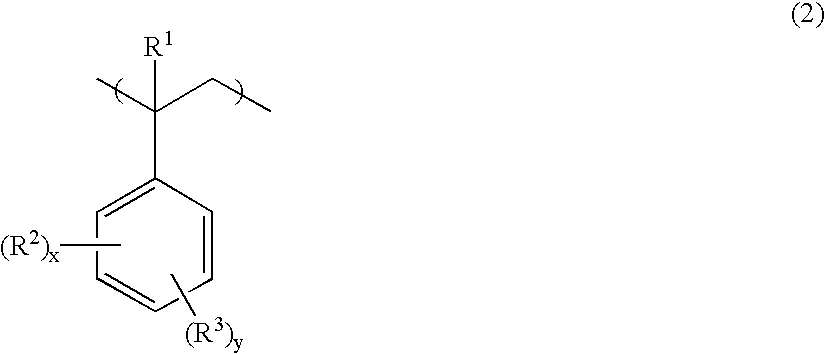
Herein R1 is hydrogen or methyl, R2, which may be the same or different, is a straight, branched or cyclic alkyl group of 1 to 30 carbon atoms or aryl group of 6 to 30 carbon atoms, R3 is an OR4 group, R4 is an acid labile group or acid stable group, x is 0 or a positive integer, y is a positive integer, satisfying x+y≦5.
units (III): 
Herein R1 is as defined above, and R5 is a straight, branched or cyclic alkylene group of 1 to 30 carbon atoms or arylene group of 6 to 30 carbon atoms, or a mixture thereof, which may contain an ether or ester bond.
More preferably, the units (III) are of the following formula (3a): 
wherein X is a valence bond or a straight or branched alkylene group of 1 to 10 carbon atoms which may contain a hydroxyl or carbonyl group.
More illustratively, R2 represents straight, branched or cyclic alkyl groups or aryl groups of 1 to 30 carbon atoms, preferably 1 to 15 carbon atoms, more preferably 1 to 8 carbon atoms. Exemplary of the straight, branched or cyclic alkyl groups are methyl, ethyl, propyl, isopropyl, n-butyl, isobutyl, tert-butyl, cyclohexyl, and cyclopentyl. Phenyl is an exemplary aryl group.
The acid labile group represented by R4 may be selected from a variety of acid labile groups, preferably from groups of the following formulas (9) and (10), tert-alkyl groups of 4 to 40 carbon atoms, trialkylsilyl groups whose alkyl groups each have 1 to 6 carbon atoms, and oxoalkyl groups of 4 to 20 carbon atoms. 
In formula (9), R6 is selected from tert-alkyl groups of 4 to 40 carbon atoms, trialkylsilyl groups whose alkyl groups each have 1 to 6 carbon atoms, and oxoalkyl groups of 4 to 20 carbon atoms, and a is an integer of 0 to 10. In formula (10), R7 is hydrogen or a straight, branched or cyclic alkyl group having 1 to 10 carbon atoms, and R8 and R9 are independently selected from straight, branched or cyclic alkyl groups having 1 to 10 carbon atoms, or R8 and R9, taken together, form a ring.
Examples of the acid labile group of formula (10) include straight or branched acetal groups such as 1-methoxyethyl, 1-ethoxyethyl, 1-n-propoxyethyl, 1-isopropoxyethyl, 1-n-butoxyethyl, 1-isobutoxyethyl, 1-sec-butoxyethyl, 1-tert-butoxyethyl, 1-tert-amyloxyethyl, 1-ethoxy-n-propyl, 1-cyclohexyloxyethyl, methoxypropyl, ethoxypropyl, 1-methoxy-1-methylethyl, and 1-ethoxy-1-methylethyl; and cyclic acetal groups such as tetrahydrofuranyl and tetrahydropyranyl, with the ethoxyethyl, butoxyethyl and ethoxypropyl groups being preferred. Examples of the acid labile group of formula (9) include tert-butoxycarbonyl, tert-butoxycarbonylmethyl, tert-amyloxycarbonyl, tert-amyloxycarbonylmethyl, 1-ethoxyethoxycarbonylmethyl, 2-tetrahydropyranyloxycarbonylmethyl, and 2-tetrahydrofuranyloxycarbonylmethyl groups.
Examples of the tertiary alkyl group include tertbutyl, triethylcarbyl, 1-ethylnorbornyl, 1-methylcyclohexyl, 2-(2-methyl)adamantyl and tert-amyl groups.
Examples of the trialkylsilyl group include those wherein alkyl moieties each have 1 to 6 carbon atoms such as trimethylsilyl, triethylsilyl and dimethyl-tert-butylsilyl groups.
A typical oxoalkyl group is 3-oxocyclohexyl.
Also included in the acid labile groups is a crosslinking group Q having a C—O—C linkage. This crosslinking group Q provides intra- or intermolecular crosslinking between OH groups in units (I), as shown below. 
The crosslinking group Q is exemplified by groups of the following general formulas (Qa) and (Qb), preferably formulas (Qa′) and (Qb′). 
Herein, R′ and R″ each are hydrogen or a straight, branched or cyclic alkyl group of 1 to 8 carbon atoms, or R′ and R″, taken together, may form a ring, with the proviso that each of R′ and R″ is a straight or branched alkylene group of 1 to 8 carbon atoms when they form a ring. R′″ is a straight, branched or cyclic alkylene group of 1 to 10 carbon atoms. Letter d is 0 or an integer of 1 to 10. A is a c-valent aliphatic or alicyclic saturated hydrocarbon group, aromatic hydrocarbon group or heterocyclic group of 1 to 50 carbon atoms, which may have an intervening hetero atom and in which the hydrogen atom attached to a carbon atom may be partially replaced by a hydroxyl group, carboxyl group, acyl group or halogen atom. B is —CO—O—, —NHCO—O— or —NHCONH—. Letter c is an integer of 2 to 8, and c′ is an integer of 1 to 7. 
Herein, R′ and R′ each are hydrogen or a straight, branched or cyclic alkyl group of 1 to 8 carbon atoms, or R′ and R″, taken together, may form a ring, with the proviso that each of R′ and R″ is a straight or branched alkylene group of 1 to 8 carbon atoms when they form a ring. R″′ is a straight, branched or cyclic alkylene group of 1 to 10 carbon atoms. Letter d is 0 or an integer of 1 to 5. A′ is a c″-valent straight, branched or cyclic alkylene, alkyltriyl or alkyltetrayl group of 1 to 20 carbon atoms or an arylene group of 6 to 30 carbon atoms, which may have an intervening hetero atom and in which the hydrogen atom attached to a carbon atom may be partially replaced by a hydroxyl group, carboxyl group, acyl group or halogen atom. B is —CO—O—, —NHCO—O— or —NHCONH—. Letter c″ is an integer of 2 to 4, and c″′ is an integer of 1 to 3.
The straight, branched or cyclic alkyl groups of 1 to 8 carbon atoms are as exemplified above. Examples of the straight, branched or cyclic alkylene group of 1 to 10 carbon atoms represented by R″′ include methylene, ethylene, propylene, isopropylene, n-butylene, isobutylene, cyclohexylene, and cyclopentylene. Examples of the group represented by A are described later. These crosslinking groups of formulas (Qa) and (Qb) originate from alkenyl ether compounds and halogenated alkyl ether compounds to be described later.
As understood from the value of c′ in formula (Qa) or (Qb), the crosslinking group is not limited to a divalent one and trivalent to octavalent groups are acceptable. For example, the divalent crosslinking group is exemplified by groups of the following formulas (Qa″) and (Qb″), and the trivalent crosslinking group is exemplified by groups of the following formulas (Qa″′) and (Qb″′). 

For introducing the above crosslinking groups, the following compounds may be used. 
Herein A, B, R′, R″, R″′, c and d are as defined above, R′a is hydrogen or a straight, branched or cyclic alkyl group of 1 to 7 carbon atoms, and Z is a halogen atom such as Cl, Br or I.
The c-valent (divalent to octavalent) hydrocarbon groups represented by A include hydrocarbon groups, for example, substituted or unsubstituted alkylene groups having 1 to 50 carbon atoms, especially 1 to 40 carbon atoms, substituted or unsubstituted arylene groups having 6 to 50 carbon atoms, more preferably 6 to 40 carbon atoms, especially 6 to 20 carbon atoms, a combination of an alkylene group and an arylene group, and c″′-valent groups obtained by eliminating one hydrogen atom attached to a carbon atom from the foregoing groups wherein c″′ is an integer of 3 to 8; and c-valent heterocyclic groups, and a combination of such a heterocyclic group with any one of the foregoing hydrocarbon groups. In the alkylene and arylene groups, a hetero atom such as O, NH, N(CH3), S and SO2 may intervene and where substituted, the substituent is a hydroxyl, carboxyl, acyl group or a halogen atom such as fluorine, chlorine, bromine or iodine.
Illustrative examples of A are given below. 


A method as described by Stephen C. Lapin in Polymers Paint Colour Journal, 179 (4237), 321 (1988) may be used to prepare the compounds of general formula (I). This method involves synthesis via the reaction of a polyhydric alcohol or a polyhydric phenol with acetylene, or the reaction of a polyhydric alcohol or polyhydric phenol with a halogenated alkyl vinyl ether.
Illustrative, non-limiting examples of compounds having formula (I) include ethylene glycol divinyl ether, triethylene glycol divinyl ether, 1,2-propanediol divinyl ether, 1,3-propanediol divinyl ether, 1,3-butanediol divinyl ether, 1,4-butanediol divinyl ether, tetramethylene glycol divinyl ether, neopentyl glycol divinyl ether, trimethylolpropane trivinyl ether, trimethylolethane trivinyl ether, hexanediol divinyl ether, 1,4-cyclohexanediol divinyl ether, 1,4-divinyloxymethyl cyclohexane, tetraethylene glycol divinyl ether, pentaerythritol divinyl ether, pentaerythritol trivinyl ether, pentaerythritol tetravinyl ether, sorbitol tetravinyl ether, sorbitol pentavinyl ether, ethylene glycol diethylene vinyl ether, triethylene glycol diethylene vinyl ether, ethylene glycol dipropylene vinyl ether, triethylene glycol diethylene vinyl ether, trimethylolpropane triethylene vinyl ether, trimethylolpropane diethylene vinyl ether, pentaerythritol diethylene vinyl ether, pentaerythritol triethylene vinyl ether, pentaerythritol tetraethylene vinyl ether, and compounds of the formulas (I-1) to (I-31) given below. 


When B is —CO—O—, the compound of general formula (II) above may be prepared by reacting a polycarboxylic acid with a halogenated alkyl vinyl ether. Illustrative, non-limiting examples of compounds having formula (II) in which B is —CO—O— include diethylene vinyl ether terephthalate, diethylene vinyl ether phthalate, diethylene vinyl ether isophthalate, dipropylene vinyl ether phthalate, dipropylene vinyl ether terephthalate, dipropylene vinyl ether isophthalate, diethylene vinyl ether maleate, diethylene vinyl ether fumarate, and diethylene vinyl ether itaconate.
Examples of alkenyl ether group-containing compounds which are highly suitable for use in the invention include alkenyl ether group-containing compounds prepared by reacting an active hydrogen-bearing alkenyl ether compound of general formula (III), (IV), or (V) below, for example, with an isocyanate group-bearing compound. 
In these formulas, R′a, R″, and R″′ are as defined above.
When B is —NHCO—O— or —NHCONH—, examples of the isocyanate group-bearing compound of general formula (II) above which may be used include the compounds mentioned in Handbook of Crosslinking Agents, Taisei K.K., 1981. Illustrative examples include polyisocyanate compounds such as triphenylmethane triisocyanate, diphenylmethane diisocyanate, tolylene diisocyanate, the dimer of 2,4-tolylene diisocyanate, naphthalene-1,5-diisocyanate, o-tolylene diisocyanate, polymethylene polyphenyl isocyanate, and hexamethylene diisocyanate; and polyisocyanate adducts such as the adduct of tolylene diisocyanate and trimethylolpropane, the adduct of hexamethylene diisocyanate and water, and the adduct of xylene diisocyanate and trimethylolpropane. Various compounds with terminal alkenyl ether groups may be obtained by reacting the above-mentioned isocyanate group-bearing compounds with the active hydrogen-bearing alkenyl ether compounds. Illustrative, non-limiting examples of such compounds include those of the following formulas (II-1) to (II-11). 
The acid stable group represented by R4 designates a substituent other than the substituent which is eliminated under the action of an acid to produce a phenol to change a rate of dissolution, and includes primary and secondary alkyl groups, primary and secondary alkoxy groups, primary and secondary alkoxycarbonyl groups, primary, secondary and tertiary alkylcarbonyl groups, and aryl groups. The alkyl and alkoxy groups are preferably those of 1 to 20 carbon atoms, especially 1 to 10 carbon atoms. An exemplary aryl group is phenyl. Illustrative, non-limiting examples include methoxy, ethoxy, propoxy, cyclohexyloxy, acetyl, pivaloyl, methylcarbonate, ethylcarbonate, isopropylcarbonate, and methoxymethoxy.
R5 represents alkylene and arylene groups. The alkylene groups are preferably those of 1 to 20 carbon atoms, especially 1 to 10 carbon atoms. The arylene groups are preferably those of 6 to 20 carbon atoms, especially 6 to 10 carbon atoms. A combination of an alkylene group with an arylene group is also useful. These groups and combinations may have ether or ester bonds therein. Illustrative examples include methylene, ethylene, propylene, butylene, hexylene, cyclohexylene, octylene, phenylene, and combinations of any two or more of these groups, which may be separated by —O—, —CO— or —COO—. Preferred are groups represented by the following formula. 
Herein, X is a valence bond or a straight or branched alkylene group of 1 to 10 carbon atoms, preferably 1 to 8 carbon atoms, more preferably 1 to 6 carbon atoms, which may contain a hydroxyl or carbonyl group. Examples of the alkylene group are the same as exemplified above.
The polymer of the invention is a macromolecule which is branched and concatenated in the dendritic or hyperbranched manner that recurring units (I) and/or (II) at one of their two bond sites are attached to the three bond sites of one unit (III) and at the other of their two bond sites to the three bond sites of another unit (III).
The recurring units (I) and (II) are combined such that (II)/[(I)+(II)] may range from 0 to 1. In the case of positive resist compositions, the value of (II)/[(I)+(II)] preferably ranges from 0 to 0.8, more preferably from 0.15 to 0.6, and further preferably from 0.2 to 0.5. In the case of negative resist compositions, the value of (II)/[(I)+(II)] preferably ranges from 0 to 0.8, more preferably from 0 to 0.6, and further preferably from 0 to 0.5.
More illustratively, the polymer of the invention is represented by the following formula (A). 
Depending on the value of z representing the number of recurring units (III) wherein z varies with the number of branches, preferably from 1 to 1,000, more preferably from 1 to 100, and most preferably 1 to 50, recurring units “a” and “a”, recurring units “c” and “d”, and recurring units “e” and “f” are attached to the three bond sites of each recurring unit (III).
R1, R2, R4, and R5 are as defined above, and x and y are as defined above.
The letters “a” to “f” are 0 or positive numbers, with the proviso that each pair of “a” and “a”, “c” and “d”, and “e” and “f” are not equal to 0 at the same time. The values of a/(a+b), c/(c+d), e/(e+f), and (a+c+e)/(a+b+c+d+e+f) range from 0 to 1. The preferred ranges of these values are as described above for (II)/[(I)+(II)]. These values may be identical or different.
In the case of positive resist compositions, the values of a/(a+b), c/(c+d), e/(e+f), and (a+c+e)/(a+b+c+d+e+f) preferably range from 0.1 to 0.8, more preferably from 0.15 to 0.6, and further preferably from 0.2 to 0.5. In the case of negative resist compositions, the values of a/(a+b), c/(c+d), e/(e+f), and (a+c+e)/(a+b+c+d+e+f) preferably range from 0 to 0.8, more preferably up to 0.6, and further preferably up to 0.5.
As previously described, the polymers of the invention have a weight average molecular weight (Mw) of 500 to 10,000,000, preferably 1,000 to 10,000,000, more preferably 1,000 to 100,000, and most preferably 2,000 to 50,000. The molecular weight distribution or dispersity represented by Mw/Mn is preferably from 1.0 to 5.0, more preferably from 1.0 to 3.0, though not critical.
Illustrative examples of the dendritic or hyperbranched polymers of the invention are those having recurring units represented by at least one of the following approximate formulae (4) to (8). 
Herein, broken lines represent polymer chains of the recurring units (I) and/or (II), and A represents the units (III). The number of broken line segments between A and A is depicted merely for the sake of convenience, independent of the number of recurring units (I) and (II) included between A and A.
According to the invention, the dendritic or hyperbranched polymer is prepared by effecting living polymerization of a phenol derivative, reacting with a compound having a polymerizable moiety and a terminating moiety and proceeding further polymerization. By repeating this operation, a dendritic or hyperbranched polymer of a phenol derivative can be synthesized. The living polymerization may be effected by any desired technique although living anion polymerization is preferred because of ease of control.
For example, living anion polymerization is initiated using a first monomer of the general formula (i) and/or a second monomer of the general formula (ii). After a predetermined amount of the monomer or monomers is polymerized to form an intermediate, a branching monomer of the general formula (iii) is added and reacted with the intermediate. Then the first monomer of formula (i) and/or the second monomer of formula (ii) are added again and polymerized. This operation is repeated until a desired polymer is obtained. 
Herein R1, R2, R3, x, and y are as defined above, R is a protective group for a hydroxyl group, R0 is a valence bond or an alkylene group of 1 to 20 carbon atoms, preferably 1 to 10 carbon atoms, and X is a halogen atom, aldehyde group or alkoxycarbonyl group. The protective group represented by R is not critical and may be selected from well-known ones. The protective group can be finally eliminated by a conventional technique.
For living anion polymerization to take place, the reaction solvent is preferably selected from toluene, benzene, tetrahydrofuran, dioxane, and ethyl ether. Of these, polar solvents such as tetrahydrofuran, dioxane, and ethyl ether are preferable. They may be used alone or in admixture of two or more.
The initiator used herein is preferably selected from sec-butyl lithium, n-butyl lithium, naphthalene sodium and cumyl potassium. The amount of the initiator used is proportional to the design molecular weight.
Preferred reaction conditions include a temperature of −80° C. to 100° C., preferably −70° C. to o° C., and a time of 0.1 to 50 hours, preferably 0.5 to 5 hours.
One exemplary reaction scheme using sec-butyl lithium as the initiator is shown below. The degree of branching can be altered by repeating the reaction desired times. 

When acid labile groups are to be introduced, the desired acid labile groups may be introduced to the phenolic hydroxyl groups on the resulting poly(p-hydroxystyrene) by a well-known technique. Alternatively, polymerization may be effected as above using a hydroxystyrene derivative monomer having acid labile groups or acid stable groups introduced to its phenolic hydroxyl groups.
One exemplary process entailing the introduction of acid labile groups is shown below. 


The polymers in the form of dendritic or hyperbranched polymers according to the invention essentially differ from conventional linear polymers. When polymers are used as the base resin of resist materials where the resolution is in proportion to the size of a polymer, for example, the conventional linear polymers have the drawback that reducing the size of a polymer leads to a lowering of strength. By contrast, the novel polymers of the invention permit the polymer size to be changed as desired and have the advantage that the size of a polymer can be reduced while maintaining strength. Then the novel polymers offer resist materials which have a high resolution, sensitivity and plasma etching resistance which have never been achieved with prior art resist materials.
Resist Composition
In the second aspect, the invention provides resist compositions which use the above-described polymers as the base resin, and in an especially preferred embodiment, chemical amplification type resist compositions which may be either positive or negative working.
The chemical amplification type positive resist composition is defined as comprising (A) a base resin constructed of the above-described polymer which is little or no soluble in alkali, but becomes alkali soluble by reaction with acid, (B) an organic solvent, and (C) a photoacid generator. The positive resist composition may further include (D) a basic compound and (E) a dissolution regulator.
The chemical amplification type negative resist composition is defined as comprising (A′) a base resin constructed of the above-described polymer which becomes little or no soluble in alkali by crosslinking with a crosslinker, (B) an organic solvent, (C) a photoacid generator, and (F) the crosslinker. The negative resist composition may further include (D) a basic compound.
Organic Solvent (B)
The organic solvent (B) used herein may be any organic solvent in which the base resin, photoacid generator, and other components are soluble. Illustrative, non-limiting, examples of the organic solvent include ketones such as cyclohexanone and methyl-2-n-amylketone; alcohols such as 3-methoxybutanol, 3-methyl-3-methoxybutanol, 1-methoxy-2-propanol, and 1-ethoxy-2-propanol; ethers such as propylene glycol monomethyl ether, ethylene glycol monomethyl ether, propylene glycol monoethyl ether, ethylene glycol monoethyl ether, propylene glycol dimethyl ether, and diethylene glycol dimethyl ether; and esters such as propylene glycol monomethyl ether acetate, propylene glycol monoethyl ether acetate, ethyl lactate, ethyl pyruvate, butyl acetate, methyl 3-methoxypropionate, ethyl 3-ethoxypropionate, tert-butyl acetate, tert-butyl propionate, and propylene glycol mono-tert-butyl ether acetate. These solvents may be used alone or in combinations of two or more thereof. Of the above organic solvents, it is recommended to use diethylene glycol dimethyl ether, 1-ethoxy-2-propanol and ethyl lactate because the photoacid generator serving as one of the resist components is most soluble therein, propylene glycol monomethyl ether acetate because it is a safe solvent, or a mixture thereof.
Photoacid Generator (C)
Suitable examples of the photoacid generator (C) include onium salts of the general formula (11) below, diazomethane derivatives of the general formula (12) below, glyoxime derivatives of the general formula (13) below, β-ketosulfone derivatives, disulfone derivatives, nitrobenzylsulfonate derivatives, sulfonic acid ester derivatives, imido-yl sulfonate derivatives, and halogen derivatives.
In the formula, R30 is a straight, branched or cyclic alkyl of 1 to 12 carbon atoms, an aryl of 6 to 12 carbon atoms, or an aralkyl of 7 to 12 carbon atoms; M+ is iodonium or sulfonium; K− is a non-nucleophilic counter-ion; and the letter b is 2 or 3.
Illustrative examples of alkyl groups represented by R30 include methyl, ethyl, propyl, butyl, cyclohexyl, 2-oxocyclohexyl, norbornyl, and adamantyl. Exemplary aryl groups include phenyl; alkoxyphenyl groups such as p-methoxyphenyl, m-methoxyphenyl, o-methoxyphenyl, ethoxyphenyl, p-tert-butoxyphenyl, and m-tert-butoxyphenyl; and alkylphenyl groups such as 2-methylphenyl, 3-methylphenyl, 4-methylphenyl, ethylphenyl, 4-tert-butylphenyl, 4-butylphenyl, and dimethylphenyl. Exemplary aralkyl groups include benzyl and phenethyl. Examples of the non-nucleophilic counter-ion represented by K− include halide ions such as chloride and bromide; fluoroalkylsulfonate ions such as triflate, 1,1,1-trifluoroethanesulfonate, and nonafluorobutanesulfonate; arylsulfonate ions such as tosylate, benzenesulfonate, 4-fluorobenzenesulfonate, and 1,2,3,4,5-pentafluorobenzenesulfonate; and alkylsulfonate ions such as mesylate and butanesulfonate. 
In the formula, R31 and R32 are straight, branched or cyclic alkyl or halogenated alkyl groups of 1 to 12 carbon atoms, aryl or halogenated aryl groups of 6 to 12 carbon atoms, or aralkyl groups of 7 to 12 carbon atoms.
Illustrative examples of alkyl groups represented by R31 and R32 include methyl, ethyl, propyl, butyl, amyl, cyclopentyl, cyclohexyl, norbornyl, and adamantyl. Exemplary halogenated alkyl groups include trifluoromethyl, 1,1,1-trifluoroethyl, 1,1,1-trichloroethyl, and nonafluorobutyl. Exemplary aryl groups include phenyl; alkoxyphenyl groups such as p-methoxyphenyl, m-methoxyphenyl, o-methoxyphenyl, ethoxyphenyl, p-tert-butoxyphenyl, and m-tert-butoxyphenyl; and alkylphenyl groups such as 2-methylphenyl, 3-methylphenyl, 4-methylphenyl, ethylphenyl, 4-tert-butylphenyl, 4-butylphenyl, and dimethylphenyl. Exemplary halogenated aryl groups include fluorobenzene, chlorobenzene, and 1,2,3,4,5-pentafluorobenzene. Exemplary aralkyl groups include benzyl and phenethyl. 
In the formula, R33, R34, and R35 are straight, branched or cyclic alkyl or halogenated alkyl groups of 1 to 12 carbon atoms, aryl or halogenated aryl groups of 6 to 12 carbon atoms, or aralkyl groups of 7 to 12 carbon atoms. R34 and R35 may together form a cyclic structure with the proviso that if they form a cyclic structure, each is a straight or branched alkylene group of 1 to 6 carbon atoms.
The alkyl, halogenated alkyl, aryl, halogenated aryl, and aralkyl groups represented by R33, R34, and R35 are exemplified by the same groups mentioned above for R31 and R32. Examples of alkylene groups represented by R34 and R35 include methylene, ethylene, propylene, butylene, and hexylene.
Illustrative examples of the photoacid generator include:
onium salts such as diphenyliodonium trifluoromethanesulfonate, (p-tert-butoxyphenyl)phenyliodonium trifluoromethanesulfonate, diphenyliodonium p-toluenesulfonate, (p-tert-butoxyphenyl)phenyliodonium p-toluenesulfonate, triphenylsulfonium trifluoromethanesulfonate, (p-tert-butoxyphenyl)diphenylsulfonium trifluoromethane-sulfonate, bis(p-tert-butoxyphenyl)phenylsulfonium trifluoromethanesulfonate, tris(p-tert-butoxyphenyl)sulfonium trifluoromethanesulfonate, triphenylsulfonium p-toluenesulfonate, (p-tert-butoxyphenyl)diphenylsulfonium p-toluenesulfonate, bis(p-tert-butoxyphenyl)diphenylsulfonium p-toluenesulfonate, tris(p-tert-butoxyphenyl)sulfonium p-toluenesulfonate, triphenylsulfonium nonafluorobutanesulfonate, triphenylsulfonium butanesulfonate, trimethylsulfonium trifluoromethanesulfonate, trimethylsulfonium p-toluenesulfonate, cyclohexylmethyl(2-oxocyclohexyl)sulfonium trifluoromethanesulfonate, cyclohexylmethyl(2-oxocyclohexyl)sulfonium p-toluene sulfonate, dimethylphenylsulfonium trifluoromethanesulfonate, dimethylphenylsulfonium p-toluenesulfonate, dicyclohexylphenylsulfonium trifluoromethanesulfonate, and dicyclohexylphenylsulfonium p-toluenesulfonate;
diazomethane derivatives such as bis(benzenesulfonyl)diazomethane, bis(p-toluenesulfonyl)diazomethane, bis(xylenesulfonyl)diazomethane, bis(cyclohexylsulfonyl)diazomethane, bis(cyclopentylsulfonyl)diazomethane, bis(n-butylsulfonyl)diazomethane, bis(isobutylsulfonyl)diazomethane, bis(sec-butylsulfonyl)diazomethane, bis(n-propylsulfonyl)diazomethane, bis(isopropylsulfonyl)diazomethane, bis(tert-butylsulfonyl)diazomethane, bis(n-amylsulfonyl)diazomethane, bis(isoamylsulfonyl)diazomethane, bis(sec-amylsulfonyl)diazomethane, bis(tert-amylsulfonyl)diazomethane, 1-cyclohexylsulfonyl-1-(tert-butylsulfonyl)diazomethane, 1-cyclohexylsulfonyl-1-(tert-amylsulfonyl)diazomethane, and 1-tert-amylsulfonyl-1-(tert-butylsulfonyl)diazomethane;
glyoxime derivatives such as bis-o-(p-toluene -sulfonyl)-αa-dimethylglyoxime, bis-o-(p-toluenesulfonyl)-α-diphenylglyoxime, bis-o-(p-toluenesulfonyl)-α-dicyclohexylglyoxime, bis-o-(p-toluenesulfonyl)-2,3-pentanedioneglyoxime, bis-o-(p-toluenesulfonyl)-2-methyl-3,4-pentanedioneglyoxime, bis-o-(n-butanesulfonyl)-α-dimethylglyoxime, bis-o-(n-butanesulfonyl)-α-diphenylglyoxime, bis -o-(n-butanesulfonyl)-α-dicyclohexylglyoxime, bis-o-(n -butanesulfonyl)-2,3-pentanedioneglyoxime, bis-o-(n -butanesulfonyl)-2-methyl-3,4-pentanedioneglyoxime, bis-o -(methanesulfonyl)-α-dimethylglyoxime, bis-o-(trifluoromethanesulfonyl) -α-dimethylglyoxime, bis-o-(1,1,1-trifluoroethanesulfonyl)-α-dimethylglyoxime, bis-o-(tert -butanesulfonyl)-α-dimethylglyoxime, bis-o-(perfluorooctane -sulfonyl)-α-dimethylglyoxime, bis-o-(cyclohexanesulfonyl)-α-dimethylglyoxime, bis-o-(benzenesulfonyl)-α-dimethylglyoxime, bis-o-(p-fluorobenzenesulfonyl)-α-dimethylglyoxime, bis-o-(p-tert-butylbenzenesulfonyl)-α-dimethylglyoxime, bis-o-(xylenesulfonyl)-α-dimethylglyoxime, and bis-o-(camphorsulfonyl)-α-dimethylglyoxime;
β-ketosulfone derivatives such as 2-cyclohexyl -carbonyl-2-(p-toluenesulfonyl)propane and 2-isopropyl -carbonyl-2-(p-toluenesulfonyl)propane;
disulfone derivatives such as diphenyl disulfone and dicyclohexyl disulfone;
nitrobenzyl sulfonate derivatives such as 2,6-dinitrobenzyl p-toluenesulfonate and 2,4-dinitrobenzyl p -toluenesulfonate;
sulfonic acid ester derivatives such as 1,2,3-tris(methanesulfonyloxy)benzene, 1,2,3-tris(trifluoromethanesulfonyloxy)benzene, and 1,2,3-tris(p -toluenesulfonyloxy)benzene; and
imidoyl sulfonate derivatives such as phthalimidoyl triflate, phthalimidoyl tosylate, 5-norbornene-2,3-dicarboxyimidoyl triflate, 5-norbornene-2,3-dicarboxyimidoyl tosylate, and 5-norbornene-2,3-dicarboxyimidoyl n-butylsulfonate.
Preferred among these photoacid generators are onium salts such as triphenylsulfonium trifluoromethanesulfonate, (p-tert-butoxyphenyl)diphenylsulfonium trifluoromethanesulfonate, tris(p-tert-butoxyphenyl)sulfonium trifluoromethanesulfonate, triphenylsulfonium p-toluenesulfonate, (p-tert-butoxyphenyl)diphenylsulfonium p-toluenesulfonate, and tris(p-tert-butoxyphenyl)sulfonium p-toluenesulfonate; diazomethane derivatives such as bis(benzenesulfonyl)diazomethane, bis(p-toluenesulfonyl)diazomethane, bis(cyclohexylsulfonyl)diazomethane, bis(n-butylsulfonyl)diazomethane, bis(isobutylsulfonyl)diazomethane, bis(sec-butylsulfonyl)diazomethane, bis(n-propylsulfonyl)diazomethane, bis(isopropylsulfonyl)diazomethane, and bis(tert-butylsulfonyl)diazomethane; and glyoxime derivatives such as bis-o-(p-toluenesulfonyl)-α-dimethylglyoxime and bis-o-(n-butanesulfonyl)-α-dimethylglyoxime, tribromophenol, dibromocamphor, tris(trichloromethyl), and s-triazine. These photoacid generators may be used singly or in combinations of two or more thereof. Onium salts are effective for improving rectangularity, while diazomethane derivatives and glyoxime derivatives are effective for reducing standing waves. The combination of an onium salt with a diazomethane or a glyoxime derivative allows for fine adjustment of the profile.
The photoacid generator is added in an amount of 0.2 to 15 parts by weight, and especially 0.5 to 8 parts by weight, per 100 parts by weight of all the base resins. At less than 0.2 part, the amount of acid generated during exposure would be too low and the sensitivity and resolution are poor, whereas the addition of more than 15 parts would lower the transmittance of the resist and result in a poor resolution.
Basic Compound (D)
The basic compound (D) is preferably a compound capable of suppressing the rate of diffusion when the acid generated by the photoacid generator diffuses within the resist film. The inclusion of this type of basic compound holds down the rate of acid diffusion within the resist film, resulting in better resolution. In addition, it suppresses changes in sensitivity following exposure, thus reducing substrate and environment dependence, as well as improving the exposure latitude and the pattern profile. See JP-A 5-232706, 5-249683, 5-158239, 5-249662, 5-257282, 5-289322, and 5-289340.
Examples of basic compounds (D) include primary, secondary, and tertiary aliphatic amines, mixed amines, aromatic amines, heterocyclic amines, carboxyl group-bearing nitrogenous compounds, sulfonyl group-bearing nitrogenous compounds, hydroxyl group-bearing nitrogenous compounds, hydroxyphenyl group-bearing nitrogenous compounds, alcoholic nitrogenous compounds, amide derivatives, and imide derivatives. Of these, aliphatic amines are especially preferred.
Examples of suitable primary aliphatic amines include ammonia, methylamine, ethylamine, n-propylamine, isopropylamine, n-butylamine, isobutylamine, sec-butylamine, tert-butylamine, pentylamine, tert-amylamine, cyclopentylamine, hexylamine, cyclohexylamine, heptylamine, octylamine, nonylamine, decylamine, dodecylamine, cetylamine, methylenediamine, ethylenediamine, and tetraethylenepentamine. Examples of suitable secondary aliphatic amines include dimethylamine, diethylamine, di-n-propylamine, di-isopropylamine, di-n-butylamine, di-isobutylamine, di-sec-butylamine, dipentylamine, dicyclopentylamine, dihexylamine, dicyclohexylamine, diheptylamine, dioctylamine, dinonylamine, didecylamine, didodecylamine, dicetylamine, N,N-dimethylmethylenediamine, N,N-dimethylethylenediamine, and N,N-dimethyltetraethylenepentamine. Examples of suitable tertiary aliphatic amines include trimethylamine, triethylamine, tri-n-propylamine, tri-isopropylamine, tri-n-butylamine, tri-isobutylamine, tri-sec-butylamine, tripentylamine, tricyclopentylamine, trihexylamine, tricyclohexylamine, triheptylamine, trioctylamine, trinonylamine, tridecylamine, tridodecylamine, tricetylamine, N,N,N′,N′-tetramethylmethylenediamine, N,N,N′,N′-tetramethylethylenediamine, and N,N,N′,N′-tetramethyltetraethylenepentamine.
Examples of suitable mixed amines include dimethylethylamine, methylethylpropylamine, benzylamine, phenethylamine, and benzyldimethylamine. Examples of suitable aromatic and heterocyclic amines include aniline derivatives (e.g., aniline, N-methylaniline, N-ethylaniline, N-propylaniline, N,N-dimethylaniline, 2-methylaniline, 3-methylaniline, 4-methylaniline, ethylaniline, propylaniline, trimethylaniline, 2-nitroaniline, 3-nitroaniline, 4-nitroaniline, 2,4-dinitroaniline, 2,6-dinitroaniline, 3,5-dinitroaniline, and N,N-dimethyltoluidine), diphenyl(p-tolyl)amine, methyldiphenylamine, triphenylamine, phenylenediamine, naphthylamine, diaminonaphthalene, pyrrole derivatives (e.g., pyrrole, 2H—pyrrole, 1-methylpyrrole, 2,4-dimethylpyrrole, 2,5-dimethylpyrrole, and N-methylpyrrole), oxazole derivatives (e.g., oxazole and isooxazole), thiazole derivatives (e.g., thiazole and isothiazole), imidazole derivatives (e.g., imidazole, 4-methylimidazole, and 4-methyl-2-phenylimidazole), pyrazole derivatives, furazan derivatives, pyrroline derivatives (e.g., pyrroline and 2-methyl-1-pyrroline), pyrrolidine derivatives (e.g., pyrrolidine, N-methylpyrrolidine, pyrrolidinone, and N-methylpyrrolidone), imidazoline derivatives, imidazolidine derivatives, pyridine derivatives (e.g., pyridine, methylpyridine, ethylpyridine, propylpyridine, butylpyridine, 4-(1-butylpentyl)pyridine, dimethylpyridine, trimethylpyridine, triethylpyridine, phenylpyridine, 3-methyl-2-phenylpyridine, 4-tert -butylpyridine, diphenylpyridine, benzylpyridine, methoxypyridine, butoxypyridine, dimethoxypyridine, 1-methyl-2-pyridone, 4-pyrrolidinopyridine, 1-methyl-4-phenylpyridine, 2-(1-ethylpropyl)pyridine, aminopyridine, and dimethylaminopyridine), pyridazine derivatives, pyrimidine derivatives, pyrazine derivatives, pyrazoline derivatives, pyrazolidine derivatives, piperidine derivatives, piperazine derivatives, morpholine derivatives, indole derivatives, isoindole derivatives, 1H-indazole derivatives, indoline derivatives, quinoline derivatives (e.g., quinoline and 3-quinolinecarbonitrile), isoquinoline derivatives, cinnoline derivatives, quinazoline derivatives, quinoxaline derivatives, phthalazine derivatives, purine derivatives, pteridine derivatives, carbazole derivatives, phenanthridine derivatives, acridine derivatives, phenazine derivatives, 1,10-phenanthroline derivatives, adenine derivatives, adenosine derivatives, guanine derivatives, guanosine derivatives, uracil derivatives, and uridine derivatives.
Examples of suitable carboxyl group-bearing nitrogenous compounds include aminobenzoic acid, indolecarboxylic acid, and amino acid derivatives (e.g. nicotinic acid, alanine, alginine, aspartic acid, glutamic acid, glycine, histidine, isoleucine, glycylleucine, leucine, methionine, phenylalanine, threonine, lysine, 3-aminopyrazine-2-carboxylic acid, and methoxyalanine). Examples of suitable sulfonyl group-bearing nitrogenous compounds include 3-pyridinesulfonic acid and pyridinium p-toluenesulfonate. Examples of suitable hydroxyl group-bearing nitrogenous compounds, hydroxyphenyl group-bearing nitrogenous compounds, and alcoholic nitrogenous compounds include 2-hydroxypyridine, aminocresol, 2,4-quinolinediol, 3-indolemethanol hydrate, monoethanolamine, diethanolamine, triethanolamine, N-ethyldiethanolamine, N,N-diethylethanolamine, triisopropanolamine, 2,2′-imino -diethanol, 2-aminoethanol, 3-amino-1-propanol, 4-amino-1-butanol, 4-(2-hydroxyethyl)morpholine, 2-(2-hydroxyethyl)pyridine, 1-(2-hydroxyethyl)piperazine, 1-[2-(2-hydroxyethoxy)ethyl]piperazine, piperidine ethanol, 1-(2-hydroxyethyl)pyrrolidine, 1-(2-hydroxyethyl)-2-pyrrolidinone, 3-piperidino-1,2-propanediol, 3-pyrrolidino -1,2-propanediol, 8-hydroxyjulolidine, 3-quinuclidinol, 3-tropanol, 1-methyl-2-pyrrolidine ethanol, 1-aziridine ethanol, N-(2-hydroxyethyl)phthalimide, and N-(2-hydroxyethyl)isonicotinamide. Examples of suitable amide derivatives include formamide, N-methylformamide, N,N -dimethylformamide, acetamide, N-methylacetamide, N,N -dimethylacetamide, propionamide, and benzamide. Suitable imide derivatives include phthalimide, succinimide, and maleimide.
In addition, basic compounds of the following general formulas (14) and (15) may also be included. 
In the formulas, R41, R42, R43, R47 and R48 are independently straight, branched or cyclic alkylenes of 1 to 20 carbon atoms; R44, R45, R46, R49 and R50 are hydrogen, alkyls of 1 to 20 carbon atoms, or amino; R44 and R45, R45 and R46, R44 and R46, R44 with R45 and R46, and R49 and R50 may bond together to form rings; and S, T and U are each integers from 0 to 20, with the proviso that hydrogen is excluded from R44, R45, R46, R49 and R50 when S, T and U are equal to 0.
The alkylene groups represented by R41, R42, R43, R47 and R48 preferably have 1 to 20 carbon atoms, more preferably 1 to 10 carbon atoms, and most preferably 1 to 8 carbon atoms. Examples include methylene, ethylene, n-propylene, isopropylene, n-butylene, isobutylene, n-pentylene, isopentylene, hexylene, nonylene, decylene, cyclopentylene, and cyclohexylene.
The alkyl groups represented by R44, R45, R46, R49 and R50 preferably have 1 to 20 carbon atoms, more preferably 1 to 8 carbon atoms, and most preferably 1 to 6 carbon atoms, and may be straight, branched or cyclic. Examples include methyl, ethyl, n-propyl, isopropyl, n-butyl, isobutyl, tert-butyl, n-pentyl, isopentyl, hexyl, nonyl, decyl, dodecyl, tridecyl, cyclopentyl, and cyclohexyl.
Where a pair of R44 and R45, a pair of R45 and R46, a pair of R44 and R46, a combination of R44 with R45 and R46, and a pair of R49 and R50 form rings, the rings preferably have 1 to 20 carbon atoms, more preferably 1 to 8 carbon atoms, and most preferably 1 to 6 carbon atoms, and may have branching alkyl groups of 1 to 6 carbon atoms, and especially 1 to 4 carbon atoms.
S, T, and U are each integers from 0 to 20, preferably from 1 to 10, and more preferably from 1 to 8.
Illustrative examples of the compounds of formulas (14) and (15) include tris{2-(methoxymethoxy)ethyl}amine, tris{2-(methoxyethoxy)ethyl}amine, tris[2-{(2-methoxyethoxy)methoxy}ethyl]amine, tris{2-(2-methoxyethoxy)ethyl}amine, tris{2-(1-methoxyethoxy)ethyl}amine, tris{2-(1-ethoxyethoxy)ethyl}amine, tris{2-(1-ethoxypropoxy)ethyl}amine, tris[2-((2-hydroxyethoxy)ethoxy}ethyl]amine, 4,7,13,16,21,24-hexaoxa-1,10-diazabicyclo[8.8.8]hexacosane, 4,7,13,18-tetraoxa-1,10-diazabicyclo[8.5.5]eicosane, 1,4,10,13-tetraoxa-7,16-diazabicyclooctadecane, 1-aza-12-crown-4, 1-aza-15-crown-5, and 1-aza-18-crown-6. Especially preferred basic compounds are tertiary amines, aniline derivatives, pyrrolidine derivatives, pyridine derivatives, quinoline derivatives, amino acid derivatives, hydroxyl group-bearing nitrogenous compounds, hydroxyphenyl group-bearing nitrogenous compounds, alcoholic nitrogenous compounds, amide derivatives, imide derivatives, tris{2-(methoxymethoxy)ethyl}amine, tris{2-(2-methoxyethoxy)ethyl}amine, tris[2-{2-methoxyethoxy)methyl}ethyl]amine, and 1-aza-15-crown-5.
The above-described basic compound may be used singly or in combinations of two or more thereof, and is preferably formulated in an amount of 0.01 to 2 parts, and especially 0.01 to 1 part by weight, per 100 parts by weight of all the base resins. At less than 0.01 part, the desired effects of the basic compound would not be apparent, while the use of more than 2 parts would result in too low a sensitivity.
Carboxyl Group-bearing Aromatic Compound
In the resist composition of the invention, an aromatic compound bearing a ≡C—COOH group, preferably —R57—COOH (wherein R57 is a straight or branched alkylene of 1 to 10 carbon atoms) may be formulated. Exemplary, non-limiting aromatic compounds bearing a ≡C—COOH group include one or more compounds selected from Groups I and II below. Including this component improves the PED stability of the resist and ameliorates edge roughness on nitride film substrates.
Group I:
Compounds in which some or all of the hydrogen atoms on the phenolic hydroxyl groups of the compounds of general formulas (16) to (25) below have been replaced with —R57—COOH (wherein R57 is a straight or branched alkylene of 1 to 10 carbon atoms), and in which the molar ratio C/(C+D) of phenolic hydroxyl groups (C) to ≡C—COOH groups (D) in the molecule is from 0.1 to 1.0. 

In these formulas, R1 is hydrogen or methyl; R51 and R52 are each hydrogen or a straight or branched alkyl or alkenyl of 1 to 8 carbon atoms; R53 is hydrogen, a straight or branched alkyl or alkenyl of 1 to 8 carbon atoms, or a —(R 57)h—COOR′ group (R′ being hydrogen or —R57—COOH); R54 is —(CH2 )i— (where i is 2 to 10), an arylene of 6 to 10 carbon atoms, carbonyl, sulfonyl, an oxygen atom, or a sulfur atom; R55 is an alkylene of 1 to 10 carbon atoms, an arylene of 6 to 10 carbon atoms, carbonyl, sulfonyl, an oxygen atom, or a sulfur atom; R56 is hydrogen, a straight or branched alkyl or alkenyl of 1 to 8 carbon atoms, or a hydroxyl-substituted phenyl or naphthyl; R57 is a straight or branched alkylene of 1 to 10 carbon atoms; R58 is hydrogen, a straight or branched alkyl or alkenyl of 1 to 8 carbon atoms, or a —R57 —COOH group; the letter j is an integer from 0 to 5; u and h are each 0 or 1; s1, t1, s2, t2, s3, t3, s4, and t4 are each numbers which satisfy s1+t1=8, s2+t2=5, s3+t3=4, and s4+t4=6, and are such that each phenyl skeleton has at least one hydroxyl group; β is a number such that the compound of formula (21) may have a weight average molecular weight of 1,000 to 5,000; and γ is a number such that the compound of formula (22) may have a weight average molecular weight of 1,000 to 10,000.
Group II:
Compounds of general formulas (26) and (27) below. 
In these formulas, R51, R52 and R57 are as defined above; and s5 and t5 are numbers which satisfy s5≧0, t5≧0, and s5+t5=5.
Illustrative, non-limiting examples of these aromatic compounds include compounds of the general formulas III-1 to III-14 and IV-1 to IV-6 below. 

In the above formulas, R″ is hydrogen or a CH2COOH group such that the CH2COOH group accounts for 10 to 100 mol % of R″ in each compound, α and β are as defined above. 
The aromatic compound bearing a ≡C—COOH group within the molecule may be used singly or as combinations of two or more thereof.
The aromatic compound bearing a ≡C—COOH group within the molecule is preferably added in an amount ranging from 0.1 to 5 parts, and more preferably 1 to 3 parts by weight, per 100 parts by weight of the base resin. At less than 0.1 part, sufficient improvement would not be achieved with regard to either footing on nitride film substrates or PED. On the other hand, at more than 5 parts, the resolution of the resist material would be unacceptably low.
Dissolution Regulator (E)
The resist composition of the invention may also include, as component (E), a dissolution regulator for enhancing the contrast. The dissolution regulator is a compound having an average molecular weight within a range of 100 to 1,000, and preferably 150 to 800, and having on the molecule at least two phenolic hydroxyl groups, in which an average of from 0 to 100 mol % of all the hydrogen atoms on the phenolic hydroxyl groups have been replaced with acid labile groups.
The degree of substitution of the hydrogen atoms on the phenolic hydroxyl groups with acid labile groups is on average at least 0 mol %, and preferably at least 30 mol %, of all the phenolic hydroxyl groups. The upper limit is 100 mol %, and preferably 80 mol %.
Preferable examples of such compounds having two or more phenolic hydroxyl groups include those of formulas (i) to (xi) below. 

In these formulas, R21 and R22 are each hydrogen or a straight or branched alkyl or alkenyl of 1 to 8 carbon atoms; R23 is hydrogen, a straight or branched alkyl or alkenyl of 1 to 8 carbon atoms, or —(R27)h—COOH; R24 is —(CH2)i— (where i=2 to 10), an arylene of 6 to 10 carbon atoms, carbonyl, sulfonyl, an oxygen atom, or a sulfur atom; R25 is an alkylene of 1 to 10 carbon atoms, an arylene of 6 to 10 carbon atoms, carbonyl, sulfonyl, an oxygen atom, or a sulfur atom; R26 is hydrogen, a straight or branched alkyl or alkenyl of 1 to 8 carbon atoms, or a hydroxyl-substituted phenyl or naphthyl; R27 is a straight or branched alkylene of 1 to 10 carbon atoms; the letter j is an integer from 0 to 5; u and h are each 0 or 1; s, t, s′, t′, s″, and t″ are each numbers which satisfy s+t=8, s′+t′=5, and s″+t″=4, and are such that each phenyl skeleton has at least one hydroxyl group; and a is a number such that the compounds of formula (viii) or (ix) may have a molecular weight of 100 to 1,000.
In the above formulas, suitable examples of R21 and R22 include hydrogen, methyl, ethyl, butyl, propyl, ethynyl, and cyclohexyl; suitable examples of R23 include the same groups as for R21 and R22, as well as —COOH and —CH2COOH; suitable examples of R24 include ethylene, phenylene, carbonyl, sulfonyl, oxygen, and sulfur; suitable examples of R25 include methylene as well as the same groups as for R24; and suitable examples of R26 include hydrogen, methyl, ethyl, butyl, propyl, ethynyl, cyclohexyl, and hydroxyl-substituted phenyl or naphthyl.
Exemplary acid labile groups on the dissolution regulator include groups of general formula (9) or (10) above, tertiary alkyl groups of 4 to 20 carbon atoms, trialkylsilyl groups in which each of the alkyls has 1 to 6 carbon atoms, and oxoalkyl groups of 4 to 20 carbon atoms.
The compound serving here as the dissolution regulator, in which phenolic hydroxyl groups have been partially substituted with acid labile groups, may be formulated in an amount of 0 to 50 parts, preferably 5 to 50 parts, and more preferably 10 to 30 parts by weight, per 100 parts by weight of the base resin, and may be used singly or as a mixture of two or more thereof. An amount of less than 5 parts may fail to yield an improved resolution, whereas the use of more than 50 parts would lead to thinning of the patterned film, and thus a decline in resolution.
The dissolution regulators can be prepared by chemically reacting acid labile groups with a compound having phenolic hydroxyl groups in the same manner as described earlier for the base resin.
Instead of, or in addition to, the above-described dissolution regulator, the resist composition of the invention may include, as another dissolution regulator, a partially substituted compound having a weight average molecular weight of more than 1,000 and up to 3,000, and having phenolic hydroxyl groups on the molecule, in which an average of 0% to 60% of all the hydrogen atoms on the phenolic hydroxyl groups have been substituted with acid labile groups.
The compound in which the phenolic hydroxyl group hydrogens are partially substituted with these acid labile groups is preferably one or more selected from among compounds having recurring units of general formula (28) below and a weight average molecular weight of more than 1,000 and up to 3,000. 
In the formula, R4a is an acid labile group, and v and w are respectively numbers satisfying 0≦v/(v+w)≦0.6.
Suitable examples of the acid labile groups in the other dissolution regulator include groups of general formula (9) or (10), tertiary alkyl groups of 4 to 20 carbon atoms, trialkylsilyl groups in which each of the alkyls has 1 to 6 carbon atoms, and oxoalkyl groups of 4 to 20 carbon atoms.
Advantageously, the other dissolution regulator just described is formulated in an amount such that the total amount of dissolution regulator, including the dissolution regulator described earlier, is 0 to 50 parts, preferably 0 to 30 parts, and more preferably at least 1 part by weight, per 100 parts by weight of the base resins.
The other dissolution regulator can be prepared by chemically reacting acid labile groups with a compound having phenolic hydroxyl groups in the same manner as described earlier for the base resin.
UV Absorber
The resist composition of the invention may further include an UV absorber which is typically a compound having a molar absorbance of not more than 10,000 at a wavelength of 248 nm. The inclusion of the UV absorber allows the resist composition to be designed and controlled to have a suitable transmittance for substrates of differing reflectances.
Illustrative examples of the UV absorber include fused polycyclic hydrocarbon derivatives such as pentalene, indene, naphthalene, azulene, heptalene, biphenylene, indacene, fluorene, phenalene, phenanthrene, anthracene, fluoranthene, acephenanthrylene, aceanthrylene, triphenylene, pyrene, chrysene, pleiadene, picene, perylene, pentaphene, pentacene, benzophenanthrene, anthraquinone, anthrone, benzanthrone, 2,7-dimethoxynaphthalene, 2-ethyl-9,10-dimethoxyanthracene, 9,10-dimethylanthracene, 9-ethoxyanthracene, 1,2-naphthoquinone, 9-fluorene, and the compounds of general formulas (29) and (30) below; fused heterocyclic derivatives such as thioxanthene-9-one, thianthrene, and dibenzothiophene; benzophenone derivatives such as 2,3,4-trihydroxybenzophenone, 2,3,4,4′-tetrahydroxybenzophenone, 2,4-dihydroxybenzophenone, 3,5-dihydroxybenzophenone, 4,4′-dihydroxybenzophenone, and 4,4′-bis(dimethylamino)benzophenone; and squaric acid derivatives such as squaric acid and dimethyl squarate. 
In the formulas, R61 to R63 are independently hydrogen, straight or branched alkyl, straight or branched alkoxy, straight or branched alkoxyalkyl, straight or branched alkenyl, or aryl. R64 is a substituted or unsubstituted divalent aliphatic hydrocarbon group which may contain an oxygen atom, a substituted or unsubstituted divalent alicyclic hydrocarbon group which may contain an oxygen atom, a substituted or unsubstituted divalent aromatic hydrocarbon group which may contain an oxygen atom, or an oxygen atom. Also, R65 is an acid labile group; the letter J is 0 or 1; E, F, and G are each 0 or integers from 1 to 9; H is a positive integer from 1 to 10; and E+F+G+H≦10.
More particularly, in above formulas (29) and (30), R61 to R63 are independently hydrogen, straight or branched alkyl, straight or branched alkoxy, straight or branched alkoxyalkyl, straight or branched alkenyl, or aryl. Preferable examples of the straight or branched alkyl groups include those having 1 to 10 carbon atoms, such as methyl, ethyl, n-propyl, isopropyl, n-butyl, sec-butyl, tert-butyl, hexyl, cyclohexyl, and adamantyl; of these, the use of methyl, ethyl, isopropyl, or tert-butyl is especially preferred. Preferable examples of straight or branched alkoxy groups include those having 1 to 8 carbon atoms, such as methoxy, ethoxy, propoxy, isopropoxy, n-butoxy, sec-butoxy, tert-butoxy, hexyloxy, and cyclohexyloxy; of these, the use of methoxy, ethoxy, isopropoxy, and tert-butoxy is especially preferred. Preferable examples of the straight or branched alkoxyalkyl groups include those having 2 to 10 carbon atoms, such as methoxymethyl, 1-ethoxyethyl, 1-ethoxypropyl, 1-propoxyethyl, and tert-butoxyethyl; of these, the use of methoxymethyl, 1-ethoxyethyl, 1-ethoxypropyl, and 1-propoxyethyl is especially preferred. Preferable examples of the straight or branched alkenyl groups include those having 2 to 4 carbon atoms, such as vinyl, propenyl, allyl, and butenyl. Preferable examples of the aryl groups include those having 6 to 14 carbon atoms, such as phenyl, xylyl, toluyl, and cumenyl.
R64 is a substituted or unsubstituted divalent aliphatic hydrocarbon group which may contain an oxygen atom, a substituted or unsubstituted divalent alicyclic hydrocarbon group which may contain an oxygen atom, a substituted or unsubstituted divalent aromatic hydrocarbon group which may contain an oxygen atom, or an oxygen atom; and J in the formula is 0 or 1. When J is 0, the —R64-linkage is a single bond.
Preferable examples of substituted or unsubstituted divalent aliphatic hydrocarbon groups which may contain an oxygen atom include those having 1 to 10 carbon atoms, such as methylene, ethylene, n-propylene, isopropylene, n -butylene, sec-butylene, —CH2O—, —CH2CH2O—, and —CH2OCH2—. Of these, methylene, ethylene, —CH2O—, and —CH2CH2O— are preferable.
Preferable examples of substituted or unsubstituted divalent alicyclic hydrocarbon groups which may contain an oxygen atom include those having 5 to 10 carbon atoms, such as 1,4-cyclohexylene, 2-oxacyclohexan-1,4-ylene, and 2-thiacyclohexan-1,4-ylene.
Preferable examples of substituted or unsubstituted divalent aromatic hydrocarbon groups which may contain an oxygen atom include those having 6 to 14 carbon atoms, such as o-phenylene, p-phenylene, 1,2-xylen-3,6-ylene, toluen -2,5-ylene, and 1-cumen-2,5-ylene; and allylalkylene groups having 6 to 14 carbon atoms, such as —CH2Ph—, —CH2PhCH2—, —OCH2Ph—, and —OCH2PhCH2O (wherein Ph stands for phenylene).
R65 is an acid labile group, the term “acid labile group” referring here to a moiety in which a carboxyl group has been substituted with one or more functional groups cleavable in the presence of an acid. This may be any moiety which cleaves in the presence of an acid to liberate an alkali-soluble functional group, although moieties having general formula (31a), (31b), or (31c) below are preferred. 
In the formulas, R66 to R69 are independently hydrogen or a straight or branched alkyl, straight or branched alkoxy, straight or branched alkoxyalkyl, straight or branched alkenyl, or aryl, any of which groups may have a carbonyl on the chain thereof, provided that R66 to R69 are not all hydrogen. R66 and R67 may bond together to form a ring. R69 is a straight or branched alkyl, straight or branched alkoxyalkyl, straight or branched alkenyl, or aryl, any of which may have a carbonyl on the chain thereof. R69 may bond with R66 to form a ring.
These straight or branched alkyl, straight or branched alkoxy, straight or branched alkoxyalkyl, straight or branched alkenyl, and aryl groups are exemplified by the same groups mentioned above for R61 to R63.
Examples of rings formed by the combination of R66 and R67 in formula (31a) include those having 4 to 10 carbon atoms, such as cyclohexylidene, cyclopentylidene, 3-oxocyclohexylidene, 3-oxo-4-oxacyclohexylidene, and 4-methylcyclohexylidene.
Examples of rings formed by the combination of R66 and R67 in formula (31b) include those having 3 to 9 carbon atoms, such as 1-silacyclohexylidene, 1-silacyclopentylidene, 3-oxo-1-silacyclopentylidene, and 4-methyl-1-silacyclopentylidene.
Examples of rings formed by the combination of R69 and R66 in formula (31c) include those having 4 to 10 carbon atoms, such as 2-oxacyclohexylidene, 2-oxacyclopentylidene, and 2-oxa-4-methylcyclohexylidene.
Exemplary groups represented by the formula (31a) include tertiary alkyl groups having 4 to 10 carbon atoms, such as tert-amyl, 1,1-dimethylethyl, 1,1-dimethylbutyl, 1-ethyl-1-methylpropyl, and 1,1-diethylpropyl; and 3-oxoalkyl groups, such as 1,1-dimethyl-3-oxobutyl, 3-oxocyclohexyl, and 1-methyl-3-oxo-4-oxacyclohexyl.
Exemplary groups represented by the formula (31b) include trialkylsilyl groups having 3 to 10 carbon atoms, such as trimethylsilyl, ethyldimethylsilyl, dimethylpropylsilyl, diethylmethylsilyl, triethylsilyl, and tert-butyldimethylsilyl.
Exemplary groups represented by the formula (31c) include groups having 2 to 8 carbon atoms, such as 1-methoxymethyl, 1-methoxyethyl, 1-ethoxyethyl, 1-ethoxypropyl, 1-ethoxyisobutyl, 1-n-propoxyethyl, 1-tert-butoxyethyl, 1-n-butoxyethyl, 1-isobutoxyethyl, 1-tert-pentoxyethyl, 1-cyclohexyloxyethyl, 1-(2′-n-butoxyethoxy)ethyl, 1-(2-ethylhexyloxy)ethyl, 1-{4-(acetoxymethyl)cyclohexylmethyloxy}ethyl, 1-{4-(tert-butoxycarbonyloxymethyl)cyclohexylmethyloxy}ethyl, 1-methoxy-1-methylethyl, 1-ethoxypropyl, dimethoxymethyl, diethoxymethyl, 2-tetrahydrofuranyl, and 2-tetrahydropyranyl.
In above formulas (29) and (30), E, F and G are each 0 or positive integers from 1 to 9, and H is a positive integer from 1 to 10, so as to satisfy E+F+G+H≦10.
Preferable examples of compounds represented by formulas (29) and (30) include the compounds shown in formulas (32a) to (32j) below. 

In these formulas, R70 is an acid labile group.
Further examples of the UV absorber include diarylsulfoxide derivatives such as bis(4-hydroxyphenyl)sulfoxide, bis(4-tert-butoxyphenyl)sulfoxide, bis(4-tert -butoxycarbonyloxyphenyl)sulfoxide, and bis[4-(1-ethoxyethoxy)phenyl]sulfoxide; diarylsulfone derivatives such as bis(4-hydroxyphenyl)sulfone, bis(4-tert-butoxyphenyl)sulfone, bis(4-tert-butoxycarbonyloxyphenyl)sulfone, bis[4-(1-ethoxyethoxy)phenyl]sulfone, and bis[4-(1-ethoxypropoxy)phenyl]sulfone; diazo compounds such as benzoquinonediazide, naphthoquinonediazide, anthraquinonediazide, diazofluorene, diazotetralone, and diazophenanthrone; and quinonediazide group-containing compounds such as the complete or partial ester compounds of naphthoquinone-1,2-diazide-5-sulfonate chloride with 2,3,4-trihydroxybenzophenone, and the complete or partial ester compounds of 2-diazide-4-sulfonate chloride with 2,4,4′-trihydroxybenzophenone.
Preferable examples of the UV absorber include tert-butyl 9-anthracenecarboxylate, tert-amyl 9-anthracenecarboxylate, tert-methoxymethyl 9-anthracenecarboxylate, tert-ethoxyethyl 9-anthracenecarboxylate, tert-tetrahydropyranyl 9-anthracenecarboxylate, tert-tetrahydrofuranyl 9-anthracenecarboxylate, and partial ester compounds of naphthoquinone-1,2-diazide-5-sulfonate chloride with 2,3,4-trihydroxybenzophenone.
The UV absorber is included in an amount of preferably 0 to 10 parts, more preferably 0.5 to 10 parts, and even more preferably 1 to 5 parts by weight, per 100 parts by weight of the base resin.
Acetylene Alcohol Derivative
The resist composition of the invention may additionally include an acetylene alcohol derivative for the purpose of enhancing the shelf stability.
Examples of compounds preferred for use as the acetylene alcohol derivative include those having general formulas (33) and (34) below. 
In the formulas, R71, R72, R 3, R74, and R75 are each hydrogen or a straight, branched, or cyclic alkyl of 1 to 8 carbon atoms; and X and Y are each 0 or a positive integer, satisfying 0≦X≦30, 0≦Y≦30, and 0≦X+Y≦40.
Preferable examples of the acetylene alcohol derivative include Surfynol 61, Surfynol 82, Surfynol 104, Surfynol 104E, Surfynol 104H, Surfynol 104A, Surfynol TG, Surfynol PC, Surfynol 440, Surfynol 465, and Surfynol 485 from Air Products and Chemicals Inc., and Olfin E1004 from Nisshin Chemical Industry K.K.
The acetylene alcohol derivative is added in an amount of preferably 0.01 to 2% by weight, and more preferably 0.02 to 1% by weight, per 100% by weight of the resist composition. Less than 0.01% by weight would be ineffective for improving coating characteristics and shelf stability, whereas more than 2% by weight would result in a resist having a low resolution.
Crosslinker (F)
The crosslinker (F) is a compound capable of promoting crosslinking under the action of an acid and includes melamine compounds, epoxy compounds, and urea compounds, examples of which are shown below. 
An appropriate amount of the crosslinker blended is 5 to 95 parts, more preferably 15 to 85 parts, and most preferably 20 to 75 parts by weight per 100 parts by weight of the base resin. Less than 5 parts of the crosslinker may be short to induce sufficient crosslinking reaction, resulting in a reduced film retention and winding and swelling of the pattern. More than 95 parts of the crosslinker may leave more scum, exacerbating development.
Surfactant
The resist composition of the invention may include, as an optional ingredient, a surfactant which is commonly used for improving the coating characteristics. Such optional ingredients may be added in conventional amounts so long as this does not compromise the objects of the invention.
A nonionic surfactant is preferred, examples of which include perfluoroalkyl polyoxyethylene ethanols, fluorinated alkyl esters, perfluoroalkylamine oxides, and fluorinated organosiloxane compounds. Illustrative examples include Florade FC-430 and FC-431 from Sumitomo 3M Ltd., Surflon S -141, S-145, S-381 and S-383 from Asahi Glass Co., Ltd., Unidyne DS-401, DS-403, and DS-451 from Daikin Industries Ltd., Megaface F-8151, F-171, F-172, F-173 and F-177 from Dainippon Ink & Chemicals, Inc., and X-70-092 and X-70-093 from Shin-Etsu Chemical Co., Ltd. Preferred surfactants include Florade FC-430 from Sumitomo 3M Ltd. and X-70-093 from Shin-Etsu Chemical Co., Ltd.
Process
Pattern formation using the resist composition of the invention may be carried out by a known lithographic technique. For example, the resist composition may be applied onto a substrate such as a silicon wafer by spin coating or the like to form a resist film having a thickness of 0.2 to 2.0 μm, which is then pre-baked on a hot plate at 60 to 150° C. for 1 to 10 minutes, and preferably at 80 to 120° C. for 1 to 5 minutes. A patterning mask having the desired pattern may then be placed over the resist film, and the film exposed through the mask to an electron beam or to high-energy radiation such as deep-UV rays having a wavelength below 300 nm, an excimer laser, or x-rays in a dose of about 1 to 200 mJ/cm2, and preferably about 10 to 100 mJ/cm2, then post-exposure baked (PEB) on a hot plate at 60 to 150° C. for 1 to 5 minutes, and preferably at 80 to 120° C. for 1 to 3 minutes. Finally, development may be carried out using as the developer an aqueous alkali solution, such as 0.1 to 5%, and preferably 2 to 3%, tetramethylammonium hydroxide (TMAH), this being done by a conventional method such as dipping, puddling, or spraying for a period of 0.1 to 3 minutes, and preferably 0.5 to 2 minutes. These steps result in the formation of the desired pattern on the substrate. Of the various types of high-energy radiation that may be used, the resist composition of the invention is best suited to fine pattern formation with, in particular, deep-UV rays having a wavelength of 146 to 254 nm, an excimer laser, x-rays, or an electron beam. The desired pattern may not be obtainable outside the upper and lower limits of the above range.
The resist composition comprising the polymer of the invention has an excellent resolution, reduced line edge roughness, and dry etching resistance and is useful as a chemical amplification type resist composition. Such a high resolution is accomplished whether the composition is positive or negative working.
Examples of the invention are given below by way of illustration and not by way of limitation.
A 1-liter flask was charged with 500 ml of tetrahydrofuran as a solvent and 0.01 mol of sec-butyl lithium as an initiator. To the solution at −78° C. was added 30 g of p-tert-butoxystyrene. With stirring, polymerization reaction was effected for 30 minutes. The reaction solution turned red. For producing a branched polymer, 0.005 mol of p-chloromethylstyrene was added to the reaction solution whereupon reaction was effected for 5 minutes. The reaction solution was red. Further 15 g of p-tert-butoxystyrene was added. With stirring, polymerization reaction was effected for 30 minutes. Polymerization was stopped by adding 0.1 mol of methanol to the reaction solution.
For purifying the polymer, the reaction mixture was poured into methanol whereupon the polymer precipitated. Separation and drying yielded 29 g of a white polymer which was tri-branched poly(p-tert-butoxystyrene).
For producing tri-branched poly(p-hydroxystyrene), 29 g of the above tri-branched poly(p-tert-butoxystyrene) was dissolved in 300 ml of acetone. A minor amount of conc. hydrochloric acid was added to the solution at 60° C., which was stirred for 7 hours. The reaction solution was poured into water whereupon the polymer precipitated. Washing and drying yielded 18 g of a polymer. Since a peak attributable to tert-butyl group was not found in GPC and proton-NMR analysis, this polymer was confirmed to be tri-branched poly(p-hydroxystyrene) having a narrow molecular weight distribution.
The tri-branched polyhydroxystyrene obtained in Synthetic Example 1, 10 g, was dissolved in 100 ml of tetrahydrofuran and a catalytic amount of methanesulfonic acid was added. With stirring at 20° C., 3 g of ethyl vinyl ether was added to the solution. Reaction was effected for one hour whereupon the reaction solution was neutralized with conc. aqueous ammonia. The neutralized reaction solution was added dropwise to 5 liters of water whereupon a white solid settled out. The solid was collected by filtration and dissolved in 100 ml of acetone, and added dropwise to 5 liters of water again. The precipitate was collected by filtration and dried in vacuum, obtaining a polymer designated Polymer 1. On proton-NMR analysis of Polymer 1, the substitution rate of ethoxyethyl groups on the tri-branched polyhydroxystyrene was determined.
The tri-branched polyhydroxystyrene obtained in Synthetic Example 1, 20 g, was dissolved in 200 ml of pyridine. With stirring at 45° C., 10 g of di-tert-butyl dicarbonate was added to the solution. Reaction was effected for one hour whereupon the reaction solution was added dropwise to 3 liters of water whereupon a white solid settled out. The solid was collected by filtration and dissolved in 100 ml of acetone, and added dropwise to 5 liters of water again. The precipitate was collected by filtration and dried in vacuum, obtaining a polymer designated Polymer 4. On proton—NMR analysis of Polymer 4, the substitution rate of t-BOC groups for the hydrogen atoms of hydroxyl group in the tri-branched polyhydroxystyrene was determined.
A 2-liter flask was charged with 1000 ml of tetrahydrofuran as a solvent and 0.06 mol of sec-butyl lithium as an initiator. To the solution at −78° C. was added 60 g of p-tert-butoxystyrene. With stirring, polymerization reaction was effected for 30 minutes. The reaction solution turned red. For producing a tri-branched polymer, 0.03 mol of p-chloromethylstyrene was added to the reaction solution whereupon reaction was effected for 5 minutes. Then 30 g of p-tert-butoxystyrene was added to the reaction solution, which was stirred for 30 minutes for polymerization. The reaction solution was red. For producing penta-branched polymer, 0.03 mol of p-chloromethylstyrene was added to the reaction solution whereupon reaction was effected for 5 minutes. Then 15 g of p-tert-butoxystyrene was added to the reaction solution, which was stirred for 30 minutes for polymerization. The reaction solution was red. Finally for producing nona-branched polymer, 0.015 mol of p-chloromethylstyrene was added to the reaction solution whereupon reaction was effected for 5 minutes. 7.5 g of p-tert-butoxystyrene was added to the reaction solution, which was stirred for 30 minutes for polymerization. The reaction solution was red.
Further 10 g of p-tert-butoxystyrene was added to the reaction solution. With stirring, polymerization reaction was effected for 30 minutes. Polymerization was stopped by adding 0.1 mol of carbon dioxide gas to the reaction solution.
For purifying the polymer, the reaction mixture was poured into methanol whereupon the polymer precipitated. Separation and drying yielded 99 g of a white polymer which was nona-branched poly(p-tert-butoxystyrene).
For converting to nona-branched poly(p-hydroxystyrene), 99 g of the above nona-branched poly(p -tert-butoxystyrene) was dissolved in 1000 ml of acetone. A minor amount of conc. hydrochloric acid was added to the solution at 60° C., which was stirred for 7 hours. The reaction solution was poured into water whereupon the polymer precipitated. Washing and drying yielded 66 g of a polymer. Since a peak attributable to tert-butyl group was not found on GPC and proton-NMR analysis, this polymer was confirmed to be nona-branched poly(p-hydroxystyrene) having a narrow molecular weight distribution.
In a 2-liter flask, 99 g of the nona-branched poly(p -hydroxystyrene) obtained in Synthetic Example 4 was dissolved in 1000 ml of tetrahydrofuran and a catalytic amount of methanesulfonic acid was added. With stirring at 20° C., 25 g of ethyl vinyl ether was added to the solution. Reaction was effected for 2 hours whereupon the reaction solution was neutralized with conc. aqueous ammonia. The neutralized solution was added dropwise to 10 liters of water whereupon a white solid settled out. The solid was collected by filtration and dissolved in 500 ml of acetone, and added dropwise to 10 liters of water again. The precipitate was collected by filtration and dried in vacuum, obtaining a polymer designated Polymer 3. On proton-NMR analysis of Polymer 3, the substitution rate of ethoxyethyl groups was determined.
Polymers 2, 4, 6 to 11 to be described later were prepared as above. It is noted that Polymer 5 was prepared further crosslinking with 1,4-butane diol divinyl ether.
Polymer 1 to 17 (polyhydroxystyrene in which some of the hydroxyl groups are protected with acid labile groups) as the base resin, photoacid generators PAG 1 to 3, dissolution regulators DRR 1 and 2, and a crosslinker, all the formulas being shown below, were dissolved in an amount six times the weight of solids of propylene glycol monomethyl ether acetate (PGMEA) to form liquid resist compositions. These compositions were each passed through a 0.2 μm Teflon filter to give the finished resist solution.
This resist solution was spin-coated onto a silicon wafer which had been coated with DUV-30 (Nissan Chemical K.K.) to a thickness of 55 nm so that the reflectance to KrF light (248 nm) was less than 1%. The coated silicon wafer was baked on a hot plate at 100° C. for 90 seconds. The thickness of the resist film was set at 0.55 μm.
The resist film was exposed using an excimer laser stepper (S-202A, from Nikon Corporation; NA=0.6), immediately baked at 110+ C. for 90 seconds and developed for 60 seconds with a 2.38 wt % solution of tetramethylammonium hydroxide in water, thereby giving a positive pattern.
The resist patterns obtained were evaluated as described below. The results are shown in Tables 1 and 2.
Using a measuring SEM model S-7280 (Hitachi Ltd.), the optimal exposure dose (sensitivity, Eop) was defined as the dose which provides a 1:1 resolution at the top and bottom of a 0.25 μtm line-and-space pattern. The resolution of the resist under evaluation was defined as the minimum line width of the lines and spaces that separated at this dose.
The side of the 0.25 μm line was observed for irregularities under the measuring SEM.
Dry etching resistance was examined by an etching test on the resist spin-coated wafer. Using a dry etching apparatus model TE-8500P (by Tokyo Electron K.K.), the resist film was etched with CHF3/CF4 gas. The difference in thickness of the resist film before and after dry etching and surface irregularities on the resist film after dry etching were measured by means of an atomic force microscope model D-500 (by Digital Instrument Co.). The etching conditions are shown below.
| Chamber pressure | 300 | mTorr | ||
| RF power | 1300 | W | ||
| Gap | 9 | mm | ||
| CHF3 gas flow rate | 30 | sccm | ||
| CF4 gas flow rate | 30 | sccm | ||
| Ar gas flow rate | 100 | sccm | ||
| Time | 60 | sec | ||


| TABLE 1 | ||||||
| Resist composition | Line | Etched | ||||
| (amounts in parts by weight appear in parentheses) | edge | Etching | surface | |||
| Base | Photoacid | Basic | Dissolution | Sensitivity | Resolution | roughness | speed | roughness | ||
| Example | resin | generator | compound | regulator | Crosslinker | (mJ/cm2) | (μm) | (nm) | (Å/min) | (nm) |
| 1 | Polymer 1 | PAG 2 | n-butylamine | — | — | 30 | 0.17 | 5 | 1620 | 5 |
| (80) | (2) | (0.1) | ||||||||
| 2 | Polymer 2 | PAG 2 | n-butylamine | — | — | 35 | 0.19 | 6 | 1610 | 4 |
| (80) | (2) | (0.1) | ||||||||
| 3 | Polymer 3 | PAG 2 | n-butylamine | — | — | 32 | 0.18 | 4 | 1600 | 4 |
| (80) | (2) | (0.1) | ||||||||
| 4 | Polymer 4 | PAG 2 | n-butylamine | — | — | 38 | 0.18 | 2 | 1580 | 3 |
| (80) | (2) | (0.1) | ||||||||
| 5 | Polymer 5 | PAG 2 | n-butylamine | — | — | 33 | 0.18 | 3 | 1610 | 5 |
| (80) | (2) | (0.1) | ||||||||
| 6 | Polymer 6 | PAG 2 | n-butylamine | — | — | 34 | 0.17 | 5 | 1610 | 4 |
| (80) | (2) | (0.1) | ||||||||
| 7 | Polymer 7 | PAG 2 | n-butylamine | — | — | 30 | 0.18 | 6 | 1630 | 5 |
| (80) | (2) | (0.1) | ||||||||
| 8 | Polymer 8 | PAG 2 | n-butylamine | — | — | 34 | 0.18 | 6 | 1610 | 4 |
| (80) | (2) | (0.1) | ||||||||
| 9 | Polymer 9 | PAG 2 | n-butylamine | — | Crosslinker | 30 | 0.18 | 9 | 1520 | 8 |
| (80) | (2) | (0.1) | (10) | |||||||
| 10 | Polymer 10 | PAG 2 | n-butylamine | — | Crosslinker | 34 | 0.18 | 7 | 1520 | 8 |
| (80) | (2) | (0.1) | (10) | |||||||
| 11 | Polymer 11 | PAG 2 | n-butylamine | — | Crosslinker | 30 | 0.18 | 8 | 1530 | 9 |
| (80) | (2) | (0.1) | (10) | |||||||
| 12 | Polymer 1 | PAG 1 | n-butylamine | — | — | 34 | 0.19 | 4 | 1610 | 5 |
| (80) | (2) | (0.1) | ||||||||
| 13 | Polymer 1 | PAG 3 | n-butylamine | — | — | 30 | 0.19 | 6 | 1620 | 5 |
| (80) | (2) | (0.1) | ||||||||
| 14 | Polymer 1 | PAG 2 | n-butylamine | DRR1 | — | 34 | 0.18 | 6 | 1660 | 6 |
| (80) | (2) | (0.1) | (10) | |||||||
| 15 | Polymer 2 | PAG 1 | n-butylamine | DRR2 | — | 30 | 0.18 | 5 | 1650 | 7 |
| (80) | (2) | (0.1) | (10) | |||||||
| 16 | Polymer 2 | PAG 2 | Triethanol- | — | — | 30 | 0.17 | 4 | 1630 | 5 |
| (80) | (2) | amine (0.1) | ||||||||
| 17 | Polymer 2 | PAG 2 | TMMEA | — | — | 30 | 0.17 | 4 | 1630 | 5 |
| (80) | (2) | (0.2) | ||||||||
| 18 | Polymer 2 | PAG 2 | TMEMEA | — | — | 30 | 0.17 | 3 | 1620 | 4 |
| (80) | (2) | (0.3) | ||||||||
| TABLE 2 | |||||
| Resist composition | Line | Etched | |||
| Compara- | (amounts in parts by weight appear in parentheses) | edge | Etching | surface | |
| tive | Base | Photoacid | Basic | Dissolution | Sensitivity | Resolution | roughness | speed | roughness | |
| Example | resin | generator | compound | regulator | Crosslinker | (mJ/cm2) | (μm) | (nm) | (Å/min) | (nm) |
| 1 | Polymer 12 | PAG 2 | n-butylamine | — | — | 30 | 0.17 | 10 | 1750 | 10 |
| (80) | (2) | (0.1) | ||||||||
| 2 | Polymer 13 | PAG 2 | n-butylamine | — | — | 35 | 0.19 | 9 | 1680 | 12 |
| (80) | (2) | (0.1) | ||||||||
| 3 | Polymer 14 | PAG 2 | n-butylamine | — | — | 32 | 0.18 | 10 | 1702 | 13 |
| (80) | (2) | (0.1) | ||||||||
| 4 | Polymer 15 | PAG 2 | n-butylamine | — | Crosslinker | 30 | 0.24 | 20 | 1600 | 15 |
| (80) | (2) | (0.1) | (10) | |||||||
| 5 | Polymer 16 | PAG 2 | n-butylamine | — | Crosslinker | 34 | 0.24 | 22 | 1620 | 16 |
| (80) | (2) | (0.1) | (10) | |||||||
| 6 | Polymer 17 | PAG 2 | n-butylamine | — | Crosslinker | 30 | 0.24 | 23 | 1630 | 15 |
| (80) | (2) | (0.1) | (10) | |||||||
| 7 | Polymer 12 | PAG 1 | n-butylamine | — | — | 34 | 0.19 | 8 | 1690 | 10 |
| (80) | (2) | (0.1) | ||||||||
| 8 | Polymer 12 | PAG 3 | n-butylamine | — | — | 30 | 0.19 | 9 | 1690 | 11 |
| (80) | (2) | (0.1) | ||||||||
| 9 | Polymer 12 | PAG 2 | n-butylamine | DRR1 | — | 34 | 0.18 | 10 | 1710 | 12 |
| (80) | (2) | (0.1) | (10) | |||||||
| 10 | Polymer 12 | PAG 1 | n-butylamine | DRR2 | — | 30 | 0.18 | 9 | 1720 | 15 |
| (80) | (2) | (0.1) | (10) | |||||||
| 11 | Polymer 12 | PAG 2 | Triethanol- | — | — | 30 | 0.17 | 10 | 1720 | 12 |
| (80) | (2) | amine (0.1) | ||||||||
| 12 | Polymer 12 | PAG 2 | TMMEA | — | — | 30 | 0.17 | 8 | 1710 | 14 |
| (80) | (2) | (0.2) | ||||||||
| 13 | Polymer 12 | PAG 2 | TMEMEA | — | — | 30 | 0.17 | 7 | 1730 | 13 |
| (80) | (2) | (0.3) | ||||||||
It is evident from Tables 1 and 2 that the resist compositions using the dendritic polymers according to the invention are satisfactory in resolution and sensitivity. In particular, a comparison of Examples 9, 10 and 11 with Comparative Examples 4, 5 and 6 reveals that as compared with linear polymers, the negative resist compositions using the dendritic polymers have a high resolution as well as a reduced line edge roughness, reduced film thickness difference before and after etching, and reduced surface roughness after etching, indicating an excellent dry etching resistance.
Japanese Patent Application No. 11-082885 is incorporated herein by reference.
Although some preferred embodiments have been described, many modifications and variations may be made thereto in light of the above teachings. It is therefore to be understood that the invention may be practiced otherwise than as specifically described without departing from the scope of the appended claims.
Claims (14)
1. A resist composition comprising as a base resin a dendritic or hyperbranched polymer of a phenol derivative having a weight average molecular weight of 500 to 10,000,000 wherein the polymer comprises recurring units (I) or (II) or both and recurring units (III) as shown below, the number of units (III) being 1 to 1,000,
units (I): 
units (II) 
wherein R1 is hydrogen or methyl, R2 is independently a straight, branched or cyclic alkyl group of 1 to 30 carbon atoms or aryl group of 6 to 30 carbon atoms, R3 is an OR4 group, R4 is an acid labile group or acid stable group, x is 0 or a positive integer, y is a positive integer, and the sum of x and y is up to 5,
units (III): 
wherein R1 is as defined above, and X is a valence bond or a straight or branched chain alkylene group of 1 to 10 carbon atoms which may contain a hydroxyl or carbonyl group.
2. The resist composition of claim 1 wherein the polymer has been prepared by living anion polymerization.
3. A chemical amplification positive resist composition comprising
(A) a base resin constructed of the polymer of claim 1 which is little or no soluble in alkali, but becomes alkali soluble by reaction with acid,
(B) an organic solvent, and
(C) a photoacid generator.
4. The resist composition of claim 3 further comprising (D) a basic compound.
5. The resist composition of claim 3 further comprising (E) a dissolution regulator.
6. A chemical amplification negative resist composition comprising
(A′) a base resin constructed of the polymer of claim 1 which becomes little or no soluble in alkali by crosslinking with a crosslinker,
(B) an organic solvent,
(C) a photoacid generator, and
(F) the crosslinker.
7. The resist composition of claim 6 further comprising (D) a basic compound.
8. A process for forming a resist pattern comprising the steps of:
(i) applying a resist composition according to claims 3 onto a substrate,
(ii) heat treating the coated film and then exposing it to actinic radiation having a wavelength of up to 500 nm or electron beams through a photo mask, and
(iii) optionally heat treating the exposed film and developing it with a developer.
9. The resist composition of claim 1 , wherein R2 is 1-8 carbon atoms.
10. The resist composition of claim 1 , wherein R2 is methyl, ethyl, propyl, isopropyl, n-butyl, isobutyl, tert-butyl, cyclohexyl, cyclopentyl, or phenyl.
11. The resist composition of claim 1 , wherein R4 is a group of formula (9), or a group of formula (10), 
where R6 is a tert-alkyl group of 4 to 40 carbon atoms, a trialkylsilyl group whose alkyl groups each have 1 to 6 carbon atoms, and an oxoalkyl group of 4 to 20 carbon atoms, and a is an integer of 0 to 10; and R7 is hydrogen or a straight, branched or cyclic alkyl group having 1 to 10 carbon atoms, and R8 and R9 are, independently, a branched or cyclic alkyl group having 1 to 10 carbon atoms, or R8 and R9, taken together, form a ring.
12. The resist composition of claim 13 , wherein the group of formula 10 is a 1-methoxyethyl, 1-ethoxyethyl, 1-n-propoxyethyl, 1-isopropoxyethyl, 1-n-butoxyethyl, 1-isobutoxyethyl, 1-sec-butoxyethyl, 1-tert-butoxyethyl, 1-tert-amyloxyethyl, 1-ethoxy-n-propyl, 1-cyclohexyloxyethyl, methoxypropyl, ethoxypropyl, 1-methoxy-1-methylethyl, 1-ethoxy-1-methylethyl, tetrahydrofuranyl or tetrahydropyranyl.
13. The resist composition of claim 1 , wherein R4 is an acid labile group of the formula Qa or Qb: 
where
R′ and R″ are each, independently, hydrogen or a straight, branched or cyclic alkyl group of 1 to 8 carbon atoms, or R′ and R″, taken together, may form a ring, with the proviso that each of R′ and R″ is a straight or branched alkylene group of 1 to 8 carbon atoms when they form a ring;
R″′ is a straight, branched or cyclic alkylene group of 1 to 10 carbon atoms;
d is 0 or an integer of 1-10;
A is a c-valent aliphatic or alicyclic saturated hydrocarbon group, aromatic hydrocarbon group or heterocyclic group of 1 to 50 carbon atoms, which may have an intervening hetero atom and in which the hydrogen atom attached to a carbon atom may be partially replaced by a hydroxyl group, carboxyl group, acyl group or halogen atom;
B is —CO—O—, —NHCO—O— or —NHCONH—;
c is an integer of 2-8; and
c′ is an integer of 1-7.
14. A resist composition of claim 1 , wherein at least one unit (I) or (II) is bonded to at least one unit (III) through the X group in unit (III).
Applications Claiming Priority (2)
| Application Number | Priority Date | Filing Date | Title |
|---|---|---|---|
| JP8288599 | 1999-03-26 | ||
| JP11-082885 | 1999-03-26 |
Publications (1)
| Publication Number | Publication Date |
|---|---|
| US6455223B1 true US6455223B1 (en) | 2002-09-24 |
Family
ID=13786738
Family Applications (1)
| Application Number | Title | Priority Date | Filing Date |
|---|---|---|---|
| US09/534,351 Expired - Lifetime US6455223B1 (en) | 1999-03-26 | 2000-03-24 | Resist compositions and patterning process |
Country Status (5)
| Country | Link |
|---|---|
| US (1) | US6455223B1 (en) |
| EP (1) | EP1039346B1 (en) |
| KR (1) | KR100540968B1 (en) |
| DE (1) | DE60010959T2 (en) |
| TW (1) | TWI263861B (en) |
Cited By (15)
| Publication number | Priority date | Publication date | Assignee | Title |
|---|---|---|---|---|
| US20020055059A1 (en) * | 2000-09-08 | 2002-05-09 | Jsr Corporation | Radiation sensitive resin composition, cathode separator and el display device |
| US20030022095A1 (en) * | 2001-06-18 | 2003-01-30 | Toshiyuki Kai | Negative type radiation sensitive resin composition |
| US20050266336A1 (en) * | 2004-02-05 | 2005-12-01 | Fuji Photo Film Co., Ltd. | Photosensitive composition and pattern-forming method using the photosensitive composition |
| US20060068318A1 (en) * | 2004-09-30 | 2006-03-30 | Meagley Robert P | Pixelated photoresists |
| US20070037089A1 (en) * | 2005-08-09 | 2007-02-15 | Taiwan Semiconductor Manufacturing Company, Ltd. | Structure and method for improving photoresist pattern adhesion |
| US20070154836A1 (en) * | 2005-12-30 | 2007-07-05 | Meagley Robert P | Helical pixilated photoresist |
| US20070207403A1 (en) * | 2006-03-02 | 2007-09-06 | Meagley Robert P | Branching self-assembling photoresist with decomposable backbone |
| US20070224538A1 (en) * | 2004-05-31 | 2007-09-27 | Hideo Hada | Positive Resist Compositions and Process for the Formation of Resist Patterns With the Same |
| US20080008956A1 (en) * | 2006-06-23 | 2008-01-10 | Eastman Kodak Company | Positive-working imageable members with branched hydroxystyrene polymers |
| US20080076062A1 (en) * | 2006-09-21 | 2008-03-27 | Fujifilm Corporation | Resist composition and pattern-forming method using the same |
| US20080096134A1 (en) * | 2006-09-29 | 2008-04-24 | Fujifilm Corporation | Positive resist composition and pattern forming method using the same |
| US20090087786A1 (en) * | 2007-09-20 | 2009-04-02 | Shin-Etsu Chemical Co., Ltd. | Patterning process and resist composition used therein |
| US20140242520A1 (en) * | 2011-09-22 | 2014-08-28 | Dongjin Semichem Co., Ltd. | I-line photoresist composition and method for forming fine pattern using same |
| US9122152B2 (en) | 2012-07-09 | 2015-09-01 | Shin-Etsu Chemicals Co., Ltd. | Patterning process and resist composition |
| US20160147154A1 (en) * | 2013-08-01 | 2016-05-26 | Fujifilm Corporation | Pattern formation method, active light-sensitive or radiation-sensitive resin composition, resist film, production method for electronic device using same, and electronic device |
Families Citing this family (8)
| Publication number | Priority date | Publication date | Assignee | Title |
|---|---|---|---|---|
| KR100555286B1 (en) | 2000-03-22 | 2006-03-03 | 신에쓰 가가꾸 고교 가부시끼가이샤 | Chemically Amplified Positive Resist Materials and Pattern Forming Methods |
| TW594383B (en) * | 2001-02-21 | 2004-06-21 | Fuji Photo Film Co Ltd | Positive resist composition for electron beam |
| JP4092083B2 (en) * | 2001-03-21 | 2008-05-28 | 富士フイルム株式会社 | Negative resist composition for electron beam or X-ray |
| JP3981830B2 (en) * | 2003-05-26 | 2007-09-26 | 信越化学工業株式会社 | Resist material and pattern forming method |
| CN100503666C (en) * | 2003-12-22 | 2009-06-24 | 狮王株式会社 | Hyperbranched polymer, method for producing the same, and resist composition containing the hyperbranched polymer |
| US8168367B2 (en) * | 2008-07-11 | 2012-05-01 | Shin-Etsu Chemical Co., Ltd. | Resist composition and patterning process |
| JP5290129B2 (en) * | 2008-12-25 | 2013-09-18 | 信越化学工業株式会社 | Chemically amplified positive resist composition and resist pattern forming method |
| CN115353576A (en) * | 2022-10-19 | 2022-11-18 | 北京八亿时空液晶科技股份有限公司 | A kind of preparation method of high yield narrow distribution polyhydroxystyrene resin |
Citations (13)
| Publication number | Priority date | Publication date | Assignee | Title |
|---|---|---|---|---|
| US4491628A (en) | 1982-08-23 | 1985-01-01 | International Business Machines Corporation | Positive- and negative-working resist compositions with acid generating photoinitiator and polymer with acid labile groups pendant from polymer backbone |
| JPS6327829A (en) | 1986-06-13 | 1988-02-05 | マイクロサイ,インコーポレイテッド | Resist composition and use thereof |
| JPH0227660A (en) | 1988-07-18 | 1990-01-30 | Sanyo Electric Co Ltd | Nonaqueous secondary battery |
| US4939229A (en) * | 1989-05-12 | 1990-07-03 | Rohm And Haas Company | Method for preparing lithographically sensitive branched novolaks using a mannich base intermediate |
| EP0397460A2 (en) | 1989-05-12 | 1990-11-14 | Rohm And Haas Company | Use of highly branched novolaks in photoresists |
| JPH06266099A (en) | 1993-03-15 | 1994-09-22 | Hitachi Ltd | Pattern forming material, pattern forming method, and forming method for functional element using the same |
| US5587446A (en) | 1994-11-08 | 1996-12-24 | Cornell Research Foundation, Inc. | Hyperbranched polymers from AB monomers |
| WO1999003898A1 (en) | 1997-07-17 | 1999-01-28 | E.I. Du Pont De Nemours And Company | Branched polyolefin synthesis |
| US5891603A (en) * | 1996-04-25 | 1999-04-06 | Fuji Photo Film Co., Ltd. | Positive working photosensitive composition |
| EP0908473A1 (en) | 1997-10-08 | 1999-04-14 | Shin-Etsu Chemical Co., Ltd. | Styrene polymers, chemically-amplified positive resist compositions, their preparation and use in a patterning process |
| US5942367A (en) * | 1996-04-24 | 1999-08-24 | Shin-Etsu Chemical Co., Ltd. | Chemically amplified positive resist composition, pattern forming method, and method for preparing polymer having a crosslinking group |
| US6027854A (en) * | 1997-02-28 | 2000-02-22 | Shin-Etsu Chemical Co., Ltd. | Polymers chemically amplified positive resist compositions, and patterning method |
| US6136502A (en) * | 1997-10-08 | 2000-10-24 | Shin-Etsu Chemical Co., Ltd. | Resist composition and patterning process |
Family Cites Families (5)
| Publication number | Priority date | Publication date | Assignee | Title |
|---|---|---|---|---|
| US5041516A (en) * | 1989-06-21 | 1991-08-20 | Cornell Research Foundation, Inc. | Dendritic molecules and method of production |
| EP0537524A1 (en) * | 1991-10-17 | 1993-04-21 | Shipley Company Inc. | Radiation sensitive compositions and methods |
| US5688628A (en) * | 1993-11-11 | 1997-11-18 | Nippon Zeon Co., Ltd. | Resist composition |
| JPH1160735A (en) * | 1996-12-09 | 1999-03-05 | Toshiba Corp | Polysilane and pattern forming method |
| JP4183293B2 (en) * | 1997-07-09 | 2008-11-19 | 日本曹達株式会社 | (Meth) acrylic acid ester polymer and production method thereof |
-
2000
- 2000-03-24 TW TW089105398A patent/TWI263861B/en not_active IP Right Cessation
- 2000-03-24 US US09/534,351 patent/US6455223B1/en not_active Expired - Lifetime
- 2000-03-25 KR KR1020000015273A patent/KR100540968B1/en not_active Expired - Lifetime
- 2000-03-27 EP EP00302465A patent/EP1039346B1/en not_active Expired - Lifetime
- 2000-03-27 DE DE60010959T patent/DE60010959T2/en not_active Expired - Lifetime
Patent Citations (14)
| Publication number | Priority date | Publication date | Assignee | Title |
|---|---|---|---|---|
| US4491628A (en) | 1982-08-23 | 1985-01-01 | International Business Machines Corporation | Positive- and negative-working resist compositions with acid generating photoinitiator and polymer with acid labile groups pendant from polymer backbone |
| JPS6327829A (en) | 1986-06-13 | 1988-02-05 | マイクロサイ,インコーポレイテッド | Resist composition and use thereof |
| JPH0227660A (en) | 1988-07-18 | 1990-01-30 | Sanyo Electric Co Ltd | Nonaqueous secondary battery |
| US4939229A (en) * | 1989-05-12 | 1990-07-03 | Rohm And Haas Company | Method for preparing lithographically sensitive branched novolaks using a mannich base intermediate |
| EP0397460A2 (en) | 1989-05-12 | 1990-11-14 | Rohm And Haas Company | Use of highly branched novolaks in photoresists |
| EP0399691A2 (en) | 1989-05-12 | 1990-11-28 | Rohm And Haas Company | Method for preparing lithographically sensitive branched novolaks |
| JPH06266099A (en) | 1993-03-15 | 1994-09-22 | Hitachi Ltd | Pattern forming material, pattern forming method, and forming method for functional element using the same |
| US5587446A (en) | 1994-11-08 | 1996-12-24 | Cornell Research Foundation, Inc. | Hyperbranched polymers from AB monomers |
| US5942367A (en) * | 1996-04-24 | 1999-08-24 | Shin-Etsu Chemical Co., Ltd. | Chemically amplified positive resist composition, pattern forming method, and method for preparing polymer having a crosslinking group |
| US5891603A (en) * | 1996-04-25 | 1999-04-06 | Fuji Photo Film Co., Ltd. | Positive working photosensitive composition |
| US6027854A (en) * | 1997-02-28 | 2000-02-22 | Shin-Etsu Chemical Co., Ltd. | Polymers chemically amplified positive resist compositions, and patterning method |
| WO1999003898A1 (en) | 1997-07-17 | 1999-01-28 | E.I. Du Pont De Nemours And Company | Branched polyolefin synthesis |
| EP0908473A1 (en) | 1997-10-08 | 1999-04-14 | Shin-Etsu Chemical Co., Ltd. | Styrene polymers, chemically-amplified positive resist compositions, their preparation and use in a patterning process |
| US6136502A (en) * | 1997-10-08 | 2000-10-24 | Shin-Etsu Chemical Co., Ltd. | Resist composition and patterning process |
Non-Patent Citations (3)
| Title |
|---|
| Derwent World Patent Index Abstracts JP 11 029617 (Nippon Soda Co.) Feb. 2, 1999. |
| English Abstract for 6-266099. |
| English Abstract for 63-27829. |
Cited By (28)
| Publication number | Priority date | Publication date | Assignee | Title |
|---|---|---|---|---|
| US20050260526A1 (en) * | 2000-09-08 | 2005-11-24 | Jsr Corporation | Radiation sensitive resin composition, cathode separator and EL display device |
| US6994944B2 (en) * | 2000-09-08 | 2006-02-07 | Jsr Corporation | Radiation sensitive resin composition, cathode separator and EL display device |
| US20020055059A1 (en) * | 2000-09-08 | 2002-05-09 | Jsr Corporation | Radiation sensitive resin composition, cathode separator and el display device |
| US7323284B2 (en) * | 2001-06-18 | 2008-01-29 | Jsr Corporation | Negative type radiation sensitive resin composition |
| US20030022095A1 (en) * | 2001-06-18 | 2003-01-30 | Toshiyuki Kai | Negative type radiation sensitive resin composition |
| US20050266336A1 (en) * | 2004-02-05 | 2005-12-01 | Fuji Photo Film Co., Ltd. | Photosensitive composition and pattern-forming method using the photosensitive composition |
| US8206886B2 (en) * | 2004-02-05 | 2012-06-26 | Fujifilm Corporation | Photosensitive composition and pattern-forming method using the photosensitive composition |
| US8039200B2 (en) | 2004-02-05 | 2011-10-18 | Fujifilm Corporation | Photosensitive composition and pattern-forming method using the photosensitive composition |
| US20100304300A1 (en) * | 2004-02-05 | 2010-12-02 | Fujifilm Corporation | Photosensitive composition and pattern-forming method using the photosensitive composition |
| US7494759B2 (en) | 2004-05-31 | 2009-02-24 | Tokyo Ohka Kogyo Co., Ltd. | Positive resist compositions and process for the formation of resist patterns with the same |
| US20070224538A1 (en) * | 2004-05-31 | 2007-09-27 | Hideo Hada | Positive Resist Compositions and Process for the Formation of Resist Patterns With the Same |
| US8003293B2 (en) * | 2004-09-30 | 2011-08-23 | Intel Corporation | Pixelated photoresists |
| US20060068318A1 (en) * | 2004-09-30 | 2006-03-30 | Meagley Robert P | Pixelated photoresists |
| US8137895B2 (en) * | 2005-08-09 | 2012-03-20 | Taiwan Semiconductor Manufacturing Company, Ltd. | Structure and method for improving photoresist pattern adhesion |
| US20070037089A1 (en) * | 2005-08-09 | 2007-02-15 | Taiwan Semiconductor Manufacturing Company, Ltd. | Structure and method for improving photoresist pattern adhesion |
| US7875415B2 (en) * | 2005-12-30 | 2011-01-25 | Intel Corporation | Helical pixilated photoresist |
| US20070154836A1 (en) * | 2005-12-30 | 2007-07-05 | Meagley Robert P | Helical pixilated photoresist |
| US7615329B2 (en) * | 2006-03-02 | 2009-11-10 | Intel Corporation | Branching self-assembling photoresist with decomposable backbone |
| US20070207403A1 (en) * | 2006-03-02 | 2007-09-06 | Meagley Robert P | Branching self-assembling photoresist with decomposable backbone |
| US20080008956A1 (en) * | 2006-06-23 | 2008-01-10 | Eastman Kodak Company | Positive-working imageable members with branched hydroxystyrene polymers |
| US20080076062A1 (en) * | 2006-09-21 | 2008-03-27 | Fujifilm Corporation | Resist composition and pattern-forming method using the same |
| US20080096134A1 (en) * | 2006-09-29 | 2008-04-24 | Fujifilm Corporation | Positive resist composition and pattern forming method using the same |
| US20090087786A1 (en) * | 2007-09-20 | 2009-04-02 | Shin-Etsu Chemical Co., Ltd. | Patterning process and resist composition used therein |
| US8003295B2 (en) * | 2007-09-20 | 2011-08-23 | Shin-Etsu Chemical Co., Ltd. | Patterning process and resist composition used therein |
| US20140242520A1 (en) * | 2011-09-22 | 2014-08-28 | Dongjin Semichem Co., Ltd. | I-line photoresist composition and method for forming fine pattern using same |
| US9122152B2 (en) | 2012-07-09 | 2015-09-01 | Shin-Etsu Chemicals Co., Ltd. | Patterning process and resist composition |
| US20160147154A1 (en) * | 2013-08-01 | 2016-05-26 | Fujifilm Corporation | Pattern formation method, active light-sensitive or radiation-sensitive resin composition, resist film, production method for electronic device using same, and electronic device |
| US10444627B2 (en) * | 2013-08-01 | 2019-10-15 | Fujifilm Corporation | Pattern formation method, active light-sensitive or radiation-sensitive resin composition, resist film, production method for electronic device using same, and electronic device |
Also Published As
| Publication number | Publication date |
|---|---|
| KR20000076961A (en) | 2000-12-26 |
| DE60010959D1 (en) | 2004-07-01 |
| DE60010959T2 (en) | 2005-06-16 |
| KR100540968B1 (en) | 2006-01-10 |
| TWI263861B (en) | 2006-10-11 |
| EP1039346A1 (en) | 2000-09-27 |
| EP1039346B1 (en) | 2004-05-26 |
Similar Documents
| Publication | Publication Date | Title |
|---|---|---|
| EP0908783B1 (en) | Resist compositions, their preparation and use for patterning processes | |
| US6312869B1 (en) | Chemically amplified positive resist composition, pattern forming method, and method for preparing polymer having a crosslinking group | |
| US6455223B1 (en) | Resist compositions and patterning process | |
| US6384169B1 (en) | Styrene polymer, chemically amplified positive resist composition and patterning process | |
| US6048661A (en) | Polymeric compounds, chemically amplified positive type resist materials and process for pattern formation | |
| JP3796559B2 (en) | Resist material and pattern forming method | |
| US6623909B2 (en) | Polymers, resist compositions and patterning process | |
| US6869744B2 (en) | Chemically amplified positive resist composition | |
| US6492089B2 (en) | Polymer, resist composition and patterning process | |
| US6780563B2 (en) | Polymer, resist composition and patterning process | |
| JP3570477B2 (en) | High molecular compound and chemically amplified positive resist material | |
| US6156477A (en) | Polymers and chemically amplified positive resist compositions | |
| US6027854A (en) | Polymers chemically amplified positive resist compositions, and patterning method | |
| US6730451B2 (en) | Polymers, chemical amplification resist compositions and patterning process | |
| US6902772B2 (en) | Silicon-containing polymer, resist composition and patterning process | |
| US6117621A (en) | Patterning method | |
| JP3942263B2 (en) | Polymer compound, chemically amplified positive resist material, and pattern forming method | |
| US6033828A (en) | Partially hydrogenated polymers and chemically amplified positive resist compositions | |
| JP3743491B2 (en) | Resist material and pattern forming method | |
| JPH11236416A (en) | Polystyrene-based polymer compound, chemically amplified positive resist material, and pattern forming method | |
| JP4410326B2 (en) | Chemically amplified positive resist material and pattern forming method | |
| JP3570479B2 (en) | Selection method of chemically amplified positive resist material | |
| JP3874061B2 (en) | Polymer compound, resist material, and pattern forming method | |
| US6660447B2 (en) | Polymers, resist compositions and patterning process |
Legal Events
| Date | Code | Title | Description |
|---|---|---|---|
| AS | Assignment |
Owner name: SHIN-ETSU CHEMICAL CO., LTD., JAPAN Free format text: ASSIGNMENT OF ASSIGNORS INTEREST;ASSIGNORS:HATAKEYAMA, JUN;KOBAYASHI, TOMOHIRO;WATANABE, OSAMU;AND OTHERS;REEL/FRAME:010739/0162;SIGNING DATES FROM 20000301 TO 20000308 |
|
| STCF | Information on status: patent grant |
Free format text: PATENTED CASE |
|
| FPAY | Fee payment |
Year of fee payment: 4 |
|
| FEPP | Fee payment procedure |
Free format text: PAYOR NUMBER ASSIGNED (ORIGINAL EVENT CODE: ASPN); ENTITY STATUS OF PATENT OWNER: LARGE ENTITY |
|
| FPAY | Fee payment |
Year of fee payment: 8 |
|
| FPAY | Fee payment |
Year of fee payment: 12 |