US6438112B1 - Device and method for coding information and device and method for decoding coded information - Google Patents
Device and method for coding information and device and method for decoding coded information Download PDFInfo
- Publication number
- US6438112B1 US6438112B1 US09/096,516 US9651698A US6438112B1 US 6438112 B1 US6438112 B1 US 6438112B1 US 9651698 A US9651698 A US 9651698A US 6438112 B1 US6438112 B1 US 6438112B1
- Authority
- US
- United States
- Prior art keywords
- polynomials
- tuple
- initial
- demodulated
- polynomial
- Prior art date
- Legal status (The legal status is an assumption and is not a legal conclusion. Google has not performed a legal analysis and makes no representation as to the accuracy of the status listed.)
- Expired - Fee Related
Links
Images
Classifications
-
- H—ELECTRICITY
- H03—ELECTRONIC CIRCUITRY
- H03M—CODING; DECODING; CODE CONVERSION IN GENERAL
- H03M13/00—Coding, decoding or code conversion, for error detection or error correction; Coding theory basic assumptions; Coding bounds; Error probability evaluation methods; Channel models; Simulation or testing of codes
- H03M13/37—Decoding methods or techniques, not specific to the particular type of coding provided for in groups H03M13/03 - H03M13/35
- H03M13/39—Sequence estimation, i.e. using statistical methods for the reconstruction of the original codes
-
- H—ELECTRICITY
- H03—ELECTRONIC CIRCUITRY
- H03M—CODING; DECODING; CODE CONVERSION IN GENERAL
- H03M13/00—Coding, decoding or code conversion, for error detection or error correction; Coding theory basic assumptions; Coding bounds; Error probability evaluation methods; Channel models; Simulation or testing of codes
- H03M13/25—Error detection or forward error correction by signal space coding, i.e. adding redundancy in the signal constellation, e.g. Trellis Coded Modulation [TCM]
-
- H—ELECTRICITY
- H04—ELECTRIC COMMUNICATION TECHNIQUE
- H04B—TRANSMISSION
- H04B1/00—Details of transmission systems, not covered by a single one of groups H04B3/00 - H04B13/00; Details of transmission systems not characterised by the medium used for transmission
- H04B1/69—Spread spectrum techniques
- H04B1/707—Spread spectrum techniques using direct sequence modulation
-
- H—ELECTRICITY
- H04—ELECTRIC COMMUNICATION TECHNIQUE
- H04L—TRANSMISSION OF DIGITAL INFORMATION, e.g. TELEGRAPHIC COMMUNICATION
- H04L27/00—Modulated-carrier systems
- H04L27/32—Carrier systems characterised by combinations of two or more of the types covered by groups H04L27/02, H04L27/10, H04L27/18 or H04L27/26
- H04L27/34—Amplitude- and phase-modulated carrier systems, e.g. quadrature-amplitude modulated carrier systems
Definitions
- the present invention relates to a device and a method for coding information and to a device and a method for decoding coded information.
- Quadrature amplitude modulation of signals is well known in the communications field.
- information to be transmitted has associated with it a signal of constant frequency but whose amplitude and phase represent the said information.
- the signals are more difficult to detect and interfere with
- the present invention intends to remedy these drawbacks.
- the present invention relates to a device for coding information, characterized in that it has:
- a first labeling means adapted to associate. with the information to be coded, K initial first degree polynomials, each of these two coefficients of the said initial polynomials being an integer number between 0 and Q ⁇ 1 inclusive.
- K coded sequences of a number P greater than or equal to K of coded polynomials the first coded polynomial of each of these K sequences being equal to one of the K initial polynomials and each of the other coded polynomials of the said sequence being equal to the product of the polynomial preceding it in the sequence and a predetermined polynomial, the coefficients of the coded polynomials being calculated modulo Q and the coded polynomial being calculated modulo an irreducible second degree polynomial, and
- a second one-to-one labeling means adapted to label the Q 2 pairs of numbers representing the co-ordinates of the Q 2 points of a Q 2 -point quadrature amplitude modulation signal constellation, with the Q 2 resultant polynomials, in such a way that, if two points of the constellation have one identical co-ordinate and the other co-ordinate as close as possible, then the polynomials labeling them will have one identical coefficient and the other coefficient differing only by 1 modulo Q, and
- a modulator adapted to convert each of the P resultant polynomials into a quadrature amplitude modulated signal, the amplitude pair of which is labeled by the said polynomial.
- each of the polynomials in the sequence is associated with a pair of quadrature amplitudes, which makes it possible for the proximity between two of the pairs to correspond to a relationship between the polynomials which correspond to them.
- the spectrum used for the transmission of the information is thus more spread out than the spectrum of a simple modulation of a signal.
- the number Q is a power of a prime number.
- a decoding of the coded information can be performed using inverses of sub-matrices of the matrix used by the coding means.
- the coding means uses a matrix having:
- the decoding means performs the polynomial calculation by using a recursion
- the first labeling means is adapted to associate with the information to be coded, K previous polynomials and then to multiply a matrix formed by these K previous polynomials by an invertible matrix of dimensions K ⁇ K in order to produce the K initial polynomials.
- a systematic coding can be performed, that is to say a coding in which the first resultant polynomials each represent one and only one initial polynomial.
- the present invention relates to a method of coding information, characterized in that it includes:
- K coded sequences of a number P greater than or equal to K of coded polynomials the first coded polynomial of each of these K sequences being equal to one of the K initial polynomials and each of the other coded polynomials of the said sequence being equal to the product of the polynomial preceding it in the sequence and a predetermined polynomial, the coefficients of the coded polynomial being calculated modulo Q and the coded polynomial being calculated modulo an irreducible second degree polynomial, and
- each of the P resulting polynomials is converted into a quadrature amplitude modulation signal where the pair of amplitudes is labeled by the said polynomial.
- the invention also intends to propose a method and a device for decoding coded information which has a resistance to added noise.
- the present invention relates to a device for decoding coded initial information, characterized in that it has:
- a demodulator adapted to demodulate P signals modulated as the points of a quadrature amplitude modulation constellation into a demodulated sequence of P demodulated points representing a K-tuple of initial information
- a processing means adapted to:
- the present invention relates to a device for decoding coded information, characterized in that it has:
- a demodulator adapted to demodulate P successive quadrature amplitude modulated signals, the two components of which represent the coefficients of K polynomials of the first degree, referred to as “initial polynomials”, into a demodulated sequence of P demodulated first degree polynomials, the coefficients of same degree of the said demodulated polynomials successively representing one of the components of the corresponding demodulated signal, and
- a processing means adapted to:
- K-tuples of neighboring polynomials representing K-tuples of points of the constellation close to the K-tuple of component pairs represented by the chosen K-tuple of demodulated polynomials
- each point or polynomial of the demodulated sequence is associated with neighboring points or polynomials which have a high probability of corresponding to the initial information, according to known laws on noise affecting signals modulated by quadrature amplitude modulation: for a Gaussian channel, the risk of confusion is related to the distance between neighboring points of the constellation and the proximity between two demodulated quadrature component pairs corresponds to a high probability of confusion between the modulated signals from which they originate.
- the invention makes it possible to decode coded information by:
- K coded sequences of a number P greater than or equal to K of coded polynomials, the first coded polynomial of each of these K sequences being equal to one of the K initial polynomials and each of the other coded polynomials of the said sequence being equal to the product of the polynomial preceding it in the sequence and a predetermined polynomial, and
- a second one-to-one labeling means adapted to label the Q 2 pairs of numbers representing the coordinates of the Q 2 points of a Q 2 -point quadrature amplitude modulation signal constellation, with the Q 2 resultant polynomials, in such a way that, if two points of the constellation have one identical coordinate and the other coordinate as close as possible, then the polynomials labeling them will have one identical coefficient and the other coefficient differing only by 1 modulo Q, and
- a modulator adapted to convert each of the P resultant polynomials into a quadrature amplitude modulated signal, the amplitude pair of which is labeled by the said polynomial.
- the device according to the invention by comparison with the devices using the maximum probability method which consists of performing a correlation between all the code words and what has been received, has a simpler construction and faster operation while having comparable performance.
- the processing means is adapted to assign to each K-tuple of initial polynomials an affinity decreasing as a function of the distance between the K-tuple of points represented by the K-tuple of neighboring polynomials and the K-tuple of component pairs represented by the chosen K-tuple of demodulated polynomials to which it is attached.
- the summed affinities each represent the probability that the K-tuple of neighboring polynomials considered is the K-tuple of initial polynomials which is at the origin of the K-tuple of demodulated polynomials.
- the present invention relates to a method of decoding coded initial information, characterized in that it consists of:
- the present invention relates to a method of decoding coded information, characterized in that it consists of:
- the invention also relates to a computer, a facsimile machine, an information processing system, an information capture system (such as a video camera, a digital camera, a scanner, a copier, etc.) and an information reproduction system (such as a printer, a copier, etc.), characterized in that they have:
- the present invention also concerns a storage medium, or memory, such as a floppy disk or a CD-ROM, for storing thereon instructions which, when executed by a processor, cause the processor to implement the method as briefly disclosed above.
- a storage medium such as a floppy disk or a CD-ROM
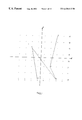
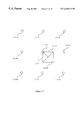
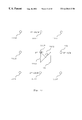
- FIG. 1 depicts, on a 64-QAM constellation, the start of a signal representing information of a 6-tuple
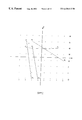
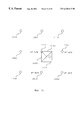
- FIG. 2 depicts, on a 64-QAM constellation, the start of four sequences, the second symbol of which is among the four closest neighbors of a received signal
- FIG. 3 depicts a simplified functional diagram of a device for coding in the form of signals representing 6-tuples of information
- FIG. 4 depicts a simplified electronic diagram of a device for coding in the form of signals representing 6-tuples of information
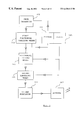
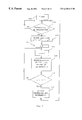
- FIG. 5 depicts a flow diagram for operation of the coding device illustrated in FIG. 4, by direct polynomial coding
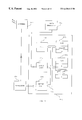
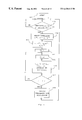
- FIG. 6 depicts a flow diagram for operation of the coding device illustrated in FIG. 4, by indirect polynomial coding
- FIG. 7 depicts a simplified functional diagram of a device for decoding signals representing 6-tuples of information
- FIG. 8 depicts a simplified electronic diagram of a device for decoding signals representing 6-tuples of information
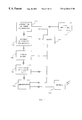
- FIG. 9 depicts a flow diagram for operation of the decoding device illustrated in FIG. 8, for the reception of information capable of being represented by a single 6-tuple,
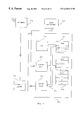
- FIG. 10 depicts a flow diagram for operation of the decoding device illustrated in FIG. 8, for the reception of information capable of being represented by three 6-tuples, and
- FIGS. 11 to 13 illustrate a variant of the operational flow diagrams given with reference to FIGS. 9 and 10, according to which the neighboring polynomials and the affinities associated with initial polynomials which they represent are determined in a particularly simple manner.
- Q is a power of a prime number, and, more preferentially, a power of 2, which makes it possible to use many well known mathematical tools.
- Each of the 64 polynomials is mapped with one of the 64-QAM signals by a labeling illustrated in FIGS. 1 and 2.
- the factor of degree 0 in B is represented by the component in phase, in such a way that:
- the factor 0 corresponds to the component ⁇ 5
- the factor 1 corresponds to the component ⁇ 3
- the factor 2 corresponds to the component ⁇ 1
- the factor 3 corresponds to the component +1
- the factor 4 corresponds to the component +3
- the factor 5 corresponds to the component +5
- the factor 6 corresponds to the component +7
- the factor 7 corresponds to the component ⁇ 7
- the factor 0 corresponds to the component ⁇ 5
- the factor 1 corresponds to the component ⁇ 3
- the factor 2 corresponds to the component ⁇ 1
- the factor 3 corresponds to the component +1
- the factor 4 corresponds to the component +3
- the factor 5 corresponds to the component +5
- the factor 6 corresponds to the component +7
- the factor 7 corresponds to the component ⁇ 7.
- this particular second labeling is one of those which make it possible to make the energies of the sequences of 12 signals, the composition of which is disclosed below, the least variable possible.
- labeling of the Q 2 pairs of numbers representing the components of the Q 2 points of a Q 2 -point quadrature amplitude modulation signal constellation, with Q 2 polynomials is chosen in such a way that, if two points of the constellation have one identical co-ordinate and the other co-ordinate as close as possible, then the polynomials labeling them will have one identical coefficient and the other coefficient differing only by 1 modulo Q, and
- a set of series is chosen, a set of which the mean square deviation of the ratio of the energy over the mean energy of all series of the said set is smaller than it is on average for the other sets of series each containing the same number of series as the said set.
- each item of information a of Z 8 (B) is then coded by the sequence (a, ag, ag 2 , . . . , ag 11 ), the multiplication used here being performed in Z 8 (B).
- Each element of this sequence is associated, by the second labeling, with an element of the 64-QAM constellation, as illustrated in FIG. 1 . Transmission of the signal associated with the sequence (a, ag, ag 2 , . . . , ag 11 ) produces a method of encoding the 6-tuple considered.
- any one of the elements of the sequence (u, ug, ug 2 , . . . , ug 11 ), also denoted (u 0 , u 1 , u 2 , . . . , u 11 ), the element u which is at its origin can be found.
- a 1 is “labeled” 0 + 5B
- B 1 is “labeled” 1 + 5B
- C 1 is “labeled” 0 + 4B
- D 1 is “labeled” 1 + 4B
- the simplest version of the decoding method consists firstly of selecting a subset V(v i ) of elements of the 64-QAM constellation which are close to v i .
- the label t i that is to say the first degree polynomial in B which is associated with each of the i elements of the subset V(v i )
- g 12-i the label of an element of the 64-QAM constellation which is likely to be at the origin of the sequence (u 0 , u 1 , . . . , u 11 ).
- the estimate of u will then be the element of Z 8 (B) whose label is most often considered as likely to be that of u, for all elements of the subsets V(v i ), i going from 0 to 11.
- V(v i ) a number of possibilities exist for specifying the subsets V(v i ) of “neighboring” polynomials of a demodulated polynomial.
- the first consists of choosing the N elements of the constellation which are closest to v i .
- a second possibility consists of defining V(v i ) as the subset of elements of the constellation whose distance to v i is less than a predetermined distance.
- a third possibility consists of combining the first two possibilities: at most N elements of the 64-QAM constellation whose distance to v i is less than a predetermined value are selected.
- the closeness information can be refined by defining an affinity which takes into account the actual distance of v i with each element of the subset V(v i ).
- the affinity of v i with u denoted aff(v i , u)
- D 2 the maximum value of the two numbers D 2 ⁇ d 2 (v i ,u) and 0, D 2 being a predetermined positive constant number.
- each function w(u) is incremented by the value of the affinity of v i with u (an increment performed during the operation 906 , FIG. 9 ).
- the decoding estimate (operation 909 , FIG. 9) will then be the element u whose final function w(u) is highest, after reception of v 11 .
- the “resultant” sequence of 12 “resultant” polynomials v (v 0 , v 1 , . . .
- the matrix G is associated with its second column (g, g 2 , g 3 ).
- the triplet (a (1) , a (2) , a (3) ) is matched, not with the matrix product, but with the sequence u of Z 8 (B) determined by recurrence in the following manner:
- This resultant sequence corresponds to a matrix product of the triplet of initial polynomials (a (1) , a (2) , a (3) ) and an invertible matrix of dimensions 3 ⁇ 3, which is not explained here, in order to produce “previous” polynomials, then by a multiplication of the result of this matrix product, consisting of the previous polynomials, by the matrix G.
- FIG. 6 refers to this “indirect” coding, by comparison with the “direct” coding illustrated in FIG. 5 .
- the method of encoding (a (1) , a (2) ) is, by recurrence, defined by:
- u i+2 (1+4 B ) u i+1 +(3+6 B ) u i (4)
- G (i,j,k) is the 3 ⁇ 3 matrix containing the columns of the matrix G with indices i, j and k:
- G ( i , j , k ) g i g j g k g 2 ⁇ ⁇ i g 2 ⁇ ⁇ j g 2 ⁇ ⁇ k g 3 ⁇ ⁇ i g 3 ⁇ ⁇ j g 3 ⁇ ⁇ k ( 5 )
- G (i,j,k) is invertible if and only if the modulo 3 remainders of i, j and k are all different.
- G (2,6,10) is invertible since the said modulo 3 remainders are 2, 0 and 1
- G (4,5,7) is not invertible since the said remainders are 1, 2 and 1.
- invertible G (i,j,k) matrices associated with the triplets (i, j, k) with i in ⁇ 0,3,6,9 ⁇ , j in ⁇ 1,4,7,10 ⁇ and k in ⁇ 2,5,8,11 ⁇ .
- the decoded estimate is then the triplet a which has the sum of the affinities, when the equation (7) produces the said triplet, for all values i, j, k, u i , u j and u k .
- the weighting w( a ) is initialized to 0 for each a of Z 8 (B).
- the affinity of a with (v i , v j , v k ) is defined as the maximum of 0 and D 2 ⁇ d 2 (v i ,u i ) ⁇ d 2 (v j ,u j ) ⁇ d 2 (v k ,u k ), D 2 being a positive number.
- G is a 2 ⁇ 12 matrix containing 48 invertible sub-matrices G(ij) corresponding to all pairs (i,j) such that g j —g j has an inverse through the multiplication operation, a condition equivalent to different modulo 3 remainders.
- the signal/noise ratio is estimated and the number of neighbors considered is reduced when the signal/noise ratio is high, in order to reduce the complexity or slowness of the method.
- an affinity is taken equal to the distance for a given subset, then to the distance of the closest point outside the subset for all elements outside the subset.
- the particular embodiment described and depicted concerns the coding of binary information capable of being represented by a number K of 6-tuples, and the transmission of quadrature amplitude modulated signals, using 64 different amplitude couples.
- the transmitted signal which corresponds to the 6-tuple of binary information then consists of the succession of 12 signals whose phase and phase quadrature amplitudes correspond to the “resultant” polynomials u i , with the matching, or second labeling, of the 64-QAM constellation with these polynomials which is illustrated in FIG. 1 :
- the factor of degree 0 in B is represented by the component in phase, in such a way that:
- the factor 0 corresponds to the component ⁇ 5
- the factor 1 corresponds to the component ⁇ 3
- the factor 2 corresponds to the component ⁇ 1
- the factor 3 corresponds to the component +1
- the factor 4 corresponds to the component +3
- the factor 5 corresponds to the component +5
- the factor 6 corresponds to the component +7
- the factor 7 corresponds to the component ⁇ 7
- the factor 0 corresponds to the component ⁇ 5
- the factor 1 corresponds to the component ⁇ 3
- the factor 2 corresponds to the component ⁇ 1
- the factor 3 corresponds to the component +1
- the factor 4 corresponds to the component +3
- the factor 5 corresponds to the component +5
- the factor 6 corresponds to the component +7
- the factor 7 corresponds to the component ⁇ 7.
- the i-th resultant polynomial of this sequence is the result of the sum of the matrix products of the first 6-tuple and g i , of the second 6-tuple and g 2i , . . . , and of the j-th 6-tuple and g ji .
- Each resultant polynomial of the resultant sequence thus formed is matched with an amplitude couple according to the second labeling disclosed above before producing a quadrature amplitude modulation signal.
- FIG. 3 depicts, in the form of a simplified functional diagram, a device for coding information in the form of signals representing 6-tuples of information.
- a data generator 301 produces sequences of a number K of 6-tuples of binary data, which may, for example, come from a storage means, from a transmission means or from a data processing means.
- a coding means 303 performs a mapping of the initial polynomial produced by the first labeling means 302 with a sequence of 12 resultant polynomials.
- a second labeling means 308 next performs a second labeling, that is to say a mapping of the sequence of resultant polynomials produced by the polynomial coding means 303 , with the sequence of 12 signal modulation phase and phase quadrature amplitude couples, according to the mapping rule disclosed above with reference to FIG. 1 .
- the data generator produces 12 ⁇ K 6-tuples less often than the coding means produces amplitude couples.
- a clock 305 which controls operation of the coding means 303 and the second labeling means 308 , is associated with a counter 304 which divides the number of pulses from the clock 305 by 12 ⁇ K and which provides the signals for synchronization of the data generator 301 and the first labeling means 302 .
- a modulator 306 of known type performs the quadrature amplitude modulation corresponding to the amplitude value couples transmitted to it by the second labeling means 308 .
- An antenna 307 broadcasts the signals coming from the modulator 306 .
- FIG. 4 depicts a simplified electronic diagram of a device for coding information in the form of signals representing 6-tuples of information.
- This coding device is illustrated in block diagram form and depicted under general reference 401 . It has, interconnected by an address and data bus 402 :
- a central processing unit 406 a central processing unit 406 ;
- a read-only memory 405 a read-only memory 405 ;
- an input port 403 used to receive the information which the coding device is to transmit
- an output port 408 allowing the device to transmit the sequence of amplitude couples mapped with the sequence of resultant polynomials; and, independently of the bus 402 :
- the modulator 306 modulating an electrical signal by quadrature amplitude modulation by assigning to two signals in phase quadrature the amplitude couples coming to it from the output port 408 ;
- the transmitting antenna 307 which transmits radio waves.
- the random access memory 404 notably has registers in which are stored variables and intermediate data necessary for the operation of the coding device:
- totranseq which contains the sequence of resultant polynomials and amplitude couples representing them according to the mapping rule explained in FIG. 1;
- a (1) , a (2) , . . . , a (K) which represent the initial polynomials which correspond to the 6-tuples of information to be coded by means of the first labeling.
- the read-only memory 405 is adapted to store the operating program of the central processing unit 406 and the polynomial g which defines the Van Der Monde matrix used and the look-up table TABCOR matching the resultant polynomials and the amplitude couples of the 64-QAM constellation.
- the central processing unit 406 is adapted to implement the flow diagrams described in FIGS. 5 and 6.
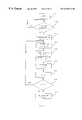
- FIG. 5 depicts a flow diagram for operation of the coding device illustrated in FIG. 4, for direct coding of the “initial” polynomials.
- a test 501 determines whether or not there is information to be transmitted. When the result of the test 501 is negative, the test 501 is reiterated.
- the operation 502 carries out a first labeling of each 6-tuple of information to be transmitted by associating this 6-tuple with an initial polynomial a (i) of Z 8 (B).
- the operation 503 next consists of initializing the value of the variable i to 0.
- the operation 504 then consists of incrementing the value of the variable i by 1.
- the operation 505 next consists of multiplying the line matrix composed of the initial polynomials a (1) , a (2) , . . . a (K) by the i-th column of the Van Der Monde matrix G described above;
- the coding means performs a polynomial calculation:
- K “coded” sequences of a number P greater than or equal to K of “coded” polynomials, the first coded polynomial of each of these K sequences being equal to one of the K initial polynomials and each of the other coded polynomials of the said sequence being equal to the product of the polynomial preceding it in the sequence and a predetermined polynomial, the coefficients of the coded polynomials being calculated modulo Q and the coded polynomial being calculated modulo an irreducible second degree polynomial, and
- the test 506 next determines whether or not the variable i has reached the value 12.
- the operation 504 is reiterated.
- the operation 507 consists of transmitting to the modulator the sequence of amplitude couples associated, according to the mapping rule explained with reference to FIG. 1 and referred to as second labeling, with the resultant polynomials, in order that the modulator performs the quadrature amplitude modulation of an electrical signal with the said amplitude couples.
- the test 601 of the flow diagram of FIG. 6 corresponds to the test 501 of the flow diagram of FIG. 5 .
- the operations 600 , 602 , 604 , 605 , and 608 of the flow diagram of FIG. 6 correspond respectively to the operations 500 , 502 , 503 , 504 and 507 of the flow diagram of FIG. 5 .
- the operation 603 consists of determining the first three resultant polynomials u 0 , u 1 and u 2 , as being respectively equal to the polynomials a (1) , a (2) and a (3) .
- the operation 606 consists of determining the following resultant polynomials according to the formula:
- the coding means here performs the polynomial calculation by using a recurrence equivalent to:
- the test 607 determines whether or not the variable i has reached the value 9.
- the coding may consist of any direct labeling (FIG. 5) or indirect labeling (FIG. 6) of the information to be transmitted.
- FIG. 2 depicts the second value of a quadrature amplitude modulated signal received by a decoding device, in the case where K is equal to 1, that is to say when only one 6-tuple has been coded.
- This second signal value corresponds to the “demodulated” polynomial 0.4+4.6 B.
- FIG. 7 depicts a simplified functional diagram of a device for decoding signals representing 6-tuples of information.
- a receiving antenna 701 receives the radio signals and transmits them to a demodulator 702 .
- the demodulator 702 produces “demodulated” polynomials representing amplitude couples of the radio signals received by the antenna 701 .
- a subset definition means 703 associates with each demodulated polynomial a set V i (u) of neighboring polynomials.
- a matrix product determination means 704 performs, for all square sub-matrices of the Van Der Monde matrix which are invertible, square sub-matrices composed of K columns referenced i, j, . . . , a matrix product of each line matrix composed of K neighboring polynomials of the demodulated polynomials respectively referenced i, j, . . . , and the inverse of the Van Der Monde sub-matrix considered.
- a storage means 705 stores each of the K initial polynomials resulting from these matrix products, assigning to them an affinity which is a function of the distance between the component couples represented by the K-tuple of demodulated polynomials and by the K-tuple of neighboring polynomials which were used to determine the said initial polynomials.
- An estimation means 706 estimates the polynomials representing the coded information as being equal to a matrix consisting of the K initial polynomials with the highest sum of affinities, once all the said invertible square sub-matrices have been used.
- the initial polynomials estimated by the estimation means 706 are transmitted to a data recipient, in order that these polynomials are processed, transmitted or stored, for example.
- FIG. 8 depicts a simplified electronic diagram of a device for decoding signals representing 6-tuples of information.
- This decoding device is illustrated in block diagram form and depicted under general reference 801 . It has, interconnected by an address and data bus 802 :
- a random access memory 804 a random access memory 804 ;
- a read-only memory 805 a read-only memory 805 ;
- an input port 803 used to receive the information which the decoding device is to process
- an output port 807 allowing the device to transmit the sequence of estimated polynomials to the data recipient 707 , and, independently of the bus 802 :
- the demodulator 702 receiving the signals coming to it from the receiving antenna 701 and transmitting amplitude couples to the input port 803 .
- the random access memory 804 notably has registers in which are stored variables and intermediate data necessary for the operation of the coding device:
- V(v) which defines neighboring polynomials for each of the demodulated polynomials.
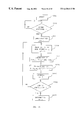
- FIG. 9 depicts a flow diagram for operation of the decoding device illustrated in FIG. 8, for the reception of information capable of being represented by a single 6-tuple and therefore also a single initial polynomial.
- the test 902 determines whether a quadrature amplitude modulated signal has been received. When the result of the test 902 is negative, the test 902 is reiterated.
- the operation 903 consists of demodulating the received signal into a “demodulated” sequence v of 12 “demodulated” polynomials associated with 12 successive amplitude couples presented by the said signal, according to the mapping rule explained with reference to FIG. 1 .
- the operation 904 consists of defining neighboring polynomials of each demodulated polynomial, for example by considering as neighboring polynomials only the four closest polynomials in the 64-QAM constellation.
- the operation 904 also consists of associating an affinity with each of the neighbors as a decreasing function of the distance between the demodulated polynomial and the said neighbor. It should be noted that the polynomials which are not considered to be neighbors thus have a zero affinity.
- the operation 906 consists of storing the polynomial u 0 , allocating to it an increment of the value of the affinity of t i with v i .
- the operation 907 consists of incrementing the value of i by 1.
- the test 908 determines whether or not the variable i has reached the value 12.
- the operation 904 is reiterated.
- the operation 909 performs the estimation of u, the polynomial representing the 6-tuple of information transmitted by the coding device, by taking the value of the polynomial u 0 which has the highest sum of affinities.
- FIG. 10 depicts a flow diagram of operation of the decoding device illustrated in FIG. 8, for the reception of information capable of being represented by three 6-tuples.
- the operations 1001 , 1002 and 1003 correspond respectively to the operations 901 , 902 and 903 of the flow diagram of FIG. 9 .
- the operation 1004 consists of taking, from the table TAB(i,j,k), the next triplet of values (i,j,k) which corresponds to column numbers of the Van Der Monde matrix G which form an invertible 3 ⁇ 3 sub-matrix.
- the operation 1005 consists of forming triplets of neighboring polynomials of the triplet of demodulated polynomials (u i , u j , u k ) and of allocating, to each of these triplets of neighboring polynomials, an affinity which is a decreasing function of the sum of the squares of the Euclidean distances of each of the points represented by a neighboring polynomial (by the second labeling) with the component pair of the corresponding demodulated polynomial.
- (u i ,u j ,u k ) is the line matrix composed of the three polynomials u i , u j and u k ;
- the operation 1007 consists of storing the triplet a of initial polynomials, assigning to it the affinity defined during the operation 1005 .
- the test 1008 determines whether all the triplets in the table TAB(i,j,k) have been used. When the result of the test 1008 is negative, the operation 1004 is reiterated. When the result of the test 1008 is positive, the operation 1009 consists of estimating the triplet of initial polynomials representing the three 6-tuples of data transmitted by the coding device as being the triplet with the highest sum of affinities.
- the K-tuples of neighboring polynomials of a K-tuple of demodulated polynomials are determined as being the N K K-tuples of polynomials of which the polynomial of each rank in the said K-tuple represents one of the N points of the constellation closest to the component pair represented by the demodulated polynomial of same rank in the K-tuple of demodulated polynomials.
- FIGS. 11 to 13 illustrate a variant of the operational flow diagrams given with reference to FIGS. 9 and 10, according to which the neighboring polynomials and the affinities associated with initial polynomials which they represent are determined in a particularly simple manner.
- conversion tables stored in read-only memory are used to allocate, to each component pair represented by a demodulated polynomial, a list of neighbors and, to each neighboring polynomial thus determined, an affinity with the said demodulated polynomial, an affinity decreasing with the distance between the component pairs represented by the demodulated and neighboring polynomials.
- This variant has the advantage of being implemented by very simple high-speed electronic circuits.
- FIG. 11 depicts a division into three areas of a square design which, by axial symmetry whose axes are the sides of the said design, makes it possible to cover the whole of the 64-QAM constellation.
- N is equal to 4.
- the 4 neighboring polynomials are determined to be the 4 polynomials of the constellation closest to the component pair represented by the demodulated polynomial, using a look-up table which maps:
- D2 may be chosen arbitrarily.
- the neighbors of a K-tuple of demodulated polynomials are determined as being those which represent a K-tuple of points of the constellation of which the distance to the K-tuple of component pairs represented by the said K-tuple of demodulated polynomials, in the constellation, is less than a threshold value
- the neighbors of a K-tuple of demodulated polynomials are determined as being those which represent a K-tuple of points of the constellation, each component of which is equal or immediately greater or less than the corresponding component of the K-tuple of component pairs represented by the K-tuple of demodulated polynomials,
- the neighbors of a K-tuple of demodulated polynomials are determined as being a predetermined number N of K-tuples of polynomials which represent the N K-tuples of points of the constellation which are closest to the K-tuple of component pairs represented by the said K-tuple of demodulated polynomials, or
- the neighbors of a K-tuple of demodulated polynomials are determined as being the N K K-tuples of polynomials of which the polynomial of each rank in the said K-tuple represents one of the N points of the constellation which are closest to the component pair represented by the demodulated polynomial of same rank in the K-tuple of demodulated polynomials.
- each K-tuple of initial polynomials is assigned the same affinity.
Landscapes
- Engineering & Computer Science (AREA)
- Physics & Mathematics (AREA)
- Probability & Statistics with Applications (AREA)
- Computer Networks & Wireless Communication (AREA)
- Signal Processing (AREA)
- Theoretical Computer Science (AREA)
- Error Detection And Correction (AREA)
- Compression, Expansion, Code Conversion, And Decoders (AREA)
- Transmission Systems Not Characterized By The Medium Used For Transmission (AREA)
- Digital Transmission Methods That Use Modulated Carrier Waves (AREA)
Applications Claiming Priority (4)
| Application Number | Priority Date | Filing Date | Title |
|---|---|---|---|
| FR9707360A FR2764750A1 (fr) | 1997-06-13 | 1997-06-13 | Dispositif et procede de codage d'informations |
| FR9707360 | 1997-06-13 | ||
| FR9707359 | 1997-06-13 | ||
| FR9707359A FR2764751A1 (fr) | 1997-06-13 | 1997-06-13 | Dispositif et procede de decodage d'informations codees |
Publications (1)
| Publication Number | Publication Date |
|---|---|
| US6438112B1 true US6438112B1 (en) | 2002-08-20 |
Family
ID=26233606
Family Applications (1)
| Application Number | Title | Priority Date | Filing Date |
|---|---|---|---|
| US09/096,516 Expired - Fee Related US6438112B1 (en) | 1997-06-13 | 1998-06-12 | Device and method for coding information and device and method for decoding coded information |
Country Status (3)
| Country | Link |
|---|---|
| US (1) | US6438112B1 (de) |
| EP (1) | EP0884879A3 (de) |
| JP (1) | JPH1198211A (de) |
Cited By (11)
| Publication number | Priority date | Publication date | Assignee | Title |
|---|---|---|---|---|
| US20020021763A1 (en) * | 2000-04-18 | 2002-02-21 | Claude Le Dantec | Encoding and decoding methods and devices and systems using them |
| US20030177430A1 (en) * | 2002-03-13 | 2003-09-18 | Canon Kabushiki Kaisha | Method of interleaving a binary sequence |
| US20040194006A1 (en) * | 2002-12-26 | 2004-09-30 | Canon Kabushiki Kaisha | Algebraic geometric code adapted to error bursts |
| US20050015704A1 (en) * | 2003-04-16 | 2005-01-20 | Canon Kabushiki Kaisha | Information coding by algebraic geometric code offering two decoding options |
| US20050138533A1 (en) * | 2003-09-29 | 2005-06-23 | Canon Kabushiki Kaisha | Encoding/decoding device using a reed-solomon encoder/decoder |
| US20050188291A1 (en) * | 2003-12-16 | 2005-08-25 | Canon Kabushiki Kaisha | Error locating methods and devices for algebraic geometric codes |
| US20050257115A1 (en) * | 2004-01-13 | 2005-11-17 | Canon Kabushiki Kaisha | Decoding for algebraic geometric code associated with a fiber product |
| US20080232510A1 (en) * | 2005-07-26 | 2008-09-25 | Matsushita Electric Industrial Co., Ltd | Bit-Operated Rearrangement Diversity for Aico Mapping |
| US20090052576A1 (en) * | 2005-05-04 | 2009-02-26 | Matsushita Electric Industrial Co., Ltd | Data transmissions in a mobile communication system employing diversity and constellation rearrangement of a 16 qam scheme |
| US20150249470A1 (en) * | 2012-10-31 | 2015-09-03 | Hewlett-Packard Development Company, L.P. | Combined block-style error correction |
| CN117851660A (zh) * | 2024-01-23 | 2024-04-09 | 广东电网有限责任公司信息中心 | 一种电网数据匿踪查询方法 |
Citations (16)
| Publication number | Priority date | Publication date | Assignee | Title |
|---|---|---|---|---|
| EP0122805A2 (de) | 1983-04-14 | 1984-10-24 | Codex Corporation | Block-codiertes Modulationssystem |
| EP0154415A1 (de) | 1984-02-06 | 1985-09-11 | Codex Corporation | Kodiertes Modulationssystem |
| EP0282298A2 (de) | 1987-03-13 | 1988-09-14 | Space Systems / Loral, Inc. | Verfahren und Einrichtung zum Kombinieren von Kodierung und Modulation |
| EP0481549A1 (de) | 1990-10-09 | 1992-04-22 | Laboratoires D'electronique Philips S.A.S. | Kodier/Dekodier-Einrichtung und Verfahren für durch kodierte Modulation übertragene, digitale Signale |
| EP0506185A1 (de) | 1991-03-29 | 1992-09-30 | Laboratoires D'electronique Philips S.A.S. | Mehrstufiger Dekodierer |
| US5168509A (en) * | 1989-04-12 | 1992-12-01 | Kabushiki Kaisha Toshiba | Quadrature amplitude modulation communication system with transparent error correction |
| EP0687074A2 (de) | 1994-06-08 | 1995-12-13 | Canon Kabushiki Kaisha | Spreizspektrumübertragungsverfahren |
| US5521943A (en) * | 1992-09-21 | 1996-05-28 | Rohde & Schwarz Gmbh & Co. K.G. | COFDM combined encoder modulation for digital broadcasting sound and video with PSK, PSK/AM, and QAM techniques |
| EP0717520A2 (de) | 1994-12-12 | 1996-06-19 | Nec Corporation | CDMA Kommunikationssystem, in dem die Fähigkeit zur Interferenzbeseitigung verbessert ist |
| EP0773628A1 (de) | 1995-11-08 | 1997-05-14 | Canon Kabushiki Kaisha | System und Verfahren zur Erkennung und Korrektur eines beliebiges Fehlers in einer Reihe von Nummern |
| US5654986A (en) * | 1994-04-30 | 1997-08-05 | Daewoo Electronics Co., Ltd | Method and apparatus for decoding trellis coded QAM signals |
| US5832041A (en) * | 1994-10-21 | 1998-11-03 | Philips Electronics North America Corporation | 64 QAM signal constellation which is robust in the presence of phase noise and has decoding complexity |
| US5996104A (en) * | 1996-09-13 | 1999-11-30 | Herzberg; Hanan | System for coding system |
| US6233712B1 (en) * | 1998-04-24 | 2001-05-15 | Lsi Logic Corporation | Apparatus and method for recovering information bits from a 64/256-quadrature amplitude modulation treliss coded modulation decoder |
| US6269129B1 (en) * | 1998-04-24 | 2001-07-31 | Lsi Logic Corporation | 64/256 quadrature amplitude modulation trellis coded modulation decoder |
| US6289000B1 (en) * | 2000-05-19 | 2001-09-11 | Intellon Corporation | Frame control encoder/decoder for robust OFDM frame transmissions |
Family Cites Families (4)
| Publication number | Priority date | Publication date | Assignee | Title |
|---|---|---|---|---|
| US5111484A (en) * | 1991-04-16 | 1992-05-05 | Raytheon Company | Adaptive distortion canceller |
| US5432821A (en) * | 1992-12-02 | 1995-07-11 | University Of Southern California | System and method for estimating data sequences in digital transmissions |
| IT1279114B1 (it) * | 1995-02-17 | 1997-12-04 | Cselt Centro Studi Lab Telecom | Procedimento per la ricezione di segnali affetti da interferenza intersimbolica e relativo dispositivo. |
| EP0813315A3 (de) * | 1996-06-13 | 1998-06-10 | Canon Kabushiki Kaisha | Spreizspektrum-QAM-Übertragung |
-
1998
- 1998-06-11 EP EP98401423A patent/EP0884879A3/de not_active Withdrawn
- 1998-06-12 US US09/096,516 patent/US6438112B1/en not_active Expired - Fee Related
- 1998-06-15 JP JP10167395A patent/JPH1198211A/ja not_active Withdrawn
Patent Citations (16)
| Publication number | Priority date | Publication date | Assignee | Title |
|---|---|---|---|---|
| EP0122805A2 (de) | 1983-04-14 | 1984-10-24 | Codex Corporation | Block-codiertes Modulationssystem |
| EP0154415A1 (de) | 1984-02-06 | 1985-09-11 | Codex Corporation | Kodiertes Modulationssystem |
| EP0282298A2 (de) | 1987-03-13 | 1988-09-14 | Space Systems / Loral, Inc. | Verfahren und Einrichtung zum Kombinieren von Kodierung und Modulation |
| US5168509A (en) * | 1989-04-12 | 1992-12-01 | Kabushiki Kaisha Toshiba | Quadrature amplitude modulation communication system with transparent error correction |
| EP0481549A1 (de) | 1990-10-09 | 1992-04-22 | Laboratoires D'electronique Philips S.A.S. | Kodier/Dekodier-Einrichtung und Verfahren für durch kodierte Modulation übertragene, digitale Signale |
| EP0506185A1 (de) | 1991-03-29 | 1992-09-30 | Laboratoires D'electronique Philips S.A.S. | Mehrstufiger Dekodierer |
| US5521943A (en) * | 1992-09-21 | 1996-05-28 | Rohde & Schwarz Gmbh & Co. K.G. | COFDM combined encoder modulation for digital broadcasting sound and video with PSK, PSK/AM, and QAM techniques |
| US5654986A (en) * | 1994-04-30 | 1997-08-05 | Daewoo Electronics Co., Ltd | Method and apparatus for decoding trellis coded QAM signals |
| EP0687074A2 (de) | 1994-06-08 | 1995-12-13 | Canon Kabushiki Kaisha | Spreizspektrumübertragungsverfahren |
| US5832041A (en) * | 1994-10-21 | 1998-11-03 | Philips Electronics North America Corporation | 64 QAM signal constellation which is robust in the presence of phase noise and has decoding complexity |
| EP0717520A2 (de) | 1994-12-12 | 1996-06-19 | Nec Corporation | CDMA Kommunikationssystem, in dem die Fähigkeit zur Interferenzbeseitigung verbessert ist |
| EP0773628A1 (de) | 1995-11-08 | 1997-05-14 | Canon Kabushiki Kaisha | System und Verfahren zur Erkennung und Korrektur eines beliebiges Fehlers in einer Reihe von Nummern |
| US5996104A (en) * | 1996-09-13 | 1999-11-30 | Herzberg; Hanan | System for coding system |
| US6233712B1 (en) * | 1998-04-24 | 2001-05-15 | Lsi Logic Corporation | Apparatus and method for recovering information bits from a 64/256-quadrature amplitude modulation treliss coded modulation decoder |
| US6269129B1 (en) * | 1998-04-24 | 2001-07-31 | Lsi Logic Corporation | 64/256 quadrature amplitude modulation trellis coded modulation decoder |
| US6289000B1 (en) * | 2000-05-19 | 2001-09-11 | Intellon Corporation | Frame control encoder/decoder for robust OFDM frame transmissions |
Cited By (21)
| Publication number | Priority date | Publication date | Assignee | Title |
|---|---|---|---|---|
| US20020021763A1 (en) * | 2000-04-18 | 2002-02-21 | Claude Le Dantec | Encoding and decoding methods and devices and systems using them |
| US6993085B2 (en) * | 2000-04-18 | 2006-01-31 | Canon Kabushiki Kaisha | Encoding and decoding methods and devices and systems using them |
| US20030177430A1 (en) * | 2002-03-13 | 2003-09-18 | Canon Kabushiki Kaisha | Method of interleaving a binary sequence |
| US7069492B2 (en) | 2002-03-13 | 2006-06-27 | Canon Kabushiki Kaisha | Method of interleaving a binary sequence |
| US20040194006A1 (en) * | 2002-12-26 | 2004-09-30 | Canon Kabushiki Kaisha | Algebraic geometric code adapted to error bursts |
| US7464323B2 (en) | 2002-12-26 | 2008-12-09 | Canon Kabushiki Kaisha | Algebraic geometric code adapted to error bursts |
| US20050015704A1 (en) * | 2003-04-16 | 2005-01-20 | Canon Kabushiki Kaisha | Information coding by algebraic geometric code offering two decoding options |
| US7634711B2 (en) | 2003-04-16 | 2009-12-15 | Canon Kabushiki Kaisha | Information coding by algebraic geometric code offering two decoding options |
| US7404134B2 (en) | 2003-09-29 | 2008-07-22 | Canon Kabushiki Kaisha | Encoding/decoding device using a reed-solomon encoder/decoder |
| US20050138533A1 (en) * | 2003-09-29 | 2005-06-23 | Canon Kabushiki Kaisha | Encoding/decoding device using a reed-solomon encoder/decoder |
| US20050188291A1 (en) * | 2003-12-16 | 2005-08-25 | Canon Kabushiki Kaisha | Error locating methods and devices for algebraic geometric codes |
| US7392454B2 (en) | 2003-12-16 | 2008-06-24 | Canon Kabushiki Kaisha | Error locating methods and devices for algebraic geometric codes |
| US7392461B2 (en) | 2004-01-13 | 2008-06-24 | Canon Kabushiki Kaisha | Decoding for algebraic geometric code associated with a fiber product |
| US20050257115A1 (en) * | 2004-01-13 | 2005-11-17 | Canon Kabushiki Kaisha | Decoding for algebraic geometric code associated with a fiber product |
| US20090052576A1 (en) * | 2005-05-04 | 2009-02-26 | Matsushita Electric Industrial Co., Ltd | Data transmissions in a mobile communication system employing diversity and constellation rearrangement of a 16 qam scheme |
| US7920645B2 (en) * | 2005-05-04 | 2011-04-05 | Panasonic Corporation | Data transmissions in a mobile communication system employing diversity and constellation rearrangement of a 16 QAM scheme |
| US8270531B2 (en) | 2005-05-04 | 2012-09-18 | Panasonic Corporation | Data transmissions in a mobile communication system employing diversity and constellation rearrangement of a 16 QAM scheme |
| US20080232510A1 (en) * | 2005-07-26 | 2008-09-25 | Matsushita Electric Industrial Co., Ltd | Bit-Operated Rearrangement Diversity for Aico Mapping |
| US7957482B2 (en) * | 2005-07-26 | 2011-06-07 | Panasonic Corporation | Bit-operated rearrangement diversity for AICO mapping |
| US20150249470A1 (en) * | 2012-10-31 | 2015-09-03 | Hewlett-Packard Development Company, L.P. | Combined block-style error correction |
| CN117851660A (zh) * | 2024-01-23 | 2024-04-09 | 广东电网有限责任公司信息中心 | 一种电网数据匿踪查询方法 |
Also Published As
| Publication number | Publication date |
|---|---|
| EP0884879A3 (de) | 1999-03-17 |
| EP0884879A2 (de) | 1998-12-16 |
| JPH1198211A (ja) | 1999-04-09 |
Similar Documents
| Publication | Publication Date | Title |
|---|---|---|
| US6549581B1 (en) | Transmitter and method to cancel interference in OFDM communication | |
| US6438112B1 (en) | Device and method for coding information and device and method for decoding coded information | |
| JP4669026B2 (ja) | 直交周波数分割多重通信方式によるデジタル信号の送信 | |
| US7697590B2 (en) | Communicating apparatus and communicating method | |
| JP6481913B2 (ja) | Polar符号生成方法および装置 | |
| US7991815B2 (en) | Methods, systems, and computer program products for parallel correlation and applications thereof | |
| EP0715421A2 (de) | Empfänger für Spreizspektrumpulspositionsmodulation mit Laufzeitstreuungskompensation | |
| US7511637B2 (en) | Spreading code derived from weil sequences | |
| US20040194006A1 (en) | Algebraic geometric code adapted to error bursts | |
| US6487258B1 (en) | Methods and apparatus for decoding data | |
| JP2001237750A (ja) | 送信ダイバシティを高める装置および方法 | |
| KR20070085629A (ko) | 비트 도메인 내의 반복 재배치에 의해 모호성을 감소시키는방법 및 송신기 구조 | |
| JP3684560B2 (ja) | データ受信装置および方法 | |
| KR101568714B1 (ko) | 광대역 무선통신 시스템에서 고속 피드백 채널을 이용한 정보 송수신 장치 및 방법 | |
| JP3596678B2 (ja) | 通信システム及び通信方法 | |
| US10826533B2 (en) | Methods, systems, and computer-readable media for decoding a cyclic code | |
| JP4136180B2 (ja) | 情報を送信する方法及び装置、情報を受信する方法及び装置、記憶媒体 | |
| US6560291B1 (en) | Device and method for transmitting information and device and method for receiving information | |
| US6999533B2 (en) | Demodulating encoded data | |
| JP6510058B2 (ja) | 非均一なqam信号の復調 | |
| WO2002098090A1 (en) | Method and apparatus for soft information generation | |
| US6421806B1 (en) | Information transfer method and device, information receiving method and device and network stations using them | |
| JP2000516072A (ja) | データの符号化および復号の方法および装置 | |
| US6084918A (en) | Data transmission method and devices | |
| RU2288547C1 (ru) | Способ сжатия и восстановления сообщений |
Legal Events
| Date | Code | Title | Description |
|---|---|---|---|
| AS | Assignment |
Owner name: CANON KABUSHIKI KAISHA, JAPAN Free format text: ASSIGNMENT OF ASSIGNORS INTEREST;ASSIGNORS:PIRET, PHILIPPE;DANTEC, CLAUDE LE;REEL/FRAME:009337/0001 Effective date: 19980702 |
|
| REMI | Maintenance fee reminder mailed | ||
| LAPS | Lapse for failure to pay maintenance fees | ||
| STCH | Information on status: patent discontinuation |
Free format text: PATENT EXPIRED DUE TO NONPAYMENT OF MAINTENANCE FEES UNDER 37 CFR 1.362 |
|
| FP | Lapsed due to failure to pay maintenance fee |
Effective date: 20060820 |