US6391807B1 - Polymer composition containing a fluorochemical oligomer - Google Patents
Polymer composition containing a fluorochemical oligomer Download PDFInfo
- Publication number
- US6391807B1 US6391807B1 US09/405,629 US40562999A US6391807B1 US 6391807 B1 US6391807 B1 US 6391807B1 US 40562999 A US40562999 A US 40562999A US 6391807 B1 US6391807 B1 US 6391807B1
- Authority
- US
- United States
- Prior art keywords
- group
- mefosea
- fluorochemical
- compounds
- oda
- Prior art date
- Legal status (The legal status is an assumption and is not a legal conclusion. Google has not performed a legal analysis and makes no representation as to the accuracy of the status listed.)
- Expired - Lifetime
Links
- 239000000203 mixture Substances 0.000 title claims abstract description 86
- 229920000642 polymer Polymers 0.000 title claims abstract description 70
- 150000001875 compounds Chemical class 0.000 claims abstract description 84
- 239000000835 fiber Substances 0.000 claims abstract description 48
- 229920001169 thermoplastic Polymers 0.000 claims abstract description 25
- 239000004416 thermosoftening plastic Substances 0.000 claims abstract description 15
- 229920001187 thermosetting polymer Polymers 0.000 claims abstract description 10
- -1 aralkylene Chemical group 0.000 claims description 60
- 125000001931 aliphatic group Chemical group 0.000 claims description 38
- 125000004432 carbon atom Chemical group C* 0.000 claims description 32
- 125000005647 linker group Chemical group 0.000 claims description 26
- 239000004743 Polypropylene Substances 0.000 claims description 23
- 229920001155 polypropylene Polymers 0.000 claims description 23
- 125000000217 alkyl group Chemical group 0.000 claims description 22
- 239000003999 initiator Substances 0.000 claims description 17
- 125000004435 hydrogen atom Chemical group [H]* 0.000 claims description 16
- 229910052731 fluorine Inorganic materials 0.000 claims description 11
- 239000011737 fluorine Substances 0.000 claims description 11
- 150000003254 radicals Chemical class 0.000 claims description 10
- 239000001257 hydrogen Substances 0.000 claims description 8
- 229910052739 hydrogen Inorganic materials 0.000 claims description 8
- 229920002635 polyurethane Polymers 0.000 claims description 8
- 239000004814 polyurethane Substances 0.000 claims description 8
- 239000003822 epoxy resin Substances 0.000 claims description 7
- 239000004744 fabric Substances 0.000 claims description 7
- 229920000647 polyepoxide Polymers 0.000 claims description 7
- 150000001252 acrylic acid derivatives Chemical class 0.000 claims description 6
- 125000006162 fluoroaliphatic group Chemical group 0.000 claims description 5
- 229920000728 polyester Polymers 0.000 claims description 5
- 229920006395 saturated elastomer Polymers 0.000 claims description 5
- 125000000732 arylene group Chemical group 0.000 claims description 4
- 125000005708 carbonyloxy group Chemical group [*:2]OC([*:1])=O 0.000 claims description 4
- 125000005518 carboxamido group Chemical group 0.000 claims description 4
- 125000004043 oxo group Chemical group O=* 0.000 claims description 4
- 125000001820 oxy group Chemical group [*:1]O[*:2] 0.000 claims description 4
- 239000004952 Polyamide Substances 0.000 claims description 3
- 229910052736 halogen Inorganic materials 0.000 claims description 3
- 150000002367 halogens Chemical group 0.000 claims description 3
- LNEPOXFFQSENCJ-UHFFFAOYSA-N haloperidol Chemical compound C1CC(O)(C=2C=CC(Cl)=CC=2)CCN1CCCC(=O)C1=CC=C(F)C=C1 LNEPOXFFQSENCJ-UHFFFAOYSA-N 0.000 claims description 3
- 239000003595 mist Substances 0.000 claims description 3
- 229920002647 polyamide Polymers 0.000 claims description 3
- 229920000098 polyolefin Polymers 0.000 claims description 3
- 150000002118 epoxides Chemical class 0.000 claims description 2
- PXGOKWXKJXAPGV-UHFFFAOYSA-N Fluorine Chemical compound FF PXGOKWXKJXAPGV-UHFFFAOYSA-N 0.000 claims 1
- XLYOFNOQVPJJNP-UHFFFAOYSA-N water Substances O XLYOFNOQVPJJNP-UHFFFAOYSA-N 0.000 abstract description 62
- KFZMGEQAYNKOFK-UHFFFAOYSA-N Isopropanol Chemical compound CC(C)O KFZMGEQAYNKOFK-UHFFFAOYSA-N 0.000 description 57
- 239000000178 monomer Substances 0.000 description 57
- IJGRMHOSHXDMSA-UHFFFAOYSA-N Atomic nitrogen Chemical compound N#N IJGRMHOSHXDMSA-UHFFFAOYSA-N 0.000 description 54
- 238000000034 method Methods 0.000 description 48
- 239000003921 oil Substances 0.000 description 47
- 238000012360 testing method Methods 0.000 description 40
- YXFVVABEGXRONW-UHFFFAOYSA-N Toluene Chemical compound CC1=CC=CC=C1 YXFVVABEGXRONW-UHFFFAOYSA-N 0.000 description 36
- 239000000243 solution Substances 0.000 description 31
- XEKOWRVHYACXOJ-UHFFFAOYSA-N Ethyl acetate Chemical compound CCOC(C)=O XEKOWRVHYACXOJ-UHFFFAOYSA-N 0.000 description 30
- 239000000654 additive Substances 0.000 description 27
- 229910052757 nitrogen Inorganic materials 0.000 description 27
- 239000012986 chain transfer agent Substances 0.000 description 25
- 238000001125 extrusion Methods 0.000 description 23
- 230000000052 comparative effect Effects 0.000 description 22
- MQIUGAXCHLFZKX-UHFFFAOYSA-N Di-n-octyl phthalate Natural products CCCCCCCCOC(=O)C1=CC=CC=C1C(=O)OCCCCCCCC MQIUGAXCHLFZKX-UHFFFAOYSA-N 0.000 description 21
- 230000000996 additive effect Effects 0.000 description 21
- BJQHLKABXJIVAM-UHFFFAOYSA-N bis(2-ethylhexyl) phthalate Chemical compound CCCCC(CC)COC(=O)C1=CC=CC=C1C(=O)OCC(CC)CCCC BJQHLKABXJIVAM-UHFFFAOYSA-N 0.000 description 21
- OKKJLVBELUTLKV-UHFFFAOYSA-N Methanol Chemical compound OC OKKJLVBELUTLKV-UHFFFAOYSA-N 0.000 description 18
- 229920001410 Microfiber Polymers 0.000 description 18
- 238000000137 annealing Methods 0.000 description 18
- 150000002148 esters Chemical class 0.000 description 18
- 239000003658 microfiber Substances 0.000 description 18
- VLKZOEOYAKHREP-UHFFFAOYSA-N n-Hexane Chemical compound CCCCCC VLKZOEOYAKHREP-UHFFFAOYSA-N 0.000 description 17
- LFQSCWFLJHTTHZ-UHFFFAOYSA-N Ethanol Chemical compound CCO LFQSCWFLJHTTHZ-UHFFFAOYSA-N 0.000 description 15
- 238000002329 infrared spectrum Methods 0.000 description 14
- 229920005604 random copolymer Polymers 0.000 description 14
- 238000010992 reflux Methods 0.000 description 13
- 239000000463 material Substances 0.000 description 12
- 238000003756 stirring Methods 0.000 description 12
- 238000005266 casting Methods 0.000 description 11
- 238000001914 filtration Methods 0.000 description 11
- YCKRFDGAMUMZLT-UHFFFAOYSA-N Fluorine atom Chemical compound [F] YCKRFDGAMUMZLT-UHFFFAOYSA-N 0.000 description 10
- AFVFQIVMOAPDHO-UHFFFAOYSA-N Methanesulfonic acid Chemical compound CS(O)(=O)=O AFVFQIVMOAPDHO-UHFFFAOYSA-N 0.000 description 10
- 238000006243 chemical reaction Methods 0.000 description 10
- 239000004750 melt-blown nonwoven Substances 0.000 description 10
- 239000002904 solvent Substances 0.000 description 10
- 239000007795 chemical reaction product Substances 0.000 description 9
- 238000010276 construction Methods 0.000 description 9
- 239000005871 repellent Substances 0.000 description 9
- OZAIFHULBGXAKX-UHFFFAOYSA-N 2,2'-azo-bis-isobutyronitrile Substances N#CC(C)(C)N=NC(C)(C)C#N OZAIFHULBGXAKX-UHFFFAOYSA-N 0.000 description 8
- 125000000524 functional group Chemical group 0.000 description 8
- 239000012299 nitrogen atmosphere Substances 0.000 description 8
- 239000012038 nucleophile Substances 0.000 description 8
- IZXIZTKNFFYFOF-UHFFFAOYSA-N 2-Oxazolidone Chemical class O=C1NCCO1 IZXIZTKNFFYFOF-UHFFFAOYSA-N 0.000 description 7
- OZAIFHULBGXAKX-VAWYXSNFSA-N AIBN Substances N#CC(C)(C)\N=N\C(C)(C)C#N OZAIFHULBGXAKX-VAWYXSNFSA-N 0.000 description 7
- 239000004698 Polyethylene Substances 0.000 description 7
- 239000002253 acid Substances 0.000 description 7
- 239000000155 melt Substances 0.000 description 7
- 229920000573 polyethylene Polymers 0.000 description 7
- 239000000843 powder Substances 0.000 description 7
- 230000002940 repellent Effects 0.000 description 7
- 229920005989 resin Polymers 0.000 description 7
- 239000011347 resin Substances 0.000 description 7
- 239000007787 solid Substances 0.000 description 7
- 0 *C(C)(*[Rf])C(C)(C)C(C)(C[Rh])C(C)(C)SC Chemical compound *C(C)(*[Rf])C(C)(C)C(C)(C[Rh])C(C)(C)SC 0.000 description 6
- NTIZESTWPVYFNL-UHFFFAOYSA-N Methyl isobutyl ketone Chemical compound CC(C)CC(C)=O NTIZESTWPVYFNL-UHFFFAOYSA-N 0.000 description 6
- UIHCLUNTQKBZGK-UHFFFAOYSA-N Methyl isobutyl ketone Natural products CCC(C)C(C)=O UIHCLUNTQKBZGK-UHFFFAOYSA-N 0.000 description 6
- 150000001412 amines Chemical class 0.000 description 6
- 239000003795 chemical substances by application Substances 0.000 description 6
- 229920001577 copolymer Polymers 0.000 description 6
- 238000010438 heat treatment Methods 0.000 description 6
- 238000006384 oligomerization reaction Methods 0.000 description 6
- 238000002360 preparation method Methods 0.000 description 6
- 150000003573 thiols Chemical class 0.000 description 6
- IMNFDUFMRHMDMM-UHFFFAOYSA-N N-Heptane Chemical compound CCCCCCC IMNFDUFMRHMDMM-UHFFFAOYSA-N 0.000 description 5
- 239000000443 aerosol Substances 0.000 description 5
- AXCZMVOFGPJBDE-UHFFFAOYSA-L calcium dihydroxide Chemical compound [OH-].[OH-].[Ca+2] AXCZMVOFGPJBDE-UHFFFAOYSA-L 0.000 description 5
- 239000000920 calcium hydroxide Substances 0.000 description 5
- 229910001861 calcium hydroxide Inorganic materials 0.000 description 5
- 125000003178 carboxy group Chemical group [H]OC(*)=O 0.000 description 5
- 125000004122 cyclic group Chemical group 0.000 description 5
- 239000012039 electrophile Substances 0.000 description 5
- 239000000706 filtrate Substances 0.000 description 5
- 150000002430 hydrocarbons Chemical class 0.000 description 5
- 229940098779 methanesulfonic acid Drugs 0.000 description 5
- 238000002156 mixing Methods 0.000 description 5
- 238000010998 test method Methods 0.000 description 5
- 238000012546 transfer Methods 0.000 description 5
- VVQNEPGJFQJSBK-UHFFFAOYSA-N Methyl methacrylate Chemical compound COC(=O)C(C)=C VVQNEPGJFQJSBK-UHFFFAOYSA-N 0.000 description 4
- 125000002947 alkylene group Chemical group 0.000 description 4
- 238000006073 displacement reaction Methods 0.000 description 4
- WNAHIZMDSQCWRP-UHFFFAOYSA-N dodecane-1-thiol Chemical compound CCCCCCCCCCCCS WNAHIZMDSQCWRP-UHFFFAOYSA-N 0.000 description 4
- DCAYPVUWAIABOU-UHFFFAOYSA-N hexadecane Chemical compound CCCCCCCCCCCCCCCC DCAYPVUWAIABOU-UHFFFAOYSA-N 0.000 description 4
- 229930195733 hydrocarbon Natural products 0.000 description 4
- 239000012948 isocyanate Substances 0.000 description 4
- 150000002513 isocyanates Chemical class 0.000 description 4
- 125000000555 isopropenyl group Chemical group [H]\C([H])=C(\*)C([H])([H])[H] 0.000 description 4
- 239000007788 liquid Substances 0.000 description 4
- LDTLDBDUBGAEDT-UHFFFAOYSA-N methyl 3-sulfanylpropanoate Chemical compound COC(=O)CCS LDTLDBDUBGAEDT-UHFFFAOYSA-N 0.000 description 4
- 239000002245 particle Substances 0.000 description 4
- 229920000139 polyethylene terephthalate Polymers 0.000 description 4
- 239000005020 polyethylene terephthalate Substances 0.000 description 4
- 229920005749 polyurethane resin Polymers 0.000 description 4
- 239000004094 surface-active agent Substances 0.000 description 4
- CWERGRDVMFNCDR-UHFFFAOYSA-N thioglycolic acid Chemical compound OC(=O)CS CWERGRDVMFNCDR-UHFFFAOYSA-N 0.000 description 4
- 125000003396 thiol group Chemical group [H]S* 0.000 description 4
- 125000002023 trifluoromethyl group Chemical group FC(F)(F)* 0.000 description 4
- DGVVWUTYPXICAM-UHFFFAOYSA-N β‐Mercaptoethanol Chemical compound OCCS DGVVWUTYPXICAM-UHFFFAOYSA-N 0.000 description 4
- SMZOUWXMTYCWNB-UHFFFAOYSA-N 2-(2-methoxy-5-methylphenyl)ethanamine Chemical compound COC1=CC=C(C)C=C1CCN SMZOUWXMTYCWNB-UHFFFAOYSA-N 0.000 description 3
- ZWEHNKRNPOVVGH-UHFFFAOYSA-N 2-Butanone Chemical compound CCC(C)=O ZWEHNKRNPOVVGH-UHFFFAOYSA-N 0.000 description 3
- NIXOWILDQLNWCW-UHFFFAOYSA-N 2-Propenoic acid Natural products OC(=O)C=C NIXOWILDQLNWCW-UHFFFAOYSA-N 0.000 description 3
- CSCPPACGZOOCGX-UHFFFAOYSA-N Acetone Chemical compound CC(C)=O CSCPPACGZOOCGX-UHFFFAOYSA-N 0.000 description 3
- UHOVQNZJYSORNB-UHFFFAOYSA-N Benzene Chemical compound C1=CC=CC=C1 UHOVQNZJYSORNB-UHFFFAOYSA-N 0.000 description 3
- 239000004215 Carbon black (E152) Substances 0.000 description 3
- RTZKZFJDLAIYFH-UHFFFAOYSA-N Diethyl ether Chemical compound CCOCC RTZKZFJDLAIYFH-UHFFFAOYSA-N 0.000 description 3
- ZMXDDKWLCZADIW-UHFFFAOYSA-N N,N-Dimethylformamide Chemical compound CN(C)C=O ZMXDDKWLCZADIW-UHFFFAOYSA-N 0.000 description 3
- 125000003158 alcohol group Chemical group 0.000 description 3
- 125000005250 alkyl acrylate group Chemical group 0.000 description 3
- QVGXLLKOCUKJST-UHFFFAOYSA-N atomic oxygen Chemical compound [O] QVGXLLKOCUKJST-UHFFFAOYSA-N 0.000 description 3
- 238000007664 blowing Methods 0.000 description 3
- 230000015556 catabolic process Effects 0.000 description 3
- 238000006482 condensation reaction Methods 0.000 description 3
- 239000000356 contaminant Substances 0.000 description 3
- 238000006731 degradation reaction Methods 0.000 description 3
- 239000000539 dimer Substances 0.000 description 3
- 150000004820 halides Chemical class 0.000 description 3
- 238000010348 incorporation Methods 0.000 description 3
- 230000001965 increasing effect Effects 0.000 description 3
- 230000000977 initiatory effect Effects 0.000 description 3
- 238000002844 melting Methods 0.000 description 3
- 230000008018 melting Effects 0.000 description 3
- 239000002480 mineral oil Substances 0.000 description 3
- 235000010446 mineral oil Nutrition 0.000 description 3
- 239000004745 nonwoven fabric Substances 0.000 description 3
- 239000001301 oxygen Substances 0.000 description 3
- 229910052760 oxygen Inorganic materials 0.000 description 3
- 239000013618 particulate matter Substances 0.000 description 3
- 125000005010 perfluoroalkyl group Chemical group 0.000 description 3
- 239000000376 reactant Substances 0.000 description 3
- 239000011541 reaction mixture Substances 0.000 description 3
- 150000003461 sulfonyl halides Chemical class 0.000 description 3
- 229920005613 synthetic organic polymer Polymers 0.000 description 3
- JOXIMZWYDAKGHI-UHFFFAOYSA-N toluene-4-sulfonic acid Chemical compound CC1=CC=C(S(O)(=O)=O)C=C1 JOXIMZWYDAKGHI-UHFFFAOYSA-N 0.000 description 3
- YXIWHUQXZSMYRE-UHFFFAOYSA-N 1,3-benzothiazole-2-thiol Chemical compound C1=CC=C2SC(S)=NC2=C1 YXIWHUQXZSMYRE-UHFFFAOYSA-N 0.000 description 2
- OXFSTTJBVAAALW-UHFFFAOYSA-N 1,3-dihydroimidazole-2-thione Chemical compound SC1=NC=CN1 OXFSTTJBVAAALW-UHFFFAOYSA-N 0.000 description 2
- PMBXCGGQNSVESQ-UHFFFAOYSA-N 1-Hexanethiol Chemical compound CCCCCCS PMBXCGGQNSVESQ-UHFFFAOYSA-N 0.000 description 2
- PMNLUUOXGOOLSP-UHFFFAOYSA-N 2-mercaptopropanoic acid Chemical compound CC(S)C(O)=O PMNLUUOXGOOLSP-UHFFFAOYSA-N 0.000 description 2
- DKIDEFUBRARXTE-UHFFFAOYSA-N 3-mercaptopropanoic acid Chemical compound OC(=O)CCS DKIDEFUBRARXTE-UHFFFAOYSA-N 0.000 description 2
- UUEWCQRISZBELL-UHFFFAOYSA-N 3-trimethoxysilylpropane-1-thiol Chemical compound CO[Si](OC)(OC)CCCS UUEWCQRISZBELL-UHFFFAOYSA-N 0.000 description 2
- NIXOWILDQLNWCW-UHFFFAOYSA-M Acrylate Chemical compound [O-]C(=O)C=C NIXOWILDQLNWCW-UHFFFAOYSA-M 0.000 description 2
- 239000004342 Benzoyl peroxide Substances 0.000 description 2
- OMPJBNCRMGITSC-UHFFFAOYSA-N Benzoylperoxide Chemical compound C=1C=CC=CC=1C(=O)OOC(=O)C1=CC=CC=C1 OMPJBNCRMGITSC-UHFFFAOYSA-N 0.000 description 2
- IAZDPXIOMUYVGZ-UHFFFAOYSA-N Dimethylsulphoxide Chemical compound CS(C)=O IAZDPXIOMUYVGZ-UHFFFAOYSA-N 0.000 description 2
- SNRUBQQJIBEYMU-UHFFFAOYSA-N Dodecane Natural products CCCCCCCCCCCC SNRUBQQJIBEYMU-UHFFFAOYSA-N 0.000 description 2
- 239000004593 Epoxy Chemical group 0.000 description 2
- JOYRKODLDBILNP-UHFFFAOYSA-N Ethyl urethane Chemical compound CCOC(N)=O JOYRKODLDBILNP-UHFFFAOYSA-N 0.000 description 2
- 229910016855 F9SO2 Inorganic materials 0.000 description 2
- 239000004594 Masterbatch (MB) Substances 0.000 description 2
- BAPJBEWLBFYGME-UHFFFAOYSA-N Methyl acrylate Chemical compound COC(=O)C=C BAPJBEWLBFYGME-UHFFFAOYSA-N 0.000 description 2
- GLUUGHFHXGJENI-UHFFFAOYSA-N Piperazine Chemical compound C1CNCCN1 GLUUGHFHXGJENI-UHFFFAOYSA-N 0.000 description 2
- XUIMIQQOPSSXEZ-UHFFFAOYSA-N Silicon Chemical compound [Si] XUIMIQQOPSSXEZ-UHFFFAOYSA-N 0.000 description 2
- PPBRXRYQALVLMV-UHFFFAOYSA-N Styrene Chemical compound C=CC1=CC=CC=C1 PPBRXRYQALVLMV-UHFFFAOYSA-N 0.000 description 2
- NINIDFKCEFEMDL-UHFFFAOYSA-N Sulfur Chemical compound [S] NINIDFKCEFEMDL-UHFFFAOYSA-N 0.000 description 2
- 241000364021 Tulsa Species 0.000 description 2
- 125000002015 acyclic group Chemical group 0.000 description 2
- 150000001266 acyl halides Chemical class 0.000 description 2
- 150000001298 alcohols Chemical class 0.000 description 2
- 150000007824 aliphatic compounds Chemical class 0.000 description 2
- 150000001338 aliphatic hydrocarbons Chemical class 0.000 description 2
- 150000001350 alkyl halides Chemical class 0.000 description 2
- XAGFODPZIPBFFR-UHFFFAOYSA-N aluminium Chemical compound [Al] XAGFODPZIPBFFR-UHFFFAOYSA-N 0.000 description 2
- 229910052782 aluminium Inorganic materials 0.000 description 2
- 150000001408 amides Chemical class 0.000 description 2
- 125000003118 aryl group Chemical group 0.000 description 2
- 235000019400 benzoyl peroxide Nutrition 0.000 description 2
- 230000015572 biosynthetic process Effects 0.000 description 2
- 210000001124 body fluid Anatomy 0.000 description 2
- 229910052799 carbon Inorganic materials 0.000 description 2
- 150000001732 carboxylic acid derivatives Chemical class 0.000 description 2
- WBLIXGSTEMXDSM-UHFFFAOYSA-N chloromethane Chemical compound Cl[CH2] WBLIXGSTEMXDSM-UHFFFAOYSA-N 0.000 description 2
- RWGFKTVRMDUZSP-UHFFFAOYSA-N cumene Chemical compound CC(C)C1=CC=CC=C1 RWGFKTVRMDUZSP-UHFFFAOYSA-N 0.000 description 2
- UFULAYFCSOUIOV-UHFFFAOYSA-N cysteamine Chemical compound NCCS UFULAYFCSOUIOV-UHFFFAOYSA-N 0.000 description 2
- 229960003067 cystine Drugs 0.000 description 2
- DIOQZVSQGTUSAI-UHFFFAOYSA-N decane Chemical compound CCCCCCCCCC DIOQZVSQGTUSAI-UHFFFAOYSA-N 0.000 description 2
- 239000008367 deionised water Substances 0.000 description 2
- 229910021641 deionized water Inorganic materials 0.000 description 2
- LSXWFXONGKSEMY-UHFFFAOYSA-N di-tert-butyl peroxide Chemical compound CC(C)(C)OOC(C)(C)C LSXWFXONGKSEMY-UHFFFAOYSA-N 0.000 description 2
- 239000012933 diacyl peroxide Substances 0.000 description 2
- WQABCVAJNWAXTE-UHFFFAOYSA-N dimercaprol Chemical compound OCC(S)CS WQABCVAJNWAXTE-UHFFFAOYSA-N 0.000 description 2
- NOPFSRXAKWQILS-UHFFFAOYSA-N docosan-1-ol Chemical compound CCCCCCCCCCCCCCCCCCCCCCO NOPFSRXAKWQILS-UHFFFAOYSA-N 0.000 description 2
- 239000000428 dust Substances 0.000 description 2
- 229910001651 emery Inorganic materials 0.000 description 2
- JBKVHLHDHHXQEQ-UHFFFAOYSA-N epsilon-caprolactam Chemical compound O=C1CCCCCN1 JBKVHLHDHHXQEQ-UHFFFAOYSA-N 0.000 description 2
- DNJIEGIFACGWOD-UHFFFAOYSA-N ethanethiol Chemical compound CCS DNJIEGIFACGWOD-UHFFFAOYSA-N 0.000 description 2
- 150000002170 ethers Chemical class 0.000 description 2
- 229940052303 ethers for general anesthesia Drugs 0.000 description 2
- 238000011156 evaluation Methods 0.000 description 2
- 239000012530 fluid Substances 0.000 description 2
- 125000001153 fluoro group Chemical group F* 0.000 description 2
- NBVXSUQYWXRMNV-UHFFFAOYSA-N fluoromethane Chemical compound FC NBVXSUQYWXRMNV-UHFFFAOYSA-N 0.000 description 2
- 239000007789 gas Substances 0.000 description 2
- 239000004519 grease Substances 0.000 description 2
- 125000005843 halogen group Chemical group 0.000 description 2
- 230000002209 hydrophobic effect Effects 0.000 description 2
- 125000002887 hydroxy group Chemical group [H]O* 0.000 description 2
- 239000000543 intermediate Substances 0.000 description 2
- 238000004519 manufacturing process Methods 0.000 description 2
- 238000010128 melt processing Methods 0.000 description 2
- 229960003151 mercaptamine Drugs 0.000 description 2
- 150000002734 metacrylic acid derivatives Chemical class 0.000 description 2
- 125000002496 methyl group Chemical group [H]C([H])([H])* 0.000 description 2
- 238000000465 moulding Methods 0.000 description 2
- QYZFTMMPKCOTAN-UHFFFAOYSA-N n-[2-(2-hydroxyethylamino)ethyl]-2-[[1-[2-(2-hydroxyethylamino)ethylamino]-2-methyl-1-oxopropan-2-yl]diazenyl]-2-methylpropanamide Chemical compound OCCNCCNC(=O)C(C)(C)N=NC(C)(C)C(=O)NCCNCCO QYZFTMMPKCOTAN-UHFFFAOYSA-N 0.000 description 2
- 230000000269 nucleophilic effect Effects 0.000 description 2
- GLDOVTGHNKAZLK-UHFFFAOYSA-N octadecan-1-ol Chemical compound CCCCCCCCCCCCCCCCCCO GLDOVTGHNKAZLK-UHFFFAOYSA-N 0.000 description 2
- TVMXDCGIABBOFY-UHFFFAOYSA-N octane Chemical compound CCCCCCCC TVMXDCGIABBOFY-UHFFFAOYSA-N 0.000 description 2
- 125000004430 oxygen atom Chemical group O* 0.000 description 2
- 238000004806 packaging method and process Methods 0.000 description 2
- 230000035515 penetration Effects 0.000 description 2
- 150000002978 peroxides Chemical class 0.000 description 2
- 125000001997 phenyl group Chemical group [H]C1=C([H])C([H])=C(*)C([H])=C1[H] 0.000 description 2
- 229920000515 polycarbonate Polymers 0.000 description 2
- 239000004417 polycarbonate Substances 0.000 description 2
- 239000000047 product Substances 0.000 description 2
- SUVIGLJNEAMWEG-UHFFFAOYSA-N propane-1-thiol Chemical compound CCCS SUVIGLJNEAMWEG-UHFFFAOYSA-N 0.000 description 2
- 238000007348 radical reaction Methods 0.000 description 2
- 238000011160 research Methods 0.000 description 2
- 238000006798 ring closing metathesis reaction Methods 0.000 description 2
- 239000000565 sealant Substances 0.000 description 2
- 239000010703 silicon Substances 0.000 description 2
- 229910052710 silicon Inorganic materials 0.000 description 2
- 125000004079 stearyl group Chemical group [H]C([*])([H])C([H])([H])C([H])([H])C([H])([H])C([H])([H])C([H])([H])C([H])([H])C([H])([H])C([H])([H])C([H])([H])C([H])([H])C([H])([H])C([H])([H])C([H])([H])C([H])([H])C([H])([H])C([H])([H])C([H])([H])[H] 0.000 description 2
- 239000000126 substance Substances 0.000 description 2
- 125000001424 substituent group Chemical group 0.000 description 2
- ACTRVOBWPAIOHC-UHFFFAOYSA-N succimer Chemical compound OC(=O)C(S)C(S)C(O)=O ACTRVOBWPAIOHC-UHFFFAOYSA-N 0.000 description 2
- 239000011593 sulfur Substances 0.000 description 2
- 229910052717 sulfur Inorganic materials 0.000 description 2
- BGHCVCJVXZWKCC-UHFFFAOYSA-N tetradecane Chemical compound CCCCCCCCCCCCCC BGHCVCJVXZWKCC-UHFFFAOYSA-N 0.000 description 2
- 239000012815 thermoplastic material Substances 0.000 description 2
- 229920005992 thermoplastic resin Polymers 0.000 description 2
- 239000004634 thermosetting polymer Substances 0.000 description 2
- NJRXVEJTAYWCQJ-UHFFFAOYSA-N thiomalic acid Chemical compound OC(=O)CC(S)C(O)=O NJRXVEJTAYWCQJ-UHFFFAOYSA-N 0.000 description 2
- 238000005303 weighing Methods 0.000 description 2
- 238000009736 wetting Methods 0.000 description 2
- CNNKPIGLYRJQRS-UHFFFAOYSA-N (1,2,2,3,3,4,4,5,5,6,6-undecafluorocyclohexyl) prop-2-enoate Chemical compound FC1(F)C(F)(F)C(F)(F)C(F)(OC(=O)C=C)C(F)(F)C1(F)F CNNKPIGLYRJQRS-UHFFFAOYSA-N 0.000 description 1
- IOCJWNPYGRVHLN-MMALYQPHSA-N (2r)-2-amino-3-[[(2r)-2-amino-2-carboxyethyl]disulfanyl]propanoic acid;hydrochloride Chemical compound Cl.OC(=O)[C@@H](N)CSSC[C@H](N)C(O)=O IOCJWNPYGRVHLN-MMALYQPHSA-N 0.000 description 1
- CFQZKFWQLAHGSL-FNTYJUCDSA-N (3e,5e,7e,9e,11e,13e,15e,17e)-18-[(3e,5e,7e,9e,11e,13e,15e,17e)-18-[(3e,5e,7e,9e,11e,13e,15e)-octadeca-3,5,7,9,11,13,15,17-octaenoyl]oxyoctadeca-3,5,7,9,11,13,15,17-octaenoyl]oxyoctadeca-3,5,7,9,11,13,15,17-octaenoic acid Chemical compound OC(=O)C\C=C\C=C\C=C\C=C\C=C\C=C\C=C\C=C\OC(=O)C\C=C\C=C\C=C\C=C\C=C\C=C\C=C\C=C\OC(=O)C\C=C\C=C\C=C\C=C\C=C\C=C\C=C\C=C CFQZKFWQLAHGSL-FNTYJUCDSA-N 0.000 description 1
- WRIDQFICGBMAFQ-UHFFFAOYSA-N (E)-8-Octadecenoic acid Natural products CCCCCCCCCC=CCCCCCCC(O)=O WRIDQFICGBMAFQ-UHFFFAOYSA-N 0.000 description 1
- DNIAPMSPPWPWGF-GSVOUGTGSA-N (R)-(-)-Propylene glycol Chemical compound C[C@@H](O)CO DNIAPMSPPWPWGF-GSVOUGTGSA-N 0.000 description 1
- GETTZEONDQJALK-UHFFFAOYSA-N (trifluoromethyl)benzene Chemical compound FC(F)(F)C1=CC=CC=C1 GETTZEONDQJALK-UHFFFAOYSA-N 0.000 description 1
- OKIYQFLILPKULA-UHFFFAOYSA-N 1,1,1,2,2,3,3,4,4-nonafluoro-4-methoxybutane Chemical compound COC(F)(F)C(F)(F)C(F)(F)C(F)(F)F OKIYQFLILPKULA-UHFFFAOYSA-N 0.000 description 1
- UOCLXMDMGBRAIB-UHFFFAOYSA-N 1,1,1-trichloroethane Chemical compound CC(Cl)(Cl)Cl UOCLXMDMGBRAIB-UHFFFAOYSA-N 0.000 description 1
- VYMPLPIFKRHAAC-UHFFFAOYSA-N 1,2-ethanedithiol Chemical compound SCCS VYMPLPIFKRHAAC-UHFFFAOYSA-N 0.000 description 1
- BIGYLAKFCGVRAN-UHFFFAOYSA-N 1,3,4-thiadiazolidine-2,5-dithione Chemical compound S=C1NNC(=S)S1 BIGYLAKFCGVRAN-UHFFFAOYSA-N 0.000 description 1
- YHMYGUUIMTVXNW-UHFFFAOYSA-N 1,3-dihydrobenzimidazole-2-thione Chemical compound C1=CC=C2NC(S)=NC2=C1 YHMYGUUIMTVXNW-UHFFFAOYSA-N 0.000 description 1
- DMYOHQBLOZMDLP-UHFFFAOYSA-N 1-[2-(2-hydroxy-3-piperidin-1-ylpropoxy)phenyl]-3-phenylpropan-1-one Chemical compound C1CCCCN1CC(O)COC1=CC=CC=C1C(=O)CCC1=CC=CC=C1 DMYOHQBLOZMDLP-UHFFFAOYSA-N 0.000 description 1
- JMRYQWRIEDFUQL-UHFFFAOYSA-N 1-chloro-3-(2-sulfanylethoxy)propan-2-ol Chemical compound ClCC(O)COCCS JMRYQWRIEDFUQL-UHFFFAOYSA-N 0.000 description 1
- QWDQYHPOSSHSAW-UHFFFAOYSA-N 1-isocyanatooctadecane Chemical compound CCCCCCCCCCCCCCCCCCN=C=O QWDQYHPOSSHSAW-UHFFFAOYSA-N 0.000 description 1
- FETFXNFGOYOOSP-UHFFFAOYSA-N 1-sulfanylpropan-2-ol Chemical compound CC(O)CS FETFXNFGOYOOSP-UHFFFAOYSA-N 0.000 description 1
- ULGGZAVAARQJCS-UHFFFAOYSA-N 11-sulfanylundecan-1-ol Chemical compound OCCCCCCCCCCCS ULGGZAVAARQJCS-UHFFFAOYSA-N 0.000 description 1
- SDAWVOFJSUUKMR-UHFFFAOYSA-N 12-sulfanyldodecanoic acid Chemical compound OC(=O)CCCCCCCCCCCS SDAWVOFJSUUKMR-UHFFFAOYSA-N 0.000 description 1
- 238000001644 13C nuclear magnetic resonance spectroscopy Methods 0.000 description 1
- 238000005160 1H NMR spectroscopy Methods 0.000 description 1
- YSQGYEYXKXGAQA-UHFFFAOYSA-N 2,2,3,3,4,4,5,5,6,6,7,7,8,8,8-pentadecafluorooctyl prop-2-enoate Chemical compound FC(F)(F)C(F)(F)C(F)(F)C(F)(F)C(F)(F)C(F)(F)C(F)(F)COC(=O)C=C YSQGYEYXKXGAQA-UHFFFAOYSA-N 0.000 description 1
- YAJYJWXEWKRTPO-UHFFFAOYSA-N 2,3,3,4,4,5-hexamethylhexane-2-thiol Chemical compound CC(C)C(C)(C)C(C)(C)C(C)(C)S YAJYJWXEWKRTPO-UHFFFAOYSA-N 0.000 description 1
- XMNIXWIUMCBBBL-UHFFFAOYSA-N 2-(2-phenylpropan-2-ylperoxy)propan-2-ylbenzene Chemical compound C=1C=CC=CC=1C(C)(C)OOC(C)(C)C1=CC=CC=C1 XMNIXWIUMCBBBL-UHFFFAOYSA-N 0.000 description 1
- CNDCQWGRLNGNNO-UHFFFAOYSA-N 2-(2-sulfanylethoxy)ethanethiol Chemical compound SCCOCCS CNDCQWGRLNGNNO-UHFFFAOYSA-N 0.000 description 1
- KSJBMDCFYZKAFH-UHFFFAOYSA-N 2-(2-sulfanylethylsulfanyl)ethanethiol Chemical compound SCCSCCS KSJBMDCFYZKAFH-UHFFFAOYSA-N 0.000 description 1
- GOXQRTZXKQZDDN-UHFFFAOYSA-N 2-Ethylhexyl acrylate Chemical compound CCCCC(CC)COC(=O)C=C GOXQRTZXKQZDDN-UHFFFAOYSA-N 0.000 description 1
- LXUNZSDDXMPKLP-UHFFFAOYSA-N 2-Methylbenzenethiol Chemical compound CC1=CC=CC=C1S LXUNZSDDXMPKLP-UHFFFAOYSA-N 0.000 description 1
- VUDVPVOIALASLB-UHFFFAOYSA-N 2-[(2-cyano-1-hydroxypropan-2-yl)diazenyl]-3-hydroxy-2-methylpropanenitrile Chemical compound OCC(C)(C#N)N=NC(C)(CO)C#N VUDVPVOIALASLB-UHFFFAOYSA-N 0.000 description 1
- RTJZWOGSCLVJLD-UHFFFAOYSA-N 2-[1,1,2,2,3,3,4,4,5,5,6,6,7,7,8,8,8-heptadecafluorooctylsulfonyl(methyl)amino]ethyl prop-2-enoate Chemical compound C=CC(=O)OCCN(C)S(=O)(=O)C(F)(F)C(F)(F)C(F)(F)C(F)(F)C(F)(F)C(F)(F)C(F)(F)C(F)(F)F RTJZWOGSCLVJLD-UHFFFAOYSA-N 0.000 description 1
- DKESBEUCKHTHLQ-UHFFFAOYSA-N 2-[[1-amino-1-(2-hydroxyethylimino)-2-methylpropan-2-yl]diazenyl]-n'-(2-hydroxyethyl)-2-methylpropanimidamide;dihydrochloride Chemical compound Cl.Cl.OCCNC(=N)C(C)(C)N=NC(C)(C)C(=N)NCCO DKESBEUCKHTHLQ-UHFFFAOYSA-N 0.000 description 1
- BMROYLZOZRHCAI-UHFFFAOYSA-N 2-[[1-amino-1-(4-chlorophenyl)imino-2-methylpropan-2-yl]diazenyl]-n'-(4-chlorophenyl)-2-methylpropanimidamide;dihydrochloride Chemical compound Cl.Cl.C=1C=C(Cl)C=CC=1NC(=N)C(C)(C)N=NC(C)(C)C(=N)NC1=CC=C(Cl)C=C1 BMROYLZOZRHCAI-UHFFFAOYSA-N 0.000 description 1
- ITHKUADHDKZENI-UHFFFAOYSA-N 2-chloroethanethiol Chemical compound SCCCl ITHKUADHDKZENI-UHFFFAOYSA-N 0.000 description 1
- QKACLVHIJAYRIA-UHFFFAOYSA-N 2-ethylcyclohexane-1,1-dithiol Chemical compound CCC1CCCCC1(S)S QKACLVHIJAYRIA-UHFFFAOYSA-N 0.000 description 1
- XRXANEMIFVRKLN-UHFFFAOYSA-N 2-hydroperoxy-2-methylbutane Chemical compound CCC(C)(C)OO XRXANEMIFVRKLN-UHFFFAOYSA-N 0.000 description 1
- 125000000954 2-hydroxyethyl group Chemical group [H]C([*])([H])C([H])([H])O[H] 0.000 description 1
- FLFWJIBUZQARMD-UHFFFAOYSA-N 2-mercapto-1,3-benzoxazole Chemical compound C1=CC=C2OC(S)=NC2=C1 FLFWJIBUZQARMD-UHFFFAOYSA-N 0.000 description 1
- SUNXFMPZAFGPFW-UHFFFAOYSA-N 2-methyl-5-(1-sulfanylpropan-2-yl)cyclohexane-1-thiol Chemical compound SCC(C)C1CCC(C)C(S)C1 SUNXFMPZAFGPFW-UHFFFAOYSA-N 0.000 description 1
- 125000003903 2-propenyl group Chemical group [H]C([*])([H])C([H])=C([H])[H] 0.000 description 1
- ZFWQEIWNUCOFKH-UHFFFAOYSA-N 2-sulfanyl-1h-pyridin-2-ol Chemical compound OC1(S)NC=CC=C1 ZFWQEIWNUCOFKH-UHFFFAOYSA-N 0.000 description 1
- WYKHFQKONWMWQM-UHFFFAOYSA-N 2-sulfanylidene-1h-pyridine-3-carboxylic acid Chemical compound OC(=O)C1=CC=CN=C1S WYKHFQKONWMWQM-UHFFFAOYSA-N 0.000 description 1
- LQJBNNIYVWPHFW-UHFFFAOYSA-N 20:1omega9c fatty acid Natural products CCCCCCCCCCC=CCCCCCCCC(O)=O LQJBNNIYVWPHFW-UHFFFAOYSA-N 0.000 description 1
- MJQWABQELVFQJL-UHFFFAOYSA-N 3-Mercapto-2-butanol Chemical compound CC(O)C(C)S MJQWABQELVFQJL-UHFFFAOYSA-N 0.000 description 1
- OBDVFOBWBHMJDG-UHFFFAOYSA-N 3-mercapto-1-propanesulfonic acid Chemical compound OS(=O)(=O)CCCS OBDVFOBWBHMJDG-UHFFFAOYSA-N 0.000 description 1
- WRXOZRLZDJAYDR-UHFFFAOYSA-N 3-methylbenzenethiol Chemical compound CC1=CC=CC(S)=C1 WRXOZRLZDJAYDR-UHFFFAOYSA-N 0.000 description 1
- ZVYGIPWYVVJFRW-UHFFFAOYSA-N 3-methylbutyl prop-2-enoate Chemical compound CC(C)CCOC(=O)C=C ZVYGIPWYVVJFRW-UHFFFAOYSA-N 0.000 description 1
- NIAAGQAEVGMHPM-UHFFFAOYSA-N 4-methylbenzene-1,2-dithiol Chemical compound CC1=CC=C(S)C(S)=C1 NIAAGQAEVGMHPM-UHFFFAOYSA-N 0.000 description 1
- WLHCBQAPPJAULW-UHFFFAOYSA-N 4-methylbenzenethiol Chemical compound CC1=CC=C(S)C=C1 WLHCBQAPPJAULW-UHFFFAOYSA-N 0.000 description 1
- NEJMTSWXTZREOC-UHFFFAOYSA-N 4-sulfanylbutan-1-ol Chemical compound OCCCCS NEJMTSWXTZREOC-UHFFFAOYSA-N 0.000 description 1
- DXPPIEDUBFUSEZ-UHFFFAOYSA-N 6-methylheptyl prop-2-enoate Chemical compound CC(C)CCCCCOC(=O)C=C DXPPIEDUBFUSEZ-UHFFFAOYSA-N 0.000 description 1
- RVOKNSFEAOYULQ-UHFFFAOYSA-N 8-Mercapto-p-menthan-3-one Chemical compound CC1CCC(C(C)(C)S)C(=O)C1 RVOKNSFEAOYULQ-UHFFFAOYSA-N 0.000 description 1
- QSBYPNXLFMSGKH-UHFFFAOYSA-N 9-Heptadecensaeure Natural products CCCCCCCC=CCCCCCCCC(O)=O QSBYPNXLFMSGKH-UHFFFAOYSA-N 0.000 description 1
- HRPVXLWXLXDGHG-UHFFFAOYSA-N Acrylamide Chemical compound NC(=O)C=C HRPVXLWXLXDGHG-UHFFFAOYSA-N 0.000 description 1
- NLHHRLWOUZZQLW-UHFFFAOYSA-N Acrylonitrile Chemical compound C=CC#N NLHHRLWOUZZQLW-UHFFFAOYSA-N 0.000 description 1
- 238000012935 Averaging Methods 0.000 description 1
- DKPFZGUDAPQIHT-UHFFFAOYSA-N Butyl acetate Natural products CCCCOC(C)=O DKPFZGUDAPQIHT-UHFFFAOYSA-N 0.000 description 1
- OKTJSMMVPCPJKN-UHFFFAOYSA-N Carbon Chemical compound [C] OKTJSMMVPCPJKN-UHFFFAOYSA-N 0.000 description 1
- XDTMQSROBMDMFD-UHFFFAOYSA-N Cyclohexane Chemical compound C1CCCCC1 XDTMQSROBMDMFD-UHFFFAOYSA-N 0.000 description 1
- XUJNEKJLAYXESH-UHFFFAOYSA-N Cysteine Chemical compound SCC(N)C(O)=O XUJNEKJLAYXESH-UHFFFAOYSA-N 0.000 description 1
- LEVWYRKDKASIDU-QWWZWVQMSA-N D-cystine Chemical compound OC(=O)[C@H](N)CSSC[C@@H](N)C(O)=O LEVWYRKDKASIDU-QWWZWVQMSA-N 0.000 description 1
- ZAFNJMIOTHYJRJ-UHFFFAOYSA-N Diisopropyl ether Chemical compound CC(C)OC(C)C ZAFNJMIOTHYJRJ-UHFFFAOYSA-N 0.000 description 1
- XTHFKEDIFFGKHM-UHFFFAOYSA-N Dimethoxyethane Chemical compound COCCOC XTHFKEDIFFGKHM-UHFFFAOYSA-N 0.000 description 1
- JIGUQPWFLRLWPJ-UHFFFAOYSA-N Ethyl acrylate Chemical compound CCOC(=O)C=C JIGUQPWFLRLWPJ-UHFFFAOYSA-N 0.000 description 1
- WSFSSNUMVMOOMR-UHFFFAOYSA-N Formaldehyde Chemical compound O=C WSFSSNUMVMOOMR-UHFFFAOYSA-N 0.000 description 1
- 239000005057 Hexamethylene diisocyanate Substances 0.000 description 1
- RFAXLXKIAKIUDT-UHFFFAOYSA-N IPA-3 Chemical compound C1=CC=C2C(SSC3=C4C=CC=CC4=CC=C3O)=C(O)C=CC2=C1 RFAXLXKIAKIUDT-UHFFFAOYSA-N 0.000 description 1
- YIVJZNGAASQVEM-UHFFFAOYSA-N Lauroyl peroxide Chemical compound CCCCCCCCCCCC(=O)OOC(=O)CCCCCCCCCCC YIVJZNGAASQVEM-UHFFFAOYSA-N 0.000 description 1
- CERQOIWHTDAKMF-UHFFFAOYSA-N Methacrylic acid Chemical compound CC(=C)C(O)=O CERQOIWHTDAKMF-UHFFFAOYSA-N 0.000 description 1
- GYCMBHHDWRMZGG-UHFFFAOYSA-N Methylacrylonitrile Chemical compound CC(=C)C#N GYCMBHHDWRMZGG-UHFFFAOYSA-N 0.000 description 1
- KYIKRXIYLAGAKQ-ISLYRVAYSA-N N#CC1(/N=N/C2(C#N)CCCCC2)CCCCC1 Chemical compound N#CC1(/N=N/C2(C#N)CCCCC2)CCCCC1 KYIKRXIYLAGAKQ-ISLYRVAYSA-N 0.000 description 1
- FXHOOIRPVKKKFG-UHFFFAOYSA-N N,N-Dimethylacetamide Chemical compound CN(C)C(C)=O FXHOOIRPVKKKFG-UHFFFAOYSA-N 0.000 description 1
- WHNWPMSKXPGLAX-UHFFFAOYSA-N N-Vinyl-2-pyrrolidone Chemical compound C=CN1CCCC1=O WHNWPMSKXPGLAX-UHFFFAOYSA-N 0.000 description 1
- 229920002292 Nylon 6 Polymers 0.000 description 1
- 229920002302 Nylon 6,6 Polymers 0.000 description 1
- CTQNGGLPUBDAKN-UHFFFAOYSA-N O-Xylene Chemical compound CC1=CC=CC=C1C CTQNGGLPUBDAKN-UHFFFAOYSA-N 0.000 description 1
- ZQPPMHVWECSIRJ-UHFFFAOYSA-N Oleic acid Natural products CCCCCCCCC=CCCCCCCCC(O)=O ZQPPMHVWECSIRJ-UHFFFAOYSA-N 0.000 description 1
- 239000005642 Oleic acid Substances 0.000 description 1
- 239000004793 Polystyrene Substances 0.000 description 1
- 229920001079 Thiokol (polymer) Polymers 0.000 description 1
- YTGJWQPHMWSCST-UHFFFAOYSA-N Tiopronin Chemical compound CC(S)C(=O)NCC(O)=O YTGJWQPHMWSCST-UHFFFAOYSA-N 0.000 description 1
- XSTXAVWGXDQKEL-UHFFFAOYSA-N Trichloroethylene Chemical group ClC=C(Cl)Cl XSTXAVWGXDQKEL-UHFFFAOYSA-N 0.000 description 1
- XTXRWKRVRITETP-UHFFFAOYSA-N Vinyl acetate Chemical compound CC(=O)OC=C XTXRWKRVRITETP-UHFFFAOYSA-N 0.000 description 1
- QYKIQEUNHZKYBP-UHFFFAOYSA-N Vinyl ether Chemical class C=COC=C QYKIQEUNHZKYBP-UHFFFAOYSA-N 0.000 description 1
- 125000002252 acyl group Chemical group 0.000 description 1
- 239000000853 adhesive Substances 0.000 description 1
- 230000001070 adhesive effect Effects 0.000 description 1
- 230000032683 aging Effects 0.000 description 1
- 238000004378 air conditioning Methods 0.000 description 1
- 150000001335 aliphatic alkanes Chemical class 0.000 description 1
- 150000001336 alkenes Chemical class 0.000 description 1
- 150000004703 alkoxides Chemical class 0.000 description 1
- 125000005907 alkyl ester group Chemical class 0.000 description 1
- 150000001356 alkyl thiols Chemical class 0.000 description 1
- 150000001414 amino alcohols Chemical class 0.000 description 1
- 230000003373 anti-fouling effect Effects 0.000 description 1
- 239000002216 antistatic agent Substances 0.000 description 1
- 239000003849 aromatic solvent Substances 0.000 description 1
- 125000004069 aziridinyl group Chemical group 0.000 description 1
- 125000002511 behenyl group Chemical group [H]C([*])([H])C([H])([H])C([H])([H])C([H])([H])C([H])([H])C([H])([H])C([H])([H])C([H])([H])C([H])([H])C([H])([H])C([H])([H])C([H])([H])C([H])([H])C([H])([H])C([H])([H])C([H])([H])C([H])([H])C([H])([H])C([H])([H])C([H])([H])C([H])([H])C([H])([H])[H] 0.000 description 1
- 125000001231 benzoyloxy group Chemical group C(C1=CC=CC=C1)(=O)O* 0.000 description 1
- 125000001246 bromo group Chemical group Br* 0.000 description 1
- RNOOHTVUSNIPCJ-UHFFFAOYSA-N butan-2-yl prop-2-enoate Chemical compound CCC(C)OC(=O)C=C RNOOHTVUSNIPCJ-UHFFFAOYSA-N 0.000 description 1
- WQAQPCDUOCURKW-UHFFFAOYSA-N butanethiol Chemical compound CCCCS WQAQPCDUOCURKW-UHFFFAOYSA-N 0.000 description 1
- 125000000484 butyl group Chemical group [H]C([*])([H])C([H])([H])C([H])([H])C([H])([H])[H] 0.000 description 1
- 239000003054 catalyst Substances 0.000 description 1
- 239000003153 chemical reaction reagent Substances 0.000 description 1
- 125000001309 chloro group Chemical group Cl* 0.000 description 1
- 235000019504 cigarettes Nutrition 0.000 description 1
- 238000002485 combustion reaction Methods 0.000 description 1
- 229920000891 common polymer Polymers 0.000 description 1
- 239000012141 concentrate Substances 0.000 description 1
- 239000000470 constituent Substances 0.000 description 1
- 238000007796 conventional method Methods 0.000 description 1
- 238000007334 copolymerization reaction Methods 0.000 description 1
- XLJMAIOERFSOGZ-UHFFFAOYSA-M cyanate Chemical compound [O-]C#N XLJMAIOERFSOGZ-UHFFFAOYSA-M 0.000 description 1
- 238000000354 decomposition reaction Methods 0.000 description 1
- FWLDHHJLVGRRHD-UHFFFAOYSA-N decyl prop-2-enoate Chemical compound CCCCCCCCCCOC(=O)C=C FWLDHHJLVGRRHD-UHFFFAOYSA-N 0.000 description 1
- 230000001627 detrimental effect Effects 0.000 description 1
- 150000004985 diamines Chemical class 0.000 description 1
- 150000001991 dicarboxylic acids Chemical class 0.000 description 1
- 150000005690 diesters Chemical class 0.000 description 1
- 229960004132 diethyl ether Drugs 0.000 description 1
- SBZXBUIDTXKZTM-UHFFFAOYSA-N diglyme Chemical compound COCCOCCOC SBZXBUIDTXKZTM-UHFFFAOYSA-N 0.000 description 1
- 238000009826 distribution Methods 0.000 description 1
- 229960000735 docosanol Drugs 0.000 description 1
- 125000003438 dodecyl group Chemical group [H]C([H])([H])C([H])([H])C([H])([H])C([H])([H])C([H])([H])C([H])([H])C([H])([H])C([H])([H])C([H])([H])C([H])([H])C([H])([H])C([H])([H])* 0.000 description 1
- 230000000694 effects Effects 0.000 description 1
- 238000004049 embossing Methods 0.000 description 1
- 239000000839 emulsion Substances 0.000 description 1
- 230000002708 enhancing effect Effects 0.000 description 1
- 230000007613 environmental effect Effects 0.000 description 1
- 229920006332 epoxy adhesive Polymers 0.000 description 1
- 230000032050 esterification Effects 0.000 description 1
- 238000005886 esterification reaction Methods 0.000 description 1
- 125000001495 ethyl group Chemical group [H]C([H])([H])C([H])([H])* 0.000 description 1
- 230000001747 exhibiting effect Effects 0.000 description 1
- 239000002657 fibrous material Substances 0.000 description 1
- 239000010408 film Substances 0.000 description 1
- ZYMKZMDQUPCXRP-UHFFFAOYSA-N fluoro prop-2-enoate Chemical compound FOC(=O)C=C ZYMKZMDQUPCXRP-UHFFFAOYSA-N 0.000 description 1
- 125000003709 fluoroalkyl group Chemical group 0.000 description 1
- 239000003517 fume Substances 0.000 description 1
- 238000004817 gas chromatography Methods 0.000 description 1
- 229920000578 graft copolymer Polymers 0.000 description 1
- 125000005067 haloformyl group Chemical group 0.000 description 1
- YCOZIPAWZNQLMR-UHFFFAOYSA-N heptane - octane Natural products CCCCCCCCCCCCCCC YCOZIPAWZNQLMR-UHFFFAOYSA-N 0.000 description 1
- SCFQUKBBGYTJNC-UHFFFAOYSA-N heptyl prop-2-enoate Chemical compound CCCCCCCOC(=O)C=C SCFQUKBBGYTJNC-UHFFFAOYSA-N 0.000 description 1
- 125000005842 heteroatom Chemical group 0.000 description 1
- PGFXOWRDDHCDTE-UHFFFAOYSA-N hexafluoropropylene oxide Chemical compound FC(F)(F)C1(F)OC1(F)F PGFXOWRDDHCDTE-UHFFFAOYSA-N 0.000 description 1
- RRAMGCGOFNQTLD-UHFFFAOYSA-N hexamethylene diisocyanate Chemical compound O=C=NCCCCCCN=C=O RRAMGCGOFNQTLD-UHFFFAOYSA-N 0.000 description 1
- FUZZWVXGSFPDMH-UHFFFAOYSA-N hexanoic acid Chemical compound CCCCCC(O)=O FUZZWVXGSFPDMH-UHFFFAOYSA-N 0.000 description 1
- LNMQRPPRQDGUDR-UHFFFAOYSA-N hexyl prop-2-enoate Chemical compound CCCCCCOC(=O)C=C LNMQRPPRQDGUDR-UHFFFAOYSA-N 0.000 description 1
- 239000008240 homogeneous mixture Substances 0.000 description 1
- 238000006897 homolysis reaction Methods 0.000 description 1
- 150000002432 hydroperoxides Chemical class 0.000 description 1
- 239000012535 impurity Substances 0.000 description 1
- 238000001746 injection moulding Methods 0.000 description 1
- 150000002500 ions Chemical class 0.000 description 1
- 125000000959 isobutyl group Chemical group [H]C([H])([H])C([H])(C([H])([H])[H])C([H])([H])* 0.000 description 1
- QXJSBBXBKPUZAA-UHFFFAOYSA-N isooleic acid Natural products CCCCCCCC=CCCCCCCCCC(O)=O QXJSBBXBKPUZAA-UHFFFAOYSA-N 0.000 description 1
- 125000001449 isopropyl group Chemical group [H]C([H])([H])C([H])(*)C([H])([H])[H] 0.000 description 1
- 150000002576 ketones Chemical class 0.000 description 1
- PBOSTUDLECTMNL-UHFFFAOYSA-N lauryl acrylate Chemical compound CCCCCCCCCCCCOC(=O)C=C PBOSTUDLECTMNL-UHFFFAOYSA-N 0.000 description 1
- 230000007774 longterm Effects 0.000 description 1
- FQPSGWSUVKBHSU-UHFFFAOYSA-N methacrylamide Chemical compound CC(=C)C(N)=O FQPSGWSUVKBHSU-UHFFFAOYSA-N 0.000 description 1
- RBQRWNWVPQDTJJ-UHFFFAOYSA-N methacryloyloxyethyl isocyanate Chemical compound CC(=C)C(=O)OCCN=C=O RBQRWNWVPQDTJJ-UHFFFAOYSA-N 0.000 description 1
- PJUIMOJAAPLTRJ-UHFFFAOYSA-N monothioglycerol Chemical compound OCC(O)CS PJUIMOJAAPLTRJ-UHFFFAOYSA-N 0.000 description 1
- VXRNYQMFDGOGSI-UHFFFAOYSA-N n-(1,3-dihydroxy-2-methylpropan-2-yl)-2-[[1-[(1,3-dihydroxy-2-methylpropan-2-yl)amino]-2-methyl-1-oxopropan-2-yl]diazenyl]-2-methylpropanamide Chemical compound OCC(C)(CO)NC(=O)C(C)(C)N=NC(C)(C)C(=O)NC(C)(CO)CO VXRNYQMFDGOGSI-UHFFFAOYSA-N 0.000 description 1
- WVFLGSMUPMVNTQ-UHFFFAOYSA-N n-(2-hydroxyethyl)-2-[[1-(2-hydroxyethylamino)-2-methyl-1-oxopropan-2-yl]diazenyl]-2-methylpropanamide Chemical compound OCCNC(=O)C(C)(C)N=NC(C)(C)C(=O)NCCO WVFLGSMUPMVNTQ-UHFFFAOYSA-N 0.000 description 1
- BUGISVZCMXHOHO-UHFFFAOYSA-N n-[1,3-dihydroxy-2-(hydroxymethyl)propan-2-yl]-2-[[1-[[1,3-dihydroxy-2-(hydroxymethyl)propan-2-yl]amino]-2-methyl-1-oxopropan-2-yl]diazenyl]-2-methylpropanamide Chemical compound OCC(CO)(CO)NC(=O)C(C)(C)N=NC(C)(C)C(=O)NC(CO)(CO)CO BUGISVZCMXHOHO-UHFFFAOYSA-N 0.000 description 1
- 229940094933 n-dodecane Drugs 0.000 description 1
- GOQYKNQRPGWPLP-UHFFFAOYSA-N n-heptadecyl alcohol Natural products CCCCCCCCCCCCCCCCCO GOQYKNQRPGWPLP-UHFFFAOYSA-N 0.000 description 1
- MDYPDLBFDATSCF-UHFFFAOYSA-N nonyl prop-2-enoate Chemical compound CCCCCCCCCOC(=O)C=C MDYPDLBFDATSCF-UHFFFAOYSA-N 0.000 description 1
- QJAOYSPHSNGHNC-UHFFFAOYSA-N octadecane-1-thiol Chemical compound CCCCCCCCCCCCCCCCCCS QJAOYSPHSNGHNC-UHFFFAOYSA-N 0.000 description 1
- KZCOBXFFBQJQHH-UHFFFAOYSA-N octane-1-thiol Chemical compound CCCCCCCCS KZCOBXFFBQJQHH-UHFFFAOYSA-N 0.000 description 1
- ANISOHQJBAQUQP-UHFFFAOYSA-N octyl prop-2-enoate Chemical compound CCCCCCCCOC(=O)C=C ANISOHQJBAQUQP-UHFFFAOYSA-N 0.000 description 1
- ZQPPMHVWECSIRJ-KTKRTIGZSA-N oleic acid Chemical compound CCCCCCCC\C=C/CCCCCCCC(O)=O ZQPPMHVWECSIRJ-KTKRTIGZSA-N 0.000 description 1
- 150000004812 organic fluorine compounds Chemical class 0.000 description 1
- 150000001451 organic peroxides Chemical class 0.000 description 1
- 229920000620 organic polymer Polymers 0.000 description 1
- 230000003647 oxidation Effects 0.000 description 1
- 238000007254 oxidation reaction Methods 0.000 description 1
- 239000011087 paperboard Substances 0.000 description 1
- 239000011236 particulate material Substances 0.000 description 1
- 239000008188 pellet Substances 0.000 description 1
- PNJWIWWMYCMZRO-UHFFFAOYSA-N pent‐4‐en‐2‐one Natural products CC(=O)CC=C PNJWIWWMYCMZRO-UHFFFAOYSA-N 0.000 description 1
- 239000010702 perfluoropolyether Substances 0.000 description 1
- JRKICGRDRMAZLK-UHFFFAOYSA-L persulfate group Chemical group S(=O)(=O)([O-])OOS(=O)(=O)[O-] JRKICGRDRMAZLK-UHFFFAOYSA-L 0.000 description 1
- 239000000049 pigment Substances 0.000 description 1
- 150000004885 piperazines Chemical class 0.000 description 1
- 238000006116 polymerization reaction Methods 0.000 description 1
- 229920002223 polystyrene Polymers 0.000 description 1
- 229920006295 polythiol Polymers 0.000 description 1
- 125000001436 propyl group Chemical group [H]C([*])([H])C([H])([H])C([H])([H])[H] 0.000 description 1
- PNXMTCDJUBJHQJ-UHFFFAOYSA-N propyl prop-2-enoate Chemical compound CCCOC(=O)C=C PNXMTCDJUBJHQJ-UHFFFAOYSA-N 0.000 description 1
- WHMDPDGBKYUEMW-UHFFFAOYSA-N pyridine-2-thiol Chemical compound SC1=CC=CC=N1 WHMDPDGBKYUEMW-UHFFFAOYSA-N 0.000 description 1
- HBCQSNAFLVXVAY-UHFFFAOYSA-N pyrimidine-2-thiol Chemical compound SC1=NC=CC=N1 HBCQSNAFLVXVAY-UHFFFAOYSA-N 0.000 description 1
- YBBJKCMMCRQZMA-UHFFFAOYSA-N pyrithione Chemical compound ON1C=CC=CC1=S YBBJKCMMCRQZMA-UHFFFAOYSA-N 0.000 description 1
- 238000000197 pyrolysis Methods 0.000 description 1
- 239000011342 resin composition Substances 0.000 description 1
- 150000003839 salts Chemical class 0.000 description 1
- 238000000926 separation method Methods 0.000 description 1
- 239000000779 smoke Substances 0.000 description 1
- 241000894007 species Species 0.000 description 1
- 125000005420 sulfonamido group Chemical group S(=O)(=O)(N*)* 0.000 description 1
- 125000000472 sulfonyl group Chemical group *S(*)(=O)=O 0.000 description 1
- 150000003462 sulfoxides Chemical class 0.000 description 1
- 238000004381 surface treatment Methods 0.000 description 1
- GJBRNHKUVLOCEB-UHFFFAOYSA-N tert-butyl benzenecarboperoxoate Chemical compound CC(C)(C)OOC(=O)C1=CC=CC=C1 GJBRNHKUVLOCEB-UHFFFAOYSA-N 0.000 description 1
- 125000000999 tert-butyl group Chemical group [H]C([H])([H])C(*)(C([H])([H])[H])C([H])([H])[H] 0.000 description 1
- XZHNPVKXBNDGJD-UHFFFAOYSA-N tetradecyl prop-2-enoate Chemical compound CCCCCCCCCCCCCCOC(=O)C=C XZHNPVKXBNDGJD-UHFFFAOYSA-N 0.000 description 1
- 239000004753 textile Substances 0.000 description 1
- 238000002411 thermogravimetry Methods 0.000 description 1
- NBOMNTLFRHMDEZ-UHFFFAOYSA-N thiosalicylic acid Chemical compound OC(=O)C1=CC=CC=C1S NBOMNTLFRHMDEZ-UHFFFAOYSA-N 0.000 description 1
- 238000004448 titration Methods 0.000 description 1
- 230000009466 transformation Effects 0.000 description 1
- UBOXGVDOUJQMTN-UHFFFAOYSA-N trichloroethylene Natural products ClCC(Cl)Cl UBOXGVDOUJQMTN-UHFFFAOYSA-N 0.000 description 1
- XOALFFJGWSCQEO-UHFFFAOYSA-N tridecyl prop-2-enoate Chemical compound CCCCCCCCCCCCCOC(=O)C=C XOALFFJGWSCQEO-UHFFFAOYSA-N 0.000 description 1
- RRLMGCBZYFFRED-UHFFFAOYSA-N undecyl prop-2-enoate Chemical compound CCCCCCCCCCCOC(=O)C=C RRLMGCBZYFFRED-UHFFFAOYSA-N 0.000 description 1
- 150000003673 urethanes Chemical class 0.000 description 1
- 238000009423 ventilation Methods 0.000 description 1
- 239000003039 volatile agent Substances 0.000 description 1
- 239000008096 xylene Substances 0.000 description 1
Classifications
-
- C—CHEMISTRY; METALLURGY
- C08—ORGANIC MACROMOLECULAR COMPOUNDS; THEIR PREPARATION OR CHEMICAL WORKING-UP; COMPOSITIONS BASED THEREON
- C08L—COMPOSITIONS OF MACROMOLECULAR COMPOUNDS
- C08L57/00—Compositions of unspecified polymers obtained by reactions only involving carbon-to-carbon unsaturated bonds
- C08L57/06—Homopolymers or copolymers containing elements other than carbon and hydrogen
- C08L57/08—Homopolymers or copolymers containing elements other than carbon and hydrogen containing halogen atoms
-
- C—CHEMISTRY; METALLURGY
- C08—ORGANIC MACROMOLECULAR COMPOUNDS; THEIR PREPARATION OR CHEMICAL WORKING-UP; COMPOSITIONS BASED THEREON
- C08K—Use of inorganic or non-macromolecular organic substances as compounding ingredients
- C08K5/00—Use of organic ingredients
- C08K5/36—Sulfur-, selenium-, or tellurium-containing compounds
-
- B—PERFORMING OPERATIONS; TRANSPORTING
- B01—PHYSICAL OR CHEMICAL PROCESSES OR APPARATUS IN GENERAL
- B01D—SEPARATION
- B01D39/00—Filtering material for liquid or gaseous fluids
- B01D39/14—Other self-supporting filtering material ; Other filtering material
- B01D39/16—Other self-supporting filtering material ; Other filtering material of organic material, e.g. synthetic fibres
- B01D39/1607—Other self-supporting filtering material ; Other filtering material of organic material, e.g. synthetic fibres the material being fibrous
- B01D39/1623—Other self-supporting filtering material ; Other filtering material of organic material, e.g. synthetic fibres the material being fibrous of synthetic origin
- B01D39/163—Other self-supporting filtering material ; Other filtering material of organic material, e.g. synthetic fibres the material being fibrous of synthetic origin sintered or bonded
-
- C—CHEMISTRY; METALLURGY
- C08—ORGANIC MACROMOLECULAR COMPOUNDS; THEIR PREPARATION OR CHEMICAL WORKING-UP; COMPOSITIONS BASED THEREON
- C08J—WORKING-UP; GENERAL PROCESSES OF COMPOUNDING; AFTER-TREATMENT NOT COVERED BY SUBCLASSES C08B, C08C, C08F, C08G or C08H
- C08J5/00—Manufacture of articles or shaped materials containing macromolecular substances
-
- C—CHEMISTRY; METALLURGY
- C08—ORGANIC MACROMOLECULAR COMPOUNDS; THEIR PREPARATION OR CHEMICAL WORKING-UP; COMPOSITIONS BASED THEREON
- C08K—Use of inorganic or non-macromolecular organic substances as compounding ingredients
- C08K5/00—Use of organic ingredients
- C08K5/02—Halogenated hydrocarbons
-
- C—CHEMISTRY; METALLURGY
- C08—ORGANIC MACROMOLECULAR COMPOUNDS; THEIR PREPARATION OR CHEMICAL WORKING-UP; COMPOSITIONS BASED THEREON
- C08L—COMPOSITIONS OF MACROMOLECULAR COMPOUNDS
- C08L101/00—Compositions of unspecified macromolecular compounds
-
- C—CHEMISTRY; METALLURGY
- C08—ORGANIC MACROMOLECULAR COMPOUNDS; THEIR PREPARATION OR CHEMICAL WORKING-UP; COMPOSITIONS BASED THEREON
- C08J—WORKING-UP; GENERAL PROCESSES OF COMPOUNDING; AFTER-TREATMENT NOT COVERED BY SUBCLASSES C08B, C08C, C08F, C08G or C08H
- C08J2300/00—Characterised by the use of unspecified polymers
- C08J2300/22—Thermoplastic resins
-
- Y—GENERAL TAGGING OF NEW TECHNOLOGICAL DEVELOPMENTS; GENERAL TAGGING OF CROSS-SECTIONAL TECHNOLOGIES SPANNING OVER SEVERAL SECTIONS OF THE IPC; TECHNICAL SUBJECTS COVERED BY FORMER USPC CROSS-REFERENCE ART COLLECTIONS [XRACs] AND DIGESTS
- Y10—TECHNICAL SUBJECTS COVERED BY FORMER USPC
- Y10T—TECHNICAL SUBJECTS COVERED BY FORMER US CLASSIFICATION
- Y10T428/00—Stock material or miscellaneous articles
- Y10T428/31504—Composite [nonstructural laminate]
- Y10T428/3154—Of fluorinated addition polymer from unsaturated monomers
-
- Y—GENERAL TAGGING OF NEW TECHNOLOGICAL DEVELOPMENTS; GENERAL TAGGING OF CROSS-SECTIONAL TECHNOLOGIES SPANNING OVER SEVERAL SECTIONS OF THE IPC; TECHNICAL SUBJECTS COVERED BY FORMER USPC CROSS-REFERENCE ART COLLECTIONS [XRACs] AND DIGESTS
- Y10—TECHNICAL SUBJECTS COVERED BY FORMER USPC
- Y10T—TECHNICAL SUBJECTS COVERED BY FORMER US CLASSIFICATION
- Y10T442/00—Fabric [woven, knitted, or nonwoven textile or cloth, etc.]
- Y10T442/60—Nonwoven fabric [i.e., nonwoven strand or fiber material]
-
- Y—GENERAL TAGGING OF NEW TECHNOLOGICAL DEVELOPMENTS; GENERAL TAGGING OF CROSS-SECTIONAL TECHNOLOGIES SPANNING OVER SEVERAL SECTIONS OF THE IPC; TECHNICAL SUBJECTS COVERED BY FORMER USPC CROSS-REFERENCE ART COLLECTIONS [XRACs] AND DIGESTS
- Y10—TECHNICAL SUBJECTS COVERED BY FORMER USPC
- Y10T—TECHNICAL SUBJECTS COVERED BY FORMER US CLASSIFICATION
- Y10T442/00—Fabric [woven, knitted, or nonwoven textile or cloth, etc.]
- Y10T442/60—Nonwoven fabric [i.e., nonwoven strand or fiber material]
- Y10T442/696—Including strand or fiber material which is stated to have specific attributes [e.g., heat or fire resistance, chemical or solvent resistance, high absorption for aqueous compositions, water solubility, heat shrinkability, etc.]
Definitions
- This invention relates to fluorochemical compounds having oligomeric portions that contain pendent fluoroaliphatic and fluorine-free aliphatic groups.
- This invention also relates to polymer compositions comprising the fluorochemical composition and shaped articles made from the thermoplastic composition.
- organofluorine compounds as surface-active agents (i.e., surfactants) and surface-treating agents is due in large part to the extremely low free-surface energy of a C 6 -C 12 fluorocarbon group, according to H. C. Fielding, “Organofluorine Compounds and Their Applications,” R. E. Banks, Ed., Society of Chemical Industry at p. 214 (1979).
- organofluorine substances described above are those which have carbon-bonded fluorine in the form of a monovalent fluoroaliphatic radical such as a perfluoroalkyl group, typically —C n F 2n+1 , where n is at least 3, the terminal part of which group is trifluoromethyl, —CF 3 .
- European Publication EP 0670358 describes polymeric surfactants having a fluorocarbon segment and a hydrocarbon segment in the molecule, which can be made by co-polymerizing a polyfluoroalkyl group-containing (meth)acrylate with a long chain (meth)acrylic alkyl ester having at least 8 carbon atoms.
- the polymeric surfactants are useful for making fluorine-containing-oil-in-hydrocarbon-oil type emulsions.
- 5,380,778 (Buckanin) describes the use of fluorochemical aminoalcohols in thermoplastic compositions which can be melted and shaped, for example by extrusion or molding, to provide fibers and films having desirable oil- and water-repellency properties.
- U.S. Pat. No. 5,451,622 (Boardman et al.) describes shaped articles, such as fibers and films, made by melt extruding mixtures of fluorochemical piperazine compounds and a thermoplastic polymer.
- 5,898,046 describes repellent compositions formed by the mixture of a thermoplastic polymer and a fluorocarbon/aliphatic hydrocarbon monoester, wherein the aliphatic hydrocarbon portion can have from about 12 to about 76 carbon atoms.
- International Published Application WO 97/22576 (Raiford et al.) describes fluorochemical diesters added to thermoplastic polymer melts which impart repellency of low surface tension fluids to the resultant fiber, fabric, nonwoven, film or molded article.
- fluorochemical being a fluorochemical piperazine, oxazolidinone or perfluorinated alkane having from 15 to 50 carbon atoms.
- U.S. Pat. No. 5,300,587 (Macia et al.) describes oil-repellent polymeric compositions made by blending a perfluoropolyether and a thermoplastic polymer.
- U.S. Pat. No. 5,336,717 discloses fluorochemical graft copolymers derived from reacting monomers having terminal olefinic bonds with fluorochemical olefins having fluoroaliphatic groups and polymerizable double bonds.
- WO 98/15598 describes water- and oil-repellent resin compositions useful, e.g., for kitchenware and bathroom utensils, comprising thermoplastic or thermosetting resin and perfluoroalkylated polymer, such compositions exhibiting superior anti-fouling and mouldability.
- the perfluoroalkyl polymer can be a copolymer of a 5 to 18 carbon perfluoroalkyl group-containing (meth)acrylic ester and a hydrophilic group-bearing (meth)acrylic ester, with an optional copolymerizable comonomer which can be a C 1 -C 25 (meth)acrylic acid alkyl ester, preferably a C 8 -C 22 alkyl ester.
- melt-blown microfiber webs continue to be in widespread use for filtering particulate contaminants, e.g., as face masks and as water filters, and for other purposes, e.g., to remove oil from water.
- Fibrous filters for removing particulate contaminants from the air are also made from fibrillated polypropylene films.
- Electret filtration enhancement can be provided by electrostatically charging the film before it is fibrillated.
- Common polymers such as polyesters, polycarbonates, etc. can be treated to produce highly charged electrets but these charges are usually short-lived especially under humid conditions.
- the electret structures may be films or sheets which find applications as the electrostatic element in electro-acoustic devices such as microphones, headphones and speakers and in dust particle control, high voltage electrostatic generators, electrostatic recorders and other applications.
- This invention provides a polymer composition comprising a polymer and at least one fluorochemical oligomer comprising:
- a polymer composition of this invention can be melted or shaped, for example by extrusion or molding, to produce shaped articles, such as fibers, films and molded articles whose surfaces exhibit excellent oil- and water repellency.
- the repellent polymer composition is especially useful in the preparation of nonwoven fabrics used in medical gowns and drapes, where repellency to bodily fluids is mandated.
- Films made from repellent polymer compositions of this invention are useful, for example, for moisture and/or grease-resistant packaging, release liners, and multilayer constructions.
- the present invention provides oily mist resistant electret filter media comprising polypropylene electret fibers made from repellent polymer compositions of this invention, wherein the fluorinated compound has a melting temperature of at least 25° C.
- the fibers may be in the form of meltblown microfibers.
- the present invention provides a method for filtering particulate material from air containing oily aerosol particles comprising passing said air through electret filter media made from repellent polymer compositions of this invention.
- the electret filter media of the present invention have improved electret filtration enhancement and sustain that enhancement upon exposure to oily aerosols. Furthermore, the electret filter media of the present invention maintain functional filtration enhancing charge levels under accelerated aging conditions.
- the novel fibrous electret filter media of the present invention are especially useful as an air filter element of a respirator such as a face mask or for such purposes as heating, ventilation, and air-conditioning.
- the novel electret filter media may be in the form of molded or folded half-face masks, replaceable cartridges or canisters, or prefilters.
- an air filter element of the invention is surprisingly effective for removing oily aerosols such as are present in cigarette smoke or in fumes from combustion engines.
- the electret filter media has surprisingly better filtration performance than does a comparable electret filter media made of 100% polypropylene fibers.
- This invention provides fluorochemical compositions comprising a thermoplastic or thermoset polymer and at least one fluorochemical oligomeric compound of Formulas I or II:
- n 1 or 2;
- n 1 to 4 inclusive
- each L independently comprises a linking group
- each R is a saturated or unsaturated aliphatic moiety
- each A is a fluorochemical oligomeric portion of Formula III:
- A is oligomeric and comprises a plurality of pendent R f and R h groups in ratios (a:b) of ⁇ 4;
- R 1 is hydrogen, halogen, or straight chain or branched chain alkyl containing 1 to about 4 carbon atoms;
- each R 2 is independently hydrogen or straight chain or branched chain alkyl containing 1 to about 4 carbon atoms;
- Q and Q′ are each independently a covalent bond or an organic linking group
- R f is a fluoroaliphatic group, such as —(CF 2 ) 7 CF 3 , that comprises a fully fluorinated terminal group
- R h is a fluorine-free aliphatic group
- X is a hydrogen atom or a group derived from a free radical initiator (e.g. t-butoxy.
- both m and n are one to produce a fluorinated compound of Formula IV:
- the oligomer may have a random distribution of fluorinated and fluorine-free segments, or a sequential arrangement where the oligomer comprises “blocks” of fluorinated and fluorine-free segments. Further it will be understood that the relative position of the units derived from fluorinated monomers and fluorine-free monomers may vary with respect to the X and S moieties. In essence the following structures are both within the scope of the invention:
- a fluorochemical composition of the invention comprises a fluorinated compound that generally has three principal portions: a fluorochemical oligomeric portion “A” having pendent fluorinated and fluorine free portions, a non-polymeric linking group “L”, and an aliphatic moiety “R”.
- the oligomeric portion and the organic moiety are linked together by linking group L.
- the linking group may be a covalent bond, may result from a condensation reaction between a nucleophile, such as an alcohol, an amine, or a thiol, and an electrophile such as a carboxylic acid, ester, acyl halide, sulfonate ester, sulfonyl halide, cyanate, isocyanate, or may result from a nucleophilic displacement reaction between a nucleophile, such as previously described, and a moiety bearing a leaving group, such as the reaction between an alcohol (or alkoxide) and an alkyl halide (where the halogen atom of the alkyl halide serves as a leaving group).
- a nucleophile such as an alcohol, an amine, or a thiol
- an electrophile such as a carboxylic acid, ester, acyl halide, sulfonate ester, sulfonyl halide, cyanate, isocyanate
- linking groups L include a covalent bond, straight chain, branched chain, or cyclic alkylene, arylene, aralkylene, oxy, oxo, hydroxy, thio, sulfonyl, sulfoxy, amino, imino, sulfonamido, carboxamido, carbonyloxy, urethanylene, urylene, and combinations thereof such as sulfonamidoalkylene.
- a salient component of the oligomeric portion is the fluoroaliphatic group, designated herein as R f .
- the fluorinated compound of the invention contains a plurality of pendent R f groups (e.g., from 4 to about 10) proximal to one another and preferably contains from about 5 percent to about 80 percent, more preferably from about 10 percent to about 65 percent, and most preferably about 12 percent to about 60 percent fluorine by weight, based on the total weight of the compound, the loci of the fluorine being essentially in the R f groups.
- Each R f is a stable, inert, non-polar, preferably saturated, monovalent moiety which is both oleophobic and hydrophobic.
- R f preferably contains at least about 3 carbon atoms, more preferably 3 to about 20 carbon atoms, and most preferably about 4 to about 14 carbon atoms.
- R f can contain straight chain, branched chain, or cyclic fluorinated alkylene groups or combinations thereof or combinations thereof with straight chain, branched chain, or cyclic alkylene groups.
- R f is preferably free of polymerizable olefinic unsaturation and can optionally contain catenary heteroatoms such as divalent oxygen, or trivalent nitrogen. It is preferred that R f contain about 40 % to about 78% fluorine by weight, more preferably about 50% to about 78% fluorine by weight.
- the terminal portion of the R f group contains a fully fluorinated terminal group.
- This terminal group preferably contains at least 7 fluorine atoms, e.g., CF 3 CF 2 CF 2 —, (CF 3 ) 2 CF—, or the like.
- Perfluorinated aliphatic groups i.e., those of the formula F o F 2o+1 , where o is 4 to 14 are the most preferred embodiments of R f ).
- the fluorine-free aliphatic moiety, designated R h in compounds of Formulas I-IV is a monovalent, linear or branched chain, saturated or unsaturated, cyclic or acyclic (or any combination thereof) fluorine-free aliphatic group having from 1 to 75 carbon atoms.
- R h may contain aromatic rings.
- R h may contain caternary oxygen atoms.
- the range of structures contemplated for the organic moiety R h will be better understood with reference to the compounds suitable for use in steps of the Reaction Schemes described in detail below.
- R h is a linear, monovalent alkyl group of the structure —C n H 2n+1 , where n is 1 to 75, preferably 12 to 75, and most preferably 18 to 60. Where more than one R h group is present, such as in Formula II, or when n is greater than one in Formula I, the sum of the carbon atoms in the R h groups is preferably 100 carbon atoms or fewer.
- the organic aliphatic moiety, designated R in compounds of Formulas I-IV is a mono-, di-, tri- or tetravalent, linear or branched chain, saturated or unsaturated, cyclic or acyclic (or any combination thereof) organic aliphatic group having from 1 to 75 carbon atoms.
- R h may contain caternary oxygen atoms.
- the valency is equivalent to the value of n in Formula I and is equal to 1 in Formula II.
- the range of structures contemplated for the organic moiety R will be better understood with reference to the compounds suitable for use in steps of the Reaction Schemes described in detail below.
- R is a linear, monovalent alkyl group of the structure —C n H 2n+1 , where n is 1 to 75, preferably 12 to 75, and most preferably 18 to 60. Where more than one R group is present, such as in Formula II, or when n is greater than one in Formula I, the sum of the carbon atoms in the R groups is preferably 100 carbon atoms or fewer.
- At least one of the R h or R groups have ⁇ 22 carbon atoms.
- Such compounds are novel and have enhanced oil repellency and DOP performance (when used as a melt additive in the preparation of blown microfibers for filtration).
- the aliphatic backbone of the fluorochemical oligomeric portion comprises a sufficient number of polymerized units to render the portion oligomeric.
- the aliphatic backbone preferably comprises from 5 to about 10 polymerized units (“a” and “b” in Formula IV) derived from fluorinated and fluorine-free monomers (i.e., monomers containing a fluorinated aliphatic group R f and a fluorine-free aliphatic group R h as defined above), it is more preferred that the aliphatic backbone comprise from 5 to about 8, most preferably about 5, polymerized units.
- oligomer or “oligomeric” when used herein designate compounds containing a plurality of polymerized units, but fewer than that number of polymerized units present in a polymer (e.g., chains of 5 to about 20 polymerized units are to be considered “oligomeric”) .
- the fluoroaliphatic group R f and the fluorine-free aliphatic group are each linked to the organic portion (i.e. the oligomeric backbone or the unsaturated portion of the monomer) by a linking groups designated as Q and Q′ respectively in the formulas used herein.
- Q and Q′ are independently linking groups that may be a covalent bond, divalent alkylene, or a group that can result from the condensation reaction of a nucleophile such as an alcohol, an amine, or a thiol with and electrophile, such as an ester, acid halide, isocyanate, sulfonyl halide, sulfonyl ester, or may result from a displacement reaction between a nucleophile and leaving group.
- Each Q and Q′ is are independently chosen, preferably contains from 1 to about 20 carbon atoms and can optionally contain catenary oxygen, nitrogen, sulfur, or silicon-containing groups or a combination thereof
- Q and Q′ is preferably free of functional groups that substantially interfere with free-radical oligomerization (e.g., polymerizable olefinic double bonds, thiols, easily abstracted hydrogen atoms such as cumyl hydrogens, and other such functionality known to those skilled in the art).
- linking groups Q and Q′ include straight chain, branched chain, or cyclic alkylene, arylene, aralkylene; oxy, oxo, hydroxy, thio, sulfonyl, sulfoxy, amino, imino, sulfonamido, carboxamido, carbonyloxy, urethanylene, urylene, and combinations thereof such as sulfonamidoalkylene.
- linking group Q is a covalent bond or a sulfonamidoalkylene group.
- linking group Q′ is a covalent bond.
- Suitable linking groups Q and Q′ include the following structures in addition to a covalent bond.
- each k is independently an integer from 0 to about 20
- R 1 ′ is hydrogen, phenyl, or alkyl of 1 to about 4 carbon atoms
- R 2 ′ is alkyl of 1 to about 20 carbon atoms.
- Each structure is non-directional, i.e. —(CH 2 ) k C(O)O— is equivalent to —O(O)C(CH 2 ) k —.
- linking group L links the fluorochemical oligomeric portion A to the aliphatic group R.
- Each linking group L may be a covalent bond, a di- or polyvalent alkylene group, or a group that can result from the condensation reaction of a nucleophile such as an alcohol, an amine, or a thiol with an electrophile, such as an ester, acid halide, isocyanate, sulfonyl halide, sulfonyl ester, or may result from a displacement reaction between a nucleophile and leaving group.
- Each L is independently chosen, preferably contains from 1 to about 20 carbon atoms and can optionally contain catenary (i.e. in-chain) oxygen, nitrogen, sulfur, or silicon-containing groups or a combination thereof L is preferably free of functional groups that substantially interfere with free-radical oligomerization (e.g., polymerizable olefinic double bonds, thiols, easily abstracted hydrogen atoms such as cumyl hydrogens, and other such detrimental functionalities known to those skilled in the art).
- functional groups that substantially interfere with free-radical oligomerization (e.g., polymerizable olefinic double bonds, thiols, easily abstracted hydrogen atoms such as cumyl hydrogens, and other such detrimental functionalities known to those skilled in the art).
- linking groups L include straight chain, branched chain, or cyclic alkylene, arylene, aralkylene, oxy, oxo, sulfonyl, sulfoxy, amino, imino, sulfonamido, carboxamido, carbonyloxy, urethanylene, ureylene, and combinations thereof such as sulfonamidoalkylene.
- Preferred L groups include a covalent bond and the following structures wherein each k is independently an integer from 0 to about 20, R 1 ′ is hydrogen, phenyl, or alkyl of 1 to about 4 carbon atoms, and R 2 ′ is alkyl of 1 to about 20 carbon atoms.
- R 1 is hydrogen, halogen (e.g., fluoro, chloro, bromo), or straight chain or branched chain alkyl of 1 to about 4 carbon atoms (e.g., methyl, ethyl, propyl, isopropyl, butyl, isobutyl, and the like).
- R 2 is independently hydrogen or straight chain or branched chain alkyl of I to about 4 carbon atoms.
- X is a group derived from a free-radical initiator.
- free-radical initiator designates any of the conventional compounds such as organic azo compounds, organic peroxides (e.g., diacyl peroxides, peroxyesters, dialkyl peroxides) and the like that provide initiating radicals upon homolysis.
- group derived from a free-radical initiator designates an initiating radical formed upon homolytic decomposition of a free-radical initiator.
- Suitable groups X include non-reactive groups such as a hydrogen atom, t-butoxy (derived from di-t-butyl peroxide), and benzoyloxy (derived from benzoyl peroxide), and reactive groups such as —CCH 3 (CN)CH 2 CH 2 CO 2 H (derived from azo-4-cyanoisovaleric acid), —C(CH 3 ) 2 CN (derived from azoisobutyronitrile), and those derived from other known functional azo compounds such as 2,2′-azobis[N-(4-chlorophenyl)-2-methylpropionamidine]-dihydrochloride; 2,2′-azobis[N-(4-hydroxyphenyl)-2-methylpropionamidine]dihydrochloride; 2,2,-azobis[N-(4-aminophenyl)-2-methylpropionamidine]-tetrahydrochloride; 2,2′-azobis[2-methyl-N-2-propenylpropionamidine]dihydr
- the moiety “L” corresponds to the linking group moiety L of Formula I, II and IV.
- oligomeric groups A may be linked through linking group L to one or more aliphatic R groups.
- chain transfer agent contains two sulfhydryl groups
- two oligomeric groups A may be linked to L as follows:
- Preferred compounds of Formula V includes N-methyl perfluorooctanesulfonamidoethyl acrylate, N-methyl perfluorooctanesulfonamidoethyl methacrylate, N-ethyl perfluorooctanesulfonamidoethyl acrylate, N-ethyl perfluorohexylsulfonamidoethyl methacrylate, the reaction product of isocyanatoethyl methacrylate and N-methylperfluorooctanesulfonamidoethyl alcohol, 1,1-dihydroperfluorooctyl acrylate, N-methyl perfluorooctanesulfonamidoethyl vinyl ether, C 8 F 17 SO 2 NHCH 2 CH ⁇ CH 2 , C 8 F 17 SO 2 NCH 3 CH 2 CH ⁇ CH 2 , and others such perfluorocyclohexyl
- Compounds of Formula VI may be selected from alkyl acrylate esters, vinyl acetate, styrene, alkyl vinyl ethers, alkyl methacrylate esters, acrylic acid, methacrylic acid, acrylamide, methacrylamide, acrylonitrile, methacrylonitrile, and N-vinylpyrrolidone.
- Alkyl acrylate ester monomers useful in the invention include straight-chain, cyclic, and branched-chain isomers of alkyl esters containing C 1 - 50 alkyl groups.
- alkyl acrylate esters include: methyl acrylate, ethyl acrylate, n-propyl acrylate, 2-butyl acrylate, iso-amyl acrylate, n-hexyl acrylate, heptyl acrylate, n-octyl acrylate, iso-octyl acrylate, 2-ethylhexyl acrylate, nonyl acrylate, decyl acrylate, undecyl acrylate, dodecyl acrylate, tridecyl acrylate, and tetradecyl acrylate.
- preferred alkyl acrylate esters are those having from C 22 -C 50 alkyl groups when the “R” groups have fewer than 22 carbon atoms. The coverse is also true.
- a compound of Formula VII (Scheme 1) is further reacted with a functional aliphatic compound to form the linking group L and incorporate the R group into the compounds of Formulas I, II and IV.
- the nature of the functional groups on both the chain transfer agent and the aliphatic compounds are chosen so that they are reactive toward one another to form the L linking group. Examples of mutually reactive pairs include an acyl group (such as a carboxylic acid, acyl halide or ester) reacting with an alcohol or amine, an alcohol or an amine reacting with a “leaving group” such as a halide or tosylate, and an isocyanate reacting with an alcohol or amine.
- a compound of Formulas VII or VIII can be provided with functional groups on the L linking group (in addition to the sulfhydryl group(s)) through the use of an appropriate functionalized chain-transfer agent L(SH) m , wherein L contains a functional group.
- Suitable functional groups for inclusion in the chain-transfer agent include hydroxy, amino, halo, epoxy, haloformyl, aziridinyl, acid groups and salts thereof, which react with an electrophile or nucleophile, or are capable of further transformation into such groups.
- the use of a functionalized chain-transfer agent allows for subsequent incorporation of the “R” group of Formulas I and II.
- the “L” group of the chain transfer agent may be substituted with an electrophilic ester moiety.
- This ester moiety will allow incorporation of a long chain “R” group by further reaction with an aliphatic alcohol having a nucleophilic hydroxyl group. Reaction between the two moieties produces an ester linkage, thereby linking the fluorochemical oligomeric moiety A with the aliphatic moiety R.
- the L moiety may be substituted with a hydroxyl group that may be reacted with an aliphatic ester to link the fluorochemical oligomeric moiety A with the aliphatic moiety R.
- Examples of such functionalized chain transfer agents include 2-mercaptoethanol, mercaptoacetic acid, 2-mercaptobenzimidazole, 2-mercaptobenzoic acid, 2-mercaptobenzothiazole, 2-mercaptobenzoxazole, 3-mercapto-2-butanol, 2-mercaptosulfonic acid, 2-mercaptonicotinic acid, 4-hydroxythiopheno3-mercapto-1,2-propanediol, 1-mercapto-2-propanol, 2-mercaptopropionic acid, N-(2-mercaptopropionyl)glycine, 3-mercaptopropyltrimethoxysilane, 2-mercaptopyridine, 2-mercaptopyridine-N-oxide, 2-mercaptopyridinol, mercaptosuccinic acid, 2,3-mercaptopropanesulfonic acid, 2,3-dimercaptopropanol, 2,3-dimercaptosuccinic acid, cystine, cystine hydrochlor
- Preferred functionalized chain-transfer agents include 2-mercaptoethanol, 3-mercapto-1,2-propanediol, 4-mercaptobutanol, 11-mercaptoundecanol, mercaptoacetic acid, 3-mercaptopropionic acid, 12-mercaptododecanoic acid, 2-mercaptoethylamine, 1-chloro-6-mercapto-4-oxahexan-2-ol, 2,3-dimercaptosuccinic acid, 2,3-dimercaptopropanol, 3-mercaptopropyltrimethoxysilane, 2-chloroethanethiol, 2-amino-3-mercaptopropionic acid, and compounds such as the adduct of 2-mercaptoethylamine and caprolactam.
- the R group of Formulas I, II and IV may be incorporated by use of a non-functional chain transfer agents.
- Non-functionalized chain-transfer agents are those that contain a group capable of terminating a radical chain reaction (e.g., a sulfhydryl) but no further, functional groups capable of reacting with nucleophiles, electrophiles, or capable of undergoing displacement reactions.
- the aliphatic portion of L(SH) n provides the aliphatic group R of Formulas I and II.
- Such compounds include mono, di, and polythiols such as ethanethiol, propanethiol, butanethiol, hexanethiol, n-octylthiol, t-dodecylthiol, 2-mercaptoethyl ether, 2-mercaptoimidazole, 2-mercaptoethylsulfide, 2-mercaptoimidazole, 8-mercaptomenthone, 2,5-dimercapto-1,3,4-thiadiazole, 3,4-toluenedithiol, o-, m-, and p-thiocresol, ethylcyclohexanedithiol, p-menthane-2,9-dithiol, 1,2-ethanedithiol, 2-mercaptopyrimidine, and the like. Longer chain alkyl thiols having 12 to 75 carbon atoms are preferred.
- a chain transfer agent is present in an amount sufficient to control the number of polymerized monomer units in the oligomer.
- the chain transfer agent is generally used in an amount of about 0.025 to about 0.2 equivalents, per equivalent of combined olefinic monomers V and VI.
- a free-radical initiator as defined above in connection with X.
- Such compounds include persulfates, azo compounds such as azoisobutyronitrile and azo-2-cyanovaleric acid and the like, hydroperoxides such as cumene, t-butyl, and t-amyl hydroperoxide, dialkyl peroxides such as di-t-butyl and dicumyl peroxide, peroxyesters such as t-butyl perbenzoate and di-t-butylperoxy phthalate, diacylperoxides such as benzoyl peroxide and lauroyl peroxide.
- the initiating radical formed by an initiator can be incorporated into the fluorochemical oligomer to varying degrees depending on the type and amount of initiator used.
- a suitable amount of initiator depends on the particular initiator and other reactants being used.
- About 0.1 percent to about 5 percent, preferably about 0.1 percent, to about 0.8 percent, and most preferably about 0.2 percent to 0.5 percent by weight of an initiator can be used, based on the total weight of all other reactants in the reaction.
- the oligomerization reaction of Schemes 1 and 2 can be carried out in any solvent suitable for organic free-radical reactions.
- the reactants can be present in the solvent at any suitable concentration, e.g., from about 5 percent to about 90 percent by weight based on the total weight of the reaction mixture.
- suitable solvents include aliphatic and alicyclic hydrocarbons (e.g., hexane, heptane, cyclohexane), aromatic solvents (e.g., benzene, toluene, xylene), ethers (e.g., diethylether, glyme, diglyme, diisopropyl ether), esters (e.g., ethyl acetate, butyl acetate), alcohols (e.g., ethanol, isopropyl alcohol), ketones (e.g., acetone, methyl ethyl ketone, methyl isobutyl ketone), sulfoxides (e.g., dimethyl sulfoxide), amides (e.g., N,N-dimethylformamide, N,N-dimethylacetamide), halogenated solvents such as methylchloroform, FREONTM 113, trichloroethylene
- the oligomerization can be carried out at any temperature suitable for conducting an organic free-radical reaction.
- Particular temperature and solvents for use can be easily selected by those skilled in the art based on considerations such as the solubility of reagents, the temperature required for the use of a particular initiator, and the like. While it is not practical to enumerate a particular temperature suitable for all initiators and all solvents, generally suitable temperatures are between about 30 deg. C. and about 200 deg. C.
- the present invention provides a synthetic organic polymer composition comprising the one or more of the fluorinated oligomers of Formulas I and/or II and a thermoplastic or thermoset organic polymer.
- the oligomers are useful as polymer melt additives to impart desirable low surface energy properties to the thermoplastic or thermoset polymer.
- Useful polymers include both thermoplastic and thermoset polymers and include synthetic linear polyamides, e.g., nylon-6 and nylon-66, polyesters, e.g., polyethylene terephthalate, polyurethanes, epoxides, epoxy resins, acrylates, polystyrenes and polyolefins, e.g., polyethylene and polypropylene.
- Thermoplastic polymers such as polyolefins are preferred.
- the resultant articles due to the presence of the fluorochemical oligomer, have improved oil- and water-repellency, low surface energy and a resistance to soiling.
- Shaped articles e.g., fibers, films and molded or extruded articles
- shaped articles can be made, e.g., by blending or otherwise uniformly mixing the alkylated fluorochemical oligomer and the polymer, for example by intimately mixing the oligomer with pelletized or powdered polymer, and melt extruding the mixture into shaped articles such as pellets, fibers, or films by known methods.
- the oligomer can be mixed per se with the polymer or can be mixed with the polymer in the form of a “masterbatch” (concentrate) of the oligomer in the polymer. Masterbatches typically contain from about 10% to about 25% by weight of the fluorochemical additive.
- an organic solution of the oligomer may be mixed with the powdered or pelletized polymer, the mixture dried to remove solvent, then melted and extruded into the desired shaped article.
- molten oligomer (as a compound(s) or masterbatch) can be injected into a molten polymer stream to form a blend just prior to extrusion into the desired shaped article.
- thermoset resins such as epoxy resins, urethanes and acrylates
- the alkylated fluorochemical oligomer may be mixed with the resin and cured by application of heat.
- thermoset resins may be processed by reactive extrusion techniques such as are taught in U.S. Pat. No. 4,619,976 (Kotnour) and U.S. Pat. No. 4,843,134 (Kotnour) the disclosures of which are herein incorporated by reference.
- the thermoplastic composition containing alkylated fluorochemical oligomeric compounds of the present invention may be used to provide oil and water repellency to fibers.
- the fluorochemical oligomers are melt processible, i.e., suffer substantially no degradation under the melt processing conditions used to form the fibers.
- the fluorochemical oligomers preferably have a molecular weight in the range of about 1000 to 10,000, more preferably in the range of about 1500 to 5000.
- the fluorochemical oligomer is preferably substantially free from mobile polar and/or ionic species, contaminants and impurities which could increase the electrical conductivity or otherwise interfere with the ability of the fibers to accept and hold electrostatic charges.
- the amount of oligomer in the composition is that amount sufficient to produce a shaped article having a surface with the desired properties of oil and water repellency and/or soiling resistance.
- the amount of oligomer will be that amount which provides from about 100 to 10,000 ppm fluorine, more preferably 200 to 5000 ppm, most preferably 400 to 3000 ppm fluorine, based on the weight of the shaped article.
- an annealing step may be carried out to enhance oil and water repellency.
- Annealing apparently allows the fluorochemical oligomer to migrate to the surface of the thermoplastic polymer with a resultant increase in repellency properties, reduced surface activity, improved solvent resistance and improved release properties.
- the fiber or film is annealed for at a temperature and for a time sufficient to increase the amount of fluorochemical oligomer at the surface. Effective time and temperature will bear an inverse relationship to one another and a wide variety of conditions will be suitable.
- the annealing process can be conducted below the melt temperature at about 50° to 120° C. for a period of about 30 seconds to 10 minutes.
- Annealing may also be effected by contact with heated rolls, such as embossing rolls, at 50° C. to 160° C. for periods of about 1 to 30 seconds.
- heated rolls such as embossing rolls
- the presence of moisture during annealing e.g., by using an autoclave to anneal, can improve the effectiveness of the fluorochemical oligomer.
- the annealing method may also serve to reduce the amount of oligomer necessary by maximizing fluorine content at the surface of the polymer.
- the polymer composition of the invention is also useful in preparing blown microfibers for non-woven fabrics having low surface energy, oil and water repellency and/or soiling resistance.
- the resin, such as polypropylene, used to form the melt blown microfibers should be substantially free from materials such as antistatic agents which could increase the electrical conductivity or otherwise interfere with the ability of the fibers to accept and hold electrostatic charges.
- the fluorochemical compounds of the invention are used as additives to melt blown microfibers, the additive is preferably present in amounts of about 0.2 to 10 weight percent, more preferably from 0.5 to 5 weight percent and most preferably 0.5 to 2 weight percent.
- fiber and “fibrous” refer to particulate matter, generally thermoplastic resin, wherein the length to diameter ratio of the particulate matter is greater than or equal to about 10. Fiber diameters may range from about 0.5 micron up to at least 1,000 microns. Each fiber may have a variety of cross-sectional geometries, may be solid or hollow, and may be colored by, e.g., incorporating dye or pigment into the polymer melt prior to extrusion.
- the non-woven webs of fibers of thermoplastic olefinic polymer for use in this invention include non-woven webs manufactured by any of the commonly known processes for producing non-woven webs.
- the fibrous non-woven web can be made by spunbonding techniques or melt-blowing techniques or combinations of the two.
- Spunbonded fibers are typically small diameter fibers which are formed by extruding molten thermoplastic polymer as filaments from a plurality of fine, usually circular capillaries of a spinneret with the diameter of the extruded fibers being rapidly reduced.
- meltblown fibers are typically formed by extruding the molten thermoplastic material through a plurality of fine, usually circular, die capillaries as molten threads or filaments into a high velocity, usually heated gas (e.g. air) stream which attenuates the filaments of molten thermoplastic material to reduce their diameter. Thereafter, the meltblown fibers are carried by the high velocity gas stream and are deposited on a collecting surface to form a web of randomly disbursed meltblown fibers.
- Any of the non-woven webs may be made from a single type of fiber or two or more fibers which differ in the type of thermoplastic olefinic polymer and/or thickness.
- sheath-core fibers can be extruded, containing different polymer compositions in each layer or containing the same polymer composition in each layer but employing the more expensive fluorochemical component in the outer sheath layer.
- the melt blown polypropylene microfibers useful in the present invention can be prepared as described in Van Wente, A., “Superfine Thermoplastic Fibers,” Industrial Engineering Chemistry, vol. 48, pp. 1342-1346 (1956) and in Report No. 4364 of the Naval Research Laboratories, published May 25, 1954, entitled “Manufacture of Super Fine Organic Fibers” by Van Wente et al. or from microfiber webs containing particulate matter such as those disclosed, for example, in U.S. Pat. No. 3,971,373 (Braun), U.S. Pat. No. 4,100,324 (Anderson) and U.S. Pat. No. 4,429,001 (Kolpin et al.), which patents are incorporated herein by reference.
- Multilayer constructions of nonwoven fabrics enjoy wide industrial and commercial utility and include uses such as fabrics for medical gowns and drapes.
- the nature of the constituent layers of such multilayer constructions can be varied according to the desired end use characteristics, and can comprise two of more layers of melt-blown and spun-bond webs in may useful combinations such as described in U.S. Pat. Nos. 5,145,727 and 5,149,576, both descriptions of which are incorporated herein by reference.
- the filtering efficiency of a melt-blown microfiber web can be improved by a factor of two or more when the melt-blown fibers are bombarded as they issue from the orifices with electrically charged particles such as electrons or ions, thus making the fibrous web an electret.
- the web can be made an electret by exposure to a corona after it is collected.
- Melt-blown polypropylene microfibers are especially useful, while other polymers may also be used such as polycarbonates and polyhalocarbons that may be melt-blown and have appropriate volume-resistivities under expected environmental conditions.
- any of a wide variety of constructions may be made from the above-described fibers and fabrics, and such constructions will find utility in any application where some level of hydrophobicity, oleophobicity (or other fluid repellency, such as to bodily fluids) is required.
- the fibers prepared from the synthetic organic polymer composition of the invention may be used in woven and nonwoven medical fabrics (such as drapes, gowns and masks), industrial apparel, outdoor fabrics (such as umbrellas, awning, tents, etc), raincoats and other outdoor apparel, as well as home furnishings such as table linens and shower curtains, and in myriad other related uses.
- the filter media is annealed, i.e., heated for a sufficient time at a sufficient temperature to cause the fluorochemical additive to bloom to the surface of the fibers.
- a sufficient temperature to cause the fluorochemical additive to bloom to the surface of the fibers.
- about 1 to 10 minutes at about 140 deg. C. is sufficient although shorter times may be used at higher temperatures and longer times may be required at lower temperatures.
- Blown microfibers for fibrous electret filters of the invention typically have an effective fiber diameter of from about 5 to 30 micrometers, preferably from about 7 to 10 micrometers, as calculated according to the method set forth in Davies, C. N., “The Separation of Airborne Dust and Particles,” Institution of Mechanical Engineers, London, Proceedings 1B, 1952.
- the electret filter media of the present invention preferably has a basis weight in the range of about 10 to 500 g/m 2 , more preferably about 10 to 100 g/m 2 .
- the basis weight can be controlled, for example, by changing either the collector speed or the die throughput.
- the thickness of the filter media is preferably about 0.25 to 20 mm, more preferably about 0.5 to 2 mm.
- the electret filter media and the polypropylene resin from which it is produced should not be subjected to any unnecessary treatment which might increase its electrical conductivity, e.g., exposure to gamma rays, ultraviolet irradiation, pyrolysis, oxidation, etc.
- the melt-blown microfibers or fibrillated fibers of the electret filters of the invention can be electrostatically charged by a process described in U.S. Pat. Nos. Re. 30,782 (van Turnhout) or Re. 31,285 (van Turnhout) or by other conventional methods for charging or polarizing electrets, e.g., by a process of U.S. Pat. No. 4,375,718 (Wadsworth et al.); U.S. Pat. No. 4,588,537 (Klasse et al.); or U.S. Pat. No. 4,592,815 (Nakao).
- the charging process involves subjecting the material to corona discharge or pulsed high voltage.
- Films prepared from the composition of this invention can be made which are useful, for example, for grease-resistant packaging, release liners and microporous film applications. These films can be used to make multi-layer constructions in which one, more than one, or all layers contain the fluorochemical oligomeric compound.
- UNILINTM 700 polyethylene 700 alcohol (having about 50 carbon atoms), available from Baker Petrolite Corp., Tulsa, Okla.
- UNILINTM 700A To a three necked round bottom flask equipped with a mechanical stirrer and a Dean-Stark apparatus was added 200 g (0.231 mol) of UNILINTM 700, 16.7 g (0.231 mol) of acrylic acid, 2 g of methanesulfonic acid and 400 mL of toluene. The resulting mixture was heated to reflux for approximately 15 hours, during which time water had collected in the Dean-Stark apparatus. IR of the reaction product showed no —COOH and —OH peaks, indicating that the ester formation was complete. To the hot ester solution was slowly added 10 g of Ca(OH) 2 while stirring. and then hot filtered.
- the resulting mixture was filtered hot, the toluene was removed from the filtrate by heating under reduced pressure, and the remaining wet solid was dried in a vacuum oven.
- X-8503TM from Baker-Petrolite, Tulsa, Okla.
- UNILINTM 425 polyethylene 460 alcohol (having about 32 carbon atoms), available from Baker Petrolite Corp.
- UNILINTM 425A To a three necked round bottom flask equipped with a mechanical stirrer and a Dean-Stark apparatus was added 150 g (0.280 mol) of UNILINTM 425, 20.2 g (0.280 mol) of acrylic acid, 1.5 g of methanesulfonic acid and 300 mL of toluene. The resulting mixture was heated to reflux for approximately 15 hours, during which time water had collected in the Dean-Stark apparatus. Infrared spectra (IR) of the reaction product showed no —COOH and —OH peaks, indicating that the ester formation was complete. To the hot ester solution was slowly added 10 g of Ca(OH) 2 while stirring. The resulting mixture was filtered hot, the toluene was removed from the filtrate by heating under reduced pressure, and the remaining wet solid was dried in a vacuum oven.
- IR Infrared spectra
- ODA octadecyl acrylate, C 18 H 37 OC(O)CH ⁇ CH 2 , available from Aldrich Chemical Co.
- ODMA octadecyl methacrylate, C 18 H 37 OC(O)C(CH 3 ) ⁇ CH 2 , available from Aldrich Chemical Co.
- LA laauryl acrylate, C 12 H 25 OC(O)CH ⁇ CH 2 , available from Aldrich Chemical Co.
- MMA methyl methacrylate, CH 3 OC(O)C(CH 3 ) ⁇ CH 2 , available from Aldrich Chemical Co.
- UNICIDTM 700 polyethylene 700 acid (having around 50 carbon atoms), available from Petrolite Corp., St. Louis, Miss.
- EMPOLTM 1008 distilled and hydrogenated dimer acid made from oleic acid, having an acid equivalent weight of 305 as determined by titration, available from Henkel Corp./Emery Group.
- dodecyl mercaptan—C 12 H 25 SH available from Aldrich Chemical Co.
- AIBN 2,2′-azobisisobutyronitrile, available as VAZOTM 64 initiator from E. I. duPont de Nemours & Co., Wilmington, Del.
- VAZOTM 88 initiator available from E. I. duPont de Nemours & Co.
- MeFOSE—C 8 F 17 SO 2 N(CH 3 )CH 2 CH 2 OH can be prepared using the general procedure described in Example 3 of U.S. Pat. No. 2,803,656.
- TELOMER-A—FLUOWETTM AC-812 fluoroacrylate monomer, CF 3 (CF 2 ) n CH 2 CH 2 OC(O)CH ⁇ CH 2 , where n is a value ranging from about 3 to 11 and averaging about 7, available from Hoechst Aktiengesellschaft, Frankfurt Am Main, Germany).
- MeFOSEA—C 8 F 17 SO 2 N(CH 3 )C 2 H 4 OC(O)CH ⁇ CH 2 can be prepared using the general procedure described in U.S. Pat, No. 2,803,615.
- MeFOSEMA—C 8 F 17 SO 2 N(CH 3 )C 2 H 4 OC(O)C(CH 3 ) ⁇ CH 2 can be prepared by the general procedure described in U.S. Pat. No. 2,803,615.
- MeFBSEA—C 4 F 9 SO 2 N(CH 3 )CH 2 CH 2 OC(O)CH ⁇ CH 2 can be prepared using the general procedure described in U.S. Pat. No. 2,803,615.
- MeFBSEMA—C 4 F 9 SO 2 N(CH 3 )C 2 H 4 OC(O)C(CH 3 ) ⁇ CH 2 can be prepared using the general procedure described in U.S. Pat, No. 2,803,615.
- FC Oxazolidinone A a polymer melt additive prepared by reacting C 8 F 17 SO 2 N(CH 3 )CH(OH)CH 2 Cl with stearyl isocyanate at a 1:1 molar ratio followed by ring closure using essentially the same procedure as described in Scheme I of U.S. Pat. No. 5,025,052 (Crater et al.).
- FC Oxazolidinone B a polymer melt additive prepared by reacting C 8 F 17 SO 2 N(Me)CH(OH)CH 2 Cl with hexamethylene diisocyanate at a 2:1 molar ratio followed by ring closure using essentially the same procedure as described in Scheme I of U.S. Pat. No. 5,025,052 (Crater et al.).
- reaction mixture was then cooled to 100° C. and was twice washed with 120 g aliquots of deionized water to a water pH of 3. The final wash was removed from the flask by suction, and the reaction mixture was heated to 120° C. at an absolute pressure of about 90 torr to remove volatiles.
- the product a brownish solid, was characterized as containing the desired product by 1 H and 13 C NMR spectroscopy and thermogravimetric analysis.
- MeFOSE-UNICIDTM 700 To a 3-necked round bottom flask equipped with a mechanical stirrer and Dear-Stark apparatus was added 135 g (0.242 mol) of MeFOSE, 215.7 g (0.242 mol) of UNICIDTM 700, 3.5 g of methanesulfonic acid and 400 mL of toluene. The resulting mixture was heated to reflux for approximately 15 hours, during which time water had collected in the Dean-Stark apparatus. IR spectra of this mixture showed no —COOH or —OH peaks. To this hot mixture 10 g of Ca(OH) 2 was added slowly with stirring, and the hot solution was filtered. Toluene was removed from the filtrate by heating under reduced pressure, and the remaining solids were dried in a vacuum oven.
- PE6806 ASPUNTM 6806 polyethylene, having a melt flow index of 105 g/10 min (as measured by Test Method ASTM D-1238) and having a peak melting point of 124.8° C., available from Dow Chemical Co., Midland, Mich.
- PS440-200 MORTHANETM PS440-200 urethane, available from Morton Thiokol Corp., Chicago, Ill.
- PET 65-1000 polyethylene terephthalate available from the 3M Company, Decatur, Ala.
- MeFOSEA 4 (ODA) 1 SCH 2 CH 2 COOCH 3 —To a round bottom flask equipped with stirrer, thermometer, reflux condenser and nitrogen bubbler was added 122.5 g (0.2 mol) of MeFOSEA monomer, 16.2 g (0.05 mol) of ODA and 150 mL of ethyl acetate. While stirring, nitrogen was bubbled through the resulting solution for 15 minutes. Then to this solution was added 6.0 g (0.05 mol) of methyl 3-mercaptopropionate, and nitrogen was bubbled into the solution for another 2 minutes. 0.5 wt % of AIBN was added and the resulting mixture was heated to 65° C. for about 15 hours under a nitrogen atmosphere.
- (MeFOSEA) 4 (ODA) 1 higher molecular weight, made in EtOAc—This random copolymer was made in exactly the same way as was (MeFOSEA) 4 (ODA) 1 —SCH 2 CH 2 COOCH 3 , except no chain transfer agent (methyl 3-mercaptopropionate) was used. The resulting molecular weight was not measured but is believed to be considerably higher than when the chain transfer agent was employed.
- (MeFOSEA) 4 (ODA) 1 higher molecular weight, made in IPA—This random copolymer was made in exactly the same way as was (MeFOSEA) 4 (ODA) 1 —SCH 2 CH 2 COOCH 3 , except no chain transfer agent was used and the polymerization solvent was isopropyl alcohol instead of ethyl acetate. The resulting molecular weight was not measured but is believed to be considerably higher than when the chain transfer agent was employed.
- (MeFOSEMA) 4 (ODA) 1 —SCH 2 CH 2 COOCH 3 This random copolymer was prepared using essentially the same procedure as described for preparing (MeFOSEA) 4 (ODA) 1 —SCH 2 CH 2 COOCH 3 , except that the MeFOSEA was replaced with an equimolar amount of MeFOSEMA. The calculated average number of polymerized monomer units per polymer chain is 5.
- TELOMER-A 4 (ODA) 1 —SCH 2 CH 2 COOCH 3 —This random copolymer was prepared using essentially the same procedure as described for preparing (MeFOSEA) 4 (ODA) 1 —SCH 2 CH 2 COOCH 3 , except that the MeFOSEA was replaced with an equimolar amount of TELOMER-A. The calculated average number of polymerized monomer units per polymer chain is 5.
- (MeFOSEA) 4 (LA) 1 —SCH 2 CH 2 COOCH 3 This random copolymer was prepared using essentially the same procedure as described for preparing (MeFOSEA) 4 (ODA) 1 —SCH 2 CH 2 COOCH 3 , except that the ODA was replaced with an equimolar amount of LA.
- the calculated average number of polymerized monomer units per polymer chain is 5.
- (MeFOSEA) 4 (MMA) 1 —SCH 2 CH 2 COOCH 3 This random copolymer was prepared using essentially the same procedure as described for preparing (MeFOSEA) 4 (ODA) 1 —SCH 2 CH 2 COOCH 3 , except that the ODA was replaced with an equimolar amount of MMA. The calculated average number of polymerized monomer units per polymer chain is 5.
- MeFOSEA 4 (UNILINTM 425A) 1 —SCH 2 CH 2 COOCH 3 —To a round bottom flask equipped with stirrer, thermometer, reflux condenser and nitrogen bubbler was added 122.5 g (0.2 mol) of MeFOSEA monomer, 29.4 g (0.05 mol) of UNILINTM 425A and 160 mL of methyl isobutyl ketone (MIBK). While stirring at 90° C., nitrogen was bubbled through the resulting solution for 15 minutes. Then to this solution was added 6.0 g (0.05 mol) of methyl 3-mercaptopropionate, and nitrogen was bubbled into the solution for another 2 minutes.
- MIBK methyl isobutyl ketone
- VAZOTM 88 0.8 % (wt) of VAZOTM 88 was added and the resulting mixture was heated to 95-100° C. for about 24 hours under a nitrogen atmosphere. IR spectra of this material showed the absence of >C ⁇ C ⁇ peak at 1637 cm ⁇ 1 , indicating no residual monomer. The MIBK was evaporated under reduced pressure. The calculated average number of polymerized monomer units per polymer chain is 5.
- (MeFOSEA) 4 (UNILINTM 700A) 1 —SCH 2 CH 2 COOCH 3 —This random copolymer was prepared using essentially the same procedure as described for preparing (MeFOSEA) 4 (UNILINTM 425A) 1 —SCH 2 CH 2 COOCH 3 , except that the UNILINTM 425A was replaced with an equimolar amount of UNILINTM 700A. The calculated average number of polymerized monomer units per polymer chain is 5.
- (MeFBSEA) 4 (UNILINTM 700A) 1 —S—CH 2 CH 2 COOCH 3 —This random copolymer was prepared using essentially the same procedure as described for preparing (MeFOSEA) 4 (UNILINTM 425A) 1 —SCH 2 CH 2 COOCH 3 , except that the UNILINTM 425A was replaced with an equimolar amount of UNILINTM 700A and the MeFOSEA was replaced with an equimolar amount of MeFBSEA. The calculated average number of polymerized monomer units per polymer chain is 5.
- (MeFBSEMA) 4 (UNILINTM 700A) 1 —SCH 2 CH 2 COOCH 3 —This random copolymer was prepared using essentially the same procedure as described for preparing (MeFOSEA) 4 (UNILINTM 425A) 1 —SCH 2 CH 2 COOCH 3 , except that the UNILINTM 425A was replaced with an equimolar amount of UNILINTM 700A and the MeFOSEA was replaced with an equimolar amount of MeFBSEMA. The calculated average number of polymerized monomer units per polymer chain is 5.
- (MeFBSEMA) 4 (UNILINTM 700A) 1 , high molecular weight—This random copolymer was prepared using essentially the same procedure as described for preparing (MeFOSEA) 4 (UNILINTM 700A) 1 —SCH 2 CH 2 COOCH 3 , except that no chain transfer agent (methyl 3-mercaptopropionate) was used. The resulting molecular weight was not measured but is believed to be considerably higher than when the chain transfer agent was employed.
- TELOMER-A 4 (ODA) 1 —SC 12 H 25 —This random copolymer was prepared using essentially the same procedure as described for preparing (MeFOSEA) 4 (ODA) 1 —SC 12 H 25 , except that the MeFOSEA was replaced with an equimolar amount of TELOMER-A. The calculated average number of polymerized monomer units per polymer chain is 5.
- (MeFOSEA) 4 (ODMA) 1 —SC 12 H 25 This random copolymer was prepared using essentially the same procedure as described for preparing (MeFOSEA) 4 (ODA) 1 —SC 12 H 25 , except that the ODA was replaced with an equimolar amount of ODMA.
- the calculated average number of polymerized monomer units per polymer chain is 5.
- MeFOSEA 3 (ODA) 2 —SC 12 H 25 —To a round bottom flask equipped with stirrer, thermometer, reflux condenser and nitrogen bubbler was added 91.7 g (0.15 mol) of MeFOSEA, 32.5 g (0.10 mol) of ODA and 150 mL of ethyl acetate. While stirring, nitrogen was bubbled through the resulting solution for 15 minutes. Then to this solution was added 10.1 g (0.05 mol) of dodecyl mercaptan, and nitrogen was bubbled into the solution for an additional 2 minutes. 0.5% (wt) of AIBN was added and the resulting mixture was heated to 65° C. for about 15 hours under a nitrogen atmosphere.
- MeFOSEA MeFOSEA 2.5 (ODA) 2.5 —SC 12 H 25 —To a round bottom flask equipped with stirrer, thermometer, reflux condenser and nitrogen bubbler was added 76.4 g (0.125 mol) of MeFOSEA, 40.6 g (0.125 mol) of ODA and 150 mL of ethyl acetate. While stirring, nitrogen was bubbled through the resulting solution for 15 minutes. Then to this solution was added 10.12 g (0.05 mol) of dodecyl mercaptan, and nitrogen was bubbled into the solution for an additional 2 minutes. 0.5% (wt) of AIBN was added and the resulting mixture was heated to 65° C. for about 15 hours under a nitrogen atmosphere.
- TELOMER-A 2 (ODMA) 3 —SC 12 H 25 —This random copolymer was prepared using essentially the same procedure as described for preparing (MeFOSEA) 2 (ODMA) 3 —SC 12 H 25 , except that the MeFOSEA was replaced with an equimolar amount of TELOMER-A.
- the calculated average number of polymerized monomer units per polymer chain is 5.
- (MeFOSEA) 4 (UNILINTM 700A) 1 —SC 18 H 37 —This random copolymer was prepared using essentially the same procedure as described for preparing (MeFOSEA) 4 (UNILIN425A) 1 —SCH 2 CH 2 COOCH 3 , except that the UNILIN 425A was replaced with an equimolar amount of UNILINTM 700A and the HSCH 2 CH 2 CO 2 CH 3 was replaced by an equimolar amount of HSC 18 H 37 .
- the calculated average number of polymerized monomer units per polymer chain is 5.
- melt-blown extrusion procedure used is the same as described in U.S. Pat. No. 5,300,357, column 10, which is herein incorporated by reference.
- the extruder used is a Brabender 42 mm conical twin screw extruder, with maximum extrusion temperature of 270-280° C. and distance to the collector of 12 inches (30 cm).
- Fluorochemical and thermoplastic polymer mixtures are mixed by blending the thermoplastic polymer and fluorochemical polymer melt additive (if used) in a paperboard container using a mixer head affixed to a hand drill for about one minute until a visually homogeneous mixture is obtained.
- the process condition for each mixture is the same, including the melt blowing die construction used to blow the microfiber web, the basis weight of the web (55 ⁇ 5 g/m 2 ) and the diameter of the microfibers (5-18 micrometers).
- the extrusion temperature i.e., die temperature
- the primary air temperature is 270° C.
- the pressure is 124 kPa (18 psi)
- the polymer throughput rate is about 180 g/hr/cm.
- Water Repellency Water/IPA Rating Number Blend (% by volume) 0 100% water 1 90/10 water/IPA 2 80/20 water/IPA 3 70/30 water/IPA 4 60/40 water/IPA 5 50/50 water/IPA 6 40/60 water/IPA 7 30/70 water/IPA 8 20/80 water/IPA 9 10/90 water/IPA 10 100% IPA
- a nonwoven web sample is placed on a flat, horizontal surface. Five small drops of water or a water/IPA mixture are gently placed at points at least two inches apart on the sample. If, after observing for ten seconds at a 45° angle, four of the five drops are visible as a sphere or a hemisphere, the nonwoven web sample is deemed to pass the test.
- the reported water repellency rating corresponds to the highest numbered water or water/IPA mixture for which the nonwoven sample passes the described test.
- Oil Repellency Test Nonwoven web samples were evaluated for oil repellency using 3M Oil Repellency Test III (February 1994), available from 3M Company, St. Paul, Minn. In this test, samples are challenged to penetration by oil or oil mixtures of varying surface tensions. Oils and oil mixtures are given a rating corresponding to the following:
- Oil Repellency Oil Rating Number Composition 0 (fails Kaydol TM mineral oil) 1 Kaydol TM mineral oil 2 65/35 (vol) mineral oil/n-hexadecane 3 n-hexadecane 4 n-tetradecane 5 n-dodecane 6 n-decane 7 n-octane 8 n-heptane
- Oil Repellency Test is run in the same manner as is the Water Repellency Test, with the reported oil repellency rating corresponding to the highest oil or oil mixture for which the nonwoven web sample passes the test.
- DOP Wetting Time Test Nwoven webs were challenged to resistance to Dioctyl phthalate (DOP) by placing a small drop of neat DOP on the web and measuring the time for the drop to spread or wet the web (considered the time of failure). Webs which were not wet after one day were considered to be resistant indefinitely to DOP.
- DOP Dioctyl phthalate
- fluorinated compounds having several variations in fluorinated and fluorine-free monomer in their fluorochemical oligomeric portions were made and evaluated as polymer melt additives.
- the molar monomer ratio of fluorinated monomer to fluorine-free monomer was kept constant at 4:1 (i.e., to give an R f /R h ratio of 4:1 for each fluorinated compound) and the chain-transfer agent used was HSCH 2 CH 2 COOCH 3 (R ⁇ C 1 ) at a constant amount.
- Each fluorinated compound was melt-blended at 1% concentration with ESCORENETM PP3505 polypropylene.
- Melt-blown nonwoven webs were made according to the Melt-Blown Extrusion Procedure, and each of the resulting webs was evaluated for repellency using the Water Repellency Test and the Oil Repellency Test, both initially and after annealing the webs for 10 minutes at 120° C. Also, the resistance time of the annealed nonwoven webs to dioctyl phthalate was measured using the DOP Wetting Time Test.
- the fluorinated compounds were copolymers of MeFOSEA and various fluorine-free monomers having aliphatic groups (R h ) of chain lengths of approximately C 50 , C 32 , C 18 , C 12 and C 1 , respectively.
- Example 6 the fluorinated compound was a copolymer of TELOMER-A and ODA.
- Example 7 the fluorinated compound was a copolymer of MeFOSEMA and ODA.
- the fluorinated compounds were copolymers of UNILINTM 700A and MeFBSEA and MeFBSEMA, respectively (each having an R f chain length of C 4 ). In this case, each fluorinated compound was melt-blended at 2% concentration with PP3505 polypropylene.
- non-oligomeric fluorinated compounds having a high carbon number aliphatic moiety, an ester moiety-containing linking group but non-oligomeric (i.e., single chain) fluorochemical portion(s) were melt-blended at 1% concentration with PP3505.
- Melt-blown nonwoven webs were made according to the Melt-Blown Extrusion Procedure, and each web was evaluated as described in Examples 1-5.
- These non-oligomeric fluorinated compounds are repellent ester-containing polymer melt additives described in World Published Patent Applications WO 97/22659 and WO 99/05345, respectively.
- SCH 2 CH 2 COOCH 3 7 (MeFOSEMA) 4 (ODA) 1 - 1 3 0 7 2 Immed.
- SCH 2 CH 2 COOCH 3 8 (MeFBSEA) 4 (UNILIN TM 2 4 3 6.5 5.5 1 day 700A) 1 -SCH 2 CH 2 COOCH 3 9 (MeFBSEMA) 4 (UNILIN TM 2 4.5 1 7.5 5 1 day 700A) 1 -SCH 2 CH 2 COOCH 3
- C1 MeFOSE-UNICID TM 700 1 4.5 0 5 0 10 sec.
- C4 FC Oxazolidinone
- B 1 3 0 7 0 >1 day C5 No Additive — 2 0 2 0 Immed.
- fluorochemical oligomeric compounds were made by copolymerizing MeFOSEA with ODA using hydrocarbon chain transfer agents having alkyl chain lengths varying in size from C 1 to C 50 .
- the molar monomer ratio of MeFOSEA to ODA was kept constant at 4:1 (i.e., to give an R f /R h ratio of 4:1 for each fluorinated compound).
- Each fluorinated compound was melt-blended at 1% concentration in ESCORENETM PP3505 polypropylene.
- Melt-blown nonwoven webs were made according to the Melt-Blown Extrusion Procedure, and the resulting webs were evaluated for repellency using the Water Repellency Test and the Oil Repellency Test, both initially and after annealing the webs for 10 minutes at 120° C. Also, the resistance time of the annealed nonwoven webs to dioctyl phthalate was measured using the DOP Wetting Time Test.
- Example 16 the chain lengths of the hydrocarbon group and the aliphatic moiety were reversed from those in Example 15 (i.e., from R h ⁇ C 18 and R ⁇ C 50 to R h ⁇ C 50 and R ⁇ C 18 ). The resulting compound was evaluated as described in Examples 10-15.
- Example 17 a fluorinated compound was made by copolymerizing MeFOSEA with ODA using a fluorochemical chain transfer agent. The resulting fluorinated compound was evaluated as described in Examples 10-15.
- fluorinated compounds were made having a varying molar ratio of fluoroaliphatic/hydrocarbon pendent groups (R f /R h ) in the fluorochemical oligomeric portion (A) of the fluorinated compound, keeping the chain length of the aliphatic moiety (R) constant at C 12 .
- Each fluorinated compound was melt-blended at 1% concentration in ESCORENETM PP3505 polypropylene.
- Melt-blown nonwoven webs were made according to the Melt-Blown Extrusion Procedure, and the resulting webs were evaluated for repellency using the Water Repellency Test and the Oil Repellency Test, both initially and after annealing the webs for 10 minutes at 120° C. Also, the resistance time of the annealed nonwoven webs to dioctyl phthalate was measured using the DOP Wetting Time Test.
- Example 18 the fluorochemical monomer was MeFOSEA, the fluorine-free monomer was ODA, and the molar ratio of R f /R h in the fluorinated compound was 4/1.
- Example 19 the fluorochemical monomer was MeFOSEA, the fluorine-free monomer was ODMA, and the molar ratio of R f /R h in the fluorinated compound was 4/1.
- Example 20 the fluorochemical monomer was TELOMER-A, the fluorine-free monomer was ODA, and the molar ratio of R f /R h in the fluorinated compound was 4/1.
- the fluorochemical monomer was MeFOSEA
- the fluorine-free monomer was ODA
- the molar ratio of R f /R h in the fluorinated compounds was 3/2 and 2.5/2.5, respectively.
- fluorochemical polymeric compounds of varying molecular weights were made by copolymerizing MeFOSEA and ODA at an R f /R h molar ratio of 4/1 in ethyl acetate and isopropyl alcohol, respectively. Each fluorinated compound was then melt-blended at 1% concentration in ESCORENETM PP3505 polypropylene. Melt-blown nonwoven webs were made according to the Melt-Blown Extrusion Procedure, and the resulting webs were evaluated for repellency using the Water Repellency Test and the Oil Repellency Test, both initially and after annealing the webs for 10 minutes at 120° C.
- Example 3 from TABLE 1 a fluorochemical oligomeric compound made by copolymerizing the monomers at the same 4/1 molar ratio but incorporating HSCH 2 CH 2 COOCH 3 as a chain transfer agent, was also included. This lower molecular weight fluorinated compound was also melt-blended at 1% concentration and evaluated using the same test procedures.
- a fluorochemical polymeric compound of high molecular weight was made by copolymerizing MeFBSEMA and UNILINTM 700A at an R f / h molar ratio of 4/1 in MIBK as a solvent.
- the resulting fluorinated compound was melt-blended at 2% concentration in ESCORENETM PP3505 polypropylene.
- a melt-blown nonwoven web was made according to the Melt-Blown Extrusion Procedure, and the resulting web was evaluated for repellency using the Water Repellency Test and the Oil Repellency Test, both initially and after annealing the web for 10 minutes at 120° C.
- Results show performance as a function of the molecular weight of the fluorinated compound.
- Example 9 from TABLE 1 a fluorochemical oligomeric compound made by copolymerizing the monomers at the same 4/1 molar ratio but incorporating HSCH 2 CH 2 COOCH 3 as a chain transfer agent, was also included. This lower molecular weight fluorochemical oligomeric compound was also melt-blended at 2% concentration and evaluated using the same test procedures.
- Example 21 (MeFOSEA) 4 (ODA) 1 —SCH 2 CH 2 COOCH 3 was melt-blended at 1% concentration with MORTHANETM PS440-200 polyurethane.
- a melt-blown nonwoven web was made according to the Melt-Blown Extrusion Procedure, using an air temperature of 230° C. and an air temperature of 230° C. The resulting web was evaluated for repellency using the Water Repellency Test and the Oil Repellency Test, both initially and after annealing the web for 10 minutes at 120° C.
- Example 22 (MeFOSEA) 4 (ODA) 1 —SCH 2 CH 2 COOCH 3 was melt-blended at 1% concentration with ASPUNTM 6806 polyethylene.
- a melt-blown nonwoven web was made according to the Melt-Blown Extrusion Procedure, using an extrusion temperature of 240° C. and an air temperature of 236° C. The resulting web was evaluated for repellency using the Water Repellency Test and the Oil Repellency Test, both initially and after annealing the web for 10 minutes at 120° C.
- Example 23 (MeFOSEA) 4 (ODA) 1 —SCH 2 CH 2 COOCH 3 was melt-blended at 1% concentration with PET 65-1000 polyester.
- a melt-blown nonwoven web was made according to the Melt-Blown Extrusion Procedure, using an extrusion temperature of 280° C. and an air temperature of 280° C. The resulting web was evaluated for repellency using the Water Repellency Test and the Oil Repellency Test, both initially and after annealing the web for 10 minutes at 120° C.
- Molded castings were made from a two-part, room temperature-curable, thermoset epoxy resin system (3M SCOTCH-WELDTM 1838 B/A Epoxy Adhesive Tube Kit) with and without (MeFOSEA) 4 (ODA) 1 S—CH 2 CH 2 COOCH 3 . After curing, the castings were evaluated for water and oil repellency.
- 3M SCOTCH-WELDTM 1838 B/A Epoxy Adhesive Tube Kit with and without (MeFOSEA) 4 (ODA) 1 S—CH 2 CH 2 COOCH 3 . After curing, the castings were evaluated for water and oil repellency.
- Example 24 4.9 g of Part A, 4.9 g of Part B and 0.20 g of (MeFOSEA) 4 (ODA) 1 S—CH 2 CH 2 COOCH 3 were mixed together in an approximately 60 mm diameter aluminum weighing pan. The sample was cured for 1 hour at 120° C. and was left overnight at room temperature. The Water Repellency Test and the Oil Repellency Test were then run on the surface of the cured casting; the same test liquids and rating scale were used as with the nonwoven web repellency test, with the reported value corresponding to the highest number test liquid for which a drop, when placed on the surface of the film, would not spread.
- (MeFOSEA) 4 (ODA) 1 S—CH 2 CH 2 COOCH 3 0.20 g of (MeFOSEA) 4 (ODA) 1 S—CH 2 CH 2 COOCH 3 were mixed together in an approximately 60 mm diameter aluminum weighing pan. The sample was cured for 1 hour at 120° C. and was left overnight at room temperature. The Water Repellency Test and the Oil
- Molded castings were made from a one-part, moisture-curable, thermoset polyurethane resin system (found in 3M EC-5200 Marine Adhesive Sealant) with and without (MeFOSEA) 4 (ODA) 1 S—CH 2 CH 2 COOCH 3 . After curing, the castings were evaluated for water and oil repellency.
- Example 25 4.9 g of EC-5200 sealant and 0.1 g of(MeFOSEA) 4 (ODA) 1 S—CH 2 CH 2 COOCH 3 were mixed together in two approximately 60 mm diameter aluminum weighing pans, and the mixture was stirred.
- the resin system in the first pan was allowed to cure for 63 hours under ambient conditions (approximately 50% relative humidity).
- Example 26 the resin system in the second pan was baked for 72 hours at 50° C.
- the Water Repellency Test and the Oil Repellency Test were then run on the surface of each cured resin; the same test liquids and rating scale were used as with the nonwoven web repellency test, with the reported value corresponding to the highest number test liquid for which a drop, when placed on the surface of the film, would not spread.
Landscapes
- Chemical & Material Sciences (AREA)
- Chemical Kinetics & Catalysis (AREA)
- Health & Medical Sciences (AREA)
- Medicinal Chemistry (AREA)
- Polymers & Plastics (AREA)
- Organic Chemistry (AREA)
- Engineering & Computer Science (AREA)
- Manufacturing & Machinery (AREA)
- Materials Engineering (AREA)
- Addition Polymer Or Copolymer, Post-Treatments, Or Chemical Modifications (AREA)
- Manufacture Of Macromolecular Shaped Articles (AREA)
- Compositions Of Macromolecular Compounds (AREA)
- Graft Or Block Polymers (AREA)
Abstract
The present invention provides a polymer composition comprising a fluorochemical oligomeric compound and a thermoplastic or thermoset polymer. The polymer composition is useful in preparing shaped articles such as fibers and films which have desirable oil- and water repellency properties.
Description
This invention relates to fluorochemical compounds having oligomeric portions that contain pendent fluoroaliphatic and fluorine-free aliphatic groups. This invention also relates to polymer compositions comprising the fluorochemical composition and shaped articles made from the thermoplastic composition.
The utility of organofluorine compounds as surface-active agents (i.e., surfactants) and surface-treating agents is due in large part to the extremely low free-surface energy of a C6-C12 fluorocarbon group, according to H. C. Fielding, “Organofluorine Compounds and Their Applications,” R. E. Banks, Ed., Society of Chemical Industry at p. 214 (1979). Generally, the organofluorine substances described above are those which have carbon-bonded fluorine in the form of a monovalent fluoroaliphatic radical such as a perfluoroalkyl group, typically —CnF2n+1, where n is at least 3, the terminal part of which group is trifluoromethyl, —CF3.
International Published Application WO 98/51723 (Allewaert et al.) discloses fluorochemical oligomer having the formula Mf mMn—Q1—T1, wherein Mf mMnrepresents fluorochemical oligomer comprising m units derived from fluorinated monomer and n units derived from fluorine-free monomer, m is from about 2 to 40, n is from 0 to 20, T1is —OH or —NH2, and Q1—T1 together represent the organic residue obtained by removing a hydrogen atom from a chain transfer agent that is functionalized with T1.
European Publication EP 0670358 describes polymeric surfactants having a fluorocarbon segment and a hydrocarbon segment in the molecule, which can be made by co-polymerizing a polyfluoroalkyl group-containing (meth)acrylate with a long chain (meth)acrylic alkyl ester having at least 8 carbon atoms. The polymeric surfactants are useful for making fluorine-containing-oil-in-hydrocarbon-oil type emulsions.
J. Polymer Science, Part A 1988, 26, 2991 (Chujo et al.) describes a di-carboxyl terminated macromonomer prepared by the free radical co-polymerization of a perfluoroalkylethyl acrylate and methyl methacrylate in the presence of thiomalic acid. Also described is the reaction of such macromonomers with organic dicarboxylic acids and organic diamines in the presence of an appropriate catalyst to afford a copolymer wherein the macromonomer is grafted onto a polyamide chain.
Several patents have taught that the addition of certain fluorochemicals to thermoplastic imparts oil and stain repellency to thermoplastic articles such as fibers. For example, U.S. Pat. No. 5,025,052 (Crater et al.) describes the use of fluoroaliphatic radical-containing 2-oxazolidinone compounds having a monovalent fluoroaliphatic radical bonded to the 5-position thereof with an organic linking group. The compounds are said to be useful in the surface treatment of fibrous materials, such as textiles and are also useful in preparing fibers, films and molded articles by melt-extrusion or injection molding. U.S. Pat. No. 5,380,778 (Buckanin) describes the use of fluorochemical aminoalcohols in thermoplastic compositions which can be melted and shaped, for example by extrusion or molding, to provide fibers and films having desirable oil- and water-repellency properties. U.S. Pat. No. 5,451,622 (Boardman et al.) describes shaped articles, such as fibers and films, made by melt extruding mixtures of fluorochemical piperazine compounds and a thermoplastic polymer. U.S. Pat. No. 5,898,046 describes repellent compositions formed by the mixture of a thermoplastic polymer and a fluorocarbon/aliphatic hydrocarbon monoester, wherein the aliphatic hydrocarbon portion can have from about 12 to about 76 carbon atoms. International Published Application WO 97/22576 (Raiford et al.) describes fluorochemical diesters added to thermoplastic polymer melts which impart repellency of low surface tension fluids to the resultant fiber, fabric, nonwoven, film or molded article. International Published Application WO 99/05345 (Gasper et al.) discloses a hydrophobic and oleophobic fiber comprising synthetic organic polymer and a compound which is a fluorochemical ester or amide derived from a dimer or trimer acid. U.S. Pat. No. 5,411,576 (Jones et al.) describes an oily mist resistant electret filter media comprising melt-blown electret microfibers and a melt-processible fluorochemical having a melting point of at least about 25° C. and a molecular weight of about 500 to 2500, the fluorochemical being a fluorochemical piperazine, oxazolidinone or perfluorinated alkane having from 15 to 50 carbon atoms. U.S. Pat. No. 5,300,587 (Macia et al.) describes oil-repellent polymeric compositions made by blending a perfluoropolyether and a thermoplastic polymer. U.S. Pat. No. 5,336,717 (Rolando et al.) discloses fluorochemical graft copolymers derived from reacting monomers having terminal olefinic bonds with fluorochemical olefins having fluoroaliphatic groups and polymerizable double bonds.
International Published Application No. WO 98/15598 (Yamaguchi et al.) describes water- and oil-repellent resin compositions useful, e.g., for kitchenware and bathroom utensils, comprising thermoplastic or thermosetting resin and perfluoroalkylated polymer, such compositions exhibiting superior anti-fouling and mouldability. The perfluoroalkyl polymer can be a copolymer of a 5 to 18 carbon perfluoroalkyl group-containing (meth)acrylic ester and a hydrophilic group-bearing (meth)acrylic ester, with an optional copolymerizable comonomer which can be a C1-C25 (meth)acrylic acid alkyl ester, preferably a C8-C22 alkyl ester.
While these fluorochemical melt additives can in some circumstances impart satisfactory hydrophobicity and/or oleophobicity to thermoplastic resins they typically suffer from poor thermal stability above 300° C., a melt processing temperature often encountered in the industry, and they can also be prohibitively expensive, lending limitations to their commercial utility.
For many years nonwoven fibrous filter webs have been made from polypropylene using melt-blowing apparatus of the type described in Report No. 4364 of the Naval Research Laboratories, published May 25, 1954, entitled “Manufacture of Super Fine Organic Fibers” by Van Wente et al. Such melt-blown microfiber webs continue to be in widespread use for filtering particulate contaminants, e.g., as face masks and as water filters, and for other purposes, e.g., to remove oil from water.
Fibrous filters for removing particulate contaminants from the air are also made from fibrillated polypropylene films. Electret filtration enhancement can be provided by electrostatically charging the film before it is fibrillated. Common polymers such as polyesters, polycarbonates, etc. can be treated to produce highly charged electrets but these charges are usually short-lived especially under humid conditions. The electret structures may be films or sheets which find applications as the electrostatic element in electro-acoustic devices such as microphones, headphones and speakers and in dust particle control, high voltage electrostatic generators, electrostatic recorders and other applications.
This invention provides a polymer composition comprising a polymer and at least one fluorochemical oligomer comprising:
(i) an oligomeric portion having both fluoroaliphatic and fluorine-free aliphatic pendent groups;
(ii) an aliphatic moiety; and
(iii) a linking group which links the oligomeric portion to the aliphatic moiety; wherein the ratio of fluoroaliphatic pendent groups to fluorine-free aliphatic pendent groups is greater than or equal to 4.
A polymer composition of this invention can be melted or shaped, for example by extrusion or molding, to produce shaped articles, such as fibers, films and molded articles whose surfaces exhibit excellent oil- and water repellency. The repellent polymer composition is especially useful in the preparation of nonwoven fabrics used in medical gowns and drapes, where repellency to bodily fluids is mandated. Films made from repellent polymer compositions of this invention are useful, for example, for moisture and/or grease-resistant packaging, release liners, and multilayer constructions.
In another aspect, the present invention provides oily mist resistant electret filter media comprising polypropylene electret fibers made from repellent polymer compositions of this invention, wherein the fluorinated compound has a melting temperature of at least 25° C. Preferably the fibers may be in the form of meltblown microfibers.
In another aspect, the present invention provides a method for filtering particulate material from air containing oily aerosol particles comprising passing said air through electret filter media made from repellent polymer compositions of this invention. The electret filter media of the present invention have improved electret filtration enhancement and sustain that enhancement upon exposure to oily aerosols. Furthermore, the electret filter media of the present invention maintain functional filtration enhancing charge levels under accelerated aging conditions.
Fibrous polypropylene electret filters that are currently available, some made from melt-blown polypropylene microfibers and others from fibrillated polypropylene film, can show thermally stable electret filtration enhancement. Unfortunately, fibrous electret filters made of polypropylene, whether melt-blown microfibers or fibrillated film, tend to lose their electret enhanced filtration efficiency faster than desired for some purposes when exposed to oily aerosols. There is a need to improve the long-term efficiency of air filters in the presence of aerosol oils, especially in respirators.
The novel fibrous electret filter media of the present invention are especially useful as an air filter element of a respirator such as a face mask or for such purposes as heating, ventilation, and air-conditioning. In respirator uses, the novel electret filter media may be in the form of molded or folded half-face masks, replaceable cartridges or canisters, or prefilters. In such uses, an air filter element of the invention is surprisingly effective for removing oily aerosols such as are present in cigarette smoke or in fumes from combustion engines. When used as an air filter media, such as in a respirator, the electret filter media has surprisingly better filtration performance than does a comparable electret filter media made of 100% polypropylene fibers.
This invention provides fluorochemical compositions comprising a thermoplastic or thermoset polymer and at least one fluorochemical oligomeric compound of Formulas I or II:
wherein
m is 1 or 2;
n is 1 to 4 inclusive;
each L independently comprises a linking group;
each R is a saturated or unsaturated aliphatic moiety; and
each A is a fluorochemical oligomeric portion of Formula III: 
wherein
the sum of a+b is a number such that A is oligomeric and comprises a plurality of pendent Rf and Rh groups in ratios (a:b) of ≧4;
R1 is hydrogen, halogen, or straight chain or branched chain alkyl containing 1 to about 4 carbon atoms;
each R2 is independently hydrogen or straight chain or branched chain alkyl containing 1 to about 4 carbon atoms;
Q and Q′ are each independently a covalent bond or an organic linking group, Rf is a fluoroaliphatic group, such as —(CF2)7CF3, that comprises a fully fluorinated terminal group;
Rh is a fluorine-free aliphatic group; and
X is a hydrogen atom or a group derived from a free radical initiator (e.g. t-butoxy.
Preferably, with reference to Formulas I and II, both m and n are one to produce a fluorinated compound of Formula IV: 
With reference to Formulas III and IV, it will be understood that the oligomer may have a random distribution of fluorinated and fluorine-free segments, or a sequential arrangement where the oligomer comprises “blocks” of fluorinated and fluorine-free segments. Further it will be understood that the relative position of the units derived from fluorinated monomers and fluorine-free monomers may vary with respect to the X and S moieties. In essence the following structures are both within the scope of the invention: 
As described above and further illustrated in Formulas I-IV, a fluorochemical composition of the invention comprises a fluorinated compound that generally has three principal portions: a fluorochemical oligomeric portion “A” having pendent fluorinated and fluorine free portions, a non-polymeric linking group “L”, and an aliphatic moiety “R”. The oligomeric portion and the organic moiety are linked together by linking group L. The linking group may be a covalent bond, may result from a condensation reaction between a nucleophile, such as an alcohol, an amine, or a thiol, and an electrophile such as a carboxylic acid, ester, acyl halide, sulfonate ester, sulfonyl halide, cyanate, isocyanate, or may result from a nucleophilic displacement reaction between a nucleophile, such as previously described, and a moiety bearing a leaving group, such as the reaction between an alcohol (or alkoxide) and an alkyl halide (where the halogen atom of the alkyl halide serves as a leaving group).
Examples of suitable linking groups L include a covalent bond, straight chain, branched chain, or cyclic alkylene, arylene, aralkylene, oxy, oxo, hydroxy, thio, sulfonyl, sulfoxy, amino, imino, sulfonamido, carboxamido, carbonyloxy, urethanylene, urylene, and combinations thereof such as sulfonamidoalkylene.
A salient component of the oligomeric portion is the fluoroaliphatic group, designated herein as Rf. The fluorinated compound of the invention contains a plurality of pendent Rf groups (e.g., from 4 to about 10) proximal to one another and preferably contains from about 5 percent to about 80 percent, more preferably from about 10 percent to about 65 percent, and most preferably about 12 percent to about 60 percent fluorine by weight, based on the total weight of the compound, the loci of the fluorine being essentially in the Rf groups. Each Rf is a stable, inert, non-polar, preferably saturated, monovalent moiety which is both oleophobic and hydrophobic. Rf preferably contains at least about 3 carbon atoms, more preferably 3 to about 20 carbon atoms, and most preferably about 4 to about 14 carbon atoms. Rf can contain straight chain, branched chain, or cyclic fluorinated alkylene groups or combinations thereof or combinations thereof with straight chain, branched chain, or cyclic alkylene groups. Rf is preferably free of polymerizable olefinic unsaturation and can optionally contain catenary heteroatoms such as divalent oxygen, or trivalent nitrogen. It is preferred that Rf contain about 40% to about 78% fluorine by weight, more preferably about 50% to about 78% fluorine by weight. The terminal portion of the Rf group contains a fully fluorinated terminal group. This terminal group preferably contains at least 7 fluorine atoms, e.g., CF3CF2CF2—, (CF3)2CF—, or the like. Perfluorinated aliphatic groups (i.e., those of the formula FoF2o+1, where o is 4 to 14 are the most preferred embodiments of Rf).
The fluorine-free aliphatic moiety, designated Rh in compounds of Formulas I-IV is a monovalent, linear or branched chain, saturated or unsaturated, cyclic or acyclic (or any combination thereof) fluorine-free aliphatic group having from 1 to 75 carbon atoms. Although not preferred, Rh may contain aromatic rings. Rh may contain caternary oxygen atoms. The range of structures contemplated for the organic moiety Rh will be better understood with reference to the compounds suitable for use in steps of the Reaction Schemes described in detail below. Preferably Rh is a linear, monovalent alkyl group of the structure —CnH2n+1, where n is 1 to 75, preferably 12 to 75, and most preferably 18 to 60. Where more than one Rh group is present, such as in Formula II, or when n is greater than one in Formula I, the sum of the carbon atoms in the Rh groups is preferably 100 carbon atoms or fewer.
The organic aliphatic moiety, designated R in compounds of Formulas I-IV is a mono-, di-, tri- or tetravalent, linear or branched chain, saturated or unsaturated, cyclic or acyclic (or any combination thereof) organic aliphatic group having from 1 to 75 carbon atoms. Rh may contain caternary oxygen atoms. Although not preferred, R may contain aromatic rings and may be fluorinated (i.e. R=Rf). The valency is equivalent to the value of n in Formula I and is equal to 1 in Formula II. The range of structures contemplated for the organic moiety R will be better understood with reference to the compounds suitable for use in steps of the Reaction Schemes described in detail below. Preferably R is a linear, monovalent alkyl group of the structure —CnH2n+1, where n is 1 to 75, preferably 12 to 75, and most preferably 18 to 60. Where more than one R group is present, such as in Formula II, or when n is greater than one in Formula I, the sum of the carbon atoms in the R groups is preferably 100 carbon atoms or fewer.
It is most preferred that at least one of the Rh or R groups have ≧22 carbon atoms. Such compounds are novel and have enhanced oil repellency and DOP performance (when used as a melt additive in the preparation of blown microfibers for filtration).
The aliphatic backbone of the fluorochemical oligomeric portion comprises a sufficient number of polymerized units to render the portion oligomeric. The aliphatic backbone preferably comprises from 5 to about 10 polymerized units (“a” and “b” in Formula IV) derived from fluorinated and fluorine-free monomers (i.e., monomers containing a fluorinated aliphatic group Rf and a fluorine-free aliphatic group Rh as defined above), it is more preferred that the aliphatic backbone comprise from 5 to about 8, most preferably about 5, polymerized units.
The fluorochemical compositions of the invention generally comprise mixtures of alkylated fluorochemical oligomeric compounds. Accordingly, compounds are sometimes referred to herein as having non-integral numbers of particular substituents (e.g., “a=4.7”) . In such cases the number indicates an average and is not intended to denote fractional incorporation of a substituent. The terms “oligomer” or “oligomeric” when used herein designate compounds containing a plurality of polymerized units, but fewer than that number of polymerized units present in a polymer (e.g., chains of 5 to about 20 polymerized units are to be considered “oligomeric”) .
The fluoroaliphatic group Rf and the fluorine-free aliphatic group are each linked to the organic portion (i.e. the oligomeric backbone or the unsaturated portion of the monomer) by a linking groups designated as Q and Q′ respectively in the formulas used herein. Q and Q′ are independently linking groups that may be a covalent bond, divalent alkylene, or a group that can result from the condensation reaction of a nucleophile such as an alcohol, an amine, or a thiol with and electrophile, such as an ester, acid halide, isocyanate, sulfonyl halide, sulfonyl ester, or may result from a displacement reaction between a nucleophile and leaving group. Each Q and Q′ is are independently chosen, preferably contains from 1 to about 20 carbon atoms and can optionally contain catenary oxygen, nitrogen, sulfur, or silicon-containing groups or a combination thereof Q and Q′ is preferably free of functional groups that substantially interfere with free-radical oligomerization (e.g., polymerizable olefinic double bonds, thiols, easily abstracted hydrogen atoms such as cumyl hydrogens, and other such functionality known to those skilled in the art). Examples of suitable linking groups Q and Q′ include straight chain, branched chain, or cyclic alkylene, arylene, aralkylene; oxy, oxo, hydroxy, thio, sulfonyl, sulfoxy, amino, imino, sulfonamido, carboxamido, carbonyloxy, urethanylene, urylene, and combinations thereof such as sulfonamidoalkylene. Preferably linking group Q is a covalent bond or a sulfonamidoalkylene group. Preferably linking group Q′ is a covalent bond.
Suitable linking groups Q and Q′ include the following structures in addition to a covalent bond. For the purposes of this list, each k is independently an integer from 0 to about 20, R1′ is hydrogen, phenyl, or alkyl of 1 to about 4 carbon atoms, and R2′ is alkyl of 1 to about 20 carbon atoms. Each structure is non-directional, i.e. —(CH2)kC(O)O— is equivalent to —O(O)C(CH2)k—.
| —SO2NR1′(CH2)kO(O)C— | —CONR1′(CH2)kO(O)C— |
| —(CH2)kO(O)C— | —CH2CH(OR2′)CH2O(O)C— |
| —(CH2)kC(O)O— | —(CH2)kSC(O)— |
| —(CH2)kO(CH2)kO(O)C— | —(CH2)kS(CH2)kO(O)C— |
| —(CH2)kSO2(CH2)kO(O)C— | —(CH2)kS(CH2)kOC(O)— |
| —(CH2)kSO2NR1′(CH2)kO(O)C— | —(CH2)kSO2— |
| —SO2NR1′(CH2)kO— | —SO2NR1′(CH2)k— |
| —(CH2)kO(CH2)kC(O)O— | —(CH2)kSO2NR1′(CH2)kC(O)O— |
| —(CH2)kSO2(CH2)kC(O)O— | —CONR1′(CH2)kC(O)O— |
| —(CH2)kS(CH2)kC(O)O— | —CH2CH(OR2′)CH2C(O)O— |
| —SO2NR1′(CH2)kC(O)O— | —(CH2)kO— |
| —(CH2)kNR1′C(O)O— | —OC(O)NR′(CH2)k— |
The fluorinated compounds and fluorochemical compositions of the invention will be illustrated with reference to the embodiments shown in Formulas I-IV. In such embodiments, linking group L links the fluorochemical oligomeric portion A to the aliphatic group R. Each linking group L may be a covalent bond, a di- or polyvalent alkylene group, or a group that can result from the condensation reaction of a nucleophile such as an alcohol, an amine, or a thiol with an electrophile, such as an ester, acid halide, isocyanate, sulfonyl halide, sulfonyl ester, or may result from a displacement reaction between a nucleophile and leaving group. Each L is independently chosen, preferably contains from 1 to about 20 carbon atoms and can optionally contain catenary (i.e. in-chain) oxygen, nitrogen, sulfur, or silicon-containing groups or a combination thereof L is preferably free of functional groups that substantially interfere with free-radical oligomerization (e.g., polymerizable olefinic double bonds, thiols, easily abstracted hydrogen atoms such as cumyl hydrogens, and other such detrimental functionalities known to those skilled in the art). Examples of suitable linking groups L include straight chain, branched chain, or cyclic alkylene, arylene, aralkylene, oxy, oxo, sulfonyl, sulfoxy, amino, imino, sulfonamido, carboxamido, carbonyloxy, urethanylene, ureylene, and combinations thereof such as sulfonamidoalkylene. Preferred L groups include a covalent bond and the following structures wherein each k is independently an integer from 0 to about 20, R1′ is hydrogen, phenyl, or alkyl of 1 to about 4 carbon atoms, and R2′ is alkyl of 1 to about 20 carbon atoms.
| —(CH2)kO(O)C— | —CH2CH(OR2′)CH2C(O)O— | ||
| —(CH2)kC(O)O— | —(CH2)kO— and | ||
| —(CH2)kO(CH2)kO(O)C— | —(CH2)kOCONH— | ||
Returning now to Formulas I-IV above, R1 is hydrogen, halogen (e.g., fluoro, chloro, bromo), or straight chain or branched chain alkyl of 1 to about 4 carbon atoms (e.g., methyl, ethyl, propyl, isopropyl, butyl, isobutyl, and the like). Each R2 is independently hydrogen or straight chain or branched chain alkyl of I to about 4 carbon atoms.
X is a group derived from a free-radical initiator. As used herein, the term “free-radical initiator” designates any of the conventional compounds such as organic azo compounds, organic peroxides (e.g., diacyl peroxides, peroxyesters, dialkyl peroxides) and the like that provide initiating radicals upon homolysis. As used herein, the term “group derived from a free-radical initiator” designates an initiating radical formed upon homolytic decomposition of a free-radical initiator.
Suitable groups X include non-reactive groups such as a hydrogen atom, t-butoxy (derived from di-t-butyl peroxide), and benzoyloxy (derived from benzoyl peroxide), and reactive groups such as —CCH3(CN)CH2CH2CO2H (derived from azo-4-cyanoisovaleric acid), —C(CH3)2CN (derived from azoisobutyronitrile), and those derived from other known functional azo compounds such as 2,2′-azobis[N-(4-chlorophenyl)-2-methylpropionamidine]-dihydrochloride; 2,2′-azobis[N-(4-hydroxyphenyl)-2-methylpropionamidine]dihydrochloride; 2,2,-azobis[N-(4-aminophenyl)-2-methylpropionamidine]-tetrahydrochloride; 2,2′-azobis[2-methyl-N-2-propenylpropionamidine]dihydrochloride; 2,2′-azobis[N-(2-hydroxyethyl)-2-methylpropionamidine]-dihydrochloride; 2,2′-azobis[2-methyl-N-(2-hydroxyethyl)-propionamide]; 2,2′-azobis[2-(hydroxymethyl)propionitrile]; 2,2′-azobis[2-methyl-N-[1,1-bis(hydroxymethyl)-2-hydroxyethyl]propionamide]; and 2,2′-azobis{2-methyl-N-[1,1-bis(hydroxymethyl)ethyl]-propionamide). Preferred groups X include those enumerated above. 
The fluorochemical compounds of Formulas I, II and IV can be prepared by oligomerization of an unsaturated, fluorinated compound (V) in the presence of a free-radical initiator and chain-transfer agent of the formula L(SH)m (for m=1) according to the following Scheme:
Scheme 1
The moiety “L” corresponds to the linking group moiety L of Formula I, II and IV. 
When the chain-transfer agent contains more than one sulfhydryl group, multiple oligomeric groups A may be linked through linking group L to one or more aliphatic R groups. For examples, when the chain transfer agent contains two sulfhydryl groups, two oligomeric groups A may be linked to L as follows:
Scheme 2
Compounds of Formula (V) and methods for the preparation thereof are known and disclosed, e.g., in U.S. Pat. No. 2,803,615 (Ahlbrecht et al.) and U.S. Pat. No. 2,841,573 (Ahlbrecht et al.) which disclosures are incorporated herein by reference. Examples of such compounds include general classes of fluorochemical monomers such as acrylates, methacrylates, vinyl ethers, and allyl compounds containing fluorinated sulfonamido groups, acrylates or methacrylates derived from fluorochemical telomer alcohols, fluorochemical thiols, and the like. Preferred compounds of Formula V includes N-methyl perfluorooctanesulfonamidoethyl acrylate, N-methyl perfluorooctanesulfonamidoethyl methacrylate, N-ethyl perfluorooctanesulfonamidoethyl acrylate, N-ethyl perfluorohexylsulfonamidoethyl methacrylate, the reaction product of isocyanatoethyl methacrylate and N-methylperfluorooctanesulfonamidoethyl alcohol, 1,1-dihydroperfluorooctyl acrylate, N-methyl perfluorooctanesulfonamidoethyl vinyl ether, C8F17SO2NHCH2CH═CH2, C8F17SO2NCH3CH2CH═CH2, and others such perfluorocyclohexyl acrylate (c-C6F11CH2OCOCH═CH2), and tetrameric hexafluoropropyleneoxide dihydroacrylate.
Compounds of Formula VI may be selected from alkyl acrylate esters, vinyl acetate, styrene, alkyl vinyl ethers, alkyl methacrylate esters, acrylic acid, methacrylic acid, acrylamide, methacrylamide, acrylonitrile, methacrylonitrile, and N-vinylpyrrolidone. Alkyl acrylate ester monomers useful in the invention include straight-chain, cyclic, and branched-chain isomers of alkyl esters containing C1-50 alkyl groups. Useful specific examples of alkyl acrylate esters include: methyl acrylate, ethyl acrylate, n-propyl acrylate, 2-butyl acrylate, iso-amyl acrylate, n-hexyl acrylate, heptyl acrylate, n-octyl acrylate, iso-octyl acrylate, 2-ethylhexyl acrylate, nonyl acrylate, decyl acrylate, undecyl acrylate, dodecyl acrylate, tridecyl acrylate, and tetradecyl acrylate. Due to performance considerations, preferred alkyl acrylate esters (Rh groups) are those having from C22-C50 alkyl groups when the “R” groups have fewer than 22 carbon atoms. The coverse is also true.
When the chain transfer agent L(SH)m bears a functional group, a compound of Formula VII (Scheme 1) is further reacted with a functional aliphatic compound to form the linking group L and incorporate the R group into the compounds of Formulas I, II and IV. The nature of the functional groups on both the chain transfer agent and the aliphatic compounds are chosen so that they are reactive toward one another to form the L linking group. Examples of mutually reactive pairs include an acyl group (such as a carboxylic acid, acyl halide or ester) reacting with an alcohol or amine, an alcohol or an amine reacting with a “leaving group” such as a halide or tosylate, and an isocyanate reacting with an alcohol or amine.
A compound of Formulas VII or VIII can be provided with functional groups on the L linking group (in addition to the sulfhydryl group(s)) through the use of an appropriate functionalized chain-transfer agent L(SH)m, wherein L contains a functional group. Suitable functional groups for inclusion in the chain-transfer agent include hydroxy, amino, halo, epoxy, haloformyl, aziridinyl, acid groups and salts thereof, which react with an electrophile or nucleophile, or are capable of further transformation into such groups. The use of a functionalized chain-transfer agent allows for subsequent incorporation of the “R” group of Formulas I and II. For example, the “L” group of the chain transfer agent may be substituted with an electrophilic ester moiety. This ester moiety will allow incorporation of a long chain “R” group by further reaction with an aliphatic alcohol having a nucleophilic hydroxyl group. Reaction between the two moieties produces an ester linkage, thereby linking the fluorochemical oligomeric moiety A with the aliphatic moiety R. Alternatively, for example, the L moiety may be substituted with a hydroxyl group that may be reacted with an aliphatic ester to link the fluorochemical oligomeric moiety A with the aliphatic moiety R.
Examples of such functionalized chain transfer agents include 2-mercaptoethanol, mercaptoacetic acid, 2-mercaptobenzimidazole, 2-mercaptobenzoic acid, 2-mercaptobenzothiazole, 2-mercaptobenzoxazole, 3-mercapto-2-butanol, 2-mercaptosulfonic acid, 2-mercaptonicotinic acid, 4-hydroxythiopheno3-mercapto-1,2-propanediol, 1-mercapto-2-propanol, 2-mercaptopropionic acid, N-(2-mercaptopropionyl)glycine, 3-mercaptopropyltrimethoxysilane, 2-mercaptopyridine, 2-mercaptopyridine-N-oxide, 2-mercaptopyridinol, mercaptosuccinic acid, 2,3-mercaptopropanesulfonic acid, 2,3-dimercaptopropanol, 2,3-dimercaptosuccinic acid, cystine, cystine hydrochloride, cystine ethyl ester. Preferred functionalized chain-transfer agents include 2-mercaptoethanol, 3-mercapto-1,2-propanediol, 4-mercaptobutanol, 11-mercaptoundecanol, mercaptoacetic acid, 3-mercaptopropionic acid, 12-mercaptododecanoic acid, 2-mercaptoethylamine, 1-chloro-6-mercapto-4-oxahexan-2-ol, 2,3-dimercaptosuccinic acid, 2,3-dimercaptopropanol, 3-mercaptopropyltrimethoxysilane, 2-chloroethanethiol, 2-amino-3-mercaptopropionic acid, and compounds such as the adduct of 2-mercaptoethylamine and caprolactam.
Advantageously, the R group of Formulas I, II and IV may be incorporated by use of a non-functional chain transfer agents. Non-functionalized chain-transfer agents are those that contain a group capable of terminating a radical chain reaction (e.g., a sulfhydryl) but no further, functional groups capable of reacting with nucleophiles, electrophiles, or capable of undergoing displacement reactions. In such cases, the aliphatic portion of L(SH)n provides the aliphatic group R of Formulas I and II. Such compounds include mono, di, and polythiols such as ethanethiol, propanethiol, butanethiol, hexanethiol, n-octylthiol, t-dodecylthiol, 2-mercaptoethyl ether, 2-mercaptoimidazole, 2-mercaptoethylsulfide, 2-mercaptoimidazole, 8-mercaptomenthone, 2,5-dimercapto-1,3,4-thiadiazole, 3,4-toluenedithiol, o-, m-, and p-thiocresol, ethylcyclohexanedithiol, p-menthane-2,9-dithiol, 1,2-ethanedithiol, 2-mercaptopyrimidine, and the like. Longer chain alkyl thiols having 12 to 75 carbon atoms are preferred.
Whether functionalized or not, a chain transfer agent is present in an amount sufficient to control the number of polymerized monomer units in the oligomer. The chain transfer agent is generally used in an amount of about 0.025 to about 0.2 equivalents, per equivalent of combined olefinic monomers V and VI.
Also present in oligomerization process is a free-radical initiator as defined above in connection with X. Such compounds are known to those skilled in the art and include persulfates, azo compounds such as azoisobutyronitrile and azo-2-cyanovaleric acid and the like, hydroperoxides such as cumene, t-butyl, and t-amyl hydroperoxide, dialkyl peroxides such as di-t-butyl and dicumyl peroxide, peroxyesters such as t-butyl perbenzoate and di-t-butylperoxy phthalate, diacylperoxides such as benzoyl peroxide and lauroyl peroxide.
The initiating radical formed by an initiator can be incorporated into the fluorochemical oligomer to varying degrees depending on the type and amount of initiator used. A suitable amount of initiator depends on the particular initiator and other reactants being used. About 0.1 percent to about 5 percent, preferably about 0.1 percent, to about 0.8 percent, and most preferably about 0.2 percent to 0.5 percent by weight of an initiator can be used, based on the total weight of all other reactants in the reaction.
The oligomerization reaction of Schemes 1 and 2 can be carried out in any solvent suitable for organic free-radical reactions. The reactants can be present in the solvent at any suitable concentration, e.g., from about 5 percent to about 90 percent by weight based on the total weight of the reaction mixture. Examples of suitable solvents include aliphatic and alicyclic hydrocarbons (e.g., hexane, heptane, cyclohexane), aromatic solvents (e.g., benzene, toluene, xylene), ethers (e.g., diethylether, glyme, diglyme, diisopropyl ether), esters (e.g., ethyl acetate, butyl acetate), alcohols (e.g., ethanol, isopropyl alcohol), ketones (e.g., acetone, methyl ethyl ketone, methyl isobutyl ketone), sulfoxides (e.g., dimethyl sulfoxide), amides (e.g., N,N-dimethylformamide, N,N-dimethylacetamide), halogenated solvents such as methylchloroform, FREON™ 113, trichloroethylene, α,α,α-trifluorotoluene, fluorinated ethers such as C4F9OCH3 and the like, and mixtures thereof.
The oligomerization can be carried out at any temperature suitable for conducting an organic free-radical reaction. Particular temperature and solvents for use can be easily selected by those skilled in the art based on considerations such as the solubility of reagents, the temperature required for the use of a particular initiator, and the like. While it is not practical to enumerate a particular temperature suitable for all initiators and all solvents, generally suitable temperatures are between about 30 deg. C. and about 200 deg. C.
The present invention provides a synthetic organic polymer composition comprising the one or more of the fluorinated oligomers of Formulas I and/or II and a thermoplastic or thermoset organic polymer. The oligomers are useful as polymer melt additives to impart desirable low surface energy properties to the thermoplastic or thermoset polymer.
Useful polymers include both thermoplastic and thermoset polymers and include synthetic linear polyamides, e.g., nylon-6 and nylon-66, polyesters, e.g., polyethylene terephthalate, polyurethanes, epoxides, epoxy resins, acrylates, polystyrenes and polyolefins, e.g., polyethylene and polypropylene. Thermoplastic polymers such as polyolefins are preferred. The resultant articles, due to the presence of the fluorochemical oligomer, have improved oil- and water-repellency, low surface energy and a resistance to soiling.
Shaped articles (e.g., fibers, films and molded or extruded articles) of this invention can be made, e.g., by blending or otherwise uniformly mixing the alkylated fluorochemical oligomer and the polymer, for example by intimately mixing the oligomer with pelletized or powdered polymer, and melt extruding the mixture into shaped articles such as pellets, fibers, or films by known methods. The oligomer can be mixed per se with the polymer or can be mixed with the polymer in the form of a “masterbatch” (concentrate) of the oligomer in the polymer. Masterbatches typically contain from about 10% to about 25% by weight of the fluorochemical additive. Also, an organic solution of the oligomer may be mixed with the powdered or pelletized polymer, the mixture dried to remove solvent, then melted and extruded into the desired shaped article. Alternatively, molten oligomer (as a compound(s) or masterbatch) can be injected into a molten polymer stream to form a blend just prior to extrusion into the desired shaped article.
When using thermoset resins, such as epoxy resins, urethanes and acrylates, the alkylated fluorochemical oligomer may be mixed with the resin and cured by application of heat. Preferably such thermoset resins may be processed by reactive extrusion techniques such as are taught in U.S. Pat. No. 4,619,976 (Kotnour) and U.S. Pat. No. 4,843,134 (Kotnour) the disclosures of which are herein incorporated by reference.
The thermoplastic composition containing alkylated fluorochemical oligomeric compounds of the present invention may be used to provide oil and water repellency to fibers. The fluorochemical oligomers are melt processible, i.e., suffer substantially no degradation under the melt processing conditions used to form the fibers. The fluorochemical oligomers preferably have a molecular weight in the range of about 1000 to 10,000, more preferably in the range of about 1500 to 5000. The fluorochemical oligomer is preferably substantially free from mobile polar and/or ionic species, contaminants and impurities which could increase the electrical conductivity or otherwise interfere with the ability of the fibers to accept and hold electrostatic charges.
The amount of oligomer in the composition is that amount sufficient to produce a shaped article having a surface with the desired properties of oil and water repellency and/or soiling resistance. Preferably, the amount of oligomer will be that amount which provides from about 100 to 10,000 ppm fluorine, more preferably 200 to 5000 ppm, most preferably 400 to 3000 ppm fluorine, based on the weight of the shaped article.
After melt extrusion of a fiber, film or extruded article, an annealing step may be carried out to enhance oil and water repellency. Annealing apparently allows the fluorochemical oligomer to migrate to the surface of the thermoplastic polymer with a resultant increase in repellency properties, reduced surface activity, improved solvent resistance and improved release properties. The fiber or film is annealed for at a temperature and for a time sufficient to increase the amount of fluorochemical oligomer at the surface. Effective time and temperature will bear an inverse relationship to one another and a wide variety of conditions will be suitable. Using polypropylene, for example, the annealing process can be conducted below the melt temperature at about 50° to 120° C. for a period of about 30 seconds to 10 minutes. Annealing may also be effected by contact with heated rolls, such as embossing rolls, at 50° C. to 160° C. for periods of about 1 to 30 seconds. In some cases, the presence of moisture during annealing, e.g., by using an autoclave to anneal, can improve the effectiveness of the fluorochemical oligomer. The annealing method may also serve to reduce the amount of oligomer necessary by maximizing fluorine content at the surface of the polymer.
In addition to their use in modifying the properties of fibers, the polymer composition of the invention is also useful in preparing blown microfibers for non-woven fabrics having low surface energy, oil and water repellency and/or soiling resistance. The resin, such as polypropylene, used to form the melt blown microfibers should be substantially free from materials such as antistatic agents which could increase the electrical conductivity or otherwise interfere with the ability of the fibers to accept and hold electrostatic charges. When the fluorochemical compounds of the invention are used as additives to melt blown microfibers, the additive is preferably present in amounts of about 0.2 to 10 weight percent, more preferably from 0.5 to 5 weight percent and most preferably 0.5 to 2 weight percent.
As used herein, the terms “fiber” and “fibrous” refer to particulate matter, generally thermoplastic resin, wherein the length to diameter ratio of the particulate matter is greater than or equal to about 10. Fiber diameters may range from about 0.5 micron up to at least 1,000 microns. Each fiber may have a variety of cross-sectional geometries, may be solid or hollow, and may be colored by, e.g., incorporating dye or pigment into the polymer melt prior to extrusion.
The non-woven webs of fibers of thermoplastic olefinic polymer for use in this invention include non-woven webs manufactured by any of the commonly known processes for producing non-woven webs. For example, the fibrous non-woven web can be made by spunbonding techniques or melt-blowing techniques or combinations of the two. Spunbonded fibers are typically small diameter fibers which are formed by extruding molten thermoplastic polymer as filaments from a plurality of fine, usually circular capillaries of a spinneret with the diameter of the extruded fibers being rapidly reduced. Meltblown fibers are typically formed by extruding the molten thermoplastic material through a plurality of fine, usually circular, die capillaries as molten threads or filaments into a high velocity, usually heated gas (e.g. air) stream which attenuates the filaments of molten thermoplastic material to reduce their diameter. Thereafter, the meltblown fibers are carried by the high velocity gas stream and are deposited on a collecting surface to form a web of randomly disbursed meltblown fibers. Any of the non-woven webs may be made from a single type of fiber or two or more fibers which differ in the type of thermoplastic olefinic polymer and/or thickness. Alternatively, sheath-core fibers can be extruded, containing different polymer compositions in each layer or containing the same polymer composition in each layer but employing the more expensive fluorochemical component in the outer sheath layer.
The melt blown polypropylene microfibers useful in the present invention can be prepared as described in Van Wente, A., “Superfine Thermoplastic Fibers,” Industrial Engineering Chemistry, vol. 48, pp. 1342-1346 (1956) and in Report No. 4364 of the Naval Research Laboratories, published May 25, 1954, entitled “Manufacture of Super Fine Organic Fibers” by Van Wente et al. or from microfiber webs containing particulate matter such as those disclosed, for example, in U.S. Pat. No. 3,971,373 (Braun), U.S. Pat. No. 4,100,324 (Anderson) and U.S. Pat. No. 4,429,001 (Kolpin et al.), which patents are incorporated herein by reference. Multilayer constructions of nonwoven fabrics enjoy wide industrial and commercial utility and include uses such as fabrics for medical gowns and drapes. The nature of the constituent layers of such multilayer constructions can be varied according to the desired end use characteristics, and can comprise two of more layers of melt-blown and spun-bond webs in may useful combinations such as described in U.S. Pat. Nos. 5,145,727 and 5,149,576, both descriptions of which are incorporated herein by reference. The filtering efficiency of a melt-blown microfiber web can be improved by a factor of two or more when the melt-blown fibers are bombarded as they issue from the orifices with electrically charged particles such as electrons or ions, thus making the fibrous web an electret. Similarly, the web can be made an electret by exposure to a corona after it is collected. Melt-blown polypropylene microfibers are especially useful, while other polymers may also be used such as polycarbonates and polyhalocarbons that may be melt-blown and have appropriate volume-resistivities under expected environmental conditions.
Any of a wide variety of constructions, especially multilayer constructions such as SMS (spunbond/meltblown/spunbond) constructions, may be made from the above-described fibers and fabrics, and such constructions will find utility in any application where some level of hydrophobicity, oleophobicity (or other fluid repellency, such as to bodily fluids) is required. The fibers prepared from the synthetic organic polymer composition of the invention may be used in woven and nonwoven medical fabrics (such as drapes, gowns and masks), industrial apparel, outdoor fabrics (such as umbrellas, awning, tents, etc), raincoats and other outdoor apparel, as well as home furnishings such as table linens and shower curtains, and in myriad other related uses.
Preferably, the filter media is annealed, i.e., heated for a sufficient time at a sufficient temperature to cause the fluorochemical additive to bloom to the surface of the fibers. Generally, about 1 to 10 minutes at about 140 deg. C. is sufficient although shorter times may be used at higher temperatures and longer times may be required at lower temperatures.
Blown microfibers for fibrous electret filters of the invention typically have an effective fiber diameter of from about 5 to 30 micrometers, preferably from about 7 to 10 micrometers, as calculated according to the method set forth in Davies, C. N., “The Separation of Airborne Dust and Particles,” Institution of Mechanical Engineers, London, Proceedings 1B, 1952.
The electret filter media of the present invention preferably has a basis weight in the range of about 10 to 500 g/m2, more preferably about 10 to 100 g/m2. In making melt-blown microfiber webs, the basis weight can be controlled, for example, by changing either the collector speed or the die throughput. The thickness of the filter media is preferably about 0.25 to 20 mm, more preferably about 0.5 to 2 mm. The electret filter media and the polypropylene resin from which it is produced should not be subjected to any unnecessary treatment which might increase its electrical conductivity, e.g., exposure to gamma rays, ultraviolet irradiation, pyrolysis, oxidation, etc.
The melt-blown microfibers or fibrillated fibers of the electret filters of the invention can be electrostatically charged by a process described in U.S. Pat. Nos. Re. 30,782 (van Turnhout) or Re. 31,285 (van Turnhout) or by other conventional methods for charging or polarizing electrets, e.g., by a process of U.S. Pat. No. 4,375,718 (Wadsworth et al.); U.S. Pat. No. 4,588,537 (Klasse et al.); or U.S. Pat. No. 4,592,815 (Nakao). In general, the charging process involves subjecting the material to corona discharge or pulsed high voltage.
Films prepared from the composition of this invention can be made which are useful, for example, for grease-resistant packaging, release liners and microporous film applications. These films can be used to make multi-layer constructions in which one, more than one, or all layers contain the fluorochemical oligomeric compound.
This invention is illustrated by, but is not intended to be limited to, the following examples. Unless otherwise specified, all percentages shown in the examples and test methods, which follow, are percentages by weight.
UNILIN™ 700—polyethylene 700 alcohol (having about 50 carbon atoms), available from Baker Petrolite Corp., Tulsa, Okla.
UNILIN™ 700A—To a three necked round bottom flask equipped with a mechanical stirrer and a Dean-Stark apparatus was added 200 g (0.231 mol) of UNILIN™ 700, 16.7 g (0.231 mol) of acrylic acid, 2 g of methanesulfonic acid and 400 mL of toluene. The resulting mixture was heated to reflux for approximately 15 hours, during which time water had collected in the Dean-Stark apparatus. IR of the reaction product showed no —COOH and —OH peaks, indicating that the ester formation was complete. To the hot ester solution was slowly added 10 g of Ca(OH)2 while stirring. and then hot filtered. The resulting mixture was filtered hot, the toluene was removed from the filtrate by heating under reduced pressure, and the remaining wet solid was dried in a vacuum oven. Also available as X-8503™ from Baker-Petrolite, Tulsa, Okla.
UNILIN™ 425—polyethylene 460 alcohol (having about 32 carbon atoms), available from Baker Petrolite Corp.
UNILIN™ 425A—To a three necked round bottom flask equipped with a mechanical stirrer and a Dean-Stark apparatus was added 150 g (0.280 mol) of UNILIN™ 425, 20.2 g (0.280 mol) of acrylic acid, 1.5 g of methanesulfonic acid and 300 mL of toluene. The resulting mixture was heated to reflux for approximately 15 hours, during which time water had collected in the Dean-Stark apparatus. Infrared spectra (IR) of the reaction product showed no —COOH and —OH peaks, indicating that the ester formation was complete. To the hot ester solution was slowly added 10 g of Ca(OH)2 while stirring. The resulting mixture was filtered hot, the toluene was removed from the filtrate by heating under reduced pressure, and the remaining wet solid was dried in a vacuum oven.
stearyl alcohol—C18H37OH, available from Aldrich Chemical Co., Milwaukee, Wis.
behenyl alcohol—C22H45OH, available from Henkel Corp., Emery Group, Cincinnati, Ohio. as HENKEL 3302.
ODA—octadecyl acrylate, C18H37OC(O)CH═CH2, available from Aldrich Chemical Co.
ODMA—octadecyl methacrylate, C18H37OC(O)C(CH3)═CH2, available from Aldrich Chemical Co.
LA—lauryl acrylate, C12H25OC(O)CH═CH2, available from Aldrich Chemical Co.
MMA—methyl methacrylate, CH3OC(O)C(CH3)═CH2, available from Aldrich Chemical Co.
UNICID™ 700—polyethylene 700 acid (having around 50 carbon atoms), available from Petrolite Corp., St. Louis, Miss.
EMPOL™ 1008—distilled and hydrogenated dimer acid made from oleic acid, having an acid equivalent weight of 305 as determined by titration, available from Henkel Corp./Emery Group.
dodecyl mercaptan—C12H25SH, available from Aldrich Chemical Co.
octadecyl mercaptan—C18H37SH, available from Aldrich Chemical Co.
3-mercaptopropionic acid—HSCH2CH2COOH, available from Aldrich Chemical Co.
methyl 3mercaptopropionate—HSCH2CH2COOCH3, available from Aldrich Chemical Co.
AIBN—2,2′-azobisisobutyronitrile, available as VAZO™ 64 initiator from E. I. duPont de Nemours & Co., Wilmington, Del. 
VAZO™ 88 initiator, available from E. I. duPont de Nemours & Co.
MeFOSE—C8F17SO2N(CH3)CH2CH2OH, can be prepared using the general procedure described in Example 3 of U.S. Pat. No. 2,803,656.
TELOMER-A—FLUOWET™ AC-812 fluoroacrylate monomer, CF3(CF2)nCH2CH2OC(O)CH═CH2, where n is a value ranging from about 3 to 11 and averaging about 7, available from Hoechst Aktiengesellschaft, Frankfurt Am Main, Germany).
MeFOSEA—C8F17SO2N(CH3)C2H4OC(O)CH═CH2, can be prepared using the general procedure described in U.S. Pat, No. 2,803,615.
MeFOSEMA—C8F17SO2N(CH3)C2H4OC(O)C(CH3)═CH2, can be prepared by the general procedure described in U.S. Pat. No. 2,803,615.
MeFBSEA—C4F9SO2N(CH3)CH2CH2OC(O)CH═CH2, can be prepared using the general procedure described in U.S. Pat. No. 2,803,615.
MeFBSEMA—C4F9SO2N(CH3)C2H4OC(O)C(CH3)═CH2, can be prepared using the general procedure described in U.S. Pat, No. 2,803,615.
FC Oxazolidinone A—a polymer melt additive prepared by reacting C8F17SO2N(CH3)CH(OH)CH2Cl with stearyl isocyanate at a 1:1 molar ratio followed by ring closure using essentially the same procedure as described in Scheme I of U.S. Pat. No. 5,025,052 (Crater et al.).
FC Oxazolidinone B—a polymer melt additive prepared by reacting C8F17SO2N(Me)CH(OH)CH2Cl with hexamethylene diisocyanate at a 2:1 molar ratio followed by ring closure using essentially the same procedure as described in Scheme I of U.S. Pat. No. 5,025,052 (Crater et al.).
(MeFOSE)2-EMPOL™ 1008—To a 500 mL 2-necked round-bottom flask equipped with overhead condenser, thermometer and Dean-Stark trap wrapped with heat tape was charged 57.8 g (0.190 eq) of Empol™ 1008 dimer acid, 100 g (0.185 eq) of MeFOSE, 1 g of p-toluenesulfonic acid and 50 g of toluene. The resulting mixture was placed in an oil bath heated to 150° C. The degree of esterification was monitored by measuring the amount of water collected in the Dean-Stark trap and also by using gas chromatography to determine the amount of unreacted fluorochemical alcohol. After 18 hours of reaction, about 2.8 mL of water was collected and a negligible amount of fluorochemical alcohol remained, indicating a complete reaction. The reaction mixture was then cooled to 100° C. and was twice washed with 120 g aliquots of deionized water to a water pH of 3. The final wash was removed from the flask by suction, and the reaction mixture was heated to 120° C. at an absolute pressure of about 90 torr to remove volatiles. The product, a brownish solid, was characterized as containing the desired product by 1H and 13C NMR spectroscopy and thermogravimetric analysis.
MeFOSE-UNICID™ 700—To a 3-necked round bottom flask equipped with a mechanical stirrer and Dear-Stark apparatus was added 135 g (0.242 mol) of MeFOSE, 215.7 g (0.242 mol) of UNICID™ 700, 3.5 g of methanesulfonic acid and 400 mL of toluene. The resulting mixture was heated to reflux for approximately 15 hours, during which time water had collected in the Dean-Stark apparatus. IR spectra of this mixture showed no —COOH or —OH peaks. To this hot mixture 10 g of Ca(OH)2 was added slowly with stirring, and the hot solution was filtered. Toluene was removed from the filtrate by heating under reduced pressure, and the remaining solids were dried in a vacuum oven.
PP3505—ESCORENE™ PP3505 polypropylene, having a 400 melt index flow rate, available from Exxon Chemical Co., Baytown, Tex.
PE6806—ASPUN™ 6806 polyethylene, having a melt flow index of 105 g/10 min (as measured by Test Method ASTM D-1238) and having a peak melting point of 124.8° C., available from Dow Chemical Co., Midland, Mich.
PS440-200—MORTHANE™ PS440-200 urethane, available from Morton Thiokol Corp., Chicago, Ill.
PET 65-1000—polyethylene terephthalate available from the 3M Company, Decatur, Ala.
Preparation of Fluorochemical Oligomeric Compounds and Intermediates
(MeFOSEA)4(ODA)1—SCH2CH2COOCH3—To a round bottom flask equipped with stirrer, thermometer, reflux condenser and nitrogen bubbler was added 122.5 g (0.2 mol) of MeFOSEA monomer, 16.2 g (0.05 mol) of ODA and 150 mL of ethyl acetate. While stirring, nitrogen was bubbled through the resulting solution for 15 minutes. Then to this solution was added 6.0 g (0.05 mol) of methyl 3-mercaptopropionate, and nitrogen was bubbled into the solution for another 2 minutes. 0.5 wt % of AIBN was added and the resulting mixture was heated to 65° C. for about 15 hours under a nitrogen atmosphere. IR spectra of this material showed the absence of >C═C< peak at 1637 cm−1, indicating no residual monomer. The reaction product was poured into a 50:50 blend of methyl alcohol and hexanes, and the white powder which precipitated was filtered and dried for about 5-6 hours at 50-60° C. under vacuum. TGA of this material showed onset of thermal degradation in air at 346° C. The calculated average number of polymerized monomer units per polymer chain is 5.
(MeFOSEA)4(ODA)1, higher molecular weight, made in EtOAc—This random copolymer was made in exactly the same way as was (MeFOSEA)4(ODA)1—SCH2CH2COOCH3, except no chain transfer agent (methyl 3-mercaptopropionate) was used. The resulting molecular weight was not measured but is believed to be considerably higher than when the chain transfer agent was employed.
(MeFOSEA)4(ODA)1, higher molecular weight, made in IPA—This random copolymer was made in exactly the same way as was (MeFOSEA)4(ODA)1—SCH2CH2COOCH3, except no chain transfer agent was used and the polymerization solvent was isopropyl alcohol instead of ethyl acetate. The resulting molecular weight was not measured but is believed to be considerably higher than when the chain transfer agent was employed.
(MeFOSEMA)4(ODA)1—SCH2CH2COOCH3—This random copolymer was prepared using essentially the same procedure as described for preparing (MeFOSEA)4(ODA)1—SCH2CH2COOCH3, except that the MeFOSEA was replaced with an equimolar amount of MeFOSEMA. The calculated average number of polymerized monomer units per polymer chain is 5.
(TELOMER-A)4(ODA)1—SCH2CH2COOCH3—This random copolymer was prepared using essentially the same procedure as described for preparing (MeFOSEA)4(ODA)1—SCH2CH2COOCH3, except that the MeFOSEA was replaced with an equimolar amount of TELOMER-A. The calculated average number of polymerized monomer units per polymer chain is 5.
(MeFOSEA)4(LA)1—SCH2CH2COOCH3—This random copolymer was prepared using essentially the same procedure as described for preparing (MeFOSEA)4(ODA)1—SCH2CH2COOCH3, except that the ODA was replaced with an equimolar amount of LA. The calculated average number of polymerized monomer units per polymer chain is 5.
(MeFOSEA)4(MMA)1—SCH2CH2COOCH3—This random copolymer was prepared using essentially the same procedure as described for preparing (MeFOSEA)4(ODA)1—SCH2CH2COOCH3, except that the ODA was replaced with an equimolar amount of MMA. The calculated average number of polymerized monomer units per polymer chain is 5.
(MeFOSEA)4(UNILIN™ 425A)1—SCH2CH2COOCH3—To a round bottom flask equipped with stirrer, thermometer, reflux condenser and nitrogen bubbler was added 122.5 g (0.2 mol) of MeFOSEA monomer, 29.4 g (0.05 mol) of UNILIN™ 425A and 160 mL of methyl isobutyl ketone (MIBK). While stirring at 90° C., nitrogen was bubbled through the resulting solution for 15 minutes. Then to this solution was added 6.0 g (0.05 mol) of methyl 3-mercaptopropionate, and nitrogen was bubbled into the solution for another 2 minutes. 0.8 % (wt) of VAZO™ 88 was added and the resulting mixture was heated to 95-100° C. for about 24 hours under a nitrogen atmosphere. IR spectra of this material showed the absence of >C═C< peak at 1637 cm−1, indicating no residual monomer. The MIBK was evaporated under reduced pressure. The calculated average number of polymerized monomer units per polymer chain is 5.
(MeFOSEA)4(UNILIN™ 700A)1—SCH2CH2COOCH3—This random copolymer was prepared using essentially the same procedure as described for preparing (MeFOSEA)4(UNILIN™ 425A)1—SCH2CH2COOCH3, except that the UNILIN™ 425A was replaced with an equimolar amount of UNILIN™ 700A. The calculated average number of polymerized monomer units per polymer chain is 5.
(MeFBSEA)4(UNILIN™ 700A)1—S—CH2CH2COOCH3—This random copolymer was prepared using essentially the same procedure as described for preparing (MeFOSEA)4 (UNILIN™ 425A)1—SCH2CH2COOCH3, except that the UNILIN™ 425A was replaced with an equimolar amount of UNILIN™ 700A and the MeFOSEA was replaced with an equimolar amount of MeFBSEA. The calculated average number of polymerized monomer units per polymer chain is 5.
(MeFBSEMA)4(UNILIN™ 700A)1—SCH2CH2COOCH3—This random copolymer was prepared using essentially the same procedure as described for preparing (MeFOSEA)4(UNILIN™ 425A)1—SCH2CH2COOCH3, except that the UNILIN™ 425A was replaced with an equimolar amount of UNILIN™ 700A and the MeFOSEA was replaced with an equimolar amount of MeFBSEMA. The calculated average number of polymerized monomer units per polymer chain is 5.
(MeFBSEMA)4(UNILIN™ 700A)1, high molecular weight—This random copolymer was prepared using essentially the same procedure as described for preparing (MeFOSEA)4(UNILIN™ 700A)1—SCH2CH2COOCH3, except that no chain transfer agent (methyl 3-mercaptopropionate) was used. The resulting molecular weight was not measured but is believed to be considerably higher than when the chain transfer agent was employed.
(MeFOSEA)4(ODA)1—S—CH2CH2COOH—To a round bottom flask equipped with stirrer, thermometer, reflux condenser and nitrogen bubbler was added 122.5 g (0.2 mol) of MeFOSEA, 16.2 g (0.05 mol) of ODA, and 150 mL of ethyl acetate. The contents of the flask were stirred to form a solution, and nitrogen was bubbled through the solution for 15 minutes. To this solution was then added 5.3 g (0.05 mol) of 3-mercaptopropionic acid, and nitrogen was bubbled through the contents of the flask for an additional 2 minutes. 0.5 wt % of AIBN was added, and the resulting mixture was heated to 65° C. for approximately 15 hours under a nitrogen atmosphere. IR spectra of this material showed the absence of a >C═C< peak at 1637 cm−1, indicating the absence of the monomers. The polymer solution was poured in hexanes, causing the polymer to precipitate as a white powder, which was removed by filtration and dried at 50-60° C. under vacuum.
(MeFOSEA)4(ODA)1—S—CH2CH2COO-UNILIN™ 700—To a 3-necked round bottom flask equipped with a mechanical stirrer and Dear-Stark apparatus was added 50 g (0.0174 mol) of(MeFOSEA)4(ODA)1—S—CH2CH2COOH, 15 g (0.0174 mol) of UNILIN™ 700 alcohol, 1 mL of methanesulfonic acid and 100 mL of toluene. The resulting mixture was heated to reflux for approximately 15 hours, during which time some water had collected in the Dean-Stark apparatus. IR spectra of this mixture showed no —COOH or —OH peaks. To this hot mixture, 5 g of Ca(OH)2 was slowly added with stirring, and the resulting hot solution was filtered. Toluene was removed from the filtrate by heating under reduced pressure, and the remaining solids were dried in a vacuum oven.
(MeFOSEA)4(ODA)1—S—CH2CH2COO-UNILIN™ 425—This ester was prepared using essentially the same procedure as described for preparing (MeFOSEA)4(ODA)1—S—CH2CH2COO-UNILIN™ 700, except that the UNILIN™ 700 Alcohol was replaced with an equimolar amount of UNILIN™ 425 Alcohol.
(MeFOSEA)4(ODA)1—S—CH2CH2COO—C18H37—This ester was prepared using essentially the same procedure as described for preparing (MeFOSEA)4(ODA)1—S—CH2CH2COO-UNILIN™ 700, except that the UNILIN™ 700 Alcohol was replaced with an equimolar amount of stearyl alcohol.
(MeFOSEA)4(ODA)1—S—CH2CH2COO—C22H45—This ester was prepared using essentially the same procedure as described for preparing (MeFOSEA)4(ODA)1—S—CH2CH2COO-UNILIN™ 700, except that the UNILIN™ 700 Alcohol was replaced with an equimolar amount of behenyl alcohol.
(MeFOSEA)4(ODA)1—S—CH2CH2COO-MeFOSE—To a 3-necked round bottom flask equipped with a mechanical stirrer and Dear-Stark apparatus was added 60 g (0.0208 mol) of (MeFOSEA)4(ODA)1—S—CH2CH2COOH, 11.6 g (0.0208 mol) of MeFOSE, 1 mL of methanesulfonic acid and 100 mL of toluene. The resulting mixture was heated to reflux for approximately 15 hours, during which time some water had collected in the Dean-Stark apparatus. IR spectra of this mixture showed no —COOH or —OH peaks. To this hot mixture 5 g of Ca(OH)2 was slowly added with stirring, and the hot solution was filtered. Toluene was removed from the filtrate by heating under reduced pressure, and the remaining solids were dried in a vacuum oven.
(MeFOSEA)4(ODA)1—SC12H25—To a round bottom flask equipped with stirrer, thermometer, reflux condenser and nitrogen bubbler was added 122.5 g (0.2 mol) of MeFOSEA, 16.2 g (0.05 mol) of ODA and 150 mL of ethyl acetate. While stirring, nitrogen was bubbled through the resulting solution for 15 minutes. Then to this solution was added 10.1 g (0.05 mol) of dodecyl mercaptan, and nitrogen was bubbled into the solution for an additional 2 minutes. 0.5 % (wt) of AIBN was added and the resulting mixture was heated to 65° C. for about 15 hours under a nitrogen atmosphere. IR spectra of this material showed the absence of >C═C< peak at 1637 cm−1, indicating no residual monomer. The reaction product was poured into a 50:50 blend of methyl alcohol and hexanes, and the white powder which precipitated was filtered and dried for about 5-6 hours at 50-60° C. under vacuum. The calculated average number of polymerized monomer units per polymer chain is 5.
(TELOMER-A)4(ODA)1—SC12H25—This random copolymer was prepared using essentially the same procedure as described for preparing (MeFOSEA)4(ODA)1—SC12H25, except that the MeFOSEA was replaced with an equimolar amount of TELOMER-A. The calculated average number of polymerized monomer units per polymer chain is 5.
(MeFOSEA)4(ODMA)1—SC12H25—This random copolymer was prepared using essentially the same procedure as described for preparing (MeFOSEA)4(ODA)1—SC12H25, except that the ODA was replaced with an equimolar amount of ODMA. The calculated average number of polymerized monomer units per polymer chain is 5.
(MeFOSEA)3(ODA)2—SC12H25—To a round bottom flask equipped with stirrer, thermometer, reflux condenser and nitrogen bubbler was added 91.7 g (0.15 mol) of MeFOSEA, 32.5 g (0.10 mol) of ODA and 150 mL of ethyl acetate. While stirring, nitrogen was bubbled through the resulting solution for 15 minutes. Then to this solution was added 10.1 g (0.05 mol) of dodecyl mercaptan, and nitrogen was bubbled into the solution for an additional 2 minutes. 0.5% (wt) of AIBN was added and the resulting mixture was heated to 65° C. for about 15 hours under a nitrogen atmosphere. IR spectra of this material showed the absence of >C═C< peak at 1637 cm−1, indicating no residual monomer. The reaction product was poured into a 50:50 blend of methyl alcohol and hexanes, and the white powder which precipitated was filtered and dried for about 5-6 hours at 50-60° C. under vacuum. The calculated average number of polymerized monomer units per polymer chain is 5.
(MeFOSEA)2.5(ODA)2.5—SC12H25—To a round bottom flask equipped with stirrer, thermometer, reflux condenser and nitrogen bubbler was added 76.4 g (0.125 mol) of MeFOSEA, 40.6 g (0.125 mol) of ODA and 150 mL of ethyl acetate. While stirring, nitrogen was bubbled through the resulting solution for 15 minutes. Then to this solution was added 10.12 g (0.05 mol) of dodecyl mercaptan, and nitrogen was bubbled into the solution for an additional 2 minutes. 0.5% (wt) of AIBN was added and the resulting mixture was heated to 65° C. for about 15 hours under a nitrogen atmosphere. IR spectra of this material showed the absence of >C═C< peak at 1637 cm−1, indicating no residual monomer. The reaction product was poured into a 50:50 blend of methyl alcohol and hexanes, and the white powder which precipitated was filtered and dried for about 5-6 hours at 50-60° C. under vacuum. The calculated average number of polymerized monomer units per polymer chain is 5.
(MeFOSEA)2(ODMA)3—SC12H25—To a round bottom flask equipped with stirrer, thermometer, reflux condenser and nitrogen bubbler was added 40 g (0.0654 mol) of MeFOSEA, 30 g (0.0887 mol) of ODMA and 100 mL of isopropyl alcohol. While stirring, nitrogen was bubbled through the resulting solution for 15 minutes. Then to this solution was added 5.0 g (0.0247 mol) of dodecyl mercaptan, and nitrogen was bubbled into the solution for an additional 2 minutes. 0.5 wt % of AIBN was added and the resulting mixture was heated to 70° C. for about 10 hours under a nitrogen atmosphere. IR spectra of this material showed the absence of >C═C< peak at 1637 cm−1, indicating no residual monomer. The reaction product was poured into a 50:50 blend of methyl alcohol and hexanes, and the white powder which precipitated was filtered and dried for about 5-6 hours at 50-60° C. under vacuum. TGA of this material showed onset of thermal degradation in air at 346° C. The calculated average number of polymerized monomer units per polymer chain is 5.
(TELOMER-A)2(ODMA)3—SC12H25—This random copolymer was prepared using essentially the same procedure as described for preparing (MeFOSEA)2(ODMA)3—SC12H25, except that the MeFOSEA was replaced with an equimolar amount of TELOMER-A. The calculated average number of polymerized monomer units per polymer chain is 5.
(MeFOSEA)4(ODA)1—SC18H37—To a round bottom flask equipped with stirrer, thermometer, reflux condenser and nitrogen bubbler was added 122.5 g (0.2 mol) of MeFOSEA, 16.2 g (0.05 mol) of ODA and 150 mL of ethyl acetate. While stirring, nitrogen was bubbled through the resulting solution for 15 minutes. Then to this solution was added 14.3 g (0.05 mol) of octadecyl mercaptan, and nitrogen was bubbled into the solution for an additional 2 minutes. 0.5% (wt) of AIBN was added and the resulting mixture was heated to 65° C. for about 15 hours under a nitrogen atmosphere. IR spectra of this material showed the absence of >C═C< peak at 1637 cm−1, indicating no residual monomer. The reaction product was poured into a 50:50 blend of methyl alcohol and hexanes, and the white powder which precipitated was filtered and dried for about 5-6 hours at 50-60° C. under vacuum. The calculated average number of polymerized monomer units per polymer chain is 5.
(MeFOSEA)4(UNILIN™ 700A)1—SC18H37—This random copolymer was prepared using essentially the same procedure as described for preparing (MeFOSEA)4(UNILIN425A)1—SCH2CH2COOCH3, except that the UNILIN 425A was replaced with an equimolar amount of UNILIN™ 700A and the HSCH2CH2CO2CH3 was replaced by an equimolar amount of HSC18H37. The calculated average number of polymerized monomer units per polymer chain is 5.
Test Methods
Melt-Blown Extrusion Procedure—The melt-blown extrusion procedure used is the same as described in U.S. Pat. No. 5,300,357, column 10, which is herein incorporated by reference. The extruder used is a Brabender 42 mm conical twin screw extruder, with maximum extrusion temperature of 270-280° C. and distance to the collector of 12 inches (30 cm).
Fluorochemical and thermoplastic polymer mixtures are mixed by blending the thermoplastic polymer and fluorochemical polymer melt additive (if used) in a paperboard container using a mixer head affixed to a hand drill for about one minute until a visually homogeneous mixture is obtained.
The process condition for each mixture is the same, including the melt blowing die construction used to blow the microfiber web, the basis weight of the web (55±5 g/m2) and the diameter of the microfibers (5-18 micrometers). Unless otherwise stated, the extrusion temperature (i.e., die temperature) is 270-280° C., the primary air temperature is 270° C., the pressure is 124 kPa (18 psi), with a 0.076 cm air gap width, and the polymer throughput rate is about 180 g/hr/cm.
Water Repellency Test—Nonwoven web samples were evaluated for water repellency using 3M Water Repellency Test V for Floorcoverings (February 1994), available from 3M Company. In this test, samples are challenged to penetrations by blends of deionized water and isopropyl alcohol (IPA). Each blend is assigned a rating number as shown below:
| Water Repellency | Water/IPA | |
| Rating Number | Blend (% by volume) | |
| 0 | 100% | water |
| 1 | 90/10 | water/IPA |
| 2 | 80/20 | water/IPA |
| 3 | 70/30 | water/IPA |
| 4 | 60/40 | water/IPA |
| 5 | 50/50 | water/IPA |
| 6 | 40/60 | water/IPA |
| 7 | 30/70 | water/IPA |
| 8 | 20/80 | water/IPA |
| 9 | 10/90 | water/IPA |
| 10 | 100% | IPA |
In running the Water Repellency Test, a nonwoven web sample is placed on a flat, horizontal surface. Five small drops of water or a water/IPA mixture are gently placed at points at least two inches apart on the sample. If, after observing for ten seconds at a 45° angle, four of the five drops are visible as a sphere or a hemisphere, the nonwoven web sample is deemed to pass the test. The reported water repellency rating corresponds to the highest numbered water or water/IPA mixture for which the nonwoven sample passes the described test.
It is desirable to have a water repellency rating of at least 4, preferably a rating at least 6.
Oil Repellency Test—Nonwoven web samples were evaluated for oil repellency using 3M Oil Repellency Test III (February 1994), available from 3M Company, St. Paul, Minn. In this test, samples are challenged to penetration by oil or oil mixtures of varying surface tensions. Oils and oil mixtures are given a rating corresponding to the following:
| Oil Repellency | Oil |
| Rating Number | Composition |
| 0 | (fails Kaydol ™ mineral oil) |
| 1 | Kaydol ™ mineral oil |
| 2 | 65/35 (vol) mineral oil/n-hexadecane |
| 3 | n-hexadecane |
| 4 | n-tetradecane |
| 5 | n-dodecane |
| 6 | n-decane |
| 7 | n-octane |
| 8 | n-heptane |
The Oil Repellency Test is run in the same manner as is the Water Repellency Test, with the reported oil repellency rating corresponding to the highest oil or oil mixture for which the nonwoven web sample passes the test.
It is desirable to have an oil repellency rating of at least 1, preferably a rating of at least 3.
DOP Wetting Time Test—Nonwoven webs were challenged to resistance to Dioctyl phthalate (DOP) by placing a small drop of neat DOP on the web and measuring the time for the drop to spread or wet the web (considered the time of failure). Webs which were not wet after one day were considered to be resistant indefinitely to DOP.
In Examples 1-9, fluorinated compounds having several variations in fluorinated and fluorine-free monomer in their fluorochemical oligomeric portions were made and evaluated as polymer melt additives. In all cases, the molar monomer ratio of fluorinated monomer to fluorine-free monomer was kept constant at 4:1 (i.e., to give an Rf/Rh ratio of 4:1 for each fluorinated compound) and the chain-transfer agent used was HSCH2CH2COOCH3 (R═C1) at a constant amount. Each fluorinated compound was melt-blended at 1% concentration with ESCORENE™ PP3505 polypropylene. Melt-blown nonwoven webs were made according to the Melt-Blown Extrusion Procedure, and each of the resulting webs was evaluated for repellency using the Water Repellency Test and the Oil Repellency Test, both initially and after annealing the webs for 10 minutes at 120° C. Also, the resistance time of the annealed nonwoven webs to dioctyl phthalate was measured using the DOP Wetting Time Test.
In Examples 1-5, the fluorinated compounds were copolymers of MeFOSEA and various fluorine-free monomers having aliphatic groups (Rh) of chain lengths of approximately C50, C32, C18, C12 and C1, respectively.
In Example 6, the fluorinated compound was a copolymer of TELOMER-A and ODA.
In Example 7, the fluorinated compound was a copolymer of MeFOSEMA and ODA.
In Examples 8 and 9, the fluorinated compounds were copolymers of UNILIN™ 700A and MeFBSEA and MeFBSEMA, respectively (each having an Rf chain length of C4). In this case, each fluorinated compound was melt-blended at 2% concentration with PP3505 polypropylene.
In Comparative Examples C1 and C2, non-oligomeric fluorinated compounds having a high carbon number aliphatic moiety, an ester moiety-containing linking group but non-oligomeric (i.e., single chain) fluorochemical portion(s) were melt-blended at 1% concentration with PP3505. Melt-blown nonwoven webs were made according to the Melt-Blown Extrusion Procedure, and each web was evaluated as described in Examples 1-5. These non-oligomeric fluorinated compounds are repellent ester-containing polymer melt additives described in World Published Patent Applications WO 97/22659 and WO 99/05345, respectively.
In Comparative Examples C3 and C4, two fluorochemical oxazolidinones of the type described in U.S. Pat. No. 5,025,052, having non-oligomeric portions but known to be effective polymer melt additives, were melt-blended at 1% concentration with PP3505. Melt-blown nonwoven webs were made according to the Melt-Blown Extrusion Procedure, and testing of the modified PP3505 was conducted as described in Examples 1-5.
In Comparative Example C5, no polymer melt additive was incorporated into PP3505 prior to extruding the nonwoven web.
Results are presented in TABLE 1.
| TABLE 1 | ||||
| DOP | ||||
| Fluorochemical Additive: | Initial: | Annealed: | Wet. | |
| Ex. | Name | % | WR | OR | WR | OR | Time |
| 1 | (MeFOSEA)4(UNILIN ™ | 1 | 3 | 0.5 | 10 | 8 | >1 day |
| 700A)1-SCH2CH2COOCH3 | |||||||
| 2 | (MeFOSEA)4(UNILIN ™ | 1 | 3 | 0 | 10 | 6 | >1 day |
| 425A)1-SCH2CH2COOCH3 | |||||||
| 3 | (MeFOSEA)4(ODA)1- | 1 | 4 | 0 | 8.5 | 8 | >1 day |
| SCH2CH2COOCH3 | |||||||
| 4 | (MeFOSEA)4(LA)1- | 1 | 4 | 0 | 7.5 | 8 | >1 day |
| SCH2CH2COOCH3 | |||||||
| 5 | (MeFOSEA)4(MMA)1- | 1 | 3 | 0.5 | 4.5 | 5 | 5 min |
| S-CH2CH2COOCH3 | |||||||
| 6 | (TELOMER-A)4(ODA)1- | 1 | 5 | 0.5 | 8 | 1.5 | Immed. |
| SCH2CH2COOCH3 | |||||||
| 7 | (MeFOSEMA)4(ODA)1- | 1 | 3 | 0 | 7 | 2 | Immed. |
| SCH2CH2COOCH3 | |||||||
| 8 | (MeFBSEA)4(UNILIN ™ | 2 | 4 | 3 | 6.5 | 5.5 | 1 day |
| 700A)1-SCH2CH2COOCH3 | |||||||
| 9 | (MeFBSEMA)4(UNILIN ™ | 2 | 4.5 | 1 | 7.5 | 5 | 1 day |
| 700A)1-SCH2CH2COOCH3 | |||||||
| C1 | MeFOSE-UNICID ™ 700 | 1 | 4.5 | 0 | 5 | 0 | 10 sec. |
| C2 | (MeFOSE)2-EMPOL ™ 1008 | 1 | 7 | 1 | 9 | 2 | Immed. |
| C3 | FC Oxazolidinone A | 1 | 9 | 2 | 9 | 2 | >1 day |
| C4 | FC Oxazolidinone B | 1 | 3 | 0 | 7 | 0 | >1 day |
| C5 | No Additive | — | 2 | 0 | 2 | 0 | Immed. |
The data in TABLE 1 show that, in general for the annealed webs, the compounds of this invention imparted good to excellent water, oil and DOP resistance to polypropylene.
In Examples 10-15, fluorochemical oligomeric compounds were made by copolymerizing MeFOSEA with ODA using hydrocarbon chain transfer agents having alkyl chain lengths varying in size from C1 to C50. For this study, the molar monomer ratio of MeFOSEA to ODA was kept constant at 4:1 (i.e., to give an Rf/Rh ratio of 4:1 for each fluorinated compound). Each fluorinated compound was melt-blended at 1% concentration in ESCORENE™ PP3505 polypropylene. Melt-blown nonwoven webs were made according to the Melt-Blown Extrusion Procedure, and the resulting webs were evaluated for repellency using the Water Repellency Test and the Oil Repellency Test, both initially and after annealing the webs for 10 minutes at 120° C. Also, the resistance time of the annealed nonwoven webs to dioctyl phthalate was measured using the DOP Wetting Time Test.
In Example 16, the chain lengths of the hydrocarbon group and the aliphatic moiety were reversed from those in Example 15 (i.e., from Rh═C18 and R═C50 to Rh═C50and R═C18). The resulting compound was evaluated as described in Examples 10-15.
In Example 17, a fluorinated compound was made by copolymerizing MeFOSEA with ODA using a fluorochemical chain transfer agent. The resulting fluorinated compound was evaluated as described in Examples 10-15.
Results are presented in TABLE 2.
| TABLE 2 | ||||
| DOP | ||||
| Fluorochemical Additive: | Initial: | Annealed: | Wet. | |
| Ex. | Name | % | WR | OR | WR | OR | Time |
| 10* | (MeFOSEA)4(ODA)1- | 1 | 4 | 0 | 8.5 | 8 | >1 day |
| SCH2CH2COOCH3 | |||||||
| 11 | (MeFOSEA)4(ODA)1- | 1 | 5 | 0 | 8 | 3 | 5.5 |
| SC12H25 | hours | ||||||
| 12 | (MeFOSEA)4(ODA)1- | 1 | 4.5 | 0 | 8 | 1 | 5.5 |
| SC18H37 | hours | ||||||
| 13 | (MeFOSEA)4(ODA)1- | 1 | 3.5 | 0 | 8.5 | 8 | >1 day |
| SCH2CH2COO-C22H45 | |||||||
| 14 | (MeFOSEA)4(ODA)1- | 1 | 3.5 | 0 | 10 | 7 | >1 day |
| SCH2CH2COO- | |||||||
| UNILIN ™ 425 | |||||||
| 15 | (MeFOSEA)4(ODA)1- | 1 | 3.5 | 0 | 10 | 7 | >1 |
| SCH2CH2COO- | day | ||||||
| UNILIN ™ 700 | |||||||
| 16 | (MeFOSEA)4(UNILIN ™ | 1 | 3 | 0.5 | 10 | 8 | >1 day |
| 700A)1-SC18H37 | |||||||
| 17 | (MeFOSEA)4(ODA)1- | 1 | 3 | 0 | 9 | 2.5 | 2 |
| SCH2CH2COO-MeFOSE | min | ||||||
| *Data taken from Example 3 | |||||||
The data from Examples 10-15 show that, for annealed webs, water repellency and resistance to wetting by DOP generally increased with increasing chain length of the alkyl group in the aliphatic moiety (R). The oil repellency and DOP resistance after annealing was greatest at the longest aliphatic moiety chain lengths (C50, C32 and C22), dropping at intermediate chain lengths (C18 and C12), and increasing again at the shortest chain length (C1).
The overall repellent performance imparted by the fluorochemical oligomeric compounds in Example 13-15, where R varied from a C22 to a C50 alkyl group, was surprising, exceeding the performance when R was a fluoroalkyl group (Example 17). The same excellent performance was also noted when Rh was the C50 alkyl group (Example 16). Such oil repellency performance is unexpected from compounds containing such large oleophilic groups.
In Examples 18-20 and Comparative Examples C6-C9, fluorinated compounds were made having a varying molar ratio of fluoroaliphatic/hydrocarbon pendent groups (Rf/Rh ) in the fluorochemical oligomeric portion (A) of the fluorinated compound, keeping the chain length of the aliphatic moiety (R) constant at C12. Each fluorinated compound was melt-blended at 1% concentration in ESCORENE™ PP3505 polypropylene. Melt-blown nonwoven webs were made according to the Melt-Blown Extrusion Procedure, and the resulting webs were evaluated for repellency using the Water Repellency Test and the Oil Repellency Test, both initially and after annealing the webs for 10 minutes at 120° C. Also, the resistance time of the annealed nonwoven webs to dioctyl phthalate was measured using the DOP Wetting Time Test.
In Example 18, the fluorochemical monomer was MeFOSEA, the fluorine-free monomer was ODA, and the molar ratio of Rf/Rh in the fluorinated compound was 4/1.
In Example 19, the fluorochemical monomer was MeFOSEA, the fluorine-free monomer was ODMA, and the molar ratio of Rf/Rh in the fluorinated compound was 4/1.
In Example 20, the fluorochemical monomer was TELOMER-A, the fluorine-free monomer was ODA, and the molar ratio of Rf/Rh in the fluorinated compound was 4/1.
In Comparative Examples C6 and C7, the fluorochemical monomer was MeFOSEA, the fluorine-free monomer was ODA, and the molar ratio of Rf/Rh in the fluorinated compounds was 3/2 and 2.5/2.5, respectively.
In Comparative Examples C8 and C9, the fluorinated compounds were of the type described in Reference Example 6 of International Published Application WO 98/15598, each having an Rf/Rh molar ratio of less than 1/1.
Results are presented in TABLE 3.
| TABLE 3 | ||||
| DOP | ||||
| Fluorochemical Additive: | Initial: | Annealed: | Wet. | |
| Ex. | Name | % | WR | OR | WR | OR | Time |
| 18* | (MeFOSEA)4(ODA)1- | 1 | 5 | 0 | 8 | 3 | 5.5 |
| SC12H25 | hours | ||||||
| 19 | (MeFOSEA)4(ODMA)1- | 1 | 4 | 0 | 8 | 3 | 5.5 |
| SC12H25 | hours | ||||||
| 20 | (TELOMER-A)4(ODA)1- | 1 | 6.5 | 0 | 9 | 0 | immed. |
| SC12H25 | |||||||
| C6 | (MeFOSEA)3(ODA)2- | 1 | 4.5 | 0 | 8 | 1 | 2 |
| SC12H25 | hours | ||||||
| C7 | (MeFOSEA)2.5(ODA)2.5- | 1 | 5 | 0 | 8 | 1 | 2 |
| SC12H25 | hours | ||||||
| C8 | (MeFOSEA)2(ODMA)3- | 1 | 4.5 | 0 | 8 | 1 | immed. |
| SC12H25 | |||||||
| C9 | (TELOMER-A)2- | 1 | 4.5 | 0 | 8 | 0 | immed. |
| (ODMA)3-SC12H25 | |||||||
| *Data taken from Example 11 | |||||||
The data in TABLE 3 show that, for the annealed webs, the oil repellency and the resistance to wetting by DOP both improved markedly when a higher ratio of fluoroaliphatic/hydrocarbon pendent groups (Rf/Rh) was employed in the fluorochemical oligomeric portion (A) of the fluorinated compound.
In Comparative Examples C10-C11, fluorochemical polymeric compounds of varying molecular weights were made by copolymerizing MeFOSEA and ODA at an Rf/Rh molar ratio of 4/1 in ethyl acetate and isopropyl alcohol, respectively. Each fluorinated compound was then melt-blended at 1% concentration in ESCORENE™ PP3505 polypropylene. Melt-blown nonwoven webs were made according to the Melt-Blown Extrusion Procedure, and the resulting webs were evaluated for repellency using the Water Repellency Test and the Oil Repellency Test, both initially and after annealing the webs for 10 minutes at 120° C.
For comparison, Example 3 from TABLE 1, a fluorochemical oligomeric compound made by copolymerizing the monomers at the same 4/1 molar ratio but incorporating HSCH2CH2COOCH3 as a chain transfer agent, was also included. This lower molecular weight fluorinated compound was also melt-blended at 1% concentration and evaluated using the same test procedures.
Results are presented in TABLE 4.
| TABLE 4 | ||||
| Initial: | Annealed: | DOP Wet. | ||
| Ex. | Chain Transfer Agent | WR | OR | WR | OR | Time |
| C10 | ethyl acetate | 3 | 0 | 4 | 0 | immed. |
| C11 | isopropyl alcohol | 3 | 0 | 4 | 0 | immed. |
| 3 | HSCH2CH2COOCH3 | 4 | 0 | 8.5 | 8 | 10 min. |
The data in TABLE 4 show that overall performance of the annealed webs was superior employing lower molecular weight fluorochemical oligomeric compounds made with the chain transfer agent as compared to the fluorochemical polymeric compounds.
In Comparative Example C12, a fluorochemical polymeric compound of high molecular weight was made by copolymerizing MeFBSEMA and UNILIN™ 700A at an Rf/h molar ratio of 4/1 in MIBK as a solvent. The resulting fluorinated compound was melt-blended at 2% concentration in ESCORENE™ PP3505 polypropylene. A melt-blown nonwoven web was made according to the Melt-Blown Extrusion Procedure, and the resulting web was evaluated for repellency using the Water Repellency Test and the Oil Repellency Test, both initially and after annealing the web for 10 minutes at 120° C.
Results, presented in TABLE 5, show performance as a function of the molecular weight of the fluorinated compound. For comparison, Example 9 from TABLE 1, a fluorochemical oligomeric compound made by copolymerizing the monomers at the same 4/1 molar ratio but incorporating HSCH2CH2COOCH3 as a chain transfer agent, was also included. This lower molecular weight fluorochemical oligomeric compound was also melt-blended at 2% concentration and evaluated using the same test procedures.
| TABLE 5 | ||||
| Initial: | Annealed: | DOP Wet. | ||
| Ex. | Chain Transfer Agent | WR | OR | WR | OR | Time |
| C12 | MIBK | 2.5 | 0 | 3 | 0.5 | Immed. |
| 9 | HSCH2CH2COOCH3 | 4.5 | 1 | 7.5 | 5 | 1 day |
As in TABLE 4, the data in TABLE 5 show that overall performance is superior employing the lower molecular weight fluorochemical oligomeric compound.
In Example 21, (MeFOSEA)4(ODA)1—SCH2CH2COOCH3 was melt-blended at 1% concentration with MORTHANE™ PS440-200 polyurethane. A melt-blown nonwoven web was made according to the Melt-Blown Extrusion Procedure, using an air temperature of 230° C. and an air temperature of 230° C. The resulting web was evaluated for repellency using the Water Repellency Test and the Oil Repellency Test, both initially and after annealing the web for 10 minutes at 120° C.
In Comparative Example C13, no polymer melt additive was added to the polyurethane prior to extruding the nonwoven web.
Results are presented in TABLE 6.
| TABLE 6 | |||||
| Fluorochemical Additive: | Initial: | Annealed: | DOP Wet. | ||
| Ex. | Name | % | WR | OR | WR | OR | Time |
| 21 | (MeFOSBA)4(ODA)1- | 1 | 5.5 | 8 | 7 | 8 | 20 min. |
| SCH2CH2COOCH3 | |||||||
| C13 | — | 1 | 1 | 0 | 2 | 0.5 | Immed. |
The data in TABLE 6 show that the fluorochemical oligomeric compound, when used as a polymer melt additive, greatly enhanced the water, oil and DOP repellency of the polyurethane, both initially and after annealing.
In Example 22, (MeFOSEA)4(ODA)1—SCH2CH2COOCH3 was melt-blended at 1% concentration with ASPUN™ 6806 polyethylene. A melt-blown nonwoven web was made according to the Melt-Blown Extrusion Procedure, using an extrusion temperature of 240° C. and an air temperature of 236° C. The resulting web was evaluated for repellency using the Water Repellency Test and the Oil Repellency Test, both initially and after annealing the web for 10 minutes at 120° C.
In Comparative Example C14, no polymer melt additive was added to the polyurethane prior to extruding the nonwoven web.
Results are presented in TABLE 7.
| TABLE 7 | |||||
| DOP | |||||
| Fluorochemical Additive: | Initial: | Annealed: | Wet. | ||
| Ex. | Name | % | WR | OR | WR | OR | Time |
| 22 | (MeFOSEA)4(ODA)1- | 1 | 4 | 0 | 10 | 8 | >1 day |
| SCH2CH2COOCH3 | |||||||
| C14 | — | 1 | 3 | 0 | 6 | 0 | immed. |
The data in TABLE 7 show that the polymer melt additive greatly enhanced the water, oil and DOP repellency of the polyethylene after annealing.
In Example 23, (MeFOSEA)4(ODA)1—SCH2CH2COOCH3 was melt-blended at 1% concentration with PET 65-1000 polyester. A melt-blown nonwoven web was made according to the Melt-Blown Extrusion Procedure, using an extrusion temperature of 280° C. and an air temperature of 280° C. The resulting web was evaluated for repellency using the Water Repellency Test and the Oil Repellency Test, both initially and after annealing the web for 10 minutes at 120° C.
In Comparative Example C15, no polymer melt additive was added to the polyurethane prior to extruding the nonwoven web.
Results are presented in TABLE 8.
| TABLE 8 | ||||
| Fluorochemical Additive: | Initial: | Annealed: | ||
| Ex. | Name | % | WR | OR | WR | OR |
| 23 | (MeFOSEA)4(ODA)1- | 1 | 3 | 0 | 5 | 4.5 |
| SCH2CH2COOCH3 | ||||||
| C15 | — | 1 | 0 | 0 | 0 | 0 |
The data in TABLE 8 show that the polymer melt additive greatly enhanced the water and oil repellency of the polyester after annealing.
Molded castings were made from a two-part, room temperature-curable, thermoset epoxy resin system (3M SCOTCH-WELD™ 1838 B/A Epoxy Adhesive Tube Kit) with and without (MeFOSEA)4(ODA)1S—CH2CH2COOCH3. After curing, the castings were evaluated for water and oil repellency.
In Example 24, 4.9 g of Part A, 4.9 g of Part B and 0.20 g of (MeFOSEA)4(ODA)1S—CH2CH2COOCH3 were mixed together in an approximately 60 mm diameter aluminum weighing pan. The sample was cured for 1 hour at 120° C. and was left overnight at room temperature. The Water Repellency Test and the Oil Repellency Test were then run on the surface of the cured casting; the same test liquids and rating scale were used as with the nonwoven web repellency test, with the reported value corresponding to the highest number test liquid for which a drop, when placed on the surface of the film, would not spread.
In Comparative Example C16, the same epoxy resin preparation and evaluation was run as described in Example 23, except that the (MeFOSEA)4(ODA)1S—CH2CH2COOCH3 was omitted.
Results are presented in TABLE 9.
| TABLE 9 | |||||
| Composition | Water | Oil | |||
| Ex. | of Epoxy Casting | Repellency | Repellency | ||
| 24 | 1838 + 2% FC | 6 | 2 | ||
| C16 | 1838 only | 0.5 | 0.5 | ||
The data in TABLE 9 show that the casting made from epoxy resin having (MeFOSEA)4(ODA)1S—CH2CH2COOCH3 added thereto exhibited dramatically improved water and oil repellency relative to the casting made from epoxy resin only.
Molded castings were made from a one-part, moisture-curable, thermoset polyurethane resin system (found in 3M EC-5200 Marine Adhesive Sealant) with and without (MeFOSEA)4(ODA)1S—CH2CH2COOCH3. After curing, the castings were evaluated for water and oil repellency.
For each example, 4.9 g of EC-5200 sealant and 0.1 g of(MeFOSEA)4(ODA)1S—CH2CH2COOCH3 were mixed together in two approximately 60 mm diameter aluminum weighing pans, and the mixture was stirred. For Example 25, the resin system in the first pan was allowed to cure for 63 hours under ambient conditions (approximately 50% relative humidity). For Example 26, the resin system in the second pan was baked for 72 hours at 50° C. The Water Repellency Test and the Oil Repellency Test were then run on the surface of each cured resin; the same test liquids and rating scale were used as with the nonwoven web repellency test, with the reported value corresponding to the highest number test liquid for which a drop, when placed on the surface of the film, would not spread.
In Comparative Examples C17-C18, the same moisture-cured polyurethane resin preparation and evaluation was run as described in Examples 25-26, respectively, except that (MeFOSEA)4(ODA)1S—CH2CH2COOCH3 was omitted in each case.
Results are presented in TABLE 10.
| TABLE 10 | ||||
| Composition | Ambient | Water | Oil | |
| Ex. | of Urethane Casting | or Bake | Repellency | Repellency |
| 25 | 5200 + 2.0% FC | Ambient | 5 | 1.5 |
| C17 | 5200 only | Ambient | 3 | 0 |
| 26 | 5200 + 2.0% FC | Bake | 10 | 10 |
| C18 | 5200 only | Bake | 3.5 | 0 |
The data in TABLE 10 show that castings made from moisture-cured polyurethane resin having (MeFOSEA)4(ODA)1S—CH2CH2COOCH3 added thereto exhibited dramatically improved water and oil repellency to castings made from moisture-cured polyurethane resin only, cured either under ambient conditions or baked.
Claims (19)
1. polymer composition comprising a thermoplastic or thermoset polymer and at least one fluorochemical oligomeric compound comprising:
(iv) an oligomeric portion having both fluoroaliphatic and fluorine-free aliphatic pendent groups;
(v) an aliphatic moiety; and
(vi) a linking group which links the oligomeric portion to the aliphatic moiety, wherein the ratio of fluoroaliphatic pendent groups to fluorine-free aliphatic pendent groups is greater than or equal to 4.
2. The composition of claim 1 wherein said oligomeric compound is selected from the group consisting of
and
wherein
m is 1 or 2;
n is 1 to 4 inclusive;
each L independently comprises a non-polymeric linking group;
each R is a saturated or unsaturated aliphatic moiety; and
each A is a fluorochemical oligomeric portion of Formula III:
wherein
the sum of a+b is an number such that A is oligomeric and comprises a plurality of pendent Rf and Rh groups in a ratio of ≧4;
each R1 is hydrogen, halogen, or straight chain or branched chain alkyl containing 1 to about 4 carbon atoms;
each R2 is independently hydrogen or straight chain or branched chain alkyl containing 1 to about 4 carbon atoms;
Q and Q′ are each independently a covalent bond or an organic linking group,
Rf is a fluoroaliphatic group, such as —(CF2)7CF3, that comprises a fully fluorinated terminal group;
Rh is a fluorine-free aliphatic group; and
X is a hydrogen atom or a group derived from a free radical initiator.
3. The compounds of claim 2 wherein Rf has the structure CoF2o+1, where o is 4 to 14.
4. The compounds of claim 2 wherein L is selected from the group of a covalent bond, straight chain, branched chain, or cyclic alkylene, arylene, aralkylene, oxy, oxo, hydroxy, thio, sulfonyl, sulfoxy, amino, imino, sulfonamido, carboxamido, carbonyloxy, urethanylene, ureylene, and combinations thereof.
5. The compounds of claim 2 wherein L is chosen from the group consisting of a covalent bond,
wherein each k is independently an integer from 0 to about 20, and R2′ is alkyl of 1 to about 20 carbon atoms.
6. The compounds of claim 2 comprising oligomerized units of compounds of the formula 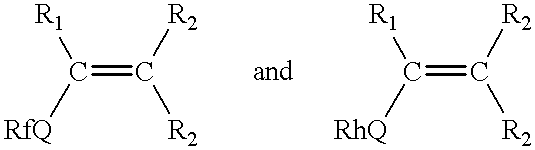
wherein R1, R2, Rf, Rh and Q are as defined in claim 2 .
7. The composition of claim 1 wherein said thermoplastic polymers are selected from the group consisting of polyamides, polyesters, polyurethanes, acrylates and polyolefins.
8. The composition of claim 1 wherein said fluorinated oligomeric compound comprises from 0.5 to 5 weight percent of said composition.
9. A shaped article comprising the composition of claim 1 .
10. The shaped article of claim 9 wherein said fluorinated oligomeric compound comprises from 10 to 10,000 ppm fluorine.
11. The shaped article of claim 9 selected from the group of films, sheets and fibers.
12. An oily mist resistant electret filter medium comprising polypropylene electret fibers comprising the composition of claim 1 .
13. The filter medium of claim 12 wherein said fibers have an effective fiber diameter of 2 to 30 micrometers.
14. The filter medium of claim 13 wherein said fibers have been annealed.
15. The filter medium of claim 13 wherein said filter media has a basis weight of 10 to 100 g/m2.
16. The composition of claim 2 wherein Rh is a linear or branched alkyl group having from 18 to 60 carbon atoms.
17. A fabric comprising the fibers of claim 11 .
18. A medical gown comprising the fabric of claim 17 .
19. The composition of claim 1 wherein said thermoset polymer is selected from polyurethanes, epoxy resins, epoxides and acrylates.
Priority Applications (8)
| Application Number | Priority Date | Filing Date | Title |
|---|---|---|---|
| US09/405,629 US6391807B1 (en) | 1999-09-24 | 1999-09-24 | Polymer composition containing a fluorochemical oligomer |
| DE60010490T DE60010490T2 (en) | 1999-09-24 | 2000-01-26 | POLYMER COMPOSITION CONTAINING A FLUOROLIGOMER |
| JP2001526615A JP2003510439A (en) | 1999-09-24 | 2000-01-26 | Polymer composition containing fluorochemical oligomer |
| PCT/US2000/002025 WO2001023472A1 (en) | 1999-09-24 | 2000-01-26 | Polymer composition containing a fluorochemical oligomer |
| EP00905752A EP1216275B1 (en) | 1999-09-24 | 2000-01-26 | Polymer composition containing a fluorochemical oligomer |
| KR1020027003840A KR100674453B1 (en) | 1999-09-24 | 2000-01-26 | Polymer Compositions Containing Fluorochemical Oligomers |
| TW089115924A TWI227722B (en) | 1999-09-24 | 2000-08-08 | Polymer composition containing a fluorochemical oligomer |
| US10/456,892 US7084168B2 (en) | 1999-05-04 | 2003-06-06 | Indoline derivatives |
Applications Claiming Priority (1)
| Application Number | Priority Date | Filing Date | Title |
|---|---|---|---|
| US09/405,629 US6391807B1 (en) | 1999-09-24 | 1999-09-24 | Polymer composition containing a fluorochemical oligomer |
Related Child Applications (1)
| Application Number | Title | Priority Date | Filing Date |
|---|---|---|---|
| US10/014,173 Division US6608068B2 (en) | 1999-05-04 | 2001-12-11 | Indoline derivatives |
Publications (1)
| Publication Number | Publication Date |
|---|---|
| US6391807B1 true US6391807B1 (en) | 2002-05-21 |
Family
ID=23604509
Family Applications (1)
| Application Number | Title | Priority Date | Filing Date |
|---|---|---|---|
| US09/405,629 Expired - Lifetime US6391807B1 (en) | 1999-05-04 | 1999-09-24 | Polymer composition containing a fluorochemical oligomer |
Country Status (7)
| Country | Link |
|---|---|
| US (1) | US6391807B1 (en) |
| EP (1) | EP1216275B1 (en) |
| JP (1) | JP2003510439A (en) |
| KR (1) | KR100674453B1 (en) |
| DE (1) | DE60010490T2 (en) |
| TW (1) | TWI227722B (en) |
| WO (1) | WO2001023472A1 (en) |
Cited By (31)
| Publication number | Priority date | Publication date | Assignee | Title |
|---|---|---|---|---|
| US6673136B2 (en) * | 2000-09-05 | 2004-01-06 | Donaldson Company, Inc. | Air filtration arrangements having fluted media constructions and methods |
| US20040024100A1 (en) * | 2002-07-26 | 2004-02-05 | Parent Michael J. | Dyed fluoropolymers |
| US20040024262A1 (en) * | 1999-05-11 | 2004-02-05 | Jariwala Chetan P | Alkylated fluorochemical oligomers and use thereof in the treatment of fibrous substrates |
| US20040044136A1 (en) * | 2002-08-29 | 2004-03-04 | Kim Hyun Jin | Method for making polymer mixtures and compositions thereof |
| US6716274B2 (en) * | 2000-09-05 | 2004-04-06 | Donaldson Company, Inc. | Air filter assembly for filtering an air stream to remove particulate matter entrained in the stream |
| US6740142B2 (en) * | 2000-09-05 | 2004-05-25 | Donaldson Company, Inc. | Industrial bag house elements |
| US6758389B1 (en) * | 1999-11-02 | 2004-07-06 | Seimi Chemical Co., Ltd. | Composition for preventing creeping of a flux for soldering and use thereof |
| US20040131836A1 (en) * | 2003-01-02 | 2004-07-08 | 3M Innovative Properties Company | Acoustic web |
| US20040200354A1 (en) * | 2000-09-05 | 2004-10-14 | Donaldson Company, Inc. | Filtration arrangement utilizing pleated construction and method |
| US20040202801A1 (en) * | 2003-04-09 | 2004-10-14 | Milliken & Company | Products and compositions employed in solvent-based ink jet printing |
| US20040201661A1 (en) * | 2003-04-09 | 2004-10-14 | Milliken & Company | Methods employed in solvent-based ink jet printing |
| US20040226443A1 (en) * | 2000-09-05 | 2004-11-18 | Donaldson Company, Inc. | Methods for filtering air for a gas turbine system |
| US20040231915A1 (en) * | 2003-01-02 | 2004-11-25 | 3M Innovative Properties Company | Sound absorptive multilayer composite |
| US20040231914A1 (en) * | 2003-01-02 | 2004-11-25 | 3M Innovative Properties Company | Low thickness sound absorptive multilayer composite |
| US20050049324A1 (en) * | 2003-02-17 | 2005-03-03 | Nhk Spring Co., Ltd. | Flexible polyurethane foam |
| US20050113508A1 (en) * | 2003-11-26 | 2005-05-26 | 3M Innovative Properties Company | Fluorochemical oligomeric composition and use thereof |
| US6930184B2 (en) | 2002-07-26 | 2005-08-16 | 3M Innovative Properties Company | Functional fluorescent dyes |
| US20060013983A1 (en) * | 2004-07-15 | 2006-01-19 | 3M Innovative Properties Company | Adhesive delivery of oil and water repellents |
| US20060065482A1 (en) * | 2004-09-30 | 2006-03-30 | Schmidft Richard J | Acoustic material with liquid repellency |
| US20070015288A1 (en) * | 2005-07-14 | 2007-01-18 | 3M Innovative Properties Company | Surface-enhanced spectroscopic method, flexible structured substrate, and method of making the same |
| US20070014997A1 (en) * | 2005-07-14 | 2007-01-18 | 3M Innovative Properties Company | Tool and method of making and using the same |
| US20070013103A1 (en) * | 2005-07-14 | 2007-01-18 | 3M Innovative Properties Company | Nanostructured article and method of making the same |
| US20070180997A1 (en) * | 2006-02-09 | 2007-08-09 | 3M Innovative Properties Company | Electrets and compounds useful in electrets |
| US20100199520A1 (en) * | 2009-02-06 | 2010-08-12 | Nike, Inc. | Textured Thermoplastic Non-Woven Elements |
| US8850719B2 (en) | 2009-02-06 | 2014-10-07 | Nike, Inc. | Layered thermoplastic non-woven textile elements |
| US8906275B2 (en) | 2012-05-29 | 2014-12-09 | Nike, Inc. | Textured elements incorporating non-woven textile materials and methods for manufacturing the textured elements |
| US9227363B2 (en) | 2009-02-06 | 2016-01-05 | Nike, Inc. | Thermoplastic non-woven textile elements |
| US9579848B2 (en) | 2009-02-06 | 2017-02-28 | Nike, Inc. | Methods of joining textiles and other elements incorporating a thermoplastic polymer material |
| US10569109B2 (en) * | 2016-01-13 | 2020-02-25 | L&C Protec, Inc. | Respiratory filtering fabric and garment made therefrom |
| CN112691556A (en) * | 2020-12-31 | 2021-04-23 | 天津理工大学 | Method for preparing oil-water separation membrane by using melt-blown cloth layer of waste mask |
| US11779071B2 (en) | 2012-04-03 | 2023-10-10 | Nike, Inc. | Apparel and other products incorporating a thermoplastic polymer material |
Families Citing this family (4)
| Publication number | Priority date | Publication date | Assignee | Title |
|---|---|---|---|---|
| EP1329548A1 (en) * | 2002-01-21 | 2003-07-23 | 3M Innovative Properties Company | Method of treatment of a textile or non-woven substrate to render same water and oil repellent |
| WO2007102984A1 (en) * | 2006-03-08 | 2007-09-13 | 3M Innovative Properties Company | Controlled architecture materials |
| WO2016021053A1 (en) * | 2014-08-08 | 2016-02-11 | ユーエスウラサキ株式会社 | Dust collection filter and dust collection device using same |
| WO2019189880A1 (en) * | 2018-03-30 | 2019-10-03 | 日揮触媒化成株式会社 | Coating solution for film formation and method for manufacturing substrate with film |
Citations (47)
| Publication number | Priority date | Publication date | Assignee | Title |
|---|---|---|---|---|
| US2803656A (en) | 1956-01-23 | 1957-08-20 | Minnesota Mining & Mfg | Fluorocarbonsulfonamidoalkanols and sulfates thereof |
| US2803615A (en) | 1956-01-23 | 1957-08-20 | Minnesota Mining & Mfg | Fluorocarbon acrylate and methacrylate esters and polymers |
| US2841573A (en) | 1955-12-29 | 1958-07-01 | Minnesota Mining & Mfg | Fluorocarbon vinyl-type esters and polymers |
| US3758447A (en) | 1971-11-17 | 1973-09-11 | Ciba Geigy Corp | Transfer agents free radical polymerization using perfluoroalkyl mercaptans as chain |
| US3899563A (en) | 1971-12-06 | 1975-08-12 | Allied Chem | Synthetic fibers having improved soil and stain repellency |
| US3971373A (en) | 1974-01-21 | 1976-07-27 | Minnesota Mining And Manufacturing Company | Particle-loaded microfiber sheet product and respirators made therefrom |
| US4100324A (en) | 1974-03-26 | 1978-07-11 | Kimberly-Clark Corporation | Nonwoven fabric and method of producing same |
| USRE30782E (en) | 1974-03-25 | 1981-10-27 | Minnesota Mining And Manufacturing Company | Method for the manufacture of an electret fibrous filter |
| US4302366A (en) | 1978-11-14 | 1981-11-24 | Produits Chimiques Ugine Kuhlmann | Fluorinated products intended for oilproofing and waterproofing treatments of various materials and more particularly of fibrous materials |
| US4375718A (en) | 1981-03-12 | 1983-03-08 | Surgikos, Inc. | Method of making fibrous electrets |
| USRE31285E (en) | 1976-12-23 | 1983-06-21 | Minnesota Mining And Manufacturing Company | Method for manufacturing a filter of electrically charged electret fiber material and electret filters obtained according to said method |
| US4429001A (en) | 1982-03-04 | 1984-01-31 | Minnesota Mining And Manufacturing Company | Sheet product containing sorbent particulate material |
| US4588537A (en) | 1983-02-04 | 1986-05-13 | Minnesota Mining And Manufacturing Company | Method for manufacturing an electret filter medium |
| US4592815A (en) | 1984-02-10 | 1986-06-03 | Japan Vilene Co., Ltd. | Method of manufacturing an electret filter |
| US4619976A (en) | 1984-11-30 | 1986-10-28 | Eastman Kodak Company | Blends of copolyesters and polycarbonate |
| US4843134A (en) | 1984-03-28 | 1989-06-27 | Minnesota Mining And Manufacturing Company | Acrylate pressure-sensitive adhesives containing insolubles |
| JPH0341160A (en) | 1989-07-07 | 1991-02-21 | Kao Corp | Thermoplastic resin composition of excellent liquid repellency |
| US5025052A (en) | 1986-09-12 | 1991-06-18 | Minnesota Mining And Manufacturing Company | Fluorochemical oxazolidinones |
| US5143963A (en) | 1989-12-06 | 1992-09-01 | Res Development Corp. | Thermoplastic polymers with dispersed fluorocarbon additives |
| US5145727A (en) | 1990-11-26 | 1992-09-08 | Kimberly-Clark Corporation | Multilayer nonwoven composite structure |
| US5149576A (en) | 1990-11-26 | 1992-09-22 | Kimberly-Clark Corporation | Multilayer nonwoven laminiferous structure |
| US5299279A (en) | 1992-12-01 | 1994-03-29 | Ilc Technology, Inc. | Short arc lamp soldering device |
| US5300357A (en) | 1991-05-02 | 1994-04-05 | Minnesota Mining And Manufacturing Company | Durably hydrophilic, thermoplastic fiber and fabric made from said fiber |
| US5300587A (en) | 1990-10-24 | 1994-04-05 | Centro Sviluppo Settori Impiego S.R.L. | Oil repellent polymeric composition and use thereof, for preparing formed articles having surfaces endowed with a high stability formed articles having surfaces endowed with a high stability to solvents and a high resistance to soiling |
| US5314959A (en) | 1991-03-06 | 1994-05-24 | Minnesota Mining And Manufacturing Company | Graft copolymers containing fluoroaliphatic groups |
| US5380778A (en) | 1992-09-30 | 1995-01-10 | Minnesota Mining And Manufacturing Company | Fluorochemical aminoalcohols |
| US5411576A (en) | 1993-03-26 | 1995-05-02 | Minnesota Mining And Manufacturing Company | Oily mist resistant electret filter media and method for filtering |
| EP0670358A1 (en) | 1992-11-13 | 1995-09-06 | Daikin Industries, Limited | Nonaqueous emulsified surface treatment composition |
| US5451622A (en) | 1992-09-30 | 1995-09-19 | Minnesota Mining And Manufacturing Company | Composition comprising thermoplastic polymer and fluorochemical piperazine compound |
| US5453540A (en) | 1991-04-02 | 1995-09-26 | Minnesota Mining And Manufacturing Company | Isocyanate derivatives comprising fluorochemical oligomers |
| US5459188A (en) | 1991-04-11 | 1995-10-17 | Peach State Labs, Inc. | Soil resistant fibers |
| US5496507A (en) | 1993-08-17 | 1996-03-05 | Minnesota Mining And Manufacturing Company | Method of charging electret filter media |
| US5508330A (en) | 1994-11-03 | 1996-04-16 | Ciba-Geigy Corporation | Barrier property enhancement of films and molded articles |
| US5536157A (en) | 1991-03-04 | 1996-07-16 | Ems-Inventa Ag.G. | Apparatus for cooling melt-spun filaments |
| WO1997022576A1 (en) | 1995-12-21 | 1997-06-26 | E.I. Du Pont De Nemours And Company | Fluorinated diester |
| WO1997022660A1 (en) | 1995-12-21 | 1997-06-26 | E.I. Du Pont De Nemours And Company | Fluorinated sulfone melt additives for thermoplastic polymers |
| WO1997022659A1 (en) | 1995-12-21 | 1997-06-26 | E.I. Du Pont De Nemours And Company | Fluorinated ester melt additives for thermoplastic fibers |
| US5681963A (en) | 1995-12-21 | 1997-10-28 | E. I. Du Pont De Nemours And Company | Fluorinated melt additives for thermoplastic polymers |
| WO1997046598A1 (en) | 1996-05-31 | 1997-12-11 | Minnesota Mining And Manufacturing Company | Durable, low surface energy compounds and articles, apparatuses, and methods for using the same |
| JPH09323956A (en) | 1996-05-31 | 1997-12-16 | Wako Pure Chem Ind Ltd | New succinic derivative |
| US5705592A (en) | 1995-10-26 | 1998-01-06 | Wacker-Chemie Gmbh | Fluorosiloxane-containing care compositions |
| WO1998015598A1 (en) | 1996-10-09 | 1998-04-16 | Daikin Industries, Ltd. | Water-repellent, oil-repellent resin composition |
| WO1998051726A1 (en) | 1997-05-14 | 1998-11-19 | Minnesota Mining And Manufacturing Company | Flourochemical composition containing a condensation product of a flourochemical polyether and a poly-isocyanate to impart stain release properties to a substrate |
| WO1998051723A1 (en) | 1997-05-14 | 1998-11-19 | Minnesota Mining And Manufacturing Company | Fluorochemical composition comprising a polyurethane having a fluorochemical oligomer and a hydrophilic segment to impart stain release properties to a substrate |
| WO1998051727A1 (en) | 1997-05-14 | 1998-11-19 | Minnesota Mining And Manufacturing Company | Fluorochemical composition comprising a polymer derived from a fluorochemical urethane (meth)acrylate monomer for imparting stain release properties to a substrate |
| WO1999005345A1 (en) | 1997-07-28 | 1999-02-04 | Minnesota Mining And Manufacturing Company | High temperature-stable fluorochemicals as hydrophobic and oleophobic additives to synthetic organic polymers |
| JP3041160B2 (en) | 1993-05-14 | 2000-05-15 | 沖電気工業株式会社 | Read method and write / read control circuit |
Family Cites Families (6)
| Publication number | Priority date | Publication date | Assignee | Title |
|---|---|---|---|---|
| JPS5980468A (en) * | 1982-10-29 | 1984-05-09 | Asahi Glass Co Ltd | Film for agricultural and horticultural use |
| JPH037745A (en) * | 1989-06-05 | 1991-01-14 | Sekisui Chem Co Ltd | Method for producing water repelling and oil repelling molded article |
| JP2685904B2 (en) * | 1989-07-07 | 1997-12-08 | 花王株式会社 | Method for producing thermoplastic resin molding having excellent liquid repellency |
| JP3252419B2 (en) * | 1991-12-19 | 2002-02-04 | ダイキン工業株式会社 | Release agent composition |
| JPH10204267A (en) * | 1997-01-17 | 1998-08-04 | Dainippon Ink & Chem Inc | Thermoplastic polyester resin composition and electronic component |
| JPH10298339A (en) * | 1997-04-30 | 1998-11-10 | Hitachi Chem Co Ltd | Expandable, styrene-based resin particle and expansion-molded product thereof |
-
1999
- 1999-09-24 US US09/405,629 patent/US6391807B1/en not_active Expired - Lifetime
-
2000
- 2000-01-26 DE DE60010490T patent/DE60010490T2/en not_active Expired - Lifetime
- 2000-01-26 WO PCT/US2000/002025 patent/WO2001023472A1/en not_active Ceased
- 2000-01-26 KR KR1020027003840A patent/KR100674453B1/en not_active Expired - Fee Related
- 2000-01-26 EP EP00905752A patent/EP1216275B1/en not_active Expired - Lifetime
- 2000-01-26 JP JP2001526615A patent/JP2003510439A/en active Pending
- 2000-08-08 TW TW089115924A patent/TWI227722B/en active
Patent Citations (52)
| Publication number | Priority date | Publication date | Assignee | Title |
|---|---|---|---|---|
| US2841573A (en) | 1955-12-29 | 1958-07-01 | Minnesota Mining & Mfg | Fluorocarbon vinyl-type esters and polymers |
| US2803656A (en) | 1956-01-23 | 1957-08-20 | Minnesota Mining & Mfg | Fluorocarbonsulfonamidoalkanols and sulfates thereof |
| US2803615A (en) | 1956-01-23 | 1957-08-20 | Minnesota Mining & Mfg | Fluorocarbon acrylate and methacrylate esters and polymers |
| US3758447A (en) | 1971-11-17 | 1973-09-11 | Ciba Geigy Corp | Transfer agents free radical polymerization using perfluoroalkyl mercaptans as chain |
| US3899563A (en) | 1971-12-06 | 1975-08-12 | Allied Chem | Synthetic fibers having improved soil and stain repellency |
| US3971373A (en) | 1974-01-21 | 1976-07-27 | Minnesota Mining And Manufacturing Company | Particle-loaded microfiber sheet product and respirators made therefrom |
| USRE30782E (en) | 1974-03-25 | 1981-10-27 | Minnesota Mining And Manufacturing Company | Method for the manufacture of an electret fibrous filter |
| US4100324A (en) | 1974-03-26 | 1978-07-11 | Kimberly-Clark Corporation | Nonwoven fabric and method of producing same |
| USRE31285E (en) | 1976-12-23 | 1983-06-21 | Minnesota Mining And Manufacturing Company | Method for manufacturing a filter of electrically charged electret fiber material and electret filters obtained according to said method |
| US4302366A (en) | 1978-11-14 | 1981-11-24 | Produits Chimiques Ugine Kuhlmann | Fluorinated products intended for oilproofing and waterproofing treatments of various materials and more particularly of fibrous materials |
| US4375718A (en) | 1981-03-12 | 1983-03-08 | Surgikos, Inc. | Method of making fibrous electrets |
| US4429001A (en) | 1982-03-04 | 1984-01-31 | Minnesota Mining And Manufacturing Company | Sheet product containing sorbent particulate material |
| US4588537A (en) | 1983-02-04 | 1986-05-13 | Minnesota Mining And Manufacturing Company | Method for manufacturing an electret filter medium |
| US4592815A (en) | 1984-02-10 | 1986-06-03 | Japan Vilene Co., Ltd. | Method of manufacturing an electret filter |
| US4843134A (en) | 1984-03-28 | 1989-06-27 | Minnesota Mining And Manufacturing Company | Acrylate pressure-sensitive adhesives containing insolubles |
| US4619976A (en) | 1984-11-30 | 1986-10-28 | Eastman Kodak Company | Blends of copolyesters and polycarbonate |
| US5025052A (en) | 1986-09-12 | 1991-06-18 | Minnesota Mining And Manufacturing Company | Fluorochemical oxazolidinones |
| JPH0341160A (en) | 1989-07-07 | 1991-02-21 | Kao Corp | Thermoplastic resin composition of excellent liquid repellency |
| US5143963A (en) | 1989-12-06 | 1992-09-01 | Res Development Corp. | Thermoplastic polymers with dispersed fluorocarbon additives |
| US5300587A (en) | 1990-10-24 | 1994-04-05 | Centro Sviluppo Settori Impiego S.R.L. | Oil repellent polymeric composition and use thereof, for preparing formed articles having surfaces endowed with a high stability formed articles having surfaces endowed with a high stability to solvents and a high resistance to soiling |
| US5145727A (en) | 1990-11-26 | 1992-09-08 | Kimberly-Clark Corporation | Multilayer nonwoven composite structure |
| US5149576A (en) | 1990-11-26 | 1992-09-22 | Kimberly-Clark Corporation | Multilayer nonwoven laminiferous structure |
| US5536157A (en) | 1991-03-04 | 1996-07-16 | Ems-Inventa Ag.G. | Apparatus for cooling melt-spun filaments |
| US5314959A (en) | 1991-03-06 | 1994-05-24 | Minnesota Mining And Manufacturing Company | Graft copolymers containing fluoroaliphatic groups |
| US5336717A (en) | 1991-03-06 | 1994-08-09 | Minnesota Mining And Manufacturing Company | Graft copolymers containing fluoroaliphatic groups |
| US5453540A (en) | 1991-04-02 | 1995-09-26 | Minnesota Mining And Manufacturing Company | Isocyanate derivatives comprising fluorochemical oligomers |
| US5459188A (en) | 1991-04-11 | 1995-10-17 | Peach State Labs, Inc. | Soil resistant fibers |
| US5300357A (en) | 1991-05-02 | 1994-04-05 | Minnesota Mining And Manufacturing Company | Durably hydrophilic, thermoplastic fiber and fabric made from said fiber |
| US5380778A (en) | 1992-09-30 | 1995-01-10 | Minnesota Mining And Manufacturing Company | Fluorochemical aminoalcohols |
| US5451622A (en) | 1992-09-30 | 1995-09-19 | Minnesota Mining And Manufacturing Company | Composition comprising thermoplastic polymer and fluorochemical piperazine compound |
| EP0670358A1 (en) | 1992-11-13 | 1995-09-06 | Daikin Industries, Limited | Nonaqueous emulsified surface treatment composition |
| US5299279A (en) | 1992-12-01 | 1994-03-29 | Ilc Technology, Inc. | Short arc lamp soldering device |
| US5411576A (en) | 1993-03-26 | 1995-05-02 | Minnesota Mining And Manufacturing Company | Oily mist resistant electret filter media and method for filtering |
| JP3041160B2 (en) | 1993-05-14 | 2000-05-15 | 沖電気工業株式会社 | Read method and write / read control circuit |
| US5496507A (en) | 1993-08-17 | 1996-03-05 | Minnesota Mining And Manufacturing Company | Method of charging electret filter media |
| US5508330A (en) | 1994-11-03 | 1996-04-16 | Ciba-Geigy Corporation | Barrier property enhancement of films and molded articles |
| US5705592A (en) | 1995-10-26 | 1998-01-06 | Wacker-Chemie Gmbh | Fluorosiloxane-containing care compositions |
| WO1997022576A1 (en) | 1995-12-21 | 1997-06-26 | E.I. Du Pont De Nemours And Company | Fluorinated diester |
| US5681963A (en) | 1995-12-21 | 1997-10-28 | E. I. Du Pont De Nemours And Company | Fluorinated melt additives for thermoplastic polymers |
| WO1997022659A1 (en) | 1995-12-21 | 1997-06-26 | E.I. Du Pont De Nemours And Company | Fluorinated ester melt additives for thermoplastic fibers |
| WO1997022660A1 (en) | 1995-12-21 | 1997-06-26 | E.I. Du Pont De Nemours And Company | Fluorinated sulfone melt additives for thermoplastic polymers |
| US5898046A (en) | 1995-12-21 | 1999-04-27 | E. I. Du Pont De Nemours And Company | Fluorinated melt ester additives for thermoplastic fibers |
| WO1997046598A1 (en) | 1996-05-31 | 1997-12-11 | Minnesota Mining And Manufacturing Company | Durable, low surface energy compounds and articles, apparatuses, and methods for using the same |
| US5998549A (en) | 1996-05-31 | 1999-12-07 | 3M Innovative Properties Company | Durable, low surface energy compounds and articles, apparatuses, and methods for using the same |
| JPH09323956A (en) | 1996-05-31 | 1997-12-16 | Wako Pure Chem Ind Ltd | New succinic derivative |
| WO1998015598A1 (en) | 1996-10-09 | 1998-04-16 | Daikin Industries, Ltd. | Water-repellent, oil-repellent resin composition |
| WO1998051726A1 (en) | 1997-05-14 | 1998-11-19 | Minnesota Mining And Manufacturing Company | Flourochemical composition containing a condensation product of a flourochemical polyether and a poly-isocyanate to impart stain release properties to a substrate |
| WO1998051723A1 (en) | 1997-05-14 | 1998-11-19 | Minnesota Mining And Manufacturing Company | Fluorochemical composition comprising a polyurethane having a fluorochemical oligomer and a hydrophilic segment to impart stain release properties to a substrate |
| WO1998051725A1 (en) | 1997-05-14 | 1998-11-19 | Minnesota Mining And Manufacturing Company | Fluorochemical composition comprising a polyurethane having a fluorochemical oligomer and a hydrophilic segment to impart stain release properties to a substrate |
| WO1998051724A1 (en) | 1997-05-14 | 1998-11-19 | Minnesota Mining And Manufacturing Company | Fluorochemical composition comprising a urethane having a fluorochemical oligomer and a hydrophilic segment to impart stain release properties to a substrate |
| WO1998051727A1 (en) | 1997-05-14 | 1998-11-19 | Minnesota Mining And Manufacturing Company | Fluorochemical composition comprising a polymer derived from a fluorochemical urethane (meth)acrylate monomer for imparting stain release properties to a substrate |
| WO1999005345A1 (en) | 1997-07-28 | 1999-02-04 | Minnesota Mining And Manufacturing Company | High temperature-stable fluorochemicals as hydrophobic and oleophobic additives to synthetic organic polymers |
Non-Patent Citations (5)
| Title |
|---|
| Chujo et al., J. Polymer Science, Part A, vol. 26, pp. 2991-2997 (1988). |
| Davies, "The Separation of Airborne Dust and Particles", Institution of Mechanical Engineers, London Proceedings 1B, 1952. |
| H.C. Fielding, Organofluorine Chemicals and their Industrial Applications, R.E. Banks, Ed., Society of Chemical Industry, p. 214 (1979). |
| Van Wente et al., "Manufacture of Super Fine Organic Fibers", Report No. 4364 of the Naval Research Laboratories, (May 25, 1954). |
| Van Wente, "Superfine Thermoplastic Fibers," Industrial Engineering Chemistry, vol. 48, pp. 1342-1346 (1956). |
Cited By (70)
| Publication number | Priority date | Publication date | Assignee | Title |
|---|---|---|---|---|
| US7049379B2 (en) | 1999-05-11 | 2006-05-23 | 3M Innovative Properties Company | Alkylated fluorochemical oligomers and use thereof in the treatment of fibrous substrates |
| US20040024262A1 (en) * | 1999-05-11 | 2004-02-05 | Jariwala Chetan P | Alkylated fluorochemical oligomers and use thereof in the treatment of fibrous substrates |
| US6758389B1 (en) * | 1999-11-02 | 2004-07-06 | Seimi Chemical Co., Ltd. | Composition for preventing creeping of a flux for soldering and use thereof |
| US20050183405A1 (en) * | 2000-09-05 | 2005-08-25 | Donaldson Company, Inc. | Air filtration arrangements having fluted media construction and methods |
| US6875256B2 (en) | 2000-09-05 | 2005-04-05 | Donaldson Company, Inc. | Methods for filtering air for a gas turbine system |
| US6740142B2 (en) * | 2000-09-05 | 2004-05-25 | Donaldson Company, Inc. | Industrial bag house elements |
| US7090712B2 (en) | 2000-09-05 | 2006-08-15 | Donaldson Company, Inc. | Air filtration arrangements having fluted media construction and methods |
| US6994742B2 (en) | 2000-09-05 | 2006-02-07 | Donaldson Company, Inc. | Filtration arrangement utilizing pleated construction and method |
| US20040200354A1 (en) * | 2000-09-05 | 2004-10-14 | Donaldson Company, Inc. | Filtration arrangement utilizing pleated construction and method |
| US6673136B2 (en) * | 2000-09-05 | 2004-01-06 | Donaldson Company, Inc. | Air filtration arrangements having fluted media constructions and methods |
| US20080010959A1 (en) * | 2000-09-05 | 2008-01-17 | Donaldson Company, Inc. | Air filtration arrangements having fluted media constructions and methods |
| US20040226443A1 (en) * | 2000-09-05 | 2004-11-18 | Donaldson Company, Inc. | Methods for filtering air for a gas turbine system |
| US6974490B2 (en) | 2000-09-05 | 2005-12-13 | Donaldson Company, Inc. | Air filtration arrangements having fluted media constructions and methods |
| US20060196359A1 (en) * | 2000-09-05 | 2006-09-07 | Donaldson Company, Inc. | Air filtration arrangements having fluted media constructions and methods |
| US7270692B2 (en) | 2000-09-05 | 2007-09-18 | Donaldson Company, Inc. | Air filtration arrangements having fluted media constructions and methods |
| US6716274B2 (en) * | 2000-09-05 | 2004-04-06 | Donaldson Company, Inc. | Air filter assembly for filtering an air stream to remove particulate matter entrained in the stream |
| US20050240020A1 (en) * | 2002-07-26 | 2005-10-27 | 3M Innovative Properties Company | Functional fluorescent dyes |
| US6894105B2 (en) | 2002-07-26 | 2005-05-17 | 3M Innovatives Properties Company | Dyed fluoropolymers |
| US6930184B2 (en) | 2002-07-26 | 2005-08-16 | 3M Innovative Properties Company | Functional fluorescent dyes |
| US20040024100A1 (en) * | 2002-07-26 | 2004-02-05 | Parent Michael J. | Dyed fluoropolymers |
| US20040044136A1 (en) * | 2002-08-29 | 2004-03-04 | Kim Hyun Jin | Method for making polymer mixtures and compositions thereof |
| US6930150B2 (en) | 2002-08-29 | 2005-08-16 | Taylor Made Golf Company, Inc. | Method for making polymer mixtures and compositions thereof |
| US7591346B2 (en) | 2003-01-02 | 2009-09-22 | 3M Innovative Properties Company | Sound absorptive multilayer composite |
| US7320739B2 (en) | 2003-01-02 | 2008-01-22 | 3M Innovative Properties Company | Sound absorptive multilayer composite |
| US20040131836A1 (en) * | 2003-01-02 | 2004-07-08 | 3M Innovative Properties Company | Acoustic web |
| US20040231915A1 (en) * | 2003-01-02 | 2004-11-25 | 3M Innovative Properties Company | Sound absorptive multilayer composite |
| US20040231914A1 (en) * | 2003-01-02 | 2004-11-25 | 3M Innovative Properties Company | Low thickness sound absorptive multilayer composite |
| US20060237130A1 (en) * | 2003-01-02 | 2006-10-26 | 3M Innovative Properties Company | Acoustic web |
| US20080073146A1 (en) * | 2003-01-02 | 2008-03-27 | 3M Innovative Properties Company | Sound absorptive multilayer composite |
| US20050049324A1 (en) * | 2003-02-17 | 2005-03-03 | Nhk Spring Co., Ltd. | Flexible polyurethane foam |
| US20060148922A1 (en) * | 2003-02-17 | 2006-07-06 | Nhk Spring Co., Ltd. | Flexible polyurethane foam |
| US20040202801A1 (en) * | 2003-04-09 | 2004-10-14 | Milliken & Company | Products and compositions employed in solvent-based ink jet printing |
| US6846076B2 (en) | 2003-04-09 | 2005-01-25 | Milliken & Company | Methods employed in solvent-based ink jet printing |
| US20040201661A1 (en) * | 2003-04-09 | 2004-10-14 | Milliken & Company | Methods employed in solvent-based ink jet printing |
| US7078456B2 (en) | 2003-11-26 | 2006-07-18 | 3M Innovative Properties Company | Fluorochemical oligomeric composition and use thereof |
| US20050113508A1 (en) * | 2003-11-26 | 2005-05-26 | 3M Innovative Properties Company | Fluorochemical oligomeric composition and use thereof |
| US20060013983A1 (en) * | 2004-07-15 | 2006-01-19 | 3M Innovative Properties Company | Adhesive delivery of oil and water repellents |
| US20060065482A1 (en) * | 2004-09-30 | 2006-03-30 | Schmidft Richard J | Acoustic material with liquid repellency |
| US7500541B2 (en) | 2004-09-30 | 2009-03-10 | Kimberly-Clark Worldwide, Inc. | Acoustic material with liquid repellency |
| US20070014997A1 (en) * | 2005-07-14 | 2007-01-18 | 3M Innovative Properties Company | Tool and method of making and using the same |
| US7906057B2 (en) | 2005-07-14 | 2011-03-15 | 3M Innovative Properties Company | Nanostructured article and method of making the same |
| US20070013103A1 (en) * | 2005-07-14 | 2007-01-18 | 3M Innovative Properties Company | Nanostructured article and method of making the same |
| US20070015288A1 (en) * | 2005-07-14 | 2007-01-18 | 3M Innovative Properties Company | Surface-enhanced spectroscopic method, flexible structured substrate, and method of making the same |
| US7651863B2 (en) | 2005-07-14 | 2010-01-26 | 3M Innovative Properties Company | Surface-enhanced spectroscopic method, flexible structured substrate, and method of making the same |
| US20100062226A1 (en) * | 2005-07-14 | 2010-03-11 | 3M Innovative Properties Company | Surface-enhanced spectroscopic method, flexible structured substrate, and method of making the same |
| US7888129B2 (en) | 2005-07-14 | 2011-02-15 | 3M Innovative Properties Company | Surface-enhanced spectroscopic method, flexible structured substrate, and method of making the same |
| US7390351B2 (en) * | 2006-02-09 | 2008-06-24 | 3M Innovative Properties Company | Electrets and compounds useful in electrets |
| US20070180997A1 (en) * | 2006-02-09 | 2007-08-09 | 3M Innovative Properties Company | Electrets and compounds useful in electrets |
| US9732454B2 (en) | 2009-02-06 | 2017-08-15 | Nike, Inc. | Textured elements incorporating non-woven textile materials and methods for manufacturing the textured elements |
| US10625472B2 (en) | 2009-02-06 | 2020-04-21 | Nike, Inc. | Methods of joining textiles and other elements incorporating a thermoplastic polymer material |
| US12404615B2 (en) | 2009-02-06 | 2025-09-02 | Nike, Inc. | Thermoplastic non-woven textile elements |
| US9227363B2 (en) | 2009-02-06 | 2016-01-05 | Nike, Inc. | Thermoplastic non-woven textile elements |
| US9579848B2 (en) | 2009-02-06 | 2017-02-28 | Nike, Inc. | Methods of joining textiles and other elements incorporating a thermoplastic polymer material |
| US9682512B2 (en) | 2009-02-06 | 2017-06-20 | Nike, Inc. | Methods of joining textiles and other elements incorporating a thermoplastic polymer material |
| US20100199520A1 (en) * | 2009-02-06 | 2010-08-12 | Nike, Inc. | Textured Thermoplastic Non-Woven Elements |
| US10131091B2 (en) | 2009-02-06 | 2018-11-20 | Nike, Inc. | Methods of joining textiles and other elements incorporating a thermoplastic polymer material |
| US10138582B2 (en) | 2009-02-06 | 2018-11-27 | Nike, Inc. | Thermoplastic non-woven textile elements |
| US10174447B2 (en) | 2009-02-06 | 2019-01-08 | Nike, Inc. | Thermoplastic non-woven textile elements |
| US12371829B2 (en) | 2009-02-06 | 2025-07-29 | Nike, Inc. | Thermoplastic non-woven textile elements |
| US8850719B2 (en) | 2009-02-06 | 2014-10-07 | Nike, Inc. | Layered thermoplastic non-woven textile elements |
| US10982364B2 (en) | 2009-02-06 | 2021-04-20 | Nike, Inc. | Thermoplastic non-woven textile elements |
| US10982363B2 (en) | 2009-02-06 | 2021-04-20 | Nike, Inc. | Thermoplastic non-woven textile elements |
| US11779071B2 (en) | 2012-04-03 | 2023-10-10 | Nike, Inc. | Apparel and other products incorporating a thermoplastic polymer material |
| US12490793B2 (en) | 2012-04-03 | 2025-12-09 | Nike, Inc. | Apparel and other products incorporating a thermoplastic polymer material |
| US12490792B2 (en) | 2012-04-03 | 2025-12-09 | Nike, Inc. | Apparel and other products incorporating a thermoplastic polymer material |
| US12495852B2 (en) | 2012-04-03 | 2025-12-16 | Nike, Inc. | Knitted and woven components and articles of footwear containing the same |
| US12495851B2 (en) | 2012-04-03 | 2025-12-16 | Nike, Inc. | Apparel and other products incorporating a thermoplastic polymer material |
| US8906275B2 (en) | 2012-05-29 | 2014-12-09 | Nike, Inc. | Textured elements incorporating non-woven textile materials and methods for manufacturing the textured elements |
| US10569109B2 (en) * | 2016-01-13 | 2020-02-25 | L&C Protec, Inc. | Respiratory filtering fabric and garment made therefrom |
| CN112691556A (en) * | 2020-12-31 | 2021-04-23 | 天津理工大学 | Method for preparing oil-water separation membrane by using melt-blown cloth layer of waste mask |
Also Published As
| Publication number | Publication date |
|---|---|
| EP1216275A1 (en) | 2002-06-26 |
| KR100674453B1 (en) | 2007-01-29 |
| EP1216275B1 (en) | 2004-05-06 |
| KR20020039353A (en) | 2002-05-25 |
| WO2001023472A1 (en) | 2001-04-05 |
| DE60010490T2 (en) | 2005-04-14 |
| DE60010490D1 (en) | 2004-06-09 |
| JP2003510439A (en) | 2003-03-18 |
| TWI227722B (en) | 2005-02-11 |
Similar Documents
| Publication | Publication Date | Title |
|---|---|---|
| US6391807B1 (en) | Polymer composition containing a fluorochemical oligomer | |
| US6174964B1 (en) | Fluorochemical oligomer and use thereof | |
| US6288157B1 (en) | Alkylated fluorochemical oligomers and use thereof | |
| US10662165B2 (en) | Fluorochemical piperazine carboxamides | |
| EP1000184B1 (en) | High temperature-stable fluorochemicals as hydrophobic and oleophobic additives for synthetic organic polymers | |
| US10590072B2 (en) | Partially fluorinated aromatic esters | |
| US5451622A (en) | Composition comprising thermoplastic polymer and fluorochemical piperazine compound | |
| KR100943549B1 (en) | Water- and Oil-Repellent, Antistatic Compositions | |
| WO2017100045A1 (en) | Fluorinated piperazine sulfonamides | |
| JP2003519281A (en) | Water / oil repellent antistatic composition | |
| WO2001044209A1 (en) | Triazine compounds and use as water repellent | |
| US10947348B2 (en) | Fluorochemical piperazine carboxamides | |
| HK1028796B (en) | High temperature-stable fluorochemicals as hydrophobic and oleophobic additives for synthetic organic polymers |
Legal Events
| Date | Code | Title | Description |
|---|---|---|---|
| AS | Assignment |
Owner name: 3M INNOVATIVE PROPERTIES COMPANY, MINNESOTA Free format text: ASSIGNMENT OF ASSIGNORS INTEREST;ASSIGNORS:JARIWALA, CHETAN P.;KLUN, THOMAS P.;REEL/FRAME:010277/0820 Effective date: 19990917 |
|
| STCF | Information on status: patent grant |
Free format text: PATENTED CASE |
|
| CC | Certificate of correction | ||
| FPAY | Fee payment |
Year of fee payment: 4 |
|
| FPAY | Fee payment |
Year of fee payment: 8 |
|
| FPAY | Fee payment |
Year of fee payment: 12 |