US6120451A - Ultrasound color flow display optimization by adjustment of threshold - Google Patents
Ultrasound color flow display optimization by adjustment of threshold Download PDFInfo
- Publication number
- US6120451A US6120451A US09/224,450 US22445098A US6120451A US 6120451 A US6120451 A US 6120451A US 22445098 A US22445098 A US 22445098A US 6120451 A US6120451 A US 6120451A
- Authority
- US
- United States
- Prior art keywords
- signals
- response
- data words
- color flow
- data
- Prior art date
- Legal status (The legal status is an assumption and is not a legal conclusion. Google has not performed a legal analysis and makes no representation as to the accuracy of the status listed.)
- Expired - Lifetime
Links
- 238000002604 ultrasonography Methods 0.000 title claims abstract description 16
- 238000005457 optimization Methods 0.000 title 1
- 230000004044 response Effects 0.000 claims description 23
- 238000000034 method Methods 0.000 claims description 11
- 238000012285 ultrasound imaging Methods 0.000 claims description 4
- 238000003384 imaging method Methods 0.000 abstract description 5
- 238000010304 firing Methods 0.000 description 11
- 230000017531 blood circulation Effects 0.000 description 9
- 238000012545 processing Methods 0.000 description 8
- 210000004027 cell Anatomy 0.000 description 4
- 238000010586 diagram Methods 0.000 description 4
- 238000007906 compression Methods 0.000 description 3
- 230000006835 compression Effects 0.000 description 3
- 238000013144 data compression Methods 0.000 description 3
- 238000012805 post-processing Methods 0.000 description 3
- 238000005311 autocorrelation function Methods 0.000 description 2
- 210000004369 blood Anatomy 0.000 description 2
- 239000008280 blood Substances 0.000 description 2
- 239000002131 composite material Substances 0.000 description 2
- 239000004020 conductor Substances 0.000 description 2
- 230000006870 function Effects 0.000 description 2
- 238000013507 mapping Methods 0.000 description 2
- 238000012986 modification Methods 0.000 description 2
- 230000004048 modification Effects 0.000 description 2
- 238000001208 nuclear magnetic resonance pulse sequence Methods 0.000 description 2
- 230000010363 phase shift Effects 0.000 description 2
- 238000012552 review Methods 0.000 description 2
- 239000013598 vector Substances 0.000 description 2
- 230000009471 action Effects 0.000 description 1
- 238000009638 autodisplay Methods 0.000 description 1
- 210000000601 blood cell Anatomy 0.000 description 1
- 210000001715 carotid artery Anatomy 0.000 description 1
- 230000008859 change Effects 0.000 description 1
- 230000007423 decrease Effects 0.000 description 1
- 230000003111 delayed effect Effects 0.000 description 1
- 238000011161 development Methods 0.000 description 1
- 238000002592 echocardiography Methods 0.000 description 1
- 230000000694 effects Effects 0.000 description 1
- 239000012530 fluid Substances 0.000 description 1
- 239000000463 material Substances 0.000 description 1
- 238000005259 measurement Methods 0.000 description 1
- 239000000203 mixture Substances 0.000 description 1
- 230000008569 process Effects 0.000 description 1
- 238000011160 research Methods 0.000 description 1
- 238000005070 sampling Methods 0.000 description 1
- 238000012546 transfer Methods 0.000 description 1
Images


Classifications
-
- G—PHYSICS
- G01—MEASURING; TESTING
- G01S—RADIO DIRECTION-FINDING; RADIO NAVIGATION; DETERMINING DISTANCE OR VELOCITY BY USE OF RADIO WAVES; LOCATING OR PRESENCE-DETECTING BY USE OF THE REFLECTION OR RERADIATION OF RADIO WAVES; ANALOGOUS ARRANGEMENTS USING OTHER WAVES
- G01S15/00—Systems using the reflection or reradiation of acoustic waves, e.g. sonar systems
- G01S15/88—Sonar systems specially adapted for specific applications
- G01S15/89—Sonar systems specially adapted for specific applications for mapping or imaging
- G01S15/8906—Short-range imaging systems; Acoustic microscope systems using pulse-echo techniques
- G01S15/8979—Combined Doppler and pulse-echo imaging systems
- G01S15/8988—Colour Doppler imaging
-
- G—PHYSICS
- G01—MEASURING; TESTING
- G01S—RADIO DIRECTION-FINDING; RADIO NAVIGATION; DETERMINING DISTANCE OR VELOCITY BY USE OF RADIO WAVES; LOCATING OR PRESENCE-DETECTING BY USE OF THE REFLECTION OR RERADIATION OF RADIO WAVES; ANALOGOUS ARRANGEMENTS USING OTHER WAVES
- G01S15/00—Systems using the reflection or reradiation of acoustic waves, e.g. sonar systems
- G01S15/88—Sonar systems specially adapted for specific applications
- G01S15/89—Sonar systems specially adapted for specific applications for mapping or imaging
- G01S15/8906—Short-range imaging systems; Acoustic microscope systems using pulse-echo techniques
- G01S15/8979—Combined Doppler and pulse-echo imaging systems
-
- G—PHYSICS
- G01—MEASURING; TESTING
- G01S—RADIO DIRECTION-FINDING; RADIO NAVIGATION; DETERMINING DISTANCE OR VELOCITY BY USE OF RADIO WAVES; LOCATING OR PRESENCE-DETECTING BY USE OF THE REFLECTION OR RERADIATION OF RADIO WAVES; ANALOGOUS ARRANGEMENTS USING OTHER WAVES
- G01S7/00—Details of systems according to groups G01S13/00, G01S15/00, G01S17/00
- G01S7/52—Details of systems according to groups G01S13/00, G01S15/00, G01S17/00 of systems according to group G01S15/00
- G01S7/52017—Details of systems according to groups G01S13/00, G01S15/00, G01S17/00 of systems according to group G01S15/00 particularly adapted to short-range imaging
- G01S7/52023—Details of receivers
- G01S7/52034—Data rate converters
-
- G—PHYSICS
- G01—MEASURING; TESTING
- G01S—RADIO DIRECTION-FINDING; RADIO NAVIGATION; DETERMINING DISTANCE OR VELOCITY BY USE OF RADIO WAVES; LOCATING OR PRESENCE-DETECTING BY USE OF THE REFLECTION OR RERADIATION OF RADIO WAVES; ANALOGOUS ARRANGEMENTS USING OTHER WAVES
- G01S7/00—Details of systems according to groups G01S13/00, G01S15/00, G01S17/00
- G01S7/52—Details of systems according to groups G01S13/00, G01S15/00, G01S17/00 of systems according to group G01S15/00
- G01S7/52017—Details of systems according to groups G01S13/00, G01S15/00, G01S17/00 of systems according to group G01S15/00 particularly adapted to short-range imaging
- G01S7/52053—Display arrangements
- G01S7/52057—Cathode ray tube displays
- G01S7/52071—Multicolour displays; using colour coding; Optimising colour or information content in displays, e.g. parametric imaging
-
- G—PHYSICS
- G01—MEASURING; TESTING
- G01S—RADIO DIRECTION-FINDING; RADIO NAVIGATION; DETERMINING DISTANCE OR VELOCITY BY USE OF RADIO WAVES; LOCATING OR PRESENCE-DETECTING BY USE OF THE REFLECTION OR RERADIATION OF RADIO WAVES; ANALOGOUS ARRANGEMENTS USING OTHER WAVES
- G01S7/00—Details of systems according to groups G01S13/00, G01S15/00, G01S17/00
- G01S7/52—Details of systems according to groups G01S13/00, G01S15/00, G01S17/00 of systems according to group G01S15/00
- G01S7/52017—Details of systems according to groups G01S13/00, G01S15/00, G01S17/00 of systems according to group G01S15/00 particularly adapted to short-range imaging
- G01S7/52053—Display arrangements
- G01S7/52057—Cathode ray tube displays
- G01S7/5206—Two-dimensional coordinated display of distance and direction; B-scan display
-
- G—PHYSICS
- G01—MEASURING; TESTING
- G01S—RADIO DIRECTION-FINDING; RADIO NAVIGATION; DETERMINING DISTANCE OR VELOCITY BY USE OF RADIO WAVES; LOCATING OR PRESENCE-DETECTING BY USE OF THE REFLECTION OR RERADIATION OF RADIO WAVES; ANALOGOUS ARRANGEMENTS USING OTHER WAVES
- G01S7/00—Details of systems according to groups G01S13/00, G01S15/00, G01S17/00
- G01S7/52—Details of systems according to groups G01S13/00, G01S15/00, G01S17/00 of systems according to group G01S15/00
- G01S7/52017—Details of systems according to groups G01S13/00, G01S15/00, G01S17/00 of systems according to group G01S15/00 particularly adapted to short-range imaging
- G01S7/52053—Display arrangements
- G01S7/52057—Cathode ray tube displays
- G01S7/52068—Stereoscopic displays; Three-dimensional displays; Pseudo 3D displays
- G01S7/52069—Grey-scale displays
Definitions
- This invention generally relates to ultrasound color flow Doppler imaging of fluid flow fields.
- the invention relates to a method and an apparatus for improving the display of such imaging.
- Ultrasonic scanners for detecting blood flow based on the Doppler effect are well known. Such systems operate by actuating an ultrasonic transducer array to transmit ultrasonic waves into the object and receiving ultrasonic echoes backscattered from the object. In the measurement of blood flow characteristics, returning ultrasonic waves are compared to a frequency reference to determine the frequency shift imparted to the returning waves by flowing scatterers such as blood cells. This frequency, i.e., phase shift, translates into the velocity of the blood flow. The blood velocity is calculated by measuring the phase shift from firing to firing at a specific range gate.
- Color flow images are produced by superimposing a color image of the velocity of moving material, such as blood, over a black and white anatomical B-mode image.
- color flow mode displays hundreds of adjacent sample volumes simultaneously, all laid over a B-mode image and color-coded to represent each sample volume's velocity.
- color flow processors estimate blood flow velocity, blood flow power, and blood flow variance.
- color flow data is used to modify the color of a region of interest on a display screen. The user selects the type of data used for the display. The modes typically available are power only, velocity only or velocity and variance combined.
- known ultrasound scanners provide a B/color priority threshold which is user selectable from a softkey menu on the user's console of the scanner.
- the threshold may be set by the user to various percentages of the maximum B-mode gray scale value. For any pixel within the color mode region of interest (ROI), if the B-mode pixel value exceeds the selected B/color priority threshold, then the B-mode value is displayed for that pixel. Otherwise, the corresponding color pixel value is displayed, if there is one.
- the actual B-mode data maximum value may vary over a wide range. As a result, the threshold is frequently less than optimal. Accordingly, there is a need for a color flow ultrasound scanner which can automatically adjust the B/color priority threshold according to the actual B-mode data.
- This invention is useful in an ultrasound imaging system generating color flow signals in response to ultrasound signals backscattered from a subject under study and generating image signals based on the amplitude of ultrasound signals backscattered from the subject under study.
- This aspect of the invention displays images in response to the color flow signals by receiving a threshold signal preferably from a user operated control.
- a first set of data words is stored in response to the color flow signals and a second set of data words is stored in response to the image signals, preferably in a digital memory.
- a characteristic value corresponding to at least one characteristic of the second set of data words is determined, preferably by a logic unit.
- the threshold value is altered in response to the characteristic value.
- Data words are selected from the first and second sets depending on a predetermined relationship between the altered threshold value and the values of the data words in the first and second sets, preferably by the logic unit.
- a color flow image is displayed in response to the selected data words.
- the display of an ultrasound scanner can be automatically adjusted for optimum viewing.
- FIG. 1 is a schematic block diagram showing the signal processing chain for a conventional color flow and B-mode ultrasound imaging system.
- FIG. 2 is a schematic block diagram showing the mid processor color flow apparatus illustrated in FIG. 1.
- FIG. 3 is a schematic block diagram showing the mid processor B-mode apparatus illustrated in FIG. 1.
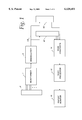
- FIG. 4 is a schematic block diagram showing additional details of portions of the system illustrated in FIG. 1.
- FIG. 5 is a graph showing a possible form of data stored in a memory illustrated in FIG. 4.
- the basic signal processing chain for a color flow and gray scale imaging system comprises an ultrasound transducer array 2, which is activated to transmit pulse sequences comprising tone bursts of length P which are fired repeatedly at a pulse repetition frequency (PRF) which typically is in the kilohertz range.
- PRF pulse repetition frequency
- the pulse sequences, including burst lengths P, are different for the color flow and B-mode processing.
- P may be 4 to 8 cycles, and the tone bursts are focused at the same transmit focal position with the same transmit characteristics.
- a series of color flow transmit firings focused at the same transmit focal position are referred to as a "packet".
- Each transmit beam propagates through the object being scanned and is reflected by ultrasound scatterers in the object.
- the return RF signals are detected by the transducer elements and received by the respective receive channels in the beamformer 4.
- the beamformer sums the delayed channel data and outputs in a beam summed signal which is demodulated into in-phase and quadrature (I/Q) signal components by a demodulator 6.
- the B-mode I, Q outputs from demodulator 6 are transmitted to a mid processor 8G for gray scale B-mode processing, and the color flow I, Q outputs from demodulator 6 are transmitted to a mid-processor 8C for color processing.
- FIG. 2 illustrates mid-processor 8C.
- the I/Q signal components from demodulator 6 are stored in a corner turner memory 7, whose purpose is to buffer data from possibly interleaved firings and output the data as vectors of points across firings at a given range cell. Data is received in "fast time”, or sequentially down range (along a vector) for each firing. The output of the corner turner memory is reordered into “slow time”, or sequentially by firing for each range cell. The resultant "slow time” I/Q signal samples are passed through a wall filter 9 which rejects any clutter corresponding to stationary or very slow-moving tissue.
- N and D are the numerator and denominator for the autocorrelation equation, as shown below: ##EQU1## where I t and Q i are the demodulated, basebanded input data for firing i, and M is the number of firings in the packet. R(O) is approximated as a finite sum over the number of firings in a packet, as follows: ##EQU2##
- a processor converts N and D into a magnitude and phase for each range cell.
- the equations used are as follows: ##EQU3##
- the parameter estimator processes the magnitude and phase values into signals having values representing estimates of power, velocity and turbulence or variance which are transmitted on conductors 11A, and 11B and 11C, respectively.
- the phase is used to calculate the mean Doppler frequency, which is proportional to the velocity as shown below; R(O) and
- the mean Doppler frequency in hertz is obtained from the phase of N and D and the pulse repetition from T: ##EQU4##
- the mean velocity is calculated using the Doppler shift equation below. Since ⁇ , the angle between the flow direction and the sampling direction, is not known, cos ⁇ is assumed to be 1.0. ##EQU5##
- the parameter estimator does not calculate the mean Doppler frequency as an intermediate output, but calculates v directly from the phase output of the processor using a look-up table.
- the turbulence may be calculated in the time domain as a second-order series expansion of the variance of the mean Doppler frequency.
- the time domain expression for turbulence involves calculating the zero-lag and one-lag autocorrelation functions, R(O) and R(T) respectively.
- the exact autocorrelation functions are approximated by finite sums over the known data in the number of firings in a packet: ##EQU6##
- the mean value signal ⁇ (R(T)) is an estimate of the mean Doppler frequency shift of the flowing reflectors, which in turn is proportional to the mean blood flow velocity.
- the variance signal ⁇ 2 indicates the frequency spread of the flow signal component of the baseband echo signal.
- the signal R(O) indicates the amount of the returned power in the Doppler-shifted flow signal.
- the signal power on conductor 11A is passed through a data compression module 13 which compresses the data according to families of data compression curves.
- a different family of curves can be provided for different scanning applications. For example, one family of curves is provided for renal scanning, while another family of curves is provided for carotid artery scanning. Typically, there are about three curves per family.
- the dynamic range of the signals is changed according to the curve used for the data compression. The curves in each family are arranged in order of increasing dynamic range. Controller 26 sets the default curve when a user selects the scan application.
- the dynamic range controls the range of intensities or lumens created on display 18.
- gray scale B-mode mid-processor 8G includes an envelope detector 10 for forming the envelope of the beamsummed receive signal by computing the quantity (I 2 +Q 2 ) 1/2 .
- the envelope of the signal undergoes some additional B-mode processing, such as logarithmic compression (block 12 in FIG. 3), to form display data which is output to the scan converter 14 (FIG. 1).
- the color flow estimates and gray scale display data are sent to the scan converter 14, which converts the data into X-Y format for video display.
- the scan-converted frames are passed to a video processor 16, which basically maps the video data to a display color map and gray scale image frames for video display.
- the image frames are then sent to the video monitor 18 for display.
- video monitor 18 for display.
- velocity or power are displayed alone or velocity is displayed in conjunction with either power or turbulence.
- System control is centered in a host computer (not shown), which accepts operator inputs through an operator interface (e.g., a keyboard) and in turn controls the various subsystems.
- the display data is converted by the scan converter 14 into X-Y format for video display.
- the scan-converted frames are passed to the video processor 16, which maps the video data to a gray scale or mapping for video display.
- the gray scale image frames are then sent to the video monitor 18 for display.
- the images displayed by the video monitor 18 are produced from an image frame of data in which each datum indicates the intensity or brightness of a respective pixel in the display.
- An image frame may, e.g., comprise a 256 ⁇ 256 data array in which each intensity datum is an 8-bit binary number that indicates pixel brightness.
- the brightness of each pixel on the display monitor 18 is continuously refreshed by reading the value of its corresponding element in the data array in a well-known manner.
- Each pixel has an intensity value which is a function of the backscatter cross section of a respective sample volume in response to interrogating ultrasonic pulses and the gray map employed.
- system control is centered in a master controller or host computer 26, which accepts operator inputs through an operator interface (not shown) and in turn controls the various subsystems.
- the master controller 26 also generates the system timing and control signals.
- the master controller 26 comprises a central processing unit (CPU) 30 and a random access memory 32.
- a keyboard 29 is used to enter data into CPU 30.
- the CPU 30 has read only memory incorporated therein for storing routines used in constructing gray and color maps based on acquired raw data.
- the scan converter 14 comprises an acoustic line memory 22 and an X-Y memory 24.
- the B-mode and color mode intensity data stored in polar coordinate (R- ⁇ ) sector format in acoustic line memory 22 is transformed to appropriately scaled Cartesian coordinate pixel display data, which is stored in X-Y memory 24.
- the color data is stored in memory locations 24C, and the gray scale data is stored in memory locations 24G.
- the scan-converted frames are passed to video processor 16, which maps the data to a gray map for video display.
- the gray scale image frames are then sent to the video monitor for display.
- Successive frames of acoustic sample data are stored in cine memory 28 on a first-in, first-out basis.
- Color frames are stored in memory locations 28C
- gray scale frames are stored in memory locations 28G.
- the cine memory is like a circular image buffer that runs in the background, continually capturing acoustic sample data that is displayed in real time to the user. When the user freezes the system, the user has the capability to view acoustic sample data previously captured in cine memory.
- the CPU 30 controls the XY memory 24 and the cine memory 28 via the system control bus 34.
- the CPU 30 controls the flow of raw data from the XY memory 24 to the video processor 16 and to the cine memory 28 and from the cine memory to the video processor 16 and to the CPU 26 itself.
- the CPU also loads the gray maps and color maps into the video processor.
- Image frames are collected in cine memory 28 on a continuous basis.
- the cine memory 28 provides resident digital image storage for single image review and multiple image loop review and various control functions.
- the region of interest displayed during single-image cine replay is that used during the image's acquisition.
- the cine memory also acts as a buffer for transfer of images to digital archival devices (not shown) via the master controller 26.
- the CPU 30 has random access memory for storing routines used in acquiring a raw data histogram, determining the end points of a new gray map input range, constructing a new gray map based on the end points of the new gray map input range, comparing the slope and gain of the new gray map to predetermined slope and gain limits, and if either limit is exceeded, reconstructing the new gray map to conform to the limit or limits.
- the contrast of the ultrasound images is adjusted by the master controller 26 by creating a mapping of raw acoustic sample data into adjusted gray and color map values.
- the master controller 26 retrieves one or more image frames of raw data from the X-Y memory 24 or from the cine memory 28, storing that raw data in memory 32.
- the CPU 30 then compiles a histogram of the number of acoustic samples having an amplitude or value within each of a multiplicity of prescribed ranges or bins for the retrieved image frames of raw data.
- a color flow auto display processing mode is initiated by the user through keyboard 29 (FIG. 4) and can then be re-initiated by the user for updating of post-processing parameters or turned off altogether as the scanning situation changes.
- the preferred embodiment uses the above-described B-mode gray scale and color flow scan data to optimize image quality of the color display.
- a composite histogram hoverogram of the data over several frames
- a single frame histogram are constructed from the cine memory 28 data for color flow and/or B-mode by controller 26.
- Algorithms then are applied to the histogram results by controller 26 to determine how to properly adjust various parameters for a specific scanning situation or application.
- the algorithms are described as follows:
- a single frame of B-mode gray scale data is collected from cine memory 28G which represents the amplitude of the scan data using the current preset dynamic range setting and compression curve for B-mode.
- Controller 26 executes the algorithm which generates a first composite histogram of the data which may appear as in FIG. 5.
- controller 26 forms a histogram of the scan data before any dynamic range compression is applied or uncompresses the data and forms a histogram.
- the user may enter the color flow modes in which power and velocity data are used separately.
- a B/color priority threshold which is user selectable from a softkey menu on keyboard 29 and which is preset to x % of the maximum B-mode gray scale value of 255.
- the threshold is received, for example, at terminals 31 and 33.
- the B-mode pixel value exceeds the selected B/color priority threshold, then the B-mode value is displayed for that pixel. Otherwise, the corresponding color pixel value is displayed, if there is one.
- the algorithm captures a single frame of B-mode data words from cine memory 28G and detects the n percent B-mode words having the largest values within the color ROI. For example, if n is 5 percent, then all the B-mode words of memory 28G in the color ROI are read, and the 5 percent of such words having the largest values are identified as a set.
- the foregoing step preferably is carried out using the histogram calculated as described in connection with FIG. 5.
- the B/Color priority threshold is then set to x percent of the mean of the set where x is the currently selected B/Color priority threshold percentage.
- the automatically adjusted threshold then is used to create a display in the manner previously described.
- the embodiments described here can be extended to automatically adjust other post-processing parameters such as power thresholds, wall filter cutoffs, baseline shifts, and velocity scales.
- Other post-processing parameters such as power thresholds, wall filter cutoffs, baseline shifts, and velocity scales.
- the same basic idea of collecting B and/or color flow frames of cine data would be applied and associated algorithms would be employed to determine exactly how to adjust the particular post processing parameter.
Landscapes
- Engineering & Computer Science (AREA)
- Physics & Mathematics (AREA)
- Radar, Positioning & Navigation (AREA)
- Remote Sensing (AREA)
- Acoustics & Sound (AREA)
- Computer Networks & Wireless Communication (AREA)
- General Physics & Mathematics (AREA)
- Ultra Sonic Daignosis Equipment (AREA)
- Measurement Of Velocity Or Position Using Acoustic Or Ultrasonic Waves (AREA)
Priority Applications (4)
| Application Number | Priority Date | Filing Date | Title |
|---|---|---|---|
| US09/224,450 US6120451A (en) | 1998-12-31 | 1998-12-31 | Ultrasound color flow display optimization by adjustment of threshold |
| PCT/US1999/028919 WO2000041003A1 (en) | 1998-12-31 | 1999-12-06 | Ultrasound color flow display optimization by adjustment of threshold |
| JP2000592668A JP4424856B2 (ja) | 1998-12-31 | 1999-12-06 | 閾値の調節による超音波カラー・フロー表示の最適化法 |
| EP99967215A EP1060411A1 (en) | 1998-12-31 | 1999-12-06 | Ultrasound color flow display optimization by adjustment of threshold |
Applications Claiming Priority (1)
| Application Number | Priority Date | Filing Date | Title |
|---|---|---|---|
| US09/224,450 US6120451A (en) | 1998-12-31 | 1998-12-31 | Ultrasound color flow display optimization by adjustment of threshold |
Publications (1)
| Publication Number | Publication Date |
|---|---|
| US6120451A true US6120451A (en) | 2000-09-19 |
Family
ID=22840743
Family Applications (1)
| Application Number | Title | Priority Date | Filing Date |
|---|---|---|---|
| US09/224,450 Expired - Lifetime US6120451A (en) | 1998-12-31 | 1998-12-31 | Ultrasound color flow display optimization by adjustment of threshold |
Country Status (4)
| Country | Link |
|---|---|
| US (1) | US6120451A (enExample) |
| EP (1) | EP1060411A1 (enExample) |
| JP (1) | JP4424856B2 (enExample) |
| WO (1) | WO2000041003A1 (enExample) |
Cited By (9)
| Publication number | Priority date | Publication date | Assignee | Title |
|---|---|---|---|---|
| US20020186868A1 (en) * | 2001-06-12 | 2002-12-12 | Steinar Bjaerum | Ultrasound color characteristic mapping |
| US20030013957A1 (en) * | 2001-06-12 | 2003-01-16 | Steinar Bjaerum | Ultrasound display of movement parameter gradients |
| US6579240B2 (en) * | 2001-06-12 | 2003-06-17 | Ge Medical Systems Global Technology Company, Llc | Ultrasound display of selected movement parameter values |
| US20040102706A1 (en) * | 2001-08-28 | 2004-05-27 | Donald Christopher | Automatic optimization of doppler display parameters |
| US20070038083A1 (en) * | 2005-08-12 | 2007-02-15 | Siemens Medical Solutions Usa, Inc. | Automatic velocity scale identification for medical diagnostic ultrasound |
| US20160058410A1 (en) * | 2014-09-01 | 2016-03-03 | Samsung Medison Co., Ltd. | Ultrasound diagnosis apparatus and method of operating the same |
| WO2016137509A1 (en) * | 2015-02-27 | 2016-09-01 | Halliburton Energy Services, Inc. | Ultrasound color flow imaging for oil field applications |
| CN109963512A (zh) * | 2016-12-28 | 2019-07-02 | 株式会社日立制作所 | 超声波诊断装置 |
| US11519263B2 (en) | 2015-01-26 | 2022-12-06 | Halliburton Energy Services, Inc. | Traceable micro-electro-mechanical systems for use in subterranean formations |
Families Citing this family (4)
| Publication number | Priority date | Publication date | Assignee | Title |
|---|---|---|---|---|
| US6500125B1 (en) | 2000-03-30 | 2002-12-31 | Ge Medical Systems Global Technology Company, Llc | Ultrasound b/color priority threshold calculation |
| CN101523237B (zh) * | 2006-10-13 | 2015-01-14 | 皇家飞利浦电子股份有限公司 | 采用灰度级反转的3d超声彩色流成像 |
| CN103204827B (zh) | 2012-01-17 | 2014-12-03 | 上海科州药物研发有限公司 | 作为蛋白激酶抑制剂的苯并噻二唑化合物及其制备方法和用途 |
| WO2016072208A1 (ja) * | 2014-11-05 | 2016-05-12 | 古野電気株式会社 | 探知情報表示装置、レーダ装置、ソナー装置、魚群探知装置及び探知情報表示方法 |
Citations (7)
| Publication number | Priority date | Publication date | Assignee | Title |
|---|---|---|---|---|
| US5235984A (en) * | 1992-03-30 | 1993-08-17 | Hewlett-Packard Company | On-line acoustic densitometry tool for use with an ultrasonic imaging system |
| US5347600A (en) * | 1989-07-05 | 1994-09-13 | Interated Systems, Inc. | Method and apparatus for compression and decompression of digital image data |
| US5718229A (en) * | 1996-05-30 | 1998-02-17 | Advanced Technology Laboratories, Inc. | Medical ultrasonic power motion imaging |
| US5732705A (en) * | 1995-09-12 | 1998-03-31 | Kabushiki Kaisha Toshiba | Ultrasound diagnostic apparatus |
| US5735797A (en) * | 1996-12-30 | 1998-04-07 | General Electric Company | Method and apparatus for combining topographic flow power imagery with a B-mode anatomical imagery |
| US5993392A (en) * | 1996-11-05 | 1999-11-30 | Atl Ultrasound, Inc. | Variable compression of ultrasonic image data with depth and lateral scan dimensions |
| US6017309A (en) * | 1998-12-31 | 2000-01-25 | Washburn; Michael J. | Ultrasound color flow display optimization by adjusting color maps |
Family Cites Families (3)
| Publication number | Priority date | Publication date | Assignee | Title |
|---|---|---|---|---|
| JPH01310648A (ja) * | 1988-06-08 | 1989-12-14 | Toshiba Corp | 超音波血流イメージング装置 |
| US5357965A (en) * | 1993-11-24 | 1994-10-25 | General Electric Company | Method for controlling adaptive color flow processing using fuzzy logic |
| JP3833282B2 (ja) * | 1994-06-24 | 2006-10-11 | 株式会社東芝 | 超音波診断装置 |
-
1998
- 1998-12-31 US US09/224,450 patent/US6120451A/en not_active Expired - Lifetime
-
1999
- 1999-12-06 JP JP2000592668A patent/JP4424856B2/ja not_active Expired - Fee Related
- 1999-12-06 WO PCT/US1999/028919 patent/WO2000041003A1/en not_active Ceased
- 1999-12-06 EP EP99967215A patent/EP1060411A1/en not_active Withdrawn
Patent Citations (7)
| Publication number | Priority date | Publication date | Assignee | Title |
|---|---|---|---|---|
| US5347600A (en) * | 1989-07-05 | 1994-09-13 | Interated Systems, Inc. | Method and apparatus for compression and decompression of digital image data |
| US5235984A (en) * | 1992-03-30 | 1993-08-17 | Hewlett-Packard Company | On-line acoustic densitometry tool for use with an ultrasonic imaging system |
| US5732705A (en) * | 1995-09-12 | 1998-03-31 | Kabushiki Kaisha Toshiba | Ultrasound diagnostic apparatus |
| US5718229A (en) * | 1996-05-30 | 1998-02-17 | Advanced Technology Laboratories, Inc. | Medical ultrasonic power motion imaging |
| US5993392A (en) * | 1996-11-05 | 1999-11-30 | Atl Ultrasound, Inc. | Variable compression of ultrasonic image data with depth and lateral scan dimensions |
| US5735797A (en) * | 1996-12-30 | 1998-04-07 | General Electric Company | Method and apparatus for combining topographic flow power imagery with a B-mode anatomical imagery |
| US6017309A (en) * | 1998-12-31 | 2000-01-25 | Washburn; Michael J. | Ultrasound color flow display optimization by adjusting color maps |
Cited By (20)
| Publication number | Priority date | Publication date | Assignee | Title |
|---|---|---|---|---|
| US20030013957A1 (en) * | 2001-06-12 | 2003-01-16 | Steinar Bjaerum | Ultrasound display of movement parameter gradients |
| US6579240B2 (en) * | 2001-06-12 | 2003-06-17 | Ge Medical Systems Global Technology Company, Llc | Ultrasound display of selected movement parameter values |
| US6652462B2 (en) * | 2001-06-12 | 2003-11-25 | Ge Medical Systems Global Technology Company, Llc. | Ultrasound display of movement parameter gradients |
| US7245746B2 (en) | 2001-06-12 | 2007-07-17 | Ge Medical Systems Global Technology Company, Llc | Ultrasound color characteristic mapping |
| US20020186868A1 (en) * | 2001-06-12 | 2002-12-12 | Steinar Bjaerum | Ultrasound color characteristic mapping |
| US20040102706A1 (en) * | 2001-08-28 | 2004-05-27 | Donald Christopher | Automatic optimization of doppler display parameters |
| US20070038083A1 (en) * | 2005-08-12 | 2007-02-15 | Siemens Medical Solutions Usa, Inc. | Automatic velocity scale identification for medical diagnostic ultrasound |
| US7887484B2 (en) | 2005-08-12 | 2011-02-15 | Siemens Medical Solutions Usa, Inc. | Automatic velocity scale identification for medical diagnostic ultrasound |
| US10743835B2 (en) * | 2014-09-01 | 2020-08-18 | Samsung Medison Co., Ltd. | Ultrasound diagnosis apparatus and method of operating the same |
| US20160058410A1 (en) * | 2014-09-01 | 2016-03-03 | Samsung Medison Co., Ltd. | Ultrasound diagnosis apparatus and method of operating the same |
| CN105380680A (zh) * | 2014-09-01 | 2016-03-09 | 三星麦迪森株式会社 | 超声诊断设备和操作该超声诊断设备的方法 |
| US11519263B2 (en) | 2015-01-26 | 2022-12-06 | Halliburton Energy Services, Inc. | Traceable micro-electro-mechanical systems for use in subterranean formations |
| WO2016137509A1 (en) * | 2015-02-27 | 2016-09-01 | Halliburton Energy Services, Inc. | Ultrasound color flow imaging for oil field applications |
| AU2015383884B9 (en) * | 2015-02-27 | 2019-02-28 | Halliburton Energy Services, Inc. | Ultrasound color flow imaging for oil field applications |
| US10612327B2 (en) | 2015-02-27 | 2020-04-07 | Halliburton Energy Services, Inc. | Ultrasound color flow imaging for oil field applications |
| AU2015383884B2 (en) * | 2015-02-27 | 2019-02-21 | Halliburton Energy Services, Inc. | Ultrasound color flow imaging for oil field applications |
| GB2548537B (en) * | 2015-02-27 | 2021-03-10 | Halliburton Energy Services Inc | Ultrasound color flow imaging for oil field applications |
| GB2548537A (en) * | 2015-02-27 | 2017-09-20 | Halliburton Energy Services Inc | Ultrasound color flow imaging for oil field applications |
| CN109963512A (zh) * | 2016-12-28 | 2019-07-02 | 株式会社日立制作所 | 超声波诊断装置 |
| CN109963512B (zh) * | 2016-12-28 | 2022-03-29 | 富士胶片医疗健康株式会社 | 超声波诊断装置 |
Also Published As
| Publication number | Publication date |
|---|---|
| EP1060411A1 (en) | 2000-12-20 |
| JP4424856B2 (ja) | 2010-03-03 |
| WO2000041003A1 (en) | 2000-07-13 |
| JP2002534188A (ja) | 2002-10-15 |
Similar Documents
| Publication | Publication Date | Title |
|---|---|---|
| US6126605A (en) | Ultrasound color flow display optimization by adjusting dynamic range | |
| US6017309A (en) | Ultrasound color flow display optimization by adjusting color maps | |
| US6162176A (en) | Ultrasound color flow display optimization | |
| US6406430B1 (en) | Ultrasound image display by combining enhanced flow imaging in B-mode and color flow mode | |
| USRE35371E (en) | Method and system for controlling ultrasound scanning sequence | |
| JP4531894B2 (ja) | 超音波イメージングにおける自動ドプラ角推定方法及び装置 | |
| US6277075B1 (en) | Method and apparatus for visualization of motion in ultrasound flow imaging using continuous data acquisition | |
| EP1176910B1 (en) | Method and apparatus for automatic vessel tracking in ultrasound imaging | |
| US6618493B1 (en) | Method and apparatus for visualization of motion in ultrasound flow imaging using packet data acquisition | |
| US6120451A (en) | Ultrasound color flow display optimization by adjustment of threshold | |
| JPH0866397A (ja) | 超音波診断装置 | |
| US5188113A (en) | Ultrasonic diagnosis apparatus | |
| JP4712931B2 (ja) | パワー・ドップラー・イメージの最適データ・マッピングのための方法および装置 | |
| US6500125B1 (en) | Ultrasound b/color priority threshold calculation | |
| US6071241A (en) | Ultrasound color flow display optimization by adjustment of threshold using sampling | |
| US5865752A (en) | Method and apparatus for ultrasound imaging using normalized difference between successive frames | |
| US6135962A (en) | Method and apparatus for adaptive filtering by counting acoustic sample zeroes in ultrasound imaging | |
| JPH06209942A (ja) | 超音波診断装置 | |
| JP2602898B2 (ja) | 超音波血流イメージング装置 | |
| JP2565917B2 (ja) | 画像処理表示装置 |
Legal Events
| Date | Code | Title | Description |
|---|---|---|---|
| AS | Assignment |
Owner name: GENERAL ELECTRIC CO., NEW YORK Free format text: ASSIGNMENT OF ASSIGNORS INTEREST;ASSIGNORS:WASHBURN, MICHAEL J.;MACLEOD, GARY E.;LUCAS. SEAN D.;AND OTHERS;REEL/FRAME:009835/0674 Effective date: 19990311 |
|
| STCF | Information on status: patent grant |
Free format text: PATENTED CASE |
|
| FEPP | Fee payment procedure |
Free format text: PAYOR NUMBER ASSIGNED (ORIGINAL EVENT CODE: ASPN); ENTITY STATUS OF PATENT OWNER: LARGE ENTITY |
|
| FPAY | Fee payment |
Year of fee payment: 4 |
|
| FPAY | Fee payment |
Year of fee payment: 8 |
|
| FPAY | Fee payment |
Year of fee payment: 12 |