US5999316A - Light valve with rotating polarizing element - Google Patents
Light valve with rotating polarizing element Download PDFInfo
- Publication number
- US5999316A US5999316A US08/986,281 US98628197A US5999316A US 5999316 A US5999316 A US 5999316A US 98628197 A US98628197 A US 98628197A US 5999316 A US5999316 A US 5999316A
- Authority
- US
- United States
- Prior art keywords
- axis
- rotation
- transmission
- polarizing
- polarizing element
- Prior art date
- Legal status (The legal status is an assumption and is not a legal conclusion. Google has not performed a legal analysis and makes no representation as to the accuracy of the status listed.)
- Expired - Lifetime
Links
- 230000005540 biological transmission Effects 0.000 claims abstract description 221
- 230000010287 polarization Effects 0.000 claims description 43
- 230000002829 reductive effect Effects 0.000 claims description 8
- 239000000463 material Substances 0.000 description 31
- 239000010410 layer Substances 0.000 description 14
- 230000000694 effects Effects 0.000 description 7
- 230000008901 benefit Effects 0.000 description 5
- 230000008859 change Effects 0.000 description 5
- 230000000903 blocking effect Effects 0.000 description 3
- 238000010586 diagram Methods 0.000 description 3
- 230000003287 optical effect Effects 0.000 description 3
- 238000010521 absorption reaction Methods 0.000 description 2
- 238000000576 coating method Methods 0.000 description 2
- 239000000975 dye Substances 0.000 description 2
- 230000000670 limiting effect Effects 0.000 description 2
- 230000004075 alteration Effects 0.000 description 1
- 230000003466 anti-cipated effect Effects 0.000 description 1
- 238000013459 approach Methods 0.000 description 1
- 238000006243 chemical reaction Methods 0.000 description 1
- 239000005357 flat glass Substances 0.000 description 1
- 230000004313 glare Effects 0.000 description 1
- 239000011521 glass Substances 0.000 description 1
- 230000002452 interceptive effect Effects 0.000 description 1
- 239000004973 liquid crystal related substance Substances 0.000 description 1
- 238000000034 method Methods 0.000 description 1
- 239000000203 mixture Substances 0.000 description 1
- 238000012986 modification Methods 0.000 description 1
- 230000004048 modification Effects 0.000 description 1
- 230000036961 partial effect Effects 0.000 description 1
- 230000009467 reduction Effects 0.000 description 1
- 230000002441 reversible effect Effects 0.000 description 1
- 239000002356 single layer Substances 0.000 description 1
Images




Classifications
-
- E—FIXED CONSTRUCTIONS
- E06—DOORS, WINDOWS, SHUTTERS, OR ROLLER BLINDS IN GENERAL; LADDERS
- E06B—FIXED OR MOVABLE CLOSURES FOR OPENINGS IN BUILDINGS, VEHICLES, FENCES OR LIKE ENCLOSURES IN GENERAL, e.g. DOORS, WINDOWS, BLINDS, GATES
- E06B9/00—Screening or protective devices for wall or similar openings, with or without operating or securing mechanisms; Closures of similar construction
- E06B9/24—Screens or other constructions affording protection against light, especially against sunshine; Similar screens for privacy or appearance; Slat blinds
-
- G—PHYSICS
- G02—OPTICS
- G02B—OPTICAL ELEMENTS, SYSTEMS OR APPARATUS
- G02B27/00—Optical systems or apparatus not provided for by any of the groups G02B1/00 - G02B26/00, G02B30/00
- G02B27/28—Optical systems or apparatus not provided for by any of the groups G02B1/00 - G02B26/00, G02B30/00 for polarising
- G02B27/281—Optical systems or apparatus not provided for by any of the groups G02B1/00 - G02B26/00, G02B30/00 for polarising used for attenuating light intensity, e.g. comprising rotatable polarising elements
Definitions
- the present invention relates to the field of light control devices and methods. More particularly, the present invention provides light valves which use one or more polarizing elements that rotate about an in-plane axis to control the passage of light through the device.
- Manual control of light transmission is generally required for many purposes, including industrial, commercial, and residential applications.
- One common application is the control of light passing through a window, skylight, or other opening for a variety of reasons, e.g., controlling visible light transmission, ensuring privacy, reducing heat build-up in a room, etc.
- Many types of curtains, venetian blinds, shades, draperies, shutters, and the like are used to control the amount of light admitted into a room or building through a window, skylight, or other opening.
- polarizers as light valves in many different applications.
- two polarizers are used, at least one of which can be translated or rotated.
- the transmission axis of the front polarizer is "crossed" with the transmission axis of the rear polarizer at angles that can vary between 0 and 90° to adjust the amount of light transmitted through the polarizers.
- the rotation is typically about an axis that is normal to the plane in which the polarizer is located, i.e., the axis of rotation is out of the plane in which the rotating polarizer is located.
- the rotating light valves typically require that the window or other opening in which they are placed be generally circular. In other words, such devices are not particularly useful for windows which have a generally square or rectangular outline.
- absorptive polarizers use dichroic dyes which absorb light of one polarization orientation more strongly than that of the orthogonal polarization orientation. Because absorptive polarizers absorb light having one polarization orientation, they can also present the problems of conversion of absorbed solar energy into thermal energy which is then radiated into the interior of a room.
- the present invention provides light valves including polarizing elements in which light transmission can be controlled by rotating at least one of the polarizing elements about an in-plane axis.
- polarizing elements are preferred in devices according to the present invention to reduce the problem of heat build-up, the use of absorptive or other polarizers may also be envisioned.
- the light valves according to the present invention may find use in any application in which the transmission of light (visible or otherwise) is to be controlled. Examples of specific applications include, but are not limited to: windows, luminaires, skylights, etc.
- the present invention provides a light valve including a first polarizing element having a first transmission axis; and a second polarizing element having an axis of rotation and a second transmission axis intersecting the axis of rotation at an angle of about 45 degrees; wherein rotation of the second polarizing element about the axis of rotation to a first orientation generally aligns the first and second transmission axes and rotation of the second polarizing element about the axis of rotation to a second orientation causes the first transmission axis to cross the second transmission axis, whereby transmission of light traveling through the first and second polarizing elements is reduced relative to the light transmitted through the first and second polarizing elements when in the first orientation.
- the present invention provides a light valve having a first polarizing element including a reflective polarizer having a first transmission axis; and a plurality of second polarizing elements, each of the second polarizing elements including an axis of rotation about which the second polarizing element rotates and a reflective polarizer having a second transmission axis that forms an angle of about 45 degrees with the axis of rotation of the second polarizing element, the axes of rotation of the plurality of second polarizing elements being generally parallel to each other; wherein the first transmission axis of the first polarizing element forms an angle of about 45 degrees with the axes of rotation of the plurality of second polarizing elements, and further wherein rotation of each of the second polarizing elements about its respective axis of rotation to a first orientation generally aligns the second transmission axis of the second polarizing element with the first transmission axis, and further wherein rotation of each of the second polarizing elements about 180 degrees around its respective axis of rotation to a second orientation
- the present invention provides a light valve including a first polarizing element having a first axis of transmission and a first axis of rotation, wherein the first axis of transmission and the first axis of rotation define a first plane for the first polarizing element; and a second polarizing element having a second axis of transmission and a second axis of rotation, wherein the second axis of transmission and the second axis of rotation define a second plane for the second polarizing element, and further wherein at least a portion of the second polarizing element overlaps at least a portion of the first polarizing element; wherein the first and second transmission axes of the first and second polarizing elements are generally aligned in a first orientation, and further wherein rotation of the first and second polarizing elements about their respective axes of rotation to a second orientation causes the second transmission axis to cross the first transmission axis, whereby transmission of light traveling through the first and second polarizing elements is reduced relative to the light transmitted through the first
- the present invention provides a light valve including a plurality of polarizing elements, at least a portion of each of the polarizing elements having a first transmission axis or a second transmission axis, wherein the portions of the polarizing elements having the first transmission axis transmit a substantial portion of light having a first polarization orientation and the portions of the polarizing elements having the second transmission axis transmit a substantial portion of light having a second polarization orientation, the plurality of polarizing elements including: a first polarizing element having the first axis of transmission and a first axis of rotation, wherein the first axis of transmission in the first polarizing element intersects the first axis of rotation; a second polarizing element including an upper segment having the first transmission axis, a lower segment having the second transmission axis, and a second axis of rotation, wherein the first and second transmission axes in the second polarizing element intersect the second axis of rotation and each other, and further wherein at least polarizing elements
- FIG. 1 is a perspective view of one light valve according to the present invention.
- FIG. 2 is a plan view of the light valve of FIG. 1.
- FIG. 3 is a side view of the light valve of FIG. 1 taken along the axis of rotation 24.
- FIG. 4 is a side view of the light valve of FIG. 1 taken along the axis of rotation 24, with the second polarizing element 20' in a lower position.
- FIG. 5 is a side view of an alternative light valve according to the present invention.
- FIG. 6 is a side view of the light valve of FIG. 5 in which the elements 30 have been rotated 180° around their respective axes 40.
- FIG. 7 is a perspective view of an alternate light valve according to the present invention.
- FIG. 8 is a top view of the light valve of FIG. 7 taken along the axes of rotation 52 and 62.
- FIG. 9 is a top view of the light valve of FIG. 7 taken along the axes of rotation 52 and 62 after rotation of the elements 50 and 60 about their respective axes.
- FIG. 10 is a front view of the light valve in the condition depicted in FIG. 9.
- FIG. 11 is a perspective view of an alternate light valve according to the present invention.
- FIG. 12 is a perspective view of the light valve of FIG. 11 after rotation of the elements about their respective axes of rotation.
- FIG. 13 is an alternate embodiment of a light valve according to the present invention.
- FIG. 15 is a perspective view of an alternate light valve according to the present invention.
- FIG. 17 is a side view of the light valve of FIG. 15 taken along the axes of rotation 112 and 122 of the elements 110 and 120, where elements 120 rotate opposite from the direction depicted in FIG. 15.
- FIG. 21 is a schematic diagram of a luminaire including a light valve according to the present invention.
- FIG. 22 is a schematic diagram of a skylight including a light valve according to the present invention.
- the present invention provides light valves for controlling the transmission of light through an opening in which one or both of two polarizing elements are rotated about in-plane axes of rotation.
- the light valves according to the present invention may find use in applications such as control of light passing through windows (e.g., as horizontal blinds such as venetian blinds, vertical blinds, shutters, etc.), in luminaires to control the distribution of light from a light fixture, or they may find use in other applications such as optical systems in industrial, commercial, or other settings.
- the plane of the polarizing elements is defined by the transmission axis and the axis of rotation about which the polarizing element is rotated.
- the transmission axis can be projected into a plane and it is that plane in which the axis of rotation is also located, thereby providing for the in-plane axis of rotation that forms a part of the present invention.
- the axis of rotation although typically extending through the body of the polarizing element, may not lie in the physical body of the polarizing element.
- the 45° orientation of transmission axes is not required to effect a change between a light valve which transmits incident light to a light valve which is substantially opaque to incident light.
- polarizing materials are typically referred to as reflective polarizers in which light that is not transmitted is typically reflected
- absorptive polarizing materials, coatings or structures include, but are not limited to dichroic dyes.
- the composition of the polarizing materials is not important. Rather, it is the functional performance of the polarizing materials that is important, i.e., that they preferentially absorb or reflect (specularly or diffusely) light having one polarization orientation.
- Rear polarizing element 20 is preferably rotated about axis of rotation 24 which is preferably generally parallel to reference axis 14 of polarizing element 10.
- Rear polarizing element 20 includes an axis of transmission 22 that forms an angle a with the axis of rotation 24.
- Transmission axis 22 and axis of rotation 24 preferably lie in the plane of rear polarizing element 20.
- rotation of rear polarizing element 20 about axis of rotation 24 results in location of rear polarizing element 20 below axis of rotation 24, as indicated by reference numeral 20'.
- Rotation of rear polarizing element 20 also results in a mirroring of the transmission axis 22 about axis of rotation 24 to a position indicated by reference numeral 22'.
- the axis of transmission 22' forms an angle ⁇ with the axis of rotation 24, as best seen in FIG. 1.
- FIG. 3 is a side view of the light valve of FIGS. 1 and 2 taken along the axis of rotation 24. This view depicts the effects on light of the light valve when in the state depicted in FIGS. 1 and 2, where the rear polarizing element 20 is located above axis of rotation 24.
- Light 16 having one polarization orientation is depicted as being transmitted through the front polarizer 10 where it strikes rear polarizer 20. Because light 16 has a polarization orientation that is transmitted through polarizing element 10, it is not transmitted through rear polarizing element 20. Instead, light 16 is reflected from the preferred reflective polarizer of rear polarizing element 20 where it is transmitted back through front polarizing element 10 (assuming its polarization orientation is unchanged). It will, of course, be understood that if rear polarizing element 20 were an absorptive polarizer, light 16 would merely be absorbed by the rear polarizing element 20.
- FIG. 4 is a side view of the light valve of FIG. 1 in which the rear polarizer is depicted in the lower position 20' where the axis of transmission 22' is generally aligned with axis of transmission 12 of the front polarizing element 10.
- Light 26 having a polarization orientation that is generally aligned with the axis of transmission 12 of front polarizing element 10 is transmitted through the front polarizing element 10 and, because the axis of transmission 22' is aligned with axis of transmission 12, light 26 is also transmitted through the rear polarizing element 20'.
- Light 28 having an orthogonal polarization orientation to that of light 26 is depicted as being reflected from the surface of front polarizing element 10 (which is preferably, but not necessarily, a reflective polarizer).
- the light valve transmits light having the polarization orientation of light 26
- the light valve is considered to be in the transmissive or open state in FIG. 4 (although it will be understood that only about half of the incident light will actually be transmitted due to the polarizing function of the polarizing elements 10 and 20.
- FIGS. 1-4 depict a light valve in which a front polarizing element 10 is paired with a single rear polarizing element 20, it will be understood that a plurality of rear polarizing elements 20 could be provided in the form of a venetian blind or other similar assembly such that rotation of each element 20 about its respective axis of rotation would result in a change in the amount of light transmitted through the light valve.
- the front polarizing element 10 be provided as a single sheet or film of polarizing material that could be laminated to window glass, etc.
- front polarizing element 10 could be provided in the form of a shade or other article which could be placed between the window or other opening and the rear polarizing elements 20.
- front polarizing element were removable or movable, the user could raise both front polarizing element 10 and rear polarizing element 20 out of the path of incident light coming through a window or other opening to prevent the polarizing elements 10 and 20 from interfering with the transmission of light through the window or other opening.
- the axes of transmission for the front polarizing element 10 and rear polarizing element 20 are preferably about 45° off of the axis of rotation 24 about which rear polarizing element 20 is rotated, it will be understood that transmission axes with other orientations could be provided. Deviations from the preferred 45° angular orientation will result in transmission of at least some light when the front and rear polarizing elements 10 and 20 are located such that their axes of transmission 12 and 22 are not orthogonal with respect to each other.
- the present invention can be broadly characterized, however, in that 180° rotation (see angle ⁇ in FIG.
- At least one of the axes of transmission 12 and 22 is located at an angle that is greater than about 0 degrees and less than about 90 degrees, i.e., is not parallel with or orthogonal to the axis of rotation 24.
- the other polarizing element regardless of the orientation of its transmission axis, will cross the other axis of transmission by a smaller angle in a first orientation and a larger angle when one of the polarizing elements is rotated about the axis of rotation to a second orientation. That variation between the first and second orientations, i.e., smaller and larger crossing angles, will change the amounts of incident light that are transmitted through the light valve. Where the axes of transmission cross at a smaller angle, the light valve will transmit more incident light and where the transmission axes cross at a larger angle, the light valve will transmit less incident light.
- FIG. 18b depicts a polarizing element including two layers 132 and 134 of polarizing materials.
- the two layers could include two layers of the same polarizing material.
- the two layers could include a specularly reflective polarizing material 132 in combination with a diffusely reflective polarizing material 134.
- FIG. 18c depicts layer 136 of specularly reflective polarizing material and layer 138 of an absorptive polarizing material.
- FIG. 18d depicts a layer 140 of diffusely reflective polarizing material and a layer 142 of an absorptive polarizing material.
- FIG. 18e is provided to indicate that, within a given polarizing element 144, two or more layers 146 and 148 of polarizing materials may be located on opposing sides of a core 150 to provide, e.g., additional rigidity or some other function to the polarizing element 144.
- the core 150 be substantially polarization preserving of the light passing through the core 150. It may also be preferred that the core 150 be substantially transparent to desired wavelengths of light.
- two layers of polarizing materials are depicted in combination, it will be understood that more than two layers of the same or different polarizing materials could also be used in polarizing elements of light valves according to the present invention.
- the light valves according to the present invention could be used in combination with other optical elements such as infrared reflective or absorptive materials, etc. These materials could be provided in addition to the light valves according to the present invention, or they could be incorporated into the light valves.
- the core 150 of the polarizing element 144 could be an infrared absorptive or infrared reflective material.
- the layer 150 could be made of a polarizing material while layer 146 is infrared absorptive and layer 148 could be infrared reflective.
- At least one of the preferred polarizing elements be constructed from reflective polarizing materials.
- the reflected light could alternately be absorbed.
- portions of the light that is described as reflected could be absorbed while other portions could be reflected.
- the polarizing elements according to the present invention are depicted in the illustrative embodiments as generally planar articles, it should be understood that the polarizing elements could take many other shapes. In all cases, however, the axis of transmission and the axis of rotation can be used to define a plane in which both axes are contained. In many cases the polarizing elements will include polarizing material that is supplied in film or sheet form.
- an alternate embodiment of a light valve according to the present invention is depicted including a plurality of polarizing elements 30a, 30b, 30c, 30d, and 30e (collectively referred to as polarizing elements 30).
- Each of the polarizing elements 30 is overlapped by one or more of the adjacent elements 30.
- polarizing element 30a is overlapped by polarizing element 30b which is, in turn, overlapped by the next polarizing element 30c.
- Polarizing element 30c (which is shaded) along with the shaded portions of polarizing elements 30b and 30d preferably have transmission axes that are generally aligned with each other, while polarizing elements 30a and 30e (which are unshaded), as well as unshaded portions of polarizing elements 30b and 30d, have transmission axes that are generally aligned with each other. It is preferred that the two different sets of aligned axes of transmission (represented by the shaded and unshaded polarizing elements 30) be generally or substantially orthogonal to each other.
- the different sets of transmission axes need not necessarily be generally or substantially orthogonal as other orientations are also anticipated provided that at least some intersection or crossing of the two sets of axes of transmission can be accomplished by rotation of each of the polarizing elements 30 about their respective axes of rotation 40a, 40b, 40c, 40d, and 40e (collectively referred to as axes of rotation 40).
- the light valve When the polarizing elements 30 are aligned as depicted in FIG. 5, the light valve is in a substantially closed position, i.e., substantially all of the incident light is reflected from the light valve.
- the polarizing elements 30 are preferably constructed from reflective polarizing materials and, as a result, light that is not transmitted is generally reflected from the polarizing elements 30. If, however, the elements 30 were absorptive polarizers rather than reflective, then the light that is not transmitted would generally be absorbed.
- ray 36 has a polarization orientation that is transmitted through unshaded polarizing element 30a but is reflected, i.e., not transmitted, through the shaded overlapping portion of polarizing element 30b.
- Ray 38 is shown as incident upon polarizing element 30c and has a polarization orientation that is orthogonal to the polarization orientation of ray 36.
- ray 38 is transmitted through the shaded polarizing element 30c but is reflected from the unshaded portion of polarizing element 30d.
- light 36' having one polarization orientation is transmitted through the unshaded polarizing element 30a' and the unshaded overlapping portion of reflective polarizer 30b'.
- Light 38' having a different polarization orientation, is transmitted through the shaded polarizing element 30c' and the shaded overlapping portion of polarizing element 30d', as shown.
- the light valve depicted in FIG. 6 will transmit about 50% of incident light as the unshaded portions of the light valve will transmit light of one polarization orientation while the shaded portions of the light valve will transmit light having another polarization orientation.
- polarizing elements 30a-30d can be used as a repeating set to cover a desired area.
- the polarizing element 30e would form the first polarizing element of the next set, i.e., would correspond to polarizing element 30a located at the top of the light valve depicted in FIGS. 5 and 6.
- These repeating sets of polarizing elements 30a-30d could be chained together to form a light valve having the desired dimensions.
- FIGS. 5 and 6 One advantage of a light valve constructed according to FIGS. 5 and 6 is that the need for a fixed or stationary front polarizing element as described in connection with the embodiment illustrated in FIGS. 1-4 is eliminated, as each of the rotating polarizing elements 30 function as either a front or rear polarizer depending on their orientation relative to the overlapping portions of the polarizing elements 30.
- FIGS. 7-10 depict an alternate embodiment of a light valve, according to the present invention, in which front polarizing elements 50a, 50b, and 50c (collectively referred to as front polarizing elements 50) are provided in conjunction with rear polarizing elements 60a and 60b (collectively referred to as rear polarizing elements 60).
- Each of the front polarizing elements 50 includes an axis of rotation 52a, 52b, and 52c, respectively (collectively referred to as axes of rotation 52), and each of the rear polarizing elements 60 includes an axis of rotation 62a and 62b, respectively (collectively referred to as axes of rotation 62).
- Each of the front polarizing elements 50 also includes an axis of transmission 54 that forms an angle ⁇ with the respective axis of rotation 52 for the given front polarizing element 50.
- Each of the rear polarizing elements 60 defines an axis of transmission 64 which forms an included angle ⁇ with the respective axis of rotation 62 for the given rear polarizing element 60.
- the axes of rotation 52 are preferably generally parallel to each other. It is also preferred that the axes of rotation 62 of each of the rear polarizing element 60 are also generally parallel to each other. Furthermore, it is also preferred that axes of rotation 52 are generally parallel to axes of rotation 62, as depicted in FIGS. 8 and 9.
- the polarizing elements 50 and 60 can be oriented in a substantially co-planar relationship, such as that depicted in FIGS. 7 and 8, or can be oriented in the generally parallel relationship best seen in FIGS. 9 and 10 where the polarizing elements 50 and 60 are all generally parallel to each other, thereby allowing at least a portion of light to pass through the light valve without passing through any of the polarizing elements 50 or 60.
- the front and rear polarizing elements 50 and 60 can be manipulated between a closed position and an open position.
- the closed position substantially none of the incident light would pass through both a front polarizing element 50 and a rear polarizing element 60.
- the open position at least some of the light would pass through the front and rear polarizers 50 and 60 only when one of the front or rear polarizer elements 50 and 60 were rotated 90° from the positions depicted in FIG. 8.
- rear polarizing elements 60 were each rotated 90°, a substantial portion of the light passing through front polarizing elements 50 would pass between rear polarizing elements 60 and be transmitted through the light valve.
- the axes of transmission 54 and 64 would be generally orthogonal to each other if angles ⁇ and ⁇ are both approximately 45° and the rear polarizing elements 60 were rotated about 180° around their respective axes of rotation 62.
- light having one polarization orientation would be reflected by front polarizing elements 50, while light having the orthogonal polarization orientation would be reflected (or absorbed) by rear polarizing elements 60 resulting in the transmission of substantially no light through the light valve. It will be understood that the light could alternately be absorbed rather than reflected depending on the nature of the polarizing materials used in the polarizing elements.
- FIGS. 11 and 12 Another alternative light valve according to the present invention is depicted in FIGS. 11 and 12.
- the light valve includes polarizing elements 70 and 80.
- Polarizing element 70 rotates about an axis of rotation 72 and includes an axis of transmission 74 which defines the polarization orientation of light transmitted through polarizing element 70.
- Polarizing element 80 rotates about an axis of transmission 82 and includes a transmission axis 84 which also defines the polarization orientation of light transmitted through polarizing element 80.
- FIG. 13 depicts an extension of the light valve of FIGS. 11 and 12 which includes a plurality of pairs of polarizing elements 70a/80a, 70b/80b, and 70c/80c.
- Each of the polarizing elements 70a, 70b, and 70c (collectively referred to as polarizing elements 70) is rotatable about an axis of rotation 72a, 72b, and 72c, respectively.
- the axes of rotation 72a, 72b, and 72c will be collectively referred to as axes of rotation 72.
- each of the polarizing elements 80a, 80b, and 80c (collectively referred to as polarizing elements 80) is rotatable about an axis of rotation 82a, 82b, and 82c, respectively.
- Each of the polarizing elements 70 includes an axis of transmission 74a, 74b, and 74c (collectively referred to as axes of transmission 74).
- each of the polarizing elements 80 includes an axis of transmission 84a, 84b, and 84c (collectively referred to as axes of transmission 84).
- each pair of polarizing elements 70 and 80 include respective axes of transmission 74 and 84, that are substantially aligned with each other and which form angles of 45° (or about 45°) with the respective axis of rotation 72 or 82.
- rotation of each of the polarizing elements 70 and 80 of about 90° around the axes of rotation 72 and 82 in the directions depicted by arrows 76 and 86 will result in orientation of the axes of transmission 74 and 84 in a generally orthogonal state where substantially all of the incident light will be prevented from passing through the light valve.
- the axes of transmission 74 in polarizing elements 70 that are adjacent to each other be oriented generally orthogonal to each other. It is also preferred that each of the axes of rotation 72 of polarizing elements 70 be generally parallel to each other.
- the axis of transmission 74a for polarizing element 70a is preferably oriented generally orthogonal to the axis of transmission 74b of polarizing element 70b (when viewing down through the stack of polarizing elements 70).
- axis of transmission 74b be oriented generally orthogonal to axis of transmission 74c for polarizing element 70c.
- the same relationships also are preferably present in the axes of transmission for polarizing elements 80 as depicted in FIG. 13.
- FIG. 14 One potential advantage for light valves similar to those depicted in FIG. 13 is illustrated in FIG. 14 which, in addition to polarizing element pairs 70a/80a, 70b/80b, and 70c/80c, includes additional pairs of polarizing elements 70d/80d, 70e/80e, 70f/80f, 70g/80g, 70h/80h, and 70i/80i.
- Those polarizing elements 70 and 80 having an axis of transmission generally aligned with the axes of transmission 74a and 84a of FIG. 13 are depicted as shaded polarizing elements in FIG. 14.
- polarizing elements 70b/80b, 70d/80d, and 70f/80f through 70i/80i all have axes of transmission that would be generally aligned with axes of transmission 74b and 84b of FIG. 13.
- light 90 which has a polarization orientation that is transmitted by shaded polarizing element 70c
- unshaded polarizing element 80d will be reflected by unshaded polarizing element 80d, as shown in FIG. 14.
- light 92 which has a polarization orientation that is not transmitted by shaded polarizing element 70a
- light 94 which has a polarization orientation that is not transmitted by shaded polarizing element 80e, would be reflected from that element and it would be allowed to enter into the area occupied by observer 98.
- the end effect of alternating axes of transmission between adjacent pairs of polarizing element 70 and 80 is that the view of an observer 98 upwards would be restricted where the path of light would pass through two polarizing elements having orthogonal axes of transmission, e.g., 70a and 80b.
- the actual angles at which the view of the observer 98 would be obstructed would vary on the spacing and size of the polarizing elements 70 and 80.
- alternating axes of transmission in a light valve similar to that depicted in FIG. 13 can be manipulated to allow for viewing in a desired quadrant or allow a view to be blocked as desired.
- the observer 98 has a view that is blocked in the upward direction but not in the lower direction. It will be understood that the alternative could be provided, i.e., the observer's view could be blocked in the downward direction as opposed to the upward direction.
- the view of the observer 98 could be blocked to a narrow range of angles by providing a light valve in which all of the polarizing elements were arranged as elements 70a/80a through 70f/80f, i.e., in which vertically adjacent polarizing elements have orthogonal axes of transmission.
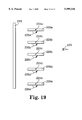
- FIG. 19 illustrates a light valve in which the rear polarizing elements rotate more than 180 degrees.
- the light valve of FIG. 19 includes a fixed or stationary front polarizing element 210 and a plurality of rear polarizing elements 220a through 220e (collectively referred to as polarizing elements 220).
- Each of the rear polarizing elements 220 rotates about an in-plane axis of rotation 224 as indicated by arrow 226.
- FIGS. 15-17 depict an alternate embodiment of a light valve according to the present invention which, although similar to the light valve of FIGS. 13 and 14, does include differences which affect its properties as described below.
- the light valve of FIG. 15 includes pairs of polarizing elements 110a/120a, 110b/120b, and 110c/120c (collectively referred to as polarizing elements 110 and polarizing elements 120).
- Each of the polarizing elements 110 rotates about an axis of rotation 112a, 112b, and 112c (collectively referred to as axes of rotation 112). That rotation is preferably in directions 116a, 116b, and 116c as depicted in FIG. 15.
- each of the polarizing elements 120 rotates about its respective axis of rotation 122a, 122b, and 122c (collectively referred to as axes of rotation 122).
- the direction of rotation is preferably in the direction 126a, 126b, and 126c as depicted in FIG. 15.
- the light valve of FIG. 15 includes polarizing elements 110 and 120 that have axes of transmission that are either generally parallel or orthogonal to the axis of rotation f or the given polarizing element 110/120.
- polarizing element 110a has an axis of transmission 114a that is preferably substantially parallel to axis of rotation 1116a.
- Polarizing element 120a preferably has an axis of transmission 124a that is generally orthogonal or transverse to axis of rotation 122a.
- polarizing element 110b preferably has an axis of transmission 114b that is generally orthogonal or transverse to its axis of rotation 112b. Because the axes of rotation 112a and 112b are preferably generally parallel to each other, the axes of transmission 114a and 114b are generally orthogonal to each other.
- each pair of polarizing elements 110/120 are oriented either parallel or orthogonal to the axes of rotation as depicted in FIG. 15, the light valve can be moved between a transmission state, such as that depicted in FIG. 15, to an opaque or blocking state, which is depicted in FIG. 16. That movement is typically effected by rotating each of the polarizing elements 110 about 90 degrees around their respective axes of rotation 112 in the directions indicated by arrows 116a-116c. Similarly, each of the polarizing elements 120 is rotated about 90 degrees around their respective axes of rotation 122 in the directions indicated by arrows 126a-126c.
- FIG. 17 depicts the result of rotating each of the polarizing elements 120 about 90 degrees around their respective axes of rotation in the direction opposite to directions 126a-126c as indicated in FIG. 15.
- the shaded polarizing elements 110/120 are those in which the axis of transmission is generally orthogonal or transverse to the axis of rotation for that polarizing element while the unshaded polarizing elements 110/120 are those in which the axis of transmission is generally parallel to the axis of rotation of that polarizing element.
- the result of rotating polarizing elements 120 in a direction opposite to that indicated by arrows 126a-126c in FIG. 15 is general alignment of the axes of transmission between each pair of front and rear polarizing elements 110/120.
- the light valve will transmit approximately 50% of incident light (assuming such light has a random polarization orientation).
- light passing through polarizing element 110a which has an axis of transmission that is generally parallel to axis of rotation 112
- polarizing element 120b which has an axis of transmission that is parallel to (or generally parallel to) its axis of rotation 122b (assuming that axis of rotation 112a is generally parallel to axis of rotation 122b).
- light having a polarization orientation that is transmitted through polarizing element 110b will also be transmitted through polarizing element 120c assuming the axes of rotation 112b and 122c are generally parallel to each other.
- FIG. 20 depicts a window 260 including a light valve 262 according to the present invention.
- FIG. 21 depicts a luminaire 270 including a light source 272 and a pair of opposing light valves 274 and 276 constructed according to the present invention.
- FIG. 22 is a partial cross-sectional view of a skylight 280 including a light valve 282 located between two panes 284/286 of glass or another light transmissive material.
Landscapes
- Physics & Mathematics (AREA)
- Engineering & Computer Science (AREA)
- Structural Engineering (AREA)
- General Physics & Mathematics (AREA)
- Optics & Photonics (AREA)
- Architecture (AREA)
- Civil Engineering (AREA)
- Polarising Elements (AREA)
- Liquid Crystal (AREA)
Priority Applications (7)
| Application Number | Priority Date | Filing Date | Title |
|---|---|---|---|
| US08/986,281 US5999316A (en) | 1997-12-06 | 1997-12-06 | Light valve with rotating polarizing element |
| AU13835/99A AU1383599A (en) | 1997-12-06 | 1998-11-05 | Light valve with rotating polarizing element |
| EP98957618A EP1036348A1 (en) | 1997-12-06 | 1998-11-05 | Light valve with rotating polarizing element |
| JP2000524701A JP2001526406A (ja) | 1997-12-06 | 1998-11-05 | 回転偏光素子を備えた光弁 |
| PCT/US1998/023617 WO1999030202A1 (en) | 1997-12-06 | 1998-11-05 | Light valve with rotating polarizing element |
| TW087119023A TW436640B (en) | 1997-12-06 | 1998-11-17 | Light valve with rotating polarizing element |
| US09/333,614 US6185039B1 (en) | 1997-12-06 | 1999-06-15 | Infrared selective reflective polarizing element |
Applications Claiming Priority (1)
| Application Number | Priority Date | Filing Date | Title |
|---|---|---|---|
| US08/986,281 US5999316A (en) | 1997-12-06 | 1997-12-06 | Light valve with rotating polarizing element |
Related Child Applications (1)
| Application Number | Title | Priority Date | Filing Date |
|---|---|---|---|
| US09/333,614 Continuation US6185039B1 (en) | 1997-12-06 | 1999-06-15 | Infrared selective reflective polarizing element |
Publications (1)
| Publication Number | Publication Date |
|---|---|
| US5999316A true US5999316A (en) | 1999-12-07 |
Family
ID=25532265
Family Applications (2)
| Application Number | Title | Priority Date | Filing Date |
|---|---|---|---|
| US08/986,281 Expired - Lifetime US5999316A (en) | 1997-12-06 | 1997-12-06 | Light valve with rotating polarizing element |
| US09/333,614 Expired - Lifetime US6185039B1 (en) | 1997-12-06 | 1999-06-15 | Infrared selective reflective polarizing element |
Family Applications After (1)
| Application Number | Title | Priority Date | Filing Date |
|---|---|---|---|
| US09/333,614 Expired - Lifetime US6185039B1 (en) | 1997-12-06 | 1999-06-15 | Infrared selective reflective polarizing element |
Country Status (6)
| Country | Link |
|---|---|
| US (2) | US5999316A (enExample) |
| EP (1) | EP1036348A1 (enExample) |
| JP (1) | JP2001526406A (enExample) |
| AU (1) | AU1383599A (enExample) |
| TW (1) | TW436640B (enExample) |
| WO (1) | WO1999030202A1 (enExample) |
Cited By (24)
| Publication number | Priority date | Publication date | Assignee | Title |
|---|---|---|---|---|
| US20010036013A1 (en) * | 1999-04-22 | 2001-11-01 | 3M Innovative Properties Company | Optical devices using reflecting polarizing materials |
| US6641900B2 (en) | 1998-01-13 | 2003-11-04 | 3M Innovative Properties Company | Modified copolyesters and improved multilayer reflective films |
| US6721096B2 (en) | 1997-10-28 | 2004-04-13 | 3M Innovative Properties Company | Polarizing beam splitter |
| GB2399185A (en) * | 2003-03-01 | 2004-09-08 | Integration Technology Ltd | Shutter |
| US6905220B2 (en) | 1995-06-26 | 2005-06-14 | 3M Innovative Properties Company | Backlight system with multilayer optical film reflector |
| EP1542054A1 (de) * | 2003-12-09 | 2005-06-15 | Jürg Walter Müller-Schoop | Verdunkelnde Lamellenstoren mit zwei polarisierenden Schichten |
| US7083847B2 (en) | 1993-12-21 | 2006-08-01 | 3M Innovative Properties Company | Optical film |
| US20060196127A1 (en) * | 2005-02-06 | 2006-09-07 | Tillman Chad D | Opposed window pairing for limited viewing there through |
| US7138173B2 (en) | 1998-01-13 | 2006-11-21 | 3Minnovative Properties Company | Red-green-blue polymeric interference film |
| US7652820B2 (en) | 1997-10-28 | 2010-01-26 | 3M Innovative Properties Company | Reflective LCD projection system using wide-angle cartesian polarizing beam splitter and color separation and recombination prisms |
| US20100053751A1 (en) * | 2008-08-28 | 2010-03-04 | Mcleod William | Wire grid polarizers in window shading applications and varrying thickness wave retarders |
| US20100079864A1 (en) * | 2008-10-01 | 2010-04-01 | Industrial Technology Research Institute | Optical sheet |
| US7852560B2 (en) | 1993-12-21 | 2010-12-14 | 3M Innovative Properties Company | Display incorporating reflective polarizer |
| US8508681B2 (en) | 2010-12-30 | 2013-08-13 | Smartershade, Inc. | Variable transmission window |
| CN103587181A (zh) * | 2013-11-01 | 2014-02-19 | 无锡海特新材料研究院有限公司 | 新型偏振膜材料 |
| US20150026951A1 (en) * | 2013-07-24 | 2015-01-29 | Corning Incorporated | Methods of forming polarized panes for variable transmission windows |
| US9044863B2 (en) | 2013-02-06 | 2015-06-02 | Steelcase Inc. | Polarized enhanced confidentiality in mobile camera applications |
| US20150355473A1 (en) * | 2013-10-16 | 2015-12-10 | Emmett Dunham | Color-changing apparatus for active camouflage configurations |
| US9871594B2 (en) | 2012-01-23 | 2018-01-16 | Vg Smartglass, Llc | Mechanical translation of a variable radiation transmission device |
| US10132165B2 (en) | 2010-11-07 | 2018-11-20 | Terrasimco, Inc. | Anchoring systems for mines |
| US10295837B2 (en) | 2015-11-23 | 2019-05-21 | Vg Smartglass, Llc | Variable transmission window with blackout bars |
| US11106124B2 (en) | 2018-02-27 | 2021-08-31 | Steelcase Inc. | Multiple-polarization cloaking for projected and writing surface view screens |
| US11221497B2 (en) | 2017-06-05 | 2022-01-11 | Steelcase Inc. | Multiple-polarization cloaking |
| US20220120683A1 (en) * | 2020-10-15 | 2022-04-21 | Visera Technologies Company Limited | Bio-chip, bio-detection system and bio-detection method |
Families Citing this family (24)
| Publication number | Priority date | Publication date | Assignee | Title |
|---|---|---|---|---|
| US6498683B2 (en) | 1999-11-22 | 2002-12-24 | 3M Innovative Properties Company | Multilayer optical bodies |
| KR20010034064A (ko) | 1998-01-13 | 2001-04-25 | 스프레이그 로버트 월터 | 색상전이필름 글리터 |
| US6455140B1 (en) | 1999-01-13 | 2002-09-24 | 3M Innovative Properties Company | Visible mirror film glitter |
| KR100800230B1 (ko) * | 2001-06-22 | 2008-02-01 | 다이셀 가가꾸 고교 가부시끼가이샤 | 편광소자, 및 이를 이용한 면광원 장치 및 액정 표시 장치 |
| US7187498B2 (en) * | 2001-11-21 | 2007-03-06 | Thales Avionics, Inc. | Surveillance window |
| US6991695B2 (en) * | 2002-05-21 | 2006-01-31 | 3M Innovative Properties Company | Method for subdividing multilayer optical film cleanly and rapidly |
| US7396493B2 (en) * | 2002-05-21 | 2008-07-08 | 3M Innovative Properties Company | Multilayer optical film with melt zone to control delamination |
| US20040219338A1 (en) * | 2003-05-01 | 2004-11-04 | Hebrink Timothy J. | Materials, configurations, and methods for reducing warpage in optical films |
| WO2006049951A1 (en) * | 2004-10-29 | 2006-05-11 | 3M Innovative Properties Company | Optical films incorporating cyclic olefin copolymers |
| US7329465B2 (en) * | 2004-10-29 | 2008-02-12 | 3M Innovative Properties Company | Optical films incorporating cyclic olefin copolymers |
| US20060093809A1 (en) * | 2004-10-29 | 2006-05-04 | Hebrink Timothy J | Optical bodies and methods for making optical bodies |
| US20060159888A1 (en) * | 2004-10-29 | 2006-07-20 | Hebrink Timothy J | Optical films incorporating cyclic olefin copolymers |
| US20060227421A1 (en) | 2005-04-06 | 2006-10-12 | Stover Carl A | Optical bodies including strippable boundary layers |
| JP4814312B2 (ja) * | 2005-04-06 | 2011-11-16 | スリーエム イノベイティブ プロパティズ カンパニー | 粗い可剥性境界層及び非対称表面構造を含んだ光学体 |
| US9709700B2 (en) * | 2005-04-06 | 2017-07-18 | 3M Innovative Properties Company | Optical bodies including rough strippable boundary layers |
| US20080016655A1 (en) * | 2006-07-18 | 2008-01-24 | Thomas & Betts International, Inc. | Cable ties authentically verifiable |
| US20080292820A1 (en) * | 2007-05-23 | 2008-11-27 | 3M Innovative Properties Company | Light diffusing solar control film |
| NL2000833C2 (nl) * | 2007-08-28 | 2009-03-03 | Jacobus Christiaan Gerardus Maria Ruiter | Lamelsysteem. |
| AU2011336403B2 (en) | 2010-12-03 | 2016-05-05 | 3G Mermet Corporation | Near infrared reflecting composition and coverings for architectural openings incorporating same |
| EP2649478B1 (en) * | 2010-12-10 | 2020-05-27 | 3M Innovative Properties Company | Glare reducing glazing articles |
| EP2748399B1 (en) * | 2011-08-26 | 2019-10-09 | Hunter Douglas Inc. | A covering with a cellular panel for an architectural opening with a light absorbing element for inhibiting light stripes between cellular units |
| US20160178834A1 (en) * | 2014-12-17 | 2016-06-23 | Innolux Corporation | Display apparatus and back light module thereof |
| JP2016184177A (ja) * | 2016-06-20 | 2016-10-20 | 大日本印刷株式会社 | 調光装置および調光装置の設置方法 |
| US10754073B2 (en) | 2016-11-29 | 2020-08-25 | 3M Innovative Properties Company | Optical stack having reflective polarizer with polymeric layers and specified reflectance and transmittance |
Citations (23)
| Publication number | Priority date | Publication date | Assignee | Title |
|---|---|---|---|---|
| US2102632A (en) * | 1936-06-02 | 1937-12-21 | Sheet Polarizer Company Inc | Viewing screen for use in optical systems employing polarized light |
| US2311840A (en) * | 1938-11-10 | 1943-02-23 | Polaroid Corp | Variable density window |
| US2423322A (en) * | 1944-08-10 | 1947-07-01 | Jr Samuel C Hurley | Vehicular light control device having polarizing elements |
| US2617329A (en) * | 1947-07-22 | 1952-11-11 | John F Dreyer | Variable light transmission device comprising relatively movable polarized members |
| US3663089A (en) * | 1970-07-01 | 1972-05-16 | Polaroid Corp | High order wave plate correction of polariscopic effects in windows having infrared filtering |
| US4123141A (en) * | 1977-09-02 | 1978-10-31 | Polaroid Corporation | Window system comprising light polarizers |
| US4285577A (en) * | 1977-09-02 | 1981-08-25 | Polaroid Corporation | Window system comprising light polarizers |
| US4353593A (en) * | 1979-12-31 | 1982-10-12 | Henson Artel R | Sun visor |
| US4364375A (en) * | 1980-08-04 | 1982-12-21 | Exxon Research And Engineering Co. | Thermal solar energy collector |
| US4509825A (en) * | 1983-06-27 | 1985-04-09 | Hallmark Cards, Inc. | Directing and controlling the distribution of radiant energy |
| US4540241A (en) * | 1982-07-12 | 1985-09-10 | Rivier Jean Jacques | Construction panel |
| US4746162A (en) * | 1986-11-12 | 1988-05-24 | Maness Raymond L | Portable glare shield for side window of automobile |
| US4773733A (en) * | 1987-11-05 | 1988-09-27 | John A. Murphy, Jr. | Venetian blind having prismatic reflective slats |
| US4902112A (en) * | 1986-04-17 | 1990-02-20 | Lowe Gregory E | Variable density light transmitting device |
| US5033829A (en) * | 1990-02-15 | 1991-07-23 | Dara Faroughy | Overlapping polarizer panels capable of generating light and dark and colored patterns |
| US5135279A (en) * | 1991-07-11 | 1992-08-04 | Annetta Beatty | Windshiled shade assembly for motor vehicles |
| US5164856A (en) * | 1991-02-19 | 1992-11-17 | Yongfeng Zhang | Transmittance-adjustable window |
| GB2270104A (en) * | 1992-08-25 | 1994-03-02 | Yen Chou | Light regulating window |
| US5467266A (en) * | 1991-09-03 | 1995-11-14 | Lutron Electronics Co., Inc. | Motor-operated window cover |
| US5564771A (en) * | 1994-09-29 | 1996-10-15 | Chesters; Thomas P. | Light Visor |
| US5608990A (en) * | 1995-09-07 | 1997-03-11 | Pompanette, Inc. | Removable light limiting blind assembly |
| US5663621A (en) * | 1996-01-24 | 1997-09-02 | Popat; Pradeep P. | Autonomous, low-cost, automatic window covering system for daylighting applications |
| US5686979A (en) * | 1995-06-26 | 1997-11-11 | Minnesota Mining And Manufacturing Company | Optical panel capable of switching between reflective and transmissive states |
Family Cites Families (66)
| Publication number | Priority date | Publication date | Assignee | Title |
|---|---|---|---|---|
| FR1543165A (fr) | 1964-05-06 | 1968-10-25 | Dispositif optique concentrateur d'un type nouveau permettant d'obtenir un éclairement énergétique maximal sur l'élément sensible d'un récepteur de rayonnement, procédé de détermination des caractéristiques optimales de concentrateurs de ce type, et appareils de mise en oeuvre | |
| US3442755A (en) | 1965-03-29 | 1969-05-06 | Dow Chemical Co | Ornamental paper incorporating plastic elements |
| US3759647A (en) | 1969-04-10 | 1973-09-18 | Turner Alfrey Us | Apparatus for the preparation of multilayer plastic articles |
| US3801429A (en) | 1969-06-06 | 1974-04-02 | Dow Chemical Co | Multilayer plastic articles |
| US3647612A (en) | 1969-06-06 | 1972-03-07 | Dow Chemical Co | Multilayer plastic articles |
| US3610729A (en) | 1969-06-18 | 1971-10-05 | Polaroid Corp | Multilayered light polarizer |
| US3711176A (en) | 1971-01-14 | 1973-01-16 | Dow Chemical Co | Highly reflective thermoplastic bodies for infrared, visible or ultraviolet light |
| BE789478A (fr) | 1971-10-01 | 1973-03-29 | Dow Chemical Co | Procede et dispositif d'extrusion de matieres plastiques en feuilles multicouches |
| US4025688A (en) | 1974-08-01 | 1977-05-24 | Polaroid Corporation | Polarizer lamination |
| US4094947A (en) | 1976-09-03 | 1978-06-13 | The Dow Chemical Company | Multilayer coextrusion process for producing selective reflectivity |
| US4196973A (en) | 1978-08-21 | 1980-04-08 | Timex Corporation | Transflector for illuminated electrooptic displays |
| DE2915847C2 (de) | 1978-09-29 | 1986-01-16 | Nitto Electric Industrial Co., Ltd., Ibaraki, Osaka | Elektrooptisch aktivierbare Anzeige |
| US4310584A (en) | 1979-12-26 | 1982-01-12 | The Mearl Corporation | Multilayer light-reflecting film |
| US4315258A (en) | 1980-02-15 | 1982-02-09 | The United States Of America As Represented By The Secretary Of The Navy | Transmissive and reflective liquid crystal display |
| US4316986A (en) | 1980-09-23 | 1982-02-23 | E. I. Dupont De Nemours & Company | Preparation of difluoromalonyl fluoride |
| US4525413A (en) | 1981-03-02 | 1985-06-25 | Polaroid Corporation | Optical device including birefringent polymer |
| US4446305A (en) | 1981-03-02 | 1984-05-01 | Polaroid Corporation | Optical device including birefringent polymer |
| US4521588A (en) | 1981-03-02 | 1985-06-04 | Polaroid Corporation | Optical device including birefringent polyhydrazide polymer |
| US4520189A (en) | 1981-03-02 | 1985-05-28 | Polaroid Corporation | Optical device including birefringent aromatic amino carboxylic acid polymer |
| US4515441A (en) | 1982-10-13 | 1985-05-07 | Westinghouse Electric Corp. | Dielectric polarizer for high average and high peak power operation |
| US4511215A (en) | 1983-04-29 | 1985-04-16 | The United States Of America As Represented By The United States Department Of Energy | Lightweight diaphragm mirror module system for solar collectors |
| US4500173A (en) | 1983-05-02 | 1985-02-19 | Timex Corporation | Electroluminescent lamp for liquid crystal display |
| US4540623A (en) | 1983-10-14 | 1985-09-10 | The Dow Chemical Company | Coextruded multi-layered articles |
| US4688897A (en) | 1985-06-17 | 1987-08-25 | Hughes Aircraft Company | Liquid crystal device |
| JPS62195601A (ja) | 1985-09-20 | 1987-08-28 | Nissho Giken Kk | 光の方向変換装置 |
| US4805984A (en) | 1985-11-21 | 1989-02-21 | Minnesota Mining And Manufacturing Company | Totally internally reflecting light conduit |
| US4791540A (en) | 1987-05-26 | 1988-12-13 | Minnesota Mining And Manufacturing Company | Light fixture providing normalized output |
| US4797308A (en) | 1987-07-06 | 1989-01-10 | The Mearl Corporation | Simulated mother-of-pearl |
| NL8803165A (nl) * | 1988-12-23 | 1990-07-16 | Richard Robert Gerverdinck | Weergeefinrichting. |
| US4937134A (en) | 1989-04-17 | 1990-06-26 | The Dow Chemical Company | Elastomeric optical interference films |
| US5486949A (en) | 1989-06-20 | 1996-01-23 | The Dow Chemical Company | Birefringent interference polarizer |
| US5122905A (en) | 1989-06-20 | 1992-06-16 | The Dow Chemical Company | Relective polymeric body |
| US5089318A (en) | 1989-10-31 | 1992-02-18 | The Mearl Corporation | Iridescent film with thermoplastic elastomeric components |
| JP3427982B2 (ja) | 1989-12-26 | 2003-07-22 | ダウ・グローバル・テクノロジーズ・インコーポレーテツド | 多層プラスチック物品、その製造方法および装置 |
| US5202074A (en) | 1989-12-26 | 1993-04-13 | The Dow Chemical Company | Method for producing injection molded multilayer articles |
| US5149578A (en) | 1989-12-26 | 1992-09-22 | The Dow Chemical Company | Multilayer film for tamper indication by use of optical interference reflection |
| US5278694A (en) | 1990-01-11 | 1994-01-11 | The Dow Chemical Company | Optically dissimilar composition for polymeric reflective bodies |
| US5095210A (en) | 1990-04-06 | 1992-03-10 | The Dow Chemical Company | Multilayer film indicator for determining the integrity or authenticity of an item and process for using same |
| US5103337A (en) | 1990-07-24 | 1992-04-07 | The Dow Chemical Company | Infrared reflective optical interference film |
| US5126880A (en) | 1990-12-18 | 1992-06-30 | The Dow Chemical Company | Polymeric reflective bodies with multiple layer types |
| US5094788A (en) | 1990-12-21 | 1992-03-10 | The Dow Chemical Company | Interfacial surface generator |
| US5094793A (en) | 1990-12-21 | 1992-03-10 | The Dow Chemical Company | Methods and apparatus for generating interfacial surfaces |
| US5217794A (en) | 1991-01-22 | 1993-06-08 | The Dow Chemical Company | Lamellar polymeric body |
| FR2675591B1 (fr) * | 1991-04-16 | 1993-12-17 | Dara Faroughy | Panneaux polarisants pouvant laisser circuler l'air et generer des motifs clairs et fonces et des motifs de couleurs arbitraires. |
| CA2130810A1 (en) | 1992-02-25 | 1993-09-02 | Walter J. Schrenk | All-polymeric ultraviolet reflecting film |
| US5234729A (en) | 1992-02-27 | 1993-08-10 | The Dow Chemical Company | Multilayer polymeric reflective bodies for decorative and security applications |
| US5237641A (en) | 1992-03-23 | 1993-08-17 | Nioptics Corporation | Tapered multilayer luminaire devices |
| JPH05288910A (ja) | 1992-04-14 | 1993-11-05 | Dainippon Printing Co Ltd | 回折格子 |
| US5422756A (en) | 1992-05-18 | 1995-06-06 | Minnesota Mining And Manufacturing Company | Backlighting system using a retroreflecting polarizer |
| US5233465A (en) | 1992-05-27 | 1993-08-03 | The Dow Chemical Company | Visibly transparent infrared reflecting film with color masking |
| JP3374978B2 (ja) | 1992-06-29 | 2003-02-10 | 大日本印刷株式会社 | 回折格子の製造方法 |
| US5269995A (en) | 1992-10-02 | 1993-12-14 | The Dow Chemical Company | Coextrusion of multilayer articles using protective boundary layers and apparatus therefor |
| TW594115B (en) | 1992-10-09 | 2004-06-21 | Asahi Glass Co Ltd | A liquid crystal display device and an illumination device for a direct viewing type display element |
| US5339198A (en) | 1992-10-16 | 1994-08-16 | The Dow Chemical Company | All-polymeric cold mirror |
| EP0666993B1 (en) | 1992-10-29 | 1999-06-09 | Minnesota Mining And Manufacturing Company | Formable reflective multilayer body |
| US5353154A (en) | 1992-11-02 | 1994-10-04 | The Dow Chemical Company | Polymeric reflective materials utilizing a back light source |
| DE69409977T2 (de) | 1993-01-11 | 1998-10-22 | Koninkl Philips Electronics Nv | Beleuchtungssystem und ein solches System umfassendes Anzeigegerät |
| US5360659A (en) | 1993-05-24 | 1994-11-01 | The Dow Chemical Company | Two component infrared reflecting film |
| US5389324A (en) | 1993-06-07 | 1995-02-14 | The Dow Chemical Company | Layer thickness gradient control in multilayer polymeric bodies |
| BE1007592A3 (nl) | 1993-10-06 | 1995-08-16 | Philips Electronics Nv | Reflecterend beeldprojectiescherm en beeldprojectiesysteem bevattende een dergelijk beeldprojectiescherm. |
| US5550660A (en) | 1993-11-22 | 1996-08-27 | Tektronix, Inc. | STN displays having high contrast, with purple polarizer and residual birefringence causing greenish-gold or purplish-blue coloring |
| AU1866395A (en) | 1993-12-21 | 1995-07-10 | Minnesota Mining And Manufacturing Company | Multilayered optical film |
| US5424119A (en) | 1994-02-04 | 1995-06-13 | Flex Products, Inc. | Polymeric sheet having oriented multilayer interference thin film flakes therein, product using the same and method |
| US5481445A (en) | 1994-02-15 | 1996-01-02 | Lexalite International Corp. | Transflection reflector having controlled reflected and transmitted light distribution |
| US5451449A (en) | 1994-05-11 | 1995-09-19 | The Mearl Corporation | Colored iridescent film |
| US5825543A (en) * | 1996-02-29 | 1998-10-20 | Minnesota Mining And Manufacturing Company | Diffusely reflecting polarizing element including a first birefringent phase and a second phase |
-
1997
- 1997-12-06 US US08/986,281 patent/US5999316A/en not_active Expired - Lifetime
-
1998
- 1998-11-05 AU AU13835/99A patent/AU1383599A/en not_active Abandoned
- 1998-11-05 EP EP98957618A patent/EP1036348A1/en not_active Ceased
- 1998-11-05 JP JP2000524701A patent/JP2001526406A/ja not_active Withdrawn
- 1998-11-05 WO PCT/US1998/023617 patent/WO1999030202A1/en not_active Ceased
- 1998-11-17 TW TW087119023A patent/TW436640B/zh active
-
1999
- 1999-06-15 US US09/333,614 patent/US6185039B1/en not_active Expired - Lifetime
Patent Citations (23)
| Publication number | Priority date | Publication date | Assignee | Title |
|---|---|---|---|---|
| US2102632A (en) * | 1936-06-02 | 1937-12-21 | Sheet Polarizer Company Inc | Viewing screen for use in optical systems employing polarized light |
| US2311840A (en) * | 1938-11-10 | 1943-02-23 | Polaroid Corp | Variable density window |
| US2423322A (en) * | 1944-08-10 | 1947-07-01 | Jr Samuel C Hurley | Vehicular light control device having polarizing elements |
| US2617329A (en) * | 1947-07-22 | 1952-11-11 | John F Dreyer | Variable light transmission device comprising relatively movable polarized members |
| US3663089A (en) * | 1970-07-01 | 1972-05-16 | Polaroid Corp | High order wave plate correction of polariscopic effects in windows having infrared filtering |
| US4123141A (en) * | 1977-09-02 | 1978-10-31 | Polaroid Corporation | Window system comprising light polarizers |
| US4285577A (en) * | 1977-09-02 | 1981-08-25 | Polaroid Corporation | Window system comprising light polarizers |
| US4353593A (en) * | 1979-12-31 | 1982-10-12 | Henson Artel R | Sun visor |
| US4364375A (en) * | 1980-08-04 | 1982-12-21 | Exxon Research And Engineering Co. | Thermal solar energy collector |
| US4540241A (en) * | 1982-07-12 | 1985-09-10 | Rivier Jean Jacques | Construction panel |
| US4509825A (en) * | 1983-06-27 | 1985-04-09 | Hallmark Cards, Inc. | Directing and controlling the distribution of radiant energy |
| US4902112A (en) * | 1986-04-17 | 1990-02-20 | Lowe Gregory E | Variable density light transmitting device |
| US4746162A (en) * | 1986-11-12 | 1988-05-24 | Maness Raymond L | Portable glare shield for side window of automobile |
| US4773733A (en) * | 1987-11-05 | 1988-09-27 | John A. Murphy, Jr. | Venetian blind having prismatic reflective slats |
| US5033829A (en) * | 1990-02-15 | 1991-07-23 | Dara Faroughy | Overlapping polarizer panels capable of generating light and dark and colored patterns |
| US5164856A (en) * | 1991-02-19 | 1992-11-17 | Yongfeng Zhang | Transmittance-adjustable window |
| US5135279A (en) * | 1991-07-11 | 1992-08-04 | Annetta Beatty | Windshiled shade assembly for motor vehicles |
| US5467266A (en) * | 1991-09-03 | 1995-11-14 | Lutron Electronics Co., Inc. | Motor-operated window cover |
| GB2270104A (en) * | 1992-08-25 | 1994-03-02 | Yen Chou | Light regulating window |
| US5564771A (en) * | 1994-09-29 | 1996-10-15 | Chesters; Thomas P. | Light Visor |
| US5686979A (en) * | 1995-06-26 | 1997-11-11 | Minnesota Mining And Manufacturing Company | Optical panel capable of switching between reflective and transmissive states |
| US5608990A (en) * | 1995-09-07 | 1997-03-11 | Pompanette, Inc. | Removable light limiting blind assembly |
| US5663621A (en) * | 1996-01-24 | 1997-09-02 | Popat; Pradeep P. | Autonomous, low-cost, automatic window covering system for daylighting applications |
Cited By (48)
| Publication number | Priority date | Publication date | Assignee | Title |
|---|---|---|---|---|
| US7852560B2 (en) | 1993-12-21 | 2010-12-14 | 3M Innovative Properties Company | Display incorporating reflective polarizer |
| US7083847B2 (en) | 1993-12-21 | 2006-08-01 | 3M Innovative Properties Company | Optical film |
| US6905220B2 (en) | 1995-06-26 | 2005-06-14 | 3M Innovative Properties Company | Backlight system with multilayer optical film reflector |
| US6721096B2 (en) | 1997-10-28 | 2004-04-13 | 3M Innovative Properties Company | Polarizing beam splitter |
| US7652820B2 (en) | 1997-10-28 | 2010-01-26 | 3M Innovative Properties Company | Reflective LCD projection system using wide-angle cartesian polarizing beam splitter and color separation and recombination prisms |
| US20050244646A1 (en) * | 1998-01-13 | 2005-11-03 | 3M Innovative Properties Company | Modified copolyesters and improved multilayer reflective films |
| US7150907B2 (en) | 1998-01-13 | 2006-12-19 | 3M Innovative Properties Company | Modified copolyesters and improved multilayer reflective films |
| US6946188B2 (en) | 1998-01-13 | 2005-09-20 | 3M Innovative Properties Company | Modified copolyesters and improved multilayer reflective films |
| US6641900B2 (en) | 1998-01-13 | 2003-11-04 | 3M Innovative Properties Company | Modified copolyesters and improved multilayer reflective films |
| US20090062504A1 (en) * | 1998-01-13 | 2009-03-05 | 3M Innovative Properties Company | Modified copolyesters and improved multilayer reflective films |
| US7851054B2 (en) | 1998-01-13 | 2010-12-14 | 3M Innovative Properties Company | Multilayer optical films having one or more reflection bands |
| US8168302B2 (en) | 1998-01-13 | 2012-05-01 | 3M Innovative Properties Company | Modified copolyesters and improved multilayer reflective films |
| US7459204B2 (en) | 1998-01-13 | 2008-12-02 | 3M Innovative Properties Company | Modified copolyesters and improved multilayer reflective films |
| US20070098970A1 (en) * | 1998-01-13 | 2007-05-03 | 3M Innovative Properties Company | Modified copolyesters and improved multilayer reflective films |
| US7138173B2 (en) | 1998-01-13 | 2006-11-21 | 3Minnovative Properties Company | Red-green-blue polymeric interference film |
| US20060001797A1 (en) * | 1999-04-22 | 2006-01-05 | 3M Innovative Properties Company | Optical devices using reflecting polarizing materials |
| US20080013174A1 (en) * | 1999-04-22 | 2008-01-17 | 3M Innovative Properties Company | Optical devices using reflecting polarizing materials |
| US6829071B2 (en) | 1999-04-22 | 2004-12-07 | 3M Innovative Properties Company | Optical devices using reflecting polarizing materials |
| US20010036013A1 (en) * | 1999-04-22 | 2001-11-01 | 3M Innovative Properties Company | Optical devices using reflecting polarizing materials |
| US6934082B2 (en) | 1999-04-22 | 2005-08-23 | 3M Innovative Properties Company | Optical devices using reflecting polarizing materials |
| US20050002098A1 (en) * | 1999-04-22 | 2005-01-06 | 3M Innovative Properties Company | Optical devices using reflecting polarizing materials |
| GB2399185A (en) * | 2003-03-01 | 2004-09-08 | Integration Technology Ltd | Shutter |
| EP1542054A1 (de) * | 2003-12-09 | 2005-06-15 | Jürg Walter Müller-Schoop | Verdunkelnde Lamellenstoren mit zwei polarisierenden Schichten |
| US20060196127A1 (en) * | 2005-02-06 | 2006-09-07 | Tillman Chad D | Opposed window pairing for limited viewing there through |
| US20100053751A1 (en) * | 2008-08-28 | 2010-03-04 | Mcleod William | Wire grid polarizers in window shading applications and varrying thickness wave retarders |
| US8310757B2 (en) | 2008-08-28 | 2012-11-13 | Smartershade, Inc. | Wire grid polarizers in window shading applications and varying thickness wave retarders |
| US8369016B2 (en) * | 2008-10-01 | 2013-02-05 | Industrial Technology Research Institute | Optical sheet |
| US20100079864A1 (en) * | 2008-10-01 | 2010-04-01 | Industrial Technology Research Institute | Optical sheet |
| US10132165B2 (en) | 2010-11-07 | 2018-11-20 | Terrasimco, Inc. | Anchoring systems for mines |
| US8508681B2 (en) | 2010-12-30 | 2013-08-13 | Smartershade, Inc. | Variable transmission window |
| US9122013B2 (en) | 2010-12-30 | 2015-09-01 | Smartershade, Inc. | Variable transmission window |
| US9871594B2 (en) | 2012-01-23 | 2018-01-16 | Vg Smartglass, Llc | Mechanical translation of a variable radiation transmission device |
| US9547112B2 (en) | 2013-02-06 | 2017-01-17 | Steelcase Inc. | Polarized enhanced confidentiality |
| US10061138B2 (en) | 2013-02-06 | 2018-08-28 | Steelcase Inc. | Polarized enhanced confidentiality |
| US9044863B2 (en) | 2013-02-06 | 2015-06-02 | Steelcase Inc. | Polarized enhanced confidentiality in mobile camera applications |
| US9885876B2 (en) | 2013-02-06 | 2018-02-06 | Steelcase, Inc. | Polarized enhanced confidentiality |
| US9562388B2 (en) * | 2013-07-24 | 2017-02-07 | Corning Incorporated | Methods of forming polarized panes for variable transmission windows |
| US20150026951A1 (en) * | 2013-07-24 | 2015-01-29 | Corning Incorporated | Methods of forming polarized panes for variable transmission windows |
| US9523860B2 (en) * | 2013-10-16 | 2016-12-20 | Emmett Dunham | Color-changing apparatus for active camouflage configurations |
| US20150355473A1 (en) * | 2013-10-16 | 2015-12-10 | Emmett Dunham | Color-changing apparatus for active camouflage configurations |
| CN103587181B (zh) * | 2013-11-01 | 2016-06-22 | 无锡海特新材料研究院有限公司 | 偏振膜材料 |
| CN103587181A (zh) * | 2013-11-01 | 2014-02-19 | 无锡海特新材料研究院有限公司 | 新型偏振膜材料 |
| US10295837B2 (en) | 2015-11-23 | 2019-05-21 | Vg Smartglass, Llc | Variable transmission window with blackout bars |
| US11221497B2 (en) | 2017-06-05 | 2022-01-11 | Steelcase Inc. | Multiple-polarization cloaking |
| US11106124B2 (en) | 2018-02-27 | 2021-08-31 | Steelcase Inc. | Multiple-polarization cloaking for projected and writing surface view screens |
| US11500280B2 (en) | 2018-02-27 | 2022-11-15 | Steelcase Inc. | Multiple-polarization cloaking for projected and writing surface view screens |
| US20220120683A1 (en) * | 2020-10-15 | 2022-04-21 | Visera Technologies Company Limited | Bio-chip, bio-detection system and bio-detection method |
| US12209964B2 (en) * | 2020-10-15 | 2025-01-28 | Visera Technologies Company Limited | Bio-chip, bio-detection system and bio-detection method |
Also Published As
| Publication number | Publication date |
|---|---|
| WO1999030202A1 (en) | 1999-06-17 |
| AU1383599A (en) | 1999-06-28 |
| TW436640B (en) | 2001-05-28 |
| JP2001526406A (ja) | 2001-12-18 |
| EP1036348A1 (en) | 2000-09-20 |
| US6185039B1 (en) | 2001-02-06 |
Similar Documents
| Publication | Publication Date | Title |
|---|---|---|
| US5999316A (en) | Light valve with rotating polarizing element | |
| US4519675A (en) | Selectively light transmitting panel | |
| US4773733A (en) | Venetian blind having prismatic reflective slats | |
| US9784030B2 (en) | Louvered light re-directing structure | |
| US9051771B2 (en) | Sun protection device with angle-selective transmission properties | |
| US3603670A (en) | Directional panel adapted to control the passage of incident radiation | |
| US11248763B2 (en) | High efficiency external daylighting devices | |
| JP5267034B2 (ja) | 窓用ブラインド | |
| CA2598729A1 (en) | Apparatus suitable for horizontally diffused and/or vertically directed daylighting | |
| KR101736310B1 (ko) | 태양광 패널이 구비되는 차광 전환형 광선반 장치 및 상기 광선반 장치가 구비된 건축물 | |
| JP6578640B2 (ja) | 調光装置、設置方法および区画部材 | |
| JP6418488B2 (ja) | 調光装置および調光装置の設置方法 | |
| US5765307A (en) | Window blind systems | |
| WO2016013606A1 (ja) | 調光装置および調光装置の設置方法 | |
| JP6452032B2 (ja) | 調光装置、設置方法および区画部材 | |
| JP2004004734A (ja) | 遮光ユニット | |
| JP2016037765A (ja) | 光制御装置及び光制御装置の設置方法 | |
| US11698174B2 (en) | Devices for internal daylighting with IR rejection | |
| KR101736295B1 (ko) | 차광 전환형 광선반 장치 및 상기 광선반 장치가 구비된 건축물 | |
| JP2003301672A (ja) | 透光調整装置及びそれに用いるスクリーン | |
| JPH0235185A (ja) | 窓などの透光部の遮光構造ならびにその遮光方法 | |
| US20250334003A1 (en) | View changer | |
| JPH0356631Y2 (enExample) | ||
| KR20160133823A (ko) | 블라인드 장치 | |
| JP2016065895A (ja) | 調光装置、設置方法および区画部材 |
Legal Events
| Date | Code | Title | Description |
|---|---|---|---|
| AS | Assignment |
Owner name: MINNESOTA MINING AND MANUFACTURING COMPANY, MINNES Free format text: ASSIGNMENT OF ASSIGNORS INTEREST;ASSIGNORS:ALLEN, RICHARD C.;HIETPAS, GREGG A.;STICKROD, JON E.;AND OTHERS;REEL/FRAME:009260/0920;SIGNING DATES FROM 19980423 TO 19980511 |
|
| AS | Assignment |
Owner name: 3M INNOVATIVE PROPERTIES COMPANY, MINNESOTA Free format text: ASSIGNMENT OF ASSIGNORS INTEREST;ASSIGNOR:MINNESOTA MINING AND MANUFACTURING COMPANY;REEL/FRAME:010181/0010 Effective date: 19990624 |
|
| STCF | Information on status: patent grant |
Free format text: PATENTED CASE |
|
| FEPP | Fee payment procedure |
Free format text: PAYOR NUMBER ASSIGNED (ORIGINAL EVENT CODE: ASPN); ENTITY STATUS OF PATENT OWNER: LARGE ENTITY |
|
| FPAY | Fee payment |
Year of fee payment: 4 |
|
| FPAY | Fee payment |
Year of fee payment: 8 |
|
| FPAY | Fee payment |
Year of fee payment: 12 |