US5049695A - Allosteric hemoglobin modifiers - Google Patents
Allosteric hemoglobin modifiers Download PDFInfo
- Publication number
- US5049695A US5049695A US07/478,848 US47884890A US5049695A US 5049695 A US5049695 A US 5049695A US 47884890 A US47884890 A US 47884890A US 5049695 A US5049695 A US 5049695A
- Authority
- US
- United States
- Prior art keywords
- sub
- mmol
- compounds
- methyl
- phenoxy
- Prior art date
- Legal status (The legal status is an assumption and is not a legal conclusion. Google has not performed a legal analysis and makes no representation as to the accuracy of the status listed.)
- Expired - Lifetime
Links
Images

Classifications
-
- C—CHEMISTRY; METALLURGY
- C07—ORGANIC CHEMISTRY
- C07C—ACYCLIC OR CARBOCYCLIC COMPOUNDS
- C07C271/00—Derivatives of carbamic acids, i.e. compounds containing any of the groups, the nitrogen atom not being part of nitro or nitroso groups
- C07C271/06—Esters of carbamic acids
- C07C271/40—Esters of carbamic acids having oxygen atoms of carbamate groups bound to carbon atoms of six-membered aromatic rings
- C07C271/58—Esters of carbamic acids having oxygen atoms of carbamate groups bound to carbon atoms of six-membered aromatic rings with the nitrogen atom of at least one of the carbamate groups bound to a carbon atom of a six-membered aromatic ring
-
- A—HUMAN NECESSITIES
- A61—MEDICAL OR VETERINARY SCIENCE; HYGIENE
- A61P—SPECIFIC THERAPEUTIC ACTIVITY OF CHEMICAL COMPOUNDS OR MEDICINAL PREPARATIONS
- A61P3/00—Drugs for disorders of the metabolism
- A61P3/06—Antihyperlipidemics
-
- A—HUMAN NECESSITIES
- A61—MEDICAL OR VETERINARY SCIENCE; HYGIENE
- A61P—SPECIFIC THERAPEUTIC ACTIVITY OF CHEMICAL COMPOUNDS OR MEDICINAL PREPARATIONS
- A61P43/00—Drugs for specific purposes, not provided for in groups A61P1/00-A61P41/00
-
- A—HUMAN NECESSITIES
- A61—MEDICAL OR VETERINARY SCIENCE; HYGIENE
- A61P—SPECIFIC THERAPEUTIC ACTIVITY OF CHEMICAL COMPOUNDS OR MEDICINAL PREPARATIONS
- A61P7/00—Drugs for disorders of the blood or the extracellular fluid
-
- A—HUMAN NECESSITIES
- A61—MEDICAL OR VETERINARY SCIENCE; HYGIENE
- A61P—SPECIFIC THERAPEUTIC ACTIVITY OF CHEMICAL COMPOUNDS OR MEDICINAL PREPARATIONS
- A61P9/00—Drugs for disorders of the cardiovascular system
-
- A—HUMAN NECESSITIES
- A61—MEDICAL OR VETERINARY SCIENCE; HYGIENE
- A61P—SPECIFIC THERAPEUTIC ACTIVITY OF CHEMICAL COMPOUNDS OR MEDICINAL PREPARATIONS
- A61P9/00—Drugs for disorders of the cardiovascular system
- A61P9/10—Drugs for disorders of the cardiovascular system for treating ischaemic or atherosclerotic diseases, e.g. antianginal drugs, coronary vasodilators, drugs for myocardial infarction, retinopathy, cerebrovascula insufficiency, renal arteriosclerosis
-
- C—CHEMISTRY; METALLURGY
- C07—ORGANIC CHEMISTRY
- C07C—ACYCLIC OR CARBOCYCLIC COMPOUNDS
- C07C233/00—Carboxylic acid amides
- C07C233/01—Carboxylic acid amides having carbon atoms of carboxamide groups bound to hydrogen atoms or to acyclic carbon atoms
- C07C233/16—Carboxylic acid amides having carbon atoms of carboxamide groups bound to hydrogen atoms or to acyclic carbon atoms having the nitrogen atom of at least one of the carboxamide groups bound to a carbon atom of a hydrocarbon radical substituted by singly-bound oxygen atoms
- C07C233/24—Carboxylic acid amides having carbon atoms of carboxamide groups bound to hydrogen atoms or to acyclic carbon atoms having the nitrogen atom of at least one of the carboxamide groups bound to a carbon atom of a hydrocarbon radical substituted by singly-bound oxygen atoms with the substituted hydrocarbon radical bound to the nitrogen atom of the carboxamide group by a carbon atom of a six-membered aromatic ring
- C07C233/29—Carboxylic acid amides having carbon atoms of carboxamide groups bound to hydrogen atoms or to acyclic carbon atoms having the nitrogen atom of at least one of the carboxamide groups bound to a carbon atom of a hydrocarbon radical substituted by singly-bound oxygen atoms with the substituted hydrocarbon radical bound to the nitrogen atom of the carboxamide group by a carbon atom of a six-membered aromatic ring having the carbon atom of the carboxamide group bound to an acyclic carbon atom of a carbon skeleton containing six-membered aromatic rings
-
- C—CHEMISTRY; METALLURGY
- C07—ORGANIC CHEMISTRY
- C07C—ACYCLIC OR CARBOCYCLIC COMPOUNDS
- C07C235/00—Carboxylic acid amides, the carbon skeleton of the acid part being further substituted by oxygen atoms
- C07C235/02—Carboxylic acid amides, the carbon skeleton of the acid part being further substituted by oxygen atoms having carbon atoms of carboxamide groups bound to acyclic carbon atoms and singly-bound oxygen atoms bound to the same carbon skeleton
- C07C235/32—Carboxylic acid amides, the carbon skeleton of the acid part being further substituted by oxygen atoms having carbon atoms of carboxamide groups bound to acyclic carbon atoms and singly-bound oxygen atoms bound to the same carbon skeleton the carbon skeleton containing six-membered aromatic rings
- C07C235/38—Carboxylic acid amides, the carbon skeleton of the acid part being further substituted by oxygen atoms having carbon atoms of carboxamide groups bound to acyclic carbon atoms and singly-bound oxygen atoms bound to the same carbon skeleton the carbon skeleton containing six-membered aromatic rings having the nitrogen atom of at least one of the carboxamide groups bound to a carbon atom of a six-membered aromatic ring
Definitions
- the invention relates to a new class of compounds that are useful for the allosteric modification of hemoglobin.
- the invention relates to a family of new compounds having the general structural formula set forth in FIG. 1 of the drawings.
- X and Z may each be CH 2 , NH or O.
- Hemoglobin is a tetramer with two ⁇ and two ⁇ subunits. Moreover, hemoglobin is an allosteric protein in equilibrium between two allosteric structures; the deoxy or T state with low oxygen affinity and the oxy or R state with high oxygen affinity. In the past proposals have been made for attempting to influence the allosteric equilibrium of hemoglobin using synthetic compounds. These attempts have been based on the fact that high affinity hemoglobin is thought to be beneficial in resolving problems associated with the deoxy form, as in the case of sickle cell anemia. On the other hand, low affinity hemoglobin is believed to have general utility in a variety of disease states where tissues suffer from low oxygen tension, such as ischemia and cancer.
- the present invention provides a family of new compounds that are useful as allosteric hemoglobin modifiers.
- the compounds of the invention have the general formula illustrated in FIG. 1 of the drawings, wherein X and Z may each be CH 2 , NH or O.
- Z when X is CH 2 , Z may be NH; when X is NH, Z may be either CH 2 or O; and when X is O, Z may be NH.
- R 1 , R 2 , R 3 , R 4 and R 5 may be halogen atoms or C 1 , C 2 or C 3 alkyl or substituted alkyl groups, and these moieties may be the same or different.
- R 6 and R 7 may be H or CH 3 and these moieties also may be the same or different.
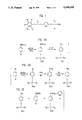
- FIGS. 1 illustrates the general structural formula of the new compounds which embody the principles and concepts of the invention
- FIGS. 2A and 2B illustrate structural formulas of precursor compounds and reaction schemes for preparing compounds that are useful as intermediates for synthesizing a first group of compounds embodying the concepts and principles of the invention
- FIG. 2C illustrates structural formulas and a reaction scheme utilizing the intermediates of FIGS. 2A and 2B for preparing said first group of compounds
- FIG. 3 illustrates structural formulas and a reaction scheme useful for preparing a second group of compounds embodying the concepts and principles of the invention
- FIG. 4 illustrates structural formulas and a reaction scheme useful for preparing a third group of compounds embodying the concepts and principles of the invention
- FIGS. 5A and 5B illustrate structural formulas of precursor compounds and reaction schemes for preparing compounds that are useful as intermediates for synthesizing a fourth group of compounds embodying the concepts and principles of the invention.
- FIG. 5C illustrates structural formulas and a reaction scheme utilizing the intermediates of FIGS. 5A and 5B for preparing said fourth group of compounds.
- the present invention provides a family of organic compounds capable of functioning to allosterically modify hemoglobin and other allosteric proteins.
- the compounds of the invention should be valuable as anticianmic agents, as enhancers for X-ray radiation in cancer therapy, as antilipidemic agents, in preparing blood substitutes and in blood storage.
- the compounds of the invention have the general structural formula illustrated in FIG. 1 of the drawings wherein X and Z may each be either CH 2 , NH or O.
- Z when X is CH 2 , Z may be NH; when X is NH, Z may be either CH 2 or O; and when X is O, Z may be NH.
- R 1 , R 2 , R 3 , R 4 and R 5 may be H, halogen or a substituted or unsubstituted C 1 , C 2 or C 3 alkyl group, and these moieties may be the same or different. Additionally, R 6 and R 7 may preferably be H or CH 3 and these moieties also may be the same or different.
- the compounds of the invention may conveniently be classified into four distinct groupings as follows:
- Group IV 2-[4-(((arylamino)carbonyl)oxy)phenoxy]-2-methyl propionic acids having a structural formula as illustrated in FIG. 5C.
- FIG. 2A illustrates a reaction scheme for preparing 2-(4-aminophenoxy)-2-methyl propionic acid, a compound that is useful as a precursor in the preparation of Group I compounds.
- 8 g (0.2 mol) of pulverized sodium hydroxide is added to a suspension of 5.28 g (0.035 mol) of p-acetaminophenol in 23 g (0.4 mol) of acetone.
- the reaction mixture is stirred at room temperature for 1/2 hour.
- 3.58 g (0.03 mol) of chloroform is added dropwise over the course of 30 minutes.
- the reaction mixture is stirred overnight at room temperature and acetone is removed under vacuum.
- FIG. 2B illustrates another reaction scheme for preparing 2-(4-aminophenoxy)-2-methyl propionic acid.
- 8 g of potassium hydroxide is dissolved in 32 ml of water and the resultant KOH solution is admixed with 280 ml of 3% hydrogen peroxide.
- 11.3 g (0.058 mol) of 2-(4-cyanophenoxy)-2-methyl propionic acid is slowly added to the KOH/H 2 O 2 solution and the reaction mixture is stirred for about one hour until the exotherm and evolution of gas has ceased. The mixture is then cooled and acidified with concentrated hydrochloric acid.
- the 2-[4-(carboxamido) phenoxy]-2-methyl propionic acid product is obtained as a white solid (9.8 g, 79% yield).
- the product is crystallized from ethanol to produce pure white crystals, mp 202°-4° C.
- FIG. 2C illustrates a general reaction scheme for preparing the Group I 2-[4-(arylacetamido)phenoxy]-2-methyl propionic acids.
- 1 g (0.005 mol) of 2-(4-aminophenoxy)-2-methyl propionic acid is dissolved with stirring in 10 ml of water containing 0.41 g (0.1 mol) of NaOH.
- 0.79 g (0.005 mol) of phenyl acetyl chloride in 5 ml of THF is gradually added over a period of about 15 minutes.
- the pH of the reaction mixture should be alkaline (if not a few drops of 2N NaOH is added to assure alkalinity).
- Example 3 the procedure of Example 3 is followed exactly except that 0.005 mol of 4-chlorophenyl acetyl chloride is substituted for the phenyl acetyl chloride.
- the product (57% yield) is 2-[4-(p-chlorophenyl)acetamido)phenoxy]-2-methyl propionic acid, mp 168°--71° C.
- the 4-chlorophenyl acetyl chloride for the foregoing synthesis is prepared by heating to reflux a suspension of 1 g (0.006 mol) of 4-chlorophenyl acetic acid in 1.07 g (0.009 mol) of thionyl chloride with stirring for 1 hour. After cooling, excess thionyl chloride is evaporated under vacuum to present the 4-chlorophenyl acetyl chloride product as a yellow oil (1 g, 83% yield).
- FIG. 3 illustrates a general reaction scheme for preparing the Group II 2-[4-(((aryloxy)carbonyl)amino)phenoxy]-2-methyl propionic acids.
- a solution consisting of 0.15 g (0.001 mol) of phenyl chloroformate in 3 ml THF is gradually added to an ice cold solution containing 0.3 g (0.001 mol) of 2-(4-amino phenoxy)-2-methyl propionic acid and 0.17 g (0.002 mol) of sodium bicarbonate in 10 ml of water (10 ml).
- the reaction mixture is stirred for 1/2 hour at 0° C., followed by stirring for 1 hour at room temperature.
- Example 5 the procedure for Example 5 is followed exactly except that 0.001 mol of 4-chlorophenyl chloroformate is substituted for the phenyl chloroformate.
- 2-[4-((((p-chlorophenyl)oxy)carbonyl)amino)phenoxy]-2-methyl propionic acid product is obtained as a white precipitate, 0.15 g (28% yield), mp 179°-82° C.
- FIG. 4 illustrates a general reaction scheme for preparing the Group III compounds of the invention.
- 5.2 g (34 mmol) of p-hydroxy phenyl acetic acid (HPAA) is heated to reflux with an excess of thionyl chloride for 1/2 hour.
- the reaction mixture is then cooled and excess SOCl 2 is removed under vacuum.
- the residue is reacted for 2 hours with 6.3 g (68 mmol) of aniline in 50 ml of refluxing xylene.
- the reaction mixture is then cooled, washed with dilute HCl, water and brine and extracted with aqueous 2N NaOH.
- the combined alkali layer is washed with ether, cooled and acidified to provide 7 g of solid N-phenyl-4-hydroxybenzyl amide (C 14 H 12 NO 2 ) as an intermediate product (90% yield), mp 138° C.
- the intermediate product is recrystallized from a 1:2 mixture of acetone and petroleum ether and 1.13 g (5 mmol) portion is o-alkylated for 12 hours using the procedure of Example 1with 20 ml acetone, 2.75 g NaOH and 1.25 ml CHCl 3 .
- the final product is 2-[4-((((phenyl)amino)carbonyl)methyl)phenoxy]-2-methyl propionic acid (C 18 H 19 NO 4 ), 1.2 g (76% yield), mp 198° C.
- Example 7 The procedure of Example 7 is repeated using 8.6 g (68 mmol) of 4-chloroaniline rather than the aniline.
- the intermediate product is N-(4-chlorophenyl)-4-hydroxy benzylamide (C 14 H 12 ClNO 2 ), 7.5 g (84% yield), mp 163° C.
- 1.3 g of the intermediate product is o-alkylated to produce 2-[4((((4-chlorophenyl)amino)carbonyl)methyl)phenoxy]-2-methyl propionic acid (C 18 H 18 ClNO 4 ), 0.86 g (50% yield), mp 196° C.
- Example 7 The procedure of Example 7 is repeated using 2.6 g (17 mmol) of the HPAA and using 5.67 g (35 mmol) of 3,4-dichloro aniline rather than the aniline.
- the intermediate product is N-(3,4-dichlorophenyl-4-hydroxy benzylamide (C 14 H 11 Cl 2 NO 2 ).
- 1.48 g (5 mmol) of the intermediate is o-alkylated to produce 2-[4-(((3,4-dichlorophenyl)amino) carbonyl)methyl)phenoxy]-2-methylpropionic acid (C 18 H 17 Cl 2 NO 4 ), 0.76 g (40% yield), mp 174° C.
- Example 7 The procedure of Example 7 is repeated using 2.6 (17 mmol) of the HPAA and using 5.7 g (35 mmol) of 3,5-dichloro aniline rather than the aniline.
- the intermediate product is N-(3,5-dichlorophenyl-4-hydroxy benzylamide (C 14 H 11 Cl 2 NO 2 ).
- 1.48 g (5 mmol) of the intermediate is o-alkylated to produce 2-[4-((((3,5-dichlorophenyl)amino)carbonyl)methyl)phenoxy]-2-methyl propionic acid (C 18 H 17 Cl 2 NO 4 ), 0.8 g (42% yield), mp 138° C.
- Example 7 The procedure of Example 7 is repeated using 0.95 g (6 mmol) of the HPAA, using 2.6 g (12 mmol) of 3,4,5-trichloro aniline rather than the aniline, and using 25 ml of refluxing xylene.
- the intermediate product is N-(3,4,5-trichlorophenyl)-4-hydroxy benzylamide.
- Example 7 The procedure of Example 7 is repeated using 5.04 g (32 mmol) of the HPAA, using 6 ml (64 mmol) of 4-fluoro aniline rather than aniline, and using 25 ml of refluxing xylene.
- the intermediate product is N-(4-fluorophenyl)-4-hydroxy benzylamide.
- 1.22 g (5 mmol) of the intermediate product is o-alkylated to produce 2-[4-(((4-fluorophenyl)amino)carbonyl)methyl)phenoxy]-2-methyl propionic acid (C 18 H 18 FNO 4 ), 0.74 g (45% yield), mp 198° C.
- Example 7 The procedure of Example 7 is repeated using 5.04 (32 mmol) of the HPAA, using 8.05 ml (64 mmol) of 4-trifluoromethyl aniline rather than aniline, and using 25 ml of refluxing xylene.
- the intermediate product is N-(trifluoromethylphenyl)-4-hydroxy benzylamide.
- 1.5 g (5 mmol) of the intermediate is used to produce 2-[4-((((4-trifluoromethylphenyl)amino)carbonyl)methyl)phenoxy]-2-methyl propionic acid (C 19 H 18 F 3 NO 4 ), 0.85 g (44% yield), mp 197° C.
- Example 7 The procedure of Example 7 is repeated using 5.04 (32 mmol) of the HPAA, using 8 g (65 mmol) of 4-methyl aniline rather than aniline, and using 25 ml of refluxing xylene.
- the intermediate product is N-(4-methylphenyl)-4-hydroxy benzylamide.
- 1.2 g (5 mmol) of the intermediate is used to produce2-[4-((((4-methylphenyl)amino)carbonyl)methyl)phenoxy]-2-methyl propionic acid (C 19 H 21 NO 4 ), 0.98 g (65% yield), mp 164° C.
- Example 7 The procedure of Example 7 is repeated using 3.26 (21 mmol) of the HPAA, using 5.3 ml (42 mmol) of 3,5-dimethyl aniline rather than aniline, and using 25 ml of refluxing xylene.
- the intermediate product is N-(3,5-dimethylphenyl)-4-hydroxy benzylamide. 1.27 g (5 mmol) of the intermediate is used to produce 2-[4-((((3,5-dimethylphenyl)amino)carbonyl)methyl)phenoxy]-2-methyl propionic acid (C 20 H 23 NO 4 ), 1.15 g (68% yield), mp 85° C.
- Example 7 The procedure of Example 7 is repeated using 5.04 (32 mmol) of the HPAA, using 10 ml (64 mmol) of 4-isopropyl aniline rather than aniline, and using 25 ml of refluxing xylene.
- the intermediate product is N-(4-isopropylphenyl)-4-hydroxy benzylamide.
- 1.34 g (5 mmol) of the semi-solid, thick viscous liquid intermediate is used to prepare 2-[4-((((4-isopropylphenyl)amino-)carbonyl)methyl) phenoxy]-2-methyl propionic acid (C 21 H 25 NO 4 ), 1.1 g (62% yield), mp 141° C.
- FIGS. 5A, 5B and 5C a scheme is illustrated for preparing Group IV compounds.
- aniline or aniline derivatives may be reacted with phosgene to obtain the carbamoyl chloride.
- hydroquinone may be monoacetylated using acetic anhydride.
- the product is o-alkylated using acetone, CHCl 3 and KOH and then hydrolyzed using a base.
- the products of the reactions of FIGS. 5A and 5B may then be reacted according to the reaction of FIG. 5C to produce the Group IV 2-[4-(((arylamino)carbonyl)oxy)phenoxy)]-2-methyl propionic of the invention.
- human blood was obtained either from Central Blood Bank, Richmond, Va. (donors homozygous for Hba) or Howard University, Washington, D.C. (donors homozygous for HbS).
- Extraction, chromatography, and characterization of isolated hemoglobins were identical to that described by Dozy and Huisman, J. of Chromatography, vol. 32, p. 723 (1968) and in The Chromatography of Hemoglobin, H. J. Schroeder and D. H. J. Huisman, Ed. Marcel Dekker Inc. N.Y. (1980).
- the purity of separate HBA or HbS was determined by gel electrophoresis, using a Gelman semimicroelectrophoresis chamber.
- the concentration of hemoglobin was determined by the cyanmethemoglobin method (Zijlstra, Clin. Chem. Acta. vol. 5, pp. 719-726 (1960), Z ijlstra and Van Kamper, J. Clin. Chem. Clin. Biochem., vol. 19, p. 521 (1981)). All purified hemoglobin solutions were stored in liquid nitrogen. The reagents and buffers were purchased from the following sources: Fischer Scientific, Sigma Chemical Company, and Pharmacia and Research Chemicals, Inc.
- Oxygen equilibrium curves were determined on a Minco HEM-O-SCAN oxygen dissociation analyzer (Travenol Laboratories).
- HbA was prepared as follows: 20 ml of whole blood from a nonsmoking donor (blood bank, Richmond, Va.) was drawn into a heparinized vacutainer. The blood was immediately packed in ice (to prevent MetHb formation) and then centrifuged (10 minutes at 2500 rpm) to separate the plasma and buffy coat from the packed erythrocytes.
- the plasma and buffy coat were removed by aspiration and the cells washed three times with 0.9% NaCl (40 mg of EDTA/L) and then once with 1.0% NaCl (40 mg of EDTA/L).
- the cells were lysed by the addition of one to two volumes of deionized water containing 40 mg of EDTA/L. This was allowed to stand for 30 minutes with occasional mixing before being centrifuged for 2 hours at 10,000 rpms at 4° C.
- the supernatant was decanted into 50 ml tubes and NaCl (50 mg/ml of Hb supernatant) was added, mixed and centrifuged at 10,000 rpms at 4° C. for 2 hours to remove the remaining cell stroma.
- the supernatant was further purified by either gel filtration with Sephadex G-25 or dialysis against pH 8.6 tris buffer (50 mM, containing 40 mg of EDTA/L).
- the sodium chloride free hemoglobin solution was chromatographed on DEAE-Sephacel ion-exchange resin (Sigma) preequilibrated with Tris buffer pH 8.6. After elution of the A2 hemoglobin fraction by Tris buffer (pH 8.6, 50 mM, containing EDTA/L), the HbA fraction was then eluted with pH 8.4 Tris buffer.
- the pure HbA fraction (identified by electrophoresis) was concentrated using a Schleicher and Schuell collodion bag apparatus (Schleicher and Schuell, Inc.) with HEPES buffer (150 mM, pH 7.4) as the exchange buffer.
- HEPES buffer 150 mM, pH 7.4
- the hemoglobin concentration was then determined using the cyanomethemoglobin method (as mentioned before). The hemoglobin concentration at this point was usually found to be around 35G% (approximately 5.5 mM). Less than 5% methemoglobin was noted even after several days at 4° C.
Landscapes
- Organic Chemistry (AREA)
- Chemical & Material Sciences (AREA)
- Health & Medical Sciences (AREA)
- Bioinformatics & Cheminformatics (AREA)
- Engineering & Computer Science (AREA)
- General Health & Medical Sciences (AREA)
- Chemical Kinetics & Catalysis (AREA)
- Nuclear Medicine, Radiotherapy & Molecular Imaging (AREA)
- General Chemical & Material Sciences (AREA)
- Pharmacology & Pharmacy (AREA)
- Life Sciences & Earth Sciences (AREA)
- Animal Behavior & Ethology (AREA)
- Medicinal Chemistry (AREA)
- Public Health (AREA)
- Veterinary Medicine (AREA)
- Hematology (AREA)
- Diabetes (AREA)
- Cardiology (AREA)
- Heart & Thoracic Surgery (AREA)
- Vascular Medicine (AREA)
- Urology & Nephrology (AREA)
- Obesity (AREA)
- Organic Low-Molecular-Weight Compounds And Preparation Thereof (AREA)
- Acyclic And Carbocyclic Compounds In Medicinal Compositions (AREA)
- Pharmaceuticals Containing Other Organic And Inorganic Compounds (AREA)
- Peptides Or Proteins (AREA)
Priority Applications (18)
| Application Number | Priority Date | Filing Date | Title |
|---|---|---|---|
| US07/478,848 US5049695A (en) | 1990-02-12 | 1990-02-12 | Allosteric hemoglobin modifiers |
| JP3504932A JP3023422B2 (ja) | 1990-02-12 | 1991-02-06 | ヘモグロビンのアロステリック修飾剤 |
| CA002051693A CA2051693C (en) | 1990-02-12 | 1991-02-06 | Allosteric hemoglobin modifiers |
| PCT/US1991/000833 WO1991012235A1 (en) | 1990-02-12 | 1991-02-06 | Allosteric hemoglobin modifiers |
| EP91904612A EP0471811B1 (en) | 1990-02-12 | 1991-02-06 | Allosteric hemoglobin modifiers |
| DE69115790T DE69115790T2 (de) | 1990-02-12 | 1991-02-06 | Allosterischer hämoglobin-modifikator |
| US07/702,947 US5122539A (en) | 1990-02-12 | 1991-05-20 | Allosteric hemoglobin modifiers useful for decreasing oxygen affinity and preserving oxygen carrying capability of stored blood |
| US07/885,721 US5248785A (en) | 1990-02-12 | 1992-05-18 | Using allosteric hemoglobin modifiers to decrease oxygen affinity in blood |
| US08/006,378 US5250701A (en) | 1990-02-12 | 1993-01-19 | Allosteric hemoglobin modifiers which decrease oxygen affinity in blood |
| US07/006,246 US5290803A (en) | 1990-02-12 | 1993-01-19 | Using allosteric hemoglobin modifiers to decrease oxygen affinity in blood |
| US08/101,501 US5432191A (en) | 1990-02-12 | 1993-07-30 | Allosteric hemoglobin modifiers to decrease oxygen affinity in blood |
| US08/374,206 US5731454A (en) | 1990-02-12 | 1995-01-18 | Allosteric modifiers of hemoglobin useful for decreasing oxygen affinity and preserving oxygen carrying capability of stored blood |
| US08/451,658 US5591892A (en) | 1990-02-12 | 1995-05-30 | Allosteric modifiers of hemoglobin |
| US08/478,372 US5648375A (en) | 1990-02-12 | 1995-06-07 | Use of hydrophobic compounds and anesthetics in combination with allosteric hemoglobin modifiers |
| US08/482,808 US5705521A (en) | 1990-02-12 | 1995-06-07 | Use of allosteric hemoglobin modifiers in combination with radiation therapy to treat carcinogenic tumors |
| US08/478,371 US5677330A (en) | 1990-02-12 | 1995-06-07 | Medical uses of allosteric hemoglobin modifier compounds in patient care |
| US08/478,108 US5661182A (en) | 1990-02-12 | 1995-06-07 | Method for lowering oxygen affinity of hemoglobin in redcell suspensions, in whole blood and in vivo |
| US08/848,485 US5927283A (en) | 1990-02-12 | 1997-05-08 | Allosteric modifiers of hemoglobin |
Applications Claiming Priority (1)
| Application Number | Priority Date | Filing Date | Title |
|---|---|---|---|
| US07/478,848 US5049695A (en) | 1990-02-12 | 1990-02-12 | Allosteric hemoglobin modifiers |
Related Parent Applications (2)
| Application Number | Title | Priority Date | Filing Date |
|---|---|---|---|
| US62334690A Continuation | 1990-02-12 | 1990-12-07 | |
| US07/722,382 Continuation-In-Part US5382680A (en) | 1990-02-12 | 1991-06-26 | Allosteric hemoglobin modifier compounds |
Related Child Applications (2)
| Application Number | Title | Priority Date | Filing Date |
|---|---|---|---|
| US07/702,947 Continuation-In-Part US5122539A (en) | 1990-02-12 | 1991-05-20 | Allosteric hemoglobin modifiers useful for decreasing oxygen affinity and preserving oxygen carrying capability of stored blood |
| US07/885,721 Continuation-In-Part US5248785A (en) | 1990-02-12 | 1992-05-18 | Using allosteric hemoglobin modifiers to decrease oxygen affinity in blood |
Publications (1)
| Publication Number | Publication Date |
|---|---|
| US5049695A true US5049695A (en) | 1991-09-17 |
Family
ID=23901612
Family Applications (1)
| Application Number | Title | Priority Date | Filing Date |
|---|---|---|---|
| US07/478,848 Expired - Lifetime US5049695A (en) | 1990-02-12 | 1990-02-12 | Allosteric hemoglobin modifiers |
Country Status (6)
| Country | Link |
|---|---|
| US (1) | US5049695A (enExample) |
| EP (1) | EP0471811B1 (enExample) |
| JP (1) | JP3023422B2 (enExample) |
| CA (1) | CA2051693C (enExample) |
| DE (1) | DE69115790T2 (enExample) |
| WO (1) | WO1991012235A1 (enExample) |
Cited By (31)
| Publication number | Priority date | Publication date | Assignee | Title |
|---|---|---|---|---|
| WO1992020335A1 (en) * | 1991-05-20 | 1992-11-26 | Center For Innovative Technology | Using allosteric hemoglobin modifiers to decrease oxygen affinity in blood |
| US5432191A (en) * | 1990-02-12 | 1995-07-11 | The Center For Innovative Technology | Allosteric hemoglobin modifiers to decrease oxygen affinity in blood |
| US5661182A (en) * | 1990-02-12 | 1997-08-26 | Virginia Commonwealth University | Method for lowering oxygen affinity of hemoglobin in redcell suspensions, in whole blood and in vivo |
| US5677330A (en) * | 1990-02-12 | 1997-10-14 | The Center For Innovative Technology | Medical uses of allosteric hemoglobin modifier compounds in patient care |
| US5705521A (en) * | 1990-02-12 | 1998-01-06 | The Center For Innovative Technology | Use of allosteric hemoglobin modifiers in combination with radiation therapy to treat carcinogenic tumors |
| US5854210A (en) * | 1995-04-10 | 1998-12-29 | Baxter International Inc. | Use of cross-linked hemoglobin in treating subarachnoid hemorrhage |
| WO1999036391A1 (en) * | 1998-01-13 | 1999-07-22 | Tularik Inc. | Benzenesulfonamides and benzamides as therapeutic agents |
| US20030017612A1 (en) * | 2001-02-23 | 2003-01-23 | Michael Gerber | Methods and reagents to acquire MRI signals and images |
| US20030232887A1 (en) * | 2002-04-10 | 2003-12-18 | Johnson Douglas Giles | Preparation and use of a stable formulation of allosteric effector compounds |
| US20050148991A1 (en) * | 2002-05-21 | 2005-07-07 | Johnson Douglas G. | Device for using patient blood as diluent in administering pharmaceuticals |
| US20050154062A1 (en) * | 1999-08-24 | 2005-07-14 | Allos Therapeutics, Inc. | Substituted chiral allosteric hemoglobin modifiers |
| US20050238727A1 (en) * | 2004-04-22 | 2005-10-27 | Cagnoni Pablo J | Coadministration of radiation, efaproxiral sodium, and supplemental oxygen for the treatment of cancer |
| US20050239893A1 (en) * | 2004-04-22 | 2005-10-27 | Allos Therapeutics, Inc. | Compositions of allosteric hemoglobin modifiers and methods of making the same |
| US20070259966A1 (en) * | 2004-04-22 | 2007-11-08 | Allos Therapeutics, Inc. | Coadministration of Radiation, Efaproxiral Sodium, and Supplemental Oxygen for the Treatment of Cancer |
| US20090105289A1 (en) * | 2004-10-12 | 2009-04-23 | Novo Nordisk A/S | 11beta-hydroxysteroid dehydrogenase type 1 active spiro compounds |
| US20090118259A1 (en) * | 2005-11-01 | 2009-05-07 | John Paul Kilburn | Pharmaceutical use of substituted amides |
| US20090124598A1 (en) * | 2005-11-01 | 2009-05-14 | Henrik Sune Andersen | Pharmaceutical use of substituted amides |
| US20090306048A1 (en) * | 2006-06-16 | 2009-12-10 | John Paul Kilburn | Pharmaceutical use of substituted piperidine carboxamides |
| US20090325932A1 (en) * | 2006-07-13 | 2009-12-31 | Soren Ebdrup | 4-piperidylbenzamides as 11-beta-hydroxysteroid dehydrogenase type 1 inhibitors |
| US20100009968A1 (en) * | 2006-07-13 | 2010-01-14 | High Point Pharmaceuticals, Llc | 11beta-hydroxysteroid dehydrogenase type 1 active compounds |
| US20100056600A1 (en) * | 2007-03-28 | 2010-03-04 | Soren Ebdrup | 11beta-hsd1 active compounds |
| US20100076041A1 (en) * | 2007-03-09 | 2010-03-25 | John Paul Kilburn | Indole- and benzimidazole amides as hydroxysteroid dehydrogenase inhibitors |
| US20100087543A1 (en) * | 2007-04-24 | 2010-04-08 | Soren Ebdrup | Pharmaceutical use of substituted amides |
| US20100137377A1 (en) * | 2007-04-11 | 2010-06-03 | Soren Ebdrup Et Al | Novel compounds |
| US20100168083A1 (en) * | 2006-03-21 | 2010-07-01 | Soren Ebdrup | Adamantane derivatives for the treatment of the metabolic syndrome |
| US20100331366A1 (en) * | 2007-02-23 | 2010-12-30 | High Point Pharmaceuticals ,Llc | N-adamantyl benzamides as inhibitors of 11-beta-hydroxysteroid dehydrogenase |
| US20110003852A1 (en) * | 2007-02-23 | 2011-01-06 | Soren Ebdrup | N-adamantyl benzamides as inhibitors of 11-beta-hydroxysteroid dehydrogenase |
| US20110003856A1 (en) * | 2007-02-23 | 2011-01-06 | Soren Ebdrup | N-adamantyl benzamides as inhibitors of 11-beta-hydroxysteroid dehydrogenase |
| US20110039853A1 (en) * | 2007-02-23 | 2011-02-17 | High Point Pharmaceuticals, Llc | N-adamantyl benzamides as inhibitors of 11-beta-hydroxysteroid dehydrogenase |
| US20110224244A1 (en) * | 2008-11-21 | 2011-09-15 | High Point Pharmaceuticals, Llc | Adamantyl Benzamide Derivatives |
| US8053447B2 (en) | 2006-04-07 | 2011-11-08 | High Point Pharmaceuticals, Llc | 11β-hydroxysteroid dehydrogenase type 1 active compounds |
Families Citing this family (3)
| Publication number | Priority date | Publication date | Assignee | Title |
|---|---|---|---|---|
| RU2384565C2 (ru) * | 2004-07-01 | 2010-03-20 | Ф.Хоффманн-Ля Рош Аг | Фенильные производные, содержащие ацетиленовую группу |
| JPWO2007123126A1 (ja) * | 2006-04-17 | 2009-09-03 | 財団法人大阪産業振興機構 | 慢性心不全における運動耐容能低下の改善剤 |
| KR20180084742A (ko) | 2015-11-19 | 2018-07-25 | 가부시키가이샤 테쿠노시스테무 | 이동형 발전·정수 시스템 |
Citations (10)
| Publication number | Priority date | Publication date | Assignee | Title |
|---|---|---|---|---|
| DE2432560A1 (de) * | 1974-07-06 | 1976-01-22 | Boehringer Mannheim Gmbh | Neue phenoxyalkylcarbonsaeurederivate und verfahren zur herstellung derselben |
| US4482571A (en) * | 1982-06-21 | 1984-11-13 | University Of Pittsburgh | Sickle cell anemia treatment and compound |
| US4699926A (en) * | 1986-04-04 | 1987-10-13 | Merck & Co., Inc. | Compounds useful in treating sickle cell anemia |
| US4704402A (en) * | 1982-06-12 | 1987-11-03 | University Of Pittsburgh | Method of treating sickle cell anemia |
| US4731473A (en) * | 1986-04-04 | 1988-03-15 | Merck & Co., Inc. | Compounds useful in treating sickle cell anemia |
| US4731381A (en) * | 1986-04-04 | 1988-03-15 | Merck & Co., Inc. | Method of treating a person for sickle cell anemia |
| US4751244A (en) * | 1986-04-04 | 1988-06-14 | Merck & Co., Inc. | Compounds useful in treating sickle cell anemia |
| WO1988010113A1 (en) * | 1987-06-15 | 1988-12-29 | Iraj Lalezari | Compound, composition and method for the reduction of lipids the modification of the affinity of hemoglobin for oxygen and the prevention of platelet aggregation |
| US4887995A (en) * | 1985-01-22 | 1989-12-19 | University Of Pittsburgh | Method of treating sickle cell anemia |
| WO1989012622A1 (en) * | 1988-06-15 | 1989-12-28 | Iraj Lalezari | Method of synthesis and novel compounds for pharmaceutical uses |
-
1990
- 1990-02-12 US US07/478,848 patent/US5049695A/en not_active Expired - Lifetime
-
1991
- 1991-02-06 WO PCT/US1991/000833 patent/WO1991012235A1/en not_active Ceased
- 1991-02-06 JP JP3504932A patent/JP3023422B2/ja not_active Expired - Fee Related
- 1991-02-06 EP EP91904612A patent/EP0471811B1/en not_active Expired - Lifetime
- 1991-02-06 DE DE69115790T patent/DE69115790T2/de not_active Expired - Lifetime
- 1991-02-06 CA CA002051693A patent/CA2051693C/en not_active Expired - Lifetime
Patent Citations (10)
| Publication number | Priority date | Publication date | Assignee | Title |
|---|---|---|---|---|
| DE2432560A1 (de) * | 1974-07-06 | 1976-01-22 | Boehringer Mannheim Gmbh | Neue phenoxyalkylcarbonsaeurederivate und verfahren zur herstellung derselben |
| US4704402A (en) * | 1982-06-12 | 1987-11-03 | University Of Pittsburgh | Method of treating sickle cell anemia |
| US4482571A (en) * | 1982-06-21 | 1984-11-13 | University Of Pittsburgh | Sickle cell anemia treatment and compound |
| US4887995A (en) * | 1985-01-22 | 1989-12-19 | University Of Pittsburgh | Method of treating sickle cell anemia |
| US4699926A (en) * | 1986-04-04 | 1987-10-13 | Merck & Co., Inc. | Compounds useful in treating sickle cell anemia |
| US4731473A (en) * | 1986-04-04 | 1988-03-15 | Merck & Co., Inc. | Compounds useful in treating sickle cell anemia |
| US4731381A (en) * | 1986-04-04 | 1988-03-15 | Merck & Co., Inc. | Method of treating a person for sickle cell anemia |
| US4751244A (en) * | 1986-04-04 | 1988-06-14 | Merck & Co., Inc. | Compounds useful in treating sickle cell anemia |
| WO1988010113A1 (en) * | 1987-06-15 | 1988-12-29 | Iraj Lalezari | Compound, composition and method for the reduction of lipids the modification of the affinity of hemoglobin for oxygen and the prevention of platelet aggregation |
| WO1989012622A1 (en) * | 1988-06-15 | 1989-12-28 | Iraj Lalezari | Method of synthesis and novel compounds for pharmaceutical uses |
Non-Patent Citations (25)
| Title |
|---|
| Abraham et al., "Design Synthesis, and Testing of Potential Antisickling Agents. 7. Ethacrynic Acid Analogues", J. Med. Chem., vol. 32, (1989), pp. 2460-2467. |
| Abraham et al., Design Synthesis, and Testing of Potential Antisickling Agents. 7. Ethacrynic Acid Analogues , J. Med. Chem., vol. 32, (1989), pp. 2460 2467. * |
| Abraham, et al., "Design, Synthesis, and Testing of Potential Antisickling Agents. 4. Structure-Activity Relationships of Benzyloxy and Phenoxy Acids", J. Med. Chem., vol. 27, (1984) pp. 967-978. |
| Abraham, et al., Design, Synthesis, and Testing of Potential Antisickling Agents. 4. Structure Activity Relationships of Benzyloxy and Phenoxy Acids , J. Med. Chem., vol. 27, (1984) pp. 967 978. * |
| Aminco Hem O Scan Laboratory Manual. * |
| Aminco Hem-O-Scan™ Laboratory Manual. |
| Chemical Abstract, vol 84, No. 121481a, "Phenoxyalkanoic Acid Derivatives", abstract from DE 2,432,560. |
| Chemical Abstract, vol 84, No. 121481a, Phenoxyalkanoic Acid Derivatives , abstract from DE 2,432,560. * |
| Chemical Abstracts, 25 Noncondensed Aromatics, vol. 79 (1973), pp. 417, No. 1843k which identifies German Patent 2,149,070. * |
| Chemical Abstracts, 25-Noncondensed Aromatics, vol. 79 (1973), pp. 417, No. 1843k which identifies German Patent 2,149,070. |
| Dozy et al., "Studies on the Heterogeneity of Hemoglobin. XIII. Chromotagraph of Various Human and Animal Hemoglobin Types on DEAE-Sephadex", J. Chrom., vol. 32, (1968) pp. 723-726. |
| Dozy et al., Studies on the Heterogeneity of Hemoglobin. XIII. Chromotagraph of Various Human and Animal Hemoglobin Types on DEAE Sephadex , J. Chrom., vol. 32, (1968) pp. 723 726. * |
| Hemoglobin Structure/Function, lecture by Dr. Abraham on Oct. 3, 1990. * |
| Lalezari et al., "LR16, A Compound with Potent Effects on the Oxygen Affinity of Hemoglobin, on Blood Cholesterol, and on Low Density Lipoprotein", Proc. Natl. Acad. Sci. (U.S.A.) 85 (1988) pp. 6117-6121. |
| Lalezari et al., LR16, A Compound with Potent Effects on the Oxygen Affinity of Hemoglobin, on Blood Cholesterol, and on Low Density Lipoprotein , Proc. Natl. Acad. Sci. (U.S.A.) 85 (1988) pp. 6117 6121. * |
| Pertuz et al., "Hemoglobin as a Receptor of Drugs and Peptides: X-Ray Studies of the Stereochemistry of Binding", J. Amer. Chem. S., vol. 108, (1986), pp. 1064-1078. |
| Pertuz et al., Hemoglobin as a Receptor of Drugs and Peptides: X Ray Studies of the Stereochemistry of Binding , J. Amer. Chem. S., vol. 108, (1986), pp. 1064 1078. * |
| Perutz, "Bezafibrate Lowers Oxygen Affinity of Hemoglobin", The Lancet, Oct. 15, 1983, pp. 881-882. |
| Perutz, "Mechanisms of Cooperativity and Allosteric Regulation in Proteins", Quarterly Review of Biophysics, 22:2 (1989), pp. 139, 163 and 164. |
| Perutz, Bezafibrate Lowers Oxygen Affinity of Hemoglobin , The Lancet, Oct. 15, 1983, pp. 881 882. * |
| Perutz, Mechanisms of Cooperativity and Allosteric Regulation in Proteins , Quarterly Review of Biophysics, 22:2 (1989), pp. 139, 163 and 164. * |
| Zijlstra et al., "Spectrophotometry of Haemoglobin: The Standard Haemiglobin Cyanide Method and After", J. Clin. Chem. Biochem., vol. 19, (1981), pp. 521-523. |
| Zijlstra et al., "Standardization of Hemoglobinometry. 1. The Extinction Coefficient of Hemiglobincyanide", Clinica Chimica Acta, vol. 5, (1960), pp. 719-726. |
| Zijlstra et al., Spectrophotometry of Haemoglobin: The Standard Haemiglobin Cyanide Method and After , J. Clin. Chem. Biochem., vol. 19, (1981), pp. 521 523. * |
| Zijlstra et al., Standardization of Hemoglobinometry. 1. The Extinction Coefficient of Hemiglobincyanide , Clinica Chimica Acta, vol. 5, (1960), pp. 719 726. * |
Cited By (46)
| Publication number | Priority date | Publication date | Assignee | Title |
|---|---|---|---|---|
| US5927283A (en) * | 1990-02-12 | 1999-07-27 | Virginia Commonwealth University | Allosteric modifiers of hemoglobin |
| US5432191A (en) * | 1990-02-12 | 1995-07-11 | The Center For Innovative Technology | Allosteric hemoglobin modifiers to decrease oxygen affinity in blood |
| US5661182A (en) * | 1990-02-12 | 1997-08-26 | Virginia Commonwealth University | Method for lowering oxygen affinity of hemoglobin in redcell suspensions, in whole blood and in vivo |
| US5677330A (en) * | 1990-02-12 | 1997-10-14 | The Center For Innovative Technology | Medical uses of allosteric hemoglobin modifier compounds in patient care |
| US5705521A (en) * | 1990-02-12 | 1998-01-06 | The Center For Innovative Technology | Use of allosteric hemoglobin modifiers in combination with radiation therapy to treat carcinogenic tumors |
| WO1992020335A1 (en) * | 1991-05-20 | 1992-11-26 | Center For Innovative Technology | Using allosteric hemoglobin modifiers to decrease oxygen affinity in blood |
| US5854210A (en) * | 1995-04-10 | 1998-12-29 | Baxter International Inc. | Use of cross-linked hemoglobin in treating subarachnoid hemorrhage |
| WO1999036391A1 (en) * | 1998-01-13 | 1999-07-22 | Tularik Inc. | Benzenesulfonamides and benzamides as therapeutic agents |
| US6191170B1 (en) | 1998-01-13 | 2001-02-20 | Tularik Inc. | Benzenesulfonamides and benzamides as therapeutic agents |
| US6583161B1 (en) | 1998-01-13 | 2003-06-24 | Tularik Inc. | Benzenesulfonamides and benzamides as therapeutic agents |
| US20050154062A1 (en) * | 1999-08-24 | 2005-07-14 | Allos Therapeutics, Inc. | Substituted chiral allosteric hemoglobin modifiers |
| US20030017612A1 (en) * | 2001-02-23 | 2003-01-23 | Michael Gerber | Methods and reagents to acquire MRI signals and images |
| US7097825B2 (en) | 2001-02-23 | 2006-08-29 | Allos Therapeutics, Inc. | Methods and reagents to acquire MRI signals and images |
| US20030232887A1 (en) * | 2002-04-10 | 2003-12-18 | Johnson Douglas Giles | Preparation and use of a stable formulation of allosteric effector compounds |
| US20050148991A1 (en) * | 2002-05-21 | 2005-07-07 | Johnson Douglas G. | Device for using patient blood as diluent in administering pharmaceuticals |
| US20050239893A1 (en) * | 2004-04-22 | 2005-10-27 | Allos Therapeutics, Inc. | Compositions of allosteric hemoglobin modifiers and methods of making the same |
| US20050238727A1 (en) * | 2004-04-22 | 2005-10-27 | Cagnoni Pablo J | Coadministration of radiation, efaproxiral sodium, and supplemental oxygen for the treatment of cancer |
| US20070259966A1 (en) * | 2004-04-22 | 2007-11-08 | Allos Therapeutics, Inc. | Coadministration of Radiation, Efaproxiral Sodium, and Supplemental Oxygen for the Treatment of Cancer |
| US20070293698A1 (en) * | 2004-04-22 | 2007-12-20 | Allos Therapeutics, Inc. | Compositions of Allosteric Hemoglobin Modifiers and Methods of Making the Same |
| US7847120B2 (en) | 2004-04-22 | 2010-12-07 | Virginia Commonwealth University Intellectual Property Foundation | Compositions of allosteric hemoglobin modifiers and methods of making the same |
| US20090105289A1 (en) * | 2004-10-12 | 2009-04-23 | Novo Nordisk A/S | 11beta-hydroxysteroid dehydrogenase type 1 active spiro compounds |
| US8138342B2 (en) | 2004-10-12 | 2012-03-20 | High Point Pharmacueticals, LLC | 11β-hydroxysteroid dehydrogenase type 1 active spiro compounds |
| US20090118259A1 (en) * | 2005-11-01 | 2009-05-07 | John Paul Kilburn | Pharmaceutical use of substituted amides |
| US20090124598A1 (en) * | 2005-11-01 | 2009-05-14 | Henrik Sune Andersen | Pharmaceutical use of substituted amides |
| US8053431B2 (en) | 2005-11-01 | 2011-11-08 | High Point Pharmaceuticals, Llc | Pharmaceutical use of substituted amides |
| US20100168083A1 (en) * | 2006-03-21 | 2010-07-01 | Soren Ebdrup | Adamantane derivatives for the treatment of the metabolic syndrome |
| US8053447B2 (en) | 2006-04-07 | 2011-11-08 | High Point Pharmaceuticals, Llc | 11β-hydroxysteroid dehydrogenase type 1 active compounds |
| US20090306048A1 (en) * | 2006-06-16 | 2009-12-10 | John Paul Kilburn | Pharmaceutical use of substituted piperidine carboxamides |
| US8048908B2 (en) | 2006-07-13 | 2011-11-01 | High Point Pharmaceuticals, Llc | 11β-hydroxysteroid dehydrogenase type 1 active compounds |
| US20090325932A1 (en) * | 2006-07-13 | 2009-12-31 | Soren Ebdrup | 4-piperidylbenzamides as 11-beta-hydroxysteroid dehydrogenase type 1 inhibitors |
| US20100009968A1 (en) * | 2006-07-13 | 2010-01-14 | High Point Pharmaceuticals, Llc | 11beta-hydroxysteroid dehydrogenase type 1 active compounds |
| US20110003852A1 (en) * | 2007-02-23 | 2011-01-06 | Soren Ebdrup | N-adamantyl benzamides as inhibitors of 11-beta-hydroxysteroid dehydrogenase |
| US8334305B2 (en) | 2007-02-23 | 2012-12-18 | High Point Pharmaceuticals, Llc | N-adamantyl benzamides as inhibitors of 11-β-hydroxysteroid dehydrogenase |
| US20110003856A1 (en) * | 2007-02-23 | 2011-01-06 | Soren Ebdrup | N-adamantyl benzamides as inhibitors of 11-beta-hydroxysteroid dehydrogenase |
| US20110039853A1 (en) * | 2007-02-23 | 2011-02-17 | High Point Pharmaceuticals, Llc | N-adamantyl benzamides as inhibitors of 11-beta-hydroxysteroid dehydrogenase |
| US8809540B2 (en) | 2007-02-23 | 2014-08-19 | High Point Pharmaceuticals, Llc | N-adamantyl benzamides as inhibitors of 11-beta-hydroxysteroid dehydrogenase |
| US20100331366A1 (en) * | 2007-02-23 | 2010-12-30 | High Point Pharmaceuticals ,Llc | N-adamantyl benzamides as inhibitors of 11-beta-hydroxysteroid dehydrogenase |
| US8383820B2 (en) | 2007-02-23 | 2013-02-26 | High Point Pharmaceuticals, Llc | N-adamantyl benzamides as inhibitors of 11-β-hydroxysteroid dehydrogenase |
| US20100076041A1 (en) * | 2007-03-09 | 2010-03-25 | John Paul Kilburn | Indole- and benzimidazole amides as hydroxysteroid dehydrogenase inhibitors |
| US8153798B2 (en) | 2007-03-09 | 2012-04-10 | High Point Pharmaceuticals, Llc | Indole- and benzimidazole amides as hydroxysteroid dehydrogenase inhibitors |
| US20100056600A1 (en) * | 2007-03-28 | 2010-03-04 | Soren Ebdrup | 11beta-hsd1 active compounds |
| US20100137377A1 (en) * | 2007-04-11 | 2010-06-03 | Soren Ebdrup Et Al | Novel compounds |
| US20100087543A1 (en) * | 2007-04-24 | 2010-04-08 | Soren Ebdrup | Pharmaceutical use of substituted amides |
| US8383683B2 (en) | 2007-04-24 | 2013-02-26 | High Point Pharmaceuticals, Llc | Pharmaceutical use of substituted amides |
| US20110224244A1 (en) * | 2008-11-21 | 2011-09-15 | High Point Pharmaceuticals, Llc | Adamantyl Benzamide Derivatives |
| US8927549B2 (en) | 2008-11-21 | 2015-01-06 | High Point Pharmaceuticals, Llc | Adamantyl benzamide derivatives |
Also Published As
| Publication number | Publication date |
|---|---|
| CA2051693A1 (en) | 1991-08-13 |
| WO1991012235A1 (en) | 1991-08-22 |
| JPH04506812A (ja) | 1992-11-26 |
| EP0471811A1 (en) | 1992-02-26 |
| JP3023422B2 (ja) | 2000-03-21 |
| DE69115790T2 (de) | 1996-05-23 |
| EP0471811A4 (en) | 1992-11-25 |
| DE69115790D1 (de) | 1996-02-08 |
| EP0471811B1 (en) | 1995-12-27 |
| CA2051693C (en) | 2005-06-07 |
Similar Documents
| Publication | Publication Date | Title |
|---|---|---|
| EP0471811B1 (en) | Allosteric hemoglobin modifiers | |
| US5290803A (en) | Using allosteric hemoglobin modifiers to decrease oxygen affinity in blood | |
| US5122539A (en) | Allosteric hemoglobin modifiers useful for decreasing oxygen affinity and preserving oxygen carrying capability of stored blood | |
| CA2109575C (en) | Using allosteric hemoglobin modifiers to decrease oxygen affinity in blood | |
| EP1149063B1 (en) | Ureido-thiobutyric acid derivatives as ppar-agonists | |
| KR100329940B1 (ko) | 과콜레스테롤혈증치료제로서의n-아실술팜산에스테르(또는티오에스테르),n-아실술폰아미드및n-술포닐카르밤산에스테르(또는티오에스테르) | |
| US5872282A (en) | Allosteric modifiers of hemoglobin | |
| US4921997A (en) | Method of synthesis and novel compounds for pharmaceutical uses | |
| CZ290683B6 (cs) | Estery (nebo thioestery) kyseliny N-acylsulfamové, N-acylsulfonamidy a estery (nebo thioestery) kyseliny N-sulfonylkarbamové jako hypercholesterolemická činidla | |
| US5250701A (en) | Allosteric hemoglobin modifiers which decrease oxygen affinity in blood | |
| US4709083A (en) | Method of making boron analogues | |
| US3551419A (en) | Amino acid amides and process for their production | |
| US5292935A (en) | Method of synthesis and novel compounds for pharmaceutical uses | |
| US5202351A (en) | 1-phenylalkyl-3-phenylurea derivative | |
| US5599974A (en) | Aldehydic agents for allosteric modification of hemoglobin | |
| JPH01287066A (ja) | 新規なアントラニル酸誘導体 | |
| EP0424194A2 (en) | Benzanilide derivatives and their use as anti-atherosclerotic agents | |
| US4450172A (en) | Antihypertensive polyhalohydroxyisopropyl phenylalka(e)noic acid esters of alkylaminohydroxypropyloxyphenylalkyl alcohols | |
| US4545942A (en) | Amino-acid derivatives, their preparation and their use as pharmaceuticals | |
| CA2218300A1 (en) | Substituted benzylurea derivatives and medicine containing the same | |
| US3251855A (en) | Derivatives of phthalimide | |
| US4264505A (en) | Substituted benzylidene imines | |
| US2681925A (en) | Nu, nu'-substituted diurethanes | |
| US3686291A (en) | Thio derivatives of 2-hydroxy-3-naphthioc acid | |
| JPH02503797A (ja) | 脂質の減少、酸素に対するヘモグロビンの親和力の修正ならびに血小板凝集の抑制を行うための化合物、組成物および方法 |
Legal Events
| Date | Code | Title | Description |
|---|---|---|---|
| AS | Assignment |
Owner name: VIRGINIA COMMONWEALTH UNIVERSITY Free format text: ASSIGNMENT OF ASSIGNORS INTEREST.;ASSIGNORS:ABRAHAM, DONALD J.;MEHANNA, AHMED;RANDAD, RAMNARAYAN;AND OTHERS;REEL/FRAME:005293/0042 Effective date: 19900309 |
|
| AS | Assignment |
Owner name: CENTER FOR INNOVATIVE TECHNOLOGY, A CORP. OF VA., Free format text: ASSIGNMENT OF ASSIGNORS INTEREST.;ASSIGNOR:VIRGINIA COMMONWEALTH UNIVERSITY;REEL/FRAME:005480/0692 Effective date: 19900928 |
|
| STCF | Information on status: patent grant |
Free format text: PATENTED CASE |
|
| CC | Certificate of correction | ||
| FEPP | Fee payment procedure |
Free format text: PAYOR NUMBER ASSIGNED (ORIGINAL EVENT CODE: ASPN); ENTITY STATUS OF PATENT OWNER: SMALL ENTITY |
|
| FPAY | Fee payment |
Year of fee payment: 4 |
|
| AS | Assignment |
Owner name: VIRGINIA COMMONWEALTH UNIVERSITY, VIRGINIA Free format text: ASSIGNMENT OF ASSIGNORS INTEREST;ASSIGNOR:CENTER FOR INNOVATIVE TECHNOLOGY, THE;REEL/FRAME:009097/0232 Effective date: 19980224 |
|
| FPAY | Fee payment |
Year of fee payment: 8 |
|
| FPAY | Fee payment |
Year of fee payment: 12 |