US5003058A - DNA coding for antigen protein of rinderpest virus - Google Patents
DNA coding for antigen protein of rinderpest virus Download PDFInfo
- Publication number
- US5003058A US5003058A US07/090,550 US9055087A US5003058A US 5003058 A US5003058 A US 5003058A US 9055087 A US9055087 A US 9055087A US 5003058 A US5003058 A US 5003058A
- Authority
- US
- United States
- Prior art keywords
- protein
- cdna
- dna
- rinderpest virus
- virus
- Prior art date
- Legal status (The legal status is an assumption and is not a legal conclusion. Google has not performed a legal analysis and makes no representation as to the accuracy of the status listed.)
- Expired - Fee Related
Links
Images




Classifications
-
- C—CHEMISTRY; METALLURGY
- C12—BIOCHEMISTRY; BEER; SPIRITS; WINE; VINEGAR; MICROBIOLOGY; ENZYMOLOGY; MUTATION OR GENETIC ENGINEERING
- C12N—MICROORGANISMS OR ENZYMES; COMPOSITIONS THEREOF; PROPAGATING, PRESERVING, OR MAINTAINING MICROORGANISMS; MUTATION OR GENETIC ENGINEERING; CULTURE MEDIA
- C12N15/00—Mutation or genetic engineering; DNA or RNA concerning genetic engineering, vectors, e.g. plasmids, or their isolation, preparation or purification; Use of hosts therefor
-
- C—CHEMISTRY; METALLURGY
- C07—ORGANIC CHEMISTRY
- C07K—PEPTIDES
- C07K14/00—Peptides having more than 20 amino acids; Gastrins; Somatostatins; Melanotropins; Derivatives thereof
- C07K14/005—Peptides having more than 20 amino acids; Gastrins; Somatostatins; Melanotropins; Derivatives thereof from viruses
-
- C—CHEMISTRY; METALLURGY
- C07—ORGANIC CHEMISTRY
- C07K—PEPTIDES
- C07K16/00—Immunoglobulins [IG], e.g. monoclonal or polyclonal antibodies
- C07K16/08—Immunoglobulins [IG], e.g. monoclonal or polyclonal antibodies against material from viruses
-
- C—CHEMISTRY; METALLURGY
- C12—BIOCHEMISTRY; BEER; SPIRITS; WINE; VINEGAR; MICROBIOLOGY; ENZYMOLOGY; MUTATION OR GENETIC ENGINEERING
- C12Q—MEASURING OR TESTING PROCESSES INVOLVING ENZYMES, NUCLEIC ACIDS OR MICROORGANISMS; COMPOSITIONS OR TEST PAPERS THEREFOR; PROCESSES OF PREPARING SUCH COMPOSITIONS; CONDITION-RESPONSIVE CONTROL IN MICROBIOLOGICAL OR ENZYMOLOGICAL PROCESSES
- C12Q1/00—Measuring or testing processes involving enzymes, nucleic acids or microorganisms; Compositions therefor; Processes of preparing such compositions
- C12Q1/70—Measuring or testing processes involving enzymes, nucleic acids or microorganisms; Compositions therefor; Processes of preparing such compositions involving virus or bacteriophage
- C12Q1/701—Specific hybridization probes
-
- A—HUMAN NECESSITIES
- A61—MEDICAL OR VETERINARY SCIENCE; HYGIENE
- A61K—PREPARATIONS FOR MEDICAL, DENTAL OR TOILETRY PURPOSES
- A61K39/00—Medicinal preparations containing antigens or antibodies
-
- C—CHEMISTRY; METALLURGY
- C12—BIOCHEMISTRY; BEER; SPIRITS; WINE; VINEGAR; MICROBIOLOGY; ENZYMOLOGY; MUTATION OR GENETIC ENGINEERING
- C12N—MICROORGANISMS OR ENZYMES; COMPOSITIONS THEREOF; PROPAGATING, PRESERVING, OR MAINTAINING MICROORGANISMS; MUTATION OR GENETIC ENGINEERING; CULTURE MEDIA
- C12N2760/00—MICROORGANISMS OR ENZYMES; COMPOSITIONS THEREOF; PROPAGATING, PRESERVING, OR MAINTAINING MICROORGANISMS; MUTATION OR GENETIC ENGINEERING; CULTURE MEDIA ssRNA viruses negative-sense
- C12N2760/00011—Details
- C12N2760/18011—Paramyxoviridae
- C12N2760/18411—Morbillivirus, e.g. Measles virus, canine distemper
- C12N2760/18422—New viral proteins or individual genes, new structural or functional aspects of known viral proteins or genes
Definitions
- the present invention relates to DNA coding for antigen proteins of the rinderpest virus, a process for the production of that DNA, and a process for the production of the antigen protein using that DNA.
- Rinderpest is often prevalent in many areas of the world, such as the Middle and Near East, and Africa etc., and therefore, there is intensive research into the development of vaccines for the rinderpest virus.
- a rinderpest virus strain L that can be grown in Vero cells has been constructed (F. Kobune et al., Archives of Viroloqy, 68, 271-277, 1981). Also, a rinderpest virus strain L (L 13) that can be grown in Vero cells has been developed (J. Gen. Virol. 67, 271, 1986).
- the present invention provides a cloned genes coding for antigen proteins of the rinder-pest virus and a process for the production of that gene, and a process for the production of an antigen protein which is promising as an active ingredient for vaccines against the rinderpest virus.
- the present invention provides a DNA coding for an entire or a part of an antigen protein of the rinderpest virus.
- the present invention also provides a process for the production of the above-mentioned DNA comprising the steps of:
- the present invention also provides a process for the production of the above-mentioned protein comprising the steps of:
- FIG. 1 represents a restriction enzyme cleavage map of a cDNA insert RV-H in a plasmid pDH-RVH and a restriction enzyme cleavage map of a cDNA insert RV-F in a plasmid pDH-RVF;
- FIG. 2 represents a restriction enzyme cleavage map of a cDNA insert RV-H-2 in a plasmid pDH-RVH-2 and a restriction enzyme cleavage map of a cDNA insert RV-F-2 in a plasmid pDH-RVF-2, wherein the thick line in the RV-H-2 represents a portion corresponding to a nucleotide sequence coding for a hemagglutinin protein (H protein) of the rinderpest virus shown in FIG. 3; and,
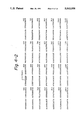
- FIGS. 3-1 to 3-4 represent a nucleotide sequence containing a hemagglutinin gene of the rinderpest virus, wherein, in the sequence, ATG at the 2lst to 23rd position is a translation start codon and TAG at the 1848th to 1850th position is a translation stop codon, and a reading frame flanked by these codons (represented by a thick line in FIG. 2, RV-H-2) shows the codes for a hemagglutinin protein.
- FIGS. 4-1 to 4-5 represent a nucleotide sequence containing a fusion protein gene of the rinderpest virus, wherein, in the sequence, ATG at the 587th to 589th position is a translation start codon and TAG at the 2225th to 2227th position is a translation stop codon, and a reading frame flanked by these codons (represented by a thick line in FIG. 2, RV-F-2) shows the codes for a fusion protein.
- the proteins effective as antigens to the rinderpest virus are the hemagglutinin protein (H protein) and the fusion protein (F protein), according to the present invention, the genes coding for these proteins were cloned.
- the rinderpest virus L strain that can be grown in Vero cells was cultured, mRNA was extracted from the culture, and the cDNA was prepared from the mRNA according to the Okayama-Berg method (Okayama and Berg, Mol. Cell Boil., 2, 161-170, 1983; and Mol. Cell Biol., 3, 280-289, 1983).
- the rinderpest virus L 13 was used as an origin of the mRNA.
- the L 13 strain was obtained by fusing a rabbit lymphocyte infected with a rabbit-adapted passaged strain of the rinderpest virus (L-lapinized strain and F-Vero cells) under polyethylene glycol, and passaging 15 generations.
- Sub-confluent F-Vero cells in eight Petri dishes each having a diameter of 6 cm were inoculated with the L 13 strain at an m.o.i. of 1.
- the culture was passaged on teh next day, and 24 hours after the passage, 20 ⁇ g/ml of actinonycin D was added to the culture to inhibit a synthesis of cellular mRNA and incubation was continued for an additional 5 hours.
- the recovered cells were centrifuged in 6 M of guanidium isothiocyanate (GTC), 5 mM of sodium citrate and 0.5% of Sarkosyl - 5.7 M of CsCl and 0.1 M of EDTA at 35,000 rpm (150,000 XG) for more than 12 hours, according to the guanidinum-cesium chloride method, to recover the RNA (T. Maniatis et al., Molecular Cloning, p 196, 1982).
- GTC guanidium isothiocyanate
- Sarkosyl - 5.7 M of CsCl 0.1 M of EDTA
- RNA was then applied to an oligo (dT) cellulose column, and the adsorbed RNA was eluted by 10 mM Trsi-HCl (pH 7.5) buffer containing 1 mM EDTA and 0.05% SDS to obtain a poly A.sup.(+) RNA according to a known procedure (T. Maniatis et al., Molecular Cloning, p 197, 1982).
- an H gene of a subacute sclerosing panencephalitis (SSPE) virus was used as a probe (designated as H gene probe or SSPE-H-cDNA probe) to detect and screen the gene coding for the H protein (H gene) of the rinderpest virus; and the F gene of the canine distemper virus (CDV) was used as a probe (designated as F gene probe or CDV-F-cDNA probe) to detect and screen the gene coding for an F protein (F gene) of the rinderpest virus
- SSPE subacute sclerosing panencephalitis
- CDV-F-cDNA probe F gene probe or CDV-F-cDNA probe
- the above-mentioned probes were prepared by obtaining an SSPE virus DNA and CDV DNA and labeling these DNA with a radioisotope 35 S (T. Maniatis et al., Molecular Cloning, p 109, 1982).
- a cDNA library was made from SSPE infected cells, and SSPE H cDNA was selected by the use of measles virus H probe (Billeter et al. 1984, Virology 145 195).
- DV H DNA was made according to Russel et al. (1985) (J. Gen. Virol, 66 433.).
- Each DNA thus-prepared was incubated with three unlabeled deoxyribonucleotides dATP, dGTP and dTTP, and a 35 S-labeled deoxyribonucleotide 35 S-dCTP- ⁇ S in the presence of E. coli DNA polymerase I in a Tris-HCl (pH 7.8) buffer.
- the labeled DNA was then separated from unreacted 35 S-dCTP-YS by a Sephadex G25 column.
- the poly RNA prepared as described above was denatured with glyoxal or formamide, and separated by Agarose gel electrophoresis, and the separated mRNAs were subjected to hybridization with the above-mentioned SSPE-H-cDNA probe or CDV-F-cDNA probe according to the conventional Northern hybridization method.
- SSPE-H-cDNA probe or CDV-F-cDNA probe according to the conventional Northern hybridization method.
- a 1.96 kb mRNA which hybridizes with the SSPE-H-cDNA probe and a 2.2 kb mRNA which hybridizes with the COV-F-cDNA were detected.
- the poly A.sup.(+) RNA preparation includes an mRNA coding for the H protein of the rinder-pest virus and an mRNA coding for the F protein of the rinderpest virus.
- a cDNA library was prepared from the
- poly A.sup.(+) RNA preparation according to the Okayama-Berg method (Okayama H. and P. Berg, Mol. Cell Biol., 2, 161, 1982; and Mol. Cell Biol., 3, 280, 1983).
- RNA 8 ⁇ g of the above-mentioned poly A.sup.(+) RNA, 2 ⁇ g of the dT-tailed plasmid primer (pcDV-1), 2 mM of four dNTPs including 35 S-dCTP, and 20.6 units of a reverse transcriptase (RTase) were incubated in 40 ⁇ l of a reaction mixture containing 100 mM of Tris-Hcl (pH 8.3), 10 mM of MgCl 2 , 140 mM of KCl, 2 mM of methylmercury hydroxide, 20 mM of mercaptoethanol, and 1 mM of RNase inhibitor at 42° C.
- reaction mixture 3.5 mM of dCTP and 30 units of terminal transferase were added, resulting in the formation of 73.5 ⁇ 1 total volume of the reaction mixture
- the reaction mixture was subjected to reaction at 37° C. for 3 minutes, and 2.5 mM of EDTA containing 0.5% (final concentration) of SDS was added to the reaction mixture to terminate the reaction
- the reaction mixture was extracted with chloroform and phenol, and the DNA was then precipitated with ethanol.
- the thus-prepared cDNA-plasmid was digested with 20 units of Hind III in 40 ⁇ 1 of a buffer containing 10 mM of Tris-HCl (pH 7.5), 50 mM of NaCl, 10 mM of MgCl and 1 mM of dithiothreitol, at 37° C for 2 hours. Then, 120 mg of the digested cDNA-plasmid and 35 ⁇ g of the PL-1 linker were incubated in 40 ⁇ 1 of a reaction mixture containing 0.1 M NaCl, 10 mM Tris-HCl (pH 7.8) and 1 mM EDTA, first at 65° C. for 5 minutes and that of 42° C.
- reaction mixture was then cooled to a room temperature to allow annealing. After the reaction mixture was cooled to 0° C., 0.3 ⁇ g of E. coli DNA ligase was then added to the reaction mixture, and the reaction mixture was incubated at 12° C. overnight.
- the thus-obtained plasmids were used to transform Escherichia coli DH-5 and E. coli MCl061, and a cDNA library comprising 7,700 clones and a cDNA library comprising 7,300 clones (total 15,000 clones) were obtained from E. coli DN-5 and E. coli MCl061, respectively.
- the size of cDNA insert (designated as RV-H) in the plasmid pDH-RVH was about 2.2 kb, and the size of the cDNA insert (designated as RV-F) in the plasmid pDH-RVF was about 1.6 kb. It was considered that these cDNA inserts contained approximately the entire coding regions for the H protein and F protein of the rinderpest virus, respectively
- the above-mentioned Escherichia coli DH-RVH was deposited with the Fermentation Research Institute Agency of Industrial Science and Technology (FRI), Higashi 1-1-3, Yatabe-cho, Tsukuba-gun, Ibaraki-ken, Japan, as FERM BP-1165 under the Budapest treaty on Aug. 29, 1986.
- the above-mentioned Escherichia coli DH-RVF was deposited with the FRI as FERM BP-1164 under the Budapest treaty on Aug. 29, 1986.
- the size of the cDNA insert (designated as RV-H-2) in the plasmid pDH-RVH-2 was about 3.2 kb, and the size of the cDNA insert (designated as RV-F-2) in the plasmid pDH-RVF-2 was about 2.4 kb.
- the RV-H-2 contained an entire coding region for the H protein of the rinderpest virus, and the RV-F-2 is considered to contain an entire coding region for the F protein of the rinderpest virus.
- the above-mentioned Escherichia coli DH-RVH-2 was deposited with the FRI as FERM BP-1319 under the Budapest treaty on Mar. 24, 1987.
- the above-mentioned Escherichia coli DH-RVF-2 was deposited with the FRI as FERM BP-1318 under the Budapest treaty on Mar. 24, 1987.
- FIG. 1 represents the restriction enzyme cleavage maps for the cDNA inserts RV-H and RV-F
- FIG. 2 represents the restriction enzyme cleavage maps for the cDNA inserts RV-H-2 and RV-F-2.
- the plasmids pDH-RVH and pDH-RVH-2 were digested with restriction enzymes Bam HI, Pvu II, Pst I, Eco RI, Hind III, and Sma I, and DNA fragments of several hundred base pairs in length were separated. Each DNA fragment was inserted to a polylinker site of a phage M13 DNA, and the nucleotide sequence was determined according to the Sanger dideoxy chain termination method. The result is shown in FIGS. 3-1 to 3-4.
- nucleotide sequence coding for F protein was determined. The result is shown in FIGS. 4-1 to 4-5.
- COS7 cells were cultured in a cell culture chamber in 1 ml of Eagle's minimum essential medium containing 10% felal calf serum at 37° C. for 24 hours.
- the DNA of the plasmid pDH-RVH-2 was coprecipitated with calcium phosphate, and 1 ⁇ g of the precipitated DNA was transfected to the cultured COS7 cells.
- the cells were then treated with a DMEM medium containing 10% dimethyl sulfoxide and 5% fetal calfserum. Fresh medium was added to the cells, and culturing was carried out at 37° C. for two tothree days.
- the cells were then fixed withacetone, and were observed by an indirect fluorescent antibody technique using an antibody specific to the rubeola virus. In this technique, an antigen H reactive with the antibody was observed on the cells. In same manner, it was confirmed that the pDH-RVF and pDH-RVF2 expressed an antigen F.
- the present cDNA coding for the hemagglutinin protein of the rinderpest virus, and the cDNA coding for the fusion protein of the rinderpest virus are useful as gene starting materials in a process for the construction of a recombinant virus by inserting them into, for example, a vaccinia virus, or in a process for the production of antigen proteins by expressing the cDNA in E. coli, yeast or animal cells.
- the present cDNA and fragments thereof are useful as hybridization probes for screening genes of different origin but containing a similar nucleotide sequence, such as cDNA of different origin. Moreover, the present cDNA and fragments thereof are useful as a component of a kit for the detection of the rinderpest virus and related viruses.
Landscapes
- Chemical & Material Sciences (AREA)
- Life Sciences & Earth Sciences (AREA)
- Health & Medical Sciences (AREA)
- Organic Chemistry (AREA)
- Genetics & Genomics (AREA)
- Proteomics, Peptides & Aminoacids (AREA)
- Biophysics (AREA)
- Biochemistry (AREA)
- Molecular Biology (AREA)
- Engineering & Computer Science (AREA)
- General Health & Medical Sciences (AREA)
- Zoology (AREA)
- Immunology (AREA)
- Virology (AREA)
- Wood Science & Technology (AREA)
- Medicinal Chemistry (AREA)
- General Engineering & Computer Science (AREA)
- Bioinformatics & Cheminformatics (AREA)
- Biotechnology (AREA)
- Microbiology (AREA)
- Physics & Mathematics (AREA)
- Analytical Chemistry (AREA)
- Gastroenterology & Hepatology (AREA)
- Biomedical Technology (AREA)
- Plant Pathology (AREA)
- Preparation Of Compounds By Using Micro-Organisms (AREA)
- Micro-Organisms Or Cultivation Processes Thereof (AREA)
Applications Claiming Priority (4)
| Application Number | Priority Date | Filing Date | Title |
|---|---|---|---|
| JP20176586 | 1986-08-29 | ||
| JP61-201765 | 1986-08-29 | ||
| JP62-70413 | 1987-03-26 | ||
| JP7041387 | 1987-03-26 |
Publications (1)
| Publication Number | Publication Date |
|---|---|
| US5003058A true US5003058A (en) | 1991-03-26 |
Family
ID=26411580
Family Applications (1)
| Application Number | Title | Priority Date | Filing Date |
|---|---|---|---|
| US07/090,550 Expired - Fee Related US5003058A (en) | 1986-08-29 | 1987-08-28 | DNA coding for antigen protein of rinderpest virus |
Country Status (8)
| Country | Link |
|---|---|
| US (1) | US5003058A (da) |
| EP (1) | EP0257994B1 (da) |
| JP (2) | JPH07102135B2 (da) |
| KR (1) | KR890004807B1 (da) |
| AU (1) | AU596692B2 (da) |
| DE (1) | DE3781747T2 (da) |
| DK (1) | DK448687A (da) |
| IL (1) | IL83670A0 (da) |
Families Citing this family (3)
| Publication number | Priority date | Publication date | Assignee | Title |
|---|---|---|---|---|
| EP0041313B1 (en) | 1980-04-03 | 1990-09-12 | Biogen, Inc. | Dna sequences, recombinant dna molecules and processes for producing human fibroblast interferon |
| FR2632863B2 (fr) * | 1987-10-29 | 1990-08-31 | Transgene Sa | Virus du fowlpox recombinant et vaccins derives de ces virus |
| JPH01218590A (ja) * | 1988-02-29 | 1989-08-31 | Toa Nenryo Kogyo Kk | 組換ワクチニアウイルスを用いたリンダペスト(牛疫)ウイルスワクチン |
-
1987
- 1987-08-20 DE DE8787307386T patent/DE3781747T2/de not_active Expired - Fee Related
- 1987-08-20 EP EP87307386A patent/EP0257994B1/en not_active Expired - Lifetime
- 1987-08-21 AU AU77374/87A patent/AU596692B2/en not_active Ceased
- 1987-08-27 KR KR1019870009365A patent/KR890004807B1/ko not_active Expired
- 1987-08-27 IL IL83670A patent/IL83670A0/xx unknown
- 1987-08-27 DK DK448687A patent/DK448687A/da not_active Application Discontinuation
- 1987-08-28 US US07/090,550 patent/US5003058A/en not_active Expired - Fee Related
- 1987-08-28 JP JP62213187A patent/JPH07102135B2/ja not_active Expired - Lifetime
-
1994
- 1994-11-17 JP JP6283686A patent/JPH0829104B2/ja not_active Expired - Lifetime
Non-Patent Citations (14)
| Title |
|---|
| C. Gearld et al, "Measles Virus . . . ", Chem. Abstracts, vol. 106, No. 13, Abstract No. 97047p., 3/30/87. |
| C. Gearld et al, Measles Virus . . . , Chem. Abstracts, vol. 106, No. 13, Abstract No. 97047p., 3/30/87. * |
| F. Kobune et al., Archives of Virology 68, 271 277, 1981. * |
| F. Kobune et al., Archives of Virology 68, 271-277, 1981. |
| H. Ishii et al., J. Gen. Virol. 67, 275 280, 1986. * |
| H. Ishii et al., J. Gen. Virol. 67, 275-280, 1986. |
| Russel et al, "DNA Cloning of the Messenger RNS's . . . ", Chem. Abtracts, vol. 102, No. 19, pp. 160, 161472v., 6/13/85. |
| Russel et al, DNA Cloning of the Messenger RNS s . . . , Chem. Abtracts, vol. 102, No. 19, pp. 160, 161472v., 6/13/85. * |
| S. E. H. Russell et al., J. Gen. Virol. 66, 433 441, 1985. * |
| S. E. H. Russell et al., J. Gen. Virol. 66, 433-441, 1985. |
| Sato et al., Jpn J Med. Sci Biol. 34(6), 355 64. * |
| Sato et al., Jpn J Med. Sci Biol. 34(6), 355-64. |
| Tsukiyama et al., "Molecular Cloning . . . ", Biological Abstract No. 107714, 1987. |
| Tsukiyama et al., Molecular Cloning . . . , Biological Abstract No. 107714, 1987. * |
Also Published As
| Publication number | Publication date |
|---|---|
| EP0257994B1 (en) | 1992-09-16 |
| DK448687D0 (da) | 1987-08-27 |
| EP0257994A1 (en) | 1988-03-02 |
| DE3781747D1 (de) | 1992-10-22 |
| DK448687A (da) | 1988-03-01 |
| JPS642581A (en) | 1989-01-06 |
| AU7737487A (en) | 1988-03-24 |
| JPH0829104B2 (ja) | 1996-03-27 |
| JPH07177888A (ja) | 1995-07-18 |
| DE3781747T2 (de) | 1993-03-18 |
| IL83670A0 (en) | 1988-01-31 |
| KR890004807B1 (ko) | 1989-11-27 |
| JPH07102135B2 (ja) | 1995-11-08 |
| KR880003008A (ko) | 1988-05-13 |
| AU596692B2 (en) | 1990-05-10 |
Similar Documents
| Publication | Publication Date | Title |
|---|---|---|
| DK175314B1 (da) | Bestemte DNA-sekvenser afledt af et papillomavirusgenom, DNA-rekombinant indeholdende sekvensen, DNA-hydridiseringsprobe indeholdende DNA-sekvensen eller rekombinanten, værtscelle transformeret med rekombinanten samt peptid afledt af DNS-sekvensen | |
| EP0013828B1 (en) | Recombinant DNA, hosts transformed with it and processes for the preparation of polypeptides | |
| CA2032381C (en) | Viral agent | |
| JPH07265085A (ja) | 組換えポックスウイルス | |
| US5229293A (en) | Recombinant baculovirus | |
| US5824777A (en) | Attenuated measles virus vaccine containing specific nucleotide sequence and a method for its absolute identification | |
| Clegg et al. | Molecular cloning of Lassa virus RNA: nucleotide sequence and expression of the nucleocapsid protein gene | |
| EP0182442B2 (en) | Recombinant DNA molecules and their method of production | |
| US4743553A (en) | Synthetic genes for bovine parainfluenza virus | |
| US4847081A (en) | Synthetic bovine parainfluenza viral proteins | |
| US5003058A (en) | DNA coding for antigen protein of rinderpest virus | |
| EP0330781B1 (en) | Vaccine against rinderpest virus using recombinant vaccinia virus | |
| GB2068970A (en) | Recombinant DNA Technique for the Preparation of a Protein Resembling Human Interferon | |
| EP0237686A1 (en) | DNA sequences derived from the rabies virus genome | |
| Murphy Jr et al. | Comparative tryptic peptide analysis of candidate P85gag-mos of ts1 10 moloney murine sarcoma virus and P38-P23 mos gene-related proteins of wild-type virus | |
| EP0154587B1 (en) | Fragments of dna which encode peptides capable of inducing in vivo the synthesis of anti-hepatitis a virus antibodies | |
| EP0775747A2 (en) | Genes of the hop latent virus and methods for detecting the same | |
| US6297355B1 (en) | Polypeptides displaying HBV antigenicity or hbv antigen specificity | |
| CN106676117A (zh) | 新城疫病毒全长cDNA克隆的构建与鉴定 | |
| JPH012581A (ja) | 牛疫ウイルスのヘマグルチニン蛋白質をコードするdna | |
| JP2880024B2 (ja) | 植物ウィルスベクター及びプラスミド並びに外来遺伝子を植物中で発現させる方法 | |
| CA1341644C (en) | Recombinant dna molecules and their method of production | |
| WO2000042199A1 (en) | Biologically active reverse transcriptases | |
| JPS63148987A (ja) | Sspeウイルスのh蛋白質をコ−ドする遺伝子 | |
| IE51030B1 (en) | Recombinant dna technique for the preparation of a protein resembling human interferon |
Legal Events
| Date | Code | Title | Description |
|---|---|---|---|
| AS | Assignment |
Owner name: TOA NENRYO KOGYO KABUSHIKI KAISHA, 1-1, HITOTSUBAS Free format text: ASSIGNMENT OF ASSIGNORS INTEREST.;ASSIGNORS:YAMANOUCHI, KAZUYA;YOSHIKAWA, YASUHIRO;SUGIMOTO, MASANOBU;REEL/FRAME:004776/0243 Effective date: 19870730 Owner name: TOA NENRYO KOGYO KABUSHIKI KAISHA,JAPAN Free format text: ASSIGNMENT OF ASSIGNORS INTEREST;ASSIGNORS:YAMANOUCHI, KAZUYA;YOSHIKAWA, YASUHIRO;SUGIMOTO, MASANOBU;REEL/FRAME:004776/0243 Effective date: 19870730 |
|
| FEPP | Fee payment procedure |
Free format text: PAYOR NUMBER ASSIGNED (ORIGINAL EVENT CODE: ASPN); ENTITY STATUS OF PATENT OWNER: LARGE ENTITY |
|
| FEPP | Fee payment procedure |
Free format text: PAYER NUMBER DE-ASSIGNED (ORIGINAL EVENT CODE: RMPN); ENTITY STATUS OF PATENT OWNER: LARGE ENTITY Free format text: PAYOR NUMBER ASSIGNED (ORIGINAL EVENT CODE: ASPN); ENTITY STATUS OF PATENT OWNER: LARGE ENTITY |
|
| FPAY | Fee payment |
Year of fee payment: 4 |
|
| REMI | Maintenance fee reminder mailed | ||
| LAPS | Lapse for failure to pay maintenance fees | ||
| FP | Lapsed due to failure to pay maintenance fee |
Effective date: 19990326 |
|
| STCH | Information on status: patent discontinuation |
Free format text: PATENT EXPIRED DUE TO NONPAYMENT OF MAINTENANCE FEES UNDER 37 CFR 1.362 |