US4702702A - Three-dimensional model of molecular structure and a device for disassembly and reassembly of same - Google Patents
Three-dimensional model of molecular structure and a device for disassembly and reassembly of same Download PDFInfo
- Publication number
- US4702702A US4702702A US06/847,435 US84743586A US4702702A US 4702702 A US4702702 A US 4702702A US 84743586 A US84743586 A US 84743586A US 4702702 A US4702702 A US 4702702A
- Authority
- US
- United States
- Prior art keywords
- modules
- dimensional model
- module
- molecular structure
- sockets
- Prior art date
- Legal status (The legal status is an assumption and is not a legal conclusion. Google has not performed a legal analysis and makes no representation as to the accuracy of the status listed.)
- Expired - Fee Related
Links
Images


Classifications
-
- G—PHYSICS
- G09—EDUCATION; CRYPTOGRAPHY; DISPLAY; ADVERTISING; SEALS
- G09B—EDUCATIONAL OR DEMONSTRATION APPLIANCES; APPLIANCES FOR TEACHING, OR COMMUNICATING WITH, THE BLIND, DEAF OR MUTE; MODELS; PLANETARIA; GLOBES; MAPS; DIAGRAMS
- G09B23/00—Models for scientific, medical, or mathematical purposes, e.g. full-sized devices for demonstration purposes
- G09B23/26—Models for scientific, medical, or mathematical purposes, e.g. full-sized devices for demonstration purposes for molecular structures; for crystallography
Definitions
- This invention relates generally to visual study aids and more particularly to three-dimensional models of molecular structure and to devices for disassembly and reassembly of such models.
- Three-dimensional models of molecular structure are in effect a number of interconnected modules made of, e.g., plastics.
- modules can be shaped as hemispheres, ellipsoids, hemispheres with cut-off surfaces, or polyhedra.
- Each module simulates an atom, its radius corresponding to the van der Waals' atomic radius, while the distance from the center of the module to its cut-off surface corresponds to the covalent atomic radius.
- the elements linking the modules together simulate interatomic bonds, while the angles included between the geometric axes of the linking elements represent the valence angles. Swivel of some individual modules or complexes thereof simulate conforming spatial displacement of atoms.
- modules made as solid spherical elements.
- the modules are interlinked through connecting elements which are in fact split metallic sleeves having a narrow central portion and adapted to fit into the plain-walled module sockets (cf., e.g., a set ⁇ Eugon ⁇ developed at the organic and plastics industry research institute in the city of Budapest, Hungarian People's Republic).
- Another prior-art three-dimensional model of molecular structures comprises plastic modules, each of which representing one atom of the molecular structure being simulated.
- the modules are shaped as a sphere, hemisphere, ellipsoid, or polyhedron, wherein some portions of their surface can be cut off.
- the modules are hollow, and their walls are perforated, the perforations being situated at the center of intersecting planes.
- Each perforation is tapered and has an angle of taper of 4°, its narrower portion facing the center of the element and being surrounded by a stepped projection that restricts the entrance into the module interior.
- the modules are interlinked through connecting elements shaped as two cone frustums joined together with their greater bases.
- the outer surface of these cone frustums are provided with recesses or grooves which engage stepped ridges or projections in the perforations of the modules when the latter are joined together (cf., e.g., U.S. Pat. No. 3,170,246 (1965).
- a disadvantage of such three-dimensional models is in their sophisticated construction accounted for by intricate configuration of the connecting elements and perforations in the modules.
- the aforementioned type of interlinking the modules in practicable with small-sized modules only, which would be more convenient to produce by once-through casting from technological viewpoint.
- the interlinking of modules in such a three-dimensional model is too flexible so that, when simulating large molecules, it is impossible to distinguish between changes developed by the models due to true conforming displacement and those caused by imperfection of construction.
- the heretofore known three-dimensional models of molecular structures are assembled by fitting the connecting elements in the sockets or perforations of the modules, making good use of special devices. For instance, use is made of a tool to expand the perforations in the module, which is in effect a cant scraper having a handle and a tip that, when rotated in the peforation, removes a layer of the material with its cutting lips.
- a tool to expand the perforations in the module which is in effect a cant scraper having a handle and a tip that, when rotated in the peforation, removes a layer of the material with its cutting lips.
- a cant scraper having a handle and a tip that, when rotated in the peforation, removes a layer of the material with its cutting lips.
- Such an operation leaves burrs on the hole edges which deteriorate both the module itself and the connecting elements.
- a device for disengaging the modules from the three-dimensional molecular model which is essentially a thin metallic plate with a semiround recess at one of its ends. To disjoin the modules the recessed end of the plate is put in between the modules and the plate is pressed upon through a handle.
- the principal object of this invention is the provision of a three-dimensional model of molecular structure and a device for disassembly and reassembly of such a model, which model and device would be of simple construction and capable of reliable simulation of conforming displacement of the atoms thereof, especially when simulating macromolecules featuring variable interatomic distances.
- each of the connecting elements is made as a cylindrical rod whose entire surface, as well as the mating surface of the socket of each module, is provided with easily curved projections alternating with depressions of the same shape so as to establish a ridge-and-recess joint when the connecting element is fitted in the module socket.
- the ridges and recesses be so arranged on the cylindrical rod that their axis should be parallel to the axis of the cylindrical rod, and the entrance to each socket be tapered.
- the object of the invention is also accomplished by a device for disassembling and reassembling the three-dimensional model of molecular structure, comprising hinge-joined handles whose ends carry jaws to grip the module when installing it in the three-dimensional model of molecular structure.
- each of said jaws has a wider portion hold the module to hold in place and is bent, while the inner surface thereof has wedge-shaped projections to facilitate disassembly.
- FIG. 1 is a fragmentary view of a disassembled three-dimensional model of molecular structure, according to the invention
- FIGS. 2a and 2b show the three dimensional module when assembled
- FIG. 3 is a fragmentary view of a model of macromolecule
- FIG. 4 is a module of a three-dimensional molecular model, according to the invention.
- FIGS. 5a and 5b show the process of making a taper portion in the socket of a module, according to the invention
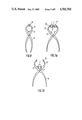
- FIG. 6 is a device for disassembly and reassembly of a three-dimensional molecular model, according to the invention.
- FIGS. 7a and b show the device of FIG. 6 while in operation.
- the three-dimensional model of a molecular structure comprises interlinked plastic modules 1 (FIGS. 1, 2, 3), each of said modules repreesnting one atom of the molecular structure being simulated.
- the modules are shaped as hemispheres 1' (FIG.3), polyhedra 1", or ellipsoids; the surface of every module can be cut off partially.
- the radius of a module corresponds to the van der Waals' atomic radius, while the distance from the center of the module to the cut-off surface thereof corresponds to the covalent atomic radius.
- the modules 1, 1', 1" are linked together through connecting elements, which are in fact cylindrical rods 2 whose entire surface is provided with easily curved projections 3 preferably having a rounded off shape and alternating with depressions 4 of the same shape. As a result the rod surface acquires the shape which may be termed as wave-like.
- Each module 1 has mounting holes made as sockets 5 whose face has projections 6 and depressions 7, the same as those on the surface of the connecting elements.
- the axis of both the projections 3 and the depressions is strictly parallel to the longitudinal axis of the rods 2.
- the modules 1 are linked together by the rods 2 in a required order.
- the rods 2 are fitted into the sockets 5 applying a perceptible force.
- the projections 3 of the rods 2 engage the depressions 7 of the socket 5
- the projections 6 of the socket 5 engage the depressions 4 of the rod 2, thus establishing a ridgeandrecess joint.
- the assembling procedure is completed when all the projections 3, 6 have engaged the respective depressions 4, 7. Part of the projections 6 and depressions 7 are left disengaged so as to simulate different interatomic distances (FIG. 2b).
- FIGS. 5a and b illustrate said device which has a handle 11, a shank 12 and a taper tip 13.
- the tapered tip 13 (FIG. 5b) is introduced with some force into the socket 5. It is due to permanent set taken by the material of the module that the inlet portion of the socket 5 retains its taper shape.
- FIGS. 6 and 7 illustrate a device for assembly and disassembly of a three-dimensional molecular model.
- the device has handles 14 which are hinged together, the ends of said handles carrying bent jaws 15 each having a wider portion 16.
- the inner surface of the jaws 15 has wedge-like projections 17.
- the herein-proposed construction of the connecting elements of the three-dimensional model of molecular structure provides for reliable interlinking of various modules in the model and makes it possible to establish the models of adequately large molecular structures featuring variable interatomic distances.
- the model can be assembled or disassembled quickly and without applying much effort.
- the invention can find application both in research and educational practice to give three-dimensional representation of the molecular structure of various substances and of their transformations.
- the invention is also applicable for decoding and interpreting the initial data obtained from crystallographic studies of chemical compounds, as well as for disclosing their most probable structural states.
Landscapes
- Physics & Mathematics (AREA)
- Engineering & Computer Science (AREA)
- General Physics & Mathematics (AREA)
- Algebra (AREA)
- Pure & Applied Mathematics (AREA)
- Computational Mathematics (AREA)
- Crystallography & Structural Chemistry (AREA)
- Mathematical Analysis (AREA)
- Mathematical Optimization (AREA)
- Mathematical Physics (AREA)
- Spectroscopy & Molecular Physics (AREA)
- Business, Economics & Management (AREA)
- Chemical & Material Sciences (AREA)
- Educational Administration (AREA)
- Educational Technology (AREA)
- Theoretical Computer Science (AREA)
- Toys (AREA)
- Nitrogen And Oxygen Or Sulfur-Condensed Heterocyclic Ring Systems (AREA)
Applications Claiming Priority (3)
| Application Number | Priority Date | Filing Date | Title |
|---|---|---|---|
| SU3500353 | 1982-10-25 | ||
| SU3500354 | 1982-10-25 | ||
| WOPCT/SU82/00035 | 1982-12-24 |
Related Parent Applications (1)
| Application Number | Title | Priority Date | Filing Date |
|---|---|---|---|
| US06625827 Continuation | 1984-07-25 |
Publications (1)
| Publication Number | Publication Date |
|---|---|
| US4702702A true US4702702A (en) | 1987-10-27 |
Family
ID=26665953
Family Applications (1)
| Application Number | Title | Priority Date | Filing Date |
|---|---|---|---|
| US06/847,435 Expired - Fee Related US4702702A (en) | 1982-10-25 | 1986-06-04 | Three-dimensional model of molecular structure and a device for disassembly and reassembly of same |
Country Status (10)
| Country | Link |
|---|---|
| US (1) | US4702702A (enExample) |
| JP (1) | JPS59501923A (enExample) |
| CH (1) | CH666136A5 (enExample) |
| DE (1) | DE3249605T1 (enExample) |
| FI (1) | FI72827C (enExample) |
| FR (1) | FR2535091A1 (enExample) |
| GB (1) | GB2139399B (enExample) |
| HU (1) | HU200852B (enExample) |
| SE (1) | SE443674B (enExample) |
| WO (1) | WO1984001846A1 (enExample) |
Cited By (16)
| Publication number | Priority date | Publication date | Assignee | Title |
|---|---|---|---|---|
| USD304469S (en) | 1987-01-23 | 1989-11-07 | Konsumex Kulkerskedelmi Vallalat | Toy construction piece |
| US5250072A (en) * | 1990-12-10 | 1993-10-05 | Jain Krishna M | Surgical clamp jaw cover |
| US5727947A (en) * | 1997-03-10 | 1998-03-17 | Esterle; Richard B. | Hand toy with movable rods and ring elements |
| USD399890S (en) | 1997-03-20 | 1998-10-20 | Hasbro, Inc. | Toy for infants |
| USD427636S (en) * | 1998-11-13 | 2000-07-04 | Craig Cowin Moore | Vertical droplet model |
| USD428443S (en) * | 1998-11-13 | 2000-07-18 | Craig Cowin Moore | Angular droplet model |
| US6471520B1 (en) | 1998-11-13 | 2002-10-29 | Milwaukee School Of Engineering | Model of complex structure and method of making the same |
| US6793497B2 (en) | 1999-11-12 | 2004-09-21 | Milwaukee School Of Engineering | Molecular models |
| US20050074733A1 (en) * | 2003-07-23 | 2005-04-07 | Mcclusky John V. | Nmr teaching method and apparatus |
| US20050089832A1 (en) * | 2003-07-23 | 2005-04-28 | Texas Lutheran University | NMR teaching method and apparatus |
| US20060099877A1 (en) * | 2004-11-09 | 2006-05-11 | Anderson George R | Chemical modeling apparatus |
| US8435095B1 (en) * | 2009-09-26 | 2013-05-07 | Kassem Charif Abbas | Building block system and method of use |
| US20150235568A1 (en) * | 2014-02-19 | 2015-08-20 | Mark A. Hoelzer | Dynamic deoxyribonucleic acid (dna) models and kits |
| US20160121235A1 (en) * | 2014-11-03 | 2016-05-05 | Genius Toy Taiwan Co., Ltd. | Snap-Fit Connector and Toy Assembly Having the Same |
| US20170169731A1 (en) * | 2017-01-20 | 2017-06-15 | Issam Kobrsi | Chirality teaching tool and method of using same |
| US20250288917A1 (en) * | 2024-03-13 | 2025-09-18 | Pushpeel LLC | Sensorial activity toys |
Families Citing this family (2)
| Publication number | Priority date | Publication date | Assignee | Title |
|---|---|---|---|---|
| FR2568392B1 (fr) * | 1984-07-30 | 1987-01-30 | Tartusky G Universi | Modele tridimensionnel de structure moleculaire |
| DE3536996A1 (de) * | 1985-10-17 | 1986-03-13 | Winfried Dipl.-Arch. 8958 Füssen Wurm | Raummodelle von polyederstrukturen |
Citations (7)
| Publication number | Priority date | Publication date | Assignee | Title |
|---|---|---|---|---|
| DE582559C (de) * | 1933-08-17 | Emil Abicht | Nussknacker | |
| US2308402A (en) * | 1941-06-26 | 1943-01-12 | Research Corp | Construction of molecular models |
| US2882617A (en) * | 1957-08-21 | 1959-04-21 | Godfrey Molecular Models Inc | Set of atomic models for the teaching of chemistry |
| US3170246A (en) * | 1962-02-23 | 1965-02-23 | Walter L Koltun | Space filling atomic units and connectors for molecular models |
| US3251260A (en) * | 1963-11-04 | 1966-05-17 | Serdechny Alexander | Adjustable length fastener |
| US3452452A (en) * | 1966-09-06 | 1969-07-01 | Nat Res Dev | Skeletal molecular models |
| US4622014A (en) * | 1985-11-08 | 1986-11-11 | Tartusky Gosudarstvenny Universitet | Three-dimensional model of molecular structure |
Family Cites Families (2)
| Publication number | Priority date | Publication date | Assignee | Title |
|---|---|---|---|---|
| DE1255880B (de) * | 1964-01-17 | 1967-12-07 | Emil Abicht | Nussknackerzange |
| US4325698A (en) * | 1980-01-08 | 1982-04-20 | Tacoma Products, Inc. | Molecular model for chemistry |
-
1982
- 1982-12-24 JP JP83500368A patent/JPS59501923A/ja active Pending
- 1982-12-24 DE DE19823249605 patent/DE3249605T1/de not_active Ceased
- 1982-12-24 GB GB08414538A patent/GB2139399B/en not_active Expired
- 1982-12-24 CH CH2891/84A patent/CH666136A5/de not_active IP Right Cessation
- 1982-12-24 HU HU83426A patent/HU200852B/hu not_active IP Right Cessation
- 1982-12-24 WO PCT/SU1982/000035 patent/WO1984001846A1/ru not_active Ceased
-
1983
- 1983-04-25 FR FR8306761A patent/FR2535091A1/fr active Granted
-
1984
- 1984-06-14 FI FI842426A patent/FI72827C/fi not_active IP Right Cessation
- 1984-06-20 SE SE8403312A patent/SE443674B/sv not_active IP Right Cessation
-
1986
- 1986-06-04 US US06/847,435 patent/US4702702A/en not_active Expired - Fee Related
Patent Citations (7)
| Publication number | Priority date | Publication date | Assignee | Title |
|---|---|---|---|---|
| DE582559C (de) * | 1933-08-17 | Emil Abicht | Nussknacker | |
| US2308402A (en) * | 1941-06-26 | 1943-01-12 | Research Corp | Construction of molecular models |
| US2882617A (en) * | 1957-08-21 | 1959-04-21 | Godfrey Molecular Models Inc | Set of atomic models for the teaching of chemistry |
| US3170246A (en) * | 1962-02-23 | 1965-02-23 | Walter L Koltun | Space filling atomic units and connectors for molecular models |
| US3251260A (en) * | 1963-11-04 | 1966-05-17 | Serdechny Alexander | Adjustable length fastener |
| US3452452A (en) * | 1966-09-06 | 1969-07-01 | Nat Res Dev | Skeletal molecular models |
| US4622014A (en) * | 1985-11-08 | 1986-11-11 | Tartusky Gosudarstvenny Universitet | Three-dimensional model of molecular structure |
Non-Patent Citations (2)
| Title |
|---|
| BRD Catalog, "White Instruments", 1958, 4 pages. |
| BRD Catalog, White Instruments , 1958, 4 pages. * |
Cited By (21)
| Publication number | Priority date | Publication date | Assignee | Title |
|---|---|---|---|---|
| USD304469S (en) | 1987-01-23 | 1989-11-07 | Konsumex Kulkerskedelmi Vallalat | Toy construction piece |
| US5250072A (en) * | 1990-12-10 | 1993-10-05 | Jain Krishna M | Surgical clamp jaw cover |
| US5727947A (en) * | 1997-03-10 | 1998-03-17 | Esterle; Richard B. | Hand toy with movable rods and ring elements |
| USD399890S (en) | 1997-03-20 | 1998-10-20 | Hasbro, Inc. | Toy for infants |
| USD427636S (en) * | 1998-11-13 | 2000-07-04 | Craig Cowin Moore | Vertical droplet model |
| USD428443S (en) * | 1998-11-13 | 2000-07-18 | Craig Cowin Moore | Angular droplet model |
| US6471520B1 (en) | 1998-11-13 | 2002-10-29 | Milwaukee School Of Engineering | Model of complex structure and method of making the same |
| US6793497B2 (en) | 1999-11-12 | 2004-09-21 | Milwaukee School Of Engineering | Molecular models |
| US6960087B2 (en) | 2003-07-23 | 2005-11-01 | Texas Lutheran University | NMR teaching method and apparatus |
| US20050089832A1 (en) * | 2003-07-23 | 2005-04-28 | Texas Lutheran University | NMR teaching method and apparatus |
| US20050074733A1 (en) * | 2003-07-23 | 2005-04-07 | Mcclusky John V. | Nmr teaching method and apparatus |
| US7048545B2 (en) | 2003-07-23 | 2006-05-23 | Texas Lutheran University | NMR teaching method and apparatus |
| US20060099877A1 (en) * | 2004-11-09 | 2006-05-11 | Anderson George R | Chemical modeling apparatus |
| US8435095B1 (en) * | 2009-09-26 | 2013-05-07 | Kassem Charif Abbas | Building block system and method of use |
| US20150235568A1 (en) * | 2014-02-19 | 2015-08-20 | Mark A. Hoelzer | Dynamic deoxyribonucleic acid (dna) models and kits |
| US9842514B2 (en) * | 2014-02-19 | 2017-12-12 | Milwaukee School Of Engineering | Dynamic deoxyribonucleic acid (DNA) models and kits |
| US20160121235A1 (en) * | 2014-11-03 | 2016-05-05 | Genius Toy Taiwan Co., Ltd. | Snap-Fit Connector and Toy Assembly Having the Same |
| US9724617B2 (en) * | 2014-11-03 | 2017-08-08 | Genius Toy Taiwan Co., Ltd. | Snap-fit connector and toy assembly having the same |
| US20170169731A1 (en) * | 2017-01-20 | 2017-06-15 | Issam Kobrsi | Chirality teaching tool and method of using same |
| US10192463B2 (en) * | 2017-01-20 | 2019-01-29 | Issam Kobrsi | Chirality teaching tool and method of using same |
| US20250288917A1 (en) * | 2024-03-13 | 2025-09-18 | Pushpeel LLC | Sensorial activity toys |
Also Published As
| Publication number | Publication date |
|---|---|
| JPS59501923A (ja) | 1984-11-15 |
| HU200852B (en) | 1990-08-28 |
| GB8414538D0 (en) | 1984-07-11 |
| FI842426A0 (fi) | 1984-06-14 |
| GB2139399A (en) | 1984-11-07 |
| FI842426A7 (fi) | 1984-06-14 |
| SE8403312D0 (sv) | 1984-06-20 |
| GB2139399B (en) | 1986-07-02 |
| SE8403312L (sv) | 1984-06-20 |
| FR2535091A1 (fr) | 1984-04-27 |
| FI72827B (fi) | 1987-03-31 |
| FI72827C (fi) | 1987-07-10 |
| FR2535091B1 (enExample) | 1985-05-10 |
| WO1984001846A1 (fr) | 1984-05-10 |
| SE443674B (sv) | 1986-03-03 |
| CH666136A5 (de) | 1988-06-30 |
| HUT47754A (en) | 1989-03-28 |
| DE3249605T1 (de) | 1984-12-13 |
Similar Documents
| Publication | Publication Date | Title |
|---|---|---|
| US4702702A (en) | Three-dimensional model of molecular structure and a device for disassembly and reassembly of same | |
| US3975858A (en) | Toy construction fabricating member and assemblage | |
| US9004799B1 (en) | Transformable linked self-assembly system | |
| US10518193B2 (en) | Toy construction set | |
| US6152797A (en) | Interconnectable space filling model | |
| US6899588B1 (en) | Hermaphroditic (genderless) construction system | |
| CA2061551A1 (en) | Method of constructing flat building block modules from the union of two frustums by their congruent bases and slot connectors complement for a variety of constructive or amusing applications | |
| US20080168633A1 (en) | Elastic fastener and actuator module using the same | |
| US20020076682A1 (en) | Molecular models | |
| US20180161690A1 (en) | Play toy in the form of interchangeable blocks and method for locking interchangeable blocks | |
| EP0642109B1 (en) | Didactic-educational toy for elementary arythmetic operations, reading and writing | |
| US4622014A (en) | Three-dimensional model of molecular structure | |
| PT86246B (pt) | Sistema de ensambladura de paineis em posicoes angulares variadas, e paineis adaptados para a utilizacao deste sistema | |
| KR102202501B1 (ko) | 한글 학습장치 | |
| EP1207951B1 (en) | An assembly kit for creating three-dimensional toy structures | |
| KR101458692B1 (ko) | 자석퍼즐 | |
| CN207123976U (zh) | 正棱柱模型及教学工具 | |
| KR20140020528A (ko) | 볼조인트와 길이 변환 이음막대로 이루어진, 입체물의 조립식 모형제작 시스템. | |
| JPH024708Y2 (enExample) | ||
| CN1003813B (zh) | 平面几何、立体几何、解析几何作图模型 | |
| CN212578621U (zh) | 一种灵活仿人机械手 | |
| KR200165622Y1 (ko) | 조립식 모형 | |
| EP3790635B1 (en) | A modular modelling kit for drawing geometric structures | |
| WO2018000691A1 (zh) | 积木轴承组件 | |
| Polster | Pretty pictures of geometries |
Legal Events
| Date | Code | Title | Description |
|---|---|---|---|
| AS | Assignment |
Owner name: TARTUSKY GOSUDARSTVENNY UNIVERSITET, USSR, TARTU Free format text: ASSIGNMENT OF ASSIGNORS INTEREST.;ASSIGNOR:NEEMEEVICH MIKELSAAR, RAIK-KHIIO;REEL/FRAME:004791/0615 Effective date: 19870622 |
|
| FPAY | Fee payment |
Year of fee payment: 4 |
|
| REMI | Maintenance fee reminder mailed | ||
| LAPS | Lapse for failure to pay maintenance fees | ||
| FP | Lapsed due to failure to pay maintenance fee |
Effective date: 19951101 |
|
| STCH | Information on status: patent discontinuation |
Free format text: PATENT EXPIRED DUE TO NONPAYMENT OF MAINTENANCE FEES UNDER 37 CFR 1.362 |