US4412005A - Determination of total bilirubin - Google Patents
Determination of total bilirubin Download PDFInfo
- Publication number
- US4412005A US4412005A US06/088,230 US8823079A US4412005A US 4412005 A US4412005 A US 4412005A US 8823079 A US8823079 A US 8823079A US 4412005 A US4412005 A US 4412005A
- Authority
- US
- United States
- Prior art keywords
- bilirubin
- mordant
- sup
- assay
- poly
- Prior art date
- Legal status (The legal status is an assumption and is not a legal conclusion. Google has not performed a legal analysis and makes no representation as to the accuracy of the status listed.)
- Expired - Lifetime
Links
- 238000008050 Total Bilirubin Reagent Methods 0.000 title abstract description 25
- BPYKTIZUTYGOLE-IFADSCNNSA-N Bilirubin Chemical compound N1C(=O)C(C)=C(C=C)\C1=C\C1=C(C)C(CCC(O)=O)=C(CC2=C(C(C)=C(\C=C/3C(=C(C=C)C(=O)N\3)C)N2)CCC(O)=O)N1 BPYKTIZUTYGOLE-IFADSCNNSA-N 0.000 claims abstract description 180
- 239000007788 liquid Substances 0.000 claims abstract description 53
- 230000002452 interceptive effect Effects 0.000 claims abstract description 50
- 238000000034 method Methods 0.000 claims abstract description 49
- 238000010521 absorption reaction Methods 0.000 claims abstract description 25
- 238000004458 analytical method Methods 0.000 claims abstract description 22
- 238000012360 testing method Methods 0.000 claims abstract description 21
- 238000000862 absorption spectrum Methods 0.000 claims abstract description 15
- 238000002798 spectrophotometry method Methods 0.000 claims abstract description 9
- 238000003892 spreading Methods 0.000 claims description 35
- 239000003153 chemical reaction reagent Substances 0.000 claims description 32
- 230000007480 spreading Effects 0.000 claims description 31
- 239000000203 mixture Substances 0.000 claims description 16
- 239000000126 substance Substances 0.000 claims description 15
- 210000002966 serum Anatomy 0.000 claims description 13
- RYYVLZVUVIJVGH-UHFFFAOYSA-N caffeine Chemical compound CN1C(=O)N(C)C(=O)C2=C1N=CN2C RYYVLZVUVIJVGH-UHFFFAOYSA-N 0.000 claims description 10
- 229920001577 copolymer Polymers 0.000 claims description 9
- 229920000642 polymer Polymers 0.000 claims description 8
- 230000002209 hydrophobic effect Effects 0.000 claims description 6
- LPHGQDQBBGAPDZ-UHFFFAOYSA-N Isocaffeine Natural products CN1C(=O)N(C)C(=O)C2=C1N(C)C=N2 LPHGQDQBBGAPDZ-UHFFFAOYSA-N 0.000 claims description 5
- 229960001948 caffeine Drugs 0.000 claims description 5
- VJEONQKOZGKCAK-UHFFFAOYSA-N caffeine Natural products CN1C(=O)N(C)C(=O)C2=C1C=CN2C VJEONQKOZGKCAK-UHFFFAOYSA-N 0.000 claims description 5
- WXMKPNITSTVMEF-UHFFFAOYSA-M sodium benzoate Chemical compound [Na+].[O-]C(=O)C1=CC=CC=C1 WXMKPNITSTVMEF-UHFFFAOYSA-M 0.000 claims description 5
- 239000004299 sodium benzoate Substances 0.000 claims description 5
- 235000010234 sodium benzoate Nutrition 0.000 claims description 5
- GWEVSGVZZGPLCZ-UHFFFAOYSA-N Titan oxide Chemical compound O=[Ti]=O GWEVSGVZZGPLCZ-UHFFFAOYSA-N 0.000 claims description 4
- 150000001450 anions Chemical class 0.000 claims description 4
- 125000003636 chemical group Chemical group 0.000 claims description 4
- 125000000962 organic group Chemical group 0.000 claims description 4
- 239000002253 acid Substances 0.000 claims description 3
- 125000001453 quaternary ammonium group Chemical group 0.000 claims description 3
- NLXLAEXVIDQMFP-UHFFFAOYSA-N Ammonium chloride Substances [NH4+].[Cl-] NLXLAEXVIDQMFP-UHFFFAOYSA-N 0.000 claims description 2
- 125000002877 alkyl aryl group Chemical group 0.000 claims description 2
- 125000000217 alkyl group Chemical group 0.000 claims description 2
- 125000003710 aryl alkyl group Chemical group 0.000 claims description 2
- 125000003118 aryl group Chemical group 0.000 claims description 2
- 150000001768 cations Chemical class 0.000 claims description 2
- 125000000118 dimethyl group Chemical group [H]C([H])([H])* 0.000 claims 1
- 239000004408 titanium dioxide Substances 0.000 claims 1
- 238000003556 assay Methods 0.000 abstract description 79
- 230000035945 sensitivity Effects 0.000 abstract description 6
- BPYKTIZUTYGOLE-UHFFFAOYSA-N billirubin-IXalpha Natural products N1C(=O)C(C)=C(C=C)C1=CC1=C(C)C(CCC(O)=O)=C(CC2=C(C(C)=C(C=C3C(=C(C=C)C(=O)N3)C)N2)CCC(O)=O)N1 BPYKTIZUTYGOLE-UHFFFAOYSA-N 0.000 abstract description 4
- 239000010410 layer Substances 0.000 description 73
- -1 halide ion Chemical class 0.000 description 19
- 239000000463 material Substances 0.000 description 18
- 238000002835 absorbance Methods 0.000 description 13
- 102000001554 Hemoglobins Human genes 0.000 description 12
- 108010054147 Hemoglobins Proteins 0.000 description 12
- 239000000243 solution Substances 0.000 description 11
- 230000005540 biological transmission Effects 0.000 description 10
- 238000001514 detection method Methods 0.000 description 10
- 230000003595 spectral effect Effects 0.000 description 10
- 239000004094 surface-active agent Substances 0.000 description 10
- 239000000872 buffer Substances 0.000 description 8
- 230000004044 response Effects 0.000 description 8
- FSVCELGFZIQNCK-UHFFFAOYSA-N N,N-bis(2-hydroxyethyl)glycine Chemical compound OCCN(CCO)CC(O)=O FSVCELGFZIQNCK-UHFFFAOYSA-N 0.000 description 7
- 238000007704 wet chemistry method Methods 0.000 description 7
- 238000006243 chemical reaction Methods 0.000 description 6
- 239000011159 matrix material Substances 0.000 description 6
- 238000007430 reference method Methods 0.000 description 6
- 125000004432 carbon atom Chemical group C* 0.000 description 5
- 239000012636 effector Substances 0.000 description 5
- 239000012530 fluid Substances 0.000 description 5
- 102000004169 proteins and genes Human genes 0.000 description 5
- 108090000623 proteins and genes Proteins 0.000 description 5
- OGIDPMRJRNCKJF-UHFFFAOYSA-N titanium oxide Inorganic materials [Ti]=O OGIDPMRJRNCKJF-UHFFFAOYSA-N 0.000 description 5
- 108010010803 Gelatin Proteins 0.000 description 4
- PPBRXRYQALVLMV-UHFFFAOYSA-N Styrene Chemical class C=CC1=CC=CC=C1 PPBRXRYQALVLMV-UHFFFAOYSA-N 0.000 description 4
- 125000002091 cationic group Chemical group 0.000 description 4
- 229920002301 cellulose acetate Polymers 0.000 description 4
- 229920000159 gelatin Polymers 0.000 description 4
- 239000008273 gelatin Substances 0.000 description 4
- 235000019322 gelatine Nutrition 0.000 description 4
- 235000011852 gelatine desserts Nutrition 0.000 description 4
- 239000000178 monomer Substances 0.000 description 4
- 229920000139 polyethylene terephthalate Polymers 0.000 description 4
- 239000005020 polyethylene terephthalate Substances 0.000 description 4
- 230000005855 radiation Effects 0.000 description 4
- 238000001228 spectrum Methods 0.000 description 4
- XLYOFNOQVPJJNP-UHFFFAOYSA-N water Substances O XLYOFNOQVPJJNP-UHFFFAOYSA-N 0.000 description 4
- 102000009027 Albumins Human genes 0.000 description 3
- 108010088751 Albumins Proteins 0.000 description 3
- UHOVQNZJYSORNB-UHFFFAOYSA-N Benzene Chemical compound C1=CC=CC=C1 UHOVQNZJYSORNB-UHFFFAOYSA-N 0.000 description 3
- 239000007998 bicine buffer Substances 0.000 description 3
- 210000000941 bile Anatomy 0.000 description 3
- 210000001124 body fluid Anatomy 0.000 description 3
- 239000010839 body fluid Substances 0.000 description 3
- 230000015556 catabolic process Effects 0.000 description 3
- 230000008859 change Effects 0.000 description 3
- 238000006731 degradation reaction Methods 0.000 description 3
- 230000003993 interaction Effects 0.000 description 3
- 238000005259 measurement Methods 0.000 description 3
- UYDLBVPAAFVANX-UHFFFAOYSA-N octylphenoxy polyethoxyethanol Chemical compound CC(C)(C)CC(C)(C)C1=CC=C(OCCOCCOCCOCCO)C=C1 UYDLBVPAAFVANX-UHFFFAOYSA-N 0.000 description 3
- 239000011236 particulate material Substances 0.000 description 3
- 239000008363 phosphate buffer Substances 0.000 description 3
- 229920003213 poly(N-isopropyl acrylamide) Polymers 0.000 description 3
- 238000000611 regression analysis Methods 0.000 description 3
- UYUXSRADSPPKRZ-UHFFFAOYSA-N D-glucuronic acid gamma-lactone Natural products O=CC(O)C1OC(=O)C(O)C1O UYUXSRADSPPKRZ-UHFFFAOYSA-N 0.000 description 2
- UYUXSRADSPPKRZ-SKNVOMKLSA-N D-glucurono-6,3-lactone Chemical group O=C[C@H](O)[C@H]1OC(=O)[C@@H](O)[C@H]1O UYUXSRADSPPKRZ-SKNVOMKLSA-N 0.000 description 2
- IAJILQKETJEXLJ-UHFFFAOYSA-N Galacturonsaeure Natural products O=CC(O)C(O)C(O)C(O)C(O)=O IAJILQKETJEXLJ-UHFFFAOYSA-N 0.000 description 2
- IAJILQKETJEXLJ-QTBDOELSSA-N aldehydo-D-glucuronic acid Chemical group O=C[C@H](O)[C@@H](O)[C@H](O)[C@H](O)C(O)=O IAJILQKETJEXLJ-QTBDOELSSA-N 0.000 description 2
- 150000001336 alkenes Chemical class 0.000 description 2
- 125000002947 alkylene group Chemical group 0.000 description 2
- 235000013405 beer Nutrition 0.000 description 2
- 239000013060 biological fluid Substances 0.000 description 2
- 238000001311 chemical methods and process Methods 0.000 description 2
- 230000002596 correlated effect Effects 0.000 description 2
- 230000001419 dependent effect Effects 0.000 description 2
- 201000010099 disease Diseases 0.000 description 2
- 208000037265 diseases, disorders, signs and symptoms Diseases 0.000 description 2
- MYRTYDVEIRVNKP-UHFFFAOYSA-N divinylbenzene Substances C=CC1=CC=CC=C1C=C MYRTYDVEIRVNKP-UHFFFAOYSA-N 0.000 description 2
- 229940116441 divinylbenzene Drugs 0.000 description 2
- 230000000694 effects Effects 0.000 description 2
- 230000005670 electromagnetic radiation Effects 0.000 description 2
- 229950002441 glucurolactone Drugs 0.000 description 2
- 229940097043 glucuronic acid Drugs 0.000 description 2
- 238000011534 incubation Methods 0.000 description 2
- 210000004185 liver Anatomy 0.000 description 2
- 239000002609 medium Substances 0.000 description 2
- 239000002736 nonionic surfactant Substances 0.000 description 2
- 238000010606 normalization Methods 0.000 description 2
- 230000003287 optical effect Effects 0.000 description 2
- 125000005496 phosphonium group Chemical group 0.000 description 2
- 239000002243 precursor Substances 0.000 description 2
- 230000009467 reduction Effects 0.000 description 2
- 239000002904 solvent Substances 0.000 description 2
- 239000012086 standard solution Substances 0.000 description 2
- SCJLWMXOOYZBTH-BTVQFETGSA-N (2s,3s,4s,5r,6s)-6-[3-[2-[[3-[3-[(2s,3r,4s,5s,6s)-6-carboxy-3,4,5-trihydroxyoxan-2-yl]oxy-3-oxopropyl]-5-[(z)-(3-ethenyl-4-methyl-5-oxopyrrol-2-ylidene)methyl]-4-methyl-1h-pyrrol-2-yl]methyl]-5-[(z)-(4-ethenyl-3-methyl-5-oxopyrrol-2-ylidene)methyl]-4-meth Chemical compound N1C(=O)C(C)=C(C=C)\C1=C\C1=C(C)C(CCC(=O)O[C@H]2[C@@H]([C@@H](O)[C@H](O)[C@H](O2)C(O)=O)O)=C(CC2=C(C(C)=C(\C=C/3C(=C(C=C)C(=O)N\3)C)N2)CCC(=O)O[C@H]2[C@@H]([C@@H](O)[C@H](O)[C@H](O2)C(O)=O)O)N1 SCJLWMXOOYZBTH-BTVQFETGSA-N 0.000 description 1
- QLAJNZSPVITUCQ-UHFFFAOYSA-N 1,3,2-dioxathietane 2,2-dioxide Chemical compound O=S1(=O)OCO1 QLAJNZSPVITUCQ-UHFFFAOYSA-N 0.000 description 1
- SLBOQBILGNEPEB-UHFFFAOYSA-N 1-chloroprop-2-enylbenzene Chemical compound C=CC(Cl)C1=CC=CC=C1 SLBOQBILGNEPEB-UHFFFAOYSA-N 0.000 description 1
- 102000004506 Blood Proteins Human genes 0.000 description 1
- 108010017384 Blood Proteins Proteins 0.000 description 1
- CPELXLSAUQHCOX-UHFFFAOYSA-M Bromide Chemical compound [Br-] CPELXLSAUQHCOX-UHFFFAOYSA-M 0.000 description 1
- VEXZGXHMUGYJMC-UHFFFAOYSA-M Chloride anion Chemical compound [Cl-] VEXZGXHMUGYJMC-UHFFFAOYSA-M 0.000 description 1
- 229920000084 Gum arabic Polymers 0.000 description 1
- 206010023126 Jaundice Diseases 0.000 description 1
- 239000005909 Kieselgur Substances 0.000 description 1
- 229920000168 Microcrystalline cellulose Polymers 0.000 description 1
- 238000005481 NMR spectroscopy Methods 0.000 description 1
- 229910002651 NO3 Inorganic materials 0.000 description 1
- NHNBFGGVMKEFGY-UHFFFAOYSA-N Nitrate Chemical compound [O-][N+]([O-])=O NHNBFGGVMKEFGY-UHFFFAOYSA-N 0.000 description 1
- 239000004793 Polystyrene Substances 0.000 description 1
- 101150108015 STR6 gene Proteins 0.000 description 1
- 101100386054 Saccharomyces cerevisiae (strain ATCC 204508 / S288c) CYS3 gene Proteins 0.000 description 1
- 241000978776 Senegalia senegal Species 0.000 description 1
- 102000007562 Serum Albumin Human genes 0.000 description 1
- 108010071390 Serum Albumin Proteins 0.000 description 1
- VYPSYNLAJGMNEJ-UHFFFAOYSA-N Silicium dioxide Chemical compound O=[Si]=O VYPSYNLAJGMNEJ-UHFFFAOYSA-N 0.000 description 1
- 230000002159 abnormal effect Effects 0.000 description 1
- 239000000205 acacia gum Substances 0.000 description 1
- 235000010489 acacia gum Nutrition 0.000 description 1
- 150000001338 aliphatic hydrocarbons Chemical class 0.000 description 1
- 125000005250 alkyl acrylate group Chemical class 0.000 description 1
- 239000012491 analyte Substances 0.000 description 1
- 125000000129 anionic group Chemical group 0.000 description 1
- 239000003945 anionic surfactant Substances 0.000 description 1
- 238000013459 approach Methods 0.000 description 1
- 239000012736 aqueous medium Substances 0.000 description 1
- 239000007864 aqueous solution Substances 0.000 description 1
- 150000004945 aromatic hydrocarbons Chemical class 0.000 description 1
- 125000000732 arylene group Chemical group 0.000 description 1
- 239000011324 bead Substances 0.000 description 1
- 239000003833 bile salt Substances 0.000 description 1
- 229940093761 bile salts Drugs 0.000 description 1
- 230000015572 biosynthetic process Effects 0.000 description 1
- 230000000903 blocking effect Effects 0.000 description 1
- 210000001185 bone marrow Anatomy 0.000 description 1
- 239000007853 buffer solution Substances 0.000 description 1
- 229940023964 caffeine and sodium benzoate Drugs 0.000 description 1
- 238000011088 calibration curve Methods 0.000 description 1
- 238000012512 characterization method Methods 0.000 description 1
- 239000003795 chemical substances by application Substances 0.000 description 1
- 230000003749 cleanliness Effects 0.000 description 1
- 150000001875 compounds Chemical class 0.000 description 1
- 230000003750 conditioning effect Effects 0.000 description 1
- 230000001276 controlling effect Effects 0.000 description 1
- 238000004132 cross linking Methods 0.000 description 1
- 239000007857 degradation product Substances 0.000 description 1
- 125000000664 diazo group Chemical group [N-]=[N+]=[*] 0.000 description 1
- 239000006185 dispersion Substances 0.000 description 1
- 230000008030 elimination Effects 0.000 description 1
- 238000003379 elimination reaction Methods 0.000 description 1
- 230000001747 exhibiting effect Effects 0.000 description 1
- 239000002657 fibrous material Substances 0.000 description 1
- 238000009472 formulation Methods 0.000 description 1
- 239000011521 glass Substances 0.000 description 1
- 238000010438 heat treatment Methods 0.000 description 1
- 229920001519 homopolymer Polymers 0.000 description 1
- 150000002430 hydrocarbons Chemical group 0.000 description 1
- 238000011835 investigation Methods 0.000 description 1
- 238000002955 isolation Methods 0.000 description 1
- 238000004519 manufacturing process Methods 0.000 description 1
- 230000007246 mechanism Effects 0.000 description 1
- 150000002734 metacrylic acid derivatives Chemical class 0.000 description 1
- 235000019813 microcrystalline cellulose Nutrition 0.000 description 1
- 239000008108 microcrystalline cellulose Substances 0.000 description 1
- 229940016286 microcrystalline cellulose Drugs 0.000 description 1
- 238000002156 mixing Methods 0.000 description 1
- 238000012986 modification Methods 0.000 description 1
- 230000004048 modification Effects 0.000 description 1
- BVWUEIUNONATML-UHFFFAOYSA-N n-benzylethenamine Chemical compound C=CNCC1=CC=CC=C1 BVWUEIUNONATML-UHFFFAOYSA-N 0.000 description 1
- UMBBGOALZMAJSF-UHFFFAOYSA-N n-benzylethenamine;hydrochloride Chemical compound [Cl-].C=C[NH2+]CC1=CC=CC=C1 UMBBGOALZMAJSF-UHFFFAOYSA-N 0.000 description 1
- 229920005615 natural polymer Polymers 0.000 description 1
- 230000035515 penetration Effects 0.000 description 1
- 230000035699 permeability Effects 0.000 description 1
- 230000002085 persistent effect Effects 0.000 description 1
- 239000000049 pigment Substances 0.000 description 1
- 229920000515 polycarbonate Polymers 0.000 description 1
- 239000004417 polycarbonate Substances 0.000 description 1
- 229920002223 polystyrene Polymers 0.000 description 1
- 239000000843 powder Substances 0.000 description 1
- 238000002360 preparation method Methods 0.000 description 1
- 230000006920 protein precipitation Effects 0.000 description 1
- 238000011160 research Methods 0.000 description 1
- 238000012552 review Methods 0.000 description 1
- YGSDEFSMJLZEOE-UHFFFAOYSA-M salicylate Chemical compound OC1=CC=CC=C1C([O-])=O YGSDEFSMJLZEOE-UHFFFAOYSA-M 0.000 description 1
- 229960001860 salicylate Drugs 0.000 description 1
- 239000012898 sample dilution Substances 0.000 description 1
- 238000007086 side reaction Methods 0.000 description 1
- 239000002356 single layer Substances 0.000 description 1
- JWBPVFVNISJVEM-UHFFFAOYSA-M sodium caffeine benzoate Chemical compound [Na+].[O-]C(=O)C1=CC=CC=C1.CN1C(=O)N(C)C(=O)C2=C1N=CN2C JWBPVFVNISJVEM-UHFFFAOYSA-M 0.000 description 1
- 238000001179 sorption measurement Methods 0.000 description 1
- 241000894007 species Species 0.000 description 1
- 238000004611 spectroscopical analysis Methods 0.000 description 1
- 210000000952 spleen Anatomy 0.000 description 1
- 238000007619 statistical method Methods 0.000 description 1
- 238000003756 stirring Methods 0.000 description 1
- 101150035983 str1 gene Proteins 0.000 description 1
- 150000003440 styrenes Chemical class 0.000 description 1
- 229920001059 synthetic polymer Polymers 0.000 description 1
- 238000010257 thawing Methods 0.000 description 1
- JOXIMZWYDAKGHI-UHFFFAOYSA-N toluene-4-sulfonic acid Chemical compound CC1=CC=C(S(O)(=O)=O)C=C1 JOXIMZWYDAKGHI-UHFFFAOYSA-N 0.000 description 1
- 229920002554 vinyl polymer Polymers 0.000 description 1
- 239000011800 void material Substances 0.000 description 1
Images


Classifications
-
- G—PHYSICS
- G01—MEASURING; TESTING
- G01N—INVESTIGATING OR ANALYSING MATERIALS BY DETERMINING THEIR CHEMICAL OR PHYSICAL PROPERTIES
- G01N33/00—Investigating or analysing materials by specific methods not covered by groups G01N1/00 - G01N31/00
- G01N33/48—Biological material, e.g. blood, urine; Haemocytometers
- G01N33/50—Chemical analysis of biological material, e.g. blood, urine; Testing involving biospecific ligand binding methods; Immunological testing
- G01N33/72—Chemical analysis of biological material, e.g. blood, urine; Testing involving biospecific ligand binding methods; Immunological testing involving blood pigments, e.g. haemoglobin, bilirubin or other porphyrins; involving occult blood
- G01N33/728—Bilirubin; including biliverdin
-
- Y—GENERAL TAGGING OF NEW TECHNOLOGICAL DEVELOPMENTS; GENERAL TAGGING OF CROSS-SECTIONAL TECHNOLOGIES SPANNING OVER SEVERAL SECTIONS OF THE IPC; TECHNICAL SUBJECTS COVERED BY FORMER USPC CROSS-REFERENCE ART COLLECTIONS [XRACs] AND DIGESTS
- Y10—TECHNICAL SUBJECTS COVERED BY FORMER USPC
- Y10T—TECHNICAL SUBJECTS COVERED BY FORMER US CLASSIFICATION
- Y10T436/00—Chemistry: analytical and immunological testing
- Y10T436/14—Heterocyclic carbon compound [i.e., O, S, N, Se, Te, as only ring hetero atom]
- Y10T436/145555—Hetero-N
- Y10T436/146666—Bile pigment
Definitions
- the present invention relates to a method for determining the total bilirubin content of an aqueous liquid such as a biological fluid, e.g., serum.
- aqueous liquid such as a biological fluid, e.g., serum.
- the assay method of the invention is direct and highly sensitive and may be employed using either "wet chemistry", i.e., analytical chemical techniques sometimes referred to as solution assay techniques wherein chemical reagents are dissolved or suspended in a liquid vehicle; or "dry chemistry", i.e., analytical chemical techniques wherein chemical reagents are incorporated in various substantially “dry-to-the-touch" elements such as monolayer test strips, multilayer analytical test elements and the like.
- Bilirubin is a degradation product of hemoglobin. It has been estimated that approximately 200-230 mg of bilirubin and its derivatives are formed each day in a normal human adult by the degradation of hemoglobin within the liver, spleen, and bone marrow. Bilirubin has a natural yellow-orange color.
- bilirubin exists in chiefly two different forms, these forms commonly being referred to in the clinical literature as conjugated bilirubin, B c , and unconjugated bilirubin, B u . Therefore, the total bilirubin content, B T , of any individual body fluid commonly represents the sum of the B u and B c components in that fluid.
- bilirubin The diagnostic significance of bilirubin is well established. For example, an excessive amount of bilirubin within the human body, referred to as jaundice, is recognized as evidence of a variety of disease conditions, particularly diseases of the liver.
- Direct, spectrophotometric analysis represents one of the more popular methods for determination of bilirubin owing to its simplicity.
- Direct, spectrophotometric assays determine the presence and/or concentration of a substance in a liquid by detecting the absorption spectrum of the liquid in a spectral region in which the substance exhibits inherent molar absorptivity.
- hemoglobin spectral interference with bilirubin assays has been identified. Such hemoglobin interference has been reduced by analyzing the absorption spectrum of a liquid sample at several different wavelengths, one or more being specific to hemoglobin, so that bilirubin spectral absorption readings can effectively be corrected for hemoglobin interference.
- B u and B c have quite distinct, although overlapping, absorption spectra.
- B c and B u absorb in the 435 to 460 nm region of the spectrum, their individual absorption characteristics in this spectral region are quite different.
- B c has an absorption spectrum identical to that of B u as reported by Henry et al, Clinical Chemistry, Principles And Technics, Harper and Row, p. 1071 (1974).
- Significant assay errors therefore occur when direct, spectrophotometric B T assays are carried out in the 435-460 nm spectral region on any aqueous sample having a substantial B c concentration.
- the present invention features a spectrophotometric method for the determination of the total bilirubin (B T ) content of an aqueous liquid.
- the method comprises detecting the absorption spectrum of the aqueous liquid at a wavelength at which the absorption characteristics of unconjugated bilirubin, B u , are effectively identical to those of conjugated bilirubin, B c .
- the present invention significantly reduces assay error arising from the dissimilar absorption characteristics of B u and B c in the wavelength range in which direct, spectrophotometric assays for total bilirubin have previously been conducted, that is, within the wavelength range of from about 435 to 460 nm.
- This highly advantageous reduction in assay error results from the unexpected discovery that the absorption characteristics of B u and B c are effectively identical at certain wavelengths outside the 435-460 nm range.
- the present method for the determination of total bilirubin preferably detects the absorption spectrum of the aqueous liquid under analysis at a wavelength within the range of from about 385 to 425 nm, most preferably in the range of from about 395 to 420 nm.
- the aqueous liquid under analysis for its total bilirubin content and an interactive mordant composition for bilirubin are contacted together to mordant bilirubin.
- Mordanted bilirubin including both mordanted B c and mordanted B u , exhibits enhanced absorption in the visible spectral range used for detection of total bilirubin in accord with the present invention, thereby providing increased assay sensitivity.
- the method of the invention is conveniently carried out using either “wet chemistry” or “dry chemistry” analytical techniques.
- the analysis method of the invention is carried out with a dry chemistry analytical element as follows:
- step (b) above is carried out in the spectral region of from about 385-425 nm, most preferably 395-420 nm.
- a preferred dry chemistry analytical element employed in the method of the invention is a multi-zone element comprising a reagent zone as described above and a spreading zone which can effectively distribute and meter the aqueous liquid under analysis to the reagent zone.
- multi-zone elements are preferably integral elements wherein the spreading zone and reagent zone are superposed layers in fluid contact with one another under conditions of use of the element.
- these layers are carried on a support, such as a "radiation-transmissive" support.
- an additional "radiation-blocking" zone is sandwiched between the spreading zone and reagent zone of a multi-zone element of the invention to promote additional assay precision, as illustrated in certain of the appended Examples.
- reaction-transmissive and radiation-blocking refer to zones, supports, and other layers of an element that transmit or block, respectively, effective passage of electromagnetic radiation used to detect an analytical result produced in an element in accord with the invention.
- radiation-transmissive or radiation-blocking zones, supports, and other layers, transmit or block, respectively, radiation having a wave-length within the range of from about 200 to 900 nm.
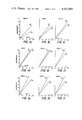
- FIGS. 1a-1i, 2-5, 6a-6c, and 7a-7b are graphs illustrating the absorption characteristics of B c and B u at various wavelengths.
- absorption characteristics refers herein to the optical characteristics of a substance as determined at a given wavelength of detecting radiation. Absorption characteristics can be quantitatively expressed by various absorption measurements including, for example, absorbance (A), transmission density (D T ), reflection density (D R ), and the like. The particular spectrophotometric measurement selected in any given assay will vary depending, for example, upon the type of assay conducted. Thus, in “wet chemistry" or solution assays, the absorption characteristics of a substance in an aqueous liquid are conveniently measured by spectrophotometrically detecting the absorbance of the aqueous liquid containing the substance.
- the absorption characteristics of a substance in an aqueous liquid are conveniently measured by contacting together a sample of the liquid under analysis and a test element, and spectrophotometrically detecting the D T or D R produced in the element by the liquid, the choice of D T or D R measurement depending upon whether the test element transmits or reflects the detecting radiation.
- the present method is carried out at a wavelength at which the absorption characteristics of B u and B c are effectively identical.
- the absorption characteristics of B u and B c are spectrophotometrically matched such that a calibrator composed of B u , B c , or a mixture of B u and B c will provide an accurate assay of the total bilirubin content of an aqueous liquid containing both B c and B u .
- making a single, direct, spectrophotometric measurement on an aqueous liquid containing both B u and B c at this wavelength provides an accurate assay for B T .
- the term "accurate assay” means that the present B T analysis method, when used, for example, to analyze the B T content of serum samples containing both B u and B c , correlates with a commonly accepted reference assay, such as the Jendrassik-Grof method, having a correlation coefficient (r) of greater than 0.98, a slope of regression analysis of 1.0 ⁇ 0.1, and an intercept of the regression analysis (Sy.x) equal to 0.0 ⁇ 0.5.
- the Jendrassik-Grof reference method noted above is described in Fundamentals of Clinical Chemistry, N.W. Tietz, Ed., 2nd Edition, W. B. Saunders Co., Philadelphia, Pa. (1964), pages 1037-1040. Further details relative to the accuracy of the present method are set forth in appended Examples 6 and 7.
- the theoretical basis of this invention resides in the discovery that the absorption spectra of B c and B u are different, but that a wavelength exists at which the molar absorption coefficients of B u and B c are effectively identical.
- the molar concentration of B T in an aqueous liquid containing B u and B c is obtained according to the present spectrophotometric method on the basis that, at this wavelength, the molar concentration of B T is directly proportional to the total detected absorbance or transmission density of the aqueous liquid. That is, at this wavelength the total detected absorbance or transmission density of the aqueous liquid represents the sum of the absorbance or transmission density of B u and the absorbance or transmission density of B c .
- FIGS. 1a-1i illustrate the change in the absorbance of two series of aqueous solutions, one series containing essentially pure B c and the other containing essentially pure B u , versus the change in concentration of B c or B u over the range of 0 to 2 mg/dl.
- Each of FIGS. 1a-1i is at a different wavelength.
- the "normal" range of total bilirubin concentration in adult serum is generally regarded as about 0.9 to 1.1 mg/dl.
- the absorbance of identical quantities of B u and B c become effectively identical over the wavelength range of from about 395 to 425 nm, particularly 400 to 420 nm, whereas a substantial difference in absorbance is exhibited by identical quantities of B c and B u at wavelengths above and below these values.
- a significant difference in absorbance is evident over the wavelength range of 435 to 460 nm which corresponds to the wavelength range at which direct, spectophotometric B T assays have previously been performed.
- FIGS. 1a-1i express B u and B c concentrations in mg/dl. Because B u and B c have differing molecular weights (M.W.), B u having a M.W. of about 584 and B c having a M.W. of about 918, the optimum wavelength selected for the total bilirubin assay method of the invention will vary somewhat depending upon whether the concentration units of the assay are expressed in mg/dl or molarity (moles/l). This is illustrated, for example, in FIGS. 2-5 which are based on the work described in greater detail in appended Example 8. Under the specific assay conditions used in Example 8, FIGS.
- FIGS. 4 and 5 illustrate that good agreement was found between the absorption characteristics of equal concentrations of B u and B c , when expressed in moles/l, at a wavelength of 413 nm.
- the pH and temperature conditions under which the present assay method is carried out are variable.
- the assay is carried out at a pH range of from about 6.5 to about 10.0, preferably about 6.8 to about 8.2, and at a temperature within the range of from about 15° to about 60° C., preferably from about 20° to about 50° C.
- a pH range of from about 6.5 to about 10.0, preferably about 6.8 to about 8.2
- a temperature within the range of from about 15° to about 60° C., preferably from about 20° to about 50° C.
- those embodiments of the assay which employ an interactive mordant one can vary the aforementioned pH and temperature to values above or below the stated ranges depending upon the particular mordant selected, providing, of course, that one does not use a pH or temperature which causes undesired side reactions or significant degradation of bilirubin.
- the bilirubin determination is typically carried out in the presence of buffer.
- buffers are useful. A partial listing of representative buffers is described by Good in Biochemistry, 5, 467 (1966). Particularly good results have been obtained using N,N-bis(2-hydroxyethyl)glycine, in an amount effective to maintain the pH of the aqueous test sample in the presence of the interactive mordant within the range of from about 6.8 to about 8.2, preferably 7 to 8.0.
- bilirubin effectors or “promoters”, as they are sometimes called, are added, if desired. These effectors are employed with or without the use of the interactive mordants present in certain preferred embodiments of the present invention.
- Such "effectors” or “promoters” are known for use in bilirubin assays as noted by Henry et al in Clinical Chemistry, Principles and Technics, pages 1047 and 1048, referred to in the "Background of the Invention" of this specification.
- a partial listing of representative effectors includes caffeine, sodium benzoate, gum arabic, salicylate, and bile salts. The precise mechanism of these effectors is not fully understood although they may serve as solubilizing agents for the various bilirubin components. In any case, a combination of caffeine and sodium benzoate has been found especially useful in the present invention.
- the aqueous liquid is contacted under the aforementioned pH and temperature conditions with an interactive mordant to mordant the B c and B u contained therein, and the absorption spectrum of the liquid is detected at a wavelength at which these two different mordanted bilirubin components exhibit effectively identical absorption characteristics.
- the spectrum detected at this wavelength represents both the individual mordanted B u and mordanted B c spectra.
- the molar absorptivity of both mordanted B u and mordanted B c is significantly enhanced over that of unmordanted B u and B c , thereby facilitating the detection of total bilirubin.
- the absorption spectra of mordanted B c and B u at 400 nm as shown in FIG. 6a are compared to those of unmordanted B c and B u at the same wavelength as shown in FIG. 7a.
- the detection of the absorption characteristics of total bilirubin is carried out in the present assay by any of a variety of well-known absorption detection devices and techniques. Typically, such detection is carried out at a predetermined time, following the contacting together of the aqueous sample and interactive mordant, if one is used. Accordingly, the resultant spectral data is readily correlated to, for example, a calibration curve based on the spectral data obtained from a series of aqueous liquid controls containing known amounts of B u , B c , or mixtures of B u and B C as determined at the same or a related predetermined time interval.
- the interactive mordants employed in certain preferred embodiments of the present assay method correspond to the mordants for bilirubin described in the aforementioned U.S. Pat. No. 4,069,017.
- these mordants have multiple binding sites for bilirubin and comprise at least one moiety having a hydrophobic organic matrix and a charg-bearing cationic group.
- Such mordants can be monomeric or polymeric, with especially preferred embodiments of such mordants represented by homopolymers or copolymers containing repeating units having the above-defined properties. Materials having these properties and compositions bind both B c and B u and therefore these materials function as mordants for the total bilirubin content of an aqueous liquid.
- Bilirubin components i.e., B c and B u , mordanted by the binding sites of such interactive mordants exhibit a significant enhancement in molar absorptivity as compared to the unmordanted components, as illustrated hereinabove, thereby advantageously increasing the sensitivity of the present assay method.
- the charge-bearing cationic group present in the mordant typically retains its cationic charge in an aqueous environment regardless of pH fluctuations in the environment.
- the charge properties of the cationic group in the interactive mordant are therefore insensitive to variations in pH.
- Especially preferred polymeric interactive mordants have in their polymer chain monomeric units of Formula I below: ##STR2## wherein
- A represents an organo group and constitutes a portion of a polymer backbone
- Q represents a chemical bond(s) or a chemical group linking M.sup. ⁇ to A;
- M.sup. ⁇ represents a hydrophobic organic moiety containing a cation, preferably a quaternary ammonium or phosphonium group;
- X.sup. ⁇ represents an acid anion such as a halide ion, for example, chloride or bromide; nitrate; methosulfate; p-toluenesulfonate; or an equivalent anion.
- M.sup. ⁇ represents a quaternary ammonium or phosphonium group having Formulas II or III below: ##STR3## wherein each of R 1 , R 2 , and R 3 , which are the same or different, represent an aryl, an aralkyl, or an alkaryl group having from about 5 to 20 carbon atoms or an alkyl group having from 1 to about 10 carbon atoms, preferably 4 to about 10 carbon atoms.
- Q in Formula I represents a hydrocarbon group, preferably an arylene, arylenealkylene, alkylenearylene, arylenebisalkylene, or alkylenebisarylene group.
- Q contains from about 5 to 10 carbon atoms.
- a in Formula I above is variable depending upon the particular polymeric backbone selected for use. Especially good results, however, have been obtained when A represents an alkylene group. Typically, such alkylene groups contain from about 2 to 10 carbon atoms.
- Copolymers particularly useful as interactive mordants include copolymers containing about 10 to 90 wt percent of repeating units having Formula I hereinabove, and up to about 90 weight percent of additional repeating units comprising the residue of non-interfering monomers.
- non-interfering repeating units (or monomers) is used herein to include chemical materials which do not chemically or physically interfere with the above-described mordanting of bilirubin.
- Monomer precursors which provide such non-interfering repeating units and which also impart hydrophobicity to the resultant mordant copolymer include addition-polymerizable aliphatic and aromatic hydrocarbons, such as olefins, substituted olefins, styrene, and substituted styrenes; alkylacrylates and methacrylates and derivatives thereof; and known equivalents for such monomer precursors.
- difunctional crosslinking groups introduced into such copolymers will provide crosslinked copolymers useful as interactive mordants within the scope of the present invention.
- a partial listing of individual representative interactive mordants useful in the method of the invention includes the following materials:
- the amount of the above-described interactive mordants for bilirubin which is used in the present method for total bilirubin analysis can vary. Typically, in any given case, the amount of such interactive mordant will depend upon the particular range of bilirubin content, i.e., the "dynamic range", over which a specific bilirubin assay is designed to be useful. In accord with various preferred embodiments wherein 1 mole of bilirubin is bound or mordanted to an interactive mordant containing 1 molar equivalent amount of binding site for bilirubin, there should be sufficient interactive mordant to provide at least one molar equivalent of binding site for the maximum moles of bilirubin for which that assay is intended.
- the amount of the interactive, polymeric mordant required will depend upon the average number of binding sites for bilirubin in the polymer and, as noted above, the dynamic range over which a specific bilirubin assay which employs such polymeric mordant is designed to be useful.
- a polymeric mordant such as any one of polymeric mordants 2 and 4-6 listed above, is employed and wherein such polymeric mordant is prepared from an intermediate copolymer of styrene and vinylbenzyl chloride having an inherent viscosity (as measured at 25° C.
- an excess amount of interactive mordant is useful in the present total bilirubin analysis method so that one can accelerate the interaction of bilirubin with the mordant to obtain the desired enhancement in spectral properties of the mordanted bilirubin.
- aqueous liquid to be assayed is conveniently performed by introduction of the aqueous liquid to be assayed into a suitable "wet" reaction zone, such as a radiation-transmissive container.
- a mordant an appropriate interactive mordant is also introduced into the reaction zone to contact the aqueous liquid to be assayed.
- the mordant is added directly as a dry powder or in the form of a solution or dispersion containing the desired mordant admixed in a non-interfering liquid medium.
- non-interfering liquids include those liquids which, under conditions of use, do not substantially interfere with the interaction of bilirubin and mordant or provide unwanted adsorption or emission at the characteristic absorption wavelengths used in the present assay method.
- Such non-interfering liquids include a variety of both aqueous and organic liquids.
- an aqueous liquid as the non-interfering liquid is preferred.
- one or more buffers as described hereinabove is also introduced into the reaction zone to facilitate the performance of the assay in the preferred pH range of from about 6.5 to about 10.0.
- a preliminary step of treating the bilirubin-containing liquid test sample to dissociate the bilirubin from various materials to which it may be bound is quite desirable.
- the liquid test sample is serum
- serum protein primarily albumin.
- Various techniques have been devised in the art and are well known to dissociate bilirubin from materials such as albumin. These methods include the use of various protein precipitation techniques, sample dilution techniques, and the like. A review of many of these different procedures is found, for example, in the aforementioned Henry et al publication, i.e., Clinical Chemistry, Principles and Technics, 2nd Edition (1974), pages 1042-1079.
- the assay is carried out, preferably in the dark or under yellow safelight conditions, to avoid light induced degradation of bilirubin.
- the assay mixture containing the test sample and mordant is incubated for a period effective to interact the bilirubin with the test sample and the interactive mordant. Thereafter, or during this step, the wet reaction zone containing the assay mixture is subjected to spectrophotometric detection as described hereinabove.
- the time is typically quite short, on the order of seconds or minutes, typically within the range of from about 1 second to about 10 minutes, preferably 30 seconds to about 7 minutes.
- stirring or mixing of the assay mixture is carried out during the incubation period to facilitate interaction of the bilirubin and interactive mordant, if one is employed.
- the temperature range maintained during the assay, as well as the subsequent detection steps, is as stated hereinabove.
- a "dry chemistry" analytical element comprises an essentially dry (i.e., dry-to-the-touch) reagent zone permeable to bilirubin and containing the above-described interactive mordant, if one is employed.
- An essentially dry spreading zone and/or additional zones can also be present in the analytical elements.
- a preferred analytical element comprises at least two distinct zones which are in "fluid contact” with one another under conditions of use. Fluid contact has reference to the ability of a liquid to pass between distinct zones of an element, even though the zones may be separated by intervening zones or initially spaced apart. Other zones which are present in the element, if desired, include radiation-blocking zones, subbing zones, and the like.
- the various zones are present in an element as superposed, contiguous layers.
- these layers are carried on a support, preferably a radiation transmissive support.
- preferred analytical elements of the invention are composed of superposed, contiguous layers, other elements can be prepared and employed in the method of the invention having different structural arrangements such as the use of an element having two adjacent abutting zones, namely a spreading zone and a reagent zone, both carried on a support, if necessary or desired.
- Such an element is illustrated, for example, in FIG. 2 of the aforementioned U.S. Pat. No. 4,069,017.
- dry chemistry elements employed in the invention will hereinafter be described in terms of their structure and characteristics as observed in a multilayer, integral analytical element wherein the different zones are present as superposed, contiguous layers carried on a radiation-transmissive support.
- an integral analytical element of this invention comprises a radiation-transmissive support having thereon, (1) a reagent layer that is permeable to at least bilirubin and which optionally contains an interactive mordant for bilirubin as described above, and (2) a reflecting-spreading layer that is permeable to bilirubin.
- the reagent layer is interposed between the support and the reflecting-spreading layer.
- the reflecting-spreading layer is preferably of substantially uniform permeability to bilirubin.
- the reagent layer is substantially impermeable to protein materials having a molecular weight substantially greater than that of bilirubin, e.g., albumin and other proteins having a molecular weight in the region of 60,000 (dalton units) or higher.
- an optional radiation-blocking layer is interposed between the reagent layer and reflecting-spreading layer to reduce optical interference from other serum components such as hemoglobin and derivatives thereof.
- the spreading layer is a non-fibrous, spreading layer, desirably isotropically porous. More preferably, all layers in the element are non-fibrous, to enhance quantitative analytical capability of the element.
- non-fibrous is used herein with respect to layers and/or materials to indicate that such layers or materials are free or substantially free from fibrous materials, that is, they do not include fibrous components to a degree that would interfere with sample spreading or with detection of the analytical result by radiometric means.
- Useful spreading layers are prepared using a variety of both fibrous and non-fibrous components. Especially preferred spreading layers containing non-fibrous components are more fully described in U.S. Pat. No. 3,992,158, issued Nov. 16, 1976.
- non-fibrous spreading layers are prepared from particulate materials, all desirably chemically insert to sample components under analysis.
- Particulate materials such as pigments, diatomaceous earth, microcrystalline colloidal materials derived from natural or synthetic polymers, e.g., microcrystalline cellulose, glass or resinous beads, and the like, can advantageously be employed in such particulate spreading layers as described in U.S. Pat. No. 3,992,158.
- these preferred non-fibrous spreading layer compositions are prepared using porous polymer compositions such as "blush" polymer compositions, as also described in detail in U.S. Pat. No. 3,992,158.
- the thickness of the spreading layer is variable and will depend in part on the intended sample volume, which for convenience and cleanliness the spreading layer should be able to absorb completely, and on the void volume of the layer, which also affects the amount of sample that can be absorbed into the layer.
- Spreading layers of from about 60 microns to about 300 microns dry thickness have been found particularly useful. However, wider variations and thicknesses are acceptable and may be desirable for particular elements.
- Reagent layers employed in the dry chemistry elements of the invention include a matrix permeable to bilirubin in which the interactive, mordant, if one is used, is distributed, i.e., dissolved or dispersed.
- the interactive mordants are polymeric and may themselves be film-forming or otherwise readily coatable as a uniform layer or zone, a separate matrix material is not always required when a mordant is employed.
- the choice of a matrix material is, of course, variable and dependent on the components such as optional mordant and buffer distributed therein.
- the matrix material should be "non-interfering" with respect to any mordant contained therein, i.e., the matrix material should be incapable of itself binding or mordanting to the interactive mordant.
- reagent layers useful herein may be found by reference to U.S. Pat. No. 4,069,017.
- a "dry chemistry” analytical element of the invention preferably contains an appropriate buffer.
- the buffer is incorporated in the reagent layer or in one or more of the other layers present in a particular analytical element of the invention in an amount sufficient to impart to the reagent layer, under conditions of use of the element, a pH within the range noted hereinabove.
- the layers can be preformed as separate layers which are laminated together prior to use or maintained as separate layers until brought into fluid contact when the element is in use.
- Detailed description of techniques for the preparation and manufacture of these dry chemistry test elements as described herein is found by reference to U.S. Pat. Nos. 3,992,158 and 4,069,017 noted above.
- the present analytical elements are self-supporting or carried on a support.
- Useful support materials include a variety of polymeric materials such as cellulose acetate, poly(ethylene terephthalate), polycarbonates and polyvinyl compounds such as polystyrenes, etc. A support of choice for any particular element will be compatible with the intended mode of result detection.
- Preferred supports include radiation-transmissive support materials that transmit electromagnetic radiation of a wavelength or wavelengths within the region between about 200 nm and about 900 nm.
- surfactant materials such as anionic and nonionic surfactant materials.
- the surfactant(s) enhances coatability of layer formulations and enhances the extent and rate of spreading in spreading layers that are not easily wetted by liquid samples in the absence of an aid such as a surfactant.
- Such normalization refers to obtaining within the spreading layer an equivalent penetration of the solvent medium and brilirubin contained in various applied samples of aqueous proteinaceous liquids, notwithstanding variations in protein concentration between such samples.
- bilirubin is often present bound to other proteins, e.g., serum albumin
- the use of such surfactants in the spreading layer to achieve normalization of bilirubin transport advantageously appears to dissociate bilirubin bound to such protein.
- Preferred amounts of surfactant sufficient to achieve normalized bilirubin transport are typically between about 1% and about 15% by weight based on the dry weight of the layer. Further details regarding this use of surfactant materials to achieve normalized analyte transport can be found by reference to Goffe, Rand, and Wu, U.S. Pat. No. 4,050,898, issued Sept. 27, 1977.
- Dry chemistry analytical elements useful in the present invention can be configured in a variety of forms, including elongated tapes of any desired width, sheets or smaller chips.
- Preferred dry chemistry analytical elements are used by applying to the element a sample of liquid under analysis.
- an element will be formed such that an applied sample will contact a spreading layer prior to the reagent layer and will first contact such spreading layer at its surface furthest removed from such reagent layer.
- the element After sample application, and desirably after the liquid sample has been taken up by a spreading layer, the element is exposed to any conditioning, such as heating, humidification, or the like, that is desirable to quicken or otherwise facilitate obtaining any test result. If an automated procedure is used, it is also desirable to have any spreading layer accomplish its function within several seconds.
- any conditioning such as heating, humidification, or the like
- the analytical result is obtained as a detectable change, it is measured, usually by passing the element through a zone in which suitable apparatus for reflection or transmission spectrophotometry is provided.
- a beam of energy such as light
- a beam of energy is directed through the support and the reagent layer.
- the light is then reflected, such as from an opacifying agent in the spreading and/or the radiation-blocking layer in the element, back to a detector or passes through the element to a detector, in the case of transmission detection.
- the standard solutions used in the calibration of the present B T assay can have a bilirubin content comprised of B u , B c , or a mixture of B u and B c .
- the present B T assay advantageously provides accurate results regardless of the bilirubin composition used in the standard solutions.
- Bilirubin standards unconjugated bilirubin (B u ) was obtained from Sigma Chemical Company, St. Louis, Mo. Varying levels of B u were prepared in aqueous media (buffer solution or human serum pool) according to the method of Routh as described in Fundamentals of Clinical Chemistry, N. W. Tietz, Ed., 2nd Edition, W. B. Saunders Co., Philadelphia, Pa., (1964).
- Conjugated bilirubin (B c ) was obtained from human bile and prepared by a modified Lucassen procedure (Lucassen, J., "The Diazo Reaction of Bilirubin and Bilirubin Diglucuronide", Doctoral Thesis, University of Utrecht, The Netherlands, 1961) as described in the Wu et al paper presented at the American Association for Clinical Chemistry referenced in the Background of the Invention.
- the interactive mordants which were used are described hereinabove. All other chemicals were obtained from Eastman Organic Chemicals, Rochester, N.Y. Unless otherwise specified, all chemicals used in this study were reagent grade.
- Multilayer analytical elements were prepared as described hereinabove and in a manner similar to that of Example 2 in U.S. Pat. No. 4,069,017 according to the following formats:
- Bilirubin standards for B u and B c were gravimetrically prepared (and verified with nuclear magnetic resonance spectroscopy) using 0.05 M phosphate buffer, pH 7.0, to obtain final levels of 0.7 mg/dl and 1.4 mg/dl of each of B c and B u .
- Phosphate buffer solutions served as the blank throughout. The solutions were placed in 1 cm cuvettes and scanned from 380 nm to 460 nm using a Cary Model 14 spectrophotometer (purchased from Varian Company, Instrument Division, Palo Alto, Calif., USA) at room temperature.
- FIGS. 1a-1i show the linear response curves (absorbance vs mg/dl) obtained at the various wavelengths.
- Bilirubin standards were prepared as described in Example 1, except serum was used rather than phosphate buffer, to obtain final levels of B u of about 5.13, 9.73, 16.72, and 28.7 mg/dl and final levels of B c of about 1.0, 3.5, 7.1, and 14.2 mg/dl.
- the response curves of B u and B c were most similar at a wavelength of about 385 nm, they were also effectively identical in the 400-410 nm region.
- the 400-410 nm region response curves exhibited greater assay sensitivity than did the 385 nm response curve.
- the response curves at 400 and 410 nm are shown in FIGS. 7a and 7b.
- Test conditions were the same as described in Example 2, except that samples of B u and B c were spotted onto elements prepared according to Format B described above. The reflection densities were read at 400, 420, and 460 nm. As shown in FIGS. 6a-6c, the response curves of B u and B c were effectively identical in the 400-420 nm wavelength region, but quite different at 460 nm.
- Analytical elements were prepared according to Format B except that the mordant coverage in each element varied 1X, 2X, 4X, i.e., 1.72 g/m 2 , 3.44 g/m 2 , 6.88 g/m 2 . Bilirubin samples were spotted onto each element. Test conditions were identical to Example 2 above.
- a radiation-blocking layer placed in the analytical element was effective in controlling potential interference from other serum components, e.g., hemoglobin, which absorb light in the same wavelength region as bilirubin.
- serum components e.g., hemoglobin
- Three levels of B u ( ⁇ 0.9, 9.0, and 17 mg/dl) standards were prepared as described in Example 2, and each was spiked with two levels of human hemoglobin (50 and 200 mg/dl).
- Bilirubin standards were prepared as described in Example 2 to obtain final levels of B u of ⁇ 9.73 and 16.72 mg/dl and final levels of B c of ⁇ 7.1 and 14.2 mg/dl. Equal volumes of B u and B c standards were mixed to obtain two random mixtures of total bilirubin (B T ) as follows:
- a random selection of serum samples (212) containing normal as well as abnormal levels of bilirubin (B T ) were obtained from a local hospital. Ten microliters of each sample were spotted onto elements prepared according to Format C described above, incubated for 5 minutes at 37° C., and the reflection density (D R ) of each element was recorded at 400 nm and converted to mg/dl values using a Kodak EKTACHEM analyzer. A serum blank was used throughout.
- Statistical analyses of the data shown in Table IV, indicate excellent correlation between B T values as determined by a preferred method of the present invention (element with mordant) and the Jendrassik-Grof reference method. The Jendrassik-Grof reference method is described in Fundamentals of Clinical Chemistry, N. W. Tietz, Ed., 2nd Edition, W. B. Saunders Co., Philadelphia, PA, 1964, pp 1037-1040.
- Bilirubin standards were prepared as described in Example 2 to obtain the levels listed in Table V.
- the units of mg/dl were converted to equivalent units of molarity based on the molecular weights of B u and B c .
- the molecular weight of B u is known to be 584, and that for B c was previously determined by the present inventor to be 918 as noted in the Background of The Invention.
- FIGS. 2 and 3 show the data plotted as D R vs units of mg/dl and D T vs units of mg/dl, respectively, at 395 nm.
- FIGS. 4 and 5 show the data plotted with D R vs units of M and D T vs units of M, respectively, at 413 nm.
Landscapes
- Health & Medical Sciences (AREA)
- Life Sciences & Earth Sciences (AREA)
- Hematology (AREA)
- Engineering & Computer Science (AREA)
- Molecular Biology (AREA)
- Biomedical Technology (AREA)
- Chemical & Material Sciences (AREA)
- Immunology (AREA)
- Urology & Nephrology (AREA)
- Biotechnology (AREA)
- Microbiology (AREA)
- Cell Biology (AREA)
- Food Science & Technology (AREA)
- Medicinal Chemistry (AREA)
- Physics & Mathematics (AREA)
- Analytical Chemistry (AREA)
- Biochemistry (AREA)
- General Health & Medical Sciences (AREA)
- General Physics & Mathematics (AREA)
- Pathology (AREA)
- Investigating Or Analysing Biological Materials (AREA)
- Investigating Or Analysing Materials By Optical Means (AREA)
Priority Applications (5)
| Application Number | Priority Date | Filing Date | Title |
|---|---|---|---|
| US06/088,230 US4412005A (en) | 1979-10-25 | 1979-10-25 | Determination of total bilirubin |
| CA000359434A CA1137332A (en) | 1979-10-25 | 1980-09-02 | Determination of total bilirubin |
| EP80303735A EP0028123B1 (en) | 1979-10-25 | 1980-10-22 | Spectrophotometric method for the determination of total bilirubin |
| DE8080303735T DE3069808D1 (en) | 1979-10-25 | 1980-10-22 | Spectrophotometric method for the determination of total bilirubin |
| JP55148900A JPS57110942A (en) | 1979-10-25 | 1980-10-25 | Spectrometric method for measuring total amount of bilirubin |
Applications Claiming Priority (1)
| Application Number | Priority Date | Filing Date | Title |
|---|---|---|---|
| US06/088,230 US4412005A (en) | 1979-10-25 | 1979-10-25 | Determination of total bilirubin |
Publications (1)
| Publication Number | Publication Date |
|---|---|
| US4412005A true US4412005A (en) | 1983-10-25 |
Family
ID=22210150
Family Applications (1)
| Application Number | Title | Priority Date | Filing Date |
|---|---|---|---|
| US06/088,230 Expired - Lifetime US4412005A (en) | 1979-10-25 | 1979-10-25 | Determination of total bilirubin |
Country Status (5)
| Country | Link |
|---|---|
| US (1) | US4412005A (cg-RX-API-DMAC7.html) |
| EP (1) | EP0028123B1 (cg-RX-API-DMAC7.html) |
| JP (1) | JPS57110942A (cg-RX-API-DMAC7.html) |
| CA (1) | CA1137332A (cg-RX-API-DMAC7.html) |
| DE (1) | DE3069808D1 (cg-RX-API-DMAC7.html) |
Cited By (8)
| Publication number | Priority date | Publication date | Assignee | Title |
|---|---|---|---|---|
| US4627014A (en) * | 1984-04-09 | 1986-12-02 | Eastman Kodak Company | Method and apparatus for determination of an analyte and method of calibrating such apparatus |
| US4788153A (en) * | 1986-10-14 | 1988-11-29 | Eastman Kodak Company | Method for the determination of bilirubin and an element useful therein |
| US4877579A (en) * | 1980-08-19 | 1989-10-31 | Fuji Photo Film Co., Ltd. | Multilayer device for detecting bilurubin |
| US5172693A (en) * | 1990-01-16 | 1992-12-22 | Doody Michael C | Prenatal non-invasive detection of meconium stained amniotic fluid |
| US5286450A (en) * | 1992-06-01 | 1994-02-15 | Eastman Kodak Company | Bilirubin assay using crosslinkable polymers |
| WO1995020147A1 (en) * | 1994-01-19 | 1995-07-27 | Synectics Medical Ab | Method and apparatus for primarily ambulatory gastrointestinal registration |
| US7416896B1 (en) * | 2004-12-20 | 2008-08-26 | Global Fia, Inc. | Determination of plasma total and unbound bilirubin using zone fluidics |
| US10473582B2 (en) | 2014-12-23 | 2019-11-12 | Magellan Diagnostics, Inc. | Combination optical hemoglobin and electrochemical lead assay |
Families Citing this family (4)
| Publication number | Priority date | Publication date | Assignee | Title |
|---|---|---|---|---|
| DE3225331A1 (de) * | 1982-07-07 | 1984-01-12 | Boehringer Mannheim Gmbh, 6800 Mannheim | Verfahren zur bestimmung von direktem und gesamt-bilirubin sowie hierfuer geeignetes reagens |
| US4478944A (en) * | 1982-11-24 | 1984-10-23 | Eastman Kodak Company | Analytical element containing a barrier zone and process employing same |
| JPS59145965A (ja) * | 1983-02-09 | 1984-08-21 | Fuji Photo Film Co Ltd | ビリルビン定量用分析要素 |
| US5393469A (en) * | 1992-03-20 | 1995-02-28 | Lumigen, Inc. | Polymeric phosphonium salts providing enhanced chemiluminescence from 1,2-dioxetanes |
Citations (1)
| Publication number | Priority date | Publication date | Assignee | Title |
|---|---|---|---|---|
| US4069017A (en) * | 1977-01-14 | 1978-01-17 | Eastman Kodak Company | Colorimetric assay for bilirubin |
Family Cites Families (4)
| Publication number | Priority date | Publication date | Assignee | Title |
|---|---|---|---|---|
| DE2301687A1 (de) * | 1973-01-13 | 1974-07-18 | Boehringer Sohn Ingelheim | Verfahren zur bestimmung des gesamtbilirubins in koerperfluessigkeiten |
| US4042335A (en) * | 1975-07-23 | 1977-08-16 | Eastman Kodak Company | Integral element for analysis of liquids |
| US4069016A (en) * | 1977-01-14 | 1978-01-17 | Eastman Kodak Company | Assay for bilirubin |
| DE2847176C2 (de) * | 1977-10-31 | 1982-05-06 | Hitachi, Ltd., Tokyo | Verfahren zur photometrischen Bestimmung von Substanzen im Blutserum |
-
1979
- 1979-10-25 US US06/088,230 patent/US4412005A/en not_active Expired - Lifetime
-
1980
- 1980-09-02 CA CA000359434A patent/CA1137332A/en not_active Expired
- 1980-10-22 DE DE8080303735T patent/DE3069808D1/de not_active Expired
- 1980-10-22 EP EP80303735A patent/EP0028123B1/en not_active Expired
- 1980-10-25 JP JP55148900A patent/JPS57110942A/ja active Granted
Patent Citations (1)
| Publication number | Priority date | Publication date | Assignee | Title |
|---|---|---|---|---|
| US4069017A (en) * | 1977-01-14 | 1978-01-17 | Eastman Kodak Company | Colorimetric assay for bilirubin |
Non-Patent Citations (5)
| Title |
|---|
| Chiamori et al., Clin. Chim. Acta., vol. 6, pp. 1-6, (1961). * |
| Fog et al., Scand. J. Clin. Lab. Invest., vol. 20, pp. 88-92, (1967). * |
| Henry et al., Clinical Chemistry-Principle and Technics, 2nd ed., Harper and Row, New York, pp. 1047, 1048, 1070-1073, (1974). * |
| Hertz et al., Scand. J. Clin. Lab. Invest., vol. 29, pp. 217-230, (1972). * |
| Wu et al., abstract, Clinical Chemistry, vol. 25, No. 6, p. 1137, Jun. 1979. * |
Cited By (10)
| Publication number | Priority date | Publication date | Assignee | Title |
|---|---|---|---|---|
| US4877579A (en) * | 1980-08-19 | 1989-10-31 | Fuji Photo Film Co., Ltd. | Multilayer device for detecting bilurubin |
| US4627014A (en) * | 1984-04-09 | 1986-12-02 | Eastman Kodak Company | Method and apparatus for determination of an analyte and method of calibrating such apparatus |
| US4788153A (en) * | 1986-10-14 | 1988-11-29 | Eastman Kodak Company | Method for the determination of bilirubin and an element useful therein |
| US5172693A (en) * | 1990-01-16 | 1992-12-22 | Doody Michael C | Prenatal non-invasive detection of meconium stained amniotic fluid |
| US5286450A (en) * | 1992-06-01 | 1994-02-15 | Eastman Kodak Company | Bilirubin assay using crosslinkable polymers |
| WO1995020147A1 (en) * | 1994-01-19 | 1995-07-27 | Synectics Medical Ab | Method and apparatus for primarily ambulatory gastrointestinal registration |
| US5820556A (en) * | 1994-01-19 | 1998-10-13 | Synectics Medical Ab | Method and apparatus for primarily ambulatory gastrointestinal registration |
| US7416896B1 (en) * | 2004-12-20 | 2008-08-26 | Global Fia, Inc. | Determination of plasma total and unbound bilirubin using zone fluidics |
| US10473582B2 (en) | 2014-12-23 | 2019-11-12 | Magellan Diagnostics, Inc. | Combination optical hemoglobin and electrochemical lead assay |
| US11035784B2 (en) | 2014-12-23 | 2021-06-15 | Magellan Diagnostics, Inc. | Methods and systems for optical hemoglobin measurement |
Also Published As
| Publication number | Publication date |
|---|---|
| JPS57110942A (en) | 1982-07-10 |
| CA1137332A (en) | 1982-12-14 |
| EP0028123B1 (en) | 1984-12-12 |
| JPS6343712B2 (cg-RX-API-DMAC7.html) | 1988-09-01 |
| EP0028123A1 (en) | 1981-05-06 |
| DE3069808D1 (en) | 1985-01-24 |
Similar Documents
| Publication | Publication Date | Title |
|---|---|---|
| US4069017A (en) | Colorimetric assay for bilirubin | |
| US4274832A (en) | Analytical element and method for analysis of multiple analytes | |
| CA1093439A (en) | Assay for bilirubin | |
| EP0895084B1 (en) | Device and method for obtaining clinically significant analyte ratios | |
| JP6298043B2 (ja) | 自動分析計で流体試料中の被検体の量を測光法により決定するためのマルチアプリケーション法 | |
| US4166093A (en) | Reduction of detectable species migration in elements for the analysis of liquids | |
| US4568647A (en) | Method and element for albumin assay | |
| US4412005A (en) | Determination of total bilirubin | |
| EP0008233B1 (en) | Fluorimetric method for analysis for bilirubin | |
| EP0545128A1 (en) | Improved composition and device for urinary protein assay and method of using the same | |
| US4788153A (en) | Method for the determination of bilirubin and an element useful therein | |
| US4338095A (en) | Method for selective determination of conjugated and unconjugated bilirubin | |
| US4786605A (en) | Analytical method and element for protein assay | |
| CA1122889A (en) | Reduction of detectable species migration in elements for the analysis of liquids | |
| Ohkubo et al. | Plasma glucose concentrations of whole blood, as determined with a multilayer-film analytical element. | |
| US4919890A (en) | Dry type analysis element | |
| EP0041175A2 (en) | Ion specific analytical element | |
| US4230456A (en) | Element and assay for albumin | |
| JP4065355B2 (ja) | タンパク質測定用乾式分析要素及びタンパク質の測定方法 | |
| EP0022673B1 (en) | Method for selective determination of conjugated or unconjugated bilirubin | |
| EP0079962B1 (en) | Immunoprecipitation assay | |
| CA1192490A (en) | Immunoprecipitation assay | |
| JPS6244616B2 (cg-RX-API-DMAC7.html) | ||
| JPH0437382B2 (cg-RX-API-DMAC7.html) |
Legal Events
| Date | Code | Title | Description |
|---|---|---|---|
| AS | Assignment |
Owner name: EASTMAN KODAK COMPANY ROCHESTER, NY A NJ CORP. Free format text: ASSIGNMENT OF ASSIGNORS INTEREST.;ASSIGNOR:WU, TAI-WING;REEL/FRAME:004153/0163 Effective date: 19790124 |
|
| STCF | Information on status: patent grant |
Free format text: PATENTED CASE |
|
| AS | Assignment |
Owner name: CLINICAL DIAGNOSTIC SYSTEMS INC., NEW YORK Free format text: ASSIGNMENT OF ASSIGNORS INTEREST;ASSIGNOR:EASTMAN KODAK COMPANY;REEL/FRAME:007453/0348 Effective date: 19950118 |