US398658A - Display-model - Google Patents
Display-model Download PDFInfo
- Publication number
- US398658A US398658A US398658DA US398658A US 398658 A US398658 A US 398658A US 398658D A US398658D A US 398658DA US 398658 A US398658 A US 398658A
- Authority
- US
- United States
- Prior art keywords
- model
- secured
- display
- platform
- parts
- Prior art date
- Legal status (The legal status is an assumption and is not a legal conclusion. Google has not performed a legal analysis and makes no representation as to the accuracy of the status listed.)
- Expired - Lifetime
Links
- 238000010276 construction Methods 0.000 description 4
- 239000000463 material Substances 0.000 description 3
- 229920001131 Pulp (paper) Polymers 0.000 description 2
- 238000004519 manufacturing process Methods 0.000 description 2
- 239000002184 metal Substances 0.000 description 2
- 239000000126 substance Substances 0.000 description 2
- 239000002023 wood Substances 0.000 description 2
- SPLKSRDVCTUAGF-UHFFFAOYSA-N 3-(1-adamantyl)-4-methyl-5-phenyl-1,2,4-triazole Chemical compound N=1N=C(C23CC4CC(CC(C4)C2)C3)N(C)C=1C1=CC=CC=C1 SPLKSRDVCTUAGF-UHFFFAOYSA-N 0.000 description 1
- 239000004568 cement Substances 0.000 description 1
- 210000005069 ears Anatomy 0.000 description 1
- 239000000835 fiber Substances 0.000 description 1
- 210000003141 lower extremity Anatomy 0.000 description 1
- 230000000153 supplemental effect Effects 0.000 description 1
- 210000001364 upper extremity Anatomy 0.000 description 1
Images
Classifications
-
- B—PERFORMING OPERATIONS; TRANSPORTING
- B68—SADDLERY; UPHOLSTERY
- B68B—HARNESS; DEVICES USED IN CONNECTION THEREWITH; WHIPS OR THE LIKE
- B68B3/00—Traction harnesses; Traction harnesses combined with devices referred to in group B68B1/00
Definitions
- My invention relates to the construct ion of displaymodcls of the characteremployed in displaying harness, robc's, and other kinds of merchandise, and has for its object to simplify the construct ion and chcapcn the manufacture by constructing the mod cl of few parts, and also to manufacture the model of a ma terial that shall render the same light and strong.
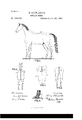
- Figure l is a side elevation of a display-model constructed in accordance with my invention, shown as firmly secured to a platform for minivenience of translnntation.
- Fig. 2 is a front and Fig. 3 a rear view of the same with the platform omitted.
- Fig. -t is a bottom plan view of the model, showing the means of securing the two sections together, and also thcmode of securing the sheath to the same.
- Fig. is a detail view illustrating the manner of securing the legs to the platform and an interposed shoe between the foot and platform.
- A designates the ("'(unplctc model mounted upon a platform, l).
- the model is composed of two sections, t", and the sheath 1), secured to the parts when assembled by belts or rivets E, as shown in Fig. -t-.
- Each section conuiriscs the entire side of the model, the legs, neck, and head being formed integral therewith, these sections being united by bringing the edges of the two scctionsin alignment and sccnrin g the same bynails F, driven into a strip of wood, (shown in dotted linesin Fig. 1,) which extends around the inner contour of the body portion.
- the sections l employ either a form of the desired shape, over which the body portion is shaped, or a mold or die having the desired shape, the wood pulp, paper fiber, or analogous substance being prepared and rendered of the desired plastic consistency. If a form is used over which the material is spread, there are employed molds or dies in conjunction therewith, which, when closed, have an interior contour of the size and form of the legsthat is, the fore and hind leg of one sideand into which the plastic material is forced in a sufficient quantity to completely encircle the mold and be compressed outwardly against the inner sides of the mold, thereby forming a central, opening throughout the length of the leg, into which is forced a core, as shown in dotted lines in liigs, .l, 2, and fhof plast er-of-paris, cement, or an analogous substance adapted to solidify and secure in place certain fastening devices, to be presently explained. If the entire side is formed by molds or dies the portion into which the side, neck
- each leg and within the core is placed a throi'lgh the platform B from the under side and the threaded end thereof screwed into the lower horizontal portioirot the turn-buckle.
- K designates a shoe having a slightly-upturned flange, K, which encircles the foot when the same is placed therein, and serves to protect the same from the action of dampness or from fracture, the shoe being held in place by being clamped between the foot/and platform.
- the inner ⁇ YOOllPll strip is secured to one side by means of nails or tacks F, with one-half of the width of the strip protruding outwardly from said section.
- the opposite section is now placed against the side first prepared, with the protruding portion of strip of wood teleswping therein, and the section is secured in place by the nails or tacks F.
- a display-model formed of two hollow side sections conforming to the contour of an animal, the legs being formed integral therewith, and aninteriorholding-strip also formed to correspond to the interior contour of the body of the model, said sections being united by nails driven through the adjoining edges into the holding-strips, substantially as described.
- a display-model comprising two hollow side sections formed of plastic material, and having legs formed with a central core, the sections being united at their adjoining edges to a central holding-strip, said model being secured to a plat-form by rods and turn-buckles embedded within the central core of the legseetions, and a bolt passed through the platform, substantially as described.
Landscapes
- Engineering & Computer Science (AREA)
- Mechanical Engineering (AREA)
- Footwear And Its Accessory, Manufacturing Method And Apparatuses (AREA)
Description
(No Model.)
H. SOHWEIBOLD.
DISPLAY MODEL.
No. 398,658. Patented Feb. 26, 1889.
FIG-1.
N. PETERS. PhmmLlthogmpher, Wiihmgh'nu DC UNITED STATES PATENT OFFICE.
HENRY StF-IllVElBillfl'), ()l TOLEDO, OHIO.
DISPLAY-MODEL.
SPECIFICATION forming part of Letters Patent No. 398,658, dated February .26, 1889.
Application filed October 2, 1888. Serial No. 286,906. (No model.)
To aZZ whom it may concern..-
lie it known that I, HENRY SciIwEIEoLn, a
citizen of 1 he Un ited States, residing atToled o, l
beinghad to the accompanying drawings, and t to the letters of reference marked thereon,
which form part of this specification.
My invention relates to the construct ion of displaymodcls of the characteremployed in displaying harness, robc's, and other kinds of merchandise, and has for its object to simplify the construct ion and chcapcn the manufacture by constructing the mod cl of few parts, and also to manufacture the model of a ma terial that shall render the same light and strong.
In the branch of the art to which my invention belongs it. has been usual to form the model of several parts, some of metal, strongly bolted together, upon which the frame orbody part is secured. This construction not only increases the parts and forms openings at the point of juncture, but renders the fitting of the same expensive and necessitates the employment of metal parts that increase the weight of the model to that extent that it is expensive of transportation and inconvenient to move.
In the construction of my improved form of display-model I overcome these objections by forming the parts that compose the legs, body, and head of but two sections, each side coi'lsisting of a lOllglllijHlllltIl vertical section molded or formed of a plastic matcrial-as, for inst ance, of wood pulp, paper fil 01, or analogous sulist'ance-thc two parts being joined and held [irmly assembled by means of a stay-piece within the frame or body portion, to which the edges are secured by nails or tacks, the only piece supplemental to the body as thus secured being the sheath, which is secured thereto by two bolts or rivets.
1n the drawings, Figure l is a side elevation of a display-model constructed in accordance with my invention, shown as firmly secured to a platform for minivenience of translnntation. Fig. 2 is a front and Fig. 3 a rear view of the same with the platform omitted. Fig. -tis a bottom plan view of the model, showing the means of securing the two sections together, and also thcmode of securing the sheath to the same. Fig. is a detail view illustrating the manner of securing the legs to the platform and an interposed shoe between the foot and platform.
A designates the ("'(unplctc model mounted upon a platform, l). The model is composed of two sections, t", and the sheath 1), secured to the parts when assembled by belts or rivets E, as shown in Fig. -t-. Each section conuiriscs the entire side of the model, the legs, neck, and head being formed integral therewith, these sections being united by bringing the edges of the two scctionsin alignment and sccnrin g the same bynails F, driven into a strip of wood, (shown in dotted linesin Fig. 1,) which extends around the inner contour of the body portion.
In forming the sections l employ either a form of the desired shape, over which the body portion is shaped, or a mold or die having the desired shape, the wood pulp, paper fiber, or analogous substance being prepared and rendered of the desired plastic consistency. If a form is used over which the material is spread, there are employed molds or dies in conjunction therewith, which, when closed, have an interior contour of the size and form of the legsthat is, the fore and hind leg of one sideand into which the plastic material is forced in a sufficient quantity to completely encircle the mold and be compressed outwardly against the inner sides of the mold, thereby forming a central, opening throughout the length of the leg, into which is forced a core, as shown in dotted lines in liigs, .l, 2, and fhof plast er-of-paris, cement, or an analogous substance adapted to solidify and secure in place certain fastening devices, to be presently explained. If the entire side is formed by molds or dies the portion into which the side, neck, and head section is formed is connected with the molds for the legs in the same manner as has been heretofore explained and so that the side will be formed with all the parts integral.
In each leg and within the core is placed a throi'lgh the platform B from the under side and the threaded end thereof screwed into the lower horizontal portioirot the turn-buckle.
K designates a shoe having a slightly-upturned flange, K, which encircles the foot when the same is placed therein, and serves to protect the same from the action of dampness or from fracture, the shoe being held in place by being clamped between the foot/and platform.
In assembling the parts to form a complete model the inner \YOOllPll strip is secured to one side by means of nails or tacks F, with one-half of the width of the strip protruding outwardly from said section. The opposite section is now placed against the side first prepared, with the protruding portion of strip of wood teleswping therein, and the section is secured in place by the nails or tacks F. The adjunetire parts-as the ears, mane, tail, and sheathare now secured in proper position, and the model linishcd in any desired color and ornameiitation, after which thelegs are secured to the platli'in'm by .tirst inserting the "feet into the shoes and then drawing the legs firmlyto the platform by means of bolts l.
From the above description it will be seen that there are no seams at the joinder of the legs and body or of the neck and the same, and that there are no sectional pieces required, with the expense of fitting necessary to prepare them for a proper fit.
hat I claim is 1. A display-model formed of two hollow side sections conforming to the contour of an animal, the legs being formed integral therewith, and aninteriorholding-strip also formed to correspond to the interior contour of the body of the model, said sections being united by nails driven through the adjoining edges into the holding-strips, substantially as described. I
2. A display-model comprising two hollow side sections formed of plastic material, and having legs formed with a central core, the sections being united at their adjoining edges to a central holding-strip, said model being secured to a plat-form by rods and turn-buckles embedded within the central core of the legseetions, and a bolt passed through the platform, substantially as described.
In testimony that I claim the foregoing as my own I hereby altix my signature in presence of two witnesses.
HENRY StlIIWEIBOLD.
Witnesses:
\VILLI.&1\1 \VE13S1ER, DAVID E. \VATsoN.
Publications (1)
| Publication Number | Publication Date |
|---|---|
| US398658A true US398658A (en) | 1889-02-26 |
Family
ID=2467621
Family Applications (1)
| Application Number | Title | Priority Date | Filing Date |
|---|---|---|---|
| US398658D Expired - Lifetime US398658A (en) | Display-model |
Country Status (1)
| Country | Link |
|---|---|
| US (1) | US398658A (en) |
-
0
- US US398658D patent/US398658A/en not_active Expired - Lifetime
Similar Documents
| Publication | Publication Date | Title |
|---|---|---|
| US398658A (en) | Display-model | |
| US225683A (en) | Alfred beady | |
| US120171A (en) | Improvement in burial-caskets | |
| US768977A (en) | Coasting device. | |
| US1075291A (en) | Bed. | |
| US192672A (en) | Improvement in animal-stocks | |
| US275655A (en) | George j | |
| US156768A (en) | Improvement in billiard-tables | |
| US1293233A (en) | Sectional plastic step. | |
| US1321135A (en) | Doll construction | |
| US556778A (en) | Device for securing horses while shoeing | |
| KR101843803B1 (en) | Healthy mat emitted infrared ray and aroma, method for manufacturing the same | |
| US458598A (en) | Display-horse | |
| DE1923818A1 (en) | Plastic outer layers for ski-boot uppers | |
| US158451A (en) | Improvement in barbed stock-fences | |
| US327070A (en) | Feed-rack | |
| US264758A (en) | richardson | |
| US332248A (en) | Doll-body with corsets | |
| US27278A (en) | Nathan s | |
| US390379A (en) | Image | |
| US1270346A (en) | Papier-maché toy animal and the like and method of making same. | |
| US55555A (en) | Improvement in air-tight burial-cases | |
| US260158A (en) | Stirrup | |
| US32513A (en) | dunn and j | |
| US39133A (en) | Improved riding-stirrup and hood |