US3828398A - Method and apparatus for shucking bivalves - Google Patents
Method and apparatus for shucking bivalves Download PDFInfo
- Publication number
- US3828398A US3828398A US00140686A US14068671A US3828398A US 3828398 A US3828398 A US 3828398A US 00140686 A US00140686 A US 00140686A US 14068671 A US14068671 A US 14068671A US 3828398 A US3828398 A US 3828398A
- Authority
- US
- United States
- Prior art keywords
- bivalve
- shells
- engaging
- hole
- gripping
- Prior art date
- Legal status (The legal status is an assumption and is not a legal conclusion. Google has not performed a legal analysis and makes no representation as to the accuracy of the status listed.)
- Expired - Lifetime
Links
- 238000000034 method Methods 0.000 title claims description 22
- 210000003205 muscle Anatomy 0.000 claims abstract description 60
- 235000013372 meat Nutrition 0.000 claims abstract description 51
- 239000007788 liquid Substances 0.000 claims abstract description 6
- 241000237502 Ostreidae Species 0.000 claims description 69
- 235000020636 oyster Nutrition 0.000 claims description 69
- 230000007246 mechanism Effects 0.000 claims description 29
- 238000005520 cutting process Methods 0.000 claims description 19
- 230000007480 spreading Effects 0.000 claims description 12
- 230000006378 damage Effects 0.000 claims description 8
- 230000009471 action Effects 0.000 claims description 6
- 238000000926 separation method Methods 0.000 claims description 6
- 239000012530 fluid Substances 0.000 claims description 5
- 208000027418 Wounds and injury Diseases 0.000 claims description 3
- 208000014674 injury Diseases 0.000 claims description 3
- 238000003780 insertion Methods 0.000 claims 3
- 230000037431 insertion Effects 0.000 claims 3
- 239000012858 resilient material Substances 0.000 claims 2
- 239000008400 supply water Substances 0.000 claims 1
- 241000239290 Araneae Species 0.000 abstract description 6
- XLYOFNOQVPJJNP-UHFFFAOYSA-N water Substances O XLYOFNOQVPJJNP-UHFFFAOYSA-N 0.000 description 6
- 210000002784 stomach Anatomy 0.000 description 5
- 241000237983 Trochidae Species 0.000 description 4
- 239000000463 material Substances 0.000 description 3
- 238000010586 diagram Methods 0.000 description 2
- 230000000694 effects Effects 0.000 description 2
- 230000006872 improvement Effects 0.000 description 2
- 239000002184 metal Substances 0.000 description 2
- 230000025712 muscle attachment Effects 0.000 description 2
- 239000007921 spray Substances 0.000 description 2
- 210000001015 abdomen Anatomy 0.000 description 1
- 230000000740 bleeding effect Effects 0.000 description 1
- UQMRAFJOBWOFNS-UHFFFAOYSA-N butyl 2-(2,4-dichlorophenoxy)acetate Chemical compound CCCCOC(=O)COC1=CC=C(Cl)C=C1Cl UQMRAFJOBWOFNS-UHFFFAOYSA-N 0.000 description 1
- 238000010276 construction Methods 0.000 description 1
- 230000001066 destructive effect Effects 0.000 description 1
- 229920002457 flexible plastic Polymers 0.000 description 1
- 238000005188 flotation Methods 0.000 description 1
- 235000000396 iron Nutrition 0.000 description 1
- 235000015927 pasta Nutrition 0.000 description 1
- 230000008569 process Effects 0.000 description 1
- 230000035939 shock Effects 0.000 description 1
- 239000007787 solid Substances 0.000 description 1
- 238000005406 washing Methods 0.000 description 1
Images




Classifications
-
- A—HUMAN NECESSITIES
- A22—BUTCHERING; MEAT TREATMENT; PROCESSING POULTRY OR FISH
- A22C—PROCESSING MEAT, POULTRY, OR FISH
- A22C29/00—Processing shellfish or bivalves, e.g. oysters, lobsters; Devices therefor, e.g. claw locks, claw crushers, grading devices; Processing lines
- A22C29/04—Processing bivalves, e.g. oysters
- A22C29/046—Opening or shucking bivalves
Definitions
- a bivalve shucking machine includes a spider rotatable about a vertical axis, on the arms of which are mounted bivalve holders the jaws of which are differentially operated to grip successive bivalves fed thereto, from which a substantial part of the liquid between the shells has been removed, and in the same orientation in which the hinge end is upward and the center of the adductor muscles are at the same distance from the axis of rotation of the spider.
- the spider is rotated to bring the bivalve beneath one or more vibrators, the vibrators then being lowered to bring them into engagement with the bivalves, and the vibrators then operate to vibrate the shells to cause the meat to fall into the lower parts.
- the bivalves are then raised at another station of the holders between two gripping members mounted on a rotating table and gripped between the gripping members, whereupon the holder is released and moved downward.
- the bivalves are then moved past a rotating saw blade which cuts off enough of the tops to remove the hinge and leave a hole.
- the upper edges of the shell adjacent the hole are arranged from the inside and the outside, the gripping force is reduced while the upper edges are puller apart and then gripped more securely. Knives are passed from above downward through the enlarged hole between the shell engaging members to sever the adductor muscles and, passing completely through the bivalve, to spread apart the lower end of the shells to allow the meat to drop out between the bottom ends of the shells.
- the engaging members are released, and the shells are carried to another station and dropped.
- the Prior Art The patent ot Torsch, U.S. Pat. No. 848,784, shows an apparatus for shucking oysters in which the top part of an oyster is removed by passing the oyster under successive grinding wheels, while held in clamps turning about a horizontal axis, whereafter the ground-off ends of the oyster are spread apart, and knives are inserted into the spread apart ends to sever the adductor muscles. Thereafter, the oyster is inverted to discharge the meat between the knives.
- Prior U.S. Pat. No. 2,832,989 describes a process in which, in order to promote easier opening, a bivalve is subjected to a shocking treatment in order to facilitate the release of the oyster from the shells.
- U.S. Pat. No. 3,605,180 issued Sept. 30, l97l, discloses an apparatus which improves on the Torsch device in several respects, in that the oyster is maintained in an upright position throughout its travel, and the muscle severing members move down through the oysters at the adductor muscle cutting station to open the lower ends of the shells and allow the severed meat of the oyster to drop out between such spread lower ends.
- the present invention presents a number of improve ments over the apparatus and method described in the U.S. Pat. No. 3,605,180.
- a water spray to clean the oysters passing through the drum is furnished by a perforated pipe extending through the drum slightly off center.
- the earlier application describes the shocking of the oyster by tumbling it in a drum in order to remove a part of the liquid from between the shells, in order to permit the meat of the bivalve to fall down within the shells, when they are held in upright position, in such a way as to allow the top parts of the shells to be cut off without damage to the meat.
- the shucking blades at the shucking station will descend vertically through the oyster so that the center of the knives will cover accurately the centers of the ends of the adductor muscles of an oyster at their points of attachment to the interior surfaces of its two shells.
- the bivalves so gripped are to be carried pasta de vice for cutting off the tops and then fed to a shucking device which includes knives which are moved into the shell to sever the adductor muscles, the path of movement being such as to maintain the adductor muscles in the same relation transversely of the path of movement.
- the knives occupy a fixed position with respect to this path, so that when they pass into the shells the adductor muscles are always within the path of movement of the knives.
- the holder now returns to an upright position and moves directly under the open space between the two clamps attached to one of four carriages which are carried by a rotating table.
- These clamps contain pins slidable out of their opposed faces, which at this time have been retracted.
- the bivalve gripped by the jaws is raised vertically from its lower position into the open space between the clamps.
- the top end or hinge of the bivalve comes into contact with a stationary plate which stops its upward progress as well as that of the entire holder unit, thus determining the vertical height at which the saw blade will later sever the hinged end of the oyster.
- Centering bars are then lowered from both sides against the top portions of the oyster shells, thereby centering the oyster in position between the clamp.
- Pins actuated by air pressure are ejected from the clamps against both sides of an oyster, gripping it immovably.
- the jaws of the holder are then retracted and the feeder holder assembly is returned to its original lowered position.
- a further feature of the invention is the provision at the point of transfer from one carrier member to the other of the centering means described above for centering the bivalve properly between the gripping jaws before the pins of the clamps are pushed out to engage the shells.
- Another feature of the invention lies in the gripping means which hold the oyster during the removal of the top and the opening and shucking operations, and which are carried by the table and to which bivalves are transferred from the holder.
- the bivalves must be held quite firmly during the shell cutting operation, since the shell is quite hard and the resistance offered to the saw blade is substantial.
- the resistance to movement of the shells apart from each other must of course be substantially reduced.
- gripping clamps having a plurality of pins slidable out of their faces into engagement with the shells of the bivalve.
- a majority of these pins are operated by substantial pneumatic pressure, so that they engage against the outside of the shell with a substantial force, thus holding the bivalve firmly during the cutting off of the top.
- larger pins are provided which are only pushed forward by spring action against the outside of the shell (the other pins being retracted at this time), these pins being capable of being withdrawn by pneumatic pressure overcoming the force of the springs.
- the machine further includes, opposite the saw blade, a back-up member which is moved against the top portions of the shells and held against them by pneumatic pressure during the cutting operation.
- This back-up member has an important part in preventing the pressure of the saw blade from tilting the shells which can result in sticking or breaking of the saw blade or damage to the shells such as would prevent their prompt opening at the shucking station.
- this feature of the machine is an invention of Sterling G. Harris and Ben P. Zober, and is being made the subject of a separate application.
- a further feature of the invention is the provision at the shucking station of anti-spreaders cooperating with the spreaders shown in the prior U.S. Pat. No. 3,605,180.
- These anti-spreaders are brought into engagement with the outer sides of the tops of the shells, while the insides are engaged by the spreaders of the type shown in the prior application.
- these anti-spreaders along with the spreaders grip the top edges of the shells between them in such a way as to permit by swivelling action the outward tilting of the btoom edges of the shells when the shucking knives move through, sever the adductor muscles and then spread apart the bottom ends of the shells to permit the discharge of the meat therethrough.
- the prior application describes a construction for preventing the spreading apart of the bottom ends of the knives until they have moved into the shells.
- the present application provides an improved mechanism for accomplishing this result.
- an oyster upon arriving at the shucking station exposes the edges of the collar formed by the upper edges of the shells after the hinged end is cut off. None is in contact with the oyster except the smaller pins, the larger pins being retracted.
- a tracking guide for the front ends of the shucking knives In back of the tracking guide is another tracking guide for the back ends of the shucking knives.
- Above and on both sides of the oyster collar are other component parts of the shucking assembly which are the interior arms and exterior arms comprising a unit of shucking clamps.
- the exterior arms which are connected to and operate in conjunction with interior arms mounted on housings each containing three spring-loaded-swivel-headed grips.
- the entire shucking assembly is lowered until tracking guides reach a position at the top of the collar and the exterior arms have brought the swivel-headed grips in contact with the outer surfaces of the collar.
- the interior arms of the shucking clamps have two feet entering the cavity of the oyster. Their action will be to press outward on the interior of the collar while the swivel heads of the outer grips press inward against the outside surface of the oyster collar. If the opening between the shells is small, the pressure of the two feet can force the shell apart for a limited distance against the pressure of the grips, but at a measured distance the two pressures become equalized. At that point the pressures of both sets of the shucking clamps create a firm grip on the collar of the oyster to the extent that, when the shucking knives descend, it provides sufficient support for both shells even when all the smaller pins are retracted to prevent the oyster slipping down.
- the two shucking knives now descend with their front ends and their back ends held together by the tracking guides.
- the two tracking guides will hold the ends of the shucking knives together until they descend in the open oyster beyond its collar. If they fully expand above the collar, they could collide with it. This could happen especially with small oysters that have small circular curves in the collar and is one reason to provide the interior arms for widening the opening at the top.
- the shucking knives then complete their descent through the oyster, severing the ends of the adductor muscles of the meat and freeing it to be shucked out by the knives. At this point, the major pins are retracted to avoid having the top edges of the knives collide with the edges of the shells as they go up.
- the V position of the shells disappears as the knives proceed downward and cut the meat free, expanding as they do until they reach full expansion, when the two shells assume vertical positions, and thereafter the shells assume again the adjacent positions they earlier held. It is important in complete mechanical shucking by the present machine that the oyster be made to assume the above positions and they must all be performed in about two seconds or less, which is faster than the eye can follow.
- shucking clamps composed of the interior arms and exterior arms in creating both a gripping and swivelling action on both sides of the oyster collar, which permits the shells below the collar to move back and forth laterally while in the grip of these shucking clamps, preventing the shells from slipping vertically or the collar from breaking as could happen with weak shells.
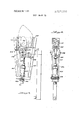
- FIG. 1 shows in top plan view the arrangement of a machine embodying the invention, certain of the operating parts of which are shown in detail in other figures being only indicated by legends for the sake of simplicy;
- FIG. 2 shows, principally in side elevation, again with certain parts shown only diagrammatically, a bivalve shucking machine embodying the invention
- FIG. 3 shows in side elevation
- FIG. 4 shows in partial section, a shocking drum embodying the invention
- FIG. 5 shows in side elevation
- FIG. 6 shows in a view at right angles to FIG. 5, a proportional holding mechanism
- FIG. 7 is a diagram related to FIGS. 5 and 6;
- FIGS. 8 and 9 show, in top plan view and in transverse section respectively, the claims for holding the bivalve during cutting and shucking;
- FIG. 10 is a front view of one of these clamps.
- FIG 11 shows in front view and FIG. 12 in side view the centering mechanism
- FIG. 12A is a detail of a part of FIG. 12;
- FIG. 13 is a top plan view of the cutting mechanism
- FIG. 14 is a side elevation of the back-up member for the cutting mechanism
- FIG. 15 shows in front elevation the shucking mechamsm
- FIG. 16 shows this mechanism in side view
- FIG. 17 is a cross-section substantially on the line 1717 of FIG. 16;
- FIG. 17A is a vertical cross-section through the moving means for the knife carrier
- FIGS. 18A, 18B and 18C show the knife mounting arrangement;
- FIG. 18A being a section on the line AA of FIG. 15, and
- FIGS. 18B and 18C being crosssections at right angles to FIG. 18A and showing the knives in two different positions;
- FIG. 19 is a cross-section on the line 1919 of FIG. 18A;
- FIGS. 20A, 20B, 20C, 20D, 20E, 20F and 200 show the shucking mechanism in various successive positions during its operation
- FIG. 21 shows in cross-section the outside gripping device
- FIG. 22 is a horizontal cross-section through the receiving block of FIG. 21 and FIG. 23 is an end view thereof;
- FIG. 24 is an end view of one of the clamping members of FIG. 21;
- FIG. 25 shows in plan view and FIG. 26 is a side elevation thereof, and FIG. 27 is a cross-section on the line 27-27 of FIG. 26;
- FIGS. 28 and 29 are diagrams showing the pneumatic system.
- bivalves are I fed by hand edge-wise at the position A between a pair of holding jaws l0, 12, the bivalve such as an oyster being shown at 14.
- the bivalve still gripped in the jaws is them moved successively to the three vibration positions at each of which it is vibrated for about two seconds. It then goes to the transfer position C where the bivalve is raised up between a pair of gripping devices 16 mounted on the table 6.
- the gripping devices are actuated to engage the sides of the shells of the bivalve, and the jaws 10, 12 are separated and retracted downward.
- the bivalve is then moved by step-by-step rotation of the table 6 to the saw blade position B where the top is cutoff. It is then moved to the shucking position C where the tops of the shells are spread apart, and knives are then introduced from the top of the shells which sever the adductor muscles and thereafter spread apart the lower ends of the shells so that the meat drops out through the spread-apart open lower ends of the shells.
- the empty shells are then carried to the position D where they are released and dropped.
- SHOCKING MECHANISM drum wall is formed of a plurality of slats 28 which slope in such a way as to leave spaces between them and in such a way as to engage and tumble the bivalve about as the drum rotates.
- Such a device is previously known.
- FIG. 7 there is shown in solid, in broken and in dot and dash lines, and designated as 30, 32 and 34 respectively, three oyster shells of differing width. lthas been found that the centers of the adductor muscles 36 in all the shells will be at substantially proportional distances from the two edges of the shell, that is, the ratios a/a, 17/12 and /0 are substantially the same. This holds good whatever may be the vertical dimension of the oyster, as long as the oysters are positioned in the same orientation, that is, with the bottom shell (which is normally much more rounded) in the same relation with regard to the top shell which is less rounded. For example, as is shown by the oyster at the first position B in FIG. 1, the top shell 38 is above and the bottom shell 40 is below, that is to the right and left respectively of the operator who inserts the bivalve. It is quite important that the bivalves be inserted with this relationship being preserved.
- This device is mounted on lugs 42 extending radially outwardly from vertical members 43 mounted for vertical sliding movement in the carrier 2, only one of these lugs being shown in FIG. I for the sake of clarity.
- the lug has pivoted to it at 44 bars 46, to the lower ends of which are pivoted at 48 arms 50 and 52. These arms have at their tops the holding members and 12 which have roughened or ribbed surfaces of frictional material so as to grip the oyster.
- the arms are moved towards and from each other by the rotation of a disc 56 mounted on a shaft 58 tumable in the bar 46 by a piston rod 60 slidable in pneumatic cylinder 62 and pivoted in 64 to the disc 68.
- the arms 50 and 52 are connected to disc 56 by links 66, 66' pivoted to the disc at 68, 68' respectively.
- Link 66 is longer than link 66, is pivoted to arm 52 at a point closer to the pivot 48 than the pivot point of link 66 to arm 50, and pivot 68 is further from the axis 58 than pivot 68'.
- the arms are moved through proportionally different distances towards each other.
- the proportioning is such that, as shown in FIG. 5, the bivalves will be gripped in such a way that the adductor muscles, indicated in broken lines at 36 in FIG. 5 will always be in substantially the same location radially with respect to the carrier 2, or at the same distance from its axis of rotation.
- VIBRATING MECHANISM Mounted adjacent a part of the periphery of the path of the members mounted on the carrier 2, and eccentric with respect thereto, is a cam track 70.
- the lower end of each of bars 46 carries a wheel 72 which engages on the outside of this cam track.
- a vibrator 79 having a head 76 is advanced by a pneumatic cylinder 78 until the head engages the upper end of the bivalve held in the members 10, 12.
- Vibrator 79 may be then energized (or it may be continuously energized) and imparts vibration to the shells and to the meat therebetween. This vibration settles the meat between the shells and insures that it occupies the space left free by the removal of the liquid between the shells.
- Such a vibrator maybe one of the types described in Bulletin No. 30, Branform Vibrator Company.
- TRANSFER MECHANISM The carrier 2 now turns to the transfer position C the member 46 returning to a vertical position.
- the sliding members 43 now come into position over pushing member 80 capable of being moved upwardly by a pneumatic cylinder 82. Assuming that a bivalve is held between the holding members 10 and 12, this raises the bivalve into a position between the shell gripping members or clamps 16.
- Each shell gripping member 16 is composed of a boxlike member (FIGS. 8 to 10) from the opposite faces of which extend smaller diameter pins 84 and larger diameter pins 86 slidably mounted in the members 16, the pins 86 being two in number and being located approximately half way up the face of the gripping member.
- the smaller pins 84 are actuated by pistons 88 in pneumatic cylinders, to which air pressures can be admitted from both sides.
- the larger pins 86 can be pressed outwardly by coil springs 90 and can be retracted by a piston connected to piston rod 92 and slidable in cylinder 94 to which likewise air pressure can be admitted in such a direction as to cause withdrawal of the pins 86.
- the pressure exerted by the pins 84 can be as great as desired, depending upon the pressure of the air admitted behind the pistons 88.
- cylinder 82 When the bivalve held by holders 10 and 12 reaches the transfer station, cylinder 82 is energized and raises the holders between the clamps or gripping members 16.
- CENTERING MECHANISM It is important that the top part of the oyster be properly positioned at substantially equal distances from the opposed faces of the shell gripping members 16, in order that it may be held firmly for the action of the saw blade to be described below.
- FIGS. 11 and 12 there is provided (FIGS. 11 and 12) at the transfer position in the path of upward movement of a bivalve held by the holding members 10,12 a stop member 96 in the path of a bivalve moving upwardly between the gripping members 16.
- a stop member 96 in the path of a bivalve moving upwardly between the gripping members 16.
- the frame member 98 on which the stop 96 is located is provided with arms 100 pivoted at 101 and swingable towards each other by slotted levers 102 secured to the arms 100 and operated by a piston rod 103 of a piston slidable in the pneumatic cylinder 104.
- arms 100 are connected by cross bars 105. These bars have projecting pins 107 for engaging the shells, the central pin being shorter than the outer pins. As will be clear from the broken line position shown in FIG. 11, when the piston rod 103 is raised the bars 105 are moved towards each other and engage on opposite sides of a bivalve held in the holders 54, thus centering the bivalve with respect to the gripping members 16.
- a fixed frame 114 On the outside of the path of the bivalve held in the gripping members 16 is a fixed frame 114, secured on the machine frame, with a downwardly extending lug 115 in which is slidably mounted a back-up plate 116.
- This back-up plate is normally retracted to the positions shown in solid lines by a spring 117, but can be extendeed by a piston rod 118 connected to a piston slidable in a pneumatic cylinder 199.
- the path of travel of the bar 116 extends to the broken line position shown in FIG. 14 so as to engage the top portion of the shells of the bivalve at a point slightly above the plane of travel ofthe saw blade 107.
- the saw blade is advanced by the cylinder 113 and cuts off the top of the bivalve, while the bivalve is firmly gripped by the pins extending from the gripper member 16.
- SHUCKING MECHANISM two tracks 121 formed by angle irons and guiding the cross-piece 122 of a T 123.
- This T is welded to the back of a cylindrical support member 124 to which is connected a piston 125 actuated by a cylinder 126.
- a block 127 is carried by the sleeve 124.
- lugs 128 At the lower end of sleeve 124 are lugs 128 between which are pivoted separating members formed of legs 129 carrying rollers 130 and other legs 131 the bottom ends of which are provided with feet 132.
- the spreader lever is pivoted on a pin 133 mounted in the lugs 128, and also pivoted on this pin on the outside of lugs 128 are arms 134 which carry the anti-Spreaders 135.
- arms 136 Integral with arms 134 are arms 136 which are connected to the piston rod 137 of a pneumatic cylinder 138 pivoted at 139 on an extension 140 of the block 127.
- the wall 120 also carries projecting bars 144 having grooves 146 facing each other in which is slidable a plate cam 148.
- the plate cam has surfaces 150, 152 respectively engageable with the rollers 130 on the arms 120. It will be noted that the slope of the cam surface is less than that of the cam surface 152, the purpose of this being to spread the right hand spreader which engages in the top shell of the oyster further than the left hand spreader which is engaged in the bottom shell, taking into account the fact that the top shell is considerably deeper than the bottom shell.
- the anti-spreaders are shown in detail in FIGS. 21 to 24.
- the box-like member 154 has three openings 156 therein, these openings'being somewhat divergent away from the front end. There is also a notch 158 in the top wall, to prevent possible interference with the feet 129.
- a pin 160 In each of the openings 156 is a pin 160 into which engages a bolt 162 with a washer 163 to limit outward movement of the pins (to the left in FIG. 21).
- a universally mounted head 164 At the free end of the pin is a universally mounted head 164, which is engaged by a spring 166 to push it outward.
- the face 168 of the head is cross-grooves as shown in FIG. 24 in order to increase the gripping effect.
- Upward movement of the sleeve 124 is produced by a coil spring 170 connected to a pin 172 on the block 127 and to a pin 174 mounted on the frame, as well as by a similar spring 176 connected to a projection 178 from the T-shaped member 123 extending through a slot 180 in the wall 120.
- Upward movement of the plate cam 148 is produced by a coil spring 180 connected near the top of the plate spring and also connected to the frame at 182.
- Downward motion of the sleeve 124 is produced by a cam 184 mounted on a shaft 186 passing through wall 144. This cam cooperates with a roller 188 mounted on a bar 190 secured on one side of the leg of the T 123.
- the plate cam 148 has in its upper edge a notch 198 so that its movement does not interfere with that of the leg which supports the sleeve 124.
- a holder 199 connected to the piston rod of piston 200 which slides in a cylinder 201 in the sleeve 124, is an opening in which are secured the stems 204 of two adductor muscle cutting knives, these stems being held together at 202.
- the stems 203 have a narrower portion and thereafter shoulders 206 merging into a wider portion 208.
- the blades 210 which preferably are formed of rubber or a flexible plastic material.
- a sleeve 212 Slidable in the sleeve 124 is a sleeve 212, which at its upper end has an outwardly directed flange 214 to limit downward movement of the sleeve upon engagement with a flange 216 on the interior of the sleeve.
- the width of the wider portions 208 of the knives stems is substantially equal to the internal diameter of the sleeve 212.
- the result is, as shown in FIG. 188, that, as long as the knives are retracted into the sleeve 212 to the extent shown in FIG. 188, the stems are held close together, so that the knives cannot spread wide apart.
- FIGS. 20A to 20G show the various steps of the shucking operation.
- stage 1 as shown in FIG. 20A, the feet 132 are close together, the anti-Spreaders 135 are retracted, and the knives are withdrawn.
- the bivalve is gripped by the smaller pins 84, with the hole in the top directed upwardly.
- the knives are in their most retracted position, shown in FIGS. 18A and 188.
- the cams 184 and 192 now advance the sleeve 124 and the plate cam 148 by equal distances, the rollers remaining at the beginning of the slopes of the cam edges 150 and 152 (FIG. 20B), and the feet 132 enter the hole in the top of the shell.
- the cylinder 138 is energized to turn anti-Spreaders in such a direction that their heads 164 engage the outside of the top part of the shell.
- the cylinder 138 may be supplied with air under substantially different pressures. In this stage it is supplied with air under pressure of about 15 psi so that it exerts a relative light pressure on the outside of the top edge of the shell.
- the plate cam is moved downwardly to spread the legs 131 in such a direction as to move the feet 132 apart (FIG. 20D). Since these are engaged in the top edge of the shell, they spread apart the top edges and enlarge the hole for the entry of the knives. Pins 84 are withdraw and pins 86 advanced. As the feet are opening the hole, the knives are advanced from the position of FIG. 18A to that of FIG. 18C.
- the cylinder 201 is actuated to push down the piston 200, so that the knives along with the sleeve 212 move out of the sleeve 124.
- the sleeve 212 stops its downward movement the continued movement of the knives as shown in FIG. 18C results in their spreading apart into engagement with the inner walls of the shell. At the same time, the free ends of the knives move out of the guides 218.
- the preesure in cylinders 138 is substantially increased so as to grip the shells more firmly during the cutting of the adductor muscles.
- the knives are pushed downward as shown in FIG. 20F, spreading apart the bottom ends of the shells while they simultaneously sever the adductor muscles, so that the oyster meat is free to drop out through the open bottom edges of the shells.
- the knives move then to the position shown in FIG. 20G where the lower ends are completely below the shells assuring the ejection of the meat of the bivalve.
- the gripping device 16 now moves on to station D at which the pins 86 are retracted so as to drop the shells for disposal.
Landscapes
- Life Sciences & Earth Sciences (AREA)
- Engineering & Computer Science (AREA)
- Wood Science & Technology (AREA)
- Zoology (AREA)
- Food Science & Technology (AREA)
- Processing Of Meat And Fish (AREA)
Priority Applications (2)
| Application Number | Priority Date | Filing Date | Title |
|---|---|---|---|
| US00140686A US3828398A (en) | 1971-05-06 | 1971-05-06 | Method and apparatus for shucking bivalves |
| JP47044975A JPS5755379B1 (cg-RX-API-DMAC7.html) | 1971-05-06 | 1972-05-06 |
Applications Claiming Priority (1)
| Application Number | Priority Date | Filing Date | Title |
|---|---|---|---|
| US00140686A US3828398A (en) | 1971-05-06 | 1971-05-06 | Method and apparatus for shucking bivalves |
Publications (1)
| Publication Number | Publication Date |
|---|---|
| US3828398A true US3828398A (en) | 1974-08-13 |
Family
ID=22492373
Family Applications (1)
| Application Number | Title | Priority Date | Filing Date |
|---|---|---|---|
| US00140686A Expired - Lifetime US3828398A (en) | 1971-05-06 | 1971-05-06 | Method and apparatus for shucking bivalves |
Country Status (2)
| Country | Link |
|---|---|
| US (1) | US3828398A (cg-RX-API-DMAC7.html) |
| JP (1) | JPS5755379B1 (cg-RX-API-DMAC7.html) |
Cited By (24)
| Publication number | Priority date | Publication date | Assignee | Title |
|---|---|---|---|---|
| US3934311A (en) * | 1973-07-13 | 1976-01-27 | Thompson John W | Oyster breaker operated by electric motor having bearing seal device |
| US4444380A (en) * | 1981-08-13 | 1984-04-24 | The Babcock & Wilcox Company | Centering and grasping device |
| US5823864A (en) * | 1996-02-29 | 1998-10-20 | Kabushiki Kaisha Towa Denki Seisakusho | Shellfish transfer device |
| US6193596B1 (en) * | 1997-06-06 | 2001-02-27 | Sasakat Pty Ltd | Positioning bivalve shellfish for processing |
| EP1116442A4 (en) * | 1999-07-23 | 2005-02-16 | Mutsu Kaden Tokki Co Ltd | SHELL TREATMENT METHOD AND SHELL TREATMENT DEVICE USED THEREIN |
| US7582005B1 (en) | 2005-07-20 | 2009-09-01 | Chi-Minh Le | Portable automatic oyster opener |
| US20100170403A1 (en) * | 2003-01-29 | 2010-07-08 | Sfk Systems A/S | Method And An Apparatus For Thawing Frozen Meat |
| CN102217667A (zh) * | 2011-05-05 | 2011-10-19 | 杭州电子科技大学 | 双向切割开河蚌机 |
| CN103004942A (zh) * | 2012-12-30 | 2013-04-03 | 西南科技大学 | 贝类产品壳肉分离方法 |
| CN103210993A (zh) * | 2013-04-09 | 2013-07-24 | 杭州电子科技大学 | 转台式开河蚌机 |
| CN103300123A (zh) * | 2013-07-08 | 2013-09-18 | 河北农业大学 | 一种扇贝开壳取贝柱装置 |
| US8591296B2 (en) | 2009-10-28 | 2013-11-26 | Clearwater Seafoods Limited Partnership | Mollusc processing apparatus and related methods |
| CN103918767A (zh) * | 2014-04-11 | 2014-07-16 | 辽宁盛德集团牧业有限公司 | 一种鸭子拔舌机 |
| CN104082388A (zh) * | 2014-06-26 | 2014-10-08 | 昆山市富众网络科技有限公司 | 一种螃蟹盒 |
| CN104521827A (zh) * | 2014-12-17 | 2015-04-22 | 广东工业大学 | 一种自动开蚌取珠装置 |
| CN104742122A (zh) * | 2013-12-30 | 2015-07-01 | 河北农业大学 | 一种扇贝柔顺机械手末端执行装置 |
| CN105961567A (zh) * | 2016-07-15 | 2016-09-28 | 赵明岩 | 河蚌自动开壳取珠装置 |
| CN106063471A (zh) * | 2016-07-15 | 2016-11-02 | 赵明岩 | 全自动珍珠提取装置 |
| CN106069950A (zh) * | 2016-07-15 | 2016-11-09 | 赵明岩 | 全自动河蚌开壳取珠方法 |
| CN106063470B (zh) * | 2016-07-15 | 2018-09-04 | 中国计量大学 | 全自动河蚌开壳取珠装置 |
| CN108935616A (zh) * | 2018-09-27 | 2018-12-07 | 北海智联投资有限公司 | 一种挖指甲螺肉的便捷装置 |
| CN110663754A (zh) * | 2019-11-18 | 2020-01-10 | 浙江工商职业技术学院 | 一种活鲜扇贝取肉加工机 |
| CN111838284A (zh) * | 2020-04-27 | 2020-10-30 | 浙江省海洋开发研究院 | 一种贻贝脱壳取肉装置及方法 |
| US20220279804A1 (en) * | 2019-08-01 | 2022-09-08 | Clearwater Seafoods Limited Partnership | Apparatus and methods for mollusc processing |
Families Citing this family (1)
| Publication number | Priority date | Publication date | Assignee | Title |
|---|---|---|---|---|
| JP7606063B1 (ja) * | 2024-04-19 | 2024-12-25 | シンセメック株式会社 | 二枚貝開殻装置 |
Citations (8)
| Publication number | Priority date | Publication date | Assignee | Title |
|---|---|---|---|---|
| US848784A (en) * | 1905-01-23 | 1907-04-02 | Edward L Torsch | Machine for shucking oysters. |
| US1445672A (en) * | 1922-04-18 | 1923-02-20 | Egli Huldreich | Oyster-shucking machine |
| AU165454A (en) * | 1954-07-13 | 1955-01-13 | The British Thomson-Houston Company Limited | Improvements in and relating to machine tool positioning apparatus |
| US2882771A (en) * | 1956-06-22 | 1959-04-21 | Ronald R Blazek | Work-holding device having plungers actuated by hydraulic fluid composed of a fusible alloy |
| US3026658A (en) * | 1959-02-18 | 1962-03-27 | Packaging Frontiers Inc | Packaging machine |
| US3239877A (en) * | 1965-02-16 | 1966-03-15 | Laitram Corp | Process and machine for opening bivalves |
| US3473191A (en) * | 1967-05-31 | 1969-10-21 | Liley A Evans | Apparatus for shucking bivalves |
| US3605180A (en) * | 1968-09-30 | 1971-09-20 | Harris Automated Machinery Co | Apparatus and method for shucking oysters |
Family Cites Families (1)
| Publication number | Priority date | Publication date | Assignee | Title |
|---|---|---|---|---|
| JPS5147203B2 (cg-RX-API-DMAC7.html) * | 1972-05-12 | 1976-12-14 |
-
1971
- 1971-05-06 US US00140686A patent/US3828398A/en not_active Expired - Lifetime
-
1972
- 1972-05-06 JP JP47044975A patent/JPS5755379B1/ja active Pending
Patent Citations (8)
| Publication number | Priority date | Publication date | Assignee | Title |
|---|---|---|---|---|
| US848784A (en) * | 1905-01-23 | 1907-04-02 | Edward L Torsch | Machine for shucking oysters. |
| US1445672A (en) * | 1922-04-18 | 1923-02-20 | Egli Huldreich | Oyster-shucking machine |
| AU165454A (en) * | 1954-07-13 | 1955-01-13 | The British Thomson-Houston Company Limited | Improvements in and relating to machine tool positioning apparatus |
| US2882771A (en) * | 1956-06-22 | 1959-04-21 | Ronald R Blazek | Work-holding device having plungers actuated by hydraulic fluid composed of a fusible alloy |
| US3026658A (en) * | 1959-02-18 | 1962-03-27 | Packaging Frontiers Inc | Packaging machine |
| US3239877A (en) * | 1965-02-16 | 1966-03-15 | Laitram Corp | Process and machine for opening bivalves |
| US3473191A (en) * | 1967-05-31 | 1969-10-21 | Liley A Evans | Apparatus for shucking bivalves |
| US3605180A (en) * | 1968-09-30 | 1971-09-20 | Harris Automated Machinery Co | Apparatus and method for shucking oysters |
Cited By (32)
| Publication number | Priority date | Publication date | Assignee | Title |
|---|---|---|---|---|
| US3934311A (en) * | 1973-07-13 | 1976-01-27 | Thompson John W | Oyster breaker operated by electric motor having bearing seal device |
| US4444380A (en) * | 1981-08-13 | 1984-04-24 | The Babcock & Wilcox Company | Centering and grasping device |
| US5823864A (en) * | 1996-02-29 | 1998-10-20 | Kabushiki Kaisha Towa Denki Seisakusho | Shellfish transfer device |
| US6193596B1 (en) * | 1997-06-06 | 2001-02-27 | Sasakat Pty Ltd | Positioning bivalve shellfish for processing |
| EP1116442A4 (en) * | 1999-07-23 | 2005-02-16 | Mutsu Kaden Tokki Co Ltd | SHELL TREATMENT METHOD AND SHELL TREATMENT DEVICE USED THEREIN |
| US20100170403A1 (en) * | 2003-01-29 | 2010-07-08 | Sfk Systems A/S | Method And An Apparatus For Thawing Frozen Meat |
| US7582005B1 (en) | 2005-07-20 | 2009-09-01 | Chi-Minh Le | Portable automatic oyster opener |
| US8591296B2 (en) | 2009-10-28 | 2013-11-26 | Clearwater Seafoods Limited Partnership | Mollusc processing apparatus and related methods |
| CN102217667A (zh) * | 2011-05-05 | 2011-10-19 | 杭州电子科技大学 | 双向切割开河蚌机 |
| CN102217667B (zh) * | 2011-05-05 | 2013-01-30 | 杭州电子科技大学 | 双向切割开河蚌机 |
| CN103004942A (zh) * | 2012-12-30 | 2013-04-03 | 西南科技大学 | 贝类产品壳肉分离方法 |
| CN103210993A (zh) * | 2013-04-09 | 2013-07-24 | 杭州电子科技大学 | 转台式开河蚌机 |
| CN103300123A (zh) * | 2013-07-08 | 2013-09-18 | 河北农业大学 | 一种扇贝开壳取贝柱装置 |
| CN104742122A (zh) * | 2013-12-30 | 2015-07-01 | 河北农业大学 | 一种扇贝柔顺机械手末端执行装置 |
| CN104742122B (zh) * | 2013-12-30 | 2017-05-10 | 河北农业大学 | 一种扇贝柔顺机械手末端执行装置 |
| CN103918767A (zh) * | 2014-04-11 | 2014-07-16 | 辽宁盛德集团牧业有限公司 | 一种鸭子拔舌机 |
| CN103918767B (zh) * | 2014-04-11 | 2015-11-11 | 辽宁盛德集团牧业有限公司 | 一种鸭子拔舌机 |
| CN104082388A (zh) * | 2014-06-26 | 2014-10-08 | 昆山市富众网络科技有限公司 | 一种螃蟹盒 |
| CN104521827A (zh) * | 2014-12-17 | 2015-04-22 | 广东工业大学 | 一种自动开蚌取珠装置 |
| CN106063470B (zh) * | 2016-07-15 | 2018-09-04 | 中国计量大学 | 全自动河蚌开壳取珠装置 |
| CN106069950A (zh) * | 2016-07-15 | 2016-11-09 | 赵明岩 | 全自动河蚌开壳取珠方法 |
| CN106063471A (zh) * | 2016-07-15 | 2016-11-02 | 赵明岩 | 全自动珍珠提取装置 |
| CN105961567A (zh) * | 2016-07-15 | 2016-09-28 | 赵明岩 | 河蚌自动开壳取珠装置 |
| CN106063471B (zh) * | 2016-07-15 | 2018-10-23 | 中国计量大学 | 全自动珍珠提取装置 |
| CN106069950B (zh) * | 2016-07-15 | 2019-01-18 | 中国计量大学 | 全自动河蚌开壳取珠方法 |
| CN108935616A (zh) * | 2018-09-27 | 2018-12-07 | 北海智联投资有限公司 | 一种挖指甲螺肉的便捷装置 |
| US20220279804A1 (en) * | 2019-08-01 | 2022-09-08 | Clearwater Seafoods Limited Partnership | Apparatus and methods for mollusc processing |
| US11974582B2 (en) * | 2019-08-01 | 2024-05-07 | Clearwater Seafoods Limited Partnership | Apparatus and methods for mollusc processing |
| CN110663754A (zh) * | 2019-11-18 | 2020-01-10 | 浙江工商职业技术学院 | 一种活鲜扇贝取肉加工机 |
| CN110663754B (zh) * | 2019-11-18 | 2021-11-19 | 浙江工商职业技术学院 | 一种活鲜扇贝取肉加工机 |
| CN111838284A (zh) * | 2020-04-27 | 2020-10-30 | 浙江省海洋开发研究院 | 一种贻贝脱壳取肉装置及方法 |
| CN111838284B (zh) * | 2020-04-27 | 2021-11-19 | 浙江省海洋开发研究院 | 一种贻贝脱壳取肉装置及方法 |
Also Published As
| Publication number | Publication date |
|---|---|
| JPS5755379B1 (cg-RX-API-DMAC7.html) | 1982-11-24 |
Similar Documents
| Publication | Publication Date | Title |
|---|---|---|
| US3828398A (en) | Method and apparatus for shucking bivalves | |
| AU599519B2 (en) | Sheet stacking and transferring device | |
| CA1048717A (en) | Apparatus for cutting open a fowl | |
| US4019223A (en) | Apparatus for cutting poultry carcass | |
| JPS6131976B2 (cg-RX-API-DMAC7.html) | ||
| HU205845B (en) | Apparatus for processing poultry or similar giblets containing bone | |
| US5928073A (en) | Method and apparatus for removing the skin casing from a sausage | |
| US3390875A (en) | Coupon feeder | |
| US6080055A (en) | Method and apparatus for stripping casings from sausages | |
| US3886857A (en) | Apparatus for coring cauliflower heads | |
| US4359083A (en) | Apparatus for separating castings from moulds of sand or similar material | |
| NO150662B (no) | Apparat til maskinell fremstilling av like lange halestykker av fisker. | |
| NO854737L (no) | Stappeanordning og fremgangsmaate for samme. | |
| EP0258941A2 (en) | Method and apparatus for cleaning of round fish, including especially mechanical removal of gut from fish | |
| US5021024A (en) | Cutting up fowl | |
| JPS6261302B2 (cg-RX-API-DMAC7.html) | ||
| US4633547A (en) | Crab picking machine | |
| GB2124883A (en) | Apparatus for removing meat from poultry drumsticks | |
| US6251004B1 (en) | Automatic poultry cutting apparatus | |
| CA2094461A1 (en) | Method and apparatus for preparing a pig's head for mechanical boning | |
| EP2099307B1 (en) | Device for cutting out the vent of slaughtered poultry | |
| US3708828A (en) | Bone holding mechanism | |
| US3451451A (en) | Banana peeler | |
| US4998322A (en) | System for dewinging fowl | |
| GB1254255A (en) | Improvements in cashew-nut husking machines |