US20180098640A1 - Infant assistive device - Google Patents
Infant assistive device Download PDFInfo
- Publication number
- US20180098640A1 US20180098640A1 US15/726,645 US201715726645A US2018098640A1 US 20180098640 A1 US20180098640 A1 US 20180098640A1 US 201715726645 A US201715726645 A US 201715726645A US 2018098640 A1 US2018098640 A1 US 2018098640A1
- Authority
- US
- United States
- Prior art keywords
- assistive device
- trunk support
- crossbar
- infant
- support
- Prior art date
- Legal status (The legal status is an assumption and is not a legal conclusion. Google has not performed a legal analysis and makes no representation as to the accuracy of the status listed.)
- Granted
Links
- 238000001816 cooling Methods 0.000 claims abstract description 6
- 238000010438 heat treatment Methods 0.000 claims abstract description 6
- 230000005484 gravity Effects 0.000 claims abstract description 4
- 230000001953 sensory effect Effects 0.000 claims description 18
- 210000003205 muscle Anatomy 0.000 abstract description 11
- 210000001364 upper extremity Anatomy 0.000 abstract description 3
- 230000004913 activation Effects 0.000 abstract description 2
- 210000002683 foot Anatomy 0.000 description 13
- 230000000638 stimulation Effects 0.000 description 6
- 210000002414 leg Anatomy 0.000 description 5
- 238000004873 anchoring Methods 0.000 description 2
- 239000006260 foam Substances 0.000 description 2
- 210000003127 knee Anatomy 0.000 description 2
- 210000003141 lower extremity Anatomy 0.000 description 2
- 210000004197 pelvis Anatomy 0.000 description 2
- 238000006563 Carroll rearrangement reaction Methods 0.000 description 1
- 208000029578 Muscle disease Diseases 0.000 description 1
- 230000003213 activating effect Effects 0.000 description 1
- 210000003423 ankle Anatomy 0.000 description 1
- 210000003557 bones of lower extremity Anatomy 0.000 description 1
- 210000000610 foot bone Anatomy 0.000 description 1
- 210000001624 hip Anatomy 0.000 description 1
- 239000000463 material Substances 0.000 description 1
- 238000005259 measurement Methods 0.000 description 1
- 230000007935 neutral effect Effects 0.000 description 1
- 230000002040 relaxant effect Effects 0.000 description 1
- 230000000284 resting effect Effects 0.000 description 1
- 230000001148 spastic effect Effects 0.000 description 1
- 210000002303 tibia Anatomy 0.000 description 1
- 210000000689 upper leg Anatomy 0.000 description 1
- 230000000007 visual effect Effects 0.000 description 1
- XLYOFNOQVPJJNP-UHFFFAOYSA-N water Substances O XLYOFNOQVPJJNP-UHFFFAOYSA-N 0.000 description 1
Images

Classifications
-
- A—HUMAN NECESSITIES
- A47—FURNITURE; DOMESTIC ARTICLES OR APPLIANCES; COFFEE MILLS; SPICE MILLS; SUCTION CLEANERS IN GENERAL
- A47D—FURNITURE SPECIALLY ADAPTED FOR CHILDREN
- A47D1/00—Children's chairs
- A47D1/006—Children's chairs dismountable
-
- A—HUMAN NECESSITIES
- A47—FURNITURE; DOMESTIC ARTICLES OR APPLIANCES; COFFEE MILLS; SPICE MILLS; SUCTION CLEANERS IN GENERAL
- A47D—FURNITURE SPECIALLY ADAPTED FOR CHILDREN
- A47D1/00—Children's chairs
-
- A—HUMAN NECESSITIES
- A47—FURNITURE; DOMESTIC ARTICLES OR APPLIANCES; COFFEE MILLS; SPICE MILLS; SUCTION CLEANERS IN GENERAL
- A47D—FURNITURE SPECIALLY ADAPTED FOR CHILDREN
- A47D1/00—Children's chairs
- A47D1/008—Children's chairs with trays
- A47D1/0081—Children's chairs with trays adjustable
-
- A—HUMAN NECESSITIES
- A47—FURNITURE; DOMESTIC ARTICLES OR APPLIANCES; COFFEE MILLS; SPICE MILLS; SUCTION CLEANERS IN GENERAL
- A47D—FURNITURE SPECIALLY ADAPTED FOR CHILDREN
- A47D15/00—Accessories for children's furniture, e.g. safety belts or baby-bottle holders
Definitions
- the present invention helps an infant or toddler who is unable to hold himself or herself up to sit and stand against gravity.
- children have grown past one year old and are not only not walking, but not sitting as well, they need special assistance.
- Current devices don't work well because when a child needs special assistance they need more sensory input and support to activate their muscles to sit independently.
- Current infant-toddler seating devices do not provide for the infant to sit with their feet flat on the floor/pelvis in neutral/femur contact on seating surface.
- Current infant sitting devices also do not provide vibration stimulation to the muscles.
- Current infant and toddler seating devices do not provide light touch trunk contact when the infant is sitting in a seated position as when they are on a stool.
- Current infant-toddler products also do not have the capability of adding accessory items. Babies with special needs and challenges sometimes need more alignment assistance, sensory input and contact support to their trunk. The present invention will help them to activate the muscles needed to sit independently, and progress from sitting to standing.
- the present invention helps activate their muscles as they need to continue to develop on the normal progression of developmental motor milestones. There are no products providing this sort of stimulation to infant-toddlers while sitting upright.
- the present invention helps an infant or toddler who is unable to hold himself or herself up to sit against gravity.
- the invention claimed here solves this problem.
- this assistive device helps activate muscles needed to sit independently in an infant or toddler experiencing challenges.
- the present invention allows for sensory input through the feet and lower extremity bones by adding the component of a stable sensory footplate, on the floor, that is nonskid for added stability/anchoring of the lower body. It also accommodates for the growing size of an infant as they are not able to sit alone. It provides light support and stability needed to promote independent muscle activation in an infant or toddler who cannot sit up after the age of 7 months. It has an added component of turning vibration on or off. It also has the added component of a sensory footplate that is nonskid for added stability/anchoring of the lower body.
- An angled tray for further upper extremity weight bearing assist can be added to the assisted sitting device. This tray can be adjusted to the true vertical position (90 degrees from the horizontal) to act as an easel.
- the present invention is an infant sitting device that has the ability to put an infant in a bench sitting posture of 90/90/90 degrees at hips, knees & ankles. It has a foam trunk support that gives support in all planes of movement, preventing the infant from falling over while learning to sit but is not designed to have total support along the back/high back support. A high back support allows the infant to relax and sit semi reclined, and not actively working on sitting up.
- the present invention is designed to facilitate sitting erect.
- the present invention is designed to help an infant with special needs (but not limited to) sit up if they are not doing so by 7 months of age all the way up to 24 months of age.
- the trunk foam support has sensory components of heating/cooling & vibration for both stimulation and relaxation as needed.
- the feet are flat on the floor unlike other infant sitting pillows and products which foster infant floor sitting with legs criss crossed or just the entire leg out flat against floor. Because the feet are flat on the floor, sensory input can be provided to soles of the feet giving weight bearing and other stimulation to the lower extremity muscles.
- the footplate contains different sensory textures to try with the infant. The footplate can even hold warm water to assist with relaxing spastic muscles.
- the tray attachment allows for upper extremity weight bearing to further stabilize a child who is having trouble sitting up.
- the tray can be angled to accommodate a variety of eye level tasks. This includes horizontal, watching a car roll back & forth or complete vertical to use as an easel if enough control is there. When the tray is removed there is a telescoping crossbar that the child can hold onto which allows for the beginning of sit-to-stand motion actively achieved by the infant and caregiver assisting if necessary weight bearing through his/her legs to hopefully a full stance one day.
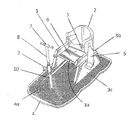
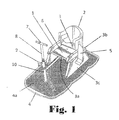
- FIG. 1 is a perspective view of the inventive assistive device mounted on a removable stable sensory footplate.
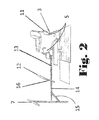
- FIG. 2 is a side view of the inventive assistive device showing a trunk support on a trunk support base with a primary crossbar and an intermediate crossbar extending from the trunk support base.
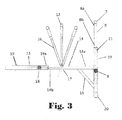
- FIG. 3 is a side view of the primary crossbar and an intermediate crossbar and support structure extending from the front of the trunk support base and meant to be between the legs of the infant sitting in the inventive assistive device.
- FIG. 4 is another side view of the inventive assistive device showing a tray that can be mounted on one of the cross bars.
- FIG. 1 the inventive assistive device 1 is shown with a trunk support 2 providing trunk support in all planes sitting on a trunk support base 3 with a front end 3 a, a rear end 3 b and a bottom surface 3 c resting on the upper surface 4 a of a removable sensory foot plate 4 . It is intended that the removable foot plate 4 be stable and the upper surface 4 a be non-skid. Also shown in FIG. 1 is the sitting surface 6 on the trunk support base 3 , and a belt 5 for a sitting infant. In front of the trunk support 2 and trunk support base 3 is shown a primary crossbar 7 atop a primary crossbar extension pole 8 mounted in a primary crossbar vertical support tube 10 with an extension pole lock 9 to lock the primary crossbar in a desired vertical position. It is further understood that the trunk support 2 and the removable sensory foot plate 4 can contain a variety of interchangeable sensory input devices and materials.
- the crossbar 7 can be used as a handle for the infant/toddler to grab hold of to stand.
- an intermediate crossbar 12 atop and perpendicular to an intermediate crossbar support pole 16 pivotally mounted to a horizontal crossbar support 13 extending from the trunk support base 3 .
- a horizontal crossbar extension 14 and a primary crossbar support strut 15 are also shown.
- an optional vibration disc 11 mounted in the trunk belt 5 .
- the vibration disc 11 can be battery powered with an on/off switch.
- FIG. 3 is a side view of the primary crossbar 7 and intermediate crossbar 12 and support structure comprising a horizontal cross bar support 13 having a rear end 19 and a front end 19 a with a horizontal crossbar extension 14 having a rear end 14 b and a front end 14 a.
- the rear end 14 b of the horizontal crossbar extension 14 slides into the front end 19 a of the horizontal crossbar support 13 where the rear end 14 b can be locked in a multiplicity of positions with a horizontal crossbar extension lock 18 to accommodate different sizes of infants.
- the rear end 19 of the horizontal crossbar support 13 is supported at the front of the trunk support base 3 .
- the horizontal crossbar support 13 is meant to be between the legs of the infant sitting in the inventive assistive device 1 .
- the intermediate crossbar support pole 16 fixed at a right angle to the intermediate crossbar 12 is mounted to the horizontal crossbar extension 14 at pivot point 17 .
- the support pole 16 can be locked at various vertical angles in relation to the horizontal crossbar extension 14 , or can be removed altogether.
- a primary crossbar support tube 10 with a bottom end 20 and a top end 21 is fixed in a vertical position, with an optional support strut 15 .
- additional support struts may be used to provide transverse support to the support tube 10 . It is intended that the bottom end 20 rests on the floor or the upper surface 4 a of the removable foot plate 4 .
- a primary crossbar extension pole 8 with a top end 8 a fixed at a right angle to the primary crossbar 7 , and a bottom end 8 b inserted into the top end 21 of the primary crossbar support tube 10 where the primary crossbar extension pole 8 can be locked in a multiplicity of vertical positions with an extension pole lock 9 to accommodate different sizes of infants or accommodate attachments.
- the side view of the inventive assistive device depicted in FIG. 4 shows a tray 23 that can be mounted on one or both of the cross bars 12 and 7 .
- the primary crossbar 7 can be adjusted vertically to accommodate the tray 23
- the intermediate crossbar 12 can be adjusted to accommodate a desired angle for the tray 23 or removed altogether to allow adjustment of a tray 23 to the true vertical position (90 degrees from the horizontal) such that the tray 23 can act as an easel as well.
- a heating and cooling gel wrap 22 installed in the trunk support 2 or alternatively in the trunk support belt 5 .
- the trunk support 2 can be removed or loosened as the child begins to activate his/her own muscle and develops the ability to sit alone and stabilize himself/herself.
- the removable foot plate 4 with non-skid upper surface 4 a insures that the child will be anchored and learn to stabilize himself/herself when sitting by maintaining their feet on the floor.
- the trunk support 2 can also be removed so that the child can become closer and closer to independent sitting on a stool, bench surface, or floor like typical babies learn to do.
- Both the trunk support 2 and the removable foot plate 4 can have a stimulation component added to them that can be utilized to further activate a baby to use their muscles that they are having trouble activating.
- the size of the present invention fits most children in the 7 month to 2 year old range it needs to be tested for fit by the user/parent. Supervision while using the device is also needed to monitor the infant's tolerance to sitting upright. As the child grows the crossbar 7 can be adjusted and likewise the trunk support base 3 can be raised. For example, the vertical distance between the floor or the non-skid upper surface 4 a and the sitting surface 6 would be 5 inches for small sizes but 7 inches for medium sizes to accommodate an increase in tibia length or foot to knee measurement.
- a person using the present invention would be a therapist, teacher, or a parent/sitter. This person would properly place the child into the device and stimulate the child to hold their head and trunk up to look at visual tasks/toys at eye level while interacting with the crossbar 7 or tray 23 .
- the child in the device 1 would be monitored for tolerance and endurance to sitting.
- the device is designed to be used at intervals of 5 to 30 minutes at a time with supervision by an adult to increase the ability of a baby with special needs to sit alone.
Landscapes
- Health & Medical Sciences (AREA)
- General Health & Medical Sciences (AREA)
- Pediatric Medicine (AREA)
- Special Chairs (AREA)
Abstract
Description
- This application claims priority from U.S. Provisional Application No. 62/405,101 (the '101 application), filed Oct. 6, 2016. The '101 application is incorporated herein by reference.
- The present invention helps an infant or toddler who is unable to hold himself or herself up to sit and stand against gravity. When children have grown past one year old and are not only not walking, but not sitting as well, they need special assistance. Current devices don't work well because when a child needs special assistance they need more sensory input and support to activate their muscles to sit independently.
- Current infant-toddler seating devices do not provide for the infant to sit with their feet flat on the floor/pelvis in neutral/femur contact on seating surface. Current infant sitting devices also do not provide vibration stimulation to the muscles. Current infant and toddler seating devices do not provide light touch trunk contact when the infant is sitting in a seated position as when they are on a stool. Current infant-toddler products also do not have the capability of adding accessory items. Babies with special needs and challenges sometimes need more alignment assistance, sensory input and contact support to their trunk. The present invention will help them to activate the muscles needed to sit independently, and progress from sitting to standing. Accessories (like vibration, a tray, and sensory footplate) and assistive devices for this age group (approximately but not limited to 7 months to 2 years old) are helpful in special needs situations and not provided as described previously above by other products. Only the present invention provides the necessary support for infant/toddlers requiring special assistance and/or with muscle diseases.
- The present invention helps activate their muscles as they need to continue to develop on the normal progression of developmental motor milestones. There are no products providing this sort of stimulation to infant-toddlers while sitting upright.
- The present invention helps an infant or toddler who is unable to hold himself or herself up to sit against gravity. The invention claimed here solves this problem.
- With proper alignment and weight bearing of the pelvis and lower extremities, a sensory foot plate, light touch trunk contact and support, and vibration/heating/cooling stimulation; this assistive device helps activate muscles needed to sit independently in an infant or toddler experiencing challenges.
- The present invention allows for sensory input through the feet and lower extremity bones by adding the component of a stable sensory footplate, on the floor, that is nonskid for added stability/anchoring of the lower body. It also accommodates for the growing size of an infant as they are not able to sit alone. It provides light support and stability needed to promote independent muscle activation in an infant or toddler who cannot sit up after the age of 7 months. It has an added component of turning vibration on or off. It also has the added component of a sensory footplate that is nonskid for added stability/anchoring of the lower body. An angled tray for further upper extremity weight bearing assist can be added to the assisted sitting device. This tray can be adjusted to the true vertical position (90 degrees from the horizontal) to act as an easel.
- The present invention is an infant sitting device that has the ability to put an infant in a bench sitting posture of 90/90/90 degrees at hips, knees & ankles. It has a foam trunk support that gives support in all planes of movement, preventing the infant from falling over while learning to sit but is not designed to have total support along the back/high back support. A high back support allows the infant to relax and sit semi reclined, and not actively working on sitting up. The present invention is designed to facilitate sitting erect. The present invention is designed to help an infant with special needs (but not limited to) sit up if they are not doing so by 7 months of age all the way up to 24 months of age. The trunk foam support has sensory components of heating/cooling & vibration for both stimulation and relaxation as needed. The feet are flat on the floor unlike other infant sitting pillows and products which foster infant floor sitting with legs criss crossed or just the entire leg out flat against floor. Because the feet are flat on the floor, sensory input can be provided to soles of the feet giving weight bearing and other stimulation to the lower extremity muscles. The footplate contains different sensory textures to try with the infant. The footplate can even hold warm water to assist with relaxing spastic muscles. The tray attachment allows for upper extremity weight bearing to further stabilize a child who is having trouble sitting up. The tray can be angled to accommodate a variety of eye level tasks. This includes horizontal, watching a car roll back & forth or complete vertical to use as an easel if enough control is there. When the tray is removed there is a telescoping crossbar that the child can hold onto which allows for the beginning of sit-to-stand motion actively achieved by the infant and caregiver assisting if necessary weight bearing through his/her legs to hopefully a full stance one day.
-
FIG. 1 is a perspective view of the inventive assistive device mounted on a removable stable sensory footplate. -
FIG. 2 is a side view of the inventive assistive device showing a trunk support on a trunk support base with a primary crossbar and an intermediate crossbar extending from the trunk support base. -
FIG. 3 is a side view of the primary crossbar and an intermediate crossbar and support structure extending from the front of the trunk support base and meant to be between the legs of the infant sitting in the inventive assistive device. -
FIG. 4 is another side view of the inventive assistive device showing a tray that can be mounted on one of the cross bars. - In
FIG. 1 the inventive assistive device 1 is shown with atrunk support 2 providing trunk support in all planes sitting on atrunk support base 3 with afront end 3 a, arear end 3 b and abottom surface 3 c resting on theupper surface 4 a of a removable sensory foot plate 4. It is intended that the removable foot plate 4 be stable and theupper surface 4 a be non-skid. Also shown inFIG. 1 is thesitting surface 6 on thetrunk support base 3, and abelt 5 for a sitting infant. In front of thetrunk support 2 andtrunk support base 3 is shown aprimary crossbar 7 atop a primarycrossbar extension pole 8 mounted in a primary crossbarvertical support tube 10 with an extension pole lock 9 to lock the primary crossbar in a desired vertical position. It is further understood that thetrunk support 2 and the removable sensory foot plate 4 can contain a variety of interchangeable sensory input devices and materials. Thecrossbar 7 can be used as a handle for the infant/toddler to grab hold of to stand. - In the side view of the inventive assistive device 1 shown in
FIG. 2 is shown anintermediate crossbar 12 atop and perpendicular to an intermediatecrossbar support pole 16 pivotally mounted to ahorizontal crossbar support 13 extending from thetrunk support base 3. Also shown is ahorizontal crossbar extension 14 and a primarycrossbar support strut 15. Also shown is anoptional vibration disc 11 mounted in thetrunk belt 5. Thevibration disc 11 can be battery powered with an on/off switch. -
FIG. 3 is a side view of theprimary crossbar 7 andintermediate crossbar 12 and support structure comprising a horizontalcross bar support 13 having arear end 19 and afront end 19 a with ahorizontal crossbar extension 14 having arear end 14 b and afront end 14 a. As shown therear end 14 b of thehorizontal crossbar extension 14 slides into thefront end 19 a of thehorizontal crossbar support 13 where therear end 14 b can be locked in a multiplicity of positions with a horizontalcrossbar extension lock 18 to accommodate different sizes of infants. Therear end 19 of thehorizontal crossbar support 13 is supported at the front of thetrunk support base 3. Thehorizontal crossbar support 13 is meant to be between the legs of the infant sitting in the inventive assistive device 1. - Also shown in
FIG. 3 , the intermediatecrossbar support pole 16 fixed at a right angle to theintermediate crossbar 12 is mounted to thehorizontal crossbar extension 14 atpivot point 17. As shown thesupport pole 16 can be locked at various vertical angles in relation to thehorizontal crossbar extension 14, or can be removed altogether. At thefront end 14 a of thehorizontal crossbar extension 14, a primarycrossbar support tube 10 with abottom end 20 and atop end 21 is fixed in a vertical position, with anoptional support strut 15. While not shown, additional support struts may be used to provide transverse support to thesupport tube 10. It is intended that thebottom end 20 rests on the floor or theupper surface 4 a of the removable foot plate 4. In addition there is a primarycrossbar extension pole 8 with atop end 8 a fixed at a right angle to theprimary crossbar 7, and abottom end 8 b inserted into thetop end 21 of the primarycrossbar support tube 10 where the primarycrossbar extension pole 8 can be locked in a multiplicity of vertical positions with an extension pole lock 9 to accommodate different sizes of infants or accommodate attachments. - The side view of the inventive assistive device depicted in
FIG. 4 shows atray 23 that can be mounted on one or both of the cross bars 12 and 7. As noted above theprimary crossbar 7 can be adjusted vertically to accommodate thetray 23, and theintermediate crossbar 12 can be adjusted to accommodate a desired angle for thetray 23 or removed altogether to allow adjustment of atray 23 to the true vertical position (90 degrees from the horizontal) such that thetray 23 can act as an easel as well. Also shown is a heating and coolinggel wrap 22 installed in thetrunk support 2 or alternatively in thetrunk support belt 5. - The
trunk support 2 can be removed or loosened as the child begins to activate his/her own muscle and develops the ability to sit alone and stabilize himself/herself. The removable foot plate 4 with non-skidupper surface 4a insures that the child will be anchored and learn to stabilize himself/herself when sitting by maintaining their feet on the floor. Thetrunk support 2 can also be removed so that the child can become closer and closer to independent sitting on a stool, bench surface, or floor like typical babies learn to do. Both thetrunk support 2 and the removable foot plate 4 can have a stimulation component added to them that can be utilized to further activate a baby to use their muscles that they are having trouble activating. - As everyone knows no two people are made alike. Although the size of the present invention fits most children in the 7 month to 2 year old range it needs to be tested for fit by the user/parent. Supervision while using the device is also needed to monitor the infant's tolerance to sitting upright. As the child grows the
crossbar 7 can be adjusted and likewise thetrunk support base 3 can be raised. For example, the vertical distance between the floor or the non-skidupper surface 4 a and the sittingsurface 6 would be 5 inches for small sizes but 7 inches for medium sizes to accommodate an increase in tibia length or foot to knee measurement. - A person using the present invention would be a therapist, teacher, or a parent/sitter. This person would properly place the child into the device and stimulate the child to hold their head and trunk up to look at visual tasks/toys at eye level while interacting with the
crossbar 7 ortray 23. The child in the device 1 would be monitored for tolerance and endurance to sitting. The device is designed to be used at intervals of 5 to 30 minutes at a time with supervision by an adult to increase the ability of a baby with special needs to sit alone.
Claims (10)
Priority Applications (1)
| Application Number | Priority Date | Filing Date | Title |
|---|---|---|---|
| US15/726,645 US10285509B2 (en) | 2016-10-06 | 2017-10-06 | Infant assistive device |
Applications Claiming Priority (2)
| Application Number | Priority Date | Filing Date | Title |
|---|---|---|---|
| US201662405101P | 2016-10-06 | 2016-10-06 | |
| US15/726,645 US10285509B2 (en) | 2016-10-06 | 2017-10-06 | Infant assistive device |
Publications (2)
| Publication Number | Publication Date |
|---|---|
| US20180098640A1 true US20180098640A1 (en) | 2018-04-12 |
| US10285509B2 US10285509B2 (en) | 2019-05-14 |
Family
ID=61829576
Family Applications (1)
| Application Number | Title | Priority Date | Filing Date |
|---|---|---|---|
| US15/726,645 Active US10285509B2 (en) | 2016-10-06 | 2017-10-06 | Infant assistive device |
Country Status (1)
| Country | Link |
|---|---|
| US (1) | US10285509B2 (en) |
Cited By (1)
| Publication number | Priority date | Publication date | Assignee | Title |
|---|---|---|---|---|
| CN113892786A (en) * | 2020-06-19 | 2022-01-07 | 穆蒙蒙 | Foldable support, child chair and application |
Families Citing this family (1)
| Publication number | Priority date | Publication date | Assignee | Title |
|---|---|---|---|---|
| US10959537B1 (en) * | 2019-11-04 | 2021-03-30 | Austin Fernandez | Activity saucer for infants with clubfoot |
Family Cites Families (20)
| Publication number | Priority date | Publication date | Assignee | Title |
|---|---|---|---|---|
| US2023761A (en) * | 1934-11-12 | 1935-12-10 | William W Drummey | Desk and chair unit |
| US2714417A (en) * | 1952-04-18 | 1955-08-02 | Aeon Ind Inc | Spring base for baby jumper chair |
| US3059965A (en) * | 1959-03-09 | 1962-10-23 | Theodore B Fornetti | Baby chair |
| US4075457A (en) * | 1976-10-04 | 1978-02-21 | The Raymond Lee Organization, Inc. | Pedicure treatment unit |
| JPH05503229A (en) * | 1989-09-22 | 1993-06-03 | チヤラシュ、ルース、エー | Ergonomic stands and how to use them |
| US5409296A (en) * | 1994-06-06 | 1995-04-25 | Shelby Williams Industries, Inc. | Adjustable length support base for a seat assembly |
| US5687433A (en) * | 1996-06-27 | 1997-11-18 | Brk Brands, Inc. | Child bath seat |
| US5728030A (en) * | 1996-07-29 | 1998-03-17 | Hsieh; Charles Ping-Chao | Infant training walker |
| US6000750A (en) * | 1996-10-25 | 1999-12-14 | The First Years Inc. | Convertible play center for children |
| US6644748B2 (en) * | 1999-02-25 | 2003-11-11 | Health Postures, Inc. | Synergistic body positioning and dynamic support system |
| US8898825B2 (en) * | 2001-07-03 | 2014-12-02 | Cosco Management, Inc. | Baby bath seat with hanger |
| US6817864B1 (en) * | 2002-06-03 | 2004-11-16 | Irene Martinez | Infant motor skill developmental aid apparatus |
| EP1727446A2 (en) * | 2004-03-26 | 2006-12-06 | Krueger international Inc. | Student desk |
| US7052082B1 (en) * | 2004-07-19 | 2006-05-30 | Richard Thomas | Pedicure basin for pedicure station and salon chair |
| US20090230738A1 (en) * | 2008-03-13 | 2009-09-17 | Kevin Le | Pedicure Chair and Mini Spa |
| CN203633838U (en) * | 2011-03-16 | 2014-06-11 | 儿童二代公司 | Child support with seat insert |
| US9474377B2 (en) * | 2012-05-16 | 2016-10-25 | Safco Products Co. | Upright active-sitting seat |
| US9254037B2 (en) * | 2012-07-03 | 2016-02-09 | The Texas A&M University System | Versatile student desk |
| US9216120B2 (en) * | 2013-01-22 | 2015-12-22 | Amigo Mobility International, Inc. | Manual shopping chair |
| US8851487B2 (en) * | 2013-03-11 | 2014-10-07 | Ernestine P. Maxie | Infant transport apparatus and method |
-
2017
- 2017-10-06 US US15/726,645 patent/US10285509B2/en active Active
Cited By (1)
| Publication number | Priority date | Publication date | Assignee | Title |
|---|---|---|---|---|
| CN113892786A (en) * | 2020-06-19 | 2022-01-07 | 穆蒙蒙 | Foldable support, child chair and application |
Also Published As
| Publication number | Publication date |
|---|---|
| US10285509B2 (en) | 2019-05-14 |
Similar Documents
| Publication | Publication Date | Title |
|---|---|---|
| US1448783A (en) | Invalid support | |
| US6817864B1 (en) | Infant motor skill developmental aid apparatus | |
| US3788695A (en) | Sitting/standing table/walker combination | |
| US10806311B2 (en) | Portable commode aid | |
| US9144324B1 (en) | Balancing baby walker | |
| US6601865B1 (en) | Visually appealing versatile rollable and foldable chair | |
| KR102402692B1 (en) | Multifunctional walking car | |
| US20170079879A1 (en) | Synergistic Posture System | |
| US10285509B2 (en) | Infant assistive device | |
| CN105686933B (en) | Infant creeping is stood walking instrument | |
| KR101946783B1 (en) | Manual stretching exercise equipment | |
| RU134048U1 (en) | MULTIFUNCTIONAL SUPPORT "TRANSFORMER" | |
| KR200461464Y1 (en) | A movable chair for children | |
| US6601922B2 (en) | Apparatus with lower leg restraints for contributing to support of a handicapped person | |
| US10426678B2 (en) | Child support structure | |
| KR100953220B1 (en) | Health promotion and height growth promotion exercise equipment | |
| JP7826101B2 (en) | sitting chair | |
| JP2008183419A (en) | Two conditioning stands, method of bent over rowing training using them | |
| JPS6025273Y2 (en) | Limb training exercise equipment and functional training support base | |
| RU56808U1 (en) | BRACKET SUPPORT | |
| KR20200052560A (en) | A body lifting device for the disabled | |
| RU56171U1 (en) | SUPPORT FOR THE STANDING TUMP | |
| TH13231C3 (en) | Developmental devices for children with cerebral palsy | |
| Gendreau | Adaptive Equipment: A Project APT Resource Manual. | |
| RU59970U1 (en) | SUPPORT FOR SEATING "NATASHA" WITH A TABLE |
Legal Events
| Date | Code | Title | Description |
|---|---|---|---|
| FEPP | Fee payment procedure |
Free format text: ENTITY STATUS SET TO UNDISCOUNTED (ORIGINAL EVENT CODE: BIG.); ENTITY STATUS OF PATENT OWNER: MICROENTITY |
|
| FEPP | Fee payment procedure |
Free format text: ENTITY STATUS SET TO MICRO (ORIGINAL EVENT CODE: MICR); ENTITY STATUS OF PATENT OWNER: MICROENTITY |
|
| STPP | Information on status: patent application and granting procedure in general |
Free format text: PUBLICATIONS -- ISSUE FEE PAYMENT RECEIVED |
|
| STPP | Information on status: patent application and granting procedure in general |
Free format text: PUBLICATIONS -- ISSUE FEE PAYMENT VERIFIED |
|
| STCF | Information on status: patent grant |
Free format text: PATENTED CASE |
|
| MAFP | Maintenance fee payment |
Free format text: PAYMENT OF MAINTENANCE FEE, 4TH YEAR, MICRO ENTITY (ORIGINAL EVENT CODE: M3551); ENTITY STATUS OF PATENT OWNER: MICROENTITY Year of fee payment: 4 |