US20090232811A1 - Bivalent, bispecific antibodies - Google Patents
Bivalent, bispecific antibodies Download PDFInfo
- Publication number
- US20090232811A1 US20090232811A1 US12/332,465 US33246508A US2009232811A1 US 20090232811 A1 US20090232811 A1 US 20090232811A1 US 33246508 A US33246508 A US 33246508A US 2009232811 A1 US2009232811 A1 US 2009232811A1
- Authority
- US
- United States
- Prior art keywords
- antibody
- angpt2
- domain
- heavy chain
- igf
- Prior art date
- Legal status (The legal status is an assumption and is not a legal conclusion. Google has not performed a legal analysis and makes no representation as to the accuracy of the status listed.)
- Granted
Links
- 0 CC1*CCC1 Chemical compound CC1*CCC1 0.000 description 1
Images




Classifications
-
- C—CHEMISTRY; METALLURGY
- C07—ORGANIC CHEMISTRY
- C07K—PEPTIDES
- C07K16/00—Immunoglobulins [IG], e.g. monoclonal or polyclonal antibodies
- C07K16/46—Hybrid immunoglobulins
- C07K16/468—Immunoglobulins having two or more different antigen binding sites, e.g. multifunctional antibodies
-
- C—CHEMISTRY; METALLURGY
- C07—ORGANIC CHEMISTRY
- C07K—PEPTIDES
- C07K16/00—Immunoglobulins [IG], e.g. monoclonal or polyclonal antibodies
- C07K16/18—Immunoglobulins [IG], e.g. monoclonal or polyclonal antibodies against material from animals or humans
- C07K16/22—Immunoglobulins [IG], e.g. monoclonal or polyclonal antibodies against material from animals or humans against growth factors ; against growth regulators
-
- C—CHEMISTRY; METALLURGY
- C07—ORGANIC CHEMISTRY
- C07K—PEPTIDES
- C07K16/00—Immunoglobulins [IG], e.g. monoclonal or polyclonal antibodies
- C07K16/18—Immunoglobulins [IG], e.g. monoclonal or polyclonal antibodies against material from animals or humans
- C07K16/28—Immunoglobulins [IG], e.g. monoclonal or polyclonal antibodies against material from animals or humans against receptors, cell surface antigens or cell surface determinants
- C07K16/2863—Immunoglobulins [IG], e.g. monoclonal or polyclonal antibodies against material from animals or humans against receptors, cell surface antigens or cell surface determinants against receptors for growth factors, growth regulators
-
- C—CHEMISTRY; METALLURGY
- C07—ORGANIC CHEMISTRY
- C07K—PEPTIDES
- C07K2317/00—Immunoglobulins specific features
- C07K2317/20—Immunoglobulins specific features characterized by taxonomic origin
- C07K2317/21—Immunoglobulins specific features characterized by taxonomic origin from primates, e.g. man
-
- C—CHEMISTRY; METALLURGY
- C07—ORGANIC CHEMISTRY
- C07K—PEPTIDES
- C07K2317/00—Immunoglobulins specific features
- C07K2317/30—Immunoglobulins specific features characterized by aspects of specificity or valency
- C07K2317/31—Immunoglobulins specific features characterized by aspects of specificity or valency multispecific
-
- C—CHEMISTRY; METALLURGY
- C07—ORGANIC CHEMISTRY
- C07K—PEPTIDES
- C07K2317/00—Immunoglobulins specific features
- C07K2317/50—Immunoglobulins specific features characterized by immunoglobulin fragments
- C07K2317/52—Constant or Fc region; Isotype
-
- C—CHEMISTRY; METALLURGY
- C07—ORGANIC CHEMISTRY
- C07K—PEPTIDES
- C07K2317/00—Immunoglobulins specific features
- C07K2317/50—Immunoglobulins specific features characterized by immunoglobulin fragments
- C07K2317/56—Immunoglobulins specific features characterized by immunoglobulin fragments variable (Fv) region, i.e. VH and/or VL
-
- C—CHEMISTRY; METALLURGY
- C07—ORGANIC CHEMISTRY
- C07K—PEPTIDES
- C07K2317/00—Immunoglobulins specific features
- C07K2317/70—Immunoglobulins specific features characterized by effect upon binding to a cell or to an antigen
- C07K2317/73—Inducing cell death, e.g. apoptosis, necrosis or inhibition of cell proliferation
- C07K2317/732—Antibody-dependent cellular cytotoxicity [ADCC]
-
- C—CHEMISTRY; METALLURGY
- C07—ORGANIC CHEMISTRY
- C07K—PEPTIDES
- C07K2319/00—Fusion polypeptide
Definitions
- the present invention relates to novel bivalent, bispecific antibodies, their manufacture and use.
- Engineered proteins such as bi- or multispecific antibodies capable of binding two or more antigens are known in the art. Such multispecific binding proteins can be generated using cell fusion, chemical conjugation, or recombinant DNA techniques.
- bispecific antibody formats have been developed in the recent past, e.g. tetravalent bispecific antibodies by fusion of, e.g. an IgG antibody format and single chain domains (see e.g. Coloma, M. J., et. al., Nature Biotech. 15 (1997) 159-163; WO 2001077342; and Morrison, S., L., Nature Biotech. 25 (2007) 1233-1234.
- linkers either to fuse the antibody core (IgA, IgD, IgE, IgG or IgM) to a further binding protein (e.g. scFv) or to fuse e.g. two Fab fragments or scFv (Fischer, N., and Léger, O., Pathobiology 74 (2007) 3-14). While it is obvious that linkers have advantages for the engineering of bispecific antibodies, they may also cause problems in therapeutic settings. Indeed, these foreign peptides might elicit an immune response against the linker itself or the junction between the protein and the linker.
- CDC complement-dependent cytotoxicity
- ADCC antibody dependent cellular cytotoxicity
- bispecific antibodies that are very similar in general structure to naturally occurring antibodies (like IgA, IgD, IgE, IgG or IgM) with minimal deviation from human sequences.
- bispecific antibodies that are very similar to natural antibodies have been produced using the quadroma technology (see Milstein, C. and A. C. Cuello, Nature, 305 (1983) 537-40) based on the somatic fusion of two different hybridoma cell lines expressing murine monoclonal antibodies with the desired specificities of the bispecific antibody. Because of the random pairing of two different antibody heavy and light chains within the resulting hybrid-hybridoma (or quadroma) cell line, up to ten different antibody species are generated of which only one is the desired, functional bispecific antibody. Due to the presence of mispaired byproducts, and significantly reduced production yields, means sophisticated purification procedures are required (see e.g. Morrison, S. L., Nature Biotech 25 (2007) 1233-1234). In general the same problem of mispaired byproducts remains if recombinant expression techniques are used.
- the percentage of heterodimer could be further increased by remodeling the interaction surfaces of the two CH3 domains using a phage display approach and the introduction of a disulfide bridge to stabilize the heterodimers (Merchant A. M, et al., Nature Biotech 16 (1998) 677-681; Atwell, S., et al., J. Mol. Biol. 270 (1997) 26-35).
- New approaches for the knobs-into-holes technology are described in e.g. in EP 1870459A1. Although this format appears very attractive, no data describing progression towards the clinic are currently available.
- WO 2006/093794 relates to heterodimeric protein binding compositions.
- WO 99/37791 describes multipurpose antibody derivatives.
- Morrison et al the J. Immunolog, 160 (1998) 2802-2808 refers to the influence of variable region domain exchange on the functional properties of IgG.
- the invention relates to a bivalent, bispecific antibody, comprising:
- variable domains VL and VH are replaced by each other, and wherein the constant domains CL and CH1 are replaced by each other.
- vectors comprising nucleic acid molecules encoding the light chain and heavy chain of an antibody specifically binding to a first antigen
- vectors comprising nucleic acid molecules encoding the light chain and heavy chain of an antibody specifically binding to a second antigen
- variable domains VL and VH are replaced by each other, and wherein the constant domains CL and CH1 are replaced by each other; b) culturing the host cell under conditions that allow synthesis of said antibody molecule; and c) recovering said antibody molecule from said culture.
- a further embodiment of the invention is a host cell comprising
- vectors comprising nucleic acid molecules encoding the light chain and heavy chain of an antibody specifically binding to a first antigen
- vectors comprising nucleic acid molecules encoding the light chain and heavy chain of an antibody specifically binding to a second antigen
- variable domains VL and VH are replaced by each other, and wherein the constant domains CL and CH1 are replaced by each other.
- a further embodiment of the invention is a composition, preferably a pharmaceutical or a diagnostic composition of the antibody according to the invention.
- a further embodiment of the invention is a method for the treatment of a patient in need of therapy, characterized by administering to the patient a therapeutically effective amount of an antibody according to the invention.
- the invention relates to a bivalent, bispecific antibody, comprising:
- variable domains VL and VH are replaced by each other, and wherein the constant domains CL and CH1 are replaced by each other.
- variable domains VL and VH of the second light chain and the second heavy chain are replaced by each other, and wherein the constant domains CL and CH1 of the second light chain and the second heavy chain are replaced by each other.
- antibody refers to whole, monoclonal antibodies. Such whole antibodies consist of two pairs of a “light chain” (LC) and a “heavy chain” (HC) (such light chain (LC)/heavy chain pairs are abbreviated herein as LC/HC).
- the light chains and heavy chains of such antibodies are polypeptides consisting of several domains.
- each heavy chain comprises a heavy chain variable region (abbreviated herein as HCVR or VH) and a heavy chain constant region.
- the heavy chain constant region comprises the heavy chain constant domains CH1, CH2 and CH3 (antibody classes IgA, IgD, and IgG) and optionally the heavy chain constant domain CH4 (antibody classes IgE and IgM).
- Each light chain comprises a light chain variable domain VL and a light chain constant domain CL.
- the structure of one naturally occurring whole antibody, the IgG antibody, is shown e.g. in FIG. 1 .
- the variable domains VH and VL can be further subdivided into regions of hypervariability, termed complementarity determining regions (CDR), interspersed with regions that are more conserved, termed framework regions (FR).
- CDR complementarity determining regions
- FR framework regions
- Each VH and VL is composed of three CDRs and four FRs, arranged from amino-terminus to carboxy-terminus in the following order: FR1, CDR1, FR2, CDR2, FR3, CDR3, FR4 ((Janeway, C. A., Jr.
- antibody The two pairs of heavy chain and light chain (HC/LC) are capable of specifically binding to same antigen.
- whole antibody is a bivalent, monospecific antibody.
- antibodies include e.g. mouse antibodies, human antibodies, chimeric antibodies, humanized antibodies and genetically engineered antibodies (variant or mutant antibodies) as long as their characteristic properties are retained.
- human or humanized antibodies especially as recombinant human or humanized antibodies.
- Each heavy chain has two regions, the constant region and the variable region.
- the constant region is identical in all antibodies of the same isotype, but differs in antibodies of different isotype.
- Heavy chains ⁇ , ⁇ and ⁇ have a constant region composed of three constant domains CH1, CH2, and CH3 (in a line), and a hinge region for added flexibility (Woof, J., Burton D Nat Rev Immunol 4 (2004) 89-99); heavy chains t and have a constant region composed of four constant domains CH1, CH2, CH3, and CH4 (Janeway, C. A., Jr., et al., Immunobiology, 5th ed., Garland Publishing (2001)).
- the variable region of the heavy chain differs in antibodies produced by different B cells, but is the same for all antibodies produced by a single B cell or B cell clone.
- the variable region of each heavy chain is approximately 110 amino acids long and is composed of a single antibody domain.
- monoclonal antibody or “monoclonal antibody composition” as used herein refer to a preparation of antibody molecules of a single amino acid composition.
- the “antibodies” according to the invention can be of any class (e.g. IgA, IgD, IgE, IgG, and IgM, preferably IgG or IgE), or subclass (e.g., IgG1, IgG2, IgG3, IgG4, IgA1 and IgA2, preferably IgG1), whereby both antibodies, from which the bivalent bispecific antibody according to the invention is derived, have an Fc part of the same subclass (e.g. IgG1, IgG4 and the like, preferably IgG1), preferably of the same allotype (e.g. Caucasian).
- IgA, IgD, IgE, IgG, and IgM preferably IgG or IgE
- subclass e.g., IgG1, IgG2, IgG3, IgG4, IgA1 and IgA2, preferably IgG1
- a “Fc part of an antibody” is a term well known to the skilled artisan and defined on the basis of papain cleavage of antibodies.
- the antibodies according to the invention contain as Fc part, preferably a Fc part derived from human origin and preferably all other parts of the human constant regions.
- the Fc part of an antibody is directly involved in complement activation, C1q binding, C3 activation and Fc receptor binding. While the influence of an antibody on the complement system is dependent on certain conditions, binding to C1q is caused by defined binding sites in the Fc part. Such binding sites are known in the state of the art and described e.g. by Lukas, T. J., et al., J. Immunol.
- binding sites are e.g. L234, L235, D270, N297, E318, K320, K322, P331 and P329 (numbering according to EU index of Kabat, see below).
- Antibodies of subclass IgG1, IgG2 and IgG3 usually show complement activation, C1q binding and C3 activation, whereas IgG4 do not activate the complement system, do not bind C1q and do not activate C3.
- the Fc part is a human Fc part.
- chimeric antibody refers to an antibody comprising a variable region, i.e., binding region, from one source or species and at least a portion of a constant region derived from a different source or species, usually prepared by recombinant DNA techniques. Chimeric antibodies comprising a murine variable region and a human constant region are preferred. Other preferred forms of “chimeric antibodies” encompassed by the present invention are those in which the constant region has been modified or changed from that of the original antibody to generate the properties according to the invention, especially in regard to C1q binding and/or Fc receptor (FcR) binding. Such chimeric antibodies are also referred to as “class-switched antibodies.”.
- Chimeric antibodies are the product of expressed immunoglobulin genes comprising DNA segments encoding immunoglobulin variable regions and DNA segments encoding immunoglobulin constant regions. Methods for producing chimeric antibodies involve conventional recombinant DNA and gene transfection techniques are well known in the art. See, e.g., Morrison, S. L., et al., Proc. Natl. Acad. Sci. USA 81 (1984) 6851-6855; U.S. Pat. No. 5,202,238 and U.S. Pat. No. 5,204,244.
- humanized antibody refers to antibodies in which the framework or “complementarity determining regions” (CDR) have been modified to comprise the CDR of an immunoglobulin of different specificity as compared to that of the parent immunoglobulin.
- CDR complementarity determining regions
- a murine CDR is grafted into the framework region of a human antibody to prepare the “humanized antibody.” See, e.g., Riechmann, L., et al., Nature 332 (1988) 323-327; and Neuberger, M. S., et al., Nature 314 (1985) 268-270.
- Particularly preferred CDRs correspond to those representing sequences recognizing the antigens noted above for chimeric antibodies.
- humanized antibodies encompassed by the present invention are those in which the constant region has been additionally modified or changed from that of the original antibody to generate the properties according to the invention, especially in regard to C1q binding and/or Fc receptor (FcR) binding.
- FcR Fc receptor
- human antibody is intended to include antibodies having variable and constant regions derived from human germ line immunoglobulin sequences.
- Human antibodies are well-known in the state of the art (van Dijk, M. A., and van de Winkel, J. G., Curr. Opin. Chem. Biol. 5 (2001) 368-374).
- Human antibodies can also be produced in transgenic animals (e.g., mice) that are capable, upon immunization, of producing a full repertoire or a selection of human antibodies in the absence of endogenous immunoglobulin production.
- Human antibodies can also be produced in phage display libraries (Hoogenboom, H. R., and Winter, G., J. Mol. Biol. 227 (1992) 381-388; Marks, J.
- human antibody as used herein also comprises such antibodies which are modified in the constant region to generate the properties according to the invention, especially in regard to C1q binding and/or FcR binding, e.g. by “class switching” i.e. change or mutation of Fc parts (e.g. from IgG1 to IgG4 and/or IgG1/IgG4 mutation).
- class switching i.e. change or mutation of Fc parts (e.g. from IgG1 to IgG4 and/or IgG1/IgG4 mutation).
- recombinant human antibody is intended to include all human antibodies that are prepared, expressed, created or isolated by recombinant means, such as antibodies isolated from a host cell such as a NS0 or CHO cell or from an animal (e.g. a mouse) that is transgenic for human immunoglobulin genes or antibodies expressed using a recombinant expression vector transfected into a host cell.
- recombinant human antibodies have variable and constant regions in a rearranged form.
- the recombinant human antibodies according to the invention have been subjected to in vivo somatic hypermutation.
- the amino acid sequences of the VH and VL regions of the recombinant antibodies are sequences that, while derived from and related to human germ line VH and VL sequences, may not naturally exist within the human antibody germ line repertoire in vivo.
- variable domain denotes each of the pair of light and heavy chains which is involved directly in binding the antibody to the antigen.
- the domains of variable human light and heavy chains have the same general structure and each domain comprises four framework (FR) regions whose sequences are widely conserved, connected by three “hypervariable regions” (or complementarity determining regions, CDRs).
- the framework regions adopt a ⁇ -sheet conformation and the CDRs may form loops connecting the ⁇ -sheet structure.
- the CDRs in each chain are held in their three-dimensional structure by the framework regions and form together with the CDRs from the other chain the antigen binding site.
- the antibody heavy and light chain CDR3 regions play a particularly important role in the binding specificity/affinity of the antibodies according to the invention and therefore provide a further object of the invention.
- hypervariable region or “antigen-binding portion of an antibody” when used herein refer to the amino acid residues of an antibody which are responsible for antigen-binding.
- the hypervariable region comprises amino acid residues from the “complementarity determining regions” or “CDRs”.
- “Framework” or “FR” regions are those variable domain regions other than the hypervariable region residues as herein defined. Therefore, the light and heavy chains of an antibody comprise from N- to C-terminus the domains FR1, CDR1, FR2, CDR2, FR3, CDR3, and FR4. CDRs on each chain are separated by such framework amino acids. Especially, CDR3 of the heavy chain is the region which contributes most to antigen binding.
- CDR and FR regions are determined according to the standard definition of Kabat et al., Sequences of Proteins of Immunological Interest, 5th ed., Public Health Service, National Institutes of Health, Bethesda, Md. (1991).
- antibodies or immunoglobulins are divided into the classes:
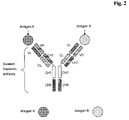
- bispecific antibody refers to an antibody as described above in which each of the two pairs of heavy chain and light chain (HC/LC) is specifically binding to a different antigen, i.e. the first heavy and the first light chain (originating from an antibody against a first antigen) are specifically binding together to a first antigen, and, the second heavy and the second light chain (originating from an antibody against a second antigen) are specifically binding together to a second antigen (as depicted in FIG.
- bivalent, bispecific antibodies are capable of specifically binding to two different antigens at the same time, and not to more than two antigens, in contrary to, on the one hand a monospecific antibody capable of binding only to one antigen, and on the other hand e.g. a tetravalent, tetraspecific antibody which can bind to four antigen molecules at the same time.
- the ratio of a desired bivalent, bispecific antibody compared to undesired side products can be improved by the replacement of certain domains in only one pair of heavy chain and light chain (HC/LC). While the first of the two HC/LC pairs originates from an antibody specifically binding to a first antigen and is left essentially unchanged, the second of the two HC/LC pairs originates from an antibody specifically binding to a second antigen, and is altered by the following replacement:
- variable light chain replacement of the variable light chain domain VL by the variable heavy chain domain VH of said antibody specifically binding to a second antigen, and the constant light chain domain CL by the constant heavy chain domain CH1 of said antibody specifically binding to a second antigen, and
- variable heavy chain replacement of the variable heavy chain domain VH by the variable light chain domain VL of said antibody specifically binding to a second antigen, and the constant heavy chain domain CH1 by the constant light chain domain CL of said antibody specifically binding to a second antigen.
- bivalent, bispecific antibodies are artificial antibodies which comprise
- such improved ratio of a desired bivalent, bispecific antibody compared to undesired side products can be further improved by one of the following two alternatives:
- the CH3 domains of said bivalent, bispecific antibody according to the invention can be altered by the “knob-into-holes” technology which is described in detail with several examples in e.g. WO 96/027011, Ridgway J. B., et al., Protein Eng 9 (1996) 617-621; and Merchant, A. M., et al., Nat Biotechnol 16 (1998) 677-681.
- the interaction surfaces of the two CH3 domains are altered to increase the heterodimerisation of both heavy chains containing these two CH3 domains.
- Each of the two CH3 domains (of the two heavy chains) can be the “knob”, while the other is the “hole”.
- the CH3 domains of a bivalent, bispecific antibody wherein the first CH3 domain and second CH3 domain each meet at an interface which comprises an original interface between the antibody CH3 domains are altered by the “knob-into-holes” technology including further stabilization by introduction of a disulfide bridge in the CH3 domains (described in WO 96/027011, Ridgway, J. B., et al., Protein Eng 9 (1996) 617-621; Merchant, A. M., et al, Nature Biotech 16 (1998) 677-681; and Atwell, S., et al., J. Mol. Biol. 270 (1997) 26-35) to promote the formation of the bivalent, bispecific antibody.
- a disulfide bridge in the CH3 domains
- said bivalent, bispecific antibody is characterized in that the CH3 domain of one heavy chain and the CH3 domain of the other heavy chain each meet at an interface which comprises an original interface between the antibody CH3 domains;
- said interface is altered to promote the formation of the bivalent, bispecific antibody, wherein the alteration is characterized in that: a) the CH3 domain of one heavy chain is altered, so that within the original interface the CH3 domain of one heavy chain that meets the original interface of the CH3 domain of the other heavy chain within the bivalent, bispecific antibody, an amino acid residue is replaced with an amino acid residue having a larger side chain volume, thereby generating a protuberance within the interface of the CH3 domain of one heavy chain which is positionable in a cavity within the interface of the CH3 domain of the other heavy chain and b) the CH3 domain of the other heavy chain is altered, so that within the original interface of the second CH3 domain that meets the original interface of the first CH3 domain within the bivalent, bispecific antibody an amino acid residue is replaced with an amino acid residue having a smaller side chain volume, thereby generating a cavity within the interface of the second CH3 domain within which a protuberance within the interface of the first CH3 domain is positionable.
- amino acid residue having a larger side chain volume is selected from the group consisting of arginine (R), phenylalanine (F), tyrosine (Y), tryptophan (W).
- amino acid residue having a smaller side chain volume is selected from the group consisting of alanine (A), serine (S), threonine (T), valine (V).
- both CH3 domains are further altered the introduction of cysteine (C) as amino acid in the corresponding positions of each CH3 domain such that a disulfide bridge between both CH3 domains can be formed.
- C cysteine
- both CH3 domains are altered by the use of residues R409D; K370E (K409D) for knobs residues and D399K; E357K for hole residues described eg. in EP 1870459A1; or
- the constant heavy chain domain CH1 by which the heavy chain domain CH3 is replaced can be of any Ig class (e.g. IgA, IgD, IgE, IgG, and IgM), or subclass (e.g., IgG1, IgG2, IgG3, IgG4, IgA1 and IgA2).
- Ig class e.g. IgA, IgD, IgE, IgG, and IgM
- subclass e.g., IgG1, IgG2, IgG3, IgG4, IgA1 and IgA2).
- the constant light chain domain CL by which the heavy chain domain CH3 is replaced can be of the lambda ( ⁇ ) or kappa ( ⁇ ) type, preferably the kappa ( ⁇ ) type.
- bivalent, bispecific antibody comprising:
- the variable domains VL and VH are replaced by each other, and wherein the constant domains CL and CH1 are replaced by each other, and wherein optionally c) the CH3 domain of one heavy chain and the CH3 domain of the other heavy chain each meet at an interface which comprises an original interface between the antibody CH3 domains; wherein said interface is altered to promote the formation of the bivalent, bispecific antibody, wherein the alteration is characterized in that: ca) the CH3 domain of one heavy chain is altered, so that within the original interface the CH3 domain of one heavy chain that meets the original interface of the CH3 domain of the other heavy chain within the bivalent, bispecific antibody, an amino acid residue is replaced with an amino acid residue having a larger side chain volume, thereby generating a protuberance within the interface of the CH3 domain of one heavy chain which is positionable in a cavity within the interface of the
- antigen or “antigen molecule” as used herein are used interchangeable and refer to all molecules that can be specifically bound by an antibody.
- the bivalent, bispecific antibody is specifically binding to a first antigen and a second distinct antigen.
- antigens include e.g. proteins, different epitopes on proteins (as different antigens within the meaning of the invention), and polysaccharides. This mainly includes parts (coats, capsules, cell walls, flagella, fimbrae, and toxins) of bacteria, viruses, and other microorganisms. Lipids and nucleic acids are antigenic only when combined with proteins and polysaccharides.
- Non-microbial exogenous (non-self) antigens can include pollen, egg white, and proteins from transplanted tissues and organs or on the surface of transfused blood cells.
- the antigen is selected from the group consisting of cytokines, cell surface proteins, enzymes and receptors cytokines, cell surface proteins, enzymes and receptors.
- Tumor antigens are those antigens that are presented by MHC I or MHC II molecules on the surface of tumor cells. These antigens can sometimes be presented by tumor cells and never by the normal ones. In this case, they are called tumor-specific antigens (TSAs) and typically result from a tumor specific mutation. More common are antigens that are presented by tumor cells and normal cells, and they are called tumor-associated antigens (TAAs). Cytotoxic T lymphocytes that recognized these antigens may be able to destroy the tumor cells before they proliferate or metastasize. Tumor antigens can also be on the surface of the tumor in the form of, for example, a mutated receptor, in which case they will be recognized by B cells.
- At least one of the two different antigens (first and second antigen), to which the bivalent, bispecific antibody specifically binds to, is a tumor antigen.
- both of the two different antigens (first and second antigen), to which the bivalent, bispecific antibody specifically binds to are tumor antigens; in this case the first and second antigen can also be two different epitopes at the same tumor specific protein.
- one of the two different antigens (first and second antigen), to which the bivalent, bispecific antibody specifically binds to, is a tumor antigen and the other is an effector cell antigen, as e.g. an T-Cell receptor, CD3, CD16 and the like.
- one of the two different antigens (first and second antigen), to which the bivalent, bispecific antibody specifically binds to, is a tumor antigen and the other is an anti-cancer substance such as a toxin or a kinase inhibitor.
- binding affinity refers to an antibody specifically binding an antigen.
- the binding affinity of the antibody specifically binding this antigen is of KD-value of 10 ⁇ 9 mol/l or lower (e.g. 10 ⁇ 10 mol/l), preferably with a KD-value of 10 ⁇ 10 mol/l or lower (e.g. 10 ⁇ 12 mol/l).
- the binding affinity is determined with a standard binding assay, such as surface plasmon resonance technique (Biacore®).
- epitope includes any polypeptide determinant capable of specific binding to an antibody.
- epitope determinant include chemically active surface groupings of molecules such as amino acids, sugar side chains, phosphoryl, or sulfonyl, and, in certain embodiments, may have specific three dimensional structural characteristics, and or specific charge characteristics.
- An epitope is a region of an antigen that is bound by an antibody.
- an antibody is said to specifically bind an antigen when it preferentially recognizes its target antigen in a complex mixture of proteins and/or macromolecules.
- An further embodiment of the invention is a method for the preparation of a bivalent, bispecific antibody according to the invention comprising
- vectors comprising nucleic acid molecules encoding the light chain and heavy chain of an antibody specifically binding to a first antigen
- vectors comprising nucleic acid molecules encoding the light chain and heavy chain of an antibody specifically binding to a second antigen
- variable domains VL and VH are replaced by each other, and, wherein the constant domains CL and CH1 are replaced by each other; b) culturing the host cell under conditions that allow synthesis of said antibody molecule; and c) recovering said antibody molecule from said culture.
- the invention encompasses a method for the preparation of the antibodies comprising culturing the corresponding host cells under conditions that allow synthesis of said antibody molecules and recovering said antibodies from said culture, e.g. by expressing
- a first nucleic acid sequence encoding the light chain of an antibody specifically binding to a first antigen
- variable light chain domain VL is replaced by the variable heavy chain domain VH
- constant light chain domain CL is replaced by the constant heavy chain domain CH1;
- variable heavy chain domain VH is replaced by the variable light chain domain VL
- constant heavy chain domain CH1 is replaced by the constant light chain domain CL.
- vectors comprising nucleic acid molecules encoding the light chain and heavy chain of an antibody specifically binding to a first antigen
- vectors comprising nucleic acid molecules encoding the light chain and heavy chain of an antibody specifically binding to a second antigen
- variable domains VL and VH are replaced by each other, and wherein the constant domains CL and CH1 are replaced by each other.
- a further embodiment of the invention is a composition, preferably a pharmaceutical or a diagnostic composition of the bivalent, bispecific antibody according to the invention.
- a further embodiment of the invention is a pharmaceutical composition
- a pharmaceutical composition comprising a bivalent, bispecific antibody according to the invention and at least one pharmaceutically acceptable excipient.
- a further embodiment of the invention is a method for the treatment of a patient in need of therapy, characterized by administering to the patient a therapeutically effective amount of a bivalent, bispecific antibody according to the invention.
- nucleic acid or nucleic acid molecule is intended to include DNA molecules and RNA molecules.
- a nucleic acid molecule may be single-stranded or double-stranded, but preferably is double-stranded DNA.
- the expressions “cell,” “cell line,” and “cell culture” are used interchangeably and all such designations include progeny.
- the words “transformants” and “transformed cells” include the primary subject cell and cultures derived therefrom without regard for the number of transfers. It is also understood that all progeny may not be precisely identical in DNA content, due to deliberate or inadvertent mutations. Variant progeny that have the same function or biological activity as screened for in the originally transformed cell are included. Where distinct designations are intended, it will be clear from the context.
- transfection refers to process of transfer of a vectors/nucleic acid into a host cell. If cells without daunting cell wall barriers are used as host cells, transfection is carried out e.g. by the calcium phosphate precipitation method as described by Graham, F. L., and van der Eb, A. J., Virology 52 (1973) 456-467. However, other methods for introducing DNA into cells such as by electroporation, nucleofection, nuclear injection or by protoplast fusion may also be used. If prokaryotic cells or cells which contain substantial cell wall constructions are used, e.g. one method of transfection is calcium treatment using calcium chloride as described by Cohen, S. N, et al, PNAS. 69 (1972) 2110-2114.
- expression refers to the process by which a nucleic acid is transcribed into mRNA and/or to the process by which the transcribed mRNA (also referred to as transcript) is subsequently being translated into peptides, polypeptides, or proteins.
- the transcripts and the encoded polypeptides are collectively referred to as gene product. If the polynucleotide is derived from genomic DNA, expression in a eukaryotic cell may include splicing of the mRNA.
- a “vector” is a nucleic acid molecule, in particular self-replicating, which transfers an inserted nucleic acid molecule into and/or between host cells.
- the term includes vectors that function primarily for insertion of DNA or RNA into a cell (e.g., chromosomal integration), replication of vectors that function primarily for the replication of DNA or RNA, and expression vectors that function for transcription and/or translation of the DNA or RNA. Also included are vectors that provide more than one of the functions as described.
- an “expression vector” is a polynucleotide which, when introduced into an appropriate host cell, can be transcribed and translated into a polypeptide.
- An “expression system” usually refers to a suitable host cell comprised of an expression vector that can function to yield a desired expression product.
- the bivalent, bispecific antibodies according to the invention are preferably produced by recombinant means.
- Such methods are widely known in the state of the art and comprise protein expression in prokaryotic and eukaryotic cells with subsequent isolation of the antibody polypeptide and usually purification to a pharmaceutically acceptable purity.
- nucleic acids encoding light and heavy chains or fragments thereof are inserted into expression vectors by standard methods. Expression is performed in appropriate prokaryotic or eukaryotic host cells like CHO cells, NS0 cells, SP2/0 cells, HEK293 cells, COS cells, PER.C6 cells, yeast, or E. coli cells, and the antibody is recovered from the cells (supernatant or cells after lysis).
- the bivalent, bispecific antibodies may be present in whole cells, in a cell lysate, or in a partially purified or substantially pure form. Purification is performed in order to eliminate other cellular components or other contaminants, e.g. other cellular nucleic acids or proteins, by standard techniques, including alkaline/SDS treatment, column chromatography and others well known in the art. See Ausubel, F., et al., ed., Current Protocols in Molecular Biology, Greene Publishing and Wiley Interscience, New York (1987).
- NS0 cells Expression in NS0 cells is described by, e.g., Barnes, L. M., et al., Cytotechnology 32 (2000) 109-123; and Barnes, L. M., et al., Biotech. Bioeng. 73 (2001) 261-270.
- Transient expression is described by, e.g., Durocher, Y., et al., Nucl. Acids. Res. 30 (2002) E9.
- Cloning of variable domains is described by Orlandi, R., et al., Proc. Natl. Acad. Sci. USA 86 (1989) 3833-3837; Carter, P., et al., Proc. Natl. Acad. Sci.
- HEK 293 A preferred transient expression system (HEK 293) is described by Schlaeger, E.-J., and Christensen, K., in Cytotechnology 30 (1999) 71-83 and by Schlaeger, E.-J., in J. Immunol. Methods 194 (1996) 191-199.
- control sequences that are suitable for prokaryotes include a promoter, optionally an operator sequence, and a ribosome binding site.
- Eukaryotic cells are known to utilize promoters, enhancers and polyadenylation signals.
- Nucleic acid is “operably linked” when it is placed into a functional relationship with another nucleic acid sequence.
- DNA for a presequence or secretory leader is operably linked to DNA for a polypeptide if it is expressed as a preprotein that participates in the secretion of the polypeptide;
- a promoter or enhancer is operably linked to a coding sequence if it affects the transcription of the sequence; or
- a ribosome binding site is operably linked to a coding sequence if it is positioned so as to facilitate translation.
- “operably linked” means that the DNA sequences being linked are contiguous, and, in the case of a secretory leader, contiguous and in reading frame. However, enhancers do not have to be contiguous. Linking is accomplished by ligation at convenient restriction sites. If such sites do not exist, the synthetic oligonucleotide adaptors or linkers are used in accordance with conventional practice.
- the bivalent, bispecific antibodies are suitably separated from the culture medium by conventional immunoglobulin purification procedures such as, for example, protein A-Sepharose, hydroxylapatite chromatography, gel electrophoresis, dialysis, or affinity chromatography.
- DNA and RNA encoding the monoclonal antibodies are readily isolated and sequenced using conventional procedures.
- the hybridoma cells can serve as a source of such DNA and RNA.
- the DNA may be inserted into expression vectors, which are then transfected into host cells such as HEK 293 cells, CHO cells, or myeloma cells that do not otherwise produce immunoglobulin protein, to obtain the synthesis of recombinant monoclonal antibodies in the host cells.
- Amino acid sequence variants (or mutants) of the bivalent, bispecific antibody are prepared by introducing appropriate nucleotide changes into the antibody DNA, or by nucleotide synthesis. Such modifications can be performed, however, only in a very limited range, e.g. as described above. For example, the modifications do not alter the above mentioned antibody characteristics such as the IgG isotype and antigen binding, but may improve the yield of the recombinant production, protein stability or facilitate the purification.
- SEQ ID NO: 2 amino acid sequence of wild type ⁇ IGF-1R> antibody light chain
- SEQ ID NO: 4 amino acid sequence of the light chain* (LC*) of ⁇ IGF-1R> VL-VH/CL-CH1 exchange antibody, wherein the light chain domain VL is replaced by the heavy chain domain VH, and the light chain domain CL is replaced by the heavy chain domain CH1.
- SEQ ID NO: 12 amino acid sequence of wild type ⁇ VEGF> antibody heavy chain
- SEQ ID NO: 16 amino acid sequence of wild type ⁇ VEGF> antibody heavy chain, wherein the CH3 domain carries an amino acid sequence with a T366W (Knobs) exchange for use in the knobs-into-holes technology
- FIG. 1 Schematic figure of IgG, a naturally occurring whole antibody specific for one antigen with two pairs of heavy and light chain which comprise variable and constant domains in a typical order.
- FIG. 2 Schematic figure of a bivalent, bispecific antibody, comprising: a) the light chain and heavy chain of an antibody specifically binding to a first antigen; and b) the light chain and heavy chain of an antibody specifically binding to a second antigen, wherein the variable domains VL and VH are replaced by each other, and wherein the constant domains CL and CH1 are replaced by each other.
- FIG. 3 Schematic figure of a bivalent, bispecific antibody, comprising: a) the light chain and heavy chain of an antibody specifically binding to a first antigen; and b) the light chain and heavy chain of an antibody specifically binding to a second antigen, wherein the variable domains VL and VH are replaced by each other, and wherein the constant domains CL and CH1 are replaced by each other, and wherein the CH3 domains of both heavy chains are altered by the knobs-into-holes technology.
- FIG. 4 Schematic figure of a bivalent, bispecific antibody, comprising: a) the light chain and heavy chain of an antibody specifically binding to a first antigen; and b) the light chain and heavy chain of an antibody specifically binding to a second antigen, wherein the variable domains VL and VH are replaced by each other, and wherein the constant domains CL and CH1 are replaced by each other, and wherein one of the constant heavy chain domains CH3 of both heavy chains is replaced by a constant heavy chain domain CH1, and the other constant heavy chain domain CH3 is replaced by a constant light chain domain CL.
- FIG. 5 Protein sequence scheme of the heavy chain* ⁇ IGF-1R> HC* of the ⁇ IGF-1R> VL-VH/CL-CH1 exchange antibody
- FIG. 6 Protein sequence scheme of the light chain* ⁇ IGF-1R> LC* of the ⁇ IGF-1R> VL-VH/CL-CH1 exchange antibody
- FIG. 7 Plasmid map of heavy chain* ⁇ IGF-1R> HC* expression vector pUC-HC*-IGF-1R
- FIG. 8 Plasmid map of light chain* ⁇ IGF-1R> LC* expression vector pUC-LC*-IGF-1R
- FIG. 9 Plasmid map of the 4700-Hyg-OriP expression vector
- FIG. 10 SDS-PAGE of monospecific, bivalent ⁇ IGF-1R> VL-VH/CL-CH1 exchange antibody (IgG1*) with HC* and LC* isolated by immunoprecipitation with Protein A Agarose from cell culture supernatants after transient transfection of HEK293E cells.
- VL-VH/CL-CH1 exchange antibody IgG1*
- FIG. 11 Binding of monospecific ⁇ IGF-1R> VL-VH/CL-CH1 exchange antibody and wildtype ⁇ IGF-1R> antibody to the IGF-1R ECD in an ELISA-based binding assay.
- FIG. 12 Plasmid map of heavy chain* ⁇ ANGPT2> HC* expression vector pUC-HC*-ANGPT2>
- FIG. 13 Plasmid map of light chain* ⁇ ANGPT2> LC* expression vector pUC-LC*-ANGPT2>
- FIG. 14 Reduced and non-reduced SDS-PAGE from purification of mix of A) monospecific ⁇ IGF-1R> VL-VH/CL-CH1 exchange antibody, B) bispecific ⁇ ANGPT2-IGF-1R> VL-VH/CL-CH1 exchange antibody and C) ⁇ ANGPT2> wildtype antibodies (“Bispecific VL-VH/CL-CH1 exchange mix”) from cell culture supernatants by Protein A affinity chromatography followed by size exclusion chromatography and concentration
- FIG. 15 Assay principle of cellular FACS IGF-1R-ANGPT2 bridging assay on 124 IGF-1R expressing cells to detect the presence of functional bispecific ⁇ ANGPT2-IGF-1R> VL-VH/CL-CH1 exchange antibody
- FIG. 16 Results for Samples A to G of cellular FACS IGF-1R-ANGPT2 bridging assay on 124 IGF-1R expressing cells to detect the presence of functional bispecific ⁇ ANGPT2-IGF-1R> VL-VH/CL-CH1 exchange antibody in cell culture supernatants.
- FIG. 17 Results for Samples A to G of cellular FACS IGF-1R-ANGPT2 bridging assay on I24 IGF-1R expressing cells to detect the presence of functional bispecific ⁇ ANGPT2-IGF-1R> VL-VH/CL-CH1 exchange antibody
- FIG. 18 Scheme of the IGF-1R ECD binding ELISA
- FIG. 19 Scheme of the ANGPT2 binding ELISA
- FIG. 20 Scheme of the VEGF-ANGPT2 bridging ELISA
- FIG. 21 Scheme of the ANGPT2-VEGF bridging Biacore assay
- FIG. 22 SDS-PAGE of the purification of ⁇ IGF-1R> VL-VH/CL-CH1 exchange antibody, purified ⁇ IGF-1R> VL-VH/CL-CH1 exchange antibody corresponds to SEC pool concentrated; B) size exclusion chromatography of the purified ⁇ IGF-1R> VL-VH/CL-CH1 exchange antibody
- FIG. 23 SDS-PAGE of the purification of ⁇ ANGPT2> VL-VH/CL-CH1 exchange antibody, purified ⁇ ANPT2> VL-VH/CL-CH1 exchange antibody corresponds to SEC pool concentrated); B) size exclusion chromatography of the purified ⁇ ANGPT2> VL-VH/CL-CH1 exchange antibody
- FIG. 24 Binding of monospecific ⁇ ANGPt2> VL-VH/CL-CH1 exchange antibody and wildtype ⁇ ANGPt2> antibody to ANGPT2 in an ELISA-based binding assay.
- FIG. 25 Biacore analysis of binding of monospecific ⁇ ANGPt2> VL-VH/CL-CH1 exchange antibody and wildtype ⁇ ANGPt2> antibody to ANGPT2
- FIG. 26 SDS-PAGE reduced and non-reduced of the elution fractions from size exclusion chromatography of the bispecific ⁇ VEGF-ANGPT2> VL-VH/CL-CH1 exchange antibody
- FIG. 27 Assignment of bands in SDS-PAGE by mass spectrometry of native fractions. The position of proteins identified by mass spectrometry in the respective unreduced SDS-PAGE is indicated
- FIG. 28 Analysis of the elution fractions 5 and 9 from size exclusion chromatography of the bispecific ⁇ VEGF-ANGPT2> VL-VH/CL-CH1 exchange antibody in the VEGF-ANGPT2 bridging ELISA.
- FIG. 29 Surface Plasmon resonance analysis of the elution fractions 5 and 9 from size exclusion chromatography of the bispecific ⁇ VEGF-ANGPT2> VL-VH/CL-CH1 exchange antibody in the VEGF-ANGPT2 bridging Biacore assay.
- FIG. 30 Scheme of the bispecific ⁇ VEGF-ANGPT2> VL-VH/CL-CH1 exchange antibody with knobs-in-holes for heterodimerization
- FIG. 31 Biacore analysis of binding of monospecific ⁇ ANGPT2> VL-VH(G)/CL-CH1(G) exchange antibody and wildtype ⁇ ANGPT2> antibody to ANGPT2
- Desired gene segments were prepared from oligonucleotides made by chemical synthesis.
- the 600-1800 bp long gene segments, which are flanked by singular restriction endonuclease cleavage sites, were assembled by annealing and ligation of oligonucleotides including PCR amplification and subsequently cloned via the indicated restriction sites e.g. KpnI/SacI or AscI/PacI into a pPCRScript (Stratagene) based pGA4 cloning vector.
- the DNA sequences of the subcloned gene fragments were confirmed by DNA sequencing. Gene synthesis fragments were ordered according to given specifications at Geneart (Regensburg, Germany).
- DNA sequences were determined by double strand sequencing performed at MediGenomix GmbH (Martinsried, Germany) or Sequiserve GmbH (Vaterstetten, Germany).
- variants of expression plasmids for transient expression e.g. in HEK293 EBNA or HEK293-F
- cells based either on a cDNA organization with a CMV-Intron A promoter or on a genomic organization with a CMV promoter were applied.
- the transcription unit of the antibody gene is composed of the following elements:
- the human antibody chain (wildtype or with domain exchange) either as cDNA or as genomic organization with an the immunoglobulin exon-intron organization
- the fusion genes comprising the described antibody chains as described below were generated by PCR and/or gene synthesis and assembled with known recombinant methods and techniques by connection of the according nucleic acid segments e.g. using unique restriction sites in the respective vectors. The subcloned nucleic acid sequences were verified by DNA sequencing. For transient transfections larger quantities of the plasmids were prepared by plasmid preparation from transformed E. coli cultures (Nucleobond AX, Macherey-Nagel).
- Bispecific antibodies were expressed by transient co-transfection of the respective expression plasmids in adherently growing HEK293-EBNA or in HEK29-F cells growing in suspension as described below.
- Bispecific antibodies were expressed by transient co-transfection of the respective expression plasmids (e.g. encoding the heavy and modified heavy chain, as well as the corresponding light and modified light chain) in adherently growing HEK293-EBNA cells (human embryonic kidney cell line 293 expressing Epstein-Barr-Virus nuclear antigen; American type culture collection deposit number ATCC # CRL-10852, Lot. 959 218) cultivated in DMEM (Dulbecco's modified Eagle's medium, Gibco) supplemented with 10% Ultra Low IgG FCS (fetal calf serum, Gibco), 2 mM L-Glutamine (Gibco), and 250 ⁇ g/ml Geneticin (Gibco).
- DMEM Dulbecco's modified Eagle's medium, Gibco
- Ultra Low IgG FCS fetal calf serum, Gibco
- 2 mM L-Glutamine Gibco
- 250 ⁇ g/ml Geneticin Gabco
- FuGENETM 6 Transfection Reagent (Roche Molecular Biochemicals) was used in a ratio of FuGENETM reagent ( ⁇ l) to DNA ( ⁇ g) of 4:1 (ranging from 3:1 to 6:1). Proteins were expressed from the respective plasmids using a molar ratio of (modified and wildtype) light chain and heavy chain encoding plasmids of 1:1 (equimolar) ranging from 1:2 to 2:1, respectively. Cells were feeded at day 3 with L-Glutamine ad 4 mM, Glucose [Sigma] and NAA [Gibco]. Bispecific antibody containing cell culture supernatants were harvested from day 5 to 11 after transfection by centrifugation and stored at ⁇ 20° C.
- Bispecific antibodies were generated by transient transfection of the respective plasmids (e.g. encoding the heavy and modified heavy chain, as well as the corresponding light and modified light chain) using the HEK293-F system (Invitrogen) according to the manufacturer's instruction. Briefly, HEK293-F cells (Invitrogen) growing in suspension either in a shake flask or in a stirred fermenter in serumfree FreeStyle 293 expression medium (Invitrogen) were transfected with a mix of the four expression plasmids and 293fectin or fectin (Invitrogen).
- HEK293-F cells Invitrogen growing in suspension either in a shake flask or in a stirred fermenter in serumfree FreeStyle 293 expression medium (Invitrogen) were transfected with a mix of the four expression plasmids and 293fectin or fectin (Invitrogen).
- HEK293-F cells were seeded at a density of 1.0E*6 cells/mL in 600 mL and incubated at 120 rpm, 8% CO 2 .
- the protein concentration of purified antibodies and derivatives was determined by determining the optical density (OD) at 280 nm, using the molar extinction coefficient calculated on the basis of the amino acid sequence according to Pace, C. N., et. al., Protein Science, 1995, 4, 2411-1423.
- the concentration of antibodies and derivatives in cell culture supernatants was estimated by immunoprecipitation with Protein A Agarose-beads (Roche). 60 ⁇ L Protein A Agarose beads are washed three times in TBS-NP40 (50 mM Tris, pH 7.5, 150 mM NaCl, 1% Nonidet-P40). Subsequently, 1-15 mL cell culture supernatant were applied to the Protein A Agarose beads pre-equilibrated in TBS-NP40.
- the concentration of antibodies and derivatives in cell culture supernatants was quantitatively measured by affinity HPLC chromatography. Briefly, cell culture supernatants containing antibodies and derivatives that bind to Protein A were applied to an Applied Biosystems Poros A/20 column in 200 mM KH2PO4, 100 mM sodium citrate, pH 7.4 and eluted from the matrix with 200 mM NaCl, 100 mM citric acid, pH 2.5 on an Agilent HPLC 1100 system. The eluted protein was quantified by UV absorbance and integration of peak areas. A purified standard IgG1 antibody served as a standard.
- the concentration of antibodies and derivatives in cell culture supernatants was measured by Sandwich-IgG-ELISA. Briefly, StreptaWell High Bind Strepatavidin A-96 well microtiter plates (Roche) were coated with 100 ⁇ L/well biotinylated anti-human IgG capture molecule F(ab′)2 ⁇ h-Fc ⁇ > BI (Dianova) at 0.1 ⁇ g/mL for 1 h at room temperature or alternatively over night at 4° C. and subsequently washed three times with 200 ⁇ L/well PBS, 0.05% Tween (PBST, Sigma).
- PBST 0.05% Tween
- Proteins were purified from filtered cell culture supernatants referring to standard protocols. In brief, antibodies were applied to a Protein A Sepharose column (GE healthcare) and washed with PBS. Elution of antibodies was achieved at pH 2.8 followed by immediate neutralization of the sample. Aggregated protein was separated from monomeric antibodies by size exclusion chromatography (Superdex 200, GE Healthcare) in PBS or in 20 mM Histidine, 150 mM NaCl pH 6.0. Monomeric antibody fractions were pooled, concentrated if required using e.g. a MILLIPORE Amicon Ultra (30 MWCO) centrifugal concentrator, frozen and stored at ⁇ 20° C. or ⁇ 80° C. Part of the samples were provided for subsequent protein analytics and analytical characterization e.g. by SDS-PAGE, size exclusion chromatography or mass spectrometry.
- the NuPAGE® Pre-Cast gel system (Invitrogen) was used according to the manufacturer's instruction. In particular, 10% or 4-12% NuPAGE® Novex® Bis-TRIS Pre-Cast gels (pH 6.4) and a NuPAGE® MES (reduced gels, with NuPAGE® Antioxidant running buffer additive) or MOPS (non-reduced gels) running buffer was used.
- Size exclusion chromatography for the determination of the aggregation and oligomeric state of antibodies was performed by HPLC chromatography. Briefly, Protein A purified antibodies were applied to a Tosoh TSKgel G3000SW column in 300 mM NaCl, 50 mM KH2PO4/K2HPO4, pH 7.5 on an Agilent HPLC 1100 system or to a Superdex 200 column (GE Healthcare) in 2 ⁇ PBS on a Dionex HPLC-System. The eluted protein was quantified by UV absorbance and integration of peak areas. BioRad Gel Filtration Standard 151-1901 served as a standard.
- the total deglycosylated mass of crossover antibodies was determined and confirmed via electrospray ionization mass spectrometry (ESI-MS). Briefly, 100 ⁇ g purified antibodies were deglycosylated with 50 mU N-Glycosidase F (PNGaseF, ProZyme) in 100 mM KH2PO4/K2HPO4, pH 7 at 37° C. for 12-24 h at a protein concentration of up to 2 mg/ml and subsequently desalted via HPLC on a Sephadex G25 column (GE Healthcare). The mass of the respective heavy and light chains was determined by ESI-MS after deglycosylation and reduction.
- PNGaseF N-Glycosidase F
- the binding properties of the generated antibodies were evaluated in an ELISA assay with the IGF-1R extracellular domain (ECD).
- ECD IGF-1R extracellular domain
- IGF-1R extracellular domain
- the extracellular domain of IGF-1R comprising the natural leader sequence and the LI-cysteine rich-12 domains of the human IGF-1R ectodomain of the alpha chain (according to the McKern et al., 1997; Ward et al., 2001) fused to an N-terminal His-Streptavidin binding peptide-tag (His-SBP) was cloned into a pcDNA3 vector derivative and transiently expressed in HEK293F cells.
- the protein sequence of the IGF-1R-His-SBP ECD is given in SEQ ID NO: 5. StreptaWell High Bind Strepatavidin A-96 well microtiter plates (Roche) were coated with 100 ⁇ L/well cell culture supernatant containing soluble IGF-1R-ECD-SBP fusion protein over night at 4° C. and washed three times with 200 ⁇ L/well PBS, 0.05% Tween (PBST, Sigma).
- the wells were washed three times with 200 ⁇ L/well PBST and bound antibody was detected with 100 ⁇ L/well F(ab′)2 ⁇ hFc ⁇ >POD (Dianova) at 0.1 ⁇ g/mL as detection antibody for 1-2 h on a microtiterplate shaker at room temperature. Unbound detection antibody was washed away three times with 200 ⁇ L/well PBST and the bound detection antibody was detected by addition of 100 ⁇ L ABTS/well. Determination of absorbance was performed on a Tecan Fluor Spectrometer at a measurement wavelength of 405 nm (reference wavelength 492 nm).
- Binding of the generated antibodies to human IGF-1R ECD was also investigated by surface plasmon resonance using a BIACORE T100 instrument (GE Healthcare Biosciences AB, Uppsala, Sweden). Briefly, for affinity measurements Goat-Anti-Human IgG, JIR 109-005-098 antibodies were immobilized on a CM5 chip via amine coupling for presentation of the antibodies against human IGF-1R ECD-Fc tagged. Binding was measured in HBS buffer (HBS-P (10 mM HEPES, 150 mM NaCl, 0.005% Tween 20, ph 7.4), 25° C. IGF-1R ECD (R&D Systems or in house purified) was added in various concentrations in solution.
- HBS buffer HBS-P (10 mM HEPES, 150 mM NaCl, 0.005% Tween 20, ph 7.4
- ANGPT2-His protein The binding properties of the generated antibodies were evaluated in an ELISA assay with full-length ANGPT2-His protein (R&D Systems). For this sake Falcon polystyrene clear enhanced microtiter plates were coated with 100 ⁇ l 1 ⁇ g/mL recombinant human ANGPT2 (R&D Systems, carrier-free) in PBS for 2 h at room temperature or over night at 4° C. The wells were washed three times with 300% PBST (0.2% Tween 20) and blocked with 200 ⁇ l 2% BSA 0.1% Tween 20 for 30 min at room temperature and subsequently washed three times with 300% PBST.
- Binding of the generated antibodies to human ANGPT2 was also investigated by surface plasmon resonance using a BIACORE T100 instrument (GE Healthcare Biosciences AB, Uppsala, Sweden). Briefly, for affinity measurements goat ⁇ hIgG-Fcg> polyclonal antibodies were immobilized on a CM5 or CM4 chip via amine coupling for presentation of the antibodies against human ANGPT2. Binding was measured in HBS buffer (HBS-P (10 mM HEPES, 150 mM NaCl, 0.005% Tween 20, ph 7.4), with or without 5 mM Ca2+, 25° C. Purified ANGPT2-His (R&D Systems or in house purified) was added in various concentrations in solution.
- HBS buffer HBS-P (10 mM HEPES, 150 mM NaCl, 0.005% Tween 20, ph 7.4
- ANGPT2 antibodies to interfere with Tie2 binding
- ELISA ELISA
- the test was performed on 384 well microtiter plates (MicroCoat, DE, Cat. No. 464718) at RT. After each incubation step plates were washed 3 times with PBST. At the beginning, plates were coated with 0.5 ⁇ g/ml Tie-2 protein (R&D Systems, UK, Cat. No. 313-TI) for at least 2 hours (h). Thereafter the wells were blocked with PBS supplemented with 0.2% Tween-20 and 2% BSA (Roche Diagnostics GmbH, DE) for 1 h.
- the binding properties of the generated bispecific antibodies was evaluated in an ELISA assay with immobilized full-length VEGF165-His protein (R&D Systems) and human ANGPT2-His protein (R&D Systems) for detection of simultaneously bound bispecific antibody. Only a bispecific antibody is able to bind simultaneously to VEGF and ANGPT2 and thus bridge the two antigens whereas monospecific “standard” IgG1 antibodies should not be capable of simultaneously binding to VEGF and ANGPT2.
- Falcon polystyrene clear enhanced microtiter plates were coated with 100 ⁇ l 2 ⁇ g/mL recombinant human VEGF165 (R&D Systems) in PBS for 2 h at room temperature or over night at 4° C.
- the wells were washed three times with 300 ⁇ l PBST (0.2% Tween 20) and blocked with 200 ⁇ l 2% BSA 0.1% Tween 20 for 30 min at room temperature and subsequently washed three times with 300 ⁇ l PBST.
- 100 ⁇ L/well of a dilution series of purified bispecific antibody and control antibodies in PBS (Sigma) was added to the wells and incubated for 1 h on a microtiterplate shaker at room temperature.
- the wells were washed three times with 300%1 PBST (0.2% Tween 20) and bound antibody was detected by addition of 100 ⁇ l 0.5 ⁇ g/ml human ANGPT2-His (R&D Systems) in PBS.
- Unbound Streptavidin-POD conjugate was washed away with three-six times 300 ⁇ l PBST (0.2% Tween 20) and bound Strepatavidin-POD conjugate was detected by addition of 100 ⁇ L ABTS/well. Determination of absorbance was performed on a Tecan Fluor Spectrometer at a measurement wavelength of 405 nm (reference wavelength 492 nm) ( FIG. 20 ).
- ANGPT2 with a concentration of 500 nM was captured by the PentaHis-Ab at a flow of 5 ⁇ L/min diluted with running buffer+1 mg/mL BSA. Subsequently, bispecific antibody binding to ANGPT2 and to VEGF was demonstrated by incubation with rhVEGF.
- bispecific antibody was bound to ANGPT2 at a flow of 50 ⁇ L/min and a concentration of 100-500 nM, diluted with running buffer+1 mg/mL BSA and simultaneous binding was detected by incubation with VEGF (rhVEGF, R&D-Systems Cat.-No, 293-VE) in PBS+0.005% (v/v) Tween20 running buffer+1 mg/ml BSA at a flow of 50 ⁇ L/min and a VEGF concentration of 100-150 nM. Association time 120 sec, dissociation time 1200 sec. Regeneration was done at a flow of 50 ⁇ L/min with 2 ⁇ 10 mM Glycin pH 2.0 and a contact time of 60 sec.
- Sensorgrams were corrected using the usual double referencing (control reference: binding of bispecific antibody and rhVEGF to capture molecule PentaHisAb). Blanks for each Ab were measured with rhVEGF concentration “0”. A scheme of the Biacore assay is shown in FIG. 21 . Sensorgrams were corrected using the usual double referencing (control reference: binding of bispecific Ab and rhVEGF to capture molecule PentaHisAb. Blanks for each Ab were measured with rhVEGF concentration “0”.
- ⁇ IGF-1R> VL-VH/CL-CH1 exchange antibody Production, expression, purification and characterization of monospecific, bivalent ⁇ IGF-1R> antibody, wherein the variable domains VL and VH are replaced by each other, and wherein the constant domains CL and CH1 are replaced by each other (abbreviated herein as ⁇ IGF-1R> VL-VH/CL-CH1 exchange antibody).
- sequences for the heavy and light chain variable domains of the monospecific, bivalent Insulin-like Growth Factor 1 Receptor ⁇ IGF-1R> VL-VH/CL-CH1 exchange antibody including the respective leader sequences described in this example are derived from wild type ⁇ IGF-1R> antibody heavy chain (SEQ ID NO: 1, plasmid 4843-pUC-HC-IGF-1R) and a light chain (SEQ ID NO: 2, plasmid 4842-pUC-LC-IGF-1R) described in WO 2005/005635, and the heavy and light chain constant domains are derived from a human antibody (C-kappa and IgG1).
- the gene segments encoding the ⁇ IGF-1R> antibody leader sequence, light chain variable domain (VL) and the human kappa-light chain constant domain (CL) were joined and fused to the 5′-end of the Fc domains of the human ⁇ 1-heavy chain constant domains (Hinge-CH2-CH3).
- the DNA coding for the respective fusion protein resulting from the exchange of VH and CH1 domains by VL and CL domains was generated by gene synthesis and is denoted ⁇ IGF-1R> HC* (Heavy Chain*) (SEQ ID NO: 3) in the following.
- the gene segments for the ⁇ IGF-1R> antibody leader sequence, heavy chain variable domain (VH) and the human ⁇ 1-heavy chain constant domains (CH1) were joined as independent chain.
- the DNA coding for the respective fusion protein resulting from the exchange of VL and CL domains by VH and CH1 domains was generated by gene synthesis and is denoted ⁇ IGF-1R> LC* (Light Chain)* (SEQ ID NO: 4) in the following.
- FIG. 5 and FIG. 6 show a schematic view of the protein sequence of the modified ⁇ IGF-1R> HC* heavy chain* and the modified ⁇ IGF-1R> LC* light chain*.
- Vector DW047-pUC-HC*-IGF-1R is an expression plasmid e.g. for transient expression of a ⁇ IGF-1R> heavy chain* HC* (cDNA organized expression cassette; with CMV-Intron A in HEK293 (EBNA) cells or for stable expression in CHO cells.
- a ⁇ IGF-1R> heavy chain* HC* cDNA organized expression cassette; with CMV-Intron A in HEK293 (EBNA) cells or for stable expression in CHO cells.
- this vector contains:
- the transcription unit of the ⁇ IGF-1R> HC* gene is composed of the following elements:
- the human ⁇ IGF-1R> mature HC* chain encoding a fusion of the human light chain variable domain (VL) and the human kappa-light chain constant domain (CL) fused to the 5′-end of the Fc domains of the human ⁇ 1-heavy chain constant domains (Hinge-CH2-CH3).
- the plasmid map of the ⁇ IGF-1R> HC* expression vector DW047-pUC-HC*-IGF-1R is shown in FIG. 7 .
- the amino acid sequence of the ⁇ IGF-1R> HC* (including signal sequence) is given in SEQ ID NO: 3.
- Vector DW048-pUC-LC*-IGF-1R is an expression plasmid e.g. for transient expression of a VL-VH/CL-CH1 exchange ⁇ IGF-1R> light chain* LC* (cDNA organized expression cassette; with CMV-Intron A in HEK293 (EBNA) cells or for stable expression in CHO cells.
- VL-VH/CL-CH1 exchange ⁇ IGF-1R> light chain* LC* (cDNA organized expression cassette; with CMV-Intron A in HEK293 (EBNA) cells or for stable expression in CHO cells.
- EBNA HEK293
- this vector contains:
- the transcription unit of the ⁇ IGF-1R> LC* gene is composed of the following elements:
- the plasmid map of the light chain* ⁇ IGF-1R> LC* expression vector DW048-pUC-LC*-IGF-1R is shown in FIG. 8 .
- the amino acid sequence of the ⁇ IGF-1R> LC* (including signal sequence) is given in SEQ ID NO: 4.
- Plasmids DW047-pUC-HC*-IGF-1R and DW048-pUC-LC*-IGF-1R can be used for transient or stable co-transfections e.g. into HEK293, HEK293 EBNA or CHO cells (2-vector system).
- the wildtype ⁇ IGF-1R> antibody was transiently expressed from plasmids 4842-pUC-LC-IGF-1R (SEQ ID NO: 2) and 4843-pUC-HC-IGF-1R (SEQ ID NO: 1) analogous to the ones described in this example.
- the ⁇ IGF-1R> HC* expression cassette can be sub-cloned via AscI, SgrAI sites and the ⁇ IGF-1R> LC* expression cassette can be sub-cloned via Sse83871 and FseI sites into the 4700 pUC-Hyg_OriP expression vector containing
- hygromycine resistance gene as a selectable marker.
- Heavy and light chain transcription units can either be sub-cloned into two independent 4700-pUC-Hyg-OriP vectors for co-transfection (2-vector system) or they can be cloned into one common 4700-pUC-Hyg-OriP vector (1-vector system) for subsequent transient or stable transfections with the resulting vectors.
- FIG. 9 shows a plasmid map of the basic vector 4700-pUC-OriP.
- ⁇ IGF-1R> fusion genes (HC* and LC* fusion genes) comprising the exchanged Fab sequences of the wildtype ⁇ IGF-1R> antibody were assembled with known recombinant methods and techniques by connection of the according nucleic acid segments.
- the nucleic acid sequences encoding the IGF-1R HC* and LC* were each synthesized by chemical synthesis and subsequently cloned into a pPCRScript (Stratagene) based pGA4 cloning vector at Geneart (Regensburg, Germany).
- the expression cassette encoding the IGF-1R HC* was ligated into the respective E. coli plasmid via PvuII and BmgBI restriction sites resulting in the final vector DW047-pUC-HC*-IGF-1R; the expression cassette encoding the respective IGF-1R LC* was ligated into the respective E.
- coli plasmid via PvuII and SalI restriction sites resulting in the final vector DW048-pUC-LC*-IGF-1R.
- the subcloned nucleic acid sequences were verified by DNA sequencing.
- larger quantities of the plasmids were prepared by plasmid preparation from transformed E. coli cultures (Nucleobond AX, Macherey-Nagel).
- Recombinant ⁇ IGF-1R> VL-VH/CL-CH1 exchange antibody was expressed by transient co-transfection of plasmids DW047-pUC-HC*-IGF-1R and DW048-pUC-LC*-IGF-1R in adherently growing HEK293-EBNA cells (human embryonic kidney cell line 293 expressing Epstein-Barr-Virus nuclear antigen; American type culture collection deposit number ATCC # CRL-10852, Lot.
- Light and heavy chain plasmids encoding ⁇ IGF-1R> HC* and LC* were expressed from two different plasmids using a molar ratio of light chain to heavy chain encoding plasmids of 1:1 (equimolar) ranging from 1:2 to 2:1, respectively.
- Cells were feeded at day 3 with L-Glutamine ad 4 mM, Glucose [Sigma] and NAA [Gibco].
- VL-VH/CL-CH1 exchange antibody containing cell culture supernatants were harvested from day 5 to 11 after transfection by centrifugation and stored at ⁇ 20° C.
- General information regarding the recombinant expression of human immunoglobulins in e.g. HEK293 cells is given in: Meissner, P. et al., Biotechnol. Bioeng. 75 (2001) 197-203.
- Monospecific, bivalent ⁇ IGF-1R> VL-VH/CL-CH1 exchange antibody was isolated from cell culture supernatants (example 1C) by immunoprecipitation with Protein A Agarose-beads (Roche). 60 ⁇ L Protein A Agarose beads were washed three times in TBS-NP40 (50 mM Tris, pH 7.5, 150 mM NaCl, 1% Nonidet-P40). Subsequently, 1-15 mL cell culture supernatant were applied to the Protein A Agarose beads pre-equilibrated in TBS-NP40.
- FIG. 10 shows the SDS-PAGE from a typical immunoprecipitation experiment.
- the monospecific, bivalent ⁇ IGF-1R> VL-VH/CL-CH1 exchange antibody behaves like a typical IgG1 antibody with a ca. 25 kDa band corresponding to the LC* light chain and a 50 kDa band corresponding to the respective HC* heavy chain. In the unreduced state, a band at ca. 150 kDa can be observed for the complete antibody.
- the expressed and secreted monospecific, bivalent ⁇ IGF-1R> VL-VH/CL-CH1 exchange antibody was purified from filtered cell culture supernatants by Protein A affinity chromatography according to known standard methods.
- the ⁇ IGF-1R> VL-VH/CL-CH1 exchange antibody containing cell culture supernatants from transient transfections were clarified by centrifugation (10,000 g for 10 minutes) and filtration through a 0.45 ⁇ m filter and applied to a Protein A HiTrap MabSelect Xtra column (GE Healthcare) equilibrated with PBS buffer (10 mM Na2HPO4, 1 mM KH2PO4, 137 mM NaCl and 2.7 mM KCl, pH 7.4).
- ⁇ IGF-1R> VL-VH/CL-CH1 exchange antibody was frozen and stored at ⁇ 20° C. or ⁇ 80° C.
- the integrity of the ⁇ IGF-1R> VL-VH/CL-CH1 exchange was analyzed by SDS-PAGE in the presence and absence of a reducing agent and subsequent staining with Coomassie brilliant blue as described in Example 1D.
- the purified ⁇ IGF-1R> VL-VH/CL-CH1 exchange antibody behaves like a typical IgG1 antibody with a ca. 25 kDa band corresponding to the LC* light chain and a 50 kDa band corresponding to the respective HC* heavy chain. In the unreduced state a band at ca. 150 kDa can be observed for the complete antibody.
- VL-VH/CL-CH1 exchange antibody was analyzed by analytical size exclusion chromatography and showed that the purified Fab crossover antibody was in a monomeric state. Characterized samples were provided for subsequent protein analytics and functional characterization.
- ESI mass spectrometry confirmed the theoretical molecular mass (calculated without C-terminal lysine residue of the heavy chain and with a C-terminal pyroglutamate residue of the light chain) of the completely deglycosylated ⁇ IGF-1R> VL-VH/CL-CH1 exchange antibody as main species. ( FIG. 22 )
- FIG. 11 shows the normalized results from a titration of ⁇ IGF-1R> VL-VH/CL-CH1 exchange antibody and wildtype ⁇ IGF-1R> antibody from transient transfection supernatants in HEK293E by Sandwich-IgG-ELISA. It can be clearly seen that ⁇ IGF-1R> VL-VH/CL-CH1 exchange antibody is functional and shows comparable binding characteristics as the wildtype ⁇ IGF-1R> antibody and thus appears fully functional. The minor observed differences lie within the error of the method and might e.g. result from minor variances in protein concentration.
- VL-VH/CL-CH1 exchange antibody binding to the IGF-1R over-expressed on the surface of 124 cells is studied by FACS. Briefly, 5 ⁇ 10E5 I24 cells per FACS tube are incubated with a dilution of purified ⁇ IGF-1R> VL-VH/CL-CH1 exchange antibody and wildtype ⁇ IGF-1R> antibody as a reference and incubated on ice for 1 h. Unbound antibody is washed away with 4 ml ice cold PBS (Gibco)+2% FCS (Gibco).
- sequences for the heavy and light chain variable domains of a monospecific, bivalent Angiopoietin-2 ⁇ ANGPT2> VL-VH/CL-CH1 exchange antibody including the respective leader sequences described in this example are derived from a human ⁇ ANGPT2> antibody heavy chain (SEQ ID NO: 6) and a light chain (SEQ ID NO: 7) described in WO 2006/045049 and the heavy and light chain constant domains are derived from a human antibody (C-kappa and IgG1).
- the gene segments encoding the ⁇ ANGPT2> antibody leader sequence, light chain variable domain (VL) and the human kappa-light chain constant domain (CL) were joined and fused to the 5′-end of the Fc domains of the human ⁇ 1-heavy chain constant domains (Hinge-CH2-CH3).
- the DNA coding for the respective fusion protein resulting from the exchange of VH and CH1 domains by VL and CL domains was generated by gene synthesis and is denoted ⁇ ANGPT2> HC* (heavy chain*) (SEQ ID NO: 8) in the following.
- the gene segments for the ⁇ ANGPT2> antibody leader sequence, heavy chain variable domain (VH) and the human ⁇ 1-heavy chain constant domains (CH1) were joined as independent chain.
- the DNA coding for the respective fusion protein resulting from the exchange of VL and CL domains by VH and CH1 domains was generated by gene synthesis and is denoted ⁇ ANGPT2> LC* (light chain*) (SEQ ID NO: 9) in the following.
- the respective expression vectors are analogous to the ones described in example 1A.
- the plasmid map of the heavy chain* ⁇ ANGPT2> HC* expression vector pUC-HC*-ANGPT2> is shown in FIG. 12 .
- the amino acid sequence of the ⁇ ANGPT2> HC* (including signal sequence) is given in SEQ ID NO: 8.
- the plasmid map of the light chain* ⁇ ANGPT2> LC* expression vector pUC-LC*-ANGPT2> is shown in FIG. 13 .
- the amino acid sequence of the ⁇ ANGPT2> LC* (including signal sequence) is given in SEQ ID NO: 9.
- Plasmids pUC-HC*-ANGPT2> and pUC-LC*-ANGPT2> can be used for transient or stable co-transfections e.g. into HEK293-F, HEK293 EBNA or CHO cells (2-vector system).
- the ⁇ ANGPT2> HC* expression cassette can be sub-cloned via AscI, SgrAI sites and the ⁇ ANGPT2> LC* expression cassette can be sub-cloned via Sse83871 and FseI sites into the 4700 pUC-Hyg_OriP expression vector as described in example 1A.
- Heavy and light chain transcription units can either be sub-cloned into two independent 4700-pUC-Hyg-OriP vectors for co-transfection (2-vector system) or they can be cloned into one common 4700-pUC-Hyg-OriP vector (1-vector system) for subsequent transient or stable transfections with the resulting vectors via FseI, SgrAI, Sse8387I and AscI sites.
- the wildtype ⁇ ANGPT2> antibody was cloned into plasmids SB04-pUC-HC-ANGPT2 (SEQ ID NO: 6) and SB06-pUC-LC-ANGPT2 (SEQ ID NO: 7) that are analogous to the vectors described in this and previous example 1A.
- the transcription units for the wildtype ⁇ ANGPT2> antibody heavy and light chains were sub-cloned from plasmids SB04-pUC-HC-ANGPT2 and SB06-pUC-LC-ANGPT2 basic vectors via FseI, SgrAI, Sse83871 and AscI sites into plasmids SB07-pUC-Hyg-OriP-HC-ANGPT2 and SB09-pUC-Hyg-OriP-LC-ANGPT2 in order to achieve higher transient expression levels in HEK293E cells.
- the wildtype ⁇ ANGPT2> antibody was either transiently (co-) expressed from plasmids SB07-pUC-Hyg-OriP-HC-ANGPT2 and SB09-pUC-Hyg-OriP-LC-ANGPT2 or from plasmids SB04-pUC-HC-ANGPT2 and SB06-pUC-LC-ANGPT2.
- the ⁇ ANGPT2> VL-VH/CL-CH1 exchange antibody fusion genes (HC* and LC* fusion genes) comprising the exchanged Fab sequences of the wildtype ⁇ ANGPT2> antibody were assembled with known recombinant methods and techniques by connection of the according nucleic acid segments.
- the nucleic acid sequences encoding the ⁇ ANGPT2> VL-VH/CL-CH1 exchange antibody HC* and LC* were each synthesized by chemical synthesis and subsequently cloned into a pPCRScript (Stratagene) based pGA4 cloning vector at Geneart (Regensburg, Germany).
- the expression cassette encoding the ⁇ ANGPT2> VL-VH/CL-CH1 exchange antibody HC* was ligated into the respective E. coli plasmid via PstI and EcoNI restriction sites resulting in the final vector pUC-HC*- ⁇ ANGPT2>; the expression cassette encoding the respective ⁇ ANGPT2> LC* was ligated into the respective E.
- Recombinant ⁇ ANGPT2> VL-VH/CL-CH1 exchange antibody was expressed by transient co-transfection of plasmids pUC-HC*-ANGPT2> and pUC-LC*-ANGPT2> in adherently growing HEK293-EBNA cells (human embryonic kidney cell line 293 expressing Epstein-Barr-Virus nuclear antigen; American type culture collection deposit number ATCC # CRL-10852, Lot.
- Light and heavy chain plasmids encoding ⁇ ANGPT2> HC* and LC* were expressed from two different plasmids using a molar ratio of light chain to heavy chain encoding plasmids of 1:1 (equimolar) ranging from 1:2 to 2:1, respectively.
- Cells were feeded at day 3 with L-Glutamine ad 4 mM, Glucose [Sigma] and NAA [Gibco].
- VL-VH/CL-CH1 exchange antibody containing cell culture supernatants were harvested from day 5 to 11 after transfection by centrifugation and stored at ⁇ 20° C.
- General information regarding the recombinant expression of human immunoglobulins in e.g. HEK293 cells is given in: Meissner, P. et al., Biotechnol. Bioeng. 75 (2001) 197-203.
- the expressed and secreted monospecific, bivalent ⁇ ANGPT2> VL-VH/CL-CH1 exchange antibody was purified from filtered cell culture supernatants by Protein A affinity chromatography according to known standard methods.
- the ⁇ ANGPT2> VL-VH/CL-CH1 exchange antibody containing cell culture supernatants from transient transfections were clarified by centrifugation (10,000 g for 10 minutes) and filtration through a 0.45 ⁇ m filter and applied to a Protein A HiTrap MabSelect Xtra column (GE Healthcare) equilibrated with PBS buffer (10 mM Na2HPO4, 1 mM KH2PO4, 137 mM NaCl and 2.7 mM KCl, pH 7.4).
- Unbound proteins were washed out with PBS equilibration buffer followed by 0.1 M sodium citrate buffer, pH 5.5 and washed with PBS. Elution of VL-VH/CL-CH1 exchange antibody was achieved with 100 mM sodium citrate, pH 2.8 followed by immediate neutralization of the sample with 300 ⁇ l M Tris pH 9.0 per 2 ml fraction. Aggregated protein was separated from monomeric antibodies by size exclusion chromatography on a HiLoad 26/60 Superdex 200 prep grade column (GE Healthcare) in 20 mM Histidine, 150 mM NaCl pH 6.0 and monomeric antibody fractions were subsequently concentrated using a MILLIPORE Amicon Ultra-15 centrifugal concentrator.
- ⁇ ANGPT2> VL-VH/CL-CH1 exchange antibody was frozen and stored at ⁇ 20° C. or ⁇ 80° C.
- the integrity of the ⁇ ANGPT2> VL-VH/CL-CH1 exchange antibody was analyzed by SDS-PAGE in the presence and absence of a reducing agent and subsequent staining with Coomassie brilliant blue ( FIG. 23-A ).
- Aggregation and oligomeric state of the ⁇ ANGPT2> VL-VH/CL-CH1 exchange antibody was analyzed by analytical size exclusion chromatography ( FIG. 23-B ). Characterized samples were provided for subsequent protein analytics and functional characterization.
- ESI mass spectrometry confirmed the theoretical molecular mass of the completely deglycosylated ⁇ ANGPT2> VL-VH/CL-CH1 exchange antibody as main species. No contamination by antibody-like proteins could be observed.
- FIG. 24 shows the results from a titration of purified ⁇ IGF-1R> VL-VH/CL-CH1 exchange antibody and wildtype ⁇ IGF-1R> antibody in the sandwich binding ELISA. It can be clearly seen that ⁇ ANGPT> VL-VH/CL-CH1 exchange antibody is functional and shows comparable binding properties as the wildtype ⁇ ANGPT2> antibody and thus appears fully functional. The minor observed differences lie within the error of the method and might e.g. result from minor variances in protein concentration.
- VL-VH/CL-CH1 exchange antibody has functional properties comparable to the original wildtype ⁇ ANGPT2> antibody the two antibodies were compared for their ability to interfere with binding of ANGPT2 to its Tie2 receptor extracellular domain in an ELISA binding assay as described above.
- VL-VH/CL-CH1 exchange antibody had an EC50 value of 135 ng/ml for interference with binding of human ANGPT2 which is comparable to the EC50 value of 145 nM for the original wildtype ⁇ ANGPT2> antibody.
- sequences for the heavy and light chain variable domains of a monospecific, bivalent Angiopoietin-2 ⁇ ANGPT2> VL-VH/CL-CH1 exchange antibody including the respective leader sequences described in this example are derived from a human ⁇ ANGPT2> antibody heavy chain (SEQ ID NO: 6) and a light chain (SEQ ID NO: 7) described in WO 2006/045049 and the heavy and light chain constant domains are derived from a human antibody (C-kappa and IgG1).
- the gene segments encoding the ⁇ ANGPT2> antibody leader sequence, light chain variable domain (VL) and the human kappa-light chain constant domain (CL) were joined and fused to the 5′-end of the Fc domains of the human ⁇ 1-heavy chain constant domains (Hinge-CH2—CH3) and including an additional Glycine residue.
- the DNA coding for the respective fusion protein resulting from the exchange of VH and CH1 domains by VL and CL domains was generated by gene synthesis and is denoted ⁇ ANGPT2> HC(G)* (heavy chain*) (SEQ ID NO: 17) in the following.
- the gene segments for the ⁇ ANGPT2> antibody leader sequence, heavy chain variable domain (VH) and the human ⁇ 1-heavy chain constant domains (CH1) were joined as independent chain including an additional Glycine residue.
- the DNA coding for the respective fusion protein resulting from the exchange of VL and CL domains by VH and CH1 domains was generated by gene synthesis and is denoted ⁇ ANGPT2> LC(G)* (light chain*) (SEQ ID NO: 18) in the following.
- the respective expression vectors are analogous to the ones described in examples 2 above. Subsequently, these expression vectors were used for the transient co-expression of the respective ⁇ ANGPT2> VL-VH(G)/CL-CH1(G) antibody with domain exchange in HEK293-F cells.
- the respective ⁇ ANGPT2> VL-VH(G)/CL-CH1(G) exchange antibody was purified from transient expression as described above and analyzed by SDS-PAGE, size exclusion chromatography and mass spectrometry of the respective antibody. Protein expression yields were good and similar to the expression yields obtained for the conventional VL-VH/CL-CH1 exchange antibody described above.
- FIG. 31 demonstrates the virtually comparable properties of the ⁇ ANGPT2> wildtype antibody and the ⁇ ANGPT2> VL-VH(G)/CL-CH1(G) antibody in an ANGPT2 Biacore binding assay.
- both antibodies exhibited a comparable binding affinity for human ANGPT2 with estimated KD values (mean from two determinations) of ca. 38 pM for the ⁇ ANGPT2> wildtype antibody and ca. 45 pM for the ⁇ ANGPT2> VL-VH(G)/CL-CH1(G) antibody.
- A) monospecific ⁇ IGF-1R> VL-VH/CL-CH1 exchange antibody, B) bispecific ⁇ ANGPT2-IGF-1R> VL-VH/CL-CH1 exchange antibody and C) ⁇ ANGPT2> wildtype antibodies the four plasmids DW047-pUC-HC*-IGF-1R and DW048-pUC-LC*-IGF-1R and either plasmids SB07-pUC-Hyg-OriP-HC-ANGPT2 and SB09-pUC-Hyg-OriP-LC-ANGPT2 (or plasmids SB04-pUC-HC-ANGPT2 and SB06-pUC-LC-ANGPT2) were transiently co-transfected in adherently growing HEK293-EBNA cells (human embryonic kidney cell line 293 expressing Epstein-Barr-Virus nuclear antigen; American type culture collection deposit number ATCC # CRL-10852, Lot.
- HEK293-EBNA cells human embryonic kidney
- Light and heavy chain plasmids encoding ⁇ IGF-1R> HC* and LC* (plasmids DW047-pUC-HC*-IGF-1R and DW048-pUC-LC*-IGF-1R) and ⁇ ANGPT2> HC and LC (plasmids SB07-pUC-Hyg-OriP-HC-ANGPT2 and SB09-pUC-Hyg-OriP-LC-ANGPT2 or plasmids SB04-pUC-HC-ANGPT2 and SB06-pUC-LC-ANGPT2, respectively) were expressed from four different plasmids using a molar ratio of light chains to heavy chains encoding plasmids of 1:1 (equimolar).
- the harvested supernatant contained a mix of the main products A) monospecific ⁇ IGF-1R> VL-VH/CL-CH1 exchange antibody, B) bispecific ⁇ ANGPT2-IGF-1R> VL-VH/CL-CH1 exchange antibody and C) ⁇ ANGPT2> wildtype antibodies and is denoted as “Bispecific VL-VH/CL-CH1 exchange mix”.
- Bispecific VL-VH/CL-CH1 exchange mix containing cell culture supernatants were harvested from day 5 to 11 after transfection by centrifugation and stored at ⁇ 20° C.
- the wildtype ⁇ IGF-1R> antibody was transiently co-expressed from HC and LC plasmids (4842-pUC-LC-IGF-1R and 4843-pUC-HC-IGF-1R, example 1A) together with the wildtype ⁇ ANGPT2> HC and LC plasmids (SB07-pUC-Hyg-OriP-HC-ANGPT2 and SB09-pUC-Hyg-OriP-LC-ANGPT2 or SB04-pUC-HC-ANGPT2 and SB06-pUC-LC-ANGPT2, respectively).
- ⁇ ANGPT2> wildtype antibody shows significantly higher expression transient expression yields than the ⁇ IGF-1R> wildtype and ⁇ IGF-1R> Fab crossover antibodies
- the ratio of ⁇ ANGPT2> wildtype antibody plasmids and ⁇ IGF-1R> VL-VH/CL-CH1 exchange antibody plasmids was shifted in favour of the expression of ⁇ ANGPT2> wildtype antibody.
- the plasmid ratio has to be adapted during future experiments to allow an equal expression of both specificities resulting in a more even distribution of the different antibodies.
- a mix of the main products A) monospecific ⁇ IGF-1R> VL-VH/CL-CH1 exchange antibody, B) bispecific ⁇ ANGPT2-IGF-1R> VL-VH/CL-CH1 exchange antibody and C) ⁇ ANGPT2> wildtype antibodies (“Bispecific VL-VH/CL-CH1 exchange mix”) was isolated from cell culture supernatants (example 3A) by immunoprecipitation with Protein A Agarose-beads (Roche). 60 ⁇ L Protein A Agarose beads were washed three times in TBS-NP40 (50 mM Tris, pH 7.5, 150 mM NaCl, 1% Nonidet-P40).
- the antibody mix containing cell culture supernatants from transient transfections of plasmids DW047-pUC-HC*-IGF-1R and DW048-pUC-LC*-IGF-1R and SB07-pUC-Hyg-OriP-HC-ANGPT2 and SB09-pUC-Hyg-OriP-LC-ANGPT2 were clarified by centrifugation (10,000 g for 10 minutes) and filtration through a 0.45 ⁇ m filter and applied to a Protein A HiTrap MabSelect Xtra column (GE Healthcare) equilibrated with PBS buffer (10 mM Na2HPO4, 1 mM KH2PO4, 137 mM NaCl and 2.7 mM KCl, pH 7.4).
- the VL-VH/CL-CH1 exchange mix was frozen and stored at ⁇ 20° C. or ⁇ 80° C.
- the integrity of the antibody species was analyzed by SDS-PAGE (see FIG. 14 ) in the presence and absence of a reducing agent and subsequent staining with Coomassie brilliant blue as described in Example 1D.
- the antibody mix behaved like typical IgG1 antibodies with a ca. 25 kDa band corresponding to the light chains and a 50 kDa band corresponding to the respective heavy chains. In the unreduced state a band at ca. 150 kDa could be observed for the complete antibody. No obvious side-products such as monovalent antibodies etc. were visible from the SDS-PAGE after Protein A purification.
- the wildtype mix resulting from the co-expression of wildtype ⁇ IGF-1R> antibody HC and LC plasmids 4842-pUC-LC-IGF-1R and 4843-pUC-HC-IGF-1R, example 1A
- the wildtype ⁇ ANGPT2> HC and LC plasmids SB07-pUC-Hyg-OriP-HC-ANGPT2 and SB09-pUC-Hyg-OriP-LC-ANGPT2
- SB07-pUC-Hyg-OriP-HC-ANGPT2 and SB09-pUC-Hyg-OriP-LC-ANGPT2 was purified as a reference from filtered cell culture supernatants by Protein A affinity chromatography followed by size exclusion chromatography according to the described procedure.
- the cells were incubated with A) cell culture supernatants from the co-expression of the crossover ⁇ IGF-1R> plasmids (DW047-pUC-HC*-IGF-1R and DW048-pUC-LC*-IGF-1R) with the wildtype ⁇ ANGPT2> plasmids (SB04-pUC-HC-ANGPT2> and SB06-pUC-LC-ANGPT2) denoted as “Bispecific VL-VH/CL-CH1 exchange mix” or B) with cell culture supernatant from the co-expression of the wildtype ⁇ IGF-1R> plasmids (4842-pUC-LC-IGF-1R and 4843-pUC-HC-IGF-1R) with the wildtype ⁇ ANGPT2> plasmids (SB04-pUC-HC-ANGPT2> and SB06-pUC-LC-ANGPT2) denoted as “Wildtype mix” ( FIG.
- Unbound detection antibody was washed away with 4 ml ice cold PBS (Gibco)+2% FCS (Gibco), cells were centrifuged (5 min at 400 g) and bound detection antibody was detected with 50 ⁇ l 1:400 Streptavidin-PE conjugate (Invitrogen/Zymed) for 45 min on ice protected from light. Unbound Streptavidin-PE conjugate was washed away with 4 ml ice cold PBS+2% FCS. Subsequently, cells were centrifuged (5 min 400 g), resuspended in 300-500 ⁇ L PBS and bound Streptavidin-PE conjugate was quantified on a FACSCalibur or FACS Canto (BD (FL2 channel, 10.000 cells per acquisition). During the experiment the respective isotype controls were included to exclude any unspecific binding events. In addition, purified monospecific, bivalent IgG1 antibodies ⁇ IGF-1R> and ⁇ ANGPT2> were included as controls.
- FIG. 16 shows the results from the cellular FACS bridging assay on 124 cells with cell culture supernatants
- FIG. 17 shows the results with the purified antibody mix.
- the incubation with supernatant or purified antibody “Bispecific VL-VH/CL-CH1 exchange mix” from the co-expression of a VL-VH/CL-CH1 exchange antibody with a wildtype antibody resulted in a significant shift in fluorescence indicating the presence of a functional bispecific ⁇ ANGPT2-IGF-1R> VL-VH/CL-CH1 exchange antibody that is capable of binding to IGF-1R in 124 cells and to ANGPT2 simultaneously; and thus bridges its two target antigens with the two opposed Fab regions.
- the knobs-into-holes technology was applied to the co-expression of a ⁇ ANGPT2> VL-VH/CL-CH1 exchange antibody and a wildtype ⁇ VEGF> antibody to foster heterodimerization of the respective unmodified and modified heavy chains (via HC and HC*) and obtain a more homogenous and functional bispecific antibody preparation.
- a bispecific antibody recognizing VEGF and ANGPT2 simultaneously based on the ⁇ VEGF> wildtype antibody G6-31 and the VL-VH/CL-CH1 exchange ⁇ ANGPT2> antibody Mab536 as described above was generated.
- the gene segments for the ⁇ ANGPT2> antibody leader sequence, heavy chain variable domain (VH) and the human g1-heavy chain constant domains (CH1) were joined as independent chain.
- the DNA coding for the respective fusion protein resulting from the exchange of VL and CL domains by VH and CH1 domains was generated by gene synthesis and is denoted ⁇ ANGPT2> LC* (light chain*) (SEQ ID NO: 9) in the following.
- sequences for the wildtype heavy and light chain variable domains of the monospecific, bivalent ⁇ VEGF> wildtype antibody G6-31 including the respective leader sequences described in this example are derived from the human ⁇ VEGF> antibody G6-31 heavy chain variable domains of SEQ ID NO: 12 and the light chain variable domains of SEQ ID NO: 13 which are both derived from the human phage display derived anti-VEGF antibody G6-31 which is described in detail in Liang et al., J Biol. Chem. 2006 Jan. 13; 281(2):951-61 and in US 2007/0141065 and the heavy and light chain constant domains are derived from a human antibody (C-kappa and IgG1).
- the plasmid coding for the for the heavy chain of the ⁇ VEGF> wildtype antibody G6-31 was modified by introduction of a CH3 gene segment generated by gene synthesis and coding for the knobs residue T366W of the SEQ ID NO: 10 into the CH3 domain of the respective ⁇ VEGF> wildtype antibody G6-31 heavy chain resulting in SEQ ID NO: 16; in contrast the plasmid coding for the heavy chain* HC* of the VL-VH/CL-CH1 exchange ⁇ ANGPT2> antibody Mab536 was modified by introduction of a CH3 gene segment generated by gene synthesis and coding for the hole residues T366S, L368A, Y407V of the SEQ ID NO: 11 into the CH3 domain of the respective VL-VH/CL-CH1 exchange ⁇ ANGPT2> antibody Mab536 heavy chain* HC* resulting in SEQ ID NO: 15.
- plasmids coding for the wildtype ⁇ VEGF> knobs antibody G6-31 were organized as genomic vectors whereas the plasmids for the VL-VH/CL-CH1 exchange ⁇ ANGPT2> antibody Mab536 were organized as IntronA-cDNA vectors.
- FIG. 26 shows a reduced and non-reduced SDS-PAGE of the size exclusion fractions obtained during the purification. On the reduced SDS-PAGE it can be seen that the respective wildtype and modified heavy and light chains have been synthesized and purified homogeneously. However, on the non-reduced SDS-PAGE it is obvious that there were still several antibody species present.
- a schematic scheme of the desired bispecific ⁇ VEGF-ANGPT2> VL-VH/CL-CH1 exchange antibody is seen in FIG. 30 . The highest concentration of this desired antibody could be found in fractions 5 and 6 whereas its concentration was reduced in latter fractions.
- bispecific ⁇ VEGF-ANGPT2> VL-VH/CL-CH1 exchange antibody capable of binding simultaneously to ANGPT2 and VEGF was confirmed by an ELISA bridging assay ( FIG. 28 ) and a Biacore bridging assays ( FIG. 29 ) described above showing that the desired bispecific antibody was capable of binding to ANGPT2 and VEGF simultaneously.
- a tetravalent bispecific antibody TvG6-Ang23 served as a control.
- knobs-in-holes technologies such as the introduction of an additional disulfide bridge into the CH3 domain e.g. Y349C into the “knobs chain” and D356C into the “hole chain” and/or combined with the use of residues R409D; K370E (K409D) for knobs residues and D399K; E357K for hole residues described by EP 1870459A1.
Landscapes
- Health & Medical Sciences (AREA)
- Chemical & Material Sciences (AREA)
- Immunology (AREA)
- Organic Chemistry (AREA)
- Medicinal Chemistry (AREA)
- Biophysics (AREA)
- General Health & Medical Sciences (AREA)
- Genetics & Genomics (AREA)
- Biochemistry (AREA)
- Molecular Biology (AREA)
- Proteomics, Peptides & Aminoacids (AREA)
- Life Sciences & Earth Sciences (AREA)
- Peptides Or Proteins (AREA)
- Preparation Of Compounds By Using Micro-Organisms (AREA)
- Micro-Organisms Or Cultivation Processes Thereof (AREA)
- Medicines Containing Antibodies Or Antigens For Use As Internal Diagnostic Agents (AREA)
- Organic Low-Molecular-Weight Compounds And Preparation Thereof (AREA)
Abstract
Description
- This application claims the benefit of European Patent Application No. 07024867.9, filed Dec. 21, 2007, which is hereby incorporated by reference in its entirety.
- The present invention relates to novel bivalent, bispecific antibodies, their manufacture and use.
- Engineered proteins, such as bi- or multispecific antibodies capable of binding two or more antigens are known in the art. Such multispecific binding proteins can be generated using cell fusion, chemical conjugation, or recombinant DNA techniques.
- A wide variety of recombinant bispecific antibody formats have been developed in the recent past, e.g. tetravalent bispecific antibodies by fusion of, e.g. an IgG antibody format and single chain domains (see e.g. Coloma, M. J., et. al., Nature Biotech. 15 (1997) 159-163; WO 2001077342; and Morrison, S., L., Nature Biotech. 25 (2007) 1233-1234.
- Also several other new formats wherein the antibody core structure (IgA, IgD, IgE, IgG or IgM) is no longer retained such as dia-, tria- or tetrabodies, minibodies, several single chain formats (scFv, Bis-scFv), which are capable of binding two or more antigens, have been developed (Holliger, P., et. al, Nature Biotech 23 (2005) 1126-1136; Fischer, N., and Léger, O., Pathobiology 74 (2007) 3-14; Shen, J., et. al., J. Immunol. Methods 318 (2007) 65-74; Wu, C., et al., Nature Biotech 25 (2007) 1290-1297).
- All such formats use linkers either to fuse the antibody core (IgA, IgD, IgE, IgG or IgM) to a further binding protein (e.g. scFv) or to fuse e.g. two Fab fragments or scFv (Fischer, N., and Léger, O., Pathobiology 74 (2007) 3-14). While it is obvious that linkers have advantages for the engineering of bispecific antibodies, they may also cause problems in therapeutic settings. Indeed, these foreign peptides might elicit an immune response against the linker itself or the junction between the protein and the linker. Further more, the flexible nature of these peptides makes them more prone to proteolytic cleavage, potentially leading to poor antibody stability, aggregation and increased immunogenicity. In addition one may want to retain effector functions, such as e.g. complement-dependent cytotoxicity (CDC) or antibody dependent cellular cytotoxicity (ADCC), which are mediated through the Fcpart by maintaining a high degree of similarity to naturally occurring antibodies.
- Thus ideally, one should aim at developing bispecific antibodies that are very similar in general structure to naturally occurring antibodies (like IgA, IgD, IgE, IgG or IgM) with minimal deviation from human sequences.
- In one approach bispecific antibodies that are very similar to natural antibodies have been produced using the quadroma technology (see Milstein, C. and A. C. Cuello, Nature, 305 (1983) 537-40) based on the somatic fusion of two different hybridoma cell lines expressing murine monoclonal antibodies with the desired specificities of the bispecific antibody. Because of the random pairing of two different antibody heavy and light chains within the resulting hybrid-hybridoma (or quadroma) cell line, up to ten different antibody species are generated of which only one is the desired, functional bispecific antibody. Due to the presence of mispaired byproducts, and significantly reduced production yields, means sophisticated purification procedures are required (see e.g. Morrison, S. L., Nature Biotech 25 (2007) 1233-1234). In general the same problem of mispaired byproducts remains if recombinant expression techniques are used.
- An approach to circumvent the problem of mispaired byproducts, which is known as ‘knobs-into-holes’, aims at forcing the pairing of two different antibody heavy chains by introducing mutations into the CH3 domains to modify the contact interface. On one chain bulky amino acids were replaced by amino acids with short side chains to create a ‘hole’. Conversely, amino acids with large side chains were introduced into the other CH3 domain, to create a ‘knob’. By coexpressing these two heavy chains (and two identical light chains, which have to be appropriate for both heavy chains), high yields of heterodimer formation (‘knob-hole’) versus homodimer formation (‘hole-hole’ or ‘knob-knob’) was observed (Ridgway, J. B., Protein Eng. 9 (1996) 617-621; and WO 96/027011). The percentage of heterodimer could be further increased by remodeling the interaction surfaces of the two CH3 domains using a phage display approach and the introduction of a disulfide bridge to stabilize the heterodimers (Merchant A. M, et al., Nature Biotech 16 (1998) 677-681; Atwell, S., et al., J. Mol. Biol. 270 (1997) 26-35). New approaches for the knobs-into-holes technology are described in e.g. in EP 1870459A1. Although this format appears very attractive, no data describing progression towards the clinic are currently available. One important constraint of this strategy is that the light chains of the two parent antibodies have to be identical to prevent mispairing and formation of inactive molecules. Thus this technique is not appropriate for easily developing recombinant, bivalent, bispecific antibodies against two antigens starting from two antibodies against the first and the second antigen, as either the heavy chains of these antibodies an/or the identical light chains have to be optimized.
- WO 2006/093794 relates to heterodimeric protein binding compositions. WO 99/37791 describes multipurpose antibody derivatives. Morrison et al the J. Immunolog, 160 (1998) 2802-2808 refers to the influence of variable region domain exchange on the functional properties of IgG.
- The invention relates to a bivalent, bispecific antibody, comprising:
- a) the light chain and heavy chain of an antibody specifically binding to a first antigen; and
b) the light chain and heavy chain of an antibody specifically binding to a second antigen,
wherein the variable domains VL and VH are replaced by each other,
and
wherein the constant domains CL and CH1 are replaced by each other. - A further embodiment of the invention is a method for the preparation of an a bivalent, bispecific antibody according to the invention
- comprising the steps of
a) transforming a host cell with - vectors comprising nucleic acid molecules encoding the light chain and heavy chain of an antibody specifically binding to a first antigen, and
- vectors comprising nucleic acid molecules encoding the light chain and heavy chain of an antibody specifically binding to a second antigen,
- wherein the variable domains VL and VH are replaced by each other,
and
wherein the constant domains CL and CH1 are replaced by each other;
b) culturing the host cell under conditions that allow synthesis of said antibody molecule; and
c) recovering said antibody molecule from said culture.
A further embodiment of the invention is a host cell comprising - vectors comprising nucleic acid molecules encoding the light chain and heavy chain of an antibody specifically binding to a first antigen, and
- vectors comprising nucleic acid molecules encoding the light chain and heavy chain of an antibody specifically binding to a second antigen,
- wherein the variable domains VL and VH are replaced by each other,
and
wherein the constant domains CL and CH1 are replaced by each other. - A further embodiment of the invention is a composition, preferably a pharmaceutical or a diagnostic composition of the antibody according to the invention.
- A further embodiment of the invention is a pharmaceutical composition comprising an antibody according to the invention and at least one pharmaceutically acceptable excipient.
- A further embodiment of the invention is a method for the treatment of a patient in need of therapy, characterized by administering to the patient a therapeutically effective amount of an antibody according to the invention.
- The invention relates to a bivalent, bispecific antibody, comprising:
- a) the light chain and heavy chain of an antibody specifically binding to a first antigen; and
b) the light chain and heavy chain of an antibody specifically binding to a second antigen,
wherein the variable domains VL and VH are replaced by each other,
and
wherein the constant domains CL and CH1 are replaced by each other. - Therefore said bivalent, bispecific antibody, comprises:
- a) a first light chain and a first heavy chain of an antibody specifically binding to a first antigen; and
b) a second light chain and a second heavy chain of an antibody specifically binding to a second antigen,
wherein the variable domains VL and VH of the second light chain and the second heavy chain are replaced by each other,
and
wherein the constant domains CL and CH1 of the second light chain and the second heavy chain are replaced by each other. - Thus for said antibody specifically binding to a second antigen the following applies:
- within the light chain the variable light chain domain VL is replaced by the variable heavy chain domain VH of said antibody, and the constant light chain domain CL is replaced by the constant heavy chain domain CH1 of said antibody;
and within the heavy chain the variable heavy chain domain VH is replaced by the variable light chain domain VL of said antibody, and the constant heavy chain domain CH1 is replaced by the constant light chain domain CL of said antibody. - The term “antibody” as used herein refers to whole, monoclonal antibodies. Such whole antibodies consist of two pairs of a “light chain” (LC) and a “heavy chain” (HC) (such light chain (LC)/heavy chain pairs are abbreviated herein as LC/HC). The light chains and heavy chains of such antibodies are polypeptides consisting of several domains. In a whole antibody, each heavy chain comprises a heavy chain variable region (abbreviated herein as HCVR or VH) and a heavy chain constant region. The heavy chain constant region comprises the heavy chain constant domains CH1, CH2 and CH3 (antibody classes IgA, IgD, and IgG) and optionally the heavy chain constant domain CH4 (antibody classes IgE and IgM). Each light chain comprises a light chain variable domain VL and a light chain constant domain CL. The structure of one naturally occurring whole antibody, the IgG antibody, is shown e.g. in
FIG. 1 . The variable domains VH and VL can be further subdivided into regions of hypervariability, termed complementarity determining regions (CDR), interspersed with regions that are more conserved, termed framework regions (FR). Each VH and VL is composed of three CDRs and four FRs, arranged from amino-terminus to carboxy-terminus in the following order: FR1, CDR1, FR2, CDR2, FR3, CDR3, FR4 ((Janeway, C. A., Jr. et al., Immunobiology, 5th ed., Garland Publishing (2001); and Woof J. Burton D Nat Rev Immunol 4 (2004) 89-99). The two pairs of heavy chain and light chain (HC/LC) are capable of specifically binding to same antigen. Thus said whole antibody is a bivalent, monospecific antibody. Such “antibodies” include e.g. mouse antibodies, human antibodies, chimeric antibodies, humanized antibodies and genetically engineered antibodies (variant or mutant antibodies) as long as their characteristic properties are retained. Especially preferred are human or humanized antibodies, especially as recombinant human or humanized antibodies. - There are five types of mammalian antibody heavy chains denoted by the Greek letters: α, δ, ε, γ, and μ (Janeway, C. A., Jr., et al., Immunobiology, 5th ed., Garland Publishing (2001)). The type of heavy chain present defines the class of antibody; these chains are found in IgA, IgD, IgE, IgG, and IgM antibodies, respectively (Rhoades R A, Pflanzer R G (2002). Human Physiology, 4th ed., Thomson Learning). Distinct heavy chains differ in size and composition; α and γ contain approximately 450 amino acids, while t and have approximately 550 amino acids.
- Each heavy chain has two regions, the constant region and the variable region. The constant region is identical in all antibodies of the same isotype, but differs in antibodies of different isotype. Heavy chains γ, α and δ have a constant region composed of three constant domains CH1, CH2, and CH3 (in a line), and a hinge region for added flexibility (Woof, J., Burton D Nat Rev Immunol 4 (2004) 89-99); heavy chains t and have a constant region composed of four constant domains CH1, CH2, CH3, and CH4 (Janeway, C. A., Jr., et al., Immunobiology, 5th ed., Garland Publishing (2001)). The variable region of the heavy chain differs in antibodies produced by different B cells, but is the same for all antibodies produced by a single B cell or B cell clone. The variable region of each heavy chain is approximately 110 amino acids long and is composed of a single antibody domain.
- In mammals there are only two types of light chain, which are called lambda (λ) and kappa (κ). A light chain has two successive domains: one constant domain CL and one variable domain VL. The approximate length of a light chain is 211 to 217 amino acids. Preferably the light chain is a kappa (κ) light chain, and the constant domain CL is preferably C kappa (κ).
- The terms “monoclonal antibody” or “monoclonal antibody composition” as used herein refer to a preparation of antibody molecules of a single amino acid composition.
- The “antibodies” according to the invention can be of any class (e.g. IgA, IgD, IgE, IgG, and IgM, preferably IgG or IgE), or subclass (e.g., IgG1, IgG2, IgG3, IgG4, IgA1 and IgA2, preferably IgG1), whereby both antibodies, from which the bivalent bispecific antibody according to the invention is derived, have an Fc part of the same subclass (e.g. IgG1, IgG4 and the like, preferably IgG1), preferably of the same allotype (e.g. Caucasian).
- A “Fc part of an antibody” is a term well known to the skilled artisan and defined on the basis of papain cleavage of antibodies. The antibodies according to the invention contain as Fc part, preferably a Fc part derived from human origin and preferably all other parts of the human constant regions. The Fc part of an antibody is directly involved in complement activation, C1q binding, C3 activation and Fc receptor binding. While the influence of an antibody on the complement system is dependent on certain conditions, binding to C1q is caused by defined binding sites in the Fc part. Such binding sites are known in the state of the art and described e.g. by Lukas, T. J., et al., J. Immunol. 127 (1981) 2555-2560; Brunhouse, R., and Cebra, J. J., Mol. Immunol. 16 (1979) 907-917; Burton, D. R., et al., Nature 288 (1980) 338-344; Thommesen, J. E., et al., Mol. Immunol. 37 (2000) 995-1004; Idusogie, E. E., et al., J. Immunol. 164 (2000) 4178-4184; Hezareh, M., et al., J. Virol. 75 (2001) 12161-12168; Morgan, A., et al., Immunology 86 (1995) 319-324; and
EP 0 307 434. Such binding sites are e.g. L234, L235, D270, N297, E318, K320, K322, P331 and P329 (numbering according to EU index of Kabat, see below). Antibodies of subclass IgG1, IgG2 and IgG3 usually show complement activation, C1q binding and C3 activation, whereas IgG4 do not activate the complement system, do not bind C1q and do not activate C3. Preferably the Fc part is a human Fc part. - The term “chimeric antibody” refers to an antibody comprising a variable region, i.e., binding region, from one source or species and at least a portion of a constant region derived from a different source or species, usually prepared by recombinant DNA techniques. Chimeric antibodies comprising a murine variable region and a human constant region are preferred. Other preferred forms of “chimeric antibodies” encompassed by the present invention are those in which the constant region has been modified or changed from that of the original antibody to generate the properties according to the invention, especially in regard to C1q binding and/or Fc receptor (FcR) binding. Such chimeric antibodies are also referred to as “class-switched antibodies.”. Chimeric antibodies are the product of expressed immunoglobulin genes comprising DNA segments encoding immunoglobulin variable regions and DNA segments encoding immunoglobulin constant regions. Methods for producing chimeric antibodies involve conventional recombinant DNA and gene transfection techniques are well known in the art. See, e.g., Morrison, S. L., et al., Proc. Natl. Acad. Sci. USA 81 (1984) 6851-6855; U.S. Pat. No. 5,202,238 and U.S. Pat. No. 5,204,244.
- The term “humanized antibody” refers to antibodies in which the framework or “complementarity determining regions” (CDR) have been modified to comprise the CDR of an immunoglobulin of different specificity as compared to that of the parent immunoglobulin. In a preferred embodiment, a murine CDR is grafted into the framework region of a human antibody to prepare the “humanized antibody.” See, e.g., Riechmann, L., et al., Nature 332 (1988) 323-327; and Neuberger, M. S., et al., Nature 314 (1985) 268-270. Particularly preferred CDRs correspond to those representing sequences recognizing the antigens noted above for chimeric antibodies. Other forms of “humanized antibodies” encompassed by the present invention are those in which the constant region has been additionally modified or changed from that of the original antibody to generate the properties according to the invention, especially in regard to C1q binding and/or Fc receptor (FcR) binding.
- The term “human antibody”, as used herein, is intended to include antibodies having variable and constant regions derived from human germ line immunoglobulin sequences. Human antibodies are well-known in the state of the art (van Dijk, M. A., and van de Winkel, J. G., Curr. Opin. Chem. Biol. 5 (2001) 368-374). Human antibodies can also be produced in transgenic animals (e.g., mice) that are capable, upon immunization, of producing a full repertoire or a selection of human antibodies in the absence of endogenous immunoglobulin production. Transfer of the human germ-line immunoglobulin gene array in such germ-line mutant mice will result in the production of human antibodies upon antigen challenge (see, e.g., Jakobovits, A., et al., Proc. Natl. Acad. Sci. USA 90 (1993) 2551-2555; Jakobovits, A., et al., Nature 362 (1993) 255-258; Brüggemann, M., et al., Year Immunol. 7 (1993) 33-40). Human antibodies can also be produced in phage display libraries (Hoogenboom, H. R., and Winter, G., J. Mol. Biol. 227 (1992) 381-388; Marks, J. D., et al., J. Mol. Biol. 222 (1991) 581-597). The techniques of Cole, S. P. C., et al. and Boerner et al. are also available for the preparation of human monoclonal antibodies (Cole, S. P. C., et al., Monoclonal Antibodies and Cancer Therapy, Alan R. Liss, Inc., New York (1986), pp. 77-96; and Boerner, P., et al., J. Immunol. 147 (1991) 86-95). As already mentioned for chimeric and humanized antibodies according to the invention the term “human antibody” as used herein also comprises such antibodies which are modified in the constant region to generate the properties according to the invention, especially in regard to C1q binding and/or FcR binding, e.g. by “class switching” i.e. change or mutation of Fc parts (e.g. from IgG1 to IgG4 and/or IgG1/IgG4 mutation).
- The term “recombinant human antibody”, as used herein, is intended to include all human antibodies that are prepared, expressed, created or isolated by recombinant means, such as antibodies isolated from a host cell such as a NS0 or CHO cell or from an animal (e.g. a mouse) that is transgenic for human immunoglobulin genes or antibodies expressed using a recombinant expression vector transfected into a host cell. Such recombinant human antibodies have variable and constant regions in a rearranged form. The recombinant human antibodies according to the invention have been subjected to in vivo somatic hypermutation. Thus, the amino acid sequences of the VH and VL regions of the recombinant antibodies are sequences that, while derived from and related to human germ line VH and VL sequences, may not naturally exist within the human antibody germ line repertoire in vivo.
- The “variable domain” (variable domain of a light chain (VL), variable region of a heavy chain (VH)) as used herein denotes each of the pair of light and heavy chains which is involved directly in binding the antibody to the antigen. The domains of variable human light and heavy chains have the same general structure and each domain comprises four framework (FR) regions whose sequences are widely conserved, connected by three “hypervariable regions” (or complementarity determining regions, CDRs). The framework regions adopt a β-sheet conformation and the CDRs may form loops connecting the β-sheet structure. The CDRs in each chain are held in their three-dimensional structure by the framework regions and form together with the CDRs from the other chain the antigen binding site. The antibody heavy and light chain CDR3 regions play a particularly important role in the binding specificity/affinity of the antibodies according to the invention and therefore provide a further object of the invention.
- The terms “hypervariable region” or “antigen-binding portion of an antibody” when used herein refer to the amino acid residues of an antibody which are responsible for antigen-binding. The hypervariable region comprises amino acid residues from the “complementarity determining regions” or “CDRs”. “Framework” or “FR” regions are those variable domain regions other than the hypervariable region residues as herein defined. Therefore, the light and heavy chains of an antibody comprise from N- to C-terminus the domains FR1, CDR1, FR2, CDR2, FR3, CDR3, and FR4. CDRs on each chain are separated by such framework amino acids. Especially, CDR3 of the heavy chain is the region which contributes most to antigen binding. CDR and FR regions are determined according to the standard definition of Kabat et al., Sequences of Proteins of Immunological Interest, 5th ed., Public Health Service, National Institutes of Health, Bethesda, Md. (1991).
- The “constant domains” of the heavy chain and of the light chain are not involved directly in binding of an antibody to an antigen, but exhibit various effector functions. Depending on the amino acid sequence of the constant region of their heavy chains, antibodies or immunoglobulins are divided into the classes:
- The term “bivalent, bispecific antibody” as used herein refers to an antibody as described above in which each of the two pairs of heavy chain and light chain (HC/LC) is specifically binding to a different antigen, i.e. the first heavy and the first light chain (originating from an antibody against a first antigen) are specifically binding together to a first antigen, and, the second heavy and the second light chain (originating from an antibody against a second antigen) are specifically binding together to a second antigen (as depicted in
FIG. 2 ); such bivalent, bispecific antibodies are capable of specifically binding to two different antigens at the same time, and not to more than two antigens, in contrary to, on the one hand a monospecific antibody capable of binding only to one antigen, and on the other hand e.g. a tetravalent, tetraspecific antibody which can bind to four antigen molecules at the same time. - According to the invention, the ratio of a desired bivalent, bispecific antibody compared to undesired side products can be improved by the replacement of certain domains in only one pair of heavy chain and light chain (HC/LC). While the first of the two HC/LC pairs originates from an antibody specifically binding to a first antigen and is left essentially unchanged, the second of the two HC/LC pairs originates from an antibody specifically binding to a second antigen, and is altered by the following replacement:
- light chain: replacement of the variable light chain domain VL by the variable heavy chain domain VH of said antibody specifically binding to a second antigen, and the constant light chain domain CL by the constant heavy chain domain CH1 of said antibody specifically binding to a second antigen, and
- heavy chain: replacement of the variable heavy chain domain VH by the variable light chain domain VL of said antibody specifically binding to a second antigen, and the constant heavy chain domain CH1 by the constant light chain domain CL of said antibody specifically binding to a second antigen.
- Thus the resulting bivalent, bispecific antibodies are artificial antibodies which comprise
- a) the light chain and heavy chain of an antibody specifically binding to a first antigen; and
b) the light chain and heavy chain of an antibody specifically binding to a second antigen, wherein said light chain (of an antibody specifically binding to a second antigen) contains a variable domain VH instead of VL
and a constant domain CH1 instead of CL
wherein said heavy chain (of an antibody specifically binding to a second antigen) contains a variable domain VL instead of VH
and a constant domain CL instead of CH1. - In an additional aspect of the invention such improved ratio of a desired bivalent, bispecific antibody compared to undesired side products can be further improved by one of the following two alternatives:
- The CH3 domains of said bivalent, bispecific antibody according to the invention can be altered by the “knob-into-holes” technology which is described in detail with several examples in e.g. WO 96/027011, Ridgway J. B., et al., Protein Eng 9 (1996) 617-621; and Merchant, A. M., et al., Nat Biotechnol 16 (1998) 677-681. In this method the interaction surfaces of the two CH3 domains are altered to increase the heterodimerisation of both heavy chains containing these two CH3 domains. Each of the two CH3 domains (of the two heavy chains) can be the “knob”, while the other is the “hole”. The introduction of a disulfide bridge stabilizes the heterodimers (Merchant, A. M, et al., Nature Biotech 16 (1998) 677-681; Atwell, S., et al. J. Mol. Biol. 270 (1997) 26-35) and increases the yield.
- Therefore in preferred embodiment the CH3 domains of a bivalent, bispecific antibody wherein the first CH3 domain and second CH3 domain each meet at an interface which comprises an original interface between the antibody CH3 domains are altered by the “knob-into-holes” technology including further stabilization by introduction of a disulfide bridge in the CH3 domains (described in WO 96/027011, Ridgway, J. B., et al., Protein Eng 9 (1996) 617-621; Merchant, A. M., et al, Nature Biotech 16 (1998) 677-681; and Atwell, S., et al., J. Mol. Biol. 270 (1997) 26-35) to promote the formation of the bivalent, bispecific antibody.
- Thus in one aspect of the invention said bivalent, bispecific antibody is characterized in that the CH3 domain of one heavy chain and the CH3 domain of the other heavy chain each meet at an interface which comprises an original interface between the antibody CH3 domains;
- wherein said interface is altered to promote the formation of the bivalent, bispecific antibody, wherein the alteration is characterized in that:
a) the CH3 domain of one heavy chain is altered,
so that within the original interface the CH3 domain of one heavy chain that meets the original interface of the CH3 domain of the other heavy chain within the bivalent, bispecific antibody, an amino acid residue is replaced with an amino acid residue having a larger side chain volume, thereby generating a protuberance within the interface of the CH3 domain of one heavy chain which is positionable in a cavity within the interface of the CH3 domain of the other heavy chain and
b) the CH3 domain of the other heavy chain is altered,
so that within the original interface of the second CH3 domain that meets the original interface of the first CH3 domain within the bivalent, bispecific antibody
an amino acid residue is replaced with an amino acid residue having a smaller side chain volume, thereby generating a cavity within the interface of the second CH3 domain within which a protuberance within the interface of the first CH3 domain is positionable. - Preferably said amino acid residue having a larger side chain volume is selected from the group consisting of arginine (R), phenylalanine (F), tyrosine (Y), tryptophan (W).
- Preferably said amino acid residue having a smaller side chain volume is selected from the group consisting of alanine (A), serine (S), threonine (T), valine (V).
- In one aspect of the invention both CH3 domains are further altered the introduction of cysteine (C) as amino acid in the corresponding positions of each CH3 domain such that a disulfide bridge between both CH3 domains can be formed.
- In another preferred embodiment of the invention both CH3 domains are altered by the use of residues R409D; K370E (K409D) for knobs residues and D399K; E357K for hole residues described eg. in EP 1870459A1; or
- by the replacement of one constant heavy chain domain CH3 by a constant heavy chain domain CH1; and the other constant heavy chain domain CH3 is replaced by a constant light chain domain CL.
- The constant heavy chain domain CH1 by which the heavy chain domain CH3 is replaced can be of any Ig class (e.g. IgA, IgD, IgE, IgG, and IgM), or subclass (e.g., IgG1, IgG2, IgG3, IgG4, IgA1 and IgA2).
- The constant light chain domain CL by which the heavy chain domain CH3 is replaced can be of the lambda (λ) or kappa (κ) type, preferably the kappa (κ) type.
- Thus one preferred embodiment of the invention is a bivalent, bispecific antibody, comprising:
- a) the light chain and heavy chain of an antibody specifically binding to a first antigen; and
b) the light chain and heavy chain of an antibody specifically binding to a second antigen,
wherein the variable domains VL and VH are replaced by each other,
and
wherein the constant domains CL and CH1 are replaced by each other,
and wherein optionally
c) the CH3 domain of one heavy chain and the CH3 domain of the other heavy chain each meet at an interface which comprises an original interface between the antibody CH3 domains;
wherein said interface is altered to promote the formation of the bivalent, bispecific antibody, wherein the alteration is characterized in that:
ca) the CH3 domain of one heavy chain is altered,
so that within the original interface the CH3 domain of one heavy chain that meets the original interface of the CH3 domain of the other heavy chain within the bivalent, bispecific antibody, an amino acid residue is replaced with an amino acid residue having a larger side chain volume, thereby generating a protuberance within the interface of the CH3 domain of one heavy chain which is positionable in a cavity within the interface of the CH3 domain of the other heavy chain and
cb) the CH3 domain of the other heavy chain is altered,
so that within the original interface of the second CH3 domain that meets the original interface of the first CH3 domain within the bivalent, bispecific antibody
an amino acid residue is replaced with an amino acid residue having a smaller side chain volume, thereby generating a cavity within the interface of the second CH3 domain within which a protuberance within the interface of the first CH3 domain is positionable;
or
d) one constant heavy chain domain CH3 is replaced by a constant heavy chain domain CH1; and the other constant heavy chain domain CH3 is replaced by a constant light chain domain CL - The terms “antigen” or “antigen molecule” as used herein are used interchangeable and refer to all molecules that can be specifically bound by an antibody. The bivalent, bispecific antibody is specifically binding to a first antigen and a second distinct antigen. The term “antigens” as used herein include e.g. proteins, different epitopes on proteins (as different antigens within the meaning of the invention), and polysaccharides. This mainly includes parts (coats, capsules, cell walls, flagella, fimbrae, and toxins) of bacteria, viruses, and other microorganisms. Lipids and nucleic acids are antigenic only when combined with proteins and polysaccharides. Non-microbial exogenous (non-self) antigens can include pollen, egg white, and proteins from transplanted tissues and organs or on the surface of transfused blood cells. Preferably the antigen is selected from the group consisting of cytokines, cell surface proteins, enzymes and receptors cytokines, cell surface proteins, enzymes and receptors.
- Tumor antigens are those antigens that are presented by MHC I or MHC II molecules on the surface of tumor cells. These antigens can sometimes be presented by tumor cells and never by the normal ones. In this case, they are called tumor-specific antigens (TSAs) and typically result from a tumor specific mutation. More common are antigens that are presented by tumor cells and normal cells, and they are called tumor-associated antigens (TAAs). Cytotoxic T lymphocytes that recognized these antigens may be able to destroy the tumor cells before they proliferate or metastasize. Tumor antigens can also be on the surface of the tumor in the form of, for example, a mutated receptor, in which case they will be recognized by B cells.
- In one preferred embodiment at least one of the two different antigens (first and second antigen), to which the bivalent, bispecific antibody specifically binds to, is a tumor antigen.
- In another preferred embodiment both of the two different antigens (first and second antigen), to which the bivalent, bispecific antibody specifically binds to, are tumor antigens; in this case the first and second antigen can also be two different epitopes at the same tumor specific protein.
- In another preferred embodiment one of the two different antigens (first and second antigen), to which the bivalent, bispecific antibody specifically binds to, is a tumor antigen and the other is an effector cell antigen, as e.g. an T-Cell receptor, CD3, CD16 and the like.
- In another preferred embodiment one of the two different antigens (first and second antigen), to which the bivalent, bispecific antibody specifically binds to, is a tumor antigen and the other is an anti-cancer substance such as a toxin or a kinase inhibitor.
- As used herein, “specifically binding” or “binds specifically to” refers to an antibody specifically binding an antigen. Preferably the binding affinity of the antibody specifically binding this antigen is of KD-value of 10−9 mol/l or lower (e.g. 10−10 mol/l), preferably with a KD-value of 10−10 mol/l or lower (e.g. 10−12 mol/l). The binding affinity is determined with a standard binding assay, such as surface plasmon resonance technique (Biacore®).
- The term “epitope” includes any polypeptide determinant capable of specific binding to an antibody. In certain embodiments, epitope determinant include chemically active surface groupings of molecules such as amino acids, sugar side chains, phosphoryl, or sulfonyl, and, in certain embodiments, may have specific three dimensional structural characteristics, and or specific charge characteristics. An epitope is a region of an antigen that is bound by an antibody. In certain embodiments, an antibody is said to specifically bind an antigen when it preferentially recognizes its target antigen in a complex mixture of proteins and/or macromolecules.
- An further embodiment of the invention is a method for the preparation of a bivalent, bispecific antibody according to the invention comprising
- a) transforming a host cell with
- vectors comprising nucleic acid molecules encoding the light chain and heavy chain of an antibody specifically binding to a first antigen, and
- vectors comprising nucleic acid molecules encoding the light chain and heavy chain of an antibody specifically binding to a second antigen,
- wherein the variable domains VL and VH are replaced by each other,
and,
wherein the constant domains CL and CH1 are replaced by each other;
b) culturing the host cell under conditions that allow synthesis of said antibody molecule; and
c) recovering said antibody molecule from said culture. - In general there are two vectors encoding the light chain and heavy chain of said antibody specifically binding to a first antigen, and further two vectors encoding the light chain and heavy chain of said antibody specifically binding to a second antigen. One of the two vectors is encoding the respective light chain and the other of the two vectors is encoding the respective heavy chain. However in an alternative method for the preparation of a bivalent, bispecific antibody according to the invention, only one first vector encoding the light chain and heavy chain of the antibody specifically binding to a first antigen and only one second vector encoding the light chain and heavy chain of the antibody specifically binding to a second antigen can be used for transforming the host cell.
- The invention encompasses a method for the preparation of the antibodies comprising culturing the corresponding host cells under conditions that allow synthesis of said antibody molecules and recovering said antibodies from said culture, e.g. by expressing
- a first nucleic acid sequence encoding the light chain of an antibody specifically binding to a first antigen;
- a second nucleic acid sequence encoding the heavy chain of said antibody specifically binding to a first antigen;
- a third nucleic acid sequence encoding the light chain of an antibody specifically binding to a second antigen, wherein the variable light chain domain VL is replaced by the variable heavy chain domain VH, and wherein the constant light chain domain CL is replaced by the constant heavy chain domain CH1; and
- a fourth nucleic acid sequence encoding the heavy chain of said antibody specifically binding to a second antigen, wherein the variable heavy chain domain VH is replaced by the variable light chain domain VL, and wherein the constant heavy chain domain CH1 is replaced by the constant light chain domain CL.
- A further embodiment of the invention is a host cell comprising
- vectors comprising nucleic acid molecules encoding the light chain and heavy chain of an antibody specifically binding to a first antigen, and
- vectors comprising nucleic acid molecules encoding the light chain and heavy chain of an antibody specifically binding to a second antigen,
- wherein the variable domains VL and VH are replaced by each other,
and
wherein the constant domains CL and CH1 are replaced by each other. - A further embodiment of the invention is a host cell comprising
- a) a vector comprising a nucleic acid molecule encoding the light chain and a vector comprising a nucleic acid molecule encoding the heavy chain, of an antibody specifically binding to a first antigen, and
b) a vector comprising a nucleic acid molecule encoding the light chain and a vector comprising a nucleic acid molecule encoding the heavy chain, of an antibody specifically binding to a second antigen,
wherein the variable domains VL and VH are replaced by each other,
and
wherein the constant domains CL and CH1 are replaced by each other. - A further embodiment of the invention is a composition, preferably a pharmaceutical or a diagnostic composition of the bivalent, bispecific antibody according to the invention.
- A further embodiment of the invention is a pharmaceutical composition comprising a bivalent, bispecific antibody according to the invention and at least one pharmaceutically acceptable excipient.
- A further embodiment of the invention is a method for the treatment of a patient in need of therapy, characterized by administering to the patient a therapeutically effective amount of a bivalent, bispecific antibody according to the invention.
- The term “nucleic acid or nucleic acid molecule”, as used herein, is intended to include DNA molecules and RNA molecules. A nucleic acid molecule may be single-stranded or double-stranded, but preferably is double-stranded DNA.
- As used herein, the expressions “cell,” “cell line,” and “cell culture” are used interchangeably and all such designations include progeny. Thus, the words “transformants” and “transformed cells” include the primary subject cell and cultures derived therefrom without regard for the number of transfers. It is also understood that all progeny may not be precisely identical in DNA content, due to deliberate or inadvertent mutations. Variant progeny that have the same function or biological activity as screened for in the originally transformed cell are included. Where distinct designations are intended, it will be clear from the context.
- The term “transformation” as used herein refers to process of transfer of a vectors/nucleic acid into a host cell. If cells without formidable cell wall barriers are used as host cells, transfection is carried out e.g. by the calcium phosphate precipitation method as described by Graham, F. L., and van der Eb, A. J., Virology 52 (1973) 456-467. However, other methods for introducing DNA into cells such as by electroporation, nucleofection, nuclear injection or by protoplast fusion may also be used. If prokaryotic cells or cells which contain substantial cell wall constructions are used, e.g. one method of transfection is calcium treatment using calcium chloride as described by Cohen, S. N, et al, PNAS. 69 (1972) 2110-2114.
- Recombinant production of antibodies using transformation is well-known in the state of the art and described, for example, in the review articles of Makrides, S. C., Protein Expr. Purif. 17 (1999) 183-202; Geisse, S., et al., Protein Expr. Purif. 8 (1996) 271-282; Kaufman, R. J., Mol. Biotechnol. 16 (2000) 151-160; Werner, R. G., et al., Arzneimittelforschung 48 (1998) 870-880 as well as in U.S. Pat. No. 6,331,415 and U.S. Pat. No. 4,816,567.
- As used herein, “expression” refers to the process by which a nucleic acid is transcribed into mRNA and/or to the process by which the transcribed mRNA (also referred to as transcript) is subsequently being translated into peptides, polypeptides, or proteins. The transcripts and the encoded polypeptides are collectively referred to as gene product. If the polynucleotide is derived from genomic DNA, expression in a eukaryotic cell may include splicing of the mRNA.
- A “vector” is a nucleic acid molecule, in particular self-replicating, which transfers an inserted nucleic acid molecule into and/or between host cells. The term includes vectors that function primarily for insertion of DNA or RNA into a cell (e.g., chromosomal integration), replication of vectors that function primarily for the replication of DNA or RNA, and expression vectors that function for transcription and/or translation of the DNA or RNA. Also included are vectors that provide more than one of the functions as described.
- An “expression vector” is a polynucleotide which, when introduced into an appropriate host cell, can be transcribed and translated into a polypeptide. An “expression system” usually refers to a suitable host cell comprised of an expression vector that can function to yield a desired expression product.
- The bivalent, bispecific antibodies according to the invention are preferably produced by recombinant means. Such methods are widely known in the state of the art and comprise protein expression in prokaryotic and eukaryotic cells with subsequent isolation of the antibody polypeptide and usually purification to a pharmaceutically acceptable purity. For the protein expression, nucleic acids encoding light and heavy chains or fragments thereof are inserted into expression vectors by standard methods. Expression is performed in appropriate prokaryotic or eukaryotic host cells like CHO cells, NS0 cells, SP2/0 cells, HEK293 cells, COS cells, PER.C6 cells, yeast, or E. coli cells, and the antibody is recovered from the cells (supernatant or cells after lysis). The bivalent, bispecific antibodies may be present in whole cells, in a cell lysate, or in a partially purified or substantially pure form. Purification is performed in order to eliminate other cellular components or other contaminants, e.g. other cellular nucleic acids or proteins, by standard techniques, including alkaline/SDS treatment, column chromatography and others well known in the art. See Ausubel, F., et al., ed., Current Protocols in Molecular Biology, Greene Publishing and Wiley Interscience, New York (1987).
- Expression in NS0 cells is described by, e.g., Barnes, L. M., et al., Cytotechnology 32 (2000) 109-123; and Barnes, L. M., et al., Biotech. Bioeng. 73 (2001) 261-270. Transient expression is described by, e.g., Durocher, Y., et al., Nucl. Acids. Res. 30 (2002) E9. Cloning of variable domains is described by Orlandi, R., et al., Proc. Natl. Acad. Sci. USA 86 (1989) 3833-3837; Carter, P., et al., Proc. Natl. Acad. Sci. USA 89 (1992) 4285-4289; and Norderhaug, L., et al., J. Immunol. Methods 204 (1997) 77-87. A preferred transient expression system (HEK 293) is described by Schlaeger, E.-J., and Christensen, K., in Cytotechnology 30 (1999) 71-83 and by Schlaeger, E.-J., in J. Immunol. Methods 194 (1996) 191-199.
- The control sequences that are suitable for prokaryotes, for example, include a promoter, optionally an operator sequence, and a ribosome binding site. Eukaryotic cells are known to utilize promoters, enhancers and polyadenylation signals.
- Nucleic acid is “operably linked” when it is placed into a functional relationship with another nucleic acid sequence. For example, DNA for a presequence or secretory leader is operably linked to DNA for a polypeptide if it is expressed as a preprotein that participates in the secretion of the polypeptide; a promoter or enhancer is operably linked to a coding sequence if it affects the transcription of the sequence; or a ribosome binding site is operably linked to a coding sequence if it is positioned so as to facilitate translation. Generally, “operably linked” means that the DNA sequences being linked are contiguous, and, in the case of a secretory leader, contiguous and in reading frame. However, enhancers do not have to be contiguous. Linking is accomplished by ligation at convenient restriction sites. If such sites do not exist, the synthetic oligonucleotide adaptors or linkers are used in accordance with conventional practice.
- The bivalent, bispecific antibodies are suitably separated from the culture medium by conventional immunoglobulin purification procedures such as, for example, protein A-Sepharose, hydroxylapatite chromatography, gel electrophoresis, dialysis, or affinity chromatography. DNA and RNA encoding the monoclonal antibodies are readily isolated and sequenced using conventional procedures. The hybridoma cells can serve as a source of such DNA and RNA. Once isolated, the DNA may be inserted into expression vectors, which are then transfected into host cells such as HEK 293 cells, CHO cells, or myeloma cells that do not otherwise produce immunoglobulin protein, to obtain the synthesis of recombinant monoclonal antibodies in the host cells.
- Amino acid sequence variants (or mutants) of the bivalent, bispecific antibody are prepared by introducing appropriate nucleotide changes into the antibody DNA, or by nucleotide synthesis. Such modifications can be performed, however, only in a very limited range, e.g. as described above. For example, the modifications do not alter the above mentioned antibody characteristics such as the IgG isotype and antigen binding, but may improve the yield of the recombinant production, protein stability or facilitate the purification.
- The following examples, sequence listing and figures are provided to aid the understanding of the present invention, the true scope of which is set forth in the appended claims. It is understood that modifications can be made in the procedures set forth without departing from the spirit of the invention.
- SEQ ID NO: 1 amino acid sequence of wild type <IGF-1R> antibody heavy chain
- SEQ ID NO: 2 amino acid sequence of wild type <IGF-1R> antibody light chain
- SEQ ID NO: 3 amino acid sequence of the heavy chain* (HC*) of <IGF-1R> VL-VH/CL-CH1 exchange antibody, wherein the heavy chain domain VH is replaced by the light chain domain VL, and the heavy chain domain CH1 is replaced by the light chain domain CL.
- SEQ ID NO: 4 amino acid sequence of the light chain* (LC*) of <IGF-1R> VL-VH/CL-CH1 exchange antibody, wherein the light chain domain VL is replaced by the heavy chain domain VH, and the light chain domain CL is replaced by the heavy chain domain CH1.
- SEQ ID NO: 5 amino acid sequence of IGF-1R ectodomain His-Streptavidin binding peptide-tag (IGF-1R-His-SBP ECD)
- SEQ ID NO: 6 amino acid sequence of wild type Angiopoietin-2<ANGPT2> antibody heavy chain
- SEQ ID NO: 7 amino acid sequence of wild type Angiopoietin-2<ANGPT2> antibody light chain
- SEQ ID NO: 8 amino acid sequence of the heavy chain* (HC*) of <ANGPT2> VL-VH/CL-CH1 exchange antibody, wherein the heavy chain domain VH is replaced by the light chain domain VL, and the heavy chain domain CH1 is replaced by the light chain domain CL.
- SEQ ID NO: 9 amino acid sequence of the light chain* (LC*) of <ANGPT2> VL-VH/CL-CH1 exchange antibody, wherein the light chain domain VL is replaced by the heavy chain domain VH, and the light chain domain CL is replaced by the heavy chain domain CH1.
- SEQ ID NO: 10 amino acid sequence of CH3 domain (Knobs) with a T366W exchange for use in the knobs-into-holes technology
- SEQ ID NO: 11 amino acid sequence CH3 domain (Hole) with a T366S, L368A, Y407V exchange for use in the knobs-into-holes technology
- SEQ ID NO: 12 amino acid sequence of wild type <VEGF> antibody heavy chain
- SEQ ID NO: 13 and 14 amino acid sequence of wild type <VEGF> antibody light chain with and without leader
- SEQ ID NO: 15 amino acid sequence of the heavy chain* (HC*) of <ANGPT2> VL-VH/CL-CH1 exchange antibody, wherein the heavy chain domain VH is replaced by the light chain domain VL, and the heavy chain domain CH1 is replaced by the light chain domain CL and the CH3 domain carries an amino acid sequence with a T366S, L368A, Y407V exchange (Hole) for use in the knobs-into-holes technology
- SEQ ID NO: 16 amino acid sequence of wild type <VEGF> antibody heavy chain, wherein the CH3 domain carries an amino acid sequence with a T366W (Knobs) exchange for use in the knobs-into-holes technology
- SEQ ID NO: 17 amino acid sequence of the heavy chain(G)* (HC*) of <ANGPT2> VL-VH/CL-CH1 exchange antibody, wherein the heavy chain domain VH is replaced by the light chain domain VL, and the heavy chain domain CH1 is replaced by the light chain domain CL with an additional Glycin insertion.
- SEQ ID NO: 18 amino acid sequence of the light chain(G)* (LC*) of <ANGPT2> VL-VH/CL-CH1 exchange antibody, wherein the light chain domain VL is replaced by the heavy chain domain VH, and the light chain domain CL is replaced by the heavy chain domain CH1 with an additional Glycin insertion.
-
FIG. 1 Schematic figure of IgG, a naturally occurring whole antibody specific for one antigen with two pairs of heavy and light chain which comprise variable and constant domains in a typical order. -
FIG. 2 Schematic figure of a bivalent, bispecific antibody, comprising: a) the light chain and heavy chain of an antibody specifically binding to a first antigen; and b) the light chain and heavy chain of an antibody specifically binding to a second antigen, wherein the variable domains VL and VH are replaced by each other, and wherein the constant domains CL and CH1 are replaced by each other. -
FIG. 3 Schematic figure of a bivalent, bispecific antibody, comprising: a) the light chain and heavy chain of an antibody specifically binding to a first antigen; and b) the light chain and heavy chain of an antibody specifically binding to a second antigen, wherein the variable domains VL and VH are replaced by each other, and wherein the constant domains CL and CH1 are replaced by each other, and wherein the CH3 domains of both heavy chains are altered by the knobs-into-holes technology. -
FIG. 4 Schematic figure of a bivalent, bispecific antibody, comprising: a) the light chain and heavy chain of an antibody specifically binding to a first antigen; and b) the light chain and heavy chain of an antibody specifically binding to a second antigen, wherein the variable domains VL and VH are replaced by each other, and wherein the constant domains CL and CH1 are replaced by each other, and wherein one of the constant heavy chain domains CH3 of both heavy chains is replaced by a constant heavy chain domain CH1, and the other constant heavy chain domain CH3 is replaced by a constant light chain domain CL. -
FIG. 5 Protein sequence scheme of the heavy chain* <IGF-1R> HC* of the <IGF-1R> VL-VH/CL-CH1 exchange antibody -
FIG. 6 Protein sequence scheme of the light chain* <IGF-1R> LC* of the <IGF-1R> VL-VH/CL-CH1 exchange antibody -
FIG. 7 Plasmid map of heavy chain* <IGF-1R> HC* expression vector pUC-HC*-IGF-1R -
FIG. 8 Plasmid map of light chain* <IGF-1R> LC* expression vector pUC-LC*-IGF-1R -
FIG. 9 Plasmid map of the 4700-Hyg-OriP expression vector -
FIG. 10 SDS-PAGE of monospecific, bivalent <IGF-1R> VL-VH/CL-CH1 exchange antibody (IgG1*) with HC* and LC* isolated by immunoprecipitation with Protein A Agarose from cell culture supernatants after transient transfection of HEK293E cells. -
FIG. 11 Binding of monospecific <IGF-1R> VL-VH/CL-CH1 exchange antibody and wildtype <IGF-1R> antibody to the IGF-1R ECD in an ELISA-based binding assay. -
FIG. 12 Plasmid map of heavy chain* <ANGPT2> HC* expression vector pUC-HC*-ANGPT2> -
FIG. 13 Plasmid map of light chain* <ANGPT2> LC* expression vector pUC-LC*-ANGPT2> -
FIG. 14 Reduced and non-reduced SDS-PAGE from purification of mix of A) monospecific <IGF-1R> VL-VH/CL-CH1 exchange antibody, B) bispecific <ANGPT2-IGF-1R> VL-VH/CL-CH1 exchange antibody and C)<ANGPT2> wildtype antibodies (“Bispecific VL-VH/CL-CH1 exchange mix”) from cell culture supernatants by Protein A affinity chromatography followed by size exclusion chromatography and concentration -
FIG. 15 Assay principle of cellular FACS IGF-1R-ANGPT2 bridging assay on 124 IGF-1R expressing cells to detect the presence of functional bispecific <ANGPT2-IGF-1R> VL-VH/CL-CH1 exchange antibody -
FIG. 16 Results for Samples A to G of cellular FACS IGF-1R-ANGPT2 bridging assay on 124 IGF-1R expressing cells to detect the presence of functional bispecific <ANGPT2-IGF-1R> VL-VH/CL-CH1 exchange antibody in cell culture supernatants. -
Cell Sample IGF-1R Antibody hANGPT2 Detection antibody Detection A I24 untreated — <Ang-2>mIgG1-Biotin SA-PE B I24 untreated 2 μg/mL hANGPT2 <Ang-2>mIgG1-Biotin SA-PE C I24 bispecific <ANGPT2- 2 μg/mL hANGPT2 <Ang-2>mIgG1-Biotin SA-PE IGF-1R> VL-VH/CL- CH1 exchange antibody mix D I24 Wildtype mix 2 μg/mL hANGPT2 <Ang-2>mIgG1-Biotin SA-PE E I24 <ANGPT2> wildtype 2 μg/mL hANGPT2 <Ang-2>mIgG1-Biotin SA-PE antibody F I24 <IGF-1R> wildtype 2 μg/mL hANGPT2 <Ang-2>mIgG1-Biotin SA-PE antibody G I24 monospecific <IGF- 2 μg/mL hANGPT2 <Ang-2>mIgG1-Biotin SA- PE 1R>VL-VH/CL-CH1 exchange antibody -
FIG. 17 Results for Samples A to G of cellular FACS IGF-1R-ANGPT2 bridging assay on I24 IGF-1R expressing cells to detect the presence of functional bispecific <ANGPT2-IGF-1R> VL-VH/CL-CH1 exchange antibody -
Cell Sample IGF-1R Antibody hANGPT2 Detection antibody Detection A I24 untreated — <Ang-2>mIgG1-Biotin SA-PE B I24 untreated 2 μg/mL hANGPT2 <Ang-2>mIgG1-Biotin SA-PE C I24 Bispecific VL- 2 μg/mL hANGPT2 mIgG1-Biotin-Isotype control SA-PE VH/CL-CH1 exchange mix D I24 Bispecific VL- 2 μg/mL hANGPT2 <Ang-2>mIgG1-Biotin SA-PE VH/CL-CH1 exchange mix E I24 Wildtype mix 2 μg/mL hANGPT2 <Ang-2>mIgG1-Biotin SA-PE F I24 <ANGPT2> wildtype 2 μg/mL hANGPT2 <Ang-2>mIgG1-Biotin SA-PE antibody G I24 <IGF-1R> wildtype 2 μg/mL hANGPT2 <Ang-2>mIgG1-Biotin SA-PE antibody -
FIG. 18 Scheme of the IGF-1R ECD binding ELISAFIG. 19 Scheme of the ANGPT2 binding ELISA -
FIG. 20 Scheme of the VEGF-ANGPT2 bridging ELISA -
FIG. 21 Scheme of the ANGPT2-VEGF bridging Biacore assay -
FIG. 22 SDS-PAGE of the purification of <IGF-1R> VL-VH/CL-CH1 exchange antibody, purified <IGF-1R> VL-VH/CL-CH1 exchange antibody corresponds to SEC pool concentrated; B) size exclusion chromatography of the purified <IGF-1R> VL-VH/CL-CH1 exchange antibody -
FIG. 23 SDS-PAGE of the purification of <ANGPT2> VL-VH/CL-CH1 exchange antibody, purified <ANPT2> VL-VH/CL-CH1 exchange antibody corresponds to SEC pool concentrated); B) size exclusion chromatography of the purified <ANGPT2> VL-VH/CL-CH1 exchange antibody -
FIG. 24 Binding of monospecific <ANGPt2> VL-VH/CL-CH1 exchange antibody and wildtype <ANGPt2> antibody to ANGPT2 in an ELISA-based binding assay. -
FIG. 25 Biacore analysis of binding of monospecific <ANGPt2> VL-VH/CL-CH1 exchange antibody and wildtype <ANGPt2> antibody to ANGPT2 -
FIG. 26 SDS-PAGE reduced and non-reduced of the elution fractions from size exclusion chromatography of the bispecific <VEGF-ANGPT2> VL-VH/CL-CH1 exchange antibody -
FIG. 27 Assignment of bands in SDS-PAGE by mass spectrometry of native fractions. The position of proteins identified by mass spectrometry in the respective unreduced SDS-PAGE is indicated -
FIG. 28 Analysis of theelution fractions -
FIG. 29 Surface Plasmon resonance analysis of theelution fractions -
FIG. 30 Scheme of the bispecific <VEGF-ANGPT2> VL-VH/CL-CH1 exchange antibody with knobs-in-holes for heterodimerization -
FIG. 31 Biacore analysis of binding of monospecific <ANGPT2> VL-VH(G)/CL-CH1(G) exchange antibody and wildtype <ANGPT2> antibody to ANGPT2 - General information regarding the nucleotide sequences of human immunoglobulins light and heavy chains is given in: Kabat, E. A., et al., Sequences of Proteins of Immunological Interest, 5th ed., Public Health Service, National Institutes of Health, Bethesda, Md. (1991). Amino acids of antibody chains are numbered and referred to according to EU numbering (Edelman, G. M., et al., Proc. Natl. Acad. Sci. USA 63 (1969) 78-85; Kabat, E. A., et al., Sequences of Proteins of Immunological Interest, 5th ed., Public Health Service, National Institutes of Health, Bethesda, Md., (1991)).
- Standard methods were used to manipulate DNA as described in Sambrook, J. et al., Molecular cloning: A laboratory manual; Cold Spring Harbor Laboratory Press, Cold Spring Harbor, N.Y., 1989. The molecular biological reagents were used according to the manufacturer's instructions.
- Desired gene segments were prepared from oligonucleotides made by chemical synthesis. The 600-1800 bp long gene segments, which are flanked by singular restriction endonuclease cleavage sites, were assembled by annealing and ligation of oligonucleotides including PCR amplification and subsequently cloned via the indicated restriction sites e.g. KpnI/SacI or AscI/PacI into a pPCRScript (Stratagene) based pGA4 cloning vector. The DNA sequences of the subcloned gene fragments were confirmed by DNA sequencing. Gene synthesis fragments were ordered according to given specifications at Geneart (Regensburg, Germany).
- DNA sequences were determined by double strand sequencing performed at MediGenomix GmbH (Martinsried, Germany) or Sequiserve GmbH (Vaterstetten, Germany).
- The GCG's (Genetics Computer Group, Madison, Wis.) software package version 10.2 and Infomax's Vector NT1 Advance suite version 8.0 was used for sequence creation, mapping, analysis, annotation and illustration. Expression vectors
- For the expression of the described antibodies variants of expression plasmids for transient expression (e.g. in HEK293 EBNA or HEK293-F) cells based either on a cDNA organization with a CMV-Intron A promoter or on a genomic organization with a CMV promoter were applied.
- Beside the antibody expression cassette the vectors contained:
- an origin of replication which allows replication of this plasmid in E. coli, and
- a β-lactamase gene which confers ampicillin resistance in E. coli.
- The transcription unit of the antibody gene is composed of the following elements:
- unique restriction site(s) at the 5′ end
- the immediate early enhancer and promoter from the human cytomegalovirus,
- followed by the Intron A sequence in the case of the cDNA organization,
- a 5′-untranslated region of a human antibody gene,
- a immunoglobulin heavy chain signal sequence,
- the human antibody chain (wildtype or with domain exchange) either as cDNA or as genomic organization with an the immunoglobulin exon-intron organization
- a 3′ untranslated region with a polyadenylation signal sequence, and
- unique restriction site(s) at the 3′ end.
- The fusion genes comprising the described antibody chains as described below were generated by PCR and/or gene synthesis and assembled with known recombinant methods and techniques by connection of the according nucleic acid segments e.g. using unique restriction sites in the respective vectors. The subcloned nucleic acid sequences were verified by DNA sequencing. For transient transfections larger quantities of the plasmids were prepared by plasmid preparation from transformed E. coli cultures (Nucleobond AX, Macherey-Nagel).
- Standard cell culture techniques were used as described in Current Protocols in Cell Biology (2000), Bonifacino, J. S., Dasso, M., Harford, J. B., Lippincott-Schwartz, J. and Yamada, K. M. (eds.), John Wiley & Sons, Inc.
- Bispecific antibodies were expressed by transient co-transfection of the respective expression plasmids in adherently growing HEK293-EBNA or in HEK29-F cells growing in suspension as described below.
- Bispecific antibodies were expressed by transient co-transfection of the respective expression plasmids (e.g. encoding the heavy and modified heavy chain, as well as the corresponding light and modified light chain) in adherently growing HEK293-EBNA cells (human embryonic kidney cell line 293 expressing Epstein-Barr-Virus nuclear antigen; American type culture collection deposit number ATCC # CRL-10852, Lot. 959 218) cultivated in DMEM (Dulbecco's modified Eagle's medium, Gibco) supplemented with 10% Ultra Low IgG FCS (fetal calf serum, Gibco), 2 mM L-Glutamine (Gibco), and 250 μg/ml Geneticin (Gibco). For
transfection FuGENE™ 6 Transfection Reagent (Roche Molecular Biochemicals) was used in a ratio of FuGENE™ reagent (μl) to DNA (μg) of 4:1 (ranging from 3:1 to 6:1). Proteins were expressed from the respective plasmids using a molar ratio of (modified and wildtype) light chain and heavy chain encoding plasmids of 1:1 (equimolar) ranging from 1:2 to 2:1, respectively. Cells were feeded atday 3 with L-Glutamine ad 4 mM, Glucose [Sigma] and NAA [Gibco]. Bispecific antibody containing cell culture supernatants were harvested fromday 5 to 11 after transfection by centrifugation and stored at −20° C. General information regarding the recombinant expression of human immunoglobulins in e.g. HEK293 cells is given in: Meissner, P. et al., Biotechnol. Bioeng. 75 (2001) 197-203. - Bispecific antibodies were generated by transient transfection of the respective plasmids (e.g. encoding the heavy and modified heavy chain, as well as the corresponding light and modified light chain) using the HEK293-F system (Invitrogen) according to the manufacturer's instruction. Briefly, HEK293-F cells (Invitrogen) growing in suspension either in a shake flask or in a stirred fermenter in serumfree FreeStyle 293 expression medium (Invitrogen) were transfected with a mix of the four expression plasmids and 293fectin or fectin (Invitrogen). For 2 L shake flask (Corning) HEK293-F cells were seeded at a density of 1.0E*6 cells/mL in 600 mL and incubated at 120 rpm, 8% CO2. The day after the cells were transfected at a cell density of ca. 1.5E*6 cells/mL with ca. 42 mL mix of A) 20 mL Opti-MEM (Invitrogen) with 600 μg total plasmid DNA (1 μg/mL) encoding the heavy or modified heavy chain, respectively and the corresponding light chain in an equimolar ratio and B) 20 ml Opti-MEM+1.2 mL 293 fectin or fectin (2 μl/mL). According to the glucose consumption glucose solution was added during the course of the fermentation. The supernatant containing the secreted antibody was harvested after 5-10 days and antibodies were either directly purified from the supernatant or the supernatant was frozen and stored.
- The protein concentration of purified antibodies and derivatives was determined by determining the optical density (OD) at 280 nm, using the molar extinction coefficient calculated on the basis of the amino acid sequence according to Pace, C. N., et. al., Protein Science, 1995, 4, 2411-1423.
- The concentration of antibodies and derivatives in cell culture supernatants was estimated by immunoprecipitation with Protein A Agarose-beads (Roche). 60 μL Protein A Agarose beads are washed three times in TBS-NP40 (50 mM Tris, pH 7.5, 150 mM NaCl, 1% Nonidet-P40). Subsequently, 1-15 mL cell culture supernatant were applied to the Protein A Agarose beads pre-equilibrated in TBS-NP40. After incubation for at 1 h at room temperature the beads were washed on an Ultrafree-MC-filter column (Amicon] once with 0.5 mL TBS-NP40, twice with 0.5
mL 2× phosphate buffered saline (2×PBS, Roche) and briefly four times with 0.5mL 100 mM Na-citrate pH 5.0. Bound antibody was eluted by addition of 35 μl NuPAGE® LDS Sample Buffer (Invitrogen). Half of the sample was combined with NuPAGE® Sample Reducing Agent or left unreduced, respectively, and heated for 10 min at 70° C. Consequently, 5-30 μl were applied to an 4-12% NuPAGE® Bis-Tris SDS-PAGE (Invitrogen) (with MOPS buffer for non-reduced SDS-PAGE and MES buffer with NuPAGE® Antioxidant running buffer additive (Invitrogen) for reduced SDS-PAGE) and stained with Coomassie Blue. - The concentration of antibodies and derivatives in cell culture supernatants was quantitatively measured by affinity HPLC chromatography. Briefly, cell culture supernatants containing antibodies and derivatives that bind to Protein A were applied to an Applied Biosystems Poros A/20 column in 200 mM KH2PO4, 100 mM sodium citrate, pH 7.4 and eluted from the matrix with 200 mM NaCl, 100 mM citric acid, pH 2.5 on an Agilent HPLC 1100 system. The eluted protein was quantified by UV absorbance and integration of peak areas. A purified standard IgG1 antibody served as a standard.
- Alternatively, the concentration of antibodies and derivatives in cell culture supernatants was measured by Sandwich-IgG-ELISA. Briefly, StreptaWell High Bind Strepatavidin A-96 well microtiter plates (Roche) were coated with 100 μL/well biotinylated anti-human IgG capture molecule F(ab′)2<h-Fcγ> BI (Dianova) at 0.1 μg/mL for 1 h at room temperature or alternatively over night at 4° C. and subsequently washed three times with 200 μL/well PBS, 0.05% Tween (PBST, Sigma). 100 μL/well of a dilution series in PBS (Sigma) of the respective antibody containing cell culture supernatants was added to the wells and incubated for 1-2 h on a microtiterplate shaker at room temperature. The wells were washed three times with 200 μL/well PBST and bound antibody was detected with 100 μl F(ab′)2<hFcγ>POD (Dianova) at 0.1 μg/mL as detection antibody for 1-2 h on a microtiterplate shaker at room temperature. Unbound detection antibody was washed away three times with 200 μL/well PBST and the bound detection antibody was detected by addition of 100 μL ABTS/well. Determination of absorbance was performed on a Tecan Fluor Spectrometer at a measurement wavelength of 405 nm (reference wavelength 492 nm).
- Proteins were purified from filtered cell culture supernatants referring to standard protocols. In brief, antibodies were applied to a Protein A Sepharose column (GE healthcare) and washed with PBS. Elution of antibodies was achieved at pH 2.8 followed by immediate neutralization of the sample. Aggregated protein was separated from monomeric antibodies by size exclusion chromatography (
Superdex 200, GE Healthcare) in PBS or in 20 mM Histidine, 150 mM NaCl pH 6.0. Monomeric antibody fractions were pooled, concentrated if required using e.g. a MILLIPORE Amicon Ultra (30 MWCO) centrifugal concentrator, frozen and stored at −20° C. or −80° C. Part of the samples were provided for subsequent protein analytics and analytical characterization e.g. by SDS-PAGE, size exclusion chromatography or mass spectrometry. - The NuPAGE® Pre-Cast gel system (Invitrogen) was used according to the manufacturer's instruction. In particular, 10% or 4-12% NuPAGE® Novex® Bis-TRIS Pre-Cast gels (pH 6.4) and a NuPAGE® MES (reduced gels, with NuPAGE® Antioxidant running buffer additive) or MOPS (non-reduced gels) running buffer was used.
- Size exclusion chromatography for the determination of the aggregation and oligomeric state of antibodies was performed by HPLC chromatography. Briefly, Protein A purified antibodies were applied to a Tosoh TSKgel G3000SW column in 300 mM NaCl, 50 mM KH2PO4/K2HPO4, pH 7.5 on an Agilent HPLC 1100 system or to a
Superdex 200 column (GE Healthcare) in 2×PBS on a Dionex HPLC-System. The eluted protein was quantified by UV absorbance and integration of peak areas. BioRad Gel Filtration Standard 151-1901 served as a standard. - The total deglycosylated mass of crossover antibodies was determined and confirmed via electrospray ionization mass spectrometry (ESI-MS). Briefly, 100 μg purified antibodies were deglycosylated with 50 mU N-Glycosidase F (PNGaseF, ProZyme) in 100 mM KH2PO4/K2HPO4,
pH 7 at 37° C. for 12-24 h at a protein concentration of up to 2 mg/ml and subsequently desalted via HPLC on a Sephadex G25 column (GE Healthcare). The mass of the respective heavy and light chains was determined by ESI-MS after deglycosylation and reduction. In brief, 50 μg antibody in 115 μl were incubated with 60 μl 1M TCEP and 50 μl 8 M Guanidine-hydrochloride subsequently desalted. The total mass and the mass of the reduced heavy and light chains was determined via ESI-MS on a Q-Star Elite MS system equipped with a NanoMate source. - The binding properties of the generated antibodies were evaluated in an ELISA assay with the IGF-1R extracellular domain (ECD). For this sake the extracellular domain of IGF-1R (residues 1-462) comprising the natural leader sequence and the LI-cysteine rich-12 domains of the human IGF-1R ectodomain of the alpha chain (according to the McKern et al., 1997; Ward et al., 2001) fused to an N-terminal His-Streptavidin binding peptide-tag (His-SBP) was cloned into a pcDNA3 vector derivative and transiently expressed in HEK293F cells. The protein sequence of the IGF-1R-His-SBP ECD is given in SEQ ID NO: 5. StreptaWell High Bind Strepatavidin A-96 well microtiter plates (Roche) were coated with 100 μL/well cell culture supernatant containing soluble IGF-1R-ECD-SBP fusion protein over night at 4° C. and washed three times with 200 μL/well PBS, 0.05% Tween (PBST, Sigma). Subsequently, 100 μL/well of a dilution series of the respective antibody and as a reference wildtype <IGF-1R> antibody in PBS (Sigma) including 1% BSA (fraction V, Roche) was added to the wells and incubated for 1-2 h on a microtiterplate shaker at room temperature. For the dilution series either the same amount of purified antibody as a reference or supernatants from transient transfection in HEK293E (HEK293F) normalized by Sandwich-IgG-ELISA for the same antibody concentration were applied to the wells. The wells were washed three times with 200 μL/well PBST and bound antibody was detected with 100 μL/well F(ab′)2<hFcγ>POD (Dianova) at 0.1 μg/mL as detection antibody for 1-2 h on a microtiterplate shaker at room temperature. Unbound detection antibody was washed away three times with 200 μL/well PBST and the bound detection antibody was detected by addition of 100 μL ABTS/well. Determination of absorbance was performed on a Tecan Fluor Spectrometer at a measurement wavelength of 405 nm (reference wavelength 492 nm).
- Binding of the generated antibodies to human IGF-1R ECD was also investigated by surface plasmon resonance using a BIACORE T100 instrument (GE Healthcare Biosciences AB, Uppsala, Sweden). Briefly, for affinity measurements Goat-Anti-Human IgG, JIR 109-005-098 antibodies were immobilized on a CM5 chip via amine coupling for presentation of the antibodies against human IGF-1R ECD-Fc tagged. Binding was measured in HBS buffer (HBS-P (10 mM HEPES, 150 mM NaCl, 0.005
% Tween 20, ph 7.4), 25° C. IGF-1R ECD (R&D Systems or in house purified) was added in various concentrations in solution. Association was measured by an IGF-1R ECD injection of 80 seconds to 3 minutes; dissociation was measured by washing the chip surface with HBS buffer for 3-10 minutes and a KD value was estimated using a 1:1 Langmuir binding model. Due to low loading density and capturing level of <IGF-1R> antibodies monovalent IGF-1R ECD binding was obtained. Negative control data (e.g. buffer curves) were subtracted from sample curves for correction of system intrinsic baseline drift and for noise signal reduction. Biacore T100 Evaluation Software version 1.1.1 was used for analysis of sensorgrams and for calculation of affinity data (FIG. 18 ). - The binding properties of the generated antibodies were evaluated in an ELISA assay with full-length ANGPT2-His protein (R&D Systems). For this sake Falcon polystyrene clear enhanced microtiter plates were coated with 100
μl 1 μg/mL recombinant human ANGPT2 (R&D Systems, carrier-free) in PBS for 2 h at room temperature or over night at 4° C. The wells were washed three times with 300% PBST (0.2% Tween 20) and blocked with 200μl 2% BSA 0.1% Tween 20 for 30 min at room temperature and subsequently washed three times with 300% PBST. 100 μL/well of a dilution series of purified <ANGPT2> VL-VH/CL-CH1 exchange antibody and as a reference wildtype <ANGPT2> antibody in PBS (Sigma) were added to the wells and incubated for 1 h on a microtiterplate shaker at room temperature. The wells were washed three times with 300 μl PBST (0.2% Tween 20) and bound antibody was detected with 100 μL/well 0.1 μg/ml F(ab′) <hk>POD (Biozol Cat. No. 206005) or 100 μL/well 0.1 μg/ml F(ab′) <hFcγ>POD (Immuno research) in 2% BSA 0.1% Tween 20 in 2% BSA 0.1% Tween 20 as detection antibody for 1 h on a microtiterplate shaker at room temperature. Unbound detection antibody was washed away three times with 300 μL/well PBST and the bound detection antibody was detected by addition of 100 μL ABTS/well. Determination of absorbance was performed on a Tecan Fluor Spectrometer at a measurement wavelength of 405 nm (reference wavelength 492 nm). - Binding of the generated antibodies to human ANGPT2 was also investigated by surface plasmon resonance using a BIACORE T100 instrument (GE Healthcare Biosciences AB, Uppsala, Sweden). Briefly, for affinity measurements goat <hIgG-Fcg> polyclonal antibodies were immobilized on a CM5 or CM4 chip via amine coupling for presentation of the antibodies against human ANGPT2. Binding was measured in HBS buffer (HBS-P (10 mM HEPES, 150 mM NaCl, 0.005
% Tween 20, ph 7.4), with or without 5 mM Ca2+, 25° C. Purified ANGPT2-His (R&D Systems or in house purified) was added in various concentrations in solution. Association was measured by an ANGPT2-injection of 3 minutes; dissociation was measured by washing the chip surface with HBS buffer for 3 to 5 minutes and a KD value was estimated using a 1:1 Langmuir binding model. Due to heterogenity of the ANGPT2 preparation no 1:1 binding could be observed; KD values are thus only relative estimations. Negative control data (e.g. buffer curves) were subtracted from sample curves for correction of system intrinsic baseline drift and for noise signal reduction. Biacore T100 Evaluation Software version 1.1.1 was used for analysis of sensorgrams and for calculation of affinity data (FIG. 19 ) - Inhibition of hANGPT2 Binding to Tie-2-ECD (ELISA)
- To test the ability of ANGPT2 antibodies to interfere with Tie2 binding the following ELISA was set up. The test was performed on 384 well microtiter plates (MicroCoat, DE, Cat. No. 464718) at RT. After each incubation step plates were washed 3 times with PBST. At the beginning, plates were coated with 0.5 μg/ml Tie-2 protein (R&D Systems, UK, Cat. No. 313-TI) for at least 2 hours (h). Thereafter the wells were blocked with PBS supplemented with 0.2% Tween-20 and 2% BSA (Roche Diagnostics GmbH, DE) for 1 h. Dilutions of purified antibodies in PBS were incubated together with 0.2 μg/ml huANGPT2 (R&D Systems, UK, Cat. No. 623-AN) for 1 h at RT. After washing a mixture of 0.5 μg/ml biotinylated anti-ANGPT2 clone BAM0981 (R&D Systems, UK) and 1:3000 diluted streptavidin HRP (Roche Diagnostics GmbH, DE, Cat. No. 11089153001) was added for 1 h. Thereafter the plates were washed 6 times with PBST. Plates were developed with freshly prepared ABTS reagent (Roche Diagnostics GmbH, DE, buffer #204 530 001,
tablets # 11 112 422 001) for 30 minutes at RT. Absorbance was measured at 405 nm. - The binding properties of the generated bispecific antibodies was evaluated in an ELISA assay with immobilized full-length VEGF165-His protein (R&D Systems) and human ANGPT2-His protein (R&D Systems) for detection of simultaneously bound bispecific antibody. Only a bispecific antibody is able to bind simultaneously to VEGF and ANGPT2 and thus bridge the two antigens whereas monospecific “standard” IgG1 antibodies should not be capable of simultaneously binding to VEGF and ANGPT2. For this sake Falcon polystyrene clear enhanced microtiter plates were coated with 100
μl 2 μg/mL recombinant human VEGF165 (R&D Systems) in PBS for 2 h at room temperature or over night at 4° C. The wells were washed three times with 300 μl PBST (0.2% Tween 20) and blocked with 200μl 2% BSA 0.1% Tween 20 for 30 min at room temperature and subsequently washed three times with 300 μl PBST. 100 μL/well of a dilution series of purified bispecific antibody and control antibodies in PBS (Sigma) was added to the wells and incubated for 1 h on a microtiterplate shaker at room temperature. The wells were washed three times with 300%1 PBST (0.2% Tween 20) and bound antibody was detected by addition of 100 μl 0.5 μg/ml human ANGPT2-His (R&D Systems) in PBS. The wells were washed three times with 300%1 PBST (0.2% Tween 20) and bound ANGPT2 was detected with 100 μl 0.5 μg/mL <ANGPT2> mIgG1-Biotin antibody (BAM0981, R&D Systems) for 1 h at room temperature. Unbound detection antibody was washed away with three times 30011 PBST (0.2% Tween 20) and bound antibody was detected by addition of 100 μl 1:2000 Streptavidin-POD conjugate (Roche Diagnostics GmbH, Cat. No. 11089153) 1:4 diluted in blocking buffer for 1 h at room temperature. Unbound Streptavidin-POD conjugate was washed away with three-sixtimes 300 μl PBST (0.2% Tween 20) and bound Strepatavidin-POD conjugate was detected by addition of 100 μL ABTS/well. Determination of absorbance was performed on a Tecan Fluor Spectrometer at a measurement wavelength of 405 nm (reference wavelength 492 nm) (FIG. 20 ). - In order to further corroborate the data from the bridging ELISA an additional assay was established using surface plasmon resonance technology on a Biacore T100 instrument to confirm simultaneous binding to VEGF and ANGPT2 according to the following protocol. Data were analyzed using the T100 software package: ANGPT2 was captured with a capture level of 2000-1700 RU via a PentaHisAntibody (PentaHis-Ab BSA-free, Qiagen No. 34660) that was immobilized on a CM5 chip via amincoupling (BSA-free). HBS-N buffer served as running buffer, activation was done by mixture of EDC/NHS. The PentaHis-Ab BSA-free Capture-Antibody was diluted in coupling buffer NaAc, pH 4.5, c=30 μg/mL, finally still activated carboxyl groups were blocked by injection of 1 M Ethanolamin, ligand densities of 5000 and 17000 RU were tested. ANGPT2 with a concentration of 500 nM was captured by the PentaHis-Ab at a flow of 5 μL/min diluted with running buffer+1 mg/mL BSA. Subsequently, bispecific antibody binding to ANGPT2 and to VEGF was demonstrated by incubation with rhVEGF. For this sake, bispecific antibody was bound to ANGPT2 at a flow of 50 μL/min and a concentration of 100-500 nM, diluted with running buffer+1 mg/mL BSA and simultaneous binding was detected by incubation with VEGF (rhVEGF, R&D-Systems Cat.-No, 293-VE) in PBS+0.005% (v/v) Tween20 running buffer+1 mg/ml BSA at a flow of 50 μL/min and a VEGF concentration of 100-150 nM. Association time 120 sec, dissociation time 1200 sec. Regeneration was done at a flow of 50 μL/min with 2×10 mM Glycin pH 2.0 and a contact time of 60 sec. Sensorgrams were corrected using the usual double referencing (control reference: binding of bispecific antibody and rhVEGF to capture molecule PentaHisAb). Blanks for each Ab were measured with rhVEGF concentration “0”. A scheme of the Biacore assay is shown in
FIG. 21 . Sensorgrams were corrected using the usual double referencing (control reference: binding of bispecific Ab and rhVEGF to capture molecule PentaHisAb. Blanks for each Ab were measured with rhVEGF concentration “0”. - Production, expression, purification and characterization of monospecific, bivalent <IGF-1R> antibody, wherein the variable domains VL and VH are replaced by each other, and wherein the constant domains CL and CH1 are replaced by each other (abbreviated herein as <IGF-1R> VL-VH/CL-CH1 exchange antibody).
- Making of the expression plasmids for the monospecific, bivalent <IGF-1R> VL-VH/CL-CH1 exchange antibody.
- The sequences for the heavy and light chain variable domains of the monospecific, bivalent Insulin-
like Growth Factor 1 Receptor <IGF-1R> VL-VH/CL-CH1 exchange antibody including the respective leader sequences described in this example are derived from wild type <IGF-1R> antibody heavy chain (SEQ ID NO: 1, plasmid 4843-pUC-HC-IGF-1R) and a light chain (SEQ ID NO: 2, plasmid 4842-pUC-LC-IGF-1R) described in WO 2005/005635, and the heavy and light chain constant domains are derived from a human antibody (C-kappa and IgG1). - The gene segments encoding the <IGF-1R> antibody leader sequence, light chain variable domain (VL) and the human kappa-light chain constant domain (CL) were joined and fused to the 5′-end of the Fc domains of the human γ1-heavy chain constant domains (Hinge-CH2-CH3). The DNA coding for the respective fusion protein resulting from the exchange of VH and CH1 domains by VL and CL domains was generated by gene synthesis and is denoted <IGF-1R> HC* (Heavy Chain*) (SEQ ID NO: 3) in the following.
- The gene segments for the <IGF-1R> antibody leader sequence, heavy chain variable domain (VH) and the human γ1-heavy chain constant domains (CH1) were joined as independent chain. The DNA coding for the respective fusion protein resulting from the exchange of VL and CL domains by VH and CH1 domains was generated by gene synthesis and is denoted <IGF-1R> LC* (Light Chain)* (SEQ ID NO: 4) in the following.
-
FIG. 5 andFIG. 6 show a schematic view of the protein sequence of the modified <IGF-1R> HC* heavy chain* and the modified <IGF-1R> LC* light chain*. - In the following the respective expression vectors are briefly described:
- Vector DW047-pUC-HC*-IGF-1R
Vector DW047-pUC-HC*-IGF-1R is an expression plasmid e.g. for transient expression of a <IGF-1R> heavy chain* HC* (cDNA organized expression cassette; with CMV-Intron A in HEK293 (EBNA) cells or for stable expression in CHO cells. - Beside the <IGF-1R> HC* expression cassette this vector contains:
- an origin of replication from the vector pUC18 which allows replication of this plasmid in E. coli, and
- a β-lactamase gene which confers ampicillin resistance in E. coli.
- The transcription unit of the <IGF-1R> HC* gene is composed of the following elements:
- the unique AscI restriction site at the 5′-end
- the immediate early enhancer and promoter from the human cytomegalovirus,
- followed by the Intron A sequence,
- a 5′-untranslated region of a human antibody gene,
- a immunoglobulin light chain signal sequence,
- the human <IGF-1R> mature HC* chain encoding a fusion of the human light chain variable domain (VL) and the human kappa-light chain constant domain (CL) fused to the 5′-end of the Fc domains of the human γ1-heavy chain constant domains (Hinge-CH2-CH3).
- a 3′ untranslated region with a polyadenylation signal sequence, and
- the unique restriction site SgrAI at the 3′-end.
- The plasmid map of the <IGF-1R> HC* expression vector DW047-pUC-HC*-IGF-1R is shown in
FIG. 7 . The amino acid sequence of the <IGF-1R> HC* (including signal sequence) is given in SEQ ID NO: 3. - Vector DW048-pUC-LC*-IGF-1R
Vector DW048-pUC-LC*-IGF-1R is an expression plasmid e.g. for transient expression of a VL-VH/CL-CH1 exchange <IGF-1R> light chain* LC* (cDNA organized expression cassette; with CMV-Intron A in HEK293 (EBNA) cells or for stable expression in CHO cells. - Beside the <IGF-1R> LC* expression cassette this vector contains:
- an origin of replication from the vector pUC18 which allows replication of this plasmid in E. coli, and
- a β-lactamase gene which confers ampicillin resistance in E. coli.
- The transcription unit of the <IGF-1R> LC* gene is composed of the following elements:
- the unique restriction site Sse83871 at the 5′ end
- the immediate early enhancer and promoter from the human cytomegalovirus,
- followed by the Intron A sequence,
- a 5′-untranslated region of a human antibody gene,
- a immunoglobulin heavy chain signal sequence,
- the human <IGF-1R> antibody mature LC* chain encoding a fusion of the human heavy chain variable domain (VH) and the human γ1-heavy chain constant domains (CH1).
- a 3′ untranslated region with a polyadenylation signal sequence, and
- the unique restriction sites SalI and FseI at the 3′-end.
- The plasmid map of the light chain* <IGF-1R> LC* expression vector DW048-pUC-LC*-IGF-1R is shown in
FIG. 8 . The amino acid sequence of the <IGF-1R> LC* (including signal sequence) is given in SEQ ID NO: 4. - Plasmids DW047-pUC-HC*-IGF-1R and DW048-pUC-LC*-IGF-1R can be used for transient or stable co-transfections e.g. into HEK293, HEK293 EBNA or CHO cells (2-vector system). For comparative reasons the wildtype <IGF-1R> antibody was transiently expressed from plasmids 4842-pUC-LC-IGF-1R (SEQ ID NO: 2) and 4843-pUC-HC-IGF-1R (SEQ ID NO: 1) analogous to the ones described in this example.
- In order to achieve higher expression levels in transient expressions in HEK293 EBNA cells the <IGF-1R> HC* expression cassette can be sub-cloned via AscI, SgrAI sites and the <IGF-1R> LC* expression cassette can be sub-cloned via Sse83871 and FseI sites into the 4700 pUC-Hyg_OriP expression vector containing
- an OriP element, and
- a hygromycine resistance gene as a selectable marker.
- Heavy and light chain transcription units can either be sub-cloned into two independent 4700-pUC-Hyg-OriP vectors for co-transfection (2-vector system) or they can be cloned into one common 4700-pUC-Hyg-OriP vector (1-vector system) for subsequent transient or stable transfections with the resulting vectors.
FIG. 9 shows a plasmid map of the basic vector 4700-pUC-OriP. - The <IGF-1R> fusion genes (HC* and LC* fusion genes) comprising the exchanged Fab sequences of the wildtype <IGF-1R> antibody were assembled with known recombinant methods and techniques by connection of the according nucleic acid segments.
- The nucleic acid sequences encoding the IGF-1R HC* and LC* were each synthesized by chemical synthesis and subsequently cloned into a pPCRScript (Stratagene) based pGA4 cloning vector at Geneart (Regensburg, Germany). The expression cassette encoding the IGF-1R HC* was ligated into the respective E. coli plasmid via PvuII and BmgBI restriction sites resulting in the final vector DW047-pUC-HC*-IGF-1R; the expression cassette encoding the respective IGF-1R LC* was ligated into the respective E. coli plasmid via PvuII and SalI restriction sites resulting in the final vector DW048-pUC-LC*-IGF-1R. The subcloned nucleic acid sequences were verified by DNA sequencing. For transient and stable transfections larger quantities of the plasmids were prepared by plasmid preparation from transformed E. coli cultures (Nucleobond AX, Macherey-Nagel).
- Recombinant <IGF-1R> VL-VH/CL-CH1 exchange antibody was expressed by transient co-transfection of plasmids DW047-pUC-HC*-IGF-1R and DW048-pUC-LC*-IGF-1R in adherently growing HEK293-EBNA cells (human embryonic kidney cell line 293 expressing Epstein-Barr-Virus nuclear antigen; American type culture collection deposit number ATCC # CRL-10852, Lot. 959 218) cultivated in DMEM (Dulbecco's modified Eagle's medium, Gibco) supplemented with 10% Ultra Low IgG FCS (fetal calf serum, Gibco), 2 mM L-Glutamine (Gibco), and 250 μg/ml Geneticin (Gibco). For
transfection FuGENE™ 6 Transfection Reagent (Roche Molecular Biochemicals) was used in a ratio of FuGENE™ reagent (μl) to DNA (μg) of 4:1 (ranging from 3:1 to 6:1). Light and heavy chain plasmids encoding <IGF-1R> HC* and LC* (plasmids DW047-pUC-HC*-IGF-1R and DW048-pUC-LC*-IGF-1R) were expressed from two different plasmids using a molar ratio of light chain to heavy chain encoding plasmids of 1:1 (equimolar) ranging from 1:2 to 2:1, respectively. Cells were feeded atday 3 with L-Glutamine ad 4 mM, Glucose [Sigma] and NAA [Gibco]. <IGF-1R> VL-VH/CL-CH1 exchange antibody containing cell culture supernatants were harvested fromday 5 to 11 after transfection by centrifugation and stored at −20° C. General information regarding the recombinant expression of human immunoglobulins in e.g. HEK293 cells is given in: Meissner, P. et al., Biotechnol. Bioeng. 75 (2001) 197-203. - Monospecific, bivalent <IGF-1R> VL-VH/CL-CH1 exchange antibody was isolated from cell culture supernatants (example 1C) by immunoprecipitation with Protein A Agarose-beads (Roche). 60 μL Protein A Agarose beads were washed three times in TBS-NP40 (50 mM Tris, pH 7.5, 150 mM NaCl, 1% Nonidet-P40). Subsequently, 1-15 mL cell culture supernatant were applied to the Protein A Agarose beads pre-equilibrated in TBS-NP40. After incubation for at 1 h at room temperature the beads were washed on an Ultrafree-MC-filter column (Amicon] once with 0.5 mL TBS-NP40, twice with 0.5
mL 2× phosphate buffered saline (2×PBS, Roche) and briefly four times with 0.5mL 100 mM Na-citrate pH 5.0. Bound antibody was eluted by addition of 35 μl NuPAGE® LDS Sample Buffer (Invitrogen). Half of the sample was combined with NuPAGE® Sample Reducing Agent or left unreduced, respectively, and heated for 10 min at 70° C. Consequently, 20 μl were applied to an 4-12% NuPAGE® Bis-Tris SDS-PAGE (Invitrogen) (with MOPS buffer for non-reduced SDS-PAGE and MES buffer with NuPAGE® Antioxidant running buffer additive (Invitrogen) for reduced SDS-PAGE) and stained with Coomassie Blue.FIG. 10 shows the SDS-PAGE from a typical immunoprecipitation experiment. The monospecific, bivalent <IGF-1R> VL-VH/CL-CH1 exchange antibody behaves like a typical IgG1 antibody with a ca. 25 kDa band corresponding to the LC* light chain and a 50 kDa band corresponding to the respective HC* heavy chain. In the unreduced state, a band at ca. 150 kDa can be observed for the complete antibody. - The expressed and secreted monospecific, bivalent <IGF-1R> VL-VH/CL-CH1 exchange antibody was purified from filtered cell culture supernatants by Protein A affinity chromatography according to known standard methods. In brief, the <IGF-1R> VL-VH/CL-CH1 exchange antibody containing cell culture supernatants from transient transfections were clarified by centrifugation (10,000 g for 10 minutes) and filtration through a 0.45 μm filter and applied to a Protein A HiTrap MabSelect Xtra column (GE Healthcare) equilibrated with PBS buffer (10 mM Na2HPO4, 1 mM KH2PO4, 137 mM NaCl and 2.7 mM KCl, pH 7.4). Unbound proteins were washed out with PBS equilibration buffer followed by 0.1 M sodium citrate buffer, pH 5.5 and washed with PBS. Elution of <IGF-1R> VL-VH/CL-CH1 exchange antibody was achieved with 100 mM sodium citrate, pH 2.8 followed by immediate neutralization of the sample with 300 μl 2 M Tris pH 9.0 per 2 ml fraction. Aggregated protein was separated from monomeric antibodies by size exclusion chromatography on a HiLoad 26/60
Superdex 200 prep grade column (GE Healthcare) in 20 mM Histidine, 150 mM NaCl pH 6.0 and monomeric antibody fractions were subsequently concentrated using a MILLIPORE Amicon Ultra-15 centrifugal concentrator. <IGF-1R> VL-VH/CL-CH1 exchange antibody was frozen and stored at −20° C. or −80° C. The integrity of the <IGF-1R> VL-VH/CL-CH1 exchange was analyzed by SDS-PAGE in the presence and absence of a reducing agent and subsequent staining with Coomassie brilliant blue as described in Example 1D. The purified <IGF-1R> VL-VH/CL-CH1 exchange antibody behaves like a typical IgG1 antibody with a ca. 25 kDa band corresponding to the LC* light chain and a 50 kDa band corresponding to the respective HC* heavy chain. In the unreduced state a band at ca. 150 kDa can be observed for the complete antibody. Aggregation and oligomeric state of the <IGF-1R> - VL-VH/CL-CH1 exchange antibody was analyzed by analytical size exclusion chromatography and showed that the purified Fab crossover antibody was in a monomeric state. Characterized samples were provided for subsequent protein analytics and functional characterization. ESI mass spectrometry confirmed the theoretical molecular mass (calculated without C-terminal lysine residue of the heavy chain and with a C-terminal pyroglutamate residue of the light chain) of the completely deglycosylated <IGF-1R> VL-VH/CL-CH1 exchange antibody as main species. (
FIG. 22 ) - The binding properties of monospecific, bivalent <IGF-1R> VL-VH/CL-CH1 exchange antibody were evaluated in an ELISA assay with the IGF-1R extracellular domain (ECD) as described above.
FIG. 11 shows the normalized results from a titration of <IGF-1R> VL-VH/CL-CH1 exchange antibody and wildtype <IGF-1R> antibody from transient transfection supernatants in HEK293E by Sandwich-IgG-ELISA. It can be clearly seen that <IGF-1R> VL-VH/CL-CH1 exchange antibody is functional and shows comparable binding characteristics as the wildtype <IGF-1R> antibody and thus appears fully functional. The minor observed differences lie within the error of the method and might e.g. result from minor variances in protein concentration. - These findings were corroborated by Biacore data with the respective purified antibodies that showed that monospecific, bivalent <IGF-1R> VL-VH/CL-CH1 exchange antibody had a comparable affinity and binding kinetics for IGF-1R ECD as the original wildtype antibody within the error of the method. The kinetic data are given in the following table:
-
ka [1/Ms] kd [1/s] K(D) [M] wildtype <IGF-1R> antibody 3.18E+06 5.521E−3 1.74E−09 <IGF-1R> VL-VH/CL-CH1 2.65E+06 6.258E−3 2.36E−09 exchange antibody - In order to confirm the binding activity of <IGF-1R> VL-VH/CL-CH1 exchange antibody binding to the IGF-1R over-expressed on the surface of 124 cells (NIH3T3 cells expressing recombinant human IGF-1R, Roche) is studied by FACS. Briefly, 5×10E5 I24 cells per FACS tube are incubated with a dilution of purified <IGF-1R> VL-VH/CL-CH1 exchange antibody and wildtype <IGF-1R> antibody as a reference and incubated on ice for 1 h. Unbound antibody is washed away with 4 ml ice cold PBS (Gibco)+2% FCS (Gibco). Subsequently, cells are centrifuged (5 min at 400 g) and bound antibody is detected with F(ab′)2 <hFcγ>PE conjugate (Dianova) on ice for 1 h protected from light. Unbound detection antibody is washed away with 4 ml ice cold PBS+2% FCS. Subsequently, cells are centrifuged (5 min 400 g), resuspended in 300-500 μL PBS and bound detection antibody is quantified on a FACSCalibur or FACS Canto (BD (FL2 channel, 10.000 cells per acquisition). During the experiment the respective isotype controls are included to exclude any unspecific binding events. Binding of <IGF-1R> VL-VH/CL-CH1 exchange antibody and wildtype <IGF-1R> reference antibody to IGF-1R on 124 cells is compared via concentration dependent shift of mean fluorescence intensity.
- Additional experiments showed that <IGF-1R> VL-VH/CL-CH1 exchange antibody also retained their activity to induce the internalization of IGF-1R on MCF7 cells and had only low ADCC activity on DU145 cells if incubated with human PBMCs comparable to the wildtype <IGF-1R> antibody
- Taken together the experiments in example 1 showed that using the domain exchange fully functional antibodies with properties comparable to wildtype antibodies can be generated. All functional properties were retained in biochemical and cellular assays. These antibodies with domain exchange form the basis for the generation of bispecific antibodies as described below.
- The sequences for the heavy and light chain variable domains of a monospecific, bivalent Angiopoietin-2<ANGPT2> VL-VH/CL-CH1 exchange antibody including the respective leader sequences described in this example are derived from a human <ANGPT2> antibody heavy chain (SEQ ID NO: 6) and a light chain (SEQ ID NO: 7) described in WO 2006/045049 and the heavy and light chain constant domains are derived from a human antibody (C-kappa and IgG1).
- The gene segments encoding the <ANGPT2> antibody leader sequence, light chain variable domain (VL) and the human kappa-light chain constant domain (CL) were joined and fused to the 5′-end of the Fc domains of the human γ1-heavy chain constant domains (Hinge-CH2-CH3). The DNA coding for the respective fusion protein resulting from the exchange of VH and CH1 domains by VL and CL domains was generated by gene synthesis and is denoted <ANGPT2> HC* (heavy chain*) (SEQ ID NO: 8) in the following.
- The gene segments for the <ANGPT2> antibody leader sequence, heavy chain variable domain (VH) and the human γ1-heavy chain constant domains (CH1) were joined as independent chain. The DNA coding for the respective fusion protein resulting from the exchange of VL and CL domains by VH and CH1 domains was generated by gene synthesis and is denoted <ANGPT2> LC* (light chain*) (SEQ ID NO: 9) in the following.
- The respective expression vectors are analogous to the ones described in example 1A. The plasmid map of the heavy chain* <ANGPT2> HC* expression vector pUC-HC*-ANGPT2> is shown in
FIG. 12 . The amino acid sequence of the <ANGPT2> HC* (including signal sequence) is given in SEQ ID NO: 8. - The plasmid map of the light chain* <ANGPT2> LC* expression vector pUC-LC*-ANGPT2> is shown in
FIG. 13 . The amino acid sequence of the <ANGPT2> LC* (including signal sequence) is given in SEQ ID NO: 9. Plasmids pUC-HC*-ANGPT2> and pUC-LC*-ANGPT2> can be used for transient or stable co-transfections e.g. into HEK293-F, HEK293 EBNA or CHO cells (2-vector system). - In order to achieve higher expression levels in transient expressions in HEK293 EBNA cells the <ANGPT2> HC* expression cassette can be sub-cloned via AscI, SgrAI sites and the <ANGPT2> LC* expression cassette can be sub-cloned via Sse83871 and FseI sites into the 4700 pUC-Hyg_OriP expression vector as described in example 1A. Heavy and light chain transcription units can either be sub-cloned into two independent 4700-pUC-Hyg-OriP vectors for co-transfection (2-vector system) or they can be cloned into one common 4700-pUC-Hyg-OriP vector (1-vector system) for subsequent transient or stable transfections with the resulting vectors via FseI, SgrAI, Sse8387I and AscI sites.
- The wildtype <ANGPT2> antibody was cloned into plasmids SB04-pUC-HC-ANGPT2 (SEQ ID NO: 6) and SB06-pUC-LC-ANGPT2 (SEQ ID NO: 7) that are analogous to the vectors described in this and previous example 1A. The transcription units for the wildtype <ANGPT2> antibody heavy and light chains were sub-cloned from plasmids SB04-pUC-HC-ANGPT2 and SB06-pUC-LC-ANGPT2 basic vectors via FseI, SgrAI, Sse83871 and AscI sites into plasmids SB07-pUC-Hyg-OriP-HC-ANGPT2 and SB09-pUC-Hyg-OriP-LC-ANGPT2 in order to achieve higher transient expression levels in HEK293E cells. For comparative reasons and for co-expression experiments (see example 3) the wildtype <ANGPT2> antibody was either transiently (co-) expressed from plasmids SB07-pUC-Hyg-OriP-HC-ANGPT2 and SB09-pUC-Hyg-OriP-LC-ANGPT2 or from plasmids SB04-pUC-HC-ANGPT2 and SB06-pUC-LC-ANGPT2.
- The <ANGPT2> VL-VH/CL-CH1 exchange antibody fusion genes (HC* and LC* fusion genes) comprising the exchanged Fab sequences of the wildtype <ANGPT2> antibody were assembled with known recombinant methods and techniques by connection of the according nucleic acid segments.
- The nucleic acid sequences encoding the <ANGPT2> VL-VH/CL-CH1 exchange antibody HC* and LC* were each synthesized by chemical synthesis and subsequently cloned into a pPCRScript (Stratagene) based pGA4 cloning vector at Geneart (Regensburg, Germany). The expression cassette encoding the <ANGPT2> VL-VH/CL-CH1 exchange antibody HC* was ligated into the respective E. coli plasmid via PstI and EcoNI restriction sites resulting in the final vector pUC-HC*-<ANGPT2>; the expression cassette encoding the respective <ANGPT2> LC* was ligated into the respective E. coli plasmid via PvuII and FseI restriction sites resulting in the final vector pUC-LC*-<ANGPT2>. The subcloned nucleic acid sequences was verified by DNA sequencing. For transient and stable transfections larger quantities of the plasmids were prepared by plasmid preparation from transformed E. coli cultures (Nucleobond AX, Macherey-Nagel)
- Recombinant <ANGPT2> VL-VH/CL-CH1 exchange antibody was expressed by transient co-transfection of plasmids pUC-HC*-ANGPT2> and pUC-LC*-ANGPT2> in adherently growing HEK293-EBNA cells (human embryonic kidney cell line 293 expressing Epstein-Barr-Virus nuclear antigen; American type culture collection deposit number ATCC # CRL-10852, Lot. 959 218) cultivated in DMEM (Dulbecco's modified Eagle's medium, Gibco) supplemented with 10% Ultra Low IgG FCS (fetal calf serum, Gibco), 2 mM L-Glutamine (Gibco), and 250 μg/ml Geneticin (Gibco). For
transfection FuGENE™ 6 Transfection Reagent (Roche Molecular Biochemicals) was used in a ratio of FuGENE™ reagent (μl) to DNA (μg) of 4:1 (ranging from 3:1 to 6:1). Light and heavy chain plasmids encoding <ANGPT2> HC* and LC* (plasmids pUC-HC*-ANGPT2> and pUC-LC*-ANGPT2>) were expressed from two different plasmids using a molar ratio of light chain to heavy chain encoding plasmids of 1:1 (equimolar) ranging from 1:2 to 2:1, respectively. Cells were feeded atday 3 with L-Glutamine ad 4 mM, Glucose [Sigma] and NAA [Gibco]. <ANGPT2> VL-VH/CL-CH1 exchange antibody containing cell culture supernatants were harvested fromday 5 to 11 after transfection by centrifugation and stored at −20° C. General information regarding the recombinant expression of human immunoglobulins in e.g. HEK293 cells is given in: Meissner, P. et al., Biotechnol. Bioeng. 75 (2001) 197-203. - The expressed and secreted monospecific, bivalent <ANGPT2> VL-VH/CL-CH1 exchange antibody was purified from filtered cell culture supernatants by Protein A affinity chromatography according to known standard methods. In brief, the <ANGPT2> VL-VH/CL-CH1 exchange antibody containing cell culture supernatants from transient transfections were clarified by centrifugation (10,000 g for 10 minutes) and filtration through a 0.45 μm filter and applied to a Protein A HiTrap MabSelect Xtra column (GE Healthcare) equilibrated with PBS buffer (10 mM Na2HPO4, 1 mM KH2PO4, 137 mM NaCl and 2.7 mM KCl, pH 7.4). Unbound proteins were washed out with PBS equilibration buffer followed by 0.1 M sodium citrate buffer, pH 5.5 and washed with PBS. Elution of VL-VH/CL-CH1 exchange antibody was achieved with 100 mM sodium citrate, pH 2.8 followed by immediate neutralization of the sample with 300 μl M Tris pH 9.0 per 2 ml fraction. Aggregated protein was separated from monomeric antibodies by size exclusion chromatography on a HiLoad 26/60
Superdex 200 prep grade column (GE Healthcare) in 20 mM Histidine, 150 mM NaCl pH 6.0 and monomeric antibody fractions were subsequently concentrated using a MILLIPORE Amicon Ultra-15 centrifugal concentrator. <ANGPT2> VL-VH/CL-CH1 exchange antibody was frozen and stored at −20° C. or −80° C. The integrity of the <ANGPT2> VL-VH/CL-CH1 exchange antibody was analyzed by SDS-PAGE in the presence and absence of a reducing agent and subsequent staining with Coomassie brilliant blue (FIG. 23-A ). Aggregation and oligomeric state of the <ANGPT2> VL-VH/CL-CH1 exchange antibody was analyzed by analytical size exclusion chromatography (FIG. 23-B ). Characterized samples were provided for subsequent protein analytics and functional characterization. ESI mass spectrometry confirmed the theoretical molecular mass of the completely deglycosylated <ANGPT2> VL-VH/CL-CH1 exchange antibody as main species. No contamination by antibody-like proteins could be observed. - The binding properties of monospecific, bivalent <ANGPT2> VL-VH/CL-CH1 exchange antibody were evaluated in an ELISA assay with full-length ANGPT2>-His protein (R&D Systems) as described above.
FIG. 24 shows the results from a titration of purified <IGF-1R> VL-VH/CL-CH1 exchange antibody and wildtype <IGF-1R> antibody in the sandwich binding ELISA. It can be clearly seen that <ANGPT> VL-VH/CL-CH1 exchange antibody is functional and shows comparable binding properties as the wildtype <ANGPT2> antibody and thus appears fully functional. The minor observed differences lie within the error of the method and might e.g. result from minor variances in protein concentration. - These findings were corroborated by Biacore data with the respective purified antibodies that showed that monospecific, bivalent <ANGPT2> VL-VH/CL-CH1 exchange antibody with a KD value of 13 pM had a comparable affinity and binding kinetics for ANGPT2 within the error of the method as the original wildtype <ANGPT2> antibody with a KD value of 12 pM (
FIG. 25 ) - In order to show that the monospecific, bivalent <ANGPT2> VL-VH/CL-CH1 exchange antibody has functional properties comparable to the original wildtype <ANGPT2> antibody the two antibodies were compared for their ability to interfere with binding of ANGPT2 to its Tie2 receptor extracellular domain in an ELISA binding assay as described above. In the respective binding ELISA <ANGPT2> VL-VH/CL-CH1 exchange antibody had an EC50 value of 135 ng/ml for interference with binding of human ANGPT2 which is comparable to the EC50 value of 145 nM for the original wildtype <ANGPT2> antibody. These data were confirmed in a cellular ligand binding competition assay with HEK293 cells over-expressing Tie2 on their surface where <ANGPT2> VL-VH/CL-CH1 exchange antibody had an EC50 value of 225 ng/ml for interference with binding of human ANGPT2 which is comparable to the EC50 value of 205 nM for the original wildtype <ANGPT2> antibody (data not shown).
- Taken together the experiments in example 2 showed that using the domain exchange fully functional antibodies with properties comparable to wildtype antibodies can be generated. All functional properties were retained in biochemical and cellular assays. These antibodies with domain exchange form the basis for the generation of bispecific antibodies as described below in examples 3 and 4.
- A molecular modeling analysis of the antibodies with domain exchange revealed that the steric room between the exchanged domains could be limiting folding. Therefore constructs were designed in which an additional Glycine residue was introduced at the C-terminus of the exchanged domains of the Fab e.g. between the VL-CL and Hinge connecting region or at the end of free VH-CH1 domain respectively. The respective monospecific, bivalent antibody is dentoted as <ANGPT2> VL-VH(G)/CL-CH1(G) exchange antibody in the following.
- The sequences for the heavy and light chain variable domains of a monospecific, bivalent Angiopoietin-2<ANGPT2> VL-VH/CL-CH1 exchange antibody including the respective leader sequences described in this example are derived from a human <ANGPT2> antibody heavy chain (SEQ ID NO: 6) and a light chain (SEQ ID NO: 7) described in WO 2006/045049 and the heavy and light chain constant domains are derived from a human antibody (C-kappa and IgG1).
- The gene segments encoding the <ANGPT2> antibody leader sequence, light chain variable domain (VL) and the human kappa-light chain constant domain (CL) were joined and fused to the 5′-end of the Fc domains of the human γ1-heavy chain constant domains (Hinge-CH2—CH3) and including an additional Glycine residue. The DNA coding for the respective fusion protein resulting from the exchange of VH and CH1 domains by VL and CL domains was generated by gene synthesis and is denoted <ANGPT2> HC(G)* (heavy chain*) (SEQ ID NO: 17) in the following.
- The gene segments for the <ANGPT2> antibody leader sequence, heavy chain variable domain (VH) and the human γ1-heavy chain constant domains (CH1) were joined as independent chain including an additional Glycine residue. The DNA coding for the respective fusion protein resulting from the exchange of VL and CL domains by VH and CH1 domains was generated by gene synthesis and is denoted <ANGPT2> LC(G)* (light chain*) (SEQ ID NO: 18) in the following.
- The respective expression vectors are analogous to the ones described in examples 2 above. Subsequently, these expression vectors were used for the transient co-expression of the respective <ANGPT2> VL-VH(G)/CL-CH1(G) antibody with domain exchange in HEK293-F cells. The respective <ANGPT2> VL-VH(G)/CL-CH1(G) exchange antibody was purified from transient expression as described above and analyzed by SDS-PAGE, size exclusion chromatography and mass spectrometry of the respective antibody. Protein expression yields were good and similar to the expression yields obtained for the conventional VL-VH/CL-CH1 exchange antibody described above. All properties investigated showed no unexpected findings and were essentially comparable to the respective <ANGPT2 wildtype antibody.
FIG. 31 demonstrates the virtually comparable properties of the <ANGPT2> wildtype antibody and the <ANGPT2> VL-VH(G)/CL-CH1(G) antibody in an ANGPT2 Biacore binding assay. Within the error of the method both antibodies exhibited a comparable binding affinity for human ANGPT2 with estimated KD values (mean from two determinations) of ca. 38 pM for the <ANGPT2> wildtype antibody and ca. 45 pM for the <ANGPT2> VL-VH(G)/CL-CH1(G) antibody. -
[M] ka [1/Ms] kd [1/s] K(D) wildtype <ANGPT2> antibody 5.26E+05 2.0E−4 3.79E−10 <ANGPT2> VL-VH(G)/CL-CH1(G) 5.29E+06 2.358E−3 4.45E−09 exchange antibody - Transient co-expression of <ANGPT2> wildtype antibody and <IGF-1R> VL-VH/CL-CH1 exchange antibody in HEK293 EBNA cells to yield bispecific <ANGPT2-IGF-1R> VL-VH/CL-CH1 exchange antibody
- In order to generate a functional bispecific antibody recognizing <ANGPT2> via the <ANGPT2> wildtype Fab region on one side and IGF-1R via the <IGF-1R> VL-VH/CL-CH1 exchange antibody Fab region on the other side the two expression plasmids coding for the <IGF-1R> VL-VH/CL-CH1 exchange antibody (example 1A) were co-expressed with two expression plasmids coding for the <ANGPT2> wildtype antibody. (example 2A). Assuming a statistical association of wildtype heavy chains HC and Fab crossover heavy chains HC* this resulted in the generation of bispecific and bivalent <ANGPT2-IGF-1R> VL-VH/CL-CH1 exchange antibody. Under the assumption that both antibodies are equally well expressed and without taking side products into account this should have resulted in a 1:2:1 ratio of the three main products monospecific <IGF-1R> VL-VH/CL-CH1 exchange antibody, bispecific <ANGPT2-IGF-1R> VL-VH/CL-CH1 exchange antibody, and <ANGPT2> wildtype antibody. In addition, several side products such as LC-LC* (Fab2 fragment), HC-HC* (monovalent antibody) and HC*-LC dimers can be expected.
- In contrast, when co-expressing the two expression plasmids coding for the <IGF-1R> wildtype antibody (example 1A) and the two expression plasmids coding for the <ANGPT2> wildtype antibody as a reference only a small proportion of functional bispecific <IGF-1R-ANGPT2> antibody will be generated due to the statistical association of the heavy chains but the unguided association of light chains with both heavy chains from the <IGF-1R> and <ANGPT2> wildtype antibodies.
- To generate the mix of the main products A) monospecific <IGF-1R> VL-VH/CL-CH1 exchange antibody, B) bispecific <ANGPT2-IGF-1R> VL-VH/CL-CH1 exchange antibody and C) <ANGPT2> wildtype antibodies the four plasmids DW047-pUC-HC*-IGF-1R and DW048-pUC-LC*-IGF-1R and either plasmids SB07-pUC-Hyg-OriP-HC-ANGPT2 and SB09-pUC-Hyg-OriP-LC-ANGPT2 (or plasmids SB04-pUC-HC-ANGPT2 and SB06-pUC-LC-ANGPT2) were transiently co-transfected in adherently growing HEK293-EBNA cells (human embryonic kidney cell line 293 expressing Epstein-Barr-Virus nuclear antigen; American type culture collection deposit number ATCC # CRL-10852, Lot. 959 218) cultivated in DMEM (Dulbecco's modified Eagle's medium, Gibco) supplemented with 10% Ultra Low IgG FCS (fetal calf serum, Gibco), 2 mM L-Glutamine (Gibco), and 250 μg/ml Geneticin (Gibco). For
transfection FuGENE™ 6 Transfection Reagent (Roche Molecular Biochemicals) was used in a ratio of FuGENE™ reagent (μl) to DNA (μg) of 4:1 (ranging from 3:1 to 6:1). Light and heavy chain plasmids encoding <IGF-1R> HC* and LC* (plasmids DW047-pUC-HC*-IGF-1R and DW048-pUC-LC*-IGF-1R) and <ANGPT2> HC and LC (plasmids SB07-pUC-Hyg-OriP-HC-ANGPT2 and SB09-pUC-Hyg-OriP-LC-ANGPT2 or plasmids SB04-pUC-HC-ANGPT2 and SB06-pUC-LC-ANGPT2, respectively) were expressed from four different plasmids using a molar ratio of light chains to heavy chains encoding plasmids of 1:1 (equimolar). Cells were feeded atday 3 with L-Glutamine ad 4 mM, Glucose [Sigma] and NAA [Gibco]. The harvested supernatant contained a mix of the main products A) monospecific <IGF-1R> VL-VH/CL-CH1 exchange antibody, B) bispecific <ANGPT2-IGF-1R> VL-VH/CL-CH1 exchange antibody and C)<ANGPT2> wildtype antibodies and is denoted as “Bispecific VL-VH/CL-CH1 exchange mix”. Bispecific VL-VH/CL-CH1 exchange mix containing cell culture supernatants, were harvested fromday 5 to 11 after transfection by centrifugation and stored at −20° C. - For comparative reasons the wildtype <IGF-1R> antibody was transiently co-expressed from HC and LC plasmids (4842-pUC-LC-IGF-1R and 4843-pUC-HC-IGF-1R, example 1A) together with the wildtype <ANGPT2> HC and LC plasmids (SB07-pUC-Hyg-OriP-HC-ANGPT2 and SB09-pUC-Hyg-OriP-LC-ANGPT2 or SB04-pUC-HC-ANGPT2 and SB06-pUC-LC-ANGPT2, respectively). Cells were feeded at
day 3 with L-Glutamine ad 4 mM, Glucose [Sigma] and NAA [Gibco]. The harvested supernatant contained a mix of different <IGF-1R> and <ANGPT2> wildtype antibody variants either monospecific, bispecific or binding incompetent due to the unguided association of light chains with both heavy chains from the <IGF-1R> and <ANGPT2> wildtype antibodies resulting in wrong light chain association, and is denoted as “wildtype mix”. Wildtype mix containing cell culture supernatants, were harvested fromday 5 to 11 after transfection by centrifugation and stored at −20° C. - As the <ANGPT2> wildtype antibody shows significantly higher expression transient expression yields than the <IGF-1R> wildtype and <IGF-1R> Fab crossover antibodies the ratio of <ANGPT2> wildtype antibody plasmids and <IGF-1R> VL-VH/CL-CH1 exchange antibody plasmids was shifted in favour of the expression of <ANGPT2> wildtype antibody. The plasmid ratio has to be adapted during future experiments to allow an equal expression of both specificities resulting in a more even distribution of the different antibodies.
- A mix of the main products A) monospecific <IGF-1R> VL-VH/CL-CH1 exchange antibody, B) bispecific <ANGPT2-IGF-1R> VL-VH/CL-CH1 exchange antibody and C) <ANGPT2> wildtype antibodies (“Bispecific VL-VH/CL-CH1 exchange mix”) was isolated from cell culture supernatants (example 3A) by immunoprecipitation with Protein A Agarose-beads (Roche). 60 μL Protein A Agarose beads were washed three times in TBS-NP40 (50 mM Tris, pH 7.5, 150 mM NaCl, 1% Nonidet-P40). Subsequently, 1-15 mL cell culture supernatant were applied to the Protein A Agarose beads pre-equilibrated in TBS-NP40. After incubation for at 1 h at room temperature the beads were washed on an Ultrafree-MC-filter column (Amicon] once with 0.5 mL TBS-NP40, twice with 0.5
mL 2× phosphate buffered saline (2×PBS, Roche) and briefly four times with 0.5mL 100 mM Na-citrate pH 5.0. Bound antibody was eluted by addition of 35 μl NuPAGE® LDS Sample Buffer (Invitrogen). Half of the sample was combined with NuPAGE® Sample Reducing Agent or left unreduced, respectively, and heated for 10 min at 70° C. Consequently, 20 μl were applied to an 4-12% NuPAGE® Bis-Tris SDS-PAGE (Invitrogen) (with MOPS buffer for non-reduced SDS-PAGE and MES buffer with NuPAGE® Antioxidant running buffer additive (Invitrogen) for reduced SDS-PAGE) and stained with Coomassie Blue. On the SDS-PAGE no difference between the three antibody species could be seen. All antibodies behaved like typical IgG1 antibodies with a ca. 25 kDa band corresponding to the light chains and a 50 kDa band corresponding to the respective heavy chains. In the unreduced state, a band at ca. 150 kDa could be observed for the complete antibody. Thus, in order to prove the presence of functional bispecific <ANGPT2-IGF-1R> VL-VH/CL-CH1 exchange antibody the crossover mix of the three antibody species was purified (example 3C) and a cellular FACS bridging assay was designed (example 3D). - The mix of the main products A) monospecific <IGF-1R> VL-VH/CL-CH1 exchange antibody, B) bispecific <ANGPT2-IGF-1R> VL-VH/CL-CH1 exchange antibody and C) <ANGPT2> wildtype antibodies (“Bispecific VL-VH/CL-CH1 exchange mix”) from example 3A was purified from filtered cell culture supernatants by Protein A affinity chromatography followed by size exclusion chromatography according to known standard methods. In brief, the antibody mix containing cell culture supernatants from transient transfections of plasmids DW047-pUC-HC*-IGF-1R and DW048-pUC-LC*-IGF-1R and SB07-pUC-Hyg-OriP-HC-ANGPT2 and SB09-pUC-Hyg-OriP-LC-ANGPT2 were clarified by centrifugation (10,000 g for 10 minutes) and filtration through a 0.45 μm filter and applied to a Protein A HiTrap MabSelect Xtra column (GE Healthcare) equilibrated with PBS buffer (10 mM Na2HPO4, 1 mM KH2PO4, 137 mM NaCl and 2.7 mM KCl, pH 7.4). Unbound proteins were washed out with PBS equilibration buffer followed by 0.1 M sodium citrate buffer, pH 5.5 and washed with PBS. Elution of bispecific <ANGPT2-IGF-1R> VL-VH/CL-CH1 exchange antibody was achieved with 100 mM sodium citrate, pH 2.8 followed by immediate neutralization of the sample with 300 μl M Tris pH 9.0 per 2 ml fraction. Aggregated protein was separated from monomeric antibodies by size exclusion chromatography on a HiLoad 26/60
Superdex 200 prep grade column (GE Healthcare) in 20 mM Histidine, 150 mM NaCl pH 6.0 and monomeric antibody fractions were subsequently concentrated using a MILLIPORE Amicon Ultra-15 centrifugal concentrator. The VL-VH/CL-CH1 exchange mix was frozen and stored at −20° C. or −80° C. The integrity of the antibody species was analyzed by SDS-PAGE (seeFIG. 14 ) in the presence and absence of a reducing agent and subsequent staining with Coomassie brilliant blue as described in Example 1D. The antibody mix behaved like typical IgG1 antibodies with a ca. 25 kDa band corresponding to the light chains and a 50 kDa band corresponding to the respective heavy chains. In the unreduced state a band at ca. 150 kDa could be observed for the complete antibody. No obvious side-products such as monovalent antibodies etc. were visible from the SDS-PAGE after Protein A purification. Aggregation and oligomeric state of the bispecific <ANGPT2-IGF-1R> VL-VH/CL-CH1 exchange antibody was analyzed by analytical size exclusion chromatography and showed that the purified antibody species were in a monomeric state. Characterized samples were provided for subsequent protein analytics and functional characterization. In order to prove the presence of functional bispecific <ANGPT2-IGF-1R> VL-VH/CL-CH1 exchange antibody the mix of the three antibody species was analyzed in a cellular FACS bridging assay (example 3D). - For comparative reasons the wildtype mix resulting from the co-expression of wildtype <IGF-1R> antibody HC and LC plasmids (4842-pUC-LC-IGF-1R and 4843-pUC-HC-IGF-1R, example 1A) together with the wildtype <ANGPT2> HC and LC plasmids (SB07-pUC-Hyg-OriP-HC-ANGPT2 and SB09-pUC-Hyg-OriP-LC-ANGPT2) was purified as a reference from filtered cell culture supernatants by Protein A affinity chromatography followed by size exclusion chromatography according to the described procedure.
- In order to confirm the presence of functional bispecific <ANGPT2-IGF-1R> VL-VH/CL-CH1 exchange antibody in the “Bispecific VL-VH/CL-CH1 exchange mix” of the main products A) monospecific <IGF-1R> VL-VH/CL-CH1 exchange antibody, B) bispecific <ANGPT2-IGF-1R> VL-VH/CL-CH1 exchange antibody and C)<ANGPT2> wildtype antibodies from the transient co-expression described in example 3A, a cellular FACS IGF-1R-ANGPT2 bridging assay on I24 cells (NIH3T3 cells expressing recombinant human IGF-1R, Roche) was performed. The assay principle is depicted in
FIG. 15 . A bispecific <ANGPT2-IGF-1R> VL-VH/CL-CH1 exchange antibody that is present in the supernatant (example 3A) or in the purified antibody mix (example 3C), respectively; is capable of binding to IGF-1R in 124 cells and to ANGPT2 simultaneously; and thus will bridge its two target antigens with the two opposed Fab regions. - Briefly, 5×10E5 I24 cells per FACS tube were incubated with either 50 μL undiluted cell culture supernatant or with a 160 μg/mL dilution of total purified antibody mix and incubated on ice for 1 h. In the first case the cells were incubated with A) cell culture supernatants from the co-expression of the crossover <IGF-1R> plasmids (DW047-pUC-HC*-IGF-1R and DW048-pUC-LC*-IGF-1R) with the wildtype <ANGPT2> plasmids (SB04-pUC-HC-ANGPT2> and SB06-pUC-LC-ANGPT2) denoted as “Bispecific VL-VH/CL-CH1 exchange mix” or B) with cell culture supernatant from the co-expression of the wildtype <IGF-1R> plasmids (4842-pUC-LC-IGF-1R and 4843-pUC-HC-IGF-1R) with the wildtype <ANGPT2> plasmids (SB04-pUC-HC-ANGPT2> and SB06-pUC-LC-ANGPT2) denoted as “Wildtype mix” (
FIG. 16 ). In the second case, the respective purified antibody mix from either Bispecific VL-VH/CL-CH1 exchange mix or from Wildtype mix was applied to the 124 cells (example 3C,FIG. 17 ). Unbound antibody was washed away with 4 ml ice cold PBS (Gibco)+2% FCS (Gibco), cells were centrifuged (5 min at 400 g) and bound bispecific antibody was detected with 50μl 2 μg/mL human Angiopoietin-2 (ANGPT2) (R&D Systems) for 1 h on ice. Subsequently, unbound Angiopoietin-2 (ANGPT2) was washed away once (FIG. 16 ) or twice (FIG. 17 ) with 4 ml ice cold PBS (Gibco)+2% FCS (Gibco), cells were centrifuged (5 min at 400 g) and bound Angiopoietin-2 was detected with 50μl 5 μg/mL <Ang-2> mIgG1-Biotin antibody (BAM0981, R&D Systems) for 45 min on ice; alternatively, cells were incubated with 50μl 5 μg/mL mIgG1-Biotin-Isotype control (R&D Systems). Unbound detection antibody was washed away with 4 ml ice cold PBS (Gibco)+2% FCS (Gibco), cells were centrifuged (5 min at 400 g) and bound detection antibody was detected with 50 μl 1:400 Streptavidin-PE conjugate (Invitrogen/Zymed) for 45 min on ice protected from light. Unbound Streptavidin-PE conjugate was washed away with 4 ml ice cold PBS+2% FCS. Subsequently, cells were centrifuged (5 min 400 g), resuspended in 300-500 μL PBS and bound Streptavidin-PE conjugate was quantified on a FACSCalibur or FACS Canto (BD (FL2 channel, 10.000 cells per acquisition). During the experiment the respective isotype controls were included to exclude any unspecific binding events. In addition, purified monospecific, bivalent IgG1 antibodies <IGF-1R> and <ANGPT2> were included as controls. -
FIG. 16 shows the results from the cellular FACS bridging assay on 124 cells with cell culture supernatants;FIG. 17 shows the results with the purified antibody mix. In both cases in which the VL-VH/CL-CH1 exchange technology was applied, the incubation with supernatant or purified antibody “Bispecific VL-VH/CL-CH1 exchange mix” from the co-expression of a VL-VH/CL-CH1 exchange antibody with a wildtype antibody resulted in a significant shift in fluorescence indicating the presence of a functional bispecific <ANGPT2-IGF-1R> VL-VH/CL-CH1 exchange antibody that is capable of binding to IGF-1R in 124 cells and to ANGPT2 simultaneously; and thus bridges its two target antigens with the two opposed Fab regions. In contrast to this and as predicted for the co-expression of two wildtype antibodies, only a very small proportion of functional bispecific antibodies is formed resulting in only a slight shift in fluorescence in the FACS bridging assay when the cell culture supernatant or purified antibody “Wildtype mix” from the co-expression of the wildtype <IGF-1R> plasmids with the wildtype <ANGPT2> plasmids was applied indicating the presence of only a small fraction of functional bispecific <IGF-1R-ANGPT2> wildtype antibody. - These results show that by co-expression of VL-VH/CL-CH1 exchange plasmids coding for a <IGF-1R> antibody with wildtype plasmids coding for a <ANGPT2> antibody functional bispecific <ANGPT2-IGF-1R> VL-VH/CL-CH1 exchange antibody recognizing the two different targets simultaneously can easily be generated. In contrast, the co-expression of two wildtype plasmids coding for <IGF-1R> and <ANGPT2> antibodies results in a high complexity of the formed antibodies and only a minor proportion of functional bispecific <IGF-1R-ANGPT2> wildtype antibody.
- As shown in the example above the co-expression of plasmids coding for wildtype antibodies with plasmids coding for VL-VH/CL-CH1 exchange antibodies results in the generation of a bispecific VL-VH/CL-CH1 exchange mix of the main products A) monospecific VL-VH/CL-CH1 exchange antibody, B) bispecific VL-VH/CL-CH1 exchange antibody and C) wildtype antibody. To further improve the yield of the bispecific <VEGF-ANGPT2> VL-VH/CL-CH1 exchange antibody the knobs-into-holes technology was applied to the co-expression of a <ANGPT2> VL-VH/CL-CH1 exchange antibody and a wildtype <VEGF> antibody to foster heterodimerization of the respective unmodified and modified heavy chains (via HC and HC*) and obtain a more homogenous and functional bispecific antibody preparation. In this example a bispecific antibody recognizing VEGF and ANGPT2 simultaneously based on the <VEGF> wildtype antibody G6-31 and the VL-VH/CL-CH1 exchange <ANGPT2> antibody Mab536 as described above was generated.
- As described above the gene segments encoding the <ANGPT2> antibody leader sequence, light chain variable domain (VL) and the human kappa-light chain constant domain (CL) were joined and fused to the 5′-end of the Fc domains of the human γ1-heavy chain constant domains (Hinge-CH2-CH3). The DNA coding for the respective fusion protein resulting from the exchange of VH and CH1 domains by VL and CL domains was generated by gene synthesis and is denoted <ANGPT2> HC* (heavy chain*) (SEQ ID NO: 8).
- The gene segments for the <ANGPT2> antibody leader sequence, heavy chain variable domain (VH) and the human g1-heavy chain constant domains (CH1) were joined as independent chain. The DNA coding for the respective fusion protein resulting from the exchange of VL and CL domains by VH and CH1 domains was generated by gene synthesis and is denoted <ANGPT2> LC* (light chain*) (SEQ ID NO: 9) in the following.
- The sequences for the wildtype heavy and light chain variable domains of the monospecific, bivalent <VEGF> wildtype antibody G6-31 including the respective leader sequences described in this example are derived from the human <VEGF> antibody G6-31 heavy chain variable domains of SEQ ID NO: 12 and the light chain variable domains of SEQ ID NO: 13 which are both derived from the human phage display derived anti-VEGF antibody G6-31 which is described in detail in Liang et al., J Biol. Chem. 2006 Jan. 13; 281(2):951-61 and in US 2007/0141065 and the heavy and light chain constant domains are derived from a human antibody (C-kappa and IgG1).
- For this purpose, the plasmid coding for the for the heavy chain of the <VEGF> wildtype antibody G6-31 was modified by introduction of a CH3 gene segment generated by gene synthesis and coding for the knobs residue T366W of the SEQ ID NO: 10 into the CH3 domain of the respective <VEGF> wildtype antibody G6-31 heavy chain resulting in SEQ ID NO: 16; in contrast the plasmid coding for the heavy chain* HC* of the VL-VH/CL-CH1 exchange <ANGPT2> antibody Mab536 was modified by introduction of a CH3 gene segment generated by gene synthesis and coding for the hole residues T366S, L368A, Y407V of the SEQ ID NO: 11 into the CH3 domain of the respective VL-VH/CL-CH1 exchange <ANGPT2> antibody Mab536 heavy chain* HC* resulting in SEQ ID NO: 15. In this case plasmids coding for the wildtype <VEGF> knobs antibody G6-31 were organized as genomic vectors whereas the plasmids for the VL-VH/CL-CH1 exchange <ANGPT2> antibody Mab536 were organized as IntronA-cDNA vectors.
- Subsequently the respective four plasmids coding for <VEGF> G6-31 heavy chain HC with knob SEQ ID NO: 16 and wildtype light chain LC SEQ ID NO: 14, and the modified VL-VH/CL-CH1 exchange <ANGPT> heavy chain* HC* with hole SEQ ID NO: 15 and modified light chain* LC* (SEQ ID NO: 8) were co-expressed in an equimolar ratio by transient transfections in the HEK293-F system as described above in a 2.6 L scale in a Quad fermenter. Antibodies were purified via a HiTrap MabSelect column (GE) followed by size exclusion chromatography on a
HiLoad Superdex 200 26/60 column (GE) as described above. Yields after SEC were in the range of ca. 38 mg purified antibody fractions from 2 L transient expression.FIG. 26 shows a reduced and non-reduced SDS-PAGE of the size exclusion fractions obtained during the purification. On the reduced SDS-PAGE it can be seen that the respective wildtype and modified heavy and light chains have been synthesized and purified homogeneously. However, on the non-reduced SDS-PAGE it is obvious that there were still several antibody species present. - In the following the obtained size exclusion fractions were analyzed by mass spectrometry (either deglycosylated, but not reduced or deglycosylated and reduced). Several antibody species could be identified in the fractions by mass spectrometry and could also be assigned to the bands that are seen on the respective SDS-PAGE (
FIG. 27 ). The following table shows the antibody species that could be identified: -
1. Run 1. Run Frac 5 Frac 9Species deglyc. deglyc. LC G6-31/23255 Da/(SS): 23251 Da — — HC G6-31/49149 Da/(SS): 49136 Da — — LC* VL-VH/CL-CH1 exchange <ANGPT2> — — antibody/23919 Da/(SS): 23914 Da HC* VL-VH/CL-CH1 exchange <ANGPT2> — antibody Mab536/49245 Da/(SS): 49231 Da LC G6-31 + LC VL-VH/CL-CH1 exchange X X <ANGPT2> antibody Mab536 => (SS): 47165 Da Complete Ab G6-31(SS) 144774 Da X Complete Ab bispecific <VEGF-ANGPT2> X VL-VH/CL-CH1 exchange antibody (SS) 145532 Da (LC + HC G6-31) + (LC* + HC*) ½ Ab G6-31 (SS) 72387 Da X X (HC G6-31) + (HC VL-VH/CL-CH1 X X exchange <ANGPT2> antibody Mab536)=> (SS) 98367 Da (SH) 2 × (HC VL-VH/CL-CH1 exchange X <ANGPT2> antibody Mab536) + LC G6-31 => 121745 Da 2 × (HC G6-31) + LC G6-31 + HC VL- X + 20 Da VH/CL-CH1 exchange <ANGPT2> antibody Mab536 =>(SS): 170754 Da - The desired bispecific <VEGF-ANGPT2> VL-VH/CL-CH1 exchange antibody recognizing VEGF with one arm and ANGPT2 with the other arm could thus be unequivocally be identified by mass spectrometry and could also be seen on the respective SDS-PAGE. A schematic scheme of the desired bispecific <VEGF-ANGPT2> VL-VH/CL-CH1 exchange antibody is seen in
FIG. 30 . The highest concentration of this desired antibody could be found infractions - In addition, the presence of bispecific <VEGF-ANGPT2> VL-VH/CL-CH1 exchange antibody capable of binding simultaneously to ANGPT2 and VEGF was confirmed by an ELISA bridging assay (
FIG. 28 ) and a Biacore bridging assays (FIG. 29 ) described above showing that the desired bispecific antibody was capable of binding to ANGPT2 and VEGF simultaneously. In these assays a tetravalent bispecific antibody TvG6-Ang23 served as a control. - It should be noted that due to a relative over-expression of the wildtype <VEGF> antibody G6-31 e.g. due to better expression yields for the genomic vectors coding for G6-31 derivatives the formation of inactive side products was fostered resulting in an excess of inactive G6-31 dimers and half antibodies. In order to achieve a maximal yield of the desired bispecific <VEGF-ANGPT2> VL-VH/CL-CH1 exchange antibody additional studies are ongoing that achieve a uniform expression of all four antibody chains and reduce side product formation. These studies include i) the optimization of the equimolar stochiometry of the 4 plasmids used for o-expression e.g. by combining the transcriptional units on one or two plasmids, the introduction of the respective control elements; as well ii) the optimization of heterodimerization e.g. by using different knobs-in-holes technologies such as the introduction of an additional disulfide bridge into the CH3 domain e.g. Y349C into the “knobs chain” and D356C into the “hole chain” and/or combined with the use of residues R409D; K370E (K409D) for knobs residues and D399K; E357K for hole residues described by EP 1870459A1.
Claims (15)
Applications Claiming Priority (3)
| Application Number | Priority Date | Filing Date | Title |
|---|---|---|---|
| EP07024867 | 2007-12-21 | ||
| EP07024867.9 | 2007-12-21 | ||
| EP07024867 | 2007-12-21 |
Publications (2)
| Publication Number | Publication Date |
|---|---|
| US20090232811A1 true US20090232811A1 (en) | 2009-09-17 |
| US9266967B2 US9266967B2 (en) | 2016-02-23 |
Family
ID=39687068
Family Applications (1)
| Application Number | Title | Priority Date | Filing Date |
|---|---|---|---|
| US12/332,465 Active 2030-12-29 US9266967B2 (en) | 2007-12-21 | 2008-12-11 | Bivalent, bispecific antibodies |
Country Status (17)
| Country | Link |
|---|---|
| US (1) | US9266967B2 (en) |
| EP (1) | EP2231709B1 (en) |
| JP (1) | JP5281096B2 (en) |
| KR (1) | KR101265912B1 (en) |
| CN (1) | CN101896504B (en) |
| AR (1) | AR069776A1 (en) |
| AU (1) | AU2008340692A1 (en) |
| BR (1) | BRPI0821375B8 (en) |
| CA (1) | CA2709345C (en) |
| CL (1) | CL2008003779A1 (en) |
| ES (1) | ES2468265T3 (en) |
| IL (1) | IL205285A0 (en) |
| MX (1) | MX2010005888A (en) |
| PE (1) | PE20091340A1 (en) |
| RU (1) | RU2547615C2 (en) |
| TW (1) | TW200927171A (en) |
| WO (1) | WO2009080251A1 (en) |
Cited By (141)
| Publication number | Priority date | Publication date | Assignee | Title |
|---|---|---|---|---|
| US20100256338A1 (en) * | 2009-04-02 | 2010-10-07 | Ulrich Brinkmann | Multispecific antibodies comprising full length antibodies and single chain fab fragments |
| US20100316645A1 (en) * | 2009-06-16 | 2010-12-16 | Sabine Imhof-Jung | Bispecific Antigen Binding Proteins |
| US20100322934A1 (en) * | 2009-06-18 | 2010-12-23 | Sabine Imhof-Jung | Bispecific, Tetravalent Antigen Binding Proteins |
| US20100322935A1 (en) * | 2009-05-27 | 2010-12-23 | Rebecca Croasdale | Tri- or Tetraspecific Antibodies |
| US20110014198A1 (en) * | 2003-08-01 | 2011-01-20 | Genentech, Inc. | Anti-vegf antibodies |
| US8703130B2 (en) | 2008-10-08 | 2014-04-22 | Hoffmann-La Roche, Inc. | Bispecific anti-VEGF/anti-ANG-2 antibodies |
| WO2015138920A1 (en) | 2014-03-14 | 2015-09-17 | Novartis Ag | Antibody molecules to lag-3 and uses thereof |
| WO2015142675A2 (en) | 2014-03-15 | 2015-09-24 | Novartis Ag | Treatment of cancer using chimeric antigen receptor |
| WO2016014530A1 (en) | 2014-07-21 | 2016-01-28 | Novartis Ag | Combinations of low, immune enhancing. doses of mtor inhibitors and cars |
| WO2016014565A2 (en) | 2014-07-21 | 2016-01-28 | Novartis Ag | Treatment of cancer using humanized anti-bcma chimeric antigen receptor |
| WO2016014553A1 (en) | 2014-07-21 | 2016-01-28 | Novartis Ag | Sortase synthesized chimeric antigen receptors |
| WO2016025880A1 (en) | 2014-08-14 | 2016-02-18 | Novartis Ag | Treatment of cancer using gfr alpha-4 chimeric antigen receptor |
| WO2016044605A1 (en) | 2014-09-17 | 2016-03-24 | Beatty, Gregory | Targeting cytotoxic cells with chimeric receptors for adoptive immunotherapy |
| WO2016061142A1 (en) | 2014-10-14 | 2016-04-21 | Novartis Ag | Antibody molecules to pd-l1 and uses thereof |
| WO2016090034A2 (en) | 2014-12-03 | 2016-06-09 | Novartis Ag | Methods for b cell preconditioning in car therapy |
| WO2016164731A2 (en) | 2015-04-08 | 2016-10-13 | Novartis Ag | Cd20 therapies, cd22 therapies, and combination therapies with a cd19 chimeric antigen receptor (car) - expressing cell |
| WO2016172583A1 (en) | 2015-04-23 | 2016-10-27 | Novartis Ag | Treatment of cancer using chimeric antigen receptor and protein kinase a blocker |
| US9499634B2 (en) | 2012-06-25 | 2016-11-22 | Zymeworks Inc. | Process and methods for efficient manufacturing of highly pure asymmetric antibodies in mammalian cells |
| WO2017019897A1 (en) | 2015-07-29 | 2017-02-02 | Novartis Ag | Combination therapies comprising antibody molecules to tim-3 |
| WO2017019894A1 (en) | 2015-07-29 | 2017-02-02 | Novartis Ag | Combination therapies comprising antibody molecules to lag-3 |
| US9562109B2 (en) | 2010-11-05 | 2017-02-07 | Zymeworks Inc. | Stable heterodimeric antibody design with mutations in the Fc domain |
| US9574010B2 (en) | 2011-11-04 | 2017-02-21 | Zymeworks Inc. | Stable heterodimeric antibody design with mutations in the Fc domain |
| US9624291B2 (en) | 2011-03-17 | 2017-04-18 | Ramot At Tel-Aviv University Ltd. | Bi- and monospecific, asymmetric antibodies and methods of generating the same |
| WO2017106656A1 (en) | 2015-12-17 | 2017-06-22 | Novartis Ag | Antibody molecules to pd-1 and uses thereof |
| WO2017106810A2 (en) | 2015-12-17 | 2017-06-22 | Novartis Ag | Combination of c-met inhibitor with antibody molecule to pd-1 and uses thereof |
| US9688758B2 (en) | 2012-02-10 | 2017-06-27 | Genentech, Inc. | Single-chain antibodies and other heteromultimers |
| US9695233B2 (en) | 2012-07-13 | 2017-07-04 | Roche Glycart Ag | Bispecific anti-VEGF/anti-ANG-2 antibodies and their use in the treatment of ocular vascular diseases |
| US9714291B2 (en) | 2012-10-05 | 2017-07-25 | Kyowa Hakko Kirin Co., Ltd | Heterodimer protein composition |
| WO2017125897A1 (en) | 2016-01-21 | 2017-07-27 | Novartis Ag | Multispecific molecules targeting cll-1 |
| WO2017149515A1 (en) | 2016-03-04 | 2017-09-08 | Novartis Ag | Cells expressing multiple chimeric antigen receptor (car) molecules and uses therefore |
| WO2017165683A1 (en) | 2016-03-23 | 2017-09-28 | Novartis Ag | Cell secreted minibodies and uses thereof |
| WO2017181119A2 (en) | 2016-04-15 | 2017-10-19 | Novartis Ag | Compositions and methods for selective protein expression |
| WO2017210617A2 (en) | 2016-06-02 | 2017-12-07 | Porter, David, L. | Therapeutic regimens for chimeric antigen receptor (car)- expressing cells |
| WO2017218977A2 (en) | 2016-06-17 | 2017-12-21 | Genentech, Inc. | Purification of multispecific antibodies |
| WO2018013918A2 (en) | 2016-07-15 | 2018-01-18 | Novartis Ag | Treatment and prevention of cytokine release syndrome using a chimeric antigen receptor in combination with a kinase inhibitor |
| US9879095B2 (en) | 2010-08-24 | 2018-01-30 | Hoffman-La Roche Inc. | Bispecific antibodies comprising a disulfide stabilized-Fv fragment |
| WO2018023025A1 (en) | 2016-07-28 | 2018-02-01 | Novartis Ag | Combination therapies of chimeric antigen receptors adn pd-1 inhibitors |
| US9884921B2 (en) | 2014-07-01 | 2018-02-06 | Pfizer Inc. | Bispecific heterodimeric diabodies and uses thereof |
| WO2018026819A2 (en) | 2016-08-01 | 2018-02-08 | Novartis Ag | Treatment of cancer using a chimeric antigen receptor in combination with an inhibitor of a pro-m2 macrophage molecule |
| US9890204B2 (en) | 2009-04-07 | 2018-02-13 | Hoffmann-La Roche Inc. | Trivalent, bispecific antibodies |
| US9914785B2 (en) | 2012-11-28 | 2018-03-13 | Zymeworks Inc. | Engineered immunoglobulin heavy chain-light chain pairs and uses thereof |
| RU2648154C2 (en) * | 2013-07-09 | 2018-03-22 | Аблбио | Novel dual-targeted proteins specifically binding to dll4 and vegf, and use thereof |
| WO2018067992A1 (en) | 2016-10-07 | 2018-04-12 | Novartis Ag | Chimeric antigen receptors for the treatment of cancer |
| US9982036B2 (en) | 2011-02-28 | 2018-05-29 | Hoffmann-La Roche Inc. | Dual FC antigen binding proteins |
| US9994646B2 (en) | 2009-09-16 | 2018-06-12 | Genentech, Inc. | Coiled coil and/or tether containing protein complexes and uses thereof |
| WO2018140725A1 (en) | 2017-01-26 | 2018-08-02 | Novartis Ag | Cd28 compositions and methods for chimeric antigen receptor therapy |
| WO2018160731A1 (en) | 2017-02-28 | 2018-09-07 | Novartis Ag | Shp inhibitor compositions and uses for chimeric antigen receptor therapy |
| US10072075B2 (en) | 2015-09-23 | 2018-09-11 | Genentech, Inc. | Optimized variants of anti-VEGF antibodies and methods of treatment thereof by reducing or inhibiting angiogenesis |
| US10106600B2 (en) | 2010-03-26 | 2018-10-23 | Roche Glycart Ag | Bispecific antibodies |
| US10106612B2 (en) | 2012-06-27 | 2018-10-23 | Hoffmann-La Roche Inc. | Method for selection and production of tailor-made highly selective and multi-specific targeting entities containing at least two different binding entities and uses thereof |
| WO2018201056A1 (en) | 2017-04-28 | 2018-11-01 | Novartis Ag | Cells expressing a bcma-targeting chimeric antigen receptor, and combination therapy with a gamma secretase inhibitor |
| WO2018201051A1 (en) | 2017-04-28 | 2018-11-01 | Novartis Ag | Bcma-targeting agent, and combination therapy with a gamma secretase inhibitor |
| US10138293B2 (en) | 2007-12-21 | 2018-11-27 | Hoffmann-La Roche, Inc. | Bivalent, bispecific antibodies |
| WO2018237157A1 (en) | 2017-06-22 | 2018-12-27 | Novartis Ag | Antibody molecules to cd73 and uses thereof |
| WO2019006007A1 (en) | 2017-06-27 | 2019-01-03 | Novartis Ag | Dosage regimens for anti-tim-3 antibodies and uses thereof |
| WO2019018730A1 (en) | 2017-07-20 | 2019-01-24 | Novartis Ag | Dosage regimens of anti-lag-3 antibodies and uses thereof |
| WO2019089798A1 (en) | 2017-10-31 | 2019-05-09 | Novartis Ag | Anti-car compositions and methods |
| WO2019099838A1 (en) | 2017-11-16 | 2019-05-23 | Novartis Ag | Combination therapies |
| US10323099B2 (en) | 2013-10-11 | 2019-06-18 | Hoffmann-La Roche Inc. | Multispecific domain exchanged common variable light chain antibodies |
| US10344099B2 (en) | 2012-11-05 | 2019-07-09 | Zenyaku Kogyo Kabushikikaisha | Antibody and antibody composition production method |
| WO2019140320A1 (en) | 2018-01-12 | 2019-07-18 | Genzyme Corporation | Methods for the quantitation of polypeptides |
| EP3514179A1 (en) | 2014-01-24 | 2019-07-24 | Dana-Farber Cancer Institute, Inc. | Antibody molecules to pd-1 and uses thereof |
| WO2019152660A1 (en) | 2018-01-31 | 2019-08-08 | Novartis Ag | Combination therapy using a chimeric antigen receptor |
| WO2019200229A1 (en) | 2018-04-13 | 2019-10-17 | Novartis Ag | Dosage regimens for anti-pd-l1 antibodies and uses thereof |
| WO2019210153A1 (en) | 2018-04-27 | 2019-10-31 | Novartis Ag | Car t cell therapies with enhanced efficacy |
| WO2019227003A1 (en) | 2018-05-25 | 2019-11-28 | Novartis Ag | Combination therapy with chimeric antigen receptor (car) therapies |
| WO2019226617A1 (en) | 2018-05-21 | 2019-11-28 | Compass Therapeutics Llc | Compositions and methods for enhancing the killing of target cells by nk cells |
| WO2019226658A1 (en) | 2018-05-21 | 2019-11-28 | Compass Therapeutics Llc | Multispecific antigen-binding compositions and methods of use |
| WO2019232244A2 (en) | 2018-05-31 | 2019-12-05 | Novartis Ag | Antibody molecules to cd73 and uses thereof |
| WO2019241426A1 (en) | 2018-06-13 | 2019-12-19 | Novartis Ag | Bcma chimeric antigen receptors and uses thereof |
| WO2019246293A2 (en) | 2018-06-19 | 2019-12-26 | Atarga, Llc | Antibody molecules to complement component 5 and uses thereof |
| WO2020012337A1 (en) | 2018-07-10 | 2020-01-16 | Novartis Ag | 3-(5-amino-1-oxoisoindolin-2-yl)piperidine-2,6-dione derivatives and their use in the treatment of i karos family zinc finger 2 (ikzf2)-dependent diseases |
| WO2020021465A1 (en) | 2018-07-25 | 2020-01-30 | Advanced Accelerator Applications (Italy) S.R.L. | Method of treatment of neuroendocrine tumors |
| US10611825B2 (en) | 2011-02-28 | 2020-04-07 | Hoffmann La-Roche Inc. | Monovalent antigen binding proteins |
| US10633457B2 (en) | 2014-12-03 | 2020-04-28 | Hoffmann-La Roche Inc. | Multispecific antibodies |
| US10662247B2 (en) | 2014-10-08 | 2020-05-26 | Novartis Ag | Compositions and methods of use for augmented immune response and cancer therapy |
| EP3660042A1 (en) | 2014-07-31 | 2020-06-03 | Novartis AG | Subset-optimized chimeric antigen receptor-containing t-cells |
| WO2020128972A1 (en) | 2018-12-20 | 2020-06-25 | Novartis Ag | Dosing regimen and pharmaceutical combination comprising 3-(1-oxoisoindolin-2-yl)piperidine-2,6-dione derivatives |
| WO2020128898A1 (en) | 2018-12-20 | 2020-06-25 | Novartis Ag | Pharmaceutical combinations |
| WO2020165833A1 (en) | 2019-02-15 | 2020-08-20 | Novartis Ag | 3-(1-oxo-5-(piperidin-4-yl)isoindolin-2-yl)piperidine-2,6-dione derivatives and uses thereof |
| WO2020165868A1 (en) | 2019-02-15 | 2020-08-20 | Perkinelmer Cellular Technologies Germany Gmbh | Low-power microscope-objective pre-scan and high-power microscope-objective scan in x,y and z-direction for imaging objects such as cells using a microscope |
| WO2020165834A1 (en) | 2019-02-15 | 2020-08-20 | Novartis Ag | Substituted 3-(1-oxoisoindolin-2-yl)piperidine-2,6-dione derivatives and uses thereof |
| WO2020172553A1 (en) | 2019-02-22 | 2020-08-27 | Novartis Ag | Combination therapies of egfrviii chimeric antigen receptors and pd-1 inhibitors |
| EP3712171A1 (en) | 2014-08-19 | 2020-09-23 | Novartis AG | Treatment of cancer using a cd123 chimeric antigen receptor |
| WO2020205523A1 (en) | 2019-03-29 | 2020-10-08 | Atarga, Llc | Anti fgf23 antibody |
| EP3722316A1 (en) | 2014-07-21 | 2020-10-14 | Novartis AG | Treatment of cancer using a cd33 chimeric antigen receptor |
| US10947319B2 (en) | 2013-11-27 | 2021-03-16 | Zymeworks Inc. | Bispecific antigen-binding constructs targeting HER2 |
| WO2021079188A1 (en) | 2019-10-21 | 2021-04-29 | Novartis Ag | Combination therapies with venetoclax and tim-3 inhibitors |
| WO2021079195A1 (en) | 2019-10-21 | 2021-04-29 | Novartis Ag | Tim-3 inhibitors and uses thereof |
| WO2021108661A2 (en) | 2019-11-26 | 2021-06-03 | Novartis Ag | Chimeric antigen receptors and uses thereof |
| WO2021123996A1 (en) | 2019-12-20 | 2021-06-24 | Novartis Ag | Uses of anti-tgf-beta antibodies and checkpoint inhibitors for the treatment of proliferative diseases |
| US11046769B2 (en) | 2018-11-13 | 2021-06-29 | Compass Therapeutics Llc | Multispecific binding constructs against checkpoint molecules and uses thereof |
| WO2021146636A1 (en) | 2020-01-17 | 2021-07-22 | Becton, Dickinson And Company | Methods and compositions for single cell secretomics |
| WO2021144657A1 (en) | 2020-01-17 | 2021-07-22 | Novartis Ag | Combination comprising a tim-3 inhibitor and a hypomethylating agent for use in treating myelodysplastic syndrome or chronic myelomonocytic leukemia |
| WO2021173995A2 (en) | 2020-02-27 | 2021-09-02 | Novartis Ag | Methods of making chimeric antigen receptor-expressing cells |
| US11116840B2 (en) | 2015-04-24 | 2021-09-14 | Genentech, Inc. | Multispecific antigen-binding proteins |
| US11161915B2 (en) | 2015-10-08 | 2021-11-02 | Zymeworks Inc. | Antigen-binding polypeptide constructs comprising kappa and lambda light chains and uses thereof |
| WO2021260528A1 (en) | 2020-06-23 | 2021-12-30 | Novartis Ag | Dosing regimen comprising 3-(1-oxoisoindolin-2-yl)piperidine-2,6-dione derivatives |
| WO2022013787A1 (en) | 2020-07-16 | 2022-01-20 | Novartis Ag | Anti-betacellulin antibodies, fragments thereof, and multi-specific binding molecules |
| WO2022026592A2 (en) | 2020-07-28 | 2022-02-03 | Celltas Bio, Inc. | Antibody molecules to coronavirus and uses thereof |
| WO2022029573A1 (en) | 2020-08-03 | 2022-02-10 | Novartis Ag | Heteroaryl substituted 3-(1-oxoisoindolin-2-yl)piperidine-2,6-dione derivatives and uses thereof |
| WO2022043558A1 (en) | 2020-08-31 | 2022-03-03 | Advanced Accelerator Applications International Sa | Method of treating psma-expressing cancers |
| WO2022043557A1 (en) | 2020-08-31 | 2022-03-03 | Advanced Accelerator Applications International Sa | Method of treating psma-expressing cancers |
| US11286293B2 (en) | 2012-11-28 | 2022-03-29 | Zymeworks, Inc. | Engineered immunoglobulin heavy chain-light chain pairs and uses thereof |
| US11306156B2 (en) | 2014-05-28 | 2022-04-19 | Zymeworks Inc. | Modified antigen binding polypeptide constructs and uses thereof |
| WO2022097065A2 (en) | 2020-11-06 | 2022-05-12 | Novartis Ag | ANTIBODY Fc VARIANTS |
| WO2022104061A1 (en) | 2020-11-13 | 2022-05-19 | Novartis Ag | Combination therapies with chimeric antigen receptor (car)-expressing cells |
| WO2022162569A1 (en) | 2021-01-29 | 2022-08-04 | Novartis Ag | Dosage regimes for anti-cd73 and anti-entpd2 antibodies and uses thereof |
| US11421022B2 (en) | 2012-06-27 | 2022-08-23 | Hoffmann-La Roche Inc. | Method for making antibody Fc-region conjugates comprising at least one binding entity that specifically binds to a target and uses thereof |
| WO2022215011A1 (en) | 2021-04-07 | 2022-10-13 | Novartis Ag | USES OF ANTI-TGFβ ANTIBODIES AND OTHER THERAPEUTIC AGENTS FOR THE TREATMENT OF PROLIFERATIVE DISEASES |
| WO2022243846A1 (en) | 2021-05-18 | 2022-11-24 | Novartis Ag | Combination therapies |
| WO2023044483A2 (en) | 2021-09-20 | 2023-03-23 | Voyager Therapeutics, Inc. | Compositions and methods for the treatment of her2 positive cancer |
| US11618790B2 (en) | 2010-12-23 | 2023-04-04 | Hoffmann-La Roche Inc. | Polypeptide-polynucleotide-complex and its use in targeted effector moiety delivery |
| WO2023092004A1 (en) | 2021-11-17 | 2023-05-25 | Voyager Therapeutics, Inc. | Compositions and methods for the treatment of tau-related disorders |
| US11718679B2 (en) | 2017-10-31 | 2023-08-08 | Compass Therapeutics Llc | CD137 antibodies and PD-1 antagonists and uses thereof |
| WO2023150778A1 (en) | 2022-02-07 | 2023-08-10 | Visterra, Inc. | Anti-idiotype antibody molecules and uses thereof |
| US11752207B2 (en) | 2017-07-11 | 2023-09-12 | Compass Therapeutics Llc | Agonist antibodies that bind human CD137 and uses thereof |
| WO2023175171A1 (en) | 2022-03-18 | 2023-09-21 | Inserm (Institut National De La Sante Et De La Recherche Medicale) | Bk polyomavirus antibodies and uses thereof |
| WO2023220695A2 (en) | 2022-05-13 | 2023-11-16 | Voyager Therapeutics, Inc. | Compositions and methods for the treatment of her2 positive cancer |
| US11851497B2 (en) | 2017-11-20 | 2023-12-26 | Compass Therapeutics Llc | CD137 antibodies and tumor antigen-targeting antibodies and uses thereof |
| WO2024030976A2 (en) | 2022-08-03 | 2024-02-08 | Voyager Therapeutics, Inc. | Compositions and methods for crossing the blood brain barrier |
| EP4324518A2 (en) | 2014-01-31 | 2024-02-21 | Novartis AG | Antibody molecules to tim-3 and uses thereof |
| EP4378957A2 (en) | 2015-07-29 | 2024-06-05 | Novartis AG | Combination therapies comprising antibody molecules to pd-1 |
| WO2024168061A2 (en) | 2023-02-07 | 2024-08-15 | Ayan Therapeutics Inc. | Antibody molecules binding to sars-cov-2 |
| US12152073B2 (en) | 2018-03-14 | 2024-11-26 | Marengo Therapeutics, Inc. | Multifunctional molecules that bind to calreticulin and uses thereof |
| US12247060B2 (en) | 2018-01-09 | 2025-03-11 | Marengo Therapeutics, Inc. | Calreticulin binding constructs and engineered T cells for the treatment of diseases |
| WO2025054500A2 (en) | 2023-09-08 | 2025-03-13 | Mlab Biosciences, Inc. | Bifunctional proteins and uses thereof |
| US12286477B2 (en) | 2018-07-03 | 2025-04-29 | Marengo Therapeutics, Inc. | Anti-TCR antibody molecules and uses thereof |
| WO2025122634A1 (en) | 2023-12-05 | 2025-06-12 | Voyager Therapeutics, Inc. | Compositions and methods for the treatment of tau-related disorders |
| US12358982B2 (en) | 2019-02-21 | 2025-07-15 | Marengo Therapeutics, Inc. | Multifunctional molecules that bind to T cell related cancer cells and uses thereof |
| US12384842B2 (en) | 2019-02-21 | 2025-08-12 | Marengo Therapeutics, Inc. | Antibody molecules that bind to NKP30 and uses thereof |
| EP4643874A2 (en) | 2015-12-22 | 2025-11-05 | Novartis AG | Mesothelin chimeric antigen receptor (car) and antibody against pd-l1 inhibitor for combined use in anticancer therapy |
| US12486326B2 (en) | 2020-01-03 | 2025-12-02 | Marengo Therapeutics, Inc. | Anti-TCR antibody molecules and uses thereof |
| WO2025248097A2 (en) | 2024-05-31 | 2025-12-04 | Gamamabs Pharma | Humanized anti-human her3 antibodies and uses thereof |
| US12503503B2 (en) | 2018-10-29 | 2025-12-23 | Hoffmann-La Roche Inc. | Bispecific anti-VEGF/ANG2 antibody formulation |
| WO2026036047A1 (en) | 2024-08-08 | 2026-02-12 | Altus Enterprises, Inc. | Antibody molecules to fixa and fx and uses thereof |
| WO2026058155A1 (en) | 2024-09-11 | 2026-03-19 | Novartis Ag | Antibodies targeting il-31 |
| WO2026057702A1 (en) | 2024-09-12 | 2026-03-19 | Alentis Therapeutics Ag | Claudin-1/egfr bispecific antibodies |
| US12624098B2 (en) | 2018-02-06 | 2026-05-12 | Hoffmann-La Roche Inc. | Treatment of age-related macular degeneration and diabetic macular edema by administration of a bispecific antibody to VEGF and ANG-2 |
| WO2026102093A1 (en) | 2024-11-07 | 2026-05-15 | Voyager Therapeutics, Inc. | Compositions and methods for the treatment of tau-related disorders |
| WO2026151679A1 (en) | 2025-01-07 | 2026-07-16 | Compass Therapeutics, Llc. | Multispecific binding constructs targeting pd-1 and vegf and uses thereof |
Families Citing this family (438)
| Publication number | Priority date | Publication date | Assignee | Title |
|---|---|---|---|---|
| NZ537277A (en) | 2002-07-18 | 2008-04-30 | Crucell Holland Bv | Recombinant production of mixtures of antibodies |
| USRE47770E1 (en) | 2002-07-18 | 2019-12-17 | Merus N.V. | Recombinant production of mixtures of antibodies |
| HRP20160082T1 (en) | 2006-09-29 | 2016-02-26 | Oncomed Pharmaceuticals, Inc. | Compositions and methods for diagnosing and treating cancer |
| US9266967B2 (en) | 2007-12-21 | 2016-02-23 | Hoffmann-La Roche, Inc. | Bivalent, bispecific antibodies |
| AU2009298131B2 (en) | 2008-10-02 | 2016-07-14 | Aptevo Research And Development Llc | CD86 antagonist multi-target binding proteins |
| CN102378768A (en) | 2009-04-07 | 2012-03-14 | 罗氏格黎卡特股份公司 | Bispecific anti-erbb-3/anti-c-met antibodies |
| CN102361884A (en) | 2009-04-07 | 2012-02-22 | 罗氏格黎卡特股份公司 | Bispecific anti-ErbB-2/anti-c-Met antibody |
| US9067986B2 (en) | 2009-04-27 | 2015-06-30 | Oncomed Pharmaceuticals, Inc. | Method for making heteromultimeric molecules |
| TWI507525B (en) * | 2009-06-26 | 2015-11-11 | Regeneron Pharma | Easy-to-separate bispecific antibody with native immunoglobulin form |
| EP3485908B1 (en) | 2009-10-16 | 2021-08-18 | Mereo BioPharma 5, Inc. | Therapeutic combination and use of dll4 antagonist antibodies and anti-hypertensive agents |
| US20130089554A1 (en) * | 2009-12-29 | 2013-04-11 | Emergent Product Development Seattle, Llc | RON Binding Constructs and Methods of Use Thereof |
| US8685524B2 (en) | 2010-01-29 | 2014-04-01 | Toray Industries, Inc. | Polylactic acid-based resin sheet |
| TWI426920B (en) | 2010-03-26 | 2014-02-21 | Hoffmann La Roche | Bispecific, bivalent anti-VEGF/anti-ANG-2 antibody |
| WO2011147834A1 (en) | 2010-05-26 | 2011-12-01 | Roche Glycart Ag | Antibodies against cd19 and uses thereof |
| WO2012010549A1 (en) | 2010-07-19 | 2012-01-26 | F. Hoffmann-La Roche Ag | Method to identify a patient with an increased likelihood of responding to an anti-cancer therapy |
| CN104634971A (en) | 2010-07-19 | 2015-05-20 | 霍夫曼-拉罗奇有限公司 | Method to identify a patient with an increased likelihood of responding to an anti-cancer therapy |
| WO2012010582A1 (en) | 2010-07-21 | 2012-01-26 | Roche Glycart Ag | Anti-cxcr5 antibodies and methods of use |
| BR112013002532A2 (en) | 2010-08-05 | 2016-05-31 | Hoffmann La Roche | anti-mhc antibody anti-viral cytokine fusion protein |
| US8551479B2 (en) | 2010-09-10 | 2013-10-08 | Oncomed Pharmaceuticals, Inc. | Methods for treating melanoma |
| RU2013150331A (en) | 2011-04-20 | 2015-05-27 | Рош Гликарт Аг | METHOD AND DEVICES FOR A pH-DEPENDENT PASSAGE OF A HEMATOENCEPHALIC BARRIER |
| WO2012171996A1 (en) | 2011-06-15 | 2012-12-20 | F. Hoffmann-La Roche Ag | Anti-human epo receptor antibodies and methods of use |
| PL2723773T3 (en) | 2011-06-22 | 2018-07-31 | F.Hoffmann-La Roche Ag | Removal of target cells by circulating virus-specific cytotoxic t-cells using mhc class i comprising complexes |
| WO2013026837A1 (en) * | 2011-08-23 | 2013-02-28 | Roche Glycart Ag | Bispecific t cell activating antigen binding molecules |
| KR101721301B1 (en) * | 2011-08-23 | 2017-03-29 | 로슈 글리카트 아게 | Bispecific antigen binding molecules |
| LT2748201T (en) * | 2011-08-23 | 2018-02-26 | Roche Glycart Ag | Bispecific t cell activating antigen binding molecules |
| KR101870555B1 (en) * | 2011-08-23 | 2018-06-22 | 로슈 글리카트 아게 | Bispecific antibodies specific for t-cell activating antigens and a tumor antigen and methods of use |
| TWI583699B (en) | 2011-09-23 | 2017-05-21 | 安可美德藥物股份有限公司 | VEGF/DLL4 binding agents and their use |
| HK1200850A1 (en) | 2011-09-23 | 2015-08-14 | 罗氏格黎卡特股份公司 | Bispecific anti-egfr/anti igf-1r antibodies |
| CN104040350B (en) | 2011-12-19 | 2016-05-18 | 弗·哈夫曼-拉罗切有限公司 | The method of working together for detection of the free combination of polyspecific bond |
| CN107881196A (en) | 2011-12-22 | 2018-04-06 | 弗·哈夫曼-拉罗切有限公司 | Expression vector tissue, new Cells for production production method and its purposes in restructuring produces polypeptide |
| SG10201700169PA (en) | 2011-12-22 | 2017-02-27 | Hoffmann La Roche | Expression vector element combinations, novel production cell generation methods and their use for the recombinant production of polypeptides |
| EP2794662A1 (en) | 2011-12-22 | 2014-10-29 | F.Hoffmann-La Roche Ag | Full length antibody display system for eukaryotic cells and its use |
| KR20140128314A (en) | 2012-02-01 | 2014-11-05 | 에프. 호프만-라 로슈 아게 | Method for the detection of a binding partner of a multispecific binder |
| WO2013113615A1 (en) | 2012-02-03 | 2013-08-08 | F. Hoffmann-La Roche Ag | Bispecific antibody molecules with antigen-transfected t-cells and their use in medicine |
| KR102069397B1 (en) | 2012-02-15 | 2020-01-22 | 에프. 호프만-라 로슈 아게 | Fc-receptor based affinity chromatography |
| KR101674784B1 (en) | 2012-04-05 | 2016-11-09 | 에프. 호프만-라 로슈 아게 | Bispecific antibodies against human tweak and human il17 and uses thereof |
| IN2014MN02293A (en) | 2012-04-20 | 2015-08-07 | Emergent Product Dev Seattle | |
| WO2013157953A1 (en) | 2012-04-20 | 2013-10-24 | Merus B.V. | Methods and means for the production of ig-like molecules |
| US9062120B2 (en) | 2012-05-02 | 2015-06-23 | Janssen Biotech, Inc. | Binding proteins having tethered light chains |
| MX2014014162A (en) * | 2012-05-24 | 2015-02-04 | Hoffmann La Roche | Multispecific antibodies. |
| MX354303B (en) | 2012-07-04 | 2018-02-23 | Hoffmann La Roche | Anti-biotin antibodies and methods of use. |
| SG11201407420RA (en) | 2012-07-04 | 2015-02-27 | Hoffmann La Roche | Covalently linked antigen-antibody conjugates |
| EP2869837B1 (en) | 2012-07-04 | 2016-09-14 | F. Hoffmann-La Roche AG | Anti-theophylline antibodies and methods of use |
| EP2872893B1 (en) | 2012-07-13 | 2017-03-29 | F. Hoffmann-La Roche AG | Method for the detection of a multispecific antibody |
| KR20150052085A (en) | 2012-09-14 | 2015-05-13 | 에프. 호프만-라 로슈 아게 | Method for the production and selection of molecules comprising at least two different entities and uses thereof |
| BR112015006824A2 (en) | 2012-09-27 | 2017-07-04 | Merus B V | bispecific igg antibody, method for producing a bispecific igg antibody, antibody, pharmaceutical composition and use of a bispecific igg antibody |
| EP2904093B1 (en) * | 2012-10-03 | 2019-04-10 | Zymeworks Inc. | Methods of quantitating heavy and light chain polypeptide pairs |
| MX2015003616A (en) * | 2012-10-08 | 2015-06-05 | Roche Glycart Ag | Fc-free antibodies comprising two fab-fragments and methods of use. |
| CA2889638A1 (en) | 2012-10-31 | 2014-05-08 | Oncomed Pharmaceuticals, Inc. | Methods and monitoring of treatment with a dll4 antagonist |
| CN103804495A (en) * | 2012-11-07 | 2014-05-21 | 深圳大学 | Anticancer genetic engineering bivalent antibody, preparation method thereof, and anticancer genetic engineering drug |
| CN104755500B (en) | 2012-11-08 | 2020-10-02 | 霍夫曼-拉罗奇有限公司 | HER3 antigen binding proteins that bind to the HER3 beta-hairpin |
| JP6636803B2 (en) | 2013-02-05 | 2020-01-29 | エンクマフ エスアーエールエル | Method for selection of antibodies to BCMA |
| EP2762497A1 (en) | 2013-02-05 | 2014-08-06 | EngMab AG | Bispecific antibodies against CD3epsilon and BCMA |
| EP2762496A1 (en) | 2013-02-05 | 2014-08-06 | EngMab AG | Method for the selection of antibodies against BCMA |
| CN104936985A (en) * | 2013-02-26 | 2015-09-23 | 罗切格利卡特公司 | Bispecific T cell activating antigen binding molecules |
| WO2014131694A1 (en) * | 2013-02-26 | 2014-09-04 | Roche Glycart Ag | Bispecific t cell activating antigen binding molecules |
| CN110437337B (en) | 2013-02-26 | 2024-07-30 | 罗切格利卡特公司 | Bispecific T cell activating antigen binding molecules |
| EP2970485A1 (en) * | 2013-03-15 | 2016-01-20 | Merck Patent GmbH | Tetravalent bispecific antibodies |
| UA118028C2 (en) | 2013-04-03 | 2018-11-12 | Рош Глікарт Аг | Bispecific antibodies specific for fap and dr5, antibodies specific for dr5 and methods of use |
| EP2789630A1 (en) | 2013-04-09 | 2014-10-15 | EngMab AG | Bispecific antibodies against CD3e and ROR1 |
| CA2904805A1 (en) * | 2013-04-29 | 2014-11-06 | F. Hoffmann-La Roche Ag | Fc-receptor binding modified asymmetric antibodies and methods of use |
| TW201920285A (en) | 2013-04-29 | 2019-06-01 | 瑞士商赫孚孟拉羅股份公司 | FcRn-binding abolished anti-IGF-1R antibodies and their use in the treatment of vascular eye diseases |
| CA2904806C (en) | 2013-04-29 | 2021-11-23 | F. Hoffmann-La Roche Ag | Human fcrn-binding modified antibodies and methods of use |
| WO2015025054A1 (en) | 2013-08-22 | 2015-02-26 | Medizinische Universität Wien | Dye-specific antibodies for prestained molecular weight markers and methods producing the same |
| CA2925256C (en) | 2013-09-27 | 2023-08-15 | Chugai Seiyaku Kabushiki Kaisha | Method for producing polypeptide heteromultimer |
| MX2016003617A (en) | 2013-09-30 | 2016-07-21 | Chugai Pharmaceutical Co Ltd | Method for producing antigen-binding molecule using modified helper phage. |
| LT3071597T (en) | 2013-11-21 | 2020-10-12 | F. Hoffmann-La Roche Ag | ANTIBODIES TO ALPHA-SUNUCLEIN AND THEIR USES |
| JP6510532B2 (en) | 2013-12-20 | 2019-05-08 | エフ・ホフマン−ラ・ロシュ・アクチェンゲゼルシャフト | Bispecific HER2 antibodies and methods of use |
| CR20160270A (en) | 2013-12-20 | 2016-09-05 | Hoffmann La Roche | ANTI-TAU ANTIBODIES (pS422) HUMANIZED AND USED METHODS |
| EP3089758B1 (en) | 2014-01-03 | 2021-01-27 | F.Hoffmann-La Roche Ag | Covalently linked helicar-anti-helicar antibody conjugates and uses thereof |
| BR112016014945A2 (en) | 2014-01-03 | 2018-01-23 | F. Hoffmann-La Roche Ag | conjugate, pharmaceutical formulation and use |
| WO2015101586A1 (en) | 2014-01-03 | 2015-07-09 | F. Hoffmann-La Roche Ag | Bispecific anti-hapten/anti-blood brain barrier receptor antibodies, complexes thereof and their use as blood brain barrier shuttles |
| PL3092251T3 (en) | 2014-01-06 | 2021-08-02 | F. Hoffmann-La Roche Ag | Monovalent blood brain barrier shuttle modules |
| CN110903398B (en) | 2014-01-15 | 2023-08-15 | 豪夫迈·罗氏有限公司 | Fc region variants with modified FCRN and retained protein A binding properties |
| JP2017507939A (en) | 2014-02-21 | 2017-03-23 | ジェネンテック, インコーポレイテッド | Anti-IL-13 / IL-17 bispecific antibody and use thereof |
| DK3805268T3 (en) | 2014-02-28 | 2025-01-20 | Merus Nv | ANTIBODY THAT BINDS ERBB-2 AND ERBB-3 |
| CA2941030C (en) | 2014-02-28 | 2025-05-13 | Merus N.V. | Antibodies that bind egfr and erbb3 |
| SG10202107077QA (en) | 2014-04-02 | 2021-07-29 | Hoffmann La Roche | Method for detecting multispecific antibody light chain mispairing |
| UA117289C2 (en) | 2014-04-02 | 2018-07-10 | Ф. Хоффманн-Ля Рош Аг | MULTISPECIFIC ANTIBODY |
| AR100978A1 (en) | 2014-06-26 | 2016-11-16 | Hoffmann La Roche | ANTI-Tau HUMANIZED ANTIBODY BRAIN LAUNCHERS (pS422) AND USES OF THE SAME |
| CN106687476B (en) | 2014-06-26 | 2020-11-13 | 豪夫迈·罗氏有限公司 | Anti-BRDU antibody and method of use |
| TW201623329A (en) | 2014-06-30 | 2016-07-01 | 亞佛瑞司股份有限公司 | Vaccines and monoclonal antibodies targeting truncated variants of osteopontin and uses thereof |
| JP6876601B2 (en) | 2014-07-10 | 2021-05-26 | アフィリス・アクチェンゲゼルシャフトAffiris Ag | Substances and methods for use in the prevention and / or treatment of Huntington's disease |
| EP3174897B1 (en) * | 2014-07-29 | 2020-02-12 | F.Hoffmann-La Roche Ag | Multispecific antibodies |
| EP2982692A1 (en) | 2014-08-04 | 2016-02-10 | EngMab AG | Bispecific antibodies against CD3epsilon and BCMA |
| PL3177643T3 (en) | 2014-08-04 | 2019-09-30 | F.Hoffmann-La Roche Ag | Bispecific t cell activating antigen binding molecules |
| RU2715905C2 (en) | 2014-10-01 | 2020-03-04 | МЕДИММЬЮН, ЭлЭлСи | Method for conjugation of a polypeptide |
| EP3204415B1 (en) | 2014-10-09 | 2020-06-17 | EngMab Sàrl | Bispecific antibodies against cd3epsilon and ror1 |
| EP3212233B1 (en) | 2014-10-31 | 2020-06-24 | Oncomed Pharmaceuticals, Inc. | Combination therapy for treatment of disease |
| PT3215528T (en) | 2014-11-06 | 2019-10-11 | Hoffmann La Roche | Fc-region variants with modified fcrn-binding and methods of use |
| RU2713131C1 (en) | 2014-11-06 | 2020-02-03 | Ф. Хоффманн-Ля Рош Аг | EMBODIMENTS OF Fc-REGION WITH MODIFIED BINDING PROPERTIES OF FcRn AND PROTEIN A |
| ES2808853T3 (en) | 2014-11-20 | 2021-03-02 | Hoffmann La Roche | Common light chains and usage procedures |
| SG11201704056XA (en) | 2014-11-20 | 2017-06-29 | Hoffmann La Roche | Combination therapy of t cell activating bispecific antigen binding molecules cd3 abd folate receptor 1 (folr1) and pd-1 axis binding antagonists |
| RS61010B1 (en) | 2014-11-20 | 2020-11-30 | Hoffmann La Roche | T cell activating bispecific antigen binding molecules against folr1 and cd3 |
| EP3023437A1 (en) | 2014-11-20 | 2016-05-25 | EngMab AG | Bispecific antibodies against CD3epsilon and BCMA |
| WO2016087514A1 (en) | 2014-12-02 | 2016-06-09 | Cemm - Forschungszentrum Für Molekulare Medizin Gmbh | Anti-mutant calreticulin antibodies and their use in the diagnosis and therapy of myeloid malignancies |
| BR112017011170A2 (en) | 2014-12-18 | 2018-02-27 | Hoffmann La Roche | method for determining the complement-dependent cytotoxicity of a composition |
| JP7021955B2 (en) | 2015-06-24 | 2022-03-03 | エフ・ホフマン-ラ・ロシュ・アクチェンゲゼルシャフト | Trispecific antibodies specific for HER2 and blood-brain barrier receptors and how to use them |
| ES2809728T3 (en) | 2015-06-24 | 2021-03-05 | Hoffmann La Roche | Humanized anti-tau (pS422) antibodies and procedures for use |
| EP3319996B1 (en) * | 2015-07-09 | 2024-01-03 | Genmab A/S | Bispecific and multispecific antibodies and method for isolation of such |
| WO2017010874A1 (en) | 2015-07-10 | 2017-01-19 | Merus N.V. | Human cd3 binding antibody |
| CA2991805A1 (en) | 2015-07-10 | 2017-01-19 | Genmab A/S | Axl-specific antibody-drug conjugates for cancer treatment |
| PE20231958A1 (en) | 2015-07-30 | 2023-12-06 | Macrogenics Inc | BINDING MOLECULES TO PD-1 AND METHODS OF USE THEREOF |
| CA2992797A1 (en) | 2015-08-03 | 2017-02-09 | Engmab Sarl | Monoclonal antibodies against bcma |
| HK1251480A1 (en) | 2015-09-21 | 2019-02-01 | Aptevo Research And Development Llc | Cd3 binding polypeptides |
| US11339213B2 (en) | 2015-09-23 | 2022-05-24 | Mereo Biopharma 5, Inc. | Methods and compositions for treatment of cancer |
| PE20181367A1 (en) | 2015-09-30 | 2018-08-27 | Janssen Biotech Inc | AGONIST ANTIBODIES THAT SPECIFICALLY BIND HUMAN CD40 AND METHODS OF USE |
| AR106188A1 (en) | 2015-10-01 | 2017-12-20 | Hoffmann La Roche | ANTI-CD19 HUMANIZED HUMAN ANTIBODIES AND METHODS OF USE |
| SI3356404T1 (en) | 2015-10-02 | 2021-11-30 | F. Hoffmann-La Roche Ag | Anti-pd1 antibodies and methods of use |
| US20180282410A1 (en) | 2015-10-02 | 2018-10-04 | Hoffmann-La Roche Inc. | Anti-cd3xrob04 bispecific t cell activating antigen binding molecules |
| US20170096485A1 (en) | 2015-10-02 | 2017-04-06 | Hoffmann-La Roche Inc. | Bispecific t cell activating antigen binding molecules |
| WO2017055385A1 (en) | 2015-10-02 | 2017-04-06 | F. Hoffmann-La Roche Ag | Anti-cd3xgd2 bispecific t cell activating antigen binding molecules |
| WO2017055393A1 (en) | 2015-10-02 | 2017-04-06 | F. Hoffmann-La Roche Ag | Anti-cd3xtim-3 bispecific t cell activating antigen binding molecules |
| JP7044700B2 (en) | 2015-10-02 | 2022-03-30 | エフ・ホフマン-ラ・ロシュ・アクチェンゲゼルシャフト | Bispecific anti-CEAXCD3 T cell activating antigen binding molecule |
| EP3150637A1 (en) | 2015-10-02 | 2017-04-05 | F. Hoffmann-La Roche AG | Multispecific antibodies |
| EP3150636A1 (en) | 2015-10-02 | 2017-04-05 | F. Hoffmann-La Roche AG | Tetravalent multispecific antibodies |
| WO2017055392A1 (en) | 2015-10-02 | 2017-04-06 | F. Hoffmann-La Roche Ag | Anti-cd3xcd44v6 bispecific t cell activating antigen binding molecules |
| WO2017055388A2 (en) | 2015-10-02 | 2017-04-06 | F. Hoffmann-La Roche Ag | Bispecific t cell activating antigen binding molecules |
| EP3356407B1 (en) | 2015-10-02 | 2021-11-03 | F. Hoffmann-La Roche AG | Bispecific anti-cd19xcd3 t cell activating antigen binding molecules |
| CN108139394B (en) | 2015-10-02 | 2020-10-30 | 豪夫迈·罗氏有限公司 | Cell-based FRET assay for determining simultaneous binding |
| JP7296728B2 (en) | 2015-10-23 | 2023-06-23 | メルス ナムローゼ フェンノートシャップ | Binding molecules that suppress cancer growth |
| EP3184547A1 (en) | 2015-10-29 | 2017-06-28 | F. Hoffmann-La Roche AG | Anti-tpbg antibodies and methods of use |
| EP4015533A1 (en) | 2015-10-29 | 2022-06-22 | F. Hoffmann-La Roche AG | Anti-variant fc-region antibodies and methods of use |
| MX391162B (en) | 2015-10-30 | 2025-03-21 | Galaxy Biotech Llc | Highly potent antibodies that bind to death receptor 4 and death receptor 5 |
| PT3370768T (en) | 2015-11-03 | 2022-04-21 | Janssen Biotech Inc | ANTIBODIES THAT SPECIFICALLY BIND TO PD-1 AND THEIR USES |
| JP6931329B2 (en) | 2015-11-18 | 2021-09-01 | 中外製薬株式会社 | Combination therapy using T cell redirection antigen-binding molecule for cells with immunosuppressive function |
| EP3378488A4 (en) | 2015-11-18 | 2019-10-30 | Chugai Seiyaku Kabushiki Kaisha | METHOD FOR IMPROVING THE HUMORAL IMMUNE REACTION |
| MX2018006333A (en) | 2015-12-01 | 2018-08-01 | Genmab Bv | Anti-dr5 antibodies and methods of use thereof. |
| IL313608A (en) | 2015-12-09 | 2024-08-01 | Hoffmann La Roche | Type ii anti-cd20 antibody for reducing formation of anti-drug antibodies |
| EP3178848A1 (en) | 2015-12-09 | 2017-06-14 | F. Hoffmann-La Roche AG | Type ii anti-cd20 antibody for reducing formation of anti-drug antibodies |
| CN108367069B (en) | 2015-12-14 | 2022-08-23 | 宏观基因有限公司 | Bispecific molecules immunoreactive for PD-1 and CTLA-4 and methods of use thereof |
| BR112018011029A2 (en) | 2016-01-08 | 2018-11-21 | Hoffmann La Roche | methods for treating or delaying cancer progression and improving immune function in a cancer individual, uses of a binding antagonist and a bispecific antibody, compositions and kits |
| RU2018128784A (en) | 2016-01-27 | 2020-02-27 | МЕДИММЬЮН, ЭлЭлСи | Methods for producing antibodies with a given glycosylation profile |
| JP7015244B2 (en) | 2016-03-22 | 2022-02-02 | エフ・ホフマン-ラ・ロシュ・アクチェンゲゼルシャフト | Protease-activated T cell bispecific molecule |
| JP6675017B2 (en) | 2016-05-02 | 2020-04-01 | エフ.ホフマン−ラ ロシュ アーゲーF. Hoffmann−La Roche Aktiengesellschaft | Contrast body-single chain target binding substance |
| CA3024465A1 (en) | 2016-05-17 | 2017-11-23 | Genentech, Inc. | Stromal gene signatures for diagnosis and use in immunotherapy |
| EP3252078A1 (en) | 2016-06-02 | 2017-12-06 | F. Hoffmann-La Roche AG | Type ii anti-cd20 antibody and anti-cd20/cd3 bispecific antibody for treatment of cancer |
| US20190233534A1 (en) | 2016-07-14 | 2019-08-01 | Fred Hutchinson Cancer Research Center | Multiple bi-specific binding domain constructs with different epitope binding to treat cancer |
| CA3033665A1 (en) | 2016-08-12 | 2018-02-15 | Janssen Biotech, Inc. | Fc engineered anti-tnfr superfamily member antibodies having enhanced agonistic activity and methods of using them |
| EP3497120A1 (en) | 2016-08-12 | 2019-06-19 | Janssen Biotech, Inc. | Engineered antibodies and other fc-domain containing molecules with enhanced agonism and effector functions |
| US11254738B2 (en) * | 2016-09-07 | 2022-02-22 | The Governing Council Of The University Of Toronto Banting Institute | Synthetic antibodies against VEGF and their uses |
| CN116731197A (en) | 2016-09-19 | 2023-09-12 | 豪夫迈·罗氏有限公司 | Complement factor based affinity chromatography |
| CN109843926B (en) | 2016-09-30 | 2023-01-20 | 豪夫迈·罗氏有限公司 | Bispecific antibodies against CD3 |
| JP6785372B2 (en) | 2016-09-30 | 2020-11-18 | エフ.ホフマン−ラ ロシュ アーゲーF. Hoffmann−La Roche Aktiengesellschaft | SPR-based double bond assay for functional analysis of multispecific molecules |
| US11124577B2 (en) | 2016-11-02 | 2021-09-21 | Engmab Sàrl | Bispecific antibody against BCMA and CD3 and an immunological drug for combined use in treating multiple myeloma |
| TW201829463A (en) | 2016-11-18 | 2018-08-16 | 瑞士商赫孚孟拉羅股份公司 | anti-HLA-G antibody and use thereof |
| AU2017363309A1 (en) | 2016-11-23 | 2019-07-11 | Bioverativ Therapeutics Inc. | Mono- and bispecific antibodies binding to coagulation factor IX and coagulation factor X |
| JP7125400B2 (en) | 2016-12-19 | 2022-08-24 | エフ・ホフマン-ラ・ロシュ・アクチェンゲゼルシャフト | Combination therapy with targeted 4-1BB (CD137) agonists |
| KR102692708B1 (en) | 2016-12-20 | 2024-08-07 | 에프. 호프만-라 로슈 아게 | Combination therapy of anti-CD20/anti-CD3 bispecific antibodies and 4-1BB (CD137) agonists |
| MX2019006123A (en) | 2016-12-21 | 2019-08-12 | Hoffmann La Roche | Method for in vitro glycoengineering of antibodies. |
| MX2019007411A (en) | 2016-12-21 | 2019-08-29 | Hoffmann La Roche | Re-use of enzymes in in vitro glycoengineering of antibodies. |
| EP3559248B2 (en) | 2016-12-21 | 2024-11-20 | F. Hoffmann-La Roche AG | In vitro glycoengineering of antibodies |
| KR20190124270A (en) | 2017-03-10 | 2019-11-04 | 에프. 호프만-라 로슈 아게 | Method of producing multispecific antibodies |
| JP7737220B2 (en) | 2017-03-31 | 2025-09-10 | メルス ナムローゼ フェンノートシャップ | ErbB-2 and ErbB3 binding bispecific antibodies for use in treating cells with NRG1 fusion genes - Patent Application 20070122999 |
| CN119285787A (en) | 2017-03-31 | 2025-01-10 | 健玛保控股有限公司 | Bispecific anti-CD37 antibodies, monoclonal anti-CD37 antibodies and methods of use thereof |
| PE20200010A1 (en) | 2017-04-03 | 2020-01-06 | Hoffmann La Roche | ANTIBODIES THAT JOIN STEAP-1 |
| UA128387C2 (en) | 2017-04-05 | 2024-07-03 | Ф. Хоффманн-Ля Рош Аг | Anti-lag3 antibodies |
| EP3625264B9 (en) | 2017-05-17 | 2023-10-25 | Merus N.V. | Combination of an erbb-2/erbb-3 bispecific antibody with endocrine therapy for breast cancer |
| WO2018210898A1 (en) | 2017-05-18 | 2018-11-22 | F. Hoffmann-La Roche Ag | Reduction of application-related side reaction of a therapeutic antibody |
| AR111963A1 (en) | 2017-05-26 | 2019-09-04 | Univ California | METHOD AND MOLECULES |
| JP2020521791A (en) | 2017-06-02 | 2020-07-27 | エフ・ホフマン−ラ・ロシュ・アクチェンゲゼルシャフト | Type II anti-CD20 antibody and anti-CD20/CD30 bispecific antibody for the treatment of cancer |
| US10995149B2 (en) | 2017-06-05 | 2021-05-04 | Janssen Biotech, Inc. | Antibodies that specifically bind PD-1 and methods of use |
| EP3635005A1 (en) | 2017-06-07 | 2020-04-15 | Genmab B.V. | Therapeutic antibodies based on mutated igg hexamers |
| KR20250020679A (en) | 2017-08-04 | 2025-02-11 | 젠맵 에이/에스 | Binding agents binding to pd-l1 and cd137 and use thereof |
| RS66708B9 (en) | 2017-08-09 | 2025-08-29 | Merus Nv | Antibodies that bind egfr and cmet |
| WO2019077092A1 (en) | 2017-10-20 | 2019-04-25 | F. Hoffmann-La Roche Ag | Method for generating multispecific antibodies from monospecific antibodies |
| IL274071B2 (en) | 2017-10-30 | 2025-10-01 | Hoffmann La Roche | Method for in vivo generation of multispecific antibodies from monospecific antibodies |
| EP3704155A2 (en) | 2017-11-01 | 2020-09-09 | F. Hoffmann-La Roche AG | Combination therapy with targeted ox40 agonists |
| JP7161534B2 (en) | 2017-11-29 | 2022-10-26 | エフ.ホフマン-ラ ロシュ アーゲー | Anti-drug antibody assay with reduced target interference |
| CN111699003B (en) | 2017-12-19 | 2024-05-03 | 瑟罗泽恩奥普瑞汀公司 | Anti-LRP 5/6 antibodies and methods of use |
| CN118271444A (en) | 2017-12-19 | 2024-07-02 | 瑟罗泽恩奥普瑞汀公司 | WNT replacement molecules and uses thereof |
| JP7418332B2 (en) | 2017-12-19 | 2024-01-19 | スロゼン オペレーティング, インコーポレイテッド | Anti-Frizzled antibody and usage method |
| PE20201149A1 (en) | 2017-12-21 | 2020-10-26 | Hoffmann La Roche | HLA-A2 / WT1 BINDING ANTIBODIES |
| US11945839B2 (en) | 2017-12-22 | 2024-04-02 | Hoffmann-La Roche Inc. | Depletion of light chain mispaired antibody variants by hydrophobic interaction chromatography |
| WO2019129677A1 (en) | 2017-12-29 | 2019-07-04 | F. Hoffmann-La Roche Ag | Anti-vegf antibodies and methods of use |
| US12398209B2 (en) | 2018-01-22 | 2025-08-26 | Janssen Biotech, Inc. | Methods of treating cancers with antagonistic anti-PD-1 antibodies |
| JP2021511782A (en) | 2018-01-31 | 2021-05-13 | エフ.ホフマン−ラ ロシュ アーゲーF. Hoffmann−La Roche Aktiengesellschaft | Stabilized immunoglobulin domain |
| JP2021511793A (en) | 2018-01-31 | 2021-05-13 | エフ・ホフマン−ラ・ロシュ・アクチェンゲゼルシャフト | Bispecific antibody containing an antigen binding site that binds to LAG3 |
| CR20200391A (en) | 2018-02-08 | 2020-10-19 | Genentech Inc | Bispecific antigen-binding molecules and methods of use |
| TWI829667B (en) | 2018-02-09 | 2024-01-21 | 瑞士商赫孚孟拉羅股份公司 | Antibodies binding to gprc5d |
| PL3765489T3 (en) | 2018-03-13 | 2025-02-10 | F. Hoffmann-La Roche Ag | Therapeutic combination of 4-1BB agonists with anti-CD20 antibodies |
| TWI841551B (en) | 2018-03-13 | 2024-05-11 | 瑞士商赫孚孟拉羅股份公司 | Combination therapy with targeted 4-1bb (cd137) agonists |
| JP2021519073A (en) | 2018-03-29 | 2021-08-10 | ジェネンテック, インコーポレイテッド | Regulation of lactogenic activity in mammalian cells |
| AR115052A1 (en) | 2018-04-18 | 2020-11-25 | Hoffmann La Roche | MULTI-SPECIFIC ANTIBODIES AND THE USE OF THEM |
| AR114789A1 (en) | 2018-04-18 | 2020-10-14 | Hoffmann La Roche | ANTI-HLA-G ANTIBODIES AND THE USE OF THEM |
| WO2019219721A1 (en) | 2018-05-18 | 2019-11-21 | F. Hoffmann-La Roche Ag | Targeted intracellular delivery of large nucleic acids |
| PL3796912T3 (en) | 2018-05-23 | 2023-09-11 | Celgene Corporation | ANTI-PROLIFERATIVE COMPOUNDS AND BISPECIFIC ANTIBODY AGAINST BCMA AND CD3 FOR COMBINATION USE |
| EA202092849A1 (en) | 2018-05-24 | 2021-03-16 | Янссен Байотек, Инк. | Monospecific and multispecific antibodies to TMEFF2 AND THEIR APPLICATION |
| MX2020012598A (en) | 2018-05-24 | 2021-05-27 | Janssen Biotech Inc | PSMA BINDING AGENTS AND THEIR USES. |
| BR112020023508A2 (en) | 2018-05-24 | 2021-03-30 | Janssen Biotech, Inc. | ANTI-CD3 ANTIBODIES AND USES OF THE SAME |
| SG11202011461TA (en) | 2018-06-01 | 2020-12-30 | Compugen Ltd | Anti-pvrig/anti-tigit bispecific antibodies and methods of use |
| PE20210320A1 (en) | 2018-06-01 | 2021-02-16 | Novartis Ag | BINDING MOLECULES AGAINST BCMA AND THE USES OF THEM |
| JP2021526026A (en) | 2018-06-08 | 2021-09-30 | エフ.ホフマン−ラ ロシュ アーゲーF. Hoffmann−La Roche Aktiengesellschaft | Peptide linker with reduced post-translational modification |
| CA3104997A1 (en) | 2018-06-26 | 2020-01-02 | Kyowa Kirin Co., Ltd. | Antibody binding to chondroitin sulfate proteoglycan 5 |
| CN112424358B (en) | 2018-06-26 | 2025-07-01 | 协和麒麟株式会社 | Antibodies that bind to cell adhesion molecule 3 |
| TWI754157B (en) | 2018-07-25 | 2022-02-01 | 大陸商信達生物製藥(蘇州)有限公司 | Anti-tigit antibody and use thereof |
| US12172106B2 (en) | 2018-08-09 | 2024-12-24 | Regeneron Pharmaceuticals, Inc. | Methods for assessing binding affinity of an antibody variant to the neonatal Fc receptor |
| AU2019354105A1 (en) | 2018-10-04 | 2021-04-29 | Genmab Holding B.V. | Pharmaceutical compositions comprising bispecific anti-CD37 antibodies |
| KR102559149B1 (en) * | 2018-10-26 | 2023-07-24 | 에프. 호프만-라 로슈 아게 | Multispecific antibody screening method using recombinase-mediated cassette exchange |
| WO2020089437A1 (en) | 2018-10-31 | 2020-05-07 | Engmab Sàrl | Combination therapy |
| CN113454111A (en) | 2018-11-06 | 2021-09-28 | 健玛保 | Antibody formulation |
| KR20210099614A (en) | 2018-12-04 | 2021-08-12 | 노파르티스 아게 | Binding molecules for CD3 and uses thereof |
| TWI874341B (en) | 2018-12-18 | 2025-03-01 | 美商健生生物科技公司 | Methods of producing heterodimeric antibodies |
| WO2020127873A1 (en) | 2018-12-21 | 2020-06-25 | F. Hoffmann-La Roche Ag | Antibody that binds to vegf and il-1beta and methods of use |
| SG11202102859TA (en) | 2018-12-21 | 2021-04-29 | Hoffmann La Roche | Antibodies binding to cd3 |
| CN111378045B (en) | 2018-12-28 | 2022-08-02 | 长春金赛药业有限责任公司 | Bivalent bispecific antibody and preparation method thereof, encoding gene, host cell, and composition |
| EP3902560A1 (en) | 2018-12-28 | 2021-11-03 | F. Hoffmann-La Roche AG | A peptide-mhc-i-antibody fusion protein for therapeutic use in a patient with amplified immune response |
| WO2020141117A1 (en) | 2018-12-30 | 2020-07-09 | F. Hoffmann-La Roche Ag | Ph-gradient spr-based binding assay |
| MX2021010265A (en) | 2019-02-26 | 2021-09-23 | Janssen Biotech Inc | Combination therapies and patient stratification with bispecific anti-egfr/c-met antibodies. |
| WO2020200944A1 (en) | 2019-03-29 | 2020-10-08 | F. Hoffmann-La Roche Ag | Method for generating avid-binding multispecific antibodies |
| CN113646622B (en) | 2019-03-29 | 2024-11-12 | 豪夫迈·罗氏有限公司 | SPR-based binding assays for functional analysis of multivalent molecules |
| AR118720A1 (en) | 2019-04-19 | 2021-10-27 | Janssen Biotech Inc | METHODS FOR TREATING PROSTATE CANCER WITH AN ANTI-PSMA / CD3 ANTIBODY |
| AU2020268896B2 (en) | 2019-05-03 | 2024-11-28 | F. Hoffmann-La Roche Ag | Methods of reducing the enzymatic hydrolysis activity rate in a composition obtained from a purification platform |
| JP7686571B2 (en) | 2019-05-08 | 2025-06-02 | ヤンセン バイオテツク,インコーポレーテツド | Materials and methods for modulating T cell-mediated immunity |
| EP3966238A2 (en) | 2019-05-09 | 2022-03-16 | Merus N.V. | Variant domains for multimerizing proteins and separation thereof |
| KR20220005568A (en) | 2019-05-09 | 2022-01-13 | 제넨테크, 인크. | Methods for making antibodies |
| EP3969907B1 (en) | 2019-05-13 | 2025-09-24 | F. Hoffmann-La Roche AG | Interference-suppressed pharmacokinetic immunoassay |
| US11850248B2 (en) | 2019-05-14 | 2023-12-26 | Yuhan Corporation | Therapies with 3rd generation EGFR tyrosine kinase inhibitors |
| MY208668A (en) | 2019-05-14 | 2025-05-23 | Janssen Biotech Inc | Combination therapies with bispecific anti-egfr/c-met antibodies and 3rd generation egfr tyrosine kinase inhibitors |
| UY38701A (en) | 2019-05-21 | 2020-12-31 | Novartis Ag | MOLECULES OF BINDING TO CD19, CONJUGATES, COMPOSITIONS THAT INCLUDE THEM AND USES OF THE SAME |
| AU2020279224B2 (en) | 2019-05-21 | 2024-12-05 | Novartis Ag | Trispecific binding molecules against BCMA and uses thereof |
| US12037378B2 (en) | 2019-05-21 | 2024-07-16 | Novartis Ag | Variant CD58 domains and uses thereof |
| CA3140297A1 (en) | 2019-06-19 | 2020-12-24 | Simon Auslaender | Method for the generation of a protein expressing cell by targeted integration using cre mrna |
| KR20220024637A (en) | 2019-06-19 | 2022-03-03 | 에프. 호프만-라 로슈 아게 | Methods of Generation of Trivalent Antibody Expression Cells by Targeted Integration of Multiple Expression Cassettes of Defined Tissues |
| WO2020254351A1 (en) | 2019-06-19 | 2020-12-24 | F. Hoffmann-La Roche Ag | Method for the generation of a multivalent, multispecific antibody expressing cell by targeted integration of multiple expression cassettes in a defined organization |
| AU2020297940A1 (en) | 2019-06-19 | 2021-12-16 | F. Hoffmann-La Roche Ag | Method for the generation of a multivalent, bispecific antibody expressing cell by targeted integration of multiple expression cassettes in a defined organization |
| AU2020294879A1 (en) * | 2019-06-19 | 2021-12-16 | F. Hoffmann-La Roche Ag | Method for the generation of a bivalent, bispecific antibody expressing cell by targeted integration of multiple expression cassettes in a defined organization |
| MX2021015823A (en) | 2019-06-26 | 2022-02-03 | Hoffmann La Roche | Mammalian cell lines with sirt-1 gene knockout. |
| AR119393A1 (en) | 2019-07-15 | 2021-12-15 | Hoffmann La Roche | ANTIBODIES THAT BIND NKG2D |
| JP2022543553A (en) | 2019-07-31 | 2022-10-13 | エフ・ホフマン-ラ・ロシュ・アクチェンゲゼルシャフト | Antibody that binds to GPRC5D |
| WO2021018925A1 (en) | 2019-07-31 | 2021-02-04 | F. Hoffmann-La Roche Ag | Antibodies binding to gprc5d |
| CN114585651A (en) | 2019-08-08 | 2022-06-03 | 再生元制药公司 | Novel antigen binding molecular forms |
| US20220325265A1 (en) | 2019-09-09 | 2022-10-13 | Hoffmann-La Roche Inc. | Glucocerebrosidase mutants |
| AU2020349509A1 (en) | 2019-09-18 | 2022-03-31 | Genentech, Inc. | Anti-KLK7 antibodies, anti-KLK5 antibodies, multispecific anti-KLK5/KLK7 antibodies, and methods of use |
| CN112574308A (en) | 2019-09-30 | 2021-03-30 | 和铂医药(苏州)有限公司 | Antibodies targeting BCMA, bispecific antibodies and uses thereof |
| AU2020379735A1 (en) | 2019-11-05 | 2022-05-26 | Regeneron Pharmaceuticals, Inc. | N-terminal SCFV multispecific binding molecules |
| CN114641270A (en) | 2019-11-15 | 2022-06-17 | 豪夫迈·罗氏有限公司 | Prevention of visible particle formation in aqueous protein solutions |
| CN114828965B (en) | 2019-12-18 | 2025-09-05 | 豪夫迈·罗氏有限公司 | Antibodies that bind to HLA-A2/MAGE-A4 |
| BR112022012010A2 (en) | 2019-12-18 | 2022-08-30 | Hoffmann La Roche | ANTIBODIES, ISOLATED NUCLEIC ACID, HOST CELL, PHARMACEUTICAL FORMULATION, USE OF THE ANTIBODY, METHOD OF PRODUCTION OF AN ANTIBODY, METHOD OF TREATMENT OF AN INDIVIDUAL THAT HAS CANCER, AND METHOD OF TREATMENT OF AN INDIVIDUAL THAT HAS AN INFLAMMATORY OR AUTOIMMUNE DISEASE |
| IL293978A (en) | 2019-12-20 | 2022-08-01 | Regeneron Pharma | Novel il2 agonists and methods of use thereof |
| CN115515678A (en) | 2019-12-23 | 2022-12-23 | 基因泰克公司 | Apolipoprotein L1-specific antibodies and methods of use thereof |
| EP4085251B1 (en) | 2020-01-02 | 2024-07-31 | F. Hoffmann-La Roche AG | Method for determining the amount of a therapeutic antibody in the brain |
| AU2021208515A1 (en) | 2020-01-15 | 2022-08-04 | F. Hoffmann-La Roche Ag | Methods to decrease impurities from recombinant protein manufacturing processes |
| BR112022015140A2 (en) | 2020-02-12 | 2022-10-11 | Janssen Biotech Inc | TREATMENT OF PATIENTS WHO HAVE C-MET EXON 14 LEAP MUTATIONS |
| JP7859981B2 (en) | 2020-03-06 | 2026-05-15 | ジーオー セラピューティクス,インコーポレイテッド | Antiglyco-CD44 antibody and its use |
| US12098365B2 (en) | 2020-03-26 | 2024-09-24 | Genentech, Inc. | Modified mammalian cells |
| WO2021195513A1 (en) | 2020-03-27 | 2021-09-30 | Novartis Ag | Bispecific combination therapy for treating proliferative diseases and autoimmune disorders |
| JP7674383B2 (en) | 2020-03-30 | 2025-05-09 | エフ. ホフマン-ラ ロシュ アーゲー | Antibodies that bind VEGF and PDGF-B and methods of use - Patents.com |
| AU2021263408A1 (en) | 2020-04-30 | 2022-10-27 | Bristol-Myers Squibb Company | Methods of treating cytokine-related adverse events |
| KR20230009430A (en) | 2020-05-12 | 2023-01-17 | 리제너론 파아마슈티컬스, 인크. | Novel IL10 agonists and methods of their use |
| CN115605184A (en) | 2020-05-15 | 2023-01-13 | 豪夫迈·罗氏有限公司(Ch) | Prevention of visible particle formation in parenteral protein solutions |
| JP2023525898A (en) | 2020-05-19 | 2023-06-19 | エフ. ホフマン-ラ ロシュ アーゲー | Use of Chelating Agents to Prevent Formation of Visible Particles in Parenteral Protein Solutions |
| CN116462766A (en) | 2020-05-21 | 2023-07-21 | 美勒斯公司 | Methods and means for producing IG-like molecules |
| PE20230389A1 (en) | 2020-05-27 | 2023-03-06 | Janssen Biotech Inc | PROTEINS THAT COMPRISE BINDING DOMAINS TO THE CD3 ANTIGEN AND USES OF THESE |
| CA3184495A1 (en) | 2020-06-08 | 2021-12-16 | F. Hoffmann-La Roche Ag | Anti-hbv antibodies and methods of use |
| KR102836238B1 (en) | 2020-06-16 | 2025-07-18 | 에프. 호프만-라 로슈 아게 | Method for measuring free antigen of antibodies in a sample |
| WO2021255146A1 (en) | 2020-06-19 | 2021-12-23 | F. Hoffmann-La Roche Ag | Antibodies binding to cd3 and cea |
| AR122656A1 (en) | 2020-06-19 | 2022-09-28 | Hoffmann La Roche | ANTIBODIES THAT BIND TO CD3/FOLR1 |
| IL296089A (en) | 2020-06-19 | 2022-11-01 | Hoffmann La Roche | Antibodies binding to cd3 |
| CR20220637A (en) | 2020-06-19 | 2023-01-31 | Hoffmann La Roche | ANTIBODIES THAT BIND CD3 AND CD19 |
| EP4172192A1 (en) | 2020-06-24 | 2023-05-03 | Genentech, Inc. | Apoptosis resistant cell lines |
| JP7726534B2 (en) | 2020-06-30 | 2025-08-20 | 諾納生物(蘇州)有限公司 | Anti-B7H4 antibody and bispecific antibody thereof and uses thereof |
| WO2022002036A1 (en) | 2020-06-30 | 2022-01-06 | 和铂医药(上海)有限责任公司 | Bispecific antibody and use thereof |
| EP4178529A1 (en) | 2020-07-07 | 2023-05-17 | F. Hoffmann-La Roche AG | Alternative surfactants as stabilizers for therapeutic protein formulations |
| CA3185122A1 (en) | 2020-07-17 | 2022-01-20 | Cecilia Pui Chi Chiu | Anti-notch2 antibodies and methods of use |
| TW202219067A (en) | 2020-07-24 | 2022-05-16 | 瑞士商赫孚孟拉羅股份公司 | Method for the expression of an antibody-multimer-fusion |
| EP4204455A4 (en) | 2020-08-25 | 2024-10-16 | Janssen Biotech, Inc. | TREATMENT OF NON-SMALL CELL LUNG CANCER WITH EGFR MUTATIONS |
| JP2023539201A (en) | 2020-08-28 | 2023-09-13 | ジェネンテック, インコーポレイテッド | CRISPR/Cas9 multiplex knockout of host cell proteins |
| CN116323663A (en) | 2020-09-04 | 2023-06-23 | 豪夫迈·罗氏有限公司 | Antibodies that bind VEGF-A and ANG2 and methods of use thereof |
| WO2022061214A1 (en) | 2020-09-21 | 2022-03-24 | Genentech, Inc. | Purification of multispecific antibodies |
| KR20230068415A (en) | 2020-09-24 | 2023-05-17 | 에프. 호프만-라 로슈 아게 | Mammalian cell lines with gene knockouts |
| KR20230086765A (en) | 2020-10-13 | 2023-06-15 | 얀센 바이오테크 인코포레이티드 | Bio-engineered T cell mediated immunity, substances and other methods for modulating clusters of differentiation IV and/or VIII |
| WO2022086957A1 (en) | 2020-10-20 | 2022-04-28 | Genentech, Inc. | Peg-conjugated anti-mertk antibodies and methods of use |
| US12076413B2 (en) | 2020-10-28 | 2024-09-03 | Janssen Biotech, Inc. | Compositions and methods for modulating delta gamma chain mediated immunity |
| AU2021373366A1 (en) | 2020-11-06 | 2023-06-01 | Novartis Ag | Cd19 binding molecules and uses thereof |
| US20250215081A1 (en) | 2020-11-06 | 2025-07-03 | Novartis Ag | Anti-cd19 agent and b cell targeting agent combination therapy for treating b cell malignancies |
| US20250270320A1 (en) | 2020-12-10 | 2025-08-28 | Eutilex Co., Ltd. | Anti-pd-1 antibody and uses thereof |
| WO2022129120A1 (en) | 2020-12-17 | 2022-06-23 | F. Hoffmann-La Roche Ag | Anti-hla-g antibodies and use thereof |
| CN116670282A (en) | 2020-12-22 | 2023-08-29 | 豪夫迈·罗氏有限公司 | Oligonucleotides targeting XBP1 |
| CA3203257A1 (en) | 2020-12-23 | 2022-06-30 | Li Li | Anti-b7-h3 antibody and uses thereof |
| CN114716548B (en) | 2021-01-05 | 2024-11-05 | (株)爱恩德生物 | Anti-FGFR3 antibodies and uses thereof |
| MX2023008909A (en) | 2021-01-28 | 2023-10-23 | Janssen Biotech Inc | Psma binding proteins and uses thereof. |
| EP4288458A1 (en) | 2021-02-03 | 2023-12-13 | Genentech, Inc. | Multispecific binding protein degrader platform and methods of use |
| AU2022218137A1 (en) | 2021-02-03 | 2023-08-24 | Mozart Therapeutics, Inc. | Binding agents and methods of using the same |
| CN116848142A (en) | 2021-02-04 | 2023-10-03 | 信达生物制药(苏州)有限公司 | Anti-TNFR2 antibodies and their uses |
| WO2022175255A2 (en) | 2021-02-16 | 2022-08-25 | Janssen Pharmaceutica Nv | Trispecific antibody targeting bcma, gprc5d, and cd3 |
| CN116888473A (en) | 2021-02-18 | 2023-10-13 | 豪夫迈·罗氏有限公司 | Methods for resolving complex, multi-step antibody interactions |
| CN114957465A (en) * | 2021-02-25 | 2022-08-30 | 武汉友芝友生物制药股份有限公司 | Antibodies against VEGF, methods of making and uses thereof |
| EP4301782A1 (en) | 2021-03-05 | 2024-01-10 | Go Therapeutics, Inc. | Anti-glyco-cd44 antibodies and their uses |
| IL305700A (en) | 2021-03-09 | 2023-11-01 | Janssen Biotech Inc | Treatment of cancers lacking egfr-activating mutations |
| EP4304732A1 (en) | 2021-03-12 | 2024-01-17 | Genentech, Inc. | Anti-klk7 antibodies, anti-klk5 antibodies, multispecific anti-klk5/klk7 antibodies, and methods of use |
| JP2024513474A (en) | 2021-04-09 | 2024-03-25 | エフ. ホフマン-ラ ロシュ アーゲー | Method for selecting cell clones expressing heterologous polypeptides |
| WO2022217022A1 (en) | 2021-04-10 | 2022-10-13 | Profoundbio Us Co. | Folr1 binding agents, conjugates thereof and methods of using the same |
| JP2024514222A (en) | 2021-04-19 | 2024-03-28 | ジェネンテック, インコーポレイテッド | Modified Mammalian Cells |
| AU2022261268A1 (en) | 2021-04-22 | 2023-11-16 | Guangdong Fapon Biopharma Inc. | Bispecific multifunctional fusion polypeptide |
| CA3216459A1 (en) | 2021-04-23 | 2022-10-27 | Profoundbio Us Co. | Anti-cd70 antibodies, conjugates thereof and methods of using the same |
| CA3213632A1 (en) | 2021-04-30 | 2022-11-03 | F. Hoffmann-La Roche Ag | Dosing for combination treatment with anti-cd20/anti-cd3 bispecific antibody and anti-cd79b antibody drug conjugate |
| WO2022228706A1 (en) | 2021-04-30 | 2022-11-03 | F. Hoffmann-La Roche Ag | Dosing for treatment with anti-cd20/anti-cd3 bispecific antibody |
| BR112023022878A2 (en) | 2021-05-04 | 2024-01-23 | Regeneron Pharma | MULTI-SPECIFIC FGF21 RECEPTOR AGONISTS AND THEIR USES |
| CN117597365A (en) | 2021-05-04 | 2024-02-23 | 再生元制药公司 | Multispecific FGF21 receptor agonists and their applications |
| TW202309094A (en) | 2021-05-18 | 2023-03-01 | 美商健生生物科技公司 | Methods for identifying cancer patients for combination treatment |
| CN117396599A (en) | 2021-05-21 | 2024-01-12 | 基因泰克公司 | Modified cells used to produce recombinant products of interest |
| CN113278071B (en) | 2021-05-27 | 2021-12-21 | 江苏荃信生物医药股份有限公司 | Anti-human interferon alpha receptor1 monoclonal antibody and application thereof |
| JP2024523034A (en) | 2021-06-18 | 2024-06-25 | エフ. ホフマン-ラ ロシュ アーゲー | Bispecific anti-CCL2 antibodies |
| TWI833244B (en) | 2021-06-18 | 2024-02-21 | 大陸商和鉑醫藥(上海)有限責任公司 | A dual-antibody combination and its application |
| WO2023287663A1 (en) | 2021-07-13 | 2023-01-19 | Genentech, Inc. | Multi-variate model for predicting cytokine release syndrome |
| AU2022314734A1 (en) | 2021-07-19 | 2024-02-08 | Regeneron Pharmaceuticals, Inc. | Il12 receptor agonists and methods of use thereof |
| JP2024528631A (en) | 2021-07-22 | 2024-07-30 | エフ・ホフマン-ラ・ロシュ・アクチェンゲゼルシャフト | Heterodimeric Fc domain antibodies |
| JP2024528217A (en) | 2021-08-03 | 2024-07-26 | エフ・ホフマン-ラ・ロシュ・アクチェンゲゼルシャフト | Bispecific antibodies and methods of use |
| KR20240044467A (en) | 2021-08-09 | 2024-04-04 | 하버 바이오메드 (상하이) 컴퍼니 리미티드 | CLDN18.2-targeting antibodies, bispecific antibodies, and their uses |
| CA3229369A1 (en) | 2021-08-16 | 2023-02-23 | Regeneron Pharmaceuticals, Inc. | Novel il27 receptor agonists and methods of use thereof |
| WO2023034569A1 (en) | 2021-09-03 | 2023-03-09 | Go Therapeutics, Inc. | Anti-glyco-cmet antibodies and their uses |
| CN113603775B (en) | 2021-09-03 | 2022-05-20 | 江苏荃信生物医药股份有限公司 | Anti-human interleukin-33 monoclonal antibody and application thereof |
| JP2024534910A (en) | 2021-09-03 | 2024-09-26 | ジーオー セラピューティクス,インコーポレイテッド | Anti-glycolic LAMP1 antibodies and uses thereof |
| CN113683694B (en) | 2021-09-03 | 2022-05-13 | 江苏荃信生物医药股份有限公司 | Anti-human TSLP monoclonal antibody and application thereof |
| EP4148067A1 (en) | 2021-09-08 | 2023-03-15 | F. Hoffmann-La Roche AG | Method for the expression of an antibody-multimer-fusion |
| WO2023076876A1 (en) | 2021-10-26 | 2023-05-04 | Mozart Therapeutics, Inc. | Modulation of immune responses to viral vectors |
| US12559576B2 (en) | 2021-11-11 | 2026-02-24 | Regeneron Pharmaceuticals, Inc. | CD20-PD1 binding molecules and methods of use thereof |
| WO2023091887A1 (en) | 2021-11-16 | 2023-05-25 | Genentech, Inc. | Methods and compositions for treating systemic lupus erythematosus (sle) with mosunetuzumab |
| CN118284809A (en) | 2021-11-25 | 2024-07-02 | 豪夫迈·罗氏有限公司 | Quantification of small amounts of antibody byproducts |
| US20230183360A1 (en) | 2021-12-09 | 2023-06-15 | Janssen Biotech, Inc. | Use of Amivantamab to Treat Colorectal Cancer |
| AR127887A1 (en) | 2021-12-10 | 2024-03-06 | Hoffmann La Roche | ANTIBODIES THAT BIND CD3 AND PLAP |
| CN118401674A (en) | 2021-12-21 | 2024-07-26 | 豪夫迈·罗氏有限公司 | Methods for determining hydrolytic activity |
| KR20240128067A (en) | 2021-12-29 | 2024-08-23 | 브리스톨-마이어스 스큅 컴퍼니 | Generation of landing pad cell lines |
| WO2023141445A1 (en) | 2022-01-19 | 2023-07-27 | Genentech, Inc. | Anti-notch2 antibodies and conjugates and methods of use |
| TW202342057A (en) | 2022-02-07 | 2023-11-01 | 美商健生生物科技公司 | Methods for reducing infusion-related reactions in patients treated with egfr/met bispecific antibodies |
| US20230414750A1 (en) | 2022-03-23 | 2023-12-28 | Hoffmann-La Roche Inc. | Combination treatment of an anti-cd20/anti-cd3 bispecific antibody and chemotherapy |
| EP4499683A1 (en) | 2022-03-29 | 2025-02-05 | NGM Biopharmaceuticals, Inc. | Ilt3 and cd3 binding agents and methods of use thereof |
| WO2023198661A1 (en) | 2022-04-12 | 2023-10-19 | F. Hoffmann-La Roche Ag | Fusion proteins targeted to the central nervous system |
| WO2023198727A1 (en) | 2022-04-13 | 2023-10-19 | F. Hoffmann-La Roche Ag | Pharmaceutical compositions of anti-cd20/anti-cd3 bispecific antibodies and methods of use |
| EP4511388A1 (en) | 2022-04-19 | 2025-02-26 | F. Hoffmann-La Roche AG | Improved production cells |
| IL316892A (en) | 2022-05-11 | 2025-01-01 | Regeneron Pharma | Multispecific binding molecule proproteins and uses thereof |
| AR129268A1 (en) | 2022-05-11 | 2024-08-07 | Hoffmann La Roche | ANTIBODY THAT BINDS TO VEGF-A AND IL6 AND METHODS OF USE |
| JP2025519158A (en) | 2022-05-27 | 2025-06-24 | リジェネロン・ファーマシューティカルズ・インコーポレイテッド | Interleukin-2 proprotein and uses thereof |
| JP2025517572A (en) | 2022-06-03 | 2025-06-05 | エフ. ホフマン-ラ ロシュ アーゲー | Improved Producer Cells |
| CN119654338A (en) | 2022-06-04 | 2025-03-18 | 再生元制药公司 | Interleukin-2 protein and its use |
| CN119790073A (en) | 2022-06-30 | 2025-04-08 | 詹森生物科技公司 | Treatment of gastric or esophageal cancer using anti-EGFR/anti-Met antibodies |
| CN119654349A (en) | 2022-07-22 | 2025-03-18 | 基因泰克公司 | Anti-STEAP1 antigen binding molecules and uses thereof |
| IL318546A (en) | 2022-07-26 | 2025-03-01 | Aimed Bio Inc | Anti-ror1 antibody and use thereof |
| EP4565610A1 (en) | 2022-08-02 | 2025-06-11 | Ose Immunotherapeutics | Multifunctional molecule directed against cd28 |
| WO2024030956A2 (en) | 2022-08-03 | 2024-02-08 | Mozart Therapeutics, Inc. | Cd39-specific binding agents and methods of using the same |
| KR20250048583A (en) | 2022-08-18 | 2025-04-09 | 리제너론 파아마슈티컬스, 인크. | Interferon precursor protein and uses thereof |
| US20240067691A1 (en) | 2022-08-18 | 2024-02-29 | Regeneron Pharmaceuticals, Inc. | Interferon receptor agonists and uses thereof |
| TW202430211A (en) | 2022-10-10 | 2024-08-01 | 瑞士商赫孚孟拉羅股份公司 | Combination therapy of a gprc5d tcb and imids |
| EP4602068A1 (en) | 2022-10-10 | 2025-08-20 | Université d'Aix Marseille | Anti-scd146 antibodies and uses thereof |
| TW202423969A (en) | 2022-10-10 | 2024-06-16 | 瑞士商赫孚孟拉羅股份公司 | Combination therapy of a gprc5d tcb and proteasome inhibitors |
| TW202423970A (en) | 2022-10-10 | 2024-06-16 | 瑞士商赫孚孟拉羅股份公司 | Combination therapy of a gprc5d tcb and cd38 antibodies |
| JP2025535744A (en) | 2022-10-12 | 2025-10-28 | エフ. ホフマン-ラ ロシュ アーゲー | Methods for classifying cells |
| CN115724975B (en) | 2022-10-20 | 2026-06-09 | 江苏荃信生物医药股份有限公司 | Anti-human interleukin 36 receptor monoclonal antibody and application thereof |
| WO2024089551A1 (en) | 2022-10-25 | 2024-05-02 | Janssen Biotech, Inc. | Msln and cd3 binding agents and methods of use thereof |
| WO2024094741A1 (en) | 2022-11-03 | 2024-05-10 | F. Hoffmann-La Roche Ag | Combination therapy with anti-cd19/anti-cd28 bispecific antibody |
| JP2025538565A (en) | 2022-11-23 | 2025-11-28 | エフ. ホフマン-ラ ロシュ アーゲー | Methods for increasing recombinant protein expression |
| EP4588936A4 (en) | 2022-12-08 | 2026-08-12 | Changchun Bcht Biotechnology Co | Antibodies specifically binding to RSV |
| EP4634397A1 (en) | 2022-12-12 | 2025-10-22 | Genentech Inc. | Optimizing polypeptide sialic acid content |
| JP2026500017A (en) | 2022-12-16 | 2026-01-05 | リジェネロン・ファーマシューティカルズ・インコーポレイテッド | Antigen-binding molecules that bind to AAV particles and uses thereof |
| CN121002062A (en) | 2023-01-13 | 2025-11-21 | 再生元制药公司 | FGFR3 binding molecules and their usage |
| AU2024207005A1 (en) | 2023-01-13 | 2025-08-28 | Regeneron Pharmaceuticals, Inc. | Il12 receptor agonists and methods of use thereof |
| EP4655322A1 (en) | 2023-01-25 | 2025-12-03 | F. Hoffmann-La Roche AG | Antibodies binding to csf1r and cd3 |
| EP4673462A2 (en) | 2023-02-28 | 2026-01-07 | Regeneron Pharmaceuticals, Inc. | Multivalent anti-spike protein binding molecules and uses thereof |
| IL322890A (en) | 2023-02-28 | 2025-10-01 | Regeneron Pharma | Multispecific molecules comprising a peptide-mhc complex comprising an mhc domain and an antigenic peptide and an immune cell antigen targeting moiety |
| CN121057744A (en) | 2023-02-28 | 2025-12-02 | 再生元制药公司 | Multivalent anti-spike protein binding molecules and their applications |
| CN120826234A (en) | 2023-03-06 | 2025-10-21 | 豪夫迈·罗氏有限公司 | Combination therapy of anti-EGFRvIII/anti-CD3 antibodies and tumor-targeted 4-1BB agonists |
| EP4676951A1 (en) | 2023-03-10 | 2026-01-14 | Genentech Inc. | Fusions with proteases and uses thereof |
| AU2024236678A1 (en) | 2023-03-13 | 2025-10-30 | Janssen Biotech, Inc. | Combination therapies with bi-specific anti-egfr/c-met antibodies and anti-pd-1 antibodies |
| KR20250167591A (en) | 2023-03-31 | 2025-12-01 | 제넨테크, 인크. | Anti-alpha V beta 8 integrin antibodies and methods of use |
| AU2024269754A1 (en) | 2023-05-08 | 2025-10-23 | F. Hoffmann-La Roche Ag | Targeted interferon alpha fusion proteins and methods of use |
| WO2024233926A1 (en) | 2023-05-10 | 2024-11-14 | Regeneron Pharmaceuticals, Inc. | Cd20-pd1 binding molecules and methods of use thereof |
| KR20260026098A (en) | 2023-05-12 | 2026-02-25 | 리제너론 파아마슈티컬스, 인크. | Interferon receptor antagonists and uses thereof |
| CA3228195A1 (en) | 2023-05-23 | 2025-06-30 | Janssen Biotech, Inc. | Methods for treatment of non-small cell lung cancer (nsclc) |
| EP4720124A1 (en) | 2023-05-24 | 2026-04-08 | Mozart Therapeutics, Inc. | Cd8-specific binding proteins and methods of using the same |
| EP4722249A1 (en) | 2023-06-02 | 2026-04-08 | Aimed Bio Inc. | Anti-cd200r1 antibody and use thereof |
| CN119143869A (en) | 2023-06-16 | 2024-12-17 | 复旦大学 | Hepatitis B virus surface antibody and application thereof |
| JP2026520211A (en) | 2023-06-16 | 2026-06-22 | ハイデルべルク イミュノセラピューティクス ゲーエムベーハー | Novel anti-HSV antibody |
| WO2024261013A1 (en) | 2023-06-21 | 2024-12-26 | F. Hoffmann-La Roche Ag | Combination therapy with fap-targeted lymphotoxin beta receptor agonists |
| JP2026522631A (en) | 2023-06-22 | 2026-07-08 | ジェネンテック, インコーポレイテッド | Antibodies and their use |
| EP4737482A1 (en) | 2023-06-27 | 2026-05-06 | Atheon Bio, Inc. | Humanized anti-myct1 antibody and use thereof |
| PE20260581A1 (en) | 2023-07-26 | 2026-03-11 | Hoffmann La Roche | ANTIBODIES THAT BIND TO CD3 |
| EP4758173A1 (en) | 2023-08-07 | 2026-06-17 | Janssen Biotech, Inc. | Enpp3 and cd3 binding agents and methods of use thereof |
| AU2024321510A1 (en) | 2023-08-07 | 2026-03-26 | Janssen Biotech, Inc. | Stabilized cd3 antigen binding agents and methods of use thereof |
| AU2024323186A1 (en) | 2023-08-09 | 2026-01-15 | F. Hoffmann-La Roche Ag | Mono and multispecific anti-trem2 antibodies, methods and uses thereof |
| AU2024320793A1 (en) | 2023-08-09 | 2026-03-12 | F. Hoffmann-La Roche Ag | Mono and multispecific anti-trem2 antibodies, methods and uses thereof |
| EP4761818A1 (en) | 2023-08-18 | 2026-06-24 | F. Hoffmann-La Roche AG | Protease activatable fc domain binding molecules |
| KR20260057078A (en) | 2023-08-18 | 2026-04-27 | 브리스톨-마이어스 스큅 컴퍼니 | Composition and treatment method comprising antibodies binding to BCMA and CD3 |
| TW202525845A (en) | 2023-08-23 | 2025-07-01 | 法商賽諾菲公司 | Ctla-4-based lysosomal degraders and uses thereof |
| IL326946A (en) | 2023-09-05 | 2026-05-01 | Janssen Biotech Inc | Methods of treating non-small cell lung cancer |
| AR133909A1 (en) | 2023-09-25 | 2025-11-12 | Hoffmann La Roche | ANTIBODY THAT BINDS TO C3bBb |
| AR133955A1 (en) | 2023-09-26 | 2025-11-19 | Profoundbio Us Co | PTK7 BINDING AGENTS, CONJUGATES THEREOF AND METHODS OF USE THEREOF |
| WO2025079020A1 (en) | 2023-10-12 | 2025-04-17 | Janssen Biotech, Inc. | First line treatment in egfr exon 20 insertion-mutated advanced non-small cell lung cancer |
| IL328245A (en) | 2023-11-08 | 2026-07-01 | Sanofi Sa | Cd25 based lysosomal degrader and uses thereof |
| KR20260113057A (en) | 2023-11-14 | 2026-07-21 | 리제너론 파아마슈티컬스, 인크. | Manipulated heavy chain variable domain and its uses |
| KR20260115642A (en) | 2023-11-20 | 2026-07-24 | 지앙수 헨그루이 파마슈티컬스 컴퍼니 리미티드 | Method for producing heterogeneous multimers through recombination reaction |
| AU2024388998A1 (en) | 2023-11-27 | 2026-05-28 | Genmab A/S | Antibodies and methods for ptk7 detection |
| WO2025121861A1 (en) | 2023-12-04 | 2025-06-12 | 아테온바이오 주식회사 | Novel anti-myct1 human antibody and use thereof |
| WO2025122614A1 (en) | 2023-12-05 | 2025-06-12 | Regeneron Pharmaceuticals, Inc. | Il18 receptor agonists and methods of use thereof |
| AU2024401943A1 (en) | 2023-12-12 | 2026-07-30 | Janssen Biotech, Inc. | Enpp3 × cd3 bispecific antibodies and use thereof |
| CN122459340A (en) | 2023-12-14 | 2026-07-24 | 豪夫迈·罗氏有限公司 | Antibodies that bind to FOLR1 and their usage |
| AU2024400671A1 (en) | 2023-12-15 | 2026-07-16 | Kyowa Kirin Co., Ltd. | Divalent bet decomposition agent and targeting molecule-drug complex |
| CN122422356A (en) | 2023-12-20 | 2026-07-17 | 豪夫迈·罗氏有限公司 | Antibodies that bind to CEACAM5 |
| WO2025137086A1 (en) | 2023-12-20 | 2025-06-26 | Genentech, Inc. | Reducing alpha-gal |
| AU2024402334A1 (en) | 2023-12-22 | 2026-05-28 | F. Hoffmann-La Roche Ag | Activatable fusion proteins and methods of use |
| TW202547866A (en) | 2024-01-10 | 2025-12-16 | 丹麥商珍美寶股份有限公司 | Slitrk6 binding agents, conjugates thereof and methods of using the same |
| CN119431577A (en) | 2024-01-15 | 2025-02-14 | 江苏荃信生物医药股份有限公司 | Anti-human CD117 monoclonal antibody and its application |
| TW202547867A (en) | 2024-01-16 | 2025-12-16 | 美商健生生物科技公司 | Use of amivantamab to treat colorectal cancer |
| WO2025158277A1 (en) | 2024-01-22 | 2025-07-31 | Janssen Biotech, Inc. | Use of amivantamab to treat head and neck cancer |
| WO2025181219A1 (en) | 2024-02-29 | 2025-09-04 | Genmab A/S | Egfr and c-met bispecific binding agents, conjugates thereof and methods of using the same |
| WO2025181189A1 (en) | 2024-03-01 | 2025-09-04 | F. Hoffmann-La Roche Ag | Antibodies binding to cd3 |
| WO2025191459A1 (en) | 2024-03-11 | 2025-09-18 | Janssen Biotech, Inc. | Use of bispecific anti-egfr/c-met antibodies to treat solid tumors |
| WO2025199243A1 (en) | 2024-03-20 | 2025-09-25 | Regeneron Pharmaceuticals, Inc. | Trivalent multispecific binding molecules and methods of use thereof |
| WO2025215060A1 (en) | 2024-04-11 | 2025-10-16 | F. Hoffmann-La Roche Ag | Antibodies that specifically bind modified oligonucleotides |
| WO2025222129A2 (en) | 2024-04-19 | 2025-10-23 | Mozart Therapeutics, Inc. | Engineered cytokines and targeted cytokine delivery |
| WO2025233264A1 (en) | 2024-05-07 | 2025-11-13 | Innate Pharma | Use of cd73 blocking agents in combination with anti-cd20 x cd3 t cell engagers |
| WO2025233266A1 (en) | 2024-05-07 | 2025-11-13 | Innate Pharma | Use of cd39 blocking agents in combination with anti-cd20 x cd3 t cell engagers |
| WO2025240670A2 (en) | 2024-05-15 | 2025-11-20 | Abalytics Oncology, Inc. | Anti-pd-1 antibodies and related binding molecules and methods and uses thereof |
| US20250361309A1 (en) | 2024-05-24 | 2025-11-27 | Regeneron Pharmaceuticals, Inc. | Tumor-targeted split il12 receptor agonists |
| WO2025255480A1 (en) | 2024-06-07 | 2025-12-11 | Regeneron Pharmaceuticals, Inc. | Tetravalent multispecific binding molecules and methods of use thereof |
| WO2025255452A2 (en) | 2024-06-07 | 2025-12-11 | Regeneron Pharmaceuticals, Inc. | Antigen-binding molecules that bind to aav particles and uses thereof |
| WO2025257185A1 (en) | 2024-06-11 | 2025-12-18 | Abcely | Humanized anti-human-carcinoembryonic antigen antibody |
| US20260055171A1 (en) | 2024-06-11 | 2026-02-26 | Regeneron Pharmaceuticals, Inc. | Vegf antagonists and methods of use thereof |
| WO2026006162A2 (en) | 2024-06-24 | 2026-01-02 | Genentech, Inc. | B vitamin modulation |
| WO2026025058A1 (en) | 2024-07-25 | 2026-01-29 | Regeneron Pharmaceuticals, Inc. | Aav viral particles retargeted to egfr-expressing cancer cells |
| WO2026038160A1 (en) | 2024-08-13 | 2026-02-19 | Janssen Biotech, Inc. | Methods for reducing infusion-related reactions in patients treated with egfr/met bispecific antibodies |
| CA3278557A1 (en) | 2024-08-13 | 2026-03-01 | Janssen Biotech, Inc. | Methods for reducing dermatologic adverse events in patients treated with egfr/met bispecific antibodies |
| WO2026039791A1 (en) | 2024-08-16 | 2026-02-19 | Regeneron Pharmaceuticals, Inc. | Tumor-targeted split il2 receptor agonists |
| WO2026042017A1 (en) | 2024-08-19 | 2026-02-26 | Janssen Biotech, Inc. | Amivantamab in combination with lazertinib for the treatment of non-small cell lung cancer (nsclc) |
| WO2026041568A1 (en) | 2024-08-20 | 2026-02-26 | F. Hoffmann-La Roche Ag | Antibodies binding to cd3 and dotam |
| WO2026052756A1 (en) | 2024-09-05 | 2026-03-12 | Ablynx Nv | Her2 binding immunoglobulin single variable domains, constructs comprising the same and uses thereof |
| WO2026059472A1 (en) * | 2024-09-10 | 2026-03-19 | Joint Stock Company ‘‘Biocad’’ | Bivalent bispecific antibody and method for producing thereof |
| WO2026075989A1 (en) | 2024-10-01 | 2026-04-09 | Regeneron Pharmaceuticals, Inc. | Engineered igg molecules and methods of use thereof |
| WO2026073840A1 (en) | 2024-10-01 | 2026-04-09 | F. Hoffmann-La Roche Ag | Antibodies that bind to cd3 and uses therefor |
| WO2026076013A1 (en) | 2024-10-01 | 2026-04-09 | Regeneron Pharmaceuticals, Inc. | Tumor-targeted il2 receptor agonists and multispecific t-cell engagers |
| WO2026086737A1 (en) | 2024-10-21 | 2026-04-30 | Sichuan Kelun-Biotech Biopharmaceutical Co., Ltd. | Uses and methods of bispecific antibody-drug conjugates for treating tumor diseases |
| WO2026086740A1 (en) | 2024-10-21 | 2026-04-30 | Sichuan Kelun-Biotech Biopharmaceutical Co., Ltd. | Use and method of bispecific antibody-drug conjugates for treating tumor diseases |
| WO2026131910A1 (en) | 2024-12-19 | 2026-06-25 | F. Hoffmann-La Roche Ag | Treatment of inflammatory lung disease by combined inhibition of il-33 and il-6 with bispecific antibodies |
| WO2026132383A2 (en) | 2024-12-20 | 2026-06-25 | F. Hoffmann-La Roche Ag | ANTIBODIES BINDING TO Tn-MUC-1 |
| WO2026133288A2 (en) | 2024-12-20 | 2026-06-25 | Sanofi | IL-2RβΥ BASED LYSOSOMAL DEGRADER AND USES THEREOF |
| WO2026133294A1 (en) | 2024-12-20 | 2026-06-25 | Sanofi | Pd-1/gitr multispecific binding polypeptides and uses thereof |
| WO2026132145A1 (en) | 2024-12-20 | 2026-06-25 | F. Hoffmann-La Roche Ag | Antibodies binding to tn-muc-1 |
| WO2026132369A1 (en) | 2024-12-22 | 2026-06-25 | F. Hoffmann-La Roche Ag | Method for the generation of a bivalent, bispecific fragment antigen binding expressing mammalian cells |
Citations (10)
| Publication number | Priority date | Publication date | Assignee | Title |
|---|---|---|---|---|
| US20100316645A1 (en) * | 2009-06-16 | 2010-12-16 | Sabine Imhof-Jung | Bispecific Antigen Binding Proteins |
| US20100322935A1 (en) * | 2009-05-27 | 2010-12-23 | Rebecca Croasdale | Tri- or Tetraspecific Antibodies |
| US20100322934A1 (en) * | 2009-06-18 | 2010-12-23 | Sabine Imhof-Jung | Bispecific, Tetravalent Antigen Binding Proteins |
| US20120164726A1 (en) * | 2007-12-21 | 2012-06-28 | Christian Klein | Bivalent, bispecific antibodies |
| US8227577B2 (en) * | 2007-12-21 | 2012-07-24 | Hoffman-La Roche Inc. | Bivalent, bispecific antibodies |
| US8242247B2 (en) * | 2007-12-21 | 2012-08-14 | Hoffmann-La Roche Inc. | Bivalent, bispecific antibodies |
| US20120237506A1 (en) * | 2011-02-28 | 2012-09-20 | Hoffmann-La Roche Inc. | Antigen Binding Proteins |
| US20120237507A1 (en) * | 2011-02-28 | 2012-09-20 | Hoffmann-La Roche Inc. | Monovalent Antigen Binding Proteins |
| US20130060011A1 (en) * | 2011-08-23 | 2013-03-07 | Peter Bruenker | Fc-free antibodies comprising two fab fragments and methods of use |
| US20130058937A1 (en) * | 2011-08-23 | 2013-03-07 | Johannes Auer | Bispecific antigen binding molecules |
Family Cites Families (120)
| Publication number | Priority date | Publication date | Assignee | Title |
|---|---|---|---|---|
| US6548640B1 (en) | 1986-03-27 | 2003-04-15 | Btg International Limited | Altered antibodies |
| JP3101690B2 (en) | 1987-03-18 | 2000-10-23 | エス・ビィ・2・インコーポレイテッド | Modifications of or for denatured antibodies |
| US5204244A (en) | 1987-10-27 | 1993-04-20 | Oncogen | Production of chimeric antibodies by homologous recombination |
| US5202238A (en) | 1987-10-27 | 1993-04-13 | Oncogen | Production of chimeric antibodies by homologous recombination |
| DE4118120A1 (en) | 1991-06-03 | 1992-12-10 | Behringwerke Ag | TETRAVALENT BISPECIFIC RECEPTORS, THEIR PRODUCTION AND USE |
| US6511663B1 (en) | 1991-06-11 | 2003-01-28 | Celltech R&D Limited | Tri- and tetra-valent monospecific antigen-binding proteins |
| EP0604580A1 (en) | 1991-09-19 | 1994-07-06 | Genentech, Inc. | EXPRESSION IN E. COLI OF ANTIBODY FRAGMENTS HAVING AT LEAST A CYSTEINE PRESENT AS A FREE THIOL, USE FOR THE PRODUCTION OF BIFUNCTIONAL F(ab') 2? ANTIBODIES |
| GB9221657D0 (en) | 1992-10-15 | 1992-11-25 | Scotgen Ltd | Recombinant bispecific antibodies |
| KR100335584B1 (en) | 1992-10-28 | 2002-11-29 | 제넨테크, 인코포레이티드 | Antagonists Against Vascular Endothelial Growth Factor |
| US5747654A (en) | 1993-06-14 | 1998-05-05 | The United States Of America As Represented By The Department Of Health And Human Services | Recombinant disulfide-stabilized polypeptide fragments having binding specificity |
| US6476198B1 (en) | 1993-07-13 | 2002-11-05 | The Scripps Research Institute | Multispecific and multivalent antigen-binding polypeptide molecules |
| UA40577C2 (en) | 1993-08-02 | 2001-08-15 | Мерк Патент Гмбх | Bispecific antigen molecule for lysis of tumor cells, method for preparing of bispecific antigen molecule, monoclonal antibody (variants), pharmaceutical preparation, pharmaceutical kit for lysis of tumor cells (variants), method of lysis of tumor cells |
| WO1995009917A1 (en) | 1993-10-07 | 1995-04-13 | The Regents Of The University Of California | Genetically engineered bispecific tetravalent antibodies |
| US5814464A (en) | 1994-10-07 | 1998-09-29 | Regeneron Pharma | Nucleic acids encoding TIE-2 ligand-2 |
| US5731168A (en) | 1995-03-01 | 1998-03-24 | Genentech, Inc. | Method for making heteromultimeric polypeptides |
| GB9504344D0 (en) | 1995-03-03 | 1995-04-19 | Unilever Plc | Antibody fragment production |
| US5989830A (en) | 1995-10-16 | 1999-11-23 | Unilever Patent Holdings Bv | Bifunctional or bivalent antibody fragment analogue |
| US6750334B1 (en) | 1996-02-02 | 2004-06-15 | Repligen Corporation | CTLA4-immunoglobulin fusion proteins having modified effector functions and uses therefor |
| DE69829891T2 (en) | 1997-04-07 | 2005-10-06 | Genentech, Inc., South San Francisco | Anti-VEGF antibody |
| CN104231078A (en) | 1997-04-07 | 2014-12-24 | 基因技术股份有限公司 | Anti-vegf antibodies |
| EP1049787B1 (en) | 1998-01-23 | 2004-11-24 | Vlaams Interuniversitair Instituut voor Biotechnologie | Multipurpose antibody derivatives |
| JP4334141B2 (en) | 1998-04-20 | 2009-09-30 | グリカート バイオテクノロジー アクチェンゲゼルシャフト | Engineering glycosylation of antibodies to improve antibody-dependent cytotoxicity |
| DE19819846B4 (en) | 1998-05-05 | 2016-11-24 | Deutsches Krebsforschungszentrum Stiftung des öffentlichen Rechts | Multivalent antibody constructs |
| US7074405B1 (en) | 1998-06-22 | 2006-07-11 | Immunomedics, Inc. | Use of bi-specific antibodies for pre-targeting diagnosis and therapy |
| US7138103B2 (en) | 1998-06-22 | 2006-11-21 | Immunomedics, Inc. | Use of bi-specific antibodies for pre-targeting diagnosis and therapy |
| US20030035798A1 (en) | 2000-08-16 | 2003-02-20 | Fang Fang | Humanized antibodies |
| WO2000035956A1 (en) | 1998-12-16 | 2000-06-22 | Kyowa Hakko Kogyo Co., Ltd. | Antihuman vegf monoclonal antibody |
| US6897044B1 (en) | 1999-01-28 | 2005-05-24 | Biogen Idec, Inc. | Production of tetravalent antibodies |
| EP2275540B1 (en) | 1999-04-09 | 2016-03-23 | Kyowa Hakko Kirin Co., Ltd. | Method for controlling the activity of immunologically functional molecule |
| EP1266014A2 (en) | 2000-03-24 | 2002-12-18 | Peter Kufer | Multifunctional polypeptides comprising a binding site to an epitope of the nkg2d receptor complex |
| PT2857516T (en) | 2000-04-11 | 2017-08-28 | Genentech Inc | Multivalent antibodies and uses therefor |
| FR2807767B1 (en) | 2000-04-12 | 2005-01-14 | Lab Francais Du Fractionnement | MONOCLONAL ANTIBODIES ANTI-D |
| AU2001264946A1 (en) | 2000-05-24 | 2001-12-03 | Imclone Systems Incorporated | Bispecific immunoglobulin-like antigen binding proteins and method of production |
| AU2001270609A1 (en) | 2000-06-30 | 2002-01-14 | Vlaams Interuniversitair Instituut Voor Biotechnologie Vzw | Heterodimeric fusion proteins |
| US6946292B2 (en) | 2000-10-06 | 2005-09-20 | Kyowa Hakko Kogyo Co., Ltd. | Cells producing antibody compositions with increased antibody dependent cytotoxic activity |
| ATE346866T1 (en) | 2001-09-14 | 2006-12-15 | Affimed Therapeutics Ag | MULTIMERIC, SINGLE CHAIN, TANDEM FV ANTIBODIES |
| US7521053B2 (en) | 2001-10-11 | 2009-04-21 | Amgen Inc. | Angiopoietin-2 specific binding agents |
| US7138370B2 (en) | 2001-10-11 | 2006-11-21 | Amgen Inc. | Specific binding agents of human angiopoietin-2 |
| US7658924B2 (en) | 2001-10-11 | 2010-02-09 | Amgen Inc. | Angiopoietin-2 specific binding agents |
| US7053202B2 (en) | 2001-10-19 | 2006-05-30 | Millennium Pharmaceuticals, Inc. | Immunoglobulin DNA cassette molecules, monobody constructs, methods of production, and methods of use therefor |
| PL213948B1 (en) | 2001-10-25 | 2013-05-31 | Genentech Inc | Glycoprotein compositions |
| US20040093621A1 (en) | 2001-12-25 | 2004-05-13 | Kyowa Hakko Kogyo Co., Ltd | Antibody composition which specifically binds to CD20 |
| US20040018557A1 (en) | 2002-03-01 | 2004-01-29 | Immunomedics, Inc. | Bispecific antibody point mutations for enhancing rate of clearance |
| US7332585B2 (en) | 2002-04-05 | 2008-02-19 | The Regents Of The California University | Bispecific single chain Fv antibody molecules and methods of use thereof |
| AU2003233197A1 (en) | 2002-04-29 | 2003-11-17 | Genpat77 Pharmacogenetics Ag | Novel antibody binding tcr and tirc7 and its use in therapy and diagnosis |
| US7081443B2 (en) | 2002-05-21 | 2006-07-25 | Korea Advanced Institutes Of Science And Technology (Kaist) | Chimeric comp-ang1 molecule |
| JP2006505546A (en) | 2002-10-10 | 2006-02-16 | メルク パテント ゲゼルシャフト ミット ベシュレンクテル ハフトング | Bispecific anti-ErbB antibodies and their use in tumor therapy |
| US7534427B2 (en) | 2002-12-31 | 2009-05-19 | Immunomedics, Inc. | Immunotherapy of B cell malignancies and autoimmune diseases using unconjugated antibodies and conjugated antibodies and antibody combinations and fusion proteins |
| KR101498588B1 (en) | 2003-01-22 | 2015-03-05 | 로슈 글리카트 아게 | FUSION CONSTRUCTS AND USE OF SAME TO PRODUCE ANTIBODIES WITH INCREASED Fc RECEPTOR BINDING AFFINITY AND EFFECTOR FUNCTION |
| MXPA05008521A (en) | 2003-02-13 | 2005-10-20 | Pharmacia Corp | Antibodies to c-met for the treatment of cancers. |
| TWI353991B (en) | 2003-05-06 | 2011-12-11 | Syntonix Pharmaceuticals Inc | Immunoglobulin chimeric monomer-dimer hybrids |
| RS20150135A1 (en) | 2003-05-30 | 2015-08-31 | Genentech Inc. | TREATMENT WITH ANTI-VEGF ANTIBODIES |
| WO2004106375A1 (en) | 2003-05-30 | 2004-12-09 | Merus Biopharmaceuticals B.V. I.O. | Fab library for the preparation of anti vegf and anti rabies virus fabs |
| US7700097B2 (en) | 2003-06-27 | 2010-04-20 | Biogen Idec Ma Inc. | Purification and preferential synthesis of binding molecules |
| CA2531118C (en) | 2003-07-01 | 2013-01-08 | Immunomedics, Inc. | Multivalent carriers of bi-specific antibodies |
| AR046071A1 (en) | 2003-07-10 | 2005-11-23 | Hoffmann La Roche | ANTIBODIES AGAINST RECEIVER I OF THE INSULINAL TYPE GROWTH FACTOR AND THE USES OF THE SAME |
| US20050054048A1 (en) | 2003-07-29 | 2005-03-10 | Luigi Grasso | Antibodies and methods for generating genetically altered antibodies with enhanced effector function |
| WO2005044853A2 (en) | 2003-11-01 | 2005-05-19 | Genentech, Inc. | Anti-vegf antibodies |
| US20050106667A1 (en) | 2003-08-01 | 2005-05-19 | Genentech, Inc | Binding polypeptides with restricted diversity sequences |
| AU2004266159A1 (en) | 2003-08-22 | 2005-03-03 | Biogen Idec Ma Inc. | Improved antibodies having altered effector function and methods for making the same |
| AU2004273791A1 (en) | 2003-09-05 | 2005-03-31 | Genentech, Inc. | Antibodies with altered effector functions |
| US20050064509A1 (en) | 2003-09-23 | 2005-03-24 | The Regents Of The University Of California | Use of templated self assembly to create novel multifunctional species |
| CN1326881C (en) | 2003-09-29 | 2007-07-18 | 中国人民解放军军事医学科学院基础医学研究所 | Trivalent bispecific antibody and its preparation process and use |
| HUE038955T2 (en) | 2003-11-05 | 2018-12-28 | Roche Glycart Ag | Antigen binding molecules with increased Fc receptor binding affinity and effector function |
| PT1718677E (en) | 2003-12-19 | 2012-07-18 | Genentech Inc | Monovalent antibody fragments useful as therapeutics |
| EP1786918A4 (en) | 2004-07-17 | 2009-02-11 | Imclone Systems Inc | Novel tetravalent bispecific antibody |
| CA2577133A1 (en) | 2004-08-19 | 2006-03-23 | Genentech, Inc. | Polypeptide variants with altered effector function |
| TR201808537T4 (en) | 2004-09-23 | 2018-07-23 | Genentech Inc | Cysteine modified antibodies and conjugates. |
| JO3000B1 (en) | 2004-10-20 | 2016-09-05 | Genentech Inc | Antibody Formulations. |
| AU2005335714B2 (en) | 2004-11-10 | 2012-07-26 | Macrogenics, Inc. | Engineering Fc antibody regions to confer effector function |
| ZA200705695B (en) | 2004-12-21 | 2009-02-25 | Astrazeneca Ab | Antibodies directed to angiopoietin-2 and uses thereof |
| BRPI0607315B1 (en) | 2005-02-07 | 2022-05-17 | Roche Glycart Ag | Humanized anti-egfr antigen binding molecule and its uses, pharmaceutical composition, and method for detecting the presence of egfr in a sample |
| CN101163501A (en) | 2005-02-23 | 2008-04-16 | 梅里麦克制药股份有限公司 | Bispecific binding agents that modulate biological activity |
| WO2006093794A1 (en) | 2005-02-28 | 2006-09-08 | Centocor, Inc. | Heterodimeric protein binding compositions |
| KR101374454B1 (en) | 2005-03-31 | 2014-03-17 | 추가이 세이야쿠 가부시키가이샤 | Methods for producing polypeptides by regulating polypeptide association |
| TW200720289A (en) | 2005-04-01 | 2007-06-01 | Hoffmann La Roche | Antibodies against CCR5 and uses thereof |
| JP5838021B2 (en) | 2005-04-15 | 2015-12-24 | マクロジェニクス,インコーポレーテッド | Covalently bonded diabody and its use |
| CA2606102C (en) | 2005-04-26 | 2014-09-30 | Medimmune, Inc. | Modulation of antibody effector function by hinge domain engineering |
| CA2605697A1 (en) | 2005-04-26 | 2006-11-02 | Bioren, Inc. | Method of producing human igg antibodies with enhanced effector functions |
| US8008453B2 (en) | 2005-08-12 | 2011-08-30 | Amgen Inc. | Modified Fc molecules |
| KR20140053410A (en) | 2005-08-19 | 2014-05-07 | 아보트 러보러터리즈 | Dual variable domain immunoglobulin and uses thereof |
| US7612181B2 (en) | 2005-08-19 | 2009-11-03 | Abbott Laboratories | Dual variable domain immunoglobulin and uses thereof |
| AU2006290433B2 (en) | 2005-08-26 | 2012-06-07 | Roche Glycart Ag | Modified antigen binding molecules with altered cell signaling activity |
| WO2007044887A2 (en) | 2005-10-11 | 2007-04-19 | Transtarget, Inc. | Method for producing a population of homogenous tetravalent bispecific antibodies |
| AR056142A1 (en) | 2005-10-21 | 2007-09-19 | Amgen Inc | METHODS TO GENERATE THE MONOVALENT IGG ANTIBODY |
| FR2894959B1 (en) | 2005-12-15 | 2008-02-29 | Galderma Res & Dev | RAR-GAMMA RECEPTOR SELECTIVE AGONIST BIPHENYL DERIVATIVES |
| EP1962903B1 (en) | 2005-12-15 | 2013-03-13 | MedImmune Limited | Combination of angiopoietin-2 antagonist and of vegf-a, kdr and/or fltl antagonist for treating cancer |
| AR059066A1 (en) | 2006-01-27 | 2008-03-12 | Amgen Inc | COMBINATIONS OF THE ANGIOPOYETINE INHIBITOR -2 (ANG2) AND THE VASCULAR ENDOTELIAL GROWTH FACTOR INHIBITOR (VEGF) |
| CA2638794A1 (en) | 2006-02-15 | 2007-08-23 | Imclone Systems Incorporated | Functional antibodies |
| EA015992B1 (en) | 2006-03-17 | 2012-01-30 | Байоджен Айдек Эмэй Инк. | Stabilized antibody and multivalent antibinding molecule based thereon, methods for making thereof and use such stabilized antibody |
| DK1999154T3 (en) | 2006-03-24 | 2012-12-03 | Merck Patent Gmbh | MANUFACTURED HETERODIMERED PROTEIN DOMAINS |
| US20070274985A1 (en) | 2006-05-26 | 2007-11-29 | Stefan Dubel | Antibody |
| WO2008005828A2 (en) | 2006-06-30 | 2008-01-10 | Novo Nordisk A/S | PHARMACEUTICALLY ACCEPTABLE COMPOSITIONS COMPRISING ANTIBODY MOLECULES SPECIFIC TO LAMININ-5 α3 CHAIN DOMAINS G1G2 AND USE THEREOF |
| AR062223A1 (en) | 2006-08-09 | 2008-10-22 | Glycart Biotechnology Ag | MOLECULES OF ADHESION TO THE ANTIGEN THAT ADHER TO EGFR, VECTORS THAT CODE THEM, AND THEIR USES OF THESE |
| CN101205255A (en) | 2006-12-14 | 2008-06-25 | 上海中信国健药业有限公司 | Anti CD20 tetravalent antibody, preparation method and uses thereof |
| US20080248033A1 (en) | 2006-12-19 | 2008-10-09 | Genentech, Inc. | VEGF-specific antagonists for adjuvant and neoadjuvant therapy and the treatment of early stage tumors |
| US20080226635A1 (en) | 2006-12-22 | 2008-09-18 | Hans Koll | Antibodies against insulin-like growth factor I receptor and uses thereof |
| NZ579644A (en) | 2007-02-16 | 2012-05-25 | Merrimack Pharmaceuticals Inc | Antibodies against erbb3 and uses thereof |
| US10259860B2 (en) | 2007-02-27 | 2019-04-16 | Aprogen Inc. | Fusion proteins binding to VEGF and angiopoietin |
| CN101952312A (en) | 2007-07-31 | 2011-01-19 | 米迪缪尼有限公司 | Multispecific epitope binding proteins and uses thereof |
| CA2696263C (en) | 2007-08-15 | 2017-06-13 | Bing Liu | Monospecific and multispecific antibodies and method of use |
| DE102007038753A1 (en) | 2007-08-16 | 2009-02-19 | Giesecke & Devrient Gmbh | Device and method for the calibration of a sensor system |
| CA2697922A1 (en) | 2007-08-28 | 2009-03-12 | Biogen Idec Ma Inc. | Compositions that bind multiple epitopes of igf-1r |
| EP2050764A1 (en) | 2007-10-15 | 2009-04-22 | sanofi-aventis | Novel polyvalent bispecific antibody format and uses thereof |
| US9266967B2 (en) | 2007-12-21 | 2016-02-23 | Hoffmann-La Roche, Inc. | Bivalent, bispecific antibodies |
| JP2009181819A (en) | 2008-01-31 | 2009-08-13 | Hitachi High-Technologies Corp | Charged particle beam equipment |
| JP4438875B2 (en) | 2008-02-27 | 2010-03-24 | 三菱自動車工業株式会社 | Vehicle fuel storage amount estimation device |
| NZ603059A (en) | 2008-04-11 | 2014-07-25 | Emergent Product Dev Seattle | Cd37 immunotherapeutic and combination with bifunctional chemotherapeutic thereof |
| KR20110047255A (en) | 2008-09-26 | 2011-05-06 | 로슈 글리카트 아게 | Bispecific Anti-EGFF / Anti-IFF-1R Antibody |
| US8268314B2 (en) | 2008-10-08 | 2012-09-18 | Hoffmann-La Roche Inc. | Bispecific anti-VEGF/anti-ANG-2 antibodies |
| SG171812A1 (en) | 2008-12-04 | 2011-07-28 | Abbott Lab | Dual variable domain immunoglobulins and uses thereof |
| BRPI1014089A2 (en) | 2009-04-02 | 2016-04-19 | Roche Glycart Ag | multispecific antibodies comprising full length antibodies and single chain fab fragments |
| WO2010112194A1 (en) | 2009-04-02 | 2010-10-07 | F. Hoffmann-La Roche Ag | Antigen-binding polypeptides and multispecific antibodies comprising them |
| CN102361884A (en) | 2009-04-07 | 2012-02-22 | 罗氏格黎卡特股份公司 | Bispecific anti-ErbB-2/anti-c-Met antibody |
| US9493578B2 (en) | 2009-09-02 | 2016-11-15 | Xencor, Inc. | Compositions and methods for simultaneous bivalent and monovalent co-engagement of antigens |
| CN102712696A (en) | 2009-09-16 | 2012-10-03 | 弗·哈夫曼-拉罗切有限公司 | Protein complexes comprising coiled-coils and/or tethers and uses thereof |
| CN103068846B9 (en) | 2010-08-24 | 2016-09-28 | 弗·哈夫曼-拉罗切有限公司 | Bispecific antibodies comprising disulfide-stabilized Fv fragments |
| BR112013002167A2 (en) | 2010-08-24 | 2016-05-31 | Roche Glycart Ag | bispecific antibody, pharmaceutical composition, use, method of treatment of a cancer patient and a patient suffering from inflammation |
| LT2748201T (en) | 2011-08-23 | 2018-02-26 | Roche Glycart Ag | Bispecific t cell activating antigen binding molecules |
| MX2014014162A (en) | 2012-05-24 | 2015-02-04 | Hoffmann La Roche | Multispecific antibodies. |
-
2008
- 2008-12-11 US US12/332,465 patent/US9266967B2/en active Active
- 2008-12-16 BR BRPI0821375A patent/BRPI0821375B8/en active IP Right Grant
- 2008-12-16 MX MX2010005888A patent/MX2010005888A/en active IP Right Grant
- 2008-12-16 WO PCT/EP2008/010702 patent/WO2009080251A1/en not_active Ceased
- 2008-12-16 JP JP2010538440A patent/JP5281096B2/en active Active
- 2008-12-16 KR KR1020107013773A patent/KR101265912B1/en active Active
- 2008-12-16 EP EP08864000.8A patent/EP2231709B1/en active Active
- 2008-12-16 CN CN200880120258.8A patent/CN101896504B/en active Active
- 2008-12-16 ES ES08864000.8T patent/ES2468265T3/en active Active
- 2008-12-16 CA CA2709345A patent/CA2709345C/en active Active
- 2008-12-16 RU RU2010129539/10A patent/RU2547615C2/en active
- 2008-12-16 AU AU2008340692A patent/AU2008340692A1/en not_active Abandoned
- 2008-12-17 CL CL2008003779A patent/CL2008003779A1/en unknown
- 2008-12-17 TW TW097149216A patent/TW200927171A/en unknown
- 2008-12-17 PE PE2008002107A patent/PE20091340A1/en not_active Application Discontinuation
- 2008-12-17 AR ARP080105487A patent/AR069776A1/en not_active Application Discontinuation
-
2010
- 2010-04-22 IL IL205285A patent/IL205285A0/en unknown
Patent Citations (11)
| Publication number | Priority date | Publication date | Assignee | Title |
|---|---|---|---|---|
| US20120164726A1 (en) * | 2007-12-21 | 2012-06-28 | Christian Klein | Bivalent, bispecific antibodies |
| US8227577B2 (en) * | 2007-12-21 | 2012-07-24 | Hoffman-La Roche Inc. | Bivalent, bispecific antibodies |
| US8242247B2 (en) * | 2007-12-21 | 2012-08-14 | Hoffmann-La Roche Inc. | Bivalent, bispecific antibodies |
| US20120225071A1 (en) * | 2007-12-21 | 2012-09-06 | Christian Klein | Bivalent, bispecific antibodies |
| US20100322935A1 (en) * | 2009-05-27 | 2010-12-23 | Rebecca Croasdale | Tri- or Tetraspecific Antibodies |
| US20100316645A1 (en) * | 2009-06-16 | 2010-12-16 | Sabine Imhof-Jung | Bispecific Antigen Binding Proteins |
| US20100322934A1 (en) * | 2009-06-18 | 2010-12-23 | Sabine Imhof-Jung | Bispecific, Tetravalent Antigen Binding Proteins |
| US20120237506A1 (en) * | 2011-02-28 | 2012-09-20 | Hoffmann-La Roche Inc. | Antigen Binding Proteins |
| US20120237507A1 (en) * | 2011-02-28 | 2012-09-20 | Hoffmann-La Roche Inc. | Monovalent Antigen Binding Proteins |
| US20130060011A1 (en) * | 2011-08-23 | 2013-03-07 | Peter Bruenker | Fc-free antibodies comprising two fab fragments and methods of use |
| US20130058937A1 (en) * | 2011-08-23 | 2013-03-07 | Johannes Auer | Bispecific antigen binding molecules |
Cited By (194)
| Publication number | Priority date | Publication date | Assignee | Title |
|---|---|---|---|---|
| US20110014198A1 (en) * | 2003-08-01 | 2011-01-20 | Genentech, Inc. | Anti-vegf antibodies |
| US8512699B2 (en) * | 2003-08-01 | 2013-08-20 | Genentech, Inc. | Anti-VEGF antibodies |
| US10927163B2 (en) | 2007-12-21 | 2021-02-23 | Hoffmann-La Roche, Inc. | Bivalent, bispecific antibodies |
| US10138293B2 (en) | 2007-12-21 | 2018-11-27 | Hoffmann-La Roche, Inc. | Bivalent, bispecific antibodies |
| US8703130B2 (en) | 2008-10-08 | 2014-04-22 | Hoffmann-La Roche, Inc. | Bispecific anti-VEGF/anti-ANG-2 antibodies |
| US9708396B2 (en) | 2008-10-08 | 2017-07-18 | Hoffmann-La Roche Inc. | Bispecific anti-VEGF/anti-ANG-2 antibodies |
| US20100256338A1 (en) * | 2009-04-02 | 2010-10-07 | Ulrich Brinkmann | Multispecific antibodies comprising full length antibodies and single chain fab fragments |
| US9382323B2 (en) | 2009-04-02 | 2016-07-05 | Roche Glycart Ag | Multispecific antibodies comprising full length antibodies and single chain fab fragments |
| US9890204B2 (en) | 2009-04-07 | 2018-02-13 | Hoffmann-La Roche Inc. | Trivalent, bispecific antibodies |
| US11993642B2 (en) | 2009-04-07 | 2024-05-28 | Hoffmann-La Roche Inc. | Trivalent, bispecific antibodies |
| US8796424B2 (en) | 2009-05-27 | 2014-08-05 | Hoffmann-La Roche Inc. | Tri- or tetraspecific antibodies |
| US20100322935A1 (en) * | 2009-05-27 | 2010-12-23 | Rebecca Croasdale | Tri- or Tetraspecific Antibodies |
| US10640555B2 (en) | 2009-06-16 | 2020-05-05 | Hoffmann-La Roche Inc. | Bispecific antigen binding proteins |
| US9676845B2 (en) | 2009-06-16 | 2017-06-13 | Hoffmann-La Roche, Inc. | Bispecific antigen binding proteins |
| US20100316645A1 (en) * | 2009-06-16 | 2010-12-16 | Sabine Imhof-Jung | Bispecific Antigen Binding Proteins |
| US11673945B2 (en) | 2009-06-16 | 2023-06-13 | Hoffmann-La Roche Inc. | Bispecific antigen binding proteins |
| US20100322934A1 (en) * | 2009-06-18 | 2010-12-23 | Sabine Imhof-Jung | Bispecific, Tetravalent Antigen Binding Proteins |
| US9994646B2 (en) | 2009-09-16 | 2018-06-12 | Genentech, Inc. | Coiled coil and/or tether containing protein complexes and uses thereof |
| US10106600B2 (en) | 2010-03-26 | 2018-10-23 | Roche Glycart Ag | Bispecific antibodies |
| US9879095B2 (en) | 2010-08-24 | 2018-01-30 | Hoffman-La Roche Inc. | Bispecific antibodies comprising a disulfide stabilized-Fv fragment |
| US10875931B2 (en) | 2010-11-05 | 2020-12-29 | Zymeworks, Inc. | Stable heterodimeric antibody design with mutations in the Fc domain |
| US9562109B2 (en) | 2010-11-05 | 2017-02-07 | Zymeworks Inc. | Stable heterodimeric antibody design with mutations in the Fc domain |
| US11618790B2 (en) | 2010-12-23 | 2023-04-04 | Hoffmann-La Roche Inc. | Polypeptide-polynucleotide-complex and its use in targeted effector moiety delivery |
| US9982036B2 (en) | 2011-02-28 | 2018-05-29 | Hoffmann-La Roche Inc. | Dual FC antigen binding proteins |
| US10611825B2 (en) | 2011-02-28 | 2020-04-07 | Hoffmann La-Roche Inc. | Monovalent antigen binding proteins |
| US10793621B2 (en) | 2011-02-28 | 2020-10-06 | Hoffmann-La Roche Inc. | Nucleic acid encoding dual Fc antigen binding proteins |
| US10822428B2 (en) | 2011-03-17 | 2020-11-03 | Ramot At Tel-Aviv University Ltd. | Bi-and monospecific, asymmetric antibodies and methods of generating the same |
| US9624291B2 (en) | 2011-03-17 | 2017-04-18 | Ramot At Tel-Aviv University Ltd. | Bi- and monospecific, asymmetric antibodies and methods of generating the same |
| US9732155B2 (en) | 2011-11-04 | 2017-08-15 | Zymeworks Inc. | Crystal structures of heterodimeric Fc domains |
| US9988460B2 (en) | 2011-11-04 | 2018-06-05 | Zymeworks Inc. | Crystal structures of heterodimeric Fc domains |
| US10457742B2 (en) | 2011-11-04 | 2019-10-29 | Zymeworks Inc. | Stable heterodimeric antibody design with mutations in the Fc domain |
| US9574010B2 (en) | 2011-11-04 | 2017-02-21 | Zymeworks Inc. | Stable heterodimeric antibody design with mutations in the Fc domain |
| US9688758B2 (en) | 2012-02-10 | 2017-06-27 | Genentech, Inc. | Single-chain antibodies and other heteromultimers |
| US10508154B2 (en) | 2012-06-25 | 2019-12-17 | Zymeworks Inc. | Process and methods for efficient manufacturing of highly pure asymmetric antibodies in mammalian cells |
| US9499634B2 (en) | 2012-06-25 | 2016-11-22 | Zymeworks Inc. | Process and methods for efficient manufacturing of highly pure asymmetric antibodies in mammalian cells |
| US11421022B2 (en) | 2012-06-27 | 2022-08-23 | Hoffmann-La Roche Inc. | Method for making antibody Fc-region conjugates comprising at least one binding entity that specifically binds to a target and uses thereof |
| US11407836B2 (en) | 2012-06-27 | 2022-08-09 | Hoffmann-La Roche Inc. | Method for selection and production of tailor-made highly selective and multi-specific targeting entities containing at least two different binding entities and uses thereof |
| US12698332B2 (en) | 2012-06-27 | 2026-08-04 | Hoffmann-La Roche Inc. | Method for selection and production of multi-specific targeting entities containing at least an antibody fc-region and an antigen binding peptide and uses thereof |
| US10106612B2 (en) | 2012-06-27 | 2018-10-23 | Hoffmann-La Roche Inc. | Method for selection and production of tailor-made highly selective and multi-specific targeting entities containing at least two different binding entities and uses thereof |
| US10683345B2 (en) | 2012-07-13 | 2020-06-16 | Roche Glycart Ag | Bispecific anti-VEGF/anti-ANG-2 antibodies and their use in the treatment of ocular vascular diseases |
| US9695233B2 (en) | 2012-07-13 | 2017-07-04 | Roche Glycart Ag | Bispecific anti-VEGF/anti-ANG-2 antibodies and their use in the treatment of ocular vascular diseases |
| US10494437B2 (en) | 2012-10-05 | 2019-12-03 | Kyowa Kirin Co., Ltd | Heterodimer protein composition |
| US9714291B2 (en) | 2012-10-05 | 2017-07-25 | Kyowa Hakko Kirin Co., Ltd | Heterodimer protein composition |
| US10344099B2 (en) | 2012-11-05 | 2019-07-09 | Zenyaku Kogyo Kabushikikaisha | Antibody and antibody composition production method |
| US12304945B2 (en) | 2012-11-28 | 2025-05-20 | Zymeworks Bc Inc. | Engineered immunoglobulin heavy chain-light chain pairs and uses thereof |
| US11286293B2 (en) | 2012-11-28 | 2022-03-29 | Zymeworks, Inc. | Engineered immunoglobulin heavy chain-light chain pairs and uses thereof |
| US12060436B2 (en) | 2012-11-28 | 2024-08-13 | Zymeworks Bc Inc. | Engineered immunoglobulin heavy chain-light chain pairs and uses thereof |
| US9914785B2 (en) | 2012-11-28 | 2018-03-13 | Zymeworks Inc. | Engineered immunoglobulin heavy chain-light chain pairs and uses thereof |
| US11078296B2 (en) | 2012-11-28 | 2021-08-03 | Zymeworks Inc. | Engineered immunoglobulin heavy chain-light chain pairs and uses thereof |
| RU2648154C2 (en) * | 2013-07-09 | 2018-03-22 | Аблбио | Novel dual-targeted proteins specifically binding to dll4 and vegf, and use thereof |
| US10323099B2 (en) | 2013-10-11 | 2019-06-18 | Hoffmann-La Roche Inc. | Multispecific domain exchanged common variable light chain antibodies |
| US10947319B2 (en) | 2013-11-27 | 2021-03-16 | Zymeworks Inc. | Bispecific antigen-binding constructs targeting HER2 |
| US12215166B2 (en) | 2013-11-27 | 2025-02-04 | Zymeworks Bc Inc. | Bispecific antigen binding constructs targeting HER2 |
| US11325981B2 (en) | 2013-11-27 | 2022-05-10 | Zymeworks Inc. | Bispecific antigen-binding constructs targeting Her2 |
| US11965036B2 (en) | 2013-11-27 | 2024-04-23 | Zymeworks Bc Inc. | Bispecific antigen-binding constructs targeting HER2 |
| EP3514179A1 (en) | 2014-01-24 | 2019-07-24 | Dana-Farber Cancer Institute, Inc. | Antibody molecules to pd-1 and uses thereof |
| EP4324518A2 (en) | 2014-01-31 | 2024-02-21 | Novartis AG | Antibody molecules to tim-3 and uses thereof |
| WO2015138920A1 (en) | 2014-03-14 | 2015-09-17 | Novartis Ag | Antibody molecules to lag-3 and uses thereof |
| EP3660050A1 (en) | 2014-03-14 | 2020-06-03 | Novartis AG | Antibody molecules to lag-3 and uses thereof |
| WO2015142675A2 (en) | 2014-03-15 | 2015-09-24 | Novartis Ag | Treatment of cancer using chimeric antigen receptor |
| US11306156B2 (en) | 2014-05-28 | 2022-04-19 | Zymeworks Inc. | Modified antigen binding polypeptide constructs and uses thereof |
| US12286489B2 (en) | 2014-05-28 | 2025-04-29 | Zymeworks BC, Inc. | Modified antigen binding polypeptide constructs and uses thereof |
| US9884921B2 (en) | 2014-07-01 | 2018-02-06 | Pfizer Inc. | Bispecific heterodimeric diabodies and uses thereof |
| WO2016014530A1 (en) | 2014-07-21 | 2016-01-28 | Novartis Ag | Combinations of low, immune enhancing. doses of mtor inhibitors and cars |
| EP3722316A1 (en) | 2014-07-21 | 2020-10-14 | Novartis AG | Treatment of cancer using a cd33 chimeric antigen receptor |
| WO2016014553A1 (en) | 2014-07-21 | 2016-01-28 | Novartis Ag | Sortase synthesized chimeric antigen receptors |
| WO2016014565A2 (en) | 2014-07-21 | 2016-01-28 | Novartis Ag | Treatment of cancer using humanized anti-bcma chimeric antigen receptor |
| EP4205749A1 (en) | 2014-07-31 | 2023-07-05 | Novartis AG | Subset-optimized chimeric antigen receptor-containing cells |
| EP3660042A1 (en) | 2014-07-31 | 2020-06-03 | Novartis AG | Subset-optimized chimeric antigen receptor-containing t-cells |
| WO2016025880A1 (en) | 2014-08-14 | 2016-02-18 | Novartis Ag | Treatment of cancer using gfr alpha-4 chimeric antigen receptor |
| EP3712171A1 (en) | 2014-08-19 | 2020-09-23 | Novartis AG | Treatment of cancer using a cd123 chimeric antigen receptor |
| EP3967709A1 (en) | 2014-09-17 | 2022-03-16 | Novartis AG | Targeting cytotoxic cells with chimeric receptors for adoptive immunotherapy |
| WO2016044605A1 (en) | 2014-09-17 | 2016-03-24 | Beatty, Gregory | Targeting cytotoxic cells with chimeric receptors for adoptive immunotherapy |
| US10662247B2 (en) | 2014-10-08 | 2020-05-26 | Novartis Ag | Compositions and methods of use for augmented immune response and cancer therapy |
| EP4245376A2 (en) | 2014-10-14 | 2023-09-20 | Novartis AG | Antibody molecules to pd-l1 and uses thereof |
| WO2016061142A1 (en) | 2014-10-14 | 2016-04-21 | Novartis Ag | Antibody molecules to pd-l1 and uses thereof |
| WO2016090034A2 (en) | 2014-12-03 | 2016-06-09 | Novartis Ag | Methods for b cell preconditioning in car therapy |
| US10633457B2 (en) | 2014-12-03 | 2020-04-28 | Hoffmann-La Roche Inc. | Multispecific antibodies |
| US11999801B2 (en) | 2014-12-03 | 2024-06-04 | Hoffman-La Roche Inc. | Multispecific antibodies |
| EP4491715A2 (en) | 2015-04-08 | 2025-01-15 | Novartis AG | Cd20 therapies, cd22 therapies, and combination therapies with a cd19 chimeric antigen receptor (car)- expressing cell |
| WO2016164731A2 (en) | 2015-04-08 | 2016-10-13 | Novartis Ag | Cd20 therapies, cd22 therapies, and combination therapies with a cd19 chimeric antigen receptor (car) - expressing cell |
| EP4056588A1 (en) | 2015-04-08 | 2022-09-14 | Novartis AG | Cd20 therapies, cd22 therapies, and combination therapies with a cd19 chimeric antigen receptor (car)- expressing cell |
| WO2016172583A1 (en) | 2015-04-23 | 2016-10-27 | Novartis Ag | Treatment of cancer using chimeric antigen receptor and protein kinase a blocker |
| US12053525B2 (en) | 2015-04-24 | 2024-08-06 | Genentech, Inc. | Multispecific antigen-binding proteins |
| US11116840B2 (en) | 2015-04-24 | 2021-09-14 | Genentech, Inc. | Multispecific antigen-binding proteins |
| EP3964528A1 (en) | 2015-07-29 | 2022-03-09 | Novartis AG | Combination therapies comprising antibody molecules to lag-3 |
| WO2017019894A1 (en) | 2015-07-29 | 2017-02-02 | Novartis Ag | Combination therapies comprising antibody molecules to lag-3 |
| EP3878465A1 (en) | 2015-07-29 | 2021-09-15 | Novartis AG | Combination therapies comprising antibody molecules to tim-3 |
| WO2017019897A1 (en) | 2015-07-29 | 2017-02-02 | Novartis Ag | Combination therapies comprising antibody molecules to tim-3 |
| EP4378957A2 (en) | 2015-07-29 | 2024-06-05 | Novartis AG | Combination therapies comprising antibody molecules to pd-1 |
| US12121586B2 (en) | 2015-09-23 | 2024-10-22 | Genentech, Inc. | Optimized variants of anti-VEGF antibodies |
| US10906968B2 (en) | 2015-09-23 | 2021-02-02 | Genentech, Inc. | Polynucleotides encoding optimized variants of anti-VEGF antibodies |
| US10899828B2 (en) | 2015-09-23 | 2021-01-26 | Genentech, Inc. | Optimized variants of anti-vegf antibodies and methods of use thereof in treatment |
| US10072075B2 (en) | 2015-09-23 | 2018-09-11 | Genentech, Inc. | Optimized variants of anti-VEGF antibodies and methods of treatment thereof by reducing or inhibiting angiogenesis |
| US11161915B2 (en) | 2015-10-08 | 2021-11-02 | Zymeworks Inc. | Antigen-binding polypeptide constructs comprising kappa and lambda light chains and uses thereof |
| US12540198B2 (en) | 2015-10-08 | 2026-02-03 | Zymeworks Bc Inc. | Antigen-binding polypeptide constructs comprising kappa and lambda light chains and uses thereof |
| EP4424322A2 (en) | 2015-12-17 | 2024-09-04 | Novartis AG | Antibody molecules to pd-1 and uses thereof |
| WO2017106810A2 (en) | 2015-12-17 | 2017-06-22 | Novartis Ag | Combination of c-met inhibitor with antibody molecule to pd-1 and uses thereof |
| WO2017106656A1 (en) | 2015-12-17 | 2017-06-22 | Novartis Ag | Antibody molecules to pd-1 and uses thereof |
| EP4643874A2 (en) | 2015-12-22 | 2025-11-05 | Novartis AG | Mesothelin chimeric antigen receptor (car) and antibody against pd-l1 inhibitor for combined use in anticancer therapy |
| WO2017125897A1 (en) | 2016-01-21 | 2017-07-27 | Novartis Ag | Multispecific molecules targeting cll-1 |
| EP3851457A1 (en) | 2016-01-21 | 2021-07-21 | Novartis AG | Multispecific molecules targeting cll-1 |
| WO2017149515A1 (en) | 2016-03-04 | 2017-09-08 | Novartis Ag | Cells expressing multiple chimeric antigen receptor (car) molecules and uses therefore |
| WO2017165683A1 (en) | 2016-03-23 | 2017-09-28 | Novartis Ag | Cell secreted minibodies and uses thereof |
| WO2017181119A2 (en) | 2016-04-15 | 2017-10-19 | Novartis Ag | Compositions and methods for selective protein expression |
| EP4219721A2 (en) | 2016-04-15 | 2023-08-02 | Novartis AG | Compositions and methods for selective protein expression |
| WO2017210617A2 (en) | 2016-06-02 | 2017-12-07 | Porter, David, L. | Therapeutic regimens for chimeric antigen receptor (car)- expressing cells |
| EP4549463A2 (en) | 2016-06-17 | 2025-05-07 | F. Hoffmann-La Roche AG | Purification of multispecific antibodies |
| WO2017218977A2 (en) | 2016-06-17 | 2017-12-21 | Genentech, Inc. | Purification of multispecific antibodies |
| WO2018013918A2 (en) | 2016-07-15 | 2018-01-18 | Novartis Ag | Treatment and prevention of cytokine release syndrome using a chimeric antigen receptor in combination with a kinase inhibitor |
| WO2018023025A1 (en) | 2016-07-28 | 2018-02-01 | Novartis Ag | Combination therapies of chimeric antigen receptors adn pd-1 inhibitors |
| WO2018026819A2 (en) | 2016-08-01 | 2018-02-08 | Novartis Ag | Treatment of cancer using a chimeric antigen receptor in combination with an inhibitor of a pro-m2 macrophage molecule |
| WO2018067992A1 (en) | 2016-10-07 | 2018-04-12 | Novartis Ag | Chimeric antigen receptors for the treatment of cancer |
| WO2018140725A1 (en) | 2017-01-26 | 2018-08-02 | Novartis Ag | Cd28 compositions and methods for chimeric antigen receptor therapy |
| EP4043485A1 (en) | 2017-01-26 | 2022-08-17 | Novartis AG | Cd28 compositions and methods for chimeric antigen receptor therapy |
| WO2018160731A1 (en) | 2017-02-28 | 2018-09-07 | Novartis Ag | Shp inhibitor compositions and uses for chimeric antigen receptor therapy |
| WO2018201056A1 (en) | 2017-04-28 | 2018-11-01 | Novartis Ag | Cells expressing a bcma-targeting chimeric antigen receptor, and combination therapy with a gamma secretase inhibitor |
| WO2018201051A1 (en) | 2017-04-28 | 2018-11-01 | Novartis Ag | Bcma-targeting agent, and combination therapy with a gamma secretase inhibitor |
| WO2018237157A1 (en) | 2017-06-22 | 2018-12-27 | Novartis Ag | Antibody molecules to cd73 and uses thereof |
| WO2019006007A1 (en) | 2017-06-27 | 2019-01-03 | Novartis Ag | Dosage regimens for anti-tim-3 antibodies and uses thereof |
| US11752207B2 (en) | 2017-07-11 | 2023-09-12 | Compass Therapeutics Llc | Agonist antibodies that bind human CD137 and uses thereof |
| WO2019018730A1 (en) | 2017-07-20 | 2019-01-24 | Novartis Ag | Dosage regimens of anti-lag-3 antibodies and uses thereof |
| WO2019089798A1 (en) | 2017-10-31 | 2019-05-09 | Novartis Ag | Anti-car compositions and methods |
| US11718679B2 (en) | 2017-10-31 | 2023-08-08 | Compass Therapeutics Llc | CD137 antibodies and PD-1 antagonists and uses thereof |
| US12286483B2 (en) | 2017-10-31 | 2025-04-29 | Compass Therapeutics Llc | Method of treating cancer using CD137 antibodies and PD-1 antagonists |
| WO2019099838A1 (en) | 2017-11-16 | 2019-05-23 | Novartis Ag | Combination therapies |
| US11851497B2 (en) | 2017-11-20 | 2023-12-26 | Compass Therapeutics Llc | CD137 antibodies and tumor antigen-targeting antibodies and uses thereof |
| US12247060B2 (en) | 2018-01-09 | 2025-03-11 | Marengo Therapeutics, Inc. | Calreticulin binding constructs and engineered T cells for the treatment of diseases |
| US11754573B2 (en) | 2018-01-12 | 2023-09-12 | Genzyme Corporation | Methods for the quantitation of polypeptides |
| US11067584B2 (en) | 2018-01-12 | 2021-07-20 | Genzyme Corporation | Methods for the quantitation of polypeptides |
| WO2019140320A1 (en) | 2018-01-12 | 2019-07-18 | Genzyme Corporation | Methods for the quantitation of polypeptides |
| WO2019152660A1 (en) | 2018-01-31 | 2019-08-08 | Novartis Ag | Combination therapy using a chimeric antigen receptor |
| US12624098B2 (en) | 2018-02-06 | 2026-05-12 | Hoffmann-La Roche Inc. | Treatment of age-related macular degeneration and diabetic macular edema by administration of a bispecific antibody to VEGF and ANG-2 |
| US12152073B2 (en) | 2018-03-14 | 2024-11-26 | Marengo Therapeutics, Inc. | Multifunctional molecules that bind to calreticulin and uses thereof |
| WO2019200229A1 (en) | 2018-04-13 | 2019-10-17 | Novartis Ag | Dosage regimens for anti-pd-l1 antibodies and uses thereof |
| WO2019210153A1 (en) | 2018-04-27 | 2019-10-31 | Novartis Ag | Car t cell therapies with enhanced efficacy |
| WO2019226617A1 (en) | 2018-05-21 | 2019-11-28 | Compass Therapeutics Llc | Compositions and methods for enhancing the killing of target cells by nk cells |
| WO2019226658A1 (en) | 2018-05-21 | 2019-11-28 | Compass Therapeutics Llc | Multispecific antigen-binding compositions and methods of use |
| WO2019227003A1 (en) | 2018-05-25 | 2019-11-28 | Novartis Ag | Combination therapy with chimeric antigen receptor (car) therapies |
| WO2019232244A2 (en) | 2018-05-31 | 2019-12-05 | Novartis Ag | Antibody molecules to cd73 and uses thereof |
| WO2019241426A1 (en) | 2018-06-13 | 2019-12-19 | Novartis Ag | Bcma chimeric antigen receptors and uses thereof |
| WO2019246293A2 (en) | 2018-06-19 | 2019-12-26 | Atarga, Llc | Antibody molecules to complement component 5 and uses thereof |
| US12351632B2 (en) | 2018-07-03 | 2025-07-08 | Marengo Therapeutics, Inc. | Anti-TCR antibody molecules and uses thereof |
| US12286477B2 (en) | 2018-07-03 | 2025-04-29 | Marengo Therapeutics, Inc. | Anti-TCR antibody molecules and uses thereof |
| WO2020012337A1 (en) | 2018-07-10 | 2020-01-16 | Novartis Ag | 3-(5-amino-1-oxoisoindolin-2-yl)piperidine-2,6-dione derivatives and their use in the treatment of i karos family zinc finger 2 (ikzf2)-dependent diseases |
| WO2020021465A1 (en) | 2018-07-25 | 2020-01-30 | Advanced Accelerator Applications (Italy) S.R.L. | Method of treatment of neuroendocrine tumors |
| US12503503B2 (en) | 2018-10-29 | 2025-12-23 | Hoffmann-La Roche Inc. | Bispecific anti-VEGF/ANG2 antibody formulation |
| US11970538B2 (en) | 2018-11-13 | 2024-04-30 | Compass Therapeutics Llc | Multispecific binding constructs against checkpoint molecules and uses thereof |
| US12503511B2 (en) | 2018-11-13 | 2025-12-23 | Compass Therapeutics, LLC | Multispecific binding constructs against checkpoint molecules and uses thereof |
| US11046769B2 (en) | 2018-11-13 | 2021-06-29 | Compass Therapeutics Llc | Multispecific binding constructs against checkpoint molecules and uses thereof |
| WO2020128898A1 (en) | 2018-12-20 | 2020-06-25 | Novartis Ag | Pharmaceutical combinations |
| WO2020128972A1 (en) | 2018-12-20 | 2020-06-25 | Novartis Ag | Dosing regimen and pharmaceutical combination comprising 3-(1-oxoisoindolin-2-yl)piperidine-2,6-dione derivatives |
| WO2020165834A1 (en) | 2019-02-15 | 2020-08-20 | Novartis Ag | Substituted 3-(1-oxoisoindolin-2-yl)piperidine-2,6-dione derivatives and uses thereof |
| WO2020165868A1 (en) | 2019-02-15 | 2020-08-20 | Perkinelmer Cellular Technologies Germany Gmbh | Low-power microscope-objective pre-scan and high-power microscope-objective scan in x,y and z-direction for imaging objects such as cells using a microscope |
| WO2020165833A1 (en) | 2019-02-15 | 2020-08-20 | Novartis Ag | 3-(1-oxo-5-(piperidin-4-yl)isoindolin-2-yl)piperidine-2,6-dione derivatives and uses thereof |
| US12384842B2 (en) | 2019-02-21 | 2025-08-12 | Marengo Therapeutics, Inc. | Antibody molecules that bind to NKP30 and uses thereof |
| US12358982B2 (en) | 2019-02-21 | 2025-07-15 | Marengo Therapeutics, Inc. | Multifunctional molecules that bind to T cell related cancer cells and uses thereof |
| WO2020172553A1 (en) | 2019-02-22 | 2020-08-27 | Novartis Ag | Combination therapies of egfrviii chimeric antigen receptors and pd-1 inhibitors |
| WO2020205523A1 (en) | 2019-03-29 | 2020-10-08 | Atarga, Llc | Anti fgf23 antibody |
| WO2021079195A1 (en) | 2019-10-21 | 2021-04-29 | Novartis Ag | Tim-3 inhibitors and uses thereof |
| WO2021079188A1 (en) | 2019-10-21 | 2021-04-29 | Novartis Ag | Combination therapies with venetoclax and tim-3 inhibitors |
| WO2021108661A2 (en) | 2019-11-26 | 2021-06-03 | Novartis Ag | Chimeric antigen receptors and uses thereof |
| WO2021123996A1 (en) | 2019-12-20 | 2021-06-24 | Novartis Ag | Uses of anti-tgf-beta antibodies and checkpoint inhibitors for the treatment of proliferative diseases |
| WO2021123902A1 (en) | 2019-12-20 | 2021-06-24 | Novartis Ag | Combination of anti tim-3 antibody mbg453 and anti tgf-beta antibody nis793, with or without decitabine or the anti pd-1 antibody spartalizumab, for treating myelofibrosis and myelodysplastic syndrome |
| US12486326B2 (en) | 2020-01-03 | 2025-12-02 | Marengo Therapeutics, Inc. | Anti-TCR antibody molecules and uses thereof |
| WO2021144657A1 (en) | 2020-01-17 | 2021-07-22 | Novartis Ag | Combination comprising a tim-3 inhibitor and a hypomethylating agent for use in treating myelodysplastic syndrome or chronic myelomonocytic leukemia |
| WO2021146636A1 (en) | 2020-01-17 | 2021-07-22 | Becton, Dickinson And Company | Methods and compositions for single cell secretomics |
| WO2021173995A2 (en) | 2020-02-27 | 2021-09-02 | Novartis Ag | Methods of making chimeric antigen receptor-expressing cells |
| WO2021260528A1 (en) | 2020-06-23 | 2021-12-30 | Novartis Ag | Dosing regimen comprising 3-(1-oxoisoindolin-2-yl)piperidine-2,6-dione derivatives |
| WO2022013787A1 (en) | 2020-07-16 | 2022-01-20 | Novartis Ag | Anti-betacellulin antibodies, fragments thereof, and multi-specific binding molecules |
| WO2022026592A2 (en) | 2020-07-28 | 2022-02-03 | Celltas Bio, Inc. | Antibody molecules to coronavirus and uses thereof |
| WO2022029573A1 (en) | 2020-08-03 | 2022-02-10 | Novartis Ag | Heteroaryl substituted 3-(1-oxoisoindolin-2-yl)piperidine-2,6-dione derivatives and uses thereof |
| WO2022043558A1 (en) | 2020-08-31 | 2022-03-03 | Advanced Accelerator Applications International Sa | Method of treating psma-expressing cancers |
| WO2022043557A1 (en) | 2020-08-31 | 2022-03-03 | Advanced Accelerator Applications International Sa | Method of treating psma-expressing cancers |
| WO2022097065A2 (en) | 2020-11-06 | 2022-05-12 | Novartis Ag | ANTIBODY Fc VARIANTS |
| WO2022104061A1 (en) | 2020-11-13 | 2022-05-19 | Novartis Ag | Combination therapies with chimeric antigen receptor (car)-expressing cells |
| WO2022162569A1 (en) | 2021-01-29 | 2022-08-04 | Novartis Ag | Dosage regimes for anti-cd73 and anti-entpd2 antibodies and uses thereof |
| WO2022215011A1 (en) | 2021-04-07 | 2022-10-13 | Novartis Ag | USES OF ANTI-TGFβ ANTIBODIES AND OTHER THERAPEUTIC AGENTS FOR THE TREATMENT OF PROLIFERATIVE DISEASES |
| WO2022243846A1 (en) | 2021-05-18 | 2022-11-24 | Novartis Ag | Combination therapies |
| WO2023044483A2 (en) | 2021-09-20 | 2023-03-23 | Voyager Therapeutics, Inc. | Compositions and methods for the treatment of her2 positive cancer |
| WO2023092004A1 (en) | 2021-11-17 | 2023-05-25 | Voyager Therapeutics, Inc. | Compositions and methods for the treatment of tau-related disorders |
| WO2023150778A1 (en) | 2022-02-07 | 2023-08-10 | Visterra, Inc. | Anti-idiotype antibody molecules and uses thereof |
| WO2023175171A1 (en) | 2022-03-18 | 2023-09-21 | Inserm (Institut National De La Sante Et De La Recherche Medicale) | Bk polyomavirus antibodies and uses thereof |
| WO2023220695A2 (en) | 2022-05-13 | 2023-11-16 | Voyager Therapeutics, Inc. | Compositions and methods for the treatment of her2 positive cancer |
| WO2024030976A2 (en) | 2022-08-03 | 2024-02-08 | Voyager Therapeutics, Inc. | Compositions and methods for crossing the blood brain barrier |
| WO2024168061A2 (en) | 2023-02-07 | 2024-08-15 | Ayan Therapeutics Inc. | Antibody molecules binding to sars-cov-2 |
| WO2025054500A2 (en) | 2023-09-08 | 2025-03-13 | Mlab Biosciences, Inc. | Bifunctional proteins and uses thereof |
| WO2025122634A1 (en) | 2023-12-05 | 2025-06-12 | Voyager Therapeutics, Inc. | Compositions and methods for the treatment of tau-related disorders |
| WO2025248097A2 (en) | 2024-05-31 | 2025-12-04 | Gamamabs Pharma | Humanized anti-human her3 antibodies and uses thereof |
| WO2026036047A1 (en) | 2024-08-08 | 2026-02-12 | Altus Enterprises, Inc. | Antibody molecules to fixa and fx and uses thereof |
| WO2026058155A1 (en) | 2024-09-11 | 2026-03-19 | Novartis Ag | Antibodies targeting il-31 |
| WO2026057702A1 (en) | 2024-09-12 | 2026-03-19 | Alentis Therapeutics Ag | Claudin-1/egfr bispecific antibodies |
| WO2026102093A1 (en) | 2024-11-07 | 2026-05-15 | Voyager Therapeutics, Inc. | Compositions and methods for the treatment of tau-related disorders |
| WO2026151679A1 (en) | 2025-01-07 | 2026-07-16 | Compass Therapeutics, Llc. | Multispecific binding constructs targeting pd-1 and vegf and uses thereof |
Also Published As
| Publication number | Publication date |
|---|---|
| PE20091340A1 (en) | 2009-09-03 |
| AU2008340692A1 (en) | 2009-07-02 |
| MX2010005888A (en) | 2010-06-22 |
| CL2008003779A1 (en) | 2010-02-12 |
| WO2009080251A1 (en) | 2009-07-02 |
| JP5281096B2 (en) | 2013-09-04 |
| EP2231709A1 (en) | 2010-09-29 |
| TW200927171A (en) | 2009-07-01 |
| JP2011506509A (en) | 2011-03-03 |
| KR101265912B1 (en) | 2013-05-20 |
| BRPI0821375B8 (en) | 2021-05-25 |
| RU2547615C2 (en) | 2015-04-10 |
| CA2709345A1 (en) | 2009-07-02 |
| KR20100087396A (en) | 2010-08-04 |
| ES2468265T3 (en) | 2014-06-16 |
| AR069776A1 (en) | 2010-02-17 |
| US9266967B2 (en) | 2016-02-23 |
| BRPI0821375B1 (en) | 2020-02-04 |
| CN101896504B (en) | 2015-04-08 |
| CN101896504A (en) | 2010-11-24 |
| RU2010129539A (en) | 2012-01-27 |
| CA2709345C (en) | 2017-10-17 |
| IL205285A0 (en) | 2010-12-30 |
| BRPI0821375A2 (en) | 2015-06-16 |
| EP2231709B1 (en) | 2014-04-30 |
Similar Documents
| Publication | Publication Date | Title |
|---|---|---|
| US10927163B2 (en) | Bivalent, bispecific antibodies | |
| US9266967B2 (en) | Bivalent, bispecific antibodies | |
| US8242247B2 (en) | Bivalent, bispecific antibodies | |
| US8227577B2 (en) | Bivalent, bispecific antibodies | |
| HK1145845B (en) | Bivalent, bispecific antibodies |
Legal Events
| Date | Code | Title | Description |
|---|---|---|---|
| AS | Assignment |
Owner name: F. HOFFMANN-LA ROCHE AG, SWITZERLAND Free format text: ASSIGNMENT OF ASSIGNORS INTEREST;ASSIGNORS:KLEIN, CHRISTIAN;SCHAEFER, WOLFGANG;REEL/FRAME:022488/0221 Effective date: 20090108 Owner name: HOFFMANN-LA ROCHE, INC., NEW JERSEY Free format text: ASSIGNMENT OF ASSIGNORS INTEREST;ASSIGNOR:F. HOFFMANN-LA ROCHE AG;REEL/FRAME:022396/0716 Effective date: 20090115 |
|
| STCF | Information on status: patent grant |
Free format text: PATENTED CASE |
|
| MAFP | Maintenance fee payment |
Free format text: PAYMENT OF MAINTENANCE FEE, 4TH YEAR, LARGE ENTITY (ORIGINAL EVENT CODE: M1551); ENTITY STATUS OF PATENT OWNER: LARGE ENTITY Year of fee payment: 4 |
|
| MAFP | Maintenance fee payment |
Free format text: PAYMENT OF MAINTENANCE FEE, 8TH YEAR, LARGE ENTITY (ORIGINAL EVENT CODE: M1552); ENTITY STATUS OF PATENT OWNER: LARGE ENTITY Year of fee payment: 8 |