US20080098490A1 - Transgenic mammals having human Ig loci including plural Vh and Vk regions and antibodies produced therefrom - Google Patents
Transgenic mammals having human Ig loci including plural Vh and Vk regions and antibodies produced therefrom Download PDFInfo
- Publication number
- US20080098490A1 US20080098490A1 US11/894,779 US89477907A US2008098490A1 US 20080098490 A1 US20080098490 A1 US 20080098490A1 US 89477907 A US89477907 A US 89477907A US 2008098490 A1 US2008098490 A1 US 2008098490A1
- Authority
- US
- United States
- Prior art keywords
- human
- locus
- mammal
- genome
- heavy chain
- Prior art date
- Legal status (The legal status is an assumption and is not a legal conclusion. Google has not performed a legal analysis and makes no representation as to the accuracy of the status listed.)
- Granted
Links
- XAZKFISIRYLAEE-UHFFFAOYSA-N CC1CC(C)CC1 Chemical compound CC1CC(C)CC1 XAZKFISIRYLAEE-UHFFFAOYSA-N 0.000 description 1
Images















Classifications
-
- A—HUMAN NECESSITIES
- A01—AGRICULTURE; FORESTRY; ANIMAL HUSBANDRY; HUNTING; TRAPPING; FISHING
- A01K—ANIMAL HUSBANDRY; AVICULTURE; APICULTURE; PISCICULTURE; FISHING; REARING OR BREEDING ANIMALS, NOT OTHERWISE PROVIDED FOR; NEW BREEDS OF ANIMALS
- A01K67/00—Rearing or breeding animals, not otherwise provided for; New or modified breeds of animals
- A01K67/027—New or modified breeds of vertebrates
- A01K67/0275—Genetically modified vertebrates, e.g. transgenic
- A01K67/0278—Knock-in vertebrates, e.g. humanised vertebrates
-
- A—HUMAN NECESSITIES
- A01—AGRICULTURE; FORESTRY; ANIMAL HUSBANDRY; HUNTING; TRAPPING; FISHING
- A01K—ANIMAL HUSBANDRY; AVICULTURE; APICULTURE; PISCICULTURE; FISHING; REARING OR BREEDING ANIMALS, NOT OTHERWISE PROVIDED FOR; NEW BREEDS OF ANIMALS
- A01K67/00—Rearing or breeding animals, not otherwise provided for; New or modified breeds of animals
- A01K67/027—New or modified breeds of vertebrates
-
- A—HUMAN NECESSITIES
- A61—MEDICAL OR VETERINARY SCIENCE; HYGIENE
- A61P—SPECIFIC THERAPEUTIC ACTIVITY OF CHEMICAL COMPOUNDS OR MEDICINAL PREPARATIONS
- A61P17/00—Drugs for dermatological disorders
-
- A—HUMAN NECESSITIES
- A61—MEDICAL OR VETERINARY SCIENCE; HYGIENE
- A61P—SPECIFIC THERAPEUTIC ACTIVITY OF CHEMICAL COMPOUNDS OR MEDICINAL PREPARATIONS
- A61P29/00—Non-central analgesic, antipyretic or antiinflammatory agents, e.g. antirheumatic agents; Non-steroidal antiinflammatory drugs [NSAID]
-
- A—HUMAN NECESSITIES
- A61—MEDICAL OR VETERINARY SCIENCE; HYGIENE
- A61P—SPECIFIC THERAPEUTIC ACTIVITY OF CHEMICAL COMPOUNDS OR MEDICINAL PREPARATIONS
- A61P35/00—Antineoplastic agents
-
- A—HUMAN NECESSITIES
- A61—MEDICAL OR VETERINARY SCIENCE; HYGIENE
- A61P—SPECIFIC THERAPEUTIC ACTIVITY OF CHEMICAL COMPOUNDS OR MEDICINAL PREPARATIONS
- A61P37/00—Drugs for immunological or allergic disorders
- A61P37/02—Immunomodulators
- A61P37/06—Immunosuppressants, e.g. drugs for graft rejection
-
- C—CHEMISTRY; METALLURGY
- C07—ORGANIC CHEMISTRY
- C07K—PEPTIDES
- C07K14/00—Peptides having more than 20 amino acids; Gastrins; Somatostatins; Melanotropins; Derivatives thereof
- C07K14/415—Peptides having more than 20 amino acids; Gastrins; Somatostatins; Melanotropins; Derivatives thereof from plants
-
- C—CHEMISTRY; METALLURGY
- C07—ORGANIC CHEMISTRY
- C07K—PEPTIDES
- C07K16/00—Immunoglobulins [IG], e.g. monoclonal or polyclonal antibodies
-
- C—CHEMISTRY; METALLURGY
- C07—ORGANIC CHEMISTRY
- C07K—PEPTIDES
- C07K16/00—Immunoglobulins [IG], e.g. monoclonal or polyclonal antibodies
- C07K16/005—Immunoglobulins [IG], e.g. monoclonal or polyclonal antibodies constructed by phage libraries
-
- C—CHEMISTRY; METALLURGY
- C07—ORGANIC CHEMISTRY
- C07K—PEPTIDES
- C07K16/00—Immunoglobulins [IG], e.g. monoclonal or polyclonal antibodies
- C07K16/18—Immunoglobulins [IG], e.g. monoclonal or polyclonal antibodies against material from animals or humans
- C07K16/24—Immunoglobulins [IG], e.g. monoclonal or polyclonal antibodies against material from animals or humans against cytokines, lymphokines or interferons
- C07K16/241—Tumor Necrosis Factors
-
- C—CHEMISTRY; METALLURGY
- C07—ORGANIC CHEMISTRY
- C07K—PEPTIDES
- C07K16/00—Immunoglobulins [IG], e.g. monoclonal or polyclonal antibodies
- C07K16/18—Immunoglobulins [IG], e.g. monoclonal or polyclonal antibodies against material from animals or humans
- C07K16/24—Immunoglobulins [IG], e.g. monoclonal or polyclonal antibodies against material from animals or humans against cytokines, lymphokines or interferons
- C07K16/244—Interleukins [IL]
-
- C—CHEMISTRY; METALLURGY
- C07—ORGANIC CHEMISTRY
- C07K—PEPTIDES
- C07K16/00—Immunoglobulins [IG], e.g. monoclonal or polyclonal antibodies
- C07K16/18—Immunoglobulins [IG], e.g. monoclonal or polyclonal antibodies against material from animals or humans
- C07K16/28—Immunoglobulins [IG], e.g. monoclonal or polyclonal antibodies against material from animals or humans against receptors, cell surface antigens or cell surface determinants
- C07K16/2863—Immunoglobulins [IG], e.g. monoclonal or polyclonal antibodies against material from animals or humans against receptors, cell surface antigens or cell surface determinants against receptors for growth factors, growth regulators
-
- C—CHEMISTRY; METALLURGY
- C12—BIOCHEMISTRY; BEER; SPIRITS; WINE; VINEGAR; MICROBIOLOGY; ENZYMOLOGY; MUTATION OR GENETIC ENGINEERING
- C12N—MICROORGANISMS OR ENZYMES; COMPOSITIONS THEREOF; PROPAGATING, PRESERVING, OR MAINTAINING MICROORGANISMS; MUTATION OR GENETIC ENGINEERING; CULTURE MEDIA
- C12N15/00—Mutation or genetic engineering; DNA or RNA concerning genetic engineering, vectors, e.g. plasmids, or their isolation, preparation or purification; Use of hosts therefor
- C12N15/09—Recombinant DNA-technology
- C12N15/63—Introduction of foreign genetic material using vectors; Vectors; Use of hosts therefor; Regulation of expression
- C12N15/79—Vectors or expression systems specially adapted for eukaryotic hosts
- C12N15/85—Vectors or expression systems specially adapted for eukaryotic hosts for animal cells
- C12N15/8509—Vectors or expression systems specially adapted for eukaryotic hosts for animal cells for producing genetically modified animals, e.g. transgenic
-
- A—HUMAN NECESSITIES
- A01—AGRICULTURE; FORESTRY; ANIMAL HUSBANDRY; HUNTING; TRAPPING; FISHING
- A01K—ANIMAL HUSBANDRY; AVICULTURE; APICULTURE; PISCICULTURE; FISHING; REARING OR BREEDING ANIMALS, NOT OTHERWISE PROVIDED FOR; NEW BREEDS OF ANIMALS
- A01K2207/00—Modified animals
- A01K2207/15—Humanized animals
-
- A—HUMAN NECESSITIES
- A01—AGRICULTURE; FORESTRY; ANIMAL HUSBANDRY; HUNTING; TRAPPING; FISHING
- A01K—ANIMAL HUSBANDRY; AVICULTURE; APICULTURE; PISCICULTURE; FISHING; REARING OR BREEDING ANIMALS, NOT OTHERWISE PROVIDED FOR; NEW BREEDS OF ANIMALS
- A01K2217/00—Genetically modified animals
-
- A—HUMAN NECESSITIES
- A01—AGRICULTURE; FORESTRY; ANIMAL HUSBANDRY; HUNTING; TRAPPING; FISHING
- A01K—ANIMAL HUSBANDRY; AVICULTURE; APICULTURE; PISCICULTURE; FISHING; REARING OR BREEDING ANIMALS, NOT OTHERWISE PROVIDED FOR; NEW BREEDS OF ANIMALS
- A01K2217/00—Genetically modified animals
- A01K2217/05—Animals comprising random inserted nucleic acids (transgenic)
-
- A—HUMAN NECESSITIES
- A01—AGRICULTURE; FORESTRY; ANIMAL HUSBANDRY; HUNTING; TRAPPING; FISHING
- A01K—ANIMAL HUSBANDRY; AVICULTURE; APICULTURE; PISCICULTURE; FISHING; REARING OR BREEDING ANIMALS, NOT OTHERWISE PROVIDED FOR; NEW BREEDS OF ANIMALS
- A01K2217/00—Genetically modified animals
- A01K2217/07—Animals genetically altered by homologous recombination
- A01K2217/072—Animals genetically altered by homologous recombination maintaining or altering function, i.e. knock in
-
- A—HUMAN NECESSITIES
- A01—AGRICULTURE; FORESTRY; ANIMAL HUSBANDRY; HUNTING; TRAPPING; FISHING
- A01K—ANIMAL HUSBANDRY; AVICULTURE; APICULTURE; PISCICULTURE; FISHING; REARING OR BREEDING ANIMALS, NOT OTHERWISE PROVIDED FOR; NEW BREEDS OF ANIMALS
- A01K2217/00—Genetically modified animals
- A01K2217/07—Animals genetically altered by homologous recombination
- A01K2217/075—Animals genetically altered by homologous recombination inducing loss of function, i.e. knock out
-
- A—HUMAN NECESSITIES
- A01—AGRICULTURE; FORESTRY; ANIMAL HUSBANDRY; HUNTING; TRAPPING; FISHING
- A01K—ANIMAL HUSBANDRY; AVICULTURE; APICULTURE; PISCICULTURE; FISHING; REARING OR BREEDING ANIMALS, NOT OTHERWISE PROVIDED FOR; NEW BREEDS OF ANIMALS
- A01K2227/00—Animals characterised by species
- A01K2227/10—Mammal
- A01K2227/105—Murine
-
- A—HUMAN NECESSITIES
- A01—AGRICULTURE; FORESTRY; ANIMAL HUSBANDRY; HUNTING; TRAPPING; FISHING
- A01K—ANIMAL HUSBANDRY; AVICULTURE; APICULTURE; PISCICULTURE; FISHING; REARING OR BREEDING ANIMALS, NOT OTHERWISE PROVIDED FOR; NEW BREEDS OF ANIMALS
- A01K2267/00—Animals characterised by purpose
- A01K2267/01—Animal expressing industrially exogenous proteins
-
- A—HUMAN NECESSITIES
- A61—MEDICAL OR VETERINARY SCIENCE; HYGIENE
- A61K—PREPARATIONS FOR MEDICAL, DENTAL OR TOILETRY PURPOSES
- A61K39/00—Medicinal preparations containing antigens or antibodies
-
- C—CHEMISTRY; METALLURGY
- C07—ORGANIC CHEMISTRY
- C07K—PEPTIDES
- C07K2317/00—Immunoglobulins specific features
- C07K2317/20—Immunoglobulins specific features characterized by taxonomic origin
- C07K2317/21—Immunoglobulins specific features characterized by taxonomic origin from primates, e.g. man
-
- C—CHEMISTRY; METALLURGY
- C07—ORGANIC CHEMISTRY
- C07K—PEPTIDES
- C07K2317/00—Immunoglobulins specific features
- C07K2317/20—Immunoglobulins specific features characterized by taxonomic origin
- C07K2317/24—Immunoglobulins specific features characterized by taxonomic origin containing regions, domains or residues from different species, e.g. chimeric, humanized or veneered
-
- C—CHEMISTRY; METALLURGY
- C07—ORGANIC CHEMISTRY
- C07K—PEPTIDES
- C07K2317/00—Immunoglobulins specific features
- C07K2317/70—Immunoglobulins specific features characterized by effect upon binding to a cell or to an antigen
- C07K2317/73—Inducing cell death, e.g. apoptosis, necrosis or inhibition of cell proliferation
-
- C—CHEMISTRY; METALLURGY
- C07—ORGANIC CHEMISTRY
- C07K—PEPTIDES
- C07K2317/00—Immunoglobulins specific features
- C07K2317/90—Immunoglobulins specific features characterized by (pharmaco)kinetic aspects or by stability of the immunoglobulin
- C07K2317/92—Affinity (KD), association rate (Ka), dissociation rate (Kd) or EC50 value
-
- C—CHEMISTRY; METALLURGY
- C12—BIOCHEMISTRY; BEER; SPIRITS; WINE; VINEGAR; MICROBIOLOGY; ENZYMOLOGY; MUTATION OR GENETIC ENGINEERING
- C12N—MICROORGANISMS OR ENZYMES; COMPOSITIONS THEREOF; PROPAGATING, PRESERVING, OR MAINTAINING MICROORGANISMS; MUTATION OR GENETIC ENGINEERING; CULTURE MEDIA
- C12N2800/00—Nucleic acids vectors
- C12N2800/20—Pseudochromosomes, minichrosomosomes
- C12N2800/206—Pseudochromosomes, minichrosomosomes of yeast origin, e.g. YAC, 2u
Definitions
- the present invention relates to transgenic non-human animals that are engineered to contain human immunoglobulin gene loci.
- animals in accordance with the invention possess human Ig loci that include plural variable (V H and V ⁇ ) gene regions.
- V H and V ⁇ plural variable gene regions.
- the inclusion of plural variable region genes enhances the specificity and diversity of human antibodies produced by the animal. Further, the inclusion of such regions enhances and reconstitutes B-cell development to the animals, such that the animals possess abundant mature B-cells secreting extremely high affinity antibodies.
- minilocus In an alternative approach, others, including GenPharm International, Inc., have utilized a “minilocus” approach. In the minilocus approach, an exogenous Ig locus is mimicked through the inclusion of pieces (individual genes) from the Ig locus. Thus, one or more V H genes, one or more D H genes, one or more J H genes, a mu constant region, and a second constant region (preferably a gamma constant region) are formed into a construct for insertion into an animal. This approach is described in U.S. Pat. No. 5,545,807 to Surani et al. and U.S. Pat. Nos. 5,545,806 and 5,625,825, both to Lonberg and Kay, and GenPharm International U.S. patent application Ser. Nos.
- minilocus approach is the rapidity with which constructs including portions of the Ig locus can be generated and introduced into animals.
- a significant disadvantage of the minilocus approach is that, in theory, insufficient diversity is introduced through the inclusion of small numbers of V, D, and J genes. Indeed, the published work appears to support this concern. B-cell development and antibody production of animals produced through use of the minilocus approach appear stunted. Therefore, the present inventors have consistently urged introduction of large portions of the Ig locus in order to achieve greater diversity and in an effort to reconstitute the immune repertoire of the animals.
- transgenic animals containing more complete germline sequences and configuration of the human Ig locus. It would be additionally desirable to provide such locus against a knockout background of endogenous Ig.
- transgenic animals having a near complete human Ig locus, including both a human heavy chain locus and a human kappa light chain locus.
- the heavy chain locus includes greater than about 20%, more preferably greater than about 40%, more preferably greater than about 50%, and even more preferably greater than about 60% of the human heavy chain variable region.
- the locus includes greater than about 20%, more preferably greater than about 40%, more preferably greater than about 50%, and even more preferably greater than about 60% of the human kappa light chain variable region.
- Such percentages preferably refer to percentages of functional variable region genes.
- such animals include the entire D H region, the entire J H region, the human mu constant region, and can additionally be equipped with genes encoding other human constant regions for the generation of additional isotypes.
- Such isotypes can include genes encoding ⁇ 1 , ⁇ 2 , ⁇ 3 , ⁇ , ⁇ , ⁇ , and other constant region encoding genes.
- Alternative constant regions can be included on the same transgene, i.e., downstream from the human mu constant region, or, alternatively, such other constant regions can be included on another chromosome.
- mice additionally do not produce functional endogenous immunoglobulins.
- This is accomplished in a preferred embodiment through the inactivation (or knocking out) of endogenous heavy and light chain loci.
- the mouse heavy chain J-region and mouse kappa light chain J-region and C ⁇ -region are inactivated through utilization of homologous recombination vectors that replace or delete the region.
- transgenic mice in accordance with the invention appear to possess an almost entirely reconstituted immune system repertoire. This is dramatically demonstrated when four separate mouse strains are compared: a first strain contains extensive human heavy chain variable regions and human kappa light chain variable regions and encodes only a mu isotype, a second strain contains extensive human heavy chain variable regions and human kappa light chain variable regions and encodes a mu and gamma-2 isotypes, a third strain contains significantly less human heavy and kappa light chain variable regions, and a fourth strain contains a double-inactivated mouse Ig locus.
- the first and second strains undergo similar, if not identical, B-cell development, whereas the third strain has a reduced development and maturation of B-cells, and the fourth strain contains no mature B-cells.
- production of human antibodies in preference to mouse antibodies is substantially elevated in mice having a knock-out background of endogenous Ig. That is to say that mice that contain a human Ig locus and a functionally inactivated endogenous Ig produce human antibodies at a rate of approximately 100 to 1000 fold as efficiently as mice that contain only a human Ig locus.
- a transgenic non-human mammal having a genome, the genome comprising modifications, the modifications comprising: an inactivated endogenous immunoglobulin (Ig) locus, such that the mammal would not display normal B-cell development; an inserted human heavy chain Ig locus in substantially germline configuration, the human heavy chain Ig locus comprising a human mu constant region and regulatory and switch sequences thereto, a plurality of human J H genes, a plurality of human D H genes, and a plurality of human V H genes; and an inserted human kappa light chain Ig locus in substantially germline configuration, the human kappa light chain Ig locus comprising a human kappa constant region, a plurality of J ⁇ genes, and a plurality of V ⁇ genes, wherein the number of V H and V ⁇ genes inserted are selected to substantially restore normal B-cell development in the mammal.
- Ig immunoglobulin
- the heavy chain Ig locus comprises a second constant region selected from the group consisting of human gamma-1, human gamma-2, human gamma-3, human gamma-4, alpha, delta, and epsilon.
- the number of V H genes is greater than about 20.
- the number of V ⁇ genes is greater than about 15.
- the number of D H genes is greater than about 25, the number of J H genes is greater than about 4, the number of V H genes is greater than about 20, the number of J ⁇ genes is greater than about 4, and the number of V ⁇ genes is greater than about 15.
- the number of D H genes, the number of J H genes, the number of V H genes, the number of J ⁇ genes, and the number of V ⁇ genes are selected such that the Ig loci are capable of encoding greater than about 1 ⁇ 10 5 different functional antibody sequence combinations.
- B-cell function is reconstituted on average to greater than about 50% as compared to wild type.
- an improved transgenic non-human mammal having a genome that comprises modifications, the modifications rendering the mammal capable of producing human immunoglobulin molecules but substantially incapable of producing functional endogenous immunoglobulin molecules, the improvement comprising: insertion into the genome of the mammal of suffic6ttient human V H , D H , J H , V ⁇ , and J ⁇ genes such that the mammal is capable encoding greater than about 1 ⁇ 10 6 different functional human immunoglobulin sequence combinations.
- an improved transgenic non-human mammal having a genome that comprises modifications, the modifications rendering the mammal capable of producing human immunoglobulin molecules but substantially incapable of producing functional endogenous immunoglobulin molecules, which modifications, with respect to the mammal's incapacity to produce functional endogenous immunoglobulin molecules would not allow the mammal to display normal B-cell development, the improvement comprising: insertion into the genome of the mammal of sufficient human V H , D H , J H , V ⁇ , and J ⁇ genes such that the mammal is capable of encoding greater than about 1 ⁇ 10 6 different functional human immunoglobulin sequence combinations and sufficient V H and V ⁇ genes to substantially restore normal B-cell development in the mammal.
- B-cell function is reconstituted on average to greater than about 50% as compared to wild type.
- a transgenic non-human mammal having a genome, the genome comprising modifications, the modifications comprising: an inactivated endogenous heavy chain immunoglobulin (Ig) locus; an inactivated endogenous kappa light chain Ig locus; an inserted human heavy chain Ig locus, the human heavy chain Ig locus comprising a nucleotide sequence substantially corresponding to the nucleotide sequence of yH2; and an inserted human kappa light chain Ig locus, the human kappa light chain Ig locus comprising a nucleotide sequence substantially corresponding to the nucleotide sequence of yK2.
- Ig immunoglobulin
- a transgenic non-human mammal having a genome, the genome comprising modifications, the modifications comprising: an inactivated endogenous heavy chain immunoglobulin (Ig) locus; an inserted human heavy chain Ig locus, the human heavy chain Ig locus comprising a nucleotide sequence substantially corresponding to the nucleotide sequence of yH2; and an inserted human kappa light chain Ig locus, the human kappa light chain Ig locus comprising a nucleotide sequence substantially corresponding to the nucleotide sequence of yK2.
- Ig immunoglobulin
- a transgenic non-human mammal having a genome, the genome comprising modifications, the modifications comprising: an inactivated endogenous heavy chain immunoglobulin (Ig) locus; an inactivated endogenous kappa light chain Ig locus; an inserted human heavy chain Ig locus, the human heavy chain Ig locus comprising a nucleotide sequence substantially corresponding to the nucleotide sequence of yH2 without the presence of a human gamma-2 constant region; and an inserted human kappa light chain Ig locus, the human kappa light chain Ig locus comprising a nucleotide sequence substantially corresponding to the nucleotide sequence of yK2.
- Ig immunoglobulin
- a transgenic non-human mammal having a genome, the genome comprising modifications, the modifications comprising: an inactivated endogenous heavy chain immunoglobulin (Ig) locus; an inserted human heavy chain Ig locus, the human heavy chain Ig locus comprising a nucleotide sequence substantially corresponding to the nucleotide sequence of yH2 without the presence of a human gamma-2 constant region; and an inserted human kappa light chain Ig locus, the human kappa light chain Ig locus comprising a nucleotide sequence substantially corresponding to the nucleotide sequence of yK2.
- Ig immunoglobulin
- a method for the production of human antibodies comprising: inoculating any of the mammals of the first through fifth aspects of the invention discussed above with an antigen; collecting and immortalizing lymphocytic cells to obtain an immortal cell population secreting human antibodies that specifically bind to the antigen with an affinity of greater than 10 9 M ⁇ 1 ; and isolating the antibodies from the immortal cell populations.
- the antigen is IL-8. In another preferred embodiment, the antigen is EGFR. In another preferred embodiment, the antigen is TNF- ⁇ .
- an antibody produced by the method of the sixth aspect of the invention including antibodies to IL-8, EGFR, and TNF- ⁇ .
- an improved method for the production of transgenic mice having a genome, the genome comprising modifications, the modifications comprising insertion of a plurality of human variable regions, the improvement comprising: insertion of the human variable regions from a yeast artificial chromosome.
- transgenic mice and transgenic offspring therefrom produced through use of the improvement of the eighth aspect of the present invention.
- a transgenic mammal comprising a genome, the genome comprising modifications, the modifications comprising an inserted human heavy chain immunoglobulin transgene, the improvement comprising: the transgene comprising selected sets of human variable region genes that enable human-like junctional diversity and human-like complementarity determining region 3 (CDR3) lengths.
- the human-like junctional diversity comprises average N-addition lengths of 7.7 bases.
- the human-like CDR3 lengths comprise between about 2 through about 25 residues with an average of about 14 residues.
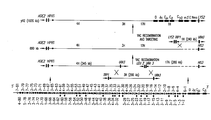
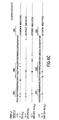
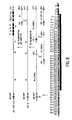
- FIGS. 1A-1B are a schematic representation of the reconstructed human heavy chain and human kappa light chain loci YACs introduced into preferred mice in accordance with the invention.
- YACs spanning the human heavy chain (1H, 2H, 3H, and 4H) and the human kappa light chain proximal (1K, 2K, and 3K) loci were cloned from human-YAC libraries.
- the locations of the different YACs with respect to the human Ig loci (adopted from Cook and Tomlinson, 1995, and Cox et al., 1994), their sizes, and non-Ig sequences are indicated (not shown to scale).
- the YACs were recombined into yeast in a two-step procedure (see Materials and Methods) to reconstruct the human heavy and kappa light chain YACs.
- yH2 the human heavy chain containing YAC, was further retrofitted with a human ⁇ 2 gene sequence.
- yK2 was the human kappa light chain containing YAC.
- V H segments are classified as genes with open reading frame ⁇ , pseudogenes ⁇ , and unsequenced genes ⁇ .
- V ⁇ segments are classified as genes with open reading frames ⁇ , and pseudogenes ⁇ .
- the V genes that we have found to be utilized by the XenoMouse II are marked (*)
- the V H gene region contained on yH2 is marked by arrows.
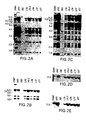
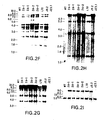
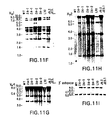
- FIGS. 2A-2I show a series of Southern Blot analyses and characterizations of the human heavy chain YAC, yH2, integrated in ES cells and in XenoMouse strains.
- FIG. 2A-2E show a series of Southern Blot analyses of EcoRI ( FIGS. 2A, 2C ) and BamHI ( FIGS.
- FIG. 2F-2I show a series of Southern Blot analyses of EcoRI ( FIG. 2F, 2G ) and BamHI ( 2 H, 2 I) digested DNA (10 ⁇ g) that was prepared from the tails of wildtype (WT, 129 ⁇ B57BL/6J), XM2A-1, and XM2A-2 (2 individual offspring) mice or from the parental yH2-containing ES cell lines L10 (slightly underloaded relative to other samples), J9.2, and yK2-containing ES cell line J23.1.
- the probes used were human V H 1 ( FIG. 2F ), V H 4 ( FIG. 2G ), human ⁇ -2 ( FIG. 2H ), and mouse 3′-enhancer ( FIG. 2I , the 5 kb band represents the endogenous mouse 3′-enhancer fragment). Fragment sizes of molecular weight markers (in kb) are indicated.
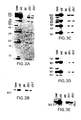
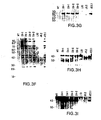
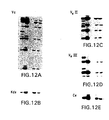
- FIGS. 3A-3I show a series of Southern Blot analyses characterizing the human kappa light chain YAC, yK2, integrated in ES cells and in XenoMouse 2A Strains.
- FIG. 3A -E show a series of Southern Blot analyses of EcoRI ( FIGS. 3A, 3C , 3 D) and BamHI ( FIGS.
- 3B, 3E digested DNA (2 ⁇ g) prepared from CGM1 cell line (Brownstein et al., 1989, supra), yK2 YAC (0.5 ⁇ g YAC DNA added to 2 ⁇ g of 3B1 DNA), unmodified E14TG.3B1 (3B1), and yK2-containing ES cell lines: J23.1 and J23.7.
- the probes used were human Va ( FIG. 3A ), Kde ( FIG. 3B ), V ⁇ II ( FIG. 3C ), V ⁇ III ( FIG. 3D ), and C ⁇ ( FIG. 3E ).
- FIG. 3A human Va
- Kde FIG. 3B
- V ⁇ II FIG. 3C
- V ⁇ III FIG. 3D
- C ⁇ FIG. 3E
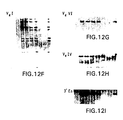
- 3F-3I show a series of Southern Blot analyses of EcoRI-digested DNA (2 ⁇ g) that was prepared from the tails of wildtype (WT, 129 ⁇ B6), XM2A-1, and XM2A-2 (2 individual offspring) mice or from the parental yH2-containing ES cell lines L10 (slightly underloaded relative to other samples), J9.2, and yK2-containing ES cell line J23.1.
- the probes that were used were human V ⁇ I ( FIG. 3F ), V ⁇ IV ( FIG. 3G ), V ⁇ VI ( FIG. 3H ) and 3′-enhancer ( FIG. 3I ). Fragment sizes of molecular weight markers (in kb) are indicated.
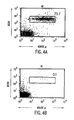
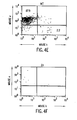
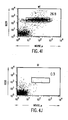
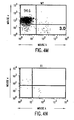
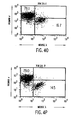
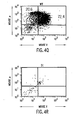
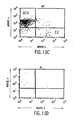
- FIGS. 4A-4T show B-cell reconstitution and surface expression of human ⁇ , ⁇ , and ⁇ chains on XenoMouse-derived B-cells and shows flow cytometry analysis of peripheral blood ( FIG. 4A-4H ) and spleen ( FIG. 4I-4T ) lymphocytes from wildtype mice (WT), double inactivated mice (DI), and XenoMouse strains 2A-1 and 2A-2 (XM2A-1, XM2A-2).
- WT wildtype mice
- DI double inactivated mice
- XM2A-1, XM2A-2 XM2A-1, XM2A-2
- the percentage of positively-stained cells is shown in each quadrant. Isolation and staining of cells were performed as described in Materials and Methods. Populations of human ⁇ + and mouse ⁇ + cells were determined after first gating for B220 + ⁇ + populations in the indicated region. Populations of ⁇ + and ⁇ + cells were determined after first gating for B220 + cells. The percentage of positive cells within a region or quadrant is indicated. The FACS profiles shown are representative of several experiments performed on each of the strains.
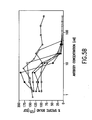
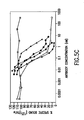
- FIG. 5A-5C show that XenoMouse-derived human antibodies block the binding of their specific antigens to cells.
- FIG. 5A shows the inhibition of labeled [I 125 ] IL-8 binding to human neutrophils by the mouse anti-human IL-8 antibody (R&D Systems) ( ⁇ ) and the fully human Mabs D1.1 ( ⁇ ), K2.2 ( ⁇ ), K4.2 ( ⁇ ), and K4.3 ( ⁇ ). The background binding of labeled [I 125 ]IL-8 in the absence of antibody was 2657 cpm.
- FIG. 5A shows the inhibition of labeled [I 125 ] IL-8 binding to human neutrophils by the mouse anti-human IL-8 antibody (R&D Systems) ( ⁇ ) and the fully human Mabs D1.1 ( ⁇ ), K2.2 ( ⁇ ), K4.2 ( ⁇ ), and K4.3 ( ⁇ ).
- the background binding of labeled [I 125 ]IL-8 in the absence of antibody was 2657 cpm.
- FIG. 5B shows the inhibition of labeled [I 125 ]EGF to its receptors on A431 cells by mouse anti-human EGFR antibodies 225 and 528 ( ⁇ , ⁇ , respectively; Calbiochem) and the fully human antibodies E1.1 ( ⁇ ), E2.4 ( ⁇ ), E2.5 ( ⁇ ) and E2.11 ( ⁇ ).
- the background binding of [I 125 ]EGF in the absence of antibodies was 1060 cpm.
- FIG. 5C shows inhibition of labeled [I 125 ] TNF- ⁇ binding to its receptors on U937 cells by the mouse anti-human TNF- ⁇ antibody (R&D Systems) ( ⁇ ) and fully human Mabs T22.1 ( ⁇ ), T22.4 ( ⁇ ), T22.8 ( ⁇ ), and T22.9 ( ⁇ ).
- the background binding of [I 125 ]TNF- ⁇ in the absence of antibody was 4010 cpm.
- FIGS. 6A-6D shows repertoire and somatic hypermutation in XenoMouse-derived fully human Mabs.
- the D and J genes of each antibody are indicated.
- the amino acid substitutions from the germline sequences are indicated in bold letters.
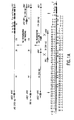
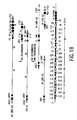
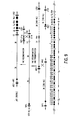
- FIG. 7 is a schematic diagram of the human heavy chain genome and the human kappa light chain genome.
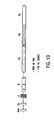
- FIG. 8 is another schematic diagram showing the construction of the yH2 (human heavy chain) YAC.
- FIG. 9 is another schematic diagram showing the construction of the yK2 (human kappa light chain) YAC.
- FIG. 10 is another schematic diagram showing the construction of the yK2 (human kappa light chain) YAC.
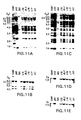
- FIGS. 11A-11I show a series of Southern Blot analyses demonstrating integration intact of the yH2 (human heavy chain) YAC into ES cells and into the mouse genome. Detailed discussion is provided in connection with FIGS. 2A-2I .
- FIGS. 12A-12I show a series of Southern Blot analyses demonstrating integration intact of the yK2 (human kappa light chain) YAC into ES cells and into the mouse genome. Detailed discussion is provided in connection with FIGS. 3A-3I .
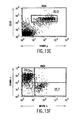
- FIGS. 13A-13F show B-cell reconstitution and surface expression of human ⁇ , ⁇ , and ⁇ chains and mouse ⁇ chains on XenoMouse-derived B-cells and shows flow cytometry analysis of peripheral blood. Further details are provided in connection with FIGS. 4A-4T .
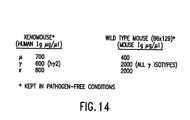
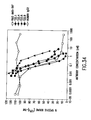
- FIG. 14 shows production levels of human antibodies by XenoMouse II strains in comparison to murine antibody production by wild type mice.
- FIG. 15 is a repertoire analysis of human heavy chain transcripts expressed in XenoMouse II strains.
- the V H nucleotide sequences have been assigned SEQ ID NOS 30-41, respectively, in order of appearance.
- the 10-mer in column N (first instance) has been assigned SEQ ID NO: 42.
- the 4 th , 5 th , 6 th , 9 th and 11 th nucleotide sequences in column D H have been assigned SEQ ID NOS 43, 44, 45, 46 and 47, respectively.
- the first and third nucleotide sequences in column N (second instance) have been assigned SEQ ID NOS 48 and 49, respectively.
- the nucleotide sequences in column J H have been assigned SEQ ID NOS 50-61, respectively, in order of appearance.
- FIG. 16 is a repertoire analysis of human kappa light chain transcripts expressed in XenoMouse II strains.
- the V H sequences have been assigned SEQ ID NOS 62-69, respectively, in order of appearance.
- the J ⁇ sequences have been assigned SEQ ID NOS 70-77, respectively, in order of appearance.
- FIG. 17 is another depiction of the diverse utilization of human V H and V ⁇ genes that have been observed as utilized in XenoMouse II strains.
- FIG. 18 shows the titers of human antibody production in XenoMouse II strains.
- FIG. 19 is a depiction of gene utilization of anti-IL-8 antibodies derived from XenoMouse II strains.
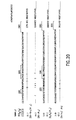
- FIG. 20 shows heavy chain amino acid sequences of anti-IL-8 antibodies derived from XenoMouse II strains.
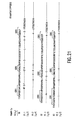
- FIG. 21 shows kappa light chain amino acid sequences of anti-IL-8 antibodies derived from XenoMouse II strains.
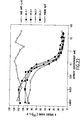
- FIG. 22 shows blockage of IL-8 binding to human neutrophils by human anti-IL-8 antibodies derived from XenoMouse II strains.
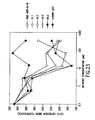
- FIG. 23 shows inhibition of CD11b expression on human neutrophils by human anti-IL-8 antibodies derived from XenoMouse II strains.
- FIG. 24 shows inhibition of IL-8 induced calcium influx by human anti-IL-8 antibodies derived from XenoMouse II strains.
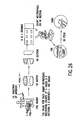
- FIG. 26 is a schematic diagram of a rabbit model of human IL-8 induced skin inflammation.
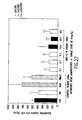
- FIG. 27 shows the inhibition of human IL-8 induced skin inflammation in the rabbit model of FIG. 26 with human anti-IL-8 antibodies derived from XenoMouse II strains.
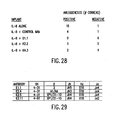
- FIG. 28 shows inhibition of angiogenesis of endothelial cells on a rat corneal pocket model by human anti-IL-8 antibodies derived from XenoMouse II strains.
- FIG. 29 is a depiction of gene utilization of human anti-EGFR antibodies derived from XenoMouse II strains.
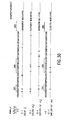
- FIG. 30 shows heavy chain amino acid sequences of human anti-EGFR antibodies derived from XenoMouse II strains.
- FIG. 31 shows blockage EGF binding to A431 cells by human anti-EGFR antibodies derived from XenoMouse II strains.
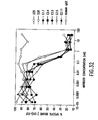
- FIG. 32 shows inhibition of EGF binding to SW948 cells by human anti-EGFR antibodies derived from XenoMouse II strains.
- FIG. 33 shows that human anti-EGFR antibodies derived from XenoMouse II strains inhibit growth of SW948 cells in vitro.
- FIG. 34 shows inhibition of TNF- ⁇ binding to U937 cells through use of human anti-TNF- ⁇ antibodies derived from XenoMouse II strains.
- the present invention thus provides the first demonstration of reconstruction of the large and complex human Ig loci on YACs and the successful introduction of megabase-sized YACs into mice to functionally replace the corresponding mouse loci.
- mice The following mouse strains are described and/or utilized herein:
- Double Inactivated (DI) Strain The DI strain of mice are mice that do not produce functional endogenous, mouse, Ig. In preferred embodiments, the DI mice possess an inactivated mouse J H region and an inactivated mouse C ⁇ region. The construction of this strain is discussed extensively elsewhere. For example, the techniques utilized for generation of the DI strains are described in detail in U.S. patent application Ser. Nos. 07/466,008, filed Jan. 12, 1990, 07/610,515, filed Nov. 8, 1990, 07/919,297, filed Jul. 24, 1992, 08/031,801, filed Mar. 15, 1993, 08/112,848, filed Aug. 27, 1993, 08/234,145, filed Apr. 28, 1994, 08/724,752, filed Oct. 2, 1996.
- XenoMouse I Strain The design, construction, and analysis of the XenoMouse I strain was discussed in detail in Green et al., Nature Genetics, 7:13-21 (1994). Such mice produced IgM ⁇ antibodies against a DI background. The mice showed improved B-cell function when compared to the DI strain of mice which have little to no B-cell development. While XenoMouse I strains of mice were capable of mounting a sizeable immune response to antigenic challenge, there appeared to be inefficient in their production of B-cells and possessed a limited response to different antigens which apparently was related to their limited V-gene repertoire.
- the L6 strain is a mouse producing IgM ⁇ antibodies against a DI background of endogenous mouse Ig.
- L6 mice contain an inserted human heavy chain and an inserted human kappa light chain.
- the L6 strain is generated through breeding of a mouse containing a heavy chain insert against a double inactivated background (L6H) and a mouse having a kappa light chain insert against a double inactivated background (L6L).
- the heavy chain insert comprises an intact approximately 970 kb human DNA insert from a YAC containing approximately 66 V H segments, starting at V H 6-1 and ending at V H 3-65, and including the major D gene clusters (approximately 32), J H genes (6), the intronic enhancer (Em), C ⁇ , and through about 25 kb past C ⁇ , in germline configuration.
- the light chain insert comprises an intact approximately 800 kb human DNA insert from a YAC which contains approximately 32 V ⁇ genes starting at V ⁇ -B3 and ending at V ⁇ -Op11 .
- the 800 kb insert contains a deletion of approximately 100 kb starting at V ⁇ -Lp-13 and ending at V ⁇ -Lp-5 .
- the DNA is in germline configuration from V ⁇ -Lp-13 to 100 kb past V ⁇ -Op-1 , and also contains the J ⁇ genes, the intronic and 3′ enhancers, the constant C ⁇ gene, and Kde.
- the L6H and L6L mice have been shown to access the full spectrum of the variable genes incorporated into their genome. It is expected that the L6 mice will similarly access the full spectrum of variable genes in their genome.
- L6 mice will exhibit predominant expression of human kappa light chain, a large population of mature B-cells, and normal levels of IgM ⁇ human antibodies. Such mice will mount a vigorous human antibody response to multiple immunogens, ultimately yielding antigen-specific fully human Mabs with subnanomolar affinities.
- mice represent our second generation XenoMouseTM strains equipped with germline configuration megabase-sized human Ig loci, against a DI background, such that the mice do not produce functional endogenous Ig.
- the mice are equivalent in construction to the L6 strain, but additionally include the human ⁇ 2 gene with its entire switch and regulatory sequences and the mouse 3′ enhancer in cis.
- mice contain an approximately 1020 kb heavy and an approximately 800 kb kappa light chain loci, reconstructed on YACs, which include the majority of the human variable region genes, including heavy chain genes (approximately 66 V H ) and kappa light chain genes (approximately 32 V ⁇ ), human heavy constant region genes ( ⁇ , ⁇ , and ⁇ ) and kappa constant region genes (C ⁇ ), and all of the major identified regulatory elements. These mice have been shown to access the full spectrum of the variable genes incorporated into their genome.
- mice exhibit efficient class switching and somatic hypermutation, predominant expression of human kappa light chain, a large population of mature B-cells, and normal levels of IgM ⁇ and IgG ⁇ human antibodies.
- Such mice mount a vigorous human antibody response to multiple immunogens, including human IL-8, human EGF receptor (EGFR), and human tumor necrosis factor- ⁇ (TNF- ⁇ ), ultimately yielding antigen-specific fully human Mabs with subnanomolar affinities.
- EGFR human EGF receptor
- TNF- ⁇ tumor necrosis factor- ⁇
- the XenoMouse II strain appears to undergo mature B-cell development and mount powerful adult-human-like immune responses to antigenic challenge.
- the L6 strain as predicted from the data in connection with L6L and L6H mice, also appear to undergo mature B-cell development and mount powerful adult-human-like immune responses to antigenic challenge.
- DI mice are compared to XenoMouse I strains and DI and XenoMouse I strains are compared to L6 and XenoMouse II strains, a markedly different B-cell development profile is observed.
- variable region sequences introduced into the animals are essential to the induction B-cell maturation and development and the generation of an adult-human-like immune response.
- the strains provide a valuable tool for studying the nature of human antibodies in the normal immune response, as well as the abnormal response characteristic of autoimmune disease and other disorders.
- the human heavy chain genome includes approximately 95 functional genes which encode variable regions of the human heavy chain of immunoglobulin molecules.
- the human light chain genome includes approximately 40 genes on its proximal end which encode variable regions of the human kappa light chain of immunoglobulin molecules.
- transgenic mice having a substantial portion of the human Ig locus, preferably including both a human heavy chain locus and a human kappa light chain locus.
- greater than 10% of the human V H and V ⁇ genes are utilized. More preferably, greater than about 20%, 30%, 40%, 50%, 60%, or even 70% or greater of V H and V ⁇ genes are utilized.
- constructs including 32 genes on the proximal region of the V ⁇ light chain genome are utilized and 66 genes on the V H portion of the genome are utilized.
- genes may be included either sequentially, i.e., in the order found in the human genome, or out of sequence, i.e., in an order other than that found in the human genome, or a combination thereof.
- an entirely sequential portion of either the V H or V ⁇ genome can be utilized, or various V genes in either the V H or V ⁇ genome can be skipped while maintaining an overall sequential arrangement, or V genes within either the V H or V ⁇ genome can be reordered, and the like.
- the entire inserted locus is provided in substantially germline configuration as found in humans. In any case, it is expected and the results described herein demonstrate that the inclusion of a diverse array of genes from the V H and V ⁇ genome leads to enhanced antibody specificity and ultimately to enhanced antibody affinities.
- mice include the entire D H region, the entire J H region, the human mu constant region, and can additionally be equipped with other human constant regions for the coding and generation of additional isotypes of antibodies.
- Such isotypes can include genes encoding ⁇ 1 , ⁇ 2 , ⁇ 3 , ⁇ 4 , ⁇ , ⁇ , and ⁇ and other constant region encoding genes with appropriate switch and regulatory sequences.
- switch and regulatory sequences can be appropriately utilized in connection with any particular constant region selection.
- mice in accordance with the invention such as the L6 and the XenoMouse II strains, offer substantial antibody diversity.
- mice are designed to have the capability of producing greater than 1 ⁇ 10 6 different heavy chain V-D-J combinations and kappa light chain V-J combinations, without accounting for N-additions or somatic mutation events.
- V-genes i.e., large and diverse numbers of V-genes
- qualitative selection of V-genes i.e., selection of particular V-genes
- Qualitative diversity refers to diversity in V-D-J rearrangements wherein junctional diversity and/or somatic mutation events are introduced.
- certain enzymes RAG-1, RAG-2, and possibly others are responsible for the cutting of the DNA representing the coding regions of the antibody genes.
- Terminal deoxynucleotidyl transferase (Tdt) activity is upregulated which is responsible for N-terminal additions of nucleotides between the V-D and D-J gene segments. Similar enzymes and others (SCID and other DNA repair enzymes) are responsible for the deletion that occurs at the junctions of these coding segments. With respect to junctional diversity, both N-addition events and formation of the complementarity determining region 3 (CDR3) are included within such term. As will be appreciated, CDR3 is located across the D region and includes the V-D and D-J junctional events. Thus, N-additions and deletions during both D-J rearrangement and V-D rearrangement are responsible for CDR3 diversity.
- CDR3 complementarity determining region 3
- murine N-addition lengths and CDR3 lengths are generally shorter than typical human N-addition lengths and CDR3 lengths.
- Such groups have reported that, in humans, N-additions of about 7.7 bases in length, on average, are typically observed. Yamada et al. (1991). Mouse-like N-additions are more often on the order of about 3 bases in length, on average. Feeney et al. (1990).
- human-like CDR3 lengths are longer than mouse-like CDR3's. In man CDR3 lengths of between 2 and 25 residues, with an average of 14 residues, is common. In mice, some groups have reported shorter average CDR3 lengths.
- junctional diversity created by N-additions and CDR3 additions play a clear role developing antibody specificity.
- V-D-J gene sequences show N-addition lengths that are comparable to expected adult-human N-addition lengths.
- amino acid sequences across the open reading frame (ORF) corresponding to CDR3 sequences show CDR3 lengths that are comparable to expected adult-human CDR3 lengths.
- mice in accordance with the present invention possess enhanced affinities.
- Such data includes comparisons between mice in accordance with the invention and the XenoMouse I strains, as well as consideration of the published results of GenPharm International and the MRC.
- mice In connection with the XenoMouse I strains, as mentioned above, such mice possessed inefficient B-cell production and a limited response to different antigens. Such result appeared related in part to the limited V-gene repertoire. Similarly, results reported by GenPharm International and the MRC indicate a limited response to diverse antigens.
- association rates results in association rates (ka in M ⁇ 1 S ⁇ 1 ) of greater than about 0.50 ⁇ 10 ⁇ 6 , preferably greater than 2.00 ⁇ 10 ⁇ 6 , and more preferably greater than about 4.00 ⁇ 10 ⁇ 6 ; dissociation rates (kd in S ⁇ 1 ) of greater than about 1.00 ⁇ 10 ⁇ 4 , preferably greater than about 2.00 ⁇ 10 ⁇ 4 , and more preferably greater than about 4.00 ⁇ 10 ⁇ 4 ; and dissociation constant (in M) of greater than about 1.00 ⁇ 10 ⁇ 10 , preferably greater than about 2.00 ⁇ 10 ⁇ 10 , and more preferably greater than about 4.00 ⁇ 10 ⁇ 10 .
- mice additionally do not produce functional endogenous immunoglobulins.
- This is accomplished in a preferred embodiment through the inactivation (or knocking out) of endogenous heavy and light chain loci.
- the mouse heavy chain J-region and mouse kappa light chain J-region and C ⁇ -region are inactivated through utilization of homologous recombination vectors that replace or delete the region.
- B-cell development is reviewed in Klaus B Lymphocytes (IRL Press (1990)) and Chapters 1-3 of Immunoglobulin Genes (Academic Press Ltd. (1989)), the disclosures of which are hereby incorporated by reference.
- blood cell development including B- and T-cell lymphocytes, originate from a common pluripotent stem cell.
- the lymphocytes then, evolve from a common lymphoid progenitor cell.
- B-cell initiation shifts from the liver to the bone marrow where it remains throughout the life of the mammal.
- the first generally recognizable cell is a pro-pre-B-cell which is found in the bone marrow.
- a pro-pre-B-cell which is found in the bone marrow.
- Such a cell has begun heavy chain V-D-J rearrangement, but does not yet make protein.
- the cell then evolves into a large, rapidly dividing, pre-B-cell I which is a cytoplasmically ⁇ + cell.
- This pre-B-cell I stops dividing, shrinks, and undergoes light chain V-J rearrangement becoming a pre-B-cell II which expresses surface IgM, which leave the marrow as immature B-cells.
- B-cell differentiation and development can be monitored and/or tracked through the use of surface markers.
- the B220 antigen is expressed in relative abundance on mature B-cells in comparison to pre-B-cells I or II.
- cells that are B220 + and surface IgM + ⁇ +
- cells that are B220 + and surface IgM + ⁇ +
- cells can be screened for surface IgD expression ( ⁇ + ).
- Another antigen, heat stable antigen is expressed by pre-B-cells II as they transition to the periphery (i.e., as they become ⁇ + and/or ⁇ + , ⁇ + ).
- B-cell markers such as those mentioned above, development and differentiation of B-cells can be monitored and assessed.
- mice having a knock-out background of endogenous Ig that is to say that mice that contain a human Ig locus and a functionally inactivated endogenous heavy chain Ig locus produce human antibodies at a rate of approximately 100 to 1000 fold as efficiently as mice that only contain a human Ig locus and are not inactivated for the endogenous locus.
- mice undergo efficient and effective isotype switching from the human transgene encoded mu isotype to the transgene encoded gamma-2 isotype.
- XenoMouse II strains that contain and encode the human gamma-4 constant region.
- mice in accordance with the invention can additionally be equipped with other human constant regions for the generation of additional isotypes.
- Such isotypes can include genes encoding ⁇ 1 , ⁇ 2 , ⁇ 3 , ⁇ 4 , ⁇ , ⁇ , ⁇ , and other constant region encoding genes.
- Alternative constant regions can be included on the same transgene, i.e., downstream from the human mu constant region, or, alternatively, such other constant regions can be included on another chromosome. It will be appreciated that where such other constant regions are included on the same chromosome as the chromosome including the human mu constant region encoding transgene, cis-switching to the other isotype or isotypes can be accomplished. On the other hand, where such other constant region is included on a different chromosome from the chromosome containing the mu constant region encoding transgene, trans-switching to the other isotype or isotypes can be accomplished. Such arrangement allows tremendous flexibility in the design and construction of mice for the generation of antibodies to a wide array of antigens.
- any human constant region of choice can be readily incorporated into mice in accordance with the invention without undue experimentation.
- Such constant regions can be associated with their native switch sequences (i.e., a human ⁇ 1,2,3, or 4 constant region with a human ⁇ 1,2,3, or 4 switch, respectively) or can be associated with other switch sequences (i.e., a human ⁇ 4 constant region with a human ⁇ 2 switch).
- Various 3′ enhancer sequences can also be utilized, such as mouse, human, or rat, to name a few.
- other regulatory sequences can also be included.
- B-cells can be screened for secretion of “chimeric” antibodies.
- the L6 mice in addition to producing fully human IgM antibodies, produce antibodies having fully human heavy chain V, D, J regions coupled to mouse constant regions, such as a variety of gammas (i.e., mouse IgG1,2,3,4) and the like.
- mouse constant regions such as a variety of gammas (i.e., mouse IgG1,2,3,4) and the like.
- human constant regions can be included on the antibodies through in vitro isotype switching techniques well known in the art.
- fragments i.e., F(ab) and F(ab′) 2 fragments
- fragments i.e., F(ab) and F(ab′) 2 fragments
- the most critical factor to antibody production is specificity to a desired antigen or epitope on an antigen.
- Class of the antibody thereafter, becomes important according to the therapeutic need.
- the therapeutic index of an antibody be enhanced by providing a particular isotype or class? Consideration of that question raises issues of complement fixation and the like, which then drives the selection of the particular class or isotype of antibody.
- Gamma constant regions assist in affinity maturation of antibodies.
- the inclusion of a human gamma constant region on a transgene is not required to achieve such maturation. Rather, the process appears to proceed as well in connection with mouse gamma constant regions which are trans-switched onto the mu encoded transgene.
- the 17H YAC was cloned from the GM1416 YAC library and determined to contain 130 kb of heavy chain variable sequences and a 150 kb chimeric region at its 3′ end Matsuda et. al., 1993. 2K and 3K YACs were recovered from the CHEF library using V ⁇ II-specific primer (Albertsen et al., 1990).
- YAC targeting and recombination Standard methods foryeast growth, mating, sporulation, and phenotype testing were employed (Sherman et al, 1986). Targeting of YAC's and YAC vector arms with yeast and mammalian selectable markers, to facilitate the screening of YAC recombinants in yeast of YAC integration into cells, was achieved by lithium acetate transformation (Scheistl and Geitz (1989). After every targeting or recombination step the modified YAC(s) was analyzed by pulsed field gel electrophoresis and standard Southern Blots to determine the integrity of all sequences.
- YAC targeting vectors were used for the interconversion of centric and acentric arms to reorient 17H and to retrofit its 5′ arm with LEU2 and URA3 genes and its 3′ arm with the HIS3 gene. See FIG. 1 a and Mendez et al., 1993.
- the 4H centric arm was retrofitted with the yeast ADE2 gene and the human HPRT selectable markers.
- a diploid yeast strain was created and selected in which all three YACs 17H, 3H, and 4H were present, intact, and stably maintained.
- a three-way homologous recombination between the YAC overlapping regions was induced by sporulation and the desired recombinant was found by the selection of the outer yeast selectable markers (ADE2 and HIS3) and negative selection (loss) of the internal marker URA3.
- the successful recombination created a 880 kb YAC containing 80% of the IgH variable region, starting at V H 2-5 and extending 20 kb 5′ of the V H 3-65 gene.
- 1H was retrofitted with pICL, which adds the LYS2 gene to the centric arm (Hermanson et al., 1991).
- a diploid strain was selected containing both 1H and the 880 kb YAC.
- YAC-yeast recombination was carried out.
- an intact 970 kb YAC consisting of approximately 66 V H segments, starting at V H 6-1 and ending at V H 3-65 was found.
- the YAC also contained the major D gene clusters, J H genes, the intronic enhancer (E ⁇ ), C ⁇ , up to 25 kb past C ⁇ , in germline configuration.
- This 970 kb YAC was then retrofitted with a targeting vector including a 23 kb EcoRI genomic fragment of the human ⁇ -2 gene, including its switch and regulatory elements, a 7 kb XbaI fragment of the murine heavy chain 3′ enhancer, neomycin gene driven by the metallothionine promoter (MMTNeo), and the yeast LYS2 gene.
- This vector while bringing in these sequences on the 3′ YAC arm, disrupts the URA3 gene.
- yK2 YAC As a first step toward creating yK2 YAC, by standard yeast mating a diploid yeast strain was selected in which retrofitted 1K and 3K YACs were both present, intact, and stably maintained. Using the same process as described in connection with the IgH construction, YAC-yeast recombination was carried out. Through use of positive selection for the outer yeast markers (LYS2, TRP1) and the screening for the loss of internal markers (URA3, TRP1), an intact 800 kb recombinant product was found which contained 32 V ⁇ starting at V ⁇ -B3 and ending at V ⁇ -Op11 .
- LYS2, TRP1 positive selection for the outer yeast markers
- UUA3, TRP1 the screening for the loss of internal markers
- the 800 kb YAC contains a deletion of approximately 100 kb starting at V ⁇ -Lp-13 and ending at V ⁇ -Lp-5 . However, the YAC is in germline configuration from V ⁇ -Lp-13 to 100 kb past V ⁇ -Op-1 .
- the YAC also contains J ⁇ , the intronic and 3′ enhancers, the constant C ⁇ , and Kde.
- YAC introduction into ES cells and mice YAC-containing yeast spheroplasts were fused with E14.TG3B1 ES cells as described (Jakobovits et al., 1993a; Green et al., 1994). HAT-resistant colonies were expanded for analysis.
- YAC integrity was evaluated by Southern Blot analysis using protocols and probes described in Berman et al., (1988) and Mendez et al., (1994) and hybridization conditions as described in Gemmil et al., (1991). Chimeric mice were generated by microinjection of ES cells into C57BL/6 blastocysts. YAC-containing offspring were identified by PCR analysis of tail DNA as described (Green et al., 1994).
- YAC integrity was evaluated by Southern Blot analysis using probes and conditions previously described, except that the blot probed with human V H 3 was washed at 50° C.
- Peripheral blood and spleen lymphocytes obtained from 8-10 week old XenoMice and control mice were purified on Lympholyte M (Accurate) and treated with purified anti-mouse CD32/CD16 Fc receptor (Pharmingen, 01241D) to block non-specific binding to Fc receptors, stained with antibodies and analyzed on a FACStar PLUS (Becton Dickinson, CELLQuest software).
- APC
- XenoMice (8 to 10 weeks old) were immunized intraperitoneally with 25 ⁇ g of recombinant human IL-8 or with 5 ⁇ g TNF- ⁇ (Biosource International) emulsified in complete Freund's adjuvant for the primary immunization and in incomplete Freund's adjuvant for the additional immunizations carried out at two week intervals.
- TNF- ⁇ Biosource International
- XenoMice were immunized intraperitoneally with 2 ⁇ 10 7 A431 (ATCC CRL-7907) cells resuspended in phosphate buffered saline (PBS). This dose was repeated three times.
- mice received a final injection of antigen or cells in PBS.
- Spleen and lymph node lymphocytes from immunized mice were fused with the non-secretory myeloma NSO-bcl2 line (Ray and Diamond, 1994), and were subjected to HAT selection as previously described (Galfre and Milstein, 1981).
- ELISA assay ELISA for determination of antigen-specific antibodies in mouse serum and in hybridoma supernatants were carried out as described (Coligan et al., 1994) using recombinant human IL-8 and TNF-A and affinity-purified EGFR from A431 cells (Sigma, E-3641) to capture the antibodies.
- the concentration of human and mouse immunoglobulins were determined using the following capture antibodies: rabbit anti-human IgG (Southern Biotechnology, 6145-01), goat anti-human Ig ⁇ (Vector Laboratories, AI-3060), mouse anti-human IgM (CGI/ATCC, HB-57), for human ⁇ , ⁇ , and ⁇ Ig, respectively, and goat anti-mouse IgG (Caltag, M 30100), goat anti-mouse Ig ⁇ (Southern Biotechnology, 1050-01), goat anti-mouse IgM (Southern Biotechnology, 1020-01), and goat anti-mouse ⁇ (Southern Biotechnology, 1060-01) to capture mouse ⁇ , ⁇ , ⁇ , and ⁇ Ig, respectively.
- the detection antibodies used in ELISA experiments were goat anti-mouse IgG-HRP (Caltag, M-30107), goat anti-mouse Ig ⁇ -HRP (Caltag, M 33007), mouse anti-human IgG2-HRP (Southern Biotechnology, 9070-05), mouse anti-human IgM-HRP (Southern Biotechnology, 9020-05), and goat anti-human kappa-biotin (Vector, BA-3060).
- 125 I-labeled human IL-8 (1.5 ⁇ 10 ⁇ 11 M or 3 ⁇ 10 ⁇ 11 M) was incubated with purified anti-IL-8 human antibodies at varying concentrations (5 ⁇ 10 ⁇ 13 M to 4 ⁇ 10 ⁇ 9 M) in 200 ⁇ l of PBS with 0.5% BSA. After 15 hrs. incubation at room temperature, 20 ⁇ l of Protein A Sepharose CL-4B in PBS (1/1, v/v) was added to precipitate the antibody-antigen complex. After 2 hrs.
- the antibody- 125 I-IL-8 complex bound to Protein A Sepharose was separated from free 125 I-IL-8 by filtration using 96-well filtration plates (Millipore, Cat. No. MADVN65), collected into scintillation vials and counted. The concentration of bound and free antibodies was calculated and the binding affinity of the antibodies to the specific antigen was obtained using Scatchart analysis (2).
- Receptor binding assays The IL-8 receptor binding assay was carried out with human neutrophils prepared either from freshly drawn blood or from buffy coats as described (Lusti-Marasimhan et al., 1995). Varying concentrations of antibodies were incubated with 0.23 nM [ 125 I]IL-8 (Amersham, IM-249) for 30 min at 4° C. in 96-well Multiscreen filter plates (Millipore, MADV N6550) pretreated with PBS binding buffer containing 0.1% bovine serum albumin and 0.02% NaN 3 at 25° C. for 2 hours. 4 ⁇ 10 5 neutrophils were added to each well, and the plates were incubated for 90 min at 4° C.
- Binding assays for TNF receptor were performed in a similar manner as the IL-8 assays described above. However, the human monocyte line U937 was utilized instead of the neutrophil line used in connection with the IL-8 assays. Antibodies were preincubated with 0.25 nM [ 125 ]TNF (Amersham, IM-206). 6 ⁇ 10 5 U937 cells were placed in each well.
- the EGF receptor binding assay was carried out with A431 cells (0.4 ⁇ 10 6 cells per well) which were incubated with varying concentrations of antibodies in PBS binding buffer for 30 minutes at 4° C. 0.1 nM [ 125 I]EGF (Amersham, IM-196) was added to each well, and the plates were incubated for 90 min at 4° C. The plates were washed five times, air-dried and counted in a scintillation counter. Anti-EGFR mouse antibodies 225 and 528 (Calbiochem) were used as controls.
- a universal human V H primer MG-30 (CAGGTGCAGCTGGAGCAGTCIGG) (SEQ ID NO: 78) was used in conjunction with primers specific for the human C ⁇ (h ⁇ P2) or C ⁇ (h ⁇ P2) constant regions as previously described (Green et al., 1994), or the human ⁇ 2 constant region MG-40d; 5′-GCTGAGGGAGTAGAGTCCTGAGGA-3′ (SEQ ID NO: 79).
- PCR products were cloned into pCRII using a TA cloning kit (Invitrogen) and both strands were sequenced using Prism dye-terminator sequencing kits and an ABI 377 sequencing machine.
- Antibody Fab fragments were produced by using immobilized papain (Pierce). The Fab fragments were purified with a two step chromatographic scheme: HiTrap (Bio-Rad) Protein A column to capture Fc fragments and any undigested antibody, followed by elution of the Fab fragments retained in the flow-through on strong cation exchange column (PerSeptive Biosystems), with a linear salt gradient to 0.5 M NaCl.
- Fab fragments were characterized by SDS-PAGE and MALDI-TOF MS under reducing and non-reducing conditions, demonstrating the expected ⁇ 50 kD unreduced fragment and ⁇ 25 kDa reduced doublet. This result demonstrates the intact light chain and the cleaved heavy chain. MS under reducing conditions permitted the unambiguous identification of both the light and cleaved heavy chains since the light chain mass can be precisely determined by reducing the whole undigested antibody.
- the strategy that we utilized to reconstruct the human heavy chain and human kappa light chain variable regions was to, first, screen human-YAC libraries for YACs that spanned the large (megabase-sized) human Ig loci and, second, to recombine YACs spanning such regions into single YACs containing the desired loci predominantly in germline configuration.
- stepwise, YAC recombination scheme exploited the high frequency of meiotic-induced homologous recombination in yeast and the ability to select the desired recombinants by the yeast markers present on the vector arms of the recombined YACs (See FIG. 1 , and Green et al., supra.; see also Silverman et al., 1990 and denDunnen et al., 1992).
- YACs 1H, 2H, 3H, and 4H were used for reconstruction of the locus (See FIG. 1A ).
- Pulsed Field Gel Electrophoresis (PFGE) and Southern blot analysis confirmed the YACs to be in intact, germline configuration, with the exception of 150 kb at the 3′ end of YAC 2H which contained certain non-IgH sequences (See FIG.
- YAC 1H the YAC that was previously introduced into our first generation XenoMouseTM (Green et al., supra.; Mendez et al., 1995), is comprised of the human C ⁇ , C ⁇ , J H , and D H regions and the first 5 V H genes in germline configuration. The other three YACs cover the majority of the V H region, from V H 2-5 to V H 3-65, thus contributing approximately an additional 61 different V H genes. Prior to recombination, YAC 4H was retrofitted with an HPRT selectable marker.
- the four YACs (1H, 2H, 3H, and 4H) were recombined in yeast by a stepwise recombination strategy (See FIG. 1A ).
- Such recombination strategy generated a 980 kb recombinant YAC (See FIG. 1 ).
- Analysis of the YAC by PFGE and Southern blot analysis confirmed the presence of the human heavy chain locus from the C ⁇ region to 20 kb 5′ of the V H 3-65 gene in germline configuration. No apparent deletions or rearrangements were observed.
- YAC acentric arm was targeted with a vector bearing the complete human ⁇ 2 constant region, mouse 3′ enhancer, and the neomycin resistance gene, to yield the final 1020 kb heavy chain YAC, yH2.
- YAC yH2 contained the majority of the human variable region i.e., 66 out of the 82 V H genes, complete D H (32 genes), and J H (6 genes) regions and three different constant regions (C ⁇ , C ⁇ , and C ⁇ ) with their corresponding regulatory sequences (See FIG. 1A ). This was the heavy chain construct utilized for the production of our XenoMouse II strains.
- YAC 1K which had a length of approximately 180 kb, had previously been introduced into our first generation XenoMouseTM.
- Such YAC contained the kappa deleting element, (Kde), the kappa 3′ and intronic enhancers, C ⁇ , J ⁇ , and the three V ⁇ genes on the B cluster (Green et al., 1994; Mendez et al., 1995).
- YAC 2K (approximately 480 kb), and 3K (approximately 380 kb) together encompass most of the kappa chain proximal variable region on chromosome 2p.
- the proximal V ⁇ genes are the ones most commonly utilized humans (Weichold et al., 1993; Cox et al., 1994), the proximal region was the focus of our reconstruction strategy ( FIG. 1B ).
- the YACs described herein, yH2 and yK2 represent the first megabase-sized reconstructed human Ig loci to contain the majority of the human antibody repertoire, predominantly in germline configuration. This accomplishment further confirmed homologous recombination in yeast as a powerful approach for successful reconstruction of large, complex, and unstable loci.
- the selection of stable YAC recombinants containing large portions of the Ig loci in yeast provided us with the human Ig fragments required to equip the mice with the human antibody repertoire, constant regions, and regulatory elements needed to reproduce human antibody response in mice.
- mice were utilized for the generation of mice through appropriate breeding.
- YACs yH2 and yK2 were introduced into ES cells via fusion of YAC-containing yeast spheroplasts with HPRT-deficient E14.TG3B1 mouse ES cells as previously described (Jakobovits et al., 1993a; Green et al., 1994). HPRT-positive ES cell clones were selected at a frequency of 1 clone/15-20 ⁇ 10 6 fused cells and were analyzed for YAC integrity by Southern and CHEF blot analyses ( FIGS. 2A-2E ).
- ES cell clones derived from the fusion of yK2-containing yeast were similarly analyzed for YAC integrity, using probes specific for the human Kde, kappa 3′ and intronic enhancers, C ⁇ , J ⁇ , and all of the different V ⁇ families: V ⁇ I, V ⁇ II, V ⁇ III, V ⁇ IV, V ⁇ VI. Twenty clones of the sixty clones had intact and unaltered YAC, which represent 30% of total clones analyzed (data shown for two ES clones in FIGS. 3A-3E ). Varying amounts of yeast genomic sequences were detected in yH2 and yK2-ES cell clones (data not shown).
- mice from the YAC DNA containing ES cells were generated from the YAC DNA containing ES cells, followed by breeding.
- yH2- and yK2-bearing ES cell clones were expanded and microinjected into mouse C57BL/6J blastocysts (Green et al., 1994) and the chimeric males produced were evaluated for germline transmission.
- Offspring with transmitted YAC were identified by PCR analysis and the YAC integrity was confirmed by Southern blot analysis.
- the YAC was shown to be in intact form ( FIGS. 2F-2I , 3 F- 3 I). All seven microinjected yH2-ES clones and two out of eight yK2-ES clones were transmitted through the mouse germline.
- DI mice In order to generate mice that produced human antibodies to the exclusion of endogenous antibodies, yH2- or yK2-transgenic mice were bred with double-inactivated (DI) mouse strains.
- DI mouse strains are homozygous for gene targeted-inactivated mouse heavy and kappa chain loci and thus are deficient in antibody production (Jakobovits et al., 1993b; Green et al., 1994).
- yH2-transgenic mouse strains L10 and J9.2, and one of the yK2-transgenic mouse strains, J23.1 were bred with DI mice to generate mice bearing YACs on an homozygous inactivated mouse heavy and kappa chain background (yH2;DI, and yK2;DI).
- yH2;DI transgenic strains were bred with the yK2;DI transgenic strain to generate two XenoMouse II strains, 2A-1 (L10;J23.1;DI) and 2A-2 (J9.2;J23.1;DI), respectively, containing both heavy and light chain YACs on homozygous DI background.
- L10 is fully homozygous and J9.2 and J23.1 are in the process of being successfully bred to homozygosity.
- the L6 strain of mice were generated identically to the process described above in connection with the generation of the XenoMouse II strains. However, owing to a deletion event during the generation of the L6 ES cell line, the ES cell line, and, subsequently, the L6 mouse evolved without a portion of the sequence distal to C ⁇ , thus, eliminating the C ⁇ constant region and its regulatory sequences. Following completion of breeding, the L6 mice will contain the entire yK2 construct and the entire yH2 construct, except for the missing C ⁇ constant region.
- V H genes utilized are widely distributed over the entire variable region and represent four out of the seven V H families (Table III).
- the predominant utilization of V genes from V H3 and V H4 families is similar to the V H usage pattern in adult humans, which is proportional to family size (Yamada et al. 1991; Brezinshek et al., 1995).
- the predominant usage of J H4 is also reminiscent of that detected in human B-cells (Brezinshek et al., 1995). Addition of non-germline nucleotides (N-additions) at both V-D and D-J joinings, ranging from 1-12 bp, were also observed.
- CDR3s complementary determining regions 3
- Such N-additions produced complementary determining regions 3 (CDR3s) with lengths of from 8 to about 19 amino acid residues, which is very comparable to that observed in adults human B-cells (Yamada et al. 1991; Brezinshek et al., 1995).
- CDR3 lengths observed in the XenoMouse II are much longer than CDR3 lengths ordinarily observed in mice (Feeny, 1990).
- Tables III and IV below repertoire analyses of human heavy and kappa light chain transcripts expressed in XenoMouse II strains are presented.
- Human ⁇ , ⁇ , and ⁇ specific mRNAs were amplified by PCR, cloned and analyzed by sequencing as described in Materials and Methods.
- Table III shows a series of nucleotide sequences of 12 unique human heavy chain clones, divided into V H , D, J H and N segments, as identified by homology with published germline sequences (Materials and Methods). Each D segment assignment is based on at least 8 bases of homology.
- Table IV shows a series of nucleotide sequences of V-J junctions of 8 independent human ⁇ clones.
- sequences are divided into V ⁇ J ⁇ , and N segments and identified based on homology to published V ⁇ and J ⁇ sequences.
- N-additions and deletions (indicated as _) were determined by their lack of sequence homology to V, D, or J sequences.
- antigens were prepared to human IL-8 and human EGFR.
- the rationale for the selection of IL-8 and EGFR is as follows.
- IL-8 is a member of the C-X-C chemokine family. IL-8 acts as the primary chemoattractant for neutrophils implicated in many diseases, including ARDS, rheumatoid arthritis, inflammatory bowel disease, glomerulonephritis, psoriasis, alcoholic hepatitis, reperfusion injury, to name a few. Moreover, IL-8 is a potent angiogenic factor for endothelial cells. In FIGS. 22-28 , we demonstrate that human anti-IL-8 antibodies derived from XenoMouse II strains are effective in a inhibiting IL-8's actions in a number of pathways. For example, FIG.
- FIG. 22 shows blockage of IL-8 binding to human neutrophils by human anti-IL-8.
- FIG. 23 shows inhibition of CD11b expression on human neutrophils by human anti-IL-8.
- FIG. 24 shows inhibition of IL-8 induced calcium influx by human anti-IL-8 antibodies.
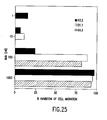
- FIG. 25 shows inhibition of IL-8 RB/293 chemotaxsis by human anti-IL-8 antibodies.
- FIG. 26 is a schematic diagram of a rabbit model of human IL-8 induced skin inflammation.
- FIG. 27 shows the inhibition of human IL-8 induced skin inflammation in the rabbit model of FIG. 26 with human anti-IL-8 antibodies.
- FIG. 28 shows inhibition of angiogenesis of endothelial cells on a rat corneal pocket model by human anti-IL-8 antibodies.
- EGFR is viewed as an anti-cancer target.
- EGFR is overexpressed, up to 100 fold, on a variety of cancer cells.
- Ligand (EGF and TNF) mediated growth stimulation plays a critical role in the initiation and progression of certain tumors.
- EGFR antibodies inhibit ligand binding and lead to the arrest of tumor cell growth, and, in conjunction with chemotherapeutic agents, induces apoptosis.
- a combination of EGFR Mabs resulted in tumor eradication in murine xenogeneic tumor models.
- Imclone has conducted Phase I clinical utilizing a chimeric Mab (C225) that proved to be safe.
- C225 chimeric Mab
- FIG. 30 shows heavy chain amino acid sequences of human anti-EGFR antibodies derived from XenoMouse II strains.
- FIG. 31 shows blockage EGF binding to A431 cells by human anti-EGFR antibodies.
- FIG. 32 shows inhibition of EGF binding to SW948 cells by human anti-EGFR antibodies.
- FIG. 33 shows that human anti-EGFR antibodies derived from XenoMouse II strains inhibit growth of SW948 cells in vitro.
- XenoMouse II pups were challenged each with one of three different antigen targets, human IL-8, human EGFR and human TNF- ⁇ .
- Antigens were administered in two different forms, either as soluble protein, in the case of IL-8 and TNF- ⁇ or expressed on the surface of cells (A431 cells), in the case of EGFR.
- ELISAs performed on sera from immunized mice indicated a strong antigen-specific human antibody (IgG, Ig ⁇ ) response with titers as high as 1:3 ⁇ 10 6 . Negligible mouse ⁇ response was detected.
- Hybridomas were derived from spleen or lymph node tissues by standard hybridoma technology and were screened for secretion of antigen-specific human Mabs by ELISA.
- IL-8 immunized XenoMouse II yielded a panel of 12 hybridomas, all secreting fully human (hIgG 2 ⁇ ) Mabs specific to human IL-8.
- Affinity measurements were performed by solid phase measurements of both whole antibody and Fab fragments using surface plasmon resonance in BIAcore and in solution by radioimmunoassay (Materials and Methods). As shown in Table V, affinity values measured for the four Mabs ranged from 1.1 ⁇ 10 9 to 4.8 ⁇ 10 10 M ⁇ 1 . While there was some variation in the techniques employed, affinity values for all four antibodies were consistently higher than 10 9 M ⁇ 1 .
- the described Xenomouse-derived hybridomas produced antibodies at concentrations in the range of 2-19 ⁇ g/ml in static culture conditions. Characterization of the purified antibodies on protein gels under non-reducing conditions revealed the expected apparent molecular weight of 150 kD for the IgG 2 ⁇ antibody. Under reducing conditions the expected apparent molecular weights of 50 kD for the heavy and 25 kD for the light chain were detected (data not shown).
- Table V shows affinity constants of XenoMouse-derived antigen-specific fully human Mabs.
- the affinity constants of XenoMouse-derived human IgG 2 ⁇ Mabs specific to IL-8, EGFR, and TNF- ⁇ were determined by BIAcore or by radioimmunoassay as described in Materials and Methods.
- the values shown for IL-8 and EGFR are representative of independent experiments carried out with purified antibodies, while the values shown for TNF- ⁇ are from experiments carried out with hybridoma supernatants.
- the sequences of the heavy and kappa light chain transcripts from the described IL-8 and EGFR-human Mabs were determined FIG. 6 and Figures [[ ]].
- the four IL-8-specific antibodies consisted of at least three different V H genes (V H4-34 /V H4-21 , V H3-30 , and V H5-51 ), four different D H segments (A1/A4, K1, ir3rc, and 21-10rc) and two J H (J H3 and J H4 ) gene segments.
- V H genes V H4-34 /V H4-21 , V H3-30 , and V H5-51
- D H segments A1/A4, K1, ir3rc, and 21-10rc
- J H J H3 and J H4
- Three different V ⁇ genes (012, 018, and B3) combined with J ⁇ 3 and J ⁇ 4 genes.
- Such diverse utilization shows that Xenomouse II is capable of producing a panel of anti-IL-8 neutralizing antibodies with diverse
- the sequences of antibodies selected for their ability to compete with Mab 225 showed relatively restricted V H and V ⁇ gene usage, with three antibodies, E1.1, E2.4 and E2.5 sharing the same V H gene (4-31) and E2.11 containing V H46-61 , which is highly homologous to V H4-31 .
- Different D (2, A1/A4, XP1) and J H (J H 3, J H 4, J H 5) segments were detected. All four antibodies were shown to share the same V ⁇ (018) gene. Three of them contained J ⁇ 4, and one, E2.5, contained J ⁇ 2.
- V H and V ⁇ hybridoma transcripts showed extensive nucleotide changes (7-17) from the corresponding germline segments, whereas no mutations were detected in the constant regions.
- Most of the mutations in V segments resulted in amino acid substitutions in the predicted antibody amino acid sequences (0-12 per V gene), many in CDR1 and CDR2 regions ( Figure _).
- the mutations which are shared by the heavy chain sequences of EGFR antibodies such as the Gly ⁇ Asp substitution in CDR1, shared by all antibodies, or Ser ⁇ Asn substitution in CDR2 and Val ⁇ Leu in the framework region 3 shared by three antibodies.
- This present application describes the first functional substitution of complex, megabase-sized mouse loci, with human DNA fragments equivalent in size and content reconstructed on YACs.
- the mouse humoral immune system was “humanized” with megabase-sized human Ig loci to substantially reproduce the human antibody response in mice deficient in endogenous antibody production.
- the levels of mature B-cells and human antibodies in Xenomouse II are the highest yet reported for Ig-transgenic mice, representing a several-fold increase over the levels shown for previous mice and approaching those of wildtype mice.
- the levels of the human IgG were more than 100 fold higher than those reported for mice bearing minilocus Ig transgenes with human ⁇ 1 gene (Lonberg et al., 1994).
- the more efficient class switching in Xenomouse II was likely the result of the inclusion of the entire switch regions, with all of their regulatory elements, as well as the additional control elements on yH2, which may be important to support and maintain proper class switching.
- the ratio of human ⁇ to mouse ⁇ light chain expression by circulating B-cells provides a useful internal measure of the utilization of the transgenic kappa chain locus. Whereas in mice containing one allele of smaller Ig YACs, an approximately equal distribution of human ⁇ and mouse ⁇ was observed, a significant preponderance of human ⁇ was detected in Xenomouse II strains. Moreover, in animals homozygous for yK2 possessed a ⁇ : ⁇ ratio that is identical to wild type mice.
- Xenomouse II strains exhibited highly increased antibody diversity with V, D, and J genes across the entire span of the loci accessed by the recombination mechanism and incorporated into mature antibodies. Once triggered by antigen binding, extensive somatic hypermutation occurs, leading to affinity maturation of the antibodies.
- V, D, J genes in Xenomouse II are available and utilized in a manner reminiscent of their utilization in humans, yielding an adult-like human antibody repertoire, which is different from the fetal-like, position-biased usage observed in Ig minigene-bearing mice (Taylor et al., 1992; Taylor et al., 1994; Tuaillon et al., 1993).
- the broad utilization of many of the functional V H and V ⁇ genes together with the multiplicity of antigens recognized by the mice underscores the importance of the large V gene repertoire to successfully reconstituting a functional antibody response.
- mice The ultimate test for the extent of reconstitution of the human immune response in mice is the spectrum of antigens to which the mice will elicit an antibody response and the ease with which antigen-specific high affinity Mabs can be generated to different antigens.
- mice engineered with smaller human Ig YACs or minigenes which yielded to date only a limited number of antigen-specific human Mabs (Lonberg et al., 1994; Green et al., 1994; Fishwild et al., 1996)
- Xenomouse II generated Mabs to all human antigens tested to date.
- Xenomouse II strains mounted a strong human antibody response to different human antigens, presented either as soluble proteins or expressed on the surfaces of cells.
- Fully human antibodies are expected to minimize the immunogenic and allergic responses intrinsic to mouse or mouse-derivatized Mabs and thus to increase the efficacy and safety of the administered antibodies.
- Xenomouse II offers the opportunity ofproviding a substantial advantage in the treatment of chronic and recurring human diseases, such as inflammation, autoimmunity, and cancer, which require repeated antibody administrations.
- the rapidity and reproducibility with which XenoMouse II yields a panel of fully human high affinity antibodies indicates the potential advance it offers over other technologies for human antibody production.
- Xenomouse II antibodies are high affinity fully intact immunoglobulins which can be produced from hybridomas without further engineering.
- mice can be applied towards humanization of other multi-gene loci, such as the T cell receptor or the major histocompatibility complex, that govern other compartments of the mouse immune system (Jakobovits, 1994).
- multi-gene loci such as the T cell receptor or the major histocompatibility complex
- Such mice would be valuable for elucidating the structure-function relationships of the human loci and their involvement in the evolution of the immune system.
Landscapes
- Health & Medical Sciences (AREA)
- Chemical & Material Sciences (AREA)
- Life Sciences & Earth Sciences (AREA)
- Organic Chemistry (AREA)
- General Health & Medical Sciences (AREA)
- Genetics & Genomics (AREA)
- Medicinal Chemistry (AREA)
- Immunology (AREA)
- Biophysics (AREA)
- Biochemistry (AREA)
- Molecular Biology (AREA)
- Proteomics, Peptides & Aminoacids (AREA)
- Engineering & Computer Science (AREA)
- Veterinary Medicine (AREA)
- Zoology (AREA)
- Animal Behavior & Ethology (AREA)
- Bioinformatics & Cheminformatics (AREA)
- Environmental Sciences (AREA)
- Biotechnology (AREA)
- Wood Science & Technology (AREA)
- General Engineering & Computer Science (AREA)
- Public Health (AREA)
- General Chemical & Material Sciences (AREA)
- Chemical Kinetics & Catalysis (AREA)
- Pharmacology & Pharmacy (AREA)
- Nuclear Medicine, Radiotherapy & Molecular Imaging (AREA)
- Biomedical Technology (AREA)
- Biodiversity & Conservation Biology (AREA)
- Animal Husbandry (AREA)
- Physics & Mathematics (AREA)
- Plant Pathology (AREA)
- Microbiology (AREA)
- Botany (AREA)
- Virology (AREA)
- Gastroenterology & Hepatology (AREA)
- Pain & Pain Management (AREA)
- Dermatology (AREA)
- Rheumatology (AREA)
- Transplantation (AREA)
- Peptides Or Proteins (AREA)
Abstract
Description
- This application is a continuation application of U.S. application Ser. No. 10/078,958, now allowed, which is a continuation application of U.S. application Ser. No. 08/759,620, filed Dec. 3, 1996, abandoned, the disclosures of which are incorporated herein by their entirety.
- 1. Field of the Invention
- The present invention relates to transgenic non-human animals that are engineered to contain human immunoglobulin gene loci. In particular, animals in accordance with the invention possess human Ig loci that include plural variable (VH and Vκ) gene regions. Advantageously, the inclusion of plural variable region genes enhances the specificity and diversity of human antibodies produced by the animal. Further, the inclusion of such regions enhances and reconstitutes B-cell development to the animals, such that the animals possess abundant mature B-cells secreting extremely high affinity antibodies.
- 2. Background of the Technology
- The ability to clone and reconstruct megabase-sized human loci in YACs and to introduce them into the mouse germline provides a powerful approach to elucidating the functional components of very large or crudely mapped loci as well as generating useful models of human disease. Furthermore, the utilization of such technology for substitution of mouse loci with their human equivalents could provide unique insights into the expression and regulation of human gene products during development, their communication with other systems, and their involvement in disease induction and progression.
- An important practical application of such a strategy is the “humanization” of the mouse humoral immune system. Introduction of human immunoglobulin (Ig) loci into mice in which the endogenous Ig genes have been inactivated offers the opportunity to study of the mechanisms underlying programmed expression and assembly of antibodies as well as their role in B-cell development. Furthermore, such a strategy could provide an ideal source for production of fully human monoclonal antibodies (Mabs)—an important milestone towards fulfilling the promise of antibody therapy in human disease. Fully human antibodies are expected to minimize the immunogenic and allergic responses intrinsic to mouse or mouse-derivatized Mabs and thus to increase the efficacy and safety of the administered antibodies. The use of fully human antibodies can be expected to provide a substantial advantage in the treatment of chronic and recurring human diseases, such as inflammation, autoimmunity, and cancer, which require repeated antibody administrations.
- One approach towards this goal was to engineer mouse strains deficient in mouse antibody production with large fragments of the human Ig loci in anticipation that such mice would produce a large repertoire of human antibodies in the absence of mouse antibodies. Large human Ig fragments would preserve the large variable gene diversity as well as the proper regulation of antibody production and expression. By exploiting the mouse machinery for antibody diversification and selection and the lack of immunological tolerance to human proteins, the reproduced human antibody repertoire in these mouse strains should yield high affinity antibodies against any antigen of interest, including human antigens. Using the hybridoma technology, antigen-specific human Mabs with the desired specificity could be readily produced and selected.
- This general strategy was demonstrated in connection with our generation of the first XenoMouse™ strains as published in 1994. See Green et al. Nature Genetics 7:13-21 (1994). The XenoMouse™ strains were engineered with 245 kb and 190 kb-sized germline configuration fragments of the human heavy chain loci and kappa light chain loci, respectively, which contained core variable and constant region sequences. Id. The human Ig containing yeast artificial chromosomes (YACs) proved to be compatible with the mouse system for both rearrangement and expression of antibodies, and were capable of substituting for the inactivated mouse Ig genes. This was demonstrated by their ability to induce B-cell development and to produce an adult-like human repertoire of fully human antibodies and to generate antigen-specific human Mabs. These results also suggested that introduction of larger portions of the human Ig loci containing greater numbers of V genes, additional regulatory elements, and human Ig constant regions might recapitulate substantially the full repertoire that is characteristic of the human humoral response to infection and immunization.
- Such approach is further discussed and delineated in U.S. patent application Ser. Nos. 07/466,008, filed Jan. 12, 1990, 07/610,515, filed Nov. 8, 1990, 07/919,297, filed Jul. 24, 1992, 07/922,649, filed Jul. 30, 1992, filed 08/031,801, filed Mar. 15, 1993, 08/112,848, filed Aug. 27, 1993, 08/234,145, filed Apr. 28, 1994, 08/376,279, filed Jan. 20, 1995, 08/430,938, Apr. 27, 1995, 08/464,584, filed Jun. 5, 1995, 08/464,582, filed Jun. 5, 1995, 08/463,191, filed Jun. 5, 1995, 08/462,837, filed Jun. 5, 1995, 08/486,853, filed Jun. 5, 1995, 08/486,857, filed Jun. 5, 1995, 08/486,859, filed Jun. 5, 1995, 08/462,513, filed Jun. 5, 1995, and 08/724,752, filed Oct. 2, 1996. See also European Patent No.,
EP 0 463 151 B1, grant published Jun. 12, 1996, International Patent Application No., WO 94/02602, published Feb. 3, 1994, International Patent Application No., WO 96/34096, published Oct. 31, 1996, and PCT Application No. PCT/US96/05928, filed Apr. 29, 1996. The disclosures of each of the above-cited patents and applications are hereby incorporated by reference in their entirety. - In an alternative approach, others, including GenPharm International, Inc., have utilized a “minilocus” approach. In the minilocus approach, an exogenous Ig locus is mimicked through the inclusion of pieces (individual genes) from the Ig locus. Thus, one or more VH genes, one or more DH genes, one or more JH genes, a mu constant region, and a second constant region (preferably a gamma constant region) are formed into a construct for insertion into an animal. This approach is described in U.S. Pat. No. 5,545,807 to Surani et al. and U.S. Pat. Nos. 5,545,806 and 5,625,825, both to Lonberg and Kay, and GenPharm International U.S. patent application Ser. Nos. 07/574,748, filed Aug. 29, 1990, 07/575,962, filed Aug. 31, 1990, 07/810,279, filed Dec. 17, 1991, 07/853,408, filed Mar. 18, 1992, 07/904,068, filed Jun. 23, 1992, 07/990,860, filed Dec. 16, 1992, 08/053,131, filed Apr. 26, 1993, 08/096,762, filed Jul. 22, 1993, 08/155,301, filed Nov. 18, 1993, 08/161,739, filed Dec. 3, 1993, 08/165,699, filed Dec. 10, 1993, 08/209,741, filed Mar. 9, 1994, the disclosures of which are hereby incorporated by reference. See also International Patent Application Nos. WO 94/25585, published Nov. 10, 1994, WO 93/12227, published Jun. 24, 1993, WO 92/22645, published Dec. 23, 1992, WO 92/03918, published Mar. 19, 1992, the disclosures of which are hereby incorporated by reference in their entirety. See further Taylor et al., 1992, Chen et al., 1993, Tuaillon et al., 1993, Choi et al., 1993, Lonberg et al., (1994), Taylor et al., (1994), and Tuaillon et al., (1995), the disclosures of which are hereby incorporated by reference in their entirety.
- The inventors of Surani et al., cited above, and assigned to the Medical Research Counsel (the “MRC”), produced a transgenic mouse possessing an Ig locus through use of the minilocus approach. The inventors on the GenPharm International work, cited above, Lonberg and Kay, following the lead of the present inventors, proposed inactivation of the endogenous mouse Ig locus coupled with substantial duplication of the Surani et al. work.
- An advantage of the minilocus approach is the rapidity with which constructs including portions of the Ig locus can be generated and introduced into animals. Commensurately, however, a significant disadvantage of the minilocus approach is that, in theory, insufficient diversity is introduced through the inclusion of small numbers of V, D, and J genes. Indeed, the published work appears to support this concern. B-cell development and antibody production of animals produced through use of the minilocus approach appear stunted. Therefore, the present inventors have consistently urged introduction of large portions of the Ig locus in order to achieve greater diversity and in an effort to reconstitute the immune repertoire of the animals.
- Accordingly, it would be desirable to provide transgenic animals containing more complete germline sequences and configuration of the human Ig locus. It would be additionally desirable to provide such locus against a knockout background of endogenous Ig.
- Provided in accordance with the present invention are transgenic animals having a near complete human Ig locus, including both a human heavy chain locus and a human kappa light chain locus. Preferably, the heavy chain locus includes greater than about 20%, more preferably greater than about 40%, more preferably greater than about 50%, and even more preferably greater than about 60% of the human heavy chain variable region. In connection with the human kappa light chain, preferably, the locus includes greater than about 20%, more preferably greater than about 40%, more preferably greater than about 50%, and even more preferably greater than about 60% of the human kappa light chain variable region. Such percentages preferably refer to percentages of functional variable region genes.
- Further, preferably such animals include the entire DH region, the entire JH region, the human mu constant region, and can additionally be equipped with genes encoding other human constant regions for the generation of additional isotypes. Such isotypes can include genes encoding γ1, γ2, γ3, α, ε, β, and other constant region encoding genes. Alternative constant regions can be included on the same transgene, i.e., downstream from the human mu constant region, or, alternatively, such other constant regions can be included on another chromosome. It will be appreciated that where such other constant regions are included on the same chromosome as the chromosome including the human mu constant region encoding transgene, cis-switching to the other isotype or isotypes can be accomplished. On the other hand, where such other constant region is included on a different chromosome from the chromosome containing the mu constant region encoding transgene, trans-switching to the other isotype or isotypes can be accomplished. Such arrangement allows tremendous flexibility in the design and construction of mice for the generation of antibodies to a wide array of antigens.
- Preferably, such mice additionally do not produce functional endogenous immunoglobulins. This is accomplished in a preferred embodiment through the inactivation (or knocking out) of endogenous heavy and light chain loci. For example, in a preferred embodiment, the mouse heavy chain J-region and mouse kappa light chain J-region and Cκ-region are inactivated through utilization of homologous recombination vectors that replace or delete the region. Such techniques are described in detail in our earlier applications and publications.
- Unexpectedly, transgenic mice in accordance with the invention appear to possess an almost entirely reconstituted immune system repertoire. This is dramatically demonstrated when four separate mouse strains are compared: a first strain contains extensive human heavy chain variable regions and human kappa light chain variable regions and encodes only a mu isotype, a second strain contains extensive human heavy chain variable regions and human kappa light chain variable regions and encodes a mu and gamma-2 isotypes, a third strain contains significantly less human heavy and kappa light chain variable regions, and a fourth strain contains a double-inactivated mouse Ig locus. The first and second strains undergo similar, if not identical, B-cell development, whereas the third strain has a reduced development and maturation of B-cells, and the fourth strain contains no mature B-cells. Further, it is interesting to note that production of human antibodies in preference to mouse antibodies is substantially elevated in mice having a knock-out background of endogenous Ig. That is to say that mice that contain a human Ig locus and a functionally inactivated endogenous Ig produce human antibodies at a rate of approximately 100 to 1000 fold as efficiently as mice that contain only a human Ig locus.
- Thus, in accordance with a first aspect of the present invention there is provided a transgenic non-human mammal having a genome, the genome comprising modifications, the modifications comprising: an inactivated endogenous immunoglobulin (Ig) locus, such that the mammal would not display normal B-cell development; an inserted human heavy chain Ig locus in substantially germline configuration, the human heavy chain Ig locus comprising a human mu constant region and regulatory and switch sequences thereto, a plurality of human JH genes, a plurality of human DH genes, and a plurality of human VH genes; and an inserted human kappa light chain Ig locus in substantially germline configuration, the human kappa light chain Ig locus comprising a human kappa constant region, a plurality of Jκ genes, and a plurality of Vκ genes, wherein the number of VH and Vκ genes inserted are selected to substantially restore normal B-cell development in the mammal. In a preferred embodiment, the heavy chain Ig locus comprises a second constant region selected from the group consisting of human gamma-1, human gamma-2, human gamma-3, human gamma-4, alpha, delta, and epsilon. In another preferred embodiment, the number of VH genes is greater than about 20. In another preferred embodiment, the number of Vκ genes is greater than about 15. In another preferred embodiment, the number of DH genes is greater than about 25, the number of JH genes is greater than about 4, the number of VH genes is greater than about 20, the number of Jκ genes is greater than about 4, and the number of Vκ genes is greater than about 15. In another preferred embodiment, the number of DH genes, the number of JH genes, the number of VH genes, the number of Jκ genes, and the number of Vκ genes are selected such that the Ig loci are capable of encoding greater than about 1×10⁵ different functional antibody sequence combinations. In a preferred embodiment, in a population of mammals B-cell function is reconstituted on average to greater than about 50% as compared to wild type.
- In accordance with a second aspect of the present invention there is provided an improved transgenic non-human mammal having a genome that comprises modifications, the modifications rendering the mammal capable of producing human immunoglobulin molecules but substantially incapable of producing functional endogenous immunoglobulin molecules, the improvement comprising: insertion into the genome of the mammal of suffic6ttient human VH, DH, JH, Vκ, and Jκ genes such that the mammal is capable encoding greater than about 1×10⁶ different functional human immunoglobulin sequence combinations.
- In accordance with a third aspect of the present invention, there is provided an improved transgenic non-human mammal having a genome that comprises modifications, the modifications rendering the mammal capable of producing human immunoglobulin molecules but substantially incapable of producing functional endogenous immunoglobulin molecules, which modifications, with respect to the mammal's incapacity to produce functional endogenous immunoglobulin molecules would not allow the mammal to display normal B-cell development, the improvement comprising: insertion into the genome of the mammal of sufficient human VH, DH, JH, Vκ, and Jκ genes such that the mammal is capable of encoding greater than about 1×10⁶ different functional human immunoglobulin sequence combinations and sufficient VH and Vκ genes to substantially restore normal B-cell development in the mammal. In a preferred embodiment, in a population of mammals B-cell function is reconstituted on average to greater than about 50% as compared to wild type.
- In accordance with a fourth aspect of the present invention, there is provided a transgenic non-human mammal having a genome, the genome comprising modifications, the modifications comprising: an inactivated endogenous heavy chain immunoglobulin (Ig) locus; an inactivated endogenous kappa light chain Ig locus; an inserted human heavy chain Ig locus, the human heavy chain Ig locus comprising a nucleotide sequence substantially corresponding to the nucleotide sequence of yH2; and an inserted human kappa light chain Ig locus, the human kappa light chain Ig locus comprising a nucleotide sequence substantially corresponding to the nucleotide sequence of yK2.
- In accordance with a fifth aspect of the present invention there is provided a transgenic non-human mammal having a genome, the genome comprising modifications, the modifications comprising: an inactivated endogenous heavy chain immunoglobulin (Ig) locus; an inserted human heavy chain Ig locus, the human heavy chain Ig locus comprising a nucleotide sequence substantially corresponding to the nucleotide sequence of yH2; and an inserted human kappa light chain Ig locus, the human kappa light chain Ig locus comprising a nucleotide sequence substantially corresponding to the nucleotide sequence of yK2.
- In accordance with a sixth aspect of the present invention, there is provided a transgenic non-human mammal having a genome, the genome comprising modifications, the modifications comprising: an inactivated endogenous heavy chain immunoglobulin (Ig) locus; an inactivated endogenous kappa light chain Ig locus; an inserted human heavy chain Ig locus, the human heavy chain Ig locus comprising a nucleotide sequence substantially corresponding to the nucleotide sequence of yH2 without the presence of a human gamma-2 constant region; and an inserted human kappa light chain Ig locus, the human kappa light chain Ig locus comprising a nucleotide sequence substantially corresponding to the nucleotide sequence of yK2.
- In accordance with a seventh aspect of the present invention, there is provided a transgenic non-human mammal having a genome, the genome comprising modifications, the modifications comprising: an inactivated endogenous heavy chain immunoglobulin (Ig) locus; an inserted human heavy chain Ig locus, the human heavy chain Ig locus comprising a nucleotide sequence substantially corresponding to the nucleotide sequence of yH2 without the presence of a human gamma-2 constant region; and an inserted human kappa light chain Ig locus, the human kappa light chain Ig locus comprising a nucleotide sequence substantially corresponding to the nucleotide sequence of yK2.
- In accordance with an eighth aspect of the present invention, there is provided a method for the production of human antibodies, comprising: inoculating any of the mammals of the first through fifth aspects of the invention discussed above with an antigen; collecting and immortalizing lymphocytic cells to obtain an immortal cell population secreting human antibodies that specifically bind to the antigen with an affinity of greater than 109 M−1; and isolating the antibodies from the immortal cell populations.
- In a preferred embodiment, the antigen is IL-8. In another preferred embodiment, the antigen is EGFR. In another preferred embodiment, the antigen is TNF-α.
- In accordance with a ninth aspect of the present invention, there is provided an antibody produced by the method of the sixth aspect of the invention, including antibodies to IL-8, EGFR, and TNF-α.
- In accordance with a tenth aspect of the present invention, there is provided an improved method for the production of transgenic mice, the transgenic mice having a genome, the genome comprising modifications, the modifications comprising insertion of a plurality of human variable regions, the improvement comprising: insertion of the human variable regions from a yeast artificial chromosome.
- In accordance with an eleventh aspect of the present invention, there are provided transgenic mice and transgenic offspring therefrom produced through use of the improvement of the eighth aspect of the present invention.
- In accordance with a twelfth aspect of the present invention, there is provided a transgenic mammal, the transgenic mammal comprising a genome, the genome comprising modifications, the modifications comprising an inserted human heavy chain immunoglobulin transgene, the improvement comprising: the transgene comprising selected sets of human variable region genes that enable human-like junctional diversity and human-like complementarity determining region 3 (CDR3) lengths. In a preferred embodiment, the human-like junctional diversity comprises average N-addition lengths of 7.7 bases. In another preferred embodiment, the human-like CDR3 lengths comprise between about 2 through about 25 residues with an average of about 14 residues.
-
FIGS. 1A-1B are a schematic representation of the reconstructed human heavy chain and human kappa light chain loci YACs introduced into preferred mice in accordance with the invention. YACs spanning the human heavy chain (1H, 2H, 3H, and 4H) and the human kappa light chain proximal (1K, 2K, and 3K) loci were cloned from human-YAC libraries. The locations of the different YACs with respect to the human Ig loci (adopted from Cook and Tomlinson, 1995, and Cox et al., 1994), their sizes, and non-Ig sequences are indicated (not shown to scale). The YACs were recombined into yeast in a two-step procedure (see Materials and Methods) to reconstruct the human heavy and kappa light chain YACs. yH2, the human heavy chain containing YAC, was further retrofitted with a human γ2 gene sequence. yK2, was the human kappa light chain containing YAC. The YAC vector elements: telomere ▴, centromere ●, mammalian (HPRT, Neo) and yeast selectable markers (TRP1, ADE2, LYS2, LEU2, URA3, HIS3) on the YAC vector arms are indicated. VH segments are classified as genes with open reading frame ●, pseudogenes □, and unsequenced genes ◯. Vκ segments are classified as genes with open reading frames ●, and pseudogenes □. The V genes that we have found to be utilized by the XenoMouse II are marked (*) The VH gene region contained on yH2 is marked by arrows. -
FIGS. 2A-2I show a series of Southern Blot analyses and characterizations of the human heavy chain YAC, yH2, integrated in ES cells and in XenoMouse strains.FIG. 2A-2E show a series of Southern Blot analyses of EcoRI (FIGS. 2A, 2C ) and BamHI (FIGS. 2B, 2D , 2E) digested DNA (2 μg) prepared from the CGM1 immortalized B-lymphoblast cell line derived from the Washington University YAC library source (Brownstein et al., 1989), yH2 YAC (0.5 μg YAC added to 2 μg of 3B1 DNA), unmodified E14TG.3B1 (3B1), and yH2-containing ES cell lines: L10, J9.2, L18, L17, and J17. The probes used for blotting were human VH1 (FIG. 2A ), DH (FIG. 2B ) [18 kb fragment in CGM1 lane represents D segments on chromosome 16], VH3 (FIG. 2C ), Cμ (FIG. 2D ) and JH (FIG. 2E ).FIG. 2F-2I show a series of Southern Blot analyses of EcoRI (FIG. 2F, 2G ) and BamHI (2H, 2I) digested DNA (10 μg) that was prepared from the tails of wildtype (WT, 129×B57BL/6J), XM2A-1, and XM2A-2 (2 individual offspring) mice or from the parental yH2-containing ES cell lines L10 (slightly underloaded relative to other samples), J9.2, and yK2-containing ES cell line J23.1. The probes used were human VH1 (FIG. 2F ), VH4 (FIG. 2G ), human γ-2 (FIG. 2H ), andmouse 3′-enhancer (FIG. 2I , the 5 kb band represents theendogenous mouse 3′-enhancer fragment). Fragment sizes of molecular weight markers (in kb) are indicated. -
FIGS. 3A-3I show a series of Southern Blot analyses characterizing the human kappa light chain YAC, yK2, integrated in ES cells and inXenoMouse 2A Strains.FIG. 3A -E show a series of Southern Blot analyses of EcoRI (FIGS. 3A, 3C , 3D) and BamHI (FIGS. 3B, 3E ) digested DNA (2 μg) prepared from CGM1 cell line (Brownstein et al., 1989, supra), yK2 YAC (0.5 μg YAC DNA added to 2 μg of 3B1 DNA), unmodified E14TG.3B1 (3B1), and yK2-containing ES cell lines: J23.1 and J23.7. The probes used were human Va (FIG. 3A ), Kde (FIG. 3B ), VκII (FIG. 3C ), VκIII (FIG. 3D ), and Cκ (FIG. 3E ).FIG. 3F-3I show a series of Southern Blot analyses of EcoRI-digested DNA (2 μg) that was prepared from the tails of wildtype (WT, 129×B6), XM2A-1, and XM2A-2 (2 individual offspring) mice or from the parental yH2-containing ES cell lines L10 (slightly underloaded relative to other samples), J9.2, and yK2-containing ES cell line J23.1. The probes that were used were human VκI (FIG. 3F ), VκIV (FIG. 3G ), VκVI (FIG. 3H ) and 3′-enhancer (FIG. 3I ). Fragment sizes of molecular weight markers (in kb) are indicated. -
FIGS. 4A-4T show B-cell reconstitution and surface expression of human μ, δ, and κ chains on XenoMouse-derived B-cells and shows flow cytometry analysis of peripheral blood (FIG. 4A-4H ) and spleen (FIG. 4I-4T ) lymphocytes from wildtype mice (WT), double inactivated mice (DI), and XenoMouse strains 2A-1 and 2A-2 (XM2A-1, XM2A-2). Four-color flow cytometry analysis was carried out using antibodies to the B-cell-specific marker B220 in combination with anti-human μ, δ, κ, or mouse μ, δ, κ, or λ. The percentage of positively-stained cells is shown in each quadrant. Isolation and staining of cells were performed as described in Materials and Methods. Populations of human κ+ and mouse λ+ cells were determined after first gating for B220+μ+ populations in the indicated region. Populations of μ+ and δ+ cells were determined after first gating for B220+ cells. The percentage of positive cells within a region or quadrant is indicated. The FACS profiles shown are representative of several experiments performed on each of the strains. -
FIG. 5A-5C show that XenoMouse-derived human antibodies block the binding of their specific antigens to cells.FIG. 5A shows the inhibition of labeled [I125] IL-8 binding to human neutrophils by the mouse anti-human IL-8 antibody (R&D Systems) (□) and the fully human Mabs D1.1 (♦), K2.2 (●), K4.2 (▴), and K4.3 (▾). The background binding of labeled [I125]IL-8 in the absence of antibody was 2657 cpm.FIG. 5B shows the inhibition of labeled [I125]EGF to its receptors on A431 cells by mouse anti-humanEGFR antibodies 225 and 528 (□, ∇, respectively; Calbiochem) and the fully human antibodies E1.1 (●), E2.4 (▴), E2.5 (▾) and E2.11 (♦). The background binding of [I125]EGF in the absence of antibodies was 1060 cpm.FIG. 5C shows inhibition of labeled [I125] TNF-α binding to its receptors on U937 cells by the mouse anti-human TNF-α antibody (R&D Systems) (□) and fully human Mabs T22.1 (♦), T22.4 (●), T22.8 (▴), and T22.9 (▪). The background binding of [I125]TNF-α in the absence of antibody was 4010 cpm. Control human IgG2 myeloma antibody ().
-
FIGS. 6A-6D (SEQ ID NOS 1-29, respectively, in order of appearance) shows repertoire and somatic hypermutation in XenoMouse-derived fully human Mabs. Predicted amino acid sequences of four anti-IL-8 (FIGS. 6A, 6B ) and four anti-EGFR (FIGS. 6C, 6D ) human IgG2κ Mabs, divided into CDR1, CDR2 and CDR3 and the constant regions,C γ2 and Cκ. The D and J genes of each antibody are indicated. The amino acid substitutions from the germline sequences are indicated in bold letters. -
FIG. 7 is a schematic diagram of the human heavy chain genome and the human kappa light chain genome. -
FIG. 8 is another schematic diagram showing the construction of the yH2 (human heavy chain) YAC. -
FIG. 9 is another schematic diagram showing the construction of the yK2 (human kappa light chain) YAC. -
FIG. 10 is another schematic diagram showing the construction of the yK2 (human kappa light chain) YAC. -
FIGS. 11A-11I show a series of Southern Blot analyses demonstrating integration intact of the yH2 (human heavy chain) YAC into ES cells and into the mouse genome. Detailed discussion is provided in connection withFIGS. 2A-2I . -
FIGS. 12A-12I show a series of Southern Blot analyses demonstrating integration intact of the yK2 (human kappa light chain) YAC into ES cells and into the mouse genome. Detailed discussion is provided in connection withFIGS. 3A-3I . -
FIGS. 13A-13F show B-cell reconstitution and surface expression of human μ, δ, and κ chains and mouse λ chains on XenoMouse-derived B-cells and shows flow cytometry analysis of peripheral blood. Further details are provided in connection withFIGS. 4A-4T . -
FIG. 14 shows production levels of human antibodies by XenoMouse II strains in comparison to murine antibody production by wild type mice. -
FIG. 15 is a repertoire analysis of human heavy chain transcripts expressed in XenoMouse II strains. The VH nucleotide sequences have been assigned SEQ ID NOS 30-41, respectively, in order of appearance. The 10-mer in column N (first instance) has been assigned SEQ ID NO: 42. The 4th, 5th, 6th, 9th and 11th nucleotide sequences in column DH have been assigned SEQ ID NOS 43, 44, 45, 46 and 47, respectively. The first and third nucleotide sequences in column N (second instance) have been assigned SEQ ID NOS 48 and 49, respectively. The nucleotide sequences in column JH have been assigned SEQ ID NOS 50-61, respectively, in order of appearance. -
FIG. 16 is a repertoire analysis of human kappa light chain transcripts expressed in XenoMouse II strains. The VH sequences have been assigned SEQ ID NOS 62-69, respectively, in order of appearance. The Jκ sequences have been assigned SEQ ID NOS 70-77, respectively, in order of appearance. -
FIG. 17 is another depiction of the diverse utilization of human VH and Vκ genes that have been observed as utilized in XenoMouse II strains. -
FIG. 18 shows the titers of human antibody production in XenoMouse II strains. -
FIG. 19 is a depiction of gene utilization of anti-IL-8 antibodies derived from XenoMouse II strains. -
FIG. 20 (SEQ ID NOS 1-8, respectively, in order of appearance) shows heavy chain amino acid sequences of anti-IL-8 antibodies derived from XenoMouse II strains. -
FIG. 21 (SEQ ID NOS 9-16, respectively, in order of appearance) shows kappa light chain amino acid sequences of anti-IL-8 antibodies derived from XenoMouse II strains. -
FIG. 22 shows blockage of IL-8 binding to human neutrophils by human anti-IL-8 antibodies derived from XenoMouse II strains. -
FIG. 23 shows inhibition of CD11b expression on human neutrophils by human anti-IL-8 antibodies derived from XenoMouse II strains. -
FIG. 24 shows inhibition of IL-8 induced calcium influx by human anti-IL-8 antibodies derived from XenoMouse II strains. -
FIG. 25 shows inhibition of IL-8 RB/293 chemotaxsis by human anti-IL-8 antibodies derived from XenoMouse II strains. -
FIG. 26 is a schematic diagram of a rabbit model of human IL-8 induced skin inflammation. -
FIG. 27 shows the inhibition of human IL-8 induced skin inflammation in the rabbit model ofFIG. 26 with human anti-IL-8 antibodies derived from XenoMouse II strains. -
FIG. 28 shows inhibition of angiogenesis of endothelial cells on a rat corneal pocket model by human anti-IL-8 antibodies derived from XenoMouse II strains. -
FIG. 29 is a depiction of gene utilization of human anti-EGFR antibodies derived from XenoMouse II strains. -
FIG. 30 (SEQ ID NOS 17-23, respectively, in order of appearance) shows heavy chain amino acid sequences of human anti-EGFR antibodies derived from XenoMouse II strains. -
FIG. 31 shows blockage EGF binding to A431 cells by human anti-EGFR antibodies derived from XenoMouse II strains. -
FIG. 32 shows inhibition of EGF binding to SW948 cells by human anti-EGFR antibodies derived from XenoMouse II strains. -
FIG. 33 shows that human anti-EGFR antibodies derived from XenoMouse II strains inhibit growth of SW948 cells in vitro. -
FIG. 34 shows inhibition of TNF-α binding to U937 cells through use of human anti-TNF-α antibodies derived from XenoMouse II strains. - Herein we describe the generation and characterization of several strains of mice containing substantially germline configuration megabase-sized human Ig loci. The present invention thus provides the first demonstration of reconstruction of the large and complex human Ig loci on YACs and the successful introduction of megabase-sized YACs into mice to functionally replace the corresponding mouse loci.
- Mouse Strains
- The following mouse strains are described and/or utilized herein:
- Double Inactivated (DI) Strain: The DI strain of mice are mice that do not produce functional endogenous, mouse, Ig. In preferred embodiments, the DI mice possess an inactivated mouse JH region and an inactivated mouse Cκ region. The construction of this strain is discussed extensively elsewhere. For example, the techniques utilized for generation of the DI strains are described in detail in U.S. patent application Ser. Nos. 07/466,008, filed Jan. 12, 1990, 07/610,515, filed Nov. 8, 1990, 07/919,297, filed Jul. 24, 1992, 08/031,801, filed Mar. 15, 1993, 08/112,848, filed Aug. 27, 1993, 08/234,145, filed Apr. 28, 1994, 08/724,752, filed Oct. 2, 1996. See also European Patent No.,
EP 0 463 151 B1, grant published Jun. 12, 1996, International Patent Application No., WO 94/02602, published Feb. 3, 1994, International Patent Application No., WO 96/34096, published Oct. 31, 1996, and PCT Application No. PCT/US96/05928, filed Apr. 29, 1996. The disclosures of each of the above-cited patent and patent applications are hereby incorporated by reference in their entirety. It has been observed and reported that DI mice possess a very immature B-cell development. The mice do not produce mature B-cells, only pro-B-cells. - XenoMouse I Strain: The design, construction, and analysis of the XenoMouse I strain was discussed in detail in Green et al., Nature Genetics, 7:13-21 (1994). Such mice produced IgMκ antibodies against a DI background. The mice showed improved B-cell function when compared to the DI strain of mice which have little to no B-cell development. While XenoMouse I strains of mice were capable of mounting a sizeable immune response to antigenic challenge, there appeared to be inefficient in their production of B-cells and possessed a limited response to different antigens which apparently was related to their limited V-gene repertoire.
- L6 Strain: The L6 strain is a mouse producing IgMκ antibodies against a DI background of endogenous mouse Ig. L6 mice contain an inserted human heavy chain and an inserted human kappa light chain. The L6 strain is generated through breeding of a mouse containing a heavy chain insert against a double inactivated background (L6H) and a mouse having a kappa light chain insert against a double inactivated background (L6L). The heavy chain insert comprises an intact approximately 970 kb human DNA insert from a YAC containing approximately 66 VH segments, starting at VH6-1 and ending at VH3-65, and including the major D gene clusters (approximately 32), JH genes (6), the intronic enhancer (Em), Cμ, and through about 25 kb past Cδ, in germline configuration. The light chain insert comprises an intact approximately 800 kb human DNA insert from a YAC which contains approximately 32 Vκ genes starting at Vκ-B3 and ending at Vκ-Op11. The 800 kb insert contains a deletion of approximately 100 kb starting at Vκ-Lp-13 and ending at Vκ-Lp-5. However, the DNA is in germline configuration from Vκ-Lp-13 to 100 kb past Vκ-Op-1, and also contains the Jκ genes, the intronic and 3′ enhancers, the constant Cκ gene, and Kde. The L6H and L6L mice have been shown to access the full spectrum of the variable genes incorporated into their genome. It is expected that the L6 mice will similarly access the full spectrum of variable genes in their genome. Furthermore, L6 mice will exhibit predominant expression of human kappa light chain, a large population of mature B-cells, and normal levels of IgMκ human antibodies. Such mice will mount a vigorous human antibody response to multiple immunogens, ultimately yielding antigen-specific fully human Mabs with subnanomolar affinities.
- XenoMouse IIa Strain: The XenoMouse IIa mice represent our second generation XenoMouse™ strains equipped with germline configuration megabase-sized human Ig loci, against a DI background, such that the mice do not produce functional endogenous Ig. Essentially, the mice are equivalent in construction to the L6 strain, but additionally include the human γ2 gene with its entire switch and regulatory sequences and the
mouse 3′ enhancer in cis. The mice contain an approximately 1020 kb heavy and an approximately 800 kb kappa light chain loci, reconstructed on YACs, which include the majority of the human variable region genes, including heavy chain genes (approximately 66 VH) and kappa light chain genes (approximately 32 Vκ), human heavy constant region genes (μ, δ, and γ) and kappa constant region genes (Cκ), and all of the major identified regulatory elements. These mice have been shown to access the full spectrum of the variable genes incorporated into their genome. Furthermore, they exhibit efficient class switching and somatic hypermutation, predominant expression of human kappa light chain, a large population of mature B-cells, and normal levels of IgMκ and IgGκ human antibodies. Such mice mount a vigorous human antibody response to multiple immunogens, including human IL-8, human EGF receptor (EGFR), and human tumor necrosis factor-α (TNF-α), ultimately yielding antigen-specific fully human Mabs with subnanomolar affinities. This last result conclusively demonstrates XenoMouse™ as an excellent source for rapid isolation of high affinity, fully human therapeutic Mabs against a broad spectrum of antigens with any desired specificity. - As will be appreciated from the above-introduction, the XenoMouse II strain appears to undergo mature B-cell development and mount powerful adult-human-like immune responses to antigenic challenge. The L6 strain, as predicted from the data in connection with L6L and L6H mice, also appear to undergo mature B-cell development and mount powerful adult-human-like immune responses to antigenic challenge. When DI mice are compared to XenoMouse I strains and DI and XenoMouse I strains are compared to L6 and XenoMouse II strains, a markedly different B-cell development profile is observed. Owing to this difference, it appears that the quantity and/or quality of variable region sequences introduced into the animals are essential to the induction B-cell maturation and development and the generation of an adult-human-like immune response. Thus, in addition to the strains' clear use in the generation of human antibodies, the strains provide a valuable tool for studying the nature of human antibodies in the normal immune response, as well as the abnormal response characteristic of autoimmune disease and other disorders.
- Variable Region—Quantitative Diversity
- It is predicted that the specificity of antibodies (i.e., the ability to generate antibodies to a wide spectrum of antigens and indeed to a wide spectrum of independent epitopes thereon) is dependent upon the variable region genes on the heavy chain (VH) and kappa light chain (Vκ) genome. The human heavy chain genome includes approximately 95 functional genes which encode variable regions of the human heavy chain of immunoglobulin molecules. In addition, the human light chain genome includes approximately 40 genes on its proximal end which encode variable regions of the human kappa light chain of immunoglobulin molecules. We have demonstrated that the specificity of antibodies can be enhanced through the inclusion of a plurality of genes encoding variable light and heavy chains.
- Provided in accordance with the present invention are transgenic mice having a substantial portion of the human Ig locus, preferably including both a human heavy chain locus and a human kappa light chain locus. In preferred embodiments, therefore, greater than 10% of the human VH and Vκ genes are utilized. More preferably, greater than about 20%, 30%, 40%, 50%, 60%, or even 70% or greater of VH and Vκ genes are utilized. In a preferred embodiment, constructs including 32 genes on the proximal region of the Vκ light chain genome are utilized and 66 genes on the VH portion of the genome are utilized. As will be appreciated, genes may be included either sequentially, i.e., in the order found in the human genome, or out of sequence, i.e., in an order other than that found in the human genome, or a combination thereof. Thus, by way of example, an entirely sequential portion of either the VH or Vκ genome can be utilized, or various V genes in either the VH or Vκ genome can be skipped while maintaining an overall sequential arrangement, or V genes within either the VH or Vκ genome can be reordered, and the like. In a preferred embodiment, the entire inserted locus is provided in substantially germline configuration as found in humans. In any case, it is expected and the results described herein demonstrate that the inclusion of a diverse array of genes from the VH and Vκ genome leads to enhanced antibody specificity and ultimately to enhanced antibody affinities.
- Further, preferably such mice include the entire DH region, the entire JH region, the human mu constant region, and can additionally be equipped with other human constant regions for the coding and generation of additional isotypes of antibodies. Such isotypes can include genes encoding γ1, γ2, γ3, γ4, α, ε, and δ and other constant region encoding genes with appropriate switch and regulatory sequences. As will be appreciated, and as discussed in more detail below, a variety of switch and regulatory sequences can be appropriately utilized in connection with any particular constant region selection.
- The following Table indicates the diversity of antibody combinations that are possible in humans, based strictly on random V-D-J joining and combination with kappa light chains, without consideration of N-addition or somatic mutation events. Based on these considerations, there are greater than 3.8 million possible antibody combinations in humans, of any particular isotype.
TABLE I Region Heavy Chain Kappa Light Chain Variable “V” ˜95 40 Diversity “D” ≧32 — Joining “J” 6 5 Combinations (V × D × J) 18,240 200 Total Combinations 3.65 × 10⁶ (HC Combinations × LC Combinations) - In connection with a preferred embodiment of the invention, through the inclusion of about 66 VH genes and 32 Vκ genes in a mouse with a full complement of DH, JH, and Jκ genes, the possible diversity of antibody production is on the order of 2.03×10⁶ different antibodies. As before, such calculation does not take into account N-addition or somatic mutation events. Therefore, it will be appreciated that mice in accordance with the invention, such as the L6 and the XenoMouse II strains, offer substantial antibody diversity. In preferred embodiments, mice are designed to have the capability of producing greater than 1×10⁶ different heavy chain V-D-J combinations and kappa light chain V-J combinations, without accounting for N-additions or somatic mutation events.
- Variable Region—Qualitative Diversity
- In addition to quantitative diversity, quantitative selection of V-genes (i.e., large and diverse numbers of V-genes) and/or qualitative selection of V-genes (i.e., selection of particular V-genes) appears to play a role in what we refer to herein as “qualitative diversity.” Qualitative diversity, as used herein, refers to diversity in V-D-J rearrangements wherein junctional diversity and/or somatic mutation events are introduced. During heavy chain rearrangement, certain enzymes (RAG-1, RAG-2, and possibly others) are responsible for the cutting of the DNA representing the coding regions of the antibody genes. Terminal deoxynucleotidyl transferase (Tdt) activity is upregulated which is responsible for N-terminal additions of nucleotides between the V-D and D-J gene segments. Similar enzymes and others (SCID and other DNA repair enzymes) are responsible for the deletion that occurs at the junctions of these coding segments. With respect to junctional diversity, both N-addition events and formation of the complementarity determining region 3 (CDR3) are included within such term. As will be appreciated, CDR3 is located across the D region and includes the V-D and D-J junctional events. Thus, N-additions and deletions during both D-J rearrangement and V-D rearrangement are responsible for CDR3 diversity.
- It has been demonstrated that there are certain differences between murine and human junctional diversities. In particular, some researchers have reported that murine N-addition lengths and CDR3 lengths are generally shorter than typical human N-addition lengths and CDR3 lengths. Such groups have reported that, in humans, N-additions of about 7.7 bases in length, on average, are typically observed. Yamada et al. (1991). Mouse-like N-additions are more often on the order of about 3 bases in length, on average. Feeney et al. (1990). Similarly, human-like CDR3 lengths are longer than mouse-like CDR3's. In man CDR3 lengths of between 2 and 25 residues, with an average of 14 residues, is common. In mice, some groups have reported shorter average CDR3 lengths.
- The junctional diversity created by N-additions and CDR3 additions play a clear role developing antibody specificity.
- In accordance with the invention, rearranged V-D-J gene sequences show N-addition lengths that are comparable to expected adult-human N-addition lengths. Further, amino acid sequences across the open reading frame (ORF) corresponding to CDR3 sequences show CDR3 lengths that are comparable to expected adult-human CDR3 lengths. Such data is indicative that quantitative variable region diversity and/or qualitative variable region diversity results in human-like junctional diversity. Such junctional diversity is expected to lead to a more human-like antibody specificity.
- Variable Region—Affinities
- While we have not conclusively demonstrated a direct causal connection between the increased variable region inclusion and antibody specificity, it appears, and it is expected that through providing such diversity, the ability of the mouse to mount an immune response to a wide array of antigens is possible and enhanced. Additionally, such mice appear more equipped to mount immune responses to a wide array of epitopes upon individual antigens or immunogens. From our data it also appears that antibodies produced in accordance with the present invention possess enhanced affinities. Such data includes comparisons between mice in accordance with the invention and the XenoMouse I strains, as well as consideration of the published results of GenPharm International and the MRC. In connection with the XenoMouse I strains, as mentioned above, such mice possessed inefficient B-cell production and a limited response to different antigens. Such result appeared related in part to the limited V-gene repertoire. Similarly, results reported by GenPharm International and the MRC indicate a limited response to diverse antigens.
- Without wishing to bound to any particular theory or mode of operation of the invention, it would appear that enhanced affinities appear to result from the provision of the large number of V regions. From our data, the provision of greater numbers and/or selection of qualities of V-gene sequences, enhances junctional diversity (N-additions and formation of complementarity determining region 3 (“CDR3”) diversity), which is typical of an adult-human-like immune response, and which play a substantial role in affinity maturation of antibodies. It may also be that such antibodies are more effective and efficient in somatic mutation events that lead to enhanced affinities. Each of junctional diversity and somatic mutation events are discussed in additional detail below.
- With respect to affinities, antibody affinity rates and constants derived through utilization of plural VH and Vκ genes (i.e., the use of 32 genes on the proximal region of the Vκ light chain genome and 66 genes on the VH portion of the genome) results in association rates (ka in M−1S−1) of greater than about 0.50×10⁻⁶, preferably greater than 2.00×10⁻⁶, and more preferably greater than about 4.00×10⁻⁶; dissociation rates (kd in S−1) of greater than about 1.00×10⁻⁴, preferably greater than about 2.00×10⁻⁴, and more preferably greater than about 4.00×10⁻⁴; and dissociation constant (in M) of greater than about 1.00×10⁻¹⁰, preferably greater than about 2.00×10⁻¹⁰, and more preferably greater than about 4.00×10⁻¹⁰.
- Preferably, such mice additionally do not produce functional endogenous immunoglobulins. This is accomplished in a preferred embodiment through the inactivation (or knocking out) of endogenous heavy and light chain loci. For example, in a preferred embodiment, the mouse heavy chain J-region and mouse kappa light chain J-region and Cκ-region are inactivated through utilization of homologous recombination vectors that replace or delete the region.
- Variable Region—B-Cell Development
- B-cell development is reviewed in Klaus B Lymphocytes (IRL Press (1990)) and Chapters 1-3 of Immunoglobulin Genes (Academic Press Ltd. (1989)), the disclosures of which are hereby incorporated by reference. Generally, in mammals, blood cell development, including B- and T-cell lymphocytes, originate from a common pluripotent stem cell. The lymphocytes, then, evolve from a common lymphoid progenitor cell. Following an early gestational period, B-cell initiation shifts from the liver to the bone marrow where it remains throughout the life of the mammal.
- In the life cycle of a B-cell, the first generally recognizable cell is a pro-pre-B-cell which is found in the bone marrow. Such a cell has begun heavy chain V-D-J rearrangement, but does not yet make protein. The cell then evolves into a large, rapidly dividing, pre-B-cell I which is a cytoplasmically μ+ cell. This pre-B-cell I then stops dividing, shrinks, and undergoes light chain V-J rearrangement becoming a pre-B-cell II which expresses surface IgM, which leave the marrow as immature B-cells. Most of the emerging immature B-cells continue to develop and to produce surface IgD, indicative of their completion of differentiation and development as fully mature immunocompetent peripheral B-cells, which reside primarily in the spleen. However, it is possible to eliminate the delta constant region and still obtain immunocompetent cells.
- B-cell differentiation and development can be monitored and/or tracked through the use of surface markers. For example, the B220 antigen is expressed in relative abundance on mature B-cells in comparison to pre-B-cells I or II. Thus, cells that are B220+ and surface IgM+ (μ+) can be utilized to determine the presence of mature B-cells. Additionally, cells can be screened for surface IgD expression (δ+). Another antigen, heat stable antigen, is expressed by pre-B-cells II as they transition to the periphery (i.e., as they become μ+ and/or μ+, δ+).
TABLE II Bone Marrow pre-B-cell II Spleen pro-pre- pre-B-cell emerging immature mature Marker B-cell I B-cell B-cell B-cell B220 − − ± + ++ HSA − − + ± − μ − − + + + δ* − − − − +
*Assuming the presence of a functional copy of the Cδ gene on the transgene.
- Through use of B-cell markers, such as those mentioned above, development and differentiation of B-cells can be monitored and assessed.
- We have previously demonstrated that DI mice (mice that do not undergo heavy chain V-D-J rearrangement or light chain V-J rearrangement) do not produce mature B-cells. In fact, such mice arrest at the production of pro-pre-B-cells and B-cells never move from the bone marrow to peripheral tissues, including the spleen. Thus, both B-cell development and antibody production are completely arrested. The same result is seen in mice that are only heavy chain inactivated; B-cell development and differentiation arrests in the bone marrow.
- Our XenoMouse I strain produced functional, somewhat mature B-cells. However, the numbers of B-cells, in both the bone marrow and peripheral tissues, were significantly reduced relative to wild type mice.
- In contrast, our XenoMouse II strains and L6 strains, unexpectedly possess almost complete B-cell reconstitution. Therefore, in accordance with the invention, we have demonstrated that through the quantitative inclusion or qualitative inclusion of variable region genes B-cell differentiation and development can be greatly reconstituted. Reconstitution of B-cell differentiation and development is indicative of immune system reconstitution. In general, B-cell reconstitution is compared to wild type controls. Thus, in preferred embodiments of the invention, populations of mice having inserted human variable regions possess greater than about 50% B-cell function when compared to populations of wild type mice.
- Further, it is interesting to note that production of human antibodies in preference to mouse antibodies is substantially elevated in mice having a knock-out background of endogenous Ig. That is to say that mice that contain a human Ig locus and a functionally inactivated endogenous heavy chain Ig locus produce human antibodies at a rate of approximately 100 to 1000 fold as efficiently as mice that only contain a human Ig locus and are not inactivated for the endogenous locus.
- Isotype Switching
- As is discussed in detail herein, as expected, XenoMouse II mice undergo efficient and effective isotype switching from the human transgene encoded mu isotype to the transgene encoded gamma-2 isotype. We have also developed XenoMouse II strains that contain and encode the human gamma-4 constant region. As mentioned above, mice in accordance with the invention can additionally be equipped with other human constant regions for the generation of additional isotypes. Such isotypes can include genes encoding γ1, γ2, γ3, γ4, α, ε, δ, and other constant region encoding genes. Alternative constant regions can be included on the same transgene, i.e., downstream from the human mu constant region, or, alternatively, such other constant regions can be included on another chromosome. It will be appreciated that where such other constant regions are included on the same chromosome as the chromosome including the human mu constant region encoding transgene, cis-switching to the other isotype or isotypes can be accomplished. On the other hand, where such other constant region is included on a different chromosome from the chromosome containing the mu constant region encoding transgene, trans-switching to the other isotype or isotypes can be accomplished. Such arrangement allows tremendous flexibility in the design and construction of mice for the generation of antibodies to a wide array of antigens.
- It will be appreciated that constant regions have known switch and regulatory sequences that they are associated with. All of the murine and human constant region genes had been sequenced and published by 1989. See Honjo et al. “Constant Region Genes of the Immunoglobulin Heavy Chain and the Molecular Mechanism of Class Switching” in Immunoglobulin Genes (Honjo et al. eds., Academic Press (1989)), the disclosure of which is hereby incorporated by reference. For example, in U.S. patent application Ser. No. 07/574,748, the disclosure of which is hereby incorporated by reference, the cloning of the human gamma-1 constant region was prophesized based on known sequence information from the prior art. It was set forth that in the unrearranged, unswitched gene, the entire switch region was included in a sequence beginning less than 5 kb from the 5′ end of the first γ-1 constant exon. Therefore the switch region was also included in the 5′ 5.3 kb HindIII fragment that was disclosed in Ellison et al. Nucleic Acids Res. 10:4071-4079 (1982). Similarly, Takahashi et al. Cell 29:671-679 (1982) also reported that the fragment disclosed in Ellison contained the switch sequence, and this fragment together with the 7.7 kb HindIII to BamHI fragment must include all of the sequences necessary for the heavy chain isotype switching transgene construction.
- Thus, it will be appreciated that any human constant region of choice can be readily incorporated into mice in accordance with the invention without undue experimentation. Such constant regions can be associated with their native switch sequences (i.e., a human γ1,2,3, or 4 constant region with a human γ1,2,3, or 4 switch, respectively) or can be associated with other switch sequences (i.e., a human γ4 constant region with a human γ2 switch). Various 3′ enhancer sequences can also be utilized, such as mouse, human, or rat, to name a few. Similarly other regulatory sequences can also be included.
- As an alternative to, and/or in addition to, isotype switching in vivo, B-cells can be screened for secretion of “chimeric” antibodies. For example, the L6 mice, in addition to producing fully human IgM antibodies, produce antibodies having fully human heavy chain V, D, J regions coupled to mouse constant regions, such as a variety of gammas (i.e., mouse IgG1,2,3,4) and the like. Such antibodies are highly useful in their own right. For example, human constant regions can be included on the antibodies through in vitro isotype switching techniques well known in the art. Alternatively, and/or in addition, fragments (i.e., F(ab) and F(ab′)2 fragments) of such antibodies can be prepared which contain little or no mouse constant regions.
- As discussed above, the most critical factor to antibody production is specificity to a desired antigen or epitope on an antigen. Class of the antibody, thereafter, becomes important according to the therapeutic need. In other words, will the therapeutic index of an antibody be enhanced by providing a particular isotype or class? Consideration of that question raises issues of complement fixation and the like, which then drives the selection of the particular class or isotype of antibody. Gamma constant regions assist in affinity maturation of antibodies. However, the inclusion of a human gamma constant region on a transgene is not required to achieve such maturation. Rather, the process appears to proceed as well in connection with mouse gamma constant regions which are trans-switched onto the mu encoded transgene.
- The following Materials and Methods were utilized in connection with the generation and characterization of mice in accordance with the present invention. Such Materials and Methods are meant to be illustrative and are not limiting to the present invention.
- Cloning Human Ig-derived YACs: The Washington University (Brownstein et al., 1989) and the CEPH (Albertsen et al., 1990) human-YAC libraries were screened for YACs containing sequences from the human heavy and kappa light chain loci as previously described (Mendez et al. 1995). Cloning and characterization of 1H and 1K YACs was described by Mendez et al., (1995). 3H and 4H YACs were identified from the Washington University library using a
V H3 probe (0.55 kb PstI/NcoI, Berman et al., 1988). The 17H YAC was cloned from the GM1416 YAC library and determined to contain 130 kb of heavy chain variable sequences and a 150 kb chimeric region at its 3′ end Matsuda et. al., 1993. 2K and 3K YACs were recovered from the CHEF library using VκII-specific primer (Albertsen et al., 1990). - YAC targeting and recombination: Standard methods foryeast growth, mating, sporulation, and phenotype testing were employed (Sherman et al, 1986). Targeting of YAC's and YAC vector arms with yeast and mammalian selectable markers, to facilitate the screening of YAC recombinants in yeast of YAC integration into cells, was achieved by lithium acetate transformation (Scheistl and Geitz (1989). After every targeting or recombination step the modified YAC(s) was analyzed by pulsed field gel electrophoresis and standard Southern Blots to determine the integrity of all sequences.
- YAC targeting vectors were used for the interconversion of centric and acentric arms to reorient 17H and to retrofit its 5′ arm with LEU2 and URA3 genes and its 3′ arm with the HIS3 gene. See
FIG. 1 a and Mendez et al., 1993. The 4H centric arm was retrofitted with the yeast ADE2 gene and the human HPRT selectable markers. For the first recombination step, a diploid yeast strain was created and selected in which all threeYACs kb 5′ of the VH3-65 gene. For the recombination of the 880 kb YAC to 1H, 1H was retrofitted with pICL, which adds the LYS2 gene to the centric arm (Hermanson et al., 1991). Using standard yeast mating, a diploid strain was selected containing both 1H and the 880 kb YAC. Upon sporulation and by use of overlapping homology, YAC-yeast recombination was carried out. With positive selection for the outer yeast markers (ADE2 and URA3) and screening for the loss of the internal markers (TRP1, LYS2, HIS3), an intact 970 kb YAC consisting of approximately 66 VH segments, starting at VH6-1 and ending at VH3-65 was found. The YAC also contained the major D gene clusters, JH genes, the intronic enhancer (Eμ), Cμ, up to 25 kb past Cδ, in germline configuration. This 970 kb YAC was then retrofitted with a targeting vector including a 23 kb EcoRI genomic fragment of the human γ-2 gene, including its switch and regulatory elements, a 7 kb XbaI fragment of the murineheavy chain 3′ enhancer, neomycin gene driven by the metallothionine promoter (MMTNeo), and the yeast LYS2 gene. This vector, while bringing in these sequences on the 3′ YAC arm, disrupts the URA3 gene. - As a first step toward creating yK2 YAC, by standard yeast mating a diploid yeast strain was selected in which retrofitted 1K and 3K YACs were both present, intact, and stably maintained. Using the same process as described in connection with the IgH construction, YAC-yeast recombination was carried out. Through use of positive selection for the outer yeast markers (LYS2, TRP1) and the screening for the loss of internal markers (URA3, TRP1), an intact 800 kb recombinant product was found which contained 32 Vκ starting at Vκ-B3 and ending at Vκ-Op11. The 800 kb YAC contains a deletion of approximately 100 kb starting at Vκ-Lp-13 and ending at Vκ-Lp-5. However, the YAC is in germline configuration from Vκ-Lp-13 to 100 kb past Vκ-Op-1. The YAC also contains Jκ, the intronic and 3′ enhancers, the constant Cκ, and Kde.
- YAC introduction into ES cells and mice: YAC-containing yeast spheroplasts were fused with E14.TG3B1 ES cells as described (Jakobovits et al., 1993a; Green et al., 1994). HAT-resistant colonies were expanded for analysis. YAC integrity was evaluated by Southern Blot analysis using protocols and probes described in Berman et al., (1988) and Mendez et al., (1994) and hybridization conditions as described in Gemmil et al., (1991). Chimeric mice were generated by microinjection of ES cells into C57BL/6 blastocysts. YAC-containing offspring were identified by PCR analysis of tail DNA as described (Green et al., 1994). YAC integrity was evaluated by Southern Blot analysis using probes and conditions previously described, except that the blot probed with
human V H3 was washed at 50° C. - Flow cytometry analysis: Peripheral blood and spleen lymphocytes obtained from 8-10 week old XenoMice and control mice were purified on Lympholyte M (Accurate) and treated with purified anti-mouse CD32/CD16 Fc receptor (Pharmingen, 01241D) to block non-specific binding to Fc receptors, stained with antibodies and analyzed on a FACStarPLUS (Becton Dickinson, CELLQuest software). Antibodies used: allophycocyanin (APC) anti-B220 (Pharmingen, 01129A); biotin anti-human IgM (Pharmingen, 08072D); biotin anti-mouse IgM (Pharmingen, 02202D); fluoroscein isothiocyanate (FITC) goat F(ab′)2 anti-human IgD (Southern Biotechnology, 2032-02); FITC anti-mouse IgDa (Pharmingen, 05064D); FITC anti-mIgDb (Pharmingen, 05074D); FITC anti-mouse λ (Pharmingen, 02174D); PE anti-human κ (Pharmingen, 08175A); PE anti-mouse κ (Pharmingen, 02155A.) RED613™-streptavidin (GibcoBRL, 19541-010) was used to detect biotinylated antibodies.
- Immunization and hybridoma generation: XenoMice (8 to 10 weeks old) were immunized intraperitoneally with 25 μg of recombinant human IL-8 or with 5 μg TNF-α (Biosource International) emulsified in complete Freund's adjuvant for the primary immunization and in incomplete Freund's adjuvant for the additional immunizations carried out at two week intervals. For EGFR immunization, XenoMice were immunized intraperitoneally with 2×10⁷ A431 (ATCC CRL-7907) cells resuspended in phosphate buffered saline (PBS). This dose was repeated three times. Four days before fusion, the mice received a final injection of antigen or cells in PBS. Spleen and lymph node lymphocytes from immunized mice were fused with the non-secretory myeloma NSO-bcl2 line (Ray and Diamond, 1994), and were subjected to HAT selection as previously described (Galfre and Milstein, 1981).
- ELISA assay: ELISA for determination of antigen-specific antibodies in mouse serum and in hybridoma supernatants were carried out as described (Coligan et al., 1994) using recombinant human IL-8 and TNF-A and affinity-purified EGFR from A431 cells (Sigma, E-3641) to capture the antibodies. The concentration of human and mouse immunoglobulins were determined using the following capture antibodies: rabbit anti-human IgG (Southern Biotechnology, 6145-01), goat anti-human Igκ (Vector Laboratories, AI-3060), mouse anti-human IgM (CGI/ATCC, HB-57), for human γ, κ, and μ Ig, respectively, and goat anti-mouse IgG (Caltag, M 30100), goat anti-mouse Igκ (Southern Biotechnology, 1050-01), goat anti-mouse IgM (Southern Biotechnology, 1020-01), and goat anti-mouse λ (Southern Biotechnology, 1060-01) to capture mouse γ, κ, μ, and λ Ig, respectively. The detection antibodies used in ELISA experiments were goat anti-mouse IgG-HRP (Caltag, M-30107), goat anti-mouse Igκ-HRP (Caltag, M 33007), mouse anti-human IgG2-HRP (Southern Biotechnology, 9070-05), mouse anti-human IgM-HRP (Southern Biotechnology, 9020-05), and goat anti-human kappa-biotin (Vector, BA-3060). Standards used for quantitation of human and mouse Ig were: human IgG2 (Calbiochem, 400122), human IgMκ (Cappel, 13000), human IgG2κ (Calbiochem, 400122), mouse IgGκ (Cappel 55939), mouse IgMκ (Sigma, M-3795), and mouse IgG3λ (Sigma, M-9019).
- Determination of affinity constants of fully human Mabs by BIAcore: Affinity measurement of purified human monoclonal antibodies, Fab fragments, or hybridoma supernatants by plasmon resonance was carried out using the
BIAcore 2000 instrument, using general procedures outlined by the manufacturers. - Kinetic analysis of the antibodies was carried out using antigens immobilized onto the sensor surface at a low density: human IL-8-81 RU, soluble EGFR purified from A431 cell membranes (Sigma, E-3641)-303 RU, and TNF-α-107 RU (1,000 RU correspond to about 1 ng/mm2 of immobilized protein). The dissociation (kd) and association (ka) rates were determined using the software provided by the manufacturers, BIAevaluation 2.1.
- Affinity measurement by radioimmunoassay: 125I-labeled human IL-8 (1.5×10⁻¹¹ M or 3×10⁻¹¹ M) was incubated with purified anti-IL-8 human antibodies at varying concentrations (5×10⁻¹³ M to 4×10⁻⁹ M) in 200 μl of PBS with 0.5% BSA. After 15 hrs. incubation at room temperature, 20 μl of Protein A Sepharose CL-4B in PBS (1/1, v/v) was added to precipitate the antibody-antigen complex. After 2 hrs. incubation at 4° C., the antibody-125I-IL-8 complex bound to Protein A Sepharose was separated from free 125I-IL-8 by filtration using 96-well filtration plates (Millipore, Cat. No. MADVN65), collected into scintillation vials and counted. The concentration of bound and free antibodies was calculated and the binding affinity of the antibodies to the specific antigen was obtained using Scatchart analysis (2).
- Receptor binding assays: The IL-8 receptor binding assay was carried out with human neutrophils prepared either from freshly drawn blood or from buffy coats as described (Lusti-Marasimhan et al., 1995). Varying concentrations of antibodies were incubated with 0.23 nM [125I]IL-8 (Amersham, IM-249) for 30 min at 4° C. in 96-well Multiscreen filter plates (Millipore, MADV N6550) pretreated with PBS binding buffer containing 0.1% bovine serum albumin and 0.02% NaN3 at 25° C. for 2 hours. 4×10⁵ neutrophils were added to each well, and the plates were incubated for 90 min at 4° C. Cells were washed 5 times with 200 μl of ice-cold PBS, which was removed by aspiration. The filters were air-dried, added to scintillation fluid, and counted in a scintillation counter. The percentage of specifically bound [125I]IL-8 was calculated as the mean cpm detected in the presence of antibody divided by cpm detected in the presence of buffer only.
- Binding assays for TNF receptor were performed in a similar manner as the IL-8 assays described above. However, the human monocyte line U937 was utilized instead of the neutrophil line used in connection with the IL-8 assays. Antibodies were preincubated with 0.25 nM [125]TNF (Amersham, IM-206). 6×10⁵ U937 cells were placed in each well.
- The EGF receptor binding assay was carried out with A431 cells (0.4×10⁶ cells per well) which were incubated with varying concentrations of antibodies in PBS binding buffer for 30 minutes at 4° C. 0.1 nM [125I]EGF (Amersham, IM-196) was added to each well, and the plates were incubated for 90 min at 4° C. The plates were washed five times, air-dried and counted in a scintillation counter.
Anti-EGFR mouse antibodies 225 and 528 (Calbiochem) were used as controls. - Repertoire analysis of human Ig transcripts expressed in XenoMice and their derived human Mabs: Poly(A)+ mRNA was isolated from spleen and lymph nodes of unimmunized and immunized XenoMice using a Fast-Track kit (Invitrogen). The generation of random primed cDNA was followed by PCR. Human VH or human Vκ family specific variable region primers (Marks et. al., 1991) or a universal human VH primer, MG-30 (CAGGTGCAGCTGGAGCAGTCIGG) (SEQ ID NO: 78) was used in conjunction with primers specific for the human Cμ (hμP2) or Cκ (hκP2) constant regions as previously described (Green et al., 1994), or the human γ2 constant region MG-40d; 5′-GCTGAGGGAGTAGAGTCCTGAGGA-3′ (SEQ ID NO: 79). PCR products were cloned into pCRII using a TA cloning kit (Invitrogen) and both strands were sequenced using Prism dye-terminator sequencing kits and an ABI 377 sequencing machine. Sequences of human Mabs-derived heavy and kappa chain transcripts were obtained by direct sequencing of PCR products generated from poly(A+) RNA using the primers described above. All sequences were analyzed by alignments to the “V BASE sequence directory” (Tomlinson et al., MRC Centre for Protein Engineering, Cambridge, UK) using MacVector and Geneworks software programs.
- Preparation and purification of antibody Fab fragments: Antibody Fab fragments were produced by using immobilized papain (Pierce). The Fab fragments were purified with a two step chromatographic scheme: HiTrap (Bio-Rad) Protein A column to capture Fc fragments and any undigested antibody, followed by elution of the Fab fragments retained in the flow-through on strong cation exchange column (PerSeptive Biosystems), with a linear salt gradient to 0.5 M NaCl. Fab fragments were characterized by SDS-PAGE and MALDI-TOF MS under reducing and non-reducing conditions, demonstrating the expected ˜50 kD unreduced fragment and ˜25 kDa reduced doublet. This result demonstrates the intact light chain and the cleaved heavy chain. MS under reducing conditions permitted the unambiguous identification of both the light and cleaved heavy chains since the light chain mass can be precisely determined by reducing the whole undigested antibody.
- The following examples, including the experiments conducted and results achieved are provided for illustrative purposes only and are not to be construed as limiting upon the present invention.
- In accordance with the present invention, the strategy that we utilized to reconstruct the human heavy chain and human kappa light chain variable regions was to, first, screen human-YAC libraries for YACs that spanned the large (megabase-sized) human Ig loci and, second, to recombine YACs spanning such regions into single YACs containing the desired loci predominantly in germline configuration.
- The above, stepwise, YAC recombination scheme exploited the high frequency of meiotic-induced homologous recombination in yeast and the ability to select the desired recombinants by the yeast markers present on the vector arms of the recombined YACs (See
FIG. 1 , and Green et al., supra.; see also Silverman et al., 1990 and denDunnen et al., 1992). - In connection with our strategy, we identified four YACs, 1H (240 kb), 2H (270 kb), 3H (300 kb), and 4H (340 kb), which spanned about 830 kb, out of the about 1000 kb, of the human heavy chain variable region on chromosome 14q.
YACs FIG. 1A ). Pulsed Field Gel Electrophoresis (PFGE) and Southern blot analysis confirmed the YACs to be in intact, germline configuration, with the exception of 150 kb at the 3′ end ofYAC 2H which contained certain non-IgH sequences (SeeFIG. 1 ; Matsuda et al., 1990).YAC 1H, the YAC that was previously introduced into our first generation XenoMouse™ (Green et al., supra.; Mendez et al., 1995), is comprised of the human Cδ, Cμ, JH, and DH regions and the first 5 VH genes in germline configuration. The other three YACs cover the majority of the VH region, from VH2-5 to VH3-65, thus contributing approximately an additional 61 different VH genes. Prior to recombination,YAC 4H was retrofitted with an HPRT selectable marker. Through utilization of the overlapping sequences contained on the YACs, the four YACs (1H, 2H, 3H, and 4H) were recombined in yeast by a stepwise recombination strategy (SeeFIG. 1A ). Such recombination strategy generated a 980 kb recombinant YAC (SeeFIG. 1 ). Analysis of the YAC by PFGE and Southern blot analysis confirmed the presence of the human heavy chain locus from the Cδ region to 20kb 5′ of the VH3-65 gene in germline configuration. No apparent deletions or rearrangements were observed. - The YAC acentric arm was targeted with a vector bearing the complete human γ2 constant region,
mouse 3′ enhancer, and the neomycin resistance gene, to yield the final 1020 kb heavy chain YAC, yH2. YAC yH2 contained the majority of the human variable region i.e., 66 out of the 82 VH genes, complete DH (32 genes), and JH (6 genes) regions and three different constant regions (Cμ, Cδ, and Cγ) with their corresponding regulatory sequences (SeeFIG. 1A ). This was the heavy chain construct utilized for the production of our XenoMouse II strains. - A similar stepwise recombination strategy was utilized for reconstruction of the human kappa light chain locus. Three YACs were identified that spanned the human kappa loci. The YACs were designated 1K, 2K and 3K.
YAC 1K, which had a length of approximately 180 kb, had previously been introduced into our first generation XenoMouse™. Such YAC contained the kappa deleting element, (Kde), thekappa 3′ and intronic enhancers, Cκ, Jκ, and the three Vκ genes on the B cluster (Green et al., 1994; Mendez et al., 1995).YAC 2K (approximately 480 kb), and 3K (approximately 380 kb) together encompass most of the kappa chain proximal variable region on chromosome 2p. A deletion of approximately 100 kb spans the L13-L5 region (FIG. 1B ; Huber et al., 1993). Inasmuch as the kappa distal region duplicates the proximal region, and as the proximal Vκ genes are the ones most commonly utilized humans (Weichold et al., 1993; Cox et al., 1994), the proximal region was the focus of our reconstruction strategy (FIG. 1B ). Through homologous recombination of the three YACS, an 800 kb recombinant YAC, yK2, was recovered. The size and integrity of the recombinant YAC was confirmed by PFGE and Southern blot analysis. Such analysis demonstrated that it covered the proximal part of the human kappa chain locus, with 32 Vκ genes in germline configuration except for the described deletion in the Lp region (FIG. 1B ). yK2 centric and acentric arms were modified to contain the HPRT and neomycin selectable markers, respectively, as described (Materials and Methods). This was the kappa light chain construct utilized for the production of our XenoMouse II strains. - The YACs described herein, yH2 and yK2, represent the first megabase-sized reconstructed human Ig loci to contain the majority of the human antibody repertoire, predominantly in germline configuration. This accomplishment further confirmed homologous recombination in yeast as a powerful approach for successful reconstruction of large, complex, and unstable loci. The selection of stable YAC recombinants containing large portions of the Ig loci in yeast provided us with the human Ig fragments required to equip the mice with the human antibody repertoire, constant regions, and regulatory elements needed to reproduce human antibody response in mice.
- In accordance with our strategy, we introduced the YACs, yH2 and yK2, into mouse embryonic stem (ES) cells. Once ES cells containing the YAC DNA were isolated, such ES cells were utilized for the generation of mice through appropriate breeding.
- In this experiment, therefore, YACs yH2 and yK2, were introduced into ES cells via fusion of YAC-containing yeast spheroplasts with HPRT-deficient E14.TG3B1 mouse ES cells as previously described (Jakobovits et al., 1993a; Green et al., 1994). HPRT-positive ES cell clones were selected at a frequency of 1 clone/15-20×106 fused cells and were analyzed for YAC integrity by Southern and CHEF blot analyses (
FIGS. 2A-2E ). - Seven of thirty-five ES cell clones (referred to as L10, J9.2, L17, L18, J17, L22, L23) derived from ES cell fusion with yH2-containing yeast were found to contain all expected EcoRI and BamHI yH2 fragments detected by probes spanning the entire insert:
mouse 3′ enhancer, human intronic enhancer,human C γ2, Cδ, and Cμ constant regions, DH, JH and all the different VH families:V H1,V H2,V H3,V H4,V H5, and VH6 (data shown for 5 clones inFIGS. 2A-2E ). CHEF analysis further confirmed that these clones, which represent 20% of all clones analyzed, contain the entire intact yH2 YAC with no apparent deletions or rearrangements (data not shown). - ES cell clones derived from the fusion of yK2-containing yeast were similarly analyzed for YAC integrity, using probes specific for the human Kde,
kappa 3′ and intronic enhancers, Cκ, Jκ, and all of the different Vκ families: VκI, VκII, VκIII, VκIV, VκVI. Twenty clones of the sixty clones had intact and unaltered YAC, which represent 30% of total clones analyzed (data shown for two ES clones inFIGS. 3A-3E ). Varying amounts of yeast genomic sequences were detected in yH2 and yK2-ES cell clones (data not shown). - These results are the first demonstration of introduction of megabase-sized constructs encompassing reconstructed human loci, predominantly in germline configuration, into mammalian cells. The relatively high frequency of intact YACs integrated into the mouse genome further validated the ES cell-yeast spheroplast fusion methodology as an effective approach for faithful introduction of large human genomic fragments into ES cells.
- In order to generate mice from the YAC DNA containing ES cells, microinjection of blastocysts was conducted, followed by breeding. Thus, yH2- and yK2-bearing ES cell clones were expanded and microinjected into mouse C57BL/6J blastocysts (Green et al., 1994) and the chimeric males produced were evaluated for germline transmission. Offspring with transmitted YAC were identified by PCR analysis and the YAC integrity was confirmed by Southern blot analysis. In all transgenic mice analyzed the YAC was shown to be in intact form (
FIGS. 2F-2I , 3F-3I). All seven microinjected yH2-ES clones and two out of eight yK2-ES clones were transmitted through the mouse germline. - In order to generate mice that produced human antibodies to the exclusion of endogenous antibodies, yH2- or yK2-transgenic mice were bred with double-inactivated (DI) mouse strains. The DI mouse strains are homozygous for gene targeted-inactivated mouse heavy and kappa chain loci and thus are deficient in antibody production (Jakobovits et al., 1993b; Green et al., 1994). Two of the yH2-transgenic mouse strains L10 and J9.2, and one of the yK2-transgenic mouse strains, J23.1, were bred with DI mice to generate mice bearing YACs on an homozygous inactivated mouse heavy and kappa chain background (yH2;DI, and yK2;DI). Each of the yH2;DI transgenic strains were bred with the yK2;DI transgenic strain to generate two XenoMouse II strains, 2A-1 (L10;J23.1;DI) and 2A-2 (J9.2;J23.1;DI), respectively, containing both heavy and light chain YACs on homozygous DI background. L10 is fully homozygous and J9.2 and J23.1 are in the process of being successfully bred to homozygosity.
- The integrity of the human heavy and kappa chain YACs in XenoMouse II strains was confirmed by Southern blot analysis. As shown in
FIG. 2 andFIG. 3 , in both XenoMouse strains analyzed, yH2 and yK2 were transmitted unaltered through multiple generations with no apparent deletions or rearrangements. - In order to further characterize the XenoMouse II strains, we studied their B-cell development and their production of human antibodies. Reconstitution of B-cell development and antibody production in XenoMouse II strains by yH2 and yK2 YACs was evaluated by flow cytometry and ELISA. In contrast to DI mice, which completely lack mature B-cells, XenoMouse II manifested essentially normal B-cell development with the mature B-cell population in the blood totaling over 50% of the level seen in wild type mice (
FIGS. 4A-4H ). All B-cells were shown to express human IgM and high levels of B220 (human IgM+/B220hi), with 60% of this population also expressing human IgD. Similar results were obtained from analysis of XenoMouse spleen and lymph nodes (not shown). These results correlate well with the characteristics of mature B-cells in wild type mice, indicating proper B-cell maturation in XenoMouse. - The majority of XenoMouse B-cells (75-80%) expressed exclusively human kappa (κ) light chain, whereas only about 15% expressed mouse lambda (λ) light chain (
FIGS. 4A-41 ). This light chain distribution ratio (hκ/mλ: 75:15) is comparable to that observed in wild type mice, indicating a mouse-like regulation of light chain utilization. In contrast, XenoMouse I, as described in Green et al., 1994, showed a ratio of hκ/mλ: 55:45 (data not shown). Similar observations were made for B-cells from spleen (FIGS. 4I-4T ) and lymph nodes (not shown), indicating that most of XenoMouse II's B-cells produced exclusively fully human antibodies. Levels of mλ-expressing B-cells were reduced from 15% to 7% in XenoMouse II strains homozygous for yK2 (data not shown). - The L6 strain of mice were generated identically to the process described above in connection with the generation of the XenoMouse II strains. However, owing to a deletion event during the generation of the L6 ES cell line, the ES cell line, and, subsequently, the L6 mouse evolved without a portion of the sequence distal to Cδ, thus, eliminating the Cγ constant region and its regulatory sequences. Following completion of breeding, the L6 mice will contain the entire yK2 construct and the entire yH2 construct, except for the missing Cγ constant region.
- Expression of human Cμ, Cγ2, and κ, light chains were detected in unimmunized XenoMouse II sera at maximal levels of 700, 600, and 800 μg/ml, respectively. To determine how these values compared to wild-type, we measured maximal levels of mouse Cμ, Cγ2, and κ, light chains in C57BL/6J×129 mice kept under similar pathogen-free conditions. The values for Cμ, Cγ2, and κ light chain in wild-type mice were 400, 2000, and 2000 μg/ml, respectively. Upon immunization, the human γ chain levels increased to approximately 2.5 mg/ml. The concentration of mouse λ was only 70 μg/ml, further confirming the preferential use of human kappa chain.
- These findings confirmed the ability of the introduced human Ig YACs to induce proper Ig gene rearrangement and class switching and to generate significant levels of fully human IgM and IgG antibodies before and after immunization.
- In order to further understand the reconstitution of the antibody repertoire in XenoMouse II strains, we challenged mice with several antigens, and prepared hybridoma cell lines secreting such antibodies. As will be understood, recapitulation of the human antibody response in mice requires diverse utilization of the different human variable genes contained on yH2 and yK2 YACs. The diversity of the human antibodies generated by XenoMouse II strains was determined by cloning and sequencing human heavy chain (μ and γ) and kappa light chain transcripts from XenoMouse lymph nodes. Based upon our data to date, sequence analysis demonstrates that XenoMouse II utilizes at least 11 out of the 37 functional VH genes present on yH2, eight different DH segments and three JH genes (JH3, JH4, JH6) (Table III; JH5 was also detected in connection with our sequencing antibodies from hybridomas). V-D-J sequences were linked to human μ or γ2 constant regions (not shown).
- The VH genes utilized are widely distributed over the entire variable region and represent four out of the seven VH families (Table III). The predominant utilization of V genes from VH3 and VH4 families is similar to the VH usage pattern in adult humans, which is proportional to family size (Yamada et al. 1991; Brezinshek et al., 1995). The predominant usage of JH4 is also reminiscent of that detected in human B-cells (Brezinshek et al., 1995). Addition of non-germline nucleotides (N-additions) at both V-D and D-J joinings, ranging from 1-12 bp, were also observed. Such N-additions produced complementary determining regions 3 (CDR3s) with lengths of from 8 to about 19 amino acid residues, which is very comparable to that observed in adults human B-cells (Yamada et al. 1991; Brezinshek et al., 1995). Such CDR3 lengths observed in the XenoMouse II are much longer than CDR3 lengths ordinarily observed in mice (Feeny, 1990).
- A highly diverse repertoire was also found in the ten kappa chain transcripts sequenced. In addition to displaying 8 out of the 25 Vκ functional open reading frames (ORFs) present on yK2, all of the Jκ genes were detectable (Table IV). The different Vκ genes utilized were widely dispersed throughout yK2, representing all four major Vκ gene families. All VκJκ recombination products were linked properly to Cκ sequences. The paucity of N-additions in our transcripts is in agreement with the greatly reduced terminal deoxynucleotide transferase activity at the stage of kappa chain rearrangement. The average CDR3 length of 9-10 amino acids that we observed in the kappa chain transcripts is identical to that observed in human B-cells (Marks et al., 1991).
- In Tables III and IV below, repertoire analyses of human heavy and kappa light chain transcripts expressed in XenoMouse II strains are presented. Human μ, γ, and κ specific mRNAs were amplified by PCR, cloned and analyzed by sequencing as described in Materials and Methods. Table III shows a series of nucleotide sequences of 12 unique human heavy chain clones, divided into VH, D, JH and N segments, as identified by homology with published germline sequences (Materials and Methods). Each D segment assignment is based on at least 8 bases of homology. Table IV shows a series of nucleotide sequences of V-J junctions of 8 independent human κ clones. The sequences are divided into Vκ Jκ, and N segments and identified based on homology to published Vκ and Jκ sequences. In each of the Tables N-additions and deletions (indicated as _) were determined by their lack of sequence homology to V, D, or J sequences.
TABLE III Repertoire Analysis of Human Heavy Chain Transcripts Clone VH N DH N HH A2.2.1 5-51 (DP73) 4 XP5rc 12 JH4_GACTACTGGGGC TTACTGTGCGAGACA (TAGG) AATCAT (GGGAGCTACGGG) (SEQ ID NO: 50) (SEQ ID NO: 30) (SEQ ID NO: 48) B2.1.5 3-33 (DP-50) 7 3rc 7 JH4_CTTTGACTACTGGGGC TTACTGTGCGAGAGA (TCGGGGA) AATAGCA (CTGGCCT) (SEQ ID NO: 51) (SEQ ID NO: 31) B4.2.4 3-15 (DP-38) 1 K1 11 JH6_CTACTACTACTACGGT TTACTGTACCACAGA (G) GGCTAC (ACTAACTACCC) (SEQ ID NO: 52) (SEQ ID NO: 32) (SEQ ID NO: 49) B4.2.5 4-59 (DP-71) 10 4 6 JH6_ACTACTACTACTACGGT TTACTGTGCGAGAGA (TAGGAGTGTT) GTACTACCAGCTGCTAT (ACCCAA) (SEQ ID NO: 53) (SEQ ID NO: 33) (SEQ ID NO: 42) (SEQ ID NO: 43) D2.2.5 4-34 (DP-63) 2 N1 GCAGCAGCTG 4 JH4_CTTTGACTACTGGGGC TTACTGTGCGAGAG— (GG) (SEQ ID NO: 44) (CCCT) (SEQ ID NO: 54) (SEQ ID NO: 34) D2.1.3 3-48 (DP-51) 4 XP1 2 JH6_CTACTACTACTACGGT TTACTGTGCGAGACA (TCTT) GATATTTTGACTGGT (CT) (SEQ ID NO: 55) (SEQ ID NO: 35) (SEQ ID NO: 45) D2.2.8 4-31 (DP-65) 2 A4 5 JH4_TTTGACTACTGGGGC TTACTGTGCGAGAGA (GA) GACTGCAG (CGGTT) (SEQ ID NO: 56) (SEQ ID NO: 36) A2.2.4 3-21 (DP-77) 2 IR3 3 JH6_TACTACTACTACTACGGT TTACTGTGCGAGAGA (TT) GGGGCTGG (ACC) (SEQ ID NO: 57) (SEQ ID NO: 37) D4.2.11 4-4/4.35 1 N1 2 JH4_CTTTGACTACTGGGGC ATTACTGTGCGA (A) TATAGCAGTGGCTGGT (GT) (SEQ ID NO: 58) (SEQ ID NO: 38) (SEQ ID NO: 46) C1.2.1 1-18 (DP-14) 0 XP′ 0 JH4_GACTACTGGGGC TATTACTGTGCGAG— 1/21-7 GTTA (SEQ UD NO: 59) (SEQ ID NO: 39) C3.1.2 4-39 (DP-79) 3 2 GGATATAGTAGTGG 6 JH4_CTTTGACTACTGGGGC TATTACTGTGCG— (GCC) (SEQ ID NO: 47) (TCGGGC) (SEQ ID NO: 60) (SEQ ID NO: 40) D2.2.7 5-51 (DP73) 4 K1 9 JH3 ATGCTTTGATATCTGGGG TTACTGTGCGAGACA (TGGC) AGTGGCT (GGTACTCTG) (SEQ ID NO: 61) (SEQ ID NO: 41) -
TABLE IV Repertoire Analysis of Human Kappa Light Chain Transcripts Clone Vκ N Jκ F2.2.3 02 (DPK9) 0 Jκ5 TTAAACGAACAGTACCCC— GATCACCTTCGGCCAA (SEQ ID NO: 62) (SEQ ID NO: 70) F4.1.8 L5 (DPK5) 0 Jκ1 GGACGTTCGGCCAA ACAGGCTAACAOTTTCCCTC— (SEQ ID NO: 71) (SEQ ID NO: 63) F4.1.6 A20 (DPK4) 0 Jκ3 AAGTATAACAGTGCCCC ATTCACTTTCGGCCCT (SEQ ID NO: 63) (SEQ ID NO: 72) F2.2.5 08 0 Jκ4 ACAGTATGATAATCTCCC— GCTCACTTTCGGCGGA (SEQ ID NO: 65) (SEQ ID NO: 73) F2.1.5 L1 0 Jκ5 AAAGTATAATAGTTACCC— GATCACCTTCGGCCAA (SEQ ID NO: 66) (SEQ ID NO: 74) F2.1.4 A30 0 Jκ3 CAGCATAATAGTTACCC— ATTCACTTTCGGCCCT (SEQ ID NO: 67) (SEQ ID NO: 75) F2.1.3 B3 (DPK24) 0 Jκ4 AATATTATAGTACTCC— GCTCACTTTCGGCGGA (SEQ ID NO: 68) (SEQ ID NO: 76) F4.1.3 A27 (DPK22) 1 Jκ2 CAGTATGGTAGCTCACCTC— (G) _CACTTTTGGCCAG (SEQ ID NO: 69) (SEQ ID NO: 77) - These results, together with sequences of XenoMouse-derived hybridomas described later, demonstrate a highly diverse, adult human-like utilization of V, D, and J genes, which appears to demonstrate that the entire human heavy and kappa chain variable regions present on the yH2 and the yK2 YACs are accessible to the mouse system for antibody rearrangement and are being utilized in a non-position-biased manner. In addition, the average length of N-additions and CDR3s for both the heavy and kappa chain transcripts, is very similar to that seen in adult human B-cells, indicating that the YAC DNA contained in the mice direct the mouse machinery to produce an adult human-like immune repertoire in mice.
- In connection with the following Examples, we prepared high affinity antibodies to several antigens. In particular, antigens were prepared to human IL-8 and human EGFR. The rationale for the selection of IL-8 and EGFR is as follows.
- IL-8 is a member of the C-X-C chemokine family. IL-8 acts as the primary chemoattractant for neutrophils implicated in many diseases, including ARDS, rheumatoid arthritis, inflammatory bowel disease, glomerulonephritis, psoriasis, alcoholic hepatitis, reperfusion injury, to name a few. Moreover, IL-8 is a potent angiogenic factor for endothelial cells. In
FIGS. 22-28 , we demonstrate that human anti-IL-8 antibodies derived from XenoMouse II strains are effective in a inhibiting IL-8's actions in a number of pathways. For example,FIG. 22 shows blockage of IL-8 binding to human neutrophils by human anti-IL-8.FIG. 23 shows inhibition of CD11b expression on human neutrophils by human anti-IL-8.FIG. 24 shows inhibition of IL-8 induced calcium influx by human anti-IL-8 antibodies.FIG. 25 shows inhibition of IL-8 RB/293 chemotaxsis by human anti-IL-8 antibodies.FIG. 26 is a schematic diagram of a rabbit model of human IL-8 induced skin inflammation.FIG. 27 shows the inhibition of human IL-8 induced skin inflammation in the rabbit model ofFIG. 26 with human anti-IL-8 antibodies.FIG. 28 shows inhibition of angiogenesis of endothelial cells on a rat corneal pocket model by human anti-IL-8 antibodies. - EGFR is viewed as an anti-cancer target. For example, EGFR is overexpressed, up to 100 fold, on a variety of cancer cells. Ligand (EGF and TNF) mediated growth stimulation plays a critical role in the initiation and progression of certain tumors. In this regard, EGFR antibodies inhibit ligand binding and lead to the arrest of tumor cell growth, and, in conjunction with chemotherapeutic agents, induces apoptosis. Indeed, it has been demonstrated that a combination of EGFR Mabs resulted in tumor eradication in murine xenogeneic tumor models. Imclone has conducted Phase I clinical utilizing a chimeric Mab (C225) that proved to be safe. In
FIGS. 31-33 , we demonstrate data related to our human anti-EGFR antibodies.FIG. 30 shows heavy chain amino acid sequences of human anti-EGFR antibodies derived from XenoMouse II strains.FIG. 31 shows blockage EGF binding to A431 cells by human anti-EGFR antibodies.FIG. 32 shows inhibition of EGF binding to SW948 cells by human anti-EGFR antibodies.FIG. 33 shows that human anti-EGFR antibodies derived from XenoMouse II strains inhibit growth of SW948 cells in vitro. - We next asked whether the demonstrated utilization of the large human repertoire in XenoMouse II could be harnessed to generate human antibodies to multiple antigens, in particular, human antigens of significant clinical interest.
- Accordingly, individual XenoMouse II pups were challenged each with one of three different antigen targets, human IL-8, human EGFR and human TNF-α. Antigens were administered in two different forms, either as soluble protein, in the case of IL-8 and TNF-α or expressed on the surface of cells (A431 cells), in the case of EGFR. For all three antigens, ELISAs performed on sera from immunized mice indicated a strong antigen-specific human antibody (IgG, Igκ) response with titers as high as 1:3×10⁶. Negligible mouse λ response was detected.
- Hybridomas were derived from spleen or lymph node tissues by standard hybridoma technology and were screened for secretion of antigen-specific human Mabs by ELISA.
- An IL-8 immunized XenoMouse II yielded a panel of 12 hybridomas, all secreting fully human (hIgG2κ) Mabs specific to human IL-8. Antibodies from four of these hybridomas, D1.1, K2.2, K4.2, and K4.3, were purified from ascitic fluid and evaluated for their affinity for human IL-8 and their potency in blocking binding of IL-8 to its receptors on human neutrophils.
- Affinity measurements were performed by solid phase measurements of both whole antibody and Fab fragments using surface plasmon resonance in BIAcore and in solution by radioimmunoassay (Materials and Methods). As shown in Table V, affinity values measured for the four Mabs ranged from 1.1×10⁹ to 4.8×10¹⁰ M−1. While there was some variation in the techniques employed, affinity values for all four antibodies were consistently higher than 109 M−1.
- ELISA analysis confirmed that these four antibodies were specific to human IL-8 and did not cross-react with the closely related chemokines MIP-1α, GROα, β, and γ, ENA-78, MCP-1, or RANTES (data not shown). Further, competition analysis on the BIAcore indicated that the antibodies recognize at least two different epitopes (data not shown). All antibodies inhibit IL-8 binding to human neutrophils as effectively as the murine anti-human IL-8 neutralizing antibody, whereas a control human IgG2κ antibody did not (
FIG. 5A ). - Fusion experiments with EGFR-immunized Xenomouse II yielded a panel of 25 hybridomas, all secreting EGFR-specific human IgG2K Mabs. Of the thirteen human Mabs analyzed, four (E2.1, E2.4, E2.5, E2.11) were selected for their ability to compete with EGFR-
specific mouse antibody 225, which has previously been shown to inhibit EGF-mediated cell proliferation and tumor formation in mice (Sato et al., 1983). These human antibodies, purified from ascitic fluid, were evaluated for their affinity for EGFR and neutralization of EGF binding to cells. The affinities of these antibodies for EGFR, as determined by BIAcore measurements, ranged from 2.9×10⁹ to 2.9×10¹⁰ M−1 (Table V). - All four anti-EGFR antibodies completely blocked EGF binding to A431 cells (
FIG. 5B ), demonstrating their ability to neutralize its binding to both high and low affinity receptors on these cells (Kawamoto et al., 1983). Complete inhibition of EGF binding to EGFR expressed on human SW948 human lung carcinoma cells by all four anti-EGFR human antibodies was also observed (data not shown). In both cases, the fully human antibodies were as effective in inhibition of EGF binding as theanti-EGFR mouse antibody 225 and more potent than the 528 antibody (Gill et al., 1983). In both cell assays, a control human IgG2κ antibody did not affect EGF binding (FIG. 5B and data not shown). - Fusion experiments with TNF-α immunized Xenomouse II yielded a panel of 12 human IgG2κ antibodies. Four out of the 12 were selected for their ability to block the binding of TNF-A to its receptors on U937 cells (
FIG. 5C ). The affinities of these antibodies were determined to be in the range of 1.2-3.9×10⁹ M−1 (Table V). - The described Xenomouse-derived hybridomas produced antibodies at concentrations in the range of 2-19 μg/ml in static culture conditions. Characterization of the purified antibodies on protein gels under non-reducing conditions revealed the expected apparent molecular weight of 150 kD for the IgG2κ antibody. Under reducing conditions the expected apparent molecular weights of 50 kD for the heavy and 25 kD for the light chain were detected (data not shown).
- Table V, below, shows affinity constants of XenoMouse-derived antigen-specific fully human Mabs. The affinity constants of XenoMouse-derived human IgG2κ Mabs specific to IL-8, EGFR, and TNF-α were determined by BIAcore or by radioimmunoassay as described in Materials and Methods. The values shown for IL-8 and EGFR are representative of independent experiments carried out with purified antibodies, while the values shown for TNF-α are from experiments carried out with hybridoma supernatants.
TABLE V Human Surface Radio Mab Density Immunoassay IgG2κ Antigen ka (M−1S−1) kd (S−1) KA (M−1) KD (M) [RU] (M−1) Solid Phase Measurements Solution D1.1 IL-8 2.7 × 10⁶ 9.9 × 10⁻⁴ 2.7 × 10⁹ 3.7 × 10⁻¹⁰ 81 2.0 × 10¹⁰ D1.1 Fab IL-8 2.1 × 10⁶ 2.1 × 10⁻³ 1.1 × 10⁹ 8.8 × 10⁻¹⁰ 81 4.9 × 10¹¹ K2.2 IL-8 0.9 × 10⁶ 2.3 × 10⁻⁴ 4.0 × 10⁹ 2.5 × 10⁻¹⁰ 81 1.0 × 10¹⁰ K4.2 IL-8 2.5 × 10⁶ 4.1 × 10⁻⁴ 6.3 × 10⁹ 1.6 × 10⁻¹⁰ 81 ND K4.3 IL-8 4.3 × 10⁶ 9.4 × 10⁻⁴ 4.5 × 10⁹ 2.2 × 10⁻¹⁰ 81 2.1 × 10¹¹ K4.3 Fab IL-8 6.0 × 10⁶ 2.1 × 10⁻³ 2.9 × 10⁹ 3.4 × 10⁻¹⁰ 81 ELISA (M) E1.1 EGFR 1.9 × 10⁶ 6.5 × 10⁻⁴ 2.9 × 10⁹ 3.46 × 10⁻¹⁰ 303 1.1 × 10⁻¹⁰ E2.5 EGFR 2.1 × 10⁶ 1.8 × 10⁻⁴ 1.2 × 10¹⁰ 8.44 × 10⁻¹¹ 303 3.6 × 10⁻¹⁰ E2.11 EGFR 1.7 × 10⁶ 4.7 × 10⁻⁴ 3.7 × 10⁹ 2.68 × 10⁻¹⁰ 303 1.1 × 10⁻¹⁰ E2.4 EGFR 2.8 × 10⁶ 9.78 × 10⁻⁵ 2.9 × 10¹⁰ 3.5 × 10⁻¹¹ 818 1.1 × 10⁻¹⁰ T22.1 TNF-α 1.6 × 10⁶ 1.3 × 10⁻³ 1.2 × 10⁹ 8.06 × 10⁻¹⁰ 107 T22.4 TNF-α 2.4 × 10⁶ 4.6 × 10⁻⁴ 5.3 × 10⁹ 1.89 × 10⁻¹⁰ 107 T22.8 TNF-α 1.7 × 10⁶ 7.5 × 10⁻⁴ 2.3 × 10⁹ 4.3 × 10⁻¹⁰ 107 T22.9 TNF-α 2.3 × 10⁶ 4.9 × 10⁻⁴ 4.8 × 10⁹ 2.11 × 10⁻¹⁰ 107 T22.11 TNF-α 2.9 × 10⁶ 7.9 × 10⁻⁴ N/A 2.76 × 10⁻¹⁰ 107 - The sequences of the heavy and kappa light chain transcripts from the described IL-8 and EGFR-human Mabs were determined
FIG. 6 and Figures [[ ]]. The four IL-8-specific antibodies consisted of at least three different VH genes (VH4-34/VH4-21, VH3-30, and VH5-51), four different DH segments (A1/A4, K1, ir3rc, and 21-10rc) and two JH (JH3 and JH4) gene segments. Three different Vκ genes (012, 018, and B3) combined with Jκ3 and Jκ4 genes. Such diverse utilization shows that Xenomouse II is capable of producing a panel of anti-IL-8 neutralizing antibodies with diverse variable regions. - In contrast to the IL-8 antibody transcripts, the sequences of antibodies selected for their ability to compete with
Mab 225 showed relatively restricted VH and Vκ gene usage, with three antibodies, E1.1, E2.4 and E2.5 sharing the same VH gene (4-31) and E2.11 containing VH46-61, which is highly homologous to VH4-31. Different D (2, A1/A4, XP1) and JH (J H3,J H4, JH5) segments were detected. All four antibodies were shown to share the same Vκ (018) gene. Three of them contained Jκ4, and one, E2.5, contained Jκ2. - Most VH and Vκ hybridoma transcripts showed extensive nucleotide changes (7-17) from the corresponding germline segments, whereas no mutations were detected in the constant regions. Most of the mutations in V segments resulted in amino acid substitutions in the predicted antibody amino acid sequences (0-12 per V gene), many in CDR1 and CDR2 regions (Figure _). Of note are the mutations which are shared by the heavy chain sequences of EGFR antibodies, such as the Gly→Asp substitution in CDR1, shared by all antibodies, or Ser→Asn substitution in CDR2 and Val→Leu in the
framework region 3 shared by three antibodies. These results indicated that an extensive process of somatic hypermutation, leading to antibody maturation and selection, is occurring in Xenomouse II. - Discussion
- This present application describes the first functional substitution of complex, megabase-sized mouse loci, with human DNA fragments equivalent in size and content reconstructed on YACs. With this approach, the mouse humoral immune system was “humanized” with megabase-sized human Ig loci to substantially reproduce the human antibody response in mice deficient in endogenous antibody production.
- Our success in faithful reconstruction of a large portion of the human heavy and kappa light chain loci, nearly in germline configuration, establishes YAC recombination in yeast as a powerful technology to reconstitute large, complex and unstable fragments, such as the Ig loci (Mendez et al., 1995), and manipulate them for introduction into mammalian cells. Furthermore, the successful introduction of the two large heavy and kappa light chain segments into the mouse germline in intact form confirms the methodology of ES cell-yeast spheroplast fusion as a reliable and efficient approach to delivering xenogeneic loci into the mouse germline.
- Characterization of Xenomouse II strains has shown that the large Ig loci were capable of restoring the antibody system, comparable in its diversity and functionality to that of wildtype mice, and much superior to the humoral response produced in mice bearing human Ig minigene constructs (Lonberg et al., 1994) or small human Ig YACs (Green et al., 1994). This difference was manifested in the levels of mature B-cells, human Ig production, class switching efficiency, diversity, preponderance of human Igκ over murine Igλ production, and magnitude of the human antibody response, and success in the generation of high affinity, antigen-specific monoclonal antibodies to multiple antigens.
- The levels of mature B-cells and human antibodies in Xenomouse II are the highest yet reported for Ig-transgenic mice, representing a several-fold increase over the levels shown for previous mice and approaching those of wildtype mice. In particular, the levels of the human IgG were more than 100 fold higher than those reported for mice bearing minilocus Ig transgenes with human γ1 gene (Lonberg et al., 1994). The more efficient class switching in Xenomouse II was likely the result of the inclusion of the entire switch regions, with all of their regulatory elements, as well as the additional control elements on yH2, which may be important to support and maintain proper class switching. The elevated levels of mature B-cells in Xenomouse II strains are likely to result from the higher rearrangement frequency and thus improved B-cell development in the bone marrow due to the increased V gene repertoire. B-cell reconstitution is expected to be even more pronounced in XenoMouse II strains that are homozygous for the human heavy chain locus.
- The ratio of human κ to mouse λ light chain expression by circulating B-cells provides a useful internal measure of the utilization of the transgenic kappa chain locus. Whereas in mice containing one allele of smaller Ig YACs, an approximately equal distribution of human κ and mouse λ was observed, a significant preponderance of human κ was detected in Xenomouse II strains. Moreover, in animals homozygous for yK2 possessed a κ:λ ratio that is identical to wild type mice. These observations together with the broad Vκ gene usage strongly suggest that the human proximal Vκ genes in the Xenomouse II are sufficient to support a diverse light chain response and are consistent with the bias toward proximal Vκ gene usage in humans (Cox et al., 1994).
- Xenomouse II strains exhibited highly increased antibody diversity with V, D, and J genes across the entire span of the loci accessed by the recombination mechanism and incorporated into mature antibodies. Once triggered by antigen binding, extensive somatic hypermutation occurs, leading to affinity maturation of the antibodies.
- The utilization pattern of V, D, J genes in Xenomouse II also indicated they are available and utilized in a manner reminiscent of their utilization in humans, yielding an adult-like human antibody repertoire, which is different from the fetal-like, position-biased usage observed in Ig minigene-bearing mice (Taylor et al., 1992; Taylor et al., 1994; Tuaillon et al., 1993). The broad utilization of many of the functional VH and Vκ genes together with the multiplicity of antigens recognized by the mice underscores the importance of the large V gene repertoire to successfully reconstituting a functional antibody response.
- The ultimate test for the extent of reconstitution of the human immune response in mice is the spectrum of antigens to which the mice will elicit an antibody response and the ease with which antigen-specific high affinity Mabs can be generated to different antigens. Unlike mice engineered with smaller human Ig YACs or minigenes, which yielded to date only a limited number of antigen-specific human Mabs (Lonberg et al., 1994; Green et al., 1994; Fishwild et al., 1996), Xenomouse II generated Mabs to all human antigens tested to date. Xenomouse II strains mounted a strong human antibody response to different human antigens, presented either as soluble proteins or expressed on the surfaces of cells. Immunization with each of the three human antigens tested yielded a panel of 10-25 antigen-specific human IgG2κ Mabs. For each antigen, a set of antibodies with affinities in the range of 109-1010 M−1 was obtained. Several measures were taken to confirm that the affinity values represent univalent binding kinetics rather than avidity: BIAcore assays with intact antibodies were carried out with sensor chips coated at low antigen density to minimize the probability of bivalent binding; for two antibodies, the assay was repeated with monovalent Fab fragments; some of the antibodies were also tested by solution radioimmunoassay. From the results of these measurements, we conclude that antibodies with affinities in the range of 1010 M−1 are readily attainable with the XenoMouse. The affinity values obtained for XenoMouse-derived antibodies are the highest to be reported for human antibodies against human antigens produced from either engineered mice (Lonberg et al., Fishwild et al., 1996) or from combinatorial libraries (Vaughan et al., 1996). These high affinities combined with the extensive amino acid substitution as a result of somatic mutation in the V genes confirms that the mechanism of affinity maturation is intact in Xenomouse II and comparable to that in wildtype mice.
- These results show that the large antibody repertoire on the human Ig YACs is being properly exploited by the mouse machinery for antibody diversification and selection, and, due to the lack of immunological tolerance to human proteins, can yield high affinity antibodies against any antigen of interest, including human antigens. The facility with which antibodies to human antigens can be generated by the human immunoglobulin genes in these mice provides further confirmation that self tolerance at the B-cell level is acquired and not inherited.
- The ability to generate high affinity fully human antibodies to human antigens has obvious practical implications. Fully human antibodies are expected to minimize the immunogenic and allergic responses intrinsic to mouse or mouse-derivatized Mabs and thus to increase the efficacy and safety of the administered antibodies. Xenomouse II offers the opportunity ofproviding a substantial advantage in the treatment of chronic and recurring human diseases, such as inflammation, autoimmunity, and cancer, which require repeated antibody administrations. The rapidity and reproducibility with which XenoMouse II yields a panel of fully human high affinity antibodies indicates the potential advance it offers over other technologies for human antibody production. For example, in contrast to phage display, which requires intensive efforts to enhance the affinity of many of its derived antibodies and yields single chain Fvs or Fabs, Xenomouse II antibodies are high affinity fully intact immunoglobulins which can be produced from hybridomas without further engineering.
- The strategy described here for creation of an authentic human humoral immune system in mice can be applied towards humanization of other multi-gene loci, such as the T cell receptor or the major histocompatibility complex, that govern other compartments of the mouse immune system (Jakobovits, 1994). Such mice would be valuable for elucidating the structure-function relationships of the human loci and their involvement in the evolution of the immune system.
- All references cited herein, including patents, patent applications, papers, text books, and the like, and the references cited therein, to the extent that they are not already, are hereby incorporated herein by reference in their entirety. In addition, the following references are also incorporated by reference herein in their entirety, including the references cited in such references:
- Albertsen et al., “Construction and characterization of a yeast artificial chromosome library containing seven haploid human genome equivalents.” Proc. Natl. Acad. Sci. 87:4256 (1990).
- Anand et al., “Construction of yeast artificial chromosome libraries with large inserts using fractionation by pulsed-field gel electrophoresis.” Nucl. Acids Res. 17:3425-3433 (1989).
- Berman et al. “Content and organization of the human Ig VH locus: definition of three new VH families and linkage to the Ig CH locus.” EMBO J. 7:727-738 (1988).
- Brezinschek et al., “Analysis of the heavy chain repertoire of human peripheral B-cells using single-cell polymerase chain reaction.” J. Immunol. 155:190-202 (1995).
- Brownstein et al., “Isolation of single-copy human genes from a library of yeast artificial chromosome clones.” Science 244:1348-1351 (1989).
- Bruggemann et al. PNAS USA 86:6709-6713 (1989).
- Bruggemann et al., “Human antibody production in transgenic mice: expression from 100 kb of the human IgH locus.” Eur. J. Immunol. 21:1323-1326 (1991).
- Bruggeman, M. and Neuberger, M. S. in Methods: A companion to Methods in Enzymology 2:159-165 (Lemer et al. eds. Academic Press (1991)).
- Bruggemann, M. and Neuberger, M. S. “Strategies for expressing human antibody repertoires in transgenic mice.” Immunology Today 17:391-397 (1996).
- Chen et al. “Immunoglobulin gene rearrangement in B-cell deficient mice generated by targeted deletion of the JH locus.” International Immunology 5:647-656 (1993).
- Choi et al. “Transgenic mice containing a human heavy chain immunoglobulin gene fragment cloned in a yeast artificial chromosome.” Nature Genetics 4:117-123 (1993).
- Coligan et al., Unit 2.1, “Enzyme-linked immunosorbent assays,” in Current protocols in immunology (1994).
- Cook, G. P. and Tomlinson, I. M., “The human immunoglobulin VH repertoire.” Immunology Today 16:237-242 (1995).
- Cox et al., “A directory of human germ-line Vx segments reveals a strong bias in their usage.” Eur. J. Immunol. 24:827-836 (1994).
- Dariavach et al., “The mouse IgH 3′-enhancer.” Eur. J. Immunol. 21:1499-1504 (1991).
- Den Dunnen et al., “Reconstruction of the 2.4 Mb human DMD-gene by homologous YAC recombination.” Human Molecular Genetics 1:19-28 (1992).
- Feeney, A. J. “Lack of N regions in fetal and neonatal mouse immunoglobulin V-D-J junctional sequences.” J. Exp. Med. 172:137-1390 (1990).
- Fishwild et al., “High-avidity human IgGκ monoclonal antibodies from a novel strain of minilocus transgenic mice.” Nature Biotech. 14:845-851 (1996).
- Flanagan, J. G. and Rabbitts, T. H., “Arrangement of human immunoglobulin heavy chain constant region genes implies evolutionary duplication of a segment containing γ, ε, and α genes.” Nature 300:709-713 (1982).
- Galfre, G. and Milstein, C., “Preparation of monoclonal antibodies: strategies and procedures.” Methods Enzymol. 73:3-46 (1981).
- Gemmill et al., “Protocols for pulsed field gel electrophoresis: Separation and detection of large DNA molecules.” Advances in Genome Biology 1:217-251 (1991).
- Gill et al., “Monoclonal anti-epidermal growth factor receptor antibodies which are inhibitors of epidermal growth factor binding and antagonists of epidermal growth factor-stimulated tyrosine protein kinase activity.” J. Biol. Chem. 259:7755 (1984).
- Green et al., “Antigen-specific human monoclonal antibodies from mice engineered with human Ig heavy and light chain YACs.” Nature Genetics 7:13-21 (1994).
- Hermanson et al., “Rescue of end fragments of yeast artificial chromosomes by homologous recombination in yeast.” Nucleic Acids Res. 19:4943-4948 (1991).
- Huber et al., “The human immunoglobulin K locus. Characterization of the partially duplicated L regions.” Eur. J. Immunol. 23:2860-2967 (1993).
- Jakobovits, A., “Humanizing the mouse genome.” Current Biology 4:761-763 (1994).
- Jakobovits, A., “Production of fully human antibodies by transgenic mice.” Current Opinion in Biotechnology 6:561-566 (1995).
- Jakobovits et al., “Germ-line transmission and expression of a human-derived yeast artificial-chromosome.” Nature 362:255-258 (1993).
- Jakobovits, A. et al., “Analysis of homozygous mutant chimeric mice: Deletion of the immunoglobulin heavy-chain joining region blocks B-cell development and antibody production.” Proc. Natl. Acad. Sci. USA 90:2551-2555 (1993).
- Kawamoto et al., “Growth stimulation of A431 cells by epidermal growth factor: Identification of high affinity receptors for EGF by an anti-receptor monoclonal antibody.” Proc. Nat. Acad. Sci., USA 80:1337-1341 (1983).
- Lonberg et al., “Antigen-specific human antibodies from mice comprising four distinct genetic modifications.” Nature 368:856-859 (1994).
- Lusti-Marasimhan et al., “Mutation of Leu25 and Val27 introduces CC chemokine activity into interleukin-8.” J. Biol. Chem. 270:2716-2721 (1995).
- Marks et al., “Oligonucleotide primers for polymerase chain reaction amplification of human immunoglobulin variable genes and design of family-specific oligonucleotide probes.” Eur. J. Immunol. 21:985-991 (1991).
- Matsuda et al., “Structure and physical map of 64 variable segments in the 3′ 0.8-megabase region of the human immunoglobulin heavy-chain locus.” Nature Genetics 3:88-94 (1993).
- Max, E. Molecular genetics of immunoglobulins. Fundamental Immunology. 315-382 (Paul, W. E., ed., New York: Raven Press (1993)).
- Mendez et al., “A set of YAC targeting vectors for the interconversion of centric and acentric arms.” Cold Spring Harbor Laboratory Press, Genome Mapping and Sequencing meeting, 163 (1993).
- Mendez et al., “Analysis of the structural integrity of YACs comprising human immunoglobulin genes in yeast and in embryonic stem cells.” Genomics 26:294-307 (1995).
- Ray, S. and Diamond, B., “Generation of a fusion partner to sample the repertoire of Splenic B-cells destined for apoptosis.” Proc. Natl. Acad. Sci. USA 91:5548-5551 (1994).
- Sato et al., “Biological effects in vitro of monoclonal antibodies to human epidermal growth factor receptors” Mol. Biol. Med. 1:511-529 (1983).
- Schiestl, R. H. and Gietz, R. D., “High efficiency transformation of intact yeast cells using stranded nucleic acids as a carrier.” Curr. Genet. 16:339-346 (1989).
- Sherman et al., “Laboratory Course Manual for Methods in Yeast Genetics.” (Cold Spring Harbor Laboratory Press, Cold Spring Harbor, N.Y. (1986)).
- Silverman et al., “Meiotic recombination between yeast artificial chromosomes yields a single clone containing the entire BCL2 protooncogene.” Proc. Natl. Acad. Sci. USA 87:9913-9917 (19_).
- Srivastava, A. and Schlessinger, D., “Vectors for inserting selectable markers in vector arms and human DNA inserts of yeast artificial chromosomes (YACs).” Gene 103:53-59 (1991).
- Taylor et al., “A transgenic mouse that expresses a diversity of human sequence heavy and light chain immunoglobulins.” Nucleic Acids Research 20:6287-6295 (1992).
- Taylor et al., “Human immunoglobulin transgenes undergo rearrangement, somatic mutation and class switching in mice that lack endogenous IgM.” International Immunology 6:579-591 (1994).
- Tuaillon et al., “Human immunoglobulin heavy-chain minilocus recombination in transgenic mice: gene-segment use in μ and γ transcripts.” Proc. Natl. Acad. Sci. USA 90:3720-3724 (1993).
- Tuaillon et al. “Analysis of direct and inverted DJH rearrangements in a human Ig heavy chain transgenic minilocus” J. Immunol. 154:6453-6465 (1995)
- Vaughan et al., “Human antibodies with subnanomolar affinities isolated from a large non-immunized phage display library.” Nature Biotech. 14:309-314 (1996).
- Wagner et al., “The diversity ofantigen-specific monoclonal antibodies from transgenic mice bearing human immunoglobulin gene miniloci.” Eur. J. Immunol. 24:2672-2681 (1994).
- Weichhold et al., “The human immunoglobulin κ locus consists of two copies that are organized in opposite polarity.” Genomics 16:503-511 (1993).
- Yamada, M. et al., “Preferential utilization of specific immunoglobulin heavy chain diversity and joining segments in adult human peripheral blood B lymphocytes.” J. Exp. Med. 173:395-407 (1991).
Claims (13)
Priority Applications (2)
| Application Number | Priority Date | Filing Date | Title |
|---|---|---|---|
| US11/894,779 US8809051B2 (en) | 1996-12-03 | 2007-08-20 | Transgenic mammals having human Ig loci including plural VH and Vκ regions and antibodies produced therefrom |
| US14/462,499 US20150250152A1 (en) | 1996-12-03 | 2014-08-18 | Transgenic mammals having human ig loci including plural vh and vk regions and antibodies produced therefrom |
Applications Claiming Priority (4)
| Application Number | Priority Date | Filing Date | Title |
|---|---|---|---|
| US75962096A | 1996-12-03 | 1996-12-03 | |
| US10/078,958 US7064244B2 (en) | 1996-12-03 | 2002-02-19 | Transgenic mammals having human Ig loci including plural VH and VK regions and antibodies produced therefrom |
| US11/250,805 US7820877B2 (en) | 1996-12-03 | 2005-10-14 | Transgenic mammals having human IG loci including plural Vh and Vk regions and antibodies produced therefrom |
| US11/894,779 US8809051B2 (en) | 1996-12-03 | 2007-08-20 | Transgenic mammals having human Ig loci including plural VH and Vκ regions and antibodies produced therefrom |
Related Parent Applications (1)
| Application Number | Title | Priority Date | Filing Date |
|---|---|---|---|
| US11/250,805 Continuation US7820877B2 (en) | 1996-12-03 | 2005-10-14 | Transgenic mammals having human IG loci including plural Vh and Vk regions and antibodies produced therefrom |
Related Child Applications (1)
| Application Number | Title | Priority Date | Filing Date |
|---|---|---|---|
| US14/462,499 Continuation US20150250152A1 (en) | 1996-12-03 | 2014-08-18 | Transgenic mammals having human ig loci including plural vh and vk regions and antibodies produced therefrom |
Publications (2)
| Publication Number | Publication Date |
|---|---|
| US20080098490A1 true US20080098490A1 (en) | 2008-04-24 |
| US8809051B2 US8809051B2 (en) | 2014-08-19 |
Family
ID=25056346
Family Applications (4)
| Application Number | Title | Priority Date | Filing Date |
|---|---|---|---|
| US10/078,958 Expired - Fee Related US7064244B2 (en) | 1996-12-03 | 2002-02-19 | Transgenic mammals having human Ig loci including plural VH and VK regions and antibodies produced therefrom |
| US11/250,805 Expired - Fee Related US7820877B2 (en) | 1996-12-03 | 2005-10-14 | Transgenic mammals having human IG loci including plural Vh and Vk regions and antibodies produced therefrom |
| US11/894,779 Expired - Fee Related US8809051B2 (en) | 1996-12-03 | 2007-08-20 | Transgenic mammals having human Ig loci including plural VH and Vκ regions and antibodies produced therefrom |
| US14/462,499 Abandoned US20150250152A1 (en) | 1996-12-03 | 2014-08-18 | Transgenic mammals having human ig loci including plural vh and vk regions and antibodies produced therefrom |
Family Applications Before (2)
| Application Number | Title | Priority Date | Filing Date |
|---|---|---|---|
| US10/078,958 Expired - Fee Related US7064244B2 (en) | 1996-12-03 | 2002-02-19 | Transgenic mammals having human Ig loci including plural VH and VK regions and antibodies produced therefrom |
| US11/250,805 Expired - Fee Related US7820877B2 (en) | 1996-12-03 | 2005-10-14 | Transgenic mammals having human IG loci including plural Vh and Vk regions and antibodies produced therefrom |
Family Applications After (1)
| Application Number | Title | Priority Date | Filing Date |
|---|---|---|---|
| US14/462,499 Abandoned US20150250152A1 (en) | 1996-12-03 | 2014-08-18 | Transgenic mammals having human ig loci including plural vh and vk regions and antibodies produced therefrom |
Country Status (12)
| Country | Link |
|---|---|
| US (4) | US7064244B2 (en) |
| EP (5) | EP1972194A1 (en) |
| JP (5) | JP4215172B2 (en) |
| KR (3) | KR100643058B1 (en) |
| AT (2) | ATE549918T1 (en) |
| AU (1) | AU5702298A (en) |
| CA (3) | CA2273194C (en) |
| DE (1) | DE69738539T2 (en) |
| DK (2) | DK0942968T3 (en) |
| ES (2) | ES2301183T3 (en) |
| PT (2) | PT1500329E (en) |
| WO (1) | WO1998024893A2 (en) |
Cited By (26)
| Publication number | Priority date | Publication date | Assignee | Title |
|---|---|---|---|---|
| US20100294706A1 (en) * | 2007-02-22 | 2010-11-25 | Simonson Roger M | Magnetic filter and magnetic filtering assembly |
| US20110236378A1 (en) * | 2008-09-30 | 2011-09-29 | Ablexis, Llc | Non-human mammals for the production of chimeric antibodies |
| EP2271758A4 (en) * | 2008-04-14 | 2012-05-23 | Innovative Targeting Solutions Inc | CREATION OF DIVERSITY OF SEQUENCES IN IMMUNOGLOBULINS |
| WO2016044745A1 (en) | 2014-09-19 | 2016-03-24 | Regeneron Pharmaceuticals, Inc. | Chimeric antigen receptors |
| US9434782B2 (en) | 2009-07-08 | 2016-09-06 | Kymab Limited | Animal models and therapeutic molecules |
| US9445581B2 (en) | 2012-03-28 | 2016-09-20 | Kymab Limited | Animal models and therapeutic molecules |
| US9580491B2 (en) | 2010-03-31 | 2017-02-28 | Ablexis, Llc | Genetic engineering of non-human animals for the production of chimeric antibodies |
| US9783618B2 (en) | 2013-05-01 | 2017-10-10 | Kymab Limited | Manipulation of immunoglobulin gene diversity and multi-antibody therapeutics |
| US9783593B2 (en) | 2013-05-02 | 2017-10-10 | Kymab Limited | Antibodies, variable domains and chains tailored for human use |
| US9788534B2 (en) | 2013-03-18 | 2017-10-17 | Kymab Limited | Animal models and therapeutic molecules |
| WO2017210586A1 (en) | 2016-06-03 | 2017-12-07 | Regeneron Pharmaceuticals, Inc. | Non-human animals expressing exogenous terminal deoxynucleotidyltransferase |
| US9924705B2 (en) | 2012-03-28 | 2018-03-27 | Kymab Limited | Animal models and therapeutic molecules |
| US9963716B2 (en) | 2011-09-26 | 2018-05-08 | Kymab Limited | Chimaeric surrogate light chains (SLC) comprising human VpreB |
| US10149462B2 (en) | 2013-10-01 | 2018-12-11 | Kymab Limited | Animal models and therapeutic molecules |
| US10251377B2 (en) | 2012-03-28 | 2019-04-09 | Kymab Limited | Transgenic non-human vertebrate for the expression of class-switched, fully human, antibodies |
| WO2019190990A1 (en) | 2018-03-26 | 2019-10-03 | Regeneron Pharmaceuticals, Inc. | Humanized rodents for testing therapeutic agents |
| US10667501B2 (en) | 2012-05-17 | 2020-06-02 | Kymab Limited | Transgenic non-human vertebrate for the in vivo production of dual specificity immunoglobulins or hypermutated heavy chain only immunoglobulins |
| US11051497B2 (en) | 2011-09-19 | 2021-07-06 | Kymab Limited | Manipulation of immunoglobulin gene diversity and multi-antibody therapeutics |
| WO2022056276A1 (en) | 2020-09-11 | 2022-03-17 | Regeneron Pharmaceuticals, Inc. | Identification and production of antigen-specific antibodies |
| WO2022132943A1 (en) | 2020-12-16 | 2022-06-23 | Regeneron Pharmaceuticals, Inc. | Mice expressing humanized fc alpha receptors |
| US11707056B2 (en) | 2013-05-02 | 2023-07-25 | Kymab Limited | Animals, repertoires and methods |
| US12246328B2 (en) | 2019-08-14 | 2025-03-11 | 1773048 Alberta Ltd. | Self-cleaning pipeline magnetic separator system |
| WO2026030428A2 (en) | 2024-08-01 | 2026-02-05 | Regeneron Pharmaceuticals, Inc. | Prostate-specific antigen peptides and uses thereof |
| WO2026035843A2 (en) | 2024-08-06 | 2026-02-12 | Regeneron Pharmaceuticals, Inc. | Non-human animals having modified immunoglobulin heavy chain constant region locus and uses thereof |
| WO2026096736A1 (en) | 2024-10-31 | 2026-05-07 | Regeneron Pharmaceuticals, Inc. | Rodents expressing humanized polymeric immunoglobulin receptor |
| US12696885B2 (en) | 2017-07-07 | 2026-08-04 | Kymab Limited | Cells, vertebrates, populations and methods |
Families Citing this family (1586)
| Publication number | Priority date | Publication date | Assignee | Title |
|---|---|---|---|---|
| US7041871B1 (en) | 1995-10-10 | 2006-05-09 | Genpharm International, Inc. | Transgenic non-human animals capable of producing heterologous antibodies |
| US20050287630A1 (en) * | 1995-04-27 | 2005-12-29 | Abgenix, Inc. | Human antibodies derived from immunized xenomice |
| US20050241006A1 (en) * | 1995-04-27 | 2005-10-27 | Abgenix, Inc. | Human antibodies derived from immunized xenomice |
| US7429646B1 (en) | 1995-06-05 | 2008-09-30 | Human Genome Sciences, Inc. | Antibodies to human tumor necrosis factor receptor-like 2 |
| US7888466B2 (en) | 1996-01-11 | 2011-02-15 | Human Genome Sciences, Inc. | Human G-protein chemokine receptor HSATU68 |
| US7964190B2 (en) | 1996-03-22 | 2011-06-21 | Human Genome Sciences, Inc. | Methods and compositions for decreasing T-cell activity |
| US6635743B1 (en) | 1996-03-22 | 2003-10-21 | Human Genome Sciences, Inc. | Apoptosis inducing molecule II and methods of use |
| US7129061B1 (en) * | 1996-08-07 | 2006-10-31 | Biogen Idec Ma Inc. | Tumor necrosis factor related ligand |
| EP1972194A1 (en) * | 1996-12-03 | 2008-09-24 | Amgen Fremont Inc. | Transgenic mammals having human ig loci including plural vh and vk regions and antibodies produced therefrom |
| US6541212B2 (en) * | 1997-03-10 | 2003-04-01 | The Regents Of The University Of California | Methods for detecting prostate stem cell antigen protein |
| US6235883B1 (en) * | 1997-05-05 | 2001-05-22 | Abgenix, Inc. | Human monoclonal antibodies to epidermal growth factor receptor |
| AU777918B2 (en) * | 1997-05-05 | 2004-11-04 | Amgen Fremont Inc. | Human monoclonal antibodies to epidermal growth factor receptor |
| US20020173629A1 (en) * | 1997-05-05 | 2002-11-21 | Aya Jakobovits | Human monoclonal antibodies to epidermal growth factor receptor |
| KR20010032336A (en) | 1997-11-21 | 2001-04-16 | 브랑디 빠스깔 | Chlamydia pneumoniae genomic sequence and polypeptides, fragments thereof and uses thereof, in particular for the diagnosis, prevention and treatment of infection |
| KR100760221B1 (en) | 1997-11-28 | 2007-10-30 | 세로노 제네틱스 인스티튜트 에스.에이. | Chlamydia trachomatis genomic sequence and polypeptide, fragments thereof and uses thereof, in particular for diagnosis, prevention and treatment of infections |
| DE69941187D1 (en) | 1998-06-01 | 2009-09-10 | Agensys Inc | SERPENTINTRANSMEMBRANANTIGENE EXPRESSED IN HUMAN CANCER AND ITS USES |
| GB9823930D0 (en) * | 1998-11-03 | 1998-12-30 | Babraham Inst | Murine expression of human ig\ locus |
| US6682736B1 (en) | 1998-12-23 | 2004-01-27 | Abgenix, Inc. | Human monoclonal antibodies to CTLA-4 |
| US7109003B2 (en) | 1998-12-23 | 2006-09-19 | Abgenix, Inc. | Methods for expressing and recovering human monoclonal antibodies to CTLA-4 |
| ES2706547T3 (en) | 1998-12-23 | 2019-03-29 | Pfizer | Human monoclonal antibodies for CTLA-4 |
| WO2000050620A2 (en) | 1999-02-26 | 2000-08-31 | Human Genome Sciences, Inc. | Human endokine alpha and methods of use |
| UA84387C2 (en) | 1999-03-09 | 2008-10-27 | Займодженетикс, Инк. | Human cytokine as a ligand of zalpha receptor and use thereof |
| US6914128B1 (en) * | 1999-03-25 | 2005-07-05 | Abbott Gmbh & Co. Kg | Human antibodies that bind human IL-12 and methods for producing |
| US7883704B2 (en) * | 1999-03-25 | 2011-02-08 | Abbott Gmbh & Co. Kg | Methods for inhibiting the activity of the P40 subunit of human IL-12 |
| EP1171595A1 (en) | 1999-04-12 | 2002-01-16 | Agensys, Inc. | 13 transmembrane protein expressed in prostate cancer |
| EP1792989A1 (en) | 1999-04-12 | 2007-06-06 | Agensys, Inc. | 13 Transmembrane protein expressed in prostate cancer |
| EP1181054A1 (en) | 1999-06-01 | 2002-02-27 | Biogen, Inc. | A blocking monoclonal antibody to vla-1 and its use for the treatment of inflammatory disorders |
| US6833268B1 (en) * | 1999-06-10 | 2004-12-21 | Abgenix, Inc. | Transgenic animals for producing specific isotypes of human antibodies via non-cognate switch regions |
| EP1200590B1 (en) | 1999-08-12 | 2009-01-07 | Agensys, Inc. | C-type lectin transmembrane antigen expressed in human prostate cancer and uses thereof |
| NZ517202A (en) | 1999-08-24 | 2004-05-28 | Medarex Inc | Human CTLA-4 antibodies and their uses |
| US7605238B2 (en) | 1999-08-24 | 2009-10-20 | Medarex, Inc. | Human CTLA-4 antibodies and their uses |
| WO2001019394A2 (en) * | 1999-09-15 | 2001-03-22 | Therapeutic Human Polyclonals, Inc. | Immunotherapy with substantially human polyclonal antibody preparations purified from genetically engineered birds |
| CA2385032C (en) | 1999-10-05 | 2013-12-10 | Agensys, Inc. | G protein-coupled receptor up-regulated in prostate cancer and uses thereof |
| US6893818B1 (en) | 1999-10-28 | 2005-05-17 | Agensys, Inc. | Gene upregulated in cancers of the prostate |
| US7414170B2 (en) | 1999-11-19 | 2008-08-19 | Kirin Beer Kabushiki Kaisha | Transgenic bovines capable of human antibody production |
| US7074983B2 (en) | 1999-11-19 | 2006-07-11 | Kirin Beer Kabushiki Kaisha | Transgenic bovine comprising human immunoglobulin loci and producing human immunoglobulin |
| EP2194130A1 (en) | 1999-12-23 | 2010-06-09 | ZymoGenetics, L.L.C. | Cytokine ZCYTO18 |
| AU2002219944B2 (en) | 2000-11-28 | 2008-02-21 | Medimmune, Llc | Methods of administering/dosing anti-RSV antibodies for prophylaxis and treatment |
| SK12942002A3 (en) | 2000-02-10 | 2003-05-02 | Abbott Laboratories | Human interleukin-18 binding antibodies, methods of making and using them |
| WO2001077361A1 (en) * | 2000-04-10 | 2001-10-18 | American Biogenetic Sciences, Inc. | Human immunoglobulin-producing gnotobiotics |
| US6926898B2 (en) | 2000-04-12 | 2005-08-09 | Human Genome Sciences, Inc. | Albumin fusion proteins |
| US20010046496A1 (en) | 2000-04-14 | 2001-11-29 | Brettman Lee R. | Method of administering an antibody |
| US20030031675A1 (en) | 2000-06-06 | 2003-02-13 | Mikesell Glen E. | B7-related nucleic acids and polypeptides useful for immunomodulation |
| EP1294949A4 (en) | 2000-06-15 | 2004-08-25 | Human Genome Sciences Inc | HUMAN TUMOR NECROSIS FACTOR DELTA AND EPSILON |
| AU2001268427B2 (en) | 2000-06-16 | 2007-03-29 | Glaxosmithkline Intellectual Property Limited | Antibodies that immunospecifically bind to blys |
| EP1325115B1 (en) | 2000-06-26 | 2016-07-27 | ZymoGenetics, Inc. | Cytokine receptor zcytor17 |
| PE20020132A1 (en) | 2000-06-29 | 2002-03-04 | Abbott Lab | DOUBLE SPECIFICITY ANTIBODIES AND METHODS FOR THE PREPARATION AND USE THEREOF |
| ES2286128T3 (en) | 2000-06-30 | 2007-12-01 | Zymogenetics, Inc. | ZCYTO21 PROTEIN INTERFERRED TYPE. |
| DE60138465D1 (en) | 2000-07-12 | 2009-06-04 | Agensys Inc | NEW TUMOR ANTIGEN THAT CAN BE USED FOR DIAGNOSIS AND THERAPY OF BUBBLE, ICE STICK, LUNG AND KIDNEY CANCER |
| IL154751A0 (en) * | 2000-08-03 | 2003-10-31 | Humanized antibodies, recombination vectors, transgenic vectors and methods for the preparation of humanized antibodies from transgenic animals | |
| US7288390B2 (en) | 2000-08-07 | 2007-10-30 | Centocor, Inc. | Anti-dual integrin antibodies, compositions, methods and uses |
| UA81743C2 (en) | 2000-08-07 | 2008-02-11 | Центокор, Инк. | HUMAN MONOCLONAL ANTIBODY WHICH SPECIFICALLY BINDS TUMOR NECROSIS FACTOR ALFA (TNFα), PHARMACEUTICAL MIXTURE CONTAINING THEREOF, AND METHOD FOR TREATING ARTHRITIS |
| US6902734B2 (en) | 2000-08-07 | 2005-06-07 | Centocor, Inc. | Anti-IL-12 antibodies and compositions thereof |
| EP2022797A3 (en) | 2000-08-28 | 2011-11-09 | Agensys, Inc. | Nucleic acid and corresponding protein entitled 85P1B3 useful in treatment and detection of cancer |
| CA2425506A1 (en) | 2000-10-18 | 2002-08-01 | Immunex Corporation | Methods for treating rheumatoid arthritis using il-17 antagonists |
| US6596541B2 (en) * | 2000-10-31 | 2003-07-22 | Regeneron Pharmaceuticals, Inc. | Methods of modifying eukaryotic cells |
| US20050144655A1 (en) | 2000-10-31 | 2005-06-30 | Economides Aris N. | Methods of modifying eukaryotic cells |
| NZ525664A (en) | 2000-11-17 | 2008-08-29 | Kirin Holdings Kk | Expression of xenogenous (human) immunoglobulins in cloned, transgenic ungulates |
| WO2002046477A2 (en) | 2000-12-07 | 2002-06-13 | Chiron Corporation | Endogenous retroviruses up-regulated in prostate cancer |
| EP1355919B1 (en) | 2000-12-12 | 2010-11-24 | MedImmune, LLC | Molecules with extended half-lives, compositions and uses thereof |
| DK1409646T3 (en) * | 2000-12-19 | 2012-08-06 | Altor Bioscience Corp | Transgenic animals comprising a humanized immune system |
| NZ527302A (en) | 2001-01-05 | 2006-10-27 | Abgenix Inc | Antibodies to insulin-like growth factor I receptor |
| WO2002064612A2 (en) | 2001-02-09 | 2002-08-22 | Human Genome Sciences, Inc. | Human g-protein chemokine receptor (ccr5) hdgnr10 |
| US6924358B2 (en) | 2001-03-05 | 2005-08-02 | Agensys, Inc. | 121P1F1: a tissue specific protein highly expressed in various cancers |
| US7271240B2 (en) | 2001-03-14 | 2007-09-18 | Agensys, Inc. | 125P5C8: a tissue specific protein highly expressed in various cancers |
| US8981061B2 (en) | 2001-03-20 | 2015-03-17 | Novo Nordisk A/S | Receptor TREM (triggering receptor expressed on myeloid cells) and uses thereof |
| US7795494B2 (en) | 2001-03-22 | 2010-09-14 | Abbott Laboratories | Transgenic mice expressing antibodies specific for genes of interest and uses thereof |
| WO2002081642A2 (en) | 2001-04-06 | 2002-10-17 | Georgetown University | Gene brcc-3 and diagnostic and therapeutic uses thereof |
| WO2002081641A2 (en) | 2001-04-06 | 2002-10-17 | Georgetown University | Gene scc-112 and diagnostic and therapeutic uses thereof |
| AU2002303261A1 (en) | 2001-04-06 | 2002-10-21 | Georgetown University | Gene brcc2 and diagnostic and therapeutic uses thereof |
| EP1573024A4 (en) | 2001-04-10 | 2007-08-29 | Agensys Inc | NUCLEIC ACIDS AND CORRESPONDING PROTEINS USEFUL FOR THE DETECTION AND TREATMENT OF VARIOUS CANCERS |
| US20030191073A1 (en) | 2001-11-07 | 2003-10-09 | Challita-Eid Pia M. | Nucleic acid and corresponding protein entitled 161P2F10B useful in treatment and detection of cancer |
| EP1423431B1 (en) | 2001-04-13 | 2010-06-16 | Biogen Idec MA Inc. | Antibodies to vla-1 |
| JP2004536579A (en) | 2001-04-13 | 2004-12-09 | ヒューマン ジノーム サイエンシーズ, インコーポレイテッド | Vascular endothelial growth factor 2 |
| JP2005519580A (en) | 2001-05-16 | 2005-07-07 | アルバート アインシュタイン カレッジ オブ メディシン オブ イエシバ ユニバーシティ | Human anti-pneumococcal antibody derived from non-human animals |
| MXPA03010747A (en) | 2001-05-25 | 2004-03-02 | Human Genome Sciences Inc | Antibodies that immunospecifically bind to trail receptors. |
| TR201809678T4 (en) | 2001-06-26 | 2018-07-23 | Amgen Fremont Inc | Antibodies against opgl. |
| US6867189B2 (en) | 2001-07-26 | 2005-03-15 | Genset S.A. | Use of adipsin/complement factor D in the treatment of metabolic related disorders |
| WO2003022995A2 (en) | 2001-09-06 | 2003-03-20 | Agensys, Inc. | Nucleic acid and corresponding protein entitled steap-1 useful in treatment and detection of cancer |
| AR039067A1 (en) | 2001-11-09 | 2005-02-09 | Pfizer Prod Inc | ANTIBODIES FOR CD40 |
| ES2645563T3 (en) * | 2001-11-30 | 2017-12-05 | Amgen Fremont Inc. | Transgenic animals that carry human Ig light chain genes |
| CA2841097A1 (en) | 2001-12-21 | 2003-07-24 | Human Genome Sciences, Inc. | Albumin and g-csf fusion proteins |
| JP2005514409A (en) | 2001-12-28 | 2005-05-19 | アブジェニックス・インコーポレーテッド | Use of antibodies against MUC18 antigen |
| EP1467756A4 (en) | 2001-12-28 | 2007-03-21 | Abgenix Inc | Methods for using anti-muc18 antibodies |
| US7135174B2 (en) * | 2002-01-07 | 2006-11-14 | Amgen Fremont, Inc. | Antibodies directed to PDGFD and uses thereof |
| EP1471938A4 (en) | 2002-01-09 | 2008-03-05 | Medarex Inc | Human monoclonal antibodies against cd30 |
| WO2004003140A2 (en) | 2002-01-18 | 2004-01-08 | Zymogenetics, Inc. | Cytokine receptor zcytor17 multimers |
| RU2490276C2 (en) | 2002-01-18 | 2013-08-20 | Займоджинетикс, Инк. | New ligand of cytokine receptor zcytor17 |
| US8071096B2 (en) | 2002-01-25 | 2011-12-06 | G2 Therapies Ltd | Anti-C5aR antibodies and uses thereof |
| WO2003080808A2 (en) | 2002-03-21 | 2003-10-02 | Sagres Discovery, Inc. | Novel compositions and methods in cancer |
| ES2327830T3 (en) | 2002-03-29 | 2009-11-04 | Schering Corporation | ANTI-INTERLEUQUINA-5 HUMAN MONOCLONAL ANTIBODIES AND METHODS AND COMPOSITIONS CONTAINING THEM. |
| AU2003243139B2 (en) * | 2002-04-05 | 2007-06-21 | Amgen Inc. | Human anti-OPGL neutralizing antibodies as selective OPGL pathway inhibitors |
| US7357928B2 (en) | 2002-04-08 | 2008-04-15 | University Of Louisville Research Foundation, Inc. | Method for the diagnosis and prognosis of malignant diseases |
| US7541150B2 (en) | 2002-04-08 | 2009-06-02 | University Of Louisville Research Foundation, Inc | Method for the diagnosis and prognosis of malignant diseases |
| US7244565B2 (en) | 2002-04-10 | 2007-07-17 | Georgetown University | Gene shinc-3 and diagnostic and therapeutic uses thereof |
| US7138512B2 (en) | 2002-04-10 | 2006-11-21 | Georgetown University | Gene SHINC-2 and diagnostic and therapeutic uses thereof |
| EP2270049A3 (en) | 2002-04-12 | 2011-03-09 | Medimmune, Inc. | Recombinant anti-interleukin-9-antibody |
| NZ536420A (en) | 2002-04-12 | 2008-04-30 | Medarex Inc | Methods of treatment using CTLA-4 antibodies |
| SI1499729T1 (en) | 2002-04-18 | 2011-11-30 | Yeda Res & Dev | Derivatives of the nf-kappab inducing enzyme, their preparation and use |
| CN1659274A (en) | 2002-04-19 | 2005-08-24 | 津莫吉尼蒂克斯公司 | cytokine receptor |
| EP1513397B1 (en) | 2002-05-17 | 2010-04-14 | Kyowa Hakko Kirin Co., Ltd. | Transgenic ungulates capable of human antibody production |
| WO2003099205A2 (en) * | 2002-05-20 | 2003-12-04 | Abgenix, Inc. | Treatment of renal carcinoma using antibodies against the egfr |
| AU2003274463B2 (en) | 2002-06-10 | 2009-10-29 | University Of Rochester | Gene differentially expressed in breast and bladder cancer and encoded polypeptides |
| US8518694B2 (en) | 2002-06-13 | 2013-08-27 | Novartis Vaccines And Diagnostics, Inc. | Nucleic acid vector comprising a promoter and a sequence encoding a polypeptide from the endogenous retrovirus PCAV |
| US7425618B2 (en) | 2002-06-14 | 2008-09-16 | Medimmune, Inc. | Stabilized anti-respiratory syncytial virus (RSV) antibody formulations |
| NZ537277A (en) | 2002-07-18 | 2008-04-30 | Crucell Holland Bv | Recombinant production of mixtures of antibodies |
| USRE47770E1 (en) | 2002-07-18 | 2019-12-17 | Merus N.V. | Recombinant production of mixtures of antibodies |
| PT1534335E (en) | 2002-08-14 | 2012-02-28 | Macrogenics Inc | Fcgammariib-specific antibodies and methods of use thereof |
| US20040081653A1 (en) | 2002-08-16 | 2004-04-29 | Raitano Arthur B. | Nucleic acids and corresponding proteins entitled 251P5G2 useful in treatment and detection of cancer |
| MXPA05002514A (en) | 2002-09-06 | 2005-05-27 | Amgen Inc | Therapeutic human anti-il-1r1 monoclonal antibody. |
| WO2004034988A2 (en) | 2002-10-16 | 2004-04-29 | Amgen Inc. | Human anti-ifn-ϝ neutralizing antibodies as selective ifn-ϝ pathway inhibitors |
| EP1563084A4 (en) | 2002-11-08 | 2006-03-01 | Hematech Llc | TRANSGENIC NAILS WITH REDUCED PRION PROTEIN ACTIVITY AND USES THEREOF |
| AU2003291002A1 (en) | 2002-11-15 | 2004-06-15 | Chiron Corporation | Methods for preventing and treating cancer metastasis and bone loss associated with cancer metastasis |
| JP4754219B2 (en) | 2002-12-02 | 2011-08-24 | アムジエン・フレモント・インコーポレイテツド | Antibodies directed against tumor necrosis factor and their use |
| US7276372B2 (en) | 2002-12-20 | 2007-10-02 | Pdl Biopharma, Inc. | Antibodies against GPR64 and uses thereof |
| US7355008B2 (en) | 2003-01-09 | 2008-04-08 | Macrogenics, Inc. | Identification and engineering of antibodies with variant Fc regions and methods of using same |
| AU2004206250B8 (en) | 2003-01-21 | 2009-09-17 | Bristol-Myers Squibb Company | Polynucleotide encoding a novel acyl coenzyme a, monoacylglycerol acyltransferase-3 (MGAT3), and uses thereof |
| DE10303974A1 (en) | 2003-01-31 | 2004-08-05 | Abbott Gmbh & Co. Kg | Amyloid β (1-42) oligomers, process for their preparation and their use |
| CA2860151A1 (en) | 2003-02-10 | 2004-08-26 | Agensys, Inc. | Nucleic acid and corresponding protein named 158p1d7 useful in the treatment and detection of bladder and other cancers |
| EP2241330A1 (en) | 2003-02-14 | 2010-10-20 | The Curators Of The University Of Missouri | Contraceptive methods and compositions related to proteasomal interference |
| JP2007524362A (en) | 2003-02-14 | 2007-08-30 | サイグレス ディスカバリー, インコーポレイテッド | Therapeutic GPCR targets in cancer |
| US7662387B2 (en) | 2003-02-20 | 2010-02-16 | Seattle Genetics | Anti-cd70 antibody-drug conjugates and their use for the treatment of cancer and immune disorders |
| PL1606409T3 (en) | 2003-03-19 | 2011-02-28 | Biogen Ma Inc | Nogo receptor binding protein |
| CA2519528C (en) | 2003-03-19 | 2016-01-26 | Abgenix, Inc. | Antibodies against t cell immunoglobulin domain and mucin domain 1 (tim-1) antigen and uses thereof |
| KR101224235B1 (en) | 2003-04-11 | 2013-01-25 | 메디뮨 엘엘씨 | Recombinant IL-9 Antibodies and Uses Thereof |
| EP1633785B1 (en) * | 2003-05-21 | 2012-11-28 | Medarex, Inc. | Human monoclonal antibodies against bacillusanthracis protective antigen |
| US20100069614A1 (en) | 2008-06-27 | 2010-03-18 | Merus B.V. | Antibody producing non-human mammals |
| US9708410B2 (en) | 2003-05-30 | 2017-07-18 | Janssen Biotech, Inc. | Anti-tissue factor antibodies and compositions |
| WO2004106375A1 (en) | 2003-05-30 | 2004-12-09 | Merus Biopharmaceuticals B.V. I.O. | Fab library for the preparation of anti vegf and anti rabies virus fabs |
| AU2004263823B2 (en) | 2003-05-30 | 2008-09-18 | Agensys, Inc. | Prostate stem cell antigen (PSCA) variants and subsequences thereof |
| MXPA05014155A (en) | 2003-06-27 | 2006-05-25 | Abgenix Inc | Antibodies directed to the deletion mutants of epidermal growth factor receptor and uses thereof. |
| CA2532250A1 (en) | 2003-07-15 | 2005-02-03 | Barros Research Institute | Compositions and methods for immunotherapy of cancer and infectious diseases |
| EA015363B1 (en) | 2003-07-18 | 2011-06-30 | Эмджен Инк. | Specific binding agents to hepatocyte growth factor and use thereof |
| US7619059B2 (en) | 2003-07-29 | 2009-11-17 | Life Technologies Corporation | Bimolecular optical probes |
| CA2445420A1 (en) | 2003-07-29 | 2005-01-29 | Invitrogen Corporation | Kinase and phosphatase assays |
| HN2004000285A (en) | 2003-08-04 | 2006-04-27 | Pfizer Prod Inc | ANTIBODIES DIRECTED TO c-MET |
| CN1838968A (en) | 2003-08-08 | 2006-09-27 | 艾伯吉尼斯公司 | Antibodies aimed to parathyroid hormone (PTH) and uses thereof |
| EP2128270B1 (en) | 2003-08-08 | 2012-10-03 | Genenews Inc. | Osteoarthritis biomarkers and uses thereof |
| WO2005019463A1 (en) * | 2003-08-11 | 2005-03-03 | Therapeutic Human Polyclonals, Inc. | Improved transgenesis with humanized immunoglobulin loci |
| CA2535171A1 (en) * | 2003-08-12 | 2005-03-03 | Dyax Corp. | Tie1-binding ligands |
| AR045563A1 (en) | 2003-09-10 | 2005-11-02 | Warner Lambert Co | ANTIBODIES DIRECTED TO M-CSF |
| IL158287A0 (en) | 2003-10-07 | 2004-05-12 | Yeda Res & Dev | Antibodies to nik, their preparation and use |
| US20050100965A1 (en) | 2003-11-12 | 2005-05-12 | Tariq Ghayur | IL-18 binding proteins |
| MX361174B (en) | 2003-12-23 | 2018-11-29 | Genentech Inc | Novel anti-il 13 antibodies and uses thereof. |
| AU2004304665B2 (en) | 2003-12-24 | 2009-03-12 | Novo Nordisk A/S | Transgenic non-human mammal comprising a polynucleotide encoding human or humanized C5aR |
| ES2689328T3 (en) | 2004-01-07 | 2018-11-13 | Novartis Vaccines And Diagnostics, Inc. | M-CSF-specific monoclonal antibody and uses thereof |
| DOP2005000002A (en) | 2004-01-09 | 2005-08-15 | Pfizer | "ANTIBODIES AGAINST MADCAM" |
| CN102816241B (en) | 2004-02-09 | 2015-07-22 | 人类基因科学公司 | Albumin fusion proteins |
| WO2005092926A2 (en) | 2004-03-19 | 2005-10-06 | Amgen Inc. | Reducing the risk of human and anti-human antibodies through v gene manipulation |
| US7625549B2 (en) | 2004-03-19 | 2009-12-01 | Amgen Fremont Inc. | Determining the risk of human anti-human antibodies in transgenic mice |
| AU2005249360B2 (en) | 2004-04-12 | 2011-07-21 | Medimmune, Llc | Anti-IL-9 antibody formulations and uses thereof |
| US7420099B2 (en) | 2004-04-22 | 2008-09-02 | Kirin Holdings Kabushiki Kaisha | Transgenic animals and uses thereof |
| RU2381234C2 (en) | 2004-05-28 | 2010-02-10 | Эдженсис, Инк. | Antibodies and kin molecules bound to psca proteins |
| US8921528B2 (en) | 2004-06-01 | 2014-12-30 | Domantis Limited | Bispecific fusion antibodies with enhanced serum half-life |
| BRPI0511776B1 (en) | 2004-06-01 | 2016-11-29 | Sinai School Medicine | genetically engineered swine influenza attenuated virus, immunogenic formulation, pharmaceutical formulation, use of the immunogenic formulation, use of genetically engineered swine influenza attenuated virus, use of the pharmaceutical formulation and method for producing a vaccine, an immunogenic formulation or a pharmaceutical formulation |
| PT1776136E (en) | 2004-06-24 | 2012-12-05 | Biogen Idec Inc | Treatment of conditions involving demyelination |
| CA2601417C (en) | 2004-07-01 | 2018-10-30 | Novo Nordisk A/S | Human anti-kir antibodies |
| WO2006003179A2 (en) | 2004-07-01 | 2006-01-12 | Novo Nordisk A/S | Antibodies binding to receptors kir2dl1, -2, 3 but not kir2ds4 and their therapeutic use |
| WO2006019906A1 (en) | 2004-07-14 | 2006-02-23 | The Regents Of The University Of California | Biomarker for early detection of ovarian cancer |
| ME00226B (en) | 2004-07-15 | 2011-02-10 | Medarex Llc | Human anti-ngf neutralizing antibodies as selective ngf pathway inhibitors |
| CN101014365B (en) | 2004-07-16 | 2011-04-13 | 辉瑞产品公司 | Combination treatment for non-hematologic malignancies using an anti-igf-1r antibody |
| US20060024677A1 (en) | 2004-07-20 | 2006-02-02 | Morris David W | Novel therapeutic targets in cancer |
| EP1776383B1 (en) | 2004-07-22 | 2014-08-20 | Erasmus University Medical Center Rotterdam | Binding molecules |
| EP1789070B1 (en) | 2004-08-03 | 2012-10-24 | Biogen Idec MA Inc. | Taj in neuronal function |
| ES2414460T3 (en) | 2004-08-04 | 2013-07-19 | Amgen Inc. | Antibodies for Dkk-1 |
| NZ553162A (en) | 2004-08-16 | 2010-03-26 | Quark Biotech Inc | Double stranded siRNA compounds that inhibit RRTP801 |
| CA2478458A1 (en) * | 2004-08-20 | 2006-02-20 | Michael Panzara | Treatment of pediatric multiple sclerosis |
| AU2004224925C1 (en) | 2004-08-30 | 2011-07-21 | Biotest Ag | Immunoconjugates targeting syndecan-1 expressing cells and use thereof |
| US20060051347A1 (en) | 2004-09-09 | 2006-03-09 | Winter Charles M | Process for concentration of antibodies and therapeutic products thereof |
| JP2008513540A (en) | 2004-09-21 | 2008-05-01 | メディミューン,インコーポレーテッド | Antibody to respiratory syncytial virus and method for producing vaccine for the virus |
| MX2007003533A (en) | 2004-10-01 | 2007-05-23 | Medarex Inc | Methods of treating cd30 positive lymphomas. |
| US20080026457A1 (en) | 2004-10-22 | 2008-01-31 | Kevin Wells | Ungulates with genetically modified immune systems |
| CA2585098C (en) | 2004-10-22 | 2018-12-18 | Revivicor, Inc. | Porcine genomic kappa and lambda light chain sequences |
| WO2006047639A2 (en) | 2004-10-27 | 2006-05-04 | Medimmune, Inc. | Modulation of antibody specificity by tailoring the affinity to cognate antigens |
| WO2006055638A2 (en) | 2004-11-17 | 2006-05-26 | Abgenix, Inc. | Fully human monoclonal antibodies to il-13 |
| CA2587597A1 (en) | 2004-11-19 | 2006-05-26 | Biogen Idec Ma Inc. | Treatment for multiple sclerosis |
| GB0426146D0 (en) | 2004-11-29 | 2004-12-29 | Bioxell Spa | Therapeutic peptides and method |
| JP5185624B2 (en) | 2004-12-02 | 2013-04-17 | ドマンティス リミテッド | Bispecific antibodies targeting serum albumin and GLP-1 or PYY |
| NZ581497A (en) * | 2004-12-03 | 2012-07-27 | Biogen Idec Inc | Delaying or preventing onset of multiple sclerosis by vla-4 ginding antibody |
| EP1819732A2 (en) | 2004-12-06 | 2007-08-22 | Kirin Beer Kabushiki Kaisha | Human monoclonal antibodies to influenza m2 protein and methods of making and using same |
| US7572444B2 (en) | 2004-12-20 | 2009-08-11 | Amgen Fremont Inc. | Binding proteins specific for human matriptase |
| ZA200705695B (en) | 2004-12-21 | 2009-02-25 | Astrazeneca Ab | Antibodies directed to angiopoietin-2 and uses thereof |
| EP3698807A1 (en) | 2005-01-21 | 2020-08-26 | Genentech, Inc. | Fixed dosing of her antibodies |
| EP2361933A3 (en) | 2005-01-26 | 2012-05-02 | Amgen Fremont Inc. | Antibodies against interleukin-1 beta |
| US7402730B1 (en) | 2005-02-03 | 2008-07-22 | Lexicon Pharmaceuticals, Inc. | Knockout animals manifesting hyperlipidemia |
| CN103497993A (en) | 2005-02-07 | 2014-01-08 | 基因信息公司 | Mild osteoarthritis biomarkers and uses thereof |
| US20060263357A1 (en) | 2005-05-05 | 2006-11-23 | Tedder Thomas F | Anti-CD19 antibody therapy for autoimmune disease |
| PT1853718E (en) | 2005-02-15 | 2015-11-12 | Univ Duke | Anti-cd19 antibodies and uses in oncology |
| AU2006214179A1 (en) | 2005-02-17 | 2006-08-24 | Biogen Idec Ma Inc. | Treating neurological disorders |
| US8207303B2 (en) | 2005-02-18 | 2012-06-26 | Medarex, Inc. | Monoclonal antibodies against CD30 lacking in fucosyl residues |
| RS53128B (en) | 2005-02-23 | 2014-06-30 | Genentech Inc. | Extending the time of disease progression or survival in patients with ovarian cancers using PERTUZUMAB |
| EP1865985B1 (en) | 2005-03-02 | 2010-08-25 | Biogen Idec MA Inc. | Kim-1 antibodies for treatment of th2-mediated conditions |
| EP1858545A2 (en) | 2005-03-04 | 2007-11-28 | Curedm Inc. | Methods and pharmaceutical compositions for treating type 1 diabetes mellitus and other conditions |
| EP1865986B1 (en) | 2005-03-08 | 2016-02-17 | Pfizer Products Inc. | Anti-ctla-4 antibody compositions |
| EP3300739A3 (en) | 2005-03-31 | 2018-07-18 | Agensys, Inc. | Antibodies and related molecules that bind to 161p2f10b proteins |
| CN101189023B (en) | 2005-03-31 | 2013-01-30 | 通用医疗公司 | Monitoring and modulation of HGF/HGFR activity |
| US8124350B2 (en) | 2005-04-04 | 2012-02-28 | Biogen Idec Ma Inc. | Methods and products for evaluating an immune response to a therapeutic protein |
| AU2006235276A1 (en) | 2005-04-07 | 2006-10-19 | Novartis Vaccines And Diagnostics Inc. | CACNA1E in cancer diagnosis, detection and treatment |
| CA2604844A1 (en) | 2005-04-07 | 2006-10-19 | Novartis Vaccines And Diagnostics, Inc. | Cancer-related genes |
| JP5838021B2 (en) | 2005-04-15 | 2015-12-24 | マクロジェニクス,インコーポレーテッド | Covalently bonded diabody and its use |
| JP4909988B2 (en) * | 2005-04-20 | 2012-04-04 | アムジエン・フレモント・インコーポレイテツド | High affinity fully human monoclonal antibodies to interleukin-8 and epitopes of such antibodies |
| TW200724548A (en) | 2005-04-25 | 2007-07-01 | Pfizer | Antibodies to myostatin |
| EP1877444A2 (en) | 2005-04-26 | 2008-01-16 | Pfizer, Inc. | P-cadherin antibodies |
| PA8672101A1 (en) | 2005-04-29 | 2006-12-07 | Centocor Inc | ANTI-IL-6 ANTIBODIES, COMPOSITIONS, METHODS AND USES |
| WO2006122187A2 (en) | 2005-05-10 | 2006-11-16 | Biogen Idec Ma Inc. | Treating and evaluating inflammatory disorders |
| JP2008545712A (en) | 2005-05-25 | 2008-12-18 | キュアーディーエム、インク. | Peptides, derivatives and analogs thereof, and methods of using them |
| WO2006130374A2 (en) | 2005-05-27 | 2006-12-07 | Biogen Idec Ma Inc. | Tweak binding antibodies |
| WO2006138219A2 (en) | 2005-06-13 | 2006-12-28 | Biogen Idec Ma Inc. | Methods of diagnosis / prognosis of inflammatory conditions |
| KR20080025174A (en) | 2005-06-23 | 2008-03-19 | 메디뮨 인코포레이티드 | Antibody Preparations with Optimized Aggregation and Fragmentation Profiles |
| CA2613818C (en) | 2005-06-30 | 2013-08-27 | Centocor, Inc. | Anti-il-23 antibodies, compositions, methods and uses |
| EP1904652A2 (en) | 2005-07-08 | 2008-04-02 | Brystol-Myers Squibb Company | Single nucleotide polymorphisms associated with dose-dependent edema and methods of use thereof |
| SI1904104T1 (en) | 2005-07-08 | 2013-12-31 | Biogen Idec Ma Inc. | Sp35 antibodies and uses thereof |
| DK1915398T3 (en) | 2005-07-18 | 2016-07-04 | Amgen Inc | Humane anti-B7RP1 neutraliserende antistoffer |
| US8652469B2 (en) | 2005-07-28 | 2014-02-18 | Novartis Ag | M-CSF-specific monoclonal antibody and uses thereof |
| DK2573114T3 (en) | 2005-08-10 | 2016-07-04 | Macrogenics Inc | The identification and production of antibodies with variant Fc regions, and methods of using same |
| KR20140053410A (en) | 2005-08-19 | 2014-05-07 | 아보트 러보러터리즈 | Dual variable domain immunoglobulin and uses thereof |
| EP2500353A3 (en) | 2005-08-19 | 2012-10-10 | Abbott Laboratories | Dual variable domain immunoglobulin and uses thereof |
| US7612181B2 (en) | 2005-08-19 | 2009-11-03 | Abbott Laboratories | Dual variable domain immunoglobulin and uses thereof |
| SI2447283T1 (en) | 2005-09-07 | 2015-12-31 | Amgen Fremont Inc. | Human monoclonal antibodies to activin receptor-like kinase-1 (ALK-1) |
| US9062126B2 (en) | 2005-09-16 | 2015-06-23 | Raptor Pharmaceuticals Inc. | Compositions comprising receptor-associated protein (RAP) variants specific for CR-containing proteins and uses thereof |
| CN101277974A (en) | 2005-09-30 | 2008-10-01 | 阿伯特有限及两合公司 | Binding domains of proteins of the Repulsive Guide Molecule (RGM) protein family, functional fragments thereof and their uses |
| US8249814B2 (en) | 2005-10-21 | 2012-08-21 | Genenews Inc. | Method, computer readable medium, and system for determining a probability of colorectal cancer in a test subject |
| AR058140A1 (en) * | 2005-10-24 | 2008-01-23 | Wyeth Corp | PROTEIN PRODUCTION METHOD USING ANTI-SENESCENCE COMPOUNDS |
| EP1959979A4 (en) | 2005-11-04 | 2010-01-27 | Biogen Idec Inc | METHODS FOR PROMOTING NEURITY GROWTH AND SURVIVAL OF DOPAMINERGIC NEURONS |
| DK2500030T4 (en) | 2005-11-04 | 2018-10-29 | Genentech Inc | Use of complement pathway inhibitors for the treatment of eye diseases |
| US20100028358A1 (en) | 2005-11-07 | 2010-02-04 | Wolfram Ruf | Compositions and Methods for Controlling Tissue Factor Signaling Specificity |
| EP1957115B8 (en) | 2005-11-10 | 2014-03-05 | Celldex Therapeutics, Inc. | Method of treating ovarian and renal cancer using antibodies against t cell immunoglobulin domain and mucin domain 1 (tim-1) antigen |
| EP1951906B1 (en) | 2005-11-10 | 2010-12-22 | Bristol-Myers Squibb Pharma Company | Moesin, caveolin 1 and yes associated protein 1 as predictive markers of response to dasatinib in breast cancers |
| JP2009515878A (en) | 2005-11-12 | 2009-04-16 | イーライ リリー アンド カンパニー | Anti-EGFR antibody |
| AR056806A1 (en) | 2005-11-14 | 2007-10-24 | Amgen Inc | RANKL- PTH / PTHRP ANTIBODY CHEMICAL MOLECULES |
| TWI461436B (en) | 2005-11-25 | 2014-11-21 | Kyowa Hakko Kirin Co Ltd | Human CD134 (OX40) human monoclonal antibody and method of making and using same |
| US20070122413A1 (en) | 2005-11-28 | 2007-05-31 | Sivakumar Pallavur V | Il-21 antagonists |
| PL1976877T5 (en) | 2005-11-30 | 2017-09-29 | Abbvie Inc | Monoclonal antibodies against amyloid beta protein and uses thereof |
| RU2442793C2 (en) | 2005-11-30 | 2012-02-20 | Эбботт Лэборетриз | ANTISUBSTANCES AGAINST GLOBULOMER Aβ, THEIR ANTIGEN-BINDING PARTS, CORRESPONDING HYBRIDOMAS, NUCLEIC ACIDS, VECTORS, HOST CELLS, WAYS OF PRODUCTION OF MENTIONED ANTISUBSTANCES, COMPOSITIONS CONTAINING MENTIONED ANTISUBSTANCES, APPLICATION OF MENTIONED ANTISUBSTANCES AND WAYS OF APPLICATION OF MENTIONED ANTISUBSTANCES |
| JP5603012B2 (en) | 2005-12-02 | 2014-10-08 | トヘ モウント シナイ スクール オフ メディシネ オフ ニューヨーク ウニベルシトイ | Chimeric virus displaying non-natural surface protein and use thereof |
| JP2009518314A (en) | 2005-12-02 | 2009-05-07 | ジェネンテック・インコーポレーテッド | Compositions and methods for the treatment of diseases and disorders associated with cytokine signaling comprising antibodies that bind IL-22 and antibodies that bind IL-22R |
| US20090175872A1 (en) | 2005-12-02 | 2009-07-09 | Biogen Idec Ma Inc. | Treatment of Conditions Involving Demyelination |
| NZ568016A (en) | 2005-12-07 | 2011-12-22 | Medarex Inc | CTLA-4 antibody dosage escalation regimens |
| US20070134249A1 (en) * | 2005-12-08 | 2007-06-14 | Genitope Corporation | Combination therapy and antibody panels |
| PL1979001T3 (en) | 2005-12-13 | 2012-09-28 | Medimmune Ltd | Binding proteins specific for insulin-like growth factors and uses thereof |
| EP1973948B1 (en) | 2005-12-15 | 2015-02-11 | Genentech, Inc. | Methods and compositions for targeting polyubiquitin |
| EP1962903B1 (en) | 2005-12-15 | 2013-03-13 | MedImmune Limited | Combination of angiopoietin-2 antagonist and of vegf-a, kdr and/or fltl antagonist for treating cancer |
| US7745587B2 (en) | 2005-12-30 | 2010-06-29 | Dyax Corp. | Antibodies that bind MMP-14 |
| AR056857A1 (en) | 2005-12-30 | 2007-10-24 | U3 Pharma Ag | DIRECTED ANTIBODIES TO HER-3 (RECEIVER OF THE HUMAN EPIDERMAL GROWTH FACTOR-3) AND ITS USES |
| EP2001906A2 (en) | 2006-01-10 | 2008-12-17 | Zymogenetics, Inc. | Methods of treating pain and inflammation in neuronal tissue using il-31ra and osmrb antagonists |
| EP2463305B1 (en) | 2006-01-12 | 2016-05-11 | Alexion Pharmaceuticals, Inc. | Antibodies to OX-2/CD200 and uses thereof |
| JP2009523807A (en) | 2006-01-18 | 2009-06-25 | ザ ジェネラル ホスピタル コーポレイション | How to increase lymphatic function |
| UY30097A1 (en) | 2006-01-20 | 2007-08-31 | Atugen Ag | THERAPEUTIC USES OF RTP801 INHIBITORS |
| TWI404727B (en) | 2006-01-25 | 2013-08-11 | 荷蘭鹿特丹Erasmus大學醫學中心 | Dual gene exclusion |
| EP2526968A3 (en) | 2006-01-27 | 2013-05-22 | Biogen Idec MA Inc. | Nogo receptor antagonists |
| TWI417301B (en) | 2006-02-21 | 2013-12-01 | Wyeth Corp | Antibodies against human il-22 and uses therefor |
| TW200744634A (en) | 2006-02-21 | 2007-12-16 | Wyeth Corp | Methods of using antibodies against human IL-22 |
| JP2009529915A (en) | 2006-03-20 | 2009-08-27 | ゾーマ テクノロジー リミテッド | Human antibodies and methods specific for gastrin substances |
| CA2647769C (en) | 2006-03-20 | 2015-05-26 | Japan Science And Technology Agency | Control of intracellular target molecule by ip3 receptor-binding protein |
| JP5514539B2 (en) | 2006-03-31 | 2014-06-04 | メダレックス・リミテッド・ライアビリティ・カンパニー | Transgenic animals expressing chimeric antibodies for use in preparing human antibodies |
| CA2647277A1 (en) | 2006-04-05 | 2007-11-08 | Genentech, Inc. | Method for using boc/cdo to modulate hedgehog signaling |
| AU2007234733A1 (en) | 2006-04-07 | 2007-10-18 | The Government Of The United States Of America As Represented By The Secretary, Department Of Health And Human Services | Antibody compositions and methods for treatment of neoplastic disease |
| TW200813091A (en) | 2006-04-10 | 2008-03-16 | Amgen Fremont Inc | Targeted binding agents directed to uPAR and uses thereof |
| KR20090010194A (en) | 2006-04-13 | 2009-01-29 | 노바티스 백신즈 앤드 다이아그노스틱스, 인크. | How to treat, diagnose or detect cancer |
| CA2652815C (en) | 2006-05-25 | 2015-12-15 | Biogen Idec Ma Inc. | Methods of treating stroke |
| PT2032606E (en) | 2006-05-30 | 2014-02-05 | Genentech Inc | Antibodies and immunoconjugates and uses therefor |
| MX2008015138A (en) | 2006-06-02 | 2009-01-28 | Aveo Pharmaceuticals Inc | Hepatocyte growth factor (hgf) binding proteins. |
| US7649083B2 (en) | 2006-06-02 | 2010-01-19 | Aveo Pharmaceuticals, Inc. | Hepatocyte growth factor (HGF) binding antibody |
| AU2007319672B2 (en) | 2006-06-06 | 2011-06-30 | Genentech, Inc. | Anti-DLL4 antibodies and methods using same |
| JP2009544761A (en) | 2006-06-14 | 2009-12-17 | マクロジェニクス,インコーポレーテッド | Method of treating autoimmune disease using low toxicity immunosuppressive monoclonal antibody |
| EP2029173B1 (en) | 2006-06-26 | 2016-07-20 | MacroGenics, Inc. | Fc riib-specific antibodies and methods of use thereof |
| CA2656221A1 (en) | 2006-06-28 | 2008-01-03 | Yeda Research And Development Co. Ltd. | Caspase-8 and inflammation, infection and wound healing |
| US7572618B2 (en) | 2006-06-30 | 2009-08-11 | Bristol-Myers Squibb Company | Polynucleotides encoding novel PCSK9 variants |
| US20130004480A1 (en) | 2006-07-04 | 2013-01-03 | Paul Parren | CD20 Binding Molecules for the Treatment of Copd |
| DK2447275T3 (en) | 2006-07-13 | 2015-06-29 | Univ Iowa Res Found | Methods and reagents for the treatment of age-related macular degeneration |
| ZA200900545B (en) | 2006-07-18 | 2010-03-31 | Sanofi Aventis | Antagonist antibody against EPHA2 for the treatment of cancer |
| CL2007002225A1 (en) | 2006-08-03 | 2008-04-18 | Astrazeneca Ab | SPECIFIC UNION AGENT FOR A RECEIVER OF THE GROWTH FACTOR DERIVED FROM PLATES (PDGFR-ALFA); NUCLEIC ACID MOLECULA THAT CODIFIES IT; VECTOR AND CELL GUESTS THAT UNDERSTAND IT; CONJUGADO UNDERSTANDING THE AGENT; AND USE OF THE AGENT OF A |
| WO2008112004A2 (en) | 2006-08-03 | 2008-09-18 | Astrazeneca Ab | ANTIBODIES DIRECTED TO αVβ6 AND USES THEREOF |
| RU2009107707A (en) | 2006-08-04 | 2010-09-10 | Новартис АГ (CH) | SPECIFIC TO EphB3 ANTIBODY AND ITS APPLICATION |
| KR20090058512A (en) | 2006-08-04 | 2009-06-09 | 아스트라제네카 아베 | Human Antibody Against ER2 |
| CA2661023C (en) | 2006-08-18 | 2017-08-15 | Novartis Ag | Prlr-specific antibody and uses thereof |
| ZA200900954B (en) | 2006-08-22 | 2010-05-26 | G2 Inflammation Pty Ltd | Ant-C5aR antibodies with improved properties |
| EP2484696B1 (en) | 2006-08-28 | 2017-08-16 | Kyowa Hakko Kirin Co., Ltd. | Antagonistic hLIGHT-specific human monoclonal antibodies |
| EP2471816A1 (en) | 2006-08-30 | 2012-07-04 | Genentech, Inc. | Multispecific antibodies |
| EP2064325B1 (en) | 2006-09-01 | 2011-12-07 | Therapeutic Human Polyclonals, Inc. | Enhanced expression of human or humanized immunoglobulin in non-human transgenic animals |
| US20090053210A1 (en) | 2006-09-01 | 2009-02-26 | Roland Buelow | Enhanced expression of human or humanized immunoglobulin in non-human transgenic animals |
| HUE052220T2 (en) | 2006-09-08 | 2021-04-28 | Abbvie Bahamas Ltd | Interleukin-13 binding proteins |
| EP2061906B1 (en) | 2006-09-12 | 2011-08-31 | Genentech, Inc. | Methods and compositions for the diagnosis and treatment of lung cancer using pdgfra, kit or kdr gene as genetic marker |
| US7767206B2 (en) * | 2006-10-02 | 2010-08-03 | Amgen Inc. | Neutralizing determinants of IL-17 Receptor A and antibodies that bind thereto |
| CA2664567C (en) | 2006-10-04 | 2016-04-26 | Dana-Farber Cancer Institute, Inc. | Tumor immunity |
| KR20090069330A (en) * | 2006-10-12 | 2009-06-30 | 와이어쓰 | Changes in ionic strength in antibody solutions to reduce opalescent / aggregates |
| EP2064335A4 (en) | 2006-10-16 | 2011-03-30 | Medimmune Llc | MOLECULES HAVING REDUCED HALF LIVES, COMPOSITIONS AND USES THEREOF |
| EP1914242A1 (en) | 2006-10-19 | 2008-04-23 | Sanofi-Aventis | Novel anti-CD38 antibodies for the treatment of cancer |
| US7846434B2 (en) | 2006-10-24 | 2010-12-07 | Trubion Pharmaceuticals, Inc. | Materials and methods for improved immunoglycoproteins |
| PT2845866T (en) | 2006-10-27 | 2017-08-09 | Genentech Inc | ANTIBODIES AND IMMUNOCONUELS AND UTILIZATIONS THEREOF |
| MX2009004519A (en) | 2006-11-03 | 2009-05-12 | Wyeth Corp | Glycolysis-inhibiting substances in cell culture. |
| US8785400B2 (en) | 2006-11-22 | 2014-07-22 | Curedm Group Holdings, Llc | Methods and compositions relating to islet cell neogenesis |
| JP2010510772A (en) | 2006-11-27 | 2010-04-08 | パトリス リミテッド | Novel glycosylated peptide targets in neoplastic cells |
| US8455626B2 (en) | 2006-11-30 | 2013-06-04 | Abbott Laboratories | Aβ conformer selective anti-aβ globulomer monoclonal antibodies |
| CN101678100A (en) | 2006-12-06 | 2010-03-24 | 米迪缪尼有限公司 | methods of treating systemic lupus erythematosus |
| MX2009006034A (en) | 2006-12-07 | 2009-10-12 | Novartis Ag | Antagonist antibodies against ephb3. |
| ZA200904022B (en) | 2006-12-08 | 2010-08-25 | Lexicon Pharmaceuticals Inc | Monoclonal antibodies against ANGPTL3 |
| EP2099827B1 (en) | 2006-12-18 | 2018-11-21 | Genentech, Inc. | Antagonist anti-notch3 antibodies and their use in the prevention and treatment of notch3-related diseases |
| WO2008077145A2 (en) | 2006-12-20 | 2008-06-26 | Xoma Technology Ltd. | Treatment of il-1-beta related diseases |
| HUE033325T2 (en) | 2007-01-05 | 2017-11-28 | Univ Zuerich | Method of providing disease-specific binding molecules and targets |
| GEP20125693B (en) | 2007-01-09 | 2012-11-26 | Biogen Idec Inc | Sp35 antibodies and usage thereof |
| US8128926B2 (en) | 2007-01-09 | 2012-03-06 | Biogen Idec Ma Inc. | Sp35 antibodies and uses thereof |
| WO2008088823A2 (en) | 2007-01-16 | 2008-07-24 | Abbott Laboratories | Methods for treating psoriasis |
| US7834154B2 (en) | 2007-02-09 | 2010-11-16 | Genentech, Inc. | Anti-ROBO4 antibodies and uses therefor |
| US8114606B2 (en) | 2007-02-16 | 2012-02-14 | The Board Of Trustees Of Southern Illinois University | ARL-1 specific antibodies |
| US8685666B2 (en) | 2007-02-16 | 2014-04-01 | The Board Of Trustees Of Southern Illinois University | ARL-1 specific antibodies and uses thereof |
| RU2502806C2 (en) | 2007-02-22 | 2013-12-27 | Дженентек, Инк. | Detection method of intestine inflammatory disease |
| US8895004B2 (en) | 2007-02-27 | 2014-11-25 | AbbVie Deutschland GmbH & Co. KG | Method for the treatment of amyloidoses |
| MX2009008981A (en) | 2007-03-02 | 2009-09-02 | Genentech Inc | Predicting response to a her inhibitor. |
| US20080293055A1 (en) | 2007-03-13 | 2008-11-27 | Daniel Freeman | K-ras mutations and anti-EGFr antibody therapy |
| PL2412828T3 (en) | 2007-03-13 | 2013-11-29 | Amgen Inc | K-ras and B-raf mutations and anti-EGFr antibody therapy |
| WO2008112988A2 (en) | 2007-03-14 | 2008-09-18 | Novartis Ag | Apcdd1 inhibitors for treating, diagnosing or detecting cancer |
| BRPI0809042B1 (en) | 2007-03-22 | 2021-08-31 | Biogen Ma Inc. | ISOLATED CD154-BINDING PROTEIN, ITS USE, AND COMPOSITION |
| US7960139B2 (en) | 2007-03-23 | 2011-06-14 | Academia Sinica | Alkynyl sugar analogs for the labeling and visualization of glycoconjugates in cells |
| WO2008118324A2 (en) | 2007-03-26 | 2008-10-02 | Macrogenics, Inc. | Composition and method of treating cancer with an anti-uroplakin ib antibody |
| CA2681752A1 (en) | 2007-03-29 | 2008-10-09 | Abbott Laboratories | Crystalline anti-human 1l-12 antibodies |
| KR101540823B1 (en) | 2007-03-30 | 2015-07-30 | 메디뮨 엘엘씨 | Antibody formulation |
| UY30994A1 (en) | 2007-04-02 | 2008-11-28 | Amgen Fremont Inc | ANTI-IGE ANTIBODIES |
| TW200902708A (en) * | 2007-04-23 | 2009-01-16 | Wyeth Corp | Methods of protein production using anti-senescence compounds |
| PT3072525T (en) | 2007-05-14 | 2018-04-20 | Astrazeneca Ab | Methods of reducing basophil levels |
| CN103298950B (en) | 2007-05-21 | 2015-01-21 | 健泰科生物技术公司 | Methods and compositions for identifying and treating lupus |
| KR101703299B1 (en) * | 2007-06-01 | 2017-02-06 | 오픈 모노클로날 테크놀로지, 인코포레이티드 | Compositions and methods for inhibiting endogenous immunoglobulin genes and producing transgenic human idiotype antibodies |
| WO2008154249A2 (en) | 2007-06-08 | 2008-12-18 | Genentech, Inc. | Gene expression markers of tumor resistance to her2 inhibitor treatment |
| CA2690382A1 (en) | 2007-06-14 | 2008-12-24 | Biogen Idec Ma Inc. | Antibody formulations |
| EP2158221B1 (en) | 2007-06-21 | 2018-08-29 | MacroGenics, Inc. | Covalent diabodies and uses thereof |
| CL2008001887A1 (en) | 2007-06-29 | 2008-10-03 | Amgen Inc | PROTEINS OF UNION TO ANTIGEN THAT JOIN THE RECEPTOR ACTIVATED BY PROTEASES 2 (PAR-2); NUCLEIC ACID THAT CODES THEM; VECTOR AND GUEST CELL; METHOD OF PRODUCTION; AND COMPOSITION THAT UNDERSTANDS THEM. |
| EP2586788B1 (en) | 2007-07-09 | 2017-11-29 | Genentech, Inc. | Prevention of disulfide bond reduction during recombinant production of polypeptides |
| EP2185719B1 (en) | 2007-08-02 | 2013-11-13 | NovImmune SA | Anti-rantes antibodies and methods of use thereof |
| JP5718640B2 (en) | 2007-08-21 | 2015-05-13 | アムジエン・インコーポレーテツド | Human c-fms antigen binding protein |
| EP4248976B1 (en) | 2007-08-23 | 2026-04-22 | Amgen Inc. | Antigen binding proteins to proprotein convertase subtilisin kexin type 9 (pcsk9) |
| JOP20080381B1 (en) | 2007-08-23 | 2023-03-28 | Amgen Inc | Antigen Binding Proteins to Proprotein Convertase subtillisin Kexin type 9 (pcsk9) |
| EP2195023B1 (en) | 2007-08-29 | 2018-03-07 | Sanofi | Humanized anti-cxcr5 antibodies, derivatives thereof and their uses |
| PT2193142E (en) | 2007-08-30 | 2015-04-22 | Curedm Group Holdings Llc | Compositions and methods of using proislet peptides and analogs thereof |
| EP2198304B1 (en) | 2007-09-06 | 2016-01-13 | University of Washington | Molecules and methods for treatment and detection of diabetes |
| US7982016B2 (en) | 2007-09-10 | 2011-07-19 | Amgen Inc. | Antigen binding proteins capable of binding thymic stromal lymphopoietin |
| TW200918553A (en) | 2007-09-18 | 2009-05-01 | Amgen Inc | Human GM-CSF antigen binding proteins |
| KR101652125B1 (en) | 2007-09-26 | 2016-08-29 | 우드라이 파마 게엠베하 | Heparin-binding epidermal growth factor-like growth factor antigen binding proteins |
| AU2008304111B2 (en) | 2007-09-27 | 2014-04-24 | Amgen Inc. | Pharmaceutical formulations |
| EP2050764A1 (en) | 2007-10-15 | 2009-04-22 | sanofi-aventis | Novel polyvalent bispecific antibody format and uses thereof |
| AU2008324800B2 (en) | 2007-11-05 | 2014-03-27 | Astrazeneca Ab | Methods of treating scleroderma |
| US20090202475A1 (en) | 2007-11-07 | 2009-08-13 | Genentech, Inc. | Compositions and methods for treatment of microbial disorders |
| KR101620642B1 (en) | 2007-11-07 | 2016-05-12 | 제넨테크, 인크. | Methods and compositions for assessing responsiveness of b-cell lymphoma to treatment with anti-cd40 antibodies |
| BRPI0820073A2 (en) | 2007-11-12 | 2015-06-23 | U3 Pharma Gmbh | Anti-axl Antibodies |
| US8796206B2 (en) | 2007-11-15 | 2014-08-05 | Amgen Inc. | Aqueous formulation of erythropoiesis stimulating protein stabilised by antioxidants for parenteral administration |
| EP3211011A1 (en) | 2007-11-16 | 2017-08-30 | Nuvelo, Inc. | Antibodies to lrp6 |
| EP2225275A4 (en) | 2007-11-28 | 2013-04-03 | Medimmune Llc | Protein formulation |
| TWI468417B (en) | 2007-11-30 | 2015-01-11 | Genentech Inc | Anti-vegf antibodies |
| RU2018100129A (en) | 2007-12-20 | 2019-02-20 | Ксома (Сша) Ллс | GHOST TREATMENT METHODS |
| WO2009085200A2 (en) | 2007-12-21 | 2009-07-09 | Amgen Inc. | Anti-amyloid antibodies and uses thereof |
| US9011864B2 (en) | 2007-12-26 | 2015-04-21 | Biotest Ag | Method of decreasing cytotoxic side-effects and improving efficacy of immunoconjugates |
| ES2475201T3 (en) | 2007-12-26 | 2014-07-10 | Biotest Ag | Agents directed against CD138 and their uses |
| KR20100107501A (en) | 2008-01-18 | 2010-10-05 | 메디뮨 엘엘씨 | Cysteine engineered antibodies for site-specific conjugation |
| EP2803675A3 (en) | 2008-01-25 | 2014-12-24 | Amgen, Inc | Ferroportin antibodies and methods of use |
| MX2010008578A (en) | 2008-02-08 | 2010-11-10 | Medimmune Llc | Anti-ifnar1 antibodies with reduced fc ligand affinity. |
| IL189408A0 (en) | 2008-02-10 | 2009-02-11 | Yeda Res & Dev | Siva3, its preparation and pharmaceutical compositions containing it |
| CA2714296A1 (en) | 2008-02-20 | 2009-08-27 | G2 Inflammation Pty Ltd | Humanized anti-c5ar antibodies |
| US8962803B2 (en) | 2008-02-29 | 2015-02-24 | AbbVie Deutschland GmbH & Co. KG | Antibodies against the RGM A protein and uses thereof |
| EP2098536A1 (en) | 2008-03-05 | 2009-09-09 | 4-Antibody AG | Isolation and identification of antigen- or ligand-specific binding proteins |
| KR20100126515A (en) * | 2008-03-18 | 2010-12-01 | 아보트 러보러터리즈 | How to treat psoriasis |
| US20110020368A1 (en) | 2008-03-25 | 2011-01-27 | Nancy Hynes | Treating cancer by down-regulating frizzled-4 and/or frizzled-1 |
| NZ601815A (en) | 2008-03-31 | 2014-10-31 | Genentech Inc | Compositions and methods for treating and diagnosing asthma |
| US8273351B2 (en) | 2008-04-25 | 2012-09-25 | Dyax Corp. | Fc receptor binding proteins |
| JP5593220B2 (en) | 2008-04-25 | 2014-09-17 | 東レ株式会社 | Nucleic acid containing a chimeric gene derived from hepatitis C virus |
| EP2282769A4 (en) | 2008-04-29 | 2012-04-25 | Abbott Lab | Dual variable domain immunoglobulins and uses thereof |
| WO2009139822A1 (en) | 2008-05-01 | 2009-11-19 | Amgen Inc. | Anti-hepcidin antibodies and methods of use |
| PL2282773T3 (en) | 2008-05-02 | 2014-08-29 | Seattle Genetics Inc | Methods and compositions for making antibodies and antibody derivatives with reduced core fucosylation |
| CN102089430B (en) | 2008-05-09 | 2015-02-04 | Abbvie公司 | Antibodies against receptor for progressive glycation end products (RAGE) and uses thereof |
| EP2304439A4 (en) | 2008-05-29 | 2012-07-04 | Nuclea Biotechnologies Llc | ANTI-PHOSPHO-AKT ANTIBODIES |
| EP2297209A4 (en) | 2008-06-03 | 2012-08-01 | Abbott Lab | Dual variable domain immunoglobulins and uses thereof |
| KR20110016959A (en) | 2008-06-03 | 2011-02-18 | 아보트 러보러터리즈 | Dual Variable Domain Immunoglobulins and Uses thereof |
| JP2011524179A (en) | 2008-06-16 | 2011-09-01 | パトリス リミテッド | LM-1 antibodies, functional fragments, LM-1 target antigens, and methods for making and using them |
| WO2009158432A2 (en) | 2008-06-27 | 2009-12-30 | Amgen Inc. | Ang-2 inhibition to treat multiple sclerosis |
| KR20110040886A (en) | 2008-07-08 | 2011-04-20 | 아보트 러보러터리즈 | Prostaglandin E2 binding protein and uses thereof |
| US8822645B2 (en) | 2008-07-08 | 2014-09-02 | Abbvie Inc. | Prostaglandin E2 dual variable domain immunoglobulins and uses thereof |
| EP2315779A2 (en) | 2008-07-09 | 2011-05-04 | Biogen Idec MA Inc. | Compositions comprising antibodies to lingo or fragments thereof |
| DK2318832T3 (en) | 2008-07-15 | 2014-01-20 | Academia Sinica | Glycan arrays on PTFE-like aluminum coated slides and related methods |
| MX2011001409A (en) | 2008-08-14 | 2011-03-29 | Cephalon Australia Pty Ltd | Anti-il-12/il-23 antibodies. |
| CN102239180B (en) | 2008-08-18 | 2014-12-31 | 辉瑞大药厂 | Antibodies to CCR2 |
| AR073538A1 (en) | 2008-09-03 | 2010-11-17 | Genentech Inc | MULTI-SPECIFIC ANTIBODIES THAT SPECIFICALLY JOIN THE RECEPTOR OF THE HUMAN EPIDERMIC GROWTH FACTOR 2 (HER2) AND THE VASCULAR ENDOTELIAL GROWTH FACTOR (VEGF) |
| WO2010027364A1 (en) | 2008-09-07 | 2010-03-11 | Glyconex Inc. | Anti-extended type i glycosphingolipid antibody, derivatives thereof and use |
| CN102264763B (en) | 2008-09-19 | 2016-04-27 | 米迪缪尼有限公司 | Antibodies directed to DLL4 and uses thereof |
| WO2010039533A2 (en) | 2008-09-23 | 2010-04-08 | Wyeth | Methods for predicting production of activating signals by cross-linked binding proteins |
| JP2012505900A (en) | 2008-10-14 | 2012-03-08 | ダイアクス コーポレーション | Use of an IGF-II / IGF-IIE binding protein for the treatment and prevention of pulmonary fibrosis associated with systemic scleroderma |
| AU2009303526B2 (en) | 2008-10-14 | 2015-01-15 | Genentech, Inc. | Immunoglobulin variants and uses thereof |
| WO2010048615A2 (en) | 2008-10-24 | 2010-04-29 | The Government Of The United States Of America As Represented By The Secretary, Department Of Health & Human Services, Center For Disease Control And Prevention | Human ebola virus species and compositions and methods thereof |
| DK2348827T3 (en) | 2008-10-27 | 2015-07-20 | Revivicor Inc | IMMUNICIPLY COMPROMATED PETS |
| CN105646643A (en) | 2008-10-29 | 2016-06-08 | 阿布林克斯公司 | Methods for purification of single domain antigen-binding molecules |
| RU2481824C2 (en) | 2008-10-29 | 2013-05-20 | Аблинкс Н.В | Preparations of single domain antigen-binding molecules |
| WO2010052288A1 (en) | 2008-11-07 | 2010-05-14 | Novartis Forschungsstiftung, Zweigniederlassung, Friedrich Miescher Institute For Biomedical Research | Teneurin and cancer |
| JP6223659B2 (en) | 2008-11-10 | 2017-11-01 | アレクシオン ファーマシューティカルズ, インコーポレイテッド | Methods and compositions for treating complement related disorders |
| US20140086919A1 (en) * | 2012-09-24 | 2014-03-27 | Herbert Y. Lin | Methods and compositons for regulating iron homeostasis by modulation of bmp-6 |
| EP2191840A1 (en) | 2008-11-28 | 2010-06-02 | Sanofi-Aventis | Antitumor combinations containing antibodies recognizing specifically CD38 and melphalan |
| EP2191842A1 (en) | 2008-11-28 | 2010-06-02 | Sanofi-Aventis | Antitumor combinations containing antibodies recognizing specifically CD38 and cytarabine |
| MX2011005672A (en) * | 2008-11-28 | 2011-06-20 | Abbott Lab | Stable antibody compositions and methods for stabilizing same. |
| EP2191843A1 (en) | 2008-11-28 | 2010-06-02 | Sanofi-Aventis | Antitumor combinations containing antibodies recognizing specifically CD38 and cyclophosphamide |
| EP2191841A1 (en) | 2008-11-28 | 2010-06-02 | Sanofi-Aventis | Antitumor combinations containing antibodies recognizing specifically CD38 and vincristine |
| MX356367B (en) | 2008-12-09 | 2018-05-25 | Genentech Inc | Anti-pd-l1 antibodies and their use to enhance t-cell function. |
| KR101711222B1 (en) | 2008-12-18 | 2017-02-28 | 에라스무스 유니버시티 메디컬 센터 로테르담 | Non-human transgenic animals expressing humanised antibodies and use therof |
| JP5734201B2 (en) | 2008-12-19 | 2015-06-17 | マクロジェニクス,インコーポレーテッド | Covalently bonded diabody and use thereof |
| WO2010075249A2 (en) | 2008-12-22 | 2010-07-01 | Genentech, Inc. | A method for treating rheumatoid arthritis with b-cell antagonists |
| MX2011006870A (en) | 2008-12-23 | 2011-07-19 | Genentech Inc | Immunoglobulin variants with altered binding to protein a. |
| EP2379595A2 (en) | 2008-12-23 | 2011-10-26 | AstraZeneca AB | Targeted binding agents directed to 5 1 and uses thereof |
| JO3382B1 (en) | 2008-12-23 | 2019-03-13 | Amgen Inc | Human cgrp receptor binding antibodies |
| CN102341411A (en) | 2008-12-31 | 2012-02-01 | 比奥根艾迪克Ma公司 | Anti-lymphotoxin antibodies |
| CA2749572A1 (en) | 2009-01-14 | 2010-07-22 | Iq Therapeutics Bv | Combination antibodies for the treatment and prevention of disease caused by bacillus anthracis and related bacteria and their toxins |
| KR101245929B1 (en) | 2009-01-20 | 2013-03-22 | 호메이욘 에이치. 자데흐 | Antibody mediated osseous regeneration |
| WO2010087927A2 (en) | 2009-02-02 | 2010-08-05 | Medimmune, Llc | Antibodies against and methods for producing vaccines for respiratory syncytial virus |
| US8309530B2 (en) | 2009-02-04 | 2012-11-13 | Washington State University | Compositions and methods for modulating ghrelin-mediated conditions |
| US9085795B2 (en) * | 2009-02-04 | 2015-07-21 | Molecular Innovations, Inc. | Methods for screening candidate agents for modulating prorenin and renin, assays for detecting prorenin and antibodies |
| EP2396035A4 (en) | 2009-02-12 | 2012-09-12 | Human Genome Sciences Inc | USE OF ANTAGONISTS OF PROTEIN STIMULATING LYMPHOCYTES B TO PROMOTE GRAFT TOLERANCE |
| NZ594514A (en) | 2009-03-05 | 2013-06-28 | Abbott Lab | Interleukin-17 BINDING PROTEINS |
| EP2405920A1 (en) | 2009-03-06 | 2012-01-18 | Novartis Forschungsstiftung, Zweigniederlassung Friedrich Miescher Institute For Biomedical Research | Novel therapy for anxiety |
| KR20150036824A (en) | 2009-03-20 | 2015-04-07 | 제넨테크, 인크. | Bispecific anti-her antibodies |
| JP2012521197A (en) | 2009-03-20 | 2012-09-13 | アムジエン・インコーポレーテツド | Carrier immunoglobulin and use thereof |
| WO2010111180A1 (en) | 2009-03-24 | 2010-09-30 | Teva Biopharmaceuticals Usa, Inc. | Humanized antibodies against light and uses thereof |
| CA2787099A1 (en) | 2009-03-30 | 2010-10-14 | Anice C. Lowen | Influenza virus hemagglutinin polypeptides containing stem domains, vaccines and uses thereof |
| RU2537142C2 (en) | 2009-04-01 | 2014-12-27 | Дженентек, Инк. | Treating diseases related to insulin resistance |
| WO2010118243A2 (en) | 2009-04-08 | 2010-10-14 | Genentech, Inc. | Use of il-27 antagonists to treat lupus |
| US8647623B2 (en) | 2009-04-10 | 2014-02-11 | Kyowa Hakko Kirin Co., Ltd | Method for treatment of blood tumor using anti-TIM-3 antibody |
| EP2241323A1 (en) | 2009-04-14 | 2010-10-20 | Novartis Forschungsstiftung, Zweigniederlassung Friedrich Miescher Institute For Biomedical Research | Tenascin-W and brain cancers |
| RU2595379C2 (en) | 2009-04-16 | 2016-08-27 | АббВай Биотерапеутикс Инк. | ANTIBODIES AGAINST TNF-α AND USE THEREOF |
| MX2011010971A (en) * | 2009-04-17 | 2012-01-19 | Biogen Idec Inc | Compositions and methods to treat acute myelogenous leukemia. |
| WO2010121231A1 (en) | 2009-04-18 | 2010-10-21 | Genentech, Inc. | Methods for assessing responsiveness of b-cell lymphoma to treatment with anti-cd40 antibodies |
| ES2550639T3 (en) | 2009-04-27 | 2015-11-11 | Kyowa Hakko Kirin Co., Ltd. | Anti-IL-3Ralpha antibody for use in the treatment of a blood tumor |
| ES2725356T3 (en) | 2009-04-29 | 2019-09-23 | Henry M Jackson Found Advancement Military Medicine Inc | ERG2 monoclonal antibodies and their therapeutic use |
| EP2427203B1 (en) | 2009-05-05 | 2018-10-17 | Novimmune S.A. | Anti-il-17f antibodies and use thereof |
| JP5941841B2 (en) | 2009-05-26 | 2016-06-29 | アイカーン スクール オブ メディシン アット マウント サイナイ | Monoclonal antibody against influenza virus produced by periodic administration and use thereof |
| WO2010146059A2 (en) | 2009-06-16 | 2010-12-23 | F. Hoffmann-La Roche Ag | Biomarkers for igf-1r inhibitor therapy |
| RU2567639C2 (en) | 2009-06-17 | 2015-11-10 | АббВай Биотерапеутикс Инк., | Anti-vegf antibodies and applications thereof |
| BRPI1015234A2 (en) | 2009-06-22 | 2018-02-20 | Medimmune Llc | fc regions designed for site specific conjugation. |
| CA2766861A1 (en) | 2009-07-09 | 2011-01-13 | F. Hoffmann-La Roche Ag | In vivo tumor vasculature imaging |
| WO2011006001A1 (en) | 2009-07-09 | 2011-01-13 | Genentech, Inc. | Animal model for the evaluation of adjuvant therapies of cancer |
| SG177640A1 (en) | 2009-07-13 | 2012-02-28 | Genentech Inc | Diagnostic methods and compositions for treatment of cancer |
| TW201106972A (en) | 2009-07-27 | 2011-03-01 | Genentech Inc | Combination treatments |
| US9217157B2 (en) | 2009-07-27 | 2015-12-22 | Icahn School Of Medicine At Mount Sinai | Recombinant influenza viruses and uses thereof |
| US8828406B2 (en) | 2009-07-30 | 2014-09-09 | Icahn School Of Medicine At Mount Sinai | Influenza viruses and uses thereof |
| ES2513292T3 (en) | 2009-07-31 | 2014-10-24 | Genentech, Inc. | Inhibition of tumor metastases using anti-G-CSF antibodies |
| WO2011019620A1 (en) | 2009-08-10 | 2011-02-17 | Genentech, Inc. | Antibodies with enhanced adcc function |
| MX355650B (en) | 2009-08-11 | 2018-04-26 | Genentech Inc | Production of proteins in glutamine-free cell culture media. |
| EP2464220A4 (en) | 2009-08-13 | 2014-05-07 | Crystal Bioscience Inc | Transgenic animal for production of antibodies having minimal cdrs |
| MX2012001882A (en) | 2009-08-13 | 2012-04-11 | Crucell Holland Bv | ANTIBODIES AGAINST HUMAN RESPIRATORY SYNCTIAL VIRUS (RSV) AND METHODS OF USE. |
| US20110053223A1 (en) | 2009-08-14 | 2011-03-03 | Robert Bayer | Cell culture methods to make antibodies with enhanced adcc function |
| KR20120059553A (en) | 2009-08-14 | 2012-06-08 | 제넨테크, 인크. | Biological markers for monitoring patient response to vegf antagonists |
| EP2292266A1 (en) | 2009-08-27 | 2011-03-09 | Novartis Forschungsstiftung, Zweigniederlassung | Treating cancer by modulating copine III |
| CA2771575A1 (en) | 2009-08-29 | 2011-03-03 | Abbott Laboratories | Therapeutic dll4 binding proteins |
| MX2012002651A (en) | 2009-09-01 | 2012-05-22 | Abbott Lab | Dual variable domain immunoglobulins and uses thereof. |
| JP5887270B2 (en) | 2009-09-02 | 2016-03-16 | ジェネンテック, インコーポレイテッド | Mutant SMOOTHENED AND METHOD OF USING THE SAME |
| JP5996429B2 (en) | 2009-09-03 | 2016-09-21 | ジェネンテック, インコーポレイテッド | Method for treatment, diagnosis and monitoring of rheumatoid arthritis |
| JO3246B1 (en) * | 2009-09-09 | 2018-03-08 | Regeneron Pharma | High affinity human antibodies to human protease-activated receptor-2 |
| RU2012114094A (en) | 2009-09-11 | 2013-10-20 | Дженентек, Инк. | METHOD FOR IDENTIFICATION OF A PATIENT WITH AN INCREASED PROBABILITY OF ANSWER TO ANTI-CANCER AGENT |
| AU2010291927A1 (en) | 2009-09-14 | 2012-04-12 | AbbVie Deutschland GmbH & Co. KG | Methods for treating psoriasis |
| KR101557545B1 (en) | 2009-09-17 | 2015-10-06 | 에프. 호프만-라 로슈 아게 | Methods and compositions for diagnostics use in cancer patients |
| EP2480573A1 (en) | 2009-09-22 | 2012-08-01 | Novartis Forschungsstiftung, Zweigniederlassung Friedrich Miescher Institute For Biomedical Research | Treating cancer by modulating mex-3 |
| US8926976B2 (en) | 2009-09-25 | 2015-01-06 | Xoma Technology Ltd. | Modulators |
| AU2010298036B2 (en) | 2009-09-25 | 2015-05-21 | Xoma Technology Ltd. | Screening methods |
| KR101108642B1 (en) * | 2009-09-29 | 2012-02-09 | 주식회사 녹십자 | Antibodies that specifically bind to epidermal growth factor receptor |
| CA2775880A1 (en) | 2009-09-30 | 2011-04-07 | Genentech, Inc. | Anti-notch3 antagonist antibodies to treat gamma secretase inhibitor responsive and anti-notch1 antagonist antibody unresponsive t-cell leukemias |
| UY32914A (en) | 2009-10-02 | 2011-04-29 | Sanofi Aventis | ANTIBODIES SPECIFICALLY USED TO THE EPHA2 RECEIVER |
| MX2012004029A (en) | 2009-10-07 | 2012-05-08 | Macrogenics Inc | Fc region-containing polypeptides that exhibit improved effector function due to alterations of the extent of fucosylation, and methods for their use. |
| EP2486152B1 (en) | 2009-10-07 | 2017-12-06 | F. Hoffmann-La Roche AG | Methods for diagnosing lupus |
| EP2485762B1 (en) | 2009-10-11 | 2017-12-13 | Biogen MA Inc. | Anti-vla-4 related assays |
| TW201117824A (en) | 2009-10-12 | 2011-06-01 | Amgen Inc | Use of IL-17 receptor a antigen binding proteins |
| WO2011045352A2 (en) | 2009-10-15 | 2011-04-21 | Novartis Forschungsstiftung | Spleen tyrosine kinase and brain cancers |
| AR078651A1 (en) | 2009-10-15 | 2011-11-23 | Abbott Lab | IMMUNOGLOBULINS WITH DUAL VARIABLE DOMAIN AND USES OF THE SAME |
| WO2011056502A1 (en) | 2009-10-26 | 2011-05-12 | Genentech, Inc. | Bone morphogenetic protein receptor type ii compositions and methods of use |
| JO3244B1 (en) | 2009-10-26 | 2018-03-08 | Amgen Inc | Proteins bind to human IL-23 antigens |
| DK2494356T3 (en) | 2009-10-26 | 2017-05-15 | Genentech Inc | ASSAYS FOR THE DETECTION OF ANTIBODIES SPECIFIC TO THERAPEUTIC ANTI-IGE ANTIBODIES AND THEIR USE OF ANAPHYLAXY |
| WO2011056494A1 (en) | 2009-10-26 | 2011-05-12 | Genentech, Inc. | Activin receptor-like kinase-1 antagonist and vegfr3 antagonist combinations |
| WO2011056497A1 (en) | 2009-10-26 | 2011-05-12 | Genentech, Inc. | Activin receptor type iib compositions and methods of use |
| US8658175B2 (en) | 2009-10-28 | 2014-02-25 | Abbvie Biotherapeutics Inc. | Anti-EGFR antibodies and their uses |
| UY32979A (en) | 2009-10-28 | 2011-02-28 | Abbott Lab | IMMUNOGLOBULINS WITH DUAL VARIABLE DOMAIN AND USES OF THE SAME |
| US20120213801A1 (en) | 2009-10-30 | 2012-08-23 | Ekaterina Gresko | Phosphorylated Twist1 and cancer |
| US8420083B2 (en) | 2009-10-31 | 2013-04-16 | Abbvie Inc. | Antibodies to receptor for advanced glycation end products (RAGE) and uses thereof |
| JP2013509874A (en) | 2009-11-04 | 2013-03-21 | エラスムス ユニバーシティ メディカル センター ロッテルダム | Novel compounds for modulating angiogenesis and methods of treatment using these compounds |
| WO2011060015A1 (en) | 2009-11-11 | 2011-05-19 | Genentech, Inc. | Methods and compositions for detecting target proteins |
| GB0919751D0 (en) | 2009-11-11 | 2009-12-30 | King S College Hospital Nhs Fo | Conjugate molecule |
| KR101806323B1 (en) | 2009-11-13 | 2017-12-07 | 다이이치 산쿄 유럽 게엠베하 | Material and methods for treating or preventing her-3 associated diseases |
| US9260517B2 (en) | 2009-11-17 | 2016-02-16 | Musc Foundation For Research Development | Human monoclonal antibodies to human nucleolin |
| AU2010321832B2 (en) * | 2009-11-20 | 2014-08-14 | Amgen Inc. | Anti-Orai1 antigen binding proteins and uses thereof |
| EP3279215B1 (en) | 2009-11-24 | 2020-02-12 | MedImmune Limited | Targeted binding agents against b7-h1 |
| US11377485B2 (en) | 2009-12-02 | 2022-07-05 | Academia Sinica | Methods for modifying human antibodies by glycan engineering |
| US10087236B2 (en) | 2009-12-02 | 2018-10-02 | Academia Sinica | Methods for modifying human antibodies by glycan engineering |
| UA109888C2 (en) | 2009-12-07 | 2015-10-26 | ANTIBODY OR ANTIBODILITY ANTIBODY OR ITS BINDING TO THE β-CLOTE, FGF RECEPTORS AND THEIR COMPLEXES | |
| PH12012501070A1 (en) | 2009-12-08 | 2017-08-23 | Abbott Gmbh & Co Kg | Monoclonal antibodies against the rgm a protein for use in the treatment of retinal nerve fiber layer degeneration |
| WO2011072204A1 (en) | 2009-12-10 | 2011-06-16 | Regeneron Pharmaceuticals, Inc. | Mice that make heavy chain antibodies |
| US8486397B2 (en) | 2009-12-11 | 2013-07-16 | Genentech, Inc. | Anti-VEGF-C antibodies and methods using same |
| EP2513148B1 (en) | 2009-12-16 | 2016-08-31 | AbbVie Biotherapeutics Inc. | Anti-her2 antibodies and their uses |
| CN107095846A (en) | 2009-12-21 | 2017-08-29 | 霍夫曼-拉罗奇有限公司 | Antibody formulations |
| EP3498730B1 (en) | 2009-12-21 | 2026-01-28 | Regeneron Pharmaceuticals, Inc. | Humanized fc gamma r mice |
| MX2012007379A (en) | 2009-12-23 | 2012-08-31 | Genentech Inc | Anti-bv8 antibodies and uses thereof. |
| ES2905545T3 (en) | 2010-01-06 | 2022-04-11 | Takeda Pharmaceuticals Co | Plasma kallikrein binding proteins |
| JP6012473B2 (en) | 2010-01-11 | 2016-10-25 | アレクシオン ファーマシューティカルズ, インコーポレイテッド | Biomarker of immunomodulatory effect in human treatment with anti-CD200 antibody |
| SI2523688T1 (en) | 2010-01-15 | 2018-03-30 | Kirin-Amgen, Inc. | Antibody formulation and therapeutic regimens |
| US8865462B2 (en) * | 2010-01-20 | 2014-10-21 | Crystal Bioscience Inc. | Sustained culture of avian gonocytes |
| SG183149A1 (en) | 2010-02-08 | 2012-09-27 | Regeneron Pharma | Common light chain mouse |
| US9796788B2 (en) | 2010-02-08 | 2017-10-24 | Regeneron Pharmaceuticals, Inc. | Mice expressing a limited immunoglobulin light chain repertoire |
| US20130045492A1 (en) | 2010-02-08 | 2013-02-21 | Regeneron Pharmaceuticals, Inc. | Methods For Making Fully Human Bispecific Antibodies Using A Common Light Chain |
| AR080154A1 (en) | 2010-02-10 | 2012-03-14 | Immunogen Inc | CD20 ANTIBODIES AND ITS USE |
| WO2011100620A2 (en) * | 2010-02-12 | 2011-08-18 | The Regents Of The University Of California | Upar binding agents and methods of use thereof |
| US9701723B2 (en) | 2010-02-18 | 2017-07-11 | Icahn School Of Medicine At Mount Sinai | Vaccines for use in the prophylaxis and treatment of influenza virus disease |
| WO2011109298A2 (en) | 2010-03-02 | 2011-09-09 | Abbott Laboratories | Therapeutic dll4 binding proteins |
| US20130004519A1 (en) | 2010-03-05 | 2013-01-03 | Ruth Chiquet-Ehrismann | Smoci, tenascin-c and brain cancers |
| WO2011123495A1 (en) | 2010-03-30 | 2011-10-06 | Mount Sinai School Of Medicine | Influenza virus vaccines and uses thereof |
| WO2011130332A1 (en) | 2010-04-12 | 2011-10-20 | Academia Sinica | Glycan arrays for high throughput screening of viruses |
| WO2011130377A2 (en) | 2010-04-15 | 2011-10-20 | Abbott Laboratories | Amyloid-beta binding proteins |
| WO2011130417A2 (en) | 2010-04-15 | 2011-10-20 | Amgen Inc. | HUMAN FGF RECEPTOR AND β-KLOTHO BINDING PROTEINS |
| ES2912934T3 (en) | 2010-04-16 | 2022-05-30 | Biogen Ma Inc | VLA-4 antibodies |
| EP2561076A1 (en) | 2010-04-19 | 2013-02-27 | Novartis Forschungsstiftung, Zweigniederlassung Friedrich Miescher Institute For Biomedical Research | Modulating xrn1 |
| WO2011133931A1 (en) | 2010-04-22 | 2011-10-27 | Genentech, Inc. | Use of il-27 antagonists for treating inflammatory bowel disease |
| AU2011245117B2 (en) | 2010-04-30 | 2015-03-12 | Alexion Pharmaceuticals, Inc. | Anti-C5a antibodies and methods for using the antibodies |
| IL208820A0 (en) | 2010-10-19 | 2011-01-31 | Rachel Teitelbaum | Biologic female contraceptives |
| DK2568976T3 (en) | 2010-05-10 | 2016-01-11 | Academia Sinica | Zanamivir-phosphonate congener with the anti-influenza activity, and determining the sensitivity oseltamivir in influenza viruses |
| TWI500427B (en) | 2010-05-14 | 2015-09-21 | Abbvie Inc | Il-1 binding proteins |
| WO2011141823A2 (en) | 2010-05-14 | 2011-11-17 | Orega Biotech | Methods of treating and/or preventing cell proliferation disorders with il-17 antagonists |
| WO2011146568A1 (en) | 2010-05-19 | 2011-11-24 | Genentech, Inc. | Predicting response to a her inhibitor |
| WO2011153224A2 (en) | 2010-06-02 | 2011-12-08 | Genentech, Inc. | Diagnostic methods and compositions for treatment of cancer |
| NZ701208A (en) | 2010-06-03 | 2016-05-27 | Genentech Inc | Immuno-pet imaging of antibodies and immunoconjugates and uses thereof |
| US20130089538A1 (en) | 2010-06-10 | 2013-04-11 | Novartis Forschungsstiftung, Zweigniederlassung Friedrich Miescher Institute forBiomedical Researh | Treating cancer by modulating mammalian sterile 20-like kinase 3 |
| NZ603581A (en) | 2010-06-19 | 2015-05-29 | Sloan Kettering Inst Cancer | Anti-gd2 antibodies |
| BR112012033119A2 (en) | 2010-06-22 | 2016-10-25 | Univ Colorado Regents | antibodies to complement component c3d fragment 3. |
| MY195217A (en) * | 2010-06-22 | 2023-01-11 | Regeneron Pharma | MICE Expressing An Immunoglobulin Hybrid Light Chain |
| CN103068400A (en) | 2010-06-25 | 2013-04-24 | 阿斯顿大学 | Glycoproteins having lipid mobilizing properties and therapeutic uses thereof |
| WO2012012141A1 (en) | 2010-06-30 | 2012-01-26 | Amgen Inc. | Scnn1a/tnfrsf1a fusion proteins in cancer |
| US20120009196A1 (en) | 2010-07-08 | 2012-01-12 | Abbott Laboratories | Monoclonal antibodies against hepatitis c virus core protein |
| EP2591000B1 (en) | 2010-07-09 | 2017-05-17 | Janssen Vaccines & Prevention B.V. | Anti-human respiratory syncytial virus (rsv) antibodies and methods of use |
| UY33492A (en) | 2010-07-09 | 2012-01-31 | Abbott Lab | IMMUNOGLOBULINS WITH DUAL VARIABLE DOMAIN AND USES OF THE SAME |
| WO2012009705A1 (en) | 2010-07-15 | 2012-01-19 | Zyngenia, Inc. | Ang-2 binding complexes and uses thereof |
| AU2011277983C1 (en) | 2010-07-16 | 2016-09-29 | Ablynx Nv | Modified single domain antigen binding molecules and uses thereof |
| WO2012010549A1 (en) | 2010-07-19 | 2012-01-26 | F. Hoffmann-La Roche Ag | Method to identify a patient with an increased likelihood of responding to an anti-cancer therapy |
| CN104634971A (en) | 2010-07-19 | 2015-05-20 | 霍夫曼-拉罗奇有限公司 | Method to identify a patient with an increased likelihood of responding to an anti-cancer therapy |
| GB201012420D0 (en) | 2010-07-23 | 2010-09-08 | Univ Erasmus Medical Ct | Foetal heamoglobin inhibitor |
| GB201012410D0 (en) | 2010-07-23 | 2010-09-08 | Medical Res Council | Intracellular immunity |
| US10793829B2 (en) | 2010-07-26 | 2020-10-06 | Trianni, Inc. | Transgenic mammals and methods of use thereof |
| US10662256B2 (en) | 2010-07-26 | 2020-05-26 | Trianni, Inc. | Transgenic mammals and methods of use thereof |
| CN103025884B (en) | 2010-07-26 | 2015-11-25 | 特里安尼公司 | Transgenic animal and using method |
| HRP20230776T1 (en) | 2010-07-29 | 2023-10-27 | Buzzard Pharmaceuticals AB | Chimeric il-1 receptor type i antagonists |
| EP2601298B1 (en) | 2010-08-02 | 2016-11-30 | Regeneron Pharmaceuticals, Inc. | Mice that make binding proteins comprising vl domains |
| ES2667100T3 (en) | 2010-08-02 | 2018-05-09 | Macrogenics, Inc. | Covalent Diabodies and Their Uses |
| KR20130100118A (en) | 2010-08-03 | 2013-09-09 | 아비에 인코포레이티드 | Dual variable domain immunoglobulins and uses therof |
| AU2011286407A1 (en) | 2010-08-06 | 2013-02-21 | Amgen | Use of HER3 binding agents in prostate treatment |
| US20140072983A1 (en) | 2010-08-10 | 2014-03-13 | Amgen Inc. | Dual function in vitro target binding assay for the detection of neutralizing antibodies against target antibodies |
| EP2420250A1 (en) | 2010-08-13 | 2012-02-22 | Universitätsklinikum Münster | Anti-Syndecan-4 antibodies |
| US9062101B2 (en) | 2010-08-14 | 2015-06-23 | AbbVie Deutschland GmbH & Co. KG | Amyloid-beta binding proteins |
| ES2665954T3 (en) | 2010-08-19 | 2018-04-30 | Zoetis Belgium S.A. | Anti-NGF antibodies and their use |
| US9046513B2 (en) | 2010-08-26 | 2015-06-02 | Abbvie Inc. | Dual variable domain immunoglobulins and uses thereof |
| US20130171159A1 (en) | 2010-09-10 | 2013-07-04 | Brian Arthur Hemmings | Phosphorylated twist1 and metastasis |
| CA2885176C (en) | 2010-09-22 | 2018-10-23 | Amgen Inc. | Carrier immunoglobulins and uses thereof |
| US8481680B2 (en) | 2010-10-05 | 2013-07-09 | Genentech, Inc. | Mutant smoothened and methods of using the same |
| JP6121906B2 (en) | 2010-10-22 | 2017-04-26 | シアトル ジェネティクス,インコーポレーテッド | Synergistic effect between auristatin antibody drug conjugate and PI3K-AKTmTOR pathway inhibitor |
| EP3838922A1 (en) | 2010-10-27 | 2021-06-23 | Amgen Inc. | Dkk1 antibodies and methods of use |
| EP2640738A1 (en) | 2010-11-15 | 2013-09-25 | Novartis Forschungsstiftung, Zweigniederlassung Friedrich Miescher Institute For Biomedical Research | Anti-fungal agents |
| MX385858B (en) | 2010-11-24 | 2025-03-18 | Lexicon Pharmaceuticals Inc | ANTIBODIES THAT BIND TO NOTUM PECTINACETYLESTERASE. |
| UA112170C2 (en) | 2010-12-10 | 2016-08-10 | Санофі | ANTI-TUMOR COMBINATION CONTAINING AN ANTIBODY SPECIFICALLY RECOGNIZING CD38 AND BORTESOMB |
| MX2013007332A (en) | 2010-12-21 | 2014-01-23 | Abbvie Inc | Il-1 -alpha and -beta bispecific dual variable domain immunoglobulins and their use. |
| WO2012088094A2 (en) | 2010-12-21 | 2012-06-28 | Abbott Laboratories | Il-1 binding proteins |
| AU2011349049B2 (en) | 2010-12-22 | 2016-08-11 | Teva Pharmaceuticals Australia Pty Ltd | Modified antibody with improved half-life |
| WO2012092539A2 (en) | 2010-12-31 | 2012-07-05 | Takeda Pharmaceutical Company Limited | Antibodies to dll4 and uses thereof |
| US20120171195A1 (en) | 2011-01-03 | 2012-07-05 | Ravindranath Mepur H | Anti-hla-e antibodies, therapeutic immunomodulatory antibodies to human hla-e heavy chain, useful as ivig mimetics and methods of their use |
| WO2012099983A1 (en) | 2011-01-18 | 2012-07-26 | Amgen Inc. | Nav1.7 knockout mice and uses thereof |
| CA2824885A1 (en) | 2011-01-19 | 2012-07-26 | Bayer Intellectual Property Gmbh | Binding proteins to inhibitors of coagulation factors |
| SG192047A1 (en) | 2011-01-24 | 2013-08-30 | Univ Singapore | Pathogenic mycobacteria-derived mannose-capped lipoarabinomannan antigen binding proteins |
| WO2012103240A2 (en) | 2011-01-25 | 2012-08-02 | Eleven Biotherapeutics, Inc. | Receptor binding agents |
| US20120189633A1 (en) | 2011-01-26 | 2012-07-26 | Kolltan Pharmaceuticals, Inc. | Anti-kit antibodies and uses thereof |
| TW201244737A (en) | 2011-02-03 | 2012-11-16 | Alexion Pharma Inc | Use of an anti-CD200 antibody for prolonging the survival of allografts |
| CN105861548B (en) | 2011-02-25 | 2020-01-10 | 瑞泽恩制药公司 | ADAM6 mice |
| RU2013140975A (en) | 2011-02-28 | 2015-04-10 | Дженентек, Инк. | BIOLOGICAL MARKERS AND METHODS FOR PREDICTING SUSCEPTIBILITY TO B-CELL ANTAGONISTS |
| JP2014509588A (en) | 2011-03-01 | 2014-04-21 | アムジエン・インコーポレーテツド | Bispecific binding agent |
| WO2012125775A1 (en) | 2011-03-16 | 2012-09-20 | Sanofi | Uses of a dual v region antibody-like protein |
| JP5881085B2 (en) | 2011-03-18 | 2016-03-09 | 国立大学法人 鹿児島大学 | Composition for treatment and diagnosis of pancreatic cancer |
| AU2012237287B2 (en) | 2011-03-30 | 2016-09-08 | Ablynx Nv | Methods of treating immune disorders with single domain antibodies against TNF-alpha |
| JP5908972B2 (en) | 2011-04-07 | 2016-04-26 | アムジエン・インコーポレーテツド | Novel antigen binding protein |
| WO2012138694A2 (en) | 2011-04-07 | 2012-10-11 | Emory University | Compositions comprising saccharide binding moieties and methods for targeted therapy |
| WO2012142164A1 (en) | 2011-04-12 | 2012-10-18 | The United States Of America, As Represented By The Secretary, Department Of Health & Human Services | Human monoclonal antibodies that bind insulin-like growth factor (igf) i and ii |
| CA2833636A1 (en) | 2011-04-20 | 2012-10-26 | Amplimmune, Inc. | Antibodies and other molecules that bind b7-h1 and pd-1 |
| WO2012149197A2 (en) | 2011-04-27 | 2012-11-01 | Abbott Laboratories | Methods for controlling the galactosylation profile of recombinantly-expressed proteins |
| JOP20200043A1 (en) | 2011-05-10 | 2017-06-16 | Amgen Inc | Ways to treat or prevent cholesterol disorders |
| JP6400470B2 (en) | 2011-05-16 | 2018-10-03 | ジェネロン(シャンハイ)コーポレイション リミテッド | Multispecific Fab fusion proteins and methods of use |
| ES2748577T3 (en) | 2011-05-19 | 2020-03-17 | Univ Michigan Regents | Alpha-2 integrin binding agents and their use to inhibit the proliferation of cancer cells |
| US9376495B2 (en) | 2011-05-21 | 2016-06-28 | Macrogenics, Inc. | Deimmunized serum-binding domains and their use in extending serum half-life |
| DK2714738T3 (en) | 2011-05-24 | 2019-01-28 | Zyngenia Inc | MULTIVALENT AND MONOVALENT MULTISPECIFIC COMPLEXES AND THEIR APPLICATIONS |
| AR086543A1 (en) | 2011-05-25 | 2014-01-08 | Bg Medicine Inc | GALECTIN-3 INHIBITORS AND METHODS OF USE OF THE SAME, PHARMACEUTICAL COMPOSITION |
| BR112013030352B1 (en) | 2011-06-02 | 2020-05-19 | Dyax Corp. | isolated anti-fcrn antibody, pharmaceutical composition comprising said antibody, isolated nucleic acid, vector, cell and therapeutic use of said antibody |
| EP2714094B1 (en) | 2011-06-02 | 2016-02-24 | The University of Louisville Research Foundation, Inc. | Anti-nucleolin agent-conjugated nanoparticles |
| EP2714735B1 (en) | 2011-06-03 | 2021-07-21 | XOMA Technology Ltd. | Antibodies specific for tgf-beta |
| EP2717911A1 (en) | 2011-06-06 | 2014-04-16 | Novartis Forschungsstiftung, Zweigniederlassung | Protein tyrosine phosphatase, non-receptor type 11 (ptpn11) and triple-negative breast cancer |
| WO2012170071A1 (en) | 2011-06-06 | 2012-12-13 | Elan Pharmaceuticas, Inc | Mcam antagonists and methods of treatment |
| US9574002B2 (en) | 2011-06-06 | 2017-02-21 | Amgen Inc. | Human antigen binding proteins that bind to a complex comprising β-Klotho and an FGF receptor |
| ES2929575T3 (en) | 2011-06-06 | 2022-11-30 | Novo Nordisk As | therapeutic antibodies |
| US9561274B2 (en) | 2011-06-07 | 2017-02-07 | University Of Hawaii | Treatment and prevention of cancer with HMGB1 antagonists |
| US9244074B2 (en) | 2011-06-07 | 2016-01-26 | University Of Hawaii | Biomarker of asbestos exposure and mesothelioma |
| AU2012267732A1 (en) | 2011-06-10 | 2014-01-09 | Medimmune Limited | Anti-Pseudomonas Psl binding molecules and uses thereof |
| JP2014520123A (en) | 2011-06-17 | 2014-08-21 | アムジエン・インコーポレーテツド | Methods of treating or ameliorating metabolic disorders using CLEC-2 |
| US20140120555A1 (en) | 2011-06-20 | 2014-05-01 | Pierre Fabre Medicament | Anti-cxcr4 antibody with effector functions and its use for the treatment of cancer |
| JP2013040160A (en) | 2011-07-01 | 2013-02-28 | Genentech Inc | Use of anti-cd83 agonist antibody for treating autoimmune disease |
| SG10201505454SA (en) | 2011-07-13 | 2015-09-29 | Abbvie Inc | Methods and compositions for treating asthma using anti-il-13 antibodies |
| US20140234330A1 (en) | 2011-07-22 | 2014-08-21 | Amgen Inc. | Il-17 receptor a is required for il-17c biology |
| BR112014002353B1 (en) | 2011-08-01 | 2022-09-27 | Genentech, Inc | USES OF PD-1 AXIS BINDING ANTAGONISTS AND MEK INHIBITORS, PHARMACEUTICAL COMPOSITIONS, AND KIT |
| ES2872081T3 (en) | 2011-08-05 | 2021-11-02 | Regeneron Pharma | Humanized Universal Light Chain Mice |
| US9676854B2 (en) | 2011-08-15 | 2017-06-13 | Medimmune, Llc | Anti-B7-H4 antibodies and their uses |
| JP2014525412A (en) | 2011-08-17 | 2014-09-29 | ジェネンテック, インコーポレイテッド | Inhibition of angiogenesis in refractory tumors |
| MX351251B (en) | 2011-09-09 | 2017-10-06 | Amgen Inc | Use of human papillomavirus status in establishing use of an agent that binds egfr in the treatment of cancer. |
| EP2753356B1 (en) | 2011-09-09 | 2021-12-22 | Medimmune Limited | Anti-siglec-15 antibodies and uses thereof |
| EP2758075B1 (en) | 2011-09-20 | 2023-05-03 | Icahn School of Medicine at Mount Sinai | Influenza virus vaccines and uses thereof |
| EP2759551B1 (en) | 2011-09-21 | 2019-05-22 | Fujirebio Inc. | Antibodies binding to an affinity complex comprising 25oh vitamin d2 or d3 and an antibody thereto |
| AP2014007588A0 (en) | 2011-09-22 | 2014-04-30 | Amgen Inc | CD27L antigen binding proteins |
| MX2014003313A (en) | 2011-09-23 | 2014-07-09 | Amgen Res Munich Gmbh | Bispecific binding molecules for 5t4 and cd3. |
| DK2760471T3 (en) | 2011-09-30 | 2017-05-08 | Dana Farber Cancer Inst Inc | THERAPEUTIC PEPTIDES |
| US20130089562A1 (en) | 2011-10-05 | 2013-04-11 | Genenthech, Inc. | Methods of treating liver conditions using notch2 antagonists |
| EP4074833A1 (en) | 2011-10-17 | 2022-10-19 | Regeneron Pharmaceuticals, Inc. | Restricted immunoglobulin heavy chain mice |
| WO2013059740A1 (en) | 2011-10-21 | 2013-04-25 | Foundation Medicine, Inc. | Novel alk and ntrk1 fusion molecules and uses thereof |
| AU2012328921B2 (en) | 2011-10-24 | 2017-05-11 | Abbvie Inc. | Immunobinders directed against TNF |
| AR088513A1 (en) | 2011-10-24 | 2014-06-18 | Abbvie Inc | IMMUNO LINKERS AGAINST SCLEROSTINE |
| RS61455B1 (en) | 2011-10-28 | 2021-03-31 | Regeneron Pharma | Genetically modified t cell receptor mice |
| US9591835B2 (en) | 2011-10-28 | 2017-03-14 | Regeneron Pharmaceuticals, Inc. | Genetically modified major histocompatibility complex animals |
| US9043996B2 (en) | 2011-10-28 | 2015-06-02 | Regeneron Pharmaceuticals, Inc. | Genetically modified major histocompatibility complex animals |
| RS63220B1 (en) | 2011-10-28 | 2022-06-30 | Regeneron Pharma | GENETICALLY MODIFIED MICE EXPRESSING CHIMERIC CLASS II MOLECULES OF THE MAJOR HISTOCOMPATIBILITY COMPLEX (MHC) |
| KR102295746B1 (en) | 2011-10-28 | 2021-09-01 | 리제너론 파아마슈티컬스, 인크. | Genetically modified major histocompatibility complex mice |
| US9272002B2 (en) | 2011-10-28 | 2016-03-01 | The Trustees Of The University Of Pennsylvania | Fully human, anti-mesothelin specific chimeric immune receptor for redirected mesothelin-expressing cell targeting |
| AU2012332767C1 (en) | 2011-10-31 | 2017-02-02 | Genentech, Inc. | Antibody formulations |
| HK1201855A1 (en) | 2011-11-01 | 2015-09-11 | Bionomics, Inc. | Antibodies and methods of treating cancer |
| EP2773664A1 (en) | 2011-11-01 | 2014-09-10 | Bionomics, Inc. | Anti-gpr49 antibodies |
| WO2013067060A1 (en) | 2011-11-01 | 2013-05-10 | Bionomics, Inc. | Anti-gpr49 antibodies |
| ES2697674T3 (en) | 2011-11-01 | 2019-01-25 | Bionomics Inc | Procedures to block the growth of cancer stem cells |
| US9422351B2 (en) | 2011-11-03 | 2016-08-23 | The Trustees Of The University Of Pennsylvania | Isolated B7-H4 specific compositions and methods of use thereof |
| WO2013068431A1 (en) | 2011-11-08 | 2013-05-16 | Novartis Forschungsstiftung, Zweigniederlassung, Friedrich Miescher Institute For Biomedical Research | New treatment for neurodegenerative diseases |
| US20140294732A1 (en) | 2011-11-08 | 2014-10-02 | Novartis Forschungsstiftung, Zweigniederlassung, Friedrich Miescher Institute | Early diagnostic of neurodegenerative diseases |
| US20140323549A1 (en) | 2011-11-08 | 2014-10-30 | Quark Pharmaceuticals, Inc. | Methods and compositions for treating diseases, disorders or injury of the nervous system |
| MX2014005570A (en) | 2011-11-08 | 2014-05-30 | Pfizer | Methods of treating inflammatory disorders using anti-m-csf antibodies. |
| WO2013070468A1 (en) | 2011-11-08 | 2013-05-16 | The Trustees Of The University Of Pennsylvania | Glypican-3-specific antibody and uses thereof |
| TWI679212B (en) | 2011-11-15 | 2019-12-11 | 美商安進股份有限公司 | Binding molecules for e3 of bcma and cd3 |
| AU2012340174A1 (en) | 2011-11-16 | 2014-05-29 | Amgen Inc. | Methods of treating epidermal growth factor deletion mutant VIII related disorders |
| BR112014012819B1 (en) | 2011-11-28 | 2022-08-16 | Merck Patent Gmbh | ANTI-PD-L1 ANTIBODY OR ANTIGEN BINDING FRAGMENT AND COMPOSITION |
| WO2013086443A1 (en) | 2011-12-08 | 2013-06-13 | Amgen Inc. | Agonistic human lcat antigen binding proteins and their use in therapy |
| US10117932B2 (en) | 2011-12-08 | 2018-11-06 | Biotest Ag | Uses of immunoconjugates targeting CD138 |
| CN104136462B (en) | 2011-12-14 | 2017-06-09 | 艾伯维德国有限责任两合公司 | Compositions and methods for diagnosing and treating iron-related disorders |
| MX357708B (en) | 2011-12-14 | 2018-07-20 | Abbvie Deutschland | Composition and method for the diagnosis and treatment of iron-related disorders. |
| CN104144946A (en) | 2011-12-19 | 2014-11-12 | 爱克索马美国有限责任公司 | Ways to Treat Acne |
| SMT201900296T1 (en) | 2011-12-20 | 2019-07-11 | Regeneron Pharma | Humanized light chain mice |
| EP3539982B1 (en) | 2011-12-23 | 2025-02-19 | Pfizer Inc. | Engineered antibody constant regions for site-specific conjugation and methods and uses therefor |
| AR089529A1 (en) | 2011-12-30 | 2014-08-27 | Abbvie Inc | UNION PROTEINS SPECIFIC DUALS DIRECTED AGAINST IL-13 AND / OR IL-17 |
| WO2013102825A1 (en) | 2012-01-02 | 2013-07-11 | Novartis Ag | Cdcp1 and breast cancer |
| US20140050720A1 (en) | 2012-01-09 | 2014-02-20 | The Scripps Research Institute | Ultralong complementarity determining regions and uses thereof |
| EP2802601B1 (en) | 2012-01-09 | 2019-11-13 | The Scripps Research Institute | Humanized antibodies with ultralong cdr3s |
| US10800847B2 (en) | 2012-01-11 | 2020-10-13 | Dr. Mepur Ravindranath | Anti-HLA class-IB antibodies mimic immunoreactivity and immunomodulatory functions of intravenous immunoglobulin (IVIG) useful as therapeutic IVIG mimetics and methods of their use |
| US20130177574A1 (en) | 2012-01-11 | 2013-07-11 | Paul I. Terasaki Foundation Laboratory | ANTI-HLA CLASS-Ib ANTIBODIES MIMIC IMMUNOREACTIVITY AND IMMUNOMODULATORY FUNCTIONS OF INTRAVENOUS IMMUNOGLOBULIN (IVIg) USEFUL AS THERAPEUTIC IVIg MIMETICS AND METHODS OF THEIR USE |
| CA2862835A1 (en) | 2012-01-13 | 2013-07-18 | Genentech, Inc. | Biological markers for identifying patients for treatment with vegf antagonists |
| CN104471064B (en) | 2012-01-20 | 2018-11-02 | 中华人民共和国香港特别行政区政府 | Paramyxovirus and use thereof |
| AU2013211939C1 (en) | 2012-01-27 | 2018-06-07 | AbbVie Deutschland GmbH & Co. KG | Composition and method for diagnosis and treatment of diseases associated with neurite degeneration |
| WO2013116287A1 (en) | 2012-01-31 | 2013-08-08 | Genentech, Inc. | Anti-ig-e m1' antibodies and methods using same |
| ME03512B (en) | 2012-02-06 | 2020-04-20 | Inhibrx Inc | ANTIBODIES AND PROCEDURES FOR THEIR USE |
| GB201202268D0 (en) | 2012-02-09 | 2012-03-28 | Medical Res Council | Intracellular immunity |
| AU2013216863B2 (en) | 2012-02-10 | 2018-09-06 | Seagen Inc. | Detection and treatment of CD30+ cancers |
| RS57827B1 (en) | 2012-02-15 | 2018-12-31 | Novo Nordisk As | Antibodies that bind peptidoglycan recognition protein 1 |
| JP6411218B2 (en) | 2012-02-15 | 2018-10-24 | ノヴォ ノルディスク アー/エス | Antibodies that bind to and block trigger receptor 1 (TREM-1) expressed in bone marrow cells |
| US9550830B2 (en) | 2012-02-15 | 2017-01-24 | Novo Nordisk A/S | Antibodies that bind and block triggering receptor expressed on myeloid cells-1 (TREM-1) |
| WO2013123114A2 (en) | 2012-02-16 | 2013-08-22 | Santarus, Inc. | Antibody formulations |
| US20150201588A1 (en) | 2012-02-22 | 2015-07-23 | Amgen Inc. | Autologous Mammalian Models Derived from Induced Pluripotent Stem Cells and Related Methods |
| JP6407726B2 (en) | 2012-03-01 | 2018-10-24 | アムゲン リサーチ (ミュンヘン) ゲーエムベーハーAMGEN Research(Munich)GmbH | Long-life polypeptide binding molecule |
| US9592289B2 (en) | 2012-03-26 | 2017-03-14 | Sanofi | Stable IgG4 based binding agent formulations |
| WO2013148315A1 (en) | 2012-03-27 | 2013-10-03 | Genentech, Inc. | Diagnosis and treatments relating to her3 inhibitors |
| WO2013148232A1 (en) | 2012-03-27 | 2013-10-03 | Genentech, Inc. | Methods of prognosing, diagnosing and treating idiopathic pulmonary fibrosis |
| US20150266961A1 (en) | 2012-03-29 | 2015-09-24 | Novartis Forschungsstiftung, Zweigniederlassung, Fridrich Miescher Institute | Inhibition of interleukin-8 and/or its receptor cxcr1 in the treatment of her2/her3-overexpressing breast cancer |
| MX2014011582A (en) | 2012-03-30 | 2014-11-21 | Genentech Inc | METHODS AND COMPOSITIONS OF DIAGNOSIS FOR THE TREATMENT OF CANCER. |
| WO2013151649A1 (en) | 2012-04-04 | 2013-10-10 | Sialix Inc | Glycan-interacting compounds |
| EP2836514A4 (en) | 2012-04-13 | 2015-12-30 | Childrens Medical Center | TIKI INHIBITORS |
| US10130714B2 (en) | 2012-04-14 | 2018-11-20 | Academia Sinica | Enhanced anti-influenza agents conjugated with anti-inflammatory activity |
| US9150645B2 (en) | 2012-04-20 | 2015-10-06 | Abbvie, Inc. | Cell culture methods to reduce acidic species |
| US9181572B2 (en) | 2012-04-20 | 2015-11-10 | Abbvie, Inc. | Methods to modulate lysine variant distribution |
| US9067990B2 (en) | 2013-03-14 | 2015-06-30 | Abbvie, Inc. | Protein purification using displacement chromatography |
| CN104507968B (en) | 2012-04-27 | 2019-02-05 | 诺和诺德股份有限公司 | human CD30 ligand antigen binding protein |
| US9980942B2 (en) | 2012-05-02 | 2018-05-29 | Children's Hospital Medical Center | Rejuvenation of precursor cells |
| US9480449B2 (en) | 2012-05-03 | 2016-11-01 | Fibrogen, Inc. | Methods for treating idiopathic pulmonary fibrosis |
| EA039663B1 (en) | 2012-05-03 | 2022-02-24 | Амген Инк. | Use of an anti-pcsk9 antibody for lowering serum cholesterol ldl and treating cholesterol related disorders |
| WO2013166290A1 (en) | 2012-05-04 | 2013-11-07 | Abbvie Biotherapeutics Inc. | P21 biomarker assay |
| US9441039B2 (en) | 2012-05-07 | 2016-09-13 | Amgen Inc. | Anti-erythropoietin antibodies |
| US9796780B2 (en) | 2012-05-14 | 2017-10-24 | Biogen Ma Inc. | LINGO-2 antagonists for treatment of conditions involving motor neurons |
| JP6122948B2 (en) | 2012-05-15 | 2017-04-26 | モルフォテック, インコーポレイテッド | Methods for the treatment of gastric cancer |
| MX349035B (en) | 2012-05-17 | 2017-07-07 | Extend Biosciences Inc | Carriers for improved drug delivery. |
| JP6441792B2 (en) | 2012-05-17 | 2018-12-19 | ソレント・セラピューティクス・インコーポレイテッドSorrento Therapeutics, Inc. | Antigen binding protein that binds to EGFR |
| AR091069A1 (en) | 2012-05-18 | 2014-12-30 | Amgen Inc | PROTEINS OF UNION TO ANTIGEN DIRECTED AGAINST THE ST2 RECEIVER |
| WO2013177386A1 (en) | 2012-05-24 | 2013-11-28 | Abbvie Biotherapeutics Inc. | Biomarkers for predicting response to tweak receptor (tweakr) agonist therapy |
| US9249182B2 (en) | 2012-05-24 | 2016-02-02 | Abbvie, Inc. | Purification of antibodies using hydrophobic interaction chromatography |
| ES2742379T3 (en) | 2012-05-31 | 2020-02-14 | Hoffmann La Roche | Cancer treatment procedures using PD-1 axis binding antagonists and VEGF antagonists |
| US9617334B2 (en) | 2012-06-06 | 2017-04-11 | Zoetis Services Llc | Caninized anti-NGF antibodies and methods thereof |
| NZ703689A (en) * | 2012-06-12 | 2016-05-27 | Regeneron Pharma | Humanized non-human animals with restricted immunoglobulin heavy chain loci |
| SG11201408554QA (en) | 2012-06-22 | 2015-02-27 | Cytomx Therapeutics Inc | Anti-jagged 1/jagged 2 cross-reactive antibodies, activatable anti-jagged antibodies and methods of use thereof |
| JP6103832B2 (en) | 2012-06-25 | 2017-03-29 | Hoya株式会社 | EGFR binding peptide |
| WO2014004549A2 (en) | 2012-06-27 | 2014-01-03 | Amgen Inc. | Anti-mesothelin binding proteins |
| WO2014001482A1 (en) | 2012-06-29 | 2014-01-03 | Novartis Forschungsstiftung, Zweigniererlassung, Friedrich Miescher Institute For Biomedical Research | Treating diseases by modulating a specific isoform of mkl1 |
| US10656156B2 (en) | 2012-07-05 | 2020-05-19 | Mepur Ravindranath | Diagnostic and therapeutic potential of HLA-E monospecific monoclonal IgG antibodies directed against tumor cell surface and soluble HLA-E |
| US20150184154A1 (en) | 2012-07-05 | 2015-07-02 | Novartis Forschungsstiftung, Zweigniederlassung Friedrich Miescher Institute For Biomedical Resear | New treatment for neurodegenerative diseases |
| US20150224190A1 (en) | 2012-07-06 | 2015-08-13 | Mohamed Bentires-Alj | Combination of a phosphoinositide 3-kinase inhibitor and an inhibitor of the IL-8/CXCR interaction |
| AR091755A1 (en) | 2012-07-12 | 2015-02-25 | Abbvie Inc | PROTEINS OF UNION TO IL-1 |
| KR20150029714A (en) | 2012-07-13 | 2015-03-18 | 더 트러스티스 오브 더 유니버시티 오브 펜실바니아 | Enhancing activity of car t cells by co-introducing a bispecific antibody |
| US10413620B2 (en) | 2012-08-17 | 2019-09-17 | The Regents Of The University Of Colorado, A Body Corporate | Light-emitting versions of the monoclonal antibody to C3D (MAB 3D29) for imaging |
| JP2015535212A (en) | 2012-08-17 | 2015-12-10 | ザ・リージエンツ・オブ・ザ・ユニバーシテイ・オブ・コロラド、ア・ボデイー・コーポレイト | Compositions and methods for detecting complement activation |
| US9914956B2 (en) | 2012-08-18 | 2018-03-13 | Academia Sinica | Cell-permeable probes for identification and imaging of sialidases |
| JP6211084B2 (en) | 2012-08-21 | 2017-10-11 | アカデミア シニカAcademia Sinica | Benzocyclooctyne compounds and uses thereof |
| SG11201500938XA (en) | 2012-08-31 | 2015-04-29 | Immunogen Inc | Diagnostic assays and kits for detection of folate receptor 1 |
| US9512214B2 (en) | 2012-09-02 | 2016-12-06 | Abbvie, Inc. | Methods to control protein heterogeneity |
| HK1211981A1 (en) | 2012-09-02 | 2016-06-03 | Abbvie Inc. | Methods to control protein heterogeneity |
| TWI595007B (en) | 2012-09-10 | 2017-08-11 | Neotope Biosciences Ltd | Anti-mcam antibodies and associated methods of use |
| WO2014055442A2 (en) | 2012-10-01 | 2014-04-10 | The Trustees Of The University Of Pennsylvania | Compositions and methods for targeting stromal cells for the treatment of cancer |
| NO2760138T3 (en) | 2012-10-01 | 2018-08-04 | ||
| US9598489B2 (en) | 2012-10-05 | 2017-03-21 | The Trustees Of The Univeristy Of Pennsylvania | Human alpha-folate receptor chimeric antigen receptor |
| WO2014063205A1 (en) | 2012-10-26 | 2014-05-01 | The University Of Queensland | Use of endocytosis inhibitors and antibodies for cancer therapy |
| PE20151179A1 (en) | 2012-11-01 | 2015-09-12 | Abbvie Inc | DUAL ANTI-VEGF / DLL4 VARIABLE DOMAIN IMMUNOGLOBULINS AND USES OF THEM |
| EP4223770A3 (en) | 2012-11-05 | 2023-10-18 | Foundation Medicine, Inc. | Novel fusion molecules and uses thereof |
| US20140154255A1 (en) | 2012-11-30 | 2014-06-05 | Abbvie Biotherapeutics Inc. | Anti-vegf antibodies and their uses |
| UA118255C2 (en) | 2012-12-07 | 2018-12-26 | Санофі | Compositions comprising anti-cd38 antibodies and lenalidomide |
| TW201425336A (en) | 2012-12-07 | 2014-07-01 | Amgen Inc | BCMA antigen binding proteins |
| US9383357B2 (en) | 2012-12-07 | 2016-07-05 | Northwestern University | Biomarker for replicative senescence |
| US10342869B2 (en) | 2012-12-07 | 2019-07-09 | The Regents Of The University Of California | Compositions comprising anti-CD38 antibodies and lenalidomide |
| BR122020023058B1 (en) | 2012-12-10 | 2023-12-05 | Biogen Ma Inc | ISOLATED NUCLEIC ACID OR NUCLEIC ACIDS |
| WO2014093908A2 (en) * | 2012-12-14 | 2014-06-19 | Omt, Inc. | Polynucleotides encoding rodent antibodies with human idiotypes and animals comprising same |
| EP2934581B1 (en) | 2012-12-18 | 2022-09-14 | Icahn School of Medicine at Mount Sinai | Influenza virus vaccines and uses thereof |
| AU2013361275B2 (en) | 2012-12-19 | 2016-11-24 | Amplimmune, Inc. | Anti-human B7-H4 antibodies and their uses |
| JP6359031B2 (en) | 2012-12-21 | 2018-07-18 | メディミューン,エルエルシー | Anti-H7CR antibody |
| US10717965B2 (en) | 2013-01-10 | 2020-07-21 | Gloriana Therapeutics, Inc. | Mammalian cell culture-produced neublastin antibodies |
| EP2948478B1 (en) | 2013-01-25 | 2019-04-03 | Amgen Inc. | Antibodies targeting cdh19 for melanoma |
| JO3519B1 (en) | 2013-01-25 | 2020-07-05 | Amgen Inc | Antibody combinations for CDH19 and CD3 |
| EP2951199A4 (en) | 2013-01-31 | 2016-07-20 | Univ Jefferson | FUSION PROTEINS FOR MODULATING LYMPHOCYTES T REGULATORS AND EFFECTORS |
| SG10201706383XA (en) | 2013-02-06 | 2017-09-28 | Inhibrx Lp | Non-platelet depleting and non-red blood cell depleting cd47 antibodies and methods of use thereof |
| WO2014129895A1 (en) | 2013-02-19 | 2014-08-28 | Stichting Vu-Vumc | Means and method for increasing the sensitivity of cancers for radiotherapy |
| RS57582B1 (en) | 2013-02-20 | 2018-11-30 | Regeneron Pharma | Non-human animals with modified immunoglobulin heavy chain sequences |
| US9848587B2 (en) | 2013-02-20 | 2017-12-26 | Regeneron Pharmaceuticals, Inc. | Humanized T cell co-receptor mice |
| US20150342163A1 (en) | 2013-02-22 | 2015-12-03 | Regeneron Pharmaceuticals, Inc. | Genetically modified major histocompatibility complex mice |
| SI2958937T1 (en) | 2013-02-22 | 2018-12-31 | Regeneron Pharmaceuticals, Inc. | Mice expressing humanized major histocompatibility complex |
| RU2015140573A (en) | 2013-02-25 | 2017-03-30 | Дженентек, Инк. | METHODS AND COMPOSITIONS FOR DETECTION AND TREATMENT OF DRUG-RESISTANT MUTANT RESISTANT TO MEDICINES |
| US20160025749A1 (en) | 2013-03-11 | 2016-01-28 | Amgen Inc. | Protein formulations |
| SG11201507230PA (en) | 2013-03-12 | 2015-10-29 | Abbvie Inc | Human antibodies that bind human tnf-alpha and methods of preparing the same |
| MX365567B (en) | 2013-03-13 | 2019-06-07 | Genentech Inc | Antibody formulations. |
| JP6450364B2 (en) | 2013-03-13 | 2019-01-09 | セセン バイオ, インコーポレイテッド | Chimeric cytokine formulations for ocular delivery |
| US10653779B2 (en) | 2013-03-13 | 2020-05-19 | Genentech, Inc. | Formulations with reduced oxidation |
| US9458246B2 (en) | 2013-03-13 | 2016-10-04 | Amgen Inc. | Proteins specific for BAFF and B7RP1 |
| HK1212613A1 (en) | 2013-03-13 | 2016-06-17 | 豪夫迈‧罗氏有限公司 | Formulations with reduced oxidation |
| US20140314778A1 (en) | 2013-03-13 | 2014-10-23 | Genentech, Inc. | Formulations with reduced oxidation |
| SG10201913777XA (en) | 2013-03-13 | 2020-03-30 | Sanofi Sa | Compositions comprising anti-cd38 antibodies and carfilzomib |
| SG11201507043SA (en) | 2013-03-13 | 2015-10-29 | Genentech Inc | Formulations with reduced oxidation |
| PH12022550138A1 (en) | 2013-03-13 | 2023-03-06 | Amgen Inc | Proteins specific for baff and b7rp1 and uses thereof |
| WO2014159764A1 (en) | 2013-03-14 | 2014-10-02 | Amgen Inc. | Chrdl-1 antigen binding proteins and methods of treatment |
| WO2014151878A2 (en) | 2013-03-14 | 2014-09-25 | Abbvie Inc. | Methods for modulating protein glycosylation profiles of recombinant protein therapeutics using monosaccharides and oligosacharides |
| CN105378099B (en) | 2013-03-14 | 2021-05-11 | 雅培制药有限公司 | HCV core lipid binding domain monoclonal antibodies |
| PL2967012T3 (en) | 2013-03-14 | 2021-04-19 | Erasmus University Medical Center Rotterdam | Transgenic non-human mammal for antibody production |
| WO2014153056A2 (en) | 2013-03-14 | 2014-09-25 | Parkash Gill | Cancer treatment using antibodies that bing cell surface grp78 |
| WO2014159579A1 (en) | 2013-03-14 | 2014-10-02 | Abbvie Inc. | MUTATED ANTI-TNFα ANTIBODIES AND METHODS OF THEIR USE |
| WO2014143342A1 (en) | 2013-03-14 | 2014-09-18 | Abbott Laboratories | Hcv ns3 recombinant antigens and mutants thereof for improved antibody detection |
| US9908930B2 (en) | 2013-03-14 | 2018-03-06 | Icahn School Of Medicine At Mount Sinai | Antibodies against influenza virus hemagglutinin and uses thereof |
| MX362075B (en) | 2013-03-14 | 2019-01-07 | Abbott Lab | Hcv antigen-antibody combination assay and methods and compositions for use therein. |
| US9017687B1 (en) | 2013-10-18 | 2015-04-28 | Abbvie, Inc. | Low acidic species compositions and methods for producing and using the same using displacement chromatography |
| AU2014233478A1 (en) | 2013-03-15 | 2015-09-24 | Abbvie Biotechnology Ltd. | Anti-CD25 antibodies and their uses |
| US9850297B2 (en) | 2013-03-15 | 2017-12-26 | Amgen Inc. | Secreted frizzle-related protein 5 (SFRP5) binding proteins |
| EP2970489A2 (en) | 2013-03-15 | 2016-01-20 | AbbVie Biotechnology Ltd | Anti-cd25 antibodies and their uses |
| AU2014228772B2 (en) | 2013-03-15 | 2019-02-28 | Memorial Sloan Kettering Cancer Center | High affinity anti-GD2 antibodies |
| AU2014233198B2 (en) | 2013-03-15 | 2019-06-27 | Sutter West Bay Hospitals | Falz for use as a target for therapies to treat cancer |
| WO2014144292A2 (en) | 2013-03-15 | 2014-09-18 | Sanofi Pasteur Biologics , Llc | Antibodies against clostridium difficile toxins and methods of using the same |
| MX2015013163A (en) | 2013-03-15 | 2016-04-04 | Zyngenia Inc | Multivalent and monovalent multispecific complexes and their uses. |
| WO2014144791A2 (en) | 2013-03-15 | 2014-09-18 | Dana-Farber Cancer Institute, Inc. | Therapeutic peptides |
| SG10201809452RA (en) | 2013-03-15 | 2018-11-29 | Genentech Inc | Cell culture compositions with antioxidants and methods for polypeptide production |
| US9469686B2 (en) | 2013-03-15 | 2016-10-18 | Abbott Laboratories | Anti-GP73 monoclonal antibodies and methods of obtaining the same |
| JP6469644B2 (en) | 2013-03-15 | 2019-02-13 | アムジエン・インコーポレーテツド | Methods and compositions related to anti-CCR7 antigen binding proteins |
| JP2016515120A (en) | 2013-03-15 | 2016-05-26 | バイオジェン・エムエイ・インコーポレイテッドBiogen MA Inc. | Treatment and prevention of acute kidney injury using anti-alpha Vbeta5 antibody |
| CA2903589A1 (en) | 2013-03-15 | 2014-09-18 | Genentech, Inc. | Cell culture media and methods of antibody production |
| US10993420B2 (en) | 2013-03-15 | 2021-05-04 | Erasmus University Medical Center | Production of heavy chain only antibodies in transgenic mammals |
| UY35484A (en) | 2013-03-15 | 2014-10-31 | Amgen Res Munich Gmbh | Single chain binding molecule comprising N-end ABP |
| ES2699599T3 (en) | 2013-03-15 | 2019-02-11 | Abbvie Biotherapeutics Inc | Fc variants |
| KR102215405B1 (en) | 2013-03-15 | 2021-02-10 | 암젠 인크 | Human pac1 antibodies |
| US9505849B2 (en) | 2013-03-15 | 2016-11-29 | Amgen Research (Munich) Gmbh | Antibody constructs for influenza M2 and CD3 |
| AU2014227732A1 (en) | 2013-03-15 | 2015-09-17 | Abbvie Inc. | Dual specific binding proteins directed against IL-1 beta and IL-17 |
| WO2014165818A2 (en) | 2013-04-05 | 2014-10-09 | T Cell Therapeutics, Inc. | Compositions and methods for preventing and treating prostate cancer |
| US20160053023A1 (en) | 2013-04-09 | 2016-02-25 | Annexon, Inc. | Methods of treatment for neuromyelitis optica |
| TWI679019B (en) | 2013-04-29 | 2019-12-11 | 法商賽諾菲公司 | Anti-il-4/anti-il-13 bispecific antibody formulations |
| HRP20201914T1 (en) | 2013-05-06 | 2021-01-22 | Scholar Rock, Inc. | Compositions and methods for growth factor modulation |
| WO2014182972A2 (en) | 2013-05-10 | 2014-11-13 | The Regents Of The University Of California | Diagnostic and monitoring system for huntington's disease |
| AU2014268298B2 (en) | 2013-05-24 | 2019-01-17 | Medlmmune, Llc | Anti-B7-H5 antibodies and their uses |
| HUE056580T2 (en) | 2013-05-30 | 2022-02-28 | Kiniksa Pharmaceuticals Ltd | Oncostatin M receptor antigen binding proteins |
| EP3003390B1 (en) | 2013-06-06 | 2021-07-07 | Pierre Fabre Médicament | Anti-c10orf54 antibodies and uses thereof |
| WO2014197866A1 (en) | 2013-06-06 | 2014-12-11 | Igenica Biotherapeutics, Inc. | Modified antibodies and related compounds, compositions, and methods of use |
| EP3003372B1 (en) | 2013-06-07 | 2019-10-09 | Duke University | Inhibitors of complement factor h |
| CA2914924A1 (en) | 2013-06-13 | 2014-12-18 | Fast Forward Pharmaceuticals B.V. | Cd40 signalling inhibitor and a further compound, wherein the further compound is a bile acid, a bile acid derivative, an tgr5-receptor agonist, an fxr agonist or a combination thereof, for the treatment of chronic inflammation, and the prevention of gastrointestinal cancer or fibrosis. |
| US9499628B2 (en) | 2013-06-14 | 2016-11-22 | Children's Hospital Medical Center | Method of boosting the immune response in neonates |
| WO2014210397A1 (en) | 2013-06-26 | 2014-12-31 | Academia Sinica | Rm2 antigens and use thereof |
| EP3013347B1 (en) | 2013-06-27 | 2019-12-11 | Academia Sinica | Glycan conjugates and use thereof |
| JP6267792B2 (en) | 2013-06-28 | 2018-01-24 | アムジエン・インコーポレーテツド | Methods for treating homozygous familial hypercholesterolemia |
| SG11201510316UA (en) | 2013-07-09 | 2016-01-28 | Annexon Inc | Anti-complement factor c1q antibodies and uses thereof |
| TWI888366B (en) | 2013-07-16 | 2025-07-01 | 美商建南德克公司 | Methods of treating cancer using pd-1 axis binding antagonists and tigit inhibitors |
| JP6687520B2 (en) | 2013-07-18 | 2020-04-22 | トーラス バイオサイエンシズ リミテッド ライアビリティ カンパニー | Humanized antibody with extremely long complementarity determining regions |
| WO2015017146A2 (en) | 2013-07-18 | 2015-02-05 | Fabrus, Inc. | Antibodies with ultralong complementarity determining regions |
| KR20160039682A (en) | 2013-08-07 | 2016-04-11 | 아스튜트 메디컬 인코포레이티드 | Assays for timp2 having improved performance in biological samples |
| US20160178610A1 (en) | 2013-08-07 | 2016-06-23 | Friedrich Miescher Institute For Biomedical Research | New screening method for the treatment Friedreich's ataxia |
| AU2014306564B2 (en) | 2013-08-14 | 2019-10-17 | Antlera Therapeutics Inc. | Antibodies against frizzled proteins and methods of use thereof |
| PL3036320T5 (en) | 2013-08-19 | 2024-06-10 | Biogen Ma Inc. | Control of protein glycosylation by culture medium supplementation and cell culture process parameters |
| US10456470B2 (en) | 2013-08-30 | 2019-10-29 | Genentech, Inc. | Diagnostic methods and compositions for treatment of glioblastoma |
| TW201605896A (en) | 2013-08-30 | 2016-02-16 | 安美基股份有限公司 | GITR antigen binding proteins |
| US10617755B2 (en) | 2013-08-30 | 2020-04-14 | Genentech, Inc. | Combination therapy for the treatment of glioblastoma |
| WO2015035044A2 (en) | 2013-09-04 | 2015-03-12 | Abbvie Biotherapeutics Inc. | Fc VARIANTS WITH IMPROVED ANTIBODY-DEPENDENT CELL-MEDIATED CYTOTOXICITY |
| EP3041484B1 (en) | 2013-09-06 | 2021-03-03 | Academia Sinica | Human inkt cell activation using glycolipids with altered glycosyl groups |
| EP3046588B1 (en) | 2013-09-17 | 2022-03-02 | OBI Pharma, Inc. | Compositions of a carbohydrate vaccine for inducing immune responses and uses thereof in cancer treatment |
| DK3049441T3 (en) | 2013-09-27 | 2020-02-03 | Hoffmann La Roche | Anti-PDL1 antibody formulations |
| US9598667B2 (en) | 2013-10-04 | 2017-03-21 | Abbvie Inc. | Use of metal ions for modulation of protein glycosylation profiles of recombinant proteins |
| WO2015054427A1 (en) | 2013-10-10 | 2015-04-16 | Beth Israel Deaconess Medical Center, Inc. | Tm4sf1 binding proteins and methods of using same |
| US9181337B2 (en) | 2013-10-18 | 2015-11-10 | Abbvie, Inc. | Modulated lysine variant species compositions and methods for producing and using the same |
| US8946395B1 (en) | 2013-10-18 | 2015-02-03 | Abbvie Inc. | Purification of proteins using hydrophobic interaction chromatography |
| US9085618B2 (en) | 2013-10-18 | 2015-07-21 | Abbvie, Inc. | Low acidic species compositions and methods for producing and using the same |
| EP3733868A3 (en) | 2013-10-28 | 2021-01-13 | DOTS Technology Corp. | Allergen detection |
| MX373301B (en) | 2013-10-31 | 2020-04-24 | Sanofi Sa | SPECIFIC ANTI-CD38 ANTIBODIES FOR USE TO TREAT HUMAN CANCERS. |
| AU2014346695B2 (en) | 2013-11-06 | 2020-10-15 | Astute Medical, Inc. | Assays for IGFBP7 having improved performance in biological samples |
| US20150139988A1 (en) | 2013-11-15 | 2015-05-21 | Abbvie, Inc. | Glycoengineered binding protein compositions |
| MX371187B (en) | 2013-12-06 | 2020-01-22 | Dana Farber Cancer Inst Inc | Therapeutic peptides. |
| AU2014363987A1 (en) | 2013-12-09 | 2016-06-30 | Janssen Biotech, Inc. | Compositions and methods for phagocyte delivery of anti-staphylococcal agents |
| WO2015088346A1 (en) | 2013-12-13 | 2015-06-18 | Rijksuniversiteit Groningen | Antibodies against staphylococcus aureus and uses thereof. |
| US9914769B2 (en) | 2014-07-15 | 2018-03-13 | Kymab Limited | Precision medicine for cholesterol treatment |
| US9051378B1 (en) | 2014-07-15 | 2015-06-09 | Kymab Limited | Targeting rare human PCSK9 variants for cholesterol treatment |
| US9045548B1 (en) | 2014-07-15 | 2015-06-02 | Kymab Limited | Precision Medicine by targeting rare human PCSK9 variants for cholesterol treatment |
| MX2016007965A (en) | 2013-12-17 | 2016-10-28 | Genentech Inc | Combination therapy comprising ox40 binding agonists and pd-1 axis binding antagonists. |
| US8883157B1 (en) | 2013-12-17 | 2014-11-11 | Kymab Limited | Targeting rare human PCSK9 variants for cholesterol treatment |
| US8986691B1 (en) | 2014-07-15 | 2015-03-24 | Kymab Limited | Method of treating atopic dermatitis or asthma using antibody to IL4RA |
| US8980273B1 (en) | 2014-07-15 | 2015-03-17 | Kymab Limited | Method of treating atopic dermatitis or asthma using antibody to IL4RA |
| US20150210772A1 (en) | 2013-12-17 | 2015-07-30 | Genentech, Inc. | Methods of treating cancer using pd-1 axis binding antagonists and an anti-cd20 antibody |
| US9023359B1 (en) | 2014-07-15 | 2015-05-05 | Kymab Limited | Targeting rare human PCSK9 variants for cholesterol treatment |
| US9067998B1 (en) | 2014-07-15 | 2015-06-30 | Kymab Limited | Targeting PD-1 variants for treatment of cancer |
| ES2763429T5 (en) | 2013-12-17 | 2023-06-21 | Hoffmann La Roche | Methods of treating cancers using PD-1 axis binding antagonists and taxanes |
| US9034332B1 (en) | 2014-07-15 | 2015-05-19 | Kymab Limited | Precision medicine by targeting rare human PCSK9 variants for cholesterol treatment |
| US8986694B1 (en) | 2014-07-15 | 2015-03-24 | Kymab Limited | Targeting human nav1.7 variants for treatment of pain |
| US9045545B1 (en) | 2014-07-15 | 2015-06-02 | Kymab Limited | Precision medicine by targeting PD-L1 variants for treatment of cancer |
| US9017678B1 (en) | 2014-07-15 | 2015-04-28 | Kymab Limited | Method of treating rheumatoid arthritis using antibody to IL6R |
| US8992927B1 (en) | 2014-07-15 | 2015-03-31 | Kymab Limited | Targeting human NAV1.7 variants for treatment of pain |
| US8945560B1 (en) | 2014-07-15 | 2015-02-03 | Kymab Limited | Method of treating rheumatoid arthritis using antibody to IL6R |
| ES2918501T3 (en) | 2013-12-19 | 2022-07-18 | Novartis Ag | Human mesothelin chimeric antigen receptors and uses thereof |
| WO2015095809A1 (en) | 2013-12-20 | 2015-06-25 | Biogen Idec Ma Inc. | Use of perfusion seed cultures to improve biopharmaceutical fed-batch production capacity and product quality |
| BR112016011027A2 (en) | 2013-12-20 | 2017-12-05 | Genentech Inc | method of producing an antibody, antibodies, pharmaceutical composition, polynucleotide, vector, host cell, method of treating asthma and method of treating a disorder |
| US10273301B2 (en) | 2013-12-24 | 2019-04-30 | Janssen Pharmaceutica Nv | Anti-vista antibodies and fragments |
| EP2893939A1 (en) | 2014-01-10 | 2015-07-15 | Netris Pharma | Anti-netrin-1 antibody |
| US10150818B2 (en) | 2014-01-16 | 2018-12-11 | Academia Sinica | Compositions and methods for treatment and detection of cancers |
| WO2016114819A1 (en) | 2015-01-16 | 2016-07-21 | Academia Sinica | Compositions and methods for treatment and detection of cancers |
| KR20160104727A (en) | 2014-01-16 | 2016-09-05 | 아카데미아 시니카 | Compositions and methods for treatment and detection of cancers |
| WO2015116902A1 (en) | 2014-01-31 | 2015-08-06 | Genentech, Inc. | G-protein coupled receptors in hedgehog signaling |
| US20170044232A1 (en) | 2014-02-04 | 2017-02-16 | Genentech, Inc. | Mutant smoothened and methods of using the same |
| GB201403775D0 (en) | 2014-03-04 | 2014-04-16 | Kymab Ltd | Antibodies, uses & methods |
| EP3116903A2 (en) | 2014-03-14 | 2017-01-18 | Dana-Farber Cancer Institute, Inc. | Vaccine compositions and methods for restoring nkg2d pathway function against cancers |
| AU2015230938C1 (en) | 2014-03-21 | 2021-10-14 | Regeneron Pharmaceuticals, Inc. | Non-human animals that make single domain binding proteins |
| SG10201808083VA (en) | 2014-03-21 | 2018-10-30 | Regeneron Pharma | Vl antigen binding proteins exhibiting distinct binding characteristics |
| DK3122869T3 (en) | 2014-03-24 | 2019-09-09 | Biogen Ma Inc | PROCEDURES FOR REDUCING GLUTAMINE DEPRESSION IN MAMMAL CULTURE CULTURE |
| SG11201607929PA (en) | 2014-03-25 | 2016-10-28 | Genentech Inc | Methods of preparing a poloxamer for use in cell culture medium |
| TWI797430B (en) | 2014-03-27 | 2023-04-01 | 中央研究院 | Reactive labelling compounds and uses thereof |
| KR20160146747A (en) | 2014-03-31 | 2016-12-21 | 제넨테크, 인크. | Combination therapy comprising anti-angiogenesis agents and ox40 binding agonists |
| CA2944649C (en) | 2014-04-04 | 2022-06-21 | Bionomics, Inc. | Humanized antibodies that bind lgr5 |
| JP6792454B2 (en) | 2014-04-25 | 2020-11-25 | ザ ブリガム アンド ウィメンズ ホスピタル インコーポレイテッドThe Brigham and Women’s Hospital, Inc. | Methods for Manipulating Alpha-fetoprotein (AFP) |
| JP6832709B2 (en) | 2014-05-16 | 2021-02-24 | メディミューン,エルエルシー | Molecules with modified neonatal Fc receptor binding for enhanced therapeutic and diagnostic properties |
| WO2015179627A1 (en) | 2014-05-21 | 2015-11-26 | Dana-Farber Cancer Institute, Inc. | Methods for treating cancer with anti bip or anti mica antibodies |
| JP2017518989A (en) | 2014-05-27 | 2017-07-13 | アカデミア シニカAcademia Sinica | Anti-CD20 glycoengineered antibody group and use thereof |
| KR20170010003A (en) | 2014-05-27 | 2017-01-25 | 아카데미아 시니카 | Fucosidase from bacteroides and methods using the same |
| US10118969B2 (en) | 2014-05-27 | 2018-11-06 | Academia Sinica | Compositions and methods relating to universal glycoforms for enhanced antibody efficacy |
| EP4116329A1 (en) | 2014-05-27 | 2023-01-11 | Academia Sinica | Anti-her2 glycoantibodies and uses thereof |
| LT3148579T (en) | 2014-05-28 | 2021-05-25 | Agenus Inc. | ANTI-GITR ANTIBODIES AND THEIR USES |
| JP7063538B2 (en) | 2014-05-28 | 2022-05-09 | アカデミア シニカ | Anti-TNFα sugar-manipulated antibody group and its use |
| EP3154579A1 (en) | 2014-06-13 | 2017-04-19 | Friedrich Miescher Institute for Biomedical Research | New treatment against influenza virus |
| TWI695011B (en) | 2014-06-18 | 2020-06-01 | 美商梅爾莎納醫療公司 | Monoclonal antibodies against her2 epitope and methods of use thereof |
| EP3157535A1 (en) | 2014-06-23 | 2017-04-26 | Friedrich Miescher Institute for Biomedical Research | Methods for triggering de novo formation of heterochromatin and or epigenetic silencing with small rnas |
| US20170165261A1 (en) | 2014-07-01 | 2017-06-15 | Brian Arthur Hemmings | Combination of a brafv600e inhibitor and mertk inhibitor to treat melanoma |
| CN106686977B (en) | 2014-07-09 | 2022-03-25 | 豪夫迈·罗氏有限公司 | pH adjustment to improve thaw recovery of cell banks |
| JP2017523776A (en) | 2014-07-14 | 2017-08-24 | ジェネンテック, インコーポレイテッド | Glioblastoma diagnosis method and therapeutic composition thereof |
| US9139648B1 (en) | 2014-07-15 | 2015-09-22 | Kymab Limited | Precision medicine by targeting human NAV1.9 variants for treatment of pain |
| BR112017000672A2 (en) | 2014-07-15 | 2017-11-14 | Genentech Inc | cancer treatment compositions using pd-1 axis binding antagonists and mek inhibitors |
| US9150660B1 (en) | 2014-07-15 | 2015-10-06 | Kymab Limited | Precision Medicine by targeting human NAV1.8 variants for treatment of pain |
| CN106536559B (en) | 2014-07-17 | 2021-04-27 | 诺和诺德股份有限公司 | Site-directed mutagenesis of TREM-1 antibody to reduce viscosity |
| ES2980787T3 (en) | 2014-07-31 | 2024-10-03 | Amgen Res Munich Gmbh | Bispecific single-chain antibody construct with enhanced tissue distribution |
| ES2743809T3 (en) | 2014-07-31 | 2020-02-20 | Amgen Res Munich Gmbh | Specific bispecific single stranded antibody constructs of optimized cross species |
| AR101669A1 (en) | 2014-07-31 | 2017-01-04 | Amgen Res Munich Gmbh | ANTIBODY CONSTRUCTS FOR CDH19 AND CD3 |
| EA201790342A1 (en) | 2014-08-08 | 2017-07-31 | ЭЛЕКТОР ЭлЭлСи | ANTIBODIES TO TREM2 AND METHODS OF THEIR APPLICATION |
| EP3180359A1 (en) | 2014-08-14 | 2017-06-21 | Novartis AG | Treatment of cancer using gfr alpha-4 chimeric antigen receptor |
| US10961298B2 (en) | 2014-08-21 | 2021-03-30 | The Government Of The United States, Represented By The Secretary Of The Army | Monoclonal antibodies for treatment of microbial infections |
| MA40539A (en) | 2014-09-02 | 2016-03-10 | Immunogen Inc | METHODS FOR FORMULATING COMPOSITIONS OF ANTIBODY-DRUG CONJUGATES |
| EP3191500A4 (en) | 2014-09-08 | 2018-04-11 | Academia Sinica | HUMAN iNKT CELL ACTIVATION USING GLYCOLIPIDS |
| WO2016040767A2 (en) | 2014-09-12 | 2016-03-17 | Amgen Inc. | Chrdl-1 epitopes and antibodies |
| ES2949173T3 (en) | 2014-09-15 | 2023-09-26 | Hoffmann La Roche | Antibody formulations |
| UY36302A (en) | 2014-09-15 | 2016-04-29 | Amgen Inc | ANTIGENS, BI-SPECIFIC UNION PROTEIN OF THE ANTI-CGRP RECEIVER / PAC1 RECEIVER AND USES OF THE SAME |
| US10080790B2 (en) | 2014-09-19 | 2018-09-25 | The Regents Of The University Of Michigan | Staphylococcus aureus materials and methods |
| WO2016046768A1 (en) | 2014-09-24 | 2016-03-31 | Friedrich Miescher Institute For Biomedical Research | Lats and breast cancer |
| EP3207146B1 (en) | 2014-10-15 | 2021-09-29 | Amgen Inc. | Promoter and regulatory elements for improved expression of heterologous genes in host cells |
| MA41685A (en) | 2014-10-17 | 2017-08-22 | Biogen Ma Inc | COPPER SUPPLEMENT FOR THE REGULATION OF GLYCOSYLATION IN A MAMMAL CELL CULTURE PROCESS |
| US9789197B2 (en) | 2014-10-22 | 2017-10-17 | Extend Biosciences, Inc. | RNAi vitamin D conjugates |
| US9585934B2 (en) | 2014-10-22 | 2017-03-07 | Extend Biosciences, Inc. | Therapeutic vitamin D conjugates |
| WO2016065052A1 (en) | 2014-10-22 | 2016-04-28 | Extend Biosciences, Inc. | Insulin vitamin d conjugates |
| MA40864A (en) | 2014-10-31 | 2017-09-05 | Biogen Ma Inc | HYPOTAURINE, GABA, BETA-ALANINE AND CHOLINE FOR THE REGULATION OF THE ACCUMULATION OF RESIDUAL BY-PRODUCTS IN MAMMAL CELL CULTURE PROCESSES |
| KR102546296B1 (en) | 2014-10-31 | 2023-06-21 | 더 트러스티스 오브 더 유니버시티 오브 펜실베니아 | Altering gene expression in modified t cells and uses thereof |
| EP3217989B1 (en) | 2014-10-31 | 2022-01-05 | The Trustees of the University of Pennsylvania | Compositions and methods of stimulating and expanding t cells |
| PL3212225T3 (en) | 2014-10-31 | 2026-03-30 | The Trustees Of The University Of Pennsylvania | METHODS AND COMPOSITIONS OF MODIFIED T-LYMPHOCYTES |
| CA2966005C (en) | 2014-10-31 | 2021-04-27 | Abbvie Biotherapeutics Inc. | Anti-cs1 antibodies and antibody drug conjugates |
| PL3215527T3 (en) | 2014-11-05 | 2025-04-28 | Annexon, Inc. | Humanized anti-complement factor c1q antibodies and uses thereof |
| RU2739500C2 (en) | 2014-11-05 | 2020-12-25 | Дженентек, Инк. | Methods for producing double-stranded proteins in bacteria |
| CN108064308B (en) | 2014-11-05 | 2023-06-09 | 豪夫迈·罗氏有限公司 | Method for producing double-stranded protein in bacteria |
| WO2016073157A1 (en) | 2014-11-06 | 2016-05-12 | Genentech, Inc. | Anti-ang2 antibodies and methods of use thereof |
| CA2963974A1 (en) | 2014-11-06 | 2016-05-12 | Genentech, Inc. | Combination therapy comprising ox40 binding agonists and tigit inhibitors |
| MX2017006167A (en) | 2014-11-12 | 2018-03-23 | Siamab Therapeutics Inc | Glycan-interacting compounds and methods of use. |
| CN106999583A (en) | 2014-11-17 | 2017-08-01 | 豪夫迈·罗氏有限公司 | Combination treatment comprising OX40 combinations activator and the axle binding antagonists of PD 1 |
| WO2016081423A1 (en) | 2014-11-18 | 2016-05-26 | Janssen Pharmaceutica Nv | Cd47 antibodies, methods, and uses |
| JP6788586B2 (en) | 2014-11-19 | 2020-11-25 | コーニンクレッカ フィリップス エヌ ヴェKoninklijke Philips N.V. | Diagnostic method using HNL |
| EP3221445B1 (en) | 2014-11-20 | 2021-07-14 | The Regents of The University of California | Compositions and methods related to hematologic recovery |
| US11033637B2 (en) | 2014-11-21 | 2021-06-15 | University Of Maryland, Baltimore | Targeted structure-specific particulate delivery systems |
| EP3227337A1 (en) | 2014-12-05 | 2017-10-11 | F. Hoffmann-La Roche AG | Methods and compositions for treating cancer using pd-1 axis antagonists and hpk1 antagonists |
| RU2017123942A (en) | 2014-12-09 | 2019-01-11 | Эббви Инк. | BCL-XL INHIBITING COMPOUNDS WITH LOW CELL PERMEABILITY AND ANTIBODY MEDICINES CONJUGATES INCLUDING THEM |
| EP3229844B1 (en) | 2014-12-09 | 2020-03-04 | AbbVie Inc. | Antibody drug conjugates with cell permeable bcl-xl inhibitors |
| US10093733B2 (en) | 2014-12-11 | 2018-10-09 | Abbvie Inc. | LRP-8 binding dual variable domain immunoglobulin proteins |
| KR102693806B1 (en) | 2014-12-11 | 2024-08-09 | 피에르 파브르 메디카먼트 | Anti-C10ORF54 antibodies and uses thereof |
| ES2870983T3 (en) | 2014-12-19 | 2021-10-28 | Univ Nantes | Anti-IL-34 antibodies |
| EP3789039A1 (en) | 2014-12-22 | 2021-03-10 | The Rockefeller University | Anti-mertk agonistic antibodies and uses thereof |
| WO2016112270A1 (en) | 2015-01-08 | 2016-07-14 | Biogen Ma Inc. | Lingo-1 antagonists and uses for treatment of demyelinating disorders |
| SG11201705721WA (en) | 2015-01-14 | 2017-08-30 | Brigham & Womens Hospital Inc | Treatment of cancer with anti-lap monoclonal antibodies |
| US9975965B2 (en) | 2015-01-16 | 2018-05-22 | Academia Sinica | Compositions and methods for treatment and detection of cancers |
| US10495645B2 (en) | 2015-01-16 | 2019-12-03 | Academia Sinica | Cancer markers and methods of use thereof |
| JP2018504412A (en) | 2015-01-23 | 2018-02-15 | アイカーン スクール オブ メディシン アット マウント サイナイ | Influenza virus vaccination regimen |
| TWI710571B (en) | 2015-01-24 | 2020-11-21 | 中央研究院 | Cancer markers and methods of use thereof |
| AU2015378564A1 (en) | 2015-01-24 | 2017-07-13 | Academia Sinica | Novel glycan conjugates and methods of use thereof |
| EP3250927B1 (en) | 2015-01-28 | 2020-02-19 | H. Hoffnabb-La Roche Ag | Gene expression markers and treatment of multiple sclerosis |
| CN114702581B (en) | 2015-01-30 | 2025-08-01 | 台湾地区“中央研究院” | Universal glycoform compositions and methods for enhancing antibody efficacy |
| AU2015380397B2 (en) | 2015-01-31 | 2021-10-21 | The Trustees Of The University Of Pennsylvania | Compositions and methods for T cell delivery of therapeutic molecules |
| CN107636170A (en) | 2015-02-04 | 2018-01-26 | 健泰科生物技术公司 | Saltant type Smoothened and its application method |
| WO2016130539A2 (en) | 2015-02-09 | 2016-08-18 | Memorial Sloan Kettering Cancer Center | Multi-specific antibodies with affinity for human a33 antigen and dota metal complex and uses thereof |
| KR20170132171A (en) | 2015-02-26 | 2017-12-01 | 메르크 파텐트 게엠베하 | Pd-1 / pd-l1 inhibitors for the treatment of cancer |
| PL3265123T3 (en) | 2015-03-03 | 2023-03-13 | Kymab Limited | Antibodies, uses & methods |
| WO2016141111A1 (en) | 2015-03-03 | 2016-09-09 | Xoma (Us) Llc | Treatment of post-prandial hyperinsulinemia and hypoglycemia after bariatric surgery |
| US9139653B1 (en) | 2015-04-30 | 2015-09-22 | Kymab Limited | Anti-human OX40L antibodies and methods of treatment |
| SG11201706659WA (en) | 2015-03-06 | 2017-09-28 | Csl Behring Recombinant Facility Ag | Modified von willebrand factor having improved half-life |
| KR102618312B1 (en) | 2015-03-17 | 2023-12-28 | 메모리얼 슬로안 케터링 캔서 센터 | Anti-MUC16 antibody and use thereof |
| CN107438622A (en) | 2015-03-19 | 2017-12-05 | 瑞泽恩制药公司 | Non-human animals selected for antigen-binding light chain variable regions |
| EP3274724A1 (en) | 2015-03-25 | 2018-01-31 | Alexion Pharmaceuticals, Inc. | A method for measuring the protease activity of factor d of the alternative complement pathway |
| EP3274468B1 (en) | 2015-03-25 | 2019-02-20 | Alexion Pharmaceuticals, Inc. | A method for measuring the protease activity of c3 and c5 convertase of the alternative complement pathway |
| CA2981077A1 (en) * | 2015-04-03 | 2016-10-06 | Dana-Farber Cancer Institute, Inc. | Composition and methods of genome editing of b-cells |
| ES2820768T3 (en) | 2015-04-03 | 2021-04-22 | Xoma Technology Ltd | Cancer treatment using TGF-beta and PD-1 inhibitors |
| MX2017012829A (en) | 2015-04-06 | 2018-02-23 | Regeneron Pharma | IMMUNE RESPONSES MEDIATED BY HUMANIZED T-CELLS IN NON-HUMAN ANIMALS. |
| EP3991748A3 (en) | 2015-04-07 | 2022-08-24 | Alector LLC | Anti-sortilin antibodies and methods of use thereof |
| WO2016164608A1 (en) | 2015-04-07 | 2016-10-13 | Alector Llc | Methods of screening for sortilin binding antagonists |
| PL3283524T3 (en) | 2015-04-17 | 2023-06-12 | Amgen Research (Munich) Gmbh | Bispecific antibody constructs for cdh3 and cd3 |
| TWI728953B (en) | 2015-04-24 | 2021-06-01 | 美商安美基公司 | Methods for treating or preventing migraine headache |
| HK1251488A1 (en) | 2015-05-05 | 2019-02-01 | The University Of Louisville Research Foundation, Inc. | Anti-nucleolin agent-conjugated nanoparticles as radio-sensitizers and mri and/or x-ray contrast agents |
| EP3292152A1 (en) | 2015-05-07 | 2018-03-14 | Agenus Inc. | Anti-ox40 antibodies and methods of use thereof |
| CN116196414A (en) | 2015-05-11 | 2023-06-02 | 豪夫迈·罗氏有限公司 | Compositions and methods for treating lupus nephritis |
| DK3294770T4 (en) | 2015-05-12 | 2024-05-21 | Hoffmann La Roche | Therapeutic and diagnostic approaches to cancer |
| DK3447075T3 (en) | 2015-05-15 | 2023-11-13 | Massachusetts Gen Hospital | Antagonistic antibodies of the antitumor necrosis factor receptor superfamily |
| CN107921126A (en) | 2015-05-22 | 2018-04-17 | 转化药物开发有限责任公司 | Compositions of benzamides and active compounds and methods of use thereof |
| DK3303394T3 (en) | 2015-05-29 | 2020-07-06 | Agenus Inc | ANTI-CTLA-4 ANTIBODIES AND PROCEDURES FOR USE THEREOF |
| JP6518917B2 (en) | 2015-05-29 | 2019-05-29 | アッヴィ・インコーポレイテッド | Anti-CD40 antibody and use thereof |
| EP3303632B2 (en) | 2015-05-29 | 2023-05-10 | F. Hoffmann-La Roche AG | Therapeutic and diagnostic methods for cancer |
| WO2016191811A1 (en) | 2015-06-03 | 2016-12-08 | The University Of Queensland | Mobilizing agents and uses therefor |
| EP3307779A2 (en) | 2015-06-12 | 2018-04-18 | Alector LLC | Anti-cd33 antibodies and methods of use thereof |
| AU2016276981B2 (en) | 2015-06-12 | 2022-10-06 | Alector Llc | Anti-CD33 antibodies and methods of use thereof |
| TW201710286A (en) | 2015-06-15 | 2017-03-16 | 艾伯維有限公司 | Binding proteins against VEGF, PDGF, and/or their receptors |
| RU2766890C2 (en) | 2015-06-16 | 2022-03-16 | Мерк Патент Гмбх | Combined methods for treating with pd-l1 antagonists |
| HRP20260689T1 (en) | 2015-06-17 | 2026-07-17 | F. Hoffmann-La Roche Ag | Methods of treating locally advanced or metastatic breast cancers using pd-1 axis binding antagonists and taxanes |
| EP3722314A1 (en) | 2015-06-24 | 2020-10-14 | Janssen Pharmaceutica NV | Anti-vista antibodies and fragments |
| WO2017004091A1 (en) | 2015-06-29 | 2017-01-05 | Genentech, Inc. | Type ii anti-cd20 antibody for use in organ transplantation |
| TWI796283B (en) | 2015-07-31 | 2023-03-21 | 德商安美基研究(慕尼黑)公司 | Antibody constructs for msln and cd3 |
| TWI744242B (en) | 2015-07-31 | 2021-11-01 | 德商安美基研究(慕尼黑)公司 | Antibody constructs for egfrviii and cd3 |
| TWI717375B (en) | 2015-07-31 | 2021-02-01 | 德商安美基研究(慕尼黑)公司 | Antibody constructs for cd70 and cd3 |
| TWI829617B (en) | 2015-07-31 | 2024-01-21 | 德商安美基研究(慕尼黑)公司 | Antibody constructs for flt3 and cd3 |
| EA039859B1 (en) | 2015-07-31 | 2022-03-21 | Эмджен Рисерч (Мюник) Гмбх | Bispecific antibody constructs binding egfrviii and cd3 |
| TWI793062B (en) | 2015-07-31 | 2023-02-21 | 德商安美基研究(慕尼黑)公司 | Antibody constructs for dll3 and cd3 |
| TW202440903A (en) | 2015-08-04 | 2024-10-16 | 美商再生元醫藥公司 | Taurine supplemented cell culture medium and methods of use |
| JP2018532693A (en) | 2015-08-06 | 2018-11-08 | ゾーマ (ユーエス) リミテッド ライアビリティ カンパニー | Antibody fragments against the insulin receptor and their use to treat hypoglycemia |
| CN105384825B (en) | 2015-08-11 | 2018-06-01 | 南京传奇生物科技有限公司 | A kind of bispecific chimeric antigen receptor and its application based on single domain antibody |
| JP2018528191A (en) | 2015-08-19 | 2018-09-27 | ラトガーズ, ザ ステイト ユニバーシティ オブ ニュー ジャージー | Novel method for generating antibodies |
| KR102601323B1 (en) | 2015-08-20 | 2023-11-10 | 에프. 호프만-라 로슈 아게 | Particle-based immunoassay using pegylated analyte-specific binders |
| WO2017035252A1 (en) | 2015-08-24 | 2017-03-02 | Trianni, Inc. | Enhanced production of immunoglobulins |
| IL319047A (en) | 2015-08-28 | 2025-04-01 | Amunix Operating Inc | Chimeric polypeptide assembly and methods of making and using the same |
| CN115960235A (en) | 2015-08-28 | 2023-04-14 | 艾利妥 | Anti-SIGLEC-7 antibodies and methods of use thereof |
| JP6869987B2 (en) | 2015-09-01 | 2021-05-12 | アジェナス インコーポレイテッド | Anti-PD-1 antibody and how to use it |
| EP3344806A4 (en) | 2015-09-04 | 2019-03-20 | OBI Pharma, Inc. | GLYCAN NETWORKS AND METHODS OF USE |
| JP6932700B2 (en) | 2015-09-15 | 2021-09-08 | アムジエン・インコーポレーテツド | Tetravalent bispecific antigen-binding proteins and tetravalent quadrispecific antigen-binding proteins, and their use |
| SG10202007764TA (en) | 2015-09-25 | 2020-09-29 | Genentech Inc | Anti-tigit antibodies and methods of use |
| AU2016332900C1 (en) | 2015-09-29 | 2024-07-04 | Amgen Inc. | ASGR inhibitors |
| JP2018529719A (en) | 2015-09-30 | 2018-10-11 | メルク パテント ゲゼルシャフト ミット ベシュレンクテル ハフツングMerck Patent Gesellschaft mit beschraenkter Haftung | Combination of PD-1 system binding antagonist and ALK inhibitor for treating ALK negative cancer |
| JP7725185B2 (en) | 2015-10-06 | 2025-08-19 | アレクトル エルエルシー | Anti-TREM2 antibodies and methods of use thereof |
| US20180348224A1 (en) | 2015-10-28 | 2018-12-06 | Friedrich Miescher Institute For Biomedical Resear Ch | Tenascin-w and biliary tract cancers |
| SG11201803567XA (en) | 2015-10-29 | 2018-05-30 | Alector Llc | Anti-siglec-9 antibodies and methods of use thereof |
| AR106543A1 (en) | 2015-11-02 | 2018-01-24 | Netris Pharma | NTN1 NEUTRALIZING AGENT COMBINATION THERAPY WITH DRUGS THAT INHIBIT EPIGENTICAL CONTROL |
| JP2019500011A (en) | 2015-11-03 | 2019-01-10 | メルク パテント ゲゼルシャフト ミット ベシュレンクテル ハフツングMerck Patent Gesellschaft mit beschraenkter Haftung | Bispecific antibodies with enhanced tumor selectivity and inhibition and uses thereof |
| CA3002097A1 (en) | 2015-11-12 | 2017-05-18 | Siamab Therapeutics, Inc. | Glycan-interacting compounds and methods of use |
| FI3380518T3 (en) | 2015-11-24 | 2026-05-29 | Annexon Inc | Anti-complement factor c1q fab fragments and uses thereof |
| RS65120B1 (en) | 2015-11-25 | 2024-02-29 | Immunogen Inc | Pharmaceutical formulations and methods of use thereof |
| JP2019501124A (en) | 2015-11-30 | 2019-01-17 | アッヴィ・インコーポレイテッド | Anti-huLRRC15 antibody drug conjugate and method of use thereof |
| EP3383909B1 (en) | 2015-11-30 | 2020-06-17 | AbbVie Inc. | Anti-human lrrc15 antibody drug conjugates and methods for their use |
| JP7227007B2 (en) | 2015-12-02 | 2023-02-21 | ストサイエンシス, インコーポレイテッド | Antibodies specific for glycosylated BTLA (B- and T-lymphocyte-attenuating factor) |
| KR102803158B1 (en) | 2015-12-02 | 2025-05-08 | 주식회사 에스티큐브앤컴퍼니 | Antibodies and molecules that immunospecifically bind to BTN1A1 and their therapeutic uses |
| EP3384030A4 (en) | 2015-12-03 | 2019-07-03 | Trianni, Inc. | ENHANCED DIVERSITY OF IMMUNOGLOBULINS |
| US10822408B2 (en) | 2015-12-15 | 2020-11-03 | Amgen Inc. | PACAP antibodies and uses thereof |
| CR20180365A (en) | 2015-12-16 | 2018-09-28 | Amgen Inc | PROTEINS OF UNION TO THE ANTI-TL1A / ANTI-TNF-a BISPECTIVE ANTIGEN AND ITS USES |
| CN117106085A (en) | 2015-12-23 | 2023-11-24 | 美国安进公司 | Methods of treating or ameliorating metabolic disorders using combinations of GIPR binding proteins and GLP-1 agonists |
| EP3184544A1 (en) | 2015-12-23 | 2017-06-28 | Julius-Maximilians-Universität Würzburg | Glycoprotein v inhibitors for use as coagulants |
| SG10202103844WA (en) | 2015-12-30 | 2021-06-29 | Genentech Inc | Use of tryptophan derivatives for protein formulations |
| US10525137B2 (en) | 2015-12-30 | 2020-01-07 | Genentech, Inc. | Formulations with reduced degradation of polysorbate |
| KR102620651B1 (en) | 2015-12-31 | 2024-01-04 | 신케레스 에스.에이 알.엘. | Compositions and methods for assessing the risk of developing cancer |
| BR112018013272A2 (en) | 2015-12-31 | 2018-12-11 | Progastrine Et Cancers S.À R.L. | compositions and methods for detecting and treating esophageal cancer |
| ES3011729T3 (en) | 2015-12-31 | 2025-04-08 | Ecs Progastrin Sa | Compositions and methods for detecting and treating gastric cancer |
| CN108780091A (en) | 2015-12-31 | 2018-11-09 | 普莱戈斯瑞恩癌症有限责任公司 | Compositions and methods for detecting and treating ovarian cancer |
| BR112018011029A2 (en) | 2016-01-08 | 2018-11-21 | Hoffmann La Roche | methods for treating or delaying cancer progression and improving immune function in a cancer individual, uses of a binding antagonist and a bispecific antibody, compositions and kits |
| US11103589B2 (en) | 2016-01-08 | 2021-08-31 | Apg Therapeutics, Inc. | Polyethylenimine (PEI)-polypeptide conjugates and methods of use thereof |
| AR107582A1 (en) | 2016-02-03 | 2018-05-16 | Amgen Res Munich Gmbh | BISPECIFIC ANTIBODY CONSTRUCTS FOR PSMA AND CD3 THAT ARE LINKED TO T-CELLS |
| UA126657C2 (en) | 2016-02-03 | 2023-01-11 | Емджен Рісерч (Мюнік) Ґмбг | Bcma and cd3 bispecific t cell engaging antibody constructs |
| EP4414484A3 (en) | 2016-02-04 | 2025-01-15 | Trianni, Inc. | Enhanced production of immunoglobulins |
| AU2017213826A1 (en) | 2016-02-04 | 2018-08-23 | Curis, Inc. | Mutant smoothened and methods of using the same |
| US10899836B2 (en) | 2016-02-12 | 2021-01-26 | Janssen Pharmaceutica Nv | Method of identifying anti-VISTA antibodies |
| WO2017151502A1 (en) | 2016-02-29 | 2017-09-08 | Genentech, Inc. | Therapeutic and diagnostic methods for cancer |
| JP7023853B2 (en) | 2016-03-04 | 2022-02-22 | アレクトル エルエルシー | Anti-TREM1 antibody and its usage |
| US11357849B2 (en) | 2016-03-07 | 2022-06-14 | Musc Foundation For Research Development | Anti-nucleolin antibodies |
| CN109195996A (en) | 2016-03-08 | 2019-01-11 | 中央研究院 | Modular synthesis method of N-glycan and array thereof |
| WO2017157305A1 (en) | 2016-03-15 | 2017-09-21 | Generon (Shanghai) Corporation Ltd. | Multispecific fab fusion proteins and use thereof |
| BR112018068461A2 (en) | 2016-03-15 | 2019-01-22 | Mersana Therapeutics Inc | conjugate, pharmaceutical composition, methods for preparing a conjugate and for alleviating a symptom of a cancer. |
| CN109153719B (en) | 2016-03-15 | 2022-12-30 | 中外制药株式会社 | Methods of treating cancer using PD-1 axis binding antagonists and anti-GPC 3 antibodies |
| PT3219726T (en) | 2016-03-17 | 2020-12-15 | Tillotts Pharma Ag | Anti-tnf alpha-antibodies and functional fragments thereof |
| IL261793B2 (en) | 2016-03-17 | 2025-04-01 | Numab Therapeutics AG | Anti-tnfalpha-antibodies and functional fragments thereof |
| EP3219727B1 (en) | 2016-03-17 | 2020-12-16 | Tillotts Pharma AG | Anti-tnf alpha-antibodies and functional fragments thereof |
| EA039201B1 (en) | 2016-03-17 | 2021-12-16 | Нумаб Инновейшн Аг | Anti-tnf-antibodies and functional fragments thereof |
| EA039323B1 (en) | 2016-03-17 | 2022-01-13 | Нумаб Инновейшн Аг | Anti-tnf-antibodies and functional fragments thereof |
| US10745487B2 (en) | 2016-03-22 | 2020-08-18 | Bionomics Limited | Method of treating cancer by administering an anti-LGR5 monoclonal antibody |
| EP3432924A1 (en) | 2016-03-23 | 2019-01-30 | Novartis AG | Cell secreted minibodies and uses thereof |
| EP3436477A2 (en) | 2016-03-29 | 2019-02-06 | Janssen Biotech, Inc. | Method of treating psoriasis with increased interval dosing of anti-il12 and/or -23 antibody |
| US10980894B2 (en) | 2016-03-29 | 2021-04-20 | Obi Pharma, Inc. | Antibodies, pharmaceutical compositions and methods |
| AU2017239637A1 (en) | 2016-03-29 | 2018-11-15 | Obi Pharma, Inc. | Antibodies, pharmaceutical compositions and methods |
| WO2017175058A1 (en) | 2016-04-07 | 2017-10-12 | Janssen Pharmaceutica Nv | Anti-vista antibodies and fragments, uses thereof, and methods of identifying same |
| PL3443350T3 (en) | 2016-04-15 | 2021-05-31 | F. Hoffmann-La Roche Ag | Methods of monitoring and treating cancer |
| WO2017181079A2 (en) | 2016-04-15 | 2017-10-19 | Genentech, Inc. | Methods for monitoring and treating cancer |
| JOP20170091B1 (en) | 2016-04-19 | 2021-08-17 | Amgen Res Munich Gmbh | Giving a bispecific formulation that binds to CD33 and CD3 for use in a modality for the treatment of myeloid leukemia |
| IL262296B2 (en) | 2016-04-22 | 2024-09-01 | Obi Pharma Inc | Cancer immunotherapy using immune activation or immune modulation by Globo-series antigens |
| BR112018073133A2 (en) | 2016-05-10 | 2019-04-30 | Genentech Inc | methods of decreasing trisulfide bonds during recombinant polypeptide production |
| TWI794171B (en) | 2016-05-11 | 2023-03-01 | 美商滬亞生物國際有限公司 | Combination therapies of hdac inhibitors and pd-l1 inhibitors |
| TWI808055B (en) | 2016-05-11 | 2023-07-11 | 美商滬亞生物國際有限公司 | Combination therapies of hdac inhibitors and pd-1 inhibitors |
| WO2017194568A1 (en) | 2016-05-11 | 2017-11-16 | Sanofi | Treatment regimen using anti-muc1 maytansinoid immunoconjugate antibody for the treatment of tumors |
| RS61659B1 (en) | 2016-05-17 | 2021-04-29 | Abbvie Biotherapeutics Inc | Anti-cmet antibody drug conjugates and methods for their use |
| CN116333130A (en) | 2016-05-24 | 2023-06-27 | 英斯梅德股份有限公司 | Antibody and its preparation method |
| CA3025391A1 (en) | 2016-05-26 | 2017-11-30 | Merck Patent Gmbh | Pd-1 / pd-l1 inhibitors for cancer treatment |
| SMT202100721T1 (en) | 2016-05-27 | 2022-01-10 | Abbvie Biotherapeutics Inc | Anti-cd40 antibodies and their uses |
| KR102543118B1 (en) | 2016-05-27 | 2023-06-14 | 아게누스 인코포레이티드 | Anti-tim-3 antibodies and methods of use thereof |
| US10875921B2 (en) | 2016-05-27 | 2020-12-29 | Abbvie Biotherapeutics Inc. | Anti-4-1BB antibodies and their uses |
| RS61828B1 (en) | 2016-06-08 | 2021-06-30 | Abbvie Inc | Anti-b7-h3 antibodies and antibody drug conjugates |
| US10059769B2 (en) | 2016-06-13 | 2018-08-28 | I-Mab | Anti-PD-L1 antibodies and uses thereof |
| EP3471767A4 (en) | 2016-06-15 | 2020-01-15 | Icahn School of Medicine at Mount Sinai | INFLUENZA VIRUS HEMAGGLUTININS AND USES THEREOF |
| KR102379464B1 (en) | 2016-06-20 | 2022-03-29 | 키맵 리미티드 | anti-PD-L1 antibody |
| WO2018007999A1 (en) | 2016-07-08 | 2018-01-11 | Staten Biotechnology B.V. | Anti-apoc3 antibodies and methods of use thereof |
| WO2018014260A1 (en) | 2016-07-20 | 2018-01-25 | Nanjing Legend Biotech Co., Ltd. | Multispecific antigen binding proteins and methods of use thereof |
| US20200148750A1 (en) | 2016-07-21 | 2020-05-14 | Emory University | Ebola Virus Antibodies and Binding Agents Derived Therefrom |
| US11312745B2 (en) | 2016-07-22 | 2022-04-26 | Amgen Inc. | Methods of purifying Fc-containing proteins |
| MA45715A (en) | 2016-07-25 | 2019-05-29 | Biogen Ma Inc | ANTI-HSPA5 ANTIBODIES (GRP78) AND THEIR USES |
| KR20190067765A (en) | 2016-07-27 | 2019-06-17 | 오비아이 파머 인코퍼레이티드 | Immunogenicity / therapeutic glycan compositions and uses thereof |
| KR102528998B1 (en) | 2016-07-29 | 2023-05-03 | 오비아이 파머 인코퍼레이티드 | Human Antibodies, Pharmaceutical Compositions and Methods |
| NL2017267B1 (en) | 2016-07-29 | 2018-02-01 | Aduro Biotech Holdings Europe B V | Anti-pd-1 antibodies |
| CN118530358A (en) | 2016-08-01 | 2024-08-23 | 佐马美国有限公司 | Parathyroid hormone receptor 1 (PTH1R) antibodies and uses thereof |
| NL2017270B1 (en) | 2016-08-02 | 2018-02-09 | Aduro Biotech Holdings Europe B V | New anti-hCTLA-4 antibodies |
| WO2018029124A1 (en) | 2016-08-08 | 2018-02-15 | F. Hoffmann-La Roche Ag | Therapeutic and diagnostic methods for cancer |
| PL3896091T3 (en) | 2016-08-10 | 2024-04-29 | Legend Biotech Ireland Limited | Chimeric antigen receptors targeting bcma and methods of use thereof |
| CN109689102A (en) | 2016-08-12 | 2019-04-26 | 基因泰克公司 | Combination therapy with MEK inhibitor, PD-1 axis inhibitor, and VEGF inhibitor |
| CA3034057A1 (en) | 2016-08-22 | 2018-03-01 | CHO Pharma Inc. | Antibodies, binding fragments, and methods of use |
| US11168148B2 (en) | 2016-09-07 | 2021-11-09 | The Regents Of The University Of California | Antibodies to oxidation-specific epitopes |
| TW201825511A (en) | 2016-09-09 | 2018-07-16 | 美商艾斯合顧問有限公司 | Oncolytic virus expressing immune checkpoint modulators |
| MX2019002946A (en) | 2016-09-14 | 2019-09-26 | Abbvie Biotherapeutics Inc | Anti-pd-1(cd279) antibodies. |
| DK3328887T3 (en) | 2016-09-19 | 2021-09-20 | I Mab Biopharma Hangzhou Co Ltd | Anti-GM-CSF antibodies and uses thereof |
| EP4360714A3 (en) | 2016-09-21 | 2024-07-24 | Nextcure, Inc. | Antibodies for siglec-15 and methods of use thereof |
| KR102644544B1 (en) | 2016-09-21 | 2024-03-11 | 넥스트큐어 인코포레이티드 | Antibodies for SIGLEC-15 and methods of using the same |
| JOP20190009A1 (en) | 2016-09-21 | 2019-01-27 | Alx Oncology Inc | Antibodies against signal-regulatory protein alpha and methods of use |
| US10858428B2 (en) | 2016-09-28 | 2020-12-08 | Xoma (Us) Llc | Antibodies that bind interleukin-2 and uses thereof |
| WO2018064299A1 (en) | 2016-09-29 | 2018-04-05 | Genentech, Inc. | Combination therapy with a mek inhibitor, a pd-1 axis inhibitor, and a taxane |
| EP3519049B1 (en) | 2016-09-30 | 2025-12-03 | Janssen Biotech, Inc. | Safe and effective method of treating psoriasis with anti-il23 specific antibody |
| CA3036714A1 (en) | 2016-10-03 | 2018-04-12 | Abbott Laboratories | Improved methods of assessing uch-l1 status in patient samples |
| KR102804118B1 (en) | 2016-10-06 | 2025-05-09 | 제넨테크, 인크. | Treatment and Diagnosis of Cancer |
| BR112019006504A2 (en) | 2016-10-06 | 2019-06-25 | Pfizer Inc. | Avelumab Dosage Regimen For Cancer Treatment |
| KR20230133934A (en) | 2016-10-11 | 2023-09-19 | 아게누스 인코포레이티드 | Anti-lag-3 antibodies and methods of use thereof |
| WO2018068201A1 (en) | 2016-10-11 | 2018-04-19 | Nanjing Legend Biotech Co., Ltd. | Single-domain antibodies and variants thereof against ctla-4 |
| US20200140565A1 (en) | 2016-10-20 | 2020-05-07 | I-Mab | Novel cd47 monoclonal antibodies and uses thereof |
| EP3532101B1 (en) | 2016-10-28 | 2021-12-08 | Astute Medical, Inc. | Use of antibodies to timp-2 for the improvement of renal function |
| WO2018081531A2 (en) | 2016-10-28 | 2018-05-03 | Ariad Pharmaceuticals, Inc. | Methods for human t-cell activation |
| AU2017355402A1 (en) | 2016-11-02 | 2019-05-30 | Health Research, Inc. | Combination treatment with antibody-drug conjugates and PARP inhibitors |
| WO2018083248A1 (en) | 2016-11-03 | 2018-05-11 | Kymab Limited | Antibodies, combinations comprising antibodies, biomarkers, uses & methods |
| EP3535294B1 (en) | 2016-11-07 | 2025-02-12 | Neuracle Science Co., Ltd. | Anti-family with sequence similarity 19, member a5 antibodies and method of use thereof |
| WO2018087285A1 (en) | 2016-11-10 | 2018-05-17 | Deutsches Krebsforschungszentrum Stiftung des öffentlichen Rechts | Or10h1 antigen binding proteins and uses thereof |
| AU2017356317A1 (en) | 2016-11-14 | 2019-05-30 | Amgen Inc. | Bispecific or biparatopic antigen binding proteins and uses thereof |
| JP7645607B2 (en) | 2016-11-16 | 2025-03-14 | ヤンセン バイオテツク,インコーポレーテツド | Methods of Treating Psoriasis with Anti-IL23 Specific Antibodies |
| WO2018094143A1 (en) | 2016-11-17 | 2018-05-24 | Siamab Therapeutics, Inc. | Glycan-interacting compounds and methods of use |
| WO2018094414A1 (en) | 2016-11-21 | 2018-05-24 | Obi Pharma, Inc. | Conjugated biological molecules, pharmaceutical compositions and methods |
| US10780080B2 (en) | 2016-11-23 | 2020-09-22 | Translational Drug Development, Llc | Benzamide and active compound compositions and methods of use |
| CN110300599B (en) | 2016-12-07 | 2024-07-02 | 艾吉纳斯公司 | Antibodies and methods of use thereof |
| IL307242B1 (en) | 2016-12-07 | 2026-07-01 | Agenus Inc | Anti-ctla-4 antibodies and methods of use thereof |
| UY37523A (en) | 2016-12-15 | 2018-07-31 | Abbvie Biotherapeutics Inc | ANTI-OX40 ANTIBODIES AND ITS USES |
| JP6982075B2 (en) | 2016-12-27 | 2021-12-17 | エフ.ホフマン−ラ ロシュ アーゲーF. Hoffmann−La Roche Aktiengesellschaft | New biotin-specific monoclonal antibody and its use |
| KR102413013B1 (en) | 2016-12-27 | 2022-06-23 | 에프. 호프만-라 로슈 아게 | Novel biotin-specific monoclonal antibodies and uses thereof |
| KR20210126135A (en) | 2016-12-27 | 2021-10-19 | 에프. 호프만-라 로슈 아게 | Novel biotin-specific monoclonal antibody and use thereof |
| EP3565837B1 (en) | 2017-01-05 | 2024-04-10 | Netris Pharma | Combined treatment with netrin-1 interfering drug and immune checkpoint inhibitors drugs |
| EP4480537A3 (en) | 2017-01-17 | 2025-03-12 | Amgen Inc. | Method of treating or ameliorating metabolic disorders using glp-1 receptor agonists conjugated to antagonists for gastric inhibitory peptide receptor (gipr) |
| CA3050715A1 (en) | 2017-01-19 | 2018-07-26 | Open Monoclonal Technology, Inc. | Human antibodies from transgenic rodents with multiple heavy chain immunoglobulin loci |
| JP7275030B2 (en) | 2017-01-20 | 2023-05-17 | タユー ファシャ バイオテック メディカル グループ カンパニー, リミテッド | ANTI-PD-1 ANTIBODY AND USES THEREOF |
| CA3045376C (en) | 2017-01-24 | 2022-08-30 | I-Mab | Anti-cd73 antibodies and uses thereof |
| WO2018140510A1 (en) | 2017-01-25 | 2018-08-02 | Biogen Ma Inc. | Compositions and methods for treatment of stroke and other cns disorders |
| EP3574012A1 (en) | 2017-01-27 | 2019-12-04 | Memorial Sloan Kettering Cancer Center | Bispecific her2 and cd3 binding molecules |
| CN110234351A (en) | 2017-01-30 | 2019-09-13 | 詹森生物科技公司 | For treating the anti-TNF antibodies, composition and method of activity psoriatic arthritis |
| JP7068323B2 (en) | 2017-02-02 | 2022-05-16 | エフ.ホフマン-ラ ロシュ アーゲー | Immunoassay using at least two pegged analyte-specific binders |
| CR20190408A (en) | 2017-02-02 | 2020-01-31 | Amgen Inc | LOW PH PHARMACEUTICAL COMPOSITION INCLUDING CONSTRUCTIONS OF ANTIBODIES THAT ACTIVATE T LYMPHOCYTES BACKGROUND |
| KR20240038148A (en) | 2017-02-07 | 2024-03-22 | 얀센 바이오테크 인코포레이티드 | Anti-tnf antibodies, compositions, and methods for the treatment of active ankylosing spondylitis |
| CN108456251A (en) | 2017-02-21 | 2018-08-28 | 上海君实生物医药科技股份有限公司 | Anti- PD-L1 antibody and its application |
| US10093731B2 (en) | 2017-02-24 | 2018-10-09 | Kindred Biosciences, Inc. | Anti-IL31 antibodies for veterinary use |
| MX2019010295A (en) | 2017-03-01 | 2019-11-21 | Genentech Inc | DIAGNOSTIC AND THERAPEUTIC METHODS FOR CANCER. |
| KR20240044544A (en) | 2017-03-03 | 2024-04-04 | 씨젠 인크. | Glycan-interacting compounds and methods of use |
| TWI808963B (en) | 2017-03-22 | 2023-07-21 | 法商賽諾菲公司 | Treatment of lupus using humanized anti-cxcr5 antibodies |
| JP7346300B2 (en) | 2017-03-23 | 2023-09-19 | アボット・ラボラトリーズ | Methods for aiding in the diagnosis and determination of the extent of traumatic brain injury in human subjects using the early biomarker ubiquitin carboxy-terminal hydrolase L1 |
| SG11201908998XA (en) | 2017-03-30 | 2019-10-30 | Progastrine Et Cancers S A R L | Compositions and methods for detecting and treating prostate cancer using progastrin binding molecule |
| CN110506060B (en) | 2017-03-30 | 2024-05-07 | 昆士兰大学 | Chimeric molecules and their uses |
| CN110678753B (en) | 2017-03-30 | 2023-10-24 | 普莱戈斯瑞恩癌症有限责任公司 | Compositions and methods for treating lung cancer |
| SG11201909064RA (en) | 2017-03-30 | 2019-10-30 | Merck Patent Gmbh | Combination of an anti-pd-l1 antibody and a dna-pk inhibitor for the treatment of cancer |
| WO2018187453A1 (en) | 2017-04-05 | 2018-10-11 | Astute Medical, Inc. | Assays for timp2 having improved performance in biological samples |
| WO2018187706A2 (en) | 2017-04-07 | 2018-10-11 | Icahn School Of Medicine At Mount Sinai | Anti-influenza b virus neuraminidase antibodies and uses thereof |
| BR112019017241A2 (en) | 2017-04-13 | 2020-04-14 | Agenus Inc. | anti-cd137 antibodies and methods of using them |
| EP3610268B1 (en) | 2017-04-15 | 2025-09-24 | Abbott Laboratories | Methods for aiding in the hyperacute diagnosis and determination of traumatic brain injury in a human subject using early biomarkers |
| WO2018193427A1 (en) | 2017-04-21 | 2018-10-25 | Staten Biotechnology B.V. | Anti-apoc3 antibodies and methods of use thereof |
| JOP20190248A1 (en) | 2017-04-21 | 2019-10-20 | Amgen Inc | Trem2 antigen binding proteins and uses thereof |
| EP3612556B8 (en) | 2017-04-22 | 2024-11-20 | Immunomic Therapeutics, Inc. | Improved lamp constructs |
| US12569497B2 (en) | 2017-04-27 | 2026-03-10 | The University Of Hong Kong | Use of HCN inhibitors for treatment of cancer |
| JP7080899B2 (en) | 2017-04-28 | 2022-06-06 | アボット・ラボラトリーズ | Methods to aid in the hyperacute diagnosis and determination of traumatic brain injury using early biomarkers on at least two samples from the same human subject |
| LT3618863T (en) | 2017-05-01 | 2023-10-10 | Agenus Inc. | Anti-tigit antibodies and methods of use thereof |
| WO2018204534A1 (en) | 2017-05-02 | 2018-11-08 | Immunomic Therapeutics, Inc. | Lamp (lysosomal associated membrane protein) constructs comprising cancer antigens |
| US10865238B1 (en) | 2017-05-05 | 2020-12-15 | Duke University | Complement factor H antibodies |
| MA48763A (en) | 2017-05-05 | 2020-04-08 | Amgen Inc | PHARMACEUTICAL COMPOSITION INCLUDING BISPECIFIC ANTIBODY CONSTRUCTIONS FOR IMPROVED STORAGE AND ADMINISTRATION |
| JOP20190256A1 (en) | 2017-05-12 | 2019-10-28 | Icahn School Med Mount Sinai | Newcastle disease viruses and uses thereof |
| EP3625258A1 (en) | 2017-05-16 | 2020-03-25 | Alector LLC | Anti-siglec-5 antibodies and methods of use thereof |
| US10914729B2 (en) | 2017-05-22 | 2021-02-09 | The Trustees Of Princeton University | Methods for detecting protein binding sequences and tagging nucleic acids |
| WO2018215535A1 (en) | 2017-05-23 | 2018-11-29 | Helmholtz Zentrum München - Deutsches Forschungszentrum für Gesundheit und Umwelt (GmbH) | Novel cd73 antibody, preparation and uses thereof |
| US10866251B2 (en) | 2017-05-25 | 2020-12-15 | Abbott Laboratories | Methods for aiding in the determination of whether to perform imaging on a human subject who has sustained or may have sustained an injury to the head using early biomarkers |
| WO2018222783A1 (en) | 2017-05-30 | 2018-12-06 | Abbott Laboratories | Methods for aiding in diagnosing and evaluating a mild traumatic brain injury in a human subject using cardiac troponin i and early biomarkers |
| CN111051346A (en) | 2017-05-31 | 2020-04-21 | 斯特库伯株式会社 | Methods of treating cancer using antibodies and molecules that immunospecifically bind BTN1A1 |
| CN111148762A (en) | 2017-05-31 | 2020-05-12 | 斯特库伯株式会社 | Antibodies and molecules that immunospecifically bind to BTN1a1 and therapeutic uses thereof |
| JOP20190259A1 (en) | 2017-05-31 | 2019-10-31 | Amgen Inc | Anti-jagged1 antigen binding proteins |
| JP2020522562A (en) | 2017-06-06 | 2020-07-30 | ストキューブ アンド シーオー., インコーポレイテッド | Methods of treating cancer with antibodies and molecules that bind to BTN1A1 or BTN1A1 ligand |
| CA3062194A1 (en) | 2017-06-20 | 2018-12-27 | Amgen Inc. | Method of treating or ameliorating metabolic disorders using binding proteins for gastric inhibitory peptide receptor (gipr) in combination with glp-1 agonists |
| JP7250706B2 (en) | 2017-06-21 | 2023-04-03 | アムジエン・インコーポレーテツド | Methods of treating or ameliorating metabolic disorders using antagonist binding proteins to the gastric inhibitory peptide receptor (GIPR)/GLP-1 receptor agonist fusion proteins |
| BR112019027729A2 (en) | 2017-06-27 | 2020-08-18 | Neuracle Science Co., Ltd | anti-fam19a5 antibodies and their uses |
| WO2019000223A1 (en) | 2017-06-27 | 2019-01-03 | Nanjing Legend Biotech Co., Ltd. | Chimeric antibody immune effctor cell engagers and methods of use thereof |
| KR102787394B1 (en) | 2017-07-14 | 2025-03-26 | 화이자 인크. | Antibodies to MAdCAM |
| AU2018304458B2 (en) | 2017-07-21 | 2021-12-09 | Foundation Medicine, Inc. | Therapeutic and diagnostic methods for cancer |
| AU2018302343B2 (en) | 2017-07-21 | 2020-11-26 | Trianni, Inc. | Single chain vh and heavy chain antibodies |
| SG11202000634UA (en) | 2017-07-27 | 2020-02-27 | Nomocan Pharmaceuticals Llc | Antibodies to m(h)dm2/4 and their use in diagnosing and treating cancer |
| CN118126157A (en) | 2017-08-03 | 2024-06-04 | 美国安进公司 | Interleukin-21 mutant protein and treatment methods |
| MY205541A (en) | 2017-08-03 | 2024-10-25 | Alector Llc | Anti-cd33 antibodies and methods of use thereof |
| HUE062436T2 (en) | 2017-08-03 | 2023-11-28 | Alector Llc | Anti-trem2 antibodies and methods of use thereof |
| MA68842B1 (en) | 2017-08-04 | 2025-01-31 | Amgen Inc. | CYS-MABS CONJUGATION PROCESS |
| AU2017428737B2 (en) | 2017-08-21 | 2024-02-15 | Adagene Inc. | Dynamic human heavy chain antibody libraries |
| SG11202001549UA (en) | 2017-08-21 | 2020-03-30 | Adagene Inc | Dynamic human antibody light chain libraries |
| JP7795860B2 (en) | 2017-09-07 | 2026-01-08 | オーガスタ ユニバーシティ リサーチ インスティテュート,インコーポレーテッド | Antibody against programmed cell death protein 1 |
| US10640504B2 (en) | 2017-09-08 | 2020-05-05 | Amgen Inc. | Inhibitors of KRAS G12C and methods of using the same |
| JP7382922B2 (en) | 2017-09-20 | 2023-11-17 | 中外製薬株式会社 | Dosing regimen for combination therapy using PD-1 system binding antagonists and GPC3 targeting agents |
| WO2019057816A1 (en) | 2017-09-22 | 2019-03-28 | F. Hoffmann-La Roche Ag | Multivalent mono- or bispecific recombinant antibodies for analytic purpose |
| TW201922780A (en) | 2017-09-25 | 2019-06-16 | 美商健生生物科技公司 | Safe and effective method for treating lupus with anti-IL12/IL23 antibody |
| WO2019075090A1 (en) | 2017-10-10 | 2019-04-18 | Tilos Therapeutics, Inc. | Anti-lap antibodies and uses thereof |
| CN119264274A (en) | 2017-10-12 | 2025-01-07 | 免疫苏醒公司 | VEGFR-antibody light chain fusion protein |
| WO2019083904A1 (en) | 2017-10-23 | 2019-05-02 | Chan Zuckerberg Biohub, Inc. | Measurement of afucosylated igg fc glycans and related treatment methods |
| US10882915B2 (en) | 2017-10-24 | 2021-01-05 | Magenta Therapeutics, Inc. | Compositions and methods for the depletion of CD117+ cells |
| US11897969B2 (en) | 2017-10-26 | 2024-02-13 | The Regents Of The University Of California | Inhibition of oxidation-specific epitopes to treat ischemic reperfusion injury |
| EP3476942B1 (en) | 2017-10-27 | 2022-01-26 | Trianni, Inc. | Long germline dh genes and long hcdr3 antibodies |
| TW201922294A (en) | 2017-10-31 | 2019-06-16 | 美商伊繆諾金公司 | Combination treatment with antibody-drug conjugates and cytarabine |
| CN111315772A (en) | 2017-10-31 | 2020-06-19 | 斯塔顿生物技术有限公司 | anti-APOC 3 antibodies and methods of use thereof |
| MX2020004716A (en) | 2017-11-06 | 2020-11-06 | Janssen Biotech Inc | Safe and effective method of treating psoriatic arthritis with anti-il23 specific antibody. |
| WO2019090263A1 (en) | 2017-11-06 | 2019-05-09 | Genentech, Inc. | Diagnostic and therapeutic methods for cancer |
| CN111727075B (en) | 2017-11-27 | 2024-04-05 | 普渡制药公司 | Humanized antibodies targeting human tissue factor |
| AU2018374283B2 (en) | 2017-11-29 | 2025-09-18 | Magenta Therapeutics, Inc. | Compositions and methods for the depletion of CD5+ cells |
| DK3720879T3 (en) | 2017-12-05 | 2022-06-20 | Progastrine Et Cancers S A R L | Combination therapy between anti-progastrin antibody and immunotherapy to treat cancer |
| WO2019113065A1 (en) * | 2017-12-05 | 2019-06-13 | Regeneron Pharmaceuticals, Inc. | Non-human animals having an engineered immunoglobulin lambda light chain and uses thereof |
| IL275077B2 (en) | 2017-12-06 | 2025-02-01 | Magenta Therapeutics Inc | Dosing Regimens for the Mobilization of Hematopoietic Stem and Progenitor Cells |
| WO2019113525A2 (en) | 2017-12-09 | 2019-06-13 | Abbott Laboratories | Methods for aiding in the diagnosis and evaluation of a subject who has sustained an orthopedic injury and that has or may have sustained an injury to the head, such as mild traumatic brain injury (tbi), using glial fibrillary acidic protein (gfap) and/or ubiquitin carboxy-terminal hydrolase l1 (uch-l1) |
| WO2019112860A1 (en) | 2017-12-09 | 2019-06-13 | Abbott Laboratories | Methods for aiding in diagnosing and evaluating a traumatic brain injury in a human subject using a combination of gfap and uch-l1 |
| AU2018383679C1 (en) | 2017-12-11 | 2026-05-28 | Amgen Inc. | Continuous manufacturing process for bispecific antibody products |
| SG11202005692WA (en) | 2017-12-20 | 2020-07-29 | Harbour Biomed Shanghai Co Ltd | Antibodies binding ctla-4 and uses thereof |
| SG11202004158QA (en) | 2017-12-28 | 2020-06-29 | Nanjing Legend Biotech Co Ltd | Single-domain antibodies and variants thereof against tigit |
| KR102845020B1 (en) | 2017-12-28 | 2025-08-12 | 난징 레전드 바이오테크 씨오., 엘티디. | Antibodies and variants against PD-L1 |
| WO2019133902A2 (en) | 2017-12-28 | 2019-07-04 | Astute Medical, Inc. | Antibodies and assays for ccl14 |
| TW201940518A (en) | 2017-12-29 | 2019-10-16 | 美商安進公司 | Bispecific antibody construct directed to MUC17 and CD3 |
| EP3508499A1 (en) | 2018-01-08 | 2019-07-10 | iOmx Therapeutics AG | Antibodies targeting, and other modulators of, an immunoglobulin gene associated with resistance against anti-tumour immune responses, and uses thereof |
| MX2020007291A (en) | 2018-01-12 | 2020-09-10 | Amgen Inc | Anti-pd-1 antibodies and methods of treatment. |
| JP7339262B2 (en) | 2018-01-12 | 2023-09-05 | アムジェン インコーポレイテッド | PAC1 antibody and uses thereof |
| CA3084518A1 (en) | 2018-01-15 | 2019-07-18 | Nanjing Legend Biotech Co., Ltd. | Single-domain antibodies and variants thereof against pd-1 |
| JP7542257B2 (en) | 2018-01-25 | 2024-08-30 | エイシーエム バイオラブズ プライベート リミテッド | Polymersomes containing solubilized encapsulated antigens and methods of making and using same |
| TW201940881A (en) | 2018-01-26 | 2019-10-16 | 瑞士商Ecs前胃泌激素公司 | Combining progastrin detection with other cancer biomarkers in cancer diagnosis |
| JP7539834B2 (en) | 2018-02-01 | 2024-08-26 | メモリアル スローン ケタリング キャンサー センター | Antibodies to Galectin-3 and methods of use thereof |
| US20200399376A1 (en) | 2018-02-26 | 2020-12-24 | Genentech, Inc. | Dosing for treatment with anti-tigit and anti-pd-l1 antagonist antibodies |
| EP3759492A1 (en) | 2018-02-27 | 2021-01-06 | ECS-Progastrin SA | Progastrin as a biomarker for immunotherapy |
| US20210002373A1 (en) | 2018-03-01 | 2021-01-07 | Nextcure, Inc. | KLRG1 Binding Compositions and Methods of Use Thereof |
| NL2020520B1 (en) | 2018-03-02 | 2019-09-12 | Labo Bio Medical Invest B V | Multispecific binding molecules for the prevention, treatment and diagnosis of neurodegenerative disorders |
| JP7516250B2 (en) | 2018-03-05 | 2024-07-16 | ヤンセン バイオテツク,インコーポレーテツド | Method for treating Crohn's disease using anti-IL-23 specific antibodies |
| BR112020017701A2 (en) | 2018-03-12 | 2020-12-29 | Zoetis Services Llc | ANTI-NGF ANTIBODIES AND METHODS OF THE SAME |
| CA3087423A1 (en) | 2018-03-14 | 2019-09-19 | Beijing Xuanyi Pharmasciences Co., Ltd. | Anti-claudin 18.2 antibodies |
| WO2019183266A1 (en) | 2018-03-21 | 2019-09-26 | ALX Oncology Inc. | Antibodies against signal-regulatory protein alpha and methods of use |
| WO2019180272A1 (en) | 2018-03-23 | 2019-09-26 | Fundación Instituto De Investigación Sanitaria De Santiago De Compostela | Anti-leptin affinity reagents for use in the treatment of obesity and other leptin-resistance associated diseases |
| EP4534560A3 (en) | 2018-03-24 | 2025-06-11 | Regeneron Pharmaceuticals, Inc. | Genetically modified non-human animals for generating therapeutic antibodies against peptide-mhc complexes, methods of making and uses thereof |
| DK3775909T3 (en) | 2018-03-26 | 2023-07-24 | Glycanostics S R O | AGENTS AND METHODS FOR GLYCOPROFILING A PROTEIN |
| AU2019241350B2 (en) | 2018-03-30 | 2025-10-02 | Nanjing Legend Biotech Co., Ltd. | Single-domain antibodies against LAG-3 and uses thereof |
| JP2021521273A (en) | 2018-04-12 | 2021-08-26 | メディアファーマ エス.アール.エル. | LGALS3BP antibody-drug conjugate and its use for cancer treatment |
| WO2019207159A1 (en) | 2018-04-27 | 2019-10-31 | Fondazione Ebri Rita Levi-Montalcini | Antibody directed against a tau-derived neurotoxic peptide and uses thereof |
| BR112020022145A2 (en) | 2018-05-04 | 2021-01-26 | Merck Patent Gmbh | combined inhibition of pd-1 / pd-l1, tgfbeta and dna-pk for the treatment of cancer |
| KR20240056644A (en) | 2018-05-10 | 2024-04-30 | 주식회사 뉴라클사이언스 | Anti-family with sequence similarity 19, member a5 antibodies and method of use thereof |
| JP2021523138A (en) | 2018-05-11 | 2021-09-02 | ヤンセン バイオテツク,インコーポレーテツド | How to treat depression with IL-23 antibody |
| TW202003048A (en) | 2018-05-15 | 2020-01-16 | 美商伊繆諾金公司 | Combination treatment with antibody-drug conjugates and FLT3 inhibitors |
| JP2021523185A (en) | 2018-05-15 | 2021-09-02 | イミュノミック セラピューティックス, インコーポレイテッドImmunomic Therapeutics, Inc. | Improved LAMP constructs containing allergens |
| CR20200566A (en) | 2018-05-25 | 2021-02-19 | Alector Llc | Anti-sirpa antibodies and methods of use thereof |
| CN112867394B9 (en) | 2018-06-04 | 2024-12-06 | 马萨诸塞州渤健公司 | Anti-VLA-4 antibodies with reduced effector function |
| MA52783A (en) | 2018-06-05 | 2021-04-14 | Amgen Inc | ANTIBODY-DEPENDENT CELLULAR PHAGOCYTOSIS MODULATION |
| CN119841953A (en) | 2018-06-08 | 2025-04-18 | 艾利妥 | Anti-SIGLEC-7 antibodies and methods of use thereof |
| IL318469A (en) | 2018-06-14 | 2025-03-01 | Regeneron Pharma | Non-human animals capable of engineered dh-dh rearrangement and uses thereof |
| TW202017567A (en) | 2018-06-21 | 2020-05-16 | 美商優曼尼蒂治療股份有限公司 | Compositions and methods for the treatment and prevention of neurological disorders |
| WO2019246363A1 (en) | 2018-06-21 | 2019-12-26 | Icahn School Of Medicine At Mount Sinai | Mosaic influenza virus hemagglutinin polypeptides and uses thereof |
| TWI890148B (en) | 2018-06-23 | 2025-07-11 | 美商建南德克公司 | Methods of treating lung cancer with a pd-1 axis binding antagonist, a platinum agent, and a topoisomerase ii inhibitor |
| TW202504930A (en) | 2018-06-27 | 2025-02-01 | 台灣浩鼎生技股份有限公司 | Glycosynthase variants for glycoprotein engineering and methods of use |
| MX2020013923A (en) | 2018-06-29 | 2021-03-29 | Apitbio Inc | ANTIBODIES TO CELL ADHESION MOLECULE L1 (L1CAM) AND THEIR USES. |
| SMT202300110T1 (en) | 2018-07-13 | 2023-05-12 | Alector Llc | Anti-sortilin antibodies and methods of use thereof |
| KR20210031898A (en) | 2018-07-13 | 2021-03-23 | 난징 레전드 바이오테크 씨오., 엘티디. | Co-receptor system to treat infectious diseases |
| EP3823611A1 (en) | 2018-07-18 | 2021-05-26 | Genentech, Inc. | Methods of treating lung cancer with a pd-1 axis binding antagonist, an antimetabolite, and a platinum agent |
| WO2020016838A2 (en) | 2018-07-18 | 2020-01-23 | Janssen Biotech, Inc. | Sustained response predictors after treatment with anti-il23 specific antibody |
| EP3823991A4 (en) | 2018-07-19 | 2022-08-03 | Tayu Huaxia Biotech Medical Group Co., Ltd. | ANTI-PD-1 ANTIBODIES, DOSAGES AND USES THEREOF |
| KR20250024129A (en) | 2018-07-20 | 2025-02-18 | 피에르 파브르 메디카먼트 | Receptor for vista |
| WO2020023268A1 (en) | 2018-07-24 | 2020-01-30 | Amgen Inc. | Combination of lilrb1/2 pathway inhibitors and pd-1 pathway inhibitors |
| SG11202100555PA (en) | 2018-07-27 | 2021-02-25 | Alector Llc | Anti-siglec-5 antibodies and methods of use thereof |
| WO2020025532A1 (en) | 2018-07-30 | 2020-02-06 | Amgen Research (Munich) Gmbh | Prolonged administration of a bispecific antibody construct binding to cd33 and cd3 |
| BR112021002032A2 (en) | 2018-08-03 | 2021-07-20 | Amgen Research (Munich) Gmbh | antibody constructs for cldn18.2 and cd3 |
| IL280525B2 (en) | 2018-08-08 | 2024-11-01 | Genentech Inc | Use of tryptophan and L-methionine for protein formulation |
| EP3837277A4 (en) | 2018-08-17 | 2022-05-11 | Icahn School of Medicine at Mount Sinai | RECOMBINANT NEWCASTLE DISEASE VIRUSES AND THEIR USES FOR THE PREVENTION OF RSV DISEASE OR HUMAN METAPNEUMOVIRUS DISEASE |
| PL3843757T3 (en) | 2018-08-27 | 2024-08-05 | Affimed Gmbh | Cryopreserved nk cells preloaded with an antibody construct |
| AR119259A1 (en) | 2018-08-31 | 2021-12-09 | Alector Llc | ANTI-CD33 ANTIBODIES AND METHODS OF USE THEREOF |
| EP3847196A4 (en) | 2018-09-07 | 2023-01-04 | ITabMed (HK) Limited | B-SPECIFIC ANTIGEN-BINDING PROTEINS AND THEIR USES |
| WO2020052543A1 (en) | 2018-09-10 | 2020-03-19 | Nanjing Legend Biotech Co., Ltd. | Single-domain antibodies against cd33 and constructs thereof |
| EP3850006A1 (en) | 2018-09-11 | 2021-07-21 | Amgen Inc. | Methods of modulating antibody-dependent cell-mediated cytotoxicity |
| WO2020053325A1 (en) | 2018-09-12 | 2020-03-19 | Acm Biolabs Pte Ltd | Polymersomes comprising a covalently bound antigen as well as methods of making and uses thereof |
| CA3111401A1 (en) | 2018-09-19 | 2020-03-26 | Genentech, Inc. | Therapeutic and diagnostic methods for bladder cancer |
| AU2019342133B8 (en) | 2018-09-21 | 2025-08-07 | Genentech, Inc. | Diagnostic methods for triple-negative breast cancer |
| HUE063462T2 (en) | 2018-09-24 | 2024-01-28 | Janssen Biotech Inc | Safe and effective method of treating ulcerative colitis with anti-il12/il23 antibody |
| CA3114024A1 (en) | 2018-09-26 | 2020-04-02 | Merck Patent Gmbh | Combination of a pd-1 antagonist, an atr inhibitor and a platinating agent for the treatment of cancer |
| BR112021005669A2 (en) | 2018-09-28 | 2021-06-22 | Amgen Inc. | antibodies against soluble bcma |
| JP2022504287A (en) | 2018-10-03 | 2022-01-13 | スターテン・バイオテクノロジー・ベー・フェー | Antibodies specific for human and cynomolgus monkey APOC3, and methods of their use |
| EP3863722A2 (en) | 2018-10-10 | 2021-08-18 | Tilos Theapeutics, Inc. | Anti-lap antibody variants and uses thereof |
| MX2021003976A (en) | 2018-10-11 | 2021-05-27 | Amgen Inc | SUBSEQUENT PROCESSING OF BISECIFIC ANTIBODY CONSTRUCTS. |
| JP2022505041A (en) | 2018-10-15 | 2022-01-14 | メルク パテント ゲゼルシャフト ミット ベシュレンクテル ハフツング | Combination therapy with DNA alkylating agents and ATR inhibitors |
| EP3867646A1 (en) | 2018-10-18 | 2021-08-25 | F. Hoffmann-La Roche AG | Diagnostic and therapeutic methods for sarcomatoid kidney cancer |
| AU2019363713B2 (en) | 2018-10-24 | 2026-02-05 | Deutsches Krebsforschungszentrum Stiftung des öffentlichen Rechts | Vaccination and antibody generation platform |
| US12129305B2 (en) | 2018-10-25 | 2024-10-29 | The Medical College Of Wisconsin, Inc. | Targeting CLPTM1L for treatment and prevention of cancer |
| WO2020086408A1 (en) | 2018-10-26 | 2020-04-30 | The United States Of America, As Represented By The Secretary, Department Of Health And Human Services | A high-yield perfusion-based transient gene expression bioprocess |
| WO2020092455A2 (en) | 2018-10-29 | 2020-05-07 | The Broad Institute, Inc. | Car t cell transcriptional atlas |
| EP3873912B1 (en) | 2018-10-31 | 2026-03-25 | Intocell, Inc. | Fused heterocyclic benzodiazepine derivatives and uses thereof |
| CN111116745B (en) | 2018-11-01 | 2022-10-14 | 上海新理念生物医药科技有限公司 | anti-CD79b antibody, drug conjugate thereof and application thereof |
| MX2021004819A (en) | 2018-11-02 | 2021-06-08 | Annexon Inc | Compositions and methods for treating brain injury. |
| CN113260626B (en) | 2018-11-05 | 2024-09-13 | 豪夫迈·罗氏有限公司 | Methods for producing double-chain proteins in prokaryotic host cells |
| EP3880837A1 (en) | 2018-11-16 | 2021-09-22 | F. Hoffmann-La Roche AG | Streptavidin-coated solid phases with a member of a binding pair |
| MA55149A (en) | 2018-11-20 | 2021-09-29 | Janssen Biotech Inc | SAFE AND EFFECTIVE PROCESS FOR TREATING PSORIASIS WITH A SPECIFIC ANTI-IL-23 ANTIBODY |
| US12428484B2 (en) | 2018-12-06 | 2025-09-30 | Alexion Pharmaceuticals, Inc. | Anti-ALK2 antibodies and uses thereof |
| WO2020118293A2 (en) | 2018-12-07 | 2020-06-11 | Georgia Tech Research Corporation | Antibodies that bind to natively folded myocilin |
| WO2020128864A1 (en) | 2018-12-18 | 2020-06-25 | Janssen Biotech, Inc. | Safe and effective method of treating lupus with anti-il12/il23 antibody |
| WO2020132810A1 (en) | 2018-12-24 | 2020-07-02 | Generon (Shanghai) Corporation Ltd. | Multispecific antigen binding proteins capable of binding cd19 and cd3, and use thereof |
| MX2021004504A (en) | 2019-01-02 | 2021-10-01 | Neuracle Science Co Ltd | Anti-family with sequence similarity 19, member a5 antibodies and method of use thereof. |
| CN115120716A (en) | 2019-01-14 | 2022-09-30 | 健泰科生物技术公司 | Methods of treating cancer with PD-1 axis binding antagonists and RNA vaccines |
| US20220153827A1 (en) | 2019-01-15 | 2022-05-19 | Janssen Biotech, Inc. | Anti-TNF Antibody Compositions and Methods for the Treatment of Juvenile Idiopathic Arthritis |
| MX2021008561A (en) | 2019-01-23 | 2021-08-19 | Genentech Inc | METHODS OF PRODUCTION OF MULTIMER PROTEINS IN EUKARYOTIC HOST CELLS. |
| KR20210118878A (en) | 2019-01-23 | 2021-10-01 | 얀센 바이오테크 인코포레이티드 | Anti-TNF antibody composition for use in a method of treating psoriatic arthritis |
| AU2019427766A1 (en) | 2019-01-30 | 2021-09-16 | Nomocan Pharmaceuticals Llc | Antibodies to M(H)DM2/4 and their use in diagnosing and treating cancer |
| CN113396230A (en) | 2019-02-08 | 2021-09-14 | 豪夫迈·罗氏有限公司 | Methods of diagnosis and treatment of cancer |
| WO2020169022A1 (en) | 2019-02-18 | 2020-08-27 | Beijing Biocytogen Co., Ltd | Genetically modified non-human animals with humanized immunoglobulin locus |
| CA3131036A1 (en) | 2019-02-22 | 2020-08-27 | Wuhan Yzy Biopharma Co., Ltd. | Cd3 antigen-binding fragment and application thereof |
| CN119735688A (en) | 2019-02-26 | 2025-04-01 | 茵思博纳公司 | High-affinity anti-MERTK antibodies and uses thereof |
| CN113710706A (en) | 2019-02-27 | 2021-11-26 | 豪夫迈·罗氏有限公司 | Administration for anti-TIGIT antibody and anti-CD 20 antibody or anti-CD 38 antibody treatment |
| KR20210141990A (en) | 2019-03-14 | 2021-11-23 | 얀센 바이오테크 인코포레이티드 | Methods of Preparation for Generating Anti-IL12/IL23 Antibody Compositions |
| EP3938390A1 (en) | 2019-03-14 | 2022-01-19 | Janssen Biotech, Inc. | Manufacturing methods for producing anti-tnf antibody compositions |
| CN113840837A (en) | 2019-03-14 | 2021-12-24 | 詹森生物科技公司 | Methods for producing anti-TNF antibody compositions |
| MA55283A (en) | 2019-03-14 | 2022-01-19 | Janssen Biotech Inc | METHODS FOR PRODUCING ANTI-TNF ANTIBODY COMPOSITIONS |
| KR102930430B1 (en) | 2019-03-15 | 2026-02-26 | 카티전 테라퓨틱스, 인코포레이티드 | Anti-bcma chimeric antigen receptors |
| MX2021011328A (en) | 2019-03-18 | 2021-12-10 | Janssen Biotech Inc | Method of treating psoriasis in pediatric subjects with anti-il12/il23 antibody. |
| TW202042824A (en) | 2019-03-27 | 2020-12-01 | 賓夕法尼亞大學董事會 | Tn-muc1 chimeric antigen receptor (car) t cell therapy |
| WO2020198731A2 (en) | 2019-03-28 | 2020-10-01 | Danisco Us Inc | Engineered antibodies |
| WO2020219719A1 (en) | 2019-04-24 | 2020-10-29 | Icahn School Of Medicine At Mount Sinai | Anti-influenza b virus neuraminidase antibodies and uses thereof |
| WO2020216947A1 (en) | 2019-04-24 | 2020-10-29 | Heidelberg Pharma Research Gmbh | Amatoxin antibody-drug conjugates and uses thereof |
| MX2021013222A (en) | 2019-05-03 | 2022-01-06 | Genentech Inc | Methods of treating cancer with an anti-pd-l1 antibody. |
| EP3972690A4 (en) | 2019-05-23 | 2023-07-05 | Janssen Biotech, Inc. | Method of treating inflammatory bowel disease with a combination therapy of antibodies to il-23 and tnf alpha |
| US20200369759A1 (en) | 2019-05-23 | 2020-11-26 | Fibrogen, Inc. | Methods of treatment of muscular dystrophies |
| AU2020283890A1 (en) | 2019-05-30 | 2021-12-16 | Amgen Inc. | Engineering the hinge region to drive antibody dimerization |
| MA56026A (en) | 2019-06-03 | 2022-04-06 | Janssen Biotech Inc | ANTI-TNF ANTIBODIES, COMPOSITIONS AND METHODS FOR THE TREATMENT OF ACTIVE ANKYLOSING SPONDYLARTHRITIS |
| JP2022536279A (en) | 2019-06-03 | 2022-08-15 | ヤンセン バイオテツク,インコーポレーテツド | Anti-TNF antibody compositions and methods for treating psoriatic arthritis |
| US20200385453A1 (en) | 2019-06-04 | 2020-12-10 | Janssen Biotech, Inc. | Safe and Effective Method of Treating Psoriatic Arthritis with Anti-IL23 Specific Antibody |
| US20220227888A1 (en) | 2019-06-07 | 2022-07-21 | Amgen Inc. | Bispecific binding constructs with selectively cleavable linkers |
| US20220259547A1 (en) | 2019-06-13 | 2022-08-18 | Amgeng Inc. | Automated biomass-based perfusion control in the manufacturing of biologics |
| WO2020264384A1 (en) | 2019-06-28 | 2020-12-30 | Amgen Inc. | Anti-cgrp receptor/anti-pac1 receptor bispecific antigen binding proteins |
| KR102953869B1 (en) | 2019-07-01 | 2026-04-17 | 조에티스 서비시즈 엘엘씨 | Genetically modified mammals and methods of using the same |
| JP7744248B2 (en) | 2019-07-01 | 2025-09-25 | トリアニ・インコーポレイテッド | Transgenic mammals and methods of use thereof |
| DK3993876T3 (en) | 2019-07-01 | 2024-12-02 | Tonix Pharma Ltd | Anti-cd154 antibodies and uses thereof |
| CA3146023A1 (en) | 2019-07-05 | 2021-01-14 | Iomx Therapeutics Ag | Antibodies binding igc2 of igsf11 (vsig3) and uses thereof |
| EP3763737A1 (en) | 2019-07-12 | 2021-01-13 | Eberhard Karls Universität Tübingen | Binding compounds of penicillin binding protein 2 a |
| EP4004041A1 (en) | 2019-07-26 | 2022-06-01 | Amgen Inc. | Anti-il13 antigen binding proteins |
| WO2021028752A1 (en) | 2019-08-15 | 2021-02-18 | Janssen Biotech, Inc. | Anti-tfn antibodies for treating type i diabetes |
| CN114450027A (en) | 2019-08-16 | 2022-05-06 | 儿童医院医疗中心 | Methods of treating a subject with a CDC42 specific inhibitor |
| EP3785536B2 (en) | 2019-08-28 | 2025-09-17 | Trianni, Inc. | Adam6 knockin mice |
| JP7671275B2 (en) | 2019-08-29 | 2025-05-01 | エランコ・ユーエス・インコーポレイテッド | Anti-IL31 antibodies for animals |
| CN114585644A (en) | 2019-08-30 | 2022-06-03 | 艾吉纳斯公司 | Anti-CD96 antibodies and methods of use |
| CN117683133A (en) | 2019-09-03 | 2024-03-12 | 百奥泰生物制药股份有限公司 | An anti-TIGIT immunosuppressant and its application |
| TW202519557A (en) | 2019-09-04 | 2025-05-16 | 美商建南德克公司 | Cd8 binding agents and uses thereof |
| US20220306741A1 (en) | 2019-09-10 | 2022-09-29 | Amgen Inc. | Purification Method for Bispecific antigen-binding Polypeptides with Enhanced Protein L Capture Dynamic Binding Capacity |
| ES3064633T3 (en) | 2019-09-12 | 2026-04-28 | Hoffmann La Roche | Compositions and methods of treating lupus nephritis |
| KR20220088428A (en) | 2019-09-26 | 2022-06-27 | 주식회사 에스티큐브앤컴퍼니 | Antibodies specific for glycosylated CTLA-4 and methods of use thereof |
| AU2020351734A1 (en) | 2019-09-27 | 2022-04-14 | Genentech, Inc. | Dosing for treatment with anti-TIGIT and anti-PD-L1 antagonist antibodies |
| KR20220088438A (en) | 2019-10-09 | 2022-06-27 | 주식회사 에스티큐브앤컴퍼니 | Antibodies specific for glycosylated LAG3 and methods of use thereof |
| KR20220083773A (en) | 2019-10-18 | 2022-06-20 | 이뮤노믹 쎄라퓨틱스, 인크. | Improved LAMP Constructs Containing Cancer Antigens |
| US20210147525A1 (en) | 2019-10-18 | 2021-05-20 | The Regents Of The University Of California | Methods and compositions for treating pathogenic blood vessel disorders |
| CN115003328A (en) | 2019-10-22 | 2022-09-02 | 西奈山伊坎医学院 | Recombinant neuraminidase and use thereof |
| US12297451B1 (en) | 2019-10-25 | 2025-05-13 | Regeneron Pharmaceuticals, Inc. | Cell culture medium |
| WO2021087406A1 (en) | 2019-11-01 | 2021-05-06 | Magenta Therapeutics, Inc. | Dosing regimens for the mobilization of hematopoietic stem and progentor cells |
| US20230044248A1 (en) | 2019-11-01 | 2023-02-09 | Ares Trading S.A. | COMBINED INHIBITION OF PD-1, TGFBeta AND ATM TOGETHER WITH RADIOTHERAPY FOR THE TREATMENT OF CANCER |
| JP7777524B2 (en) | 2019-11-04 | 2025-11-28 | コード バイオセラピューティクス インコーポレイテッド | Brain-specific angiogenesis inhibitor 1 (BAI1) antibody and uses thereof |
| US20230340122A1 (en) | 2019-11-05 | 2023-10-26 | Glaxosmithkline Intellectual Property (No. 4) Ltd. | Combined inhibition of pd-1, tgfb and tigit for the treatment of cancer |
| IL292458A (en) | 2019-11-06 | 2022-06-01 | Genentech Inc | Diagnostic and therapeutic methods for treatment of hematologic cancers |
| CA3160482A1 (en) | 2019-11-08 | 2021-05-14 | Amgen Inc. | Engineering charge pair mutations for pairing of hetero-igg molecules |
| US20220396839A1 (en) | 2019-11-12 | 2022-12-15 | Foundation Medicine, Inc. | Methods of detecting a fusion gene encoding a neoantigen |
| WO2021097344A1 (en) | 2019-11-13 | 2021-05-20 | Amgen Inc. | Method for reduced aggregate formation in downstream processing of bispecific antigen-binding molecules |
| EP3822288A1 (en) | 2019-11-18 | 2021-05-19 | Deutsches Krebsforschungszentrum, Stiftung des öffentlichen Rechts | Antibodies targeting, and other modulators of, the cd276 antigen, and uses thereof |
| US20230047631A1 (en) | 2019-11-19 | 2023-02-16 | Amgen Inc. | Novel multispecific antibody format |
| EP3825330A1 (en) | 2019-11-19 | 2021-05-26 | International-Drug-Development-Biotech | Anti-cd117 antibodies and methods of use thereof |
| WO2021113297A1 (en) | 2019-12-02 | 2021-06-10 | Regeneron Pharmaceuticals, Inc. | Peptide-mhc ii protein constructs and uses thereof |
| CN115003699A (en) | 2019-12-05 | 2022-09-02 | 艾利妥 | How to use anti-TREM2 antibodies |
| US11897950B2 (en) | 2019-12-06 | 2024-02-13 | Augusta University Research Institute, Inc. | Osteopontin monoclonal antibodies |
| JP2023504748A (en) | 2019-12-09 | 2023-02-06 | ジェネンテック, インコーポレイテッド | Anti-PD-L1 antibody formulation |
| WO2021119400A1 (en) | 2019-12-12 | 2021-06-17 | Alector Llc | Methods of use of anti-cd33 antibodies |
| IL293640A (en) | 2019-12-20 | 2022-08-01 | Amgen Inc | Mesothelin-targeted cd40 agonistic multispecific antibody constructs for the treatment of solid tumors |
| CA3160927A1 (en) | 2019-12-27 | 2021-07-01 | Affimed Gmbh | Method for the production of bispecific fcyriii x cd30 antibody construct |
| CN115052663B (en) | 2020-01-08 | 2026-06-09 | 辛瑟斯治疗股份有限公司 | ALK5 inhibitor conjugates and uses thereof |
| US20230093169A1 (en) | 2020-01-22 | 2023-03-23 | Amgen Research (Munch) Gmbh | Combinations of antibody constructs and inhibitors of cytokine release syndrome and uses thereof |
| WO2021194481A1 (en) | 2020-03-24 | 2021-09-30 | Genentech, Inc. | Dosing for treatment with anti-tigit and anti-pd-l1 antagonist antibodies |
| WO2022050954A1 (en) | 2020-09-04 | 2022-03-10 | Genentech, Inc. | Dosing for treatment with anti-tigit and anti-pd-l1 antagonist antibodies |
| BR112022015077A2 (en) | 2020-01-31 | 2022-10-04 | Genentech Inc | METHODS TO INDUCE NEOEPITOPE-SPECIFIC CD8+ T CELLS IN AN INDIVIDUAL WITH A TUMOR AND TO INDUCE CD8+ T CELL TRAFFICKING, RNA VACCINES, RNA VACCINE FOR USE AND BINDING ANTAGONISTS |
| CN113248611B (en) | 2020-02-13 | 2026-02-06 | 上海泰槿生物技术有限公司 | Anti-BCMA antibody, pharmaceutical composition and application thereof |
| CN115768794A (en) | 2020-02-24 | 2023-03-07 | 艾利妥 | How to use the anti-TREM2 antibody |
| EP4114979A4 (en) | 2020-03-04 | 2025-08-27 | Found Medicine Inc | BCOR REORDERS AND USES THEREOF |
| WO2021177980A1 (en) | 2020-03-06 | 2021-09-10 | Genentech, Inc. | Combination therapy for cancer comprising pd-1 axis binding antagonist and il6 antagonist |
| JP7859981B2 (en) | 2020-03-06 | 2026-05-15 | ジーオー セラピューティクス,インコーポレイテッド | Antiglyco-CD44 antibody and its use |
| US11896619B2 (en) | 2020-03-10 | 2024-02-13 | Massachusetts Institute Of Technology | Compositions and methods for immunotherapy of NPM1c-positive cancer |
| TW202200615A (en) | 2020-03-12 | 2022-01-01 | 美商安進公司 | Method for treatment and prophylaxis of crs in patients |
| CN115427454A (en) | 2020-03-19 | 2022-12-02 | 安进公司 | Antibodies against mucin 17 and uses thereof |
| US20230203191A1 (en) | 2020-03-30 | 2023-06-29 | Danisco Us Inc | Engineered antibodies |
| WO2021197340A1 (en) | 2020-03-31 | 2021-10-07 | 百奥泰生物制药股份有限公司 | Antibody and fusion protein for treating coronaviruses and use thereof |
| CA3172451A1 (en) | 2020-04-03 | 2021-10-07 | Robert Paul | Methods of use of anti-trem2 antibodies |
| CN115698717A (en) | 2020-04-03 | 2023-02-03 | 基因泰克公司 | Cancer treatment and diagnosis methods |
| EP4132971A1 (en) | 2020-04-09 | 2023-02-15 | Merck Sharp & Dohme LLC | Affinity matured anti-lap antibodies and uses thereof |
| CA3175523A1 (en) | 2020-04-13 | 2021-10-21 | Antti Virtanen | Methods, complexes and kits for detecting or determining an amount of a .beta.-coronavirus antibody in a sample |
| WO2021209458A1 (en) | 2020-04-14 | 2021-10-21 | Ares Trading S.A. | Combination treatment of cancer |
| AU2021263754A1 (en) | 2020-04-27 | 2022-12-01 | Ensoma, Inc. | Methods and compositions for transducing hematopoietic stem and progenitor cells in vivo |
| JP2023523145A (en) | 2020-04-27 | 2023-06-02 | ザ リージェンツ オブ ザ ユニバーシティ オブ カリフォルニア | Isotype-independent antibody against lipoprotein (a) |
| EP4143345A1 (en) | 2020-04-28 | 2023-03-08 | Genentech, Inc. | Methods and compositions for non-small cell lung cancer immunotherapy |
| CA3181949A1 (en) | 2020-05-05 | 2021-11-11 | Janssen Biotech, Inc. | Methods of treating crohn's disease with anti-il23 specific antibody |
| ES3075793T3 (en) | 2020-05-13 | 2026-08-07 | Disc Medicine Inc | Anti-hemojuvelin (hjv) antibodies for treating myelofibrosis |
| AU2021273014A1 (en) | 2020-05-13 | 2022-11-17 | AbbVie Deutschland GmbH & Co. KG | Anti-hemojuvelin (HJV) antibodies for treating anemia of chronic disease |
| WO2021236638A1 (en) | 2020-05-19 | 2021-11-25 | Amgen Inc. | Mageb2 binding constructs |
| CA3183927A1 (en) | 2020-05-21 | 2021-11-25 | Janssen Biotech, Inc. | Method of treating inflammatory bowel disease with a combination therapy of antibodies to il-23 and tnf alpha |
| EP3915641A1 (en) | 2020-05-27 | 2021-12-01 | International-Drug-Development-Biotech | Anti-cd5 antibodies and methods of use thereof |
| JP2023527972A (en) | 2020-05-29 | 2023-07-03 | アムジエン・インコーポレーテツド | Reduced Adverse Effect Administration of Bispecific Constructs that Bind CD33 and CD3 |
| CN115667532A (en) | 2020-06-02 | 2023-01-31 | 百奥赛图(北京)医药科技股份有限公司 | Genetically modified non-human animals with a common light chain immunoglobulin locus |
| CN115803062B (en) | 2020-06-03 | 2025-09-09 | 博泰康医药公司 | Trophoblast cell surface antigen 2 (TROP-2) antibodies |
| CA3184351A1 (en) | 2020-06-04 | 2021-12-09 | Amgen Inc. | Bispecific binding constructs |
| WO2021249969A1 (en) | 2020-06-10 | 2021-12-16 | Merck Patent Gmbh | Combination product for the treatment of cancer diseases |
| WO2021257503A1 (en) | 2020-06-16 | 2021-12-23 | Genentech, Inc. | Methods and compositions for treating triple-negative breast cancer |
| WO2021257124A1 (en) | 2020-06-18 | 2021-12-23 | Genentech, Inc. | Treatment with anti-tigit antibodies and pd-1 axis binding antagonists |
| IL330191A (en) | 2020-06-26 | 2026-08-01 | Amgen Inc | Il-10 muteins and fusion proteins thereof |
| US20240409617A1 (en) | 2020-07-03 | 2024-12-12 | Dana-Farber Cancer Institute, Inc. | Multispecific coronavirus antibodies |
| EP4175668A1 (en) | 2020-07-06 | 2023-05-10 | iOmx Therapeutics AG | Antibodies binding igv of igsf11 (vsig3) and uses thereof |
| WO2022010797A2 (en) | 2020-07-07 | 2022-01-13 | Bionecure Therapeutics, Inc. | Novel maytansinoids as adc payloads and their use for the treatment of cancer |
| AU2021308574A1 (en) | 2020-07-13 | 2023-03-09 | Janssen Biotech, Inc. | Safe and effective method of treating psoriatic arthritis with anti-IL23 specific antibody |
| TW202216778A (en) | 2020-07-15 | 2022-05-01 | 美商安進公司 | Tigit and cd112r blockade |
| EP4185322A2 (en) | 2020-07-24 | 2023-05-31 | Amgen Inc. | Immunogens derived from sars-cov2 spike protein |
| WO2022024065A1 (en) | 2020-07-30 | 2022-02-03 | Janssen Biotech, Inc. | Method of treating psoriasis in pediatric subjects with anti-il12/il23 antibody |
| AR123085A1 (en) | 2020-07-31 | 2022-10-26 | Genentech Inc | ANTI-INTEGRIN b7 ANTIBODY FORMULATIONS AND DEVICES |
| JP7904195B2 (en) | 2020-08-03 | 2026-08-12 | ジェネンテック, インコーポレイテッド | Diagnostic and treatment methods for lymphoma |
| US20220043000A1 (en) | 2020-08-04 | 2022-02-10 | Abbott Laboratories | Methods and kits for detecting sars-cov-2 protein in a sample |
| TWI883241B (en) | 2020-08-07 | 2025-05-11 | 大陸商百奧泰生物製藥股份有限公司 | Anti-PD-L1 antibodies and their applications |
| EP4196612A1 (en) | 2020-08-12 | 2023-06-21 | Genentech, Inc. | Diagnostic and therapeutic methods for cancer |
| EP4200338A1 (en) | 2020-08-20 | 2023-06-28 | Amgen Inc. | Antigen binding proteins with non-canonical disulfide in fab region |
| CN114106173A (en) | 2020-08-26 | 2022-03-01 | 上海泰槿生物技术有限公司 | anti-OX 40 antibodies, pharmaceutical compositions and uses thereof |
| WO2022047381A1 (en) | 2020-08-31 | 2022-03-03 | Genentech, Inc. | Methods for producing antibodies |
| EP4208197A1 (en) | 2020-09-04 | 2023-07-12 | Rutgers, The State University of New Jersey | Sars-cov-2 vaccines and antibodies |
| EP4210832A1 (en) | 2020-09-14 | 2023-07-19 | Vor Biopharma, Inc. | Chimeric antigen receptors for treatment of cancer |
| EP4225786A2 (en) | 2020-10-07 | 2023-08-16 | Amgen Inc. | Rational selection of building blocks for the assembly of multispecific antibodies |
| EP4225792A1 (en) | 2020-10-08 | 2023-08-16 | Affimed GmbH | Trispecific binders |
| US20230382978A1 (en) | 2020-10-15 | 2023-11-30 | The United States Of America, As Represented By The Secretary, Department Of Health & Human Services | Antibody specific for sars-cov-2 receptor binding domain and therapeutic methods |
| WO2022087274A1 (en) | 2020-10-21 | 2022-04-28 | The United States Of America, As Represented By The Secretary, Department Of Health And Human Services | Antibodies that neutralize type-i interferon (ifn) activity |
| MX2023004724A (en) | 2020-10-23 | 2024-02-23 | Hq Han | Bifunctional antagonists of activin and tumor necrosis factor-alpha and uses thereof. |
| WO2022093981A1 (en) | 2020-10-28 | 2022-05-05 | Genentech, Inc. | Combination therapy comprising ptpn22 inhibitors and pd-l1 binding antagonists |
| WO2022090527A1 (en) | 2020-11-02 | 2022-05-05 | Ares Trading S.A. | Combination treatment of cancer |
| US20230372319A1 (en) | 2020-11-02 | 2023-11-23 | Ares Trading S.A. | Combination Treatment of Cancer |
| WO2022090455A1 (en) | 2020-11-02 | 2022-05-05 | F. Hoffmann-La Roche Ag | Sars-cov-2 nucleocapsid antibodies |
| EP3992205A1 (en) | 2020-11-03 | 2022-05-04 | Rheinische Friedrich-Wilhelms-Universität Bonn | Sars coronavirus-2 spike protein binding compounds |
| CN116635425A (en) | 2020-11-03 | 2023-08-22 | 德国癌症研究中心公共法律基金会 | Target cell-restricted, co-stimulatory, bispecific bivalent anti-CD28 antibody |
| AU2021373318A1 (en) | 2020-11-06 | 2023-05-25 | Amgen Inc. | Antigen binding domain with reduced clipping rate |
| WO2022095970A1 (en) | 2020-11-06 | 2022-05-12 | 百奥泰生物制药股份有限公司 | Bispecific antibody and use thereof |
| CA3200317A1 (en) | 2020-11-06 | 2022-05-12 | Amgen Inc. | Multitargeting bispecific antigen-binding molecules of increased selectivity |
| EP4240770A1 (en) | 2020-11-06 | 2023-09-13 | Amgen Research (Munich) GmbH | Polypeptide constructs selectively binding to cldn6 and cd3 |
| TW202225188A (en) | 2020-11-06 | 2022-07-01 | 德商安美基研究(慕尼黑)公司 | Polypeptide constructs binding to cd3 |
| EP4244246A1 (en) | 2020-11-10 | 2023-09-20 | Amgen Inc. | Novel linkers of multispecific antigen binding domains |
| EP4253415A4 (en) | 2020-11-12 | 2024-10-02 | Mabwell (Shanghai) Bioscience Co., Ltd. | ANTIBODY AND ITS PREPARATION METHOD |
| WO2022106205A1 (en) | 2020-11-18 | 2022-05-27 | Rheinische Friedrich-Wilhelms-Universität Bonn | Corona virus spike protein binding compounds |
| WO2023102384A1 (en) | 2021-11-30 | 2023-06-08 | Abbott Laboratories | Use of one or more biomarkers to determine traumatic brain injury (tbi) in a subject having received a head computerized tomography scan that is negative for a tbi |
| WO2022119841A1 (en) | 2020-12-01 | 2022-06-09 | Abbott Laboratories | Use of one or more biomarkers to determine traumatic brain injury (tbi) in a subject having received a head computerized tomography scan that is negative for a tbi |
| MX2023006573A (en) | 2020-12-03 | 2023-06-19 | Amgen Inc | Immunoglobuline constructs with multiple binding domains. |
| JP7822400B2 (en) | 2020-12-09 | 2026-03-02 | トリアンニ,インコーポレーテッド | Heavy chain-only antibodies |
| EP4740951A3 (en) | 2020-12-22 | 2026-08-05 | Foundation Medicine, Inc. | Igh rearrangements and uses thereof |
| WO2022140797A1 (en) | 2020-12-23 | 2022-06-30 | Immunowake Inc. | Immunocytokines and uses thereof |
| MX2023007401A (en) | 2020-12-23 | 2023-07-06 | Regeneron Pharma | Nucleic acids encoding anchor modified antibodies and uses thereof. |
| WO2022147147A1 (en) | 2020-12-30 | 2022-07-07 | Abbott Laboratories | Methods for determining sars-cov-2 antigen and anti-sars-cov-2 antibody in a sample |
| AU2022205313A1 (en) | 2021-01-06 | 2023-07-20 | Tonix Pharma Limited | Methods of inducing immune tolerance with modified anti-cd154 antibodies |
| CN114763558B (en) * | 2021-01-14 | 2024-02-20 | 上海泰槿生物技术有限公司 | Recombinant genomes, non-human mammalian cells and their production methods and uses |
| AR124681A1 (en) | 2021-01-20 | 2023-04-26 | Abbvie Inc | ANTI-EGFR ANTIBODY-DRUG CONJUGATES |
| CN117120084A (en) | 2021-01-28 | 2023-11-24 | 维肯芬特有限责任公司 | Methods and means for modulating B cell-mediated immune responses |
| KR20230147099A (en) | 2021-01-28 | 2023-10-20 | 백신벤트 게엠베하 | METHOD AND MEANS FOR MODULATING B-CELL MEDIATED IMMUNE RESPONSES |
| KR20230147098A (en) | 2021-01-28 | 2023-10-20 | 백신벤트 게엠베하 | METHOD AND MEANS FOR MODULATING B-CELL MEDIATED IMMUNE RESPONSES |
| EP4301782A1 (en) | 2021-03-05 | 2024-01-10 | Go Therapeutics, Inc. | Anti-glyco-cd44 antibodies and their uses |
| EP4294927A2 (en) | 2021-03-10 | 2023-12-27 | Immunowake Inc. | Immunomodulatory molecules and uses thereof |
| BR112023018353A2 (en) | 2021-03-12 | 2024-02-06 | Janssen Biotech Inc | SAFE AND EFFECTIVE METHOD FOR TREATMENT OF PSORIATIC ARTHRITIS WITH SPECIFIC ANTI-IL23 ANTIBODY |
| EP4305062A1 (en) | 2021-03-12 | 2024-01-17 | Janssen Biotech, Inc. | Method of treating psoriatic arthritis patients with inadequate response to tnf therapy with anti-il23 specific antibody |
| EP4454652A3 (en) | 2021-03-15 | 2025-05-21 | F. Hoffmann-La Roche AG | Compositions and methods for treating lupus nephritis |
| WO2022197776A1 (en) | 2021-03-16 | 2022-09-22 | Magenta Therapeutics, Inc. | Dosing regimens for hematopoietic stem cell mobilization for stem cell transplants in multiple myeloma patients |
| CN116981357A (en) | 2021-03-31 | 2023-10-31 | 瑞泽恩制药公司 | Genetically modified mice containing humanized cellular immune system components with improved TCRB repertoire diversity |
| JP2024514530A (en) | 2021-04-02 | 2024-04-02 | ザ リージェンツ オブ ザ ユニバーシティ オブ カリフォルニア | Antibodies against truncated CDCP1 and uses thereof |
| US20250282887A1 (en) | 2021-04-02 | 2025-09-11 | Amgen Inc. | Mageb2 binding constructs |
| CN117202897A (en) | 2021-04-09 | 2023-12-08 | 基因泰克公司 | Combination therapy using RAF inhibitors and PD-1 axis inhibitors |
| US20240182600A1 (en) | 2021-04-20 | 2024-06-06 | Amgen Inc. | Balanced Charge Distribution in Electrostatic Steering of Chain Pairing in Multi-specific and Monovalent IgG Molecule Assembly |
| US20240209115A1 (en) | 2021-04-29 | 2024-06-27 | Amgen Inc. | Methods for reducing low molecular weight species of recombinantly-produced proteins |
| US20250281633A1 (en) | 2021-05-03 | 2025-09-11 | Merck Patent Gmbh | Her2 targeting fc antigen binding fragment-drug conjugates |
| BR112023022878A2 (en) | 2021-05-04 | 2024-01-23 | Regeneron Pharma | MULTI-SPECIFIC FGF21 RECEPTOR AGONISTS AND THEIR USES |
| AU2022268937A1 (en) | 2021-05-05 | 2023-10-26 | Trianni, Inc. | Transgenic rodents expressing chimeric equine-rodent antibodies and methods of use thereof |
| MX2023012929A (en) | 2021-05-05 | 2023-11-13 | Huyabio Int Llc | COMBINATION THERAPIES COMPRISING SHP2 INHIBITORS AND EGFR TYROSINE KINASE INHIBITORS. |
| MX2023012931A (en) | 2021-05-06 | 2023-11-13 | Amgen Res Munich Gmbh | Cd20 and cd22 targeting antigen-binding molecules for use in proliferative diseases. |
| US20240262917A1 (en) | 2021-05-06 | 2024-08-08 | Dana-Farber Cancer Institute, Inc. | Antibodies against alk and methods of use thereof |
| WO2022246433A1 (en) | 2021-05-18 | 2022-11-24 | University Of Tennessee Research Foundation | Antibody-peptide fusion proteins for treating amyloid disorders |
| AU2022279156A1 (en) | 2021-05-18 | 2023-11-02 | Abbott Laboratories | Methods of evaluating brain injury in a pediatric subject |
| US20240226319A1 (en) | 2021-05-25 | 2024-07-11 | Merck Patent Gmbh | Egfr targeting fc antigen binding fragment-drug conjugates |
| EP4351640A1 (en) | 2021-06-07 | 2024-04-17 | Ares Trading S.A. | Combination treatment of cancer |
| CA3218481A1 (en) | 2021-06-14 | 2022-12-22 | argenx BV | Anti-il-9 antibodies and methods of use thereof |
| WO2022266034A1 (en) | 2021-06-14 | 2022-12-22 | Abbott Laboratories | Methods of diagnosing or aiding in diagnosis of brain injury caused by acoustic energy, electromagnetic energy, an over pressurization wave, and/or blast wind |
| US20250084482A1 (en) | 2021-06-25 | 2025-03-13 | Foundation Medicine, Inc. | Methods of using somatic hla-i loh to predict response of immune checkpoint inhibitor-treated patients with lung cancer |
| MX2023015442A (en) | 2021-06-25 | 2024-03-12 | Amgen Inc | Treatment of cardiovascular disease with trem-1 antigen binding proteins. |
| IL309345A (en) | 2021-07-01 | 2024-02-01 | Albert Einstein College Medicine | Compositions and methods for inhibiting the expression of TMIGD2 |
| US20230038355A1 (en) | 2021-07-09 | 2023-02-09 | Janssen Biotech, Inc. | Manufacturing Methods for Producing Anti-IL12/IL23 Antibody Compositions |
| IL309996A (en) | 2021-07-09 | 2024-03-01 | Janssen Biotech Inc | Manufacturing methods for producing anti-tnf antibody compositions |
| IL309997A (en) | 2021-07-09 | 2024-03-01 | Janssen Biotech Inc | Manufacturing methods for producing anti-tnf antibody compositions |
| US20240352481A1 (en) | 2021-07-29 | 2024-10-24 | Vor Biopharma Inc. | Nfat-responsive reporter systems for assessing chimeric antigen receptor activation and methods of making and using the same |
| JP2024529381A (en) | 2021-07-30 | 2024-08-06 | アフィメド ゲーエムベーハー | Duplex Body |
| JP2024531915A (en) | 2021-08-05 | 2024-09-03 | ジーオー セラピューティクス,インコーポレイテッド | Anti-glyco-MUC antibodies and uses thereof |
| IL310535A (en) | 2021-08-10 | 2024-03-01 | Byomass Inc | Anti-GDF15 antibodies, compositions and uses thereof |
| MX2024001877A (en) | 2021-08-10 | 2024-02-28 | Kymab Ltd | Treatment of atopic dermatitis. |
| JP2024532167A (en) | 2021-08-16 | 2024-09-05 | ヒーモジェニックス ファーマシューティカルズ エルエルシー | Anti-FLT3 antibody, CAR, CAR T cells, and methods of use |
| US20240368288A1 (en) | 2021-08-17 | 2024-11-07 | Hemogenyx Pharmaceuticals Llc | Bispecific anti-flt3/cd3 antibodies and methods of use |
| CA3230038A1 (en) | 2021-08-31 | 2023-03-09 | Hongwei Zhang | Methods and systems of diagnosing brain injury |
| US12467921B2 (en) | 2021-08-31 | 2025-11-11 | Versitech Limited | Antibodies and assays for detection of Burkholderia mallei |
| CN118715440A (en) | 2021-08-31 | 2024-09-27 | 雅培实验室 | Method and system for diagnosing brain injury |
| JP2024534910A (en) | 2021-09-03 | 2024-09-26 | ジーオー セラピューティクス,インコーポレイテッド | Anti-glycolic LAMP1 antibodies and uses thereof |
| WO2023034569A1 (en) | 2021-09-03 | 2023-03-09 | Go Therapeutics, Inc. | Anti-glyco-cmet antibodies and their uses |
| WO2023056268A1 (en) | 2021-09-30 | 2023-04-06 | Abbott Laboratories | Methods and systems of diagnosing brain injury |
| EP4410839A4 (en) | 2021-09-30 | 2025-10-08 | Bio Thera Solutions Ltd | ANTI-B7-H3 ANTIBODIES AND THEIR USE |
| CN118056006A (en) | 2021-10-01 | 2024-05-17 | 雅伯希勒拉生物公司 | Transgenic rodents for cell line identification and enrichment |
| CA3235627A1 (en) | 2021-10-18 | 2023-04-27 | Byomass Inc. | Anti-activin a antibodies, compositions and uses thereof |
| US20250042976A1 (en) | 2021-10-26 | 2025-02-06 | Roche Diagnostics Operations, Inc. | Monoclonal antibodies specific for sars-cov-2 rbd |
| KR20240099352A (en) | 2021-10-29 | 2024-06-28 | 얀센 바이오테크 인코포레이티드 | How to Treat Crohn's Disease with Anti-IL23 Specific Antibodies |
| WO2023079493A1 (en) | 2021-11-03 | 2023-05-11 | Affimed Gmbh | Bispecific cd16a binders |
| TW202334221A (en) | 2021-11-03 | 2023-09-01 | 德商安富美德有限公司 | Bispecific cd16a binders |
| WO2023081898A1 (en) | 2021-11-08 | 2023-05-11 | Alector Llc | Soluble cd33 as a biomarker for anti-cd33 efficacy |
| JP2024543248A (en) | 2021-11-10 | 2024-11-20 | トリアニ・インコーポレイテッド | Transgenic mammals and methods of use thereof |
| JP2024544555A (en) | 2021-11-15 | 2024-12-03 | ヤンセン バイオテツク,インコーポレーテツド | Methods of Treating Crohn's Disease with Anti-IL23 Specific Antibodies |
| WO2023091887A1 (en) | 2021-11-16 | 2023-05-25 | Genentech, Inc. | Methods and compositions for treating systemic lupus erythematosus (sle) with mosunetuzumab |
| KR20240103043A (en) | 2021-11-23 | 2024-07-03 | 얀센 바이오테크 인코포레이티드 | How to Treat Ulcerative Colitis with Anti-IL23 Specific Antibodies |
| WO2023097024A1 (en) | 2021-11-24 | 2023-06-01 | Dana-Farber Cancer Institute, Inc. | Antibodies against ctla-4 and methods of use thereof |
| WO2023102476A1 (en) | 2021-12-02 | 2023-06-08 | California Institute Of Technology | Antibodies for coronaviruses and uses thereof |
| WO2023114543A2 (en) | 2021-12-17 | 2023-06-22 | Dana-Farber Cancer Institute, Inc. | Platform for antibody discovery |
| JP2025503439A (en) | 2021-12-17 | 2025-02-04 | アボット・ラボラトリーズ | Systems and methods for determining UCH-L1, GFAP and other biomarkers in blood samples - Patents.com |
| EP4448564A1 (en) | 2021-12-17 | 2024-10-23 | F. Hoffmann-La Roche AG | A novel antibody for detection of amyloid beta 42 (a-beta42) |
| WO2023114544A1 (en) | 2021-12-17 | 2023-06-22 | Dana-Farber Cancer Institute, Inc. | Antibodies and uses thereof |
| WO2023122213A1 (en) | 2021-12-22 | 2023-06-29 | Byomass Inc. | Targeting gdf15-gfral pathway cross-reference to related applications |
| WO2023137161A1 (en) | 2022-01-14 | 2023-07-20 | Amgen Inc. | Triple blockade of tigit, cd112r, and pd-l1 |
| EP4469081A1 (en) | 2022-01-24 | 2024-12-04 | Cambridge Enterprise Limited | Tau therapy |
| WO2023144973A1 (en) | 2022-01-27 | 2023-08-03 | 中外製薬株式会社 | Pharmaceutical composition containing anti-pd-l1 antibody to be used in combination with anti-vegf antibody and paclitaxel |
| WO2023147470A2 (en) | 2022-01-28 | 2023-08-03 | Georgiamune Inc. | Antibodies to programmed cell death protein 1 that are pd-1 agonists |
| EP4472733A1 (en) | 2022-01-31 | 2024-12-11 | BYOMass Inc. | Myeloproliferative conditions |
| JP2025507303A (en) | 2022-02-04 | 2025-03-18 | アボット・ラボラトリーズ | Lateral flow methods, assays and devices for detecting the presence or measuring the amount of ubiquitin carboxy-terminal hydrolase L1 and/or glial fibrillary acidic protein in a sample - Patent Application 20070233334 |
| MX2024010324A (en) | 2022-02-23 | 2024-08-30 | Alector Llc | Methods of use of anti-trem2 antibodies. |
| KR20240159839A (en) | 2022-03-09 | 2024-11-06 | 아스트라제네카 아베 | Binding molecule for FRα |
| EP4490517A1 (en) | 2022-03-11 | 2025-01-15 | Astrazeneca AB | A scoring method for an anti-fr alpha antibody-drug conjugate therapy |
| EP4245772A1 (en) | 2022-03-18 | 2023-09-20 | Netris Pharma | Anti-netrin-1 antibody to treat liver inflammation |
| EP4249509A1 (en) | 2022-03-22 | 2023-09-27 | Netris Pharma | Anti-netrin-1 antibody against arthritis-associated pain |
| CA3246346A1 (en) | 2022-03-29 | 2023-10-05 | Netris Pharma | Novel mcl-1 inhibitor and combination of mcl-1 and a bh3 mimetic, such as a bcl-2 inhibitor |
| JP2025512860A (en) | 2022-03-30 | 2025-04-22 | ヤンセン バイオテツク,インコーポレーテツド | Methods for treating mild to moderate psoriasis with antibodies specific for IL-23 |
| KR20230144961A (en) | 2022-04-07 | 2023-10-17 | 트윈피그바이오랩(주) | Itgb2-mediated drug delivery system |
| WO2023194539A1 (en) | 2022-04-07 | 2023-10-12 | Heidelberg Pharma Research Gmbh | Methods of improving the therapeutic index of amatoxin-antibody conjugates |
| CA3247515A1 (en) | 2022-04-10 | 2023-10-19 | Immunomic Therapeutics, Inc. | Bicistronic lamp constructs comprising immune response enhancing genes and methods of use thereof |
| WO2023215498A2 (en) | 2022-05-05 | 2023-11-09 | Modernatx, Inc. | Compositions and methods for cd28 antagonism |
| AU2023268600A1 (en) | 2022-05-12 | 2024-11-07 | Amgen Research (Munich) Gmbh | Multichain multitargeting bispecific antigen-binding molecules of increased selectivity |
| EP4526342A1 (en) | 2022-05-18 | 2025-03-26 | Janssen Biotech, Inc. | Method for evaluating and treating psoriatic arthritis with il23 antibody |
| WO2023235415A1 (en) | 2022-06-01 | 2023-12-07 | Genentech, Inc. | Method to identify a patient with an increased likelihood of chemotherapy-induced peripheral neuropathy |
| JP2025523387A (en) | 2022-06-07 | 2025-07-23 | ジェネンテック, インコーポレイテッド | Methods for determining efficacy of lung cancer treatments including anti-PD-L1 antagonist and anti-TIGIT antagonist antibodies |
| WO2023240124A1 (en) | 2022-06-07 | 2023-12-14 | Regeneron Pharmaceuticals, Inc. | Pseudotyped viral particles for targeting tcr-expressing cells |
| WO2023240109A1 (en) | 2022-06-07 | 2023-12-14 | Regeneron Pharmaceuticals, Inc. | Multispecific molecules for modulating t-cell activity, and uses thereof |
| WO2024006876A1 (en) | 2022-06-29 | 2024-01-04 | Abbott Laboratories | Magnetic point-of-care systems and assays for determining gfap in biological samples |
| JP2025523049A (en) | 2022-07-14 | 2025-07-17 | バイオ-テラ ソリュ-ションズ,エルティーディー. | Anti-Nectin-4 Antibody and Uses Thereof |
| WO2024015953A1 (en) | 2022-07-15 | 2024-01-18 | Danisco Us Inc. | Methods for producing monoclonal antibodies |
| CA3263665A1 (en) | 2022-08-15 | 2024-02-22 | Dana-Farber Cancer Institute, Inc. | Antibodies against cldn4 and methods of use thereof |
| WO2024039672A2 (en) | 2022-08-15 | 2024-02-22 | Dana-Farber Cancer Institute, Inc. | Antibodies against msln and methods of use thereof |
| WO2024038165A1 (en) | 2022-08-18 | 2024-02-22 | Immunocore Ltd | T cell receptor fusion proteins specific for mage a4 |
| EP4585226A1 (en) | 2022-09-09 | 2025-07-16 | Institute Of Science Tokyo | Therapeutic agent for coronavirus infection |
| AU2023343470A1 (en) | 2022-09-14 | 2025-02-06 | Amgen Inc. | Bispecific molecule stabilizing composition |
| AU2023342055A1 (en) | 2022-09-15 | 2025-03-13 | Abbott Laboratories | Biomarkers and methods for differentiating between mild and supermild traumatic brain injury |
| US12233115B2 (en) | 2022-09-30 | 2025-02-25 | Extend Biosciences, Inc. | Long-acting parathyroid hormone |
| WO2024097639A1 (en) | 2022-10-31 | 2024-05-10 | Modernatx, Inc. | Hsa-binding antibodies and binding proteins and uses thereof |
| US20260176337A1 (en) | 2022-11-02 | 2026-06-25 | Kira Pharmaceuticals (Us) Llc | Anti-c5 antibody fused to factor h for use in the treatment of complement-mediated diseases |
| WO2024097441A1 (en) | 2022-11-02 | 2024-05-10 | Kira Pharmaceuticals (Us) Llc | Anti-c5 antibody fused to factor h for use in the treatment of complement-mediated diseases |
| IL320029A (en) | 2022-11-08 | 2025-06-01 | Genentech Inc | Compositions and methods of treating childhood onset idiopathic nephrotic syndrome |
| AU2023383916A1 (en) | 2022-11-22 | 2025-07-10 | Janssen Biotech, Inc. | Method of treating ulcerative colitis with anti-il23 specific antibody |
| US20260191905A1 (en) | 2022-12-01 | 2026-07-09 | Modernatx, Inc. | Gpc3-specific antibodies, binding domains, and related proteins and uses thereof |
| JP2026501282A (en) | 2022-12-20 | 2026-01-14 | ジェネンテック, インコーポレイテッド | Methods of treating pancreatic cancer with pd-1 axis binding antagonists and rna vaccines |
| US20260217861A1 (en) | 2022-12-22 | 2026-07-30 | Jjulius-Maximilians-Universität-Würzburg | Antibodies for use as coagulants |
| EP4491230A1 (en) | 2023-07-14 | 2025-01-15 | iOmx Therapeutics AG | Cross-specific antigen binding proteins (abp) targeting leukocyte immunoglobulin-like receptor subfamily b1 (lilrb1) and lilrb2, combinations and uses thereof |
| EP4637924A2 (en) | 2022-12-23 | 2025-10-29 | iOmx Therapeutics AG | Cross-specific antigen binding proteins (abp) targeting leukocyte immunoglobulin-like receptor subfamily b1 (lilrb1) and lilrb2, combinations and uses thereof |
| CN121002062A (en) | 2023-01-13 | 2025-11-21 | 再生元制药公司 | FGFR3 binding molecules and their usage |
| TW202448960A (en) | 2023-02-07 | 2024-12-16 | 美商Go治療公司 | Antibody fusion proteins comprising anti-glyco-muc4 antibodies and mic protein α1-α2 domains, and their uses |
| TW202448517A (en) | 2023-02-16 | 2024-12-16 | 瑞典商阿斯特捷利康公司 | Combination therapies for treatment of cancer with therapeutic binding molecules |
| WO2024178305A1 (en) | 2023-02-24 | 2024-08-29 | Modernatx, Inc. | Compositions of mrna-encoded il-15 fusion proteins and methods of use thereof for treating cancer |
| WO2024180085A1 (en) | 2023-02-27 | 2024-09-06 | Netris Pharma | Anti-netrin-1 monoclonal antibody for treating endometriosis and associated pains |
| AU2024232598A1 (en) | 2023-03-08 | 2025-07-17 | Amgen Inc. | Controlled-ice nucleation lyophilization process for bispecific molecules |
| EP4431526A1 (en) | 2023-03-16 | 2024-09-18 | Emfret Analytics GmbH & Co. KG | Anti-gpvi antibodies and functional fragments thereof |
| JP2026508657A (en) | 2023-03-16 | 2026-03-11 | アイタブメッド カンパニー, リミテッド | Multispecific antigen-binding proteins and uses thereof |
| EP4680344A1 (en) | 2023-03-16 | 2026-01-21 | Inmagene Pte. Ltd. | Ilt7-targeting antibodies and uses thereof |
| WO2024194685A2 (en) | 2023-03-17 | 2024-09-26 | Oxitope Pharma B.V. | Anti-phosphocholine antibodies and methods of use thereof |
| WO2024194686A2 (en) | 2023-03-17 | 2024-09-26 | Oxitope Pharma B.V. | Anti-phosphocholine antibodies and methods of use thereof |
| WO2024206126A1 (en) | 2023-03-27 | 2024-10-03 | Modernatx, Inc. | Cd16-binding antibodies and uses thereof |
| JP2026517628A (en) | 2023-04-04 | 2026-06-02 | アボット・ラボラトリーズ | Use of biomarkers to determine whether a subject has, may have, or is suspected to have subacute acquired brain injury (ABI). |
| WO2024226971A1 (en) | 2023-04-28 | 2024-10-31 | Abbott Point Of Care Inc. | Improved assays, cartridges, and kits for detection of biomarkers, including brain injury biomarkers |
| JP2026517843A (en) | 2023-05-03 | 2026-06-02 | アイオーエックス セラピューティクス リミテッド | INKT cell regulator liposome composition and method of use |
| KR20260011157A (en) | 2023-05-12 | 2026-01-22 | 제넨테크, 인크. | Method and composition for reducing antibody viscosity |
| WO2024240162A1 (en) | 2023-05-23 | 2024-11-28 | Shanghai Allygen Biologics Co., Ltd. | Pd-l1 and trop-2 targeting conjugates comprising effector molecules and uses thereof |
| WO2024254455A1 (en) | 2023-06-08 | 2024-12-12 | Genentech, Inc. | Macrophage signatures for diagnostic and therapeutic methods for lymphoma |
| CN121399157A (en) | 2023-06-12 | 2026-01-23 | 美国安进公司 | Lymphotoxin beta receptor agonist binding proteins |
| MX2025014635A (en) | 2023-06-14 | 2026-02-03 | Amgen Inc | T CELL MASKING HOST MOLECULES |
| WO2024256583A1 (en) | 2023-06-14 | 2024-12-19 | Immutrin Ltd | Anti-fibril antibodies |
| CN121729432A (en) | 2023-06-23 | 2026-03-24 | 派克西斯肿瘤学公司 | Anti-KLRG 1 antibodies and uses thereof |
| WO2025027529A1 (en) | 2023-07-31 | 2025-02-06 | Advesya | Anti-il-1rap antibody drug conjugates and methods of use thereof |
| WO2025034806A1 (en) | 2023-08-08 | 2025-02-13 | Wisconsin Alumni Research Foundation | Single-domain antibodies and variants thereof against fibroblast activation protein |
| EP4761816A2 (en) | 2023-08-16 | 2026-06-24 | University of Tennessee Research Foundation | Methods of inhibiting fibril growth |
| WO2025049272A1 (en) | 2023-08-25 | 2025-03-06 | The Broad Institute, Inc. | Card9 variant polypeptide and antibodies directed thereto |
| IL326774A (en) | 2023-08-25 | 2026-04-01 | Proteologix Us Inc | Anti-TSLP antibody structures and uses thereof |
| AR133647A1 (en) | 2023-08-25 | 2025-10-22 | Proteologix Us Inc | ANTI-IL-13 MULTISPECIFIC ANTIBODY CONSTRUCTS AND THEIR USES |
| AU2024330914A1 (en) | 2023-08-31 | 2026-01-15 | Amgen Inc. | Methods for analyzing antibody co-formulations |
| WO2025049858A1 (en) | 2023-09-01 | 2025-03-06 | Amgen Inc. | Molecules for treatment of cancer |
| EP4770666A2 (en) | 2023-09-01 | 2026-07-08 | Children's Hospital Medical Center | Identification of targets for immunotherapy in melanoma using splicing-derived neoantigens |
| CN122003435A (en) | 2023-09-03 | 2026-05-08 | 科越医药(美国)有限责任公司 | Multispecific constructs comprising anti-factor D moieties |
| EP4774301A2 (en) | 2023-09-08 | 2026-07-15 | Mlab Biosciences, Inc. | Bifunctional proteins and uses thereof |
| TW202515903A (en) | 2023-10-12 | 2025-04-16 | 瑞士商百濟神州瑞士有限責任公司 | Anti-pd-1-based treatment before and after surgery |
| WO2025096843A1 (en) | 2023-11-03 | 2025-05-08 | Amgen Inc. | Bispecific molecules |
| CN122122194A (en) | 2023-11-03 | 2026-05-29 | 美国安进公司 | Fibroblast targeting molecules |
| WO2025117848A1 (en) | 2023-12-01 | 2025-06-05 | Genentech, Inc. | Low-viscosity variants of antibodies |
| CN120118196A (en) | 2023-12-08 | 2025-06-10 | 百奥泰生物制药股份有限公司 | Fusion proteins and uses thereof |
| TW202530255A (en) | 2023-12-15 | 2025-08-01 | 法商亞維西亞有限公司 | Anti il-1rap binding domains and antibody-drug conjugates thereof |
| AU2024403128A1 (en) | 2023-12-19 | 2026-06-25 | Vectory Therapeutics B.V. | Anti-tdp-43 antibodies and uses thereof |
| WO2025155602A1 (en) | 2024-01-16 | 2025-07-24 | Genentech, Inc. | Method of treating hemophilia a |
| TW202539700A (en) | 2024-01-16 | 2025-10-16 | 美商建南德克公司 | Methods of treating urothelial carcinoma with a pd-1 axis binding antagonist and an rna vaccine |
| WO2025155798A2 (en) | 2024-01-18 | 2025-07-24 | Amgen Inc. | Methods for analyzing co-formulated therapeutic proteins |
| IL328989A (en) | 2024-01-23 | 2026-08-01 | Amgen Inc | Methods for modulating monoclonal antibody charge variants |
| US20250361320A1 (en) | 2024-02-27 | 2025-11-27 | Bristol-Myers Squibb Company | Anti-ceacam5 antibodies and uses thereof |
| CA3249015A1 (en) | 2024-03-20 | 2025-10-31 | Janssen Biotech, Inc. | Methods of treating crohn’s disease with anti-il23 specific antibody |
| WO2025224166A1 (en) | 2024-04-23 | 2025-10-30 | F. Hoffmann-La Roche Ag | Anti-drug antibody assays |
| TW202604943A (en) | 2024-04-24 | 2026-02-01 | 美商建南德克公司 | Compositions and methods of treating lupus nephritis |
| WO2025231185A1 (en) | 2024-05-01 | 2025-11-06 | Legend Biotech Ireland Limited | Viral glycoprotein variants and uses thereof |
| WO2025231454A1 (en) | 2024-05-02 | 2025-11-06 | Kira Pharmaceuticals (Us) Llc | Anti-c5 antibody fused to factor h for use in the treatment of complement-mediated diseases |
| WO2025235420A1 (en) | 2024-05-06 | 2025-11-13 | Generate Biomedicines, Inc. | Methods of treating or preventing sarbecovirus with antibodies or antigen-binding fragments thereof |
| WO2025235419A1 (en) | 2024-05-06 | 2025-11-13 | Generate Biomedicines, Inc. | Methods of treating or preventing sarbecovirus with antibodies or antigen-binding fragments thereof |
| WO2025240335A1 (en) | 2024-05-13 | 2025-11-20 | Regeneron Pharmaceuticals, Inc. | Fgfr3 binding molecules and methods of use thereof |
| WO2025262604A1 (en) | 2024-06-17 | 2025-12-26 | Janssen Biotech, Inc. | Methods of treating crohn's disease with anti-il23 specific antibody |
| WO2025264860A2 (en) | 2024-06-18 | 2025-12-26 | Yale University | Methods of treating post-covid airway disease |
| WO2026003224A2 (en) | 2024-06-26 | 2026-01-02 | Iomx Therapeutics Ag | Bispecific antigen binding proteins (abp) targeting immune checkpoint molecules and both leukocyte immunoglobulin-like receptor subfamily b1 (lilrb1) and lilrb2; combinations and uses thereof |
| CA3258952A1 (en) | 2024-06-27 | 2026-03-01 | Janssen Biotech, Inc. | Methods of treating ulcerative colitis with anti-il23 specific antibody |
| WO2026055521A1 (en) | 2024-09-06 | 2026-03-12 | University Of Tennessee Research Foundation | Antibody-peptide fusion proteins for treating amyloid disorders |
| WO2026057740A1 (en) | 2024-09-12 | 2026-03-19 | Astrazeneca Ab | Treatment of cancer with therapeutic binding molecules |
| WO2026072685A1 (en) | 2024-09-25 | 2026-04-02 | Genentech, Inc. | Compositions and methods of treating lupus nephritis |
| WO2026072909A2 (en) | 2024-09-27 | 2026-04-02 | Amgen Inc. | Flt1 binding proteins and methods of use |
| WO2026086936A1 (en) | 2024-10-24 | 2026-04-30 | Itabmed Co., Ltd. | Uses of multispecific antigen binding proteins capable of binding cd19 and cd3 |
| WO2026096515A1 (en) | 2024-10-28 | 2026-05-07 | Legend Biotech Ireland Limited | Viral glycoprotein variants and uses thereof |
| WO2026096383A1 (en) | 2024-10-28 | 2026-05-07 | The Broad Institute, Inc. | Compositions and methods for inducing phagocytosis |
| WO2026095974A1 (en) | 2024-10-30 | 2026-05-07 | Horizon Therapeutics Ireland Dac | Methods of treating thyroid eye disease |
| US20260144885A1 (en) | 2024-11-22 | 2026-05-28 | Bristol-Myers Squibb Company | Anti-lrrc15 antibodies and uses thereof |
| US20260144884A1 (en) | 2024-11-22 | 2026-05-28 | Bristol-Myers Squibb Company | Anti-lrrc15 antibody drug conjugates |
| WO2026112563A1 (en) | 2024-11-25 | 2026-05-28 | Abbott Laboratories | Systems and methods for tbi adjudication |
| WO2026122400A1 (en) | 2024-12-03 | 2026-06-11 | Amgen Inc. | Bispecific lymphotoxin b receptor binding proteins |
| WO2026136288A2 (en) | 2024-12-18 | 2026-06-25 | Generate Biomedicines, Inc. | Antibodies or antigen-binding fragments thereof capable of binding to free drug and uses thereof |
| WO2026136785A1 (en) | 2024-12-19 | 2026-06-25 | Amgen Inc. | T cell engager masking molecules with reduced isomerization tendencies |
| GB202418667D0 (en) | 2024-12-19 | 2025-02-05 | Immutrin Ltd | Anti-fibril antibodies with engineered Fc regions |
| WO2026148288A1 (en) | 2025-01-06 | 2026-07-09 | M2 Therapeutics, Inc. | Antibodies and antigen-binding fragments thereof to growth hormone receptor and methods of use |
| WO2026161391A2 (en) | 2025-01-21 | 2026-07-30 | Bristol-Myers Squibb Company | Cd19 binding molecules including cd3- and cd19- bispecific t cell engagers and related methods and uses |
Citations (24)
| Publication number | Priority date | Publication date | Assignee | Title |
|---|---|---|---|---|
| US4950599A (en) * | 1987-01-29 | 1990-08-21 | Wolf Bertling | Method for exchanging homologous DNA sequences in a cell using polyoma encapsulated DNA fragments |
| US4959313A (en) * | 1987-06-22 | 1990-09-25 | The Jackson Laboratory | Cellular enhancer for expressing genes in undifferentiated stem cells |
| US5204244A (en) * | 1987-10-27 | 1993-04-20 | Oncogen | Production of chimeric antibodies by homologous recombination |
| US5231024A (en) * | 1986-09-13 | 1993-07-27 | Basf Aktiengesellschaft | Monoclonal antibodies against human tumor necrosis factor (tnf), and use thereof |
| WO1994002602A1 (en) * | 1992-07-24 | 1994-02-03 | Cell Genesys, Inc. | Generation of xenogeneic antibodies |
| US5286647A (en) * | 1982-05-21 | 1994-02-15 | University Of California | Human-human hybridomas for neoplasms |
| US5545807A (en) * | 1988-10-12 | 1996-08-13 | The Babraham Institute | Production of antibodies from transgenic animals |
| US5545806A (en) * | 1990-08-29 | 1996-08-13 | Genpharm International, Inc. | Ransgenic non-human animals for producing heterologous antibodies |
| US5558864A (en) * | 1991-03-06 | 1996-09-24 | Merck Patent Gesellschaft Mit Beschrankter Haftung | Humanized and chimeric anti-epidermal growth factor receptor monoclonal antibodies |
| US5569825A (en) * | 1990-08-29 | 1996-10-29 | Genpharm International | Transgenic non-human animals capable of producing heterologous antibodies of various isotypes |
| WO1996033735A1 (en) * | 1995-04-27 | 1996-10-31 | Abgenix, Inc. | Human antibodies derived from immunized xenomice |
| US5605690A (en) * | 1989-09-05 | 1997-02-25 | Immunex Corporation | Methods of lowering active TNF-α levels in mammals using tumor necrosis factor receptor |
| US5625126A (en) * | 1990-08-29 | 1997-04-29 | Genpharm International, Inc. | Transgenic non-human animals for producing heterologous antibodies |
| US5654407A (en) * | 1993-03-05 | 1997-08-05 | Bayer Corporation | Human anti-TNF antibodies |
| US5656272A (en) * | 1991-03-18 | 1997-08-12 | New York University Medical Center | Methods of treating TNF-α-mediated Crohn's disease using chimeric anti-TNF antibodies |
| US5672347A (en) * | 1984-07-05 | 1997-09-30 | Genentech, Inc. | Tumor necrosis factor antagonists and their use |
| US5877397A (en) * | 1990-08-29 | 1999-03-02 | Genpharm International Inc. | Transgenic non-human animals capable of producing heterologous antibodies of various isotypes |
| US5919452A (en) * | 1991-03-18 | 1999-07-06 | New York University | Methods of treating TNFα-mediated disease using chimeric anti-TNF antibodies |
| US6075181A (en) * | 1990-01-12 | 2000-06-13 | Abgenix, Inc. | Human antibodies derived from immunized xenomice |
| US6090382A (en) * | 1996-02-09 | 2000-07-18 | Basf Aktiengesellschaft | Human antibodies that bind human TNFα |
| US6150584A (en) * | 1990-01-12 | 2000-11-21 | Abgenix, Inc. | Human antibodies derived from immunized xenomice |
| US6162963A (en) * | 1990-01-12 | 2000-12-19 | Abgenix, Inc. | Generation of Xenogenetic antibodies |
| US6998514B2 (en) * | 1998-11-03 | 2006-02-14 | Babraham Institute | Murine expression of a human IgA lambda locus |
| US7064244B2 (en) * | 1996-12-03 | 2006-06-20 | Abgenix, Inc. | Transgenic mammals having human Ig loci including plural VH and VK regions and antibodies produced therefrom |
Family Cites Families (27)
| Publication number | Priority date | Publication date | Assignee | Title |
|---|---|---|---|---|
| US3180111A (en) | 1962-11-05 | 1965-04-27 | United Aircraft Corp | Combined insulating and cooling blanket |
| US3180193A (en) | 1963-02-25 | 1965-04-27 | Benedict David | Machines for cutting lengths of strip material |
| CU22545A1 (en) * | 1994-11-18 | 1999-03-31 | Centro Inmunologia Molecular | OBTAINING A CHEMICAL AND HUMANIZED ANTIBODY AGAINST THE RECEPTOR OF THE EPIDERMAL GROWTH FACTOR FOR DIAGNOSTIC AND THERAPEUTIC USE |
| FR2637613B1 (en) | 1987-06-19 | 1991-09-27 | Transgene Sa | PROCESS FOR THE PREPARATION OF STABLE CELL LINES FOR THE PRODUCTION OF DETERMINED PROTEINS FROM TRANSGENIC ANIMALS; TUMOR CELL LINES AND PROTEINS OBTAINED |
| DE3853201T2 (en) | 1987-12-23 | 1995-09-14 | Univ Leland Stanford Junior | Chimeric immunocompromising mammals and their use. |
| WO1991000906A1 (en) * | 1989-07-12 | 1991-01-24 | Genetics Institute, Inc. | Chimeric and transgenic animals capable of producing human antibodies |
| EP1690935A3 (en) | 1990-01-12 | 2008-07-30 | Abgenix, Inc. | Generation of xenogeneic antibodies |
| JP3008208B2 (en) | 1990-06-01 | 2000-02-14 | 武田薬品工業株式会社 | Novel hybridoma, its production method and production method of bioactive substance |
| FR2664073A1 (en) | 1990-06-29 | 1992-01-03 | Thomson Csf | MEANS FOR MARKING OBJECTS, METHOD FOR PRODUCING THE SAME, AND DEVICE FOR READING. |
| US6300129B1 (en) | 1990-08-29 | 2001-10-09 | Genpharm International | Transgenic non-human animals for producing heterologous antibodies |
| US6255458B1 (en) | 1990-08-29 | 2001-07-03 | Genpharm International | High affinity human antibodies and human antibodies against digoxin |
| AU2235992A (en) | 1991-06-14 | 1993-01-12 | Genpharm International, Inc. | Transgenic immunodeficient non-human animals |
| GB9119338D0 (en) | 1991-09-10 | 1991-10-23 | Inst Of Animal Physiology And | Control of gene expression |
| JPH07503132A (en) | 1991-12-17 | 1995-04-06 | ジェンファーム インターナショナル,インコーポレイティド | Transgenic non-human animals capable of producing xenoantibodies |
| WO1994000569A1 (en) | 1992-06-18 | 1994-01-06 | Genpharm International, Inc. | Methods for producing transgenic non-human animals harboring a yeast artificial chromosome |
| AU6819494A (en) * | 1993-04-26 | 1994-11-21 | Genpharm International, Inc. | Transgenic non-human animals capable of producing heterologous antibodies |
| US5625825A (en) | 1993-10-21 | 1997-04-29 | Lsi Logic Corporation | Random number generating apparatus for an interface unit of a carrier sense with multiple access and collision detect (CSMA/CD) ethernet data network |
| US5707622A (en) | 1994-03-03 | 1998-01-13 | Genentech, Inc. | Methods for treating ulcerative colitis |
| HU221001B1 (en) * | 1994-03-17 | 2002-07-29 | Merck Patent Gmbh. | Anti-egfr single-chain fvs, anti-egfr antibodies |
| WO1996034096A1 (en) | 1995-04-28 | 1996-10-31 | Abgenix, Inc. | Human antibodies derived from immunized xenomice |
| TWI255853B (en) | 1998-08-21 | 2006-06-01 | Kirin Brewery | Method for modifying chromosomes |
| AU2002309063B8 (en) | 2001-05-11 | 2008-04-24 | Kyowa Kirin Co., Ltd. | Artificial human chromosome containing human antibody lambda light chain gene |
| US8359965B2 (en) | 2007-09-17 | 2013-01-29 | Oxford J Craig | Apparatus and method for broad spectrum radiation attenuation |
| IL226488A (en) | 2013-05-21 | 2016-07-31 | Aspect Imaging Ltd | Cradle for neonates |
| JP6071725B2 (en) | 2013-04-23 | 2017-02-01 | カルソニックカンセイ株式会社 | Driving force control device for electric vehicles |
| US9605925B1 (en) | 2015-03-12 | 2017-03-28 | Josh M. McRoberts | Bump fire grip |
| US11284893B2 (en) | 2019-04-02 | 2022-03-29 | Covidien Lp | Stapling device with articulating tool assembly |
-
1997
- 1997-12-03 EP EP08003509A patent/EP1972194A1/en not_active Withdrawn
- 1997-12-03 KR KR1019997004855A patent/KR100643058B1/en not_active Expired - Lifetime
- 1997-12-03 DE DE69738539T patent/DE69738539T2/en not_active Expired - Lifetime
- 1997-12-03 JP JP52590998A patent/JP4215172B2/en not_active Expired - Lifetime
- 1997-12-03 KR KR1020057002900A patent/KR100942002B1/en not_active Expired - Lifetime
- 1997-12-03 AU AU57022/98A patent/AU5702298A/en not_active Abandoned
- 1997-12-03 AT AT04013481T patent/ATE549918T1/en active
- 1997-12-03 DK DK97953227T patent/DK0942968T3/en active
- 1997-12-03 PT PT04013481T patent/PT1500329E/en unknown
- 1997-12-03 EP EP97953227A patent/EP0942968B1/en not_active Expired - Lifetime
- 1997-12-03 EP EP10182935.6A patent/EP2314625B1/en not_active Expired - Lifetime
- 1997-12-03 PT PT97953227T patent/PT942968E/en unknown
- 1997-12-03 WO PCT/US1997/023091 patent/WO1998024893A2/en not_active Ceased
- 1997-12-03 ES ES97953227T patent/ES2301183T3/en not_active Expired - Lifetime
- 1997-12-03 DK DK04013481.9T patent/DK1500329T3/en active
- 1997-12-03 EP EP04013481A patent/EP1500329B1/en not_active Expired - Lifetime
- 1997-12-03 ES ES04013481T patent/ES2384942T3/en not_active Expired - Lifetime
- 1997-12-03 CA CA2273194A patent/CA2273194C/en not_active Expired - Lifetime
- 1997-12-03 CA CA2722378A patent/CA2722378C/en not_active Expired - Lifetime
- 1997-12-03 KR KR1020087012502A patent/KR20080059467A/en not_active Withdrawn
- 1997-12-03 CA CA2616914A patent/CA2616914C/en not_active Expired - Fee Related
- 1997-12-03 EP EP10182932.3A patent/EP2305027B1/en not_active Expired - Lifetime
- 1997-12-03 AT AT97953227T patent/ATE387495T1/en active
-
2002
- 2002-02-19 US US10/078,958 patent/US7064244B2/en not_active Expired - Fee Related
-
2005
- 2005-01-28 JP JP2005021414A patent/JP4808412B2/en not_active Expired - Lifetime
- 2005-10-14 US US11/250,805 patent/US7820877B2/en not_active Expired - Fee Related
-
2007
- 2007-08-20 US US11/894,779 patent/US8809051B2/en not_active Expired - Fee Related
-
2008
- 2008-05-12 JP JP2008124406A patent/JP2008194058A/en not_active Withdrawn
- 2008-05-21 JP JP2008132621A patent/JP4195077B1/en not_active Expired - Lifetime
-
2011
- 2011-06-30 JP JP2011146571A patent/JP2011212019A/en not_active Withdrawn
-
2014
- 2014-08-18 US US14/462,499 patent/US20150250152A1/en not_active Abandoned
Patent Citations (26)
| Publication number | Priority date | Publication date | Assignee | Title |
|---|---|---|---|---|
| US5286647A (en) * | 1982-05-21 | 1994-02-15 | University Of California | Human-human hybridomas for neoplasms |
| US5795967A (en) * | 1984-07-05 | 1998-08-18 | Genentech, Inc. | Tumor necrosis factor antagonists and their use |
| US5672347A (en) * | 1984-07-05 | 1997-09-30 | Genentech, Inc. | Tumor necrosis factor antagonists and their use |
| US5231024A (en) * | 1986-09-13 | 1993-07-27 | Basf Aktiengesellschaft | Monoclonal antibodies against human tumor necrosis factor (tnf), and use thereof |
| US4950599A (en) * | 1987-01-29 | 1990-08-21 | Wolf Bertling | Method for exchanging homologous DNA sequences in a cell using polyoma encapsulated DNA fragments |
| US4959313A (en) * | 1987-06-22 | 1990-09-25 | The Jackson Laboratory | Cellular enhancer for expressing genes in undifferentiated stem cells |
| US5204244A (en) * | 1987-10-27 | 1993-04-20 | Oncogen | Production of chimeric antibodies by homologous recombination |
| US5545807A (en) * | 1988-10-12 | 1996-08-13 | The Babraham Institute | Production of antibodies from transgenic animals |
| US5605690A (en) * | 1989-09-05 | 1997-02-25 | Immunex Corporation | Methods of lowering active TNF-α levels in mammals using tumor necrosis factor receptor |
| US6162963A (en) * | 1990-01-12 | 2000-12-19 | Abgenix, Inc. | Generation of Xenogenetic antibodies |
| US6150584A (en) * | 1990-01-12 | 2000-11-21 | Abgenix, Inc. | Human antibodies derived from immunized xenomice |
| US6075181A (en) * | 1990-01-12 | 2000-06-13 | Abgenix, Inc. | Human antibodies derived from immunized xenomice |
| US5625126A (en) * | 1990-08-29 | 1997-04-29 | Genpharm International, Inc. | Transgenic non-human animals for producing heterologous antibodies |
| US5569825A (en) * | 1990-08-29 | 1996-10-29 | Genpharm International | Transgenic non-human animals capable of producing heterologous antibodies of various isotypes |
| US5545806A (en) * | 1990-08-29 | 1996-08-13 | Genpharm International, Inc. | Ransgenic non-human animals for producing heterologous antibodies |
| US5877397A (en) * | 1990-08-29 | 1999-03-02 | Genpharm International Inc. | Transgenic non-human animals capable of producing heterologous antibodies of various isotypes |
| US5558864A (en) * | 1991-03-06 | 1996-09-24 | Merck Patent Gesellschaft Mit Beschrankter Haftung | Humanized and chimeric anti-epidermal growth factor receptor monoclonal antibodies |
| US5919452A (en) * | 1991-03-18 | 1999-07-06 | New York University | Methods of treating TNFα-mediated disease using chimeric anti-TNF antibodies |
| US5656272A (en) * | 1991-03-18 | 1997-08-12 | New York University Medical Center | Methods of treating TNF-α-mediated Crohn's disease using chimeric anti-TNF antibodies |
| WO1994002602A1 (en) * | 1992-07-24 | 1994-02-03 | Cell Genesys, Inc. | Generation of xenogeneic antibodies |
| US5654407A (en) * | 1993-03-05 | 1997-08-05 | Bayer Corporation | Human anti-TNF antibodies |
| WO1996033735A1 (en) * | 1995-04-27 | 1996-10-31 | Abgenix, Inc. | Human antibodies derived from immunized xenomice |
| US6090382A (en) * | 1996-02-09 | 2000-07-18 | Basf Aktiengesellschaft | Human antibodies that bind human TNFα |
| US6509015B1 (en) * | 1996-02-09 | 2003-01-21 | Basf Aktiengesellschaft | Human antibodies that bind human TNFa |
| US7064244B2 (en) * | 1996-12-03 | 2006-06-20 | Abgenix, Inc. | Transgenic mammals having human Ig loci including plural VH and VK regions and antibodies produced therefrom |
| US6998514B2 (en) * | 1998-11-03 | 2006-02-14 | Babraham Institute | Murine expression of a human IgA lambda locus |
Cited By (70)
| Publication number | Priority date | Publication date | Assignee | Title |
|---|---|---|---|---|
| US20100294706A1 (en) * | 2007-02-22 | 2010-11-25 | Simonson Roger M | Magnetic filter and magnetic filtering assembly |
| EP2271758A4 (en) * | 2008-04-14 | 2012-05-23 | Innovative Targeting Solutions Inc | CREATION OF DIVERSITY OF SEQUENCES IN IMMUNOGLOBULINS |
| US8617845B2 (en) | 2008-04-14 | 2013-12-31 | Innovative Targeting Solutions, Inc. | Sequence diversity generation in immunoglobulins |
| US10575504B2 (en) | 2008-09-30 | 2020-03-03 | Ablexis, Llc | Non-human mammals for the production of chimeric antibodies |
| US20110236378A1 (en) * | 2008-09-30 | 2011-09-29 | Ablexis, Llc | Non-human mammals for the production of chimeric antibodies |
| US9346873B2 (en) | 2008-09-30 | 2016-05-24 | Ablexis, Llc | Non-human mammals for the production of chimeric antibodies |
| US10638736B2 (en) | 2008-09-30 | 2020-05-05 | Ablexis, Llc | Non-human mammals for the production of chimeric antibodies |
| US10492476B2 (en) | 2008-09-30 | 2019-12-03 | Ablexis, Llc | Non-human mammals for the production of chimeric antibodies |
| US10555506B2 (en) | 2008-09-30 | 2020-02-11 | Ablexis, Llc | Non-human mammals for the production of chimeric antibodies |
| US10561123B2 (en) | 2008-09-30 | 2020-02-18 | Ablexis, Llc | Non-human mammals for the production of chimeric antibodies |
| US9447177B2 (en) | 2009-07-08 | 2016-09-20 | Kymab Limited | Transgenic mouse homozygous for chimeric IgH locus |
| US9505827B2 (en) | 2009-07-08 | 2016-11-29 | Kymab Limited | Animal models and therapeutic molecules |
| US11564380B2 (en) | 2009-07-08 | 2023-01-31 | Kymab Limited | Animal models and therapeutic molecules |
| US9504236B2 (en) | 2009-07-08 | 2016-11-29 | Kymab Limited | Animal models and therapeutic molecules |
| US10064398B2 (en) | 2009-07-08 | 2018-09-04 | Kymab Limited | Animal models and therapeutic molecules |
| US11606941B2 (en) | 2009-07-08 | 2023-03-21 | Kymab Limited | Animal models and therapeutic molecules |
| US9434782B2 (en) | 2009-07-08 | 2016-09-06 | Kymab Limited | Animal models and therapeutic molecules |
| US11812731B2 (en) | 2009-07-08 | 2023-11-14 | Kymab Ltd. | Animal models and therapeutic molecules |
| US10165763B2 (en) | 2009-07-08 | 2019-01-01 | Kymab Limited | Animal models and therapeutic molecules |
| US11104744B2 (en) | 2010-03-31 | 2021-08-31 | Ablexis, Llc | Genetic engineering of non-human animals for the production of chimeric antibodies |
| US10626188B2 (en) | 2010-03-31 | 2020-04-21 | Ablexis, Llc | Genetic engineering of non-human animals for the production of chimeric antibodies |
| US10618977B2 (en) | 2010-03-31 | 2020-04-14 | Ablexis, Llc | Genetic engineering of non-human animals for the production of chimeric antibodies |
| US10836832B2 (en) | 2010-03-31 | 2020-11-17 | Ablexis, Llc | Genetic engineering of non-human animals for the production of chimeric antibodies |
| US11104743B2 (en) | 2010-03-31 | 2021-08-31 | Ablexis, Llc | Genetic engineering of non-human animals for the production of chimeric antibodies |
| US10829564B2 (en) | 2010-03-31 | 2020-11-10 | Ablexis, Llc | Genetic engineering of non-human animals for the production of chimeric antibodies |
| US10662255B2 (en) | 2010-03-31 | 2020-05-26 | Ablexis, Llc | Genetic engineering of non-human animals for the production of chimeric antibodies |
| US10604587B2 (en) | 2010-03-31 | 2020-03-31 | Ablexis, Llc | Genetic engineering of non-human animals for the production of chimeric antibodies |
| US11220555B2 (en) | 2010-03-31 | 2022-01-11 | Ablexis, Llc | Genetic engineering of non-human animals for the production of chimeric antibodies |
| US10494445B2 (en) | 2010-03-31 | 2019-12-03 | Ablexis, Llc | Genetic engineering of non-human animals for the production of chimeric antibodies |
| US10526420B2 (en) | 2010-03-31 | 2020-01-07 | Ablexis, Llc | Genetic engineering of non-human animals for the production of chimeric antibodies |
| US11242409B2 (en) | 2010-03-31 | 2022-02-08 | Ablexis, Llc | Genetic engineering of non-human animals for the production of chimeric antibodies |
| US11352444B2 (en) | 2010-03-31 | 2022-06-07 | Ablexis, Llc | Genetic engineering of non-human animals for the production of chimeric antibodies |
| US9580491B2 (en) | 2010-03-31 | 2017-02-28 | Ablexis, Llc | Genetic engineering of non-human animals for the production of chimeric antibodies |
| US11051497B2 (en) | 2011-09-19 | 2021-07-06 | Kymab Limited | Manipulation of immunoglobulin gene diversity and multi-antibody therapeutics |
| US9963716B2 (en) | 2011-09-26 | 2018-05-08 | Kymab Limited | Chimaeric surrogate light chains (SLC) comprising human VpreB |
| US9924705B2 (en) | 2012-03-28 | 2018-03-27 | Kymab Limited | Animal models and therapeutic molecules |
| US10251377B2 (en) | 2012-03-28 | 2019-04-09 | Kymab Limited | Transgenic non-human vertebrate for the expression of class-switched, fully human, antibodies |
| US9445581B2 (en) | 2012-03-28 | 2016-09-20 | Kymab Limited | Animal models and therapeutic molecules |
| US10774155B2 (en) | 2012-03-28 | 2020-09-15 | Kymab Limited | Animal models and therapeutic molecules |
| US9938358B2 (en) | 2012-03-28 | 2018-04-10 | Kymab Limited | Animal models and therapeutic molecules |
| US9938357B2 (en) | 2012-03-28 | 2018-04-10 | Kymab Limited | Animal models and therapeutic molecules |
| US9896516B2 (en) | 2012-03-28 | 2018-02-20 | Kymab Limited | Animal models and therapeutic molecules |
| US11297811B2 (en) | 2012-03-28 | 2022-04-12 | Kymab Limited | Transgenic non-human vertebrate for the expression of class-switched, fully human, antibodies |
| US10667501B2 (en) | 2012-05-17 | 2020-06-02 | Kymab Limited | Transgenic non-human vertebrate for the in vivo production of dual specificity immunoglobulins or hypermutated heavy chain only immunoglobulins |
| US9788534B2 (en) | 2013-03-18 | 2017-10-17 | Kymab Limited | Animal models and therapeutic molecules |
| US10226033B2 (en) | 2013-03-18 | 2019-03-12 | Kymab Limited | Animal models and therapeutic molecules |
| US11297810B2 (en) | 2013-03-18 | 2022-04-12 | Kymab Limited | Animal models and therapeutic molecules |
| US9783618B2 (en) | 2013-05-01 | 2017-10-10 | Kymab Limited | Manipulation of immunoglobulin gene diversity and multi-antibody therapeutics |
| US9783593B2 (en) | 2013-05-02 | 2017-10-10 | Kymab Limited | Antibodies, variable domains and chains tailored for human use |
| US11820810B2 (en) | 2013-05-02 | 2023-11-21 | Kymab Limited | Antibodies, variable domains and chains tailored for human use |
| US11707056B2 (en) | 2013-05-02 | 2023-07-25 | Kymab Limited | Animals, repertoires and methods |
| US10730930B2 (en) | 2013-05-02 | 2020-08-04 | Kymab Limited | Antibodies, variable domains and chains tailored for human use |
| US10149462B2 (en) | 2013-10-01 | 2018-12-11 | Kymab Limited | Animal models and therapeutic molecules |
| US11399522B2 (en) | 2013-10-01 | 2022-08-02 | Kymab Limited | Animal models and therapeutic molecules |
| WO2016044745A1 (en) | 2014-09-19 | 2016-03-24 | Regeneron Pharmaceuticals, Inc. | Chimeric antigen receptors |
| EP4218408A1 (en) | 2016-06-03 | 2023-08-02 | Regeneron Pharmaceuticals, Inc. | Rodents expressing exogenous terminal deoxynucleotidyltransferase |
| EP4567104A2 (en) | 2016-06-03 | 2025-06-11 | Regeneron Pharmaceuticals, Inc. | Rodents expressing exogenous terminal deoxynucleotidyltransferase |
| US10980221B2 (en) | 2016-06-03 | 2021-04-20 | Regeneron Pharmaceuticals, Inc. | Non-human animals expressing exogenous terminal deoxynucleotidyltransferase |
| WO2017210586A1 (en) | 2016-06-03 | 2017-12-07 | Regeneron Pharmaceuticals, Inc. | Non-human animals expressing exogenous terminal deoxynucleotidyltransferase |
| US12295354B2 (en) | 2016-06-03 | 2025-05-13 | Regeneron Pharmaceuticals, Inc. | Non-human animals expressing exogenous terminal deoxynucleotidyltransferase |
| US12696885B2 (en) | 2017-07-07 | 2026-08-04 | Kymab Limited | Cells, vertebrates, populations and methods |
| WO2019190990A1 (en) | 2018-03-26 | 2019-10-03 | Regeneron Pharmaceuticals, Inc. | Humanized rodents for testing therapeutic agents |
| US11576984B2 (en) | 2018-03-26 | 2023-02-14 | Regeneron Pharmaceuticals, Inc. | Genetically modified mouse with humanized immunoglobulin heavy chain constant region genes and method of using |
| US12246328B2 (en) | 2019-08-14 | 2025-03-11 | 1773048 Alberta Ltd. | Self-cleaning pipeline magnetic separator system |
| WO2022056276A1 (en) | 2020-09-11 | 2022-03-17 | Regeneron Pharmaceuticals, Inc. | Identification and production of antigen-specific antibodies |
| US12672644B2 (en) | 2020-12-16 | 2026-07-07 | Regeneron Pharmaceuticals, Inc. | Mice expressing humanized Fc α receptors |
| WO2022132943A1 (en) | 2020-12-16 | 2022-06-23 | Regeneron Pharmaceuticals, Inc. | Mice expressing humanized fc alpha receptors |
| WO2026030428A2 (en) | 2024-08-01 | 2026-02-05 | Regeneron Pharmaceuticals, Inc. | Prostate-specific antigen peptides and uses thereof |
| WO2026035843A2 (en) | 2024-08-06 | 2026-02-12 | Regeneron Pharmaceuticals, Inc. | Non-human animals having modified immunoglobulin heavy chain constant region locus and uses thereof |
| WO2026096736A1 (en) | 2024-10-31 | 2026-05-07 | Regeneron Pharmaceuticals, Inc. | Rodents expressing humanized polymeric immunoglobulin receptor |
Also Published As
Similar Documents
| Publication | Publication Date | Title |
|---|---|---|
| US8809051B2 (en) | Transgenic mammals having human Ig loci including plural VH and Vκ regions and antibodies produced therefrom | |
| AU2005202768B2 (en) | Transgenic Mammals Having Human IG LOCI Including Plural Vh and Vk Regions and Antibodies Produced Therefrom | |
| AU2008200005B2 (en) | Transgenic Mammals Having Human Ig Loci Including Plural Vh and Vk Regions and Antibodies Produced Therefrom | |
| HK1125792A (en) | Transgenic mammals having human ig loci including plural vh and vk regions and antibodies produced therefrom | |
| HK1022720B (en) | Fully human antibodies that bind egfr | |
| HK1157349A (en) | Transgenic mammals having human ig loci including plural vh and vkappa regions and antibodies produced therefrom | |
| AU2012211512A1 (en) | Transgenic Mammals Having Human Ig Loci Including Plural Vh and Vk Regions and Antibodies Produced Therefrom | |
| HK1074348B (en) | Human antibodies that specifically bind human tnf alpha |
Legal Events
| Date | Code | Title | Description |
|---|---|---|---|
| STCF | Information on status: patent grant |
Free format text: PATENTED CASE |
|
| MAFP | Maintenance fee payment |
Free format text: PAYMENT OF MAINTENANCE FEE, 4TH YEAR, LARGE ENTITY (ORIGINAL EVENT CODE: M1551) Year of fee payment: 4 |
|
| FEPP | Fee payment procedure |
Free format text: MAINTENANCE FEE REMINDER MAILED (ORIGINAL EVENT CODE: REM.); ENTITY STATUS OF PATENT OWNER: LARGE ENTITY |
|
| LAPS | Lapse for failure to pay maintenance fees |
Free format text: PATENT EXPIRED FOR FAILURE TO PAY MAINTENANCE FEES (ORIGINAL EVENT CODE: EXP.); ENTITY STATUS OF PATENT OWNER: LARGE ENTITY |
|
| STCH | Information on status: patent discontinuation |
Free format text: PATENT EXPIRED DUE TO NONPAYMENT OF MAINTENANCE FEES UNDER 37 CFR 1.362 |
|
| FP | Lapsed due to failure to pay maintenance fee |
Effective date: 20220819 |