US20040103486A1 - Use of soluble conductive polymers for treating human keratin fibers - Google Patents
Use of soluble conductive polymers for treating human keratin fibers Download PDFInfo
- Publication number
- US20040103486A1 US20040103486A1 US10/355,227 US35522703A US2004103486A1 US 20040103486 A1 US20040103486 A1 US 20040103486A1 US 35522703 A US35522703 A US 35522703A US 2004103486 A1 US2004103486 A1 US 2004103486A1
- Authority
- US
- United States
- Prior art keywords
- radical
- composition
- formulae
- formula
- fibers
- Prior art date
- Legal status (The legal status is an assumption and is not a legal conclusion. Google has not performed a legal analysis and makes no representation as to the accuracy of the status listed.)
- Granted
Links
- 0 [1*]C1=C([2*])C(C)=C([3*])C([4*])=C1NC1=C([1*])C([2*])=C(C)C([3*])=C1[4*] Chemical compound [1*]C1=C([2*])C(C)=C([3*])C([4*])=C1NC1=C([1*])C([2*])=C(C)C([3*])=C1[4*] 0.000 description 36
- FZBNQIWPYCUPAP-UHFFFAOYSA-N [H]C1=CSC=C1CC(=O)OCC Chemical compound [H]C1=CSC=C1CC(=O)OCC FZBNQIWPYCUPAP-UHFFFAOYSA-N 0.000 description 1
Classifications
-
- A—HUMAN NECESSITIES
- A61—MEDICAL OR VETERINARY SCIENCE; HYGIENE
- A61K—PREPARATIONS FOR MEDICAL, DENTAL OR TOILETRY PURPOSES
- A61K8/00—Cosmetics or similar toiletry preparations
- A61K8/18—Cosmetics or similar toiletry preparations characterised by the composition
- A61K8/30—Cosmetics or similar toiletry preparations characterised by the composition containing organic compounds
- A61K8/49—Cosmetics or similar toiletry preparations characterised by the composition containing organic compounds containing heterocyclic compounds
- A61K8/4986—Cosmetics or similar toiletry preparations characterised by the composition containing organic compounds containing heterocyclic compounds with sulfur as the only hetero atom
-
- A—HUMAN NECESSITIES
- A61—MEDICAL OR VETERINARY SCIENCE; HYGIENE
- A61K—PREPARATIONS FOR MEDICAL, DENTAL OR TOILETRY PURPOSES
- A61K8/00—Cosmetics or similar toiletry preparations
- A61K8/18—Cosmetics or similar toiletry preparations characterised by the composition
- A61K8/72—Cosmetics or similar toiletry preparations characterised by the composition containing organic macromolecular compounds
-
- A—HUMAN NECESSITIES
- A61—MEDICAL OR VETERINARY SCIENCE; HYGIENE
- A61K—PREPARATIONS FOR MEDICAL, DENTAL OR TOILETRY PURPOSES
- A61K8/00—Cosmetics or similar toiletry preparations
- A61K8/18—Cosmetics or similar toiletry preparations characterised by the composition
- A61K8/72—Cosmetics or similar toiletry preparations characterised by the composition containing organic macromolecular compounds
- A61K8/84—Cosmetics or similar toiletry preparations characterised by the composition containing organic macromolecular compounds obtained by reactions otherwise than those involving only carbon-carbon unsaturated bonds
-
- A—HUMAN NECESSITIES
- A61—MEDICAL OR VETERINARY SCIENCE; HYGIENE
- A61Q—SPECIFIC USE OF COSMETICS OR SIMILAR TOILETRY PREPARATIONS
- A61Q5/00—Preparations for care of the hair
- A61Q5/10—Preparations for permanently dyeing the hair
-
- A—HUMAN NECESSITIES
- A61—MEDICAL OR VETERINARY SCIENCE; HYGIENE
- A61Q—SPECIFIC USE OF COSMETICS OR SIMILAR TOILETRY PREPARATIONS
- A61Q5/00—Preparations for care of the hair
- A61Q5/12—Preparations containing hair conditioners
-
- A—HUMAN NECESSITIES
- A61—MEDICAL OR VETERINARY SCIENCE; HYGIENE
- A61K—PREPARATIONS FOR MEDICAL, DENTAL OR TOILETRY PURPOSES
- A61K2800/00—Properties of cosmetic compositions or active ingredients thereof or formulation aids used therein and process related aspects
- A61K2800/40—Chemical, physico-chemical or functional or structural properties of particular ingredients
- A61K2800/54—Polymers characterized by specific structures/properties
Definitions
- the invention relates to the use of a composition comprising at least soluble one conductive polymer in a cosmetically acceptable medium, as, or for the manufacture of, cosmetic products for giving a visual effect to human keratin fibers and more particularly to the hair, and also, when said conductive polymer absorbs in the visible region, as, or for the manufacture of, cosmetic products intended to color said fibers.
- the invention also relates to the corresponding treatment process.
- Products for giving the hair sheen effects are known. Such products contain molecules, or even polymers, in dissolved, emulsified or dispersed form, in a cosmetic solvent.
- compositions that are rich in lubricant hydrophobic substances such as organic oils or waxes or silicones.
- the sheen effect obtained lacks intensity and generally gives the hair an artificial appearance.
- the hair advantageously has a soft and pleasant feel.
- a first subject of the present invention is thus the use of a composition comprising at least one conductive polymer in a cosmetically acceptable medium, said polymer being in soluble form in said medium, as an agent for giving a visual effect to human keratin material, preferably to human keratin fibers and more particularly to the hair.
- a subject of the invention is also the use of a composition comprising at least one conductive polymer in a cosmetically acceptable medium, said polymer being in soluble form in said medium, for the manufacture of cosmetic products for giving a visual effect to human keratin material, preferably to human keratin fibers, and more particularly to the hair.
- the invention also relates to a process for treating human keratin fibers, and more particularly hair, with a composition comprising said conductive polymers.
- the process consists in applying to the wet or dry fibers, the composition comprising at least one conductive polymer in a cosmetically acceptable medium, said polymer being in soluble form in said medium, and then in evaporating the medium or leaving the medium to evaporate at between 20 and 120° C., preferably between 20 and 80° C., until the fibers are dry.
- the process consists in applying to the wet or dry fibers, the composition comprising at least one conductive polymer in a cosmetically acceptable medium, said polymer being in soluble form in said medium, and then in rinsing said fibers and drying them at between 20 and 120° C.
- a subject of the invention is a composition for dyeing human keratin fibers and more particularly the hair, comprising an effective amount of at least one conductive polymer that absorbs in the visible spectrum, in a cosmetically acceptable medium, said polymer being in soluble form in said medium.
- the term “visual effect” encompasses sheen, color, metallic, goniochromatic, shimmering, fluorescent, thermochromic and electrochromic effects.
- the sheen corresponds to the light intensity reflected at an angle ⁇ when the lock of hair is illuminated at an angle ⁇ .
- the angle ⁇ conventionally used for measuring this specular reflection, in other words sheen, is 20°. This provision of sheen may be measured by using a glossmeter, as described, for example, in ISO standard 2813-1994 of the AFNOR (March 1994, amended in February 1997).
- the term “conductive polymer” means a molecular structure in which the monomer(s) show(s) high electronic delocalization and the arrangement of which in the polymer skeleton allows the ⁇ orbitals to overlap. This chemical characteristic is reflected by a phenomenon of electrical conduction which may or may not be accompanied by a phenomenon of absorption in the UV-visible spectrum, or even in the infrared spectrum.
- the expression “conductive polymer that absorbs in the visible spectrum” means any conductive polymer that has a nonzero absorbance in the wavelength range from 400 to 800 nm even if the absorption maxima of the polymer are outside this range.
- the conductive polymers used in the context of the present invention are conductive polymers that are soluble in the cosmetic medium that is suitable for the application.
- the polymer is said to be soluble in the medium when it forms a clear isotropic liquid at 25° C. in the medium comprising water or a water/solvent mixture; this is obtained throughout all or some of a concentration range of between 0.001% and 50% by weight of conductive polymer.
- the polymers advantageously have a conductivity of between 10 ⁇ 5 and 5 ⁇ 10 5 siemens/cm, more particularly between 10 ⁇ 3 and 10 5 siemens/cm and preferably between 10 ⁇ 1 and 10 4 siemens/cm.
- the conductivity is measured using a current generator (RM2 Test Unit sold by the company Jandel) equipped with a four-point measuring head (Universal four-point probes sold by the company Jandel).
- the four aligned points separated by the same spacing d are applied by simple pressure to the sample to be analyzed.
- a current I is injected via the outer points using the current source, thus creating a variation in potential.
- the voltage U is measured between the two inner points connected to the voltmeter of the current generator.
- K is the coefficient dependent on the position of the contacts on the surface of the sample.
- K is equal to: ⁇ /log(2)
- This expression can be used only when the thickness of the material is negligible compared with the distance d existing between two points (e/d ⁇ 0.25).
- a nonconductive support for example a glass slide
- the material to be analyzed obtained by evaporation of a dilute solution.
- spin-coating the “spin-coating” deposition technique.
- the conductive polymers that are preferably used are those which absorb in the visible spectrum and which are chosen in particular from the group formed by homopolymers and copolymers comprising:
- n ranges from 5 to 10 000, in particular from 5 to 1 000, more particularly from 10 to 1 000 and preferably from 20 to 700,
- the radicals R and R 1 to R 4 which may be identical or different, are chosen from the group formed by hydrogen, a radical —R′, —OR′, —COOR′, and —OCOR′, with R′ representing a linear or branched C 1 -C 20 alkyl radical, a halogen atom (preferably chosen from chlorine, bromine or iodine), a nitro radical, a cyano radical, an alkylcyano radical and solubilizing groups, it being understood that at least one radical from among R and R 1 to R 4 denotes a solubilizing group;
- Ar represents a radical comprising a monoaromatic or polyaromatic radical.
- Ar represents at least one radical chosen from the following:
- the term “solubilizing group” means a group that solubilizes said molecule in the cosmetic medium such that the polymer has a conductive nature after drying the composition.
- solubilizing groups are preferably chosen from the group formed by:
- a carboxylic radical (—COOH) or carboxylate radical (—COO-M+ with M representing an alkali metal such as sodium or potassium, an alkaline-earth metal, an organic amine such as a primary, secondary or tertiary amine, an alkanolamine or an amino acid),
- a quaternary ammonium radical such as —NR′ 3 + Z ⁇ with Z ⁇ Br, Cl or (C 1 -C 4 )alkyl-OSO 3 and R′ alkyl, which may be identical or different, C 1 to C 20 linear or branched, or two of them forming a heterocycle with the nitrogen,
- the carboxylic or sulfonic acid functions may or may not be neutralized with a base, such as sodium hydroxide, 2-amino-2-methylpropanol, triethylamine or tributylamine.
- a base such as sodium hydroxide, 2-amino-2-methylpropanol, triethylamine or tributylamine.
- the amine radicals may or may not be neutralized with a mineral acid, such as hydrochloric acid, or with an organic acid, such as acetic acid or lactic acid, for example.
- solubilizing radicals may be linked to the ring via a spacer group, for instance a radical —R′′—, —OR′′—, —OCOR′′— or —COOR′′— with R′′ representing a linear or branched C 1 -C 20 alkyl radical, optionally comprising one or more hetero atoms, for example such as oxygen.
- the radicals R and R 1 to R 4 are chosen from hydrogen, R′, —OR′, —OCOR′ and —COOR′ with R′ representing a linear or branched C 1 -C 6 alkyl radical, and from the following neutralized or normeutralized solubilizing groups: —COOH, —CH 2 COOH, —CH 2 OH, —(CH 2 ) 6 OH, —(CH 2 ) 3 SO 3 H, —O(CH 2 ) 3 SO 3 H, —O(CH 2 ) 3 N(CH 2 CH 3 ) 2 , —[(CH 2 ) 2 O] x CH 2 CH 2 OH, —[(CH 2 ) 2 O] x CH 2 CH 2 OCH 3 with x being an average number between 0 and 200.
- the conductive polymer used comprises at least one solubilizing group per repeating unit.
- the conductive polymers present in the composition according to the invention are well known to those skilled in the art and described especially in the book “Handbook of Organic Conductive Molecules and Polymersn”—Wiley 1997—New York, Vol. 1, 2, 3, but also in the landscape Can. J. Chem. Vol 64, 1986. Polythiophenes and the synthesis thereof are more particularly described in the article taken from the review Chem. Mater. 1998, Vol. 10, No. 7, pages 1990-1999 by the authors Rasmussen S. C., Pickens J. C. and Hutchison J. E.
- polymerization via chemical or electrochemical oxidation they may also be obtained by polycondensation (dihalogenated thiophene; catalysis with nickel or palladium complexes); by Suzuki coupling (coupling between a halogen function, for example bromine, and a boronic acid, catalysis: complex of palladium and base; this then gives coupling of AA-BB type (reaction of monomers of the type A-X-A with B-X′-B) or of A-B type (reaction of several monomers of A-X-B type)); by Stille coupling (formation of a carbon-carbon bond in the presence of Pd-based catalysis of AA-BB or A-B type); by Reike polymerization (organozinc in the presence of a nickel complex); by McCulloch type polymerization, etc.
- the conductive polymers present in the composition according to the invention are moreover described in international patent application WO 99/47570.
- the solubilizing groups are preferably a carboxylic acid group; a sulfonic acid group; a tertiary amine radical; a quaternary ammonium radical such as —NR′ 3 + Z ⁇ with Z ⁇ Br, Cl or (C 1 -C 4 )alkyl-OSO 3 and R′ alkyl, which may be identical or different, C 1 to C 20 linear or branched, or two of them forming a heterocycle with the nitrogen; said groups optionally being linked to the ring via a spacer.
- the carboxylic or sulfonic acid functions may or may not be neutralized.
- the conductive polymer is chosen from those of formulae (III) and (IIIbis) in which at least one radical R 1 to R 4 of formula (IIIa) or R 1 or R 2 in formula (IIIb) or (IIIbis) represents a solubilizing group of the carboxylic acid type, in neutralized or normeutralized form, optionally linked to the ring via a spacer, preferably a linear or branched C 1 -C 20 alkyl radical, the other radical(s) representing a hydrogen atom.
- a spacer preferably a linear or branched C 1 -C 20 alkyl radical, the other radical(s) representing a hydrogen atom.
- the conductive polymers are generally present in the composition in proportions of at least 0.001% by weight, more particularly of at least 0.01% by weight, preferably of at least 0.1% by weight and even more preferably of at least 0.5% by weight, relative to the total weight of the composition.
- the content of conductive polymer is advantageously not more than 50% by weight, more particularly not more than 30% by weight, preferably not more than 20% by weight and even more preferably not more than 10% by weight, relative to the total weight of the composition.
- the content of conductive polymer is between 0.1% and 50% by weight, more preferably between 0.1 and 30% by weight, and preferably between 0.5% and 10% by weight, relative to the total weight of the composition.
- the cosmetically acceptable medium of the cosmetic composition is preferably an aqueous medium consisting of water and may advantageously comprise cosmetically acceptable organic solvents including, more particularly, alcohols such as ethyl alcohol, isopropyl alcohol, benzyl alcohol and phenylethyl alcohol, or glycols or glycol ethers such as, for example, ethylene glycol monomethyl, monoethyl or monobutyl ether, propylene glycol or ethers thereof such as, for example, propylene glycol monomethyl ether, butylene glycol, dipropylene glycol and also diethylene glycol alkyl ethers, for instance diethylene glycol monoethyl ether or monobutyl ether, or alternatively polyols, for instance glycerol. Polyethylene glycols and polypropylene glycol and mixtures of all these compounds may also be used as solvent.
- alcohols such as ethyl alcohol, isopropyl alcohol, benzyl alcohol and phenylethyl
- the solvents may then be present in concentrations of between 0.5% and 20% and preferably between 2% to 10% by weight relative to the total weight of the composition.
- the cosmetic composition may also comprise an effective amount of other agents, which are previously known elsewhere in the treatment of human keratin fibers, such as various common adjuvants, for instance surfactants that are well known in the prior art and of anionic, cationic, nonionic, amphoteric or zwitterionic type or mixtures thereof, thickeners, antioxidants, fragrances, dispersants, conditioners especially including cationic or amphoteric polymers, opacifiers, sequestering agents such as EDTA and etidronic acid, UV-screening agents, waxes, volatile or nonvolatile, cyclic or linear or branched silicones, which are organomodified (especially with amine groups) or unmodified, preserving agents, ceramides, pseudoceramides, plant, mineral or synthetic oils, vitamins or provitamins, for instance panthenol, and nonionic, anionic, amphoteric or cationic associative polymers.
- various common adjuvants for instance surfactants that
- the cosmetic composition according to the invention comprises one or more surfactants that may be chosen, without preference, alone or as mixtures, from anionic, amphoteric, nonionic, zwitterionic and cationic surfactants.
- surfactants that are suitable for carrying out the present invention are especially the following:
- anionic surfactants which can be used, alone or as mixtures, in the context of the present invention, mention may be made in particular (nonlimiting list) of salts (in particular alkaline salts, especially sodium salts, ammonium salts, amine salts, amino alcohol salts or magnesium salts) of the following compounds: alkyl sulfates, alkyl ether sulfates, alkylamido ether sulfates, alkylarylpolyether sulfates, monoglyceride sulfates; alkyl sulfonates, alkyl phosphates, alkylamide sulfonates, alkylaryl sulfonates, ⁇ -olefin sulfonates, paraffin sulfonates; (C 6 -C 24 ) alkyl sulfosuccinates, (C 6 -C 24 ) alkyl ether sulfosuccinates, (C 6 -C 24 ) al
- carboxylic esters of (C 6 -C 24 ) alkylpolyglycosides such as alkylglucoside citrates, alkylpolyglycoside tartrates and alkylpolyglycoside sulfosuccinates, alkylsulfosuccinamates; acyl isethionates and N-acyltaurates, the alkyl or acyl radical of all of these various compounds preferably containing from 12 to 20 carbon atoms, and the aryl radical preferably denoting a phenyl or benzyl group.
- alkylpolyglycosides such as alkylglucoside citrates, alkylpolyglycoside tartrates and alkylpolyglycoside sulfosuccinates, alkylsulfosuccinamates; acyl isethionates and N-acyltaurates, the alkyl or acyl radical of all of these
- anionic surfactants which can also be used, mention may also be made of fatty acid salts such as the salts of oleic, ricinoleic, palmitic and stearic acids, coconut oil acid or hydrogenated coconut oil acid; acyl lactylates in which the acyl radical contains 8 to 20 carbon atoms.
- Alkyl-D-galactosideuronic acids and their salts polyoxyalkylenated (C 6 -C 24 ) alkyl ether carboxylic acids, polyoxyalkylenated (C 6 -C 24 ) alkylaryl ether carboxylic acids, polyoxyalkylenated (C 6 -C 24 ) alkylamido ether carboxylic acids and their salts, in particular those containing from 2 to 50 alkylene oxide, in particular ethylene oxide, groups, and mixtures thereof can also be used.
- the nonionic surfactants are also compounds that are well known per se (see in particular in this respect “Handbook of Surfactants” by M. R. Porter, published by Blackie & Son (Glasgow and London), 1991, pp. 116-178) and, in the context of the present invention, their nature is not a critical feature. Thus, they can be chosen in particular from (nonlimiting list) polyethoxylated or polypropoxylated alkylphenols, ⁇ -diols or alcohols having a fatty chain containing, for example, 8 to 18 carbon atoms, it being possible for the number of ethylene oxide or propylene oxide groups to range in particular from 2 to 50.
- polyethoxylated fatty amides preferably having from 2 to 30 mol of
- amphoteric or zwitterionic surfactants can be, in particular (nonlimiting list), aliphatic secondary or tertiary amine derivatives in which the aliphatic radical is a linear or branched chain containing 8 to 18 carbon atoms and containing at least one water-soluble anionic group (for example carboxylate, sulfonate, sulfate, phosphate or phosphonate); mention may also be made of (C 8 -C 20 )alkylbetaines, sulfobetaines, (C 8 -C 20 ) alkylamido (C 1 -C 6 ) alkylbetaines or (C 8 -C 20 ) alkylamido (C 1 -C 6 ) alkylsulfobetaines.
- aliphatic secondary or tertiary amine derivatives in which the aliphatic radical is a linear or branched chain containing 8 to 18 carbon atoms and containing at least one water-soluble ani
- R 2 denotes an alkyl radical of an acid R 2 —COOH present in hydrolyzed coconut oil, a heptyl, nonyl or undecyl radical, R 3 denotes a ⁇ -hydroxyethyl group and R 4 denotes a carboxymethyl group; and
- B represents —CH 2 CH 2 OX′
- X′ denotes a —CH 2 CH 2 —COOH group or a hydrogen atom
- Y′ denotes —COOH or a —CH 2 —CHOH—SO 3 H radical
- R 2 ′ denotes an alkyl radical of an acid RG-COOH present in coconut oil or in hydrolyzed linseed oil, an alkyl radical, in particular a C 7 , C 9 , C 11 or C 13 alkyl radical, a C 17 alkyl radical and its iso form, an unsaturated C 17 radical.
- cationic surfactants that may be mentioned in particular (nonlimiting list) are: primary, secondary or tertiary fatty amine salts, optionally polyoxyalkylenated; quaternary ammonium salts such as tetraalkylammonium, alkylamidoalkyl-trialkylammonium, trialkylbenzylammonium, trialkylhydroxyalkylammonium or alkylpyridinium chlorides or bromides; imidazoline derivatives; or amine oxides of cationic nature.
- the amount of surfactants present in the composition according to the invention may range from 0.01 to 40% by weight and preferably from 0.5 to 30% by weight, relative to the total weight of the composition.
- composition which has just been described is generally applied to wet or dry keratin fibers.
- the composition medium is then evaporated, or left to evaporate at between 20 and 120° C., preferably between 20 and 80° C. until the fibers are dry. It is also possible to apply the composition to wet or dry fibers, and then to rinse said fibers and dry them at between 20 and 120° C.
- the invention makes it possible to produce a visual effect which is more particularly a sheen effect of the keratin fibers treated.
- This visual effect may also be a color effect when the conductive polymer absorbs in the visible spectrum.
- the polymer is then dissolved in a tetrahydrofuran solution.
- poly(3-thiopheneacetic acid) is then hydrolyzed with an excess of 50 ml of aqueous sodium hydroxide solution (2N) for 48 hours at 70° C., followed by acidification with concentrated HCl to the point of precipitation of the product: poly(3-thiopheneacetic acid).
- the polymer is then filtered off and washed several times with distilled water in order to remove the traces of catalyst.
- C ⁇ O band 1 740 cm ⁇ 1 ; COO 1 580 cm ⁇ 1 ; OH (broad band 3 000-3 500 cm ⁇ 1 )
- polymer poly(3-thiopheneacetic acid) (2 g) is dissolved in tetrahydrofuran (30 g) and neutralized at a rate of 1 mol of sodium hydroxide per mole of carboxylic acid.
- composition described above comprising the conductive polymer obtained according to the preceding example, is applied to locks of natural chestnut-brown hair at room temperature (20° C.) (0.1 g per g of hair). The locks are then dried.
- the locks have a very shiny appearance with a golden glint, which is especially perceptible when the locks are observed at a low angle.
- the hair has the advantage of not being perceived as greasy, the optical properties described above being maintained over time (unchanged after 12 hours).
Landscapes
- Health & Medical Sciences (AREA)
- Life Sciences & Earth Sciences (AREA)
- Animal Behavior & Ethology (AREA)
- General Health & Medical Sciences (AREA)
- Public Health (AREA)
- Veterinary Medicine (AREA)
- Birds (AREA)
- Epidemiology (AREA)
- Dermatology (AREA)
- Cosmetics (AREA)
Abstract
The invention relates to the use of a composition comprising at least one conductive polymer in a cosmetically acceptable medium, said polymer being in soluble form in said medium, as, or for the manufacture of, cosmetic products for giving a visual effect to human keratin fibers and more particularly the hair, and also, when said conductive polymer absorbs in the visible region, as, or for the manufacture of, cosmetic products intended to color said fibers.
The invention also relates to the corresponding treatment process.
Description
- The invention relates to the use of a composition comprising at least soluble one conductive polymer in a cosmetically acceptable medium, as, or for the manufacture of, cosmetic products for giving a visual effect to human keratin fibers and more particularly to the hair, and also, when said conductive polymer absorbs in the visible region, as, or for the manufacture of, cosmetic products intended to color said fibers.
- The invention also relates to the corresponding treatment process.
- Products for giving the hair sheen effects are known. Such products contain molecules, or even polymers, in dissolved, emulsified or dispersed form, in a cosmetic solvent.
- However, these products still do not give the hair the desired sheen.
- In order to obtain a sheen effect on the hair, it is known practice to use compositions that are rich in lubricant hydrophobic substances, such as organic oils or waxes or silicones. However, in this case also, the sheen effect obtained lacks intensity and generally gives the hair an artificial appearance.
- In addition, such compositions, once applied to the hair, have the drawback of giving the hair a greasy or sticky feel, which is unsatisfactory.
- There is thus a need to find cosmetic hair compositions capable of giving the hair in particular intense and natural sheen without having the drawbacks mentioned above.
- In addition, in order to obtain particularly attractive effects, combining a visual effect such as the provision of sheen with the provision of coloration may occasionally prove to be advantageous.
- Now, it has been found, entirely surprisingly and unexpectedly, and this forms the basis of the present invention, that it was possible to uniformly give to the entire head of hair in particular a sheen that is substantially more intense, more natural and more attractive than that given with the prior art means, by using conductive polymers.
- In addition, when said conductive polymers absorb in the visible spectrum, a visual effect, such as sheen and color, are simultaneously obtained.
- Finally, the hair advantageously has a soft and pleasant feel.
- A first subject of the present invention is thus the use of a composition comprising at least one conductive polymer in a cosmetically acceptable medium, said polymer being in soluble form in said medium, as an agent for giving a visual effect to human keratin material, preferably to human keratin fibers and more particularly to the hair.
- A subject of the invention is also the use of a composition comprising at least one conductive polymer in a cosmetically acceptable medium, said polymer being in soluble form in said medium, for the manufacture of cosmetic products for giving a visual effect to human keratin material, preferably to human keratin fibers, and more particularly to the hair.
- The invention also relates to a process for treating human keratin fibers, and more particularly hair, with a composition comprising said conductive polymers.
- According to a first variant, the process consists in applying to the wet or dry fibers, the composition comprising at least one conductive polymer in a cosmetically acceptable medium, said polymer being in soluble form in said medium, and then in evaporating the medium or leaving the medium to evaporate at between 20 and 120° C., preferably between 20 and 80° C., until the fibers are dry.
- According to a second variant, the process consists in applying to the wet or dry fibers, the composition comprising at least one conductive polymer in a cosmetically acceptable medium, said polymer being in soluble form in said medium, and then in rinsing said fibers and drying them at between 20 and 120° C.
- A subject of the invention is a composition for dyeing human keratin fibers and more particularly the hair, comprising an effective amount of at least one conductive polymer that absorbs in the visible spectrum, in a cosmetically acceptable medium, said polymer being in soluble form in said medium.
- However, other characteristics and advantages of the invention will emerge more clearly on reading the description and the examples that follow.
- For the purposes of the present invention, the term “visual effect” encompasses sheen, color, metallic, goniochromatic, shimmering, fluorescent, thermochromic and electrochromic effects.
- Moreover, and more particularly, it should be noted that the sheen corresponds to the light intensity reflected at an angle α when the lock of hair is illuminated at an angle −α. The angle α conventionally used for measuring this specular reflection, in other words sheen, is 20°. This provision of sheen may be measured by using a glossmeter, as described, for example, in ISO standard 2813-1994 of the AFNOR (August 1994, amended in February 1997).
- Conductive Polymers
- According to the present invention, the term “conductive polymer” means a molecular structure in which the monomer(s) show(s) high electronic delocalization and the arrangement of which in the polymer skeleton allows the π orbitals to overlap. This chemical characteristic is reflected by a phenomenon of electrical conduction which may or may not be accompanied by a phenomenon of absorption in the UV-visible spectrum, or even in the infrared spectrum.
- For the purposes of the present invention, the expression “conductive polymer that absorbs in the visible spectrum” means any conductive polymer that has a nonzero absorbance in the wavelength range from 400 to 800 nm even if the absorption maxima of the polymer are outside this range.
- The conductive polymers used in the context of the present invention are conductive polymers that are soluble in the cosmetic medium that is suitable for the application. The polymer is said to be soluble in the medium when it forms a clear isotropic liquid at 25° C. in the medium comprising water or a water/solvent mixture; this is obtained throughout all or some of a concentration range of between 0.001% and 50% by weight of conductive polymer.
- Furthermore, the polymers advantageously have a conductivity of between 10 −5 and 5×10⁵ siemens/cm, more particularly between 10−3 and 105 siemens/cm and preferably between 10−1 and 104 siemens/cm. The conductivity is measured using a current generator (RM2 Test Unit sold by the company Jandel) equipped with a four-point measuring head (Universal four-point probes sold by the company Jandel). The four aligned points separated by the same spacing d are applied by simple pressure to the sample to be analyzed. A current I is injected via the outer points using the current source, thus creating a variation in potential. The voltage U is measured between the two inner points connected to the voltmeter of the current generator.
- In this configuration, the conductivity of the sample, expressed in S/cm, is given by the following expression:
- σ=(K×I)/(U×e)
- in which:
- K is the coefficient dependent on the position of the contacts on the surface of the sample.
- When the points are aligned and equidistant, K is equal to: Π/log(2)
- I: injected current value, expressed in amperes
- U: measured voltage value, expressed in volts
- e: sample thickness, expressed in cm.
- This expression can be used only when the thickness of the material is negligible compared with the distance d existing between two points (e/d<0.25). To obtain thicknesses that are sufficiently small and thus to be able to calculate the conductivity of the material, it is recommended to perform the measurement on a nonconductive support (for example a glass slide) coated with the material to be analyzed obtained by evaporation of a dilute solution. In order to improve the homogeneity of the coating to be analyzed, it is also recommended to use the “spin-coating” deposition technique.
- More particularly according to the invention, the conductive polymers that are preferably used are those which absorb in the visible spectrum and which are chosen in particular from the group formed by homopolymers and copolymers comprising:
- the polyanilines of structure (I) below:

- the polypyrroles of structure (IIa) and (IIb) below:

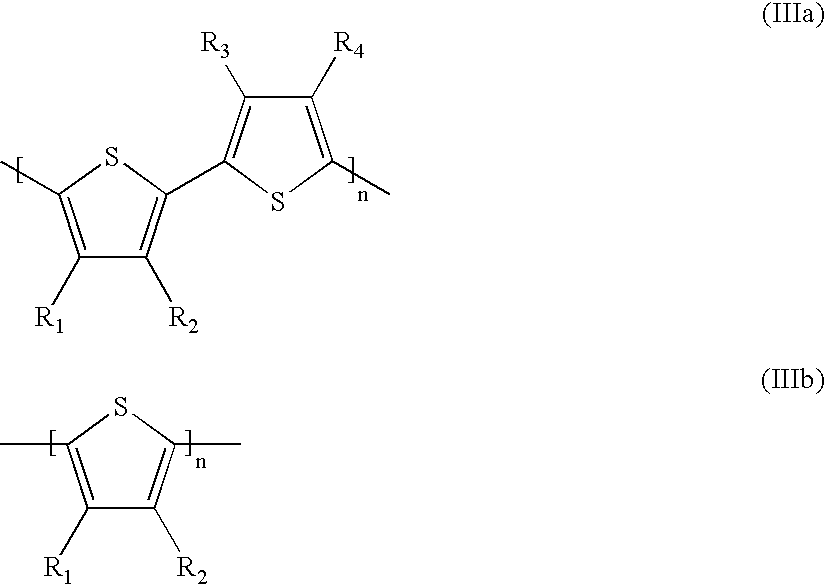
- the polythiophenes of formulae (IIIa) and (IIIb) below:
- the polythiophene vinylenes of formula (IIIbis) below:

- the polyfurans of formula (IV) below:

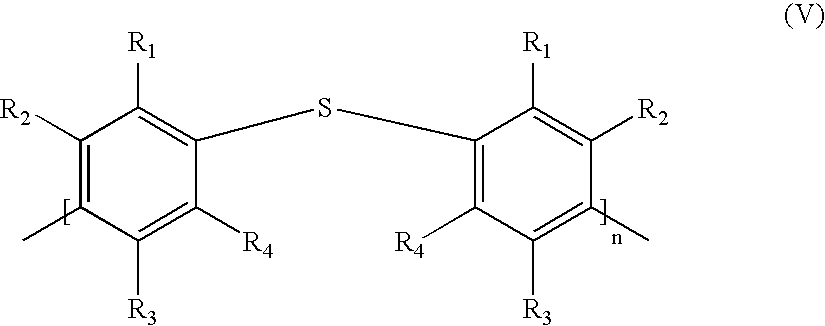
- the paraphenylene sulfides of structure (V) below:

- the poly-para-phenylene vinylenes of formula (VI) below:

- the polyindoles of formulae (VII) below:

- the aromatic polyamides of formulae (VIIIa), (VIIIb), (VIIIc) and (VIIId) below:

- the aromatic polyhydrazides of formulae (IXa), (IXb) and (IXc) below:

- the aromatic polyazomethines of formulae (Xa), (Xb), and (Xc) below:

- the aromatic polyesters of formulae (XIa), (XIb) and (XIc) below:

- in which formulae (I) to (XI):
- n ranges from 5 to 10 000, in particular from 5 to 1 000, more particularly from 10 to 1 000 and preferably from 20 to 700,
- the radicals R and R 1 to R4, which may be identical or different, are chosen from the group formed by hydrogen, a radical —R′, —OR′, —COOR′, and —OCOR′, with R′ representing a linear or branched C1-C20 alkyl radical, a halogen atom (preferably chosen from chlorine, bromine or iodine), a nitro radical, a cyano radical, an alkylcyano radical and solubilizing groups, it being understood that at least one radical from among R and R1 to R4 denotes a solubilizing group;
- X═—NHCO—, —O—, —S—, —SO 2—, —N═N—, —C(CH3)2—, —CH2—, —CH═CH—, —CH═N—;
- Ar represents a radical comprising a monoaromatic or polyaromatic radical.
- More particularly, Ar represents at least one radical chosen from the following:

- For the purposes of the present invention, the term “solubilizing group” means a group that solubilizes said molecule in the cosmetic medium such that the polymer has a conductive nature after drying the composition.
- The solubilizing groups are preferably chosen from the group formed by:
- a carboxylic radical (—COOH) or carboxylate radical (—COO-M+ with M representing an alkali metal such as sodium or potassium, an alkaline-earth metal, an organic amine such as a primary, secondary or tertiary amine, an alkanolamine or an amino acid),
- a sulfonic radical (—SO 3H) or sulfonate radical (—SO3 −M +, M having the same definition as above),
- a primary, secondary or tertiary amine radical,
- a quaternary ammonium radical such as —NR′ 3 +Z− with Z═Br, Cl or (C1-C4)alkyl-OSO3 and R′ alkyl, which may be identical or different, C1 to C20 linear or branched, or two of them forming a heterocycle with the nitrogen,
- a hydroxyl radical,
- a C 2-C3 polyalkene oxide radical.
- The carboxylic or sulfonic acid functions may or may not be neutralized with a base, such as sodium hydroxide, 2-amino-2-methylpropanol, triethylamine or tributylamine.
- The amine radicals may or may not be neutralized with a mineral acid, such as hydrochloric acid, or with an organic acid, such as acetic acid or lactic acid, for example.
- In addition, it should be noted that said solubilizing radicals may be linked to the ring via a spacer group, for instance a radical —R″—, —OR″—, —OCOR″— or —COOR″— with R″ representing a linear or branched C 1-C20 alkyl radical, optionally comprising one or more hetero atoms, for example such as oxygen.
- Preferably, the radicals R and R 1 to R4, which may be identical or different, are chosen from hydrogen, R′, —OR′, —OCOR′ and —COOR′ with R′ representing a linear or branched C1-C6 alkyl radical, and from the following neutralized or normeutralized solubilizing groups: —COOH, —CH2COOH, —CH2OH, —(CH2)6OH, —(CH2)3SO3H, —O(CH2)3SO3H, —O(CH2)3N(CH2CH3)2, —[(CH2)2O]xCH2CH2OH, —[(CH2)2O]xCH2CH2OCH3 with x being an average number between 0 and 200.
- In accordance with one particular embodiment of the invention, the conductive polymer used comprises at least one solubilizing group per repeating unit.
- The conductive polymers present in the composition according to the invention are well known to those skilled in the art and described especially in the book “Handbook of Organic Conductive Molecules and Polymersn”—Wiley 1997—New York, Vol. 1, 2, 3, but also in the revue Can. J. Chem. Vol 64, 1986. Polythiophenes and the synthesis thereof are more particularly described in the article taken from the review Chem. Mater. 1998, Vol. 10, No. 7, pages 1990-1999 by the authors Rasmussen S. C., Pickens J. C. and Hutchison J. E. “A new, general approach to tuning the properties of functionalized polythiophenes: The oxidative polymerization of monosubstituted bithiophenes”; in the article taken from the review Macromolecules 1998, 31, pages 933-936, by the same authors “Highly conjugated, water-soluble polymers via direct oxidative polymerization of monosubstituted bithiophenes”. Besides polymerization via chemical or electrochemical oxidation, they may also be obtained by polycondensation (dihalogenated thiophene; catalysis with nickel or palladium complexes); by Suzuki coupling (coupling between a halogen function, for example bromine, and a boronic acid, catalysis: complex of palladium and base; this then gives coupling of AA-BB type (reaction of monomers of the type A-X-A with B-X′-B) or of A-B type (reaction of several monomers of A-X-B type)); by Stille coupling (formation of a carbon-carbon bond in the presence of Pd-based catalysis of AA-BB or A-B type); by Reike polymerization (organozinc in the presence of a nickel complex); by McCulloch type polymerization, etc. The conductive polymers present in the composition according to the invention are moreover described in international patent application WO 99/47570.
- Among the conductive polymers that are suitable for performing the present invention, mention may be made more particularly of the polymers corresponding to formulae (III) and (IIIbis) in which the solubilizing groups are preferably a carboxylic acid group; a sulfonic acid group; a tertiary amine radical; a quaternary ammonium radical such as —NR′ 3 +Z− with Z═Br, Cl or (C1-C4)alkyl-OSO3 and R′ alkyl, which may be identical or different, C1 to C20 linear or branched, or two of them forming a heterocycle with the nitrogen; said groups optionally being linked to the ring via a spacer. The carboxylic or sulfonic acid functions may or may not be neutralized.
- Preferably, the conductive polymer is chosen from those of formulae (III) and (IIIbis) in which at least one radical R 1 to R4 of formula (IIIa) or R1 or R2 in formula (IIIb) or (IIIbis) represents a solubilizing group of the carboxylic acid type, in neutralized or normeutralized form, optionally linked to the ring via a spacer, preferably a linear or branched C1-C20 alkyl radical, the other radical(s) representing a hydrogen atom.
- The conductive polymers are generally present in the composition in proportions of at least 0.001% by weight, more particularly of at least 0.01% by weight, preferably of at least 0.1% by weight and even more preferably of at least 0.5% by weight, relative to the total weight of the composition. Moreover, the content of conductive polymer is advantageously not more than 50% by weight, more particularly not more than 30% by weight, preferably not more than 20% by weight and even more preferably not more than 10% by weight, relative to the total weight of the composition.
- According to a particularly advantageous embodiment of the invention, the content of conductive polymer is between 0.1% and 50% by weight, more preferably between 0.1 and 30% by weight, and preferably between 0.5% and 10% by weight, relative to the total weight of the composition.
- Medium
- The cosmetically acceptable medium of the cosmetic composition is preferably an aqueous medium consisting of water and may advantageously comprise cosmetically acceptable organic solvents including, more particularly, alcohols such as ethyl alcohol, isopropyl alcohol, benzyl alcohol and phenylethyl alcohol, or glycols or glycol ethers such as, for example, ethylene glycol monomethyl, monoethyl or monobutyl ether, propylene glycol or ethers thereof such as, for example, propylene glycol monomethyl ether, butylene glycol, dipropylene glycol and also diethylene glycol alkyl ethers, for instance diethylene glycol monoethyl ether or monobutyl ether, or alternatively polyols, for instance glycerol. Polyethylene glycols and polypropylene glycol and mixtures of all these compounds may also be used as solvent.
- The solvents may then be present in concentrations of between 0.5% and 20% and preferably between 2% to 10% by weight relative to the total weight of the composition.
- Additives
- The cosmetic composition may also comprise an effective amount of other agents, which are previously known elsewhere in the treatment of human keratin fibers, such as various common adjuvants, for instance surfactants that are well known in the prior art and of anionic, cationic, nonionic, amphoteric or zwitterionic type or mixtures thereof, thickeners, antioxidants, fragrances, dispersants, conditioners especially including cationic or amphoteric polymers, opacifiers, sequestering agents such as EDTA and etidronic acid, UV-screening agents, waxes, volatile or nonvolatile, cyclic or linear or branched silicones, which are organomodified (especially with amine groups) or unmodified, preserving agents, ceramides, pseudoceramides, plant, mineral or synthetic oils, vitamins or provitamins, for instance panthenol, and nonionic, anionic, amphoteric or cationic associative polymers.
- Surfactants
- Preferably, the cosmetic composition according to the invention comprises one or more surfactants that may be chosen, without preference, alone or as mixtures, from anionic, amphoteric, nonionic, zwitterionic and cationic surfactants.
- The surfactants that are suitable for carrying out the present invention are especially the following:
- (i) Anionic Surfactant(s):
- As examples of anionic surfactants which can be used, alone or as mixtures, in the context of the present invention, mention may be made in particular (nonlimiting list) of salts (in particular alkaline salts, especially sodium salts, ammonium salts, amine salts, amino alcohol salts or magnesium salts) of the following compounds: alkyl sulfates, alkyl ether sulfates, alkylamido ether sulfates, alkylarylpolyether sulfates, monoglyceride sulfates; alkyl sulfonates, alkyl phosphates, alkylamide sulfonates, alkylaryl sulfonates, α-olefin sulfonates, paraffin sulfonates; (C 6-C24) alkyl sulfosuccinates, (C6-C24) alkyl ether sulfosuccinates, (C6-C24) alkylamide sulfosuccinates; (C6-C24) alkyl sulfoacetates; (C6-C24) acyl sarcosinates and (C6-C24) acyl glutamates. It is also possible to use the carboxylic esters of (C6-C24) alkylpolyglycosides, such as alkylglucoside citrates, alkylpolyglycoside tartrates and alkylpolyglycoside sulfosuccinates, alkylsulfosuccinamates; acyl isethionates and N-acyltaurates, the alkyl or acyl radical of all of these various compounds preferably containing from 12 to 20 carbon atoms, and the aryl radical preferably denoting a phenyl or benzyl group. Among the anionic surfactants which can also be used, mention may also be made of fatty acid salts such as the salts of oleic, ricinoleic, palmitic and stearic acids, coconut oil acid or hydrogenated coconut oil acid; acyl lactylates in which the acyl radical contains 8 to 20 carbon atoms. Alkyl-D-galactosideuronic acids and their salts, polyoxyalkylenated (C6-C24) alkyl ether carboxylic acids, polyoxyalkylenated (C6-C24) alkylaryl ether carboxylic acids, polyoxyalkylenated (C6-C24) alkylamido ether carboxylic acids and their salts, in particular those containing from 2 to 50 alkylene oxide, in particular ethylene oxide, groups, and mixtures thereof can also be used.
- (ii) Nonionic Surfactant(s):
- The nonionic surfactants are also compounds that are well known per se (see in particular in this respect “Handbook of Surfactants” by M. R. Porter, published by Blackie & Son (Glasgow and London), 1991, pp. 116-178) and, in the context of the present invention, their nature is not a critical feature. Thus, they can be chosen in particular from (nonlimiting list) polyethoxylated or polypropoxylated alkylphenols, α-diols or alcohols having a fatty chain containing, for example, 8 to 18 carbon atoms, it being possible for the number of ethylene oxide or propylene oxide groups to range in particular from 2 to 50. Mention may also be made of copolymers of ethylene oxide and of propylene oxide, condensates of ethylene oxide and of propylene oxide with fatty alcohols; polyethoxylated fatty amides preferably having from 2 to 30 mol of ethylene oxide, polyglycerolated fatty amides containing on average 1 to 5, and in particular 1.5 to 4, glycerol groups; polyethoxylated fatty amines preferably having from 2 to 30 mol of ethylene oxide; oxyethylenated fatty acid esters of sorbitan having from 2 to 30 mol of ethylene oxide; fatty acid esters of sucrose, fatty acid esters of polyethylene glycol, alkylpolyglycosides, N-alkylglucamine derivatives, amine oxides such as (C 10-C14)alkylamine oxides or N-acylaminopropylmorpholine oxides.
- (iii) Amphoteric or Zwitterionic Surfactant(s):
- The amphoteric or zwitterionic surfactants, whose nature is not a critical feature in the context of the present invention, can be, in particular (nonlimiting list), aliphatic secondary or tertiary amine derivatives in which the aliphatic radical is a linear or branched chain containing 8 to 18 carbon atoms and containing at least one water-soluble anionic group (for example carboxylate, sulfonate, sulfate, phosphate or phosphonate); mention may also be made of (C 8-C20)alkylbetaines, sulfobetaines, (C8-C20) alkylamido (C1-C6) alkylbetaines or (C8-C20) alkylamido (C1-C6) alkylsulfobetaines.
- Among the amine derivatives, mention may be made of the products sold under the name Miranol, as described in U.S. Pat. Nos. 2,528,378 and 2,781,354 and classified in the CTFA dictionary, 3rd edition, 1982, under the names amphocarboxyglycinates and amphocarboxypropionates of respective structures:
- R 2—CONHCH2CH2—N(R3) (R4) (CH2COO−)
- in which: R 2 denotes an alkyl radical of an acid R2—COOH present in hydrolyzed coconut oil, a heptyl, nonyl or undecyl radical, R3 denotes a β-hydroxyethyl group and R4 denotes a carboxymethyl group; and
- R 2′—CONHCH2CH2—N(B) (C)
- in which:
- B represents —CH 2CH2OX′, C represents —(CH2)z—Y′, with z=1 or 2,
- X′ denotes a —CH 2CH2—COOH group or a hydrogen atom,
- Y′ denotes —COOH or a —CH 2—CHOH—SO3H radical,
- R 2′ denotes an alkyl radical of an acid RG-COOH present in coconut oil or in hydrolyzed linseed oil, an alkyl radical, in particular a C7, C9, C11 or C13 alkyl radical, a C17 alkyl radical and its iso form, an unsaturated C17 radical.
- These compounds are classified in the CTFA dictionary, 5th edition, 1993, under the names disodium coco-ampho-diacetate, disodium lauro-ampho-diacetate, disodium capryl-ampho-diacetate, disodium caprylo-ampho-diacetate, disodium coco-ampho-dipropionate, disodium lauro-ampho-dipropionate, disodium capryl-ampho-dipropionate, disodium caprylo-ampho-dipropionate, lauro-ampho-dipropionic acid and coco-ampho-dipropionic acid.
- By way of example, mention may be made of the cocoamphodiacetate sold under the trade name Miranol® C2M Concentrate by the company Rhodia Chimie.
- (iv) Cationic Surfactants:
- Among the cationic surfactants that may be mentioned in particular (nonlimiting list) are: primary, secondary or tertiary fatty amine salts, optionally polyoxyalkylenated; quaternary ammonium salts such as tetraalkylammonium, alkylamidoalkyl-trialkylammonium, trialkylbenzylammonium, trialkylhydroxyalkylammonium or alkylpyridinium chlorides or bromides; imidazoline derivatives; or amine oxides of cationic nature.
- The amount of surfactants present in the composition according to the invention may range from 0.01 to 40% by weight and preferably from 0.5 to 30% by weight, relative to the total weight of the composition.
- Needless to say, a person skilled in the art will take care to select the optional additional compound(s) mentioned above, such that the advantageous properties intrinsically associated with the dye composition according to the invention are not, or are not substantially, adversely affected by the envisaged addition(s).
- The composition which has just been described is generally applied to wet or dry keratin fibers. The composition medium is then evaporated, or left to evaporate at between 20 and 120° C., preferably between 20 and 80° C. until the fibers are dry. It is also possible to apply the composition to wet or dry fibers, and then to rinse said fibers and dry them at between 20 and 120° C.
- The invention makes it possible to produce a visual effect which is more particularly a sheen effect of the keratin fibers treated.
- This visual effect may also be a color effect when the conductive polymer absorbs in the visible spectrum.
- The examples which follow illustrate the invention without, however, being limiting in nature.
- Synthesis of poly(3-Thiopheneacetic Acid)

- Procedure
- Preparation of the Polymer: Poly(ethyl 3-Thiophene-Acetate)
- 25 ml of dry chloroform are introduced into a Schlenk tube under argon, the system is degassed and the following reagents are then introduced:
- 2.5 g of ethyl 3-thiopheneacetate (14.7 mmol)

- and 1 g of FeCl 3 (6.15 mmol).
- The mixture is stirred for 24 hours under argon at 50° C.
- The polymer poly(ethyl 3-thiopheneacetate) is then precipitated from heptane.
- The polymer is then dissolved in a tetrahydrofuran solution.
- Characterization by infrared:
- C═O band: 1 719 cm −1; CH2 and CH3 bands=2 979 cm−1, 2 934 cm−1 and disappearance of the CH band at 3 102 cm−1 present in the monomer.
- Hydrolysis of the Polymer: poly(ethyl 3-thiophene-acetate) to Form Poly(3-thiopheneacetic acid).
- The polymer obtained above is then hydrolyzed with an excess of 50 ml of aqueous sodium hydroxide solution (2N) for 48 hours at 70° C., followed by acidification with concentrated HCl to the point of precipitation of the product: poly(3-thiopheneacetic acid).
- The polymer is then filtered off and washed several times with distilled water in order to remove the traces of catalyst.
- Infra-Red Characterization of the Polymer:
- C═O band: 1 740 cm −1; COO 1 580 cm−1; OH (broad band 3 000-3 500 cm−1)
- Neutralization of the Polymer Poly(3-Thiopheneacetic Acid):
- The polymer poly(3-thiopheneacetic acid) (2 g) is dissolved in tetrahydrofuran (30 g) and neutralized at a rate of 1 mol of sodium hydroxide per mole of carboxylic acid.
- Water (30 g) is then added.
- The tetrahydrofuran is evaporated off.
- An aqueous 6% solution of poly(3-thiophene-acetic acid) in the form of a sodium salt is thus obtained.
- Formulation Comprising the Polymer Obtained:
Composition: Polymer obtained above 4% Aminomethylpropanol qs pH 7 Synthalen K 1% Ethanol 10% Water qs 100 g - The composition described above, comprising the conductive polymer obtained according to the preceding example, is applied to locks of natural chestnut-brown hair at room temperature (20° C.) (0.1 g per g of hair). The locks are then dried.
- The locks have a very shiny appearance with a golden glint, which is especially perceptible when the locks are observed at a low angle.
- To the touch, the hair has the advantage of not being perceived as greasy, the optical properties described above being maintained over time (unchanged after 12 hours).
- The preceding example is reproduced, except that the polymer obtained is neutralized with triethylamine instead of sodium hydroxide.
Claims (19)
1. The use of a composition comprising at least one conductive polymer in a cosmetically acceptable medium, said polymer being in soluble form in said medium, as an agent for giving a visual effect to human keratin material and more particularly to human keratin fibers.
2. The use of a composition comprising at least one conductive polymer in a cosmetically acceptable medium, said polymer being in soluble form in said medium, for the manufacture of cosmetic products for giving a visual effect to human keratin material, more particularly to keratin fibers.
3. The use as claimed in either of claims 1 and 2, characterized in that the conductive polymers are chosen from the group formed by homopolymers and copolymers comprising:


the polyanilines of structure (I) below:
the polypyrroles of structure (IIa) and (IIb) below:
the polythiophenes of formulae (IIIa) and (IIIb) below:
the polythiophene vinylenes of formula (IIIbis) below:
the polyfurans of formula (IV) below,
the paraphenylene sulfides of structure (V) below:
the poly-para-phenylene vinylenes of formula (VI) below:
the polyindoles of formulae (VII) below:
the aromatic polyamides of formulae (VIIIa), (VIIIb), (VIIIc) and (VIIId) below:
the aromatic polyhydrazides of formulae (IXa), (IXb) and (IXc) below:
the aromatic polyazomethines of formulae (Xa), (Xb), and (Xc) below:
the aromatic polyesters of formulae (XIa), (XIb) and (XIc) below:
in which formulae (I) to (XI):
n ranges from 5 to 10 000, in particular from 5 to 1 000, more particularly from 10 to 1 000 and preferably from 20 to 700,
the radicals R and R1 to R4, which may be identical or different, are chosen from the group formed by hydrogen, a radical —R′, —OR′, —COOR′, and —OCOR′, with R′ representing a linear or branched C1-C20 alkyl radical, a halogen atom, a nitro radical, a cyano radical, an alkylcyano radical and solubilizing groups, it being understood that at least one radical from among R and R1 to R4 denotes a solubilizing group;
X═NHCO—, —O—, —S—, —SO2—, —N═N—, —C(CH3)2—, —CH2—, —CH═CH—, —CH═N—;
Ar represents a radical comprising a monoaromatic or polyaromatic radical.
4. The use as claimed in claim 3 , characterized in that the solubilizing groups are chosen from the group formed by:
a carboxylic radical (—COOH) or carboxylate radical (—COO-M+ with M representing an alkali metal, an alkaline-earth metal, an organic amine, an alkanolamine or an amino acid),
a sulfonic radical (—SO3H) or sulfonate radical (—SO3 −M+, M having the same definition as above),
a primary, secondary or tertiary amine radical,
a quaternary ammonium radical such as —NR′3 +Z− with Z═Br, Cl or (C1-C4)alkyl-OSO3 and R′ alkyl, which may be identical or different, C1 to C20 linear or branched, or two of them forming a heterocycle with the nitrogen,
a hydroxyl radical,
a C2-C3 polyalkene oxide radical.
5. The use as claimed in either of claims 3 and 4, characterized in that the polymer comprises at least one solubilizing group per repeating unit.
6. The use as claimed in one of the preceding claims, characterized in that the conductive polymer corresponds to formula (III) or (IIIbis), in which at least one radical R1 to R4 of formula (IIIa) or R1 or R2 of formula (IIIb) or (IIIbis) represents a solubilizing group of the carboxylic acid type, in neutralized or normeutralized form, optionally linked to the ring via a spacer, preferably a linear or branched C1-C20 alkyl radical, the other radical(s) representing a hydrogen atom.
7. The use as claimed in any one of the preceding claims, characterized in that the conductive polymer(s) is(are) present in proportions of at least 0.001% by weight, more particularly of at least 0.01% by weight, preferably of at least 0.1% by weight and even more preferably of at least 0.5% by weight relative to the total weight of the composition.
8. The use as claimed in any one of the preceding claims, characterized in that the conductive polymer(s) is(are) present in proportions of at most 50% by weight, more particularly at most 30% by weight, preferably at most 10% by weight, relative to the total weight of the composition.
9. The use as claimed in any one of the preceding claims, characterized in that the cosmetically acceptable medium is chosen from the group formed by water and a water/solvent mixture.
10. The use as claimed in claim 9 , characterized in that the solvent(s) is(are) chosen from alcohols, glycols, glycol ethers, polyols, polyethylene glycols and polypropylene glycol, and mixtures thereof.
11. The use as claimed in any one of the preceding claims, characterized in that it also comprises at least one nonionic, anionic, cationic, amphoteric or zwitterionic surfactant.
12. The use as claimed in any one of the preceding claims, characterized in that the composition is applied to the wet or dry fibers, and then in evaporating the composition medium or leaving the composition medium to evaporate at between 20 and 120° C., preferably between 20 and 80° C., until the fibers are dry.
13. The use as claimed in any one of claims 1 to 11 , characterized in that the composition is applied to the dry or wet fibers and said fibers are then rinsed and dried at between 20 and 120° C. and preferably between 20 and 80° C.
14. A composition for dyeing human keratin fibers and more particularly the hair, characterized in that it comprises an effective amount of at least one conductive polymer in a cosmetically acceptable medium, said polymer being in soluble form in said medium, absorbing in the visible spectrum and chosen from the group formed by homopolymers and copolymers comprising:




the polyanilines of structure (I) below:
the polypyrroles of structures (IIa) and (IIb) below:
the polythiophenes of formulae (IIIa) and (IIIb) below:
the polythiophene vinylenes of formula (IIIbis) below:
the polyfurans of formula (IV) below:
the paraphenylene sulfides of structure (V) below:
the poly-para-phenylene vinylenes of formula (VI) below:
the polyindoles of formula (VII) below:
the aromatic polyamides of formulae (VIIIa), (VIIIb), (VIIIc) and (VIIId) below:
the aromatic polyhydrazides of formulae (IXa), (IXb) and (IXc) below:
the aromatic polyazomethines of formulae (Xa), (Xb), and (Xc) below:
the aromatic polyesters of formulae (XIa), (XIb) and (XIc) below:
in which formulae (I) to (XI):
n ranges from 5 to 10 000, in particular from 5 to 1 000, more particularly from 10 to 1 000 and preferably from 20 to 700,
the radicals R and R1 to R4, which may be identical or different, are chosen from the group formed by hydrogen, a radical —R′, —OR′, —COOR′, and —OCOR′, with R′ representing a linear or branched C1-C20 alkyl radical, a halogen atom, a nitro radical, a cyano radical, an alkylcyano radical and solubilizing groups, it being understood that at least one radical from among R and R1 to R4 denotes a solubilizing group;
X═NHCO—, —O—, —S—, —SO2—, —N═N—, —C(CH3)2—, —CH2—, —CH═CH—, —CH═N—;
Ar represents a radical comprising a monoaromatic or polyaromatic radical.
15. The composition as claimed in claim 14 , characterized in-that the solubilizing groups of the conductive polymer are chosen from the group formed by:
a carboxylic radical (—COOH) or carboxylate radical (—COO-M+ with M representing an alkali metal, an alkaline-earth metal, an organic amine, an alkanolamine or an amino acid),
a sulfonic radical (—SO3H) or sulfonate radical (—SO3 −M+, M having the same definition as above),
a primary, secondary or tertiary amine radical,
a quaternary ammonium radical such as —NR′3 +Z− with Z═Br, Cl or (C1-C4)alkyl-OSO3 and R′ alkyl, which may be identical or different, C1 to C20 linear or branched, or two of them forming a heterocycle with the nitrogen,
a hydroxyl radical,
a C2-C3 polyalkene oxide radical.
16. The composition as claimed in either of claims 14 and 15, characterized in that the conductive polymer comprises at least one solubilizing group per repeating unit.
17. The composition as claimed in one of claims 14 to 16 , characterized in that the conductive polymer corresponds to formula (III) or (IIIbis), in which at least one radical R1 to R4 of formula (IIIa) or R1 or R2 of formula (IIIb) or (IIIbis) represents a solubilizing group of the carboxylic acid type, in neutralized or normeutralized form, optionally linked to the ring via a spacer, preferably a linear or branched C1-C20 alkyl radical, the other radical(s) representing a hydrogen atom.
18. A process for treating human keratin fibers and more particularly the hair, characterized in that it consists in applying a composition as claimed in one of claims 14 to 17 to the wet or dry fibers, and then in evaporating the composition medium or allowing the composition medium to evaporate at between 20 and 120° C., preferably between 20 and 80° C., until the fibers are dry.
19. A process for treating human keratin fibers and more particularly the hair, characterized in that it consists in applying a composition as claimed in one of claims 14 to 17 to the wet or dry fibers and then in rinsing and drying said fibers at between 20 and 120° C. and preferably between 20 and 80° C.
Priority Applications (1)
| Application Number | Priority Date | Filing Date | Title |
|---|---|---|---|
| US10/355,227 US7217295B2 (en) | 2002-01-31 | 2003-01-31 | Use of soluble conductive polymers for treating human keratin fibers |
Applications Claiming Priority (4)
| Application Number | Priority Date | Filing Date | Title |
|---|---|---|---|
| FR0201144 | 2002-01-31 | ||
| FR0201144A FR2835181B1 (en) | 2002-01-31 | 2002-01-31 | USE OF CONDUCTIVE POLYMERS FOR THE TREATMENT OF HUMAN KERATIN FIBERS |
| US35399102P | 2002-02-05 | 2002-02-05 | |
| US10/355,227 US7217295B2 (en) | 2002-01-31 | 2003-01-31 | Use of soluble conductive polymers for treating human keratin fibers |
Publications (2)
| Publication Number | Publication Date |
|---|---|
| US20040103486A1 true US20040103486A1 (en) | 2004-06-03 |
| US7217295B2 US7217295B2 (en) | 2007-05-15 |
Family
ID=32397601
Family Applications (1)
| Application Number | Title | Priority Date | Filing Date |
|---|---|---|---|
| US10/355,227 Expired - Fee Related US7217295B2 (en) | 2002-01-31 | 2003-01-31 | Use of soluble conductive polymers for treating human keratin fibers |
Country Status (1)
| Country | Link |
|---|---|
| US (1) | US7217295B2 (en) |
Cited By (3)
| Publication number | Priority date | Publication date | Assignee | Title |
|---|---|---|---|---|
| US20040107512A1 (en) * | 2002-01-31 | 2004-06-10 | Henri Samain | Use of thiophenes or bisthiophenes in compositions for treating human keratin fibers, compositions comprising them and processes |
| US20060257339A1 (en) * | 2005-05-13 | 2006-11-16 | L'oreal | Use of conductive polymer nanofibers for treating keratinous surfaces |
| US7217295B2 (en) | 2002-01-31 | 2007-05-15 | L'oreal S.A. | Use of soluble conductive polymers for treating human keratin fibers |
Families Citing this family (17)
| Publication number | Priority date | Publication date | Assignee | Title |
|---|---|---|---|---|
| CN102015911B (en) | 2008-01-17 | 2015-11-25 | 巴斯夫欧洲公司 | Polymeric hair dyes |
| KR101580318B1 (en) | 2008-05-14 | 2015-12-28 | 삼성전자주식회사 | Monomer for Binding Nano-metal Conducting Polymer Composite and Preparation Method thereof |
| WO2011006946A2 (en) | 2009-07-15 | 2011-01-20 | Basf Se | Polymeric hair dyes |
| US8858895B2 (en) | 2010-12-29 | 2014-10-14 | Ecolab Usa Inc. | Continuous on-line adjustable disinfectant/sanitizer/bleach generator |
| US8846107B2 (en) | 2010-12-29 | 2014-09-30 | Ecolab Usa Inc. | In situ generation of peroxycarboxylic acids at alkaline pH, and methods of use thereof |
| US9321664B2 (en) | 2011-12-20 | 2016-04-26 | Ecolab Usa Inc. | Stable percarboxylic acid compositions and uses thereof |
| CA2867565C (en) | 2012-03-30 | 2021-01-19 | Victor KEASLER | Use of peracetic acid/hydrogen peroxide and peroxide-reducing agents for treatment of drilling fluids, frac fluids, flowback water and disposal water |
| US10165774B2 (en) | 2013-03-05 | 2019-01-01 | Ecolab Usa Inc. | Defoamer useful in a peracid composition with anionic surfactants |
| US20140256811A1 (en) | 2013-03-05 | 2014-09-11 | Ecolab Usa Inc. | Efficient stabilizer in controlling self accelerated decomposition temperature of peroxycarboxylic acid compositions with mineral acids |
| US8822719B1 (en) | 2013-03-05 | 2014-09-02 | Ecolab Usa Inc. | Peroxycarboxylic acid compositions suitable for inline optical or conductivity monitoring |
| US9845290B2 (en) | 2014-12-18 | 2017-12-19 | Ecolab Usa Inc. | Methods for forming peroxyformic acid and uses thereof |
| US11040902B2 (en) | 2014-12-18 | 2021-06-22 | Ecolab Usa Inc. | Use of percarboxylic acids for scale prevention in treatment systems |
| EP3766523A1 (en) | 2014-12-18 | 2021-01-20 | Ecolab USA Inc. | Generation of peroxyformic acid through polyhydric alcohol formate |
| CN115400146A (en) | 2018-06-15 | 2022-11-29 | 埃科莱布美国股份有限公司 | On-site generated performic acid composition for teat treatment |
| BR112021002549A2 (en) | 2018-08-22 | 2021-05-04 | Ecolab Usa Inc. | stabilized peroxycarboxylic acid composition, and, method of reducing a microbial population using a stabilized peroxycarboxylic acid composition. |
| CR20210551A (en) | 2019-05-31 | 2021-12-14 | Ecolab Usa Inc | METHOD FOR MONITORING PERACID CONCENTRATIONS THROUGH PERACID CONDUCTIVITY AND COMPOSITION MEASURES |
| US12096768B2 (en) | 2019-08-07 | 2024-09-24 | Ecolab Usa Inc. | Polymeric and solid-supported chelators for stabilization of peracid-containing compositions |
Citations (20)
| Publication number | Priority date | Publication date | Assignee | Title |
|---|---|---|---|---|
| US2528378A (en) * | 1947-09-20 | 1950-10-31 | John J Mccabe Jr | Metal salts of substituted quaternary hydroxy cycloimidinic acid metal alcoholates and process for preparation of same |
| US2781354A (en) * | 1956-03-26 | 1957-02-12 | John J Mccabe Jr | Imidazoline derivatives and process |
| US3158542A (en) * | 1960-06-02 | 1964-11-24 | Oreal | Substituted diacetylbenzenes reacted with an amine to yield a colored product for dyeing hair |
| US3723325A (en) * | 1967-09-27 | 1973-03-27 | Procter & Gamble | Detergent compositions containing particle deposition enhancing agents |
| US5288494A (en) * | 1990-06-05 | 1994-02-22 | Kao Corporation | Cosmetic composition |
| US5338540A (en) * | 1985-02-04 | 1994-08-16 | Conopco, Inc. | Hair waving and straightening composition |
| US5449519A (en) * | 1994-08-09 | 1995-09-12 | Revlon Consumer Products Corporation | Cosmetic compositions having keratolytic and anti-acne activity |
| US5569708A (en) * | 1986-03-24 | 1996-10-29 | The Regents Of The University Of California | Self-doped polymers |
| US5616150A (en) * | 1993-04-30 | 1997-04-01 | Henkel Kommanditgesellschaft Auf Aktien | Isatin-containing formulations for coloring keratin-containing fibers |
| US5775829A (en) * | 1996-06-12 | 1998-07-07 | Valfor, S.A. | End joiner for continuous belts for conveyors |
| US5830446A (en) * | 1995-11-17 | 1998-11-03 | General Electric Company | Fluorescent brightening of cosmetic compositions |
| US5863981A (en) * | 1986-03-24 | 1999-01-26 | The Regents Of The University Of California | Electrically conducting water-soluble self-doping polyaniline polymers and the aqueous solutions thereof |
| US5891968A (en) * | 1986-03-24 | 1999-04-06 | The Regents Of University Of California | Method of making self-doped zwitterionic heterocyclic polymers |
| US6042620A (en) * | 1998-03-19 | 2000-03-28 | Wella Ag | p-diaminobenzene derivative compounds and dye compositions containing same |
| US6132475A (en) * | 1998-03-19 | 2000-10-17 | Wella Aktiengesellschaft | Diaminobenzene derivative compounds and dye compositions containing same |
| US6203580B1 (en) * | 1997-02-26 | 2001-03-20 | L'oreal | Compositions for dyeing keratin fibers containing para-aminophenols, dyeing process, and para -aminophenols |
| US6242561B1 (en) * | 1996-03-06 | 2001-06-05 | Basf Aktiengesellschaft | Substituted polythiophenes, processes for their preparation their use |
| US20020146442A1 (en) * | 2001-02-06 | 2002-10-10 | Gerhard Sendelbach | Cosmetic compositions containing electrically conductive polymers |
| US20030041391A1 (en) * | 2000-12-13 | 2003-03-06 | David Rozzell | Agent and method for dyeing keratin fibres |
| US20040107512A1 (en) * | 2002-01-31 | 2004-06-10 | Henri Samain | Use of thiophenes or bisthiophenes in compositions for treating human keratin fibers, compositions comprising them and processes |
Family Cites Families (26)
| Publication number | Priority date | Publication date | Assignee | Title |
|---|---|---|---|---|
| JPS5565201A (en) | 1978-11-10 | 1980-05-16 | Fuji Chem Kk | Preparation of anionic cellulose derivative |
| AU578780B2 (en) | 1985-02-04 | 1988-11-03 | Chesebrough-Pond's Inc. | Hair waving and straightening compositions of matter |
| EP0203438A1 (en) | 1985-05-31 | 1986-12-03 | Corporation Allied | Solution processible forms of neutral and electrically conductive poly(substituted heterocycles) |
| JPS62167771A (en) | 1986-01-17 | 1987-07-24 | Mitsubishi Petrochem Co Ltd | Imidazolium salt type polycationic compound and production thereof |
| KR960009685B1 (en) | 1986-03-24 | 1996-07-23 | 유니버시티 오브 캘리포니아 평의원 | Method of Making Magnetically Doped Polymer |
| CA1315465C (en) | 1987-07-31 | 1993-03-30 | Hans-Helmut Goertz | Polymers of oxyalkylated unsaturated quaternary ammonium salts, their preparation and their use |
| JPH0726333B2 (en) | 1990-04-11 | 1995-03-22 | アキレス株式会社 | Method for producing conductive fiber |
| US5182050A (en) | 1991-10-24 | 1993-01-26 | Amp Incorporated | Extrinsically/intrinsically conductive gel |
| JPH05226238A (en) | 1991-10-31 | 1993-09-03 | Internatl Business Mach Corp <Ibm> | Base developable discharge top layer for E-beam resist |
| DE4138763A1 (en) | 1991-11-26 | 1993-05-27 | Basf Ag | USE OF HOMO- OR COPOLYMERISATS BASED ON QUATERNIZED 1-VINYLIMIDAZOLES AS ORGANIC POLYELECTROLYTE |
| JP2540691B2 (en) | 1992-04-30 | 1996-10-09 | 古河機械金属株式会社 | Pain remedy |
| JP3537156B2 (en) | 1992-08-05 | 2004-06-14 | 触媒化成工業株式会社 | Fine particle dispersion and cosmetics |
| FR2709954B1 (en) | 1993-09-15 | 1995-10-20 | Oreal | Cosmetic compositions containing a linear polysiloxane-polyoxyalkylene block copolymer and a cationic polymer, and their uses. |
| JP2960859B2 (en) | 1994-11-14 | 1999-10-12 | 昭和電工株式会社 | Self-doping type conductive polymer aqueous solution and method for producing the same |
| FR2742047B1 (en) | 1995-12-06 | 1998-01-16 | Oreal | KERATINIC FIBER DYEING COMPOSITIONS CONTAINING N-SUBSTITUTED DERIVATIVES OF 4-HYDROXY INDOLINE, NEW DERIVATIVES, THEIR SYNTHESIS METHOD, THEIR USE FOR DYEING, AND THE DYEING METHOD |
| JPH09221408A (en) | 1996-02-15 | 1997-08-26 | Sekisui Chem Co Ltd | Melanin pigment decomposer |
| DE19654965A1 (en) | 1996-07-26 | 1998-05-28 | Frank Dr Ing Lux | Dispersible super-paramagnetic or ferromagnetic particles |
| AU742976B2 (en) | 1998-03-18 | 2002-01-17 | University Of Rochester | Macromolecular self-assembly of microstructures, nanostructures, objects and mesoporous solids |
| JPH11291410A (en) | 1998-04-10 | 1999-10-26 | Dainippon Printing Co Ltd | Antistatic interior material |
| JP2000327837A (en) | 1999-05-17 | 2000-11-28 | Asahi Chem Ind Co Ltd | Composition containing cellulose as antistatic agent |
| DE10008305A1 (en) | 2000-02-23 | 2001-09-06 | Henkel Kgaa | Micro- and nano-capsules with cationic charges on surface are used in laundry and other detergents, skin cleansers, shampoos and skin and hair cosmetics |
| FR2825619A1 (en) | 2001-10-01 | 2002-12-13 | Oreal | Cosmetic composition for creating optical effect, e.g. electrically controlled variation of appearance of skin, lipids or nails, containing electroluminescent and/or electroconductive polyconjugated polymer |
| US7217295B2 (en) | 2002-01-31 | 2007-05-15 | L'oreal S.A. | Use of soluble conductive polymers for treating human keratin fibers |
| FR2835182B1 (en) | 2002-01-31 | 2006-02-17 | Oreal | USE OF THIOPHENES FOR THE CORPORATION OF HUMAN KERATINIC FIBERS |
| FR2850568B1 (en) | 2003-01-31 | 2007-04-27 | Oreal | USE OF CONDUCTIVE POLYTHIOPHENES FOR THE TREATMENT OF HUMAN KERATINIC MATERIALS |
| WO2004066968A2 (en) | 2003-01-31 | 2004-08-12 | L'oréal | Use of conductive polythiophenes for the treatment of human keratin materials |
-
2003
- 2003-01-31 US US10/355,227 patent/US7217295B2/en not_active Expired - Fee Related
Patent Citations (21)
| Publication number | Priority date | Publication date | Assignee | Title |
|---|---|---|---|---|
| US2528378A (en) * | 1947-09-20 | 1950-10-31 | John J Mccabe Jr | Metal salts of substituted quaternary hydroxy cycloimidinic acid metal alcoholates and process for preparation of same |
| US2781354A (en) * | 1956-03-26 | 1957-02-12 | John J Mccabe Jr | Imidazoline derivatives and process |
| US3158542A (en) * | 1960-06-02 | 1964-11-24 | Oreal | Substituted diacetylbenzenes reacted with an amine to yield a colored product for dyeing hair |
| US3723325A (en) * | 1967-09-27 | 1973-03-27 | Procter & Gamble | Detergent compositions containing particle deposition enhancing agents |
| US5338540A (en) * | 1985-02-04 | 1994-08-16 | Conopco, Inc. | Hair waving and straightening composition |
| US5891968A (en) * | 1986-03-24 | 1999-04-06 | The Regents Of University Of California | Method of making self-doped zwitterionic heterocyclic polymers |
| US5569708A (en) * | 1986-03-24 | 1996-10-29 | The Regents Of The University Of California | Self-doped polymers |
| US5863981A (en) * | 1986-03-24 | 1999-01-26 | The Regents Of The University Of California | Electrically conducting water-soluble self-doping polyaniline polymers and the aqueous solutions thereof |
| US5288494A (en) * | 1990-06-05 | 1994-02-22 | Kao Corporation | Cosmetic composition |
| US5616150A (en) * | 1993-04-30 | 1997-04-01 | Henkel Kommanditgesellschaft Auf Aktien | Isatin-containing formulations for coloring keratin-containing fibers |
| US5449519A (en) * | 1994-08-09 | 1995-09-12 | Revlon Consumer Products Corporation | Cosmetic compositions having keratolytic and anti-acne activity |
| US5449519C1 (en) * | 1994-08-09 | 2001-05-01 | Revlon Consumer Prod Corp | Cosmetic compositions having keratolytic and anti-acne activity |
| US5830446A (en) * | 1995-11-17 | 1998-11-03 | General Electric Company | Fluorescent brightening of cosmetic compositions |
| US6242561B1 (en) * | 1996-03-06 | 2001-06-05 | Basf Aktiengesellschaft | Substituted polythiophenes, processes for their preparation their use |
| US5775829A (en) * | 1996-06-12 | 1998-07-07 | Valfor, S.A. | End joiner for continuous belts for conveyors |
| US6203580B1 (en) * | 1997-02-26 | 2001-03-20 | L'oreal | Compositions for dyeing keratin fibers containing para-aminophenols, dyeing process, and para -aminophenols |
| US6042620A (en) * | 1998-03-19 | 2000-03-28 | Wella Ag | p-diaminobenzene derivative compounds and dye compositions containing same |
| US6132475A (en) * | 1998-03-19 | 2000-10-17 | Wella Aktiengesellschaft | Diaminobenzene derivative compounds and dye compositions containing same |
| US20030041391A1 (en) * | 2000-12-13 | 2003-03-06 | David Rozzell | Agent and method for dyeing keratin fibres |
| US20020146442A1 (en) * | 2001-02-06 | 2002-10-10 | Gerhard Sendelbach | Cosmetic compositions containing electrically conductive polymers |
| US20040107512A1 (en) * | 2002-01-31 | 2004-06-10 | Henri Samain | Use of thiophenes or bisthiophenes in compositions for treating human keratin fibers, compositions comprising them and processes |
Cited By (3)
| Publication number | Priority date | Publication date | Assignee | Title |
|---|---|---|---|---|
| US20040107512A1 (en) * | 2002-01-31 | 2004-06-10 | Henri Samain | Use of thiophenes or bisthiophenes in compositions for treating human keratin fibers, compositions comprising them and processes |
| US7217295B2 (en) | 2002-01-31 | 2007-05-15 | L'oreal S.A. | Use of soluble conductive polymers for treating human keratin fibers |
| US20060257339A1 (en) * | 2005-05-13 | 2006-11-16 | L'oreal | Use of conductive polymer nanofibers for treating keratinous surfaces |
Also Published As
| Publication number | Publication date |
|---|---|
| US7217295B2 (en) | 2007-05-15 |
Similar Documents
| Publication | Publication Date | Title |
|---|---|---|
| US7217295B2 (en) | Use of soluble conductive polymers for treating human keratin fibers | |
| AU2017204070B2 (en) | Personal care compositions containing complexing polyelectrolytes | |
| EP0744936B1 (en) | Hair care products | |
| DE60038268T2 (en) | Cosmetic preparations | |
| JP2006045181A (en) | Skin external composition | |
| JPH0717786B2 (en) | Composition of glycosaminoglycan and cationic polymer | |
| KR980000407A (en) | Acidic cosmetic and / or dermatological compositions containing at least 90% neutralized crosslinked poly (2-acrylamido-2-methylpropanesulfonic acid) | |
| US20050055782A1 (en) | Composition comprising at least one conductive polymer and at least one oxidizing agent, and process for treating keratin fibers employing it | |
| JP2005525320A (en) | Use of soluble conductive polymers to treat human keratin fibers | |
| US20050050650A1 (en) | Composition comprising at least one conductive polymer and at least one direct dye, and process for the use thereof | |
| EP1302191B1 (en) | Foamable composition for hair care | |
| EA030286B1 (en) | Sunscreen composition | |
| JP2005068135A (en) | Composition comprising at least one conductive polymer and at least one direct dye, and method of use thereof | |
| US20050055781A1 (en) | Composition comprising at least one conductive polymer and at least one reducing agent, and permanent-shaping process for the use thereof | |
| WO2004066968A2 (en) | Use of conductive polythiophenes for the treatment of human keratin materials | |
| ES2275192T3 (en) | COMPOSITION CONTAINING A DRIVING POLYMER AND AN OPTICAL SUGAR AND / OR A FLUORESCENT COMPOUND. | |
| US20050058608A1 (en) | Composition comprising at least one conductive polymer and at least one propellant, and process for the use thereof | |
| US20040107512A1 (en) | Use of thiophenes or bisthiophenes in compositions for treating human keratin fibers, compositions comprising them and processes | |
| KR102646479B1 (en) | Composition for solubilization of salicylic acid | |
| US20050048023A1 (en) | Composition comprising at least one conductive polymer and at least one fluorescent dye and/or at least one optical brightener, and process for use thereof | |
| DE2452032C2 (en) | Use of polymers containing carboxyl or carboxylate and hydroxyl groups as film formers in hair care products | |
| CA2403126A1 (en) | Hair treatment agent | |
| CN113081877A (en) | Compositions containing lactobionic acid | |
| DE4232512A1 (en) | Aq. hair treatment formulations contg. imidazolinium gel-free cellulose-based cationic polymers | |
| JP2005047912A (en) | Composition comprising at least one conductive polymer and hard non-film-forming particles, method of use and use thereof |
Legal Events
| Date | Code | Title | Description |
|---|---|---|---|
| AS | Assignment |
Owner name: L'OREAL S.A., FRANCE Free format text: ASSIGNMENT OF ASSIGNORS INTEREST;ASSIGNORS:SAMAIN, HENRI;PLOS, GREGORY;MOUGIN, NATHALIE;REEL/FRAME:014375/0314;SIGNING DATES FROM 20030521 TO 20030523 |
|
| FEPP | Fee payment procedure |
Free format text: PAYOR NUMBER ASSIGNED (ORIGINAL EVENT CODE: ASPN); ENTITY STATUS OF PATENT OWNER: LARGE ENTITY |
|
| CC | Certificate of correction | ||
| REMI | Maintenance fee reminder mailed | ||
| LAPS | Lapse for failure to pay maintenance fees | ||
| STCH | Information on status: patent discontinuation |
Free format text: PATENT EXPIRED DUE TO NONPAYMENT OF MAINTENANCE FEES UNDER 37 CFR 1.362 |
|
| FP | Lapsed due to failure to pay maintenance fee |
Effective date: 20110515 |