US20030196729A1 - Surface treatment method for aluminum or an aluminum alloy and treating fluid used therefor - Google Patents
Surface treatment method for aluminum or an aluminum alloy and treating fluid used therefor Download PDFInfo
- Publication number
- US20030196729A1 US20030196729A1 US10/386,230 US38623003A US2003196729A1 US 20030196729 A1 US20030196729 A1 US 20030196729A1 US 38623003 A US38623003 A US 38623003A US 2003196729 A1 US2003196729 A1 US 2003196729A1
- Authority
- US
- United States
- Prior art keywords
- aluminum
- weight
- silicofluoride
- amount
- treating fluid
- Prior art date
- Legal status (The legal status is an assumption and is not a legal conclusion. Google has not performed a legal analysis and makes no representation as to the accuracy of the status listed.)
- Granted
Links
Images



Classifications
-
- C—CHEMISTRY; METALLURGY
- C23—COATING METALLIC MATERIAL; COATING MATERIAL WITH METALLIC MATERIAL; CHEMICAL SURFACE TREATMENT; DIFFUSION TREATMENT OF METALLIC MATERIAL; COATING BY VACUUM EVAPORATION, BY SPUTTERING, BY ION IMPLANTATION OR BY CHEMICAL VAPOUR DEPOSITION, IN GENERAL; INHIBITING CORROSION OF METALLIC MATERIAL OR INCRUSTATION IN GENERAL
- C23C—COATING METALLIC MATERIAL; COATING MATERIAL WITH METALLIC MATERIAL; SURFACE TREATMENT OF METALLIC MATERIAL BY DIFFUSION INTO THE SURFACE, BY CHEMICAL CONVERSION OR SUBSTITUTION; COATING BY VACUUM EVAPORATION, BY SPUTTERING, BY ION IMPLANTATION OR BY CHEMICAL VAPOUR DEPOSITION, IN GENERAL
- C23C22/00—Chemical surface treatment of metallic material by reaction of the surface with a reactive liquid, leaving reaction products of surface material in the coating, e.g. conversion coatings, passivation of metals
- C23C22/05—Chemical surface treatment of metallic material by reaction of the surface with a reactive liquid, leaving reaction products of surface material in the coating, e.g. conversion coatings, passivation of metals using aqueous solutions
- C23C22/06—Chemical surface treatment of metallic material by reaction of the surface with a reactive liquid, leaving reaction products of surface material in the coating, e.g. conversion coatings, passivation of metals using aqueous solutions using aqueous acidic solutions with pH less than 6
- C23C22/34—Chemical surface treatment of metallic material by reaction of the surface with a reactive liquid, leaving reaction products of surface material in the coating, e.g. conversion coatings, passivation of metals using aqueous solutions using aqueous acidic solutions with pH less than 6 containing fluorides or complex fluorides
- C23C22/36—Chemical surface treatment of metallic material by reaction of the surface with a reactive liquid, leaving reaction products of surface material in the coating, e.g. conversion coatings, passivation of metals using aqueous solutions using aqueous acidic solutions with pH less than 6 containing fluorides or complex fluorides containing also phosphates
- C23C22/368—Chemical surface treatment of metallic material by reaction of the surface with a reactive liquid, leaving reaction products of surface material in the coating, e.g. conversion coatings, passivation of metals using aqueous solutions using aqueous acidic solutions with pH less than 6 containing fluorides or complex fluorides containing also phosphates containing magnesium cations
-
- C—CHEMISTRY; METALLURGY
- C23—COATING METALLIC MATERIAL; COATING MATERIAL WITH METALLIC MATERIAL; CHEMICAL SURFACE TREATMENT; DIFFUSION TREATMENT OF METALLIC MATERIAL; COATING BY VACUUM EVAPORATION, BY SPUTTERING, BY ION IMPLANTATION OR BY CHEMICAL VAPOUR DEPOSITION, IN GENERAL; INHIBITING CORROSION OF METALLIC MATERIAL OR INCRUSTATION IN GENERAL
- C23C—COATING METALLIC MATERIAL; COATING MATERIAL WITH METALLIC MATERIAL; SURFACE TREATMENT OF METALLIC MATERIAL BY DIFFUSION INTO THE SURFACE, BY CHEMICAL CONVERSION OR SUBSTITUTION; COATING BY VACUUM EVAPORATION, BY SPUTTERING, BY ION IMPLANTATION OR BY CHEMICAL VAPOUR DEPOSITION, IN GENERAL
- C23C22/00—Chemical surface treatment of metallic material by reaction of the surface with a reactive liquid, leaving reaction products of surface material in the coating, e.g. conversion coatings, passivation of metals
- C23C22/05—Chemical surface treatment of metallic material by reaction of the surface with a reactive liquid, leaving reaction products of surface material in the coating, e.g. conversion coatings, passivation of metals using aqueous solutions
- C23C22/06—Chemical surface treatment of metallic material by reaction of the surface with a reactive liquid, leaving reaction products of surface material in the coating, e.g. conversion coatings, passivation of metals using aqueous solutions using aqueous acidic solutions with pH less than 6
- C23C22/34—Chemical surface treatment of metallic material by reaction of the surface with a reactive liquid, leaving reaction products of surface material in the coating, e.g. conversion coatings, passivation of metals using aqueous solutions using aqueous acidic solutions with pH less than 6 containing fluorides or complex fluorides
-
- C—CHEMISTRY; METALLURGY
- C23—COATING METALLIC MATERIAL; COATING MATERIAL WITH METALLIC MATERIAL; CHEMICAL SURFACE TREATMENT; DIFFUSION TREATMENT OF METALLIC MATERIAL; COATING BY VACUUM EVAPORATION, BY SPUTTERING, BY ION IMPLANTATION OR BY CHEMICAL VAPOUR DEPOSITION, IN GENERAL; INHIBITING CORROSION OF METALLIC MATERIAL OR INCRUSTATION IN GENERAL
- C23C—COATING METALLIC MATERIAL; COATING MATERIAL WITH METALLIC MATERIAL; SURFACE TREATMENT OF METALLIC MATERIAL BY DIFFUSION INTO THE SURFACE, BY CHEMICAL CONVERSION OR SUBSTITUTION; COATING BY VACUUM EVAPORATION, BY SPUTTERING, BY ION IMPLANTATION OR BY CHEMICAL VAPOUR DEPOSITION, IN GENERAL
- C23C22/00—Chemical surface treatment of metallic material by reaction of the surface with a reactive liquid, leaving reaction products of surface material in the coating, e.g. conversion coatings, passivation of metals
- C23C22/05—Chemical surface treatment of metallic material by reaction of the surface with a reactive liquid, leaving reaction products of surface material in the coating, e.g. conversion coatings, passivation of metals using aqueous solutions
- C23C22/06—Chemical surface treatment of metallic material by reaction of the surface with a reactive liquid, leaving reaction products of surface material in the coating, e.g. conversion coatings, passivation of metals using aqueous solutions using aqueous acidic solutions with pH less than 6
- C23C22/34—Chemical surface treatment of metallic material by reaction of the surface with a reactive liquid, leaving reaction products of surface material in the coating, e.g. conversion coatings, passivation of metals using aqueous solutions using aqueous acidic solutions with pH less than 6 containing fluorides or complex fluorides
- C23C22/36—Chemical surface treatment of metallic material by reaction of the surface with a reactive liquid, leaving reaction products of surface material in the coating, e.g. conversion coatings, passivation of metals using aqueous solutions using aqueous acidic solutions with pH less than 6 containing fluorides or complex fluorides containing also phosphates
Definitions
- This invention relates to a method for the surface treatment of aluminum or an aluminum alloy. More particularly, it relates to a method for the surface treatment of aluminum or an aluminum alloy wherein a film is formed thereon by a chemical reaction, without supplying energy (e.g., electricity) externally.
- energy e.g., electricity
- the conventionally employed alumite process is a method for forming a hard film of aluminum oxide on the surface of aluminum by oxidizing aluminum anodically in an acidic bath.
- this method has the disadvantage of involving a high cost because it requires equipment for electric supply and the rate of film formation is slow.
- the aforesaid technique shows a tendency in which the thickness of the film formed on the surface of aluminum first treated after bath preparation is small and, subsequently, the film thickness becomes larger as the treated area of aluminum increases. This causes the problem that there is great variation in film thickness among aluminum products.
- the present inventors made intensive investigations for the purpose of developing a surface treatment method for aluminum or an aluminum alloy and a treating fluid used therefor, which can prevent the film thinning phenomenon occurring in the surface treatment of aluminum immediately after bath preparation and thereby make the thickness of the formed film uniform among aluminum products.
- the present inventors have found that the phenomenon in which the film thickness becomes small in the surface treatment immediately after bath preparation is caused by a great pH change to the acid side during the treatment immediately after bath preparation.
- this pH change arises from aluminum ions which dissolve from aluminum and accumulate in the treating fluid.
- the present invention has been completed from this point of view.
- the present invention relates to a method for the surface treatment of aluminum or an aluminum alloy which comprises soaking aluminum or an aluminum alloy in a treating fluid containing ammonium silicofluoride [(NH 4 ) 2 SiF 6 ] and another aluminum-free fluorine compound to form a film thereon, wherein the treating fluid comprises an aqueous solution further containing at least one substance selected from the group consisting of aluminum fluoride (AlF 3 ), aluminum hydroxide [Al(OH) 3 ], aluminum silicate [Al 2 (SiO 3 ) 3 ], magnesium aluminate metasilicate [Mg(OAlSiO 3 ) 2 ] and powdered aluminum.
- AlF 3 aluminum fluoride
- Al(OH) 3 aluminum hydroxide
- Al(OH) 3 ) 3 aluminum silicate
- Mg(OAlSiO 3 ) 2 magnesium aluminate metasilicate
- magnesium silicofluoride MgSiF 6 ⁇ 6H 2 O
- zinc silicofluoride ZnSiF 6 ⁇ 6H 2 O
- potassium silicofluoride K 2 SiF 6
- sodium silicofluoride Na 2 SiF 6
- manganese silicofluoride MnSiF 6 ⁇ 6H 2 O
- the aforesaid treating fluid comprise an aqueous solution further containing potassium chloride (KCl), potassium hydrogen phthalate [C 6 H 4 (COOK)(COOH)] or potassium dihydrogen phosphate (KH 2 PO 4 ).
- KCl potassium chloride
- COOK potassium hydrogen phthalate
- KH 2 PO 4 potassium dihydrogen phosphate
- the ammonium silicofluoride be added in an amount of 0.01 to 10 parts by weight, the other aluminum-free fluorine compound in an amount of 0.1 to 20 parts by weight, the aluminum fluoride in an amount of 0.02 to 0.5 part by weight, the aluminum hydroxide in an amount of 0.02 to 0.5 part by weight, the aluminum silicate in an amount of 0.04 to 1 part by weight, the magnesium aluminate metasilicate in an amount of 0.04 to 1 part by weight, and the powdered aluminum in an amount of 0.007 to 0.2 part by weight, per 100 parts by weight of water.
- the potassium chloride be added in an amount of 0.01 to 5 parts by weight, the potassium hydrogen phthalate in an amount of 0.05 to 10 parts by weight, and the potassium dihydrogen phosphate in an amount of 0.03 to 10 parts by weight, per 100 parts by weight of water.
- the present invention relates to a treating fluid for use in the surface treatment of aluminum or an aluminum alloy which comprises an aqueous solution containing ammonium silicofluoride, another aluminum-free fluorine compound, and at least one substance selected from the group consisting of aluminum fluoride, aluminum hydroxide, aluminum silicate, magnesium aluminate metasilicate and powdered aluminum.
- the aforesaid “other aluminum-free fluorine compound” be magnesium silicofluoride, zinc silicofluoride, potassium silicofluoride, sodium silicofluoride or manganese silicofluoride. It is also preferable that the treating fluid in accordance with the present invention comprise an aqueous solution further containing potassium chloride, potassium hydrogen phthalate or potassium dihydrogen phosphate.
- the present invention can provide a surface treatment method for aluminum or an aluminum alloy which can prevent the film thinning phenomenon occurring in the surface treatment of aluminum immediately after bath preparation and thereby make the thickness of the formed film uniform among aluminum products, as well as a treating fluid used therefor.
- the surface treatment method of the present invention requires no equipment for electric supply, it can simplify the equipment and is hence highly advantageous from the viewpoint of cost.
- it has a high rate of film formation on the surface of aluminum and can hence achieve high productivity.
- the resulting surface-coated aluminum and the like have excellent sliding properties, corrosion resistance and like properties.
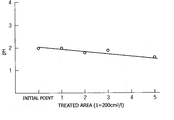
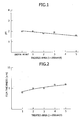
- FIG. 1 is a graph showing the relationship between the pH of the treating fluid and the treated area of aluminum in one embodiment of the surface treatment method of the present invention
- FIG. 2 is a graph showing the relationship between the thickness of the film and the treated area of aluminum in one embodiment of the surface treatment method of the present invention
- FIG. 3 is a graph showing the relationship between the pH of the treating fluid and the treated area of aluminum in a conventional surface treatment method
- FIG. 4 is a graph showing the relationship between the thickness of the film and the treated area of aluminum in a conventional surface treatment method
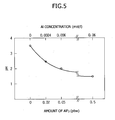
- FIG. 5 is a graph showing the relationship between the pH of the treating fluid and the amount of aluminum fluoride or the aluminum concentration in one embodiment of the surface treatment method of the present invention
- FIG. 6 is a graph showing the relationship between the range of pH change and the amount of potassium chloride in one embodiment of the surface treatment method of the present invention.
- FIG. 7 is a graph showing the relationship between the range of pH change and the amount of potassium hydrogen phthalate in one embodiment of the surface treatment method of the present invention.
- FIG. 8 is a graph showing the relationship between the range of pH change and the amount of potassium dihydrogen phosphate in one embodiment of the surface treatment method of the present invention.
- the treating fluid used in the present invention contains ammonium silicofluoride [(NH 4 ) 2 SiF 6 ] and another aluminum-free fluorine compound.
- the other aluminum-free fluorine compound may be any fluorine-containing compound, except ammonium silicofluoride and aluminum compounds.
- silicofluorides such as magnesium silicofluoride (MgSiF 6 ⁇ 6H 2 O), zinc silicofluoride (ZnSiF 6 ⁇ 6H 2 O), potassium silicofluoride (K 2 SiF 6 ), sodium silicofluoride (Na 2 SiF 6 ) and manganese silicofluoride (MnSiF 6 ⁇ 6H 2 O); borofluorides; zirconium fluorides; and titanium fluorides.
- silicofluorides are preferably used and, in particular, magnesium silicofluoride and the like are preferably used. The use of this treating fluid makes it possible to form a film having excellent sliding properties, corrosion resistance and like properties on the surface of aluminum.
- ammonium silicofluoride is preferably used in an amount of 0.05 to 15 parts by weight, more preferably 0.1 to 10 parts by weight, per 100 parts by weight of water; and the fluorine compound is preferably used in an amount of 0.1 to 20 parts by weight, more preferably 0.2 to 15 parts by weight, per 100 parts by weight of water. If the amount of ammonium silicofluoride is less than 0.05 part by weight, or if the amount of the fluorine compound is less than 0.1 part by weight, the reaction will undesirably be retarded to prolong the treating time. On the other hand, if the amount of ammonium silicofluoride is greater than 15 parts by weight, or if the amount of the fluorine compound is greater than 20 parts by weight, it will be undesirable because of difficulty in dissolving them.
- the treating fluid used in the present invention contains an aluminum-containing substance or powdered aluminum having the same effect as aluminum dissolution occurring immediately after bath preparation.
- the aluminum-containing substance include aluminum fluoride (AlF 3 ), aluminum hydroxide [Al(OH) 3 ], aluminum silicate [Al 2 (SiO 3 ) 3 ] and magnesium aluminate metasilicate [Mg(OAlSiO 3 ) 2 ].
- aluminum fluoride or the like is preferably used.
- aluminum fluoride is preferably used in an amount of 0.02 to 0.5 part by weight, more preferably 0.04 to 0.2 part by weight, per 100 parts by weight of water
- aluminum hydroxide is preferably used in an amount of 0.02 to 0.5 part by weight, more preferably 0.04 to 0.2 part by weight, per 100 parts by weight of water
- aluminum silicate is preferably used in an amount of 0.04 to 1 part by weight, more preferably 0.06 to 0.4 part by weight, per 100 parts by weight of water
- magnesium aluminate metasilicate is preferably used in an amount of 0.04 to 1 part by weight, more preferably 0.06 to 0.4 part by weight, per 100 parts by weight of water
- powdered aluminum is preferably used in an amount of 0.007 to 0.2 part by weight, more preferably 0.009 to 0.05 part by weight, per 100 parts by weight of water.
- the pH of the treating fluid immediately after bath preparation can be adjusted to about 2.5 or less, so that the thinning phenomenon of the film formed on the surface of aluminum immediately after the start of the treatment can be prevented.
- the amount of aluminum fluoride or aluminum hydroxide is greater than 0.5 part by weight, the amount of aluminum silicate or magnesium aluminate metasilicate is greater than 1 part by weight, or the amount of powdered aluminum is greater than 0.2 part by weight, it will be undesirable because of difficulty in dissolving them.
- the treating fluid used in the present invention may optionally contain a chemical agent which exerts a buffering action on the hydrogen ion concentration.
- a chemical agent which exerts a buffering action on the hydrogen ion concentration.
- the chemical agent used in the treating fluid of the present invention include potassium chloride (KCl), potassium hydrogen phthalate [C 6 H 4 (COOK)(COOH)] and potassium dihydrogen phosphate (KH 2 PO 4 ).
- potassium chloride is preferably used. The addition of such a potassium compound makes it possible to minimize changes in the pH of the treating fluid which will cause variation in film thickness.
- potassium chloride is preferably used in an amount of 0.01 to 5 parts by weight, more preferably 0.02 to 1 part by weight, per 100 parts by weight of water
- potassium hydrogen phthalate is preferably used in an amount of 0.05 to 10 parts by weight, more preferably 0.08 to 5 parts by weight, per 100 parts by weight of water
- potassium dihydrogen phosphate is preferably used in an amount of 0.03 to 10 parts by weight, more preferably 0.05 to 5 parts by weight, per 100 parts by weight of water.
- the material subjected to the surface treatment of the present invention is aluminum or an aluminum alloy. Specific examples thereof include pure aluminum, flattened aluminum material, cast aluminum and die-cast aluminum material, and the present invention may be applied to any type of material.
- the surface treatment is effective in improving wear resistance, corrosion resistance and like properties. As a pretreatment for the material to be treated, it is sufficient to remove contaminants (e.g., oil) adhering thereto. However, the surface treatment may be carried out after the material is subjected to an alkali etching with sodium hydroxide or the like, or/and to acid cleaning.
- the aluminum or aluminum alloy to be treated is soaked in the aforesaid treating fluid (i.e., the heated aqueous solution).
- the temperature of the treating fluid in which the aluminum or aluminum alloy is soaked is usually in the range of 70 to 100° C., preferably 75 to 99° C., and more preferably 80 to 98° C. If the temperature of the treating fluid is lower than 70° C., the reaction will undesirably be retarded to prolong the treating time. On the other hand, if the temperature of the treating fluid is higher than 100° C., the evaporation of the treating fluid will increase to an undesirable degree.
- the treating time it is sufficient to soak the material for about 2 minutes because the film-forming reaction is completed in about 1 minute or so.
- the resulting film has a protective effect, no problem will arise even if the material having the film once formed is soaked for more than 30 minutes.
- the pH of the treating fluid immediately after bath preparation can be reduced to 2.5 or less by previously adding to the treating fluid Al ions which will dissolve thereinto and accumulate therein upon soaking aluminum.
- Al ions which will dissolve thereinto and accumulate therein upon soaking aluminum.
- Example 2 The surface treatment of cast aluminum specimens was carried out under the same conditions as in Example 1, except that aluminum fluoride and potassium chloride were not added to the treating fluid. Similarly to Example 1, a film consisting of NH 4 MgAlF 6 was formed on the treated surface of the cast aluminum specimens. The relationships between the pH of the treating fluid and the surface area of the treated cast aluminum specimens (i.e., the treated area) and between the thickness of the film and the treated area are shown in FIGS. 3 and 4, respectively.
- Comparative Example 1 indicates that the pH of the treating fluid immediately after bath preparation was as high as about 3.5 and the thickness of the formed film was as small as about 2 ⁇ m. As the treated area increased, the pH of the treating fluid was greatly reduced from about 3.5 to about 1.0 and the film thickness was greatly increased from about 2 ⁇ m to about 8 ⁇ m. That is, there was great variation in film thickness among specimens. On the other hand, as shown in FIGS. 1 and 2, Example 1 indicates that the pH of the treating fluid was remained constant in the range of 1.5 to 2.0 and the film thickness was uniform in the range of 4 to 6 ⁇ m. From these results, it could be confirmed that changes in pH due to aluminum dissolution were the cause of variation in film thickness.
- a reference bath was prepared by adding 1 part by weight of magnesium silicofluoride and 0.5 part by weight of ammonium silicofluoride to 100 parts by weight of water, and aluminum fluoride was added thereto in an amount of 0.02, 0.05 or 0.5 part by weight.
- the surface treatment of cast aluminum specimens was carried out under the same conditions as in Example 1, except that, for each treating fluid, the amount of potassium chloride added was varied from 0.01 to 5 parts by weight. Then, the difference between the pH of the treating fluid before soaking the first specimen and the pH of the treating fluid after soaking the fifth specimen (i.e., the range of pH change) was determined.
- FIG. 6 The relationship between the range of pH change and the amount of potassium chloride added is shown in FIG. 6. Moreover, the results obtained by adding 0.05 to 10 parts by weight of potassium hydrogen phthalate in place of potassium chloride are shown in FIG. 7, and the results obtained by adding 0.03 to 10 parts by weight of potassium dihydrogen phosphate are shown in FIG. 8.
- the range of pH change was greater than 2 for the reference bath.
- the range of pH change could be reduced to 1 or less by adding a specified amount of potassium chloride.
- the range of pH change could also be reduced to 1 or less by adding a specified amount of potassium hydrogen phthalate or potassium dihydrogen phosphate.
Landscapes
- Chemical & Material Sciences (AREA)
- General Chemical & Material Sciences (AREA)
- Chemical Kinetics & Catalysis (AREA)
- Engineering & Computer Science (AREA)
- Materials Engineering (AREA)
- Mechanical Engineering (AREA)
- Metallurgy (AREA)
- Organic Chemistry (AREA)
- Chemical Treatment Of Metals (AREA)
- ing And Chemical Polishing (AREA)
Abstract
Description
- This invention relates to a method for the surface treatment of aluminum or an aluminum alloy. More particularly, it relates to a method for the surface treatment of aluminum or an aluminum alloy wherein a film is formed thereon by a chemical reaction, without supplying energy (e.g., electricity) externally.
- The conventionally employed alumite process is a method for forming a hard film of aluminum oxide on the surface of aluminum by oxidizing aluminum anodically in an acidic bath. However, this method has the disadvantage of involving a high cost because it requires equipment for electric supply and the rate of film formation is slow.
- Now, there has been developed a technique for forming a film on the surface of aluminum by heating an aqueous solution containing magnesium silicofluoride and ammonium silicofluoride to a temperature of 70 to 100° C. and soaking aluminum in this aqueous solution (see Japanese Patent Provisional Publication No. 11-193478/'99). This technique makes it possible to simplify the equipment and reduce treating costs and also to form a film having excellent sliding properties on the surface of aluminum.
- However, the aforesaid technique shows a tendency in which the thickness of the film formed on the surface of aluminum first treated after bath preparation is small and, subsequently, the film thickness becomes larger as the treated area of aluminum increases. This causes the problem that there is great variation in film thickness among aluminum products.
- Accordingly, in view of the above-described problems, the present inventors made intensive investigations for the purpose of developing a surface treatment method for aluminum or an aluminum alloy and a treating fluid used therefor, which can prevent the film thinning phenomenon occurring in the surface treatment of aluminum immediately after bath preparation and thereby make the thickness of the formed film uniform among aluminum products. As a result, the present inventors have found that the phenomenon in which the film thickness becomes small in the surface treatment immediately after bath preparation is caused by a great pH change to the acid side during the treatment immediately after bath preparation. Moreover, the present inventors have also found that this pH change arises from aluminum ions which dissolve from aluminum and accumulate in the treating fluid. The present invention has been completed from this point of view.
- The present invention relates to a method for the surface treatment of aluminum or an aluminum alloy which comprises soaking aluminum or an aluminum alloy in a treating fluid containing ammonium silicofluoride [(NH 4)2SiF6] and another aluminum-free fluorine compound to form a film thereon, wherein the treating fluid comprises an aqueous solution further containing at least one substance selected from the group consisting of aluminum fluoride (AlF3), aluminum hydroxide [Al(OH)3], aluminum silicate [Al2(SiO3)3], magnesium aluminate metasilicate [Mg(OAlSiO3)2] and powdered aluminum.
- Thus, a great pH change to the acid side can be suppressed by adding to the treating fluid an aluminum-containing substance having the same effect as aluminum dissolution occurring during surface treatment immediately after bath preparation. Consequently, a film thinning phenomenon immediately after bath preparation can be prevented, so that a film having a uniform thickness can be formed on the surface of aluminum.
- As the aforesaid “other aluminum-free fluorine compound”, it is preferable to use magnesium silicofluoride (MgSiF 6·6H2O), zinc silicofluoride (ZnSiF6·6H2O), potassium silicofluoride (K2SiF6), sodium silicofluoride (Na2SiF6) or manganese silicofluoride (MnSiF6·6H2O).
- Moreover, it is preferable that the aforesaid treating fluid comprise an aqueous solution further containing potassium chloride (KCl), potassium hydrogen phthalate [C 6H4(COOK)(COOH)] or potassium dihydrogen phosphate (KH2PO4).
- Thus, when the aforesaid chemical agents which exert a buffering action on the hydrogen ion concentration are added to the treating fluid, the range of pH change can be reduced and, therefore, the thickness of a film formed on the surface of aluminum can be made more uniform.
- As to the formulation of the aforesaid treating fluid, it is preferable that the ammonium silicofluoride be added in an amount of 0.01 to 10 parts by weight, the other aluminum-free fluorine compound in an amount of 0.1 to 20 parts by weight, the aluminum fluoride in an amount of 0.02 to 0.5 part by weight, the aluminum hydroxide in an amount of 0.02 to 0.5 part by weight, the aluminum silicate in an amount of 0.04 to 1 part by weight, the magnesium aluminate metasilicate in an amount of 0.04 to 1 part by weight, and the powdered aluminum in an amount of 0.007 to 0.2 part by weight, per 100 parts by weight of water.
- Moreover, it is also preferable that the potassium chloride be added in an amount of 0.01 to 5 parts by weight, the potassium hydrogen phthalate in an amount of 0.05 to 10 parts by weight, and the potassium dihydrogen phosphate in an amount of 0.03 to 10 parts by weight, per 100 parts by weight of water.
- Furthermore, the present invention relates to a treating fluid for use in the surface treatment of aluminum or an aluminum alloy which comprises an aqueous solution containing ammonium silicofluoride, another aluminum-free fluorine compound, and at least one substance selected from the group consisting of aluminum fluoride, aluminum hydroxide, aluminum silicate, magnesium aluminate metasilicate and powdered aluminum.
- It is preferable that the aforesaid “other aluminum-free fluorine compound” be magnesium silicofluoride, zinc silicofluoride, potassium silicofluoride, sodium silicofluoride or manganese silicofluoride. It is also preferable that the treating fluid in accordance with the present invention comprise an aqueous solution further containing potassium chloride, potassium hydrogen phthalate or potassium dihydrogen phosphate.
- Accordingly, the present invention can provide a surface treatment method for aluminum or an aluminum alloy which can prevent the film thinning phenomenon occurring in the surface treatment of aluminum immediately after bath preparation and thereby make the thickness of the formed film uniform among aluminum products, as well as a treating fluid used therefor. Moreover, since the surface treatment method of the present invention requires no equipment for electric supply, it can simplify the equipment and is hence highly advantageous from the viewpoint of cost. Moreover, it has a high rate of film formation on the surface of aluminum and can hence achieve high productivity. Furthermore, the resulting surface-coated aluminum and the like have excellent sliding properties, corrosion resistance and like properties.
- Embodiments of the present invention will be described hereinbelow with reference to the accompanying drawings in which:
- FIG. 1 is a graph showing the relationship between the pH of the treating fluid and the treated area of aluminum in one embodiment of the surface treatment method of the present invention;
- FIG. 2 is a graph showing the relationship between the thickness of the film and the treated area of aluminum in one embodiment of the surface treatment method of the present invention;
- FIG. 3 is a graph showing the relationship between the pH of the treating fluid and the treated area of aluminum in a conventional surface treatment method;
- FIG. 4 is a graph showing the relationship between the thickness of the film and the treated area of aluminum in a conventional surface treatment method;
- FIG. 5 is a graph showing the relationship between the pH of the treating fluid and the amount of aluminum fluoride or the aluminum concentration in one embodiment of the surface treatment method of the present invention;
- FIG. 6 is a graph showing the relationship between the range of pH change and the amount of potassium chloride in one embodiment of the surface treatment method of the present invention;
- FIG. 7 is a graph showing the relationship between the range of pH change and the amount of potassium hydrogen phthalate in one embodiment of the surface treatment method of the present invention; and
- FIG. 8 is a graph showing the relationship between the range of pH change and the amount of potassium dihydrogen phosphate in one embodiment of the surface treatment method of the present invention.
- The treating fluid used in the present invention contains ammonium silicofluoride [(NH 4)2SiF6] and another aluminum-free fluorine compound. The other aluminum-free fluorine compound may be any fluorine-containing compound, except ammonium silicofluoride and aluminum compounds. Specific examples thereof include silicofluorides such as magnesium silicofluoride (MgSiF6·6H2O), zinc silicofluoride (ZnSiF6·6H2O), potassium silicofluoride (K2SiF6), sodium silicofluoride (Na2SiF6) and manganese silicofluoride (MnSiF6·6H2O); borofluorides; zirconium fluorides; and titanium fluorides. Among these fluorine compounds, silicofluorides are preferably used and, in particular, magnesium silicofluoride and the like are preferably used. The use of this treating fluid makes it possible to form a film having excellent sliding properties, corrosion resistance and like properties on the surface of aluminum.
- As to the compounding proportions of ammonium silicofluoride and the aforesaid other aluminum-free fluorine compound, ammonium silicofluoride is preferably used in an amount of 0.05 to 15 parts by weight, more preferably 0.1 to 10 parts by weight, per 100 parts by weight of water; and the fluorine compound is preferably used in an amount of 0.1 to 20 parts by weight, more preferably 0.2 to 15 parts by weight, per 100 parts by weight of water. If the amount of ammonium silicofluoride is less than 0.05 part by weight, or if the amount of the fluorine compound is less than 0.1 part by weight, the reaction will undesirably be retarded to prolong the treating time. On the other hand, if the amount of ammonium silicofluoride is greater than 15 parts by weight, or if the amount of the fluorine compound is greater than 20 parts by weight, it will be undesirable because of difficulty in dissolving them.
- Moreover, in addition to the aforesaid ammonium silicofluoride and the like, the treating fluid used in the present invention contains an aluminum-containing substance or powdered aluminum having the same effect as aluminum dissolution occurring immediately after bath preparation. Specific examples of the aluminum-containing substance include aluminum fluoride (AlF 3), aluminum hydroxide [Al(OH)3], aluminum silicate [Al2(SiO3)3] and magnesium aluminate metasilicate [Mg(OAlSiO3)2]. Among these aluminum-containing substances, aluminum fluoride or the like is preferably used. It is undesirable to use a compound releasing an ion other than those possessed by the above-illustrated substances, because the properties of the formed film may be different from the expected ones. Although these aluminum-containing substances and powdered aluminum do not dissolve at a pH of the order of 2, they can readily dissolve in the treating fluid of the present invention because of the addition of the aforesaid fluorine compounds.
- As to the compounding proportions of the aluminum-containing substances and powdered aluminum, aluminum fluoride is preferably used in an amount of 0.02 to 0.5 part by weight, more preferably 0.04 to 0.2 part by weight, per 100 parts by weight of water; aluminum hydroxide is preferably used in an amount of 0.02 to 0.5 part by weight, more preferably 0.04 to 0.2 part by weight, per 100 parts by weight of water; aluminum silicate is preferably used in an amount of 0.04 to 1 part by weight, more preferably 0.06 to 0.4 part by weight, per 100 parts by weight of water; magnesium aluminate metasilicate is preferably used in an amount of 0.04 to 1 part by weight, more preferably 0.06 to 0.4 part by weight, per 100 parts by weight of water; and powdered aluminum is preferably used in an amount of 0.007 to 0.2 part by weight, more preferably 0.009 to 0.05 part by weight, per 100 parts by weight of water.
- When not less than 0.02 part by weight of aluminum fluoride or aluminum hydroxide, not less than 0.04 part by weight of aluminum silicate or magnesium aluminate metasilicate, or not less than 0.007 part by weight of powdered aluminum is added, the pH of the treating fluid immediately after bath preparation can be adjusted to about 2.5 or less, so that the thinning phenomenon of the film formed on the surface of aluminum immediately after the start of the treatment can be prevented. On the other hand, if the amount of aluminum fluoride or aluminum hydroxide is greater than 0.5 part by weight, the amount of aluminum silicate or magnesium aluminate metasilicate is greater than 1 part by weight, or the amount of powdered aluminum is greater than 0.2 part by weight, it will be undesirable because of difficulty in dissolving them.
- Furthermore, in addition to the aforesaid aluminum-containing substances and the like, the treating fluid used in the present invention may optionally contain a chemical agent which exerts a buffering action on the hydrogen ion concentration. Specific examples of the chemical agent used in the treating fluid of the present invention include potassium chloride (KCl), potassium hydrogen phthalate [C 6H4(COOK)(COOH)] and potassium dihydrogen phosphate (KH2PO4). Among these potassium compounds, potassium chloride is preferably used. The addition of such a potassium compound makes it possible to minimize changes in the pH of the treating fluid which will cause variation in film thickness.
- As to the compounding proportions of the potassium compounds, potassium chloride is preferably used in an amount of 0.01 to 5 parts by weight, more preferably 0.02 to 1 part by weight, per 100 parts by weight of water; potassium hydrogen phthalate is preferably used in an amount of 0.05 to 10 parts by weight, more preferably 0.08 to 5 parts by weight, per 100 parts by weight of water; and potassium dihydrogen phosphate is preferably used in an amount of 0.03 to 10 parts by weight, more preferably 0.05 to 5 parts by weight, per 100 parts by weight of water. When the compounding proportions of the aforesaid potassium compounds are within these ranges, changes in pH can be reduced to about 1 or less, so that variation in the thickness of the film formed on the surface of aluminum can be suppressed to an even lower level.
- The material subjected to the surface treatment of the present invention is aluminum or an aluminum alloy. Specific examples thereof include pure aluminum, flattened aluminum material, cast aluminum and die-cast aluminum material, and the present invention may be applied to any type of material. The surface treatment is effective in improving wear resistance, corrosion resistance and like properties. As a pretreatment for the material to be treated, it is sufficient to remove contaminants (e.g., oil) adhering thereto. However, the surface treatment may be carried out after the material is subjected to an alkali etching with sodium hydroxide or the like, or/and to acid cleaning.
- In order to carry out the surface treatment of the present invention, the aluminum or aluminum alloy to be treated is soaked in the aforesaid treating fluid (i.e., the heated aqueous solution). The temperature of the treating fluid in which the aluminum or aluminum alloy is soaked is usually in the range of 70 to 100° C., preferably 75 to 99° C., and more preferably 80 to 98° C. If the temperature of the treating fluid is lower than 70° C., the reaction will undesirably be retarded to prolong the treating time. On the other hand, if the temperature of the treating fluid is higher than 100° C., the evaporation of the treating fluid will increase to an undesirable degree. As to the treating time, it is sufficient to soak the material for about 2 minutes because the film-forming reaction is completed in about 1 minute or so. However, since the resulting film has a protective effect, no problem will arise even if the material having the film once formed is soaked for more than 30 minutes.
- According to this surface treatment method, the pH of the treating fluid immediately after bath preparation can be reduced to 2.5 or less by previously adding to the treating fluid Al ions which will dissolve thereinto and accumulate therein upon soaking aluminum. Thus, a great shift of pH to the acid side as a result of the dissolution of aluminum immediately after bath preparation can be suppressed, so that the thinning phenomenon of the film formed on the surface of aluminum can be prevented and the film thickness can hence be made uniform among aluminum products.
- The present invention is more fully explained with reference to the following examples and comparative example. However, these examples are not to be construed to limit the scope of the invention.
- First of all, 0.5 part by weight of ammonium silicofluoride and 1 part by weight of magnesium silicofluoride were added to 100 parts by weight of water. Moreover, 0.05 part by weight of aluminum fluoride and 0.1 part by weight of potassium chloride were added thereto and dissolved therein. This solution was heated to 85° C. and used as a treating fluid. An AC8A-T6 cast aluminum specimen having a surface area of 200 cm 2 was cleaned with an organic solvent and a degreasing agent, and then subjected to a surface treatment by soaking it in 1 L of the treating fluid for 5 minutes. It was confirmed by X-ray diffractometry that a film consisting of NH4MgAlF6 was formed on the treated surface of the cast aluminum specimen. Similarly, four cast aluminum specimens were subjected to a surface treatment by soaking them successively in the treating fluid. Moreover, the pH of the treating fluid was measured at the time of soaking each specimen, and the thickness of the formed film (i.e., the film thickness) was measured by observing a section of the film under a microscope. The relationships between the pH of the treating fluid and the surface area of the treated cast aluminum specimens (i.e., the treated area) and between the thickness of the film and the treated area are shown in FIGS. 1 and 2, respectively.
- The surface treatment of cast aluminum specimens was carried out under the same conditions as in Example 1, except that aluminum fluoride and potassium chloride were not added to the treating fluid. Similarly to Example 1, a film consisting of NH 4MgAlF6 was formed on the treated surface of the cast aluminum specimens. The relationships between the pH of the treating fluid and the surface area of the treated cast aluminum specimens (i.e., the treated area) and between the thickness of the film and the treated area are shown in FIGS. 3 and 4, respectively.
- As shown in FIGS. 3 and 4, Comparative Example 1 indicates that the pH of the treating fluid immediately after bath preparation was as high as about 3.5 and the thickness of the formed film was as small as about 2 μm. As the treated area increased, the pH of the treating fluid was greatly reduced from about 3.5 to about 1.0 and the film thickness was greatly increased from about 2 μm to about 8 μm. That is, there was great variation in film thickness among specimens. On the other hand, as shown in FIGS. 1 and 2, Example 1 indicates that the pH of the treating fluid was remained constant in the range of 1.5 to 2.0 and the film thickness was uniform in the range of 4 to 6 μm. From these results, it could be confirmed that changes in pH due to aluminum dissolution were the cause of variation in film thickness.
- In the preparation of the treating fluid of Example 1, the amount of aluminum fluoride added was varied from 0 to 0.5 part by weight, and the pH of the resulting treating fluid was measured. The relationship between the pH of the treating fluid and the amount of aluminum fluoride added (in parts by weight) or the aluminum concentration in the treating fluid (in mol/l) is shown in FIG. 5. As shown in FIG. 5, it can be seen that, in order to reduce the pH of the treating fluid immediately after bath preparation to 2.5 or less, aluminum fluoride should be added in an amount of not less than 0.02 part by weight (corresponding to an aluminum concentration of not less than 0.0024 mol/l).
- A reference bath was prepared by adding 1 part by weight of magnesium silicofluoride and 0.5 part by weight of ammonium silicofluoride to 100 parts by weight of water, and aluminum fluoride was added thereto in an amount of 0.02, 0.05 or 0.5 part by weight. Using the resulting three treating fluids, the surface treatment of cast aluminum specimens was carried out under the same conditions as in Example 1, except that, for each treating fluid, the amount of potassium chloride added was varied from 0.01 to 5 parts by weight. Then, the difference between the pH of the treating fluid before soaking the first specimen and the pH of the treating fluid after soaking the fifth specimen (i.e., the range of pH change) was determined. The relationship between the range of pH change and the amount of potassium chloride added is shown in FIG. 6. Moreover, the results obtained by adding 0.05 to 10 parts by weight of potassium hydrogen phthalate in place of potassium chloride are shown in FIG. 7, and the results obtained by adding 0.03 to 10 parts by weight of potassium dihydrogen phosphate are shown in FIG. 8.
- As shown in FIG. 6, the range of pH change was greater than 2 for the reference bath. However, the range of pH change could be reduced to 1 or less by adding a specified amount of potassium chloride. Moreover, the range of pH change could also be reduced to 1 or less by adding a specified amount of potassium hydrogen phthalate or potassium dihydrogen phosphate.
- Many other variations and modifications of the invention will be apparent to those skilled in the art without departing from the spirit and scope of the invention. The above-described embodiments are, therefore, intended to be merely exemplary, and all such variations and modifications are intended to be included within the scope of the invention as defined in the appended claims.
- The disclosure of Japanese Patent Application No. 2002-116891 filed on Apr. 19, 2002 including specification, claims, drawings and summary are incorporated herein by reference in its entirety.
Claims (8)
Applications Claiming Priority (2)
| Application Number | Priority Date | Filing Date | Title |
|---|---|---|---|
| JP2002-116891 | 2002-04-19 | ||
| JP2002116891A JP4151301B2 (en) | 2002-04-19 | 2002-04-19 | Surface treatment method and treatment liquid for aluminum or aluminum alloy |
Publications (2)
| Publication Number | Publication Date |
|---|---|
| US20030196729A1 true US20030196729A1 (en) | 2003-10-23 |
| US8075709B2 US8075709B2 (en) | 2011-12-13 |
Family
ID=29207801
Family Applications (1)
| Application Number | Title | Priority Date | Filing Date |
|---|---|---|---|
| US10/386,230 Expired - Fee Related US8075709B2 (en) | 2002-04-19 | 2003-03-11 | Surface treatment method for aluminum or an aluminum alloy and treating fluid used therefor |
Country Status (4)
| Country | Link |
|---|---|
| US (1) | US8075709B2 (en) |
| JP (1) | JP4151301B2 (en) |
| CN (1) | CN1229518C (en) |
| DE (1) | DE10309888B4 (en) |
Cited By (3)
| Publication number | Priority date | Publication date | Assignee | Title |
|---|---|---|---|---|
| US20080302448A1 (en) * | 2005-09-12 | 2008-12-11 | Henkel Ag & Co. Kgaa | Wet on wet method and chrome-free acidic solution for the corrosion control treatment of steel surfaces |
| CN102199768A (en) * | 2010-03-26 | 2011-09-28 | 株式会社神户制钢所 | Surface treatment aluminum alloy material and conjugant using the alloy material |
| WO2017161581A1 (en) * | 2016-03-25 | 2017-09-28 | 深圳市恒兆智科技有限公司 | Matte surface agent for acid etching, aluminum material, and matte surface forming method therefor |
Families Citing this family (2)
| Publication number | Priority date | Publication date | Assignee | Title |
|---|---|---|---|---|
| CN103938200A (en) * | 2014-03-03 | 2014-07-23 | 虞海香 | Aluminum alloy surface treatment method |
| CN103938197A (en) * | 2014-03-03 | 2014-07-23 | 虞海香 | Aluminum alloy surface treatment liquid |
Citations (8)
| Publication number | Priority date | Publication date | Assignee | Title |
|---|---|---|---|---|
| US6106741A (en) * | 1994-10-21 | 2000-08-22 | Elisha Technologies Co Llc | Corrosion resistant wire rope product |
| US6171706B1 (en) * | 1997-10-31 | 2001-01-09 | Suzuki Motor Corporation | Sliding members comprising aluminum or aluminum alloys |
| US20010024729A1 (en) * | 1994-10-21 | 2001-09-27 | Heimann Robert L. | Corrosion resistant coatings containing an amorphous phase |
| US6569537B1 (en) * | 1999-04-28 | 2003-05-27 | Suzuki Motor Corporation | Surface treatment method sliding member and piston |
| US20030118861A1 (en) * | 2001-08-03 | 2003-06-26 | Heimann Robert L. | Electroless process for treating metallic surfaces and products formed thereby |
| US6589324B2 (en) * | 1998-04-22 | 2003-07-08 | Toyo Boseki Kabushiki Kaisha | Agent for treating metallic surface, surface-treated metal material and coated metal material |
| US20040107867A1 (en) * | 2002-12-10 | 2004-06-10 | Gallagher Laurie A. | Sealing composition having corrosion inhibitor therein |
| US6753039B2 (en) * | 2001-08-03 | 2004-06-22 | Elisha Holding Llc | Electrolytic and electroless process for treating metallic surfaces and products formed thereby |
Family Cites Families (5)
| Publication number | Priority date | Publication date | Assignee | Title |
|---|---|---|---|---|
| JPS5380339A (en) | 1976-12-27 | 1978-07-15 | Nippon Barukaa Kougiyou Kk | Seal material subject to anticorrosive treatment and friction material |
| US6303202B1 (en) * | 1999-01-04 | 2001-10-16 | The Standard Register Company | Secure sticker and integrated label/form |
| JP3877264B2 (en) | 2000-02-22 | 2007-02-07 | 日本ペイント株式会社 | Method for manufacturing aluminum fin material and aluminum fin material manufactured by this method |
| JP3852739B2 (en) | 2000-06-28 | 2006-12-06 | スズキ株式会社 | Sliding member and surface treatment method thereof |
| JP5111701B2 (en) | 2001-09-11 | 2013-01-09 | 日本ペイント株式会社 | Surface treatment method for aluminum or aluminum alloy |
-
2002
- 2002-04-19 JP JP2002116891A patent/JP4151301B2/en not_active Expired - Fee Related
-
2003
- 2003-03-06 DE DE10309888A patent/DE10309888B4/en not_active Expired - Fee Related
- 2003-03-11 US US10/386,230 patent/US8075709B2/en not_active Expired - Fee Related
- 2003-04-18 CN CN03110666.8A patent/CN1229518C/en not_active Expired - Fee Related
Patent Citations (11)
| Publication number | Priority date | Publication date | Assignee | Title |
|---|---|---|---|---|
| US6106741A (en) * | 1994-10-21 | 2000-08-22 | Elisha Technologies Co Llc | Corrosion resistant wire rope product |
| US20010024729A1 (en) * | 1994-10-21 | 2001-09-27 | Heimann Robert L. | Corrosion resistant coatings containing an amorphous phase |
| US6171706B1 (en) * | 1997-10-31 | 2001-01-09 | Suzuki Motor Corporation | Sliding members comprising aluminum or aluminum alloys |
| US6303232B1 (en) * | 1997-10-31 | 2001-10-16 | Suzuki Motor Corporation | Coated piston and surface-treating film |
| US6589324B2 (en) * | 1998-04-22 | 2003-07-08 | Toyo Boseki Kabushiki Kaisha | Agent for treating metallic surface, surface-treated metal material and coated metal material |
| US6569537B1 (en) * | 1999-04-28 | 2003-05-27 | Suzuki Motor Corporation | Surface treatment method sliding member and piston |
| US6607609B2 (en) * | 1999-04-28 | 2003-08-19 | Suzuki Motor Corporation | Surface treatment method |
| US20040081837A1 (en) * | 1999-04-28 | 2004-04-29 | Masaya Nomura | Surface treatment method |
| US20030118861A1 (en) * | 2001-08-03 | 2003-06-26 | Heimann Robert L. | Electroless process for treating metallic surfaces and products formed thereby |
| US6753039B2 (en) * | 2001-08-03 | 2004-06-22 | Elisha Holding Llc | Electrolytic and electroless process for treating metallic surfaces and products formed thereby |
| US20040107867A1 (en) * | 2002-12-10 | 2004-06-10 | Gallagher Laurie A. | Sealing composition having corrosion inhibitor therein |
Cited By (3)
| Publication number | Priority date | Publication date | Assignee | Title |
|---|---|---|---|---|
| US20080302448A1 (en) * | 2005-09-12 | 2008-12-11 | Henkel Ag & Co. Kgaa | Wet on wet method and chrome-free acidic solution for the corrosion control treatment of steel surfaces |
| CN102199768A (en) * | 2010-03-26 | 2011-09-28 | 株式会社神户制钢所 | Surface treatment aluminum alloy material and conjugant using the alloy material |
| WO2017161581A1 (en) * | 2016-03-25 | 2017-09-28 | 深圳市恒兆智科技有限公司 | Matte surface agent for acid etching, aluminum material, and matte surface forming method therefor |
Also Published As
| Publication number | Publication date |
|---|---|
| JP2003306776A (en) | 2003-10-31 |
| US8075709B2 (en) | 2011-12-13 |
| DE10309888A1 (en) | 2003-12-04 |
| JP4151301B2 (en) | 2008-09-17 |
| CN1229518C (en) | 2005-11-30 |
| CN1451784A (en) | 2003-10-29 |
| DE10309888B4 (en) | 2006-09-07 |
Similar Documents
| Publication | Publication Date | Title |
|---|---|---|
| US4620904A (en) | Method of coating articles of magnesium and an electrolytic bath therefor | |
| US4009115A (en) | Composition and method for cleaning aluminum at low temperatures | |
| EP0774535B1 (en) | Surface treatment composition, surface treatment solution and surface treatment method for aluminium and its alloys | |
| JP3963944B2 (en) | Chemical conversion layer, formation method thereof and solution | |
| US20080286470A1 (en) | Chemical conversion coating agent and surface-treated metal | |
| JPH09503824A (en) | Hydrophilic coating for aluminum | |
| JP2003231976A (en) | Method for applying a corrosion resistant coating | |
| USRE32661E (en) | Cleaning aluminum at low temperatures | |
| KR20100014685A (en) | Agent for the production of anti-corrosion layers on metal surfaces | |
| CN105247105A (en) | Alkaline cleaning composition for metal substrates | |
| JP2015004136A (en) | Method for forming corrosion-resistant film on zinc metal surface | |
| JPH08506856A (en) | Two-step electrochemical method for magnesium coating | |
| JP2004533542A5 (en) | ||
| JP2016513755A (en) | Improved trivalent chromium-containing composition for aluminum and aluminum alloys | |
| US5074972A (en) | Surface treatment of ti or ti alloy parts for enhancing adhesion to organic material | |
| US5707465A (en) | Low temperature corrosion resistant aluminum and aluminum coating composition | |
| US8075709B2 (en) | Surface treatment method for aluminum or an aluminum alloy and treating fluid used therefor | |
| US7101808B2 (en) | Chromate-free method for surface etching of stainless steel | |
| JP4080381B2 (en) | Surface treatment composition of aluminum and aluminum alloy | |
| CN86108405A (en) | Plating method of magnesium products and used electrolyte | |
| JP4054287B2 (en) | Surface treatment method for aluminum and aluminum alloy | |
| WO2017138530A1 (en) | Chemical conversion bath replenishment method | |
| US3556868A (en) | Chromate coating composition and method | |
| JP3276042B2 (en) | Electrolytic pretreatment method for aluminum alloy members | |
| JP2005325403A (en) | Surface treatment method of aluminum die-cast material |
Legal Events
| Date | Code | Title | Description |
|---|---|---|---|
| AS | Assignment |
Owner name: SUZUKI MOTOR CORPORATION, JAPAN Free format text: ASSIGNMENT OF ASSIGNORS INTEREST;ASSIGNOR:MIHOYA, MAKOTO;REEL/FRAME:013864/0058 Effective date: 20030214 |
|
| FEPP | Fee payment procedure |
Free format text: PAYOR NUMBER ASSIGNED (ORIGINAL EVENT CODE: ASPN); ENTITY STATUS OF PATENT OWNER: LARGE ENTITY |
|
| CC | Certificate of correction | ||
| REMI | Maintenance fee reminder mailed | ||
| LAPS | Lapse for failure to pay maintenance fees | ||
| STCH | Information on status: patent discontinuation |
Free format text: PATENT EXPIRED DUE TO NONPAYMENT OF MAINTENANCE FEES UNDER 37 CFR 1.362 |
|
| STCH | Information on status: patent discontinuation |
Free format text: PATENT EXPIRED DUE TO NONPAYMENT OF MAINTENANCE FEES UNDER 37 CFR 1.362 |
|
| FP | Lapsed due to failure to pay maintenance fee |
Effective date: 20151213 |