US12338436B2 - Synthetic guide molecules, compositions and methods relating thereto - Google Patents
Synthetic guide molecules, compositions and methods relating thereto Download PDFInfo
- Publication number
- US12338436B2 US12338436B2 US17/255,140 US201917255140A US12338436B2 US 12338436 B2 US12338436 B2 US 12338436B2 US 201917255140 A US201917255140 A US 201917255140A US 12338436 B2 US12338436 B2 US 12338436B2
- Authority
- US
- United States
- Prior art keywords
- independently
- integer
- inclusive
- guide molecule
- formula
- Prior art date
- Legal status (The legal status is an assumption and is not a legal conclusion. Google has not performed a legal analysis and makes no representation as to the accuracy of the status listed.)
- Active, expires
Links
Images


Classifications
-
- C—CHEMISTRY; METALLURGY
- C12—BIOCHEMISTRY; BEER; SPIRITS; WINE; VINEGAR; MICROBIOLOGY; ENZYMOLOGY; MUTATION OR GENETIC ENGINEERING
- C12N—MICROORGANISMS OR ENZYMES; COMPOSITIONS THEREOF; PROPAGATING, PRESERVING, OR MAINTAINING MICROORGANISMS; MUTATION OR GENETIC ENGINEERING; CULTURE MEDIA
- C12N15/00—Mutation or genetic engineering; DNA or RNA concerning genetic engineering, vectors, e.g. plasmids, or their isolation, preparation or purification; Use of hosts therefor
- C12N15/09—Recombinant DNA-technology
- C12N15/11—DNA or RNA fragments; Modified forms thereof; Non-coding nucleic acids having a biological activity
-
- C—CHEMISTRY; METALLURGY
- C12—BIOCHEMISTRY; BEER; SPIRITS; WINE; VINEGAR; MICROBIOLOGY; ENZYMOLOGY; MUTATION OR GENETIC ENGINEERING
- C12N—MICROORGANISMS OR ENZYMES; COMPOSITIONS THEREOF; PROPAGATING, PRESERVING, OR MAINTAINING MICROORGANISMS; MUTATION OR GENETIC ENGINEERING; CULTURE MEDIA
- C12N15/00—Mutation or genetic engineering; DNA or RNA concerning genetic engineering, vectors, e.g. plasmids, or their isolation, preparation or purification; Use of hosts therefor
- C12N15/09—Recombinant DNA-technology
- C12N15/11—DNA or RNA fragments; Modified forms thereof; Non-coding nucleic acids having a biological activity
- C12N15/111—General methods applicable to biologically active non-coding nucleic acids
-
- C—CHEMISTRY; METALLURGY
- C12—BIOCHEMISTRY; BEER; SPIRITS; WINE; VINEGAR; MICROBIOLOGY; ENZYMOLOGY; MUTATION OR GENETIC ENGINEERING
- C12N—MICROORGANISMS OR ENZYMES; COMPOSITIONS THEREOF; PROPAGATING, PRESERVING, OR MAINTAINING MICROORGANISMS; MUTATION OR GENETIC ENGINEERING; CULTURE MEDIA
- C12N15/00—Mutation or genetic engineering; DNA or RNA concerning genetic engineering, vectors, e.g. plasmids, or their isolation, preparation or purification; Use of hosts therefor
- C12N15/09—Recombinant DNA-technology
- C12N15/11—DNA or RNA fragments; Modified forms thereof; Non-coding nucleic acids having a biological activity
- C12N15/113—Non-coding nucleic acids modulating the expression of genes, e.g. antisense oligonucleotides; Antisense DNA or RNA; Triplex- forming oligonucleotides; Catalytic nucleic acids, e.g. ribozymes; Nucleic acids used in co-suppression or gene silencing
-
- C—CHEMISTRY; METALLURGY
- C12—BIOCHEMISTRY; BEER; SPIRITS; WINE; VINEGAR; MICROBIOLOGY; ENZYMOLOGY; MUTATION OR GENETIC ENGINEERING
- C12N—MICROORGANISMS OR ENZYMES; COMPOSITIONS THEREOF; PROPAGATING, PRESERVING, OR MAINTAINING MICROORGANISMS; MUTATION OR GENETIC ENGINEERING; CULTURE MEDIA
- C12N2310/00—Structure or type of the nucleic acid
- C12N2310/10—Type of nucleic acid
- C12N2310/20—Type of nucleic acid involving clustered regularly interspaced short palindromic repeats [CRISPR]
-
- C—CHEMISTRY; METALLURGY
- C12—BIOCHEMISTRY; BEER; SPIRITS; WINE; VINEGAR; MICROBIOLOGY; ENZYMOLOGY; MUTATION OR GENETIC ENGINEERING
- C12N—MICROORGANISMS OR ENZYMES; COMPOSITIONS THEREOF; PROPAGATING, PRESERVING, OR MAINTAINING MICROORGANISMS; MUTATION OR GENETIC ENGINEERING; CULTURE MEDIA
- C12N2310/00—Structure or type of the nucleic acid
- C12N2310/30—Chemical structure
- C12N2310/31—Chemical structure of the backbone
- C12N2310/318—Chemical structure of the backbone where the PO2 is completely replaced, e.g. MMI or formacetal
- C12N2310/3181—Peptide nucleic acid, PNA
-
- C—CHEMISTRY; METALLURGY
- C12—BIOCHEMISTRY; BEER; SPIRITS; WINE; VINEGAR; MICROBIOLOGY; ENZYMOLOGY; MUTATION OR GENETIC ENGINEERING
- C12N—MICROORGANISMS OR ENZYMES; COMPOSITIONS THEREOF; PROPAGATING, PRESERVING, OR MAINTAINING MICROORGANISMS; MUTATION OR GENETIC ENGINEERING; CULTURE MEDIA
- C12N2310/00—Structure or type of the nucleic acid
- C12N2310/30—Chemical structure
- C12N2310/31—Chemical structure of the backbone
- C12N2310/318—Chemical structure of the backbone where the PO2 is completely replaced, e.g. MMI or formacetal
- C12N2310/3183—Diol linkers, e.g. glycols or propanediols
-
- C—CHEMISTRY; METALLURGY
- C12—BIOCHEMISTRY; BEER; SPIRITS; WINE; VINEGAR; MICROBIOLOGY; ENZYMOLOGY; MUTATION OR GENETIC ENGINEERING
- C12N—MICROORGANISMS OR ENZYMES; COMPOSITIONS THEREOF; PROPAGATING, PRESERVING, OR MAINTAINING MICROORGANISMS; MUTATION OR GENETIC ENGINEERING; CULTURE MEDIA
- C12N2320/00—Applications; Uses
- C12N2320/50—Methods for regulating/modulating their activity
- C12N2320/53—Methods for regulating/modulating their activity reducing unwanted side-effects
-
- C—CHEMISTRY; METALLURGY
- C12—BIOCHEMISTRY; BEER; SPIRITS; WINE; VINEGAR; MICROBIOLOGY; ENZYMOLOGY; MUTATION OR GENETIC ENGINEERING
- C12N—MICROORGANISMS OR ENZYMES; COMPOSITIONS THEREOF; PROPAGATING, PRESERVING, OR MAINTAINING MICROORGANISMS; MUTATION OR GENETIC ENGINEERING; CULTURE MEDIA
- C12N2330/00—Production
- C12N2330/30—Production chemically synthesised
Definitions
- the present disclosure relates to CRISPR/Cas-related methods and components for editing a target nucleic acid sequence, or modulating expression of a target nucleic acid sequence. More particularly, this disclosure relates to synthetic guide molecules and related systems, methods and compositions.
- CRISPRs Clustered Regularly Interspaced Short Palindromic Repeats
- RNA is transcribed from a portion of the CRISPR locus that includes the viral sequence. That RNA, which contains sequence complementary to the viral genome, mediates targeting of an RNA-guided nuclease protein such as Cas9 or Cpf1 to a target sequence in the viral genome.
- the RNA-guided nuclease in turn, cleaves and thereby silences the viral target.
- CRISPR systems have been adapted for genome editing in eukaryotic cells.
- These systems generally include a protein component (the RNA-guided nuclease) and a nucleic acid component (generally referred to as a guide molecule, guide RNA or gRNA).
- RNA-guided nuclease the RNA-guided nuclease
- gRNA a nucleic acid component
- These two components form a complex that interacts with specific target DNA sequences recognized by, or complementary to, the two components of the system and optionally edits or alters the target sequence, for example by means of site-specific DNA cleavage.
- the editing or alteration of the target sequence may also involve the recruitment of cellular DNA repair mechanisms such as non-homologous end-joining (NHEJ) or homology-directed repair (HDR).
- NHEJ non-homologous end-joining
- HDR homology-directed repair
- CRISPR systems as a means of treating genetic diseases has been widely appreciated, but certain technical challenges must be addressed for therapeutics based on these systems to achieve broad clinical application. Among other things, a need exists for cost-effective and straightforward commercial-scale synthesis of high-quality CRISPR system components.
- IVT in-vitro transcription
- chemical synthesis typically involves the transcription of RNA from a DNA template by means of a bacterial RNA polymerase such as T7 polymerase.
- GMP good manufacturing practice
- IVT synthesis may not be suitable for all guide RNA sequences: the T7 polymerase tends to transcribe sequences which initiate with a 5′ guanine more efficiently than those initiated with another 5′ base, and may recognize stem-loop structures followed by poly-uracil tracts, which structures are present in certain guide molecules, as a signal to terminate transcription, resulting in truncated guide molecule transcripts.
- Chemical synthesis is inexpensive and GMP-production for shorter oligonucleotides (e.g., less than 100 nucleotides in length) is readily available.
- Chemical synthesis methods are described throughout the literature, for instance by Beaucage and Carruthers, Curr Protoc Nucleic Acid Chem. 2001 May; Chapter 3: Unit 3.3 (Beaucage & Carruthers), which is incorporated by reference in its entirety and for all purposes herein. These methods typically involve the stepwise addition of reactive nucleotide monomers until an oligonucleotide sequence of a desired length is reached.
- DMTr is 4,4′-dimethoxytrityl
- R is a group which is compatible with the oligonucleotide synthesis conditions, non-limiting examples of which include H, F, O-alkyl, or a protected hydroxyl group
- B is any suitable nucleobase. (Beaucage & Carruthers). The use of 5′ protected monomers necessitates a deprotection step following each round of addition in which the 5′ protective group is removed to leave a hydroxyl group.
- n ⁇ 1 species oligonucleotide missing various residues
- many chemical synthesis schemes include a “capping” reaction between the stepwise addition step and the deprotection step.
- a non-reactive moiety is added to the 5′ terminus of those oligonucleotides that are not terminated by a 5′ protective group; this non-reactive moiety prevents the further addition of monomers to the oligonucleotide, and is effective in reducing n ⁇ 1 contamination to acceptably low levels during the synthesis of oligonucleotides of around 60 or 70 bases in length.
- the capping reaction is not quantitative either, and may be ineffective in preventing n ⁇ 1 contamination in longer oligonucleotides such as unimolecular guide RNAs.
- n+1 species oligonucleotides
- Unimolecular guide RNAs contaminated with n ⁇ 1 species and/or n+1 species may not behave in the same ways as full-length guide RNAs prepared by other means, potentially complicating the use of synthesized guide RNAs in therapeutics.
- a unimolecular guide molecule provided herein has improved sequence fidelity at the 5′ end, reducing undesired off-target editing.
- compositions comprising, or consisting essentially of, the full length unimolecular guide molecules, which are substantially free of n ⁇ 1 and/or n+1 contamination.
- pre-annealing of guide fragments may be particularly useful when the guide fragments are homomultifunctional (e.g., homobifunctional), such as the amine-functionalized fragments used in urea-based cross-linking methods described herein. Indeed, pre-annealing homomultifunctional guide fragments into heterodimers can reduce the formation of undesirable homodimers.
- This disclosure therefore also provides compositions comprising, or consisting essentially of, the full length unimolecular guide molecules, which are substantially free of side products (for example, homodimers).
- the present disclosure relates to a method of synthesizing a unimolecular guide molecule for a CRISPR system, the method comprising steps of:
- the present disclosure relates to unimolecular guide molecules for a CRISPR system.
- a unimolecular guide molecule provided herein is for a Type II CRISPR system.
- a 5′ region of the first oligonucleotide comprises a targeting domain that is fully or partially complementary to a target domain within a target sequence (e.g., a target sequence within a eukaryotic gene).
- a 3′ region of the second oligonucleotide comprises one or more stem-loop structures.
- a unimolecular guide molecule provided herein is capable of interacting with a Cas9 molecule and mediating the formation of a Cas9/guide molecule complex.
- a unimolecular guide molecule provided herein is in a complex with a Cas9 or an RNA-guided nuclease.
- a unimolecular guide molecule provided herein comprises, from 5′ to 3°:
- the unimolecular guide molecule does not include a tetraloop sequence between the first and second upper stem sequences.
- the first and/or second upper stem sequences comprise nucleotides that number from 4 to 22, inclusive.
- the unimolecular guide molecule is of formula A 3′ -i or A 2′ -i:
- (N) c comprises a 3′ region that comprises at least a portion of a repeat from a Type II CRISPR system. In some embodiments, (N) c comprises a 3′ region that comprises a targeting domain that is fully or partially complementary to a target domain within a target sequence. In some embodiments, (N) t comprises a 3′ region that comprises one or more stem-loop structures.
- the unimolecular guide molecule is of formula B 3′ -i or B 2′ -i:
- the guide molecule does not comprise a tetraloop (i.e., p and q are each 0).
- the lower stem sequence and the upper stem sequence do not comprise an identical sequence of more than 3 nucleotides.
- u is an integer between 3 and 22, inclusive.
- a guide molecule of formula A 3′ -i, A 2′ -i, B 3′ -i, or B 2′ -i is provided, wherein:
- Linker comprises a urea, carbamate, amidine, amide, phosphoramidate, phosphodiester, disulfide, thioether or maleimide, as described herein.
- the unimolecular guide molecule comprises a group of formula J 3′ -i or J 2′ -i:
- B 1 , B 2 , R 2 ′, and R 3 ′ are as defined in formulas A 3′ -i and A 2′ -i above; each g is independently 0, 1, 2, 3, 4, or 5; and L a is as described below and defined herein.
- the unimolecular guide molecule comprises a group of formula J 3′ -ii, J 2′ -ii, J 3′ -iii, or J 2′ -iii:
- B 1 , B 2 , R 2 ′, and R 3 ′ are as defined in formulas J 3′ -i and J 2′ -i above; each g is independently 0, 1, 2, 3, 4, or 5; each h is independently 0, 1, 2, 3, or 4; and L a is as described below and defined herein.
- the present disclosure relates to a composition of guide molecules for a CRISPR system, comprising, or consisting essentially of, unimolecular guide molecules provided herein.
- less than about 10% of the guide molecules comprise a truncation at a 5′ end, relative to a reference guide molecule sequence.
- at least about 99% of the guide molecules comprise a 5′ sequence comprising nucleotides 1-20 of the guide molecule that is 100% identical to a corresponding 5′ sequence of the reference guide molecule sequence.
- a composition of guide molecules provided herein is substantially free of homodimers. In some embodiments, the composition of guide molecules is substantially free of n+1 species. In some embodiments, the composition of guide molecules is substantially free of n ⁇ 1 species. In some embodiments, the composition of guide molecules is substantially free of byproducts. In some embodiments, the composition of guide molecules is not substantially free of byproducts.
- composition provided herein has not been subjected to any purification steps.
- a composition provided herein comprises a unimolecular guide molecule suspended in solution or in a pharmaceutically acceptable carrier.
- the present disclosure relates to oligonucleotides useful for synthesizing a unimolecular guide molecule provided herein and/or for synthesizing a unimolecular guide molecule by a method provided herein.
- the oligonucleotide intermediate is an annealed duplex.
- the present disclosure also provides methods of synthesizing unimolecular guide molecules provided herein.
- the present disclosure relates to a method of altering a nucleic acid in a cell or subject comprising administering to the subject a guide molecule or a composition provided herein.
- the present disclosure relates to a genome editing system comprising a guide molecule provided herein.
- the genome editing system and/or the guide molecule is for use in therapy.
- the genome editing system and/or the guide molecule is for use in the production of a medicament.
- FIG. 1 A depicts an exemplary cross-linking reaction process according to certain embodiments of this disclosure.
- FIG. 1 B depicts, in two-dimensional schematic form, an exemplary S. pyogenes guide molecule highlighting positions (with a star) at which first and second guide molecule fragments are cross-linked together according to various embodiments of this disclosure.
- FIG. 1 C depicts, in two-dimensional schematic form, an exemplary S. aureus guide molecule highlighting positions (with a star) at which first and second guide molecule fragments are cross-linked together according to various embodiments of this disclosure.
- FIG. 2 A depicts a step in an exemplary cross-linking reaction process according to certain embodiments of this disclosure.
- FIG. 2 B depicts a step in an exemplary cross-linking reaction process according to certain embodiments of this disclosure.
- FIG. 2 C depicts an additional step in the exemplary cross-linking reaction process using the reaction products from FIGS. 2 A and 2 B .
- FIG. 3 A depicts an exemplary cross-linking reaction process according to certain embodiments of this disclosure.
- FIG. 3 B depicts steps in an exemplary cross-linking reaction process according to certain embodiments of this disclosure.
- FIG. 3 C depicts, in two-dimensional schematic form, an exemplary S. pyogenes guide molecule highlighting positions at which first and second guide molecule fragments are cross-linked together according to various embodiments of this disclosure.
- FIG. 3 D depicts, in two-dimensional schematic form, an exemplary S. aureus guide molecule highlighting positions at which first and second guide molecule fragments are cross-linked together according to various embodiments of this disclosure.
- FIG. 4 shows DNA cleavage dose-response curves for synthetic unimolecular guide molecules according to certain embodiments of this disclosure as compared to unligated, annealed guide molecule fragments and guide molecules prepared by IVT obtained from a commercial vendor. DNA cleavage was assayed by T7E1 assays as described herein. As the graph shows, the conjugated guide molecule supported cleavage in HEK293 cells in a dose-dependent manner that was consistent with that observed with the unimolecular guide molecule generated by IVT or the synthetic unimolecular guide molecule. It should be noted that unconjugated annealed guide molecule fragments supported a lower level of cleavage, though in a similar dose-dependent manner.
- FIG. 5 A shows a representative ion chromatograph and FIG. 5 B shows a deconvoluted mass spectrum of an ion-exchange purified guide molecule conjugated with a urea linker according to the process of Example 1.
- FIG. 5 C shows a representative ion chromatograph and
- FIG. 5 D shows a deconvoluted mass spectrum of a commercially prepared synthetic unimolecular guide molecule. Mass spectra were assessed for the highlighted peaks in the ion chromatographs.
- FIG. 5 E shows expanded versions of the mass spectra.
- the mass spectrum for the commercially prepared synthetic unimolecular guide molecule is on the left side (34% purity by total mass) while the mass spectrum for the guide molecule conjugated with a urea linker according to the process of Example 1 is on the right side (72% purity by total mass).
- FIG. 6 A shows a plot depicting the frequency with which individual bases and length variances occurred at each position from the 5′ end of complementary DNAs (cDNAs) generated from synthetic unimolecular guide molecules that included a urea linkage
- FIG. 6 B shows a plot depicting the frequency with which individual bases and length variances occurred at each position from the 5′ end of cDNAs generated from commercially prepared synthetic unimolecular guide molecules (i.e., prepared without conjugation). Boxes surround the 20 bp targeting domain of the guide molecule.
- FIG. 6 C shows a plot depicting the frequency with which individual bases and length variances occurred at each position from the 5′ end of cDNAs generated from synthetic unimolecular guide molecules that included a thioether linkage.
- FIG. 7 A and FIG. 7 B are graphs depicting internal sequence length variances (+5 to ⁇ 5) at the first 41 positions from the 5′ ends of cDNAs generated from various synthetic unimolecular guide molecules that included the urea linkage ( FIG. 7 A ), and from commercially prepared synthetic unimolecular guide molecules (i.e., prepared without conjugation) ( FIG. 7 B ).
- FIGS. 8 A- 8 H depict, in two-dimensional schematic form, the structures of certain exemplary guide molecules according to various embodiments of this disclosure.
- Complementary bases capable of base pairing are denoted by one (A-U or A-T pairing) or two (G-C) horizontal lines between bases.
- Bases capable of non-Watson-Crick pairing are denoted by a single horizontal line with a circle.
- FIGS. 9 A- 9 D depict, in two-dimensional schematic form, the structures of certain exemplary guide molecules according to various embodiments of this disclosure.
- Complementary bases capable of base pairing are denoted by one (A-U or A-T pairing) or two (G-C) horizontal lines between bases.
- Bases capable of non-Watson-Crick pairing are denoted by a single horizontal line with a circle.
- FIGS. 10 A- 10 D depict, in two-dimensional schematic form, the structures of certain exemplary guide molecules according to various embodiments of this disclosure.
- Complementary bases capable of base pairing are denoted by one (A-U or A-T pairing) or two (G-C) horizontal lines between bases.
- Bases capable of non-Watson-Crick pairing are denoted by a single horizontal line with a circle.
- FIG. 11 shows a graph of DNA cleavage in CD34+ cells with a series of ribonucleoprotein complexes comprising conjugated guide molecules from Table 17. Cleavage was assessed using next generation sequencing techniques to quantify % insertions and deletions (indels) relative to a wild-type human reference sequence.
- Ligated guide molecules generated according to Example 1 support DNA cleavage in CD34+ cells. % indels were found to increase with increasing stemloop length, but incorporation of a U-A swap adjacent to the stemloop sequence (see gRNAs 1E, IF, and 2D) mitigates the effect.
- FIG. 12 A shows a liquid chromatography-mass spectrometry (LC-MS) trace after T1 endonuclease digestion of gRNA 1A
- FIG. 12 B shows a mass spectrum of the peak with a retention time of 4.50 min (A34:G39).
- FIG. 13 A shows LC-MS data for an unpurified composition of urea-linked guide molecules with both a major product (A-2, retention time of 3.25 min) and a minor product (A-1, retention time of 3.14 min) present.
- the minor product (A-1) in FIG. 13 A was enriched for purposes of illustration and is typically detected in up to 10% yield in the synthesis of guide molecules in accordance with the process of Example 1.
- FIG. 13 B shows a deconvoluted mass spectrum of peak A-2 (retention time of 3.25 min)
- FIG. 13 C shows a deconvoluted mass spectrum of peak A-1 (retention time of 3.14 min). Analysis of each peak by mass spectrometry indicated that both products have the same molecular weight.
- FIG. 14 A shows LC-MS data for the guide molecule composition after chemical modification as described in Example 10.
- the major product (B-1, urea) has the same retention time as in the original analysis (3.26 min), while the retention time of minor product (B-2, carbamate) has shifted to 3.86 min, consistent with chemical functionalization of the free amine moiety.
- FIG. 14 B shows a mass spectrum of peak B-2 (retention time of 3.86 min). Analysis of the peak at 3.86 min (M+134) indicates the predicted functionalization has occurred.
- FIG. 15 A shows the LC-MS trace of the fragment mixture after digestion with T1 endonuclease of a reaction mixture containing both major product (urea) and chemically modified minor product (carbamate). Both the urea linkage (G35-[UR]-C36) and the chemically modified carbamate linkage (G35-[CA+PAA]-C36) were detected at retention times of 4.31 min and 5.77 min, respectively.
- FIG. 16 A shows LC-MS data of the crude reaction mixture for a reaction with a 2′-H modified 5′ guide molecule fragment (upper spectrum), compared to a crude reaction mixture for a reaction with an unmodified version of the same 5′ guide molecule (lower spectrum).
- the crude reaction mixture for a reaction with an unmodified version of the same 5′ guide molecule fragment (lower spectrum) included a mixture of the major urea-linked product (A-2) and the minor carbamate side product (A-1).
- A-2 major urea-linked product
- A-1 minor carbamate side product
- FIG. 16 B shows a deconvoluted mass spectrum of peak B (retention time of 3.14 min, upper spectrum of FIG. 16 A )
- FIG. 16 C shows a deconvoluted mass spectrum of peak A-2 (retention time of 3.45 min, lower spectrum of FIG. 16 A ).
- Analysis of the product of the reaction with the 2′-H modified 5′ guide molecule fragment (B) gave M-16 (compared to A-2, the major unmodified urea-linked product), as expected for a molecule where a 2′-OH has been replaced with a 2′-H (see FIG. 16 B and FIG. 16 C ).
- FIG. 17 A shows a LC-MS trace after T1 endonuclease digestion of gRNA 1L
- FIG. 17 B shows a mass spectrum of the peak with a retention time of 4.65 min (A34:G39).
- FIG. 18 shows exemplary upper stem variants as described in Example 12.
- FIG. 19 is a graph of fraction of dsDNA cleaved as a function of RNP concentration as described in Example 32.
- a module means at least one module, or one or more modules.
- compositions that consisting essentially of means that the species recited are the predominant species, but that other species may be present in trace amounts or amounts that do not affect structure, function or behavior of the subject composition.
- a composition that consists essentially of a particular species will generally comprise 90%, 95%, 96%, or more (by mass or molarity) of that species.
- composition substantially free of molecules means that the molecules are not major components in the recited composition.
- a composition substantially free of a molecule means that the molecule is less than 5%, 4%, 3%, 2%, 1%, 0.5%, or 0.1% (by mass or molarity) in the composition.
- the amount of a molecule can be determined by various analytical techniques, e.g., as described in the Examples.
- compositions provided herein are substantially free of certain molecules, wherein the molecules are less than 5%, 4%, 3%, 2%, 1%, 0.5%, or 0.1% (by mass or molarity) as determined by gel electrophoresis.
- compositions provided herein are substantially free of certain molecules, wherein the molecules are less than 5%, 4%, 3%, 2%, 1%, 0.5%, or 0.1% (by mass or molarity) as determined by mass spectrometry.
- Domain is used to describe a segment of a protein or nucleic acid. Unless otherwise indicated, a domain is not required to have any specific functional property.
- complementary refers to pairs of nucleotides that are capable of forming a stable base pair through hydrogen bonding.
- U is complementary to A
- G is complementary to C.
- hydrogen bond base pairing e.g., within a guide molecule duplex
- external conditions e.g., temperature and pH
- a “covariant” sequence differs from a reference sequence by substitution of one or more nucleotides in the reference sequence with a complementary nucleotide (e.g., one or more Us are replaced with As, one or more Gs are replaced with Cs, etc.).
- a complementary nucleotide e.g., one or more Us are replaced with As, one or more Gs are replaced with Cs, etc.
- the term “covariant” encompasses duplexes with one or more nucleotide swaps between the two complementary sequences of the reference duplex (i.e., one or more A-U swaps and/or one or more G-C swaps) as illustrated in Table 1 below:
- a covariant sequence may exhibit substantially the same energetic favorability of a particular annealing reaction as the reference sequence (e.g., formation of a duplex in the context of a guide molecule of the present disclosure).
- the energetic favorability of a particular annealing reaction may be measured empirically or predicted using computational models.
- Gene conversion refers to the alteration of a DNA sequence by incorporation of an endogenous homologous sequence (e.g., a homologous sequence within a gene array).
- Gene correction refers to the alteration of a DNA sequence by incorporation of an exogenous homologous sequence, such as an exogenous single or double stranded donor template DNA. Gene conversion and gene correction are products of the repair of DNA double-strand breaks by HDR pathways such as those described below.
- Indels, gene conversion, gene correction, and other genome editing outcomes are typically assessed by sequencing (most commonly by “next-gen” or “sequencing-by-synthesis” methods, though Sanger sequencing may still be used) and are quantified by the relative frequency of numerical changes (e.g., +1, +2 or more bases) at a site of interest among all sequencing reads.
- DNA samples for sequencing may be prepared by a variety of methods known in the art, and may involve the amplification of sites of interest by polymerase chain reaction (PCR), the capture of DNA ends generated by double strand breaks, as in the GUIDEseq process described in Tsai et al. (Nat. Biotechnol.
- Genome editing outcomes may also be assessed by in situ hybridization methods such as the FiberCombTM system commercialized by Genomic Vision (Bagneux, France), and by any other suitable methods known in the art.
- Alt-HDR “alternative homology-directed repair,” or “alternative HDR” are used interchangeably to refer to the process of repairing DNA damage using a homologous nucleic acid (e.g., an endogenous homologous sequence, e.g., a sister chromatid, or an exogenous nucleic acid, e.g., a template nucleic acid).
- Alt-HDR is distinct from canonical HDR in that the process utilizes different pathways from canonical HDR, and can be inhibited by the canonical HDR mediators, RAD51 and BRCA2.
- Alt-HDR is also distinguished by the involvement of a single-stranded or nicked homologous nucleic acid template, whereas canonical HDR generally involves a double-stranded homologous template.
- Canonical HDR “canonical homology-directed repair” or “cHDR” refer to the process of repairing DNA damage using a homologous nucleic acid (e.g., an endogenous homologous sequence, e.g., a sister chromatid, or an exogenous nucleic acid, e.g., a template nucleic acid).
- Canonical HDR typically acts when there has been significant resection at the double strand break, forming at least one single stranded portion of DNA.
- cHDR typically involves a series of steps such as recognition of the break, stabilization of the break, resection, stabilization of single stranded DNA, formation of a DNA crossover intermediate, resolution of the crossover intermediate, and ligation.
- the process requires RAD51 and BRCA2, and the homologous nucleic acid is typically double-stranded.
- HDR canonical HDR and alt-HDR.
- Non-homologous end joining refers to ligation-mediated repair and/or non-template-mediated repair including canonical NHEJ (cNHEJ) and alternative NHEJ (altNHEJ), which in turn includes microhomology-mediated end joining (MMEJ), single-strand annealing (SSA), and synthesis-dependent microhomology-mediated end joining (SD-MMEJ).
- cNHEJ canonical NHEJ
- altNHEJ alternative NHEJ
- MMEJ microhomology-mediated end joining
- SSA single-strand annealing
- SD-MMEJ synthesis-dependent microhomology-mediated end joining
- Replacement when used with reference to a modification of a molecule (e.g., a nucleic acid or protein), does not require a process limitation but merely indicates that the replacement entity is present.
- Treat,” “treating,” and “treatment” mean the treatment of a disease in a subject (e.g., a human subject), including one or more of inhibiting the disease, i.e., arresting or preventing its development or progression; relieving the disease, i.e., causing regression of the disease state; relieving one or more symptoms of the disease; and curing the disease.
- Prevent refers to the prevention of a disease in a subject, e.g., in a human, including (a) avoiding or precluding the disease; (b) affecting the predisposition toward the disease; or (c) preventing or delaying the onset of at least one symptom of the disease.
- kits refers to any collection of two or more components that together constitute a functional unit that can be employed for a specific purpose.
- one kit according to this disclosure can include a guide molecule complexed or able to complex with an RNA-guided nuclease, and accompanied by (e.g., suspended in, or suspendable in) a pharmaceutically acceptable carrier.
- the kit can be used to introduce the complex into, for example, a cell or a subject, for the purpose of causing a desired genomic alteration in such cell or subject.
- the components of a kit can be packaged together, or they may be separately packaged.
- Kits according to this disclosure also optionally include directions for use (DFU) that describe the use of the kit, e.g., according to a method of this disclosure.
- the DFU can be physically packaged with the kit, or it can be made available to a user of the kit, for instance by electronic means.
- polynucleotide refers to a series of nucleotide bases (also called “nucleotides”) in DNA and RNA, and mean any chain of two or more nucleotides.
- the polynucleotides, nucleotide sequences, nucleic acids, etc. can be chimeric mixtures or derivatives or modified versions thereof, single-stranded or double-stranded. They can be modified at the base moiety, sugar moiety, or phosphate backbone, for example, to improve stability of the molecule, its hybridization parameters, etc.
- a nucleotide sequence typically carries genetic information, including, but not limited to, the information used by cellular machinery to make proteins and enzymes. These terms include double- or single-stranded genomic DNA, RNA, any synthetic and genetically manipulated polynucleotide, and both sense and antisense polynucleotides. These terms also include nucleic acids containing modified bases.
- protein protein
- peptide and “polypeptide” are used interchangeably to refer to a sequential chain of amino acids linked together via peptide bonds.
- the terms include individual proteins, groups or complexes of proteins that associate together, as well as fragments or portions, variants, derivatives and analogs of such proteins.
- Peptide sequences are presented herein using conventional notation, beginning with the amino or N-terminus on the left, and proceeding to the carboxyl or C-terminus on the right. Standard one-letter or three-letter abbreviations can be used.
- variant refers to an entity such as a polypeptide, polynucleotide or small molecule that shows significant structural identity with a reference entity but differs structurally from the reference entity in the presence or level of one or more chemical moieties as compared with the reference entity. In many embodiments, a variant also differs functionally from its reference entity. In general, whether a particular entity is properly considered to be a “variant” of a reference entity is based on its degree of structural identity with the reference entity.
- Certain embodiments of this disclosure relate, in general, to methods for synthesizing guide molecules in which two or more guide fragments are (a) annealed to one another, and then (b) cross-linked using an appropriate cross-linking chemistry.
- the inventors have found that methods comprising a step of pre-annealing guide fragments prior to cross-linking them improves the efficiency of cross-linking and tends to favor the formation of a desired heterodimeric product, even when a homomultifunctional cross-linker is used.
- the improvements in cross-linking efficiency and, consequently, in the yield of the desired reaction product are thought to be due to the increased stability of an annealed heterodimer as a cross-linking substrate as compared with non-annealed homodimers, and/or the reduction in the fraction of free RNA fragments available to form homodimers, etc. achieved by pre-annealing.
- the methods of this disclosure which include pre-annealing of guide fragments, have a number of advantages, including without limitation: they allow for high yields to be achieved even when the fragments are homomultifunctional (e.g., homobifunctional), such as the amine-functionalized fragments used in the urea-based cross-linking methods described herein; the reduction or absence of undesirable homodimers and other reaction products may in turn simplify downstream purification; and because the fragments used for cross-linking tend to be shorter than full-length guide molecules, they may exhibit a lower level of contamination by n ⁇ 1 species, truncation species, n+1 species, and other contaminants than observed in full-length synthetic guide molecules.
- homomultifunctional e.g., homobifunctional
- the fragments used for cross-linking tend to be shorter than full-length guide molecules, they may exhibit a lower level of contamination by n ⁇ 1 species, truncation species, n+1 species, and other contaminants than observed in full-length synthetic guide molecules.
- fragments are designed so as to maximize the degree of annealing between fragments, and/or to position functionalized 3′ or 5′ ends in close proximity to annealed bases and/or to each other.
- FIGS. 1 B and 1 C depict the two-dimensional structures of unimolecular S. pyogenes and S. aureus gRNAs, and it will be evident from the figures that both gRNAs generally include a relatively long stem-loop structure with a “bulge.”
- synthetic guide molecules include a cross-link between fragments within this stem loop structure.
- first and second fragments having complementary regions at or near their 3′ and 5′ ends, respectively; the 3′ and 5′ ends of these fragments are functionalized to facilitate the cross-linking reaction, as shown for example in Formulas II and III, below:
- p and q are each independently an integer between 0 and 6, inclusive and p+q is an integer between 0 and 6, inclusive;
- Formulas II and III depict a cross-linker positioned within a “tetraloop” structure (or a cross-linker replacing the “tetraloop” structure) in the guide molecule repeat-antirepeat duplex
- cross-linkers may be positioned anywhere in the molecules, for example, in any stem loop structure occurring within a guide molecule, including naturally-occurring stem loops and engineered stem loops.
- certain embodiments of this disclosure relate to guide molecules lacking a tetraloop structure and comprising a cross-linker positioned at the terminus of first and second complementary regions (for instance, at the 3′ terminus of a first upper stem region and the 5′ terminus of a second upper stem region).
- One aspect of this invention is the recognition that guide molecules lacking a “tetraloop” may exhibit enhanced ligation efficiency as a result of having the functionalized 3′ and 5′ ends in close proximity and in a suitable orientation.
- a cross-linking reaction according to this disclosure can include a “splint” or a single stranded oligonucleotide that hybridizes to a sequence at or near the functionalized 3′ and 5′ ends in order to stably bring those functionalized ends into proximity with one-another.
- the present disclosure also encompasses the recognition that guide molecules with longer duplexes (e.g., with extended upper stems) may exhibit enhanced ligation efficiency as compared to guide molecules with shorter duplexes.
- These longer duplex structures are referred to in this disclosure as “extended duplexes,” and are generally (but not necessarily) positioned in proximity to a functionalized nucleotide in a guide fragment.
- extended duplexes are generally (but not necessarily) positioned in proximity to a functionalized nucleotide in a guide fragment.
- Formulas VIII and IX depict a duplex with an optionally extended upper stem, as well as an optional tetraloop (i.e., no tetraloop when p and q are 0).
- Guide molecules of Formula VIII and IX may be advantageous due to increased ligation efficiency resulting from a longer upper stem.
- the combination of a longer upper stem and the absence of a tetraloop may be beneficial for achieving an appropriate orientation of reactive groups F 1 and F 2 for the ligation reaction.
- first and second guide fragments are designed with complementary upper and lower stem regions that, when fully annealed, result in a heterodimer in which (a) first and second functional groups are positioned at the terminus of a duplexed upper stem region in suitable proximity for a cross-linking reaction and/or (b) a duplexed structure is formed between the first and second guide fragments that is capable of supporting the formation of a complex between the guide molecule and the RNA-guided nuclease.
- first and second guide fragments may anneal incompletely with one another, or to form internal duplexes or homodimers, whereby (a) and/or (b) does not occur.
- S. pyogenes guide molecules based on the wild-type crRNA and tracrRNA sequences there may be multiple highly complementary sequences such as poly-U or poly-A tracts in the lower and upper stem that may lead to improper “staggered” heterodimers involving annealing between upper and lower stem regions, rather than the desired annealing of upper stem regions with one another.
- undesirable duplexes may form between the targeting domain sequence of a guide fragment and another region of the same guide fragment or a different fragment, and mispairing may occur between otherwise complementary regions of first and second guide fragments, potentially resulting in incomplete duplexation, bulges and/or unpaired segments.
- the present disclosure provides guide molecules and methods where the primary sequence of the guide fragments has been designed to avoid a particular mispairing or undesirable duplex (e.g., by swapping two complementary nucleotides between the first and second guide fragments). For example, an A-U swap in the upper stem of the wild-type S.
- guides may incorporate sequence changes, such as a nucleotide swap between two duplexed portions of an upper or lower stem, an insertion, deletion or replacement of a sequence in an upper or lower stem, or structural changes such as the incorporation of locked nucleic acids (LNAs) in positions selected to reduce or eliminate the formation of a secondary structure.
- sequence changes such as a nucleotide swap between two duplexed portions of an upper or lower stem, an insertion, deletion or replacement of a sequence in an upper or lower stem, or structural changes such as the incorporation of locked nucleic acids (LNAs) in positions selected to reduce or eliminate the formation of a secondary structure.
- LNAs locked nucleic acids
- duplex extensions, sequence modifications and structural modifications described herein promote the formation of desirable duplexes and reduce mis-pairing and the formation of undesirable duplexes by increasing the energetic favorability of the formation of a desirable duplex relative to the formation of a mis-paired or undesirable duplex.
- the energetic favorability of a particular annealing reaction may be represented by the Gibbs free energy ( ⁇ G); negative ⁇ G values are associated with spontaneous reactions, and a first annealing reaction is more energetically favorable than a second reaction if the ⁇ G of the first reaction is less than (i.e., more negative than) the ⁇ G of the second reaction.
- ⁇ G may be assessed empirically, based on the thermal stability (melting behavior) of particular duplexes, for example using NMR, fluorescence quenching, UV absorbance, calorimetry, etc. as described by You, Tatourov and Owczarzy, “Measuring Thermodynamic Details of DNA Hybridization Using Fluorescence” Biopolymers Vol. 95, No. 7, pp. 472-486 (2011), which is incorporated by reference herein for all purposes. (See, e.g., “Introduction” at pp. 472-73 and “Materials and Methods” at pp.
- thermodynamic nearest neighbor models See, e.g., Tulpan, Andronescu and Leger, “ Free energy estimation of short DNA duplex hybridizations ,” BMC Bioinformatics, Vol. 11, No. 105 (2010). (See “Background” on pp.
- FIGS. 3 C and 3 D identify duplexed portions of S. pyogenes and S. aureus gRNAs suitable for the use of shorter linkers, including without limitation phosphodiester bonds. These positions are generally selected to permit annealing between fragments, and to position functionalized 3′ and 5′ ends such that they are immediately adjacent to one another prior to cross-linking. Exemplary 3′ and 5′ positions located within (rather than adjacent to) a tract of annealed residues are shown in Formulas IV, V, VI and VII below:
- the present disclosure also encompasses the recognition that the arrangement depicted in any of Formulas II, III, IV, V, VI, or VII may be advantageous for avoiding side products in cross-linking reactions, as well as allowing for homobifunctional reactions to occur without homodimerization. Pre-annealing of the two heterodimeric strands orients the reactive groups toward the desired coupling and disfavors reaction with other potential reactive groups in the guide molecule.
- the present disclosure also encompasses the recognition that an overhang in a stem structure of the guide molecule (e.g., when p>q or q>p in Formula II or III), may be particularly advantageous for orienting two oligonucleotides in a cross-linking reaction. Improved efficiency of the reaction may be observed in some such cases.
- the present disclosure also encompasses the recognition that cross-linking strategies that do not require the use of specialty phosphoramidite precursors may be particularly advantageous due to lower costs and increased overall yields and/or efficiencies. Accordingly, in some embodiments, the present disclosure provides methods of preparing unimolecular guide molecules, wherein one oligonucleotide intermediate terminates in a natural and/or unmodified ribonucleotide.
- the present disclosure also encompasses the recognition that hydroxyl groups in proximity to the reactive groups (e.g., the 2′-OH on the 3′ end of the first fragment) are preferably modified to avoid the formation of certain side products.
- hydroxyl groups in proximity to the reactive groups e.g., the 2′-OH on the 3′ end of the first fragment
- the inventors discovered that a carbamate side product may form when amine-functionalized fragments are used in the urea-based cross-linking methods described herein:
- the 2′-OH on the 3′ end of the first fragment is modified (e.g., to H, halogen, —OMe, etc.) in order to prevent formation of the carbamate side product.
- the 2′-OH is modified to a 2′-H:
- cross-linker linking moieties include linker size, solubility in aqueous solution and biocompatibility, as well as the functional group reactivity, optimal reaction conditions for cross-linking, and any necessary reagents, catalyst, etc. required for cross-linking.
- linker size and solubility are selected to preserve or achieve a desired RNA secondary structure, and to avoid disruption or destabilization of the complex between guide molecule and RNA-guided nuclease.
- linker size and solubility are somewhat related, insofar as organic linkers above a certain length may be poorly soluble in aqueous solution and may interfere sterically with surrounding nucleotides within the guide molecule and/or with amino acids in an RNA-guided nuclease complexed with the guide molecule.
- linkers are suitable for use in the various embodiments of this disclosure. Certain embodiments make use of common linking moieties including, without limitation, polyvinylether, polyethylene, polypropylene, polyethylene glycol (PEG), polypropylene glycol (PEG), polyvinyl alcohol (PVA), polyglycolide (PGA), polylactide (PLA), polycaprolactone (PCL), and copolymers thereof. In some embodiments, no linker is used.
- the 3′ or 5′ ends of the guide fragments to be linked are modified with functional groups that react with the reactive groups of the cross-linker.
- these modifications comprise one or more of amine, sulfhydryl, carboxyl, hydroxyl, alkene (e.g., a terminal alkene), azide and/or another suitable functional group.
- Multifunctional cross-linkers are also generally known in the art, and may be either heterofunctional or homofunctional, and may include any suitable functional group, including without limitation isothiocyanate, isocyanate, acyl azide, an NHS ester, sulfonyl chloride, tosyl ester, tresyl ester, aldehyde, amine, epoxide, carbonate (e.g., bis(p-nitrophenyl) carbonate), aryl halide, alkyl halide, imido ester, carboxylate, alkyl phosphate, anhydride, fluorophenyl ester, HOBt ester, hydroxymethyl phosphine, O-methylisourea, DSC, NHS carbamate, glutaraldehyde, activated double bond, cyclic hemiacetal, NHS carbonate, imidazole carbamate, acyl imidazole, methylpyridinium ether, a
- compositions comprising guide molecules synthesized by the methods provided by this disclosure are, in certain embodiments, characterized by high purity of the desired guide molecule reaction product, with low levels of contamination with undesirable species, including n ⁇ 1 species, truncations, n+1 species, guide fragment homodimers, unreacted functionalized guide fragments, etc.
- a purified composition comprising synthetic guide molecules can comprise a plurality of species within the composition (i.e., the guide molecule is the most common species within the composition, by mass or molarity).
- compositions according to the embodiments of this disclosure can comprise ⁇ 70%, ⁇ 75%, ⁇ 80%, ⁇ 85%, ⁇ 90%, ⁇ 95%, ⁇ 96%, ⁇ 97%, ⁇ 98%, and/or ⁇ 99%, of a guide molecule having a desired length (e.g., lacking a truncation at a 5′ end, relative to a reference guide molecule sequence) and a desired sequence (e.g., comprising a 5′ sequence of a reference guide molecule sequence).
- a desired length e.g., lacking a truncation at a 5′ end, relative to a reference guide molecule sequence
- a desired sequence e.g., comprising a 5′ sequence of a reference guide molecule sequence
- a composition comprising guide molecules according to the disclosure includes less than about 20%, 15%, 10%, 9%, 8%, 7%, 6%, 5%, 4%, 3%, 2%, 1%, or less, of guide molecules that comprise a truncation at a 5′ end, relative to a reference guide molecule sequence.
- a composition comprising guide molecules according to the disclosure includes at least about 90%, 95%, 96%, 97%, 98%, 99%, or 100% of guide molecules with a 5′ sequence (e.g., a 5′ sequence comprising or consisting of nucleotides 1-30, 1-25, or 1-20 of the guide molecule) that is 100% identical to a corresponding 5′ sequence of a reference guide molecule sequence.
- a 5′ sequence e.g., a 5′ sequence comprising or consisting of nucleotides 1-30, 1-25, or 1-20 of the guide molecule
- the composition comprises guide molecules with a 5′ sequence that is less than 100% identical to a corresponding 5′ sequence of the reference guide molecule sequence, and such guide molecules are present at a level greater than or equal to 0.1%, such guide molecule does not comprise a targeting domain for a potential off-target site.
- a composition comprising guide molecules according to the disclosure includes at least about 80%, 85%, 90%, 91%, 92%, 93%, 94%, 95%, 96%, 97%, 98%, 99% or more guide molecules that do not comprise a truncation at a 5′ end (relative to a reference guide molecule sequence), and at least about 90%, 95%, 96%, 97%, 98%, 99%, or 100% of such guide molecules (i.e., such guide molecule not comprising a truncation at a 5′ end) have a 5′ sequence (e.g., a 5′ sequence comprising or consisting of nucleotides 1-30, 1-25, or 1-20 of the guide molecule) that is 100% identical to the corresponding 5′ sequence of the reference guide molecule sequence, and if the composition comprises guide molecules with a 5′ sequence that is less than 100% identical to a corresponding 5′ sequence of the reference guide molecule sequence, and such guide molecules are present at a level greater than or equal to
- compositions comprising guide molecules according to the disclosure include less than about 10% of guide molecules that comprise a truncation at a 5′ end, relative to a reference guide molecule sequence and exhibit an acceptable level of activity/efficacy.
- compositions comprising guide molecules according to the disclosure include (i) at least about 99% of guide molecules having a 5′ sequence (e.g., a 5′ sequence comprising or consisting of nucleotides 1-30, 1-25, or 1-20 of the guide molecule) that is 100% identical to the corresponding 5′ sequence of the reference guide molecule sequence, and (ii) if the composition comprises guide molecules with a 5′ sequence that is less than 100% identical to a corresponding 5′ sequence of the reference guide molecule sequence, and such guide molecules are present at a level greater than or equal to 0.1%, such guide molecule does not comprise a targeting domain for a potential off-target site, and compositions exhibit an acceptable level of specificity and/or safety.
- a 5′ sequence e.g., a 5′ sequence comprising
- the purity of a composition provided herein may be expressed as a fraction of total guide molecule (by mass or molarity) within the composition, as a fraction of all RNA or all nucleic acid (by mass or molarity) within the composition, as a fraction of all solutes within the composition (by mass), and/or as a fraction of the total mass of the composition.
- the purity of a composition comprising a guide molecule according to this disclosure is assessed by any suitable means known in the art.
- the relative abundance of the desired guide molecule species can be assessed qualitatively or semi-quantitatively by means of gel electrophoresis.
- the purity of a desired guide molecule species is assessed by chromatography (e.g., liquid chromatography, HPLC, FPLC, gas chromatography), spectrometry (e.g., mass spectrometry, whether based on time-of-flight, sector field, quadrupole mass, ion trap, orbitrap, Fourier transform ion cyclotron resonance, or other technology), nuclear magnetic resonance (NMR) spectroscopy (e.g., visible, infrared or ultraviolet), thermal stability methods (e.g., differential scanning calorimetry, etc.), sequencing methods (e.g., using a template switching oligonucleotide) and combinations thereof (e.g., chromatography-spectrometry, etc.).
- the synthetic guide molecules provided herein operate in substantially the same manner as any other guide molecules (e.g., gRNA), and generally operate by (a) forming a complex with an RNA-guided nuclease such as Cas9, (b) interacting with a target sequence including a region complementary to a targeting sequence of the guide molecule and a protospacer adjacent motif (PAM) recognized by the RNA-guided nuclease, and optionally (c) modifying DNA within or adjacent to the target sequence, for instance by forming a DNA double strand break, single strand break, etc. that may be repaired by DNA repair pathways operating within a cell containing the guide molecule and RNA-guided nuclease.
- RNA-guided nuclease such as Cas9
- PAM protospacer adjacent motif
- a guide molecule described herein e.g., a guide molecule produced using a method described herein, can act as a substrate for an enzyme (e.g., a reverse transcriptase) that acts on RNA.
- an enzyme e.g., a reverse transcriptase
- cross-linkers present within guide molecules described herein may be compatible with such processive enzymes due to close apposition of reactive ends promoted by pre-annealing according to methods of the disclosure.
- heterologous sequences may include, without limitation, DNA donor templates as described in WO 2017/180711 by Cotta-Ramusino, et al., which is incorporated by reference herein for all purposes. (See, e.g., Section I, “gRNA Fusion Molecules” at p.
- Heterologous sequences can also include nucleic acid sequences that are recognized by peptide DNA or RNA binding domains, such as MS2 loops, also described in Section I of WO 2017/180711 above.
- Genome editing system refers to any system having RNA-guided DNA editing activity.
- Genome editing systems of the present disclosure include at least two components adapted from naturally occurring CRISPR systems: a guide molecule (e.g., guide RNA or gRNA) and an RNA-guided nuclease. These two components form a complex that is capable of associating with a specific nucleic acid sequence and editing the DNA in or around that nucleic acid sequence, for instance by making one or more of a single-strand break (an SSB or nick), a double-strand break (a DSB) and/or a point mutation.
- a guide molecule e.g., guide RNA or gRNA
- RNA-guided nuclease e.gRNA-guided nuclease.
- Naturally occurring CRISPR systems are organized evolutionarily into two classes and five types (Makarova et al. Nat Rev Microbiol. 2011 June; 9 (6): 467-477 (Makarova), incorporated by reference herein), and while genome editing systems of the present disclosure may adapt components of any type or class of naturally occurring CRISPR system, the embodiments presented herein are generally adapted from Class 2, and type II or V CRISPR systems.
- Class 2 systems which encompass types II and V, are characterized by relatively large, multidomain RNA-guided nuclease proteins (e.g., Cas9 or Cpf1) and one or more guide RNAs (e.g., a crRNA and, optionally, a tracrRNA) that form ribonucleoprotein (RNP) complexes that associate with (i.e. target) and cleave specific loci complementary to a targeting (or spacer) sequence of the crRNA.
- RNP ribonucleoprotein
- Genome editing systems similarly target and edit cellular DNA sequences, but differ significantly from CRISPR systems occurring in nature.
- the unimolecular guide molecules described herein do not occur in nature, and both guide molecules and RNA-guided nucleases according to this disclosure may incorporate any number of non-naturally occurring modifications.
- Genome editing systems can be implemented (e.g., administered or delivered to a cell or a subject) in a variety of ways, and different implementations may be suitable for distinct applications.
- a genome editing system is implemented, in certain embodiments, as a protein/RNA complex (a ribonucleoprotein, or RNP), which can be included in a pharmaceutical composition that optionally includes a pharmaceutically acceptable carrier and/or an encapsulating agent, such as a lipid or polymer micro- or nano-particle, micelle, liposome, etc.
- a genome editing system is implemented as one or more nucleic acids encoding the RNA-guided nuclease and guide molecule components described above (optionally with one or more additional components); in certain embodiments, the genome editing system is implemented as one or more vectors comprising such nucleic acids, for instance a viral vector such as an adeno-associated virus; and in certain embodiments, the genome editing system is implemented as a combination of any of the foregoing. Additional or modified implementations that operate according to the principles set forth herein will be apparent to the skilled artisan and are within the scope of this disclosure.
- the genome editing systems of the present disclosure can be targeted to a single specific nucleotide sequence, or may be targeted to—and capable of editing in parallel—two or more specific nucleotide sequences through the use of two or more guide molecules.
- the use of multiple guide molecules is referred to as “multiplexing” throughout this disclosure, and can be employed to target multiple, unrelated target sequences of interest, or to form multiple SSBs or DSBs within a single target domain and, in some cases, to generate specific edits within such target domain.
- multiplexing can be employed to target multiple, unrelated target sequences of interest, or to form multiple SSBs or DSBs within a single target domain and, in some cases, to generate specific edits within such target domain.
- Maeder which is incorporated by reference herein, describes a genome editing system for correcting a point mutation (C.2991+1655A to G) in the human CEP290 gene that results in the creation of a cryptic splice site, which in turn reduces or eliminates the function of the gene.
- the genome editing system of Maeder utilizes two guide RNAs targeted to sequences on either side of (i.e., flanking) the point mutation, and forms DSBs that flank the mutation. This, in turn, promotes deletion of the intervening sequence, including the mutation, thereby eliminating the cryptic splice site and restoring normal gene function.
- Cotta-Ramusino WO 2016/073990 by Cotta-Ramusino, et al.
- Cotta-Ramusino describes a genome editing system that utilizes two gRNAs in combination with a Cas9 nickase (a Cas9 that makes a single strand nick such as S.
- the dual-nickase system of Cotta-Ramusino is configured to make two nicks on opposite strands of a sequence of interest that are offset by one or more nucleotides, which nicks combine to create a double strand break having an overhang (5′ in the case of Cotta-Ramusino, though 3′ overhangs are also possible).
- the overhang in turn, can facilitate homology directed repair events in some circumstances.
- a gRNA targeted to a nucleotide sequence encoding Cas9 (referred to as a “governing RNA”), which can be included in a genome editing system comprising one or more additional gRNAs to permit transient expression of a Cas9 that might otherwise be constitutively expressed, for example in some virally transduced cells.
- governing RNA nucleotide sequence encoding Cas9
- Genome editing systems can, in some instances, form double strand breaks that are repaired by cellular DNA double-strand break mechanisms such as NHEJ or HDR.
- DNA double-strand break mechanisms such as NHEJ or HDR.
- Such systems optionally include one or more components that promote or facilitate a particular mode of double-strand break repair or a particular repair outcome.
- Cotta-Ramusino also describes genome editing systems in which a single stranded oligonucleotide “donor template” is added; the donor template is incorporated into a target region of cellular DNA that is cleaved by the genome editing system, and can result in a change in the target sequence.
- genome editing systems modify a target sequence, or modify expression of a gene in or near the target sequence, without causing single- or double-strand breaks.
- a genome editing system may include an RNA-guided nuclease fused to a functional domain that acts on DNA, thereby modifying the target sequence or its expression.
- an RNA-guided nuclease can be connected to (e.g., fused to) a cytidine deaminase functional domain, and may operate by generating targeted C-to-A substitutions. Exemplary nuclease/deaminase fusions are described in Komor et al.
- a genome editing system may utilize a cleavage-inactivated (i.e., a “dead”) nuclease, such as a dead Cas9 (dCas9), and may operate by forming stable complexes on one or more targeted regions of cellular DNA, thereby interfering with functions involving the targeted region(s) including, without limitation, mRNA transcription, chromatin remodeling, etc.
- a cleavage-inactivated nuclease such as a dead Cas9 (dCas9)
- dCas9 dead Cas9
- guide molecule is used herein to refer to any nucleic acid that promotes the specific association (or “targeting”) of an RNA-guided nuclease, such as a Cas9 or a Cpf1, to a target sequence, such as a genomic or episomal sequence, in a cell.
- a guide molecule may be an RNA molecule or a hybrid RNA/DNA molecule.
- a guide molecule may comprise non-nucleotide segments (e.g., a non-nucleotide linker).
- Guide molecules can be unimolecular (comprising a single molecule, and referred to alternatively as chimeric), or modular (comprising more than one, and typically two, separate molecules, such as a crRNA and a tracrRNA, which are usually associated with one another, for instance by duplexing). Guide molecules and their component parts are described throughout the literature, for instance in Briner et al. (Molecular Cell 56 (2), 333-339, Oct. 23, 2014 (Briner), which is incorporated by reference), and in Cotta-Ramusino.
- type II CRISPR systems generally comprise an RNA-guided nuclease protein such as Cas9, a CRISPR RNA (crRNA) that includes a 5′ region that is complementary to a foreign sequence, and a trans-activating crRNA (tracrRNA) that includes a 5′ region that is complementary to, and forms a duplex with, a 3′ region of the crRNA. While not intending to be bound by any theory, it is thought that this duplex facilitates the formation of—and is necessary for the activity of—the Cas9/guide molecule complex.
- Cas9 CRISPR RNA
- tracrRNA trans-activating crRNA
- Guide molecules whether unimolecular or modular, include a “targeting domain” that is fully or partially complementary to a target domain within a target sequence, such as a DNA sequence in the genome of a cell where editing is desired.
- Targeting domains are referred to by various names in the literature, including without limitation “guide sequences” (Hsu et al., Nat Biotechnol. 2013 September; 31 (9): 827-832, (“Hsu”), incorporated by reference herein), “complementarity regions” (Cotta-Ramusino), “spacers” (Briner) and generically as “crRNAs” (Jiang).
- targeting domains are typically 10-30 nucleotides in length, and in certain embodiments are 16-24 nucleotides in length (for instance, 16, 17, 18, 19, 20, 21, 22, 23 or 24 nucleotides in length), and are at or near the 5′ terminus in the case of a Cas9 guide molecule, and at or near the 3′ terminus in the case of a Cpf1 guide molecule.
- guide molecules typically (but not necessarily, as discussed below) include a plurality of domains that may influence the formation or activity of guide molecule/Cas9 complexes.
- the duplexed structure formed by first and secondary complementarity domains of a guide molecule also referred to as a repeat:anti-repeat duplex
- REC recognition
- Cas9/guide molecule complexes both incorporated by reference herein.
- Cas9 guide molecules typically include two or more additional duplexed regions that are involved in nuclease activity in vivo but not necessarily in vitro.
- a first stem-loop near the 3′ portion of the second complementarity domain is referred to variously as the “proximal domain,” (Cotta-Ramusino) “stem loop 1” (Nishimasu 2014 and 2015) and the “nexus” (Briner).
- One or more additional stem loop structures are generally present near the 3′ end of the guide molecule, with the number varying by species: S.
- pyogenes gRNAs typically include two 3′ stem loops (for a total of four stem loop structures including the repeat:anti-repeat duplex), while S. aureus and other species have only one (for a total of three stem loop structures).
- a description of conserved stem loop structures (and guide molecule structures more generally) organized by species is provided in Briner.
- a guide molecule for use in a Cpf1 genome editing system generally includes a targeting domain and a complementarity domain (alternately referred to as a “handle”). It should also be noted that, in guide molecules for use with Cpf1, the targeting domain is usually present at or near the 3′ end, rather than the 5′ end as described above in connection with Cas9 guide molecules (the handle is at or near the 5′ end of a Cpf1 guide molecule).
- guide molecules can be defined, in broad terms, by their targeting domain sequences, and skilled artisans will appreciate that a given targeting domain sequence can be incorporated in any suitable guide molecule, including unimolecular or chimeric guide molecules, or a guide molecule that includes one or more chemical modifications and/or sequential modifications (substitutions, additional nucleotides, truncations, etc.).
- a given targeting domain sequence can be incorporated in any suitable guide molecule, including unimolecular or chimeric guide molecules, or a guide molecule that includes one or more chemical modifications and/or sequential modifications (substitutions, additional nucleotides, truncations, etc.).
- guide molecules may be described solely in terms of their targeting domain sequences.
- guide molecule should be understood to encompass any suitable guide molecule (e.g., gRNA) that can be used with any RNA-guided nuclease, and not only those guide molecules that are compatible with a particular species of Cas9 or Cpf1.
- gRNA guide molecule
- Certain embodiments of this disclosure are related to guide molecules that are cross linked through, for example, a non-nucleotide chemical linkage. As described above, the position of the linkage may be in the stem loop structure of a guide molecule.
- the unimolecular guide molecule comprises, from 5′ to 3′:
- the guide molecule does not include a tetraloop sequence between the first and second upper stem sequences.
- the first and/or second upper stem sequences comprise nucleotides that independently number from 4 to 22 inclusive.
- the first and/or second upper stem sequences comprise nucleotides that independently number from 1 to 22, inclusive.
- the first and second upper stem sequences comprise nucleotides that independently number from 8 to 22, inclusive.
- the first and second upper stem sequences comprise nucleotides that independently number from 12 to 22, inclusive.
- the guide molecule is characterized in that a Gibbs free energy ( ⁇ G) for the formation of a duplex between the first and second guide molecule fragments is less than a ⁇ G for the formation of a duplex between two first guide molecule fragments.
- ⁇ G Gibbs free energy
- a ⁇ G for the formation of a duplex between the first and second guide molecule fragments is characterized by greater than 50%, 60%, 70%, 80%, 90%, or 95% base pairing between each of (i) the first and second upper stem sequences and (ii) the first and second lower stem sequences and/or is less than a ⁇ G for the formation of a duplex characterized by less than 50%, 60%, 70%, 80%, 90% or 95% base pairing between (i) and (ii).
- the synthetic guide molecule is of formula A 3′ -i or A 2′ -i:
- duplex regions of (N) c and (N) t comprise a sequence listed in Table 4.
- (N—N) s comprises a UUUU sequence and (N—N) u comprises a N′UUU, UN′UU, UUN′U or UUUN′ sequence, wherein N′ is A, G or C. In some embodiments, N′ is A. In some embodiments, N′ is G. In some embodiments, N′ is C.
- the guide molecule is based on gRNAs used in S. pyogenes or S. aureus Cas9 systems. In some embodiments, the guide molecule is of formula C 3′ -i, C 2′ -i, D 3′ -i, or D 2′ -i:
- the guide molecule is of formula E 3′ -i U , E 2′ -i U , E 3′ -i A , or E 2′ -i A :
- (N—N) u ′ is of formula:
- (N—N) u′ is of formula:
- (N—N) u′ is of formula:
- (N—N) u′ is of formula:
- B 1 is a guanine residue and B 2 is a cytosine residue, or a covariant thereof.
- the guide molecule is of formula F 3′ -i U , F 2′ -i U , F 3′ -i A , or F 2′ -i A :
- (N—N) u′ is of formula:
- (N—N) u′ is of formula:
- (N—N) u′ is of formula
- (N—N) u′ is of formula:
- B 1 is a guanine residue and B 2 is a cytosine residue, or a covariant thereof.
- Linker is a non-nucleotide chemical linkage that has the formula -(L a ) f -M-(L a ) f -, wherein:
- guide molecules of formulas A 3′ -ii and A 2′ -ii are provided:
- guide molecules of formulas B 3′ -ii and B 2′ -ii are provided:
- guide molecules of formulas C 3′ -ii, C 2′ -ii, D 3′ -ii, and D 2′ -ii are provided:
- guide molecules of formulas E 3′ -ii U , E 2′ -ii U , E 3′ -ii A , and E 2′ -ii A , or covariants thereof, are provided:
- guide molecules of formulas F 3′ -ii U , F 2′ -ii U , F 3′ -ii A , and F 2′ -ii A , or covariants thereof, are provided:
- Linkers may be read from both directions, unless otherwise indicated.
- a Linker of formula -(L a )-M-(L a )-(L a )- includes both 3′-(L a )-M-(L a )-(L a )-5′ and 5′-(L a )-M-(L a )-(L a )-3′, unless otherwise specified.
- Linker is a non-nucleotide chemical linkage that has the formula -M-(L a ) f - or -(L a ) f -M-. In some embodiments, Linker is 5′-M-(L a ) f -3′. In some embodiments, Linker is 5′-(L a ) f -M-3′.
- Linker in a compound of formula A 3 ′-i, is 5′-M-(L a ) f -3′, having the formula A 3′ -xi.
- Linker in a compound of formula A 2′ -i, Linker is 5′-M-(L a ) f -3′, having the formula A 2′ -xi.
- Linker in a compound of formula A 3 ′-i, Linker is 5′-(L a ) f -M-3′, having the formula A 3′ -xii.
- Linker in a compound of formula A 2′ -i, Linker is 5′-(L a ) f -M-3′, having the formula A 2′ -xii.
- p is not equal to q. In some embodiments, p is at least one greater than q. In some embodiments, q is at least one greater than p. In some embodiments, p is one greater than q. In some embodiments, q is one greater than p. In some embodiments, p is two greater than q. In some embodiments, q is two greater than p.
- p′ is not equal to q′. In some embodiments, p′ is at least one greater than q′. In some embodiments, q′ is at least one greater than p′. In some embodiments, p′ is one greater than q′. In some embodiments, q′ is one greater than p′. In some embodiments, p′ is two greater than q′. In some embodiments, q′ is two greater than p′.
- the guide molecule of any of Formulas A 3′ -ii, A 2′ -ii, B 3′ -ii, B 2′ -ii, C 3′ -ii, C 2′ -ii, D 3′ -ii, D 2′ -ii, E 3′ -ii U , E 2′ -ii U , E 3′ -ii A , E 2′ -ii A , F 3′ -ii U , F 2′ -ii U , F 3′ -ii A , or F 2′ -ii A is provided wherein:
- the guide molecule of any of Formulas A 3′ -ii, A 2′ -ii, B 3′ -ii, B 2′ -ii, C 3′ -ii, C 2′ -ii, D 3′ -ii, D 2′ -ii, E 3′ -ii U , E 2′ -ii U , E 3′ -ii A , E 2′ -ii A , F 3′ -ii U , F 2′ -ii U , F 3′ -ii A , or F 2′ -ii A is provided wherein:
- the guide molecule of any of Formulas A 3′ -ii, A 2′ -ii, B 3′ -ii, B 2′ -ii, C 3′ -ii, C 2′ -ii, D 3′ -ii, D 2′ -ii, E 3′ -ii U , E 2′ -ii U , E 3′ -ii A , E 2′ -ii A , F 3′ -ii U , F 2′ -ii U , F 3′ -ii A , or F 2′ -ii A is provided wherein:
- the guide molecule of any of Formulas A 3′ -ii, A 2′ -ii, B 3′ -ii, B 2′ -ii, C 3′ -ii, C 2′ -ii, D 3′ -ii, D 2′ -ii, E 3′ -ii U , E 2′ -ii U , E 3′ -ii A , E 2′ -ii A , F 3′ -ii U , F 2′ -ii U , F 3′ -ii A , or F 2′ -ii A is provided wherein:
- the guide molecule of any of Formulas A 3′ -ii, A 2′ -ii, B 3′ -ii, B 2′ -ii, C 3′ -ii, C 2′ -ii, D 3′ -ii, D 2′ -ii, E 3′ -ii U , E 2′ -ii U , E 3′ -ii A , E 2′ -ii A , F 3′ -ii U , F 2′ -ii U , F 3′ -ii A , or F 2′ -ii A is provided wherein:
- M is —S—, —S—S—, —C(O)N(R)—, —N(R)C(O)—, —C(NR)NR—, —N(R)C(NR)—, —N(R)C(O)N(R)—, —N(R)C(O)O—, —OC(O)N(R)—
- M is —S—S—, —C(NR)NR—, —N(R)C(NR)—, —N(R)C(O)O—, —OC(O)N(R)—, —NP(O)(OH)O—, —OP(O)(OH)N—, or
- M is —S—S—, —C(O)N(R)—, —N(R)C(O)—, —C(NR)NR—, —N(R)C(NR)—, —N(R)C(O)O—, —OC(O)N(R)—, —NP(O)(OH)O—, —OP(O)(OH)N—, or
- M is —S—S—, —C(O)N(R)—, —N(R)C(O)—, —C(NR)NR—, —N(R)C(NR)—, —N(R)C(O)N(R)—, —N(R)C(O)O—, —OC(O)N(R)—, —NP(O)(OH)O—, —OP(O)(OH)N—, or
- each L a is independently selected from:
- each L a is independently selected from:
- each L a is independently selected from:
- each L a is independently selected from:
- M is —N(R) C(O)O— or —OC(O)N(R)—. In some embodiments, M is —N(H)C(O)O— or —OC(O)N(H)—.
- -(L a ) f -M-(L a ) f - is:
- M is —N(R)C(O)O— or —OC(O)N(R)—, and each L a is independently selected from:
- -(L a ) f -M-(L a ) f - is:
- -(L a ) f -M-(L a ) f - is:
- M is —N(R)C(O)N(R)—. In some embodiments, M is —N(H)C(O)N(H)—.
- -(L a ) f -M-(L a ) f - is:
- M is —N(R)C(O)N(R)—, and each L a is independently selected from:
- -(L a ) f -M-(L a ) f - is:
- -(L a ) f -M-(L a ) f - is of Formula G-viii:
- -(L a ) f -M-(L a ) f - is:
- -(L a ) f -M-(L a ) f - is:
- -(L a ) f -M-(L a ) f - is:
- M is —C(O)N(R)— or —N(R)C(O)—. In some embodiments, M is —C(O)N(H)— or —N(H)C(O)—.
- -(L a ) f -M-(L a ) f - is of Formula G-iv:
- -(L a ) f -M-(L a ) f - is:
- M is —C(O)N(H)— or —N(H)C(O)—, and each L a is independently selected from:
- -(L a ) f -M-(L a ) f - is:
- -(L a ) f -M-(L a ) f - is:
- -(L a ) f -M-(L a ) f - is:
- -(L a ) f -M-(L a ) f - is:
- -(L a ) f -M-(L a ) f - is:
- f is 1, 2, 3, 4, 5, or 6.
- -(L a ) f -M-(L a ) f - is:
- M is —NP(O)(OH)O— or —OP(O)(OH)N—, and each L a is independently selected from:
- -(L a ) f -M-(L a ) f - is:
- -(L a ) f -M-(L a ) f - is:
- M is —S—S—.
- -(L a ) f -M-(L a ) f - is:
- -(L a ) f -M-(L a ) f - is:
- -(L a ) f -M-(L a ) f - is:
- M is —S—S—, and each L a is independently selected from:
- -(L a ) f -M-(L a ) f - is:
- -(L a ) f -M-(L a ) f - is:
- -(L a ) f -M-(L a ) f - is:
- -(L a ) f -M-(L a ) f - is:
- -(L a ) f -M-(L a ) f - is:
- -(L a ) f -M-(L a ) f - is:
- -(L a ) f -M-(L a ) f - is:
- -(L a ) f -M-(L a ) f - is:
- -(L a ) f -M-(L a ) f - is:
- -(L a ) f -M-(L a ) f - is:
- -(L a ) f -M-(L a ) f - is:
- -(L a ) f -M-(L a ) f - is:
- -(L a ) f -M-(L a ) f - is:
- -(L a ) f -M-(L a ) f - is:
- R is hydrogen
- -(L a ) f -M-(L a ) f - is:
- each L a is independently selected from:
- -(L a ) f -M-(L a ) f - is:
- -(L a ) f -M-(L a ) f - is:
- M is —N(R)—. In some embodiments, M is —N(H)—.
- -(L a ) f -M-(L a ) f - is:
- -(L a ) f -M-(L a ) f - is:
- one or more L a are:
- a′ is an integer between 1 and 16, inclusive. In some such embodiments, a′ is an integer between 1 and 8, inclusive. In some such embodiments, a′ is 8. In some such embodiments, a′ is 7. In some such embodiments, a′ is 6. In some such embodiments, a′ is 5. In some such embodiments, a′ is 4. In some such embodiments, a′ is 3. In some such embodiments, a′ is 2. In some such embodiments, a′ is 1.
- each a is independently an integer between 0 and 16, inclusive. In some such embodiments, each a is independently an integer between 0 and 8, inclusive. In some such embodiments, each a is independently an integer between 0 and 4, inclusive. In some such embodiments, each a is an integer between 0 and 2, inclusive. In some such embodiments, both a are 0. In some such embodiments, one a is 0 and the other a is 1. In some such embodiments, one a is 0 and the other a is 2. In some such embodiments, both a are 1. In some such embodiments, one a is 1 and the other a is 2. In some such embodiments, both a are 2.
- one or more L a are:
- each a is independently an integer between 0 and 16, inclusive. In some such embodiments, each a is independently an integer between 0 and 8, inclusive. In some such embodiments, each a independently is an integer between 0 and 4, inclusive. In some such embodiments, each a′ is independently an integer between 1 and 16, inclusive. In some such embodiments, each a′ is independently an integer between 1 and 8, inclusive. In some such embodiments, each a′ independently is an integer between 1 and 4, inclusive. In some such embodiments, L a -5′ is:
- one or more L a are:
- R 2 is O or S and R 3 is OH or COOH.
- R 2 is O.
- R 2 is S.
- R 2 is OH.
- R 3 is COOH.
- R 2 is O and R 3 is OH.
- R 2 is O and R 3 is COOH.
- R 2 is S and R 3 is OH.
- R 2 is S and R 3 is COOH.
- one or more L a are:
- each a is independently an integer between 0 and 16, inclusive. In some such embodiments, each a is independently an integer between 0 and 8, inclusive. In some such embodiments, each a is independently an integer between 0 and 4, inclusive. In some such embodiments, one or both a is 8. In some such embodiments, one or both a is 7. In some such embodiments, one or both a is 6. In some such embodiments, one or both a is 5. In some such embodiments, one or both a is 4. In some such embodiments, one or both a is 3. In some such embodiments, one or both a is 2. In some such embodiments, one or both a is 1. In some such embodiments, one or both a is 0.
- R is independently hydrogen or an optionally substituted group selected from C 1-6 aliphatic, phenyl, a 4- to 7-membered heterocyclic ring having 1-2 heteroatoms independently selected from nitrogen, oxygen, and sulfur, and a 5- to 6-membered monocyclic heteroaryl ring having 1-4 heteroatoms independently selected from nitrogen, oxygen, and sulfur.
- R is hydrogen or an optionally substituted group selected from C 1-6 aliphatic and phenyl.
- R is hydrogen or C 1-6 alkyl. In some such embodiments, R is hydrogen.
- one or more L a are:
- each a is independently an integer between 0 and 16, inclusive. In some such embodiments, each a is independently an integer between 0 and 8, inclusive. In some such embodiments, each a is independently an integer between 0 and 4, inclusive. In some such embodiments, one or both a is 8. In some such embodiments, one or both a is 7. In some such embodiments, one or both a is 6. In some such embodiments, one or both a is 5. In some such embodiments, one or both a is 4. In some such embodiments, one or both a is 3. In some such embodiments, one or both a is 2. In some such embodiments, one or both a is 1. In some such embodiments, one or both a is 0.
- each R is independently hydrogen or an optionally substituted group selected from C 1-6 aliphatic, phenyl, a 4- to 7-membered heterocyclic ring having 1-2 heteroatoms independently selected from nitrogen, oxygen, and sulfur, and a 5- to 6-membered monocyclic heteroaryl ring having 1-4 heteroatoms independently selected from nitrogen, oxygen, and sulfur.
- each R is independently hydrogen or an optionally substituted group selected from C 1-6 aliphatic and phenyl.
- each R is independently hydrogen or C 1-6 alkyl.
- each R is hydrogen.
- one or more L a are:
- each a is independently an integer between 0 and 16, inclusive. In some such embodiments, each a is independently an integer between 0 and 8, inclusive. In some such embodiments, each a is independently an integer between 0 and 4, inclusive. In some such embodiments, each a is 0.
- R is independently hydrogen or an optionally substituted group selected from C 1-6 aliphatic, phenyl, a 4- to 7-membered heterocyclic ring having 1-2 heteroatoms independently selected from nitrogen, oxygen, and sulfur, and a 5- to 6-membered monocyclic heteroaryl ring having 1-4 heteroatoms independently selected from nitrogen, oxygen, and sulfur. In some such embodiments, R is hydrogen or an optionally substituted group selected from C 1-6 aliphatic and phenyl. In some such embodiments, R is hydrogen or C 1-6 alkyl. In some such embodiments, R is hydrogen.
- one or more L a are:
- each a is independently an integer between 0 and 16, inclusive. In some such embodiments, each a is independently an integer between 0 and 8, inclusive. In some such embodiments, each a is independently an integer between 0 and 4, inclusive. In some such embodiments, each a′ is independently an integer between 1 and 16, inclusive. In some such embodiments, each a′ is independently an integer between 1 and 8, inclusive. In some such embodiments, each a′ independently is an integer between 1 and 4, inclusive. In some such embodiments, a′ is 1.
- R is independently hydrogen or an optionally substituted group selected from C 1-6 aliphatic, phenyl, a 4- to 7-membered heterocyclic ring having 1-2 heteroatoms independently selected from nitrogen, oxygen, and sulfur, and a 5- to 6-membered monocyclic heteroaryl ring having 1-4 heteroatoms independently selected from nitrogen, oxygen, and sulfur.
- R is hydrogen or an optionally substituted group selected from C 1-6 aliphatic and phenyl.
- R is hydrogen or C 1-6 alkyl. In some such embodiments, R is hydrogen.
- -(L a ) f - is not:
- each a is independently an integer between 0 and 16, inclusive.
- At least one L a is not any one of L a -1 through L a -24.
- At least one L a is
- each a is 0.
- at least one L a is 0.
- each g is 0, 1, 2, 3, 4, or 5.
- Linker is not a structure wherein at least one -(L a ) f - is -(L a -2)-(L a ) g -, a is 0, and -(L a ) g - is selected from L a -1 to L a -24.
- -(L a ) f -M-(L a ) f - is not a structure wherein at least one -(L a ) f - is -(L a -2)-(L a ) g -, a is 0, and -(L a ) g - is selected from L a -1 to L a -24.
- Linker is not a structure wherein at least one -(L a ) f - is -(L a -28)-(L a ) g -, and (L a ) g - is selected from L a -1 to L a -24.
- -(L a ) f -M-(L a ) f - is not a structure wherein at least one -(L a ) f - is -(L a -28)-(L a ) g -, and -(L a ) g - is selected from L a -1 to L a -24.
- At least one L a is
- R 2 is O or S
- R 3 is OH or COOH.
- at least one -(L a ) f - is
- each g is independently 0, 1, 2, 3, 4, or 5.
- Linker is not a structure wherein at least one -(L a ) f - is -(L a -26)-(L a ) g -, and (L a ) g - is selected from L a -1 to L a -24.
- -(L a ) f -M-(L a ) f - is not a structure wherein at least one -(L a ) f - is -(L a -26)-(L a ) g -, and -(L a ) g - is selected from L a -1 to L a -24.
- each L a is independently selected from the group consisting of:
- each L a is independently selected from the group consisting of:
- each L a is independently selected from the group consisting of L a -1, L a -3, L a -5, and L a -26, wherein R 2 is O; R 3 is OH; and R is hydrogen.
- each L a is independently selected from the group consisting of:
- each L a is independently selected from the group consisting of L a -1, L a -5, L a -26, L a -27, L a -28, L a -29, L a -30, L a -31, L a -32, L a -33, L a -34, L a -35, L a -36, L a -37, L a -38, L a -39, and L a -40, wherein R 2 is O; R 3 is OH; and R is hydrogen.
- each L a is independently selected from the group consisting of:
- each L a is independently selected from the group consisting of L a -1, L a -5, L a -26, L a -31, L a -39, and L a -40 wherein R 2 is O; R 3 is OH; and R is hydrogen.
- each L a is independently selected from the group consisting of:
- each L a is independently selected from the group consisting of L a -1, L a -5, L a -26, L a -31, L a -33, L a -34, L a -39, and L a -40, wherein R 2 is O; R 3 is OH; and R is hydrogen.
- M is not encompassed by a group selected from the group consisting of:
- M is or is encompassed by a group selected from the group consisting of:
- each R is independently hydrogen or an optionally substituted group selected from C 1 -C 6 aliphatic, phenyl, a 4-7 membered heterocyclic ring having 1-2 heteroatoms independently selected from nitrogen, oxygen, and sulfur, and a 5-6 membered monocyclic heteroaryl ring having 1-4 heteroatoms independently selected from nitrogen, oxygen, and sulfur.
- each R is independently hydrogen or an optionally substituted group selected from C 1 -C 6 aliphatic, phenyl, a 4-7 membered heterocyclic ring having 1-2 heteroatoms independently selected from nitrogen, oxygen, and sulfur, and a 5-6 membered monocyclic heteroaryl ring having 1-4 heteroatoms independently selected from nitrogen, oxygen, and sulfur.
- M is or is encompassed by a group selected from the group consisting of:
- M is or is encompassed by a group selected from the group consisting of M-4, M-20, M-21, M-22, M-23, M-24, M-25, and M-26, wherein R is hydrogen.
- M is or is encompassed by a group selected from the group consisting of:
- M is or is encompassed by a group selected from the group consisting of M-4, M-21, M-22, M-23, M-25, M-26, M-29, and M-30, wherein R is hydrogen.
- each f is independently 0, 1, 2, 3, 4, 5, or 6. In some embodiments, each f is independently 1, 2, 3, 4, 5, or 6. In some embodiments, each f is independently 2, 3, 4, 5, or 6. In some embodiments, each f is independently 0, 1, 2, 3, or 4. In some embodiments, each f is independently 1, 2, or 3. In some embodiments, f is 0. In some embodiments, f is 1. In some embodiments, f is 2. In some embodiments, f is 3. In some embodiments, f is 4. In some embodiments, f is 5. In some embodiments, f is 6. In some embodiments, f is not 0 when M is —NP(O)(OH)O— or —OP(O)(OH)N—.
- each g is independently 0, 1, 2, 3, 4, or 5. In some embodiments, each g is independently 0, 1, 2, or 3. In some embodiments, each g is independently 0, 1, or 2. In some embodiments, each g is 1, 2, 3, 4, or 5. In some embodiments, each g is 1, 2, or 3. In some embodiments, g is 0. In some embodiments, g is 1. In some embodiments, g is 2. In some embodiments, g is 3. In some embodiments, g is 4. In some embodiments, g is 5.
- each h is independently 0, 1, 2, 3, or 4. In some embodiments, each h is independently 0, 1, 2, or 3. In some embodiments, each h is independently 1, 2, 3, or 4. In some embodiments, each h is 0, 1, or 2. In some embodiments, each h is 1, 2, or 3. In some embodiments, h is 0. In some embodiments, h is 1. In some embodiments, h is 2. In some embodiments, h is 3. In some embodiments, h is 4.
- each L a is different from the others. In some embodiments, each L a on one side of M is different from every other L a on the same side of M.
- Linker is a non-nucleotide chemical linkage that has the formula -(L a ) f -M-(L a ). In some embodiments, Linker is a non-nucleotide chemical linkage that has the formula -(L a )-(L a ) g -M-(L a )-, wherein each g is independently 1, 2, 3, 4, or 5. In some embodiments, Linker is a non-nucleotide chemical linkage that has the formula -(L a )-M-(L a ) g -(L a )-, wherein each g is independently 1, 2, 3, 4, or 5.
- Linker when Linker is a non-nucleotide chemical linkage that has the formula -(L a ) f -M-(L a ) f , and each -(L a ) f - is selected from L a -1 to L a -24, then M is not, or is not encompassed by, a group selected from M-1 to M-18.
- Linker is not a structure wherein each -(L a ) f - is selected from L a -1 to L a -24, and Mis or is encompassed by a group selected from M-1 to M-18.
- Linker is a non-nucleotide chemical linkage that has the formula -(L a -2)-(L a ) g -M-(L a ) g -(L a -2)-, wherein g is 0, 1, 2, 3, 4, or 5, and a is 0.
- Linker is a non-nucleotide chemical linkage that has the formula -(L a -2)-(L a ) f -M-(L a )-(L a -2)-.
- Linker is not a structure wherein each -(L a ) f - is -(L a -2)-(L a ) g -, a is 0, each -(L a ) g - is selected from L a -1 to L a -24, and M is or is encompassed by a group selected from M-1 to M-18.
- -(L a ) f -M-(L a ) f - is not a structure wherein each -(L a ) f - is -(L a -2)-(L a ) g -, a is 0, each -(L a ) g - is selected from L a -1 to L a -24, and M is or is encompassed by a group selected from M-1 to M-18.
- Linker is not a structure wherein each -(L a ) f - is -(L a -28)-(L a ) g -, each -(L a ) g - is selected from L a -1 to L a -24, and M is or is encompassed by a group selected from M-1 to M-18.
- Linker is a non-nucleotide chemical linkage that has the formula -(L a -26)-(L a ) g -M-(L a ) g -(L a -26)-, and each -(L a ) g - is selected from L a -1 to L a -24, then M is not, or is not encompassed by, a group selected from M-1 to M-18.
- Linker is not a structure wherein each -(L a ) f - is -(L a -26)-(L a ) g -, each -(L a ) g - is selected from L a -1 to L a -24, and M is or is encompassed by a group selected from M-1 to M-18.
- a guide molecule is a compound of Formula A 3′ -ii, A 2′ -ii, B 3′ -ii, B 2′ -ii, C 3′ -ii, C 2′ -ii, D 3′ -ii, D 2′ -ii, E 3′ -ii U , E 2′ -ii U , E 3′ -ii A , E 2′ -ii A , F 3′ -ii U , F 2′ -ii U , F 3′ -ii A , or F 2 -ii A , wherein -(L a ) f -M-(L a ) f - is selected from a group in Table 5, wherein:
- a guide molecule is a compound of Formula A 3′ -ii, A 2′ -ii, B 3′ -ii, B 2′ -ii, C 3′ -ii, C 2′ -ii, D 3′ -ii, D 2′ -ii, E 3′ -ii U , E 2′ -ii U , E 3′ -ii A , E 2′ -ii A , F 3′ -ii U , F 2′ -ii U , F 3′ -ii A , or F 2′ -ii A , wherein -(L a ) f -M-(L a ) f - is selected from a group in Table 6, wherein:
- a guide molecule is a compound of Formula A 3′ -ii, A 2′ -ii, B 3′ -ii, B 2′ -ii, C 3′ -ii, C 2′ -ii, D 3′ -ii, D 2′ -ii, E 3′ -ii U , E 2′ -ii U , E 3′ -ii A , E 2′ -ii A , F 3′ -iiy, F 2′ -ii U , F 3′ -ii A , or F 2′ -ii A , wherein -(L a ) f -M-(L a ) f - is not selected from a group in Table 6.
- a guide molecule is a compound of Formula A 3′ -ii, A 2′ -ii, B 3′ -ii, B 2′ -ii, C 3′ -ii, C 2′ -ii, D 3′ -ii, D 2′ -ii, E 3′ -ii U , E 2′ -ii U , E 3′ -ii A , E 2′ -ii A , F 3′ -ii U , F 2′ -ii U , F 3′ -ii A , or F 2′ -ii A , wherein Linker is -(L a ) f -M-(L a ) f -, and wherein:
- a guide molecule is a compound of Formula A 3′ -ii, A 2′ -ii, B 3′ -ii, B 2′ -ii, C 3′ -ii, C 2′ -ii, D 3′ -ii, D 2′ -ii, E 3′ -ii U , E 2′ -ii U , E 3′ -ii A , E 2′ -ii A , F 3′ -ii U , F 2′ -ii U , F 3′ -ii A , or F 2′ -ii A , wherein Linker is -(L a ) f -M-(L a ) f -, and wherein:
- -(L a )-M-(L a )- is not:
- the chemical linkage of a cross-linked guide molecule comprises a urea.
- the guide molecule comprising a urea is of formula J 3′ -i or J 2′ -i:
- B 1 , B 2 , R 2 ′, and R 3 ′ are as defined in formulas A 3′ -i and A 2′ -i above; each g is independently 0, 1, 2, 3, 4, or 5; and L a is as described above and defined herein.
- the guide molecule comprising a urea is of formula A 3′ -iii or A 2′ -iii:
- N, B 1 , B 2 , R 2 ′, R 3 ′, c, and t are as defined above in formulas A 3′ -i and A 2′ -i; each g is independently 0, 1, 2, 3, 4, or 5; and L a is as described above and defined herein.
- B 1 , B 2 , R 2 ′, and R 3 ′ are as defined in formulas J 3′ -i and J 2′ -i above; each g is independently 0, 1, 2, 3, 4, or 5; and L a is as described above and defined herein.
- the guide molecule comprising a thioether is of formula A 3′ -iv, A 2′ -iv, A 3′ -v, or A 2′ -v:
- N, B 1 , B 2 , R 2 ′, R 3 ′, c, and t are as defined above in formulas A 3′ -i and A 2′ -i; each g is independently 0, 1, 2, 3, 4, or 5; and L a is as described above and defined herein.
- the guide molecule comprising a thioether is of formula B 3′ -iv, B 2′ -iv, B 3′ -v, or B 2′ -v:
- N B 1 , B 2 , R 2 ′, R 3 ′, p, q, u, x, y, s, n, m, and are as defined above in formulas B 3′ -i and B 2′ -i; each R 2 is independently O or S; each R 3 is independently OH or COOH; each g is independently 0, 1, 2, 3, 4, or 5; and L a is as described above and defined herein.
- the guide molecule comprising a thioether is of formula C 3′ -iv, C 2′ -iv, C 3′ -v, C 2′ -v, D 3′ -iv, D 2′ -iv, D 3′ -v, or D 2′ -v:
- R 2 ′ and R 3 ′ are each independently H, OH, fluoro, chloro, bromo, NH 2 , SH, S—R′, or O—R′ wherein each R′ is independently a protecting group or an optionally substituted alkyl group.
- R 2 ′ and R 3 ′ are each independently H, OH, halogen, NH 2 , or O—R′ wherein each R′ is independently a protecting group or an optionally substituted alkyl group.
- R 2 ′ and R 3 ′ are each independently H, fluoro, and O—R′, wherein R′ is a protecting group or an optionally substituted alkyl group.
- R 2 ′ is H. In some embodiments, R 3 ′ is H. In some embodiments, R 2 ′ is halogen. In some embodiments, R 3 ′ is halogen. In some embodiments, R 2 ′ is fluoro. In some embodiments, R 3 ′ is fluoro. In some embodiments, R 2 ′ is O—R′. In some embodiments, R 3 ′ is O—R′. In some embodiments, R 2 ′ is O-Me. In some embodiments, R 3 ′ is O-Me.
- p and q are each independently 0, 1, 2, 3, 4, 5, or 6, and p+q is an integer between 0 and 6, inclusive.
- p is 0, 1, 2, or 3.
- q is 0, 1, 2, or 3.
- p and q are each 2.
- p and q are each 0.
- p is 0 and q is 1.
- p is 0 and q is 2.
- p is 1 and q is 0.
- p is 2 and q is 0.
- p′ and q′ are each 0, 1, 2, 3, 4, 5, or 6, and p′+q′ is an integer between 0 and 6, inclusive.
- p′ and q′ are each independently 0, 1, 2, 3, or 4, and p′+q′ is an integer between 0 and 4, inclusive.
- p′ and q′ are each 2.
- p′ and q′ are each 0.
- p′ is 0 and q′ is 1.
- p′ is 0 and q′ is 2.
- p′ is 1 and q′ is 0.
- p′ is 2 and q′ is 0.
- u′ is an integer between 2 and 22, inclusive. In some embodiments, u′ is an integer between 3 and 22, inclusive. In some embodiments, u′ is an integer between 4 and 22, inclusive. In some embodiments, u′ is an integer between 8 and 22, inclusive. In some embodiments, u′ is an integer between 12 and 22, inclusive. In some embodiments, u′ is an integer between 0 and 22, inclusive. In some embodiments, u′ is an integer between 2 and 14, inclusive. In some embodiments, u′ is an integer between 4 and 14, inclusive. In some embodiments, u′ is an integer between 8 and 14, inclusive. In some embodiments, u′ is an integer between 0 and 14, inclusive. In some embodiments, u′ is an integer between 0 and 4, inclusive.
- each N is independently a nucleotide residue.
- N is a modified nucleotide residue.
- N is an unmodified nucleotide residue.
- each N is independently a ribonucleotide, a deoxyribonucleotide, a modified ribonucleotide, or a modified deoxyribonucleotide. Nucleotide modifications are discussed below.
- each N is independently linked to its adjacent nucleotide(s) via a phosphodiester linkage, a phosphorothioate linkage, a phosphonoacetate linkage, a thiophosphonoacetate linkage, or a phosphoramidate linkage.
- c is an integer 20 or greater. In some embodiments, c is an integer between 20 and 60, inclusive. In some embodiments, c is an integer between 20 and 40, inclusive. In some embodiments, c is an integer between 40 and 60, inclusive. In some embodiments, c is an integer between 30 and 60, inclusive. In some embodiments, c is an integer between 20 and 50, inclusive.
- t is an integer 20 or greater. In some embodiments, t is an integer between 20 and 80, inclusive. In some embodiments, t is an integer between 20 and 50, inclusive. In some embodiments, t is an integer between 50 and 80, inclusive. In some embodiments, t is an integer between 20 and 70, inclusive. In some embodiments, t is an integer between 30 and 80, inclusive.
- s is an integer between 1 and 10, inclusive. In some embodiments, s is an integer between 3 and 9, inclusive. In some embodiments, s is an integer between 1 and 8, inclusive. In some embodiments, s is an integer between 0 and 10, inclusive. In some embodiments, s is an integer between 2 and 6, inclusive.
- x is an integer between 1 and 3, inclusive. In some embodiments, x is 1. In some embodiments, x is 2. In some embodiments, x is 3. In some embodiments, in any formulas of this application, y is greater than x. In some embodiments, y is an integer between 3 and 5, inclusive. In some embodiments, y is 3. In some embodiments, y is 4. In some embodiments, y is 5. In some embodiments, x is 1 and y is 3. In some embodiments, x is 2 and y is 4.
- m is an integer 15 or greater. In some embodiments, m is an integer between 15 and 50, inclusive. In some embodiments, m is an integer 16 or greater. In some embodiments, m is an integer 17 or greater. In some embodiments, m is an integer 18 or greater. In some embodiments, m is an integer 19 or greater. In some embodiments, m is an integer 20 or greater. In some embodiments, m is an integer between 20 and 40, inclusive. In some embodiments, m is an integer between 30 and 50, inclusive. In some embodiments, m is an integer between 15 and 30, inclusive.
- n is an integer 30 or greater. In some embodiments, n is an integer between 30 and 70, inclusive. In some embodiments, n is an integer between 30 and 60, inclusive. In some embodiments, n is an integer between 40 and 70, inclusive.
- each R 2 is independently O or S. In some embodiments, R 2 is O. In some embodiments, R 2 is S.
- each R 3 is independently OH or COOH. In some embodiments, R 3 is OH. In some embodiments, R 3 is COOH.
- R 2 is O and R 3 is OH. In some embodiments, R 2 is O and R 3 is COOH. In some embodiments, R 2 is S and R 3 is OH. In some embodiments, R 2 is S and R 3 is COOH.
- provided guide molecules may exist as one or more neutral or salt forms, all of which are contemplated by the present disclosure.
- each N—N independently represents two complementary nucleotides, optionally two complementary nucleotides that are hydrogen bonding base-paired. In some embodiments, all N—N represent two complementary nucleotides that are hydrogen bonding base-paired. In some embodiments, some N—N represent two complementary nucleotides and some N—N represent two complementary nucleotides that are hydrogen bonding base-paired.
- B 1 and B 2 are each independently a nucleobase. In some embodiments, B 1 and B 2 are independently selected from guanine, cytosine, adenine, and uracil. In some embodiments, B 1 is guanine and B 2 is cytosine. In some embodiments, B 1 is cytosine and B 2 is guanine. In some embodiments, B 1 is adenine and B 2 is uracil. In some embodiments, B 1 is uracil and B 2 is adenine. In some embodiments, B 1 and B 2 are complementary. In some embodiments, B 1 and B 2 are complementary and base-paired through hydrogen bonding. In some embodiments, B 1 and B 2 are complementary and not base-paired through hydrogen bonding. In some embodiments, B 1 and B 2 are not complementary.
- each represents independently a phosphodiester linkage, a phosphorothioate linkage, a phosphonoacetate linkage, a thiophosphonoacetate linkage, or a phosphoroamidate linkage. In some embodiments, each represents a phosphodiester linkage.
- each R is independently hydrogen or an optionally substituted group selected from C 1-6 aliphatic, phenyl, a 4- to 7-membered heterocyclic ring having 1-2 heteroatoms independently selected from nitrogen, oxygen, and sulfur, and a 5- to 6-membered monocyclic heteroaryl ring having 1-4 heteroatoms independently selected from nitrogen, oxygen, and sulfur.
- R is hydrogen or an optionally substituted group selected from C 1-6 aliphatic and phenyl.
- R is hydrogen or C 1-6 alkyl.
- R is hydrogen.
- the present disclosure also provides a method of synthesizing a unimolecular guide molecule, the method comprising the steps of:
- first oligonucleotide and a second oligonucleotide capable of forming a duplex between a 3′ region of the first oligonucleotide and a 5′ region of the second oligonucleotide, wherein the first oligonucleotide comprises a first reactive group which is at least one of a 2′ reactive group and a 3′ reactive group, and wherein the second oligonucleotide comprises a second reactive group which is a 5′ reactive group; and conjugating the first and second oligonucleotides via the first and second reactive groups to form a unimolecular guide molecule that includes a covalent bond linking the first and second oligonucleotides.
- the method of synthesizing a unimolecular guide molecule comprises the steps of:
- the first reactive group and the second reactive group are selected from the functional groups listed above under “Overview.”
- the first reactive group and the second reactive group are each independently an amine moiety, a sulfhydryl moiety, a haloacetyl (e.g., bromoacetyl or iodoacetyl) moiety, a hydroxyl moiety, or a phosphate moiety.
- the first reactive group and the second reactive group are each independently an amine moiety, a hydroxyl moiety, a sulfhydryl moiety, a haloacetyl (e.g., bromoacetyl or iodoacetyl) moiety, a phosphate moiety, an aryl fluoride moiety, an imidoester moiety, a maleimide moiety, a carbonate moiety, an ester moiety, or an isocyanate moiety.
- a hydroxyl moiety e.g., a sulfhydryl moiety
- a haloacetyl e.g., bromoacetyl or iodoacetyl
- the first reactive group and the second reactive group are each independently an amine moiety, a hydroxyl moiety, a phosphate moiety, a sulfhydryl moiety, a haloacetyl (e.g., bromoacetyl or iodoacetyl) moiety, or a disulfide moiety.
- the first reactive group and the second reactive group are both amine moieties.
- the first reactive group is a sulfhydryl moiety
- the second reactive group is a haloacetyl (e.g., bromoacetyl or iodoacetyl) moiety.
- the first reactive group is a haloacetyl (e.g., bromoacetyl or iodoacetyl) moiety
- the second reactive group is a sulfhydryl moiety.
- the first reactive group is a hydroxyl moiety and the second reactive group is a phosphate moiety.
- the first reactive group is a phosphate moiety, and the second reactive group is a hydroxyl moiety.
- the first reactive group is an amine moiety, and the second reactive group is a sulfhydryl moiety.
- the first reactive group is a sulfhydryl moiety, and the second reactive group is an amine moiety.
- the first reactive group is an amine moiety, and the second reactive group is a hydroxyl moiety.
- the first reactive group is a hydroxyl moiety, and the second reactive group is an amine moiety.
- the first reactive group and the second reactive group are both sulfhydryl moieties.
- the first reactive group is an amine moiety, and the second reactive group is a phosphate moiety.
- the first reactive group is a phosphate moiety, and the second reactive group is an amine moiety.
- the first reactive group and the second reactive group are not an azide moiety, an alkyne moiety, a tetrazine moiety, a sulfhydryl group, a maleimide moiety, or an alkene moiety. In some embodiments, the first reactive group and the second reactive group are not an azide moiety, a cycloalkyne moiety, a tetrazine moiety, a sulfhydryl group, a maleimide moiety, or a cycloalkene moiety.
- the step of conjugating comprises a concentration of first nucleotide in the range of 10 ⁇ M to 1 mM. In some embodiments, the step of conjugating comprises a concentration of second nucleotide in the range of 10 ⁇ M to 1 mM. In some embodiments, the concentration of either the first or second nucleotide is 10 ⁇ M, 50 ⁇ M, 100 ⁇ M, 200 ⁇ M, 400 ⁇ M, 600 ⁇ M, 800 ⁇ M, or 1 mM, or any range in between.
- the step of conjugating comprises a pH in the range of 5.0 to 9.0.
- the pH is 5.0, 5.5, 6.0, 6.5, 7.0, 7.5, 8.0, 8.5, or 9.0.
- the pH is 6.0.
- the pH is 7.0.
- the pH is 7.5.
- the pH is 8.0.
- the pH is 8.5.
- the pH is 9.0.
- the step of conjugating is performed under argon. In some embodiments, the step of conjugating is performed under ambient atmosphere.
- the step of conjugating is performed in water. In some embodiments, the step of conjugating is performed in water with a cosolvent.
- the cosolvent is DMSO, DMF, NMP, DMA, morpholine, pyridine, or MeCN. In some embodiments, the cosolvent is DMSO. In some embodiments, the cosolvent is DMF.
- the step of conjugating is performed at a temperature in the range of 0° C. to 40° C.
- the temperature is 0° C., 4° C., 10° C., 20° C., 25° C., 30° C., 37° C., or 40° C.
- the temperature is 25° C. In some embodiments, the temperature is 4° C.
- the step of conjugating is performed in the presence of a divalent metal cation.
- the divalent metal cation is Mg 2+ , Ca 2+ , Sr 2+ , Ba 2+ , Cr 2+ , Mn 2+ , Fe 2+ , Co 2+ , Ni 2+ , Cu 2+ , or Zn 2+ .
- the divalent metal cation is Mg 2+ .
- the step of conjugating comprises a cross-linking reagent or a cross-linker (see “Overview” above).
- the cross-linker is multifunctional, and in some embodiments the cross-linker is bifunctional. In some embodiments, the multifunctional cross-linker is heterofunctional or homofunctional.
- the cross-linker contains a carbonate.
- the carbonate-containing cross-linker is disuccinimidyl carbonate, diimidazole carbonate, or bis-(p-nitrophenyl) carbonate, or
- the cross-linker contains an ester.
- the ester-containing cross linker is selected from:
- the cross-linker is disuccinimidyl gluterate (DSG). In some embodiments, the cross-linker is disuccinimidyl suberate (DSS). In some embodiments, the cross-linker is bis(sulfosuccinimidyl) suberate (BS3). In some embodiments, the cross-linker is dithiobis(succinimidyl propionate) (DSP).
- the cross-linker contains an imidoester.
- the imidoester-containing cross-linker is:
- the cross-linker contains an aryl fluoride.
- the aryl fluoride-containing cross-linker is:
- the cross-linker is dibromomaleimide.
- the cross-linker contains a haloacetyl group.
- the haloacetyl-containing cross-linker is selected from:
- the cross-linker contains an isocyanate group.
- the isocyanate-containing cross-linker is selected from:
- the cross-linker contains an aldehyde. In some embodiments, the cross-linker is formaldehyde.
- the step of conjugating comprises a concentration of bifunctional crosslinking reagent in the range of 1 mM to 100 mM.
- the concentration of bifunctional crosslinking reagent is 1 mM, 10 mM, 20 mM, 40 mM, 60 mM, 80 mM, or 100 mM.
- the concentration of bifunctional crosslinking reagent is 100 to 1000 times greater than the concentration of each of the first and second oligonucleotides.
- the concentration of bifunctional crosslinking reagent is 100, 200, 400, 600, 800, or 1000 times greater than the concentration of the first oligonucleotide.
- the concentration of bifunctional crosslinking reagent is 100, 200, 400, 600, 800, or 1000 times greater than the concentration of the second oligonucleotide.
- the step of conjugating is performed in the presence of a chelating reagent.
- the chelating reagent is ethylenediaminetetraacetic acid (EDTA), or a salt thereof.
- the step of conjugating is performed in the presence of an activating agent.
- the activating agent is a carbodiimide, or salt thereof.
- the carbodiimide is 1-ethyl-3-(3-dimethylaminopropyl) carbodiimide (EDC), N,N′-dicyclohexylcarbodiimide (DCC) or N,N′-diisopropylcarbodiimide (DIC), or a salt thereof.
- the carbodiimide is 1-ethyl-3-(3-dimethylaminopropyl) carbodiimide (EDC), or a salt thereof.
- the step of conjugating comprises a concentration of activating agent that is in the range of 1 mM to 100 mM. In some embodiments, the concentration of activating agent is 1 mM, 10 mM, 20 mM, 40 mM, 60 mM, 80 mM, or 100 mM. In some embodiments, the concentration of activating agent is 100 to 1000 times greater than the concentration of each of the first and second oligonucleotides. In some embodiments, the concentration of activating agent is 100, 200, 400, 600, 800, or 1000 times greater than the concentration of the first oligonucleotide. In some embodiments, the concentration of activating agent is 100, 200, 400, 600, 800, or 1000 times greater than the concentration of the second oligonucleotide.
- the step of conjugating is performed in the presence of a stabilizing agent.
- the stabilizing agent is imidazole, cyanoimidazole, pyridine, or dimethylaminopyridine, or a salt thereof.
- the stabilizing agent is imidazole.
- the step of conjugating is performed in the presence of both an activating agent and a stabilizing agent.
- the step of conjugating is performed in the presence of 1-ethyl-3-(3-dimethylaminopropyl) carbodiimide (EDC) and imidazole, or salts thereof.
- the step of conjugating is performed in the presence of an RNA template.
- the RNA template is about a 10-mer, 20-mer, 30-mer, 40-mer, or 50-mer.
- the RNA template is complementary to the ligation site.
- the step of conjugating is performed in the presence of a reducing agent.
- the reducing agent is tris(2-carboxyethyl)phosphine.
- the method of synthesizing a unimolecular guide molecule generates a guide molecule of any formula disclosed herein.
- the first oligonucleotide is of formula K 3′ -i or K 2′ -i:
- the second oligonucleotide is of formula K 5′ -i:
- F 1 ′ is selected from —NH 2 , —OH, —SH, —S—SR x , —OP(O)(OH)OH, and —CH 2 X.
- F 1 ′ is —NH 2 .
- F 1 ′ is —OH.
- F 1 ′ is —SH.
- F 1 ′ is —OP(O)(OH)OH.
- F 1 ′ is —CH 2 X.
- X is halogen (e.g., iodo, bromo, or chloro). In some such embodiments, X is bromo. In some such embodiments, X is iodo.
- F 1 ′ is —S—SR x . In some such embodiments, F 1 ′ is
- F 2 ′ is selected from —NH 2 , —OH, —SH, —S—SRY, —OP(O)(OH)OH, and —CH 2 X.
- F 2 ′ is —NH 2 .
- F 2 ′ is —OH.
- F 2 ′ is —SH.
- F 2 ′ is —OP(O)(OH)OH.
- F 2 ′ is —CH 2 X.
- X is halogen (e.g., iodo, bromo, or chloro). In some embodiments, X is bromo. In some such embodiments, X is iodo.
- F 2 ′ is —S—SR x . In some such embodiments, F′ is
- the first oligonucleotide is of formula K 3′ -i or K 2′ -i, wherein F 1 ′ is —NH 2
- the second oligonucleotide is of formula K 5′ -i, wherein F 2 ′ is —NH 2 .
- the first oligonucleotide is of formula K 3′ -i or K 2′ -i, wherein F 1 ′ is —SH
- the second oligonucleotide is of formula K 5′ -i, wherein F 2 ′ is —SH.
- the first oligonucleotide is of formula K 3′ -i or K 2′ -i, wherein F 1 ′ is —S—SR x
- the second oligonucleotide is of formula K 5′ -i, wherein F 2 ′ is —S—SR x .
- F 1 ′ and F 2 ′ are both
- the first oligonucleotide is of formula K 3′ -i or K 2′ -i, wherein Fr′ is —OH
- the second oligonucleotide is of formula K 5′ -i, wherein F 2 ′ is —OP(O)(OH)OH
- the first oligonucleotide is of formula K 3′ -i or K 2′ -i, wherein F 1 ′ is —OP(O)(OH)OH
- the second oligonucleotide is of formula K 5′ -i, wherein F 2 ′ is —OH.
- the first oligonucleotide is of formula K 3′ -i or K 2′ -i, wherein F 1 ′ is —NH 2
- the second oligonucleotide is of formula K 5′ -i, wherein F 2 ′ is —OP(O)(OH)OH
- the first oligonucleotide is of formula K 3′ -i or K 2′ -i, wherein F 1 ′ is —OP(O)(OH)OH
- the second oligonucleotide is of formula K 5′ -i, wherein F 2 ′ is —NH 2 .
- the first oligonucleotide is of formula K 3′ -i or K 2′ -i, wherein F 1 ′ is —SH
- the second oligonucleotide is of formula K 5′ -i, wherein F 2 ′ is —CH 2 X.
- X is bromo.
- X is iodo.
- the first oligonucleotide is of formula K 3′ -i or K 2′ -i, wherein F 1 ′ is —CH 2 X
- the second oligonucleotide is of formula K 5′ -i, wherein F 2 ′ is —SH.
- X is bromo.
- X is iodo.
- the first oligonucleotide is of formula K 3′ -i or K 2′ -i, wherein F 1 ′ is —NH 2
- the second oligonucleotide is of formula K 5′ -i, wherein F 2 ′ is —SH
- the first oligonucleotide is of formula K 3′ -i or K 2′ -i, wherein F 1 ′ is —SH
- the second oligonucleotide is of formula K 5′ -i, wherein F 2 ′ is —NH 2 .
- the first oligonucleotide is of formula K 3′ -i or K 2′ -i, wherein F 1 ′ is —NH 2
- the second oligonucleotide is of formula K 5′ -i, wherein F 2 ′ is —OH
- the first oligonucleotide is of formula K 3′ -i or K 2′ -i, wherein F 1 ′ is —OH
- the second oligonucleotide is of formula K 5′ -i, wherein F 2 ′ is —NH 2 .
- the first oligonucleotide is of formula K 3′ -i or K 2′ -i, wherein F 1 ′ is —NH 2
- the second oligonucleotide is of formula K 5′ -i, wherein F 2 ′ is —S—SR x
- R x is 2-pyridyl
- the first oligonucleotide is of formula K 3′ -i or K 2′ -i, wherein F 1 ′ is —S—SR x
- the second oligonucleotide is of formula K 5′ -i, wherein F 2 ′ is —NH 2
- R x is 2-pyridyl.
- the method comprises a first oligonucleotide of formula:
- the method comprises a second oligonucleotide of formula:
- L a is as described above and defined herein, and each g is independently 0, 1, 2, 3, 4, or 5.
- the method comprises a first oligonucleotide of formula:
- the method comprises a second oligonucleotide of formula:
- L a is as described above and defined herein, and each g is independently 0, 1, 2, 3, 4, or 5.
- the method comprises a first oligonucleotide of formula:
- L a is as described above and defined herein, and each g is independently 0, 1, 2, 3, 4, or 5, and the second oligonucleotide is of formula:
- L a is as described above and defined herein, and each g is independently 0, 1, 2, 3, 4, or 5; or the method comprises a first oligonucleotide of formula:
- L a is as described above and defined herein, and each g is independently 0, 1, 2, 3, 4, or 5; and the second oligonucleotide is of formula:
- L a is as described above and defined herein, and each g is independently 0, 1, 2, 3, 4, or 5.
- the method comprises a first oligonucleotide of formula:
- L a is as described above and defined herein, and each g is independently 0, 1, 2, 3, 4, or 5, and the second oligonucleotide is of formula:
- L a is as described above and defined herein, and each g is independently 0, 1, 2, 3, 4, or 5; or the method comprises a first oligonucleotide of formula:
- L a is as described above and defined herein, and each g is independently 0, 1, 2, 3, 4, or 5; and the second oligonucleotide is of formula:
- L a is as described above and defined herein, and each g is independently 0, 1, 2, 3, 4, or 5.
- the method comprises a first oligonucleotide of formula:
- L a is as described above and defined herein, and each g is independently 0, 1, 2, 3, 4, or 5; and the second oligonucleotide is of formula:
- L a is as described above and defined herein, and each g is independently 0, 1, 2, 3, 4, or 5; or the method comprises a first oligonucleotide of formula:
- L a is as described above and defined herein, and each g is independently 0, 1, 2, 3, 4, or 5; and the second oligonucleotide is of formula:
- L a is as described above and defined herein, and each g is independently 0, 1, 2, 3, 4, or 5.
- the method comprises a first oligonucleotide of formula:
- the second oligonucleotide is of formula:
- the method of synthesizing a unimolecular guide molecule results in a guide molecule with a linker comprising a urea.
- the first reactive group and the second reactive group are both amines, and the first and second reactive groups are cross-linked with a carbonate-containing bifunctional crosslinking reagent to form a linker comprising a urea.
- the carbonate-containing bifunctional crosslinking reagent is disuccinimidyl carbonate.
- the method of synthesizing a unimolecular guide molecule results in a guide molecule with a linker comprising an amidine.
- the first reactive group and the second reactive group are both amines, and the first and second reactive groups are cross-linked with an imidoester-containing bifunctional crosslinking reagent to form a linker comprising an amidine.
- the carbonate-containing bifunctional crosslinking reagent is dimethyl pimelimidate.
- the method of synthesizing a unimolecular guide molecule results in a guide molecule with a linker comprising an amide.
- the first reactive group and the second reactive group are both amines, and the first and second reactive groups are cross-linked with an ester-containing bifunctional crosslinking reagent to form an amide linker.
- the carbonate-containing bifunctional crosslinking reagent is disuccinimidyl glutarate, disuccinimidyl suberate, bis(sulfosuccinimidyl) suberate, or dithiobis(succinimidyl propionate).
- first reactive group is a sulfhydryl group and the second reactive group is a haloacetyl group (e.g., a bromoacetyl or iodoacetyal group), or the first reactive group is a haloacetyl group (e.g., a bromoacetyl or iodoacetyl group) and the second reactive group is a sulfhydryl group.
- the first reactive group and the second reactive group react in the presence of a chelating agent to form a linker comprising a thioether. In some embodiments, the first reactive group and the second reactive group undergo a substitution reaction to form a linker comprising a thioether.
- the method of synthesizing a unimolecular guide molecule results in a guide molecule with a phosphodiester linker.
- first reactive group comprises a 2′ or 3′ hydroxyl group and the second reactive group comprises a 5′ phosphate moiety.
- the first and second reactive groups are conjugated in the presence of an activating agent to form a phosphodiester linker.
- the activating agent is EDC.
- the method of synthesizing a unimolecular guide molecule results in a guide molecule with a linker comprising a phosphoramidate.
- the first reactive group is an amine and the second reactive group is a phosphate group, or the first reactive group is a phosphate group and the second reactive group is an amine.
- the first and second reactive groups are cross-linked in the presence of an activating agent to form a linker comprising a phosphoramidate.
- the activating agent is EDC.
- the method of synthesizing a unimolecular guide molecule results in a guide molecule with a linker comprising a carbamate.
- the first reactive group is an amine and the second reactive group is a hydroxyl group, or the first reactive group is a hydroxyl group and the second reactive group is an amine.
- the first and second reactive groups are cross-linked with carbonate-containing bifunctional crosslinker to form a linker comprising a carbamate.
- the crosslinking reagent is disuccinimidyl carbonate.
- the method of synthesizing a unimolecular guide molecule results in a guide molecule with a linker comprising a disulfide.
- the first reactive group and the second reactive group are both disulfide groups.
- the first and second reactive groups are cross-linked in the presence of a reducing agent.
- the reducing agent is tris(2-carboxyethyl)phosphine.
- the first reactive group is a sulfhydryl group and the second reactive group is a disulfide group.
- the first reactive group is a disulfide group and the second reactive group is a thiol group.
- the first and second reactive groups are cross-linked in the presence of a reducing agent.
- the reducing agent is tris(2-carboxyethyl)phosphine.
- the method of synthesizing a unimolecular guide molecule results in a guide molecule with a linker comprising a maleimide.
- the first reactive group and the second reactive group are both sulfhydryl groups.
- the first and second reactive groups are cross-linked with dibromomaleimide to form a linker comprising a maleimide.
- the method of synthesizing a unimolecular guide molecule results in a guide molecule with a linker comprising an aminal group.
- the first reactive group and the second reactive group are both amines.
- the first and second reactive groups are cross-linked with an aldehyde to form an aminal.
- the aldehyde is formaldehyde.
- the method of synthesizing a unimolecular guide molecule generates a unimolecular guide molecule with at least one 2′-5′ phosphodiester linkage in a duplex region.
- oligonucleotide intermediates that are useful for the synthesis of cross-linked synthetic guide molecules.
- the oligonucleotide intermediates are useful for the synthesis of guide molecules comprising a urea linkage, a thioether linkage or a phosphodiester linkage.
- the oligonucleotide intermediates are useful for the synthesis of guide molecules linkers comprising a urea, carbamate, amidine, amide, phosphoamidate, phosphodiester, disulfide, thioether, or maleimide.
- the oligonucleotide intermediates comprise an annealed duplex.
- the oligonucleotide intermediates are of formula K 3′ -i or K 2′ -i:
- the oligonucleotide intermediates are of formula K 5′ -i:
- the oligonucleotide intermediates are of formula B 3′ -ix or B 2 -ix:
- N, B 1 , B 2 , R 2 ′, R 3 ′, F 1 ′, F 2 ′, L a , f, p, q, u, x, y, s, m, and n are as described above and defined herein.
- the oligonucleotide intermediates are of formula C 3′ -xiv and C 2′ -xiv:
- N, B 1 , B 2 , R 2 ′, R 3 ′, F 1 ′, F 2 ′, L a , f, p, q, u, m, and n are as described above and defined herein.
- the oligonucleotide intermediates are of formula D 3′ -xiv and D 2′ -xiv:
- N, B 1 , B 2 , R 2 ′, R 3 ′, F 1 ′, F 2 ′, L a , f, p, q, u, m, and n are as described above and defined herein.
- the oligonucleotide intermediates are of formula:
- N, B 1 , B 2 , R 2 ′, R 3 ′, c, and t are as defined in formulas A 3′ -i and A 2′ -i above, L a is as described above and defined herein, and each g is independently 0, 1, 2, 3, 4, or 5.
- the oligonucleotide intermediates are of formula:
- N, B 1 , B 2 , R 2 ′, R 3 ′, c, and t are as defined in formulas A 3′ -i and A 2′ -i above, L a is as described above and defined herein, and each g is independently 0, 1, 2, 3, 4, or 5.
- the oligonucleotide intermediates are of formula B 3′ -vi or B 2′ -vi:
- N, B 1 , B 2 , R 2 ′, R 3 ′, p, q, u, x, y, s, m, and n are as defined in formulas B 3′ -i and B 2′ -i above, L a is as described above and defined herein, each g is independently 0, 1, 2, 3, 4, or 5, each R 2 is independently O or S, and each R 3 is independently OH or COOH.
- the oligonucleotide intermediates are of formula C 3′ -vi and C 2′ -vi:
- N, B 1 , B 2 , R 2 ′, R 3 ′, p, q, u, m, and n are as defined in formulas C 3′ -i and C 2′ -i above, L a is as described above and defined herein, each g is independently 0, 1, 2, 3, 4, or 5, each R 2 is independently O or S, and each R 3 is independently OH or COOH.
- the oligonucleotide intermediates are of formula D 3′ -vi or D 2′ -vi:
- N, B 1 , B 2 , R 2 ′, R 3 ′, p, q, u, m, and n are as defined in formulas D 3′ -i and D 2′ -i above, L a is as described above and defined herein, each g is independently 0, 1, 2, 3, 4, or 5, each R 2 is independently O or S, and each R 3 is independently OH or COOH.
- the oligonucleotide intermediates are of formula:
- N, B 1 , B 2 , R 2 ′, R 3 ′, c, and t are as defined in formulas A 3′ -i and A 2′ -i above, L a is as described above and defined herein, and each g is independently 0, 1, 2, 3, 4, or 5.
- the oligonucleotide intermediates are of formula B 3 -ix or B 2 -ix:
- N, B 1 , B 2 , R 2 ′, R 3 ′, p, q, u, x, y, s, m, and n are as defined in formulas B 3′ -i and B 2′ -i above, L a is as described above and defined herein, each g is independently 0, 1, 2, 3, 4, or 5, each R 2 is independently O or S, and each R 3 is independently OH or COOH.
- the oligonucleotide intermediates are of formula C 3′ -ix and C 2′ -ix:
- N, B 1 , B 2 , R 2 ′, R 3 ′, p, q, u, m, and n are as defined in formulas C 3′ -i and C 2′ -i above, L a is as described above and defined herein, each g is independently 0, 1, 2, 3, 4, or 5, each R 2 is independently O or S, and each R 3 is independently OH or COOH.
- the oligonucleotide intermediates are of formula D 3 -ix or D 2′ -ix:
- N, B 1 , B 2 , R 2 , R 3 , p, q, u, m, and n are as defined in formulas D 3′ -i and D 2′ -i above, L a is as described above and defined herein, each g is independently 0, 1, 2, 3, 4, or 5, each R 2 is independently O or S, and each R 3 is independently OH or COOH.
- the oligonucleotide intermediates are of formula:
- N, B 1 , B 2 , R 2 ′, R 3 ′, c, and t are as defined in formulas A 3′ -i and A 2′ -i above, L a is as described above and defined herein, and each g is independently 0, 1, 2, 3, 4, or 5.
- the oligonucleotide intermediates are of formula B 3′ -vii, B 2′ -vii, B 3′ -viii, or B 2′ -viii:
- N, B 1 , B 2 , R 2 ′, R 3 ′, p, q, u, x, y, s, m, and n are as defined in formulas B 3′ -i and B 2′ -i above, L a is as described above and defined herein, each g is independently 0, 1, 2, 3, 4, or 5, each R 2 is independently O or S, and each R 3 is independently OH or COOH.
- the oligonucleotide intermediates are of formula C 3′ -vii, C 2′ -vii, C 3′ -viii, or C 2′ -viii:
- N, B 1 , B 2 , R 2 ′, R 3 ′, p, q, u, m, and n are as defined in formulas C 3′ -i and C 2′ -i above, L a is as described above and defined herein, each g is independently 0, 1, 2, 3, 4, or 5, each R 2 is independently O or S, and each R 3 is independently OH or COOH.
- the oligonucleotide intermediates are of formula D 3′ -vii, D 2′ -vii, D 3′ -viii, or D 2′ -viii:
- N, B 1 , B 2 , R 2 ′, R 3 ′, p, q, u, m, and n are as defined in formulas D 3′ -i and D 2′ -i above, L a is as described above and defined herein, each g is independently 0, 1, 2, 3, 4, or 5, each R 2 is independently O or S, and each R 3 is independently OH or COOH.
- the oligonucleotide intermediates are of formula:
- N, B 1 , B 2 , R 2 ′, R 3 ′, c, and t are as defined in formulas A 3′ -i and A 2′ -i above, L a is as described above and defined herein, and each g is independently 0, 1, 2, 3, 4, or 5.
- the oligonucleotide intermediates are of formula B 3′ -x, B 2′ -x, B 3′ -xi, or B 2′ -xi:
- N, B 1 , B 2 , R 2 ′, R 3 ′, p, q, u, x, y, s, m, and n are as defined in formulas B 3′ -i and B 2′ -i above, L a is as described above and defined herein, each g is independently 0, 1, 2, 3, 4, or 5, each R 2 is independently O or S, and each R 3 is independently OH or COOH.
- the oligonucleotide intermediates are of formula C 3′ -x, C 2′ -x, C 3′ -xi, or C 2′ -xi:
- N, B 1 , B 2 , R 2 ′, R 3 ′, p, q, u, m, and n are as defined in formulas C 3′ -i and C 2′ -i above, L a is as described above and defined herein, each g is independently 0, 1, 2, 3, 4, or 5, each R 2 is independently O or S, and each R 3 is independently OH or COOH.
- the oligonucleotide intermediates are of formula D 3′ -x, D 2′ -x, D 3′ -xi, or D 2′ -xi:
- N, B 1 , B 2 , R 2 ′, R 3 ′, p, q, u, m, and n are as defined in formulas D 3′ -i and D 2′ -i above, L a is as described above and defined herein, each g is independently 0, 1, 2, 3, 4, or 5, each R 2 is independently O or S, and each R 3 is independently OH or COOH.
- the oligonucleotide intermediates are of formula:
- N, B 1 , B 2 , R 2 ′, R 3 ′, c, and t are as defined in formulas A 3′ -i and A 2′ -i above, L a is as described above and defined herein, and each g is independently 0, 1, 2, 3, 4, or 5.
- the oligonucleotide intermediates are of formula B 3′ -xii, B 2′ -xii, B 31 -xiii, or B 2′ -xiii:
- N, B 1 , B 2 , R 2 ′, R 3 ′, p, q, u, x, y, s, m, and n are as defined in formulas B 3′ -i and B 2′ -i above, L a is as described above and defined herein, each g is independently 0, 1, 2, 3, 4, or 5, each R 2 is independently O or S, and each R 3 is independently OH or COOH.
- the oligonucleotide intermediates are of formula C 3′ -xii, C 2′ -xii, C 3′ -xiii, or C 2′ -xiii:
- N, B 1 , B 2 , R 2 ′, R 3 ′, p, q, u, m, and n are as defined in formulas C 3′ -i and C 2′ -i above, L a is as described above and defined herein, each g is independently 0, 1, 2, 3, 4, or 5, each R 2 is independently O or S, and each R 3 is independently OH or COOH.
- the oligonucleotide intermediates are of formula D 3′ -xii, D 2′ -xii, D 3′ -xiii, or D 2′ -xiii:
- N, B 1 , B 2 , R 2 ′, R 3 ′, p, q, u, m, and n are as defined in formulas D 3′ -i and D 2′ -i above, L a is as described above and defined herein, each g is independently 0, 1, 2, 3, 4, or 5, each R 2 is independently O or S, and each R 3 is independently OH or COOH.
- the oligonucleotide intermediates are useful in the synthesis of guide molecules comprising a phosphodiester linkage.
- the oligonucleotide intermediates are of formula:
- Z represents a nucleotide loop which is 4-6 nucleotides long, optionally 4 or 6 nucleotides long.
- N, B 1 , B 2 , R 2 ′, R 3 ′, c, and t are as defined in formulas A 3′ -i and A 2′ -i above, L a is as described above and defined herein, and each g is independently 0, 1, 2, 3, 4, or 5.
- compositions comprising synthetic guide molecules described above and to compositions generated by the methods described above.
- provided compositions are characterized in that greater than 90% of guide molecules in the composition are full length guide molecules.
- provided compositions are characterized in that greater than 85% of guide molecules in the composition comprise an identical targeting domain sequence.
- provided compositions consist essentially of guide molecules of formula E 3′ -i A , E 2′ -i A , E 3′ -i U or E 2′ -i U or any subgenera thereof. In some embodiments, provided compositions consist essentially of guide molecules of formula F 3′ -i A , F 2′ -i A , F 3′ -i U or F 2′ -i U or any subgenera thereof.
- compositions consist essentially of guide molecules of formula:
- the present disclosure provides a composition comprising a guide molecule described herein and one or more oligonucleotide intermediates described herein.
- the composition is substantially free of oligonucleotide intermediates.
- the composition is not substantially free of oligonucleotide intermediates.
- the composition comprises at least about 80%, 85%, 90%, 95%, 96%, 97%, 98%, 99%, or greater of the guide molecule.
- the composition comprises no more than about 20%, 15%, 10%, 5%, 4%, 3%, 2%, 1%, or less of the one or more oligonucleotide intermediates.
- compositions comprise oligonucleotide intermediates (described above) in the presence or absence of a synthetic guide molecule.
- the oligonucleotide intermediates of the composition are of formula:
- the synthetic guide molecule is of formula A 3′ -iii or A 2′ -iii, or a pharmaceutically acceptable salt thereof.
- compositions comprise oligonucleotide intermediates with an annealed duplex of formula B 3′ -vi, B 2′ -vi, C 3′ -vi, C 2′ -vi, D 3′ -vi, or D 2′ -vi, in the presence or absence of a synthetic guide molecule of formula A 3′ -iii or A 2′ -iii, or a pharmaceutically acceptable salt thereof.
- the synthetic guide molecule of formula A 3′ -ii or A 2′ -iii contains a Linker selected from Table 5.
- the synthetic guide molecule of formula A 3′ -ii or A 2′ -ii contains a Linker of formula -(L a ) f -M-(L a ) f -, wherein (L a ) f is selected from Table 10 and M is selected from Table 11.
- the oligonucleotide intermediates of the composition are of formula:
- the synthetic guide molecule of formula A 3′ -ii or A 2′ -ii contains a Linker selected from Table 5.
- the synthetic guide molecule of formula A 3′ -ii or A 2′ -ii contains a Linker of formula -(L a ) f -M-(L a ) f -, wherein (L a ) f is selected from Table 10 and M is selected from Table 11.
- compositions comprise oligonucleotide intermediates with an annealed duplex of formula B 3′ -ix, B 2′ -ix, C 3′ -ix, C 2′ -ix, D 3′ -ix, or D 2′ -ix, in the presence or absence of a synthetic guide molecule of formula A 3′ -ii or A 2′ -ii, or a pharmaceutically acceptable salt thereof.
- the synthetic guide molecule of formula A 3′ -ii or A 2′ -ii contains a Linker selected from Table 5.
- the synthetic guide molecule of formula A 3′ -ii or A 2′ -ii contains a Linker of formula -(L a ) f -M-(L a ) f -, wherein (L a ) f is selected from Table 10 and M is or is encompassed by a group selected from Table 11.
- the oligonucleotide intermediates in the composition are of formula:
- compositions comprise oligonucleotide intermediates with an annealed duplex of formula B 3′ -vii, B 2′ -vii, B 3′ -viii, B 2′ -viii, C 3′ -vii, C 2′ -vii, C 3′ -viii, C 2′ -viii, D 3′ -vii, D 2′ -vii, D 3′ -viii, or D 2′ -viii, in the presence or absence of a synthetic guide molecule of formula A 3′ -iv, A 2′ -iv, A 3′ -v, or A 2′ -v, or a pharmaceutically acceptable salt thereof.
- the oligonucleotide intermediates of the composition are of formula:
- the synthetic guide molecule of formula A 3′ -ii or A 2′ -ii contains a Linker selected from Table 5.
- the synthetic guide molecule of formula A 3′ -ii or A 2′ -ii contains a Linker of formula -(L a ) f -M-(L a ) f -, wherein (L a ) f is selected from Table 8 and M is or is encompassed by a group selected from Table 9.
- compositions comprise oligonucleotide intermediates with an annealed duplex of formula B 3′ -x, B 2′ -x, B 3′ -xi, B 2′ -xi, C 3′ -x, C 2′ -x, C 3′ -xi, C 2′ -xi, D 3′ -x, D 2′ -x, D 3′ -xi, or D 2′ -xi in the presence or absence of a synthetic guide molecule of formula A 3′ -ii or A 2′ -ii, or a pharmaceutically acceptable salt thereof.
- the synthetic guide molecule of formula A 3′ -ii or A 2′ -ii contains a Linker selected from Table 5. In some embodiments, the synthetic guide molecule of formula A 3′ -ii or A 2′ -ii contains a Linker of formula -(L a ) f -M-(L a ) f -, wherein (L a ) f is selected from Table 8 and M is or is encompassed by a group selected from Table 9.
- the oligonucleotide intermediates of the composition are of formula:
- the synthetic guide molecule of formula A 3′ -ii or A 2′ -ii contains a Linker selected from Table 5.
- the synthetic guide molecule of formula A 3′ -ii or A 2′ -ii contains a Linker of formula -(L a ) f -M-(L a ) f -, wherein (L a ) f is selected from Tables 8 or 10 and Mis or is encompassed by a group selected from Tables 9 or 11.
- compositions comprise oligonucleotide intermediates with an annealed duplex of formula B 3′ -xii, B 2′ -xii, B 3′ -xiii, B 2′ -xiii, C 3′ -xii, C 2′ -xii, C 3′ -xiii, C 2′ -xiii, D 3′ -xii, D 2′ -xii, D 3′ -xiii, or D 2′ -xiii in the presence or absence of a synthetic guide molecule of formula A 3′ -ii or A 2′ -ii, or a pharmaceutically acceptable salt thereof.
- the synthetic guide molecule of formula A 3′ -ii or A 2′ -ii contains a Linker selected from Table 5.
- the synthetic guide molecule of formula A 3′ -ii or A 2′ -ii contains a Linker of formula -(L a ) f -M-(L a ) f -, wherein (L a ) f is selected from Tables 8 or 10 and M is or is encompassed by a group selected from Tables 9 or 11.
- the oligonucleotide intermediates of the composition are of formula:
- the composition comprises oligonucleotide intermediates with an annealed duplex of formula:
- provided compositions are substantially free of homodimers. In some embodiments, provided compositions are substantially free of byproducts. In some embodiments, the composition that is substantially free of homodimers and/or byproducts comprises a guide molecule that was synthesized using a method comprising a homobifunctional cross linking reagent. In some embodiments, the composition that is substantially free of homodimers and/or byproducts comprises a guide molecule of formula A 3′ -ii, or a pharmaceutically acceptable salt thereof, and the composition is substantially free of molecules of formula:
- N, B 1 , B 2 , R 2 ′, R 3 ′, c, and t are as defined above in formula A 3′ -i; and L a and f are as described above and defined herein.
- -(L a ) f -M-(L a ) f - is selected from Table 5.
- (L a ) f is selected from Tables 8 or 10 and M is or is encompassed by a group selected from Tables 9 or 11.
- the composition that is substantially free of homodimers and/or byproducts comprises a guide molecule of formula A 2′ -ii, or a pharmaceutically acceptable salt thereof, and the composition is substantially free of molecules of formula:
- N, B 1 , B 2 , R 2 ′, R 3 ′, c, and t are as defined above in formula A 2′ -i; each f is independently 1, 2, 3, 4, 5, or 6; and L a is as described above and defined herein.
- -(L a ) f -M-(L a ) f - is selected from Table 5.
- (L a ) f is selected from Tables 8 or 10 and M is or is encompassed by a group selected from Tables 9 or 11.
- the guide molecule is of formula A 2′ -iii, or a pharmaceutically acceptable salt thereof, wherein the composition is substantially free of molecules of formula:
- N, B 1 , B 2 , R 2 ′, R 3 ′, c, and t are as defined above in formula A 2′ -i; each g is independently 0, 1, 2, 3, 4, or 5; and L a is as described above and defined herein.
- compositions are substantially free of byproducts.
- the composition that is substantially free of byproducts comprises a guide molecule comprising a urea linkage.
- the composition comprises a guide molecule of formula A 3′ -iii, or a pharmaceutically acceptable salt thereof, wherein the composition is substantially free of molecules of formula A 3′ -vi.
- the composition comprises a guide molecule of formula A 2′ -iii, or a pharmaceutically acceptable salt thereof, wherein the composition is substantially free of molecules of formula A 2′ -vi.
- the composition is not substantially free of byproducts.
- the composition comprises (a) a synthetic unimolecular guide molecule for a CRISPR system, wherein the guide molecule is of formula:
- composition is substantially free of molecules of formula A 3′ -x:
- a is not equal to c; and/or b is not equal to t, and N, B 1 , B 2 , R 2 ′, R 3 ′, c, and t are as defined above in formula A 3′ -i; each f is independently 1, 2, 3, 4, 5, or 6; and L a is as described above and defined herein.
- composition is substantially free of molecules of formula A 2′ -x:
- a is not equal to c; and/or b is not equal to t, and N, B 1 , B 2 , R 2 ′, R 3 ′, c, and t are as defined above in formula A 2′ -i; each f is independently 1, 2, 3, 4, 5, or 6; and L a is as described above and defined herein.
- composition that is free of molecules of formula A 2′ -x -(L a ) f -M-(L a ) f - is selected from Table 5.
- composition that is free of molecules of formula A 2′ -x, (L a ) is selected from Tables 8 or 10 and M is or is encompassed by a group selected from Tables 9 or 11.
- compositions comprise a guide molecule of formula A 3′ -iii:
- composition is substantially free of molecules of formula A 3′ -vii:
- a is not equal to c; and/or b is not equal to t.
- compositions comprise a guide molecule of formula A 2′ -iii:
- composition is substantially free of molecules of formula A 2′ -vii:
- a is not equal to c; and/or b is not equal to t.
- compositions comprise guide molecules of formula A 3′ -iv:
- composition is substantially free of molecules of formula A 3′ -viii:
- a is not equal to c; and/or b is not equal to t.
- compositions comprise guide molecules of formula A 2′ -iv:
- composition is substantially free of molecules of formula A 2′ -viii:
- a is not equal to c; and/or b is not equal to t.
- compositions comprise guide molecules of formula A 3′ -V:
- composition is substantially free of molecules of formula A 3′ -ix:
- a is not equal to c; and/or b is not equal to t.
- compositions comprise guide molecules of formula A 2′ -v:
- composition is substantially free of molecules of formula A 2′ -ix:
- a is not equal to c; and/or b is not equal to t.
- compositions comprising a guide molecule of any of formulas A 3′ -ii, A 2′ -ii, A 3′ -iii, A 2′ -iii, A 3′ -iv, A 2′ -iv, A 3′ -v, or A 2′ -v are substantially free of molecules of formulas A 3′ -x, A 2′ -x, A 3′ -vii, A 2′ -vii, A 3′ -viii, A 2′ -viii, A 3 -ix, or A 2′ -ix wherein a is less than c, and/or b is less than t.
- the present disclosure also encompasses the recognition that linkers comprising a maleimide are susceptible to ring opening under aqueous conditions, particularly when R is hydrogen. Accordingly, in some embodiments, the present disclosure provides compositions comprising a mixture of two or more guide molecules of any of Formulas A 3′ -ii, A 2′ -ii, B 3′ -ii, B 2′ -ii, C 3′ -ii, C 2′ -ii, D 3′ -ii, D 2′ -ii, E 3′ -ii U , E 2′ -ii U , E 3′ -ii A , E 2′ -ii A , F 3′ -ii U , F 2′ -ii U , F 3′ -ii A , or F 2′ -ii A , wherein -(L a ) f -M-(L a ) f - is:
- the composition comprises a guide molecule of formula:
- composition is substantially free of molecules of formula:
- a+b is c+t ⁇ k, wherein k is an integer between 1 and 10, inclusive.
- the composition comprises a synthetic unimolecular guide molecule for a CRISPR system, wherein the guide molecule is of formula:
- the guide molecule is of formula:
- the 2′-5′ phosphodiester linkage is between two nucleotides that are located 5′ of the bulge. In some embodiments, the 2′-5′ phosphodiester linkage is between two nucleotides that are located 5′ of the nucleotide loop Z and 3′ of the bulge. In some embodiments, the 2′-5′ phosphodiester linkage is between two nucleotides that are located 3′ of the nucleotide loop Z and 5′ of the bulge. In some embodiments, the 2′-5′ phosphodiester linkage is between two nucleotides that are located 3′ of the bulge. Guide Molecule Design
- guide molecule design may involve the use of a software tool to optimize the choice of potential target sequences corresponding to a user's target sequence, e.g., to minimize total off-target activity across the genome. While off-target activity is not limited to cleavage, the cleavage efficiency at each off-target sequence can be predicted, e.g., using an experimentally-derived weighting scheme.
- the stem loop structure and position of a chemical linkage in a synthetic unimolecular guide molecule may also be designed.
- the inventors recognized the value of using Gibbs free energy differences ( ⁇ G) to predict the ligation efficiency of chemical conjugation reactions. Calculation of ⁇ G is performed using OligoAnalyzer (available at www.idtdna.com/calc/analyzer) or similar tools. Comparison of ⁇ G of heterodimerization to form the desired annealed duplex and ⁇ G of homodimerization of two identical oligonucleotides may predict the experimental outcome of chemical conjugation. When ⁇ G of heterodimerization is less than ⁇ G of homodimerization, ligation efficiency is predicted to be high. This prediction method is explained further in Example 8.
- Certain exemplary modifications discussed in this section can be included at any position within a guide molecule sequence including, without limitation at or near the 5′ end (e.g., within 1-10, 1-5, 1-3, or 1-2 nucleotides of the 5′ end) and/or at or near the 3′ end (e.g., within 1-10, 1-5, 1-3, or 1-2 nucleotides of the 3′ end).
- modifications are positioned within functional motifs, such as the repeat-anti-repeat duplex of a Cas9 guide molecule, a stem loop structure of a Cas9 or Cpf1 guide molecule, and/or a targeting domain of a guide molecule.
- the 5′ end of a guide molecule can include a eukaryotic mRNA cap structure or cap analog (e.g., a G(5′)ppp(5′)G cap analog, a m7G(5′)ppp(5′)G cap analog, or a 3′-O-Me-m7G(5′)ppp(5′)G anti reverse cap analog (ARCA)), as shown below:
- a eukaryotic mRNA cap structure or cap analog e.g., a G(5′)ppp(5′)G cap analog, a m7G(5′)ppp(5′)G cap analog, or a 3′-O-Me-m7G(5′)ppp(5′)G anti reverse cap analog (ARCA)
- the cap or cap analog can be included during either chemical or enzymatic synthesis of the guide molecule.
- the 5′ end of the guide molecule can lack a 5′ triphosphate group.
- in vitro transcribed guide molecules can be phosphatase-treated (e.g., using calf intestinal alkaline phosphatase) to remove a 5′ triphosphate group.
- Guide RNAs can be modified at a 3′ terminal U ribose.
- the two terminal hydroxyl groups of the U ribose can be oxidized to aldehyde groups and a concomitant opening of the ribose ring to afford a modified nucleoside as shown below:
- the 3′ terminal U ribose can be modified with a 2′3′ cyclic phosphate as shown below:
- Guide molecules can contain 3′ nucleotides which can be stabilized against degradation, e.g., by incorporating one or more of the modified nucleotides described herein.
- uridines can be replaced with modified uridines, e.g., 5-(2-amino) propyl uridine, and 5-bromo uridine, or with any of the modified uridines described herein;
- adenosines and guanosines can be replaced with modified adenosines and guanosines, e.g., with modifications at the 8-position, e.g., 8-bromo guanosine, or with any of the modified adenosines or guanosines described herein.
- the phosphate backbone can be modified as described herein, e.g., with a phosphorothioate (PhTx) group.
- one or more of the nucleotides of the guide molecule can each independently be a modified or unmodified nucleotide including, but not limited to 2′-sugar modified, such as, 2′-O-methyl, 2′-O-methoxyethyl, or 2′-Fluoro modified including, e.g., 2′-F or 2′-O-methyl, adenosine (A), 2′-F or 2′-O-methyl, cytidine (C), 2′-F or 2′-O-methyl, uridine (U), 2′-F or 2′-O-methyl, thymidine (T), 2′-F or 2′-O-methyl, guanosine (G), 2′-O-methoxyethyl-5-methyluridine (Teo),
- Guide molecules can also include “locked” nucleic acids (LNA) in which the 2′-OH group can be connected, e.g., by a C 1-6 alkylene or C 1-6 heteroalkylene bridge, to the 4′ carbon of the same ribose sugar.
- LNA locked nucleic acids
- Any suitable moiety can be used to provide such bridges, include without limitation methylene, propylene, ether, or amino bridges; O-amino (wherein amino can be, e.g., NH 2 , alkylamino, dialkylamino, heterocyclyl, arylamino, diarylamino, heteroarylamino, or diheteroarylamino, ethylenediamine, or polyamino), aminoalkoxy and O(CH 2 ) n -amino (wherein amino can be, e.g., NH 2 , alkylamino, dialkylamino, heterocyclyl, arylamino, diarylamino, heteroarylamino, or diheteroarylamino, ethylenediamine, or polyamino).
- O-amino wherein amino can be, e.g., NH 2 , alkylamino, dialkylamino, heterocyclyl, arylamino, diarylamino
- a guide molecule can include a modified nucleotide which is multicyclic (e.g., tricyclo and “unlocked” forms, such as glycol nucleic acid (GNA) (e.g., R-GNA or S-GNA, where ribose is replaced by glycol units attached to phosphodiester bonds), or threose nucleic acid (TNA, where ribose is replaced with ⁇ -L-threofuranosyl-(3′ ⁇ 2′)).
- GAA glycol nucleic acid
- R-GNA or S-GNA where ribose is replaced by glycol units attached to phosphodiester bonds
- TAA threose nucleic acid
- guide molecules include a sugar group ribose, which is a 5-membered ring having an oxygen.
- exemplary modified guide molecules can include, without limitation, replacement of the oxygen in ribose (e.g., with sulfur(S), selenium (Se), or alkylene, such as, e.g., methylene or ethylene); addition of a double bond (e.g., to replace ribose with cyclopentenyl or cyclohexenyl); ring contraction of ribose (e.g., to form a 4-membered ring of cyclobutane or oxetane); ring expansion of ribose (e.g., to form a 6- or 7-membered ring having an additional carbon or heteroatom, such as for example, anhydrohexitol, altritol, mannitol, cyclohexanyl, cyclohexenyl, and morpholino that also has a
- a guide molecule comprises a 4′-S, 4′-Se or a 4′-C-aminomethyl-2′-O-Me modification.
- deaza nucleotides e.g., 7-deaza-adenosine
- O- and N-alkylated nucleotides e.g., N6-methyl adenosine
- one or more, or all of the nucleotides in a guide molecule are deoxynucleotides.
- Nucleotides of a guide molecule may also be modified at the phosphodiester linkage. Such modifications may include phosphonoacetate, phosphorothioate, thiophosphonoacetate, or phosphoroamidate linkages.
- a nucleotide may be linked to its adjacent nucleotide via a phosphorothioate linkage.
- modifications to the phosphodiester linkage may be the sole modification to a nucleotide or may be combined with other nucleotide modifications described above.
- a modified phosphodiester linkage can be combined with a modification to the sugar group of a nucleotide.
- one or more 5′ or 3′ nucleotides comprise a 2′-OMe modified ribonucleotide residue that is linked to its adjacent nucleotide(s) via a phosphorothioate linkage.
- RNA-guided nucleases include, but are not limited to, naturally-occurring Class 2 CRISPR nucleases such as Cas9, and Cpf1, as well as other nucleases derived or obtained therefrom.
- RNA-guided nucleases are defined as those nucleases that: (a) interact with (e.g., complex with) a guide molecule (e.g., gRNA); and (b) together with the guide molecule (e.g., gRNA), associate with, and optionally cleave or modify, a target region of a DNA that includes (i) a sequence complementary to the targeting domain of the guide molecule (e.g., gRNA) and, optionally, (ii) an additional sequence referred to as a “protospacer adjacent motif,” or “PAM,” which is described in greater detail below.
- PAM protospacer adjacent motif
- RNA-guided nucleases can be defined, in broad terms, by their PAM specificity and cleavage activity, even though variations may exist between individual RNA-guided nucleases that share the same PAM specificity or cleavage activity.
- Skilled artisans will appreciate that some aspects of the present disclosure relate to systems, methods and compositions that can be implemented using any suitable RNA-guided nuclease having a certain PAM specificity and/or cleavage activity.
- the term RNA-guided nuclease should be understood as a generic term, and not limited to any particular type (e.g. Cas9 vs. Cpf1), species (e.g. S.
- RNA-guided nuclease pyogenes vs. S. aureus ) or variation (e.g., full-length vs. truncated or split; naturally-occurring PAM specificity vs. engineered PAM specificity, etc.) of RNA-guided nuclease.
- the PAM sequence takes its name from its sequential relationship to the “protospacer” sequence that is complementary to guide molecule targeting domains (or “spacers”). Together with protospacer sequences, PAM sequences define target regions or sequences for specific RNA-guided nuclease/guide molecule combinations.
- RNA-guided nucleases may require different sequential relationships between PAMs and protospacers.
- Cas9s recognize PAM sequences that are 3′ of the protospacer as visualized relative to the guide molecule.
- Cpf1 on the other hand, generally recognizes PAM sequences that are 5′ of the protospacer as visualized relative to the guide molecule.
- RNA-guided nucleases can also recognize specific PAM sequences.
- S. aureus Cas9 for instance, recognizes a PAM sequence of NNGRRT or NNGRRV, wherein the N residues are immediately 3′ of the region recognized by the guide molecule targeting domain.
- S. pyogenes Cas9 recognizes NGG PAM sequences.
- F. novicida Cpf1 recognizes a TTN PAM sequence.
- engineered RNA-guided nucleases can have PAM specificities that differ from the PAM specificities of reference molecules (for instance, in the case of an engineered RNA-guided nuclease, the reference molecule may be the naturally occurring variant from which the RNA-guided nuclease is derived, or the naturally occurring variant having the greatest amino acid sequence homology to the engineered RNA-guided nuclease).
- RNA-guided nucleases can be characterized by their DNA cleavage activity: naturally-occurring RNA-guided nucleases typically form DSBs in target nucleic acids, but engineered variants have been produced that generate only SSBs (discussed above) Ran & Hsu, et al., Cell 154 (6), 1380-1389 Sep. 12, 2013 (Ran), incorporated by reference herein), or that that do not cut at all.
- Crystal structures have been determined for S. pyogenes Cas9 (Jinek 2014), and for S. aureus Cas9 in complex with a unimolecular guide RNA and a target DNA (Nishimasu 2014; Anders 2014; and Nishimasu 2015).
- a naturally occurring Cas9 protein comprises two lobes: a recognition (REC) lobe and a nuclease (NUC) lobe; each of which comprise particular structural and/or functional domains.
- the REC lobe comprises an arginine-rich bridge helix (BH) domain, and at least one REC domain (e.g. a REC1 domain and, optionally, a REC2 domain).
- the REC lobe does not share structural similarity with other known proteins, indicating that it is a unique functional domain.
- the BH domain appears to play a role in guide molecule: DNA recognition, while the REC domain is thought to interact with the repeat:anti-repeat duplex of the guide molecule and to mediate the formation of the Cas9/guide molecule complex.
- the NUC lobe comprises a RuvC domain, an HNH domain, and a PAM-interacting (PI) domain.
- the RuvC domain shares structural similarity to retroviral integrase superfamily members and cleaves the non-complementary (i.e. bottom) strand of the target nucleic acid. It may be formed from two or more split RuvC motifs (such as RuvC I, RuvCII, and RuvCIII in S. pyogenes and S. aureus ).
- the HNH domain meanwhile, is structurally similar to HNN endonuclease motifs, and cleaves the complementary (i.e. top) strand of the target nucleic acid.
- the PI domain as its name suggests, contributes to PAM specificity.
- Cas9 While certain functions of Cas9 are linked to (but not necessarily fully determined by) the specific domains set forth above, these and other functions may be mediated or influenced by other Cas9 domains, or by multiple domains on either lobe.
- the repeat:antirepeat duplex of the guide molecule falls into a groove between the REC and NUC lobes, and nucleotides in the duplex interact with amino acids in the BH, PI, and REC domains.
- Some nucleotides in the first stem loop structure also interact with amino acids in multiple domains (PI, BH and REC1), as do some nucleotides in the second and third stem loops (RuvC and PI domains).
- Cpf1 has been solved by Yamano et al. (Cell. 2016 May 5; 165 (4): 949-962 (Yamano), incorporated by reference herein).
- Cpf1 like Cas9, has two lobes: a REC (recognition) lobe, and a NUC (nuclease) lobe.
- the REC lobe includes REC1 and REC2 domains, which lack similarity to any known protein structures.
- the NUC lobe includes three RuvC domains (RuvC-I, -II and -III) and a BH domain.
- the Cpf1 REC lobe lacks an HNH domain, and includes other domains that also lack similarity to known protein structures: a structurally unique PI domain, three Wedge (WED) domains (WED-I, -II and -III), and a nuclease (Nuc) domain.
- Cpf1 While Cas9 and Cpf1 share similarities in structure and function, it should be appreciated that certain Cpf1 activities are mediated by structural domains that are not analogous to any Cas9 domains. For instance, cleavage of the complementary strand of the target DNA appears to be mediated by the Nuc domain, which differs sequentially and spatially from the HNH domain of Cas9. Additionally, the non-targeting portion of Cpf1 guide molecule (the handle) adopts a pseudonot structure, rather than a stem loop structure formed by the repeat: antirepeat duplex in Cas9 guide molecules.
- RNA-guided nucleases described above have activities and properties that can be useful in a variety of applications, but the skilled artisan will appreciate that RNA-guided nucleases can also be modified in certain instances, to alter cleavage activity, PAM specificity, or other structural or functional features.
- mutations that reduce or eliminate the activity of domains within the NUC lobe have been described above.
- Exemplary mutations that may be made in the RuvC domains, in the Cas9 HNH domain, or in the Cpf1 Nuc domain are described in Ran and Yamano, as well as in Cotta-Ramusino.
- mutations that reduce or eliminate activity in one of the two nuclease domains result in RNA-guided nucleases with nickase activity, but it should be noted that the type of nickase activity varies depending on which domain is inactivated. As one example, inactivation of a RuvC domain of a Cas9 will result in a nickase that cleaves the complementary or top strand.
- RNA-guided nucleases have been split into two or more parts, as described by Zetsche et al. (Nat Biotechnol. 2015 February; 33 (2): 139-42 (Zetsche II), incorporated by reference), and by Fine et al. (Sci Rep. 2015 Jul. 1; 5:10777 (Fine), incorporated by reference).
- RNA-guided nucleases can be, in certain embodiments, size-optimized or truncated, for instance via one or more deletions that reduce the size of the nuclease while still retaining guide molecule association, target and PAM recognition, and cleavage activities.
- RNA guided nucleases are bound, covalently or non-covalently, to another polypeptide, nucleotide, or other structure, optionally by means of a linker. Exemplary bound nucleases and linkers are described by Guilinger et al., Nature Biotechnology 32, 577-582 (2014), which is incorporated by reference for all purposes herein.
- RNA-guided nucleases also optionally include a tag, such as, but not limited to, a nuclear localization signal to facilitate movement of RNA-guided nuclease protein into the nucleus.
- a tag such as, but not limited to, a nuclear localization signal to facilitate movement of RNA-guided nuclease protein into the nucleus.
- the RNA-guided nuclease can incorporate C- and/or N-terminal nuclear localization signals. Nuclear localization sequences are known in the art and are described in Maeder and elsewhere.
- Nucleic acids encoding RNA-guided nucleases e.g., Cas9, Cpf1 or functional fragments thereof, are provided herein. Exemplary nucleic acids encoding RNA-guided nucleases have been described previously (see, e.g., Cong 2013; Wang 2013; Mali 2013; Jinek 2012).
- a nucleic acid encoding an RNA-guided nuclease can be a synthetic nucleic acid sequence.
- the synthetic nucleic acid molecule can be chemically modified.
- an mRNA encoding an RNA-guided nuclease will have one or more (e.g., all) of the following properties: it can be capped; polyadenylated; and substituted with 5-methylcytidine and/or pseudouridine.
- Synthetic nucleic acid sequences can also be codon optimized, e.g., at least one non-common codon or less-common codon has been replaced by a common codon.
- the synthetic nucleic acid can direct the synthesis of an optimized messenger mRNA, e.g., optimized for expression in a mammalian expression system, e.g., described herein. Examples of codon optimized Cas9 coding sequences are presented in Cotta-Ramusino.
- a nucleic acid encoding an RNA-guided nuclease may comprise a nuclear localization sequence (NLS).
- NLS nuclear localization sequences are known in the art.
- RNA-guided nucleases, guide molecules, and complexes thereof can be evaluated by standard methods known in the art. See, e.g. Cotta-Ramusino. The stability of RNP complexes may be evaluated by differential scanning fluorimetry, as described below.
- thermostability of ribonucleoprotein (RNP) complexes comprising guide molecules and RNA-guided nucleases can be measured via DSF.
- the DSF technique measures the thermostability of a protein, which can increase under favorable conditions such as the addition of a binding RNA molecule, e.g., a guide molecule.
- One readout of a DSF assay is a shift in melting temperature of the RNP complex; a relatively high shift suggests that the RNP complex is more stable (and may thus have greater activity or more favorable kinetics of formation, kinetics of degradation, or another functional characteristic) relative to a reference RNP complex characterized by a lower shift.
- a threshold melting temperature shift may be specified, so that the output is one or more RNPs having a melting temperature shift at or above the threshold.
- the threshold can be 5-10° C. (e.g. 5° C., 6° C., 7° C., 8° C., 9° C., 10° C.) or more, and the output may be one or more RNPs characterized by a melting temperature shift greater than or equal to the threshold.
- DSF assay conditions Two non-limiting examples of DSF assay conditions are set forth below:
- a fixed concentration e.g. 2 ⁇ M
- Cas9 in water+10 ⁇ SYPRO OrangeR Life Technologies cat #S-6650
- An equimolar amount of guide molecule diluted in solutions with varied pH and salt is then added.
- a Bio-Rad CFX384TM Real-Time System C1000 TouchTM Thermal Cycler with the Bio-Rad CFX Manager software is used to run a gradient from 20° C. to 90° C. with a 1° C. increase in temperature every 10 seconds.
- the second assay consists of mixing various concentrations of guide molecule with fixed concentration (e.g. 2 ⁇ M) Cas9 in optimal buffer from assay 1 above and incubating (e.g. at RT for 10′) in a 384 well plate.
- An equal volume of optimal buffer+10 ⁇ SYPRO Orange® (Life Technologies cat #S-6650) is added and the plate sealed with Microseal® B adhesive (MSB-1001).
- a Bio-Rad CFX384TM Real-Time System C1000 TouchTM Thermal Cycler with the Bio-Rad CFX Manager software is used to run a gradient from 20° C. to 90° C. with a 1° C. increase in temperature every 10 seconds.
- the genome editing systems described above are used, in various embodiments of the present disclosure, to generate edits in (i.e. to alter) targeted regions of DNA within or obtained from a cell.
- Various strategies are described herein to generate particular edits, and these strategies are generally described in terms of the desired repair outcome, the number and positioning of individual edits (e.g. SSBs or DSBs), and the target sites of such edits.
- Genome editing strategies that involve the formation of SSBs or DSBs are characterized by repair outcomes including: (a) deletion of all or part of a targeted region; (b) insertion into or replacement of all or part of a targeted region; or (c) interruption of all or part of a targeted region.
- This grouping is not intended to be limiting, or to be binding to any particular theory or model, and is offered solely for economy of presentation. Skilled artisans will appreciate that the listed outcomes are not mutually exclusive and that some repairs may result in other outcomes. The description of a particular editing strategy or method should not be understood to require a particular repair outcome unless otherwise specified.
- the portion of the template that is complementary to the site of the DSB may be offset in a 3′ or 5′ direction, rather than being centered within the donor template), for instance as described by Richardson et al. (Nature Biotechnology 34, 339-344 (2016), (Richardson), incorporated by reference).
- the template can correspond to either the complementary (top) or non-complementary (bottom) strand of the targeted region.
- Gene conversion and gene correction are facilitated, in some cases, by the formation of one or more nicks in or around the targeted region, as described in Ran and Cotta-Ramusino.
- a dual-nickase strategy is used to form two offset SSBs that, in turn, form a single DSB having an overhang (e.g. a 5′ overhang).
- a sequence can be deleted by simultaneously generating two or more DSBs that flank a targeted region, which is then excised when the DSBs are repaired, as is described in Maeder for the LCA10 mutation.
- a sequence can be interrupted by a deletion generated by formation of a double strand break with single-stranded overhangs, followed by exonucleolytic processing of the overhangs prior to repair.
- NHEJ NHEJ pathway
- Alt-NHEJ NHEJ
- NHEJ is referred to as an “error prone” repair pathway because of its association with indel mutations.
- a DSB is repaired by NHEJ without alteration of the sequence around it (a so-called “perfect” or “scarless” repair); this generally requires the two ends of the DSB to be perfectly ligated. Indels, meanwhile, are thought to arise from enzymatic processing of free DNA ends before they are ligated that adds and/or removes nucleotides from either or both strands of either or both free ends.
- indel mutations tend to be variable, occurring along a distribution, and can be influenced by a variety of factors, including the specific target site, the cell type used, the genome editing strategy used, etc. Even so, it is possible to draw limited generalizations about indel formation: deletions formed by repair of a single DSB are most commonly in the 1-50 bp range, but can reach greater than 100-200 bp. Insertions formed by repair of a single DSB tend to be shorter and often include short duplications of the sequence immediately surrounding the break site. However, it is possible to obtain large insertions, and in these cases, the inserted sequence has often been traced to other regions of the genome or to plasmid DNA present in the cells.
- Indel mutations and genome editing systems configured to produce indels—are useful for interrupting target sequences, for example, when the generation of a specific final sequence is not required and/or where a frameshift mutation would be tolerated. They can also be useful in settings where particular sequences are preferred, insofar as the certain sequences desired tend to occur preferentially from the repair of an SSB or DSB at a given site. Indel mutations are also a useful tool for evaluating or screening the activity of particular genome editing systems and their components. In these and other settings, indels can be characterized by (a) their relative and absolute frequencies in the genomes of cells contacted with genome editing systems and (b) the distribution of numerical differences relative to the unedited sequence, e.g.
- multiple guide molecules can be screened to identify those guide molecules that most efficiently drive cutting at a target site based on an indel readout under controlled conditions.
- Guides that produce indels at or above a threshold frequency, or that produce a particular distribution of indels, can be selected for further study and development. Indel frequency and distribution can also be useful as a readout for evaluating different genome editing system implementations or formulations and delivery methods, for instance by keeping the guide molecule constant and varying certain other reaction conditions or delivery methods.
- genome editing systems may also be employed to generate two or more DSBs, either in the same locus or in different loci.
- Strategies for editing that involve the formation of multiple DSBs, or SSBs, are described in, for instance, Cotta-Ramusino.
- DNA oligomer donor templates oligodeoxynucleotides or ODNs
- ODNs oligodeoxynucleotides
- ssODNs single stranded
- dsODNs double-stranded
- donor templates generally include regions that are homologous to regions of DNA within or near (e.g. flanking or adjoining) a target sequence to be cleaved. These homologous regions are referred to here as “homology arms,” and are illustrated schematically below:
- the homology arms can have any suitable length (including 0 nucleotides if only one homology arm is used), and 3′ and 5′ homology arms can have the same length, or can differ in length.
- the selection of appropriate homology arm lengths can be influenced by a variety of factors, such as the desire to avoid homologies or microhomologies with certain sequences such as Alu repeats or other very common elements.
- a 5′ homology arm can be shortened to avoid a sequence repeat element.
- a 3′ homology arm can be shortened to avoid a sequence repeat element.
- both the 5′ and the 3′ homology arms can be shortened to avoid including certain sequence repeat elements.
- homology arm designs can improve the efficiency of editing or increase the frequency of a desired repair outcome.
- Richardson et al. Nature Biotechnology 34, 339-344 (2016) (Richardson), which is incorporated by reference, found that the relative asymmetry of 3′ and 5′ homology arms of single stranded donor templates influenced repair rates and/or outcomes.
- a replacement sequence in donor templates have been described elsewhere, including in Cotta-Ramusino et al.
- a replacement sequence can be any suitable length (including zero nucleotides, where the desired repair outcome is a deletion), and typically includes one, two, three or more sequence modifications relative to the naturally-occurring sequence within a cell in which editing is desired.
- One common sequence modification involves the alteration of the naturally-occurring sequence to repair a mutation that is related to a disease or condition of which treatment is desired.
- Another common sequence modification involves the alteration of one or more sequences that are complementary to, or code for, the PAM sequence of the RNA-guided nuclease or the targeting domain of the guide molecule(s) being used to generate an SSB or DSB, to reduce or eliminate repeated cleavage of the target site after the replacement sequence has been incorporated into the target site.
- a linear ssODN can be configured to (i) anneal to the nicked strand of the target nucleic acid, (ii) anneal to the intact strand of the target nucleic acid, (iii) anneal to the plus strand of the target nucleic acid, and/or (iv) anneal to the minus strand of the target nucleic acid.
- An ssODN may have any suitable length, e.g., about, at least, or no more than 150-200 nucleotides (e.g., 150, 160, 170, 180, 190, or 200 nucleotides).
- a template nucleic acid can also be a nucleic acid vector, such as a viral genome or circular double stranded DNA, e.g., a plasmid.
- Nucleic acid vectors comprising donor templates can include other coding or non-coding elements.
- a template nucleic acid can be delivered as part of a viral genome (e.g., in an AAV or lentiviral genome) that includes certain genomic backbone elements (e.g., inverted terminal repeats, in the case of an AAV genome) and optionally includes additional sequences coding for a guide molecule and/or an RNA-guided nuclease.
- the donor template can be adjacent to, or flanked by, target sites recognized by one or more guide molecules, to facilitate the formation of free DSBs on one or both ends of the donor template that can participate in repair of corresponding SSBs or DSBs formed in cellular DNA using the same guide molecules.
- exemplary nucleic acid vectors suitable for use as donor templates are described in Cotta-Ramusino.
- a template nucleic acid can be designed to avoid undesirable sequences.
- one or both homology arms can be shortened to avoid overlap with certain sequence repeat elements, e.g., Alu repeats, LINE elements, etc.
- Genome editing systems can be used to manipulate or alter a cell, e.g., to edit or alter a target nucleic acid.
- the manipulating can occur, in various embodiments, in vivo or ex vivo.
- a variety of cell types can be manipulated or altered according to the embodiments of this disclosure, and in some cases, such as in vivo applications, a plurality of cell types are altered or manipulated, for example by delivering genome editing systems according to this disclosure to a plurality of cell types. In other cases, however, it may be desirable to limit manipulation or alteration to a particular cell type or types. For instance, it can be desirable in some instances to edit a cell with limited differentiation potential or a terminally differentiated cell, such as a photoreceptor cell in the case of Maeder, in which modification of a genotype is expected to result in a change in cell phenotype.
- the cell may be an embryonic stem cell, induced pluripotent stem cell (iPSC), hematopoietic stem/progenitor cell (HSPC), or other stem or progenitor cell type that differentiates into a cell type of relevance to a given application or indication.
- iPSC induced pluripotent stem cell
- HSPC hematopoietic stem/progenitor cell
- the cell being altered or manipulated is, variously, a dividing cell or a non-dividing cell, depending on the cell type(s) being targeted and/or the desired editing outcome.
- the cells When cells are manipulated or altered ex vivo, the cells can be used (e.g. administered to a subject) immediately, or they can be maintained or stored for later use. Those of skill in the art will appreciate that cells can be maintained in culture or stored (e.g. frozen in liquid nitrogen) using any suitable method known in the art.
- the genome editing systems of this disclosure can be implemented in any suitable manner, meaning that the components of such systems, including without limitation the RNA-guided nuclease, guide molecule, and optional donor template nucleic acid, can be delivered, formulated, or administered in any suitable form or combination of forms that results in the transduction, expression or introduction of a genome editing system and/or causes a desired repair outcome in a cell, tissue or subject.
- Tables 12 and 13 set forth several, non-limiting examples of genome editing system implementations. Those of skill in the art will appreciate, however, that these listings are not comprehensive, and that other implementations are possible. With reference to Table 12 in particular, the table lists several exemplary implementations of a genome editing system comprising a single guide molecule and an optional donor template.
- genome editing systems can incorporate multiple guide molecules, multiple RNA-guided nucleases, and other components such as proteins, and a variety of implementations will be evident to the skilled artisan based on the principles illustrated in the table.
- [N/A] indicates that the genome editing system does not include the indicated component.
- RNA-guided nuclease protein complexed with a gRNA molecule an RNP complex
- Protein RNA DNA An RNP complex as described above plus a single-stranded or double stranded donor template.
- Protein DNA [N/A] An RNA-guided nuclease protein plus gRNA transcribed from DNA.
- Protein DNA DNA An RNA-guided nuclease protein plus gRNA-encoding DNA and a separate DNA donor template.
- Protein DNA An RNA-guided nuclease protein and a single DNA encoding both a gRNA and a donor template.
- DNA A DNA or DNA vector encoding an RNA-guided nuclease, a gRNA and a donor template.
- DNA [N/A] A DNA or DNA vector encoding an RNA-guided nuclease and a gRNA DNA DNA A first DNA or DNA vector encoding an RNA-guided nuclease and a gRNA, and a second DNA or DNA vector encoding a donor template.
- DNA or DNA vector encoding an RNA RNA-guided nuclease and a donor template and a gRNA RNA [N/A]
- Table 13 summarizes various delivery methods for the components of genome editing systems, as described herein. Again, the listing is intended to be exemplary rather than limiting.
- Nucleic acids encoding the various elements of a genome editing system according to the present disclosure can be administered to subjects or delivered into cells by art-known methods or as described herein.
- RNA-guided nuclease-encoding and/or guide molecule-encoding DNA, as well as donor template nucleic acids can be delivered by, e.g., vectors (e.g., viral or non-viral vectors), non-vector based methods (e.g., using naked DNA or DNA complexes), or a combination thereof.
- the nucleic acid vector can also include any suitable number of regulatory/control elements, e.g., promoters, enhancers, introns, polyadenylation signals, Kozak consensus sequences, or internal ribosome entry sites (IRES). These elements are well known in the art, and are described in Cotta-Ramusino.
- regulatory/control elements e.g., promoters, enhancers, introns, polyadenylation signals, Kozak consensus sequences, or internal ribosome entry sites (IRES). These elements are well known in the art, and are described in Cotta-Ramusino.
- non-viral vectors can be used to deliver nucleic acids encoding genome editing systems according to the present disclosure.
- One important category of non-viral nucleic acid vectors are nanoparticles, which can be organic or inorganic. Nanoparticles are well known in the art, and are summarized in Cotta-Ramusino. Any suitable nanoparticle design can be used to deliver genome editing system components or nucleic acids encoding such components.
- organic (e.g. lipid and/or polymer) nanoparticles can be suitable for use as delivery vehicles in certain embodiments of this disclosure. Exemplary lipids for use in nanoparticle formulations, and/or gene transfer are shown in Table 14, and Table 15 lists exemplary polymers for use in gene transfer and/or nanoparticle formulations.
- Non-viral vectors optionally include targeting modifications to improve uptake and/or selectively target certain cell types. These targeting modifications can include e.g., cell specific antigens, monoclonal antibodies, single chain antibodies, aptamers, polymers, sugars (e.g., N-acetylgalactosamine (GalNAc)), and cell penetrating peptides.
- Such vectors also optionally use fusogenic and endosome-destabilizing peptides/polymers, undergo acid-triggered conformational changes (e.g., to accelerate endosomal escape of the cargo), and/or incorporate a stimuli-cleavable polymer, e.g., for release in a cellular compartment.
- a stimuli-cleavable polymer e.g., for release in a cellular compartment.
- disulfide-based cationic polymers that are cleaved in the reducing cellular environment can be used.
- the nucleic acid molecule encodes a therapeutic protein, e.g., a protein described herein. In certain embodiments, the nucleic acid molecule encodes an RNA molecule, e.g., an RNA molecule described herein.
- RNPs complexes of guide molecules and RNA-guided nucleases
- RNAs encoding RNA-guided nucleases and/or guide molecules can be delivered into cells or administered to subjects by art-known methods, some of which are described in Cotta-Ramusino.
- RNA-guided nuclease-encoding and/or guide molecule-encoding RNA can be delivered, e.g., by microinjection, electroporation, transient cell compression or squeezing (see, e.g., Lee 2012).
- Lipid-mediated transfection, peptide-mediated delivery, GalNAc- or other conjugate-mediated delivery, and combinations thereof, can also be used for delivery in vitro and in vivo.
- a release system can include a matrix of a biodegradable material or a material which releases the incorporated components by diffusion.
- the components can be homogeneously or heterogeneously distributed within the release system.
- a variety of release systems can be useful, however, the choice of the appropriate system will depend upon rate of release required by a particular application. Both non-degradable and degradable release systems can be used. Suitable release systems include polymers and polymeric matrices, non-polymeric matrices, or inorganic and organic excipients and diluents such as, but not limited to, calcium carbonate and sugar (for example, trehalose). Release systems may be natural or synthetic. However, synthetic release systems are preferred because generally they are more reliable, more reproducible and produce more defined release profiles.
- the release system material can be selected so that components having different molecular weights are released by diffusion through or degradation of the material.
- Representative synthetic, non-degradable polymers include, for example: polyethers such as poly(ethylene oxide), poly(ethylene glycol), and poly(tetramethylene oxide); vinyl polymers-polyacrylates and polymethacrylates such as methyl, ethyl, other alkyl, hydroxyethyl methacrylate, acrylic and methacrylic acids, and others such as poly(vinyl alcohol), poly(vinyl pyrolidone), and poly(vinyl acetate); poly(urethanes); cellulose and its derivatives such as alkyl, hydroxyalkyl, ethers, esters, nitrocellulose, and various cellulose acetates; polysiloxanes; and any chemical derivatives thereof (substitutions, additions of chemical groups, for example, alkyl, alkylene, hydroxylations, oxidations, and other modifications routinely made by those skilled in the art), copolymers and mixtures thereof.
- polyethers such as poly(ethylene oxide), poly(ethylene glycol), and poly(
- Poly(lactide-co-glycolide) microsphere can also be used.
- the microspheres are composed of a polymer of lactic acid and glycolic acid, which are structured to form hollow spheres.
- the spheres can be approximately 15-30 microns in diameter and can be loaded with components described herein.
- Different or differential modes refer to modes of delivery that confer different pharmacodynamic or pharmacokinetic properties on the subject component molecule, e.g., a RNA-guided nuclease molecule, guide molecule, template nucleic acid, or payload.
- the modes of delivery can result in different tissue distribution, different half-life, or different temporal distribution, e.g., in a selected compartment, tissue, or organ.
- the components of a genome editing system can be delivered by modes that differ in terms of resulting half-life or persistent of the delivered component in the body, or in a particular compartment, tissue or organ.
- a guide molecule can be delivered by such modes.
- the RNA-guided nuclease molecule component can be delivered by a mode which results in less persistence or less exposure to the body or a particular compartment or tissue or organ.
- a first mode of delivery is used to deliver a first component and a second mode of delivery is used to deliver a second component.
- the first mode of delivery confers a first pharmacodynamic or pharmacokinetic property.
- the first pharmacodynamic property can be, e.g., distribution, persistence, or exposure, of the component, or of a nucleic acid that encodes the component, in the body, a compartment, tissue or organ.
- the second mode of delivery confers a second pharmacodynamic or pharmacokinetic property.
- the second pharmacodynamic property can be, e.g., distribution, persistence, or exposure, of the component, or of a nucleic acid that encodes the component, in the body, a compartment, tissue or organ.
- the first pharmacodynamic or pharmacokinetic property e.g., distribution, persistence or exposure, is more limited than the second pharmacodynamic or pharmacokinetic property.
- the second mode of delivery is selected to optimize, e.g., maximize, a pharmacodynamic or pharmacokinetic property, e.g., distribution, persistence or exposure.
- the first mode of delivery comprises the use of a relatively persistent element, e.g., a nucleic acid, e.g., a plasmid or viral vector, e.g., an AAV or lentivirus.
- a relatively persistent element e.g., a nucleic acid, e.g., a plasmid or viral vector, e.g., an AAV or lentivirus.
- vectors are relatively persistent, and a product transcribed from them would be relatively persistent.
- the first component comprises a guide molecule
- the delivery mode is relatively persistent, e.g., the guide molecule is transcribed from a plasmid or viral vector, e.g., an AAV or lentivirus. Transcription of these genes would be of little physiological consequence because the genes do not encode for a protein product, and the guide molecules are incapable of acting in isolation.
- the second component a RNA-guided nuclease molecule, is delivered in a transient manner, for example as mRNA or as protein, ensuring that the full RNA-guided nuclease molecule/guide molecule complex is only present and active for a short period of time.
- a first component e.g., a guide molecule is delivered by a first delivery mode that results in a first spatial, e.g., tissue, distribution.
- a second component e.g., a RNA-guided nuclease molecule is delivered by a second delivery mode that results in a second spatial, e.g., tissue, distribution.
- the first mode comprises a first element selected from a liposome, nanoparticle, e.g., polymeric nanoparticle, and a nucleic acid, e.g., viral vector.
- the second mode comprises a second element selected from the group.
- the first mode of delivery comprises a first targeting element, e.g., a cell specific receptor or an antibody, and the second mode of delivery does not include that element.
- the second mode of delivery comprises a second targeting element, e.g., a second cell specific receptor or second antibody.
- RNA-guided nuclease molecule When the RNA-guided nuclease molecule is delivered in a virus delivery vector, a liposome, or polymeric nanoparticle, there is the potential for delivery to and therapeutic activity in multiple tissues, when it may be desirable to only target a single tissue.
- a two-part delivery system can resolve this challenge and enhance tissue specificity. If the guide molecule and the RNA-guided nuclease molecule are packaged in separated delivery vehicles with distinct but overlapping tissue tropism, the fully functional complex is only be formed in the tissue that is targeted by both vectors.
- R 4 and R 5 are each independently substituted or unsubstituted alkyl, or substituted or unsubstituted carbocyclyl.
- p′ and q′ are each independently an integer between 0 and 4, inclusive, and p′+q′ is an integer between 0 and 4, inclusive; and u′ is an integer between 2 and 14, inclusive.
Landscapes
- Health & Medical Sciences (AREA)
- Engineering & Computer Science (AREA)
- Life Sciences & Earth Sciences (AREA)
- Genetics & Genomics (AREA)
- Biomedical Technology (AREA)
- Chemical & Material Sciences (AREA)
- Organic Chemistry (AREA)
- Molecular Biology (AREA)
- Biotechnology (AREA)
- General Engineering & Computer Science (AREA)
- Zoology (AREA)
- Bioinformatics & Cheminformatics (AREA)
- Wood Science & Technology (AREA)
- Microbiology (AREA)
- Plant Pathology (AREA)
- Biophysics (AREA)
- Biochemistry (AREA)
- General Health & Medical Sciences (AREA)
- Physics & Mathematics (AREA)
- Medicines That Contain Protein Lipid Enzymes And Other Medicines (AREA)
- Pharmaceuticals Containing Other Organic And Inorganic Compounds (AREA)
- Enzymes And Modification Thereof (AREA)
Abstract
Description

-
- annealing a first oligonucleotide and a second oligonucleotide to form a duplex between a 3′ region of the first oligonucleotide and a 5′ region of the second oligonucleotide, wherein the first oligonucleotide comprises a first reactive group which is at least one of a 2′ reactive group and a 3′ reactive group, and wherein the second oligonucleotide comprises a second reactive group which is a 5′ reactive group; and
- conjugating the annealed first and second oligonucleotides via the first and second reactive groups to form a unimolecular guide RNA molecule that includes a covalent bond linking the first and second oligonucleotides.
-
- a first guide molecule fragment, comprising:
- a targeting domain sequence;
- a first lower stem sequence;
- a first bulge sequence; and
- a first upper stem sequence;
- a non-nucleotide chemical linkage; and
- a second guide molecule fragment, comprising
- a second upper stem sequence;
- a second bulge sequence; and
- a second lower stem sequence,
- wherein (a) at least one nucleotide in the first lower stem sequence is base paired with a nucleotide in the second lower stem sequence, and (b) at least one nucleotide in the first upper stem sequence is base paired with a nucleotide in the second upper stem sequence.
- a first guide molecule fragment, comprising:

-
- wherein each N in (N)c and (N)t is independently a nucleotide residue, optionally a modified nucleotide residue, each independently linked to its adjacent nucleotide(s) via a phosphodiester linkage, a phosphorothioate linkage, a phosphonoacetate linkage, a thiophosphonoacetate linkage, or a phosphoroamidate linkage;
- (N)c includes a 3′ region that is complementary or partially complementary to, and forms a duplex with, a 5′ region of (N)t;
- c is an
integer 20 or greater; - t is an
integer 20 or greater; - Linker is a non-nucleotide chemical linkage;
- B1 and B2 are each independently a nucleobase;
- each of R2′ and R3′ is independently H, OH, fluoro, chloro, bromo, NH2, SH, S—R′, or O—R′ wherein each
- R′ is independently a protection group or an alkyl group, wherein the alkyl group may be optionally substituted; and
- each represents independently a phosphodiester linkage, a phosphorothioate linkage, a phosphonoacetate linkage, a thiophosphonoacetate linkage, or a phosphoroamidate linkage.


-
- wherein:
- each N is independently a nucleotide residue, optionally a modified nucleotide residue, each independently linked to its adjacent nucleotide(s) via a phosphodiester linkage, a phosphorothioate linkage, a phosphonoacetate linkage, a thiophosphonoacetate linkage, or a phosphoroamidate linkage; and
- each N—N independently represents two complementary nucleotides, optionally two complementary nucleotides that are hydrogen bonding base-paired;
- p and q are each an integer between 0 and 6, inclusive, and p+q is an integer between 0 and 6, inclusive;
- u is an integer between 2 and 22, inclusive;
- s is an integer between 1 and 10, inclusive;
- x is an integer between 1 and 3, inclusive;
- y is >x and an integer between 3 and 5, inclusive;
- m is an
integer 15 or greater; and - n is an
integer 30 or greater.
- wherein:
-
- Linker is a non-nucleotide chemical linkage selected from a covalent bond and an optionally substituted, bivalent, straight or branched, saturated or unsaturated C1-C50 hydrocarbon chain, wherein one or more methylene units are optionally replaced by —O—, —S—, —N(R)—, —C(O)—, —C(S)—, —C(NR)—, —C(NOR)—, —C(NNR2)—, —OC(O)—, —C(O)O—, —C(O)N(R)—, —N(R)C(O)—, —C(NR)O—, —OC(NR)—, —C(NR)NR—, —N(R)C(NR)—, —N(R)C(O)N(R)—, —N(R)C(O)O—, —OC(O)N(R)—, —N(R)C(O)S—, —SC(O)N(R)—, —N(R)C(NR)N(R)—, —SO2—, —SO2N(R)—, —N(R)SO2—, —OP(O)(OH)O—, —OP(S)(OH)O—, —OP(S)(SH)O—, —OP(S)(COOH)O—, —OP(O)(COOH)O—, —OP(O)(NR2)O—, —NP(O)(OH)O—, —OP(O)(OH)N—, or -Cy-;
- each R is independently hydrogen or an optionally substituted group selected from C1-6 aliphatic, phenyl, a 4- to 7-membered heterocyclic ring having 1-2 heteroatoms independently selected from nitrogen, oxygen, and sulfur, and a 5- to 6-membered monocyclic heteroaryl ring having 1-4 heteroatoms independently selected from nitrogen, oxygen, and sulfur; and
- Cy is an optionally substituted, mono- or multicyclic, 3- to 20-membered, bivalent ring system, wherein the ring system is fully saturated, fully or partially unsaturated, or aromatic, and wherein the ring system contains 0-6 heteroatoms selected from the group consisting of O, N, and S.

wherein B1, B2, R2′, and R3′ are as defined in formulas A3′-i and A2′-i above; each g is independently 0, 1, 2, 3, 4, or 5; and La is as described below and defined herein.

wherein B1, B2, R2′, and R3′ are as defined in formulas J3′-i and J2′-i above; each g is independently 0, 1, 2, 3, 4, or 5; each h is independently 0, 1, 2, 3, or 4; and La is as described below and defined herein.
| TABLE 1 |
| Covariant sequences of a sequence of three nucleotides. |
| A----U | U----A | ||
| G----C | G----C | ||
| C----G | C----G | ||
| A----U | A----U | ||
| C----G | G----C | ||
| C----G | G----C | ||
| U----A | U----A | ||
| C----G | G----C | ||
| C----G | G----C | ||
| A----U | U----A | ||
| C----G | C----G | ||
| G----C | G----C | ||
| TABLE 2 |
| IUPAC nucleic acid notation |
| Character | Base | ||
| A | Adenine | ||
| T | Thymine or Uracil | ||
| G | Guanine | ||
| C | Cytosine | ||
| U | Uracil | ||
| K | G or T/U | ||
| M | A or C | ||
| R | A or G | ||
| Y | C or T/U | ||
| S | C or G | ||
| W | A or T/U | ||
| B | C, G or T/U | ||
| V | A, C or G | ||
| H | A, C or T/U | ||
| D | A, G or T/U | ||
| N | A, C, G or T/U | ||

In these formulas, p and q are each independently an integer between 0 and 6, inclusive and p+q is an integer between 0 and 6, inclusive;
-
- m is an integer between 20 and 40, inclusive;
- n is an integer between 30 and 70, inclusive;
- each represents a phosphodiester linkage, a phosphorothioate linkage, a phosphonoacetate linkage, a thiophosphonoacetate linkage, or a phosphoroamidate linkage;
- N—N independently represents two complementary nucleotides, optionally two complementary nucleotides that are hydrogen bonding base-paired; and
- F1 and F2 each comprise a functional group such that they can undergo a cross-linking reaction to cross-link the two guide fragments.
| TABLE 3 |
| Exemplary cross-linking chemistries |
| Reaction Type | Reaction Summary |
| Thiol-yne |
 |
| NHS esters |
 |
| Thiol-ene |
 |
| Isocyanates |
 |
| Epoxide or aziridine |
 |
| Aldehyde- aminoxy |
 |
| Cu-catalyzed- azide-alkyne cycloaddition |
 |
| Strain- | Cyclooctyne cycloaddition (with azide or nitrile oxide or nitrone) |
| promoted cycloaddition |  |
 |
|
| Norbornene cycloaddition (with azide or nitrile oxide or nitrone) | |
 |
|
 |
|
| Oxanorbornadiene cycloaddition | |
 |
|
 |
|
| Staudinger ligation |
 |
| Tetrazine ligation |
 |
| Photo-induced tetrazole-alkene cycloaddition |
 |
| [4 + 1] cycloaddition |
 |
| Quadricyclane ligation |
 |

-
- p and q are each independently an integer between 0 and 4, inclusive;
- p+q is an integer between 0 and 4, inclusive;
- u′ is an integer between 2 and 22, inclusive; and
- other variables are defined as in Formulas II and III.


-
- wherein:
- Z represents a nucleotide loop which is 4-6 nucleotides long, optionally 4 or 6 nucleotides long;
- p and q are each independently an integer between 0-2, inclusive, optionally 0;
- p′ is an integer between 0-4, inclusive, optionally 0;
- q′ is an integer between 2-4, inclusive, optionally 2;
- x is an integer between 0-6,
inclusive optionally 2; - y is an integer between 0-6, inclusive, optionally 4;
- u is an integer between 0-4, inclusive, optionally 2;
- s is an integer between 2-6, inclusive, optionally 4;
- m is an integer between 20-40, inclusive;
- n is an integer between 30-70, inclusive;
- B1 and B2 are each independently a nucleobase;
- each N in (N)m m and (N)n is independently a nucleotide residue;
- N1 and N2 are each independently a nucleotide residue; and
- N—N independently represents two complementary nucleotides, optionally two complementary nucleotides that are hydrogen bonding base-paired; and each represents a phosphodiester linkage, a phosphorothioate linkage, a phosphonoacetate linkage, a thiophosphonoacetate linkage, or a phosphoroamidate linkage.


-
- a first guide molecule fragment, comprising:
- a targeting domain sequence;
- a first lower stem sequence;
- a first bulge sequence; and
- a first upper stem sequence;
- a non-nucleotide chemical linkage; and
- a second guide molecule fragment, comprising
- a second upper stem sequence;
- a second bulge sequence; and
- a second lower stem sequence,
- wherein (a) at least one nucleotide in the first lower stem sequence is base paired with a nucleotide in the second lower stem sequence, and (b) at least one nucleotide in the first upper stem sequence is base paired with a nucleotide in the second upper stem sequence.
- a first guide molecule fragment, comprising:

-
- wherein each N in (N)c and (N)t is independently a nucleotide residue, optionally a modified nucleotide residue, each independently linked to its adjacent nucleotide(s) via a phosphodiester linkage, a phosphorothioate linkage, a phosphonoacetate linkage, a thiophosphonoacetate linkage, or a phosphoroamidate linkage;
- (N)c includes a 3′ region that is complementary or partially complementary to, and forms a duplex with, a 5′ region of (N)t;
- c is an
integer 20 or greater; - t is an
integer 20 or greater; - Linker is a non-nucleotide chemical linkage;
- B1 and B2 are each independently a nucleobase;
- each of R2′ and R3′ is independently H, OH, fluoro, chloro, bromo, NH2, SH, S—R′, or O—R′ wherein each R′ is independently a protection group or an alkyl group, wherein the alkyl group may be optionally substituted; and
- each represents independently a phosphodiester linkage, a phosphorothioate linkage, a phosphonoacetate linkage, a thiophosphonoacetate linkage, or a phosphoroamidate linkage.

| TABLE 4 |
| Exemplary sequences of duplex regions |
| of (N)t and (N)c. |
| SEQ | |
| ID NO. | |
| 1 | |
| 2 | |
| 3 | |
| 4 | |
| 5 | |
| 6 | |
| 7 | |
| 8 | |
| 9 | |
| 10 | |
| 11 | |
| 12 | |
| 13 | |
| 14 | |
| 15 | |
| 16 | |
| 17 | |
| 18 | |
| 19 | |
| 20 | |
| 21 | |
| 22 | |
| 23 | |
| 24 | |
| 25 | |
| 26 | |
| 27 | |
| 28 | |
| 29 | |
| 30 | |
| 31 | UCAUACCUAAAAUUACAGAAUCUACUAAAAC |

-
- wherein:
- each N is independently a nucleotide residue, optionally a modified nucleotide residue, each independently linked to its adjacent nucleotide(s) via a phosphodiester linkage, a phosphorothioate linkage, a phosphonoacetate linkage, a thiophosphonoacetate linkage, or a phosphoroamidate linkage; and
- each N—N independently represents two complementary nucleotides, optionally two complementary nucleotides that are hydrogen bonding base-paired;
- p and q are each an integer between 0 and 6, inclusive, and p+q is an integer between 0 and 6, inclusive;
- u is an integer between 2 and 22, inclusive;
- s is an integer between 1 and 10, inclusive;
- x is an integer between 1 and 3, inclusive;
- y is >x and an integer between 3 and 5, inclusive;
- m is an
integer 15 or greater; and - n is an
integer 30 or greater.
- wherein:
-
- u is an integer between 2 and 22, inclusive;
- s is an integer between 1 and 8, inclusive;
- x is an integer between 1 and 3, inclusive;
- y is >x and an integer between 3 and 5, inclusive;
- m is an integer between 15 and 50, inclusive; and
- n is an integer between 30 and 70, inclusive.


-
- wherein:
- u′ is an integer between 2 and 22, inclusive; and
- p′ and q′ are each independently an integer between 0 and 6, inclusive, and
- p′+q′ is an integer between 0 and 6, inclusive.


or covariants thereof.


or covariants thereof. In some embodiments, (N—N)u′ is of formula:

and B1 is a cytosine residue and B2 is a guanine residue, or a covariant thereof. In some embodiments, (N—N)u′ is of formula:

and B1 is a guanine residue and B2 is a cytosine residue, or a covariant thereof. In some embodiments, (N—N)u′ is of formula:

and B1 is a guanine residue and B2 is a cytosine residue, or a covariant thereof.


or covariants thereof.


or covariants thereof. In some embodiments, (N—N)u′ is of formula:

and B1 is a adenine residue and B2 is a uracil residue, or a covariant thereof. In some embodiments, (N—N)u′ is of formula

and B1 is a uracil residue and B2 is a adenine residue, or a covariant thereof. In some embodiments, (N—N)u′ is of formula:

and B1 is a guanine residue and B2 is a cytosine residue, or a covariant thereof.
-
- Linker is a non-nucleotide chemical linkage selected from a covalent bond and an optionally substituted, bivalent, straight or branched, saturated or unsaturated C1-C50 hydrocarbon chain, wherein one or more methylene units are optionally replaced by —O—, —S—, —N(R)—, —C(O)—, —C(S)—, —C(NR)—, —C(NOR)—, —C(NNR2)—, —OC(O)—, —C(O)O—, —C(O)N(R)—, —N(R)C(O)—, —C(NR)O—, —OC(NR)—, —C(NR)NR—, —N(R)C(NR)—, —N(R)C(O)N(R)—, —N(R)C(O)O—, —OC(O)N(R)—, —N(R)C(O)S—, —SC(O)N(R)—, —N(R)C(NR)N(R)—, —SO2—, —SO2N(R)—, —N(R)SO2—, —OP(O)(OH)O—, —OP(S)(OH)O—, —OP(S)(SH)O—, —OP(S)(COOH)O—, —OP(O)(COOH)O—, —OP(O)(NR2)O—, —NP(O)(OH)O—, —OP(O)(OH)N—, or -Cy-;
- each R is independently hydrogen or an optionally substituted group selected from C1-C6 aliphatic, phenyl, a 4- to 7-membered heterocyclic ring having 1-2 heteroatoms independently selected from nitrogen, oxygen, and sulfur, and a 5- to 6-membered monocyclic heteroaryl ring having 1-4 heteroatoms independently selected from nitrogen, oxygen, and sulfur; and
- Cy is an optionally substituted, mono- or multicyclic, 3- to 20-membered, bivalent ring system, wherein the ring system is fully saturated, fully or partially unsaturated, or aromatic, and wherein the ring system contains 0-6 heteroatoms selected from the group consisting of O, N, and S.
-
- each La is independently a covalent bond or an optionally substituted, bivalent, straight or branched, saturated or unsaturated C1-C50 hydrocarbon chain, wherein one or more methylene units are optionally replaced by —O—, —S—, —N(R)—, —C(O)—, —C(S)—, —C(NR)—, —C(NOR)—, —C(NNR2)—, —OC(O)—, —C(O)O—, —C(O)N(R)—, —N(R)C(O)—, —C(NR)O—, —OC(NR)—, —C(NR)NR—, —N(R)C(NR)—, —N(R)C(O)N(R)—, —N(R)C(O)O—, —OC(O)N(R)—, —N(R)C(O)S—, —SC(O)N(R)—, —N(R)C(NR)N(R)—, —SO2—, —SO2N(R)—, —N(R)SO2—, —OP(O)(OH)O—, —OP(S)(OH)O—, —OP(S)(SH)O—, —OP(S)(COOH)O—, —OP(O)(COOH)O—, —OP(O)(NR2)O—, —NP(O)(OH)O—, —OP(O)(OH)N—, or -Cy-;
- M is —O—, —S—, —S—S—, —N(R)—, —C(O)—, —C(S)—, —C(NR)—, —C(NOR)—, —C(NNR2)—, —OC(O)—, —C(O)O—, —C(O)N(R)—, —N(R)C(O)—, —C(NR)O—, —OC(NR)—, —C(NR)NR—, —N(R)C(NR)—, —N(R)C(O)N(R)—, —N(R)C(O)O—, —OC(O)N(R)—, —N(R)C(O)S—, —SC(O)N(R)—, —N(R)C(NR)N(R)—, —SO2—, —SO2N(R)—, —N(R)SO2—, —OP(O)(OH)O—, —OP(S)(OH)O—, —OP(S)(SH)O—, —OP(S)(COOH)O—, —OP(O)(COOH)O—, —OP(O)(NR2)O—, —NP(O)(OH)O—, —OP(O)(OH)N—, or -Cy-;
- each R is independently hydrogen or an optionally substituted group selected from C1-6 aliphatic, phenyl, a 4- to 7-membered heterocyclic ring having 1-2 heteroatoms independently selected from nitrogen, oxygen, and sulfur, and a 5- to 6-membered monocyclic heteroaryl ring having 1-4 heteroatoms independently selected from nitrogen, oxygen, and sulfur;
- Cy is an optionally substituted, mono- or multicyclic, 3- to 20-membered, bivalent ring system, wherein the ring system is fully saturated, fully or partially unsaturated, or aromatic, and wherein the ring system contains 0-6 heteroatoms selected from the group consisting of O, N, and S; and
- each f is independently 0, 1, 2, 3, 4, 5, or 6.

wherein N, B1, B2, R2′, R3′, c, t, and


wherein N, B1, B2, R2′, R3′, p, q, u, x, y, s, n, m, and


wherein N, B1, B2, R2′, R3′, p′, q′ u′, n, m, and


wherein N, B1, B2, R2′, R3′ p′, q′, u′, n, m, and


wherein N, B1, B2, R2′, R3′, p′, q′ u′, n, m, and


-
- M is selected from —N(R)—, —S—, —S—S—, —C(O)N(R)—, —N(R)C(O)—, —C(NR)NR—, —N(R)C(NR)—, —N(R)C(O)N(R)—, —N(R)C(O)O—, —OC(O)N(R)—, —NP(O)(OH)O— or —OP(O)(OH)N—, or

-
- each La is independently selected from:

-
- each a is independently an integer between 0 and 16, inclusive;
- each a′ is independently an integer between 1 and 16, inclusive;
- each R2 is independently O or S;
- each R3 is independently OH or COOH; and
- at least one f is not 0 when M is —NP(O)(OH)O— or —OP(O)(OH)N—.
-
- M is selected from —N(R)—, —S—, —S—S—, —C(O)N(R)—, —N(R)C(O)—, —C(NR)NR—, —N(R)C(NR)—, —N(R)C(O)N(R)—, —N(R)C(O)O—, —OC(O)N(R)—, —NP(O)(OH)O— or —OP(O)(OH)N—, or

-
- each La is independently selected from:

-
- each a is independently an integer between 0 and 16, inclusive;
- each a′ is independently an integer between 1 and 16, inclusive;
- each R2 is independently O or S;
- each R3 is independently OH or COOH; and
- at least one f is not 0 when M is —NP(O)(OH)O— or —OP(O)(OH)N—,
- provided that Linker is not:

-
- M is selected from —S—S—, —C(NR)NR—, —N(R)C(NR)—, —N(R)C(O)O—, —OC(O)N(R)—, —NP(O)(OH)O—, —OP(O)(OH)N—, or

-
- each La is independently selected from:

-
- each a is independently an integer between 0 and 16, inclusive;
- each a′ is independently an integer between 1 and 16, inclusive;
- each R2 is independently O or S;
- each R3 is independently OH or COOH; and
- at least one f is not 0, when M is —NP(O)(OH)O— or —OP(O)(OH)N—.
-
- M is selected from —S—S—, —C(O)N(R)—, —N(R)C(O)—, —C(NR)NR—, —N(R)C(NR)—, —N(R)C(O)O—, —OC(O)N(R)—, —NP(O)(OH)O—, —OP(O)(OH)N—, or

-
- each La is independently selected from:

-
- each a is independently an integer between 0 and 16, inclusive;
- each a′ is independently an integer between 1 and 16, inclusive;
- each R2 is independently O or S;
- each R3 is independently OH or COOH; and
- at least one f is not 0, when M is —NP(O)(OH)O— or —OP(O)(OH)N—.
-
- M is selected from —N(R)—, —S—S—, —C(O)N(R)—, —N(R)C(O)—, —C(NR)NR—, —N(R)C(NR)—, —N(R)C(O)N(R)—, —N(R)C(O)O—, —OC(O)N(R)—, —NP(O)(OH)O—, —OP(O)(OH)N—, or

-
- each La is independently selected from:

-
- each a is independently an integer between 0 and 16, inclusive;
- each a′ is independently an integer between 1 and 16, inclusive;
- each R2 is independently O or S;
- each R3 is independently OH or COOH; and
- at least one f is not 0, when M is —NP(O)(OH)O— or —OP(O)(OH)N—.

In some embodiments, M is —S—S—, —C(NR)NR—, —N(R)C(NR)—, —N(R)C(O)O—, —OC(O)N(R)—, —NP(O)(OH)O—, —OP(O)(OH)N—, or

In some embodiments, M is —S—S—, —C(O)N(R)—, —N(R)C(O)—, —C(NR)NR—, —N(R)C(NR)—, —N(R)C(O)O—, —OC(O)N(R)—, —NP(O)(OH)O—, —OP(O)(OH)N—, or

In some embodiments, M is —S—S—, —C(O)N(R)—, —N(R)C(O)—, —C(NR)NR—, —N(R)C(NR)—, —N(R)C(O)N(R)—, —N(R)C(O)O—, —OC(O)N(R)—, —NP(O)(OH)O—, —OP(O)(OH)N—, or


wherein:
-
- each a′ is independently an integer between 1 and 16, inclusive;
- each R2 is independently O or S; and
- each R3 is independently OH or COOH.


wherein:
-
- each a′ is independently an integer between 1 and 16, inclusive;
- each R2 is independently O or S; and
- each R3 is independently OH or COOH.


wherein:
-
- each a is independently an integer between 0 and 16, inclusive; and
- g is 0, 1, 2, 3, 4, or 5.


wherein:
-
- each a is independently an integer between 0 and 16, inclusive;
- each a′ is independently an integer between 1 and 16, inclusive;
- each R2 is independently O or S; and
- each R3 is independently OH or COOH.


wherein:
-
- each a is independently an integer between 0 and 16, inclusive; and
- g is 0, 1, 2, 3, 4, or 5.


wherein:
-
- each a is independently an integer between 0 and 16, inclusive;
- each a′ is independently an integer between 1 and 16, inclusive;
- each R2 is independently O or S; and
- each R3 is independently OH or COOH.


wherein:
-
- each a′ is independently an integer between 1 and 16, inclusive; and
- g is 0, 1, 2, 3, 4, or 5.

wherein:
-
- each a′ is independently an integer between 1 and 16, inclusive;
- each R2 is independently O or S; and
- each R3 is independently OH or COOH.


wherein:
-
- each a is independently an integer between 0 and 16, inclusive; and
- g is 0, 1, 2, 3, 4, or 5.

wherein:
-
- each a is independently an integer between 0 and 16, inclusive; and
- g is 0, 1, 2, 3, 4, or 5.

wherein:
-
- each a is independently an integer between 0 and 16, inclusive; and
- g is 0, 1, 2, 3, 4, or 5.

wherein:
-
- each a is independently an integer between 0 and 16, inclusive;
- each a′ is independently an integer between 1 and 16, inclusive;
- each R2 is independently O or S; and
- each R3 is independently OH or COOH.


wherein:
-
- each a is independently an integer between 0 and 16, inclusive;
- each a′ is independently an integer between 1 and 16, inclusive;
- each R2 is independently O or S; and
- each R3 is independently OH or COOH.





In some such embodiments, R is hydrogen.

wherein:
-
- each g is independently selected from 0, 1, 2, 3, 4, or 5; and
- each h is independently selected from 0, 1, 2, 3, or 4.

and each La is independently selected from:

wherein:
-
- each a is independently an integer between 0 and 16, inclusive;
- each a′ is independently an integer between 1 and 16, inclusive;
- each R2 is independently O or S; and
- each R3 is independently OH or COOH.


wherein:
-
- each a is independently an integer between 0 and 16;
- each a′ is independently an integer between 1 and 16; and
- g is 0, 1, 2, 3, 4, or 5.


wherein:
-
- each a is independently an integer between 0 and 16, inclusive;
- each a′ is independently an integer between 1 and 16, inclusive;
- each R2 is independently O or S; and
- each R3 is independently OH or COOH.


In some such embodiments, a′ is an integer between 1 and 16, inclusive. In some such embodiments, a′ is an integer between 1 and 8, inclusive. In some such embodiments, a′ is 8. In some such embodiments, a′ is 7. In some such embodiments, a′ is 6. In some such embodiments, a′ is 5. In some such embodiments, a′ is 4. In some such embodiments, a′ is 3. In some such embodiments, a′ is 2. In some such embodiments, a′ is 1.

In some such embodiments, each a is independently an integer between 0 and 16, inclusive. In some such embodiments, each a is independently an integer between 0 and 8, inclusive. In some such embodiments, each a is independently an integer between 0 and 4, inclusive. In some such embodiments, each a is an integer between 0 and 2, inclusive. In some such embodiments, both a are 0. In some such embodiments, one a is 0 and the other a is 1. In some such embodiments, one a is 0 and the other a is 2. In some such embodiments, both a are 1. In some such embodiments, one a is 1 and the other a is 2. In some such embodiments, both a are 2.

In some such embodiments, each a is independently an integer between 0 and 16, inclusive. In some such embodiments, each a is independently an integer between 0 and 8, inclusive. In some such embodiments, each a independently is an integer between 0 and 4, inclusive. In some such embodiments, each a′ is independently an integer between 1 and 16, inclusive. In some such embodiments, each a′ is independently an integer between 1 and 8, inclusive. In some such embodiments, each a′ independently is an integer between 1 and 4, inclusive. In some such embodiments, La-5′ is:


wherein R2 is O or S and R3 is OH or COOH. In some such embodiments, R2 is O. In some such embodiments, R2 is S. In some such embodiments, R2 is OH. In some such embodiments, R3 is COOH. In some such embodiments, R2 is O and R3 is OH. In some such embodiments, R2 is O and R3 is COOH. In some such embodiments, R2 is S and R3 is OH. In some such embodiments, R2 is S and R3 is COOH.

In some such embodiments, each a is independently an integer between 0 and 16, inclusive. In some such embodiments, each a is independently an integer between 0 and 8, inclusive. In some such embodiments, each a is independently an integer between 0 and 4, inclusive. In some such embodiments, one or both a is 8. In some such embodiments, one or both a is 7. In some such embodiments, one or both a is 6. In some such embodiments, one or both a is 5. In some such embodiments, one or both a is 4. In some such embodiments, one or both a is 3. In some such embodiments, one or both a is 2. In some such embodiments, one or both a is 1. In some such embodiments, one or both a is 0. In some such embodiments, R is independently hydrogen or an optionally substituted group selected from C1-6 aliphatic, phenyl, a 4- to 7-membered heterocyclic ring having 1-2 heteroatoms independently selected from nitrogen, oxygen, and sulfur, and a 5- to 6-membered monocyclic heteroaryl ring having 1-4 heteroatoms independently selected from nitrogen, oxygen, and sulfur. In some such embodiments, R is hydrogen or an optionally substituted group selected from C1-6 aliphatic and phenyl. In some such embodiments, R is hydrogen or C1-6 alkyl. In some such embodiments, R is hydrogen.

In some such embodiments, each a is independently an integer between 0 and 16, inclusive. In some such embodiments, each a is independently an integer between 0 and 8, inclusive. In some such embodiments, each a is independently an integer between 0 and 4, inclusive. In some such embodiments, one or both a is 8. In some such embodiments, one or both a is 7. In some such embodiments, one or both a is 6. In some such embodiments, one or both a is 5. In some such embodiments, one or both a is 4. In some such embodiments, one or both a is 3. In some such embodiments, one or both a is 2. In some such embodiments, one or both a is 1. In some such embodiments, one or both a is 0. In some such embodiments, each R is independently hydrogen or an optionally substituted group selected from C1-6 aliphatic, phenyl, a 4- to 7-membered heterocyclic ring having 1-2 heteroatoms independently selected from nitrogen, oxygen, and sulfur, and a 5- to 6-membered monocyclic heteroaryl ring having 1-4 heteroatoms independently selected from nitrogen, oxygen, and sulfur. In some such embodiments, each R is independently hydrogen or an optionally substituted group selected from C1-6 aliphatic and phenyl. In some such embodiments, each R is independently hydrogen or C1-6 alkyl. In some such embodiments, each R is hydrogen.
In some embodiments, one or more La are:


In some such embodiments, each a is independently an integer between 0 and 16, inclusive. In some such embodiments, each a is independently an integer between 0 and 8, inclusive. In some such embodiments, each a is independently an integer between 0 and 4, inclusive. In some such embodiments, each a′ is independently an integer between 1 and 16, inclusive. In some such embodiments, each a′ is independently an integer between 1 and 8, inclusive. In some such embodiments, each a′ independently is an integer between 1 and 4, inclusive. In some such embodiments, a′ is 1. In some such embodiments, R is independently hydrogen or an optionally substituted group selected from C1-6 aliphatic, phenyl, a 4- to 7-membered heterocyclic ring having 1-2 heteroatoms independently selected from nitrogen, oxygen, and sulfur, and a 5- to 6-membered monocyclic heteroaryl ring having 1-4 heteroatoms independently selected from nitrogen, oxygen, and sulfur. In some such embodiments, R is hydrogen or an optionally substituted group selected from C1-6 aliphatic and phenyl. In some such embodiments, R is hydrogen or C1-6 alkyl. In some such embodiments, R is hydrogen.


wherein each a is independently an integer between 0 and 16, inclusive.

wherein each a is 0. In some embodiments, at least one La is

In some embodiments, at least one -(La)f- is

(i.e., -(La-2)-(La)g- or -(La-28)-(La)g-, wherein each g is 0, 1, 2, 3, 4, or 5.

wherein R2 is O or S, and R3 is OH or COOH. In some embodiments, at least one -(La)f- is

(i.e., -(La-26)-(La)g-, wherein each g is independently 0, 1, 2, 3, 4, or 5.

-
- wherein:
- each a is independently an integer between 0 and 16, inclusive;
- each R2 is independently O or S;
- each R3 is independently OH or COOH; and
- each R is independently hydrogen or an optionally substituted group selected from C1-C6 aliphatic, phenyl, a 4- to 7-membered heterocyclic ring having 1-2 heteroatoms independently selected from nitrogen, oxygen, and sulfur, and a 5- to 6-membered monocyclic heteroaryl ring having 1-4 heteroatoms independently selected from nitrogen, oxygen, and sulfur.

-
- wherein:
- each a is independently an integer between 0 and 16, inclusive;
- each R2 is independently O or S;
- each R3 is independently OH or COOH; and
- each R is independently hydrogen or an optionally substituted group selected from C1-C6 aliphatic, phenyl, a 4- to 7-membered heterocyclic ring having 1-2 heteroatoms independently selected from nitrogen, oxygen, and sulfur, and a 5- to 6-membered monocyclic heteroaryl ring having 1-4 heteroatoms independently selected from nitrogen, oxygen, and sulfur.


-
- wherein:
- each a is independently an integer between 0 and 16, inclusive;
- each b is independently an integer between 0 and 4, inclusive;
- each R2 is independently O or S;
- each R3 is independently OH or COOH;
- each RL is independently selected from R, halogen, —OR, —NR2, —SR, —NO2, —CN, —SO2R, —CO2R, and —CONR2; and
- each R is independently hydrogen or an optionally substituted group selected from C1-C6 aliphatic, phenyl, a 4- to 7-membered heterocyclic ring having 1-2 heteroatoms independently selected from nitrogen, oxygen, and sulfur, and a 5- to 6-membered monocyclic heteroaryl ring having 1-4 heteroatoms independently selected from nitrogen, oxygen, and sulfur.

-
- wherein:
- each a is independently an integer between 0 and 16, inclusive;
- each R2 is independently O or S;
- each R3 is independently OH or COOH; and
- each R is independently hydrogen or an optionally substituted group selected from C1-C6 aliphatic, phenyl, a 4- to 7-membered heterocyclic ring having 1-2 heteroatoms independently selected from nitrogen, oxygen, and sulfur, and a 5- to 6-membered monocyclic heteroaryl ring having 1-4 heteroatoms independently selected from nitrogen, oxygen, and sulfur.

-
- wherein:
- each a is independently an integer between 0 and 16, inclusive;
- each b is independently an integer between 0 and 4, inclusive;
- each R2 is independently O or S;
- each R3 is independently OH or COOH;
- each R′ is independently selected from R, halogen, —OR, —NR2, —SR, —NO2, —CN, —SO2R, —CO2R, and —CONR2; and
- each R is independently hydrogen or an optionally substituted group selected from C1-C6 aliphatic, phenyl, a 4- to 7-membered heterocyclic ring having 1-2 heteroatoms independently selected from nitrogen, oxygen, and sulfur, and a 5- to 6-membered monocyclic heteroaryl ring having 1-4 heteroatoms independently selected from nitrogen, oxygen, and sulfur.


-
- wherein:
- each d is independently an integer between 0 and 3, inclusive;
- RM is H, alkyl, aryl, or heteroaryl;
- X1 and X2 are each independently N or CH; and
- X is NH, O, or S.

wherein each R is independently hydrogen or an optionally substituted group selected from C1-C6 aliphatic, phenyl, a 4-7 membered heterocyclic ring having 1-2 heteroatoms independently selected from nitrogen, oxygen, and sulfur, and a 5-6 membered monocyclic heteroaryl ring having 1-4 heteroatoms independently selected from nitrogen, oxygen, and sulfur.

wherein each R is independently hydrogen or an optionally substituted group selected from C1-C6 aliphatic, phenyl, a 4-7 membered heterocyclic ring having 1-2 heteroatoms independently selected from nitrogen, oxygen, and sulfur, and a 5-6 membered monocyclic heteroaryl ring having 1-4 heteroatoms independently selected from nitrogen, oxygen, and sulfur.

-
- wherein:
- each b is independently an integer between 0 and 4, inclusive;
- each RL is independently selected from R, halogen, —OR, —NR2, —SR, —NO2, —CN, —SO2R, —CO2R, and —CONR2; and
- each R is independently hydrogen or an optionally substituted group selected from C1-C6 aliphatic, phenyl, a 4-7 membered heterocyclic ring having 1-2 heteroatoms independently selected from nitrogen, oxygen, and sulfur, and a 5-6 membered monocyclic heteroaryl ring having 1-4 heteroatoms independently selected from nitrogen, oxygen, and sulfur.

-
- wherein:
- each b is independently an integer between 0 and 4, inclusive;
- each R′ is independently selected from R, halogen, —OR, —NR2, —SR, —NO2, —CN, —SO2R, —CO2R, and —CONR2; and
- each R is independently hydrogen or an optionally substituted group selected from C1-C6 aliphatic, phenyl, a 4-7 membered heterocyclic ring having 1-2 heteroatoms independently selected from nitrogen, oxygen, and sulfur, and a 5-6 membered monocyclic heteroaryl ring having 1-4 heteroatoms independently selected from nitrogen, oxygen, and sulfur.
-
- each a is an integer between 0 and 16, inclusive, or 24;
- each g is 0, 1, 2, 3, 4, or 5;
- each h is 0, 1, 2, 3, or 4;
- each R2 is independently O or S;
- each R3 is independently OH or COOH; and
- La and f are as described above and defined herein.
| TABLE 5 |
| Exemplary Linkers of Formula G |
| Formula | —(La)f—M—(La)f— |
| G-i |
 |
| G-ii |
 |
| G-iii |
 |
| G-iv |
 |
| G-v |
 |
| G-vi |
 |
| G-vii |
 |
| G-viii |
 |
| G-ix |
 |
| G-x |
 |
| G-xi |
 |
| G-xii |
 |
| G-xiii |
 |
| G-xiv |
 |
| G-xv |
 |
| G-xvi |
 |
| G-xvii |
 |
| G-xviii |
 |
| G-xix |
 |
-
- each g is independently 0, 1, 2, 3, 4, or 5; and
- La is as described above and defined herein.
| TABLE 6 |
| Exemplary Linkers of Formula H. |
| Formula | —(La)f—M—(La)f— | |
| H-i |
 |
|
| H-ii |
 |
|
-
- each g is independently 0, 1, 2, 3, 4, or 5;
- each R2 is independently O or S;
- each R3 is independently OH or COOH; and
- La is as described above and defined herein.
| TABLE 7 |
| Exemplary Linkers of Formula I. |
| Formula | —(La)f—M—(La)f— |
| I-i |
 |
| I-ii |
 |
-
- each -(La)f- is independently selected from Table 8;
- M is or is encompassed by a group independently selected from Table 9;
- each a is independently an integer between 0 and 16, inclusive;
- each b is independently an integer between 0 and 4, inclusive;
- each R2 is independently O or S;
- each R3 is independently OH or COOH;
- each RL is independently selected from R, halogen, —OR, —NR2, —SR, —NO2, —CN, —SO2R, —CO2R, and —CONR2; and
- each R is independently hydrogen or an optionally substituted group selected from C1-6 aliphatic, phenyl, a 4-7 membered heterocyclic ring having 1-2 heteroatoms independently selected from nitrogen, oxygen, and sulfur, and a 5-6 membered monocyclic heteroaryl ring having 1-4 heteroatoms independently selected from nitrogen, oxygen, and sulfur.
| TABLE 8 |
| Exemplary —(La)f— Groups. |
| —(La)f— |
| —(La-26)—(La-1)— |
| —(La-26)—(La-5)— |
| covalent bond |
| —(La-26)—(La-1)—(La-27)— |
| —(La-26)—(La-5)—(La-27)— |
| —(La-26)—(La-1)—(La-27)—(La-5)— |
| —(La-26)—(La-5)—(La-27)—(La-5)— |
| —(La-26)—(La-1)—(La-27)—(La-29)— |
| —(La-26)—(La-5)—(La-27)—(La-29)— |
| —(La-26)—(La-1)—(La-27)—(La-30)— |
| —(La-26)—(La-5)—(La-27)—(La-30)— |
| —(La-26)—(La-1)—(La-31)— |
| —(La-26)—(La-5)—(La-31)— |
| —(La-26)—(La-1)—(La-31)—(La-3)— |
| —(La-26)—(La-5)—(La-31)—(La-3)— |
| —(La-26)—(La-1)—(La-27)—(La-3)— |
| —(La-26)—(La-5)—(La-27)—(La-3)— |
| —(La-26)—(La-1)—(La-27)—(La-33)— |
| (La-3)— |
| —(La-26)—(La-5)—(La-27)—(La-33)- |
| (La-3)— |
| —(La-26)—(La-1)—(La-27)—(La-5)— |
| (La-27)—(La-3)— |
| —(La-26)—(La-5)—(La-27)—(La-5)— |
| (La-27)—(La-3)— |
| —(La-26)—(La-1)—(La-31)—(La-34)— |
| —(La-26)—(La-5)—(La-31)—(La-34)— |
| —(La-26)—(La-1)—(La-27)—(La-34)— |
| —(La-26)—(La-5)—(La-27)—(La-34)— |
| —(La-26)—(La-1)—(La-27)—(La-33)— |
| (La-34)— |
| —(La-26)—(La-5)—(La-27)—(La-33)— |
| (La-34)— |
| —(La-26)—(La-1)—(La-27)—(La-5)— |
| (La-27)—(La-34)— |
| —(La-26)—(La-5)—(La-27)—(La-5)— |
| (La-27)—(La-34)— |
| —(La-39)— |
| —(La-39)—(La-37)— |
| —(La-39)—(La-5)— |
| TABLE 9 |
| Exemplary M Groups. |
| M |
| M-19 |
| M-22 |
| M-20 |
| M-25 |
| M-26 |
-
- each -(La)f- is independently selected from Table 10;
- M is or is encompassed by a group independently selected from Table 11;
- each a is independently an integer between 0 and 16, inclusive;
- each b is independently an integer between 0 and 4, inclusive;
- each R2 is independently O or S;
- each R3 is independently OH or COOH;
- each RL is independently selected from R, halogen, —OR, —NR2, —SR, —NO2, —CN, —SO2R, —CO2R, and —CONR2; and
- each R is independently hydrogen or an optionally substituted group selected from C1-6 aliphatic, phenyl, a 4-7 membered heterocyclic ring having 1-2 heteroatoms independently selected from nitrogen, oxygen, and sulfur, and a 5-6 membered monocyclic heteroaryl ring having 1-4 heteroatoms independently selected from nitrogen, oxygen, and sulfur.
| TABLE 10 |
| Exemplary —(La)f— Groups. |
| —(La)f— |
| —(La-26)—(La-1)— |
| —(La-26)—(La-5)— |
| covalent bond |
| —(La-26)—(La-1)—(La-31)— |
| —(La-26)—(La-5)—(La-31)— |
| —(La-26)—(La-1)—(La-27)— |
| —(La-26)—(La-5)—(La-27)— |
| —(La-26)—(La-1)—(La-27)—(La-33)— |
| —(La-26)—(La-5)—(La-27)—(La-33)— |
| —(La-26)—(La-1)—(La-27)—(La-5)—(La-27)— |
| —(La-26)—(La-5)—(La-27)—(La-5)—(La-27)— |
| —(La-26)—(La-1)—(La-31)—(La-34)— |
| —(La-26)—(La-5)—(La-31)—(La-34)— |
| —(La26)—(La-1)—(La-27)—(La-34)— |
| —(La-26)—(La-5)—(La-27)—(La-34)— |
| —(La-26)—(La-1)—(La-27)—(La-33)—(La-34)— |
| —(La-26)—(La-5)—(La-27)—(La-33)—(La-34)— |
| —(La-26)—(La-1)—(La-27)—(La-5)—(La-27)—(La-34)— |
| —(La-26)—(La-5)—(La-27)—(La-5)—(La-27)—(La-34)— |
| —(La-26)—(La-1)—(La-27)—(La-35)— |
| —(La-26)—(La-5)—(La-27)—(La-35)— |
| —(La-26)—(La-1)—(La-27)—(La-36)— |
| —(La-26)—(La-5)—(La-27)—(La-36)— |
| —(La-26)—(La-1)—(La-27)—(La-5)—(La-37)— |
| —(La-26)—(La-5)—(La-27)—(La-5)—(La-37)— |
| —(La-26)—(La-1)—(La-27)—(La-38)— |
| —(La-26)—(La-5)—(La-27)—(La-38)— |
| —(La-26)—(La-1)—(La-27)—(La-38)—(La-40)— |
| —(La-26)—(La-5)—(La-27)—(La-38)—(La-40)— |
| —(La-26)—(La-1)—(La-27)—(La-38)—(La-28)— |
| —(La-26)—(La-5)—(La-27)—(La-38)—(La-28)— |
| TABLE 11 | ||||
| Exemplary M Groups. | ||||
| M | ||||
| M-4 | ||||
| M-21 | ||||


wherein B1, B2, R2′, and R3′ are as defined in formulas A3′-i and A2′-i above; each g is independently 0, 1, 2, 3, 4, or 5; and La is as described above and defined herein.

wherein N, B1, B2, R2′, R3′, c, and t are as defined above in formulas A3′-i and A2′-i; each g is independently 0, 1, 2, 3, 4, or 5; and La is as described above and defined herein.

wherein N, B1, B2, R2′, R3′, p, q, u, x, y, s, n, m, and


wherein N, B1, B2, R2′, R3′, p′, q′, u′, n, m, and


wherein B1, B2, R2′, and R3′ are as defined in formulas J3′-i and J2′-i above; each g is independently 0, 1, 2, 3, 4, or 5; and La is as described above and defined herein.


wherein N, B1, B2, R2′, R3′, c, and t are as defined above in formulas A3′-i and A2′-i; each g is independently 0, 1, 2, 3, 4, or 5; and La is as described above and defined herein.


wherein N, B1, B2, R2′, R3′, p, q, u, x, y, s, n, m, and


wherein N, B1, B2, R2′, R3′, p′, q′ u′, n, m, and


includes both protonated (i.e., neutral) or deprotonated (e.g., as a salt) forms, both of which are encompassed by the present disclosure.


-
- providing a first oligonucleotide and a second oligonucleotide, capable of forming a duplex between a 3′ region of the first oligonucleotide and a 5′ region of the second oligonucleotide, wherein the first oligonucleotide comprises a first reactive group which is at least one of a 2′ reactive group and a 3′ reactive group, and wherein the second oligonucleotide comprises a second reactive group which is a 5′ reactive group
- annealing the first oligonucleotide and the second oligonucleotide to form a duplex between a 3′ region of the first oligonucleotide and a 5′ region of the second oligonucleotide; and conjugating the annealed first and second oligonucleotides via the first and second reactive groups to form a unimolecular guide molecule that includes a covalent bond linking the first and second oligonucleotides.

In some embodiments, the carbonate-containing cross-linker is disuccinimidyl carbonate.


In some embodiments, the cross-linker is dimethyl pimelimidate.


-
- or a salt thereof,
- wherein N, c, B1, R2′, R3′, La, f, and are as described above and defined herein, and:

- F1′ is selected from —NH2, —OH, —SH, —S—SRx, —OP(O)(OH)OH, and —CH2X;
- X is a suitable leaving group, optionally halogen; and
- Rx is hydrogen or an optionally substituted group selected from C1-C6 aliphatic, phenyl, a 4- to 7-membered heterocyclic ring having 1-2 heteroatoms independently selected from nitrogen, oxygen, and sulfur, and a 5- to 6-membered monocyclic heteroaryl ring having 1-4 heteroatoms independently selected from nitrogen, oxygen, and sulfur.

-
- or a salt thereof,
- wherein N, t, B2, R2′, La, f, and are as described above and defined herein, and:

- F2′ is selected from —NH2, —OH, —SH, —S—SRx, —OP(O)(OH)OH, and —CH2X;
- X is a suitable leaving group, optionally halogen; and
- Rx is hydrogen or an optionally substituted group selected from C1-C6 aliphatic, phenyl, a 4- to 7-membered heterocyclic ring having 1-2 heteroatoms independently selected from nitrogen, oxygen, and sulfur, and a 5- to 6-membered monocyclic heteroaryl ring having 1-4 heteroatoms independently selected from nitrogen, oxygen, and sulfur.


or a salt thereof, wherein La is as described above and defined herein, and each g is independently 0, 1, 2, 3, 4, or 5. In some embodiments, the method comprises a second oligonucleotide of formula:

or a salt thereof, wherein La is as described above and defined herein, and each g is independently 0, 1, 2, 3, 4, or 5.

or a salt thereof, wherein La is as described above and defined herein, and each g is independently 0, 1, 2, 3, 4, or 5. In some embodiments, the method comprises a second oligonucleotide of formula:

or a salt thereof, wherein La is as described above and defined herein, and each g is independently 0, 1, 2, 3, 4, or 5.

or a salt thereof, wherein La is as described above and defined herein, and each g is independently 0, 1, 2, 3, 4, or 5, and the second oligonucleotide is of formula:

or a salt thereof, wherein La is as described above and defined herein, and each g is independently 0, 1, 2, 3, 4, or 5; or the method comprises a first oligonucleotide of formula:

or a salt thereof, wherein La is as described above and defined herein, and each g is independently 0, 1, 2, 3, 4, or 5; and
the second oligonucleotide is of formula:

or a salt thereof, wherein La is as described above and defined herein, and each g is independently 0, 1, 2, 3, 4, or 5.

or a salt thereof, wherein La is as described above and defined herein, and each g is independently 0, 1, 2, 3, 4, or 5, and
the second oligonucleotide is of formula:

or a salt thereof, wherein La is as described above and defined herein, and each g is independently 0, 1, 2, 3, 4, or 5; or the method comprises a first oligonucleotide of formula:

or a salt thereof, wherein La is as described above and defined herein, and each g is independently 0, 1, 2, 3, 4, or 5; and
the second oligonucleotide is of formula:

or a salt thereof, wherein La is as described above and defined herein, and each g is independently 0, 1, 2, 3, 4, or 5.

or a salt thereof, wherein La is as described above and defined herein, and each g is independently 0, 1, 2, 3, 4, or 5; and
the second oligonucleotide is of formula:

or a salt thereof, wherein La is as described above and defined herein, and each g is independently 0, 1, 2, 3, 4, or 5; or the method comprises a first oligonucleotide of formula:

or a salt thereof, wherein La is as described above and defined herein, and each g is independently 0, 1, 2, 3, 4, or 5; and
the second oligonucleotide is of formula:

or a salt thereof, wherein La is as described above and defined herein, and each g is independently 0, 1, 2, 3, 4, or 5.

or a salt thereof; and
the second oligonucleotide is of formula:

or a salt thereof.

or a salt thereof, wherein N, c, B1, R2′, R3′, La, f, F1′, and


or a salt thereof, wherein N, t, B2, R2′, La, f, F2′, and


wherein N, B1, B2, R2′, R3′, F1′, F2′, La, f, p, q, u, x, y, s, m, and n are as described above and defined herein.

wherein N, B1, B2, R2′, R3′, F1′, F2′, La, f, p, q, u, m, and n are as described above and defined herein.

wherein N, B1, B2, R2′, R3′, F1′, F2′, La, f, p, q, u, m, and n are as described above and defined herein.

wherein N, B1, B2, R2′, R3′, c, and t are as defined in formulas A3′-i and A2′-i above, La is as described above and defined herein, and each g is independently 0, 1, 2, 3, 4, or 5. In some embodiments, the oligonucleotide intermediates are of formula:

wherein N, B1, B2, R2′, R3′, c, and t are as defined in formulas A3′-i and A2′-i above, La is as described above and defined herein, and each g is independently 0, 1, 2, 3, 4, or 5. In some embodiments, the oligonucleotide intermediates are of formula:

wherein N, B1, B2, R2′, R3′, c, and t are as defined in formulas A3′-i and A2′-i above, La is as described above and defined herein, and each g is independently 0, 1, 2, 3, 4, or 5.

wherein N, B1, B2, R2′, R3′, p, q, u, x, y, s, m, and n are as defined in formulas B3′-i and B2′-i above, La is as described above and defined herein, each g is independently 0, 1, 2, 3, 4, or 5, each R2 is independently O or S, and each R3 is independently OH or COOH.

wherein N, B1, B2, R2′, R3′, p, q, u, m, and n are as defined in formulas C3′-i and C2′-i above, La is as described above and defined herein, each g is independently 0, 1, 2, 3, 4, or 5, each R2 is independently O or S, and each R3 is independently OH or COOH.

herein N, B1, B2, R2′, R3′, p, q, u, m, and n are as defined in formulas D3′-i and D2′-i above, La is as described above and defined herein, each g is independently 0, 1, 2, 3, 4, or 5, each R2 is independently O or S, and each R3 is independently OH or COOH. In certain embodiments, the oligonucleotide intermediates are of formula:

wherein N, B1, B2, R2′, R3′, c, and t are as defined in formulas A3′-i and A2′-i above, La is as described above and defined herein, and each g is independently 0, 1, 2, 3, 4, or 5.

wherein N, B1, B2, R2′, R3′, p, q, u, x, y, s, m, and n are as defined in formulas B3′-i and B2′-i above, La is as described above and defined herein, each g is independently 0, 1, 2, 3, 4, or 5, each R2 is independently O or S, and each R3 is independently OH or COOH.

wherein N, B1, B2, R2′, R3′, p, q, u, m, and n are as defined in formulas C3′-i and C2′-i above, La is as described above and defined herein, each g is independently 0, 1, 2, 3, 4, or 5, each R2 is independently O or S, and each R3 is independently OH or COOH.

wherein N, B1, B2, R2, R3, p, q, u, m, and n are as defined in formulas D3′-i and D2′-i above, La is as described above and defined herein, each g is independently 0, 1, 2, 3, 4, or 5, each R2 is independently O or S, and each R3 is independently OH or COOH. In certain embodiments, the oligonucleotide intermediates are of formula:

wherein N, B1, B2, R2′, R3′, c, and t are as defined in formulas A3′-i and A2′-i above, La is as described above and defined herein, and each g is independently 0, 1, 2, 3, 4, or 5.


wherein N, B1, B2, R2′, R3′, p, q, u, x, y, s, m, and n are as defined in formulas B3′-i and B2′-i above, La is as described above and defined herein, each g is independently 0, 1, 2, 3, 4, or 5, each R2 is independently O or S, and each R3 is independently OH or COOH.


wherein N, B1, B2, R2′, R3′, p, q, u, m, and n are as defined in formulas C3′-i and C2′-i above, La is as described above and defined herein, each g is independently 0, 1, 2, 3, 4, or 5, each R2 is independently O or S, and each R3 is independently OH or COOH.


wherein N, B1, B2, R2′, R3′, p, q, u, m, and n are as defined in formulas D3′-i and D2′-i above, La is as described above and defined herein, each g is independently 0, 1, 2, 3, 4, or 5, each R2 is independently O or S, and each R3 is independently OH or COOH.

wherein N, B1, B2, R2′, R3′, c, and t are as defined in formulas A3′-i and A2′-i above, La is as described above and defined herein, and each g is independently 0, 1, 2, 3, 4, or 5.


wherein N, B1, B2, R2′, R3′, p, q, u, x, y, s, m, and n are as defined in formulas B3′-i and B2′-i above, La is as described above and defined herein, each g is independently 0, 1, 2, 3, 4, or 5, each R2 is independently O or S, and each R3 is independently OH or COOH.


wherein N, B1, B2, R2′, R3′, p, q, u, m, and n are as defined in formulas C3′-i and C2′-i above, La is as described above and defined herein, each g is independently 0, 1, 2, 3, 4, or 5, each R2 is independently O or S, and each R3 is independently OH or COOH.


wherein N, B1, B2, R2′, R3′, p, q, u, m, and n are as defined in formulas D3′-i and D2′-i above, La is as described above and defined herein, each g is independently 0, 1, 2, 3, 4, or 5, each R2 is independently O or S, and each R3 is independently OH or COOH.

wherein N, B1, B2, R2′, R3′, c, and t are as defined in formulas A3′-i and A2′-i above, La is as described above and defined herein, and each g is independently 0, 1, 2, 3, 4, or 5.


wherein N, B1, B2, R2′, R3′, p, q, u, x, y, s, m, and n are as defined in formulas B3′-i and B2′-i above, La is as described above and defined herein, each g is independently 0, 1, 2, 3, 4, or 5, each R2 is independently O or S, and each R3 is independently OH or COOH.


wherein N, B1, B2, R2′, R3′, p, q, u, m, and n are as defined in formulas C3′-i and C2′-i above, La is as described above and defined herein, each g is independently 0, 1, 2, 3, 4, or 5, each R2 is independently O or S, and each R3 is independently OH or COOH.


wherein N, B1, B2, R2′, R3′, p, q, u, m, and n are as defined in formulas D3′-i and D2′-i above, La is as described above and defined herein, each g is independently 0, 1, 2, 3, 4, or 5, each R2 is independently O or S, and each R3 is independently OH or COOH.

wherein R6 and R7 are each independently substituted or unsubstituted alkyl, or substituted or unsubstituted carbocyclyl. In some embodiments, the oligonucleotide intermediates are of formula:


wherein Z represents a nucleotide loop which is 4-6 nucleotides long, optionally 4 or 6 nucleotides long.

wherein N, B1, B2, R2′, R3′, c, and t are as defined in formulas A3′-i and A2′-i above, La is as described above and defined herein, and each g is independently 0, 1, 2, 3, 4, or 5.
Compositions of Chemically Conjugated Guide Molecules


or a salt thereof.


and the synthetic guide molecule is of formula A3′-iii or A2′-iii, or a pharmaceutically acceptable salt thereof.

in the presence or absence of a synthetic guide molecule of formula A3′-ii or A2′-ii. In some embodiments, the synthetic guide molecule of formula A3′-ii or A2′-ii contains a Linker selected from Table 5. In some embodiments, the synthetic guide molecule of formula A3′-ii or A2′-ii contains a Linker of formula -(La)f-M-(La)f-, wherein (La)f is selected from Table 10 and M is selected from Table 11.

or a salt thereof, in the presence or absence of a synthetic guide molecule of formula A3′-iv, A2′-iv, A3′-v, or A2-V.

in the presence or absence of a synthetic guide molecule of formula A3′-ii or A2′-ii. In some embodiments, the synthetic guide molecule of formula A3′-ii or A2′-ii contains a Linker selected from Table 5. In some embodiments, the synthetic guide molecule of formula A3′-ii or A2′-ii contains a Linker of formula -(La)f-M-(La)f-, wherein (La)f is selected from Table 8 and M is or is encompassed by a group selected from Table 9.

in the presence or absence of a synthetic guide molecule of formula A3′-ii or A2′-ii. In some embodiments, the synthetic guide molecule of formula A3′-ii or A2′-ii contains a Linker selected from Table 5. In some embodiments, the synthetic guide molecule of formula A3′-ii or A2′-ii contains a Linker of formula -(La)f-M-(La)f-, wherein (La)f is selected from Tables 8 or 10 and Mis or is encompassed by a group selected from Tables 9 or 11.

or, and the synthetic guide molecule is of formula:


or a salt thereof.

or a pharmaceutically acceptable salt thereof, wherein N, B1, B2, R2′, R3′, c, and t are as defined above in formula A3′-i; and La and f are as described above and defined herein.

or a pharmaceutically acceptable salt thereof, wherein N, B1, B2, R2′, R3′, c, and t are as defined above in formula A2′-i; each f is independently 1, 2, 3, 4, 5, or 6; and La is as described above and defined herein.

or a pharmaceutically acceptable salt thereof, wherein N, B1, B2, R2′, R3′, c, and t are as defined above in formula A3′-i; each g is independently 0, 1, 2, 3, 4, or 5; and La is as described above and defined herein.

or a pharmaceutically acceptable salt thereof, wherein N, B1, B2, R2′, R3′, c, and t are as defined above in formula A2′-i; each g is independently 0, 1, 2, 3, 4, or 5; and La is as described above and defined herein.

or a pharmaceutically acceptable salt thereof; and (b) one or more of: (i) a carbodiimide, or a salt thereof; (ii) imidazole, cyanoimidazole, pyridine, and dimethylaminopyridine, or a salt thereof; and (iii) a compound of formula:

or a salt thereof, wherein R4 and R5 are each independently substituted or unsubstituted alkyl, or substituted or unsubstituted carbocyclyl. In some embodiments, the carbodiimide is EDC, DCC, or DIC. In some embodiments, the composition comprises EDC. In some embodiments, the composition comprises imidazole.

or a pharmaceutically acceptable salt thereof, wherein the composition is substantially free of molecules of formula A3′-x:


or a pharmaceutically acceptable salt thereof, wherein the composition is substantially free of molecules of formula A2′-x:

or a pharmaceutically acceptable salt thereof, wherein a is not equal to c; and/or b is not equal to t, and N, B1, B2, R2′, R3′, c, and t are as defined above in formula A2′-i; each f is independently 1, 2, 3, 4, 5, or 6; and La is as described above and defined herein.

or a pharmaceutically acceptable salt thereof, wherein the composition is substantially free of molecules of formula A3′-vii:

or a pharmaceutically acceptable salt thereof, wherein a is not equal to c; and/or b is not equal to t.

or a pharmaceutically acceptable salt thereof, wherein the composition is substantially free of molecules of formula A2′-vii:

or a pharmaceutically acceptable salt thereof, wherein a is not equal to c; and/or b is not equal to t.

or a pharmaceutically acceptable salt thereof, wherein the composition is substantially free of molecules of formula A3′-viii:

or a pharmaceutically acceptable salt thereof, wherein a is not equal to c; and/or b is not equal to t.

or a pharmaceutically acceptable salt thereof, wherein the composition is substantially free of molecules of formula A2′-viii:

or a pharmaceutically acceptable salt thereof, wherein a is not equal to c; and/or b is not equal to t.

or a pharmaceutically acceptable salt thereof, wherein the composition is substantially free of molecules of formula A3′-ix:

or a pharmaceutically acceptable salt thereof, wherein a is not equal to c; and/or b is not equal to t.

or a pharmaceutically acceptable salt thereof, wherein the composition is substantially free of molecules of formula A2′-ix:

or a pharmaceutically acceptable salt thereof, wherein a is not equal to c; and/or b is not equal to t.

in at least one guide molecule, and

in at least one guide molecule.

or a pharmaceutically acceptable salt thereof, wherein the composition is substantially free of molecules of formula:

or a pharmaceutically acceptable salt thereof, wherein a+b is c+t−k, wherein k is an integer between 1 and 10, inclusive.

or a pharmaceutically acceptable salt thereof, wherein the 2′-5′ phosphodiester linkage depicted in the formula is between two nucleotides in the duplex. In some embodiments, the guide molecule is of formula:

or a pharmaceutically acceptable salt thereof, wherein at least one phosphodiester linkage between two nucleotides in a duplex region depicted in the formula is a 2′-5′ phosphodiester linkage. In some embodiments, the 2′-5′ phosphodiester linkage is between two nucleotides that are located 5′ of the bulge. In some embodiments, the 2′-5′ phosphodiester linkage is between two nucleotides that are located 5′ of the nucleotide loop Z and 3′ of the bulge. In some embodiments, the 2′-5′ phosphodiester linkage is between two nucleotides that are located 3′ of the nucleotide loop Z and 5′ of the bulge. In some embodiments, the 2′-5′ phosphodiester linkage is between two nucleotides that are located 3′ of the bulge.
Guide Molecule Design

The cap or cap analog can be included during either chemical or enzymatic synthesis of the guide molecule.

wherein “U” can be an unmodified or modified uridine.

wherein “U” can be an unmodified or modified uridine.
-
- [5′ homology arm]—[replacement sequence]—[3′ homology arm].
| TABLE 12 |
| Genome Editing System Components |
| RNA- | |||
| guided | Guide | Donor | |
| Nuclease | molecule | Template | Comments |
| Protein | RNA | [N/A] | An RNA-guided nuclease protein |
| complexed with a gRNA molecule (an | |||
| RNP complex) | |||
| Protein | RNA | DNA | An RNP complex as described above |
| plus a single-stranded or double | |||
| stranded donor template. | |||
| Protein | DNA | [N/A] | An RNA-guided nuclease protein plus |
| gRNA transcribed from DNA. | |||
| Protein | DNA | DNA | An RNA-guided nuclease protein plus |
| gRNA-encoding DNA and a separate | |||
| DNA donor template. | |||
| Protein | DNA | An RNA-guided nuclease protein and |
| a single DNA encoding both a gRNA | |||
| and a donor template. |
| DNA | A DNA or DNA vector encoding an |
| RNA-guided nuclease, a gRNA and a | |||
| donor template. | |||
| DNA | DNA | [N/A] | Two separate DNAs, or two separate |
| DNA vectors, encoding the RNA- | |||
| guided nuclease and the gRNA, | |||
| respectively. | |||
| DNA | DNA | DNA | Three separate DNAs, or three |
| separate DNA vectors, encoding the | |||
| RNA-guided nuclease, the gRNA and | |||
| the donor template, respectively. |
| DNA | [N/A] | A DNA or DNA vector encoding an |
| RNA-guided nuclease and a gRNA | ||
| DNA | DNA | A first DNA or DNA vector encoding |
| an RNA-guided nuclease and a gRNA, | ||
| and a second DNA or DNA vector | ||
| encoding a donor template. |
| DNA | DNA | A first DNA or DNA vector encoding |
| an RNA-guided nuclease and second | |||
| DNA or DNA vector encoding a | |||
| gRNA and a donor template. |
| DNA | A first DNA or DNA vector encoding |
| DNA | an RNA-guided nuclease and a donor | ||
| template, and a second DNA or DNA | |||
| vector encoding a gRNA |
| DNA | A DNA or DNA vector encoding an |
| RNA | RNA-guided nuclease and a donor | ||
| template, and a gRNA |
| RNA | [N/A] | An RNA or RNA vector encoding an |
| RNA-guided nuclease and comprising | |||
| a gRNA |
| RNA | DNA | An RNA or RNA vector encoding an |
| RNA-guided nuclease and comprising | ||
| a gRNA, and a DNA or DNA vector | ||
| encoding a donor template. | ||
| TABLE 13 | |||||
| Delivery | |||||
| into Non- | Type of | ||||
| Dividing | Duration of | Genome | Molecule | ||
| Delivery Vector/Mode | Cells | Expression | Integration | Delivered |
| Physical (e.g., electroporation, | YES | Transient | NO | Nucleic Acids |
| particle gun, Calcium Phosphate | and Proteins | |||
| transfection, cell compression or | ||||
| squeezing) | ||||
| Viral | Retrovirus | NO | Stable | YES | RNA |
| Lentivirus | YES | Stable | YES/NO with | RNA | |
| modifications | |||||
| Adenovirus | YES | Transient | NO | DNA | |
| Adeno- | YES | Stable | NO | DNA | |
| Associated Virus | |||||
| (AAV) | |||||
| Vaccinia Virus | YES | Very | NO | DNA | |
| Transient | |||||
| Herpes Simplex | YES | Stable | NO | DNA | |
| Virus | |||||
| Non-Viral | Cationic | YES | Transient | Depends on | Nucleic Acids |
| Liposomes | what is | and Proteins | |||
| delivered | |||||
| Polymeric | YES | Transient | Depends on | Nucleic Acids | |
| Nanoparticles | what is | and Proteins | |||
| delivered | |||||
| Biological | Attenuated | YES | Transient | NO | Nucleic Acids |
| Non-Viral | Bacteria | ||||
| Delivery | Engineered | YES | Transient | NO | Nucleic Acids |
| Vehicles | Bacteriophages | ||||
| Mammalian | YES | Transient | NO | Nucleic Acids | |
| Virus-like | |||||
| Particles | |||||
| Biological | YES | Transient | NO | Nucleic Acids | |
| liposomes: | |||||
| Erythrocyte | |||||
| Ghosts and | |||||
| Exosomes | |||||
Nucleic Acid-Based Delivery of Genome Editing Systems
| TABLE 14 |
| Lipids Used for Gene Transfer |
| Lipid | Abbreviation | Feature |
| 1,2-Dioleoyl-sn-glycero-3-phosphatidylcholine | DOPC | Helper |
| 1,2-Dioleoyl-sn-glycero-3-phosphatidylethanolamine | DOPE | Helper |
| Cholesterol | Helper | |
| N-[1-(2,3-Dioleyloxy)propyl]N,N,N-trimethylammonium chloride | DOTMA | Cationic |
| 1,2-Dioleoyloxy-3-trimethylammonium-propane | DOTAP | Cationic |
| Dioctadecylamidoglycylspermine | DOGS | Cationic |
| N-(3-Aminopropyl)-N,N-dimethyl-2,3-bis(dodecyloxy)-1- | GAP-DLRIE | Cationic |
| propanaminium bromide | ||
| Cetyltrimethylammonium bromide | CTAB | Cationic |
| 6-Lauroxyhexyl ornithinate | LHON | Cationic |
| 1-(2,3-Dioleoyloxypropyl)-2,4,6-trimethylpyridinium | 2Oc | Cationic |
| 2,3-Dioleyloxy-N-[2(sperminecarboxamido-ethyl]-N,N-dimethyl-1- | DOSPA | Cationic |
| propanaminium trifluoroacetate | ||
| 1,2-Dioley1-3-trimethylammonium-propane | DOPA | Cationic |
| N-(2-Hydroxyethyl)-N,N-dimethyl-2,3-bis(tetradecyloxy)-1- | MDRIE | Cationic |
| propanaminium bromide | ||
| Dimyristooxypropyl dimethyl hydroxyethyl ammonium bromide | DMRI | Cationic |
| 3B-[N-(N′,N′-Dimethylaminoethane)-carbamoyl]cholesterol | DC-Chol | Cationic |
| Bis-guanidium-tren-cholesterol | BGTC | Cationic |
| 1,3-Diodeoxy-2-(6-carboxy-spermyl)-propylamide | DOSPER | Cationic |
| Dimethyloctadecylammonium bromide | DDAB | Cationic |
| Dioctadecylamidoglicylspermidin | DSL | Cationic |
| rac-[(2,3-Dioctadecyloxypropyl)(2-hydroxyethyl)]- | CLIP-1 | Cationic |
| dimethylammonium chloride | ||
| rac-[2(2,3-Dihexadecyloxypropyl- | CLIP-6 | Cationic |
| oxymethyloxy)ethyl]trimethylammonium bromide | ||
| Ethyldimyristoylphosphatidylcholine | EDMPC | Cationic |
| 1,2-Distearyloxy-N,N-dimethyl-3-aminopropane | DSDMA | Cationic |
| 1,2-Dimyristoyl-trimethylammonium propane | DMTAP | Cationic |
| O,O′-Dimyristyl-N-lysyl aspartate | DMKE | Cationic |
| 1,2-Distearoyl-sn-glycero-3-ethylphosphocholine | DSEPC | Cationic |
| N-Palmitoyl D-erythro-sphingosyl carbamoyl-spermine | CCS | Cationic |
| N-t-Butyl-N0-tetradecyl-3-tetradecylaminopropionamidine | diC14-amidine | Cationic |
| Octadecenolyoxy[ethyl-2-heptadeceny1-3 hydroxyethyl] | DOTIM | Cationic |
| imidazolinium chloride | ||
| N1-Cholesteryloxycarbonyl-3,7-diazanonane-1,9-diamine | CDAN | Cationic |
| 2-(3-[Bis(3-amino-propyl)-amino]propylamino)-N- | RPR209120 | Cationic |
| ditetradecylcarbamoylme-ethyl-acetamide | ||
| 1,2-dilinoleyloxy-3- dimethylaminopropane | DLinDMA | Cationic |
| 2,2-dilinoley1-4-dimethylaminoethyl-[1,3]- dioxolane | DLin-KC2-DMA | Cationic |
| dilinoleyl- methyl-4-dimethylaminobutyrate | DLin-MC3-DMA | Cationic |
| TABLE 15 |
| Polymers Used for Gene Transfer |
| Polymer | Abbreviation | ||
| Poly(ethylene)glycol | PEG | ||
| Polyethylenimine | PEI | ||
| Dithiobis(succinimidylpropionate) | DSP | ||
| Dimethyl-3,3′-dithiobispropionimidate | DTBP | ||
| Poly(ethylene imine) biscarbamate | PEIC | ||
| Poly(L-lysine) | PLL | ||
| Histidine modified PLL | |||
| Poly(N-vinylpyrrolidone) | PVP | ||
| Poly(propylenimine) | PPI | ||
| Poly(amidoamine) | PAMAM | ||
| Poly(amido ethylenimine) | SS-PAEI | ||
| Triethylenetetramine | TETA | ||
| Poly(β-aminoester) | |||
| Poly(4-hydroxy-L-proline ester) | PHP | ||
| Poly(allylamine) | |||
| Poly(α-[4-aminobutyl]-L-glycolic acid) | PAGA | ||
| Poly(D,L-lactic-co-glycolic acid) | PLGA | ||
| Poly(N-ethyl-4-vinylpyridinium bromide) | |||
| Poly(phosphazene)s | PPZ | ||
| Poly(phosphoester)s | PPE | ||
| Poly(phosphoramidate)s | PPA | ||
| Poly(N-2-hydroxypropylmethacrylamide) | pHPMA | ||
| Poly (2-(dimethylamino) | pDMAEMA | ||
| ethyl methacrylate) | |||
| Poly(2-aminoethyl propylene phosphate) | PPE-EA | ||
| Chitosan | |||
| Galactosylated chitosan | |||
| N-Dodacylated chitosan | |||
| Histone | |||
| Collagen | |||
| Dextran-spermine | D-SPM | ||
-
- 1. A synthetic unimolecular guide molecule for a CRISPR system, wherein the guide molecule comprises a group of formula J3′-i or J2′-i:

-
- wherein:
- each of R2′ and R3′ is independently H, OH, fluoro, chloro, bromo, NH2, SH, S—R′, or O—R′ wherein each R′ is independently a protection group or an alkyl group, wherein the alkyl group may be optionally
- each La is independently a non-nucleotide linker;
- each g is independently 0, 1, 2, 3, 4, or 5; and
- B1 and B2 are each independently a nucleobase.
- 2. The guide molecule of
embodiment 1, wherein R2′ is selected from the group consisting of H, fluoro, and O—R′ wherein R′ is a protecting group or an optionally substituted alkyl group. - 3. The guide molecule of embodiment 1 or 2, wherein the guide molecule is of formula A3′-iii or A2′-iii:

-
- wherein:
- each N in (N)c and (N)t is independently a nucleotide residue, optionally a modified nucleotide residue, each independently linked to its adjacent nucleotide(s) via a phosphodiester linkage, a phosphorothioate linkage, a phosphonoacetate linkage, a thiophosphonoacetate linkage, or a phosphoroamidate linkage;
- (N)c includes a 3′ region that is complementary or partially complementary to, and forms a duplex with, a 5′ region of (N)t;
- c is an
integer 20 or greater; - t is an
integer 20 or greater; and - each represents independently a phosphodiester linkage, a phosphorothioate linkage, a phosphonoacetate linkage, a thiophosphonoacetate linkage, or a phosphoroamidate linkage.
- 4. The guide molecule of
embodiment 3, wherein each N in (N)c and (N)t is independently a ribonucleotide residue or a sugar-modified ribonucleotide residue. - 5. The guide molecule of
embodiment - 6. The guide molecule of any one of embodiments 3-5, wherein (N)c or (N)t comprise one or more 2′-O-methyl modified ribonucleotide residues.
- 7. The guide molecule of any one of embodiments 3-6, wherein each of the three nucleotides at the 5′ end of (N)c and/or each of the three nucleotides at the 3′ end of (N)t comprise a 2′-O-methyl modified ribonucleotide residue that is linked to its adjacent nucleotide(s) via a phosphorothioate linkage.
- 8. The guide molecule of any one of embodiments 1-7, wherein each La is independently a non-nucleotide linker comprising a moiety selected from the group consisting of polyethylene, polypropylene, polyethylene glycol, and polypropylene glycol.
- 9. The guide molecule of any one of embodiments 3-8, wherein the guide molecule is for a Type II CRISPR system and (N)c includes a 5′ region that comprises a targeting domain that is fully or partially complementary to a target domain within a target sequence.
- 10. The guide molecule of any one of embodiments 3-9, wherein (N)t includes a 3′ region that comprises one or more stem-loop structures.
- 11. The guide molecule of any one of embodiments 1-10, wherein the guide molecule is capable of interacting with a Cas9 molecule and mediating the formation of a Cas9/guide ribonucleoprotein complex.
- 12. The guide molecule of any one of embodiments 3-11, wherein (N)c comprises a 3′ region that comprises at least a portion of a repeat from a Type II CRISPR system.
- 13. The guide molecule of any one of embodiments 1-12, wherein the guide molecule is of formula B3′-iii or B2′-iii:

-
-
- wherein:
- each La is independently a non-nucleotide linker;
- each g is independently 0, 1, 2, 3, 4, or 5;
- each R2 is independently O or S;
- each R3 is independently O or COO;
- p and q are each independently an integer between 0 and 6, inclusive, and p+q is an integer between 0 and 6, inclusive;
- u is an integer between 2 and 22, inclusive;
- s is an integer between 1 and 10, inclusive;
- x is an integer between 1 and 3, inclusive;
- y is >x and an integer between 3 and 5, inclusive;
- m is an integer 15 or greater;
- n is an integer 30 or greater;
- each N is independently a nucleotide residue, optionally a modified nucleotide residue, each independently linked to its adjacent nucleotide(s) via a phosphodiester linkage, a phosphorothioate linkage, a phosphonoacetate linkage, a thiophosphonoacetate linkage, or a phosphoroamidate linkage;
- each N—N independently represents two complementary nucleotides, optionally two complementary nucleotides that are hydrogen bonding base-paired; and
- each represents independently a phosphodiester linkage, a phosphorothioate linkage, a phosphonoacetate linkage, a thiophosphonoacetate linkage, or a phosphoroamidate linkage.
- wherein:
- 14. The guide molecule of
embodiment 13, wherein p and q are each 0. - 15. The guide molecule of
embodiment - 16. The guide molecule of any one of embodiments 1-15, wherein the guide molecule is of formula C3′-iii or C2′-iii:
-

-
-
- wherein:
- u′ is an integer between 2 and 22, inclusive; and
- p′ and q′ are each independently an integer between 0 and 4, inclusive, and p′+q′ is an integer between 0 and 4, inclusive.
- wherein:
- 17. The guide molecule of any one of embodiments 1-15, wherein the guide molecule is of formula D3′-iii or D2′-iii:
-

-
-
- wherein:
- u′ is an integer between 2 and 22, inclusive; and
- p′ and q′ are each independently an integer between 0 and 4, inclusive, and p′+q′ is an integer between 0 and 4, inclusive.
- wherein:
- 18. The guide molecule of
embodiment - 19. The guide molecule of any one of embodiments 16-18, wherein u′ is an integer between 3 and 22, inclusive.
- 20. The guide molecule of any one of embodiments 13-19, wherein one -(La)g- is —(CH2)w—, and w is an integer between 1-20, inclusive.
- 21. The guide molecule of any one of embodiments 13-20, wherein one -(La)g- is —(CH2CH2O)vCH2CH2—, and v is an integer between 1-10, inclusive.
- 22. The guide molecule of
embodiment - 23. The guide molecule of any of the preceding embodiments, wherein the guide molecule comprises a sequence selected from Table 17.
- 24. A synthetic unimolecular guide molecule for a CRISPR system, wherein the guide molecule comprises a chemical linkage of formula J3′-ii, J2′-ii, J3′-iii, or J2′-iii:
-


-
- wherein:
- each of R2′ and R3′ is independently H, OH, fluoro, chloro, bromo, NH2, SH, S—R′, or O—R′ wherein each R′ is independently a protection group or an alkyl group, wherein the alkyl group may be optionally substituted;
- each La is independently a non-nucleotide linker;
- each g is independently 0, 1, 2, 3, 4, or 5; and
- B1 and B2 are each independently a nucleobase.
- 25. The guide molecule of
embodiment 24, wherein R2′ is selected from the group consisting of H, fluoro, and O—R′ wherein R′ is a protecting group or an optionally substituted alkyl group. - 26. The guide molecule of embodiment 24 or 25, wherein the guide molecule is of formula A3′-iv, A2′-iv, A3′-v, or A2′-v:


-
- wherein:
- each N in (N)c and (N)t is independently a nucleotide residue, optionally a modified nucleotide residue, each independently linked to its adjacent nucleotide(s) via a phosphodiester linkage, a phosphorothioate linkage, a phosphonoacetate linkage, a thiophosphonoacetate linkage, or a phosphoroamidate linkage;
- (N)c includes a 3′ region that is complementary or partially complementary to, and forms a duplex with, a 5′ region of (N)t;
- c is an
integer 20 or greater; - t is an
integer 20 or greater; and - each represents independently a phosphodiester linkage, a phosphorothioate linkage, a phosphonoacetate linkage, a thiophosphonoacetate linkage, or a phosphoroamidate linkage.

- 27. The guide molecule of
embodiment 26, wherein each N in (N)c and (N)t is independently a ribonucleotide residue or a sugar-modified ribonucleotide residue. - 28. The guide molecule of
embodiment - 29. The guide molecule of any one of embodiments 26-28, wherein (N)c or (N)t comprise one or more 2′-O-methyl modified ribonucleotide residues.
- 30. The guide molecule of any one of embodiments 26-29, wherein each of the three nucleotides at the 5′ end of (N)c and/or each of the three nucleotides at the 3′ end of (N)t comprise a 2′-O-methyl modified ribonucleotide residue that is linked to its adjacent nucleotide(s) via a phosphorothioate linkage.
- 31. The guide molecule of any one of embodiments 24-30, wherein each -(La)f-1- is independently a non-nucleotide non-nucleotide linker comprising a moiety selected from the group consisting of polyethylene, polypropylene, polyethylene glycol, and polypropylene glycol.
- 32. The guide molecule of any one of embodiments 26-31, wherein the guide molecule is for a Type II CRISPR system and (N)c includes a 5′ region that comprises a targeting domain that is fully or partially complementary to a target domain within a target sequence.
- 33. The guide molecule of any one of embodiments 26-32, wherein (N)t includes a 3′ region that comprises one or more stem-loop structures.
- 34. The guide molecule of any one of embodiments 24-33, wherein the guide molecule is capable of interacting with a Cas9 molecule and mediating the formation of a Cas9/guide ribonucleoprotein complex.
- 35. The guide molecule of any one of embodiments 26-34, wherein (N)t comprises a 3′ region that comprises at least a portion of a repeat from a Type II CRISPR system.
- 36. The guide molecule of any one of embodiments 24-35, wherein the guide molecule is of formula:


-
- wherein:
- each -(La)f-1- is independently a non-nucleotide linker;
- each g is independently 0, 1, 2, 3, 4, or 5;
- each R2 is independently O or S;
- each R3 is independently O− or COO;
- p and q are each independently an integer between 0 and 6, inclusive, and p+q is an integer between 0 and 6, inclusive;
- u is an integer between 2 and 22, inclusive;
- s is an integer between 1 and 10, inclusive;
- x is an integer between 1 and 3, inclusive;
- y is >x and an integer between 3 and 5, inclusive;
- m is an integer 15 or greater;
- n is an integer 30 or greater;
- each N is independently a nucleotide residue, optionally a modified nucleotide residue, each independently linked to its adjacent nucleotide(s) via a phosphodiester linkage, a phosphorothioate linkage, a phosphonoacetate linkage, a thiophosphonoacetate linkage, or a phosphoroamidate linkage;
- each N—N independently represents two complementary nucleotides, optionally two complementary nucleotides that are hydrogen bonding base-paired; and
- each represents independently a phosphodiester linkage, a phosphorothioate linkage, a phosphonoacetate linkage, a thiophosphonoacetate linkage, or a phosphoroamidate linkage.

- 37. The guide molecule of any one of embodiments 24-36, wherein the guide molecule is of formula C3′-iv, C2′-iv, C3′-v, or C2′-v:
- wherein:


-
-
- wherein:
- u′ is an integer between 2 and 22, inclusive; and
- p′ and q′ are each independently an integer between 0 and 4, inclusive, and p′+q′ is an integer between 0 and 4, inclusive.
- wherein:
- 38. The guide molecule of any one of embodiments 24-36, wherein the guide molecule is of formula D3′-iv, D2′-iv, D3′-v, or D2′-v:
-


-
- wherein:
- u′ is an integer between 2 and 22, inclusive; and
- p′ and q′ are each independently an integer between 0 and 4, inclusive, and p′+q′ is an integer between 0 and 4, inclusive.
- 39. The guide molecule of any one of embodiments 36-38, wherein one -(La)g- is —(CH2)w—NHC(O)—(CH2)w—NH—; each w is independently 1-20; and each v is independently 1-10.
- 40. The guide molecule of any one of embodiments 36-39, wherein one -(La)g- is-CH2CH2—(OCH2CH2)v—NH—C(O)—(CH2)w—; each w is independently 1-20; and each v is independently 1-10.
- 41. The guide molecule of embodiment any one of embodiments 36-40, wherein one -(La)g- is —(CH2)6-NHC(O)—(CH2)2—NH—, and the other-(La)g- is-CH2CH2—(OCH2CH2)3—NHC(O)—(CH2)2—.
- 42. The guide molecule of any of embodiments 24-41, wherein the guide molecule comprises a sequence selected from Table 16.
- 43. A composition comprising a plurality of synthetic guide molecules of any of the preceding embodiments, wherein less than about 10% of the guide molecules comprise a truncation at a 5′ end, relative to a reference guide molecule sequence.
- 44. The composition of
embodiment 39, wherein at least about 99% of the guide molecules comprise a 5′ sequence comprising nucleotides 1-20 of the guide molecule that is 100% identical to a corresponding 5′ sequence of the reference guide molecule sequence. - 45. A composition comprising, or consisting essentially of, a guide molecule of any one of embodiments 1-23 of formula A3′-iii, or a pharmaceutically acceptable salt thereof,
- wherein the composition is substantially free of molecules of formula:
- wherein:

or a pharmaceutically acceptable salt thereof.
-
- 46. A composition comprising, or consisting essentially of, a guide molecule of any one of embodiments 1-23 of formula A2′-iii, or a pharmaceutically acceptable salt thereof,
- wherein the composition is substantially free of molecules of formula:
- 46. A composition comprising, or consisting essentially of, a guide molecule of any one of embodiments 1-23 of formula A2′-iii, or a pharmaceutically acceptable salt thereof,

or a pharmaceutically acceptable salt thereof.
-
- 47. The composition of
embodiment - 48. A composition comprising, or consisting essentially of, a guide molecule of any one of embodiments 1-23 of formula A3′-iii, or a pharmaceutically acceptable salt thereof,
- wherein the composition is substantially free of molecules of formula A3′-vii:
- 47. The composition of

-
-
- or a pharmaceutically acceptable salt thereof,
- wherein:
- a is not equal to c; and/or
- b is not equal to t.
- 49. A composition comprising, or consisting essentially of, a guide molecule of any one of embodiments 1-23 of formula A2′-iii, or a pharmaceutically acceptable salt thereof,
- wherein the composition is substantially free of molecules of formula A2′-vii:
-

-
-
- or a pharmaceutically acceptable salt thereof,
- wherein:
- a is not equal to c; and/or
- b is not equal to t.
- 50. The composition of
embodiment - 51. The composition of any one of embodiments 48-50, wherein the composition has not been subjected to any purification steps.
- 52. The composition of any one of embodiments 45-51, comprising a complex of the guide molecule with a Cas9 or an RNA-guided nuclease.
- 53. The composition of any one of embodiments 45-52, wherein the guide molecule is suspended in solution or in a pharmaceutically acceptable carrier.
- 54. The composition of any one of embodiments 45-53, wherein (N)c comprises a 3′ region that comprises at least a portion of a repeat from a Type II CRISPR system.
- 55. A composition comprising, or consisting essentially of, a guide molecule of any one of embodiments 24-42 of formula A3′-iv, or a pharmaceutically acceptable salt thereof,
- wherein the composition is substantially free of molecules of formula:
-

-
-
- or a pharmaceutically acceptable salt thereof,
- wherein:
- a is not equal to c; and/or
- b is not equal to t.
- 56. A composition comprising, or consisting essentially of, a guide molecule of any one of embodiments 24-42 of formula A2′-iv, or a pharmaceutically acceptable salt thereof,
- wherein the composition is substantially free of molecules of formula:
-

-
-
- or a pharmaceutically acceptable salt thereof,
- wherein:
- a is not equal to c; and/or
- b is not equal to t.
- 57. A composition comprising, or consisting essentially of, a guide molecule of any one of embodiments 24-42 of formula A3′-v, or a pharmaceutically acceptable salt thereof,
- wherein the composition is substantially free of molecules of formula:
-

-
-
- or a pharmaceutically acceptable salt thereof,
- wherein:
- a is not equal to c; and/or
- b is not equal to t.
- 58. A composition comprising, or consisting essentially of, a guide molecule of any one of embodiments 24-42 of formula A2′-v, or a pharmaceutically acceptable salt thereof,
- wherein the composition is substantially free of molecules of formula:
-

-
-
- or a pharmaceutically acceptable salt thereof,
- wherein:
- a is not equal to c; and/or
- b is not equal to t.
- 59. The composition of any one of embodiments 55-58, wherein a is less than c, and/or b is less than t.
- 60. The composition of any one of embodiments 55-58, wherein the composition has not been subjected to any purification steps.
- 61. The composition of any one of embodiments 55-60, comprising a complex of the guide molecule with a Cas9 or an RNA-guided nuclease.
- 62. The composition of any one of embodiments 55-61, wherein the guide molecule is suspended in solution or in a pharmaceutically acceptable carrier.
- 63. The composition of any one of embodiments 55-62, wherein (N)c comprises a 3′ region that comprises at least a portion of a repeat from a Type II CRISPR system.
- 64. A composition comprising
- (a) a synthetic unimolecular guide molecule for a CRISPR system, wherein the guide molecule is of formula:
-

-
-
- or a pharmaceutically acceptable salt thereof,
- wherein:
- each N in (N)c and (N)t is independently a nucleotide residue, optionally a modified nucleotide residue, each independently linked to its adjacent nucleotide(s) via a phosphodiester linkage, a phosphorothioate linkage, a phosphonoacetate linkage, a thiophosphonoacetate linkage, or a phosphoroamidate linkage;
- (N)c includes a 3′ region that is complementary or partially complementary to, and forms a duplex with, a 5′ region of (N)t;
- c is an integer 20 or greater;
- t is an integer 20 or greater;
- B1 and B2 are each independently a nucleobase; and
- each represents independently a phosphodiester linkage, a phosphorothioate linkage, a phosphonoacetate linkage, a thiophosphonoacetate linkage, or a phosphoroamidate linkage; and

- (b) one or more of:
- (i) a carbodiimide, or a salt thereof;
- (ii) imidazole, cyanoimidazole, pyridine, and dimethylaminopyridine, or a salt thereof; and
- (iii) a compound of formula:
-

or a salt thereof, wherein R4 and R5 are each independently substituted or unsubstituted alkyl, or substituted or unsubstituted carbocyclyl.
-
- 65. The composition of embodiment 64, wherein the carbodiimide is EDC, DCC or DIC.
- 66. A composition comprising
- a synthetic unimolecular guide molecule for a CRISPR system, wherein the guide molecule is of formula:

-
-
- or a pharmaceutically acceptable salt thereof,
- wherein:
- each N in (N)c and (N)t is independently a nucleotide residue, optionally a modified nucleotide residue, each independently linked to its adjacent nucleotide(s) via a phosphodiester linkage, a phosphorothioate linkage, a phosphonoacetate linkage, a thiophosphonoacetate linkage, or a phosphoroamidate linkage;
- (N)c (includes a 3′ region that is complementary or partially complementary to, and forms a duplex with, a 5′ region of (N)t;
- c is an integer 20 or greater;
- t is an integer 20 or greater;
- B1 and B2 are each independently a nucleobase; and
- each represents independently a phosphodiester linkage, a phosphorothioate linkage, a phosphonoacetate linkage, a thiophosphonoacetate linkage, or a phosphoroamidate linkage;

- wherein the composition is substantially free of molecules of formula:
-

or a pharmaceutically acceptable salt thereof,
-
- wherein:
- a+b is c+t-k, wherein k is an integer between 1 and 10, inclusive.
- 67. A composition comprising, or consisting essentially of, a synthetic unimolecular guide molecule for a CRISPR system, wherein the guide molecule is of formula:
- wherein:

or a pharmaceutically acceptable salt thereof,
-
- wherein:
- each N in (N)c and (N)t is independently a nucleotide residue, optionally a modified nucleotide residue, each independently linked to its adjacent nucleotide(s) via a phosphodiester linkage, a phosphorothioate linkage, a phosphonoacetate linkage, a thiophosphonoacetate linkage, or a phosphoroamidate linkage;
- (N)c (includes a 3′ region that is complementary or partially complementary to, and forms a duplex with, a 5′ region of (N);
- the 2′-5′ phosphodiester linkage depicted in the formula is between two nucleotides in said duplex;
- c is an integer 20 or greater;
- t is an integer 20 or greater;
- B1 and B2 are each independently a nucleobase;
- each of R2′ and R3′ is independently H, OH, fluoro, chloro, bromo, NH2, SH, S—R′, or O—R′ wherein each R′ is independently a protection group or an alkyl group, wherein the alkyl group may be optionally substituted; and
- each represents independently a phosphodiester linkage, a phosphorothioate linkage, a phosphonoacetate linkage, a thiophosphonoacetate linkage, or a phosphoroamidate linkage.

- 68. The composition of embodiment 67, wherein the guide molecule is for a Type II CRISPR system and (N)c includes a 5′ region that comprises a targeting domain that is fully or partially complementary to a target domain within a target sequence.
- 69. The composition of embodiment 67 or 68, wherein (N)t includes a 3′ region that comprises one or more stem-loop structures.
- 70. The composition of any one of embodiments 67-69, wherein the guide molecule is capable of interacting with a Cas9 molecule and mediating the formation of a Cas9/guide molecule complex.
- 71. The composition of any one of embodiments 67-70, wherein the guide molecule is of formula:
- wherein:

or a pharmaceutically acceptable salt thereof,
-
- wherein:
- Z represents a nucleotide loop which is 4-6 nucleotides long, optionally 4 or 6 nucleotides long;
- u is an integer between 0 and 22, inclusive, optionally 2;
- s is an integer between 1 and 10, inclusive, optionally 4;
- x is an integer between 1 and 3, inclusive, optionally 2;
- y is >x and an integer between 3 and 5, inclusive, optionally 4;
- m is an
integer 15 or greater; - n is an
integer 30 or greater; - each N—N independently represents two complementary nucleotides, optionally two complementary nucleotides that are hydrogen bonding base-paired; and
- at least one phosphodiester linkage between two nucleotides in a duplex region depicted in the formula is a 2′-5′ phosphodiester linkage; and
- each N is independently a nucleotide residue, optionally a modified nucleotide residue, each independently linked to its adjacent nucleotide(s) via a phosphodiester linkage, a phosphorothioate linkage, a phosphonoacetate linkage, a thiophosphonoacetate linkage, or a phosphoroamidate linkage.
- 72. The composition of any one of embodiments 67-71, wherein the 2′-5′ phosphodiester linkage is between two nucleotides that are located 5′ of the bulge depicted in the formula of embodiment 71.
- 73. The composition of any one of embodiments 67-71, wherein the 2′-5′ phosphodiester linkage is between two nucleotides that are located 5′ of the nucleotide loop Z and 3′ of the bulge depicted in the formula of embodiment 71.
- 74. The composition of any one of embodiments 67-71, wherein the 2′-5′ phosphodiester linkage is between two nucleotides that are located 3′ of the nucleotide loop Z and 5′ of the bulge depicted in the formula of embodiment 71.
- 75. The composition of any one of embodiments 67-71, wherein the 2′-5′ phosphodiester linkage is between two nucleotides that are located 3′ of the bulge depicted in the formula of embodiment 71.
- 76. The composition of any one of embodiments 45-75, wherein less than about 10% of the guide molecules comprise a truncation at a 5′ end, relative to a reference guide molecule sequence.
- 77. The composition of embodiment 76, wherein at least about 99% of the guide molecules comprise a 5′ sequence comprising nucleotides 1-20 of the guide molecule that is 100% identical to a corresponding 5′ sequence of the reference guide molecule sequence.
- 78. A composition of guide molecules for a CRISPR system, wherein the composition consists essentially of guide molecules of formula A3′-i or A2′-i:
- wherein:

-
-
- or a pharmaceutically acceptable salt thereof, wherein:
- each N in (N)c and (N)t is independently a nucleotide residue, optionally a modified nucleotide residue, each independently linked to its adjacent nucleotide(s) via a phosphodiester linkage, a phosphorothioate linkage, a phosphonoacetate linkage, a thiophosphonoacetate linkage, or a phosphoroamidate linkage;
- (N)c (includes a 3′ region that is complementary or partially complementary to, and forms a duplex with, a 5′ region of (N)t;
- c is an integer 20 or greater;
- t is an integer 20 or greater; and
- each represents independently a phosphodiester linkage, a phosphorothioate linkage, a phosphonoacetate linkage, a thiophosphonoacetate linkage, or a phosphoroamidate linkage;

- Linker is a non-nucleotide chemical linkage;
- B1 and B2 are each independently a nucleobase; and
- each of R2′ and R3′ is independently H, OH, fluoro, chloro, bromo, NH2, SH, S—R′, or O—R′ wherein each R′ is independently a protection group or an alkyl group, wherein the alkyl group may be optionally substituted.
- or a pharmaceutically acceptable salt thereof, wherein:
- 79. The composition of guide molecules of embodiment 78, consisting essentially of guide molecules of formula C3′-i or C2′-i:
-

-
-
- or a salt thereof, wherein:
- p and q are each independently an integer between 0 and 6, inclusive, and p+q is an integer between 0 and 6, inclusive;
- u′ is an integer between 2 and 22, inclusive;
- m is an
integer 15 or greater; - n is an
integer 30 or greater; - each N—N independently represents two complementary nucleotides, optionally two complementary nucleotides that are hydrogen bonding base-paired; and
- each N is independently a nucleotide residue, optionally a modified nucleotide residue, each independently linked to its adjacent nucleotide(s) via a phosphodiester linkage, a phosphorothioate linkage, a phosphonoacetate linkage, a thiophosphonoacetate linkage, or a phosphoroamidate linkage.
- or a salt thereof, wherein:
- 80. The composition of guide molecules of embodiment 78, consisting essentially of guide molecules of formula D3′-i or D2′-i:
-

-
-
- or a salt thereof, wherein:
- p and q are each independently an integer between 0 and 6, inclusive, and p+q is an integer between 0 and 6, inclusive;
- u′ is an integer between 2 and 22, inclusive;
- m is an
integer 15 or greater; - n is an
integer 30 or greater; - each N—N independently represents two complementary nucleotides, optionally two complementary nucleotides that are hydrogen bonding base-paired; and
- each N is independently a nucleotide residue, optionally a modified nucleotide residue, each independently linked to its adjacent nucleotide(s) via a phosphodiester linkage, a phosphorothioate linkage, a phosphonoacetate linkage, a thiophosphonoacetate linkage, or a phosphoroamidate linkage.
- or a salt thereof, wherein:
- 81. The composition of guide molecules of embodiment 78, consisting essentially of guide molecules of formula:
-


-
- or a salt thereof,
- wherein:
- Z represents a nucleotide loop which is 4-6 nucleotides long, optionally 4 or 6 nucleotides long;
- p and q are each independently an integer between 0 and 2, inclusive, optionally 0;
- p′ is an integer between 0 and 4, inclusive, optionally 0;
- q′ is an integer between 0 and 4, inclusive, optionally 2;
- x is an integer between 1 and 3, inclusive optionally 2;
- y is >x and an integer between 3 and 5, inclusive, optionally 4;
- u is an integer between 2 and 22, inclusive, optionally 2;
- s is an integer between 1 and 10, inclusive, optionally 4;
- m is an integer 15 or greater;
- n is an integer 30 or greater;
- B1 and B2 are each independently a nucleobase;
- each N is independently a nucleotide residue, optionally a modified nucleotide residue, each independently linked to its adjacent nucleotide(s) via a phosphodiester linkage, a phosphorothioate linkage, a phosphonoacetate linkage, a thiophosphonoacetate linkage, or a phosphoroamidate linkage;
- N1 and N2 are each independently a nucleotide residue;
- each N—N independently represents two complementary nucleotides, optionally two complementary nucleotides that are hydrogen bonding base-paired; and
- each represents independently a phosphodiester linkage, a phosphorothioate linkage, a phosphonoacetate linkage, a thiophosphonoacetate linkage, or a phosphoroamidate linkage.

- wherein:
- 82. A composition of guide molecules for a CRISPR system, wherein the guide molecules are of formula A3′-i or A2′-i:
- or a salt thereof,

-
-
- or a pharmaceutically acceptable salt thereof, wherein:
- each N in (N)c and (N)t is independently a nucleotide residue, optionally a modified nucleotide residue, each independently linked to its adjacent nucleotide(s) via a phosphodiester linkage, a phosphorothioate linkage, a phosphonoacetate linkage, a thiophosphonoacetate linkage, or a phosphoroamidate linkage;
- (N)c includes a 3′ region that is complementary or partially complementary to, and forms a duplex with, a 5′ region of (N)t;
- c is an integer 20 or greater;
- t is an integer 20 or greater; and
- each represents independently a phosphodiester linkage, a phosphorothioate linkage, a phosphonoacetate linkage, a thiophosphonoacetate linkage, or a phosphoroamidate linkage;

- Linker is a non-nucleotide chemical linkage;
- B1 and B2 are each independently a nucleobase; and each of R2′ and R3′ is independently H, OH, fluoro, chloro, bromo, NH2, SH, S—R′, or O—R′ wherein each R′ is independently a protection group or an alkyl group, wherein the alkyl group may be optionally substituted,
- wherein less than about 10% of the guide molecules comprise a truncation at a 5′ end, relative to a reference guide molecule sequence, and
- wherein at least about 99% of the guide molecules comprise a 5′ sequence comprising nucleotides 1-20 of the guide molecule that is 100% identical to a corresponding 5′ sequence of the reference guide molecule sequence.
- or a pharmaceutically acceptable salt thereof, wherein:
- 83. The composition of guide molecules of embodiment 82, wherein the guide molecules are of formula C3′-i or C2′-i:
-

-
-
- or a salt thereof, wherein:
- p and q are each independently an integer between 0 and 6, inclusive, and p+q is an integer between 0 and 6, inclusive;
- u′ is an integer between 2 and 22, inclusive;
- m is an
integer 15 or greater; - n is an
integer 30 or greater; - each N—N independently represents two complementary nucleotides, optionally two complementary nucleotides that are hydrogen bonding base-paired; and
- each N is independently a nucleotide residue, optionally a modified nucleotide residue, each independently linked to its adjacent nucleotide(s) via a phosphodiester linkage, a phosphorothioate linkage, a phosphonoacetate linkage, a thiophosphonoacetate linkage, or a phosphoroamidate linkage.
- or a salt thereof, wherein:
- 84. The composition of guide molecules of embodiment 82, wherein the guide molecules are of formula D3′-i or D2′-i:
-

-
-
- or a salt thereof, wherein:
- p and q are each independently an integer between 0 and 6, inclusive, and p+q is an integer between 0 and 6, inclusive;
- u′ is an integer between 2 and 22, inclusive;
- m is an
integer 15 or greater; - n is an
integer 30 or greater; - each N—N independently represents two complementary nucleotides, optionally two complementary nucleotides that are hydrogen bonding base-paired; and
- each N is independently a nucleotide residue, optionally a modified nucleotide residue, each independently linked to its adjacent nucleotide(s) via a phosphodiester linkage, a phosphorothioate linkage, a phosphonoacetate linkage, a thiophosphonoacetate linkage, or a phosphoroamidate linkage.
- or a salt thereof, wherein:
- 85. The composition of guide molecules of embodiment 82, wherein the guide molecules are of formula:
-


-
- or a salt thereof,
- wherein:
- Z represents a nucleotide loop which is 4-6 nucleotides long, optionally 4 or 6 nucleotides long;
- p and q are each independently an integer between 0 and 2, inclusive, optionally 0;
- p′ is an integer between 0 and 4, inclusive, optionally 0;
- q′ is an integer between 0 and 4, inclusive, optionally 2;
- x is an integer between 1 and 3, inclusive optionally 2;
- y is >x and an integer between 3 and 5, inclusive, optionally 4;
- u is an integer between 2 and 22, inclusive, optionally 2;
- s is an integer between 1 and 10, inclusive, optionally 4;
- m is an integer 15 or greater;
- n is an integer 30 or greater;
- B1 and B2 are each independently a nucleobase;
- each N is independently a nucleotide residue, optionally a modified nucleotide residue, each independently linked to its adjacent nucleotide(s) via a phosphodiester linkage, a phosphorothioate linkage, a phosphonoacetate linkage, a thiophosphonoacetate linkage, or a phosphoroamidate linkage;
- N1 and N2 are each independently a nucleotide residue;
- each N—N independently represents two complementary nucleotides, optionally two complementary nucleotides that are hydrogen bonding base-paired; and
- each represents independently a phosphodiester linkage, a phosphorothioate linkage, a phosphonoacetate linkage, a thiophosphonoacetate linkage, or a phosphoroamidate linkage.

- wherein:
- 86. A method of synthesizing a unimolecular guide molecule for a CRISPR system, the method comprising the steps of:
- annealing a first oligonucleotide and a second oligonucleotide to form a duplex between a 3′ region of the first oligonucleotide and a 5′ region of the second oligonucleotide, wherein the first oligonucleotide comprises a first reactive group which is at least one of a 2′ reactive group and a 3′ reactive group, and wherein the second oligonucleotide comprises a second reactive group which is a 5′ reactive group; and
- conjugating the annealed first and second oligonucleotides via the first and second reactive groups to form a unimolecular guide molecule that includes a covalent bond linking the first and second oligonucleotides.
- 87. The method of embodiment 86, wherein the guide molecule is for a Type II CRISPR system and a 5′ region of the first oligonucleotide comprises a targeting domain that is fully or partially complementary to a target domain within a target sequence.
- 88. The method of embodiment 86 or 87, wherein a 3′ region of the second oligonucleotide comprises one or more stem-loop structures.
- 89. The method of any one of embodiments 86-88, wherein the guide molecule is capable of interacting with a Cas9 molecule and mediating the formation of a Cas9/guide molecule complex.
- 90. The method of any one of embodiments 86-89, wherein the first and second reactive groups both comprise an amine moiety and the step of conjugating comprises crosslinking the amine moieties of the first and second reactive groups with a carbonate-containing bifunctional crosslinking reagent to form a urea linkage.
- 91. The method of
embodiment 90, wherein the carbonate-containing bifunctional crosslinking reagent is disuccinimidyl carbonate, diimidazole carbonate, or bis-(p-nitrophenyl) carbonate. - 92. The method of any one of embodiments 86-91, wherein the concentration of each of the first and second oligonucleotides is in the range of 10 μM to 1 mM.
- 93. The method of any one of embodiments 90-92, wherein the concentration of carbonate-containing bifunctional crosslinking reagent is in the range of 1 mM to 100 mM.
- 94. The method of any one of embodiments 90-93, wherein the concentration of carbonate-containing bifunctional crosslinking reagent is 100-1,000 times greater than the concentration of each of the first and second oligonucleotides.
- 95. The method of any one of embodiments 86-94, wherein the step of conjugating is performed at a pH in the range of 7-9.
- 96. The method of any one of embodiments 86-95, wherein the step of conjugating is performed in water with DMSO, DMF, NMP, DMA, morpholine, pyridine or MeCN as a co-solvent.
- 97. The method of any one of embodiments 86-96, wherein the step of conjugating is performed in the presence of a divalent metal cation.
- 98. The method of any one of embodiments 86-97, wherein the step of conjugating is performed at a temperature in the range of 0° C. to 40° C.
- 99. The method of any one of embodiments 86-98, wherein the first oligonucleotide is of formula:
- or a salt thereof,

-
- or a salt thereof; and
- the second oligonucleotide is of formula:
- or a salt thereof; and

-
- or a salt thereof;
- wherein:
- each N in (N)c and (N)t is independently a nucleotide residue, optionally a modified nucleotide residue, each independently linked to its adjacent nucleotide(s) via a phosphodiester linkage, a phosphorothioate linkage, a phosphonoacetate linkage, a thiophosphonoacetate linkage, or a phosphoroamidate linkage;
- (N)c includes a 3′ region that is complementary or partially complementary to, and forms a duplex with, a 5′ region of (N)t;
- c is an integer 20 or greater;
- t is an integer 20 or greater;
- each of R2′ and R3′ is independently H, OH, fluoro, chloro, bromo, NH2, SH, S—R′, or O—R′ wherein each R′ is independently a protection group or an alkyl group, wherein the alkyl group may be optionally substituted;
- each La is independently a non-nucleotide linker;
- each g is independently 0, 1, 2, 3, 4, or 5; and
- B1 and B2 are each independently a nucleobase; and
- each represents independently a phosphodiester linkage, a phosphorothioate linkage, a phosphonoacetate linkage, a thiophosphonoacetate linkage, or a phosphoroamidate linkage.

- wherein:
- 100. The method of any one of embodiments 86-99, wherein the unimolecular guide molecule is of formula A3′-iii or A2′-iii, or a salt thereof.
- 101. The method of any one of embodiments 82-96, wherein the unimolecular guide molecule is of formula B3′-iii or B2′-iii, or a salt thereof.
- 102. The method of any one of embodiments 86-101, wherein the unimolecular guide molecule is of formula C3′-iii or C2′-iii, or a salt thereof.
- 103. The method of any one of embodiments 86-101, wherein the unimolecular guide molecule is of formula D3′-iii or D2′-iii, or a salt thereof.
- 104. The method of embodiment 102 or 103, wherein p′=q′, optionally wherein p′=q′=0, p′=q′=1, or p′=q′=2.
- 105. The method of any one of embodiments 101-104, wherein one -(La)g- is —(CH2)w—, and w is 1-20.
- 106. The method of any one of embodiments 101-104, wherein one -(La)g- is —(CH2CH2O)vCH2CH2—, and v is 1-10.
- 107. The method of any one of embodiments 99-102, wherein the unimolecular guide molecule is of formula:
- or a salt thereof;

-
- or a salt thereof,
- wherein:
- p′ and q′ are each independently an integer between 0 and 4, inclusive;
- p′+q′ is an integer between 0 and 4, inclusive; and
- u′ is an integer between 2 and 14, inclusive.
- 108. The method of any one of embodiments 99-102, wherein the unimolecular guide molecule is of formula:
- or a salt thereof,

-
- or a salt thereof,
- wherein:
- p′ and q′ are each independently an integer between 0 and 4, inclusive;
- p′+q′ is an integer between 0 and 4, inclusive; and
- u′ is an integer between 2 and 14, inclusive.
- 109. The method of any one of embodiments 86-89, wherein (a) the first reactive group comprises a bromoacetyl moiety and the second reactive group comprises a sulfhydryl moiety, or (b) the first reactive group comprises a sulfhydryl moiety and the second reactive group comprises a bromoacetyl moiety, and the step of conjugating comprises reacting the bromoacetyl moiety with the sulfhydryl moiety to form a bromoacetyl-thiol linkage.
- 110. The method of embodiment 109, wherein the concentration of each of the first and second oligonucleotides is in the range of 10 μM to 1 mM.
- 111. The method of
embodiment 109 or 110, wherein the step of conjugating is performed at a pH in the range of 7-9. - 112. The method of any one of embodiments 109-111, wherein the step of conjugating is performed under argon.
- 113. The method of any one of embodiments 109-112, wherein the step of conjugating is performed in the presence of a chelating reagent, optionally ethylenediaminetetraacetic acid (EDTA), or a salt thereof.
- 114. The method of any one of embodiments 109-113, wherein the step of conjugating is performed at a temperature in the range of 0° C. to 40° C.
- 115. The method of any one of embodiments 109-114, wherein:
- (a) the first oligonucleotide is of formula:
- or a salt thereof,

-
-
- or a salt thereof, and
- the second oligonucleotide is of formula:
-

-
-
- or a salt thereof; or
- (b) the first oligonucleotide is of formula:
-

-
-
- or a salt thereof, and
- the second oligonucleotide is of formula:
-

-
-
- or a salt thereof;
- wherein:
- each N in (N)c and (N)t is independently a nucleotide residue, optionally a modified nucleotide residue, each independently linked to its adjacent nucleotide(s) via a phosphodiester linkage, a phosphorothioate linkage, a phosphonoacetate linkage, a thiophosphonoacetate linkage, or a phosphoroamidate linkage;
- (N)c includes a 3′ region that is complementary or partially complementary to, and forms a duplex with, a 5′ region of (N)t;
- c is an integer 20 or greater;
- t is an integer 20 or greater;
- each of R2′ and R3′ is independently H, OH, fluoro, chloro, bromo, NH2, SH, S—R′, or O—R′ wherein each R′ is independently a protection group or an alkyl group, wherein the alkyl group may be optionally substituted;
- each La is independently a non-nucleotide linker;
- each g is independently 0, 1, 2, 3, 4, or 5; and
- B1 and B2 are each independently a nucleobase; and
- each represents independently a phosphodiester linkage, a phosphorothioate linkage, a phosphonoacetate linkage, a thiophosphonoacetate linkage, or a phosphoroamidate linkage.

- 116. The method of any one of embodiments 109-115, wherein the unimolecular guide molecule is of formula A3′-iv, A2′-iv, A3′-v, or A2′-v, or a salt thereof.
- 117. The method of any one of embodiments 109-116, wherein the unimolecular guide molecule is of formula B3′-iv, B2′-iv, B3′-v, or B2′-v, or a salt thereof.
- 118. The method of any one of embodiments 109-117, wherein the unimolecular guide molecule is of formula C3′-iv, C2′-iv, C3′-v, or C2′-v, or a salt thereof,
- 119. The method of any one of embodiments 109-117, wherein the unimolecular guide molecule is of formula D3′-iv, D2′-iv, D3′-v, or D2′-v, or a salt thereof.
- 120. The method of embodiment 118 or 119, wherein p′=q′, optionally wherein p′=q′=0, p′=q′=1, or p′=q′=2.
- 121. The method of any one of embodiments 117-120, wherein -(La)g- are each independently-(CH2)w—NHC(O)—(CH2)w—NH— or —CH2CH2—(OCH2CH2)v—NH—C(O)—(CH2)w—; each w is independently 1-20; and each v is independently 1-10.
- 122. The method of any one of embodiments 115-121, wherein the unimolecular guide molecule is of formula:
-


or a salt thereof, wherein p′ and q′ are each independently an integer between 0 and 4, inclusive, and p′+q′ is an integer between 0 and 4, inclusive; and u′ is an integer between 2 and 14, inclusive.
-
- 123. The method of any one of embodiments 86-89, wherein (a) the first reactive group comprises a 2′ or 3′ hydroxyl moiety and the second reactive group comprises a 5′ phosphate moiety or (b) the first reactive group comprises a 5′ phosphate moiety and the second reactive group comprises a 2′ or 3′ hydroxyl moiety, and the step of conjugating comprises reacting the hydroxyl and phosphate moieties in the presence of an activating agent to form a phosphodiester linkage.
- 124. The method of embodiment 123, wherein the activating agent is a carbodiimide, or a salt thereof.
- 125. The method of embodiment 124, wherein the carbodiimide is 1-ethyl-3-(3-dimethylaminopropyl) carbodiimide (EDC), N,N′-dicyclohexylcarbodiimide (DCC) or N,N′-diisopropylcarbodiimide (DIC), or a salt thereof.
- 126. The method of any one of embodiments 123-125, wherein the step of conjugating comprises reacting the hydroxyl and phosphate moieties in the presence of an activating agent and a stabilizing agent.
- 127. The method of embodiment 126, wherein the stabilizing agent is imidazole, cyanoimidazole, pyridine, or dimethylaminopyridine, or a salt thereof.
- 128. The method of any one of embodiments 123-127, wherein the concentration of each of the first and second oligonucleotides is in the range of 10 μM to 1 mM.
- 129. The method of any one of embodiments 123-128, wherein the concentration of the activating agent is in the range of 1 mM to 100 mM.
- 130. The method of any one of embodiments 123-129, wherein the concentration of the activating agent is 100-1,000 times greater than the concentration of each of the first and second oligonucleotides.
- 131. The method of any one of embodiments 123-130, wherein the step of conjugating is performed at a pH in the range of 5-9.
- 132. The method of any one of embodiments 123-131, wherein the step of conjugating is performed in the presence of a divalent metal cation.
- 133. The method of any one of embodiments 123-132, wherein the step of conjugating is performed at a temperature in the range of 0° C. to 40° C.
- 134. The method of any one of embodiments 123-133, wherein the first oligonucleotide is of formula:

-
- or a salt thereof; and
- the second oligonucleotide is of formula:
- or a salt thereof; and

-
-
- or a salt thereof;
- wherein:
- each N in (N)c and (N)t is independently a nucleotide residue, optionally a modified nucleotide residue, each independently linked to its adjacent nucleotide(s) via a phosphodiester linkage, a phosphorothioate linkage, a phosphonoacetate linkage, a thiophosphonoacetate linkage, or a phosphoroamidate linkage;
- (N)c includes a 3′ region that is complementary or partially complementary to, and forms a duplex with, a 5′ region of (N);
- B1 and B2 are each independently a nucleobase;
- c is an integer 20 or greater;
- t is an integer 20 or greater;
- R3′ is independently H, OH, fluoro, chloro, bromo, NH2, SH, S—R′, or O—R′ wherein each R′ is independently a protection group or an alkyl group, wherein the alkyl group may be optionally substituted; and
- each represents independently a phosphodiester linkage, a phosphorothioate linkage, a phosphonoacetate linkage, a thiophosphonoacetate linkage, or a phosphoroamidate linkage.

- 135. The method of any one of embodiments 123-134, wherein the unimolecular guide molecule is of formula:
-

or a pharmaceutically acceptable salt thereof.
-
- 136. The method of any one of embodiments 123-135, wherein the unimolecular guide molecule is of formula:

-
- or a pharmaceutically acceptable salt thereof,
- wherein:
- Z represents a nucleotide loop which is 4-6 nucleotides long, optionally 4 or 6 nucleotides long;
- u is an integer between 2 and 22, inclusive;
- s is an integer between 1 and 10, inclusive;
- x is an integer between 1 and 3, inclusive;
- y is >x and an integer between 3 and 5, inclusive;
- m is an
integer 15 or greater; - n is an
integer 30 or greater; - each N is independently a nucleotide residue, optionally a modified nucleotide residue, each independently linked to its adjacent nucleotide(s) via a phosphodiester linkage, a phosphorothioate linkage, a phosphonoacetate linkage, a thiophosphonoacetate linkage, or a phosphoroamidate linkage; and
- each N—N independently represents two complementary nucleotides, optionally two complementary nucleotides that are hydrogen bonding base-paired, optionally comprising at least one 2′-5′ phosphodiester linkage in a duplex region.
- wherein:
- 137. A composition comprising a plurality of guide molecules produced by the method of any one of embodiments 86-136, wherein less than about 10% of the guide molecules comprise a truncation at a 5′ end, relative to a reference guide molecule sequence.
- 138. The composition of embodiment 137, wherein at least about 99% of the guide molecules comprise a 5′ sequence comprising nucleotides 1-20 of the guide molecule that is 100% identical to a corresponding 5′ sequence of the reference guide molecule sequence.
- 139. A composition comprising a synthetic unimolecular guide molecule for a CRISPR system of formula:
- or a pharmaceutically acceptable salt thereof,

-
- or a pharmaceutically acceptable salt thereof,
- prepared by a process comprising a reaction between
- or a pharmaceutically acceptable salt thereof,

-
-
- or salts thereof, in the presence of an activating agent to form a phosphodiester linkage,
- wherein:
- each N in (N)c and (N)t is independently a nucleotide residue, optionally a modified nucleotide residue, each independently linked to its adjacent nucleotide(s) via a phosphodiester linkage, a phosphorothioate linkage, a phosphonoacetate linkage, a thiophosphonoacetate linkage, or a phosphoroamidate linkage;
- (N)c includes a 3′ region that is complementary or partially complementary to, and forms a duplex with, a 5′ region of (N)t;
- c is an integer 20 or greater;
- t is an integer 20 or greater;
- B1 and B2 are each independently a nucleobase; and
- each represents independently a phosphodiester linkage, a phosphorothioate linkage, a phosphonoacetate linkage, a thiophosphonoacetate linkage, or a phosphoroamidate linkage.

- 140. An oligonucleotide for synthesizing a unimolecular guide molecule for a Type II CRISPR system, wherein the oligonucleotide is of formula:
-

-
- or a salt thereof, wherein:
- each of R2′ and R3′ is independently H, OH, fluoro, chloro, bromo, NH2, SH, S—R′, or O—R′ wherein each R′ is independently a protection group or an alkyl group, wherein the alkyl group may be optionally substituted;
- each N in (N)c and (N)t is independently a nucleotide residue, optionally a modified nucleotide residue, each independently linked to its adjacent nucleotide(s) via a phosphodiester linkage, a phosphorothioate linkage, a phosphonoacetate linkage, a thiophosphonoacetate linkage, or a phosphoroamidate linkage;
- (N)c includes a 5′ region that comprises a targeting domain that is fully or partially complementary to a target domain within a target sequence and a 3′ region that comprises at least a portion of a repeat from a Type II CRISPR system;
- (N)t includes a 5′ region that comprises at least a portion of an anti-repeat from a Type II CRISPR system;
- c is an integer 20 or greater;
- t is an integer 20 or greater;
- each La is independently a non-nucleotide linker;
- each g is independently 0, 1, 2, 3, 4, or 5;
- B1 and B2 are each independently a nucleobase; and
- each represents independently a phosphodiester linkage, a phosphorothioate linkage, a phosphonoacetate linkage, a thiophosphonoacetate linkage, or a phosphoroamidate linkage.

- 141. The oligonucleotide of embodiment 140, wherein (N)c comprises a 3′ region that comprises at least a portion of a repeat from a Type II CRISPR system.
- 142. The oligonucleotide of embodiments 140 or 141, wherein (N)t includes a 3′ region that comprises one or more stem-loop structures.
- 143. An oligonucleotide intermediate for synthesizing a unimolecular guide molecule for a Type II CRISPR system, wherein the oligonucleotide intermediate is of formula:
- or a salt thereof, wherein:

-
-
- or a salt thereof, wherein:
- each of R2′ and R3′ is independently H, OH, fluoro, chloro, bromo, NH2, SH, S—R′, or O—R′ wherein each R′ is independently a protection group or an alkyl group, wherein the alkyl group may be optionally substituted;
- each N in (N)c and (N)t is independently a nucleotide residue, optionally a modified nucleotide residue, each independently linked to its adjacent nucleotide(s) via a phosphodiester linkage, a phosphorothioate linkage, a phosphonoacetate linkage, a thiophosphonoacetate linkage, or a phosphoroamidate linkage;
- (N)c includes a 5′ region that comprises a targeting domain that is fully or partially complementary to a target domain within a target sequence and a 3′ region that comprises at least a portion of a repeat from a Type II CRISPR system;
- (N)t includes a 5′ region that comprises at least a portion of an anti-repeat from a Type II CRISPR system;
- c is an integer 20 or greater;
- t is an integer 20 or greater;
- each La is independently a non-nucleotide linker;
- each g is independently 0, 1, 2, 3, 4, or 5;
- B1 and B2 are each independently a nucleobase; and
- each represents independently a phosphodiester linkage, a phosphorothioate linkage, a phosphonoacetate linkage, a thiophosphonoacetate linkage, or a phosphoroamidate linkage.

- or a salt thereof, wherein:
- 144. The oligonucleotide of embodiment 143, wherein (N)t includes a 3′ region that comprises one or more stem-loop structures.
- 145. An oligonucleotide intermediate for synthesizing a unimolecular guide molecule for a Type II CRISPR system, wherein the oligonucleotide intermediate is of formula:
-

-
-
- or a pharmaceutically acceptable salt thereof, wherein:
- each of R2′ and R3′ is independently H, OH, fluoro, chloro, bromo, NH2, SH, S—R′, or O—R′ wherein each R′ is independently a protection group or an alkyl group, wherein the alkyl group may be optionally substituted;
- each N in (N)c and (N)t is independently a nucleotide residue, optionally a modified nucleotide residue, each independently linked to its adjacent nucleotide(s) via a phosphodiester linkage, a phosphorothioate linkage, a phosphonoacetate linkage, a thiophosphonoacetate linkage, or a phosphoroamidate linkage;
- (N)t includes a 5′ region that comprises a targeting domain that is fully or partially complementary to a target domain within a target sequence and a 3′ region that comprises at least a portion of a repeat from a Type II CRISPR system;
- (N)t includes a 5′ region that comprises at least a portion of an anti-repeat from a Type II CRISPR system;
- c is an integer 20 or greater;
- t is an integer 20 or greater;
- each La is independently a non-nucleotide linker;
- each g is independently 0, 1, 2, 3, 4, or 5;
- B1 and B2 are each independently a nucleobase; and
- each represents independently a phosphodiester linkage, a phosphorothioate linkage, a phosphonoacetate linkage, a thiophosphonoacetate linkage, or a phosphoroamidate linkage.

- or a pharmaceutically acceptable salt thereof, wherein:
- 146. The oligonucleotide of embodiment 145, wherein (N)t includes a 3′ region that comprises one or more stem-loop structures.
- 147. A composition comprising an intermediate with an annealed duplex for synthesizing a unimolecular guide molecule for a Type II CRISPR system, wherein the intermediate is of formula B3′-vi or B2′-vi:
-

-
-
- or a salt thereof, wherein:
- each La is independently a non-nucleotide linker;
- each g is independently 0, 1, 2, 3, 4, or 5;
- each R2 is independently O or S;
- each R3 is independently O or COO;
- p and q are each independently an integer between 0 and 6, inclusive, and p+q is an integer between 0 and 6, inclusive;
- u is an integer between 2 and 22, inclusive;
- s is an integer between 1 and 10, inclusive;
- x is an integer between 1 and 3, inclusive;
- y is >x and an integer between 3 and 5, inclusive;
- m is an integer 15 or greater;
- n is an integer 30 or greater;
- each N is independently a nucleotide residue, optionally a modified nucleotide residue, each independently linked to its adjacent nucleotide(s) via a phosphodiester linkage, a phosphorothioate linkage, a phosphonoacetate linkage, a thiophosphonoacetate linkage, or a phosphoroamidate linkage;
- each N—N independently represents two complementary nucleotides, optionally two complementary nucleotides that are hydrogen bonding base-paired; and
- each represents independently a phosphodiester linkage, a phosphorothioate linkage, a phosphonoacetate linkage, a thiophosphonoacetate linkage, or a phosphoroamidate linkage.

- or a salt thereof, wherein:
- 148. The composition of embodiment 147, wherein p and q are each 0.
- 149. The composition of embodiment 147, wherein u is an integer between 3 and 22.
- 150. A composition of any one of embodiments 147-149, wherein the intermediate is of formula C3′-vi or C2′-vi:
-

or a salt thereof.
-
- 151. A composition of any one of embodiments 147-149, wherein the intermediate is of formula D3′-vi or D2′-vi:

-
-
- or a salt thereof.
- 152. The composition of
embodiment 150 or 151, wherein p and q are each 0. - 153. The composition of
embodiment 150 or 151, wherein u′ is an integer between 3 and 22. - 154. The composition of any one of embodiments 147-153, wherein (N)m includes a 5′ region that comprises a targeting domain that is fully or partially complementary to a target domain within a target sequence.
- 155. The composition of any one of embodiments 147-154, wherein (N)n includes a 3′ region that comprises one or more stem-loop structures.
- 156. An oligonucleotide for synthesizing a unimolecular guide molecule for a Type II CRISPR system, wherein the oligonucleotide is of formula:
-


-
-
- or a salt thereof, wherein:
- each of R2′ and R3′ is independently H, OH, fluoro, chloro, bromo, NH2, SH, S—R′, or O—R′ wherein each R′ is independently a protection group or an alkyl group, wherein the alkyl group may be optionally substituted;
- each La is independently a non-nucleotide linker;
- each g is independently 0, 1, 2, 3, 4, or 5;
- B1 and B2 are each independently a nucleobase;
- each N in (N)c and (N)t is independently a nucleotide residue, optionally a modified nucleotide residue, each independently linked to its adjacent nucleotide(s) via a phosphodiester linkage, a phosphorothioate linkage, a phosphonoacetate linkage, a thiophosphonoacetate linkage, or a phosphoroamidate linkage;
- (N)c includes a 3′ region that is complementary or partially complementary to, and forms a duplex with, a 5′ region of (N)t;
- c is an integer 20 or greater;
- t is an integer 20 or greater; and
- each represents independently a phosphodiester linkage, a phosphorothioate linkage, a phosphonoacetate linkage, a thiophosphonoacetate linkage, or a phosphoroamidate linkage.

- or a salt thereof, wherein:
- 157. The oligonucleotide of embodiment 156, wherein (N)c comprises a 3′ region that comprises at least a portion of a repeat from a Type II CRISPR system.
- 158. The oligonucleotide of embodiment 156 or 157, wherein (N)t includes a 3′ region that comprises one or more stem-loop structures.
- 159. An oligonucleotide intermediate for synthesizing a unimolecular guide molecule for a Type II CRISPR system, wherein the oligonucleotide intermediate is of formula:
-

-
- or a salt thereof,
- wherein:
- R6 and R7 are each independently substituted or unsubstituted alkyl, or substituted or unsubstituted carbocyclyl;
- (N)t includes a 5′ region that comprises at least a portion of an anti-repeat from a Type II CRISPR system, wherein each N in (N)t is independently a nucleotide residue, optionally a modified nucleotide residue, each independently linked to its adjacent nucleotide(s) via a phosphodiester linkage, a phosphorothioate linkage, a phosphonoacetate linkage, a thiophosphonoacetate linkage, or a phosphoroamidate linkage;
- t is an integer 20 or greater;
- B2 is a nucleobase; and
- each represents independently a phosphodiester linkage, a phosphorothioate linkage, a phosphonoacetate linkage, a thiophosphonoacetate linkage, or a phosphoroamidate linkage.

- wherein:
- 160. A composition comprising an intermediate with an annealed duplex for synthesizing a unimolecular guide molecule for a Type II CRISPR system, wherein the intermediate is of formula:
- or a salt thereof,


-
- or a salt thereof,
- wherein:
- Z represents a nucleotide loop which is 4-6 nucleotides long, optionally 4 or 6 nucleotides long;
- p and q are each independently an integer between 0 and 6, inclusive, and p+q is an integer between 0 and 6, inclusive;
- u is an integer between 2 and 22, inclusive;
- s is an integer between 1 and 10, inclusive;
- x is an integer between 1 and 3, inclusive;
- y is >x and an integer between 3 and 5, inclusive;
- m is an integer 15 or greater;
- n is an integer 30 or greater;
- each N is independently a nucleotide residue, optionally a modified nucleotide residue, each independently linked to its adjacent nucleotide(s) via a phosphodiester linkage, a phosphorothioate linkage, a phosphonoacetate linkage, a thiophosphonoacetate linkage, or a phosphoroamidate linkage;
- each represents independently a phosphodiester linkage, a phosphorothioate linkage, a phosphonoacetate linkage, a thiophosphonoacetate linkage, or a phosphoroamidate linkage; and

- each N—N independently represents two complementary nucleotides, optionally two complementary nucleotides that are hydrogen bonding base-paired.
- wherein:
- 161. The composition of embodiment 160, wherein (N)m includes a 5′ region that comprises a targeting domain that is fully or partially complementary to a target domain within a target sequence.
- 162. The composition of embodiment 160 or 161, wherein (N)n includes a 3′ region that comprises one or more stem-loop structures.
- 163. The composition of any one of embodiments 160-162, wherein the composition further comprises a carbodiimide or a salt thereof, and/or imidazole, cyanoimidazole, pyridine and dimethylaminopyridine, or a salt thereof.
- 164. The composition of embodiment 163, wherein the carbodiimide is EDC, DCC or DIC.
- 165. The composition of any one of embodiments 160-164, wherein the composition comprises a carbodiimide, or a salt thereof, and imidazole, or a salt thereof.
- 166. A compound of formula:
- or a salt thereof,

-
-
- wherein:
- each N in (N)c and (N)t is independently a nucleotide residue, optionally a modified nucleotide residue, each independently linked to its adjacent nucleotide(s) via a phosphodiester linkage, a phosphorothioate linkage, a phosphonoacetate linkage, a thiophosphonoacetate linkage, or a phosphoroamidate linkage;
- (N)c includes a 3′ region that is complementary or partially complementary to, and forms a duplex with, a 5′ region of (N)t;
- c is an integer 20 or greater;
- t is an integer 20 or greater; and
- each represents independently a phosphodiester linkage, a phosphorothioate linkage, a phosphonoacetate linkage, a thiophosphonoacetate linkage, or a phosphoroamidate linkage;

- each La is independently a non-nucleotide linker;
- each g is independently 0, 1, 2, 3, 4, or 5; and
- B1 and B2 are each independently a nucleobase.
- wherein:
- 167. A composition comprising, or consisting essentially of, a guide molecule of any one of embodiments 1-23 of formula A3′-iii, or a pharmaceutically acceptable salt thereof,
- wherein the composition is substantially free of molecules of formula:
-

-
-
- wherein:
- each N in (N)c and (N)t is independently a nucleotide residue, optionally a modified nucleotide residue, each independently linked to its adjacent nucleotide(s) via a phosphodiester linkage, a phosphorothioate linkage, a phosphonoacetate linkage, a thiophosphonoacetate linkage, or a phosphoroamidate linkage;
- (N)c includes a 3′ region that is complementary or partially complementary to, and forms a duplex with, a 5′ region of (N)t;
- c is an
integer 20 or greater; - t is an
integer 20 or greater; and - each represents independently a phosphodiester linkage, a phosphorothioate linkage, a phosphonoacetate linkage, a thiophosphonoacetate linkage, or a phosphoroamidate linkage;

- each La is independently a non-nucleotide linker;
- each g is independently 0, 1, 2, 3, 4, or 5; and
- B1 and B2 are each independently a nucleobase, and/or, or a pharmaceutically acceptable salt thereof.
- 168. A composition comprising, or consisting essentially of, a guide molecule of any one of embodiments 1-23 of formula A2′-iii, or a pharmaceutically acceptable salt thereof,
- wherein the composition is substantially free of molecules of formula:
-

-
-
- wherein:
- each N in (N)c and (N)t is independently a nucleotide residue, optionally a modified nucleotide residue, each independently linked to its adjacent nucleotide(s) via a phosphodiester linkage, a phosphorothioate linkage, a phosphonoacetate linkage, a thiophosphonoacetate linkage, or a phosphoroamidate linkage;
- (N)c includes a 3′ region that is complementary or partially complementary to, and forms a duplex with, a 5′ region of (N)t;
- c is an
integer 20 or greater; - t is an
integer 20 or greater; and - each represents independently a phosphodiester linkage, a phosphorothioate linkage, a phosphonoacetate linkage, a thiophosphonoacetate linkage, or a phosphoroamidate linkage;
- each La is independently a non-nucleotide linker;
- each g is independently 0, 1, 2, 3, 4, or 5; and
- B1 and B2 are each independently a nucleobase, and/or, or a pharmaceutically acceptable salt thereof.
- 169. A synthetic unimolecular guide molecule for a CRISPR system of formula B3′-i or B2′-i:
-

-
-
- wherein:
- each N is independently a nucleotide residue, optionally a modified nucleotide residue, each independently linked to its adjacent nucleotide(s) via a phosphodiester linkage, a phosphorothioate linkage, a phosphonoacetate linkage, a thiophosphonoacetate linkage, or a phosphoroamidate linkage; and
- each N—N independently represents two complementary nucleotides, optionally two complementary nucleotides that are hydrogen bonding base-paired
- each represents independently a phosphodiester linkage, a phosphorothioate linkage, a phosphonoacetate linkage, a thiophosphonoacetate linkage, or a phosphoroamidate linkage;

- p and q are each 0;
- u is an integer between 2 and 22, inclusive;
- s is an integer between 1 and 10, inclusive;
- x is an integer between 1 and 3, inclusive;
- y is >x and an integer between 3 and 5, inclusive;
- m is an integer 15 or greater;
- n is an integer 30 or greater;
- Linker is a non-nucleotide chemical linkage;
- B1 and B2 are each independently a nucleobase; and
- each of R2′ and R3′ is independently H, OH, fluoro, chloro, bromo, NH2, SH, S—R′, or O—R′ wherein each R′ is independently a protection group or an alkyl group, wherein the alkyl group may be optionally substituted.
- wherein:
- 170. The guide molecule of embodiment 169, wherein each of R2′ and R3′ is independently selected from the group consisting of H, fluoro, and O—R′ wherein R′ is a protecting group or an optionally substituted alkyl group.
- 171. The guide molecule of embodiment 169 or 170, wherein each N is independently a ribonucleotide residue or a sugar-modified ribonucleotide residue.
- 172. The guide molecule of any one of embodiments 169-171, wherein one or more N is a deoxyribonucleotide residue.
- 173. The guide molecule of any one of embodiments 169-172, wherein one or more N is a 2′-O-methyl modified ribonucleotide residue.
- 174. The guide molecule of any one of embodiments 169-173, wherein each of the three nucleotides at the 5′ end of (N)m and/or each of the three nucleotides at the 3′ end of (N)n comprise a 2′-O-methyl modified ribonucleotide residue that is linked to its adjacent nucleotide(s) via a phosphorothioate linkage.
- 175. The guide molecule of any one of embodiments 169-174, wherein the guide molecule is for a Type II CRISPR system and (N)m includes a 5′ region that comprises a targeting domain that is fully or partially complementary to a target domain within a target sequence.
- 176. The guide molecule of any one of embodiments 169-175, wherein (N)n includes a 3′ region that comprises one or more stem-loop structures.
- 177. The guide molecule of any one of embodiments 169-176, wherein the guide molecule is capable of interacting with a Cas9 molecule and mediating the formation of a Cas9/guide ribonucleoprotein complex.
- 178. The guide molecule of any one of embodiments 169-177, wherein (N)m comprises a 3′ region that comprises at least a portion of a repeat from a Type II CRISPR system.
- 179. The guide molecule of any one of embodiments 169-178, wherein (N—N)y and (N—N)s do not comprise an identical sequence of 3 or more nucleotides.
- 180. The guide molecule of embodiment 179, wherein (N—N)y and (N—N)s do not comprise an identical sequence of 4 or more nucleotides.
- 181. The guide molecule of embodiment 180, wherein (N—N)s comprises a N′UUU, UN′UU, UUN′U or UUUN′ sequence and (N—N)y comprises a UUUU sequence, wherein N′ is A, G or C.
- 182. The guide molecule of embodiment 181, wherein N′ is A.
- 183. The guide molecule of embodiment 180, wherein the lower stem sequence of (N—N)s comprises a UUUU sequence and (N—N)y comprises a N′UUU, UN′UU, UUN′U or UUUN′ sequence, wherein N′ is A, G or C.
- 184. The guide molecule of embodiment 183, wherein N′ is A.
- 185. The guide molecule of any one of embodiments 169-184, wherein the guide molecule is of formula C3′-i or C2′-i:
-

-
- 186. The guide molecule of embodiment 185, wherein the guide molecule is of formula:

-
-
- or a covariant thereof, wherein:
- p′ and q′ are each 0; and
- u′ is an integer between 0 and 15, inclusive.
- or a covariant thereof, wherein:
- 187. The guide molecule of embodiment 186, wherein (N—N)u′ is of formula:
-

-
- and
- wherein B1 is a cytosine residue and B2 is a guanine residue; or a covariant thereof.
- 188. The guide molecule of embodiment 186, wherein (N—N)u′ is of formula:
- and

-
- and
- wherein B1 is a guanine residue and B2 is a cytosine residue; or a covariant thereof.
- 189. The guide molecule of embodiment 186, wherein (N—N)u′ is of formula:
- and

-
- and
- wherein B1 is a guanine residue and B2 is a cytosine residue; or a covariant thereof.
- 190. The guide molecule of embodiment 185, wherein the guide molecule is of formula:
- and

-
- or a covariant thereof, wherein:
- p′ and q′ are each 0; and
- u′ is an integer between 0 and 15, inclusive.
- 191. The guide molecule of embodiment 190, wherein (N—N)u′ is of formula:
- or a covariant thereof, wherein:

-
- and
- wherein B1 is a cytosine residue and B2 is a guanine residue; or a covariant thereof.
- 192. The guide molecule of embodiment 190, wherein (N—N)u′ is of formula:
- and

-
- and
- wherein B1 is a guanine residue and B2 is a cytosine residue; or a covariant thereof.
- 193. The guide molecule of embodiment 190, wherein (N—N)u′ is of formula:
- and

-
- and
- wherein B1 is a guanine residue and B2 is a cytosine residue; or a covariant thereof.
- 194. The guide molecule of any one of embodiments 169-184, wherein the guide molecule is of formula D3′-i or D2′-i:
- and

-
- wherein:
- u′ is an integer between 2 and 22, inclusive; and
- p′ and q′ are each 0.
- 195. The guide molecule of embodiment 194, wherein the guide molecule is of formula:
- wherein:


or a covariant thereof,
-
- wherein:
- u′ is an integer between 0 and 19, inclusive; and
- p′ and q′ are each 0.
- 196. The guide molecule of embodiment 195, wherein (N—N)u′ is of formula:
- wherein:

-
- and
- wherein B1 is an adenine residue and B2 is a uracil residue; or a covariant thereof.
- 197. The guide molecule of embodiment 195, wherein (N—N)u′ is of formula:
- and

-
- and
- wherein B1 is a uracil residue and B2 is an adenine residue; or a covariant thereof.
- 198. The guide molecule of embodiment 195, wherein (N—N)u′ is of formula:
- and

-
- and
- wherein B1 is a guanine residue and B2 is a cytosine residue; or a covariant thereof.
- 199. The guide molecule of any of embodiments 169-184, wherein the guide molecule is of formula:
- and

or a covariant thereof,
-
- wherein:
- u′ is an integer between 0 and 19, inclusive; and
- p′ and q′ are each 0.
- 200. The guide molecule of embodiment 199, wherein (N—N)u′ is of formula:
- wherein:

-
- and
- wherein B1 is an adenine residue and B2 is a uracil residue; or a covariant thereof.
- 201. The guide molecule of embodiment 199, wherein (N—N)u′ is of formula:
- and

-
- and
- wherein B1 is a uracil residue and B2 is an adenine residue; or a covariant thereof.
- 202. The guide molecule of embodiment 199, wherein (N—N)u′ is of formula:
- and

-
- and
- wherein B1 is a guanine residue and B2 is a cytosine residue; or a covariant thereof.
- 203. The guide molecule of any one of embodiments 169-184, wherein the guide molecule is of formula B3′-iii or B2′-iii:
- and

-
- wherein:
- each La is independently a non-nucleotide linker;
- each g is independently 0, 1, 2, 3, 4, or 5;
- each R2 is independently O or S;
- each R3 is independently O− or COO−.
- 204. The guide molecule of embodiment 203, wherein the guide molecule is of formula C3′-iii or C2′-
- wherein:

-
-
- wherein:
- u′ is an integer between 2 and 22, inclusive; and
- p′ and q′ are each 0.
- wherein:
- 205. The guide molecule of embodiment 204, wherein the guide molecule is of formula D3′-iii or D2-
-

-
-
- wherein:
- p′ and q′ are each 0; and
- u′ is an integer between 0 and 19, inclusive.
- wherein:
- 206. The guide molecule of embodiment 205, wherein (N—N)u′ is of formula:
-

-
- and
- wherein B1 is a cytosine residue and B2 is a guanine residue; or a covariant thereof.
- 207. The guide molecule of embodiment 205, wherein (N—N)u′ is of formula:
- and

-
- and
- wherein B1 is a guanine residue and B2 is a cytosine residue; or a covariant thereof.
- 208. The guide molecule of embodiment 205, wherein (N—N)u′ is of formula:
- and

-
- and
- wherein B1 is a guanine residue and B2 is a cytosine residue; or a covariant thereof.
- 209. The guide molecule of embodiment 203, wherein the guide molecule is of formula:
- and

-
-
- or a covariant thereof, wherein:
- p′ and q′ are each 0; and
- u′ is an integer between 0 and 19, inclusive.
- or a covariant thereof, wherein:
- 210. The guide molecule of embodiment 209, wherein (N—N)u′ is of formula:
-

-
- and
- wherein B1 is a cytosine residue and B2 is a guanine residue; or a covariant thereof.
- 211. The guide molecule of embodiment 209, wherein (N—N)u′ is of formula:
- and

-
- and
- wherein B1 is a guanine residue and B2 is a cytosine residue; or a covariant thereof.
- 212. The guide molecule of embodiment 209, wherein (N—N)u′ is of formula:
- and

-
- and
- wherein B1 is a guanine residue and B2 is a cytosine residue; or a covariant thereof.
- 213. The guide molecule of any of embodiment 203, wherein the guide molecule is of formula
- and

-
- or a covariant thereof, wherein:
- u′ is an integer between 2 and 22, inclusive; and
- p′ and q′ are each 0.
- 214. The guide molecule of embodiment 213, wherein the guide molecule is of formula:
- or a covariant thereof, wherein:


-
- or a covariant thereof,
- wherein:
- u′ is an integer between 0 and 19, inclusive; and
- p′ and q′ are each 0.
- 215. The guide molecule of embodiment 214, wherein (N—N)u′ is of formula:

-
- and
- wherein B1 is an adenine residue and B2 is a uracil residue; or a covariant thereof.
- 216. The guide molecule of embodiment 214, wherein (N—N)u′ is of formula:
- and

-
- and
- wherein B1 is a uracil residue and B2 is an adenine residue; or a covariant thereof.
- 217. The guide molecule of embodiment 214, wherein (N—N)u′ is of formula:
- and

-
- and
- wherein B1 is a guanine residue and B2 is a cytosine residue; or a covariant thereof.
- 218. The guide molecule of embodiment 203, wherein the guide molecule is of formula:
- and


-
- or a covariant thereof,
- wherein:
- u′ is an integer between 0 and 19, inclusive; and
- p′ and q′ are each 0.
- wherein:
- 219. The guide molecule of embodiment 218, wherein (N—N)u′ is of formula:
- or a covariant thereof,

-
- and
- wherein B1 is an adenine residue and B2 is a uracil residue; or a covariant thereof.
- 220. The guide molecule of embodiment 218, wherein (N—N)u′ is of formula:
- and

-
- and
- wherein B1 is a uracil residue and B2 is an adenine residue; or a covariant thereof.
- 221. The guide molecule of embodiment 218, wherein (N—N)u′ is of formula:
- and

-
- and
- wherein B1 is a guanine residue and B2 is a cytosine residue; or a covariant thereof.
- 222. A composition comprising a plurality of synthetic guide molecules of any of embodiments 169-221, wherein less than about 10% of the guide molecules comprise a truncation at a 5′ end, relative to a reference guide molecule sequence.
- 223. The composition of embodiment 222, wherein at least about 99% of the guide molecules comprise a 5′ sequence comprising nucleotides 1-20 of the guide molecule that is 100% identical to a corresponding 5′ sequence of the reference guide molecule sequence.
- 224. A guide molecule comprising, from 5′ to 3′:
- a first guide molecule fragment, comprising:
- a targeting domain sequence;
- a first lower stem sequence;
- a first bulge sequence;
- a first upper stem sequence;
- a non-nucleotide chemical linkage; and
- a second guide molecule fragment, comprising
- a second upper stem sequence;
- a second bulge sequence; and
- a second lower stem sequence,
- wherein (a) at least one nucleotide in the first lower stem sequence is base paired with a nucleotide in the second lower stem sequence, and (b) at least one nucleotide in the first upper stem sequence is base paired with a nucleotide in the second upper stem sequence.
- a first guide molecule fragment, comprising:
- 225. The guide molecule according to embodiment 224, wherein (c) the guide molecule does not include a tetraloop sequence between the first and second upper stem sequences.
- 226. The guide molecule of embodiment 224 or 225, wherein the first and/or second upper stem sequence comprises nucleotides that number from 4 to 22, inclusive.
- 227. The guide molecule according to any of embodiments 224-226, characterized in that a Gibbs free energy (ΔG) for the formation of a duplex between the first and second guide molecule fragments is less than a ΔG for the formation of a duplex between two first guide molecule fragments.
- 228. The guide molecule according to embodiment 227, wherein a ΔG for the formation of a duplex between the first and second guide molecule fragments is characterized by greater than 50%, 60%, 70%, 80%, 90% or 95% base pairing between each of (i) the first and second upper stem sequences and (ii) the first and second lower stem sequences is less than a ΔG for the formation of a duplex characterized by less than 50%, 60%, 70%, 80%, 90% or 95% base pairing between (i) and (ii).
- 229. The guide molecule according to embodiment 224 or 225, wherein the non-nucleotide chemical linkage covalently links a first nucleotide at or near a 3′ terminus of the first upper stem sequence with a second nucleotide at or near a 5′ terminus of the second upper stem sequence.
- 230. The guide molecule according to embodiment 229, wherein the first and second nucleotides are base paired.
- 231. The guide molecule according to embodiment 229, wherein a Gibbs free energy (ΔG) for the formation of a duplex between the first and second guide molecule fragments that includes base pairing of the first and second nucleotides is less than ΔG for the formation of a duplex between the first and second guide molecule fragments in which the first and second nucleotides are not base paired.
- 232. The guide molecule according to any of embodiments 224-231, wherein the non-nucleotide chemical linkage comprises a urea.
- 233. A composition comprising a guide molecule according to any of embodiments 224-232.
- 234. The composition of embodiment 233, characterized in that greater than 90% of guide molecules in the composition are full length guide molecules.
- 235. The composition of embodiment 233 or 234, characterized in that greater than 85% of guide molecules in the composition comprise an identical targeting domain sequence.
- 236. The composition of any one of embodiments 233-235, wherein the targeting domain sequence is a pre-determined targeting sequence.
- 237. The composition of any of embodiments 233-236, further comprising a Cas9 protein, wherein the guide molecule and the Cas9 protein form a complex capable of interacting with a target nucleic acid comprising (x) a sequence complementary to the targeting domain sequence, and (y) a protospacer adjacent motif (PAM) sequence that is recognized by the Cas9 protein.
- 238. The composition of embodiment 237, wherein the complex forms a single- or double-strand break in the target nucleic acid.
- 239. The composition of embodiment 237, wherein the complex chemically modifies the target nucleic acid or a protein associated with the target nucleic acid.
- 240. A genome editing system comprising a guide molecule according to any of embodiments 224-232.
- 241. The guide molecule of any of embodiments 224-232, the composition of any of embodiments 233-239 or the genome editing system of embodiment 240, for use in therapy.
- 242. The guide molecule of any of embodiments 224-232, the composition of any of embodiments 233-239 or the genome editing system of embodiment 240, for use in the production of a medicament.
- 243. The guide molecule of any of embodiments 224-232, the composition of any of embodiments 233-239 or the genome editing system of embodiment 240, for use in the modification a cell of a subject ex vivo.
- 244. The guide molecule of any of embodiments 224-232, the composition of any of embodiments 233-239 or the genome editing system of embodiment 240, for use in the modification a cell of a subject in vivo.
- 245. A method of altering a nucleic acid in a cell or subject comprising administering to the subject a guide molecule of embodiments 1-42, 169-221, or 224-232 or a composition of embodiments 43-85, 137-139, 147-155, 161-165, 222, 223, or 233-239.
- 246. A composition consisting essentially of a plurality of synthetic molecular guide molecules of any of embodiments 1-42, 169-221, or 224-232.
- 247. A composition consisting essentially of a plurality of guide molecules produced by the method of any one of embodiments 86-137 and a pharmaceutically acceptable carrier.
- 248. The method of any one of embodiments 86-137, wherein the guide molecule can act as a substrate for an enzyme that acts on RNA.
- 249. The method of embodiment 248, wherein the enzyme is a reverse transcriptase.
- 250. A synthetic unimolecular guide molecule for a CRISPR system, wherein the guide molecule is of formula A3′-ii or A2′-ii:
- and

-
- or a pharmaceutically acceptable salt thereof,
- wherein:
- each N in (N)c and (N)t is independently a nucleotide residue, optionally a modified nucleotide residue, each independently linked to its adjacent nucleotide(s) via a phosphodiester linkage, a phosphorothioate linkage, a phosphonoacetate linkage, a thiophosphonoacetate linkage, or a phosphoroamidate linkage;
- (N)c includes a 3′ region that is complementary or partially complementary to, and forms a duplex with, a 5′ region of (N)t;
- c is an
integer 20 or greater; - t is an
integer 20 or greater; - B1 and B2 are each independently a nucleobase;
- each of R2′ and R3′ is independently H, OH, fluoro, chloro, bromo, NH2, SH, S—R′, or O—R′ wherein each R′ is independently a protection group or an alkyl group, wherein the alkyl group may be optionally
- each represents independently a phosphodiester linkage, a phosphorothioate linkage, a phosphonoacetate linkage, a thiophosphonoacetate linkage, or a phosphoroamidate linkage;

- (La)f-M-(La)f- is a non-nucleotide linker;
- each La is independently a covalent bond or an optionally substituted, bivalent, straight or branched, saturated or unsaturated C1-C50 hydrocarbon chain, wherein one or more methylene units are optionally replaced by —O—, —S—, —N(R)—, —C(O)—, —C(S)—, —C(NR)—, —C(NOR)—, —C(NNR2)—, —OC(O)—, —C(O)O—, —C(O)N(R)—, —N(R′)C(O)—, —C(NR)O—, —OC(NR)—, —C(NR)NR—, —N(R)C(NR)—, —N(R)C(O)N(R)—, —N(R)C(O)O—, —OC(O)N(R)—, —N(R)C(O)S—, —SC(O)N(R)—, —N(R)C(NR)N(R)—, —SO2—, —SO2N(R)—, —N(R)SO2—, —OP(O)(OH)O—, —OP(S)(OH)O—, —OP(S)(SH)O—, —OP(S)(COOH)O—, —OP(O)(COOH)O—, —OP(O)(NR2)O—, or -Cy-;
- M is —O—, —S—, —N(R)—, —C(O)—, —C(S)—, —C(NR)—, —C(NOR)—, —C(NNR2)—, —OC(O)—, —C(O)O—, —C(O)N(R)—, —N(R)C(O)—, —C(NR)O—, —OC(NR)—, —C(NR)NR—, —N(R)C(NR)—, —N(R)C(O)N(R)—, —N(R)C(O)O—, —OC(O)N(R)—, —N(R)C(O)S—, —SC(O)N(R)—, —N(R)C(NR)N(R)—, —SO2—, —SO2N(R)—, —N(R)SO2—, —OP(O)(OH)O—, —OP(S)(OH)O—, —OP(S)(SH)O—, —OP(S)(COOH)O—, —OP(O)(COOH)O—, —OP(O)(NR2)O—, or -Cy-;
- each R is independently hydrogen or an optionally substituted group selected from C1-6 aliphatic, phenyl, a 4- to 7-membered heterocyclic ring having 1-2 heteroatoms independently selected from nitrogen, oxygen, and sulfur, and a 5- to 6-membered monocyclic heteroaryl ring having 1-4 heteroatoms independently selected from nitrogen, oxygen, and sulfur;
- Cy is an optionally substituted, mono- or multicyclic, 3- to 20-membered, bivalent ring system, wherein the ring system is fully or partially saturated, fully or partially unsaturated, or aromatic, and wherein the ring system contains 0-6 heteroatoms selected from the group consisting of O, N, and S; and each f is independently 0, 1, 2, 3, 4, 5, or 6.
- 251. The guide molecule of
embodiment 250, wherein R2′ is selected from the group consisting of H, fluoro, and O—R′ wherein R′ is a protecting group or an optionally substituted alkyl group. - 252. The guide molecule of
embodiment 250 or 251, wherein each N in (N)c and (N)t is independently a ribonucleotide residue or a sugar-modified ribonucleotide residue. - 253. The guide molecule of any one of embodiments 250-252, wherein (N)c or (N)t comprise one or more deoxyribonucleotide residues.
- 254. The guide molecule of any one of embodiments 250-253, wherein (N)c or (N)t comprise one or more 2′-O-methyl modified ribonucleotide residues.
- 255. The guide molecule of any one of embodiments 250-254, wherein each of the three nucleotides at the 5′ end of (N)c and/or each of the three nucleotides at the 3′ end of (N)t comprise a 2′-O-methyl modified ribonucleotide residue that is linked to its adjacent nucleotide(s) via a phosphorothioate linkage.
- 256. The guide molecule of any one of embodiments 250-255, wherein the guide molecule is for a Type II CRISPR system and (N)c includes a 5′ region that comprises a targeting domain that is fully or partially complementary to a target domain within a target sequence.
- 257. The guide molecule of any one of embodiments 250-256, wherein (N)t includes a 3′ region that comprises one or more stem-loop structures.
- 258. The guide molecule of any one of embodiments 250-257, wherein the guide molecule is capable of interacting with a Cas9 molecule and mediating the formation of a Cas9/guide ribonucleoprotein complex.
- 259. The guide molecule of any one of embodiments 250-258, wherein (N)c comprises a 3′ region that comprises at least a portion of a repeat from a Type II CRISPR system.
- 260. The guide molecule of any one of embodiments 250-259, wherein the guide molecule is of formula B3′-ii or B2′-ii:

-
- wherein:
- p and q are each independently an integer between 0 and 6, inclusive, and p+q is an integer between 0 and 6, inclusive;
- u is an integer between 2 and 22, inclusive;
- s is an integer between 1 and 10, inclusive;
- x is an integer between 1 and 3, inclusive;
- y is >x and an integer between 3 and 5, inclusive;
- m is an
integer 15 or greater; - n is an
integer 30 or greater; - each N is independently a nucleotide residue, optionally a modified nucleotide residue, each independently linked to its adjacent nucleotide(s) via a phosphodiester linkage, a phosphorothioate linkage, a phosphonoacetate linkage, a thiophosphonoacetate linkage, or a phosphoroamidate linkage; and
- each N—N independently represents two complementary nucleotides, optionally two complementary nucleotides that are hydrogen bonding base-paired.
- 261. The guide molecule of embodiment 260, wherein p and q are each 0.
- 262. The guide molecule of embodiment 260 or 261, wherein u is an integer between 3 and 22, inclusive.
- 263. The guide molecule of any one of embodiments 250-262, wherein the guide molecule is of formula C3′-ii or C2′-ii:

-
- wherein:
- u′ is an integer between 2 and 22, inclusive; and
- p′ and q′ are each independently an integer between 0 and 4, inclusive, and p′+q′ is an integer between 0 and 4, inclusive.
- 264. The guide molecule of any one of embodiments 250-262, wherein the guide molecule is of formula D3′-ii or D2′-ii:

-
- wherein:
- u′ is an integer between 2 and 22, inclusive; and
- p′ and q′ are each independently an integer between 0 and 4, inclusive, and p′+q′ is an integer between 0 and 4, inclusive.
- 265. The guide molecule of embodiment 263 or 264, wherein p′ and q′ are each 0.
- 266. The guide molecule of any one of embodiments 263-265, wherein u′ is an integer between 3 and 22, inclusive.
- 267. The guide molecule of any one of embodiments 250-266, wherein the guide molecule comprises a sequence selected from Table 16 or Table 17.
- 268. The guide molecule of any one of embodiments 250-267, wherein at least one -(La)f- is not selected from:


-
- when M is selected from:


-
- 269. The guide molecule of any one of embodiments 250-267, wherein:
- each -(La)f- is -(La-28)-(La)g-, wherein La-28 is:

-
- each g is 0, 1, 2, 3, 4, or 5; and
- at least one -(La)g- is not:


-
- when M is selected from:


-
- 270. The guide molecule of any one of embodiments 250-267, wherein:
- each -(La)f- is -(La-26)-(La)g-, wherein La-26 is:

-
- each R2 is independently O or S;
- each R3 is independently O− or COO−;
- each g is 0, 1, 2, 3, 4, or 5; and
- at least one -(La)g- is not:


-
- when M is selected from:


-
- 271. The guide molecule of any one of embodiments 250-270, wherein -(La)f-M-(La)f- is not:

-
- 272. The guide molecule of any one of embodiments 250-271, wherein each La is independently selected from the group consisting of:

-
- wherein:
- each a is independently an integer between 0 and 16, inclusive;
- each R2 is independently O or S;
- each R3 is independently O− or COO−; and
- each R is independently hydrogen or an optionally substituted group selected from C1-C6 aliphatic, phenyl, a 4- to 7-membered heterocyclic ring having 1-2 heteroatoms independently selected from nitrogen, oxygen, and sulfur, and a 5- to 6-membered monocyclic heteroaryl ring having 1-4 heteroatoms independently selected from nitrogen, oxygen, and sulfur.
- 273. The guide molecule of any one of embodiments 250-271, wherein each La is independently selected from the group consisting of:

-
- wherein:
- each a is independently an integer between 0 and 16, inclusive;
- each b is independently an integer between 0 and 4, inclusive;
- each R2 is independently O or S;
- each R3 is independently O− or COO−;
- each RL is independently selected from R, halogen, —OR, —NR2, —SR, —NO2, —CN, —SO2R, —CO2R, and —CONR2; and
- each R is independently hydrogen or an optionally substituted group selected from C1-C6 aliphatic, phenyl, a 4- to 7-membered heterocyclic ring having 1-2 heteroatoms independently selected from nitrogen, oxygen, and sulfur, and a 5- to 6-membered monocyclic heteroaryl ring having 1-4 heteroatoms independently selected from nitrogen, oxygen, and sulfur.
- 274. The guide molecule of any one of embodiments 250-273, wherein M is selected from the group consisting of:

-
- wherein each R is independently hydrogen or an optionally substituted group selected from C1-C6 aliphatic, phenyl, a 4-7 membered heterocyclic ring having 1-2 heteroatoms independently selected from nitrogen, oxygen, and sulfur, and a 5-6 membered monocyclic heteroaryl ring having 1-4 heteroatoms independently selected from nitrogen, oxygen, and sulfur.
- 275. The guide molecule of any one of embodiments 250-273, wherein M is selected from the group consisting of:

-
- wherein:
- each b is independently an integer between 0 and 4, inclusive;
- each RL is independently selected from R, halogen, —OR, —NR2, —SR, —NO2, —CN, —SO2R, —CO2R, and —CONR2; and
- each R is independently hydrogen or an optionally substituted group selected from C1-C6 aliphatic, phenyl, a 4-7 membered heterocyclic ring having 1-2 heteroatoms independently selected from nitrogen, oxygen, and sulfur, and a 5-6 membered monocyclic heteroaryl ring having 1-4 heteroatoms independently selected from nitrogen, oxygen, and sulfur.
- 276. The guide molecule of any one of embodiments 250-271, wherein -(La)f-M-(La)f- is selected from Table 5.
- 277. The guide molecule of any one of embodiments 250-271, wherein each -(La)f- is selected from Table 8 and M is selected from Table 9.
- 278. The guide molecule of any one of embodiments 250-271, wherein each -(La)f- is selected from Table 10 and M is selected from Table 11.
- 279. A composition of guide molecules for a CRISPR system, wherein the composition consists essentially of guide molecules of any one of embodiments 250-278.
- 280. A composition comprising, or consisting essentially of, a guide molecule of any one of embodiments 250-278 of formula A3′-ii, or a pharmaceutically acceptable salt thereof, wherein the composition is substantially free of molecules of formula:

-
- wherein:
- each N in (N)c and (N)t is independently a nucleotide residue, optionally a modified nucleotide residue, each independently linked to its adjacent nucleotide(s) via a phosphodiester linkage, a phosphorothioate linkage, a phosphonoacetate linkage, a thiophosphonoacetate linkage, or a phosphoroamidate linkage;
- (N)c includes a 3′ region that is complementary or partially complementary to, and forms a duplex with, a 5′ region of (N)t;
- c is an
integer 20 or greater; - t is an
integer 20 or greater; - B1 and B2 are each independently a nucleobase;
- each of R2′ and R3′ is independently H, OH, fluoro, chloro, bromo, NH2, SH, S—R′, or O—R′ wherein each R′ is independently a protection group or an alkyl group, wherein the alkyl group may be optionally substituted;
- each represents independently a phosphodiester linkage, a phosphorothioate linkage, a phosphonoacetate linkage, a thiophosphonoacetate linkage, or a phosphoroamidate linkage;

- -(La)f-M-(La)f- is a non-nucleotide linker;
- each La is independently a covalent bond or an optionally substituted, bivalent, straight or branched, saturated or unsaturated C1-C50 hydrocarbon chain, wherein one or more methylene units are optionally replaced by —O—, —S—, —N(R)—, —C(O)—, —C(S)—, —C(NR)—, —C(NOR)—, —C(NNR2)—, —OC(O)—, —C(O)O—, —C(O)N(R)—, —N(R′)C(O)—, —C(NR)O—, —OC(NR)—, —C(NR)NR—, —N(R)C(NR)—, —N(R)C(O)N(R)—, —N(R)C(O)O—, —OC(O)N(R)—, —N(R)C(O)S—, —SC(O)N(R)—, —N(R)C(NR)N(R)—, —SO2—, —SO2N(R)—, —N(R)SO2—, —OP(O)(OH)O—, —OP(S)(OH)O—, —OP(S)(SH)O—, —OP(S)(COOH)O—, —OP(O)(COOH)O—, —OP(O)(NR2)O—, or -Cy-;
- M is —O—, —S—, —N(R)—, —C(O)—, —C(S)—, —C(NR)—, —C(NOR)—, —C(NNR2)—, —OC(O)—, —C(O)O—, —C(O)N(R)—, —N(R)C(O)—, —C(NR)O—, —OC(NR)—, —C(NR)NR—, —N(R)C(NR)—, —N(R)C(O)N(R)—, —N(R)C(O)O—, —OC(O)N(R)—, —N(R)C(O)S—, —SC(O)N(R)—, —N(R)C(NR)N(R)—, —SO2—, —SO2N(R)—, —N(R)SO2—, —OP(O)(OH)O—, —OP(S)(OH)O—, —OP(S)(SH)O—, —OP(S)(COOH)O—, —OP(O)(COOH)O—, —OP(O)(NR2)O—, or -Cy-;
- each R is independently hydrogen or an optionally substituted group selected from C1-6 aliphatic, phenyl, a 4- to 7-membered heterocyclic ring having 1-2 heteroatoms independently selected from nitrogen, oxygen, and sulfur, and a 5- to 6-membered monocyclic heteroaryl ring having 1-4 heteroatoms independently selected from nitrogen, oxygen, and sulfur;
- Cy is an optionally substituted, mono- or multicyclic, 3- to 20-membered, bivalent ring system, wherein the ring system is fully or partially saturated, fully or partially unsaturated, or aromatic, and wherein the ring system contains 0-6 heteroatoms selected from the group consisting of O, N, and S; and
- each f is independently 0, 1, 2, 3, 4, 5, or 6.
- 281. A composition comprising, or consisting essentially of, a guide molecule of any one of embodiments 250-278 of formula A2′-ii, or a pharmaceutically acceptable salt thereof, wherein the composition is substantially free of molecules of formula:

-
- wherein:
- each N in (N)c and (N)t is independently a nucleotide residue, optionally a modified nucleotide residue, each independently linked to its adjacent nucleotide(s) via a phosphodiester linkage, a phosphorothioate linkage, a phosphonoacetate linkage, a thiophosphonoacetate linkage, or a phosphoroamidate linkage;
- (N)c includes a 3′ region that is complementary or partially complementary to, and forms a duplex with, a 5′ region of (N)t;
- c is an
integer 20 or greater; - t is an
integer 20 or greater; - B1 and B2 are each independently a nucleobase;
- each of R2′ and R3′ is independently H, OH, fluoro, chloro, bromo, NH2, SH, S—R′, or O—R′ wherein each R′ is independently a protection group or an alkyl group, wherein the alkyl group may be optionally substituted;
- each represents independently a phosphodiester linkage, a phosphorothioate linkage, a phosphonoacetate linkage, a thiophosphonoacetate linkage, or a phosphoroamidate linkage;
- -(La)f-M-(La)f- is a non-nucleotide linker;
- each La is independently a covalent bond or an optionally substituted, bivalent, straight or branched, saturated or unsaturated C1-C50 hydrocarbon chain, wherein one or more methylene units are optionally replaced by —O—, —S—, —N(R)—, —C(O)—, —C(S)—, —C(NR)—, —C(NOR)—, —C(NNR2)—, —OC(O)—, —C(O)O—, —C(O)N(R)—, —N(R′)C(O)—, —C(NR)O—, —OC(NR)—, —C(NR)NR—, —N(R)C(NR)—, —N(R)C(O)N(R)—, —N(R)C(O)O—, —OC(O)N(R)—, —N(R)C(O)S—, —SC(O)N(R)—, —N(R)C(NR)N(R)—, —SO2—, —SO2N(R)—, —N(R)SO2—, —OP(O)(OH)O—, —OP(S)(OH)O—, —OP(S)(SH)O—, —OP(S)(COOH)O—, —OP(O)(COOH)O—, —OP(O)(NR2)O—, or -Cy-;
- M is —O—, —S—, —N(R)—, —C(O)—, —C(S)—, —C(NR)—, —C(NOR)—, —C(NNR2)—, —OC(O)—, —C(O)O—, —C(O)N(R)—, —N(R)C(O)—, —C(NR)O—, —OC(NR)—, —C(NR)NR—, —N(R)C(NR)—, —N(R)C(O)N(R)—, —N(R)C(O)O—, —OC(O)N(R)—, —N(R)C(O)S—, —SC(O)N(R)—, —N(R)C(NR)N(R)—, —SO2—, —SO2N(R)—, —N(R)SO2—, —OP(O)(OH)O—, —OP(S)(OH)O—, —OP(S)(SH)O—, —OP(S)(COOH)O—, —OP(O)(COOH)O—, —OP(O)(NR2)O—, or -Cy-;
- each R is independently hydrogen or an optionally substituted group selected from C1-6 aliphatic, phenyl, a 4- to 7-membered heterocyclic ring having 1-2 heteroatoms independently selected from nitrogen, oxygen, and sulfur, and a 5- to 6-membered monocyclic heteroaryl ring having 1-4 heteroatoms independently selected from nitrogen, oxygen, and sulfur;
- Cy is an optionally substituted, mono- or multicyclic, 3- to 20-membered, bivalent ring system, wherein the ring system is fully or partially saturated, fully or partially unsaturated, or aromatic, and wherein the ring system contains 0-6 heteroatoms selected from the group consisting of O, N, and S; and
- each f is independently 0, 1, 2, 3, 4, 5, or 6.
- 282. A composition comprising, or consisting essentially of, a guide molecule of any one of embodiments 250-278 of formula A3′-iii, or a pharmaceutically acceptable salt thereof, wherein the composition is substantially free of molecules of formula A3′-x:

-
- wherein:
- each N in (N)c and (N)t is independently a nucleotide residue, optionally a modified nucleotide residue, each independently linked to its adjacent nucleotide(s) via a phosphodiester linkage, a phosphorothioate linkage, a phosphonoacetate linkage, a thiophosphonoacetate linkage, or a phosphoroamidate linkage;
- (N)c includes a 3′ region that is complementary or partially complementary to, and forms a duplex with, a 5′ region of (N)t;
- c is an
integer 20 or greater; - t is an
integer 20 or greater; - B1 and B2 are each independently a nucleobase;
- each of R2′ and R3′ is independently H, OH, fluoro, chloro, bromo, NH2, SH, S—R′, or O—R′ wherein each R′ is independently a protection group or an alkyl group, wherein the alkyl group may be optionally substituted;
- each represents independently a phosphodiester linkage, a phosphorothioate linkage, a phosphonoacetate linkage, a thiophosphonoacetate linkage, or a phosphoroamidate linkage;

- -(La)f-M-(La)f- is a non-nucleotide linker;
- each La is independently a covalent bond or an optionally substituted, bivalent, straight or branched, saturated or unsaturated C1-C50 hydrocarbon chain, wherein one or more methylene units are optionally replaced by —O—, —S—, —N(R)—, —C(O)—, —C(S)—, —C(NR)—, —C(NOR)—, —C(NNR2)—, —OC(O)—, —C(O)O—, —C(O)N(R)—, —N(R′)C(O)—, —C(NR)O—, —OC(NR)—, —C(NR)NR—, —N(R)C(NR)—, —N(R)C(O)N(R)—, —N(R)C(O)O—, —OC(O)N(R)—, —N(R)C(O)S—, —SC(O)N(R)—, —N(R)C(NR)N(R)—, —SO2—, —SO2N(R)—, —N(R)SO2—, —OP(O)(OH)O—, —OP(S)(OH)O—, —OP(S)(SH)O—, —OP(S)(COOH)O—, —OP(O)(COOH)O—, —OP(O)(NR2)O—, or -Cy-;
- M is —O—, —S—, —N(R)—, —C(O)—, —C(S)—, —C(NR)—, —C(NOR)—, —C(NNR2)—, —OC(O)—, —C(O)O—, —C(O)N(R)—, —N(R)C(O)—, —C(NR)O—, —OC(NR)—, —C(NR)NR—, —N(R)C(NR)—, —N(R)C(O)N(R)—, —N(R)C(O)O—, —OC(O)N(R)—, —N(R)C(O)S—, —SC(O)N(R)—, —N(R)C(NR)N(R)—, —SO2—, —SO2N(R)—, —N(R)SO2—, —OP(O)(OH)O—, —OP(S)(OH)O—, —OP(S)(SH)O—, —OP(S)(COOH)O—, —OP(O)(COOH)O—, —OP(O)(NR2)O—, or -Cy-;
- each R is independently hydrogen or an optionally substituted group selected from C1-6 aliphatic, phenyl, a 4- to 7-membered heterocyclic ring having 1-2 heteroatoms independently selected from nitrogen, oxygen, and sulfur, and a 5- to 6-membered monocyclic heteroaryl ring having 1-4 heteroatoms independently selected from nitrogen, oxygen, and sulfur;
- Cy is an optionally substituted, mono- or multicyclic, 3- to 20-membered, bivalent ring system, wherein the ring system is fully or partially saturated, fully or partially unsaturated, or aromatic, and wherein the ring system contains 0-6 heteroatoms selected from the group consisting of O, N, and S; and
- each f is independently 0, 1, 2, 3, 4, 5, or 6.
- 283. A composition comprising, or consisting essentially of, a guide molecule of any one of embodiments 250-278 of formula A3′-ii, or a pharmaceutically acceptable salt thereof, wherein the composition is substantially free of molecules of formula A2′-x:

-
- wherein:
- each N in (N)c and (N)t is independently a nucleotide residue, optionally a modified nucleotide residue, each independently linked to its adjacent nucleotide(s) via a phosphodiester linkage, a phosphorothioate linkage, a phosphonoacetate linkage, a thiophosphonoacetate linkage, or a phosphoroamidate linkage;
- (N)c includes a 3′ region that is complementary or partially complementary to, and forms a duplex with, a 5′ region of (N)t;
- c is an
integer 20 or greater; - t is an
integer 20 or greater; - B1 and B2 are each independently a nucleobase;
- each of R2′ and R3′ is independently H, OH, fluoro, chloro, bromo, NH2, SH, S—R′, or O—R′ wherein each R′ is independently a protection group or an alkyl group, wherein the alkyl group may be optionally substituted;
- each represents independently a phosphodiester linkage, a phosphorothioate linkage, a phosphonoacetate linkage, a thiophosphonoacetate linkage, or a phosphoroamidate linkage;
- -(La)f-M-(La)f- is a non-nucleotide linker;
- each La is independently a covalent bond or an optionally substituted, bivalent, straight or branched, saturated or unsaturated C1-C50 hydrocarbon chain, wherein one or more methylene units are optionally replaced by —O—, —S—, —N(R)—, —C(O)—, —C(S)—, —C(NR)—, —C(NOR)—, —C(NNR2)—, —OC(O)—, —C(O)O—, —C(O)N(R)—, —N(R′)C(O)—, —C(NR)O—, —OC(NR)—, —C(NR)NR—, —N(R)C(NR)—, —N(R)C(O)N(R)—, —N(R)C(O)O—, —OC(O)N(R)—, —N(R)C(O)S—, —SC(O)N(R)—, —N(R)C(NR)N(R)—, —SO2—, —SO2N(R)—, —N(R)SO2—, —OP(O)(OH)O—, —OP(S)(OH)O—, —OP(S)(SH)O—, —OP(S)(COOH)O—, —OP(O)(COOH)O—, —OP(O)(NR2)O—, or -Cy-;
- M is —O—, —S—, —N(R)—, —C(O)—, —C(S)—, —C(NR)—, —C(NOR)—, —C(NNR2)—, —OC(O)—, —C(O)O—, —C(O)N(R)—, —N(R)C(O)—, —C(NR)O—, —OC(NR)—, —C(NR)NR—, —N(R)C(NR)—, —N(R)C(O)N(R)—, —N(R)C(O)O—, —OC(O)N(R)—, —N(R)C(O)S—, —SC(O)N(R)—, —N(R)C(NR)N(R)—, —SO2—, —SO2N(R)—, —N(R)SO2—, —OP(O)(OH)O—, —OP(S)(OH)O—, —OP(S)(SH)O—, —OP(S)(COOH)O—, —OP(O)(COOH)O—, —OP(O)(NR2)O—, or -Cy-;
- each R is independently hydrogen or an optionally substituted group selected from C1-6 aliphatic, phenyl, a 4- to 7-membered heterocyclic ring having 1-2 heteroatoms independently selected from nitrogen, oxygen, and sulfur, and a 5- to 6-membered monocyclic heteroaryl ring having 1-4 heteroatoms independently selected from nitrogen, oxygen, and sulfur;
- Cy is an optionally substituted, mono- or multicyclic, 3- to 20-membered, bivalent ring system, wherein the ring system is fully or partially saturated, fully or partially unsaturated, or aromatic, and wherein the ring system contains 0-6 heteroatoms selected from the group consisting of O, N, and S; and
- each f is independently 0, 1, 2, 3, 4, 5, or 6.
- 284. The composition of embodiment 282 or 283, wherein a is less than c and/or b is less than t.
- 285. The composition of any one of embodiments 279-284, wherein the composition has not been subjected to any purification steps.
- 286. The composition of any one of embodiments 279-285, comprising a complex of the guide molecule with a Cas9 or an RNA-guided nuclease.
- 287. The composition of any one of embodiments 279-286, wherein the guide molecule is suspended in solution or in a pharmaceutically acceptable carrier.
- 288. The composition of any one of embodiments 279-287, wherein (N)c comprises a 3′ region that comprises at least a portion of a repeat from a Type II CRISPR system.
- 289. The composition of any one of embodiments 279-288, wherein less than about 10% of the guide molecules comprise a truncation at a 5′ end, relative to a reference guide molecule sequence, and wherein at least about 99% of the guide molecules comprise a 5′ sequence comprising nucleotides 1-20 of the guide molecule that is 100% identical to a corresponding 5′ sequence of the reference guide molecule sequence.
- 290. The method of any one of embodiments 86-89, wherein the first and second reactive groups both comprise a sulfhydryl moiety.
- 291. The method of embodiment 290, wherein the first oligonucleotide is of formula:

-
- or a salt thereof; and the second oligonucleotide is of formula:

-
- or a salt thereof,
- wherein:
- each N in (N)c and (N)t is independently a nucleotide residue, optionally a modified nucleotide residue, each independently linked to its adjacent nucleotide(s) via a phosphodiester linkage, a phosphorothioate linkage, a phosphonoacetate linkage, a thiophosphonoacetate linkage, or a phosphoroamidate linkage;
- (N)c includes a 3′ region that is complementary or partially complementary to, and forms a duplex with, a 5′ region of (N)t;
- c is an
integer 20 or greater; - t is an
integer 20 or greater; - B1 and B2 are each independently a nucleobase;
- each of R2′ and R3′ is independently H, OH, fluoro, chloro, bromo, NH2, SH, S—R′, or O—R′ wherein each R′ is independently a protection group or an alkyl group, wherein the alkyl group may be optionally substituted;
- each represents independently a phosphodiester linkage, a phosphorothioate linkage, a phosphonoacetate linkage, a thiophosphonoacetate linkage, or a phosphoroamidate linkage;

- each La is independently a covalent bond or an optionally substituted, bivalent, straight or branched, saturated or unsaturated C1-C50 hydrocarbon chain, wherein one or more methylene units are optionally replaced by —O—, —S—, —N(R)—, —C(O)—, —C(S)—, —C(NR)—, —C(NOR)—, —C(NNR2)—, —OC(O)—, —C(O)O—, —C(O)N(R)—, —N(R′)C(O)—, —C(NR)O—, —OC(NR)—, —C(NR)NR—, —N(R)C(NR)—, —N(R)C(O)N(R)—, —N(R)C(O)O—, —OC(O)N(R)—, —N(R)C(O)S—, —SC(O)N(R)—, —N(R)C(NR)N(R)—, —SO2—, —SO2N(R)—, —N(R)SO2—, —OP(O)(OH)O—, —OP(S)(OH)O—, —OP(S)(SH)O—, —OP(S)(COOH)O—, —OP(O)(COOH)O—, —OP(O)(NR2)O—, or -Cy-;
- each R is independently hydrogen or an optionally substituted group selected from C1-6 aliphatic, phenyl, a 4- to 7-membered heterocyclic ring having 1-2 heteroatoms independently selected from nitrogen, oxygen, and sulfur, and a 5- to 6-membered monocyclic heteroaryl ring having 1-4 heteroatoms independently selected from nitrogen, oxygen, and sulfur;
- Cy is an optionally substituted, mono- or multicyclic, 3- to 20-membered, bivalent ring system, wherein the ring system is fully or partially saturated, fully or partially unsaturated, or aromatic, and wherein the ring system contains 0-6 heteroatoms selected from the group consisting of O, N, and S; and each g is 0, 1, 2, 3, 4, or 5.
- 292. The method of any one of embodiments 86-89, wherein the first reactive group comprises an amine moiety and the second reactive group comprises a hydroxyl moiety, or the first reactive group comprises a hydroxyl moiety and the second reactive group comprises an amine moiety.
- 293. The method of embodiment 292, wherein (a) the first oligonucleotide is of formula:

-
- or a salt thereof; and the second oligonucleotide is of formula:

-
- or a salt thereof; or
- (b) the first oligonucleotide is of formula:

-
- or a salt thereof; and the second oligonucleotide is of formula:

-
- or a salt thereof,
- wherein:
- each N in (N)c and (N)t is independently a nucleotide residue, optionally a modified nucleotide residue, each independently linked to its adjacent nucleotide(s) via a phosphodiester linkage, a phosphorothioate linkage, a phosphonoacetate linkage, a thiophosphonoacetate linkage, or a phosphoroamidate linkage;
- (N)c includes a 3′ region that is complementary or partially complementary to, and forms a duplex with, a 5′ region of (N)t;
- c is an
integer 20 or greater; - t is an
integer 20 or greater; - B1 and B2 are each independently a nucleobase;
- each of R2′ and R3′ is independently H, OH, fluoro, chloro, bromo, NH2, SH, S—R′, or O—R′ wherein each R′ is independently a protection group or an alkyl group, wherein the alkyl group may be optionally substituted;
- each represents independently a phosphodiester linkage, a phosphorothioate linkage, a phosphonoacetate linkage, a thiophosphonoacetate linkage, or a phosphoroamidate linkage;

- each La is independently a covalent bond or an optionally substituted, bivalent, straight or branched, saturated or unsaturated C1-C50 hydrocarbon chain, wherein one or more methylene units are optionally replaced by —O—, —S—, —N(R)—, —C(O)—, —C(S)—, —C(NR)—, —C(NOR)—, —C(NNR2)—, —OC(O)—, —C(O)O—, —C(O)N(R)—, —N(R′)C(O)—, —C(NR)O—, —OC(NR)—, —C(NR)NR—, —N(R)C(NR)—, —N(R)C(O)N(R)—, —N(R)C(O)O—, —OC(O)N(R)—, —N(R)C(O)S—, —SC(O)N(R)—, —N(R)C(NR)N(R)—, —SO2—, —SO2N(R)—, —N(R)SO2—, —OP(O)(OH)O—, —OP(S)(OH)O—, —OP(S)(SH)O—, —OP(S)(COOH)O—, —OP(O)(COOH)O—, —OP(O)(NR2)O—, or -Cy-;
- each R is independently hydrogen or an optionally substituted group selected from C1-6 aliphatic, phenyl, a 4- to 7-membered heterocyclic ring having 1-2 heteroatoms independently selected from nitrogen, oxygen, and sulfur, and a 5- to 6-membered monocyclic heteroaryl ring having 1-4 heteroatoms independently selected from nitrogen, oxygen, and sulfur;
- Cy is an optionally substituted, mono- or multicyclic, 3- to 20-membered, bivalent ring system, wherein the ring system is fully or partially saturated, fully or partially unsaturated, or aromatic, and wherein the ring system contains 0-6 heteroatoms selected from the group consisting of O, N, and S; and
- each g is 0, 1, 2, 3, 4, or 5.
- 294. The method of any one of embodiments 86-89, wherein the first reactive group comprises an amine moiety and the second reactive group comprises a sulfhydryl moiety, or the first reactive group comprises a sulfhydryl moiety and the second reactive group comprises an amine moiety.
- 295. The method of embodiment 294, wherein (a) the first oligonucleotide is of formula:

-
- or a salt thereof; and the second oligonucleotide is of formula:

-
- or a salt thereof; or
- (b) the first oligonucleotide is of formula:

-
- or a salt thereof; and the second oligonucleotide is of formula:

-
- or a salt thereof,
- wherein:
- each N in (N)c and (N)t is independently a nucleotide residue, optionally a modified nucleotide residue, each independently linked to its adjacent nucleotide(s) via a phosphodiester linkage, a phosphorothioate linkage, a phosphonoacetate linkage, a thiophosphonoacetate linkage, or a phosphoroamidate linkage;
- (N)c includes a 3′ region that is complementary or partially complementary to, and forms a duplex with, a 5′ region of (N);
- c is an
integer 20 or greater; - t is an
integer 20 or greater; - B1 and B2 are each independently a nucleobase;
- each of R2′ and R3′ is independently H, OH, fluoro, chloro, bromo, NH2, SH, S—R′, or O—R′ wherein each R′ is independently a protection group or an alkyl group, wherein the alkyl group may be optionally substituted;
- each represents independently a phosphodiester linkage, a phosphorothioate linkage, a phosphonoacetate linkage, a thiophosphonoacetate linkage, or a phosphoroamidate linkage;
- each La is independently a covalent bond or an optionally substituted, bivalent, straight or branched, saturated or unsaturated C1-C50 hydrocarbon chain, wherein one or more methylene units are optionally replaced by —O—, —S—, —N(R)—, —C(O)—, —C(S)—, —C(NR)—, —C(NOR)—, —C(NNR2)—, —OC(O)—, —C(O)O—, —C(O)N(R)—, —N(R′)C(O)—, —C(NR)O—, —OC(NR)—, —C(NR)NR—, —N(R)C(NR)—, —N(R)C(O)N(R)—, —N(R)C(O)O—, —OC(O)N(R)—, —N(R)C(O)S—, —SC(O)N(R)—, —N(R)C(NR)N(R)—, —SO2—, —SO2N(R)—, —N(R)SO2—, —OP(O)(OH)O—, —OP(S)(OH)O—, —OP(S)(SH)O—, —OP(S)(COOH)O—, —OP(O)(COOH)O—, —OP(O)(NR2)O—, or -Cy-;
- each R is independently hydrogen or an optionally substituted group selected from C1-6 aliphatic, phenyl, a 4- to 7-membered heterocyclic ring having 1-2 heteroatoms independently selected from nitrogen, oxygen, and sulfur, and a 5- to 6-membered monocyclic heteroaryl ring having 1-4 heteroatoms independently selected from nitrogen, oxygen, and sulfur;
- Cy is an optionally substituted, mono- or multicyclic, 3- to 20-membered, bivalent ring system, wherein the ring system is fully or partially saturated, fully or partially unsaturated, or aromatic, and wherein the ring system contains 0-6 heteroatoms selected from the group consisting of O, N, and S; and
- each g is 0, 1, 2, 3, 4, or 5.
- 296. The method of any one of embodiments 290-295, wherein the unimolecular guide molecule is of any one of embodiments 250-278.
- 297. An oligonucleotide for synthesizing a unimolecular guide molecule for a Type II CRISPR system, wherein the oligonucleotide is of formula:

-
- wherein:
- each N in (N)c and (N)t is independently a nucleotide residue, optionally a modified nucleotide residue, each independently linked to its adjacent nucleotide(s) via a phosphodiester linkage, a phosphorothioate linkage, a phosphonoacetate linkage, a thiophosphonoacetate linkage, or a phosphoroamidate linkage;
- (N)c includes a 3′ region that is complementary or partially complementary to, and forms a duplex with, a 5′ region of (N)t;
- c is an
integer 20 or greater; - t is an
integer 20 or greater; - B1 and B2 are each independently a nucleobase;
- each of R2′ and R3′ is independently H, OH, fluoro, chloro, bromo, NH2, SH, S—R′, or O—R′ wherein each R′ is independently a protection group or an alkyl group, wherein the alkyl group may be optionally substituted;
- each represents independently a phosphodiester linkage, a phosphorothioate linkage, a phosphonoacetate linkage, a thiophosphonoacetate linkage, or a phosphoroamidate linkage;

- each La is independently a covalent bond or an optionally substituted, bivalent, straight or branched, saturated or unsaturated C1-C50 hydrocarbon chain, wherein one or more methylene units are optionally replaced by —O—, —S—, —N(R)—, —C(O)—, —C(S)—, —C(NR)—, —C(NOR)—, —C(NNR2)—, —OC(O)—, —C(O)O—, —C(O)N(R)—, —N(R′)C(O)—, —C(NR)O—, —OC(NR)—, —C(NR)NR—, —N(R)C(NR)—, —N(R)C(O)N(R)—, —N(R)C(O)O—, —OC(O)N(R)—, —N(R)C(O)S—, —SC(O)N(R)—, —N(R)C(NR)N(R)—, —SO2—, —SO2N(R)—, —N(R)SO2—, —OP(O)(OH)O—, —OP(S)(OH)O—, —OP(S)(SH)O—, —OP(S)(COOH)O—, —OP(O)(COOH)O—, —OP(O)(NR2)O—, or -Cy-;
- each R is independently hydrogen or an optionally substituted group selected from C1-6 aliphatic, phenyl, a 4- to 7-membered heterocyclic ring having 1-2 heteroatoms independently selected from nitrogen, oxygen, and sulfur, and a 5- to 6-membered monocyclic heteroaryl ring having 1-4 heteroatoms independently selected from nitrogen, oxygen, and sulfur;
- Cy is an optionally substituted, mono- or multicyclic, 3- to 20-membered, bivalent ring system, wherein the ring system is fully or partially saturated, fully or partially unsaturated, or aromatic, and wherein the ring system contains 0-6 heteroatoms selected from the group consisting of O, N, and S; and
- each g is 0, 1, 2, 3, 4, or 5.
- 298. An oligonucleotide for synthesizing a unimolecular guide molecule for a Type II CRISPR system, wherein the oligonucleotide is of formula:

-
- wherein:
- each N in (N)c and (N)t is independently a nucleotide residue, optionally a modified nucleotide residue, each independently linked to its adjacent nucleotide(s) via a phosphodiester linkage, a phosphorothioate linkage, a phosphonoacetate linkage, a thiophosphonoacetate linkage, or a phosphoroamidate linkage;
- (N)c includes a 3′ region that is complementary or partially complementary to, and forms a duplex with, a 5′ region of (N)t;
- c is an
integer 20 or greater; - t is an
integer 20 or greater; - B1 and B2 are each independently a nucleobase;
- each of R2′ and R3′ is independently H, OH, fluoro, chloro, bromo, NH2, SH, S—R′, or O—R′ wherein each R′ is independently a protection group or an alkyl group, wherein the alkyl group may be optionally substituted;
- each represents independently a phosphodiester linkage, a phosphorothioate linkage, a phosphonoacetate linkage, a thiophosphonoacetate linkage, or a phosphoroamidate linkage;

- each La is independently a covalent bond or an optionally substituted, bivalent, straight or branched, saturated or unsaturated C1-C50 hydrocarbon chain, wherein one or more methylene units are optionally replaced by —O—, —S—, —N(R)—, —C(O)—, —C(S)—, —C(NR)—, —C(NOR)—, —C(NNR2)—, —OC(O)—, —C(O)O—, —C(O)N(R)—, —N(R′)C(O)—, —C(NR)O—, —OC(NR)—, —C(NR)NR—, —N(R)C(NR)—, —N(R)C(O)N(R)—, —N(R)C(O)O—, —OC(O)N(R)—, —N(R)C(O)S—, —SC(O)N(R)—, —N(R)C(NR)N(R)—, —SO2—, —SO2N(R)—, —N(R)SO2—, —OP(O)(OH)O—, —OP(S)(OH)O—, —OP(S)(SH)O—, —OP(S)(COOH)O—, —OP(O)(COOH)O—, —OP(O)(NR2)O—, or -Cy-;
- each R is independently hydrogen or an optionally substituted group selected from C1-6 aliphatic, phenyl, a 4- to 7-membered heterocyclic ring having 1-2 heteroatoms independently selected from nitrogen, oxygen, and sulfur, and a 5- to 6-membered monocyclic heteroaryl ring having 1-4 heteroatoms independently selected from nitrogen, oxygen, and sulfur;
- Cy is an optionally substituted, mono- or multicyclic, 3- to 20-membered, bivalent ring system, wherein the ring system is fully or partially saturated, fully or partially unsaturated, or aromatic, and wherein the ring system contains 0-6 heteroatoms selected from the group consisting of O, N, and S; and
- each g is 0, 1, 2, 3, 4, or 5.
- 299. An oligonucleotide for synthesizing a unimolecular guide molecule for a Type II CRISPR system, wherein the oligonucleotide is of formula:

-
- wherein:
- each N in (N)c and (N)t is independently a nucleotide residue, optionally a modified nucleotide residue, each independently linked to its adjacent nucleotide(s) via a phosphodiester linkage, a phosphorothioate linkage, a phosphonoacetate linkage, a thiophosphonoacetate linkage, or a phosphoroamidate linkage;
- (N)c includes a 3′ region that is complementary or partially complementary to, and forms a duplex with, a 5′ region of (N);
- c is an
integer 20 or greater; - t is an
integer 20 or greater; - B1 and B2 are each independently a nucleobase;
- each of R2′ and R3′ is independently H, OH, fluoro, chloro, bromo, NH2, SH, S—R′, or O—R′ wherein each R′ is independently a protection group or an alkyl group, wherein the alkyl group may be optionally substituted;
- each represents independently a phosphodiester linkage, a phosphorothioate linkage, a phosphonoacetate linkage, a thiophosphonoacetate linkage, or a phosphoroamidate linkage;

- each La is independently a covalent bond or an optionally substituted, bivalent, straight or branched, saturated or unsaturated C1-C50 hydrocarbon chain, wherein one or more methylene units are optionally replaced by —O—, —S—, —N(R)—, —C(O)—, —C(S)—, —C(NR)—, —C(NOR)—, —C(NNR2)—, —OC(O)—, —C(O)O—, —C(O)N(R)—, —N(R′)C(O)—, —C(NR)O—, —OC(NR)—, —C(NR)NR—, —N(R)C(NR)—, —N(R)C(O)N(R)—, —N(R)C(O)O—, —OC(O)N(R)—, —N(R)C(O)S—, —SC(O)N(R)—, —N(R)C(NR)N(R)—, —SO2—, —SO2N(R)—, —N(R)SO2—, —OP(O)(OH)O—, —OP(S)(OH)O—, —OP(S)(SH)O—, —OP(S)(COOH)O—, —OP(O)(COOH)O—, —OP(O)(NR2)O—, or -Cy-;
- each R is independently hydrogen or an optionally substituted group selected from C1-6 aliphatic, phenyl, a 4- to 7-membered heterocyclic ring having 1-2 heteroatoms independently selected from nitrogen, oxygen, and sulfur, and a 5- to 6-membered monocyclic heteroaryl ring having 1-4 heteroatoms independently selected from nitrogen, oxygen, and sulfur;
- Cy is an optionally substituted, mono- or multicyclic, 3- to 20-membered, bivalent ring system, wherein the ring system is fully or partially saturated, fully or partially unsaturated, or aromatic, and wherein the ring system contains 0-6 heteroatoms selected from the group consisting of O, N, and S; and
- each g is 0, 1, 2, 3, 4, or 5.
- 300. The oligonucleotide of any one of embodiments 297-299, wherein (N)c comprises a 3′ region that comprises at least a portion of a repeat from a Type II CRISPR system.
- 301. The oligonucleotide of any one of embodiments 297-300, wherein (N)t includes a 3′ region that comprises one or more stem-loop structures.
- 302. A composition comprising an intermediate with an annealed duplex for synthesizing a unimolecular guide molecule for a Type II CRISPR system, wherein the intermediate is of formula B3′-ix or B2′-ix:

-
- wherein:
- B1 and B2 are each independently a nucleobase;
- each of R2′ and R3′ is independently H, OH, fluoro, chloro, bromo, NH2, SH, S—R′, or O—R′ wherein each R′ is independently a protection group or an alkyl group, wherein the alkyl group may be optionally substituted;
- each represents independently a phosphodiester linkage, a phosphorothioate linkage, a phosphonoacetate linkage, a thiophosphonoacetate linkage, or a phosphoroamidate linkage;

- each La is independently a covalent bond or an optionally substituted, bivalent, straight or branched, saturated or unsaturated C1-C50 hydrocarbon chain, wherein one or more methylene units are optionally replaced by —O—, —S—, —N(R)—, —C(O)—, —C(S)—, —C(NR)—, —C(NOR)—, —C(NNR2)—, —OC(O)—, —C(O)O—, —C(O)N(R)—, —N(R′)C(O)—, —C(NR)O—, —OC(NR)—, —C(NR)NR—, —N(R)C(NR)—, —N(R)C(O)N(R)—, —N(R)C(O)O—, —OC(O)N(R)—, —N(R)C(O)S—, —SC(O)N(R)—, —N(R)C(NR)N(R)—, —SO2—, —SO2N(R)—, —N(R)SO2—, —OP(O)(OH)O—, —OP(S)(OH)O—, —OP(S)(SH)O—, —OP(S)(COOH)O—, —OP(O)(COOH)O—, —OP(O)(NR2)O—, or -Cy-;
- each R is independently hydrogen or an optionally substituted group selected from C1-6 aliphatic, phenyl, a 4- to 7-membered heterocyclic ring having 1-2 heteroatoms independently selected from nitrogen, oxygen, and sulfur, and a 5- to 6-membered monocyclic heteroaryl ring having 1-4 heteroatoms independently selected from nitrogen, oxygen, and sulfur;
- Cy is an optionally substituted, mono- or multicyclic, 3- to 20-membered, bivalent ring system, wherein the ring system is fully or partially saturated, fully or partially unsaturated, or aromatic, and wherein the ring system contains 0-6 heteroatoms selected from the group consisting of O, N, and S;
- p and q are each independently an integer between 0 and 6, inclusive, and p+q is an integer between 0 and 6, inclusive;
- u is an integer between 2 and 22, inclusive;
- s is an integer between 1 and 10, inclusive;
- x is an integer between 1 and 3, inclusive;
- y is >x and an integer between 3 and 5, inclusive;
- m is an
integer 15 or greater; - n is an
integer 30 or greater; - each N is independently a nucleotide residue, optionally a modified nucleotide residue, each independently linked to its adjacent nucleotide(s) via a phosphodiester linkage, a phosphorothioate linkage, a phosphonoacetate linkage, a thiophosphonoacetate linkage, or a phosphoroamidate linkage; and
- each N—N independently represents two complementary nucleotides, optionally two complementary nucleotides that are hydrogen bonding base-paired.
- 303. The composition of embodiment 302, wherein the intermediate is of formula C3′-ix or C2′-ix:

-
- 304. The composition of embodiment 302, wherein the intermediate is of formula D3′-ix or D2′-ix:

-
- 305. A composition comprising an intermediate with an annealed duplex for synthesizing a unimolecular guide molecule for a Type II CRISPR system, wherein the intermediate is of formula B3′-x, B2′-x, B3′-xi, or B2′-xi:


-
- wherein:
- B1 and B2 are each independently a nucleobase;
- each of R2′ and R3′ is independently H, OH, fluoro, chloro, bromo, NH2, SH, S—R′, or O—R′ wherein each R′ is independently a protection group or an alkyl group, wherein the alkyl group may be optionally substituted;
- each represents independently a phosphodiester linkage, a phosphorothioate linkage, a phosphonoacetate linkage, a thiophosphonoacetate linkage, or a phosphoroamidate linkage;

- each La is independently a covalent bond or an optionally substituted, bivalent, straight or branched, saturated or unsaturated C1-C50 hydrocarbon chain, wherein one or more methylene units are optionally replaced by —O—, —S—, —N(R)—, —C(O)—, —C(S)—, —C(NR)—, —C(NOR)—, —C(NNR2)—, —OC(O)—, —C(O)O—, —C(O)N(R)—, —N(R′)C(O)—, —C(NR)O—, —OC(NR)—, —C(NR)NR—, —N(R)C(NR)—, —N(R)C(O)N(R)—, —N(R)C(O)O—, —OC(O)N(R)—, —N(R)C(O)S—, —SC(O)N(R)—, —N(R)C(NR)N(R)—, —SO2—, —SO2N(R)—, —N(R)SO2—, —OP(O)(OH)O—, —OP(S)(OH)O—, —OP(S)(SH)O—, —OP(S)(COOH)O—, —OP(O)(COOH)O—, —OP(O)(NR2)O—, or -Cy-;
- each R is independently hydrogen or an optionally substituted group selected from C1-6 aliphatic, phenyl, a 4- to 7-membered heterocyclic ring having 1-2 heteroatoms independently selected from nitrogen, oxygen, and sulfur, and a 5- to 6-membered monocyclic heteroaryl ring having 1-4 heteroatoms independently selected from nitrogen, oxygen, and sulfur;
- Cy is an optionally substituted, mono- or multicyclic, 3- to 20-membered, bivalent ring system, wherein the ring system is fully or partially saturated, fully or partially unsaturated, or aromatic, and wherein the ring system contains 0-6 heteroatoms selected from the group consisting of O, N, and S;
- p and q are each independently an integer between 0 and 6, inclusive, and p+q is an integer between 0 and 6, inclusive;
- u is an integer between 2 and 22, inclusive;
- s is an integer between 1 and 10, inclusive;
- x is an integer between 1 and 3, inclusive;
- y is >x and an integer between 3 and 5, inclusive;
- m is an
integer 15 or greater; - n is an
integer 30 or greater; - each N is independently a nucleotide residue, optionally a modified nucleotide residue, each independently linked to its adjacent nucleotide(s) via a phosphodiester linkage, a phosphorothioate linkage, a phosphonoacetate linkage, a thiophosphonoacetate linkage, or a phosphoroamidate linkage; and
- each N—N independently represents two complementary nucleotides, optionally two complementary nucleotides that are hydrogen bonding base-paired.
- 306. The composition of embodiment 305, wherein the intermediate is of formula C3′-x, C2′-x, C3′-xi, or C2′-xi:


-
- 307. The composition of embodiment 305, wherein the intermediate is of formula D3′-x, D2′-x, D3′-xi, or D2′-xi:


-
- 308. A composition comprising an intermediate with an annealed duplex for synthesizing a unimolecular guide molecule for a Type II CRISPR system, wherein the intermediate is of formula B3′-xii, B2′-xii, B3′-xiii, or B2′-xiii:


-
- wherein:
- B1 and B2 are each independently a nucleobase;
- each of R2′ and R3′ is independently H, OH, fluoro, chloro, bromo, NH2, SH, S—R′, or O—R′ wherein each R′ is independently a protection group or an alkyl group, wherein the alkyl group may be optionally substituted;
- each represents independently a phosphodiester linkage, a phosphorothioate linkage, a phosphonoacetate linkage, a thiophosphonoacetate linkage, or a phosphoroamidate linkage;

- each La is independently a covalent bond or an optionally substituted, bivalent, straight or branched, saturated or unsaturated C1-C50 hydrocarbon chain, wherein one or more methylene units are optionally replaced by —O—, —S—, —N(R)—, —C(O)—, —C(S)—, —C(NR)—, —C(NOR)—, —C(NNR2)—, —OC(O)—, —C(O)O—, —C(O)N(R)—, —N(R′)C(O)—, —C(NR)O—, —OC(NR)—, —C(NR)NR—, —N(R)C(NR)—, —N(R)C(O)N(R)—, —N(R)C(O)O—, —OC(O)N(R)—, —N(R)C(O)S—, —SC(O)N(R)—, —N(R)C(NR)N(R)—, —SO2—, —SO2N(R)—, —N(R)SO2—, —OP(O)(OH)O—, —OP(S)(OH)O—, —OP(S)(SH)O—, —OP(S)(COOH)O—, —OP(O)(COOH)O—, —OP(O)(NR2)O—, or -Cy-;
- each R is independently hydrogen or an optionally substituted group selected from C1-6 aliphatic, phenyl, a 4- to 7-membered heterocyclic ring having 1-2 heteroatoms independently selected from nitrogen, oxygen, and sulfur, and a 5- to 6-membered monocyclic heteroaryl ring having 1-4 heteroatoms independently selected from nitrogen, oxygen, and sulfur;
- Cy is an optionally substituted, mono- or multicyclic, 3- to 20-membered, bivalent ring system, wherein the ring system is fully or partially saturated, fully or partially unsaturated, or aromatic, and wherein the ring system contains 0-6 heteroatoms selected from the group consisting of O, N, and S;
- p and q are each independently an integer between 0 and 6, inclusive, and p+q is an integer between 0 and 6, inclusive;
- u is an integer between 2 and 22, inclusive;
- s is an integer between 1 and 10, inclusive;
- x is an integer between 1 and 3, inclusive;
- y is >x and an integer between 3 and 5, inclusive;
- m is an
integer 15 or greater; - n is an
integer 30 or greater; - each N is independently a nucleotide residue, optionally a modified nucleotide residue, each independently linked to its adjacent nucleotide(s) via a phosphodiester linkage, a phosphorothioate linkage, a phosphonoacetate linkage, a thiophosphonoacetate linkage, or a phosphoroamidate linkage; and
- each N—N independently represents two complementary nucleotides, optionally two complementary nucleotides that are hydrogen bonding base-paired.
- 309. The composition of embodiment 308, wherein the intermediate is of formula C3′-xii, C2′-xii, C3′-xiii, or C2′-xiii:


-
- 310. The composition of embodiment 309, wherein the intermediate is of formula D3′-xii, D2′-xii, D3′-xiii, or D2′-xiii:


-
- 311. The composition of any one of embodiments 302-310, wherein p and q are each 0.
- 312. The composition of any one of embodiments 302-311, wherein u is an integer between 3 and 22, inclusive.
- 313. The composition of any one of embodiments 301-312, wherein (N)m includes a 5′ region that comprises a targeting domain that is fully or partially complementary to a target domain within a target sequence.
- 314. The composition of any one of embodiments 301-313, wherein (N)n includes a 3′ region that comprises one or more stem-loop structures.
- 315. A method of altering a nucleic acid in a cell or subject comprising administering to the subject a guide molecule of embodiments 250-278 or a composition of embodiments 279-289 or 302-314.

| TABLE 16 | ||
| Guide | ||
| molecule | ||
| or guide | ||
| molecule | ||
| fragment | SEQ ID NO. | |
| 100mer gRNA | ||
| 32 | NNNNNNNNNNNNNNNNNNNNGUUUUAGAGCUAGAAAU | |
| | ||
| AAAAGUGGCACCGAGUCGGUGCUUUU | ||
| 34mer | ||
| 5′ |
33 | |
| fragment | ||
| 66mer | ||
| 3′ |
34 | AAUAGCAAGUUAAAAUAAGGCUAGUCCGUUAUCAACU |
| fragment | UGAAAAAGUGGCACCGAGUCGGUGCUUUU | |
| Guide | ||
| molecule | SEQ ID NO. | |
| or guide | (Seq. A) | |
| molecule | SEQ ID NO. | |
| fragment | ( |
5′ - Seq. A - [L] - Seq. B - 3 |
| 100mer | ||
| 35 | NNNNNNNNNNNNNNNNNNNNGUUUUAGAGCUAGA[ L ] | |
| conjugated | | |
| gRNA | ||
| 36 | UGAAAAAGUGGCACCGAGUCGGUGCUUUU | |

| TABLE 17 | ||
| SEQ ID NO. | ||
| (Seq. A) | ||
| Guide | SEQ ID NO. | |
| molecule | ( |
5′ - Seq. A - [UR] - Seq. B - 3 |
| gRNA | ||
| 37 | GUAACGGCAGACUUCUCCUCGUUUUAGAGCUAGA[ UR ] | |
| 1A | ||
| 38 | | |
| GCUUUU | ||
| gRNA | ||
| 39 | GUAACGGCAGACUUCUCCUCGUUUUAGAGCUA[ UR ] | |
| 1B | ||
| 40 | | |
| UU | ||
| gRNA | ||
| 41 | GUAACGGCAGACUUCUCCUCGUUUUAGAGCUAGG[ UR ] | |
| 1C | ||
| 42 | | |
| GCUUUU | ||
| gRNA | ||
| 43 | GUAACGGCAGACUUCUCCUCGUUUUAGAGCUAUGC[ UR ] | |
| 1D | ||
| 44 | | |
| GUGCUUUU | ||
| gRNA | ||
| 45 | GUAACGGCAGACUUCUCCUCGUAUUAGAGCUAUGCUGUUUUG[ UR ] | |
| 1E | ||
| 46 | | |
| GUGGCACCGAGUCGGUGCUUUU | ||
| gRNA | ||
| 47 | GUAACGGCAGACUUCUCCUCGUAUUAGAGCUAUGCUG[ UR ] | |
| 1F | ||
| 48 | | |
| GUCGGUGCUUUU | ||
| gRNA | ||
| 49 | GUAACGGCAGACUUCUCCUCGUUUUAGAGCUAUGCUGUUUUG[ UR ] | |
| 1G | ||
| 50 | | |
| GUGGCACCGAGUCGGUGCUUUU | ||
| gRNA | ||
| 51 | GUAACGGCAGACUUCUCCUCGUUUUAGAGCUAUGCUG[ UR ] | |
| 1H | ||
| 52 | | |
| GUCGGUGCUUUU | ||
| gRNA | ||
| 53 | GUAACGGCAGACUUCUCCUCGUUUUAGAGCUAAAGA[ UR ] | |
| 1I | ||
| 54 | | |
| CGGUGCUUUU | ||
| gRNA | ||
| 55 | GUAACGGCAGACUUCUCCUCGUUUUAGAGCUAAA[ UR ] | |
| 1J | ||
| 56 | | |
| GCUUUU | ||
| gRNA | ||
| 57 | GUAACGGCAGACUUCUCCUCGUUUUAGAGCUAAAGGGA[ UR ] | |
| 1K | ||
| 58 | | |
| GAGUCGGUGCUUUU | ||
| gRNA | ||
| 59 | GUAACGGCAGACUUCUCCUCGUUUUAGAGCUAGdA[ UR ] | |
| 1L | ||
| 60 | UAAAAUAAGGCUAGUCCGUUAUCAACUUGAAAAAGUGGCACCGAGUCGG | |
| UGCUUUU | ||
| gRNA | 61 | CUAACAGUUGCUUUUAUCACGUUUUAGAGCUAUGC[ UR ] |
| 2A | 62 | UUAAAAUAAGGCUAGUCCGUUAUCAACUUGAAAAAGUGGCACCGAGUCG |
| GUGCUUUU | ||
| gRNA | 63 | CUAACAGUUGCUUUUAUCACGUUUUAGAGCUAUGCUG[ UR ]CAGCAUAG |
| 2B | 64 | CAAGUUAAAAUAAGGCUAGUCCGUUAUCAACUUGAAAAAGUGGCACCGA |
| GUCGGUGCUUUU | ||
| gRNA | 65 | CUAACAGUUGCUUUUAUCACGUUUUAGAGCUAUGCUGUUUUG[ UR ]CAA |
| 2C | 66 | AACAGCAUAGCAAGUUAAAAUAAGGCUAGUCCGUUAUCAACUUGAAAAA |
| GUGGCACCGAGUCGGUGCUUUU | ||
| gRNA | 67 | CUAACAGUUGCUUUUAUCACGUAUUAGAGCUAUGCUGUUUUG[ UR ]CAA |
| 2D | 68 | AACAGCAUAGCAAGUUAAUAUAAGGCUAGUCCGUUAUCAACUUGAAAAA |
| GUGGCACCGAGUCGGUGCUUUU | ||
| gRNA | 69 | CUAACAGUUGCUUUUAUCACGUUUUAGAGCUAGA[ UR ] |
| 2E | ||
| 70 | AAAAUAAGGCUAGUCCGUUAUCAACUUGAAAAAGUGGCACCGAGUCGGU | |
| GCUUUU | ||
| gRNA | 71 | GUAACGGCAGACUUCUCCUCGUUUUAGUACUCUG[ UR ]CAGAAUCUACU |
| 3A | 72 | AAAACAAGGCAAAAUGCCGUGUUUAUCUCGUCAACUUGUUGGCGAGAUU |
| UU | ||
| gRNA | 73 | GUAACGGCAGACUUCUCCUCGUUUUAGUACUCUGUAA[ UR ]UUACAGAA |
| 3B | 74 | UCUACUAAAACAAGGCAAAAUGCCGUGUUUAUCUCGUCAACUUGUUGGC |
| GAGAUUUU | ||
| gRNA | 75 | GUAACGGCAGACUUCUCCUCGUUUUAGUACUCUGUAAUUUUAGGU[ UR ] |
| 3C | 76 | ACCUAAAAUUACAGAAUCUACUAAAACAAGGCAAAAUGCCGUGUUUAUC |
| UCGUCAACUUGUUGGCGAGAUUUU | ||
| gRNA | 77 | GUAACGGCAGACUUCUCCUCGUUUUAGUACUCUGUAAUUUUAGGUAUGA |
| 3D | 78 | G[ UR ]CUCAUACCUAAAAUUACAGAAUCUACUAAAACAAGGCAAAAUGC |
| CGUGUUUAUCUCGUCAACUUGUUGGCGAGAUUUU | ||
| TABLE 18 | ||||
| Guide | Ligation | ΔG1 | ΔG2 | ΔG2 − ΔG1 |
| molecule | efficiency | (kcal/mol) | (kcal/mol) | (kcal/mol) |
| gRNA 1A | ~55% | −6.90 | −10.93 | −4.03 |
| |
18% | −6.90 | −10.93 | −4.03 |
| |
50% | −6.90 | −12.27 | −5.37 |
| |
50% | −6.34 | −24.95 | −18.61 |
| |
31% | −6.34 | −15.82 | −9.48 |
| |
12% | −6.90 | −24.95 | −18.05 |
| |
60% | −6.90 | −15.82 | −8.92 |
| gRNA 1I | ~50% | −6.90 | −10.93 | −4.03 |
| gRNA 1J | ~50% | −6.90 | −10.93 | −4.03 |
| gRNA 1K | ~55% | −6.90 | −10.93 | −4.03 |
| |
18% | −6.34 | −12.27 | −5.93 |
| |
48% | −6.84 | −24.95 | −18.11 |
| |
45% | −6.84 | −24.95 | −18.11 |
| |
5% | −6.34 | −8.64 | −2.30 |


LC-MS/MS analysis (e.g., as described in Example 9) of RNAse T1 and RNAse A digestion products confirms the assignment of the above linkage.
| TABLE 19 |
| % Conversion |
| Upper Stem Variant | % Conversiona | ||
| | ND | ||
| B | |||
| 1% | |||
| Bb | — | ||
| |
14% | ||
| D | — | ||
| aND = not determined; a dash indicates conversion was not detected. | |||
| bUpper stem variant B with a 3′-DNA base was used. | |||

LC-MS/MS analysis (e.g., as described in Example 9) of RNAse T1 digestion products confirms the assignment of the above linkage.
| TABLE 20 | |||
| Upper Stem Variant | | ||
| C | |||
| 30 | |||
| E | |||
| 35 | |||
| F | |||
| 30 | |||
| G | |||
| 26% | |||

LC-MS/MS analysis (e.g., as described in Example 9) of RNAse A digestion products confirms the assignment of the above linkage.


LC-MS/MS analysis (e.g., as described in Example 9) of RNAse A digestion products confirms the assignment of the above linkage.

LC-MS/MS analysis (e.g., as described in Example 9) of RNAse A digestion products confirms the assignment of the above linkage.

| TABLE 21 | |||
| Upper Stem Varianta | % Conversionb | ||
| B (+) | 8% | ||
| B (−) | <1% | ||
| C (+) | <1% | ||
| C (−) | <1% | ||
| D (+) | <1% | ||
| D (−) | <1% | ||
| a(+) indicates a 30-mer RNA template was added; (−) indicates no RNA template was added; | |||
| bND = not determined. | |||


| TABLE 22 | |||
| Upper Stem Varianta | % Conversionb | ||
| B (+) | 13% | ||
| B (−) | <1% | ||
| C (+) | <1% | ||
| C (−) | <1% | ||
| a(+) indicates a 30-mer RNA template was added; (−) indicates no RNA template was added; | |||
| bND = not determined. | |||


LC-MS analysis of RNAse T1 and RNAse A digestion products confirms the assignment of the above linkage.


| TABLE 23 | ||||
| Upper Stem | LCMS | LCMS | ||
| Variant | (Calculated) | (Observed) | ||
| B | 34586.6 Da | 34586.6 Da | ||
| H | 33300.8 Da | 33301.1 Da | ||

LC-MS analysis of RNAse T1 and RNAse A digestion products confirms the assignment of the above linkage.

LC-MS/MS analysis (e.g., as described in Example 9) of RNAse T1 and RNAse A digestion products confirms the assignment of the above linkage.

LC-MS analysis of RNAse T1 and RNAse A digestion products confirms the assignment of the above linkage.

LC-MS analysis of RNAse T1 and RNAse A digestion products confirms the assignment of the above linkage.

LC-MS analysis of RNAse A digestion products confirms the assignment of the above linkage.

Claims (15)


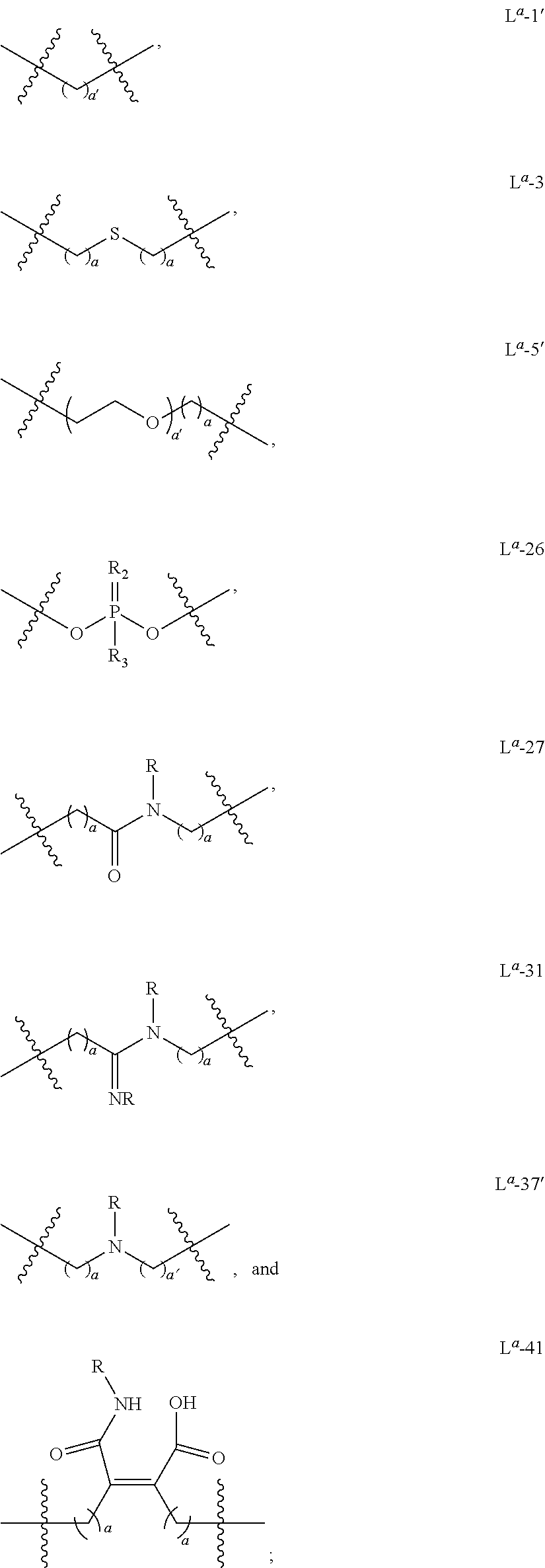


Priority Applications (1)
| Application Number | Priority Date | Filing Date | Title |
|---|---|---|---|
| US17/255,140 US12338436B2 (en) | 2018-06-29 | 2019-06-28 | Synthetic guide molecules, compositions and methods relating thereto |
Applications Claiming Priority (3)
| Application Number | Priority Date | Filing Date | Title |
|---|---|---|---|
| US201862692492P | 2018-06-29 | 2018-06-29 | |
| US17/255,140 US12338436B2 (en) | 2018-06-29 | 2019-06-28 | Synthetic guide molecules, compositions and methods relating thereto |
| PCT/US2019/039848 WO2020006423A1 (en) | 2018-06-29 | 2019-06-28 | Synthetic guide molecules, compositions and methods relating thereto |
Publications (2)
| Publication Number | Publication Date |
|---|---|
| US20210269799A1 US20210269799A1 (en) | 2021-09-02 |
| US12338436B2 true US12338436B2 (en) | 2025-06-24 |
Family
ID=68987597
Family Applications (1)
| Application Number | Title | Priority Date | Filing Date |
|---|---|---|---|
| US17/255,140 Active 2042-06-14 US12338436B2 (en) | 2018-06-29 | 2019-06-28 | Synthetic guide molecules, compositions and methods relating thereto |
Country Status (5)
| Country | Link |
|---|---|
| US (1) | US12338436B2 (en) |
| EP (1) | EP3823633A4 (en) |
| AU (1) | AU2019291918B2 (en) |
| CA (1) | CA3104856A1 (en) |
| WO (1) | WO2020006423A1 (en) |
Families Citing this family (4)
| Publication number | Priority date | Publication date | Assignee | Title |
|---|---|---|---|---|
| EP3652312A1 (en) | 2017-07-14 | 2020-05-20 | Editas Medicine, Inc. | Systems and methods for targeted integration and genome editing and detection thereof using integrated priming sites |
| AU2019291918B2 (en) | 2018-06-29 | 2025-06-12 | Editas Medicine, Inc. | Synthetic guide molecules, compositions and methods relating thereto |
| EP4426836A1 (en) * | 2021-11-03 | 2024-09-11 | Intellia Therapeutics, Inc. | Modified guide rnas for gene editing |
| WO2024112876A2 (en) * | 2022-11-23 | 2024-05-30 | Prime Medicine, Inc. | Split synthesis of long rnas |
Citations (293)
| Publication number | Priority date | Publication date | Assignee | Title |
|---|---|---|---|---|
| WO2007025097A2 (en) | 2005-08-26 | 2007-03-01 | Danisco A/S | Use |
| WO2010011961A2 (en) | 2008-07-25 | 2010-01-28 | University Of Georgia Research Foundation, Inc. | Prokaryotic rnai-like system and methods of use |
| US20100076057A1 (en) | 2008-09-23 | 2010-03-25 | Northwestern University | TARGET DNA INTERFERENCE WITH crRNA |
| WO2013098244A1 (en) | 2011-12-30 | 2013-07-04 | Wageningen Universiteit | Modified cascade ribonucleoproteins and uses thereof |
| WO2013141680A1 (en) | 2012-03-20 | 2013-09-26 | Vilnius University | RNA-DIRECTED DNA CLEAVAGE BY THE Cas9-crRNA COMPLEX |
| WO2013142578A1 (en) | 2012-03-20 | 2013-09-26 | Vilnius University | RNA-DIRECTED DNA CLEAVAGE BY THE Cas9-crRNA COMPLEX |
| WO2013176772A1 (en) | 2012-05-25 | 2013-11-28 | The Regents Of The University Of California | Methods and compositions for rna-directed target dna modification and for rna-directed modulation of transcription |
| WO2014018423A2 (en) | 2012-07-25 | 2014-01-30 | The Broad Institute, Inc. | Inducible dna binding proteins and genome perturbation tools and applications thereof |
| US8697359B1 (en) | 2012-12-12 | 2014-04-15 | The Broad Institute, Inc. | CRISPR-Cas systems and methods for altering expression of gene products |
| WO2014065596A1 (en) | 2012-10-23 | 2014-05-01 | Toolgen Incorporated | Composition for cleaving a target dna comprising a guide rna specific for the target dna and cas protein-encoding nucleic acid or cas protein, and use thereof |
| WO2014089290A1 (en) | 2012-12-06 | 2014-06-12 | Sigma-Aldrich Co. Llc | Crispr-based genome modification and regulation |
| WO2014093622A2 (en) | 2012-12-12 | 2014-06-19 | The Broad Institute, Inc. | Delivery, engineering and optimization of systems, methods and compositions for sequence manipulation and therapeutic applications |
| WO2014093635A1 (en) | 2012-12-12 | 2014-06-19 | The Broad Institute, Inc. | Engineering and optimization of improved systems, methods and enzyme compositions for sequence manipulation |
| WO2014093694A1 (en) | 2012-12-12 | 2014-06-19 | The Broad Institute, Inc. | Crispr-cas nickase systems, methods and compositions for sequence manipulation in eukaryotes |
| WO2014093718A1 (en) | 2012-12-12 | 2014-06-19 | The Broad Institute, Inc. | Methods, systems, and apparatus for identifying target sequences for cas enzymes or crispr-cas systems for target sequences and conveying results thereof |
| WO2014093595A1 (en) | 2012-12-12 | 2014-06-19 | The Broad Institute, Inc. | Crispr-cas component systems, methods and compositions for sequence manipulation |
| WO2014093479A1 (en) | 2012-12-11 | 2014-06-19 | Montana State University | Crispr (clustered regularly interspaced short palindromic repeats) rna-guided control of gene regulation |
| WO2014093712A1 (en) | 2012-12-12 | 2014-06-19 | The Broad Institute, Inc. | Engineering of systems, methods and optimized guide compositions for sequence manipulation |
| WO2014093709A1 (en) | 2012-12-12 | 2014-06-19 | The Broad Institute, Inc. | Methods, models, systems, and apparatus for identifying target sequences for cas enzymes or crispr-cas systems for target sequences and conveying results thereof |
| WO2014093701A1 (en) | 2012-12-12 | 2014-06-19 | The Broad Institute, Inc. | Functional genomics using crispr-cas systems, compositions, methods, knock out libraries and applications thereof |
| WO2014093655A2 (en) | 2012-12-12 | 2014-06-19 | The Broad Institute, Inc. | Engineering and optimization of systems, methods and compositions for sequence manipulation with functional domains |
| WO2014099750A2 (en) | 2012-12-17 | 2014-06-26 | President And Fellows Of Harvard College | Rna-guided human genome engineering |
| WO2014113493A1 (en) | 2013-01-16 | 2014-07-24 | Emory University | Cas9-nucleic acid complexes and uses related thereto |
| WO2014145599A2 (en) | 2013-03-15 | 2014-09-18 | The Broad Institute, Inc. | Recombinant virus and preparations thereof |
| US20140273037A1 (en) | 2013-03-15 | 2014-09-18 | System Biosciences, Llc | Compositions and methods directed to crispr/cas genomic engineering systems |
| US20140273233A1 (en) | 2013-03-15 | 2014-09-18 | Sigma-Aldrich Co., Llc | Crispr-based genome modification and regulation |
| WO2014144592A2 (en) | 2013-03-15 | 2014-09-18 | The General Hospital Corporation | Using truncated guide rnas (tru-grnas) to increase specificity for rna-guided genome editing |
| WO2014150624A1 (en) | 2013-03-14 | 2014-09-25 | Caribou Biosciences, Inc. | Compositions and methods of nucleic acid-targeting nucleic acids |
| US20140302563A1 (en) | 2012-08-03 | 2014-10-09 | The Regents Of The University Of California | Methods and Compositions for Controlling Gene Expression by RNA Processing |
| WO2014165825A2 (en) | 2013-04-04 | 2014-10-09 | President And Fellows Of Harvard College | Therapeutic uses of genome editing with crispr/cas systems |
| WO2014186585A2 (en) | 2013-05-15 | 2014-11-20 | Sangamo Biosciences, Inc. | Methods and compositions for treatment of a genetic condition |
| US20140357523A1 (en) | 2013-05-29 | 2014-12-04 | Agilent Technologies, Inc. | Method for fragmenting genomic dna using cas9 |
| US20140356956A1 (en) | 2013-06-04 | 2014-12-04 | President And Fellows Of Harvard College | RNA-Guided Transcriptional Regulation |
| WO2014191521A2 (en) | 2013-05-29 | 2014-12-04 | Cellectis | New compact scaffold of cas9 in the type ii crispr system |
| WO2014191518A1 (en) | 2013-05-29 | 2014-12-04 | Cellectis | A method for producing precise dna cleavage using cas9 nickase activity |
| WO2014197748A2 (en) | 2013-06-05 | 2014-12-11 | Duke University | Rna-guided gene editing and gene regulation |
| WO2014204724A1 (en) | 2013-06-17 | 2014-12-24 | The Broad Institute Inc. | Delivery, engineering and optimization of tandem guide systems, methods and compositions for sequence manipulation |
| WO2014204725A1 (en) | 2013-06-17 | 2014-12-24 | The Broad Institute Inc. | Optimized crispr-cas double nickase systems, methods and compositions for sequence manipulation |
| WO2014204728A1 (en) | 2013-06-17 | 2014-12-24 | The Broad Institute Inc. | Delivery, engineering and optimization of systems, methods and compositions for targeting and modeling diseases and disorders of post mitotic cells |
| WO2014204578A1 (en) | 2013-06-21 | 2014-12-24 | The General Hospital Corporation | Using rna-guided foki nucleases (rfns) to increase specificity for rna-guided genome editing |
| WO2014204729A1 (en) | 2013-06-17 | 2014-12-24 | The Broad Institute Inc. | Delivery, use and therapeutic applications of the crispr-cas systems and compositions for targeting disorders and diseases using viral components |
| WO2014204727A1 (en) | 2013-06-17 | 2014-12-24 | The Broad Institute Inc. | Functional genomics using crispr-cas systems, compositions methods, screens and applications thereof |
| US20140377868A1 (en) | 2013-03-15 | 2014-12-25 | The General Hospital Corporation | Rna-guided targeting of genetic and epigenomic regulatory proteins to specific genomic loci |
| WO2015006290A1 (en) | 2013-07-09 | 2015-01-15 | President And Fellows Of Harvard College | Multiplex rna-guided genome engineering |
| WO2015006294A2 (en) | 2013-07-10 | 2015-01-15 | President And Fellows Of Harvard College | Orthogonal cas9 proteins for rna-guided gene regulation and editing |
| US20150024500A1 (en) | 2013-07-19 | 2015-01-22 | Larix Bioscience, Llc | Methods and compositions for producing double allele knock outs |
| WO2015013583A2 (en) | 2013-07-26 | 2015-01-29 | President And Fellows Of Harvard College | Genome engineering |
| WO2015021426A1 (en) | 2013-08-09 | 2015-02-12 | Sage Labs, Inc. | A crispr/cas system-based novel fusion protein and its application in genome editing |
| US20150059010A1 (en) | 2013-08-22 | 2015-02-26 | Pioneer Hi-Bred International Inc | Genome modification using guide polynucleotide/cas endonuclease systems and methods of use |
| US20150071899A1 (en) | 2013-09-06 | 2015-03-12 | President And Fellows Of Harvard College | Cas9-foki fusion proteins and uses thereof |
| US20150071901A1 (en) | 2013-09-06 | 2015-03-12 | President And Fellows Of Harvard College | mRNA-Sensing Switchable gRNAs |
| WO2015048577A2 (en) | 2013-09-27 | 2015-04-02 | Editas Medicine, Inc. | Crispr-related methods and compositions |
| WO2015048690A1 (en) | 2013-09-27 | 2015-04-02 | The Regents Of The University Of California | Optimized small guide rnas and methods of use |
| WO2015070083A1 (en) | 2013-11-07 | 2015-05-14 | Editas Medicine,Inc. | CRISPR-RELATED METHODS AND COMPOSITIONS WITH GOVERNING gRNAS |
| WO2015077318A1 (en) | 2013-11-19 | 2015-05-28 | President And Fellows Of Harvard College | Mutant cas9 proteins |
| WO2015089351A1 (en) | 2013-12-12 | 2015-06-18 | The Broad Institute Inc. | Compositions and methods of use of crispr-cas systems in nucleotide repeat disorders |
| WO2015089486A2 (en) | 2013-12-12 | 2015-06-18 | The Broad Institute Inc. | Systems, methods and compositions for sequence manipulation with optimized functional crispr-cas systems |
| WO2015089427A1 (en) | 2013-12-12 | 2015-06-18 | The Broad Institute Inc. | Crispr-cas systems and methods for altering expression of gene products, structural information and inducible modular cas enzymes |
| WO2015089473A1 (en) | 2013-12-12 | 2015-06-18 | The Broad Institute Inc. | Engineering of systems, methods and optimized guide compositions with new architectures for sequence manipulation |
| WO2015112896A2 (en) | 2014-01-24 | 2015-07-30 | North Carolina State University | Methods and compositions for sequences guiding cas9 targeting |
| US20150252358A1 (en) | 2014-03-10 | 2015-09-10 | Editas Medicine, Inc. | Crispr/cas-related methods and compositions for treating leber's congenital amaurosis 10 (lca10) |
| WO2015148863A2 (en) | 2014-03-26 | 2015-10-01 | Editas Medicine, Inc. | Crispr/cas-related methods and compositions for treating sickle cell disease |
| US20150353917A1 (en) | 2014-06-05 | 2015-12-10 | Sangamo Biosciences, Inc. | Methods and compositions for nuclease design |
| WO2015200555A2 (en) | 2014-06-25 | 2015-12-30 | Caribou Biosciences, Inc. | Rna modification to engineer cas9 activity |
| US20160010154A1 (en) | 2012-11-30 | 2016-01-14 | The Parkinson's Institute | Screening assays for therapeutics for parkinson's disease |
| WO2016011080A2 (en) | 2014-07-14 | 2016-01-21 | The Regents Of The University Of California | Crispr/cas transcriptional modulation |
| US20160040189A1 (en) | 2014-08-07 | 2016-02-11 | Agilent Technologies, Inc. | Cis-blocked guide rna |
| WO2016022363A2 (en) | 2014-07-30 | 2016-02-11 | President And Fellows Of Harvard College | Cas9 proteins including ligand-dependent inteins |
| WO2016028682A1 (en) | 2014-08-17 | 2016-02-25 | The Broad Institute Inc. | Genome editing using cas9 nickases |
| WO2016049258A2 (en) | 2014-09-25 | 2016-03-31 | The Broad Institute Inc. | Functional screening with optimized functional crispr-cas systems |
| WO2016054106A1 (en) | 2014-09-29 | 2016-04-07 | The Regents Of The University Of California | SCAFFOLD RNAs |
| WO2016057951A2 (en) | 2014-10-09 | 2016-04-14 | Life Technologies Corporation | Crispr oligonucleotides and gene editing |
| WO2016065364A1 (en) | 2014-10-24 | 2016-04-28 | Life Technologies Corporation | Compositions and methods for enhancing homologous recombination |
| WO2016073990A2 (en) | 2014-11-07 | 2016-05-12 | Editas Medicine, Inc. | Methods for improving crispr/cas-mediated genome-editing |
| US20160145646A1 (en) | 2014-11-21 | 2016-05-26 | Regeneron Pharmaceuticals, Inc. | Methods and compositions for targeted genetic modification using paired guide rnas |
| WO2016089433A1 (en) | 2014-12-03 | 2016-06-09 | Agilent Technologies, Inc. | Guide rna with chemical modifications |
| WO2016094872A1 (en) | 2014-12-12 | 2016-06-16 | The Broad Institute Inc. | Dead guides for crispr transcription factors |
| WO2016094867A1 (en) | 2014-12-12 | 2016-06-16 | The Broad Institute Inc. | Protected guide rnas (pgrnas) |
| WO2016094874A1 (en) | 2014-12-12 | 2016-06-16 | The Broad Institute Inc. | Escorted and functionalized guides for crispr-cas systems |
| US20160177304A1 (en) | 2014-12-18 | 2016-06-23 | Integrated Dna Technologies, Inc. | Crispr-based compositions and methods of use |
| US20160184362A1 (en) | 2013-05-29 | 2016-06-30 | Cellectis | Methods for engineering t cells for immunotherapy by using rna-guided cas nuclease system |
| WO2016106244A1 (en) | 2014-12-24 | 2016-06-30 | The Broad Institute Inc. | Crispr having or associated with destabilization domains |
| WO2016106236A1 (en) | 2014-12-23 | 2016-06-30 | The Broad Institute Inc. | Rna-targeting system |
| WO2016112242A1 (en) | 2015-01-08 | 2016-07-14 | President And Fellows Of Harvard College | Split cas9 proteins |
| US20160208243A1 (en) | 2015-06-18 | 2016-07-21 | The Broad Institute, Inc. | Novel crispr enzymes and systems |
| WO2016114972A1 (en) | 2015-01-12 | 2016-07-21 | The Regents Of The University Of California | Heterodimeric cas9 and methods of use thereof |
| US20160215300A1 (en) | 2015-01-28 | 2016-07-28 | Pioneer Hi-Bred International. Inc. | Crispr hybrid dna/rna polynucleotides and methods of use |
| US20160215275A1 (en) | 2015-01-27 | 2016-07-28 | Minghong Zhong | Chemically Ligated RNAs for CRISPR/Cas9-lgRNA Complexes as Antiviral Therapeutic Agents |
| US9404098B2 (en) | 2008-11-06 | 2016-08-02 | University Of Georgia Research Foundation, Inc. | Method for cleaving a target RNA using a Cas6 polypeptide |
| US20160237437A1 (en) | 2015-02-13 | 2016-08-18 | Idera Pharmaceuticals, Inc. | Toll-like receptor 9 antagonist and methods of use thereof |
| WO2016141224A1 (en) | 2015-03-03 | 2016-09-09 | The General Hospital Corporation | Engineered crispr-cas9 nucleases with altered pam specificity |
| WO2016148994A1 (en) | 2015-03-13 | 2016-09-22 | The Jackson Laboratory | A three-component crispr/cas complex system and uses thereof |
| WO2016154596A1 (en) | 2015-03-25 | 2016-09-29 | Editas Medicine, Inc. | Crispr/cas-related methods, compositions and components |
| WO2016161207A1 (en) | 2015-03-31 | 2016-10-06 | Exeligen Scientific, Inc. | Cas 9 retroviral integrase and cas 9 recombinase systems for targeted incorporation of a dna sequence into a genome of a cell or organism |
| WO2016164797A1 (en) | 2015-04-08 | 2016-10-13 | University Of Pittsburgh - Of The Commonwealth System Of Higher Education | Activatable crispr/cas9 for spatial and temporal control of genome editing |
| WO2016164356A1 (en) | 2015-04-06 | 2016-10-13 | The Board Of Trustees Of The Leland Stanford Junior University | Chemically modified guide rnas for crispr/cas-mediated gene regulation |
| WO2016166340A1 (en) | 2015-04-16 | 2016-10-20 | Wageningen Universiteit | Nuclease-mediated genome editing |
| WO2016167300A1 (en) | 2015-04-13 | 2016-10-20 | 国立大学法人東京大学 | Set of polypeptides exhibiting nuclease activity or nickase activity with dependence on light or in presence of drug or suppressing or activating expression of target gene |
| WO2016172727A1 (en) | 2015-04-24 | 2016-10-27 | Editas Medicine, Inc. | Evaluation of cas9 molecule/guide rna molecule complexes |
| WO2016182917A1 (en) | 2015-05-08 | 2016-11-17 | Children's Medical Center Corporation | Targeting bcl11a enhancer functional regions for fetal hemoglobin reinduction |
| WO2016186745A1 (en) | 2015-05-15 | 2016-11-24 | Ge Healthcare Dharmacon, Inc. | Synthetic single guide rna for cas9-mediated gene editing |
| US9512446B1 (en) | 2015-08-28 | 2016-12-06 | The General Hospital Corporation | Engineered CRISPR-Cas9 nucleases |
| WO2016196655A1 (en) | 2015-06-03 | 2016-12-08 | The Regents Of The University Of California | Cas9 variants and methods of use thereof |
| WO2016201155A1 (en) | 2015-06-10 | 2016-12-15 | Caribou Biosciences, Inc. | Crispr-cas compositions and methods |
| WO2016205749A1 (en) | 2015-06-18 | 2016-12-22 | The Broad Institute Inc. | Novel crispr enzymes and systems |
| WO2016205613A1 (en) | 2015-06-18 | 2016-12-22 | The Broad Institute Inc. | Crispr enzyme mutations reducing off-target effects |
| WO2016205759A1 (en) | 2015-06-18 | 2016-12-22 | The Broad Institute Inc. | Engineering and optimization of systems, methods, enzymes and guide scaffolds of cas9 orthologs and variants for sequence manipulation |
| US20170002339A1 (en) | 2014-01-24 | 2017-01-05 | North Carolina State University | Methods and Compositions for Sequences Guiding Cas9 Targeting |
| WO2017004279A2 (en) | 2015-06-29 | 2017-01-05 | Massachusetts Institute Of Technology | Compositions comprising nucleic acids and methods of using the same |
| WO2017004261A1 (en) | 2015-06-29 | 2017-01-05 | Ionis Pharmaceuticals, Inc. | Modified crispr rna and modified single crispr rna and uses thereof |
| WO2017015015A1 (en) | 2015-07-17 | 2017-01-26 | Emory University | Crispr-associated protein from francisella and uses related thereto |
| US20170037432A1 (en) | 2015-08-07 | 2017-02-09 | Caribou Biosciences, Inc. | Compositions and methods of engineered crispr-cas9 systems using split-nexus cas9-associated polynucleotides |
| US20170058271A1 (en) | 2015-08-28 | 2017-03-02 | The General Hospital Corporation | Engineered CRISPR-Cas9 Nucleases |
| WO2017040348A1 (en) | 2015-08-28 | 2017-03-09 | The General Hospital Corporation | Engineered crispr-cas9 nucleases |
| WO2017044776A1 (en) | 2015-09-10 | 2017-03-16 | Texas Tech University System | Single-guide rna (sgrna) with improved knockout efficiency |
| US20170080107A1 (en) | 2015-09-21 | 2017-03-23 | Arcturus Therapeutics, Inc. | Allele selective gene editing and uses thereof |
| WO2017048969A1 (en) | 2015-09-17 | 2017-03-23 | The Regents Of The University Of California | Variant cas9 polypeptides comprising internal insertions |
| WO2017064546A1 (en) | 2015-09-24 | 2017-04-20 | Crispr Therapeutics Ag | Novel family of rna-programmable endonucleases and their uses in genome editing and other applications |
| WO2017066588A2 (en) | 2015-10-16 | 2017-04-20 | Temple University - Of The Commonwealth System Of Higher Education | Methods and compositions utilizing cpf1 for rna-guided gene editing |
| US20170114369A1 (en) | 2015-10-23 | 2017-04-27 | Caribou Biosciences, Inc. | Engineered Nucleic-Acid Targeting Nucleic Acids |
| WO2017068377A1 (en) | 2015-10-23 | 2017-04-27 | Silence Therapeutics (London) Ltd | Modified guide rnas, methods and uses |
| WO2017070633A2 (en) | 2015-10-23 | 2017-04-27 | President And Fellows Of Harvard College | Evolved cas9 proteins for gene editing |
| US20170159073A1 (en) | 2015-12-04 | 2017-06-08 | Caribou Biosciences, Inc. | Engineered nucleic acid-targeting nucleic acids |
| WO2017099494A1 (en) | 2015-12-08 | 2017-06-15 | 기초과학연구원 | Genome editing composition comprising cpf1, and use thereof |
| WO2017106657A1 (en) | 2015-12-18 | 2017-06-22 | The Broad Institute Inc. | Novel crispr enzymes and systems |
| WO2017106251A1 (en) | 2015-12-14 | 2017-06-22 | President And Fellows Of Harvard College | Cas discrimination using tuned guide rna |
| US9688971B2 (en) | 2012-06-15 | 2017-06-27 | The Regents Of The University Of California | Endoribonuclease and methods of use thereof |
| WO2017127807A1 (en) | 2016-01-22 | 2017-07-27 | The Broad Institute Inc. | Crystal structure of crispr cpf1 |
| US20170211142A1 (en) | 2015-10-22 | 2017-07-27 | The Broad Institute, Inc. | Novel crispr enzymes and systems |
| WO2017131237A1 (en) | 2016-01-30 | 2017-08-03 | 株式会社ボナック | Artificial single guide rna and use thereof |
| WO2017136794A1 (en) | 2016-02-03 | 2017-08-10 | Massachusetts Institute Of Technology | Structure-guided chemical modification of guide rna and its applications |
| WO2017136335A1 (en) | 2016-02-01 | 2017-08-10 | The Regents Of The University Of California | Self-inactivating endonuclease-encoding nucleic acids and methods of using the same |
| US20170233703A1 (en) | 2015-05-21 | 2017-08-17 | Tsinghua University | Genetic indicator and control system and method utilizing split Cas9/CRISPR domains for transcriptional control in eukaryotic cell lines |
| WO2017161068A1 (en) | 2016-03-18 | 2017-09-21 | President And Fellows Of Harvard College | Mutant cas proteins |
| WO2017181107A2 (en) | 2016-04-16 | 2017-10-19 | Ohio State Innovation Foundation | Modified cpf1 mrna, modified guide rna, and uses thereof |
| WO2017180711A1 (en) | 2016-04-13 | 2017-10-19 | Editas Medicine, Inc. | Grna fusion molecules, gene editing systems, and methods of use thereof |
| WO2017184768A1 (en) | 2016-04-19 | 2017-10-26 | The Broad Institute Inc. | Novel crispr enzymes and systems |
| WO2017184799A1 (en) | 2016-04-21 | 2017-10-26 | Life Technologies Corporation | Gene editing reagents with reduced toxicity |
| WO2017184786A1 (en) | 2016-04-19 | 2017-10-26 | The Broad Institute Inc. | Cpf1 complexes with reduced indel activity |
| WO2017189821A1 (en) | 2016-04-29 | 2017-11-02 | Bio-Rad Laboratories, Inc. | Dimeric proteins for specific targeting of nucleic acid sequences |
| US20170314016A1 (en) | 2015-11-13 | 2017-11-02 | Institute For Basic Science | Method for rgen rnp delivery using 5'-phosphate removed rna |
| WO2017189308A1 (en) | 2016-04-19 | 2017-11-02 | The Broad Institute Inc. | Novel crispr enzymes and systems |
| WO2017190664A1 (en) | 2016-05-05 | 2017-11-09 | 苏州吉玛基因股份有限公司 | Use of chemosynthetic crrna and modified crrna in crispr/cpf1 gene editing systems |
| US9816093B1 (en) | 2016-12-06 | 2017-11-14 | Caribou Biosciences, Inc. | Engineered nucleic acid-targeting nucleic acids |
| WO2017197238A1 (en) | 2016-05-12 | 2017-11-16 | President And Fellows Of Harvard College | Aav split cas9 genome editing and transcriptional regulation |
| WO2017205290A1 (en) | 2016-05-23 | 2017-11-30 | The Trustees Of Columbia University In The City Of New York | Bypassing the pam requirement of the crispr-cas system |
| WO2017214460A1 (en) | 2016-06-08 | 2017-12-14 | Agilent Technologies, Inc. | High specificity genome editing using chemically modified guide rnas |
| WO2017219033A1 (en) | 2016-06-17 | 2017-12-21 | Montana State University | Bidirectional targeting for genome editing |
| WO2017219027A1 (en) | 2016-06-17 | 2017-12-21 | The Broad Institute Inc. | Type vi crispr orthologs and systems |
| WO2017222834A1 (en) | 2016-06-10 | 2017-12-28 | City Of Hope | Compositions and methods for mitochondrial genome editing |
| WO2017223449A1 (en) | 2016-06-23 | 2017-12-28 | President And Fellows Of Harvard College | Conditional activation of nucleic acid-guided endonucleases |
| WO2017222773A1 (en) | 2016-06-20 | 2017-12-28 | Pioneer Hi-Bred International, Inc. | Novel cas systems and methods of use |
| WO2018005691A1 (en) | 2016-06-29 | 2018-01-04 | The Regents Of The University Of California | Efficient genetic screening method |
| WO2018009822A1 (en) | 2016-07-08 | 2018-01-11 | Ohio State Innovation Foundation | Modified nucleic acids, hybrid guide rnas, and uses thereof |
| US20180030425A1 (en) | 2016-07-26 | 2018-02-01 | The General Hospital Corporation | Variants of CRISPR from Prevotella and Francisella 1 (Cpf1) |
| WO2018035388A1 (en) | 2016-08-17 | 2018-02-22 | The Broad Institute, Inc. | Novel crispr enzymes and systems |
| WO2018035387A1 (en) | 2016-08-17 | 2018-02-22 | The Broad Institute, Inc. | Novel crispr enzymes and systems |
| US20180066258A1 (en) | 2016-08-17 | 2018-03-08 | Michael J Powell | SPECIFIC SYNTHETIC CHIMERIC XENONUCLEIC ACID GUIDE RNA; s(XNA-gRNA) FOR ENHANCING CRISPR MEDIATED GENOME EDITING EFFICIENCY |
| WO2018049079A1 (en) | 2016-09-07 | 2018-03-15 | Flagship Pioneering, Inc. | Methods and compositions for modulating gene expression |
| WO2018052247A1 (en) | 2016-09-13 | 2018-03-22 | 주식회사 툴젠 | Method for identifying dna base editing by means of cytosine deaminase |
| WO2018053053A1 (en) | 2016-09-13 | 2018-03-22 | The Broad Institute, Inc. | Proximity-dependent biotinylation and uses thereof |
| WO2018057946A2 (en) | 2016-09-23 | 2018-03-29 | Board Of Trustees Of Southern Illinois University | Tuning crispr/cas9 activity with chemically modified nucleotide substitutions |
| WO2018064352A1 (en) | 2016-09-30 | 2018-04-05 | The Regents Of The University Of California | Rna-guided nucleic acid modifying enzymes and methods of use thereof |
| WO2018064371A1 (en) | 2016-09-30 | 2018-04-05 | The Regents Of The University Of California | Rna-guided nucleic acid modifying enzymes and methods of use thereof |
| US20180100148A1 (en) | 2016-10-07 | 2018-04-12 | Integrated Dna Technologies, Inc. | S. pyogenes cas9 mutant genes and polypeptides encoded by same |
| WO2018071868A1 (en) | 2016-10-14 | 2018-04-19 | President And Fellows Of Harvard College | Aav delivery of nucleobase editors |
| WO2018069474A1 (en) | 2016-10-12 | 2018-04-19 | Universita' Degli Studi Di Trento | Self-limiting cas9 circuitry for enhanced safety (slices) plasmid and lentiviral system thereof |
| WO2018071892A1 (en) | 2016-10-14 | 2018-04-19 | Joung J Keith | Epigenetically regulated site-specific nucleases |
| WO2018074979A1 (en) | 2016-10-17 | 2018-04-26 | Nanyang Technological University | Truncated crispr-cas proteins for dna targeting |
| US9963719B1 (en) | 2016-12-05 | 2018-05-08 | Editas Medicine, Inc. | Systems and methods for one-shot guide RNA (ogRNA) targeting of endogenous and source DNA |
| US9963689B2 (en) | 2013-12-31 | 2018-05-08 | The Regents Of The University Of California | Cas9 crystals and methods of use thereof |
| WO2018085414A1 (en) | 2016-11-02 | 2018-05-11 | President And Fellows Of Harvard College | Engineered guide rna sequences for in situ detection and sequencing |
| WO2018089664A1 (en) | 2016-11-11 | 2018-05-17 | The Regents Of The University Of California | Variant rna-guided polypeptides and methods of use |
| WO2018094356A2 (en) | 2016-11-18 | 2018-05-24 | Genedit Inc. | Compositions and methods for target nucleic acid modification |
| WO2018093954A1 (en) | 2016-11-16 | 2018-05-24 | Research Institute At Nationwide Children's Hospital | Stem loop rna mediated transport of mitochondria genome editing molecules (endonucleases) into the mitochondria |
| US20180148735A1 (en) | 2016-02-15 | 2018-05-31 | Benson Hill Biosystems, Inc. | Compositions and methods for modifying genomes |
| WO2018098383A1 (en) | 2016-11-22 | 2018-05-31 | Integrated Dna Technologies, Inc. | Crispr/cpf1 systems and methods |
| US20180163188A1 (en) | 2016-12-12 | 2018-06-14 | Tsinghua University | Engineering of a minimal SaCas9 CRISPR/Cas system for gene editing and transcriptional regulation optimized by enhanced guide RNA |
| WO2018107028A1 (en) | 2016-12-08 | 2018-06-14 | Intellia Therapeutics, Inc. | Modified guide rnas |
| US20180163213A1 (en) | 2016-06-30 | 2018-06-14 | Ethris Gmbh | Cas9 mrnas |
| WO2018112451A1 (en) | 2016-12-16 | 2018-06-21 | The Rockefeller University | Compositions and methods using cas9 with enhanced spacer acquisition function |
| WO2018108338A1 (en) | 2016-12-14 | 2018-06-21 | Wageningen Universiteit | Thermostable cas9 nucleases |
| US20180179523A1 (en) | 2014-12-18 | 2018-06-28 | Integrated Dna Technologies, Inc. | Crispr-based compositions and methods of use |
| WO2018126176A1 (en) | 2016-12-30 | 2018-07-05 | Editas Medicine, Inc. | Synthetic guide molecules, compositions and methods relating thereto |
| WO2018125964A1 (en) | 2016-12-28 | 2018-07-05 | Ionis Pharmaceuticals, Inc. | Modified crispr rna and uses thereof |
| WO2018130830A1 (en) | 2017-01-11 | 2018-07-19 | Oxford University Innovation Limited | Crispr rna |
| WO2018149888A1 (en) | 2017-02-14 | 2018-08-23 | Universita' Degli Studi Di Trento | High-fidelity cas9 variants and applications thereof |
| WO2018149418A1 (en) | 2017-02-20 | 2018-08-23 | Institute Of Genetics And Developmental Biology, Chinese Academy Of Sciences | Genome editing system and method |
| US20180265864A1 (en) | 2017-03-06 | 2018-09-20 | Florida State University Research Foundation, Inc. | Genome Engineering Methods Using a Cytosine-Specific CAS9 |
| WO2018170015A1 (en) | 2017-03-14 | 2018-09-20 | The Regents Of The University Of California | Engineering crispr cas9 immune stealth |
| WO2018172556A1 (en) | 2017-03-24 | 2018-09-27 | Curevac Ag | Nucleic acids encoding crispr-associated proteins and uses thereof |
| US20180282722A1 (en) | 2016-11-21 | 2018-10-04 | Massachusetts Institute Of Technology | Chimeric DNA:RNA Guide for High Accuracy Cas9 Genome Editing |
| WO2018191715A2 (en) | 2017-04-14 | 2018-10-18 | Synthetic Genomics, Inc. | Polypeptides with type v crispr activity and uses thereof |
| WO2018188571A1 (en) | 2017-04-10 | 2018-10-18 | 中国科学院动物研究所 | System and method for genome editing |
| WO2018195545A2 (en) | 2017-04-21 | 2018-10-25 | The General Hospital Corporation | Variants of cpf1 (cas12a) with altered pam specificity |
| WO2018195540A1 (en) | 2017-04-21 | 2018-10-25 | The General Hospital Corporation | Inducible, tunable, and multiplex human gene regulation using crispr-cpf1 |
| US10113207B2 (en) | 2008-08-22 | 2018-10-30 | Sangamo Therapeutics, Inc. | Methods and compositions for targeted single-stranded cleavage and targeted integration |
| WO2018197495A1 (en) | 2017-04-24 | 2018-11-01 | Dupont Nutrition Biosciences Aps | Novel anti-crispr genes and proteins and methods of use |
| US20180320201A1 (en) | 2016-10-07 | 2018-11-08 | Integrated Dna Technologies, Inc. | S. pyogenes cas9 mutant genes and polypeptides encoded by same |
| WO2018209158A2 (en) | 2017-05-10 | 2018-11-15 | Editas Medicine, Inc. | Crispr/rna-guided nuclease systems and methods |
| WO2018209320A1 (en) | 2017-05-12 | 2018-11-15 | President And Fellows Of Harvard College | Aptazyme-embedded guide rnas for use with crispr-cas9 in genome editing and transcriptional activation |
| WO2018209712A1 (en) | 2017-05-19 | 2018-11-22 | Tsinghua University | Engineering of a minimal sacas9 crispr/cas system for gene editing and transcriptional regulation optimized by enhanced guide rna |
| WO2018213351A1 (en) | 2017-05-16 | 2018-11-22 | The Regents Of The University Of California | Thermostable rna-guided endonucleases and methods of use thereof |
| WO2018217981A1 (en) | 2017-05-26 | 2018-11-29 | North Carolina State University | Altered guide rnas for modulating cas9 activity and methods of use |
| WO2018221685A1 (en) | 2017-05-31 | 2018-12-06 | 国立大学法人 東京大学 | MODIFIED Cas9 PROTEIN AND USE THEREOF |
| WO2018226855A1 (en) | 2017-06-06 | 2018-12-13 | The General Hospital Corporation | Engineered crispr-cas9 nucleases |
| WO2018227114A1 (en) | 2017-06-09 | 2018-12-13 | Editas Medicine, Inc. | Engineered cas9 nucleases |
| US20190002889A1 (en) | 2017-06-30 | 2019-01-03 | Arbor Biotechnologies, Inc. | Novel crispr rna targeting enzymes and systems and uses thereof |
| WO2019009682A2 (en) | 2017-07-07 | 2019-01-10 | 주식회사 툴젠 | Target-specific crispr mutant |
| WO2019018041A1 (en) | 2017-07-21 | 2019-01-24 | Arizona Board Of Regents On Behalf Of Arizona State University | Modulating human cas9-specific host immune response |
| WO2019036513A1 (en) | 2017-08-15 | 2019-02-21 | Intellia Therapeutics, Inc. | Stabilized nucleic acids encoding messenger ribonucleic acid (mrna) |
| WO2019040650A1 (en) | 2017-08-23 | 2019-02-28 | The General Hospital Corporation | Engineered crispr-cas9 nucleases with altered pam specificity |
| WO2019046540A1 (en) | 2017-08-31 | 2019-03-07 | New York Genome Center, Inc. | Methods and compositions comprising crispr-cpf1 and paired guide crispr rnas for programmable genomic deletions |
| WO2019049913A1 (en) | 2017-09-05 | 2019-03-14 | 国立大学法人 東京大学 | Modified cas9 protein, and use thereof |
| WO2019051419A1 (en) | 2017-09-08 | 2019-03-14 | University Of North Texas Health Science Center | MODIFIED CASE VARIANTS9 |
| WO2019048881A1 (en) | 2017-09-07 | 2019-03-14 | Oxford University Innovation Limited | Oligonucleotides comprising triazole and (phosphor)amidate internucleoside linkages, method for the preparation and uses thereof |
| WO2019048882A1 (en) | 2017-09-07 | 2019-03-14 | Oxford University Innovation Limited | Oligonucleotides and analogues thereof |
| WO2019060469A2 (en) | 2017-09-19 | 2019-03-28 | Massachusetts Institute Of Technology | Streptococcus cams cas9 as a genome engineering platform with novel pam specificity |
| WO2019067322A1 (en) | 2017-09-26 | 2019-04-04 | The Board Of Trustees Of The University Of Illinois | Crispr/cas system and method for genome editing and modulating transcription |
| WO2019070762A1 (en) | 2017-10-02 | 2019-04-11 | Genedit Inc. | Modified cpf1 guide rna |
| US20190106693A1 (en) | 2015-05-13 | 2019-04-11 | President And Fellows Of Harvard College | Methods of Making and Using Guide RNA for Use With Cas9 Systems |
| WO2019072596A1 (en) | 2017-10-10 | 2019-04-18 | Wageningen Universiteit | Thermostable cas9 nucleases with reduced off-target activity |
| WO2019084168A1 (en) | 2017-10-24 | 2019-05-02 | Editas Medicine, Inc. | Systems and methods for treating hyper-igm syndrome |
| WO2019090174A1 (en) | 2017-11-02 | 2019-05-09 | Arbor Biotechnologies, Inc. | Novel crispr-associated transposon systems and components |
| WO2019089804A1 (en) | 2017-11-01 | 2019-05-09 | The Regents Of The University Of California | Casy compositions and methods of use |
| WO2019084664A1 (en) | 2017-11-02 | 2019-05-09 | The Governors Of The University Of Alberta | Chemically-modified guide rnas to improve crispr-cas protein specificity |
| WO2019089820A1 (en) | 2017-11-01 | 2019-05-09 | The Regents Of The University Of California | Casz compositions and methods of use |
| WO2019089796A1 (en) | 2017-11-01 | 2019-05-09 | The Regents Of The University Of California | Cas12c compositions and methods of use |
| WO2019089808A1 (en) | 2017-11-01 | 2019-05-09 | The Regents Of The University Of California | Class 2 crispr/cas compositions and methods of use |
| WO2019092042A1 (en) | 2017-11-10 | 2019-05-16 | Novozymes A/S | Temperature-sensitive cas9 protein |
| WO2019099943A1 (en) | 2017-11-16 | 2019-05-23 | Astrazeneca Ab | Compositions and methods for improving the efficacy of cas9-based knock-in strategies |
| WO2019103442A2 (en) | 2017-11-21 | 2019-05-31 | 한국생명공학연구원 | Genome editing composition using crispr/cpf1 system and use thereof |
| WO2019126762A2 (en) | 2017-12-22 | 2019-06-27 | The Broad Institute, Inc. | Cas12a systems, methods, and compositions for targeted rna base editing |
| WO2019126716A1 (en) | 2017-12-22 | 2019-06-27 | The Broad Institute, Inc. | Cas12b systems, methods, and compositions for targeted rna base editing |
| WO2019126709A1 (en) | 2017-12-22 | 2019-06-27 | The Broad Institute, Inc. | Cas12b systems, methods, and compositions for targeted dna base editing |
| WO2019126774A1 (en) | 2017-12-22 | 2019-06-27 | The Broad Institute, Inc. | Novel crispr enzymes and systems |
| US20190218602A1 (en) | 2015-06-18 | 2019-07-18 | The Broad Institute, Inc. | Novel crispr enzymes and systems |
| US20190218547A1 (en) | 2018-01-12 | 2019-07-18 | Genedit Inc. | Structure-engineered guide rna |
| US20190225961A1 (en) | 2016-04-01 | 2019-07-25 | New England Biolabs, Inc. | Compositions and Methods Relating to Synthetic RNA Polynucleotides Created From Synthetic DNA Oligonucleotides |
| WO2019147014A1 (en) | 2018-01-23 | 2019-08-01 | 기초과학연구원 | Extended single guide rna and use thereof |
| US20190241911A1 (en) | 2018-02-06 | 2019-08-08 | Ohio State Innovation Foundation | Engineered guide rna and uses thereof |
| WO2019168953A1 (en) | 2018-02-27 | 2019-09-06 | President And Fellows Of Harvard College | Evolved cas9 variants and uses thereof |
| WO2019178428A1 (en) | 2018-03-14 | 2019-09-19 | Arbor Biotechnologies, Inc. | Novel crispr dna and rna targeting enzymes and systems |
| WO2019178427A1 (en) | 2018-03-14 | 2019-09-19 | Arbor Biotechnologies, Inc. | Novel crispr dna targeting enzymes and systems |
| WO2019183150A1 (en) | 2018-03-19 | 2019-09-26 | Casebia Therapeutics Limited Liability Partnership | Novel rna-programmable endonuclease systems and uses thereof |
| WO2019183000A1 (en) | 2018-03-19 | 2019-09-26 | University Of Massachusetts | Modified guide rnas for crispr genome editing |
| US20190367949A1 (en) | 2018-06-05 | 2019-12-05 | Lifeedit, Inc. | Rna-guided nucleases and active fragments and variants thereof and methods of use |
| WO2019233990A1 (en) | 2018-06-04 | 2019-12-12 | University Of Copenhagen | Mutant cpf1 endonucleases |
| WO2019237069A1 (en) | 2018-06-08 | 2019-12-12 | Intellia Therapeutics, Inc. | Modified guide rnas for gene editing |
| WO2020005980A1 (en) | 2018-06-26 | 2020-01-02 | The Regents Of The University Of California | Rna-guided effector proteins and methods of use thereof |
| WO2020006423A1 (en) | 2018-06-29 | 2020-01-02 | Editas Medicine, Inc. | Synthetic guide molecules, compositions and methods relating thereto |
| WO2020014577A1 (en) | 2018-07-13 | 2020-01-16 | Allele Biotechnology And Pharmaceuticals, Inc. | Methods of achieving high specificity of genome editing |
| WO2020033774A1 (en) | 2018-08-08 | 2020-02-13 | Integrated Dna Technologies, Inc. | Novel mutations that enhance the dna cleavage activity of acidaminococcus sp. cpf1 |
| WO2020030984A2 (en) | 2018-08-09 | 2020-02-13 | G+Flas Life Sciences | Compositions and methods for genome engineering with cas12a proteins |
| WO2020033601A1 (en) | 2018-08-07 | 2020-02-13 | The Broad Institute, Inc. | Novel cas12b enzymes and systems |
| WO2020032711A1 (en) | 2018-08-09 | 2020-02-13 | (주)지플러스 생명과학 | Novel crispr-associated protein and use thereof |
| WO2020041751A1 (en) | 2018-08-23 | 2020-02-27 | The Broad Institute, Inc. | Cas9 variants having non-canonical pam specificities and uses thereof |
| US10604752B2 (en) | 2017-07-11 | 2020-03-31 | Sigma-Aldrich Co. Llc | Using nucleosome interacting protein domains to enhance targeted genome modification |
| WO2020069029A1 (en) | 2018-09-26 | 2020-04-02 | Emendobio Inc. | Novel crispr nucleases |
| WO2020065062A1 (en) | 2018-09-28 | 2020-04-02 | Wageningen Universiteit | Off-target activity inhibitors for guided endonucleases |
| WO2020085441A1 (en) | 2018-10-24 | 2020-04-30 | 株式会社モダリス | Modified cas9 protein, and use thereof |
| WO2020091069A1 (en) | 2018-11-01 | 2020-05-07 | 国立大学法人東京大学 | Split cpf1 protein |
| WO2020111984A2 (en) | 2018-11-26 | 2020-06-04 | Автономная некоммерческая образовательная организация высшего образования Сколковский институт науки и технологий | Dna-cutting agent based on cas9 protein from defluviimonas sр. |
| WO2020111983A2 (en) | 2018-11-26 | 2020-06-04 | Автономная некоммерческая образовательная организация высшего образования Сколковский институт науки и технологий | Dna-cutting agent based on cas9 protein from the biotechnologically relevant bacterium clostridium cellulolyticum |
| US10704033B1 (en) | 2019-12-13 | 2020-07-07 | Inscripta, Inc. | Nucleic acid-guided nucleases |
| WO2020142754A2 (en) | 2019-01-04 | 2020-07-09 | Mammoth Biosciences, Inc. | Programmable nuclease improvements and compositions and methods for nucleic acid amplification and detection |
| US20200216825A1 (en) | 2019-01-08 | 2020-07-09 | Integrated Dna Technologies, Inc. | CAS12a MUTANT GENES AND POLYPEPTIDES ENCODED BY SAME |
| WO2020146290A1 (en) | 2019-01-07 | 2020-07-16 | Crisp-Hr Therapeutics, Inc. | A non-toxic cas9 enzyme and application thereof |
| WO2020150373A1 (en) | 2019-01-17 | 2020-07-23 | The Regents Of The University Of Colorado, A Body Corporate | Small-molecule regulation of crispr-cas9 using rna aptamers |
| US10724050B1 (en) | 2016-08-09 | 2020-07-28 | Emory University | CAS9 nucleic acid molecules and their use |
| US20200239879A1 (en) | 2019-01-29 | 2020-07-30 | The Broad Institute, Inc. | Compositions and methods for regulating proteins and nucleic acids activities |
| WO2020154714A2 (en) | 2019-01-25 | 2020-07-30 | Synthego Corporation | Systems and methods for modulating crispr activity |
| US20200255861A1 (en) | 2018-12-17 | 2020-08-13 | The Broad Institute, Inc. | Crispr cpf1 direct repeat variants |
| WO2020163307A1 (en) | 2019-02-06 | 2020-08-13 | Emendobio Inc. | New engineered high fidelity cas9 |
| WO2020168234A1 (en) | 2019-02-14 | 2020-08-20 | Metagenomi Ip Technologies, Llc | Enzymes with ruvc domains |
| WO2020168291A1 (en) | 2019-02-14 | 2020-08-20 | Metagenomi Ip Technologies, Llc | Enzymes with ruvc domains |
| WO2020172502A1 (en) | 2019-02-22 | 2020-08-27 | Integrated Dna Technologies, Inc. | Lachnospiraceae bacterium nd2006 cas12a mutant genes and polypeptides encoded by same |
| US10767193B2 (en) | 2018-02-15 | 2020-09-08 | Sigma-Aldrich Co. Llc | Engineered CAS9 systems for eukaryotic genome modification |
| WO2020180699A1 (en) | 2019-03-01 | 2020-09-10 | Arbor Biotechnologies, Inc. | Novel crispr dna targeting enzymes and systems |
| WO2020181101A1 (en) | 2019-03-07 | 2020-09-10 | The Regents Of The University Of California | Crispr-cas effector polypeptides and methods of use thereof |
| WO2020181102A1 (en) | 2019-03-07 | 2020-09-10 | The Regents Of The University Of California | Crispr-cas effector polypeptides and methods of use thereof |
| WO2020182941A1 (en) | 2019-03-12 | 2020-09-17 | MAX-PLANCK-Gesellschaft zur Förderung der Wissenschaften e.V. | Cas9 variants with enhanced specificity |
| WO2020186059A2 (en) | 2019-03-12 | 2020-09-17 | Crispr Therapeutics Ag | Novel high fidelity rna-programmable endonuclease systems and uses thereof |
| WO2020191102A1 (en) | 2019-03-18 | 2020-09-24 | The Broad Institute, Inc. | Type vii crispr proteins and systems |
| WO2020198641A2 (en) | 2019-03-28 | 2020-10-01 | Intellia Therapeutics, Inc. | Polynucleotides, compositions, and methods for polypeptide expression |
| WO2020209959A1 (en) | 2019-03-08 | 2020-10-15 | Crispr Therapeutics Ag | Nucleobase-editing fusion protein systems, compositions, and uses thereof |
| US20200332273A1 (en) | 2019-02-14 | 2020-10-22 | Metagenomi Ip Technologies, Llc | Enzymes with ruvc domains |
| WO2020218657A1 (en) | 2019-04-26 | 2020-10-29 | 주식회사 툴젠 | Target specific crispr mutant |
| WO2020219908A1 (en) | 2019-04-25 | 2020-10-29 | The Board Of Trustees Of The Leland Stanford Junior University | Engineered cas9 with broadened dna targeting range |
| WO2020223514A2 (en) | 2019-04-30 | 2020-11-05 | Emendobio Inc. | Novel omni-50 crispr nuclease |
| WO2020223553A2 (en) | 2019-04-30 | 2020-11-05 | Emendobio Inc. | Novel omni crispr nucleases |
| WO2020225719A1 (en) | 2019-05-03 | 2020-11-12 | Specific Biologics Inc. | Lipid-encapsulated dual-cleaving endonuclease for dna and gene editing |
| WO2020264254A1 (en) | 2019-06-28 | 2020-12-30 | Crispr Therapeutics Ag | Materials and methods for controlling gene editing |
-
2019
- 2019-06-28 AU AU2019291918A patent/AU2019291918B2/en active Active
- 2019-06-28 WO PCT/US2019/039848 patent/WO2020006423A1/en not_active Ceased
- 2019-06-28 US US17/255,140 patent/US12338436B2/en active Active
- 2019-06-28 EP EP19825353.6A patent/EP3823633A4/en active Pending
- 2019-06-28 CA CA3104856A patent/CA3104856A1/en active Pending
Patent Citations (768)
| Publication number | Priority date | Publication date | Assignee | Title |
|---|---|---|---|---|
| WO2007025097A2 (en) | 2005-08-26 | 2007-03-01 | Danisco A/S | Use |
| US9879269B2 (en) | 2005-08-26 | 2018-01-30 | Dupont Nutrition Biosciences Aps | Method for modulating resistance |
| US20140199767A1 (en) | 2005-08-26 | 2014-07-17 | Dupont Nutrition Biosciences Aps | Use |
| US20100093617A1 (en) | 2005-08-26 | 2010-04-15 | Rodolphe Barrangou | Use |
| US20130011828A1 (en) | 2005-08-26 | 2013-01-10 | Rodolphe Barrangou | Use |
| US10640778B2 (en) | 2005-08-26 | 2020-05-05 | Dupont Nutrition Biosciences Aps | Method of modulating cell resistance |
| US20170037416A1 (en) | 2005-08-26 | 2017-02-09 | Dupont Nutrition Biosciences Aps | Method of Modulating Cell Resistance |
| US10066233B2 (en) | 2005-08-26 | 2018-09-04 | Dupont Nutrition Biosciences Aps | Method of modulating cell resistance |
| WO2010011961A2 (en) | 2008-07-25 | 2010-01-28 | University Of Georgia Research Foundation, Inc. | Prokaryotic rnai-like system and methods of use |
| US8546553B2 (en) | 2008-07-25 | 2013-10-01 | University Of Georgia Research Foundation, Inc. | Prokaryotic RNAi-like system and methods of use |
| US20140093941A1 (en) | 2008-07-25 | 2014-04-03 | University Of Georgia Research Foundation, Inc. | PROKARYOTIC RNAi-LIKE SYSTEM AND METHODS OF USE |
| US9422553B2 (en) | 2008-07-25 | 2016-08-23 | University Of Georgia Research Foundation, Inc. | Prokaryotic RNAi-like system and methods of use |
| US20160355816A1 (en) | 2008-07-25 | 2016-12-08 | University Of Georgia Research Foundation, Inc. | PROKARYOTIC RNAi-LIKE SYSTEM AND METHODS OF USE |
| US10113207B2 (en) | 2008-08-22 | 2018-10-30 | Sangamo Therapeutics, Inc. | Methods and compositions for targeted single-stranded cleavage and targeted integration |
| US20100076057A1 (en) | 2008-09-23 | 2010-03-25 | Northwestern University | TARGET DNA INTERFERENCE WITH crRNA |
| US9404098B2 (en) | 2008-11-06 | 2016-08-02 | University Of Georgia Research Foundation, Inc. | Method for cleaving a target RNA using a Cas6 polypeptide |
| US9885026B2 (en) | 2011-12-30 | 2018-02-06 | Caribou Biosciences, Inc. | Modified cascade ribonucleoproteins and uses thereof |
| WO2013098244A1 (en) | 2011-12-30 | 2013-07-04 | Wageningen Universiteit | Modified cascade ribonucleoproteins and uses thereof |
| US20180119121A1 (en) | 2011-12-30 | 2018-05-03 | Caribou Biosciences, Inc. | Modified cascade ribonucleoproteins and uses thereof |
| US20160186214A1 (en) | 2011-12-30 | 2016-06-30 | Caribou Biosciences, Inc. | Modified cascade ribonucleoproteins and uses thereof |
| US20140294773A1 (en) | 2011-12-30 | 2014-10-02 | Wageningen Universiteit | Modified cascade ribonucleoproteins and uses thereof |
| US20160186152A1 (en) | 2011-12-30 | 2016-06-30 | Caribou Biosciences, Inc. | Modified cascade ribonucleoproteins and uses thereof |
| US20150024499A1 (en) | 2011-12-30 | 2015-01-22 | Wageningen Universiteit | Modified cascade ribonucleoproteins and uses thereof |
| US9637739B2 (en) | 2012-03-20 | 2017-05-02 | Vilnius University | RNA-directed DNA cleavage by the Cas9-crRNA complex |
| US20150050699A1 (en) | 2012-03-20 | 2015-02-19 | Vilnius University | RNA-DIRECTED DNA CLEAVAGE BY THE Cas9-crRNA COMPLEX |
| WO2013142578A1 (en) | 2012-03-20 | 2013-09-26 | Vilnius University | RNA-DIRECTED DNA CLEAVAGE BY THE Cas9-crRNA COMPLEX |
| US20150045546A1 (en) | 2012-03-20 | 2015-02-12 | Vilnius University | RNA-DIRECTED DNA CLEAVAGE BY THE Cas9-crRNA COMPLEX |
| US20150240261A1 (en) | 2012-03-20 | 2015-08-27 | Vilnius University | RNA-DIRECTED DNA CLEAVAGE BY THE Cas9-crRNA COMPLEX |
| US20180187195A1 (en) | 2012-03-20 | 2018-07-05 | Vilnius University | RNA-DIRECTED DNA CLEAVAGE BY THE Cas9-crRNA COMPLEX |
| US10844378B2 (en) | 2012-03-20 | 2020-11-24 | Vilnius University | RNA-directed DNA cleavage by the Cas9-crRNA complex |
| WO2013141680A1 (en) | 2012-03-20 | 2013-09-26 | Vilnius University | RNA-DIRECTED DNA CLEAVAGE BY THE Cas9-crRNA COMPLEX |
| US20150291961A1 (en) | 2012-03-20 | 2015-10-15 | Vilnius University | RNA-DIRECTED DNA CLEAVAGE BY THE Cas9-crRNA COMPLEX |
| US20190085329A1 (en) | 2012-03-20 | 2019-03-21 | Vilnius University | RNA-DIRECTED DNA CLEAVAGE BY THE Cas9-crRNA COMPLEX |
| US10358658B2 (en) | 2012-05-25 | 2019-07-23 | The Regents Of The University Of California | Methods and compositions for RNA-directed target DNA modification and for RNA-directed modulation of transcription |
| US10563227B2 (en) | 2012-05-25 | 2020-02-18 | The Regents Of The University Of California | Methods and compositions for RNA-directed target DNA modification and for RNA-directed modulation of transcription |
| US20180312875A1 (en) | 2012-05-25 | 2018-11-01 | The Regents Of The University Of California | Methods and compositions for rna-directed target dna modification and for rna-directed modulation of transcription |
| US20190002923A1 (en) | 2012-05-25 | 2019-01-03 | The Regents Of The University Of California | Methods and compositions for rna-directed target dna modification and for rna-directed modulation of transcription |
| US20190002921A1 (en) | 2012-05-25 | 2019-01-03 | Emmanuelle Charpentier | Methods and compositions for rna-directed target dna modification and for rna-directed modulation of transcription |
| US20190002922A1 (en) | 2012-05-25 | 2019-01-03 | The Regents Of The University Of California | Methods and compositions for rna-directed target dna modification and for rna-directed modulation of transcription |
| US20190010520A1 (en) | 2012-05-25 | 2019-01-10 | The Regents Of The University Of California | Methods and compositions for rna-directed target dna modification and for rna-directed modulation of transcription |
| US20190062790A1 (en) | 2012-05-25 | 2019-02-28 | Emmanuelle Charpentier | Methods and compositions for rna-directed target dna modification and for rna-directed modulation of transcription |
| US10227611B2 (en) | 2012-05-25 | 2019-03-12 | The Regents Of The University Of California | Methods and compositions for RNA-directed target DNA modification and for RNA-directed modulation of transcription |
| US20180312876A1 (en) | 2012-05-25 | 2018-11-01 | The Regents Of The University Of California | Methods and compositions for rna-directed target dna modification and for rna-directed modulation of transcription |
| US20190093129A1 (en) | 2012-05-25 | 2019-03-28 | The Regents Of The University Of California | Methods and compositions for rna-directed target dna modification and for rna-directed modulation of transcription |
| US10113167B2 (en) | 2012-05-25 | 2018-10-30 | The Regents Of The University Of California | Methods and compositions for RNA-directed target DNA modification and for RNA-directed modulation of transcription |
| US20190106712A1 (en) | 2012-05-25 | 2019-04-11 | Emmanuelle Charpentier | Methods and compositions for rna-directed target dna modification and for rna-directed modulation of transcription |
| US20190106714A1 (en) | 2012-05-25 | 2019-04-11 | Emmanuelle Charpentler | Methods and compositions for rna-directed target dna modification and for rna-directed modulation of transcription |
| US20190106711A1 (en) | 2012-05-25 | 2019-04-11 | The Regents Of The University Of California | Methods and compositions for rna-directed target dna modification and for rna-directed modulation of transcription |
| US20190106715A1 (en) | 2012-05-25 | 2019-04-11 | The Regents Of The University Of California | Methods and compositions for rna-directed target dna modification and for rna-directed modulation of transcription |
| US20190106713A1 (en) | 2012-05-25 | 2019-04-11 | The Regents Of The University Of California | Methods and compositions for rna-directed target dna modification and for rna-directed modulation of transcription |
| US10266850B2 (en) | 2012-05-25 | 2019-04-23 | The Regents Of The University Of California | Methods and compositions for RNA-directed target DNA modification and for RNA-directed modulation of transcription |
| US10301651B2 (en) | 2012-05-25 | 2019-05-28 | The Regents Of The University Of California | Methods and compositions for RNA-directed target DNA modification and for RNA-directed modulation of transcription |
| US20180298406A1 (en) | 2012-05-25 | 2018-10-18 | Emmanuelle Charpentier | Methods and compositions for rna-directed target dna modification and for rna-directed modulation of transcription |
| WO2013176772A1 (en) | 2012-05-25 | 2013-11-28 | The Regents Of The University Of California | Methods and compositions for rna-directed target dna modification and for rna-directed modulation of transcription |
| US10308961B2 (en) | 2012-05-25 | 2019-06-04 | The Regents Of The University Of California | Methods and compositions for RNA-directed target DNA modification and for RNA-directed modulation of transcription |
| US10351878B2 (en) | 2012-05-25 | 2019-07-16 | The Regents Of The University Of California | Methods and compositions for RNA-directed target DNA modification and for RNA-directed modulation of transcription |
| US10358659B2 (en) | 2012-05-25 | 2019-07-23 | The Regents Of The University Of California | Methods and compositions for RNA-directed target DNA modification and for RNA-directed modulation of transcription |
| US20180298407A1 (en) | 2012-05-25 | 2018-10-18 | Emmanuelle Charpentier | Methods and compositions for rna-directed target dna modification and for rna-directed modulation of transcription |
| US10385360B2 (en) | 2012-05-25 | 2019-08-20 | The Regents Of The University Of California | Methods and compositions for RNA-directed target DNA modification and for RNA-directed modulation of transcription |
| US20180282764A1 (en) | 2012-05-25 | 2018-10-04 | The Regents Of The University Of California | Methods and compositions for rna-directed target dna modification and for rna-directed modulation of transcription |
| US10400253B2 (en) | 2012-05-25 | 2019-09-03 | The Regents Of The University Of California | Methods and compositions or RNA-directed target DNA modification and for RNA-directed modulation of transcription |
| US20180208931A1 (en) | 2012-05-25 | 2018-07-26 | The Regents Of The University Of California | Methods and Compositions for RNA-Directed Target DNA Modification and for RNA-Directed Modulation of Transcription |
| US10407697B2 (en) | 2012-05-25 | 2019-09-10 | The Regents Of The University Of California | Methods and compositions for RNA-directed target DNA modification and for RNA-directed modulation of transcription |
| US10415061B2 (en) | 2012-05-25 | 2019-09-17 | The Regents Of The University Of California | Methods and compositions for RNA-directed target DNA modification and for RNA-directed modulation of transcription |
| US20190284583A1 (en) | 2012-05-25 | 2019-09-19 | Emmanuelle Charpentier | Methods and compositions for rna-directed target dna modification and for rna-directed modulation of transcription |
| US10421980B2 (en) | 2012-05-25 | 2019-09-24 | The Regents Of The University Of California | Methods and compositions for RNA-directed target DNA modification and for RNA-directed modulation of transcription |
| US10428352B2 (en) | 2012-05-25 | 2019-10-01 | The Regents Of The University Of California | Methods and compositions for RNA-directed target DNA modification and for RNA-directed modulation of transcription |
| US10443076B2 (en) | 2012-05-25 | 2019-10-15 | The Regents Of The University Of California | Methods and compositions for RNA-directed target DNA modification and for RNA-directed modulation of transcription |
| US20180230495A1 (en) | 2012-05-25 | 2018-08-16 | The Regents Of The University Of California | Methods and compositions for rna-directed target dna modification and for rna-directed modulation of transcription |
| US10487341B2 (en) | 2012-05-25 | 2019-11-26 | The Regents Of The University Of California | Methods and compositions for RNA-directed target DNA modification and for RNA-directed modulation of transcription |
| US10513712B2 (en) | 2012-05-25 | 2019-12-24 | The Regents Of The University Of California | Methods and compositions for RNA-directed target DNA modification and for RNA-directed modulation of transcription |
| US10519467B2 (en) | 2012-05-25 | 2019-12-31 | The Regents Of The University Of California | Methods and compositions for RNA-directed target DNA modification and for RNA-directed modulation of transcription |
| US10526619B2 (en) | 2012-05-25 | 2020-01-07 | The Regents Of The University Of California | Methods and compositions for RNA-directed target DNA modification and for RNA-directed modulation of transcription |
| US10550407B2 (en) | 2012-05-25 | 2020-02-04 | The Regents Of The University Of California | Methods and compositions for RNA-directed target DNA modification and for RNA-directed modulation of transcription |
| US20180312874A1 (en) | 2012-05-25 | 2018-11-01 | The Regents Of The University Of California | Methods and compositions for rna-directed target dna modification and for rna-directed modulation of transcription |
| US10577631B2 (en) | 2012-05-25 | 2020-03-03 | The Regents Of The University Of California | Methods and compositions for RNA-directed target DNA modification and for RNA-directed modulation of transcription |
| US10597680B2 (en) | 2012-05-25 | 2020-03-24 | The Regents Of The University Of California | Methods and compositions for RNA-directed target DNA modification and for RNA-directed modulation of transcription |
| US10612045B2 (en) | 2012-05-25 | 2020-04-07 | The Regents Of The University Of California | Methods and compositions for RNA-directed target DNA modification and for RNA-directed modulation of transcription |
| US10626419B2 (en) | 2012-05-25 | 2020-04-21 | The Regents Of The University Of California | Methods and compositions for RNA-directed target DNA modification and for RNA-directed modulation of transcription |
| US20180230497A1 (en) | 2012-05-25 | 2018-08-16 | The Regents O The University Of California | Methods and compositions for rna-directed target dna modification and for rna-directed modulation of transcription |
| US10640791B2 (en) | 2012-05-25 | 2020-05-05 | The Regents Of The University Of California | Methods and compositions for RNA-directed target DNA modification and for RNA-directed modulation of transcription |
| US10669560B2 (en) | 2012-05-25 | 2020-06-02 | The Regents Of The University Of California | Methods and compositions for RNA-directed target DNA modification and for RNA-directed modulation of transcription |
| US10676759B2 (en) | 2012-05-25 | 2020-06-09 | The Regents Of The University Of California | Methods and compositions for RNA-directed target DNA modification and for RNA-directed modulation of transcription |
| US20160046961A1 (en) | 2012-05-25 | 2016-02-18 | Emmanuelle Charpentier | Methods and Compositions for RNA-Directed Target DNA Modification and For RNA-Directed Modulation of Transcription |
| US20160060653A1 (en) | 2012-05-25 | 2016-03-03 | The Regents Of The University Of California | Methods and compositions for rna-directed target dna modification and for rna-directed modulation of transcription |
| US20180230496A1 (en) | 2012-05-25 | 2018-08-16 | The Regents Of The University Of California | Methods and compositions for rna-directed target dna modification and for rna-directed modulation of transcription |
| US20170166893A1 (en) | 2012-05-25 | 2017-06-15 | The Regents Of The University Of California | Methods and compositions for rna-directed target dna modification and for rna-directed modulation of transcription |
| US20180237801A1 (en) | 2012-05-25 | 2018-08-23 | Emmanuelle Charpentier | Methods and compositions for rna-directed target dna modification and for rna-directed modulation of transcription |
| US10752920B2 (en) | 2012-05-25 | 2020-08-25 | The Regents Of The University Of California | Methods and compositions for RNA-directed target DNA modification and for RNA-directed modulation of transcription |
| US10774344B1 (en) | 2012-05-25 | 2020-09-15 | The Regents Of The University Of California | Methods and compositions for RNA-directed target DNA modification and for RNA-directed modulation of transcription |
| US10793878B1 (en) | 2012-05-25 | 2020-10-06 | The Regents Of The University Of California | Methods and compositions for RNA-directed target DNA modification and for RNA-directed modulation of transcription |
| US20170051310A1 (en) | 2012-05-25 | 2017-02-23 | The Regents Of The University Of California | Methods and compositions for rna-directed target dna modification and for rna-directed modulation of transcription |
| US20170051312A1 (en) | 2012-05-25 | 2017-02-23 | The Regents Of The University Of California | Methods and compositions for rna-directed target dna modification and for rna-directed modulation of transcription |
| US20180273981A1 (en) | 2012-05-25 | 2018-09-27 | The Regents Of The University Of California | Methods and compositions for rna-directed target dna modification and for rna-directed modulation of transcription |
| US20160060654A1 (en) | 2012-05-25 | 2016-03-03 | The Regents Of The University Of California | Methods and compositions for rna-directed target dna modification and for rna-directed modulation of transcription |
| US20180245100A1 (en) | 2012-05-25 | 2018-08-30 | The Regents Of The University Of California | Methods and compositions for rna-directed target dna modification and for rna-directed modulation of transcription |
| US20180245101A1 (en) | 2012-05-25 | 2018-08-30 | The Regents Of The University Of California | Methods and compositions for rna-directed target dna modification and for rna-directed modulation of transcription |
| US20180251794A1 (en) | 2012-05-25 | 2018-09-06 | Emmanuelle Charpentier | Methods and compositions for rna-directed target dna modification and for rna-directed modulation of transcription |
| US20180251795A1 (en) | 2012-05-25 | 2018-09-06 | Emmanuelle Charpentier | Methods and compositions for rna-directed target dna modification and for rna-directed modulation of transcription |
| US20180251793A1 (en) | 2012-05-25 | 2018-09-06 | Emmanuelle Charpentier | Methods and compositions for rna-directed target dna modification and for rna-directed modulation of transcription |
| US20160068864A1 (en) | 2012-05-25 | 2016-03-10 | The Regents Of The University Of California | Methods and compositions for rna-directed target dna modification and for rna-directed modulation of transcription |
| US20180251791A1 (en) | 2012-05-25 | 2018-09-06 | The Regents Of The University Of California | Methods and compositions for rna-directed target dna modification and for rna-directed modulation of transcription |
| US20140068797A1 (en) | 2012-05-25 | 2014-03-06 | University Of Vienna | Methods and compositions for rna-directed target dna modification and for rna-directed modulation of transcription |
| US20160130608A1 (en) | 2012-05-25 | 2016-05-12 | The Regents Of The University Of California | Methods and compositions for rna-directed target dna modification and for rna-directed modulation of transcription |
| US20160138008A1 (en) | 2012-05-25 | 2016-05-19 | The Regents Of The University Of California | Methods and compositions for rna-directed target dna modification and for rna-directed modulation of transcription |
| US20160130609A1 (en) | 2012-05-25 | 2016-05-12 | The Regents Of The University Of California | Methods and compositions for rna-directed target dna modification and for rna-directed modulation of transcription |
| US9688971B2 (en) | 2012-06-15 | 2017-06-27 | The Regents Of The University Of California | Endoribonuclease and methods of use thereof |
| WO2014018423A2 (en) | 2012-07-25 | 2014-01-30 | The Broad Institute, Inc. | Inducible dna binding proteins and genome perturbation tools and applications thereof |
| US20170166903A1 (en) | 2012-07-25 | 2017-06-15 | The Broad Institute, Inc. | Inducible dna binding proteins and genome perturbation tools and applications thereof |
| US20150291966A1 (en) | 2012-07-25 | 2015-10-15 | The Broad Institute, Inc. | Inducible dna binding proteins and genome perturbation tools and applications thereof |
| US20140302563A1 (en) | 2012-08-03 | 2014-10-09 | The Regents Of The University Of California | Methods and Compositions for Controlling Gene Expression by RNA Processing |
| WO2014065596A1 (en) | 2012-10-23 | 2014-05-01 | Toolgen Incorporated | Composition for cleaving a target dna comprising a guide rna specific for the target dna and cas protein-encoding nucleic acid or cas protein, and use thereof |
| US10851380B2 (en) | 2012-10-23 | 2020-12-01 | Toolgen Incorporated | Methods for cleaving a target DNA using a guide RNA specific for the target DNA and Cas protein-encoding nucleic acid or Cas protein |
| US20150344912A1 (en) | 2012-10-23 | 2015-12-03 | Toolgen Incorporated | Composition for cleaving a target dna comprising a guide rna specific for the target dna and cas protein-encoding nucleic acid or cas protein, and use thereof |
| US20150322457A1 (en) | 2012-10-23 | 2015-11-12 | Toolgen Incorporated | Composition for cleaving a target dna comprising a guide rna specific for the target dna and cas protein-encoding nucleic acid or cas protein, and use thereof |
| US20150284727A1 (en) | 2012-10-23 | 2015-10-08 | Toolgen Incorporated | Composition for cleaving a target dna comprising a guide rna specific for the target dna and cas protein-encoding nucleic acid or cas protein, and use thereof |
| US20160010154A1 (en) | 2012-11-30 | 2016-01-14 | The Parkinson's Institute | Screening assays for therapeutics for parkinson's disease |
| US20160298136A1 (en) | 2012-12-06 | 2016-10-13 | Sigma-Aldrich Co. Llc | Crispr-based genome modification and regulation |
| US20170073705A1 (en) | 2012-12-06 | 2017-03-16 | Sigma-Aldrich Co. Llc | Crispr-based genome modification and regulation |
| US20160298125A1 (en) | 2012-12-06 | 2016-10-13 | Sigma-Aldrich Co. Llc | Crispr-based genome modification and regulation |
| WO2014089290A1 (en) | 2012-12-06 | 2014-06-12 | Sigma-Aldrich Co. Llc | Crispr-based genome modification and regulation |
| US20160298132A1 (en) | 2012-12-06 | 2016-10-13 | Sigma-Aldrich Co. Llc | Crispr-based genome modification and regulation |
| US20160298135A1 (en) | 2012-12-06 | 2016-10-13 | Sigma-Aldrich Co. Llc | Crispr-based genome modification and regulation |
| US20160298133A1 (en) | 2012-12-06 | 2016-10-13 | Sigma-Aldrich Co. Llc | Crispr-based genome modification and regulation |
| US20160298134A1 (en) | 2012-12-06 | 2016-10-13 | Sigma-Aldrich Co. Llc | Crispr-based genome modification and regulation |
| US20160298137A1 (en) | 2012-12-06 | 2016-10-13 | Sigma-Aldrich Co. Llc | Crispr-based genome modification and regulation |
| US20160298138A1 (en) | 2012-12-06 | 2016-10-13 | Sigma-Aldrich Co. Llc | Crispr-based genome modification and regulation |
| US20170191082A1 (en) | 2012-12-06 | 2017-07-06 | Sigma-Aldrich Co. Llc | Crispr-based genome modification and regulation |
| US20160017366A1 (en) | 2012-12-06 | 2016-01-21 | Sigma-Aldrich Co. Llc | Crispr-based genome modification and regulation |
| US10731181B2 (en) | 2012-12-06 | 2020-08-04 | Sigma, Aldrich Co. LLC | CRISPR-based genome modification and regulation |
| US10745716B2 (en) | 2012-12-06 | 2020-08-18 | Sigma-Aldrich Co. Llc | CRISPR-based genome modification and regulation |
| WO2014093479A1 (en) | 2012-12-11 | 2014-06-19 | Montana State University | Crispr (clustered regularly interspaced short palindromic repeats) rna-guided control of gene regulation |
| US20140186958A1 (en) | 2012-12-12 | 2014-07-03 | Feng Zhang | Engineering and optimization of systems, methods and compositions for sequence manipulation with functional domains |
| US20160340662A1 (en) | 2012-12-12 | 2016-11-24 | The Broad Institute, Inc. | Engineering of systems, methods and optimized guide compositions for sequence manipulation |
| WO2014093595A1 (en) | 2012-12-12 | 2014-06-19 | The Broad Institute, Inc. | Crispr-cas component systems, methods and compositions for sequence manipulation |
| US8865406B2 (en) | 2012-12-12 | 2014-10-21 | The Broad Institute Inc. | Engineering and optimization of improved systems, methods and enzyme compositions for sequence manipulation |
| WO2014093712A1 (en) | 2012-12-12 | 2014-06-19 | The Broad Institute, Inc. | Engineering of systems, methods and optimized guide compositions for sequence manipulation |
| US20150291965A1 (en) | 2012-12-12 | 2015-10-15 | The Broad Institute, Inc. | Engineering and optimization of systems, methods and compositions for sequence manipulation with functional domains |
| WO2014093709A1 (en) | 2012-12-12 | 2014-06-19 | The Broad Institute, Inc. | Methods, models, systems, and apparatus for identifying target sequences for cas enzymes or crispr-cas systems for target sequences and conveying results thereof |
| US8871445B2 (en) | 2012-12-12 | 2014-10-28 | The Broad Institute Inc. | CRISPR-Cas component systems, methods and compositions for sequence manipulation |
| US8999641B2 (en) | 2012-12-12 | 2015-04-07 | The Broad Institute Inc. | Engineering and optimization of systems, methods and compositions for sequence manipulation with functional domains |
| US8889418B2 (en) | 2012-12-12 | 2014-11-18 | The Broad Institute Inc. | Engineering and optimization of improved systems, methods and enzyme compositions for sequence manipulation |
| WO2014093718A1 (en) | 2012-12-12 | 2014-06-19 | The Broad Institute, Inc. | Methods, systems, and apparatus for identifying target sequences for cas enzymes or crispr-cas systems for target sequences and conveying results thereof |
| WO2014093701A1 (en) | 2012-12-12 | 2014-06-19 | The Broad Institute, Inc. | Functional genomics using crispr-cas systems, compositions, methods, knock out libraries and applications thereof |
| US20150356239A1 (en) | 2012-12-12 | 2015-12-10 | The Broad Institute Inc. | Methods, models, systems, and apparatus for identifying target sequences for cas enzymes or crispr-cas systems for target sequences and conveying results thereof |
| WO2014093655A2 (en) | 2012-12-12 | 2014-06-19 | The Broad Institute, Inc. | Engineering and optimization of systems, methods and compositions for sequence manipulation with functional domains |
| US20170152528A1 (en) | 2012-12-12 | 2017-06-01 | The Broad Institute Inc. | Delivery, engineering and optimization of systems, methods and compositions for sequence manipulation and therapeutic applications |
| US20140179770A1 (en) | 2012-12-12 | 2014-06-26 | Massachusetts Institute Of Technology | Delivery, engineering and optimization of systems, methods and compositions for sequence manipulation and therapeutic applications |
| US8889356B2 (en) | 2012-12-12 | 2014-11-18 | The Broad Institute Inc. | CRISPR-Cas nickase systems, methods and compositions for sequence manipulation in eukaryotes |
| US8895308B1 (en) | 2012-12-12 | 2014-11-25 | The Broad Institute Inc. | Engineering and optimization of improved systems, methods and enzyme compositions for sequence manipulation |
| US20160281072A1 (en) | 2012-12-12 | 2016-09-29 | The Broad Institute Inc. | Crispr-cas systems and methods for altering expression of gene products |
| US8945839B2 (en) | 2012-12-12 | 2015-02-03 | The Broad Institute Inc. | CRISPR-Cas systems and methods for altering expression of gene products |
| US20140186843A1 (en) | 2012-12-12 | 2014-07-03 | Massachusetts Institute Of Technology | Methods, systems, and apparatus for identifying target sequences for cas enzymes or crispr-cas systems for target sequences and conveying results thereof |
| US20150247150A1 (en) | 2012-12-12 | 2015-09-03 | The Broad Institute Inc. | Engineering of systems, methods and optimized guide compositions for sequence manipulation |
| WO2014093694A1 (en) | 2012-12-12 | 2014-06-19 | The Broad Institute, Inc. | Crispr-cas nickase systems, methods and compositions for sequence manipulation in eukaryotes |
| US20140186919A1 (en) | 2012-12-12 | 2014-07-03 | Feng Zhang | Engineering and optimization of improved systems, methods and enzyme compositions for sequence manipulation |
| US8697359B1 (en) | 2012-12-12 | 2014-04-15 | The Broad Institute, Inc. | CRISPR-Cas systems and methods for altering expression of gene products |
| US9840713B2 (en) | 2012-12-12 | 2017-12-12 | The Broad Institute Inc. | CRISPR-Cas component systems, methods and compositions for sequence manipulation |
| US20140256046A1 (en) | 2012-12-12 | 2014-09-11 | Massachusetts Institute Of Technology | Engineering and optimization of systems, methods and compositions for sequence manipulation with functional domains |
| US20140189896A1 (en) | 2012-12-12 | 2014-07-03 | Feng Zhang | Crispr-cas component systems, methods and compositions for sequence manipulation |
| US20140310830A1 (en) | 2012-12-12 | 2014-10-16 | Feng Zhang | CRISPR-Cas Nickase Systems, Methods And Compositions For Sequence Manipulation in Eukaryotes |
| US8771945B1 (en) | 2012-12-12 | 2014-07-08 | The Broad Institute, Inc. | CRISPR-Cas systems and methods for altering expression of gene products |
| US20150020223A1 (en) | 2012-12-12 | 2015-01-15 | The Broad Institute Inc. | Delivery, engineering and optimization of systems, methods and compositions for sequence manipulation and therapeutic applications |
| US20150031134A1 (en) | 2012-12-12 | 2015-01-29 | The Broad Institute Inc. | Crispr-cas component systems, methods and compositions for sequence manipulation |
| US20170175142A1 (en) | 2012-12-12 | 2017-06-22 | The Broad Institute Inc. | Crispr-cas systems and methods for altering expression of gene products |
| US20170191078A1 (en) | 2012-12-12 | 2017-07-06 | The Broad Institute Inc. | CRISPR-Cas Nickase Systems, Methods And Compositions For Sequence Manipulation in Eukaryotes |
| US20140357530A1 (en) | 2012-12-12 | 2014-12-04 | The Broad Institute Inc. | Functional genomics using crispr-cas systems, compositions, methods, knock out libraries and applications thereof |
| US20170198269A1 (en) | 2012-12-12 | 2017-07-13 | The Broad Institute Inc. | Engineering and optimization of improved systems, methods and enzyme compositions for sequence manipulation |
| US8932814B2 (en) | 2012-12-12 | 2015-01-13 | The Broad Institute Inc. | CRISPR-Cas nickase systems, methods and compositions for sequence manipulation in eukaryotes |
| WO2014093661A2 (en) | 2012-12-12 | 2014-06-19 | The Broad Institute, Inc. | Crispr-cas systems and methods for altering expression of gene products |
| US20160115488A1 (en) | 2012-12-12 | 2016-04-28 | The Broad Institute Inc. | Crispr-cas component systems, methods and compositions for sequence manipulation |
| US8993233B2 (en) | 2012-12-12 | 2015-03-31 | The Broad Institute Inc. | Engineering and optimization of systems, methods and compositions for sequence manipulation with functional domains |
| US20150079681A1 (en) | 2012-12-12 | 2015-03-19 | The Broad Institute Inc. | Crispr-cas component systems, methods and compositions for sequence manipulation |
| US8906616B2 (en) | 2012-12-12 | 2014-12-09 | The Broad Institute Inc. | Engineering of systems, methods and optimized guide compositions for sequence manipulation |
| US20170107536A1 (en) | 2012-12-12 | 2017-04-20 | The Broad Institute Inc. | Delivery, engineering and optimization of systems, methods and compositions for sequence manipulation and therapeutic applications |
| US20160115489A1 (en) | 2012-12-12 | 2016-04-28 | The Broad Institute Inc. | Crispr-cas component systems, methods and compositions for sequence manipulation |
| US20150232882A1 (en) | 2012-12-12 | 2015-08-20 | The Broad Institute Inc. | Engineering of systems, methods and optimized guide compositions for sequence manipulation |
| WO2014093635A1 (en) | 2012-12-12 | 2014-06-19 | The Broad Institute, Inc. | Engineering and optimization of improved systems, methods and enzyme compositions for sequence manipulation |
| US20140242664A1 (en) | 2012-12-12 | 2014-08-28 | The Broad Institute, Inc. | Engineering of systems, methods and optimized guide compositions for sequence manipulation |
| US20150203872A1 (en) | 2012-12-12 | 2015-07-23 | The Broad Institute Inc. | Crispr-cas systems and methods for altering expression of gene products |
| US8795965B2 (en) | 2012-12-12 | 2014-08-05 | The Broad Institute, Inc. | CRISPR-Cas component systems, methods and compositions for sequence manipulation |
| US20140242699A1 (en) | 2012-12-12 | 2014-08-28 | Massachusetts Institute Of Technology | Delivery, engineering and optimization of systems, methods and compositions for sequence manipulation and therapeutic applications |
| US9822372B2 (en) | 2012-12-12 | 2017-11-21 | The Broad Institute Inc. | CRISPR-Cas component systems, methods and compositions for sequence manipulation |
| WO2014093622A2 (en) | 2012-12-12 | 2014-06-19 | The Broad Institute, Inc. | Delivery, engineering and optimization of systems, methods and compositions for sequence manipulation and therapeutic applications |
| US20150184139A1 (en) | 2012-12-12 | 2015-07-02 | The Broad Institute Inc. | Crispr-cas systems and methods for altering expression of gene products |
| US20160002670A1 (en) | 2012-12-17 | 2016-01-07 | President And Fellows Of Harvard College | RNA-Guided Human Genome Engineering |
| US20160304907A1 (en) | 2012-12-17 | 2016-10-20 | President And Fellows Of Harvard College | RNA-Guided Human Genome Engineering |
| US20150259704A1 (en) | 2012-12-17 | 2015-09-17 | President And Fellows Of Harvard College | RNA-Guided Human Genome Engineering |
| US20150232833A1 (en) | 2012-12-17 | 2015-08-20 | President And Fellows Of Harvard College | RNA-Guided Human Genome Engineering |
| US9970024B2 (en) | 2012-12-17 | 2018-05-15 | President And Fellows Of Harvard College | RNA-guided human genome engineering |
| US9260723B2 (en) | 2012-12-17 | 2016-02-16 | President And Fellows Of Harvard College | RNA-guided human genome engineering |
| US20160032274A1 (en) | 2012-12-17 | 2016-02-04 | President And Fellows Of Harvard College | RNA-Guided Human Genome Engineering |
| US20170044569A9 (en) | 2012-12-17 | 2017-02-16 | President And Fellows Of Harvard College | RNA-Guided Human Genome Engineering |
| US10435708B2 (en) | 2012-12-17 | 2019-10-08 | President And Fellows Of Harvard College | RNA-guided human genome engineering |
| US10717990B2 (en) | 2012-12-17 | 2020-07-21 | President And Fellows Of Harvard College | RNA-guided human genome engineering |
| US20140342457A1 (en) | 2012-12-17 | 2014-11-20 | President And Fellows Of Harvard College | RNA-Guided Human Genome Engineering |
| WO2014099744A1 (en) | 2012-12-17 | 2014-06-26 | President And Fellows Of Harvard College | Rna-guided human genome engineering |
| US9023649B2 (en) | 2012-12-17 | 2015-05-05 | President And Fellows Of Harvard College | RNA-guided human genome engineering |
| US20140342458A1 (en) | 2012-12-17 | 2014-11-20 | President And Fellows Of Harvard College | RNA-Guided Human Genome Engineering |
| US20140342456A1 (en) | 2012-12-17 | 2014-11-20 | President And Fellows Of Harvard College | RNA-Guided Human Genome Engineering |
| WO2014099750A2 (en) | 2012-12-17 | 2014-06-26 | President And Fellows Of Harvard College | Rna-guided human genome engineering |
| US20160160210A1 (en) | 2012-12-17 | 2016-06-09 | President And Fellows Of Harvard College | RNA-Guided Human Genome Engineering |
| US20150353905A1 (en) | 2013-01-16 | 2015-12-10 | Emory University | Cas9-nucleic acid complexes and uses related thereto |
| WO2014113493A1 (en) | 2013-01-16 | 2014-07-24 | Emory University | Cas9-nucleic acid complexes and uses related thereto |
| US10544405B2 (en) | 2013-01-16 | 2020-01-28 | Emory University | Cas9-nucleic acid complexes and uses related thereto |
| US20170327820A1 (en) | 2013-03-14 | 2017-11-16 | Caribou Biosciences, Inc. | Compositions And Methods Of Nucleic Acid-Targeting Nucleic Acids |
| US9410198B2 (en) | 2013-03-14 | 2016-08-09 | Caribou Biosciences, Inc. | Compostions and methods of nucleic acid-targeting nucleic acids |
| WO2014150624A1 (en) | 2013-03-14 | 2014-09-25 | Caribou Biosciences, Inc. | Compositions and methods of nucleic acid-targeting nucleic acids |
| US20170051276A1 (en) | 2013-03-14 | 2017-02-23 | Caribou Biosciences, Inc. | Compositions And Methods Of Nucleic Acid-Targeting Nucleic Acids |
| US9260752B1 (en) | 2013-03-14 | 2016-02-16 | Caribou Biosciences, Inc. | Compositions and methods of nucleic acid-targeting nucleic acids |
| US20160046978A1 (en) | 2013-03-14 | 2016-02-18 | Caribou Biosciences, Inc. | Compositions and methods of nucleic acid-targeting nucleic acids |
| US20160046949A1 (en) | 2013-03-14 | 2016-02-18 | Caribou Biosciences, Inc. | Compositions and methods of nucleic acid-targeting nucleic acids |
| US20160046962A1 (en) | 2013-03-14 | 2016-02-18 | Caribou Biosciences, Inc. | Compositions and methods of nucleic acid-targeting nucleic acids |
| US20160046963A1 (en) | 2013-03-14 | 2016-02-18 | Caribou Biosciences, Inc. | Compositions and methods of nucleic acid-targeting nucleic acids |
| US9725714B2 (en) | 2013-03-14 | 2017-08-08 | Caribou Biosciences, Inc. | Compositions and methods of nucleic acid-targeting nucleic acids |
| US9803194B2 (en) | 2013-03-14 | 2017-10-31 | Caribou Biosciences, Inc. | Compositions and methods of nucleic acid-targeting nucleic acids |
| US9809814B1 (en) | 2013-03-14 | 2017-11-07 | Caribou Biosciences, Inc. | Compositions and methods of nucleic acid-targeting nucleic acids |
| US20140315985A1 (en) | 2013-03-14 | 2014-10-23 | Caribou Biosciences, Inc. | Compositions and methods of nucleic acid-targeting nucleic acids |
| US20160319349A1 (en) | 2013-03-14 | 2016-11-03 | Caribou Biosciences, Inc. | Compositions And Methods Of Nucleic Acid-Targeting Nucleic Acids |
| US20160068887A1 (en) | 2013-03-14 | 2016-03-10 | Caribou Biosciences, Inc. | Compositions and methods of nucleic acid-targeting nucleic acids |
| US9909122B2 (en) | 2013-03-14 | 2018-03-06 | Caribou Biosciences, Inc. | Compositions and methods of nucleic acid-targeting nucleic acids |
| US10125361B2 (en) | 2013-03-14 | 2018-11-13 | Caribou Biosciences, Inc. | Compositions and methods of nucleic acid-targeting nucleic acids |
| US20160312280A1 (en) | 2013-03-14 | 2016-10-27 | Caribou Biosciences, Inc. | Compositions And Methods Of Nucleic Acid-Targeting Nucleic Acids |
| US20160076020A1 (en) | 2013-03-14 | 2016-03-17 | Caribou Biosciences, Inc. | Compositions and methods of nucleic acid-targeting nucleic acids |
| US20160108470A1 (en) | 2013-03-14 | 2016-04-21 | Caribou Biosciences, Inc. | Compositions And Methods Of Nucleic Acid-Targeting Nucleic Acids |
| US20160251640A1 (en) | 2013-03-14 | 2016-09-01 | Caribou Biosciences, Inc. | Compositions And Methods Of Nucleic Acid-Targeting Nucleic Acids |
| US20170327805A1 (en) | 2013-03-15 | 2017-11-16 | The General Hospital Corporation | Using RNA-guided FokI Nucleases (RFNs) to Increase Specificity for RNA-Guided Genome Editing |
| US20160010076A1 (en) | 2013-03-15 | 2016-01-14 | The General Hospital Corporation | RNA-Guided Targeting of Genetic and Epigenomic Regulatory Proteins to Specific Genomic Loci |
| US10760064B2 (en) | 2013-03-15 | 2020-09-01 | The General Hospital Corporation | RNA-guided targeting of genetic and epigenomic regulatory proteins to specific genomic loci |
| US9738908B2 (en) | 2013-03-15 | 2017-08-22 | System Biosciences, Llc | CRISPR/Cas systems for genomic modification and gene modulation |
| US20140377868A1 (en) | 2013-03-15 | 2014-12-25 | The General Hospital Corporation | Rna-guided targeting of genetic and epigenomic regulatory proteins to specific genomic loci |
| US20140287938A1 (en) | 2013-03-15 | 2014-09-25 | The Broad Institute, Inc. | Recombinant virus and preparations thereof |
| US20180208921A1 (en) | 2013-03-15 | 2018-07-26 | The General Hospital Corporation | Increasing Specificity for RNA-Guided Genome Editing |
| WO2014144761A2 (en) | 2013-03-15 | 2014-09-18 | The General Hospital Corporation | Increasing specificity for rna-guided genome editing |
| US10844403B2 (en) | 2013-03-15 | 2020-11-24 | The General Hospital Corporation | Increasing specificity for RNA-guided genome editing |
| US10415059B2 (en) | 2013-03-15 | 2019-09-17 | The General Hospital Corporation | Using truncated guide RNAs (tru-gRNAs) to increase specificity for RNA-guided genome editing |
| WO2014144592A2 (en) | 2013-03-15 | 2014-09-18 | The General Hospital Corporation | Using truncated guide rnas (tru-grnas) to increase specificity for rna-guided genome editing |
| WO2014152432A2 (en) | 2013-03-15 | 2014-09-25 | The General Hospital Corporation | Rna-guided targeting of genetic and epigenomic regulatory proteins to specific genomic loci |
| US20140273233A1 (en) | 2013-03-15 | 2014-09-18 | Sigma-Aldrich Co., Llc | Crispr-based genome modification and regulation |
| US20160319281A1 (en) | 2013-03-15 | 2016-11-03 | The General Hospital Corporation | Multiplex guide rnas |
| US10378027B2 (en) | 2013-03-15 | 2019-08-13 | The General Hospital Corporation | RNA-guided targeting of genetic and epigenomic regulatory proteins to specific genomic loci |
| US20160138046A1 (en) | 2013-03-15 | 2016-05-19 | System Biosciences, Llc | Compositions and methods directed to crispr/cas genomic engineering systems |
| US9234213B2 (en) | 2013-03-15 | 2016-01-12 | System Biosciences, Llc | Compositions and methods directed to CRISPR/Cas genomic engineering systems |
| US20140273037A1 (en) | 2013-03-15 | 2014-09-18 | System Biosciences, Llc | Compositions and methods directed to crispr/cas genomic engineering systems |
| WO2014145599A2 (en) | 2013-03-15 | 2014-09-18 | The Broad Institute, Inc. | Recombinant virus and preparations thereof |
| US10202619B2 (en) | 2013-03-15 | 2019-02-12 | System Biosciences, Llc | Compositions and methods directed to CRISPR/Cas genomic engineering systems |
| US20170152508A1 (en) | 2013-03-15 | 2017-06-01 | The General Hospital Corporation | Using Truncated Guide RNAs (tru-gRNAs) to Increase Specificity for RNA-Guided Genome Editing |
| US10119133B2 (en) | 2013-03-15 | 2018-11-06 | The General Hospital Corporation | Using truncated guide RNAs (tru-gRNAs) to increase specificity for RNA-guided genome editing |
| US20180135073A1 (en) | 2013-03-15 | 2018-05-17 | Sigma-Aldrich Co. Llc | Crispr-based genome modification and regulation |
| US20140273230A1 (en) | 2013-03-15 | 2014-09-18 | Sigma-Aldrich Co., Llc | Crispr-based genome modification and regulation |
| US20160024523A1 (en) | 2013-03-15 | 2016-01-28 | The General Hospital Corporation | Using Truncated Guide RNAs (tru-gRNAs) to Increase Specificity for RNA-Guided Genome Editing |
| US9567604B2 (en) | 2013-03-15 | 2017-02-14 | The General Hospital Corporation | Using truncated guide RNAs (tru-gRNAs) to increase specificity for RNA-guided genome editing |
| US9567603B2 (en) | 2013-03-15 | 2017-02-14 | The General Hospital Corporation | Using RNA-guided FokI nucleases (RFNs) to increase specificity for RNA-guided genome editing |
| US20160024524A1 (en) | 2013-03-15 | 2016-01-28 | The General Hospital Corporation | Increasing Specificity for RNA-Guided Genome Editing |
| US9885033B2 (en) | 2013-03-15 | 2018-02-06 | The General Hospital Corporation | Increasing specificity for RNA-guided genome editing |
| WO2014144288A1 (en) | 2013-03-15 | 2014-09-18 | The General Hospital Corporation | Using rna-guided foki nucleases (rfns) to increase specificity for rna-guided genome editing |
| US20140273226A1 (en) | 2013-03-15 | 2014-09-18 | System Biosciences, Llc | Crispr/cas systems for genomic modification and gene modulation |
| US9822370B2 (en) | 2013-04-04 | 2017-11-21 | President And Fellows Of Harvard College | Method of making a deletion in a target sequence in isolated primary cells using Cas9 and two guide RNAs |
| WO2016057821A2 (en) | 2013-04-04 | 2016-04-14 | President And Fellows Of Harvard College | Therapeutic uses of genome editing with crispr/cas systems |
| US20180291383A1 (en) | 2013-04-04 | 2018-10-11 | President And Fellows Of Harvard College | THERAPEUTIC USES OF GENOME EDITING WITH CRISPR/Cas SYSTEMS |
| WO2014165825A2 (en) | 2013-04-04 | 2014-10-09 | President And Fellows Of Harvard College | Therapeutic uses of genome editing with crispr/cas systems |
| US20150176013A1 (en) | 2013-04-04 | 2015-06-25 | President And Fellows Of Harvard College | THERAPEUTIC USES OF GENOME EDITING WITH CRISPR/Cas SYSTEMS |
| US20150071889A1 (en) | 2013-04-04 | 2015-03-12 | President And Fellows Of Harvard College | THERAPEUTIC USES OF GENOME EDITING WITH CRISPR/Cas SYSTEMS |
| US9902974B2 (en) | 2013-05-15 | 2018-02-27 | Sangamo Therapeutics, Inc. | Methods and compositions for treatment of a genetic condition |
| US20160090607A1 (en) | 2013-05-15 | 2016-03-31 | Sangamo Biosciences, Inc. | Methods and compositions for treatment of a genetic condition |
| US20150056705A1 (en) | 2013-05-15 | 2015-02-26 | Sangamo Biosciences, Inc. | Methods and compositions for treatment of a genetic condition |
| US20180119175A1 (en) | 2013-05-15 | 2018-05-03 | Sangamo Therapeutics, Inc. | Methods and compositions for treatment of a genetic condition |
| WO2014186585A2 (en) | 2013-05-15 | 2014-11-20 | Sangamo Biosciences, Inc. | Methods and compositions for treatment of a genetic condition |
| US9873894B2 (en) | 2013-05-15 | 2018-01-23 | Sangamo Therapeutics, Inc. | Methods and compositions for treatment of a genetic condition |
| US20160122774A1 (en) | 2013-05-29 | 2016-05-05 | Cellectis | A method for producing precise dna cleavage using cas9 nickase activity |
| US20140357523A1 (en) | 2013-05-29 | 2014-12-04 | Agilent Technologies, Inc. | Method for fragmenting genomic dna using cas9 |
| WO2014191521A2 (en) | 2013-05-29 | 2014-12-04 | Cellectis | New compact scaffold of cas9 in the type ii crispr system |
| US20160102324A1 (en) | 2013-05-29 | 2016-04-14 | Cellectis | New compact scaffold of cas9 in the type ii crispr system |
| US20180327761A1 (en) | 2013-05-29 | 2018-11-15 | Cellectis | Method for producing precise dna cleavage using cas9 nickase activity |
| WO2014191518A1 (en) | 2013-05-29 | 2014-12-04 | Cellectis | A method for producing precise dna cleavage using cas9 nickase activity |
| US20160184362A1 (en) | 2013-05-29 | 2016-06-30 | Cellectis | Methods for engineering t cells for immunotherapy by using rna-guided cas nuclease system |
| US9267135B2 (en) | 2013-06-04 | 2016-02-23 | President And Fellows Of Harvard College | RNA-guided transcriptional regulation |
| US20160237456A1 (en) | 2013-06-04 | 2016-08-18 | President And Fellows Of Harvard College | RNA-Guided Transcriptional Regulation |
| US20140356956A1 (en) | 2013-06-04 | 2014-12-04 | President And Fellows Of Harvard College | RNA-Guided Transcriptional Regulation |
| US10640789B2 (en) | 2013-06-04 | 2020-05-05 | President And Fellows Of Harvard College | RNA-guided transcriptional regulation |
| WO2014197568A2 (en) | 2013-06-04 | 2014-12-11 | President And Fellows Of Harvard College | Rna-guideded transcriptional regulation |
| WO2014197748A2 (en) | 2013-06-05 | 2014-12-11 | Duke University | Rna-guided gene editing and gene regulation |
| US20160201089A1 (en) | 2013-06-05 | 2016-07-14 | Duke University | Rna-guided gene editing and gene regulation |
| US10745714B2 (en) | 2013-06-05 | 2020-08-18 | Duke University | RNA-guided gene editing and gene regulation |
| US20180320197A1 (en) | 2013-06-05 | 2018-11-08 | Duke University | Rna-guided gene editing and gene regulation |
| WO2014204729A1 (en) | 2013-06-17 | 2014-12-24 | The Broad Institute Inc. | Delivery, use and therapeutic applications of the crispr-cas systems and compositions for targeting disorders and diseases using viral components |
| WO2014204724A1 (en) | 2013-06-17 | 2014-12-24 | The Broad Institute Inc. | Delivery, engineering and optimization of tandem guide systems, methods and compositions for sequence manipulation |
| US20160175462A1 (en) | 2013-06-17 | 2016-06-23 | The Broad Institute Inc. | Delivery, use and therapeutic applications of the crispr-cas systems and compositions for targeting disorders and diseases using viral components |
| US20160153004A1 (en) | 2013-06-17 | 2016-06-02 | Massachusetts Institute Of Technology | Delivery, engineering and optimization of systems, methods and compositions for targeting and modeling diseases and disorders of post mitotic cells |
| WO2014204725A1 (en) | 2013-06-17 | 2014-12-24 | The Broad Institute Inc. | Optimized crispr-cas double nickase systems, methods and compositions for sequence manipulation |
| US20160153006A1 (en) | 2013-06-17 | 2016-06-02 | The Broad Institute Inc. | Optimized crispr-cas double nickase systems, methods and compositions for sequence manipulation |
| US20160186213A1 (en) | 2013-06-17 | 2016-06-30 | The Broad Institute Inc. | Delivery, engineering and optimization of tandem guide systems, methods and compositions for sequence manipulation |
| US10711285B2 (en) | 2013-06-17 | 2020-07-14 | The Broad Institute, Inc. | Optimized CRISPR-Cas double nickase systems, methods and compositions for sequence manipulation |
| WO2014204727A1 (en) | 2013-06-17 | 2014-12-24 | The Broad Institute Inc. | Functional genomics using crispr-cas systems, compositions methods, screens and applications thereof |
| US20160272965A1 (en) | 2013-06-17 | 2016-09-22 | Massachusetts Institute Of Technology | Functional genomics using crispr-cas systems, compositions, methods, screens and applications thereof |
| WO2014204728A1 (en) | 2013-06-17 | 2014-12-24 | The Broad Institute Inc. | Delivery, engineering and optimization of systems, methods and compositions for targeting and modeling diseases and disorders of post mitotic cells |
| WO2014204578A1 (en) | 2013-06-21 | 2014-12-24 | The General Hospital Corporation | Using rna-guided foki nucleases (rfns) to increase specificity for rna-guided genome editing |
| US20160153003A1 (en) | 2013-06-21 | 2016-06-02 | The General Hospital Corporation | Using RNA-guided FokI Nucleases (RFNs) to Increase Specificity for RNA-Guided Genome Editing |
| WO2015006290A1 (en) | 2013-07-09 | 2015-01-15 | President And Fellows Of Harvard College | Multiplex rna-guided genome engineering |
| US20160168592A1 (en) | 2013-07-09 | 2016-06-16 | President And Fellows Of Harvard College | Multiplex RNA-Guided Genome Engineering |
| US20160222416A1 (en) | 2013-07-10 | 2016-08-04 | President And Fellows Of Harvard College | Orthogonal Cas9 Proteins for RNA-Guided Gene Regulation and Editing |
| US9587252B2 (en) | 2013-07-10 | 2017-03-07 | President And Fellows Of Harvard College | Orthogonal Cas9 proteins for RNA-guided gene regulation and editing |
| US10329587B2 (en) | 2013-07-10 | 2019-06-25 | President And Fellows Of Harvard College | Orthogonal Cas9 proteins for RNA-guided gene regulation and editing |
| US20150259684A1 (en) | 2013-07-10 | 2015-09-17 | President And Fellows Of Harvard College | Orthogonal Cas9 Proteins for RNA-Guided Gene Regulation and Editing |
| WO2015006294A2 (en) | 2013-07-10 | 2015-01-15 | President And Fellows Of Harvard College | Orthogonal cas9 proteins for rna-guided gene regulation and editing |
| US9663782B2 (en) | 2013-07-19 | 2017-05-30 | Larix Bioscience Llc | Methods and compositions for producing double allele knock outs |
| WO2015010114A1 (en) | 2013-07-19 | 2015-01-22 | Larix Bioscience, Llc | Methods and compositions for producing double allele knock outs |
| US20150024500A1 (en) | 2013-07-19 | 2015-01-22 | Larix Bioscience, Llc | Methods and compositions for producing double allele knock outs |
| WO2015013583A2 (en) | 2013-07-26 | 2015-01-29 | President And Fellows Of Harvard College | Genome engineering |
| US10563225B2 (en) | 2013-07-26 | 2020-02-18 | President And Fellows Of Harvard College | Genome engineering |
| US20150031132A1 (en) | 2013-07-26 | 2015-01-29 | President And Fellows Of Harvard College | Genome Engineering |
| US20150031133A1 (en) | 2013-07-26 | 2015-01-29 | President And Fellows Of Harvard College | Genome Engineering |
| US20150044772A1 (en) | 2013-08-09 | 2015-02-12 | Sage Labs, Inc. | Crispr/cas system-based novel fusion protein and its applications in genome editing |
| WO2015021426A1 (en) | 2013-08-09 | 2015-02-12 | Sage Labs, Inc. | A crispr/cas system-based novel fusion protein and its application in genome editing |
| US20160201072A1 (en) | 2013-08-22 | 2016-07-14 | Pioneer Hi-Bred International, Inc. | Genome modification using guide polynucleotide/cas endonuclease systems and methods of use |
| US20150082478A1 (en) | 2013-08-22 | 2015-03-19 | E I Du Pont De Nemours And Company | Plant genome modification using guide rna/cas endonuclease systems and methods of use |
| US20150059010A1 (en) | 2013-08-22 | 2015-02-26 | Pioneer Hi-Bred International Inc | Genome modification using guide polynucleotide/cas endonuclease systems and methods of use |
| WO2015026885A1 (en) | 2013-08-22 | 2015-02-26 | Pioneer Hi-Bred International, Inc. | Genome modification using guide polynucleotide/cas endonuclease systems and methods of use |
| WO2015035139A2 (en) | 2013-09-06 | 2015-03-12 | Prisident And Fellows Of Harvard College | Switchable cas9 nucleases and uses thereof |
| US20150071899A1 (en) | 2013-09-06 | 2015-03-12 | President And Fellows Of Harvard College | Cas9-foki fusion proteins and uses thereof |
| US9388430B2 (en) | 2013-09-06 | 2016-07-12 | President And Fellows Of Harvard College | Cas9-recombinase fusion proteins and uses thereof |
| US20160215276A1 (en) | 2013-09-06 | 2016-07-28 | President And Fellows Of Harvard College | Cas9 variants and uses thereof |
| US10597679B2 (en) | 2013-09-06 | 2020-03-24 | President And Fellows Of Harvard College | Switchable Cas9 nucleases and uses thereof |
| US9228207B2 (en) | 2013-09-06 | 2016-01-05 | President And Fellows Of Harvard College | Switchable gRNAs comprising aptamers |
| WO2015035162A2 (en) | 2013-09-06 | 2015-03-12 | President And Fellows Of Harvard College | Cas9 variants and uses thereof |
| US20160208288A1 (en) | 2013-09-06 | 2016-07-21 | President And Fellows Of Harvard Collegue | Switchable cas9 nucleases and uses thereof |
| US9322037B2 (en) | 2013-09-06 | 2016-04-26 | President And Fellows Of Harvard College | Cas9-FokI fusion proteins and uses thereof |
| US20150071902A1 (en) | 2013-09-06 | 2015-03-12 | President And Fellows Of Harvard College | Extended DNA-Sensing GRNAS |
| US20150071898A1 (en) | 2013-09-06 | 2015-03-12 | President And Fellows Of Harvard College | Cas9-recombinase fusion proteins and uses thereof |
| US9340800B2 (en) | 2013-09-06 | 2016-05-17 | President And Fellows Of Harvard College | Extended DNA-sensing GRNAS |
| US20150071901A1 (en) | 2013-09-06 | 2015-03-12 | President And Fellows Of Harvard College | mRNA-Sensing Switchable gRNAs |
| US9340799B2 (en) | 2013-09-06 | 2016-05-17 | President And Fellows Of Harvard College | MRNA-sensing switchable gRNAs |
| US20160237455A1 (en) | 2013-09-27 | 2016-08-18 | Editas Medicine, Inc. | Crispr-related methods and compositions |
| US20160289673A1 (en) | 2013-09-27 | 2016-10-06 | The Regents Of The University Of California | Optimized small guide rnas and methods of use |
| WO2015048690A1 (en) | 2013-09-27 | 2015-04-02 | The Regents Of The University Of California | Optimized small guide rnas and methods of use |
| WO2015048577A2 (en) | 2013-09-27 | 2015-04-02 | Editas Medicine, Inc. | Crispr-related methods and compositions |
| US10190137B2 (en) | 2013-11-07 | 2019-01-29 | Editas Medicine, Inc. | CRISPR-related methods and compositions with governing gRNAS |
| WO2015070083A1 (en) | 2013-11-07 | 2015-05-14 | Editas Medicine,Inc. | CRISPR-RELATED METHODS AND COMPOSITIONS WITH GOVERNING gRNAS |
| US20180127783A1 (en) | 2013-11-07 | 2018-05-10 | Editas Medicine, Inc. | CRISPR-RELATED METHODS AND COMPOSITIONS WITH GOVERNING gRNAS |
| US20190169639A1 (en) | 2013-11-07 | 2019-06-06 | Editas Medicine, Inc. | CRISPR-RELATED METHODS AND COMPOSITIONS WITH GOVERNING gRNAS |
| US10640788B2 (en) | 2013-11-07 | 2020-05-05 | Editas Medicine, Inc. | CRISPR-related methods and compositions with governing gRNAs |
| US9074199B1 (en) | 2013-11-19 | 2015-07-07 | President And Fellows Of Harvard College | Mutant Cas9 proteins |
| US10100291B2 (en) | 2013-11-19 | 2018-10-16 | President And Fellows Of Harvard College | Mutant Cas9 proteins |
| US20160298097A1 (en) | 2013-11-19 | 2016-10-13 | President And Fellows Of Harvard College | Mutant Cas9 Proteins |
| WO2015077318A1 (en) | 2013-11-19 | 2015-05-28 | President And Fellows Of Harvard College | Mutant cas9 proteins |
| US10683490B2 (en) | 2013-11-19 | 2020-06-16 | President And Fellows Of Harvard College | Mutant Cas9 proteins |
| US10435679B2 (en) | 2013-11-19 | 2019-10-08 | President And Fellows Of Harvard College | Mutant Cas9 proteins |
| US20160354487A1 (en) | 2013-12-12 | 2016-12-08 | The Broad Institute Inc. | Compositions and methods of use of crispr-cas systems in nucleotide repeat disorders |
| US20180066242A1 (en) | 2013-12-12 | 2018-03-08 | Massachusetts Institute Of Technology | Crispr-cas systems and methods for altering expression of gene products, structural information and inducible modular cas enzymes |
| US20160355795A1 (en) | 2013-12-12 | 2016-12-08 | The Broad Institute Inc. | Engineering of systems, methods and optimized guide compositions with new architectures for sequence manipulation |
| WO2015089473A1 (en) | 2013-12-12 | 2015-06-18 | The Broad Institute Inc. | Engineering of systems, methods and optimized guide compositions with new architectures for sequence manipulation |
| US20160355797A1 (en) | 2013-12-12 | 2016-12-08 | The Broad Institute Inc. | Systems, methods and compositions for sequence manipulation with optimized functional crispr-cas systems |
| WO2015089354A1 (en) | 2013-12-12 | 2015-06-18 | The Broad Institute Inc. | Compositions and methods of use of crispr-cas systems in nucleotide repeat disorders |
| US20160355796A1 (en) | 2013-12-12 | 2016-12-08 | The Broad Institute Inc. | Compositions and methods of use of crispr-cas systems in nucleotide repeat disorders |
| US10377998B2 (en) | 2013-12-12 | 2019-08-13 | The Broad Institute, Inc. | CRISPR-CAS systems and methods for altering expression of gene products, structural information and inducible modular CAS enzymes |
| US10851357B2 (en) | 2013-12-12 | 2020-12-01 | The Broad Institute, Inc. | Compositions and methods of use of CRISPR-Cas systems in nucleotide repeat disorders |
| US10550372B2 (en) | 2013-12-12 | 2020-02-04 | The Broad Institute, Inc. | Systems, methods and compositions for sequence manipulation with optimized functional CRISPR-Cas systems |
| WO2015089427A1 (en) | 2013-12-12 | 2015-06-18 | The Broad Institute Inc. | Crispr-cas systems and methods for altering expression of gene products, structural information and inducible modular cas enzymes |
| WO2015089486A2 (en) | 2013-12-12 | 2015-06-18 | The Broad Institute Inc. | Systems, methods and compositions for sequence manipulation with optimized functional crispr-cas systems |
| WO2015089351A1 (en) | 2013-12-12 | 2015-06-18 | The Broad Institute Inc. | Compositions and methods of use of crispr-cas systems in nucleotide repeat disorders |
| US9963689B2 (en) | 2013-12-31 | 2018-05-08 | The Regents Of The University Of California | Cas9 crystals and methods of use thereof |
| WO2015112896A2 (en) | 2014-01-24 | 2015-07-30 | North Carolina State University | Methods and compositions for sequences guiding cas9 targeting |
| US10787654B2 (en) | 2014-01-24 | 2020-09-29 | North Carolina State University | Methods and compositions for sequence guiding Cas9 targeting |
| US20170002339A1 (en) | 2014-01-24 | 2017-01-05 | North Carolina State University | Methods and Compositions for Sequences Guiding Cas9 Targeting |
| WO2015138510A1 (en) | 2014-03-10 | 2015-09-17 | Editas Medicine., Inc. | Crispr/cas-related methods and compositions for treating leber's congenital amaurosis 10 (lca10) |
| US20150252358A1 (en) | 2014-03-10 | 2015-09-10 | Editas Medicine, Inc. | Crispr/cas-related methods and compositions for treating leber's congenital amaurosis 10 (lca10) |
| WO2015148863A2 (en) | 2014-03-26 | 2015-10-01 | Editas Medicine, Inc. | Crispr/cas-related methods and compositions for treating sickle cell disease |
| WO2015188056A1 (en) | 2014-06-05 | 2015-12-10 | Sangamo Biosciences, Inc. | Methods and compositions for nuclease design |
| US20150353917A1 (en) | 2014-06-05 | 2015-12-10 | Sangamo Biosciences, Inc. | Methods and compositions for nuclease design |
| US9970001B2 (en) | 2014-06-05 | 2018-05-15 | Sangamo Therapeutics, Inc. | Methods and compositions for nuclease design |
| WO2015188065A1 (en) | 2014-06-05 | 2015-12-10 | Sangamo Biosciences, Inc. | Methods and compositions for nuclease design |
| WO2015200555A2 (en) | 2014-06-25 | 2015-12-30 | Caribou Biosciences, Inc. | Rna modification to engineer cas9 activity |
| US20150376587A1 (en) | 2014-06-25 | 2015-12-31 | Caribou Biosciences, Inc. | RNA Modification to Engineer Cas9 Activity |
| US20170114334A1 (en) | 2014-06-25 | 2017-04-27 | Caribou Biosciences, Inc. | RNA Modification to Engineer Cas9 Activity |
| US20150376586A1 (en) | 2014-06-25 | 2015-12-31 | Caribou Biosciences, Inc. | RNA Modification to Engineer Cas9 Activity |
| WO2016011080A2 (en) | 2014-07-14 | 2016-01-21 | The Regents Of The University Of California | Crispr/cas transcriptional modulation |
| US20170268022A1 (en) | 2014-07-30 | 2017-09-21 | President And Fellows Of Harvard College | Cas9 proteins including ligand-dependent inteins |
| WO2016022363A2 (en) | 2014-07-30 | 2016-02-11 | President And Fellows Of Harvard College | Cas9 proteins including ligand-dependent inteins |
| US10077453B2 (en) | 2014-07-30 | 2018-09-18 | President And Fellows Of Harvard College | CAS9 proteins including ligand-dependent inteins |
| US10704062B2 (en) | 2014-07-30 | 2020-07-07 | President And Fellows Of Harvard College | CAS9 proteins including ligand-dependent inteins |
| WO2016022866A1 (en) | 2014-08-07 | 2016-02-11 | Agilent Technologies, Inc. | Cis-blocked guide rna |
| US9932566B2 (en) | 2014-08-07 | 2018-04-03 | Agilent Technologies, Inc. | CIS-blocked guide RNA |
| US20160040189A1 (en) | 2014-08-07 | 2016-02-11 | Agilent Technologies, Inc. | Cis-blocked guide rna |
| US20170175144A1 (en) | 2014-08-17 | 2017-06-22 | The Broad Institute Inc. | Genome editing using cas9 nickases |
| WO2016028682A1 (en) | 2014-08-17 | 2016-02-25 | The Broad Institute Inc. | Genome editing using cas9 nickases |
| WO2016049258A2 (en) | 2014-09-25 | 2016-03-31 | The Broad Institute Inc. | Functional screening with optimized functional crispr-cas systems |
| US20180057810A1 (en) | 2014-09-25 | 2018-03-01 | The Broad Institute Inc. | Functional screening with optimized functional crispr-cas systems |
| US20170233762A1 (en) | 2014-09-29 | 2017-08-17 | The Regents Of The University Of California | Scaffold rnas |
| WO2016054106A1 (en) | 2014-09-29 | 2016-04-07 | The Regents Of The University Of California | SCAFFOLD RNAs |
| US9879283B2 (en) | 2014-10-09 | 2018-01-30 | Life Technologies Corporation | CRISPR oligonucleotides and gene editing |
| US20160102322A1 (en) | 2014-10-09 | 2016-04-14 | Life Technologies Corporation | Crispr oligonucleotides and gene editing |
| WO2016057951A2 (en) | 2014-10-09 | 2016-04-14 | Life Technologies Corporation | Crispr oligonucleotides and gene editing |
| US20180195089A1 (en) | 2014-10-09 | 2018-07-12 | Life Technologies Corporation | CRISPR Oligonucleotides and Gene Editing |
| WO2016065364A1 (en) | 2014-10-24 | 2016-04-28 | Life Technologies Corporation | Compositions and methods for enhancing homologous recombination |
| WO2016073990A2 (en) | 2014-11-07 | 2016-05-12 | Editas Medicine, Inc. | Methods for improving crispr/cas-mediated genome-editing |
| WO2016081923A2 (en) | 2014-11-21 | 2016-05-26 | Regeneron Pharmaceuticals, Inc. | METHODS AND COMPOSITIONS FOR TARGETED GENETIC MODIFICATION USING PAIRED GUIDE RNAs |
| US20160145646A1 (en) | 2014-11-21 | 2016-05-26 | Regeneron Pharmaceuticals, Inc. | Methods and compositions for targeted genetic modification using paired guide rnas |
| US20160289675A1 (en) | 2014-12-03 | 2016-10-06 | Agilent Technologies, Inc. | Guide RNA with chemical modifications |
| WO2016089433A1 (en) | 2014-12-03 | 2016-06-09 | Agilent Technologies, Inc. | Guide rna with chemical modifications |
| US10337001B2 (en) | 2014-12-03 | 2019-07-02 | Agilent Technologies, Inc. | Guide RNA with chemical modifications |
| US20180051281A1 (en) | 2014-12-03 | 2018-02-22 | Agilent Technologies, Inc. | Guide rna with chemical modifications |
| US20170283831A1 (en) | 2014-12-12 | 2017-10-05 | The Broad Institute Inc. | Protected guide rnas (pgrnas) |
| US10696986B2 (en) | 2014-12-12 | 2020-06-30 | The Board Institute, Inc. | Protected guide RNAS (PGRNAS) |
| US20170321214A1 (en) | 2014-12-12 | 2017-11-09 | The Broad Institute Inc. | Dead guides for crispr transcription factors |
| WO2016094872A1 (en) | 2014-12-12 | 2016-06-16 | The Broad Institute Inc. | Dead guides for crispr transcription factors |
| US20170349894A1 (en) | 2014-12-12 | 2017-12-07 | The Broad Institute Inc. | Escorted and functionalized guides for crispr-cas systems |
| WO2016094867A1 (en) | 2014-12-12 | 2016-06-16 | The Broad Institute Inc. | Protected guide rnas (pgrnas) |
| WO2016094874A1 (en) | 2014-12-12 | 2016-06-16 | The Broad Institute Inc. | Escorted and functionalized guides for crispr-cas systems |
| US20180179523A1 (en) | 2014-12-18 | 2018-06-28 | Integrated Dna Technologies, Inc. | Crispr-based compositions and methods of use |
| WO2016100951A2 (en) | 2014-12-18 | 2016-06-23 | Integrated Dna Technologies, Inc. | Crispr-based compositions and methods of use |
| US20170044537A1 (en) | 2014-12-18 | 2017-02-16 | Integrated Dna Technologies, Inc. | Crispr-based compositions and methods of use |
| US20160177304A1 (en) | 2014-12-18 | 2016-06-23 | Integrated Dna Technologies, Inc. | Crispr-based compositions and methods of use |
| US20170044535A1 (en) | 2014-12-18 | 2017-02-16 | Integrated Dna Technologies, Inc. | Crispr-based compositions and methods of use |
| US10767176B2 (en) | 2014-12-18 | 2020-09-08 | Integrated Dna Technologies, Inc. | CRISPR-based compositions and methods of use |
| US20170044536A1 (en) | 2014-12-18 | 2017-02-16 | Integrated Dna Technologies, Inc. | Crispr-based compositions and methods of use |
| US9840702B2 (en) | 2014-12-18 | 2017-12-12 | Integrated Dna Technologies, Inc. | CRISPR-based compositions and methods of use |
| WO2016106236A1 (en) | 2014-12-23 | 2016-06-30 | The Broad Institute Inc. | Rna-targeting system |
| US20170306335A1 (en) | 2014-12-23 | 2017-10-26 | The Broad Institute Inc. | Rna-targeting system |
| US20170306307A1 (en) | 2014-12-24 | 2017-10-26 | The Broad Institute Inc. | Crispr having or associated with destabilization domains |
| WO2016106244A1 (en) | 2014-12-24 | 2016-06-30 | The Broad Institute Inc. | Crispr having or associated with destabilization domains |
| WO2016112242A1 (en) | 2015-01-08 | 2016-07-14 | President And Fellows Of Harvard College | Split cas9 proteins |
| US20180155708A1 (en) | 2015-01-08 | 2018-06-07 | President And Fellows Of Harvard College | Split Cas9 Proteins |
| WO2016114972A1 (en) | 2015-01-12 | 2016-07-21 | The Regents Of The University Of California | Heterodimeric cas9 and methods of use thereof |
| US20180002682A1 (en) | 2015-01-12 | 2018-01-04 | The Regents Of The University Of California | Heterodimeric cas9 and methods of use thereof |
| US10059940B2 (en) | 2015-01-27 | 2018-08-28 | Minghong Zhong | Chemically ligated RNAs for CRISPR/Cas9-lgRNA complexes as antiviral therapeutic agents |
| US20160215275A1 (en) | 2015-01-27 | 2016-07-28 | Minghong Zhong | Chemically Ligated RNAs for CRISPR/Cas9-lgRNA Complexes as Antiviral Therapeutic Agents |
| US9580701B2 (en) | 2015-01-28 | 2017-02-28 | Pioneer Hi-Bred International, Inc. | CRISPR hybrid DNA/RNA polynucleotides and methods of use |
| US20160215300A1 (en) | 2015-01-28 | 2016-07-28 | Pioneer Hi-Bred International. Inc. | Crispr hybrid dna/rna polynucleotides and methods of use |
| US9650617B2 (en) | 2015-01-28 | 2017-05-16 | Pioneer Hi-Bred International. Inc. | CRISPR hybrid DNA/RNA polynucleotides and methods of use |
| US20180142263A1 (en) | 2015-01-28 | 2018-05-24 | Pioneer Hi-Bred International. Inc. | Crispr hybrid dna/rna polynucleotides and methods of use |
| US9688972B2 (en) | 2015-01-28 | 2017-06-27 | Pioneer Hi-Bred International, Inc. | CRISPR hybrid DNA/RNA polynucleotides and methods of use |
| US20160362668A1 (en) | 2015-01-28 | 2016-12-15 | Pioneer Hi-Bred International. Inc. | Crispr hybrid dna/rna polynucleotides and methods of use |
| US20200056209A1 (en) | 2015-01-28 | 2020-02-20 | Pioneer Hi-Bred International, Inc. | Crispr hybrid dna/rna polynucleotides and methods of use |
| US20170349915A1 (en) | 2015-01-28 | 2017-12-07 | Pioneer Hi-Bred International. Inc. | Crispr hybrid dna/rna polynucleotides and methods of use |
| US9868962B2 (en) | 2015-01-28 | 2018-01-16 | Pioneer Hi-Bred International, Inc. | CRISPR hybrid DNA/RNA polynucleotides and methods of use |
| US20170121694A1 (en) | 2015-01-28 | 2017-05-04 | Pioneer Hi-Bred International. Inc. | Crispr hybrid dna/rna polynucleotides and methods of use |
| US20170226534A1 (en) | 2015-01-28 | 2017-08-10 | Pioneer Hi-Bred International. Inc. | Crispr hybrid dna/rna polynucleotides and methods of use |
| US9771601B2 (en) | 2015-01-28 | 2017-09-26 | Pioneer Hi-Bred International. Inc. | CRISPR hybrid DNA/RNA polynucleotides and methods of use |
| WO2016123230A1 (en) | 2015-01-28 | 2016-08-04 | Pioneer Hi-Bred International, Inc. | Crispr hybrid dna/rna polynucleotides and methods of use |
| US20160237437A1 (en) | 2015-02-13 | 2016-08-18 | Idera Pharmaceuticals, Inc. | Toll-like receptor 9 antagonist and methods of use thereof |
| US10808233B2 (en) | 2015-03-03 | 2020-10-20 | The General Hospital Corporation | Engineered CRISPR-Cas9 nucleases with altered PAM specificity |
| US20160319261A1 (en) | 2015-03-03 | 2016-11-03 | The General Hospital Corporation | Engineered CRISPR-Cas9 nucleases with Altered PAM Specificity |
| US20170327806A1 (en) | 2015-03-03 | 2017-11-16 | The General Hospital Corporation | Engineered CRISPR-Cas9 nucleases with Altered PAM Specificity |
| US10767168B2 (en) | 2015-03-03 | 2020-09-08 | The General Hospital Corporation | Engineered CRISPR-Cas9 nucleases with altered PAM specificity |
| US20160312198A1 (en) | 2015-03-03 | 2016-10-27 | The General Hospital Corporation | Engineered CRISPR-CAS9 NUCLEASES WITH ALTERED PAM SPECIFICITY |
| US20160319260A1 (en) | 2015-03-03 | 2016-11-03 | The General Hospital Corporation | Engineered CRISPR-Cas9 nucleases with Altered PAM Specificity |
| US20160312199A1 (en) | 2015-03-03 | 2016-10-27 | The General Hospital Corporation | Engineered CRISPR-CAS9 Nucleases with Altered PAM Specificity |
| US20180282714A1 (en) | 2015-03-03 | 2018-10-04 | The General Hospital Corporation | Engineered CRISPR-Cas9 Nucleases with Altered PAM Specificity |
| US9926545B2 (en) | 2015-03-03 | 2018-03-27 | The General Hospital Corporation | Engineered CRISPR-CAS9 nucleases with altered PAM specificity |
| US10202589B2 (en) | 2015-03-03 | 2019-02-12 | The General Hospital Corporation | Engineered CRISPR-Cas9 nucleases with altered PAM specificity |
| WO2016141224A1 (en) | 2015-03-03 | 2016-09-09 | The General Hospital Corporation | Engineered crispr-cas9 nucleases with altered pam specificity |
| US10479982B2 (en) | 2015-03-03 | 2019-11-19 | The General Hospital Corporation | Engineered CRISPR-Cas9 nucleases with altered PAM specificity |
| US9944912B2 (en) | 2015-03-03 | 2018-04-17 | The General Hospital Corporation | Engineered CRISPR-Cas9 nucleases with altered PAM specificity |
| US9752132B2 (en) | 2015-03-03 | 2017-09-05 | The General Hospital Corporation | Engineered CRISPR-CAS9 nucleases with altered PAM specificity |
| WO2016148994A1 (en) | 2015-03-13 | 2016-09-22 | The Jackson Laboratory | A three-component crispr/cas complex system and uses thereof |
| US20180094257A1 (en) | 2015-03-13 | 2018-04-05 | The Jackson Laboratory | Three-component crispr/cas complex system and uses thereof |
| US20180112213A1 (en) | 2015-03-25 | 2018-04-26 | Editas Medicine, Inc. | Crispr/cas-related methods, compositions and components |
| WO2016154596A1 (en) | 2015-03-25 | 2016-09-29 | Editas Medicine, Inc. | Crispr/cas-related methods, compositions and components |
| US20180080051A1 (en) | 2015-03-31 | 2018-03-22 | Exeligen Scientific, Inc. | Cas 9 retroviral integrase and cas 9 recombinase systems for targeted incorporation of a dna sequence into a genome of a cell or organism |
| WO2016161207A1 (en) | 2015-03-31 | 2016-10-06 | Exeligen Scientific, Inc. | Cas 9 retroviral integrase and cas 9 recombinase systems for targeted incorporation of a dna sequence into a genome of a cell or organism |
| WO2016164356A1 (en) | 2015-04-06 | 2016-10-13 | The Board Of Trustees Of The Leland Stanford Junior University | Chemically modified guide rnas for crispr/cas-mediated gene regulation |
| US20180119140A1 (en) | 2015-04-06 | 2018-05-03 | The Board Of Trustees Of The Leland Stanford Junior University | Chemically Modified Guide RNAs for CRISPR/CAS-Mediated Gene Regulation |
| WO2016164797A1 (en) | 2015-04-08 | 2016-10-13 | University Of Pittsburgh - Of The Commonwealth System Of Higher Education | Activatable crispr/cas9 for spatial and temporal control of genome editing |
| US20180073002A1 (en) | 2015-04-08 | 2018-03-15 | University of Pittsburgh - of the Commonwealth Sys tem of Higher Education | Activatable crispr/cas9 for spatial and temporal control of genome editing |
| US20170298330A1 (en) | 2015-04-13 | 2017-10-19 | The University Of Tokyo | Set of Polypeptides Exhibiting Nuclease Activity or Nickase Activity with Dependence on Light or in Presence of Drug or Suppressing or Activating Expression of Target Gene |
| WO2016167300A1 (en) | 2015-04-13 | 2016-10-20 | 国立大学法人東京大学 | Set of polypeptides exhibiting nuclease activity or nickase activity with dependence on light or in presence of drug or suppressing or activating expression of target gene |
| US20200010817A1 (en) | 2015-04-16 | 2020-01-09 | Wageningen Universiteit | Nuclease-mediated genome editing |
| US20180282713A1 (en) | 2015-04-16 | 2018-10-04 | Wageningen Universiteit | Nuclease-mediated genome editing |
| WO2016166340A1 (en) | 2015-04-16 | 2016-10-20 | Wageningen Universiteit | Nuclease-mediated genome editing |
| WO2016172727A1 (en) | 2015-04-24 | 2016-10-27 | Editas Medicine, Inc. | Evaluation of cas9 molecule/guide rna molecule complexes |
| WO2016182917A1 (en) | 2015-05-08 | 2016-11-17 | Children's Medical Center Corporation | Targeting bcl11a enhancer functional regions for fetal hemoglobin reinduction |
| US20190106693A1 (en) | 2015-05-13 | 2019-04-11 | President And Fellows Of Harvard College | Methods of Making and Using Guide RNA for Use With Cas9 Systems |
| WO2016186745A1 (en) | 2015-05-15 | 2016-11-24 | Ge Healthcare Dharmacon, Inc. | Synthetic single guide rna for cas9-mediated gene editing |
| US20180142236A1 (en) | 2015-05-15 | 2018-05-24 | Ge Healthcare Dharmacon, Inc. | Synthetic single guide rna for cas9-mediated gene editing |
| US20170233703A1 (en) | 2015-05-21 | 2017-08-17 | Tsinghua University | Genetic indicator and control system and method utilizing split Cas9/CRISPR domains for transcriptional control in eukaryotic cell lines |
| US20180298360A1 (en) | 2015-06-03 | 2018-10-18 | The Regents Of The University Of California | Cas9 variants and methods of use thereof |
| US10392607B2 (en) | 2015-06-03 | 2019-08-27 | The Regents Of The University Of California | Cas9 variants and methods of use thereof |
| US10793842B2 (en) | 2015-06-03 | 2020-10-06 | The Regents Of The University Of California | Cas9 variants and methods of use thereof |
| WO2016196655A1 (en) | 2015-06-03 | 2016-12-08 | The Regents Of The University Of California | Cas9 variants and methods of use thereof |
| WO2016201155A1 (en) | 2015-06-10 | 2016-12-15 | Caribou Biosciences, Inc. | Crispr-cas compositions and methods |
| US20160362667A1 (en) | 2015-06-10 | 2016-12-15 | Caribou Biosciences, Inc. | CRISPR-Cas Compositions and Methods |
| US10494621B2 (en) | 2015-06-18 | 2019-12-03 | The Broad Institute, Inc. | Crispr enzyme mutations reducing off-target effects |
| US20200318173A1 (en) | 2015-06-18 | 2020-10-08 | The Broad Institute, Inc. | Novel crispr enzymes and systems |
| US20160208243A1 (en) | 2015-06-18 | 2016-07-21 | The Broad Institute, Inc. | Novel crispr enzymes and systems |
| US20180312824A1 (en) | 2015-06-18 | 2018-11-01 | The Broad Institute Inc. | Engineering and optimization of systems, methods, enzymes and guide scaffolds of cas9 orthologs and variants for sequence manipulation |
| WO2016205711A1 (en) | 2015-06-18 | 2016-12-22 | The Broad Institute Inc. | Novel crispr enzymes and systems |
| WO2016205759A1 (en) | 2015-06-18 | 2016-12-22 | The Broad Institute Inc. | Engineering and optimization of systems, methods, enzymes and guide scaffolds of cas9 orthologs and variants for sequence manipulation |
| WO2016205749A1 (en) | 2015-06-18 | 2016-12-22 | The Broad Institute Inc. | Novel crispr enzymes and systems |
| US20180320163A1 (en) | 2015-06-18 | 2018-11-08 | The Broad Institute Inc. | Novel crispr enzymes and systems |
| US9790490B2 (en) | 2015-06-18 | 2017-10-17 | The Broad Institute Inc. | CRISPR enzymes and systems |
| US20180155716A1 (en) | 2015-06-18 | 2018-06-07 | The Broad Institute, Inc. | Novel crispr enzymes and systems |
| US20200318172A1 (en) | 2015-06-18 | 2020-10-08 | The Broad Institute, Inc. | Novel crispr enzymes and systems |
| US20190010471A1 (en) | 2015-06-18 | 2019-01-10 | The Broad Institute Inc. | Crispr enzyme mutations reducing off-target effects |
| WO2016205613A1 (en) | 2015-06-18 | 2016-12-22 | The Broad Institute Inc. | Crispr enzyme mutations reducing off-target effects |
| US10876100B2 (en) | 2015-06-18 | 2020-12-29 | The Broad Institute, Inc. | Crispr enzyme mutations reducing off-target effects |
| US10669540B2 (en) | 2015-06-18 | 2020-06-02 | The Board Institute, Inc. | CRISPR enzymes and systems |
| US20190218602A1 (en) | 2015-06-18 | 2019-07-18 | The Broad Institute, Inc. | Novel crispr enzymes and systems |
| US20180187186A1 (en) | 2015-06-29 | 2018-07-05 | Massachusetts Institute Of Technology | Compositions comprising nucleic acids and methods of using the same |
| WO2017004279A2 (en) | 2015-06-29 | 2017-01-05 | Massachusetts Institute Of Technology | Compositions comprising nucleic acids and methods of using the same |
| WO2017004261A1 (en) | 2015-06-29 | 2017-01-05 | Ionis Pharmaceuticals, Inc. | Modified crispr rna and modified single crispr rna and uses thereof |
| US20180179521A1 (en) | 2015-06-29 | 2018-06-28 | Ionis Pharmaceuticals, Inc. | Modified crispr rna and modified single crispr rna and uses thereof |
| WO2017015015A1 (en) | 2015-07-17 | 2017-01-26 | Emory University | Crispr-associated protein from francisella and uses related thereto |
| US20170335347A1 (en) | 2015-08-07 | 2017-11-23 | Caribou Biosciences, Inc. | Compositions and methods of engineered crispr-cas9 systems using split-nexus cas9-associated polynucleotides |
| US20170335346A1 (en) | 2015-08-07 | 2017-11-23 | Caribou Biosciences, Inc. | Compositions and methods of engineered crispr-cas9 systems using split-nexus cas9-associated polynucleotides |
| US9970027B2 (en) | 2015-08-07 | 2018-05-15 | Caribou Biosciences, Inc. | Compositions and methods of engineered CRISPR-CAS9 systems using split-nexus CAS9-associated polynucleotides |
| US9970026B2 (en) | 2015-08-07 | 2018-05-15 | Caribou Biosciences, Inc. | Compositions and methods of engineered CRISPR-Cas9 systems using split-nexus Cas9-associated polynucleotides |
| US20180245099A1 (en) | 2015-08-07 | 2018-08-30 | Caribou Biosciences, Inc. | Compositions and methods of engineered crispr-cas9 systems using split-nexus cas9-associated polynucleotides |
| US9745600B2 (en) | 2015-08-07 | 2017-08-29 | Caribou Biosciences, Inc. | Compositions and methods of engineered CRISPR-Cas9 systems using split-nexus Cas9-associated polynucleotides |
| US20170037432A1 (en) | 2015-08-07 | 2017-02-09 | Caribou Biosciences, Inc. | Compositions and methods of engineered crispr-cas9 systems using split-nexus cas9-associated polynucleotides |
| US20170044508A1 (en) | 2015-08-07 | 2017-02-16 | Caribou Biosciences, Inc. | Compositions and methods of engineered crispr-cas9 systems using split-nexus cas9-associated polynucleotides |
| US9580727B1 (en) | 2015-08-07 | 2017-02-28 | Caribou Biosciences, Inc. | Compositions and methods of engineered CRISPR-Cas9 systems using split-nexus Cas9-associated polynucleotides |
| WO2017027423A1 (en) | 2015-08-07 | 2017-02-16 | Caribou Biosciences, Inc. | Engineered crispr-cas9 compositions and methods of use |
| US10093910B2 (en) | 2015-08-28 | 2018-10-09 | The General Hospital Corporation | Engineered CRISPR-Cas9 nucleases |
| US20180216088A1 (en) | 2015-08-28 | 2018-08-02 | The General Hospital Corporation | Engineered CRISPR-Cas9 Nucleases |
| US20170081650A1 (en) | 2015-08-28 | 2017-03-23 | The General Hospital Corporation | Engineered CRISPR-Cas9 Nucleases |
| US10633642B2 (en) | 2015-08-28 | 2020-04-28 | The General Hospital Corporation | Engineered CRISPR-Cas9 nucleases |
| WO2017040348A1 (en) | 2015-08-28 | 2017-03-09 | The General Hospital Corporation | Engineered crispr-cas9 nucleases |
| US9512446B1 (en) | 2015-08-28 | 2016-12-06 | The General Hospital Corporation | Engineered CRISPR-Cas9 nucleases |
| US10526591B2 (en) | 2015-08-28 | 2020-01-07 | The General Hospital Corporation | Engineered CRISPR-Cas9 nucleases |
| US9926546B2 (en) | 2015-08-28 | 2018-03-27 | The General Hospital Corporation | Engineered CRISPR-Cas9 nucleases |
| US20170058271A1 (en) | 2015-08-28 | 2017-03-02 | The General Hospital Corporation | Engineered CRISPR-Cas9 Nucleases |
| WO2017044776A1 (en) | 2015-09-10 | 2017-03-16 | Texas Tech University System | Single-guide rna (sgrna) with improved knockout efficiency |
| WO2017048969A1 (en) | 2015-09-17 | 2017-03-23 | The Regents Of The University Of California | Variant cas9 polypeptides comprising internal insertions |
| US10369232B2 (en) | 2015-09-21 | 2019-08-06 | Arcturus Therapeutics, Inc. | Allele selective gene editing and uses thereof |
| US20170080107A1 (en) | 2015-09-21 | 2017-03-23 | Arcturus Therapeutics, Inc. | Allele selective gene editing and uses thereof |
| WO2017053431A2 (en) | 2015-09-21 | 2017-03-30 | Arcturus Therapeutics, Inc. | Allele selective gene editing and uses thereof |
| US20190048340A1 (en) | 2015-09-24 | 2019-02-14 | Crispr Therapeutics Ag | Novel family of rna-programmable endonucleases and their uses in genome editing and other applications |
| WO2017064546A1 (en) | 2015-09-24 | 2017-04-20 | Crispr Therapeutics Ag | Novel family of rna-programmable endonucleases and their uses in genome editing and other applications |
| US20190083656A1 (en) | 2015-10-16 | 2019-03-21 | Temple University - Of The Commonwealth System Of Higher Education | Methods and compositions utilizing cpf1 for rna-guided gene editing |
| WO2017066588A2 (en) | 2015-10-16 | 2017-04-20 | Temple University - Of The Commonwealth System Of Higher Education | Methods and compositions utilizing cpf1 for rna-guided gene editing |
| US20170211142A1 (en) | 2015-10-22 | 2017-07-27 | The Broad Institute, Inc. | Novel crispr enzymes and systems |
| WO2017070633A2 (en) | 2015-10-23 | 2017-04-27 | President And Fellows Of Harvard College | Evolved cas9 proteins for gene editing |
| US9957490B1 (en) | 2015-10-23 | 2018-05-01 | Caribou Biosciences, Inc. | Cells comprising engineered nucleic-acid targeting nucleic acids |
| US20170204388A1 (en) | 2015-10-23 | 2017-07-20 | Caribou Biosciences, Inc. | Engineered Nucleic-Acid Targeting Nucleic Acids |
| US9745562B2 (en) | 2015-10-23 | 2017-08-29 | Caribou Biosciences, Inc. | Methods of using engineered nucleic-acid targeting nucleic acids |
| WO2017068377A1 (en) | 2015-10-23 | 2017-04-27 | Silence Therapeutics (London) Ltd | Modified guide rnas, methods and uses |
| US10125354B1 (en) | 2015-10-23 | 2018-11-13 | Caribou Biosciences, Inc. | Engineered nucleic-acid targeting nucleic acids |
| US10023853B1 (en) | 2015-10-23 | 2018-07-17 | Caribou Biosciences, Inc. | Engineered nucleic-acid targeting nucleic acids |
| WO2017070598A1 (en) | 2015-10-23 | 2017-04-27 | Caribou Biosciences, Inc. | Engineered crispr class 2 cross-type nucleic-acid targeting nucleic acids |
| US10196619B1 (en) | 2015-10-23 | 2019-02-05 | Caribou Biosciences, Inc. | Engineered nucleic-acid targeting nucleic acids |
| US9677090B2 (en) | 2015-10-23 | 2017-06-13 | Caribou Biosciences, Inc. | Engineered nucleic-acid targeting nucleic acids |
| US20170114369A1 (en) | 2015-10-23 | 2017-04-27 | Caribou Biosciences, Inc. | Engineered Nucleic-Acid Targeting Nucleic Acids |
| US20180312827A1 (en) | 2015-10-23 | 2018-11-01 | Caribou Biosciences, Inc. | Engineered Nucleic-Acid Targeting Nucleic Acids |
| US10138472B2 (en) | 2015-10-23 | 2018-11-27 | Caribou Biosciences, Inc. | Engineered nucleic-acid targeting nucleic acids |
| US9816081B1 (en) | 2015-10-23 | 2017-11-14 | Caribou Biosciences, Inc. | Engineered nucleic-acid targeting nucleic acids |
| US20190390195A1 (en) | 2015-10-23 | 2019-12-26 | Silence Therapeutics (London) Ltd. | Modified guide rnas, methods and uses |
| US10767174B2 (en) | 2015-11-13 | 2020-09-08 | Institute For Basic Science | Method for RGEN RNP delivery using 5′-phosphate removed RNA |
| US20170314016A1 (en) | 2015-11-13 | 2017-11-02 | Institute For Basic Science | Method for rgen rnp delivery using 5'-phosphate removed rna |
| US10100333B2 (en) | 2015-12-04 | 2018-10-16 | Caribou Biosciences, Inc. | Engineered nucleic acid-targeting nucleic acids |
| WO2017096328A1 (en) | 2015-12-04 | 2017-06-08 | Caribou Biosciences, Inc. | Engineered nucleic-acid targeting nucleic acids |
| US20180119173A1 (en) | 2015-12-04 | 2018-05-03 | Caribou Biosciences, Inc. | Engineered nucleic acids-targeting nucleic acids |
| US20170159073A1 (en) | 2015-12-04 | 2017-06-08 | Caribou Biosciences, Inc. | Engineered nucleic acid-targeting nucleic acids |
| US9970029B1 (en) | 2015-12-04 | 2018-05-15 | Caribou Biosciences, Inc. | Engineered nucleic acid-targeting nucleic acids |
| US9771600B2 (en) | 2015-12-04 | 2017-09-26 | Caribou Biosciences, Inc. | Engineered nucleic acid-targeting nucleic acids |
| WO2017099494A1 (en) | 2015-12-08 | 2017-06-15 | 기초과학연구원 | Genome editing composition comprising cpf1, and use thereof |
| WO2017106251A1 (en) | 2015-12-14 | 2017-06-22 | President And Fellows Of Harvard College | Cas discrimination using tuned guide rna |
| US20190040416A1 (en) | 2015-12-14 | 2019-02-07 | President And Fellows Of Harvard College | Cas Discrimination Using Tuned Guide RNA |
| WO2017106657A1 (en) | 2015-12-18 | 2017-06-22 | The Broad Institute Inc. | Novel crispr enzymes and systems |
| WO2017127807A1 (en) | 2016-01-22 | 2017-07-27 | The Broad Institute Inc. | Crystal structure of crispr cpf1 |
| US20190264186A1 (en) | 2016-01-22 | 2019-08-29 | The Broad Institute Inc. | Crystal structure of crispr cpf1 |
| US20190382758A1 (en) * | 2016-01-30 | 2019-12-19 | Bonac Corporation | Artificial single guide rna and use thereof |
| WO2017131237A1 (en) | 2016-01-30 | 2017-08-03 | 株式会社ボナック | Artificial single guide rna and use thereof |
| EP3409776A1 (en) | 2016-01-30 | 2018-12-05 | Bonac Corporation | Artificial single guide rna and use thereof |
| WO2017136335A1 (en) | 2016-02-01 | 2017-08-10 | The Regents Of The University Of California | Self-inactivating endonuclease-encoding nucleic acids and methods of using the same |
| US20190048338A1 (en) | 2016-02-03 | 2019-02-14 | Massachusetts Institute Of Technology | Structure-guided chemical modification of guide rna and its applications |
| WO2017136794A1 (en) | 2016-02-03 | 2017-08-10 | Massachusetts Institute Of Technology | Structure-guided chemical modification of guide rna and its applications |
| US20180148735A1 (en) | 2016-02-15 | 2018-05-31 | Benson Hill Biosystems, Inc. | Compositions and methods for modifying genomes |
| US20190071688A1 (en) | 2016-02-15 | 2019-03-07 | Benson Hill Biosystems, Inc. | Compositions and methods for modifying genomes |
| US10113179B2 (en) | 2016-02-15 | 2018-10-30 | Benson Hill Biosystems, Inc. | Compositions and methods for modifying genomes |
| WO2017161068A1 (en) | 2016-03-18 | 2017-09-21 | President And Fellows Of Harvard College | Mutant cas proteins |
| US20190225961A1 (en) | 2016-04-01 | 2019-07-25 | New England Biolabs, Inc. | Compositions and Methods Relating to Synthetic RNA Polynucleotides Created From Synthetic DNA Oligonucleotides |
| WO2017180711A1 (en) | 2016-04-13 | 2017-10-19 | Editas Medicine, Inc. | Grna fusion molecules, gene editing systems, and methods of use thereof |
| US20200172935A1 (en) | 2016-04-16 | 2020-06-04 | Ohio State Innovation Foundation | Modified cpf1 mrna, modified guide rna, and uses thereof |
| WO2017181107A2 (en) | 2016-04-16 | 2017-10-19 | Ohio State Innovation Foundation | Modified cpf1 mrna, modified guide rna, and uses thereof |
| WO2017184786A1 (en) | 2016-04-19 | 2017-10-26 | The Broad Institute Inc. | Cpf1 complexes with reduced indel activity |
| WO2017189308A1 (en) | 2016-04-19 | 2017-11-02 | The Broad Institute Inc. | Novel crispr enzymes and systems |
| WO2017184768A1 (en) | 2016-04-19 | 2017-10-26 | The Broad Institute Inc. | Novel crispr enzymes and systems |
| WO2017184799A1 (en) | 2016-04-21 | 2017-10-26 | Life Technologies Corporation | Gene editing reagents with reduced toxicity |
| US20190390229A1 (en) | 2016-04-21 | 2019-12-26 | Life Technologies Corporation | Gene editing reagents with reduced toxicity |
| WO2017189821A1 (en) | 2016-04-29 | 2017-11-02 | Bio-Rad Laboratories, Inc. | Dimeric proteins for specific targeting of nucleic acid sequences |
| US20170314002A1 (en) | 2016-04-29 | 2017-11-02 | Bio-Rad Laboratories, Inc. | Dimeric proteins for specific targeting of nucleic acid sequences |
| WO2017190664A1 (en) | 2016-05-05 | 2017-11-09 | 苏州吉玛基因股份有限公司 | Use of chemosynthetic crrna and modified crrna in crispr/cpf1 gene editing systems |
| WO2017197238A1 (en) | 2016-05-12 | 2017-11-16 | President And Fellows Of Harvard College | Aav split cas9 genome editing and transcriptional regulation |
| WO2017205290A1 (en) | 2016-05-23 | 2017-11-30 | The Trustees Of Columbia University In The City Of New York | Bypassing the pam requirement of the crispr-cas system |
| US20170355985A1 (en) | 2016-06-08 | 2017-12-14 | Agilent Technologies, Inc. | High Specificity Genome Editing Using Chemically Modified Guide RNAs |
| WO2017214460A1 (en) | 2016-06-08 | 2017-12-14 | Agilent Technologies, Inc. | High specificity genome editing using chemically modified guide rnas |
| US10767175B2 (en) | 2016-06-08 | 2020-09-08 | Agilent Technologies, Inc. | High specificity genome editing using chemically modified guide RNAs |
| WO2017222834A1 (en) | 2016-06-10 | 2017-12-28 | City Of Hope | Compositions and methods for mitochondrial genome editing |
| WO2017219033A1 (en) | 2016-06-17 | 2017-12-21 | Montana State University | Bidirectional targeting for genome editing |
| WO2017219027A1 (en) | 2016-06-17 | 2017-12-21 | The Broad Institute Inc. | Type vi crispr orthologs and systems |
| WO2017222773A1 (en) | 2016-06-20 | 2017-12-28 | Pioneer Hi-Bred International, Inc. | Novel cas systems and methods of use |
| WO2017223449A1 (en) | 2016-06-23 | 2017-12-28 | President And Fellows Of Harvard College | Conditional activation of nucleic acid-guided endonucleases |
| WO2018005691A1 (en) | 2016-06-29 | 2018-01-04 | The Regents Of The University Of California | Efficient genetic screening method |
| US20180163213A1 (en) | 2016-06-30 | 2018-06-14 | Ethris Gmbh | Cas9 mrnas |
| WO2018009822A1 (en) | 2016-07-08 | 2018-01-11 | Ohio State Innovation Foundation | Modified nucleic acids, hybrid guide rnas, and uses thereof |
| US20180030425A1 (en) | 2016-07-26 | 2018-02-01 | The General Hospital Corporation | Variants of CRISPR from Prevotella and Francisella 1 (Cpf1) |
| WO2018022634A1 (en) | 2016-07-26 | 2018-02-01 | The General Hospital Corporation | Variants of crispr from prevotella and francisella 1 (cpf1) |
| US10724050B1 (en) | 2016-08-09 | 2020-07-28 | Emory University | CAS9 nucleic acid molecules and their use |
| US20180066258A1 (en) | 2016-08-17 | 2018-03-08 | Michael J Powell | SPECIFIC SYNTHETIC CHIMERIC XENONUCLEIC ACID GUIDE RNA; s(XNA-gRNA) FOR ENHANCING CRISPR MEDIATED GENOME EDITING EFFICIENCY |
| WO2018035387A1 (en) | 2016-08-17 | 2018-02-22 | The Broad Institute, Inc. | Novel crispr enzymes and systems |
| WO2018035388A1 (en) | 2016-08-17 | 2018-02-22 | The Broad Institute, Inc. | Novel crispr enzymes and systems |
| WO2018049079A1 (en) | 2016-09-07 | 2018-03-15 | Flagship Pioneering, Inc. | Methods and compositions for modulating gene expression |
| WO2018049073A1 (en) | 2016-09-07 | 2018-03-15 | Flagship Pioneering, Inc. | Methods and compositions for modulating gene expression |
| WO2018049077A1 (en) | 2016-09-07 | 2018-03-15 | Flagship Pioneering, Inc. | Methods and compositions for modulating gene expression |
| WO2018052247A1 (en) | 2016-09-13 | 2018-03-22 | 주식회사 툴젠 | Method for identifying dna base editing by means of cytosine deaminase |
| WO2018053053A1 (en) | 2016-09-13 | 2018-03-22 | The Broad Institute, Inc. | Proximity-dependent biotinylation and uses thereof |
| WO2018057946A2 (en) | 2016-09-23 | 2018-03-29 | Board Of Trustees Of Southern Illinois University | Tuning crispr/cas9 activity with chemically modified nucleotide substitutions |
| WO2018064352A1 (en) | 2016-09-30 | 2018-04-05 | The Regents Of The University Of California | Rna-guided nucleic acid modifying enzymes and methods of use thereof |
| US20180346927A1 (en) | 2016-09-30 | 2018-12-06 | The Regents Of The University Of California | Rna-guided nucleic acid modifying enzymes and methods of use thereof |
| WO2018064371A1 (en) | 2016-09-30 | 2018-04-05 | The Regents Of The University Of California | Rna-guided nucleic acid modifying enzymes and methods of use thereof |
| US10570415B2 (en) | 2016-09-30 | 2020-02-25 | The Regents Of The University Of California | RNA-guided nucleic acid modifying enzymes and methods of use thereof |
| WO2019074542A1 (en) | 2016-10-07 | 2019-04-18 | Integrated Dna Technologies, Inc. | S. pyogenes cas9 mutant genes and polypeptides encoded by same |
| US20180320201A1 (en) | 2016-10-07 | 2018-11-08 | Integrated Dna Technologies, Inc. | S. pyogenes cas9 mutant genes and polypeptides encoded by same |
| WO2018068053A2 (en) | 2016-10-07 | 2018-04-12 | Integrated Dna Technologies, Inc. | S. pyogenes cas9 mutant genes and polypeptides encoded by same |
| US20180100148A1 (en) | 2016-10-07 | 2018-04-12 | Integrated Dna Technologies, Inc. | S. pyogenes cas9 mutant genes and polypeptides encoded by same |
| WO2018069474A1 (en) | 2016-10-12 | 2018-04-19 | Universita' Degli Studi Di Trento | Self-limiting cas9 circuitry for enhanced safety (slices) plasmid and lentiviral system thereof |
| WO2018071868A1 (en) | 2016-10-14 | 2018-04-19 | President And Fellows Of Harvard College | Aav delivery of nucleobase editors |
| US20180127780A1 (en) | 2016-10-14 | 2018-05-10 | President And Fellows Of Harvard College | Aav delivery of nucleobase editors |
| WO2018071892A1 (en) | 2016-10-14 | 2018-04-19 | Joung J Keith | Epigenetically regulated site-specific nucleases |
| WO2018074979A1 (en) | 2016-10-17 | 2018-04-26 | Nanyang Technological University | Truncated crispr-cas proteins for dna targeting |
| WO2018085414A1 (en) | 2016-11-02 | 2018-05-11 | President And Fellows Of Harvard College | Engineered guide rna sequences for in situ detection and sequencing |
| WO2018089664A1 (en) | 2016-11-11 | 2018-05-17 | The Regents Of The University Of California | Variant rna-guided polypeptides and methods of use |
| WO2018093954A1 (en) | 2016-11-16 | 2018-05-24 | Research Institute At Nationwide Children's Hospital | Stem loop rna mediated transport of mitochondria genome editing molecules (endonucleases) into the mitochondria |
| US20200347387A1 (en) | 2016-11-18 | 2020-11-05 | Genedit Inc. | Compositions and methods for target nucleic acid modification |
| WO2018094356A2 (en) | 2016-11-18 | 2018-05-24 | Genedit Inc. | Compositions and methods for target nucleic acid modification |
| US20180282722A1 (en) | 2016-11-21 | 2018-10-04 | Massachusetts Institute Of Technology | Chimeric DNA:RNA Guide for High Accuracy Cas9 Genome Editing |
| US20180187176A1 (en) | 2016-11-22 | 2018-07-05 | Integrated Dna Technologies, Inc. | Crispr/cpf1 systems and methods |
| WO2018098383A1 (en) | 2016-11-22 | 2018-05-31 | Integrated Dna Technologies, Inc. | Crispr/cpf1 systems and methods |
| US20180201956A1 (en) | 2016-12-05 | 2018-07-19 | Editas Medicine, Inc. | SYSTEMS AND METHODS FOR ONE-SHOT GUIDE RNA (ogRNA) TARGETING OF ENDOGENOUS AND SOURCE DNA |
| WO2018106693A1 (en) | 2016-12-05 | 2018-06-14 | Editas Medicine, Inc. | SYSTEMS AND METHODS FOR ONE-SHOT GUIDE RNA (ogRNA) TARGETING OF ENDOGENOUS AND SOURCE DNA |
| US9963719B1 (en) | 2016-12-05 | 2018-05-08 | Editas Medicine, Inc. | Systems and methods for one-shot guide RNA (ogRNA) targeting of endogenous and source DNA |
| US9816093B1 (en) | 2016-12-06 | 2017-11-14 | Caribou Biosciences, Inc. | Engineered nucleic acid-targeting nucleic acids |
| US20180155720A1 (en) | 2016-12-06 | 2018-06-07 | Caribou Biosciences, Inc. | Engineered nucleic acid-targeting nucleic acids |
| WO2018106727A1 (en) | 2016-12-06 | 2018-06-14 | Caribou Biosciences, Inc. | Engineered nuceic acid-targeting nucleic acids |
| WO2018107028A1 (en) | 2016-12-08 | 2018-06-14 | Intellia Therapeutics, Inc. | Modified guide rnas |
| US20190316121A1 (en) | 2016-12-08 | 2019-10-17 | Intellia Therapeutics, Inc. | Modified Guide RNAs |
| US20180163188A1 (en) | 2016-12-12 | 2018-06-14 | Tsinghua University | Engineering of a minimal SaCas9 CRISPR/Cas system for gene editing and transcriptional regulation optimized by enhanced guide RNA |
| WO2018108338A1 (en) | 2016-12-14 | 2018-06-21 | Wageningen Universiteit | Thermostable cas9 nucleases |
| WO2018108272A1 (en) | 2016-12-14 | 2018-06-21 | Wageningen Universiteit | Thermostable cas9 nucleases |
| WO2018109101A1 (en) | 2016-12-14 | 2018-06-21 | Wageningen Universiteit | Thermostable cas9 nucleases |
| WO2018108339A1 (en) | 2016-12-14 | 2018-06-21 | Wageningen Universiteit | Thermostable cas9 nucleases |
| WO2018112451A1 (en) | 2016-12-16 | 2018-06-21 | The Rockefeller University | Compositions and methods using cas9 with enhanced spacer acquisition function |
| US20190382751A1 (en) | 2016-12-28 | 2019-12-19 | Ionis Pharmaceuticals, Inc. | Modified crispr rna and uses thereof |
| WO2018125964A1 (en) | 2016-12-28 | 2018-07-05 | Ionis Pharmaceuticals, Inc. | Modified crispr rna and uses thereof |
| US20230111575A1 (en) | 2016-12-30 | 2023-04-13 | Editas Medicine, Inc. | Synthetic guide molecules, compositions and methods relating thereto |
| WO2018126176A1 (en) | 2016-12-30 | 2018-07-05 | Editas Medicine, Inc. | Synthetic guide molecules, compositions and methods relating thereto |
| WO2018130830A1 (en) | 2017-01-11 | 2018-07-19 | Oxford University Innovation Limited | Crispr rna |
| WO2018149888A1 (en) | 2017-02-14 | 2018-08-23 | Universita' Degli Studi Di Trento | High-fidelity cas9 variants and applications thereof |
| US20200149020A1 (en) | 2017-02-14 | 2020-05-14 | Universita' Degli Studi Di Trento | High-fidelity cas9 variants and applications thereof |
| WO2018149418A1 (en) | 2017-02-20 | 2018-08-23 | Institute Of Genetics And Developmental Biology, Chinese Academy Of Sciences | Genome editing system and method |
| US20180265864A1 (en) | 2017-03-06 | 2018-09-20 | Florida State University Research Foundation, Inc. | Genome Engineering Methods Using a Cytosine-Specific CAS9 |
| WO2018170015A1 (en) | 2017-03-14 | 2018-09-20 | The Regents Of The University Of California | Engineering crispr cas9 immune stealth |
| WO2018172556A1 (en) | 2017-03-24 | 2018-09-27 | Curevac Ag | Nucleic acids encoding crispr-associated proteins and uses thereof |
| WO2018188571A1 (en) | 2017-04-10 | 2018-10-18 | 中国科学院动物研究所 | System and method for genome editing |
| US20200149021A1 (en) | 2017-04-10 | 2020-05-14 | Institute Of Zoology, Chinese Academy Of Sciences | System and method for genome editing |
| WO2018191715A2 (en) | 2017-04-14 | 2018-10-18 | Synthetic Genomics, Inc. | Polypeptides with type v crispr activity and uses thereof |
| WO2018195545A2 (en) | 2017-04-21 | 2018-10-25 | The General Hospital Corporation | Variants of cpf1 (cas12a) with altered pam specificity |
| WO2018195540A1 (en) | 2017-04-21 | 2018-10-25 | The General Hospital Corporation | Inducible, tunable, and multiplex human gene regulation using crispr-cpf1 |
| US20190010481A1 (en) | 2017-04-21 | 2019-01-10 | The General Hospital Corporation | Variants of CPF1 (CAS12a) With Altered PAM Specificity |
| WO2018197495A1 (en) | 2017-04-24 | 2018-11-01 | Dupont Nutrition Biosciences Aps | Novel anti-crispr genes and proteins and methods of use |
| WO2018209158A2 (en) | 2017-05-10 | 2018-11-15 | Editas Medicine, Inc. | Crispr/rna-guided nuclease systems and methods |
| US20200155606A1 (en) | 2017-05-10 | 2020-05-21 | Editas Medicine, Inc. | Crispr/rna-guided nuclease systems and methods |
| WO2018209320A1 (en) | 2017-05-12 | 2018-11-15 | President And Fellows Of Harvard College | Aptazyme-embedded guide rnas for use with crispr-cas9 in genome editing and transcriptional activation |
| WO2018213351A1 (en) | 2017-05-16 | 2018-11-22 | The Regents Of The University Of California | Thermostable rna-guided endonucleases and methods of use thereof |
| WO2018209712A1 (en) | 2017-05-19 | 2018-11-22 | Tsinghua University | Engineering of a minimal sacas9 crispr/cas system for gene editing and transcriptional regulation optimized by enhanced guide rna |
| WO2018217981A1 (en) | 2017-05-26 | 2018-11-29 | North Carolina State University | Altered guide rnas for modulating cas9 activity and methods of use |
| WO2018221685A1 (en) | 2017-05-31 | 2018-12-06 | 国立大学法人 東京大学 | MODIFIED Cas9 PROTEIN AND USE THEREOF |
| WO2018226855A1 (en) | 2017-06-06 | 2018-12-13 | The General Hospital Corporation | Engineered crispr-cas9 nucleases |
| WO2018227114A1 (en) | 2017-06-09 | 2018-12-13 | Editas Medicine, Inc. | Engineered cas9 nucleases |
| US20200056164A1 (en) | 2017-06-09 | 2020-02-20 | Editas Medicine, Inc. | Engineered cas9 nucleases |
| US10428319B2 (en) | 2017-06-09 | 2019-10-01 | Editas Medicine, Inc. | Engineered Cas9 nucleases |
| US20180355332A1 (en) | 2017-06-09 | 2018-12-13 | Editas Medicine, Inc. | Engineered cas9 nucleases |
| US20190002889A1 (en) | 2017-06-30 | 2019-01-03 | Arbor Biotechnologies, Inc. | Novel crispr rna targeting enzymes and systems and uses thereof |
| WO2019006471A2 (en) | 2017-06-30 | 2019-01-03 | Arbor Biotechnologies, Inc. | Novel crispr rna targeting enzymes and systems and uses thereof |
| WO2019009682A2 (en) | 2017-07-07 | 2019-01-10 | 주식회사 툴젠 | Target-specific crispr mutant |
| US20200149022A1 (en) | 2017-07-07 | 2020-05-14 | Toolgen Incorporated | Target-specific crispr mutant |
| US10604752B2 (en) | 2017-07-11 | 2020-03-31 | Sigma-Aldrich Co. Llc | Using nucleosome interacting protein domains to enhance targeted genome modification |
| WO2019018041A1 (en) | 2017-07-21 | 2019-01-24 | Arizona Board Of Regents On Behalf Of Arizona State University | Modulating human cas9-specific host immune response |
| US20200172564A1 (en) | 2017-08-15 | 2020-06-04 | Intellia Therapeutics, Inc. | Stabilized Nucleic Acids Encoding Messenger Ribonucleic Acid (mRNA) |
| WO2019036513A1 (en) | 2017-08-15 | 2019-02-21 | Intellia Therapeutics, Inc. | Stabilized nucleic acids encoding messenger ribonucleic acid (mrna) |
| US20190106687A1 (en) | 2017-08-23 | 2019-04-11 | The General Hospital Corporation | Engineered CRISPR-Cas9 Nucleases with Altered PAM Specificity |
| WO2019040650A1 (en) | 2017-08-23 | 2019-02-28 | The General Hospital Corporation | Engineered crispr-cas9 nucleases with altered pam specificity |
| US20200208141A1 (en) | 2017-08-31 | 2020-07-02 | New York Genome Center, Inc. | Methods and compositions comprising crispr-cpf1 and paired guide crispr rnas for programmable genomic deletions |
| WO2019046540A1 (en) | 2017-08-31 | 2019-03-07 | New York Genome Center, Inc. | Methods and compositions comprising crispr-cpf1 and paired guide crispr rnas for programmable genomic deletions |
| WO2019049913A1 (en) | 2017-09-05 | 2019-03-14 | 国立大学法人 東京大学 | Modified cas9 protein, and use thereof |
| WO2019048882A1 (en) | 2017-09-07 | 2019-03-14 | Oxford University Innovation Limited | Oligonucleotides and analogues thereof |
| WO2019048881A1 (en) | 2017-09-07 | 2019-03-14 | Oxford University Innovation Limited | Oligonucleotides comprising triazole and (phosphor)amidate internucleoside linkages, method for the preparation and uses thereof |
| WO2019051419A1 (en) | 2017-09-08 | 2019-03-14 | University Of North Texas Health Science Center | MODIFIED CASE VARIANTS9 |
| WO2019060469A2 (en) | 2017-09-19 | 2019-03-28 | Massachusetts Institute Of Technology | Streptococcus cams cas9 as a genome engineering platform with novel pam specificity |
| WO2019067322A1 (en) | 2017-09-26 | 2019-04-04 | The Board Of Trustees Of The University Of Illinois | Crispr/cas system and method for genome editing and modulating transcription |
| US20200299689A1 (en) | 2017-10-02 | 2020-09-24 | Genedit Inc. | Modified cpf1 guide rna |
| WO2019070762A1 (en) | 2017-10-02 | 2019-04-11 | Genedit Inc. | Modified cpf1 guide rna |
| WO2019072596A1 (en) | 2017-10-10 | 2019-04-18 | Wageningen Universiteit | Thermostable cas9 nucleases with reduced off-target activity |
| WO2019084168A1 (en) | 2017-10-24 | 2019-05-02 | Editas Medicine, Inc. | Systems and methods for treating hyper-igm syndrome |
| WO2019089808A1 (en) | 2017-11-01 | 2019-05-09 | The Regents Of The University Of California | Class 2 crispr/cas compositions and methods of use |
| WO2019089796A1 (en) | 2017-11-01 | 2019-05-09 | The Regents Of The University Of California | Cas12c compositions and methods of use |
| WO2019089820A1 (en) | 2017-11-01 | 2019-05-09 | The Regents Of The University Of California | Casz compositions and methods of use |
| US20200299660A1 (en) | 2017-11-01 | 2020-09-24 | The Regents Of The University Of California | Casz compositions and methods of use |
| WO2019089804A1 (en) | 2017-11-01 | 2019-05-09 | The Regents Of The University Of California | Casy compositions and methods of use |
| WO2019090175A1 (en) | 2017-11-02 | 2019-05-09 | Arbor Biotechnologies, Inc. | Novel crispr-associated transposon systems and components |
| WO2019084664A1 (en) | 2017-11-02 | 2019-05-09 | The Governors Of The University Of Alberta | Chemically-modified guide rnas to improve crispr-cas protein specificity |
| WO2019090173A1 (en) | 2017-11-02 | 2019-05-09 | Arbor Biotechnologies, Inc. | Novel crispr-associated transposon systems and components |
| WO2019090174A1 (en) | 2017-11-02 | 2019-05-09 | Arbor Biotechnologies, Inc. | Novel crispr-associated transposon systems and components |
| WO2019092042A1 (en) | 2017-11-10 | 2019-05-16 | Novozymes A/S | Temperature-sensitive cas9 protein |
| WO2019099943A1 (en) | 2017-11-16 | 2019-05-23 | Astrazeneca Ab | Compositions and methods for improving the efficacy of cas9-based knock-in strategies |
| WO2019103442A2 (en) | 2017-11-21 | 2019-05-31 | 한국생명공학연구원 | Genome editing composition using crispr/cpf1 system and use thereof |
| WO2019126716A1 (en) | 2017-12-22 | 2019-06-27 | The Broad Institute, Inc. | Cas12b systems, methods, and compositions for targeted rna base editing |
| WO2019126762A2 (en) | 2017-12-22 | 2019-06-27 | The Broad Institute, Inc. | Cas12a systems, methods, and compositions for targeted rna base editing |
| WO2019126709A1 (en) | 2017-12-22 | 2019-06-27 | The Broad Institute, Inc. | Cas12b systems, methods, and compositions for targeted dna base editing |
| WO2019126774A1 (en) | 2017-12-22 | 2019-06-27 | The Broad Institute, Inc. | Novel crispr enzymes and systems |
| US20190218547A1 (en) | 2018-01-12 | 2019-07-18 | Genedit Inc. | Structure-engineered guide rna |
| WO2019147014A1 (en) | 2018-01-23 | 2019-08-01 | 기초과학연구원 | Extended single guide rna and use thereof |
| US20190241911A1 (en) | 2018-02-06 | 2019-08-08 | Ohio State Innovation Foundation | Engineered guide rna and uses thereof |
| US10767193B2 (en) | 2018-02-15 | 2020-09-08 | Sigma-Aldrich Co. Llc | Engineered CAS9 systems for eukaryotic genome modification |
| WO2019168953A1 (en) | 2018-02-27 | 2019-09-06 | President And Fellows Of Harvard College | Evolved cas9 variants and uses thereof |
| WO2019178428A1 (en) | 2018-03-14 | 2019-09-19 | Arbor Biotechnologies, Inc. | Novel crispr dna and rna targeting enzymes and systems |
| WO2019178427A1 (en) | 2018-03-14 | 2019-09-19 | Arbor Biotechnologies, Inc. | Novel crispr dna targeting enzymes and systems |
| WO2019183000A1 (en) | 2018-03-19 | 2019-09-26 | University Of Massachusetts | Modified guide rnas for crispr genome editing |
| WO2019183150A1 (en) | 2018-03-19 | 2019-09-26 | Casebia Therapeutics Limited Liability Partnership | Novel rna-programmable endonuclease systems and uses thereof |
| WO2019233990A1 (en) | 2018-06-04 | 2019-12-12 | University Of Copenhagen | Mutant cpf1 endonucleases |
| US20190367949A1 (en) | 2018-06-05 | 2019-12-05 | Lifeedit, Inc. | Rna-guided nucleases and active fragments and variants thereof and methods of use |
| WO2019237069A1 (en) | 2018-06-08 | 2019-12-12 | Intellia Therapeutics, Inc. | Modified guide rnas for gene editing |
| WO2020005980A1 (en) | 2018-06-26 | 2020-01-02 | The Regents Of The University Of California | Rna-guided effector proteins and methods of use thereof |
| WO2020006423A1 (en) | 2018-06-29 | 2020-01-02 | Editas Medicine, Inc. | Synthetic guide molecules, compositions and methods relating thereto |
| WO2020014577A1 (en) | 2018-07-13 | 2020-01-16 | Allele Biotechnology And Pharmaceuticals, Inc. | Methods of achieving high specificity of genome editing |
| WO2020033601A1 (en) | 2018-08-07 | 2020-02-13 | The Broad Institute, Inc. | Novel cas12b enzymes and systems |
| US20200109382A1 (en) | 2018-08-08 | 2020-04-09 | Integrated Dna Technologies, Inc. | Novel mutations that enhance the dna cleavage activity of acidaminococcus sp. cpf1 |
| WO2020033774A1 (en) | 2018-08-08 | 2020-02-13 | Integrated Dna Technologies, Inc. | Novel mutations that enhance the dna cleavage activity of acidaminococcus sp. cpf1 |
| WO2020032711A1 (en) | 2018-08-09 | 2020-02-13 | (주)지플러스 생명과학 | Novel crispr-associated protein and use thereof |
| WO2020030984A2 (en) | 2018-08-09 | 2020-02-13 | G+Flas Life Sciences | Compositions and methods for genome engineering with cas12a proteins |
| WO2020041751A1 (en) | 2018-08-23 | 2020-02-27 | The Broad Institute, Inc. | Cas9 variants having non-canonical pam specificities and uses thereof |
| WO2020069029A1 (en) | 2018-09-26 | 2020-04-02 | Emendobio Inc. | Novel crispr nucleases |
| WO2020065062A1 (en) | 2018-09-28 | 2020-04-02 | Wageningen Universiteit | Off-target activity inhibitors for guided endonucleases |
| WO2020085441A1 (en) | 2018-10-24 | 2020-04-30 | 株式会社モダリス | Modified cas9 protein, and use thereof |
| WO2020091069A1 (en) | 2018-11-01 | 2020-05-07 | 国立大学法人東京大学 | Split cpf1 protein |
| WO2020111984A2 (en) | 2018-11-26 | 2020-06-04 | Автономная некоммерческая образовательная организация высшего образования Сколковский институт науки и технологий | Dna-cutting agent based on cas9 protein from defluviimonas sр. |
| WO2020111983A2 (en) | 2018-11-26 | 2020-06-04 | Автономная некоммерческая образовательная организация высшего образования Сколковский институт науки и технологий | Dna-cutting agent based on cas9 protein from the biotechnologically relevant bacterium clostridium cellulolyticum |
| US20200255861A1 (en) | 2018-12-17 | 2020-08-13 | The Broad Institute, Inc. | Crispr cpf1 direct repeat variants |
| WO2020142754A2 (en) | 2019-01-04 | 2020-07-09 | Mammoth Biosciences, Inc. | Programmable nuclease improvements and compositions and methods for nucleic acid amplification and detection |
| WO2020146290A1 (en) | 2019-01-07 | 2020-07-16 | Crisp-Hr Therapeutics, Inc. | A non-toxic cas9 enzyme and application thereof |
| US20200216825A1 (en) | 2019-01-08 | 2020-07-09 | Integrated Dna Technologies, Inc. | CAS12a MUTANT GENES AND POLYPEPTIDES ENCODED BY SAME |
| WO2020150373A1 (en) | 2019-01-17 | 2020-07-23 | The Regents Of The University Of Colorado, A Body Corporate | Small-molecule regulation of crispr-cas9 using rna aptamers |
| WO2020154714A2 (en) | 2019-01-25 | 2020-07-30 | Synthego Corporation | Systems and methods for modulating crispr activity |
| US20200239879A1 (en) | 2019-01-29 | 2020-07-30 | The Broad Institute, Inc. | Compositions and methods for regulating proteins and nucleic acids activities |
| WO2020163307A1 (en) | 2019-02-06 | 2020-08-13 | Emendobio Inc. | New engineered high fidelity cas9 |
| WO2020168291A1 (en) | 2019-02-14 | 2020-08-20 | Metagenomi Ip Technologies, Llc | Enzymes with ruvc domains |
| US20200332273A1 (en) | 2019-02-14 | 2020-10-22 | Metagenomi Ip Technologies, Llc | Enzymes with ruvc domains |
| US20200332274A1 (en) | 2019-02-14 | 2020-10-22 | Metagenomi Ip Technologies, Llc | Enzymes with ruvc domains |
| WO2020168234A1 (en) | 2019-02-14 | 2020-08-20 | Metagenomi Ip Technologies, Llc | Enzymes with ruvc domains |
| WO2020172502A1 (en) | 2019-02-22 | 2020-08-27 | Integrated Dna Technologies, Inc. | Lachnospiraceae bacterium nd2006 cas12a mutant genes and polypeptides encoded by same |
| WO2020180699A1 (en) | 2019-03-01 | 2020-09-10 | Arbor Biotechnologies, Inc. | Novel crispr dna targeting enzymes and systems |
| WO2020181102A1 (en) | 2019-03-07 | 2020-09-10 | The Regents Of The University Of California | Crispr-cas effector polypeptides and methods of use thereof |
| WO2020181101A1 (en) | 2019-03-07 | 2020-09-10 | The Regents Of The University Of California | Crispr-cas effector polypeptides and methods of use thereof |
| WO2020209959A1 (en) | 2019-03-08 | 2020-10-15 | Crispr Therapeutics Ag | Nucleobase-editing fusion protein systems, compositions, and uses thereof |
| WO2020186059A2 (en) | 2019-03-12 | 2020-09-17 | Crispr Therapeutics Ag | Novel high fidelity rna-programmable endonuclease systems and uses thereof |
| WO2020182941A1 (en) | 2019-03-12 | 2020-09-17 | MAX-PLANCK-Gesellschaft zur Förderung der Wissenschaften e.V. | Cas9 variants with enhanced specificity |
| WO2020191102A1 (en) | 2019-03-18 | 2020-09-24 | The Broad Institute, Inc. | Type vii crispr proteins and systems |
| WO2020198641A2 (en) | 2019-03-28 | 2020-10-01 | Intellia Therapeutics, Inc. | Polynucleotides, compositions, and methods for polypeptide expression |
| WO2020219908A1 (en) | 2019-04-25 | 2020-10-29 | The Board Of Trustees Of The Leland Stanford Junior University | Engineered cas9 with broadened dna targeting range |
| WO2020218657A1 (en) | 2019-04-26 | 2020-10-29 | 주식회사 툴젠 | Target specific crispr mutant |
| WO2020223553A2 (en) | 2019-04-30 | 2020-11-05 | Emendobio Inc. | Novel omni crispr nucleases |
| WO2020223514A2 (en) | 2019-04-30 | 2020-11-05 | Emendobio Inc. | Novel omni-50 crispr nuclease |
| WO2020225719A1 (en) | 2019-05-03 | 2020-11-12 | Specific Biologics Inc. | Lipid-encapsulated dual-cleaving endonuclease for dna and gene editing |
| WO2020264254A1 (en) | 2019-06-28 | 2020-12-30 | Crispr Therapeutics Ag | Materials and methods for controlling gene editing |
| US10724021B1 (en) | 2019-12-13 | 2020-07-28 | Inscripta, Inc. | Nucleic acid-guided nucleases |
| US10767169B1 (en) | 2019-12-13 | 2020-09-08 | Inscripta, Inc. | Nucleic acid-guided nucleases |
| US10704033B1 (en) | 2019-12-13 | 2020-07-07 | Inscripta, Inc. | Nucleic acid-guided nucleases |
| US10745678B1 (en) | 2019-12-13 | 2020-08-18 | Inscripta, Inc. | Nucleic acid-guided nucleases |
Non-Patent Citations (48)
| Title |
|---|
| Arar, K. et al., Synthesis and antiviral activity of peptide-oligonucleotide conjugates prepared by using N alpha-(bromoacetyl)peptides, Bioconjug. Chem., 6: 573-577 (1995). |
| Arn, E and Abelson, J., The 2′-5′ RNA Ligase of Escherichia coli, J. Biol. Chem., 271(49):31145-31153 (1996). |
| Bae, S. et al., Cas-OFFinder: a fast and versatile algorithm that searches for potential off-target sites of Cas9 RNA-guided endonucleases, Bioinformatics, 30(10): 1473-5 (2014). |
| Briner, A. E. et al. Guide RNA functional modules direct Cas9 activity and orthogonality Molecular Cell, 56(2), 333-339 (2014). |
| Chen, Z. et al"Tetrazine-ligated CRISPR sgRNAs for efficient genome editing" ACS Chem. Biol., vol. 17, pp. 1045-1050. (Year: 2022). * |
| Davis, L. and Maizels, N., Homology-directed repair of DNA nicks via pathways distinct from canonical double-strand break repair, PNAS, 111(10):E924-932 (2014). |
| Fine, E. J. et al., Trans-spliced Cas9 allows cleavage of HBB and CCR5 genes in human cells using compact expression cassettes, Sci. Rep., 5:10777 (2015). |
| Frit, P. et al., Alternative end-joining pathway(s): bricolage at DNA breaks, DNA Repair, 17:81-97 (2014). |
| Fu, Y. et al., Improving CRISPR-Cas nuclease specificity using truncated guide RNAs, Nat biotechnol., 32(3): 279-84 (2014). |
| Guilinger, J. P. et al., Fusion of catalytically inactive Cas9 to Fokl nuclease improves the specificity of genome modification, Nature Biotechnology, 32: 577-582 (2014). |
| He, K. et al, Conjugation and Evaluation of Triazole-Linked Single Guide RNA for CRISPR-Cas9 Gene Editing, Chembiochem., 17(19): 1809-1812 (2016). |
| Heigwer, F. et al., E-CRISP: fast CRISPR target site identification, Nat. methods, 11(2): 122-3 (2014). |
| Hendel, A. et al., Chemically modifiedguide RNAs enhance CRISPR-Cas genome editing in human primary cells, Nature Biotechnology, 33(9): 985-989 (2015). |
| Hsu, P. et al, DNA targeting specificity of RNA-guided Cas9 nuclease, Nature Biotechnology, 31(9): 827-832 (2013). |
| International Search Report for PCT/US2017/069019 (Synthetic Guide Molecules, Compositions and Methods Relating Thereto, filed Dec. 29, 2017), issued ISA/EPO, 8 pages (Jun. 18, 2018). |
| International Search Report for PCT/US2019/039848 (Synthetic Guide Molecules, Compositions and Methods Relating Thereto, filed Jun. 28, 2019), issued by ISA/US, 6 pages ( Nov. 29, 2019). |
| Iyama, T. and Wilson, D. M., DNA repair mechanisms in dividing and non-dividing cells, DNA Repair (Amst.), 12(8): 620-636 (2013). |
| Jiang, W. et al., RNA-guided editing of bacterial genomes using CRISPR-Cas systems [Manuscript title: CRISPR-assisted editing of bacterial genomes], Nat Biotechnol., 31(3): 233-9 (2013). |
| Jinek, M. et al., A programmable dual-RNA-guided DNA endonuclease in adaptive, bacterial immunity, Science, 337(6096): 816-821 (2012). |
| Karvelis, T. et al"crRNA and tracrRNA guide Cas9-mediated DNA . . . " RNA Biol., vol. 10, No. 5, pp. 841-851. (Year: 2013). * |
| Kelley, M. L. et al., Versatility of chemically synthesized guide RNAs for CRISPR-Cas9 genome editing, Journal of Biotechnology, 233: 74-83 (2016). |
| Kim, J. S. et al., An evolutionary Monte Carlo algorithm for predicting DNA hybridization, Biosystems, 7(5): 69-75 (2008). |
| Kleinstiver, B. P. et al, High-fidelity CRISPR-Cas9 nucleases with no detectable genome-wide off-target effects, Nature, 28; 529, 490-495 (2016). |
| Kleinstiver, B. P. et al., Broadening the targeting range of Staphylococcus aureus CRISPR-Cas9 by modifying PAM recognition, Nat Biotechnol., 33(12): 1293-1298 (2015). |
| Kleinstiver, B. P. et al., Engineered CRISPR-Cas9 nucleases with altered PAM specificities, Nature, 523(7561):481-5 (2015). |
| Komor, A. C. et al. Programmable editing of a target base in genomic DNA without double-stranded DNA cleavage, Nature, 533:420-424 (2016). |
| Lu, K. et al., Chemical strategies for the synthesis of peptide-oligonucleotide conjugates, Bioconjug. Chem., 21: 187-202 (2010). |
| Makarova, K. S. et al. Evolution and classification of the CRISPR-Cas systems, Nat. Rev. Microbiol., 9(6): 467-477 (2011). |
| Mali, P. et al., RNA-guided human genome engineering via Cas9, Science, 339(6121): 823-826 (2013). |
| NEB.com; In vitro digestion of DNA with Cas9 nuclease, S> pyogenes (M0386), accessed Sep. 27, 2023 (2023). |
| Nishimasu, H. et al., Crystal structure of Cas9 in complex with guide RNA and target DNA. Cell, 156: 935-949 (2014). |
| Nishimasu, H. et al., Crystal Structure of Staphylococcus aureus Cas9, Cell, 162:1113-1126 (2015). |
| Ran, F. A. et al., Double nicking by RNA-guided CRISPR Cas9 for enhanced genome editing specificity, Cell 154(6), 1380-1389 (2013). |
| Richardson, C. D. et al., Enhancing homology-directed genome editing by catalytically active and inactive CRISPR-Cas9 using asymmetric donor DNA, Nature Biotechnology, 34:339-344 (2016). |
| Shmakov et al., Discovery and Functional Characterization of Diverse Class 2 CRISPR-Cas Systems, Molecular Cell, 60(3):385-397 (2015). |
| Sontakke, V. et al., 4-(Acetylthio)-2,2-dimethyl-3-oxobutyl and 4-(tert-Butyldisulfanyl)-2,2-dimethyl-3-oxobutyl as Protecting Groups for Nucleoside 5-Phosphoramidates Derived from L-Alanine Methyl Ester, 2015, Eur. J. Org. Chem., 5004-5012 (2015). |
| Supporting Information for He, K. et al"Conjugation and evaluation of triazole-linked single guide RNA . . . " ChemBioChem, vol. 17, pp. 1809-1812. (Year: 2016). * |
| Tsai, S.Q. et al. Open-source guideseq software for analysis of GUIDE-seq data, Nat. Biotechnol., 34(5): 483 (2016). |
| Tulpan, D. et al, Free energy estimation of short DNA duplex hybridizations, BMC Bioinformatics, 11(105) (2010). |
| U.S. Appl. No. 16/474,198, Heil et al. |
| US 10,077,445 B2, 09/2018, Dounda et al. (withdrawn) |
| Written Opinion for PCT/US2017/069019 (Synthetic Guide Molecules, Compositions and Methods Relating Thereto, filed Dec. 29, 2017), issued ISA/EPO, 13 pages (Jun. 18, 2018). |
| Written Opinion for PCT/US2019/039848 (Synthetic Guide Molecules, Compositions and Methods Relating Thereto, filed Jun. 28, 2019), issued by ISA/US, 6 pages ( Nov. 29, 2019). |
| Xiao, A. et al., CasOT: a genome-wide Cas9/gRNA off-target searching tool, Bioinformatics, 30(8): 1180-1182 (2014). |
| Yamano, T. et al. Crystal Structure of Cpf1 in Complex with Guide RNA and Target DNA, Cell, 165(4): 949-962 (2016). |
| You, Y. et al., Measuring Thermodynamic Details of DNA Hybridization Using Fluorescence, Biopolymers, 95(7):472-486 (2011). |
| Zetsche, B. et al., A split-Cas9 architecture for inducible genome editing and transcription modulation, Nat. Biotechnol., 33(2):139-42 (2015). |
| Zetsche, B. et al., Cpf1 is a single RNA-guided endonuclease of a class 2 CRISPR-Cas system, Cell, 163:759-771 (2015). |
Also Published As
| Publication number | Publication date |
|---|---|
| EP3823633A1 (en) | 2021-05-26 |
| EP3823633A4 (en) | 2023-05-03 |
| AU2019291918B2 (en) | 2025-06-12 |
| US20210269799A1 (en) | 2021-09-02 |
| CA3104856A1 (en) | 2020-01-02 |
| WO2020006423A9 (en) | 2021-01-21 |
| WO2020006423A1 (en) | 2020-01-02 |
| AU2019291918A1 (en) | 2021-01-28 |
Similar Documents
| Publication | Publication Date | Title |
|---|---|---|
| US20230111575A1 (en) | Synthetic guide molecules, compositions and methods relating thereto | |
| US12264331B2 (en) | Systems and methods for one-shot guide RNA (ogRNA) targeting of endogenous and source DNA | |
| US20240132877A1 (en) | Genome editing systems comprising repair-modulating enzyme molecules and methods of their use | |
| US20190300872A1 (en) | Improved Methods of Genome Editing with and without Programmable Nucleases | |
| US20210269799A1 (en) | Synthetic guide molecules, compositions and methods relating thereto | |
| KR20220123398A (en) | Synthetic guide RNA, composition, method and use thereof | |
| US20200263206A1 (en) | Targeted integration systems and methods for the treatment of hemoglobinopathies | |
| US20260083861A1 (en) | Crispr-related methods and compositions targeting cd70 expression | |
| NZ795956A (en) | Synthetic guide molecules, compositions and methods relating thereto | |
| NZ754735A (en) | Synthetic guide molecules, compositions and methods relating thereto | |
| NZ795268A (en) | Systems and methods for one-shot guide RNA (ogRNA) targeting of endogenous and source DNA |
Legal Events
| Date | Code | Title | Description |
|---|---|---|---|
| FEPP | Fee payment procedure |
Free format text: ENTITY STATUS SET TO UNDISCOUNTED (ORIGINAL EVENT CODE: BIG.); ENTITY STATUS OF PATENT OWNER: LARGE ENTITY |
|
| AS | Assignment |
Owner name: EDITAS MEDICINE, INC., MASSACHUSETTS Free format text: ASSIGNMENT OF ASSIGNORS INTEREST;ASSIGNORS:SACCOMANO, SAM;CAPEHART, STACY;EATON, BRUCE;AND OTHERS;SIGNING DATES FROM 20190724 TO 20190827;REEL/FRAME:054819/0914 |
|
| STPP | Information on status: patent application and granting procedure in general |
Free format text: DOCKETED NEW CASE - READY FOR EXAMINATION |
|
| STPP | Information on status: patent application and granting procedure in general |
Free format text: NON FINAL ACTION MAILED |
|
| STPP | Information on status: patent application and granting procedure in general |
Free format text: RESPONSE TO NON-FINAL OFFICE ACTION ENTERED AND FORWARDED TO EXAMINER |
|
| STPP | Information on status: patent application and granting procedure in general |
Free format text: NON FINAL ACTION MAILED |
|
| STPP | Information on status: patent application and granting procedure in general |
Free format text: RESPONSE TO NON-FINAL OFFICE ACTION ENTERED AND FORWARDED TO EXAMINER |
|
| STPP | Information on status: patent application and granting procedure in general |
Free format text: FINAL REJECTION MAILED |
|
| STPP | Information on status: patent application and granting procedure in general |
Free format text: RESPONSE AFTER FINAL ACTION FORWARDED TO EXAMINER |
|
| STPP | Information on status: patent application and granting procedure in general |
Free format text: NOTICE OF ALLOWANCE MAILED -- APPLICATION RECEIVED IN OFFICE OF PUBLICATIONS |
|
| STCF | Information on status: patent grant |
Free format text: PATENTED CASE |
|
| CC | Certificate of correction |