US12220414B2 - Use of sGC stimulators for the treatment of mitochondrial disorders - Google Patents
Use of sGC stimulators for the treatment of mitochondrial disorders Download PDFInfo
- Publication number
- US12220414B2 US12220414B2 US17/258,913 US201917258913A US12220414B2 US 12220414 B2 US12220414 B2 US 12220414B2 US 201917258913 A US201917258913 A US 201917258913A US 12220414 B2 US12220414 B2 US 12220414B2
- Authority
- US
- United States
- Prior art keywords
- alkyl
- ring
- membered heteroaryl
- group
- membered heterocyclic
- Prior art date
- Legal status (The legal status is an assumption and is not a legal conclusion. Google has not performed a legal analysis and makes no representation as to the accuracy of the status listed.)
- Active, expires
Links
Images


Classifications
-
- A—HUMAN NECESSITIES
- A61—MEDICAL OR VETERINARY SCIENCE; HYGIENE
- A61K—PREPARATIONS FOR MEDICAL, DENTAL OR TOILETRY PURPOSES
- A61K31/00—Medicinal preparations containing organic active ingredients
- A61K31/33—Heterocyclic compounds
- A61K31/395—Heterocyclic compounds having nitrogen as a ring hetero atom, e.g. guanethidine or rifamycins
- A61K31/495—Heterocyclic compounds having nitrogen as a ring hetero atom, e.g. guanethidine or rifamycins having six-membered rings with two or more nitrogen atoms as the only ring heteroatoms, e.g. piperazine or tetrazines
- A61K31/4985—Pyrazines or piperazines ortho- or peri-condensed with heterocyclic ring systems
-
- A—HUMAN NECESSITIES
- A61—MEDICAL OR VETERINARY SCIENCE; HYGIENE
- A61K—PREPARATIONS FOR MEDICAL, DENTAL OR TOILETRY PURPOSES
- A61K31/00—Medicinal preparations containing organic active ingredients
- A61K31/33—Heterocyclic compounds
- A61K31/395—Heterocyclic compounds having nitrogen as a ring hetero atom, e.g. guanethidine or rifamycins
- A61K31/495—Heterocyclic compounds having nitrogen as a ring hetero atom, e.g. guanethidine or rifamycins having six-membered rings with two or more nitrogen atoms as the only ring heteroatoms, e.g. piperazine or tetrazines
- A61K31/505—Pyrimidines; Hydrogenated pyrimidines, e.g. trimethoprim
- A61K31/506—Pyrimidines; Hydrogenated pyrimidines, e.g. trimethoprim not condensed and containing further heterocyclic rings
-
- A—HUMAN NECESSITIES
- A61—MEDICAL OR VETERINARY SCIENCE; HYGIENE
- A61K—PREPARATIONS FOR MEDICAL, DENTAL OR TOILETRY PURPOSES
- A61K31/00—Medicinal preparations containing organic active ingredients
- A61K31/13—Amines
- A61K31/132—Amines having two or more amino groups, e.g. spermidine, putrescine
-
- A—HUMAN NECESSITIES
- A61—MEDICAL OR VETERINARY SCIENCE; HYGIENE
- A61K—PREPARATIONS FOR MEDICAL, DENTAL OR TOILETRY PURPOSES
- A61K31/00—Medicinal preparations containing organic active ingredients
- A61K31/185—Acids; Anhydrides, halides or salts thereof, e.g. sulfur acids, imidic, hydrazonic or hydroximic acids
- A61K31/19—Carboxylic acids, e.g. valproic acid
- A61K31/195—Carboxylic acids, e.g. valproic acid having an amino group
- A61K31/197—Carboxylic acids, e.g. valproic acid having an amino group the amino and the carboxyl groups being attached to the same acyclic carbon chain, e.g. gamma-aminobutyric acid [GABA], beta-alanine, epsilon-aminocaproic acid or pantothenic acid
-
- A—HUMAN NECESSITIES
- A61—MEDICAL OR VETERINARY SCIENCE; HYGIENE
- A61K—PREPARATIONS FOR MEDICAL, DENTAL OR TOILETRY PURPOSES
- A61K31/00—Medicinal preparations containing organic active ingredients
- A61K31/33—Heterocyclic compounds
- A61K31/395—Heterocyclic compounds having nitrogen as a ring hetero atom, e.g. guanethidine or rifamycins
- A61K31/40—Heterocyclic compounds having nitrogen as a ring hetero atom, e.g. guanethidine or rifamycins having five-membered rings with one nitrogen as the only ring hetero atom, e.g. sulpiride, succinimide, tolmetin, buflomedil
- A61K31/401—Proline; Derivatives thereof, e.g. captopril
-
- A—HUMAN NECESSITIES
- A61—MEDICAL OR VETERINARY SCIENCE; HYGIENE
- A61K—PREPARATIONS FOR MEDICAL, DENTAL OR TOILETRY PURPOSES
- A61K31/00—Medicinal preparations containing organic active ingredients
- A61K31/33—Heterocyclic compounds
- A61K31/395—Heterocyclic compounds having nitrogen as a ring hetero atom, e.g. guanethidine or rifamycins
- A61K31/41—Heterocyclic compounds having nitrogen as a ring hetero atom, e.g. guanethidine or rifamycins having five-membered rings with two or more ring hetero atoms, at least one of which being nitrogen, e.g. tetrazole
- A61K31/415—1,2-Diazoles
- A61K31/4162—1,2-Diazoles condensed with heterocyclic ring systems
-
- A—HUMAN NECESSITIES
- A61—MEDICAL OR VETERINARY SCIENCE; HYGIENE
- A61K—PREPARATIONS FOR MEDICAL, DENTAL OR TOILETRY PURPOSES
- A61K31/00—Medicinal preparations containing organic active ingredients
- A61K31/33—Heterocyclic compounds
- A61K31/395—Heterocyclic compounds having nitrogen as a ring hetero atom, e.g. guanethidine or rifamycins
- A61K31/435—Heterocyclic compounds having nitrogen as a ring hetero atom, e.g. guanethidine or rifamycins having six-membered rings with one nitrogen as the only ring hetero atom
- A61K31/4353—Heterocyclic compounds having nitrogen as a ring hetero atom, e.g. guanethidine or rifamycins having six-membered rings with one nitrogen as the only ring hetero atom ortho- or peri-condensed with heterocyclic ring systems
- A61K31/437—Heterocyclic compounds having nitrogen as a ring hetero atom, e.g. guanethidine or rifamycins having six-membered rings with one nitrogen as the only ring hetero atom ortho- or peri-condensed with heterocyclic ring systems the heterocyclic ring system containing a five-membered ring having nitrogen as a ring hetero atom, e.g. indolizine, beta-carboline
-
- A—HUMAN NECESSITIES
- A61—MEDICAL OR VETERINARY SCIENCE; HYGIENE
- A61K—PREPARATIONS FOR MEDICAL, DENTAL OR TOILETRY PURPOSES
- A61K31/00—Medicinal preparations containing organic active ingredients
- A61K31/33—Heterocyclic compounds
- A61K31/395—Heterocyclic compounds having nitrogen as a ring hetero atom, e.g. guanethidine or rifamycins
- A61K31/495—Heterocyclic compounds having nitrogen as a ring hetero atom, e.g. guanethidine or rifamycins having six-membered rings with two or more nitrogen atoms as the only ring heteroatoms, e.g. piperazine or tetrazines
- A61K31/50—Pyridazines; Hydrogenated pyridazines
- A61K31/5025—Pyridazines; Hydrogenated pyridazines ortho- or peri-condensed with heterocyclic ring systems
-
- A—HUMAN NECESSITIES
- A61—MEDICAL OR VETERINARY SCIENCE; HYGIENE
- A61K—PREPARATIONS FOR MEDICAL, DENTAL OR TOILETRY PURPOSES
- A61K31/00—Medicinal preparations containing organic active ingredients
- A61K31/33—Heterocyclic compounds
- A61K31/395—Heterocyclic compounds having nitrogen as a ring hetero atom, e.g. guanethidine or rifamycins
- A61K31/495—Heterocyclic compounds having nitrogen as a ring hetero atom, e.g. guanethidine or rifamycins having six-membered rings with two or more nitrogen atoms as the only ring heteroatoms, e.g. piperazine or tetrazines
- A61K31/505—Pyrimidines; Hydrogenated pyrimidines, e.g. trimethoprim
- A61K31/519—Pyrimidines; Hydrogenated pyrimidines, e.g. trimethoprim ortho- or peri-condensed with heterocyclic rings
-
- A—HUMAN NECESSITIES
- A61—MEDICAL OR VETERINARY SCIENCE; HYGIENE
- A61K—PREPARATIONS FOR MEDICAL, DENTAL OR TOILETRY PURPOSES
- A61K31/00—Medicinal preparations containing organic active ingredients
- A61K31/33—Heterocyclic compounds
- A61K31/395—Heterocyclic compounds having nitrogen as a ring hetero atom, e.g. guanethidine or rifamycins
- A61K31/535—Heterocyclic compounds having nitrogen as a ring hetero atom, e.g. guanethidine or rifamycins having six-membered rings with at least one nitrogen and one oxygen as the ring hetero atoms, e.g. 1,2-oxazines
- A61K31/5375—1,4-Oxazines, e.g. morpholine
- A61K31/5377—1,4-Oxazines, e.g. morpholine not condensed and containing further heterocyclic rings, e.g. timolol
-
- A—HUMAN NECESSITIES
- A61—MEDICAL OR VETERINARY SCIENCE; HYGIENE
- A61K—PREPARATIONS FOR MEDICAL, DENTAL OR TOILETRY PURPOSES
- A61K45/00—Medicinal preparations containing active ingredients not provided for in groups A61K31/00 - A61K41/00
- A61K45/06—Mixtures of active ingredients without chemical characterisation, e.g. antiphlogistics and cardiaca
-
- A—HUMAN NECESSITIES
- A61—MEDICAL OR VETERINARY SCIENCE; HYGIENE
- A61P—SPECIFIC THERAPEUTIC ACTIVITY OF CHEMICAL COMPOUNDS OR MEDICINAL PREPARATIONS
- A61P21/00—Drugs for disorders of the muscular or neuromuscular system
-
- A—HUMAN NECESSITIES
- A61—MEDICAL OR VETERINARY SCIENCE; HYGIENE
- A61P—SPECIFIC THERAPEUTIC ACTIVITY OF CHEMICAL COMPOUNDS OR MEDICINAL PREPARATIONS
- A61P25/00—Drugs for disorders of the nervous system
-
- A—HUMAN NECESSITIES
- A61—MEDICAL OR VETERINARY SCIENCE; HYGIENE
- A61P—SPECIFIC THERAPEUTIC ACTIVITY OF CHEMICAL COMPOUNDS OR MEDICINAL PREPARATIONS
- A61P25/00—Drugs for disorders of the nervous system
- A61P25/08—Antiepileptics; Anticonvulsants
-
- A—HUMAN NECESSITIES
- A61—MEDICAL OR VETERINARY SCIENCE; HYGIENE
- A61P—SPECIFIC THERAPEUTIC ACTIVITY OF CHEMICAL COMPOUNDS OR MEDICINAL PREPARATIONS
- A61P25/00—Drugs for disorders of the nervous system
- A61P25/28—Drugs for disorders of the nervous system for treating neurodegenerative disorders of the central nervous system, e.g. nootropic agents, cognition enhancers, drugs for treating Alzheimer's disease or other forms of dementia
-
- A—HUMAN NECESSITIES
- A61—MEDICAL OR VETERINARY SCIENCE; HYGIENE
- A61P—SPECIFIC THERAPEUTIC ACTIVITY OF CHEMICAL COMPOUNDS OR MEDICINAL PREPARATIONS
- A61P3/00—Drugs for disorders of the metabolism
-
- A—HUMAN NECESSITIES
- A61—MEDICAL OR VETERINARY SCIENCE; HYGIENE
- A61P—SPECIFIC THERAPEUTIC ACTIVITY OF CHEMICAL COMPOUNDS OR MEDICINAL PREPARATIONS
- A61P43/00—Drugs for specific purposes, not provided for in groups A61P1/00-A61P41/00
-
- A—HUMAN NECESSITIES
- A61—MEDICAL OR VETERINARY SCIENCE; HYGIENE
- A61K—PREPARATIONS FOR MEDICAL, DENTAL OR TOILETRY PURPOSES
- A61K2300/00—Mixtures or combinations of active ingredients, wherein at least one active ingredient is fully defined in groups A61K31/00 - A61K41/00
Definitions
- Mitochondria are organelles that generate energy for the cell through oxidative phosphorylation to produce adenosine trisphosphate (ATP), which is required normal cellular function. Accordingly, proper mitochondrial function is critical for maintaining health and life.
- ATP adenosine trisphosphate
- Mitochondrial disorders are a group of disorders caused by dysfunctional mitochondria. Mitochondrial disorders may be caused by mutations (acquired or inherited), in mitochondrial DNA or in nuclear genes that code for mitochondrial components. They may also be the result of acquired mitochondrial disorder due to adverse effects of drugs, infections, or other environmental causes. These disorders can be present at birth or develop later in life.
- the invention provides a method of treating a mitochondrial disorder, comprising administering a therapeutically effective amount of an sGC stimulator, or pharmaceutically acceptable salt thereof, alone or in combination with a therapeutically effective amount of one or more additional therapeutic agents to a patient in need thereof.
- the invention provides pharmaceutical compositions comprising an sGC stimulator or a pharmaceutically acceptable salt thereof, for use in the treatment of a mitochondrial disorder in a patient in need thereof.
- the invention provides pharmaceutical compositions comprising an sGC stimulator, or a pharmaceutically acceptable salt thereof, in combination with one or more additional therapeutic agents, for use in the treatment of a mitochondrial disorder in a patient in need thereof.
- FIGS. 1 A, 1 B and 1 C are plots of the gene expression level of PGC1 ⁇ in the (A) white adipose tissue (WAT) of ZSF1 Rats, (B) liver tissue of ZSF1 Rats, and (C) hypothalamus of diet-induced obese (DIO) mice.
- WAT white adipose tissue
- DIO diet-induced obese mice
- FIGS. 2 A, 2 B and 2 C are plots of the gene expression level of (A) AMPK ⁇ 1 in the eWAT of DIO mice, (B) Ppar ⁇ in the eWAT tissue of DIO mice, and (C) Ppar ⁇ in the liver tissue of carbon tetrachloride (CCl 4 ) rats.
- FIGS. 3 A, 3 B and 3 C are graphs showing that Compound E in combination with DETA significantly activated cGMP formation in LHON patient cells GM11605 (A) and GM10742 (B) and Leigh patient cells GM13740 (C), confirming functional expression of sGC in these patient cells.
- FIGS. 4 A, 4 B, 4 C and 4 D are plots of showing that the ATP level in LHON patient cells, GM11605 and GM 10742, and Leigh patient cells GM13740 were significantly lower than in healthy cells, GM 00333 (A); Stimulation of GM11605 and GM13740 with Compound E (alone or in combination with DETA) significantly increase the ATP level (B); Stimulation of GM11605 and GM13740 with Compound B (alone or in combination with DETA) increase ATP level (C).
- Compound B was also tested in another LHON patient cells, GM10742, similar result was observed as in GM 11605 (data not shown); Stimulation of GM13740 cells with Compound D (alone or in combination with DETA) increased ATP levels significantly (D).
- FIGS. 5 A and 5 B are plots showing the effects of Compound B on expression levels of (A) TFAM and (B) DDAH2 genes in LHON patient cells, GM11605.
- FIGS. 6 A and 6 B are plots showing the effects of Compound B on expression levels of (A) TFAM and (B) DDAH2 genes Leigh patient cells, GM13740.
- NO nitric oxide
- NOS nitric oxide synthase
- Soluble guanylate cyclase sGC
- GTP guanosine triphosphate
- cGMP secondary messenger cyclic guanosine monophosphate
- PDEs protein kinases, phosphodiesterases
- NO-independent, heme-dependent, sGC stimulators have several important differentiating characteristics, when compared to other types of sGC modulators, including crucial dependency on the presence of the reduced prosthetic heme moiety for their activity, strong synergistic enzyme activation when combined with NO and stimulation of the synthesis of cGMP by direct stimulation of sGC, independent of NO.
- the invention provides a method of treating a mitochondrial disorder, comprising administering a therapeutically effective amount of an sGC stimulator, or pharmaceutically acceptable salt thereof, alone or in combination with a therapeutically effective amount of one or more additional therapeutic agents to a patient in need thereof.
- the invention provides pharmaceutical compositions comprising an sGC stimulator or a pharmaceutically acceptable salt thereof, for use in the treatment of a mitochondrial disorder in a patient in need thereof.
- the invention provides pharmaceutical compositions comprising an sGC stimulator, or a pharmaceutically acceptable salt thereof, in combination with one or more additional therapeutic agents, for use in the treatment of a mitochondrial disorder in a patient in need thereof.
- disorder refers to any deviation from or interruption of the normal structure or function of any body part, organ, or system that is manifested by a characteristic set of symptoms and signs and whose etiology, pathology, and prognosis may be known or unknown.
- disorder encompasses other related terms such as disease and condition (or medical condition) as well as syndromes, which are defined as a combination of symptoms resulting from a single cause or so commonly occurring together as to constitute a distinct clinical picture.
- the term disorder refers to a mitochondrial disorder.
- Mitochondrial disorders refer to a group of conditions that affect the mitochondria (the structures in each cell of the body that are responsible for making energy).
- the disorder can present at any age with almost any affected organ, including the brain, muscles, heart, liver, nerves, eyes, ears and kidneys.
- Some disorders affect only one organ or tissue, many involve multiple organ systems including the brain, muscles, heart, liver, nerves, eyes, ears and/or kidneys.
- the mitochondrial disorder is a mitochondrial disease, which results from mutations in mitochondrial genes or proteins encoded by either mitochondrial or nuclear DNA, mitochondrial DNA deletions or mitochondrial DNA depletions, leading to dysfunction of the mitochondria resulting in an ATP deficit and overproduction of reactive oxygen species (ROS) (Renkema G H et al 2017 human genetics; Chinnery P F and Hudson G, 2013 british medical bulletin; Iizuka 2005, Pitkanen 1996, Esposito 1999). Mitochondrial diseases manifest primarily due to a chronic loss of cellular ATP that results in a variety of clinical phenotypes and syntomatology (Chinnery P F and Hudson G, 2013 british medical bulletin).
- ROS reactive oxygen species
- ATP deficits have been described in multiple mitochondrial diseases such as MERFF (Chang J C et al 2013), KSS (Mahato B et al 2011), MELAS (Seo K S et al 2018; Uittenbogaard M et al 2019), Leber's hereditary optic neuropathy (LHON) (Van Bergen N J et al 2015; Zhang J et al 2016 and Uittenbogaard M et al 2019), Complex II deficiency (Mbaya E et al 2010), Complex III deficiency (Tegelberg, S et al 2017), mitochondrial encephalomyoptahy (Gai, X et al 2013, americal journal of human genetics), Barth syndrome (Dudek, J et al 2013 stem cell research), NARP (Rak, M et al 2007, JBC), Leigh syndrome and Complex I deficiency (Moran, M et al 2010 Biochimica et Biophysica Acta
- Increasing ATP levels is believed to improve disease symptomatology across these disorders (Webb M et al 2019).
- Treatment of mitochondrial disease patient cells deficient in ATP with an sGC stimulator (alone or in combination of DETA) increases ATP levels across different mitochondrial disease patient cells ( FIG. 4 A-D ).
- Glutathione plays a critical role in protecting cells from oxidative stress (Forman et al 2008 PMID 18796312) and the decrease of GSH or GSH:GSSG (reduced glutathione:oxidized glutathione) ratio is indicative of oxidative stress (Enns eta al 2017, J, Clin Medicine).
- iGSH low levels of iGSH, which are indicative of systemic oxidative stress, were found in blood cells of patients with a variety of mitochondrial diseases such as: 4tRNALeu3243AG, 4 complex I deficiency, 2 complex IV deficiency, 2 combined complex I/III deficiency, 1 combined complex I/IV deficiency (tRNALeu3243AT), 1 combined complex II/III deficiency, 1 complex III deficiency, 1 mtDNA deletion syndrome, 1 mtDNA depletion syndrome (TK2 deficiency), and 3 with undefined disease but with clinical features including Leigh syndrome or multiorgan system involvement, and biochemical findings consistent with mitochondrial disease (Atkuri, K R et al 2009).
- mitochondrial diseases such as: 4tRNALeu3243AG, 4 complex I deficiency, 2 complex IV deficiency, 2 combined complex I/III deficiency, 1 combined complex I/IV deficiency (tRNALeu3243AT), 1 combined complex II/III defic
- oxidative stress is involved in various mitochondrial diseases and therapies that are protective against oxidative stress would be desirable for mitochondrial disease patients (Webb M et al 2019).
- Level of TFAM mRNA which encodes a protein that protects the mtDNA from oxidative stress by binding to it in a non-sequence specific manner (Kanki et al., 2004) is increased by sGC stimulator treatment ( FIGS. 5 A and 6 A ).
- sGC stimulator treatment increases the levels of DDAH2 mRNA. Upregulation of the DDAH pathway is expected to reduce ADMA levels in mitochondrial disease patients and decrease the deleterious effects of oxidative stress in these patients (( FIGS. 5 B and 6 B ).
- mitochondrial genetic disorders can be caused by mutations in either the mitochondrial DNA or nuclear DNA that lead to dysfunction of the mitochondria and inadequate production of cellular ATP.
- Those caused by mutations in mitochondrial DNA are transmitted by maternal inheritance, while those caused by mutations in nuclear DNA may follow an autosomal dominant, autosomal recessive, or X-linked pattern of inheritance. (See: rarediseases.info.nih.gov/diseases/7048/mitochondrial-genetic-disorders, last accessed Jul. 10, 2018, the teaching of which are incorporated herein by reference.)
- sGC stimulator of the invention e.g., a sGC stimulator or a pharmaceutically acceptable salt thereof
- sGC stimulator of the invention include but are not limited to:
- the mitochondrial disease is selected from Alpers, Carnitine-acyl-carnitine deficiency, Carnitine deficiency, Complex I, II, III, IV deficiency, CPEO, CPT II deficiency, Creatine deficiency syndrome, KSS, LCHAD, Leigh syndrome, Leukodystrophy, LHON, MELAS, MEPAN, MERRF, MIRAS, Mitochondrial DNA depletion, MNGIE, NARP, Pearson syndrome, and POLG mutations.
- the sGC stimulator is administered before a symptom of mitochondrial dysfunction or disorder (or disease) fully develops in said patient. In other embodiments of the above methods and uses, the sGC stimulator is administered after one or more symptoms of mitochondrial disorder (or disease) develops in said patient.
- the invention also provides a method of treating a mitochondrial disorder (or disease) in a subject in need thereof, comprising administering, alone or in combination therapy, a therapeutically effective amount of a sGC stimulator, or a pharmaceutically acceptable salt thereof to the subject.
- a “patient in need thereof” is used to refer to a patient suffering from one of the mitochondrial disorders (or diseases) described above.
- the “patient in need thereof” is a patient with mitochondrial disorder (or disease) or who has been diagnosed with it or who is genetically predisposed to the development of said disorder.
- a patient in need thereof is a person that has been genetically tested and found to have a mutation in a gene that predisposes him or her to the development of said disorder (or disease), even though he or she may not show any physical symptoms of the disorder (or disease) yet.
- a “patient in need thereof” displays symptoms of the disorder (or disease) even though a formal diagnosis has not been made yet.
- mitochondrial disorder or disease
- the most common signs and symptoms of mitochondrial disorder include: poor growth, loss of muscle coordination, muscle weakness, fatigue, exercise intolerance, lactic acidosis, seizures, cognitive impairment, mental fatigue, autism, problems with vision and/or hearing, developmental delay, learning disabilities, heart, liver, and/or kidney disease, gastrointestinal disorders, diabetes, increased risk of infection, thyroid and/or adrenal abnormalities, autonomic dysfunction, and dementia.
- mitochondrial disorder is mitochondrial dysfunction caused by a non-mitochondrial disease.
- the patient in need thereof is a patient with mitochondrial dysfunction who is suffering from a non-mitochondrial disease.
- the patient in need thereof is a patient having mitochondrial dysfunction caused by a non-mitochondrial disease.
- the non-mitochondrial disease is a disease that can result in mitochondrial dysfunction in some patients suffering from such disease.
- the non-mitochondrial disease is selected from, for example, ALS, Duchenne muscular dystrophy, chronic fatigue syndrome, cardiomyopathies, sarcopenia, cachexia, ataxia disorders, aging and senescence, sickle cell disease, Alzheimer's disease, Parkinson disease, Huntington's disease, cancer, Multiple Sclerosis, hippocampal sclerosis/epilepsy, epilepsy, Glaucoma, Harding's syndrome, diabetes (type 1 and type II), diabetes mellitus and deafness (DAD), dementia, bipolar disorder, schizophrenia, anxiety disorders, cardiovascular diseases, galactosialidosis, migraine headaches, stroke, neuropathic pain, transient schemic attack, coronary artery disease, fibromyalgia, retinitis pigmentosa, hepatitis C, primary biliary cirrohosis, and X-adrenoleukodystrophy.
- ALS Duchenne muscular dystrophy
- chronic fatigue syndrome epile
- one aspect of this invention is treating a patient having ALS, Duchenne muscular dystrophy, chronic fatigue syndrome, cardiomyopathies, sarcopenia, cachexia, ataxia disorders, aging and senescence, sickle cell disease, Alzheimer's disease, Parkinson disease, Huntington's disease, cancer, Multiple Sclerosis, hippocampal sclerosis/epilepsy, epilepsy, Glaucoma, Harding's syndrome, diabetes (type I and type II), diabetes mellitus and deafness (DAD), dementia, bipolar disorder, schizophrenia, anxiety disorders, cardiovascular diseases, galactosialidosis, migraine headaches, stroke, neuropathic pain, transient schemic attack, coronary artery disease, fibromyalgia, retinitis pigmentosa, hepatitis C, primary biliary cirrohosis, and X-adrenoleukodystrophy, wherein the patient is suffering from mitochondrial dysfunction comprising administering a therapeutically effective amount of an a therapeutic
- therapeutically effective amount means that amount of active compound or pharmaceutical agent that elicits the biological or medicinal response in a tissue, system, animal or human that is being sought by a researcher, veterinarian, medical doctor or other clinician.
- the therapeutically effective amount of the compound to be administered will be governed by such considerations, and is the minimum amount necessary to ameliorate, cure or treat the disorder or one or more of its symptoms, or to prevent or substantially lessen the chances of acquiring a disorder or a symptom or to reduce the severity of the disorder or one or more of its symptoms before it is acquired or before the symptoms develop further or fully develop.
- the patient in need thereof is an adult. In other embodiments the patient is a child. In still other embodiments the patient in need thereof is an infant.
- an sGC stimulator or pharmaceutically acceptable salt thereof results in an improvement of a measurable physical or physiological parameter or both.
- the terms “subject” and “patient” are used interchangeably.
- the terms “subject” and “patient” refer to an animal (e.g., a bird such as a chicken, quail or turkey, or a mammal), specifically a “mammal” including a non-primate (e.g., a cow, pig, horse, sheep, rabbit, guinea pig, rat, cat, dog, and mouse) and a primate (e.g., a monkey, chimpanzee and a human), and more specifically a human.
- a non-primate e.g., a cow, pig, horse, sheep, rabbit, guinea pig, rat, cat, dog, and mouse
- a primate e.g., a monkey, chimpanzee and a human
- the subject is a non-human animal such as a farm animal (e.g., a horse, cow, pig or sheep), or a companion animal or pet (e.g., a dog, cat, mice, rats, hamsters, gerbils, guinea pig or rabbit). In some embodiments, the subject is a human.
- a farm animal e.g., a horse, cow, pig or sheep
- a companion animal or pet e.g., a dog, cat, mice, rats, hamsters, gerbils, guinea pig or rabbit.
- the subject is a human.
- the invention also provides a method for treating one of the above mitochondrial disorders in a subject, comprising administering a therapeutically effective amount of a sGC stimulator, or a pharmaceutically acceptable salt thereof, to the subject in need of the treatment.
- the invention provides the use of a sGC stimulator, or a pharmaceutically acceptable salt thereof, in the treatment of one of these mitochondrial disorders in a subject in need of the treatment.
- the use of a sGC stimulator, or a pharmaceutically acceptable salt thereof for the manufacture of medicament for treating one of the above mitochondrial disorders in a subject in need of the treatment.
- the invention further provides a method of making or manufacturing a medicament useful for treating one of these mitochondrial disorders comprising using a sGC stimulator, or a pharmaceutically acceptable salt thereof.
- the compounds and pharmaceutical compositions described herein can be used alone or in combination therapy for the treatment of a mitochondrial disorder mediated, regulated or influenced by sGC, cGMP and/or NO.
- the invention provides a method of increasing mitochondrial function in a biological sample, comprising contacting said biological sample with a compound or composition of the invention.
- a sGC stimulator in a biological sample is useful for a variety of purposes known to one of skill in the art. Examples of such purposes include, without limitation, biological assays and biological specimen storage.
- biological sample refers to an in vitro or ex vivo sample, and includes, without limitation, cell cultures or extracts thereof; biopsied material obtained from a mammal or extracts thereof; blood, saliva, urine, faeces, semen, tears, lymphatic fluid, ocular fluid, vitreous humour, cerebrospinal fluid (CSF), or other body fluids or extracts thereof.
- CSF cerebrospinal fluid
- Treating refers to alleviating or abrogating the cause and/or the effects of the disorder.
- the terms “treat”, “treatment” and “treating” refer to the reduction or amelioration of the progression, severity and/or duration of disorder, or the amelioration of one or more symptoms of the disorder (i.e., “managing” without “curing” the disorder).
- the terms “treat”; “treatment” and “treating” refer to the amelioration of at least one measurable physical parameter of a disorder.
- the terms “treat”, “treatment” and “treating” refer to the inhibition of the progression of a disorder either physically by, e.g., stabilization of a discernible symptom or physiologically by, e.g., stabilization of a physiological parameter, or both.
- the terms “treat,” “treatment” and “treating” refer to delaying the onset of a symptom or set of symptoms or clinical manifestations or to delaying the onset of a loss in certain physical function.
- treatment results in amelioration of at least one measurable physical parameter of a mitochondrial disorder.
- treatment results in the reduction, inhibition or slowing down of the progression of a mitochondrial disorder either physically by, e.g., stabilization of a measurable symptom or set of symptoms, or physiologically by, e.g., stabilization of a measurable parameter, or both.
- Measurable physical parameters in the brain of the patient with a mitochondrial disorder include developmental delays, frequency and severity of headache, migraines, seizures, dementia, autistic features, atypical cerebral palsy, neuro-psychiatric disturbances, mental retardation, brain lesions, brain neuromatalobite changes (for example NAA, amino acids and lactate), stroke-like episode frequency or severity, cerebral blood flow, cerebrovascular reactivity, oxygen extraction fraction, cognition, and brain fatigue.
- Measurable physical parameters in the nervous system of the patient with a mitochondrial disorder include weakness (may be intermittent), fainting, absent reflexes, neuropathic pain, dysautonomia, temperature instability.
- Measurable physical parameters in the muscles of the patient with a mitochondrial disorder include fatigue, endurance capacity, weakness, motor coordination, ataxia, irritable bowel syndrome, gastroesophogeal reflux, cramping, diarrhea or constipation, hypotonia, gastrointestinal problems, pseudo-obstruction, and dysmotility.
- Measurable physical parameters in the kidneys of the patient with a mitochondrial disorder include renal tubular acidosis or wasting.
- Measurable physical parameters in the heart of the patient with a mitochondrial disorder include cardiac conduction defects (heart blocks), and cardiomyopathy.
- Measurable physical parameters in the liver of the patient with a mitochondrial disorder include hypoglycemia (low blood sugar) and liver failure.
- Measurable physical parameters in the plasma of the patient with a mitochondrial disorder include nitric oxide and lactate levels.
- Measurable physical parameters in the CSF of the patient with a mitochondrial disorder include lactate and amino acid levels.
- routine means e.g., including, but not limited to laboratory tests, physical exams, cognitive tests
- treatment results in the reduction, inhibition or slowing down of the progression of a mitochondrial disease by at least one measurable parameter (for example, a physical or a physiological parameter).
- Measurable parameters include, but are not limited to Reduction of lactate in one or more of the plasma, blood, brain, and CSF; Normalization of the levels of ADMA in plasma and CSF; Increase NAA levels in the brain; Reduction in pyruvate in the CSF; Increase in 5-methyltetrahydrofolate in the CSF; Decrease the severity and/or frequency of stroke-like episodes (SLE) and/or epilepsy; Reduction of the the severity and frequency myoclonus and epileptic events; Improvement in the resolution of MRI abnormalities in patients that have had a SLE or seizure; Reduction of the extent, severity and progression of brain lesions; Reduction of mental fatigue and improvement or preservation of cognitive function; Reduction of the frequency and severity of headaches/migraines and seizures; Normalization of cerebral blood flow, oxygen extraction fraction, cerebrovascular a
- the treatment is in a patient having a mitochondrial disease selected from Alpers, Carnitine-acyl-carnitine deficiency, Carnitine deficiency, Complex I, II, III, IV deficiency, CPEO, CPT II deficiency, Creatine deficiency syndrome, KSS, LCHAD, Leigh syndrome, Leukodystrophy, LHON, MELAS, MEPAN, MERRF, MIRAS, Mitochondrial DNA depletion, MNGIE, NARP, Pearson syndrome, and POLG mutations.
- a mitochondrial disease selected from Alpers, Carnitine-acyl-carnitine deficiency, Carnitine deficiency, Complex I, II, III, IV deficiency, CPEO, CPT II deficiency, Creatine deficiency syndrome, KSS, LCHAD, Leigh syndrome, Leukodystrophy, LHON, MELAS, MEPAN, MERRF, MIRAS, Mitochondrial DNA depletion,
- the compounds of the invention are defined herein by their chemical structures and/or chemical names. Where a compound is referred to by both a chemical structure and a chemical name, and the chemical structure and chemical name conflict, the chemical structure is determinative of the compound's identity.
- up to refers to zero or any integer number that is equal to or less than the number following the phrase.
- up to 3 means any one of 0, 1, 2, or 3.
- a specified number range of atoms includes any integer therein. For example, a group having from 1-4 atoms could have 1, 2, 3 or 4 atoms.
- stable refers to compounds that are not substantially altered when subjected to conditions to allow for their production, detection, and, in some embodiments, their recovery, purification, and use for one or more of the purposes disclosed herein.
- a stable compound is one that is not substantially altered when kept at a temperature of 25° C. or less, in the absence of moisture or other chemically reactive conditions, for at least a week.
- a chemically feasible compound is a compound that can be prepared by a person skilled in the art based on the disclosures herein supplemented, if necessary, relevant knowledge of the art.
- structures depicted herein are also meant to include all stereoisomeric (e.g., enantiomeric, diastereomeric, atropoisomeric and cis-trans isomeric) forms of the structure; for example, the R and S configurations for each asymmetric center, Ra and Sa configurations for each asymmetric axis, (Z) and (E) double bond configurations, and cis and trans conformational isomers. Therefore, single stereochemical isomers as well as racemates, and mixtures of enantiomers, diastereomers, and cis-trans isomers (double bond or conformational) of the present compounds are within the scope of the present disclosure. Unless otherwise stated, all tautomeric forms of the compounds of the present disclosure are also within the scope of the invention.
- aliphatic or “aliphatic group”, as used herein, means a straight-chain (i.e., unbranched) or branched, substituted or unsubstituted hydrocarbon chain that is completely saturated or that contains one or more units of unsaturation. Unless otherwise specified, aliphatic groups contain 1-20 aliphatic carbon atoms. In some embodiments, aliphatic groups contain 1-10 aliphatic carbon atoms. In other embodiments, aliphatic groups contain 1-8 aliphatic carbon atoms. In still other embodiments, aliphatic groups contain 1-6 aliphatic carbon atoms.
- aliphatic groups contain 1-4 aliphatic carbon atoms and in yet other embodiments, aliphatic groups contain 1-3 aliphatic carbon atoms.
- Suitable aliphatic groups include, but are not limited to, linear or branched, substituted or unsubstituted alkyl, alkenyl, or alkynyl groups. Specific examples of aliphatic groups include, but are not limited to: methyl, ethyl, propyl, butyl, isopropyl, isobutyl, vinyl, sec-butyl, tert-butyl, butenyl, propargyl, acetylene and the like.
- the term “aliphatic chain” may be used interchangeably with the term “aliphatic” or “aliphatic group”.
- alkyl refers to a saturated linear or branched-chain monovalent hydrocarbon radical. Unless otherwise specified, an alkyl group contains 1-20 carbon atoms (e.g., 1-20 carbon atoms, 1-10 carbon atoms, 1-8 carbon atoms, 1-6 carbon atoms, 1-4 carbon atoms or 1-3 carbon atoms). Examples of alkyl groups include, but are not limited to, methyl, ethyl, n-propyl, isopropyl, n-butyl, isobutyl, s-butyl, t-butyl, pentyl, hexyl, heptyl, octyl and the like.
- alkenyl refers to a linear or branched-chain monovalent hydrocarbon radical with at least one site of unsaturation, i.e., a carbon-carbon, sp 2 double bond, wherein the alkenyl radical includes radicals having “cis” and “trans” orientations, or alternatively, “E” and “Z” orientations.
- an alkenyl group contains 2-20 carbon atoms (e.g., 2-20 carbon atoms, 2-10 carbon atoms, 2-8 carbon atoms, 2-6 carbon atoms, 2-4 carbon atoms or 2-3 carbon atoms). Examples include, but are not limited to, vinyl, allyl and the like.
- alkynyl refers to a linear or branched monovalent hydrocarbon radical with at least one site of unsaturation, i.e., a carbon-carbon sp triple bond.
- an alkynyl group contains 2-20 carbon atoms (e.g., 2-20 carbon atoms, 2-10 carbon atoms, 2-8 carbon atoms, 2-6 carbon atoms, 2-4 carbon atoms or 2-3 carbon atoms). Examples include, but are not limited to, ethynyl, propynyl, and the like.
- cycloaliphatic refers to a cyclic hydrocarbon that is completely saturated or that contains one or more units of unsaturation but which is not aromatic, and which has a single point of attachment to the rest of the molecule. Unless otherwise specified, a cycloaliphatic group may be monocyclic, bicyclic, tricyclic, fused, spiro or bridged. In one embodiment, the term “cycloaliphatic” refers to a monocyclic C 3 -C 12 hydrocarbon or a bicyclic C 7 -C 12 hydrocarbon.
- any individual ring in a bicyclic or tricyclic ring system has 3-7 members.
- Suitable cycloaliphatic groups include, but are not limited to, cycloalkyl, cycloalkenyl, and cycloalkynyl. Examples of aliphatic groups include cyclopropyl, cyclobutyl, cyclopentyl, cyclopentenyl, cyclohexyl, cyclohexenyl, cycloheptyl, cycloheptenyl, norbornyl, cyclooctyl, cyclononyl, cyclodecyl, cycloundecyl, cyclododecyl, and the like.
- cycloaliphatic also includes polycyclic ring systems in which the non-aromatic carbocyclic ring can be “fused” to one or more aromatic or non-aromatic carbocyclic or heterocyclic rings or combinations thereof, as long as the radical or point of attachment is on the non-aromatic carbocyclic ring.
- Cycloalkyl refers to a ring system in which is completely saturated and which has a single point of attachment to the rest of the molecule. Unless otherwise specified, a cycloalkyl group may be monocyclic, bicyclic, tricyclic, fused, spiro or bridged. In one embodiment, the term “cycloalkyl” refers to a monocyclic C 3 -C 12 saturated hydrocarbon or a bicyclic C 7 -C 12 saturated hydrocarbon. In some embodiments, any individual ring in a bicyclic or tricyclic ring system has 3-7 members.
- Suitable cycloalkyl groups include, but are not limited to cyclopropyl, cyclobutyl, cyclopentyl, cyclohexyl, cycloheptyl, cycloheptenyl, norbornyl, cyclooctyl, cyclononyl, cyclodecyl, cycloundecyl, cyclododecyl, and the like.
- Heterocycle refers to a ring system in which one or more ring members are an independently selected heteroatom, which is completely saturated or that contains one or more units of unsaturation but which is not aromatic, and which has a single point of attachment to the rest of the molecule.
- heterocycle is used as a synonym of “non-aromatic heterocycle”.
- the term can be used in the phrase “aromatic heterocycle”, and in this case it refers to a “heteroaryl group” as defined below.
- the term heterocycle also includes fused, spiro or bridged heterocyclic ring systems.
- a heterocycle may be monocyclic, bicyclic or tricyclic.
- the heterocycle has 3-18 ring members in which one or more ring members is a heteroatom independently selected from oxygen, sulfur or nitrogen, and each ring in the system contains 3 to 7 ring members.
- a heterocycle may be a monocycle having 3-7 ring members (2-6 carbon atoms and 1-4 heteroatoms) or a bicycle having 7-10 ring members (4-9 carbon atoms and 1-6 heteroatoms).
- Examples of bicyclic heterocyclic ring systems include, but are not limited to: adamantanyl, 2-oxa-bicyclo[2.2.2]octyl, 1-aza-bicyclo[2.2.2]octyl.
- heterocycle also includes polycyclic ring systems wherein the heterocyclic ring is fused with one or more aromatic or non-aromatic carbocyclic or heterocyclic rings, or with combinations thereof, as long as the radical or point of attachment is on the heterocyclic ring.
- heterocyclic rings include, but are not limited to, the following monocycles: 2-tetrahydrofuranyl, 3-tetrahydrofuranyl, 2-tetrahydrothiophenyl, 3-tetrahydrothiophenyl, 2-morpholino, 3-morpholino, 4-morpholino, 2-thiomorpholino, 3-thiomorpholino, 4-thiomorpholino, 1-pyrrolidinyl, 2-pyrrolidinyl, 3-pyrrolidinyl, 1-tetrahydropiperazinyl, 2-tetrahydropiperazinyl, 3-tetrahydropiperazinyl, 1-piperidinyl, 2-piperidinyl, 3-piperidinyl, 1-pyrazolinyl, 3-pyrazolinyl, 4-pyrazolinyl, 5-pyrazolinyl, 1-piperidinyl, 2-piperidinyl, 3-piperidinyl, 4-piperidinyl, 2-thiazolidinyl, 3-thiazolidinyl
- aryl (as in “aryl ring” or “aryl group”), used alone or as part of a larger moiety, as in “aralkyl”, “aralkoxy”, “aryloxyalkyl”, refers to a carbocyclic ring system wherein at least one ring in the system is aromatic and has a single point of attachment to the rest of the molecule. Unless otherwise specified, an aryl group may be monocyclic, bicyclic or tricyclic and contain 6-18 ring members.
- aryl rings include, but are not limited to, phenyl, naphthyl, indanyl, indenyl, tetralin, fluorenyl, and anthracenyl.
- aralkyl refers to a radical having an aryl ring substituted with an alkylene group, wherein the open end of the alkylene group allows the aralkyl radical to bond to another part of the compound.
- the alkylene group is a bivalent, straight-chain or branched, saturated hydrocarbon group.
- C 7-12 aralkyl means an aralkyl radical wherein the total number of carbon atoms in the aryl ring and the alkylene group combined is 7 to 12.
- aralkyl examples include, but not limited to, a phenyl ring substituted by a C 1-6 alkylene group, e.g., benzyl and phenylethyl, and a naphthyl group substituted by a C 1-2 alkylene group.
- heteroaryl (or “heteroaromatic” or “heteroaryl group” or “aromatic heterocycle”) used alone or as part of a larger moiety as in “heteroaralkyl” or “heteroarylalkoxy” refers to a ring system wherein at least one ring in the system is aromatic and contains one or more heteroatoms, wherein each ring in the system contains 3 to 7 ring members and which has a single point of attachment to the rest of the molecule. Unless otherwise specified, a heteroaryl ring system may be monocyclic, bicyclic or tricyclic and have a total of five to fourteen ring members. In one embodiment, all rings in a heteroaryl system are aromatic.
- heteroaryl radicals where the heteroaryl ring is fused with one or more aromatic or non-aromatic carbocyclic or heterocyclic rings, or combinations thereof, as long as the radical or point of attachment is in the heteroaryl ring.
- Bicyclic 6, 5 heteroaromatic system as used herein, for example, is a six membered heteroaromatic ring fused to a second five membered ring wherein the radical or point of attachment is on the six-membered ring.
- Heteroaryl rings include, but are not limited to the following monocycles: 2-furanyl, 3-furanyl, N-imidazolyl, 2-imidazolyl, 4-imidazolyl, 5-imidazolyl, 3-isoxazolyl, 4-isoxazolyl, 5-isoxazolyl, 2-oxazolyl, 4-oxazolyl, 5-oxazolyl, N-pyrrolyl, 2-pyrrolyl, 3-pyrrolyl, 2-pyridyl, 3-pyridyl, 4-pyridyl, 2-pyrimidinyl, 4-pyrimidinyl, 5-pyrimidinyl, pyridazinyl (e.g., 3-pyridazinyl), 2-thiazolyl, 4-thiazolyl, 5-thiazolyl, tetrazolyl (e.g., 5-tetrazolyl), triazolyl (e.g., 2-triazolyl and 5-triazolyl), 2-thienyl,
- cyclo encompasses mono-, bi- and tri-cyclic ring systems including cycloaliphatic, heterocyclic, aryl or heteroaryl, each of which has been previously defined.
- “Fused” bicyclic ring systems comprise two rings which share two adjoining ring atoms.
- Bridged bicyclic ring systems comprise two rings which share three or four adjacent ring atoms.
- bridge refers to an atom or a chain of atoms connecting two different parts of a molecule.
- the two atoms that are connected through the bridge (usually but not always, two tertiary carbon atoms) are referred to as “bridgeheads”.
- bridgeheads In addition to the bridge, the two bridgeheads are connected by at least two individual atoms or chains of atoms.
- bridged bicyclic ring systems include, but are not limited to, adamantanyl, norbornanyl, bicyclo[3.2.1]octyl, bicyclo[2.2.2]octyl, bicyclo[3.3.1]nonyl, bicyclo[3.2.3]nonyl, 2-oxa-bicyclo[2.2.2]octyl, 1-aza-bicyclo[2.2.2]octyl, 3-aza-bicyclo[3.2.1]octyl, and 2,6-dioxa-tricyclo[3.3.1.03,7]nonyl.
- “Spiro” bicyclic ring systems share only one ring atom (usually a quaternary carbon atom) between the two rings.
- ring atom refers to an atom such as C, N, O or S that is part of the ring of an aromatic ring, a cycloaliphatic ring, a heterocyclic or a heteroaryl ring.
- a “substitutable ring atom” is a ring carbon or nitrogen atom bonded to at least one hydrogen atom. The hydrogen can be optionally replaced with a suitable substituent group.
- substituted ring atom does not include ring nitrogen or carbon atoms which are shared when two rings are fused.
- substitutedutable ring atom does not include ring carbon or nitrogen atoms when the structure depicts that they are already attached to one or more moiety other than hydrogen and no hydrogens are available for substitution.
- Heteroatom refers to one or more of oxygen, sulfur, nitrogen, phosphorus, or silicon, including any oxidized form of nitrogen, sulfur, phosphorus, or silicon, the quaternized form of any basic nitrogen, or a substitutable nitrogen of a heterocyclic or heteroaryl ring, for example N (as in 3,4-dihydro-2H-pyrrolyl), NH (as in pyrrolidinyl) or NR + (as in N-substituted pyrrolidinyl).
- alkoxy or “alkylthio” refer to an alkyl group, as previously defined, attached to the molecule, or to another chain or ring, through an oxygen (“alkoxy” i.e., —O-alkyl) or a sulfur (“alkylthio” i.e., —S-alkyl) atom.
- haloalkyl mean alkyl, alkenyl, aliphatic or alkoxy, as the case may be, substituted with one or more halogen atoms.
- a C 1-3 haloalkyl could be —CFHCH 2 CHF 2 and a C 1-2 haloalkoxy could be —OC(Br)HCHF 2 .
- This term includes perfluorinated alkyl groups, such as —CF 3 and —CF 2 CF 3 .
- cyano refers to —CN or —C—N.
- cyanoalkyl mean alkyl, alkenyl, aliphatic or alkoxy, as the case may be, substituted with one or more cyano groups.
- a C 1-3 cyanoalkyl could be —C(CN) 2 CH 2 CH 3 and a C 1-2 cyanoalkenyl could be ⁇ CHC(CN)H 2 .
- an “oxo” refers to ⁇ O, wherein oxo is usually, but not always, attached to a carbon atom (e.g., it can also be attached to a sulfur atom).
- An aliphatic chain can be optionally interrupted by a carbonyl group or can optionally be substituted by an oxo group, and both expressions refer to the same: e.g., —CH 2 —C(O)—CH 3 .
- the sGC stimulator is one selected from those described in patent application publications
- the sGC stimulator is a compound described in one or more of the following publications:
- the sGC stimulator is a compound described in one or more of the following publications:
- the sGC stimulator is a compound described in one or more of the following publications:
- the sGC stimulator is a compound described in WO2013086935.
- the sGC stimulator is a compound described in one or more of the following publications: WO2000006568, WO2001017998, WO2001047494 and WO2002036120.
- the sGC stimulator is a compound described in one or more of the following publications: US20110131411, WO2011064156 and WO2011073118.
- the sGC stimulator is a compound described in one or more of the following publications: US20140315926, WO2013076168 WO2003095451, WO2011064171, WO2013086935 and WO2014128109.
- the sGC stimulator is a compound described in one or more of the following publications: WO2011147809, WO2011147810WO2012010578, WO2012059549 and WO2013076168.
- the sGC stimulator is a compound according to Formula IA, or pharmaceutically acceptable salts thereof,
- the sGC stimulator is a compound having Formula IB, or a pharmaceutically acceptable salt thereof,
- the sGC stimulator is a compound of Formula IC, or a pharmaceutically acceptable salt thereof:
- the sGC stimulator is a compound of the following formula:
- R 1 is hydrogen
- R 5a is C 1-4 alkyl, C 1-4 haloalkyl, —OH, or —C( ⁇ O)NH 2 . In some embodiments, for compounds of Formula IC, Formula IC-a or Formula IC-b, R 5a is methyl, CF 3 , —OH or —C( ⁇ O)NH 2 .
- the sGC stimulator is a compound selected from those depicted below, or a pharmaceutically acceptable salt thereof:
- the sGC stimulator is a compound of the following formula, or a pharmaceutically acceptable salt thereof:
- the sGC stimulator is a compound of of Formula IIA, or a pharmaceutically acceptable salt thereof:
- the sGC stimulator is a compound of Formula IIIA, Formula IIIB, Formula IVA, Formula IVB, Formula VA, Formula VB, Formula VIA, or Formula VIB, or a pharmaceutically acceptable salt thereof:
- the sGC stimulator is a compound of Formula II and is selected from those listed in Table below.
- the sGC stimulator is a compound of the following formula, or a pharmaceutically acceptable salt thereof:
- the sGC stimulator is a compound of of Formula LA or LB or a pharmaceutically acceptable salt thereof:
- R 1 and R 2 are different, and the values of the variables are as defined for Formula L.
- the sGC stimulator is a compound of of Formula LL, LLA, LLB, LLL, LLLA, or LLLB or a pharmaceutically acceptable salt thereof:
- the sGC stimulator is a compound of Formula II and is selected from those listed in Table below.
- the sGC stimulator is a compound of Formula XZ, or a pharmaceutically acceptable salt thereof:
- the sGC stimulator is a compound of Formula XY, or a pharmaceutically acceptable salt thereof:
- n is 1 or 2. In some embodiments, n is 1.
- each J B is a halogen. In some of these embodiments, each J B is fluoro. In some embodiments of Formula XY, n is 1 and J B is fluoro.
- one or two instances of J C are present. In other embodiments, only one instance of J C is present. In some of these embodiments, J C is fluoro.
- R 1 is hydrogen, methyl or ethyl. In other embodiments, R 1 is hydrogen. In still other embodiments, R 1 is methyl.
- R 2 is methyl or ethyl. In still other embodiments, R 2 is methyl.
- the compound is N-(2-aminoethyl)-2-aminoethyl-N-(2-aminoethyl)-2-aminoethyl-N-(2-aminoethyl)-2-aminoethyl-N-(2-aminoethyl)-2-aminoethyl-N-(2-aminoethyl)-2-aminoethyl-N-(2-aminoethyl)-2-aminoethyl-N-(2-aminoethyl)-2-aminoethyl-N-(2-aminoethyl)-2-aminoethyl-N-(2-aminoethyl)-2-aminoethyl-N-(2-aminoethyl)-2-aminoethyl-N-(2-aminoethyl)-2-aminoethyl-N
- the sGC stimulator is selected from:
- the sGC stimulator is one of Formula A, or a pharmaceutically acceptable salt thereof:
- the sGC stimulator is one of Formula B, or a pharmaceutically acceptable salt thereof:
- the sGC stimulator is one of Formula C, or a pharmaceutically acceptable salt thereof:
- R 11 is C 1-4 alkyl optionally substituted with 1, 2, or 3 halo.
- the sGC stimulator is of Formula A, B or C, and is one of the following:
- the compound of Formula A, B or C is either in its neutral form or as a pharmaceutically acceptable salt.
- the sGC stimulator is a compound depicted below:
- the sGC stimulator may be provided as (i) the compound itself (e.g., as the free base); (ii) a pharmaceutically acceptable salt of the compound; or (iii) part of a pharmaceutical composition.
- the additional therapeutic agent may be provided as (i) the compound itself (e.g., as the free base); (ii) a pharmaceutically acceptable salt of the compound; (iii) or part of a pharmaceutical composition.
- a “pharmaceutically acceptable salt” of the compounds described herein include those derived from said compounds when mixed with inorganic or organic acids or bases.
- the salts can be prepared in situ during the final isolation and purification of the compounds.
- the salts can be prepared from the free form of the compound in a separate synthetic step.
- the preparation of the pharmaceutically acceptable salts described above and other typical pharmaceutically acceptable salts is more fully described by Berg et al., “Pharmaceutical Salts,” J. Pharm. Sci., 1977:66:1-19, incorporated here by reference in its entirety.
- the pharmaceutically acceptable salts of a sGC stimulator are those that may be used in medicine. Salts that are not pharmaceutically acceptable may, however, be useful in the preparation of a sGC stimulator or of their pharmaceutically acceptable salts.
- suitable “pharmaceutically acceptable salts” refers to salts prepared from pharmaceutically acceptable non-toxic bases including inorganic and organic bases. Salts derived from inorganic bases include aluminum, ammonium, calcium, copper, ferric, ferrous, lithium, magnesium, manganic, manganous, potassium, sodium, zinc and the like. Particular embodiments include ammonium, calcium, magnesium, potassium and sodium salts.
- Salts derived from pharmaceutically acceptable organic non-toxic bases include salts of primary, secondary and tertiary amines, substituted amines including naturally occurring substituted amines, cyclic amines, arginine, betaine, caffeine, choline, N, N I -dibenzylethylenediamine, diethylamine, 2-diethylaminoethanol, 2-dimethylaminoethanol, ethanolamine, ethylenediamine, N-ethylmorpholine, N-ethylpiperidine, glucamine, glucosamine, histidine, hydrabamine, isopropylamine, lysine, methylglucamine, morpholine, piperazine, piperidine, polyamine resins, procaine, purines, theobromine, triethylamine, trimethylamine tripropylamine, tromethamine and the like.
- salts may be prepared from pharmaceutically acceptable non-toxic acids, including inorganic and organic acids.
- acids include acetate, acetic, acid citrate, acid phosphate, ascorbate, benzenesulfonic, benzenesulfonate, benzoic, benzoate, bromide, bisulfate, bitartrate, camphorsulfonic, chloride, citrate, citric, ethanesulfonate, ethanesulfonic, formate, fumarate, fumaric, gentisinate, gluconate, gluconic, glucuronate, glutamate, glutamic, hydrobromic, hydrochloric, iodide, isethionic, isonicotinate, lactate, lactic, maleate, maleic, malic, mandelic, methanesulfonic, methanesulfonate, mucic, nitrate, nitric, oleate, o
- compositions may also be employed in compositions to treat or prevent the herein identified disorder.
- a typical formulation is prepared by mixing a sGC stimulator, or a pharmaceutically acceptable salt thereof, and a carrier, diluent or excipient.
- Suitable carriers, diluents and excipients are well known to those skilled in the art and include materials such as carbohydrates, waxes, water soluble and/or swellable polymers, hydrophilic or hydrophobic materials, gelatin, oils, solvents, water, and the like.
- the particular carrier, diluent or excipient used will depend upon the means and purpose for which a sGC stimulator is being formulated.
- Solvents are generally selected based on solvents recognized by persons skilled in the art as safe (GRAS-Generally Regarded as Safe) to be administered to a mammal.
- safe solvents are non-toxic aqueous solvents such as water and other non-toxic solvents that are soluble or miscible in water.
- Suitable aqueous solvents include water, ethanol, propylene glycol, polyethylene glycols (e.g., PEG400, PEG300), etc. and mixtures thereof.
- the formulations may also include other types of excipients such as one or more buffers, stabilizing agents, antiadherents, surfactants, wetting agents, lubricating agents, emulsifiers, binders, suspending agents, disintegrants, fillers, sorbents, coatings (e.g.
- enteric or slow release preservatives i.e., a sGC stimulator or pharmaceutical composition thereof
- opaquing agents glidants
- processing aids colorants
- sweeteners perfuming agents
- flavoring agents flavoring agents and other known additives to provide an elegant presentation of the drug (i.e., a sGC stimulator or pharmaceutical composition thereof) or aid in the manufacturing of the pharmaceutical product (i.e., medicament).
- Acceptable diluents, carriers, excipients, and stabilizers are those that are nontoxic to recipients at the dosages and concentrations employed, and include buffers such as phosphate, citrate, and other organic acids; antioxidants including ascorbic acid and methionine; preservatives (such as octadecyldimethylbenzyl ammonium chloride; hexamethonium chloride; benzalkonium chloride, benzethonium chloride; phenol, butyl or benzyl alcohol; alkyl parabens such as methyl or propyl paraben; catechol; resorcinol; cyclohexanol; 3-pentanol; and m-cresol); proteins, such as serum albumin, gelatin, or immunoglobulins; hydrophilic polymers such as polyvinylpyrrolidone; amino acids such as glycine, glutamine, asparagine, histidine, arginine, or lys
- the active pharmaceutical ingredients may also be entrapped in microcapsules prepared, for example, by coacervation techniques or by interfacial polymerization, e.g., hydroxymethylcellulose or gelatin-microcapsules and poly-(methylmethacylate) microcapsules, respectively; in colloidal drug delivery systems (for example, liposomes, albumin microspheres, microemulsions, nano-particles and nanocapsules) or in macroemulsions.
- colloidal drug delivery systems for example, liposomes, albumin microspheres, microemulsions, nano-particles and nanocapsules
- Remington's The Science and Practice of Pharmacy, 21 st Edition, University of the Sciences in Philadelphia, Eds., 2005 (hereafter “Remington's”).
- the formulations may be prepared using conventional dissolution and mixing procedures.
- therapeutically effective amount means that amount of active compound or pharmaceutical agent that elicits the biological or medicinal response in a tissue, system, animal or human that is being sought by a researcher, veterinarian, medical doctor or other clinician.
- the therapeutically effective amount of the compound to be administered will be governed by such considerations, and is the minimum amount necessary to ameliorate, cure or treat the disorder, or one or more of its symptoms.
- administer in reference to a compound, composition or dosage form of the invention means introducing the compound into the system of the subject or patient in need of treatment.
- administration and its variants are each understood to include concurrent and/or sequential introduction of the compound and the other active agents.
- compositions described herein may be administered systemically or locally, e.g. orally (including, but not limited to solid dosage forms including hard or soft capsules (e.g. gelatin capsules), tablets, pills, powders, sublingual tablets, troches, lozenges, and granules; and liquid dosage forms including, but are not limited to, pharmaceutically acceptable emulsions, microemulsions, aqueous or oil solutions, suspensions, syrups and elixirs, by inhalation (e.g. with an aerosol, gas, inhaler, nebulizer or the like), to the ear (e.g. using ear drops), topically (e.g.
- ophthalmically e.g. with eye drops, ophthalmic gels, ophthalmic ointments
- rectally e.g. using enemas or suppositories
- nasally, buccally, vaginally e.g. using douches, intrauterine devices, vaginal suppositories, vaginal rings or tablets, etc.
- vaginally e.g. using douches, intrauterine devices, vaginal suppositories, vaginal rings or tablets, etc.
- ear drops via an implanted reservoir or the like, or parenterally depending on the severity and type of the disorder being treated.
- parenteral includes, but is not limited to, subcutaneous, intravenous, intramuscular, intra-articular, intra-synovial, intrasternal, intrathecal, intrahepatic, intralesional and intracranial injection or infusion techniques.
- the compositions are administered orally, intraperitoneally or intravenously.
- Formulations of a compound intended for oral use may be prepared according to any method known to the art for the manufacture of pharmaceutical compositions.
- the active compound is mixed with at least one inert, pharmaceutically acceptable excipient or carrier such as sodium citrate or dicalcium phosphate and/or a) fillers or extenders such as starches, lactose, sucrose, glucose, mannitol, and silicic acid, b) binders such as, for example, carboxymethylcellulose, alginates, gelatin, polyvinylpyrrolidinone, sucrose, and acacia, c) humectants such as glycerol, d) disintegrating agents such as agar, calcium carbonate, potato or tapioca starch, alginic acid, certain silicates, and sodium carbonate, e) solution retarding agents such as paraffin, f) absorption accelerators such as quaternary ammonium compounds, g) wetting agents such as, for example, cetyl alcohol and glycerol monostearate, h) absorbents such as kaolin and bentonite clay, and i
- Tablets may be uncoated or may be coated by known techniques including microencapsulation to mask an unpleasant taste or to delay disintegration and adsorption in the gastrointestinal tract and thereby provide a sustained action over a longer period.
- a time delay material such as glyceryl monostearate or glyceryl distearate alone or with a wax may be employed.
- a water soluble taste masking material such as hydroxypropyl-methylcellulose or hydroxypropyl-cellulose may be employed.
- the liquid dosage forms may contain inert diluents commonly used in the art such as, for example, water or other solvents, solubilizing agents and emulsifiers such as ethyl alcohol, isopropyl alcohol, ethyl carbonate, ethyl acetate, benzyl alcohol, benzyl benzoate, propylene glycol, 1,3-butylene glycol, dimethylformamide, oils (in particular, cottonseed, groundnut, corn, germ, olive, castor, and sesame oils), glycerol, tetrahydrofurfuryl alcohol, polyethylene glycols and fatty acid esters of sorbitan, and mixtures thereof.
- the oral compositions can also include adjuvants such as wetting agents, emulsifying and suspending agents, sweetening, flavoring, and perfuming agents.
- the oral compositions can also include excipients and adjuvants such as dispersing or wetting agents, such as a naturally occurring phosphatide (e.g., lecithin), a condensation product of an alkylene oxide with a fatty acid (e.g., polyoxyethylene stearate), a condensation product of ethylene oxide with a long chain aliphatic alcohol (e.g., heptadecaethyleneoxycetanol), a condensation product of ethylene oxide with a partial ester derived from a fatty acid and a hexitol anhydride (e.g., polyoxyethylene sorbitan monooleate); emulsifying and suspending agents, such as sodium carboxymethylcellulose, croscarmellose, povidone, methylcellulose, hydroxypropyl methylcelluose, sodium alginate, polyvinylpyrrolidone, gum tragacanth and gum acacia; sweetening, flavoring, and per
- compositions may also be administered by nasal aerosol or by inhalation.
- Such compositions are prepared according to techniques well-known in the art of pharmaceutical formulation and may be prepared as solutions in saline, employing benzyl alcohol or other suitable preservatives, absorption promoters to enhance bioavailability, fluorocarbons, and/or other conventional solubilizing or dispersing agents.
- Formulations suitable for intrapulmonary or nasal administration have a particle size for example in the range of 0.1 to 500 micros (including particles in a range between 0.1 and 500 microns in increments microns such as 0.5, 1, 30, 35 microns, etc.) which is administered by rapid inhalation through the nasal passage or by inhalation through the mouth so as to reach the alveolar sacs.
- compositions described herein may also be administered topically, especially when the target of treatment includes areas or organs readily accessible by topical application, including disorders of the eye, the ear, the skin, or the lower intestinal tract. Suitable topical formulations are readily prepared for each of these areas or organs.
- the active component is admixed under sterile conditions with a pharmaceutically acceptable carrier and any needed preservatives or buffers as may be required.
- the pharmaceutical compositions may be formulated in a suitable ointment containing the active component suspended or dissolved in one or more carriers.
- Carriers for topical administration of the compounds of this invention include, but are not limited to, mineral oil, liquid petrolatum, white petrolatum, propylene glycol, polyoxyethylene, polyoxypropylene compound, emulsifying wax and water.
- the pharmaceutical compositions can be formulated in a suitable lotion or cream containing the active components suspended or dissolved in one or more pharmaceutically acceptable carriers.
- Suitable carriers include, but are not limited to, mineral oil, sorbitan monostearate, polysorbate 60, cetyl esters wax, cetearyl alcohol, 2 octyldodecanol, benzyl alcohol and water.
- the active ingredients may be formulated in a cream with an oil-in-water cream base.
- the aqueous phase of the cream base may include a polyhydric alcohol, i.e. an alcohol having two or more hydroxyl groups such as propylene glycol, butane 1,3-diol, mannitol, sorbitol, glycerol and polyethylene glycol (including PEG 400) and mixtures thereof.
- the topical formulations may desirably include a compound which enhances absorption or penetration of the active ingredient through the skin or other affected areas. Examples of such dermal penetration enhancers include dimethyl sulfoxide and related analogs.
- the oily phase of emulsions prepared using a sGC stimulator may be constituted from known ingredients in a known manner. While the phase may comprise merely an emulsifier (otherwise known as an emulgent), it desirably comprises a mixture of at least one emulsifier with a fat or an oil or with both a fat and an oil. A hydrophilic emulsifier may be included together with a lipophilic emulsifier which acts as a stabilizer. In some embodiments, the emulsifier includes both an oil and a fat.
- Emulgents and emulsion stabilizers suitable for use in the formulation of a sGC stimulator include TweenTM-60, SpanTM-80, cetostearyl alcohol, benzyl alcohol, myristyl alcohol, glyceryl mono-stearate and sodium lauryl sulfate.
- transdermal patches which have the added advantage of providing controlled delivery of a compound to the body.
- dosage forms can be made by dissolving or dispensing the compound in the proper medium.
- Absorption enhancers can also be used to increase the flux of the compound across the skin. The rate can be controlled by either providing a rate controlling membrane or by dispersing the compound in a polymer matrix or gel.
- the pharmaceutical compositions may be formulated as micronized suspensions in isotonic, pH adjusted sterile saline, or, preferably, as solutions in isotonic, pH adjusted sterile saline, either with or without a preservative such as benzylalkonium chloride.
- the pharmaceutical compositions may be formulated in an ointment such as petrolatum.
- the formulations may be applied as a topical ointment or cream containing the active ingredient(s) in an amount of, for example, 0.075 to 20% w/w.
- the active ingredients may be employed with either an oil-based, paraffinic or a water-miscible ointment base.
- compositions for rectal or vaginal administration are preferably suppositories which can be prepared by mixing the compounds described herein with suitable non-irritating excipients or carriers such as cocoa butter, beeswax, polyethylene glycol or a suppository wax which are solid at ambient temperature but liquid at body temperature and therefore melt in the rectum or vaginal cavity and release the active compound.
- suitable non-irritating excipients or carriers such as cocoa butter, beeswax, polyethylene glycol or a suppository wax which are solid at ambient temperature but liquid at body temperature and therefore melt in the rectum or vaginal cavity and release the active compound.
- suitable non-irritating excipients or carriers such as cocoa butter, beeswax, polyethylene glycol or a suppository wax which are solid at ambient temperature but liquid at body temperature and therefore melt in the rectum or vaginal cavity and release the active compound.
- Other formulations suitable for vaginal administration may be presented as pess
- Sterile injectable forms of the compositions described herein may be aqueous or oleaginous suspension. These suspensions may be formulated according to techniques known in the art using suitable dispersing or wetting agents and suspending agents (including those described in the preceding paragraph).
- the sterile injectable preparation may also be a sterile injectable solution or suspension in a non-toxic parenterally-acceptable diluent or solvent, for example as a solution in 1,3-butanediol.
- the acceptable vehicles and solvents that may be employed are water, Ringer's solution and isotonic sodium chloride solution.
- sterile, fixed oils are conventionally employed as a solvent or suspending medium.
- any bland fixed oil may be employed including synthetic mono- or di-glycerides.
- Fatty acids, such as oleic acid and its glyceride derivatives are useful in the preparation of injectables, as are natural pharmaceutically-acceptable oils, such as a vegetable oil, for example arachis oil, olive oil, sesame oil or coconut oil, especially in their polyoxyethylated versions, or in mineral oil such as liquid paraffin.
- oils such as a vegetable oil, for example arachis oil, olive oil, sesame oil or coconut oil, especially in their polyoxyethylated versions, or in mineral oil such as liquid paraffin.
- These oil solutions or suspensions may also contain a long-chain alcohol diluent or dispersant, such as carboxymethyl cellulose or similar dispersing agents which are commonly used in the formulation of pharmaceutically acceptable dosage forms including emulsions and suspensions.
- compositions may be preserved by the addition of an anti-oxidant such as butylated hydroxyanisol or alpha-tocopherol.
- a sGC stimulator or a pharmaceutically acceptable salt thereof may be formulated in a veterinary composition comprising a veterinary carrier.
- Veterinary carriers are materials useful for the purpose of administering the composition and may be solid, liquid or gaseous materials which are otherwise inert. In the veterinary art and are compatible with the active ingredient. These veterinary compositions may be administered parenterally, orally or by any other desired route.
- the terms “in combination” or “co-administration” can be used interchangeably to refer to the use of more than one therapy (e.g., an sGC stimulator and one or more additional therapeutic agents).
- a therapy e.g., an sGC stimulator and one or more additional therapeutic agents.
- therapies e.g., the sGC stimulator and the additional therapeutic agents
- the sGC stimulator is administered prior to, at the same time or after the initiation of treatment with another therapeutic agent.
- the additional therapeutic agent and the sGC stimulator are administered simultaneously. In other embodiments of the above methods and uses, the additional therapeutic agent and the sGC stimulator are administered sequentially or separately.
- the above pharmaceutical compositions comprise (a) an sGC stimulator as discussed above or a pharmaceutically acceptable salt thereof, and (b) a pharmaceutically acceptable carrier, vehicle or adjuvant.
- the pharmaceutical composition comprises (a) one or more additional therapeutic agents as discussed above, or a pharmaceutically acceptable salt thereof, and (b) a pharmaceutically acceptable carrier, vehicle or adjuvant.
- the pharmaceutical composition comprises (i) an sGC stimulator as discussed above, or a pharmaceutically acceptable salt thereof, (ii) one or more additional therapeutic agents as discussed above, or a pharmaceutically acceptable salt thereof, and (iii) a pharmaceutically acceptable carrier, vehicle or adjuvant.
- the sGC stimulators and pharmaceutical compositions described herein can be used in combination therapy with one or more additional therapeutic agents.
- the additional active agents may be in the same dosage form or in separate dosage forms. Wherein the additional active agents are present in separate dosage forms, the active agents may be administered separately or in conjunction with the sGC stimulator.
- the administration of one agent may be prior to, concurrent to, or subsequent to the administration of the other agent.
- a “therapeutically effective amount” of the sGC stimulator and of the other agent or agents will depend on the type of drug used. Suitable dosages are known for approved agents and can be adjusted by the skilled artisan according to the condition of the subject, the type of condition(s) being treated and the amount of a compound described herein being used. In cases where no amount is expressly noted, an effective amount should be assumed.
- co-administration or combination therapy encompasses administration of the first and second amounts of the compounds in an essentially simultaneous manner, such as in a single pharmaceutical composition, for example, capsule or tablet having a fixed ratio of first and second amounts, or in multiple, separate capsules or tablets for each.
- co administration also encompasses use of each compound in a sequential manner in either order.
- the compounds are administered sufficiently close in time to have the desired therapeutic effect.
- the period of time between each administration which can result in the desired therapeutic effect can range from minutes to hours and can be determined taking into account the properties of each compound such as potency, solubility, bioavailability, plasma half-life and kinetic profile.
- a sGC stimulator and the second therapeutic agent can be administered in any order within about 24 hours of each other, within about 16 hours of each other, within about 8 hours of each other, within about 4 hours of each other, within about 1 hour of each other or within about 30 minutes of each other.
- Examples of other therapeutic agents that may be combined with a sGC stimulator, or a pharmaceutically acceptable salt thereof, either administered separately or in the same pharmaceutical composition include, but are not limited to:
- the pharmaceutical composition (or formulation) for use may be packaged in a variety of ways depending upon the method used for administering the drug.
- an article for distribution includes a container having deposited therein the pharmaceutical formulation in an appropriate form.
- Suitable containers are well-known to those skilled in the art and include materials such as bottles (plastic and glass), sachets, ampoules, plastic bags, metal cylinders, and the like.
- the container may also include a tamper-proof assemblage to prevent indiscreet access to the contents of the package.
- the container has deposited thereon a label that describes the contents of the container. The label may also include appropriate warnings.
- the compounds and pharmaceutical formulations described herein may be contained in a kit.
- the kit may include single or multiple doses of two or more agents, each packaged or formulated individually, or single or multiple doses of two or more agents packaged or formulated in combination.
- one or more agents can be present in first container, and the kit can optionally include one or more agents in a second container.
- the container or containers are placed within a package, and the package can optionally include administration or dosage instructions.
- a kit can include additional components such as syringes or other means for administering the agents as well as diluents or other means for formulation.
- kits can comprise: a) a pharmaceutical composition comprising a compound described herein and a pharmaceutically acceptable carrier, vehicle or diluent; and b) a container or packaging.
- the kits may optionally comprise instructions describing a method of using the pharmaceutical compositions in one or more of the methods described herein (e.g. preventing or treating one or more of the disorders described herein).
- the kit may optionally comprise a second pharmaceutical composition comprising one or more additional agents described herein for co therapy use, a pharmaceutically acceptable carrier, vehicle or diluent.
- the pharmaceutical composition comprising the compound described herein and the second pharmaceutical composition contained in the kit may be optionally combined in the same pharmaceutical composition.
- PGC1 ⁇ Peroxisome proliferator-activated receptor c coactivator 1 ⁇
- PPAR ⁇ and PPAR ⁇ are the master regulator of mitochondrial biogenesis, and a mediator of metabolic and mitochondrial function (see Journal of Cell Science 125 (21) 4964-4971 and Cardiovascular Research (2008) 79, 208-217, the teachings of which are incorporated herein by reference). Additionally, PGC1 ⁇ exerts effects on downstream effectors such as PPAR ⁇ and PPAR ⁇ to modify mitochondrial energy metabolism under a variety of physiological conditions (see Journal of Clinical Investigation (2006) 116(3):615-622). Upon changes in the ATP-to-AMP ratio, AMPK is activated and phosphorylates downstream targets to redirect metabolism towards increased catabolism and decreased anabolism.
- AMPK functions as a central mediator of the cellular response to energetic stress and mitochondrial insults and coordinates multiple features of autophagy and mitochondrial biology (See Nature Reviews Molecular Cell Biology volume 19, pages 121-135 (2016)). Mitochondrial density and/or function are reduced in mitochondrial diseases and diseases associated with mitochondrial dysfunction.
- sGC stimulators on biomarkers of mitochondrial biogenesis (PGC1 ⁇ ) and function (AMPK, PPAR ⁇ and PPAR ⁇ ) was evaluated in three animal models of mitochondrial dysfunction, the ZSF1 rat (see JASN (2007) 18(11 2945-2952), the diet-induced obese (DIO) mouse (see PLoS ONE (2013) 8(12):e81870), and the carbon tetrachloride (CCl 4 ) rat (see Hepatology (1990) 12(3) 526-532 and Liver International (2017) 37(7)).
- the ZSF1 and CCl 4 animal models exhibit abnormal levels of PGC1 ⁇ , AMPK, PPAR ⁇ and PPAR ⁇ gene expression and their levels were normalized by treatment with sGC stimulators. For each of these models, PCG1 ⁇ is increased with treatment of compound B as compared to the disease state.
- mice were fed either chow or high fat diet (Research Diets).
- the lean mice were maintained on a standard chow diet.
- the obese mice were given 60% high fat diet (HFD) starting at 6 weeks of age. All animals were allowed free access to drinking water and chow.
- the study began when the mice were 12 weeks of age and concluded after 4 weeks (16 weeks of age).
- the obese control group was maintained on HFD.
- Groups receiving compound treatments were fed with HFD containing 90 mg Compound A/kg diet (an approximate dose of 6 mg/kg) or 45 mg vericiguat/kg diet (an approximate dose of 3 mg/kg).
- Body weights were determined twice weekly and food intake was measured daily for 28 days. On the terminal day (28 days), the white adipose tissue (WAT) and liver were collected, weighed and snap frozen in liquid nitrogen for further analysis.
- WAT white adipose tissue
- liver were collected, weighed and snap frozen in liquid nitrogen for further analysis.
- mice were treated with HFD containing different doses of Compound B in diet (38.8 mg, 128.6 mg or 386.2 mg/kg diet, approximate dose of 0.05 mg/kg, 3 mg/kg and 10 mg/kg).
- hypothalamus was collected, snap frozen in liquid nitrogen for further analysis.
- Group 4 Animals in Group 4 was placed on drinking water containing enalapril and kept on Purina 5008 rodent chow (C13000). Animals in Groups 1-3 were kept on Purina 5008 rodent chow and drinking water.
- Ten days after the initiation of enalapril treatment Groups 3 and 4 received Compound A at 10 mg/kg/day, respectively for 11 weeks (monotherapy). Beginning on day 10, animals in Groups 3 and 4 received Compound A at 10 mg/kg/day in addition to enalapril for an additional 11 weeks (combination therapy).
- CCl 4 PO Male, Sprague-Dawley rat were dosed with 0.25 ml/kg of CCl 4 PO three times a week diluted in corn oil for the duration of the study (8 weeks). Control animals received an equivalent volume of corn oil. Two weeks after beginning the administration of CCl 4 , animals were given a chow admixture containing Compound A calculated to achieve doses of 3 mg/kg/day.
- tissue samples from ZSF1 rat liver, CCl 4 rat liver, or DIO mice brain hypothalamus, or approximately 50 mg of white adipose tissue (WAT) from ZSF1 rat were homogenized and processed using QuantiGene sample processing kit according to manufacturer's instruction (Affymatrix, Fremont, CA).
- Gene expression in the tissue samples was measured using a QuantiGene 2.0 Plex Assay kit (Affymetrix) and multiplex gene panel specifically designed for each animal model following manufacture instructions. Analytes were measured using Luminex MAGPIXTM (Bio-Rad, Hercules, CA). Median fluorescence intensity (MFI) was generated for each gene target and normalized to the geometric mean expression of selected housekeeping genes, which were chosen to match the target transcript abundance.
- FIG. 2 Treatment of DIO-induced obese mice or CCl 4 -treated rats with Compound A at 6 mg/kg increased gene expression levels of AMPK and Ppar ⁇ in DIO mice WAT ( FIGS. 2 A and 2 B ; Compound A at 3 mg/kg increased Ppar ⁇ in CCl 4 rat liver ( FIG. 2 C )
- Lymphoblast cells of LHON patient (GM11605 and GM10742) and Leigh patient (GM13740) were purchased from Coriell institute and cultured according to recommended growth condition from the vendor.
- the culture medium RPMI-1640 (ATCC, catalog #30-2006) containing 15% fetal bovine serum (Corning catalog #35-015-CV).
- Coriell cells were plated on 96-well V-bottom culture plate (Corning Catalog #3894) at density of 200,000 cells per well in 100 ul culture media.
- cells were spun down by centrifuging in a benchtop centrifuge (Beckman Model #TJ-25) at 300 g for 5 min, media was removed and cell pellets were carefully washed once with 200 ⁇ L of HBSS containing Ca 2+ and Mg 2+ (Gibco catalog #14025-075). The cells were spun down, then 90 ⁇ L per well of HBSS containing 0.5 mM IBMX was added to the cells and were incubated at 37° C. for 15 min.
- Corielll cells were plated on 96-well V-bottom culture plate (Corning Catalog #3894) at density of 200,000 cells per well in 90 ul RPMI-1640 media containing 2% FBS. Three hours later, 10 ⁇ L per well of 10 ⁇ compounds (at its final conc.) diluted in RPMI-1640 media containing 2% FBS were added to the cells and incubated at 37 C for 24 hrs. The next day, ATP levels in the cells were measure using ATPlite kit (PerkinElmer Cat #6016943)
- Coriell cells were plated on 96-well V-bottom culture plate (Corning Catalog #3894) at density of 200,000 cells per well in 90 ul RPMI-1640 media containing 2% FBS. Three hours later, 10 ⁇ L per well of 10 ⁇ compounds (at its final conc.) diluted in RPMI-1640 media containing 2% FBS were added to the cells and incubated at 37 C for 24 hrs. The next day, cells were spun down by centrifuging in a benchtop centrifuge (Beckman Model #TJ-25) at 300 g for 5 min, media was removed and cell pellets were lysed in 100 ⁇ L/well with lysis mixture provided by QuantiGene sample processing kit (Affymetrix catalog #QS010).
- Gene expression in the cell lysates was measured using a QuantiGene 2.0 Plex Assay kit (Affymetrix catalog #QP1013) and multiplex gene panel (Thermo/Fisher, plex set #QGP-150-M19022101) according to manufacturer's protocols. Analytes were measured using Luminex MAGPIXTM (Bio-Rad, Hercules, CA). Median fluorescence intensity (MFI) was generated for each gene target and normalized to the geometric mean expression of three housekeeping genes (Hprt1, Ppib and Polr2a), which were chosen to match the target transcript abundance.
- MFI Median fluorescence intensity
- ATP level in LHON patient cells, GM11605 and GM 10742, and Leigh patient cells GM13740 were significantly lower than in healthy cells, GM 00333 ( FIG. 4 A ).
- Stimulation of GM11605 and GM13740 with Compound E (alone or in combination with DETA) significantly increase the ATP production (GM10742 was not tested) ( FIG. 4 B ).
- Stimulation of GM11605, GM10742, and GM13740 with Compound B (alone or in combination with DETA) increase ATP production ( FIG. 4 C ).
- Compound D was only tested in GM13740 cells and it increased ATP levels significantly ( FIG. 4 D ).
- the gene expression profile analysis by B-DNA assay determined the expression levels of multiple mitochondrial genes, including TFAM and DDAH2, in LHON patient cells (GM11605, FIG. 5 A-B ) and Leigh patient cells ( FIG. 6 A-B ). These genes encode the essential components in the mitochondria that are responsible for ATP production.
- TFAM is an abundantly expressed protein present in mitochondria that is necessary for mitochondrial transcription and regulates the mtDNA-copy number, thus being important for maintaining ATP production (Alvarez, V et al 2008 in intro). TFAM also protects the mtDNA from oxidative stress by binding to it in a non-sequence specific manner (Kanki et al., 2004). Previous experiments found that introduction of recombinant TFAM in cybrid cells harboring the Gi 1778A LHON mutation increases basal respiration (Iyer, S et al 2009 Mitochondrion).
- ADMA Asymmetric dimethylarginine
- TFAM was increased by the stimulation of Compound B in the presence of DETA in LHON patient cell lines ( FIG. 5 A ) in Leigh patient cell lines ( FIG. 6 A ).
- DDAH2 was increased by the stimulation of Compound B in the presence of DETA in LHON patient cell lines ( FIG. 5 B ) in Leigh patient cell lines ( FIG. 6 B ).
- FIGS. 5 A and 6 A show that TFAM mRNA is decreased in Leigh and LHON patient cells and treatment with sGC stimulators increase the levels of TFAM mRNA in these cells.
- the increase of TFAM mRNA measured in patient cells treated with sGC stimulator indicate that sGC stimulators can increase TFAM levels in mitochondrial disease patient cells and likely improve mitochondrial respiration. These data indicate that increased TFAM can improve mitochondrial respiration and ameliorate the energy crisis (i.e., the ATP crisis) that characterized mitochondrial disease.
- sGC stimulators increase DDAH2 mRNA levels inpatient cells.
- FIGS. 6 B and 6 B show that in mitochondrial disease patient cells, sGC stimulator treatment increases the levels of DDAH2 mRNA. Upregulation of the DDAH pathway is expected to reduce ADMA levels in mitochondrial disease patients and decrease the deleterious effects of oxidative stress in these patients.
- Results from a clinical study of the sGC stimulator praliciguat found that treatment of diabetic patients with praliciguat reduced the levels of circulating ADMA (Hanrahan J P et al, Fourteen-day study of praliciguat, a soluble guanylate cyclase stimulator, in patients with diabetes and hypertension. Diabetes. 2018 July; 67 (Supplement 1). Abstract No. 74-OR).
Landscapes
- Health & Medical Sciences (AREA)
- Veterinary Medicine (AREA)
- Public Health (AREA)
- General Health & Medical Sciences (AREA)
- Animal Behavior & Ethology (AREA)
- Life Sciences & Earth Sciences (AREA)
- Medicinal Chemistry (AREA)
- Chemical & Material Sciences (AREA)
- Pharmacology & Pharmacy (AREA)
- Epidemiology (AREA)
- Engineering & Computer Science (AREA)
- Bioinformatics & Cheminformatics (AREA)
- Organic Chemistry (AREA)
- General Chemical & Material Sciences (AREA)
- Chemical Kinetics & Catalysis (AREA)
- Nuclear Medicine, Radiotherapy & Molecular Imaging (AREA)
- Neurology (AREA)
- Biomedical Technology (AREA)
- Neurosurgery (AREA)
- Hospice & Palliative Care (AREA)
- Psychiatry (AREA)
- Pain & Pain Management (AREA)
- Orthopedic Medicine & Surgery (AREA)
- Diabetes (AREA)
- Hematology (AREA)
- Obesity (AREA)
- Physical Education & Sports Medicine (AREA)
- Pharmaceuticals Containing Other Organic And Inorganic Compounds (AREA)
- Medicines That Contain Protein Lipid Enzymes And Other Medicines (AREA)
- Acyclic And Carbocyclic Compounds In Medicinal Compositions (AREA)
Abstract
Description
-
- WO2013101830 (e.g., any one of compounds 1 to 122), WO2012064559 (e.g., any one of compounds I-1 to I-68), WO2012003405 (e.g., any one of compounds I-1 to I-312), WO2011115804 (e.g., any one of compounds I-1 to I-63), WO2014047111 (e.g., any one of compounds I-1 to I-5), WO2014047325 (e.g., any one of compounds I-1 to I-10); WO2014144100 (e.g., any one of compounds I-1 to I-634); WO2015089182 (e.g., any one of compounds I-1 to I-72), WO2016044447 (e.g., any one of compounds 1 to 217), WO2016044446 (e.g., any one of compounds I-1 to I-94), WO2016044445 (e.g., any one of compound I-1 to I-39), WO2016044441 (e.g., any one of compound I-1 to I-20), WO2018/009596 (e.g., any one of compound I-1 to I-5), WO2018045276 (e.g., any one of compound I-1 to I-72), WO2018/089328 (e.g., any one of compound I-1 to I-16), WO 2018/089330 (e.g., any one of compound I-1 to I-135), WO2019/126354 (e.g., any one of compound I-1 to I-16), or is a pharmaceutically acceptable salt thereof.
-
- WO2012165399 and WO2014084312.
-
- WO9816507, WO9823619, WO9816223, WO2003004503, WO2003095451, WO2004009589, WO2004009590, WO2007124854, WO 2008031513, WO2007128454, WO2008061657, WO2010078900, WO2010079120, WO 2011147809, WO 2011147810, WO2013104598, WO2012004259, WO2012059549, WO2012143510, WO2012004258, WO2012152629, WO2012152630, WO2012010577, WO2012028647, WO2013104597, WO2013131923, WO2013104703, WO2013004785, WO2013030288, WO2014068095, WO2014068099, WO2009025888, WO2014068104, WO2014131741, WO2014131760, WO2011064156, WO2011073118, WO1998023619, WO2000006567, WO2000006569, WO2000021954, WO2000066582, WO2001083490, WO2001083490, WO2002042300, WO2002042301, WO2002042302, WO2002092596, WO2003097063, WO2004031186, WO2004031187, WO2014195333, WO2015018814, WO2015082411, WO2015124544, WO0006568, WO2001017998, WO2001047494, WO2002036120, WO2011064171, WO2014128109, WO2012010578, WO2013076168, WO2015124544, WO2015150366, WO2015150364, WO2015150363, WO2015150362, WO2015140199, WO2015150350, and WO2015140254.
-
- WO2009032249, WO2015088885, WO2015088886, WO2010065275, WO2009094242, WO2010099054, WO2010065275, WO2011119518, WO2011149921, and WO2012058132.

-
- wherein:
- X is selected from N, CH, C(C1-4 alkyl), C(C1-4 haloalkyl), CCl and CF;
- ring B is a phenyl or a 6-membered heteroaryl ring containing 1 or 2 ring nitrogen atoms, or ring B is a thiophene;
- n is 0 or an integer selected from 1 to 3;
- each JB is independently halogen, —CN, a C1-6 aliphatic, —ORB or a C3-8 cycloaliphatic ring; wherein each of said C1-6 aliphatic and each of said C3-8 cycloaliphatic group is optionally substituted with up to 3 instances of halogen;
- each RB is independently hydrogen, a C1-6 aliphatic or a C3-8 cycloaliphatic ring; wherein each of said RB that is a C1-6 aliphatic and each of said RB that is a C3-8 cycloaliphatic ring is optionally substituted with up to 3 instances of halogen;
- JA is hydrogen, halogen, methyl, methoxy, trifluoromethyl, trifluoromethoxy or —NRaRb, wherein Ra and Rb are each independently selected from hydrogen, C1-6 alkyl or a 3-6 cycloalkyl ring;
- JD is hydrogen, halogen, —CN, —CF3, methoxy, trifluoromethoxy, nitro, amino or methyl;
- R1 and R2, together with the nitrogen atom to which they are attached, form a 4 to 8-membered heterocyclic ring or 5 or 6-membered heteroaryl ring; wherein said 4 to 8-membered heterocyclic ring or said 5 or 6-membered heteroaryl ring optionally contains in addition to the nitrogen atom to which R1 and R2 are attached, up to 3 ring heteroatoms independently selected from N, O or S, and is optionally substituted by up to 5 instances of R5; or
- alternatively, R1 and R2 are each independently selected from the group consisting of hydrogen, C1-6 alkyl, a C3-8 cycloalkyl ring, a 4 to 8-membered heterocyclic ring, a 5 or 6-membered heteroaryl and a C1-6 alkyl-RY; wherein each of said 4 to 8-membered heterocyclic ring and each of said 5 or 6-membered heteroaryl ring contains up to 3 ring heteroatoms independently selected from N, O and S; and wherein each of said C1-6 alkyl, each of said C3-8 cycloalkyl ring, each of said 4 to 8-membered heterocyclic ring group, each of said 5 or 6-membered heteroaryl and each of said C1-6 alkyl portion of each said C1-6 alkyl-RY is optionally and independently substituted with up to 5 instances of R5a; provided that R1 and R2 are not simultaneously hydrogen; and provided than when X is one of CH, C(C1-4 alkyl), C(C1-4 haloalkyl), CCl or CF, neither of R1 and R2 is a pyridine or a pyrimidine; or
- alternatively, JD and one of R1 or R2 can form a 5-6 membered heterocyclic ring containing up to two heteroatoms selected from O, N and S and optionally substituted with up to 3 instances of oxo or —(Y)—R9
- wherein Y is either absent or is a linkage in the form of a C1-6 alkyl chain optionally substituted by up to 6 instances of fluoro;
- each R9 is independently selected from the group consisting of hydrogen, fluoro, —CN, —OR10, —SR10, —COR10, —OC(O)R10, —C(O)OR10, —C(O)N(R10)2, —C(O)N(R10)SO2Ro, —N(R10)C(O)R10, —N(R10)C(O)OR10, —N(R10)C(O)N(R10)2, —N(R10)2, —SO2R10, —SO2N(R10)2, —SO2N(R10)COOR10, —SO2N(R10)C(O)R10, —N(R10)SO2R10, —(C═O)NHOR10, a C3-6 cycloalkyl ring, a 4-8-membered heterocyclic ring and a 5-6 membered heteroaryl ring; wherein each said 4 to 8-membered heterocyclic ring and each said 5 to 6-membered heteroaromatic ring contains up to 4 ring heteroatoms independently selected from N, O or S; and wherein each said C3-6 cycloalkyl ring, each said 4 to 8-membered heterocyclic ring and each said 5 to 6-membered heteroaromatic ring is optionally substituted with up to 3 instances of R11;
- each R11 is independently selected from the group consisting of halogen, C1-6 alkyl, —CN, —OR12, —SR12, —COR12, —OC(O)R12, —C(O)OR12, —C(O)N(R12)2, —C(O)N(R12)SO2R12, —N(R12)C(O)R12, —N(R12)C(O)OR12, —N(R12)C(O)N(R12)2, —N(R12)2, —SO2R12, —SO2N(R12)2, —SO2N(R12)COOR12, —SO2N(R12)C(O)R12, —N(R12)SO2R12 and —N═OR12; wherein each of said C1-6 alkyl is optionally and independently substituted by up to 3 instances of fluoro, —OH, —O(C1-4 alkyl), phenyl or —O(C1-4 fluoroalkyl)
- wherein each R10 is independently selected from the group consisting of hydrogen, a C1-6 alkyl, phenyl, benzyl, a C3-8 cycloalkyl ring, a 4 to 7-membered heterocyclic ring and a 5 or 6-membered heteroaryl ring, wherein each 5 or 6-membered heteroaryl ring and each said 4 to 7-membered heterocyclic ring contains up to 4 ring heteroatoms independently selected from N, O and S; and wherein each of said C1-6 alkyl, each said phenyl, each said benzyl, each said C3-8 cycloalkyl group, each said 4 to 7-membered heterocyclic ring and each 5 or 6-membered heteroaryl ring is optionally and independently substituted with up to 3 instances of halogen, C1-4 alkyl, C1-4(fluoroalkyl), —OH, —NH2, —NH(C1-4 alkyl), —N(C1-4 alkyl)2, —CN, —COOH, —COO(C1-4 alkyl), —O(C1-4 alkyl), —O(C1-4 fluoroalkyl) or oxo; and
- wherein each R12 is independently selected from the group consisting of hydrogen, a C1-6 alkyl, phenyl, benzyl, a C3-8 cycloalkyl ring, a 4 to 7-membered heterocyclic ring and a 5 or 6-membered heteroaryl ring, wherein each 5 or 6-membered heteroaryl ring and each said 4 to 7-membered heterocyclic ring contains up to 4 ring heteroatoms independently selected from N, O and S; and wherein each of said C1-6 alkyl, each said phenyl, each said benzyl, each said C3-8 cycloalkyl group, each said 4 to 7-membered heterocyclic ring and each 5 or 6-membered heteroaryl ring is optionally and independently substituted with up to 3 instances of halogen, C1-4 alkyl, C1-4(fluoroalkyl), —OH, —NH2, —NH(C1-4 alkyl), —N(C1-4 alkyl)2, —CN, —COOH, —COO(C1-4 alkyl), —O(C1-4 alkyl), —O(C1-4 fluoroalkyl) or oxo;
- RY is selected from the group consisting of a C3-8 cycloalkyl ring, a 4 to 8-membered heterocyclic ring, phenyl, and a 5 to 6-membered heteroaromatic ring; wherein each of said 4 to 8-membered heterocyclic ring and each of said 5 to 6-membered heteroaromatic ring contains up to 4 ring heteroatoms independently selected from N, O and S; and wherein each of said C3-8 cycloalkyl ring, each of said 4 to 8-membered heterocyclic ring, each of said phenyl, and each of said 5 to 6-membered heteroaromatic ring is optionally substituted with up to 5 instances of R5c;
- each R5c is independently selected from the group consisting of halogen, —CN, C1-6 alkyl, —OR6b, —SR6b, —COR6b, —OC(O)R6b, —C(O)OR6b, —C(O)N(R6b)2, —C(O)N(R6b)SO2R6b, —N(R6b)C(O)R6b, —N(R6b)C(O)OR6b, —N(R6b)C(O)N(R6b)2, —N(R6b)2, —SO2R6b, —SO2N(R6b)2, —SO2N(R6b)COOR6b, —SO2N(R6b)C(O)R6b, —N(R6b)SO2R6b, —(C═O)NHOR6b, a C3-8 cycloalkyl ring, a 4 to 7-membered heterocyclic ring, a 5 or 6-membered heteroaryl ring, phenyl, benzyl, an oxo group, and a bicyclic group; wherein each of said 5 or 6-membered heteroaryl ring and each of said 4 to 7-membered heterocyclic ring contains up to 4 ring heteroatoms independently selected from N, O and S; and wherein each of said C1-6 alkyl, each of said C3-8 cycloalkyl ring, each of said 4 to 7-membered heterocyclic ring, each of said 5 or 6-membered heteroaryl ring, each of said benzyl and each of said phenyl group is optionally and independently substituted with up to 3 instances of halogen, C1-4 alkyl, —OH, —NH2, —NH(C1-4 alkyl), —N(C1-4 alkyl)2, —CN, —COOH, —COO(C1-4 alkyl), —O(C1-4 alkyl), —O(C1-4 haloalkyl) or oxo; wherein said bicyclic group contains a first ring and a second ring in a fused or bridged relationship, said first ring is a 4 to 7-membered heterocyclic ring, a 5 or 6-membered heteroaryl ring, phenyl or benzyl, and said second ring is a phenyl ring or a 5 or 6-membered heteroaryl ring containing up to 3 ring heteroatoms selected from N, O and S; and wherein said bicyclic group is optionally and independently substituted by up to six instances of halogen, C1-4 alkyl, —OH, —NH2, —NH(C1-4 alkyl), —N(C1-4 alkyl)2, —CN, —COOH, —COO(C1-4 alkyl), —O(C1-4 alkyl), —O(C1-4 haloalkyl) or oxo;
- each R6b is independently selected from the group consisting of hydrogen, a C1-6 alkyl, phenyl, benzyl, a C3-8 cycloalkyl ring, a 4 to 7-membered heterocyclic ring and a 5 or 6-membered heteroaryl ring, wherein each 5 or 6-membered heteroaryl ring and each of said 4 to 7-membered heterocyclic ring contains up to 4 ring heteroatoms independently selected from N, O and S; and wherein each of said C1-6 alkyl, each said phenyl, each said benzyl, each said C3-8 cycloalkyl group, each said 4 to 7-membered heterocyclic ring and each 5 or 6-membered heteroaryl ring is optionally and independently substituted with up to 3 instances of halogen, C1-4 alkyl, —OH, —NH2, —NH(C1-4 alkyl), —N(C1-4 alkyl)2, —CN, —COOH, —COO(C1-4 alkyl), —O(C1-4 alkyl), —O(C1-4 haloalkyl) or oxo; or
- two instances of R5c attached to the same or different ring atoms of RY, together with said ring atom or atoms, may form a C3-8 cycloalkyl ring, a 4 to 6-membered heterocyclic ring; a phenyl or a 5 or 6-membered heteroaryl ring, resulting in a bicyclic system wherein the two rings are in a spiro, fused or bridged relationship, wherein said 4 to 6-membered heterocycle or said 5 or 6-membered heteroaryl ring contains up to three heteroatoms independently selected from N, O and S; and wherein said C3-8 cycloalkyl ring, 4 to 6-membered heterocyclic ring, phenyl or a 5 or 6-membered heteroaryl ring is optionally and independently substituted by up to 3 instances of C1-4 alkyl, C1-4 haloalkyl, C1-4 alkoxy, C1-4 haloalkoxy, oxo, —C(O)O(C1-4 alkyl), —C(O)OH, —NR″(CO)CO(C1-4 alkyl), —OH or halogen; wherein R″ is hydrogen or a C1-2 alkyl;
- each R5a is independently selected from the group consisting of halogen, —CN, C1-6 alkyl, —OR6a, —SR6a, —COR6a, —OC(O)R6a, —C(O)OR6a, —C(O)N(R6a)2, —C(O)N(R6a)SO2R6a—N(R6a)C(O)R6a—N(R6a)C(O)OR6a, —N(R6a)C(O)N(R6a)2, —N(R6a)2, —SO2R6a, —SO2N(R6a)2, —SO2N(R6a)COOR6a, —SO2N(R6a)C(O)R6a, —N(R6a)SO2R6a, —(C═O)NHOR6a, a C3-8 cycloalkyl ring, a 4 to 7-membered heterocyclic ring, a 5 or 6-membered heteroaryl ring, phenyl, benzyl, an oxo group and a bicyclic group; wherein each 5 or 6-membered heteroaryl ring and each of said 4 to 7-membered heterocyclic ring contains up to 4 ring heteroatoms independently selected from N, O and S, wherein each of said C1-6 alkyl, C3-8 cycloalkyl ring, 4 to 7-membered heterocyclic ring, 5 or 6-membered heteroaryl ring, benzyl or phenyl group is optionally and independently substituted with up to 3 instances of halogen, C1-4 alkyl, C1-4 haloalkyl, —OH, —NH2, —NH(C1-4 alkyl), —N(C1-4 alkyl)2, —CN, —COOH, —COO(C1-4 alkyl), —O(C1-4 alkyl), —O(C1-4 haloalkyl) or oxo; wherein said bicyclic group contains ring one and ring two in a fused or bridged relationship, said ring one is a 4 to 7-membered heterocyclic ring, a 5 or 6-membered heteroaryl ring, phenyl or benzyl, and said ring two is a phenyl ring or a 5 or 6-membered heteroaryl ring containing up to 3 ring heteroatoms selected from N, O and S; and wherein said bicyclic group is optionally and independently substituted by up to six instances of halogen, C1-4 alkyl, —OH, —NH2, —NH(C1-4 alkyl), —N(C1-4 alkyl)2, —CN, —COOH, —COO(C1-4 alkyl), —O(C1-4 alkyl), —O(C1-4 haloalkyl) or oxo;
- each R6a is independently selected from the group consisting of hydrogen, a C1-6 alkyl, phenyl, benzyl, a C3-8 cycloalkyl ring, a 4 to 7-membered heterocyclic ring and a 5 or 6-membered heteroaryl ring, wherein each of said C1-6 alkyl, each of said phenyl, each of said benzyl, each of said C3-8 cycloalkyl group, each of said 4 to 7-membered heterocyclic ring and each of said 5 or 6-membered heteroaryl ring is optionally and independently substituted with up to 3 instances of halogen, C1-4 alkyl, —OH, —NH2, —NH(C1-4 alkyl), —N(C1-4 alkyl)2, —CN, —COOH, —C(O)NH2, —C(O)N(C1-6 alkyl)2, —C(O)NH(C1-6 alkyl), —C(O)N(C1-6 haloalkyl)2, —C(O)NH(C1-6 haloalkyl), C(O)N(C1-6 alkyl)(C1-6 haloalkyl), —COO(C1-6 alkyl), —COO(C1-6 haloalkyl), —O(C1-4 alkyl), —O(C1-4 haloalkyl) or oxo, wherein each of said 5 or 6-membered heteroaryl ring or 4 to 7-membered heterocyclic ring contains up to 4 ring heteroatoms independently selected from N, O and S; or
- when one of R1 or R2 is the C3-8 cycloalkyl ring, 4 to 8-membered heterocyclic ring or 5 or 6-membered heteroaryl substituted with up to 5 instances of R5a, two of the instances of R5a attached to the same or different ring atoms of said R1 or R2, together with said atom or atoms, may optionally form a C3-8 cycloalkyl ring, a 4 to 6-membered heterocyclic ring, a phenyl or a 5 or 6-membered heterocyclic ring, resulting in a bicyclic system wherein the two rings are in a spiro, fused or bridged relationship, wherein said 4 to 6-membered heterocycle or said 5 or 6-membered heterocyclic ring contains up to two ring heteroatoms independently selected from N, O and S; and wherein said C3-8 cycloalkyl ring, 4 to 6-membered heterocyclic ring, phenyl or 5 or 6-membered heterocyclic ring is optionally substituted by up to 2 instances of C1-4 alkyl, C1-4 haloalkyl, oxo, —(CO)CO(C1-4 alkyl), —NR′(CO)CO(C1-4 alkyl) or halogen; wherein R′ is hydrogen or a C1-2 alkyl;
- each R5 is independently selected from the group consisting of halogen, —CN, C1-6 alkyl, —OR6, —SR6, —COR6, —OC(O)R6, —C(O)OR6, —C(O)N(R6)2, —C(O)N(R6)SO2R6, —N(R6)C(O)R6, —N(R6)C(O)OR6, —N(R6)C(O)N(R6)2, —N(R6)2, —SO2R6, —SO2N(R6)2, —SO2N(R6)COOR6, —SO2N(R6)C(O)R6, —N(R6)SO2R6, —(C═O)NHOR6, a C3-8 cycloalkyl ring, a 4 to 7-membered heterocyclic ring, a 5 or 6-membered heteroaryl ring, phenyl, benzyl, an oxo group and a bicyclic group; wherein each of said 5 or 6-membered heteroaryl ring or 4 to 7-membered heterocyclic ring contains up to 4 ring heteroatoms independently selected from N, O and S; and wherein each of said C1-6 alkyl, each of said C3-8 cycloalkyl ring, each of said 4 to 7-membered heterocyclic ring, each of said 5 or 6-membered heteroaryl ring, each said benzyl or each said phenyl group is optionally and independently substituted with up to 3 instances of halogen, C1-4 alkyl, —OH, —NH2, —NH(C1-4 alkyl), —N(C1-4 alkyl)2, —CN, —COOH, —COO(C1-4 alkyl), —O(C1-4 alkyl), —O(C1-4 haloalkyl) or oxo; wherein said bicyclic group contains ring one and ring two in a fused or bridged relationship, said ring one is a 4 to 7-membered heterocyclic ring, a 5 or 6-membered heteroaryl ring, phenyl or benzyl, and said ring two is a phenyl ring or a 5 or 6-membered heteroaryl ring containing up to 3 ring heteroatoms selected from N, O and S; and wherein said bicyclic group is optionally and independently substituted by up to six instances of halogen, C1-4 alkyl, —OH, —NH2, —NH(C1-4 alkyl), —N(C1-4 alkyl)2, —CN, —COOH, —COO(C1-4 alkyl), —O(C1-4 alkyl), —O(C1-4 haloalkyl) or oxo;
- each R6 is independently selected from the group consisting of hydrogen, a C1-6 alkyl, phenyl, benzyl, a C3-8 cycloalkyl ring or a 4 to 7-membered heterocyclic ring, and a 5 or 6-membered heteroaryl ring; wherein each of said 5 or 6-membered heteroaryl ring and each of said 4 to 7-membered heterocyclic ring contains up to 4 ring heteroatoms independently selected from N, O and S; and wherein each of said C1-6 alkyl, each of said phenyl, each of said benzyl, each of said C3-8 cycloalkyl group, each of said 4 to 7-membered heterocyclic ring and each of said 5 or 6-membered heteroaryl ring is optionally and independently substituted with up to 3 instances of halogen, C1-4 alkyl, —OH, —NH2, —NH(C1-4 alkyl), —N(C1-4 alkyl)2, —CN, —COOH, —COO(C1-4 alkyl), —O(C1-4 alkyl), —O(C1-4 haloalkyl) or oxo; or
- when R1 and R2 attached to the nitrogen atom form the 4 to 8-membered heterocyclic ring or 5 or 6-membered heteroaryl ring substituted with up to 5 instances of R5, two of the instances of R5 attached to the same or different atoms of said ring, together with said atom or atoms, may optionally form a C3-8 cycloalkyl ring, a 4 to 6-membered heterocyclic ring; a phenyl or a 5 or 6-membered heteroaryl ring, resulting in a bicyclic system wherein the two rings of the bicyclic system are in a spiro, fused or bridged relationship, wherein said 4 to 6-membered heterocycle or said 5 or 6-membered heteroaryl ring contains up to three ring heteroatoms independently selected from N, O and S; and wherein said C3-8 cycloalkyl ring, said 4 to 6-membered heterocyclic ring, said phenyl or said 5 or 6-membered heteroaryl ring is optionally and independently substituted by up to 3 instances of C1-4 alkyl, C1-4 haloalkyl, C1-4 alkoxy, C1-4 haloalkoxy, oxo, —C(O)O(C1-4 alkyl), —C(O)OH, —NR(CO)CO(C1-4 alkyl), —OH or halogen; wherein R is hydrogen or a C1-2 alkyl;
- p is an integer selected from 0, 1 or 2;
- ring C is a monocyclic 5-membered heteroaryl ring containing up to 4 ring heteroatoms selected from N, O or S; wherein said monocyclic 5-membered heteroaryl ring is not a 1,3,5-triazinyl ring;
- each JC is independently halogen or a C1-4 aliphatic optionally and independently substituted by up to 3 instances of C1-4 alkoxy, C1-4 haloalkoxy, oxo, —C(O)O(C1-4 alkyl), —C(O)OH, —NR(CO)CO(C1-4 alkyl), —OH or halogen.

-
- wherein JD is hydrogen or halogen; JB is halogen and
- R1 and R2, together with the nitrogen atom to which they are attached, form a 4 to 8-membered heterocyclic ring or 5-membered heteroaryl ring; wherein said 4 to 8-membered heterocyclic ring or said 5-membered heteroaryl ring optionally contains, in addition to the nitrogen atom to which R1 and R2 are attached, up to 3 ring heteroatoms independently selected from N, O and S, and is optionally substituted by up to 5 instances of R5e;
- each R5e is independently selected from the group consisting of halogen, —CN, C1-6 alkyl, —(C1-4 alkyl)-R6, a C3-8 cycloalkyl ring, C1-4 cyanoalkyl, —OR6, —SR6, —OCOR6, —COR6, —C(O)OR6, —C(O)N(R6)2, —N(R6)C(O)R6, —N(R6)2, —SO2R6, —SO2OH, —SO2NHOH, —SO2N(R6)COR6, —SO2N(R6)2, —N(R6)SO2R6, benzyl, phenyl and an oxo group; wherein each said phenyl ring and each said benzyl group, is optionally and independently substituted with up to 3 instances of halogen, —OH, —NH2, —NH(C1-4 alkyl), —N(C1-4 alkyl)2, —CN, C1-4 alkyl, C1-4 haloalkyl, —O(C1-4 alkyl) or —O(C1-4 haloalkyl); and wherein each said C1-6 alkyl, each C1-4 alkyl portion of said —(C1-4 alkyl)-R6 moiety, and each said C3-8 cycloalkyl ring is optionally and independently substituted with up to 3 instances of halogen; wherein
- each R6 is independently selected from the group consisting of hydrogen, a C1-6 alkyl, a C2-4 alkenyl, phenyl, benzyl, and a C3-8 cycloalkyl ring; wherein each said C1-6 alkyl, each said C2-4 alkenyl, each said phenyl, each said benzyl and each said C3-8 cycloalkyl group is optionally and independently substituted with up to 3 instances of halogen;
- two of the instances of R5e attached to the same or different atoms of said ring formed by R1, R2 and the nitrogen to which R1 and R2 are attached, together with said atom or atoms, may optionally form a C3-8 cycloalkyl ring, a 4 to 6-membered heterocyclic ring; a phenyl or a 5 or 6-membered heteroaryl ring, resulting in a bicyclic system wherein the two rings of the bicyclic system are in a spiro, fused or bridged relationship, wherein said 4 to 6-membered heterocycle or said 5 or 6-membered heteroaryl ring contains up to three ring heteroatoms independently selected from N, O and S; and wherein said C3-8 cycloalkyl ring, 4 to 6-membered heterocyclic ring, phenyl or 5 or 6-membered heteroaryl ring is optionally and independently substituted by up to 3 instances of C1-4 alkyl, C1-4 haloalkyl, C1-4 alkoxy, C1-4 haloalkoxy, oxo, —C(O)O(C1-4 alkyl), —C(O)OH, —C(O)NH2, —NR(CO)O(C1-4 alkyl), —OH or halogen; wherein R is hydrogen or a C1-2 alkyl;
- alternatively, R1 and R2 are each independently selected from the group consisting of hydrogen, C1-6 alkyl, a C3-8 cycloalkyl ring, a 4 to 10-membered heterocyclic ring, a 5 or 6-membered heteroaryl, phenyl and a C1-6 alkyl-RY; wherein each of said 4 to 10-membered heterocyclic ring and each of said 5 or 6-membered heteroaryl ring contains up to 3 ring heteroatoms independently selected from N, O and S; and wherein each of said C1-6 alkyl, each of said C1-6 alkyl portion of each said C1-6 alkyl-RY moiety, each of said C3-8 cycloalkyl ring, each of said 4 to 10-membered heterocyclic ring group, each of said 5 or 6-membered heteroaryl, each of said phenyl is optionally and independently substituted with up to 5 instances of R5f; provided that neither of R1 or R2 are pyridine or pyrimidine;
- RY is a C3-8 cycloalkyl ring, a 4 to 8-membered heterocyclic ring, phenyl, or a 5 to 6-membered heteroaryl ring; wherein each of said 4 to 8-membered heterocyclic ring and each of said 5 to 6-membered heteroaromatic ring contains between 1 and 4 ring heteroatoms independently selected from N, O and S; and wherein each of said C3-8 cycloalkyl ring, each of said 4 to 8-membered heterocyclic ring, each of said phenyl, and each of said 5 to 6-membered heteroaryl ring is optionally substituted with up to 5 instances of R5g;
- each R5f is independently selected from the group consisting of halogen, —CN, C1-6 alkyl, —(C1-4 alkyl)-R6a, a C7-12 aralkyl, C3-8 cycloalkyl ring, C1-4 cyanoalkyl, —OR6a, —SR6a, —OCOR6a, —COR6a, —C(O)OR6a, —C(O)N(R6a)2, —N(R6a)C(O)R6a, —N(R6a)2, —SO2R6a, —SO2N(R6a)2, —N(R6a)SO2R6a, —SO2OH, —SO2NHOH, —SO2N(R6a)COR6a, phenyl and an oxo group; wherein each said phenyl group is optionally and independently substituted with up to 3 instances of halogen, —OH, —NH2, —NH(C1-4 alkyl), —N(C1-4 alkyl)2, —NO2, —CN, C1-4 alkyl, C1-4 haloalkyl, —O(C1-4 alkyl) or —O(C1-4 haloalkyl); and wherein each said C7-12 aralkyl, each said C1-6 alkyl, each said C1-4 alkyl portion of each said —(C1-4 alkyl)-R6a and each said C3-8 cycloalkyl group is optionally and independently substituted with up to three instances of halogen;
- each R6a is independently hydrogen, a C1-6 alkyl, a C2-4 alkenyl, phenyl, benzyl, or a C3-8 cycloalkyl ring; wherein each said C1-6 alkyl, each said C2-4 alkenyl, each said phenyl, each said benzyl and each said C3-8 cycloalkyl group is optionally and independently substituted with up to 3 instances of halogen;
- when one of R1 or R2 is the C3-8 cycloalkyl ring, 4 to 8-membered heterocyclic ring or 5 or 6-membered heteroaryl substituted with up to 5 instances of R5, two of the instances of R5 attached to the same or different ring atoms of said R1 or R2, together with said atom or atoms, form a C3-8 cycloalkyl ring, a 4 to 6-membered heterocyclic ring, a phenyl or a 5 or 6-membered heterocyclic ring, resulting in a bicyclic system wherein the two rings are in a spiro, fused or bridged relationship, wherein said 4 to 6-membered heterocycle or said 5 or 6-membered heterocyclic ring contains up to two ring heteroatoms independently selected from N, O and S; and wherein said C3-8 cycloalkyl ring, 4 to 6-membered heterocyclic ring, phenyl or 5 or 6-membered heterocyclic ring is optionally substituted by up to 2 instances of C1-4 alkyl, C1-4 haloalkyl, oxo, —(CO)O(C1-4 alkyl), —NR′(CO)O(C1-4 alkyl) or halogen; wherein R′ is hydrogen or a C1-2 alkyl;
- each R5g is independently selected from the group consisting of halogen, —CN, C1-6 alkyl, —(C1-4 alkyl)-R6b, a benzyl, C3-8 cycloalkyl ring, C1-4 cyanoalkyl, —OR6b, —SR6b, —OCOR6b, —COR6b, —C(O)OR6b, —C(O)N(R6b)2, —N(R6b)C(O)R6b, —N(R6b)2, —SO2R6b, —SO2N(R6b)2, —N(R6b)SO2R6b, —SO2OH, —SO2NHOH, —SO2N(R6b)COR6b, phenyl and an oxo group; wherein each said phenyl and each said benzyl group is optionally and independently substituted with up to 3 instances of halogen, —OH, —NH2, —NH(C1-4 alkyl), —N(C1-4 alkyl)2, —NO2, —CN, C1-4 alkyl, C1-4 haloalkyl, —O(C1-4 alkyl) or —O(C1-4 haloalkyl); and wherein each said C1-6 alkyl, C1-4 alkyl portion of each said (C1-4 alkyl)-R6b moiety and each said C3-8 cycloalkyl group is optionally and independently substituted with up to 3 instances of halogen;
- each R6b is independently selected from the group consisting of hydrogen, a C1-6 alkyl, a C2-4 alkenyl, phenyl, benzyl, and a C3-8 cycloalkyl ring; wherein each said C1-6 alkyl, each said C2-4 alkenyl, each said phenyl, each said benzyl and each said C3-8 cycloalkyl group is optionally and independently substituted with up to 3 instances of halogen;
- alternatively, two instances of R5 attached to the same or different ring atoms of RY, together with said ring atom or atoms, form a C3-8 cycloalkyl ring, a 4 to 6-membered heterocyclic ring; a phenyl or a 5 or 6-membered heteroaryl ring, resulting in a bicyclic system wherein the two rings are in a spiro, fused or bridged relationship, wherein said 4 to 6-membered heterocycle or said 5 or 6-membered heteroaryl ring contains up to three heteroatoms independently selected from N, O and S; and wherein said C3-8 cycloalkyl ring, 4 to 6-membered heterocyclic ring, phenyl or 5 or 6-membered heteroaryl ring is optionally and independently substituted by up to 3 instances of C1-4 alkyl, C1-4 haloalkyl, C1-4 alkoxy, C1-4 haloalkoxy, oxo, —C(O)O(C1-4 alkyl), —C(O)OH, —C(O)NH2, —NR″(CO)O(C1-4 alkyl), —OH or halogen; and
- R″ is hydrogen or a C1-2 alkyl.

-
- wherein JB is halogen;
- R1 is hydrogen or C1-6 alkyl;
- R2 is a C1-6 alkyl group optionally and independently substituted by up to three instances of R5a, wherein R5a has been defined in previous paragraphs as part of the description of Formula IA.

-
- or a pharmaceutically acceptable salt thereof, wherein the variables are as defined for Formula IC.


-
- wherein:
- Y is independently N or C;
- ring B is a phenyl or a 5 or 6-membered heteroaryl ring, containing 1 or 2 ring heteroatoms independently selected from N, O or S;
- n is an integer selected from 0 to 3; and each JB is independently halogen, —CN, a C1-6 aliphatic, —ORB or a C3-8 cycloaliphatic ring;
- wherein each JB that is a C1-6 aliphatic and each JB that is a C3-8 cycloaliphatic ring is optionally and independently substituted with up to 3 instances of R3;
- each RB is independently hydrogen, a C1-6 aliphatic or a C3-8 cycloaliphatic ring; said RB optionally and independently substituted with up to 3 instances of R3a;
- each R3 and R3a is, in each instance, independently halogen, —CN, C1-4 alkyl, C1-4 haloalkyl, —O(C1-4 alkyl) or —O(C1-4 haloalkyl);
- Z is selected from the group consisting of hydrogen, —P(O)(OH)2, —P(O)(OH)O−M+, —P(O)(O−)2(M+)2, —P(O)(O−)2D2+ and —P(O)(O-Benzyl)2; wherein M+ is a pharmaceutically acceptable monovalent cation and D2+ is a pharmaceutically acceptable divalent cation;
- m is 0 or 1;
- R1 is C1-4 alkyl, C1-4 fluoroalkyl, —C(O)NH2 or hydrogen; and
- R2 is C1-4 alkyl, C1-4 fluoroalkyl or hydrogen;
- both instances of R4 are simultaneously hydrogen or both instances of R4, together with the carbon atom to which they are attached form a carbonyl group;
- JD is hydrogen, halogen, methoxy or —CN
- p is 1, 2 or 3; and
- each JC is independently hydrogen, halogen, C1-4 aliphatic, C1-4 alkoxy or —CN; wherein each said C1-4 aliphatic and each said C1-4 alkoxy is optionally and independently substituted by up to 3 instances of C1-4 alkoxy, C1-4 haloalkoxy, —OH or halogen.

For Formula IIA, the definitions of all variables are the same as those presented for Formula II.

wherein the definitions for the variables are as same as those described for Formula II.
 |
I-1 |
 |
I-2 |
 |
I-3 |
 |
I-4 |
 |
I-5 |
 |
I-6 |
 |
I-7 |
 |
I-8 |
 |
I-9 |
 |
I-10 |
 |
I-11 |
 |
I-12 |
 |
I-13 |
 |
I -14 |
 |
I-15 |
 |
I-16 |

wherein,
-
- X is selected from —P(O)(OH)2, —P(O)(OH)O−M+, —P(O)(O−)2(M+)2 or —P(O)(O−)2D2+; wherein M+ is a pharmaceutically acceptable monovalent cation and D2+ is a pharmaceutically acceptable divalent cation;
- each JB is independently selected from halogen;
- m is selected from 0 or 1;
- n is selected from 0, 1, 2, 3 or 4;
- R1 is selected from C1-4 alkyl, C1-4 fluoroalkyl, —C(O)NH2 or hydrogen; and
- R2 is selected from C1-4 alkyl, C1-4 fluoroalkyl or hydrogen; or, alternatively,
- R1 and R2, together with the carbon atom to which they are attached form an unsubstituted C3-7 cycloaliphatic ring or an unsubstituted 3 to 7-membered heterocyclic ring, containing up to 2 heteroatoms independently selected from N, O or S;
- R3 is selected from halogen, hydrogen, —CN or —NH2; and
- both instances of R4 are simultaneously hydrogen or both instances of R4, together with the carbon atom to which they are attached form a carbonyl group; and
- R5 is selected from hydrogen or methyl.

wherein R1 and R2 are different, and the values of the variables are as defined for Formula L.


and the values of the variables are as defined for Formula L.
 |
I-1 |
 |
I-2 |
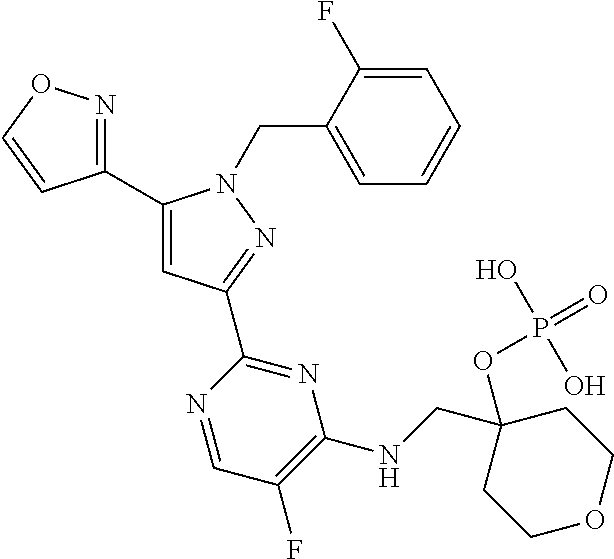 |
I-3 |
 |
I-4 |
 |
I-5 |

-
- W is either
- i) absent, and JB is connected directly to the carbon atom bearing two J groups; each J is independently selected from hydrogen or methyl, n is 1 and JB is a C2-7 alkyl chain optionally substituted by between 2 and 9 instances of fluorine; wherein, optionally, one —CH2— unit of said C2-7 alkyl chain can be replaced by —O— or —S—.
- ii) a ring B selected from the group consisting of phenyl, a 5 or 6-membered heteroaryl ring, containing 1 or 2 ring heteroatoms independently selected from N, O and S, a C3-7 cycloalkyl ring and a 4 to 7-membered heterocyclic compound, containing up to 3 heteroatoms independently selected from O, N and S;
- wherein when W is ring B
- each J is hydrogen;
- n is 0 or an integer selected from 1, 2 or 3;
- each JB is independently selected from the group consisting of halogen, —CN, a C1-6 aliphatic, —ORB or a C3-8 cycloaliphatic group; wherein each said C1-6 aliphatic and each said C3-8 cycloaliphatic group is optionally and independently substituted with up to 3 instances of R3;
- each RB is independently hydrogen, a C1-6 aliphatic or a C3-8 cycloaliphatic; wherein each of said RB that is a C1-6 aliphatic and each of said RB that is a C3-8 cycloaliphatic ring is optionally and independently substituted with up to 3 instances of R3a;
- each R3 is independently halogen, —CN, C1-4 alkyl, C1-4 haloalkyl, —O(C1-4 alkyl) or —O(C1-4 haloalkyl);
- each R3a is independently halogen, —CN, C1-4 alkyl, C1-4 haloalkyl, —O(C1-4 alkyl) or —O(C1-4 haloalkyl);
- Z1 in ring D is CH or N; Z is C or N; wherein if Z1 is CH, then Z must be C; and if Z1 is N, then Z may be C or N;
- each JD is independently selected from the group consisting of JA-CN, —NO2, —ORD, —SRD, —C(O)RD, C(O)ORD, —OC(O)RD, C(O)N(RD)2, —N(RD)2, —N(Rd)C(O)RD, —N(Rd)C(O)ORD, —N(Rd)C(O)N(RD)2, —OC(O)N(RD)2, —SO2RD, —SO2N(RD)2, —N(Rd)SO2RD, N(Rd)SO2NRD, N(Rd)SO2NHC(O)ORD, N(Rd)SO2NHC(O)RD, a C1-6 aliphatic, —(C1-6 aliphatic)-RD, a C3-8 cycloaliphatic ring, a 6 to 10-membered aryl ring, a 4 to 8-membered heterocyclic ring and a 5 to 10-membered heteroaryl ring; wherein each said 4 to 8-membered heterocyclic ring and each said 5 to 10-membered heteroaryl ring contains between 1 and 3 heteroatoms independently selected from O, N and S; and wherein each said C1-6 aliphatic, each said C1-6 aliphatic portion of the —(C1-6 aliphatic)-RD moiety, each said C3-8 cycloaliphatic ring, each said 6 to 10-membered aryl ring, each said 4 to 8-membered heterocyclic ring and each said 5 to 10-membered heteroaryl ring is optionally and independently substituted with up to 5 instances of R5d;
- JA is selected from the group consisting of a lone pair on nitrogen, hydrogen, halogen, oxo, methyl, hydroxyl, methoxy, trifluoromethyl, trifluoromethoxy and —NRaRb; wherein Ra and Rb are each independently hydrogen, C1-6 alkyl or a 3-6 cycloalkyl ring; or wherein Ra and Rb, together with the nitrogen atom to which they are both attached, form a 4-8 membered heterocyclic ring, or a 5-membered heteroaryl ring optionally containing up to two additional heteroatoms selected from N, O and S; wherein each of said 4-8 membered heterocyclic ring and 5-membered heteroaryl ring is optionally and independently substituted by up to 6 instances of fluorine;
- each RD is independently selected from the group consisting of hydrogen, a C1-6 aliphatic, —(C1-6 aliphatic)-Rf, a C3-8 cycloaliphatic ring, a 4 to 10-membered heterocyclic ring, phenyl and a 5 to 6-membered heteroaryl ring; wherein each said 4 to 10-membered heterocyclic ring and each said 5 to 6-membered heteroaryl ring contains between 1 and 3 heteroatoms independently selected from O, N and S; and wherein each said C1-6 aliphatic, each said C1-6 aliphatic portion of the —(C1-6 aliphatic)-Rf moiety, each said C3-8 cycloaliphatic ring, each said 4 to 10-membered heterocyclic ring, each said phenyl and each said 5 to 6-membered heteroaryl ring is optionally and independently substituted with up to 5 instances of R5a; wherein when any RD is one of a C1-6 aliphatic or a —(C1-6 aliphatic)-Rf group, one or two —CH2-units that form said C1-6 aliphatic chains may, optionally, be replaced by a group independently —N(Rd)—, —CO— or —O—;
- each Rd is independently selected from the group consisting of hydrogen, a C1-6 aliphatic, —(C1-6 aliphatic)-Rf, a C3-8 cycloaliphatic ring, a 4 to 8-membered heterocyclic ring, phenyl and a 5 to 6-membered heteroaryl ring; wherein each said 4 to 8-membered heterocyclic ring and each said 5 or 6-membered heteroaryl ring contains between 1 and 3 heteroatoms independently selected from O, N and S; and wherein each said C1-6 aliphatic, each said C1-6 aliphatic portion of the —(C1-6 aliphatic)-Rf moiety, each said C3-8 cycloaliphatic ring, each said 4 to 8-membered heterocyclic ring, each said phenyl and each said 5 to 6-membered heteroaryl ring is optionally and independently substituted by up to 5 instances of R5b; wherein when any Rd is one of a C1-6 aliphatic or a —(C1-6 aliphatic)-Rf group, one or two —CH2— units that form said C1-6 aliphatic chains may, optionally, be replaced by a group independently selected from —N(Rdd)—, —CO— or —O—;
- each Rdd is independently selected from the group consisting of hydrogen, a C1-6 aliphatic, —(C1-6 aliphatic)-Rf, a C3-8 cycloaliphatic ring, a 4 to 8-membered heterocyclic ring, phenyl and a 5 to 6-membered heteroaryl ring; wherein each said 4 to 8-membered heterocyclic ring and each said 5 or 6-membered heteroaryl ring contains between 1 and 3 heteroatoms independently selected from O, N and S; and wherein each said C1-6 aliphatic, each said C1-6 aliphatic portion of the —(C1-6 aliphatic)-Rf moiety, each said C3-8 cycloaliphatic ring, each said 4 to 8-membered heterocyclic ring, each said phenyl and each said 5 to 6-membered heteroaryl ring is optionally and independently substituted by up to 5 instances of R5b;
- each Rf is independently selected from the group consisting of a C1-3 alkyl, a C3-8 cycloaliphatic ring, a 4 to 10-membered heterocyclic ring, phenyl or a 5 to 6-membered heteroaryl ring; wherein each said 4 to 10-membered heterocyclic ring and each said 5 to 6-membered heteroaryl ring contains between 1 and 4 heteroatoms independently selected from O, N and S; and wherein each said C3-8 cycloaliphatic ring, each said 4 to 10-membered heterocyclic ring, each said phenyl and each said 5 to 6-membered heteroaryl ring is optionally and independently substituted by up to 5 instances of R5;
- when JD is —C(O)N(RD)2, —N(RD)2, —N(Rd)C(O)N(RD)2, —OC(O)N(RD)2 or —SO2N(RD)2, the two RD groups together with the nitrogen atom attached to the two RD groups may form a 4 to 8-membered heterocyclic ring or a 5-membered heteroaryl ring; wherein each said 4 to 8-membered heterocyclic ring and each said 5-membered heteroaryl ring optionally contains up to 3 additional heteroatoms independently selected from N, O and S, in addition to the nitrogen atom to which the two RD groups are attached; and wherein each said 4 to 8-membered heterocyclic ring and each said 5-membered heteroaryl ring is optionally and independently substituted by up to 5 instances of R5;
- when JD is —N(Rd)C(O)RD, the RD group together with the carbon atom attached to the RD group, with the nitrogen atom attached to the Rd group, and with the Rd group may form a 4 to 8-membered heterocyclic ring or a 5-membered heteroaryl ring; wherein each said 4 to 8-membered heterocyclic ring and each said 5-membered heteroaryl ring optionally contains up to 2 additional heteroatoms independently selected from N, O and S, in addition to the nitrogen atom to which the Rd group is attached; and wherein each said 4 to 8-membered heterocyclic ring and each said 5-membered heteroaryl ring is optionally and independently substituted by up to 5 instances of R5;
- when JD is —N(Rd)C(O)ORD, the RD group together with the oxygen atom attached to the RD group, with the carbon atom of the —C(O)— portion of the —N(Rd)C(O)ORD group, with the nitrogen atom attached to the Rd group, and with said Rd group, may form a 4 to 8-membered heterocyclic ring; wherein said 4 to 8-membered heterocyclic ring optionally contains up to 2 additional heteroatoms independently selected from N, O or S, and is optionally and independently substituted by up to 5 instances of R5;
- when JD is —N(Rd)C(O)N(RD)2, one of the RD groups attached to the nitrogen atom, together with said nitrogen atom, and with the N atom attached to the Rd group and said Rd group may form a 4 to 8-membered heterocyclic ring; wherein said 4 to 8-membered heterocyclic ring optionally contains up to 2 additional heteroatoms independently selected from N, O and S, and is optionally and independently substituted by up to 5 instances of R5;
- when JD is N(Rd)SO2RD, the RD group together with the sulfur atom attached to the RD group, with the nitrogen atom attached to the Rd group, and with said Rd group may combine to form a 4 to 8-membered heterocyclic ring; wherein said 4 to 8-membered heterocyclic ring optionally contains up to 2 additional heteroatoms independently selected from N, O and S, and is optionally and independently substituted by up to 5 instances of R5;
- each R5 is independently selected from the group consisting of halogen, —CN, C1-6 alkyl, —(C1-6 alkyl)-R6, —OR6, —SR6, —COR6, —OC(O)R6, —C(O)OR6, —C(O)N(R6)2, —C(O)N(R6)SO2R6, —N(R6)C(O)R6, —N(R6)C(O)OR6, —N(R6)C(O)N(R6)2, —N(R6)2, —SO2R6, —SO2OH, —SO2NHOH, —SO2N(R6)2, —SO2N(R6)COOR6, —SO2N(R6)C(O)R6, —N(R6)SO2R6, —(C═O)NHOR6, a C3-8 cycloalkyl ring, a 4 to 7-membered heterocyclic ring, a 5 or 6-membered heteroaryl ring, phenyl, benzyl, an oxo group and a bicyclic group; wherein each of said 5 or 6-membered heteroaryl ring or 4 to 7-membered heterocyclic ring contains up to 4 ring heteroatoms independently selected from N, O and S; and wherein each of said C1-6 alkyl, C1-6 alkyl portion of the —(C1-6 alkyl)-R6 moiety, C3-8 cycloalkyl ring, 4 to 7-membered heterocyclic ring, 5 or 6-membered heteroaryl ring, benzyl or phenyl group is optionally and independently substituted with up to 3 instances of halogen, C1-4 alkyl, —OH, —NH2, —NH(C1-4 alkyl), —N(C1-4 alkyl)2, —CN, —COOH, —CONH2, —COO(C1-4 alkyl), —O(C1-4 alkyl), —O(C1-4 haloalkyl) or oxo; wherein said bicyclic group contains ring one and ring two in a fused or bridged relationship, said ring one is a 4 to 7-membered heterocyclic ring, a 5 or 6-membered heteroaryl ring, phenyl or benzyl, and said ring two is a phenyl ring or a 5 or 6-membered heteroaryl ring containing up to 3 ring heteroatoms selected from N, O and S; and wherein said bicyclic group is optionally and independently substituted by up to six instances of halogen, C1-4 alkyl, —OH, —NH2, —NH(C1-4 alkyl), —N(C1-4 alkyl)2, —CN, —COOH, —CONH2, —COO(C1-4 alkyl), —O(C1-4 alkyl), —O(C1-4 haloalkyl) or oxo;
- two instances of R5, attached to the same or different atoms of JD, together with said atom or atoms to which they are attached, may optionally form a C3-8 cycloalkyl ring, a 4 to 6-membered heterocyclic ring; a phenyl or a 5 or 6-membered heteroaryl ring, resulting in a bicyclic system wherein the two rings of the bicyclic system are in a spiro, fused or bridged relationship, wherein said 4 to 6-membered heterocycle or said 5 or 6-membered heteroaryl ring contains up to four ring heteroatoms independently selected from N, O and S; and wherein said C3-8 cycloalkyl ring, 4 to 6-membered heterocyclic ring, phenyl or 5 or 6-membered heteroaryl ring is optionally and independently substituted by up to 3 instances of C1-4 alkyl, C1-4 haloalkyl, C1-4 alkoxy, C1-4 haloalkoxy, oxo, —C(O)O(C1-4 alkyl), —C(O)OH, —NR(CO)O(C1-4 alkyl), —CONH2, —OH or halogen; wherein R is hydrogen or a C1-2 alkyl;
- each R5a is independently selected from the group consisting of halogen, —CN, C1-6 alkyl, —(C1-6 alkyl)R6a, —OR6a, —SR6a, —COR6a, —OC(O)R6a, —C(O)OR6a, —C(O)N(R6a)2, —C(O)N(R6a)SO2R6a—N(R6a)C(O)R6a—N(R6a)C(O)OR6a, —N(R6a)C(O)N(R6a)2, —N(R6a)2, —SO2R6a, —SO2OH, —SO2NHOH, —SO2N(R6a)2, —SO2N(R6a)COOR6a, —SO2N(R6a)C(O)R6a, —N(R6a)SO2R6a, —(C═O)NHOR6a, a C3-8 cycloalkyl ring, a 4 to 7-membered heterocyclic ring, a 5 or 6-membered heteroaryl ring, phenyl, benzyl, an oxo group and a bicyclic group; wherein each 5 or 6-membered heteroaryl ring or 4 to 7-membered heterocyclic ring contains up to 4 ring heteroatoms independently selected from N, O and S, wherein each of said C1-6 alkyl, C1-4 alkyl portion of the —(C1-6 alkyl)R6a moiety, C3-8 cycloalkyl ring, 4 to 7-membered heterocyclic ring, 5 or 6-membered heteroaryl ring, benzyl or phenyl group is optionally and independently substituted with up to 3 instances of halogen, C1-4 alkyl, C1-4 haloalkyl, —OH, —NH2, —NH(C1-4 alkyl), —N(C1-4 alkyl)2, —CN, —COOH, —CONH2, —COO(C1-4 alkyl), —O(C1-4 alkyl), —O(C1-4 haloalkyl) or oxo; wherein said bicyclic group contains ring one and ring two in a fused or bridged relationship, said ring one is a 4 to 7-membered heterocyclic ring, a 5 or 6-membered heteroaryl ring, phenyl or benzyl, and said ring two is a phenyl ring or a 5 or 6-membered heteroaryl ring containing up to 3 ring heteroatoms selected from N, O and S; and wherein said bicyclic group is optionally and independently substituted by up to six instances of halogen, C1-4 alkyl, —OH, —NH2, —NH(C1-4 alkyl), —N(C1-4 alkyl)2, —CN, —COOH, —CONH2, —COO(C1-4 alkyl), —O(C1-4 alkyl), —O(C1-4 haloalkyl) or oxo;
- each R5b is independently selected from the group consisting of halogen, —CN, C1-6 alkyl, —(C1-6 alkyl)R6a, —OR6a, —SR6a, —COR6a, —OC(O)R6a, —C(O)OR6a, —C(O)N(R6a)2, —C(O)N(R6a)SO2R6a—N(R6a)C(O)R6a—N(R6a)C(O)OR6a, —N(R6a)C(O)N(R6a)2, —N(R6a)2, —SO2R6a, —SO2OH, —SO2NHOH, —SO2N(R6a)2, —SO2N(R6a)COOR6a, —SO2N(R6a)C(O)R6a, —N(R6a)SO2R6a, —(C═O)NHOR6a, a C3-8 cycloalkyl ring, a 4 to 7-membered heterocyclic ring, a 5 or 6-membered heteroaryl ring, phenyl, benzyl, an oxo group and a bicyclic group; wherein each 5 or 6-membered heteroaryl ring or 4 to 7-membered heterocyclic ring contains up to 4 ring heteroatoms independently selected from N, O and S, wherein each of said C1-6 alkyl, C1-6 alkyl portion of the —(C1-6 alkyl)R6a moiety, C3-8 cycloalkyl ring, 4 to 7-membered heterocyclic ring, 5 or 6-membered heteroaryl ring, benzyl or phenyl group is optionally and independently substituted with up to 3 instances of halogen, C1-4 alkyl, C1-4 haloalkyl, —OH, —NH2, —NH(C1-4 alkyl), —N(C1-4 alkyl)2, —CN, —COOH, —CONH2, —COO(C1-4 alkyl), —O(C1-4 alkyl), —O(C1-4 haloalkyl) or oxo; wherein said bicyclic group contains ring one and ring two in a fused or bridged relationship, said ring one is a 4 to 7-membered heterocyclic ring, a 5 or 6-membered heteroaryl ring, phenyl or benzyl, and said ring two is a phenyl ring or a 5 or 6-membered heteroaryl ring containing up to 3 ring heteroatoms selected from N, O and S; and wherein said bicyclic group is optionally and independently substituted by up to six instances of halogen, C1-4 alkyl, —OH, —NH2, —NH(C1-4 alkyl), —N(C1-4 alkyl)2, —CN, —COOH, —CONH2, —COO(C1-4 alkyl), —O(C1-4 alkyl), —O(C1-4 haloalkyl) or oxo;
- two instances of R5a or two instances of R5b attached to the same or different atoms of RD or Rd, respectively, together with said atom or atoms to which they are attached, may optionally form a C3-8 cycloalkyl ring, a 4 to 6-membered heterocyclic ring; a phenyl or a 5 or 6-membered heteroaryl ring, resulting in a bicyclic system wherein the two rings of the bicyclic system are in a spiro, fused or bridged relationship with respect to each other; wherein said 4 to 6-membered heterocycle or said 5 or 6-membered heteroaryl ring contains up to four ring heteroatoms independently selected from N, O and S; and wherein said C3-8 cycloalkyl ring, 4 to 6-membered heterocyclic ring, phenyl or 5 or 6-membered heteroaryl ring is optionally and independently substituted by up to 3 instances of C1-4 alkyl, C1-4 haloalkyl, C1-4 alkoxy, C1-4 haloalkoxy, oxo, —C(O)O(C1-4 alkyl), —C(O)OH, —C(O)NH2, —NR(CO)O(C1-4 alkyl), —OH or halogen; wherein R is hydrogen or a C1-2 alkyl;
- each R5c is independently selected from the group consisting of halogen, —CN, C1-6 alkyl, —(C1-6 alkyl)-R6b, —OR6b, —SR6b, —COR6b, —OC(O)R6b, —C(O)OR6b, —C(O)N(R6b)2, —C(O)N(R6b)SO2R6b, —N(R6b)C(O)R6b, —N(R6b)C(O)OR6b, —N(R6b)C(O)N(R6b)2, —N(R6b)2, —SO2R6b, —SO2OH, —SO2NHOH, —SO2N(R6b)2, —SO2N(R6b)COOR6b, —SO2N(R6b)C(O)R6b, —N(R6b)SO2R6b, —(C═O)NHOR6b, a C3-8 cycloalkyl ring, a 4 to 7-membered heterocyclic ring, a 5 or 6-membered heteroaryl ring, phenyl, benzyl, an oxo group, and a bicyclic group; wherein each of said 5 or 6-membered heteroaryl ring and each of said 4 to 7-membered heterocyclic ring contains up to 4 ring heteroatoms independently selected from N, O and S; and wherein each of said C1-6 alkyl, C1-6 alkyl portion of said —(C1-6 alkyl)-R6b moiety, each of said C3-8 cycloalkyl ring, each of said 4 to 7-membered heterocyclic ring, each of said 5 or 6-membered heteroaryl ring, each of said benzyl and each of said phenyl group is optionally and independently substituted with up to 3 instances of halogen, C1-4 alkyl, —OH, —NH2, —NH(C1-4 alkyl), —N(C1-4 alkyl)2, —CN, —COOH, —CONH2, —COO(C1-4 alkyl), —O(C1-4 alkyl), —O(C1-4 haloalkyl) or oxo; wherein said bicyclic group contains a first ring and a second ring in a fused or bridged relationship, said first ring is a 4 to 7-membered heterocyclic ring, a 5 or 6-membered heteroaryl ring, phenyl or benzyl, and said second ring is a phenyl ring or a 5 or 6-membered heteroaryl ring containing up to 3 ring heteroatoms selected from N, O and S; and wherein said bicyclic group is optionally and independently substituted by up to six instances of halogen, C1-4 alkyl, —OH, —NH2, —NH(C1-4 alkyl), —N(C1-4 alkyl)2, —CN, —COOH, —CONH2, —COO(C1-4 alkyl), —O(C1-4 alkyl), —O(C1-4 haloalkyl) or oxo;
- two instances of R5c attached to the same or different atoms of R, together with said atom or atoms to which it is attached, may optionally form a C3-8 cycloalkyl ring, a 4 to 6-membered heterocyclic ring; a phenyl or a 5 or 6-membered heteroaryl ring, resulting in a bicyclic system wherein the two rings of the bicyclic system are in a spiro, fused or bridged relationship with respect to each other; wherein said 4 to 6-membered heterocycle or said 5 or 6-membered heteroaryl ring contains up to four ring heteroatoms independently selected from N, O and S; and wherein said C3-8 cycloalkyl ring, 4 to 6-membered heterocyclic ring, phenyl or 5 or 6-membered heteroaryl ring is optionally and independently substituted by up to 3 instances of C1-4 alkyl, C1-4 haloalkyl, C1-4 alkoxy, C1-4 haloalkoxy, oxo, —C(O)O(C1-4 alkyl), —C(O)OH, —CONH2, —NR(CO)O(C1-4 alkyl), —OH or halogen; wherein R is hydrogen or a C1-2 alkyl;
- each R5d is independently selected from the group consisting of halogen, —CN, C1-6 alkyl, —(C1-6 alkyl)-R6, —OR6, —SR6, —COR6, —OC(O)R6, —C(O)OR6, —C(O)N(R6)2, —N(R6)C(O)R6, —N(R6)C(O)OR6, —N(R6)C(O)N(R6)2, —N(R6)2, —SO2R6, —SO2OH, —SO2NHOH, —SO2N(R6)COR6, —SO2N(R6)2, —N(R6)SO2R6, a C7-12 aralkyl, a C3-8 cycloalkyl ring, a 4 to 7-membered heterocyclic ring, a 5 or 6-membered heteroaryl ring, phenyl and an oxo group; wherein each 5 or 6-membered heteroaryl ring or 4 to 7-membered heterocyclic ring contains up to four ring heteroatoms independently selected from N, O and S, wherein each of said C1-6 alkyl, C1-6 alkyl portion of the —(C1-6 alkyl)-R6 moiety, C7-12 aralkyl, C3-8 cycloalkyl ring, 4 to 7-membered heterocyclic ring, 5 or 6-membered heteroaryl ring or phenyl group is optionally and independently substituted with up to 3 instances of halogen, C1-4 alkyl, C1-4(haloalkyl), —OH, —NH2, —NH(C1-4 alkyl), —N(C1-4 alkyl)2, —CN, —COOH, —CONH2, —COO(C1-4 alkyl), —O(C1-4 alkyl), —O(C1-4 haloalkyl) or oxo;
- two instances of R5d attached to the same or different atoms of JD, together with said atom or atoms of JD to which they are attached, may optionally form a C3-8 cycloalkyl ring, a 4 to 6-membered heterocyclic ring; a phenyl or a 5 or 6-membered heteroaryl ring, resulting in a bicyclic system wherein the two rings of the bicyclic system are in a spiro, fused or bridged relationship with respect to each other; wherein said 4 to 6-membered heterocycle or said 5 or 6-membered heteroaryl ring contains up to four ring heteroatoms independently selected from N, O and S; and wherein said C3-8 cycloalkyl ring, 4 to 6-membered heterocyclic ring, phenyl or 5 or 6-membered heteroaryl ring is optionally and independently substituted by up to 3 instances of C1-4 alkyl, C1-4 haloalkyl, C1-4 alkoxy, C1-4 haloalkoxy, oxo, —C(O)O(C1-4 alkyl), —C(O)OH, —NR(CO)O(C1-4 alkyl), —C(O)NH2, —OH or halogen; wherein R is hydrogen or a C1-2 alkyl;
- each R6 is independently selected from the group consisting of hydrogen, a C1-6 alkyl, phenyl, benzyl, a C3-8 cycloalkyl ring, a 4 to 7-membered heterocyclic ring and a 5 or 6-membered heteroaryl ring, wherein each of said C1-6 alkyl, each of said phenyl, each of said benzyl, each of said C3-8 cycloalkyl group, each of said 4 to 7-membered heterocyclic ring and each of said 5 or 6-membered heteroaryl ring is optionally and independently substituted with up to 3 instances of halogen, C1-4 alkyl, —OH, —NH2, —NH(C1-4 alkyl), —N(C1-4 alkyl)2, —CN, —COOH, —C(O)NH2, —COO(C1-4 alkyl), —O(C1-4 alkyl), —O(C1-4 haloalkyl) or oxo, wherein each of said 5 or 6-membered heteroaryl ring or 4 to 7-membered heterocyclic ring contains up to 4 ring heteroatoms independently selected from N, O and S;
- each R6a is independently selected from the group consisting of hydrogen, a
- C1-6 alkyl, phenyl, benzyl, a C3-8 cycloalkyl ring, a 4 to 7-membered heterocyclic ring and a 5 or 6-membered heteroaryl ring, wherein each of said C1-6 alkyl, each of said phenyl, each of said benzyl, each of said C3-8 cycloalkyl group, each of said 4 to 7-membered heterocyclic ring and each of said 5 or 6-membered heteroaryl ring is optionally and independently substituted with up to 3 instances of halogen, C1-4 alkyl, —OH, —NH2, —NH(C1-4 alkyl), —N(C1-4 alkyl)2, —CN, —COOH, —C(O)NH2, —C(O)N(C1-6 alkyl)2, —C(O)NH(C1-6 alkyl), —C(O)N(C1-6 haloalkyl)2, —C(O)NH(C1-6 haloalkyl), C(O)N(C1-6 alkyl)(C1-6 haloalkyl), —COO(C1-6 alkyl), —COO(C1-6 haloalkyl), —O(C1-4 alkyl), —O(C1-4 haloalkyl) or oxo, wherein each of said 5 or 6-membered heteroaryl ring or 4 to 7-membered heterocyclic ring contains up to 4 ring heteroatoms independently selected from N, O and S;
- each R6b is independently hydrogen, a C1-6 alkyl, phenyl, benzyl, a C3-8 cycloalkyl ring, a 4 to 7-membered heterocyclic ring or a 5 or 6-membered heteroaryl ring, wherein each of said C1-6 alkyl, each of said phenyl, each of said benzyl, each of said C3-8 cycloalkyl group, each of said 4 to 7-membered heterocyclic ring and each of said 5 or 6-membered heteroaryl ring is optionally and independently substituted with up to 3 instances of halogen, C1-4 alkyl, —OH, —NH2, —NH(C1-4 alkyl), —N(C1-4 alkyl)2, —CN, —COOH, —C(O)NH2, —COO(C1-4 alkyl), —O(C1-4 alkyl), —O(C1-4 haloalkyl) or oxo, wherein each of said 5 or 6-membered heteroaryl ring or 4 to 7-membered heterocyclic ring contains up to 4 ring heteroatoms independently selected from N, O and S;
- two instances of R6 linked to the same nitrogen atom of R5 or R5d, together with said nitrogen atom of R5 or R5d, respectively, may form a 5 to 8-membered heterocyclic ring or a 5-membered heteroaryl ring; wherein each said 5 to 8-membered heterocyclic ring and each said 5-membered heteroaryl ring optionally contains up to 2 additional heteroatoms independently selected from N, O and S;
- two instances of R6a linked to a nitrogen atom of R5a or R5b, together with said nitrogen, may form a 5 to 8-membered heterocyclic ring or a 5-membered heteroaryl ring; wherein each said 5 to 8-membered heterocyclic ring and each said 5-membered heteroaryl ring optionally contains up to 2 additional heteroatoms independently selected from N, O and S;
- two instances of R6b linked to a nitrogen atom of R5c, together with said nitrogen, may form a 5 to 8-membered heterocyclic ring or a 5-membered heteroaryl ring; wherein each said 5 to 8-membered heterocyclic ring and each said 5-membered heteroaryl ring optionally contains up to 2 additional heteroatoms independently selected from N, O and S;
- Y is either absent or is a C1-6 alkyl chain, optionally substituted by up to 6 instances of fluoro; and wherein in said Y that is a C1-6 alkyl chain, up to 3 methylene units of this alkyl chain, can be replaced by a group selected from —O—, —C(O)— and —N((Y1)—R90)—, wherein
- Y1 is either absent or is a C1-6 alkyl chain, optionally substituted by up to 6 instances of fluoro; and:
- when Y1 is absent, each R90 is independently selected from the group consisting of hydrogen, —COR10, —C(O)OR10, —C(O)N(R10)2, —C(O)N(R10)SO2R10, —SO2R10, —SO2N(R10)2, —SO2N(R10)COOR10, —SO2N(R10)C(O)R10, —(C═O)NHOR10 a C3-6 cycloalkyl ring, a 4-8-membered heterocyclic ring, a phenyl ring and a 5-6 membered heteroaryl ring; wherein each said 4 to 8-membered heterocyclic ring or 5 to 6-membered heteroaryl ring contains up to 4 ring heteroatoms independently selected from N, O and S; and wherein each of said C3-6 cycloalkyl rings, each of said 4 to 8-membered heterocyclic rings, each of said phenyl and each of said 5 to 6-membered heteroaryl rings is optionally and independently substituted with up to 3 instances of R11; and
- when Y1 is present, each R90 is independently selected from the group consisting of hydrogen, halogen, —CN, —OR10, —COR10, —OC(O)R10, —C(O)OR10, —C(O)N(R10)2, —C(O)N(R10)SO2R10, —N(R10)C(O)R10, —N(R10)C(O)OR10, —N(R10)C(O)N(R10)2, —N(R10)2, —SO2R10, —SO2N(R10)2, —SO2N(R10)COOR10, —SO2N(R10)C(O)R10, —N(R10)SO2R10, —(C═O)NHOR10, C3-6 cycloalkyl ring, a 4-8-membered heterocyclic ring, a phenyl ring and a 5-6 membered heteroaryl ring; wherein each said 4 to 8-membered heterocyclic ring or 5 to 6-membered heteroaryl ring contains up to 4 ring heteroatoms independently selected from N, O and S; and wherein each of said C3-6 cycloalkyl rings, each of said 4 to 8-membered heterocyclic rings, each of said phenyl and each of said 5 to 6-membered heteroaryl rings is optionally and independently substituted with up to 3 instances of R11;
- each R9 is independently selected from the group consisting of hydrogen, halogen, a C1-6 alkyl, —CN, —OR10, —COR10, —OC(O)R10, —C(O)OR10, —C(O)N(R10)2, —C(O)N(R10)SO2R10, —N(R10)C(O)R10, —N(R10)C(O)OR10, —N(R10)C(O)N(R10)2, —N(R10)2, —SO2R10, —SO2N(R10)2, —SO2N(R10)COOR10, —SO2N(R10)C(O)R10, —N(R10)SO2R10, —(C═O)NHOR10, C3-6 cycloalkyl ring, a 4-8-membered heterocyclic ring, a phenyl ring and a 5-6 membered heteroaryl ring; wherein each said 4 to 8-membered heterocyclic ring or 5 to 6-membered heteroaryl ring contains up to 4 ring heteroatoms independently selected from N, O and S; and wherein each of said C1-6 alkyl, each of said C3-6 cycloalkyl rings, each of said 4 to 8-membered heterocyclic rings, each of said phenyl and each of said 5 to 6-membered heteroaryl rings is optionally and independently substituted with up to 3 instances of R11;
- each R10 is independently selected from the group consisting of hydrogen, a C1-6 alkyl, —(C1-6 alkyl)-R13, phenyl, benzyl, a C3-8 cycloalkyl ring, a 4 to 7-membered heterocyclic ring and a 5 or 6-membered heteroaryl ring, wherein each 5 or 6-membered heteroaryl ring or 4 to 7-membered heterocyclic ring contains up to 4 ring heteroatoms independently selected from N, O and S; and wherein each of said C1-6 alkyl, C1-6 alkyl portion of said —(C1-6 alkyl)-R13 moiety, each said phenyl, each said benzyl, each said C3-8 cycloalkyl group, each said 4 to 7-membered heterocyclic ring and each 5 or 6-membered heteroaryl ring is optionally and independently substituted with up to 3 instances of R11a;
- each R13 is independently a phenyl, a benzyl, a C3-6 cycloalkyl ring, a 4 to 7-membered heterocyclic ring or a 5 or 6-membered heteroaryl ring, wherein each 5 or 6-membered heteroaryl ring or 4 to 7-membered heterocyclic ring contains up to 4 ring heteroatoms independently selected from N, O and S; and wherein each said phenyl, each of said benzyl, each said C3-8 cycloalkyl group, each said 4 to 7-membered heterocyclic ring and each 5 or 6-membered heteroaryl ring is optionally and independently substituted with up to 3 instances of R11b;
- each R11 is independently selected from the group consisting of halogen, oxo, C1-6 alkyl, —CN, —OR12, —COR12, —C(O)OR12, —C(O)N(R12)2, —N(R12)C(O)R12, —N(R12)C(O)OR12, —N(R12)C(O)N(R12)2, —N(R12)2, —SO2R12, —SO2N(R12)2 and —N(R12)SO2R12; wherein each of said C1-6 alkyl is optionally and independently substituted by up to 6 instances of fluoro and/or 3 instances of R121;
- each R11a is independently selected from the group consisting of halogen, oxo, C1-6 alkyl, —CN, —OR12, —COR12, —C(O)OR12, —C(O)N(R12)2, —N(R12)C(O)R12, —N(R12)C(O)OR12, —N(R12)C(O)N(R12)2, —N(R12)2, —SO2R12, —SO2N(R12)2 and —N(R12)SO2R12; wherein each of said C1-6 alkyl is optionally and independently substituted by up to 6 instances of fluoro and/or 3 instances of R121; and
- each R11b is independently selected from the group consisting of halogen, C1-6 alkyl, oxo, —CN, —OR12, —COR12, —C(O)OR12, —C(O)N(R12)2, —N(R12)C(O)R12, —N(R12)C(O)OR12, —N(R12)C(O)N(R12)2, —N(R12)2, —SO2R12, —SO2N(R12)2 and —N(R12)SO2R12; wherein each of said C1-6 alkyl is optionally and independently substituted by up to 6 instances of fluoro and/or 3 instances of R121.
- each R12 is selected from the group consisting of hydrogen, a C1-6 alkyl, phenyl, benzyl, a C3-8 cycloalkyl ring, a 4 to 7-membered heterocyclic ring or a 5 or 6-membered heteroaryl ring, wherein each 5 or 6-membered heteroaryl ring and 4 to 7-membered heterocyclic ring contains up to 4 ring heteroatoms independently selected from N, O and S; and wherein each of said C1-6 alkyl, each said phenyl, each said benzyl, each said C3-8 cycloalkyl group, each said 4 to 7-membered heterocyclic ring and each 5 or 6-membered heteroaryl ring is optionally and independently substituted with up to 3 instances of halogen, C1-4 alkyl, C1-4(fluoroalkyl), —OH, —NH2, —NH(C1-4 alkyl), —N(C1-4 alkyl)2, —CN, —COOH, —CONH2, —COO(C1-4 alkyl), —O(C1-4 alkyl), —O(C1-4 fluoroalkyl) or oxo;
- each R121 is selected from the group consisting of hydrogen, a C1-6 alkyl, phenyl, benzyl, a C3-8 cycloalkyl ring, a 4 to 7-membered heterocyclic ring or a 5 or 6-membered heteroaryl ring, wherein each 5 or 6-membered heteroaryl ring and 4 to 7-membered heterocyclic ring contains up to 4 ring heteroatoms independently selected from N, O and S; and wherein each of said C1-6 alkyl, each said phenyl, each said benzyl, each said C3-8 cycloalkyl group, each said 4 to 7-membered heterocyclic ring and each 5 or 6-membered heteroaryl ring is optionally and independently substituted with up to 3 instances of halogen, C1-4 alkyl, C1-4(fluoroalkyl), —OH, —NH2, —NH(C1-4 alkyl), —N(C1-4 alkyl)2, —CN, —COOH, —CONH2, —COO(C1-4 alkyl), —O(C1-4 alkyl), —O(C1-4 fluoroalkyl) or oxo; and
- each JC is independently hydrogen or a C1-6 alkyl.

-
- n is 0 or an integer selected from 1 to 3;
- each JB is independently halogen, —CN, a C1-6 aliphatic, —ORB or a C3-8 cycloaliphatic ring; wherein each of said C1-6 aliphatic and each of said C3-8 cycloaliphatic group is optionally substituted with up to 3 instances of halogen;
- each RB is independently hydrogen, a C1-6 aliphatic or a C3-8 cycloaliphatic ring; wherein each of said RB that is a C1-6 aliphatic and each of said RB that is a C3-8 cycloaliphatic ring is optionally substituted with up to 3 instances of halogen; each JC, if present, is independently halogen;
- R1 is hydrogen or C1-6 alkyl; and
- R2 is a C1-6 alkyl.


-
- wherein:
- Each Y is independently selected from N, NJc, CH, or CJc;
- Each X is either N, NJc, CH, or CJc;
- wherein a maximum of 3 instances of X and Y are simultaneously N or NJc;
- JF is halo, CN, or C1-3alkyl optionally substituted with 1 to 3 halo;
- Each JB is independently selected from halo or C1-4alkyl;
- n is 0, 1, 2, or 3;
- R10 is C1-4alkyl optionally substituted with 1, 2, or 3 groups independently selected from halo,
—C(O)Rb2, phenyl, and 5- or 6-membered heteroaryl, wherein the phenyl and 5- or 6-membered heteroaryl are optionally substituted with 1, 2, or 3 halo or C1-4alkyl, wherein the heteroaryl includes 1, 2, or 3 heteroatoms independently selected from N, O, and S; - q is 0 or 1;
- R11 is H, halo, —NRa2Rb2, C1-4alkyl, 5- to 6-membered heteroaryl, or C3-6 cycloalkyl, wherein the C1-4alkyl, 5- to 6-membered heteroaryl, and C3-6 cycloalkyl are each optionally substituted with 1, 2, or 3 groups independently selected from halo, wherein the heteroaryl includes 1, 2, or 3 heteroatoms independently selected from N, O, and S;
- Ra2 is hydrogen or C1-4 alkyl; and Rb2 is hydrogen or C1-4 alkyl.

-
- Wherein:
- Y is N or CH;
- Each JB is independently selected from halo or C1-4alkyl;
- n is 0, 1, 2, or 3;
- R11 is H, halo, —NRa2Rb2, C1-4alkyl, 5- to 6-membered heteroaryl, or C3-6 cycloalkyl, wherein the C1-4alkyl, 5- to 6-membered heteroaryl, and C3-6 cycloalkyl are each optionally substituted with 1, 2, or 3 groups independently selected from halo;
- Ra2 is hydrogen or C1-4 alkyl; and
- Rb2 is hydrogen or C1-4 alkyl.

-
- Wherein:
- Y is N or CH;
- Each JB is independently selected from halo or C1-4alkyl;
- n is 0, 1, 2, or 3;
- R11 is H, halo, —NRa2Rb2, C1-4alkyl, 5- to 6-membered heteroaryl, or C3-6 cycloalkyl, wherein the C1-4alkyl, 5- to 6-membered heteroaryl, and C30.6 cycloalkyl are each optionally substituted with 1, 2, or 3 groups independently selected from halo;
- Ra2 is hydrogen or C1-4 alkyl; and
- Rb2 is hydrogen or C1-4 alkyl.


-
- riociguat (BAY 63-2521, Adempas®, FDA approved drug, described in DE19834044):

-
- neliciguat (BAY 60-4552, described in WO 2003095451):

-
- vericiguat (BAY 1021189):

-
- BAY 41-2272 (described in DE19834047 and DE19942809):

-
- BAY 41-8543 (described in DE19834044):

-
- etriciguat (described in WO 2003086407):

or
-
- one of the compounds depicted below and described in US20130072492 (WO 2011149921):

Pharmaceutically Acceptable Salts
-
- (1) Endothelium-derived releasing factor (EDRF) or NO gas.
- (2) NO donors such as a nitrosothiol, a nitrite, a sydnonimine, a NONOate, a N-nitrosamine, a N-hydroxyl nitrosamine, a nitrosimine, nitrotyrosine, a diazetine dioxide, an oxatriazole 5-imine, an oxime, a hydroxylamine, a N-hydroxyguanidine, a hydroxyurea or a furoxan. Some examples of these types of compounds include: glyceryl trinitrate (also known as GTN, nitroglycerin, nitroglycerine, and trinitrogylcerin), the nitrate ester of glycerol; sodium nitroprusside (SNP), wherein a molecule of nitric oxide is coordinated to iron metal forming a square bipyramidal complex; 3-morpholinosydnonimine (SIN-1), a zwitterionic compound formed by combination of a morpholine and a sydnonimine; S-nitroso-N-acetylpenicillamine (SNAP), an N-acetylated amino acid derivative with a nitrosothiol functional group; diethylenetriamine/NO (DETA/NO), a compound of nitric oxide covalently linked to diethylenetriamine; an m-nitroxymethyl phenyl ester of acetyl salicylic acid. More specific examples of some of these classes of NO donors include: the classic nitrovasodilators, such as organic nitrate and nitrite esters, including nitroglycerin, amyl nitrite, isosorbide dinitrate, isosorbide 5-mononitrate, and nicorandil; isosorbide (Dilatrate®-SR, Imdur®, Ismo®, Isordil®, Isordil®, Titradose®, Monoket®), 3-morpholinosydnonimine; linsidomine chlorohydrate (“SIN-i”); S-nitroso-N-acetylpenicillamine (“SNAP”); S-nitrosoglutathione (GSNO), sodium nitroprusside, S-nitrosoglutathione mono-ethyl-ester (GSNO-ester), 6-(2-hydroxy-1-methyl-nitrosohydrazino)-N-methyl-1-hexanamine or diethylamine NONOate.
- (3) Other substances that enhance cGMP concentrations such as protoporphyrin IX, arachidonic acid and phenyl hydrazine derivatives.
- (4) Nitric Oxide Synthase substrates: for example, L-arginine, n-hydroxyguanidine based analogs, such as N[G]-hydroxy-L-arginine (NOHA), 1-(3, 4-dimethoxy-2-chlorobenzylideneamino)-3-hydroxyguanidine, and PR5 (1-(3, 4-dimethoxy-2-chlorobenzylideneamino)-3-hydroxyguanidine); L-arginine derivatives (such as homo-Arg, homo-NOHA, N-tert-butyloxy- and N-(3-methyl-2-butenyl)oxy-L-arginine, canavanine, epsilon guanidine-carpoic acid, agmatine, hydroxyl-agmatine, and L-tyrosyl-L-arginine); N-alkyl-N′-hydroxyguanidines (such as N-cyclopropyl-N′-hydroxyguanidine and N-butyl-N′-hydroxyguanidine), N-aryl-N′-hydroxyguanidines (such as N-phenyl-N′-hydroxyguanidine and its para-substituted derivatives which bear —F, —Cl, -methyl, —OH substituents, respectively); guanidine derivatives such as 3-(trifluoromethyl) propylguanidine.
- (5) Compounds which enhance eNOS transcription.
- (6) NO independent heme-independent sGC activators, including, but not limited to:
- BAY 58-2667 (described in patent publication DE19943635); HMR-1766 (ataciguat sodium, described in patent publication WO2000002851); S 3448 (2-(4-chloro-phenylsulfonylamino)-4,5-dimethoxy-N-(4-(thiomorpholine-4-sulfonyl)-phenyl)-benzamide (described in patent publications DE19830430 and WO2000002851); and
- HMR-1069 (Sanofi-Aventis).
- (7) Heme-dependent, NO-independent sGC stimulators including, but not limited to:
- YC-1 (see patent publications EP667345 and DE19744026); riociguat (BAY 63-2521, Adempas®, described in DE19834044); neliciguat (BAY 60-4552, described in WO 2003095451); vericiguat (BAY 1021189); BAY 41-2272 (described in DE19834047 and DE19942809); BAY 41-8543 (described in DE19834044); etriciguat (described in WO 2003086407); CFM-1571 (described in patent publication WO2000027394); A-344905, its acrylamide analogue A-350619 and the aminopyrimidine analogue A-778935;
- other sGC stimulators described in one of publications US20090209556, U.S. Pat. No. 8,455,638, US20110118282 (WO2009032249), US20100292192, US20110201621, U.S. Pat. Nos. 7,947,664, 8,053,455 (WO2009094242), US20100216764, U.S. Pat. No. 8,507,512, (WO2010099054) US20110218202 (WO2010065275), US20130012511 (WO2011119518), US20130072492 (WO2011149921), US20130210798 (WO2012058132) and Tetrahedron Letters (2003), 44(48): 8661-8663; and
- IW-1973 and IW1701.
- (8) Compounds that inhibit the degradation of cGMP and/or cAMP, such as:
- PDE1 inhibitors, PDE2 inhibitors, PDE-3 inhibitors such as, for example, amrinone, milrinone, enoximone, vesnarinone, pimobendan, and olprinone, PDE4 inhibitors, such as, for example, rolumilast, PDE5 inhibitors, such as, for example, sildenafil (Viagra©) and related agents such as avanafil, lodenafil, mirodenafil, sildenafil citrate (Revatio®), tadalafil (Cialis© or Adcirca®), vardenafil (Levitra©) and udenafil; alprostadil; dipyridamole and PF-00489791; PDE6 inhibitors, PDE9 inhibitors, such as, for example, PF-04447943, PDE10 inhibitors such as, for example, PF-02545920 (PF-10), and PDE11 inhibitors.
- (9) Calcium channel blockers of the following types:
- dihydropyridine calcium channel blockers such asamlodipine (Norvasc®), aranidipine (Sapresta®), azelnidipine (Calblock®), barnidipine (HypoCa®), benidipine (Coniel®), cilnidipine (Atelec®, Cinalong®, Siscard®), clevidipine (Cleviprex®), diltiazem, efonidipine (Landel®), felodipine (Plendil®), lacidipine (Motens®, Lacipil®), lercanidipine (Zanidip®), manidipine (Calslot®, Madipine®), nicardipine (Cardene®, Carden SR®), nifedipine (Procardia®, Adalat®), nilvadipine (Nivadil®), nimodipine (Nimotop®), nisoldipine (Baymycard®, Sular®, Syscor®), nitrendipine (Cardif®, Nitrepin®, Baylotensin®), pranidipine (Acalas®), and isradipine (Lomir®);
- phenylalkylamine calcium channel blockers such as verapamil (Calan®, Isoptin®); and gallopamil (Procorum®, D600);
- benzothiazepines such asdiltiazem (Cardizem®); and
- nonselective calcium channel inhibitors such as mibefradil, bepridil, fluspirilene, and fendiline.
- (10) Endothelin receptor antagonists (ERAs) such as the dual (ETA and ETB) endothelin receptor antagonist bosentan (Tracleer®), sitaxentan (Thelin®) or ambrisentan (Letairis®).
- (11) Prostacyclin derivatives or analogues, such asprostacyclin (prostaglandin I2), epoprostenol (synthetic prostacyclin, Flolan®), treprostinil (Remodulin®), iloprost (Ilomedin®), iloprost (Ventavis®); and oral and inhaled forms of Remodulin® under development.
- (12) Antihyperlipidemics such as the following types:
- bile acid sequestrants like cholestyramine, colestipol, colestilan, colesevelam or sevelamer;
- statins like atorvastatin, simvastatin, lovastatin, fluvastatin, pitavastatin, rosuvastatin and pravastatin;
- cholesterol absorption inhibitors such as ezetimibe;
- other lipid lowering agents such as icosapent ethyl ester, omega-3-acid ethyl esters, reducol;
- fibric acid derivatives such as clofibrate, bezafibrate, clinofibrate, gemfibrozil, ronifibrate, binifibrate, fenofibrate, ciprofibrate, choline fenofibrate;
- nicotinic acid derivatives such as acipimox and niacin;
- combinations of statins, niacin and intestinal cholesterol absorption-inhibiting supplements (ezetimibe and others) and fibrates; and
- antiplatelet therapies such as clopidogrel bisulfate.
- (13) Anticoagulants, such as the following types:
- coumarines (Vitamin K antagonists) such as warfarin (Coumadin®), cenocoumarol, phenprocoumon and phenindione;
- heparin and derivatives such as low molecular weight heparin, fondaparinux and idraparinux;
- direct thrombin inhibitors such as argatroban, lepirudin, bivalirudin, dabigatran and ximelagatran (Exanta®); and
- tissue-plasminogen activators, used to dissolve clots and unblock arteries, such as alteplase.
- (14) Antiplatelet drugs such as, for instance, topidogrel, ticlopidine, dipyridamoleand aspirin.
- (15) ACE inhibitors, for example the following types:
- sulfhydryl-containing agents such as captopril (Capoten®) and zofenopril;
- dicarboxylate-containing agents such as enalapril (Vasotec/Renitec®), ramipril (Altace®/Tritace®/Ramace®/Ramiwin®), quinapril (Accupril®), perindopril (Coversyl®/Aceon®), lisinopril (Lisodur®/Lopril®/Novatec®/Prinivil®/Zestril®) and benazepril (Lotensin®);
- phosphonate-containing agents such as fosinopril;
- naturally occurring ACE inhibitors such as casokinins and lactokinins, which are breakdown products of casein and whey that occur naturally after ingestion of milk products, especially cultured milk;
- the lactotripeptides Val-Pro-Pro and Ile-Pro-Pro produced by the probiotic Lactobacillus helveticus or derived from casein also having ACE-inhibiting and antihypertensive functions;
- other ACE inhibitors such as alacepril, delapril, cilazapril, imidapril, trandolapril, temocapril, moexipril and pirapril.
- (16) Supplemental oxygen therapy.
- (17) Beta blockers, such as the following types:
- non-selective agents such as alprenolol, bucindolol, carteolol, carvedilol, labetalol, nadolol, penbutolol, pindolol, oxprenonol, acebutolol, sotalol, mepindolol, celiprolol, arotinolol, tertatolol, amosulalol, nipradilol, propranolol and timolol;
- β1-Selective agents such as cebutolol, atenolol, betaxolol, bisoprolol, celiprolol, dobutamine hydrochloride, irsogladine maleate, carvedilol, talinolol, esmolol, metoprolol and nebivolol; and
- β2-Selective agents such as butaxamine.
- (18) Antiarrhythmic agents such as the following types:
- Type I (sodium channel blockers) such as quinidine, lidocaine, phenytoin, propafenone;
- Type III (potassium channel blockers) such as amiodarone, dofetilide and sotalol; and
- Type V such as adenosine and digoxin.
- (19) Diuretics such as thiazide diuretics, for example chlorothiazide, chlorthalidone and hydrochlorothiazide, bendroflumethiazide, cyclopenthiazide, methyclothiazide, polythiazide, quinethazone, xipamide, metolazone, indapamide, cicletanine; loop diuretics, such as furosemide and toresamide; potassium-sparing diuretics such as amiloride, spironolactone, canrenoate potassium, eplerenone and triamterene; combinations of these agents; other diuretics such as acetazolamid and carperitide.
- (20) Direct-acting vasodilators such as hydralazine hydrochloride, diazoxide, sodium nitroprusside, cadralazine; other vasodilators such as isosorbide dinitrate and isosorbide 5-mononitrate.
- (21) Exogenous vasodilators such as Adenocard® and alpha blockers.
- (22) Alpha-1-adrenoceptor antagonists such as prazosin, indoramin, urapidil, bunazosin, terazosin and doxazosin; atrial natriuretic peptide (ANP), ethanol, histamine-inducers, tetrahydrocannabinol (THC) and papaverine.
- (23) Bronchodilators of the following types:
- short acting β2 agonists, such as albutamol or albuterol (Ventolin®) and terbutaline;
- long acting β2 agonists (LABAs) such as salmeterol and formoterol;
- anticholinergics such as pratropium and tiotropium; and
- theophylline, a bronchodilator and phosphodiesterase inhibitor.
- (24) Corticosteroids such as beclomethasone, methylprednisolone, betamethasone, prednisone, prednisolone, triamcinolone, dexamethasone, fluticasone, flunisolide, hydrocortisone, and corticosteroid analogs such as budesonide.
- (25) Dietary supplements such as, for example omega-3 oils; folic acid, niacin, zinc, copper, Korean red ginseng root, ginkgo, pine bark, Tribulus terrestris, arginine, Avena sativa, horny goat weed, maca root, muira puama, saw palmetto, and Swedish flower pollen; vitamin C, Vitamin E, Vitamin K2; testosterone supplements, testosterone transdermal patch; zoraxel, naltrexone, bremelanotide and melanotan II.
- (26) PGD2 receptor antagonists.
- (27) Immunosuppressants such as cyclosporine (cyclosporine A, Sandimmune®, Neoral®), tacrolimus (FK-506, Prograf®), rapamycin (Sirolimus®, Rapamune®) and other FK-506 type immunosuppressants, mycophenolate, e.g., mycophenolate mofetil (CellCept®).
- (28) Non-steroidal anti-asthmatics such as β2-agonists like terbutaline, metaproterenol, fenoterol, isoetharine, albuterol, salmeterol, bitolterol and pirbuterol; β2-agonist-corticosteroid combinations such as salmeterol-fluticasone (Advair®), formoterol-budesonide (Symbicort®), theophylline, cromolyn, cromolyn sodium, nedocromil, atropine, ipratropium, ipratropium bromide and leukotriene biosynthesis inhibitors (zileuton, BAY1005).
- (29) Non-steroidal anti-inflammatory agents (NSAIDs) such as propionic acid derivatives like alminoprofen, benoxaprofen, bucloxic acid, carprofen, fenbufen, fenoprofen, fluprofen, flurbiprofen, ibuprofen, indoprofen, ketoprofen, miroprofen, naproxen, oxaprozin, pirprofen, pranoprofen, suprofen, tiaprofenic acid and tioxaprofen); acetic acid derivatives such as indomethacin, acemetacin, alclofenac, clidanac, diclofenac, fenclofenac, fenclozic acid, fentiazac, furofenac, ibufenac, isoxepac, oxpinac, sulindac, tiopinac, tolmetin, zidometacin and zomepirac; fenamic acid derivatives such as flufenamic acid, meclofenamic acid, mefenamic acid, niflumic acid and tolfenamic acid; biphenylcarboxylic acid derivatives such as diflunisal and flufenisal; oxicams such as isoxicam, piroxicam, sudoxicam and tenoxican; salicylates such as acetyl salicylic acid and sulfasalazine; and the pyrazolones such as apazone, bezpiperylon, feprazone, mofebutazone, oxyphenbutazone and phenylbutazone.
- (30) Cyclooxygenase-2 (COX-2) inhibitors such as celecoxib (Celebrex®), rofecoxib (Vioxx®), valdecoxib, etoricoxib, parecoxib and lumiracoxib; opioid analgesics such as codeine, fentanyl, hydromorphone, levorphanol, meperidine, methadone, morphine, oxycodone, oxymorphone, propoxyphene, buprenorphine, butorphanol, dezocine, nalbuphine and pentazocine;
- (31) Anti-diabetic agents such as insulin and insulin mimetics; sulfonylureas such as glyburide, glybenclamide, glipizide, gliclazide, gliquidone, glimepiride, meglinatide, tolbutamide, chlorpropamide, acetohexamide and olazamide; biguanides such as metformin (Glucophage®); a-glucosidase inhibitors such as acarbose, epalrestat, voglibose, miglitol; thiazolidinone compounds such as rosiglitazone (Avandia®), troglitazone (Rezulin®), ciglitazone, pioglitazone (Actos®) and englitazone; insulin sensitizers such as pioglitazone and rosiglitazone; insulin secretagogues such as repaglinide, nateglinide and mitiglinide; incretin mimetics such as exanatide and liraglutide; amylin analogues such as pramlintide; glucose lowering agents such as chromium picolinate, optionally combined with biotin; dipeptidyl peptidase IV inhibitors such as sitagliptin, vildagliptin, saxagliptin, alogliptin and linagliptin: glucagon-like peptide 1 receptor agonists such as liraglutide (Victoza®, Saxenda®), semaglutide (Ozempic®), exenatide (Byetta®/Bydureon®), lixisenatide (Lyxumia®) albiglutide (Tanzeum®), dulaglutide (Trulicity®), and taspoglutide.
- (32) HDL cholesterol-increasing agents such as anacetrapib and dalcetrapib.
- (33) Antiobesity drugs such as methamphetamine hydrochloride, amfepramone hydrochloride (Tenuate®), phentermine (Ionamin®), benzfetamine hydrochloride (Didrex®), phendimetrazine tartrate (Bontril®, Prelu-2 ®, Plegine®), mazindol (Sanorex®), orlistat (Xenical®), sibutramine hydrochloride monohydrate (Meridia®, Reductil®), rimonabant (Acomplia®), amfepramone, chromium picolinate; combination such as phentermine/topiramate, bupropion/naltrexone, sibutramine/metformin, bupropion SR/zonisamide SR, salmeterol, xinafoate/fluticasone propionate; lorcaserin hydrochloride, phentermine/topiramate, cetilistat, exenatide, liraglutide, semaglutide, metformin hydrochloride, sibutramine/metformin, bupropion SR/zonisamide SR, CORT-108297, canagliflozin, chromium picolinate, GSK-1521498, LY-377604, metreleptin, obinepitide, P-57AS3, PSN-821, salmeterol xinafoate/fluticasone propionate, sodium tungstate, somatropin (recombinant), tesamorelin, tesofensine, velneperit, zonisamide, beloranib hemioxalate, insulinotropin, resveratrol, sobetirome, tetrahydrocannabivarin and beta-lapachone.
- (34) Angiotensin receptor blockers such as losartan, valsartan, candesartan, cilexetil, eprosaran, irbesartan, telmisartan, olmesartran, medoxomil, azilsartan and medoxomil.
- (35) Renin inhibitors such as aliskiren hemifumirate.
- (36) Centrally acting alpha-2-adrenoceptor agonists such as methyldopa, clonidine and guanfacine.
- (37) Adrenergic neuron blockers such as guanethidine and guanadrel.
- (38) Imidazoline I-1 receptor agonists such as rimenidine dihydrogen phosphate and moxonidine hydrochloride hydrate.
- (39) Aldosterone antagonists such as spironolactone and eplerenone.
- (40) Potassium channel activators such as pinacidil.
- (41) Dopamine D1 agonists such as fenoldopam mesilate; other dopamine agonists such as ibopamine, dopexamine and docarpamine.
- (42) 5-HT2 antagonists such as ketanserin.
- (43) Vasopressin antagonists such as tolvaptan.
- (44) Calcium channel sensitizers such as levosimendan or activators such as nicorandil.
- (45) Adenylate cyclase activators such as colforsin dapropate hydrochloride.
- (46) Positive inotropic agents such as digoxin and metildigoxin; metabolic cardiotonic agents such as ubidecarenone; brain natriuretic peptides such as nesiritide.
- (47) Drugs used for the treatment of erectile dysfunction such as alprostadil, aviptadil, and phentolamine mesilate.
- (48) Drugs used in the treatment of obesity, including but not limited to, methamphetamine hydrochloride (Desoxyn®), amfepramone hydrochloride (Tenuate®), phentermine (Ionamin®), benzfetamine hydrochloride (Didrex®), phendimetrazine hydrochloride (Bontril®, Prelu-2®, Plegine®), mazindol (Sanorex®) and orlistat (Xenical®).
- (49) Drugs used for the treatment of Alzheimer's disease and dementias such as the following types: acetyl cholinesterase inhibitors including galantamine (Razadyne®), rivastigmine (Exelon®), donepezil (Aricept®) and tacrine (Cognex®); NMDA receptor antagonists such as memantine (Namenda®); and oxidoreductase inhibitors such as idebenone.
- (50) Psychiatric medications such as the following types:
- ziprasidone (Geodon™), risperidone (Risperdal™), olanzapine (Zyprexa™) valproate;
- dopamine D4 receptor antagonists such as clozapine;
- dopamine D2 receptor antagonists such as nemonapride;
- mixed dopamine D1/D2 receptor antagonists such as zuclopenthixol; GABA A receptor modulators such as carbamazepine;
- sodium channel inhibitors such as lamotrigine;
- monoamine oxidase inhibitors such as moclobemide and indeloxazine; and primavanserin, and perospirone.
- (51) Drugs used for the treatment of movement disorders or symptoms such as the following types:
- catechol-O-methyl transferase inhibitors such as entacapone;
- monoamine oxidase B inhibitors such as selegiline;
- dopamine receptor modulators such as levodopa;
- dopamine D3 receptor agonists such as pramipexole;
- decarboxylase inhibitors such as carbidopa;
- other dopamine receptor agonists such as pergolide, ropinirole, cabergoline;
- ritigonide, istradefylline, talipexole; zonisamide and safinamide; and
- synaptic vesicular amine transporter inhibitors such as tetrabenazine.
- (52) Drugs used for the treatment of mood or affective disorders or OCD such as the following types:
- tricyclic antidepressants such as amitriptyline (Elavil®), desipramine (Norpramin®), imipramine (Tofranil®), amoxapine (Asendin®), nortriptyline and clomipramine;
- selective serotonin reuptake inhibitors (SSRIs) such as paroxetine (Paxil®), fluoxetine (Prozac®), sertraline (Zoloft®), and citralopram (Celexa®);
- doxepin (Sinequan®), trazodone (Desyrel®) and agomelatine;
- selective norepinephrine reuptake inhibitors (SNRIs) such as venlafaxine, reboxetine and atomoxetine; dopaminergic antidepressants such as bupropion and amineptine.
- (53) Drugs for the enhancement of synaptic plasticity such as the following types:
- nicotinic receptor antagonists such as mecamylamine; and
- mixed 5-HT, dopamine and norepinephrine receptor agonists such as lurasidone.
- (54) Drugs used for the treatment of ADHD such as amphetamine; 5-HT receptor modulators such as vortioxetine and alpha-2 adrenoceptor agonists such as clonidine.
- (55) Neutral endopeptidase (NEP) inhibitors such as sacubitril, omapatrilat; and Methylene blue (MB).
- (56) Nitric oxide synthase cofactors such as: tetrahydrobiopterin, dihydrobiopterin, and sapropterin (Kuvan®).
- (57) Treatments for mitochondrial disorders including, but not limited to, vitamins and supplements, including Coenzyme Q10; B complex vitamins, especially thiamine (B1) and riboflavin (B2); Alpha lipoic acid; L-carnitine (Carnitor); Creatine; Citrulline, and L-Arginine.
- (58) Treatments for epilespsy or seizures including, but not limited to, phenytoin (Dilantin®), valproic acid (Depakote®), phenobarbital, lamotrigine (Lamictal®), carbamazepine (Tegretol®), topiramate (Topamax®), oxcarbazepine (Trileptal®), zonisamide (Zonegran®), gabapentin (Neurontin®), levetiracetam (Keppra®), pregabalin (Lyrica®), clonazepam (Klonopin®), lacosamide (Vimpat®), rufinamide (Banzel®), and vigabatrin (Sabril®).
Packaging and Kits
| Compound | |
| Number | Compound Structure |
| Compound A |
 |
| Compound B |
 |
| Compound D |
 |
| Compound E |
 |
| Vericiguat |
 |
-
- 1. ZSF1 Lean—Vehicle (n=6)
- 2. ZSF1 Obese—Vehicle (n=9)
- 3. ZSF1 Obese—Compound A 10 mg/kg/day (n=9)
- 4. ZSF1 Obese—Enalapril 3 mg/kg/day+
Compound A 10 mg/kg/day (n=9)
Claims (4)


Priority Applications (1)
| Application Number | Priority Date | Filing Date | Title |
|---|---|---|---|
| US17/258,913 US12220414B2 (en) | 2018-07-11 | 2019-07-11 | Use of sGC stimulators for the treatment of mitochondrial disorders |
Applications Claiming Priority (4)
| Application Number | Priority Date | Filing Date | Title |
|---|---|---|---|
| US201862696582P | 2018-07-11 | 2018-07-11 | |
| US201862697671P | 2018-07-13 | 2018-07-13 | |
| PCT/US2019/041437 WO2020014504A1 (en) | 2018-07-11 | 2019-07-11 | USE OF sGC STIMULATORS FOR THE TREATMENT OF MITOCHONRIAL DISORDERS |
| US17/258,913 US12220414B2 (en) | 2018-07-11 | 2019-07-11 | Use of sGC stimulators for the treatment of mitochondrial disorders |
Publications (2)
| Publication Number | Publication Date |
|---|---|
| US20210177846A1 US20210177846A1 (en) | 2021-06-17 |
| US12220414B2 true US12220414B2 (en) | 2025-02-11 |
Family
ID=67480342
Family Applications (1)
| Application Number | Title | Priority Date | Filing Date |
|---|---|---|---|
| US17/258,913 Active 2041-05-28 US12220414B2 (en) | 2018-07-11 | 2019-07-11 | Use of sGC stimulators for the treatment of mitochondrial disorders |
Country Status (15)
| Country | Link |
|---|---|
| US (1) | US12220414B2 (en) |
| EP (1) | EP3820476A1 (en) |
| JP (1) | JP7542518B2 (en) |
| KR (2) | KR20210031931A (en) |
| CN (1) | CN112384220A (en) |
| AU (1) | AU2019301683B9 (en) |
| BR (1) | BR112021000358A2 (en) |
| CA (1) | CA3103676A1 (en) |
| CL (1) | CL2021000030A1 (en) |
| IL (1) | IL279636B2 (en) |
| MA (1) | MA53127A (en) |
| MX (2) | MX2021000363A (en) |
| PH (1) | PH12021550047A1 (en) |
| SG (1) | SG11202100092QA (en) |
| WO (1) | WO2020014504A1 (en) |
Families Citing this family (9)
| Publication number | Priority date | Publication date | Assignee | Title |
|---|---|---|---|---|
| JP7542518B2 (en) | 2018-07-11 | 2024-08-30 | ティセント セラピューティクス インコーポレーテッド | Use of sGC stimulators for the treatment of mitochondrial disorders |
| CA3169671A1 (en) * | 2020-02-03 | 2021-08-12 | Adverio Pharma Gmbh | Nanoformulations of methyl {4,6-diamino-2-[5-fluoro-1-(2-fluorobenzyl)-1h-pyrazolo[3,4-b]pyridin-3-yl]pyrimidin-5-yl}carbamate |
| CA3170507A1 (en) * | 2020-02-21 | 2021-08-26 | Universiteit Maastricht | Use of a soluble guanylate cyclase (sgc) stimulator or of a combination of a sgc stimulator and an sgc activator for conditions wherein the heme group of sgc is oxidized or wherein sgc is deficient in heme |
| EP4228646A1 (en) * | 2020-10-13 | 2023-08-23 | Cyclerion Therapeutics, Inc. | Treatment of cognitive impairment with a cns-penetrant sgc stimulator |
| EP4154888A1 (en) | 2021-09-24 | 2023-03-29 | Charité - Universitätsmedizin Berlin | Pde5 inhibitor for use in the treatment of medical conditions associated with mitochondrial complex v deficiency |
| CN119546294A (en) | 2022-06-09 | 2025-02-28 | 帝善多制药公司 | Treatment of mitochondrial diseases with CNS-permeable sGC stimulators Zagociguat |
| WO2024086182A1 (en) | 2022-10-18 | 2024-04-25 | Tisento Therapeutics Inc. | Treatment of mitochondrial diseases with sgc stimulators |
| WO2024200678A1 (en) | 2023-03-28 | 2024-10-03 | Charité - Universitätsmedizin Berlin | Pde5 inhibitor for use in the treatment of medical conditions associated with mitochondrial complex iv deficiency |
| WO2025114276A1 (en) | 2023-12-01 | 2025-06-05 | Krka, D.D., Novo Mesto | Solid oral composition comprising vericiguat |
Citations (14)
| Publication number | Priority date | Publication date | Assignee | Title |
|---|---|---|---|---|
| WO2005030147A2 (en) | 2003-09-26 | 2005-04-07 | Whitlock David R | Methods of using ammonia oxidizing bacteria |
| US20050256186A1 (en) * | 2004-03-05 | 2005-11-17 | Fumie Morishige | Prevention of and countermeasures against mitochondrial disease |
| WO2015089182A1 (en) | 2013-12-11 | 2015-06-18 | Ironwood Pharmaceuticals, Inc. | Sgc stimulators |
| US9061030B2 (en) * | 2010-11-09 | 2015-06-23 | Ironwood Pharmaceuticals, Inc. | sGC stimulators |
| CN105813637A (en) | 2013-11-01 | 2016-07-27 | 卑尔根技术转移公司 | Activator or stimulator of soluble guanylate cyclase for use in the treatment of chronic fatigue syndrome |
| WO2017011611A1 (en) | 2015-07-14 | 2017-01-19 | Lipp Life Sciences Llc | Pharmaceutical administration system for the transdermal application of vardenafil |
| WO2017106175A2 (en) * | 2015-12-14 | 2017-06-22 | Ironwood Pharmaceuticals, Inc. | USE OF sGC STIMULATORS FOR THE TREATMENT OF GASTROINTESTINAL SPHINCTER DYSFUNCTION |
| WO2017116776A1 (en) * | 2015-12-28 | 2017-07-06 | Geno Llc | Method and apparatus for administering nitric oxide with supplemental drugs |
| WO2017136309A1 (en) | 2016-02-01 | 2017-08-10 | Ironwood Pharmaceuticals, Inc. | USE OF sGC STIMULATORS FOR THE TREATMENT OF NONALCOHOLIC STEATOHEPATITIS (NASH) |
| US20180065971A1 (en) | 2016-09-02 | 2018-03-08 | Ironwood Pharmaceuticals, Inc. | sGC STIMULATORS |
| WO2018089328A1 (en) | 2016-11-08 | 2018-05-17 | Ironwood Pharmaceuticals, Inc. | Treatment of cns diseases with sgc stimulators |
| WO2018089330A2 (en) * | 2016-11-08 | 2018-05-17 | Ironwood Pharmaceuticals, Inc. | Sgc stimulators |
| WO2020014504A1 (en) | 2018-07-11 | 2020-01-16 | Cyclerion Therapeutics, Inc. | USE OF sGC STIMULATORS FOR THE TREATMENT OF MITOCHONRIAL DISORDERS |
| US11466015B2 (en) * | 2018-03-07 | 2022-10-11 | Cyclerion Therapeutics, Inc. | Crystalline forms of 8-(2-fluorobenzyl)-6-(3-(trifluoromethyl)-1H-1,2,4-triazol-5-yl)imidazo[1,2-a]pyrazine as sGC stimulators |
Family Cites Families (101)
| Publication number | Priority date | Publication date | Assignee | Title |
|---|---|---|---|---|
| JP2928079B2 (en) | 1994-02-14 | 1999-07-28 | 永信薬品工業股▲ふん▼有限公司 | 1- (Substituted benzyl) -3- (substituted aryl) condensed pyrazoles, their production and use |
| DE19642255A1 (en) | 1996-10-14 | 1998-04-16 | Bayer Ag | Use of 1-benzyl-3- (substituted-hetaryl) fused pyrazole derivatives |
| DE59713007D1 (en) | 1996-10-14 | 2009-06-25 | Bayer Healthcare Ag | NEW HETEROCYCLYLMETHYL-SUBSTITUTED PYRAZOLE DERIVATIVES AND THEIR USE IN THE TREATMENT OF HEART CIRCULATION DISEASES |
| DE19649460A1 (en) | 1996-11-26 | 1998-05-28 | Bayer Ag | New substituted pyrazole derivatives |
| DE19744026A1 (en) | 1997-10-06 | 1999-04-08 | Hoechst Marion Roussel De Gmbh | Pyrazole derivatives, their preparation and their use in medicinal products |
| DE19830430A1 (en) | 1998-07-08 | 2000-01-13 | Hoechst Marion Roussel De Gmbh | New sulfur-substituted sulfonylamino-carboxylic acid N-arylamide derivatives useful as guanylate cyclase activators in treatment of e.g. cardiovascular disorders, asthma and diabetes |
| KR100720844B1 (en) | 1998-07-08 | 2007-05-25 | 사노피-아벤티스 도이칠란트 게엠베하 | Sulfur substituted sulfonylaminocarboxylic acid N-arylamides, methods for preparing the same, and pharmaceutical preparations containing the same |
| DE19834044A1 (en) | 1998-07-29 | 2000-02-03 | Bayer Ag | New substituted pyrazole derivatives |
| DE19834045A1 (en) | 1998-07-29 | 2000-02-03 | Bayer Ag | (4-Amino-5-ethylpyrimidin-2-yl) -1- (2-fluorobenzyl) -1H-pyrazolo [3,4-b] pyridine |
| DE19834047A1 (en) | 1998-07-29 | 2000-02-03 | Bayer Ag | Substituted pyrazole derivatives |
| DE19846514A1 (en) | 1998-10-09 | 2000-04-20 | Bayer Ag | New arylmethyl and heterocyclylmethyl substituted heteroaryl-indazole derivatives useful in treatment of cardiovascular, ischemic and urogenital disorders |
| GB9824310D0 (en) | 1998-11-05 | 1998-12-30 | Univ London | Activators of soluble guanylate cyclase |
| DE19920352A1 (en) | 1999-05-04 | 2000-11-09 | Bayer Ag | Substituted pyrazole derivative |
| DE19942809A1 (en) | 1999-09-08 | 2001-03-15 | Bayer Ag | Process for the preparation of substituted pyrimidine derivatives |
| DE19943635A1 (en) | 1999-09-13 | 2001-03-15 | Bayer Ag | Novel aminodicarboxylic acid derivatives with pharmaceutical properties |
| DE19962926A1 (en) | 1999-12-24 | 2001-06-28 | Bayer Ag | Comminution of a substance, especially a cardiovascular drug, comprises mixing the substance with lactose and comminuting the mixture in a jet mill |
| DE10021069A1 (en) | 2000-04-28 | 2001-10-31 | Bayer Ag | Substituted pyrazole derivative |
| DE10054278A1 (en) | 2000-11-02 | 2002-05-08 | Bayer Ag | Use of soluble guanylate cyclase stimulators for the treatment of osteoporosis |
| DE10057751A1 (en) | 2000-11-22 | 2002-05-23 | Bayer Ag | New carbamate-substituted pyrazolo (3,4-b) pyridine derivatives, are soluble guanylate cyclase stimulants useful e.g. for treating cardiovascular or central nervous system diseases, sexual dysfunction or inflammation |
| AR031176A1 (en) | 2000-11-22 | 2003-09-10 | Bayer Ag | NEW DERIVATIVES OF PIRAZOLPIRIDINA SUBSTITUTED WITH PIRIDINE |
| DE10057754A1 (en) | 2000-11-22 | 2002-05-23 | Bayer Ag | New cyclic sulfonamido-substituted pyrazolo (3,4-b) pyridine derivatives, are soluble guanylate cyclase stimulants useful e.g. for treating cardiovascular or central nervous system diseases, sexual dysfunction or inflammation |
| DE10122894A1 (en) | 2001-05-11 | 2002-11-14 | Bayer Ag | New pyrazolo(3,4-b)pyridin-3-yl)-5-pyrimidinyl sulfonates, are soluble guanyl cyclase stimulants useful e.g. for treating cardiovascular, thromboembolic or central nervous system diseases |
| DE10132416A1 (en) | 2001-07-04 | 2003-01-16 | Bayer Ag | New morpholine-bridged pyrazolopyridine derivatives |
| DE10216145A1 (en) | 2002-04-12 | 2003-10-23 | Bayer Ag | Use of stimulators of soluble guanylate cyclase to produce a medicament for treating glaucoma |
| DE10220570A1 (en) | 2002-05-08 | 2003-11-20 | Bayer Ag | Carbamate-substituted pyrazolopyridines |
| DE10222550A1 (en) | 2002-05-17 | 2003-11-27 | Bayer Ag | New 1-benzyl-3-(2-pyrimidinyl)-pyrazolo-(3,4-b)-pyridine derivatives are soluble guanylate cyclase stimulants, useful e.g. for treating cardiovascular or thromboembolic diseases or sexual dysfunction |
| DE10232572A1 (en) | 2002-07-18 | 2004-02-05 | Bayer Ag | New 2,5-disubstituted pyrimidine derivatives |
| DE10232571A1 (en) | 2002-07-18 | 2004-02-05 | Bayer Ag | 4-amino substituted pyrimidine derivatives |
| DE10242941A1 (en) | 2002-09-16 | 2004-03-18 | Bayer Ag | New 2-(pyrazolo-(3,4-b)-pyridinyl)-5-pyridinyl-4-pyrimidinylamine derivative, is a soluble guanylate cyclase stimulant useful e.g. for treating cardiovascular diseases, hypertension or ischemia |
| DE10244810A1 (en) | 2002-09-26 | 2004-04-08 | Bayer Ag | New morpholine-bridged indazole derivatives |
| DE102006020327A1 (en) | 2006-04-27 | 2007-12-27 | Bayer Healthcare Ag | Heterocyclic substituted, fused pyrazole derivatives and their use |
| DE102006021733A1 (en) | 2006-05-09 | 2007-11-22 | Bayer Healthcare Ag | 3-tetrazolylindazoles and 3-tetrazolylpyrazolopyridines and their use |
| DE102006043443A1 (en) | 2006-09-15 | 2008-03-27 | Bayer Healthcare Ag | Novel aza-bicyclic compounds and their use |
| DE102006054757A1 (en) | 2006-11-21 | 2008-05-29 | Bayer Healthcare Ag | Novel aza-bicyclic compounds and their use |
| EP2150616A4 (en) | 2007-05-10 | 2011-07-27 | Univ Arizona | REGULATED EXPRESSION OF ANTIGEN AND / OR REGULATED MITIGATION TO INCREASE VACCINE IMMUNOGENICITY AND / OR SAFETY |
| CA2698332C (en) | 2007-09-06 | 2012-08-21 | Merck Sharp & Dohme Corp. | Pyrazole derivatives as soluble guanylate cyclase activators |
| US8397065B2 (en) | 2007-10-17 | 2013-03-12 | Telcordia Technologies, Inc. | Secure content based routing in mobile ad hoc networks |
| US7947664B2 (en) | 2008-01-24 | 2011-05-24 | Merck Sharp & Dohme Corp. | Angiotensin II receptor antagonists |
| US8741910B2 (en) | 2008-11-25 | 2014-06-03 | Merck Sharp & Dohme Corp. | Soluble guanylate cyclase activators |
| DE102008063992A1 (en) | 2008-12-19 | 2010-09-02 | Lerner, Zinoviy, Dipl.-Ing. | New aliphatic substituted pyrazolopyridines and their use |
| DE102009004245A1 (en) | 2009-01-09 | 2010-07-15 | Bayer Schering Pharma Aktiengesellschaft | Novel fused, heteroatom-bridged pyrazole and imidazole derivatives and their use |
| CN102414194A (en) | 2009-02-26 | 2012-04-11 | 默沙东公司 | Soluble guanylate cyclase activators |
| UY33041A (en) | 2009-11-27 | 2011-06-30 | Bayer Schering Pharma Aktienegesellschaft | PROCEDURE FOR THE PREPARATION OF {4,6-DIAMINO-2- [1- (2-FLUOROBENCIL) -1H-PIRAZOLO [3,4-B] PIRIDIN-3-IL] PIRIMIDIN-5-IL} CARBAMATO DE METTILO AND ITS PURIFICATION FOR USE AS A PHARMACEUTICAL ACTIVE PRINCIPLE |
| PL2604608T3 (en) | 2009-11-27 | 2016-02-29 | Adverio Pharma Gmbh | Method for producing methyl- {4,6-diamino-2-[1-(2-fluorobenzyl) -1H-pyrazolo[3,4-b]pyridin-3-yl]-pyrimidin-5-yl}-methyl carbamate and its purification for its use as a pharmaceutical agent |
| MX2012006719A (en) | 2009-12-14 | 2012-10-15 | Bayer Ip Gmbh | Novel solvates of methyl{4,6-diamino-2-[1-(2-fluorobenzyl)-1h-pyr azolo[3,4-b]pyridin-3-yl]pyrimidin-5-yl}carbamate. |
| US20130178475A1 (en) | 2010-03-17 | 2013-07-11 | Ironwood Pharmaceuticals, Inc. | sGC STIMULATORS |
| WO2011119518A1 (en) | 2010-03-25 | 2011-09-29 | Merck Sharp & Dohme Corp. | Soluble guanylate cyclase activators |
| KR20200047642A (en) * | 2010-04-23 | 2020-05-07 | 유니버시티 오브 플로리다 리서치 파운데이션, 인크. | Raav-guanylate cyclase compositions and methods for treating leber's congenital amaurosis-1 (lca1) |
| CN103038232B (en) | 2010-05-26 | 2016-01-20 | 阿德弗里奥药品有限责任公司 | Independent and combined with PDE5 inhibitor sGC stimulant, sGC activator are used for the treatment of the purposes of systemic sclerosis (SSc) |
| DE102010021637A1 (en) | 2010-05-26 | 2011-12-01 | Bayer Schering Pharma Aktiengesellschaft | Substituted 5-fluoro-1H-pyrazolopyridines and their use |
| MA34330B1 (en) | 2010-05-27 | 2013-06-01 | Merck Sharp & Dohme | SOLUBLE GUANYLATE CYCLASE ACTIVATORS |
| WO2012003405A1 (en) | 2010-06-30 | 2012-01-05 | Ironwood Pharmaceuticals, Inc. | Sgc stimulators |
| CA2804470A1 (en) | 2010-07-09 | 2012-01-12 | Bayer Intellectual Property Gmbh | Ring-fused pyrimidines and triazines and use thereof for the treatment and/or prophylaxis of cardiovascular diseases |
| CA2804471A1 (en) | 2010-07-09 | 2012-01-12 | Bayer Intellectual Property Gmbh | Ring-fused 4 -aminopyrimidines and use thereof as stimulators of soluble guanylate cyclases |
| DE102010031665A1 (en) | 2010-07-22 | 2012-01-26 | Bayer Schering Pharma Aktiengesellschaft | Substituted oxazolidinones and oxazinones and their use |
| DE102010031667A1 (en) | 2010-07-22 | 2012-01-26 | Bayer Schering Pharma Aktiengesellschaft | Substituted methyl pyrimidin-5-ylcarbamates and their use |
| DE102010040233A1 (en) | 2010-09-03 | 2012-03-08 | Bayer Schering Pharma Aktiengesellschaft | Bicyclic aza heterocycles and their use |
| EP2632551B1 (en) | 2010-10-28 | 2016-07-06 | Merck Sharp & Dohme Corp. | Soluble guanylate cyclase activators |
| DE102010043379A1 (en) | 2010-11-04 | 2012-05-10 | Bayer Schering Pharma Aktiengesellschaft | Substituted 6-fluoro-1H-pyrazolo [4,3-b] pyridines and their use |
| JP6005134B2 (en) | 2011-04-21 | 2016-10-12 | バイエル・インテレクチュアル・プロパティ・ゲゼルシャフト・ミット・ベシュレンクテル・ハフツングBayer Intellectual Property GmbH | Fluoroalkyl-substituted pyrazolopyridines and uses thereof |
| DE102011075398A1 (en) | 2011-05-06 | 2012-11-08 | Bayer Pharma Aktiengesellschaft | Substituted imidazopyridazines and their use |
| CA2834901A1 (en) | 2011-05-06 | 2012-11-15 | Bayer Intellectual Property Gmbh | Substituted imidazopyridines and imidazopyridazines and the use thereof |
| ES2597034T3 (en) | 2011-05-30 | 2017-01-13 | Astellas Pharma Inc. | Imidazopyridine Compound |
| AU2012280246A1 (en) | 2011-07-06 | 2014-01-23 | Bayer Intellectual Property Gmbh | Heteroaryl-substituted pyrazolopyridines and use thereof as soluble guanylate cyclase stimulators |
| PH12014500460A1 (en) | 2011-09-02 | 2014-04-14 | Bayer Ip Gmbh | Substituted annellated pyrimidine and the use thereof |
| UA120278C2 (en) | 2011-11-25 | 2019-11-11 | Адверіо Фарма Гмбх | SUBSTITUTED 5-FLUORINE-1H-PYRAZOLOPYRIDINES IN CRYSTAL FORM |
| CN102491974B (en) | 2011-12-12 | 2013-08-07 | 南京药石药物研发有限公司 | Method for synthesizing 1-(2-fluorobenzyl)-1H-pyrazolo[3,4-b]pyridin-3-formamidine hydrochloride |
| CN104066731B (en) | 2011-12-27 | 2016-06-15 | 铁木医药有限公司 | 2-Benzyl, 3-(pyrimidin-2-yl)-substituted pyrazoles useful as SGC stimulators |
| DE102012200349A1 (en) | 2012-01-11 | 2013-07-11 | Bayer Intellectual Property Gmbh | Substituted fused pyrimidines and triazines and their use |
| DE102012200360A1 (en) | 2012-01-11 | 2013-07-11 | Bayer Intellectual Property Gmbh | Substituted triazines and their use |
| DE102012200352A1 (en) | 2012-01-11 | 2013-07-11 | Bayer Intellectual Property Gmbh | Substituted, fused imidazoles and pyrazoles and their use |
| ES2644781T3 (en) | 2012-03-06 | 2017-11-30 | Bayer Intellectual Property Gmbh | Azabicycles substituted and their use |
| US9309235B2 (en) | 2012-09-18 | 2016-04-12 | Ironwood Pharmaceuticals, Inc. | SGC stimulators |
| US9487508B2 (en) | 2012-09-19 | 2016-11-08 | Ironwood Pharmaceuticals, Inc. | SGC stimulators |
| US9624214B2 (en) | 2012-11-05 | 2017-04-18 | Bayer Pharma Aktiengesellschaft | Amino-substituted imidazo[1,2-a]pyridinecarboxamides and their use |
| US8796305B2 (en) | 2012-11-05 | 2014-08-05 | Bayer Pharma Aktiengesellschaft | Carboxy-substituted imidazo[1,2-a]pyridinecarboxamides and their use |
| US8778964B2 (en) | 2012-11-05 | 2014-07-15 | Bayer Pharma Aktiengesellschaft | Hydroxy-substituted imidazo[1,2-a]-pyridinecarboxamides and their use |
| CN104822680B (en) | 2012-11-30 | 2016-10-12 | 安斯泰来制药株式会社 | Imidazopyridine |
| AP2015008670A0 (en) | 2013-02-21 | 2015-08-31 | Adverio Pharma Gmbh | Forms of methyl {4,6-diamino-2-[1-(2-fluorobenzyl)-1H-pyrazolo[3,4-B]pyridino-3-yl]pyrimidino-5-yl} methyl carbamate |
| BR112015020298A2 (en) | 2013-03-01 | 2017-07-18 | Bayer Pharma AG | trifluoromethyl-substituted fused ring pyrimidines and their use |
| CN105026405B (en) | 2013-03-01 | 2017-08-08 | 拜耳制药股份公司 | Pyrazolopyridine of benzyl substitution and application thereof |
| SI2970243T1 (en) | 2013-03-15 | 2020-04-30 | Cyclerion Therapeutics, Inc. | Sgc stimulators |
| CN105339368B (en) | 2013-06-04 | 2017-08-15 | 拜耳制药股份公司 | Imidazo [1,2 a] pyridine of 3 aryl substitution and application thereof |
| WO2015018814A1 (en) | 2013-08-08 | 2015-02-12 | Bayer Pharma Aktiengesellschaft | Substituted pyrazolo[1,5-a]-pyridine-3-carboxamides and use thereof |
| CA2932482A1 (en) | 2013-12-05 | 2015-06-11 | Bayer Pharma Aktiengesellschaft | Aryl- and hetaryl-substituted imidazo[1,2-a]pyridine-3-carboxamides and use thereof |
| EP3079701B1 (en) | 2013-12-11 | 2021-08-11 | Merck Sharp & Dohme Corp. | Soluble guanylate cyclase activators |
| WO2015088886A1 (en) | 2013-12-11 | 2015-06-18 | Merck Sharp & Dohme Corp. | Soluble guanylate cyclase activators |
| WO2015124544A1 (en) | 2014-02-19 | 2015-08-27 | Bayer Pharma Aktiengesellschaft | 3-(pyrimidine-2-yl)imidazo[1,2-a]pyridines |
| JP2017508810A (en) | 2014-03-21 | 2017-03-30 | バイエル・ファルマ・アクティエンゲゼルシャフト | Cyano-substituted imidazo [1,2-a] pyridinecarboxamide and uses thereof |
| WO2015140254A1 (en) | 2014-03-21 | 2015-09-24 | Bayer Pharma Aktiengesellschaft | Substituted imidazo[1,2-a]pyridinecarboxamides and their use |
| CN106458938A (en) | 2014-04-03 | 2017-02-22 | 拜耳制药股份公司 | Chiral 2,5-disubstituted cyclopentanecarboxylic acid derivatives and use thereof |
| WO2015150363A1 (en) | 2014-04-03 | 2015-10-08 | Bayer Pharma Aktiengesellschaft | 2,5-disubstituted cyclopentane carboxylic acids and use thereof |
| WO2015150364A1 (en) | 2014-04-03 | 2015-10-08 | Bayer Pharma Aktiengesellschaft | Substituted benzotriazinone butane acids and use thereof |
| WO2015150366A1 (en) | 2014-04-03 | 2015-10-08 | Bayer Pharma Aktiengesellschaft | Cyclically substituted phenol ether derivatives and use thereof |
| WO2015150350A1 (en) | 2014-04-03 | 2015-10-08 | Bayer Pharma Aktiengesellschaft | 2,5-disubstituted cyclopentane carboxylic acids for the treatment of respiratoy tract diseases |
| CA2961489A1 (en) | 2014-09-17 | 2016-03-24 | Glen Robert RENNIE | Sgc stimulators |
| US20170298055A1 (en) | 2014-09-17 | 2017-10-19 | Ironwood Pharmaceuticals, Inc. | sGC STIMULATORS |
| JP2017527605A (en) | 2014-09-17 | 2017-09-21 | アイアンウッド ファーマシューティカルズ インコーポレイテッド | sGC stimulant |
| CA2959757A1 (en) | 2014-09-17 | 2016-03-24 | Ironwood Pharmaceuticals, Inc. | Pyrazole derivatives as sgc stimulators |
| KR102513343B1 (en) | 2016-07-07 | 2023-03-22 | 사이클리온 테라퓨틱스, 인크. | Phosphorus prodrugs of sGC stimulators |
| CN111712247B (en) | 2017-12-19 | 2024-02-09 | 塞科里昂医疗股份有限公司 | sGC stimulators |
-
2019
- 2019-07-11 JP JP2021500714A patent/JP7542518B2/en active Active
- 2019-07-11 MX MX2021000363A patent/MX2021000363A/en unknown
- 2019-07-11 US US17/258,913 patent/US12220414B2/en active Active
- 2019-07-11 BR BR112021000358-4A patent/BR112021000358A2/en unknown
- 2019-07-11 CA CA3103676A patent/CA3103676A1/en active Pending
- 2019-07-11 KR KR1020217003841A patent/KR20210031931A/en active Pending
- 2019-07-11 WO PCT/US2019/041437 patent/WO2020014504A1/en not_active Ceased
- 2019-07-11 EP EP19746271.6A patent/EP3820476A1/en active Pending
- 2019-07-11 KR KR1020257031014A patent/KR20250141845A/en active Pending
- 2019-07-11 IL IL279636A patent/IL279636B2/en unknown
- 2019-07-11 SG SG11202100092QA patent/SG11202100092QA/en unknown
- 2019-07-11 AU AU2019301683A patent/AU2019301683B9/en active Active
- 2019-07-11 MA MA053127A patent/MA53127A/en unknown
- 2019-07-11 CN CN201980046530.0A patent/CN112384220A/en active Pending
-
2021
- 2021-01-07 CL CL2021000030A patent/CL2021000030A1/en unknown
- 2021-01-08 PH PH12021550047A patent/PH12021550047A1/en unknown
- 2021-01-11 MX MX2024002360A patent/MX2024002360A/en unknown
Patent Citations (19)
| Publication number | Priority date | Publication date | Assignee | Title |
|---|---|---|---|---|
| WO2005030147A2 (en) | 2003-09-26 | 2005-04-07 | Whitlock David R | Methods of using ammonia oxidizing bacteria |
| JP2007508247A (en) | 2003-09-26 | 2007-04-05 | ホイットロック,デービッド,アール. | How to use ammonia oxidizing bacteria |
| US20050256186A1 (en) * | 2004-03-05 | 2005-11-17 | Fumie Morishige | Prevention of and countermeasures against mitochondrial disease |
| US9061030B2 (en) * | 2010-11-09 | 2015-06-23 | Ironwood Pharmaceuticals, Inc. | sGC stimulators |
| CN105813637A (en) | 2013-11-01 | 2016-07-27 | 卑尔根技术转移公司 | Activator or stimulator of soluble guanylate cyclase for use in the treatment of chronic fatigue syndrome |
| US20160256460A1 (en) | 2013-11-01 | 2016-09-08 | Bergen Teknologioverføring As | Activators or stimulators of soluble guanylate cyclase for use in treating chronic fatigue syndrome |
| WO2015089182A1 (en) | 2013-12-11 | 2015-06-18 | Ironwood Pharmaceuticals, Inc. | Sgc stimulators |
| WO2017011611A1 (en) | 2015-07-14 | 2017-01-19 | Lipp Life Sciences Llc | Pharmaceutical administration system for the transdermal application of vardenafil |
| WO2017106175A2 (en) * | 2015-12-14 | 2017-06-22 | Ironwood Pharmaceuticals, Inc. | USE OF sGC STIMULATORS FOR THE TREATMENT OF GASTROINTESTINAL SPHINCTER DYSFUNCTION |
| WO2017116776A1 (en) * | 2015-12-28 | 2017-07-06 | Geno Llc | Method and apparatus for administering nitric oxide with supplemental drugs |
| WO2017136309A1 (en) | 2016-02-01 | 2017-08-10 | Ironwood Pharmaceuticals, Inc. | USE OF sGC STIMULATORS FOR THE TREATMENT OF NONALCOHOLIC STEATOHEPATITIS (NASH) |
| US20180065971A1 (en) | 2016-09-02 | 2018-03-08 | Ironwood Pharmaceuticals, Inc. | sGC STIMULATORS |
| WO2018045276A1 (en) * | 2016-09-02 | 2018-03-08 | Ironwood Pharmaceuticals, Inc. | Fused bicyclic sgc stimulators |
| US10858363B2 (en) * | 2016-09-02 | 2020-12-08 | Cyclerion Therapeutics, Inc. | SGC stimulators |
| US20220009937A1 (en) * | 2016-09-02 | 2022-01-13 | Cyclerion Therapeutics, Inc. | sGC STIMULATORS |
| WO2018089328A1 (en) | 2016-11-08 | 2018-05-17 | Ironwood Pharmaceuticals, Inc. | Treatment of cns diseases with sgc stimulators |
| WO2018089330A2 (en) * | 2016-11-08 | 2018-05-17 | Ironwood Pharmaceuticals, Inc. | Sgc stimulators |
| US11466015B2 (en) * | 2018-03-07 | 2022-10-11 | Cyclerion Therapeutics, Inc. | Crystalline forms of 8-(2-fluorobenzyl)-6-(3-(trifluoromethyl)-1H-1,2,4-triazol-5-yl)imidazo[1,2-a]pyrazine as sGC stimulators |
| WO2020014504A1 (en) | 2018-07-11 | 2020-01-16 | Cyclerion Therapeutics, Inc. | USE OF sGC STIMULATORS FOR THE TREATMENT OF MITOCHONRIAL DISORDERS |
Non-Patent Citations (6)
| Title |
|---|
| Bentlage et al., Relationship of genotype to phenotype in fibroblast-derived transmitochondrial cell lines carrying the 3243 mutation associated with the MELAS encephalomyopathy: shift towards mutant genotype and role of mtDNA copy number. Hum Mol Genet. Feb. 1996;5(2):197-205. |
| Choi et al., Mutational analysis of whole mitochondrial DNA in patients with MELAS and MERRF diseases. Exp Mol Med. Jun. 30, 2010;42(6):446-55. |
| Drogalis-Kim et al., Right sided heart failure and pulmonary hypertension: New insights into disease mechanisms and treatment modalities. Progress in Pediatric Cardiology. Dec. 2016;43:71-80. |
| International Search Report and Written Opinion for Application No. PCT/US2019/041437, dated Dec. 2, 2019, 14 pages. |
| L. Roberts, et al. Acidic triazoles as soluble guanylate cyclase stimulators, Bioorganic & Medicinal Chemistry Letters, 2011, vol. 21, Issue 21, pp. 6515-6518, doi.org/10.1016/j.bmcl.2011.08.071. (Year: 2011). * |
| Rhodes et al., Therapeutic targets in pulmonary arterial hypertension. Pharmacol Ther. Jan. 2009;121(1):69-88. |
Also Published As
| Publication number | Publication date |
|---|---|
| IL279636B2 (en) | 2026-03-01 |
| CA3103676A1 (en) | 2020-01-16 |
| BR112021000358A2 (en) | 2021-04-06 |
| US20210177846A1 (en) | 2021-06-17 |
| MA53127A (en) | 2021-05-19 |
| CL2021000030A1 (en) | 2021-05-28 |
| KR20250141845A (en) | 2025-09-29 |
| IL279636A (en) | 2021-03-01 |
| AU2019301683B9 (en) | 2025-04-24 |
| JP2021530491A (en) | 2021-11-11 |
| AU2019301683A1 (en) | 2021-02-11 |
| MX2024002360A (en) | 2024-05-23 |
| EP3820476A1 (en) | 2021-05-19 |
| KR20210031931A (en) | 2021-03-23 |
| SG11202100092QA (en) | 2021-02-25 |
| WO2020014504A1 (en) | 2020-01-16 |
| IL279636B1 (en) | 2025-11-01 |
| AU2019301683B2 (en) | 2025-04-03 |
| PH12021550047A1 (en) | 2021-11-22 |
| MX2021000363A (en) | 2021-04-29 |
| CN112384220A (en) | 2021-02-19 |
| JP7542518B2 (en) | 2024-08-30 |
Similar Documents
| Publication | Publication Date | Title |
|---|---|---|
| AU2019301683B2 (en) | Use of sGC stimulators for the treatment of mitochondrial disorders | |
| EP3411026B1 (en) | Use of stimulators of soluble guanylate cyclase for the treatment of nonalcoholic steatohepatitis (nash) | |
| WO2015106268A1 (en) | USE OF sGC STIMULATORS FOR THE TREATMENT OF NEUROMUSCULAR DISORDERS | |
| US11897887B2 (en) | sGC stimulators | |
| AU2015317818A1 (en) | SGC stimulators | |
| JP7368516B2 (en) | Linprodrugs of sGC stimulators | |
| AU2016371762A1 (en) | Use of sGC stimulators for the treatment of gastrointestinal sphincter dysfunction | |
| EP3554488A2 (en) | Use of sgc stimulators for the treatment of esophageal motility disorders | |
| EA047256B1 (en) | APPLICATION OF sGC STIMULANTS FOR THE TREATMENT OF MITOCHONDRIAL DISEASES | |
| HK40001613B (en) | Use of stimulators of soluble guanylate cyclase for the treatment of nonalcoholic steatohepatitis (nash) | |
| HK40007033B (en) | Phosphorus prodrugs of sgc stimulators | |
| HK40007033A (en) | Phosphorus prodrugs of sgc stimulators |
Legal Events
| Date | Code | Title | Description |
|---|---|---|---|
| FEPP | Fee payment procedure |
Free format text: ENTITY STATUS SET TO UNDISCOUNTED (ORIGINAL EVENT CODE: BIG.); ENTITY STATUS OF PATENT OWNER: SMALL ENTITY |
|
| AS | Assignment |
Owner name: CYCLERION THERAPEUTICS, INC., MASSACHUSETTS Free format text: ASSIGNMENT OF ASSIGNORS INTEREST;ASSIGNOR:HADCOCK, JOHN R.;REEL/FRAME:055198/0620 Effective date: 20190926 |
|
| STPP | Information on status: patent application and granting procedure in general |
Free format text: APPLICATION DISPATCHED FROM PREEXAM, NOT YET DOCKETED |
|
| STPP | Information on status: patent application and granting procedure in general |
Free format text: DOCKETED NEW CASE - READY FOR EXAMINATION |
|
| STPP | Information on status: patent application and granting procedure in general |
Free format text: NON FINAL ACTION MAILED |
|
| STPP | Information on status: patent application and granting procedure in general |
Free format text: RESPONSE TO NON-FINAL OFFICE ACTION ENTERED AND FORWARDED TO EXAMINER |
|
| AS | Assignment |
Owner name: TISENTO THERAPEUTICS, INC., MASSACHUSETTS Free format text: ASSIGNMENT OF ASSIGNORS INTEREST;ASSIGNOR:CYCLERION THERAPEUTICS, INC.;REEL/FRAME:064792/0500 Effective date: 20230727 |
|
| AS | Assignment |
Owner name: TISENTO THERAPEUTICS INC., MASSACHUSETTS Free format text: CORRECTIVE ASSIGNMENT TO CORRECT THE ASSIGNEE NAME FROM TISENTO THERAPEUTICS, INC. TO TISENTO THERAPEUTICS INC. PREVIOUSLY RECORDED ON REEL 064792 FRAME 0500. ASSIGNOR(S) HEREBY CONFIRMS THE ASSIGNMENT;ASSIGNOR:CYCLERION THERAPEUTICS, INC.;REEL/FRAME:064889/0459 Effective date: 20230728 |
|
| STPP | Information on status: patent application and granting procedure in general |
Free format text: NON FINAL ACTION MAILED |
|
| FEPP | Fee payment procedure |
Free format text: ENTITY STATUS SET TO SMALL (ORIGINAL EVENT CODE: SMAL); ENTITY STATUS OF PATENT OWNER: SMALL ENTITY |
|
| STPP | Information on status: patent application and granting procedure in general |
Free format text: RESPONSE TO NON-FINAL OFFICE ACTION ENTERED AND FORWARDED TO EXAMINER |
|
| STPP | Information on status: patent application and granting procedure in general |
Free format text: NON FINAL ACTION MAILED |
|
| STPP | Information on status: patent application and granting procedure in general |
Free format text: RESPONSE TO NON-FINAL OFFICE ACTION ENTERED AND FORWARDED TO EXAMINER |
|
| STPP | Information on status: patent application and granting procedure in general |
Free format text: NOTICE OF ALLOWANCE MAILED -- APPLICATION RECEIVED IN OFFICE OF PUBLICATIONS |
|
| ZAAB | Notice of allowance mailed |
Free format text: ORIGINAL CODE: MN/=. |
|
| STPP | Information on status: patent application and granting procedure in general |
Free format text: NOTICE OF ALLOWANCE MAILED -- APPLICATION RECEIVED IN OFFICE OF PUBLICATIONS |
|
| STPP | Information on status: patent application and granting procedure in general |
Free format text: PUBLICATIONS -- ISSUE FEE PAYMENT RECEIVED |
|
| STPP | Information on status: patent application and granting procedure in general |
Free format text: PUBLICATIONS -- ISSUE FEE PAYMENT VERIFIED |
|
| STCF | Information on status: patent grant |
Free format text: PATENTED CASE |