US12098738B2 - System, method, and apparatus for clamping - Google Patents

System, method, and apparatus for clamping Download PDF

Info

Publication number
US12098738B2
US12098738B2 US18/080,155 US202218080155A US12098738B2 US 12098738 B2 US12098738 B2 US 12098738B2 US 202218080155 A US202218080155 A US 202218080155A US 12098738 B2 US12098738 B2 US 12098738B2
Authority
US
United States
Prior art keywords
gripper
handle
clamp
face
housing
Prior art date
Legal status (The legal status is an assumption and is not a legal conclusion. Google has not performed a legal analysis and makes no representation as to the accuracy of the status listed.)
Active, expires
Application number
US18/080,155
Other versions
US20230184273A1 (en
Inventor
Dean Kamen
Stephen L. Fichera
Larry B. Gray
Thomas A. Friedrich
Erik N. Sabin
Richard J. Lanigan
Current Assignee (The listed assignees may be inaccurate. Google has not performed a legal analysis and makes no representation or warranty as to the accuracy of the list.)
Deka Products LP
Original Assignee
Deka Products LP
Priority date (The priority date is an assumption and is not a legal conclusion. Google has not performed a legal analysis and makes no representation as to the accuracy of the date listed.)
Filing date
Publication date
Priority claimed from PCT/US2011/066588 external-priority patent/WO2013095459A1/en
Priority claimed from US13/333,574 external-priority patent/US10453157B2/en
Priority claimed from US13/723,242 external-priority patent/US10911515B2/en
Priority claimed from US13/723,239 external-priority patent/US10108785B2/en
Priority claimed from US13/724,568 external-priority patent/US9295778B2/en
Priority claimed from US13/723,238 external-priority patent/US9759369B2/en
Priority claimed from US13/725,790 external-priority patent/US9677555B2/en
Priority claimed from US13/723,244 external-priority patent/US9151646B2/en
Priority claimed from US13/723,251 external-priority patent/US9636455B2/en
Priority claimed from US13/723,235 external-priority patent/US9400873B2/en
Priority claimed from US13/723,253 external-priority patent/US11210611B2/en
Priority claimed from US13/833,712 external-priority patent/US9488200B2/en
Application filed by Deka Products LP filed Critical Deka Products LP
Priority to US18/080,155 priority Critical patent/US12098738B2/en
Assigned to DEKA PRODUCTS LIMITED PARTNERSHIP reassignment DEKA PRODUCTS LIMITED PARTNERSHIP ASSIGNMENT OF ASSIGNORS INTEREST (SEE DOCUMENT FOR DETAILS). Assignors: KAMEN, DEAN, LANIGAN, RICHARD J., FICHERA, STEPHEN L., FRIEDRICH, THOMAS A., SABIN, ERIK N., GRAY, LARRY B.
Publication of US20230184273A1 publication Critical patent/US20230184273A1/en
Priority to US18/887,693 priority patent/US20250012304A1/en
Application granted granted Critical
Publication of US12098738B2 publication Critical patent/US12098738B2/en
Active legal-status Critical Current
Adjusted expiration legal-status Critical

Links

Images

Classifications

    • FMECHANICAL ENGINEERING; LIGHTING; HEATING; WEAPONS; BLASTING
    • F16ENGINEERING ELEMENTS AND UNITS; GENERAL MEASURES FOR PRODUCING AND MAINTAINING EFFECTIVE FUNCTIONING OF MACHINES OR INSTALLATIONS; THERMAL INSULATION IN GENERAL
    • F16BDEVICES FOR FASTENING OR SECURING CONSTRUCTIONAL ELEMENTS OR MACHINE PARTS TOGETHER, e.g. NAILS, BOLTS, CIRCLIPS, CLAMPS, CLIPS OR WEDGES; JOINTS OR JOINTING
    • F16B2/00Friction-grip releasable fastenings
    • F16B2/02Clamps, i.e. with gripping action effected by positive means other than the inherent resistance to deformation of the material of the fastening
    • AHUMAN NECESSITIES
    • A61MEDICAL OR VETERINARY SCIENCE; HYGIENE
    • A61MDEVICES FOR INTRODUCING MEDIA INTO, OR ONTO, THE BODY; DEVICES FOR TRANSDUCING BODY MEDIA OR FOR TAKING MEDIA FROM THE BODY; DEVICES FOR PRODUCING OR ENDING SLEEP OR STUPOR
    • A61M5/00Devices for bringing media into the body in a subcutaneous, intra-vascular or intramuscular way; Accessories therefor, e.g. filling or cleaning devices, arm-rests
    • A61M5/14Infusion devices, e.g. infusing by gravity; Blood infusion; Accessories therefor
    • A61M5/1414Hanging-up devices
    • A61M5/1415Stands, brackets or the like for supporting infusion accessories
    • YGENERAL TAGGING OF NEW TECHNOLOGICAL DEVELOPMENTS; GENERAL TAGGING OF CROSS-SECTIONAL TECHNOLOGIES SPANNING OVER SEVERAL SECTIONS OF THE IPC; TECHNICAL SUBJECTS COVERED BY FORMER USPC CROSS-REFERENCE ART COLLECTIONS [XRACs] AND DIGESTS
    • Y10TECHNICAL SUBJECTS COVERED BY FORMER USPC
    • Y10TTECHNICAL SUBJECTS COVERED BY FORMER US CLASSIFICATION
    • Y10T292/00Closure fasteners
    • Y10T292/08Bolts
    • Y10T292/1043Swinging
    • Y10T292/1044Multiple head
    • Y10T292/1045Operating means
    • Y10T292/1047Closure
    • YGENERAL TAGGING OF NEW TECHNOLOGICAL DEVELOPMENTS; GENERAL TAGGING OF CROSS-SECTIONAL TECHNOLOGIES SPANNING OVER SEVERAL SECTIONS OF THE IPC; TECHNICAL SUBJECTS COVERED BY FORMER USPC CROSS-REFERENCE ART COLLECTIONS [XRACs] AND DIGESTS
    • Y10TECHNICAL SUBJECTS COVERED BY FORMER USPC
    • Y10TTECHNICAL SUBJECTS COVERED BY FORMER US CLASSIFICATION
    • Y10T292/00Closure fasteners
    • Y10T292/08Bolts
    • Y10T292/1043Swinging
    • Y10T292/1075Operating means
    • Y10T292/1082Motor

Definitions

  • PCT Application Serial No. PCT/US12/71131 claims priority to and is a Continuation-In-Part Application of the following:
  • PCT Application Serial No. PCT/US12/71490 claims priority to and is a Continuation-In-Part Application of the following:
  • PCT Application Serial No. PCT/US12/71142 claims priority to and is a Continuation-In-Part Application of the following:
  • PCT Application Serial No. PCT/US12/71112 claims priority to and is a Continuation-In-Part Application of the following:
  • the present disclosure relates generally to releasably attaching an object to another object (e.g., clamping a medical device onto a pole). More particularly, the present disclosure relates to a system, method, and apparatus for mounting an object onto a pole or other support structure.
  • Patient care generally involves a number of medical devices and systems that are used to monitor and treat a patient.
  • the specific medical devices required vary with each patient and may change during the course of treatment. Medical devices often require monitoring by health care providers and so need to be easily accessible. They are often expensive, so redundancy is rarely possible, and a given device will often need to be moved to a different patient after a treatment is completed. Given their expense, medical devices need to be firmly and safely attached to a location to prevent either their damage or an interruption to patient care should they come unattached.
  • Medical devices are typically attached to a vertical pole located near the bedside of their assigned patient. This arrangement facilitates: the attached equipment to be customized according to patient's treatment, convenient monitoring by health care providers, minimizing the length of tubing or other connections between the patient and the device, and moving the pole and the attached equipment to follow movement of the patient.
  • a typical attachment involves a brace fixed to the medical device and a threaded screw that can be tightened to squeeze a section of the support pole positioned between the brace and the screw. Typically, turning the screw clockwise advances the screw into the interior of the brace and attaches the medical device to the pole; counterclockwise rotation retracts the screw and allows the device to be removed.
  • the advancing screw contacts the support pole, it exerts a predominantly compression-based force into the pole which holds the medical device in position against the downward pull of gravity.
  • the user manually adjusts the clamp to poles of different diameter by varying the number of screw rotations and rotational direction of screw rotations thus controlling how far into the brace interior the screw is extended.
  • Such positioning and adjustment faces a number of constraints, for example, it can be time consuming, there is risk of cross-threading, there is risk of human error (i.e. not tightening enough) etc.
  • a clamp comprises a housing.
  • the clamp may also include at least one pawl.
  • the at least one pawl may be pivotally coupled to a pivot point.
  • the clamp may also include a lift bar.
  • the lift bar may be operatively coupled to the at least one pawl.
  • the lift bar may be configured to control the at least one pawl.
  • the clamp may also include at least one bias member operatively coupled to the housing.
  • the at least one bias member may be configured to bias the at least one pawl toward a first position.
  • the clamp may additionally include an actuator operatively coupled to the lift bar.
  • the actuator may be configured move the lift bar to thereby move the at least one pawl to a second position.
  • the said housing may include a means of coupling the clamp to a load.
  • the clamp may be configured to couple to a medical device.
  • the medical device may be an infusion pump.
  • the medical device may be a peristaltic infusion pump.
  • the clamp may be configured such that a downward pull of gravity on the clamp causes the at least one pawl to amplify the clamping force exerted on a clamped object.
  • the housing further comprises at least one track. In some embodiments, the housing has at least one handle.
  • At least one of the at least one pawl further comprises a gripping surface configured to engage a clamped object.
  • the gripping surface may be made of a material which will firmly grip, but not deform, a clamped object.
  • At least one of the at least one bias member may be a coil spring. At least one of the at least one bias member may be a gas spring. At least one of the at least one bias member may be a torsion spring. At least one of the at least one bias member may made of a springy, compressible material. At least one of the at least one bias member may be a constant force spring.
  • said housing includes a back plate with at least one handle coupled thereto.
  • the clamp may further comprise at least one track, wherein the at least one track is inclined and offset from the housing.
  • the clamp may further comprise at least one pawl assembly.
  • the at least one pawl assembly may include a pawl of the at least one pawl, and the pawl may be pivotally coupled to the pawl assembly.
  • the at least one pawl assembly may further comprise a sliding wedge and the pawl may be pivotally coupled to the sliding wedge.
  • the sliding wedge comprises an engagement surface configured for movement along the at least one track.
  • the at least one pawl assembly may be slidingly coupled to the lift bar.
  • the lift bar may be configured such that all of the at least pawl move in unison with each other.
  • the housing may comprise a vertical groove configured for engaging with an engagement surface of the lift bar to thereby guide the movement of the lift bar.
  • the at least one pawl may be configured to engage with a girth a variety of different clamped objects.
  • the actuator may comprise a pull handle.
  • the pull handle may be configured for being operated by a user so as to overcome the at least one bias member and move the at least one pawl from the first position to the second position.
  • the housing may include at least one catch.
  • the at least one catch may be configured to engage the actuator and hold it in one of the first and second positions.
  • the clamp the housing may comprise a first and a second inclined track offset from a back plate.
  • the at least one pawl may comprise a first pawl pivotally coupled to a first sliding wedge.
  • the first sliding wedge may be configured to ride along the first track.
  • a second pawl may be pivotally coupled to a second sliding wedge.
  • the second sliding wedge may be configured to ride along the second track.
  • the lift bar may be configured to slidingly couple to the first and second sliding wedges such that the lift bar thereby ensures the first and second pawls move in unison with one another.
  • the at least one bias member may be configured to bias the lift bar to the first position.
  • a handle may be coupled to the lift bar and configured for being operated by a user so as to overcome the at least one bias member to thereby move the first and second pawls to the second position. Additionally, a catch, may be configured to engage a notch in said handle and when engaged holds the handle in one of the first and second positions.
  • the housing may comprises at least one vertical track.
  • at least one pair of pawls may be pivotally coupled to the housing.
  • the at least one pair of pawls may be coupled together by the lift bar.
  • the lift bar may ensure that the at least one pair of pawls move in unison.
  • the said lift bar may comprise an engagement surface for movement along said track in said housing.
  • the actuator may be a pivotal actuator handle.
  • the pivotal actuator handle may be configured to be pulled by the user in order to move the clamp between the first position and the second position.
  • the housing of the clamp may comprise at least one vertical track.
  • the at least one pawl may comprise first and second pawls each pivotally coupled to the housing.
  • the lift bar may be coupled to the first and second pawls.
  • the lift bar may be configured to ensure the first and second pawls pivot in unison with each another.
  • the at least one bias member may configured to bias the lift bar towards the first position.
  • the actuator handle may be configured for being operated by a user so as to overcome the at least one bias member to move the lift bar towards the second position.
  • the housing may comprise at least one track located on an interior surface of the housing along at least one wall of at least one hollow cavity in the housing.
  • the at least one track may be vertical.
  • the housing may further comprise at least one fixed gripping surface.
  • the said housing may comprise a back plate to which the at least one fixed gripping surface is coupled.
  • the at least one fixed gripping surface may formed of a material which will firmly grip, but not deform a clamped object.
  • the at least one pawl may comprise only a single pawl. Opposite said single pawl may be a fixed gripping surface. The first pawl and opposite fixed gripping surface may be configured to automatically mimic the girth of a clamped object.
  • the lift bar may comprise an engagement surface for movement along the at least one vertical track.
  • the lift bar may couple to a single pawl. Movement of the lift bar may cause the single pawl to pivot about the single pawl's pivot point.
  • the said actuator may be a depressible trigger.
  • the housing of the clamp may comprise at least one hollow cavity with at least one vertical track running along at least a part of an interior wall of the hollow cavity.
  • the clamp may comprise at least one fixed gripping surface.
  • the at least one pawl may comprise a single pawl pivotally coupled to the housing.
  • the lift bar may comprise an engagement surface for engaging the at least one vertical track on at least a part of the interior wall of the housing.
  • the lift bar may couple to the single pawl thereby causing it to pivot about its pivot point as the lift bar move along the at least one vertical track.
  • the at least one bias member may be configured to bias the lift bar to the first position.
  • the actuator may be configured for being operated by a user so as to overcome the at least one bias member thereby move the lift bar to the second position.
  • a method of making a clamp may comprise providing a housing such that the housing comprises at least one track.
  • the method may also comprise providing at least one pawl configured for engaging a clamped object such that the at least one pawl is pivotally coupled to a pivot point.
  • the method may also comprise providing a lift bar such that the lift bar may be coupled to the at least one pawl and such that the lift bar may be capable of controlling the movement of the at least one pawl.
  • the method may also comprise providing at least one bias member such that the at least one bias member may be configured to bias the at least one pawl to a first position.
  • the method may also comprise providing an actuator such that the actuator may be configured for being operated by a user so as to overcome the at least one bias member to move the at least one pawl to a second position.
  • providing the said clamp comprises providing the said clamp for use with medical devices and accessories.
  • providing said housing comprises providing a means of coupling to a load.
  • providing the means of coupling to the load comprises providing the means of coupling to a load which is one of a medical device and a medical accessory.
  • providing one of the medical device and medical accessory may comprise providing an infusion pump.
  • providing the infusion pump may comprise providing a peristaltic infusion pump.
  • providing said housing may comprise providing at least one handle on the housing.
  • providing said at least one pawls may further comprise providing a gripping surface to engage a clamped object on at least a part of a surface of the at least one pawl.
  • Providing said gripping surface may comprise providing said gripping surface being of a material which will firmly grip, but not deform the clamped object.
  • providing the said at least one bias member may comprise providing at least one coil spring.
  • Providing the said at least one bias member may comprise providing at least one gas spring.
  • Providing the said at least one bias member may comprise providing at least one torsion spring.
  • Providing the said at least one bias member may comprise providing at least one springy, compressible material.
  • providing the housing may comprise providing a back plate with at least one handle.
  • providing the at least one track may comprise providing the at least one track such that the at least one track is inclined and offset from the housing.
  • providing at least one pawl may comprise providing the at least one pawl such that the at least one pawl is pivotally coupled on a pawl assembly.
  • providing the clamp may comprise providing the at least one pawl such that the at least one pawl is pivotally coupled to a sliding wedge.
  • Providing the sliding wedge may comprise providing the sliding wedge with an engagement surface for movement along the at least one track.
  • providing the pawl assembly may comprise providing the pawl assembly such that the pawl assembly may be slidably coupled to the lift bar.
  • Providing the lift bar may comprise providing the lift bar such that the lift bar is capable of moving the pawl assembly.
  • providing the housing may comprise providing a vertical groove on the housing which engages an engagement surface on the lift bar thereby guiding the movement of the lift bar.
  • providing the clamp may comprise providing the clamp such that the clamp is capable of automatically mimicking the girth of a variety of different clamped objects.
  • providing the actuator may comprise providing a pull handle.
  • Providing the pull handle may comprise providing the pull handle such that the pull handle is capable of being operated by a user so as to overcome the bias members and move the clamp from a first position to a second position.
  • providing the housing may comprise providing at least one catch.
  • providing the at least one bias member may comprise providing a constant force spring.
  • providing the at least one catch may comprise providing the at least one catch such that the at least one catch is able to engage the actuator and hold the actuator in one of the first position and the second position.
  • providing the clamp may comprise providing the housing, such that the housing comprises two inclined track offset from a back plate.
  • Providing the sliding wedge may comprise providing the sliding wedge such that the sliding wedge may be able to ride along one of the inclined tracks.
  • Providing the lift bar such that a crosspiece of the lift bar couples to the two pawl assemblies and such that the lift bar ensures the pawl assemblies move in unison with one another.
  • providing the at least one track may comprise providing at least one vertical track.
  • providing at least one pawl may comprise providing at least one pair of pawls pivotally coupled to the housing.
  • providing the at least one pair of pawls may comprise providing the at least one pair of pawls such that the at least one pair of pawls are coupled together by the lift bar and wherein the lift bar ensures that the at least one pair of pawls move in unison.
  • providing the lift bar may comprise providing the lift bar with an engagement surface for movement along the at least one track in the housing.
  • providing the actuator may comprise providing a pivotal actuator handle.
  • providing the pivotal actuator handle may comprise supporting the pivotal actuator handle such that the pivotal actuator handle may be pulled by the user toward at least one handle on the housing in order to move the clamp from the first position to the second position.
  • providing the clamp may comprise providing the housing, such that the housing may comprise at least one pair of vertical tracks. Providing at least one pair of pawls pivotally coupled to the housing. Providing the lift bar such that the said lift bar couples to the at least one pair of pawls and wherein the lift bar ensures the at least one pair of pawls pivot in unison with one another. Providing the at least one bias member such that the at least one bias member biases the said clamp to the first position. Providing the actuator handle, said actuator handle capable of being operated by a user so as to overcome the at least one bias member and move the clamp to the second position. And providing the clamp such that the downward pull of gravity on the clamp causes the pawls of the at least one pair of pawls to pivot toward each other.
  • providing the at least one track may comprise locating the at least one track on the interior of the housing along at least one wall of at least one hollow cavity.
  • providing the at least one track may comprise providing the at least one track such that the at least one track is vertical.
  • providing the housing may further comprise providing at least one fixed gripping surface on the housing.
  • providing the housing may comprise providing a back plate to which the at least one fixed gripping surface is coupled.
  • providing the at least one fixed gripping surface may comprise providing the at least one fixed gripping surface such that the at least one fixed gripping surface is of a material which will firmly grip, but not deform a clamped object.
  • providing the at least one pawl may comprise providing only a single pawl.
  • providing the single pawl may comprise providing a fixed gripping surface opposite the single pawl.
  • providing the single pawl and opposite fixed gripping surface may comprise providing the single pawl and the opposite fixed gripping surface such that the single pawl and the opposite fixed gripping surface are capable of automatically mimicking the girth of a clamped object.
  • providing the lift bar may comprise providing an engagement surface on the lift bar for movement along the at least one track.
  • providing the lift bar may comprise providing the lift bar such that the lift bar couples to a single pawl and wherein movement of the lift bar causes the single pawl to pivot about the pivot point.
  • providing the actuator may comprise providing a depressible trigger.
  • providing the clamp may comprise providing the housing such that said housing may comprise at least one hollow cavity with at least one vertical track running along at least a part of the hollow cavity. Providing at least one fixed gripping surface. Providing the at least one pawl wherein providing the at least one pawl comprises providing a single pawl pivotally coupled to the housing. Providing the lift bar such that the said lift bar has an engagement surface for engaging the at least one vertical track, and such that the lift bar couples to the single pawl, causing it to pivot about the pivot point as the lift bar moves along the said track. Providing the least one bias member such that the at least one bias member biases the said clamp to the first position.
  • Providing the actuator such that said actuator is capable of being operated by a user so as to overcome the at least one bias member and move the clamp to the second position. And providing the clamp such that the downward pull of gravity on the clamp causes the single pawl to rotate toward the at least one fixed gripping surface.
  • a clamp may comprise a guide plate having a first end, a second end, and a plurality of surfaces, first gripper mounted on one of the plurality of surfaces, and a second gripper slidingly coupled to one of the plurality of surfaces, said second gripper located between said first gripper and said second end.
  • the clamp may also comprise an actuator, said actuator rotatably attached to said guide plate, the actuator configured and positioned on said guide plate such that rotation of said actuator moves said second gripper towards said first gripper.
  • the clamp may also comprise at least one bias member configured to bias the second gripper to a first position.
  • the at least one bias member may be a compression spring.
  • said second gripper is mounted to a slider sled, said slider sled being in sliding connection with said guide plate and configured to allow said second gripper to move between the first position and a second position.
  • the clamp may further comprise at least one spring support mounted to said slider sled.
  • Said at least one spring support may comprise at least one portion with a diameter less than a diameter of said at least one compression spring.
  • Said portion of said at least one spring support may be positioned to fit inside the diameter of said at least one compression spring.
  • the at least one spring support may further comprise an expanded end, wherein said expanded end is an end nearest to said first gripper, and wherein said end has a diameter greater than the diameter of said at least one compression spring.
  • the clamp may further comprise a pressure plate, said pressure plate slidingly coupled to both said slider sled and to said guide plate, and may further comprise a projection, said projection located adjacent to said actuator and positioned such that rotation of said actuator moves said projection towards said first gripper.
  • the clamp may further comprise at least one bias member housing attached to said pressure plate.
  • Said at least one bias member housing may be hollow and may comprise a sealed end.
  • Said at least one bias member housing may comprise a diameter greater than the diameter of said at least one bias member.
  • the clamp may further comprise a bias member located on said guide plate and oriented such that movement of said second gripper towards said first gripper stores mechanical energy in said bias member.
  • the guide plate may further comprise a bias member support, said bias member support coupled to said guide plate and sized to support said bias member.
  • At least one of said second gripper or said first gripper may be comprised of a material which will firmly grip, but not deform a clamped object.
  • At least a part of at least one of the first gripper or second gripper may be comprised of polyurethane.
  • At least one of said second gripper or said first gripper may be at least partially covered by a removable surface.
  • At least one of said second gripper or said first gripper may comprise at least one approximately semi-circular or contoured face.
  • one of the plurality of surfaces of said guide plate may comprise a support wall, said support wall supporting said first gripper.
  • the support structure may further comprise one or more buttresses, said buttresses extending from said support wall to said guide plate.
  • said actuator may comprise a handle.
  • said actuator may comprise a cam with at least one flat segment.
  • a clamp may comprise a guide plate having a first end, a second end, and a plurality of surfaces, a first gripper coupled to one of the plurality of surfaces, a second plate slidingly coupled to one of the plurality of surfaces of the guide plate, a second gripper coupled to the second plate, and at least one bias member, said bias member coupled to both said guide plate and said second plate.
  • the guide plate may further comprise a member adapted as a palm support. Said member may be U-shaped.
  • the second plate may further comprise a rack.
  • Said second plate may further comprise a second member, said second member adapted as a handle.
  • Said handle may be U-shaped.
  • At least one of said second gripper or said first gripper may be comprised of a material which will firmly grip, but not deform a clamped object.
  • At least one of said second gripper or said first gripper may be at least partially covered by a removable surface.
  • At least one of said second gripper or said first gripper may comprise at least one approximately semi-circular or contoured face.
  • one of said plurality of surfaces of said guide plate may comprise a support wall, said support wall supporting said first gripper.
  • the clamp may further comprise one or more buttresses, said buttresses extending from said support wall to said guide plate.
  • said second plate may comprise a support wall, said support wall supporting said second gripper.
  • the second plate may further comprise one or more buttresses, said buttresses extending from said second plate support wall to said second plate.
  • the clamp may further comprise a pinion gear in operative engagement with said rack of said second plate.
  • said second plate comprises an aperture through which the pinion gear project. In some embodiments, at least one edge of said aperture may comprise the teeth of said rack.
  • the clamp may further comprise a gear shaft, said gear shaft coupled to said guide plate.
  • Said pinion gear may rotate about the axis of said gear shaft.
  • the clamp may further comprise a ratcheter.
  • said ratcheter may comprise a ratcheting lever
  • said ratcheting lever may comprise, a ratcheting lever input structure, a ratcheting lever output structure and, a ratcheting lever hub rotatable about the axis of the gear shaft and to which the ratcheting lever input structure and output structure are coupled.
  • the input structure of the ratcheting lever may comprise a ratcheting lever handle.
  • the output structure of the ratcheting lever may comprise one or more members.
  • the members of the output structure may support at least one pawl.
  • actuation of the ratcheting lever may cause the pawl to operatively engage the pinion gear through an orifice in the ratcheting lever hub.
  • actuation of the ratcheting lever may cause the second gripper to displace from the first position toward a second position.
  • the clamp may further comprise an over-center linkage wherein the over-center linkage is in an over-center position when the second gripper is in one of the first position and second position.
  • the clamp may be for use with medical devices.
  • the at least one bias member may be an extension spring.
  • the untensioned length of said extension spring may be slightly less than the distance between an extension spring coupling point on the guide plate and an extension spring coupling point on the second plate.
  • a clamp may comprise a housing having a first end, a second end, and a plurality of surfaces.
  • the clamp may comprise a first gripper base coupled to one of said plurality of surfaces.
  • the clamp may comprise a second gripper base slidable about one of the said plurality of surfaces, said second gripper base located between said first gripper base and said second end.
  • the clamp may also comprise at least one bias member, an actuator, said actuator rotatably coupled to said housing, and at least one gear.
  • the at least one of the at least one gear may be an eccentric cam gear.
  • the first gripper may be coupled to the first gripper base and a second gripper may be coupled to the second gripper base.
  • At least one of said mobile gripper or said fixed gripper may be comprised of a material which will firmly grip, but not deform a clamped object.
  • At least one of said first gripper or said second gripper may be at least partially covered by a removable surface.
  • At least one of said first gripper or said second gripper may comprise at least one approximately semi-circular or contoured face.
  • said actuator may be a handle.
  • the handle may be roughly L-shaped comprising a horizontal arm and a vertical arm.
  • Said vertical arm may comprise a latch housing sized to accommodate an actuator handle latch.
  • the latch housing comprises at least one bias member, said bias member positioned to bias said actuator handle latch to a first position.
  • the said actuator handle latch may catch on a structure of the housing when in the first position disallowing any rotation of the actuator.
  • the clamp may further comprise a slider sled.
  • said slider sled may comprise at least one guide recess sized to fit a guide projection on said second gripper base.
  • the clamp may further comprise a slider sled, said slider sled may comprise a means for a slidably coupling to said second gripper base.
  • the clamp may further comprise at least one bias member support coupled to at least one face of said slider sled.
  • the at least one of the at least one bias member may be a coil spring.
  • said bias member support may comprise a projection sized to fit within a coil diameter of a compression spring.
  • the bias member support may further comprise an end, said end may be attached to said bias member support and may have a diameter greater than said coil diameter of said compression spring.
  • At least one of the at least one gear may be eccentrically and rotatably coupled to a gear shaft.
  • a gear shaft may rotate when the actuator is actuated.
  • the clamp may further comprise at least one additional cam gear, said additional cam gear may be positioned to be rotated by said gear on said gear shaft.
  • said additional cam gear may be eccentrically and rotatably attached to said second gripper.
  • an additional cam gear may eccentrically and rotatably attached to said slider sled.
  • said additional cam gear may be rotatably connected to said gear by a linkage.
  • said linkage may be a roughly claw-shaped body, said linkage may be configured to restrict the arc through which the gear and additional cam gear are capable of rotating.
  • the clamp may further comprise a latch, said latch may be an operatively displaceable body secured to said first gripper base.
  • said latch may comprise at least one surface that defines a catch.
  • the latch may catch at least one portion of the actuator, disallowing further actuation of the actuator.
  • the clamp may further comprise a latch, said latch may be an operatively displaceable body secured to said first gripper base.
  • Said latch may comprise at least one surface defining a catch, said catch capable of engaging a portion of the horizontal arm of the handle and thereby disallowing further actuation of said handle.
  • said latch may comprise a trough flanked by at least one sloped surface.
  • the latch may further comprise at least one bias member configured to bias the latch to a first position.
  • the latch may assume a second position during at least a part of actuation of the actuator.
  • the latch may be in the first position after full actuation of the actuator and operatively engage the actuator to prevent further actuation of the actuator.
  • a clip may comprise a torsion latch, said torsion latch comprising a beam having a front, a back, and a bottom.
  • the clip may further comprise at least one spring holder, said spring holder comprising a pair of approximately circular projections attached to said bottom of said torsion latch.
  • the clip may further comprise at least one torsion spring, said torsion spring sized to fit between said pair of approximately circular projections.
  • the clip may further comprise at least one latch hook.
  • the at least one latch hook may comprise a notch.
  • the torsion latch may further be configured to pivot between a first position and a second position.
  • the clip may be configured to attach a medical device to a support structure.
  • the clip may further comprise a latch wedge, said latch wedge may be a triangular prism projecting from at least a portion of said front of said torsion latch.
  • the latch may further comprise at least two latch hooks.
  • a clamp may comprise a housing, first and second gripper jaws, both of said gripper jaws at least partially contained within said housing, a first bracket comprising part of said first gripper jaw, and a second bracket comprising part of said second gripper jaw, a first gripping surface coupled to at least one surface of the first bracket, a second gripping surface coupled to at least one surface of the second bracket, at least one gear, said gear operatively coupled to said first gripper jaw and said second gripper jaw, and at least one bias member attached to said housing and to at least one of the first and second gripper jaws.
  • the at least one bias member may comprise two bias members, one of said bias members extending from said first gripper jaw to said housing, the other of said bias members extending from said second gripper jaw to said housing.
  • the bias members may be extension springs.
  • the first and second gripper jaws may comprise at least one toothed surface.
  • said at least one gear is a pinion gear may operatively engage with at least one of said toothed surfaces of said first or said second gripper jaw.
  • the clamp may further comprise a handle, said handle pivotally attached to said first gripper jaw. Said handle may be moveable between a first and a second position.
  • the clamp may further comprise at least one linkage, said linkage may extend from said handle to said first gripper jaw.
  • At least one of the at least one linkages may be an over-center linkage.
  • At least one of the at least one linkages may operatively couple the handle to a cam, such that when said handle is moved to said second position, said cam pushes said first gripper jaw and said second gripper jaw closer together.
  • the over-center linkage may be in an over-center position when the handle is in the second position.
  • a clamp may comprise a base for attaching an object, said base having a centerline.
  • the clamp may also comprise a pair of grippers, said pair of grippers oriented obliquely to said centerline of said base.
  • the object may be a medical device.
  • a clamp may comprise a housing, first gripper and second gripper, at least one of the first and second grippers being moveable, and actuator.
  • the actuator may be configured to actuate the moveable gripper of the first and second grippers between a first position and a second position.
  • the clamp may further comprise at least one linkage. The at least one linkage may operatively couple the actuator to the mobile gripper.
  • the clamp may further comprise at least one bias member configured and positioned so as to supply a clamping force when the moveable gripper of the first and second grippers is in one of the first and second positions.
  • said at least one linkage may be an over-center linkage.
  • the over-center linkage may be in an over-center orientation when the mobile gripper is in one of the first position and second position.
  • said first gripper and second gripper may be oriented obliquely to a centerline of said clamp.
  • said moveable gripper may be slidingly coupled to a driven member.
  • said driven member may be slidingly coupled to the housing.
  • At least two of the bias members may be compression springs, said compression springs may be positioned such that when compressed the compression springs are configured to exert a clamping force on a clamped object.
  • At least one bias member may be a constant force spring, said at least one constant force spring may be positioned such that when unwound a clamping force is exerted against a clamped object.
  • the actuator may be a handle.
  • At least one of the at least one bias members may be an extension spring said extension spring attached to said handle at a first end and to said housing at a second end.
  • said at least one extension spring may be an over-center spring and may be in an over-center orientation when the moveable gripper is in one of first position and second position.
  • the clamp may further comprise a latch, said latch may be pivotally coupled to said actuator and comprising a latch projection.
  • said latch may be pivotable between a first position and a second position.
  • Said latch may comprise a latch body with a plurality of faces at least one of which may further comprise at least one ergonomic feature.
  • the latch may be biased to the first position by at least one torsion spring.
  • the clamp may further comprise a latch catch, said latch catch may be a part of one of the first gripper jaw and second gripper jaw.
  • said latch catch may be configured to retain said latch projection when said actuator has actuated the moveable gripper to one of the first position and second position.
  • pivoting the latch from the first position to the second position may release the latch projection from said latch catch.
  • the clamp may be for use with medical devices and medical accessories.
  • the housing may include a means of coupling the clamp to a load.
  • the load may be a medical device.
  • the medical device may be a peristaltic infusion pump or syringe pump infusion pump.
  • At least at part of at least one of the grippers may comprise a gripping surface being of a material which may firmly grip, but not deform a clamped object.
  • the said gripping surface may be removable and/or replaceable.
  • the said gripping surface may comprise a semi-circular or contoured face.
  • a clamp in one embodiment, includes a housing, a fixed gripper, a driven member, a moveable gripper and an actuator.
  • the housing includes first and second tracks.
  • the fixed gripper is coupled to the housing.
  • the driven member is configured to slide within the first and second tracks of the housing.
  • the moveable gripper is operatively coupled to the driven member.
  • the actuator is configured to move the driven member towards a first position to thereby move the moveable gripper towards the fixed gripper.
  • the actuator is further configured to move the driven member towards a second position to thereby move the moveable gripper away from the fixed gripper.
  • the actuator may be a handle pivotally coupled to the housing.
  • the clamp may further include first and second linkages. The first linkage may be coupled a first side of the handle and a first side of the driven member, and the second linkage may be coupled to a second side of the handle and to a second side of the driven member.
  • the clamp may further comprise a gripper sled slidably coupled to the driven member.
  • a bias member may be configured to bias the gripper sled within the driven member towards the fixed gripper.
  • the driven member may include a stop member configured to prevent movement of the gripper sled relative to the driven member beyond a predetermined location of the driven member.
  • the moveable gripper may be coupled to the gripper sled.
  • the bias member may be a constant force spring, a compression spring, or other compressible or expandable spring.
  • the clamp may be configured to allow the gripper sled to stop when abutting against an object while allowing the driven member to continue to move as the actuator is further actuated.
  • the gripper sled may be rigidly coupled to the moveable gripper, and the clamp may further include a bias member configured to bias the gripper sled within the driven member towards the fixed gripper.
  • a clamp in yet another embodiment, includes a housing, a fixed gripping means, and a moveable gripping means.
  • the fixed gripping means is for rigidly being coupled to the housing.
  • the moveable gripping means is for gripping the clamp onto an object.
  • a rack may include a support member that has a first end portion and a second end portion that is opposite to the first end portion.
  • the rack may also include at least one mount.
  • the at least one mount may be coupled to the support member and may be disposed on the support member between the first end portion and the second end portion of the support member.
  • a clamp may be coupled to the support member, and the clamp may be configured to have a clamped position and an unclamped position.
  • the support member may be a cylindrically shaped object, such as a pole.
  • the at least one mount may be approximately perpendicular to the support member.
  • the at least one mount may also be elongated in a first direction, wherein the first direction is approximately perpendicular to the support member.
  • the at least one mount may also include a substantially planar surface.
  • each of the at least one mount may be a plate.
  • the at least one mount may be pivotally connected to the support member.
  • the at least one mount may also be configured to rotate about a longitudinal axis of the support member.
  • the at least one mount may be hingably coupled to the support member.
  • the hinge may be configured to have an axis of rotation in a transverse plane of the support member. In other embodiments, the hinge may be configured to have an axis of rotation in a longitudinal plane of the support member.
  • the at least one mount may be removably coupled to the support member. Alternatively, the at least one mount may be fixedly coupled to the support member.
  • the at least one mount may also include a flange that extends upwardly from a second end of the at least one mount, wherein the second end of the at least one mount is opposite to a first end of the at least one mount.
  • the at least one mount may be configured to receive a medical device.
  • the medical device may be attachable to any one of the at least one mount.
  • the medical device may be detachable from any one of the at least one mount.
  • the rack may further comprise a base member that may be coupled to the support member.
  • the base member may be positioned in spaced relation to the support member and may be configured to provide a moment of force that is sufficient to counteract a moment of force about the clamp of the rack.
  • the base member may be configured to abut a support structure at a resting point and thereby position the support member at a distance away from the support structure.
  • the base member may include a notch at the resting point where the base member abuts the support structure, and the notch may have a radius of curvature.
  • the base member may include a clamp that is configured to clamp onto a support structure.
  • the base member may be operatively coupled to the second end portion of the support member.
  • two or more wheels may be coupled to the base member.
  • the at least two wheels may be removably coupled to the base member.
  • a wheel assembly may couple at least two wheels to the base member.
  • the wheel assembly may likewise be removably coupled to the base member.
  • the base member may itself be configured to receive a medical device.
  • the clamp of the rack may include a fixed gripper and a mobile gripper.
  • the clamp may be operatively coupled to the first end portion of the support member.
  • the mobile gripper may move in a first direction towards the fixed gripper.
  • the mobile gripper may move in a second direction away from the fixed gripper.
  • the fixed gripper and the mobile gripper may be shaped to couple with a range of different support structures.
  • the clamp may be configured to removably couple with a support structure when the clamp is in clamped position.
  • the rack may further comprise a handle that may be coupled to the first end portion of the support member and that may be disposed above the at least one mount.
  • the handle may approximate the shape of a “U” and may be configured to extend in an approximately perpendicular direction to the support member.
  • Each of the at least one mount may also include a respective connector.
  • the connector may be configured to interface with a medical device, such as a monitoring client.
  • the respective connector of the at least mount may be configured to receive power.
  • the power may be supplied by a power system that is configured to supply power to the respective connector of the at least one mount.
  • the power system may be configured to receive balanced alternating-current power and to supply direct-current power to the respective connector of the at least one mount.
  • the power system may be configured to receive unbalanced alternating-current power and to supply direct-current power to the respective connector of the at least one mount.
  • the power system may include a power-supply system that is operatively coupled to the support member, and each of the at least one mount may include a respective power-transmission system that is configured to provide power to the respective connector of the at least one mount.
  • the base member may operatively include elements of the aforementioned power system.
  • each of the at least one mount may be configured to carry signals.
  • each of the at least one mount may include a respective support-plate bus that is connected to the respective connector therein, and the respective support-plate bus may interface with a central bus that is operatively coupled to the support member.
  • Substantially rigid materials such as aluminum alloys, stainless steel alloys, steel alloys, and engineering polymers may be used to construct the rack and components like the at least one mount, the support member, the base member, and the clamp.
  • at least a portion of the support member, the at least one mount, the base member, and the clamp may include an antibacterial, an antimicrobial, or an antiviral coating.
  • a rack system may include the rack described above.
  • the rack system may further comprise at least one device that may be adapted to be received by any one of the at least one mount of the rack.
  • the device may further include a clamp mechanism that is configured to operatively and removably couple with the support member of the rack.
  • the device may include a connector that may be configured to electrically communicate with the respective connector of any one of the at least one mount.
  • the clamp mechanism of the at least one device may comprise any one of the clamp mechanisms described above.
  • the device may be a medical device.
  • a protective mechanism includes: a guide member; a connector that is coupled to the guide member; an actuation member having first and second end portions, wherein the first end portion of the actuation member is pivotally coupled to the guide member; and a cover member that may be pivotally coupled to the guide member.
  • the cover member may be configured to interact with the actuation member so as to pivot to thereby uncover the connector when the actuation member pivots in a first direction and to pivot to cover the connector when the actuation member pivots in a second, opposite direction.
  • the protective mechanism may also include a backstop member that is disposed on a guide member face.
  • the backstop member may also have a backstop member face that is approximately perpendicular to the guide member face.
  • the connector may be disposed on the backstop member face.
  • the cover member of the protective mechanism may be adapted to uncover the connector when the actuation member pivots from a first position to a second position.
  • the cover member may be adapted to cover the connector when the actuation member pivots in a second, opposite direction from the second position to the first position.
  • the backstop member face may define a recess or an aperture that is configured to receive at least a portion of the cover member when the cover member is completely uncovered and the actuation member is in the second position.
  • the protective mechanism may further comprise a compliant gasket that may be coupled to the backstop member and configured to encompass the connector.
  • the cover member may include a perimeter rib that may be adapted to seal against the compliant gasket when the actuation member is in the first position and the connector is covered by the cover member.
  • the compliant gasket may include a first portion, a second portion, and a transitional portion between the first and second portions of the compliant gasket; the perimeter rib may be adapted to seal against at least the first portion of the compliant gasket when the actuation member is in a first position and the connector is covered, and the perimeter rib may be adapted to seal against at least the second portion of the compliant gasket when the actuation member is in the second position and the connector is uncovered.
  • the protective mechanism may further comprise first and second rail projections.
  • Each rail projection may have a web portion and a wider head portion such that the web portion couples the head portion to the guide member face.
  • the first and second rail projections may be disposed on the guide member face such that they are approximately parallel and in spaced relation to one another.
  • the guide member may define an aperture that extends from a first guide member face (the aforementioned guide member face) to a second guide member face, or the guide member may define a recess that is disposed on the guide member face. Both the recess and the aperture may be adapted to receive a portion of the actuation member.
  • the actuation member of the protective mechanism may include a sloped face that defines a sloped portion of the actuation member.
  • the sloped portion of the actuation member may increase in cross-sectional area from the first end portion of the actuation member to a point where the sloped face ends between the first and second end portions of the actuation member.
  • the sloped face may slope such that the sloped face protrudes from the plane of the guide member face when the actuation member is in a first position and when the actuation member is in a second position.
  • the sloped face may lie substantially in the plane of the face guide member face.
  • the protective mechanism may further comprise at least one actuation spring that may bias the actuation member such that the actuation member may automatically return to the first position under the force of the actuation spring.
  • the at least one actuation spring may have a first end that is coupled to the actuation member and a second end that is coupled to the guide member.
  • the protective mechanism may also include a latch member that may be pivotally coupled to the guide member at a pivot point between first and second end portions of the latch member. Additionally, the latch member may define an aperture that is capable of receiving at least a portion of the actuation member, and the latch member may include a latch projection that may be disposed on the first end portion of the latch member and protrude from the face of the guide member when the latch member is in a latched position Like the actuation member, the latch member may be adapted to automatically return to the latched position under the force of one or more latch springs.
  • each of the one or more latch springs may have a first end that is coupled to the backstop member and a second end that is coupled to the latch member at a point between the pivot point and the second end portion of the latch member.
  • the protective mechanism may further comprise at least one arrester projection that may be coupled to the guide member and disposed in spaced relation to the pivot point of the latch member such that the at least one arrester projection may arrest pivotal movement of the latch member when the latch member pivots to the latched position.
  • the cover member is a protective member that includes a cover portion.
  • the protective member may have a first end portion that is coupled to one of the guide member and the backstop member, and the protective member may have a second end portion that includes the cover portion.
  • the protective member may be adapted to engage with the actuation member such that pivotal movement of the actuation member in a first direction from the first position to the second position may cause the protective member to pivot from a protective position to a non-protective position, and thereby uncover the connector.
  • pivotal movement of the actuation member in a second, opposite direction from the second position to the first position may cause the protective member to pivot from the non-protective position to the protective position to thereby cover the connector.
  • the actuation member of the first embodiment may include first and second channeled projections disposed on the second end portion of the actuation member.
  • the first and second channeled projection may be spaced apart such that a portion of the protective member may be received between them.
  • the protective member may include first and second actuation projections that are adapted to respectively engage the first and second channeled projections of the actuation member.
  • the first and second channeled projections may respectively include a first channel and a second channel, wherein each channel is shaped and sized such that pivotal movement of the actuation member form the first position to the second position may cause the protective member to pivot from the protective position to the non-protective position.
  • the protective mechanism may include a latch member.
  • the first embodiment of the protective mechanism may include a latch member that defines a latch aperture between the first end portion of the latch member and the pivot point of the latch member.
  • the latch aperture may be configured such that the actuation member may pass through the latch aperture when the actuation member is in the first position, and the latch aperture may receive at least the cover portion of the protective member when actuation member is in the second position and the protective member is in the non-protective position.
  • the first embodiment of the protective mechanism may further comprise a compliant gasket that may be coupled to the backstop member and encompass the connector.
  • the cover portion of the protective member may include a perimeter rib that is adapted to seal against the compliant gasket when the protective member is in the protective position.
  • a second embodiment of the protective mechanism may differ from the first embodiment of the protective mechanism.
  • the second embodiment of the protective mechanism may include at least one first link-member and at least one second link-member.
  • Each of the at least one first link-member may be configured to have a respective first end portion and a respective second portion such that the respective first end portion may be pivotally coupled to the second end portion of the actuation member.
  • each of the at least one second link-member may have a respective first end portion and respective second portion.
  • the respective first end portion of the at least one second link-member may be pivotally coupled to each of the backstop member at a first point and the respective second end portion of a respective at least one first link-member at a second point.
  • the first point and the second point may be disposed in spaced relation such that pivotal and substantially translational movement of the second end portion of the actuation member may be transmitted through the at least one first link-member and thus cause the at least one second link-member to pivot about the first point.
  • the cover member of the second embodiment of the protective mechanism may be pivotally coupled to the respective second end portion of the at least one second link-member such that the cover member may pivot to a non-protective position, and thereby uncover the connector, when the actuation member pivots in the first direction and to pivot to a protective position, and thereby cover the connector, when the actuation member pivots in the second direction.
  • the second embodiment of the protective mechanism may further comprise an at least one pass-thru aperture defined by the backstop member, and each of the at least one second link-member may be disposed within a respective at least one pass-thru aperture.
  • the protective mechanism may include a compliant gasket.
  • the compliant gasket may be coupled to the backstop member and have a first portion, a second portion, and a transition portion between the first portion and the second portion of the compliant gasket.
  • the first portion of the compliant gasket may be configured to encompass the connector.
  • the transition portion of the compliant gasket may be configured to encompass each of the at least one pass-thru aperture.
  • the second portion of the compliant gasket may be configured to mirror the first portion of the compliant gasket.
  • the cover member may include a perimeter ridge.
  • the perimeter ridge may be adapted to compress the first portion of the compliant gasket and a portion of the transition portion such that the perimeter ridge encompasses the connector and each of the at least one pass-thru apertures when the cover member is in the protective position.
  • the perimeter ridge may be adapted to seal against the compliant gasket such that the perimeter ridge compresses the second portion of the compliant gasket and a portion of the transition portion such that the perimeter ridge encompasses each of the at least one pass-thru aperture.
  • the protective mechanism may further include a backstop member recess or a backstop member aperture defined by the backstop member face.
  • the backstop member recess and the backstop member aperture may be configured to receive at least a portion of the cover member when the cover member is in the non-protective position.
  • the protective mechanism may be one embodiment of a component of a system for receiving a device.
  • the system for receiving a device may comprise at least one protective mechanism and at least one receivable device.
  • the at least one protective mechanism may include a guide member having a guide member face, a connector that is coupled to the guide member, an actuation member, a cover member, and at least one rigid member disposed on the guide member.
  • the actuation member may be configured to have a first end portion and a second end portion, wherein the first end portion may be pivotally coupled to the guide member, and thus, the actuation member may pivot in a first direction from a first position to a second position and in a second direction from the second position to the first position.
  • the cover member may be pivotally coupled to the guide member and adapted to interact with the actuation member so as to pivot to uncover the connector when that actuation member pivots in the first direction and to pivot to cover the connector when the actuation member pivots in the second, opposite direction.
  • the protective mechanism may be adapted to be a protective mechanism of the system for receiving a device.
  • the at least one receivable device of the system for receiving a device may comprise a connector and an at least one channel.
  • the connector may be disposed on the receivable device such that it is capable of interfacing with the connector of the at least one protective mechanism.
  • the at least one channel may be disposed on the receivable device and configured to receive the at least one rigid member of a respective at least one protective mechanism.
  • the at least one receivable device may further comprise a respective latch recess defined by a respective face of the at least one receivable device.
  • the respective latch recess may be adapted to engage with a latch member projection of the at least one protective mechanism such that the at least one receivable device is securely received by the at least one protective mechanism.
  • FIGS. 1 A- 1 E show several views of a clamp in accordance with an embodiment of the present disclosure
  • FIGS. 2 A- 2 E show several views of a clamp in accordance with an embodiment of the present disclosure
  • FIGS. 3 A- 3 E show several views of a clamp in accordance with an embodiment of the present disclosure
  • FIGS. 4 A- 4 D show several views of a clamp in accordance with an embodiment of the present disclosure
  • FIGS. 5 A- 5 D show several views of a clamp in accordance with an embodiment of the present disclosure
  • FIGS. 6 A- 6 G show several views of a clamp in accordance with an embodiment of the present disclosure
  • FIGS. 7 A- 7 D show several views of a clamp in accordance with an embodiment of the present disclosure
  • FIGS. 8 A- 8 D show several views of a clamp in accordance with an embodiment of the present disclosure
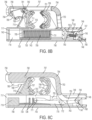
  • FIGS. 8 E- 8 F show an alternate embodiment of the clamp shown in FIGS. 8 A- 8 D in accordance with an embodiment of the present disclosure
  • FIG. 8 G shows an alternate embodiment of a moveable gripper assembly with a housing in accordance with an embodiment of the present disclosure
  • FIG. 9 a is a perspective view of an exemplary embodiment of a rack apparatus in accordance with an embodiment of the present disclosure.
  • FIG. 9 b is a perspective view of an exemplary embodiment of a device mount, like those depicted in FIG. 9 a , wherein the device mount includes a support plate that is adapted to receive a medical device in accordance with an embodiment of the present disclosure;
  • FIG. 9 c is a perspective view of an exemplary embodiment of a joint member that is adapted to couple with the embodiment of a device mount that is depicted in FIG. 9 b in accordance with an embodiment of the present disclosure
  • FIG. 9 d is a perspective view of an exemplary embodiment of a base member that includes a power system that is configured to transmit power to at least one device mount like the embodiment depicted in FIG. 9 b in accordance with an embodiment of the present disclosure;
  • FIG. 9 e depicts a perspective view of another exemplary embodiment of a rack apparatus in accordance with an embodiment of the present disclosure.
  • FIG. 10 a is a perspective view of an exemplary embodiment of a rack system, wherein the embodiment of a rack depicted in FIG. 9 a includes a support pole adapted to couple with the clamp of a medical device in accordance with an embodiment of the present disclosure;
  • FIG. 10 b is a close-up, perspective view of the exemplary embodiment of a rack system depicted in FIG. 10 a , wherein the rack embodiment includes a mount connector that may couple to a device connector when the medical device couples with the support pole in accordance with an embodiment of the present disclosure; and
  • FIG. 10 c is another alternate perspective view of the exemplary embodiment of a rack system depicted in FIG. 10 a , wherein an embodiment of a medical device includes an embodiment of a device connector that may couple to a mount connector, like the embodiment depicted in FIG. 10 b , when the medical device couples with the support pole in accordance with an embodiment of the present disclosure.
  • FIG. 10 d is a perspective view of an exemplary embodiment of a rack system including the embodiment of a rack depicted in FIG. 9 e in accordance with an embodiment of the present disclosure
  • FIG. 10 e is a close-up perspective view of an example infusion pump with a flange in place in the guide trough of a support plate of the example rack embodiment depicted in FIG. 9 e in accordance with an embodiment of the present disclosure
  • FIG. 11 a depicts an embodiment of a pivotable cover mechanism in accordance with an embodiment of the present disclosure
  • FIG. 11 b depicts an actuation spring of an example embodiment of the pivotable-cover mechanism depicted in FIG. 11 a acting on the sloped portion of an actuation member, wherein the actuation spring is disposed in an actuation spring pocket in accordance with an embodiment of the present disclosure
  • FIG. 11 c depicts an example embodiment of the pivotable-cover mechanism wherein a mount connector is covered by a protective member in accordance with an embodiment of the present disclosure
  • FIG. 11 d depicts an embodiment of a pivotable cover mechanism wherein the protective member is in a non-protective position in accordance with an embodiment of the present disclosure
  • FIGS. 11 e - i depict several cross-sectional views of an embodiment of a pivotable cover mechanism in accordance with an embodiment of the present disclosure
  • FIG. 11 j depicts a view of an example embodiment of the pivotable cover mechanism, wherein the protective member is shown in a protective and a non-protective position and wherein the mount connector is of a type having multiple spring contacts in accordance with an embodiment of the present disclosure;
  • FIG. 11 k depicts a cross-sectional view of part of the pivotable cover mechanism, wherein the mount connector is of a type having multiple spring contacts in accordance with an embodiment of the present disclosure
  • FIG. 12 a depicts a view of an embodiment of a clamshell mechanism wherein the cover member is in a non-protective position in accordance with an embodiment of the present disclosure
  • FIG. 12 b depicts a view of an embodiment of a clamshell mechanism wherein the cover member is in a protective position in accordance with an embodiment of the present disclosure
  • FIG. 12 c depicts a close-up perspective view of a part of an embodiment of a clamshell mechanism in accordance with an embodiment of the present disclosure
  • FIG. 12 d depicts a cross sectional view of a clamshell mechanism wherein the cover member includes a perimeter rib in accordance with an embodiment of the present disclosure
  • FIGS. 12 e - h depict a number of cross-sectional views of a clamshell mechanism in accordance with an embodiment of the present disclosure
  • FIG. 12 i - j depict a number of views an exemplary embodiment of a series of the clamshell mechanisms with compliant gasket systems in accordance with an embodiment of the present disclosure
  • FIG. 13 a depicts an embodiment of an example receivable device in accordance with an embodiment of the present disclosure
  • FIG. 13 b depicts an example embodiment of a receivable device that includes first and second channels and a latch recess in accordance with an embodiment of the present disclosure
  • FIG. 13 c depicts a cross-section view of the example pivotable cover mechanism of FIG. 11 a wherein a latch member projection is in engagement with a latch recess of an example embodiment of a receivable device in accordance with an embodiment of the present disclosure
  • FIG. 13 d - g depict a number of cross-section views of an example receivable device and the example clamshell mechanism of FIG. 12 a wherein the progression of FIGS. 13 d - g demonstrates how receiving a receivable device may cause a clamshell mechanism to automatically reveal a mechanism connector in accordance with an embodiment of the present disclosure.
  • a clamp apparatus 10 is depicted.
  • the clamp apparatus 10 comprises a housing 12 .
  • the housing 12 has a back plate 14 , which is generally planar.
  • On one portion of the back plate 14 is a raised grip 16 extending away from the housing 12 .
  • the grip 16 affords the user ease of movement along a clamped object 100 generally extending along an axis A 1 .
  • the grip 16 is also meant to aid in carrying.
  • the grip 16 may be made of the same material as the rest of the housing 12 , may be made of a different material, or may be made of a combination thereof. Possible materials may include, but are not limited to, rubber, polymer, composite, metal, plastic, foam, etc. Additionally, the grip 16 may comprise ergonomic finger groves, nubs, a ribbed texture, a honeycombed texture, etc.
  • the rear of the back plate 14 may also feature any of a variety of mechanisms 19 (not shown) to attach a load to the clamp apparatus 10 .
  • Such mechanisms 19 may include, but are not limited to, brackets, magnets, straps, suction cups, hooks, screws or bolts, a friction fit, etc.
  • This load could be any number of things, especially a medical device (such as an infusion pump, or peristaltic infusion pump), I.V. bag, etc.
  • a groove 13 runs vertically down the centerline (shown as a line of short and long dashes) of the back plate 14 .
  • the groove 13 is further described below.
  • Two compression spring pockets 15 are coupled to the back plate 14 and are raised off the bottom of the front face of the back plate 14 .
  • the compression spring pockets 15 may be generally cylindrical and hollow much like a cup. The compression spring pockets 15 will be elaborated upon later.
  • the catch structures 21 are formed such that a first portion of the structure 21 is a member which extends toward the bottom of page in a manner substantially perpendicular to the bottom edge of the back plate 14 .
  • a second portion of the structure 21 is a member extending toward the bottom of the page in the same manner as the first portion.
  • the first and second portions are offset from each other so as to allow a crosspiece to form a bridge between the first and second portion of the catch structure 21 .
  • the crosspiece of the catch structure 21 runs in a direction substantially parallel to the bottom edge of the back plate 14 .
  • the catch structure 21 will be further elaborated upon later.
  • two blocks 18 are fixedly coupled to the front of the back plate 14 by any variety of means. This could include, but is not to be limited to, screws 20 (as shown), bolts, welds, etc.
  • the back plate 14 and blocks 18 can also be formed as a continuous part during manufacture. The blocks 18 are offset by some distance from the back plate 14 .
  • the blocks 18 are generally right triangles with their hypotenuses facing A 1 . It should be appreciated, however, that the blocks 18 could take any shape so long as the interior face of the blocks 18 extends in a suitable direction. The blocks 18 also display symmetry around A 1 .
  • the tracks 22 may engage corresponding protrusions 24 on a surface of a sliding wedge 26 . These components interact in such a way that the sliding wedges 26 are able to traverse the span of the tracks 22 .
  • the sliding wedges 26 are approximately “L” shaped, but this should not be construed as limiting the sliding wedges 26 to only an “L” shape.
  • any other type of suitable engagement surfaces such as ball bearings or rollers, could be employed.
  • the track 22 may be raised off the blocks 18 .
  • a track 22 comprises the rack portion of a rack and pinion, be the track 22 in a raised or recessed configuration; in place of the protrusions 24 , on the sliding wedge 26 , one or more pinion gears would extend so as to engage the rack track 22 , in this specific embodiment.
  • a pawl 28 may be pivotally coupled. In the embodiment shown in FIGS. 1 A- 1 E this is accomplished by means of a pair of pins 30 (though a single pin, hinge, or other suitable arrangement could also be used) running through openings 32 which extend through both the sliding wedge 26 and the pawl 28 .
  • One pin 30 a pivotally couples the pawl to the sliding wedge 26 through the front surfaces of the sliding wedge 26 and the pawl 28 .
  • the second 30 b of the pair of pins 30 (best shown in FIG. 1 E ) pivotally couples the pawl 28 to the sliding wedge 26 through the rear surfaces of the pawl 28 and the sliding wedge 26 .
  • Bushings 31 may also be present in some embodiments to provide a bearing surface.
  • a gripping surface 34 which engages the clamped object 100 .
  • This gripping surface 34 consists of a material chosen for its gripping ability.
  • the gripping surface 34 may be made of a high friction material, a compressible material, a material exhibiting both these qualities, or any other suitable material.
  • the gripping surface 34 is made of a material which allows a firm grip without the deformation of a clamped object 100 . Additionally, the gripping surface 34 may be contoured (as is easily seen in FIG. 1 B ).
  • the bottom of the sliding wedge 26 may feature a flange 36 .
  • the flange 36 extends inward, at an angle substantially perpendicular to the axial direction A 1 , from the portion of the sliding wedge 26 which engages the tracks 22 .
  • a slot 38 is cut into the flange 36 and will be elaborated upon later.
  • the sliding wedge 26 , the pawl 28 , and the gripping surface 34 comprise a sliding wedge-pawl assembly 90 .
  • the sliding wedge-pawl assemblies 90 are capable of movement, together as a unit, up and down the track 22 . This allows the clamp apparatus 10 to adjust to and grip clamped objects 100 of a variety of different girths such that the distance between the gripping surfaces 34 of the sliding wedge-pawl assemblies 90 mimics the diameter of a clamped object 100 .
  • the clamp apparatus 10 in this exemplary embodiment, also comprises a second assembly, the spring handle assembly 92 .
  • the spring handle assembly 92 At the top of the spring handle assembly 92 is a guided lift bar 50 .
  • the rear portion of the guided lift bar 50 has a vertical ridge 52 which engages with the vertical groove 13 in the back plate 14 . This constricts the guided lift bar 50 to movement up and down in the axial direction A 1 .
  • the center span 54 of the guided lift bar 50 arcs/curves or bends toward the back plate 14 . This allows the guided lift bar 50 to better accommodate the clamped object 100 .
  • a member 56 may be attached which fits around the flange 36 of the sliding wedge 26 .
  • the member 56 is formed such that a first portion 900 of the member 56 extends off the center span 54 on a plane substantially parallel to the back plate 14 . Extending off the bottom of first portion 900 at an angle substantially perpendicular to the first portion is a second portion 901 of the member 56 .
  • This second portion 901 is formed such that the edge of the second portion 901 distal to A 1 is straight and occupies the same vertical plane extended off the distal edge of the first portion 900 .
  • the edge of the second portion 901 of the member 56 proximal to A 1 tapers toward the distal edge of the second portion 901 .
  • the member 56 has a third portion 902 which is attached to the second portion 901 such that the bottom of the third portion 902 is coupled to the front edge of the second portion 901 at an angle that is substantially perpendicular.
  • the third portion 902 extends on a plane parallel to the first portion 900 .
  • the edge of the third portion 902 distal to A 1 is straight and occupies the same vertical plane extended off the distal edge of the first portion 900 .
  • the proximal edge of the third portion 902 is flush with the proximal, tapered edge of the second portion 901 and extends upwards from it in a substantially perpendicular manner.
  • the third portion 902 of the member 56 described above has a hole 66 a creating a passage through the third portion 902 .
  • the first portion 900 also has a hole 66 b creating a passage through the first portion 900 .
  • the centers of both holes 66 a , 66 b extend along a common axis which is substantially perpendicular to the front face of each the first and third portions 900 , 902 of the member 56 .
  • the locations of the holes 66 a and 66 b are selected such that they are in line with the slots 38 in the sliding wedges 26 when the clamp apparatus 10 is assembled.
  • the guided lift bar 50 functions as a crossbar which ensures that the right and left sliding wedge-pawl assemblies 90 move together in unison along the tracks 22 .
  • This coupling also allows the spring handle assembly 92 to control whether the clamp apparatus 10 is in the open or closed position.
  • a generally cylindrical shape 70 may be extended downward (in additional embodiments, other shapes may be used). As shown in the example embodiments in FIGS. 1 A- 1 E , the generally cylindrical shape 70 may taper slightly in diameter as it extends farther away from the bottom of the second portion 901 of the member 56 toward the bottom of the page.
  • the generally cylindrical shape 70 may be solid or hollow.
  • a coil spring 72 surrounds the generally cylindrical shape 70 . One end of the coil spring 72 abuts the bottom of the second portion 901 of the member 56 from which the generally cylindrical shape 70 extends. The other end of the coil spring 72 seats in the compression spring pocket 15 on the back plate 14 mentioned above.
  • the bottom of the compression spring pocket 15 has a hole 17 through which the generally cylindrical shape 70 may pass as the clamp apparatus 10 is moved to/in the open position.
  • suitable bias members include, but are not limited to, a gas spring using a bladder, a piston type arrangement, a compression spring made of a compressible, springy material such as rubber, an extension spring, a constant force spring, etc.
  • the coil springs 72 bias the clamp apparatus 10 toward the closed position (as shown in FIG. 1 B ). That is, the coil springs 72 bias the wedges 26 to slide up the tracks 22 such that the pawls 28 approach each other towards the clamped object 100 (e.g., a pole).
  • the sliding wedge-pawl assemblies 90 are sufficiently at the top of the tracks 22 to clamp the pawls 28 onto the clamped object 100 (via attached gripping surfaces 34 ).
  • the guided lift bar 50 is also at a higher position in the vertical groove 13 in the back plate 14 .
  • the coupling dowel 68 in relation to A 1 , is located in a more distal end of the slot 38 in the flange 36 of the sliding wedge 26 .
  • the coil springs 72 bias the clamping apparatus 10 to clamp down on the object 100 .
  • the sliding wedge-pawl assemblies' 90 location on the track 22 will vary so that the distance between the sliding wedge-pawl assemblies 90 will mimic the diameter of the clamped object 100 .
  • the location of the guided lift bar 50 along the groove 13 will be lower with larger clamped objects 100 .
  • the clamping apparatus 10 in the example embodiment is designed in such a way as to utilize the force of gravity to increase the clamping force.
  • gravity pulls on the clamp especially when a load is attached to the back plate 14 , a force is exerted on the sliding wedge-pawl assemblies 90 .
  • This force causes the sliding wedge-pawl assemblies 90 to want to ride further up the tracks 22 .
  • the sliding wedge-pawl assemblies 90 cinch up on and exert more clamping force on the clamped object 100 .
  • the pawls 28 are pivotally coupled to the sliding wedge 26 , the pull of gravity causes the point of contact on the pawls 28 to want to swing up and into the clamped object 100 . Since the clamped object 100 is in the way, the pawls 28 cinch up on and exert more clamping force on the clamped object 100 .
  • a pull handle 74 may be pulled down.
  • the pull handle 74 comprises a grip 76 and one or more posts 78 extending from the grip 76 .
  • the grip 76 may be made of the same material as the rest of the pull handle 74 , may be made of a different material, or may be made of a combination thereof. Possible materials may include, but are not limited to, rubber, polymer, composite, metal, plastic, foam, etc.
  • the handle 74 may comprise ergonomic finger groves, nubs, a ribbed texture, a honeycombed texture, etc.
  • the one or more posts 78 of the pull handle 74 extend up to a corresponding number of arms 80 on the guided lift bar 50 .
  • the posts 78 are coupled to the arms 80 on the guided lift bar 50 through any of a variety of means. In the example embodiment, coupling is accomplished by means of a pin which runs through both the arm 80 and post 78 . In other embodiments, this coupling may be accomplished in any number of suitable ways including, but not limited to, welds, bolts, screws, etc.
  • the pull handle 74 and guided lift bar 50 could also be made as a single continuous part during manufacture. In some embodiments, the posts 78 extend straight down to the grip 76 .
  • the posts 78 may be arcuated or have a bend out toward the rear of the page to allow greater ease in grasping the grip 76 . Additionally, in some embodiments, including the example embodiment, the posts 78 have a notch 82 which runs across the back of the posts 78 in a direction substantially parallel to the bottom edge of the back plate 14 .
  • a pull handle 74 may need to be pulled down.
  • the guided lift bar 50 is also pulled down the groove 13 in the back plate 14 .
  • This causes the compression springs 72 to become compressed and causes the generally cylindrical shape 70 to extend through the hole 17 in the compression spring pockets 15 .
  • Pulling down the pull handle 74 also causes the sliding wedge-pawl assemblies 90 to slide down the tracks 22 . Due to the slope of the tracks 22 , moving the clamping apparatus 10 to the open position also causes the location of the coupling dowel 68 within the slot 38 to change. When the clamp is in the fully open position, the coupling dowel 68 is at the most proximal end of the slot 38 in relation to A 1 .
  • the notch 82 in the pull handle 74 may be engaged with the catch structure 21 extending off the back plate 14 .
  • the crosspiece 903 of the catch structure 21 is caught by the notch 82 of the pull handle 74 thereby disallowing the compression springs 72 to return the clamping apparatus 10 to the closed position.
  • Other embodiments may employ other types of catch mechanisms in addition to the elbow type catch in the example embodiment.
  • Other suitable catches may include, but are not limited to, a magnetic catch, a ball catch, a latch, a roller catch, etc.
  • a clamp apparatus 110 is depicted.
  • the clamp apparatus 110 comprises a housing 112 .
  • the housing 112 resembles a frame.
  • the housing 112 comprises an upper handle 114 at the top of the housing 112 .
  • the upper handle 114 is essentially “U” shaped with the bottom, grip portion 116 of the “U” extended toward the back of the page (directions given in relation to the embodiment depicted in FIG. 2 A ).
  • the upper handle 114 need not take the shape of a “U”, but rather any other desirable form.
  • the grip portion 116 of the upper handle 114 may be cylindrical, planar, or take any other desired form.
  • the grip portion 116 of the upper handle 114 may also have gentle ergonomic finger grooving, nubs, a ribbed texture, a honeycombed texture, etc. 118 (not shown) to increase ease of use.
  • the grip portion 116 may be made of the same material as the rest of the upper handle 114 , may be made of a different material, or may be made of a combination thereof. Possible materials may include, but are not limited to, rubber, polymer, composite, metal, plastic, foam, etc.
  • the uprights 113 of the “U” extend from the grip portion 116 toward the front of the page.
  • the uprights 113 of the “U” each comprise a set of brackets 115 which extend substantially perpendicularly from the faces of the uprights 113 most proximal to A 2 toward A 2 .
  • the housing 112 in the example embodiment also comprises one or more members 120 extending from the upper handle 114 .
  • two substantially planar members 120 extend down in parallel fashion from the upper handle 114 at an angle that is generally perpendicular to the bottom surface of the upper handle 114 .
  • the members 120 may be coupled to the upper handle 114 with screws 122 (as shown best in FIGS. 2 C- 2 E ), bolts, welds, or by any other manner.
  • the upper handle 114 and one or more vertical members 120 may also be formed as a single part during manufacture.
  • the members 120 may also comprise tracks 123 on the faces of the members 120 most proximal to A 2 .
  • the tracks 123 run vertically up the face of each member 120 though this need not be true of every embodiment. Additionally, in the example embodiment, the tracks 123 are cut into the members 120 . In other embodiments, the tracks may be raised off the members 120 .
  • the housing 112 may also comprise a lower handle 124 .
  • the lower handle 124 is coupled to the bottom edges of the members 120 .
  • the lower handle 124 may be coupled to the members 120 in any of a variety of ways including screws 126 , bolts, welds, etc (as best shown in FIGS. 2 C- 2 E ).
  • the lower handle 124 may also be formed with the members 120 as a single continuous part during manufacture.
  • the upper handle 116 , members 120 , and lower handle 124 are all formed as a continuous part in manufacture. Spanning the distance between the members 120 , the lower handle 124 may comprise a crosspiece 128 .
  • the center span 129 of the crosspiece 128 may arc/curve or bend toward the back of the page to better accommodate a clamped object 100 .
  • the crosspiece 128 also may comprise a pair of compression spring pockets 105 .
  • the compression spring pockets 105 are generally cylindrical and are hollow much like a cup. In the example embodiment, the bottom of the compression spring pockets 105 have an opening 117 .
  • a pair of brackets 130 extend off the bottom of the crosspiece 128 and will be elaborated upon later.
  • the crosspiece 128 may have recessed portions 131 spanning the distance between the distal sides of the compression spring pockets 105 (in relation to A 2 ) and the arms 132 of the lower handle 124 (elaborated upon in the following paragraph).
  • the lower handle 124 extends toward the back of the page in a manner similar to the upper handle 114 .
  • the arms 132 of the lower handle 124 may be arcuated or have a bend which arcs/bends the lower handle 124 toward the bottom of the page.
  • the arms 132 of the lower handle 124 are joined by a grip 134 at the part of the handle closest to the bottom of the page.
  • the grip 134 may be made of the same material as the rest of the lower handle 124 , may be made of a different material, or may be made of a combination thereof. Possible materials may include, but are not limited to, rubber, polymer, composite, metal, plastic, foam, etc. Additionally, the grip 134 may comprise ergonomic finger groves, nubs, a ribbed texture, a honeycombed texture, etc.
  • the housing 112 may also feature any of a variety of mechanisms 119 (not shown) to attach a load to the clamp apparatus 110 .
  • Such mechanisms 119 may include, but are not limited to, brackets, magnets, straps, suction cups, hooks, screws or bolts, a friction fit, etc.
  • This load could be any number of things, especially a medical device (such as an infusion pump, or peristaltic infusion pump), I.V. bag, etc.
  • the clamping apparatus 110 may further comprise a set of pawls 127 which are pivotally coupled to the brackets 115 of the upper handle 116 .
  • the set of pawls 127 may be coupled to the brackets 115 of the upper handle by any of a variety of ways. Additionally, bushings 133 may be present to provide a bearing surface.
  • the pawls 127 may have a trough 136 cut into them essentially along the center plane of the pawls 127 running parallel to the plane of the grip 116 shown in the example embodiment. The trough 136 will be elaborated upon later.
  • the gripping surface 135 may consist of a material chosen for its gripping ability.
  • the gripping surface 135 could be made of a high friction material, a compressible material, a material exhibiting both those qualities, or any other suitable material.
  • the gripping surface 135 is made of a material which allows a firm grip without the deformation of a clamped object 100 . Additionally, the gripping surface 135 may be contoured.
  • the example embodiment includes a single set of pawls 127 , in other embodiments, further sets of pawls 127 may be added to the clamping apparatus 110 to afford the clamping apparatus 110 added stability.
  • the clamping apparatus 110 also comprises a lift bar guide 140 .
  • the lift bar guide 140 comprises a set of protrusions 141 which engage with the tracks 123 in the members 120 . This enables the lift bar guide 140 to travel along the track 123 in the members 120 .
  • some alternate embodiments employ a variety of different engagement surfaces. These surfaces include, but are not limited to, rollers, ball bearings, etc.
  • the track 123 may be raised off the members 120 .
  • the protrusions 141 would be replaced by another suitable engagement surface such as a recessed groove, rollers, ball bearings, etc.
  • a track 123 it raised or recessed, comprising the rack portion of a rack and pinion.
  • one or more pinion gears would extend so as to engage the rack track 123 .
  • the top portion of the lift bar guide 140 may comprise a set of wings 142 which project inward toward A 2 .
  • the wings 142 are shaped such that they are able to fit within the trough 136 in the pawls 127 .
  • the wings 142 have a slit 144 cut into them (best shown in FIGS. 2 C- 2 E ) similar to the slot 38 depicted in FIGS. 1 A- 1 E .
  • a coupling dowel 168 couples the pawls 127 to the lift bar guide 140 through the slit 144 in the wings 142 .
  • the lift bar guide 140 has a crossbar 146 . This enables the lift bar guide 140 to cause the pawls 127 to move in unison.
  • the center span 148 of the crossbar 146 may be arced/bent toward the back of the page to better accommodate a clamped object 100 .
  • recessed compression spring pockets 150 are recessed into bottom face the lift bar guide 140 .
  • a generally cylindrical shape 170 extends (though the shape need not be cylindrical in all embodiments) toward the bottom of the page.
  • the generally cylindrical shape 170 may be solid or hollow.
  • the generally cylindrical shape 170 may taper slightly in diameter as it extends farther away from the bottom face of the lift bar guide 140 .
  • the diameter of the generally cylindrical shape 170 is such it occupies much of the center of the recessed compression spring pocket 150 , but leaves a ring surrounding the base of the generally cylindrical shape 170 .
  • a coil spring 172 is seated in the ring surrounding the generally cylindrical shape 170 in the recessed compression spring pocket 150 .
  • the other end of the coil spring 172 abuts the bottom of the compression spring pocket 105 on the lower handle 124 mentioned above.
  • the bottom of the compression spring pocket 105 has a hole 117 through which the generally cylindrical shape 170 may pass as the clamp apparatus 110 is moved to/in the open position.
  • suitable bias members include, but are not limited to, a gas spring using a bladder, piston type arrangement, a compression spring made of a compressible, springy material such as rubber, an extension spring, constant force spring, spring steel, etc.
  • a set of brackets 152 extends downward on each side of the bottom face of the lift bar guide 140 .
  • the placement of the recessed compression spring pockets 150 or other suitable bias structure and the brackets 152 may be switched.
  • the link structure 154 is a generally oblong disc with rounded edges.
  • the link structure 154 may take other forms and shapes. Examples of link structures 154 in other possible embodiments may include, but are not limited to, prismatic joints, any of a variety or springs, etc. It would also be conceivable to forgo the brackets 152 while coupling a camming surface to the actuator lever handle 156 (introduced in the following paragraph) thus effectively making the lift bar guide 140 a cam follower.
  • the other end of the link structure 154 is coupled to an actuator lever handle 156 .
  • the actuator lever handle 156 has a set of members 158 .
  • One end of the members 158 may be fitted with brackets 159 which allows the members 158 to couple to the link structure 154 as is shown in the example embodiment. From their coupling point to the link structure 154 , the members 158 may extend to and are coupled to the brackets 130 projecting off the bottom face of the crosspiece 128 of the lower handle 124 .
  • a torsion spring may be employed where the members 158 of the actuator lever handle 156 couple to the crosspiece 128 brackets 130 .
  • the torsion spring may be a substitute for, or used in conjunction with the coil spring 172 or other suitable bias structure.
  • the members 158 arc/curve or bend steeply downward. In the example embodiments the members 158 bend at nearly a right angle, though other suitable angles may be used.
  • a gripping portion 160 spans the distance between lowest ends of the members 158 .
  • the gripping portion 160 may be made of the same material as the rest of the actuator lever handle 156 , may be made of a different material, or may be made of a combination thereof. Possible materials may include, but are not limited to, rubber, polymer, composite, metal, plastic, foam, etc. Additionally, the gripping portion 160 may comprise ergonomic finger grooves, nubs, a ribbed texture, a honeycombed texture, etc.
  • the coil springs 172 bias the clamping apparatus 110 toward the closed position.
  • the lift bar guide 140 In the closed position the lift bar guide 140 is at its highest point of travel along the tracks 123 in the members 120 .
  • the pawls 127 are rotated up and inward toward A 2 .
  • the coupling dowel 168 is at the bottom of the slit 144 in the wings 142 of the lift bar guide 140 .
  • the coil springs 172 bias the clamp apparatus 110 to clamp down on the object 100 .
  • the lift bar guide's 140 location on the track 123 will vary. The larger the clamped object 100 the lower the lift bar guide 140 will be on the track 123 .
  • the pawls 127 will not be fully rotated up and inward toward A 2 . Instead the distance between the gripping surfaces 135 of the pawls 127 will mimic the diameter of the clamped object 100 . This also means that the location of the coupling dowel 168 will be somewhat closer to the top of the slit 144 .
  • the clamp apparatus 110 in the example embodiment is designed in such a way as to utilize the force of gravity to increase the clamping force. As gravity pulls on the clamp apparatus 110 , especially when a load is attached to the housing 112 the force causes the pawls 127 to want to rotate further in towards A 2 . Since the clamped object 100 is in the way, the pressure of the pawls 127 against the clamped object 100 increases and the clamping apparatus 110 grips the clamped object 100 more vigorously.
  • a user's hand may reach around the lower handle 124 and grasp the actuator lever handle 156 with their fingers. The user may then pull the actuator lever handle 156 toward the lower handle 124 of the housing 112 . This causes the actuator lever handle 156 to pivot about its coupling to the brackets 130 on the cross piece 128 of the lower handle 124 . This in turn pulls down on the link structure 154 which couples the actuator lever handle 156 to the lift bar guide 140 . As the link structure 154 is pulled downward, the lift bar guide 140 travels down the tracks 123 in the members 120 of the housing 112 .
  • the compression springs 172 are compressed and the generally cylindrical shape 170 extends through the hole 117 in the compression spring pockets 105 on the crosspiece 128 of the lower handle 124 .
  • the downward travel of the lift bar guide 140 also causes the pawls 127 to rotate downward and away from A 2 . This is caused by the slit 144 in the wings 142 of the lift bar guide 140 sliding over the coupling dowel 168 until the coupling dowel 168 reaches the top of the slit 144 .
  • the coupling dowel 168 is in this position, the pawls 127 are fully open.
  • the clamp apparatus 110 may then be placed on a clamped object 100 . Once the actuator lever handle 156 is released, the compression springs 172 will bias the clamp apparatus 110 to close and clamp down on the clamped object 100 .
  • a clamp apparatus 202 is depicted.
  • the clamp apparatus 202 comprises a housing 204 .
  • the housing 204 comprises a number of portions.
  • the first portion of the housing 204 may include a back plate 206 .
  • the back plate 206 may be substantially planar as shown in FIGS. 3 A- 3 E .
  • the back plate 206 may also include a gripping handle 208 (not shown).
  • the gripping portion 209 of the gripping handle 208 may be made of the same material as the rest of the handle 208 , may be made of a different material, or may be made of a combination thereof. Possible materials may include, but are not limited to, rubber, polymer, composite, metal, plastic, foam, etc. Additionally, the gripping portion 209 of the gripping handle 208 may comprise ergonomic finger groves, nubs, a ribbed texture, a honeycombed texture, etc.
  • the back plate 206 may also feature any of a variety of mechanisms or mounts 219 which allow the user to attach a load to the clamp apparatus 202 .
  • Such mechanisms 219 may include, but are not limited to, brackets, magnets, straps, suction cups, hooks, screws or bolts, a friction fit, etc.
  • This load could be any number of things, especially a medical device (such as an infusion pump, or peristaltic infusion pump), I.V. bag, etc.
  • a rectangular block 212 projects at an angle substantially perpendicular to the front face of the back plate 206 .
  • the rectangular block 212 need not be rectangular in all embodiments.
  • the rectangular block 212 is coupled to the back plate 206 in any of a variety of ways.
  • the example embodiment employs screws 216 , but bolts, welds or any other suitable means could also be utilized.
  • the back plate 206 and rectangular block 212 could also be formed as a continuous part during manufacture.
  • the rectangular block 212 may be generally planar.
  • the rectangular block 212 may also be arced/curved to better accommodate a clamped object 100 .
  • a gripping surface 214 may be affixed.
  • the gripping surface 214 can engage the clamped object 100 .
  • This gripping surface 214 consists of a material chosen for its gripping ability.
  • the gripping surface 214 could be made of a high friction material, a compressible material, a material exhibiting both of these qualities, or any other suitable material.
  • the gripping surface 214 is made of a material which allows a firm grip without the deformation of a clamped object 100 Additionally, the gripping surface 214 may be contoured (as shown in FIGS. 3 C- 3 E ).
  • the inward face of the rectangular block 212 may also be contoured.
  • the example embodiments only have one fixed gripping surface 214 , it would be conceivable to add additional fixed gripping surfaces to the clamping apparatus 202 .
  • the housing 204 may also comprise a second portion.
  • the second portion of the housing may include a handle sleeve 218 .
  • the handle sleeve 218 comprises a body which may be entirely hollow (as shown) or have one or more hollow cavities.
  • the top and a portion of the right side of the handle sleeve 218 are open to a hollow cavity. In alternate embodiments this need not always be the case.
  • two rounded ears 220 project off the front and rear faces of the handle sleeve 218 toward the right of the page.
  • a portion of the handle sleeve 218 may have grip portion 222 to allow for greater ease of use.
  • the gripping portion 222 may be made of the same material as the rest of the housing 204 , may be made of a different material, or may be made of a combination thereof. Possible materials may include, but are not limited to, rubber, polymer, composite, metal, plastic, foam, etc. Additionally, the gripping portion 222 may comprise ergonomic finger groves, nubs, a ribbed texture, a honeycombed texture, etc.
  • tracks 223 which extend at least some portion of the length of the handle sleeve 218 .
  • the tracks 223 are raised and run vertical.
  • Other embodiments may differ.
  • the track(s) 223 may also be cut into or raised out of the interior of the left face of the handle sleeve 218 .
  • the track 223 may be the rack of a rack and pinion arrangement.
  • one or more compression spring pocket(s) 215 may be extended out into a hollow cavity as best shown in FIG. 3 B .
  • the compression spring pocket(s) 215 may also be extended out from at least one or both the interior of the front or/and rear faces of the handle sleeve 218 .
  • the compression spring pocket (s) 215 will be elaborated upon later.
  • a pawl 227 may be pivotally coupled.
  • the pawl 227 may be pivotally coupled by any of a variety of means such as a screw 233 (as shown), pins, etc. Additionally, bushings 231 may be present to provide a bearing surface.
  • the pawl 227 is able to swing about its pivot axis point within the cavity in the handle sleeve 218 .
  • the pawl 227 is also able to swing about its pivot out towards the fixed gripping surface 214 on the interior face of the rectangular block 212 .
  • the surface of the pawl 227 facing the fixed gripping surface 214 on the interior face of the rectangular block 212 may be arced as best shown in FIG. 3 C .
  • the surface of the pawl 227 facing the fixed gripping surface 214 on the interior face of the rectangular block 212 may further comprise a gripping surface 237 .
  • the gripping surface 237 could be made of a high friction material, a compressible material, a material exhibiting both those qualities, or any other suitable material.
  • the gripping surface 237 is made of a material which allows a firm grip without the deformation of a clamped object 100 Additionally, the gripping surface 237 may be contoured (as shown best in FIGS. 3 A- 3 E ).
  • the pawl 227 may be additionally comprised of a trough 239 cut into the pawl 227 essentially along the center plane of the pawl 227 running parallel to the plane of the back plate 206 .
  • the trough 239 is shaped such that it is able to accommodate the shape of a lift bar 241 .
  • the lift bar 241 may comprise a first portion comprising a member 224 which projects into the trough 239 in the pawl 227 .
  • the member 224 may be shaped such that at the right end of the member 224 there is a wing like projection 243 . Within the wing like projection 243 , there may be a slit 245 .
  • the slit 144 in FIGS. 2 A- 2 E is at an angle and the slit 245 in FIGS. 3 A- 3 E is substantially horizontal. Alternate embodiments may employ slits oriented at any angle or may employ arced slits.
  • a coupling dowel 268 runs through the slit 245 and into the pawl 227 coupling the lift bar 241 to the pawl 227 .
  • the lift bar 241 may also comprise a second portion in which a member 226 extends toward the bottom of the page at an angle that is substantially perpendicular to the member 224 of the first portion.
  • the member 226 of the second portion has an engagement surface 228 which engages with the track 223 on the interior of the handle sleeve 218 .
  • the engagement surface 228 is depicted as a recessed groove.
  • the engagement surface 228 may, however, be raised or take other forms including but not limited to, rollers, ball bearings, etc.
  • the track 223 is the rack of a rack and pinion arrangement
  • one or more pinion gears capable of engaging the track 223 may be present on the member 226 of the second portion.
  • the member 226 of the second portion of the lift bar 241 may also have a bracket 230 extending off the bottom surface of the member 226 .
  • the bracket 230 need not extend as shown at an angle substantially perpendicular to the bottom surface of the member 226 .
  • the member 226 of the second portion of the lift bar 241 may also be comprised of a groove or grooves 232 recessed into the face of the member 226 which abuts the interior surface of the handle sleeve 218 from which the compression spring pocket(s) 215 extend.
  • the groove 232 is of a size and shape sufficient to fit around the compression spring pocket 215 which projects off the interior of the handle sleeve 218 . Additionally, the groove 232 does not run the entire length of the member 226 stopping at least some distance from the top of the member 226 . As shown, the diameter of the groove 232 may taper as it extends toward the top of the member 226 .
  • a coil spring 272 is placed in the groove 232 such that one end of the coil spring 272 abuts the bottom of the compression spring pocket 215 . The other end of the coil spring 272 abuts the top of the groove 232 .
  • suitable bias members include, but are not limited to, a gas spring (using a bladder arrangement, piston type arrangement, etc.), a compression spring made of a compressible, springy material such as rubber, an extension spring, constant force spring, and so on.
  • the coil spring 272 biases the clamp apparatus 202 toward the closed position ( FIG. 3 A ). In the closed position, the coil spring 272 is not compressed. Additionally, the lift bar 241 is at its highest point of travel along the tracks 223 in the handle sleeve 218 of the housing 112 . Since the lift bar 241 is coupled to the pawl 227 via the coupling dowel 268 , this forces the pawl 227 to be pivoted up and in toward the fixed gripping surface 214 . In the closed position, the coupling dowel 268 abuts the right edge of the slit 245 .
  • the coil spring 272 biases the clamp apparatus 202 to clamp down on the object 100 .
  • the lift bar's 241 location on the track 223 will vary. The larger the clamped object 100 the lower the lift bar 241 will be on the track 223 .
  • the pawl 227 will not be fully rotated up and inward toward fixed gripping surface 214 . Instead the distance between the gripping surface 237 of the pawl 227 and the fixed gripping surface 214 will mimic the diameter of the clamped object 100 . This also means that the location of the coupling dowel 268 will be somewhat closer to the left of the slit 245 .
  • the clamp apparatus 202 in the example embodiment is designed in such a way as to utilize the force of gravity to increase the clamping force.
  • gravity pulls on the clamp apparatus 202 especially when a load is attached to the housing 204 the force causes the pawl 227 to want to rotate further up and in towards the fixed gripping surface 214 .
  • the pressure of the pawl 227 against the clamped object 100 increases and the clamping apparatus 202 grips the clamped object 100 more vigorously.
  • the clamped object 100 is pushed against the fixed gripping surface 214 with greater force again causing the clamping apparatus 202 to clamp more vigorously to the clamped object 100 .
  • This more vigorous clamping force is accomplished by ensuring that the pawl 227 is constructed and shaped in order to ensure the clamp apparatus 202 will be in static equilibrium with a clamped object 100 when the clamp apparatus 202 is clamped onto a clamped object 100 .
  • This may require ensuring that the coefficient of friction of the pawl 227 is greater than the ratio of the vertical distance from the contact point of the pawl 227 on the clamped object 100 to the pivot point of the pawl 227 (said distance hereafter referred to as A) to the horizontal distance from the contact point on the pawl 227 to the pivot point of the pawl 227 (said distance hereafter referred to as B).
  • the compliance and shape of the pawl 227 gripping surface 237 of the pawl 227 also is sufficiently configured.
  • the pawl 227 does not have a constant radius from the gripping surface 237 to the pivot point of the pawl 227 . If the radius is constant, and the pawl 227 , gripping surface 237 , or both are relatively compliant, A:B may become less than zero if the pawl 227 , gripping surface 237 , or both become compressed. If the radius of the pawl 227 constantly increases as best shown in FIG. 3 C , this cannot occur. The rate of increase in the radius of the pawl 227 may be chosen so that the ratio A:B does not become too large. This may be done to ensure that the coefficient of friction is not inordinately large.
  • the trigger 234 has a button portion 236 which extends at least partially out of the right face of the handle sleeve 218 when the clamp apparatus 202 is in the closed position.
  • the button portion 236 is pivotally coupled to the handle sleeve 218 by any of a variety of means.
  • the button portion 236 may be hollow or solid. Projecting toward the left of the page of along the bottom plane of the button portion 236 of the trigger 234 may be one or more arms 238 .
  • the one or more arms 238 may be capable of coupling to a linkage structure 240 .
  • the linkage structure 240 also extends up to, and is coupled to, the bracket 230 which extends off the bottom surface of the lift bar 241 .
  • the link structure 240 in the example embodiment is an oblong with rounded edges.
  • the link structure 240 may take other forms and shapes. Examples of link structures 240 in other possible embodiments may include, but are not limited to, prismatic joints, any of a variety or springs, etc. It would also be conceivable to forgo the brackets 230 while coupling a camming surface to the trigger 234 thus effectively making the lift bar 214 a cam follower.
  • the trigger 234 when the trigger 234 is actuated, it acts as a lever pulling the linkage structure 240 and the lift bar 241 toward the bottom of the page.
  • the coil spring 272 gets compressed.
  • the slit 245 in the wing 243 of the lift bar 241 slides over the coupling dowel 268 until the coupling dowel 268 abuts the left most edge of the slit 245 .
  • the pawl 227 rotates down and away from the fixed gripping surface 214 and into the open position. Releasing the trigger 234 causes the clamping apparatus 202 to return to the closed position as a result of the restoring force of the coil spring 272 .
  • a torsion spring may be employed where the button portion 236 of the trigger 234 is pivotally coupled to the handle sleeve 218 .
  • the torsion spring may be a substitute for or used in conjunction with the coil spring 272 or other suitable bias member configuration.
  • FIG. 4 A shows a perspective view of a clamp apparatus 310 in the open position according to one embodiment of the present disclosure.
  • a clamped object 100 may be squeezed between a fixed gripper 322 and a sliding gripper 302 .
  • the fixed gripper 322 and sliding gripper 302 may consist of a material chosen for its gripping ability.
  • the fixed gripper 322 and sliding gripper 302 may be made of a material which allows for a firm grip without the deformation of a clamped object 100 .
  • the fixed gripper 322 and sliding gripper 302 may be made of a high friction material, a compressible material, a material exhibiting both these qualities, or any other suitable material.
  • Suitable materials may include any suitable elastomeric or non-deformable substance, including but not limited to plastic, rubber, metal, foam, fabric, gel, etc. At least a portion of the fixed gripper 322 and sliding gripper 302 may comprise a roughly semi-circular depression or contour to accommodate a round clamped object 100 such as a pole.
  • the fixed gripper 322 and sliding gripper 302 are formed from a relatively inelastic material, but have caps 330 (not shown) that fit substantially over the fixed gripper 322 and sliding gripper 302 .
  • the cap 330 may be constructed from any suitable material, including but not limited to, elastic materials such as rubber, plastic, gel, foam, fabric, polyurethane, etc.
  • the caps 330 may be replaceable and removably attached to the fixed gripper 322 and sliding gripper 302 .
  • the fixed gripper 322 may be firmly mounted to the fixed gripper mount end 344 of a guide plate 340 .
  • a gripper support wall 352 is attached to the fixed gripper mount end 344 of the guide plate 340 and provides additional support for the fixed gripper 322 .
  • the gripper support wall 352 may optionally be supported by one or more buttresses 354 that span from at least a portion of the guide plate 340 to the gripper support wall 352 .
  • the buttresses 354 may be arched to maximize support.
  • At least one face of the guide plate 340 may also feature any of a variety of mechanisms 305 (not shown) to attach a load to the clamp apparatus 310 .
  • Such mechanisms 305 may include, but are not limited to, brackets, magnets, straps, suction cups, hooks, screws or bolts, a friction fit, etc.
  • This load could be any number of things, especially a medical device (such as an infusion pump, or peristaltic infusion pump), I.V. bag, etc.
  • the sliding gripper 302 is mounted to the sliding gripper mount end 332 of a sliding gripper base 320 .
  • the position of the sliding gripper base 320 is adjustable to accommodate clamped objects 100 of various dimensions and girths.
  • the sliding gripper base 320 will be elaborated upon later.
  • the clamp apparatus 310 is depicted in the closed position (though a clamped object 100 is not present).
  • a user To move the clamp apparatus 310 to the closed position, a user must rotate a handle assembly 319 , such that the hand grip 321 of the handle assembly 319 is pointed toward the left of the page as shown in FIG. 4 A . This action propels the sliding gripper 302 and all attached structures towards the fixed gripper 322 . If a clamped object 100 is present, the sliding gripper 302 will squeeze the clamped object 100 against the fixed gripper 322 , thus clamping the clamped object 100 .
  • the handle assembly 319 is rotatably attached to the front face 350 of the guide plate 340 .
  • the handle assembly 319 is disposed on a plane approximately parallel to the plane of the front face 350 of the guide plate 340 regardless of whether the clamp apparatus 310 is in the open or closed position or in transit between an open and closed position.
  • the handle assembly 319 is comprised of a number of portions. At least a one portion of the handle assembly 319 abuts a cam plate 360 , which is immovably attached to a pressure plate 370 (pressure plate 370 introduced in subsequent paragraphs).
  • the handle assembly 319 comprises a cam 362 positioned to contact the cam plate 360 .
  • the rounded, contoured surface of the cam 362 grades into a planate section which spans the length of the hand grip 321 .
  • hand grip 321 may be made of the same material as the rest of the handle assembly 319 , may be made of a different material, or may be made of a combination thereof. Possible materials may include, but are not limited to, rubber, polymer, composite, metal, plastic, foam, etc.
  • the hand grip 321 may also comprise ergonomic finger groves, nubs, a ribbed texture, a honeycombed texture, etc. to facilitate ease of grasping.
  • the cam 362 may include at least one flat segment 363 .
  • Clockwise rotation of handle assembly 319 causes the cam 362 to rotate into the cam plate 360 . This displaces the cam plate 360 towards fixed gripper 322 .
  • the cam 362 In the closed position, the cam 362 is fully rotated into the cam plate 360 and the flat segment 363 of the cam 362 abuts the right edge (relative to FIG. 4 A ) of the cam plate 360 .
  • the planate surface of the hand grip 321 may rest against the bottom edge of the cam plate 360 .
  • the flat segment 363 of the cam 362 prevents the restoring force from a compressed return spring 346 (which spring loads the cam plate 360 ) from pushing cam plate 360 back to the open position, and thus may effectively lock the clamp apparatus 310 in the closed position.
  • a user rotates the handle assembly 319 counter-clockwise.
  • the compressed return spring 346 causes the cam plate 360 to automatically return back to the open position as the return spring 346 expands back to a relatively uncompressed state.
  • the cam plate 360 comes to rest against the right edge (in reference to FIG. 4 A ) of an aperture 342 in the guide plate 340 .
  • the aperture 342 is cut through the guide plate 340 at an angle which is substantially perpendicular to the front face 350 of the guide plate 340 .
  • a return spring peg 343 may project into the aperture 342 in a direction substantially parallel to the plane of the front face 350 of the guide plate 340 .
  • the return spring peg 343 is slightly smaller in diameter than the return spring 346 .
  • the return spring 346 may be seated around the return spring peg 343 (as shown in FIG. 4 A ). In the open position, the return spring 346 may be slightly compressed to prevent any “slop” and to keep the cam plate 360 against the right edge of the aperture 342 .
  • the cam plate 360 is immovably coupled to a pressure plate 370 .
  • the cam plate is coupled to the pressure plate 370 via screws 361 .
  • the cam plate 360 and pressure plate 370 may be coupled to each other in any number of ways, including, but not limited to welds, bolts, rivets, etc. In some embodiments, they may be formed as a continuous part during manufacture.
  • the pressure plate 370 Since the cam plate 360 is attached to the pressure plate 370 , the pressure plate 370 also moves as the cam 362 of the handle assembly 319 displaces the cam plate 360 .
  • the pressure plate 370 When the return spring 346 expands as the clamp apparatus 310 is opened, the pressure plate 370 is also spring loaded to automatically return toward its open orientation.
  • the pressure plate 370 may be approximately flush with the right edge of the guide plate 340 (in reference to FIG. 4 A ). In the example embodiment shown in FIGS. 4 A- 4 E , the pressure plate 370 may not extend out past the right edge of the guide plate 340 because the cam plate 360 to which it is immovably attached is restricted in movement by the right edge of the aperture 342 in the guide plate 340 .
  • a return spring trough 335 Extending perpendicularly from the center of the left edge 372 of the pressure plate 370 (in reference to FIG. 4 D ) into the pressure plate 370 is a return spring trough 335 .
  • the return spring trough 335 allows the return spring 346 to fit comfortably into the clamp apparatus 310 when the clamp apparatus 310 is fully assembled and operated.
  • the pressure plate 370 is slidingly coupled to the guide plate 340 by a tongue-in-groove type association.
  • the top edge 355 a and bottom edge 355 b (relative to FIGS. 4 A- 4 C ) of the pressure plate 370 function as the tongues.
  • the top edge 355 a and bottom edge 355 b of the guide plate 370 ride along a track 328 which comprises a part of the guide plate 340 structure.
  • the track 328 is a recessed groove which is cut out of flanges 329 extended off the top and bottom edges of the guide plate 340 .
  • the flanges 329 project toward the back of the page (in relation to FIG.
  • the tracks 328 may be cut into the flanges 329 such that the tracks 328 run substantially parallel to the plane of the front face 350 of the guide plate 340 .
  • the clamp apparatus 310 in the illustrated embodiment in FIGS. 4 A-D also comprises a gripper sled 390 .
  • the gripper sled 390 may also be coupled to the clamp apparatus 310 by one or a number of tongue-in-groove associations. As shown, the gripper sled 390 may be slidably coupled to the pressure plate 370 . Additionally, at least one spring 380 may be disposed between the gripper sled 390 and pressure plate 370 to exert additional clamping force while the clamp apparatus 310 is in the closed position and a clamped object 100 is present.
  • the gripper sled 390 is a generally a hollow, mostly rectangular sleeve open on its right end 392 and left end 393 (relative to FIG. 4 A ).
  • the sliding gripper base 320 may fit into, hollow interior of the sleeve-like gripper sled 390 .
  • Other embodiments may close the left end 393 of the gripper sled 390 and attach the sliding gripper 302 to it such that the left end 393 of the gripper sled 390 performs the function of the sliding gripper base 320 .
  • the sliding gripper base 320 is immovably coupled inside the hollow interior of the gripper sled 390 .
  • the sliding gripper base 320 may be coupled into the gripper sled by a first dowel 368 and a second dowel 369 .
  • Other embodiments which employ dowels may use any suitable number of dowels.
  • the first dowel 368 may be inserted through an orifice in the in the back face 364 of the gripper sled 390 into a corresponding orifice in the back face of the sliding gripper base 320 (directions refer to orientation of FIG. 4 A ).
  • the second dowel 369 may be inserted through an orifice in the front face 365 of the gripper sled 390 into a corresponding orifice in the front face of the sliding gripper base 320 .
  • the second dowel 369 is not flush with the front face 365 of the gripper sled 390 . Instead, at least a portion of the second dowel 369 projects past the front face 365 of the gripper sled 390 . At least a part of this portion of second dowel 369 rides along a slit 329 which is cut into the edge of the pressure plate 370 opposite the return spring trough 335 . As shown, the slit 329 may be cut into the said edge of the pressure plate 370 at an angle substantially perpendicular to said edge. The interaction of the slit 329 and second dowel 369 effectively restricts the movement of the gripper sled 390 . When the second dowel 369 abuts the left end of the slit 329 , the second dowel 369 and all attached components may travel no further toward the left of the page (in relation to FIG. 4 A ).
  • the gripper sled 390 may also comprise a set of ears 394 . As shown in the example embodiment in FIGS. 4 A-D , one of the ears 394 may project off the top face 395 of the gripper sled 390 while the other projects off the bottom face 396 of the gripper sled 390 . In the embodiment illustrated in FIGS. 4 A- 4 D , each ear 394 comprises a post which supports a round cylinder whose elongate section runs in a direction parallel to the plane of the front face 365 of the gripper sled 390 .
  • the ears 394 project off the top face 395 and bottom face 396 of the gripper sled 390 at an angle substantially perpendicular to the top face 395 and bottom face 396 of the gripper sled 390 .
  • the shape, thickness, construction, orientation, etc. of the ears 394 may differ.
  • some embodiments may comprise a compression spring peg 378 which projects off each ear 394 .
  • the compression spring pegs 378 are similar to the return spring peg 343 .
  • the top and bottom edges of the front face 365 of the gripper sled 390 may comprise gripper sled tongues 379 which run at least partially along at least one of the top and bottom edges of the front face 365 of the gripper sled 390 .
  • the gripper sled tongues 379 project off the entire length of the top and bottom edges of the front face 365 of the gripper sled 390 and are extensions of the plane of the front face 365 of the gripper sled 390 .
  • Extending from the rear face 336 of the pressure plate 370 and oriented approximately parallel to the return spring trough 335 may be a top spring housing 339 , and a bottom spring housing 338 .
  • the top spring housing 339 and bottom spring housing 338 both comprise a raised ridge 304 and a compression spring pocket 333 .
  • the raised ridge 304 projects off the rear face 336 of the pressure plate 370 at an angle substantially perpendicular to rear face 336 of the pressure plate 370 .
  • the raised ridges 304 run parallel to the top edge 355 a and bottom edge 355 b of the pressure plate 370 .
  • the raised ridges 304 may span the entire length of the pressure plate 370 .
  • the raised ridges 304 function as a post on which the compression spring pockets 333 of the top spring housing 339 and bottom spring housing 338 are coupled.
  • the compression spring pockets 333 may be elongated along the entire length of the ridges 304 .
  • the compression spring pockets 333 overhang the ridges 304 forming “T” type shapes.
  • the portions of the “T” type shapes facing the lateral center line of the pressure plate 370 form the grooves 306 of a tongue-in-groove arrangement in conjunction with the rear face of the pressure plate 370 .
  • the gripper sled tongues 379 are slidably coupled into these grooves 306 .
  • the opposite portions of the “T” type shapes (those distal to the lateral centerline of the pressure plate 370 ) also form the grooves 308 of another tongue-in-groove type arrangement in conjunction with the rear face of the pressure plate 370 .
  • the distal grooves 308 slidably couple around tongues 309 formed by a part of the flanges 329 which are extended off the guide plate 340 .
  • the compression spring pockets 333 may be hollow so as to allow compression springs 380 to be seated inside the compression spring pockets 333 .
  • the right end (relative to FIG. 4 A ) of the compression spring pockets 333 is closed to provide a surface upon which the compression springs 380 may be compressed against.
  • the compression spring pockets 333 each feature a slot 397 (best shown in FIG. 4 D ) which is cut out of the face of the compression spring pockets 333 most proximal to the lateral centerline of the pressure plate 370 .
  • a compression spring 380 When assembled, as detailed above, a compression spring 380 may be seated in each of the compression spring pockets 333 .
  • One end of the compression springs 380 abuts the closed ends of the compression spring pockets 333 .
  • the other ends of the compression springs 380 abut the right faces of the ears 394 which protrude off the top face 395 and bottom face 396 of the gripper sled 390 .
  • the compression springs 380 fit around the compression spring pegs 378 which may extend from the ears 394 on the gripper sled 390 . This helps to keep the compression springs 380 firmly in place during operation and use of the clamp apparatus 310 .
  • the compression springs 380 bias the gripper sled 390 and components immovably attached to it (notably sliding gripper 302 and sliding gripper base 320 ) to the left of the page (relative to FIG. 4 A ) until the second dowel 369 abuts the left end of the slit 329 and the components may move no further to the left of the page. This ensures that as the handle assembly 319 is actuated, the cam plate 360 , pressure plate 370 , gripper sled 390 , and attached components move together as a unit until the sliding gripper 302 encounters a clamped object 100 .
  • the diameter of the hollow portions of the compression spring pockets 333 is slightly larger than the diameter of the cylinder portion of the ears 394 .
  • the slot 397 in the compression spring pockets 333 creates a path for the post portion of ears 394 to travel.
  • Such a force may be generated when a user rotates the handle assembly 319 and a clamped object 100 is present.
  • the cam plate 360 , pressure plate 370 , gripper sled 390 and attached components move together substantially as a unit until the sliding gripper 302 encounters a clamped object 100 .
  • the sliding gripper 302 begins to push the clamped object 100 against the fixed gripper 322 .
  • the force exerted by the compressed compression springs 380 on the clamped object 100 through the gripper sled 390 and sliding gripper 302 helps to create a more vigorous gripping force than could otherwise be achieved. Additionally, the restoring force of the compression springs 380 is complimentary to that provided by the return spring 346 when the clamp apparatus 310 is moved to the open position. The compression spring 380 restoring force causes the gripper sled 390 and immovably attached components to return back to their default orientation along slit 329 in the pressure plate 370 . The force exerted by the compressed compression springs 380 additionally facilitates opening of the clamp apparatus 310 .
  • the restoring force from a pair of tensioned springs 409 acts to clamp a clamped object 100 between a fixed gripper 401 and a sliding gripper 403 .
  • the sliding gripper 403 can then be locked in place by a ratcheting pawl 476 , thus securing clamp apparatus 410 in the clamped position about a clamped object 100 .
  • a fixed gripper 401 may be firmly attached to the front face 404 of an approximately rectangular back plate 402 .
  • the gripping surface of the fixed gripper 401 is oriented perpendicularly to the front face 404 of the back plate 402 .
  • a fixed gripper support wall 452 may be attached to the front face 404 of the back plate 402 .
  • the fixed gripper support wall 452 may project from the left edge (in relation to FIG. 5 A ) of the back plate 402 in a direction perpendicular to the front face 404 of the back plate 402 .
  • the fixed gripper 401 may be fixedly coupled to the right face (in relation to FIG. 5 A ) of the fixed gripper support wall 452 . This is desirable because the fixed gripper support wall 452 is able to provide additional support for the fixed gripper 401 .
  • the fixed gripper support wall 452 may optionally be supported by one or more buttresses 454 that span from at least a portion of the back plate 402 to the fixed gripper support wall 452 . In some embodiments, the buttresses 454 may be arched to maximize support.
  • the fixed gripper 401 may consist of a material chosen for its gripping ability.
  • the fixed gripper 401 may be made of a high friction material, a compressible material, a material exhibiting both these qualities, or any other suitable material.
  • the fixed gripper 401 may be made of a material which allows a firm grip without the deformation of a clamped object 100 .
  • Suitable materials may include any suitable elastomeric or non-deformable substance, including but not limited to plastic, rubber, metal, foam, fabric, gel, etc.
  • At least a portion of the fixed gripper 401 may comprise a roughly semi-circular depression or contour to accommodate a round clamped object 100 such as a pole.
  • the fixed gripper 401 is formed from a relatively inelastic material, but has a cap 458 (not shown) that fits substantially over the fixed gripper 401 .
  • the cap 458 may be constructed from any suitably material, including but not limited to, elastic materials such as rubber, plastic, gel, foam, fabric, polyurethane, etc.
  • the cap 458 may be replaceable and removably attached to the fixed gripper 401 .
  • the support plate 402 in addition to comprising the mounting site for the fixed gripper 401 , also includes an attachment site 418 for a gear assembly and a track-way 412 for a rack plate 420 .
  • the gear assembly attachment site 418 , track-way 412 , and rack plate 420 will be elaborated on in subsequent paragraphs.
  • the sliding gripper 403 is firmly attached to the front face 422 of a rack plate 420 such that the gripping surface of the sliding gripper 403 faces the gripping surface of the fixed gripper 401 .
  • the sliding gripper 403 is coupled to the front face 422 of the rack plate 420 near the edge of the rack plate 420 most proximal to the fixed gripper 401 .
  • the rack plate 420 may have the shape of a quadrilateral, specifically a rectangle.
  • Some embodiments include a sliding gripper support base 421 which may be similar in varying degrees to the fixed gripper support wall 452 .
  • the sliding gripper support base 421 may optionally have one or more buttresses 456 that span from at least a portion of the rack plate 420 to the sliding gripper support base 421 .
  • the buttresses 456 may be arched to maximize support.
  • the sliding gripper 403 may consist of a material chosen for its gripping ability.
  • the sliding gripper 403 may be made of a high friction material, a compressible material, a material exhibiting both these qualities, or any other suitable material.
  • the sliding gripper 403 may be made of a material which allows a firm grip without the deformation of a clamped object 100 .
  • Suitable materials may include any suitable elastomeric or non-deformable substance, including but not limited to plastic, rubber, metal, foam, fabric, gel, etc.
  • At least a portion of the sliding gripper 403 may comprise a roughly semi-circular depression or contour to accommodate a round clamped object 100 such as a pole.
  • the sliding gripper 403 is formed from a relatively inelastic material, but has a cap 458 (not shown) that fits substantially over the sliding gripper 403 .
  • the cap 458 may be constructed from any suitably material, including but not limited to, elastic materials such as rubber, plastic, gel, foam, fabric, polyurethane, etc.
  • the cap 458 may be replaceable and removably attached to the fixed gripper 403 .
  • the rack plate 420 is roughly rectangular.
  • a handle 430 may project off the edge of the of the rack plate 420 most distal to the fixed gripper 401 .
  • the handle 430 may be a part of a “U” shaped member. As shown, the bottom of the “U” shape and at least a portion of each upright of the “U” shape protrude from rack plate 420 forming a void 432 .
  • the void 432 is defined by the edge of the rack plate 420 and the protruding sections of the “U” shaped handle 430 . A user's finger(s) may easily grip around the bottom of the “U” shape of the handle 430 via this void 432 when a user desires to manipulate the position of the rack plate 420 .
  • At least a section of the uprights of the “U” shape of the handle 430 couple the handle 430 to the rack plate 420 .
  • the uprights of the “U” shape of the handle 430 may project off the top and bottom spans (directions relative to orientation in FIG. 5 A ) of the perimeter of the front face 422 of the rack plate 420 toward the front of the page at an angle substantially perpendicular to the front face 422 of the rack plate 420 .
  • the rack plate 420 and handle 430 may be formed as a continuous part during manufacture.
  • top sections of the uprights of the “U” shape of the handle 430 may comprise the buttresses 456 that span from at least a portion of the rack plate 420 to the sliding gripper support base 421 .
  • the handle 430 may be coupled to the rack plate 420 in any of a variety of ways and may take any suitable shape or size.
  • the handle 430 may be made of a material such as, but not limited to, rubber, polymer, composite, metal, plastic, foam, etc. Additionally, the handle 430 may comprise ergonomic finger groves, nubs, a ribbed texture, a honeycombed texture, etc.
  • the front face 404 of the back plate 402 may comprise at least one track-way 412 that runs substantially the full length of the width of the back plate 402 .
  • twin track-ways 412 on the front face 404 of the back plate 402 run in parallel fashion from the edge of the back plate 402 on which the fixed gripper 401 is affixed to the opposite edge of the back plate 402 .
  • the twin track-ways 412 run along planes parallel to the top and bottom edges (in reference to FIG. 5 A ) of the back plate 402 .
  • the track-ways 412 may support and guide the rack plate 420 as the clamp apparatus 410 is moved between its clamped and unclamped orientations.
  • each of the track-ways 412 comprise a groove 414 which is recessed into each track-way 412 .
  • the groove 414 is recessed into the side of each track-way 412 which faces the other track-way 412 .
  • the rear face 415 of the rack plate 420 comprises projections 440 which are dimensioned such that they may be received by the groove 414 in the track-ways 412 on the back plate 402 .
  • This tongue-in-groove type arrangement slidingly and securely couples the back plate 402 and rack plate 420 together.
  • the clamp apparatus 410 is biased toward the closed position by at least one extension spring 409 .
  • the clamp apparatus 410 comprises two extension springs 409 .
  • One end of each extension spring 409 is hooked around an extension spring peg 411 a .
  • Each extension spring peg 411 a projects toward the front of the page (relative to FIG. 5 A ) from the back plate 402 at an angle perpendicular to the front face 404 of the back plate 402 .
  • the other end of each extension spring 409 is hooked to another extension spring peg 411 b .
  • Each extension spring peg 411 b projects toward the rear of the page (relative to FIG. 5 A ) from the rear face 415 of the rack plate 420 and an angle substantially perpendicular to the rear face 415 of the rack plate 420 .
  • the extension spring pegs 411 a and 411 b may comprise a feature such as a notch to help ensure the extension springs 409 do not come off the extension spring pegs 411 a and 411 b .
  • the extension spring pegs 411 a and 411 b may be substituted for by a variety of different attachment means. In some embodiments, hooks, rings, eye bolts, U bolts, or any other arrangement obvious to one skilled in the art may be used.
  • the clamp apparatus 410 may not use extension springs 409 and instead use any other type of spring such as, but not limited to, a gas spring using a bladder, piston type arrangement, a compression spring, a compression spring made of a compressible, springy material such as rubber, an extension spring, a constant force spring, etc.
  • the non-tensioned length of the extension springs 409 is somewhat smaller than the distance between a set of extension spring pegs 411 a and 411 b . This is desirable because it ensures that the rack plate 420 and attached sliding gripper 403 are always biased against the fixed gripper 401 and that there is no “slop” in the clamp apparatus 410 . Pulling the rack plate 420 and attached sliding gripper 403 away from the fixed gripper 401 (i.e. toward the open position) thus may tension the extension springs 409 , and further spring load the clamp apparatus 410 toward the closed position. When the rack plate 420 is released, the clamp apparatus 410 will automatically default back toward its closed orientation due to the restoring force of the extension springs 409 .
  • a user may open the clamp apparatus 410 by pulling the handle 430 as well as the attached rack plate 420 and sliding gripper 403 away from the fixed gripper 401 . While the clamp apparatus 410 is held in the open position, a clamped object 100 may be placed in the space between the fixed gripper 401 and the sliding gripper 403 . The clamp apparatus 410 may then be allowed to automatically return to the closed position by a user's release of the handle 430 .
  • an embodiment of the present disclosure comprises a lockable ratcheting rack and pinion type connection which may additionally be utilized to inform the movement of the rack plate 420 .
  • a gear assembly attachment site 418 may comprise a projection jutting from the front face 404 of the back plate 402 .
  • the gear assembly attachment site 418 is adapted to receive a gear shaft 416 .
  • the gear shaft 416 is a rod or dowel made of metal, plastic, or other suitably durable material.
  • the gear shaft 416 may allow a pinion gear 450 to freely rotate about the axis of the gear shaft 416 .
  • the gear assembly attachment site 418 may take the shape of a raised ring. In embodiments where the gear assembly attachment site 418 is shaped like a raised ring, the center, open section of the ring may have an internal diameter slightly, though not substantially larger than the diameter of gear shaft 416 .
  • the gear shaft 416 may fit securely and non-rotatably within the internal diameter raised ring of the gear assembly attachment site 418 .
  • a pinion gear 450 may be placed on the gear shaft 416 .
  • the rack plate 420 may comprise a slot that defines a pinion aperture 436 sized to allow the pinion gear 450 to protrude through the aperture 436 toward the front of the page (relative to FIG. 5 A ).
  • a rack 427 is positioned adjacent the aperture 436 such that the teeth of the rack 427 interdigitate with the teeth of the pinion gear 450 . Since the teeth of the rack 427 and teeth of the pinion gear 450 interdigitate, the pinion gear 450 rotates about the axis of the gear shaft 416 when the rack plate 420 is moved toward or away from the fixed gripper 401 .
  • the interaction of the teeth of the rack 427 and the teeth of the pinion gear 450 may be exploited via a ratcheting assembly 470 to ratchet the rack plate 420 and attached sliding gripper 403 against a clamped object 100 .
  • This is desirable because it allows a user to generate more clamping force than the extension springs 409 alone are capable of generating.
  • the ratcheting assembly 470 may also enable a user to lock the clamp apparatus 410 against a clamped object 100 .
  • the ratcheting assembly 470 comprises a ratcheting lever 471 .
  • the ratcheting lever 471 comprises a ratcheting lever hub 472 .
  • the ratcheting lever hub 472 may be shaped like a cup which fits over the section of the pinion gear 450 protruding past the rack 427 of the rack plate 420 .
  • the front face (relative to FIG. 5 A ) of the pinion gear 450 may abut the bottom of the cup formed by the ratcheting lever hub 472 .
  • the ratcheting lever hub 472 comprises an orifice which may allow the ratcheting lever hub 472 to be slid onto the gear shaft 416 .
  • the gear shaft 416 becomes a fulcrum for the ratcheting lever 471 .
  • the ratcheting lever hub 472 may also comprise an opening 479 in the wall of the ratcheting lever hub 472 cup which exposes a number of teeth of the pinion gear 450 .
  • the ratcheting lever 471 may further comprise a ratcheting lever handle 473 .
  • the ratcheting lever handle 473 acts as the input side of the ratcheting lever 471 .
  • the ratcheting lever handle 473 may be grasped by a user and rotated about the axis of the gear shaft 416 to provide an input.
  • the ratcheting lever handle 473 may be made of the same material as the rest of the ratcheting lever 471 , may be made of a different material, or may be made of a combination thereof. Possible materials may include, but are not limited to, rubber, polymer, composite, metal, plastic, foam, etc. Additionally, the ratcheting lever handle 473 may comprise ergonomic finger groves, nubs, a ribbed texture, a honeycombed texture, etc.
  • the ratcheting lever 471 may further comprise at least two ratcheting lever posts 474 opposite the ratcheting lever handle 473 which function as the output side of the ratcheting lever 471 .
  • the ratcheting lever posts 474 extend parallel to each other.
  • One ratcheting lever post 474 is extended from the bottom section of the cup of the ratcheting lever hub 472 .
  • the other ratcheting lever post 474 may be extended off the rim section of the cup of the ratcheting lever hub 472 .
  • a ratcheting lever dowel 475 may span the distance between the ratcheting lever posts 474 .
  • a ratcheting pawl 476 and torsion spring 477 may be positioned on the ratcheting lever dowel 475 between the two ratcheting lever posts 474 .
  • a user provides an input to the ratcheting lever lock 471 by rotating the ratcheting lever handle 473 substantially 90° counter-clockwise (relative to FIG. 5 A ) from the unlocked position to the locked position.
  • the ratcheting lever handle 473 is oriented perpendicular to the top edge (relative to FIG. 5 A ) of the back plate 402 and the ratcheting pawl 476 is retracted away from the teeth of the pinion gear 450 .
  • the ratcheting pawl 476 rotates into and engages the teeth of the pinion gear 450 through the opening 479 in the ratcheting lever hub 472 .
  • the torsion spring 477 applies a force against the ratcheting pawl 476 which keeps it in engagement with the teeth of the pinion gear 450 .
  • the ratcheting pawl 476 catches a tooth of the pinion gear 450 and forces the pinion gear 450 to rotate with the ratcheting lever 471 .
  • This rotation of the pinion gear 450 is transmitted to the rack 427 causing the rack 427 and the attached rack plate 420 and sliding gripper 403 to move toward the fixed gripper 401 . If a clamped object 100 is present, this movement squeezes the clamped object 100 against the fixed gripper 401 with more clamping force than the tensioned extension springs 409 alone can generate.
  • the ratcheting pawl 476 additionally locks the clamp apparatus 410 into the ratcheted and closed position because the ratcheting pawl 476 obstructs any rotation of the pinion gear 450 in a direction which would result in movement of the rack 427 , rack plate 420 and attached sliding gripper 403 toward the open position.
  • the clamp apparatus 410 may comprise a cover 490 .
  • the cover 490 has a front plate 491 . Extending perpendicularly off the top and bottom of the rear face (directions refer to orientation in FIG. 5 A ) of the front plate 491 are a top plate 492 and a bottom plate 493 . The rear edges of the top plate 492 and the bottom plate 493 , which run parallel to the plane of the front plate 491 , may be immovably coupled to the cover 490 to the front face 404 of the back plate 403 via screws, or any other suitable fastening method.
  • the right edge (relative to FIG. 5 A ) of the bottom plate 493 has a cutout 498 . A dowel 497 may run from the front plate 491 through the cutout 498 .
  • the front plate 491 of the cover 490 may comprise a second gear assembly attachment site 494 .
  • the second gear assembly attachment site 494 may comprise an orifice which has a diameter slightly, though not substantially larger than the diameter of the gear shaft 416 .
  • the gear shaft may fit securely and non-rotatably into the orifice of the second gear assembly attachment site 494 .
  • the front plate 491 may comprise a ratcheting lever handle slot 495 through which the ratcheting lever arm 473 may extend.
  • the ratcheting lever handle slot 495 may arc so as to allow uninhibited travel of the lever handle 473 from the unlocked position to the locked position.
  • the cover 490 has a palm support 496 .
  • the palm support 496 may be formed as a U-shaped member projecting from the cover 490 in a manner and direction similar to that of the handle 430 of the rack plate 420 .
  • the palm support 496 is adapted for use as a carrying handle.
  • the palm support 496 may also be utilized to aid in easy, one-handed opening of the clamp apparatus 410 .
  • a user may place the palm support 496 in their palm and grasp the handle 430 by placing their finger(s) in the void 432 . By clenching their fist, a user may then transition the clamp apparatus 410 to the open position.
  • the palm support 496 may be made of the same material as the rest of the cover 490 , may be made of a different material, or may be made of a combination thereof. Possible materials may include, but are not limited to, rubber, polymer, composite, metal, plastic, foam, etc. Additionally, the palm support 496 may comprise ergonomic finger groves, nubs, a ribbed texture, a honeycombed texture, etc. to aid in carrying or grasping.
  • the clamp apparatus 410 may comprise an over-center linkage 480 to help ensure the ratcheting lever lock 471 stays in a desired position.
  • the over-center linkage 480 is attached at one end to the dowel 497 running through the cutout 498 in the cover 490 .
  • the other end of the over-center linkage 480 is attached to the ratcheting lever dowel 475 adjacent the ratcheting pawl 476 and torsion spring 477 .
  • the over-center linkage 480 may bias the ratcheting lever lock 471 to stay in either the unlocked position or locked position.
  • the over-center linkage 480 is in the over center position the clamp apparatus 410 is kept in the locked position. Before the over-center linkage 480 reaches an over-center position, the clamp apparatus 410 is kept in the unlocked position.
  • a sliding gripper 503 is coupled to a sliding gripper base 504 and may be capable of movement towards a fixed gripper 501 mounted on a fixed gripper base 524 .
  • a clamped object 100 placed between the fixed gripper 501 and sliding gripper 503 may be clamped between the fixed gripper 501 and sliding gripper 503 .
  • at least one compression spring 550 compresses. The restoring force of the compressed compression spring 550 supplies additional clamping force as it pushes the sliding gripper 503 against the clamped object 100 .
  • An actuator handle latch 584 locks the clamp apparatus 510 in the closed position, safely securing the clamp apparatus 510 and its attached load (for example, a medical device) to a clamped object 100 .
  • the fixed gripper 501 and sliding gripper 503 may be comprised of a material chosen for its gripping ability.
  • the fixed gripper 501 and sliding gripper 503 may be made of high friction materials, compressible materials, materials exhibiting both these qualities, or any other suitable material.
  • the fixed gripper 501 and sliding gripper 503 are made of materials which allow for a firm grip without the deformation of a clamped object 100 . Suitable materials may include any suitable elastomeric or non-deformable substance, including but not limited to plastic, rubber, metal, foam, fabric, gel, etc. At least a portion of the fixed gripper 501 and sliding gripper 503 may comprise roughly semi-circular depressions or contours to accommodate a round clamped object 100 such as a pole.
  • the fixed gripper 501 is mounted to a fixed gripper base 524 .
  • the fixed gripper base 524 comprises a fixed gripper attachment site 506 .
  • the fixed gripper attachment site 506 faces the sliding gripper 503 .
  • the fixed gripper attachment site 506 may be a depression dimensioned to fit the contour of the fixed gripper 501 .
  • the fixed gripper attachment site 506 may frictionally retain the fixed gripper 501 by means of a friction fit.
  • the fixed gripper 501 may be coupled to the fixed gripper attachment site 506 by any of a variety of means including, but not limited to, screws, bolts, ultrasonic welds, magnets, adhesive, hook and loop tape, or any other suitable coupling means.
  • the fixed gripper base 524 may be a substantially rectangular block which fits into a cavity of the housing 580 of the clamp apparatus 510 .
  • One side of the fixed gripper base 524 may be fixedly coupled to the right face 581 (relative to FIG. 6 A ) of the housing 580 .
  • the fixed gripper base 524 may be coupled to the right face 581 of the housing 580 by any of a number of means, such as screws, bolts, ultrasonic welds, magnets, adhesive, or any other suitable coupling means.
  • the fixed gripper base 524 may also comprise a strike plate spring bay 511 .
  • the strike plate spring bay 511 will be elaborated upon later.
  • the sliding gripper base 504 may comprise both a sliding gripper attachment site 507 and a guide rail 508 to guide movement of the sliding gripper 503 .
  • the sliding gripper attachment site 507 is located on the face of the sliding gripper base 504 which faces the left of the page (relative to FIG. 6 F ).
  • the sliding gripper attachment site 507 may be depression dimensioned to fit the contour of sliding gripper 503 .
  • gripper attachment site 507 may frictionally retain the sliding gripper 503 by means of a friction fit.
  • the sliding gripper 503 may be coupled to the sliding gripper attachment site 507 by screws, bolts, ultrasonic welds, magnets, adhesive, or any other suitable coupling means.
  • Offset from the sliding gripper attachment site 507 may be at least one guide rail 508 .
  • the guide rails 508 are offset from the sliding gripper attachment site 507 toward the front of the page (relative to FIG. 6 F ) and run perpendicular to the face of the sliding gripper base 504 on which the sliding gripper attachment site 507 is disposed.
  • a guide recess 510 may be defined along/into at least one surface of the guide rail(s) 508 . The at least one guide rail 508 and guide recess 510 will be elaborated upon later.
  • Some embodiments may also include a slider sled 551 .
  • the slider sled 551 is involved in four interrelated functions. First, the slider sled 551 provides a predefined track-way for the guide rails 508 of the sliding gripper base 504 . Second, the slider sled 551 may support at least one compression spring 550 . The compression spring(s) 550 may ensure that the slider sled 551 , sliding gripper base 504 and attached components move together as a unit until the sliding gripper 503 abuts a clamped object 100 .
  • the slider sled 551 may comprise at least one return spring pocket 555 .
  • a return spring 553 may be placed in each of the return spring pocket(s) 555 .
  • the return springs 553 may bias the clamp apparatus 510 toward the open position and automatically return the slider sled 551 to the open position when the user actuates the clamp apparatus 510 into the open position.
  • the slider sled 551 may comprise a catch 571 which may act as a stop during user actuation of the clamp apparatus 510 .
  • the guide recess 510 is sized to fit a complimentary guide projection 554 located on at least one face of the slider sled 551 .
  • the guide projections 554 run the length of the top face 558 and bottom face 556 of the slider sled 551 .
  • the guide projections 554 may serve as a track-way to direct the slider gripper base 504 as it moves between an open and closed position.
  • the guide projection(s) 554 are raised ridges running the length of the top face 558 and bottom face 556 and fit into the guide recesses 510 on slider gripper base 504 .
  • the guide projection 554 may be located on slider gripper base 504 or the guide rail(s) 508 of the slider gripper base 504 for movement along a guide groove 510 located on slider sled 551 .
  • Other embodiments may use other guide configurations.
  • the guide rail 508 may be hollow and the guide recess 510 may be a slot which is cut through the guide rail 508 and into the hollow portion of the guide rail 508 .
  • the guide rail 508 may be open on one end and a compression spring 550 may be placed into the hollow portion of the guide rail 508 through this opening.
  • At least one of the guide projection(s) 554 on the slider sled 551 may feature a compression spring peg 552 on which one side of a compression spring 550 is seated.
  • the compression spring peg 552 is an essentially cylindrical structure with an end piece 575 that has a diameter greater than the diameter of its associated compression spring 550 . Movement of slider sled 551 relative to the sliding gripper base 504 compresses the compression spring 550 between the end piece 575 and the end wall of the hollow guide rail 508 . As the compression spring 550 is compressed, the compression spring peg 552 moves into the hollow of the guide rail(s) 508 .
  • Such movement may occur when the clamp apparatus 510 is moved from the open position to the closed position and a clamped object 100 is present.
  • Selection of a compression spring 550 of appropriate elasticity allows the restoring force generated during compression to be sufficient to return the sliding gripper 503 and sliding gripper base 504 to the open position, while at the same time not unduly opposing user actuation of the clamp apparatus 510 .
  • the slider sled 551 may include at least one return spring 553 (best shown in FIG. 6 B ) which helps to bias the clamp apparatus 510 toward the open position.
  • Each return spring 553 is seated in a return spring pocket 555 which has a diameter slightly larger than that of the return spring 553 .
  • Each return spring pocket 555 is recessed into the left face (relative to FIG. 6 B ) of the slider sled 551 .
  • One end of each return spring 553 abuts the bottom of its respective return spring pocket 555 .
  • each return spring 533 abuts the inside of the right face 581 (relative to FIG. 6 A ) of the housing 580 of the clamp apparatus 510 .
  • the return springs 553 compress between the bottom of the return spring pockets 555 and the inside of the right face 581 of the housing 580 .
  • the restoring force exerted by the return springs 553 automatically returns the slider sled 551 to its open orientation.
  • FIGS. 6 A- 6 G there are three return spring pockets 555 yet only two return springs 553 .
  • a user may add additional return springs 553 to the clamp apparatus 510 if such action is deemed desirable.
  • the clamp apparatus 510 may comprise an actuator handle 502 .
  • User rotation of the actuator handle 502 may generate the force sufficient to actuate the clamp apparatus 510 toward the closed position.
  • the actuator handle 502 is a roughly L-shaped structure comprised of a vertical arm 573 and a horizontal arm 574 ; both arms merge at a substantially right angle.
  • the actuator handle 502 comprises at least one means for a rotatably attaching the actuator handle 502 to the clamp apparatus 510 .
  • the actuator handle 502 is coupled to a gear shaft 520 with a screw 576 . When the actuator handle 502 is rotated, the gear shaft 520 rotates about its axis.
  • the clamp apparatus 510 is biased to the open position.
  • the vertical arm 573 of the actuator handle 502 may point toward the bottom of the page as shown in FIG. 6 A .
  • the horizontal arm 574 may project toward the left of the page in a manner perpendicular to the vertical arm 573 of the actuator handle 502 as shown in FIG. 6 A .
  • the actuator handle 502 To actuate the clamp apparatus 510 to the closed orientation, the actuator handle 502 must be rotated clockwise (in relation to FIG. 6 A ) substantially a full 180°.
  • rotation of actuator handle 502 is converted to the linear motion propelling the sliding gripper 503 towards the fixed gripper 501 .
  • rotation of the actuator handle 502 closes the clamp apparatus 510 .
  • rotation of the actuator handle 502 causes the rotation of a gear shaft 520 .
  • at least one cam gear 590 is driven by the rotation of the gear shaft 520 .
  • two or more cam gears 590 may be used to best accommodate the specific space and size needs of a particular embodiment of the clamp apparatus 510 .
  • the cam gear 590 is eccentrically attached to the gear shaft 520 at a distance “r” from the cam gear 590 center.
  • an extension linkage 505 may project toward the center of the cam gear 590 from the gear shaft 520 .
  • the extension linkage 505 may be coupled into the center of the cam gear 590 to help support rotation of the cam gear 590 as the actuator handle 502 is rotated. Over the approximately 180° of rotation of the actuator handle 502 , the cam gear 590 may displace a linear distance of approximately 2“r”.
  • linear movement of the cam gear 590 is multiplied and imparted to the sliding gripper 503 through a linkage cam gear 597 .
  • the teeth of the linkage cam gear 597 and the teeth of the cam gear 590 interdigitate thus operatively coupling the cam gear 590 to the slider sled 551 .
  • the linkage cam gear 597 is eccentrically coupled to the slider sled 551 at distance “r” from the center of the linkage cam gear 597 .
  • the linkage cam gear 597 is substantially a mirror image of the cam gear 590 .
  • the movement of the linkage cam gear 597 mirrors the movement of the cam gear 590 .
  • a 180° rotation of the actuator handle 502 creates a linear displacement of 4“r” in the slider sled 551 .
  • This causes the sliding gripper base 504 and sliding gripper 503 to displace toward the fixed gripper 501 .
  • the slider sled 551 and sliding gripper base 504 move as a unit only until the sliding gripper 503 contacts the clamped object 100 .
  • the compression springs 550 begin to compress per the above description.
  • either the cam gear 590 or linkage cam gear 597 may not be eccentrically coupled into the clamp apparatus. This would halve the linear displace of slider sled 551 .
  • the distance “r” could be increased or decreased to achieve a greater or lesser degree of displacement of the slider sled 551 .
  • the fourth, stop function of the slider sled 551 may prevent the actuator handle 502 from being rotated past the fully open orientation.
  • the slider sled 551 features a catch 571 .
  • the catch 571 may be a nub which projects into a claw shaped cutout 576 in the slider sled 551 .
  • Other suitable shaped cutouts may alternatively be used.
  • the catch 571 catches a claw shaped prong 572 which extends off a thin disc 594 which is coupled to the center of the cam gear 590 .
  • the thin disc 594 may be coupled to the center of the linkage cam gear 597 .
  • the thin disc 594 may feature a semi-circle track 598 which the gear shaft 520 may extend through.
  • the thin disc 594 and attached prong 572 follow the eccentric motion of the cam gear 590 .
  • the position of the gear shaft 520 along the semi-circle track 598 also changes.
  • the gear shaft 520 may be located at the right end of the semi-circle track 598 (relative to FIG. 6 B ).
  • the prong 572 may not intrude into the catch 571 cutout.
  • the gear shaft 520 is located at the lowest point in the arc of the semi-circle track 598 .
  • the thin disc 594 and attached prong 572 are at the highest point in their travel and the prong 572 has entered the claw shaped cutout 576 above the nub catch 571 .
  • the gear shaft 520 may be located at the left end of the semi-circle track 598 .
  • the prong 572 may fully protrude into the claw shaped cutout 576 and hook around the nub catch 571 .
  • the actuator handle 502 may not be further rotated toward the open direction because the catch 571 blocks any further movement of the prong 572 . Additionally, further rotation of the actuator handle 502 is prohibited because the gear shaft 520 is at the end of the semi-circle track 598 and the thin disc 594 blocks any further travel.
  • an actuator handle latch 584 functions to operatively prevent the actuator handle 502 from being rotated out of the locked position.
  • the actuator handle latch 584 (best shown in FIG. 6 G ) may be a roughly rectangular, planar structure. There may be a hole through roughly the center of the actuator handle latch 584 . The hole may be large enough to comfortably accommodate a user's finger.
  • the top edge of the actuator handle latch 584 may comprise a latch compression spring peg 583 on which an actuator handle spring 592 may be seated.
  • the bottom edge may comprise projections 585 .
  • the vertical arm 573 of the actuator handle 502 comprises a latch housing 586 .
  • the latch housing 586 extends perpendicularly from the vertical arm 573 and over the top face 513 of the clamp apparatus 510 .
  • the latch housing 586 may comprise a channel 587 sized to fit the actuator handle latch 584 , latch compression spring peg 583 actuator handle spring 592 and the projections 585 .
  • the channel 587 may be cut along the central plane of the latch housing 586 running perpendicular to the vertical arm 573 .
  • the channel 587 guides movement of the actuator handle latch 584 . There may be a hole through roughly the center of the actuator latch housing 586 which is large enough to accommodate a user's finger.
  • the actuator handle latch 584 projects out of the actuator latch housing 586 and against the top face 513 of the housing 580 .
  • a dowel 588 may run through the channel 587 above the actuator handle spring 592 .
  • the dowel 588 is disposed such that the actuator handle spring 592 may bias the actuator handle latch 584 against the top face of the housing 580 .
  • a ramp 516 is disposed in the path of the actuator handle latch 584 .
  • the actuator handle latch 584 abuts the ramp 516 .
  • the actuator handle latch 584 rides up the ramp 516 . This causes the actuator handle latch 584 to be pushed up the channel 587 and into the actuator latch housing 586 which in turn compresses the actuator handle spring 592 between the dowel 588 and the latch compression spring peg 583 .
  • the actuator handle latch 584 clears the ramp 516 and the restoring force of the spring causes the actuator handle latch 584 to spring back against the top face 513 of the housing 580 .
  • the horizontal arm 574 of the actuator handle 502 may also comprise a lock/latch feature 531 .
  • This lock/latch feature 531 may be present in conjunction with or as a substitute for the actuator latch 584 .
  • the front face 532 of the clamp apparatus 510 housing 580 may comprise a slot 534 through which a spring loaded strike plate 533 protrudes.
  • the strike plate 533 (best shown in FIG. 6 E ) may be roughly planar.
  • the bottom of the strike plate 533 (relative to FIG. 6 E ) may comprise at least one strike plate spring peg 535 on which a strike plate spring 536 is seated.
  • the strike plate springs 536 fit inside the strike plate spring bay 511 recessed into the fixed gripper base 524 .
  • the top edge of the strike plate 533 (relative to FIG. 6 E ) may comprise a ramp portion 537 , a trough portion 538 , and a post portion 539 .
  • the strike plate 533 protrudes from the slot 534 .
  • the strike plate 533 may be pushed into the slot 534 , in the front face 532 of the housing 580 such that it does not protrude past the surface of the front face 532 of the housing 580 . In this position, the strike plate springs 536 are compressed between a portion of the strike plate spring bay 511 and the strike plate spring pegs 535 . This spring loads the strike plate 533 to automatically return to its protruding orientation.
  • the horizontal arm 574 of the actuator handle 502 contacts the ramp portion 537 of the strike plate 533 .
  • the horizontal arm 574 As the horizontal arm 574 is further rotated, it moves to a more elevated section of the ramp portion 537 . Since the strike plate springs 536 are not strong enough to cause the horizontal arm 574 to deflect, the strike plate springs 536 compress and the strike plate 533 is pushed into the slot 534 to its non-protruding position.
  • the horizontal arm 574 passes the top of the ramp portion 537 , the restoring force of the strike plate springs 536 , causes the strike plate 533 to be pushed back toward its protruding position with the trough portion 538 abutting the horizontal arm 574 .
  • a quick release clip 519 may be used to secure a medical device or other object to the clamp apparatus 510 .
  • the quick release clip 519 may comprise a torsion clip 522 and a latch hook 523 .
  • at least one torsion spring 521 may be used to clip a load for the clamp apparatus 510 between the torsion clip 522 and the latch hook 523 .
  • two latch hooks 523 are firmly attached to the top face 513 of the housing 580 .
  • the latch hooks 523 are offset from each other. The hook portions of the latch hooks 523 project toward the back of the page (relative to FIG. 6 A ).
  • the torsion clip 522 is pivotally attached to the latch hook 523 by a fastening means 525 , which may for example be a pin, dowel, cotter pin, bolt, hex bolt, screw, or other means known to one skilled in the art. As shown in FIGS. 6 A- 6 G , the torsion clip 522 may be a relatively planar member which spans the distance between the two latch hooks 523 . In some embodiments, at least one surface of torsion clip 522 may comprise a catch 526 . The catch 526 may act as a stop for a receiving structure on a medical device or other object. The torsion spring(s) 521 may supplement the catch 526 by biasing the receiving structure into contact with the latch hooks 523 .
  • the latch hooks 523 may also couple to a receiving structure on a medical device or other object. Rotation of the torsion clip 522 downwards spring loads each torsion spring 521 so that the torsion clip 522 will automatic pivot to the closed position when released. This is desirable because it causes the quick release clip 519 to automatically adjust to a load, such as medical device or other object, regardless of the size of the receiving structure.
  • some embodiments may comprise a rest 540 for a medical device or other object which may be coupled to the clamp apparatus via the quick release clip 519 .
  • the rest 540 may project at an angle from the top face 513 of the housing 580 .
  • Extending perpendicularly from the bottom edge of the back face 512 of the housing 580 may be a rest support 541 for the rest 540 .
  • the rest support 541 couples the back face 512 of the housing 580 to the rest 540 .
  • the rest 540 may have various features which help to hold the medical device or other object in place on the rest 540 .
  • the housing 580 or rest 540 may also feature any of a variety of mechanisms 515 (not shown) to attach a load to the clamp apparatus 510 .
  • Such mechanisms 515 may include, but are not limited to, brackets, magnets, straps, suction cups, hooks, screws or bolts, a friction fit, etc.
  • This load could be any number of things, especially a medical device (such as an infusion pump, or peristaltic infusion pump), I.V. bag, etc.
  • FIGS. 7 A- 7 D show another embodiment of a clamp apparatus 610 .
  • the clamp apparatus 610 comprises a first moving jaw 630 and a second moving jaw 632 , coupled to move in unison.
  • a clamped object 100 may be clamped between the first moving jaw 630 and the second moving jaw 632 and clamped by the clamp apparatus 610 .
  • the clamp apparatus 610 includes a housing 612 .
  • the housing 612 may be shaped like a rectangular tray.
  • the bottom face 614 of the housing 612 may be substantially planar.
  • the bottom face 614 of the housing 612 may have one or more gear attachment sites 616 .
  • the bottom face may also have one or more raised posts 618 .
  • the raised posts may comprise a hole sunk substantially into the center of the posts 618 .
  • the hole may additionally be tapped to receive the thread of a screw.
  • the gear attachment sites 616 and the raised posts 618 may all be in line with each other.
  • gear attachment sites 616 and the raised posts 618 may run along the center line of the bottom face 614 running parallel to the front wall 622 and back wall 624 of the housing 612 .
  • the gear attachment sites 616 and raised posts 618 will be further elaborated upon later.
  • At least a portion of the housing 612 may also feature any of a variety of mechanisms 619 (not shown) to attach a load to the clamp apparatus 610 .
  • Such mechanisms 619 may include, but are not limited to, brackets, magnets, straps, suction cups, hooks, screws or bolts, a friction fit, etc.
  • This load could be any number of things, especially a medical device (such as an infusion pump, or peristaltic infusion pump), I.V. bag, etc.
  • the housing 612 may comprise a front wall 622 and a back wall 624 .
  • the front wall 622 projects toward the top of the page from the edge of the bottom face 614 which faces the front of the page.
  • the front wall 622 projects substantially perpendicularly to the plane of the bottom face 614 of the housing 612 .
  • the interior face of the front wall 622 may comprise a projecting track section 628 which runs parallel to the top and bottom edges of the front wall 622 .
  • the back wall 624 projects toward the top of the page from the edge of the bottom face 614 of the housing 612 which faces the back of the page.
  • the back wall 624 projects perpendicularly to the bottom face 614 of the housing 612 .
  • the interior face of the back wall 624 may comprise a projecting track section 629 which runs parallel to the top and bottom edges of the back wall 624 .
  • the right side 620 and left side 626 of the housing 612 are detachable end caps.
  • the right side 620 and left side 626 of the housing 612 may be coupled to the bottom face 614 of the housing 612 via screws, bolts, welds, or any other suitable means.
  • the right side 620 and left side 626 may be formed as a continuous part of the housing 612 during manufacture.
  • the right side 620 of the housing 612 may have an overhanging flange 621 which overhangs a portion of the bottom face 614 of the housing 612 .
  • the left side 626 of the housing 612 may have an overhanging flange 627 which overhangs a portion of the bottom face 614 of the housing 612 .
  • a first gripper 601 and a second gripper 602 are firmly attached to a first bracket 604 and a second bracket 606 respectively.
  • the first bracket 604 and second bracket 606 respectively comprise a part of the first moving jaw 630 and second moving jaw 632 .
  • each of the first bracket 604 and second bracket 606 comprise friction fit features 607 .
  • the friction fit features 607 allow the respective grippers 601 and 602 to be coupled to the first bracket 604 and second bracket 606 .
  • the grippers 601 and 602 may be coupled to the first bracket 604 and second bracket 606 by any number of coupling means including, but not limited to, screws, bolts, ultrasonic welds, magnets, adhesive, etc.
  • the first gripper 601 and second gripper 602 consists of a material chosen for its gripping ability.
  • the first gripper 601 and second gripper 602 may be made of a high friction material, a compressible material, a material exhibiting both these qualities, or any other suitable material.
  • the first gripper 601 and second gripper 602 are made of a material which allows a firm grip without the deformation of a clamped object 100 .
  • Suitable materials may include any suitable elastomeric or non-deformable substance, including but not limited to plastic, rubber, metal, foam, fabric, gel, polyurethane, etc.
  • At least a portion of the first gripper 601 and second gripper 602 may comprise roughly semi-circular depressions or contours to accommodate a round clamped object 100 such as a pole.
  • the first gripper 601 and second gripper 602 may be replaceable.
  • the first gripper 601 and second gripper 602 may comprise gripper teeth 613 which project from the top and bottom edges of the first gripper 601 and second gripper 602 .
  • the gripper teeth 613 may be disposed about the first gripper 601 and second gripper 602 such that they may interdigitate with each other when the clamp apparatus 610 is in the closed position.
  • the gripper teeth 613 allow the first gripper 601 and second gripper 602 to better encompass and hold a clamped object 100 when the clamp apparatus 610 in the closed position.
  • the first bracket 604 and second bracket 606 may comprise bracket teeth 615 which support the gripper teeth 613 on the first gripper 601 and second gripper 602 .
  • the bracket teeth 615 may be disposed about the first bracket 604 and second bracket 606 such that they interdigitate with each other similarly to the gripper teeth 613 .
  • the first bracket 604 may have a flange 634 which extends perpendicularly off the face of the first bracket 604 opposite the face to which the first gripper 601 is attached.
  • the flange 634 is shaped and disposed such that it may slide under the overhanging flange 621 of the right side 620 of the housing 612 .
  • a polygonal block 636 may be fixedly coupled to the bottom face of the first bracket 604 (relative to FIG. 7 D ).
  • the polygonal block 636 is specifically a long, rectangular block. The short, right and left ends of the long, rectangular block run parallel to the right edge of the flange 634 of the first bracket 604 .
  • the long sides of the rectangular block in the example embodiment shown in FIGS. 7 A- 7 D extend for roughly seventy-five percent of the length of the front wall 622 of the housing 612 . This may differ in alternate embodiments.
  • the first bracket 604 , first gripper 601 , flange 634 , and polygonal block 636 collectively may comprise the first moving jaw 630 .
  • One side of the polygonal block 636 may abut the interior face of the front wall 622 .
  • the side of the polygonal block 636 which abuts the interior face of the front wall 622 may include a recessed groove 638 which accepts the projecting track section 628 on the interior face of the front wall 622 .
  • the projecting track section 628 operatively functions as a guide to inform the movement of the first moving jaw 630 .
  • the side of the polygonal block 636 opposite the recessed groove 638 may include a projecting jaw track section 640 .
  • the projecting jaw track section 640 runs substantially parallel to the recessed groove 638 .
  • the bottom of the polygonal block 636 may comprise an extension spring trough 642 which is sunk into the bottom face of the polygonal block 636 .
  • the extension spring trough 642 also runs parallel to both the recessed groove 638 and projecting jaw track section 640 .
  • the bottom of the polygonal block 636 may abut the bottom face 614 of the housing 612 .
  • a first extension spring 644 may be placed in the extension spring trough 642 . As shown in the embodiment in FIGS. 7 A- 7 D , the right end (relative to FIG. 7 D ) of the extension spring 644 may be coupled into the extension spring trough 642 by a first extension spring peg 646 . The left end of the extension spring 644 may be coupled to the bottom face 614 of the housing 612 by a second extension spring peg 648 . The first extension spring 644 biases the first moving jaw 630 toward the closed position. Moving the first moving jaw 630 from the closed position to the open position extends the first extension spring 644 . The restoring force from the first extension spring 644 will automatically cause the first moving jaw 630 to return to the closed position.
  • the restoring force of the first extension spring 644 will cause the first moving jaw 630 to press the first gripper 601 into the clamped object 100 , automatically adjusting to the size or girth of the clamped object 100 .
  • a first rack 650 may additionally be coupled to the bottom of the first moving jaw 630 .
  • the first rack 650 is coupled to the first moving jaw 630 via two screws 652 .
  • One screw 652 couples the first rack 650 to the first moving jaw 630 via a screw hole in the flange 634 .
  • the first moving jaw 630 may further comprise a coupling ledge 654 which projects along the plane of the bottom of the first bracket 604 .
  • the coupling ledge 654 projects toward the left of the page relative to FIG. 7 D .
  • the second screw 652 couples the first rack 650 to the first moving jaw 630 through a screw hole in the coupling ledge 654 .
  • the first rack 650 has a rack groove 656 recessed into the face of the first rack 650 which faces the back of the page relative to FIG. 7 D .
  • the face opposite the rack groove 656 comprises a number of rack teeth 658 .
  • the second moving jaw 632 may be generally similar to the first moving jaw 630 .
  • the second moving jaw 632 is similar to the first moving jaw 630 although it comprises some additional or different components.
  • the second bracket 606 may comprise a second flange 660 which extends perpendicularly off the face of the second bracket 606 opposite the face to which the second gripper 603 is attached.
  • the second flange 660 may be detachable.
  • the second flange 660 may be coupled to the second bracket 606 via screws, bolts, magnets, adhesive, etc.
  • the second flange 660 may comprise a handle mechanism cover 662 .
  • the handle mechanism cover 662 may be raised off the second flange 660 toward the top of the page.
  • At least one section of the handle mechanism cover 662 may comprise an arcuated segment 664 which faces a pivoting handle 666 .
  • the arcuated segment 664 allows the pivoting handle 666 to rotate.
  • the handle mechanism cover 662 helps to keep foreign material and debris from getting inside the clamp apparatus 610 .
  • the handle mechanism cover 662 does not abut the second bracket 606 .
  • the handle mechanism cover 662 is offset from the second bracket 606 toward the left of the page relative to FIG. 7 D .
  • the void created between the second bracket 606 and the handle mechanism cover 662 allows various linkages to couple the pivoting handle 666 to the inner workings of the clamp apparatus 610 .
  • the second bracket 606 may additionally comprise wings 668 which project off the front and back edges of the second bracket 606 toward the handle mechanism cover 662 .
  • the wings 668 are not coupled to the handle mechanism cover 662 .
  • a handle spring peg 670 extends through the bottom of each wing 668 .
  • the handle spring pegs 670 protrude into the void between the second bracket 606 and the handle mechanism cover 662 .
  • One end of a handle extension spring 672 may be placed around each handle spring peg 670 .
  • a slit 674 is recessed into the each wing 668 on a plane parallel to the front wall 622 and back wall 624 of the housing 612 .
  • the slit 672 may effectively make the top portion of each wing 668 into a coupling bracket to which fins 676 projecting off the pivoting handle 666 may be inserted.
  • a dowel 678 may run through each wing 668 into the slits 674 and through the fins 676 of the pivoting handle 666 .
  • the dowels 678 pivotally couple the pivoting handle 666 to the wings 668 of the second bracket 606 .
  • the dowels 678 act as the pivot axis for the pivoting handle 666 .
  • the fins 676 of the pivoting handle 666 may also comprise a hole through which a second set of handle spring pegs 671 may extend.
  • the second set of handle spring pegs 671 may protrude into the void between the second bracket 606 and the handle mechanism cover 662 .
  • the end of each handle extension spring 672 not connected to the first set of handle spring pegs 670 is connected to the second set of handle spring pegs 671 .
  • the handle extension spring 672 thus acts as an over-center linkage and helps keep the pivoting handle 666 in the closed position if the pivoting handle 666 is in the closed position and helps keep the pivoting handle 666 in the open position if the pivoting handle 666 is in the open position.
  • the pivoting handle 666 extends toward the right of the page.
  • the pivoting handle 666 comprises an open section 680 through which a user may place their fingers.
  • the open section 680 of the pivoting handle may be included to allow a user to grasp the pivoting handle 666 more easily.
  • the pivoting handle may also comprise a bent or arced section 681 . Again, the bent or arced section of the pivoting handle 666 may make it easier for a user to grasp the pivoting handle 666 .
  • a portion of the bent or arced section 681 of the pivoting handle 666 may be made of the same material as the rest of the pivoting handle 666 , may be made of a different material, or may be made of a combination thereof. Possible materials may include, but are not limited to, rubber, polymer, composite, metal, plastic, foam, etc. Additionally, the bent or arced section 681 may comprise ergonomic finger groves, nubs, a ribbed texture, a honeycombed texture, etc. to afford a user greater ease of use.
  • the second moving jaw 632 may additionally comprise a second polygonal block 682 .
  • the second polygonal block 682 may be fixedly coupled to the bottom face of the second bracket 606 (relative to FIG. 7 D ).
  • the second polygonal block 682 is specifically a long, rectangular block.
  • the short, right and left ends of the long, rectangular block run perpendicular to the planes of the front wall 622 and back wall 624 of the housing 612 .
  • the long sides of the rectangular block in the example embodiment shown in FIGS. 7 A- 7 D extend for roughly seventy-five percent of the length of the back wall 624 of the housing 612 . This may differ in alternate embodiments.
  • One side of the second polygonal block 682 may abut the interior face of the back wall 624 .
  • the side of the second polygonal block 682 which abuts the interior face of the back wall 624 may include a recessed groove 684 which accepts the projecting track section 629 on the interior face of the back wall 624 .
  • the projecting track section 629 operatively functions as a guide to inform the movement of the second moving jaw 632 .
  • the side of the second polygonal block 682 opposite the recessed groove 684 may include a projecting second jaw track section 686 .
  • the projecting second jaw track section 686 runs substantially parallel to the recessed groove 684 .
  • the bottom of the second polygonal block 682 may comprise a second extension spring trough 688 which is sunk into the bottom face of the second polygonal block 682 .
  • the extension spring trough 688 also runs parallel to both the recessed groove 684 and projecting second jaw track section 686 .
  • the bottom of the second polygonal block 682 may abut the bottom face 614 of the housing 612 .
  • a second extension spring 689 may be placed in the extension spring trough 688 . As shown in the embodiment in FIGS. 7 A- 7 D , the left end (relative to FIG. 7 D ) of the second extension spring 689 may be coupled into the extension spring trough 688 by a third extension spring peg 683 . The right end of the extension spring 689 may be coupled to the bottom face 614 of the housing 612 by a fourth extension spring peg 685 . The second extension spring 689 biases the second moving jaw 632 toward the closed position. Moving the second moving jaw 632 from the closed position to the open position extends the second extension spring 689 . The restoring force from the second extension spring 689 will automatically cause the second moving jaw 632 to return to the closed position.
  • the restoring force of the second extension spring 689 will cause the second moving jaw 632 to press the second gripper 603 into the clamped object 100 , automatically adjusting to the size or girth of the clamped object 100 .
  • a second rack 690 may additionally be coupled to the bottom of the second moving jaw 632 .
  • the second rack 690 is coupled to the second moving jaw 632 via two screws 691 .
  • One screw 691 couples the second rack 690 to the second moving jaw 632 via a screw hole in a ledge 692 which projects under the second flange 660 .
  • the second moving jaw 630 may further comprise an additional ledge 693 which projects along the plane of the bottom of the second bracket 606 .
  • the additional ledge 693 projects toward the right of the page relative to FIG. 7 D .
  • the second screw 691 couples the second rack 690 to the second moving jaw 632 through a screw hole in the additional ledge 693 .
  • the second rack 690 has a second rack groove 694 recessed into the face of the second rack 690 which faces the front of the page relative to FIG. 7 D .
  • the face opposite the second rack groove 694 comprises a number of second rack teeth 695 .
  • the second rack groove 694 fits around and is guided by the projecting jaw track section 640 coupled to the first moving jaw 630 .
  • the rack groove 656 fits around and is guided by the projecting second jaw track section 686 .
  • the first rack teeth 658 and the second rack teeth 695 face each other.
  • the first rack 650 and second rack 690 run substantially parallel to each other.
  • the first rack teeth 568 and second rack teeth 695 mesh with teeth on opposite sides of at least one pinion gear 696 .
  • the at least one pinion gear 696 may be placed on a gear shaft 697 which runs into the at least one gear attachment site 616 described earlier in the specification. In the embodiment depicted in FIGS. 7 A- 7 D , two pinion gears 696 are present.
  • Each pinion gear 696 is placed on its own gear shaft 697 which in turn runs into its own gear attachment site 616 located on the bottom face 614 of the housing 612 .
  • the pinion gears 696 may be sandwiched against the back face 614 of the housing 612 by a bar-like plate 698 .
  • the bar-like plate 698 is coupled to the raised posts 618 which project off the back face 614 of the housing 612 via screws 699 .
  • any movement of either the first moving jaw 630 or the second moving jaw 632 necessitates movement of the other moving jaw in the opposite direction. If one moving jaw is pulled to the open position, the other moving jaw must then also move to the open position. If one moving jaw retracts toward the closed position, the other moving jaw must then also retract toward the closed position.
  • the clamp apparatus 610 additionally comprises a tightening/locking mechanism 631 .
  • the tightening/locking mechanism 631 may comprise a number of components.
  • the tightening/locking mechanism 631 comprises a linkage 633 , a cam 635 , and a cincher 637 .
  • the cincher 637 may comprise a post 639 and a flat plate 641 .
  • the tightening/locking mechanism 631 may be disposed in the void between the handle mechanism cover 662 and the gripper bracket 605 .
  • the linkage 633 is pivotally coupled on one end to the pivoting handle 666 .
  • the linkage 633 may be pivotally coupled to the pivoting handle 666 by any means known to one skilled in the art.
  • the other end of the linkage 633 is pivotally coupled to an end of the cam 635 .
  • the other end of the cam 635 may comprise a slot which accepts the post 639 of the cincher 637 .
  • the cam 635 may be pivotally coupled to the post 639 of the cincher 637 by any means known to one skilled in the art.
  • the post 639 of the cincher 637 projects perpendicularly from the flat plate 641 of the cincher 637 .
  • the flat plate 641 of the cincher 637 is disposed under the rack 650 of the first moving gripper 630 when the clamp apparatus 610 is fully assembled.
  • the post 639 of the cincher 637 projects up through a channel 643 which is cut out of the rack 650 .
  • the channel 643 may not run the entire length of the rack 650 .
  • the linkage 633 is also an over-center linkage.
  • the linkage 633 assumes an over-center position.
  • the clamp apparatus 610 is effectively locked.
  • FIGS. 8 A- 8 D show another example embodiment of a clamp apparatus 710 .
  • a user rotates a toggle handle 750 to provide the force needed to propel a movable gripper assembly 704 towards a fixed gripper assembly 703 via at least one linkage 770 which may be an over-center linkage.
  • the fixed gripper assembly 703 comprises a fixed gripper cradle 711 , a fixed gripper 713 , and a fixed gripper base 717 .
  • the fixed gripper cradle 711 extends off the top face of the fixed gripper base 717 . More specifically, the fixed gripper cradle 711 extends from the right edge (relative to FIG. 8 D ) of the fixed gripper base 717 at an angle roughly perpendicular to the top face of the fixed gripper base 717 and is fixedly coupled to the fixed gripper base 717 .
  • a fixed gripper 713 is coupled to the face of the fixed gripper cradle 711 which faces the movable gripper assembly 704 .
  • the fixed gripper 713 may be coupled to the fixed gripper cradle 711 by any of a variety of coupling means including, but not limited to, screws, bolts, magnets, adhesive, ultrasonic welds, snap fit, friction fit.
  • the fixed gripper 713 may be overmolded onto the fixed gripper cradle 711 .
  • the fixed gripper base 717 may be a roughly rectangular block as shown in FIGS. 8 A- 8 D .
  • the fixed gripper base 717 may comprise a cavity 719 which is dimensioned to fit and surround the gripper sled 705 when the clamp apparatus 710 is in the closed orientation.
  • the fixed gripper base 717 may also comprise at least one buttress 715 which helps to support the fixed gripper cradle 711 .
  • the fixed gripper base 717 may comprise one or a number of threaded holes 791 . In the embodiment depicted in FIGS. 8 A- 8 D , four screws 714 run through the housing 712 of the clamp apparatus 710 and into corresponding threaded holes 791 in bottom of the fixed gripper base 717 .
  • the four screws 714 couple the fixed gripper base 717 to the housing 712 .
  • different coupling methods may be employed including, bolts, welds, magnets, adhesive, and any other coupling method known to one skilled in the art.
  • the fixed gripper base 717 may alternatively be a continuous part of the housing 712 .
  • the movable gripper assembly 704 comprises a movable gripper cradle 706 , movable gripper 701 , and a gripper sled 705 .
  • the movable gripper cradle 706 extends off the top face of a gripper sled 705 . More specifically, the movable gripper cradle 706 extends from the right edge (relative to FIG. 8 D ) of the gripper sled 705 at an angle roughly perpendicular to the top face of the gripper sled 705 and is fixedly coupled to the gripper sled 705 . This may differ in alternate embodiments.
  • a movable gripper 701 is coupled to the face of the movable gripper cradle 706 which faces the fixed gripper assembly 703 .
  • the movable gripper 701 may be coupled to the movable gripper cradle 706 by any of a variety of coupling means including, but not limited to, screws, bolts, magnets, adhesive, ultrasonic welds, snap fit, friction fit.
  • the movable gripper 701 and fixed gripper 713 may consist of a material chosen for its gripping ability.
  • the movable gripper 701 and fixed gripper 713 may be made of a high friction material, a compressible material, a material exhibiting both these qualities, or any other suitable material.
  • the movable gripper 701 and fixed gripper 713 are made of a material which allows for a firm grip without the deformation of a clamped object 100 . Suitable materials may include any suitable elastomeric or non-deformable substance, including but not limited to plastic, rubber, metal, foam, fabric, gel, etc.
  • At least a portion of the movable gripper 701 and fixed gripper 713 may comprise roughly semi-circular depressions or contours to accommodate a round clamped object 100 such as a pole.
  • the movable gripper 701 and fixed gripper 713 may be replaceable.
  • the movable gripper 701 and fixed gripper 713 may comprise gripper teeth 792 (As shown in FIG. 8 A ) which project from the top and bottom edges of the movable gripper 701 and fixed gripper 713 .
  • the gripper teeth 792 may be disposed about the movable gripper 701 and fixed gripper 713 such that they may interdigitate with each other when the clamp apparatus 710 is in the closed position.
  • the gripper teeth 792 allow the movable gripper 701 and fixed gripper 713 to hold an increased range of clamped object 100 when the clamp apparatus 710 is in the closed position.
  • the gripper teeth 794 By disposing the gripper teeth 794 such that they may interdigitate, the movable gripper 701 may move further toward the closed position.
  • the movable gripper cradle 706 and the fixed gripper cradle 711 may comprise cradle teeth 794 which support the gripper teeth 792 on the movable gripper 701 and fixed gripper 713 .
  • the cradle teeth 794 may be disposed about the movable gripper cradle 706 and the fixed gripper cradle 711 such that they interdigitate with each other similarly to the gripper teeth 792 .
  • the gripper sled 705 may be roughly rectangular.
  • the gripper sled 705 may be substantially hollow and open to the hollow on one end.
  • the gripper sled 705 is hollow, except for a dividing wall 707 (relative to FIG. 8 D ) which extends from the interior bottom face of the hollow to the interior top face of the hollow.
  • the dividing wall 707 divides the hollow portion of the gripper sled 705 into two spring bays 709 which are roughly equally dimensioned.
  • the gripper sled 705 in FIGS. 8 A- 8 D is open to the hollow on its right end (relative to FIG. 8 D ).
  • a spring 730 is seated in each of the spring bays 709 .
  • the spring 730 is a compression spring 730 .
  • the clamp apparatus 710 may be adapted to fit at least one constant force spring 4012 instead of or in addition to the compression spring 730 .
  • Constant force springs 4012 may be used in other embodiments such as but not limited to those detailed above. Using a constant force spring 4012 is preferable because it may make the clamp apparatus 710 easier to operate, especially when it is being used to clamp a large/thick object. It may also allow the clamp apparatus 710 to be made more compactly.
  • An alternative embodiment comprising a constant force spring 4012 is shown in FIGS. 8 E- 8 F .
  • the gripper sled 705 may also comprise sled projecting tracks 708 on its front and back faces (relative to orientation in FIG. 8 D ).
  • the sled projecting tracks 708 fit into guide grooves 721 on a driven member 720 .
  • the driven member 720 is roughly “U” shaped.
  • the bottom face 722 of the driven member 720 comprises the bottom span of the “U” shape.
  • Projecting perpendicularly from front and back edges (relative to FIG. 8 D ) of the bottom face 722 of the driven member 720 toward the top of the page are a front upright wall 723 and a back upright wall 724 .
  • the front upright wall 723 and back upright wall 724 comprise the upright spans of the “U” shape.
  • the guide grooves 721 run along the surfaces of the front upright wall 723 and back upright wall 724 which face each other.
  • the driven member 720 may comprise at least one appendage 725 which extends from either the front upright wall 723 or back upright wall 724 .
  • the driven member 720 includes two appendages 725 .
  • One appendage 725 extends from the face of the front upright wall 723 opposite the face on which the guide groove 721 of the front upright wall 723 is disposed.
  • the other appendage extends from the face of the back upright wall 724 opposite the face on which the guide groove 721 of the back upright wall 724 is disposed.
  • the appendages 725 are roughly “L” shaped. One portion of each appendage 725 projects from its corresponding front upright wall 723 or back upright wall 724 at an angle substantially perpendicular to the front upright wall 723 and back upright wall 724 . This portion of each appendage 725 comprises the horizontal span of the “L” shape. The vertical span of the “L” shape is formed by a second portion of the appendage 725 which projects toward the top of the page from the distal end of the first portion of the appendage 725 at an angle substantially perpendicular to the first portion of the appendage 725 . As shown in FIGS. 8 A- 8 D the one or more appendages may be buttressed by at least one support piece 726 .
  • the one or more appendages may not span the entire length of the front upright wall 723 and back upright wall 724 of the driven member 720 . In the shown embodiment, the appendages stop short of the left edge (relative to FIG. 8 D ) of the driven member 720 .
  • the appendages 725 or a portion of the appendages 725 may fit into and slide along a grooved track 740 on front wall 741 and back wall 742 the housing 712 .
  • the bottom of the driven member 720 may ride along the bottom face 743 of the housing 712 .
  • the gripper sled 705 fits in the driven member 720 between the front upright wall 723 and back upright wall 724 .
  • the gripper sled 705 fits in the driven member 720 such that the right and left faces (relative to FIG. 8 D ) of the gripper sled 705 are flush with the right and left edges of the driven member 720 .
  • One end of each compression spring 730 abuts the interior left face (relative to FIG. 8 D ) of the hollow portion of the gripper sled 705 .
  • each compression spring 730 abuts a compression spring disc 731 which projects toward the top of the page from the right edge (relative to FIG. 8 D ) of the driven member 720 .
  • the compression springs 730 bias the gripper sled 705 to the unclamped position where the gripper sled 705 is flush with the right and left edges (relative to FIG. 8 D ) of the driven member 720 .
  • the driven member 720 moves toward the fixed gripper assembly 703 and the appendages 725 of the driven member 720 slide along the grooved tracks 740 on the housing 712 . In turn, this displaces the movable gripper assembly 704 toward the fixed gripper 703 assembly. Until the movable gripper 701 contacts a clamped object 100 , the driven member 720 and movable gripper assembly 703 move as a unit. When the movable gripper 701 comes into contact with a clamped object 100 , the movable gripper assembly 704 can make no further progress toward the fixed gripper assembly 703 because the clamped object 100 is in the way.
  • the driven member 720 continues to move toward the fixed gripper assembly 703 compressing the compression springs 730 between the interior left wall (relative to FIG. 8 D ) of the hollow portion of the gripper sled 705 and the compression spring discs 731 .
  • the restoring force of the compression springs 730 causes the movable gripper assembly 704 to exert a more vigorous clamping force on the clamped object 100 .
  • the restoring force of the compression springs 730 may automatically spring the clamp apparatus 710 back to the unclamped and open position.
  • the clamp apparatus 710 may be moved from the open position to the closed position by user actuation of a toggle handle 750 .
  • One end of the toggle handle 750 may be pivotally coupled to the housing 712 of the clamp apparatus 710 .
  • the toggle handle 750 attaches to the right (relative to FIG. 8 D ) end cap 745 of the housing 712 .
  • the right end cap 745 projects perpendicularly from the bottom face 743 of the housing 712 toward the top of the page.
  • the right end cap 745 may be fixedly coupled to the housing 712 via screws, bolts, welds, etc. or may be molded as a continuous part of the housing 712 .
  • the right end cap 745 may comprise a number of other features. As shown in FIGS. 8 A- 8 D , the right end cap 745 may comprise a pair of projections 746 which project toward the fixed gripper assembly 703 .
  • the projection 746 may extend parallel to the front wall 741 and back wall 742 of the housing 712 .
  • Extension spring pegs 760 may protrude from each of the pair of projections 746 . In the embodiment depicted in FIGS. 8 A- 8 D , each of the extension spring pegs 760 project substantially perpendicularly from one of the pair of projections 746 .
  • One end of an extension spring 762 is placed around each extension spring peg 760 . The extension springs 762 will be elaborated upon later.
  • a guide piece 748 Extending from the top edge of the right end cap 745 toward the fixed gripper assembly 703 may be a guide piece 748 .
  • the guide piece 748 may extend parallel to the plane of the bottom face 743 of the housing 712 .
  • the guide piece 748 may overhang the bottom face 743 of the housing 712 .
  • the guide piece 748 in FIGS. 8 A- 8 D may only extend from the medial section of the top edge of the right end cap 745 .
  • the right end cap 745 may also comprise a pair of U-brackets 747 .
  • the U-brackets 747 are disposed on the right end cap 745 such that the uprights of each U-bracket 747 project in the same direction and plane as the pair of projections 746 .
  • One of the upright sections of one U-bracket 747 may be flush with the front edge of the right end cap 745 and abut the interior face of the front wall when the clamp apparatus 710 is assembled.
  • One of the upright sections of the other U-bracket 747 may be flush with the back edge of the right end cap 745 and abut the interior face of the back wall 742 of the housing 712 when the clamp apparatus 710 is assembled.
  • each U-bracket 747 may be offset from the first upright of each U-bracket 747 such that it nearly abuts the extension spring pegs 760 .
  • the bottom span of the U-bracket 747 may be formed by a face of the right end cap 745 .
  • the number, location, and orientation of projections 746 , U-brackets 747 , extension spring pegs 760 , and extension springs 762 may differ.
  • the toggle handle 750 is pivotally coupled into the U-brackets 747 . As shown, this is accomplished by means of dowel pins 749 which run through the U-brackets 747 and into the coupling spans 752 of the toggle handle 750 .
  • the toggle handle 750 in the exemplary embodiment may be divided up into a number of sections.
  • the toggle clamp may have one or more coupling spans 752 to which other components of the clamp apparatus 710 may be coupled.
  • the coupling spans 752 are two vertical spans. As shown, the coupling spans 752 are offset from each other.
  • each coupling span 752 Extending toward the right of the page from the each coupling span 752 at an angle roughly perpendicular to each coupling span 752 may be a horizontal span 753 .
  • the horizontal spans 753 may be joined by a strut 754 .
  • the strut 754 may complete the toggle handle 750 .
  • the toggle handle 750 comprises additional sections. Projecting off the strut 754 vertically toward the top of the page (relative to FIG. 8 D ) are two extension spans 757 .
  • the extension spans 757 may be connected together by a handle grip 758 which a user may grasp when actuating the toggle handle 750 .
  • At least a portion of the handle grip 758 may be made of the same material as the rest of the toggle handle 750 , may be made of a different material, or may be made of a combination thereof. Possible materials may include, but are not limited to, rubber, polymer, composite, metal, plastic, foam, fabric, etc. Additionally, the handle grip 758 may comprise ergonomic finger groves, nubs, a ribbed texture, a honeycombed texture, etc. to facilitate ease of grasping and gripping.
  • the coupling spans 752 may also comprise a pair of handle extension spring pegs 763 .
  • one of the pair of handle extension spring pegs 763 projects perpendicularly from each coupling span 752 of the toggle handle 750 .
  • the handle extension spring pegs 763 project from the surface of each coupling span 752 which faces the opposite coupling span 752 .
  • the end of the each extension spring 762 not seated on the first pair of extension spring pegs 760 is seated around one of the pair of handle extension spring pegs 763 .
  • the extension springs 762 act as over-center springs. When the toggle handle 750 is in the open position, the extension springs 762 bias the toggle handle 750 to stay in the open position. When the toggle handle 750 is in the closed position, the extension springs 762 move to an over-center position and bias the toggle handle 750 to stay in the closed position.
  • the coupling spans 752 of the toggle handle 750 may additionally couple to linkages 770 .
  • one end of each linkage 770 is pivotally coupled to the driven member 720 .
  • one linkage 770 is pivotally coupled between the front upright wall 723 of the driven member 720 and the vertical span of the appendage 725 which extends off the front upright wall 723 of the driven member 720 .
  • the other linkage 770 is pivotally coupled between the back upright wall 724 of the driven member 720 and the vertical span of the appendage 725 which extends off the back upright wall 724 of the driven member 720 .
  • a dowel 771 is used to pivotally couple the linkages 770 to the driven member 720 .
  • each linkage 770 pivotally couples to the top of one of the coupling spans 752 of the toggle handle 750 .
  • the linkage 770 and coupling spans 752 may be pivotally coupled by means of a coupling dowel pin 772 . Any other suitable coupling means may also be used.
  • the coupling span 752 of the toggle handle 750 and the linkages 770 collectively may act as an over-center linkage.
  • a user may grasp the handle grip 758 of toggle handle 750 .
  • the user may then rotate the toggle handle 750 substantially a full 90° counter-clockwise from the orientation of the handle toggle handle 750 shown in FIG. 8 A .
  • the sufficient degree of rotation may be larger or smaller (e.g. 95°).
  • the linkage 770 and coupling span 752 which comprise the over-center linkage move toward the center position. This pushes the driven member 720 and movable gripper assembly 704 as detailed above.
  • the linkage 770 and coupling span 752 comprising the over-center linkage reach the center position.
  • the linkage and coupling span 752 comprising the over-center linkage reach the center position a large force is generated on the moveable gripper assembly 704 by applying only a small force to the toggle handle 750 .
  • the linkage 770 and the coupling span 752 comprising the over-center linkage reach an over-center position which keeps the toggle handle 750 and clamp apparatus 710 in the closed and clamped position and acts as a passive latch. This clamping action makes actuation of the clamp apparatus 710 easy for the user while also providing a sufficiently strong clamping force.
  • the toggle handle 750 comprises a toggle handle latch 780 that operatively secures the toggle handle 750 and clamp apparatus 710 in the closed and clamped position.
  • the toggle handle latch 780 may be disposed on the handle grip 758 of the toggle handle 750 such that it fits in a concavity 759 in the handle grip 758 .
  • the toggle handle latch 780 may be pivotally coupled to the handle grip 758 and may be pivotable between an advanced and a retracted position.
  • a pivot pin bearing 781 runs the length of the toggle handle latch 780 . In the embodiment shown in FIGS. 8 A- 8 D , the pivot pin bearing 781 runs along the bottom edge of the toggle handle latch 780 .
  • a pivot pin 782 may pivotally couple the toggle handle latch 780 to the handle grip 758 by running through the pivot pin bearing 781 and into at least part of the handle grip 758 .
  • the toggle handle latch 780 may be adapted such that a torsion spring 783 may be slid over at least a portion of the pivot pin bearing 781 .
  • the torsion spring 783 may bias the toggle handle latch 780 to the advanced position.
  • the toggle handle latch 780 is pivoted toward the retracted position, the torsion spring 783 is spring loaded such that the restoring force of the torsion spring 783 causes the toggle handle latch 780 to automatically pivot back to the advanced position.
  • the toggle handle latch 780 In the advanced position, the toggle handle latch 780 is in its most protruding position. In the retracted position, the toggle handle latch 780 is pushed into the concavity 759 such that it protrudes minimally from the handle grip 758 .
  • the toggle handle latch 780 may comprise a stop surface 784 along at a part of at least one face of the toggle handle latch 780 .
  • the stop surface 784 catches on a part of the concavity 759 in the handle grip 758 and ensures the torsion spring 783 cannot eject the toggle handle latch 780 out of the concavity 759 .
  • the toggle handle latch 780 may also comprise a latch projection 785 .
  • the latch projection 785 in the example embodiment depicted in FIGS. 8 A- 8 D runs substantially the full length of the toggle handle latch 780 and projects off the toggle handle latch 780 toward the bottom of the page (relative to FIG. 8 D ). This may differ in alternative embodiments.
  • the left face (relative to FIG. 8 D ) of the fixed gripper cradle 711 comprises a ramp catch 786 for the latch projection 785 of the toggle handle latch 780 .
  • the catch 786 in alternative embodiments need not comprise a ramp.
  • the catch 786 may take any other suitable form.
  • the latch projection 785 of the toggle handle latch 780 clears the catch 786 ramp and the restoring force of the torsion spring 783 causes the toggle handle latch 780 to spring back to the advanced position. This locks the clamp apparatus 710 in the closed position as any movement toward the open position is prevented by the latch projection 785 of the toggle handle latch 780 catching on the lip of the catch 786 ramp.
  • the toggle handle latch 780 may have various contours which provide an ergonomic benefit to the user as a user tries to depress the toggle handle latch 780 to the retracted position when opening the clamp apparatus 710 .
  • the toggle handle latch 780 comprises a valley 788 which may better accommodate a user's fingertips as they pivot the toggle handle latch 780 into the retracted position.
  • the housing 712 of the clamp apparatus 710 may also feature any of a variety of mechanisms 790 (not shown) to attach a load to the clamp apparatus 710 .
  • Such mechanisms may include, but are not limited to, brackets, magnets, straps, suction cups, hooks, screws, bolts, a friction fit, etc.
  • This load could be any number of things, especially a medical device (such as an infusion pump, or peristaltic infusion pump), I.V. bag, etc.
  • the clamp apparatus 710 may be adapted such that the fixed gripper assembly and 703 movable gripper assembly 704 may be oriented obliquely to the right and left ends (relative to FIG. 8 D ) of the housing 712 .
  • any load attached to the clamp apparatus 710 by any of the variety of mechanisms 790 detailed above would be at an angle oblique to a clamped object 100 clamped in the clamp apparatus 710 .
  • Such an orientation may be helpful in accommodating the needs of a load attached to the clamp apparatus 710 through any of the variety of mechanisms 790 described in the preceding paragraph.
  • FIGS. 8 E- 8 F show an alternative embodiment of the example clamp apparatus 710 shown in FIGS. 8 A- 8 D .
  • the alternative embodiment of the clamp apparatus 710 shown in FIG. 8 E comprises a fixed gripper assembly 703 similar to the fixed gripper assembly 703 shown in FIGS. 8 A- 8 D .
  • the fixed gripper assembly 703 in FIG. 8 E is somewhat simplified and allows the clamp apparatus 710 to have a more open concept which facilitates ease of cleaning.
  • the fixed gripper assembly 703 in FIG. 8 E does not include a fixed gripper base 717 as it does in FIGS. 8 A- 8 D .
  • the fixed gripper assembly in FIG. 8 E features two support legs 4000 . Each support leg 4000 may be coupled to the left (relative to FIG.
  • the support legs 4000 may be coupled to the fixed gripper cradle 711 at an angle which is substantially perpendicular to the left face of the fixed gripper cradle 711 .
  • the support legs 4000 may be formed as a continuous part of the fixed gripper cradle 711 b.
  • One support leg 4000 may coupled to the fixed gripper cradle 711 near the front edge of the fixed gripper cradle 711 .
  • the second support leg 4000 may be coupled to the fixed gripper cradle 711 near the back edge of the fixed gripper cradle 711 .
  • the support legs 4000 are slightly arched in the example embodiment shown in FIG. 8 E . As shown, the width of the support legs 4000 may gradually decrease as the support legs 4000 extend toward the bottom of the page.
  • the bottom of the support legs 4000 may be substantially parallel to the direction of elongation of the housing 712 .
  • the threaded holes 791 which are located in the fixed gripper base 717 in FIGS. 8 A- 8 D may be disposed at the bottom of the support legs 4000 .
  • the threaded holes 791 may extend through the bottom of the support legs 4000 in a direction substantially perpendicular to the front and back faces of each support leg 4000 .
  • four screws 714 may run through the housing 712 of the clamp apparatus 710 and into the corresponding threaded holes 791 in the bottom of the support legs 4000 thereby coupling the fixed gripper assembly 703 to the housing 712 .
  • the alternative embodiment of the clamp apparatus 710 shown in FIGS. 8 E- 8 F comprises a movable gripper assembly 704 similar to the movable gripper assembly 704 shown in FIGS. 8 A- 8 D .
  • the movable gripper assembly 704 comprises a gripper sled 705 .
  • the gripper sled 705 may be roughly planate and rectangular.
  • the gripper sled 705 in FIGS. 8 E- 8 F is roughly planate and rectangular though one end of the rectangular gripper sled 705 is rounded.
  • the gripper sled 705 may comprise a dovetail cutout 4002 as shown in FIG. 8 E .
  • the gripper sled 705 may be extruded.
  • the dovetail cutout 4002 of the gripper sled 705 may be sized to accommodate and slide along a dovetail projection 4004 on the housing 712 of the clamp apparatus 710 .
  • the dovetail projection 4004 in the housing 712 may run roughly parallel with the front wall 741 and back wall 742 of the housing 712 .
  • the dovetail projection 4004 on the housing 712 may run along the medial portion of the bottom face 743 of the housing 712 .
  • the housing 712 may include roller tracks 4006 . As shown, the roller tracks 4006 are similar to the grooved tracks 740 shown in FIGS. 8 A- 8 D . The roller tracks of the housing 712 will be further elaborated on later.
  • the housing 712 may also include any number of housing voids 4008 .
  • the housing voids 4008 may be cut into the housing 712 or may be created during manufacture of the housing 712 .
  • the housing voids 4008 help to keep debris and unwanted matter from accumulating in and on the clamp apparatus 710 .
  • the housing voids 4008 may also aid in making the clamp apparatus 710 easier to clean.
  • the housing 712 may be extruded. In such embodiments, the clamp 710 may be extruded from any suitable material.
  • the movable gripper assembly 704 may comprise a number of additional components in addition to the gripper sled 705 . Projecting perpendicularly from the top face of the gripper sled 705 on the right (relative to FIG. 8 E ) of the gripper sled 705 there may be a spring housing 4010 .
  • the spring housing 4010 may project in a direction that is substantially perpendicular to the top face of the gripper sled 705 .
  • the spring housing 4010 may be dimensioned such that the sides of the spring housing 4010 are flush with the edges of the gripper sled 705 .
  • the spring housing 4010 may be coupled to the gripper sled 705 by any of a variety of fastening means.
  • the movable gripper cradle 706 may be coupled to the left side (relative to FIG. 8 E ) of the spring housing 4010 .
  • the movable gripper cradle 706 may be coupled to the spring housing 4010 by any suitable fastener.
  • the movable gripper cradle 706 is made as a continuous part of the spring housing 4010 .
  • the movable gripper cradle 706 is disposed on the spring housing 4010 such that it is at substantially the same height as the fixed gripper cradle 703 .
  • the spring housing 4010 is substantially hollow. Within the hollow portion of the spring housing 4010 a constant force spring 4012 is housed. In some embodiments, there may be more than one constant force spring 4012 housed in the spring housing 4010 .
  • the constant force spring 4012 in some example embodiments may be a rolled ribbon of spring steel.
  • the constant force spring 4012 may be a laminar spring. In some embodiments, the constant force spring 4012 may be a triple laminar spring. In some embodiments, the constant force spring 4012 may be an approximately 19 lb constant force spring 4012 . Use of a constant force spring 4012 provides many benefits over other varieties of bias members as detailed above.
  • the constant force spring 4012 may be disposed about a mandrel 4014 which is capable of rotating about the axis of an axle 4016 .
  • the mandrel 4014 is a solid spindle. In other embodiments, the mandrel 4014 may not be solid.
  • the mandrel 4014 may be a hollow cylinder. In some embodiments, the mandrel 4014 may be mostly hollow and comprise a number of supporting spokes.
  • the axle 4016 may span across the hollow section of the spring housing 4010 .
  • the axle 4016 may extend in a direction substantially perpendicular to the front wall 741 and back wall 742 of the housing 712 shown in FIG. 8 E .
  • the gripper sled 705 features a raised section 705 a .
  • the raised section 705 a of the gripper sled 705 projects off the gripper sled 705 toward the top of the page in manner substantially perpendicular to the rest of the gripper sled 705 .
  • a small gap 4018 may be left between the top of the raised portion 705 a of the gripper sled 705 and the bottom of the left side of the spring housing 4010 .
  • the constant force spring 4012 may extend out of the spring housing 4010 through the small gap 4018 .
  • spring housing sealing member 4020 may be placed at the bottom of the left side of the spring housing 4010 . As shown in the example embodiment in FIG. 8 F , a part of the spring housing sealing member 4020 may be seated in a cavity recessed into the bottom face of the left side of the spring housing 4010 .
  • the spring housing sealing member 4020 may be made of a deformable material. As the constant force spring 4012 is advanced and retracted out of and back into the spring housing 4010 during operation of the clamp apparatus 710 , the spring housing sealing member 4020 blocks any debris or other matter on the constant force spring 4012 from being pulled into the spring housing 4010 as the constant force spring 4012 retracts back into the spring housing 4010 .
  • One end of the constant force spring 4012 may be located exterior to the spring housing 4010 at all times.
  • the end of the constant force spring 4012 located exterior to the spring housing 4010 may be fixedly coupled to a roller axle 4022 .
  • the constant force spring 4012 By pulling the roller axle 4022 toward the left of the page (relative to FIG. 8 F ) the constant force spring 4012 is unwound and spooled out of the spring housing 4010 . If the roller axle 4022 is released, the restoring force of the constant force spring 4012 will cause the roller axle 4022 to be biased back to the position shown in FIG. 8 F .
  • the constant force spring 4012 will also retract back into the spring housing 4010 .
  • a roller 4024 may be seated on each end of the roller axle 4022 .
  • One of the rollers 4024 is visible in FIG. 8 F .
  • the rollers 4024 are capable of rotation about the axis of the roller axle 4022 .
  • the rollers 4024 may ride and roll along the roller tracks 4006 on the front wall 741 and back wall 742 of the housing 712 .
  • the linkages 770 extending from the toggle handle 750 may be coupled onto the roller axle 4022 .
  • the roller axle 4022 functions similarly to the driven member 720 in FIGS. 8 A- 8 D and may be referred to as an alternative driven member.
  • the clamp apparatus 710 is actuated from the open position to a clamped position via rotation of the toggle handle 750 , the roller axle 4022 moves toward the fixed gripper assembly 703 and the rollers 4024 on the roller axle 4022 slide along the roller tracks 4006 on the housing 712 . In turn, this displaces the movable gripper assembly 704 toward the fixed gripper 703 assembly.
  • the roller axle 4022 and movable gripper assembly 703 move as a unit.
  • the movable gripper 701 comes into contact with a clamped object 100
  • the movable gripper assembly 704 can make no further progress toward the fixed gripper assembly 703 because the clamped object 100 is in the way.
  • the roller axle 4022 continues to move toward the fixed gripper assembly 703 .
  • This causes the constant force spring 4012 to be pulled out of the spring housing 4010 .
  • the restoring force of the constant force spring 4012 causes the movable gripper assembly 704 to exert a more vigorous clamping force on the clamped object 100 .
  • the restoring force of the constant force spring 4012 may automatically spring the clamp apparatus 710 back to the unclamped and open position.
  • FIG. 8 G shows an alternate embodiment of a moveable gripper assembly 7000 with a housing 7005 in accordance with an embodiment of the present disclosure.
  • the moveable gripper assembly 7000 may be similar to the moveable gripper assembly shown in FIG. 8 F .
  • the moveable gripper assembly 7000 includes a moveable gripper 7001 , a driven member 7002 , and a gripper sled 7003 with a housing 7005 .
  • the driven member 7002 is guided via guide members 7008 along a track 7006 .
  • the contact force spring e.g., spring 4012 as shown in FIG. 8 F
  • the driven member 7002 is secured to the driven member 7002 by fasteners 7004 .
  • FIG. 9 a depicts one exemplary embodiment of a rack 1810 .
  • the rack 1810 includes a cylindrically-shaped support pole 1812 .
  • a clamp assembly 1814 may be attached to a first end portion of the support pole 1812 .
  • the clamp assembly 1814 may further include a clamp mechanism 1818 and an elongated, U-shaped handle 1820 that may be oriented perpendicularly to the longitudinal axis of the support pole 1812 .
  • the clamp assembly 1814 and the clamp mechanism 1818 may be configured to removably couple with a support structure such as an IV pole.
  • any number of clamp mechanisms may be used to accomplish this objective, including the clamp mechanisms described below and above.
  • the handle 1820 enables the rack 1810 and any received medical devices to be carried as unit from one location to another.
  • the handle 1820 may serve as a means to actuate the clamp mechanism 1818 .
  • One such embodiment could include a handle 1820 that shares an axis of rotation with a clamp mechanism 1818 , wherein the clamp mechanism 1818 includes at least one fixed gripper and at least one mobile gripper that may be coupled to the handle 1820 . Actuation of the clamp mechanism 1818 may be achieved by rotating the handle 1820 in a first direction such that the at least one mobile gripper rotates towards the at least one fixed gripper and a support structure therebetween.
  • the at least one mobile gripper and the at least one fixed gripper may be secured in a clamped position by a latch or any other means known in the relevant art when the aforementioned grippers exert a sufficient clamping force on the support structure.
  • Rotating the handle 1820 in a second, opposite direction may rotate the at least one mobile gripper away from the at least one fixed gripper, and the clamp mechanism 1818 may be decoupled from the support structure when the at least one mobile gripper is sufficiently far from the support structure.
  • FIGS. 9 a and 9 b depict an exemplary embodiment where the mounts may be elongated support plates that extend perpendicularly to the support pole 1812 .
  • FIG. 9 a depicts a rack 1810 having a first support plate 1822 , a second support plate 1824 , and a third support plate 1826 .
  • FIG. 9 b depicts an embodiment of an individual support plate 1856 .
  • the support plate 1856 may be sized to receive and support a medical device. Examples of medical devices that may be received by the support plate 1856 include syringe pumps, infusion pumps, dialysis machines, pill dispensers, and chemotherapy devices.
  • a first end portion of the support plate 1856 may be coupled to the support pole 1812 using a joint member 1830 .
  • the support plate 1856 may include a first support plate projection 1834 and a second support plate projection 1836 that may interface with the joint member 1830 (see FIG. 9 C ) to facilitate coupling.
  • the support plate 1856 may include a flange 1828 that extends upwardly from a second end portion of the support plate 1856 .
  • each support plate 1856 may include a mount connector 1838 that may be adapted to transmit electrical power to a received medical device.
  • the mount connector 1838 may also be adapted to enable signals to be communicated between two or more medical devices and thus provide each medical device with a network connection.
  • a corresponding number of joint members 1830 couple each of the support plates 1822 , 1824 , 1826 to the support pole 1812 .
  • Each joint member 1830 may be configured to receive a support plate 1856 such that the joint member 1830 enables the received support plate 1856 to rotate around a longitudinal axis of the support pole 1812 .
  • FIG. 9 c depicts an exemplary joint member 1830 that permits rotation around a longitudinal axis of the support pole 1812 .
  • the joint member 1830 may include a joint member aperture 1862 that is sized to receive the support pole 1812 .
  • the joint member 1830 may be rotated and re-secured to the support pole 1812 by loosening a threaded screw 1844 , rotating the exemplary joint member 1830 and a received support plate 1856 to the desired position, and retightening the threaded screw 1844 .
  • the exemplary joint member 1830 may include a first clamping arm 1846 and a second clamping arm 1848 , each having an inner surface that forms a portion of the joint member aperture 1862 .
  • the first and the second clamping arms 1846 , 1848 may further include a first threaded aperture 1850 and a second threaded aperture 1852 respectively.
  • the first threaded aperture 1850 and the second threaded aperture 1852 may be aligned along a line A-A and each may be sized to receive the threaded screw 1844 .
  • rotating the threaded screw 1844 in a first direction may pull the first and the second clamping arms 1846 , 1848 towards one another and enable the joint member aperture 1862 to exert a predominantly horizontal force against a received support pole 1812 such that the received support pole 1812 may support against the force of gravity the weight of the joint member 1830 , the received support plate 1856 , and any received medical devices.
  • Turning the threaded screw 1844 in a second, opposite, and generally counter-clockwise direction may push the first and the second clamping arms 1846 , 1848 apart and may reduce the force applied to the support pole 1812 by the joint member aperture 1862 and may enable the joint member 1830 to be rotated about the support pole 1812 .
  • the joint member 1830 may be hingably coupled with a received support plate 1856 , and the joint member 1830 may be placed in one of a vertical or a horizontal orientation such that the received support plate 1856 (eg. 1822 , 1824 , 1826 in FIG. 9 a ) can rotate in a transverse plane or a longitudinal plane of the support pole 1812 .
  • FIGS. 9 b and 9 c respectively depict an embodiment of the present disclosure wherein a support plate 1856 and a joint member 1830 are configured to be hingably coupled, and wherein the resulting hinged joint may be placed in a substantially horizontal orientation such that the support plate 1856 may rotate in a longitudinal plane of the support pole 1812 .
  • FIG. 9 a depicts an embodiment wherein the rack 1810 includes three of this type of coupling mechanism.
  • a support plate 1856 or other type of medical device mount may be fixedly and rigidly coupled to the support pole 1812 in different embodiments.
  • the support plate 1856 may include a first support plate projection 1834 and a second support plate projection 1836 that extend in substantially parallel directions from a first end portion of the support plate 1856 .
  • the first support plate projection 1834 and the second support plate projection 1836 respectively include a first support plate aperture 1858 and a second support plate aperture 1862 that may be aligned along a line B-B, and wherein each is sized to receive a pin 1842 .
  • the joint member 1830 may include a first joint member projection 1832 and a second joint member projection 1856 that extend in substantially parallel directions.
  • the first joint member projection 1832 and the second joint member projection 1856 may respectively include a first joint member aperture 1864 and a second joint member aperture 1866 that may be aligned along a line B-B, and wherein each is sized to receive a pin 1842 .
  • the first and the second support plate projections 1834 , 1836 and the first and the second joint member projections 1832 , 1856 may be respectively sized and disposed on the support plate 1856 and joint member 1830 such that the respective projections 1832 , 1834 , 1836 , 1856 are capable of interleaving.
  • the apertures 1864 , 1866 of the joint member 1830 are configured to align with the apertures 1860 , 1858 of the support plate 1856 such that all four apertures 1858 , 1862 , 1864 , 1866 will align along the line B-B when the four projections 1832 , 1834 , 1836 , 1856 are interleaved.
  • a pin 1842 may be inserted through and retained in the four apertures 1858 , 1862 , 1864 , 1866 such that the joint member 1830 retains the support plate 1856 .
  • a number of methods are available to maintain the position of the support plate 1856 about the pin 1842 .
  • the friction between the interleaved projections 1832 , 1834 , 1836 , 1856 and/or the friction between the pin 1842 and the four apertures 1858 , 1862 , 1864 , 1866 in which the pin 1842 is disposed may be sufficient to maintain the position of the support plate 1856 about the pin 1842 .
  • Any other structure may secure the joint member 1830 to the support plate 1856 known to one of ordinary skill in the relevant art.
  • the position of the support plate 1856 about the pin 1842 may be maintained at one of several predefined positions by a detent pin (not shown) that is capable of engaging one of several detents (not shown) in an inner joint member projection.
  • the detents may be annularly inscribed at several positions about the pin 1842 .
  • a detent pin aperture may retain the detent pin and be disposed in an outer support plate projection so as to enable the detent pin to selectively engage any one of the detents in the inner joint member projection.
  • the weight of multiple received medical devices may cause the rack 1810 to become unbalanced and begin to rotate about the point where the clamp mechanism 1818 couples with a support structure like an IV pole.
  • a base member 1816 may be employed that exerts a stabilizing force on the support structure.
  • the base member 1816 may comprise an elongated housing 1868 that is coupled to a second end portion of the support pole 1812 and that extends perpendicularly to the support pole 1812 .
  • the base member 1816 may include a rounded notch 1840 that is configured to abut a substantially cylindrical support structure.
  • the notch 1840 may be disposed on the elongated housing 1868 such that the base member 1816 and the clamp mechanism 1818 position the support pole 1812 in spaced relation to and substantially parallel to an elongated, cylindrical support structure like an IV pole.
  • the base member may comprise a second clamp assembly like the clamp assembly 1814 that may be coupled to the first end of the support pole 1812 .
  • the base member 1816 and the elongated housing 1868 can serve other functions in addition to providing a counterbalancing force to the rack 1810 .
  • the elongated housing 1868 may serve as a bedside surface on which a healthcare provider may temporarily store items that are needed to care for a patient.
  • the elongated housing 1868 could also be configured to receive a medical device and include the same features as a support plate 1856 , such as a mount connector 1838 that is configured to provide one or both of electrical power and a network connection to a received medical device.
  • the base member 1816 may nevertheless be configured to receive, power, and provide a network connection to an additional medical device.
  • FIG. 9 d depicts an exemplary power system that includes a power supply 1870 , a power connector 1872 , power transmission cables 1874 , and a main power cable 1876 .
  • a power supply 1870 may be used to supply the power supply 1870 .
  • a power connector 1872 may be used to connect the power transmission cables 1874 .
  • main power cable 1876 may be used to transmit power the received medical devices.
  • a single power cable may be connected from an electrical outlet to a power connector 1872 that is preferably located on the elongated housing 1868 of the base member 1816 .
  • a main power cable 1876 may then deliver power to a power supply 1870 .
  • the power supply 1870 may be configured to convert balanced or unbalanced AC current to direct current and provide the desired voltage and amperage for any received medical devices.
  • a respective power transmission cable 1874 may be used to transmit electrical power from the power supply 1870 to a respective mount connector 1838 and a received medical device.
  • the power transmission cables 1874 may provide one more DC voltages for use by any received medical devices.
  • the respective power transmission cable 1874 may operatively run from a power supply 1870 , up through a hollow support pole 1812 , and may be operatively distributed to the respective mount connector 1838 .
  • Each of the support plates 1856 may include a mount connector 1838 and receive a respective power transmission cable 1874 that enables the mount connector 1838 to supply electrical power to a received medical device.
  • a common power bus may be positioned within a hollow support pole 1812 that receives power from the power transmission cables 1874 ; each mount connector 1838 may be electrically coupled to the power bus.
  • the exemplary mount connector 1838 depicted in FIG. 9 b may be configured to provide a network connection to a received medical device.
  • a patient may require a regime of several different drugs that are administered by respective syringe pumps. Enabling the rack 1810 to transmit signals between network-capable syringe pumps may allow for each syringe pump to know how much of which drugs were delivered by the other syringe pumps in the rack 1810 network.
  • Each of the support plates 1856 may include a support-plate bus 1880 that operatively interfaces with the central bus 1878 and that is coupled to a mount connector 1838 .
  • each received medical device may broadcast its data over the central bus 1878 .
  • a turn-based communication scheme may be used by the received medical devices to communicate with each other using the central bus 1878 .
  • a carrier-sense, multiple-access with optional collision avoidance communication scheme may be used by the medical devices when communicating via the central bus 1878 .
  • the elongated housing 1868 may optionally include provisions, such as casters and the like, for coupling with two or more wheels.
  • wheels may allow the rack 1810 to be more easily moved from one location to another, particularly when transporting multiple received medical devices.
  • wheels may be coupled to the elongated housing 1868 by any number of well-known means.
  • two or more wheels may be coupled to a wheel assembly structure that enables the wheels to be coupled to or decoupled from the elongated housing 1868 as a group.
  • the support pole 1812 may include provisions for mounting two or more wheels or a wheel assembly.
  • FIG. 9 e depicts one exemplary embodiment of a rack 6010 .
  • the rack 6010 includes a cylindrically-shaped support pole 6012 .
  • a clamp mechanism 6018 and a U-shaped handle 6020 on a handle plate 6021 may be oriented perpendicularly to the longitudinal axis of the support pole 6012 .
  • the clamp mechanism 6018 may be configured to removably couple with a support structure 6014 such as an IV pole.
  • a support structure 6014 such as an IV pole.
  • any number of clamp mechanisms 6018 may be used to accomplish this objective, including the clamp mechanisms described below and above.
  • the handle 6020 enables the rack 6010 and any received medical devices to be carried as unit from one location to another.
  • the handle 6020 may serve as a means to actuate the clamp mechanism 6018 .
  • One such embodiment could include a handle 6020 that shares an axis of rotation with a clamp mechanism 6018 , wherein the clamp mechanism 6018 includes at least one fixed gripper and at least one mobile gripper that may be coupled to the handle 6020 .
  • Actuation of the clamp mechanism 6018 may be achieved by rotating the handle 6020 in a first direction such that the at least one mobile gripper rotates towards the at least one fixed gripper and a support structure 6014 therebetween.
  • the at least one mobile gripper and the at least one fixed gripper may be secured in a clamped position by a latch or any other means known in the relevant art when the aforementioned grippers exert a sufficient clamping force on the support structure 6014 .
  • Rotating the handle 6020 in a second, opposite direction may rotate the at least one mobile gripper away from the at least one fixed gripper, and the clamp mechanism 6018 may be decoupled from the support structure 6014 when the at least one mobile gripper is sufficiently far from the support structure 6014 .
  • FIG. 9 e depicts an exemplary embodiment where the mounts may be elongated support plates that extend perpendicularly to the support pole 6012 .
  • FIG. 9 e depicts a rack 6010 having a first support plate 6022 , a second support plate 6024 , and a third support plate 6026 .
  • the first support plate 6022 , second support plate 6024 , and third support plate 6026 may be sized to receive and support a medical device such as any of those described above.
  • each of the first support plate 6022 , a second support plate 6024 , and a third support plate 6026 may be coupled to the support pole 6012 via a joint member 6016 .
  • the joint member 6016 may be similar to the joint member 1830 described above.
  • the third support plate 6026 may perform the same function as the base member 1816 and elongate housing 1868 in FIGS. 9 a - d .
  • the third support plate 6026 may also house elements of a power system like the power system described above and may include a mount connector 6038 (best shown in FIG. 10 E ) that is configured to provide one or both of electrical power and a network connection to a received medical device.
  • a mount connector 6038 (best shown in FIG. 10 E ) that is configured to provide one or both of electrical power and a network connection to a received medical device.
  • the first support plate 6022 , second support plate 6024 , and third support plate 6026 may each include a mount connector 6038 .
  • the first support plate 6022 , a second support plate 6024 , and a third support plate 6026 each may include a first guide trough 6034 and a second guide trough 6028 .
  • the third support plate 6026 only includes a first guide trough 6034 .
  • the handle plate 6021 also includes a handle plate guide trough 6029 .
  • the guide troughs 6026 , 6034 , 6029 may also include guide rails 6033 .
  • the guide rails 6033 may be the sides of the guide troughs 6026 , 6034 , 6029 , or may be projections which project off the first support plate 6022 , second support plate 6024 , and third support plate 6026 or handle plate 6021 . In embodiments where the guide rails 6033 are projections, the guide rails 6033 may define the sides of the guide troughs 6026 , 6034 , 6029 . As in the exemplary embodiment in FIG. 9 e , the ends of the guide rails 6033 may bow out or angle out away from the longitudinal axis of the guide troughs 6026 , 6034 , 6029 .
  • the medical device may include a feature or features such as a flanges 6062 (see FIG. 10 d ) which may be sized to fit within the guide troughs 6026 , 6034 , 6029 .
  • the racks 1810 , 6010 and their components can be made from a variety of rigid, engineering materials. Possible materials include aluminum alloys, stainless steel alloys, steel alloys, and engineering polymers.
  • a variety of coatings may be applied to the racks 1810 , 6010 and their components. Many of the possible coatings may provide a means of reducing the likelihood of cross-contamination. Cross-contamination may pose a serious health risk to young and old patients and patients with weakened immune systems.
  • an antibacterial, an antiviral, or an antimicrobial coating may be applied to the structural components of the racks 1810 , 6010 to kill or inhibit the growth bacteria, viruses, fungi, and various other microorganisms.
  • Exemplary coatings may include copper, copper particles, silver, silver particles, or other materials that have antibacterial, antiviral, or antimicrobial properties.
  • FIG. 10 a shows an exemplary rack system 1900 .
  • the exemplary embodiment of a rack 1810 depicted in FIG. 9 a may be one element of a rack system 1900 shown in FIG. 10 a .
  • Another element of the rack system 1900 may be a device that includes a mounting mechanism that is configured to couple with the rack, such as a clamp mechanism like any one of those described above.
  • the exemplary embodiment depicted in FIG. 9 a is but one embodiment of a rack that may be used in the rack system, and alternative embodiments of the rack and mounting mechanism may depart, perhaps substantially, from the exemplary embodiments described herein.
  • FIG. 10 a depicts an embodiment of a rack system 1900 comprising a rack 1910 that is substantially the same as the rack 1810 embodiment described above and depicted in FIGS. 9 a - d , a medical device 1920 that may be received by a support plate 1950 of the rack 1910 , and a clamp mechanism 1940 that is coupled to a first side of a medical device 1920 and that is adapted to securely couple the medical device 1920 to the rack 1910 .
  • FIG. 10 b depicts the same embodiment as FIG. 10 a but from a different perspective.
  • FIG. 10 b includes a view of the clamp mechanism 1940 , described in detail below, and a mount connector 1960 that is disposed on the support plate 1950 .
  • FIG. 10 c is yet another perspective of the embodiment depicted in FIGS.
  • the mount connector 1960 and the device connector 1970 are preferably disposed on the support plate 1950 and the medical device 1920 respectively so that they are operatively aligned and capable of coming into contact when the clamp mechanism 1940 couples the medical device 1920 to the rack 1910 .
  • the clamp mechanism 1940 may be a mechanism like the embodiment depicted in FIGS. 8 a - 8 d or described in relevant portions of the specification above.
  • the clamp mechanism 1940 may latch onto the support pole 1980 depicted in FIGS. 10 a - 10 c.
  • actuating the clamp mechanism 1940 to couple an attached medical device 1920 to a support pole 1980 has a first phase and a second phase.
  • first phase user rotation of the handle 702 may move the driven member 710 and the slidably attached mobile gripper 704 towards the fixed gripper 703 until the girth of the support pole 1980 arrests the movement of the mobile gripper 704 .
  • the first phase ends when the fixed gripper 703 and the mobile gripper 704 contact the support pole 1980 .
  • the second phase continued rotation of the handle 702 may continue to drive the driven member 710 towards the fixed gripper 703 and bias the compression spring 730 because the driven member 710 may continue to move independently of the mobile gripper 704 . Therefore, the second phase enables the user to increase the clamping force and ensure that the medical device 1920 is securely coupled to the rack 1910 .
  • the medical device may be a monitoring client (e.g., a tablet computer) to monitor the operation of the other medical devices (e.g., via wireless communications such as WiFi or Bluetooth, for example).
  • the monitoring client may have a serial interface to connect to the connector 1960 (see FIG. 10 B ).
  • the rack system 1900 may be best employed where a patient requires treatment with a coordinated regime of drugs, particularly where the drugs are to be administered by syringe pumps. Because syringe pumps are capable of continuously or discretely delivering precise quantities of fluid over a period of time, syringe pumps are well-suited to administering a regime of different drugs at predefined times. Computerized and networked syringe pumps may allow such a regime to be administered automatically. Embodiments of the present disclosure, like the embodiment of a rack system 1900 depicted in FIGS. 10 a - c , may enable a healthcare provider to quickly setup a group of networked syringe pumps to administer such a regime of drugs.
  • a healthcare provider may quickly couple the clamp assembly 1990 to a support structure 1930 , such as an IV pole, and connect the rack 1910 to a source of electrical power. If no syringe pumps or other devices are already coupled to the rack 1910 , the healthcare provider may proceed to couple the required syringe pumps to the rack 1910 one at a time.
  • the healthcare provider may couple each syringe pump to the rack 1910 by placing a portion of each syringe pump on one of the support plates 1950 such that the support plate 1950 bares at least a portion of the weight of the syringe pump, allowing the healthcare provider to more easily maneuver the syringe pump into position.
  • the healthcare provider may rotate the handle 702 through the first phase of operation.
  • the device clamp-mechanism 1940 may automatically adjust to the size of the support pole 1980 and the mount connector 1960 and the device connector 1970 may be brought into contact with one another.
  • the healthcare provider may secure the syringe pump to the rack 1910 by continuing to rotate the handle 702 through the second phase of operation, and the healthcare provider may repeat the procedure for as many syringe pumps as may be desired.
  • the healthcare provider may provide each syringe pump with electrical power and a network connection to other syringe pumps without having to run multiple power and network cables that may complicate the setup procedure and clutter the environment around the patient.
  • any one of the syringe pumps may be decoupled from the rack 1910 , or another syringe pump may be coupled to the rack 1910 , without having to detach or attach any additional cables.
  • certain syringe pumps may remain coupled to the rack 1910 and continue to treat the patient while others may be decoupled, again without having to detach any additional cables, and used to treat a different patient.
  • a healthcare provider could transport the entire rack system 1900 and any syringe pumps coupled thereto by decoupling the rack 1910 from the support structure 1930 .
  • a rack 1910 that includes a handle 1820 and/or wheels may make transporting the rack system 1900 and medical devices 1920 easier in this scenario.
  • FIG. 10 d shows a view of another embodiment of a rack system 6100 including the rack 6010 embodiment shown in FIG. 9 e .
  • a medical device which for exemplary purposes is shown as an infusion pump 6060 , is in place on the rack 6010 .
  • the flanges 6062 of the infusion pump 6060 are disposed within the guide troughs 6028 , 6034 of the first support plate 6022 and second support plate 6024 , respectively.
  • a clamp mechanism 1940 is included on the infusion pump 6060 and is shown clamped around the support pole 6012 .
  • the joint members 6030 of the support plates 6022 , 6024 , 6026 may include functional protrusions 6031 .
  • the functional protrusions 6031 are hooks or hangers.
  • the functional protrusions 6031 may, for example, be used to hang various cabling, lines, or IV bags.
  • FIG. 10 e depicts an infusion pump 6060 with a flange 6062 which is in place within a guide trough 6034 of the second support plate 6024 .
  • the infusion pump 6060 includes a device connector 1970 and the second support plate 6024 includes a mount connector 6038 .
  • the mount connector 6038 may be included in the side wall of the guide trough 6034 .
  • the device connector 1970 and the mount connector 6038 are not in contact with one another in FIG. 10 e .
  • the flange 6062 of the infusion pump 6060 is relatively loose within the guide trough 6034 .
  • any or all of the support plates 6022 , 6024 , 6026 may include mount connectors 6038 which may or may not be similarly disposed.
  • the device connector 1970 and the mount connector 6038 are shown in contact with one another. Additionally, the flanges 6062 of the infusion pump 6060 are well retained within the guide troughs 6034 , 6028 of the support plates 6022 , 6024 . In order to bring the device connector 1970 and the mount connector 6038 into contact and firmly retain the flanges 6062 within the guide troughs 6034 , 6028 it may be needed to, in some specific embodiments, actuate the clamp mechanism 1940 to the clamped position.
  • the clamp mechanism 1940 (not shown) is not in the clamped position.
  • the flanges 6062 of the infusion pump 6060 may be easily moved around within the guide troughs 6034 , 6028 . This may be helpful in inserting the infusion pump 6060 and in aligning the device connector 1970 and mount connector 6038 .
  • the clamp mechanism 1940 may then be actuated as described above into the clamped position. This action may drive the device connector 1970 and the mount connector 6038 into contact and cause the flanges 6062 to cinch up against a side wall of the guide troughs 6028 , 6034 thus retaining the infusion pump 6060 on the rack 6010 .
  • the healthcare provider may repeat the procedure for as many infusion pumps 6060 or medical devices as may be desired.
  • the healthcare provider may provide each infusion pump 6060 or medical device with electrical power and a network connection to other infusion pumps 6060 or medical devices without having to run multiple power and network cables that may complicate the setup procedure and clutter the environment around the patient.
  • any one of the infusion pumps 6060 or medical devices may be decoupled from the rack 6010 , or another infusion pump 6060 or medical device may be coupled to the rack 6010 , without having to detach or attach any additional cables.
  • certain infusion pumps 6060 or medical devices may remain coupled to the rack 6010 and continue to treat the patient while others may be decoupled, again without having to detach any additional cables, and used to treat a different patient.
  • a healthcare provider could transport the entire rack 6010 and any infusion pump 6060 or medical devices coupled thereto by decoupling the rack 6010 from a support structure 6014 (see FIG. 9 e ).
  • a rack 6010 that includes a handle 6020 and/or wheels may make transporting the rack 6010 and infusion pumps 6060 or medical devices easier in this scenario.
  • the medical device mounts of the rack 1810 , 1910 , 6010 may each include a protective mechanism that may protect the mount connector when not in use and during cleaning.
  • the mount connector 2068 , 3078 may be covered by a pivotable-cover mechanism 2000 or a clamshell mechanism 3000 .
  • FIG. 11 a depicts an embodiment of a pivotable-cover mechanism 2000 .
  • FIG. 12 a depicts an embodiment of a clamshell mechanism 3000 . In the embodiments depicted in FIGS.
  • the pivotable-cover mechanism 2000 and the clamshell mechanism 3000 may utilize similar components to receive an electronic device and initiate steps to reveal the respective mount connector 2068 , 3078 .
  • the two mechanisms 2000 , 3000 are only two of many possible embodiments to complete the process of revealing the mount connector 2068 , 3078 .
  • the two example mechanisms 2000 , 3000 may respectively include a guide member 2002 , 3002 , a first rail projection 2056 , 3066 and a second rail projection 2062 , 3072 .
  • the first rail projection 2056 , 3066 and the second rail projection 2062 , 3072 may be disposed on a guide member face 2003 , 3003 , and run in parallel to one another along a longitudinal axis of the guide member 2002 , 3002 such that the first and the second rail projections 2056 , 3066 , 2062 , 3072 are capable of aligning the connector of a received device with the mount connector of the protective mechanisms 2068 , 3078 .
  • the pivotable-cover mechanism 2000 and the clamshell mechanism 3000 may also each include a backstop member 2006 , 3006 having a backstop member face 2007 , 3007 to which the mount connector 2068 , 3078 may be coupled.
  • the backstop member face 2007 , 3007 may be approximately perpendicular to the guide member face 2003 , 3003 .
  • the first and the second rail projections 2056 , 3066 , 2062 , 3072 may extend to the backstop member face 2007 , 3007 such that the first and the second rail projections 2056 , 3066 , 2062 , 3072 are long enough to support and stabilize a received electronic device.
  • the mount connector 2068 , 3078 may be coupled to the backstop member face 2007 , 3007 such that the mount connector 2068 , 3078 is operatively positioned to interface with the connector of a received electronic device.
  • the protective mechanisms 2000 , 3000 may also include a bus 2072 , 3082 that is operatively coupled to the respective mount connector 2068 , 3078 .
  • the mount connector 2068 , 3078 may be coupled to the backstop member face 2007 , 3007 such that the mount connector 2068 , 3078 is positioned between the first and the second rail projections 2056 , 3066 , 2062 , 3072 .
  • the pivotable-cover mechanism 2000 and the clamshell mechanism 3000 may respectively include an actuation member 2008 , 3010 that is pivotally coupled to the guide member 2002 , 3002 at a first, stationary pivot 2010 , 3012 , wherein the first, stationary pivot 2010 , 3012 may be disposed between the backstop member face 2007 , 3007 and a first end of the guide member 2002 , 3002 .
  • the actuation member 2008 , 3010 may include a sloped portion 2012 , 3014 that extends from the first, stationary pivot point 2010 , 3012 towards the mount connector 2068 , 3078 .
  • the sloped portion 2012 , 3014 may further include a sloped face 2014 , 3016 , wherein the sloped face 2014 , 3016 may be configured such that it may slope upwardly and out of the plane of the guide member face 2003 , 3003 from the first, stationary pivot 2010 , 3012 towards the mount connector 2068 , 3078 .
  • the sloped portion 2012 , 3014 may protrude from the plane of the guide member 2002 , 3002 when the actuation member 2008 , 3010 is in a first position and the mount connector 2068 , 3078 is covered.
  • the actuation member 2008 , 3010 , the sloped portion 2012 , 3014 , and the sloped face 2014 , 3016 may pivot about the first, stationary pivot 2010 , 3012 in a first direction from the first position to a second position.
  • the sloped face 2014 , 3016 may lie substantially in the plane of the guide member 2002 , 3002 .
  • actuation springs 2016 , 3018 may provide a mechanism for biasing the actuation members 2008 , 3010 such that the actuation members 2008 , 3010 may automatically return to the first position.
  • the guide members 2002 , 3002 may include an actuation spring pocket 2018 , 3020 .
  • the actuation springs 2016 , 3018 and the actuation spring pockets 2018 , 3020 may be disposed on the guide members 2002 , 3002 such that the actuation springs 2016 , 3018 may be coupled to and exert a biasing force on the sloped portion 2012 , 3014 of the actuation member 2008 , 3010 .
  • 11 b depicts the actuation spring 2016 of an embodiment of the pivotable-cover mechanism 2000 acting on the sloped portion 2012 of the actuation member 2008 , wherein the actuation spring 2016 is disposed in the actuation spring pocket 2018 .
  • the clamshell mechanism 3000 may be similarly configured.
  • the pivotable-cover mechanism 2000 and the clamshell mechanism 3000 may also respectively include a latch member 2042 , 3050 that may be configured to latch onto a received electronic device when the latch member 2042 , 3050 is in a latched position.
  • the latch member 2042 , 3050 may be disposed within an aperture or a guide member recess 2004 , 3004 defined by the guide member 2002 , 3002 .
  • the guide member recess 2004 , 3004 and the latch member 2042 , 3050 may be adapted to extend below a portion of the backstop member 2006 , 3006 such that a first end portion of the latch member 2042 , 3050 may be adjacent to the sloped portion 2012 , 3014 of the actuation member 2008 , 3010 , and a second, opposite end portion of the latch member 2042 , 3050 may be disposed within the guide member recess 2004 , 3004 on the opposite side of the backstop member 2006 , 3006 .
  • the latch member 2042 , 3050 may be adapted to pivot about a third, stationary pivot 2050 , 3060 .
  • the latch member 2042 , 3050 may include a latch projection 2046 , 3054 disposed on a first end portion of the latch member 2042 , 3050 and adapted to protrude from the guide member face 2003 , 3003 when the latch member 2042 , 3050 is in the latched position.
  • the latch member 2042 , 3050 may also include a latch member aperture 2044 , 3052 through which the actuation member 2008 , 3010 may pass, and thus, the latch member aperture 2044 , 3052 may be sized and adapted to allow the actuation member 2008 , 3010 to pivot through its full range of motion without interference from the latch member 2042 , 3050 .
  • the latch member 2042 , 3050 may be adapted such that a biasing force automatically returns the latch member 2042 , 3050 to the latched position.
  • a latch member spring 2048 , 3056 may be disposed within a latch member spring pocket 2049 , 3058 operatively defined by the guide member 2002 , 3002 or the backstop member 2006 , 3006 .
  • the backstop member 2006 , 3006 defines the latch member spring pocket 2049 , 3058 such that the latch member spring 2048 , 3056 may exert a downward force on the latch member 2042 , 3050 between the third, stationary pivot 2050 , 3060 and the second end portion of the latch member 2042 , 3050 .
  • the backstop member 2006 , 3006 may be operatively sized and disposed on the guide member 2002 , 3002 such that the backstop member 2006 , 3006 may arrest pivotal movement of the latch member 2042 , 3050 at the correct position relative to the guide member face 2003 , 3003 .
  • An alternative mechanism may include at least one arrester projection operatively disposed within the guide member recess 2004 , 3004 and adapted to do the same.
  • a first arrester projection 2052 , 3062 (not shown) and a second arrester projection 2054 , 3064 (not shown) may be disposed on opposite sides of the guide member recess 2004 , 3004 between the third, stationary pivot point 2050 , 3060 and the second end portion of the latch member 2042 , 3050 , wherein the first and second arrester projections 2052 , 2054 , 3062 , 3064 are capable of exerting a normal moment of force to counteract the moment of force that the latch member spring provides 2048 , 3056 .
  • the pivotable-cover and clamshell mechanisms 2000 , 3000 and their components can be made from a variety of rigid, engineering materials. Possible materials include aluminum alloys, stainless steel alloys, steel alloys, and engineering polymers.
  • a variety of coatings may be applied to the mechanisms 2000 , 3000 and their components. Many of the possible coatings provide a means of reducing the likelihood of cross-contamination. Cross-contamination may pose a serious health risks to young and old patients and patients with weakened immune systems.
  • an antibacterial, an antiviral, or an antimicrobial coating may be applied to the structural components of the pivotable-cover and clamshell mechanisms 2000 , 3000 to kill or inhibit the growth bacteria, viruses, fungi, and various other microorganisms.
  • exemplary coatings may include copper, copper particles, silver, silver particles, or other materials that have antibacterial, antiviral, or antimicrobial properties.
  • pivotable-cover mechanism 2000 and the clamshell mechanism 3000 may include the aforementioned elements to receive an electronic device and initiate the steps to reveal the mount connector 2068 , 3078 , the pivotable-cover mechanism 2000 and the clamshell mechanism 3000 employ additional, different mechanical linkages to complete the task.
  • FIGS. 11 a - 11 i depict an exemplary embodiment of the pivotable-cover mechanism 2000 .
  • FIGS. 11 a and 11 e depict an embodiment of the pivotable-cover mechanism 2000 wherein the mount connector 2068 is covered by a protective member 2030 .
  • FIG. 11 e depicts a cross-section of the pivotable-cover mechanism 2000 wherein the mechanism has received an electronic device, the actuation member 2008 is in the second position, and the mount connector 2068 is uncovered.
  • FIG. 11 e depicts a number portions that may comprise the actuation member 2008 , including: the sloped portion 2012 , a bridge portion 2020 , a first channeled projection 2022 , and a second channeled projection 2026 .
  • FIG. 11 d more clearly shows the first and second channeled projections 2022 , 2026 and the gap between them.
  • the protective member 2030 of the pivotable-cover mechanism 2000 may be pivotally coupled to either the backstop member 2006 or the guide member 2002 at a second, stationary pivot 2032 . As depicted in FIG. 11 f , the protective member 2030 is coupled to the backstop member 2006 in this particular embodiment.
  • the third, stationary pivot 2050 lies on the guide member 2002 immediately above the second, stationary pivot 2032 .
  • the protective member 2030 may comprise a cover portion 2038 and a stem portion 2031 that couples the cover portion 2038 to the backstop member 2006 .
  • the cover portion 2038 may be configured to cover the mount connector 2068 .
  • the protective member 2030 may also include first and second actuation projections 2034 , 2036 (not shown) wherein the first and second actuation projections 2034 , 2036 are adapted to respectively engage the first channel 2024 and the second channel 2028 of the first and second channeled projections 2022 , 2026 of the actuation member 2008 . Therefore, the first and second channeled projections 2022 , 2026 may be shaped and sized such that the pivotal moment of the actuation member 2008 from the first position to the second position may pivot the protective member 2030 from a protective position, wherein the cover portion 2038 covers the mount connector 2068 , to a non-protective position, wherein the protective member 2030 is disposed within the guide member recess 2004 .
  • FIGS. 11 e - 11 i depict the positions of the actuation member 2008 and the protective member 2030 as they move from their respective positions when the mount connector 2068 is uncovered and in contact with the connector of an electronic device ( FIG. 11 e ) to their respective positions when the mount connector 2068 is covered ( FIG. 11 i ).
  • the pivotable-cover mechanism 2000 may include a latch member 2042 having a latch member aperture 2044 adapted to operatively receive a portion of the protective member 2030 when the protective member 2030 is in the non-protective position.
  • FIG. 11 d depicts the protective member 2030 in the non-protective position and shows the latch member aperture 2044 receiving the cover portion 2038 of the protective member 2030 .
  • FIG. 11 d also depicts the stem portion 2031 of the protective member 2030 disposed between the first and second channeled projections 2022 , 2026 .
  • the pivotable-cover mechanism 2000 may include a compliant gasket 2074 configured to, when the protective member 2030 is in the protective position, mechanically seal the mount connector 2068 within a cover portion recess 2039 defined by a perimeter rib 2040 of the cover portion 2038 .
  • the compliant gasket 2074 may encompass and abut the mount connector 2068 .
  • the actuation spring 2016 acting through the actuation member 2008 , may bias the protective member 2030 such that the protective member 2030 may automatically return to the protective position.
  • FIG. 11 k depicts an exemplary embodiment of the pivotable-cover mechanism 2000 wherein the perimeter rib 2040 has created a mechanical seal with the compliant gasket 2074 .
  • the compliant gasket 2074 may be made of any suitably compliant material; such materials may include, but are not limited to, isobutylene, natural rubber, neoprene, styrene butadiene, and silicone.
  • the compliant gasket material may be chosen so that the compliant gasket 2074 is capable of resisting corrosion from solvents ordinarily used for cleaning device surfaces.
  • FIGS. 11 j and 11 k depict an embodiment of the present disclosure, wherein the mount connector 2068 is of a type having multiple spring contacts 2070 .
  • the cover portion recess 2039 may include a compressible material, including but not limited to a polyurethane foam, disposed within the cover portion recess 2039 and adapted to receive the spring contacts 2070 .
  • the clamshell mechanism 3000 includes a cover member 3040 that is capable of pivotally sliding across the backstop member face 3007 to expose the mount connector 3078 .
  • FIG. 12 a depicts an exemplary embodiment of the clamshell mechanism 3000 , wherein the cover member 3040 is in a non-protective position and the mount connector 3078 is exposed.
  • FIG. 12 b depicts the same embodiment of the clamshell mechanism 3000 , wherein the cover member 2040 is in a protective position and the mount connector 3078 is covered.
  • the clamshell mechanism 3000 may include at least one first link-member 3028 and at least one second link-member 3030 to enable movement of the actuation member 3010 to pivotally slide the cover member 3040 .
  • the actuation member 3010 includes a sleeve portion 3024 that is coupled to the bridge portion 3022 and that is opposite to the sloped portion 3014 .
  • FIG. 12 c depicts an embodiment having a pair of first-link members 3028 that are pivotally coupled at respective first end portions to the sleeve portion 3024 of the actuation member 3010 at a first moveable pivot 3026 .
  • first link-members 3028 of the embodiment depicted in FIG. 12 c are pivotally coupled at respective second end portions to respective first end portions of a pair of second link-members 3030 at a second moveable pivot 3032 .
  • the backstop member 3006 is adapted to and coupled to the guide member 3002 so as to enable the at least one first link-member 3028 to couple with the actuation member 3010 and pass behind the backstop member face 3007 .
  • the backstop member 3006 may be adapted to enable the at least one first and second link-members 3028 , 3030 to move through their respective ranges of motion without interference from the backstop member 3006 .
  • the cover member 3040 may pivotally slide across the backstop member face 3007 to reveal the mount connector 3078 .
  • the respective first end portions of the pair of second link-members 3030 are coupled to respective second end portions of the pair of first link-members 3028 at the second moveable pivot 3032 and to the backstop member 3006 at a stationary clamshell pivot 3034 .
  • first and second pass-thru apertures 3036 , 3038 may be respectively shaped and sized so as to enable the pair of second link-members 3030 to move through their respective ranges of motion without interference from the backstop member 3006 .
  • movement of the actuation member 3010 in a first direction from a first position to a second position may cause the cover member 3040 to move from a protective position, wherein the mount connector 3078 is covered, to a non-protective position, wherein the mount connector 3078 is uncovered.
  • pivotal movement of the actuation member 3010 in the first direction may cause the pair of first link-members 3028 to pivot slightly about the first moveable pivot 3026 and to move in a substantially translational direction towards the guide member 3002 .
  • the substantially translational movement of the pair of first link-members 3026 may cause the second moveable pivot 3032 to transit a plane that is parallel to the guide member face 3003 and that passes through the stationary clamshell pivot 3034 .
  • the second moveable pivot 3032 may move from a first position to a second position, wherein the second moveable pivot 3032 is closer to the guide member 3002 in the second position than in the first position. Movement of the second moveable pivot 3032 from the first position to the second position may thereby cause the pair of second link-members 3030 to pivot about the stationary clamshell pivot 3034 and pivotally slide the cover member 3040 from the protective position to the non-protective position.
  • the reverse process depicted in the progression of figures from FIG. 12 h to FIG. 12 e , may be used to cover the mount connector 3078 .
  • an actuation spring 3018 may be used to bias the clamshell mechanism 3000 so that the actuation member 3010 automatically returns to the first position under the force of the actuation spring 3018 , and acting through the at least one first link-member 3028 and the at least one second link-member 3030 , the actuation member 3010 may thereby cause the cover member 3040 to automatically return to the protective position.
  • the backstop member may define a backstop member recess 3008 that the cover member 3040 may pivotally slide into as it pivotally slides across the backstop member face 3007 and exposes the mount connector 3078 .
  • FIGS. 12 e - 12 h depict the progression of the cover member 3040 as it uncovers the mount connector 3078 and slides into the backstop member recess 3008 .
  • the deepest portion of the backstop member recess 3008 may be an end portion that is furthest from the guide member 3002 , and the backstop member recess 3008 may slope from the deepest portion towards the backstop member face 3007 .
  • the backstop member recess 3008 may be shaped and sized such that the cover member 3040 lies below the plane of the backstop member face 3007 when the cover member 3040 is in the non-protective position.
  • the backstop member recess 3008 may be shaped and sized such that the cover member 3040 may surround and cover the mount connector 3078 when the cover member is in the protective position.
  • the clamshell mechanism 3000 may also include a compliant gasket system 3084 designed to protect the mount connector 3078 , wherein the compliant gasket system 3084 includes a first gasket portion 3086 , a second gasket portion 3088 , and a transitional gasket portion 3090 .
  • the second gasket portion 3088 may mirror the first gasket portion 3086 and may be disposed on an opposite side of the transitional gasket portion 3090 .
  • FIGS. 12 i and 12 j depict an exemplary embodiment of a series of the clamshell mechanisms 3000 with compliant gasket systems 3084 .
  • FIG. 12 i depicts the cover member 3040 in relation to the compliant gasket system 3084 when the cover member 3040 is in the protective position. In contrast, FIG.
  • FIG. 12 j depicts the cover member 3040 in relation to the compliant gasket system 3084 when the cover member 3040 is in the non-protective position.
  • the cover member 3040 may include a perimeter rib 3044 that may be shaped and sized such that, when cover member 3040 is in the protective position, the perimeter rib 3044 may compress the first gasket portion 3086 and a portion of the transitional gasket portion 3090 .
  • FIG. 12 j depicts the mechanical seal created by the perimeter rib 3044 (see FIG. 12 d ) the second gasket portion 3088 , and a portion of the transitional gasket portion 3090 . In both of FIGS.
  • the perimeter rib 3044 compresses respective portions of the transitional gasket portion 3090 such that the first and second pass-thru apertures 3036 , 3038 are within the mechanical seal created by the perimeter rib 3044 and the compliant gasket system 3084 .
  • the first and second pass-thru apertures 3036 , 3038 may be contained with the mechanical seal to protect at least the first and second pairs of link-members 3028 , 3030 against the threat of contamination from foreign matter, particularly during cleaning of the clamshell mechanism 3000 .
  • the compliant gasket system 3084 of the clamshell mechanism 3000 may be made of any suitably compliant material; such materials may include, but are not limited to, isobutylene, natural rubber, neoprene, styrene butadiene, and silicone.
  • the compliant gasket material may be chosen so that the compliant gasket system 3084 is capable of resisting corrosion from solvents ordinarily used for cleaning device surfaces.
  • the mount connector 3078 of the embodiment depicted in FIGS. 12 a - 12 j may be of a type having multiple spring contacts 3080 .
  • the cover member 3040 may likewise include a compliant material, such as but not limited to a polyurethane foam, that may be shaped and sized to receive and protect the spring contacts 3080 when the cover member 3040 is in the protective position.
  • the aforementioned pivotable-cover or clamshell mechanisms 2000 , 3000 may be an embodiment of a protective mechanism 5002 that is a first element of a system for receiving a device 5000 .
  • a second element of the system for receiving a device 5000 may be a receivable device 5020 that may include a device connector 5022 and a means for being received by the protective mechanism 5002 , such as the pivotable-cover or clamshell mechanisms 2000 , 3000 .
  • FIG. 13 a depicts an exemplary embodiment of a receivable device 5020 , wherein the receivable device includes a device connector 5022 that is disposed on a first face 5024 of the receivable device 5020 such that the device connector 5022 is adapted to interface with a mechanism connector 5004 like the respective mount connectors 2068 , 3078 of the pivotable-cover and clamshell mechanisms 2000 , 3000 .
  • the protective mechanism 5002 may include at least one rigid member 5008 disposed on a guide member 5006 .
  • the at least one rigid member 5008 may be similar to the respective first and second rail projections 2056 , 3066 , 2062 , 3072 of the pivotable-cover and clamshell mechanisms 2000 , 3000 as described herein.
  • the receivable device 5020 may include at least one channel 5028 defined by a second face 5026 of the receivable device 5020 and each of the at least one channel 5028 may be adapted to receive a respective at least one rigid member 5008 of the protective mechanism 5002 .
  • the at least one channel 5028 may comprise a first channel 5030 adapted to receive the respective first rail projection 2056 , 3066 and a second channel 5032 adapted to receive the respective second rail projection 2062 , 3072 .
  • the protective mechanism 5002 may include a latch member 5014 having a latch member projection 5016 that engages a latch recess 5034 defined by the second face 5026 of the receivable device 5020 .
  • the protective mechanism 5002 may include any of the features discussed above with respect to the pivotable-cover and clamshell mechanisms 2000 , 3000 ; such features may include, but are not limited to, a latch member spring 2048 , 3056 and latch member aperture 2044 , 3052 , for example.
  • the receivable device 5020 may cause the protective mechanism 5002 to automatically reveal the mechanism connector 5004 as the protective mechanism 5002 receives the receivable device 5020 , thereby allowing the mechanism connector 5004 and the device connector 5022 to interface with each other.
  • the progression of FIGS. 13 d - 13 g demonstrates how receiving a receivable device 5020 may cause the clamshell mechanism 3000 to automatically reveal a mechanism connector 5004 .
  • the receivable device 5020 engages the sloped face 5011 of the actuation member 5010 as it slides towards the backstop member face 5007 and mechanism connector 5004 ( FIG. 13 d ). As the receivable device 5020 continues to slide toward the backstop member face 5007 , the receivable device 5020 may begin to pivot the actuation member 5010 in a first direction from a first position to a second position ( FIGS. 13 e and 13 f ).
  • this pivotal movement of the actuation member 5010 may cause the cover member 5018 to reveal the mechanism connector 5004 .
  • the receivable device 5020 may slide toward the backstop member face 5007 until it is in a received position where it contacts the backstop member face 5007 and the device connector 5022 interfaces with the mechanism connector 5004 ( FIG. 13 g ).
  • FIG. 13 g to FIG. 13 d depicts the reverse process wherein decoupling the receivable device 5020 from the protective mechanism 5002 may cause the actuation member 5010 to pivot from the second position to the first position under the force of an actuation spring 5012 and thereby cover the mechanism connector 5004 .
  • the at least one protective mechanism 5002 may be designed such that the cover member 5020 is capable of pivoting from the protective position to the non-protective position as the receivable device 5020 slides towards the backstop member face 5007 and the mechanism connector 5004 .
  • the pivotable-cover and clamshell mechanisms 2000 , 3000 described above are but two exemplary embodiments wherein the mechanical linkages and the constituent components are shaped and sized so as to pivot or otherwise move through their respective ranges of motion while the receivable device 5020 causes the actuation member 5010 to pivot as the receivable device 5020 coupled or decouples with a protective mechanism 5002 .
  • the latch member 5014 of the respective protective mechanism 5002 may pivot to a latched position such that the latch member projection 5016 engages the latch recess 5034 defined by a second face of the receivable device 5020 .
  • the latch recess 5034 may be disposed on the first face of the receivable device 5020 such that it is between the first channel 5030 and the second channel 5032 .
  • the latch member projection 5016 may slope away from the plane of the guide member 5006 and towards the backstop member face 5007 such that the receivable device 5020 may cause the latch member projection 5016 and latch member 5014 to pivot out of the way as the receivable device 5020 slides towards the backstop member face 5007 .
  • a latch spring 5019 may be used to automatically restore the latch member 5014 to the latched position when the receivable device 5020 is in the received position.
  • pivoting the latch member 5014 away from the latched position may cause the latch member projection 5016 to disengage from the latch recess 5034 and allow the receivable device 5020 to slide in the opposite direction away from the backstop member face 5007 and the mechanism connector 5004 .
  • Pivoting the latch member 5014 away from the latched position may be achieved by manually pulling on a latch member release tab 5017 that is disposed on an opposite end portion of the latch member 5014 with respect to the latch member projection 5016 . Where the latch member release tab 5017 is on an opposite side of the latch member pivot point 5015 with respect to the latch member projection 5016 , pulling towards the mechanism connector 5004 causes the latch member projection 5016 to disengage from the latch recess 5034 .

Landscapes

  • Health & Medical Sciences (AREA)
  • Engineering & Computer Science (AREA)
  • General Engineering & Computer Science (AREA)
  • Hematology (AREA)
  • Biomedical Technology (AREA)
  • Heart & Thoracic Surgery (AREA)
  • Anesthesiology (AREA)
  • Life Sciences & Earth Sciences (AREA)
  • Animal Behavior & Ethology (AREA)
  • General Health & Medical Sciences (AREA)
  • Public Health (AREA)
  • Veterinary Medicine (AREA)
  • Vascular Medicine (AREA)
  • Mechanical Engineering (AREA)
  • Infusion, Injection, And Reservoir Apparatuses (AREA)

Abstract

A protective mechanism for use when gripping a medical device to a rack is provided. A related system and method are also provided. The protective mechanism includes a guide member, a connector, an actuation member configured to have a first end portion and a second end portion. The first end portion of the actuation member is pivotally coupled to the guide member. The cover member is pivotally coupled to the guide member and is configured to interact with the actuation member so as to pivot to uncover the connector when the actuation member pivots in a first direction and to pivot to cover the connector when the actuation member pivots in a second direction.

Description

CROSS REFERENCE TO RELATED APPLICATIONS
The present application is a continuation application of U.S. patent application Ser. No. 16/787,635, entitled System, Method, and Apparatus for Clamping, filed on Feb. 11, 2020, and will be U.S. Pat. No. 11,530,712, issuing on Dec. 20, 2022, which is a continuation application of U.S. patent application Ser. No. 15/205,538, entitled System, Method, and Apparatus for Clamping, filed on Jul. 8, 2016, now U.S. Pat. No. 10,563,681, issued on Feb. 18, 2020, which is a continuation application of U.S. patent application Ser. No. 13/833,712, entitled System, Method, and Apparatus for Clamping, filed on Mar. 15, 2013, now U.S. Pat. No. 9,488,200, issued on Nov. 8, 2016, which claims priority to and the benefit of the following:
U.S. Provisional Patent Application Ser. No. 61/679,117, filed Aug. 3, 2012 and entitled System, Method, and Apparatus for Monitoring, Regulating, or Controlling Fluid Flow; and
U.S. Provisional Patent Application Ser. No. 61/651,322, filed May 24, 2012 and entitled System, Method, and Apparatus for Electronic Patient Care, both of which are hereby incorporated herein by reference in their entireties.
U.S. patent application Ser. No. 13/833,712, entitled System, Method, and Apparatus for Clamping, filed on Mar. 15, 2013, now U.S. Pat. No. 9,488,200, issued on Nov. 8, 2016, which claims priority to and the benefit of the following:
U.S. patent application Ser. No. 13/333,574, filed Dec. 21, 2011 and entitled System, Method, and Apparatus for Electronic Patient Care, now U.S. Pat. No. 10,453,157, issued Oct. 22, 2019, and
PCT Application Serial No. PCT/US11/66588, filed Dec. 21, 2011 and entitled System, Method, and Apparatus for Electronic Patient Care, both of which are hereby incorporated herein by reference in their entireties.
U.S. patent application Ser. No. 13/833,712, entitled System, Method, and Apparatus for Clamping, filed on Mar. 15, 2013, now U.S. Pat. No. 9,488,200, issued on Nov. 8, 2016, which claims priority to and is also a Continuation-in-Part Application of U.S. patent application Ser. No. 13/723,238, filed Dec. 21, 2012 and entitled System, Method, and Apparatus for Clamping, which claims priority to and the benefit of the following:
U.S. Provisional Patent Application Ser. No. 61/578,649, filed Dec. 21, 2011 and entitled System, Method, and Apparatus for Infusing Fluid;
U.S. Provisional Patent Application Ser. No. 61/578,658, filed Dec. 21, 2011 and entitled System, Method, and Apparatus for Estimating Liquid Delivery;
U.S. Provisional Patent Application Ser. No. 61/578,674, filed Dec. 21, 2011 and entitled System, Method, and Apparatus for Dispensing Oral Medications;
U.S. Provisional Patent Application Ser. No. 61/679,117, filed Aug. 3, 2012 and entitled System, Method, and Apparatus for Monitoring, Regulating, or Controlling Fluid Flow; and
U.S. Provisional Patent Application Ser. No. 61/651,322, filed May 24, 2012 and entitled System, Method, and Apparatus for Electronic Patient Care, each of which is hereby incorporated herein by reference in its entirety.
U.S. patent application Ser. No. 13/723,238 claims priority to and is a Continuation-In-Part Application of the following:
U.S. patent application Ser. No. 13/333,574, filed Dec. 21, 2011 and entitled System, Method, and Apparatus for Electronic Patient Care, now U.S. Pat. No. 10,453,157, issued Oct. 22, 2019, and
PCT Application Serial No. PCT/US11/66588, filed Dec. 21, 2011 and entitled System, Method, and Apparatus for Electronic Patient Care, both of which are hereby incorporated herein by reference in their entireties.
U.S. patent application Ser. No. 13/833,712, entitled System, Method, and Apparatus for Clamping, filed on Mar. 15, 2013, now U.S. Pat. No. 9,488,200, issued on Nov. 8, 2016, which claims priority to and is also a Continuation-in-Part Application of U.S. patent application Ser. No. 13/723,235, filed Dec. 21, 2012 and entitled System, Method, and Apparatus for Dispensing Oral Medications, which claims priority to and benefit of the following:
U.S. Provisional Patent Application Ser. No. 61/578,649, filed Dec. 21, 2011 and entitled System, Method, and Apparatus for Infusing Fluid;
U.S. Provisional Patent Application Ser. No. 61/578,658, filed Dec. 21, 2011 and entitled System, Method, and Apparatus for Estimating Liquid Delivery;
U.S. Provisional Patent Application Ser. No. 61/578,674, filed Dec. 21, 2011 and entitled System, Method, and Apparatus for Dispensing Oral Medications;
U.S. Provisional Patent Application Ser. No. 61/679,117, filed Aug. 3, 2012 and entitled System, Method, and Apparatus for Monitoring, Regulating, or Controlling Fluid Flow; and
U.S. Provisional Patent Application Ser. No. 61/651,322, filed May 24, 2012 and entitled System, Method, and Apparatus for Electronic Patient Care, each of which is hereby incorporated herein by reference in its entirety.
U.S. patent application Ser. No. 13/723,235 claims priority to and is a Continuation-In-Part Application of the following:
U.S. patent application Ser. No. 13/333,574, filed Dec. 21, 2011 and entitled System, Method, and Apparatus for Electronic Patient Care, now U.S. Pat. No. 10,453,157, issued on Oct. 22, 2019, and
PCT Application Serial No. PCT/US11/66588, filed Dec. 21, 2011 and entitled System, Method, and Apparatus for Electronic Patient Care, both of which are hereby incorporated herein by reference in their entireties.
U.S. patent application Ser. No. 13/833,712, entitled System, Method, and Apparatus for Clamping, filed on Mar. 15, 2013, now U.S. Pat. No. 9,488,200, issued on Nov. 8, 2016, which claims priority to and is also a Continuation-In-Part Application of PCT Application Serial No. PCT/US12/71131, filed Dec. 21, 2012 and entitled System, Method, and Apparatus for Dispensing Oral Medications, which claims priority to and the benefit of the following:
U.S. Provisional Patent Application Ser. No. 61/578,649, filed Dec. 21, 2011 and entitled System, Method, and Apparatus for Infusing Fluid;
U.S. Provisional Patent Application Ser. No. 61/578,658, filed Dec. 21, 2011 and entitled System, Method, and Apparatus for Estimating Liquid Delivery;
U.S. Provisional Patent Application Ser. No. 61/578,674, filed Dec. 21, 2011 and entitled System, Method, and Apparatus for Dispensing Oral Medications;
U.S. Provisional Patent Application Ser. No. 61/651,322, filed May 24, 2012 and entitled System, Method, and Apparatus for Electronic Patient Care; and
U.S. Provisional Patent Application Ser. No. 61/679,117, filed Aug. 3, 2012 and entitled System, Method, and Apparatus for Monitoring, Regulating, or Controlling Fluid Flow, each of which is hereby incorporated herein by reference in its entirety.
PCT Application Serial No. PCT/US12/71131 claims priority to and is a Continuation-In-Part Application of the following:
U.S. patent application Ser. No. 13/333,574, filed Dec. 21, 2011 and entitled System, Method, and Apparatus for Electronic Patient Care, now U.S. Pat. No. 10,453,157, issued on Oct. 22, 2019, and
PCT Application Serial No. PCT/US11/66588, filed Dec. 21, 2011 and entitled System, Method, and Apparatus for Electronic Patient Care, both of which are hereby incorporated herein by reference in their entireties.
U.S. patent application Ser. No. 13/833,712, entitled System, Method, and Apparatus for Clamping, filed on Mar. 15, 2013, now U.S. Pat. No. 9,488,200, issued on Nov. 8, 2016, which claims priority to and is also a Continuation-In-Part Application of U.S. patent application Ser. No. 13/724,568, filed Dec. 21, 2012 and entitled System, Method, and Apparatus for Estimating Liquid Delivery, which claims priority to and the benefit of the following:
U.S. Provisional Patent Application Ser. No. 61/578,649, filed Dec. 21, 2011 and entitled System, Method, and Apparatus for Infusing Fluid;
U.S. Provisional Patent Application Ser. No. 61/578,658, filed Dec. 21, 2011 and entitled System, Method, and Apparatus for Estimating Liquid Delivery;
U.S. Provisional Patent Application Ser. No. 61/578,674, filed Dec. 21, 2011 and entitled System, Method, and Apparatus for Dispensing Oral Medications;
U.S. Provisional Patent Application Ser. No. 61/679,117, filed Aug. 3, 2012 and entitled System, Method, and Apparatus for Monitoring, Regulating, or Controlling Fluid Flow; and
U.S. Provisional Patent Application Ser. No. 61/651,322, filed May 24, 2012 and entitled System, Method, and Apparatus for Electronic Patient Care, each of which is hereby incorporated herein by reference in its entirety.
U.S. patent application Ser. No. 13/724,568 claims priority to and is a Continuation-In-Part Application of the following:
U.S. patent application Ser. No. 13/333,574, filed Dec. 21, 2011 and entitled System, Method, and Apparatus for Electronic Patient Care, now U.S. Pat. No. 10,453,157, issued Oct. 22, 2019, and
PCT Application Serial No. PCT/US11/66588, filed Dec. 21, 2011 and entitled System, Method, and Apparatus for Electronic Patient Care, both of which are hereby incorporated herein by reference in their entireties.
U.S. patent application Ser. No. 13/833,712, entitled System, Method, and Apparatus for Clamping, filed on Mar. 15, 2013, now U.S. Pat. No. 9,488,200, issued on Nov. 8, 2016, which claims priority to and is also a Continuation-In-Part Application of U.S. patent application Ser. No. 13/725,790, filed Dec. 21, 2012 and entitled System, Method, and Apparatus for Infusing Fluid, which claims priority to and the benefit of the following:
U.S. Provisional Patent Application Ser. No. 61/578,649, filed Dec. 21, 2011 and entitled System, Method, and Apparatus for Infusing Fluid;
U.S. Provisional Patent Application Ser. No. 61/578,658, filed Dec. 21, 2011 and entitled System, Method, and Apparatus for Estimating Liquid Delivery;
U.S. Provisional Patent Application Ser. No. 61/578,674, filed Dec. 21, 2011 and entitled System, Method, and Apparatus for Dispensing Oral Medications;
U.S. Provisional Patent Application Ser. No. 61/679,117, filed Aug. 3, 2012 and entitled System, Method, and Apparatus for Monitoring, Regulating, or Controlling Fluid Flow; and
U.S. Provisional Patent Application Ser. No. 61/651,322, filed May 24, 2012 and entitled System, Method, and Apparatus for Electronic Patient Care, each of which is hereby incorporated herein by reference in its entirety.
U.S. patent application Ser. No. 13/725,790 claims priority to and is a Continuation-In-Part Application of the following:
U.S. patent application Ser. No. 13/333,574, filed Dec. 21, 2011 and entitled System, Method, and Apparatus for Electronic Patient Care, now U.S. Pat. No. 10,453,157, issued Oct. 22, 2019, and
PCT Application Serial No. PCT/US11/66588, filed Dec. 21, 2011 and entitled System, Method, and Apparatus for Electronic Patient Care, both of which are hereby incorporated herein by reference in their entireties.
U.S. patent application Ser. No. 13/833,712, entitled System, Method, and Apparatus for Clamping, filed on Mar. 15, 2013, now U.S. Pat. No. 9,488,200, issued on Nov. 8, 2016, which claims priority to and is also a Continuation-In-Part Application of PCT Application Serial No. PCT/US12/71490, filed Dec. 21, 2012 and entitled System, Method, and Apparatus for Infusing Fluid, which claims priority to and the benefit of the following:
U.S. Provisional Patent Application Ser. No. 61/578,649, filed Dec. 21, 2011 and entitled System, Method, and Apparatus for Infusing Fluid;
U.S. Provisional Patent Application Ser. No. 61/578,658, filed Dec. 21, 2011 and entitled System, Method, and Apparatus for Estimating Liquid Delivery;
U.S. Provisional Patent Application Ser. No. 61/578,674, filed Dec. 21, 2011 and entitled System, Method, and Apparatus for Dispensing Oral Medications;
U.S. Provisional Patent Application Ser. No. 61/679,117, filed Aug. 3, 2012 and entitled System, Method, and Apparatus for Monitoring, Regulating, or Controlling Fluid Flow; and
U.S. Provisional Patent Application Ser. No. 61/651,322, filed May 24, 2012 and entitled System, Method, and Apparatus for Electronic Patient Care, each of which is hereby incorporated herein by reference in its entirety.
PCT Application Serial No. PCT/US12/71490 claims priority to and is a Continuation-In-Part Application of the following:
U.S. patent application Ser. No. 13/333,574, filed Dec. 21, 2011 and entitled System, Method, and Apparatus for Electronic Patient Care, now U.S. Pat. No. 10,453,157, issued Oct. 22, 2019, and
PCT Application Serial No. PCT/US11/66588, filed Dec. 21, 2011 and entitled System, Method, and Apparatus for Electronic Patient Care, both of which are hereby incorporated herein by reference in their entireties.
U.S. patent application Ser. No. 13/833,712, entitled System, Method, and Apparatus for Clamping, filed on Mar. 15, 2013, now U.S. Pat. No. 9,488,200, issued on Nov. 8, 2016, which claims priority to and is also a Continuation-In-Part Application of U.S. patent application Ser. No. 13/723,239, filed Dec. 21, 2012 and entitled System, Method, and Apparatus for Electronic Patient Care, which claims priority to and the benefit of the following:
U.S. Provisional Patent Application Ser. No. 61/578,649, filed Dec. 21, 2011 and entitled System, Method, and Apparatus for Infusing Fluid;
U.S. Provisional Patent Application Ser. No. 61/578,658, filed Dec. 21, 2011 and entitled System, Method, and Apparatus for Estimating Liquid Delivery;
U.S. Provisional Patent Application Ser. No. 61/578,674, filed Dec. 21, 2011 and entitled System, Method, and Apparatus for Dispensing Oral Medications;
U.S. Provisional Patent Application Ser. No. 61/651,322, filed May 24, 2012 and entitled System, Method, and Apparatus for Electronic Patient Care; and
U.S. Provisional Patent Application Ser. No. 61/679,117, filed Aug. 3, 2012 and entitled System, Method, and Apparatus for Monitoring, Regulating, or Controlling Fluid Flow, each of which is hereby incorporated herein by reference in its entirety.
U.S. patent application Ser. No. 13/723,239 claims priority to and is a Continuation-In-Part Application of the following:
U.S. patent application Ser. No. 13/333,574, filed Dec. 21, 2011 and entitled System, Method, and Apparatus for Electronic Patient Care, now U.S. Pat. No. 10,453,157, issued Oct. 22, 2019, and
PCT Application Serial No. PCT/US11/66588, filed Dec. 21, 2011 and entitled System, Method, and Apparatus for Electronic Patient Care, both of which are hereby incorporated herein by reference in their entireties.
U.S. patent application Ser. No. 13/833,712, entitled System, Method, and Apparatus for Clamping, filed on Mar. 15, 2013, now U.S. Pat. No. 9,488,200, issued on Nov. 8, 2016, which claims priority to and is also a Continuation-In-Part Application of U.S. patent application Ser. No. 13/723,242, filed Dec. 21, 2012 and entitled System, Method, and Apparatus for Electronic Patient Care, which claims priority to and the benefit of the following:
U.S. Provisional Patent Application Ser. No. 61/651,322, filed May 24, 2012 and entitled System, Method, and Apparatus for Electronic Patient Care, which is hereby incorporated herein by reference in its entirety.
U.S. patent application Ser. No. 13/833,712, entitled System, Method, and Apparatus for Clamping, filed on Mar. 15, 2013, now U.S. Pat. No. 9,488,200, issued on Nov. 8, 2016, which claims priority to and is also a Continuation-In-Part Application of U.S. patent application Ser. No. 13/723,244, filed Dec. 21, 2012 and entitled System, Method, and Apparatus for Monitoring, Regulating, or Controlling Fluid Flow, which claims priority to and the benefit of the following:
U.S. Provisional Patent Application Ser. No. 61/578,649, filed Dec. 21, 2011 and entitled System, Method, and Apparatus for Infusing Fluid;
U.S. Provisional Patent Application Ser. No. 61/578,658, filed Dec. 21, 2011 and entitled System, Method, and Apparatus for Estimating Liquid Delivery;
U.S. Provisional Patent Application Ser. No. 61/578,674, filed Dec. 21, 2011 and entitled System, Method, and Apparatus for Dispensing Oral Medications;
U.S. Provisional Patent Application Ser. No. 61/651,322, filed May 24, 2012 and entitled System, Method, and Apparatus for Electronic Patient Care; and
U.S. Provisional Patent Application Ser. No. 61/679,117, filed Aug. 3, 2012 and entitled System, Method, and Apparatus for Monitoring, Regulating, or Controlling Fluid Flow, each of which is hereby incorporated herein by reference in its entirety.
U.S. patent application Ser. No. 13/723,244 claims priority to and is a Continuation-In-Part Application of the following:
U.S. patent application Ser. No. 13/333,574, filed Dec. 21, 2011 and entitled System, Method, and Apparatus for Electronic Patient Care, now U.S. Pat. No. 10,453,157, issued Oct. 22, 2019, and
PCT Application Serial No. PCT/US11/66588, filed Dec. 21, 2011 and entitled System, Method, and Apparatus for Electronic Patient Care, both of which are hereby incorporated herein by reference in their entireties.
U.S. patent application Ser. No. 13/833,712, entitled System, Method, and Apparatus for Clamping, filed on Mar. 15, 2013, now U.S. Pat. No. 9,488,200, issued on Nov. 8, 2016, which claims priority to and is also a Continuation-In-Part Application of PCT Application Serial No. PCT/US12/71142, filed Dec. 21, 2012 and entitled System, Method, and Apparatus for Monitoring, Regulating, or Controlling Fluid Flow, which claims priority to and the benefit of the following:
U.S. Provisional Patent Application Ser. No. 61/578,649, filed Dec. 21, 2011 and entitled System, Method, and Apparatus for Infusing Fluid;
U.S. Provisional Patent Application Ser. No. 61/578,658, filed Dec. 21, 2011 and entitled System, Method, and Apparatus for Estimating Liquid Delivery;
U.S. Provisional Patent Application Ser. No. 61/578,674, filed Dec. 21, 2011 and entitled System, Method, and Apparatus for Dispensing Oral Medications;
U.S. Provisional Patent Application Ser. No. 61/651,322, filed May 24, 2012 and entitled System, Method, and Apparatus for Electronic Patient Care; and
U.S. Provisional Patent Application Ser. No. 61/679,117, filed Aug. 3, 2012 and entitled System, Method, and Apparatus for Monitoring, Regulating, or Controlling Fluid Flow, each of which is hereby incorporated herein by reference in its entirety.
PCT Application Serial No. PCT/US12/71142 claims priority to and is a Continuation-In-Part Application of the following:
U.S. patent application Ser. No. 13/333,574, filed Dec. 21, 2011 and entitled System, Method, and Apparatus for Electronic Patient Care, now U.S. Pat. No. 10,453,157, issued Oct. 22, 2019, and
PCT Application Serial No. PCT/US11/66588, filed Dec. 21, 2011 and entitled System, Method, and Apparatus for Electronic Patient Care, both of which are hereby incorporated herein by reference in their entireties.
U.S. patent application Ser. No. 13/833,712, entitled System, Method, and Apparatus for Clamping, filed on Mar. 15, 2013, now U.S. Pat. No. 9,488,200, issued on Nov. 8, 2016, which claims priority to and is also a Continuation-In-Part Application of U.S. patent application Ser. No. 13/723,251, filed Dec. 21, 2012 and entitled System, Method, and Apparatus for Estimating Liquid Delivery, which claims priority to and the benefit of the following:
U.S. Provisional Patent Application Ser. No. 61/578,649, filed Dec. 21, 2011 and entitled System, Method, and Apparatus for Infusing Fluid;
U.S. Provisional Patent Application Ser. No. 61/578,658, filed Dec. 21, 2011 and entitled System, Method, and Apparatus for Estimating Liquid Delivery;
U.S. Provisional Patent Application Ser. No. 61/578,674, filed Dec. 21, 2011 and entitled System, Method, and Apparatus for Dispensing Oral Medications;
U.S. Provisional Patent Application Ser. No. 61/651,322, filed May 24, 2012 and entitled System, Method, and Apparatus for Electronic Patient Care; and
U.S. Provisional Patent Application Ser. No. 61/679,117, filed Aug. 3, 2012 and entitled System, Method, and Apparatus for Monitoring, Regulating, or Controlling Fluid Flow, each of which is hereby incorporated herein by reference in its entirety.
U.S. patent application Ser. No. 13/723,251 claims priority to and is a Continuation-In-Part Application of the following:
U.S. patent application Ser. No. 13/333,574, filed Dec. 21, 2011 and entitled System, Method, and Apparatus for Electronic Patient Care, now U.S. Pat. No. 10,453,157, issued Oct. 22, 2019, and
PCT Application Serial No. PCT/US11/66588, filed Dec. 21, 2011 and entitled System, Method, and Apparatus for Electronic Patient Care, both of which are hereby incorporated herein by reference in their entireties.
U.S. patent application Ser. No. 13/833,712, entitled System, Method, and Apparatus for Clamping, filed on Mar. 15, 2013, now U.S. Pat. No. 9,488,200, issued on Nov. 8, 2016, which claims priority to and is also a Continuation-In-Part Application of PCT Application Serial No. PCT/US12/71112, filed Dec. 21, 2012 and entitled System, Method, and Apparatus for Estimating Liquid Delivery, which claims priority to and the benefit of the following:
U.S. Provisional Patent Application Ser. No. 61/578,649, filed Dec. 21, 2011 and entitled System, Method, and Apparatus for Infusing Fluid;
U.S. Provisional Patent Application Ser. No. 61/578,658, filed Dec. 21, 2011 and entitled System, Method, and Apparatus for Estimating Liquid Delivery;
U.S. Provisional Patent Application Ser. No. 61/578,674, filed Dec. 21, 2011 and entitled System, Method, and Apparatus for Dispensing Oral Medications;
U.S. Provisional Patent Application Ser. No. 61/651,322, filed May 24, 2012 and entitled System, Method, and Apparatus for Electronic Patient Care; and
U.S. Provisional Patent Application Ser. No. 61/679,117, filed Aug. 3, 2012 and entitled System, Method, and Apparatus for Monitoring, Regulating, or Controlling Fluid Flow, each of which is hereby incorporated herein by reference in its entirety.
PCT Application Serial No. PCT/US12/71112 claims priority to and is a Continuation-In-Part Application of the following:
U.S. patent application Ser. No. 13/333,574, filed Dec. 21, 2011 and entitled System, Method, and Apparatus for Electronic Patient Care, now U.S. Pat. No. 10,453,157, issued Oct. 22, 2019, and
PCT Application Serial No. PCT/US11/66588, filed Dec. 21, 2011 and entitled System, Method, and Apparatus for Electronic Patient Care, both of which are hereby incorporated herein by reference in their entireties.
U.S. patent application Ser. No. 13/833,712, entitled System, Method, and Apparatus for Clamping, filed on Mar. 15, 2013, now U.S. Pat. No. 9,488,200, issued on Nov. 8, 2016, which claims priority to and is also a Continuation-In-Part Application of U.S. patent application Ser. No. 13/723,253, filed Dec. 21, 2012 and entitled System, Method, and Apparatus for Electronic Patient Care, which claims priority to and the benefit of the following:
U.S. Provisional Patent Application Ser. No. 61/578,649, filed Dec. 21, 2011 and entitled System, Method, and Apparatus for Infusing Fluid;
U.S. Provisional Patent Application Ser. No. 61/578,658, filed Dec. 21, 2011 and entitled System, Method, and Apparatus for Estimating Liquid Delivery;
U.S. Provisional Patent Application Ser. No. 61/578,674, filed Dec. 21, 2011 and entitled System, Method, and Apparatus for Dispensing Oral Medications;
U.S. Provisional Patent Application Ser. No. 61/651,322, filed May 24, 2012 and entitled System, Method, and Apparatus for Electronic Patient Care; and
U.S. Provisional Patent Application Ser. No. 61/679,117, filed Aug. 3, 2012 and entitled System, Method, and Apparatus for Monitoring, Regulating, or Controlling Fluid Flow, each of which is hereby incorporated herein by reference in its entirety.
U.S. patent application Ser. No. 13/723,253 claims priority to and is a Continuation-In-Part Application of the following:
U.S. patent application Ser. No. 13/333,574, filed Dec. 21, 2011 and entitled System, Method, and Apparatus for Electronic Patient Care, now U.S. Pat. No. 10,453,157, issued Oct. 22, 2019, and
PCT Application Serial No. PCT/US11/66588, filed Dec. 21, 2011 and entitled System, Method, and Apparatus for Electronic Patient Care, both of which are hereby incorporated herein by reference in their entireties.
U.S. patent application Ser. No. 13/833,712, entitled System, Method, and Apparatus for Clamping, filed on Mar. 15, 2013, now U.S. Pat. No. 9,488,200, issued on Nov. 8, 2016, which claims priority to and may also be related to one or more of the following U.S. patent applications filed on Mar. 15, 2013, all of which are hereby incorporated herein by reference in their entireties:
U.S. patent application Ser. No. 13/840,339, and entitled Apparatus for Infusing Fluid;
PCT Application serial No. PCT/US13/32445, and entitled Apparatus for Infusing Fluid;
U.S. patent application Ser. No. 13/833,432, and entitled Syringe Pump and Related Method;
U.S. patent application Ser. No. 13/836,497, and entitled System and Apparatus for Electronic Patient Care; and
U.S. patent application Ser. No. 13/834,030, and entitled System, Method, and Apparatus for Monitoring, Regulating, or Controlling Fluid Flow.
BACKGROUND Field of Disclosure
The present disclosure relates generally to releasably attaching an object to another object (e.g., clamping a medical device onto a pole). More particularly, the present disclosure relates to a system, method, and apparatus for mounting an object onto a pole or other support structure.
Description of Related Art
Patient care generally involves a number of medical devices and systems that are used to monitor and treat a patient. The specific medical devices required vary with each patient and may change during the course of treatment. Medical devices often require monitoring by health care providers and so need to be easily accessible. They are often expensive, so redundancy is rarely possible, and a given device will often need to be moved to a different patient after a treatment is completed. Given their expense, medical devices need to be firmly and safely attached to a location to prevent either their damage or an interruption to patient care should they come unattached.
Medical devices are typically attached to a vertical pole located near the bedside of their assigned patient. This arrangement facilitates: the attached equipment to be customized according to patient's treatment, convenient monitoring by health care providers, minimizing the length of tubing or other connections between the patient and the device, and moving the pole and the attached equipment to follow movement of the patient. A typical attachment involves a brace fixed to the medical device and a threaded screw that can be tightened to squeeze a section of the support pole positioned between the brace and the screw. Typically, turning the screw clockwise advances the screw into the interior of the brace and attaches the medical device to the pole; counterclockwise rotation retracts the screw and allows the device to be removed. Once the advancing screw contacts the support pole, it exerts a predominantly compression-based force into the pole which holds the medical device in position against the downward pull of gravity. The user manually adjusts the clamp to poles of different diameter by varying the number of screw rotations and rotational direction of screw rotations thus controlling how far into the brace interior the screw is extended. Such positioning and adjustment faces a number of constraints, for example, it can be time consuming, there is risk of cross-threading, there is risk of human error (i.e. not tightening enough) etc.
SUMMARY
Clamp Mechanisms
In accordance with an embodiment of the present disclosure a clamp comprises a housing. The clamp may also include at least one pawl. The at least one pawl may be pivotally coupled to a pivot point. The clamp may also include a lift bar. The lift bar may be operatively coupled to the at least one pawl. The lift bar may be configured to control the at least one pawl. The clamp may also include at least one bias member operatively coupled to the housing. The at least one bias member may be configured to bias the at least one pawl toward a first position. The clamp may additionally include an actuator operatively coupled to the lift bar. The actuator may be configured move the lift bar to thereby move the at least one pawl to a second position.
In some embodiments, the said housing may include a means of coupling the clamp to a load. In some embodiments, the clamp may be configured to couple to a medical device. In some embodiments, the medical device may be an infusion pump. In some embodiments, the medical device may be a peristaltic infusion pump.
In some embodiments, the clamp may be configured such that a downward pull of gravity on the clamp causes the at least one pawl to amplify the clamping force exerted on a clamped object.
In some embodiments, the housing further comprises at least one track. In some embodiments, the housing has at least one handle.
In some embodiments, at least one of the at least one pawl further comprises a gripping surface configured to engage a clamped object. The gripping surface may be made of a material which will firmly grip, but not deform, a clamped object.
In some embodiments, at least one of the at least one bias member may be a coil spring. At least one of the at least one bias member may be a gas spring. At least one of the at least one bias member may be a torsion spring. At least one of the at least one bias member may made of a springy, compressible material. At least one of the at least one bias member may be a constant force spring.
In some embodiments, said housing includes a back plate with at least one handle coupled thereto.
The clamp may further comprise at least one track, wherein the at least one track is inclined and offset from the housing.
In still other embodiments, the clamp may further comprise at least one pawl assembly. The at least one pawl assembly may include a pawl of the at least one pawl, and the pawl may be pivotally coupled to the pawl assembly.
In some embodiments the at least one pawl assembly may further comprise a sliding wedge and the pawl may be pivotally coupled to the sliding wedge. The sliding wedge comprises an engagement surface configured for movement along the at least one track. In some embodiments the at least one pawl assembly may be slidingly coupled to the lift bar. The lift bar may be configured such that all of the at least pawl move in unison with each other.
In some embodiments, the housing may comprise a vertical groove configured for engaging with an engagement surface of the lift bar to thereby guide the movement of the lift bar.
In some embodiments, the at least one pawl may be configured to engage with a girth a variety of different clamped objects.
In some embodiments, the actuator may comprise a pull handle. The pull handle may be configured for being operated by a user so as to overcome the at least one bias member and move the at least one pawl from the first position to the second position.
In some embodiments, the housing may include at least one catch. The at least one catch may be configured to engage the actuator and hold it in one of the first and second positions.
In some embodiments, the clamp the housing may comprise a first and a second inclined track offset from a back plate. The at least one pawl may comprise a first pawl pivotally coupled to a first sliding wedge. The first sliding wedge may be configured to ride along the first track. A second pawl may be pivotally coupled to a second sliding wedge. The second sliding wedge may be configured to ride along the second track. The lift bar may be configured to slidingly couple to the first and second sliding wedges such that the lift bar thereby ensures the first and second pawls move in unison with one another. The at least one bias member may be configured to bias the lift bar to the first position. A handle may be coupled to the lift bar and configured for being operated by a user so as to overcome the at least one bias member to thereby move the first and second pawls to the second position. Additionally, a catch, may be configured to engage a notch in said handle and when engaged holds the handle in one of the first and second positions.
In some embodiments, the housing may comprises at least one vertical track. In some embodiments at least one pair of pawls may be pivotally coupled to the housing. The at least one pair of pawls may be coupled together by the lift bar. The lift bar may ensure that the at least one pair of pawls move in unison.
In some embodiments, the said lift bar may comprise an engagement surface for movement along said track in said housing.
In some embodiments, the actuator may be a pivotal actuator handle. The pivotal actuator handle may be configured to be pulled by the user in order to move the clamp between the first position and the second position.
In some embodiments, the housing of the clamp may comprise at least one vertical track. The at least one pawl may comprise first and second pawls each pivotally coupled to the housing. The lift bar may be coupled to the first and second pawls. The lift bar may be configured to ensure the first and second pawls pivot in unison with each another. The at least one bias member may configured to bias the lift bar towards the first position. The actuator handle may be configured for being operated by a user so as to overcome the at least one bias member to move the lift bar towards the second position.
In some embodiments, the housing may comprise at least one track located on an interior surface of the housing along at least one wall of at least one hollow cavity in the housing. The at least one track may be vertical.
In some embodiments, the housing may further comprise at least one fixed gripping surface. The said housing may comprise a back plate to which the at least one fixed gripping surface is coupled. The at least one fixed gripping surface may formed of a material which will firmly grip, but not deform a clamped object.
In some embodiments, the at least one pawl may comprise only a single pawl. Opposite said single pawl may be a fixed gripping surface. The first pawl and opposite fixed gripping surface may be configured to automatically mimic the girth of a clamped object.
In some embodiments, the lift bar may comprise an engagement surface for movement along the at least one vertical track. The lift bar may couple to a single pawl. Movement of the lift bar may cause the single pawl to pivot about the single pawl's pivot point.
In some embodiments the said actuator may be a depressible trigger.
In some embodiments, the housing of the clamp may comprise at least one hollow cavity with at least one vertical track running along at least a part of an interior wall of the hollow cavity. The clamp may comprise at least one fixed gripping surface. The at least one pawl may comprise a single pawl pivotally coupled to the housing. The lift bar may comprise an engagement surface for engaging the at least one vertical track on at least a part of the interior wall of the housing. The lift bar may couple to the single pawl thereby causing it to pivot about its pivot point as the lift bar move along the at least one vertical track. The at least one bias member may be configured to bias the lift bar to the first position. The actuator may be configured for being operated by a user so as to overcome the at least one bias member thereby move the lift bar to the second position.
In accordance with an embodiment of the present disclosure, a method of making a clamp may comprise providing a housing such that the housing comprises at least one track. The method may also comprise providing at least one pawl configured for engaging a clamped object such that the at least one pawl is pivotally coupled to a pivot point. The method may also comprise providing a lift bar such that the lift bar may be coupled to the at least one pawl and such that the lift bar may be capable of controlling the movement of the at least one pawl. The method may also comprise providing at least one bias member such that the at least one bias member may be configured to bias the at least one pawl to a first position. The method may also comprise providing an actuator such that the actuator may be configured for being operated by a user so as to overcome the at least one bias member to move the at least one pawl to a second position.
In some embodiments, providing the said clamp comprises providing the said clamp for use with medical devices and accessories.
In some embodiments, providing said housing comprises providing a means of coupling to a load.
In some embodiments, providing the means of coupling to the load comprises providing the means of coupling to a load which is one of a medical device and a medical accessory.
In some embodiments, providing one of the medical device and medical accessory may comprise providing an infusion pump.
In some embodiments, providing the infusion pump may comprise providing a peristaltic infusion pump.
In some embodiments, providing said housing may comprise providing at least one handle on the housing.
In some embodiments, providing said at least one pawls may further comprise providing a gripping surface to engage a clamped object on at least a part of a surface of the at least one pawl. Providing said gripping surface may comprise providing said gripping surface being of a material which will firmly grip, but not deform the clamped object.
In some embodiments, providing the said at least one bias member may comprise providing at least one coil spring. Providing the said at least one bias member may comprise providing at least one gas spring. Providing the said at least one bias member may comprise providing at least one torsion spring. Providing the said at least one bias member may comprise providing at least one springy, compressible material.
In some embodiments, providing the housing may comprise providing a back plate with at least one handle.
In some embodiments, providing the at least one track may comprise providing the at least one track such that the at least one track is inclined and offset from the housing.
In some embodiments, providing at least one pawl may comprise providing the at least one pawl such that the at least one pawl is pivotally coupled on a pawl assembly.
In some embodiments, providing the clamp may comprise providing the at least one pawl such that the at least one pawl is pivotally coupled to a sliding wedge. Providing the sliding wedge may comprise providing the sliding wedge with an engagement surface for movement along the at least one track.
In some embodiments, providing the pawl assembly may comprise providing the pawl assembly such that the pawl assembly may be slidably coupled to the lift bar. Providing the lift bar may comprise providing the lift bar such that the lift bar is capable of moving the pawl assembly.
In some embodiments, providing the housing may comprise providing a vertical groove on the housing which engages an engagement surface on the lift bar thereby guiding the movement of the lift bar.
In some embodiments, providing the clamp may comprise providing the clamp such that the clamp is capable of automatically mimicking the girth of a variety of different clamped objects.
In some embodiments, providing the actuator may comprise providing a pull handle. Providing the pull handle may comprise providing the pull handle such that the pull handle is capable of being operated by a user so as to overcome the bias members and move the clamp from a first position to a second position.
In some embodiments, providing the housing may comprise providing at least one catch.
In some embodiments, providing the at least one bias member may comprise providing a constant force spring.
In some embodiments, providing the at least one catch may comprise providing the at least one catch such that the at least one catch is able to engage the actuator and hold the actuator in one of the first position and the second position.
In some embodiments, providing the clamp may comprise providing the housing, such that the housing comprises two inclined track offset from a back plate. Providing a first pawl assembly such that a pawl is pivotally coupled to a sliding wedge. Providing the sliding wedge may comprise providing the sliding wedge such that the sliding wedge may be able to ride along one of the inclined tracks. Providing a second pawl assembly opposite and symmetrical to the first pawl assembly such a second pawl is pivotally coupled to a second sliding wedge, and such that the second sliding wedge may able to ride along the other of the inclined tracks. Providing the lift bar such that a crosspiece of the lift bar couples to the two pawl assemblies and such that the lift bar ensures the pawl assemblies move in unison with one another. Providing the at least one bias member such that the at least one bias member biases the said clamp to a first position. Providing a handle, said handle capable of being operated by a user so as to overcome the at least one bias member and move the clamp to a second position. Providing a catch such that said catch may be capable of engaging a notch in said handle and when engaged holds clamp in either the first or second position. Providing the clamp such that the downward pull of gravity on the clamp causes the sliding wedges to move toward each other.
In some embodiments, providing the at least one track may comprise providing at least one vertical track.
In some embodiments, providing at least one pawl may comprise providing at least one pair of pawls pivotally coupled to the housing.
In some embodiments, providing the at least one pair of pawls may comprise providing the at least one pair of pawls such that the at least one pair of pawls are coupled together by the lift bar and wherein the lift bar ensures that the at least one pair of pawls move in unison.
In some embodiments, providing the lift bar may comprise providing the lift bar with an engagement surface for movement along the at least one track in the housing.
In some embodiments, providing the actuator may comprise providing a pivotal actuator handle.
In some embodiments, providing the pivotal actuator handle may comprise supporting the pivotal actuator handle such that the pivotal actuator handle may be pulled by the user toward at least one handle on the housing in order to move the clamp from the first position to the second position.
In some embodiments, providing the clamp may comprise providing the housing, such that the housing may comprise at least one pair of vertical tracks. Providing at least one pair of pawls pivotally coupled to the housing. Providing the lift bar such that the said lift bar couples to the at least one pair of pawls and wherein the lift bar ensures the at least one pair of pawls pivot in unison with one another. Providing the at least one bias member such that the at least one bias member biases the said clamp to the first position. Providing the actuator handle, said actuator handle capable of being operated by a user so as to overcome the at least one bias member and move the clamp to the second position. And providing the clamp such that the downward pull of gravity on the clamp causes the pawls of the at least one pair of pawls to pivot toward each other.
In some embodiments, providing the at least one track may comprise locating the at least one track on the interior of the housing along at least one wall of at least one hollow cavity.
In some embodiments, providing the at least one track may comprise providing the at least one track such that the at least one track is vertical.
In some embodiments, providing the housing may further comprise providing at least one fixed gripping surface on the housing.
In some embodiments, providing the housing may comprise providing a back plate to which the at least one fixed gripping surface is coupled.
In some embodiments, providing the at least one fixed gripping surface may comprise providing the at least one fixed gripping surface such that the at least one fixed gripping surface is of a material which will firmly grip, but not deform a clamped object.
In some embodiments, providing the at least one pawl may comprise providing only a single pawl.
In some embodiments, providing the single pawl may comprise providing a fixed gripping surface opposite the single pawl.
In some embodiments, providing the single pawl and opposite fixed gripping surface may comprise providing the single pawl and the opposite fixed gripping surface such that the single pawl and the opposite fixed gripping surface are capable of automatically mimicking the girth of a clamped object.
In some embodiments, providing the lift bar may comprise providing an engagement surface on the lift bar for movement along the at least one track.
In some embodiments, providing the lift bar may comprise providing the lift bar such that the lift bar couples to a single pawl and wherein movement of the lift bar causes the single pawl to pivot about the pivot point.
In some embodiments, providing the actuator may comprise providing a depressible trigger.
In some embodiments, providing the clamp may comprise providing the housing such that said housing may comprise at least one hollow cavity with at least one vertical track running along at least a part of the hollow cavity. Providing at least one fixed gripping surface. Providing the at least one pawl wherein providing the at least one pawl comprises providing a single pawl pivotally coupled to the housing. Providing the lift bar such that the said lift bar has an engagement surface for engaging the at least one vertical track, and such that the lift bar couples to the single pawl, causing it to pivot about the pivot point as the lift bar moves along the said track. Providing the least one bias member such that the at least one bias member biases the said clamp to the first position. Providing the actuator, such that said actuator is capable of being operated by a user so as to overcome the at least one bias member and move the clamp to the second position. And providing the clamp such that the downward pull of gravity on the clamp causes the single pawl to rotate toward the at least one fixed gripping surface.
In accordance with another embodiment of the disclosure, a clamp may comprise a guide plate having a first end, a second end, and a plurality of surfaces, first gripper mounted on one of the plurality of surfaces, and a second gripper slidingly coupled to one of the plurality of surfaces, said second gripper located between said first gripper and said second end. The clamp may also comprise an actuator, said actuator rotatably attached to said guide plate, the actuator configured and positioned on said guide plate such that rotation of said actuator moves said second gripper towards said first gripper. The clamp may also comprise at least one bias member configured to bias the second gripper to a first position.
In some embodiments, the at least one bias member may be a compression spring.
In some embodiments, said second gripper is mounted to a slider sled, said slider sled being in sliding connection with said guide plate and configured to allow said second gripper to move between the first position and a second position.
In some embodiments, the clamp may further comprise at least one spring support mounted to said slider sled. Said at least one spring support may comprise at least one portion with a diameter less than a diameter of said at least one compression spring. Said portion of said at least one spring support may be positioned to fit inside the diameter of said at least one compression spring.
In some embodiments, the at least one spring support may further comprise an expanded end, wherein said expanded end is an end nearest to said first gripper, and wherein said end has a diameter greater than the diameter of said at least one compression spring.
In some embodiments, the clamp may further comprise a pressure plate, said pressure plate slidingly coupled to both said slider sled and to said guide plate, and may further comprise a projection, said projection located adjacent to said actuator and positioned such that rotation of said actuator moves said projection towards said first gripper.
In some embodiments, the clamp may further comprise at least one bias member housing attached to said pressure plate. Said at least one bias member housing may be hollow and may comprise a sealed end. Said at least one bias member housing may comprise a diameter greater than the diameter of said at least one bias member.
In some embodiments, the clamp may further comprise a bias member located on said guide plate and oriented such that movement of said second gripper towards said first gripper stores mechanical energy in said bias member.
In some embodiments, the guide plate may further comprise a bias member support, said bias member support coupled to said guide plate and sized to support said bias member.
In some embodiments, at least one of said second gripper or said first gripper may be comprised of a material which will firmly grip, but not deform a clamped object.
In some embodiments, at least a part of at least one of the first gripper or second gripper may be comprised of polyurethane.
In some embodiments, at least one of said second gripper or said first gripper may be at least partially covered by a removable surface.
In some embodiments, at least one of said second gripper or said first gripper may comprise at least one approximately semi-circular or contoured face.
In some embodiments, one of the plurality of surfaces of said guide plate may comprise a support wall, said support wall supporting said first gripper. In some embodiments, the support structure may further comprise one or more buttresses, said buttresses extending from said support wall to said guide plate.
In some embodiments, said actuator may comprise a handle.
In some embodiments said actuator may comprise a cam with at least one flat segment.
In accordance with another embodiment of the present disclosure, a clamp may comprise a guide plate having a first end, a second end, and a plurality of surfaces, a first gripper coupled to one of the plurality of surfaces, a second plate slidingly coupled to one of the plurality of surfaces of the guide plate, a second gripper coupled to the second plate, and at least one bias member, said bias member coupled to both said guide plate and said second plate.
In some embodiments, the guide plate may further comprise a member adapted as a palm support. Said member may be U-shaped.
In some embodiments, the second plate may further comprise a rack. Said second plate may further comprise a second member, said second member adapted as a handle. Said handle may be U-shaped.
In some embodiments, at least one of said second gripper or said first gripper may be comprised of a material which will firmly grip, but not deform a clamped object.
In some embodiments at least one of said second gripper or said first gripper may be at least partially covered by a removable surface.
In some embodiments at least one of said second gripper or said first gripper may comprise at least one approximately semi-circular or contoured face.
In some embodiments, one of said plurality of surfaces of said guide plate may comprise a support wall, said support wall supporting said first gripper.
In some embodiments, the clamp may further comprise one or more buttresses, said buttresses extending from said support wall to said guide plate.
In some embodiments, said second plate may comprise a support wall, said support wall supporting said second gripper.
In some embodiments, the second plate may further comprise one or more buttresses, said buttresses extending from said second plate support wall to said second plate.
In some embodiments, the clamp may further comprise a pinion gear in operative engagement with said rack of said second plate.
In some embodiments, said second plate comprises an aperture through which the pinion gear project. In some embodiments, at least one edge of said aperture may comprise the teeth of said rack.
In some embodiments, the clamp may further comprise a gear shaft, said gear shaft coupled to said guide plate. Said pinion gear may rotate about the axis of said gear shaft.
In some embodiments, the clamp may further comprise a ratcheter.
In some embodiments, said ratcheter may comprise a ratcheting lever, said ratcheting lever may comprise, a ratcheting lever input structure, a ratcheting lever output structure and, a ratcheting lever hub rotatable about the axis of the gear shaft and to which the ratcheting lever input structure and output structure are coupled.
In some embodiments the input structure of the ratcheting lever may comprise a ratcheting lever handle.
In some embodiments, the output structure of the ratcheting lever may comprise one or more members. The members of the output structure may support at least one pawl.
In some embodiments, actuation of the ratcheting lever may cause the pawl to operatively engage the pinion gear through an orifice in the ratcheting lever hub.
In some embodiments, actuation of the ratcheting lever may cause the second gripper to displace from the first position toward a second position.
In some embodiments, the clamp may further comprise an over-center linkage wherein the over-center linkage is in an over-center position when the second gripper is in one of the first position and second position.
In some embodiments, the clamp may be for use with medical devices.
In some embodiments, the at least one bias member may be an extension spring.
In some embodiments, the untensioned length of said extension spring may be slightly less than the distance between an extension spring coupling point on the guide plate and an extension spring coupling point on the second plate.
In accordance with another embodiment of the present disclosure a clamp may comprise a housing having a first end, a second end, and a plurality of surfaces. The clamp may comprise a first gripper base coupled to one of said plurality of surfaces. The clamp may comprise a second gripper base slidable about one of the said plurality of surfaces, said second gripper base located between said first gripper base and said second end. The clamp may also comprise at least one bias member, an actuator, said actuator rotatably coupled to said housing, and at least one gear.
In some embodiments, the at least one of the at least one gear may be an eccentric cam gear.
In some embodiments, the first gripper may be coupled to the first gripper base and a second gripper may be coupled to the second gripper base.
In some embodiments, at least one of said mobile gripper or said fixed gripper may be comprised of a material which will firmly grip, but not deform a clamped object.
In some embodiments, at least one of said first gripper or said second gripper may be at least partially covered by a removable surface.
In some embodiments, at least one of said first gripper or said second gripper may comprise at least one approximately semi-circular or contoured face.
In some embodiments, said actuator may be a handle. The handle may be roughly L-shaped comprising a horizontal arm and a vertical arm. Said vertical arm may comprise a latch housing sized to accommodate an actuator handle latch.
In some embodiments, the latch housing comprises at least one bias member, said bias member positioned to bias said actuator handle latch to a first position.
In some embodiments, the said actuator handle latch may catch on a structure of the housing when in the first position disallowing any rotation of the actuator.
In some embodiments, the clamp may further comprise a slider sled.
In some embodiments, said slider sled may comprise at least one guide recess sized to fit a guide projection on said second gripper base.
In some embodiments, the clamp may further comprise a slider sled, said slider sled may comprise a means for a slidably coupling to said second gripper base.
In some embodiments, the clamp may further comprise at least one bias member support coupled to at least one face of said slider sled.
In some embodiments, the at least one of the at least one bias member may be a coil spring.
In some embodiments, said bias member support may comprise a projection sized to fit within a coil diameter of a compression spring.
In some embodiments, the bias member support may further comprise an end, said end may be attached to said bias member support and may have a diameter greater than said coil diameter of said compression spring.
In some embodiments, at least one of the at least one gear may be eccentrically and rotatably coupled to a gear shaft.
In some embodiments, a gear shaft may rotate when the actuator is actuated.
In some embodiments, the clamp may further comprise at least one additional cam gear, said additional cam gear may be positioned to be rotated by said gear on said gear shaft.
In some embodiments, said additional cam gear may be eccentrically and rotatably attached to said second gripper.
In some embodiments, an additional cam gear may eccentrically and rotatably attached to said slider sled.
In some embodiments, said additional cam gear may be rotatably connected to said gear by a linkage.
In some embodiments, said linkage may be a roughly claw-shaped body, said linkage may be configured to restrict the arc through which the gear and additional cam gear are capable of rotating.
In some embodiments, the clamp may further comprise a latch, said latch may be an operatively displaceable body secured to said first gripper base.
In some embodiments, said latch may comprise at least one surface that defines a catch.
In some embodiments, the latch may catch at least one portion of the actuator, disallowing further actuation of the actuator.
In some embodiments, the clamp may further comprise a latch, said latch may be an operatively displaceable body secured to said first gripper base. Said latch may comprise at least one surface defining a catch, said catch capable of engaging a portion of the horizontal arm of the handle and thereby disallowing further actuation of said handle.
In some embodiments, said latch may comprise a trough flanked by at least one sloped surface.
In some embodiments, the latch may further comprise at least one bias member configured to bias the latch to a first position.
In some embodiments, the latch may assume a second position during at least a part of actuation of the actuator.
In some embodiments, the latch may be in the first position after full actuation of the actuator and operatively engage the actuator to prevent further actuation of the actuator.
In accordance with another embodiment of the present disclosure a clip may comprise a torsion latch, said torsion latch comprising a beam having a front, a back, and a bottom. The clip may further comprise at least one spring holder, said spring holder comprising a pair of approximately circular projections attached to said bottom of said torsion latch. The clip may further comprise at least one torsion spring, said torsion spring sized to fit between said pair of approximately circular projections. The clip may further comprise at least one latch hook. The at least one latch hook may comprise a notch. The torsion latch may further be configured to pivot between a first position and a second position.
In some embodiments, the clip may be configured to attach a medical device to a support structure.
In some embodiments, the clip may further comprise a latch wedge, said latch wedge may be a triangular prism projecting from at least a portion of said front of said torsion latch.
In some embodiments, the latch may further comprise at least two latch hooks.
In accordance with another embodiment of the present disclosure a clamp may comprise a housing, first and second gripper jaws, both of said gripper jaws at least partially contained within said housing, a first bracket comprising part of said first gripper jaw, and a second bracket comprising part of said second gripper jaw, a first gripping surface coupled to at least one surface of the first bracket, a second gripping surface coupled to at least one surface of the second bracket, at least one gear, said gear operatively coupled to said first gripper jaw and said second gripper jaw, and at least one bias member attached to said housing and to at least one of the first and second gripper jaws.
In some embodiments, the at least one bias member may comprise two bias members, one of said bias members extending from said first gripper jaw to said housing, the other of said bias members extending from said second gripper jaw to said housing.
In some embodiments, the bias members may be extension springs.
In some embodiments, the first and second gripper jaws may comprise at least one toothed surface.
In some embodiments, said at least one gear is a pinion gear may operatively engage with at least one of said toothed surfaces of said first or said second gripper jaw.
In some embodiments, the clamp may further comprise a handle, said handle pivotally attached to said first gripper jaw. Said handle may be moveable between a first and a second position.
In some embodiments, the clamp may further comprise at least one linkage, said linkage may extend from said handle to said first gripper jaw.
In some embodiments, at least one of the at least one linkages may be an over-center linkage.
In some embodiments, at least one of the at least one linkages may operatively couple the handle to a cam, such that when said handle is moved to said second position, said cam pushes said first gripper jaw and said second gripper jaw closer together.
In some embodiments, the over-center linkage may be in an over-center position when the handle is in the second position.
In accordance with another embodiment of the present disclosure a clamp may comprise a base for attaching an object, said base having a centerline. The clamp may also comprise a pair of grippers, said pair of grippers oriented obliquely to said centerline of said base.
In some embodiments, the object may be a medical device.
In accordance with another embodiment of the present disclosure a clamp may comprise a housing, first gripper and second gripper, at least one of the first and second grippers being moveable, and actuator. The actuator may be configured to actuate the moveable gripper of the first and second grippers between a first position and a second position. The clamp may further comprise at least one linkage. The at least one linkage may operatively couple the actuator to the mobile gripper. The clamp may further comprise at least one bias member configured and positioned so as to supply a clamping force when the moveable gripper of the first and second grippers is in one of the first and second positions.
In some embodiments, said at least one linkage may be an over-center linkage. The over-center linkage may be in an over-center orientation when the mobile gripper is in one of the first position and second position.
In some embodiments, said first gripper and second gripper may be oriented obliquely to a centerline of said clamp.
In some embodiments, said moveable gripper may be slidingly coupled to a driven member.
In some embodiments, said driven member may be slidingly coupled to the housing.
In some embodiments, at least two of the bias members may be compression springs, said compression springs may be positioned such that when compressed the compression springs are configured to exert a clamping force on a clamped object.
In some embodiments, at least one bias member may be a constant force spring, said at least one constant force spring may be positioned such that when unwound a clamping force is exerted against a clamped object.
In some embodiments, the actuator may be a handle.
In some embodiments, at least one of the at least one bias members may be an extension spring said extension spring attached to said handle at a first end and to said housing at a second end.
In some embodiments, said at least one extension spring may be an over-center spring and may be in an over-center orientation when the moveable gripper is in one of first position and second position.
In some embodiments the clamp may further comprise a latch, said latch may be pivotally coupled to said actuator and comprising a latch projection.
In some embodiments, said latch may be pivotable between a first position and a second position. Said latch may comprise a latch body with a plurality of faces at least one of which may further comprise at least one ergonomic feature.
In some embodiments, the latch may be biased to the first position by at least one torsion spring.
In some embodiments the clamp may further comprise a latch catch, said latch catch may be a part of one of the first gripper jaw and second gripper jaw.
In some embodiments, said latch catch may be configured to retain said latch projection when said actuator has actuated the moveable gripper to one of the first position and second position.
In some embodiments, pivoting the latch from the first position to the second position may release the latch projection from said latch catch.
In some embodiments, the clamp may be for use with medical devices and medical accessories.
In some embodiments, the housing may include a means of coupling the clamp to a load. The load may be a medical device. In some embodiments, the medical device may be a peristaltic infusion pump or syringe pump infusion pump.
In some embodiments, at least at part of at least one of the grippers may comprise a gripping surface being of a material which may firmly grip, but not deform a clamped object.
In some embodiments, the said gripping surface may be removable and/or replaceable.
In some embodiments, the said gripping surface may comprise a semi-circular or contoured face.
In one embodiment of the present disclosure, a clamp includes a housing, a fixed gripper, a driven member, a moveable gripper and an actuator. The housing includes first and second tracks. The fixed gripper is coupled to the housing. The driven member is configured to slide within the first and second tracks of the housing. The moveable gripper is operatively coupled to the driven member. The actuator is configured to move the driven member towards a first position to thereby move the moveable gripper towards the fixed gripper. The actuator is further configured to move the driven member towards a second position to thereby move the moveable gripper away from the fixed gripper. The actuator may be a handle pivotally coupled to the housing. The clamp may further include first and second linkages. The first linkage may be coupled a first side of the handle and a first side of the driven member, and the second linkage may be coupled to a second side of the handle and to a second side of the driven member.
The clamp may further comprise a gripper sled slidably coupled to the driven member. A bias member may be configured to bias the gripper sled within the driven member towards the fixed gripper.
The driven member may include a stop member configured to prevent movement of the gripper sled relative to the driven member beyond a predetermined location of the driven member. The moveable gripper may be coupled to the gripper sled.
The bias member may be a constant force spring, a compression spring, or other compressible or expandable spring.
The clamp may be configured to allow the gripper sled to stop when abutting against an object while allowing the driven member to continue to move as the actuator is further actuated.
The gripper sled may be rigidly coupled to the moveable gripper, and the clamp may further include a bias member configured to bias the gripper sled within the driven member towards the fixed gripper.
In yet another embodiment, a clamp includes a housing, a fixed gripping means, and a moveable gripping means. The fixed gripping means is for rigidly being coupled to the housing. The moveable gripping means is for gripping the clamp onto an object.
Rack Apparatus and Rack System
In the present disclosure, a rack may include a support member that has a first end portion and a second end portion that is opposite to the first end portion. The rack may also include at least one mount. The at least one mount may be coupled to the support member and may be disposed on the support member between the first end portion and the second end portion of the support member. In addition, a clamp may be coupled to the support member, and the clamp may be configured to have a clamped position and an unclamped position.
In an exemplary embodiment, the support member may be a cylindrically shaped object, such as a pole. In certain embodiments, the at least one mount may be approximately perpendicular to the support member. The at least one mount may also be elongated in a first direction, wherein the first direction is approximately perpendicular to the support member. The at least one mount may also include a substantially planar surface. Similarly, each of the at least one mount may be a plate. Additionally, the at least one mount may be pivotally connected to the support member. The at least one mount may also be configured to rotate about a longitudinal axis of the support member. Furthermore, the at least one mount may be hingably coupled to the support member. In certain embodiments, the hinge may be configured to have an axis of rotation in a transverse plane of the support member. In other embodiments, the hinge may be configured to have an axis of rotation in a longitudinal plane of the support member. In addition, the at least one mount may be removably coupled to the support member. Alternatively, the at least one mount may be fixedly coupled to the support member. The at least one mount may also include a flange that extends upwardly from a second end of the at least one mount, wherein the second end of the at least one mount is opposite to a first end of the at least one mount.
In a preferred embodiment, the at least one mount may be configured to receive a medical device. The medical device may be attachable to any one of the at least one mount. Likewise, the medical device may be detachable from any one of the at least one mount.
The rack may further comprise a base member that may be coupled to the support member. The base member may be positioned in spaced relation to the support member and may be configured to provide a moment of force that is sufficient to counteract a moment of force about the clamp of the rack. In a preferred embodiment, the base member may be configured to abut a support structure at a resting point and thereby position the support member at a distance away from the support structure. The base member may include a notch at the resting point where the base member abuts the support structure, and the notch may have a radius of curvature. Alternatively, the base member may include a clamp that is configured to clamp onto a support structure. In a preferred embodiment, the base member may be operatively coupled to the second end portion of the support member. In embodiments where the base member is coupled to the second end portion of the support member, two or more wheels may be coupled to the base member. In certain embodiments the at least two wheels may be removably coupled to the base member. In other embodiments, a wheel assembly may couple at least two wheels to the base member. The wheel assembly may likewise be removably coupled to the base member. Furthermore, the base member may itself be configured to receive a medical device.
The clamp of the rack may include a fixed gripper and a mobile gripper. In a preferred embodiment, the clamp may be operatively coupled to the first end portion of the support member. To couple with a support structure, the mobile gripper may move in a first direction towards the fixed gripper. To decouple from the support structure, the mobile gripper may move in a second direction away from the fixed gripper. The fixed gripper and the mobile gripper may be shaped to couple with a range of different support structures. Thus, the clamp may be configured to removably couple with a support structure when the clamp is in clamped position.
To enable the at least one mount, the support member, and the clamp to be carried as a group, the rack may further comprise a handle that may be coupled to the first end portion of the support member and that may be disposed above the at least one mount. The handle may approximate the shape of a “U” and may be configured to extend in an approximately perpendicular direction to the support member.
Each of the at least one mount may also include a respective connector. The connector may be configured to interface with a medical device, such as a monitoring client. In a preferred embodiment, the respective connector of the at least mount may be configured to receive power. The power may be supplied by a power system that is configured to supply power to the respective connector of the at least one mount. The power system may be configured to receive balanced alternating-current power and to supply direct-current power to the respective connector of the at least one mount. Similarly, the power system may be configured to receive unbalanced alternating-current power and to supply direct-current power to the respective connector of the at least one mount. The power system may include a power-supply system that is operatively coupled to the support member, and each of the at least one mount may include a respective power-transmission system that is configured to provide power to the respective connector of the at least one mount. The base member may operatively include elements of the aforementioned power system.
In certain embodiments, the respective connector of the at least one mount may be configured to carry signals. To carry signals between respective connectors, each of the at least one mount may include a respective support-plate bus that is connected to the respective connector therein, and the respective support-plate bus may interface with a central bus that is operatively coupled to the support member.
Substantially rigid materials such as aluminum alloys, stainless steel alloys, steel alloys, and engineering polymers may be used to construct the rack and components like the at least one mount, the support member, the base member, and the clamp. In addition, at least a portion of the support member, the at least one mount, the base member, and the clamp may include an antibacterial, an antimicrobial, or an antiviral coating.
A rack system may include the rack described above. The rack system may further comprise at least one device that may be adapted to be received by any one of the at least one mount of the rack. The device may further include a clamp mechanism that is configured to operatively and removably couple with the support member of the rack. In addition, the device may include a connector that may be configured to electrically communicate with the respective connector of any one of the at least one mount. The clamp mechanism of the at least one device may comprise any one of the clamp mechanisms described above. In a preferred embodiment of the rack system, the device may be a medical device.
Protective Mechanisms
In some embodiments of the present disclosure, the connectors may be disposed on protective mechanisms that may be coupled to the rack. In one specific embodiment, a protective mechanism includes: a guide member; a connector that is coupled to the guide member; an actuation member having first and second end portions, wherein the first end portion of the actuation member is pivotally coupled to the guide member; and a cover member that may be pivotally coupled to the guide member. The cover member may be configured to interact with the actuation member so as to pivot to thereby uncover the connector when the actuation member pivots in a first direction and to pivot to cover the connector when the actuation member pivots in a second, opposite direction. The protective mechanism may also include a backstop member that is disposed on a guide member face. The backstop member may also have a backstop member face that is approximately perpendicular to the guide member face. The connector may be disposed on the backstop member face.
In a specific embodiment, the cover member of the protective mechanism may be adapted to uncover the connector when the actuation member pivots from a first position to a second position. The cover member may be adapted to cover the connector when the actuation member pivots in a second, opposite direction from the second position to the first position. The backstop member face may define a recess or an aperture that is configured to receive at least a portion of the cover member when the cover member is completely uncovered and the actuation member is in the second position.
In yet another embodiment of the present disclosure, the protective mechanism may further comprise a compliant gasket that may be coupled to the backstop member and configured to encompass the connector. The cover member may include a perimeter rib that may be adapted to seal against the compliant gasket when the actuation member is in the first position and the connector is covered by the cover member. In some embodiments, the compliant gasket may include a first portion, a second portion, and a transitional portion between the first and second portions of the compliant gasket; the perimeter rib may be adapted to seal against at least the first portion of the compliant gasket when the actuation member is in a first position and the connector is covered, and the perimeter rib may be adapted to seal against at least the second portion of the compliant gasket when the actuation member is in the second position and the connector is uncovered.
To receive a device, the protective mechanism may further comprise first and second rail projections. Each rail projection may have a web portion and a wider head portion such that the web portion couples the head portion to the guide member face. The first and second rail projections may be disposed on the guide member face such that they are approximately parallel and in spaced relation to one another. Between the first and second rail projections, the guide member may define an aperture that extends from a first guide member face (the aforementioned guide member face) to a second guide member face, or the guide member may define a recess that is disposed on the guide member face. Both the recess and the aperture may be adapted to receive a portion of the actuation member.
The actuation member of the protective mechanism may include a sloped face that defines a sloped portion of the actuation member. In some embodiments, due to the sloped face, the sloped portion of the actuation member may increase in cross-sectional area from the first end portion of the actuation member to a point where the sloped face ends between the first and second end portions of the actuation member. The sloped face may slope such that the sloped face protrudes from the plane of the guide member face when the actuation member is in a first position and when the actuation member is in a second position. The sloped face may lie substantially in the plane of the face guide member face. The protective mechanism may further comprise at least one actuation spring that may bias the actuation member such that the actuation member may automatically return to the first position under the force of the actuation spring. Thus, the at least one actuation spring may have a first end that is coupled to the actuation member and a second end that is coupled to the guide member.
The protective mechanism may also include a latch member that may be pivotally coupled to the guide member at a pivot point between first and second end portions of the latch member. Additionally, the latch member may define an aperture that is capable of receiving at least a portion of the actuation member, and the latch member may include a latch projection that may be disposed on the first end portion of the latch member and protrude from the face of the guide member when the latch member is in a latched position Like the actuation member, the latch member may be adapted to automatically return to the latched position under the force of one or more latch springs. Thus, each of the one or more latch springs may have a first end that is coupled to the backstop member and a second end that is coupled to the latch member at a point between the pivot point and the second end portion of the latch member. To arrest pivotal movement of the latch member under the force of the at least one latch spring, the protective mechanism may further comprise at least one arrester projection that may be coupled to the guide member and disposed in spaced relation to the pivot point of the latch member such that the at least one arrester projection may arrest pivotal movement of the latch member when the latch member pivots to the latched position.
In an embodiment of the present disclosure, the cover member is a protective member that includes a cover portion. The protective member may have a first end portion that is coupled to one of the guide member and the backstop member, and the protective member may have a second end portion that includes the cover portion. To protect the connector, the protective member may be adapted to engage with the actuation member such that pivotal movement of the actuation member in a first direction from the first position to the second position may cause the protective member to pivot from a protective position to a non-protective position, and thereby uncover the connector. Likewise, pivotal movement of the actuation member in a second, opposite direction from the second position to the first position may cause the protective member to pivot from the non-protective position to the protective position to thereby cover the connector.
The actuation member of the first embodiment may include first and second channeled projections disposed on the second end portion of the actuation member. The first and second channeled projection may be spaced apart such that a portion of the protective member may be received between them. To enable the actuation member to actuate the protective member, the protective member may include first and second actuation projections that are adapted to respectively engage the first and second channeled projections of the actuation member. Thus, the first and second channeled projections may respectively include a first channel and a second channel, wherein each channel is shaped and sized such that pivotal movement of the actuation member form the first position to the second position may cause the protective member to pivot from the protective position to the non-protective position.
In some embodiments of the present disclosure, the protective mechanism may include a latch member. Furthermore, the first embodiment of the protective mechanism may include a latch member that defines a latch aperture between the first end portion of the latch member and the pivot point of the latch member. The latch aperture may be configured such that the actuation member may pass through the latch aperture when the actuation member is in the first position, and the latch aperture may receive at least the cover portion of the protective member when actuation member is in the second position and the protective member is in the non-protective position.
The first embodiment of the protective mechanism may further comprise a compliant gasket that may be coupled to the backstop member and encompass the connector. To seal the connector within the compliant gasket, the cover portion of the protective member may include a perimeter rib that is adapted to seal against the compliant gasket when the protective member is in the protective position.
A second embodiment of the protective mechanism may differ from the first embodiment of the protective mechanism. The second embodiment of the protective mechanism may include at least one first link-member and at least one second link-member. Each of the at least one first link-member may be configured to have a respective first end portion and a respective second portion such that the respective first end portion may be pivotally coupled to the second end portion of the actuation member. Likewise, each of the at least one second link-member may have a respective first end portion and respective second portion. The respective first end portion of the at least one second link-member may be pivotally coupled to each of the backstop member at a first point and the respective second end portion of a respective at least one first link-member at a second point. The first point and the second point may be disposed in spaced relation such that pivotal and substantially translational movement of the second end portion of the actuation member may be transmitted through the at least one first link-member and thus cause the at least one second link-member to pivot about the first point.
The cover member of the second embodiment of the protective mechanism may be pivotally coupled to the respective second end portion of the at least one second link-member such that the cover member may pivot to a non-protective position, and thereby uncover the connector, when the actuation member pivots in the first direction and to pivot to a protective position, and thereby cover the connector, when the actuation member pivots in the second direction. To enable the at least one second link-member to couple with the cover member, the second embodiment of the protective mechanism may further comprise an at least one pass-thru aperture defined by the backstop member, and each of the at least one second link-member may be disposed within a respective at least one pass-thru aperture.
In yet another embodiment of the present disclosure, the protective mechanism may include a compliant gasket. The compliant gasket may be coupled to the backstop member and have a first portion, a second portion, and a transition portion between the first portion and the second portion of the compliant gasket. The first portion of the compliant gasket may be configured to encompass the connector. The transition portion of the compliant gasket may be configured to encompass each of the at least one pass-thru aperture. And the second portion of the compliant gasket may be configured to mirror the first portion of the compliant gasket.
To seal against the compliant gasket, the cover member may include a perimeter ridge. The perimeter ridge may be adapted to compress the first portion of the compliant gasket and a portion of the transition portion such that the perimeter ridge encompasses the connector and each of the at least one pass-thru apertures when the cover member is in the protective position. When the cover member is in the non-protective position, the perimeter ridge may be adapted to seal against the compliant gasket such that the perimeter ridge compresses the second portion of the compliant gasket and a portion of the transition portion such that the perimeter ridge encompasses each of the at least one pass-thru aperture.
The protective mechanism may further include a backstop member recess or a backstop member aperture defined by the backstop member face. The backstop member recess and the backstop member aperture may be configured to receive at least a portion of the cover member when the cover member is in the non-protective position.
The protective mechanism may be one embodiment of a component of a system for receiving a device. The system for receiving a device may comprise at least one protective mechanism and at least one receivable device. The at least one protective mechanism may include a guide member having a guide member face, a connector that is coupled to the guide member, an actuation member, a cover member, and at least one rigid member disposed on the guide member. The actuation member may be configured to have a first end portion and a second end portion, wherein the first end portion may be pivotally coupled to the guide member, and thus, the actuation member may pivot in a first direction from a first position to a second position and in a second direction from the second position to the first position. The cover member may be pivotally coupled to the guide member and adapted to interact with the actuation member so as to pivot to uncover the connector when that actuation member pivots in the first direction and to pivot to cover the connector when the actuation member pivots in the second, opposite direction. In any embodiment described herein, the protective mechanism may be adapted to be a protective mechanism of the system for receiving a device.
The at least one receivable device of the system for receiving a device may comprise a connector and an at least one channel. The connector may be disposed on the receivable device such that it is capable of interfacing with the connector of the at least one protective mechanism. The at least one channel may be disposed on the receivable device and configured to receive the at least one rigid member of a respective at least one protective mechanism. The at least one receivable device may further comprise a respective latch recess defined by a respective face of the at least one receivable device. The respective latch recess may be adapted to engage with a latch member projection of the at least one protective mechanism such that the at least one receivable device is securely received by the at least one protective mechanism.
BRIEF DESCRIPTION OF THE DRAWINGS
These and other aspects will become more apparent from the following detailed description of the various embodiments of the present disclosure with reference to the drawings wherein:
FIGS. 1A-1E show several views of a clamp in accordance with an embodiment of the present disclosure;
FIGS. 2A-2E show several views of a clamp in accordance with an embodiment of the present disclosure;
FIGS. 3A-3E show several views of a clamp in accordance with an embodiment of the present disclosure;
FIGS. 4A-4D show several views of a clamp in accordance with an embodiment of the present disclosure;
FIGS. 5A-5D show several views of a clamp in accordance with an embodiment of the present disclosure;
FIGS. 6A-6G show several views of a clamp in accordance with an embodiment of the present disclosure;
FIGS. 7A-7D show several views of a clamp in accordance with an embodiment of the present disclosure;
FIGS. 8A-8D show several views of a clamp in accordance with an embodiment of the present disclosure;
FIGS. 8E-8F show an alternate embodiment of the clamp shown in FIGS. 8A-8D in accordance with an embodiment of the present disclosure;
FIG. 8G shows an alternate embodiment of a moveable gripper assembly with a housing in accordance with an embodiment of the present disclosure;
FIG. 9 a is a perspective view of an exemplary embodiment of a rack apparatus in accordance with an embodiment of the present disclosure;
FIG. 9 b is a perspective view of an exemplary embodiment of a device mount, like those depicted in FIG. 9 a , wherein the device mount includes a support plate that is adapted to receive a medical device in accordance with an embodiment of the present disclosure;
FIG. 9 c is a perspective view of an exemplary embodiment of a joint member that is adapted to couple with the embodiment of a device mount that is depicted in FIG. 9 b in accordance with an embodiment of the present disclosure;
FIG. 9 d is a perspective view of an exemplary embodiment of a base member that includes a power system that is configured to transmit power to at least one device mount like the embodiment depicted in FIG. 9 b in accordance with an embodiment of the present disclosure;
FIG. 9 e depicts a perspective view of another exemplary embodiment of a rack apparatus in accordance with an embodiment of the present disclosure;
FIG. 10 a is a perspective view of an exemplary embodiment of a rack system, wherein the embodiment of a rack depicted in FIG. 9 a includes a support pole adapted to couple with the clamp of a medical device in accordance with an embodiment of the present disclosure;
FIG. 10 b is a close-up, perspective view of the exemplary embodiment of a rack system depicted in FIG. 10 a , wherein the rack embodiment includes a mount connector that may couple to a device connector when the medical device couples with the support pole in accordance with an embodiment of the present disclosure; and
FIG. 10 c is another alternate perspective view of the exemplary embodiment of a rack system depicted in FIG. 10 a , wherein an embodiment of a medical device includes an embodiment of a device connector that may couple to a mount connector, like the embodiment depicted in FIG. 10 b , when the medical device couples with the support pole in accordance with an embodiment of the present disclosure.
FIG. 10 d is a perspective view of an exemplary embodiment of a rack system including the embodiment of a rack depicted in FIG. 9 e in accordance with an embodiment of the present disclosure;
FIG. 10 e is a close-up perspective view of an example infusion pump with a flange in place in the guide trough of a support plate of the example rack embodiment depicted in FIG. 9 e in accordance with an embodiment of the present disclosure;
FIG. 11 a depicts an embodiment of a pivotable cover mechanism in accordance with an embodiment of the present disclosure;
FIG. 11 b depicts an actuation spring of an example embodiment of the pivotable-cover mechanism depicted in FIG. 11 a acting on the sloped portion of an actuation member, wherein the actuation spring is disposed in an actuation spring pocket in accordance with an embodiment of the present disclosure;
FIG. 11 c depicts an example embodiment of the pivotable-cover mechanism wherein a mount connector is covered by a protective member in accordance with an embodiment of the present disclosure;
FIG. 11 d depicts an embodiment of a pivotable cover mechanism wherein the protective member is in a non-protective position in accordance with an embodiment of the present disclosure;
FIGS. 11 e-i depict several cross-sectional views of an embodiment of a pivotable cover mechanism in accordance with an embodiment of the present disclosure;
FIG. 11 j depicts a view of an example embodiment of the pivotable cover mechanism, wherein the protective member is shown in a protective and a non-protective position and wherein the mount connector is of a type having multiple spring contacts in accordance with an embodiment of the present disclosure;
FIG. 11 k depicts a cross-sectional view of part of the pivotable cover mechanism, wherein the mount connector is of a type having multiple spring contacts in accordance with an embodiment of the present disclosure;
FIG. 12 a depicts a view of an embodiment of a clamshell mechanism wherein the cover member is in a non-protective position in accordance with an embodiment of the present disclosure;
FIG. 12 b depicts a view of an embodiment of a clamshell mechanism wherein the cover member is in a protective position in accordance with an embodiment of the present disclosure;
FIG. 12 c depicts a close-up perspective view of a part of an embodiment of a clamshell mechanism in accordance with an embodiment of the present disclosure;
FIG. 12 d depicts a cross sectional view of a clamshell mechanism wherein the cover member includes a perimeter rib in accordance with an embodiment of the present disclosure;
FIGS. 12 e-h depict a number of cross-sectional views of a clamshell mechanism in accordance with an embodiment of the present disclosure;
FIG. 12 i-j depict a number of views an exemplary embodiment of a series of the clamshell mechanisms with compliant gasket systems in accordance with an embodiment of the present disclosure;
FIG. 13 a depicts an embodiment of an example receivable device in accordance with an embodiment of the present disclosure;
FIG. 13 b depicts an example embodiment of a receivable device that includes first and second channels and a latch recess in accordance with an embodiment of the present disclosure;
FIG. 13 c depicts a cross-section view of the example pivotable cover mechanism of FIG. 11 a wherein a latch member projection is in engagement with a latch recess of an example embodiment of a receivable device in accordance with an embodiment of the present disclosure;
FIG. 13 d-g depict a number of cross-section views of an example receivable device and the example clamshell mechanism of FIG. 12 a wherein the progression of FIGS. 13 d-g demonstrates how receiving a receivable device may cause a clamshell mechanism to automatically reveal a mechanism connector in accordance with an embodiment of the present disclosure.
DETAILED DESCRIPTION
Clamp Mechanisms
In one example embodiment, as shown in FIGS. 1A-1E, a clamp apparatus 10 is depicted. The clamp apparatus 10 comprises a housing 12. In the shown embodiment, the housing 12 has a back plate 14, which is generally planar. On one portion of the back plate 14 is a raised grip 16 extending away from the housing 12. The grip 16 affords the user ease of movement along a clamped object 100 generally extending along an axis A1. The grip 16 is also meant to aid in carrying. The grip 16 may be made of the same material as the rest of the housing 12, may be made of a different material, or may be made of a combination thereof. Possible materials may include, but are not limited to, rubber, polymer, composite, metal, plastic, foam, etc. Additionally, the grip 16 may comprise ergonomic finger groves, nubs, a ribbed texture, a honeycombed texture, etc.
The rear of the back plate 14 may also feature any of a variety of mechanisms 19 (not shown) to attach a load to the clamp apparatus 10. Such mechanisms 19 may include, but are not limited to, brackets, magnets, straps, suction cups, hooks, screws or bolts, a friction fit, etc. This load could be any number of things, especially a medical device (such as an infusion pump, or peristaltic infusion pump), I.V. bag, etc.
On the front portion of the back plate 14, a groove 13 runs vertically down the centerline (shown as a line of short and long dashes) of the back plate 14. The groove 13 is further described below. Two compression spring pockets 15 are coupled to the back plate 14 and are raised off the bottom of the front face of the back plate 14. The compression spring pockets 15 may be generally cylindrical and hollow much like a cup. The compression spring pockets 15 will be elaborated upon later.
Extending off the bottom edge of the back plate 14 toward the bottom of the page are two twin catch structures 21 which are symmetrical around the centerline of the back plate 14. The catch structures 21 are formed such that a first portion of the structure 21 is a member which extends toward the bottom of page in a manner substantially perpendicular to the bottom edge of the back plate 14. A second portion of the structure 21 is a member extending toward the bottom of the page in the same manner as the first portion. The first and second portions are offset from each other so as to allow a crosspiece to form a bridge between the first and second portion of the catch structure 21. The crosspiece of the catch structure 21 runs in a direction substantially parallel to the bottom edge of the back plate 14. The catch structure 21 will be further elaborated upon later.
In the example embodiment, two blocks 18 are fixedly coupled to the front of the back plate 14 by any variety of means. This could include, but is not to be limited to, screws 20 (as shown), bolts, welds, etc. The back plate 14 and blocks 18 can also be formed as a continuous part during manufacture. The blocks 18 are offset by some distance from the back plate 14.
The blocks 18 are generally right triangles with their hypotenuses facing A1. It should be appreciated, however, that the blocks 18 could take any shape so long as the interior face of the blocks 18 extends in a suitable direction. The blocks 18 also display symmetry around A1.
Along the inward facing sides of the blocks 18 there may be tracks 22. The tracks 22 may engage corresponding protrusions 24 on a surface of a sliding wedge 26. These components interact in such a way that the sliding wedges 26 are able to traverse the span of the tracks 22. In the example embodiment, the sliding wedges 26 are approximately “L” shaped, but this should not be construed as limiting the sliding wedges 26 to only an “L” shape. It should also be noted that in place of the protrusions 24 on the sliding wedge 26, any other type of suitable engagement surfaces, such as ball bearings or rollers, could be employed. In other embodiments, the track 22 may be raised off the blocks 18. In such embodiments, the protrusions 24 would be replaced by another suitable engagement surface such as a recessed groove, rollers, ball bearings, etc. In yet some additional embodiments, a track 22 comprises the rack portion of a rack and pinion, be the track 22 in a raised or recessed configuration; in place of the protrusions 24, on the sliding wedge 26, one or more pinion gears would extend so as to engage the rack track 22, in this specific embodiment.
At the top of both the sliding wedges 26, a pawl 28 may be pivotally coupled. In the embodiment shown in FIGS. 1A-1E this is accomplished by means of a pair of pins 30 (though a single pin, hinge, or other suitable arrangement could also be used) running through openings 32 which extend through both the sliding wedge 26 and the pawl 28. One pin 30 a pivotally couples the pawl to the sliding wedge 26 through the front surfaces of the sliding wedge 26 and the pawl 28. Likewise, the second 30 b of the pair of pins 30 (best shown in FIG. 1E) pivotally couples the pawl 28 to the sliding wedge 26 through the rear surfaces of the pawl 28 and the sliding wedge 26. Bushings 31 may also be present in some embodiments to provide a bearing surface.
On at least a portion of the pawls 28 there may be a gripping surface 34 which engages the clamped object 100. This gripping surface 34 consists of a material chosen for its gripping ability. The gripping surface 34 may be made of a high friction material, a compressible material, a material exhibiting both these qualities, or any other suitable material. The gripping surface 34 is made of a material which allows a firm grip without the deformation of a clamped object 100. Additionally, the gripping surface 34 may be contoured (as is easily seen in FIG. 1B).
Best shown in the clamp apparatus 10 exploded views in FIGS. 1C-1E, the bottom of the sliding wedge 26 may feature a flange 36. The flange 36 extends inward, at an angle substantially perpendicular to the axial direction A1, from the portion of the sliding wedge 26 which engages the tracks 22. A slot 38 is cut into the flange 36 and will be elaborated upon later.
Together, the sliding wedge 26, the pawl 28, and the gripping surface 34 comprise a sliding wedge-pawl assembly 90. The sliding wedge-pawl assemblies 90 are capable of movement, together as a unit, up and down the track 22. This allows the clamp apparatus 10 to adjust to and grip clamped objects 100 of a variety of different girths such that the distance between the gripping surfaces 34 of the sliding wedge-pawl assemblies 90 mimics the diameter of a clamped object 100.
The clamp apparatus 10, in this exemplary embodiment, also comprises a second assembly, the spring handle assembly 92. At the top of the spring handle assembly 92 is a guided lift bar 50. The rear portion of the guided lift bar 50 has a vertical ridge 52 which engages with the vertical groove 13 in the back plate 14. This constricts the guided lift bar 50 to movement up and down in the axial direction A1.
In the embodiment shown in FIGS. 1A-1E, the center span 54 of the guided lift bar 50 arcs/curves or bends toward the back plate 14. This allows the guided lift bar 50 to better accommodate the clamped object 100.
On each the right and left side of the center span 54, a member 56 may be attached which fits around the flange 36 of the sliding wedge 26. The member 56 is formed such that a first portion 900 of the member 56 extends off the center span 54 on a plane substantially parallel to the back plate 14. Extending off the bottom of first portion 900 at an angle substantially perpendicular to the first portion is a second portion 901 of the member 56. This second portion 901 is formed such that the edge of the second portion 901 distal to A1 is straight and occupies the same vertical plane extended off the distal edge of the first portion 900. The edge of the second portion 901 of the member 56 proximal to A1 tapers toward the distal edge of the second portion 901. This taper again helps to accommodate the clamped object 100. The member 56 has a third portion 902 which is attached to the second portion 901 such that the bottom of the third portion 902 is coupled to the front edge of the second portion 901 at an angle that is substantially perpendicular. The third portion 902 extends on a plane parallel to the first portion 900. The edge of the third portion 902 distal to A1 is straight and occupies the same vertical plane extended off the distal edge of the first portion 900. The proximal edge of the third portion 902 is flush with the proximal, tapered edge of the second portion 901 and extends upwards from it in a substantially perpendicular manner.
In the example embodiment in FIGS. 1A-1E, the third portion 902 of the member 56 described above has a hole 66 a creating a passage through the third portion 902. Likewise, the first portion 900 also has a hole 66 b creating a passage through the first portion 900. The centers of both holes 66 a, 66 b extend along a common axis which is substantially perpendicular to the front face of each the first and third portions 900, 902 of the member 56. The locations of the holes 66 a and 66 b are selected such that they are in line with the slots 38 in the sliding wedges 26 when the clamp apparatus 10 is assembled. Placing the holes 66 a and 66 b at this location allows the insertion of dowels 68 through each of the holes 66 a and 66 b and their corresponding slots 38, thus coupling the sliding wedge-pawl assemblies 90 to the spring handle assembly 92. Though the example embodiments employ the use of a dowel 68 to couple the two assemblies together, other means of coupling the assemblies, such as but not limited to, a bar, rollers, ball bearings, etc. could be implemented.
In the example embodiment, when both assemblies 90 and 92 are coupled together, the guided lift bar 50 functions as a crossbar which ensures that the right and left sliding wedge-pawl assemblies 90 move together in unison along the tracks 22. This coupling also allows the spring handle assembly 92 to control whether the clamp apparatus 10 is in the open or closed position.
Coupled to the bottom of the second portion 901 of the members 56 a generally cylindrical shape 70 may be extended downward (in additional embodiments, other shapes may be used). As shown in the example embodiments in FIGS. 1A-1E, the generally cylindrical shape 70 may taper slightly in diameter as it extends farther away from the bottom of the second portion 901 of the member 56 toward the bottom of the page. The generally cylindrical shape 70 may be solid or hollow. A coil spring 72 surrounds the generally cylindrical shape 70. One end of the coil spring 72 abuts the bottom of the second portion 901 of the member 56 from which the generally cylindrical shape 70 extends. The other end of the coil spring 72 seats in the compression spring pocket 15 on the back plate 14 mentioned above. The bottom of the compression spring pocket 15 has a hole 17 through which the generally cylindrical shape 70 may pass as the clamp apparatus 10 is moved to/in the open position. Though the shown embodiments use a coil spring 72, other embodiments could conceivably employ any other suitable bias member. A wide variety of suitable bias members may be employed. Examples of suitable bias members include, but are not limited to, a gas spring using a bladder, a piston type arrangement, a compression spring made of a compressible, springy material such as rubber, an extension spring, a constant force spring, etc.
In the example embodiment, the coil springs 72 bias the clamp apparatus 10 toward the closed position (as shown in FIG. 1B). That is, the coil springs 72 bias the wedges 26 to slide up the tracks 22 such that the pawls 28 approach each other towards the clamped object 100 (e.g., a pole). In the closed position, the sliding wedge-pawl assemblies 90 are sufficiently at the top of the tracks 22 to clamp the pawls 28 onto the clamped object 100 (via attached gripping surfaces 34). The guided lift bar 50 is also at a higher position in the vertical groove 13 in the back plate 14. Also in this position, the coupling dowel 68, in relation to A1, is located in a more distal end of the slot 38 in the flange 36 of the sliding wedge 26.
If a clamped object 100 is present in the example embodiment, the coil springs 72 bias the clamping apparatus 10 to clamp down on the object 100. Depending on the size of the clamped object 100, the sliding wedge-pawl assemblies' 90 location on the track 22 will vary so that the distance between the sliding wedge-pawl assemblies 90 will mimic the diameter of the clamped object 100. The larger the clamped object 100 the lower the sliding wedge-pawl assemblies 90 will be on the track 22. Similarly and consequentially, the location of the guided lift bar 50 along the groove 13 will be lower with larger clamped objects 100.
The clamping apparatus 10 in the example embodiment is designed in such a way as to utilize the force of gravity to increase the clamping force. As gravity pulls on the clamp, especially when a load is attached to the back plate 14, a force is exerted on the sliding wedge-pawl assemblies 90. This force causes the sliding wedge-pawl assemblies 90 to want to ride further up the tracks 22. Since the clamped object 100 is in the way, the sliding wedge-pawl assemblies 90 cinch up on and exert more clamping force on the clamped object 100. Additionally, because the pawls 28 are pivotally coupled to the sliding wedge 26, the pull of gravity causes the point of contact on the pawls 28 to want to swing up and into the clamped object 100. Since the clamped object 100 is in the way, the pawls 28 cinch up on and exert more clamping force on the clamped object 100.
In order to move the clamping apparatus 10 to the open position, a pull handle 74 may be pulled down. In the example embodiment, the pull handle 74 comprises a grip 76 and one or more posts 78 extending from the grip 76. The grip 76 may be made of the same material as the rest of the pull handle 74, may be made of a different material, or may be made of a combination thereof. Possible materials may include, but are not limited to, rubber, polymer, composite, metal, plastic, foam, etc. Additionally, the handle 74 may comprise ergonomic finger groves, nubs, a ribbed texture, a honeycombed texture, etc.
The one or more posts 78 of the pull handle 74 extend up to a corresponding number of arms 80 on the guided lift bar 50. The posts 78 are coupled to the arms 80 on the guided lift bar 50 through any of a variety of means. In the example embodiment, coupling is accomplished by means of a pin which runs through both the arm 80 and post 78. In other embodiments, this coupling may be accomplished in any number of suitable ways including, but not limited to, welds, bolts, screws, etc. The pull handle 74 and guided lift bar 50 could also be made as a single continuous part during manufacture. In some embodiments, the posts 78 extend straight down to the grip 76. In other embodiments, the posts 78 may be arcuated or have a bend out toward the rear of the page to allow greater ease in grasping the grip 76. Additionally, in some embodiments, including the example embodiment, the posts 78 have a notch 82 which runs across the back of the posts 78 in a direction substantially parallel to the bottom edge of the back plate 14.
As aforementioned, to move the clamping apparatus 10 from the closed position to the open position, a pull handle 74 may need to be pulled down. In the example embodiment, as the pull handle 74 is pulled down, the guided lift bar 50 is also pulled down the groove 13 in the back plate 14. This causes the compression springs 72 to become compressed and causes the generally cylindrical shape 70 to extend through the hole 17 in the compression spring pockets 15. Pulling down the pull handle 74 also causes the sliding wedge-pawl assemblies 90 to slide down the tracks 22. Due to the slope of the tracks 22, moving the clamping apparatus 10 to the open position also causes the location of the coupling dowel 68 within the slot 38 to change. When the clamp is in the fully open position, the coupling dowel 68 is at the most proximal end of the slot 38 in relation to A1.
In the example embodiment, to hold the clamping apparatus 10 in the fully open position against the restoring force of the compression springs 72, the notch 82 in the pull handle 74 may be engaged with the catch structure 21 extending off the back plate 14. When the clamping apparatus 10 is locked in the open position, the crosspiece 903 of the catch structure 21 is caught by the notch 82 of the pull handle 74 thereby disallowing the compression springs 72 to return the clamping apparatus 10 to the closed position. Other embodiments may employ other types of catch mechanisms in addition to the elbow type catch in the example embodiment. Other suitable catches may include, but are not limited to, a magnetic catch, a ball catch, a latch, a roller catch, etc.
In another embodiment, as shown in FIGS. 2A-2E, a clamp apparatus 110 is depicted. The clamp apparatus 110 comprises a housing 112. The housing 112 resembles a frame. The housing 112 comprises an upper handle 114 at the top of the housing 112. In the example embodiment, the upper handle 114 is essentially “U” shaped with the bottom, grip portion 116 of the “U” extended toward the back of the page (directions given in relation to the embodiment depicted in FIG. 2A). In other embodiments, the upper handle 114 need not take the shape of a “U”, but rather any other desirable form. The grip portion 116 of the upper handle 114 may be cylindrical, planar, or take any other desired form. The grip portion 116 of the upper handle 114 may also have gentle ergonomic finger grooving, nubs, a ribbed texture, a honeycombed texture, etc. 118 (not shown) to increase ease of use. The grip portion 116 may be made of the same material as the rest of the upper handle 114, may be made of a different material, or may be made of a combination thereof. Possible materials may include, but are not limited to, rubber, polymer, composite, metal, plastic, foam, etc.
In the example embodiment, the uprights 113 of the “U” extend from the grip portion 116 toward the front of the page. The uprights 113 of the “U” each comprise a set of brackets 115 which extend substantially perpendicularly from the faces of the uprights 113 most proximal to A2 toward A2.
The housing 112 in the example embodiment also comprises one or more members 120 extending from the upper handle 114. In the embodiment shown in FIGS. 2A-2E, two substantially planar members 120 extend down in parallel fashion from the upper handle 114 at an angle that is generally perpendicular to the bottom surface of the upper handle 114. The members 120 may be coupled to the upper handle 114 with screws 122 (as shown best in FIGS. 2C-2E), bolts, welds, or by any other manner. The upper handle 114 and one or more vertical members 120 may also be formed as a single part during manufacture. The members 120 may also comprise tracks 123 on the faces of the members 120 most proximal to A2. In the example embodiment, the tracks 123 run vertically up the face of each member 120 though this need not be true of every embodiment. Additionally, in the example embodiment, the tracks 123 are cut into the members 120. In other embodiments, the tracks may be raised off the members 120.
The housing 112 may also comprise a lower handle 124. In the example embodiment, the lower handle 124 is coupled to the bottom edges of the members 120. The lower handle 124 may be coupled to the members 120 in any of a variety of ways including screws 126, bolts, welds, etc (as best shown in FIGS. 2C-2E). The lower handle 124 may also be formed with the members 120 as a single continuous part during manufacture. In other embodiments, the upper handle 116, members 120, and lower handle 124 are all formed as a continuous part in manufacture. Spanning the distance between the members 120, the lower handle 124 may comprise a crosspiece 128. The center span 129 of the crosspiece 128 may arc/curve or bend toward the back of the page to better accommodate a clamped object 100. The crosspiece 128 also may comprise a pair of compression spring pockets 105. The compression spring pockets 105 are generally cylindrical and are hollow much like a cup. In the example embodiment, the bottom of the compression spring pockets 105 have an opening 117. A pair of brackets 130 extend off the bottom of the crosspiece 128 and will be elaborated upon later. The crosspiece 128 may have recessed portions 131 spanning the distance between the distal sides of the compression spring pockets 105 (in relation to A2) and the arms 132 of the lower handle 124 (elaborated upon in the following paragraph).
The lower handle 124 extends toward the back of the page in a manner similar to the upper handle 114. The arms 132 of the lower handle 124 may be arcuated or have a bend which arcs/bends the lower handle 124 toward the bottom of the page. The arms 132 of the lower handle 124 are joined by a grip 134 at the part of the handle closest to the bottom of the page.
The grip 134 may be made of the same material as the rest of the lower handle 124, may be made of a different material, or may be made of a combination thereof. Possible materials may include, but are not limited to, rubber, polymer, composite, metal, plastic, foam, etc. Additionally, the grip 134 may comprise ergonomic finger groves, nubs, a ribbed texture, a honeycombed texture, etc.
The housing 112 may also feature any of a variety of mechanisms 119 (not shown) to attach a load to the clamp apparatus 110. Such mechanisms 119 may include, but are not limited to, brackets, magnets, straps, suction cups, hooks, screws or bolts, a friction fit, etc. This load could be any number of things, especially a medical device (such as an infusion pump, or peristaltic infusion pump), I.V. bag, etc.
The clamping apparatus 110 may further comprise a set of pawls 127 which are pivotally coupled to the brackets 115 of the upper handle 116. The set of pawls 127 may be coupled to the brackets 115 of the upper handle by any of a variety of ways. Additionally, bushings 133 may be present to provide a bearing surface. The pawls 127 may have a trough 136 cut into them essentially along the center plane of the pawls 127 running parallel to the plane of the grip 116 shown in the example embodiment. The trough 136 will be elaborated upon later.
On at least a portion of the pawls 127 there may be a gripping surface 135 which engages the clamped object 100. The gripping surface 135 may consist of a material chosen for its gripping ability. The gripping surface 135 could be made of a high friction material, a compressible material, a material exhibiting both those qualities, or any other suitable material. The gripping surface 135 is made of a material which allows a firm grip without the deformation of a clamped object 100. Additionally, the gripping surface 135 may be contoured. Though the example embodiment includes a single set of pawls 127, in other embodiments, further sets of pawls 127 may be added to the clamping apparatus 110 to afford the clamping apparatus 110 added stability.
In the example embodiment, the clamping apparatus 110 also comprises a lift bar guide 140. The lift bar guide 140 comprises a set of protrusions 141 which engage with the tracks 123 in the members 120. This enables the lift bar guide 140 to travel along the track 123 in the members 120. In place of protrusions 141 some alternate embodiments employ a variety of different engagement surfaces. These surfaces include, but are not limited to, rollers, ball bearings, etc. In other embodiments, the track 123 may be raised off the members 120. In such embodiments, the protrusions 141 would be replaced by another suitable engagement surface such as a recessed groove, rollers, ball bearings, etc. It would also be conceivable for some embodiments to use a track 123, be it raised or recessed, comprising the rack portion of a rack and pinion. In place of the protrusions 141, on the lift bar guide 140, one or more pinion gears would extend so as to engage the rack track 123.
The top portion of the lift bar guide 140 may comprise a set of wings 142 which project inward toward A2. The wings 142 are shaped such that they are able to fit within the trough 136 in the pawls 127. The wings 142 have a slit 144 cut into them (best shown in FIGS. 2C-2E) similar to the slot 38 depicted in FIGS. 1A-1E. A coupling dowel 168 couples the pawls 127 to the lift bar guide 140 through the slit 144 in the wings 142. The lift bar guide 140 has a crossbar 146. This enables the lift bar guide 140 to cause the pawls 127 to move in unison. The center span 148 of the crossbar 146 may be arced/bent toward the back of the page to better accommodate a clamped object 100.
On each side of the arced center span 148, recessed compression spring pockets 150 are recessed into bottom face the lift bar guide 140. From the centers of the recessed compression spring pockets 150 a generally cylindrical shape 170 extends (though the shape need not be cylindrical in all embodiments) toward the bottom of the page. The generally cylindrical shape 170 may be solid or hollow. The generally cylindrical shape 170 may taper slightly in diameter as it extends farther away from the bottom face of the lift bar guide 140. The diameter of the generally cylindrical shape 170 is such it occupies much of the center of the recessed compression spring pocket 150, but leaves a ring surrounding the base of the generally cylindrical shape 170. One end of a coil spring 172 is seated in the ring surrounding the generally cylindrical shape 170 in the recessed compression spring pocket 150. The other end of the coil spring 172 abuts the bottom of the compression spring pocket 105 on the lower handle 124 mentioned above. The bottom of the compression spring pocket 105 has a hole 117 through which the generally cylindrical shape 170 may pass as the clamp apparatus 110 is moved to/in the open position. Though the shown embodiments use a coil spring 172, other embodiments could conceivably employ any other suitable bias member configuration. A wide variety of suitable bias members could be employed. Examples of suitable bias members include, but are not limited to, a gas spring using a bladder, piston type arrangement, a compression spring made of a compressible, springy material such as rubber, an extension spring, constant force spring, spring steel, etc.
In the shown embodiment, more distal from A2 than the recessed compression spring pockets 150, a set of brackets 152 extends downward on each side of the bottom face of the lift bar guide 140. In some embodiments, the placement of the recessed compression spring pockets 150 or other suitable bias structure and the brackets 152 may be switched. Coupled to the brackets 152 on the lift bar guide 140 there may be a link structure 154. In the example embodiments, the link structure 154 is a generally oblong disc with rounded edges. In other embodiments, the link structure 154 may take other forms and shapes. Examples of link structures 154 in other possible embodiments may include, but are not limited to, prismatic joints, any of a variety or springs, etc. It would also be conceivable to forgo the brackets 152 while coupling a camming surface to the actuator lever handle 156 (introduced in the following paragraph) thus effectively making the lift bar guide 140 a cam follower.
In the example embodiment, the other end of the link structure 154 is coupled to an actuator lever handle 156. The actuator lever handle 156 has a set of members 158. One end of the members 158 may be fitted with brackets 159 which allows the members 158 to couple to the link structure 154 as is shown in the example embodiment. From their coupling point to the link structure 154, the members 158 may extend to and are coupled to the brackets 130 projecting off the bottom face of the crosspiece 128 of the lower handle 124. In some embodiments, a torsion spring may be employed where the members 158 of the actuator lever handle 156 couple to the crosspiece 128 brackets 130. The torsion spring may be a substitute for, or used in conjunction with the coil spring 172 or other suitable bias structure. From their coupling point on the crosspiece 128 brackets 130, the members 158 arc/curve or bend steeply downward. In the example embodiments the members 158 bend at nearly a right angle, though other suitable angles may be used. A gripping portion 160 spans the distance between lowest ends of the members 158.
The gripping portion 160 may be made of the same material as the rest of the actuator lever handle 156, may be made of a different material, or may be made of a combination thereof. Possible materials may include, but are not limited to, rubber, polymer, composite, metal, plastic, foam, etc. Additionally, the gripping portion 160 may comprise ergonomic finger grooves, nubs, a ribbed texture, a honeycombed texture, etc.
In the example embodiment, the coil springs 172 bias the clamping apparatus 110 toward the closed position. In the closed position the lift bar guide 140 is at its highest point of travel along the tracks 123 in the members 120. The pawls 127 are rotated up and inward toward A2. Also in the closed position, the coupling dowel 168 is at the bottom of the slit 144 in the wings 142 of the lift bar guide 140.
If a clamped object 100 is present in the example embodiment, the coil springs 172 bias the clamp apparatus 110 to clamp down on the object 100. Depending on the size of the clamped object 100, the lift bar guide's 140 location on the track 123 will vary. The larger the clamped object 100 the lower the lift bar guide 140 will be on the track 123. Additionally, the pawls 127 will not be fully rotated up and inward toward A2. Instead the distance between the gripping surfaces 135 of the pawls 127 will mimic the diameter of the clamped object 100. This also means that the location of the coupling dowel 168 will be somewhat closer to the top of the slit 144.
The clamp apparatus 110 in the example embodiment is designed in such a way as to utilize the force of gravity to increase the clamping force. As gravity pulls on the clamp apparatus 110, especially when a load is attached to the housing 112 the force causes the pawls 127 to want to rotate further in towards A2. Since the clamped object 100 is in the way, the pressure of the pawls 127 against the clamped object 100 increases and the clamping apparatus 110 grips the clamped object 100 more vigorously.
To open the clamp apparatus 110 in the example embodiment, a user's hand may reach around the lower handle 124 and grasp the actuator lever handle 156 with their fingers. The user may then pull the actuator lever handle 156 toward the lower handle 124 of the housing 112. This causes the actuator lever handle 156 to pivot about its coupling to the brackets 130 on the cross piece 128 of the lower handle 124. This in turn pulls down on the link structure 154 which couples the actuator lever handle 156 to the lift bar guide 140. As the link structure 154 is pulled downward, the lift bar guide 140 travels down the tracks 123 in the members 120 of the housing 112. As the lift bar guide 140 travels downward, the compression springs 172 are compressed and the generally cylindrical shape 170 extends through the hole 117 in the compression spring pockets 105 on the crosspiece 128 of the lower handle 124. The downward travel of the lift bar guide 140 also causes the pawls 127 to rotate downward and away from A2. This is caused by the slit 144 in the wings 142 of the lift bar guide 140 sliding over the coupling dowel 168 until the coupling dowel 168 reaches the top of the slit 144. When the coupling dowel 168 is in this position, the pawls 127 are fully open. The clamp apparatus 110 may then be placed on a clamped object 100. Once the actuator lever handle 156 is released, the compression springs 172 will bias the clamp apparatus 110 to close and clamp down on the clamped object 100.
In another embodiment shown in FIGS. 3A-3E, a clamp apparatus 202 is depicted. The clamp apparatus 202 comprises a housing 204. The housing 204 comprises a number of portions. The first portion of the housing 204 may include a back plate 206. The back plate 206 may be substantially planar as shown in FIGS. 3A-3E.
The back plate 206 may also include a gripping handle 208 (not shown). The gripping portion 209 of the gripping handle 208 may be made of the same material as the rest of the handle 208, may be made of a different material, or may be made of a combination thereof. Possible materials may include, but are not limited to, rubber, polymer, composite, metal, plastic, foam, etc. Additionally, the gripping portion 209 of the gripping handle 208 may comprise ergonomic finger groves, nubs, a ribbed texture, a honeycombed texture, etc.
Additionally, the back plate 206 may also feature any of a variety of mechanisms or mounts 219 which allow the user to attach a load to the clamp apparatus 202. Such mechanisms 219 may include, but are not limited to, brackets, magnets, straps, suction cups, hooks, screws or bolts, a friction fit, etc. This load could be any number of things, especially a medical device (such as an infusion pump, or peristaltic infusion pump), I.V. bag, etc.
In the example embodiment shown in FIGS. 3A-3E, on the right side of the front face of the back plate 206 a rectangular block 212 projects at an angle substantially perpendicular to the front face of the back plate 206. The rectangular block 212 need not be rectangular in all embodiments. The rectangular block 212 is coupled to the back plate 206 in any of a variety of ways. The example embodiment employs screws 216, but bolts, welds or any other suitable means could also be utilized. The back plate 206 and rectangular block 212 could also be formed as a continuous part during manufacture. The rectangular block 212 may be generally planar. The rectangular block 212 may also be arced/curved to better accommodate a clamped object 100.
On at least a part of the inward facing side of the rectangular block 212, a gripping surface 214 may be affixed. The gripping surface 214 can engage the clamped object 100. This gripping surface 214 consists of a material chosen for its gripping ability. The gripping surface 214 could be made of a high friction material, a compressible material, a material exhibiting both of these qualities, or any other suitable material. The gripping surface 214 is made of a material which allows a firm grip without the deformation of a clamped object 100 Additionally, the gripping surface 214 may be contoured (as shown in FIGS. 3C-3E). In order to accommodate the contoured gripping surface 214 the inward face of the rectangular block 212 may also be contoured. Though the example embodiments only have one fixed gripping surface 214, it would be conceivable to add additional fixed gripping surfaces to the clamping apparatus 202.
The housing 204 may also comprise a second portion. The second portion of the housing may include a handle sleeve 218. In the example embodiment, the handle sleeve 218 comprises a body which may be entirely hollow (as shown) or have one or more hollow cavities. In the example embodiment shown in FIGS. 3A-3E, the top and a portion of the right side of the handle sleeve 218 are open to a hollow cavity. In alternate embodiments this need not always be the case. At the top of the handle sleeve 218 two rounded ears 220 project off the front and rear faces of the handle sleeve 218 toward the right of the page.
A portion of the handle sleeve 218 may have grip portion 222 to allow for greater ease of use. The gripping portion 222 may be made of the same material as the rest of the housing 204, may be made of a different material, or may be made of a combination thereof. Possible materials may include, but are not limited to, rubber, polymer, composite, metal, plastic, foam, etc. Additionally, the gripping portion 222 may comprise ergonomic finger groves, nubs, a ribbed texture, a honeycombed texture, etc.
In the example embodiment, on at least one or both the interior of the front or/and rear faces of the handle sleeve 218 near the left face of the handle sleeve 218 are tracks 223 which extend at least some portion of the length of the handle sleeve 218. In the embodiment in FIGS. 3A-3E the tracks 223 are raised and run vertical. Other embodiments may differ. For example, it would be conceivable to have a track 223 recessed into the sleeve handle. The track(s) 223 may also be cut into or raised out of the interior of the left face of the handle sleeve 218. In some embodiments, the track 223 may be the rack of a rack and pinion arrangement.
On the left face of the interior cavity, one or more compression spring pocket(s) 215 may be extended out into a hollow cavity as best shown in FIG. 3B. The compression spring pocket(s) 215 may also be extended out from at least one or both the interior of the front or/and rear faces of the handle sleeve 218. The compression spring pocket (s) 215 will be elaborated upon later.
At the top of the handle sleeve 218 a pawl 227 may be pivotally coupled. The pawl 227 may be pivotally coupled by any of a variety of means such as a screw 233 (as shown), pins, etc. Additionally, bushings 231 may be present to provide a bearing surface. The pawl 227 is able to swing about its pivot axis point within the cavity in the handle sleeve 218. The pawl 227 is also able to swing about its pivot out towards the fixed gripping surface 214 on the interior face of the rectangular block 212.
The surface of the pawl 227 facing the fixed gripping surface 214 on the interior face of the rectangular block 212 may be arced as best shown in FIG. 3C. The surface of the pawl 227 facing the fixed gripping surface 214 on the interior face of the rectangular block 212 may further comprise a gripping surface 237. The gripping surface 237 could be made of a high friction material, a compressible material, a material exhibiting both those qualities, or any other suitable material. The gripping surface 237 is made of a material which allows a firm grip without the deformation of a clamped object 100 Additionally, the gripping surface 237 may be contoured (as shown best in FIGS. 3A-3E).
The pawl 227 may be additionally comprised of a trough 239 cut into the pawl 227 essentially along the center plane of the pawl 227 running parallel to the plane of the back plate 206. The trough 239 is shaped such that it is able to accommodate the shape of a lift bar 241. As best shown in FIGS. 3C-3E, the lift bar 241 may comprise a first portion comprising a member 224 which projects into the trough 239 in the pawl 227. The member 224 may be shaped such that at the right end of the member 224 there is a wing like projection 243. Within the wing like projection 243, there may be a slit 245. It should be noted that the slit 144 in FIGS. 2A-2E is at an angle and the slit 245 in FIGS. 3A-3E is substantially horizontal. Alternate embodiments may employ slits oriented at any angle or may employ arced slits. A coupling dowel 268 runs through the slit 245 and into the pawl 227 coupling the lift bar 241 to the pawl 227.
The lift bar 241 may also comprise a second portion in which a member 226 extends toward the bottom of the page at an angle that is substantially perpendicular to the member 224 of the first portion. The member 226 of the second portion has an engagement surface 228 which engages with the track 223 on the interior of the handle sleeve 218. In the shown embodiment, the engagement surface 228 is depicted as a recessed groove. The engagement surface 228 may, however, be raised or take other forms including but not limited to, rollers, ball bearings, etc. In embodiments where the track 223 is the rack of a rack and pinion arrangement, one or more pinion gears capable of engaging the track 223 may be present on the member 226 of the second portion.
The member 226 of the second portion of the lift bar 241 may also have a bracket 230 extending off the bottom surface of the member 226. The bracket 230 need not extend as shown at an angle substantially perpendicular to the bottom surface of the member 226.
The member 226 of the second portion of the lift bar 241 may also be comprised of a groove or grooves 232 recessed into the face of the member 226 which abuts the interior surface of the handle sleeve 218 from which the compression spring pocket(s) 215 extend. The groove 232 is of a size and shape sufficient to fit around the compression spring pocket 215 which projects off the interior of the handle sleeve 218. Additionally, the groove 232 does not run the entire length of the member 226 stopping at least some distance from the top of the member 226. As shown, the diameter of the groove 232 may taper as it extends toward the top of the member 226.
A coil spring 272 is placed in the groove 232 such that one end of the coil spring 272 abuts the bottom of the compression spring pocket 215. The other end of the coil spring 272 abuts the top of the groove 232. Though the shown embodiments use a coil spring 272, other embodiments could conceivably employ any other suitable bias member. A wide variety of suitable bias members may be employed. Examples of suitable bias members include, but are not limited to, a gas spring (using a bladder arrangement, piston type arrangement, etc.), a compression spring made of a compressible, springy material such as rubber, an extension spring, constant force spring, and so on.
In the example embodiment, the coil spring 272 biases the clamp apparatus 202 toward the closed position (FIG. 3A). In the closed position, the coil spring 272 is not compressed. Additionally, the lift bar 241 is at its highest point of travel along the tracks 223 in the handle sleeve 218 of the housing 112. Since the lift bar 241 is coupled to the pawl 227 via the coupling dowel 268, this forces the pawl 227 to be pivoted up and in toward the fixed gripping surface 214. In the closed position, the coupling dowel 268 abuts the right edge of the slit 245.
If a clamped object 100 is present in the example embodiment, the coil spring 272 biases the clamp apparatus 202 to clamp down on the object 100. Depending on the size of the clamped object 100, the lift bar's 241 location on the track 223 will vary. The larger the clamped object 100 the lower the lift bar 241 will be on the track 223. Additionally, the pawl 227 will not be fully rotated up and inward toward fixed gripping surface 214. Instead the distance between the gripping surface 237 of the pawl 227 and the fixed gripping surface 214 will mimic the diameter of the clamped object 100. This also means that the location of the coupling dowel 268 will be somewhat closer to the left of the slit 245.
The clamp apparatus 202 in the example embodiment is designed in such a way as to utilize the force of gravity to increase the clamping force. As gravity pulls on the clamp apparatus 202, especially when a load is attached to the housing 204 the force causes the pawl 227 to want to rotate further up and in towards the fixed gripping surface 214. Since the clamped object 100 is in the way, the pressure of the pawl 227 against the clamped object 100 increases and the clamping apparatus 202 grips the clamped object 100 more vigorously. Furthermore, the clamped object 100 is pushed against the fixed gripping surface 214 with greater force again causing the clamping apparatus 202 to clamp more vigorously to the clamped object 100.
This more vigorous clamping force is accomplished by ensuring that the pawl 227 is constructed and shaped in order to ensure the clamp apparatus 202 will be in static equilibrium with a clamped object 100 when the clamp apparatus 202 is clamped onto a clamped object 100. This may require ensuring that the coefficient of friction of the pawl 227 is greater than the ratio of the vertical distance from the contact point of the pawl 227 on the clamped object 100 to the pivot point of the pawl 227 (said distance hereafter referred to as A) to the horizontal distance from the contact point on the pawl 227 to the pivot point of the pawl 227 (said distance hereafter referred to as B). The compliance and shape of the pawl 227 gripping surface 237 of the pawl 227 also is sufficiently configured.
As shown, the pawl 227 does not have a constant radius from the gripping surface 237 to the pivot point of the pawl 227. If the radius is constant, and the pawl 227, gripping surface 237, or both are relatively compliant, A:B may become less than zero if the pawl 227, gripping surface 237, or both become compressed. If the radius of the pawl 227 constantly increases as best shown in FIG. 3C, this cannot occur. The rate of increase in the radius of the pawl 227 may be chosen so that the ratio A:B does not become too large. This may be done to ensure that the coefficient of friction is not inordinately large.
In embodiments of the pawl 227 where the radius of the pawl 227 is constantly increasing and the pawl 227, gripping surface 237, or both are compliant, as the downward force of gravity acting on the clamp apparatus 202 increases the ratio A:B decreases. As a result, the normal forces present at the contact point of the pawl 227 on the clamped object 100 increase. The vertical reaction force increases as a result. This may create the more vigorous clamping force described above
To move the clamp apparatus 202 to the open position shown in the embodiment in FIG. 3B, the user must actuate a trigger 234. The trigger 234 has a button portion 236 which extends at least partially out of the right face of the handle sleeve 218 when the clamp apparatus 202 is in the closed position. Toward the lower right of the button portion 236, the button portion 236 is pivotally coupled to the handle sleeve 218 by any of a variety of means. The button portion 236 may be hollow or solid. Projecting toward the left of the page of along the bottom plane of the button portion 236 of the trigger 234 may be one or more arms 238. The one or more arms 238 may be capable of coupling to a linkage structure 240. The linkage structure 240 also extends up to, and is coupled to, the bracket 230 which extends off the bottom surface of the lift bar 241. As best shown in FIG. 3C-3E, the link structure 240 in the example embodiment is an oblong with rounded edges. In other embodiments, the link structure 240 may take other forms and shapes. Examples of link structures 240 in other possible embodiments may include, but are not limited to, prismatic joints, any of a variety or springs, etc. It would also be conceivable to forgo the brackets 230 while coupling a camming surface to the trigger 234 thus effectively making the lift bar 214 a cam follower.
In the example embodiment, when the trigger 234 is actuated, it acts as a lever pulling the linkage structure 240 and the lift bar 241 toward the bottom of the page. As the lift bar 241 is pulled down the track 223 on the handle sleeve 218 the coil spring 272 gets compressed. The slit 245 in the wing 243 of the lift bar 241 slides over the coupling dowel 268 until the coupling dowel 268 abuts the left most edge of the slit 245. As a result, the pawl 227 rotates down and away from the fixed gripping surface 214 and into the open position. Releasing the trigger 234 causes the clamping apparatus 202 to return to the closed position as a result of the restoring force of the coil spring 272. In alternate embodiments, a torsion spring may be employed where the button portion 236 of the trigger 234 is pivotally coupled to the handle sleeve 218. The torsion spring may be a substitute for or used in conjunction with the coil spring 272 or other suitable bias member configuration.
FIG. 4A shows a perspective view of a clamp apparatus 310 in the open position according to one embodiment of the present disclosure. A clamped object 100 may be squeezed between a fixed gripper 322 and a sliding gripper 302. The fixed gripper 322 and sliding gripper 302 may consist of a material chosen for its gripping ability. The fixed gripper 322 and sliding gripper 302 may be made of a material which allows for a firm grip without the deformation of a clamped object 100. The fixed gripper 322 and sliding gripper 302 may be made of a high friction material, a compressible material, a material exhibiting both these qualities, or any other suitable material. Suitable materials may include any suitable elastomeric or non-deformable substance, including but not limited to plastic, rubber, metal, foam, fabric, gel, etc. At least a portion of the fixed gripper 322 and sliding gripper 302 may comprise a roughly semi-circular depression or contour to accommodate a round clamped object 100 such as a pole.
In some embodiments, the fixed gripper 322 and sliding gripper 302 are formed from a relatively inelastic material, but have caps 330 (not shown) that fit substantially over the fixed gripper 322 and sliding gripper 302. The cap 330 may be constructed from any suitable material, including but not limited to, elastic materials such as rubber, plastic, gel, foam, fabric, polyurethane, etc. The caps 330 may be replaceable and removably attached to the fixed gripper 322 and sliding gripper 302.
The fixed gripper 322 may be firmly mounted to the fixed gripper mount end 344 of a guide plate 340. In some embodiments, a gripper support wall 352 is attached to the fixed gripper mount end 344 of the guide plate 340 and provides additional support for the fixed gripper 322. The gripper support wall 352 may optionally be supported by one or more buttresses 354 that span from at least a portion of the guide plate 340 to the gripper support wall 352. In some embodiments, the buttresses 354 may be arched to maximize support.
At least one face of the guide plate 340 may also feature any of a variety of mechanisms 305 (not shown) to attach a load to the clamp apparatus 310. Such mechanisms 305 may include, but are not limited to, brackets, magnets, straps, suction cups, hooks, screws or bolts, a friction fit, etc. This load could be any number of things, especially a medical device (such as an infusion pump, or peristaltic infusion pump), I.V. bag, etc.
The sliding gripper 302 is mounted to the sliding gripper mount end 332 of a sliding gripper base 320. The position of the sliding gripper base 320 is adjustable to accommodate clamped objects 100 of various dimensions and girths. The sliding gripper base 320 will be elaborated upon later.
In an embodiment of the present disclosure shown in FIG. 4A, the clamp apparatus 310 is depicted in the closed position (though a clamped object 100 is not present). To move the clamp apparatus 310 to the closed position, a user must rotate a handle assembly 319, such that the hand grip 321 of the handle assembly 319 is pointed toward the left of the page as shown in FIG. 4A. This action propels the sliding gripper 302 and all attached structures towards the fixed gripper 322. If a clamped object 100 is present, the sliding gripper 302 will squeeze the clamped object 100 against the fixed gripper 322, thus clamping the clamped object 100.
The handle assembly 319 is rotatably attached to the front face 350 of the guide plate 340. In the exemplary embodiment shown in FIGS. 4A-4D, the handle assembly 319 is disposed on a plane approximately parallel to the plane of the front face 350 of the guide plate 340 regardless of whether the clamp apparatus 310 is in the open or closed position or in transit between an open and closed position. The handle assembly 319 is comprised of a number of portions. At least a one portion of the handle assembly 319 abuts a cam plate 360, which is immovably attached to a pressure plate 370 (pressure plate 370 introduced in subsequent paragraphs). In the depicted exemplary embodiment in FIGS. 4A-4D, the handle assembly 319 comprises a cam 362 positioned to contact the cam plate 360. The rounded, contoured surface of the cam 362 grades into a planate section which spans the length of the hand grip 321.
In some embodiments, hand grip 321 may be made of the same material as the rest of the handle assembly 319, may be made of a different material, or may be made of a combination thereof. Possible materials may include, but are not limited to, rubber, polymer, composite, metal, plastic, foam, etc. The hand grip 321 may also comprise ergonomic finger groves, nubs, a ribbed texture, a honeycombed texture, etc. to facilitate ease of grasping.
Additionally, as shown in the example embodiment in FIGS. 4A-4D the cam 362 may include at least one flat segment 363. Clockwise rotation of handle assembly 319 causes the cam 362 to rotate into the cam plate 360. This displaces the cam plate 360 towards fixed gripper 322. In the closed position, the cam 362 is fully rotated into the cam plate 360 and the flat segment 363 of the cam 362 abuts the right edge (relative to FIG. 4A) of the cam plate 360. Additionally, in the fully closed position, the planate surface of the hand grip 321 may rest against the bottom edge of the cam plate 360. The flat segment 363 of the cam 362 prevents the restoring force from a compressed return spring 346 (which spring loads the cam plate 360) from pushing cam plate 360 back to the open position, and thus may effectively lock the clamp apparatus 310 in the closed position.
To open the clamp apparatus 310, a user rotates the handle assembly 319 counter-clockwise. As the cam 362 releases pressure on the cam plate 360, the compressed return spring 346 causes the cam plate 360 to automatically return back to the open position as the return spring 346 expands back to a relatively uncompressed state.
In the open position (not shown) the cam plate 360 comes to rest against the right edge (in reference to FIG. 4A) of an aperture 342 in the guide plate 340. The aperture 342 is cut through the guide plate 340 at an angle which is substantially perpendicular to the front face 350 of the guide plate 340. On the left vertical edge of the aperture 342 a return spring peg 343 may project into the aperture 342 in a direction substantially parallel to the plane of the front face 350 of the guide plate 340. The return spring peg 343 is slightly smaller in diameter than the return spring 346. The return spring 346, may be seated around the return spring peg 343 (as shown in FIG. 4A). In the open position, the return spring 346 may be slightly compressed to prevent any “slop” and to keep the cam plate 360 against the right edge of the aperture 342.
The cam plate 360 is immovably coupled to a pressure plate 370. In the example embodiment shown in FIGS. 4A-4E, the cam plate is coupled to the pressure plate 370 via screws 361. In other embodiments, the cam plate 360 and pressure plate 370 may be coupled to each other in any number of ways, including, but not limited to welds, bolts, rivets, etc. In some embodiments, they may be formed as a continuous part during manufacture.
Since the cam plate 360 is attached to the pressure plate 370, the pressure plate 370 also moves as the cam 362 of the handle assembly 319 displaces the cam plate 360. When the return spring 346 expands as the clamp apparatus 310 is opened, the pressure plate 370 is also spring loaded to automatically return toward its open orientation. When the clamp apparatus 310 is fully opened, the pressure plate 370 may be approximately flush with the right edge of the guide plate 340 (in reference to FIG. 4A). In the example embodiment shown in FIGS. 4A-4E, the pressure plate 370 may not extend out past the right edge of the guide plate 340 because the cam plate 360 to which it is immovably attached is restricted in movement by the right edge of the aperture 342 in the guide plate 340.
Extending perpendicularly from the center of the left edge 372 of the pressure plate 370 (in reference to FIG. 4D) into the pressure plate 370 is a return spring trough 335. The return spring trough 335 allows the return spring 346 to fit comfortably into the clamp apparatus 310 when the clamp apparatus 310 is fully assembled and operated.
In the example embodiment shown in FIGS. 4A-4D, the pressure plate 370 is slidingly coupled to the guide plate 340 by a tongue-in-groove type association. The top edge 355 a and bottom edge 355 b (relative to FIGS. 4A-4C) of the pressure plate 370 function as the tongues. The top edge 355 a and bottom edge 355 b of the guide plate 370 ride along a track 328 which comprises a part of the guide plate 340 structure. In the embodiment depicted, the track 328 is a recessed groove which is cut out of flanges 329 extended off the top and bottom edges of the guide plate 340. The flanges 329 project toward the back of the page (in relation to FIG. 4A) in a direction substantially perpendicular to the plane of the front face 350 of the guide plate 340. As shown, the tracks 328 may be cut into the flanges 329 such that the tracks 328 run substantially parallel to the plane of the front face 350 of the guide plate 340.
The clamp apparatus 310 in the illustrated embodiment in FIGS. 4A-D also comprises a gripper sled 390. The gripper sled 390 may also be coupled to the clamp apparatus 310 by one or a number of tongue-in-groove associations. As shown, the gripper sled 390 may be slidably coupled to the pressure plate 370. Additionally, at least one spring 380 may be disposed between the gripper sled 390 and pressure plate 370 to exert additional clamping force while the clamp apparatus 310 is in the closed position and a clamped object 100 is present.
In an example embodiment, the gripper sled 390 is a generally a hollow, mostly rectangular sleeve open on its right end 392 and left end 393 (relative to FIG. 4A). The sliding gripper base 320 may fit into, hollow interior of the sleeve-like gripper sled 390. Other embodiments may close the left end 393 of the gripper sled 390 and attach the sliding gripper 302 to it such that the left end 393 of the gripper sled 390 performs the function of the sliding gripper base 320.
In the exemplary embodiment shown in FIGS. 4A-4D, the sliding gripper base 320 is immovably coupled inside the hollow interior of the gripper sled 390. This may be accomplished in any number of ways. As shown, the sliding gripper base 320 may be coupled into the gripper sled by a first dowel 368 and a second dowel 369. Other embodiments which employ dowels may use any suitable number of dowels. The first dowel 368 may be inserted through an orifice in the in the back face 364 of the gripper sled 390 into a corresponding orifice in the back face of the sliding gripper base 320 (directions refer to orientation of FIG. 4A). The second dowel 369 may be inserted through an orifice in the front face 365 of the gripper sled 390 into a corresponding orifice in the front face of the sliding gripper base 320.
In the example embodiment shown in FIGS. 4A-4D, the second dowel 369 is not flush with the front face 365 of the gripper sled 390. Instead, at least a portion of the second dowel 369 projects past the front face 365 of the gripper sled 390. At least a part of this portion of second dowel 369 rides along a slit 329 which is cut into the edge of the pressure plate 370 opposite the return spring trough 335. As shown, the slit 329 may be cut into the said edge of the pressure plate 370 at an angle substantially perpendicular to said edge. The interaction of the slit 329 and second dowel 369 effectively restricts the movement of the gripper sled 390. When the second dowel 369 abuts the left end of the slit 329, the second dowel 369 and all attached components may travel no further toward the left of the page (in relation to FIG. 4A).
The gripper sled 390 may also comprise a set of ears 394. As shown in the example embodiment in FIGS. 4A-D, one of the ears 394 may project off the top face 395 of the gripper sled 390 while the other projects off the bottom face 396 of the gripper sled 390. In the embodiment illustrated in FIGS. 4A-4D, each ear 394 comprises a post which supports a round cylinder whose elongate section runs in a direction parallel to the plane of the front face 365 of the gripper sled 390. The ears 394 project off the top face 395 and bottom face 396 of the gripper sled 390 at an angle substantially perpendicular to the top face 395 and bottom face 396 of the gripper sled 390. In alternate embodiments, the shape, thickness, construction, orientation, etc. of the ears 394 may differ. Additionally, some embodiments may comprise a compression spring peg 378 which projects off each ear 394. The compression spring pegs 378 are similar to the return spring peg 343.
In an embodiment of the present disclosure, the top and bottom edges of the front face 365 of the gripper sled 390 may comprise gripper sled tongues 379 which run at least partially along at least one of the top and bottom edges of the front face 365 of the gripper sled 390. In the example embodiment shown in FIGS. 4A-4D, the gripper sled tongues 379 project off the entire length of the top and bottom edges of the front face 365 of the gripper sled 390 and are extensions of the plane of the front face 365 of the gripper sled 390.
Extending from the rear face 336 of the pressure plate 370 and oriented approximately parallel to the return spring trough 335 may be a top spring housing 339, and a bottom spring housing 338. In an exemplary embodiment shown in FIGS. 4A-4D, the top spring housing 339 and bottom spring housing 338 both comprise a raised ridge 304 and a compression spring pocket 333. The raised ridge 304 projects off the rear face 336 of the pressure plate 370 at an angle substantially perpendicular to rear face 336 of the pressure plate 370. The raised ridges 304 run parallel to the top edge 355 a and bottom edge 355 b of the pressure plate 370. As shown, the raised ridges 304 may span the entire length of the pressure plate 370. The raised ridges 304 function as a post on which the compression spring pockets 333 of the top spring housing 339 and bottom spring housing 338 are coupled. As shown in the example embodiment in FIGS. 4A-4D the compression spring pockets 333 may be elongated along the entire length of the ridges 304.
The compression spring pockets 333 overhang the ridges 304 forming “T” type shapes. The portions of the “T” type shapes facing the lateral center line of the pressure plate 370 form the grooves 306 of a tongue-in-groove arrangement in conjunction with the rear face of the pressure plate 370. The gripper sled tongues 379 are slidably coupled into these grooves 306.
The opposite portions of the “T” type shapes (those distal to the lateral centerline of the pressure plate 370) also form the grooves 308 of another tongue-in-groove type arrangement in conjunction with the rear face of the pressure plate 370. In the embodiment shown in FIGS. 4A-4D, the distal grooves 308 slidably couple around tongues 309 formed by a part of the flanges 329 which are extended off the guide plate 340.
The compression spring pockets 333 may be hollow so as to allow compression springs 380 to be seated inside the compression spring pockets 333. In the embodiment shown in FIGS. 4A-4D, the right end (relative to FIG. 4A) of the compression spring pockets 333 is closed to provide a surface upon which the compression springs 380 may be compressed against. Additionally, the compression spring pockets 333 each feature a slot 397 (best shown in FIG. 4D) which is cut out of the face of the compression spring pockets 333 most proximal to the lateral centerline of the pressure plate 370.
When assembled, as detailed above, a compression spring 380 may be seated in each of the compression spring pockets 333. One end of the compression springs 380 abuts the closed ends of the compression spring pockets 333. The other ends of the compression springs 380 abut the right faces of the ears 394 which protrude off the top face 395 and bottom face 396 of the gripper sled 390. The compression springs 380 fit around the compression spring pegs 378 which may extend from the ears 394 on the gripper sled 390. This helps to keep the compression springs 380 firmly in place during operation and use of the clamp apparatus 310. The compression springs 380 bias the gripper sled 390 and components immovably attached to it (notably sliding gripper 302 and sliding gripper base 320) to the left of the page (relative to FIG. 4A) until the second dowel 369 abuts the left end of the slit 329 and the components may move no further to the left of the page. This ensures that as the handle assembly 319 is actuated, the cam plate 360, pressure plate 370, gripper sled 390, and attached components move together as a unit until the sliding gripper 302 encounters a clamped object 100.
In the shown embodiment in FIGS. 4A-4D, the diameter of the hollow portions of the compression spring pockets 333 is slightly larger than the diameter of the cylinder portion of the ears 394. The slot 397 in the compression spring pockets 333 creates a path for the post portion of ears 394 to travel. When a force sufficient to overcome the bias force of the compression springs 380 is applied, the compression springs 380 begin to compress.
Such a force may be generated when a user rotates the handle assembly 319 and a clamped object 100 is present. As mentioned above, in the embodiment shown in FIGS. 4A-4B, the cam plate 360, pressure plate 370, gripper sled 390 and attached components move together substantially as a unit until the sliding gripper 302 encounters a clamped object 100. When the clamped object 100 comes into contact with the sliding gripper 302, the sliding gripper 302 begins to push the clamped object 100 against the fixed gripper 322. When the force which the clamped object 100 exerts back against the sliding gripper 302 becomes greater than the bias force of the compression springs 380, the sliding gripper 302, sliding gripper base 320, gripper sled 390 and components immovably coupled to the gripper sled 390 stopping moving. The cam plate 360 and pressure plate 370 continue to move toward their closed orientation as the handle assembly 319 rotates to its closed orientation. This causes the compression springs 380 to begin to compress. As the compression springs 380 are compressed the ears 394 slide progressively further into the hollow portions of the compression spring pockets 333 and along the slots 397 of the compression spring pockets 333 until the clamp apparatus 310 reaches its fully closed orientation.
The force exerted by the compressed compression springs 380 on the clamped object 100 through the gripper sled 390 and sliding gripper 302 helps to create a more vigorous gripping force than could otherwise be achieved. Additionally, the restoring force of the compression springs 380 is complimentary to that provided by the return spring 346 when the clamp apparatus 310 is moved to the open position. The compression spring 380 restoring force causes the gripper sled 390 and immovably attached components to return back to their default orientation along slit 329 in the pressure plate 370. The force exerted by the compressed compression springs 380 additionally facilitates opening of the clamp apparatus 310.
In an embodiment of the present disclosure shown in FIGS. 5A-5D, the restoring force from a pair of tensioned springs 409 acts to clamp a clamped object 100 between a fixed gripper 401 and a sliding gripper 403. The sliding gripper 403 can then be locked in place by a ratcheting pawl 476, thus securing clamp apparatus 410 in the clamped position about a clamped object 100.
In an exemplary embodiment, a fixed gripper 401 may be firmly attached to the front face 404 of an approximately rectangular back plate 402. The gripping surface of the fixed gripper 401 is oriented perpendicularly to the front face 404 of the back plate 402. In the embodiment shown in FIGS. 5A-5D, a fixed gripper support wall 452 may be attached to the front face 404 of the back plate 402. As shown, the fixed gripper support wall 452 may project from the left edge (in relation to FIG. 5A) of the back plate 402 in a direction perpendicular to the front face 404 of the back plate 402. Instead of attaching the fixed gripper 401 to front face 404 of the back plate 402, the fixed gripper 401 may be fixedly coupled to the right face (in relation to FIG. 5A) of the fixed gripper support wall 452. This is desirable because the fixed gripper support wall 452 is able to provide additional support for the fixed gripper 401. The fixed gripper support wall 452 may optionally be supported by one or more buttresses 454 that span from at least a portion of the back plate 402 to the fixed gripper support wall 452. In some embodiments, the buttresses 454 may be arched to maximize support.
The fixed gripper 401 may consist of a material chosen for its gripping ability. The fixed gripper 401 may be made of a high friction material, a compressible material, a material exhibiting both these qualities, or any other suitable material. The fixed gripper 401 may be made of a material which allows a firm grip without the deformation of a clamped object 100. Suitable materials may include any suitable elastomeric or non-deformable substance, including but not limited to plastic, rubber, metal, foam, fabric, gel, etc. At least a portion of the fixed gripper 401 may comprise a roughly semi-circular depression or contour to accommodate a round clamped object 100 such as a pole.
In some embodiments, the fixed gripper 401 is formed from a relatively inelastic material, but has a cap 458 (not shown) that fits substantially over the fixed gripper 401. The cap 458 may be constructed from any suitably material, including but not limited to, elastic materials such as rubber, plastic, gel, foam, fabric, polyurethane, etc. The cap 458 may be replaceable and removably attached to the fixed gripper 401.
In some embodiments, in addition to comprising the mounting site for the fixed gripper 401, the support plate 402 also includes an attachment site 418 for a gear assembly and a track-way 412 for a rack plate 420. The gear assembly attachment site 418, track-way 412, and rack plate 420 will be elaborated on in subsequent paragraphs.
In an example embodiment, the sliding gripper 403 is firmly attached to the front face 422 of a rack plate 420 such that the gripping surface of the sliding gripper 403 faces the gripping surface of the fixed gripper 401. As shown in FIGS. 5A-5D, the sliding gripper 403 is coupled to the front face 422 of the rack plate 420 near the edge of the rack plate 420 most proximal to the fixed gripper 401. In some embodiments, the rack plate 420 may have the shape of a quadrilateral, specifically a rectangle. Some embodiments include a sliding gripper support base 421 which may be similar in varying degrees to the fixed gripper support wall 452. The sliding gripper support base 421 may optionally have one or more buttresses 456 that span from at least a portion of the rack plate 420 to the sliding gripper support base 421. In some embodiments, the buttresses 456 may be arched to maximize support.
The sliding gripper 403 may consist of a material chosen for its gripping ability. The sliding gripper 403 may be made of a high friction material, a compressible material, a material exhibiting both these qualities, or any other suitable material. The sliding gripper 403 may be made of a material which allows a firm grip without the deformation of a clamped object 100. Suitable materials may include any suitable elastomeric or non-deformable substance, including but not limited to plastic, rubber, metal, foam, fabric, gel, etc. At least a portion of the sliding gripper 403 may comprise a roughly semi-circular depression or contour to accommodate a round clamped object 100 such as a pole.
In some embodiments, the sliding gripper 403 is formed from a relatively inelastic material, but has a cap 458 (not shown) that fits substantially over the sliding gripper 403. The cap 458 may be constructed from any suitably material, including but not limited to, elastic materials such as rubber, plastic, gel, foam, fabric, polyurethane, etc. The cap 458 may be replaceable and removably attached to the fixed gripper 403.
In the example embodiment shown in FIGS. 5A-5D, the rack plate 420 is roughly rectangular. A handle 430 may project off the edge of the of the rack plate 420 most distal to the fixed gripper 401. The handle 430 may be a part of a “U” shaped member. As shown, the bottom of the “U” shape and at least a portion of each upright of the “U” shape protrude from rack plate 420 forming a void 432. The void 432 is defined by the edge of the rack plate 420 and the protruding sections of the “U” shaped handle 430. A user's finger(s) may easily grip around the bottom of the “U” shape of the handle 430 via this void 432 when a user desires to manipulate the position of the rack plate 420.
In the example embodiment shown in FIGS. 5A-5D, at least a section of the uprights of the “U” shape of the handle 430 couple the handle 430 to the rack plate 420. The uprights of the “U” shape of the handle 430 may project off the top and bottom spans (directions relative to orientation in FIG. 5A) of the perimeter of the front face 422 of the rack plate 420 toward the front of the page at an angle substantially perpendicular to the front face 422 of the rack plate 420. The rack plate 420 and handle 430 may be formed as a continuous part during manufacture. Additionally, the top sections of the uprights of the “U” shape of the handle 430 may comprise the buttresses 456 that span from at least a portion of the rack plate 420 to the sliding gripper support base 421. In alternate embodiments, the handle 430 may be coupled to the rack plate 420 in any of a variety of ways and may take any suitable shape or size.
At least a portion of the handle 430 may be made of a material such as, but not limited to, rubber, polymer, composite, metal, plastic, foam, etc. Additionally, the handle 430 may comprise ergonomic finger groves, nubs, a ribbed texture, a honeycombed texture, etc.
The front face 404 of the back plate 402 may comprise at least one track-way 412 that runs substantially the full length of the width of the back plate 402. In the embodiment shown in FIGS. 5A-5B, twin track-ways 412 on the front face 404 of the back plate 402 run in parallel fashion from the edge of the back plate 402 on which the fixed gripper 401 is affixed to the opposite edge of the back plate 402. The twin track-ways 412 run along planes parallel to the top and bottom edges (in reference to FIG. 5A) of the back plate 402. The track-ways 412 may support and guide the rack plate 420 as the clamp apparatus 410 is moved between its clamped and unclamped orientations.
In the exemplary embodiment shown in FIGS. 5A-5D, each of the track-ways 412 comprise a groove 414 which is recessed into each track-way 412. The groove 414 is recessed into the side of each track-way 412 which faces the other track-way 412. This causes the track-ways 412 to have an “L” shape. The rear face 415 of the rack plate 420 comprises projections 440 which are dimensioned such that they may be received by the groove 414 in the track-ways 412 on the back plate 402. This tongue-in-groove type arrangement slidingly and securely couples the back plate 402 and rack plate 420 together.
The clamp apparatus 410 is biased toward the closed position by at least one extension spring 409. In the embodiment shown in FIGS. 5A-5D, the clamp apparatus 410 comprises two extension springs 409. One end of each extension spring 409 is hooked around an extension spring peg 411 a. Each extension spring peg 411 a projects toward the front of the page (relative to FIG. 5A) from the back plate 402 at an angle perpendicular to the front face 404 of the back plate 402. The other end of each extension spring 409 is hooked to another extension spring peg 411 b. Each extension spring peg 411 b projects toward the rear of the page (relative to FIG. 5A) from the rear face 415 of the rack plate 420 and an angle substantially perpendicular to the rear face 415 of the rack plate 420.
The extension spring pegs 411 a and 411 b may comprise a feature such as a notch to help ensure the extension springs 409 do not come off the extension spring pegs 411 a and 411 b. In some embodiments, the extension spring pegs 411 a and 411 b may be substituted for by a variety of different attachment means. In some embodiments, hooks, rings, eye bolts, U bolts, or any other arrangement obvious to one skilled in the art may be used. In other embodiments, the clamp apparatus 410 may not use extension springs 409 and instead use any other type of spring such as, but not limited to, a gas spring using a bladder, piston type arrangement, a compression spring, a compression spring made of a compressible, springy material such as rubber, an extension spring, a constant force spring, etc.
In an example embodiment, the non-tensioned length of the extension springs 409 is somewhat smaller than the distance between a set of extension spring pegs 411 a and 411 b. This is desirable because it ensures that the rack plate 420 and attached sliding gripper 403 are always biased against the fixed gripper 401 and that there is no “slop” in the clamp apparatus 410. Pulling the rack plate 420 and attached sliding gripper 403 away from the fixed gripper 401 (i.e. toward the open position) thus may tension the extension springs 409, and further spring load the clamp apparatus 410 toward the closed position. When the rack plate 420 is released, the clamp apparatus 410 will automatically default back toward its closed orientation due to the restoring force of the extension springs 409.
In the exemplary embodiment depicted in FIGS. 5A-5D, a user may open the clamp apparatus 410 by pulling the handle 430 as well as the attached rack plate 420 and sliding gripper 403 away from the fixed gripper 401. While the clamp apparatus 410 is held in the open position, a clamped object 100 may be placed in the space between the fixed gripper 401 and the sliding gripper 403. The clamp apparatus 410 may then be allowed to automatically return to the closed position by a user's release of the handle 430.
Other embodiments, including the embodiment shown in FIGS. 5A-5D, may comprise additional features which provide additional clamping force, make the clamp easier to operate, etc. In addition to the tongue-in-groove type arrangement mentioned above, an embodiment of the present disclosure comprises a lockable ratcheting rack and pinion type connection which may additionally be utilized to inform the movement of the rack plate 420.
In some embodiments, a gear assembly attachment site 418 may comprise a projection jutting from the front face 404 of the back plate 402. The gear assembly attachment site 418 is adapted to receive a gear shaft 416. In an example embodiment, the gear shaft 416 is a rod or dowel made of metal, plastic, or other suitably durable material. The gear shaft 416 may allow a pinion gear 450 to freely rotate about the axis of the gear shaft 416. In some embodiments, the gear assembly attachment site 418 may take the shape of a raised ring. In embodiments where the gear assembly attachment site 418 is shaped like a raised ring, the center, open section of the ring may have an internal diameter slightly, though not substantially larger than the diameter of gear shaft 416. The gear shaft 416 may fit securely and non-rotatably within the internal diameter raised ring of the gear assembly attachment site 418. A pinion gear 450 may be placed on the gear shaft 416.
The rack plate 420 may comprise a slot that defines a pinion aperture 436 sized to allow the pinion gear 450 to protrude through the aperture 436 toward the front of the page (relative to FIG. 5A). As shown in the embodiment in FIGS. 5A-5D, a rack 427 is positioned adjacent the aperture 436 such that the teeth of the rack 427 interdigitate with the teeth of the pinion gear 450. Since the teeth of the rack 427 and teeth of the pinion gear 450 interdigitate, the pinion gear 450 rotates about the axis of the gear shaft 416 when the rack plate 420 is moved toward or away from the fixed gripper 401.
The interaction of the teeth of the rack 427 and the teeth of the pinion gear 450 may be exploited via a ratcheting assembly 470 to ratchet the rack plate 420 and attached sliding gripper 403 against a clamped object 100. This is desirable because it allows a user to generate more clamping force than the extension springs 409 alone are capable of generating. The ratcheting assembly 470 may also enable a user to lock the clamp apparatus 410 against a clamped object 100.
As shown in the exemplary embodiment illustrated in FIGS. 5A-5D, the ratcheting assembly 470 comprises a ratcheting lever 471. The ratcheting lever 471 comprises a ratcheting lever hub 472. The ratcheting lever hub 472 may be shaped like a cup which fits over the section of the pinion gear 450 protruding past the rack 427 of the rack plate 420. The front face (relative to FIG. 5A) of the pinion gear 450 may abut the bottom of the cup formed by the ratcheting lever hub 472. The ratcheting lever hub 472 comprises an orifice which may allow the ratcheting lever hub 472 to be slid onto the gear shaft 416. In such embodiments, the gear shaft 416 becomes a fulcrum for the ratcheting lever 471. The ratcheting lever hub 472 may also comprise an opening 479 in the wall of the ratcheting lever hub 472 cup which exposes a number of teeth of the pinion gear 450.
The ratcheting lever 471 may further comprise a ratcheting lever handle 473. In the example embodiment in FIGS. 5A-5D, the ratcheting lever handle 473 acts as the input side of the ratcheting lever 471. The ratcheting lever handle 473 may be grasped by a user and rotated about the axis of the gear shaft 416 to provide an input.
The ratcheting lever handle 473 may be made of the same material as the rest of the ratcheting lever 471, may be made of a different material, or may be made of a combination thereof. Possible materials may include, but are not limited to, rubber, polymer, composite, metal, plastic, foam, etc. Additionally, the ratcheting lever handle 473 may comprise ergonomic finger groves, nubs, a ribbed texture, a honeycombed texture, etc.
The ratcheting lever 471 may further comprise at least two ratcheting lever posts 474 opposite the ratcheting lever handle 473 which function as the output side of the ratcheting lever 471. The ratcheting lever posts 474 extend parallel to each other. One ratcheting lever post 474 is extended from the bottom section of the cup of the ratcheting lever hub 472. The other ratcheting lever post 474 may be extended off the rim section of the cup of the ratcheting lever hub 472. A ratcheting lever dowel 475 may span the distance between the ratcheting lever posts 474. A ratcheting pawl 476 and torsion spring 477 may be positioned on the ratcheting lever dowel 475 between the two ratcheting lever posts 474.
In the exemplary embodiment shown in FIGS. 5A-5D a user provides an input to the ratcheting lever lock 471 by rotating the ratcheting lever handle 473 substantially 90° counter-clockwise (relative to FIG. 5A) from the unlocked position to the locked position. In the unlocked position, the ratcheting lever handle 473 is oriented perpendicular to the top edge (relative to FIG. 5A) of the back plate 402 and the ratcheting pawl 476 is retracted away from the teeth of the pinion gear 450.
As the ratcheting lever handle 473 is rotated to the locked position, the ratcheting pawl 476 rotates into and engages the teeth of the pinion gear 450 through the opening 479 in the ratcheting lever hub 472. The torsion spring 477 applies a force against the ratcheting pawl 476 which keeps it in engagement with the teeth of the pinion gear 450. As a user continues to rotate the ratcheting lever handle 473 the ratcheting pawl 476 catches a tooth of the pinion gear 450 and forces the pinion gear 450 to rotate with the ratcheting lever 471. This rotation of the pinion gear 450 is transmitted to the rack 427 causing the rack 427 and the attached rack plate 420 and sliding gripper 403 to move toward the fixed gripper 401. If a clamped object 100 is present, this movement squeezes the clamped object 100 against the fixed gripper 401 with more clamping force than the tensioned extension springs 409 alone can generate. The ratcheting pawl 476 additionally locks the clamp apparatus 410 into the ratcheted and closed position because the ratcheting pawl 476 obstructs any rotation of the pinion gear 450 in a direction which would result in movement of the rack 427, rack plate 420 and attached sliding gripper 403 toward the open position.
In some embodiments, including the embodiment depicted in FIGS. 5A-5D, the clamp apparatus 410 may comprise a cover 490. In the embodiment shown in FIGS. 5A-5D, the cover 490 has a front plate 491. Extending perpendicularly off the top and bottom of the rear face (directions refer to orientation in FIG. 5A) of the front plate 491 are a top plate 492 and a bottom plate 493. The rear edges of the top plate 492 and the bottom plate 493, which run parallel to the plane of the front plate 491, may be immovably coupled to the cover 490 to the front face 404 of the back plate 403 via screws, or any other suitable fastening method. The right edge (relative to FIG. 5A) of the bottom plate 493 has a cutout 498. A dowel 497 may run from the front plate 491 through the cutout 498.
The front plate 491 of the cover 490 may comprise a second gear assembly attachment site 494. The second gear assembly attachment site 494 may comprise an orifice which has a diameter slightly, though not substantially larger than the diameter of the gear shaft 416. The gear shaft may fit securely and non-rotatably into the orifice of the second gear assembly attachment site 494.
In some embodiments, the front plate 491 may comprise a ratcheting lever handle slot 495 through which the ratcheting lever arm 473 may extend. The ratcheting lever handle slot 495 may arc so as to allow uninhibited travel of the lever handle 473 from the unlocked position to the locked position.
In one embodiment, the cover 490 has a palm support 496. The palm support 496 may be formed as a U-shaped member projecting from the cover 490 in a manner and direction similar to that of the handle 430 of the rack plate 420. The palm support 496 is adapted for use as a carrying handle. The palm support 496 may also be utilized to aid in easy, one-handed opening of the clamp apparatus 410. A user may place the palm support 496 in their palm and grasp the handle 430 by placing their finger(s) in the void 432. By clenching their fist, a user may then transition the clamp apparatus 410 to the open position.
The palm support 496 may be made of the same material as the rest of the cover 490, may be made of a different material, or may be made of a combination thereof. Possible materials may include, but are not limited to, rubber, polymer, composite, metal, plastic, foam, etc. Additionally, the palm support 496 may comprise ergonomic finger groves, nubs, a ribbed texture, a honeycombed texture, etc. to aid in carrying or grasping.
In some embodiments, the clamp apparatus 410 may comprise an over-center linkage 480 to help ensure the ratcheting lever lock 471 stays in a desired position. As shown in the embodiment in FIGS. 5A-5D, the over-center linkage 480 is attached at one end to the dowel 497 running through the cutout 498 in the cover 490. The other end of the over-center linkage 480 is attached to the ratcheting lever dowel 475 adjacent the ratcheting pawl 476 and torsion spring 477. The over-center linkage 480 may bias the ratcheting lever lock 471 to stay in either the unlocked position or locked position. When the over-center linkage 480 is in the over center position the clamp apparatus 410 is kept in the locked position. Before the over-center linkage 480 reaches an over-center position, the clamp apparatus 410 is kept in the unlocked position.
In another example embodiment of the present disclosure shown in FIG. 6A-6G, a sliding gripper 503 is coupled to a sliding gripper base 504 and may be capable of movement towards a fixed gripper 501 mounted on a fixed gripper base 524. As the sliding gripper 503 is displaced towards the fixed gripper 501, a clamped object 100 placed between the fixed gripper 501 and sliding gripper 503 may be clamped between the fixed gripper 501 and sliding gripper 503. As a clamped object 100 is clamped, at least one compression spring 550 compresses. The restoring force of the compressed compression spring 550 supplies additional clamping force as it pushes the sliding gripper 503 against the clamped object 100. An actuator handle latch 584 locks the clamp apparatus 510 in the closed position, safely securing the clamp apparatus 510 and its attached load (for example, a medical device) to a clamped object 100.
The fixed gripper 501 and sliding gripper 503 may be comprised of a material chosen for its gripping ability. The fixed gripper 501 and sliding gripper 503 may be made of high friction materials, compressible materials, materials exhibiting both these qualities, or any other suitable material. The fixed gripper 501 and sliding gripper 503 are made of materials which allow for a firm grip without the deformation of a clamped object 100. Suitable materials may include any suitable elastomeric or non-deformable substance, including but not limited to plastic, rubber, metal, foam, fabric, gel, etc. At least a portion of the fixed gripper 501 and sliding gripper 503 may comprise roughly semi-circular depressions or contours to accommodate a round clamped object 100 such as a pole.
In the example embodiment shown in FIGS. 6A-6G, the fixed gripper 501 is mounted to a fixed gripper base 524. The fixed gripper base 524 comprises a fixed gripper attachment site 506. The fixed gripper attachment site 506, faces the sliding gripper 503. As best shown in FIG. 6E, the fixed gripper attachment site 506 may be a depression dimensioned to fit the contour of the fixed gripper 501. In some embodiments, the fixed gripper attachment site 506 may frictionally retain the fixed gripper 501 by means of a friction fit. In alternate embodiments, the fixed gripper 501 may be coupled to the fixed gripper attachment site 506 by any of a variety of means including, but not limited to, screws, bolts, ultrasonic welds, magnets, adhesive, hook and loop tape, or any other suitable coupling means.
The fixed gripper base 524 may be a substantially rectangular block which fits into a cavity of the housing 580 of the clamp apparatus 510. One side of the fixed gripper base 524 may be fixedly coupled to the right face 581 (relative to FIG. 6A) of the housing 580. The fixed gripper base 524 may be coupled to the right face 581 of the housing 580 by any of a number of means, such as screws, bolts, ultrasonic welds, magnets, adhesive, or any other suitable coupling means. The fixed gripper base 524 may also comprise a strike plate spring bay 511. The strike plate spring bay 511 will be elaborated upon later.
As best shown in FIG. 6F, the sliding gripper base 504 may comprise both a sliding gripper attachment site 507 and a guide rail 508 to guide movement of the sliding gripper 503. The sliding gripper attachment site 507 is located on the face of the sliding gripper base 504 which faces the left of the page (relative to FIG. 6F). As shown in FIG. 6F, the sliding gripper attachment site 507 may be depression dimensioned to fit the contour of sliding gripper 503. In some embodiments, including the embodiment in FIGS. 6A-6G, gripper attachment site 507 may frictionally retain the sliding gripper 503 by means of a friction fit. In alternate embodiments, the sliding gripper 503 may be coupled to the sliding gripper attachment site 507 by screws, bolts, ultrasonic welds, magnets, adhesive, or any other suitable coupling means.
Offset from the sliding gripper attachment site 507 may be at least one guide rail 508. In the example embodiment in FIG. 6A-6G, there are two guide rails 508. The guide rails 508 are offset from the sliding gripper attachment site 507 toward the front of the page (relative to FIG. 6F) and run perpendicular to the face of the sliding gripper base 504 on which the sliding gripper attachment site 507 is disposed. In some embodiments, a guide recess 510 may be defined along/into at least one surface of the guide rail(s) 508. The at least one guide rail 508 and guide recess 510 will be elaborated upon later.
Some embodiments may also include a slider sled 551. In some embodiments, the slider sled 551 is involved in four interrelated functions. First, the slider sled 551 provides a predefined track-way for the guide rails 508 of the sliding gripper base 504. Second, the slider sled 551 may support at least one compression spring 550. The compression spring(s) 550 may ensure that the slider sled 551, sliding gripper base 504 and attached components move together as a unit until the sliding gripper 503 abuts a clamped object 100. When the clamp apparatus 510 is locked in the closed position and the compression spring(s) 550 are compressed, the restoring force exerted by the compressed compression springs 550 provides additional clamping force against a clamped object 100. Third, the slider sled 551 may comprise at least one return spring pocket 555. A return spring 553 may be placed in each of the return spring pocket(s) 555. The return springs 553 may bias the clamp apparatus 510 toward the open position and automatically return the slider sled 551 to the open position when the user actuates the clamp apparatus 510 into the open position. Fourth, the slider sled 551 may comprise a catch 571 which may act as a stop during user actuation of the clamp apparatus 510.
In relation to the first function, the guide recess 510 is sized to fit a complimentary guide projection 554 located on at least one face of the slider sled 551. In the embodiment shown in FIGS. 6A-6G, the guide projections 554 run the length of the top face 558 and bottom face 556 of the slider sled 551. The guide projections 554 may serve as a track-way to direct the slider gripper base 504 as it moves between an open and closed position. In one embodiment, the guide projection(s) 554 are raised ridges running the length of the top face 558 and bottom face 556 and fit into the guide recesses 510 on slider gripper base 504. Alternatively, the guide projection 554 may be located on slider gripper base 504 or the guide rail(s) 508 of the slider gripper base 504 for movement along a guide groove 510 located on slider sled 551. Other embodiments may use other guide configurations.
In some embodiments, the guide rail 508 may be hollow and the guide recess 510 may be a slot which is cut through the guide rail 508 and into the hollow portion of the guide rail 508. The guide rail 508 may be open on one end and a compression spring 550 may be placed into the hollow portion of the guide rail 508 through this opening.
In relation to the second function, at least one of the guide projection(s) 554 on the slider sled 551 may feature a compression spring peg 552 on which one side of a compression spring 550 is seated. In one embodiment, the compression spring peg 552 is an essentially cylindrical structure with an end piece 575 that has a diameter greater than the diameter of its associated compression spring 550. Movement of slider sled 551 relative to the sliding gripper base 504 compresses the compression spring 550 between the end piece 575 and the end wall of the hollow guide rail 508. As the compression spring 550 is compressed, the compression spring peg 552 moves into the hollow of the guide rail(s) 508. Such movement may occur when the clamp apparatus 510 is moved from the open position to the closed position and a clamped object 100 is present. Selection of a compression spring 550 of appropriate elasticity allows the restoring force generated during compression to be sufficient to return the sliding gripper 503 and sliding gripper base 504 to the open position, while at the same time not unduly opposing user actuation of the clamp apparatus 510.
Relative to the third function, in some embodiments, the slider sled 551 may include at least one return spring 553 (best shown in FIG. 6B) which helps to bias the clamp apparatus 510 toward the open position. In the embodiment shown in FIGS. 6A-6G, there are two return springs 553. Each return spring 553 is seated in a return spring pocket 555 which has a diameter slightly larger than that of the return spring 553. Each return spring pocket 555 is recessed into the left face (relative to FIG. 6B) of the slider sled 551. One end of each return spring 553 abuts the bottom of its respective return spring pocket 555. The opposite end of each return spring 533 abuts the inside of the right face 581 (relative to FIG. 6A) of the housing 580 of the clamp apparatus 510. As the slider sled 551 is moved toward the right face 581 of the housing 580 when a user actuates the clamp apparatus 510 toward the closed position, the return springs 553 compress between the bottom of the return spring pockets 555 and the inside of the right face 581 of the housing 580. When a user actuates the clamp apparatus 510 toward the open position, the restoring force exerted by the return springs 553 automatically returns the slider sled 551 to its open orientation.
In the embodiment illustrated in FIGS. 6A-6G, there are three return spring pockets 555 yet only two return springs 553. In some embodiments, including the illustrated embodiment, a user may add additional return springs 553 to the clamp apparatus 510 if such action is deemed desirable.
The fourth, catch function of the slider sled 551 requires a broader description of how a user may actuate the clamp apparatus 510. As shown in FIGS. 6A-6G, the clamp apparatus 510 may comprise an actuator handle 502. User rotation of the actuator handle 502 may generate the force sufficient to actuate the clamp apparatus 510 toward the closed position. The actuator handle 502 is a roughly L-shaped structure comprised of a vertical arm 573 and a horizontal arm 574; both arms merge at a substantially right angle. The actuator handle 502 comprises at least one means for a rotatably attaching the actuator handle 502 to the clamp apparatus 510. In the example embodiment depicted in FIGS. 6A-6G, the actuator handle 502 is coupled to a gear shaft 520 with a screw 576. When the actuator handle 502 is rotated, the gear shaft 520 rotates about its axis.
At rest, the clamp apparatus 510 is biased to the open position. In the open position, the vertical arm 573 of the actuator handle 502 may point toward the bottom of the page as shown in FIG. 6A. The horizontal arm 574 may project toward the left of the page in a manner perpendicular to the vertical arm 573 of the actuator handle 502 as shown in FIG. 6A. To actuate the clamp apparatus 510 to the closed orientation, the actuator handle 502 must be rotated clockwise (in relation to FIG. 6A) substantially a full 180°.
In some embodiments, rotation of actuator handle 502 is converted to the linear motion propelling the sliding gripper 503 towards the fixed gripper 501. Thus, rotation of the actuator handle 502 closes the clamp apparatus 510. As mentioned above, rotation of the actuator handle 502 causes the rotation of a gear shaft 520. In some embodiments, at least one cam gear 590 is driven by the rotation of the gear shaft 520. Optionally, two or more cam gears 590 may be used to best accommodate the specific space and size needs of a particular embodiment of the clamp apparatus 510.
In the embodiment shown in FIGS. 6A-6G, the cam gear 590 is eccentrically attached to the gear shaft 520 at a distance “r” from the cam gear 590 center. In some embodiments an extension linkage 505 may project toward the center of the cam gear 590 from the gear shaft 520. The extension linkage 505 may be coupled into the center of the cam gear 590 to help support rotation of the cam gear 590 as the actuator handle 502 is rotated. Over the approximately 180° of rotation of the actuator handle 502, the cam gear 590 may displace a linear distance of approximately 2“r”.
In the exemplary embodiment depicted in FIGS. 6A-6G, linear movement of the cam gear 590 is multiplied and imparted to the sliding gripper 503 through a linkage cam gear 597. The teeth of the linkage cam gear 597 and the teeth of the cam gear 590 interdigitate thus operatively coupling the cam gear 590 to the slider sled 551. In some embodiments, the linkage cam gear 597 is eccentrically coupled to the slider sled 551 at distance “r” from the center of the linkage cam gear 597. In the embodiment shown in FIGS. 6A-6G the linkage cam gear 597 is substantially a mirror image of the cam gear 590. Additionally, the movement of the linkage cam gear 597 mirrors the movement of the cam gear 590. Consequentially, a 180° rotation of the actuator handle 502 creates a linear displacement of 4“r” in the slider sled 551. This causes the sliding gripper base 504 and sliding gripper 503 to displace toward the fixed gripper 501. If a clamped object 100 is present, the slider sled 551 and sliding gripper base 504 move as a unit only until the sliding gripper 503 contacts the clamped object 100. When the sliding gripper 503 contacts the clamped object 100. The compression springs 550 begin to compress per the above description.
In embodiments where a smaller degree of linear displacement may be desirable, either the cam gear 590 or linkage cam gear 597 may not be eccentrically coupled into the clamp apparatus. This would halve the linear displace of slider sled 551. Alternatively, the distance “r” could be increased or decreased to achieve a greater or lesser degree of displacement of the slider sled 551.
The fourth, stop function of the slider sled 551 may prevent the actuator handle 502 from being rotated past the fully open orientation. As best shown in FIG. 6B the slider sled 551 features a catch 571. The catch 571 may be a nub which projects into a claw shaped cutout 576 in the slider sled 551. Other suitable shaped cutouts may alternatively be used. The catch 571 catches a claw shaped prong 572 which extends off a thin disc 594 which is coupled to the center of the cam gear 590. The thin disc 594 may be coupled to the center of the linkage cam gear 597. The thin disc 594 may feature a semi-circle track 598 which the gear shaft 520 may extend through. As the actuator handle 502 is rotated the thin disc 594 and attached prong 572 follow the eccentric motion of the cam gear 590. The position of the gear shaft 520 along the semi-circle track 598 also changes. In the closed position, the gear shaft 520 may be located at the right end of the semi-circle track 598 (relative to FIG. 6B). Also in the closed position, the prong 572 may not intrude into the catch 571 cutout. After 90° of actuator handle 502 rotation toward the open position, the gear shaft 520 is located at the lowest point in the arc of the semi-circle track 598. Consequently, the thin disc 594 and attached prong 572 are at the highest point in their travel and the prong 572 has entered the claw shaped cutout 576 above the nub catch 571. In the fully open position, the gear shaft 520 may be located at the left end of the semi-circle track 598. The prong 572 may fully protrude into the claw shaped cutout 576 and hook around the nub catch 571. In this position, the actuator handle 502 may not be further rotated toward the open direction because the catch 571 blocks any further movement of the prong 572. Additionally, further rotation of the actuator handle 502 is prohibited because the gear shaft 520 is at the end of the semi-circle track 598 and the thin disc 594 blocks any further travel.
In some embodiments, an actuator handle latch 584 functions to operatively prevent the actuator handle 502 from being rotated out of the locked position. The actuator handle latch 584 (best shown in FIG. 6G) may be a roughly rectangular, planar structure. There may be a hole through roughly the center of the actuator handle latch 584. The hole may be large enough to comfortably accommodate a user's finger. Relative to FIG. 6G, the top edge of the actuator handle latch 584 may comprise a latch compression spring peg 583 on which an actuator handle spring 592 may be seated. The bottom edge may comprise projections 585.
In some embodiments, the vertical arm 573 of the actuator handle 502 comprises a latch housing 586. As shown best in FIG. 6G, the latch housing 586 extends perpendicularly from the vertical arm 573 and over the top face 513 of the clamp apparatus 510. The latch housing 586 may comprise a channel 587 sized to fit the actuator handle latch 584, latch compression spring peg 583 actuator handle spring 592 and the projections 585. The channel 587 may be cut along the central plane of the latch housing 586 running perpendicular to the vertical arm 573. The channel 587 guides movement of the actuator handle latch 584. There may be a hole through roughly the center of the actuator latch housing 586 which is large enough to accommodate a user's finger.
The actuator handle latch 584 projects out of the actuator latch housing 586 and against the top face 513 of the housing 580. A dowel 588 may run through the channel 587 above the actuator handle spring 592. The dowel 588 is disposed such that the actuator handle spring 592 may bias the actuator handle latch 584 against the top face of the housing 580.
In the path of the actuator handle latch 584 a ramp 516 is disposed. As the actuator handle 502 is rotated toward the closed position, the actuator handle latch 584 abuts the ramp 516. As the actuator handle 502 continues to rotate toward the closed position, the actuator handle latch 584 rides up the ramp 516. This causes the actuator handle latch 584 to be pushed up the channel 587 and into the actuator latch housing 586 which in turn compresses the actuator handle spring 592 between the dowel 588 and the latch compression spring peg 583. When the actuator handle 502 is in the fully closed position, the actuator handle latch 584 clears the ramp 516 and the restoring force of the spring causes the actuator handle latch 584 to spring back against the top face 513 of the housing 580. This locks the clamp apparatus 510 in the closed position as any movement toward the open position is prevented by the actuator handle latch 584 catching on the lip of the ramp 516. To release the clamp apparatus 510 from the locked position, a user may insert a finger into the hole in the actuator handle latch 584 and latch housing 586 and pull the actuator handle latch 584 back inside the actuator latch housing 586. This allows the actuator handle latch 584 to clear the lip of the ramp 516 thus allowing rotation of the actuator handle 502 toward the open position.
In some embodiments, the horizontal arm 574 of the actuator handle 502, may also comprise a lock/latch feature 531. This lock/latch feature 531 may be present in conjunction with or as a substitute for the actuator latch 584. In embodiments where the horizontal arm 574 comprises a lock/latch feature 531, the front face 532 of the clamp apparatus 510 housing 580 may comprise a slot 534 through which a spring loaded strike plate 533 protrudes. The strike plate 533 (best shown in FIG. 6E) may be roughly planar. The bottom of the strike plate 533 (relative to FIG. 6E) may comprise at least one strike plate spring peg 535 on which a strike plate spring 536 is seated. In the embodiment depicted in FIGS. 6A-6G, there are two strike plate spring pegs 535 and two accompanying strike plate springs 536. The strike plate springs 536 fit inside the strike plate spring bay 511 recessed into the fixed gripper base 524. In some embodiments, the top edge of the strike plate 533 (relative to FIG. 6E) may comprise a ramp portion 537, a trough portion 538, and a post portion 539. The strike plate 533 protrudes from the slot 534. The strike plate 533 may be pushed into the slot 534, in the front face 532 of the housing 580 such that it does not protrude past the surface of the front face 532 of the housing 580. In this position, the strike plate springs 536 are compressed between a portion of the strike plate spring bay 511 and the strike plate spring pegs 535. This spring loads the strike plate 533 to automatically return to its protruding orientation.
As the actuator handle 502 is rotated to the closed position, the horizontal arm 574 of the actuator handle 502 contacts the ramp portion 537 of the strike plate 533. As the horizontal arm 574 is further rotated, it moves to a more elevated section of the ramp portion 537. Since the strike plate springs 536 are not strong enough to cause the horizontal arm 574 to deflect, the strike plate springs 536 compress and the strike plate 533 is pushed into the slot 534 to its non-protruding position. When the horizontal arm 574 passes the top of the ramp portion 537, the restoring force of the strike plate springs 536, causes the strike plate 533 to be pushed back toward its protruding position with the trough portion 538 abutting the horizontal arm 574. This locks the clamp apparatus 510 in the closed position. In this locked position, the horizontal arm 574 cannot be further rotated toward the closed position because the post portion 539 of the strike plate 533 blocks such movement. Additionally, the horizontal arm may not progress toward the open position because it will abut and be restricted in movement by the lip of the ramp portion 537. To unlock the clamp apparatus 510, a user must depress the post portion of the strike plate 533 into the slot 534 and compress the strike plate springs 536. This allows the horizontal arm 574 to clear the lip of the ramp 537 as a user rotates the actuator handle 502 toward the open position.
In some embodiments of the present disclosure, a quick release clip 519 may be used to secure a medical device or other object to the clamp apparatus 510. The quick release clip 519 may comprise a torsion clip 522 and a latch hook 523. In some embodiments of the present disclosure, at least one torsion spring 521 may be used to clip a load for the clamp apparatus 510 between the torsion clip 522 and the latch hook 523. In the example embodiment shown in FIGS. 6A-6G, two latch hooks 523 are firmly attached to the top face 513 of the housing 580. The latch hooks 523 are offset from each other. The hook portions of the latch hooks 523 project toward the back of the page (relative to FIG. 6A). The torsion clip 522 is pivotally attached to the latch hook 523 by a fastening means 525, which may for example be a pin, dowel, cotter pin, bolt, hex bolt, screw, or other means known to one skilled in the art. As shown in FIGS. 6A-6G, the torsion clip 522 may be a relatively planar member which spans the distance between the two latch hooks 523. In some embodiments, at least one surface of torsion clip 522 may comprise a catch 526. The catch 526 may act as a stop for a receiving structure on a medical device or other object. The torsion spring(s) 521 may supplement the catch 526 by biasing the receiving structure into contact with the latch hooks 523. The latch hooks 523 may also couple to a receiving structure on a medical device or other object. Rotation of the torsion clip 522 downwards spring loads each torsion spring 521 so that the torsion clip 522 will automatic pivot to the closed position when released. This is desirable because it causes the quick release clip 519 to automatically adjust to a load, such as medical device or other object, regardless of the size of the receiving structure.
As best shown in FIG. 6D, some embodiments may comprise a rest 540 for a medical device or other object which may be coupled to the clamp apparatus via the quick release clip 519. As shown, the rest 540 may project at an angle from the top face 513 of the housing 580. Extending perpendicularly from the bottom edge of the back face 512 of the housing 580 may be a rest support 541 for the rest 540. The rest support 541 couples the back face 512 of the housing 580 to the rest 540. Additionally, the rest 540 may have various features which help to hold the medical device or other object in place on the rest 540.
The housing 580 or rest 540 may also feature any of a variety of mechanisms 515 (not shown) to attach a load to the clamp apparatus 510. Such mechanisms 515 may include, but are not limited to, brackets, magnets, straps, suction cups, hooks, screws or bolts, a friction fit, etc. This load could be any number of things, especially a medical device (such as an infusion pump, or peristaltic infusion pump), I.V. bag, etc.
FIGS. 7A-7D show another embodiment of a clamp apparatus 610. The clamp apparatus 610 comprises a first moving jaw 630 and a second moving jaw 632, coupled to move in unison. A clamped object 100 may be clamped between the first moving jaw 630 and the second moving jaw 632 and clamped by the clamp apparatus 610.
In some embodiments, the clamp apparatus 610 includes a housing 612. As shown in FIGS. 7A-7D, the housing 612 may be shaped like a rectangular tray. The bottom face 614 of the housing 612, may be substantially planar. In some embodiments, the bottom face 614 of the housing 612 may have one or more gear attachment sites 616. The bottom face may also have one or more raised posts 618. The raised posts may comprise a hole sunk substantially into the center of the posts 618. The hole may additionally be tapped to receive the thread of a screw. As shown in FIG. 7A, the gear attachment sites 616 and the raised posts 618 may all be in line with each other. Also as shown, the gear attachment sites 616 and the raised posts 618, may run along the center line of the bottom face 614 running parallel to the front wall 622 and back wall 624 of the housing 612. The gear attachment sites 616 and raised posts 618 will be further elaborated upon later.
At least a portion of the housing 612 may also feature any of a variety of mechanisms 619 (not shown) to attach a load to the clamp apparatus 610. Such mechanisms 619 may include, but are not limited to, brackets, magnets, straps, suction cups, hooks, screws or bolts, a friction fit, etc. This load could be any number of things, especially a medical device (such as an infusion pump, or peristaltic infusion pump), I.V. bag, etc.
As mentioned above, the housing 612 may comprise a front wall 622 and a back wall 624. Relative to FIG. 7D, the front wall 622 projects toward the top of the page from the edge of the bottom face 614 which faces the front of the page. The front wall 622 projects substantially perpendicularly to the plane of the bottom face 614 of the housing 612. The interior face of the front wall 622 may comprise a projecting track section 628 which runs parallel to the top and bottom edges of the front wall 622. The back wall 624 projects toward the top of the page from the edge of the bottom face 614 of the housing 612 which faces the back of the page. The back wall 624 projects perpendicularly to the bottom face 614 of the housing 612. The interior face of the back wall 624 may comprise a projecting track section 629 which runs parallel to the top and bottom edges of the back wall 624.
In the embodiment shown in FIGS. 7A-7D, the right side 620 and left side 626 of the housing 612 are detachable end caps. The right side 620 and left side 626 of the housing 612 may be coupled to the bottom face 614 of the housing 612 via screws, bolts, welds, or any other suitable means. In other embodiments, the right side 620 and left side 626 may be formed as a continuous part of the housing 612 during manufacture. The right side 620 of the housing 612 may have an overhanging flange 621 which overhangs a portion of the bottom face 614 of the housing 612. Similarly, the left side 626 of the housing 612 may have an overhanging flange 627 which overhangs a portion of the bottom face 614 of the housing 612.
In some embodiments, a first gripper 601 and a second gripper 602 are firmly attached to a first bracket 604 and a second bracket 606 respectively. The first bracket 604 and second bracket 606 respectively comprise a part of the first moving jaw 630 and second moving jaw 632. In the example embodiment depicted in FIG. 7A-7D, each of the first bracket 604 and second bracket 606 comprise friction fit features 607. The friction fit features 607 allow the respective grippers 601 and 602 to be coupled to the first bracket 604 and second bracket 606. In other embodiments, the grippers 601 and 602 may be coupled to the first bracket 604 and second bracket 606 by any number of coupling means including, but not limited to, screws, bolts, ultrasonic welds, magnets, adhesive, etc.
The first gripper 601 and second gripper 602 consists of a material chosen for its gripping ability. The first gripper 601 and second gripper 602 may be made of a high friction material, a compressible material, a material exhibiting both these qualities, or any other suitable material. The first gripper 601 and second gripper 602 are made of a material which allows a firm grip without the deformation of a clamped object 100. Suitable materials may include any suitable elastomeric or non-deformable substance, including but not limited to plastic, rubber, metal, foam, fabric, gel, polyurethane, etc. At least a portion of the first gripper 601 and second gripper 602 may comprise roughly semi-circular depressions or contours to accommodate a round clamped object 100 such as a pole. The first gripper 601 and second gripper 602 may be replaceable.
In some embodiments, the first gripper 601 and second gripper 602 may comprise gripper teeth 613 which project from the top and bottom edges of the first gripper 601 and second gripper 602. The gripper teeth 613 may be disposed about the first gripper 601 and second gripper 602 such that they may interdigitate with each other when the clamp apparatus 610 is in the closed position. The gripper teeth 613 allow the first gripper 601 and second gripper 602 to better encompass and hold a clamped object 100 when the clamp apparatus 610 in the closed position. The first bracket 604 and second bracket 606 may comprise bracket teeth 615 which support the gripper teeth 613 on the first gripper 601 and second gripper 602. The bracket teeth 615 may be disposed about the first bracket 604 and second bracket 606 such that they interdigitate with each other similarly to the gripper teeth 613.
The first bracket 604 may have a flange 634 which extends perpendicularly off the face of the first bracket 604 opposite the face to which the first gripper 601 is attached. The flange 634 is shaped and disposed such that it may slide under the overhanging flange 621 of the right side 620 of the housing 612. A polygonal block 636 may be fixedly coupled to the bottom face of the first bracket 604 (relative to FIG. 7D). In the example embodiment depicted in FIGS. 7A-7D, the polygonal block 636 is specifically a long, rectangular block. The short, right and left ends of the long, rectangular block run parallel to the right edge of the flange 634 of the first bracket 604. The long sides of the rectangular block in the example embodiment shown in FIGS. 7A-7D, extend for roughly seventy-five percent of the length of the front wall 622 of the housing 612. This may differ in alternate embodiments. The first bracket 604, first gripper 601, flange 634, and polygonal block 636 collectively may comprise the first moving jaw 630.
One side of the polygonal block 636 may abut the interior face of the front wall 622. The side of the polygonal block 636 which abuts the interior face of the front wall 622 may include a recessed groove 638 which accepts the projecting track section 628 on the interior face of the front wall 622. The projecting track section 628 operatively functions as a guide to inform the movement of the first moving jaw 630.
The side of the polygonal block 636 opposite the recessed groove 638 may include a projecting jaw track section 640. The projecting jaw track section 640 runs substantially parallel to the recessed groove 638. The bottom of the polygonal block 636 may comprise an extension spring trough 642 which is sunk into the bottom face of the polygonal block 636. The extension spring trough 642 also runs parallel to both the recessed groove 638 and projecting jaw track section 640. The bottom of the polygonal block 636 may abut the bottom face 614 of the housing 612.
A first extension spring 644 may be placed in the extension spring trough 642. As shown in the embodiment in FIGS. 7A-7D, the right end (relative to FIG. 7D) of the extension spring 644 may be coupled into the extension spring trough 642 by a first extension spring peg 646. The left end of the extension spring 644 may be coupled to the bottom face 614 of the housing 612 by a second extension spring peg 648. The first extension spring 644 biases the first moving jaw 630 toward the closed position. Moving the first moving jaw 630 from the closed position to the open position extends the first extension spring 644. The restoring force from the first extension spring 644 will automatically cause the first moving jaw 630 to return to the closed position. When a clamped object 100 is present, the restoring force of the first extension spring 644 will cause the first moving jaw 630 to press the first gripper 601 into the clamped object 100, automatically adjusting to the size or girth of the clamped object 100.
In some embodiments, including the embodiment shown in FIGS. 7A-7D, a first rack 650 may additionally be coupled to the bottom of the first moving jaw 630. As shown, the first rack 650 is coupled to the first moving jaw 630 via two screws 652. One screw 652 couples the first rack 650 to the first moving jaw 630 via a screw hole in the flange 634. As shown, the first moving jaw 630 may further comprise a coupling ledge 654 which projects along the plane of the bottom of the first bracket 604. The coupling ledge 654 projects toward the left of the page relative to FIG. 7D. The second screw 652 couples the first rack 650 to the first moving jaw 630 through a screw hole in the coupling ledge 654.
As shown in FIGS. 7A-7D, the first rack 650 has a rack groove 656 recessed into the face of the first rack 650 which faces the back of the page relative to FIG. 7D. The face opposite the rack groove 656 comprises a number of rack teeth 658.
The second moving jaw 632 may be generally similar to the first moving jaw 630. In the embodiment shown in FIGS. 7A-7D, the second moving jaw 632 is similar to the first moving jaw 630 although it comprises some additional or different components. The second bracket 606 may comprise a second flange 660 which extends perpendicularly off the face of the second bracket 606 opposite the face to which the second gripper 603 is attached. As shown in FIGS. 7A-7D, the second flange 660 may be detachable. In embodiments where the second flange 660 may be detachable, the second flange 660 may be coupled to the second bracket 606 via screws, bolts, magnets, adhesive, etc.
The second flange 660 may comprise a handle mechanism cover 662. The handle mechanism cover 662 may be raised off the second flange 660 toward the top of the page. At least one section of the handle mechanism cover 662 may comprise an arcuated segment 664 which faces a pivoting handle 666. The arcuated segment 664 allows the pivoting handle 666 to rotate. The handle mechanism cover 662 helps to keep foreign material and debris from getting inside the clamp apparatus 610. The handle mechanism cover 662 does not abut the second bracket 606. The handle mechanism cover 662 is offset from the second bracket 606 toward the left of the page relative to FIG. 7D. The void created between the second bracket 606 and the handle mechanism cover 662 allows various linkages to couple the pivoting handle 666 to the inner workings of the clamp apparatus 610.
The second bracket 606 may additionally comprise wings 668 which project off the front and back edges of the second bracket 606 toward the handle mechanism cover 662. In the embodiment shown in FIGS. 7A-7D, the wings 668 are not coupled to the handle mechanism cover 662. A handle spring peg 670 extends through the bottom of each wing 668. The handle spring pegs 670 protrude into the void between the second bracket 606 and the handle mechanism cover 662. One end of a handle extension spring 672 may be placed around each handle spring peg 670.
As shown in the embodiment depicted in FIGS. 7A-7D a slit 674 is recessed into the each wing 668 on a plane parallel to the front wall 622 and back wall 624 of the housing 612. The slit 672 may effectively make the top portion of each wing 668 into a coupling bracket to which fins 676 projecting off the pivoting handle 666 may be inserted. A dowel 678 may run through each wing 668 into the slits 674 and through the fins 676 of the pivoting handle 666. The dowels 678 pivotally couple the pivoting handle 666 to the wings 668 of the second bracket 606. The dowels 678 act as the pivot axis for the pivoting handle 666.
The fins 676 of the pivoting handle 666 may also comprise a hole through which a second set of handle spring pegs 671 may extend. The second set of handle spring pegs 671 may protrude into the void between the second bracket 606 and the handle mechanism cover 662. The end of each handle extension spring 672 not connected to the first set of handle spring pegs 670 is connected to the second set of handle spring pegs 671. The handle extension spring 672 thus acts as an over-center linkage and helps keep the pivoting handle 666 in the closed position if the pivoting handle 666 is in the closed position and helps keep the pivoting handle 666 in the open position if the pivoting handle 666 is in the open position.
In the example embodiments shown in FIGS. 7A-7D, the pivoting handle 666 extends toward the right of the page. In some embodiments, including those displayed in FIGS. 7A-7D, the pivoting handle 666 comprises an open section 680 through which a user may place their fingers. The open section 680 of the pivoting handle may be included to allow a user to grasp the pivoting handle 666 more easily. The pivoting handle may also comprise a bent or arced section 681. Again, the bent or arced section of the pivoting handle 666 may make it easier for a user to grasp the pivoting handle 666.
A portion of the bent or arced section 681 of the pivoting handle 666 may be made of the same material as the rest of the pivoting handle 666, may be made of a different material, or may be made of a combination thereof. Possible materials may include, but are not limited to, rubber, polymer, composite, metal, plastic, foam, etc. Additionally, the bent or arced section 681 may comprise ergonomic finger groves, nubs, a ribbed texture, a honeycombed texture, etc. to afford a user greater ease of use.
The second moving jaw 632 may additionally comprise a second polygonal block 682. The second polygonal block 682 may be fixedly coupled to the bottom face of the second bracket 606 (relative to FIG. 7D). In the example embodiment depicted in FIGS. 7A-7D, the second polygonal block 682 is specifically a long, rectangular block. The short, right and left ends of the long, rectangular block run perpendicular to the planes of the front wall 622 and back wall 624 of the housing 612. The long sides of the rectangular block in the example embodiment shown in FIGS. 7A-7D, extend for roughly seventy-five percent of the length of the back wall 624 of the housing 612. This may differ in alternate embodiments.
One side of the second polygonal block 682 may abut the interior face of the back wall 624. The side of the second polygonal block 682 which abuts the interior face of the back wall 624 may include a recessed groove 684 which accepts the projecting track section 629 on the interior face of the back wall 624. The projecting track section 629 operatively functions as a guide to inform the movement of the second moving jaw 632.
The side of the second polygonal block 682 opposite the recessed groove 684 may include a projecting second jaw track section 686. The projecting second jaw track section 686 runs substantially parallel to the recessed groove 684. The bottom of the second polygonal block 682 may comprise a second extension spring trough 688 which is sunk into the bottom face of the second polygonal block 682. The extension spring trough 688 also runs parallel to both the recessed groove 684 and projecting second jaw track section 686. The bottom of the second polygonal block 682 may abut the bottom face 614 of the housing 612.
A second extension spring 689 may be placed in the extension spring trough 688. As shown in the embodiment in FIGS. 7A-7D, the left end (relative to FIG. 7D) of the second extension spring 689 may be coupled into the extension spring trough 688 by a third extension spring peg 683. The right end of the extension spring 689 may be coupled to the bottom face 614 of the housing 612 by a fourth extension spring peg 685. The second extension spring 689 biases the second moving jaw 632 toward the closed position. Moving the second moving jaw 632 from the closed position to the open position extends the second extension spring 689. The restoring force from the second extension spring 689 will automatically cause the second moving jaw 632 to return to the closed position. When a clamped object 100 is present, the restoring force of the second extension spring 689 will cause the second moving jaw 632 to press the second gripper 603 into the clamped object 100, automatically adjusting to the size or girth of the clamped object 100.
In some embodiments, including the embodiment shown in FIGS. 7A-7D, a second rack 690 may additionally be coupled to the bottom of the second moving jaw 632. As shown, the second rack 690 is coupled to the second moving jaw 632 via two screws 691. One screw 691 couples the second rack 690 to the second moving jaw 632 via a screw hole in a ledge 692 which projects under the second flange 660. As shown, the second moving jaw 630 may further comprise an additional ledge 693 which projects along the plane of the bottom of the second bracket 606. The additional ledge 693 projects toward the right of the page relative to FIG. 7D. The second screw 691 couples the second rack 690 to the second moving jaw 632 through a screw hole in the additional ledge 693.
As shown in FIGS. 7A-7D, the second rack 690 has a second rack groove 694 recessed into the face of the second rack 690 which faces the front of the page relative to FIG. 7D. The face opposite the second rack groove 694 comprises a number of second rack teeth 695.
When the clamp apparatus 610 is assembled, the second rack groove 694 fits around and is guided by the projecting jaw track section 640 coupled to the first moving jaw 630. Similarly the rack groove 656 fits around and is guided by the projecting second jaw track section 686. The first rack teeth 658 and the second rack teeth 695 face each other. The first rack 650 and second rack 690 run substantially parallel to each other. The first rack teeth 568 and second rack teeth 695 mesh with teeth on opposite sides of at least one pinion gear 696. The at least one pinion gear 696 may be placed on a gear shaft 697 which runs into the at least one gear attachment site 616 described earlier in the specification. In the embodiment depicted in FIGS. 7A-7D, two pinion gears 696 are present. Each pinion gear 696 is placed on its own gear shaft 697 which in turn runs into its own gear attachment site 616 located on the bottom face 614 of the housing 612. To ensure the pinion gears 696 do not stray off their associated gear shafts 697, the pinion gears 696 may be sandwiched against the back face 614 of the housing 612 by a bar-like plate 698. The bar-like plate 698 is coupled to the raised posts 618 which project off the back face 614 of the housing 612 via screws 699.
Since both the first rack 650 and the second rack 690 mesh with the same pinion gear(s) 696 on opposite sides of said pinion gear(s) 696, any movement of either the first moving jaw 630 or the second moving jaw 632 necessitates movement of the other moving jaw in the opposite direction. If one moving jaw is pulled to the open position, the other moving jaw must then also move to the open position. If one moving jaw retracts toward the closed position, the other moving jaw must then also retract toward the closed position.
The clamp apparatus 610 additionally comprises a tightening/locking mechanism 631. The tightening/locking mechanism 631 may comprise a number of components. In the embodiment depicted in FIGS. 7A-7D, the tightening/locking mechanism 631 comprises a linkage 633, a cam 635, and a cincher 637. The cincher 637 may comprise a post 639 and a flat plate 641. The tightening/locking mechanism 631 may be disposed in the void between the handle mechanism cover 662 and the gripper bracket 605. The linkage 633 is pivotally coupled on one end to the pivoting handle 666. The linkage 633 may be pivotally coupled to the pivoting handle 666 by any means known to one skilled in the art. The other end of the linkage 633 is pivotally coupled to an end of the cam 635. The other end of the cam 635 may comprise a slot which accepts the post 639 of the cincher 637. The cam 635 may be pivotally coupled to the post 639 of the cincher 637 by any means known to one skilled in the art. In the example embodiment, the post 639 of the cincher 637 projects perpendicularly from the flat plate 641 of the cincher 637.
The flat plate 641 of the cincher 637 is disposed under the rack 650 of the first moving gripper 630 when the clamp apparatus 610 is fully assembled. The post 639 of the cincher 637 projects up through a channel 643 which is cut out of the rack 650. The channel 643 may not run the entire length of the rack 650.
In the embodiment shown in FIGS. 7A-7D, as the pivoting handle 666 is pivoted from the open position to the closed position, the linkage 633 also moves. Movement of the linkage 633 causes the cam 635 to rotate. Rotation of the cam 635 causes the cincher 637 to experience linear displacement along the channel 643 of the rack 650. Since the channel 643 does not run the entire length of the rack 650, the post 639 of the cincher 637 abuts the end of the channel 643 and begins to cause linear displacement of the rack 650. Linear displacement of the rack 650 causes both the first moving jaw 630 and second moving jaw 632 to move, cinch down on, and clamp harder on a clamped object 100. In the embodiment shown in FIGS. 7A-7D, the linkage 633 is also an over-center linkage. When the pivoting handle 666 moves all the way to the closed position, the linkage 633 assumes an over-center position. When the linkage 633 assumes this over-center position, the clamp apparatus 610 is effectively locked.
FIGS. 8A-8D show another example embodiment of a clamp apparatus 710. In the clamp apparatus 710 shown in FIGS. 8A-8D, a user rotates a toggle handle 750 to provide the force needed to propel a movable gripper assembly 704 towards a fixed gripper assembly 703 via at least one linkage 770 which may be an over-center linkage.
In some embodiments, such as the embodiment shown in FIGS. 8A-8D, the fixed gripper assembly 703 comprises a fixed gripper cradle 711, a fixed gripper 713, and a fixed gripper base 717. The fixed gripper cradle 711 extends off the top face of the fixed gripper base 717. More specifically, the fixed gripper cradle 711 extends from the right edge (relative to FIG. 8D) of the fixed gripper base 717 at an angle roughly perpendicular to the top face of the fixed gripper base 717 and is fixedly coupled to the fixed gripper base 717.
A fixed gripper 713 is coupled to the face of the fixed gripper cradle 711 which faces the movable gripper assembly 704. The fixed gripper 713 may be coupled to the fixed gripper cradle 711 by any of a variety of coupling means including, but not limited to, screws, bolts, magnets, adhesive, ultrasonic welds, snap fit, friction fit. In some embodiments the fixed gripper 713 may be overmolded onto the fixed gripper cradle 711.
The fixed gripper base 717 may be a roughly rectangular block as shown in FIGS. 8A-8D. The fixed gripper base 717 may comprise a cavity 719 which is dimensioned to fit and surround the gripper sled 705 when the clamp apparatus 710 is in the closed orientation. The fixed gripper base 717 may also comprise at least one buttress 715 which helps to support the fixed gripper cradle 711. The fixed gripper base 717 may comprise one or a number of threaded holes 791. In the embodiment depicted in FIGS. 8A-8D, four screws 714 run through the housing 712 of the clamp apparatus 710 and into corresponding threaded holes 791 in bottom of the fixed gripper base 717. The four screws 714 couple the fixed gripper base 717 to the housing 712. In alternate embodiments, different coupling methods may be employed including, bolts, welds, magnets, adhesive, and any other coupling method known to one skilled in the art. The fixed gripper base 717 may alternatively be a continuous part of the housing 712.
In some embodiments, including the embodiment shown in FIGS. 8A-8D, the movable gripper assembly 704 comprises a movable gripper cradle 706, movable gripper 701, and a gripper sled 705. As shown in FIGS. 8A-8D, the movable gripper cradle 706 extends off the top face of a gripper sled 705. More specifically, the movable gripper cradle 706 extends from the right edge (relative to FIG. 8D) of the gripper sled 705 at an angle roughly perpendicular to the top face of the gripper sled 705 and is fixedly coupled to the gripper sled 705. This may differ in alternate embodiments.
A movable gripper 701 is coupled to the face of the movable gripper cradle 706 which faces the fixed gripper assembly 703. The movable gripper 701 may be coupled to the movable gripper cradle 706 by any of a variety of coupling means including, but not limited to, screws, bolts, magnets, adhesive, ultrasonic welds, snap fit, friction fit.
The movable gripper 701 and fixed gripper 713 may consist of a material chosen for its gripping ability. The movable gripper 701 and fixed gripper 713 may be made of a high friction material, a compressible material, a material exhibiting both these qualities, or any other suitable material. The movable gripper 701 and fixed gripper 713 are made of a material which allows for a firm grip without the deformation of a clamped object 100. Suitable materials may include any suitable elastomeric or non-deformable substance, including but not limited to plastic, rubber, metal, foam, fabric, gel, etc. At least a portion of the movable gripper 701 and fixed gripper 713 may comprise roughly semi-circular depressions or contours to accommodate a round clamped object 100 such as a pole. The movable gripper 701 and fixed gripper 713 may be replaceable.
In some embodiments, the movable gripper 701 and fixed gripper 713 may comprise gripper teeth 792 (As shown in FIG. 8A) which project from the top and bottom edges of the movable gripper 701 and fixed gripper 713. The gripper teeth 792 may be disposed about the movable gripper 701 and fixed gripper 713 such that they may interdigitate with each other when the clamp apparatus 710 is in the closed position. The gripper teeth 792 allow the movable gripper 701 and fixed gripper 713 to hold an increased range of clamped object 100 when the clamp apparatus 710 is in the closed position. By disposing the gripper teeth 794 such that they may interdigitate, the movable gripper 701 may move further toward the closed position. The movable gripper cradle 706 and the fixed gripper cradle 711 may comprise cradle teeth 794 which support the gripper teeth 792 on the movable gripper 701 and fixed gripper 713. The cradle teeth 794 may be disposed about the movable gripper cradle 706 and the fixed gripper cradle 711 such that they interdigitate with each other similarly to the gripper teeth 792.
As illustrated in the example embodiment in FIGS. 8A-8D, the gripper sled 705 may be roughly rectangular. The gripper sled 705 may be substantially hollow and open to the hollow on one end. In FIGS. 8A-8D, the gripper sled 705 is hollow, except for a dividing wall 707 (relative to FIG. 8D) which extends from the interior bottom face of the hollow to the interior top face of the hollow. The dividing wall 707 divides the hollow portion of the gripper sled 705 into two spring bays 709 which are roughly equally dimensioned. The gripper sled 705 in FIGS. 8A-8D is open to the hollow on its right end (relative to FIG. 8D). In the embodiment shown in FIGS. 8A-8D a spring 730 is seated in each of the spring bays 709. The spring 730 is a compression spring 730. In a preferred embodiment, the clamp apparatus 710 may be adapted to fit at least one constant force spring 4012 instead of or in addition to the compression spring 730. Constant force springs 4012 may be used in other embodiments such as but not limited to those detailed above. Using a constant force spring 4012 is preferable because it may make the clamp apparatus 710 easier to operate, especially when it is being used to clamp a large/thick object. It may also allow the clamp apparatus 710 to be made more compactly. An alternative embodiment comprising a constant force spring 4012 is shown in FIGS. 8E-8F.
The gripper sled 705 may also comprise sled projecting tracks 708 on its front and back faces (relative to orientation in FIG. 8D). The sled projecting tracks 708 fit into guide grooves 721 on a driven member 720. In the example embodiment shown in FIGS. 8A-8D, the driven member 720 is roughly “U” shaped. The bottom face 722 of the driven member 720 comprises the bottom span of the “U” shape. Projecting perpendicularly from front and back edges (relative to FIG. 8D) of the bottom face 722 of the driven member 720 toward the top of the page are a front upright wall 723 and a back upright wall 724. The front upright wall 723 and back upright wall 724 comprise the upright spans of the “U” shape. The guide grooves 721 run along the surfaces of the front upright wall 723 and back upright wall 724 which face each other.
In some embodiments, the driven member 720 may comprise at least one appendage 725 which extends from either the front upright wall 723 or back upright wall 724. In the exemplary embodiment illustrated in FIGS. 8A-8D, the driven member 720, includes two appendages 725. One appendage 725 extends from the face of the front upright wall 723 opposite the face on which the guide groove 721 of the front upright wall 723 is disposed. The other appendage extends from the face of the back upright wall 724 opposite the face on which the guide groove 721 of the back upright wall 724 is disposed.
The appendages 725 are roughly “L” shaped. One portion of each appendage 725 projects from its corresponding front upright wall 723 or back upright wall 724 at an angle substantially perpendicular to the front upright wall 723 and back upright wall 724. This portion of each appendage 725 comprises the horizontal span of the “L” shape. The vertical span of the “L” shape is formed by a second portion of the appendage 725 which projects toward the top of the page from the distal end of the first portion of the appendage 725 at an angle substantially perpendicular to the first portion of the appendage 725. As shown in FIGS. 8A-8D the one or more appendages may be buttressed by at least one support piece 726. In some embodiments, including the embodiment shown in FIGS. 8A-8D, the one or more appendages may not span the entire length of the front upright wall 723 and back upright wall 724 of the driven member 720. In the shown embodiment, the appendages stop short of the left edge (relative to FIG. 8D) of the driven member 720.
The appendages 725 or a portion of the appendages 725 may fit into and slide along a grooved track 740 on front wall 741 and back wall 742 the housing 712. The bottom of the driven member 720 may ride along the bottom face 743 of the housing 712.
When the clamp apparatus 710 is assembled, the gripper sled 705 fits in the driven member 720 between the front upright wall 723 and back upright wall 724. When the clamp apparatus 710 is not clamped around a clamped object 100 the gripper sled 705 fits in the driven member 720 such that the right and left faces (relative to FIG. 8D) of the gripper sled 705 are flush with the right and left edges of the driven member 720. One end of each compression spring 730 abuts the interior left face (relative to FIG. 8D) of the hollow portion of the gripper sled 705. The other end of each compression spring 730 abuts a compression spring disc 731 which projects toward the top of the page from the right edge (relative to FIG. 8D) of the driven member 720. The compression springs 730 bias the gripper sled 705 to the unclamped position where the gripper sled 705 is flush with the right and left edges (relative to FIG. 8D) of the driven member 720.
When the clamp apparatus 710 is actuated from the open position to a clamped position the driven member 720 moves toward the fixed gripper assembly 703 and the appendages 725 of the driven member 720 slide along the grooved tracks 740 on the housing 712. In turn, this displaces the movable gripper assembly 704 toward the fixed gripper 703 assembly. Until the movable gripper 701 contacts a clamped object 100, the driven member 720 and movable gripper assembly 703 move as a unit. When the movable gripper 701 comes into contact with a clamped object 100, the movable gripper assembly 704 can make no further progress toward the fixed gripper assembly 703 because the clamped object 100 is in the way. The driven member 720 continues to move toward the fixed gripper assembly 703 compressing the compression springs 730 between the interior left wall (relative to FIG. 8D) of the hollow portion of the gripper sled 705 and the compression spring discs 731. The restoring force of the compression springs 730 causes the movable gripper assembly 704 to exert a more vigorous clamping force on the clamped object 100.
When the clamp apparatus 710 is moved from a clamped position toward an open position, the restoring force of the compression springs 730 may automatically spring the clamp apparatus 710 back to the unclamped and open position.
The clamp apparatus 710 may be moved from the open position to the closed position by user actuation of a toggle handle 750. One end of the toggle handle 750 may be pivotally coupled to the housing 712 of the clamp apparatus 710. In the embodiment shown in FIGS. 8A-8D, the toggle handle 750 attaches to the right (relative to FIG. 8D) end cap 745 of the housing 712. As shown, the right end cap 745 projects perpendicularly from the bottom face 743 of the housing 712 toward the top of the page. The right end cap 745 may be fixedly coupled to the housing 712 via screws, bolts, welds, etc. or may be molded as a continuous part of the housing 712.
The right end cap 745 may comprise a number of other features. As shown in FIGS. 8A-8D, the right end cap 745 may comprise a pair of projections 746 which project toward the fixed gripper assembly 703. The projection 746 may extend parallel to the front wall 741 and back wall 742 of the housing 712. Extension spring pegs 760 may protrude from each of the pair of projections 746. In the embodiment depicted in FIGS. 8A-8D, each of the extension spring pegs 760 project substantially perpendicularly from one of the pair of projections 746. One end of an extension spring 762 is placed around each extension spring peg 760. The extension springs 762 will be elaborated upon later.
Extending from the top edge of the right end cap 745 toward the fixed gripper assembly 703 may be a guide piece 748. The guide piece 748 may extend parallel to the plane of the bottom face 743 of the housing 712. The guide piece 748 may overhang the bottom face 743 of the housing 712. As shown, the guide piece 748 in FIGS. 8A-8D, may only extend from the medial section of the top edge of the right end cap 745.
The right end cap 745 may also comprise a pair of U-brackets 747. In the embodiment shown, the U-brackets 747 are disposed on the right end cap 745 such that the uprights of each U-bracket 747 project in the same direction and plane as the pair of projections 746. One of the upright sections of one U-bracket 747 may be flush with the front edge of the right end cap 745 and abut the interior face of the front wall when the clamp apparatus 710 is assembled. One of the upright sections of the other U-bracket 747 may be flush with the back edge of the right end cap 745 and abut the interior face of the back wall 742 of the housing 712 when the clamp apparatus 710 is assembled. The other upright of each U-bracket 747 may be offset from the first upright of each U-bracket 747 such that it nearly abuts the extension spring pegs 760. The bottom span of the U-bracket 747 may be formed by a face of the right end cap 745. In alternate embodiments, the number, location, and orientation of projections 746, U-brackets 747, extension spring pegs 760, and extension springs 762 may differ.
In the embodiment shown in FIGS. 8A-8D, the toggle handle 750 is pivotally coupled into the U-brackets 747. As shown, this is accomplished by means of dowel pins 749 which run through the U-brackets 747 and into the coupling spans 752 of the toggle handle 750. The toggle handle 750 in the exemplary embodiment may be divided up into a number of sections. As indicated above, the toggle clamp may have one or more coupling spans 752 to which other components of the clamp apparatus 710 may be coupled. Relative to FIG. 8D, the coupling spans 752 are two vertical spans. As shown, the coupling spans 752 are offset from each other. Extending toward the right of the page from the each coupling span 752 at an angle roughly perpendicular to each coupling span 752 may be a horizontal span 753. The horizontal spans 753 may be joined by a strut 754. In some embodiments, the strut 754 may complete the toggle handle 750. In the illustrated embodiment in FIGS. 8A-8D, the toggle handle 750 comprises additional sections. Projecting off the strut 754 vertically toward the top of the page (relative to FIG. 8D) are two extension spans 757. The extension spans 757 may be connected together by a handle grip 758 which a user may grasp when actuating the toggle handle 750.
At least a portion of the handle grip 758 may be made of the same material as the rest of the toggle handle 750, may be made of a different material, or may be made of a combination thereof. Possible materials may include, but are not limited to, rubber, polymer, composite, metal, plastic, foam, fabric, etc. Additionally, the handle grip 758 may comprise ergonomic finger groves, nubs, a ribbed texture, a honeycombed texture, etc. to facilitate ease of grasping and gripping.
In addition to the coupling spans 752 coupling the toggle handle 750 to the clamp apparatus 710, the coupling spans 752 may also comprise a pair of handle extension spring pegs 763. In the example embodiment shown in FIGS. 8A-8D, one of the pair of handle extension spring pegs 763 projects perpendicularly from each coupling span 752 of the toggle handle 750. In the example embodiment in FIGS. 8A-8D, the handle extension spring pegs 763 project from the surface of each coupling span 752 which faces the opposite coupling span 752. The end of the each extension spring 762 not seated on the first pair of extension spring pegs 760 is seated around one of the pair of handle extension spring pegs 763. In the example embodiment in FIGS. 8A-8D, the extension springs 762 act as over-center springs. When the toggle handle 750 is in the open position, the extension springs 762 bias the toggle handle 750 to stay in the open position. When the toggle handle 750 is in the closed position, the extension springs 762 move to an over-center position and bias the toggle handle 750 to stay in the closed position.
The coupling spans 752 of the toggle handle 750 may additionally couple to linkages 770. In the example embodiment in FIG. 8A-8D, one end of each linkage 770 is pivotally coupled to the driven member 720. As shown, one linkage 770 is pivotally coupled between the front upright wall 723 of the driven member 720 and the vertical span of the appendage 725 which extends off the front upright wall 723 of the driven member 720. Also as shown in FIGS. 8A-8D, the other linkage 770 is pivotally coupled between the back upright wall 724 of the driven member 720 and the vertical span of the appendage 725 which extends off the back upright wall 724 of the driven member 720. In the example embodiment in FIGS. 8A-8D, a dowel 771 is used to pivotally couple the linkages 770 to the driven member 720.
The other end of each linkage 770 pivotally couples to the top of one of the coupling spans 752 of the toggle handle 750. The linkage 770 and coupling spans 752 may be pivotally coupled by means of a coupling dowel pin 772. Any other suitable coupling means may also be used.
When the clamp apparatus 710 is actuated, the coupling span 752 of the toggle handle 750 and the linkages 770 collectively may act as an over-center linkage. To actuate the toggle handle 750 a user may grasp the handle grip 758 of toggle handle 750. The user may then rotate the toggle handle 750 substantially a full 90° counter-clockwise from the orientation of the handle toggle handle 750 shown in FIG. 8A. In some embodiments, the sufficient degree of rotation may be larger or smaller (e.g. 95°). As the toggle handle 750 is rotated, the linkage 770 and coupling span 752 which comprise the over-center linkage move toward the center position. This pushes the driven member 720 and movable gripper assembly 704 as detailed above. Slightly before the toggle handle 750 has been rotated a full 90° counter-clockwise, the linkage 770 and coupling span 752 comprising the over-center linkage reach the center position. When the linkage and coupling span 752 comprising the over-center linkage reach the center position a large force is generated on the moveable gripper assembly 704 by applying only a small force to the toggle handle 750. When the toggle handle 750 is rotated the full 90° counter-clockwise, the linkage 770 and the coupling span 752 comprising the over-center linkage reach an over-center position which keeps the toggle handle 750 and clamp apparatus 710 in the closed and clamped position and acts as a passive latch. This clamping action makes actuation of the clamp apparatus 710 easy for the user while also providing a sufficiently strong clamping force.
In some embodiments, the toggle handle 750 comprises a toggle handle latch 780 that operatively secures the toggle handle 750 and clamp apparatus 710 in the closed and clamped position. The toggle handle latch 780 may be disposed on the handle grip 758 of the toggle handle 750 such that it fits in a concavity 759 in the handle grip 758. The toggle handle latch 780 may be pivotally coupled to the handle grip 758 and may be pivotable between an advanced and a retracted position. In some embodiments a pivot pin bearing 781 runs the length of the toggle handle latch 780. In the embodiment shown in FIGS. 8A-8D, the pivot pin bearing 781 runs along the bottom edge of the toggle handle latch 780. A pivot pin 782 may pivotally couple the toggle handle latch 780 to the handle grip 758 by running through the pivot pin bearing 781 and into at least part of the handle grip 758.
In some embodiments, including the embodiment illustrated in FIGS. 8A-8D, the toggle handle latch 780 may be adapted such that a torsion spring 783 may be slid over at least a portion of the pivot pin bearing 781. The torsion spring 783 may bias the toggle handle latch 780 to the advanced position. When the toggle handle latch 780 is pivoted toward the retracted position, the torsion spring 783 is spring loaded such that the restoring force of the torsion spring 783 causes the toggle handle latch 780 to automatically pivot back to the advanced position. In the advanced position, the toggle handle latch 780 is in its most protruding position. In the retracted position, the toggle handle latch 780 is pushed into the concavity 759 such that it protrudes minimally from the handle grip 758.
In some embodiments, the toggle handle latch 780 may comprise a stop surface 784 along at a part of at least one face of the toggle handle latch 780. The stop surface 784 catches on a part of the concavity 759 in the handle grip 758 and ensures the torsion spring 783 cannot eject the toggle handle latch 780 out of the concavity 759.
The toggle handle latch 780 may also comprise a latch projection 785. The latch projection 785 in the example embodiment depicted in FIGS. 8A-8D runs substantially the full length of the toggle handle latch 780 and projects off the toggle handle latch 780 toward the bottom of the page (relative to FIG. 8D). This may differ in alternative embodiments.
In some embodiments, the left face (relative to FIG. 8D) of the fixed gripper cradle 711 comprises a ramp catch 786 for the latch projection 785 of the toggle handle latch 780. The catch 786 in alternative embodiments need not comprise a ramp. The catch 786 may take any other suitable form.
In the example embodiment in FIGS. 8A-8D, as the toggle handle 750 and toggle handle latch 780 are rotated toward the closed position, the latch projection 785 of the toggle handle latch 780 abuts the catch 786 ramp. As the toggle handle 750 continues to rotate toward the closed position, the latch projection 785 of the toggle handle latch 780 rides up the catch 786 ramp. This causes the toggle handle latch 780 to be pivoted into the retracted position, i.e. into the concavity 759 of the handle grip 758. In turn, this twists the torsion spring 783 and stores mechanical energy in the torsion spring 783. When the toggle handle 750 is in the fully closed position, the latch projection 785 of the toggle handle latch 780 clears the catch 786 ramp and the restoring force of the torsion spring 783 causes the toggle handle latch 780 to spring back to the advanced position. This locks the clamp apparatus 710 in the closed position as any movement toward the open position is prevented by the latch projection 785 of the toggle handle latch 780 catching on the lip of the catch 786 ramp.
To rotate the toggle handle 750 back toward the open position and/or unclamp the clamp apparatus 710, a user must manually push in the toggle handle latch 780 to the retracted position. This allows the latch projection 785 of the toggle handle latch 780 to clear the lip of the catch 786 ramp, thus allowing rotation of the toggle handle 750 toward the open position.
In some embodiments, the toggle handle latch 780 may have various contours which provide an ergonomic benefit to the user as a user tries to depress the toggle handle latch 780 to the retracted position when opening the clamp apparatus 710. In the embodiment shown in FIGS. 8A-8D, the toggle handle latch 780 comprises a valley 788 which may better accommodate a user's fingertips as they pivot the toggle handle latch 780 into the retracted position. In other embodiments there may be additional ergonomic contours which supplement or replace the valley 788.
In some embodiments, the housing 712 of the clamp apparatus 710 may also feature any of a variety of mechanisms 790 (not shown) to attach a load to the clamp apparatus 710. Such mechanisms may include, but are not limited to, brackets, magnets, straps, suction cups, hooks, screws, bolts, a friction fit, etc. This load could be any number of things, especially a medical device (such as an infusion pump, or peristaltic infusion pump), I.V. bag, etc.
In some embodiments, the clamp apparatus 710 may be adapted such that the fixed gripper assembly and 703 movable gripper assembly 704 may be oriented obliquely to the right and left ends (relative to FIG. 8D) of the housing 712. In embodiments where the gripper assemblies 703 and 704 are oriented obliquely, any load attached to the clamp apparatus 710 by any of the variety of mechanisms 790 detailed above would be at an angle oblique to a clamped object 100 clamped in the clamp apparatus 710. Such an orientation may be helpful in accommodating the needs of a load attached to the clamp apparatus 710 through any of the variety of mechanisms 790 described in the preceding paragraph.
FIGS. 8E-8F show an alternative embodiment of the example clamp apparatus 710 shown in FIGS. 8A-8D. As shown, the alternative embodiment of the clamp apparatus 710 shown in FIG. 8E comprises a fixed gripper assembly 703 similar to the fixed gripper assembly 703 shown in FIGS. 8A-8D. The fixed gripper assembly 703 in FIG. 8E is somewhat simplified and allows the clamp apparatus 710 to have a more open concept which facilitates ease of cleaning. The fixed gripper assembly 703 in FIG. 8E does not include a fixed gripper base 717 as it does in FIGS. 8A-8D. The fixed gripper assembly in FIG. 8E features two support legs 4000. Each support leg 4000 may be coupled to the left (relative to FIG. 8E) face of the fixed gripper cradle 711. The support legs 4000 may be coupled to the fixed gripper cradle 711 at an angle which is substantially perpendicular to the left face of the fixed gripper cradle 711. In some embodiments, including the embodiment shown in FIG. 8E, the support legs 4000 may be formed as a continuous part of the fixed gripper cradle 711 b.
One support leg 4000 may coupled to the fixed gripper cradle 711 near the front edge of the fixed gripper cradle 711. The second support leg 4000 may be coupled to the fixed gripper cradle 711 near the back edge of the fixed gripper cradle 711. The support legs 4000 are slightly arched in the example embodiment shown in FIG. 8E. As shown, the width of the support legs 4000 may gradually decrease as the support legs 4000 extend toward the bottom of the page. The bottom of the support legs 4000 may be substantially parallel to the direction of elongation of the housing 712.
As shown in the example embodiment in FIGS. 8E, the threaded holes 791 which are located in the fixed gripper base 717 in FIGS. 8A-8D may be disposed at the bottom of the support legs 4000. The threaded holes 791 may extend through the bottom of the support legs 4000 in a direction substantially perpendicular to the front and back faces of each support leg 4000. As shown, four screws 714 may run through the housing 712 of the clamp apparatus 710 and into the corresponding threaded holes 791 in the bottom of the support legs 4000 thereby coupling the fixed gripper assembly 703 to the housing 712.
As shown, the alternative embodiment of the clamp apparatus 710 shown in FIGS. 8E-8F comprises a movable gripper assembly 704 similar to the movable gripper assembly 704 shown in FIGS. 8A-8D. As shown, the movable gripper assembly 704 comprises a gripper sled 705. The gripper sled 705 may be roughly planate and rectangular. The gripper sled 705 in FIGS. 8E-8F is roughly planate and rectangular though one end of the rectangular gripper sled 705 is rounded. The gripper sled 705 may comprise a dovetail cutout 4002 as shown in FIG. 8E. The gripper sled 705 may be extruded.
The dovetail cutout 4002 of the gripper sled 705 may be sized to accommodate and slide along a dovetail projection 4004 on the housing 712 of the clamp apparatus 710. As shown in the example embodiment in FIG. 8E, the dovetail projection 4004 in the housing 712 may run roughly parallel with the front wall 741 and back wall 742 of the housing 712. The dovetail projection 4004 on the housing 712 may run along the medial portion of the bottom face 743 of the housing 712.
As shown in FIG. 8E, the housing 712 may include roller tracks 4006. As shown, the roller tracks 4006 are similar to the grooved tracks 740 shown in FIGS. 8A-8D. The roller tracks of the housing 712 will be further elaborated on later. The housing 712 may also include any number of housing voids 4008. The housing voids 4008 may be cut into the housing 712 or may be created during manufacture of the housing 712. The housing voids 4008 help to keep debris and unwanted matter from accumulating in and on the clamp apparatus 710. The housing voids 4008 may also aid in making the clamp apparatus 710 easier to clean. In some embodiments, the housing 712 may be extruded. In such embodiments, the clamp 710 may be extruded from any suitable material.
The movable gripper assembly 704 may comprise a number of additional components in addition to the gripper sled 705. Projecting perpendicularly from the top face of the gripper sled 705 on the right (relative to FIG. 8E) of the gripper sled 705 there may be a spring housing 4010. The spring housing 4010 may project in a direction that is substantially perpendicular to the top face of the gripper sled 705. The spring housing 4010 may be dimensioned such that the sides of the spring housing 4010 are flush with the edges of the gripper sled 705. The spring housing 4010 may be coupled to the gripper sled 705 by any of a variety of fastening means.
In some embodiments, the movable gripper cradle 706 may be coupled to the left side (relative to FIG. 8E) of the spring housing 4010. In such embodiments, the movable gripper cradle 706 may be coupled to the spring housing 4010 by any suitable fastener. In the example embodiment, the movable gripper cradle 706 is made as a continuous part of the spring housing 4010. As shown, the movable gripper cradle 706 is disposed on the spring housing 4010 such that it is at substantially the same height as the fixed gripper cradle 703.
As shown in the cross section of the clamp apparatus 710 in FIG. 8F, the spring housing 4010 is substantially hollow. Within the hollow portion of the spring housing 4010 a constant force spring 4012 is housed. In some embodiments, there may be more than one constant force spring 4012 housed in the spring housing 4010. The constant force spring 4012 in some example embodiments may be a rolled ribbon of spring steel. The constant force spring 4012 may be a laminar spring. In some embodiments, the constant force spring 4012 may be a triple laminar spring. In some embodiments, the constant force spring 4012 may be an approximately 19 lb constant force spring 4012. Use of a constant force spring 4012 provides many benefits over other varieties of bias members as detailed above.
As shown, the constant force spring 4012 may be disposed about a mandrel 4014 which is capable of rotating about the axis of an axle 4016. In the example embodiment, the mandrel 4014 is a solid spindle. In other embodiments, the mandrel 4014 may not be solid. In some embodiments, the mandrel 4014 may be a hollow cylinder. In some embodiments, the mandrel 4014 may be mostly hollow and comprise a number of supporting spokes. The axle 4016 may span across the hollow section of the spring housing 4010. The axle 4016 may extend in a direction substantially perpendicular to the front wall 741 and back wall 742 of the housing 712 shown in FIG. 8E.
In the example embodiment in FIG. 8F, the gripper sled 705 features a raised section 705 a. The raised section 705 a of the gripper sled 705 projects off the gripper sled 705 toward the top of the page in manner substantially perpendicular to the rest of the gripper sled 705. As shown, a small gap 4018 may be left between the top of the raised portion 705 a of the gripper sled 705 and the bottom of the left side of the spring housing 4010. The constant force spring 4012 may extend out of the spring housing 4010 through the small gap 4018.
To help keep debris and other matter from entering the spring housing 4010, spring housing sealing member 4020 may be placed at the bottom of the left side of the spring housing 4010. As shown in the example embodiment in FIG. 8F, a part of the spring housing sealing member 4020 may be seated in a cavity recessed into the bottom face of the left side of the spring housing 4010. The spring housing sealing member 4020 may be made of a deformable material. As the constant force spring 4012 is advanced and retracted out of and back into the spring housing 4010 during operation of the clamp apparatus 710, the spring housing sealing member 4020 blocks any debris or other matter on the constant force spring 4012 from being pulled into the spring housing 4010 as the constant force spring 4012 retracts back into the spring housing 4010.
One end of the constant force spring 4012 may be located exterior to the spring housing 4010 at all times. The end of the constant force spring 4012 located exterior to the spring housing 4010 may be fixedly coupled to a roller axle 4022. By pulling the roller axle 4022 toward the left of the page (relative to FIG. 8F) the constant force spring 4012 is unwound and spooled out of the spring housing 4010. If the roller axle 4022 is released, the restoring force of the constant force spring 4012 will cause the roller axle 4022 to be biased back to the position shown in FIG. 8F. The constant force spring 4012 will also retract back into the spring housing 4010.
A roller 4024 may be seated on each end of the roller axle 4022. One of the rollers 4024 is visible in FIG. 8F. The rollers 4024 are capable of rotation about the axis of the roller axle 4022. As shown in FIGS. 8E-8F, the rollers 4024 may ride and roll along the roller tracks 4006 on the front wall 741 and back wall 742 of the housing 712.
Referring back to FIG. 8E, the linkages 770 extending from the toggle handle 750 may be coupled onto the roller axle 4022. As such, the roller axle 4022 functions similarly to the driven member 720 in FIGS. 8A-8D and may be referred to as an alternative driven member. When the clamp apparatus 710 is actuated from the open position to a clamped position via rotation of the toggle handle 750, the roller axle 4022 moves toward the fixed gripper assembly 703 and the rollers 4024 on the roller axle 4022 slide along the roller tracks 4006 on the housing 712. In turn, this displaces the movable gripper assembly 704 toward the fixed gripper 703 assembly. Until the movable gripper 701 contacts a clamped object 100, the roller axle 4022 and movable gripper assembly 703 move as a unit. When the movable gripper 701 comes into contact with a clamped object 100, the movable gripper assembly 704 can make no further progress toward the fixed gripper assembly 703 because the clamped object 100 is in the way. The roller axle 4022 continues to move toward the fixed gripper assembly 703. This causes the constant force spring 4012 to be pulled out of the spring housing 4010. The restoring force of the constant force spring 4012 causes the movable gripper assembly 704 to exert a more vigorous clamping force on the clamped object 100.
When the clamp apparatus 710 is moved from a clamped position toward an open position by rotation of the toggle handle 750, the restoring force of the constant force spring 4012 may automatically spring the clamp apparatus 710 back to the unclamped and open position.
FIG. 8G shows an alternate embodiment of a moveable gripper assembly 7000 with a housing 7005 in accordance with an embodiment of the present disclosure. The moveable gripper assembly 7000 may be similar to the moveable gripper assembly shown in FIG. 8F. The moveable gripper assembly 7000 includes a moveable gripper 7001, a driven member 7002, and a gripper sled 7003 with a housing 7005. The driven member 7002 is guided via guide members 7008 along a track 7006. Note that the contact force spring (e.g., spring 4012 as shown in FIG. 8F) is secured to the driven member 7002 by fasteners 7004.
A Rack Apparatus
FIG. 9 a depicts one exemplary embodiment of a rack 1810. The rack 1810 includes a cylindrically-shaped support pole 1812. A clamp assembly 1814 may be attached to a first end portion of the support pole 1812. The clamp assembly 1814 may further include a clamp mechanism 1818 and an elongated, U-shaped handle 1820 that may be oriented perpendicularly to the longitudinal axis of the support pole 1812. The clamp assembly 1814 and the clamp mechanism 1818 may be configured to removably couple with a support structure such as an IV pole. As should be appreciated by those having ordinary skill in the art, any number of clamp mechanisms may be used to accomplish this objective, including the clamp mechanisms described below and above. The handle 1820 enables the rack 1810 and any received medical devices to be carried as unit from one location to another. In certain embodiments, the handle 1820 may serve as a means to actuate the clamp mechanism 1818. One such embodiment could include a handle 1820 that shares an axis of rotation with a clamp mechanism 1818, wherein the clamp mechanism 1818 includes at least one fixed gripper and at least one mobile gripper that may be coupled to the handle 1820. Actuation of the clamp mechanism 1818 may be achieved by rotating the handle 1820 in a first direction such that the at least one mobile gripper rotates towards the at least one fixed gripper and a support structure therebetween. The at least one mobile gripper and the at least one fixed gripper may be secured in a clamped position by a latch or any other means known in the relevant art when the aforementioned grippers exert a sufficient clamping force on the support structure. Rotating the handle 1820 in a second, opposite direction may rotate the at least one mobile gripper away from the at least one fixed gripper, and the clamp mechanism 1818 may be decoupled from the support structure when the at least one mobile gripper is sufficiently far from the support structure.
A variety of medical device mounts may be disposed between the first end and a second end of the support pole 1812. FIGS. 9 a and 9 b depict an exemplary embodiment where the mounts may be elongated support plates that extend perpendicularly to the support pole 1812. FIG. 9 a depicts a rack 1810 having a first support plate 1822, a second support plate 1824, and a third support plate 1826. FIG. 9 b depicts an embodiment of an individual support plate 1856. The support plate 1856 may be sized to receive and support a medical device. Examples of medical devices that may be received by the support plate 1856 include syringe pumps, infusion pumps, dialysis machines, pill dispensers, and chemotherapy devices. A first end portion of the support plate 1856 may be coupled to the support pole 1812 using a joint member 1830. The support plate 1856 may include a first support plate projection 1834 and a second support plate projection 1836 that may interface with the joint member 1830 (see FIG. 9C) to facilitate coupling. To more securely receive and retain a medical device, the support plate 1856 may include a flange 1828 that extends upwardly from a second end portion of the support plate 1856.
To reduce the need to run power cables from electrical outlets to each individual medical device, each support plate 1856 may include a mount connector 1838 that may be adapted to transmit electrical power to a received medical device. In certain embodiments, the mount connector 1838 may also be adapted to enable signals to be communicated between two or more medical devices and thus provide each medical device with a network connection.
In the embodiment depicted in FIG. 9 a , a corresponding number of joint members 1830 couple each of the support plates 1822, 1824, 1826 to the support pole 1812. Each joint member 1830 may be configured to receive a support plate 1856 such that the joint member 1830 enables the received support plate 1856 to rotate around a longitudinal axis of the support pole 1812. FIG. 9 c depicts an exemplary joint member 1830 that permits rotation around a longitudinal axis of the support pole 1812. The joint member 1830 may include a joint member aperture 1862 that is sized to receive the support pole 1812. The joint member 1830 may be rotated and re-secured to the support pole 1812 by loosening a threaded screw 1844, rotating the exemplary joint member 1830 and a received support plate 1856 to the desired position, and retightening the threaded screw 1844.
As depicted in FIG. 9 c , the exemplary joint member 1830 may include a first clamping arm 1846 and a second clamping arm 1848, each having an inner surface that forms a portion of the joint member aperture 1862. The first and the second clamping arms 1846, 1848 may further include a first threaded aperture 1850 and a second threaded aperture 1852 respectively. The first threaded aperture 1850 and the second threaded aperture 1852 may be aligned along a line A-A and each may be sized to receive the threaded screw 1844. As will be understood by persons having ordinary skill in the art, rotating the threaded screw 1844 in a first direction, generally clockwise, may pull the first and the second clamping arms 1846, 1848 towards one another and enable the joint member aperture 1862 to exert a predominantly horizontal force against a received support pole 1812 such that the received support pole 1812 may support against the force of gravity the weight of the joint member 1830, the received support plate 1856, and any received medical devices. Turning the threaded screw 1844 in a second, opposite, and generally counter-clockwise direction may push the first and the second clamping arms 1846, 1848 apart and may reduce the force applied to the support pole 1812 by the joint member aperture 1862 and may enable the joint member 1830 to be rotated about the support pole 1812.
In addition, the joint member 1830 may be hingably coupled with a received support plate 1856, and the joint member 1830 may be placed in one of a vertical or a horizontal orientation such that the received support plate 1856 (eg. 1822, 1824, 1826 in FIG. 9 a ) can rotate in a transverse plane or a longitudinal plane of the support pole 1812. FIGS. 9 b and 9 c respectively depict an embodiment of the present disclosure wherein a support plate 1856 and a joint member 1830 are configured to be hingably coupled, and wherein the resulting hinged joint may be placed in a substantially horizontal orientation such that the support plate 1856 may rotate in a longitudinal plane of the support pole 1812. FIG. 9 a depicts an embodiment wherein the rack 1810 includes three of this type of coupling mechanism. Alternatively, a support plate 1856 or other type of medical device mount may be fixedly and rigidly coupled to the support pole 1812 in different embodiments.
In the embodiment depicted in FIG. 9 b , the support plate 1856 may include a first support plate projection 1834 and a second support plate projection 1836 that extend in substantially parallel directions from a first end portion of the support plate 1856. The first support plate projection 1834 and the second support plate projection 1836 respectively include a first support plate aperture 1858 and a second support plate aperture 1862 that may be aligned along a line B-B, and wherein each is sized to receive a pin 1842.
In the embodiment depicted in FIG. 9 c , the joint member 1830 may include a first joint member projection 1832 and a second joint member projection 1856 that extend in substantially parallel directions. The first joint member projection 1832 and the second joint member projection 1856 may respectively include a first joint member aperture 1864 and a second joint member aperture 1866 that may be aligned along a line B-B, and wherein each is sized to receive a pin 1842.
To hingably couple the support plate 1856 to the joint member 1830 as depicted in FIG. 9 a , the first and the second support plate projections 1834, 1836 and the first and the second joint member projections 1832, 1856 may be respectively sized and disposed on the support plate 1856 and joint member 1830 such that the respective projections 1832, 1834, 1836, 1856 are capable of interleaving. The apertures 1864, 1866 of the joint member 1830 are configured to align with the apertures 1860, 1858 of the support plate 1856 such that all four apertures 1858, 1862, 1864, 1866 will align along the line B-B when the four projections 1832, 1834, 1836, 1856 are interleaved. When properly aligned, a pin 1842 may be inserted through and retained in the four apertures 1858, 1862, 1864, 1866 such that the joint member 1830 retains the support plate 1856. As will be understood by persons having ordinary skill in the art, a number of methods are available to maintain the position of the support plate 1856 about the pin 1842. In certain embodiments, the friction between the interleaved projections 1832, 1834, 1836, 1856 and/or the friction between the pin 1842 and the four apertures 1858, 1862, 1864, 1866 in which the pin 1842 is disposed may be sufficient to maintain the position of the support plate 1856 about the pin 1842. Any other structure may secure the joint member 1830 to the support plate 1856 known to one of ordinary skill in the relevant art.
In other embodiments, the position of the support plate 1856 about the pin 1842 may be maintained at one of several predefined positions by a detent pin (not shown) that is capable of engaging one of several detents (not shown) in an inner joint member projection. The detents may be annularly inscribed at several positions about the pin 1842. In embodiments having such detents, a detent pin aperture may retain the detent pin and be disposed in an outer support plate projection so as to enable the detent pin to selectively engage any one of the detents in the inner joint member projection. Once a healthcare provider engages the detent pin with the appropriate detent, the detent and the detent pin can prevent the support plate 1856 from rotating out of the selected position.
In particular embodiments, like the embodiment depicted in FIG. 9 a , the weight of multiple received medical devices may cause the rack 1810 to become unbalanced and begin to rotate about the point where the clamp mechanism 1818 couples with a support structure like an IV pole. To mitigate this type of rotation, a base member 1816 may be employed that exerts a stabilizing force on the support structure. As depicted in FIG. 9 a , the base member 1816 may comprise an elongated housing 1868 that is coupled to a second end portion of the support pole 1812 and that extends perpendicularly to the support pole 1812. The base member 1816 may include a rounded notch 1840 that is configured to abut a substantially cylindrical support structure. The notch 1840 may be disposed on the elongated housing 1868 such that the base member 1816 and the clamp mechanism 1818 position the support pole 1812 in spaced relation to and substantially parallel to an elongated, cylindrical support structure like an IV pole. In other embodiments, the base member may comprise a second clamp assembly like the clamp assembly 1814 that may be coupled to the first end of the support pole 1812.
An advantage of the exemplary embodiment depicted in FIG. 9 a , is that the base member 1816 and the elongated housing 1868 can serve other functions in addition to providing a counterbalancing force to the rack 1810. For example, the elongated housing 1868 may serve as a bedside surface on which a healthcare provider may temporarily store items that are needed to care for a patient. In another embodiment, the elongated housing 1868 could also be configured to receive a medical device and include the same features as a support plate 1856, such as a mount connector 1838 that is configured to provide one or both of electrical power and a network connection to a received medical device. In embodiments where the base member 1816 does not include an elongated housing 1868, the base member 1816 may nevertheless be configured to receive, power, and provide a network connection to an additional medical device.
Another advantage of the exemplary embodiment depicted in FIG. 9 a and the exemplary base member 1816 depicted in FIG. 9 d is that the elongated housing 1868 may provide space to contain certain elements of a power system. FIG. 9 d depicts an exemplary power system that includes a power supply 1870, a power connector 1872, power transmission cables 1874, and a main power cable 1876. As discussed above, embodiments that include a power system may have the advantage of reducing the number of cables that are needed to power the received medical devices. Rather than having to run a separate power cable from an electrical outlet to each medical device, a single power cable may be connected from an electrical outlet to a power connector 1872 that is preferably located on the elongated housing 1868 of the base member 1816. A main power cable 1876 may then deliver power to a power supply 1870. The power supply 1870 may be configured to convert balanced or unbalanced AC current to direct current and provide the desired voltage and amperage for any received medical devices. A respective power transmission cable 1874 may be used to transmit electrical power from the power supply 1870 to a respective mount connector 1838 and a received medical device. The power transmission cables 1874 may provide one more DC voltages for use by any received medical devices. In certain embodiments, the respective power transmission cable 1874 may operatively run from a power supply 1870, up through a hollow support pole 1812, and may be operatively distributed to the respective mount connector 1838. Each of the support plates 1856 may include a mount connector 1838 and receive a respective power transmission cable 1874 that enables the mount connector 1838 to supply electrical power to a received medical device. In some embodiments, a common power bus may be positioned within a hollow support pole 1812 that receives power from the power transmission cables 1874; each mount connector 1838 may be electrically coupled to the power bus.
In addition to supplying power to a received medical device, the exemplary mount connector 1838 depicted in FIG. 9 b may be configured to provide a network connection to a received medical device. In embodiments that are capable of receiving two or more medical devices, it may be advantageous to enable the received medical devices to communicate with one another. For example, a patient may require a regime of several different drugs that are administered by respective syringe pumps. Enabling the rack 1810 to transmit signals between network-capable syringe pumps may allow for each syringe pump to know how much of which drugs were delivered by the other syringe pumps in the rack 1810 network. To achieve this objective, exemplary embodiments like the embodiment depicted in FIG. 9 a may include a central bus 1878 that is operatively coupled to the support pole 1812. Each of the support plates 1856 may include a support-plate bus 1880 that operatively interfaces with the central bus 1878 and that is coupled to a mount connector 1838.
In some embodiments, each received medical device may broadcast its data over the central bus 1878. In other embodiments a turn-based communication scheme may be used by the received medical devices to communicate with each other using the central bus 1878. In yet additional embodiments, a carrier-sense, multiple-access with optional collision avoidance communication scheme may be used by the medical devices when communicating via the central bus 1878.
Yet another advantage of the exemplary embodiment of the rack 1810 depicted in FIG. 9 a and the exemplary base member 1816 depicted in FIG. 9 d is that the elongated housing 1868 may optionally include provisions, such as casters and the like, for coupling with two or more wheels. In addition to the handle 1820, wheels may allow the rack 1810 to be more easily moved from one location to another, particularly when transporting multiple received medical devices. As should be understood by persons having ordinary skill in the art, wheels may be coupled to the elongated housing 1868 by any number of well-known means. In addition, two or more wheels may be coupled to a wheel assembly structure that enables the wheels to be coupled to or decoupled from the elongated housing 1868 as a group. In other exemplary embodiments, the support pole 1812 may include provisions for mounting two or more wheels or a wheel assembly.
FIG. 9 e depicts one exemplary embodiment of a rack 6010. The rack 6010 includes a cylindrically-shaped support pole 6012. A clamp mechanism 6018 and a U-shaped handle 6020 on a handle plate 6021 may be oriented perpendicularly to the longitudinal axis of the support pole 6012. The clamp mechanism 6018 may be configured to removably couple with a support structure 6014 such as an IV pole. As should be appreciated by those having ordinary skill in the art, any number of clamp mechanisms 6018 may be used to accomplish this objective, including the clamp mechanisms described below and above. The handle 6020 enables the rack 6010 and any received medical devices to be carried as unit from one location to another. In certain embodiments, the handle 6020 may serve as a means to actuate the clamp mechanism 6018. One such embodiment could include a handle 6020 that shares an axis of rotation with a clamp mechanism 6018, wherein the clamp mechanism 6018 includes at least one fixed gripper and at least one mobile gripper that may be coupled to the handle 6020. Actuation of the clamp mechanism 6018 may be achieved by rotating the handle 6020 in a first direction such that the at least one mobile gripper rotates towards the at least one fixed gripper and a support structure 6014 therebetween. The at least one mobile gripper and the at least one fixed gripper may be secured in a clamped position by a latch or any other means known in the relevant art when the aforementioned grippers exert a sufficient clamping force on the support structure 6014. Rotating the handle 6020 in a second, opposite direction may rotate the at least one mobile gripper away from the at least one fixed gripper, and the clamp mechanism 6018 may be decoupled from the support structure 6014 when the at least one mobile gripper is sufficiently far from the support structure 6014.
A variety of medical device mounts may be disposed between the first end and a second end of the support pole 6012. FIG. 9 e depicts an exemplary embodiment where the mounts may be elongated support plates that extend perpendicularly to the support pole 6012. FIG. 9 e depicts a rack 6010 having a first support plate 6022, a second support plate 6024, and a third support plate 6026. The first support plate 6022, second support plate 6024, and third support plate 6026 may be sized to receive and support a medical device such as any of those described above. One end portion of each of the first support plate 6022, a second support plate 6024, and a third support plate 6026 may be coupled to the support pole 6012 via a joint member 6016. The joint member 6016 may be similar to the joint member 1830 described above.
The third support plate 6026 may perform the same function as the base member 1816 and elongate housing 1868 in FIGS. 9 a-d . In some embodiments, the third support plate 6026 may also house elements of a power system like the power system described above and may include a mount connector 6038 (best shown in FIG. 10E) that is configured to provide one or both of electrical power and a network connection to a received medical device. As described above in relation to FIGS. 9 a-d the first support plate 6022, second support plate 6024, and third support plate 6026 may each include a mount connector 6038.
As shown in FIG. 9 e , the first support plate 6022, a second support plate 6024, and a third support plate 6026 each may include a first guide trough 6034 and a second guide trough 6028. As shown, the third support plate 6026 only includes a first guide trough 6034. As shown, the handle plate 6021 also includes a handle plate guide trough 6029. The guide troughs 6026, 6034, 6029 may also include guide rails 6033. The guide rails 6033 may be the sides of the guide troughs 6026, 6034, 6029, or may be projections which project off the first support plate 6022, second support plate 6024, and third support plate 6026 or handle plate 6021. In embodiments where the guide rails 6033 are projections, the guide rails 6033 may define the sides of the guide troughs 6026, 6034, 6029. As in the exemplary embodiment in FIG. 9 e , the ends of the guide rails 6033 may bow out or angle out away from the longitudinal axis of the guide troughs 6026, 6034, 6029. This may allow a medical device to be easily and sightlessly slid into the guide troughs 6026, 6034, 6029 and docked on the supports plates 6022, 6024, 6026. In some embodiments, the medical device may include a feature or features such as a flanges 6062 (see FIG. 10 d ) which may be sized to fit within the guide troughs 6026, 6034, 6029.
As will be understood by persons having ordinary skill in the art, the racks 1810, 6010 and their components can be made from a variety of rigid, engineering materials. Possible materials include aluminum alloys, stainless steel alloys, steel alloys, and engineering polymers. In addition, a variety of coatings may be applied to the racks 1810, 6010 and their components. Many of the possible coatings may provide a means of reducing the likelihood of cross-contamination. Cross-contamination may pose a serious health risk to young and old patients and patients with weakened immune systems. Optionally, an antibacterial, an antiviral, or an antimicrobial coating may be applied to the structural components of the racks 1810, 6010 to kill or inhibit the growth bacteria, viruses, fungi, and various other microorganisms. Exemplary coatings may include copper, copper particles, silver, silver particles, or other materials that have antibacterial, antiviral, or antimicrobial properties.
Rack Systems
FIG. 10 a shows an exemplary rack system 1900. The exemplary embodiment of a rack 1810 depicted in FIG. 9 a may be one element of a rack system 1900 shown in FIG. 10 a . Another element of the rack system 1900 may be a device that includes a mounting mechanism that is configured to couple with the rack, such as a clamp mechanism like any one of those described above. It should be understood that the exemplary embodiment depicted in FIG. 9 a is but one embodiment of a rack that may be used in the rack system, and alternative embodiments of the rack and mounting mechanism may depart, perhaps substantially, from the exemplary embodiments described herein.
FIG. 10 a depicts an embodiment of a rack system 1900 comprising a rack 1910 that is substantially the same as the rack 1810 embodiment described above and depicted in FIGS. 9 a-d , a medical device 1920 that may be received by a support plate 1950 of the rack 1910, and a clamp mechanism 1940 that is coupled to a first side of a medical device 1920 and that is adapted to securely couple the medical device 1920 to the rack 1910. FIG. 10 b depicts the same embodiment as FIG. 10 a but from a different perspective. FIG. 10 b includes a view of the clamp mechanism 1940, described in detail below, and a mount connector 1960 that is disposed on the support plate 1950. FIG. 10 c is yet another perspective of the embodiment depicted in FIGS. 10 a and 10 b and includes a view of a device connector 1970 that is disposed on the medical device 1920. The mount connector 1960 and the device connector 1970 are preferably disposed on the support plate 1950 and the medical device 1920 respectively so that they are operatively aligned and capable of coming into contact when the clamp mechanism 1940 couples the medical device 1920 to the rack 1910.
In a preferred embodiment of the rack system 1900, the clamp mechanism 1940 may be a mechanism like the embodiment depicted in FIGS. 8 a-8 d or described in relevant portions of the specification above. The clamp mechanism 1940 may latch onto the support pole 1980 depicted in FIGS. 10 a -10 c.
As should be evident from the description of the above embodiment of a clamp mechanism 1940, actuating the clamp mechanism 1940 to couple an attached medical device 1920 to a support pole 1980 has a first phase and a second phase. Refer now to FIGS. 8 a-8 d and FIGS. 10 a -10C. In the first phase, user rotation of the handle 702 may move the driven member 710 and the slidably attached mobile gripper 704 towards the fixed gripper 703 until the girth of the support pole 1980 arrests the movement of the mobile gripper 704. Thus, the first phase ends when the fixed gripper 703 and the mobile gripper 704 contact the support pole 1980. In the second phase, continued rotation of the handle 702 may continue to drive the driven member 710 towards the fixed gripper 703 and bias the compression spring 730 because the driven member 710 may continue to move independently of the mobile gripper 704. Therefore, the second phase enables the user to increase the clamping force and ensure that the medical device 1920 is securely coupled to the rack 1910.
In some embodiments, the medical device may be a monitoring client (e.g., a tablet computer) to monitor the operation of the other medical devices (e.g., via wireless communications such as WiFi or Bluetooth, for example). The monitoring client may have a serial interface to connect to the connector 1960 (see FIG. 10B).
Referring now to FIGS. 10 a-10 c , the rack system 1900 may be best employed where a patient requires treatment with a coordinated regime of drugs, particularly where the drugs are to be administered by syringe pumps. Because syringe pumps are capable of continuously or discretely delivering precise quantities of fluid over a period of time, syringe pumps are well-suited to administering a regime of different drugs at predefined times. Computerized and networked syringe pumps may allow such a regime to be administered automatically. Embodiments of the present disclosure, like the embodiment of a rack system 1900 depicted in FIGS. 10 a-c , may enable a healthcare provider to quickly setup a group of networked syringe pumps to administer such a regime of drugs.
For example, a healthcare provider may quickly couple the clamp assembly 1990 to a support structure 1930, such as an IV pole, and connect the rack 1910 to a source of electrical power. If no syringe pumps or other devices are already coupled to the rack 1910, the healthcare provider may proceed to couple the required syringe pumps to the rack 1910 one at a time. The healthcare provider may couple each syringe pump to the rack 1910 by placing a portion of each syringe pump on one of the support plates 1950 such that the support plate 1950 bares at least a portion of the weight of the syringe pump, allowing the healthcare provider to more easily maneuver the syringe pump into position. Once the support pole 1980 is positioned between the fixed gripper 703 (see FIGS. 8 a-8 d ) and the mobile gripper 702 (see FIGS. 8 a-8 d ) and once the mount connector 1960 and the device connector 1970 are in general alignment, the healthcare provider may rotate the handle 702 through the first phase of operation. During the first phase of operation, the device clamp-mechanism 1940 may automatically adjust to the size of the support pole 1980 and the mount connector 1960 and the device connector 1970 may be brought into contact with one another. The healthcare provider may secure the syringe pump to the rack 1910 by continuing to rotate the handle 702 through the second phase of operation, and the healthcare provider may repeat the procedure for as many syringe pumps as may be desired. Thus, the healthcare provider may provide each syringe pump with electrical power and a network connection to other syringe pumps without having to run multiple power and network cables that may complicate the setup procedure and clutter the environment around the patient. Moreover, any one of the syringe pumps may be decoupled from the rack 1910, or another syringe pump may be coupled to the rack 1910, without having to detach or attach any additional cables. When treatment is complete, certain syringe pumps may remain coupled to the rack 1910 and continue to treat the patient while others may be decoupled, again without having to detach any additional cables, and used to treat a different patient. Alternatively, a healthcare provider could transport the entire rack system 1900 and any syringe pumps coupled thereto by decoupling the rack 1910 from the support structure 1930. A rack 1910 that includes a handle 1820 and/or wheels may make transporting the rack system 1900 and medical devices 1920 easier in this scenario.
FIG. 10 d shows a view of another embodiment of a rack system 6100 including the rack 6010 embodiment shown in FIG. 9 e . A medical device, which for exemplary purposes is shown as an infusion pump 6060, is in place on the rack 6010. As shown, the flanges 6062 of the infusion pump 6060 are disposed within the guide troughs 6028, 6034 of the first support plate 6022 and second support plate 6024, respectively. A clamp mechanism 1940 is included on the infusion pump 6060 and is shown clamped around the support pole 6012. Additionally, as shown in FIG. 10 d , the joint members 6030 of the support plates 6022, 6024, 6026 may include functional protrusions 6031. In the example embodiment, the functional protrusions 6031 are hooks or hangers. The functional protrusions 6031 may, for example, be used to hang various cabling, lines, or IV bags.
FIG. 10 e depicts an infusion pump 6060 with a flange 6062 which is in place within a guide trough 6034 of the second support plate 6024. As shown, the infusion pump 6060 includes a device connector 1970 and the second support plate 6024 includes a mount connector 6038. The mount connector 6038 may be included in the side wall of the guide trough 6034. The device connector 1970 and the mount connector 6038 are not in contact with one another in FIG. 10 e . Additionally, the flange 6062 of the infusion pump 6060 is relatively loose within the guide trough 6034. As mentioned above, any or all of the support plates 6022, 6024, 6026 may include mount connectors 6038 which may or may not be similarly disposed.
Referring now back to FIG. 10 d , the device connector 1970 and the mount connector 6038 are shown in contact with one another. Additionally, the flanges 6062 of the infusion pump 6060 are well retained within the guide troughs 6034, 6028 of the support plates 6022, 6024. In order to bring the device connector 1970 and the mount connector 6038 into contact and firmly retain the flanges 6062 within the guide troughs 6034, 6028 it may be needed to, in some specific embodiments, actuate the clamp mechanism 1940 to the clamped position.
In FIG. 10 e , the clamp mechanism 1940 (not shown) is not in the clamped position. When the clamp mechanism 1940 is not in the clamped position, the flanges 6062 of the infusion pump 6060 may be easily moved around within the guide troughs 6034, 6028. This may be helpful in inserting the infusion pump 6060 and in aligning the device connector 1970 and mount connector 6038. The clamp mechanism 1940 may then be actuated as described above into the clamped position. This action may drive the device connector 1970 and the mount connector 6038 into contact and cause the flanges 6062 to cinch up against a side wall of the guide troughs 6028, 6034 thus retaining the infusion pump 6060 on the rack 6010.
The healthcare provider may repeat the procedure for as many infusion pumps 6060 or medical devices as may be desired. Thus, the healthcare provider may provide each infusion pump 6060 or medical device with electrical power and a network connection to other infusion pumps 6060 or medical devices without having to run multiple power and network cables that may complicate the setup procedure and clutter the environment around the patient. Moreover, any one of the infusion pumps 6060 or medical devices may be decoupled from the rack 6010, or another infusion pump 6060 or medical device may be coupled to the rack 6010, without having to detach or attach any additional cables. When treatment is complete, certain infusion pumps 6060 or medical devices may remain coupled to the rack 6010 and continue to treat the patient while others may be decoupled, again without having to detach any additional cables, and used to treat a different patient. Alternatively, a healthcare provider could transport the entire rack 6010 and any infusion pump 6060 or medical devices coupled thereto by decoupling the rack 6010 from a support structure 6014 (see FIG. 9 e ). A rack 6010 that includes a handle 6020 and/or wheels may make transporting the rack 6010 and infusion pumps 6060 or medical devices easier in this scenario.
Protective Mechanisms
In addition, the medical device mounts of the rack 1810, 1910, 6010 may each include a protective mechanism that may protect the mount connector when not in use and during cleaning. For example, the mount connector 2068, 3078 may be covered by a pivotable-cover mechanism 2000 or a clamshell mechanism 3000. FIG. 11 a depicts an embodiment of a pivotable-cover mechanism 2000. FIG. 12 a depicts an embodiment of a clamshell mechanism 3000. In the embodiments depicted in FIGS. 11 a and 12 a of the pivotable-cover and clamshell mechanisms 2000, 3000 respectively, coupling an electronic device, such as syringe pump, to the mechanism may automatically reveal the mount connector 2068, 3078 and allow the mount connector 2068, 3078, to interface with the connector of the received electronic device.
Pivotable-Cover Mechanism & Clamshell Mechanism: Common Components
In the embodiments of the present disclosure depicted in FIGS. 11 a and 12 a , the pivotable-cover mechanism 2000 and the clamshell mechanism 3000 may utilize similar components to receive an electronic device and initiate steps to reveal the respective mount connector 2068, 3078. However, the two mechanisms 2000, 3000 are only two of many possible embodiments to complete the process of revealing the mount connector 2068, 3078. The two example mechanisms 2000, 3000 may respectively include a guide member 2002, 3002, a first rail projection 2056, 3066 and a second rail projection 2062, 3072. The first rail projection 2056, 3066 and the second rail projection 2062, 3072 may be disposed on a guide member face 2003, 3003, and run in parallel to one another along a longitudinal axis of the guide member 2002, 3002 such that the first and the second rail projections 2056, 3066, 2062, 3072 are capable of aligning the connector of a received device with the mount connector of the protective mechanisms 2068, 3078.
The pivotable-cover mechanism 2000 and the clamshell mechanism 3000 may also each include a backstop member 2006, 3006 having a backstop member face 2007, 3007 to which the mount connector 2068, 3078 may be coupled. The backstop member face 2007, 3007 may be approximately perpendicular to the guide member face 2003, 3003. The first and the second rail projections 2056, 3066, 2062, 3072 may extend to the backstop member face 2007, 3007 such that the first and the second rail projections 2056, 3066, 2062, 3072 are long enough to support and stabilize a received electronic device. The mount connector 2068, 3078 may be coupled to the backstop member face 2007, 3007 such that the mount connector 2068, 3078 is operatively positioned to interface with the connector of a received electronic device. The protective mechanisms 2000, 3000 may also include a bus 2072, 3082 that is operatively coupled to the respective mount connector 2068, 3078. In preferred embodiments of the two protective mechanisms 2000, 3000, the mount connector 2068, 3078 may be coupled to the backstop member face 2007, 3007 such that the mount connector 2068, 3078 is positioned between the first and the second rail projections 2056, 3066, 2062, 3072.
To provide a mechanism for initiating the process of revealing the mount connector 2068, 3078, the pivotable-cover mechanism 2000 and the clamshell mechanism 3000 may respectively include an actuation member 2008, 3010 that is pivotally coupled to the guide member 2002, 3002 at a first, stationary pivot 2010, 3012, wherein the first, stationary pivot 2010, 3012 may be disposed between the backstop member face 2007, 3007 and a first end of the guide member 2002, 3002. The actuation member 2008, 3010 may include a sloped portion 2012, 3014 that extends from the first, stationary pivot point 2010, 3012 towards the mount connector 2068, 3078. The sloped portion 2012, 3014 may further include a sloped face 2014, 3016, wherein the sloped face 2014, 3016 may be configured such that it may slope upwardly and out of the plane of the guide member face 2003, 3003 from the first, stationary pivot 2010, 3012 towards the mount connector 2068, 3078. Thus, the sloped portion 2012, 3014 may protrude from the plane of the guide member 2002, 3002 when the actuation member 2008, 3010 is in a first position and the mount connector 2068, 3078 is covered. To reveal the mount connector 2068, 3078, the actuation member 2008, 3010, the sloped portion 2012, 3014, and the sloped face 2014, 3016 may pivot about the first, stationary pivot 2010, 3012 in a first direction from the first position to a second position. When the actuation member 2008, 3010 is in the second position and the mount connector 2068, 3078 is uncovered, the sloped face 2014, 3016 may lie substantially in the plane of the guide member 2002, 3002.
In addition, actuation springs 2016, 3018 may provide a mechanism for biasing the actuation members 2008, 3010 such that the actuation members 2008, 3010 may automatically return to the first position. To house the actuation springs 2016, 3018, the guide members 2002, 3002 may include an actuation spring pocket 2018, 3020. In certain embodiments, the actuation springs 2016, 3018 and the actuation spring pockets 2018, 3020 may be disposed on the guide members 2002, 3002 such that the actuation springs 2016, 3018 may be coupled to and exert a biasing force on the sloped portion 2012, 3014 of the actuation member 2008, 3010. FIG. 11 b depicts the actuation spring 2016 of an embodiment of the pivotable-cover mechanism 2000 acting on the sloped portion 2012 of the actuation member 2008, wherein the actuation spring 2016 is disposed in the actuation spring pocket 2018. The clamshell mechanism 3000 may be similarly configured.
The pivotable-cover mechanism 2000 and the clamshell mechanism 3000 may also respectively include a latch member 2042, 3050 that may be configured to latch onto a received electronic device when the latch member 2042, 3050 is in a latched position. The latch member 2042, 3050 may be disposed within an aperture or a guide member recess 2004, 3004 defined by the guide member 2002, 3002. In addition, the guide member recess 2004, 3004 and the latch member 2042, 3050 may be adapted to extend below a portion of the backstop member 2006, 3006 such that a first end portion of the latch member 2042, 3050 may be adjacent to the sloped portion 2012, 3014 of the actuation member 2008, 3010, and a second, opposite end portion of the latch member 2042, 3050 may be disposed within the guide member recess 2004, 3004 on the opposite side of the backstop member 2006, 3006.
To allow a user to selectively engage or disengage the latch member 2042, 3050, the latch member 2042, 3050 may be adapted to pivot about a third, stationary pivot 2050, 3060. To latch onto a received electronic device, the latch member 2042, 3050 may include a latch projection 2046, 3054 disposed on a first end portion of the latch member 2042, 3050 and adapted to protrude from the guide member face 2003, 3003 when the latch member 2042, 3050 is in the latched position. The latch member 2042, 3050 may also include a latch member aperture 2044, 3052 through which the actuation member 2008, 3010 may pass, and thus, the latch member aperture 2044, 3052 may be sized and adapted to allow the actuation member 2008, 3010 to pivot through its full range of motion without interference from the latch member 2042, 3050.
Like the actuation member 2008, 3010, the latch member 2042, 3050 may be adapted such that a biasing force automatically returns the latch member 2042, 3050 to the latched position. Thus, a latch member spring 2048, 3056 may be disposed within a latch member spring pocket 2049, 3058 operatively defined by the guide member 2002, 3002 or the backstop member 2006, 3006. In a preferred embodiment, the backstop member 2006, 3006 defines the latch member spring pocket 2049, 3058 such that the latch member spring 2048, 3056 may exert a downward force on the latch member 2042, 3050 between the third, stationary pivot 2050, 3060 and the second end portion of the latch member 2042, 3050. To position the latch member projection 2046, 3054 at a desired height above the guide member face 2003, 3003, the backstop member 2006, 3006 may be operatively sized and disposed on the guide member 2002, 3002 such that the backstop member 2006, 3006 may arrest pivotal movement of the latch member 2042, 3050 at the correct position relative to the guide member face 2003, 3003. An alternative mechanism may include at least one arrester projection operatively disposed within the guide member recess 2004, 3004 and adapted to do the same. In a preferred embodiment, a first arrester projection 2052, 3062 (not shown) and a second arrester projection 2054, 3064 (not shown) may be disposed on opposite sides of the guide member recess 2004, 3004 between the third, stationary pivot point 2050, 3060 and the second end portion of the latch member 2042, 3050, wherein the first and second arrester projections 2052, 2054, 3062, 3064 are capable of exerting a normal moment of force to counteract the moment of force that the latch member spring provides 2048, 3056.
As will be understood by persons having ordinary skill in the art, the pivotable-cover and clamshell mechanisms 2000, 3000 and their components can be made from a variety of rigid, engineering materials. Possible materials include aluminum alloys, stainless steel alloys, steel alloys, and engineering polymers. In addition, a variety of coatings may be applied to the mechanisms 2000, 3000 and their components. Many of the possible coatings provide a means of reducing the likelihood of cross-contamination. Cross-contamination may pose a serious health risks to young and old patients and patients with weakened immune systems. Optionally, one or more of an antibacterial, an antiviral, or an antimicrobial coating may be applied to the structural components of the pivotable-cover and clamshell mechanisms 2000, 3000 to kill or inhibit the growth bacteria, viruses, fungi, and various other microorganisms. Exemplary coatings may include copper, copper particles, silver, silver particles, or other materials that have antibacterial, antiviral, or antimicrobial properties.
A Pivotable-Cover Mechanism
While both the pivotable-cover mechanism 2000 and the clamshell mechanism 3000 may include the aforementioned elements to receive an electronic device and initiate the steps to reveal the mount connector 2068, 3078, the pivotable-cover mechanism 2000 and the clamshell mechanism 3000 employ additional, different mechanical linkages to complete the task.
FIGS. 11 a-11 i depict an exemplary embodiment of the pivotable-cover mechanism 2000. FIGS. 11 a and 11 e depict an embodiment of the pivotable-cover mechanism 2000 wherein the mount connector 2068 is covered by a protective member 2030. FIG. 11 e depicts a cross-section of the pivotable-cover mechanism 2000 wherein the mechanism has received an electronic device, the actuation member 2008 is in the second position, and the mount connector 2068 is uncovered. In addition, FIG. 11 e depicts a number portions that may comprise the actuation member 2008, including: the sloped portion 2012, a bridge portion 2020, a first channeled projection 2022, and a second channeled projection 2026. FIG. 11 d more clearly shows the first and second channeled projections 2022, 2026 and the gap between them.
The protective member 2030 of the pivotable-cover mechanism 2000 may be pivotally coupled to either the backstop member 2006 or the guide member 2002 at a second, stationary pivot 2032. As depicted in FIG. 11 f , the protective member 2030 is coupled to the backstop member 2006 in this particular embodiment. The third, stationary pivot 2050 lies on the guide member 2002 immediately above the second, stationary pivot 2032. Additionally, the protective member 2030 may comprise a cover portion 2038 and a stem portion 2031 that couples the cover portion 2038 to the backstop member 2006. The cover portion 2038 may be configured to cover the mount connector 2068. The protective member 2030 may also include first and second actuation projections 2034, 2036 (not shown) wherein the first and second actuation projections 2034, 2036 are adapted to respectively engage the first channel 2024 and the second channel 2028 of the first and second channeled projections 2022, 2026 of the actuation member 2008. Therefore, the first and second channeled projections 2022, 2026 may be shaped and sized such that the pivotal moment of the actuation member 2008 from the first position to the second position may pivot the protective member 2030 from a protective position, wherein the cover portion 2038 covers the mount connector 2068, to a non-protective position, wherein the protective member 2030 is disposed within the guide member recess 2004. Consequently, the bridge portion 2020 of the actuation member 2008 may be curved between the sloped portion 2012 and the first and second channeled projections 2022, 2026 to allow the protective member 2030 to nest within the actuation member 2008 when the protective member 2030 is in the non-protective position. FIGS. 11 e-11 i depict the positions of the actuation member 2008 and the protective member 2030 as they move from their respective positions when the mount connector 2068 is uncovered and in contact with the connector of an electronic device (FIG. 11 e ) to their respective positions when the mount connector 2068 is covered (FIG. 11 i ).
In addition, the pivotable-cover mechanism 2000 may include a latch member 2042 having a latch member aperture 2044 adapted to operatively receive a portion of the protective member 2030 when the protective member 2030 is in the non-protective position. FIG. 11 d depicts the protective member 2030 in the non-protective position and shows the latch member aperture 2044 receiving the cover portion 2038 of the protective member 2030. FIG. 11 d also depicts the stem portion 2031 of the protective member 2030 disposed between the first and second channeled projections 2022, 2026.
To protect the mount connector 2068 during cleaning and normal maintenance, the pivotable-cover mechanism 2000 may include a compliant gasket 2074 configured to, when the protective member 2030 is in the protective position, mechanically seal the mount connector 2068 within a cover portion recess 2039 defined by a perimeter rib 2040 of the cover portion 2038. In an exemplary embodiment depicted in FIG. 11 k , the compliant gasket 2074 may encompass and abut the mount connector 2068. In a preferred embodiment, the actuation spring 2016, acting through the actuation member 2008, may bias the protective member 2030 such that the protective member 2030 may automatically return to the protective position. Consequently, the spring force of the actuation spring 2016 may enable the perimeter rib 2040 to contact and compress the compliant gasket 2074 when the protective member 2030 is the protective position. Thus, the perimeter rib 2040 may create mechanical seal with the compliant gasket 2074. FIG. 11 k depicts an exemplary embodiment of the pivotable-cover mechanism 2000 wherein the perimeter rib 2040 has created a mechanical seal with the compliant gasket 2074.
As will be appreciated by persons having ordinary skill in the art, the compliant gasket 2074 may be made of any suitably compliant material; such materials may include, but are not limited to, isobutylene, natural rubber, neoprene, styrene butadiene, and silicone. In addition, the compliant gasket material may be chosen so that the compliant gasket 2074 is capable of resisting corrosion from solvents ordinarily used for cleaning device surfaces.
FIGS. 11 j and 11 k depict an embodiment of the present disclosure, wherein the mount connector 2068 is of a type having multiple spring contacts 2070. To protect the spring contacts 2070 when the cover portion 2038 covers the mount connector 2068, the cover portion recess 2039 may include a compressible material, including but not limited to a polyurethane foam, disposed within the cover portion recess 2039 and adapted to receive the spring contacts 2070.
A Clamshell Mechanism
Whereas the protective member 2030 of the pivotable-cover mechanism 2000 is capable of pivoting towards the guide member 2002 to expose the mount connector 2068, the clamshell mechanism 3000 includes a cover member 3040 that is capable of pivotally sliding across the backstop member face 3007 to expose the mount connector 3078.
FIG. 12 a depicts an exemplary embodiment of the clamshell mechanism 3000, wherein the cover member 3040 is in a non-protective position and the mount connector 3078 is exposed. FIG. 12 b depicts the same embodiment of the clamshell mechanism 3000, wherein the cover member 2040 is in a protective position and the mount connector 3078 is covered.
To pivotally slide the cover member 3040 across the backstop member face 3007, the clamshell mechanism 3000 may include at least one first link-member 3028 and at least one second link-member 3030 to enable movement of the actuation member 3010 to pivotally slide the cover member 3040. In the embodiment of the clamshell mechanism 3000 depicted in FIG. 12 a , the actuation member 3010 includes a sleeve portion 3024 that is coupled to the bridge portion 3022 and that is opposite to the sloped portion 3014. FIG. 12 c depicts an embodiment having a pair of first-link members 3028 that are pivotally coupled at respective first end portions to the sleeve portion 3024 of the actuation member 3010 at a first moveable pivot 3026. In addition, the pair of first link-members 3028 of the embodiment depicted in FIG. 12 c are pivotally coupled at respective second end portions to respective first end portions of a pair of second link-members 3030 at a second moveable pivot 3032. As should be understood by persons having ordinary skill in the art, the backstop member 3006 is adapted to and coupled to the guide member 3002 so as to enable the at least one first link-member 3028 to couple with the actuation member 3010 and pass behind the backstop member face 3007. Moreover, the backstop member 3006 may be adapted to enable the at least one first and second link- members 3028, 3030 to move through their respective ranges of motion without interference from the backstop member 3006.
By way of movement of the at least one second link-member 3030, the cover member 3040 may pivotally slide across the backstop member face 3007 to reveal the mount connector 3078. In the embodiment of the clamshell mechanism 3000 depicted in FIGS. 12 d-12 h , the respective first end portions of the pair of second link-members 3030 are coupled to respective second end portions of the pair of first link-members 3028 at the second moveable pivot 3032 and to the backstop member 3006 at a stationary clamshell pivot 3034. FIGS. 12 d-12 h also depict the pair of second link-members 3030, wherein respective second end portions of the pair of second link-members 3030 are coupled to the cover member 3040 at a third moveable pivot 3042. In addition, the backstop member 3006 defines first and second pass- thru apertures 3036, 3038, depicted in FIGS. 12 i and 12 j , through which the pair of second-link members 3030 respectively pass to couple with the cover member 3040. The first and second pass- thru apertures 3036, 3038 may be respectively shaped and sized so as to enable the pair of second link-members 3030 to move through their respective ranges of motion without interference from the backstop member 3006.
As the clamshell mechanism 3000 progresses through the stages of uncovering the mount connector 3078 depicted in FIGS. 12 e-12 h , movement of the actuation member 3010 in a first direction from a first position to a second position may cause the cover member 3040 to move from a protective position, wherein the mount connector 3078 is covered, to a non-protective position, wherein the mount connector 3078 is uncovered. During the uncovering process, pivotal movement of the actuation member 3010 in the first direction may cause the pair of first link-members 3028 to pivot slightly about the first moveable pivot 3026 and to move in a substantially translational direction towards the guide member 3002. In turn, the substantially translational movement of the pair of first link-members 3026 may cause the second moveable pivot 3032 to transit a plane that is parallel to the guide member face 3003 and that passes through the stationary clamshell pivot 3034. In doing so, the second moveable pivot 3032 may move from a first position to a second position, wherein the second moveable pivot 3032 is closer to the guide member 3002 in the second position than in the first position. Movement of the second moveable pivot 3032 from the first position to the second position may thereby cause the pair of second link-members 3030 to pivot about the stationary clamshell pivot 3034 and pivotally slide the cover member 3040 from the protective position to the non-protective position. The reverse process, depicted in the progression of figures from FIG. 12 h to FIG. 12 e , may be used to cover the mount connector 3078.
Like the pivotable-cover mechanism 2000, an actuation spring 3018 may be used to bias the clamshell mechanism 3000 so that the actuation member 3010 automatically returns to the first position under the force of the actuation spring 3018, and acting through the at least one first link-member 3028 and the at least one second link-member 3030, the actuation member 3010 may thereby cause the cover member 3040 to automatically return to the protective position.
To house the cover member 3040 when it is in the non-protective position, the backstop member may define a backstop member recess 3008 that the cover member 3040 may pivotally slide into as it pivotally slides across the backstop member face 3007 and exposes the mount connector 3078. FIGS. 12 e-12 h depict the progression of the cover member 3040 as it uncovers the mount connector 3078 and slides into the backstop member recess 3008. As depicted in FIGS. 12 e-12 h , the deepest portion of the backstop member recess 3008 may be an end portion that is furthest from the guide member 3002, and the backstop member recess 3008 may slope from the deepest portion towards the backstop member face 3007. The backstop member recess 3008 may be shaped and sized such that the cover member 3040 lies below the plane of the backstop member face 3007 when the cover member 3040 is in the non-protective position. In addition, the backstop member recess 3008 may be shaped and sized such that the cover member 3040 may surround and cover the mount connector 3078 when the cover member is in the protective position.
The clamshell mechanism 3000 may also include a compliant gasket system 3084 designed to protect the mount connector 3078, wherein the compliant gasket system 3084 includes a first gasket portion 3086, a second gasket portion 3088, and a transitional gasket portion 3090. The second gasket portion 3088 may mirror the first gasket portion 3086 and may be disposed on an opposite side of the transitional gasket portion 3090. FIGS. 12 i and 12 j depict an exemplary embodiment of a series of the clamshell mechanisms 3000 with compliant gasket systems 3084. FIG. 12 i depicts the cover member 3040 in relation to the compliant gasket system 3084 when the cover member 3040 is in the protective position. In contrast, FIG. 12 j depicts the cover member 3040 in relation to the compliant gasket system 3084 when the cover member 3040 is in the non-protective position. As depicted in FIG. 12 d , the cover member 3040 may include a perimeter rib 3044 that may be shaped and sized such that, when cover member 3040 is in the protective position, the perimeter rib 3044 may compress the first gasket portion 3086 and a portion of the transitional gasket portion 3090. Likewise, FIG. 12 j depicts the mechanical seal created by the perimeter rib 3044 (see FIG. 12 d ) the second gasket portion 3088, and a portion of the transitional gasket portion 3090. In both of FIGS. 12 i and 12 j , the perimeter rib 3044 compresses respective portions of the transitional gasket portion 3090 such that the first and second pass- thru apertures 3036, 3038 are within the mechanical seal created by the perimeter rib 3044 and the compliant gasket system 3084. The first and second pass- thru apertures 3036, 3038 may be contained with the mechanical seal to protect at least the first and second pairs of link- members 3028, 3030 against the threat of contamination from foreign matter, particularly during cleaning of the clamshell mechanism 3000.
Like the compliant gasket 2074 of the pivotable-cover mechanism 2000, the compliant gasket system 3084 of the clamshell mechanism 3000 may be made of any suitably compliant material; such materials may include, but are not limited to, isobutylene, natural rubber, neoprene, styrene butadiene, and silicone. In addition, the compliant gasket material may be chosen so that the compliant gasket system 3084 is capable of resisting corrosion from solvents ordinarily used for cleaning device surfaces.
Additionally, and like the pivotable-cover mechanism 2000, the mount connector 3078 of the embodiment depicted in FIGS. 12 a-12 j may be of a type having multiple spring contacts 3080. Moreover, the cover member 3040 may likewise include a compliant material, such as but not limited to a polyurethane foam, that may be shaped and sized to receive and protect the spring contacts 3080 when the cover member 3040 is in the protective position.
A System for Receiving a Device
The aforementioned pivotable-cover or clamshell mechanisms 2000, 3000 may be an embodiment of a protective mechanism 5002 that is a first element of a system for receiving a device 5000. A second element of the system for receiving a device 5000 may be a receivable device 5020 that may include a device connector 5022 and a means for being received by the protective mechanism 5002, such as the pivotable-cover or clamshell mechanisms 2000, 3000.
FIG. 13 a depicts an exemplary embodiment of a receivable device 5020, wherein the receivable device includes a device connector 5022 that is disposed on a first face 5024 of the receivable device 5020 such that the device connector 5022 is adapted to interface with a mechanism connector 5004 like the respective mount connectors 2068, 3078 of the pivotable-cover and clamshell mechanisms 2000, 3000.
To receive the receivable device 5020, the protective mechanism 5002 may include at least one rigid member 5008 disposed on a guide member 5006. The at least one rigid member 5008 may be similar to the respective first and second rail projections 2056, 3066, 2062, 3072 of the pivotable-cover and clamshell mechanisms 2000, 3000 as described herein. The receivable device 5020 may include at least one channel 5028 defined by a second face 5026 of the receivable device 5020 and each of the at least one channel 5028 may be adapted to receive a respective at least one rigid member 5008 of the protective mechanism 5002. In embodiments of the protective mechanism 5002 that include respective first and second rail projections 2056, 3066, 2062, 3072 like those of the pivotable-cover and clamshell mechanisms 2000, 3000, the at least one channel 5028 may comprise a first channel 5030 adapted to receive the respective first rail projection 2056, 3066 and a second channel 5032 adapted to receive the respective second rail projection 2062, 3072. FIGS. 13 a and 13 b depict an embodiment of the receivable device 5020 that includes the aforementioned first and second channels 5030, 5032 that are adapted to receive the respective first and second rail projections 2056, 3066, 2062, 3072 of the pivotable-cover and clamshell mechanisms 2000, 3000.
To secure the receivable device 5020 in place after the protective mechanism 5002 receives the receivable device 5020, the protective mechanism 5002 may include a latch member 5014 having a latch member projection 5016 that engages a latch recess 5034 defined by the second face 5026 of the receivable device 5020. FIGS. 13 a and 13 b depict an exemplary embodiment having a latch recess 5034, and FIG. 13 c depicts how the latch member projection 5016 may engage the latch recess 5034 to secure a received receivable device 5020. Additionally, the protective mechanism 5002 may include any of the features discussed above with respect to the pivotable-cover and clamshell mechanisms 2000, 3000; such features may include, but are not limited to, a latch member spring 2048, 3056 and latch member aperture 2044, 3052, for example.
When used in combination, the receivable device 5020 may cause the protective mechanism 5002 to automatically reveal the mechanism connector 5004 as the protective mechanism 5002 receives the receivable device 5020, thereby allowing the mechanism connector 5004 and the device connector 5022 to interface with each other. For example, the progression of FIGS. 13 d-13 g demonstrates how receiving a receivable device 5020 may cause the clamshell mechanism 3000 to automatically reveal a mechanism connector 5004. As each of the at least one rigid member 5010 of the a respective protective mechanism slides within a corresponding at least one channel 5028 of the receivable device 5020, the receivable device 5020 engages the sloped face 5011 of the actuation member 5010 as it slides towards the backstop member face 5007 and mechanism connector 5004 (FIG. 13 d ). As the receivable device 5020 continues to slide toward the backstop member face 5007, the receivable device 5020 may begin to pivot the actuation member 5010 in a first direction from a first position to a second position (FIGS. 13 e and 13 f ). As described above with respect to the pivotable-cover and clamshell mechanisms 2000, 3000, or other embodiment of the protective mechanism 5002, this pivotal movement of the actuation member 5010 may cause the cover member 5018 to reveal the mechanism connector 5004. The receivable device 5020 may slide toward the backstop member face 5007 until it is in a received position where it contacts the backstop member face 5007 and the device connector 5022 interfaces with the mechanism connector 5004 (FIG. 13 g ).
The progression from FIG. 13 g to FIG. 13 d depicts the reverse process wherein decoupling the receivable device 5020 from the protective mechanism 5002 may cause the actuation member 5010 to pivot from the second position to the first position under the force of an actuation spring 5012 and thereby cover the mechanism connector 5004.
As should be understood by persons having ordinary skill in the art, the at least one protective mechanism 5002 may be designed such that the cover member 5020 is capable of pivoting from the protective position to the non-protective position as the receivable device 5020 slides towards the backstop member face 5007 and the mechanism connector 5004. The pivotable-cover and clamshell mechanisms 2000, 3000 described above are but two exemplary embodiments wherein the mechanical linkages and the constituent components are shaped and sized so as to pivot or otherwise move through their respective ranges of motion while the receivable device 5020 causes the actuation member 5010 to pivot as the receivable device 5020 coupled or decouples with a protective mechanism 5002.
When the receivable device 5020 is in the received position, the latch member 5014 of the respective protective mechanism 5002 may pivot to a latched position such that the latch member projection 5016 engages the latch recess 5034 defined by a second face of the receivable device 5020. In a preferred embodiment of the system for receiving a device 5000, the latch recess 5034 may be disposed on the first face of the receivable device 5020 such that it is between the first channel 5030 and the second channel 5032. Like the sloped face 5011, the latch member projection 5016 may slope away from the plane of the guide member 5006 and towards the backstop member face 5007 such that the receivable device 5020 may cause the latch member projection 5016 and latch member 5014 to pivot out of the way as the receivable device 5020 slides towards the backstop member face 5007. As described above with respect to the pivotable-cover and clamshell mechanisms 2000, 3000 a latch spring 5019 may be used to automatically restore the latch member 5014 to the latched position when the receivable device 5020 is in the received position.
To decouple the receivable device 5020 from the protective mechanism 5002, pivoting the latch member 5014 away from the latched position may cause the latch member projection 5016 to disengage from the latch recess 5034 and allow the receivable device 5020 to slide in the opposite direction away from the backstop member face 5007 and the mechanism connector 5004. Pivoting the latch member 5014 away from the latched position may be achieved by manually pulling on a latch member release tab 5017 that is disposed on an opposite end portion of the latch member 5014 with respect to the latch member projection 5016. Where the latch member release tab 5017 is on an opposite side of the latch member pivot point 5015 with respect to the latch member projection 5016, pulling towards the mechanism connector 5004 causes the latch member projection 5016 to disengage from the latch recess 5034.
Various alternatives and modifications can be devised by those skilled in the art without departing from the disclosure. Accordingly, the present disclosure is intended to embrace all such alternatives, modifications and variances. Additionally, while several embodiments of the present disclosure have been shown in the drawings and/or discussed herein, it is not intended that the disclosure be limited thereto, as it is intended that the disclosure be as broad in scope as the art will allow and that the specification be read likewise. Therefore, the above description should not be construed as limiting, but merely as exemplifications of particular embodiments. And, those skilled in the art will envision other modifications within the scope and spirit of the claims appended hereto. Other elements, steps, methods and techniques that are insubstantially different from those described above and/or in the appended claims are also intended to be within the scope of the disclosure.
The embodiments shown in drawings are presented only to demonstrate certain examples of the disclosure. And, the drawings described are only illustrative and are non-limiting. In the drawings, for illustrative purposes, the size of some of the elements may be exaggerated and not drawn to a particular scale. Additionally, elements shown within the drawings that have the same numbers may be identical elements or may be similar elements, depending on the context.
Where the term “comprising” is used in the present description and claims, it does not exclude other elements or steps. Where an indefinite or definite article is used when referring to a singular noun, e.g. “a” “an” or “the”, this includes a plural of that noun unless something otherwise is specifically stated. Hence, the term “comprising” should not be interpreted as being restricted to the items listed thereafter; it does not exclude other elements or steps, and so the scope of the expression “a device comprising items A and B” should not be limited to devices consisting only of components A and B. This expression signifies that, with respect to the present disclosure, the only relevant components of the device are A and B.
Furthermore, the terms “first”, “second”, “third” and the like, whether used in the description or in the claims, are provided for distinguishing between similar elements and not necessarily for describing a sequential or chronological order. It is to be understood that the terms so used are interchangeable under appropriate circumstances (unless clearly disclosed otherwise) and that the embodiments of the disclosure described herein are capable of operation in other sequences and/or arrangements than are described or illustrated herein.

Claims (16)

What is claimed is:
1. A protective mechanism, comprising:
an actuation member transitionable between a first position and a second position;
a guide member including a first guide member face;
a backstop member including a backstop member face;
a connector disposed on the backstop member face;
a cover member; and
a compliant gasket coupled to the backstop member, the cover member including a perimeter rib that seals against the compliant gasket when in the first position wherein:
the backstop member face defines at least one of a recess and an aperture that is configured to receive at least a portion of the cover member; and
the at least a portion of the cover member is received within the at least one of a recess and an aperture of the backstop member face when the actuation member is in the second position; wherein when the actuation member is in the first position, the cover member is completely covered.
2. The protective mechanism of claim 1, wherein when the actuation member is in the second position, the cover member is completely uncovered.
3. The protective mechanism of claim 1, wherein the cover member uncovers the connector when the actuation member transitions from the first position to the second position.
4. The protective mechanism of claim 1, wherein the first guide member face and the backstop member face are substantially perpendicular with respect to one another.
5. The protective mechanism of claim 1, wherein the compliant gasket is configured to encompass the connector.
6. The protective mechanism of claim 1, wherein the cover member is pivotally coupled to the guide member.
7. The protective mechanism of claim 1, further comprising:
at least one alignment member, the at least one alignment member being disposed in a spaced relation to the actuation member to guide a medical device to interact with the actuation member to thereby pivot the cover member to uncover the connector prior to the medical device engaging with the connector.
8. The protective mechanism of claim 7, wherein the at least one alignment member includes a first alignment member and a second alignment member.
9. The protective mechanism of claim 7, wherein the at least one alignment member includes at least one rail projection.
10. The protective mechanism of claim 9, wherein the at least one rail projection includes a first rail projection and a second rail projection, the first rail projection being disposed approximately parallel with respect to one another.
11. The protective mechanism of claim 10, wherein between the first rail projection and the second rail projection, the guide member defines an aperture that extends from the first guide member face to a second guide member face.
12. The protective mechanism of claim 11, wherein the aperture is configured to receive at least a portion of the actuation member.
13. The protective mechanism of claim 1, wherein the compliant gasket includes:
a first portion;
a second portion; and
a transitional portion between the first portion and the second portion.
14. The protective mechanism of claim 13, wherein the perimeter rib seals against at least the first and second portions of the compliant gasket when the actuation member is in the first position with the connector being covered.
15. The protective mechanism of claim 13, wherein the perimeter rib seals against at least the second portion of the compliant gasket when the actuation member is in the second position with the connector being uncovered.
16. The protective mechanism of claim 1, wherein the actuation member defines a sloped portion.
US18/080,155 2011-12-21 2022-12-13 System, method, and apparatus for clamping Active 2032-02-04 US12098738B2 (en)

Priority Applications (2)

Application Number Priority Date Filing Date Title
US18/080,155 US12098738B2 (en) 2011-12-21 2022-12-13 System, method, and apparatus for clamping
US18/887,693 US20250012304A1 (en) 2011-12-21 2024-09-17 System, method, and apparatus for clamping

Applications Claiming Priority (24)

Application Number Priority Date Filing Date Title
US201161578658P 2011-12-21 2011-12-21
US201161578674P 2011-12-21 2011-12-21
US201161578649P 2011-12-21 2011-12-21
PCT/US2011/066588 WO2013095459A1 (en) 2011-12-21 2011-12-21 System, method, and apparatus for electronic patient care
US13/333,574 US10453157B2 (en) 2010-01-22 2011-12-21 System, method, and apparatus for electronic patient care
US201261651322P 2012-05-24 2012-05-24
US201261679117P 2012-08-03 2012-08-03
US13/723,244 US9151646B2 (en) 2011-12-21 2012-12-21 System, method, and apparatus for monitoring, regulating, or controlling fluid flow
PCT/US2012/071112 WO2013096713A2 (en) 2011-12-21 2012-12-21 System, method, and apparatus for estimating liquid delivery
US13/723,251 US9636455B2 (en) 2011-12-21 2012-12-21 System, method, and apparatus for estimating liquid delivery
US13/723,235 US9400873B2 (en) 2011-12-21 2012-12-21 System, method, and apparatus for dispensing oral medications
US13/723,253 US11210611B2 (en) 2011-12-21 2012-12-21 System, method, and apparatus for electronic patient care
US13/723,239 US10108785B2 (en) 2010-01-22 2012-12-21 System, method, and apparatus for electronic patient care
US13/725,790 US9677555B2 (en) 2011-12-21 2012-12-21 System, method, and apparatus for infusing fluid
US13/723,238 US9759369B2 (en) 2011-12-21 2012-12-21 System, method, and apparatus for clamping
PCT/US2012/071490 WO2013096909A2 (en) 2011-12-21 2012-12-21 System, method, and apparatus for infusing fluid
PCT/US2012/071131 WO2013096718A2 (en) 2011-12-21 2012-12-21 System, method, and apparatus for dispensing oral medications
PCT/US2012/071142 WO2013096722A2 (en) 2011-12-21 2012-12-21 System, method, and apparatus for monitoring, regulating, or controlling fluid flow
US13/723,242 US10911515B2 (en) 2012-05-24 2012-12-21 System, method, and apparatus for electronic patient care
US13/724,568 US9295778B2 (en) 2011-12-21 2012-12-21 Syringe pump
US13/833,712 US9488200B2 (en) 2010-01-22 2013-03-15 System, method, and apparatus for clamping
US15/205,538 US10563681B2 (en) 2011-12-21 2016-07-08 System, method, and apparatus for clamping
US16/787,635 US11530712B2 (en) 2011-12-21 2020-02-11 System, method, and apparatus for clamping
US18/080,155 US12098738B2 (en) 2011-12-21 2022-12-13 System, method, and apparatus for clamping

Related Parent Applications (1)

Application Number Title Priority Date Filing Date
US16/787,635 Continuation US11530712B2 (en) 2011-12-21 2020-02-11 System, method, and apparatus for clamping

Related Child Applications (1)

Application Number Title Priority Date Filing Date
US18/887,693 Continuation US20250012304A1 (en) 2011-12-21 2024-09-17 System, method, and apparatus for clamping

Publications (2)

Publication Number Publication Date
US20230184273A1 US20230184273A1 (en) 2023-06-15
US12098738B2 true US12098738B2 (en) 2024-09-24

Family

ID=57208409

Family Applications (7)

Application Number Title Priority Date Filing Date
US15/205,538 Active 2033-04-08 US10563681B2 (en) 2011-12-21 2016-07-08 System, method, and apparatus for clamping
US16/787,635 Active US11530712B2 (en) 2011-12-21 2020-02-11 System, method, and apparatus for clamping
US17/749,505 Active US11703069B2 (en) 2011-12-21 2022-05-20 System, method, and apparatus for clamping
US18/080,155 Active 2032-02-04 US12098738B2 (en) 2011-12-21 2022-12-13 System, method, and apparatus for clamping
US18/222,596 Active 2032-01-10 US12258988B2 (en) 2011-12-21 2023-07-17 System, method, and apparatus for clamping
US18/887,693 Pending US20250012304A1 (en) 2011-12-21 2024-09-17 System, method, and apparatus for clamping
US19/087,717 Pending US20250223983A1 (en) 2011-12-21 2025-03-24 System, method, and apparatus for clamping

Family Applications Before (3)

Application Number Title Priority Date Filing Date
US15/205,538 Active 2033-04-08 US10563681B2 (en) 2011-12-21 2016-07-08 System, method, and apparatus for clamping
US16/787,635 Active US11530712B2 (en) 2011-12-21 2020-02-11 System, method, and apparatus for clamping
US17/749,505 Active US11703069B2 (en) 2011-12-21 2022-05-20 System, method, and apparatus for clamping

Family Applications After (3)

Application Number Title Priority Date Filing Date
US18/222,596 Active 2032-01-10 US12258988B2 (en) 2011-12-21 2023-07-17 System, method, and apparatus for clamping
US18/887,693 Pending US20250012304A1 (en) 2011-12-21 2024-09-17 System, method, and apparatus for clamping
US19/087,717 Pending US20250223983A1 (en) 2011-12-21 2025-03-24 System, method, and apparatus for clamping

Country Status (1)

Country Link
US (7) US10563681B2 (en)

Families Citing this family (72)

* Cited by examiner, † Cited by third party
Publication number Priority date Publication date Assignee Title
US9518958B2 (en) 2012-12-18 2016-12-13 Deka Products Limited Partnership System, method, and apparatus for detecting air in a fluid line using active rectification
US20110313789A1 (en) 2010-01-22 2011-12-22 Deka Products Limited Partnership Electronic patient monitoring system
US11227687B2 (en) 2010-01-22 2022-01-18 Deka Products Limited Partnership System, method, and apparatus for communicating data
US11244745B2 (en) 2010-01-22 2022-02-08 Deka Products Limited Partnership Computer-implemented method, system, and apparatus for electronic patient care
US9789247B2 (en) 2011-12-21 2017-10-17 Deka Products Limited Partnership Syringe pump, and related method and system
US10453157B2 (en) 2010-01-22 2019-10-22 Deka Products Limited Partnership System, method, and apparatus for electronic patient care
US11164672B2 (en) 2010-01-22 2021-11-02 Deka Products Limited Partnership System and apparatus for electronic patient care
US9808572B2 (en) 2010-01-22 2017-11-07 Deka Products Limited Partnership System, method and apparatus for clamping
US9400873B2 (en) 2011-12-21 2016-07-26 Deka Products Limited Partnership System, method, and apparatus for dispensing oral medications
US9744300B2 (en) 2011-12-21 2017-08-29 Deka Products Limited Partnership Syringe pump and related method
US9295778B2 (en) 2011-12-21 2016-03-29 Deka Products Limited Partnership Syringe pump
US10911515B2 (en) 2012-05-24 2021-02-02 Deka Products Limited Partnership System, method, and apparatus for electronic patient care
US9636455B2 (en) 2011-12-21 2017-05-02 Deka Products Limited Partnership System, method, and apparatus for estimating liquid delivery
US9677555B2 (en) 2011-12-21 2017-06-13 Deka Products Limited Partnership System, method, and apparatus for infusing fluid
US11881307B2 (en) 2012-05-24 2024-01-23 Deka Products Limited Partnership System, method, and apparatus for electronic patient care
US9151646B2 (en) 2011-12-21 2015-10-06 Deka Products Limited Partnership System, method, and apparatus for monitoring, regulating, or controlling fluid flow
US11210611B2 (en) 2011-12-21 2021-12-28 Deka Products Limited Partnership System, method, and apparatus for electronic patient care
US9759369B2 (en) 2011-12-21 2017-09-12 Deka Products Limited Partnership System, method, and apparatus for clamping
US9746093B2 (en) 2011-12-21 2017-08-29 Deka Products Limited Partnership Flow meter and related system and apparatus
US10563681B2 (en) 2011-12-21 2020-02-18 Deka Products Limited Partnership System, method, and apparatus for clamping
US11649924B2 (en) 2011-12-21 2023-05-16 Deka Products Limited Partnership System, method, and apparatus for clamping
US10655779B2 (en) 2011-12-21 2020-05-19 Deka Products Limited Partnership System, method, and apparatus for clamping
US10228683B2 (en) 2011-12-21 2019-03-12 Deka Products Limited Partnership System, method, and apparatus for monitoring, regulating, or controlling fluid flow
US10722645B2 (en) 2011-12-21 2020-07-28 Deka Products Limited Partnership Syringe pump, and related method and system
US11217340B2 (en) 2011-12-21 2022-01-04 Deka Products Limited Partnership Syringe pump having a pressure sensor assembly
US11295846B2 (en) 2011-12-21 2022-04-05 Deka Products Limited Partnership System, method, and apparatus for infusing fluid
US9435455B2 (en) 2011-12-21 2016-09-06 Deka Products Limited Partnership System, method, and apparatus for monitoring, regulating, or controlling fluid flow
US10082241B2 (en) 2011-12-21 2018-09-25 Deka Products Limited Partnership System, method, and apparatus for clamping
US9746094B2 (en) 2011-12-21 2017-08-29 Deka Products Limited Partnership Flow meter having a background pattern with first and second portions
US9675756B2 (en) 2011-12-21 2017-06-13 Deka Products Limited Partnership Apparatus for infusing fluid
US12205697B2 (en) 2011-12-21 2025-01-21 Deka Products Limited Partnership Pill dispenser
US10488848B2 (en) 2011-12-21 2019-11-26 Deka Products Limited Partnership System, method, and apparatus for monitoring, regulating, or controlling fluid flow
US9724466B2 (en) 2011-12-21 2017-08-08 Deka Products Limited Partnership Flow meter
US9759343B2 (en) 2012-12-21 2017-09-12 Deka Products Limited Partnership Flow meter using a dynamic background image
EP2969058B1 (en) 2013-03-14 2020-05-13 Icon Health & Fitness, Inc. Strength training apparatus with flywheel and related methods
USD736370S1 (en) 2013-06-11 2015-08-11 Deka Products Limited Partnership Medical pump
USD767756S1 (en) 2013-06-11 2016-09-27 Deka Products Limited Partnership Medical pump
USD735319S1 (en) 2013-06-11 2015-07-28 Deka Products Limited Partnership Medical pump
WO2015017275A1 (en) 2013-07-31 2015-02-05 Deka Products Limited Partnership System, method, and apparatus for bubble detection in a fluid line using a split-ring resonator
US11077542B2 (en) * 2013-10-31 2021-08-03 Stanley Fastening Systems, L.P. Metal connector adaptor for a fastening tool
USD752209S1 (en) 2013-11-06 2016-03-22 Deka Products Limited Partnership Apparatus to control fluid flow through a tube
USD745661S1 (en) 2013-11-06 2015-12-15 Deka Products Limited Partnership Apparatus to control fluid flow through a tube
USD751690S1 (en) 2013-11-06 2016-03-15 Deka Products Limited Partnership Apparatus to control fluid flow through a tube
USD760782S1 (en) 2013-12-20 2016-07-05 Deka Products Limited Partnership Display screen of a medical pump with a graphical user interface
EP3086865B1 (en) 2013-12-26 2020-01-22 Icon Health & Fitness, Inc. Magnetic resistance mechanism in a cable machine
MX377312B (en) 2014-02-21 2025-03-07 Deka Products Lp SYRINGE PUMP HAVING A PRESSURE SENSOR ASSEMBLY.
US9730731B2 (en) 2014-02-27 2017-08-15 Deka Products Limited Partnership Craniofacial external distraction apparatus
US9364394B2 (en) 2014-03-14 2016-06-14 Deka Products Limited Partnership Compounder apparatus
WO2015191445A1 (en) 2014-06-09 2015-12-17 Icon Health & Fitness, Inc. Cable system incorporated into a treadmill
CN106794302B (en) 2014-09-18 2020-03-20 德卡产品有限公司 Device and method for infusing fluid through a tube by heating the tube appropriately
USD792963S1 (en) 2015-02-10 2017-07-25 Deka Products Limited Partnership Bumper for a medical pump
USD803387S1 (en) 2015-02-10 2017-11-21 Deka Products Limited Partnership Syringe medical pump
USD803386S1 (en) 2015-02-10 2017-11-21 Deka Products Limited Partnership Syringe medical pump
USD801519S1 (en) 2015-02-10 2017-10-31 Deka Products Limited Partnership Peristaltic medical pump
USD754065S1 (en) 2015-02-10 2016-04-19 Deka Products Limited Partnership AC-to-DC power supply
USD805183S1 (en) 2015-02-10 2017-12-12 Deka Products Limited Partnership Medical pump
US10478261B2 (en) 2015-05-29 2019-11-19 Deka Products Limited Partnership System, method, and apparatus for remote patient care
TWI644702B (en) 2015-08-26 2018-12-21 美商愛康運動與健康公司 Strength exercise mechanisms
US10940360B2 (en) 2015-08-26 2021-03-09 Icon Health & Fitness, Inc. Strength exercise mechanisms
EP3407936B1 (en) 2016-01-28 2023-11-01 DEKA Products Limited Partnership Apparatus for monitoring, regulating, or controlling fluid flow
USD905848S1 (en) 2016-01-28 2020-12-22 Deka Products Limited Partnership Apparatus to control fluid flow through a tube
US10293211B2 (en) 2016-03-18 2019-05-21 Icon Health & Fitness, Inc. Coordinated weight selection
US10441840B2 (en) 2016-03-18 2019-10-15 Icon Health & Fitness, Inc. Collapsible strength exercise machine
US10252109B2 (en) 2016-05-13 2019-04-09 Icon Health & Fitness, Inc. Weight platform treadmill
USD854145S1 (en) 2016-05-25 2019-07-16 Deka Products Limited Partnership Apparatus to control fluid flow through a tube
US10661114B2 (en) 2016-11-01 2020-05-26 Icon Health & Fitness, Inc. Body weight lift mechanism on treadmill
CA3095931A1 (en) 2018-04-17 2019-10-24 Deka Products Limited Partnership Peritoneal dialysis cassette with pneumatic pump
AU2019321669B2 (en) 2018-08-16 2022-07-14 Deka Products Limited Partnership Medical pump
USD917045S1 (en) 2018-08-16 2021-04-20 Deka Products Limited Partnership Slide clamp
WO2021021596A1 (en) 2019-07-26 2021-02-04 Deka Products Limited Partnership Apparatus for monitoring, regulating, or controlling fluid flow
USD964563S1 (en) 2019-07-26 2022-09-20 Deka Products Limited Partnership Medical flow clamp
US20250344352A1 (en) * 2024-05-03 2025-11-06 DPR Construction Inc. Methods and systems for support structures

Citations (1112)

* Cited by examiner, † Cited by third party
Publication number Priority date Publication date Assignee Title
US32294A (en) 1861-05-14 Improvement in corn-planters
US34413A (en) 1862-02-18 Improvement in sewing-machines
US263997A (en) 1882-09-05 Dolphus toreet
US288405A (en) 1883-11-13 Stock-car
US289395A (en) 1883-12-04 Heney t
US295825A (en) 1884-03-25 Zdenko hanns skraup
US309662A (en) 1884-12-23 stouffee
US342005A (en) 1886-05-18 Lock mechanism for safes and vaults
US344529A (en) 1886-06-29 Half to
US348101A (en) 1886-08-24 Oscae beebb
US348730A (en) 1886-09-07 Corn-harvester
US353667A (en) 1886-12-07 William p
US390654A (en) 1888-10-09 John a
US393072A (en) 1888-11-20 Quand
US415410A (en) 1889-11-19 George gillies
US425017A (en) 1890-04-08 barrow
US437547A (en) 1890-09-30 Robert adams
US440575A (en) 1890-11-11 Process of producing crystallized metal plates
US446860A (en) 1891-02-24 Covering for steam or hot-water pipes
US475134A (en) 1892-05-17 Frederick w
US491523A (en) 1893-02-14 Steam generator or heater
US499740A (en) 1893-06-20 Exander gillies
US512151A (en) 1894-01-02 Cigarette-machine
US551243A (en) 1895-12-10 Grinding-tvlachine
US557272A (en) 1896-03-31 Thermostat
US559262A (en) 1896-04-28 Jack-post
US568814A (en) 1896-10-06 Gas-engine
US599373A (en) 1898-02-22 Tire-tightener
US604740A (en) 1898-05-31 Governor for motors
US622583A (en) 1899-04-04 Nut-lock
US622730A (en) 1899-04-11 Territory
US625323A (en) 1899-05-23 Plow attachment
US625322A (en) 1899-05-23 Draft-equalizer
US633517A (en) 1899-06-03 1899-09-19 Thorber Thorvalson Car-coupling.
US636780A (en) 1898-04-12 1899-11-14 Jervice G Evans Cantrifugal machine.
US636779A (en) 1899-07-06 1899-11-14 Francis A Enz Electrical bell-ringer for street-cars.
US640377A (en) 1899-06-09 1900-01-02 Mathias Haentges Crib for building piers, walls, &c.
US640376A (en) 1898-12-19 1900-01-02 John D Gray Pea or bean harvester.
US649973A (en) 1899-05-18 1900-05-22 F L Arthaud Addressing-machine.
US652050A (en) 1900-03-15 1900-06-19 Carl Stierlin Fence.
US655301A (en) 1899-07-20 1900-08-07 James Hamilton Bread or cake knife.
US660313A (en) 1899-02-17 1900-10-23 Charles J Reed Lightning-arrester.
US662051A (en) 1900-04-09 1900-11-20 Montgomery J Zahniser Oil-cup.
US664988A (en) 1900-10-06 1901-01-01 John w carter Drop-bottom dump-car.
US665401A (en) 1899-10-14 1901-01-08 John C Bryan Warp-stop-motion for looms.
US666208A (en) 1900-06-09 1901-01-15 James W Reeder Acetylene-gas generator.
US668262A (en) 1900-06-14 1901-02-19 David N Melvin Motor-vehicle.
US669165A (en) 1900-11-06 1901-03-05 Eli E Hartzell Cultivator.
US669096A (en) 1900-10-01 1901-03-05 George E Nauman Vehicle-shaft.
US671551A (en) 1900-11-23 1901-04-09 William S Halsey Piston-packing.
US671550A (en) 1900-08-11 1901-04-09 Howard T Hallowell Shaft-hanger.
US672785A (en) 1900-10-25 1901-04-23 Prentiss Clark J Nut-lock.
US673168A (en) 1901-01-03 1901-04-30 William A Hines Animal-poke.
US675224A (en) 1900-12-01 1901-05-28 John L F C Kober Curtain-hanger.
US678320A (en) 1900-10-01 1901-07-09 Lester P Burrows Incandescent electric lamp.
US681436A (en) 1901-03-15 1901-08-27 Mone R Isaacs Manufacture of casein and casein glue.
US682861A (en) 1900-08-27 1901-09-17 Christian A Rittman Changeable gear.
US685817A (en) 1900-05-07 1901-11-05 Magnetic Separating Company Magnetic ore-separator.
US689195A (en) 1901-12-17 And harry l
US690729A (en) 1901-08-15 1902-01-07 Charles Philip Horton Tubular condenser and water-heater.
US691259A (en) 1901-05-08 1902-01-14 Henry Berg Feed-regulator for motors.
US692378A (en) 1901-08-08 1902-02-04 John William Stansfield Feed-water heater and condenser.
US694774A (en) 1901-07-05 1902-03-04 Karl O Muehlberg Center-square.
US696684A (en) 1901-12-16 1902-04-01 John Henry Kruse Self-locking latch.
US696686A (en) 1901-09-20 1902-04-01 Joseph M Lyons Mold for molding maple-sugar.
US698362A (en) 1900-06-07 1902-04-22 Bruce Borland Means for compressing or liquefying gases.
US701232A (en) 1901-11-22 1902-05-27 Martha O Teel Drawer guard or support.
US701526A (en) 1901-04-16 1902-06-03 H C White Co Stereoscope.
US704213A (en) 1901-05-13 1902-07-08 Lilly & Roberts Veneer Company Veneer-slicer.
US705248A (en) 1901-09-20 1902-07-22 Joe Jones Smoothing-iron.
US705244A (en) 1902-04-21 1902-07-22 Albert John Hill Process of manufacturing improved cellulose fabrics.
US705242A (en) 1901-11-04 1902-07-22 Max Herskovitz Support for incandescent mantles.
US708626A (en) 1901-12-23 1902-09-09 Leonard Warren Dexter Elevator.
US708627A (en) 1902-04-03 1902-09-09 Pneumatic Scale Corp Packaging-machine.
US709085A (en) 1902-01-03 1902-09-16 Athol Morton Miller Jr Machine for rolling metal i-beams, channel-beams, &c.
US709905A (en) 1901-10-30 1902-09-30 William H Hatfield Hoisting and transporting device.
US712920A (en) 1901-05-23 1902-11-04 Margaret Seacoy Hitching appliance for vehicles.
US714339A (en) 1902-04-17 1902-11-25 Edward Warren Still.
US715320A (en) 1902-05-22 1902-12-09 Isaac L Umstead Beet-harvesting plow.
US716332A (en) 1902-01-27 1902-12-16 Agnes Bunne Signal-lantern.
US717814A (en) 1902-09-30 1903-01-06 Chase Rolling Mill Co Tumbling-barrel.
US718776A (en) 1902-10-21 1903-01-20 Edward Levy Nut-lock.
US718777A (en) 1902-07-29 1903-01-20 Lewis C Lewison Wire fence-gate.
US718778A (en) 1901-09-20 1903-01-20 Bennett Lungren Combined water-heater and washing-machine.
US719964A (en) 1902-03-04 1903-02-03 Walter F Wheeler Artificial tooth.
US719963A (en) 1902-09-15 1903-02-03 John Wagner Burglar-alarm.
US721719A (en) 1902-06-24 1903-03-03 Ewald Mengel Screw-stock.
US722614A (en) 1901-04-12 1903-03-10 George Oldham & Son Pneumatic hammer.
US722612A (en) 1902-07-22 1903-03-10 Berne Nadall Tire for wheels of road-vehicles.
US723052A (en) 1902-11-15 1903-03-17 William G Sinnamon Collapsible piston-valve.
US725670A (en) 1902-06-03 1903-04-21 Edwin A Burlingame Lamp-filling indicator.
US726752A (en) 1902-12-18 1903-04-28 William J Preater Ships's table.
US728601A (en) 1902-10-31 1903-05-19 Henry H Norrington Manifold duplicating device.
US731509A (en) 1903-02-03 1903-06-23 Carl Schoenert Bottle stopper or seal.
US732062A (en) 1898-03-29 1903-06-30 Justus B Entz Power transmission and control.
US732063A (en) 1902-11-21 1903-06-30 William Lewis Evans Jr Spring-hinge.
US732567A (en) 1902-06-12 1903-06-30 Isaac B Holzman Marine-engine governor.
US733740A (en) 1903-03-25 1903-07-14 George A Nalley Acetylene-gas generator.
US733741A (en) 1903-02-28 1903-07-14 Alfred I Du Pont Method of glazing powder.
US733724A (en) 1903-04-10 1903-07-14 Henry Mallebre Piano music-desk.
US735746A (en) 1902-11-06 1903-08-11 John C Fyfe Feeding device for magazine-cameras.
US736586A (en) 1903-03-07 1903-08-18 John Charles Dougherty Tank-mold.
US740848A (en) 1900-12-22 1903-10-06 Carter S Ink Co Pot of paste.
US741358A (en) 1897-05-24 1903-10-13 Frank W Moore Electric clock.
US1164106A (en) 1915-02-25 1915-12-14 William G Lerch Mold for concrete burial-vaults.
US3066965A (en) 1960-07-13 1962-12-04 Wilmot Breeden Ltd Fastening devices
US3128716A (en) 1961-07-17 1964-04-14 Beckman Instruments Inc Peristaltic pump
US3173372A (en) 1963-09-25 1965-03-16 Arizona Res Foundation Inc Fluid energy system
US3240523A (en) * 1963-10-18 1966-03-15 Fruehauf Corp Door lock
US3384336A (en) 1962-03-26 1968-05-21 Rainbow Valve Company Ltd Shutoff devices for flexible delivery tubes
US3609379A (en) 1969-05-13 1971-09-28 Gen Electric Photoelectric drop sensing and timing control for intravenous feed and other flow control applications
US3658445A (en) 1969-06-12 1972-04-25 Prockter T Pulman Pumps
US3685787A (en) 1969-09-08 1972-08-22 Marvin Adelberg Apparatus for regulating fluid flow through plastic tubing
US3733149A (en) 1969-05-07 1973-05-15 Bendix Corp Flexible tube pump
US3790042A (en) 1970-09-15 1974-02-05 Pelam Inc Apparatus for regulating the amount of liquid administered per unit time
US3831600A (en) 1973-04-02 1974-08-27 Alza Corp Fluid flow control
US3981633A (en) 1974-06-25 1976-09-21 Ab Ljungmans Verkstader Pump
US4038982A (en) 1975-12-03 1977-08-02 Burron Medical Products, Inc. Electrically controlled intravenous infusion set
US4105028A (en) 1976-10-12 1978-08-08 Sadlier Patricia M Positive control intravenous fluid administration
US4155362A (en) 1976-01-26 1979-05-22 Baxter Travenol Laboratories, Inc. Method and apparatus for metered infusion of fluids
GB2020735A (en) 1978-05-10 1979-11-21 Fresenius Chem Pharm Ind Hose pump having a high dosing accuracy
US4236880A (en) 1979-03-09 1980-12-02 Archibald Development Labs, Inc. Nonpulsating IV pump and disposable pump chamber
US4241906A (en) 1979-11-13 1980-12-30 Cole Duane S Ski vise
US4273121A (en) 1978-02-17 1981-06-16 Andros Incorporated Medical infusion system
US4277226A (en) 1979-03-09 1981-07-07 Avi, Inc. IV Pump with empty supply reservoir and occlusion detector
US4303376A (en) 1979-07-09 1981-12-01 Baxter Travenol Laboratories, Inc. Flow metering cassette and controller
US4321461A (en) 1980-04-18 1982-03-23 K/W/D Associates Flow rate monitor and totalizer with count display
US4328801A (en) 1980-10-30 1982-05-11 Alvin J. Marx Automated intravenous fluid regulating and administering apparatus
US4328800A (en) 1980-10-30 1982-05-11 Alvin J. Marx Automated intravenous fluid regulating and administering apparatus
US4336882A (en) 1979-01-08 1982-06-29 Sakwa Sydney M Pen pill container
US4373525A (en) 1980-02-12 1983-02-15 Terumo Corporation Method and apparatus for detecting occlusion in fluid-infusion tube of peristaltic type fluid-infusion pump
US4392849A (en) 1981-07-27 1983-07-12 The Cleveland Clinic Foundation Infusion pump controller
US4397642A (en) 1981-12-31 1983-08-09 Baxter Travenol Laboratories, Inc. Motor driven occlusion controller for liquid infusion and the like
JPS58163843A (en) 1982-03-19 1983-09-28 Showa Mfg Co Ltd Damping force generator of hydraulic damper
US4421506A (en) 1982-01-08 1983-12-20 Anatros Corporation Flow-regulating enteric feeding pump
US4449534A (en) 1980-04-16 1984-05-22 Leibinsohn Saul Liquid-flow measuring devices, particularly useful for drip chambers
US4460106A (en) 1981-11-02 1984-07-17 Moulding Jr Thomas S Pill dispenser
US4469480A (en) 1983-02-11 1984-09-04 Baxter Travenol Laboratories, Inc. Intermittent drop detecting method and apparatus
US4470758A (en) 1981-11-12 1984-09-11 Oximetrix, Inc. Intravenous fluid pump monitor
US4485925A (en) 1981-03-09 1984-12-04 Fickert Richard A Receptacle for administering insulin
US4504263A (en) 1982-12-22 1985-03-12 Valleylab, Inc. Flow rate monitor with optical sensing chamber
US4524869A (en) 1984-01-17 1985-06-25 Nader N Joseph Pill dispenser and method of loading
US4525163A (en) 1982-08-06 1985-06-25 Nuvatec, Inc. Intravenous set flow control device
US4544063A (en) 1984-10-05 1985-10-01 Neward Lance M Closure for receptacle
US4561830A (en) 1984-10-01 1985-12-31 Ivac Corporation Linear peristaltic pump
US4583975A (en) 1983-12-23 1986-04-22 Baxter Travenol Laboratories, Inc. Indirect piezoelectric drop counter and method
US4634426A (en) 1984-12-11 1987-01-06 Baxter Travenol Laboratories Medical infusion controller and user interface
USD288405S (en) 1984-02-08 1987-02-24 Werkzeug Gmbh Drill clamp
US4648812A (en) 1980-02-12 1987-03-10 Terumo Corporation Method and apparatus for preventing pulsations
US4648869A (en) 1985-12-04 1987-03-10 American Hospital Supply Corporation Automatic infiltration detection system and method
USD289395S (en) 1984-04-10 1987-04-21 Yancey D. Sexton Power supply for a microwave receiver
US4662829A (en) 1984-01-05 1987-05-05 C. R. Bard, Inc. Pulsatile pump
US4668216A (en) 1985-03-11 1987-05-26 Ivac Corporation System for mounting a drop sensor to a drip chamber
US4673820A (en) 1984-11-07 1987-06-16 Baxter Travenol Laboratories Drop detecting system with focusing mirror element and vibrator
US4680977A (en) 1985-03-06 1987-07-21 Ivac Corporation Optical flow sensor
US4696671A (en) 1984-02-08 1987-09-29 Omni-Flow, Inc. Infusion system having plural fluid input ports and at least one patient output port
US4703314A (en) 1986-02-27 1987-10-27 Fisher Scientific Group, Inc. Empty container detector with drop sensor
US4718896A (en) 1986-01-10 1988-01-12 Abbott Laboratories Apparatus and method for controlling the flow of fluid through an administration set
US4718709A (en) 1986-12-16 1988-01-12 The United States Of America As Represented By The Administrator Of The National Aeronautics And Space Administration Orbital maneuvering vehicle end effectors
US4720636A (en) 1984-08-06 1988-01-19 Abbott Laboratories Drop detecting system which operates under different ambient light conditions
US4725205A (en) 1987-01-30 1988-02-16 Fisher Scientific Group Inc. Peristaltic pump with cam action compensator
US4728265A (en) 1987-01-30 1988-03-01 Fisher Scientific Group Inc. Peristaltic pump with cam action compensator
USD295825S (en) 1986-01-27 1988-05-24 Nobex Aktiebolag Mitre box
US4784288A (en) 1985-09-27 1988-11-15 Jennings Kenneth L Article dispenser with tamper-evident means
US4785932A (en) 1987-06-15 1988-11-22 Amedeo Checke Medicine dispenser
US4788034A (en) 1986-08-21 1988-11-29 Thyssen Edelstahlwerke Ag Age hardenable maetensitic steel
US4820281A (en) 1987-05-21 1989-04-11 Ivy Medical, Inc. Drop volume measurement system
US4824675A (en) 1987-07-13 1989-04-25 Alza Corporation Dispenser with movable matrix comprising a plurality of tiny pills
US4834744A (en) 1987-11-04 1989-05-30 Critikon, Inc. Spike for parenteral solution container
US4837708A (en) 1987-07-01 1989-06-06 Maraven, S.A. Process and apparatus for determining flow rate of a flow medium in a flow line
EP0319268A2 (en) 1987-12-04 1989-06-07 IVAC MEDICAL SYSTEMS, Inc. Clinical configuration of multimode medication infusion system
US4846792A (en) 1988-03-08 1989-07-11 Baxter International Inc. Automatic infiltration detection system and method
US4877034A (en) 1987-06-18 1989-10-31 Smith & Nephew, Inc. Method and device for detection of tissue infiltration
US4893728A (en) 1985-09-27 1990-01-16 Jennings Paul D Article dispenser
US4903860A (en) 1989-01-05 1990-02-27 The Cloverline, Inc. Nitroglycerine pill-dispenser worn about neck
US4905388A (en) 1989-04-27 1990-03-06 Judith Sinkow Organizer and reminder device for pills, medicines and the like
US4905866A (en) 1987-11-09 1990-03-06 Warner-Lambert Company Pill dispenser with incrementally movable pill ejector
US4909786A (en) 1987-12-17 1990-03-20 W. M. H. Kerbosch B.V. Apparatus for controlling the flow of an infusion fluid in an infusion system
US4911327A (en) 1988-04-12 1990-03-27 Michel Silberfeld Dispenser
US4915949A (en) 1987-07-13 1990-04-10 Alza Corporation Dispenser with movable matrix comprising a plurality of tiny pills
US4920336A (en) 1988-11-22 1990-04-24 Fisher Scientific Company Method and apparatus for monitoring the level of the contents in a container
US4936828A (en) 1987-06-02 1990-06-26 Kophu Chiang Liquid drop image sensor
US4939689A (en) 1987-04-09 1990-07-03 Crowninshield Software, Inc. Outline-driven database editing and retrieval system
US4952124A (en) 1985-04-01 1990-08-28 Sharp Kabushiki Kaisha Medicine injector and method of using same
US4959050A (en) 1988-09-26 1990-09-25 Baxter International Inc. In-line infiltration detection apparatus and method
US4962491A (en) 1988-10-13 1990-10-09 Schaeffer Theodore S Medicament dispenser and medical information storage apparatus
US4967971A (en) 1989-04-14 1990-11-06 Smith Kevin R Pestle and mortar for crushing pills in pill cups
US4974729A (en) 1989-04-17 1990-12-04 Bristol-Myers Squibb Company Reminder system for taking medication
US4978153A (en) 1988-06-29 1990-12-18 Heraeus Sepatech Gmbh Latch for a laboratory apparatus
US4979940A (en) 1988-03-08 1990-12-25 Baxter International Inc. Infusion system, methodology, and algorithm for identifying patient-induced pressure artifacts
US4981467A (en) 1990-02-27 1991-01-01 Baxter International Inc. Apparatus and method for the detection of air in fluid delivery systems
US4991433A (en) 1989-09-21 1991-02-12 Applied Acoustic Research Phase track system for monitoring fluid material within a container
US5002539A (en) 1987-04-08 1991-03-26 Coble Stephen J IV rate meter
US5014798A (en) 1989-12-26 1991-05-14 Tenax-Glynn Corporation Patient compliance medicine cap
US5039279A (en) 1990-03-15 1991-08-13 Abbott Laboratories Sensor for detecting fluid flow from a positive displacement pump
US5045069A (en) 1989-01-17 1991-09-03 Robert Imparato Portable infusion monitor
US5044678A (en) * 1990-07-25 1991-09-03 Lectron Products, Inc. Solenoid operated latch device with movable pole piece
US5052730A (en) 1987-11-07 1991-10-01 International Business Machines Corp. Locking means for a gate in an automatic teller machine
US5055001A (en) 1990-03-15 1991-10-08 Abbott Laboratories Volumetric pump with spring-biased cracking valves
US5055013A (en) 1989-07-15 1991-10-08 Fresenius Ag Apparatus for injecting fluids
US5057090A (en) 1990-06-07 1991-10-15 Bessman Edward S Drip metering apparatus with selectable drop sizes and coupling arrangement therein
DE4030368C1 (en) 1990-09-26 1991-11-14 B. Braun Melsungen Ag, 3508 Melsungen, De
US5078362A (en) 1990-03-15 1992-01-07 Abbott Laboratories Spring-biased valve for use in a positive displacement volumetic pump
EP0467657A1 (en) 1990-07-16 1992-01-22 Hughes Aircraft Company Low Frequency acoustic fuel sensor
US5087245A (en) 1989-03-13 1992-02-11 Ivac Corporation System and method for detecting abnormalities in intravascular infusion
EP0473240A2 (en) 1987-08-07 1992-03-04 Baxter International Inc. Closed multi-fluid delivery system
US5103211A (en) 1989-11-02 1992-04-07 Ivac Corporation Apparatus for detecting fluid line occlusion
JPH04126159A (en) 1990-06-21 1992-04-27 Nippon Medical Supply Corp blood processing equipment
US5116203A (en) 1990-03-15 1992-05-26 Abbott Laboratories Detecting occlusion of proximal or distal lines of an IV pump
US5131816A (en) 1988-07-08 1992-07-21 I-Flow Corporation Cartridge fed programmable ambulatory infusion pumps powered by DC electric motors
US5153827A (en) 1989-01-30 1992-10-06 Omni-Flow, Inc. An infusion management and pumping system having an alarm handling system
US5154704A (en) 1990-10-31 1992-10-13 Kent Archibald G IV clamp with tube clip
US5158437A (en) 1990-03-15 1992-10-27 Abbott Laboratories Volumetric pump with spring-biased cracking valves
US5180287A (en) 1990-03-15 1993-01-19 Abbott Laboratories Method for monitoring fluid flow from a volumetric pump
US5181910A (en) 1991-02-28 1993-01-26 Pharmacia Deltec, Inc. Method and apparatus for a fluid infusion system with linearized flow rate change
US5186057A (en) 1991-10-21 1993-02-16 Everhart Howard R Multi-beam liquid-drop size/rate detector apparatus
US5207642A (en) 1987-08-07 1993-05-04 Baxter International Inc. Closed multi-fluid delivery system and method
US5213573A (en) 1991-08-05 1993-05-25 Imed Corporation Iv administration set infiltration monitor
US5256157A (en) 1991-01-31 1993-10-26 Baxter International Inc. Automated infusion pump with replaceable memory cartridges
US5267980A (en) 1990-08-29 1993-12-07 Random Corporation Optical components for an I.V. flow detector
USD342005S (en) 1991-06-24 1993-12-07 Bengt Forsberg Holding device for tool, instruments and pipes
USD344529S (en) 1992-02-25 1994-02-22 Gowdy James L Welder qualification test coupon jig
US5314316A (en) 1992-10-22 1994-05-24 Arthur D. Little, Inc. Scroll apparatus with reduced inlet pressure drop
US5328341A (en) 1993-07-22 1994-07-12 Arthur D. Little, Inc. Synchronizer assembly for a scroll fluid device
US5331309A (en) 1990-02-06 1994-07-19 Terumo Kabushiki Kaisha Drip detecting device and drip alarming device and drip rate control device which incorporate drip detecting device
US5331549A (en) 1992-07-30 1994-07-19 Crawford Jr John M Medical monitor system
US5331919A (en) 1992-08-03 1994-07-26 John Root Medication scheduling device
US5332184A (en) 1993-02-16 1994-07-26 Trek Medical Corporation Pole clamp assembly and a method of its use
US5344115A (en) 1992-08-14 1994-09-06 Manova Products Inc. Clamping and holding device
US5349852A (en) 1986-03-04 1994-09-27 Deka Products Limited Partnership Pump controller using acoustic spectral analysis
US5357827A (en) 1990-03-15 1994-10-25 Abbott Laboratories Torque compensated cam assembly and method
US5368562A (en) 1993-07-30 1994-11-29 Pharmacia Deltec, Inc. Systems and methods for operating ambulatory medical devices such as drug delivery devices
US5372267A (en) 1993-06-30 1994-12-13 Magenta Corporation Safety container and dispenser for small items
US5395321A (en) 1992-04-03 1995-03-07 Sharp Kabushiki Kaisha Infusion apparatus capable of storing a plurality of accumulated infusion fluid volumes of the past
US5405047A (en) 1991-12-05 1995-04-11 Novo Nordisk A/S Dispenser for pills or tablets
US5413252A (en) 1991-05-02 1995-05-09 Mastermark Corporation Fruit juice dispenser
US5413391A (en) 1993-07-12 1995-05-09 Hartwell Corporation Self-closing latch
AU659233B2 (en) 1991-11-25 1995-05-11 Minnesota Mining And Manufacturing Company Interlocking module system
US5415641A (en) 1991-04-01 1995-05-16 Sherwood Medical Company Drop detection method and apparatus
US5433256A (en) 1994-01-14 1995-07-18 Apotex, Inc. Pill guide and dispenser tray
EP0666699A1 (en) 1994-02-04 1995-08-09 Ntt Mobile Communications Network Inc. Mobile communication system with autonomous distributed type dynamic channel allocation scheme
EP0681847A2 (en) 1994-04-11 1995-11-15 Minnesota Mining And Manufacturing Company Infusion pump with dose-rate calculation
US5478211A (en) 1994-03-09 1995-12-26 Baxter International Inc. Ambulatory infusion pump
US5482446A (en) 1994-03-09 1996-01-09 Baxter International Inc. Ambulatory infusion pump
US5485408A (en) 1992-09-09 1996-01-16 Sims Deltec, Inc. Pump simulation apparatus
US5502944A (en) 1993-12-03 1996-04-02 Owen Healthcare, Inc. Medication dispenser system
US5505709A (en) 1994-09-15 1996-04-09 Minimed, Inc., A Delaware Corporation Mated infusion pump and syringe
US5527289A (en) 1992-04-15 1996-06-18 Hill-Rom Company, Inc. IV management apparatus
US5533981A (en) 1994-10-06 1996-07-09 Baxter International Inc. Syringe infusion pump having a syringe plunger sensor
US5537618A (en) 1993-12-23 1996-07-16 Diacom Technologies, Inc. Method and apparatus for implementing user feedback
JPH08191890A (en) 1995-01-18 1996-07-30 Seitetsuku Kk Pump for injecting transfusion
US5545140A (en) 1991-05-23 1996-08-13 Ivac Corporation Syringe plunger driver
US5562615A (en) 1994-02-28 1996-10-08 Corpak, Inc. Free flow detector for an enternal feeding pump
JPH08509898A (en) 1994-03-09 1996-10-22 バクスター、インターナショナル、インコーポレイテッド Portable injection pump
US5575310A (en) 1986-03-04 1996-11-19 Deka Products Limited Partnership Flow control system with volume-measuring system using a resonatable mass
US5577891A (en) 1993-11-30 1996-11-26 Instech Laboratories, Inc. Low power portable resuscitation pump
US5579933A (en) 1993-06-30 1996-12-03 Magenta Corporation Safety container and dispenser for small items
US5584805A (en) 1995-03-17 1996-12-17 Sutton; Matthew R. Animal pill-dispenser gun
US5588963A (en) 1991-10-30 1996-12-31 Roelofs; Bernardus J. G. M. Method for liquid flow measuring and apparatus to practice this method
EP0760244A1 (en) 1995-08-30 1997-03-05 International Business Machines Corporation Linear pump
US5608940A (en) 1995-08-07 1997-03-11 L.A.P. Innovations, Inc. Combination toothbrush and storage/dispenser apparatus and method of making the same thereof
US5609576A (en) 1994-09-13 1997-03-11 Ivac Medical Systems, Inc. Fluid flow impedance monitoring system
US5637095A (en) 1995-01-13 1997-06-10 Minimed Inc. Medication infusion pump with flexible drive plunger
US5646912A (en) 1996-01-25 1997-07-08 Cousin; Damon S. Medication compliance, co-ordination and dispensing system
US5660138A (en) 1994-07-20 1997-08-26 Hirsch; Victor E. Indicator for compliance with recurring event
US5662612A (en) 1993-11-24 1997-09-02 Liebel Flarsheim Company Controlling plunger drives for fluid injections in animals
US5681285A (en) 1992-10-15 1997-10-28 Baxter International Inc. Infusion pump with an electronically loadable drug library and a user interface for loading the library
US5695473A (en) 1994-07-27 1997-12-09 Sims Deltec, Inc. Occlusion detection system for an infusion pump
US5713856A (en) 1995-03-13 1998-02-03 Alaris Medical Systems, Inc. Modular patient care system
US5719761A (en) 1993-01-15 1998-02-17 Alaris Medical Systems, Inc. Configuration control system for configuring multiple biomedical devices
US5718355A (en) 1989-02-03 1998-02-17 Senetics, Inc. Indicator device responsive to axial force for use with inhaler
US5718562A (en) 1995-11-02 1998-02-17 Abbott Laboratories Interface module for use with an NCT-based pumping mechanism and NCT-based cassette
US5722704A (en) 1996-04-23 1998-03-03 Reflectolite Products, Inc. Multi-point door lock
US5753820A (en) 1996-10-25 1998-05-19 Arthur D. Little, Inc. Fluid pressure sensing unit incorporating diaphragm deflection sensing array
US5755563A (en) 1996-04-03 1998-05-26 Abbott Laboratories Pump with lock-out feature
US5781442A (en) 1995-05-15 1998-07-14 Alaris Medical Systems, Inc. System and method for collecting data and managing patient care
US5782805A (en) 1996-04-10 1998-07-21 Meinzer; Randolph Medical infusion pump
US5791881A (en) 1996-10-18 1998-08-11 Moubayed; Ahmad-Maher Curvilinear peristaltic pump with occlusion detection means
US5800387A (en) 1996-10-04 1998-09-01 Alaris Medical Systems, Inc. Safety monitoring apparatus for a patient care system
US5800140A (en) 1996-10-25 1998-09-01 Arthur D. Little, Inc. Compact scroll fluid device
US5814015A (en) 1995-02-24 1998-09-29 Harvard Clinical Technology, Inc. Infusion pump for at least one syringe
US5820175A (en) 1996-09-23 1998-10-13 Hartwell Corporation Self-closing latch
US5833191A (en) 1997-02-14 1998-11-10 Gennep; Jan Van Adjustable holder
US5836910A (en) 1995-03-13 1998-11-17 Alaris Medical Systems, Inc. Method and apparatus for logical addressing in a modular patient care system
US5842841A (en) 1996-04-10 1998-12-01 Baxter International, Inc. Volumetric infusion pump with transverse tube loader
US5868712A (en) 1997-06-12 1999-02-09 Abbott Laboratories Pump with door-mounted mechanism for positioning tubing in the pump housing
US5879360A (en) 1994-01-21 1999-03-09 The University Of Melbourne Syringe pumps
US5884958A (en) 1996-12-31 1999-03-23 Itw Fastex Italia S.P.A. Fuel filler assembly, particularly for a motor vehicle
US5899665A (en) 1997-06-11 1999-05-04 Alaris Medical Systems, Inc. Method and apparatus for controlling infusion volume
US5908208A (en) 1994-04-28 1999-06-01 Promex Medical Inc. Combination sample dispenser and order form device
JPH11148462A (en) 1997-11-12 1999-06-02 Terumo Corp Infusion pump
US5921394A (en) 1996-12-13 1999-07-13 Nirman Foundation Pill storage box and dispenser
US5937353A (en) 1997-04-04 1999-08-10 Nortel Networks Corporation Method and apparatus for controlling allocation of traffic channels in macrocell/microcell telecommunications networks
US5941846A (en) 1995-03-13 1999-08-24 Alaris Medical Systems, Inc. Method and apparatus for power connection in a modular patient care system
US5954697A (en) 1998-03-02 1999-09-21 Srisathapat; Chad Threaded nut syringe plunger for use with a medication infusion pump
US5954527A (en) 1995-12-19 1999-09-21 Fresenius Ag Modular system, particularly for biomedical applications, a unit and a communication system for use therein
US5961487A (en) 1996-07-26 1999-10-05 Alaris Medical Systems, Inc. Infusion device with audible data output
USD415410S (en) 1998-06-26 1999-10-19 Microsoft Corporation Clamp
US5983474A (en) 1997-03-03 1999-11-16 Koppe; Rudolf Puller tool
EP0960627A2 (en) 1998-05-25 1999-12-01 B. Braun Melsungen Ag Central Infusion Pump Controlling and/or Monitoring Device
US6004020A (en) 1997-06-11 1999-12-21 Bartur; Meir Medication dispensing and monitoring system
EP0966944A2 (en) 1998-06-26 1999-12-29 Hill-Rom, Inc. Apparatus and method for upgrading a hospital room
US6012712A (en) 1998-03-20 2000-01-11 Kurt Manufacturing Company, Inc. Double vise with self-setting clamping with the same or different size workpieces
WO2000003344A1 (en) 1998-07-13 2000-01-20 Alaris Medical Systems, Inc. System and method for collecting data and managing patient care
US6017026A (en) 1997-12-11 2000-01-25 Durfee, Jr.; David L. Machining vise
US6017537A (en) 1998-12-18 2000-01-25 Connaught Laboratories, Inc. Formyl methionyl peptide vaccine adjuvant
US6021392A (en) 1996-12-09 2000-02-01 Pyxis Corporation System and method for drug management
WO2000018298A1 (en) 1998-09-25 2000-04-06 Maersk Medical A/S An apparatus and method of measuring the flow of a liquid, in particular urine, from a patient
US6049381A (en) 1993-10-29 2000-04-11 The United States Of America As Represented By The Secretary Of The Navy Real time suspended particle monitor
US6050713A (en) 1998-05-19 2000-04-18 O'donnell; Joan Intravenous drip lighting device
USD425017S (en) 1999-02-12 2000-05-16 Modern Sense Ltd. Power converter
US6064797A (en) 1998-10-12 2000-05-16 B. Braun Medical, Inc. Volumetric flow equalizing drive control wheel
JP3048970B2 (en) 1997-08-08 2000-06-05 日本飛行機株式会社 Fixing device and workpiece transfer jig
US6070761A (en) 1997-08-22 2000-06-06 Deka Products Limited Partnership Vial loading method and apparatus for intelligent admixture and delivery of intravenous drugs
US6083206A (en) 1994-12-07 2000-07-04 Midex Marketing Limited Intravenous infusion flow rate monitoring device
US6106249A (en) 1997-04-18 2000-08-22 Nestec S.A. Peristaltic pump
US6110153A (en) 1996-07-25 2000-08-29 Alaris Medical Systems, Inc. Infusion device with optical sensor
US6139495A (en) 1998-04-28 2000-10-31 De La Huerga; Carlos Medical accident avoidance method and system
US6149631A (en) 1999-09-10 2000-11-21 Haydel, Jr.; Leo Joseph Drip impinging intravenous drip chamber
WO2000072181A2 (en) 1999-05-20 2000-11-30 Minimed Inc. Integrated medical information management system
US6159186A (en) 1998-03-13 2000-12-12 Wft Projects (Proprietary) Limited Infusion delivery system
US6158965A (en) 1996-07-30 2000-12-12 Alaris Medical Systems, Inc. Fluid flow resistance monitoring system
US6179569B1 (en) 1997-01-10 2001-01-30 Japan Servo Co., Ltd. Liquid transportation apparatus
USD437547S1 (en) 1999-04-26 2001-02-13 Ahmad-Maher Moubayed Combined flow stop and tubing guide
US6193480B1 (en) 1998-08-03 2001-02-27 Alaris Medical Systems, Inc. System and method for increased flow uniformity
US6213354B1 (en) 1999-12-29 2001-04-10 Elite Engineering Corporation System and method for dispensing fluid droplets of known volume and generating very low fluid flow rates
US6220480B1 (en) 1997-01-10 2001-04-24 A. Nelson & Co. Ltd. Dispenser
US6228047B1 (en) 1997-07-28 2001-05-08 1274515 Ontario Inc. Method and apparatus for performing peritoneal dialysis
US6234773B1 (en) 1994-12-06 2001-05-22 B-Braun Medical, Inc. Linear peristaltic pump with reshaping fingers interdigitated with pumping elements
WO2001036027A1 (en) 1999-11-19 2001-05-25 Alaris Medical Systems, Inc. Medical device interface system
US6241704B1 (en) 1901-11-22 2001-06-05 Sims Deltec, Inc. Drug pump systems and methods
US6244580B1 (en) 1998-10-14 2001-06-12 Parlec, Inc. Machining vise
US6253634B1 (en) 1997-10-23 2001-07-03 Ohi Seisakusho Co., Ltd Vehicular opener device having a recessed operation lever
US6255951B1 (en) 1996-12-20 2001-07-03 Carlos De La Huerga Electronic identification bracelet
US6253968B1 (en) 1998-01-21 2001-07-03 Diversey Lever Inc. Method and device for dosing powdered materials
US6261262B1 (en) 1997-06-12 2001-07-17 Abbott Laboratories Pump with anti-free flow feature
AU736366B2 (en) 1996-04-10 2001-07-26 Baxter International Inc. Automatic loading apparatus for volumetric infusion pump
US6267559B1 (en) 1999-12-21 2001-07-31 Alaris Medical Systems, Inc. Apparatus and method for reducing power consumption in a peristaltic pump mechanism
US20010018937A1 (en) 1998-12-28 2001-09-06 Shigeru Nemoto Method and device for pre-filling a syringe with a contrast agent
AU738474B2 (en) 1996-04-10 2001-09-20 Baxter International Inc. Medical infusion pump
US6294999B1 (en) 1999-12-29 2001-09-25 Becton, Dickinson And Company Systems and methods for monitoring patient compliance with medication regimens
US20010026292A1 (en) 2000-03-17 2001-10-04 Nec Corporation. Driving device and driving method for ink jet printing head
US6305541B1 (en) 1999-09-15 2001-10-23 John C. Tanner Cartridge assembly packaging
US6308171B1 (en) 1996-07-30 2001-10-23 Carlos De La Huerga Method and system for automated data storage and retrieval
US6305908B1 (en) 1998-06-19 2001-10-23 Abbott Laboratories Infusion pump extruded metal housing with elastomeric end caps
US6314384B1 (en) 1998-03-04 2001-11-06 Gerald E. Goetz Medication management apparatus
US6315720B1 (en) 2000-10-23 2001-11-13 Celgene Corporation Methods for delivering a drug to a patient while avoiding the occurrence of an adverse side effect known or suspected of being caused by the drug
US6317719B1 (en) 1993-12-13 2001-11-13 Cerner Mulium, Inc. Providing patient-specific drug information
US6319200B1 (en) 1996-11-13 2001-11-20 Criticare Systems, Inc. Method and system for remotely monitoring multiple medical parameters
US20010044602A1 (en) 2000-05-18 2001-11-22 Klaus Angersbach Infusion pump
US20010044731A1 (en) 2000-05-18 2001-11-22 Coffman Damon J. Distributed remote asset and medication management drug delivery system
US6327570B1 (en) 1998-11-06 2001-12-04 Dian Stevens Personal business service system and method
US6328712B1 (en) 1996-02-28 2001-12-11 Smisson-Cartledge Biomedical Corporation Rapid infusion system
US20010051787A1 (en) 1999-07-07 2001-12-13 Markus Haller System and method of automated invoicing for communications between an implantable medical device and a remote computer system or health care provider
WO2001098876A2 (en) 2000-06-21 2001-12-27 Microsoft Corporation Filtering a permission set using permission requests associated with a code assembly
US6338007B1 (en) 1998-05-29 2002-01-08 Pyxis Corporation System and apparatus for the storage and dispensing of items
US6339616B1 (en) 1997-05-30 2002-01-15 Alaris, Inc. Method and apparatus for compression and decompression of still and motion video data based on adaptive pixel-by-pixel processing and adaptive variable length coding
US6338200B1 (en) 1999-10-08 2002-01-15 Baxa Corporation Syringe dose identification system
US20020013538A1 (en) 1997-09-30 2002-01-31 David Teller Method and apparatus for health signs monitoring
US20020016568A1 (en) 2000-01-21 2002-02-07 Lebel Ronald J. Microprocessor controlled ambulatory medical apparatus with hand held communication device
US6346886B1 (en) 1996-12-20 2002-02-12 Carlos De La Huerga Electronic identification apparatus
US6347553B1 (en) 2000-02-28 2002-02-19 Alaris Medical Systems, Inc. Force sensor assembly for an infusion pump
US6348777B1 (en) 2000-02-29 2002-02-19 Alaris Medical Systems, Inc. Power management system
US20020032583A1 (en) 1999-12-18 2002-03-14 Joao Raymond Anthony Apparatus and method for processing and/or for providing healthcare information and/or healthcare-related information
US6358225B1 (en) 1995-08-31 2002-03-19 Alaris Medical Systems, Inc. Upstream occlusion detection system
US6362887B1 (en) 1998-06-08 2002-03-26 Fresenius Ag Device for measuring changes in parameters within transparent objects
US6362591B1 (en) 1998-10-29 2002-03-26 Minimed Inc. Method and apparatus for detection of occlusions
JP2002085556A (en) 2000-07-14 2002-03-26 Nikkiso Co Ltd Implantable artificial pancreas device
US20020044059A1 (en) 2000-05-05 2002-04-18 Reeder Ryan A. Patient point of care computer system
US6398727B1 (en) 1998-12-23 2002-06-04 Baxter International Inc. Method and apparatus for providing patient care
US20020072934A1 (en) 1996-07-08 2002-06-13 Ross James E. Medical records, documentation, tracking and order entry system
JP2002169891A (en) 2000-11-30 2002-06-14 Masaharu Nakade Automatic calculation with medication quantity feedback function by computer
US6408330B1 (en) 1997-04-14 2002-06-18 Delahuerga Carlos Remote data collecting and address providing method and apparatus
US6407335B1 (en) 1999-11-19 2002-06-18 Alaris Medical Systems, Inc. Medical device interface system
JP2002177225A (en) 2000-12-08 2002-06-25 Terumo Corp Medical instrument connecting terminal and centralized monitor system using the same
US20020084904A1 (en) 1996-12-20 2002-07-04 Carlos De La Huerga Electronic identification apparatus
US6421650B1 (en) 1998-03-04 2002-07-16 Goetech Llc Medication monitoring system and apparatus
US6422057B1 (en) 1998-09-29 2002-07-23 Deltec, Inc. Drug pump testing system and methods
US6423035B1 (en) 1999-06-18 2002-07-23 Animas Corporation Infusion pump with a sealed drive mechanism and improved method of occlusion detection
US6428509B1 (en) 1999-07-29 2002-08-06 Alaris Medical Systems, Inc. Syringe plunger driver system and method
WO2002068018A2 (en) 2001-02-23 2002-09-06 Stryker Instruments Integrated medication delivery system
US6464184B1 (en) 1997-08-14 2002-10-15 Brian E. Lytle Apparatus for retaining a canister
US20020153411A1 (en) 2001-04-23 2002-10-24 Dadong Wan Online medicine cabinet
US20020165503A1 (en) 2001-05-04 2002-11-07 Morris Matthew G. Medical instrument flow stop interface
US20020169636A1 (en) 1995-03-13 2002-11-14 Eggers Philip N. System and method for managing patient care
US6485465B2 (en) 2000-03-29 2002-11-26 Medtronic Minimed, Inc. Methods, apparatuses, and uses for infusion pump fluid pressure and force detection
US20020178126A1 (en) 2001-05-25 2002-11-28 Beck Timothy L. Remote medical device access
US20020184589A1 (en) 2001-03-22 2002-12-05 Eatough David Arthur Method and apparatus to perform customized error handling
US20020188465A1 (en) 2001-05-02 2002-12-12 Gogolak Victor V. Processing drug data
CN1386478A (en) 2001-05-23 2002-12-25 中国科学院化学研究所 Cell scaffold with composite structure for tissue engineering and its preparing process and application
US6500151B1 (en) 1999-04-28 2002-12-31 Smiths Group Plc Syringe pump
US6503221B1 (en) 1997-06-12 2003-01-07 Abbott Laboratories Temperature compensation system for regulating flow through tubing in a pump
US6519569B1 (en) 1999-12-01 2003-02-11 B. Braun Medical, Inc. Security infusion pump with bar code reader
US20030036683A1 (en) 2000-05-01 2003-02-20 Kehr Bruce A. Method, system and computer program product for internet-enabled, patient monitoring system
US20030036744A1 (en) 2000-05-03 2003-02-20 Aspect Medical Systems, Inc. System and method for adaptive drug delivery
US6523414B1 (en) 2001-04-16 2003-02-25 Zevex, Inc. Optical pressure monitoring system
US6529446B1 (en) 1996-12-20 2003-03-04 Telaric L.L.C. Interactive medication container
US20030046110A1 (en) 2001-08-29 2003-03-06 Victor Gogolak Method and system for creating, storing and using patient-specific and population-based genomic drug safety data
US20030045840A1 (en) 2001-09-05 2003-03-06 Zeev Burko Intravenous set flow volumetric measurement device
US6535637B1 (en) 1997-04-04 2003-03-18 Esco Electronics, Inc. Pharmaceutical pill recognition and verification system
US20030061073A1 (en) 2001-08-01 2003-03-27 Khiang Seow Method and system for displaying patient information
US20030071402A1 (en) 2001-10-11 2003-04-17 Martinez Gustavo R. Vise system
US6551277B1 (en) 1999-07-03 2003-04-22 Smiths Group Plc Syringe pumps
US6554798B1 (en) 1998-08-18 2003-04-29 Medtronic Minimed, Inc. External infusion device with remote programming, bolus estimator and/or vibration alarm capabilities
US6562012B1 (en) 2000-11-20 2003-05-13 Alaris Medical Systems, Inc. Apparatus and method for measuring drop size in an intravenous drip chamber
US6561262B1 (en) 1999-03-05 2003-05-13 Denso Corporation Boiling and cooling apparatus
US6572390B2 (en) 2001-08-20 2003-06-03 Tyco Electronics Corporation Apparatus for grounding railway contact rails
US6575930B1 (en) 1999-03-12 2003-06-10 Medrad, Inc. Agitation devices and dispensing systems incorporating such agitation devices
US20030106553A1 (en) 2001-12-06 2003-06-12 Vanderveen Timothy W. CO2 monitored drug infusion system
US20030114751A1 (en) 2001-11-30 2003-06-19 Christoph Pedain Device and method for administering a substance
US6592551B1 (en) 1999-05-12 2003-07-15 Smith Group Plc Syringe pumps
US20030135087A1 (en) 2001-11-01 2003-07-17 Scott Laboratories, Inc. User interface for sedation and analgesia delivery systems and methods
US20030135388A1 (en) 2002-01-11 2003-07-17 James Martucci Medication delivery system
US20030140928A1 (en) 2002-01-29 2003-07-31 Tuan Bui Medical treatment verification system and method
US20030165128A1 (en) 2000-07-13 2003-09-04 Rajendra Sisodia Interactive communications system coupled to portable computing devices using short range communications
US20030167030A1 (en) 1998-09-25 2003-09-04 The Regents Of The University Of Michigan System for determining blood flow rate in a vessel using diverted flow measurements
US6616633B1 (en) 1997-09-19 2003-09-09 Alaris Medical Systems, Inc. Apparatus and method for air-in-line detection
JP2003277155A (en) 2002-03-26 2003-10-02 Hitachi Metals Ltd Ceramic honeycomb structure and method for manufacturing the same
US20030190246A1 (en) 2002-04-05 2003-10-09 Sigma International Portable pump for use with IV tubing
US6635033B1 (en) 1998-10-12 2003-10-21 B. Braun Medical, Inc. Medical tubing slide clamp device for determining proper tubing size and functional characteristics
US6641556B1 (en) 1999-07-06 2003-11-04 Respiratory Support Products, Inc. Intravenous fluid heating system
US6645177B1 (en) 1999-02-09 2003-11-11 Alaris Medical Systems, Inc. Directly engaged syringe driver system
WO2003094091A1 (en) 2002-04-30 2003-11-13 Baxter International Inc. Infusion therapy flow rate adjustment system and method
US20030217962A1 (en) 2002-05-24 2003-11-27 Robert Childers Medical fluid pump
US6657545B1 (en) 2002-07-05 2003-12-02 Yu-Yueh Lin Automatic detecting and prewarning system for medicine instiller
US20030229311A1 (en) 2002-06-05 2003-12-11 Matthew G. Morris Syringe plunger driver system
WO2003105931A1 (en) 2002-06-14 2003-12-24 Baxter International Inc. System and method for operating an infusion pump
US20040010425A1 (en) 2002-01-29 2004-01-15 Wilkes Gordon J. System and method for integrating clinical documentation with the point of care treatment of a patient
US20040015132A1 (en) 1998-01-06 2004-01-22 Eric Brown Method for improving patient compliance with a medical program
CN1472681A (en) 2002-08-02 2004-02-04 中电科技电子信息系统有限公司 Large and medium medicnie chain circulation computer managing system and method
WO2004012043A2 (en) 2002-07-26 2004-02-05 Curlin Technologies, L.L.C. System and method for remotely operating a peristaltic pump
US6694334B2 (en) 2000-03-24 2004-02-17 Bridge Medical, Inc. Method and apparatus for displaying medication information
WO2004029853A2 (en) 2002-09-24 2004-04-08 Draeger Medical Systems Inc. A patient medical fluid parameter data processing system
US6723072B2 (en) 2002-06-06 2004-04-20 Insulet Corporation Plunger assembly for patient infusion device
WO2004035116A1 (en) 2002-10-16 2004-04-29 Abbott Laboratories Medical cassette pump with single force sensor to determine the operating status
US20040085186A1 (en) 2001-04-23 2004-05-06 Cardionet, Inc., A California Corporation Controlling access to a medical monitoring system
US6736801B1 (en) 1998-02-18 2004-05-18 George Gallagher Method and apparatus for monitoring intravenous drips
US20040094564A1 (en) 1999-03-26 2004-05-20 Papp Mary Anne Automated portable medication radial dispensing apparatus and method using a carrier tape
US20040104241A1 (en) 2002-07-29 2004-06-03 Brian Broussard Article dispensing and counting method and device
US6745764B2 (en) 1998-06-03 2004-06-08 Scott Laboratories, Inc. Apparatus and method for providing a conscious patient relief from pain and anxiety associated with medical or surgical procedures
USD491523S1 (en) 2003-07-28 2004-06-15 Elitegroup Computer Systems Co., Ltd. Power supply
WO2004054429A2 (en) 2002-12-13 2004-07-01 Intercure Ltd. Apparatus and method for beneficial modification of biorhythmic activity
WO2004056301A2 (en) 2002-12-17 2004-07-08 Cardiac Pacemakers Inc. Repeater device for communications with an implantable medical device
US20040147818A1 (en) 2002-11-18 2004-07-29 Andrew Levy Portable system for monitoring and processing patient parameters in multiple oprational modes
US6775577B2 (en) 2001-07-18 2004-08-10 Fresenius Usa, Inc. Method and system for controlling a medical device
US20040158193A1 (en) 1999-02-10 2004-08-12 Baxter International Inc. Medical apparatus using selective graphical interface
WO2004066834A1 (en) 2003-01-31 2004-08-12 Medtronic, Inc. Patient monitoring device with multi-antenna receiver
US6776152B2 (en) 2000-09-14 2004-08-17 Hak Ju Lee Range hood
WO2004070548A2 (en) 2003-02-01 2004-08-19 Baxter International Inc. System and method for verifying medical device operational parameters
WO2004070546A2 (en) 2003-02-01 2004-08-19 Baxter International Inc. Medical data communication notification and messaging system and method
WO2004072828A2 (en) 2003-02-09 2004-08-26 Alaris Medical Systems, Inc. Medication management and event logger analysis system
US6790198B1 (en) 1999-12-01 2004-09-14 B-Braun Medical, Inc. Patient medication IV delivery pump with wireless communication to a hospital information management system
US20040193453A1 (en) 2003-03-28 2004-09-30 Butterfield Robert D. Infusion data communication system
US20040193325A1 (en) 2003-03-25 2004-09-30 David Bonderud Method and apparatus to prevent medication error in a networked infusion system
US20040210341A1 (en) 1999-09-22 2004-10-21 Telepharmacy Solutions, Inc. Systems and methods for dispensing medical products
US6832416B2 (en) 2003-05-02 2004-12-21 The Boeing Company Cam actuated sidewall retainer clamp
US20050006696A1 (en) 2003-06-04 2005-01-13 Kabushiki Kaisha Toshiba Semiconductor memory
US20050022184A1 (en) 2003-07-10 2005-01-27 International Business Machines Corporation Apparatus and method for assuring recovery of temporary resources in a logically partitioned computer system
US20050021622A1 (en) 2002-11-26 2005-01-27 William Cullen Dynamic subscription and message routing on a topic between publishing nodes and subscribing nodes
US20050029277A1 (en) 2001-09-12 2005-02-10 Yasuharu Tachibana Drug container and drug infusion device comprising the same (as amended)
US20050050301A1 (en) 2003-08-29 2005-03-03 Yahoo!, Inc. Extensible user interface
US20050055242A1 (en) 2002-04-30 2005-03-10 Bryan Bello System and method for medical data tracking, analysis and reporting for healthcare system
US20050060202A1 (en) 2002-05-31 2005-03-17 Richard Taylor System and method for coupling a plurality of medical devices in serverless grid
US20050066962A1 (en) 2003-09-25 2005-03-31 Deka Products Limited Partnership Metering system and method for aerosol delivery
US20050068528A1 (en) 2003-09-25 2005-03-31 Deka Products Limited Partnership Detection system and method for aerosol delivery
US20050070227A1 (en) 2003-09-30 2005-03-31 Chih-Hsiang Shen Detecting and actuating method of bluetooth devices and a control system thereof
US20050070767A1 (en) 2003-09-29 2005-03-31 Michael Maschke Patient monitoring system
US6880034B2 (en) 2000-03-20 2005-04-12 Fresenius Medical Care Deutschland Gmbh Medical device with dual communications bus
US20050086288A1 (en) 2003-10-20 2005-04-21 Datta Glen V. Peer-to-peer relay network
US20050099624A1 (en) 2003-11-07 2005-05-12 Staehr Linda B. Fluid verification system and method for infusions
US6896232B2 (en) 2003-02-18 2005-05-24 Mike L. Crowell Quick clamp and quick release device
US20050133027A1 (en) 2003-11-12 2005-06-23 Joseph Elaz Modular medical care system
US20050144043A1 (en) 2003-10-07 2005-06-30 Holland Geoffrey N. Medication management system
US20050143632A1 (en) 2003-11-13 2005-06-30 Joseph Elaz Processing device and display system
US20050150488A1 (en) 2002-02-22 2005-07-14 Dave Rajiv B. Dose dispensing system and apparatus
US20050171815A1 (en) 2003-12-31 2005-08-04 Vanderveen Timothy W. Centralized medication management system
US20050177096A1 (en) 2003-12-05 2005-08-11 Bollish Stephen J. Patient-controlled analgesia with patient monitoring system and method
US6932242B2 (en) 2002-06-20 2005-08-23 B. Braun Melsungen Ag Syringe pump
US20050192844A1 (en) 2004-02-27 2005-09-01 Cardiac Pacemakers, Inc. Systems and methods for automatically collecting, formatting, and storing medical device data in a database
CN2722826Y (en) 2004-04-22 2005-09-07 上海西叶电子科技有限责任公司 Long distance medical service device
JP2005238400A (en) 2004-02-27 2005-09-08 Japan Servo Co Ltd Gripping device
US20050220639A1 (en) 2004-04-02 2005-10-06 Japan Servo Co., Ltd. Extrusion-type liquid delivery apparatus
WO2005094919A1 (en) 2004-03-30 2005-10-13 Novo Nordisk A/S Actuator system comprising detection means
US20050224083A1 (en) 2003-12-19 2005-10-13 Crass Richard E Intravenous medication harm index system
US20050230444A1 (en) 2004-04-19 2005-10-20 Jon Alling Gripping device
US20050240305A1 (en) 2004-04-24 2005-10-27 Bogash Robert C Integrated, non-sequential, remote medication management and compliance system
US20050267827A1 (en) 2004-05-28 2005-12-01 Grant Jr Henry W Method and system to evaluate anti-money laundering risk
US6976349B2 (en) 2000-08-10 2005-12-20 Baxa Corporation Method for filling and capping syringes
US6976628B2 (en) 2001-01-12 2005-12-20 Allscripts, Inc. System and method for ensuring the proper dispensation of pharmaceuticals
US20050288571A1 (en) 2002-08-20 2005-12-29 Welch Allyn, Inc. Mobile medical workstation
US6984052B1 (en) 2002-10-11 2006-01-10 Gil Del Castillo Drip chamber illumination device
WO2006008465A1 (en) 2004-07-16 2006-01-26 Alaris Medical U.K. Limited Infusion apparatus
US6993402B2 (en) 2001-02-28 2006-01-31 Vigilanz Corporation Method and system for identifying and anticipating adverse drug events
WO2006015330A2 (en) 2004-07-30 2006-02-09 Cardinal Health 303, Inc. System and method for managing medical databases for patient care devices
US6997905B2 (en) 2002-06-14 2006-02-14 Baxter International Inc. Dual orientation display for a medical device
US7001365B2 (en) 2000-05-25 2006-02-21 Makkinktech (Pty) Limited Infusion of liquids into the human or animal body
US20060047538A1 (en) 2004-08-25 2006-03-02 Joseph Condurso System and method for dynamically adjusting patient therapy
US20060049566A1 (en) 2004-09-07 2006-03-09 Kurt Manufacturing Company, Inc. Two station vise
EP1640028A2 (en) 1995-06-07 2006-03-29 Deka Products Limited Partnership Intravenous-line flow-control system
US20060080140A1 (en) 2004-02-09 2006-04-13 Epic Systems Corporation System and method for providing a clinical summary of patient information in various health care settings
WO2006044341A2 (en) 2004-10-13 2006-04-27 Mallinckrodt Inc. Improvements to powerhead of a power injection system
US20060088196A1 (en) 2004-10-25 2006-04-27 Popovich Joseph Jr Embedded imaging and control system
US20060089592A1 (en) 2004-10-21 2006-04-27 Cardiac Pacemakers, Inc. Systems and methods for drug therapy enhancement using expected pharmacodynamic models
US7039878B2 (en) 2000-11-17 2006-05-02 Draeger Medical Systems, Inc. Apparatus for processing and displaying patient medical information
US20060095300A1 (en) 2001-04-24 2006-05-04 Schrier Robert W Providing patient-specific drug information
US7040783B1 (en) 2004-04-12 2006-05-09 Showertek, Inc. Adjustable clamp-on lamp with ball-head
US20060097000A1 (en) 2004-11-04 2006-05-11 Gumpert Ronald S Expandable personal portable medication dispenser for homebound and institutional use
WO2006060291A2 (en) 2004-12-03 2006-06-08 B. Braun Medical Inc. Apparatus and method for transferring data to a pharmaceutical compounding system
US7061831B2 (en) 1997-03-28 2006-06-13 Carlos De La Huerga Product labeling method and apparatus
US20060124656A1 (en) 2004-11-19 2006-06-15 Popovich Joseph Jr Automated drug discrimination during dispensing
US20060140466A1 (en) 2004-12-09 2006-06-29 Sysmex Corporation Method for setting operating condition of measuring apparatus, method for managing measurement result of measuring apparatus, measuring system, data processing apparatus for measuring apparatus, and storage medium
US20060140798A1 (en) 2003-08-21 2006-06-29 Terumo Kabushiki Kaisha Infusion device
US20060149591A1 (en) 2004-12-30 2006-07-06 Thomas Hanf System and methods for distributed analysis of patient records
US20060149140A1 (en) 2005-01-06 2006-07-06 Paulla Eldridge Automated system for patient diagnosis and crisis management system
US20060161214A1 (en) 2005-01-20 2006-07-20 Patel Neilesh S Method of graphical display of link status and fail-safe mechanism for safety during real-time medical device therapy
US20060167414A1 (en) 2003-07-09 2006-07-27 Scott Adrian P Syringe pump with barrel size sensor arm
US20060168043A1 (en) 2005-01-10 2006-07-27 George Eisenberger Systems with message integration for data exchange, collection, monitoring and/or alerting and related methods and computer program products
EP1690517A2 (en) 2005-02-11 2006-08-16 Hill-Rom Services, Inc. Transferable patient care equipment support
WO2006086723A2 (en) 2005-02-11 2006-08-17 Stryker Corporation Reprogrammable fluid delivery system and method of use
US20060184123A1 (en) 2002-06-14 2006-08-17 Gillespie John Jr Infusion pump
WO2006086735A2 (en) 2005-02-11 2006-08-17 Cardinal Health 303, Inc. Identification system and method for medication management
CN1829956A (en) 2003-07-29 2006-09-06 索林集团德国有限公司 Display and control device for medical equipment
US20060200369A1 (en) 2005-02-11 2006-09-07 Batch Richard M Management of pending medication orders
US7104763B2 (en) 2002-10-16 2006-09-12 Abbott Laboratories Method for discriminating between operating conditions in medical pump
US20060218015A1 (en) 2000-03-10 2006-09-28 Walker Jay S Methods and apparatus for increasing and/or for monitoring a party's compliance with a schedule for taking medicines
US20060229557A1 (en) 2005-04-11 2006-10-12 Fathallah Marwan A User interface improvements for medical devices
US20060237974A1 (en) 2005-04-22 2006-10-26 Thomas Magnete Gmbh Modular latch
US20060253301A1 (en) 2005-05-03 2006-11-09 Simms Howard D System and method for managing alert notifications in an automated patient management system
EP1722310A1 (en) 2005-04-12 2006-11-15 Roche Diagnostics GmbH Medical software download to mobile phone
US20060258985A1 (en) 2005-05-11 2006-11-16 Russell Claudia J Graphical display of medication limits and delivery program
WO2006121510A2 (en) 2005-05-09 2006-11-16 Theranos, Inc. Point-of-care fluidic systems and uses thereof
WO2006124634A1 (en) 2005-05-16 2006-11-23 Mallinckrodt Inc. Multi-barrel syringe having integral manifold
US20060265246A1 (en) 2005-05-10 2006-11-23 Cardinal Health 303, Inc. Medication safety system featuring a multiplexed RFID interrogator panel
WO2006126105A1 (en) 2005-05-24 2006-11-30 Nokia Corporation Information and management service portal for subscribers of communication systems
US7153290B2 (en) 2002-08-13 2006-12-26 Atom Medical Corporation Syringe pump
US20060294230A1 (en) 2005-06-23 2006-12-28 Kabushiki Kaisha Toshiba Information processing apparatus and connection control method for the apparatus
US20060289083A1 (en) * 2005-06-28 2006-12-28 Itw De France A head for a fuel filler pipe of a vehicle
US7161484B2 (en) 2001-04-17 2007-01-09 Micrel Medical Devices S.A. System for monitoring medical parameters
JP2007001671A (en) 2005-06-21 2007-01-11 Nippon Clamp Kk Clamp for hanging vertically
US7165221B2 (en) 2000-11-13 2007-01-16 Draeger Medical Systems, Inc. System and method for navigating patient medical information
EP1744262A2 (en) 2003-11-13 2007-01-17 Hospira, Inc. System for maintaining drug information and communicating with medication delivery devices
CN2868184Y (en) 2005-06-21 2007-02-14 耿洪彪 Wireless health monitoring system
US7190275B2 (en) 2002-11-14 2007-03-13 Goldberg Barry A Drip rate monitor for intravenous infusion set
US20070061393A1 (en) 2005-02-01 2007-03-15 Moore James F Management of health care data
CN1936974A (en) 2006-10-31 2007-03-28 上海康驰生物科技有限公司 Electronic pharmacy system
US20070078445A1 (en) 2005-09-30 2007-04-05 Curt Malloy Synchronization apparatus and method for iontophoresis device to deliver active agents to biological interfaces
US7206715B2 (en) 2003-12-31 2007-04-17 Cardinal Health 303, Inc. Empty container detection using container side pressure sensing
US20070088574A1 (en) 2003-05-06 2007-04-19 Byer Michael L Method and apparatus for monitoring and treating medical signs and symptoms
US7217108B2 (en) 2002-07-06 2007-05-15 B. Braun Melsungen Ag Peristaltic hose pump
US7216802B1 (en) 1997-10-21 2007-05-15 Carlos De La Huerga Method and apparatus for verifying information
US20070109325A1 (en) 2005-11-15 2007-05-17 Eveleigh Simon F System and method for rapid input of data
JP2007143834A (en) 2005-11-28 2007-06-14 Tosho Inc Support system for optimum application of anticancer agent
US20070136090A1 (en) 2005-12-12 2007-06-14 General Electric Company System and method for macro-enhanced clinical workflow
US20070156282A1 (en) 2006-01-05 2007-07-05 Dunn Lawrence A Devices, systems and methods for point-of-use medication control
CN1994183A (en) 2005-12-14 2007-07-11 古迪产品公司 Hair retaining clip with elastic biasing member
US20070185615A1 (en) 2004-04-24 2007-08-09 Inrange Systems, Inc. Remote Medication Management System
US20070191817A1 (en) 2004-07-07 2007-08-16 Martin James F Dosage control for drug delivery system
WO2007092618A2 (en) 2006-02-09 2007-08-16 Deka Products Limited Partnership Fluid delivery systems and methods
US20070190826A1 (en) 2005-11-14 2007-08-16 Stefan Knappe Console with a storage space
US7258534B2 (en) 2003-09-22 2007-08-21 Hospira, Inc. Fluid delivery device identification and loading system
US20070201992A1 (en) 2002-07-24 2007-08-30 M2 Medical A/S Infusion Pump System, an Infusion Pump Unit and an Infusion Pump
US7267661B2 (en) 2002-06-17 2007-09-11 Iradimed Corporation Non-magnetic medical infusion device
US20070219823A1 (en) 2006-03-17 2007-09-20 Warner Adrian F Patient monitoring device for remote patient monitoring
US7272878B2 (en) 2006-02-15 2007-09-25 The Boeing Company Cam actuated clamp apparatus
US20070249286A1 (en) 2006-04-21 2007-10-25 Ma Dung T Automated bonding for wireless devices
US20070250927A1 (en) 2006-04-21 2007-10-25 Wintutis, Inc. Application protection
US20070255250A1 (en) 2006-04-28 2007-11-01 Moberg Sheldon B Remote monitoring for networked fluid infusion systems
US20070255348A1 (en) 2006-04-28 2007-11-01 Medtronic Minimed, Inc. Router device for centralized management of medical device data
US20070255114A1 (en) 2006-04-26 2007-11-01 Friedrich Ackermann Apparatus and method to administer and manage an intelligent base unit for a handheld medical device
US7290898B2 (en) 2005-03-31 2007-11-06 Biz Research Inc. Portable and mobile illumination and detection
US20070265880A1 (en) 2006-05-06 2007-11-15 Irody Inc Apparatus and method for obtaining an identification of drugs for enhanced safety
US7302266B1 (en) 2002-10-17 2007-11-27 Sprint Spectrum L.P. Method and system for frequency usage
US7300418B2 (en) 2003-03-10 2007-11-27 Siemens Medical Solutions Health Services Corporation Healthcare system supporting multiple network connected fluid administration pumps
US7303549B2 (en) 2002-04-23 2007-12-04 Insulet Corporation Transcutaneous fluid delivery system
JP2007330424A (en) 2006-06-14 2007-12-27 Tamura Seisakusho Co Ltd Portable computer
US7313937B2 (en) 2004-02-22 2008-01-01 Southco, Inc. Latch
US20080000979A1 (en) 2006-06-30 2008-01-03 Poisner David I Method for identifying pills via an optical device
US20080039744A1 (en) 2006-05-01 2008-02-14 Lms Medical Systems Ltd. Method and apparatus for providing contraction information during labour
US20080038128A1 (en) 2006-03-14 2008-02-14 Hans-Peter Haar Micropump for peristaltic pumping of a liquid medium
WO2008022880A1 (en) 2006-08-23 2008-02-28 B. Braun Avitum Ag Medical appliance for extracorporeal blood treatment
US7338475B2 (en) 2004-12-17 2008-03-04 Cardinal Health 303, Inc. Electret enhanced automatic IV drip chamber shutoff
US20080056556A1 (en) 2003-01-30 2008-03-06 Eller Charles E Prescription bottle imaging system and method
WO2008031821A1 (en) 2006-09-15 2008-03-20 B. Braun Avitum Ag Treatment device with memory-supported control means
US20080086086A1 (en) 2006-10-10 2008-04-10 Medsolve Technologies, Inc. Method and apparatus for infusing liquid to a body
US20080091175A1 (en) 2005-04-11 2008-04-17 Marcel Frikart Web-enabled portable medical device
CN101166321A (en) 2006-10-17 2008-04-23 中兴通讯股份有限公司 Software upgrade method of remote radio frequency unit in wireless communication system
US20080097913A1 (en) 2006-10-24 2008-04-24 Kent Dicks Systems and methods for wireless processing and transmittal of data from a plurality of medical devices
US20080105588A1 (en) 2006-10-24 2008-05-08 Available For Licensing Systems and methods for monitoring pill taking
USD568814S1 (en) 2006-01-10 2008-05-13 Kwongyee Hung Power supply
US20080116157A1 (en) 2006-11-16 2008-05-22 Fulbrook Jason D Intravenous pole power organizer (IVPPO)
US20080119958A1 (en) 2006-11-22 2008-05-22 Bear David M Medication Dispenser with Integrated Monitoring System
US7379885B1 (en) 2000-03-10 2008-05-27 David S. Zakim System and method for obtaining, processing and evaluating patient information for diagnosing disease and selecting treatment
US20080129496A1 (en) 2006-05-16 2008-06-05 Gt Angel, Llc Healthcare workstations and RFID devices for detecting medication errors, falls and wandering
US20080133265A1 (en) 2003-10-07 2008-06-05 Silkaitis Raymond P Medication management system
US20080140157A1 (en) 2006-12-06 2008-06-12 Medtronic, Inc. Programming a medical device with a general purpose instrument
US20080149788A1 (en) 2006-12-22 2008-06-26 Wong Jean T Y Medical equipment transfer system
US20080160492A1 (en) 2006-08-08 2008-07-03 Insulet Corporation Interactive training system and method
EP1944709A1 (en) 2005-02-11 2008-07-16 Cardinal Health 303 Inc. Identification system and method for medication management
WO2008097316A1 (en) 2007-02-05 2008-08-14 Medtronic Minimed, Inc. Wireless data communication protocols and techniques for a wireless medical device network
WO2008103991A2 (en) 2007-02-23 2008-08-28 Qualcomm Incorporated Method and apparatus to deploy dynamic credential infrastructure based on proximity
CN101258761A (en) 2005-05-04 2008-09-03 功率测量有限公司 Data integrity in a mesh network
US20080235765A1 (en) 2006-05-10 2008-09-25 Koji Shimizu Information processing apparatus, access control method, access control program product, recording medium, and image forming apparatus
US20080243055A1 (en) 2007-02-28 2008-10-02 Hospira, Inc. System and method for sequencing channels in a multi-channel infusion pump
US7433853B2 (en) 2004-07-12 2008-10-07 Cardiac Pacemakers, Inc. Expert system for patient medical information analysis
US20080255438A1 (en) 2001-12-27 2008-10-16 Medtronic Minimed, Inc. System for monitoring physiological characteristics
US20080262441A1 (en) 2007-04-20 2008-10-23 Cardinal Health 303, Inc. Infusion status indicator
US20080262440A1 (en) 2005-01-17 2008-10-23 Fresenius Vial Sas Holding Device for Locking the Head of a Syringe Piston on a Syringe Pump Pusher
US20080281272A1 (en) 2004-12-22 2008-11-13 Neal Blundred Syringe Drivers
US20080281259A1 (en) 2007-05-07 2008-11-13 Mr. Tyler Nicholas Carruth Automatron Blood Pressure Manager for Nitroglycerine
US20080294018A1 (en) 2007-05-22 2008-11-27 Kurtz Andrew F Privacy management for well-being monitoring
US20080300572A1 (en) 2007-06-01 2008-12-04 Medtronic Minimed, Inc. Wireless monitor for a personal medical device system
JP2008301110A (en) 2007-05-30 2008-12-11 Ntt Docomo Inc Mobile terminal, information processing terminal, and communication method
WO2009003196A1 (en) 2007-06-27 2008-12-31 Brooks Automation, Inc. Robot drive with magnetic spindle bearings
US20090005736A1 (en) 2007-06-11 2009-01-01 Eric John Flachbart Syringe infusion pump
US20090006640A1 (en) 2007-06-28 2009-01-01 Michael Lambertus Hubertus Brouwer Incremental secure backup and restore of user settings and data
US20090012818A1 (en) 2007-07-06 2009-01-08 Valence Broadband, Inc. Dispensing medication and verifying proper medication use
US20090040875A1 (en) 2007-08-09 2009-02-12 T-Mobile Usa, Inc. Method and system for synchronization and display of a plurality of calendars on a device
US20090050756A1 (en) 2007-08-21 2009-02-26 Hill-Rom Services, Inc. Transferable patient care equipment support
US7499581B2 (en) 2005-02-10 2009-03-03 Forhealth Technologies, Inc. Vision system to calculate a fluid volume in a container
US7498563B2 (en) 2002-07-24 2009-03-03 Deka Products Limited Partnership Optical displacement sensor for infusion devices
US20090063187A1 (en) 2007-08-31 2009-03-05 Johnson David C Medical data transport over wireless life critical network employing dynamic communication link mapping
US20090069642A1 (en) 2007-09-11 2009-03-12 Aid Networks, Llc Wearable Wireless Electronic Patient Data Communications and Physiological Monitoring Device
US20090069743A1 (en) 2007-09-11 2009-03-12 Baxter International Inc. Infusion therapy sensor system
WO2009039203A2 (en) 2007-09-17 2009-03-26 Satish Sundar High precision infusion pump controller
US20090088687A1 (en) 2007-10-01 2009-04-02 Baxter International Inc. Medical fluid air bubble detection apparatus and method
US20090099867A1 (en) 2007-08-10 2009-04-16 Smiths Medical Md, Inc. Communicating preventative maintenance data to a medical device
US7520859B2 (en) 2005-03-16 2009-04-21 Fukuda Denshi Co., Ltd. Blood pressure measuring apparatus
US7523535B2 (en) 2005-11-16 2009-04-28 Columbus Steel Castings Company Railcar truck bolster side bearing mounting pad milling machine and method
US20090112155A1 (en) 2007-10-30 2009-04-30 Lifescan, Inc. Micro Diaphragm Pump
WO2009055639A2 (en) 2007-10-24 2009-04-30 Baxter International Inc. Personal hemodialysis system
WO2009055635A1 (en) 2007-10-26 2009-04-30 Hill-Rom Services, Inc. System and method for collection and communication of data from multiple patient care devices
US20090119330A1 (en) 2007-10-12 2009-05-07 Masimo Corporation Systems and methods for storing, analyzing, and retrieving medical data
US7539593B2 (en) 2007-04-27 2009-05-26 Invensys Systems, Inc. Self-validated measurement systems
US20090138122A1 (en) 2007-11-26 2009-05-28 Wagner David J Pharmacy medication verification system
US7540859B2 (en) 2003-04-23 2009-06-02 Interrad Medical, Inc. Dialysis valve and method
US20090144620A1 (en) 2007-12-03 2009-06-04 Frederic Bauchot Method and data processing system for displaying synchronously documents to a user
WO2009069642A1 (en) 2007-11-30 2009-06-04 Mitsubishi Fuso Truck And Bus Corporation Deceleration controller for hybrid electric vehicle
US20090150818A1 (en) 2007-12-11 2009-06-11 Toshiba International Corporation Uninterruptible power system (ups) with improved manual user interface having a touch screen with main tabs separating pages, sub-menus identifying sub-pages related to certain main tabs, and links to pages or sub-pages
US20090153058A1 (en) 2007-12-18 2009-06-18 Hospira, Inc. Infusion pump with configurable screen settings
US20090163855A1 (en) 2007-12-24 2009-06-25 Medtronic Minimed, Inc. Infusion system with adaptive user interface
US7553295B2 (en) 2002-06-17 2009-06-30 Iradimed Corporation Liquid infusion apparatus
US7553294B2 (en) 2002-05-30 2009-06-30 Medrad, Inc. Syringe plunger sensing mechanism for a medical injector
US7553291B2 (en) 1995-03-13 2009-06-30 Cardinal Health 303, Inc. Modular patient care system with interchangeable modules
US20090167531A1 (en) 2007-02-12 2009-07-02 Alexander Ferguson automated medication management system and method for use
US7556616B2 (en) 2003-10-30 2009-07-07 Hospira, Inc. Medical device system
JP2009152999A (en) 2007-12-21 2009-07-09 Nippon Hoso Kyokai <Nhk> TMCC signal receiver
US20090183147A1 (en) 2007-12-18 2009-07-16 Hospira, Inc. User interface improvements for medical devices
US20090184842A1 (en) 2004-09-30 2009-07-23 Koninklijke Philips Electronics N.V. System for automatic continuous and reliable patient identification for association of wireless medical devices to patients
US7566038B2 (en) 2007-07-11 2009-07-28 Surgical Concept Designs, Llc Rail clamp
US20090188311A1 (en) 2008-01-29 2009-07-30 Cardinal Health 303, Inc. Syringe imaging systems
US7568582B1 (en) 2005-12-21 2009-08-04 Stuart Berger Medicine caddy
US7569030B2 (en) 2001-09-07 2009-08-04 Medtronic Minimed, Inc. Safety limits for closed-loop infusion pump control
US20090203329A1 (en) 1999-12-01 2009-08-13 B. Braun Medical, Inc. Patient Medication IV Delivery Pump with Wireless Communication to a Hospital Information Management System
US20090210152A1 (en) 2008-02-15 2009-08-20 Kawa Noriaki Mobile-body navigation system, navigation apparatus and server apparatus
US20090212580A1 (en) 2008-02-21 2009-08-27 Thermo Electron Led Gmbh Cover closure for housing cover of laboratory devices and the like
US20090217194A1 (en) 2008-02-24 2009-08-27 Neil Martin Intelligent Dashboards
US20090216562A1 (en) 2008-02-22 2009-08-27 Faulkner Judith R Method and apparatus for accommodating diverse healthcare record centers
WO2009107011A1 (en) 2008-02-29 2009-09-03 Koninklijke Philips Electronics, N.V. Optimizing physiologic monitoring based on available but variable signal quality
US20090224638A1 (en) 2008-02-29 2009-09-10 Cardinal Health 303, Inc. Lidded drawer for single line item dispensing
US7590551B2 (en) 2000-11-17 2009-09-15 Draeger Medical Systems, Inc. System and method for processing patient information
US20090234672A1 (en) 2006-10-24 2009-09-17 Kent Dicks Systems and methods for remote patient monitoring and storage and forwarding of patient information
US20090240526A1 (en) 2008-03-19 2009-09-24 General Electric Company Systems and Methods for a Medical Device Data Processor
US20090254037A1 (en) 2008-04-01 2009-10-08 Deka Products Limited Partnership Methods and systems for controlling an infusion pump
US20090270810A1 (en) 2008-04-01 2009-10-29 Debelser David Security Features for a Medical Infusion Pump
US20090270833A1 (en) 2008-04-01 2009-10-29 Debelser David Software Features for Medical Infusion Pump
US7611503B2 (en) 2004-04-16 2009-11-03 Medrad, Inc. Fluid delivery system, fluid path set, sterile connector and improved drip chamber and pressure isolation mechanism
US7612679B1 (en) 2004-12-28 2009-11-03 Cerner Innovation, Inc. Computerized method and system for providing alerts from a multi-patient display
US7611498B2 (en) 2006-05-18 2009-11-03 Codan Holding Gmbh Arrangement for the coupling of an intravenous tube with infusion pump
US20090275808A1 (en) 2008-04-30 2009-11-05 Board Of Regents, The University Of Texas System Integrated patient bed system
US20090276167A1 (en) 2005-04-04 2009-11-05 Eckard Glaser Method for determining the temporal position of a wave packet and flow measuring device
US20090281497A1 (en) 2007-12-31 2009-11-12 Dean Kamen Wearable pump assembly
CN101584178A (en) 2006-08-15 2009-11-18 Nxp股份有限公司 Device with an EEPROM having both a near field communication interface and a second interface
US20090286692A1 (en) 2008-04-15 2009-11-19 Wainwright Norman R Cartridge and Method for Sample Analysis
US7621893B2 (en) 1998-10-29 2009-11-24 Medtronic Minimed, Inc. Methods and apparatuses for detecting occlusions in an ambulatory infusion pump
US20090295575A1 (en) 2008-05-30 2009-12-03 Kennedy Philip R Medication Dispensing System
US20090299522A1 (en) 2008-03-27 2009-12-03 Joram Savir Online smart pill box dispensing system
US7630791B2 (en) 2005-12-09 2009-12-08 CareFusion 303 Inc. System and method for storing items and tracking item usage
US7632249B2 (en) 2005-10-28 2009-12-15 Curlin Medical Inc. Syringe assist for infusion pump
US7636718B1 (en) 1999-10-07 2009-12-22 B. Braun Medical Inc. Pharmaceutical administrative system for ordering and receiving prescribed medication
US7635349B2 (en) 2000-08-16 2009-12-22 Smiths Group Plc Syringe pumps
US7647237B2 (en) 1998-04-29 2010-01-12 Minimed, Inc. Communication station and software for interfacing with an infusion pump, analyte monitor, analyte meter, or the like
US7651489B2 (en) 2001-12-19 2010-01-26 Medtronic Minimed, Inc. Medication delivery system and monitor
US20100019910A1 (en) 2005-03-08 2010-01-28 Koninklijke Philips Electronics N.V. Clinical monitoring network
US7658736B2 (en) 2000-11-08 2010-02-09 Hewlett-Packard Development Company, L.P. Internal drug dispenser capsule medical device
US20100036322A1 (en) 2006-11-13 2010-02-11 Q-Core Medical Ltd. Anti-free flow mechanism
US7664660B2 (en) 2000-10-11 2010-02-16 Healthtrio Llc System for communication of health care data
CN101648380A (en) 2009-09-09 2010-02-17 北京航空航天大学 Gripper with heavy load and wide range
US20100042430A1 (en) 2008-08-12 2010-02-18 Irody Inc System and method for collecting and authenticating medication consumption
US20100038273A1 (en) 2008-08-13 2010-02-18 Johnson David T Sleeve, system and/or method for concealing a surface of a container
US20100040481A1 (en) 2006-11-08 2010-02-18 Fresenius Vial Sas Device for controlling the opening and closing of a clamp in a positive displacement pump
US7673771B2 (en) 2006-02-10 2010-03-09 Cerner Innovation, Inc. Apparatus for dispensing medications
US20100063447A1 (en) 2008-09-05 2010-03-11 Elixir Corp. Plunger Disc Loading Mechanism For Syringe Pump
US20100076595A1 (en) 2008-06-12 2010-03-25 Nguyen Michael R Smart pill dispenser
US7689394B2 (en) 2003-08-26 2010-03-30 Siemens Industry, Inc. System and method for remotely analyzing machine performance
US7695448B2 (en) 2004-05-28 2010-04-13 General Electric Company Flow control in an intravenous fluid delivery system
US20100094653A1 (en) 2008-10-13 2010-04-15 Forhealth Technologies, Inc. Management, reporting and benchmarking of medication preparation
US7703042B2 (en) 2000-12-22 2010-04-20 Epic Systems Corporation System and method for a seamless user interface for an integrated electronic health care information system
US7699806B2 (en) 2003-10-15 2010-04-20 Baxter International Inc. Medical fluid therapy flow balancing and synchronization method and apparatus
WO2010045119A2 (en) 2008-10-16 2010-04-22 Fresenius Medical Care Holdings, Inc. Wetness sensor utilizing passive resonant circuits
US7707047B2 (en) 2000-10-11 2010-04-27 Healthtrio Llc Method and system for generating personal/individual health records
US20100106224A1 (en) 2001-12-19 2010-04-29 Von Arx Jeffrey A Implantable medical device with two or more telemetry systems
US20100114027A1 (en) 2008-11-05 2010-05-06 Hospira, Inc. Fluid medication delivery systems for delivery monitoring of secondary medications
US7713241B2 (en) 1999-09-29 2010-05-11 Smisson-Cartledge Biomedical L.L.C. Rapid infusion system
US7727222B2 (en) 2004-09-09 2010-06-01 Plc Medical Systems, Inc. Patient hydration system with taper down feature
US7731141B2 (en) 2005-04-06 2010-06-08 Peter Schuerch Surgical appliance post clamp for surgical tables
US20100145506A1 (en) 2006-07-11 2010-06-10 Donald Craig Waugh Method, System and Apparatus for Dispensing Drugs
US20100140287A1 (en) 2008-12-08 2010-06-10 Jerral Richardson "Dispenser, system and method for dispensing pills"
US7736354B2 (en) 2004-09-09 2010-06-15 Plc Medical Systems, Inc. Patient hydration system with hydration state detection
US20100153872A1 (en) 2008-12-11 2010-06-17 Samsung Electronics Co., Ltd. Method for providing graphical user interface and electronic device using the same
US20100150176A1 (en) 2008-12-16 2010-06-17 Nec Electronics Corporation CAN node, and communication method of communication system including CAN node
US20100160628A1 (en) 2008-12-24 2010-06-24 Les Laboratoires Servier Process for the synthesis of ivabradine and addition salts thereof with a pharmaceutically acceptable acid
US7743975B2 (en) 2006-03-09 2010-06-29 Jadak, Llc Infusion pump having radiofrequency identification and optical imaging capabilities
US20100169783A1 (en) 2008-12-30 2010-07-01 Apple, Inc. Framework for Slideshow Object
US20100169389A1 (en) 2008-12-30 2010-07-01 Apple Inc. Effects Application Based on Object Clustering
WO2010077851A2 (en) 2008-12-15 2010-07-08 Corventis, Inc. Patient monitoring systems and methods
US7753085B2 (en) 2002-12-03 2010-07-13 Forhealth Technologies, Inc. Automated drug preparation apparatus including automated drug reconstitution
US20100176166A1 (en) 2007-07-06 2010-07-15 Eurotech Spa Attachment device for a wearable electronic apparatus and wearable electronic apparatus comprising said attachment device
JP2010160628A (en) 2009-01-07 2010-07-22 Canon Inc Information processing apparatus, control method thereof, program, and recording medium
US7762989B2 (en) 2008-02-08 2010-07-27 Baxter International Inc. Method and apparatus for preventing the use of unauthorized disposable sets in infusion pumps
US7766873B2 (en) 1998-10-29 2010-08-03 Medtronic Minimed, Inc. Method and apparatus for detecting occlusions in an ambulatory infusion pump
US7767991B2 (en) 2006-12-11 2010-08-03 Ost Medical, Inc. Method of operating an infrared drip sensor in an enteral pump system to reduce false alarm conditions
WO2010085867A1 (en) 2009-02-02 2010-08-05 Almeida Eugenio Vieira Machado Modular equipment of infusion with monitoring of vital sings
US7771390B2 (en) 2002-08-07 2010-08-10 Ge Healthcare As Syringe adapter with a driver for agitation of the syringe content
US20100214110A1 (en) 2009-02-20 2010-08-26 Hospira, Inc. Occlusion detection system
US7788369B2 (en) 2003-12-01 2010-08-31 Carefusion 303, Inc. System and method for network discovery and connection management
USD622583S1 (en) 2008-04-24 2010-08-31 Tollgrade Communications, Inc. Line clamp
US20100229096A1 (en) 2003-01-23 2010-09-09 Maiocco James N System and Interface For Monitoring Information Technology Assets
US7794443B2 (en) 2006-10-24 2010-09-14 Medtronic, Inc. System and method for intraparenchymal drug infusion
US20100234718A1 (en) 2009-03-12 2010-09-16 Anand Sampath Open architecture medical communication system
WO2010111505A2 (en) 2009-03-25 2010-09-30 Deka Products Limited Partnership Infusion pump methods and systems
US20100257189A1 (en) 2009-04-03 2010-10-07 Campbell Janet L Healthcare Record System And Method For Providing Improved Portable Data
US7813879B2 (en) 2004-08-05 2010-10-12 Cerner Innovation, Inc. System and method for processing and reporting biologically significant events
US7814731B2 (en) 2006-10-20 2010-10-19 Forhealth Technologies, Inc. Automated drug preparation apparatus including a bluetooth communications network
US20100268380A1 (en) 2009-04-19 2010-10-21 PCA Services Inc. Automated Apparatus for Dispensing Medicaments
US20100268157A1 (en) 2009-04-17 2010-10-21 Hospira, Inc. System and method for configuring a rule set for medical event managment and responses
US20100265679A1 (en) 2009-04-15 2010-10-21 Radiall Locking assembly for locking an electronics card to a rack
US7823287B2 (en) 2002-01-22 2010-11-02 B. Braun Melsungen Ag Method for making a syringe pump having a piston brake
US20100280486A1 (en) 2009-04-29 2010-11-04 Hospira, Inc. System and method for delivering and monitoring medication
WO2010128929A1 (en) 2009-05-04 2010-11-11 Hammar, Lars Suspension device
US20100287006A1 (en) 2009-05-07 2010-11-11 Cerner Innovation, Inc. Clinician to device association
WO2010129720A2 (en) 2009-05-05 2010-11-11 Carefusion 303, Inc. Model-based infusion site monitor
US7835927B2 (en) 2002-12-27 2010-11-16 Carefusion 303, Inc. Medication management system
WO2010132860A2 (en) 2009-05-15 2010-11-18 Lynxxit Inc. Systems and methods for computer security employing virtual computer systems
US20100292556A1 (en) 2009-05-12 2010-11-18 Michael Golden Methods and systems for managing, controlling and monitoring medical devices via one or more software applications functioning in a secure environment
US20100292544A1 (en) 2009-05-18 2010-11-18 Impact Instrumentation, Inc. Life support and monitoring apparatus with malfunction correction guidance
US7839266B2 (en) 2006-05-15 2010-11-23 Linksense, Inc. System and method for managing point of care assignments
WO2010135518A1 (en) 2009-05-20 2010-11-25 Sotera Wireless, Inc. System that monitors patient motion and vital signs
US20100298662A1 (en) 2009-05-20 2010-11-25 Baxter International Inc. System and method for automated data collection of twenty-four hour ultrafiltration and other patient parameters using wired or wireless technology
CN101907630A (en) 2004-04-07 2010-12-08 泰肯贸易股份公司 The apparatus and method of the object on identification, location and the tracking test chamber equipment
EP2260604A2 (en) 2008-03-30 2010-12-15 QUALCOMM Incorporated Encoding and decoding of control information for wireless communication
US20100318218A1 (en) 2009-06-15 2010-12-16 Muncy Jr Robert B Pill Dispenser and Method
US7859401B2 (en) 2005-03-22 2010-12-28 Koninklijke Philips Electronics N.V. Addressing scheme for smart wireless medical sensor networks
US7864041B2 (en) 2007-11-28 2011-01-04 Carefusion 303, Inc. Active-tag based dispensing
US20110004186A1 (en) 2009-07-06 2011-01-06 Carefusion Corporation Fluid delivery systems and methods having wireless communication
US20110006876A1 (en) 2009-07-09 2011-01-13 Medtronic Minimed, Inc. Coordination of control commands in a medical device system having at least one therapy delivery device and at least one wireless controller device
US7873489B2 (en) 2005-03-04 2011-01-18 B. Braun Medizintechnologie Gmbh Dialysis machine with servicing indicator
US7871394B2 (en) 2006-06-13 2011-01-18 Carefusion 303, Inc. System and method for optimizing control of PCA and PCEA system
JP2011024354A (en) 2009-07-16 2011-02-03 Yanmar Co Ltd Engine generator
US7886231B2 (en) 2006-10-10 2011-02-08 Dräger Medical GmbH System for controlling and monitoring therapy modules of a medical workstation
US7883137B2 (en) 2007-03-23 2011-02-08 I.T.W. Defrance Head for fuel filler pipe provided with an obturating assembly
US20110030693A1 (en) 2009-08-04 2011-02-10 Po-Yu Kuo Oxygen mask
US7890881B1 (en) 2005-07-29 2011-02-15 Adobe Systems Incorporated Systems and methods for a fold preview
US20110037277A1 (en) 2008-02-11 2011-02-17 Givi S.R.L., Case for motor vehicles with facilitated opening device
US7892204B2 (en) 1999-12-13 2011-02-22 Menahem Kraus Membrane support for drip chamber
US7893876B2 (en) 2007-11-01 2011-02-22 Carefusion 303, Inc. System and method for determining locations of medical devices
US7892206B2 (en) 1998-10-29 2011-02-22 Medtronic Minimed, Inc. Method and apparatus for detecting errors, fluid pressure, and occlusions in an ambulatory infusion pump
WO2011021098A1 (en) 2009-08-21 2011-02-24 Lucien Vouillamoz Visual indicator and fluid dispenser
US7896842B2 (en) 2005-04-11 2011-03-01 Hospira, Inc. System for guiding a user during programming of a medical device
US7901394B2 (en) 2002-07-24 2011-03-08 Medtronic Minimed, Inc. Physiological monitoring device for controlling a medication infusion device
US7904822B2 (en) 2002-04-23 2011-03-08 Draeger Medical Systems, Inc. System and user interface for configuring and presenting a trend indicative display of patient medical parameters
US7905859B2 (en) 2002-02-28 2011-03-15 Smiths Medical Asd, Inc. Pump with venting
US7911353B2 (en) 2008-06-02 2011-03-22 Baxter International Inc. Verifying speaker operation during alarm generation
WO2011032960A1 (en) 2009-09-18 2011-03-24 Sanofi-Aventis Deutschland Gmbh Arrangement for determining a longitudinal position of a stopper
US20110071420A1 (en) 2009-09-18 2011-03-24 St Pierre Shawn C Physiological Parameter Measuring Platform Device Supporting Multiple Workflows
EP2302884A1 (en) 2009-09-24 2011-03-30 Research In Motion Limited Mobile wireless communications device, method and system using magnetic sensor and activated NFC circuit for establishing communications between mobile wireless communications devices
US20110074342A1 (en) 2009-09-30 2011-03-31 Nellcor Puritan Bennett Llc Wireless electricity for electronic devices
US7918834B2 (en) 2008-03-06 2011-04-05 T3M Drop counter
US20110085778A1 (en) 2009-07-09 2011-04-14 Sony Corporation Imaging device, image processing method, and program thereof
US7933780B2 (en) 1999-10-22 2011-04-26 Telaric, Llc Method and apparatus for controlling an infusion pump or the like
US7935076B2 (en) 2007-09-07 2011-05-03 Asante Solutions, Inc. Activity sensing techniques for an infusion pump system
US7934912B2 (en) 2007-09-27 2011-05-03 Curlin Medical Inc Peristaltic pump assembly with cassette and mounting pin arrangement
CN102046222A (en) 2008-05-26 2011-05-04 甘布罗伦迪亚股份公司 A hemodialysis or hemo(dia)filtration apparatus and a method for controlling a hemodialysis or hemo(dia)filtration apparatus
US20110105979A1 (en) 2009-11-05 2011-05-05 Fresenius Medical Care Holdings, Inc. Patient treatment and monitoring systems and methods
US7938796B2 (en) 2006-09-18 2011-05-10 Baxter International Inc. Method and system for controlled infusion of therapeutic substances
US7941534B2 (en) 1997-04-14 2011-05-10 Carlos De La Huerga System and method to authenticate users to computer systems
EP2319551A2 (en) 2007-10-12 2011-05-11 DEKA Products Limited Partnership Apparatus for hemodialysis
US20110112418A1 (en) 2008-03-10 2011-05-12 Koninklijke Philips Electronics N.V. Ecg monitoring system with configurable alarm limits
US20110119612A1 (en) 2009-09-22 2011-05-19 Cerner Innovation, Inc. Integrating action boxes for infusion management
US7946985B2 (en) 2006-12-29 2011-05-24 Medtronic Minimed, Inc. Method and system for providing sensor redundancy
WO2011066556A1 (en) 2009-11-30 2011-06-03 Hospira, Inc Improved touch screen system and navigation and programming methods for an infusion pump
US7955060B2 (en) 2002-10-04 2011-06-07 Pfm Medical Tpm Gmbh Peristaltic pump
US7955289B2 (en) 2000-11-02 2011-06-07 Chf Solutions, Inc. Method and apparatus for blood withdrawal and infusion using a pressure controller
US20110133948A1 (en) 2007-03-13 2011-06-09 Ervin Matthew J Method, system and apparatus for controlling patient access to medicaments
US20110144574A1 (en) 2006-02-09 2011-06-16 Deka Research & Development Corp. Apparatus, Systems and Methods for An Infusion Pump Assembly
JP2011124354A (en) 2009-12-10 2011-06-23 Sumco Corp Inspection method of soi wafer
US20110153343A1 (en) 2009-12-22 2011-06-23 Carefusion 303, Inc. Adaptable medical workflow system
US20110152629A1 (en) 2009-12-23 2011-06-23 Mindray Ds Usa, Inc. Systems and methods for synchronizing data of a patient monitor and a portable sensor module
US20110160901A1 (en) 2008-01-04 2011-06-30 Abrams Jr George Raymond System and Method for Dispensing Prescriptions
US20110161806A1 (en) 2009-12-29 2011-06-30 Olive Software Inc. System and method for providing online versions of print-medium publications
US20110167250A1 (en) 2006-10-24 2011-07-07 Dicks Kent E Methods for remote provisioning of eletronic devices
US7978564B2 (en) 1997-03-28 2011-07-12 Carlos De La Huerga Interactive medication container
CN102122364A (en) 2011-02-22 2011-07-13 电子科技大学 RFID wireless communication-based transfusion monitoring system
US20110172594A1 (en) 2006-06-08 2011-07-14 Mendingo, Ltd. Method and System for Detecting an Occlusion in a Tube
US20110173704A1 (en) 2010-01-08 2011-07-14 Cerner Innovation, Inc. Effectuating clinical orders upon receipt of authorization from two privileged clinicians
US7981082B2 (en) 2007-08-21 2011-07-19 Hospira, Inc. System and method for reducing air bubbles in a fluid delivery line
US7980521B2 (en) 2007-05-04 2011-07-19 Tyco Healthcare Group Lp Medical device safety support with infinite positioning
US20110179405A1 (en) 2006-10-24 2011-07-21 Dicks Kent E Systems for remote provisioning of electronic devices
US20110179083A1 (en) 2010-01-15 2011-07-21 Galloway Curtis C Accessing Specialized Fileserver
US20110184383A1 (en) 2008-10-06 2011-07-28 Terumo Kabushiki Kaisha Syringe pump
US20110184379A1 (en) 2008-03-27 2011-07-28 Medtronic, Inc. Method and system to define patient specific therapeutic regimens by means of pharmacokinetic and pharmacodynamic tools
US20110191767A1 (en) 2010-01-29 2011-08-04 Open Imaging, Inc. Controlled use medical applicaton
US20110186177A1 (en) 2007-12-31 2011-08-04 Deka Products Limited Partnership Apparatus, system and method for fluid delivery
WO2011091998A1 (en) 2010-01-26 2011-08-04 Fresenius Medical Care Deutschland Gmbh Medical device
US20110190694A1 (en) 2009-12-31 2011-08-04 Deka Products Limited Partnership Infusion pump assembly
US20110205965A1 (en) 2009-11-19 2011-08-25 Sprigg Stephen A Virtual peripheral hub device and system
US20110218406A1 (en) 2010-03-04 2011-09-08 Nellcor Puritan Bennett Llc Visual Display For Medical Monitor
US20110224646A1 (en) 2008-09-11 2011-09-15 Ofer Yodfat Methods and Devices for Tailoring a Bolus Delivery Pattern
US20110231203A1 (en) 2001-09-07 2011-09-22 Eric Rosow Managing Patient Bed Assignments And Bed Occupancy In A Health Care Facility
WO2011119810A1 (en) 2010-03-24 2011-09-29 Baxter International Inc. Multiple drug infusion system and method
US8029253B2 (en) 2004-11-24 2011-10-04 Q-Core Medical Ltd. Finger-type peristaltic pump
US8032226B2 (en) 2007-09-07 2011-10-04 Asante Solutions, Inc. User profile backup system for an infusion pump device
US8034019B2 (en) 2007-04-10 2011-10-11 Amrita Vishwa Vidyapeetham Dual microcontroller-based liquid infusion system
US8038593B2 (en) 2003-12-05 2011-10-18 Carefusion 303, Inc. System and method for network monitoring of multiple medical devices
US8038657B2 (en) 2009-07-15 2011-10-18 Becton, Dickinson And Company Systems and methods for providing an IV administration set incorporating drip monitoring circuitry
US8041542B2 (en) 2006-07-27 2011-10-18 Siemens Industry, Inc. Method and apparatus for equipment health monitoring
US20110264033A1 (en) 2007-08-17 2011-10-27 Novo Nordisk A/S Medical device with value sensor
US20110271221A1 (en) 2009-10-28 2011-11-03 Lategan Christopher F Hotkey access to legacy application tasks
US20110266409A1 (en) 2010-04-29 2011-11-03 Hach Company Self-centering vial clamp
US8051515B1 (en) 2008-08-12 2011-11-08 Bob Kring Surgical bed clamp apparatus
US20110276605A1 (en) 2006-07-17 2011-11-10 Kika Medical Transactional storage system for healthcare information
US8060381B2 (en) 2005-10-07 2011-11-15 Cerner Innovation, Inc. User interface for analyzing opportunities for clinical process improvement
EP2216913B1 (en) 2005-10-13 2011-11-16 Abbott Medical Optics Inc. Reliable communications for wireless devices
US20110282688A1 (en) 2010-05-13 2011-11-17 Nextgen Healthcare Information Systems, Inc. Electronic Medical Record Distribution, Systems and Methods
US20110282168A1 (en) 2010-05-14 2011-11-17 Waldo Networks Health monitoring device and methods thereof
US8065161B2 (en) 2003-11-13 2011-11-22 Hospira, Inc. System for maintaining drug information and communicating with medication delivery devices
US8062008B2 (en) 2007-09-27 2011-11-22 Curlin Medical Inc. Peristaltic pump and removable cassette therefor
US20110301472A1 (en) 2008-12-09 2011-12-08 Fresenius Medical Care Deutschland Gmbh Method and apparatus for determining and/or monitoring a physical condition of a patient based on an amplitude of a pressure signal
US20110300001A1 (en) 2006-02-09 2011-12-08 Deka Products Limited Partnership Method and system for shape-memory alloy wire control
US20110303692A1 (en) 2010-06-09 2011-12-15 Jvm Co., Ltd. Medicine dispenser, method of discharging medicine, and automatic medicine packing machine including the dispenser
US20110313351A1 (en) 2010-01-22 2011-12-22 Deka Products Limited Partnership Infusion pump apparatus, method and system
US20110313789A1 (en) 2010-01-22 2011-12-22 Deka Products Limited Partnership Electronic patient monitoring system
US8083503B2 (en) 2007-09-27 2011-12-27 Curlin Medical Inc. Peristaltic pump assembly and regulator therefor
US20110320049A1 (en) 2010-06-29 2011-12-29 Codman Neuro Sciences Sarl Drug component admixture library for a drug infusion delivery system
US20110318198A1 (en) 2010-06-23 2011-12-29 Hospira, Inc. Fluid Flow Rate Compensation System Using an Integrated Conductivity Sensor to Monitor Tubing Changes
US20120004772A1 (en) 2010-06-30 2012-01-05 Carefusion 303, Inc. Multi-lidded dispensing cartridge system
US20120004624A1 (en) 2010-06-30 2012-01-05 Carefusion 303, Inc. Enhanced anti-flow protection for an intravenous set
US20120004764A1 (en) 2010-06-30 2012-01-05 Carefusion 303, Inc. Reconfigurable multi-pocket dispense drawer
US8095390B2 (en) 2005-06-03 2012-01-10 Fresenius Medical Care Deutschland Gmbh Medical treatment system with a device for supplying patient-related data
US8099301B2 (en) 2000-03-06 2012-01-17 Cardinalcommerce Corporation Secure on-line authentication system for processing prescription drug fulfillment
US20120016295A1 (en) 2010-07-19 2012-01-19 Achilleas Tsoukalis Pump infusion system
US20120016305A1 (en) 2006-04-28 2012-01-19 Medtronic Minimed, Inc. Wireless data communication protocols for a medical device network
US8105269B2 (en) 2008-10-24 2012-01-31 Baxter International Inc. In situ tubing measurements for infusion pumps
US8105282B2 (en) 2007-07-13 2012-01-31 Iradimed Corporation System and method for communication with an infusion device
US20120029300A1 (en) 2010-07-27 2012-02-02 Carefusion 303, Inc. System and method for reducing false alarms and false negatives based on motion and position sensing
US20120029307A1 (en) 2010-07-27 2012-02-02 Carefusion 303, Inc. Vital-signs monitor with spaced electrodes
US20120029308A1 (en) 2010-07-27 2012-02-02 Carefusion 303, Inc. System and method for monitoring body temperature of a person
US20120029312A1 (en) 2010-07-27 2012-02-02 Carefusion 303, Inc. System and method for location tracking of patients in a vital-signs monitor system
US20120029316A1 (en) 2010-07-27 2012-02-02 Carefusion 303, Inc. System and method for saving battery power in a patient monitoring system
US20120029309A1 (en) 2010-07-27 2012-02-02 Carefusion 303, Inc. Vital-signs patch having a strain relief
US20120030547A1 (en) 2010-07-27 2012-02-02 Carefusion 303, Inc. System and method for saving battery power in a vital-signs monitor
US20120029311A1 (en) 2010-07-27 2012-02-02 Carefusion 303, Inc. System and method for storing and forwarding data from a vital-signs monitor
US20120029315A1 (en) 2010-07-27 2012-02-02 Carefusion 303, Inc. System and method for conserving battery power in a patient monitoring system
US20120029310A1 (en) 2010-07-27 2012-02-02 Carefusion 303, Inc. Temperature probe suitable for axillary reading
US20120029314A1 (en) 2010-07-27 2012-02-02 Carefusion 303, Inc. System and method for reducing false alarms associated with vital-signs monitoring
US20120035543A1 (en) 2010-02-05 2012-02-09 Deka Products Limited Partnership Infusion pump apparatus, method and system
US20120035581A1 (en) 2010-08-06 2012-02-09 Travis Lee W Infusion Pump and Slide Clamp Apparatus and Method
US20120047289A1 (en) 2010-08-18 2012-02-23 Snap-On Incorporated System and Method for Wireless Pairing via Wired Connection
US8126729B2 (en) 2006-10-24 2012-02-28 Medapps, Inc. Systems and methods for processing and transmittal of data from a plurality of medical devices
US8126728B2 (en) 2006-10-24 2012-02-28 Medapps, Inc. Systems and methods for processing and transmittal of medical data through an intermediary device
US20120049580A1 (en) 2010-09-01 2012-03-01 Gm Global Technology Operations, Inc Latching system
US8131566B2 (en) 2006-10-24 2012-03-06 Medapps, Inc. System for facility management of medical data and patient interface
US8134459B2 (en) 2007-10-19 2012-03-13 Smiths Medical Asd, Inc. Wireless telecommunications system adaptable for patient monitoring
US8133197B2 (en) 2008-05-02 2012-03-13 Smiths Medical Asd, Inc. Display for pump
US20120062387A1 (en) 2010-09-10 2012-03-15 Daniel Vik Human interface device input filter based on motion
CN202168825U (en) 2010-12-30 2012-03-21 世意法(北京)半导体研发有限责任公司 Target monitor
US8142400B2 (en) 2009-12-22 2012-03-27 Q-Core Medical Ltd. Peristaltic pump with bi-directional pressure sensor
CN102389337A (en) 2011-09-14 2012-03-28 迈柯唯医疗设备(苏州)有限公司 Device for quick connecting and releasing between medical trolley and medical crane tower
US20120078218A1 (en) 2010-09-24 2012-03-29 Carefusion 303, Inc. Modular infusion system
US20120075061A1 (en) 2010-09-24 2012-03-29 Carefusion 303, Inc. Automatic association of medical elements
US20120079416A1 (en) 2010-09-29 2012-03-29 Apple Inc. Displaying Image Thumbnails in Re-Used Screen Real Estate
US20120078222A1 (en) 2010-09-24 2012-03-29 Smith Roger E Infusion pumps
US8147464B2 (en) 2004-04-16 2012-04-03 Medrad, Inc. Drip chamber and fluid level sensing mechanism for a fluid delivery system
US8149131B2 (en) 2006-08-03 2012-04-03 Smiths Medical Asd, Inc. Interface for medical infusion pump
US20120083760A1 (en) 2010-10-01 2012-04-05 Smiths Medical Asd, Inc. Flushing a Fluid Line From a Medical Pump
US20120084303A1 (en) 2010-10-01 2012-04-05 Smiths Medical Asd, Inc. Interassociating Data of a Medical Device
US20120092157A1 (en) 2005-10-16 2012-04-19 Bao Tran Personal emergency response (per) system
US20120095433A1 (en) 2010-10-19 2012-04-19 Sigma International General Medical Apparatus LLC Infusion system using optical imager for controlling flow and method thereof
US8167259B2 (en) 2009-04-06 2012-05-01 Baxter International Inc. Rapid attach and release clamps
US20120109071A1 (en) 2009-05-02 2012-05-03 Novo Nordisk A/S Medical delivery device with time lapse indicator
US8175746B2 (en) 2009-06-29 2012-05-08 Carefusion 303, Inc. Weight-based dispensing system
US20120116800A1 (en) 2004-12-27 2012-05-10 Cerner Innovation, Inc. Clinical collaboration using an online networking system
US20120116796A1 (en) 2005-11-11 2012-05-10 Carefusion 303, Inc. System and method for managing patient care through automated messaging
US8178040B2 (en) 1999-11-09 2012-05-15 Fresenius Medical Care Deutschland Gmbh Software update for a medical fluid management device
US20120122558A1 (en) 2010-11-15 2012-05-17 Bally Gaming, Inc. System and Method for Bonus Gaming Using a Mobile Device
US20120124174A1 (en) 2010-11-16 2012-05-17 Carefusion 303, Inc. Alert notification service
US8182461B2 (en) 2003-11-04 2012-05-22 Smiths Medical Asd, Inc. Syringe pump rapid occlusion detection system
US20120126079A1 (en) 2010-11-23 2012-05-24 Acist Medical Systems, Inc. Bedrail clamp
US8192394B2 (en) 2005-11-08 2012-06-05 Asante Solutions, Inc. Method and system for manual and autonomous control of an infusion pump
US8197235B2 (en) 2009-02-18 2012-06-12 Davis David L Infusion pump with integrated permanent magnet
USD662051S1 (en) 2011-07-15 2012-06-19 North American Rescue, Llc Portable power supply
US20120157920A1 (en) 2010-12-16 2012-06-21 Numia Medical Technology, Llc Distributed processor configuration for use in infusion pumps
US8209060B2 (en) 2009-11-05 2012-06-26 Smiths Medical Asd, Inc. Updating syringe profiles for a syringe pump
US8211061B2 (en) 2006-10-23 2012-07-03 Sun Medical-Scientific (Shanghai) Co., Ltd Intelligent remote-controlled portable intravenous injection and transfusion system
US8214227B2 (en) 2005-10-07 2012-07-03 Cerner Innovation, Inc. Optimized practice process model for clinical process improvement
US8217946B2 (en) 2007-10-30 2012-07-10 Medtronic Minimed, Inc. Graphical display for physiological patient data
US8219982B2 (en) 2006-01-17 2012-07-10 B. Braun Medizintechnologie Gmbh Method for organizing the software of a fluid management system
US20120179093A1 (en) 2011-01-12 2012-07-12 Rinehart Joseph B System and method for closed-loop patient-adaptive hemodynamic management
US20120177507A1 (en) 2009-04-06 2012-07-12 Bennett Richard K Laboratory syringe pumps
US20120176394A1 (en) 2011-01-10 2012-07-12 Daniel Vik Displaying visual elements on a medical device
US20120179130A1 (en) 2011-01-06 2012-07-12 Carefusion 303, Inc. Integrated infusion pump and container
US8225015B2 (en) 2009-06-15 2012-07-17 General Electric Company Systems, methods, and apparatus for medical device interface connectivity
US8222768B2 (en) 2010-01-08 2012-07-17 General Electric Company Methods and apparatus for powering electric devices coupled to a patient to reduce transients in patient monitoring devices
US20120185267A1 (en) 2010-01-22 2012-07-19 Deka Products Limited Partnership System, Method, and Apparatus for Electronic Patient Care
US20120187815A1 (en) 2011-01-24 2012-07-26 Carefusion 303, Inc. Tamper-evident fastener
US20120187143A1 (en) 2011-01-24 2012-07-26 Carefusion 303, Inc. Self-adjusting preload for memory alloy wire
US8235402B2 (en) 2006-10-19 2012-08-07 Ondal Holding Gmbh Coupling device of a transport cart with a structure of a supply panel for medical applications
US8239780B2 (en) 2002-04-23 2012-08-07 Draeger Medical Systems, Inc. System and user interface supporting trend indicative display of patient medical parameters
US20120203177A1 (en) 2006-02-09 2012-08-09 Deka Products Limited Partnership Infusion pump assembly
US8244555B2 (en) 2006-07-17 2012-08-14 Merge Eclinical, Inc. Rule model for healthcare information
CN102637291A (en) 2012-04-16 2012-08-15 复旦大学附属中山医院 Mobile cloud and end internet of Things system and method adopting same
US20120209197A1 (en) 2002-01-04 2012-08-16 Lanigan Richard J Infusion pump assembly
US20120209181A1 (en) 2006-02-09 2012-08-16 Larry Brian Gray Adhesive and peripheral systems and methods for medical devices
US8250483B2 (en) 2002-02-28 2012-08-21 Smiths Medical Asd, Inc. Programmable medical infusion pump displaying a banner
US8255585B2 (en) 2008-12-31 2012-08-28 Fresenius Medical Care Holdings, Inc. Identifying when a self-powered device is connected to a medical device by triggering an alert about a potential risk to patient
US8257066B2 (en) 2008-04-30 2012-09-04 Namiki Seimitsu Houseki Kabushiki Kaisha Tubing misload detection mechanism for an infusion pump
US8260635B2 (en) 2000-10-11 2012-09-04 Healthtrio Llc System for communication of health care data
US20120239824A1 (en) 2011-03-17 2012-09-20 Carefusion 303, Inc. Scalable communication system
JP2012181795A (en) 2011-03-03 2012-09-20 Funai Electric Co Ltd Event management system and event management method
US20120238851A1 (en) 2010-02-05 2012-09-20 Deka Products Limited Partnership Devices, Methods and Systems for Wireless Control of Medical Devices
US8275633B2 (en) 2006-03-30 2012-09-25 Epic Technology Llc Systems and methods for obtaining health and financial information with a handheld device
US8275576B2 (en) 2003-08-26 2012-09-25 Siemens Industry, Inc. System and method for distributed reporting of machine performance
US8273018B1 (en) 2004-12-28 2012-09-25 Cerner Innovation, Inc. Computerized method for establishing a communication between a bedside care location and a remote care location
US20120242844A1 (en) 2003-12-24 2012-09-27 Walker Digital, Llc Automatic capture and management of images
US20120241525A1 (en) 2011-03-22 2012-09-27 Gregory Borges Displaying a barcode on a display of an infusion pump
US8276895B2 (en) 2007-11-13 2012-10-02 Positec Power Tools (Suzhou) Co., Ltd. Clamping device
US20120254044A1 (en) 2011-04-01 2012-10-04 Caterpillar Inc. Graphical user interface for failure mode and effect analysis
US8291337B2 (en) 2009-09-22 2012-10-16 Cerner Innovation, Inc. Infusion management
US20120266964A1 (en) 2009-07-13 2012-10-25 Nestec S.A. Cassette with infusion set containing anti-freeflow ball valve for peristaltic infusion pump
US20120283691A1 (en) 2011-05-05 2012-11-08 Carefusion 303, Inc. Automated pressure limit setting method and apparatus
US8308680B1 (en) 2011-04-26 2012-11-13 Medtronic Minimed, Inc. Selective alarms for an infusion device
US8308457B2 (en) 2004-11-24 2012-11-13 Q-Core Medical Ltd. Peristaltic infusion pump with locking mechanism
US8313308B2 (en) 2004-03-26 2012-11-20 Hospira, Inc. Medical infusion pump with closed loop stroke feedback system and method
US20120299737A1 (en) 2010-01-29 2012-11-29 Soichiro Fujioka Syringe drive device and syringe drive method
US20120302991A1 (en) 2008-01-09 2012-11-29 Michael Blomquist Infusion pump with add-on modules
US20120303388A1 (en) 2009-04-22 2012-11-29 Suresh-Kumar Venkata Vishnubhatla Pharmacy management and administration with bedside real-time medical event data collection
US20120310205A1 (en) 2011-06-06 2012-12-06 Chaoyoung Lee Medical Pump Providing Customizable Programming Permissions
EP2532901A1 (en) 2011-06-09 2012-12-12 Angel Iglesias, S.A. Automatic device for securing an antenna to a mast, and method associated thereto
US20120313785A1 (en) 2011-04-04 2012-12-13 Alarm.Com Medication management and reporting technology
CN102834143A (en) 2010-04-12 2012-12-19 H·O·波斯特姆有限公司 Automatic locking scba mounting bracket assembly
US20120323212A1 (en) 2011-06-20 2012-12-20 Renaudia Medical, Llc Distributed medication delivery system and method having autonomous delivery devices
US8337168B2 (en) 2006-11-13 2012-12-25 Q-Core Medical Ltd. Finger-type peristaltic pump comprising a ribbed anvil
US20120330684A1 (en) 2010-03-09 2012-12-27 Perceptimed, Inc. Medication verification and dispensing
US20130006666A1 (en) 2011-07-01 2013-01-03 Baxa Corporation Systems and methods for intelligent patient interface device
US20130006651A1 (en) 2003-12-30 2013-01-03 Cerner Innovation, Inc. System and method for preemptive determination of the potential for an atypical clinical event related to the administering of medication
US8352290B2 (en) 2008-11-07 2013-01-08 Curlin Medical Inc. Method of automatically programming an infusion pump
US20130012880A1 (en) 2006-08-03 2013-01-10 Blomquist Michael L Interface for medical infusion pump
US20130023848A1 (en) 2008-11-10 2013-01-24 Curlin Medical Inc. Infusion pump assembly having a reverse rotation prevention system and method for operating the same
US20130030830A1 (en) 2010-02-26 2013-01-31 Horst Schmoll System and method for controlling a data transmission to and/or from a plurality of medical devices
US20130030566A1 (en) 2008-10-31 2013-01-31 Medminder Systems, Inc. Interactive medication dispensing system with locking compartments
USD675727S1 (en) 2008-08-27 2013-02-05 Deka Products Limited Partnership Enclosure for a portable hemodialysis system
US20130031783A1 (en) 2011-08-05 2013-02-07 General Electric Company Methods relating to integrating late lean injection into combustion turbine engines
US8373557B2 (en) 2007-10-19 2013-02-12 Smiths Medical Asd, Inc. Method for establishing a telecommunications network for patient monitoring
US8371832B2 (en) 2009-12-22 2013-02-12 Q-Core Medical Ltd. Peristaltic pump with linear flow control
US20130041257A1 (en) 2010-04-27 2013-02-14 Nemoto Kyorindo Co., Ltd. Chemical liquid injector and ct apparatus
US20130046871A1 (en) 2011-08-17 2013-02-21 Daniel Vik Managing a plurality of associated medical devices
US20130045764A1 (en) 2011-08-17 2013-02-21 Daniel Vik Associating a medical device with an identifier
JP2013038501A (en) 2011-08-04 2013-02-21 Olympus Corp Implantable medical device, medical system, and physical information communication method
US20130045115A1 (en) 2011-08-19 2013-02-21 Numia Medical Technology, Llc. Two-stage linear peristaltic pump mechanism
US8388598B2 (en) 2005-05-14 2013-03-05 B. Bruan Medizinelektronik GmbH & Co. KG Method and device for controlling several infusion pumps
US8412375B2 (en) 2007-02-23 2013-04-02 Cerner Innovation, Inc. Medication dispensing apparatus
US20130085443A1 (en) 2011-09-30 2013-04-04 Michael G. Lowery Intravenous Flow Rate Controller
US20130091191A1 (en) 2008-06-11 2013-04-11 Fresenius Medical Care Holdings, Inc. User Interface Processing Device
US20130104120A1 (en) 2011-10-21 2013-04-25 John Arrizza Medical device update system
US8435206B2 (en) 2006-08-03 2013-05-07 Smiths Medical Asd, Inc. Interface for medical infusion pump
USD681436S1 (en) 2011-04-07 2013-05-07 Sterko Llc Footwear clamp bag accessory
US8444595B2 (en) 2007-06-15 2013-05-21 Animas Corporation Methods to pair a medical device and at least a remote controller for such medical device
US20130127870A1 (en) 2011-11-23 2013-05-23 International Business Machines Corporation Focus-change invariance in a graphical display
US20130132465A1 (en) 2011-10-14 2013-05-23 Zoll Medical Corporation Automated delivery of medical device support software
US20130133036A1 (en) 2011-11-17 2013-05-23 Aiyuan Wang Remote control of dialysis machines
US8451230B2 (en) 2007-06-29 2013-05-28 Roche Diagnostics International Ag Apparatus and method for remotely controlling an ambulatory medical device
US20130141329A1 (en) 2011-01-27 2013-06-06 Carefusion 303, Inc. Exchanging Information Between Devices In A Medical Environment
US20130152641A1 (en) * 2011-12-15 2013-06-20 Whirlpool Corporation Seal assembly for a laundry treating appliance
WO2013096722A2 (en) 2011-12-21 2013-06-27 Deka Products Limited Partnership System, method, and apparatus for monitoring, regulating, or controlling fluid flow
US20130177455A1 (en) 2011-12-21 2013-07-11 DEKA Productions Limited Partnership System, Method, and Apparatus for Infusing Fluid
WO2013102494A1 (en) 2012-01-04 2013-07-11 Fresenius Kabi Deutschland Gmbh Rack for holding medical devices
US20130184676A1 (en) 2011-12-21 2013-07-18 Deka Products Limited Partnership System, Method, and Apparatus for Estimating Liquid Delivery
US20130182381A1 (en) * 2011-12-21 2013-07-18 Deka Products Limited Partnership System, Method, and Apparatus for Clamping
US20130191513A1 (en) 2011-12-21 2013-07-25 Deka Products Limited Partnership System, Method, and Apparatus for Electronic Patient Care
US20130188040A1 (en) 2011-12-21 2013-07-25 Deka Products Limited Partnership System, Method, and Apparatus for Monitoring, Regulating, or Controlling Fluid Flow
US8496646B2 (en) 2007-02-09 2013-07-30 Deka Products Limited Partnership Infusion pump assembly
US20130197693A1 (en) 2011-12-21 2013-08-01 Deka Products Limited Partnership System, Method, and Apparatus for Dispensing Oral Medications
US20130204188A1 (en) 2011-12-21 2013-08-08 Deka Products Limited Partnership System, Method, and Apparatus for Estimating Liquid Delivery
CN103260531A (en) 2010-10-11 2013-08-21 库克医学技术有限责任公司 Medical device with removable pivotable jaws
US20130227462A1 (en) 2012-02-24 2013-08-29 Htc Corporation Dual time zone view and weather application in electronic device
US8529511B2 (en) 2007-01-05 2013-09-10 Covidien Lp Pump set with secure loading features and related methods therefor
US8531517B2 (en) 2010-07-15 2013-09-10 Kai Tao IV monitoring by video and image processing
US20130272773A1 (en) * 2010-01-22 2013-10-17 Deka Products Limited Partnership System, Method, and Apparatus for Clamping
US20130281965A1 (en) 2011-12-21 2013-10-24 Deka Products Limited Partnership Syringe Pump and Related Method
USD692378S1 (en) 2013-03-15 2013-10-29 Premier Accessory Group LLC Charging system
WO2013161709A1 (en) 2012-04-23 2013-10-31 テルモ株式会社 Medical apparatus rack
US20130297330A1 (en) 2010-01-22 2013-11-07 Deka Products Limited Partnership System, Method, and Apparatus for Electroinic Patient Care
US20130299381A9 (en) 2004-10-01 2013-11-14 Edge Medical Properties, Llc Dual dispensing tablet container
US20130310990A1 (en) 2011-12-21 2013-11-21 Deka Products Limited Partnership System, Method, and Apparatus for Monitoring, Regulating, or Controlling Fluid Flow
US20130317837A1 (en) 2012-05-24 2013-11-28 Deka Products Limited Partnership System, Method, and Apparatus for Electronic Patient Care
WO2013177357A1 (en) 2012-05-24 2013-11-28 Deka Products Limited Partnership Method and system for communication between a monitoring client and a base
US20130318429A1 (en) 2012-05-22 2013-11-28 Movile Dynamic floating web video player
WO2013176770A2 (en) 2012-05-24 2013-11-28 Deka Products Limited Partnership Apparatus for infusing fluid
US20130325154A1 (en) 2012-05-30 2013-12-05 Samsung Electronics Co. Ltd. Apparatus and method for high speed visualization of audio stream in an electronic device
US20130336814A1 (en) 2011-12-21 2013-12-19 Deka Products Limited Partnership Apparatus for Infusing Fluid
US20130346108A1 (en) 2010-01-22 2013-12-26 Deka Products Limited Partnership System and Apparatus for Electronic Patient Care
US8631544B1 (en) 2010-01-15 2014-01-21 Hubbell Incorporated Cable clamp strap
US20140046676A1 (en) 2012-08-10 2014-02-13 Xerox Corporation Image-based validation system for prescription fulfillment
EP2700424A1 (en) 2011-04-19 2014-02-26 Terumo Kabushiki Kaisha Infusion pump
CN103790447A (en) 2014-01-17 2014-05-14 颜胜钢 Novel lock structure
US20140143064A1 (en) 2006-05-16 2014-05-22 Bao Tran Personal monitoring system
US20140168453A1 (en) 2012-12-14 2014-06-19 Biscotti Inc. Video Capture, Processing and Distribution System
US20140165703A1 (en) 2012-12-18 2014-06-19 Deka Products Limited Partnership System, Method, and Apparatus for Detecting Air in a Fluid Line Using Active Rectification
WO2014100557A2 (en) 2012-12-21 2014-06-26 Deka Products Limited Partnership System and apparatus for electronic patient care
US20140180711A1 (en) 2010-01-22 2014-06-26 Deka Products Limited Partnership Computer-Implemented Method, System, and Apparatus for Electronic Patient Care
WO2014100736A2 (en) 2012-12-21 2014-06-26 Deka Products Limited Partnership Computer-implemented method, system, and apparatus for electronic patient care
WO2014100571A2 (en) 2012-12-21 2014-06-26 Deka Products Limited Partnership System, method, and apparatus for communicating data
WO2014100658A1 (en) 2012-12-21 2014-06-26 Deka Products Limited Partnership Syringe pump system
WO2014100744A2 (en) 2012-12-21 2014-06-26 Deka Products Limited Partnership System, method, and apparatus for clamping
WO2014100687A2 (en) 2012-12-21 2014-06-26 Deka Products Limited Partnership System, method, and apparatus for electronic patient care
US20140188076A1 (en) 2011-12-21 2014-07-03 Deka Products Limited Partnership Syringe Pump, and Related Method and System
US8784364B2 (en) 2008-09-15 2014-07-22 Deka Products Limited Partnership Systems and methods for fluid delivery
US20140207057A1 (en) 2013-01-21 2014-07-24 Baxter Healthcare S.A. Infusion pump and method to enhance long term medication delivery accuracy
US20140227021A1 (en) * 2010-01-22 2014-08-14 Deka Products Limited Partnership System, Method, and Apparatus for Clamping
US20140237419A1 (en) 2013-02-20 2014-08-21 Lg Electronics Inc. Mobile terminal and controlling method thereof
US8814094B2 (en) 2008-04-04 2014-08-26 Tactair Fluid Controls, Inc. Locking mechanism with bi-modal actuator
US20140243745A1 (en) 2011-09-26 2014-08-28 Mitsutaka Ueda Infusion pump
WO2014144557A2 (en) 2013-03-15 2014-09-18 Deka Products Limited Partnership System, method, and apparatus for monitoring, regulating, or controlling fluid flow
US20140278458A1 (en) 2013-03-14 2014-09-18 Carefusion 303, Inc. Management of care area transitions of intravenous infusions
US8857230B1 (en) * 2013-04-10 2014-10-14 The Eastern Company Lock for retractable truck bed covers
CN104095421A (en) 2013-04-05 2014-10-15 托马斯瑞胡国际有限公司 Tilt prevention assembly for a series of drawers in a tool cabinet
US20140318639A1 (en) 2011-12-21 2014-10-30 Deka Products Limited Partnership System, Method, and Apparatus for Monitoring, Regulating, or Controlling Fluid Flow
US20140337045A1 (en) 2013-05-12 2014-11-13 Cheryl Ann Scrivner Remote Notification System
US20140343492A1 (en) 1997-08-22 2014-11-20 Deka Products Limited Partnership System and method for drug preparation and delivery
US20140345787A1 (en) 2013-05-23 2014-11-27 Datacard Corporation Card de-bowing mechanism
US8900188B2 (en) 2007-12-31 2014-12-02 Deka Products Limited Partnership Split ring resonator antenna adapted for use in wirelessly controlled medical device
US20140359443A1 (en) 2013-05-31 2014-12-04 Lg Electronics Inc. Mobile terminal and controlling method thereof
US20140373580A1 (en) 2013-06-24 2014-12-25 S.P.E.P. Acquisition Corp. Paddle latch
US20150002668A1 (en) 2011-12-21 2015-01-01 Deka Products Limited Partnership Flow Meter
US20150018766A1 (en) 2012-03-26 2015-01-15 Terumo Kabushiki Kaisha Infusion pump
US8938684B2 (en) 2009-09-30 2015-01-20 Sap Se Modification free cutting of business application user interfaces
US20150023808A1 (en) 2013-07-22 2015-01-22 Baxter Healthcare S.A. Infusion pump including reverse loading protection
WO2015017275A1 (en) 2013-07-31 2015-02-05 Deka Products Limited Partnership System, method, and apparatus for bubble detection in a fluid line using a split-ring resonator
US8954336B2 (en) 2004-02-23 2015-02-10 Smiths Medical Asd, Inc. Server for medical device
US20150089364A1 (en) 2012-07-24 2015-03-26 Jonathan Meller Initiating a help feature
US9022374B1 (en) 2011-11-22 2015-05-05 Scorpion Oil Tools, Inc. Rocking jaw gripper for restraining tubulars
USD728779S1 (en) 2013-06-11 2015-05-05 Deka Products Limited Partnership Bumper of a medical pump
US20150151057A1 (en) 2012-08-10 2015-06-04 Terumo Kabushiki Kaisha Infusion pump
US20150157791A1 (en) 2010-01-22 2015-06-11 Deka Products Limited Partnership Syringe Pump Having A Pressure Sensor Assembly
USD735319S1 (en) 2013-06-11 2015-07-28 Deka Products Limited Partnership Medical pump
USD736370S1 (en) 2013-06-11 2015-08-11 Deka Products Limited Partnership Medical pump
USD736586S1 (en) 2013-07-19 2015-08-18 Smc Corporation Clamping device
US20150238228A1 (en) 2014-02-27 2015-08-27 Deka Products Limited Partnership Craniofacial External Distraction Apparatus
WO2015127185A1 (en) 2014-02-21 2015-08-27 Two Blades Foundation Methods for identifying plant pathogen resistance genes
US9132515B2 (en) 2012-08-22 2015-09-15 Automation Services, Llc Welding fixture clamp
US20150257974A1 (en) 2014-03-14 2015-09-17 Deka Products Limited Partnership Compounder Apparatus
US20150314083A1 (en) 2014-05-02 2015-11-05 Deka Products Limited Partnership System, Method, and Apparatus for Detecting Coupling to a Patient Using One or More Electric-Field Sensors
USD745661S1 (en) 2013-11-06 2015-12-15 Deka Products Limited Partnership Apparatus to control fluid flow through a tube
USD749206S1 (en) 2013-11-06 2016-02-09 Deka Products Limited Partnership Apparatus to control fluid flow through a tube
US20160055397A1 (en) 2011-12-21 2016-02-25 Deka Products Limited Partnership System, Method, and Apparatus for Monitoring, Regulating, or Controlling FLuid Flow
US20160055649A1 (en) 2011-12-21 2016-02-25 Deka Products Limited Partnership Flow meter and related system and apparatus
US20160061641A1 (en) 2011-12-21 2016-03-03 Deka Products Limited Partnership Flow meter having a background pattern with first and second portions
US20160073063A1 (en) 2012-12-21 2016-03-10 Deka Products Limited Partnership Flow meter using a dynamic background image
USD751690S1 (en) 2013-11-06 2016-03-15 Deka Products Limited Partnership Apparatus to control fluid flow through a tube
USD751689S1 (en) 2013-11-06 2016-03-15 Deka Products Limited Partnership Apparatus to control fluid flow through a tube
USD752209S1 (en) 2013-11-06 2016-03-22 Deka Products Limited Partnership Apparatus to control fluid flow through a tube
WO2016044146A2 (en) 2014-09-18 2016-03-24 Deka Products Limited Partnership Apparatus and method for infusing fluid through a tube by appropriately heating the tube
US20160084434A1 (en) * 2011-12-21 2016-03-24 Deka Products Limited Partnership System, Method, and Apparatus for Clamping
USD754065S1 (en) 2015-02-10 2016-04-19 Deka Products Limited Partnership AC-to-DC power supply
USD756386S1 (en) 2013-12-20 2016-05-17 Deka Products Limited Partnership Display screen with graphical user interface
USD758399S1 (en) 2013-12-20 2016-06-07 Deka Products Limited Partnership Display screen with graphical user interface
WO2016089955A2 (en) 2014-12-02 2016-06-09 Deka Products Limited Partnership System, method, and apparatus for clamping
US20160179086A1 (en) 2011-12-21 2016-06-23 Deka Products Limited Partnership System, method, and apparatus for monitoring, regulating, or controlling fluid flow
USD760289S1 (en) 2013-12-20 2016-06-28 Deka Products Limited Partnership Display screen of a syringe pump with a graphical user interface
USD760288S1 (en) 2013-12-20 2016-06-28 Deka Products Limited Partnership Medical pump display screen with transitional graphical user interface
USD760782S1 (en) 2013-12-20 2016-07-05 Deka Products Limited Partnership Display screen of a medical pump with a graphical user interface
USD760888S1 (en) 2013-12-20 2016-07-05 Deka Products Limited Partnership Medical pump
US20160221814A1 (en) 2015-02-04 2016-08-04 Progressive International Corporation Can opener
USD767756S1 (en) 2013-06-11 2016-09-27 Deka Products Limited Partnership Medical pump
USD768716S1 (en) 2013-12-20 2016-10-11 Deka Products Limited Partnership Display screen of a medical pump with a graphical user interface
US20160319850A1 (en) * 2011-12-21 2016-11-03 Deka Products Limited Partnership System, Method, and Apparatus for Clamping
US20160346056A1 (en) 2015-05-29 2016-12-01 Deka Products Limited Partnership System, method, and apparatus for remote patient care
USD774645S1 (en) 2015-02-10 2016-12-20 Deka Products Limited Partnership Clamp
USD792963S1 (en) 2015-02-10 2017-07-25 Deka Products Limited Partnership Bumper for a medical pump
US20170216516A1 (en) 2016-01-28 2017-08-03 Deka Products Limited Partnership Apparatus for monitoring, regulating, or controlling fluid flow
JP6180089B2 (en) 2012-08-20 2017-08-16 旭化成株式会社 Optical element and projection-type image display device using the same
USD795424S1 (en) 2015-09-01 2017-08-22 Deka Products Limited Partnership Endoscope
USD801519S1 (en) 2015-02-10 2017-10-31 Deka Products Limited Partnership Peristaltic medical pump
USD803387S1 (en) 2015-02-10 2017-11-21 Deka Products Limited Partnership Syringe medical pump
USD803386S1 (en) 2015-02-10 2017-11-21 Deka Products Limited Partnership Syringe medical pump
US20170333623A1 (en) 2011-12-21 2017-11-23 Deka Products Limited Partnership Syringe Pump, and Related Method and System
US9839743B2 (en) 2006-02-09 2017-12-12 Deka Products Limited Partnership Apparatus, system and method for fluid delivery
USD805183S1 (en) 2015-02-10 2017-12-12 Deka Products Limited Partnership Medical pump
US20180080605A1 (en) * 2011-12-21 2018-03-22 Deka Products Limited Partnership System, Method, and Apparatus for Clamping
US20180278676A1 (en) 2010-01-22 2018-09-27 Deka Products Limited Partnership System, Method, and Apparatus for Communicating Data
US10188787B2 (en) 2007-12-31 2019-01-29 Deka Products Limited Partnership Apparatus, system and method for fluid delivery
US20190154026A1 (en) 2011-12-21 2019-05-23 Deka Products Limited Partnership System, Method, and Apparatus for Infusing Fluid
US20190189272A1 (en) 2010-01-22 2019-06-20 Deka Products Limited Partnership System and Apparatus for Electronic Patient Care
USD854145S1 (en) 2016-05-25 2019-07-16 Deka Products Limited Partnership Apparatus to control fluid flow through a tube
US20190316948A1 (en) 2018-04-17 2019-10-17 Deka Products Limited Partnership Medical treatment system and methods using a plurality of fluid lines
US20190328964A1 (en) 2011-12-21 2019-10-31 Deka Products Limited Partnership Syringe Pump Having a Pressure Sensor Assembly
US20200035315A1 (en) 2018-07-27 2020-01-30 Hefei Xinsheng Optoelectronics Technology Co., Ltd. Shift register unit and gate drive circuit
US20200054823A1 (en) 2018-08-16 2020-02-20 Deka Products Limited Partnership Medical Pump
US20200278078A1 (en) 2011-12-21 2020-09-03 Deka Products Limited Partnership System, method, and apparatus for clamping
USD905848S1 (en) 2016-01-28 2020-12-22 Deka Products Limited Partnership Apparatus to control fluid flow through a tube
US20210002329A1 (en) 2016-06-29 2021-01-07 The Regents Of The University Of California Structure-based peptide inhibitors of alpha-synuclein aggregation
US20210028332A1 (en) 2017-12-21 2021-01-28 Agency For Science, Technology And Research Optical device and method of forming the same
US20210023296A1 (en) 2019-07-26 2021-01-28 Deka Products Limited Partnership Apparatus for monitoring, regulating, or controlling fluid flow

Family Cites Families (21)

* Cited by examiner, † Cited by third party
Publication number Priority date Publication date Assignee Title
US2820175A (en) * 1955-08-18 1958-01-14 Eugene G Fubini Electromagnetic deflection system
JPH06325819A (en) * 1993-05-13 1994-11-25 Yazaki Corp Waterproof structure for charging connector
DE9408707U1 (en) * 1994-05-27 1995-09-28 S. Franzen Söhne (GmbH & Co), 42719 Solingen Closure, especially for suitcases or the like.
JPH09129311A (en) * 1995-11-06 1997-05-16 Nippon Tanshi Kk Connector mis-insertion preventing structure
TW389006B (en) * 1998-11-20 2000-05-01 Hon Hai Prec Inductry Co Ltd Method of assembling electric device and using electric elements and product thereof
CN1147380C (en) 1999-04-12 2004-04-28 奥林匹娅工业有限公司 Improved automatically regulated pliers
WO2005033524A1 (en) 2003-10-03 2005-04-14 Micronix Pty Ltd Universal equipment clamp
JP5231872B2 (en) 2008-06-03 2013-07-10 テルモ株式会社 Syringe pump
CN201533840U (en) 2009-11-13 2010-07-28 刘永祥 Electrode clamp for medical electrocardiogram
US20210365849A1 (en) 2010-01-22 2021-11-25 Deka Products Limited Partnership Computer-implemented method, system, and apparatus for electronic patient care
JP5648161B2 (en) 2010-07-13 2015-01-07 コクヨ株式会社 Nursing cart
US8165812B2 (en) 2011-07-25 2012-04-24 Clean Power Research, L.L.C. Computer-implemented system and method for estimating power data for a photovoltaic power generation fleet
WO2013102496A1 (en) 2012-01-04 2013-07-11 Fresenius Kabi Deutschland Gmbh Rack for holding a plurality of medical devices
TWI465176B (en) * 2013-01-30 2014-12-11 Wistron Corp Cover plate module
JP6127915B2 (en) * 2013-10-30 2017-05-17 富士通株式会社 Connector misinsertion prevention mechanism and connector
US10071291B2 (en) 2015-05-11 2018-09-11 Karsten Manufacturing Corporation Golf irons with sealed undercut
USD917045S1 (en) 2018-08-16 2021-04-20 Deka Products Limited Partnership Slide clamp
USD914196S1 (en) 2018-08-16 2021-03-23 Deka Products Limited Partnership Peristaltic pump
USD914195S1 (en) 2018-08-16 2021-03-23 Deka Products Limited Partnership Syringe pump
USD918396S1 (en) 2018-08-16 2021-05-04 Deka Products Limited Partnership Central controller
USD914197S1 (en) 2018-08-16 2021-03-23 Deka Products Limited Partnership Syringe pump

Patent Citations (1489)

* Cited by examiner, † Cited by third party
Publication number Priority date Publication date Assignee Title
US599373A (en) 1898-02-22 Tire-tightener
US512151A (en) 1894-01-02 Cigarette-machine
US288405A (en) 1883-11-13 Stock-car
US289395A (en) 1883-12-04 Heney t
US295825A (en) 1884-03-25 Zdenko hanns skraup
US309662A (en) 1884-12-23 stouffee
US342005A (en) 1886-05-18 Lock mechanism for safes and vaults
US344529A (en) 1886-06-29 Half to
US348101A (en) 1886-08-24 Oscae beebb
US348730A (en) 1886-09-07 Corn-harvester
US353667A (en) 1886-12-07 William p
US390654A (en) 1888-10-09 John a
US393072A (en) 1888-11-20 Quand
US415410A (en) 1889-11-19 George gillies
US425017A (en) 1890-04-08 barrow
US437547A (en) 1890-09-30 Robert adams
US440575A (en) 1890-11-11 Process of producing crystallized metal plates
US446860A (en) 1891-02-24 Covering for steam or hot-water pipes
US475134A (en) 1892-05-17 Frederick w
US491523A (en) 1893-02-14 Steam generator or heater
US499740A (en) 1893-06-20 Exander gillies
US622583A (en) 1899-04-04 Nut-lock
US551243A (en) 1895-12-10 Grinding-tvlachine
US557272A (en) 1896-03-31 Thermostat
US559262A (en) 1896-04-28 Jack-post
US568814A (en) 1896-10-06 Gas-engine
US263997A (en) 1882-09-05 Dolphus toreet
US689195A (en) 1901-12-17 And harry l
US32294A (en) 1861-05-14 Improvement in corn-planters
US622730A (en) 1899-04-11 Territory
US625323A (en) 1899-05-23 Plow attachment
US625322A (en) 1899-05-23 Draft-equalizer
US604740A (en) 1898-05-31 Governor for motors
US34413A (en) 1862-02-18 Improvement in sewing-machines
US741358A (en) 1897-05-24 1903-10-13 Frank W Moore Electric clock.
US732062A (en) 1898-03-29 1903-06-30 Justus B Entz Power transmission and control.
US636780A (en) 1898-04-12 1899-11-14 Jervice G Evans Cantrifugal machine.
US640376A (en) 1898-12-19 1900-01-02 John D Gray Pea or bean harvester.
US660313A (en) 1899-02-17 1900-10-23 Charles J Reed Lightning-arrester.
US649973A (en) 1899-05-18 1900-05-22 F L Arthaud Addressing-machine.
US633517A (en) 1899-06-03 1899-09-19 Thorber Thorvalson Car-coupling.
US640377A (en) 1899-06-09 1900-01-02 Mathias Haentges Crib for building piers, walls, &c.
US636779A (en) 1899-07-06 1899-11-14 Francis A Enz Electrical bell-ringer for street-cars.
US655301A (en) 1899-07-20 1900-08-07 James Hamilton Bread or cake knife.
US665401A (en) 1899-10-14 1901-01-08 John C Bryan Warp-stop-motion for looms.
US652050A (en) 1900-03-15 1900-06-19 Carl Stierlin Fence.
US662051A (en) 1900-04-09 1900-11-20 Montgomery J Zahniser Oil-cup.
US685817A (en) 1900-05-07 1901-11-05 Magnetic Separating Company Magnetic ore-separator.
US698362A (en) 1900-06-07 1902-04-22 Bruce Borland Means for compressing or liquefying gases.
US666208A (en) 1900-06-09 1901-01-15 James W Reeder Acetylene-gas generator.
US668262A (en) 1900-06-14 1901-02-19 David N Melvin Motor-vehicle.
US671550A (en) 1900-08-11 1901-04-09 Howard T Hallowell Shaft-hanger.
US682861A (en) 1900-08-27 1901-09-17 Christian A Rittman Changeable gear.
US669096A (en) 1900-10-01 1901-03-05 George E Nauman Vehicle-shaft.
US678320A (en) 1900-10-01 1901-07-09 Lester P Burrows Incandescent electric lamp.
US664988A (en) 1900-10-06 1901-01-01 John w carter Drop-bottom dump-car.
US672785A (en) 1900-10-25 1901-04-23 Prentiss Clark J Nut-lock.
US669165A (en) 1900-11-06 1901-03-05 Eli E Hartzell Cultivator.
US671551A (en) 1900-11-23 1901-04-09 William S Halsey Piston-packing.
US675224A (en) 1900-12-01 1901-05-28 John L F C Kober Curtain-hanger.
US740848A (en) 1900-12-22 1903-10-06 Carter S Ink Co Pot of paste.
US673168A (en) 1901-01-03 1901-04-30 William A Hines Animal-poke.
US681436A (en) 1901-03-15 1901-08-27 Mone R Isaacs Manufacture of casein and casein glue.
US722614A (en) 1901-04-12 1903-03-10 George Oldham & Son Pneumatic hammer.
US701526A (en) 1901-04-16 1902-06-03 H C White Co Stereoscope.
US691259A (en) 1901-05-08 1902-01-14 Henry Berg Feed-regulator for motors.
US704213A (en) 1901-05-13 1902-07-08 Lilly & Roberts Veneer Company Veneer-slicer.
US712920A (en) 1901-05-23 1902-11-04 Margaret Seacoy Hitching appliance for vehicles.
US694774A (en) 1901-07-05 1902-03-04 Karl O Muehlberg Center-square.
US692378A (en) 1901-08-08 1902-02-04 John William Stansfield Feed-water heater and condenser.
US690729A (en) 1901-08-15 1902-01-07 Charles Philip Horton Tubular condenser and water-heater.
US718778A (en) 1901-09-20 1903-01-20 Bennett Lungren Combined water-heater and washing-machine.
US705248A (en) 1901-09-20 1902-07-22 Joe Jones Smoothing-iron.
US696686A (en) 1901-09-20 1902-04-01 Joseph M Lyons Mold for molding maple-sugar.
US709905A (en) 1901-10-30 1902-09-30 William H Hatfield Hoisting and transporting device.
US705242A (en) 1901-11-04 1902-07-22 Max Herskovitz Support for incandescent mantles.
US701232A (en) 1901-11-22 1902-05-27 Martha O Teel Drawer guard or support.
US6241704B1 (en) 1901-11-22 2001-06-05 Sims Deltec, Inc. Drug pump systems and methods
US696684A (en) 1901-12-16 1902-04-01 John Henry Kruse Self-locking latch.
US708626A (en) 1901-12-23 1902-09-09 Leonard Warren Dexter Elevator.
US709085A (en) 1902-01-03 1902-09-16 Athol Morton Miller Jr Machine for rolling metal i-beams, channel-beams, &c.
US716332A (en) 1902-01-27 1902-12-16 Agnes Bunne Signal-lantern.
US719964A (en) 1902-03-04 1903-02-03 Walter F Wheeler Artificial tooth.
US708627A (en) 1902-04-03 1902-09-09 Pneumatic Scale Corp Packaging-machine.
US714339A (en) 1902-04-17 1902-11-25 Edward Warren Still.
US705244A (en) 1902-04-21 1902-07-22 Albert John Hill Process of manufacturing improved cellulose fabrics.
US715320A (en) 1902-05-22 1902-12-09 Isaac L Umstead Beet-harvesting plow.
US725670A (en) 1902-06-03 1903-04-21 Edwin A Burlingame Lamp-filling indicator.
US732567A (en) 1902-06-12 1903-06-30 Isaac B Holzman Marine-engine governor.
US721719A (en) 1902-06-24 1903-03-03 Ewald Mengel Screw-stock.
US722612A (en) 1902-07-22 1903-03-10 Berne Nadall Tire for wheels of road-vehicles.
US718777A (en) 1902-07-29 1903-01-20 Lewis C Lewison Wire fence-gate.
US719963A (en) 1902-09-15 1903-02-03 John Wagner Burglar-alarm.
US717814A (en) 1902-09-30 1903-01-06 Chase Rolling Mill Co Tumbling-barrel.
US718776A (en) 1902-10-21 1903-01-20 Edward Levy Nut-lock.
US728601A (en) 1902-10-31 1903-05-19 Henry H Norrington Manifold duplicating device.
US735746A (en) 1902-11-06 1903-08-11 John C Fyfe Feeding device for magazine-cameras.
US723052A (en) 1902-11-15 1903-03-17 William G Sinnamon Collapsible piston-valve.
US732063A (en) 1902-11-21 1903-06-30 William Lewis Evans Jr Spring-hinge.
US726752A (en) 1902-12-18 1903-04-28 William J Preater Ships's table.
US731509A (en) 1903-02-03 1903-06-23 Carl Schoenert Bottle stopper or seal.
US733741A (en) 1903-02-28 1903-07-14 Alfred I Du Pont Method of glazing powder.
US736586A (en) 1903-03-07 1903-08-18 John Charles Dougherty Tank-mold.
US733740A (en) 1903-03-25 1903-07-14 George A Nalley Acetylene-gas generator.
US733724A (en) 1903-04-10 1903-07-14 Henry Mallebre Piano music-desk.
US1164106A (en) 1915-02-25 1915-12-14 William G Lerch Mold for concrete burial-vaults.
US3066965A (en) 1960-07-13 1962-12-04 Wilmot Breeden Ltd Fastening devices
US3128716A (en) 1961-07-17 1964-04-14 Beckman Instruments Inc Peristaltic pump
US3384336A (en) 1962-03-26 1968-05-21 Rainbow Valve Company Ltd Shutoff devices for flexible delivery tubes
US3173372A (en) 1963-09-25 1965-03-16 Arizona Res Foundation Inc Fluid energy system
US3240523A (en) * 1963-10-18 1966-03-15 Fruehauf Corp Door lock
US3733149A (en) 1969-05-07 1973-05-15 Bendix Corp Flexible tube pump
US3609379A (en) 1969-05-13 1971-09-28 Gen Electric Photoelectric drop sensing and timing control for intravenous feed and other flow control applications
US3658445A (en) 1969-06-12 1972-04-25 Prockter T Pulman Pumps
US3685787A (en) 1969-09-08 1972-08-22 Marvin Adelberg Apparatus for regulating fluid flow through plastic tubing
US3790042A (en) 1970-09-15 1974-02-05 Pelam Inc Apparatus for regulating the amount of liquid administered per unit time
US3831600A (en) 1973-04-02 1974-08-27 Alza Corp Fluid flow control
US3981633A (en) 1974-06-25 1976-09-21 Ab Ljungmans Verkstader Pump
US4038982A (en) 1975-12-03 1977-08-02 Burron Medical Products, Inc. Electrically controlled intravenous infusion set
US4155362A (en) 1976-01-26 1979-05-22 Baxter Travenol Laboratories, Inc. Method and apparatus for metered infusion of fluids
US4105028A (en) 1976-10-12 1978-08-08 Sadlier Patricia M Positive control intravenous fluid administration
US4273121A (en) 1978-02-17 1981-06-16 Andros Incorporated Medical infusion system
GB2020735A (en) 1978-05-10 1979-11-21 Fresenius Chem Pharm Ind Hose pump having a high dosing accuracy
US4336882A (en) 1979-01-08 1982-06-29 Sakwa Sydney M Pen pill container
US4277226A (en) 1979-03-09 1981-07-07 Avi, Inc. IV Pump with empty supply reservoir and occlusion detector
US4236880A (en) 1979-03-09 1980-12-02 Archibald Development Labs, Inc. Nonpulsating IV pump and disposable pump chamber
US4303376A (en) 1979-07-09 1981-12-01 Baxter Travenol Laboratories, Inc. Flow metering cassette and controller
US4241906A (en) 1979-11-13 1980-12-30 Cole Duane S Ski vise
US4373525A (en) 1980-02-12 1983-02-15 Terumo Corporation Method and apparatus for detecting occlusion in fluid-infusion tube of peristaltic type fluid-infusion pump
US4648812A (en) 1980-02-12 1987-03-10 Terumo Corporation Method and apparatus for preventing pulsations
US4449534A (en) 1980-04-16 1984-05-22 Leibinsohn Saul Liquid-flow measuring devices, particularly useful for drip chambers
US4321461A (en) 1980-04-18 1982-03-23 K/W/D Associates Flow rate monitor and totalizer with count display
US4328800A (en) 1980-10-30 1982-05-11 Alvin J. Marx Automated intravenous fluid regulating and administering apparatus
US4328801A (en) 1980-10-30 1982-05-11 Alvin J. Marx Automated intravenous fluid regulating and administering apparatus
US4485925A (en) 1981-03-09 1984-12-04 Fickert Richard A Receptacle for administering insulin
US4392849A (en) 1981-07-27 1983-07-12 The Cleveland Clinic Foundation Infusion pump controller
US4460106A (en) 1981-11-02 1984-07-17 Moulding Jr Thomas S Pill dispenser
US4470758A (en) 1981-11-12 1984-09-11 Oximetrix, Inc. Intravenous fluid pump monitor
US4397642A (en) 1981-12-31 1983-08-09 Baxter Travenol Laboratories, Inc. Motor driven occlusion controller for liquid infusion and the like
US4421506A (en) 1982-01-08 1983-12-20 Anatros Corporation Flow-regulating enteric feeding pump
JPS58163843A (en) 1982-03-19 1983-09-28 Showa Mfg Co Ltd Damping force generator of hydraulic damper
US4525163A (en) 1982-08-06 1985-06-25 Nuvatec, Inc. Intravenous set flow control device
US4504263A (en) 1982-12-22 1985-03-12 Valleylab, Inc. Flow rate monitor with optical sensing chamber
US4469480A (en) 1983-02-11 1984-09-04 Baxter Travenol Laboratories, Inc. Intermittent drop detecting method and apparatus
US4583975A (en) 1983-12-23 1986-04-22 Baxter Travenol Laboratories, Inc. Indirect piezoelectric drop counter and method
US4662829A (en) 1984-01-05 1987-05-05 C. R. Bard, Inc. Pulsatile pump
US4524869A (en) 1984-01-17 1985-06-25 Nader N Joseph Pill dispenser and method of loading
US4696671A (en) 1984-02-08 1987-09-29 Omni-Flow, Inc. Infusion system having plural fluid input ports and at least one patient output port
USD288405S (en) 1984-02-08 1987-02-24 Werkzeug Gmbh Drill clamp
USD289395S (en) 1984-04-10 1987-04-21 Yancey D. Sexton Power supply for a microwave receiver
US4720636A (en) 1984-08-06 1988-01-19 Abbott Laboratories Drop detecting system which operates under different ambient light conditions
US4561830A (en) 1984-10-01 1985-12-31 Ivac Corporation Linear peristaltic pump
US4544063A (en) 1984-10-05 1985-10-01 Neward Lance M Closure for receptacle
US4673820A (en) 1984-11-07 1987-06-16 Baxter Travenol Laboratories Drop detecting system with focusing mirror element and vibrator
US4634426A (en) 1984-12-11 1987-01-06 Baxter Travenol Laboratories Medical infusion controller and user interface
US4680977A (en) 1985-03-06 1987-07-21 Ivac Corporation Optical flow sensor
US4668216A (en) 1985-03-11 1987-05-26 Ivac Corporation System for mounting a drop sensor to a drip chamber
US4952124A (en) 1985-04-01 1990-08-28 Sharp Kabushiki Kaisha Medicine injector and method of using same
US4784288A (en) 1985-09-27 1988-11-15 Jennings Kenneth L Article dispenser with tamper-evident means
US4893728A (en) 1985-09-27 1990-01-16 Jennings Paul D Article dispenser
US4648869A (en) 1985-12-04 1987-03-10 American Hospital Supply Corporation Automatic infiltration detection system and method
US4718896A (en) 1986-01-10 1988-01-12 Abbott Laboratories Apparatus and method for controlling the flow of fluid through an administration set
USD295825S (en) 1986-01-27 1988-05-24 Nobex Aktiebolag Mitre box
US4703314A (en) 1986-02-27 1987-10-27 Fisher Scientific Group, Inc. Empty container detector with drop sensor
US5575310A (en) 1986-03-04 1996-11-19 Deka Products Limited Partnership Flow control system with volume-measuring system using a resonatable mass
US5349852A (en) 1986-03-04 1994-09-27 Deka Products Limited Partnership Pump controller using acoustic spectral analysis
US4788034A (en) 1986-08-21 1988-11-29 Thyssen Edelstahlwerke Ag Age hardenable maetensitic steel
US4718709A (en) 1986-12-16 1988-01-12 The United States Of America As Represented By The Administrator Of The National Aeronautics And Space Administration Orbital maneuvering vehicle end effectors
US4725205A (en) 1987-01-30 1988-02-16 Fisher Scientific Group Inc. Peristaltic pump with cam action compensator
US4728265A (en) 1987-01-30 1988-03-01 Fisher Scientific Group Inc. Peristaltic pump with cam action compensator
US5002539A (en) 1987-04-08 1991-03-26 Coble Stephen J IV rate meter
US4939689A (en) 1987-04-09 1990-07-03 Crowninshield Software, Inc. Outline-driven database editing and retrieval system
US4820281A (en) 1987-05-21 1989-04-11 Ivy Medical, Inc. Drop volume measurement system
US4936828A (en) 1987-06-02 1990-06-26 Kophu Chiang Liquid drop image sensor
US4785932A (en) 1987-06-15 1988-11-22 Amedeo Checke Medicine dispenser
US4877034A (en) 1987-06-18 1989-10-31 Smith & Nephew, Inc. Method and device for detection of tissue infiltration
US4837708A (en) 1987-07-01 1989-06-06 Maraven, S.A. Process and apparatus for determining flow rate of a flow medium in a flow line
US4824675A (en) 1987-07-13 1989-04-25 Alza Corporation Dispenser with movable matrix comprising a plurality of tiny pills
US4915949A (en) 1987-07-13 1990-04-10 Alza Corporation Dispenser with movable matrix comprising a plurality of tiny pills
EP0473240A2 (en) 1987-08-07 1992-03-04 Baxter International Inc. Closed multi-fluid delivery system
US5207642A (en) 1987-08-07 1993-05-04 Baxter International Inc. Closed multi-fluid delivery system and method
US4834744A (en) 1987-11-04 1989-05-30 Critikon, Inc. Spike for parenteral solution container
US5052730A (en) 1987-11-07 1991-10-01 International Business Machines Corp. Locking means for a gate in an automatic teller machine
US4905866A (en) 1987-11-09 1990-03-06 Warner-Lambert Company Pill dispenser with incrementally movable pill ejector
EP0319268A2 (en) 1987-12-04 1989-06-07 IVAC MEDICAL SYSTEMS, Inc. Clinical configuration of multimode medication infusion system
US5041086A (en) 1987-12-04 1991-08-20 Pacesetter Infusion, Ltd. Clinical configuration of multimode medication infusion system
US4909786A (en) 1987-12-17 1990-03-20 W. M. H. Kerbosch B.V. Apparatus for controlling the flow of an infusion fluid in an infusion system
US4979940A (en) 1988-03-08 1990-12-25 Baxter International Inc. Infusion system, methodology, and algorithm for identifying patient-induced pressure artifacts
US4846792A (en) 1988-03-08 1989-07-11 Baxter International Inc. Automatic infiltration detection system and method
US4911327A (en) 1988-04-12 1990-03-27 Michel Silberfeld Dispenser
US4978153A (en) 1988-06-29 1990-12-18 Heraeus Sepatech Gmbh Latch for a laboratory apparatus
US5131816A (en) 1988-07-08 1992-07-21 I-Flow Corporation Cartridge fed programmable ambulatory infusion pumps powered by DC electric motors
US4959050A (en) 1988-09-26 1990-09-25 Baxter International Inc. In-line infiltration detection apparatus and method
US4962491A (en) 1988-10-13 1990-10-09 Schaeffer Theodore S Medicament dispenser and medical information storage apparatus
US4920336A (en) 1988-11-22 1990-04-24 Fisher Scientific Company Method and apparatus for monitoring the level of the contents in a container
US4903860A (en) 1989-01-05 1990-02-27 The Cloverline, Inc. Nitroglycerine pill-dispenser worn about neck
US5045069A (en) 1989-01-17 1991-09-03 Robert Imparato Portable infusion monitor
US5153827A (en) 1989-01-30 1992-10-06 Omni-Flow, Inc. An infusion management and pumping system having an alarm handling system
US5317506A (en) 1989-01-30 1994-05-31 Abbott Laboratories Infusion fluid management system
US5718355A (en) 1989-02-03 1998-02-17 Senetics, Inc. Indicator device responsive to axial force for use with inhaler
US5087245A (en) 1989-03-13 1992-02-11 Ivac Corporation System and method for detecting abnormalities in intravascular infusion
US4967971A (en) 1989-04-14 1990-11-06 Smith Kevin R Pestle and mortar for crushing pills in pill cups
US4974729A (en) 1989-04-17 1990-12-04 Bristol-Myers Squibb Company Reminder system for taking medication
US4905388A (en) 1989-04-27 1990-03-06 Judith Sinkow Organizer and reminder device for pills, medicines and the like
US5055013A (en) 1989-07-15 1991-10-08 Fresenius Ag Apparatus for injecting fluids
US4991433A (en) 1989-09-21 1991-02-12 Applied Acoustic Research Phase track system for monitoring fluid material within a container
US5103211A (en) 1989-11-02 1992-04-07 Ivac Corporation Apparatus for detecting fluid line occlusion
US5014798A (en) 1989-12-26 1991-05-14 Tenax-Glynn Corporation Patient compliance medicine cap
US5331309A (en) 1990-02-06 1994-07-19 Terumo Kabushiki Kaisha Drip detecting device and drip alarming device and drip rate control device which incorporate drip detecting device
US4981467A (en) 1990-02-27 1991-01-01 Baxter International Inc. Apparatus and method for the detection of air in fluid delivery systems
US5078362A (en) 1990-03-15 1992-01-07 Abbott Laboratories Spring-biased valve for use in a positive displacement volumetic pump
US5158437A (en) 1990-03-15 1992-10-27 Abbott Laboratories Volumetric pump with spring-biased cracking valves
US5180287A (en) 1990-03-15 1993-01-19 Abbott Laboratories Method for monitoring fluid flow from a volumetric pump
US5357827A (en) 1990-03-15 1994-10-25 Abbott Laboratories Torque compensated cam assembly and method
US5116203A (en) 1990-03-15 1992-05-26 Abbott Laboratories Detecting occlusion of proximal or distal lines of an IV pump
US5055001A (en) 1990-03-15 1991-10-08 Abbott Laboratories Volumetric pump with spring-biased cracking valves
US5322422A (en) 1990-03-15 1994-06-21 Abbott Laboratories Volumetric pump tube reshaper and method
US5039279A (en) 1990-03-15 1991-08-13 Abbott Laboratories Sensor for detecting fluid flow from a positive displacement pump
US5057090A (en) 1990-06-07 1991-10-15 Bessman Edward S Drip metering apparatus with selectable drop sizes and coupling arrangement therein
JPH04126159A (en) 1990-06-21 1992-04-27 Nippon Medical Supply Corp blood processing equipment
EP0467657A1 (en) 1990-07-16 1992-01-22 Hughes Aircraft Company Low Frequency acoustic fuel sensor
US5044678A (en) * 1990-07-25 1991-09-03 Lectron Products, Inc. Solenoid operated latch device with movable pole piece
US5267980A (en) 1990-08-29 1993-12-07 Random Corporation Optical components for an I.V. flow detector
DE4030368C1 (en) 1990-09-26 1991-11-14 B. Braun Melsungen Ag, 3508 Melsungen, De
EP0477551A1 (en) 1990-09-26 1992-04-01 B. Braun Melsungen AG Support for infusion apparatus
US5154704A (en) 1990-10-31 1992-10-13 Kent Archibald G IV clamp with tube clip
US5256157A (en) 1991-01-31 1993-10-26 Baxter International Inc. Automated infusion pump with replaceable memory cartridges
US5181910A (en) 1991-02-28 1993-01-26 Pharmacia Deltec, Inc. Method and apparatus for a fluid infusion system with linearized flow rate change
US5415641A (en) 1991-04-01 1995-05-16 Sherwood Medical Company Drop detection method and apparatus
US5413252A (en) 1991-05-02 1995-05-09 Mastermark Corporation Fruit juice dispenser
US5545140A (en) 1991-05-23 1996-08-13 Ivac Corporation Syringe plunger driver
USD342005S (en) 1991-06-24 1993-12-07 Bengt Forsberg Holding device for tool, instruments and pipes
US5213573A (en) 1991-08-05 1993-05-25 Imed Corporation Iv administration set infiltration monitor
US5186057A (en) 1991-10-21 1993-02-16 Everhart Howard R Multi-beam liquid-drop size/rate detector apparatus
US5588963A (en) 1991-10-30 1996-12-31 Roelofs; Bernardus J. G. M. Method for liquid flow measuring and apparatus to practice this method
AU659233B2 (en) 1991-11-25 1995-05-11 Minnesota Mining And Manufacturing Company Interlocking module system
US5405047A (en) 1991-12-05 1995-04-11 Novo Nordisk A/S Dispenser for pills or tablets
USD344529S (en) 1992-02-25 1994-02-22 Gowdy James L Welder qualification test coupon jig
US5395321A (en) 1992-04-03 1995-03-07 Sharp Kabushiki Kaisha Infusion apparatus capable of storing a plurality of accumulated infusion fluid volumes of the past
US5527289A (en) 1992-04-15 1996-06-18 Hill-Rom Company, Inc. IV management apparatus
US5331549A (en) 1992-07-30 1994-07-19 Crawford Jr John M Medical monitor system
US5331919A (en) 1992-08-03 1994-07-26 John Root Medication scheduling device
US5344115A (en) 1992-08-14 1994-09-06 Manova Products Inc. Clamping and holding device
US5485408A (en) 1992-09-09 1996-01-16 Sims Deltec, Inc. Pump simulation apparatus
US20010031944A1 (en) 1992-09-09 2001-10-18 Sims Deltec, Inc. Drug pump systems and methods
US7654976B2 (en) 1992-09-09 2010-02-02 Smiths Medical Asd, Inc. Drug pump systems and methods
US6024539A (en) 1992-09-09 2000-02-15 Sims Deltec, Inc. Systems and methods for communicating with ambulatory medical devices such as drug delivery devices
US6475180B2 (en) 1992-09-09 2002-11-05 Sims Deltec, Inc. Drug pump systems and methods
US20020077852A1 (en) 1992-10-15 2002-06-20 The General Hospital, Massachusetts Corporation Infusion pump with an electronically loadable drug library and a user interface for loading the library
US6269340B1 (en) 1992-10-15 2001-07-31 The General Hospital Infusion pump with an electronically loadable drug library and a user interface for loading the library
US7471994B2 (en) 1992-10-15 2008-12-30 The General Hospital Corporation Infusion pump with an electronically loadable drug library and label reader
US5681285A (en) 1992-10-15 1997-10-28 Baxter International Inc. Infusion pump with an electronically loadable drug library and a user interface for loading the library
EP0649316B2 (en) 1992-10-15 2013-08-28 The General Hospital Corporation An infusion pump with an electronically loadable drug library
US5314316A (en) 1992-10-22 1994-05-24 Arthur D. Little, Inc. Scroll apparatus with reduced inlet pressure drop
US5719761A (en) 1993-01-15 1998-02-17 Alaris Medical Systems, Inc. Configuration control system for configuring multiple biomedical devices
EP0612004B2 (en) 1993-01-15 2000-10-04 Alaris Medical Systems, Inc. Configuration control system for configuring multiple biomedical devices
US5332184A (en) 1993-02-16 1994-07-26 Trek Medical Corporation Pole clamp assembly and a method of its use
US5579933A (en) 1993-06-30 1996-12-03 Magenta Corporation Safety container and dispenser for small items
US5372267A (en) 1993-06-30 1994-12-13 Magenta Corporation Safety container and dispenser for small items
US5413391A (en) 1993-07-12 1995-05-09 Hartwell Corporation Self-closing latch
US5328341A (en) 1993-07-22 1994-07-12 Arthur D. Little, Inc. Synchronizer assembly for a scroll fluid device
US5368562A (en) 1993-07-30 1994-11-29 Pharmacia Deltec, Inc. Systems and methods for operating ambulatory medical devices such as drug delivery devices
US6049381A (en) 1993-10-29 2000-04-11 The United States Of America As Represented By The Secretary Of The Navy Real time suspended particle monitor
US7824374B2 (en) 1993-11-24 2010-11-02 Liebel-Flarsheim Co. Controlling plunger drives for fluid injections in animals
US7794429B2 (en) 1993-11-24 2010-09-14 Liebel-Flarsheim Co. Controlling plunger drives for fluid injections in animals
US5662612A (en) 1993-11-24 1997-09-02 Liebel Flarsheim Company Controlling plunger drives for fluid injections in animals
US5577891A (en) 1993-11-30 1996-11-26 Instech Laboratories, Inc. Low power portable resuscitation pump
US5502944A (en) 1993-12-03 1996-04-02 Owen Healthcare, Inc. Medication dispenser system
US6317719B1 (en) 1993-12-13 2001-11-13 Cerner Mulium, Inc. Providing patient-specific drug information
US5537618A (en) 1993-12-23 1996-07-16 Diacom Technologies, Inc. Method and apparatus for implementing user feedback
US5433256A (en) 1994-01-14 1995-07-18 Apotex, Inc. Pill guide and dispenser tray
US5879360A (en) 1994-01-21 1999-03-09 The University Of Melbourne Syringe pumps
EP0666699A1 (en) 1994-02-04 1995-08-09 Ntt Mobile Communications Network Inc. Mobile communication system with autonomous distributed type dynamic channel allocation scheme
US5562615A (en) 1994-02-28 1996-10-08 Corpak, Inc. Free flow detector for an enternal feeding pump
US5482446A (en) 1994-03-09 1996-01-09 Baxter International Inc. Ambulatory infusion pump
US5478211A (en) 1994-03-09 1995-12-26 Baxter International Inc. Ambulatory infusion pump
JPH08509898A (en) 1994-03-09 1996-10-22 バクスター、インターナショナル、インコーポレイテッド Portable injection pump
EP0681847A2 (en) 1994-04-11 1995-11-15 Minnesota Mining And Manufacturing Company Infusion pump with dose-rate calculation
US5908208A (en) 1994-04-28 1999-06-01 Promex Medical Inc. Combination sample dispenser and order form device
US5660138A (en) 1994-07-20 1997-08-26 Hirsch; Victor E. Indicator for compliance with recurring event
US5695473A (en) 1994-07-27 1997-12-09 Sims Deltec, Inc. Occlusion detection system for an infusion pump
US5609576A (en) 1994-09-13 1997-03-11 Ivac Medical Systems, Inc. Fluid flow impedance monitoring system
US5505709A (en) 1994-09-15 1996-04-09 Minimed, Inc., A Delaware Corporation Mated infusion pump and syringe
US5533981A (en) 1994-10-06 1996-07-09 Baxter International Inc. Syringe infusion pump having a syringe plunger sensor
US6234773B1 (en) 1994-12-06 2001-05-22 B-Braun Medical, Inc. Linear peristaltic pump with reshaping fingers interdigitated with pumping elements
US6083206A (en) 1994-12-07 2000-07-04 Midex Marketing Limited Intravenous infusion flow rate monitoring device
US5637095A (en) 1995-01-13 1997-06-10 Minimed Inc. Medication infusion pump with flexible drive plunger
JPH08191890A (en) 1995-01-18 1996-07-30 Seitetsuku Kk Pump for injecting transfusion
US5938413A (en) 1995-01-18 1999-08-17 Alaris Medical Systems, Inc. Method and apparatus for protecting a pump mechanism from extraneous fluid
US5814015A (en) 1995-02-24 1998-09-29 Harvard Clinical Technology, Inc. Infusion pump for at least one syringe
US5836910A (en) 1995-03-13 1998-11-17 Alaris Medical Systems, Inc. Method and apparatus for logical addressing in a modular patient care system
US7553291B2 (en) 1995-03-13 2009-06-30 Cardinal Health 303, Inc. Modular patient care system with interchangeable modules
US5713856A (en) 1995-03-13 1998-02-03 Alaris Medical Systems, Inc. Modular patient care system
US20020169636A1 (en) 1995-03-13 2002-11-14 Eggers Philip N. System and method for managing patient care
US7771386B2 (en) 1995-03-13 2010-08-10 Carefusion 303, Inc. Patient care system
US7771385B2 (en) 1995-03-13 2010-08-10 Carefusion 303, Inc. Method of providing care to a patient
US7384410B2 (en) 1995-03-13 2008-06-10 Cardinal Health 303, Inc. System and method for managing patient care
US8235938B2 (en) 1995-03-13 2012-08-07 Carefusion 303, Inc. Method of providing care to a patient
US5941846A (en) 1995-03-13 1999-08-24 Alaris Medical Systems, Inc. Method and apparatus for power connection in a modular patient care system
US5584805A (en) 1995-03-17 1996-12-17 Sutton; Matthew R. Animal pill-dispenser gun
US6671563B1 (en) 1995-05-15 2003-12-30 Alaris Medical Systems, Inc. System and method for collecting data and managing patient care
US7096072B2 (en) 1995-05-15 2006-08-22 Cardinal Health 303, Inc. System and method for recording medication delivery to a patient
US5781442A (en) 1995-05-15 1998-07-14 Alaris Medical Systems, Inc. System and method for collecting data and managing patient care
US7117041B2 (en) 1995-05-15 2006-10-03 Cardinal Health 303, Inc. System and method for programming a clinical device
US7107106B2 (en) 1995-05-15 2006-09-12 Cardinal Health 303, Inc. System and method for collecting data and managing patient care
US7171277B2 (en) 1995-05-15 2007-01-30 Cardinal Health 303, Inc. System and method for controlling the delivery of medication to a patient
US7103419B2 (en) 1995-05-15 2006-09-05 Cardinal Health 303, Inc. System and method for monitoring medication delivery to a patient
EP1640028A2 (en) 1995-06-07 2006-03-29 Deka Products Limited Partnership Intravenous-line flow-control system
US5755020A (en) 1995-08-07 1998-05-26 L.A.P. Innovations, Inc. Method of making combination toothbrush and storage/dispenser apparatus
US5608940A (en) 1995-08-07 1997-03-11 L.A.P. Innovations, Inc. Combination toothbrush and storage/dispenser apparatus and method of making the same thereof
EP0760244A1 (en) 1995-08-30 1997-03-05 International Business Machines Corporation Linear pump
US6358225B1 (en) 1995-08-31 2002-03-19 Alaris Medical Systems, Inc. Upstream occlusion detection system
US5718562A (en) 1995-11-02 1998-02-17 Abbott Laboratories Interface module for use with an NCT-based pumping mechanism and NCT-based cassette
US5954527A (en) 1995-12-19 1999-09-21 Fresenius Ag Modular system, particularly for biomedical applications, a unit and a communication system for use therein
US5646912A (en) 1996-01-25 1997-07-08 Cousin; Damon S. Medication compliance, co-ordination and dispensing system
US6328712B1 (en) 1996-02-28 2001-12-11 Smisson-Cartledge Biomedical Corporation Rapid infusion system
US5755563A (en) 1996-04-03 1998-05-26 Abbott Laboratories Pump with lock-out feature
US5842841A (en) 1996-04-10 1998-12-01 Baxter International, Inc. Volumetric infusion pump with transverse tube loader
JP2003049779A (en) 1996-04-10 2003-02-21 Baxter Internatl Inc Volumetric infusion pump
AU738474B2 (en) 1996-04-10 2001-09-20 Baxter International Inc. Medical infusion pump
US5782805A (en) 1996-04-10 1998-07-21 Meinzer; Randolph Medical infusion pump
AU736366B2 (en) 1996-04-10 2001-07-26 Baxter International Inc. Automatic loading apparatus for volumetric infusion pump
US5722704A (en) 1996-04-23 1998-03-03 Reflectolite Products, Inc. Multi-point door lock
US20020072934A1 (en) 1996-07-08 2002-06-13 Ross James E. Medical records, documentation, tracking and order entry system
US6110153A (en) 1996-07-25 2000-08-29 Alaris Medical Systems, Inc. Infusion device with optical sensor
US5961487A (en) 1996-07-26 1999-10-05 Alaris Medical Systems, Inc. Infusion device with audible data output
US6158965A (en) 1996-07-30 2000-12-12 Alaris Medical Systems, Inc. Fluid flow resistance monitoring system
US6416291B1 (en) 1996-07-30 2002-07-09 Alaris Medical Systems, Inc. Fluid flow resistance monitoring system
US6308171B1 (en) 1996-07-30 2001-10-23 Carlos De La Huerga Method and system for automated data storage and retrieval
US5820175A (en) 1996-09-23 1998-10-13 Hartwell Corporation Self-closing latch
US5800387A (en) 1996-10-04 1998-09-01 Alaris Medical Systems, Inc. Safety monitoring apparatus for a patient care system
US5791881A (en) 1996-10-18 1998-08-11 Moubayed; Ahmad-Maher Curvilinear peristaltic pump with occlusion detection means
US5800140A (en) 1996-10-25 1998-09-01 Arthur D. Little, Inc. Compact scroll fluid device
US5753820A (en) 1996-10-25 1998-05-19 Arthur D. Little, Inc. Fluid pressure sensing unit incorporating diaphragm deflection sensing array
US6319200B1 (en) 1996-11-13 2001-11-20 Criticare Systems, Inc. Method and system for remotely monitoring multiple medical parameters
US6021392A (en) 1996-12-09 2000-02-01 Pyxis Corporation System and method for drug management
US5921394A (en) 1996-12-13 1999-07-13 Nirman Foundation Pill storage box and dispenser
US6529446B1 (en) 1996-12-20 2003-03-04 Telaric L.L.C. Interactive medication container
US7715277B2 (en) 1996-12-20 2010-05-11 Carlos De La Huerga Interactive medication container
US20020084904A1 (en) 1996-12-20 2002-07-04 Carlos De La Huerga Electronic identification apparatus
US6255951B1 (en) 1996-12-20 2001-07-03 Carlos De La Huerga Electronic identification bracelet
US6346886B1 (en) 1996-12-20 2002-02-12 Carlos De La Huerga Electronic identification apparatus
US5884958A (en) 1996-12-31 1999-03-23 Itw Fastex Italia S.P.A. Fuel filler assembly, particularly for a motor vehicle
US6179569B1 (en) 1997-01-10 2001-01-30 Japan Servo Co., Ltd. Liquid transportation apparatus
US6575936B1 (en) 1997-01-10 2003-06-10 Japan Servo Co., Ltd. Liquid infusion apparatus
US6220480B1 (en) 1997-01-10 2001-04-24 A. Nelson & Co. Ltd. Dispenser
US5833191A (en) 1997-02-14 1998-11-10 Gennep; Jan Van Adjustable holder
US5983474A (en) 1997-03-03 1999-11-16 Koppe; Rudolf Puller tool
US7978564B2 (en) 1997-03-28 2011-07-12 Carlos De La Huerga Interactive medication container
US7061831B2 (en) 1997-03-28 2006-06-13 Carlos De La Huerga Product labeling method and apparatus
US6535637B1 (en) 1997-04-04 2003-03-18 Esco Electronics, Inc. Pharmaceutical pill recognition and verification system
US5937353A (en) 1997-04-04 1999-08-10 Nortel Networks Corporation Method and apparatus for controlling allocation of traffic channels in macrocell/microcell telecommunications networks
US7941534B2 (en) 1997-04-14 2011-05-10 Carlos De La Huerga System and method to authenticate users to computer systems
US6408330B1 (en) 1997-04-14 2002-06-18 Delahuerga Carlos Remote data collecting and address providing method and apparatus
US6106249A (en) 1997-04-18 2000-08-22 Nestec S.A. Peristaltic pump
US6339616B1 (en) 1997-05-30 2002-01-15 Alaris, Inc. Method and apparatus for compression and decompression of still and motion video data based on adaptive pixel-by-pixel processing and adaptive variable length coding
US6004020A (en) 1997-06-11 1999-12-21 Bartur; Meir Medication dispensing and monitoring system
US5899665A (en) 1997-06-11 1999-05-04 Alaris Medical Systems, Inc. Method and apparatus for controlling infusion volume
US5868712A (en) 1997-06-12 1999-02-09 Abbott Laboratories Pump with door-mounted mechanism for positioning tubing in the pump housing
US6503221B1 (en) 1997-06-12 2003-01-07 Abbott Laboratories Temperature compensation system for regulating flow through tubing in a pump
US6869425B2 (en) 1997-06-12 2005-03-22 Hospira, Inc. Temperature compensation system for regulating flow through tubing in a pump
US6261262B1 (en) 1997-06-12 2001-07-17 Abbott Laboratories Pump with anti-free flow feature
US6228047B1 (en) 1997-07-28 2001-05-08 1274515 Ontario Inc. Method and apparatus for performing peritoneal dialysis
JP3048970B2 (en) 1997-08-08 2000-06-05 日本飛行機株式会社 Fixing device and workpiece transfer jig
US6464184B1 (en) 1997-08-14 2002-10-15 Brian E. Lytle Apparatus for retaining a canister
US20140343492A1 (en) 1997-08-22 2014-11-20 Deka Products Limited Partnership System and method for drug preparation and delivery
US6070761A (en) 1997-08-22 2000-06-06 Deka Products Limited Partnership Vial loading method and apparatus for intelligent admixture and delivery of intravenous drugs
US9408966B2 (en) 1997-08-22 2016-08-09 Deka Products Limited Partnership System and method for drug preparation and delivery
US8082112B2 (en) 1997-09-19 2011-12-20 Carefusion 303, Inc. Apparatus and method for air-in-line detection
US6616633B1 (en) 1997-09-19 2003-09-09 Alaris Medical Systems, Inc. Apparatus and method for air-in-line detection
US20020013538A1 (en) 1997-09-30 2002-01-31 David Teller Method and apparatus for health signs monitoring
US7216802B1 (en) 1997-10-21 2007-05-15 Carlos De La Huerga Method and apparatus for verifying information
US6253634B1 (en) 1997-10-23 2001-07-03 Ohi Seisakusho Co., Ltd Vehicular opener device having a recessed operation lever
JPH11148462A (en) 1997-11-12 1999-06-02 Terumo Corp Infusion pump
US6017026A (en) 1997-12-11 2000-01-25 Durfee, Jr.; David L. Machining vise
US20040015132A1 (en) 1998-01-06 2004-01-22 Eric Brown Method for improving patient compliance with a medical program
US6253968B1 (en) 1998-01-21 2001-07-03 Diversey Lever Inc. Method and device for dosing powdered materials
US6736801B1 (en) 1998-02-18 2004-05-18 George Gallagher Method and apparatus for monitoring intravenous drips
US5954697A (en) 1998-03-02 1999-09-21 Srisathapat; Chad Threaded nut syringe plunger for use with a medication infusion pump
US6421650B1 (en) 1998-03-04 2002-07-16 Goetech Llc Medication monitoring system and apparatus
US6314384B1 (en) 1998-03-04 2001-11-06 Gerald E. Goetz Medication management apparatus
US6159186A (en) 1998-03-13 2000-12-12 Wft Projects (Proprietary) Limited Infusion delivery system
US6012712A (en) 1998-03-20 2000-01-11 Kurt Manufacturing Company, Inc. Double vise with self-setting clamping with the same or different size workpieces
US6139495A (en) 1998-04-28 2000-10-31 De La Huerga; Carlos Medical accident avoidance method and system
US7647237B2 (en) 1998-04-29 2010-01-12 Minimed, Inc. Communication station and software for interfacing with an infusion pump, analyte monitor, analyte meter, or the like
US20120029941A1 (en) 1998-04-29 2012-02-02 Medtronic Minimed, Inc. Communication Station and Software for Interfacing with an Infusion Pump, Analyte Monitor, Analyte Meter, or the Like
US6050713A (en) 1998-05-19 2000-04-18 O'donnell; Joan Intravenous drip lighting device
EP0960627A2 (en) 1998-05-25 1999-12-01 B. Braun Melsungen Ag Central Infusion Pump Controlling and/or Monitoring Device
US6338007B1 (en) 1998-05-29 2002-01-08 Pyxis Corporation System and apparatus for the storage and dispensing of items
US7630789B2 (en) 1998-05-29 2009-12-08 CareFusion 303 Inc. System and apparatus for the dispensing of drugs
US6745764B2 (en) 1998-06-03 2004-06-08 Scott Laboratories, Inc. Apparatus and method for providing a conscious patient relief from pain and anxiety associated with medical or surgical procedures
US6362887B1 (en) 1998-06-08 2002-03-26 Fresenius Ag Device for measuring changes in parameters within transparent objects
US6305908B1 (en) 1998-06-19 2001-10-23 Abbott Laboratories Infusion pump extruded metal housing with elastomeric end caps
EP0966944A2 (en) 1998-06-26 1999-12-29 Hill-Rom, Inc. Apparatus and method for upgrading a hospital room
USD415410S (en) 1998-06-26 1999-10-19 Microsoft Corporation Clamp
WO2000003344A1 (en) 1998-07-13 2000-01-20 Alaris Medical Systems, Inc. System and method for collecting data and managing patient care
US6394771B2 (en) 1998-08-03 2002-05-28 Alaris Medical Systems, Inc. System and method for increased flow uniformity
US6193480B1 (en) 1998-08-03 2001-02-27 Alaris Medical Systems, Inc. System and method for increased flow uniformity
US7815602B2 (en) 1998-08-18 2010-10-19 Medtronic Minimed, Inc. External infusion device with remote programming, bolus estimator and/or vibration alarm capabilities
US6554798B1 (en) 1998-08-18 2003-04-29 Medtronic Minimed, Inc. External infusion device with remote programming, bolus estimator and/or vibration alarm capabilities
US7819843B2 (en) 1998-08-18 2010-10-26 Medtronic Minimed, Inc. External infusion device with remote programming, bolus estimator and/or vibration alarm capabilities
WO2000018298A1 (en) 1998-09-25 2000-04-06 Maersk Medical A/S An apparatus and method of measuring the flow of a liquid, in particular urine, from a patient
US20030167030A1 (en) 1998-09-25 2003-09-04 The Regents Of The University Of Michigan System for determining blood flow rate in a vessel using diverted flow measurements
US6422057B1 (en) 1998-09-29 2002-07-23 Deltec, Inc. Drug pump testing system and methods
US6635033B1 (en) 1998-10-12 2003-10-21 B. Braun Medical, Inc. Medical tubing slide clamp device for determining proper tubing size and functional characteristics
US6064797A (en) 1998-10-12 2000-05-16 B. Braun Medical, Inc. Volumetric flow equalizing drive control wheel
US6244580B1 (en) 1998-10-14 2001-06-12 Parlec, Inc. Machining vise
US7621893B2 (en) 1998-10-29 2009-11-24 Medtronic Minimed, Inc. Methods and apparatuses for detecting occlusions in an ambulatory infusion pump
US8062257B2 (en) 1998-10-29 2011-11-22 Medtronic Minimed, Inc. Method and apparatus for detecting occlusions in an ambulatory infusion pump
US7766873B2 (en) 1998-10-29 2010-08-03 Medtronic Minimed, Inc. Method and apparatus for detecting occlusions in an ambulatory infusion pump
US7892206B2 (en) 1998-10-29 2011-02-22 Medtronic Minimed, Inc. Method and apparatus for detecting errors, fluid pressure, and occlusions in an ambulatory infusion pump
US6362591B1 (en) 1998-10-29 2002-03-26 Minimed Inc. Method and apparatus for detection of occlusions
US8267893B2 (en) 1998-10-29 2012-09-18 Medtronic Minimed, Inc. Method and apparatus for detecting occlusions in an ambulatory infusion pump
US6327570B1 (en) 1998-11-06 2001-12-04 Dian Stevens Personal business service system and method
US6017537A (en) 1998-12-18 2000-01-25 Connaught Laboratories, Inc. Formyl methionyl peptide vaccine adjuvant
US6579242B2 (en) 1998-12-23 2003-06-17 Tuan Bui Method and apparatus for providing patient care
US6398727B1 (en) 1998-12-23 2002-06-04 Baxter International Inc. Method and apparatus for providing patient care
US20010018937A1 (en) 1998-12-28 2001-09-06 Shigeru Nemoto Method and device for pre-filling a syringe with a contrast agent
US6645177B1 (en) 1999-02-09 2003-11-11 Alaris Medical Systems, Inc. Directly engaged syringe driver system
US7972306B2 (en) 1999-02-09 2011-07-05 Carefusion 303, Inc. Directly engaged syringe driver system
US20040158193A1 (en) 1999-02-10 2004-08-12 Baxter International Inc. Medical apparatus using selective graphical interface
USD425017S (en) 1999-02-12 2000-05-16 Modern Sense Ltd. Power converter
US6561262B1 (en) 1999-03-05 2003-05-13 Denso Corporation Boiling and cooling apparatus
US6575930B1 (en) 1999-03-12 2003-06-10 Medrad, Inc. Agitation devices and dispensing systems incorporating such agitation devices
US20040094564A1 (en) 1999-03-26 2004-05-20 Papp Mary Anne Automated portable medication radial dispensing apparatus and method using a carrier tape
USD437547S1 (en) 1999-04-26 2001-02-13 Ahmad-Maher Moubayed Combined flow stop and tubing guide
US6500151B1 (en) 1999-04-28 2002-12-31 Smiths Group Plc Syringe pump
US6592551B1 (en) 1999-05-12 2003-07-15 Smith Group Plc Syringe pumps
WO2000072181A2 (en) 1999-05-20 2000-11-30 Minimed Inc. Integrated medical information management system
US6656148B2 (en) 1999-06-18 2003-12-02 Animas Corporation Infusion pump with a sealed drive mechanism and improved method of occlusion detection
US6423035B1 (en) 1999-06-18 2002-07-23 Animas Corporation Infusion pump with a sealed drive mechanism and improved method of occlusion detection
US6551277B1 (en) 1999-07-03 2003-04-22 Smiths Group Plc Syringe pumps
US6641556B1 (en) 1999-07-06 2003-11-04 Respiratory Support Products, Inc. Intravenous fluid heating system
US20010051787A1 (en) 1999-07-07 2001-12-13 Markus Haller System and method of automated invoicing for communications between an implantable medical device and a remote computer system or health care provider
US6428509B1 (en) 1999-07-29 2002-08-06 Alaris Medical Systems, Inc. Syringe plunger driver system and method
US6149631A (en) 1999-09-10 2000-11-21 Haydel, Jr.; Leo Joseph Drip impinging intravenous drip chamber
US6305541B1 (en) 1999-09-15 2001-10-23 John C. Tanner Cartridge assembly packaging
US20040210341A1 (en) 1999-09-22 2004-10-21 Telepharmacy Solutions, Inc. Systems and methods for dispensing medical products
US7713241B2 (en) 1999-09-29 2010-05-11 Smisson-Cartledge Biomedical L.L.C. Rapid infusion system
US8177739B2 (en) 1999-09-29 2012-05-15 Smisson-Cartledge Biomedical L.L.C. Rapid infusion system
US7636718B1 (en) 1999-10-07 2009-12-22 B. Braun Medical Inc. Pharmaceutical administrative system for ordering and receiving prescribed medication
US6338200B1 (en) 1999-10-08 2002-01-15 Baxa Corporation Syringe dose identification system
US20110231204A1 (en) 1999-10-22 2011-09-22 Pompare Technologies, Inc. Method and Apparatus for Controlling An Infusion Pump or the Like
US7933780B2 (en) 1999-10-22 2011-04-26 Telaric, Llc Method and apparatus for controlling an infusion pump or the like
US20110196306A1 (en) 1999-10-22 2011-08-11 Pompare Technologies, Inc. Method and Apparatus for Controlling An Infusion Pump or the Like
US8178040B2 (en) 1999-11-09 2012-05-15 Fresenius Medical Care Deutschland Gmbh Software update for a medical fluid management device
US6407335B1 (en) 1999-11-19 2002-06-18 Alaris Medical Systems, Inc. Medical device interface system
WO2001036027A1 (en) 1999-11-19 2001-05-25 Alaris Medical Systems, Inc. Medical device interface system
US6593528B2 (en) 1999-11-19 2003-07-15 Alaris Medical Systems, Inc. Medical device interface system
US6519569B1 (en) 1999-12-01 2003-02-11 B. Braun Medical, Inc. Security infusion pump with bar code reader
US7645258B2 (en) 1999-12-01 2010-01-12 B. Braun Medical, Inc. Patient medication IV delivery pump with wireless communication to a hospital information management system
US6790198B1 (en) 1999-12-01 2004-09-14 B-Braun Medical, Inc. Patient medication IV delivery pump with wireless communication to a hospital information management system
US20090203329A1 (en) 1999-12-01 2009-08-13 B. Braun Medical, Inc. Patient Medication IV Delivery Pump with Wireless Communication to a Hospital Information Management System
US7236936B2 (en) 1999-12-01 2007-06-26 B. Braun Medical, Inc. Security infusion pump with bar code reader
US7892204B2 (en) 1999-12-13 2011-02-22 Menahem Kraus Membrane support for drip chamber
US20020032583A1 (en) 1999-12-18 2002-03-14 Joao Raymond Anthony Apparatus and method for processing and/or for providing healthcare information and/or healthcare-related information
US6267559B1 (en) 1999-12-21 2001-07-31 Alaris Medical Systems, Inc. Apparatus and method for reducing power consumption in a peristaltic pump mechanism
US6294999B1 (en) 1999-12-29 2001-09-25 Becton, Dickinson And Company Systems and methods for monitoring patient compliance with medication regimens
US6213354B1 (en) 1999-12-29 2001-04-10 Elite Engineering Corporation System and method for dispensing fluid droplets of known volume and generating very low fluid flow rates
US20020016568A1 (en) 2000-01-21 2002-02-07 Lebel Ronald J. Microprocessor controlled ambulatory medical apparatus with hand held communication device
US7678071B2 (en) 2000-01-21 2010-03-16 Medtronic Minimed, Inc. Microprocessor controlled ambulatory medical apparatus with hand held communication device
US6668196B1 (en) 2000-01-21 2003-12-23 Medical Research Group, Inc. Ambulatory medical apparatus with hand held communication device
US6427088B1 (en) 2000-01-21 2002-07-30 Medtronic Minimed, Inc. Ambulatory medical apparatus and method using telemetry system with predefined reception listening periods
US6347553B1 (en) 2000-02-28 2002-02-19 Alaris Medical Systems, Inc. Force sensor assembly for an infusion pump
US6348777B1 (en) 2000-02-29 2002-02-19 Alaris Medical Systems, Inc. Power management system
US8099301B2 (en) 2000-03-06 2012-01-17 Cardinalcommerce Corporation Secure on-line authentication system for processing prescription drug fulfillment
US20060218015A1 (en) 2000-03-10 2006-09-28 Walker Jay S Methods and apparatus for increasing and/or for monitoring a party's compliance with a schedule for taking medicines
US7379885B1 (en) 2000-03-10 2008-05-27 David S. Zakim System and method for obtaining, processing and evaluating patient information for diagnosing disease and selecting treatment
US20010026292A1 (en) 2000-03-17 2001-10-04 Nec Corporation. Driving device and driving method for ink jet printing head
US6880034B2 (en) 2000-03-20 2005-04-12 Fresenius Medical Care Deutschland Gmbh Medical device with dual communications bus
US6694334B2 (en) 2000-03-24 2004-02-17 Bridge Medical, Inc. Method and apparatus for displaying medication information
US6659980B2 (en) 2000-03-29 2003-12-09 Medtronic Minimed Inc Methods, apparatuses, and uses for infusion pump fluid pressure and force detection
US6485465B2 (en) 2000-03-29 2002-11-26 Medtronic Minimed, Inc. Methods, apparatuses, and uses for infusion pump fluid pressure and force detection
US20030036683A1 (en) 2000-05-01 2003-02-20 Kehr Bruce A. Method, system and computer program product for internet-enabled, patient monitoring system
US20030036744A1 (en) 2000-05-03 2003-02-20 Aspect Medical Systems, Inc. System and method for adaptive drug delivery
US20020044059A1 (en) 2000-05-05 2002-04-18 Reeder Ryan A. Patient point of care computer system
US20010044731A1 (en) 2000-05-18 2001-11-22 Coffman Damon J. Distributed remote asset and medication management drug delivery system
US20010044602A1 (en) 2000-05-18 2001-11-22 Klaus Angersbach Infusion pump
US20110282691A1 (en) 2000-05-18 2011-11-17 Carefusion 303, Inc. Distributed remote asset and medication management drug delivery system
US7001365B2 (en) 2000-05-25 2006-02-21 Makkinktech (Pty) Limited Infusion of liquids into the human or animal body
WO2001098876A2 (en) 2000-06-21 2001-12-27 Microsoft Corporation Filtering a permission set using permission requests associated with a code assembly
US20030165128A1 (en) 2000-07-13 2003-09-04 Rajendra Sisodia Interactive communications system coupled to portable computing devices using short range communications
JP2002085556A (en) 2000-07-14 2002-03-26 Nikkiso Co Ltd Implantable artificial pancreas device
US6976349B2 (en) 2000-08-10 2005-12-20 Baxa Corporation Method for filling and capping syringes
US7635349B2 (en) 2000-08-16 2009-12-22 Smiths Group Plc Syringe pumps
US6776152B2 (en) 2000-09-14 2004-08-17 Hak Ju Lee Range hood
US7707047B2 (en) 2000-10-11 2010-04-27 Healthtrio Llc Method and system for generating personal/individual health records
US7664660B2 (en) 2000-10-11 2010-02-16 Healthtrio Llc System for communication of health care data
US7685003B2 (en) 2000-10-11 2010-03-23 Healthtrio Llc System for communication of health care data
US8260635B2 (en) 2000-10-11 2012-09-04 Healthtrio Llc System for communication of health care data
US7693730B2 (en) 2000-10-11 2010-04-06 Healthtrio Llc System for communication of health care data
US8229760B2 (en) 2000-10-11 2012-07-24 Healthtrio Llc System for communication of health care data
US7831446B2 (en) 2000-10-11 2010-11-09 Healthtrio Llc System for communication of health care data
US8073710B2 (en) 2000-10-11 2011-12-06 Healthtrio Llc System for communication of health care data
US8214234B2 (en) 2000-10-11 2012-07-03 Healthtrio Llc Method and system for generating personal/individual health records
US6315720B1 (en) 2000-10-23 2001-11-13 Celgene Corporation Methods for delivering a drug to a patient while avoiding the occurrence of an adverse side effect known or suspected of being caused by the drug
US7955289B2 (en) 2000-11-02 2011-06-07 Chf Solutions, Inc. Method and apparatus for blood withdrawal and infusion using a pressure controller
US7658736B2 (en) 2000-11-08 2010-02-09 Hewlett-Packard Development Company, L.P. Internal drug dispenser capsule medical device
US7165221B2 (en) 2000-11-13 2007-01-16 Draeger Medical Systems, Inc. System and method for navigating patient medical information
US7590551B2 (en) 2000-11-17 2009-09-15 Draeger Medical Systems, Inc. System and method for processing patient information
US7039878B2 (en) 2000-11-17 2006-05-02 Draeger Medical Systems, Inc. Apparatus for processing and displaying patient medical information
US6562012B1 (en) 2000-11-20 2003-05-13 Alaris Medical Systems, Inc. Apparatus and method for measuring drop size in an intravenous drip chamber
JP2002169891A (en) 2000-11-30 2002-06-14 Masaharu Nakade Automatic calculation with medication quantity feedback function by computer
JP2002177225A (en) 2000-12-08 2002-06-25 Terumo Corp Medical instrument connecting terminal and centralized monitor system using the same
US7703042B2 (en) 2000-12-22 2010-04-20 Epic Systems Corporation System and method for a seamless user interface for an integrated electronic health care information system
US20060032923A1 (en) 2001-01-12 2006-02-16 Allscripts, Inc. Label and method of using the label to fill containers
US6976628B2 (en) 2001-01-12 2005-12-20 Allscripts, Inc. System and method for ensuring the proper dispensation of pharmaceuticals
WO2002068018A2 (en) 2001-02-23 2002-09-06 Stryker Instruments Integrated medication delivery system
JP2004523305A (en) 2001-02-23 2004-08-05 ストライカー インスツルメンツ Integrated drug delivery system
US6993402B2 (en) 2001-02-28 2006-01-31 Vigilanz Corporation Method and system for identifying and anticipating adverse drug events
US20020184589A1 (en) 2001-03-22 2002-12-05 Eatough David Arthur Method and apparatus to perform customized error handling
US6523414B1 (en) 2001-04-16 2003-02-25 Zevex, Inc. Optical pressure monitoring system
US7161484B2 (en) 2001-04-17 2007-01-09 Micrel Medical Devices S.A. System for monitoring medical parameters
US20020153411A1 (en) 2001-04-23 2002-10-24 Dadong Wan Online medicine cabinet
US20040085186A1 (en) 2001-04-23 2004-05-06 Cardionet, Inc., A California Corporation Controlling access to a medical monitoring system
US20060095300A1 (en) 2001-04-24 2006-05-04 Schrier Robert W Providing patient-specific drug information
US20020188465A1 (en) 2001-05-02 2002-12-12 Gogolak Victor V. Processing drug data
US6629955B2 (en) 2001-05-04 2003-10-07 Alaris Medical Systems, Inc. Medical instrument flow stop interface
US20020165503A1 (en) 2001-05-04 2002-11-07 Morris Matthew G. Medical instrument flow stop interface
CN1386478A (en) 2001-05-23 2002-12-25 中国科学院化学研究所 Cell scaffold with composite structure for tissue engineering and its preparing process and application
US20020178126A1 (en) 2001-05-25 2002-11-28 Beck Timothy L. Remote medical device access
WO2002100262A1 (en) 2001-05-25 2002-12-19 Roche Diagnostics Gmbh Remote medical device access
US6775577B2 (en) 2001-07-18 2004-08-10 Fresenius Usa, Inc. Method and system for controlling a medical device
US20030061073A1 (en) 2001-08-01 2003-03-27 Khiang Seow Method and system for displaying patient information
US6572390B2 (en) 2001-08-20 2003-06-03 Tyco Electronics Corporation Apparatus for grounding railway contact rails
US20030046110A1 (en) 2001-08-29 2003-03-06 Victor Gogolak Method and system for creating, storing and using patient-specific and population-based genomic drug safety data
US6599282B2 (en) 2001-09-05 2003-07-29 Zeev Burko Intravenous set flow volumetric measurement device
US20030045840A1 (en) 2001-09-05 2003-03-06 Zeev Burko Intravenous set flow volumetric measurement device
US7850641B2 (en) 2001-09-07 2010-12-14 Medtronic Minimed, Inc. Safety limits for closed-loop infusion pump control
US7569030B2 (en) 2001-09-07 2009-08-04 Medtronic Minimed, Inc. Safety limits for closed-loop infusion pump control
US20110231203A1 (en) 2001-09-07 2011-09-22 Eric Rosow Managing Patient Bed Assignments And Bed Occupancy In A Health Care Facility
US20050029277A1 (en) 2001-09-12 2005-02-10 Yasuharu Tachibana Drug container and drug infusion device comprising the same (as amended)
US20030071402A1 (en) 2001-10-11 2003-04-17 Martinez Gustavo R. Vise system
US20030135087A1 (en) 2001-11-01 2003-07-17 Scott Laboratories, Inc. User interface for sedation and analgesia delivery systems and methods
CN1610516A (en) 2001-11-01 2005-04-27 斯科特实验室公司 User interface for sedation and analgesia delivery systems and methods
US20030114751A1 (en) 2001-11-30 2003-06-19 Christoph Pedain Device and method for administering a substance
US20030106553A1 (en) 2001-12-06 2003-06-12 Vanderveen Timothy W. CO2 monitored drug infusion system
US20100106224A1 (en) 2001-12-19 2010-04-29 Von Arx Jeffrey A Implantable medical device with two or more telemetry systems
US7651489B2 (en) 2001-12-19 2010-01-26 Medtronic Minimed, Inc. Medication delivery system and monitor
US20080255438A1 (en) 2001-12-27 2008-10-16 Medtronic Minimed, Inc. System for monitoring physiological characteristics
US20120209197A1 (en) 2002-01-04 2012-08-16 Lanigan Richard J Infusion pump assembly
US7668731B2 (en) 2002-01-11 2010-02-23 Baxter International Inc. Medication delivery system
US6985870B2 (en) 2002-01-11 2006-01-10 Baxter International Inc. Medication delivery system
US20030135388A1 (en) 2002-01-11 2003-07-17 James Martucci Medication delivery system
US7823287B2 (en) 2002-01-22 2010-11-02 B. Braun Melsungen Ag Method for making a syringe pump having a piston brake
US20030140928A1 (en) 2002-01-29 2003-07-31 Tuan Bui Medical treatment verification system and method
US20040010425A1 (en) 2002-01-29 2004-01-15 Wilkes Gordon J. System and method for integrating clinical documentation with the point of care treatment of a patient
US8061351B2 (en) 2002-02-22 2011-11-22 Gw Pharma Limited Dose dispensing system and apparatus
US7537005B2 (en) 2002-02-22 2009-05-26 Gw Pharma Limited Dose dispensing system and apparatus
US20050150488A1 (en) 2002-02-22 2005-07-14 Dave Rajiv B. Dose dispensing system and apparatus
US20090276090A1 (en) 2002-02-22 2009-11-05 Gw Phama Limited Dose dispensing system and apparatus
US7905859B2 (en) 2002-02-28 2011-03-15 Smiths Medical Asd, Inc. Pump with venting
US8250483B2 (en) 2002-02-28 2012-08-21 Smiths Medical Asd, Inc. Programmable medical infusion pump displaying a banner
JP2003277155A (en) 2002-03-26 2003-10-02 Hitachi Metals Ltd Ceramic honeycomb structure and method for manufacturing the same
US20030190246A1 (en) 2002-04-05 2003-10-09 Sigma International Portable pump for use with IV tubing
US8239780B2 (en) 2002-04-23 2012-08-07 Draeger Medical Systems, Inc. System and user interface supporting trend indicative display of patient medical parameters
US7904822B2 (en) 2002-04-23 2011-03-08 Draeger Medical Systems, Inc. System and user interface for configuring and presenting a trend indicative display of patient medical parameters
US7303549B2 (en) 2002-04-23 2007-12-04 Insulet Corporation Transcutaneous fluid delivery system
AU2003265858B2 (en) 2002-04-30 2008-12-04 Baxter International Inc. Infusion therapy flow rate adjustment system and method
US20050055242A1 (en) 2002-04-30 2005-03-10 Bryan Bello System and method for medical data tracking, analysis and reporting for healthcare system
WO2003094091A1 (en) 2002-04-30 2003-11-13 Baxter International Inc. Infusion therapy flow rate adjustment system and method
US20030217962A1 (en) 2002-05-24 2003-11-27 Robert Childers Medical fluid pump
US7553294B2 (en) 2002-05-30 2009-06-30 Medrad, Inc. Syringe plunger sensing mechanism for a medical injector
US20050060202A1 (en) 2002-05-31 2005-03-17 Richard Taylor System and method for coupling a plurality of medical devices in serverless grid
US8814830B2 (en) 2002-06-05 2014-08-26 Carefusion 303, Inc. Syringe plunger driver system
US7150724B2 (en) 2002-06-05 2006-12-19 Cardinal Health 303, Inc. Syringe plunger driver system
US20070100281A1 (en) 2002-06-05 2007-05-03 Morris Matthew G Syringe plunger driver system
US20030229311A1 (en) 2002-06-05 2003-12-11 Matthew G. Morris Syringe plunger driver system
US6723072B2 (en) 2002-06-06 2004-04-20 Insulet Corporation Plunger assembly for patient infusion device
US7766863B2 (en) 2002-06-14 2010-08-03 Baxter International Inc. Infusion pump
US20060184123A1 (en) 2002-06-14 2006-08-17 Gillespie John Jr Infusion pump
WO2003105931A1 (en) 2002-06-14 2003-12-24 Baxter International Inc. System and method for operating an infusion pump
US6997905B2 (en) 2002-06-14 2006-02-14 Baxter International Inc. Dual orientation display for a medical device
US7608060B2 (en) 2002-06-14 2009-10-27 Baxter International Inc. Infusion pump
US7553295B2 (en) 2002-06-17 2009-06-30 Iradimed Corporation Liquid infusion apparatus
US20120283638A1 (en) 2002-06-17 2012-11-08 Iradimed Corporation Non-magnetic medical infusion device
US8150493B2 (en) 2002-06-17 2012-04-03 Iradimed Corporation Patient infusion and imaging system
US7267661B2 (en) 2002-06-17 2007-09-11 Iradimed Corporation Non-magnetic medical infusion device
US6932242B2 (en) 2002-06-20 2005-08-23 B. Braun Melsungen Ag Syringe pump
US6657545B1 (en) 2002-07-05 2003-12-02 Yu-Yueh Lin Automatic detecting and prewarning system for medicine instiller
US7217108B2 (en) 2002-07-06 2007-05-15 B. Braun Melsungen Ag Peristaltic hose pump
US7498563B2 (en) 2002-07-24 2009-03-03 Deka Products Limited Partnership Optical displacement sensor for infusion devices
US7901394B2 (en) 2002-07-24 2011-03-08 Medtronic Minimed, Inc. Physiological monitoring device for controlling a medication infusion device
US20070201992A1 (en) 2002-07-24 2007-08-30 M2 Medical A/S Infusion Pump System, an Infusion Pump Unit and an Infusion Pump
US7565301B2 (en) 2002-07-26 2009-07-21 Curlin Medical Inc. System and method for remotely operating a peristaltic pump
WO2004012043A2 (en) 2002-07-26 2004-02-05 Curlin Technologies, L.L.C. System and method for remotely operating a peristaltic pump
AU2003256732B2 (en) 2002-07-26 2009-07-30 Curlin Medical Inc. System and method for remotely operating a peristaltic pump
US20040104241A1 (en) 2002-07-29 2004-06-03 Brian Broussard Article dispensing and counting method and device
CN1472681A (en) 2002-08-02 2004-02-04 中电科技电子信息系统有限公司 Large and medium medicnie chain circulation computer managing system and method
US7771390B2 (en) 2002-08-07 2010-08-10 Ge Healthcare As Syringe adapter with a driver for agitation of the syringe content
US7153290B2 (en) 2002-08-13 2006-12-26 Atom Medical Corporation Syringe pump
US20050288571A1 (en) 2002-08-20 2005-12-29 Welch Allyn, Inc. Mobile medical workstation
US7818184B2 (en) 2002-09-24 2010-10-19 Draeger Medical Systems, Inc. Patient medical fluid parameter data processing system
WO2004029853A2 (en) 2002-09-24 2004-04-08 Draeger Medical Systems Inc. A patient medical fluid parameter data processing system
US7955060B2 (en) 2002-10-04 2011-06-07 Pfm Medical Tpm Gmbh Peristaltic pump
US6984052B1 (en) 2002-10-11 2006-01-10 Gil Del Castillo Drip chamber illumination device
US7104763B2 (en) 2002-10-16 2006-09-12 Abbott Laboratories Method for discriminating between operating conditions in medical pump
US7452190B2 (en) 2002-10-16 2008-11-18 Abbott Laboratories Method for discriminating between operating conditions in medical pump
JP2006514856A (en) 2002-10-16 2006-05-18 アボット・ラボラトリーズ Medical cassette pump with a single force sensor to determine operating conditions
WO2004035116A1 (en) 2002-10-16 2004-04-29 Abbott Laboratories Medical cassette pump with single force sensor to determine the operating status
US7302266B1 (en) 2002-10-17 2007-11-27 Sprint Spectrum L.P. Method and system for frequency usage
US7190275B2 (en) 2002-11-14 2007-03-13 Goldberg Barry A Drip rate monitor for intravenous infusion set
US20040147818A1 (en) 2002-11-18 2004-07-29 Andrew Levy Portable system for monitoring and processing patient parameters in multiple oprational modes
US20050021622A1 (en) 2002-11-26 2005-01-27 William Cullen Dynamic subscription and message routing on a topic between publishing nodes and subscribing nodes
US7753085B2 (en) 2002-12-03 2010-07-13 Forhealth Technologies, Inc. Automated drug preparation apparatus including automated drug reconstitution
WO2004054429A2 (en) 2002-12-13 2004-07-01 Intercure Ltd. Apparatus and method for beneficial modification of biorhythmic activity
WO2004056301A2 (en) 2002-12-17 2004-07-08 Cardiac Pacemakers Inc. Repeater device for communications with an implantable medical device
US7835927B2 (en) 2002-12-27 2010-11-16 Carefusion 303, Inc. Medication management system
US20100229096A1 (en) 2003-01-23 2010-09-09 Maiocco James N System and Interface For Monitoring Information Technology Assets
US20080056556A1 (en) 2003-01-30 2008-03-06 Eller Charles E Prescription bottle imaging system and method
WO2004066834A1 (en) 2003-01-31 2004-08-12 Medtronic, Inc. Patient monitoring device with multi-antenna receiver
WO2004070546A2 (en) 2003-02-01 2004-08-19 Baxter International Inc. Medical data communication notification and messaging system and method
WO2004070548A2 (en) 2003-02-01 2004-08-19 Baxter International Inc. System and method for verifying medical device operational parameters
US20040172283A1 (en) 2003-02-09 2004-09-02 Vanderveen Timothy W. Medication management and event logger and analysis system
WO2004072828A2 (en) 2003-02-09 2004-08-26 Alaris Medical Systems, Inc. Medication management and event logger analysis system
US6896232B2 (en) 2003-02-18 2005-05-24 Mike L. Crowell Quick clamp and quick release device
US7300418B2 (en) 2003-03-10 2007-11-27 Siemens Medical Solutions Health Services Corporation Healthcare system supporting multiple network connected fluid administration pumps
US20040193325A1 (en) 2003-03-25 2004-09-30 David Bonderud Method and apparatus to prevent medication error in a networked infusion system
WO2004087241A1 (en) 2003-03-25 2004-10-14 Baxter International Inc. Method and apparatus to prevent medication error in a networked infusion system
US20120053533A1 (en) 2003-03-28 2012-03-01 Carefusion 303, Inc. Infusion data communication system
US8075514B2 (en) 2003-03-28 2011-12-13 Carefusion 303, Inc. Infusion data communication system
US20040193453A1 (en) 2003-03-28 2004-09-30 Butterfield Robert D. Infusion data communication system
US7540859B2 (en) 2003-04-23 2009-06-02 Interrad Medical, Inc. Dialysis valve and method
US6832416B2 (en) 2003-05-02 2004-12-21 The Boeing Company Cam actuated sidewall retainer clamp
US20070088574A1 (en) 2003-05-06 2007-04-19 Byer Michael L Method and apparatus for monitoring and treating medical signs and symptoms
US20050006696A1 (en) 2003-06-04 2005-01-13 Kabushiki Kaisha Toshiba Semiconductor memory
US20060167414A1 (en) 2003-07-09 2006-07-27 Scott Adrian P Syringe pump with barrel size sensor arm
US20050022184A1 (en) 2003-07-10 2005-01-27 International Business Machines Corporation Apparatus and method for assuring recovery of temporary resources in a logically partitioned computer system
USD491523S1 (en) 2003-07-28 2004-06-15 Elitegroup Computer Systems Co., Ltd. Power supply
CN1829956A (en) 2003-07-29 2006-09-06 索林集团德国有限公司 Display and control device for medical equipment
US20060140798A1 (en) 2003-08-21 2006-06-29 Terumo Kabushiki Kaisha Infusion device
US7689394B2 (en) 2003-08-26 2010-03-30 Siemens Industry, Inc. System and method for remotely analyzing machine performance
US8306797B2 (en) 2003-08-26 2012-11-06 Siemens Industry, Inc. System and method for remotely analyzing machine performance
US8275576B2 (en) 2003-08-26 2012-09-25 Siemens Industry, Inc. System and method for distributed reporting of machine performance
US20050050301A1 (en) 2003-08-29 2005-03-03 Yahoo!, Inc. Extensible user interface
US8152486B2 (en) 2003-09-22 2012-04-10 Hospira, Inc. Fluid delivery device identification and loading system
US7258534B2 (en) 2003-09-22 2007-08-21 Hospira, Inc. Fluid delivery device identification and loading system
US20110079220A1 (en) 2003-09-25 2011-04-07 Deka Products Limited Partnership Detection System and Method for Aerosol Delivery
US20080295826A1 (en) 2003-09-25 2008-12-04 Deka Products Limited Partnership Metering System and Method for Aerosol Delivery
US20050066735A1 (en) 2003-09-25 2005-03-31 Deka Products Limited Partnership System and method for improved volume measurement
US7066029B2 (en) 2003-09-25 2006-06-27 Deka Products Limited Partnership System and method for improved volume measurement
US20090213373A1 (en) 2003-09-25 2009-08-27 Deka Products Limited Partnership Detection System and Method for Aerosol Delivery
US20050066963A1 (en) 2003-09-25 2005-03-31 Deka Products Limited Partnership Valve system and method for aerosol delivery
US20050067511A1 (en) 2003-09-25 2005-03-31 Deka Products Limited Partnership System and method for aerosol delivery
US7021560B2 (en) 2003-09-25 2006-04-04 Deka Products Limited Partnership System and method for aerosol delivery
US7548314B2 (en) 2003-09-25 2009-06-16 Deka Products Limited Partnership Detection system and method for aerosol delivery
US7806116B2 (en) 2003-09-25 2010-10-05 Deka Products Limited Partnership Metering system and method for aerosol delivery
US7305984B2 (en) 2003-09-25 2007-12-11 Deka Products Limited Partnership Metering system and method for aerosol delivery
US20050068528A1 (en) 2003-09-25 2005-03-31 Deka Products Limited Partnership Detection system and method for aerosol delivery
US7342660B2 (en) 2003-09-25 2008-03-11 Deka Products Limited Partnership Detection system and method for aerosol delivery
US20080212094A1 (en) 2003-09-25 2008-09-04 Deka Products Limited Partnership Detection system and method for aerosol delivery
US20050066962A1 (en) 2003-09-25 2005-03-31 Deka Products Limited Partnership Metering system and method for aerosol delivery
US20110029260A1 (en) 2003-09-25 2011-02-03 Deka Products Limited Partnership Metering system and method for aerosol delivery
US7146977B2 (en) 2003-09-25 2006-12-12 Deka Products Limited Partnership Valve system and method for aerosol delivery
US20050070767A1 (en) 2003-09-29 2005-03-31 Michael Maschke Patient monitoring system
US20050070227A1 (en) 2003-09-30 2005-03-31 Chih-Hsiang Shen Detecting and actuating method of bluetooth devices and a control system thereof
US20080133265A1 (en) 2003-10-07 2008-06-05 Silkaitis Raymond P Medication management system
US20050144043A1 (en) 2003-10-07 2005-06-30 Holland Geoffrey N. Medication management system
US20100130933A1 (en) 2003-10-07 2010-05-27 Hospira, Inc. Medication managment system
US7895053B2 (en) 2003-10-07 2011-02-22 Hospira, Inc. Medication management system
US7699806B2 (en) 2003-10-15 2010-04-20 Baxter International Inc. Medical fluid therapy flow balancing and synchronization method and apparatus
US20050086288A1 (en) 2003-10-20 2005-04-21 Datta Glen V. Peer-to-peer relay network
US7896572B2 (en) 2003-10-30 2011-03-01 Hospira, Inc. Medical device system
US8256984B2 (en) 2003-10-30 2012-09-04 Hospira, Inc. Medical device system
US7556616B2 (en) 2003-10-30 2009-07-07 Hospira, Inc. Medical device system
US8182461B2 (en) 2003-11-04 2012-05-22 Smiths Medical Asd, Inc. Syringe pump rapid occlusion detection system
US20050099624A1 (en) 2003-11-07 2005-05-12 Staehr Linda B. Fluid verification system and method for infusions
US20050133027A1 (en) 2003-11-12 2005-06-23 Joseph Elaz Modular medical care system
US8312877B2 (en) 2003-11-12 2012-11-20 Draeger Medical Systems, Inc. Modular medical care system
US8065161B2 (en) 2003-11-13 2011-11-22 Hospira, Inc. System for maintaining drug information and communicating with medication delivery devices
US20050143632A1 (en) 2003-11-13 2005-06-30 Joseph Elaz Processing device and display system
EP1744262A2 (en) 2003-11-13 2007-01-17 Hospira, Inc. System for maintaining drug information and communicating with medication delivery devices
JP2012187411A (en) 2003-11-13 2012-10-04 Hospira Inc System for maintaining drug information and communicating with medication delivery device
US20120066609A1 (en) 2003-11-13 2012-03-15 Hospira, Inc. System for maintaining drug information and communicating with medication delivery devices
US20120065990A1 (en) 2003-11-13 2012-03-15 Hospira, Inc. System for maintaining drug information and communicating with medication delivery devices
US8380536B2 (en) 2003-11-13 2013-02-19 Hospira, Inc. System for maintaining drug information and communicating with medication delivery devices
US7788369B2 (en) 2003-12-01 2010-08-31 Carefusion 303, Inc. System and method for network discovery and connection management
US20120011253A1 (en) 2003-12-05 2012-01-12 Carefusion 303, Inc. System and method for network monitoring of multiple medical devices
US20050177096A1 (en) 2003-12-05 2005-08-11 Bollish Stephen J. Patient-controlled analgesia with patient monitoring system and method
US8038593B2 (en) 2003-12-05 2011-10-18 Carefusion 303, Inc. System and method for network monitoring of multiple medical devices
US20050224083A1 (en) 2003-12-19 2005-10-13 Crass Richard E Intravenous medication harm index system
US20120242844A1 (en) 2003-12-24 2012-09-27 Walker Digital, Llc Automatic capture and management of images
US20130006651A1 (en) 2003-12-30 2013-01-03 Cerner Innovation, Inc. System and method for preemptive determination of the potential for an atypical clinical event related to the administering of medication
US20050171815A1 (en) 2003-12-31 2005-08-04 Vanderveen Timothy W. Centralized medication management system
US7561986B2 (en) 2003-12-31 2009-07-14 Cardinal Health 303, Inc. Empty container detection using container side pressure sensing
US7206715B2 (en) 2003-12-31 2007-04-17 Cardinal Health 303, Inc. Empty container detection using container side pressure sensing
US20060080140A1 (en) 2004-02-09 2006-04-13 Epic Systems Corporation System and method for providing a clinical summary of patient information in various health care settings
US7313937B2 (en) 2004-02-22 2008-01-01 Southco, Inc. Latch
US8954336B2 (en) 2004-02-23 2015-02-10 Smiths Medical Asd, Inc. Server for medical device
US20050192844A1 (en) 2004-02-27 2005-09-01 Cardiac Pacemakers, Inc. Systems and methods for automatically collecting, formatting, and storing medical device data in a database
JP2005238400A (en) 2004-02-27 2005-09-08 Japan Servo Co Ltd Gripping device
US8313308B2 (en) 2004-03-26 2012-11-20 Hospira, Inc. Medical infusion pump with closed loop stroke feedback system and method
WO2005094919A1 (en) 2004-03-30 2005-10-13 Novo Nordisk A/S Actuator system comprising detection means
CN1938061A (en) 2004-03-30 2007-03-28 诺和诺德公司 Actuator system comprising detector means
JP2007530860A (en) 2004-03-30 2007-11-01 ノボ・ノルデイスク・エー/エス Actuator system having detection means
US20050220639A1 (en) 2004-04-02 2005-10-06 Japan Servo Co., Ltd. Extrusion-type liquid delivery apparatus
CN101907630A (en) 2004-04-07 2010-12-08 泰肯贸易股份公司 The apparatus and method of the object on identification, location and the tracking test chamber equipment
US7040783B1 (en) 2004-04-12 2006-05-09 Showertek, Inc. Adjustable clamp-on lamp with ball-head
US8147464B2 (en) 2004-04-16 2012-04-03 Medrad, Inc. Drip chamber and fluid level sensing mechanism for a fluid delivery system
US7611503B2 (en) 2004-04-16 2009-11-03 Medrad, Inc. Fluid delivery system, fluid path set, sterile connector and improved drip chamber and pressure isolation mechanism
US20050230444A1 (en) 2004-04-19 2005-10-20 Jon Alling Gripping device
CN2722826Y (en) 2004-04-22 2005-09-07 上海西叶电子科技有限责任公司 Long distance medical service device
US20050240305A1 (en) 2004-04-24 2005-10-27 Bogash Robert C Integrated, non-sequential, remote medication management and compliance system
US20070185615A1 (en) 2004-04-24 2007-08-09 Inrange Systems, Inc. Remote Medication Management System
US20050267827A1 (en) 2004-05-28 2005-12-01 Grant Jr Henry W Method and system to evaluate anti-money laundering risk
US7695448B2 (en) 2004-05-28 2010-04-13 General Electric Company Flow control in an intravenous fluid delivery system
US20070191817A1 (en) 2004-07-07 2007-08-16 Martin James F Dosage control for drug delivery system
US7433853B2 (en) 2004-07-12 2008-10-07 Cardiac Pacemakers, Inc. Expert system for patient medical information analysis
US8118778B2 (en) 2004-07-16 2012-02-21 Carefusion 303, Inc. Infusion apparatus
WO2006008465A1 (en) 2004-07-16 2006-01-26 Alaris Medical U.K. Limited Infusion apparatus
WO2006015330A2 (en) 2004-07-30 2006-02-09 Cardinal Health 303, Inc. System and method for managing medical databases for patient care devices
US8359338B2 (en) 2004-07-30 2013-01-22 Carefusion 303, Inc. System and method for managing medical databases for patient care devices
US7813879B2 (en) 2004-08-05 2010-10-12 Cerner Innovation, Inc. System and method for processing and reporting biologically significant events
US20120016215A1 (en) 2004-08-25 2012-01-19 Carefusion 303, Inc. System and method for dynamically adjusting patient therapy
US20060047538A1 (en) 2004-08-25 2006-03-02 Joseph Condurso System and method for dynamically adjusting patient therapy
US8340792B2 (en) 2004-08-25 2012-12-25 Carefusion 303, Inc. System and method for dynamically adjusting patient therapy
US7860583B2 (en) 2004-08-25 2010-12-28 Carefusion 303, Inc. System and method for dynamically adjusting patient therapy
US20060049566A1 (en) 2004-09-07 2006-03-09 Kurt Manufacturing Company, Inc. Two station vise
US7736354B2 (en) 2004-09-09 2010-06-15 Plc Medical Systems, Inc. Patient hydration system with hydration state detection
US7727222B2 (en) 2004-09-09 2010-06-01 Plc Medical Systems, Inc. Patient hydration system with taper down feature
US20090184842A1 (en) 2004-09-30 2009-07-23 Koninklijke Philips Electronics N.V. System for automatic continuous and reliable patient identification for association of wireless medical devices to patients
US20130299381A9 (en) 2004-10-01 2013-11-14 Edge Medical Properties, Llc Dual dispensing tablet container
WO2006044341A2 (en) 2004-10-13 2006-04-27 Mallinckrodt Inc. Improvements to powerhead of a power injection system
JP2008515600A (en) 2004-10-13 2008-05-15 マリンクロッド・インコーポレイテッド Improvement of power head of automatic injection system
US20060089592A1 (en) 2004-10-21 2006-04-27 Cardiac Pacemakers, Inc. Systems and methods for drug therapy enhancement using expected pharmacodynamic models
US20060088196A1 (en) 2004-10-25 2006-04-27 Popovich Joseph Jr Embedded imaging and control system
US20060097000A1 (en) 2004-11-04 2006-05-11 Gumpert Ronald S Expandable personal portable medication dispenser for homebound and institutional use
US20060124656A1 (en) 2004-11-19 2006-06-15 Popovich Joseph Jr Automated drug discrimination during dispensing
US8029253B2 (en) 2004-11-24 2011-10-04 Q-Core Medical Ltd. Finger-type peristaltic pump
US20110318208A1 (en) 2004-11-24 2011-12-29 Uri Goldor Finger-type peristaltic pump
US8308457B2 (en) 2004-11-24 2012-11-13 Q-Core Medical Ltd. Peristaltic infusion pump with locking mechanism
WO2006060291A2 (en) 2004-12-03 2006-06-08 B. Braun Medical Inc. Apparatus and method for transferring data to a pharmaceutical compounding system
US20060140466A1 (en) 2004-12-09 2006-06-29 Sysmex Corporation Method for setting operating condition of measuring apparatus, method for managing measurement result of measuring apparatus, measuring system, data processing apparatus for measuring apparatus, and storage medium
US7338475B2 (en) 2004-12-17 2008-03-04 Cardinal Health 303, Inc. Electret enhanced automatic IV drip chamber shutoff
US20080281272A1 (en) 2004-12-22 2008-11-13 Neal Blundred Syringe Drivers
US20120116800A1 (en) 2004-12-27 2012-05-10 Cerner Innovation, Inc. Clinical collaboration using an online networking system
US8273018B1 (en) 2004-12-28 2012-09-25 Cerner Innovation, Inc. Computerized method for establishing a communication between a bedside care location and a remote care location
US7612679B1 (en) 2004-12-28 2009-11-03 Cerner Innovation, Inc. Computerized method and system for providing alerts from a multi-patient display
US20060149591A1 (en) 2004-12-30 2006-07-06 Thomas Hanf System and methods for distributed analysis of patient records
US20060149140A1 (en) 2005-01-06 2006-07-06 Paulla Eldridge Automated system for patient diagnosis and crisis management system
US20060168043A1 (en) 2005-01-10 2006-07-27 George Eisenberger Systems with message integration for data exchange, collection, monitoring and/or alerting and related methods and computer program products
US20080262440A1 (en) 2005-01-17 2008-10-23 Fresenius Vial Sas Holding Device for Locking the Head of a Syringe Piston on a Syringe Pump Pusher
US8070732B2 (en) 2005-01-17 2011-12-06 Fresenius Vial Sas Holding device for locking the head of a syringe piston on a syringe pump pusher
US20060161214A1 (en) 2005-01-20 2006-07-20 Patel Neilesh S Method of graphical display of link status and fail-safe mechanism for safety during real-time medical device therapy
US20070061393A1 (en) 2005-02-01 2007-03-15 Moore James F Management of health care data
US7499581B2 (en) 2005-02-10 2009-03-03 Forhealth Technologies, Inc. Vision system to calculate a fluid volume in a container
WO2006086735A2 (en) 2005-02-11 2006-08-17 Cardinal Health 303, Inc. Identification system and method for medication management
EP2278511A2 (en) 2005-02-11 2011-01-26 Cardinal Health 303 Inc. Identification system for medication management
EP1690517A2 (en) 2005-02-11 2006-08-16 Hill-Rom Services, Inc. Transferable patient care equipment support
EP1944709A1 (en) 2005-02-11 2008-07-16 Cardinal Health 303 Inc. Identification system and method for medication management
WO2006086723A2 (en) 2005-02-11 2006-08-17 Stryker Corporation Reprogrammable fluid delivery system and method of use
US20060200369A1 (en) 2005-02-11 2006-09-07 Batch Richard M Management of pending medication orders
US8219413B2 (en) 2005-02-11 2012-07-10 Carefusion 303, Inc. Identification system and method for medication management
US7873489B2 (en) 2005-03-04 2011-01-18 B. Braun Medizintechnologie Gmbh Dialysis machine with servicing indicator
US20100019910A1 (en) 2005-03-08 2010-01-28 Koninklijke Philips Electronics N.V. Clinical monitoring network
US7520859B2 (en) 2005-03-16 2009-04-21 Fukuda Denshi Co., Ltd. Blood pressure measuring apparatus
US7859401B2 (en) 2005-03-22 2010-12-28 Koninklijke Philips Electronics N.V. Addressing scheme for smart wireless medical sensor networks
US7290898B2 (en) 2005-03-31 2007-11-06 Biz Research Inc. Portable and mobile illumination and detection
US20090276167A1 (en) 2005-04-04 2009-11-05 Eckard Glaser Method for determining the temporal position of a wave packet and flow measuring device
US7731141B2 (en) 2005-04-06 2010-06-08 Peter Schuerch Surgical appliance post clamp for surgical tables
US7896842B2 (en) 2005-04-11 2011-03-01 Hospira, Inc. System for guiding a user during programming of a medical device
US20080091175A1 (en) 2005-04-11 2008-04-17 Marcel Frikart Web-enabled portable medical device
US7945452B2 (en) 2005-04-11 2011-05-17 Hospira, Inc. User interface improvements for medical devices
US20120130308A1 (en) 2005-04-11 2012-05-24 Hospira, Inc. User interface improvements for medical devices
US20060229557A1 (en) 2005-04-11 2006-10-12 Fathallah Marwan A User interface improvements for medical devices
EP1722310A1 (en) 2005-04-12 2006-11-15 Roche Diagnostics GmbH Medical software download to mobile phone
US20060237974A1 (en) 2005-04-22 2006-10-26 Thomas Magnete Gmbh Modular latch
US20060253301A1 (en) 2005-05-03 2006-11-09 Simms Howard D System and method for managing alert notifications in an automated patient management system
CN101258761A (en) 2005-05-04 2008-09-03 功率测量有限公司 Data integrity in a mesh network
WO2006121510A2 (en) 2005-05-09 2006-11-16 Theranos, Inc. Point-of-care fluidic systems and uses thereof
US7976508B2 (en) 2005-05-10 2011-07-12 Carefusion 303, Inc. Medication safety system featuring a multiplexed RFID interrogator panel
US20060265246A1 (en) 2005-05-10 2006-11-23 Cardinal Health 303, Inc. Medication safety system featuring a multiplexed RFID interrogator panel
EP2330524A2 (en) 2005-05-10 2011-06-08 CareFusion 303, Inc. Medication safety system featuring a multiplexed RFID interrogator panel
US20110241878A1 (en) 2005-05-10 2011-10-06 Carefusion 303, Inc. Medication safety system
US20060258985A1 (en) 2005-05-11 2006-11-16 Russell Claudia J Graphical display of medication limits and delivery program
US8388598B2 (en) 2005-05-14 2013-03-05 B. Bruan Medizinelektronik GmbH & Co. KG Method and device for controlling several infusion pumps
JP2008540117A (en) 2005-05-16 2008-11-20 マリンクロッド・インコーポレイテッド Multi-cylinder syringe with integrated manifold
WO2006124634A1 (en) 2005-05-16 2006-11-23 Mallinckrodt Inc. Multi-barrel syringe having integral manifold
WO2006126105A1 (en) 2005-05-24 2006-11-30 Nokia Corporation Information and management service portal for subscribers of communication systems
US8095390B2 (en) 2005-06-03 2012-01-10 Fresenius Medical Care Deutschland Gmbh Medical treatment system with a device for supplying patient-related data
JP2007001671A (en) 2005-06-21 2007-01-11 Nippon Clamp Kk Clamp for hanging vertically
CN2868184Y (en) 2005-06-21 2007-02-14 耿洪彪 Wireless health monitoring system
US20060294230A1 (en) 2005-06-23 2006-12-28 Kabushiki Kaisha Toshiba Information processing apparatus and connection control method for the apparatus
US20060289083A1 (en) * 2005-06-28 2006-12-28 Itw De France A head for a fuel filler pipe of a vehicle
US7890881B1 (en) 2005-07-29 2011-02-15 Adobe Systems Incorporated Systems and methods for a fold preview
US20070078445A1 (en) 2005-09-30 2007-04-05 Curt Malloy Synchronization apparatus and method for iontophoresis device to deliver active agents to biological interfaces
US8214227B2 (en) 2005-10-07 2012-07-03 Cerner Innovation, Inc. Optimized practice process model for clinical process improvement
US8060381B2 (en) 2005-10-07 2011-11-15 Cerner Innovation, Inc. User interface for analyzing opportunities for clinical process improvement
US8380126B1 (en) 2005-10-13 2013-02-19 Abbott Medical Optics Inc. Reliable communications for wireless devices
EP2216913B1 (en) 2005-10-13 2011-11-16 Abbott Medical Optics Inc. Reliable communications for wireless devices
US20120092157A1 (en) 2005-10-16 2012-04-19 Bao Tran Personal emergency response (per) system
US7632249B2 (en) 2005-10-28 2009-12-15 Curlin Medical Inc. Syringe assist for infusion pump
US8192394B2 (en) 2005-11-08 2012-06-05 Asante Solutions, Inc. Method and system for manual and autonomous control of an infusion pump
US20120116796A1 (en) 2005-11-11 2012-05-10 Carefusion 303, Inc. System and method for managing patient care through automated messaging
US20070190826A1 (en) 2005-11-14 2007-08-16 Stefan Knappe Console with a storage space
US20070109325A1 (en) 2005-11-15 2007-05-17 Eveleigh Simon F System and method for rapid input of data
US7523535B2 (en) 2005-11-16 2009-04-28 Columbus Steel Castings Company Railcar truck bolster side bearing mounting pad milling machine and method
JP2007143834A (en) 2005-11-28 2007-06-14 Tosho Inc Support system for optimum application of anticancer agent
US7630791B2 (en) 2005-12-09 2009-12-08 CareFusion 303 Inc. System and method for storing items and tracking item usage
US20070136090A1 (en) 2005-12-12 2007-06-14 General Electric Company System and method for macro-enhanced clinical workflow
CN1994183A (en) 2005-12-14 2007-07-11 古迪产品公司 Hair retaining clip with elastic biasing member
US7568582B1 (en) 2005-12-21 2009-08-04 Stuart Berger Medicine caddy
US20070156282A1 (en) 2006-01-05 2007-07-05 Dunn Lawrence A Devices, systems and methods for point-of-use medication control
USD568814S1 (en) 2006-01-10 2008-05-13 Kwongyee Hung Power supply
US8219982B2 (en) 2006-01-17 2012-07-10 B. Braun Medizintechnologie Gmbh Method for organizing the software of a fluid management system
US20120209195A1 (en) 2006-02-09 2012-08-16 Deka Products Limited Partnership Pumping fluid delivery systems and methods using force application assembly
US20120150115A1 (en) 2006-02-09 2012-06-14 Deka Products Limited Partnership Adhesive and peripheral systems and methods for medical devices
US8303574B2 (en) 2006-02-09 2012-11-06 Deka Products Limited Partnership Adhesive and peripheral systems and methods for medical devices
US20110144574A1 (en) 2006-02-09 2011-06-16 Deka Research & Development Corp. Apparatus, Systems and Methods for An Infusion Pump Assembly
US20120203177A1 (en) 2006-02-09 2012-08-09 Deka Products Limited Partnership Infusion pump assembly
US20120209204A1 (en) 2006-02-09 2012-08-16 Deka Products Limited Partnership Adhesive and peripheral systems and methods for medical devices
US20120209198A1 (en) 2006-02-09 2012-08-16 Gray Larry B Patch-sized fluid delivery systems and methods
US20120209207A1 (en) 2006-02-09 2012-08-16 Gray Larry B Adhesive and peripheral systems and methods for medical devices
US8113244B2 (en) 2006-02-09 2012-02-14 Deka Products Limited Partnership Adhesive and peripheral systems and methods for medical devices
US20110300001A1 (en) 2006-02-09 2011-12-08 Deka Products Limited Partnership Method and system for shape-memory alloy wire control
US20120209240A1 (en) 2006-02-09 2012-08-16 Gray Larry B Patch-sized fluid delivery systems and methods
US20120209187A1 (en) 2006-02-09 2012-08-16 Dean Kamen Patch-sized fluid delivery systems and methods
US8435214B2 (en) 2006-02-09 2013-05-07 Deka Products Limited Partnership Adhesive and peripheral systems and methods for medical devices
US8414522B2 (en) 2006-02-09 2013-04-09 Deka Products Limited Partnership Fluid delivery systems and methods
US20120209181A1 (en) 2006-02-09 2012-08-16 Larry Brian Gray Adhesive and peripheral systems and methods for medical devices
US20120209184A1 (en) 2006-02-09 2012-08-16 Deka Products Limited Partnership Patch-sized fluid delivery systems and methods
US8486018B2 (en) 2006-02-09 2013-07-16 Deka Products Limited Partnership Adhesive and peripheral systems and methods for medical devices
US20120209193A1 (en) 2006-02-09 2012-08-16 Gray Larry B Patch-sized fluid delivery systems and methods
US20120209209A1 (en) 2006-02-09 2012-08-16 Deka Products Limited Partnership Adhesive and Peripheral Systems and Methods for Medical Devices
US10010669B2 (en) 2006-02-09 2018-07-03 Deka Products Limited Partnership Systems and methods for fluid delivery
US9839743B2 (en) 2006-02-09 2017-12-12 Deka Products Limited Partnership Apparatus, system and method for fluid delivery
JP2009525825A (en) 2006-02-09 2009-07-16 デカ・プロダクツ・リミテッド・パートナーシップ Fluid delivery system and method
US20120209190A1 (en) 2006-02-09 2012-08-16 Gray Larry B Adhesive and peripheral systems and methods for medical devices
US20120209180A1 (en) 2006-02-09 2012-08-16 Larry Brian Gray Patch-sized fluid delivery systems and methods
US20120209191A1 (en) 2006-02-09 2012-08-16 Gray Larry B Adhesive and peripheral systems and methods for medical devices
US9295779B2 (en) 2006-02-09 2016-03-29 Deka Products Limited Partnership Patch-sized fluid delivery systems and methods
US20120209178A1 (en) 2006-02-09 2012-08-16 Deka Products Limited Partnership Adhesive and peripheral systems and methods for medical devices
US20120209244A1 (en) 2006-02-09 2012-08-16 Deka Products Limited Partnership Adhesive and peripheral systems and methods for medical devices
US20120209179A1 (en) 2006-02-09 2012-08-16 Dean Kamen Patch-sized fluid delivery systems and methods
US20120209199A1 (en) 2006-02-09 2012-08-16 Dean Kamen Patch-sized fluid delivery systems and methods
US9265879B2 (en) 2006-02-09 2016-02-23 Deka Products Limited Partnership Patch-sized fluid delivery systems and methods
US9248233B2 (en) 2006-02-09 2016-02-02 Deka Products Limited Partnership Fluid delivery systems and methods
US8545445B2 (en) 2006-02-09 2013-10-01 Deka Products Limited Partnership Patch-sized fluid delivery systems and methods
WO2007092618A2 (en) 2006-02-09 2007-08-16 Deka Products Limited Partnership Fluid delivery systems and methods
US20120209217A1 (en) 2006-02-09 2012-08-16 Deka Products Limited Partnership Adhesive and Peripheral Systems and Methods for Medical Devices
US20120209189A1 (en) 2006-02-09 2012-08-16 Gray Larry B Adhesive and peripheral systems and methods for medical devices
US20070219597A1 (en) 2006-02-09 2007-09-20 Dean Kamen Adhesive and peripheral systems and methods for medical devices
US20120204996A1 (en) 2006-02-09 2012-08-16 Deka Products Limited Partnership Adhesive and Peripheral Systems and Methods for Medical Devices
US20070219496A1 (en) 2006-02-09 2007-09-20 Dean Kamen Pumping fluid delivery systems and methods using force application assembly
US20120209182A1 (en) 2006-02-09 2012-08-16 Gray Larry B Patch-sized fluid delivery systems and methods
US20120209186A1 (en) 2006-02-09 2012-08-16 Dean Kamen Patch-sized fluid delivery systems and methods
US8585377B2 (en) 2006-02-09 2013-11-19 Deka Products Limited Partnership Pumping fluid delivery systems and methods using force application assembly
US20120209183A1 (en) 2006-02-09 2012-08-16 Gray Larry B Adhesive and peripheral systems and methods for medical devices
US20120209219A1 (en) 2006-02-09 2012-08-16 Deka Products Limited Partnership Adhesive and Peripheral Systems and Methods for Medical Devices
US20120209188A1 (en) 2006-02-09 2012-08-16 Gray Larry B Patch-sized fluid delivery systems and methods
US20120209239A1 (en) 2006-02-09 2012-08-16 Gray Larry B Patch-sized fluid delivery systems and methods
US7673771B2 (en) 2006-02-10 2010-03-09 Cerner Innovation, Inc. Apparatus for dispensing medications
US7272878B2 (en) 2006-02-15 2007-09-25 The Boeing Company Cam actuated clamp apparatus
US7743975B2 (en) 2006-03-09 2010-06-29 Jadak, Llc Infusion pump having radiofrequency identification and optical imaging capabilities
US20080038128A1 (en) 2006-03-14 2008-02-14 Hans-Peter Haar Micropump for peristaltic pumping of a liquid medium
US20070219823A1 (en) 2006-03-17 2007-09-20 Warner Adrian F Patient monitoring device for remote patient monitoring
US8275633B2 (en) 2006-03-30 2012-09-25 Epic Technology Llc Systems and methods for obtaining health and financial information with a handheld device
US20070249286A1 (en) 2006-04-21 2007-10-25 Ma Dung T Automated bonding for wireless devices
US20070250927A1 (en) 2006-04-21 2007-10-25 Wintutis, Inc. Application protection
US20070255114A1 (en) 2006-04-26 2007-11-01 Friedrich Ackermann Apparatus and method to administer and manage an intelligent base unit for a handheld medical device
US7942844B2 (en) 2006-04-28 2011-05-17 Medtronic Minimed, Inc. Remote monitoring for networked fluid infusion systems
US20070255348A1 (en) 2006-04-28 2007-11-01 Medtronic Minimed, Inc. Router device for centralized management of medical device data
US20120016305A1 (en) 2006-04-28 2012-01-19 Medtronic Minimed, Inc. Wireless data communication protocols for a medical device network
US20070255250A1 (en) 2006-04-28 2007-11-01 Moberg Sheldon B Remote monitoring for networked fluid infusion systems
US20080039744A1 (en) 2006-05-01 2008-02-14 Lms Medical Systems Ltd. Method and apparatus for providing contraction information during labour
US20100215231A1 (en) 2006-05-06 2010-08-26 Irody Inc. System and method for real time identification of a drug
US7747454B2 (en) 2006-05-06 2010-06-29 Irody, Inc. System and method for real time management of a drug regimen
US20070265880A1 (en) 2006-05-06 2007-11-15 Irody Inc Apparatus and method for obtaining an identification of drugs for enhanced safety
US20080235765A1 (en) 2006-05-10 2008-09-25 Koji Shimizu Information processing apparatus, access control method, access control program product, recording medium, and image forming apparatus
US7839266B2 (en) 2006-05-15 2010-11-23 Linksense, Inc. System and method for managing point of care assignments
US20080129496A1 (en) 2006-05-16 2008-06-05 Gt Angel, Llc Healthcare workstations and RFID devices for detecting medication errors, falls and wandering
US20140143064A1 (en) 2006-05-16 2014-05-22 Bao Tran Personal monitoring system
US7611498B2 (en) 2006-05-18 2009-11-03 Codan Holding Gmbh Arrangement for the coupling of an intravenous tube with infusion pump
US20110172594A1 (en) 2006-06-08 2011-07-14 Mendingo, Ltd. Method and System for Detecting an Occlusion in a Tube
US7871394B2 (en) 2006-06-13 2011-01-18 Carefusion 303, Inc. System and method for optimizing control of PCA and PCEA system
JP2007330424A (en) 2006-06-14 2007-12-27 Tamura Seisakusho Co Ltd Portable computer
US20080000979A1 (en) 2006-06-30 2008-01-03 Poisner David I Method for identifying pills via an optical device
US20100145506A1 (en) 2006-07-11 2010-06-10 Donald Craig Waugh Method, System and Apparatus for Dispensing Drugs
US8244555B2 (en) 2006-07-17 2012-08-14 Merge Eclinical, Inc. Rule model for healthcare information
US20110276605A1 (en) 2006-07-17 2011-11-10 Kika Medical Transactional storage system for healthcare information
US8041542B2 (en) 2006-07-27 2011-10-18 Siemens Industry, Inc. Method and apparatus for equipment health monitoring
US8149131B2 (en) 2006-08-03 2012-04-03 Smiths Medical Asd, Inc. Interface for medical infusion pump
US8435206B2 (en) 2006-08-03 2013-05-07 Smiths Medical Asd, Inc. Interface for medical infusion pump
US20130012880A1 (en) 2006-08-03 2013-01-10 Blomquist Michael L Interface for medical infusion pump
US20120172802A1 (en) 2006-08-03 2012-07-05 Blomquist Michael L Interface for medical infusion pump
US20080160492A1 (en) 2006-08-08 2008-07-03 Insulet Corporation Interactive training system and method
CN101584178A (en) 2006-08-15 2009-11-18 Nxp股份有限公司 Device with an EEPROM having both a near field communication interface and a second interface
WO2008022880A1 (en) 2006-08-23 2008-02-28 B. Braun Avitum Ag Medical appliance for extracorporeal blood treatment
WO2008031821A1 (en) 2006-09-15 2008-03-20 B. Braun Avitum Ag Treatment device with memory-supported control means
US8025634B1 (en) 2006-09-18 2011-09-27 Baxter International Inc. Method and system for controlled infusion of therapeutic substances
US7938796B2 (en) 2006-09-18 2011-05-10 Baxter International Inc. Method and system for controlled infusion of therapeutic substances
US20080086086A1 (en) 2006-10-10 2008-04-10 Medsolve Technologies, Inc. Method and apparatus for infusing liquid to a body
US7886231B2 (en) 2006-10-10 2011-02-08 Dräger Medical GmbH System for controlling and monitoring therapy modules of a medical workstation
CN101166321A (en) 2006-10-17 2008-04-23 中兴通讯股份有限公司 Software upgrade method of remote radio frequency unit in wireless communication system
US8235402B2 (en) 2006-10-19 2012-08-07 Ondal Holding Gmbh Coupling device of a transport cart with a structure of a supply panel for medical applications
US7814731B2 (en) 2006-10-20 2010-10-19 Forhealth Technologies, Inc. Automated drug preparation apparatus including a bluetooth communications network
US8211061B2 (en) 2006-10-23 2012-07-03 Sun Medical-Scientific (Shanghai) Co., Ltd Intelligent remote-controlled portable intravenous injection and transfusion system
US20080105588A1 (en) 2006-10-24 2008-05-08 Available For Licensing Systems and methods for monitoring pill taking
US20090234672A1 (en) 2006-10-24 2009-09-17 Kent Dicks Systems and methods for remote patient monitoring and storage and forwarding of patient information
US8131566B2 (en) 2006-10-24 2012-03-06 Medapps, Inc. System for facility management of medical data and patient interface
US20080097913A1 (en) 2006-10-24 2008-04-24 Kent Dicks Systems and methods for wireless processing and transmittal of data from a plurality of medical devices
US20110179405A1 (en) 2006-10-24 2011-07-21 Dicks Kent E Systems for remote provisioning of electronic devices
US8131565B2 (en) 2006-10-24 2012-03-06 Medapps, Inc. System for medical data collection and transmission
US8126729B2 (en) 2006-10-24 2012-02-28 Medapps, Inc. Systems and methods for processing and transmittal of data from a plurality of medical devices
US7794443B2 (en) 2006-10-24 2010-09-14 Medtronic, Inc. System and method for intraparenchymal drug infusion
US8126728B2 (en) 2006-10-24 2012-02-28 Medapps, Inc. Systems and methods for processing and transmittal of medical data through an intermediary device
US20110167250A1 (en) 2006-10-24 2011-07-07 Dicks Kent E Methods for remote provisioning of eletronic devices
CN1936974A (en) 2006-10-31 2007-03-28 上海康驰生物科技有限公司 Electronic pharmacy system
US20100040481A1 (en) 2006-11-08 2010-02-18 Fresenius Vial Sas Device for controlling the opening and closing of a clamp in a positive displacement pump
US8109898B2 (en) 2006-11-08 2012-02-07 Fresenius Vial Sas Device for controlling the opening and closing of a clamp in a positive displacement pump
US20100036322A1 (en) 2006-11-13 2010-02-11 Q-Core Medical Ltd. Anti-free flow mechanism
US8337168B2 (en) 2006-11-13 2012-12-25 Q-Core Medical Ltd. Finger-type peristaltic pump comprising a ribbed anvil
US20080116157A1 (en) 2006-11-16 2008-05-22 Fulbrook Jason D Intravenous pole power organizer (IVPPO)
US20080119958A1 (en) 2006-11-22 2008-05-22 Bear David M Medication Dispenser with Integrated Monitoring System
US20120029693A1 (en) 2006-11-22 2012-02-02 Senticare, Inc. Medication dispenser with integrated monitoring system
US20080140157A1 (en) 2006-12-06 2008-06-12 Medtronic, Inc. Programming a medical device with a general purpose instrument
US7767991B2 (en) 2006-12-11 2010-08-03 Ost Medical, Inc. Method of operating an infrared drip sensor in an enteral pump system to reduce false alarm conditions
US20080149788A1 (en) 2006-12-22 2008-06-26 Wong Jean T Y Medical equipment transfer system
US7946985B2 (en) 2006-12-29 2011-05-24 Medtronic Minimed, Inc. Method and system for providing sensor redundancy
US8529511B2 (en) 2007-01-05 2013-09-10 Covidien Lp Pump set with secure loading features and related methods therefor
WO2008097316A1 (en) 2007-02-05 2008-08-14 Medtronic Minimed, Inc. Wireless data communication protocols and techniques for a wireless medical device network
US8496646B2 (en) 2007-02-09 2013-07-30 Deka Products Limited Partnership Infusion pump assembly
US20090167531A1 (en) 2007-02-12 2009-07-02 Alexander Ferguson automated medication management system and method for use
WO2008103991A2 (en) 2007-02-23 2008-08-28 Qualcomm Incorporated Method and apparatus to deploy dynamic credential infrastructure based on proximity
US8412375B2 (en) 2007-02-23 2013-04-02 Cerner Innovation, Inc. Medication dispensing apparatus
US20080243055A1 (en) 2007-02-28 2008-10-02 Hospira, Inc. System and method for sequencing channels in a multi-channel infusion pump
US8231578B2 (en) 2007-02-28 2012-07-31 Hospira, Inc. System and method for sequencing channels in a multi-channel infusion pump
US20110133948A1 (en) 2007-03-13 2011-06-09 Ervin Matthew J Method, system and apparatus for controlling patient access to medicaments
US7883137B2 (en) 2007-03-23 2011-02-08 I.T.W. Defrance Head for fuel filler pipe provided with an obturating assembly
US8034019B2 (en) 2007-04-10 2011-10-11 Amrita Vishwa Vidyapeetham Dual microcontroller-based liquid infusion system
US20080262441A1 (en) 2007-04-20 2008-10-23 Cardinal Health 303, Inc. Infusion status indicator
US7539593B2 (en) 2007-04-27 2009-05-26 Invensys Systems, Inc. Self-validated measurement systems
US7980521B2 (en) 2007-05-04 2011-07-19 Tyco Healthcare Group Lp Medical device safety support with infinite positioning
US20080281259A1 (en) 2007-05-07 2008-11-13 Mr. Tyler Nicholas Carruth Automatron Blood Pressure Manager for Nitroglycerine
US20080294018A1 (en) 2007-05-22 2008-11-27 Kurtz Andrew F Privacy management for well-being monitoring
JP2008301110A (en) 2007-05-30 2008-12-11 Ntt Docomo Inc Mobile terminal, information processing terminal, and communication method
US20080300572A1 (en) 2007-06-01 2008-12-04 Medtronic Minimed, Inc. Wireless monitor for a personal medical device system
US20090005736A1 (en) 2007-06-11 2009-01-01 Eric John Flachbart Syringe infusion pump
US8444595B2 (en) 2007-06-15 2013-05-21 Animas Corporation Methods to pair a medical device and at least a remote controller for such medical device
WO2009003196A1 (en) 2007-06-27 2008-12-31 Brooks Automation, Inc. Robot drive with magnetic spindle bearings
US20090006640A1 (en) 2007-06-28 2009-01-01 Michael Lambertus Hubertus Brouwer Incremental secure backup and restore of user settings and data
US8451230B2 (en) 2007-06-29 2013-05-28 Roche Diagnostics International Ag Apparatus and method for remotely controlling an ambulatory medical device
US20090012818A1 (en) 2007-07-06 2009-01-08 Valence Broadband, Inc. Dispensing medication and verifying proper medication use
US20100176166A1 (en) 2007-07-06 2010-07-15 Eurotech Spa Attachment device for a wearable electronic apparatus and wearable electronic apparatus comprising said attachment device
US7566038B2 (en) 2007-07-11 2009-07-28 Surgical Concept Designs, Llc Rail clamp
US8105282B2 (en) 2007-07-13 2012-01-31 Iradimed Corporation System and method for communication with an infusion device
US20090040875A1 (en) 2007-08-09 2009-02-12 T-Mobile Usa, Inc. Method and system for synchronization and display of a plurality of calendars on a device
CN101821743A (en) 2007-08-10 2010-09-01 施曼信医疗Asd公司 System for controlling a medical device
US20090099867A1 (en) 2007-08-10 2009-04-16 Smiths Medical Md, Inc. Communicating preventative maintenance data to a medical device
US20090099866A1 (en) 2007-08-10 2009-04-16 Smiths Medical Md, Inc. Time zone adjustment for medical devices
US20110264033A1 (en) 2007-08-17 2011-10-27 Novo Nordisk A/S Medical device with value sensor
US20090050756A1 (en) 2007-08-21 2009-02-26 Hill-Rom Services, Inc. Transferable patient care equipment support
US7981082B2 (en) 2007-08-21 2011-07-19 Hospira, Inc. System and method for reducing air bubbles in a fluid delivery line
US20090063187A1 (en) 2007-08-31 2009-03-05 Johnson David C Medical data transport over wireless life critical network employing dynamic communication link mapping
US20130053820A1 (en) 2007-09-07 2013-02-28 Asante Solutions, Inc. Activity Sensing Techniques for an Infusion Pump System
US8032226B2 (en) 2007-09-07 2011-10-04 Asante Solutions, Inc. User profile backup system for an infusion pump device
US7935076B2 (en) 2007-09-07 2011-05-03 Asante Solutions, Inc. Activity sensing techniques for an infusion pump system
US20090069743A1 (en) 2007-09-11 2009-03-12 Baxter International Inc. Infusion therapy sensor system
US20090069642A1 (en) 2007-09-11 2009-03-12 Aid Networks, Llc Wearable Wireless Electronic Patient Data Communications and Physiological Monitoring Device
US8147448B2 (en) 2007-09-17 2012-04-03 Satish Sundar High precision infusion pumps
WO2009039203A2 (en) 2007-09-17 2009-03-26 Satish Sundar High precision infusion pump controller
US8083503B2 (en) 2007-09-27 2011-12-27 Curlin Medical Inc. Peristaltic pump assembly and regulator therefor
US7934912B2 (en) 2007-09-27 2011-05-03 Curlin Medical Inc Peristaltic pump assembly with cassette and mounting pin arrangement
US8062008B2 (en) 2007-09-27 2011-11-22 Curlin Medical Inc. Peristaltic pump and removable cassette therefor
US20090088687A1 (en) 2007-10-01 2009-04-02 Baxter International Inc. Medical fluid air bubble detection apparatus and method
EP2319551A2 (en) 2007-10-12 2011-05-11 DEKA Products Limited Partnership Apparatus for hemodialysis
US20090119330A1 (en) 2007-10-12 2009-05-07 Masimo Corporation Systems and methods for storing, analyzing, and retrieving medical data
US8373557B2 (en) 2007-10-19 2013-02-12 Smiths Medical Asd, Inc. Method for establishing a telecommunications network for patient monitoring
US8134459B2 (en) 2007-10-19 2012-03-13 Smiths Medical Asd, Inc. Wireless telecommunications system adaptable for patient monitoring
US20090107902A1 (en) 2007-10-24 2009-04-30 Baxter International Inc. Personal hemodialysis system
WO2009055639A2 (en) 2007-10-24 2009-04-30 Baxter International Inc. Personal hemodialysis system
WO2009055635A1 (en) 2007-10-26 2009-04-30 Hill-Rom Services, Inc. System and method for collection and communication of data from multiple patient care devices
US8217946B2 (en) 2007-10-30 2012-07-10 Medtronic Minimed, Inc. Graphical display for physiological patient data
US20090112155A1 (en) 2007-10-30 2009-04-30 Lifescan, Inc. Micro Diaphragm Pump
US7893876B2 (en) 2007-11-01 2011-02-22 Carefusion 303, Inc. System and method for determining locations of medical devices
US8276895B2 (en) 2007-11-13 2012-10-02 Positec Power Tools (Suzhou) Co., Ltd. Clamping device
US20090138122A1 (en) 2007-11-26 2009-05-28 Wagner David J Pharmacy medication verification system
US7864041B2 (en) 2007-11-28 2011-01-04 Carefusion 303, Inc. Active-tag based dispensing
WO2009069642A1 (en) 2007-11-30 2009-06-04 Mitsubishi Fuso Truck And Bus Corporation Deceleration controller for hybrid electric vehicle
US20090144620A1 (en) 2007-12-03 2009-06-04 Frederic Bauchot Method and data processing system for displaying synchronously documents to a user
US20090150818A1 (en) 2007-12-11 2009-06-11 Toshiba International Corporation Uninterruptible power system (ups) with improved manual user interface having a touch screen with main tabs separating pages, sub-menus identifying sub-pages related to certain main tabs, and links to pages or sub-pages
US8185322B2 (en) 2007-12-18 2012-05-22 Hospira, Inc. User interface improvements for medical devices
US20090153058A1 (en) 2007-12-18 2009-06-18 Hospira, Inc. Infusion pump with configurable screen settings
US20090183147A1 (en) 2007-12-18 2009-07-16 Hospira, Inc. User interface improvements for medical devices
US20090157432A1 (en) 2007-12-18 2009-06-18 Hospira, Inc. Infusion pump with configurable screen settings
US20090153463A1 (en) 2007-12-18 2009-06-18 Hospira, Inc. Infusion pump with configurable screen settings
US20090153595A1 (en) 2007-12-18 2009-06-18 Hospira, Inc. Infusion pump with configurable screen settings
US8317752B2 (en) 2007-12-18 2012-11-27 Hospira, Inc. Touch screen system and navigation and programming methods for an infusion pump
JP4814868B2 (en) 2007-12-21 2011-11-16 日本放送協会 TMCC signal receiver
JP2009152999A (en) 2007-12-21 2009-07-09 Nippon Hoso Kyokai <Nhk> TMCC signal receiver
US20090163855A1 (en) 2007-12-24 2009-06-25 Medtronic Minimed, Inc. Infusion system with adaptive user interface
US10188787B2 (en) 2007-12-31 2019-01-29 Deka Products Limited Partnership Apparatus, system and method for fluid delivery
US8900188B2 (en) 2007-12-31 2014-12-02 Deka Products Limited Partnership Split ring resonator antenna adapted for use in wirelessly controlled medical device
US20110186177A1 (en) 2007-12-31 2011-08-04 Deka Products Limited Partnership Apparatus, system and method for fluid delivery
US20090281497A1 (en) 2007-12-31 2009-11-12 Dean Kamen Wearable pump assembly
US8414563B2 (en) 2007-12-31 2013-04-09 Deka Products Limited Partnership Pump assembly with switch
US8491570B2 (en) 2007-12-31 2013-07-23 Deka Products Limited Partnership Infusion pump assembly
US20110160901A1 (en) 2008-01-04 2011-06-30 Abrams Jr George Raymond System and Method for Dispensing Prescriptions
US20120302991A1 (en) 2008-01-09 2012-11-29 Michael Blomquist Infusion pump with add-on modules
US8414523B2 (en) 2008-01-09 2013-04-09 Tandem Diabetes Care, Inc. Infusion pump with add-on modules
US20090188311A1 (en) 2008-01-29 2009-07-30 Cardinal Health 303, Inc. Syringe imaging systems
US8161810B2 (en) 2008-01-29 2012-04-24 Carefusion 303, Inc. Syringe imaging systems
US7762989B2 (en) 2008-02-08 2010-07-27 Baxter International Inc. Method and apparatus for preventing the use of unauthorized disposable sets in infusion pumps
US20110037277A1 (en) 2008-02-11 2011-02-17 Givi S.R.L., Case for motor vehicles with facilitated opening device
JP2009192420A (en) 2008-02-15 2009-08-27 Sharp Corp Mobile navigation system, navigation device, and server device
US20090210152A1 (en) 2008-02-15 2009-08-20 Kawa Noriaki Mobile-body navigation system, navigation apparatus and server apparatus
US20090212580A1 (en) 2008-02-21 2009-08-27 Thermo Electron Led Gmbh Cover closure for housing cover of laboratory devices and the like
US20090216562A1 (en) 2008-02-22 2009-08-27 Faulkner Judith R Method and apparatus for accommodating diverse healthcare record centers
US20090217194A1 (en) 2008-02-24 2009-08-27 Neil Martin Intelligent Dashboards
US20090224638A1 (en) 2008-02-29 2009-09-10 Cardinal Health 303, Inc. Lidded drawer for single line item dispensing
WO2009107011A1 (en) 2008-02-29 2009-09-03 Koninklijke Philips Electronics, N.V. Optimizing physiologic monitoring based on available but variable signal quality
US7918834B2 (en) 2008-03-06 2011-04-05 T3M Drop counter
US20110112418A1 (en) 2008-03-10 2011-05-12 Koninklijke Philips Electronics N.V. Ecg monitoring system with configurable alarm limits
US20090240526A1 (en) 2008-03-19 2009-09-24 General Electric Company Systems and Methods for a Medical Device Data Processor
US20110184379A1 (en) 2008-03-27 2011-07-28 Medtronic, Inc. Method and system to define patient specific therapeutic regimens by means of pharmacokinetic and pharmacodynamic tools
US20090299522A1 (en) 2008-03-27 2009-12-03 Joram Savir Online smart pill box dispensing system
EP2260604A2 (en) 2008-03-30 2010-12-15 QUALCOMM Incorporated Encoding and decoding of control information for wireless communication
US20110047499A1 (en) 2008-04-01 2011-02-24 Deka Products Limited Partnership Infusion pump methods and systems
US20090270833A1 (en) 2008-04-01 2009-10-29 Debelser David Software Features for Medical Infusion Pump
US20090270810A1 (en) 2008-04-01 2009-10-29 Debelser David Security Features for a Medical Infusion Pump
US20090254037A1 (en) 2008-04-01 2009-10-08 Deka Products Limited Partnership Methods and systems for controlling an infusion pump
US8814094B2 (en) 2008-04-04 2014-08-26 Tactair Fluid Controls, Inc. Locking mechanism with bi-modal actuator
US20090286692A1 (en) 2008-04-15 2009-11-19 Wainwright Norman R Cartridge and Method for Sample Analysis
USD622583S1 (en) 2008-04-24 2010-08-31 Tollgrade Communications, Inc. Line clamp
US20090275808A1 (en) 2008-04-30 2009-11-05 Board Of Regents, The University Of Texas System Integrated patient bed system
US8257066B2 (en) 2008-04-30 2012-09-04 Namiki Seimitsu Houseki Kabushiki Kaisha Tubing misload detection mechanism for an infusion pump
US8133197B2 (en) 2008-05-02 2012-03-13 Smiths Medical Asd, Inc. Display for pump
CN102046222A (en) 2008-05-26 2011-05-04 甘布罗伦迪亚股份公司 A hemodialysis or hemo(dia)filtration apparatus and a method for controlling a hemodialysis or hemo(dia)filtration apparatus
US20090295575A1 (en) 2008-05-30 2009-12-03 Kennedy Philip R Medication Dispensing System
US7911353B2 (en) 2008-06-02 2011-03-22 Baxter International Inc. Verifying speaker operation during alarm generation
US20130091191A1 (en) 2008-06-11 2013-04-11 Fresenius Medical Care Holdings, Inc. User Interface Processing Device
US20100076595A1 (en) 2008-06-12 2010-03-25 Nguyen Michael R Smart pill dispenser
US8051515B1 (en) 2008-08-12 2011-11-08 Bob Kring Surgical bed clamp apparatus
US20100042430A1 (en) 2008-08-12 2010-02-18 Irody Inc System and method for collecting and authenticating medication consumption
US20100038273A1 (en) 2008-08-13 2010-02-18 Johnson David T Sleeve, system and/or method for concealing a surface of a container
USD675727S1 (en) 2008-08-27 2013-02-05 Deka Products Limited Partnership Enclosure for a portable hemodialysis system
US7905860B2 (en) 2008-09-05 2011-03-15 Elixir Corp. Plunger disc loading mechanism for syringe pump
US20100063447A1 (en) 2008-09-05 2010-03-11 Elixir Corp. Plunger Disc Loading Mechanism For Syringe Pump
US20110224646A1 (en) 2008-09-11 2011-09-15 Ofer Yodfat Methods and Devices for Tailoring a Bolus Delivery Pattern
US8784364B2 (en) 2008-09-15 2014-07-22 Deka Products Limited Partnership Systems and methods for fluid delivery
US20110184383A1 (en) 2008-10-06 2011-07-28 Terumo Kabushiki Kaisha Syringe pump
US20100094653A1 (en) 2008-10-13 2010-04-15 Forhealth Technologies, Inc. Management, reporting and benchmarking of medication preparation
WO2010045119A2 (en) 2008-10-16 2010-04-22 Fresenius Medical Care Holdings, Inc. Wetness sensor utilizing passive resonant circuits
US8105269B2 (en) 2008-10-24 2012-01-31 Baxter International Inc. In situ tubing measurements for infusion pumps
US20130030566A1 (en) 2008-10-31 2013-01-31 Medminder Systems, Inc. Interactive medication dispensing system with locking compartments
US20100114027A1 (en) 2008-11-05 2010-05-06 Hospira, Inc. Fluid medication delivery systems for delivery monitoring of secondary medications
US8352290B2 (en) 2008-11-07 2013-01-08 Curlin Medical Inc. Method of automatically programming an infusion pump
US20130023848A1 (en) 2008-11-10 2013-01-24 Curlin Medical Inc. Infusion pump assembly having a reverse rotation prevention system and method for operating the same
US20100140287A1 (en) 2008-12-08 2010-06-10 Jerral Richardson "Dispenser, system and method for dispensing pills"
US20110301472A1 (en) 2008-12-09 2011-12-08 Fresenius Medical Care Deutschland Gmbh Method and apparatus for determining and/or monitoring a physical condition of a patient based on an amplitude of a pressure signal
US20100153872A1 (en) 2008-12-11 2010-06-17 Samsung Electronics Co., Ltd. Method for providing graphical user interface and electronic device using the same
WO2010077851A2 (en) 2008-12-15 2010-07-08 Corventis, Inc. Patient monitoring systems and methods
US20100150176A1 (en) 2008-12-16 2010-06-17 Nec Electronics Corporation CAN node, and communication method of communication system including CAN node
US20100160628A1 (en) 2008-12-24 2010-06-24 Les Laboratoires Servier Process for the synthesis of ivabradine and addition salts thereof with a pharmaceutically acceptable acid
US20100169783A1 (en) 2008-12-30 2010-07-01 Apple, Inc. Framework for Slideshow Object
US20100169389A1 (en) 2008-12-30 2010-07-01 Apple Inc. Effects Application Based on Object Clustering
US8255585B2 (en) 2008-12-31 2012-08-28 Fresenius Medical Care Holdings, Inc. Identifying when a self-powered device is connected to a medical device by triggering an alert about a potential risk to patient
JP2010160628A (en) 2009-01-07 2010-07-22 Canon Inc Information processing apparatus, control method thereof, program, and recording medium
WO2010085867A1 (en) 2009-02-02 2010-08-05 Almeida Eugenio Vieira Machado Modular equipment of infusion with monitoring of vital sings
US8197235B2 (en) 2009-02-18 2012-06-12 Davis David L Infusion pump with integrated permanent magnet
US8378837B2 (en) 2009-02-20 2013-02-19 Hospira, Inc. Occlusion detection system
US20100214110A1 (en) 2009-02-20 2010-08-26 Hospira, Inc. Occlusion detection system
US20100234718A1 (en) 2009-03-12 2010-09-16 Anand Sampath Open architecture medical communication system
US20110040247A1 (en) 2009-03-25 2011-02-17 Deka Products Limited Partnership Infusion pump methods and systems
WO2010111505A2 (en) 2009-03-25 2010-09-30 Deka Products Limited Partnership Infusion pump methods and systems
US20100257189A1 (en) 2009-04-03 2010-10-07 Campbell Janet L Healthcare Record System And Method For Providing Improved Portable Data
US8167259B2 (en) 2009-04-06 2012-05-01 Baxter International Inc. Rapid attach and release clamps
US20120177507A1 (en) 2009-04-06 2012-07-12 Bennett Richard K Laboratory syringe pumps
US20100265679A1 (en) 2009-04-15 2010-10-21 Radiall Locking assembly for locking an electronics card to a rack
US20100268157A1 (en) 2009-04-17 2010-10-21 Hospira, Inc. System and method for configuring a rule set for medical event managment and responses
US8271106B2 (en) 2009-04-17 2012-09-18 Hospira, Inc. System and method for configuring a rule set for medical event management and responses
US20100268380A1 (en) 2009-04-19 2010-10-21 PCA Services Inc. Automated Apparatus for Dispensing Medicaments
US20120303388A1 (en) 2009-04-22 2012-11-29 Suresh-Kumar Venkata Vishnubhatla Pharmacy management and administration with bedside real-time medical event data collection
US20100280486A1 (en) 2009-04-29 2010-11-04 Hospira, Inc. System and method for delivering and monitoring medication
US20120109071A1 (en) 2009-05-02 2012-05-03 Novo Nordisk A/S Medical delivery device with time lapse indicator
US20120056065A1 (en) 2009-05-04 2012-03-08 Mats Andersson Suspension device
WO2010128929A1 (en) 2009-05-04 2010-11-11 Hammar, Lars Suspension device
WO2010129720A2 (en) 2009-05-05 2010-11-11 Carefusion 303, Inc. Model-based infusion site monitor
US20120123229A1 (en) 2009-05-05 2012-05-17 Carefusion 303, Inc. Model-based infusion site monitor
US20100287006A1 (en) 2009-05-07 2010-11-11 Cerner Innovation, Inc. Clinician to device association
US20100292556A1 (en) 2009-05-12 2010-11-18 Michael Golden Methods and systems for managing, controlling and monitoring medical devices via one or more software applications functioning in a secure environment
WO2010132860A2 (en) 2009-05-15 2010-11-18 Lynxxit Inc. Systems and methods for computer security employing virtual computer systems
US20100292544A1 (en) 2009-05-18 2010-11-18 Impact Instrumentation, Inc. Life support and monitoring apparatus with malfunction correction guidance
US20100298662A1 (en) 2009-05-20 2010-11-25 Baxter International Inc. System and method for automated data collection of twenty-four hour ultrafiltration and other patient parameters using wired or wireless technology
WO2010135518A1 (en) 2009-05-20 2010-11-25 Sotera Wireless, Inc. System that monitors patient motion and vital signs
US20120260012A1 (en) 2009-06-15 2012-10-11 Lan Gao-Saari Systems, methods, and apparatus for medical device interface connectivity
US20100318218A1 (en) 2009-06-15 2010-12-16 Muncy Jr Robert B Pill Dispenser and Method
US8225015B2 (en) 2009-06-15 2012-07-17 General Electric Company Systems, methods, and apparatus for medical device interface connectivity
US8175746B2 (en) 2009-06-29 2012-05-08 Carefusion 303, Inc. Weight-based dispensing system
US20110004186A1 (en) 2009-07-06 2011-01-06 Carefusion Corporation Fluid delivery systems and methods having wireless communication
US20110085778A1 (en) 2009-07-09 2011-04-14 Sony Corporation Imaging device, image processing method, and program thereof
US20110006876A1 (en) 2009-07-09 2011-01-13 Medtronic Minimed, Inc. Coordination of control commands in a medical device system having at least one therapy delivery device and at least one wireless controller device
US20120266964A1 (en) 2009-07-13 2012-10-25 Nestec S.A. Cassette with infusion set containing anti-freeflow ball valve for peristaltic infusion pump
US8038657B2 (en) 2009-07-15 2011-10-18 Becton, Dickinson And Company Systems and methods for providing an IV administration set incorporating drip monitoring circuitry
JP2011024354A (en) 2009-07-16 2011-02-03 Yanmar Co Ltd Engine generator
US20110030693A1 (en) 2009-08-04 2011-02-10 Po-Yu Kuo Oxygen mask
WO2011021098A1 (en) 2009-08-21 2011-02-24 Lucien Vouillamoz Visual indicator and fluid dispenser
CN101648380A (en) 2009-09-09 2010-02-17 北京航空航天大学 Gripper with heavy load and wide range
US20110071420A1 (en) 2009-09-18 2011-03-24 St Pierre Shawn C Physiological Parameter Measuring Platform Device Supporting Multiple Workflows
WO2011032960A1 (en) 2009-09-18 2011-03-24 Sanofi-Aventis Deutschland Gmbh Arrangement for determining a longitudinal position of a stopper
US8291337B2 (en) 2009-09-22 2012-10-16 Cerner Innovation, Inc. Infusion management
US20130042194A1 (en) 2009-09-22 2013-02-14 Cerner Innovation, Inc. Infusion management
US20110119612A1 (en) 2009-09-22 2011-05-19 Cerner Innovation, Inc. Integrating action boxes for infusion management
EP2302884A1 (en) 2009-09-24 2011-03-30 Research In Motion Limited Mobile wireless communications device, method and system using magnetic sensor and activated NFC circuit for establishing communications between mobile wireless communications devices
US20110074342A1 (en) 2009-09-30 2011-03-31 Nellcor Puritan Bennett Llc Wireless electricity for electronic devices
US8938684B2 (en) 2009-09-30 2015-01-20 Sap Se Modification free cutting of business application user interfaces
US20110271221A1 (en) 2009-10-28 2011-11-03 Lategan Christopher F Hotkey access to legacy application tasks
US8209060B2 (en) 2009-11-05 2012-06-26 Smiths Medical Asd, Inc. Updating syringe profiles for a syringe pump
US20110105979A1 (en) 2009-11-05 2011-05-05 Fresenius Medical Care Holdings, Inc. Patient treatment and monitoring systems and methods
US20110205965A1 (en) 2009-11-19 2011-08-25 Sprigg Stephen A Virtual peripheral hub device and system
WO2011066556A1 (en) 2009-11-30 2011-06-03 Hospira, Inc Improved touch screen system and navigation and programming methods for an infusion pump
JP2011124354A (en) 2009-12-10 2011-06-23 Sumco Corp Inspection method of soi wafer
US8142400B2 (en) 2009-12-22 2012-03-27 Q-Core Medical Ltd. Peristaltic pump with bi-directional pressure sensor
US8371832B2 (en) 2009-12-22 2013-02-12 Q-Core Medical Ltd. Peristaltic pump with linear flow control
US20110153343A1 (en) 2009-12-22 2011-06-23 Carefusion 303, Inc. Adaptable medical workflow system
US20110152629A1 (en) 2009-12-23 2011-06-23 Mindray Ds Usa, Inc. Systems and methods for synchronizing data of a patient monitor and a portable sensor module
US20110161806A1 (en) 2009-12-29 2011-06-30 Olive Software Inc. System and method for providing online versions of print-medium publications
US20110190694A1 (en) 2009-12-31 2011-08-04 Deka Products Limited Partnership Infusion pump assembly
US8222768B2 (en) 2010-01-08 2012-07-17 General Electric Company Methods and apparatus for powering electric devices coupled to a patient to reduce transients in patient monitoring devices
US20110173704A1 (en) 2010-01-08 2011-07-14 Cerner Innovation, Inc. Effectuating clinical orders upon receipt of authorization from two privileged clinicians
US8631544B1 (en) 2010-01-15 2014-01-21 Hubbell Incorporated Cable clamp strap
US20110179083A1 (en) 2010-01-15 2011-07-21 Galloway Curtis C Accessing Specialized Fileserver
US20130339049A1 (en) 2010-01-22 2013-12-19 Deka Products Limited Partnership Electronic Patient Monitoring System
US10872685B2 (en) 2010-01-22 2020-12-22 Deka Products Limited Partnership Electronic patient monitoring system
US10108785B2 (en) 2010-01-22 2018-10-23 Deka Products Limited Partnership System, method, and apparatus for electronic patient care
US20110313789A1 (en) 2010-01-22 2011-12-22 Deka Products Limited Partnership Electronic patient monitoring system
US20110313351A1 (en) 2010-01-22 2011-12-22 Deka Products Limited Partnership Infusion pump apparatus, method and system
US20120185267A1 (en) 2010-01-22 2012-07-19 Deka Products Limited Partnership System, Method, and Apparatus for Electronic Patient Care
US20130346108A1 (en) 2010-01-22 2013-12-26 Deka Products Limited Partnership System and Apparatus for Electronic Patient Care
US20150157791A1 (en) 2010-01-22 2015-06-11 Deka Products Limited Partnership Syringe Pump Having A Pressure Sensor Assembly
US20140188516A1 (en) 2010-01-22 2014-07-03 Deka Products Limited Partnership System, Method, and Apparatus for Electronic Patient Care
US20180278676A1 (en) 2010-01-22 2018-09-27 Deka Products Limited Partnership System, Method, and Apparatus for Communicating Data
US10044791B2 (en) 2010-01-22 2018-08-07 Deka Products Limited Partnership System, method, and apparatus for communicating data
US10242159B2 (en) 2010-01-22 2019-03-26 Deka Products Limited Partnership System and apparatus for electronic patient care
US20190189272A1 (en) 2010-01-22 2019-06-20 Deka Products Limited Partnership System and Apparatus for Electronic Patient Care
US20140180711A1 (en) 2010-01-22 2014-06-26 Deka Products Limited Partnership Computer-Implemented Method, System, and Apparatus for Electronic Patient Care
US20140195639A1 (en) 2010-01-22 2014-07-10 Deka Products Limited Partnership System, Method, and Apparatus for Communicating Data
US20130297330A1 (en) 2010-01-22 2013-11-07 Deka Products Limited Partnership System, Method, and Apparatus for Electroinic Patient Care
US20140227021A1 (en) * 2010-01-22 2014-08-14 Deka Products Limited Partnership System, Method, and Apparatus for Clamping
US10380321B2 (en) 2010-01-22 2019-08-13 Deka Products Limited Partnership System, method, and apparatus for electronic patient care
US20190341146A1 (en) 2010-01-22 2019-11-07 Deka Products Limited Partnership System, Method, and Apparatus for Electronic Patient Care
US9808572B2 (en) 2010-01-22 2017-11-07 Deka Products Limited Partnership System, method and apparatus for clamping
US20130272773A1 (en) * 2010-01-22 2013-10-17 Deka Products Limited Partnership System, Method, and Apparatus for Clamping
US20200051190A1 (en) 2010-01-22 2020-02-13 Deka Products Limited Partnership System, Method, and Apparatus for Electronic Patient Care
US10391241B2 (en) 2010-01-22 2019-08-27 Deka Products Limited Partnership Syringe pump having a pressure sensor assembly
US20150154364A1 (en) 2010-01-22 2015-06-04 Deka Products Limited Partnership System, Method and Apparatus for Electronic Patient Care
US9488200B2 (en) * 2010-01-22 2016-11-08 Deka Products Limited Partnership System, method, and apparatus for clamping
US10453157B2 (en) 2010-01-22 2019-10-22 Deka Products Limited Partnership System, method, and apparatus for electronic patient care
WO2011091998A1 (en) 2010-01-26 2011-08-04 Fresenius Medical Care Deutschland Gmbh Medical device
US20110191767A1 (en) 2010-01-29 2011-08-04 Open Imaging, Inc. Controlled use medical applicaton
US20120299737A1 (en) 2010-01-29 2012-11-29 Soichiro Fujioka Syringe drive device and syringe drive method
US20120035543A1 (en) 2010-02-05 2012-02-09 Deka Products Limited Partnership Infusion pump apparatus, method and system
US20120238851A1 (en) 2010-02-05 2012-09-20 Deka Products Limited Partnership Devices, Methods and Systems for Wireless Control of Medical Devices
US9750896B2 (en) 2010-02-05 2017-09-05 Deka Products Limited Partnership Infusion pump apparatus, method and system
US20130030830A1 (en) 2010-02-26 2013-01-31 Horst Schmoll System and method for controlling a data transmission to and/or from a plurality of medical devices
WO2011109500A1 (en) 2010-03-04 2011-09-09 Nellcor Puritan Bennett Llc Visual display for medical monitor
US20110218406A1 (en) 2010-03-04 2011-09-08 Nellcor Puritan Bennett Llc Visual Display For Medical Monitor
US20120330684A1 (en) 2010-03-09 2012-12-27 Perceptimed, Inc. Medication verification and dispensing
WO2011119810A1 (en) 2010-03-24 2011-09-29 Baxter International Inc. Multiple drug infusion system and method
CN102834143A (en) 2010-04-12 2012-12-19 H·O·波斯特姆有限公司 Automatic locking scba mounting bracket assembly
US20130041257A1 (en) 2010-04-27 2013-02-14 Nemoto Kyorindo Co., Ltd. Chemical liquid injector and ct apparatus
US20110266409A1 (en) 2010-04-29 2011-11-03 Hach Company Self-centering vial clamp
US20110282688A1 (en) 2010-05-13 2011-11-17 Nextgen Healthcare Information Systems, Inc. Electronic Medical Record Distribution, Systems and Methods
US20110282168A1 (en) 2010-05-14 2011-11-17 Waldo Networks Health monitoring device and methods thereof
US20110303692A1 (en) 2010-06-09 2011-12-15 Jvm Co., Ltd. Medicine dispenser, method of discharging medicine, and automatic medicine packing machine including the dispenser
US20110318198A1 (en) 2010-06-23 2011-12-29 Hospira, Inc. Fluid Flow Rate Compensation System Using an Integrated Conductivity Sensor to Monitor Tubing Changes
US20110320049A1 (en) 2010-06-29 2011-12-29 Codman Neuro Sciences Sarl Drug component admixture library for a drug infusion delivery system
US20120004764A1 (en) 2010-06-30 2012-01-05 Carefusion 303, Inc. Reconfigurable multi-pocket dispense drawer
US20120004624A1 (en) 2010-06-30 2012-01-05 Carefusion 303, Inc. Enhanced anti-flow protection for an intravenous set
US20120004772A1 (en) 2010-06-30 2012-01-05 Carefusion 303, Inc. Multi-lidded dispensing cartridge system
US8531517B2 (en) 2010-07-15 2013-09-10 Kai Tao IV monitoring by video and image processing
US20120016295A1 (en) 2010-07-19 2012-01-19 Achilleas Tsoukalis Pump infusion system
US20120029309A1 (en) 2010-07-27 2012-02-02 Carefusion 303, Inc. Vital-signs patch having a strain relief
US20120029300A1 (en) 2010-07-27 2012-02-02 Carefusion 303, Inc. System and method for reducing false alarms and false negatives based on motion and position sensing
US20120029312A1 (en) 2010-07-27 2012-02-02 Carefusion 303, Inc. System and method for location tracking of patients in a vital-signs monitor system
US20120029316A1 (en) 2010-07-27 2012-02-02 Carefusion 303, Inc. System and method for saving battery power in a patient monitoring system
US20120030547A1 (en) 2010-07-27 2012-02-02 Carefusion 303, Inc. System and method for saving battery power in a vital-signs monitor
US20120029311A1 (en) 2010-07-27 2012-02-02 Carefusion 303, Inc. System and method for storing and forwarding data from a vital-signs monitor
US20120029307A1 (en) 2010-07-27 2012-02-02 Carefusion 303, Inc. Vital-signs monitor with spaced electrodes
US20120029308A1 (en) 2010-07-27 2012-02-02 Carefusion 303, Inc. System and method for monitoring body temperature of a person
US20120029310A1 (en) 2010-07-27 2012-02-02 Carefusion 303, Inc. Temperature probe suitable for axillary reading
US20120029315A1 (en) 2010-07-27 2012-02-02 Carefusion 303, Inc. System and method for conserving battery power in a patient monitoring system
US20120029314A1 (en) 2010-07-27 2012-02-02 Carefusion 303, Inc. System and method for reducing false alarms associated with vital-signs monitoring
US20120035581A1 (en) 2010-08-06 2012-02-09 Travis Lee W Infusion Pump and Slide Clamp Apparatus and Method
US20120047289A1 (en) 2010-08-18 2012-02-23 Snap-On Incorporated System and Method for Wireless Pairing via Wired Connection
US20120049580A1 (en) 2010-09-01 2012-03-01 Gm Global Technology Operations, Inc Latching system
US20120062387A1 (en) 2010-09-10 2012-03-15 Daniel Vik Human interface device input filter based on motion
US20120078218A1 (en) 2010-09-24 2012-03-29 Carefusion 303, Inc. Modular infusion system
US20120075061A1 (en) 2010-09-24 2012-03-29 Carefusion 303, Inc. Automatic association of medical elements
US20120078222A1 (en) 2010-09-24 2012-03-29 Smith Roger E Infusion pumps
US20120079416A1 (en) 2010-09-29 2012-03-29 Apple Inc. Displaying Image Thumbnails in Re-Used Screen Real Estate
US20120084303A1 (en) 2010-10-01 2012-04-05 Smiths Medical Asd, Inc. Interassociating Data of a Medical Device
US20120083760A1 (en) 2010-10-01 2012-04-05 Smiths Medical Asd, Inc. Flushing a Fluid Line From a Medical Pump
CN103260531A (en) 2010-10-11 2013-08-21 库克医学技术有限责任公司 Medical device with removable pivotable jaws
US20120095433A1 (en) 2010-10-19 2012-04-19 Sigma International General Medical Apparatus LLC Infusion system using optical imager for controlling flow and method thereof
US20120122558A1 (en) 2010-11-15 2012-05-17 Bally Gaming, Inc. System and Method for Bonus Gaming Using a Mobile Device
US20120124174A1 (en) 2010-11-16 2012-05-17 Carefusion 303, Inc. Alert notification service
US20120126079A1 (en) 2010-11-23 2012-05-24 Acist Medical Systems, Inc. Bedrail clamp
US20120157920A1 (en) 2010-12-16 2012-06-21 Numia Medical Technology, Llc Distributed processor configuration for use in infusion pumps
CN202168825U (en) 2010-12-30 2012-03-21 世意法(北京)半导体研发有限责任公司 Target monitor
US20120179130A1 (en) 2011-01-06 2012-07-12 Carefusion 303, Inc. Integrated infusion pump and container
US20120176394A1 (en) 2011-01-10 2012-07-12 Daniel Vik Displaying visual elements on a medical device
US20120179093A1 (en) 2011-01-12 2012-07-12 Rinehart Joseph B System and method for closed-loop patient-adaptive hemodynamic management
US20120179136A1 (en) 2011-01-12 2012-07-12 Rinehart Joseph B System and method for closed-loop patient-adaptive hemodynamic management
US20120187815A1 (en) 2011-01-24 2012-07-26 Carefusion 303, Inc. Tamper-evident fastener
US20120187143A1 (en) 2011-01-24 2012-07-26 Carefusion 303, Inc. Self-adjusting preload for memory alloy wire
US20130141329A1 (en) 2011-01-27 2013-06-06 Carefusion 303, Inc. Exchanging Information Between Devices In A Medical Environment
CN102122364A (en) 2011-02-22 2011-07-13 电子科技大学 RFID wireless communication-based transfusion monitoring system
JP2012181795A (en) 2011-03-03 2012-09-20 Funai Electric Co Ltd Event management system and event management method
US20120239824A1 (en) 2011-03-17 2012-09-20 Carefusion 303, Inc. Scalable communication system
US20120241525A1 (en) 2011-03-22 2012-09-27 Gregory Borges Displaying a barcode on a display of an infusion pump
US20120254044A1 (en) 2011-04-01 2012-10-04 Caterpillar Inc. Graphical user interface for failure mode and effect analysis
US20140354435A1 (en) 2011-04-04 2014-12-04 Alarm.Com Incorporated Medication management and reporting technology
US20120313785A1 (en) 2011-04-04 2012-12-13 Alarm.Com Medication management and reporting technology
USD681436S1 (en) 2011-04-07 2013-05-07 Sterko Llc Footwear clamp bag accessory
EP2700424A1 (en) 2011-04-19 2014-02-26 Terumo Kabushiki Kaisha Infusion pump
US8308680B1 (en) 2011-04-26 2012-11-13 Medtronic Minimed, Inc. Selective alarms for an infusion device
US20120283691A1 (en) 2011-05-05 2012-11-08 Carefusion 303, Inc. Automated pressure limit setting method and apparatus
US20120310205A1 (en) 2011-06-06 2012-12-06 Chaoyoung Lee Medical Pump Providing Customizable Programming Permissions
EP2532901A1 (en) 2011-06-09 2012-12-12 Angel Iglesias, S.A. Automatic device for securing an antenna to a mast, and method associated thereto
US20120323212A1 (en) 2011-06-20 2012-12-20 Renaudia Medical, Llc Distributed medication delivery system and method having autonomous delivery devices
US20130006666A1 (en) 2011-07-01 2013-01-03 Baxa Corporation Systems and methods for intelligent patient interface device
USD662051S1 (en) 2011-07-15 2012-06-19 North American Rescue, Llc Portable power supply
JP2013038501A (en) 2011-08-04 2013-02-21 Olympus Corp Implantable medical device, medical system, and physical information communication method
US20130031783A1 (en) 2011-08-05 2013-02-07 General Electric Company Methods relating to integrating late lean injection into combustion turbine engines
US20130045764A1 (en) 2011-08-17 2013-02-21 Daniel Vik Associating a medical device with an identifier
US20130046871A1 (en) 2011-08-17 2013-02-21 Daniel Vik Managing a plurality of associated medical devices
US20130045115A1 (en) 2011-08-19 2013-02-21 Numia Medical Technology, Llc. Two-stage linear peristaltic pump mechanism
CN102389337A (en) 2011-09-14 2012-03-28 迈柯唯医疗设备(苏州)有限公司 Device for quick connecting and releasing between medical trolley and medical crane tower
US20140243745A1 (en) 2011-09-26 2014-08-28 Mitsutaka Ueda Infusion pump
US20130085443A1 (en) 2011-09-30 2013-04-04 Michael G. Lowery Intravenous Flow Rate Controller
US20130132465A1 (en) 2011-10-14 2013-05-23 Zoll Medical Corporation Automated delivery of medical device support software
US20130104120A1 (en) 2011-10-21 2013-04-25 John Arrizza Medical device update system
US20130133036A1 (en) 2011-11-17 2013-05-23 Aiyuan Wang Remote control of dialysis machines
US9022374B1 (en) 2011-11-22 2015-05-05 Scorpion Oil Tools, Inc. Rocking jaw gripper for restraining tubulars
US20130127870A1 (en) 2011-11-23 2013-05-23 International Business Machines Corporation Focus-change invariance in a graphical display
US20130152641A1 (en) * 2011-12-15 2013-06-20 Whirlpool Corporation Seal assembly for a laundry treating appliance
US10185812B2 (en) 2011-12-21 2019-01-22 Deka Products Limited Partnership Pill dispenser
US20170296745A1 (en) 2011-12-21 2017-10-19 Deka Products Limited Partnership Syringe pump and related method
US11738143B2 (en) 2011-12-21 2023-08-29 Deka Products Limited Partnership Flow meier having a valve
US11705233B2 (en) 2011-12-21 2023-07-18 Deka Products Limited Partnership Peristaltic pump
US11649924B2 (en) 2011-12-21 2023-05-16 Deka Products Limited Partnership System, method, and apparatus for clamping
US11615886B2 (en) 2011-12-21 2023-03-28 Deka Products Limited Partnership Syringe pump and related method
US11449037B2 (en) 2011-12-21 2022-09-20 Deka Products Limited Partnership System, method, and apparatus for monitoring, regulating, or controlling fluid flow
US20220290702A1 (en) * 2011-12-21 2022-09-15 Deka Products Limited Partnership System, method, and apparatus for clamping
US10894638B2 (en) 2011-12-21 2021-01-19 Deka Products Limited Partnership System, method, and apparatus for monitoring, regulating, or controlling fluid flow
US10876868B2 (en) 2011-12-21 2020-12-29 Deka Products Limited Partnership System, method, and apparatus for monitoring, regulating, or controlling fluid flow
US20200386220A1 (en) 2011-12-21 2020-12-10 Deka Products Limited Partnership Peristaltic pump
US10857293B2 (en) 2011-12-21 2020-12-08 Deka Products Limited Partnership Apparatus for infusing fluid
US20200371497A1 (en) 2011-12-21 2020-11-26 Deka Products Limited Partnership System, Method, and Apparatus for Monitoring, Regulating, or Controlling Fluid Flow
US10844970B2 (en) 2011-12-21 2020-11-24 Deka Products Limited Partnership Flow meter
US10839953B2 (en) 2011-12-21 2020-11-17 Deka Products Limited Partnership Pill dispenser
US20140318639A1 (en) 2011-12-21 2014-10-30 Deka Products Limited Partnership System, Method, and Apparatus for Monitoring, Regulating, or Controlling Fluid Flow
US20200347949A1 (en) 2011-12-21 2020-11-05 Deka Products Limited Partnership Flow meter having a valve
US20200278078A1 (en) 2011-12-21 2020-09-03 Deka Products Limited Partnership System, method, and apparatus for clamping
US10753353B2 (en) 2011-12-21 2020-08-25 Deka Products Limited Partnership Peristaltic pump
US10739759B2 (en) 2011-12-21 2020-08-11 Deka Products Limited Partnership System, method, and apparatus for monitoring, regulating, or controlling fluid flow
US10722645B2 (en) 2011-12-21 2020-07-28 Deka Products Limited Partnership Syringe pump, and related method and system
US10718445B2 (en) 2011-12-21 2020-07-21 Deka Products Limited Partnership Flow meter having a valve
US20200182400A1 (en) 2011-12-21 2020-06-11 Deka Products Limited Partnership System, Method, and Apparatus for Clamping
US20150002668A1 (en) 2011-12-21 2015-01-01 Deka Products Limited Partnership Flow Meter
US20150002677A1 (en) 2011-12-21 2015-01-01 Deka Products Limited Partnership Flow Meter
US20150002667A1 (en) 2011-12-21 2015-01-01 Deka Products Limited Partnership Flow meter
US20200173469A1 (en) * 2011-12-21 2020-06-04 Deka Products Limited Partnership System, Method, and Apparatus for Clamping
US20130336814A1 (en) 2011-12-21 2013-12-19 Deka Products Limited Partnership Apparatus for Infusing Fluid
US20200171241A1 (en) 2011-12-21 2020-06-04 Deka Products Limited Partnership Syringe Pump and Related Method
US10670182B2 (en) 2011-12-21 2020-06-02 Deka Products Limited Partnership System, method, and apparatus for clamping
US10655779B2 (en) 2011-12-21 2020-05-19 Deka Products Limited Partnership System, method, and apparatus for clamping
US20200066388A1 (en) 2011-12-21 2020-02-27 Deka Products Limited Partnership Pill dispenser
US10571070B2 (en) 2011-12-21 2020-02-25 Deka Products Limited Partnership System, method, and apparatus for clamping
US10563681B2 (en) 2011-12-21 2020-02-18 Deka Products Limited Partnership System, method, and apparatus for clamping
US10561787B2 (en) 2011-12-21 2020-02-18 Deka Products Limited Partnership Syringe pump and related method
WO2013096722A2 (en) 2011-12-21 2013-06-27 Deka Products Limited Partnership System, method, and apparatus for monitoring, regulating, or controlling fluid flow
US20200025305A1 (en) 2011-12-21 2020-01-23 Deka Products Limited Partnership Flow Meter
US10488848B2 (en) 2011-12-21 2019-11-26 Deka Products Limited Partnership System, method, and apparatus for monitoring, regulating, or controlling fluid flow
WO2013096718A2 (en) 2011-12-21 2013-06-27 Deka Products Limited Partnership System, method, and apparatus for dispensing oral medications
US10468132B2 (en) 2011-12-21 2019-11-05 Deka Products Limited Partnership Pill dispenser
US20190328964A1 (en) 2011-12-21 2019-10-31 Deka Products Limited Partnership Syringe Pump Having a Pressure Sensor Assembly
WO2013096909A2 (en) 2011-12-21 2013-06-27 Deka Products Limited Partnership System, method, and apparatus for infusing fluid
US10436342B2 (en) 2011-12-21 2019-10-08 Deka Products Limited Partnership Flow meter and related method
WO2013096713A2 (en) 2011-12-21 2013-06-27 Deka Products Limited Partnership System, method, and apparatus for estimating liquid delivery
US20190249657A1 (en) 2011-12-21 2019-08-15 Deka Products Limited Partnership Peristaltic pump
WO2013096789A1 (en) 2011-12-21 2013-06-27 Deka Products Limited Partnership Devices, methods and systems for wireless control of medical devices
US9151646B2 (en) 2011-12-21 2015-10-06 Deka Products Limited Partnership System, method, and apparatus for monitoring, regulating, or controlling fluid flow
US20190219047A1 (en) 2011-12-21 2019-07-18 Deka Products Limited Partnership Peristaltic pump
US20150332009A1 (en) 2011-12-21 2015-11-19 Deka Products Limited Partnership System, Method, and Apparatus For Monitoring, Regulating, or Controlling Fluid Flow
US20130177455A1 (en) 2011-12-21 2013-07-11 DEKA Productions Limited Partnership System, Method, and Apparatus for Infusing Fluid
US20190175821A1 (en) 2011-12-21 2019-06-13 Deka Products Limited Partnership Syringe Pump
US20190179289A1 (en) 2011-12-21 2019-06-13 Deka Products Limited Partnership System, Method, and Apparatus for Monitoring, Regulating, or Controlling Fluid Flow
US10316834B2 (en) 2011-12-21 2019-06-11 Deka Products Limited Partnership Peristaltic pump
US20160055397A1 (en) 2011-12-21 2016-02-25 Deka Products Limited Partnership System, Method, and Apparatus for Monitoring, Regulating, or Controlling FLuid Flow
US20160055649A1 (en) 2011-12-21 2016-02-25 Deka Products Limited Partnership Flow meter and related system and apparatus
US20160061641A1 (en) 2011-12-21 2016-03-03 Deka Products Limited Partnership Flow meter having a background pattern with first and second portions
US20160063353A1 (en) 2011-12-21 2016-03-03 Deka Products Limited Partnership Flow metering using a difference image for liquid parameter estimation
US20190170134A1 (en) 2011-12-21 2019-06-06 Deka Products Limited Partnership Peristaltic pump
US20190154026A1 (en) 2011-12-21 2019-05-23 Deka Products Limited Partnership System, Method, and Apparatus for Infusing Fluid
US10288057B2 (en) 2011-12-21 2019-05-14 Deka Products Limited Partnership Peristaltic pump
US20190139640A1 (en) 2011-12-21 2019-05-09 Deka Products Limited Partnership Pill dispenser
US20190134298A1 (en) 2011-12-21 2019-05-09 Deka Products Limited Partnership System, method, and apparatus for estimating liquid delivery
US20160084434A1 (en) * 2011-12-21 2016-03-24 Deka Products Limited Partnership System, Method, and Apparatus for Clamping
US20130310990A1 (en) 2011-12-21 2013-11-21 Deka Products Limited Partnership System, Method, and Apparatus for Monitoring, Regulating, or Controlling Fluid Flow
US9295778B2 (en) 2011-12-21 2016-03-29 Deka Products Limited Partnership Syringe pump
US20160097382A1 (en) 2011-12-21 2016-04-07 Deka Products Limited Partnership System, Method, and Apparatus for Infusing Fluid
US10245374B2 (en) 2011-12-21 2019-04-02 Deka Products Limited Partnership Syringe pump
US20160131272A1 (en) 2011-12-21 2016-05-12 Deka Products Limited Partnership Flow Meter Having a Valve
US10228683B2 (en) 2011-12-21 2019-03-12 Deka Products Limited Partnership System, method, and apparatus for monitoring, regulating, or controlling fluid flow
US10220135B2 (en) 2011-12-21 2019-03-05 Deka Products Limited Partnership System, method, and apparatus for estimating liquid delivery
US20190049029A1 (en) 2011-12-21 2019-02-14 Deka Products Limited Partnership Flow meter and related method
US10202970B2 (en) 2011-12-21 2019-02-12 Deka Products Limited Partnership System, method, and apparatus for infusing fluid
US10202971B2 (en) 2011-12-21 2019-02-12 Deka Products Limited Partnership Peristaltic pump
US9372486B2 (en) 2011-12-21 2016-06-21 Deka Products Limited Partnership System, method, and apparatus for monitoring, regulating, or controlling fluid flow
US20160179086A1 (en) 2011-12-21 2016-06-23 Deka Products Limited Partnership System, method, and apparatus for monitoring, regulating, or controlling fluid flow
US20190033104A1 (en) 2011-12-21 2019-01-31 Deka Products Limited Partnership System, Method, and Apparatus for Monitoring, Regulating, or Controlling Fluid Flow
US20130184676A1 (en) 2011-12-21 2013-07-18 Deka Products Limited Partnership System, Method, and Apparatus for Estimating Liquid Delivery
US20160184510A1 (en) 2011-12-21 2016-06-30 Deka Products Limited Partnership Syringe Pump
US20130182381A1 (en) * 2011-12-21 2013-07-18 Deka Products Limited Partnership System, Method, and Apparatus for Clamping
US20190009018A1 (en) 2011-12-21 2019-01-10 Deka Products Limited Partnership Syringe pump, and related method and system
US20160203292A1 (en) 2011-12-21 2016-07-14 Deka Products Limited Partnership Pill Dispenser
US9400873B2 (en) 2011-12-21 2016-07-26 Deka Products Limited Partnership System, method, and apparatus for dispensing oral medications
US10113660B2 (en) 2011-12-21 2018-10-30 Deka Products Limited Partnership Flow meter
US20130191513A1 (en) 2011-12-21 2013-07-25 Deka Products Limited Partnership System, Method, and Apparatus for Electronic Patient Care
US9435455B2 (en) 2011-12-21 2016-09-06 Deka Products Limited Partnership System, method, and apparatus for monitoring, regulating, or controlling fluid flow
US10088346B2 (en) 2011-12-21 2018-10-02 Deka Products Limited Partnership System, method, and apparatus for monitoring, regulating, or controlling fluid flow
US20130188040A1 (en) 2011-12-21 2013-07-25 Deka Products Limited Partnership System, Method, and Apparatus for Monitoring, Regulating, or Controlling Fluid Flow
US9465919B2 (en) 2011-12-21 2016-10-11 Deka Products Limited Partnership Pill dispenser
US10082241B2 (en) 2011-12-21 2018-09-25 Deka Products Limited Partnership System, method, and apparatus for clamping
US20160319850A1 (en) * 2011-12-21 2016-11-03 Deka Products Limited Partnership System, Method, and Apparatus for Clamping
US20180252359A1 (en) 2011-12-21 2018-09-06 Deka Products Limited Partnership System, Method, and Apparatus for Clamping
US20180224012A1 (en) 2011-12-21 2018-08-09 Deka Products Limited Partnership Flow Meter
US20130197693A1 (en) 2011-12-21 2013-08-01 Deka Products Limited Partnership System, Method, and Apparatus for Dispensing Oral Medications
US20160362234A1 (en) 2011-12-21 2016-12-15 Deka Products Limited Partnership System, Method, and Apparatus for Monitoring, Regulating, or Controlling Fluid Flow
US20130204188A1 (en) 2011-12-21 2013-08-08 Deka Products Limited Partnership System, Method, and Apparatus for Estimating Liquid Delivery
US20170011202A1 (en) 2011-12-21 2017-01-12 Deka Products Limited Partnership Pill Dispenser
US9976665B2 (en) 2011-12-21 2018-05-22 Deka Products Limited Partnership Flow meter
US9636455B2 (en) 2011-12-21 2017-05-02 Deka Products Limited Partnership System, method, and apparatus for estimating liquid delivery
US20180128259A1 (en) 2011-12-21 2018-05-10 Deka Products Limited Partnership Peristaltic pump
US9677555B2 (en) 2011-12-21 2017-06-13 Deka Products Limited Partnership System, method, and apparatus for infusing fluid
US9675756B2 (en) 2011-12-21 2017-06-13 Deka Products Limited Partnership Apparatus for infusing fluid
US20180106246A1 (en) 2011-12-21 2018-04-19 Deka Products Limited Partnership Peristaltic pump
US20180080605A1 (en) * 2011-12-21 2018-03-22 Deka Products Limited Partnership System, Method, and Apparatus for Clamping
US20180066648A1 (en) 2011-12-21 2018-03-08 Deka Products Limited Partnership Peristaltic Pump
US20180038501A1 (en) 2011-12-21 2018-02-08 Deka Products Limited Partnership Flow meter
US9724467B2 (en) 2011-12-21 2017-08-08 Deka Products Limited Partnership Flow meter
US9724466B2 (en) 2011-12-21 2017-08-08 Deka Products Limited Partnership Flow meter
US9724465B2 (en) 2011-12-21 2017-08-08 Deka Products Limited Partnership Flow meter
US20170224909A1 (en) 2011-12-21 2017-08-10 Deka Products Limited Partnership System, Method, and Apparatus for Estimating Liquid Delivery
US9856990B2 (en) 2011-12-21 2018-01-02 Deka Products Limited Partnership Flow metering using a difference image for liquid parameter estimation
US20170335988A1 (en) 2011-12-21 2017-11-23 Deka Products Limited Partnership Flow metering using a difference image for liquid parameter estimation
US20170333623A1 (en) 2011-12-21 2017-11-23 Deka Products Limited Partnership Syringe Pump, and Related Method and System
US20170321841A1 (en) 2011-12-21 2017-11-09 Deka Products Limited Partnership System, Method, and Apparatus for Clamping
US9746094B2 (en) 2011-12-21 2017-08-29 Deka Products Limited Partnership Flow meter having a background pattern with first and second portions
US9744300B2 (en) 2011-12-21 2017-08-29 Deka Products Limited Partnership Syringe pump and related method
US9746093B2 (en) 2011-12-21 2017-08-29 Deka Products Limited Partnership Flow meter and related system and apparatus
US20130281965A1 (en) 2011-12-21 2013-10-24 Deka Products Limited Partnership Syringe Pump and Related Method
WO2013095459A9 (en) 2011-12-21 2013-09-12 Deka Products Limited Partnership System, method, and apparatus for electronic patient care
US9759369B2 (en) 2011-12-21 2017-09-12 Deka Products Limited Partnership System, method, and apparatus for clamping
US20140188076A1 (en) 2011-12-21 2014-07-03 Deka Products Limited Partnership Syringe Pump, and Related Method and System
US20170266378A1 (en) 2011-12-21 2017-09-21 Deka Products Limited Partnership Apparatus for infusing fluid
US20170268497A1 (en) 2011-12-21 2017-09-21 Deka Products Limited Partnership Peristaltic Pump
US9772044B2 (en) 2011-12-21 2017-09-26 Deka Products Limited Partnership Flow metering using a difference image for liquid parameter estimation
US9789247B2 (en) 2011-12-21 2017-10-17 Deka Products Limited Partnership Syringe pump, and related method and system
WO2013102494A1 (en) 2012-01-04 2013-07-11 Fresenius Kabi Deutschland Gmbh Rack for holding medical devices
US20130227462A1 (en) 2012-02-24 2013-08-29 Htc Corporation Dual time zone view and weather application in electronic device
US20150018766A1 (en) 2012-03-26 2015-01-15 Terumo Kabushiki Kaisha Infusion pump
CN102637291A (en) 2012-04-16 2012-08-15 复旦大学附属中山医院 Mobile cloud and end internet of Things system and method adopting same
WO2013161709A1 (en) 2012-04-23 2013-10-31 テルモ株式会社 Medical apparatus rack
US20150041419A1 (en) 2012-04-23 2015-02-12 Terumo Kabushiki Kaisha Medical apparatus rack
US20130318429A1 (en) 2012-05-22 2013-11-28 Movile Dynamic floating web video player
US20130317753A1 (en) 2012-05-24 2013-11-28 Deka Products Limited Partnership System, Method, and Apparatus for Electronic Patient Care
US10911515B2 (en) 2012-05-24 2021-02-02 Deka Products Limited Partnership System, method, and apparatus for electronic patient care
US20130317837A1 (en) 2012-05-24 2013-11-28 Deka Products Limited Partnership System, Method, and Apparatus for Electronic Patient Care
WO2013176770A2 (en) 2012-05-24 2013-11-28 Deka Products Limited Partnership Apparatus for infusing fluid
WO2013177357A1 (en) 2012-05-24 2013-11-28 Deka Products Limited Partnership Method and system for communication between a monitoring client and a base
US20130325154A1 (en) 2012-05-30 2013-12-05 Samsung Electronics Co. Ltd. Apparatus and method for high speed visualization of audio stream in an electronic device
US20150089364A1 (en) 2012-07-24 2015-03-26 Jonathan Meller Initiating a help feature
US20150151057A1 (en) 2012-08-10 2015-06-04 Terumo Kabushiki Kaisha Infusion pump
US20140046676A1 (en) 2012-08-10 2014-02-13 Xerox Corporation Image-based validation system for prescription fulfillment
JP6180089B2 (en) 2012-08-20 2017-08-16 旭化成株式会社 Optical element and projection-type image display device using the same
US9132515B2 (en) 2012-08-22 2015-09-15 Automation Services, Llc Welding fixture clamp
US20140168453A1 (en) 2012-12-14 2014-06-19 Biscotti Inc. Video Capture, Processing and Distribution System
US20200393414A1 (en) 2012-12-18 2020-12-17 Deka Products Limited Partnership System, Method, and Apparatus for Detecting Air in a Fluid Line Using Active Rectification
US20170045478A1 (en) 2012-12-18 2017-02-16 Deka Products Limited Partnership System, Method, and Apparatus for Detecting Air in a Fluid Line Using Active Rectification
US9518958B2 (en) 2012-12-18 2016-12-13 Deka Products Limited Partnership System, method, and apparatus for detecting air in a fluid line using active rectification
US11733208B2 (en) 2012-12-18 2023-08-22 Deka Products Limited Partnership System, method, and apparatus for detecting air in a fluid line using active rectification
US10761061B2 (en) 2012-12-18 2020-09-01 Deka Products Limited Partnership System, method, and apparatus for detecting air in a fluid line using active rectification
US20140165703A1 (en) 2012-12-18 2014-06-19 Deka Products Limited Partnership System, Method, and Apparatus for Detecting Air in a Fluid Line Using Active Rectification
WO2014100658A1 (en) 2012-12-21 2014-06-26 Deka Products Limited Partnership Syringe pump system
WO2014100687A2 (en) 2012-12-21 2014-06-26 Deka Products Limited Partnership System, method, and apparatus for electronic patient care
US20160073063A1 (en) 2012-12-21 2016-03-10 Deka Products Limited Partnership Flow meter using a dynamic background image
WO2014100744A2 (en) 2012-12-21 2014-06-26 Deka Products Limited Partnership System, method, and apparatus for clamping
US9759343B2 (en) 2012-12-21 2017-09-12 Deka Products Limited Partnership Flow meter using a dynamic background image
WO2014100736A2 (en) 2012-12-21 2014-06-26 Deka Products Limited Partnership Computer-implemented method, system, and apparatus for electronic patient care
WO2014100571A2 (en) 2012-12-21 2014-06-26 Deka Products Limited Partnership System, method, and apparatus for communicating data
WO2014100557A2 (en) 2012-12-21 2014-06-26 Deka Products Limited Partnership System and apparatus for electronic patient care
US20140207057A1 (en) 2013-01-21 2014-07-24 Baxter Healthcare S.A. Infusion pump and method to enhance long term medication delivery accuracy
US20140237419A1 (en) 2013-02-20 2014-08-21 Lg Electronics Inc. Mobile terminal and controlling method thereof
US20140278458A1 (en) 2013-03-14 2014-09-18 Carefusion 303, Inc. Management of care area transitions of intravenous infusions
WO2014144557A2 (en) 2013-03-15 2014-09-18 Deka Products Limited Partnership System, method, and apparatus for monitoring, regulating, or controlling fluid flow
USD692378S1 (en) 2013-03-15 2013-10-29 Premier Accessory Group LLC Charging system
CN104095421A (en) 2013-04-05 2014-10-15 托马斯瑞胡国际有限公司 Tilt prevention assembly for a series of drawers in a tool cabinet
US8857230B1 (en) * 2013-04-10 2014-10-14 The Eastern Company Lock for retractable truck bed covers
US20140337045A1 (en) 2013-05-12 2014-11-13 Cheryl Ann Scrivner Remote Notification System
US20140345787A1 (en) 2013-05-23 2014-11-27 Datacard Corporation Card de-bowing mechanism
US20140359443A1 (en) 2013-05-31 2014-12-04 Lg Electronics Inc. Mobile terminal and controlling method thereof
USD814021S1 (en) 2013-06-11 2018-03-27 Deka Products Limited Partnership Medical pump
USD817480S1 (en) 2013-06-11 2018-05-08 Deka Products Limited Partnership Medical pump
USD817479S1 (en) 2013-06-11 2018-05-08 Deka Products Limited Partnership Medical pump
USD728779S1 (en) 2013-06-11 2015-05-05 Deka Products Limited Partnership Bumper of a medical pump
USD735319S1 (en) 2013-06-11 2015-07-28 Deka Products Limited Partnership Medical pump
USD804017S1 (en) 2013-06-11 2017-11-28 Deka Products Limited Partnership Medical pump
USD736370S1 (en) 2013-06-11 2015-08-11 Deka Products Limited Partnership Medical pump
USD767756S1 (en) 2013-06-11 2016-09-27 Deka Products Limited Partnership Medical pump
US20140373580A1 (en) 2013-06-24 2014-12-25 S.P.E.P. Acquisition Corp. Paddle latch
USD736586S1 (en) 2013-07-19 2015-08-18 Smc Corporation Clamping device
US20150023808A1 (en) 2013-07-22 2015-01-22 Baxter Healthcare S.A. Infusion pump including reverse loading protection
US20190041362A1 (en) 2013-07-31 2019-02-07 Deka Products Limited Partnership Method for bubble detection in a fluid line using a split-ring resonator
US20150033823A1 (en) 2013-07-31 2015-02-05 Deka Products Limited Partnership System, Method, and Apparatus for Bubble Detection in a Fluid Line Using a Split-Ring Resonator
US10126267B2 (en) 2013-07-31 2018-11-13 Deka Products Limited Partnership System, method, and apparatus for bubble detection in a fluid line using a split-ring resonator
US9719964B2 (en) 2013-07-31 2017-08-01 Deka Products Limited Partnership System, method, and apparatus for bubble detection in a fluid line using a split-ring resonator
US11726063B2 (en) 2013-07-31 2023-08-15 Deka Products Limited Partnership Method for bubble detection in a fluid line using a split-ring resonator
WO2015017275A1 (en) 2013-07-31 2015-02-05 Deka Products Limited Partnership System, method, and apparatus for bubble detection in a fluid line using a split-ring resonator
US20170284968A1 (en) 2013-07-31 2017-10-05 Deka Products Limited Partnership System, method, and apparatus for bubble detection in a fluid line using a split-ring resonator
USD802118S1 (en) 2013-11-06 2017-11-07 Deka Products Limited Partnership Apparatus to control fluid flow through a tube
USD745661S1 (en) 2013-11-06 2015-12-15 Deka Products Limited Partnership Apparatus to control fluid flow through a tube
USD749206S1 (en) 2013-11-06 2016-02-09 Deka Products Limited Partnership Apparatus to control fluid flow through a tube
USD752209S1 (en) 2013-11-06 2016-03-22 Deka Products Limited Partnership Apparatus to control fluid flow through a tube
USD799025S1 (en) 2013-11-06 2017-10-03 Deka Products Limited Partnership Apparatus to control fluid flow through a tube
USD751690S1 (en) 2013-11-06 2016-03-15 Deka Products Limited Partnership Apparatus to control fluid flow through a tube
USD813376S1 (en) 2013-11-06 2018-03-20 Deka Products Limited Partnership Apparatus to control fluid flow through a tube
USD815730S1 (en) 2013-11-06 2018-04-17 Deka Products Limited Partnership Apparatus to control fluid flow through a tube
USD816829S1 (en) 2013-11-06 2018-05-01 Deka Products Limited Partnership Apparatus to control fluid flow through a tube
USD751689S1 (en) 2013-11-06 2016-03-15 Deka Products Limited Partnership Apparatus to control fluid flow through a tube
USD760288S1 (en) 2013-12-20 2016-06-28 Deka Products Limited Partnership Medical pump display screen with transitional graphical user interface
USD760289S1 (en) 2013-12-20 2016-06-28 Deka Products Limited Partnership Display screen of a syringe pump with a graphical user interface
USD768716S1 (en) 2013-12-20 2016-10-11 Deka Products Limited Partnership Display screen of a medical pump with a graphical user interface
USD756386S1 (en) 2013-12-20 2016-05-17 Deka Products Limited Partnership Display screen with graphical user interface
USD789516S1 (en) 2013-12-20 2017-06-13 Deka Products Limited Partnership Medical pump
USD758399S1 (en) 2013-12-20 2016-06-07 Deka Products Limited Partnership Display screen with graphical user interface
USD760782S1 (en) 2013-12-20 2016-07-05 Deka Products Limited Partnership Display screen of a medical pump with a graphical user interface
USD760888S1 (en) 2013-12-20 2016-07-05 Deka Products Limited Partnership Medical pump
USD816685S1 (en) 2013-12-20 2018-05-01 Deka Products Limited Partnership Display screen of a medical pump with a graphical user interface
CN103790447A (en) 2014-01-17 2014-05-14 颜胜钢 Novel lock structure
WO2015127185A1 (en) 2014-02-21 2015-08-27 Two Blades Foundation Methods for identifying plant pathogen resistance genes
US20170303969A1 (en) 2014-02-27 2017-10-26 Deka Products Limited Partnership Craniofacial External Distraction Apparatus
US20150238228A1 (en) 2014-02-27 2015-08-27 Deka Products Limited Partnership Craniofacial External Distraction Apparatus
US10426517B2 (en) 2014-02-27 2019-10-01 Deka Products Limited Partnership Craniofacial external distraction apparatus
US9730731B2 (en) 2014-02-27 2017-08-15 Deka Products Limited Partnership Craniofacial external distraction apparatus
US20190365421A1 (en) 2014-02-27 2019-12-05 Deka Products Limited Partnership Craniofacial External Distraction Apparatus
US20150257974A1 (en) 2014-03-14 2015-09-17 Deka Products Limited Partnership Compounder Apparatus
US20160262977A1 (en) 2014-03-14 2016-09-15 Deka Products Limited Partnership Compounder Apparatus
US20200070113A1 (en) 2014-03-14 2020-03-05 Deka Products Limited Partnership Compounder Apparatus
US20170259230A1 (en) 2014-03-14 2017-09-14 Deka Products Limited Partnership Compounder apparatus
US9364394B2 (en) 2014-03-14 2016-06-14 Deka Products Limited Partnership Compounder apparatus
US10471402B2 (en) 2014-03-14 2019-11-12 Deka Products Limited Partnership Compounder apparatus
US9687417B2 (en) 2014-03-14 2017-06-27 Deka Products Limited Partnership Compounder apparatus
US20180228964A1 (en) 2014-05-02 2018-08-16 Deka Products Limited Partnership System, Method, and Apparatus for Detecting Coupling to a Patient Using One or More Electric-Field Sensors
US9968730B2 (en) 2014-05-02 2018-05-15 Deka Products Limited Partnership System, method, and apparatus for detecting coupling to a patient using one or more electric-field sensors
US20150314083A1 (en) 2014-05-02 2015-11-05 Deka Products Limited Partnership System, Method, and Apparatus for Detecting Coupling to a Patient Using One or More Electric-Field Sensors
WO2016044146A2 (en) 2014-09-18 2016-03-24 Deka Products Limited Partnership Apparatus and method for infusing fluid through a tube by appropriately heating the tube
US20160158437A1 (en) 2014-09-18 2016-06-09 Deka Products Limited Partnership Apparatus and Method for Infusing Fluid Through a Tube by Appropriately Heating the Tube
US20190298913A1 (en) 2014-09-18 2019-10-03 Deka Products Limited Partnership Apparatus and Method for Infusing Fluid Through a Tube by Appropriately Heating the Tube
US11672903B2 (en) 2014-09-18 2023-06-13 Deka Products Limited Partnership Apparatus and method for infusing fluid through a tube by appropriately heating the tube
US10265463B2 (en) 2014-09-18 2019-04-23 Deka Products Limited Partnership Apparatus and method for infusing fluid through a tube by appropriately heating the tube
WO2016089955A2 (en) 2014-12-02 2016-06-09 Deka Products Limited Partnership System, method, and apparatus for clamping
US20160221814A1 (en) 2015-02-04 2016-08-04 Progressive International Corporation Can opener
USD803386S1 (en) 2015-02-10 2017-11-21 Deka Products Limited Partnership Syringe medical pump
USD805183S1 (en) 2015-02-10 2017-12-12 Deka Products Limited Partnership Medical pump
USD754065S1 (en) 2015-02-10 2016-04-19 Deka Products Limited Partnership AC-to-DC power supply
USD774645S1 (en) 2015-02-10 2016-12-20 Deka Products Limited Partnership Clamp
USD803387S1 (en) 2015-02-10 2017-11-21 Deka Products Limited Partnership Syringe medical pump
USD792963S1 (en) 2015-02-10 2017-07-25 Deka Products Limited Partnership Bumper for a medical pump
USD795805S1 (en) 2015-02-10 2017-08-29 Deka Products Limited Partnership AC-to-DC power supply
USD801519S1 (en) 2015-02-10 2017-10-31 Deka Products Limited Partnership Peristaltic medical pump
US20160346056A1 (en) 2015-05-29 2016-12-01 Deka Products Limited Partnership System, method, and apparatus for remote patient care
US10478261B2 (en) 2015-05-29 2019-11-19 Deka Products Limited Partnership System, method, and apparatus for remote patient care
US20200078127A1 (en) 2015-05-29 2020-03-12 Deka Products Limited Partnership System, Method, and Apparatus for Remote Patient Care
USD795424S1 (en) 2015-09-01 2017-08-22 Deka Products Limited Partnership Endoscope
US11744935B2 (en) 2016-01-28 2023-09-05 Deka Products Limited Partnership Apparatus for monitoring, regulating, or controlling fluid flow
USD905848S1 (en) 2016-01-28 2020-12-22 Deka Products Limited Partnership Apparatus to control fluid flow through a tube
US20170216516A1 (en) 2016-01-28 2017-08-03 Deka Products Limited Partnership Apparatus for monitoring, regulating, or controlling fluid flow
USD854145S1 (en) 2016-05-25 2019-07-16 Deka Products Limited Partnership Apparatus to control fluid flow through a tube
USD860437S1 (en) 2016-05-25 2019-09-17 Deka Products Limited Partnership Apparatus to control fluid flow through a tube
US20210002329A1 (en) 2016-06-29 2021-01-07 The Regents Of The University Of California Structure-based peptide inhibitors of alpha-synuclein aggregation
US20210028332A1 (en) 2017-12-21 2021-01-28 Agency For Science, Technology And Research Optical device and method of forming the same
US20190316948A1 (en) 2018-04-17 2019-10-17 Deka Products Limited Partnership Medical treatment system and methods using a plurality of fluid lines
US20200035315A1 (en) 2018-07-27 2020-01-30 Hefei Xinsheng Optoelectronics Technology Co., Ltd. Shift register unit and gate drive circuit
US11707615B2 (en) 2018-08-16 2023-07-25 Deka Products Limited Partnership Medical pump
US20200054823A1 (en) 2018-08-16 2020-02-20 Deka Products Limited Partnership Medical Pump
US20210023296A1 (en) 2019-07-26 2021-01-28 Deka Products Limited Partnership Apparatus for monitoring, regulating, or controlling fluid flow

Non-Patent Citations (281)

* Cited by examiner, † Cited by third party
Title
"Feature Detection", OpenCV Wiki, 2011, 7 pgs, http://opencv.willowgarage.com/documentation/cpp/imgproc-feature- detection.html.
"MedSmart PLUS Monitored Automatic Medication Pill Dispenser." Philips Medication Dispenser. Web. Nov. 15, 2011.
"Miscellaneous Image Transformations", OpenCV Wiki, 2011, 9 pgs., http://opencv.willowgarage.com/documentation/ cpp/miscellaneous-image-transformations.
"Object Detection", OpenCV Wiki, 2011, 2 pgs., http://opencv.willowgarage.com/documentation/cpp/object-detection. html.
"The OpenCV Reference Manual Release 2.4.6.0", Jul. 1, 2013, pp. 1-813.
"Vista Basic: Instructions for Use: Software IFVB", Manual, 2004, 3 pgs., B. Braun Medical Inc.
2011-031378 A1, Dec. 22, 2011, Kamen.
2012-020918 A1, Aug. 16, 2012, Dean Kamen.
A Self-Managing Framework for Health Monitoring, Intel Technolog Journal, vol. 10, Issue 4, 2006, Amit Baxi, Nagaju Kodalapura (Year: 2006).
AAMI and FDA, Infusing Patients Safely: Priority Issues from the AAMI/FDA Infusion Device Summit, Symposium, Oct. 5-6, 2010, pp. 1-48, AAMI, Arlington, VA, USA.
ALARIS Medical Systems, Signature Edition GOLD: Infusion Pump Models 7130/7131 and 7230/7231, directions for use, 132 pgs., ALARIS Medical Systems, Inc. (Publication date unknown but assumed to be prior to the filing date.).
Alaris, IVAC P1000, P2000 & P3000, Directions for Use-GB, pp. 1-14, Issue 3.0, ALARIS Medical Systems, Aug. 1, 2013.
Anestfusor, Anestfusor Series II Standard, User Manual, 2002-2010, pp. 1-37, version 2.6.2, rev. 1.0, SMB-University of Chile School of Medicine.
Argus, Syringe Pump Green Stream SY-P ARGUS 600, Service Manual, Dec. 8, 2004, pp. 1-31, ARGUS Medical AG.
Aronson, Medication errors resulting from the confusion of drug names, 2004, Expert Opinion on Drug Safety 3:3, pp. 167-172.
Article 94(3) Communication from the European Patent Office for EPO Application No. 13 728 549.0-1662, mailed on Mar. 4, 2016, 3 pgs.
Ascor, Syringe Pump AP 14, Operating Manual, May 6, 2007, pp. 1-52, version 1.1.2, pub. 001, Ascor S.A.
Ascor, Syringe Pump: Model AP 14, Operating Manual, Nov. 2007, pp. 1-52, version 1.2.3, pub. 001, Ascor S.A., Jan. 11, 2007.
B. Braun, B. Braun Regional Anesthesia, Catalogue, pp. 1-47, B. Braun Melsungen AG, Aug. 31, 2012.
B. Braun, B. Braun Space Infusion Systems: Automated Infusion Systems, brochure, 24 pgs., B. Braun Melsungen AG (Publication date unknown but assumed to be prior to the filing date.).
B. Braun, B. Braun Space Infusion Systems: The Whole Hospital in the Palm of your Hand, Automated Infusion Systems, 24 pgs., B. Braun Melsungen AG, Nov. 22, 2011.
B. Braun, B. Braun Space Pocket Guide: Infusomat Space, Perfusor Space, IV Therapy, 8 pgs., B. Braun Melsungen AG, Jan. 25, 2012.
B. Braun, B. Braun Space Station MRI, Automated Infusion System, brochure, 2 pgs., B. Braun Meslungen AG, Sep. 25, 2007.
B. Braun, Dialog+: Dialog with the future, brochure, Oct. 2008, 1-14, Edition Oct. 2008, B. Braun Avitum AG.
B. Braun, Infusomat Space and Accessories, Date of last revision: Nov. 2010, 68 pgs., B. Braun Meslungen AG; www.bbraun.com.
B. Braun, Integrated Glucose Control, brochure, 1-11, B. Braun Melsungen AG.
B. Braun, Outlook 100 Safety Infusion System, Operator's Manual, 2005, 76 pgs., B. Braun Medical Inc.
B. Braun, Outlook 200 with DoseScan, Operator's Manual, 2003, 73 pgs., B. Braun Medical Inc.
B. Braun, Outlook ES Safety Infusion System, @2008, 16 pgs., Bethlehem, PA, United States, B. Braun Medical Inc.
B. Braun, Perfusor Secura FT, Service-Manual, Sep. 23, 1998, 93 pgs., B. Braun Melsungen AG.
B. Braun, Perfusor Space PCA and Accessories: Instructions for Use, manual, Nov. 2010, 1-46, B. Braun Melsungen AG.
B. Braun, Perfusor Space, Service Manual, 132 pgs., Version 1.3, Mar. 25, 2009.
B. Braun, Space Control for Automated Glucose Control: Instructions for use, manual, Dec. 2010, 1-43, B. Braun Melsungen AG.
B. Braun, Space Station and Space Com: Instructions for Use, manual, 1-39, B. Braun Melsungen AG, Feb. 27, 2008.
B. Braun, Space System Technical Data, brochure, 7 pgs., B. Braun Meslungen AG, Apr. 21, 2010.
B. Braun, Technical Data, 5 pgs., B. Braun Melsungen AG; (Publication date unknown but assumed to be prior filing date.).
B. Braun, The Whole Hospital in the Palm of Your Hand, Automated Infusion Systems, brochure, 1-24, B. Braun Melsungen AG.
B. Braun, Vista basic Infusion Pump: Quick Reference, manual, 950853-Rev 06/02, 2 pgs., B. Braun Medical Inc.
B. Braun, Vista Basic: Software IFVB, instructions for use, 2002, 3 pgs., B. Bran Medical Inc.
Baxter, Flo-Gard 6201: Volumetric Infusion Pump, Service Manual, 1992/1995, 202 pgs., Baxter Healthcare Corporation, United States.
Bianco et al., Architecting Service-Oriented Systems, CMU/SEI-2011-TN-008, Aug. 2011, 46 pages, Software Engineer Institute, Carnegie Mellon University, Hanscom AFB, Massachusetts.
Body area network for wireless patient monitoring, IET Commun., 2008, 2, pp. 215-222, E. Monton, J. F. Hernandez, J. M. Blasco, T. Herve', J Micallef, I. Grech, A. Brincat and V. Traver (Year: 2008).
Butterfield, Alaris SE Pump, Monitoring and Detection of IV Line Occlusions, 2010, 4 pgs., CareFusion Corporation.
Carayon et al., Observing Nurse Interaction with Infusion Pump Technologies, Advances in Patient Safety, pp. 349-364, vol. 2: Observing Medication Administration; Study 2001-2004.
Cardinal Health, Alaris DS Docking Station, Technical Service Manual, 2002-2007, pp. 1-31, Issue 2, Cardinal Health, Inc.
Cardinal Health, Alaris Gateway Workstation: Technical Service Manual, 2008, 1-67, Issue 4, Cardinal Health, Inc.
Cardinal Health, Alaris GP Volumetric Pump, Technical Service Manual, 2006-2008, pp. 1-84, Issue 3, Cardinal Health, Inc.
Cardinal Health, Alaris GW Volumetric Pump, Technical Service Manual, 2003-2006, pp. 1-77, Issue 4, Cardinal Health, Inc.
Cardinal Health, Alaris Syringe Pumps, Technical Service Manual, 2002-2006, pp. 1-88, Issue 9, Cardinal Health, Inc.
Cardinal Health, Ivac PCAM Syringe Pump, 2000-2007, 32 pgs., Issue 2, Cardinal Health, Inc.
Cardinal Health, IVAC PCAM Syringe Pump, Technical Service Manual, 2005-2006, pp. 1-106, Issue 2, Cardinal Health, Inc.
Cardinal Health, IVAC Syringe Pumps: Models P7000, P6000, Tiva, Tci, & TIVA, Technical Service Manual, 1998-2006, pp. 1-105, Issue 3, Cardinal Health, Inc.
Cardinal Health, IVAC Variable Pressure Volumetric Pump: Models 571 & 572, Technical.
Cardinal Health, IVAC Volumetric Pump: Models 597 & 598, Technical Service Manual, 1998-2006, pp. 1-76, Issue 3, Cardinal Health, Inc.
Care Everywhere, Gateway User Manual: V1.0.13 W/CQI 1.6: For use with the Sigma Spectrum Pump: Care Everywhere Document No. CE-100-003-IFU, manual, 1-55, CareEverywhere LLC, 9 Tech Circle, Natick, MA, USA., Dec. 8, 2010.
Carefusion, Alaris GH Syringe Pump, Alaris Products brochure, 2010, 2 pgs., Issue 1, CareFusion Corporation.
Carefusion, Alaris H Syringe Pump, direction for use, 2000-2010, pp. 1-32, Issue 1, CareFusion Corporation.
Carefusion, Alaris PK Anaethesia Syringe Pump Specifications, specifications sheet, 2011, 2 pgs., CareFusion Corporation.
Carefusion, Alaris PK Syringe Pump, directions for use, 2000-2012, pp. 1-46, Issue 4,. CareFusion Corporation.
Carefusion, Alaris SE Pump: Models 7100/7130 and 7200/7230, Rev2.X—User Manual, Apr. 2011, pgs, i-126, CareFusion Corporation, San Diego, CA, United States.
Carefusion, Alaris Syringe Pump (with Plus Software), directions for use, 2009-2010, pp. 1-46, Issue 1, CareFusion Corporation.
Carefusion, Alaris Syringe Pump, Technical Service Manual, 2002-2010, pp. 1-86, Issue 18, CareFusion Corporation.
Carefusion, Alaris System Direction for Use with Alaris PC unit, Model 8015, Dec. 2011, 1-360, CareFusion Corporation, San Diego, CA, United States.
Carefusion, Enhance your skills, methodology and safety performance: Guardrails CQI Reporter Software, 2010, 1-2.
Carefusion, Infusion Products, catalog, 2011, 1-16, CareFusion Corporation, San Diego, CA, United States.
Carefusion, Ivac Pcam Syringe Pump, Technical Service Manual, 2002-2011, pp. 1-92, Issue 9, CareFusion Corporation.
Carefusion, MedSystem III Infusion Pump Model 2865: With Advanced Dose Rate Calculation and Drug List Editor, User Manual, Nov. 2012, 102 pgs., CareFusion Corporation.
Carefusion, Technical Service Manual: Alaris Syringe Module, 8110 Series / Alaris PCA Module, 8120 Series, technical service manual, Nov. 2010, 172 pgs., CareFusion Corporation.
Chapter 4.3 of Java, Distributed Computing, by Jim Farley, O'Reilly & Associated, Copyright 2001, accessed at https://docstore.mik.ua/orelly/java-ent/dist/ch04_03.htm on Jun. 28, 2021.
Charter Kontron, Envoy: The Standard for Bedside Patient Monitoring, catalog, England.
Communication of substantive examination report for Mexican Patent Application Mx/a2014/007749, 2 pgs., mailed on Sep. 6, 2016.
Communication of the Substantive Examination Result dated Oct. 29, 2015, from the Mexican Institute of Industrial Property for application MX/a/2014/014267, 1-3.
Communication pursuant to Article 94(3) EPC dated Feb. 28, 2017, from the European Patent Office for application 828 963.2-1664, 3pgs.
Communication pursuant to Article 94(3) EPC dated May 27, 2015, from the European Patent Office for application 11 820 830.5, 1-4.
Conway, "Analytical Analysis of Tip Travel in a Bourdon Tube", Master's Thesis, Naval Postgraduate School Monterey, CA, Dec. 1995, pp. i-89.
Corsaro et al., Quality of Service in Publish/Subscribe Middleware, Apr. 26, 2006, 1-22, SELEX-SI-Roma.
Darzynkiewicz, "Cytometry", Methods in Cell Biology, 2011, Third Edition Part A, vol. 63, pp. 44-48, Academic Press, San Diego, 2001. And please see whole document generally.
Decision of Rejection for Japanese Patent Application 2014-548929, 6 pgs., mailed on Nov. 1, 2016.
Decision to Grant from the European Patent Office for EPO Application No. 12 826 641.8-116, mailed on Jul. 21, 2016, 3 pgs.
Decision to Grant, mailing dated Jun. 7, 2016, received in Japanese patent application No. 2015-514014, 3 pg.
Definition-wifi as downloaded on Jul. 23, 2015, 1 pg.
ECRI Institute, Evaluation: Large-vol. Infusion Pumps, Health Devices, Dec. 2009, pp. 402-410, Dec. 2009 issue, ECRI Institute, www.ecri.org.
ECRI Institute, Healthcare Product Comparison System: Infusion Pumps, General Purpose, 2007, pp. 1-54, ECRI Institute.
ECRI, Product Comparison: Infusion Pumps, General-Purpose, Aug. 2005, pp. 1-47, ECRI.
EP477551B1, English Abstract.
EP960627A2, English Translation.
European First Examination Report dated May 3, 2016, received in European patent application No. 12 826 588.1-1958, 5 pgs.
European Search Report dated Jun. 6, 2016, received in European patent application No. 12826613.7-1662, 4 pgs.
Examination Report from the Intellectual Property Office of New Zealand for Application 626630, mailed on Apr. 1, 2015, 2 pgs.
Examination Report from The Intellectual Property Office of New Zealand for Application 702122, mailed on Nov. 3, 2015, 5 pgs.
Examination Report from The Intellectual Property Office of New Zealand for Application 714766, mailed on Jun. 8, 2016, 2 pgs.
Extended European Search Report & Written Opinion dated Jul. 18, 2016, received in European patent application No. 16166215.0, 9 pgs.
FDA US Food and Drug Administration, "SEDASYS® Computer-Assisted Personalized Sedation System-P080009", Jul. 16, 2013, pp. 1-2, www.fda.gov/MedicalDevices/ProductsandMedicalProcedures/DeviceApprovalsandClearances/ Recently-ApprovedDevices/ucm353950.htm.
FDA, Medical Devices: SEDASYS Computer-Assisted Personalized Sedation System-P080009, Recently-Approved Devices, Mar. 24, 2013, 2 p. , U.S. Food and Drug Administration.
Final Notice for Reason for Rejection, mailing dated Feb. 9, 2016, received in Japanese patent application National Publication No. 2014-548929, 4 pgs., English Translation.
First Examination Report dated Jan. 18, 2017, received in New Zealand patent application No. 709299, 4 pgs.
First Examination Report from IP Australia for Australian Application 2012358221, mailed on Sep. 28, 2016, 3 pgs.
First Examination Report from the Intellectual Property Office of New Zealand for Application 626636, dated Nov. 13, 2014, 2 pgs.
First Examination Report from The Intellectual Property Office of New Zealand for Application 720767, mailed on Sep. 5, 2016, 4 pgs.
First Examination Report from the IP Australia of the Australian Government for Australian Patent Application No. 2013266864, mailed on Oct. 31, 2016, 3 pgs.
First Examination report from the New Zealand Intellectual Property Office for New Zealand IP No. 720136, mailed on Jun. 8, 2016, 2 pgs.
First Examination report from the New Zealand Intellectual Property Office for New Zealand IP No. 724959, mailed on Oct. 31, 2016, 3 pgs.
First Office Action dated Aug. 30, 2016, received in Republic of China Patent Application No. 201380039475.5, 10 pgs.
First Office Action for Chinese Patent Application 201380072085.8, 6 pgs., mailed on Jun. 14, 2017.
First Rule 71(3) Communication from the European Patent Office for EPO Application No. 12 826 641.8-116, mailed on Jun. 23, 2015, 8 pgs.
Food and Drug Administration, Envoy Patient Monitor-Device Modification: Special 510(k) for 12 Lead ECG/Resp. Module, Aug. 16, 2001, 1-12.
Fresenius Deutchsland, Technisches Handbuch: Volumed micro-VP5000, 101 pgs., Fresenius Deutschland; (Publication date unknown but assumed to be prior to the filing date.).
Fresenius Kabi, Applix Smart-Enteral Feeding Pump: Instructions for Use, manual, Feb. 2011, 40 pgs., Fresenius Kabi AG.
Fresenius Kabi, Injectomat Agilia: Syringe Pump, Data Sheet, 2 pgs., SweVet Plab AB, Dec. 2, 2010.
Fresenius Kabi, Module DPS+: Syringe Pump, Data Sheet, 2 pgs., Oct. 19, 2009.
Fresenius Kabi, Volumat Agilia, customer presentation, 29 pgs., Fresenius Kabi, Apr. 27, 2007.
Fresenius Kabi, Volumat MC Agilia: Advanced Volumetric Infusion Pump, Medical Devices, specifications, 2 pgs., Fresenius Kabi, Apr. 3, 2008.
Fresenius Medical Care, multiFiltrate Service Manual, service manual, 150 pgs., Fresenius Medical Care multiFiltrate; (Publication date unknown but assumed to be prior to the filing date.).
Fresenius Transfusions GMBH, Fresenius HemoCare: Technical Manual for COM.TEC, service manual, 342 pgs., Fresenius Transfusions GmbH; (Publication date unknown but assumed to be prior to the filing date.).
Fresenius USA, Inc., Fresenius 2008H Hemodialysis System, Troubleshooting Guide, 1998-1999, 90 pgs., Fresenius USA, Inc.
Fresenius Vial S.A., Optima PT-VS-ST: Technical Manual, service manual, 2007, 106 pgs., Fresenius Vial S.A.
Fresenius, Injectomat Agilia: Syringe Pump, Data Sheet, 2 pgs., Fresenius Kabi, Dec. 2, 2010.
Fresenius, Master PCA, Technical Manual, 1998, 47 pgs., Fresenius Vial S.A.
Fresenius, Medical Devices: Injectomat MC Agilia-Dose Rate Syringe Pump, Data Sheet, 2 pgs., Nov. 8, 2006.
Fresenius, Module DPS Visio, Technical Manual, 1998 (ed. Nov. 2002), pp. 1-138, Fresenius Vial S.A.S.
Fresenius, Orchestra Modul DPS, Technical handbook, Apr. 2003, pp. 1-56, MC Medizintchnik GmbH, Fresenius Vial S.A.
Fresenius, Pilot Anaesthesia 2, Technical Manual, 1998, 78 pgs., Rev.A1, Fresenius Vial S.A.
Fresenius, Syringe Pump: Pilot A2, Operator's Guide, Fresenius Vial Infusion Technology, Dec. 9, 2003, pp. 1-15, Fresenius Vial S.A.
Fresenius, Syringe Pumps: Model Pilot C, Technical Sheet, Jun. 1, 2003, 1 pg., Fresenius Vial.
Further (Second) Examination Report from The Intellectual Property Office of New Zealand for Application 714766, mailed on Aug. 26, 2016, 2 pgs.
Further (Third) Examination Report from The Intellectual Property Office of New Zealand for Application 714766, mailed on Dec. 23, 2015, 2 pgs.
Further Examination Report (Second) from The Intellectual Property Office of New Zealand for Application 702122, mailed on Nov. 9, 2016, 2 pgs.
Further Examination Report from The Intellectual Property Office of New Zealand for Application 626636, dated Sep. 24, 2015, 2 pgs.
Further Examination Report from The Intellectual Property Office of New Zealand for Application 709299, mailed on Jul. 19, 2017, 2 pgs.
Galambos et al., "Progressive Probabilistic Hough Transform for Line Detection", IEEE, 7 p. 1999.
GE Fanuc, Controller Solutions: More Choices for Your Applications, GE Fanuc Controller Solutions catalog, 2004, 1-160, GE Fanuc Automation, Inc.
GE Medical Systems Information Technologies, 510(k) Summary, Aug. 28, 2009, 1-6.
Gieras, Innovative Infusion Pump Technologies, Engineering in Medicine & Biology Society, Jun. 15, 2010, pp. 1-53, IEEE Long Island Chapter.
Goldman et al., Advancing the Adoption of Medical Device "Plug-and-Play" Interoperability to Improve Patient Safety and Healthcare Efficiency, a white paper from the MD PnP Program, 2006-2009 (rev Sep. 2009), pp. 1-3, MD PnP Program.
Goldman et al., Medical Device "Plug-and-Play" Interoperability Program, 2012, MD PnP Program.
Goldman, ASTM final F-2761, Medical Devices and Medical Systems—Essential safety requirements for equipment comprising the patient-centric integrated clinical environment (ICE)—Part 1: General requirements and conceptual model, 2008, 1-34, ASTM.
Goldman, Gaps in the System: Medical Device Interoperability, NIST, Oct. 18, 2006, 1-46, MD PnP.
Graseby, Graseby 3400 Syringe Pump, Instruction Manual, 2002, pp. 1-26, Graseby Medical Limited.
Graseby, Omnifuse Syringe Pump, Technical User Manual, Jan. 2004, 47 pgs., Graseby Medical Limited.
Greg, HOWTO: Port-Forwarding The NW Blog, Oct. 22, 2007 www.networkwebcams.eo.uk/blog.
Gregorczyk, David, et al., "A Proof of Concept for Medical Device Integration Using Web Services," 9th Annual International Multi-Conference on Systems, Signals and Devices, Mar. 20-23, 2012, 6pgs.
Hawk, III, The Role of Color Coding in Medication Error Reduction, Action of the AMA House of Delegates 2004 Annual Meeting: Report of the Council on Scientific Affairs, CSA Report 5-A-04, pp. 1-8.
Hewlett Packard, HP Viridia Model 24/26 Series Anesthesia/Standard: Quick Guide, manual, 1998, 1-29, Hewlett Packard. to Respond to Written Opinion from the Intellectual Property Office of Singapore for Application 10201603585V, dated Mar. 10, 2017. to Respond to Written Opinion from the Intellectual Property Office of Singapore for Application 11201504872Y, dated Mar. 2, 2016.
Hiroshi Tsuda et al.; Inter-Cloud Data Security for Secure Cloud-Based Business Collaborations, Fujitsu Sci. Tech. J., vol. 48, No. 2, Apr. 2012, pp. 169-176, retrieved from https://www.fujitsu.com/global/documents/about/resources/publications/fstj/archives/vol. 48-2/paper10.pdf on Jun. 28, 2021.
Hoenich et al., Research & Technology: The Current Status and Future Directions of Hemodialysis Machine Technology, Hemodialysis Horizons, 38-44, AAMI.
Hoenich, Hemodialysis Horizons: The Current Status and Future Directions of Hemodialysis Machine Technology, 2006 pp. 38-44, AAMI.org.
Hofmann, Modeling Medical Devices for Plug-and-Play Interoperability, Department of Electrical Engineering and Computer Science thesis, May 28, 2007, 1-187, Robert Matthew Hofmann, MMVII / MIT.
Hugli et al., "Drop vol. measurement by vision." Proceedings of SPIE Electronic Imaging Conference, San Diego, Jan. 2000. SPIE vol. 3866-11, pp. 60-66.
Infusion Nurses Society, Infusion Nursing: Standards of Practice, Journal of Infusion Nursing, 2011, 115 pgs., vol. 34, No. 1S, Jan./Feb. 2011 issue, Infusion Nurses Society.
Infusion Nurses Society, Policies and Procedures for Infusion Nursing, 2011, 1-162, 4th edition, Infusion Nurses Society, Inc.
International Preliminary Report on Patentability dated Dec. 4, 2014, received in International patent application No. PCT/US2013/032445, 12 pgs.
International Preliminary Report on Patentability dated Dec. 4, 2014, received in International patent application No. PCT/US2013/042350, 13 pgs.
International Preliminary Report on Patentability dated Jul. 2, 2015, received in International patent application No. PCT/US2013/076851, 13 pgs.
International Preliminary Report on Patentability dated Jul. 2, 2015, received in International patent application No. PCT/US2013/077135, 13 pgs.
International Preliminary Report on Patentability dated Jul. 2, 2015, received in International patent application No. PCT/US2013/077258, 13 pgs.
International Preliminary Report on Patentability dated Jul. 3, 2014, received in International patent application No. PCT/US2012/071131, 10 pgs.
International Preliminary Report on Patentability dated Jul. 3, 2014, received in International patent application No. PCT/US2012/071490, 14 pgs.
International Preliminary Report on Patentability dated Jul. 3, 2014, received in International patent application PCT/ US2011/066588, 6 pgs.
International Preliminary Report on Patentability dated Jun. 23, 2015, received in International patent application No. PCT/US2013/077077, 8 pgs.
International Preliminary Report on Patentability dated Jun. 23, 2015, received in International patent application No. PCT/US2013/077270, 11 pgs.
International Preliminary Report on Patentability dated Jun. 6, 2017, received in International patent application PCT/ US2015/063359, 11 pgs.
International Search Report & Written Opinion date Jun. 14, 2013, received in International patent application No. PCT/ US2012/071131, 15 pgs.
International Search Report & Written Opinion dated Aug. 7, 2014, received in International patent application No. PCT/US2013/076851, 19 pgs.
International Search Report & Written Opinion dated Dec. 4, 2013, received in International patent application No. PCT/US2013/032445, 20 pgs.
International Search Report & Written Opinion dated Jul. 14, 2014, received in International patent application No. PCT/US2013/077135, 18 pgs.
International Search Report & Written Opinion dated Jul. 4, 2016, received in International patent application No. PCT/ US2015/063359, 18 pgs.
International Search Report & Written Opinion dated Jun. 18, 2013, received in International patent application No. PCT/US2012/071142, 14 pgs.
International Search Report & Written Opinion dated Jun. 26, 2014, received in International patent application No. PCT/US2013/077270, 17 pgs.
International Search Report & Written Opinion dated May 14, 2012, received in International patent application No. PCT/US2011/066588, 9 pgs.
International Search Report & Written Opinion dated Nov. 7, 2013, received in International patent application No. PCT/US2013/042350, 18 pgs.
International Search Report & Written Opinion dated Oct. 1, 2013, received in International patent application No. PCT/ US2012/071490, 20 pgs.
International Search Report & Written Opinion dated Sep. 4, 2014, received in International patent application No. PCT/US2013/077258, 18 pgs.
International Search Report and Written Opinion Apr. 7, 2016, received in International patent application No. PCT/ US2015/049952, 18 pgs.
International Search Report and Written Opinion dated Jul. 31, 2013, received in International patent application No. PCT/US2012/071112, 17 pgs.
Invitation to Pay Additional Fees and, Where Applicable, Protest Fee dated Apr. 25, 2016, received in International patent application No. PCT/US2015/063359, 7 pgs.
Invitation to Pay Additional Fees and, Where Applicable, Protest Fee dated Jan. 25, 2016, received in International patent application No. PCT/US2015/049952, 7 pgs.
Invitation to Pay Additional Fees and, Where Applicable, Protest Fee dated May 19, 2014, received in International patent application No. PCT/US2013/077258, 7 pgs.
Invitation to Pay Additional Fees and, Where Applicable, Protest Fee dated May 23, 2014, received in International patent application No. PCT/US2013/076851, 8 pgs.
Invitation to Pay Additional Fees and, Where Applicable, Protest Fee dated May 6, 2014, received in International patent application No. PCT/US2013/077135, 6 pgs.
Invitation to Pay Additional Fees and, Where Applicable, Protest Fee dated May 9, 2014, received in International patent application No. PCT/US2013/077270, 5 pgs.
Invitation to Pay Additional Fees and, Where Applicable, Protest Fee dated Sep. 26, 2013, received in International patent application No. PCT/US2013/042350, 7 pgs.
Invitation to Pay Additional Fees and, Where Applicable, Protest Fee dated Sep. 9, 2013, received in International patent application No. PCT/US2013/032445, 10 pgs.
Invitation to Respond to Written Opinion and second Written Opinion for Singapore Patent Application 11201403514S mailed on Oct. 16, 2015.
Invitation to Respond to Written Opinion from the Intellectual Property Office of Singapore for Application 10201603585V, dated Mar. 10, 2017.
Invitation To Respond to Written Opinion from the Intellectual Property Office of Singapore for Application 10201607080T, 10 pgs., mailed on Aug. 21, 2017.
Invitation to Respond to Written Opinion from the Intellectual Property Office of Singapore for Application 11201504872Y, dated Mar. 2, 2016.
Invitation To Respond to Written Opinion from the Intellectual Property Office of Singapore for Application 11201504885X, 9 pgs., mailed on Jun. 5, 2017.
Invitation to Respond to Written Opinion, Search Report, and Written Opinion for Singapore Patent Application 11201403514S mailed on Mar. 19, 2015.
ISO/IEC, Information Technology—Open Systems Interconnection—Basic Reference Model: The Basic Model, Nov. 15, 1994, 1-59, Second edition (Corrected and reprinted Jun. 15, 1996), ISO/IEC, Geneva, Switzerland.
Israelski, The Symbiq (Next-Generation) IV Infusion Pump: A Feature-Filled "Intelligent" Pump Developed with and for the End-User, May 2007, 1-4, Hospira, Inc.
Jetley et al., "Safety Requirements Based Analysis of Infusion Pump Software", Proceedings of the IEEE Real Time Systems Symposium, Tuscon, Dec. 2007 pp. 1-4.
Joshi et al., OMG's Data Distribution Service Standard: The OMG Data Distribution Service (DDS) Standard specifies a mandatory API for data-centric publish-subscribe, Dr. Dobb's: The World of Software Development, Nov. 20, 2006, 1-9.
JP2004523305A, English Abstract.
JP2011124354A, English Abstract.
King et al. Prototyping closed loop physiologic control with the medical device coordination framework. In SEHC 2010: Proceedings of the 2010 ICSE Workshop on Software Engineering in Health Care (pp. 1-11). New York, NY: ACM. (2010).
Landro, Laura. "Many Pills, Many Not Taken: Tracking Prescriptions with Technology, Personal Touch." The Wall Street Journal Oct. 10, 2011. Web.
Leor at al., "A System for the Measurement of Drop vol. Of Intravenous Solutions", Proceedings Computers in Cardiology 1989, Jerusalem, IEEE, pp. 405-406.
Link, Richard E. Md, Sam B. Bhayani MD, and Louis R. Kavoussi Md. A prospective comparison of robotic and Laparoscopic Pyeloplasty. Annals of Surgery (2006), 243:486-491.
Luerkens, Theory and Application of Morphological Analysis, Fine Particles and Surfaces, 1991, CRC Press, Inc., pp. 5-7.
Matas et al., "Progressive Probabilistic Hough Transform", University of Surrey, Czech Technical University, 1998, pp. 1-10.
Mauro, Christina, et al., "Standardized Device Services—A Design Pattern for Services Oriented Integration of Medical Devices" Proceedings of the 43rd Hawaii International Conference on System Sciences, Jan. 5-8, 2010, 10 pgs.
Medex, Medfusion 3500: Syringe Infusion Pump, Operation Manual, pp. i-78, rev. 5, Medex Inc., Feb. 8, 2005.
MHRA, Volumetric Pump—Fresenius Vial MVP MS, evaluation, Feb. 2004, pp. 1-16, MHRA.
Millard et al., XEP-0060: Publish-Subscribe, Jul. 12, 2010, 1-173, ersion 1.13, XMPP Standards Foundation (XSF).
MSD, Biomedical Rental Equipment-I.V. Infusion Pumps / Enteral Pumps, catalogue, pp. 21-25, MSD, Oct. 13, 2003.
National Patient Safety Agency, Design for Patient Safety: A Guide to the Design of Electronic Infusion Devices, booklet, 2010, pp. 1-96, Edition 1, National Patient Safety Agency, London, USA.
Nemeth et al., Making Information Technology a Team Player in Safety: The Case of Infusion Devices, Advances in Patient Safety: Interface Design for Infusion Devices, pp. 319-330, vol. 1, Feb. 2005.
Notice for Reason for Rejection, mailing dated Jun. 23, 2015, received in Japanese patent application National Publication No. 2014-548929, 5 pgs., English Translation.
Notice for Reason for Rejection, mailing dated Nov. 17, 2015, received in Japanese patent application No. 2015-514014 with English Translation, 9 pgs.
Notice for Reason for Rejection, mailing dated Oct. 6, 2015, received in Japanese patent application No. 2014-548986 with English Translation, 10 pgs.
Notice of Acceptance and Extract from The Intellectual Property Office of New Zealand for Application 626630, mailed on May 30, 2016, 4 pgs.
Notice of Acceptance and Extract from The Intellectual Property Office of New Zealand for Application 714766, mailed on Nov. 16, 2016, 4 pgs.
Notice of Acceptance from IP Australia for Australian Application 2012358221, mailed on Dec. 13, 2016, 3 pgs.
Notice of Acceptance from The Intellectual Property Office of New Zealand for Application 720767, mailed on Dec. 14, 2016, 1 pg.
Notice of Intention to Refuse Patent Application and Examination Report from The Intellectual Property Office of Singapore for Application 11201403511Y, mailed on May 4, 2016, 12 pgs.
Notice of Reason for Rejection issued Jul. 7, 2015 for Japanese Application No. 2014-548932.
Notification of Paying the Restoration Fee for Unity of Invention dated May 20, 2016, received in Republic of China Patent Application No. 201380039475.5, 1 pgs.
Office Action and Formal Examination dated Aug. 24, 2015, received in Columbian application No. 15168128, English Translation.
Office Action and Formal Examination dated Aug. 28, 2015, received in Columbian application No. 15167289, English Translation.
Office Action and Formal Examination dated Sep. 2, 2015, received in Columbian application No. 15168109, English Translation.
Office Action dated Dec. 15, 2016, notified/published on Dec. 16, 2016, received in Colombian patent application No. 15.302.359, 26 pgs.with English translation attached. Received by Applicant's US representative on Jan. 25, 2017.
Office Action dated Dec. 9, 2016, notified/published on Dec. 12, 2016, received in Colombian patent application No. 15.302.333, 26 pgs. with English translation attached. Received by Applicant's US representative on Jan. 19, 2017.
Office Action received in Colombian patent application No. 15.167.448, 12 pgs., English Translation is 18 pgs. Office dated Dec. 12, 2016.
Partial International Search Report dated May 28, 2013, received in International patent application PCT / US2012/071490, 8 pgs.
Pfiedler Enterprises, A Comprehensive Surgical Checklist: Using Technology to Help Optimize Preparedness, Patient Safety and Performance (A Continuing Education Self-Study Activity, 2011, pp. 1-20, Pfiedler Enterprises.
Prusch et al., IV Interoperability: Smart Pump and BCMA Integration, brochure, Oct. 5, 2010, 1-13, Lancaster General Health.
Rafferty, Proposal for Wireless Transmission of Non-invasive Respiratory Data to the Servo Module of an Opioid Infusion-Pump for Real-Time Patient Safety Feedback Control, Yale School of Medicine, Jan. 23, 2008.
Report of substantive examination from Superintendent of Industry and Commerce of Colombia for Patent Application 14.283.126, mailed on Jun. 24, 2016, 6 pgs.
Report of substantive examination from Superintendent of Industry and Commerce of Colombia for Patent Application 15-167448-1, dated Aug. 8, 2015, Machine Translation.
Report of substantive examination from Superintendent of Industry and Commerce of Colombia for Patent Application 15-167448-1, dated Feb. 11, 2016, Machine Translation.
Search Report and Written Opinion from the Intellectual Property Office of Singapore for Application 11201403511Y, dated Feb. 9, 2015, 22 pgs.
Search Report and Written Opinion from The Intellectual Property Office of Singapore for Application 11201403511Y, mailed on Nov. 28, 2014, 20 pgs.
Second Examination Report from The Intellectual Property Office of New Zealand for Application 626630, mailed on Dec. 23, 2015, 2 pgs.
Second Rule 71(3) Communication from the European Patent Office for EPO Application No. 12 826 641.8-116, mailed on Jan. 28, 2016, 8 pgs.
Second Written Opinion from The Intellectual Property Office of Singapore for Application 11201504885X, dated Oct. 24, 2016, 8 pgs.
Service Manual, 1994-2008, pp. 1-104, Issue 2, Cardinal Health, Inc.
Sigma, Service Manual Sigma International Model Spectrum Infusion Pump, Service Manual, Aug. 2009, 58 pgs., SIGMA International, Inc., Medina, New York, United States.
SIMS Graseby, Graseby 3100 Syringe Pump, Instruction Manual, 1998, pp. 1-18, SIMS Graseby Limited.
Smiths, Infusion Management: Syringe Pumps Range, 10 pgs., Smiths Medical International Ltd, Apr. 24, 2006.
Sprunk et al., System Design for Simultaneous Data Acquisition from Patient Monitor and Syringe Pumps in Intensive Care Unit, Dec. 17-19, 2010, 878-882, IEEE EMBS International Conference on Biomedical Engineering and Sciences, Langkawi.
Talbot et al., Making Stretchable Electronics, Technology Review, Aug. 21, 2012, 1-2, Sep./Oct. 2012, MIT.
Technical Data: Infusomat Space, Perfusor Space, pp. 1-5, Mar. 28, 2011.
The 2008 Annual Premier Breakthroughs Conference: Innovation Through Supply Chain, Technology, and Clinical Sessions, Christine Depietto, Supply Synergy, vol. 3, No. 2, Aug. 2008.
Trbovich, P. L., et al. The impact of traditional and smart pump infusion technology on nurse medication administration performance in a simulated inpatient unit. BMJ Quality & Safety 19.5 (2010): 430-434. (Year: 2010).
Trinugroho, Yohanes Baptista Dafferianto, et al. A SOA-Based eHealth Service Platform in Smart Home Enviroment 13th International Conference on e-Health Networking, Applications and Services: Healthcom Jun. 13-15, 2011, 2011, Columbia, Missouri, USA, 4 pgs.
Turisco et al., Beyond E-Health Records, CSC World, Winter 2010, 26-29, CSC World.
Turisco et al., Equipped for Efficiency: Improved Nursing Care Through Technology, Dec. 2008, 1-29, California HealthCare Foundation.
U.S. Appl. No. 13/333,574 filed Dec. 21, 2011.
U.S. Appl. No. 13/723,238 filed Dec. 21, 2011.
U.S. Appl. No. 13/723,238 filed Dec. 21, 2012.
U.S. Appl. No. 13/723,242 filed Dec. 21, 2012.
U.S. Appl. No. 13/723,244 filed Dec. 21, 2012.
U.S. Appl. No. 13/723,251 filed Dec. 21, 2012.
U.S. Appl. No. 13/723,253 filed Dec. 21, 2012.
U.S. Appl. No. 13/724,568 filed Dec. 21, 2012.
U.S. Appl. No. 13/725,790 filed Dec. 21, 2012.
U.S. Appl. No. 13/833,712 filed Mar. 15, 2013.
U.S. Appl. No. 15/205,538 filed Jul. 8, 2016.
U.S. Appl. No. 16/787,635 filed Feb. 11, 2020.
U.S. Appl. No. 61/297,544, filed Jan. 22, 2010.
U.S. Appl. No. 61/651,322, filed May 24, 2012.
U.S. Appl. No. 61/987,742, filed May 2, 2014.
U.S. Appl. No. 61/990,330, filed May 8, 2014.
U.S. Appl. No. 62/052,008, filed Sep. 18, 2014.
U.S. Appl. No. 62/086,356, filed Dec. 2, 2014.
U.S. Appl. No. 62/168,343, filed May 29, 2015.
U.S. Appl. No. 62/212,871, filed Sep. 1, 2015.
U.S. Appl. No. 62/288, 132, filed Jan. 28, 2016.
U.S. Appl. No. 62/341,396, filed May 25, 2016.
Vanderveen, Technology Focus: Using Data to Improve Smart Intravenous Infusion Pumps, Human Factors Horizons, 2010, pp. 57-63, Human Factors Horizons.
Wikipedia, Publish-Subscribe Pattern, Jul. 31, 2013, 1-5.
Wikipedia, RSS definition, as downloaded on Jul. 21, 2015, pp. 1-9.
WO2008022880A1, English Abstract.
WO2008031821A1, English Abstract.
WO2011091998A1, English Abstract.
WO2013161709A1, (See US2015/0041419A1).
WO9321978A1, English Abstract.
Written Opinion from the Intellectual Property Office of Singapore for Application 11201403511Y, dated Jun. 19, 2015, 11 pgs.
Written Opinion from the Intellectual Property Office of Singapore for Application 11201403511Y, dated Oct. 13, 2015, 11 pgs.
Written Opinion from The Intellectual Property Office of Singapore for Application 11201504885X, dated Apr. 13, 2016, 14 pgs.
Written Opinion from The Intellectual Property Office of Singapore for Application 11201504885X, mailed on Jul. 1, 2016, 14 pgs.

Also Published As

Publication number Publication date
US20250012304A1 (en) 2025-01-09
US20230383774A1 (en) 2023-11-30
US20230184273A1 (en) 2023-06-15
US12258988B2 (en) 2025-03-25
US20200173469A1 (en) 2020-06-04
US20250223983A1 (en) 2025-07-10
US20160319850A1 (en) 2016-11-03
US11703069B2 (en) 2023-07-18
US20220290702A1 (en) 2022-09-15
US11530712B2 (en) 2022-12-20
US10563681B2 (en) 2020-02-18

Similar Documents

Publication Publication Date Title
US12098738B2 (en) System, method, and apparatus for clamping
US11867354B2 (en) System, method, and apparatus for clamping
US9488200B2 (en) System, method, and apparatus for clamping
US11649924B2 (en) System, method, and apparatus for clamping
US9808572B2 (en) System, method and apparatus for clamping
US11499672B2 (en) System, method, and apparatus for clamping
CA2896090C (en) System, method, and apparatus for clamping
US10082241B2 (en) System, method, and apparatus for clamping
AU2015358610B2 (en) System, method, and apparatus for clamping
US12196364B2 (en) System, method, and apparatus for clamping

Legal Events

Date Code Title Description
AS Assignment

Owner name: DEKA PRODUCTS LIMITED PARTNERSHIP, NEW HAMPSHIRE

Free format text: ASSIGNMENT OF ASSIGNORS INTEREST;ASSIGNORS:KAMEN, DEAN;FICHERA, STEPHEN L.;GRAY, LARRY B.;AND OTHERS;SIGNING DATES FROM 20130916 TO 20140117;REEL/FRAME:062069/0686

FEPP Fee payment procedure

Free format text: ENTITY STATUS SET TO UNDISCOUNTED (ORIGINAL EVENT CODE: BIG.); ENTITY STATUS OF PATENT OWNER: LARGE ENTITY

STPP Information on status: patent application and granting procedure in general

Free format text: NON FINAL ACTION MAILED

STPP Information on status: patent application and granting procedure in general

Free format text: NOTICE OF ALLOWANCE MAILED -- APPLICATION RECEIVED IN OFFICE OF PUBLICATIONS

STPP Information on status: patent application and granting procedure in general

Free format text: DOCKETED NEW CASE - READY FOR EXAMINATION

STPP Information on status: patent application and granting procedure in general

Free format text: NOTICE OF ALLOWANCE MAILED -- APPLICATION RECEIVED IN OFFICE OF PUBLICATIONS

STPP Information on status: patent application and granting procedure in general

Free format text: PUBLICATIONS -- ISSUE FEE PAYMENT VERIFIED

STCF Information on status: patent grant

Free format text: PATENTED CASE