US12034236B2 - Arc resistant power terminal - Google Patents
Arc resistant power terminal Download PDFInfo
- Publication number
- US12034236B2 US12034236B2 US17/738,611 US202217738611A US12034236B2 US 12034236 B2 US12034236 B2 US 12034236B2 US 202217738611 A US202217738611 A US 202217738611A US 12034236 B2 US12034236 B2 US 12034236B2
- Authority
- US
- United States
- Prior art keywords
- terminal
- cup portion
- cup
- post
- conductive structure
- Prior art date
- Legal status (The legal status is an assumption and is not a legal conclusion. Google has not performed a legal analysis and makes no representation as to the accuracy of the status listed.)
- Active, expires
Links
Images




Classifications
-
- H—ELECTRICITY
- H01—ELECTRIC ELEMENTS
- H01R—ELECTRICALLY-CONDUCTIVE CONNECTIONS; STRUCTURAL ASSOCIATIONS OF A PLURALITY OF MUTUALLY-INSULATED ELECTRICAL CONNECTING ELEMENTS; COUPLING DEVICES; CURRENT COLLECTORS
- H01R4/00—Electrically-conductive connections between two or more conductive members in direct contact, i.e. touching one another; Means for effecting or maintaining such contact; Electrically-conductive connections having two or more spaced connecting locations for conductors and using contact members penetrating insulation
- H01R4/70—Insulation of connections
-
- H—ELECTRICITY
- H01—ELECTRIC ELEMENTS
- H01R—ELECTRICALLY-CONDUCTIVE CONNECTIONS; STRUCTURAL ASSOCIATIONS OF A PLURALITY OF MUTUALLY-INSULATED ELECTRICAL CONNECTING ELEMENTS; COUPLING DEVICES; CURRENT COLLECTORS
- H01R11/00—Individual connecting elements providing two or more spaced connecting locations for conductive members which are, or may be, thereby interconnected, e.g. end pieces for wires or cables supported by the wire or cable and having means for facilitating electrical connection to some other wire, terminal, or conductive member, blocks of binding posts
- H01R11/11—End pieces or tapping pieces for wires, supported by the wire and for facilitating electrical connection to some other wire, terminal or conductive member
- H01R11/12—End pieces terminating in an eye, hook, or fork
-
- H—ELECTRICITY
- H01—ELECTRIC ELEMENTS
- H01R—ELECTRICALLY-CONDUCTIVE CONNECTIONS; STRUCTURAL ASSOCIATIONS OF A PLURALITY OF MUTUALLY-INSULATED ELECTRICAL CONNECTING ELEMENTS; COUPLING DEVICES; CURRENT COLLECTORS
- H01R4/00—Electrically-conductive connections between two or more conductive members in direct contact, i.e. touching one another; Means for effecting or maintaining such contact; Electrically-conductive connections having two or more spaced connecting locations for conductors and using contact members penetrating insulation
- H01R4/28—Clamped connections, spring connections
- H01R4/30—Clamped connections, spring connections utilising a screw or nut clamping member
- H01R4/308—Conductive members located parallel to axis of screw
Definitions
- Electrical connectors or terminals for terminating a power cable connection, are often connected side-by-side to grounding studs, to power strips or on top of each other, such as on a terminal block or on a power strip. They provide power to circuitry and electronics of a system, vehicle, or device, and thus, are often coupled in a tight configuration to address space constraints, such as in an aircraft.
- the phrases lug, terminal lug, and terminal will be used interchangeably in this application to refer to such terminal connectors.
- Contaminants between the terminals may also cause arcing issues.
- Various dry, liquid, or vapor contaminants have the potential to create an electrical path between terminals under dry, humid, or wet conditions. If the various contaminants can create a low enough current resistance paths between the terminals, then arc tracking may start and progress to the point of significant damage.
- connection is often complicated by the insulative or sealing environment.
- the material, such as molten insulation material, that is applied to the connections and terminals once they are secured is usually of a permanent nature. To disconnect the terminal or to attach additional terminals, the material has to first be removed. Then, once the new connection configuration is complete, the material has to again be applied.
- An electrical terminal for coupling to a conductive structure includes a body having a wire receiving portion for receiving a conductor.
- a cup portion is electrically coupled with the wire receiving portion and a boss portion extends from the cup portion.
- the boss portion and includes an exposed planar surface for interfacing with the conductive structure.
- An overmold structure of insulation material is formed on the cup portion and covers the cup portion sides.
- An aperture is formed in the body and extends through the cup portion and the boss portion for receiving a post of the conductive structure for securing the terminal to the conductive structure.
- a fastener is configured for engaging a post and securing the boss portion against the conductive structure.
- the boss portion is configured to surround the aperture for providing an electrically conductive surface free from insulation material for interfacing with the conductive structure.
- the fastener and post are contained in the cup portion and an insulative cap is configured for engaging the overmold structure and sealing the cup structure around the fastener and post of a conductive structure.
- FIG. 1 illustrates one embodiment of the current invention with a terminal incorporated with a conductor.
- FIG. 2 is a cross-section embodiment of the terminal, as illustrated in FIG. 1 .
- FIG. 2 A is an alternative embodiment of the terminal, as illustrated in FIG. 1 .
- FIG. 2 B is another alternative embodiment of the terminal, as illustrated in FIG. 1 .
- FIG. 2 C is another alternative embodiment of the terminal.
- FIG. 3 is a cross-section of an embodiment of a terminal, as illustrated in FIG. 1 , and as coupled with a terminal block or another attachment point, such as a motor.
- FIG. 5 illustrates an assembled and crimped embodiment of FIG. 4 .
- FIG. 6 is a cross-section of the embodiment, as indicated in FIG. 5 .
- FIG. 7 is a perspective view of another alternative embodiment of a terminal of the invention.
- FIG. 8 is a cross-sectional view of the embodiment of FIG. 7 .
- FIG. 8 A is a cross-section of an embodiment, as illustrated in FIG. 7 , and as coupled with a terminal block.
- FIG. 15 is a perspective view of connection point terminals and cables in accordance with the invention illustrating a test arrangement.
- the mount portion has a leg or tongue 116 which may be formed of a solid conductive metal.
- the tongue is referred to as an RT, ring tongue, or sealed tongue configuration.
- the tongue 116 defines opposing face surfaces, including a top face surface 120 and a bottom face surface 122 that, in one embodiment, are oriented approximately parallel to an axis 124 of the receiving portion 102 of the terminal 100 .
- the tongue 116 in the illustrated embodiment is offset and oriented in a plane below the axis 124 . In the embodiment of FIGS.
- the height H of a boss 220 a , 220 b may be in the range of 0.001 inch to 0.125 inch above a respective face surface 120 , 122 .
- the bosses surround the aperture and in illustrated embodiments the bosses are generally circular around aperture 126 to surround the aperture.
- the bosses may have other shapes as well to surround the aperture 126 .
- the outer diameter D of the circular boss may be in the range of 0.050 inches larger in diameter than the aperture 126 and up to the full width of the tongue 104 . Optimally, the diameter D is the same or greater than the size of the washer 229 under a nut 228 .
- FIG. 3 illustrates a nut and washer combination for securing the tongue.
- a lock washer (not illustrated) or a specifically designed lock nut might be implemented in the securing arrangement for further securing the tongue in place.
- the size of the washer 229 and boss 220 a, b is selected to ensure good electrical contact.
- the outer range of the diameter of the boss is generally less than the width of the tongue 104 , to allow more insulation between the boss and the edge of the tongue 104 .
- the tongue 116 and part of the wire receiving portion 102 is covered with a layer or coating 230 made of a dielectric insulation material.
- a layer or coating 230 made of a dielectric insulation material.
- greater portions of the terminal have the insulation material coating layer formed thereon, and in some the entire terminal has the coating layer thereon.
- the coating of dielectric insulation material extends over the tongue, leaving only the respective bosses 220 a , 220 b free from the layer 230 .
- dielectric insulation material coating 230 is an RTV silicone rubber available from Nusil Technology LLC of Carpinteria, CA
- a coating 230 may be sprayed onto the tongue 116 and surrounding area with the bosses 220 and aperture 126 appropriately masked or covered to keep a free electrically conductive surface.
- the coating 230 might be formed by dipping the tongue, again with the bosses and aperture covered.
- a mold might be formed from the material that is then placed over or slid onto the tongue 116 to form coating 230 .
- this keeps the metal of the tongue 116 and the bosses 220 a and 220 b from being a point of arc, such as between adjacent terminals on a terminal block, or with other metal structures adjacent to the tongue 116 .
- the terminal of the present invention was found to provide significant improvements in arc resistance when tested versus conventional terminals. More specifically, for testing the inventive terminal and cable assembly, a 3% saline solution 225 was dripped onto a test arrangement 227 , as illustrated in FIG. 15 , wherein multiple cable assemblies 101 and terminals 100 were arranged next to each other on a terminal block 224 . Utilizing conventional terminals, arcing occurred with significant damage to the terminals and cable assemblies as rapidly as fifteen seconds and up to 8 minutes upon application of the test. Alternatively, implementing the arc resistant design of the present invention, arcing was prevented or delayed for as long as eight hours, with only minor damage to the tongues 116 of the terminals 100 . As such, the present invention provides a significant improvement over existing terminal equipment, and particularly over those arrangements which incorporate conventional cable assemblies and terminals connected very close together on a common terminal block.
- terminal 100 a incorporates a non-conductive conversion coating layer that is formed on the tongue 116 by a chemical conversion process.
- a chemical conversion process a significant Depth D of the metal of the terminal is converted to a conversion coating layer 250 that is generally electrically non-conductive.
- the conversion coating layer 250 is formed on the electrically conductive material of at least a portion of the tongue for reducing the conductivity of the tongue portion.
- an anodizing process might be used to form layer 250 .
- another chemical conversion process might be used to form layer 250 .
- FIG. 2 C illustrates another embodiment of the invention wherein a boss is located on only one side of the terminal tongue 116 .
- a boss is located on only one side of the terminal tongue 116 .
- Boss 220 b is located on a bottom side of the terminal 100 g or tongue 116 so as to present a conductive surface to a conductive element or attachment point, such as terminal block 224 as shown in FIG. 3 .
- the top surface of the tongue 116 is generally flat.
- bosses 220 a,b on both the top and bottom of the terminal 100 may be used as shown in FIG. 2 .
- FIG. 2 D illustrates a further embodiment of the invention.
- the bosses 220 a, b are illustrated as integral with or otherwise formed together with the structure of the tongue.
- the boss 223 a, b might be separately formed and then positioned around the aperture 126 of the tongue and used in conjunction with the tongue to realize the advantages of the invention.
- the bosses 223 a, b would be similarly dimensioned and arranged and used as shown herein, in conjunction with a layer 230 or conversion coating layer 250 for realizing features and benefits of the invention.
- the wire receiving portion 102 of the terminal 100 is configured to be crimped to form a cable assembly 101 , and has a continuous annular interior wall 133 forming a crimp portion 134 ( FIG. 6 ).
- the crimp portion also seals the terminal in addition to making contact with conductor 22 , and thus, comprises a seal portion or sealing portion 136 and a wire contact portion 138 .
- the sealing portion 136 is adjacent to, and spaced from, the contact portion 138 toward aperture 108 .
- a sealing portion surface 142 is broken into four areas 144 a, b, c, d , as defined by three integral seal rings 146 a, b, c protruding radially inward from the surface 142 as illustrated in FIG. 4 .
- the four areas 144 a, b, c, d all measure substantially the same diameter, however in other embodiments the diameters may be different.
- the seal rings 146 a, b, c having a smaller diameter than the diameter of the four areas 144 a, b, c, d .
- the seal rings are illustrated with substantially the same diameter, however in other embodiments the diameters may be different.
- a transition section 154 is positioned between the seal or sealing portion 136 and the contact portion 138 .
- the transition section 154 guides the conductor 22 of the wire 20 from the larger sealing portion 136 into the contact portion 138 , when the wire 20 is inserted into the terminal 100 .
- Suitable wire terminal crimp portion configurations for use with the present invention are disclosed in U.S. patent application Ser. No. 14/010,073, filed Aug. 26, 2013, entitled “TERMINAL/CONNECTOR HAVING INTEGRAL OXIDE BREAKER ELEMENT”, which Application is a Continuation-in-Part Application of U.S. patent application Ser. No. 12/371,765, filed Feb.
- the terminal 100 of the invention may be used for forming a wire or cable assembly 101 ( FIG. 1 ), and the wire 20 is inserted in the terminal 100 so that the conductor 22 is guided by the section 154 into the contact portion 138 .
- the three seal rings 146 a, b, c surround the insulation sheath 24 , and the contact portion 138 surrounds the conductor 22 of the wire.
- the assembly 101 is placed in a suitable crimping die, such as a modified hex crimping die, and crimped to make a cable 184 with a crimp 186 . ( FIG. 5 ).
- the crimp 186 comprises 2 opposing concave facets 188 and four straight facets 190 . Between the facets are six corners 192 .
- On one of the concave facets 188 is an indicator button 194 . The indicator button 194 will be properly formed if the wire 20 was properly inserted and crimped.
- a suitable insulative sleeve might be placed over the crimp portion 134 and appropriately shrunk or secured over portion 134 and part of the wire 20 , as illustrated in FIG. 15 to further insulate the crimped metal of the terminal at the wire 20 .
- FIGS. 7 - 12 illustrate additional alternative embodiments of the invention incorporating the arc-resistant features of the invention. Specifically, those figures illustrate different terminal alternatives with the tongue having multiple apertures, having multiple bosses similar to those illustrated in FIGS. 1 - 3 , or having a single elongated boss for multiple apertures. Furthermore, those embodiments illustrate various configurations involving insulation material layers. It should be readily understood that, for each of the embodiments as illustrated in FIGS. 7 - 12 , different combinations of applied dielectric insulation material layers or coatings, conversion coating layers, and combinations thereof, might be utilized similar to the embodiments, as illustrated and described with respect to FIGS. 1 - 3 . Therefore, while FIGS.
- FIG. 7 a terminal 100 c is illustrated that has a tongue 116 having multiple apertures 126 .
- Each of the apertures has corresponding bosses 220 a , 220 b , as illustrated in FIG. 8 surrounding a respective aperture on a face surface of the tongue.
- the embodiment of FIGS. 7 and 8 illustrate a material layer insulation 230 applied over the tongue 116 and over the transition area 114 transitioning into contact portion 138 of the wire receiving portion 102 of terminal 100 c .
- the bosses 220 a , 220 b will have a particular height H with respect to the face surfaces 120 and 122 , which is slightly less than the overall thickness T of the dielectric insulation material layer 230 for providing desirable sealing features, as noted herein.
- the raised bosses 220 a, b provide a robust electrical connection on both sides of the terminal 100 when the terminal is connected to a connection point or to another terminal.
- the invention provides an ability to stack multiple terminals together and one on top of each other for the purposes of securing the terminals to a connection point.
- the raised bosses 220 a, b abut against each other as shown in the FIG. 8 B for providing a robust electrical connection.
- the topmost boss 220 a of a terminal would abut with the bottommost boss 220 b of another terminal that sits on top of the first terminal as illustrated. Both terminals may then be secured such as with an appropriate nut 228 , washer 229 (and any appropriate locking mechanism if desired).
- More than two terminals may be stacked as shown in FIGS. 8 B, 14 depending on the shape of the terminal and the orientation.
- FIG. 9 illustrates another alternative embodiment of the invention, wherein terminal 100 d is almost completely covered with the dielectric insulation material layer.
- terminal 100 d has multiple apertures 126 similar to the embodiment of FIG. 7 , and thus would be configured and would operate similarly to that embodiment, as illustrated in FIGS. 7 - 8 A .
- the dielectric insulation coating 230 is applied along the length of terminal 100 d .
- the layer 230 extends beyond the transition portion 114 transitioning from the tongue 116 , up to the wire receiving portion 102 , and extends over the length of the wire receiving portion 102 , from the back face 110 out to the opening or aperture 108 , as discussed with respect to FIG. 1 .
- FIGS. 11 and 12 illustrate an embodiment of the invention as terminal 100 e , wherein an elongated boss spans between multiple apertures 126 . That is, for multiple apertures 126 , rather than individual single bosses, a single boss spans between the apertures 126 and surrounds both apertures. Specifically, an elongated upper boss 220 d and elongated lower boss 220 e each span between the apertures 126 .
- the bosses 220 d, e are free of the dielectric insulation material for the purposes of making electrical contact with an element, such as a conductive surface of a terminal block.
- FIGS. 11 and 12 illustrate the dielectric insulation material layer 230 that extends the length of the tongue 116 , as well as the length of the wire receiving portion 102 .
- a layer 230 which primarily covers mostly just the tongue 116 , might be implemented as illustrated in FIGS. 7 - 8 .
- the layer 230 in combination with the conductive bosses, might not extend beyond the reference line 241 , as illustrated in FIG. 11 .
- the embodiments as illustrated in FIG. 7 - 12 may incorporate various combinations of conversion coating layer and/or insulation material layers. Similar to the insulation material layer 230 as illustrated in FIGS. 7 - 12 , the conversion coating layers might also extend only over the tongue, or over the entire terminal, including tongue 116 and the wire receiving portion of 102 or over the tongue 116 and a part of the wire receiving portion 102 of the terminal. Such conversion coating layers might also be utilized in combination with the insulation material layer 230 that is used predominantly over the tongue 116 , over the entire terminal or over the tongue and part of the terminal, as illustrated in FIGS. 9 - 11 .
- the present invention is not limited to the specific embodiments only as shown in the figures, but may utilize various different combinations of the noted individual bosses 220 a , 220 b , and extended boss 220 d , 220 e , and/or the disclosed combinations of insulation material layers 230 , and conversion coating layers 250 .
- the unique combination of the insulated coating and the exposed bosses provides suitable metal contact surfaces on the top and bottom of the tongue for the purposes of an electrical connection, while also reducing and/or preventing arc tracking, as well as accidental electrocution from exposure to the terminals.
- FIGS. 13 , 13 A, and 13 B illustrate another possible feature that might be utilized with the various terminals of the present invention.
- the inventive terminals might utilize a structure within the wire receiving portion 102 of the terminal, and particularly, in the contact portion 138 .
- the terminals might utilize an integral oxide breaker element for breaking through non-conductive oxide that may form on the surface of a conductor, such as an aluminum conductor.
- the contact portion 138 has a continuous cylindrical wall 155 with a major diameter 156 and an integral oxide breaker or oxide breaker element 158 , the term this application will use for the macro object that breaks through the oxide layer on the conductor 22 when the wire receiving portion is crimped.
- the integral oxide breaker element 158 comprises a plurality of protrusions, such as tapered protrusions 162 , extending radially inward from the major diameter 156 of the contact portion 138 .
- the protrusions are configured to engage the conductor of a wire positioned in the contact portion, and to protrude into the wire when the wire receiving portion is crimped.
- These tapered protrusions 162 may be separate from each other, but in other embodiments, for ease of manufacture, these tapered protrusions 162 are in the form of a helical thread 164 ( FIGS. 13 A, 13 B ) that is conveniently manufactured on metal cutting or forming equipment.
- the thread 164 has a sixty degree included angle 166 and a pitch 167 of eighty, and is 0.008/0.010 inch deep. A pitch 167 of sixty has also worked successfully. It is contemplated that other included angles 166 and pitch 167 combinations as well as depths would also work. A minor diameter 168 of the threads equal to 0.481+/ ⁇ 0.002 inch has been used for wire gauge 2/0.
- the oxide breaker 158 further comprises a coating 170 on the protrusions 162 . In various embodiments, the oxide breaker and the structures forming same might be coated with a material layer or left uncoated. In one particular embodiment, the coating 170 is an electroless nickel plate of 0.0005+/ ⁇ 0.002 per ASTM B733 Type III.
- blind refers to a hole with only one aperture 108
- coating process In addition to nickel, other coatings might be utilized and include electro nickel, gold, silver, tin and tin-lead, and alkaline-bismouth-tin.
- the structure of the oxide breaker element provides not only the ability to break through the oxide layer on the conductor strand, but also improves the electrical and mechanical features of the invention.
- the construction of the oxide breaker element increases the surface area of the crimp, and the contact with the conductor, to improve the overall electrical properties of the connection in the transition from the wire to the terminal.
- the oxide breaker element 158 increases the grip function at the contact portion 138 , and increases the pull force necessary to remove the wire 20 from terminal 100 .
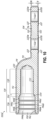
- FIGS. 16 - 20 disclose an alternative embodiment of the arc resistant electrical terminal and grounding system of the invention.
- An attachable and readily detachable terminal is used with grounding structures as described herein to provide good electrical grounding or a power signal to a cable and greater flexibility in securing and reconfiguring the cables.
- a terminal 300 includes a body made of a suitable electrically conductive material, such as copper or aluminum.
- the body of the terminal 300 has a suitable wire receiving portion 302 that may be appropriately crimped onto a wire or cable conductor.
- the wire receiving portion 302 may resemble structures as described herein with respect to FIGS. 1 - 15 .
- the body also includes a cup portion 304 as shown in FIGS.
- the cup portion 304 interfaces with a post 314 and conductive structure 312 to secure the terminal end of a cable and ensure a proper ground or power signal reference.
- the cup portion 304 further includes a boss portion 310 that extends downwardly from the bottom of the cup portion 304 as illustrated in FIG. 18 .
- the boss portion is integrally formed with the cup portion 304 .
- the boss portion 310 makes electrical contact with a flat mounting surface 313 of the conductive structure 312 .
- the conductive structure 312 may provide a ground reference or a power signal and could be in the form of a bus bar, a mounting plate or block as appropriate to provide the electrical ground or power reference and structure for anchoring the end of a cable through the terminal 300 .
- the boss portion 310 has a complementary flat or planar surface 311 that interfaces with surface 313 .
- a conductive stud or post 314 extends upwardly from the conductive structure 312 and is coupled thereto for securing the cup portion 304 of the terminal.
- the post 314 is in the form of a bolt structure that fits through an aperture 315 in the conductive structure 312 as illustrated.
- the bolt has a head portion 317 that limits its passage through the aperture 315 .
- the post 314 includes threads 319 on an outer surface thereof for securing the terminal cup portion 304 as described herein.
- the post 314 may be a stainless steel structure and could have an outer coating or sheath of a more highly conductive metal, such as copper.
- the post may be secured with the conductive structure 312 , such as be soldering or otherwise affixing the post to the structure.
- the post 314 a might be press fit or screwed into an appropriate feature 315 a in the conductive structure 312 .
- the body of terminal 300 includes an aperture 320 formed therein to extend through the cup portion 304 and boss portion 310 .
- the aperture may be appropriately sized for receiving the post 314 and allowing passage of the post 314 through the terminal boss portion and cup portion when the terminal 300 is mounted to conductive structure 312 and post 314 . That is, as shown in FIG. 18 , the post 314 extends upwardly through the boss portion 310 and the cup portion 304 through the aperture 320 and into the inside area 305 of the cup portion.
- a fastener 330 engages the post and secures the cup portion and surface 311 of the boss portion against the surface 313 .
- the post 314 might include external threads 315 .
- a fastener 330 such as a threaded nut or other hardware fastener may be secured to the post 314 and tightened down to secure the cup portion 304 of terminal 300 against the conductive structure 312 .
- the exposed surface 311 of the boss portion is secured tightly against the surface 313 of the conductive structure 312 .
- the fastener is configured to fit inside the area 305 of the cup portion to be contained therein. Although a single fastener 330 is shown in FIG. 16 , it would be understood that other hardware, such as washers, locking washers, and other structures might be utilized for securing terminal 300 to post 314 and mounting plate 312 .
- the fastener 330 is contained completely in the area 305 to be covered as described herein.
- an overmold structure 308 of insulation material is formed on the cup portion.
- the overmold structure 308 covers the cup portion sides and the sides of the boss portion as seen in FIG. 18 .
- FIG. 17 A illustrates the terminal 300 without the overmold structure, showing the cup portion and boss portion, as well as the connecting portion.
- the overmold structure is made of appropriate insulation material that is formed on the terminal 300 so that the side surface 303 of the cup portion and side surface 309 of the boss portion are appropriately covered with a layer of insulation material.
- the insulation material may include a suitable silicone material or one or more of the following: a fluorocarbon material, PTFE, PFA, FEP, ETFE, a polymer material, PVC, polyurethane, a thermoplastic material, a phenolic material, rubber, a ceramic.
- the insulation material may be injection molded as an overmold structure 308 to cover various portions 302 , 304 , 306 of the terminal 300 for the prevention of arcing.
- the overmold structure might also extend over part of the wire receiving portion 302 as well.
- the terminal 300 as illustrated in FIG. 17 A might include a feature, such as an indent 301 , that indicates the extend of the overmold structure 308 on the terminal.
- the overmold structure of insulation material 308 seals the electrical terminal 300 on the conductive structure 312 and electrically insulates the terminal 300 .
- the overmold structure 308 covers the side surfaces 303 and 309 and extends down the height H of the cup portion and boss portion but does not cover the bottom surface 311 of the boss portion 310 .
- the bottom surface 311 of the boss portion is exposed. In that way, insulation is provided between the cup portion 304 and connecting portion 306 with respect to the conductive structure, but a clear interface and conductive path is provided at the interfacing surfaces 311 , 313 . As shown in FIG.
- the cup portion 304 is mounted on post 314 so that the exposed bottom surface 311 of the boss portion 310 mounts flush against a top surface 313 of the conductive structure 312 while the overmold structure surrounds the sides of the cup portion and boss portion. Electrical current then flows through the conductive structure 312 , through the boss portion 310 and cup portion 304 and through the connecting portion 306 to wire receiving portion 302 and then to a wire, cable or other conductor that is crimped in portion 302 .
- the cup portion 304 and boss portion may have a combined height H that is dimensioned so as create the area 305 to contain most of the exposed post 314 and fastener 330 inside of the cup portion 304 of the terminal. In that way, all of the conductive hardware is covered with insulation material so as to prevent arcing. As illustrated in FIG. 16 , the top edge 323 and the inside surface 325 of the cup portion 304 that form the area 305 are exposed through the overmold structure 308 and the insulation material. The area 305 that is created within the insulated cup portion 304 by surface 325 completely surrounds and encapsulates the mounting post 314 and fastener 330 .
- an insulating material cap 332 is secured into the top of the cup portion.
- the insulative cap 332 is configured for engaging the overmold structure 308 and sealing the cup structure around the post 314 of the conductive structure 312 .
- the insulative cap 332 fits over the opening of the cup portion 304 and area 305 and is dimensioned so as to overlie or overlap the overmold structure 308 proximate edge 323 . In that way, the entire internal surface 325 of the cup portion 304 that forms the area 305 containing the exposed section of post 314 as well as fastener 330 and any other mounting hardware are also completely enclosed with insulation material.
- the cap may have a portion 331 that engages the inside surface 325 of the cup portion and may be made of suitable material, such as PTFE or some other polymer or other material similar to the insulation material of the overmold structure.
- the insulating cap 332 may be secured in the cup portion 304 and overmold structure 308 by suitable securement methods. For example, a friction fit of section 331 with the inside surface 325 of the cup portion might be used.
- the portion 331 may include internal threads for threading onto the post 314 within the cup portion. Still other clip or lock structures might be used to allow the insulating cap 332 to be secured with the overmold structure to surround the terminal 300 .
- FIGS. 21 A and 21 B illustrate possible embodiments wherein the cap 332 and the cup portion 304 are configured with complementary structures for a snap-in and lock engagement so the cap engages the overmold structure 308 .
- the cup portion 304 may include an indent 340 formed in a ring around the top edge 323 of the cup portion 304 that receives a similarly shaped or complementary shaped ridge feature 342 formed around the cap 332 for snapping the cap into position on the terminal 300 .
- FIG. 21 A the cup portion 304 may include an indent 340 formed in a ring around the top edge 323 of the cup portion 304 that receives a similarly shaped or complementary shaped ridge feature 342 formed around the cap 332 for snapping the cap into position on the terminal 300 .
- an indent 344 formed in a ring around the cap 332 receives a similarly shaped or complementary shaped ridge feature 346 formed around the top edge 323 of the cup portion 304 of cap 332 for snapping the cap into position on the terminal 300 to engage the overmold structure 308 and seal the terminal.
- FIGS. 22 A and 22 B illustrate additional possible embodiments wherein the cap and the cup portion are also configured with complementary structures for a snap-in and lock engagement, so the cap engages the overmold structure 308 .
- the cap 332 a is dimensioned so that an inner wall surface 333 is spaced away from the post 314 and threads of the post.
- the snap engagement of cap 332 a means it is not dependent on the height of the post or stud 314 .
- the engagement of an audible snap interaction provides assurance that the cap is properly installed as opposed to other cap arrangements where it may be difficult to tall at a glance if the cap is seated all the way down.
- the cap 332 a can freely snap into engagement with the cup portion 304 . For example, referring to FIG.
- the terminal 300 can be readily removed by removing insulating cap 332 to expose the post 314 , fastener 330 or other hardware.
- the fastener(s) can be removed and the terminal 300 can then be readily slid from post 314 .
- the terminal 300 may be re-applied or attached as disclosed herein. In that way, the terminal can be installed and is encapsulated in insulating material without having to apply such material in a separate step, such as in a coating step with tapes or epoxies.
- the hardware can be readily removed without having to clean off insulating material from the exposed surfaces.
- the overmold structure 308 includes a reduced diameter section 350 that is configured to receive a tubular portion of insulation material 352 , such as heat shrink insulation material.
- the insulation material 352 fits over the section 350 and the wire receiving portion 302 .
- the insulation material may also extend over a portion of the outer insulation of the wire or cable (not shown) that is attached to the terminal 300 .
- the insulation material 352 shrinks to cover the wire receiving portion 302 and reduced diameter section 350 and any cable insulation with which it overlaps to further seal the terminal against fluid and prevent electrical arcing.
Landscapes
- Connector Housings Or Holding Contact Members (AREA)
- Connections Effected By Soldering, Adhesion, Or Permanent Deformation (AREA)
Priority Applications (1)
| Application Number | Priority Date | Filing Date | Title |
|---|---|---|---|
| US17/738,611 US12034236B2 (en) | 2019-11-07 | 2022-05-06 | Arc resistant power terminal |
Applications Claiming Priority (3)
| Application Number | Priority Date | Filing Date | Title |
|---|---|---|---|
| US201962932284P | 2019-11-07 | 2019-11-07 | |
| PCT/US2020/059433 WO2021092398A1 (en) | 2019-11-07 | 2020-11-06 | Arc resistant power terminal |
| US17/738,611 US12034236B2 (en) | 2019-11-07 | 2022-05-06 | Arc resistant power terminal |
Related Parent Applications (1)
| Application Number | Title | Priority Date | Filing Date |
|---|---|---|---|
| PCT/US2020/059433 Continuation-In-Part WO2021092398A1 (en) | 2019-11-07 | 2020-11-06 | Arc resistant power terminal |
Publications (2)
| Publication Number | Publication Date |
|---|---|
| US20220320764A1 US20220320764A1 (en) | 2022-10-06 |
| US12034236B2 true US12034236B2 (en) | 2024-07-09 |
Family
ID=73793793
Family Applications (1)
| Application Number | Title | Priority Date | Filing Date |
|---|---|---|---|
| US17/738,611 Active 2041-06-26 US12034236B2 (en) | 2019-11-07 | 2022-05-06 | Arc resistant power terminal |
Country Status (4)
| Country | Link |
|---|---|
| US (1) | US12034236B2 (https=) |
| EP (1) | EP4055663B1 (https=) |
| JP (1) | JP7652773B2 (https=) |
| WO (1) | WO2021092398A1 (https=) |
Cited By (1)
| Publication number | Priority date | Publication date | Assignee | Title |
|---|---|---|---|---|
| US20240047902A1 (en) * | 2021-04-20 | 2024-02-08 | Robert Bosch Gmbh | Connection assembly, in particular for use in electric vehicles or hybrid vehicles |
Families Citing this family (3)
| Publication number | Priority date | Publication date | Assignee | Title |
|---|---|---|---|---|
| CN111312439A (zh) * | 2020-04-01 | 2020-06-19 | 吉林省中赢高科技有限公司 | 一种电能传输铝件及其加工工艺 |
| EP4386996A1 (de) * | 2022-12-15 | 2024-06-19 | Gebauer & Griller Kabelwerke Gesellschaft m.b.H. | Anschlusssystem |
| US20250192492A1 (en) * | 2023-12-12 | 2025-06-12 | Caterpillar Inc. | Terminal assembly |
Citations (10)
| Publication number | Priority date | Publication date | Assignee | Title |
|---|---|---|---|---|
| US4288504A (en) * | 1980-07-21 | 1981-09-08 | Julian Victor J | Sealed battery cable termination |
| US4483910A (en) * | 1983-04-08 | 1984-11-20 | Julian Victor J | Sealed battery cable termination |
| US8894429B2 (en) * | 2011-11-04 | 2014-11-25 | Control Techniques Ltd | Earth busbar |
| US9385449B2 (en) * | 2009-02-16 | 2016-07-05 | Carlisle Interconnect Technologies, Inc. | Terminal/connector having integral oxide breaker element |
| WO2017070484A1 (en) | 2015-10-22 | 2017-04-27 | Carlisle Interconnect Technologies, Inc. | Arc resistant power terminal |
| WO2018059666A1 (de) | 2016-09-27 | 2018-04-05 | Jens Trimborn | Verbindungsteil, abdeckmutter, kunststoff-dichtungshülle für eine leiterverbindung und abgedichtete verbindung zwischen zwei leitern |
| US10211565B2 (en) * | 2015-03-31 | 2019-02-19 | Jens Trimborn | Plastic sealing internal sheath for a conductor connection, connection part, cover nut and sealed connection between two conductors |
| US10381752B2 (en) * | 2017-06-21 | 2019-08-13 | Te Connectivity Germany Gmbh | Module connector |
| US11532910B2 (en) * | 2020-02-19 | 2022-12-20 | Te Connectivity Germany Gmbh | Contact device, contact system and method for assembling such a contact system |
| US20230327360A1 (en) * | 2022-04-08 | 2023-10-12 | Te Connectivity Germany Gmbh | Screw For a Touch-Proof Plug Connection |
Family Cites Families (4)
| Publication number | Priority date | Publication date | Assignee | Title |
|---|---|---|---|---|
| JPH0422548Y2 (https=) * | 1988-06-09 | 1992-05-22 | ||
| JPH0594960U (ja) * | 1992-05-29 | 1993-12-24 | 三菱自動車工業株式会社 | バッテリケーブルの接続端子構造 |
| JP3926930B2 (ja) * | 1998-08-18 | 2007-06-06 | 住友電装株式会社 | アース用防水構造 |
| US8519267B2 (en) | 2009-02-16 | 2013-08-27 | Carlisle Interconnect Technologies, Inc. | Terminal having integral oxide breaker |
-
2020
- 2020-11-06 WO PCT/US2020/059433 patent/WO2021092398A1/en not_active Ceased
- 2020-11-06 EP EP20823981.4A patent/EP4055663B1/en active Active
- 2020-11-06 JP JP2022526249A patent/JP7652773B2/ja active Active
-
2022
- 2022-05-06 US US17/738,611 patent/US12034236B2/en active Active
Patent Citations (11)
| Publication number | Priority date | Publication date | Assignee | Title |
|---|---|---|---|---|
| US4288504A (en) * | 1980-07-21 | 1981-09-08 | Julian Victor J | Sealed battery cable termination |
| US4483910A (en) * | 1983-04-08 | 1984-11-20 | Julian Victor J | Sealed battery cable termination |
| US9385449B2 (en) * | 2009-02-16 | 2016-07-05 | Carlisle Interconnect Technologies, Inc. | Terminal/connector having integral oxide breaker element |
| US8894429B2 (en) * | 2011-11-04 | 2014-11-25 | Control Techniques Ltd | Earth busbar |
| US10211565B2 (en) * | 2015-03-31 | 2019-02-19 | Jens Trimborn | Plastic sealing internal sheath for a conductor connection, connection part, cover nut and sealed connection between two conductors |
| WO2017070484A1 (en) | 2015-10-22 | 2017-04-27 | Carlisle Interconnect Technologies, Inc. | Arc resistant power terminal |
| US9985362B2 (en) * | 2015-10-22 | 2018-05-29 | Carlisle Interconnect Technologies, Inc. | Arc resistant power terminal |
| WO2018059666A1 (de) | 2016-09-27 | 2018-04-05 | Jens Trimborn | Verbindungsteil, abdeckmutter, kunststoff-dichtungshülle für eine leiterverbindung und abgedichtete verbindung zwischen zwei leitern |
| US10381752B2 (en) * | 2017-06-21 | 2019-08-13 | Te Connectivity Germany Gmbh | Module connector |
| US11532910B2 (en) * | 2020-02-19 | 2022-12-20 | Te Connectivity Germany Gmbh | Contact device, contact system and method for assembling such a contact system |
| US20230327360A1 (en) * | 2022-04-08 | 2023-10-12 | Te Connectivity Germany Gmbh | Screw For a Touch-Proof Plug Connection |
Non-Patent Citations (1)
| Title |
|---|
| European Patent Office; Search Report and Written Opinion in related International Patent Application No. PCT/US2020/059433 dated Feb. 9, 2021; 12 pages. |
Cited By (1)
| Publication number | Priority date | Publication date | Assignee | Title |
|---|---|---|---|---|
| US20240047902A1 (en) * | 2021-04-20 | 2024-02-08 | Robert Bosch Gmbh | Connection assembly, in particular for use in electric vehicles or hybrid vehicles |
Also Published As
| Publication number | Publication date |
|---|---|
| JP2022554372A (ja) | 2022-12-28 |
| EP4055663A1 (en) | 2022-09-14 |
| US20220320764A1 (en) | 2022-10-06 |
| WO2021092398A1 (en) | 2021-05-14 |
| JP7652773B2 (ja) | 2025-03-27 |
| EP4055663B1 (en) | 2024-09-04 |
Similar Documents
| Publication | Publication Date | Title |
|---|---|---|
| US9985362B2 (en) | Arc resistant power terminal | |
| US12034236B2 (en) | Arc resistant power terminal | |
| JP2018531502A6 (ja) | 耐アーク性電力端子 | |
| US10164348B2 (en) | Terminal/connector having integral oxide breaker element | |
| US8519267B2 (en) | Terminal having integral oxide breaker | |
| US7905755B1 (en) | Electrical terminal connection with sealed core crimp | |
| US9225103B2 (en) | Connector | |
| US8266798B2 (en) | Method of making an improved electrical connection with sealed cable core and a terminal | |
| US4049335A (en) | Sealed battery threaded stud termination | |
| US11621505B2 (en) | Cable lug, contact element and method for producing said element | |
| EP0604117B1 (en) | Earthed cable gland | |
| US20170250510A1 (en) | Contact point for a flat conductor | |
| US5725396A (en) | Connection device for the poles of electric accumulators | |
| US7785158B1 (en) | Electrode connection platform | |
| JP2006339167A (ja) | 低アーク性端子を含む端子対 | |
| WO2008130497A1 (en) | Torque resistant terminal block assembly | |
| CN219534967U (zh) | 一种金属绝缘密封连接端子 | |
| EP3039747B1 (en) | Terminal/connector having integral oxide breaker element | |
| US5145421A (en) | Cable connector | |
| CA1128621A (en) | Two-piece cable connector particularly suitable for cathodic protection connections | |
| JP3373400B2 (ja) | バッテリポストと信号用電線の接続構造 | |
| CN213093407U (zh) | 电极组件及导线接头 | |
| US20260106388A1 (en) | Inhibitor retention feature for electrical connection | |
| JPH0313967Y2 (https=) | ||
| JPH09229251A (ja) | ユニオン継手 |
Legal Events
| Date | Code | Title | Description |
|---|---|---|---|
| FEPP | Fee payment procedure |
Free format text: ENTITY STATUS SET TO UNDISCOUNTED (ORIGINAL EVENT CODE: BIG.); ENTITY STATUS OF PATENT OWNER: LARGE ENTITY |
|
| AS | Assignment |
Owner name: CARLISLE INTERCONNECT TECHNOLOGIES INC., FLORIDA Free format text: ASSIGNMENT OF ASSIGNORS INTEREST;ASSIGNOR:CHVALA, JOSEPH W.;REEL/FRAME:060480/0548 Effective date: 20220706 |
|
| STPP | Information on status: patent application and granting procedure in general |
Free format text: DOCKETED NEW CASE - READY FOR EXAMINATION |
|
| STPP | Information on status: patent application and granting procedure in general |
Free format text: NOTICE OF ALLOWANCE MAILED -- APPLICATION RECEIVED IN OFFICE OF PUBLICATIONS |
|
| STPP | Information on status: patent application and granting procedure in general |
Free format text: PUBLICATIONS -- ISSUE FEE PAYMENT VERIFIED |
|
| STCF | Information on status: patent grant |
Free format text: PATENTED CASE |
|
| AS | Assignment |
Owner name: AMPHENOL CABLE AND INTERCONNECT TECHNOLOGIES, INC., FLORIDA Free format text: CHANGE OF NAME;ASSIGNOR:CARLISLE INTERCONNECT TECHNOLOGIES, INC.;REEL/FRAME:070867/0688 Effective date: 20241007 |