US12003231B2 - Double gate transistor device and method of operating - Google Patents
Double gate transistor device and method of operating Download PDFInfo
- Publication number
- US12003231B2 US12003231B2 US16/722,809 US201916722809A US12003231B2 US 12003231 B2 US12003231 B2 US 12003231B2 US 201916722809 A US201916722809 A US 201916722809A US 12003231 B2 US12003231 B2 US 12003231B2
- Authority
- US
- United States
- Prior art keywords
- semiconductor layer
- gate electrode
- gate
- transistor device
- level
- Prior art date
- Legal status (The legal status is an assumption and is not a legal conclusion. Google has not performed a legal analysis and makes no representation as to the accuracy of the status listed.)
- Active, expires
Links
Images




Classifications
-
- H—ELECTRICITY
- H03—ELECTRONIC CIRCUITRY
- H03K—PULSE TECHNIQUE
- H03K17/00—Electronic switching or gating, i.e. not by contact-making and –breaking
- H03K17/51—Electronic switching or gating, i.e. not by contact-making and –breaking characterised by the components used
- H03K17/56—Electronic switching or gating, i.e. not by contact-making and –breaking characterised by the components used by the use, as active elements, of semiconductor devices
- H03K17/567—Circuits characterised by the use of more than one type of semiconductor device, e.g. BIMOS, composite devices such as IGBT
-
- H01L29/0895—
-
- H01L29/407—
-
- H01L29/41766—
-
- H01L29/4236—
-
- H01L29/7397—
-
- H01L29/7606—
-
- H01L29/7786—
-
- H01L29/7788—
-
- H01L29/7813—
-
- H01L29/7831—
-
- H—ELECTRICITY
- H03—ELECTRONIC CIRCUITRY
- H03K—PULSE TECHNIQUE
- H03K17/00—Electronic switching or gating, i.e. not by contact-making and –breaking
- H03K17/51—Electronic switching or gating, i.e. not by contact-making and –breaking characterised by the components used
- H03K17/56—Electronic switching or gating, i.e. not by contact-making and –breaking characterised by the components used by the use, as active elements, of semiconductor devices
- H03K17/687—Electronic switching or gating, i.e. not by contact-making and –breaking characterised by the components used by the use, as active elements, of semiconductor devices the devices being field-effect transistors
-
- H—ELECTRICITY
- H10—SEMICONDUCTOR DEVICES; ELECTRIC SOLID-STATE DEVICES NOT OTHERWISE PROVIDED FOR
- H10D—INORGANIC ELECTRIC SEMICONDUCTOR DEVICES
- H10D12/00—Bipolar devices controlled by the field effect, e.g. insulated-gate bipolar transistors [IGBT]
- H10D12/411—Insulated-gate bipolar transistors [IGBT]
- H10D12/441—Vertical IGBTs
- H10D12/461—Vertical IGBTs having non-planar surfaces, e.g. having trenches, recesses or pillars in the surfaces of the emitter, base or collector regions
- H10D12/481—Vertical IGBTs having non-planar surfaces, e.g. having trenches, recesses or pillars in the surfaces of the emitter, base or collector regions having gate structures on slanted surfaces, on vertical surfaces, or in grooves, e.g. trench gate IGBTs
-
- H—ELECTRICITY
- H10—SEMICONDUCTOR DEVICES; ELECTRIC SOLID-STATE DEVICES NOT OTHERWISE PROVIDED FOR
- H10D—INORGANIC ELECTRIC SEMICONDUCTOR DEVICES
- H10D30/00—Field-effect transistors [FET]
- H10D30/40—FETs having zero-dimensional [0D], one-dimensional [1D] or two-dimensional [2D] charge carrier gas channels
- H10D30/47—FETs having zero-dimensional [0D], one-dimensional [1D] or two-dimensional [2D] charge carrier gas channels having two-dimensional [2D] charge carrier gas channels, e.g. nanoribbon FETs or high electron mobility transistors [HEMT]
- H10D30/471—High electron mobility transistors [HEMT] or high hole mobility transistors [HHMT]
- H10D30/475—High electron mobility transistors [HEMT] or high hole mobility transistors [HHMT] having wider bandgap layer formed on top of lower bandgap active layer, e.g. undoped barrier HEMTs such as i-AlGaN/GaN HEMTs
-
- H—ELECTRICITY
- H10—SEMICONDUCTOR DEVICES; ELECTRIC SOLID-STATE DEVICES NOT OTHERWISE PROVIDED FOR
- H10D—INORGANIC ELECTRIC SEMICONDUCTOR DEVICES
- H10D30/00—Field-effect transistors [FET]
- H10D30/40—FETs having zero-dimensional [0D], one-dimensional [1D] or two-dimensional [2D] charge carrier gas channels
- H10D30/47—FETs having zero-dimensional [0D], one-dimensional [1D] or two-dimensional [2D] charge carrier gas channels having two-dimensional [2D] charge carrier gas channels, e.g. nanoribbon FETs or high electron mobility transistors [HEMT]
- H10D30/471—High electron mobility transistors [HEMT] or high hole mobility transistors [HHMT]
- H10D30/477—Vertical HEMTs or vertical HHMTs
-
- H—ELECTRICITY
- H10—SEMICONDUCTOR DEVICES; ELECTRIC SOLID-STATE DEVICES NOT OTHERWISE PROVIDED FOR
- H10D—INORGANIC ELECTRIC SEMICONDUCTOR DEVICES
- H10D30/00—Field-effect transistors [FET]
- H10D30/60—Insulated-gate field-effect transistors [IGFET]
- H10D30/611—Insulated-gate field-effect transistors [IGFET] having multiple independently-addressable gate electrodes influencing the same channel
-
- H—ELECTRICITY
- H10—SEMICONDUCTOR DEVICES; ELECTRIC SOLID-STATE DEVICES NOT OTHERWISE PROVIDED FOR
- H10D—INORGANIC ELECTRIC SEMICONDUCTOR DEVICES
- H10D30/00—Field-effect transistors [FET]
- H10D30/60—Insulated-gate field-effect transistors [IGFET]
- H10D30/64—Double-diffused metal-oxide semiconductor [DMOS] FETs
- H10D30/66—Vertical DMOS [VDMOS] FETs
- H10D30/668—Vertical DMOS [VDMOS] FETs having trench gate electrodes, e.g. UMOS transistors
-
- H—ELECTRICITY
- H10—SEMICONDUCTOR DEVICES; ELECTRIC SOLID-STATE DEVICES NOT OTHERWISE PROVIDED FOR
- H10D—INORGANIC ELECTRIC SEMICONDUCTOR DEVICES
- H10D48/00—Individual devices not covered by groups H10D1/00 - H10D44/00
- H10D48/30—Devices controlled by electric currents or voltages
- H10D48/32—Devices controlled by only the electric current supplied, or only the electric potential applied, to an electrode which does not carry the current to be rectified, amplified or switched
- H10D48/36—Unipolar devices
- H10D48/362—Unipolar transistors having ohmic electrodes on emitter-like, base-like, and collector-like regions, e.g. hot electron transistors [HET], metal base transistors [MBT], resonant tunnelling transistors [RTT], bulk barrier transistors [BBT], planar doped barrier transistors [PDBT] or charge injection transistors [CHINT]
-
- H—ELECTRICITY
- H10—SEMICONDUCTOR DEVICES; ELECTRIC SOLID-STATE DEVICES NOT OTHERWISE PROVIDED FOR
- H10D—INORGANIC ELECTRIC SEMICONDUCTOR DEVICES
- H10D62/00—Semiconductor bodies, or regions thereof, of devices having potential barriers
- H10D62/10—Shapes, relative sizes or dispositions of the regions of the semiconductor bodies; Shapes of the semiconductor bodies
- H10D62/13—Semiconductor regions connected to electrodes carrying current to be rectified, amplified or switched, e.g. source or drain regions
- H10D62/165—Tunnel injectors
-
- H—ELECTRICITY
- H10—SEMICONDUCTOR DEVICES; ELECTRIC SOLID-STATE DEVICES NOT OTHERWISE PROVIDED FOR
- H10D—INORGANIC ELECTRIC SEMICONDUCTOR DEVICES
- H10D64/00—Electrodes of devices having potential barriers
- H10D64/111—Field plates
- H10D64/117—Recessed field plates, e.g. trench field plates or buried field plates
-
- H—ELECTRICITY
- H10—SEMICONDUCTOR DEVICES; ELECTRIC SOLID-STATE DEVICES NOT OTHERWISE PROVIDED FOR
- H10D—INORGANIC ELECTRIC SEMICONDUCTOR DEVICES
- H10D64/00—Electrodes of devices having potential barriers
- H10D64/20—Electrodes characterised by their shapes, relative sizes or dispositions
- H10D64/23—Electrodes carrying the current to be rectified, amplified, oscillated or switched, e.g. sources, drains, anodes or cathodes
- H10D64/251—Source or drain electrodes for field-effect devices
- H10D64/256—Source or drain electrodes for field-effect devices for lateral devices wherein the source or drain electrodes are recessed in semiconductor bodies
-
- H—ELECTRICITY
- H10—SEMICONDUCTOR DEVICES; ELECTRIC SOLID-STATE DEVICES NOT OTHERWISE PROVIDED FOR
- H10D—INORGANIC ELECTRIC SEMICONDUCTOR DEVICES
- H10D64/00—Electrodes of devices having potential barriers
- H10D64/20—Electrodes characterised by their shapes, relative sizes or dispositions
- H10D64/27—Electrodes not carrying the current to be rectified, amplified, oscillated or switched, e.g. gates
- H10D64/311—Gate electrodes for field-effect devices
- H10D64/411—Gate electrodes for field-effect devices for FETs
- H10D64/511—Gate electrodes for field-effect devices for FETs for IGFETs
- H10D64/512—Disposition of the gate electrodes, e.g. buried gates
- H10D64/513—Disposition of the gate electrodes, e.g. buried gates within recesses in the substrate, e.g. trench gates, groove gates or buried gates
-
- H01L29/1066—
-
- H01L29/2003—
-
- H—ELECTRICITY
- H03—ELECTRONIC CIRCUITRY
- H03K—PULSE TECHNIQUE
- H03K17/00—Electronic switching or gating, i.e. not by contact-making and –breaking
- H03K17/51—Electronic switching or gating, i.e. not by contact-making and –breaking characterised by the components used
- H03K17/56—Electronic switching or gating, i.e. not by contact-making and –breaking characterised by the components used by the use, as active elements, of semiconductor devices
- H03K17/687—Electronic switching or gating, i.e. not by contact-making and –breaking characterised by the components used by the use, as active elements, of semiconductor devices the devices being field-effect transistors
- H03K2017/6878—Electronic switching or gating, i.e. not by contact-making and –breaking characterised by the components used by the use, as active elements, of semiconductor devices the devices being field-effect transistors using multi-gate field-effect transistors
-
- H—ELECTRICITY
- H10—SEMICONDUCTOR DEVICES; ELECTRIC SOLID-STATE DEVICES NOT OTHERWISE PROVIDED FOR
- H10D—INORGANIC ELECTRIC SEMICONDUCTOR DEVICES
- H10D62/00—Semiconductor bodies, or regions thereof, of devices having potential barriers
- H10D62/10—Shapes, relative sizes or dispositions of the regions of the semiconductor bodies; Shapes of the semiconductor bodies
- H10D62/17—Semiconductor regions connected to electrodes not carrying current to be rectified, amplified or switched, e.g. channel regions
- H10D62/343—Gate regions of field-effect devices having PN junction gates
-
- H—ELECTRICITY
- H10—SEMICONDUCTOR DEVICES; ELECTRIC SOLID-STATE DEVICES NOT OTHERWISE PROVIDED FOR
- H10D—INORGANIC ELECTRIC SEMICONDUCTOR DEVICES
- H10D62/00—Semiconductor bodies, or regions thereof, of devices having potential barriers
- H10D62/80—Semiconductor bodies, or regions thereof, of devices having potential barriers characterised by the materials
- H10D62/85—Semiconductor bodies, or regions thereof, of devices having potential barriers characterised by the materials being Group III-V materials, e.g. GaAs
- H10D62/8503—Nitride Group III-V materials, e.g. AlN or GaN
Definitions
- This disclosure in general relates to a transistor device, in particular a field-effect controlled power transistor device.
- Field-effect controlled power transistor devices such as power MOSFETs (Metal Oxide Field-Effect Transistors) or power IGBT's (Insulated Gate Bipolar Transistors) are widely used in automotive, industrial, or consumer electronic applications for driving loads, converting power, or the like.
- Such power transistors are available with voltage blocking capabilities of between several 10 volts (V) and several kilovolts (kV) and current ratings of between several amperes (A) and several kiloamperes (kA).
- V 10 volts
- kV Metal Oxide Field-Effect Transistors
- IGBT's Insulated Gate Bipolar Transistors
- a field-effect controlled power transistor device switches on and off dependent on a voltage level of a drive voltage applied between a drive node (often referred to as gate node) and a load node (often referred to as source node or emitter node).
- a normally-off device is in the off state when the drive voltage is zero so that a device of this type can be switched off by setting the drive voltage to zero.
- parasitic voltage spikes may occur at the gate node when the transistor device is in the off-state. Those voltage spikes may result from rapid changes of currents through parasitic inductances, such as line inductances; rapid current changes may result from switching operations of other power transistors in a circuit where the power transistor is employed.
- One example relates to a method.
- the method includes switching on a transistor device by generating a first conducting channel by driving a first gate electrode and, before generating the first conducting channel, generating a second conducting channel by driving a second gate electrode.
- the second gate electrode is adjacent the first gate electrode in a current flow direction of the transistor device.
- Another example of a method includes switching off a transistor device by interrupting a first conducting channel by driving a first gate electrode and, after interrupting the first conducting channel, interrupting a second conducting channel by driving a second gate electrode.
- the second gate electrode is arranged adjacent the first gate electrode in a current flow direction of the transistor device.
- Another example relates to a transistor device with at least one transistor cell.
- the wherein the at least one transistor cell includes a drift region, a body region, a source region and a drain region, wherein the body region is arranged between the source region and the drift region, and wherein the drift region is arranged between body region and the drain region.
- a gate electrode is dielectrically insulated from the body region by a first gate dielectric
- a second gate electrode is dielectrically insulated from the body region by a second gate dielectric, arranged adjacent the first gate electrode, and separated from the first gate electrode by a separation layer.
- a transistor device includes a semiconductor body with a first semiconductor layer and a second semiconductor layer adjoining the first semiconductor layer.
- the first semiconductor layer includes a first type of group III nitride
- the second semiconductor layer includes a second type group III nitride.
- a source electrode is connected to the first semiconductor layer and the second semiconductor layer
- a drain electrode is spaced apart from the source electrode and connected to the first semiconductor layer and the second semiconductor layer
- a first gate electrode and a second gate electrode that are spaced apart in a current flow direction of the transistor device.
- the method includes switching on a transistor device by generating a first conducting channel in a body region by driving a first gate electrode and, before generating the first conducting channel, generating a second conducting channel in the body region by driving a second gate electrode.
- the first gate electrode is dielectrically insulated from a body region by a first gate dielectric.
- the second gate electrode is dielectrically insulated from the body region by a second gate dielectric, arranged adjacent to the first gate electrode, and separated from the first gate electrode by a separation layer, and the body region is arranged between a source region and a drift region, and wherein the drift region is arranged between body region and a drain region.
- the method includes switching off a transistor device by interrupting a first conducting channel in a body region by driving a first gate electrode and, after interrupting the first conducting channel, interrupting a second conducting channel in the body region by driving a second gate electrode.
- the first gate electrode is dielectrically insulated from a body region by a first gate dielectric.
- the second gate electrode is dielectrically insulated from the body region by a second gate dielectric, arranged adjacent the first gate electrode, and separated from the first gate electrode by a separation layer.
- the body region is arranged between a source region and a drift region, and wherein the drift region is arranged between body region and a drain region.
- the method includes driving a first gate electrode of a transistor device and monitoring at least one electrical parameter of a second gate electrode of the transistor device.
- the first gate electrode is dielectrically insulated from a body region by a first gate dielectric.
- the second gate electrode is dielectrically insulated from the body region by a second gate dielectric, arranged adjacent the first gate electrode, and separated from the first gate electrode by a separation layer.
- the body region is arranged between a source region and a drift region, and wherein the drift region is arranged between body region and a drain region.
- the transistor device includes at least one transistor cell.
- the at least one transistor cell includes a drift region, a body region, a source region and a drain region.
- the body region is arranged between the source region and the drift region, and the drift region is arranged between body region and the drain region.
- the transistor device further includes a first gate electrode dielectrically insulated from the body region by a first gate dielectric, and a second gate electrode.
- the second gate electrode is dielectrically insulated from the body region by a second gate dielectric, is arranged adjacent the first gate electrode, and is separated from the first gate electrode by a separation layer.
- the drive circuit includes an input configured to receive an input signal a first output configured to be coupled to a first gate node of a transistor device, and a second output configured to be coupled to a second gate node of a transistor device configured to.
- the drive circuit is configured to drive the first gate node and the second gate node based on the input signal, and to detect an operation state of the transistor device based on monitoring at least one electrical parameter at the second output.
- the drive circuit includes an input configured to receive an input signal, a first output configured to be coupled to a first gate node of a transistor device, and a second output configured to be coupled to a second gate node of a transistor device.
- the drive circuit is configured to operate in a diagnostic mode, wherein in the diagnostic mode, the transistor device is configured to diagnose the transistor device based on driving the first gate node via the first output and monitoring at least one electrical parameter at the second output.
- FIG. 1 shows a vertical cross-sectional view of one transistor cell of a double gate transistor device according to one example
- FIG. 2 A shows the circuit symbol of a double gate transistor device implemented as an IGBT
- FIG. 2 B shows the circuit symbol of a double gate transistor device implemented as a MOSFET
- FIG. 3 shows a vertical cross-sectional view of one section of a double gate transistor device including a plurality of parallel connected transistor cells
- FIG. 4 shows a perspective sectional view of one transistor cell of a double gate transistor device according to one example
- FIG. 5 shows an electronic circuit that illustrates the use of a double gate transistor device as an electronic switch
- FIG. 6 shows timing diagrams that illustrate one example of how a double gate transistor device can be switched on
- FIG. 7 shows timing diagrams that illustrate another example of how a double gate transistor device can be switched on
- FIG. 8 shows a modification of one of the timing diagrams shown in FIGS. 6 and 7 ;
- FIG. 9 shows another modification of one of the timing diagrams shown in FIGS. 6 and 7 ;
- FIG. 10 shows one example of a driver stage configured to switch on a double gate transistor device
- FIG. 11 shows another example of a driver stage configured to switch on a double gate transistor device
- FIG. 12 shows yet another example of a driver stage configured to switch on a double gate transistor device
- FIG. 13 shows timing diagrams that illustrate one example of how a double gate transistor device can be switched off
- FIG. 14 shows timing diagrams that illustrate another example of how a double gate transistor device can be switched off
- FIG. 15 shows a modification of one of the timing diagrams shown in FIGS. 13 and 14 ;
- FIG. 16 shows another modification of one of the timing diagrams shown in FIGS. 13 and 14 ;
- FIG. 17 shows one example of a driver stage configured to switch off a double gate transistor device
- FIG. 18 shows another example of a driver stage configured to switch off a double gate transistor device
- FIG. 19 shows yet another example of a driver stage configured to switch off a double gate transistor device
- FIG. 20 shows one example of a driver that includes a first driver stage, a second driver stage and a detection circuit
- FIG. 21 shows one example of the detection circuit in greater detail
- FIG. 22 shows timing diagrams that illustrate operation of the detection circuit shown in FIG. 21 ;
- FIG. 23 shows an equivalent circuit diagram of a double gate transistor device
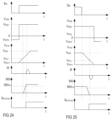
- FIGS. 24 and 25 show signal diagrams illustrating one way of operation of the detection circuit shown in FIG. 22 ;
- FIG. 26 shows the circuit symbol of a double gate transistor implemented as a HEMT (High Electron Mobility Transistor);
- FIG. 27 shows a vertical cross sectional view of a HEMT according to one example
- FIGS. 28 and 29 show timing diagrams that illustrate one example of how the HEMT shown in FIG. 27 can be switched on and off, respectively;
- FIG. 30 shows vertical cross sectional view of a HEMT according to another example
- FIG. 31 shows a modification of the HEMT shown in FIG. 30 ;
- FIG. 32 shows a vertical cross sectional view of a GIT (Gate Injection Transistor) according to one example
- FIG. 33 shows a modification of the GIT shown in FIG. 32 .
- FIG. 34 shows one example of how lines between a driver, a source and two gate node of a double gate transistor device may be arranged.
- FIG. 1 shows a vertical cross sectional view of one transistor cell of a double gate transistor device according to one example.
- the transistor cell includes a drift region 11 , a body region 12 , a source region 13 and a drain region 14 .
- the body region 12 is arranged between the drift region 11 and the source region 13
- the drift region 11 is arranged between the body region 12 and the drain region 14 .
- These regions which may briefly be referred to as active device regions, are doped semiconductor regions arranged in a semiconductor body 100 .
- the semiconductor body 100 may include a conventional semiconductor material such as, for example, silicon (Si), silicon carbide (SiC), gallium arsenide (GaAs), gallium nitride (GaN), or the like.
- the transistor cell further includes a first gate electrode 21 dielectrically insulated from the body region 12 by a first gate dielectric 22 , and a second gate electrode 31 dielectrically insulated from the body region 12 by a second gate dielectric 32 .
- the second gate electrode 31 is arranged adjacent the first gate electrode 21 and is separated from the first gate electrode 21 by a separation layer 23 .
- the first gate electrode 21 is electrically connected to a gate node G 1
- the second gate electrode 31 is electrically connected to a second gate node G 2 different from the first gate node G 1 .
- the separation layer 23 includes a dielectric layer.
- the first gate dielectric 22 , the second gate dielectric 32 and the separation layer 23 include the same type of material such as, for example, an oxide, a nitride, an oxy-nitride, or the like.
- the first gate dielectric 22 has a first thickness d 22 , which defines a shortest distance between the first gate electrode 21 and the body region 12
- the second gate dielectric 32 has a second thickness d 32 , which defines the shortest distance between the second gate electrode 31 and the body region 12 .
- one of is less than twice of the other one of the first thickness d 22 and the second thickness d 32 , that is, 0.5 ⁇ d 22 /d 32 ⁇ 2.
- first gate dielectric 22 and the second gate dielectric 32 adjoins the body region 12 . Furthermore, the first gate dielectric 22 adjoins the source region 13 and the second gate dielectric 32 adjoins the drift region 11 .
- first gate electrode 21 is adjacent the source region 13 additionally to being adjacent to the body region 12
- second gate electrode 31 is adjacent the drift region 11 additionally to being adjacent to the body region 12 .
- the transistor device can be implemented as an n-type transistor device or a p-type transistor device.
- the type of the transistor device is defined by a doping type of the source region 13 .
- the source region 13 is n-doped in an n-type transistor device and p-doped in a p-type transistor device.
- a doping type of the body region 12 is complementary to the doping type of the source region 13 , so that the body region 12 is p-doped in an n-type transistor device and n-doped in a p-type transistor device.
- a doping type of the drift region 11 equals the doping type of the source region 13 and is complementary to the doping type of the body region 12 , so that a pn-junction is formed between the body region 12 and the drift region 11 .
- the transistor device can, for example, be implemented as an IGBT or as a MOSFET.
- a doping type of the drain region 14 is complementary to the doping type of the drift region 11 and the source region, respectively, and in a MOSFET the doping type of the drain region 14 equals the doping type of the drift region 11 and the source region 13 , respectively.
- the transistor device includes a field-stop region 15 of the same doping type as the drift region 11 between the drift region 11 and the drain region 14 .
- a doping concentration of the field-stop region 15 is higher than the doping concentration of the drift region 11 and lower than the doping concentration of the drain region 14 .
- the transistor device can be implemented as a normally-off device (enhancement device) or a normally-on device (depletion device).
- a normally-off device the body region 12 adjoins the gate dielectrics 22 , 32 .
- the normally-off device can be switched on or off by controlling an inversion channel in the body region 12 along the gate dielectrics. This is explained in further detail below.
- the body region 12 includes a channel region 17 (illustrated in dashed lines in FIG. 1 ) of the same doping type as the source region 13 and the drift region 11 that adjoins the gate dielectrics 22 , 32 .
- the normally-on device can be switched on or off by depleting or not depleting the channel region 17 . This is also explained in further detail below.
- a doping concentration of the drift region 11 is selected from a range of between 1E12 cm ⁇ 3 and 1E15 cm ⁇ 3 , between 5E12 cm ⁇ 3 and 1E14 cm ⁇ 3 , or 7E12 cm ⁇ 3 and 1E13 cm ⁇ 3
- a doping concentration of the optional field-stop region 15 is selected from a range of between 1E15 cm ⁇ 3 and 1E16 cm ⁇ 3
- a doping concentration of the body region 12 is selected from a range of between 1E16 cm ⁇ 3 and 5E18 cm ⁇ 3
- a doping concentration of the source region 13 is higher than 1E19 cm ⁇ 3
- a doping concentration of the channel region may be selected from the same range as the doping concentration of the body region 12 .
- a doping concentration of the drain region 13 is higher than 1E18 cm ⁇ 3 or higher than 1E19 cm ⁇ 3 , for example.
- a doping concentration of the drain region 13 is higher than 1E17 cm ⁇ 3 or higher than 1E18 cm ⁇ 3 , for example.
- the doping concentration of the drain region 14 is at least 1E3 times, 1E4 times, or at least 1E5 times the doping concentration of the drift region 11 .
- the transistor cell shown in FIG. 1 is a vertical transistor cell. That is, the source region 13 and the drain region 14 are spaced apart in a vertical direction of the semiconductor body 100 .
- the “vertical direction” of the semiconductor body 100 is a direction perpendicular to a first surface 101 of the semiconductor body 100 .
- the first gate electrode 21 and the second gate electrode 22 are located in one trench that extends from the first surface 101 into the semiconductor body 100 . By this, the first gate electrode 21 and the second gate electrode 22 are adjacent in the vertical direction of the semiconductor body 100 , whereas the first gate electrode 21 is closer to the first surface 101 than the second gate electrode 31 .
- the method for driving a transistor device however, is not restricted to be used in a vertical transistor device, but may as well be used in a lateral transistor device.
- a lateral transistor device is a transistor device in which a drain region and a source region are spaced apart in a lateral direction of a semiconductor body.
- the lateral direction is a direction parallel to a (main)
- FIG. 2 A shows a circuit symbol of a double gate transistor device implemented as an IGBT.
- This circuit symbol is based on the circuit symbol of a conventional IGBT and is different from the circuit symbol of a conventional IGBT in that it includes two gate nodes, namely the first gate node G 1 and a the gate node G 2 .
- FIG. 2 B shows the circuit symbol of a double gate transistor device implemented as a MOSFET.
- the circuit symbol shown in FIG. 2 B is based on the circuit symbol of a conventional MOSFET and is different from the circuit symbol of a conventional MOSFET in that it includes two gate nodes, namely the first gate node G 1 and the second gate node G 2 .
- the circuit symbols shown in FIGS. 2 A and 2 B are drawn to represent n-type transistor devices.
- the transistor device includes a plurality of transistor cells of the type shown in FIG. 1 .
- FIG. 3 shows a vertical cross sectional view of one section of a transistor device that includes a plurality of such transistor cells. These transistor cells are connected in parallel by having their first gate electrodes 21 connected to one common first gate node G 1 , by having their second gate electrodes 31 connected to a common second gate node G 2 , by having their source regions 13 electrically connected to a common source node S, and by having their drain regions 14 connected to a common drain node D.
- the drain regions of the individual transistor cells are formed by one common drain region 14 connected to the drain node D.
- the drift regions of the individual transistor cells are formed by one common drift region 11 .
- the source regions 13 and the body regions 12 of the individual transistor cells are connected to the source node S.
- the body regions 12 may include contact regions 16 connected to the source node S. These contact regions 16 have the same doping type as the body regions 12 , are more highly doped than the body regions 12 , and may provide an ohmic connection between the source node S and the body region 12 .
- FIG. 4 shows a perspective sectional view of one transistor cell to illustrate how the second gate electrode 31 may be connected to the second gate node G 2 .
- a section of the second gate electrode 31 extends to the first surface 101 of the semiconductor body 100 .
- the second gate electrode 31 like the first gate electrode 21 , can be contacted at the first surface 101 of the semiconductor body 100 .
- the second gate electrode 31 is insulated from the first gate electrode 21 by a further separation layer 24 .
- This further separation layer 24 may include the same type of material as the first gate dielectric 22 , the second gate dielectric 32 and the separation layer 23 .
- a thickness, which defines the shortest distance between the first gate electrode 21 and the second gate electrode 31 is greater than the first thickness d 22 of the first gate dielectric 22 and the second thickness d 32 of the second gate dielectric 32 , for example.
- FIG. 5 shows a circuit diagram that illustrates one example of how the double gate transistor device can be used as an electronic switch.
- the double gate transistor device is drawn as an IGBT (as shown in FIG. 2 A ) in the circuit diagram shown in FIG. 5 .
- the transistor device is connected in series with a load Z (illustrated in dashed lines).
- the drain-source path D-S which is an internal path of the transistor device between the drain node D and the source node S, is connected in series with the load Z.
- This series circuit with the transistor device and the load Z receives a supply voltage V+ which is available between a first supply node and a second supply node (ground node, GND), for example.
- the transistor device can be switched on and switched off.
- a current can flow via the drain-source path D-S and, therefore, through the load Z.
- the transistor device is switched off (is in the off-state) it prevents a current to flow via the drain-source path D-S and, therefore, through the load Z. Examples of how the transistor device can be switched on and switched off are explained below.
- the double gate transistor device can be controlled (driven) by a drive circuit 5 .
- This drive circuit 5 receives an input signal S IN and is connected to the first gate node G 1 and the second gate node G 2 .
- the drive signal S IN can have two different signal levels, an on-level indicating that the transistor device is to be switched on, and an off-level indicating that the transistor device is to be switched off.
- the drive circuit 5 is configured to drive the transistor device in accordance with the input signal S IN .
- the drive circuit 5 includes a first driver stage 5 1 (illustrated in dashed lines in FIG. 5 ) configured to switch on the transistor device, and a second driver stage 5 2 (illustrated in dashed lines in FIG. 5 ) configured to switch off the transistor device. Examples of these driver stages 5 1 , 5 2 are explained with reference to drawings herein further below.
- the double gate transistor device explained above is a voltage-controlled transistor device that switches on and off dependent on two drive voltages, namely a first drive voltage V G1S and a second drive voltage V G2S .
- the first drive voltage V G1S is a voltage between the first gate node G 1 and the source node S
- the second drive voltage V G2S is a voltage between the second gate node G 2 and the source node S.
- Each of these voltages controls a conducting channel in the body region 12 .
- the first drive voltage V G1S controls a first conducting channel in the body region 12 along the first gate dielectric 22
- the second drive voltage V G2S controls a second conducting channel in the body region 12 along the second gate dielectric 32 .
- These conducting channels are field-effect controlled channels. According to one example, these conducting channels are inversion channels in a normally-off device and accumulation channels in a normally-on device.
- the transistor device is in the on-state when there is a continuous conducting channel in the body region 12 along the first gate dielectric 22 and the second gate dielectric 22 between the source region 13 and the drift region 11 .
- the separation layer 23 is thin enough for the first conducting channel and the second conducting channel to overlap in the region of the separation layer 23 so that there can be continuous conducting channel in the body region 12 between the source region 13 and the drift region 11 .
- the “current flow direction” is a direction in which a current can flow through the transistor device between the source region 13 and the drain region 14 when the transistor device is in the on-state.
- the current flow direction of the transistor device is the vertical direction of the semiconductor body 100 (the vertical direction is the direction perpendicular to the first surface 101 ).
- the transistor device is only in the on-state when first drive voltage V G1S generates the first conducting channel along the first gate dielectric 22 and the second drive voltage V G2S generates the second conducting channel along the second gate dielectric 32 .
- “To generate the conducting channel” may include to generate an inversion channel in a normally-off device or not to interrupt the conducting channel by not depleting the channel region 17 in a normally-on device. Consequently, the transistor device is in the off-state when at least one of these first and second conducting channels is interrupted.
- FIG. 6 shows timing diagrams that illustrate one example of how the double gate transistor device can be driven from the off-state to the on-state.
- FIG. 6 shows timing diagrams of the input signal S IN , the second drive voltage V G2S , the first drive voltage V G1S , and the drain-source voltage V DS of the double gate transistor device.
- switching on the transistor device includes generating the first conducting channel in the body region 12 along the first gate dielectric 22 and generating the second conducting channel in the body region 12 along the second gate dielectric 32 .
- the second conducting channel is generated before the first conducting channel is generated.
- Generating the second conducting channel includes changing the second drive voltage V G2S from an off-level V OFF2 to an on-level V ON2 .
- the off-level V OFF2 is a negative level in the example shown in FIG. 6 and the on-level V ON2 is a positive voltage level.
- This is applicable to an n-type double gate transistor device, and is applicable to a normally-off device and a normally-on device, wherein in a normally-on device the off-level may be chosen to be more negative than in a normally-off device.
- the off-level V OFF2 is such that the second conducting channel in the body region 12 is safely prevented when the second drive voltage V G2S has the off-level V OFF2
- the on-level V ON2 is such that there is the second conducting channel in the body region 12 when the second drive voltage V G2S has the on-level V ON2 .
- V TH2 denotes a threshold voltage associated with the second drive voltage V GS2 .
- the threshold V TH2 is drawn to be positive. This applies to an n-type normally-off type and is only an example. In an n-type normally-on device, for example, the threshold V TH2 is zero or negative.
- generating the second conducting channel may include rapidly increasing the voltage level of the second drive voltage V G2S from the off-level V OFF2 to the on-level V ON2 .
- This is schematically illustrated by the second drive voltage V G2S jumping from the off-level V OFF2 to the on-level V ON2 at a first time t 1 .
- t 1 is the time when a signal level of the input signal S IN changes from the off-level to the on-level.
- the off-level of the input signal S IN is drawn as a low level and the on-level is drawn as high level.
- the curve of the second drive voltage V GS2 shown in FIG. 6 is an idealistic curve, which is for illustration purposes.
- the second drive voltage V G2S can be increased as fast as possible and with no need to control such increase.
- the reason for this is as follows: In a conventional transistor device a rapid increase of the gate-source voltage may be critical as such rapid increase may cause rapid changes of the drain-source voltage and a current through the transistor device, respectively. Such rapid changes may cause undesirable electromagnetic interferences (EMI).
- EMI electromagnetic interferences
- the transistor device shown in FIGS. 1 , 3 , and 4 is still in the off-state after the second conducting channel has been generated. Thus generating the second conducting channel does not affect the drain-source voltage or the current through the transistor device.
- a rapid increase of the second drive voltage V G2S to generate the second conducting channel is not critical in view of EMI.
- the drain-source voltage V DS substantially equals the supply voltage V+ when the transistor device is in the off-state.
- the drain-source voltage V DS remains at the level of the supply voltage V+ after the second drive voltage V G2S has reached the on-level V ON2 . This indicates that the transistor device is still in the off-state after the second conducting channel has been generated.
- Generating the first conducting channel in the body region 12 includes changing a voltage level of the first drive voltage V G1S from an off-level V OFF1 to an on-level V ON1 .
- the off-level V OFF1 is such that it prevents the first conducting channel from being generated in the body region 12
- the on-level V ON1 is such that it generates the first conducting channel in the body region 12 .
- these voltage levels are selected from a range of between 5 V and 15 V.
- the off-level V OFF1 of the first drive voltage V G1S which is referred to as first off-level in the following, is different from the off-level V OFF2 of the second drive voltage, is referred to as second off-level in the following.
- the transistor device is a normally-off device, the first off-level V OFF1 is substantially zero, and the second off-level V OFF2 is negative.
- the transistor device is a normally-on device, and the first off-level V OFF1 is also negative.
- the second off-level V OFF2 is selected from a range of between 0 V and ⁇ 15 V, in particular between ⁇ 1V and ⁇ 10V.
- V TH1 denotes a threshold voltage associated with the first drive voltage V GS1 .
- first threshold V TH1 the level of the threshold V TH1 , which will be referred to as first threshold V TH1 in the following, the first conducting channel is generated in the body region 12 .
- t 2 denotes a time when the first drive voltage V G1S reaches the first threshold V TH1 .
- t 2 is the time when the double gate transistor device starts to conduct (switch on).
- the drain-source voltage V GS begins to decrease and the load-path voltage V Z (which is given by the supply voltage V+ minus the drain-source voltage V DS ) starts to increase.
- V Z which is given by the supply voltage V+ minus the drain-source voltage V DS .
- the rate at which the drain-source voltage V DS decreases and a current IDS (see FIG. 5 ) through the transistor device increases is substantially governed by the increase of the first drive voltage V G1S after the first drive voltage V G1S has reached the first threshold V TH1 .
- slopes of transients of the drain-voltage V DS and the drain-source current IDS can be controlled by controlling the increase of the first gate-source voltage V G1S .
- the double gate transistor device when driven in accordance with the drive scheme explained above, exhibits substantially no Miller effect. According to the Miller effect, an increase of the gate-source voltage of a conventional transistor device is delayed after the gate-source voltage reaches the threshold voltage. The reason for this is that there is a parasitic gate-drain capacitance between the gate electrode and the drain node of a conventional field-effect controlled transistor device. In the double-gate transistor device there is corresponding parasitic capacitance between the second gate electrode 31 and the drain node D. This parasitic capacitance can be rapidly charged/discharged via the second gate node G 2 , as will be explained in further detail herein below.
- the second gate electrode 31 shields the first gate electrode 21 towards the drain region so that there is only a very small, if any, parasitic capacitance between the first gate electrode 21 and the drain region 14 .
- electrical charge provided to the first gate electrode 21 via the first gate node G 1 only serves to generate the first conducting channel in the body region 12 but is not used to charge/discharge parasitic capacitances such as the gate-drain capacitance.
- charging/discharging the first gate electrode can be precisely controlled, so that a switching on/switching off behavior of the double gate transistor can be precisely controlled.
- the first drive voltage V G1S and the second drive voltage V G2S start substantially at the time t 1 .
- a time t 1 ⁇ t 1 when the second drive voltage V G2S starts to increase is the time when the input signal changes from the off-level to the on-level.
- the second gate electrode 31 is adjacent the body region 12 , separated from the body region 12 by the second gate dielectric 32 , and configured to control the second conducting channel in the body region 12 .
- the second gate electrode 31 may extend into the drift region 11 .
- the second gate electrode 31 is dielectrically insulated from the drift region 11 by a dielectric layer 33 .
- a thickness of this dielectric layer 33 which defines a shortest distance between the second gate electrode 31 and the drift region 11 , may correspond to the second thickness d 32 of the second gate dielectric or be greater than the second thickness d 32 . That is, d 33 ⁇ d 32 , wherein d 33 denotes the thickness of the further dielectric layer 33 .
- o 31 denotes an overlap between the second gate electrode 31 and the body region 12 .
- This overlap o 31 defines a length, in the current flow direction, of a section of the second gate electrode 31 that is adjacent the body region 12 .
- a space charge region expands in the drift region 11 and the body region 12 beginning at the pn-junction between the drift region 11 and the body region 12 .
- a doping concentration of the body region 12 and the overlap o 31 are designed such that the space charge region in the body region 12 does not extend beyond the second gate electrode 31 .
- the transistor device can be switched off by suitably driving the second gate electrode 31 , independent of the first drive voltage V G1S .
- the overlap o 31 is selected from a range of between 0.5 ⁇ m and 5 ⁇ m, in particular between 1 ⁇ m and 3 ⁇ m.
- the first drive voltage V G1S is generated to increases substantially linearly beginning at the time t 1 .
- the first drive voltage V G1S is generated such that it increases non-linearly.
- the increase is such that it slows down as the level of the first drive voltage V G1S approaches the on-level V ON1 .
- the increase of the first drive voltage V G1S has two substantially linear sections, a first section beginning at t 1 , and a second section following the first section. According to one example, the increase in the first section is slower than the second section.
- FIG. 10 shows one example of the first driver stage 5 1 configured to switch on the double gate transistor device.
- This first driver stage 5 1 includes a first driver 51 1 configured to drive the first gate node G 1 (generate the first drive voltage V G1S at the first gate node G 1 ) and a second driver 52 1 configured to drive the second gate node G 2 (generate the second drive voltage V G2S at the second gate node G 2 ).
- a control circuit 53 1 receives the input signal S IN and controls operation of the first driver 51 1 and the second driver 52 1 based on the input signal S IN .
- FIG. 10 shows one example of the first driver stage 5 1 configured to switch on the double gate transistor device.
- This first driver stage 5 1 includes a first driver 51 1 configured to drive the first gate node G 1 (generate the first drive voltage V G1S at the first gate node G 1 ) and a second driver 52 1 configured to drive the second gate node G 2 (generate the second drive voltage V G2S at the second gate no
- the second driver 52 1 includes a switch 521 1 coupled between the second gate node G 2 and a supply node where a voltage having the second on-level V ON2 is available. This voltage is referenced to the source node S.
- the first driver 51 1 includes a switch 511 1 and a current source 512 1 connected in series with the switch 511 1 .
- the series circuit with the switch 511 1 and the current source 512 1 is connected between the first gate node G 1 and a supply node where a voltage having the first on-level V ON1 is available. This voltage is also referenced to the source node S.
- the first driver stage 5 1 shown in FIG. 10 is configured to drive the double gate transistor device in accordance with the timing diagrams shown in FIG. 6 or 7 .
- the control circuit 53 1 based on the input signal S IN closes the switch 521 1 in the second driver 52 1 and the switch 511 1 in the first driver 51 1 .
- the second drive voltage V G2S rapidly increases to the second on-level V ON2 (as shown at times t 1 and t 1 ⁇ t 1 in FIGS. 6 and 7 , respectively).
- the switch 511 1 of the first driver 51 1 closes, the first drive voltage V G1S increases substantially linearly (as shown at times t 1 in FIGS. 6 and 7 , respectively), wherein a rate of the increase is defined by a current level of a current 512 1 provided by the current source 512 1 .
- the control circuit 53 1 is configured to close the switches 511 1 , 521 1 at the same time when the input signal S IN indicates that it is desired to switch on the transistor device. In this case, the transistor device switches on in accordance with the timing diagrams shown in FIG. 6 .
- the control circuit 53 1 is configured to first switch on the switch 521 1 in the second driver 52 1 and then switch on the switch 511 1 in the first driver 51 1 . In this case, the transistor device switches on in accordance with the timing diagrams shown in FIG. 7 .
- the first driver 51 1 and the second driver 52 1 can be optimized for different purposes.
- the second driver 52 1 is optimized to rapidly charge the second gate electrode 31 via the second gate node G 2 .
- the second driver 52 1 may be configured to drive a high current into the second gate node G 2 .
- the first driver 51 1 may be configured to charge the first gate electrode 21 via the first gate node G 1 in a predefined fashion.
- the first driver 51 1 may provide a drive current with a predefined current level. According to one example, this current level is lower than a current level of a maximum drive current provided by the second driver 52 1 .
- the currents provided by the first and second drivers 51 1 , 52 1 become zero when the respective drive voltage V G1S , V G2S reaches a predefined voltage level. This is illustrated in FIGS. 6 and 7 in that the drive voltages V G1S , V G2S do not further increase when they reach the first on-level VON, and the second on-level V ON2 , respectively.
- FIG. 11 shows another example of the first driver stage 5 1 .
- This first driver stage 5 1 is based on the first driver stage 5 1 shown in FIG. 10 and is different from the driver stage 5 1 shown in FIG. 10 in that the first driver 51 1 includes a resistor 513 1 instead of the current source 512 1 .
- the control circuit 53 1 may switch on the switches 521 1 , 511 1 in the second driver 52 1 and the first driver 51 1 , respectively, at the same time or with a time delay ⁇ t 1 .
- FIG. 12 shows another example of the first driver stage 5 1 .
- This driver stage 5 1 is based on the driver stage 5 1 shown in FIG. 10 and is different from the first driver stage 5 1 shown in FIG. 10 in that the first driver 51 1 includes a crossover switch 514 1 instead of an on/off-switch and two current sources 515 1 , 516 1 instead of only one current source 512 1 .
- the crossover switch 514 1 is controlled by the control circuit 53 1 and can have three different switching positions, a first position, in which the crossover switch 514 1 connects the first current source 515 1 between the supply node and the first gate node G 1 ; a second position, in which the crossover switch 514 1 connects the second current source 516 1 between the supply node and the first gate node G 1 ; and a third position, in which none of the current sources 515 1 , 516 1 is connected between the supply node and the first gate node G 1 .
- the crossover switch 514 1 couples none of the current source 515 1 , 516 1 to the first gate node G 1 .
- the crossover switch 514 1 controlled by the control circuit 53 1 , connects the first current source 515 1 to the first gate node G 1 at time t 1 , in order to obtain a first increase of the first drive voltage V G1S .
- the crossover switch 514 1 switches over to connect the current source 516 1 to the first gate node G 1 , in order to obtain the second increase of the first drive voltage V G1S .
- a current provided by the second current source 516 1 can be higher than a current provided by the first current source 515 1 in order to obtain a timing diagram as shown in FIG. 9 .
- a respective switch (not shown) can be connected in series with each of the current sources 515 1 , 516 1 . These switches can be controlled by the control circuit 53 1 .
- the slower increase of the first drive voltage V G1S can be obtained by switching on only one of the switches, and the faster increase can be obtained by switching on both of the switches.
- FIG. 13 shows timing diagrams of an example of how the double gate transistor device can be switched from the on-state to the off-state.
- FIG. 13 shows timing diagrams of the input signal S IN , the first drive voltage V G1S , the second drive voltage V G2S , and the drain-source voltage V DS .
- the transistor device is in the on-state when there is the first conducting channel along the first gate dielectric 22 and the second conducting channel along the second gate dielectric 32 .
- Switching off the transistor device includes interrupting the first conducting channel before interrupting the second conducting channel.
- Interrupting the first conducting channel includes decreasing the first drive voltage V G1S from the first on-level V ON1 to the first off-level V OFF1 .
- a switching-off procedure of the transistor device starts at time t 3 when the first drive voltage V G1S starts to decrease.
- this time t 3 is defined by the input signal S IN and may be the time when the signal level of the input signal S IN changes from the on-level to the off-level (whereas, for the purpose of illustration, propagation delays in the drive circuit 5 are neglected in the signal diagrams shown in FIG. 13 ).
- the drain-source voltage V DS increases. There may be a time delay between the time t 3 when the first drive voltage V G1S starts to decrease and the time when the drain-source voltage V DS starts to increase. However, such delay, which may result from discharging excessive charge from the first gate electrode 21 , is not shown in FIG. 13 .
- the first conducting channel is interrupted, and the drain-source voltage V DS reaches its maximum not before the first drive voltage V G1S falls below the first threshold V TH1 , which is shown at time t 4 in FIG. 13 .
- the first drive voltage V G1S decreases substantially linearly. This, however, is only an example. According to another example shown in FIG. 15 , the first drive voltage V G1S decreases non-linearly. In particular, the first drive voltage V G1S may decrease slower as the first drive voltage V G1S approaches the first off-level V OFF1 . According to another example shown in FIG. 16 , the first drive voltage V G1S decreases in two timely subsequent non-linear sections.
- Interrupting the second conducting channel includes decreasing the second drive voltage V G2S from the second on-level V ON2 to the second off-level V OFF2 .
- the decrease begins at time t 5 , which is when the first drive voltage V G1S reaches the first off-level V OFF1 .
- switching off the transistor device as explained with reference to FIGS. 13 and 14 includes interrupting both the first conducting channel and the second conducting channel, the transistor device is already off (non-conducting) at time t 4 when the first conducting channel is interrupted.
- the rate at which the drain-source voltage V DS changes its voltage level is controlled by the rate at which the first drive voltage V G1S changes its voltage level.
- Changing the first drive voltage V G1S that is, discharging the first gate electrode 21 , is not associated with discharging/charging significant parasitic capacitances so that there is at most a weak Miller effect involved in switching off the transistor device.
- FIG. 17 shows one example of a second driver stage 5 2 configured to switch off the transistor device.
- This second driver stage 5 2 includes a first driver 51 2 configured to drive the first gate node G 1 , and a second driver 52 2 configured to drive the second gate node G 2 .
- the second driver 52 2 includes a switch 521 2 connected between the second gate node G 2 and a supply node where a voltage having the second off-level V OFF2 is available.
- the first driver 51 2 includes a series circuit with a switch 511 2 and a current source 512 2 , wherein the series circuit with the switch 511 2 and the current source 512 2 is connected between the first gate node G 1 and a supply node where a supply voltage having the first off-level V OFF1 is available.
- the first off-level V OFF1 is zero.
- the supply node equals the source node S. This is illustrated in dashed lines in FIG. 17 .
- the first driver 51 2 and the second driver 52 2 can be optimized for different purposes.
- the second driver 52 2 is optimized to rapidly discharge the second gate electrode 31 via the second gate node G 2 .
- the second driver 52 2 may be configured to draw a high current from the second gate node G 2 .
- the first driver 51 2 may be configured to discharge the first gate electrode 21 via the first gate node G 1 in a predefined fashion.
- the first driver 51 2 may draw a drive current with a predefined current level from the first gate node G 1 . According to one example, this current level is lower than a current level of a maximum drive current drawn by the second driver 52 2 .
- the currents provided by the first and second drivers 51 2 , 52 2 become zero when the respective drive voltage V G1S , V G2S reaches a predefined voltage level. This is illustrated in FIGS. 13 and 14 in that the drive voltages V G1S , V G2S do not further decrease when they reach the first off-level V OFF1 and the second off-level V OFF2 , respectively.
- the second driver stage 5 2 shown in FIG. 17 is configured to switch off the transistor device in accordance with the timing diagrams shown in FIG. 13 or FIG. 14 .
- a control circuit 53 2 switches on the switch 511 2 in the first driver 51 2 in order to decrease the first drive voltage V G1S to the first off-level V OFF1 .
- the current source 511 2 causes the first gate electrode 21 to be discharged so that the first drive voltage V G1S decreases substantially linearly.
- the control circuit 53 2 switches on the switch 521 2 in the second driver 52 2 in order to decrease the second drive voltage V G2S to the second off-level V OFF2 .
- the control circuit 53 2 can be configured to close the switch 521 2 when the first drive voltage V G1S has reached the first off-level V OFF1 . In this case, the transistor device switches off in accordance with the timing diagrams shown in FIG. 13 .
- the control circuit 53 2 could also be configured to close the switch 521 2 after a delay time ⁇ t 5 . In this case, the transistor device switches off in accordance with the timing diagrams shown in FIG. 14 .
- control circuit 53 2 can be configured to detect a voltage level of the first drive voltage V G1S and start discharging the second gate electrode 31 upon detecting or after a certain delay time ⁇ t 5 after detecting that the first drive voltage V G1S has reached a predefined threshold, such as the first off-level V OFF1 .
- the control circuit 53 2 discharges the first and second gate electrodes 21 , 31 , that is, drives the switches 511 2 , 521 2 , in accordance with a predefined time scheme.
- the control circuit 53 2 starts to discharge the first gate electrode 21 by closing switch 511 2 at one time and starts to discharge the second gate electrode 31 by closing switch 521 2 a fixed time period afterwards. This time period is selected such that the second channel has been interrupted at the time at which discharging the first electrode 21 starts.
- FIG. 18 shows another example of the second driver stage 5 2 .
- This second driver stage 5 2 is based on the second driver stage 5 2 shown in FIG. 17 and is different from the second driver stage 5 2 shown in FIG. 17 in that the first driver 51 2 includes a resistor 517 2 instead of the current source 512 2 .
- Using this second driver stage 5 2 a decrease of the first drive voltage G 1 S as shown in FIG. 15 can be obtained.
- FIG. 19 shows another example of the second driver stage 5 2 .
- This second driver stage 5 2 is based on the second driver stage 5 2 shown in FIG. 17 and is different from the second driver stage 5 2 shown in FIG. 17 in that the first driver 51 2 includes two series circuits each including a respective switch 513 2 , 514 2 and a respective resistor 515 2 , 516 2 . Both switches 513 2 , 514 2 are controlled by the control circuit 53 2 .
- a first series circuit with the switch 513 2 and the resistor 515 2 is connected between the first gate node G 1 and a supply node where an intermediate voltage V INT is available. The level of this intermediate voltage V INT is between the first on-level V ON1 and the first off-level V OFF1 .
- a second series circuit with the switch 514 2 and the resistor 516 2 is connected between the first gate node G 1 and the supply node where a voltage with the first off-level V OFF1 is available.
- the control circuit 53 2 is configured to switch on the switch 513 2 in the first series circuit when the input signal S IN indicates that is desired to switch off the transistor device. By this, the first drive voltage V G1S decreases to the intermediate level V INT .
- the control circuit 53 2 then switches off the switch 513 2 and switches on the switch 514 2 in the second series circuit. By this, the voltage level of the first drive voltage V G1S decreases to the first off-level V OFF1 . This is in accordance with the timing diagram shown in FIG. 16 .
- the first driver 51 2 includes a first current source instead of the resistor 515 2 in the first series circuit and a second current source instead of the resistor 516 2 in the second series circuit.
- the first drive voltage V G1S decreases substantially linearly between the first on-level ⁇ Tom and the intermediate level V INT and between the intermediate level V INT and the first off-level V OFF1 .
- the first driver 51 2 includes a circuit configured to provide two different current levels.
- this circuit may include two current sources or an adjustable current source). By suitably timing when these current sources are activated and deactivated the first gate electrode 21 can be discharged in a predefined fashion.
- the second driver 52 1 , 52 2 in the first driver 5 1 and the second driver stage 5 2 is drawn to merely include a switch 521 1 , 521 2 connected to the second gate node G 2 .
- the second driver 52 1 , 52 2 may additionally include a current source and/or a resistor. Nevertheless, the second driver 52 1 , 52 2 is designed such that it charges/discharges the second gate electrode 31 faster than the respective first driver 51 1 , 51 2 charges/discharges the first gate electrode 21 .
- “faster” means that a maximum absolute value of a time derivative dV G1S /dt of the first drive voltage V G1S in the charging/discharging process is lower than a maximum absolute value of a time derivative dV G2S /dt of the second drive voltage V G2S in the charging/discharging process.
- “faster” means that an average charging/discharging current of the first gate electrode 21 is lower than an average charging/discharging current of the second gate electrode 31 .
- FIG. 20 shows a drive circuit 5 according to another example.
- This drive circuit includes a detection circuit 6 besides the first driver stage 5 1 and the second driver stage 5 2 .
- the first driver stage 5 1 and the second driver stage 5 2 can be implemented in accordance with one of the examples explained before.
- the detection circuit 6 is connected to the second gate node G 2 and is configured to detect a time when the first conducting channel has been generated or has been interrupted. That is, the detection circuit 6 is configured to detect when the first drive voltage V G1S rises above the first threshold V TH1 or falls below the first threshold V TH1 .
- the detection circuit 6 outputs a status signal S STATUS that indicates when the first conducting channel has been generated or has been interrupted.
- control circuit 53 2 in the second driver stage 5 2 based on the status signal S STATUS may control the second driver 52 2 to interrupt the second conducting channel as soon as the status signal S STATUS indicates that the first conducting channel has been interrupted.
- FIG. 21 shows one example of the detection circuit 6 configured to detect when the first conducting channel has been generated after the second conducting channel has been generated.
- This detection circuit 6 can be activated and deactivated by a control circuit 7 .
- the control circuit 7 receives the input signal S IN and is further configured to activate or deactivate the second driver 52 1 in the first driver stage 5 1 . Deactivating the second driver 52 1 may include disconnecting the second gate node G 2 from the supply node. This is explained with reference to FIG. 22 below.
- FIG. 22 shows timing diagrams of the input signal S IN , a drive signal S 521 1 of the switch 521 1 (see, e.g., FIGS. 10 - 12 ) in the second driver 52 1 , the second drive voltage V GS2 and an enable signal S 62 (which may also be referred to as activation signal) of the detection circuit 6 .
- the drive signal 55211 activates or deactivates the second driver 52 1
- the second driver 52 1 is active when the drive signal S 521 1 switches on the switch 521 1 and inactive when the drive signal S 521 1 switches off the switch 521 1 .
- a signal level of the drive signal S 521 1 that activates the second driver 52 1 is drawn as a high level in FIG. 22 .
- the enable signal S 62 enables or disables (activates or deactivates) the detection circuit.
- a signal level of the enable signal S 62 that activates the detection circuit is drawn as a high level in FIG. 22 .
- the second driver 51 2 in the first driver stage is activated/deactivated based on a first control signal S 7 1 provided by the control circuit 7 to the first driver stage 5 1 .
- the control circuit 7 is configured to activate the second driver 52 1 in the first driver stage 5 1 for an activation period T 521 when the input signal S IN by changing from the off-level to the on-level indicates that it is desired to switch on the transistor device.
- a duration of the time period T 521 is selected long enough for the second drive signal V G2S to reach the second on-level V ON2 , that is, long enough for the second conducting channel to be generated, and short enough that the transistor device is still in the off-state at the end of this time period T 521 (that is, for the first conducting channel to be interrupted).
- the control circuit 7 deactivates the second driver 52 1 in the first driver stage 5 1 and activates the detection circuit 6 .
- the detection circuit 6 may include a voltage regulator 61 configured to regulate the second drive voltage V G2S such that it remains on the second on-level V ON2 .
- the voltage regulator receives the second drive voltage V G2S (or a signal indicating the second drive voltage V G2S ) and a voltage that has the second on-level V ON2 .
- the detection circuit 6 can be activated/deactivated by the enable signal S 62 .
- Activating/deactivating the detection circuit 6 may include closing/opening a switch 62 coupled between an output of the voltage regulator 61 and the second gate node G 2 and driven by the enable signal S 62 . It should be noted, however, that providing a switch between the output of the voltage regulator 61 and the second gate node is only one of several possible means to activate/deactivate the voltage regulator 62 by the enable signal S 62 ; other means may be used as well.
- a current measurement and filter circuit 63 is connected between the voltage regulator and the second gate node G 2 .
- the current measurement and filter circuit 63 is configured to measure a current flowing between the voltage regulator 61 and the second gate node G 2 to generate a current measurement signal and to filter this current measurement signal.
- An output signal S 63 of the current measurement and filter circuit 63 represents the filtered current measurement signal.
- filtering the current measurement signal includes integrating the current measurement signal or differentiating the current measurement signal. By integrating the current measurement signal a change of an electrical charge stored in the second gate electrode 31 can be monitored, and by differentiating the current measurement signal a rapid increase or decrease of a current flowing to or from the second gate electrode 31 can be monitored.
- integrating or differentiating are only two examples of how the current measurement signal can be filtered, other filter methods can be used as well.
- the current measurement and filter circuit 63 receives the enable signal S 62 and is reset after the enable signal S 62 has disabled the detection circuit 6 and before the enable signal S 62 again activates the detection circuit 6 .
- the output signal S 63 of the current measurement and filter circuit 63 represents the current filtered in a time period that begins when the detection circuit 6 is enabled (activated).
- the output signal S 63 represents an amount of electrical charge provided from the voltage regulator 61 to the second gate node G 2 (or received by the voltage regulator 61 from the second gate node G 2 ) in a time period after the detection circuit 6 has been enabled, that is, after the second gate electrode has already been charged to the on-level V ON2 by the second driver 52 1 in the first driver stage 5 1 .
- An evaluation circuit 64 receives the output signal S 63 of the current measurement and filter circuit 63 and generates the status signal S STATUS based on the output signal. According to one example, the evaluation circuit 64 generates the status signal based on comparing the output signal S 63 with a threshold. According to one example, the evaluation circuit 64 generates a signal level of the status signal S STATUS indicating that the first conducting channel has been generated when the output signal S 63 (representing the filtered current measurement signal) reaches a predefined threshold.
- FIG. 23 shows an equivalent circuit diagram of a double gate transistor device. This equivalent circuit diagram shows parasitic capacitances of the double gate transistor device and how they are connected. Referring to FIG.
- the double gate transistor device includes a first capacitance C G1S between the first gate node G 1 and the source node S 1 , a second capacitance C G1G2 between the first gate node G 1 and the second gate node G 2 , a third capacitance C G2D between the second gate node G 2 and the drain node D, and a fourth capacitance between the drain node D and the source node S.
- the first capacitance C G1S is also referred to as gate-source capacitance
- the second capacitance C G1G2 is also referred to as gate-gate capacitance
- the third capacitance C G2D is also referred to as gate-drain capacitance
- the fourth capacitance C DS is also referred to as drain-source capacitance.
- the following explanation starts at the end of the time period T 521 .
- the second drive voltage V G2S has reached the second on-level V ON2
- the transistor device is still in the off-state (that is, the first drive voltage V G1S is below the first threshold voltage V TH1 ), and the detection circuit 6 is enabled.
- a voltage across the drain-source capacitance C DS may correspond to the supply voltage V+ (see, FIG. 5 ) at the end of the time period T 521 .
- the transistor device starts to conduct.
- the drain source capacitance CDs starts to be discharged; the electrical potential at the drain node D starts to decrease when a current through the transistor has reached its maximum current level.
- the drain node D is capacitively coupled to the second gate node G 2 via the gate-drain capacitance C G2D so that a decreasing potential at the drain node D would decrease the electrical potential at the second gate node G 2 unless this electrical potential at the second gate node G 2 is tied to a fixed potential (such as in the examples shown in FIGS. 10 - 12 , where the second gate node G 2 is tied to V ON2 ) or regulated.
- a fixed potential such as in the examples shown in FIGS. 10 - 12 , where the second gate node G 2 is tied to V ON2
- the voltage regulator 61 regulates the electrical potential at the second gate node G 2 such that the drive voltage V G2S substantially remains at V ON2 .
- This regulation requires discharging the gate-drain capacitance C G2D after the transistor device switches on, whereas discharging the gate-drain capacitance C G2D requires the voltage regulator 61 to drive a current I 6 into the second gate node G 2 .
- FIG. 24 This is illustrated in FIG. 24 , where signal diagrams of the input signal S IN , the second drive voltage V GS2 , the first drive signal V GS1 , the current I 6 from the voltage regulator to the second gate node G 2 , the measurement and filter signal S 63 , and the status signal S STATUS are shown.
- the current I 6 starts to flow when the first drive voltage V GS1 reaches the first threshold V TH1 .
- the current measurement and filter circuit 63 measures the current I 6 to generate a current measurement signal and filter this current measurement signal.
- filtering the current measurement signal includes integrating the current measurement signal, so that the measurement and filter signal S 63 represents a change of the charging state of the gate drain capacitance C G2D .
- the measurement and filter signal S 63 is proportional to an integral of the current I 6 .
- the transistor device has changed its operation state when a certain amount of charge has been provided to the second gate electrode 31 , that is, when the measurement and filter signal S 63 has reached a predefined threshold S 63 TH so that the evaluation circuit 64 changes a signal level of the status signal S STATUS (asserts the status signal S STATUS ) to indicate that the transistor device has switched on when the measurement and filter signal S 63 has reached the predefined threshold S 63 TH .
- the detection circuit 6 is not only configured to detect when the transistor device switches from the off-state to the on-state (when the first conducting channel has been generated after the second conducting channel has been generated), but may also detect when the transistor device switches from the on-state to the off-state (when the first conducting channel has been interrupted before the second conducting channel is interrupted).
- the second gate electrode 31 changes its charging state when the first conducting channel is generated. This change of the charging state is associated with a charging current that can be monitored by the measurement and filter circuit.
- the transistor device switches off by first interrupting the first conducting channel and then interrupting the second conducting channel, as explained with reference to FIGS. 13 and 14 , the change of the charging state of the second gate electrode is reversed.
- a current flows from the second gate electrode 31 and the second gate node G 2 , respectively, to the voltage regulator and can be measured by the measurement and filter circuit 63 .
- the detection circuit 6 stays activated throughout the on-state of the transistor device and the evaluation circuit 64 sets the status signal S STATUS to a signal level indicating that the first conducting channel has been interrupted when the output signal S 63 of the measurement and filter circuit falls below the predefined threshold. This is illustrated in FIG. 25 where signal diagrams of the same signals as in FIG. 24 are shown during switching off.
- the measurement and filter circuit 63 is reset after the status signal S STATUS has indicated that the transistor device has been switched on so that the measurement and filter signal S 63 becomes zero.
- the measurement and filter signal S 63 is compared with a second threshold during turn-off, and the status signal S STATUS is set back to the signal level indicating that the transistor device has been switched off when the measurement and filter signal S 63 falls below the second threshold.
- the first gate electrode 21 is driven based on the status signal. For this, at least one of the first driver stage 5 1 and the second driver stage 5 2 receives the status signal S STATUS . According to one example, a time scheme of driving the first gate electrode 21 is dependent on the status signal S STATUS . For example, if the first gate electrode 21 is driven in accordance with the drive scheme shown in FIG. 9 where the drive current changes from a first current level (defined by current source 515 1 shown in FIG. 12 ) to a second current level (defined by current source 516 1 shown in FIG. 12 ) the time of changing the current level can be dependent on the status signal.
- a first current level defined by current source 515 1 shown in FIG. 12
- a second current level defined by current source 516 1 shown in FIG. 12
- the first gate electrode 21 may be driven (charged) based on the first current level until the status signal S STATUS indicates that the first conducting channel has been generated, and based on the second current level afterwards. Equivalently, when the transistor device switches off the first gate electrode may be driven (discharged) based on a first current level until the status signal S STATUS indicates that the first conducting channel has been interrupted, and based on a second current level afterwards.
- the first current level when driving the first gate electrode 21 to generate the first conducting channel can be different from the first current level when driving the first gate electrode 21 to interrupt the first conducting channel
- the second current level when driving the first gate electrode 21 to generate the first conducting channel can be different from the second current level when driving the first gate electrode 21 to interrupt the first conducting channel.
- the first gate electrode can be driven based on a first drive parameter until the status signal S STATUS indicates that an operation state of the transistor device has changed, and based on a second drive parameter afterwards.
- the operation state of the transistor device changes each time the first conducting channel is either generated or interrupted.
- the first drive parameter is a first current level of the drive current
- a second drive parameter is a second current level of the drive current.
- the first and second drive parameters are not restricted to be current levels.
- the first and second drive parameters include a resistance coupled to the first gate node G 1 , so that a first resistance can be connected between the first gate node G 1 and a supply node until the status signal S STATUS indicates that the operation status has changed and a second resistance can be connected between the first gate node G 1 and a supply node after the status signal S STATUS has indicated indicates that the operation status has changed.
- the supply potential applied to the first gate electrode G 1 may change based on the status signal S STATUS .
- the first and second drive parameters could even be combinations of the above.
- a first supply potential may be applied to the first gate node G 1 via a first resistor (such as V INT via resistor 515 2 in the first drive circuit 51 2 shown in FIG. 19 ), and first second potential may be applied to the first gate node G 1 via a second resistor (such as V OFF1 via resistor 516 2 in the first drive circuit 51 2 shown in FIG. 19 ).
- the detection circuit 6 is used to diagnose the transistor device before it is switched on.
- the first gate electrode 21 and the second gate electrode 31 are capacitively coupled.
- the transistor device has been properly connected in an application circuit, such as an application circuit illustrated in FIG. 5 , and the transistor device is faultless changing the electrical potential at the first gate node G 1 is supposed to either change the electrical potential at the second gate node G 2 or cause a capacitive displacement current to flow from or into the second gate node.
- the electrical potential of the second gate node G 2 changes if the second gate node G 2 is floating during the diagnosis, that is, not clamped to a fixed potential.
- diagnosing the device may include changing the electrical potential at the first gate node G 1 , for example, from the first off-level V OFF1 to the first on-level V ON1 and monitoring the second gate node G 2 .
- the transistor device is considered to be faultless and properly connected if the electrical potential at the second gate node G 2 changes or a capacitive displacement current is detected.
- diagnosing the transistor device may include changing the electrical potential at the second gate node G 2 and monitoring the first gate node G 1 .
- the transistor device is in the off-state so that potential faults can be detected before the transistor device is switched on for the first time.
- the transistor device is a field-effect controlled transistor device, in particular an MOS transistor, such as a MOSFET or an IGBT.
- MOS transistor such as a MOSFET or an IGBT.
- the method explained above for driving a transistor device with two gate electrodes and two gate nodes G 1 , G 2 is not restricted to this specific type of transistor device, but may be used for driving any other type of transistor device such as, for example, a HEMT or a GIT as well.
- a circuit symbol of a HEMT with two gate electrodes G 1 , G 2 is shown in FIG. 26 .
- a first drive voltage V G1S of the HEMT is a voltage between a first gate node G 1 and a source node and a second drive voltage V G1S of the HEMT is a voltage between a second gate node G 2 and the source node S.
- a GIT a GIT.
- Driving a HEMT or GIT in accordance with the method explained above includes one of switching on and off the HEMT or GIT.
- Switching on includes generating a first conducting channel by driving a first gate electrode coupled to the first gate node and, before generating the first conducting channel, generating a second conducting channel by driving a second gate electrode coupled to the second gate node.
- the second conducting channel may be switched on faster than the first conducting channel.
- Switching off includes interrupting a first conducting channel by driving a first gate electrode and, after interrupting the first conducting channel, interrupting a second conducting channel by driving a second gate electrode.
- the second conducting channel may be interrupted faster than the first conducting channel.
- the voltage levels of the first and second drive voltages V G1S , V G2S required to generate or interrupt the first and second conducting channels are dependent on the specific type of HEMT or GIT. Some examples are explained below.
- FIG. 27 shows a vertical sectional view of a HEMT according to one example.
- the HEMT includes a semiconductor body 200 with a first semiconductor layer 210 and a second semiconductor layer 220 adjoining the first semiconductor layer 210 .
- the first semiconductor layer 210 includes a group III nitride of a first type
- the second semiconductor layer 220 includes a group III nitride of a second type different from the first type.
- the first and second type group III nitrides are chosen such that there is a two-dimensional electron gas (2DEG) in at least one of the first and second semiconductor layers 210 , 220 in a region close to an interface between the first and second semiconductor layers 210 , 220 .
- 2DEG two-dimensional electron gas
- a source electrode 213 is connected to the first semiconductor layer 210 and the second semiconductor layer 220 .
- This source electrode 213 is connected to a source node S or forms a source node S of the transistor device.
- a drain electrode 214 is connected to a drain node D or forms a drain node D of the transistor device.
- the drain electrode 214 is electrically connected to the first semiconductor layer 210 and the second semiconductor layer 220 and is spaced apart from the source electrode 213 in a current flow direction of the transistor device.
- the current flow direction is a direction parallel to the 2DEG. In the example shown in FIG. 27 , this direction is a lateral (horizontal) direction of the semiconductor body 200 .
- the transistor device further includes a first gate electrode 221 and a second gate electrode 231 .
- These first and second gate electrodes 221 , 231 are spaced apart from each other in the current flow direction of the transistor device, wherein the first gate electrode 221 is closer to the source electrode 213 than the second gate electrode 231 .
- the second gate electrode 231 is closer to the drain electrode 214 than the first gate electrode 221 .
- a distance between the first gate electrode 221 and the source electrode 213 is shorter than the distance between the second gate electrode 231 and the drain electrode 214 .
- a distance between the second gate electrode 231 and the drain electrode 214 is more than three times, more than five times, or more than ten times a distance between the first gate electrode 221 and the source electrode 213 .
- the transistor device further includes a third semiconductor layer 230 of a group III nitride.
- the semiconductor layer 230 adjoins the second semiconductor layer 220 and separates the first gate electrode 221 and the second gate electrode 231 from the second semiconductor layer 220 , wherein both the first gate electrode 221 and the second gate electrode 231 adjoin the third semiconductor layer 230 .
- a passivation layer 240 covers those regions of the third semiconductor layer 230 that are not covered by the first gate electrode 221 and the second gate electrode 231 .
- a field electrode 225 adjoins the second gate electrode 231 but does not adjoin the third semiconductor layer 230 . That is, the field electrode 225 is spaced apart from the third semiconductor layer 230 .
- the first type group III nitride of the first semiconductor layer 210 is gallium nitride (GaN)
- the second type group III nitride of the second semiconductor layer 220 is a gallium alloy nitride such as, for example, aluminum gallium nitride (AlGaN), indium gallium nitride (InGaN), aluminum indium gallium nitride (AlInGaN), or the like.
- the third semiconductor layer 230 includes the first type group III nitride.
- Each of the first gate electrode 221 , the second gate electrode 231 , the source electrode 213 , the drain electrode 214 , and the optionally field electrode 225 includes an electrically conducting material which may include one or more of polycrystalline silicon, a metal silicide, metals like e.g., aluminum, copper, nickel, titanium, tantalum, gold, conductive ceramics like e.g., titanium nitride or the like.
- materials of the source electrode 213 and the drain electrode 214 are chosen such that there is an ohmic contact between the source electrode 213 and each of the first semiconductor layer 210 and the second semiconductor layer 220 and that there is an ohmic contact between the drain electrode 214 and each of the first semiconductor layer 210 and the second semiconductor layer 220 .
- the first layer 210 and the third layer 230 are p-doped semiconductor layers.
- a doping concentration is, for example, higher than 1E15 cm ⁇ 3 , higher than 1E17 cm ⁇ 3 , or even higher than 1E19 cm ⁇ 3 .
- the first and second layers 210 , 230 are GaN layers doped with magnesium (Mg).
- the third layer is an AlGaN layer, for example, in which the dopant is aluminum (Al).
- the HEMT device shown in FIG. 27 is a normally-on device. That is, the transistor device is an on-state when each of the first drive voltage V G1S , V G2S is zero. In the on-state, the 2DEG forms a conducting channel between the source electrode 213 and the drain electrode 214 .
- the HEMT device shown in FIG. 27 can be switched off by generating the first and second drive voltages V G1S , V G2S in accordance with one of the timing diagrams shown in FIGS. 13 and 14 , for example.
- the first on-level ⁇ Tom and the second on-level V ON2 are zero or positive voltage levels, while each of the first off-level V OFF1 , V OFF2 is a negative voltage level.
- each of the first off-level and the second off-level is selected from a range of between ⁇ 1V and ⁇ 3V.
- the first on-level V ON1 and the second on-level V ON2 can be substantially equal or can be different from each other.
- the first off-level V OFF1 and the second off-level V OFF2 can be substantially equal or can be different from each other.
- the first gate electrode 221 interrupts a first conducting channel, which is a section of the 2DEG below the first gate electrode 221
- the second gate electrode 231 interrupts a second conducting channel, which is a section of the 2DEG below the second gate electrode 231 .
- the transistor device When the transistor device is in the off-state it can be switched on by generating the first drive voltage V G1S , V G2S in accordance with one of the timing diagrams shown in FIGS. 6 to 9 .
- FIG. 28 An alternative method for switching on the HEMT device shown in FIG. 27 is illustrated in FIG. 28 , and an alternative method for switching off the HEMT device shown in FIG. 27 is illustrated in FIG. 29 .
- FIG. 29 shows timing diagrams of the input signal S IN , the first and second drive voltages V G1S , V G2S , and the drain-source voltage V DS .
- the methods illustrated in FIGS. 28 and 29 are different from the methods explained before in that the second drive voltage V G2S is zero throughout the different operation states of the transistor device. This can be obtained, for example, by electrically connecting the second gate node G 2 with the source node S. In this example, the operation state of the HEMT device is only controlled by the first drive voltage V G1S .
- FIG. 30 shows one example of a normally-off HEMT.
- the first gate electrode 221 extends through the second semiconductor layer 220 into the first semiconductor layer 210 and is dielectrically insulated from these semiconductor layers 210 , 220 by a gate dielectric 222 .
- the second gate electrode 231 extends through the second semiconductor layer 220 into the first semiconductor layer 210 and is dielectrically insulated from these semiconductor layers 220 , 210 by a second gate dielectric 232 .
- this transistor device there is a 2DEG between the first gate electrode 221 and the source electrode 213 , between the two gate electrodes 221 , 231 and between the second gate electrode 231 and the drain electrode 214 .
- the 2DEG is interrupted by the two gate electrodes 221 , 231 .
- the transistor device is in the on-state when drive voltages V G1S , V G2S are applied to the first and second gate nodes G 1 , G 2 such that conducting channels are generated in the first semiconductor layer 210 along the first and second gate dielectrics 222 , 232 .
- the normally off-HEMT shown in FIG. 30 can be switched on and off in the same way as any of the normally-off devices explained herein before.
- each of the first on-level V ON1 and the second on-level V ON2 is a positive level
- each of the first off-level V OFF1 and the second off-level V ON1 , V ON2 is zero or a negative level.
- each of the first and second on-levels is selected from a range of between 3V and 10V.
- the conducting channels generated by the gate electrodes 221 , 231 when a suitable drive potential is applied are inversion channels, for example.
- FIG. 31 shows a combination of the transistor devices shown in FIGS. 27 and 30 .
- the first gate electrode 221 is of the same type as the first gate electrode 221 shown in FIG. 30 and the second gate electrode 231 is of the same type as the second gate electrode 231 explained with reference to FIG. 27 .
- the on-level V ON1 and off-level V OFF1 of the first drive voltage V G1S may be as explained in context with the first gate electrode 221 in the device shown in FIG. 30
- the on-level V ON2 and off-level V OFF2 of the second drive voltage V G2S may be as explained in context with the second gate electrode 231 in the device shown in FIG. 30 .
- FIG. 32 shows a vertical cross-sectional view of a GIT device according to one example.
- This transistor device is different from the HEMT device explained before in that the first semiconductor layer 210 and the second semiconductor layer 220 are intrinsic layers.
- intrinsic means that a doping concentration is less than 1E14 cm ⁇ 3 , less than 1E13 cm ⁇ 3 , or even less than 1E12 cm ⁇ 3 .
- the third semiconductor layer includes two sections, a first section 230 1 between the first gate electrode 221 and the second semiconductor layer 220 , and the second section 230 2 between the second gate electrode 231 and the second semiconductor layer 220 . These layer sections 230 1 , 230 2 are doped semiconductor layers.
- these layer sections 230 1 , 230 2 are p-doped. According to one example, a doping concentration of these layer sections is higher than 1E14 cm ⁇ 3 , higher than 1E16 cm ⁇ 3 , or even higher than 1E18 cm ⁇ 3 .
- a doping concentration of these layer sections is higher than 1E14 cm ⁇ 3 , higher than 1E16 cm ⁇ 3 , or even higher than 1E18 cm ⁇ 3 .
- Everything else that has been explained with reference to the first, second and third semiconductor layers 210 , 220 , 230 above applies to the first, second and third semiconductor layers shown in FIG. 32 equivalently.
- the GIT device shown in FIG. 32 is a normally-off device.
- the doped layer sections 230 1 , 230 2 below the gate electrodes 221 , 231 cause the 2DEG to be depleted below the layer sections 230 1 , 230 2 when the drive voltages are zero or below.
- a 2DEG is generated below the respective layer section when a drive voltage (gate-source voltage) is applied to the respective gate node G 1 , G 2 such that charge carriers (holes) are injected by the layer sections 230 1 , 230 2 into the second layer 220 .
- the on-levels V ON1 , V ON2 are selected from a range of between 0.5V and 10V, in particular between +2V and +5V, and the off-levels V OFF1 , V OFF2 are selected from a range of between ⁇ 15V and 0V, in particular between ⁇ 10V and ⁇ 2V.
- drive signals applied to the first and second gate node G 1 , G 2 in order to switch on or off the transistor device are drive voltages, such as gate-source voltages.
- the GIT there are types of transistor devices, such as the GIT, that can also be switched on or off dependent on a current driven into the respective gate node G 1 , G 2 .
- the drive signal may be a drive current as well or, as a further alternative, may be a drive current for turning-on the device and drive voltage for turning-off the device.
- Everything that has been explained before with regard to driving a transistor device based on drive voltages applies to driving a transistor device, such as a GIT, based on a drive current as well.
- timing diagrams of drive currents may correspond to the timing diagrams of drive voltages explained before. That is, when switching on, for example, a drive current driven into the second gate node G 2 may increase more rapidly (before the current driven into the first gate node G 1 increases) than a drive current driven into the first gate node G 1 . And, when switching off, the drive current driven into the second gate node G 2 may decrease more rapidly (after the current driven into the first gate node G 1 ) than the drive current driven into the first gate node G 1 .
- FIG. 33 shows a combination of the transistor devices shown in FIGS. 27 and 32 .
- the first gate electrode 221 is of the same type as the first gate electrode 221 shown in FIG. 32 .
- This type of gate electrode may be referred to as GIT gate.
- the second gate electrode 231 adjoins the second semiconductor layer 220 in this example and may be referred to as HEMT gate.
- the first gate 221 in connection with the first layer 230 generates a 2DEG at the interface between the first and second layers 210 , 220 below the first gate electrode 221 when a drive signal with an on-level is applied, wherein an on-level is one of the on-levels explained with reference to FIG. 32 , for example.
- the second gate 231 in connection with the second layer 230 2 generates a 2DEG at the interface between the first and second layers 210 , 220 below the second gate electrode when a drive signal with an on-level is applied, wherein an on-level is one of the on-levels explained with reference to FIG. 27 , for example.
- FIG. 34 shows one example of how connection lines between the driver and the gate and source nodes S, G 1 , G 2 may be arranged in order to largely avoid magnetic or capacitive crosstalk.
- These lines are referred to as gate and source lines in the following.
- each of the gate lines crosses the source line several times in different layers.
- the source line may also be zig-zag-shaped (not shown in FIG. 34 ).
- each of the gate lines alternatingly crosses the source line in the first layer and the second layer.
- the layer sections of one gate line may be connected by connectors, such as vias. These connectors, which extend in a direction perpendicular to the drawing plane shown in FIG. 34 , are not shown.
- the gate lines and the source line are insulated from each other.
- Switching on may include generating a first conducting channel by driving a first gate electrode and, before generating the first conducting channel, generating a second conducting channel by driving a second gate electrode.
- Switching off may include interrupting a first conducting channel by driving a first gate electrode and, after interrupting the first conducting channel, interrupting a second conducting channel by driving a second gate electrode.
- generating the first conducting channel may include generating an on-level of a first drive signal (e.g., a drive voltage) applied to the first gate electrode, and interrupting the conducting channel may include generating an off-level of the first drive signal.
- Equivalently generating the second conducting channel may include generating an on-level of a second drive signal (e.g., a drive voltage) applied to the second gate electrode, and interrupting the conducting channel may include generating an off-level of the second drive signal.
- a second drive signal e.g., a drive voltage
- the on-level and the off-level are dependent on the specific type of transistor device.
- a method including: switching on a transistor device by generating a first conducting channel by driving a first gate electrode and, before generating the first conducting channel, generating a second conducting channel by driving a second gate electrode, wherein the second gate electrode is adjacent the first gate electrode in a current flow direction of the transistor device.
- the transistor device is a field-effect controlled transistor device
- generating the first conducting channel includes generating the first conducting channel in a body region
- generating the second conducting channel includes generating the second conducting channel in the body region
- the first gate electrode is dielectrically insulated from the body region by a first gate dielectric
- the second gate electrode is dielectrically insulated from the body region by a second gate dielectric
- the second gate electrode is separated from the first gate electrode by a separation layer
- the body region is arranged between a source region and a drift region
- drift region is arranged between body region and a drain region.
- the GIT device includes a first injection gate adjoining the first gate electrode and a second injection gate adjoining the second gate electrode.
- driving the first gate electrode includes increasing a first drive signal
- driving the second gate electrode includes increasing a second drive signal from a second off-level to a second on-level.
- driving the first gate electrode includes clamping the second gate electrode to the second on-level.
- driving the first gate electrode and the second gate electrode includes increasing the second drive signal faster than the first drive signal.
- monitoring the at least one electrical parameter of the second gate electrode includes monitoring at least one of an electrical potential and a current to or from the second gate electrode.
- monitoring the at least one electrical parameter includes: filtering a signal representing a current to or from the second gate electrode to generate a filter signal; and comparing the filter signal with a threshold.
- detecting the change of the operation state includes detecting the change in the operation state if the filter signal reaches the threshold.
- driving the first gate electrode further includes driving the first gate electrode based on a detected change of the operation state.
- driving the first gate electrode based on a detected change of the operation state includes: driving the first gate electrode in accordance with a first drive parameter before the change of the operation state has been detected; and driving the first gate electrode in accordance with a second drive parameter different from the first drive parameter after the change of the operation state has been detected.
- first drive parameter includes a first current level of a drive current into the first gate electrode and the second drive parameter includes a second current level of the drive current higher than the first current level.
- a method including: switching off a transistor device by interrupting a first conducting channel by driving a first gate electrode and, after interrupting the first conducting channel, interrupting a second conducting channel by driving a second gate electrode, wherein the second gate electrode is arranged adjacent the first gate electrode in a current flow direction of the transistor device.
- the transistor device is a field-effect controlled transistor device, wherein interrupting the first conducting channel includes interrupting the first conducting channel in a body region, wherein interrupting the second conducting channel includes interrupting the second conducting channel in the body region, wherein the first gate electrode is dielectrically insulated from the body region by a first gate dielectric, wherein the second gate electrode is dielectrically insulated from the body region by a second gate dielectric, wherein the second gate electrode is separated from the first gate electrode by a separation layer, and wherein the body region is arranged between a source region and a drift region, and wherein the drift region is arranged between body region and a drain region.
- the HEMT device is a normally-on HEMT device.
- the GIT device includes a first injection gate adjoining the first gate electrode and a second injection gate adjoining the second gate electrode.
- driving the first gate electrode includes decreasing a first drive signal from a first on-level to a first off-level
- driving the second gate electrode includes decreasing a second drive signal between the second gate electrode and the source region from a second on-level to a second off-level.
- driving the first gate electrode includes clamping the second gate electrode to the second on-level.
- driving the first gate electrode and the second gate electrode includes decreasing the second drive signal faster than the first drive signal.
- monitoring the at least one electrical parameter of the second gate electrode includes monitoring at least one of an electrical potential and a current to or from the second gate electrode.
- monitoring the at least one electrical parameter includes: filtering a signal representing a current to or from the second gate electrode to obtain a filter signal; and comparing the filter signal with a threshold.
- detecting the change of the operation state includes detecting the change in the operation state if the filter signal reaches a threshold.
- driving the first gate electrode further includes driving the first gate electrode based on a detected change of the operation state.
- driving the first gate electrode based on a detected change of the operation state includes: driving the first gate electrode in accordance with a first drive parameter before the change of the operation state has been detected; and driving the first gate electrode in accordance with a second drive parameter different from the first drive parameter after the change of the operation state has been detected.
- first drive parameter includes a first current level of a drive current into the first gate electrode and the second drive parameter includes a second current level of the drive current higher than the first current level.
- a method including: driving a first gate electrode of a transistor device and monitoring at least one electrical parameter of a second gate electrode of the transistor device.
- the transistor device is a field-effect controlled transistor device, wherein the first gate electrode is dielectrically insulated from a body region by a first gate dielectric, wherein the second gate electrode is dielectrically insulated from the body region by a second gate dielectric, arranged adjacent the first gate electrode, and separated from the first gate electrode by a separation layer, and wherein the body region is arranged between a source region and a drift region, and wherein the drift region is arranged between body region and a drain region.
- the transistor device is one of a HEMT device and a GIT device.
- monitoring the at least one electrical parameter of the second gate electrode includes monitoring at least one of an electrical potential and a current to or from the second gate electrode.
- a transistor device comprising at least one transistor cell, wherein the at least one transistor cell includes: a drift region, a body region, a source region and a drain region, wherein the body region is arranged between the source region and the drift region, and wherein the drift region is arranged between body region and the drain region; a first gate electrode dielectrically insulated from the body region by a first gate dielectric; and a second gate electrode, wherein the second gate electrode is dielectrically insulated from the body region by a second gate dielectric, arranged adjacent the first gate electrode, and separated from the first gate electrode by a separation layer.
- the transistor device of example 43 comprising a plurality of transistor cells, wherein each of the plurality of transistor cells has its respective source region connected to a source node common to the plurality of transistor cells, wherein each of the plurality of transistor cells has its respective first gate electrode connected to a first gate node common to the plurality of transistor cells, and wherein each of the plurality of transistor cells has its respective second gate electrode connected to a second gate node common to the plurality of transistor cells.
- drain region has a doping concentration higher than a doping concentration of the drift region.
- a doping concentration of the drain region is at least 1E3 times or 1E4 times a doping concentration of the drift region.
- a doping type of the drain region equals a doping type of the drift region.
- a doping type of the drain region is complementary to a doping type of the drift region.
- a doping concentration of the body region is such that an integral of the doping concentration of the body region along a path that begins at a junction between the drift region and a body region and extends along the second gate electrode is higher than a breakthrough charge of a semiconductor material of the body region.
- the transistor device of example 43 wherein the transistor device includes a current flow direction, and wherein the second gate electrode is adjacent the first gate electrode in the current flow direction.
- a transistor device including: a semiconductor body with a first semiconductor layer comprising a first type of group III nitride and a second semiconductor layer adjoining the first semiconductor layer and comprising a second type group III nitride;
- a source electrode connected to the first semiconductor layer and the second semiconductor layer; a drain electrode spaced apart from the source electrode and connected to the first semiconductor layer and the second semiconductor layer; and a first gate electrode and a second gate electrode that are spaced apart in a current flow direction of the transistor device.
- the semiconductor body further includes a third semiconductor layer adjoining the second semiconductor layer and comprising a group III nitride, and wherein at least one of the first gate electrode and the second gate electrode adjoins the third semiconductor layer and is separated from the second semiconductor layer by the third semiconductor layer.
- the transistor device of example 52 wherein at least one of the first gate electrode and the second gate electrode extends through the second semiconductor layer into the first semiconductor layer and is dielectrically insulated from the second semiconductor layer and the first semiconductor layer by a gate dielectric.
- each of the first semiconductor layer and the second semiconductor layer is a doped semiconductor layer.
- each of the first semiconductor layer and the second semiconductor layer is an intrinsic semiconductor layer.
- the semiconductor body further includes at least one third semiconductor layer adjoining the second semiconductor layer and comprising a doped group III nitride, and wherein at least one of the first gate electrode and the second gate electrode adjoins the at least one third semiconductor layer and is separated from the second semiconductor layer by the third semiconductor layer.
- the transistor device of example 57 wherein the first gate electrode adjoins the at least one third semiconductor layer, and wherein the second gate electrode adjoins the second semiconductor layer.
- the transistor device of example 52 further including: a field electrode adjoining the second gate electrode.
- the transistor device of example 52 wherein the first type of group III nitride includes gallium nitride (GaN), and wherein the second type of group III nitride includes aluminum gallium nitride (AlGaN).
- GaN gallium nitride
- AlGaN aluminum gallium nitride
- a drive circuit including: an input configured to receive an input signal; a first output configured to be coupled to a first gate node of a transistor device; and a second output configured to be coupled to a second gate node of a transistor device, wherein the drive circuit is configured to drive the first gate node and the second gate node based on the input signal, wherein the drive circuit is configured to detect an operation state of the transistor device based on monitoring at least one electrical parameter at the second output.
- the drive circuit according to example 62 wherein the drive circuit is configured to adjust a time scheme of driving the first gate node based on detecting the operation state.
- a drive circuit comprising: an input configured to receive an input signal; a first output configured to be coupled to a first gate node of a transistor device; and a second output configured to be coupled to a second gate node of a transistor device; and wherein the drive circuit is configured to operate in a diagnostic mode, wherein in the diagnostic mode, the transistor device is configured to diagnose the transistor device based on driving the first gate node via the first output and monitoring at least one electrical parameter at the second output.
- the drive circuit of example 64 wherein the drive circuit is further configured to operate in a drive mode, wherein in the drive mode the drive circuit is configured to drive the first gate node and the second gate node based on the input signal.
Landscapes
- Junction Field-Effect Transistors (AREA)
- Electronic Switches (AREA)
- Insulated Gate Type Field-Effect Transistor (AREA)
- Metal-Oxide And Bipolar Metal-Oxide Semiconductor Integrated Circuits (AREA)
Abstract
Description
Claims (20)
Priority Applications (2)
| Application Number | Priority Date | Filing Date | Title |
|---|---|---|---|
| US16/722,809 US12003231B2 (en) | 2016-02-29 | 2019-12-20 | Double gate transistor device and method of operating |
| US18/631,931 US12671412B2 (en) | 2016-02-29 | 2024-04-10 | Double gate transistor device and method of operating |
Applications Claiming Priority (3)
| Application Number | Priority Date | Filing Date | Title |
|---|---|---|---|
| US15/056,392 US10276681B2 (en) | 2016-02-29 | 2016-02-29 | Double gate transistor device and method of operating |
| US15/439,706 US10530360B2 (en) | 2016-02-29 | 2017-02-22 | Double gate transistor device and method of operating |
| US16/722,809 US12003231B2 (en) | 2016-02-29 | 2019-12-20 | Double gate transistor device and method of operating |
Related Parent Applications (1)
| Application Number | Title | Priority Date | Filing Date |
|---|---|---|---|
| US15/439,706 Continuation US10530360B2 (en) | 2016-02-29 | 2017-02-22 | Double gate transistor device and method of operating |
Related Child Applications (1)
| Application Number | Title | Priority Date | Filing Date |
|---|---|---|---|
| US18/631,931 Division US12671412B2 (en) | 2016-02-29 | 2024-04-10 | Double gate transistor device and method of operating |
Publications (2)
| Publication Number | Publication Date |
|---|---|
| US20200136608A1 US20200136608A1 (en) | 2020-04-30 |
| US12003231B2 true US12003231B2 (en) | 2024-06-04 |
Family
ID=59580138
Family Applications (3)
| Application Number | Title | Priority Date | Filing Date |
|---|---|---|---|
| US15/439,706 Active US10530360B2 (en) | 2016-02-29 | 2017-02-22 | Double gate transistor device and method of operating |
| US16/722,809 Active 2036-07-26 US12003231B2 (en) | 2016-02-29 | 2019-12-20 | Double gate transistor device and method of operating |
| US18/631,931 Active US12671412B2 (en) | 2016-02-29 | 2024-04-10 | Double gate transistor device and method of operating |
Family Applications Before (1)
| Application Number | Title | Priority Date | Filing Date |
|---|---|---|---|
| US15/439,706 Active US10530360B2 (en) | 2016-02-29 | 2017-02-22 | Double gate transistor device and method of operating |
Family Applications After (1)
| Application Number | Title | Priority Date | Filing Date |
|---|---|---|---|
| US18/631,931 Active US12671412B2 (en) | 2016-02-29 | 2024-04-10 | Double gate transistor device and method of operating |
Country Status (3)
| Country | Link |
|---|---|
| US (3) | US10530360B2 (en) |
| JP (2) | JP6567581B2 (en) |
| DE (1) | DE102017103765B4 (en) |
Families Citing this family (22)
| Publication number | Priority date | Publication date | Assignee | Title |
|---|---|---|---|---|
| US10276681B2 (en) | 2016-02-29 | 2019-04-30 | Infineon Technologies Austria Ag | Double gate transistor device and method of operating |
| CN109755309B (en) * | 2017-11-01 | 2020-12-18 | 苏州东微半导体有限公司 | Power transistor |
| EP3531457B1 (en) * | 2018-02-26 | 2022-07-20 | Infineon Technologies Austria AG | Transistor device with gate resistor |
| JP6864640B2 (en) * | 2018-03-19 | 2021-04-28 | 株式会社東芝 | Semiconductor devices and their control methods |
| US10763334B2 (en) * | 2018-07-11 | 2020-09-01 | Cree, Inc. | Drain and/or gate interconnect and finger structure |
| JP6952667B2 (en) * | 2018-09-19 | 2021-10-20 | 株式会社東芝 | Semiconductor device |
| US11189702B2 (en) | 2019-01-30 | 2021-11-30 | Vishay SIliconix, LLC | Split gate semiconductor with non-uniform trench oxide |
| CN110518058B (en) * | 2019-08-29 | 2021-06-08 | 电子科技大学 | A lateral trench type insulated gate bipolar transistor and method of making the same |
| US11218144B2 (en) * | 2019-09-12 | 2022-01-04 | Vishay-Siliconix, LLC | Semiconductor device with multiple independent gates |
| CN114414977B (en) * | 2019-10-30 | 2023-12-19 | 英诺赛科(珠海)科技有限公司 | Device for measuring high electron mobility transistors |
| US11736104B2 (en) * | 2019-10-31 | 2023-08-22 | Panasonic Intellectual Property Management Co., Ltd. | Switch system |
| JP7335190B2 (en) * | 2020-03-23 | 2023-08-29 | 株式会社東芝 | semiconductor equipment |
| JP7472068B2 (en) | 2021-03-19 | 2024-04-22 | 株式会社東芝 | Semiconductor device and semiconductor circuit |
| JP7527256B2 (en) | 2021-09-06 | 2024-08-02 | 三菱電機株式会社 | Semiconductor device and method for controlling the semiconductor device |
| EP4167292A1 (en) | 2021-10-15 | 2023-04-19 | Infineon Technologies Dresden GmbH & Co . KG | Semiconductor device |
| JPWO2023223590A1 (en) * | 2022-05-19 | 2023-11-23 | ||
| JPWO2023223589A1 (en) * | 2022-05-19 | 2023-11-23 | ||
| DE112022007508T5 (en) * | 2022-07-11 | 2025-05-15 | Mitsubishi Electric Corporation | Semiconductor driver device and power converter device |
| US12323143B2 (en) * | 2023-02-10 | 2025-06-03 | Globalfoundries U.S. Inc. | Charge pumps, logic circuits including charge pumps, logic devices including logic circuits, and methods of operating logic circuits |
| CN116388742B (en) * | 2023-06-02 | 2023-08-29 | 东莞市长工微电子有限公司 | Power semiconductor device gate drive circuit and drive method |
| DE102024107303A1 (en) | 2024-03-14 | 2025-09-18 | Infineon Technologies Austria Ag | Circuit, system and method relating to a dual-gate transistor arrangement |
| CN119403168B (en) * | 2024-10-25 | 2025-12-12 | 杭州电子科技大学 | GaN high electron mobility transistor structure based on double grid electrodes and preparation method |
Citations (30)
| Publication number | Priority date | Publication date | Assignee | Title |
|---|---|---|---|---|
| JPH06351225A (en) | 1993-06-08 | 1994-12-22 | Fuji Electric Co Ltd | Driving method of insulated-gate thyristor |
| US5561393A (en) | 1992-02-03 | 1996-10-01 | Fuji Electric Co., Ltd. | Control device of semiconductor power device |
| US20030173619A1 (en) | 2002-03-15 | 2003-09-18 | Martin Feldtkeller | Circuit configuration and method for the switch-on/off control of a field-effect transistor |
| US20050161768A1 (en) | 2003-12-25 | 2005-07-28 | Kabushiki Kaisha Toshiba | Semiconductor device |
| US20090166728A1 (en) | 2007-12-26 | 2009-07-02 | James Pan | Structure and Method for Forming Shielded Gate Trench FET with Multiple Channels |
| JP2010186925A (en) | 2009-02-13 | 2010-08-26 | Panasonic Corp | Semiconductor device |
| JP2012049499A (en) | 2010-07-27 | 2012-03-08 | Denso Corp | Semiconductor device and control method thereof |
| WO2012081237A1 (en) | 2010-12-14 | 2012-06-21 | パナソニック株式会社 | Semiconductor device and method for controlling same |
| US20120183005A1 (en) | 2011-01-19 | 2012-07-19 | Coherent, Inc. | Driving circuit for analog-modulated diode-laser |
| US20120267636A1 (en) * | 2011-04-20 | 2012-10-25 | Infineon Technologies Austria Ag | Lateral High Electron Mobility Transistor |
| JP2012248753A (en) | 2011-05-30 | 2012-12-13 | Panasonic Corp | Switching device |
| JP2012248752A (en) | 2011-05-30 | 2012-12-13 | Panasonic Corp | Switching device |
| US20130069117A1 (en) | 2011-09-21 | 2013-03-21 | Kabushiki Kaisha Toshiba | Nitride semiconductor device |
| US20140091852A1 (en) | 2012-09-28 | 2014-04-03 | Infineon Technologies Austria Ag | Switch Circuit with a First Transistor Device and a Second Transistor Device Connected in Series |
| US20140103969A1 (en) * | 2012-10-11 | 2014-04-17 | Samsung Electronics Co., Ltd. | High electron mobility transistor and method of driving the same |
| US20140191240A1 (en) | 2013-01-04 | 2014-07-10 | Taiwan Semiconductor Manufacturing Company, Ltd. | High Electron Mobility Transistor and Method of Forming the Same |
| US20140264431A1 (en) * | 2013-03-13 | 2014-09-18 | Transphorm Inc. | Enhancement-mode iii-nitride devices |
| JP2014187085A (en) | 2013-03-22 | 2014-10-02 | Toshiba Corp | Semiconductor device |
| US20150041850A1 (en) | 2010-07-27 | 2015-02-12 | Denso Corporation | Semiconductor device having switching element and free wheel diode and method for controlling the same |
| US20150115325A1 (en) * | 2013-10-31 | 2015-04-30 | Infineon Technologies Austria Ag | Spacer Supported Lateral Channel FET |
| US20150228773A1 (en) * | 2012-09-28 | 2015-08-13 | Sharp Kabushiki Kaisha | Switching element |
| US20150255590A1 (en) * | 2014-01-30 | 2015-09-10 | Infineon Technologies Austria Ag | Group III-Nitride-Based Enhancement Mode Transistor Having a Heterojunction Fin Structure |
| US20150349105A1 (en) * | 2014-05-28 | 2015-12-03 | Infineon Technologies Austria Ag | Semiconductor device and method |
| US20160254750A1 (en) | 2013-11-27 | 2016-09-01 | Commissariat à I'énergie atomique et aux énergies alternatives | Control circuit for power converter |
| US20170026034A1 (en) | 2015-07-20 | 2017-01-26 | Denso Corporation | Semiconductor device |
| US9595602B2 (en) | 2012-09-07 | 2017-03-14 | Hitachi, Ltd. | Switching device for power conversion and power conversion device |
| US20170110448A1 (en) * | 2015-10-15 | 2017-04-20 | Infineon Technologies Austria Ag | Bidirectional Normally-Off Devices and Circuits |
| US9653642B1 (en) * | 2014-12-23 | 2017-05-16 | Soraa Laser Diode, Inc. | Manufacturable RGB display based on thin film gallium and nitrogen containing light emitting diodes |
| US20170192049A1 (en) | 2014-05-27 | 2017-07-06 | Renault S.A.S. | Field-effect transistor and associated fault detection device |
| US9742277B2 (en) * | 2011-05-31 | 2017-08-22 | Infineon Technologies Austria Ag | Switching converter with an adjustable transistor component |
Family Cites Families (2)
| Publication number | Priority date | Publication date | Assignee | Title |
|---|---|---|---|---|
| JP5866782B2 (en) | 2011-03-24 | 2016-02-17 | 富士通株式会社 | Compound semiconductor device and manufacturing method thereof |
| DE102014107325B4 (en) * | 2014-05-23 | 2023-08-10 | Infineon Technologies Ag | SEMICONDUCTOR DEVICE AND METHOD FOR MANUFACTURING A SEMICONDUCTOR DEVICE |
-
2017
- 2017-02-22 US US15/439,706 patent/US10530360B2/en active Active
- 2017-02-23 DE DE102017103765.9A patent/DE102017103765B4/en active Active
- 2017-02-27 JP JP2017034999A patent/JP6567581B2/en active Active
-
2019
- 2019-05-08 JP JP2019088073A patent/JP6997132B2/en active Active
- 2019-12-20 US US16/722,809 patent/US12003231B2/en active Active
-
2024
- 2024-04-10 US US18/631,931 patent/US12671412B2/en active Active
Patent Citations (35)
| Publication number | Priority date | Publication date | Assignee | Title |
|---|---|---|---|---|
| US5561393A (en) | 1992-02-03 | 1996-10-01 | Fuji Electric Co., Ltd. | Control device of semiconductor power device |
| JPH06351225A (en) | 1993-06-08 | 1994-12-22 | Fuji Electric Co Ltd | Driving method of insulated-gate thyristor |
| US20030173619A1 (en) | 2002-03-15 | 2003-09-18 | Martin Feldtkeller | Circuit configuration and method for the switch-on/off control of a field-effect transistor |
| US20050161768A1 (en) | 2003-12-25 | 2005-07-28 | Kabushiki Kaisha Toshiba | Semiconductor device |
| US20090166728A1 (en) | 2007-12-26 | 2009-07-02 | James Pan | Structure and Method for Forming Shielded Gate Trench FET with Multiple Channels |
| JP2010186925A (en) | 2009-02-13 | 2010-08-26 | Panasonic Corp | Semiconductor device |
| US20110284928A1 (en) | 2009-02-13 | 2011-11-24 | Panasonic Corporation | Semiconductor device |
| JP2012049499A (en) | 2010-07-27 | 2012-03-08 | Denso Corp | Semiconductor device and control method thereof |
| US20150041850A1 (en) | 2010-07-27 | 2015-02-12 | Denso Corporation | Semiconductor device having switching element and free wheel diode and method for controlling the same |
| WO2012081237A1 (en) | 2010-12-14 | 2012-06-21 | パナソニック株式会社 | Semiconductor device and method for controlling same |
| US20120183005A1 (en) | 2011-01-19 | 2012-07-19 | Coherent, Inc. | Driving circuit for analog-modulated diode-laser |
| US20120267636A1 (en) * | 2011-04-20 | 2012-10-25 | Infineon Technologies Austria Ag | Lateral High Electron Mobility Transistor |
| JP2012248752A (en) | 2011-05-30 | 2012-12-13 | Panasonic Corp | Switching device |
| US20130200940A1 (en) | 2011-05-30 | 2013-08-08 | Panasonic Corporation | Switching device |
| JP2012248753A (en) | 2011-05-30 | 2012-12-13 | Panasonic Corp | Switching device |
| US9742277B2 (en) * | 2011-05-31 | 2017-08-22 | Infineon Technologies Austria Ag | Switching converter with an adjustable transistor component |
| US20130069117A1 (en) | 2011-09-21 | 2013-03-21 | Kabushiki Kaisha Toshiba | Nitride semiconductor device |
| JP2013069785A (en) | 2011-09-21 | 2013-04-18 | Toshiba Corp | Nitride semiconductor device |
| US20170141677A1 (en) | 2012-09-07 | 2017-05-18 | Hitachi, Ltd. | Switching Device for Power Conversion and Power Conversion Device |
| US9595602B2 (en) | 2012-09-07 | 2017-03-14 | Hitachi, Ltd. | Switching device for power conversion and power conversion device |
| US20140091852A1 (en) | 2012-09-28 | 2014-04-03 | Infineon Technologies Austria Ag | Switch Circuit with a First Transistor Device and a Second Transistor Device Connected in Series |
| US20150228773A1 (en) * | 2012-09-28 | 2015-08-13 | Sharp Kabushiki Kaisha | Switching element |
| US20140103969A1 (en) * | 2012-10-11 | 2014-04-17 | Samsung Electronics Co., Ltd. | High electron mobility transistor and method of driving the same |
| JP2014078710A (en) | 2012-10-11 | 2014-05-01 | Samsung Electronics Co Ltd | High electron mobility transistor and method for driving the same |
| US20140191240A1 (en) | 2013-01-04 | 2014-07-10 | Taiwan Semiconductor Manufacturing Company, Ltd. | High Electron Mobility Transistor and Method of Forming the Same |
| US20140264431A1 (en) * | 2013-03-13 | 2014-09-18 | Transphorm Inc. | Enhancement-mode iii-nitride devices |
| JP2014187085A (en) | 2013-03-22 | 2014-10-02 | Toshiba Corp | Semiconductor device |
| US20150115325A1 (en) * | 2013-10-31 | 2015-04-30 | Infineon Technologies Austria Ag | Spacer Supported Lateral Channel FET |
| US20160254750A1 (en) | 2013-11-27 | 2016-09-01 | Commissariat à I'énergie atomique et aux énergies alternatives | Control circuit for power converter |
| US20150255590A1 (en) * | 2014-01-30 | 2015-09-10 | Infineon Technologies Austria Ag | Group III-Nitride-Based Enhancement Mode Transistor Having a Heterojunction Fin Structure |
| US20170192049A1 (en) | 2014-05-27 | 2017-07-06 | Renault S.A.S. | Field-effect transistor and associated fault detection device |
| US20150349105A1 (en) * | 2014-05-28 | 2015-12-03 | Infineon Technologies Austria Ag | Semiconductor device and method |
| US9653642B1 (en) * | 2014-12-23 | 2017-05-16 | Soraa Laser Diode, Inc. | Manufacturable RGB display based on thin film gallium and nitrogen containing light emitting diodes |
| US20170026034A1 (en) | 2015-07-20 | 2017-01-26 | Denso Corporation | Semiconductor device |
| US20170110448A1 (en) * | 2015-10-15 | 2017-04-20 | Infineon Technologies Austria Ag | Bidirectional Normally-Off Devices and Circuits |
Non-Patent Citations (1)
| Title |
|---|
| Uemoto, Yasuhiro et al., "Gate Injection Transistor (GIT)—A Normally-Off AIGaN/GaN Power Transistor Using Conductivity Modulation", IEEE Transactions on Electron Devices, vol. 54, No. 12, Dec. 2007, pp. 3393-3399. |
Also Published As
| Publication number | Publication date |
|---|---|
| JP2017163136A (en) | 2017-09-14 |
| JP2019176162A (en) | 2019-10-10 |
| US20200136608A1 (en) | 2020-04-30 |
| DE102017103765A1 (en) | 2017-08-31 |
| DE102017103765B4 (en) | 2022-09-01 |
| US20240275379A1 (en) | 2024-08-15 |
| JP6567581B2 (en) | 2019-08-28 |
| US20170250685A1 (en) | 2017-08-31 |
| JP6997132B2 (en) | 2022-01-17 |
| US10530360B2 (en) | 2020-01-07 |
| US12671412B2 (en) | 2026-06-30 |
Similar Documents
| Publication | Publication Date | Title |
|---|---|---|
| US20240275379A1 (en) | Double gate transistor device and method of operating | |
| US10903353B2 (en) | Double gate transistor device and method of operating | |
| US9496364B2 (en) | Field effect semiconductor component and methods for operating and producing it | |
| EP2693639B1 (en) | Cascoded semiconductor devices | |
| KR101665836B1 (en) | Semiconductor arrangement with active drift zone | |
| CN104937839B (en) | The drive device of semiconductor element, semiconductor device | |
| US9455697B2 (en) | Switch circuit with a first transistor device and a second transistor device connected in series | |
| US9755639B2 (en) | Device and method for an electronic circuit having a driver and rectifier | |
| KR101438283B1 (en) | Semiconductor switch and power conversion device | |
| US11152936B2 (en) | Gate drive circuit for reducing reverse recovery current of power device | |
| US9917578B2 (en) | Active gate-source capacitance clamp for normally-off HEMT | |
| CN104051462B (en) | Adjustable transistor device | |
| CN102832916B (en) | For driving the Method and circuits of electronic switch | |
| US9509284B2 (en) | Electronic circuit and method for operating a transistor arrangement | |
| WO2014014939A2 (en) | Semiconductor electronic components with integrated current limiters | |
| US9184284B2 (en) | Method for operating field-effect transistor, field-effect transistor and circuit configuration | |
| US10886909B2 (en) | Electric assembly including an insulated gate bipolar transistor device and a wide-bandgap transistor device | |
| US20160248422A1 (en) | Switching circuit, semiconductor switching arrangement and method | |
| CN118117999A (en) | Power semiconductor device with voltage clamping circuit | |
| US9972992B2 (en) | Protection circuit of semiconductor device | |
| CN105720095A (en) | Semiconductor device | |
| CN120891344A (en) | Evaluation System | |
| US20170141673A1 (en) | Power semiconductor element driving circuit |
Legal Events
| Date | Code | Title | Description |
|---|---|---|---|
| FEPP | Fee payment procedure |
Free format text: ENTITY STATUS SET TO UNDISCOUNTED (ORIGINAL EVENT CODE: BIG.); ENTITY STATUS OF PATENT OWNER: LARGE ENTITY |
|
| STPP | Information on status: patent application and granting procedure in general |
Free format text: NON FINAL ACTION MAILED |
|
| STPP | Information on status: patent application and granting procedure in general |
Free format text: RESPONSE TO NON-FINAL OFFICE ACTION ENTERED AND FORWARDED TO EXAMINER |
|
| STPP | Information on status: patent application and granting procedure in general |
Free format text: FINAL REJECTION MAILED |
|
| STPP | Information on status: patent application and granting procedure in general |
Free format text: DOCKETED NEW CASE - READY FOR EXAMINATION |
|
| STPP | Information on status: patent application and granting procedure in general |
Free format text: NON FINAL ACTION MAILED |
|
| STPP | Information on status: patent application and granting procedure in general |
Free format text: RESPONSE TO NON-FINAL OFFICE ACTION ENTERED AND FORWARDED TO EXAMINER |
|
| STPP | Information on status: patent application and granting procedure in general |
Free format text: FINAL REJECTION MAILED |
|
| STPP | Information on status: patent application and granting procedure in general |
Free format text: RESPONSE AFTER FINAL ACTION FORWARDED TO EXAMINER |
|
| STPP | Information on status: patent application and granting procedure in general |
Free format text: ADVISORY ACTION MAILED |
|
| STPP | Information on status: patent application and granting procedure in general |
Free format text: DOCKETED NEW CASE - READY FOR EXAMINATION |
|
| STPP | Information on status: patent application and granting procedure in general |
Free format text: NON FINAL ACTION MAILED |
|
| STPP | Information on status: patent application and granting procedure in general |
Free format text: FINAL REJECTION MAILED |
|
| STPP | Information on status: patent application and granting procedure in general |
Free format text: ADVISORY ACTION MAILED |
|
| STPP | Information on status: patent application and granting procedure in general |
Free format text: DOCKETED NEW CASE - READY FOR EXAMINATION |
|
| STPP | Information on status: patent application and granting procedure in general |
Free format text: EX PARTE QUAYLE ACTION MAILED |
|
| STPP | Information on status: patent application and granting procedure in general |
Free format text: RESPONSE TO EX PARTE QUAYLE ACTION ENTERED AND FORWARDED TO EXAMINER |
|
| STPP | Information on status: patent application and granting procedure in general |
Free format text: NOTICE OF ALLOWANCE MAILED -- APPLICATION RECEIVED IN OFFICE OF PUBLICATIONS |
|
| ZAAB | Notice of allowance mailed |
Free format text: ORIGINAL CODE: MN/=. |
|
| STPP | Information on status: patent application and granting procedure in general |
Free format text: PUBLICATIONS -- ISSUE FEE PAYMENT RECEIVED |
|
| STPP | Information on status: patent application and granting procedure in general |
Free format text: PUBLICATIONS -- ISSUE FEE PAYMENT VERIFIED |
|
| STCF | Information on status: patent grant |
Free format text: PATENTED CASE |