US11865780B2 - Accumalator assembly for additive manufacturing - Google Patents
Accumalator assembly for additive manufacturing Download PDFInfo
- Publication number
- US11865780B2 US11865780B2 US17/186,685 US202117186685A US11865780B2 US 11865780 B2 US11865780 B2 US 11865780B2 US 202117186685 A US202117186685 A US 202117186685A US 11865780 B2 US11865780 B2 US 11865780B2
- Authority
- US
- United States
- Prior art keywords
- foil
- accumulator
- additive manufacturing
- manufacturing apparatus
- stage
- Prior art date
- Legal status (The legal status is an assumption and is not a legal conclusion. Google has not performed a legal analysis and makes no representation as to the accuracy of the status listed.)
- Active
Links
Images




Classifications
-
- B—PERFORMING OPERATIONS; TRANSPORTING
- B29—WORKING OF PLASTICS; WORKING OF SUBSTANCES IN A PLASTIC STATE IN GENERAL
- B29C—SHAPING OR JOINING OF PLASTICS; SHAPING OF MATERIAL IN A PLASTIC STATE, NOT OTHERWISE PROVIDED FOR; AFTER-TREATMENT OF THE SHAPED PRODUCTS, e.g. REPAIRING
- B29C64/00—Additive manufacturing, i.e. manufacturing of three-dimensional [3D] objects by additive deposition, additive agglomeration or additive layering, e.g. by 3D printing, stereolithography or selective laser sintering
- B29C64/20—Apparatus for additive manufacturing; Details thereof or accessories therefor
- B29C64/227—Driving means
- B29C64/236—Driving means for motion in a direction within the plane of a layer
-
- B—PERFORMING OPERATIONS; TRANSPORTING
- B29—WORKING OF PLASTICS; WORKING OF SUBSTANCES IN A PLASTIC STATE IN GENERAL
- B29C—SHAPING OR JOINING OF PLASTICS; SHAPING OF MATERIAL IN A PLASTIC STATE, NOT OTHERWISE PROVIDED FOR; AFTER-TREATMENT OF THE SHAPED PRODUCTS, e.g. REPAIRING
- B29C64/00—Additive manufacturing, i.e. manufacturing of three-dimensional [3D] objects by additive deposition, additive agglomeration or additive layering, e.g. by 3D printing, stereolithography or selective laser sintering
- B29C64/10—Processes of additive manufacturing
- B29C64/106—Processes of additive manufacturing using only liquids or viscous materials, e.g. depositing a continuous bead of viscous material
- B29C64/124—Processes of additive manufacturing using only liquids or viscous materials, e.g. depositing a continuous bead of viscous material using layers of liquid which are selectively solidified
-
- B—PERFORMING OPERATIONS; TRANSPORTING
- B29—WORKING OF PLASTICS; WORKING OF SUBSTANCES IN A PLASTIC STATE IN GENERAL
- B29C—SHAPING OR JOINING OF PLASTICS; SHAPING OF MATERIAL IN A PLASTIC STATE, NOT OTHERWISE PROVIDED FOR; AFTER-TREATMENT OF THE SHAPED PRODUCTS, e.g. REPAIRING
- B29C64/00—Additive manufacturing, i.e. manufacturing of three-dimensional [3D] objects by additive deposition, additive agglomeration or additive layering, e.g. by 3D printing, stereolithography or selective laser sintering
- B29C64/20—Apparatus for additive manufacturing; Details thereof or accessories therefor
- B29C64/205—Means for applying layers
- B29C64/223—Foils or films, e.g. for transferring layers of building material from one working station to another
-
- B—PERFORMING OPERATIONS; TRANSPORTING
- B29—WORKING OF PLASTICS; WORKING OF SUBSTANCES IN A PLASTIC STATE IN GENERAL
- B29C—SHAPING OR JOINING OF PLASTICS; SHAPING OF MATERIAL IN A PLASTIC STATE, NOT OTHERWISE PROVIDED FOR; AFTER-TREATMENT OF THE SHAPED PRODUCTS, e.g. REPAIRING
- B29C64/00—Additive manufacturing, i.e. manufacturing of three-dimensional [3D] objects by additive deposition, additive agglomeration or additive layering, e.g. by 3D printing, stereolithography or selective laser sintering
- B29C64/20—Apparatus for additive manufacturing; Details thereof or accessories therefor
- B29C64/245—Platforms or substrates
-
- B—PERFORMING OPERATIONS; TRANSPORTING
- B29—WORKING OF PLASTICS; WORKING OF SUBSTANCES IN A PLASTIC STATE IN GENERAL
- B29C—SHAPING OR JOINING OF PLASTICS; SHAPING OF MATERIAL IN A PLASTIC STATE, NOT OTHERWISE PROVIDED FOR; AFTER-TREATMENT OF THE SHAPED PRODUCTS, e.g. REPAIRING
- B29C64/00—Additive manufacturing, i.e. manufacturing of three-dimensional [3D] objects by additive deposition, additive agglomeration or additive layering, e.g. by 3D printing, stereolithography or selective laser sintering
- B29C64/30—Auxiliary operations or equipment
- B29C64/357—Recycling
-
- B—PERFORMING OPERATIONS; TRANSPORTING
- B29—WORKING OF PLASTICS; WORKING OF SUBSTANCES IN A PLASTIC STATE IN GENERAL
- B29C—SHAPING OR JOINING OF PLASTICS; SHAPING OF MATERIAL IN A PLASTIC STATE, NOT OTHERWISE PROVIDED FOR; AFTER-TREATMENT OF THE SHAPED PRODUCTS, e.g. REPAIRING
- B29C64/00—Additive manufacturing, i.e. manufacturing of three-dimensional [3D] objects by additive deposition, additive agglomeration or additive layering, e.g. by 3D printing, stereolithography or selective laser sintering
- B29C64/30—Auxiliary operations or equipment
- B29C64/386—Data acquisition or data processing for additive manufacturing
-
- B—PERFORMING OPERATIONS; TRANSPORTING
- B33—ADDITIVE MANUFACTURING TECHNOLOGY
- B33Y—ADDITIVE MANUFACTURING, i.e. MANUFACTURING OF THREE-DIMENSIONAL [3D] OBJECTS BY ADDITIVE DEPOSITION, ADDITIVE AGGLOMERATION OR ADDITIVE LAYERING, e.g. BY 3D PRINTING, STEREOLITHOGRAPHY OR SELECTIVE LASER SINTERING
- B33Y10/00—Processes of additive manufacturing
-
- B—PERFORMING OPERATIONS; TRANSPORTING
- B33—ADDITIVE MANUFACTURING TECHNOLOGY
- B33Y—ADDITIVE MANUFACTURING, i.e. MANUFACTURING OF THREE-DIMENSIONAL [3D] OBJECTS BY ADDITIVE DEPOSITION, ADDITIVE AGGLOMERATION OR ADDITIVE LAYERING, e.g. BY 3D PRINTING, STEREOLITHOGRAPHY OR SELECTIVE LASER SINTERING
- B33Y30/00—Apparatus for additive manufacturing; Details thereof or accessories therefor
-
- B—PERFORMING OPERATIONS; TRANSPORTING
- B33—ADDITIVE MANUFACTURING TECHNOLOGY
- B33Y—ADDITIVE MANUFACTURING, i.e. MANUFACTURING OF THREE-DIMENSIONAL [3D] OBJECTS BY ADDITIVE DEPOSITION, ADDITIVE AGGLOMERATION OR ADDITIVE LAYERING, e.g. BY 3D PRINTING, STEREOLITHOGRAPHY OR SELECTIVE LASER SINTERING
- B33Y40/00—Auxiliary operations or equipment, e.g. for material handling
-
- B—PERFORMING OPERATIONS; TRANSPORTING
- B33—ADDITIVE MANUFACTURING TECHNOLOGY
- B33Y—ADDITIVE MANUFACTURING, i.e. MANUFACTURING OF THREE-DIMENSIONAL [3D] OBJECTS BY ADDITIVE DEPOSITION, ADDITIVE AGGLOMERATION OR ADDITIVE LAYERING, e.g. BY 3D PRINTING, STEREOLITHOGRAPHY OR SELECTIVE LASER SINTERING
- B33Y50/00—Data acquisition or data processing for additive manufacturing
Definitions
- the present subject matter relates generally to an additive manufacturing apparatus, and more particularly to assemblies for retaining and interacting with a foil of the additive manufacturing apparatus.
- Additive manufacturing is a process in which material is built up layer-by-layer to form a component.
- Stereolithography is a type of additive manufacturing process that employs a tank of radiant-energy curable photopolymer “resin” and a curing energy source such as a laser.
- DLP Digital Light Processing
- 3D printing employs a two-dimensional image projector to build components one layer at a time. For each layer, the energy source draws or flashes a radiation image of the cross section of the component onto the surface of the resin or through a radiotransparent portion of a resin support. Exposure to the radiation cures and solidifies the pattern in the resin and joins it to a previously cured layer.
- additive manufacturing may be accomplished through a “tape casting” process.
- a resin is deposited onto a flexible radiotransparent tape or foil that is fed out from a supply reel to a build zone. Radiant energy is used to cure the resin to a component that is supported by a stage in the build zone. Once the curing of the first layer is complete, the stage and the foil are separated from one another. The foil is then advanced and fresh resin is provided to the build zone. In turn, the first layer of the cured resin is placed onto the fresh resin and cured through the energy device to form an additional layer of the component. Subsequent layers are added to each previous layer until the component is completed.
- an additive manufacturing apparatus includes a feed module configured to operably couple with a first end portion of a foil.
- a take-up module is configured to operably couple with a second end portion of a foil.
- At least one stage is configured to hold one or more cured layers of a resin that form a component.
- a radiant energy device is positioned opposite to the at least one stage. The radiant energy device is operable to generate and project radiant energy in a predetermined pattern.
- An actuator is configured to change a relative position of the at least one stage and the foil.
- An accumulator is positioned between the feed module and the take-up module.
- the accumulator is configured to retain an intermediate portion of the foil to allow a first portion of the foil upstream of the accumulator to move at a first speed and a second portion of the foil downstream of the accumulator to move at a second speed during a defined time period.
- a method of operating an additive manufacturing apparatus includes moving a first portion of a foil a first distance during a defined time period.
- the first portion of the foil is positioned upstream of an accumulator.
- the method also includes moving a second portion of the foil a second distance during the defined time period.
- the second portion of the foil is positioned downstream of the accumulator. Moreover, the second distance is different from the first distance.
- an additive manufacturing apparatus includes a feed module configured to operably couple with a first end portion of a foil.
- a take-up module is configured to operably couple with a second end portion of a foil.
- a stage is configured to hold one or more cured layers of a resin that form a component.
- a radiant energy device is positioned opposite to the stage. The radiant energy device is operable to generate and project radiant energy in a predetermined pattern.
- An actuator is configured to change a relative position of the stage and the foil.
- a reclamation system is configured to remove at least a portion of the resin from the foil.
- An accumulator is positioned between the stage and the reclamation system.
- FIG. 1 is a schematic side view of an additive manufacturing apparatus in accordance with various aspects of the present disclosure
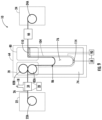
- FIG. 2 is a schematic side view of the additive manufacturing apparatus having an accumulator positioned between first and second stages in accordance with various aspects of the present disclosure
- FIG. 3 is a schematic side view of the additive manufacturing apparatus having the accumulator positioned between a stage and a resin reclamation system in accordance with various aspects of the present disclosure
- FIG. 4 is a schematic side view of the additive manufacturing apparatus having the accumulator having a pair of guides in accordance with various aspects of the present disclosure
- FIG. 5 is an enhanced view of area V of FIG. 4 in accordance with various aspects of the present disclosure
- FIG. 6 is a schematic side view of the additive manufacturing apparatus having the accumulator having a first guide configured as a guide pneumatic device and a second guide configured as a pair of rollers in accordance with various aspects of the present disclosure;
- FIG. 7 is a schematic side view of the additive manufacturing apparatus having the accumulator having the first guide configured as a pair of rollers and a second guide configured as a guide pneumatic device in accordance with various aspects of the present disclosure
- FIG. 8 is a schematic side view of the additive manufacturing apparatus having the accumulator having a first guide configured as a pneumatic plate and a second guide configured as a pair of rollers in accordance with various aspects of the present disclosure
- FIG. 9 is a schematic side view of the additive manufacturing apparatus having the accumulator having the first guide configured as a pair of rollers and a second guide configured as a pneumatic plate in accordance with various aspects of the present disclosure
- FIG. 10 is a schematic side view of the additive manufacturing apparatus having the accumulator positioned between a plurality of stages and a resin reclamation system in accordance with various aspects of the present disclosure
- FIG. 11 is a schematic side view of the additive manufacturing apparatus having a first accumulator positioned upstream of a stage and a second accumulator positioned downstream of the stage in accordance with various aspects of the present disclosure
- FIG. 12 is a schematic side view of the additive manufacturing apparatus having the first accumulator positioned downstream of the second accumulator with the stage upstream of both of the first and second accumulators in accordance with various aspects of the present disclosure
- FIG. 13 is a method of operating the manufacturing apparatus in accordance with various aspects of the present disclosure.
- FIG. 14 depicts an exemplary computing system for an additive manufacturing apparatus in accordance with various aspects of the present disclosure.
- the terms “first,” “second,” and “third” may be used interchangeably to distinguish one component from another and are not intended to signify a location or importance of the individual components.
- the terms “coupled,” “fixed,” “attached to,” and the like refer to both direct coupling, fixing, or attaching, as well as indirect coupling, fixing, or attaching through one or more intermediate components or features, unless otherwise specified herein.
- the terms “upstream” and “downstream” refer to the relative direction with respect to a foil (or resin support) movement along the manufacturing apparatus. For example, “upstream” refers to the direction from which the foil moves, and “downstream” refers to the direction to which the foil moves.
- the term “selectively” refers to a component's ability to operate in various states (e.g., an ON state and an OFF state) based on manual and/or automatic control of the component.
- Approximating language is applied to modify any quantitative representation that could permissibly vary without resulting in a change in the basic function to which it is related. Accordingly, a value modified by a term or terms, such as “about,” “approximately,” “generally,” and “substantially,” is not to be limited to the precise value specified. In at least some instances, the approximating language may correspond to the precision of an instrument for measuring the value, or the precision of the methods or apparatus for constructing or manufacturing the components and/or systems. For example, the approximating language may refer to being within a ten percent margin.
- the term “and/or,” when used in a list of two or more items, means that any one of the listed items can be employed by itself, or any combination of two or more of the listed items can be employed.
- the composition or assembly can contain A alone; B alone; C alone; A and B in combination; A and C in combination; B and C in combination; or A, B, and C in combination.
- the present disclosure is generally directed to an additive manufacturing apparatus that implements various manufacturing processes such that successive layers of material(s) are provided on each other to “build-up,” layer-by-layer, a three-dimensional component.
- the successive layers generally cure together to form a monolithic component which may have a variety of integral sub-components.
- additive manufacturing technology is described herein as enabling the fabrication of complex objects by building objects point-by-point, layer-by-layer, typically in a vertical direction, variations of the described additive manufacturing apparatus and technology are possible and within the scope of the present subject matter.
- the additive manufacturing apparatus can include a support plate, a window supported by the support plate, and a stage moveable relative to the window.
- the additive manufacturing apparatus can further include a flexible tape or foil that supports a resin.
- a radiant energy device is configured to cure a portion of the resin forming a layer of the component, which is translated towards and away from the foil by stage between successive curing operations.
- a feed module is configured to operably couple with a first end portion of a foil and a take-up module is configured to operably couple with a second end portion of a foil.
- the build zone may be positioned between the feed module and the take-up module.
- An accumulator may be positioned between the feed module and the take-up module and configured to alter the relative movement of a first portion of the foil upstream of the accumulator from a second portion of the foil downstream of the accumulator.
- the first portion of the foil may be translated at a first speed while the second portion is translated at a second speed that is different from the first speed.
- the “speed” of the foil may be a measurement of each portion of a foil (or other component) at a defined time period.
- the defined time period may be a predefined moment during a build process, such as when the foil is translated through at least one build zone, and/or at any other time during operation of the apparatus.
- the defined time period may be a defined amount of time in which the speed of the foil is averaged over the amount of time. For example, the defined amount of time may be one second or any other amount of time.
- the speed of the foil is upstream of the accumulator, the speed may be measured at any point between the feed module and the accumulator.
- the speed of the foil when the speed of the foil is downstream of the accumulator, the speed may be measured at any point between the accumulator and the take-up module and/or a subsequent accumulator downstream of the first accumulator.
- the speed of the foil within the accumulator may be varied from that of the speed of the foil upstream of the accumulator and/or downstream of the accumulator by altering an amount of foil within the accumulator.
- the speed of the foil may be measured at any defined position within the accumulator. However, when not defined, the default position at which the speed of the foil within the accumulator is measured is a point at which the foil exits a cavity of the accumulator.
- one of the first or second portion of the foil may move continuously while the other of the first or second portion of the foil moves intermittently during a predefined time period.
- the predefined time period may be an amount of time between at least two curing steps within a build zone.
- simultaneous processes may be occurring within the apparatus. For example, a curing process may be occurring on a first portion of the foil while a resin reclamation process is occurring on the second portion of the foil.
- the speed at which a component is printed may be increased, and/or any of the processes may be accomplished more efficiently.
- FIG. 1 schematically illustrates an example of one type of suitable apparatus 10 for forming a component 12 created through one or more layers of cured resin R.
- the apparatus 10 can include one or more of a support plate 14 , a window 16 , a stage 18 that is movable relative to the window 16 , and a radiant energy device 20 , which, in combination, may be used to form any number (e.g., one or more) of additively manufactured components 12 .
- the apparatus 10 includes a feed module 22 , which may include a first roller 22 A, and a take-up module 24 , which may include a second roller 24 A, that are spaced-apart and configured to couple with respective end portions of a flexible tape or foil 26 or another type of resin support extending therebetween.
- a portion of the foil 26 can be supported from underneath by the support plate 14 that defines a support plate upper surface 28 .
- Suitable mechanical supports (frames, brackets, etc.) may be provided for the rollers 22 A, 24 A and the support plate 14 .
- the first roller 22 A and/or the second roller 24 A can be configured to control the speed and direction of the foil 26 such that the desired tension and speed is maintained in the foil 26 through a drive system.
- the drive system can be configured as individual motors associated with the first roller 22 A and/or the second roller 24 A.
- various components such as motors, actuators, feedback sensors, and/or controls can be provided for driving the rollers 22 A, 24 A in such a manner so as to move at least a portion of the foil 26 between the rollers 22 A, 24 A.
- the window 16 is transparent and can be operably supported by the support plate 14 . Further, the window 16 and the support plate 14 can be integrally formed such that one or more windows 16 are integrated within the support plate 14 .
- the foil 26 is also transparent or includes portions that are transparent.
- transparent and “radiotransparent” refer to a material that allows at least a portion of radiant energy of a selected wavelength to pass through.
- the radiant energy that passes through the window 16 and the foil 26 can be in the ultraviolet spectrum, the infrared spectrum, the visible spectrum, or any other practicable radiant energy.
- Non-limiting examples of transparent materials include polymers, glass, and crystalline minerals, such as sapphire or quartz.
- the foil 26 extends between the feed module 22 and the take-up module 24 and defines a “build surface” 32 , which is shown as being planar, but could alternatively be arcuate (depending on the shape of the support plate 14 ).
- the build surface 32 may be defined by the foil 26 and be positioned to face the stage 18 with the window 16 on an opposing side of the foil 26 from the stage 18 .
- the build surface 32 may be considered to be oriented parallel to an X-Y plane of the apparatus 10 , and a direction perpendicular to the X-Y plane is denoted as a Z-axis direction (X, Y, and Z being three mutually perpendicular directions).
- the X-axis refers to the machine direction along the length of the foil 26 .
- the Y-axis refers to the transverse direction across the width of the foil 26 and generally perpendicular to the machine direction.
- the Z-axis refers to the stage direction that can be defined as the direction of movement of the stage 18 relative to the window 16 .
- the build surface 32 may be configured to be “non-stick,” that is, resistant to adhesion of a cured resin R.
- the non-stick properties may be embodied by a combination of variables such as the chemistry of the foil 26 , its surface finish, and/or applied coatings. For instance, a permanent or semi-permanent non-stick coating may be applied.
- a suitable coating is polytetrafluoroethylene (“PTFE”).
- PTFE polytetrafluoroethylene
- all or a portion of the build surface 32 may incorporate a controlled roughness or surface texture (e.g. protrusions, dimples, grooves, ridges, etc.) with nonstick properties.
- the foil 26 may be made in whole or in part from an oxygen-permeable material.
- an area or volume immediately surrounding the location of the foil 26 and the window 16 or transparent portion defined by the support plate 14 may be defined as a “build zone,” labeled 34 .
- a material depositor 36 may be positioned along the foil 26 and can include a reservoir.
- the material depositor 36 may be any device or combination of devices that is operable to apply a layer of resin R on the foil 26 .
- the material depositor 36 may optionally include a device or combination of devices to define a height of the resin R on the foil 26 and/or to level the resin R on the foil 26 .
- suitable material deposition devices include chutes, hoppers, pumps, spray nozzles, spray bars, or printheads (e.g. inkjets).
- a doctor blade may be used to control the thickness of resin R applied to the foil 26 , as the foil 26 passes the material depositor 36 .
- the resin R includes any radiant-energy curable material, which is capable of adhering or binding together the filler (if used) in the cured state.
- radiant-energy curable refers to any material which solidifies or partially solidifies in response to the application of radiant energy of a particular frequency and energy level.
- the resin R may include a photopolymer resin containing photo-initiator compounds functioning to trigger a polymerization reaction, causing the resin R to change from a liquid (or powdered) state to a solid state.
- the resin R may include a material that contains a solvent that may be evaporated out by the application of radiant energy.
- the uncured resin R may be provided in solid (e.g. granular) or liquid form, including a paste or slurry.
- the resin R can have a relatively high viscosity fluid that will not “slump” or run off during the build process.
- the composition of the resin R may be selected as desired to suit a particular application. Mixtures of different compositions may be used.
- the resin R may be selected to have the ability to out-gas or burn off during further processing, such as a sintering process.
- the resin R may incorporate a filler.
- the filler may be pre-mixed with resin R, then loaded into the material depositor 36 .
- the filler includes particles, which are conventionally defined as “a very small bit of matter.”
- the filler may include any material that is chemically and physically compatible with the selected resin R.
- the particles may be regular or irregular in shape, may be uniform or non-uniform in size, and may have variable aspect ratios.
- the particles may take the form of powder, of small spheres or granules, or may be shaped like small rods or fibers.
- the composition of the filler may be selected as desired to suit a particular application.
- the filler may be metallic, ceramic, polymeric, and/or organic.
- Other examples of potential fillers include diamond, silicon, and graphite. Mixtures of different compositions may be used.
- the filler composition may be selected for its electrical or electromagnetic properties, e.g. it may specifically be an electrical insulator, a dielectric material, an electrical conductor, and/or magnetic.
- the filler may be “fusible,” meaning it is capable of consolidation into a mass upon via application of sufficient energy.
- fusibility is a characteristic of many available powders including but not limited to polymeric, ceramic, glass, and metallic.
- the proportion of filler to resin R may be selected to suit a particular application. Generally, any amount of filler may be used so long as the combined material is capable of flowing and being leveled, and there is sufficient resin R to hold together the particles of the filler in the cured state.
- the stage 18 is a structure defining a planar surface 38 , which is capable of being oriented parallel to the build surface 32 or the X-Y plane.
- Various devices may be provided for moving the stage 18 relative to the window 16 parallel to the Z-axis direction.
- the movement may be provided through a vertical actuator 40 connected between the stage 18 and a static support 42 , with the understanding that devices such as ballscrew electric actuators, linear electric actuators, pneumatic cylinders, hydraulic cylinders, delta drives, or any other practicable device may additionally or alternatively be used for this purpose.
- the foil 26 could be movable parallel to the Z-axis direction.
- the radiant energy device 20 may be configured as any device or combination of devices operable to generate and project radiant energy on the resin R in a suitable pattern and with a suitable energy level and other operating characteristics to cure the resin R during the build process.
- the radiant energy device 20 may include a projector 44 , which may generally refer to any device operable to generate a radiant energy patterned image of suitable energy level and other operating characteristics to cure the resin R.
- the term “patterned image” refers to a projection of radiant energy comprising an array of one or more individual pixels.
- Non-limiting examples of patterned imaged devices include a DLP projector or another digital micromirror device, a two-dimensional array of LEDs, a two-dimensional array of lasers, and/or optically addressed light valves.
- the projector 44 includes a radiant energy source 46 such as a UV lamp, an image forming apparatus 48 operable to receive a source beam 50 from the radiant energy source 46 and generate a patterned image 52 to be projected onto the surface of the resin R, and optionally focusing optics 54 , such as one or more lenses.
- the image forming apparatus 48 may include one or more mirrors, prisms, and/or lenses and is provided with suitable actuators, and arranged so that the source beam 50 from the radiant energy source 46 can be transformed into a pixelated image in an X-Y plane coincident with the surface of the resin R.
- the image forming apparatus 48 may be a digital micro-mirror device.
- the projector 44 may incorporate additional components, such as actuators, mirrors, etc. configured to selectively move the image forming apparatus 48 or other part of the projector 44 with the effect of rastering or shifting the location of the patterned image on the build surface 32 . Stated another way, the patterned image may be moved away from a nominal or starting location.
- the radiant energy device 20 may include a “scanned beam apparatus” used herein to refer generally to any device operable to generate a radiant energy beam of suitable energy level and other operating characteristics to cure the resin R and to scan the beam over the surface of the resin R in a desired pattern.
- the scanned beam apparatus can include a radiant energy source 46 and a beam steering apparatus.
- the radiant energy source 46 may include any device operable to generate a beam of suitable power and other operating characteristics to cure the resin R.
- suitable radiant energy sources 46 include lasers or electron beam guns.
- the apparatus 10 may be operably coupled with a computing system 58 .
- the computing system 58 in FIG. 1 is a generalized representation of the hardware and software that may be implemented to control the operation of the apparatus 10 , including some or all of the stage 18 , the radiant energy device 20 , actuators, and the various parts of the apparatus 10 described herein.
- the computing system 58 may be embodied, for example, by software running on one or more processors embodied in one or more devices such as a programmable logic controller (“PLC”) or a microcomputer.
- PLC programmable logic controller
- Such processors may be coupled to process sensors and operating components, for example, through wired or wireless connections.
- the same processor or processors may be used to retrieve and analyze sensor data, for statistical analysis, and for feedback control. Numerous aspects of the apparatus 10 may be subject to closed-loop control.
- the components of the apparatus 10 may be surrounded by a housing 60 , which may be used to provide a shielding or inert gas (e.g., a “process gas”) atmosphere using gas ports 62 .
- a shielding or inert gas e.g., a “process gas”
- pressure within the housing could be maintained at a desired level greater than or less than atmospheric.
- the housing could be temperature and/or humidity controlled.
- ventilation of the housing could be controlled based on factors such as a time interval, temperature, humidity, and/or chemical species concentration.
- the housing 60 can be maintained at a pressure that is different than an atmospheric pressure.
- the accumulator may be positioned between two components along the foil path of the apparatus.
- the accumulator 64 may be positioned between a pair of build zones 34 .
- the accumulator 64 may be positioned between a build zone 34 and a resin reclamation system 66 .
- the reclamation system 66 may be configured to remove at least a portion of uncured resin R that remains on the foil 26 after the foil 26 is removed from a build zone 34 .
- the reclamation system 66 may include a wiper assembly, a blade assembly, and/or any other removal assembly and a reservoir for collecting the resin R that is removed from the foil 26 .
- the accumulator 64 may be configured to retain an intermediate portion 68 of the foil 26 .
- a first portion 70 of the foil 26 upstream of the accumulator 64 and a second portion 72 of the foil 26 downstream of the accumulator 64 By retaining the intermediate portion 68 of the foil 26 , the first and second portions 70 , 72 of the foil 26 may be moved independently of one another.
- the first portion 70 of the foil 26 upstream of the accumulator 64 can move at a first speed while the second portion 72 of the foil 26 downstream of the accumulator 64 can move at a second speed.
- first portion 70 of the foil 26 upstream of the accumulator 64 can move intermittently while the second portion 72 of the foil 26 downstream of the accumulator 64 can move continuously. Additionally, or alternatively, the first portion 70 of the foil 26 upstream of the accumulator 64 can move continuously while the second portion 72 of the foil 26 downstream of the accumulator 64 can move intermittently. Further, the first portion 70 and/or the second portion 72 of the foil 26 may move in any other manner independent of one another without departing from the teachings provided herein.
- the accumulator 64 may include an accumulator housing 74 defining a cavity 76 therein.
- the cavity 76 is configured to house the intermediate portion 68 of the foil 26 .
- the accumulator may be free of a housing and/or a cavity. Further, in some embodiments, the accumulator may be in line with the foil path.
- the intermediate portion 68 of the foil 26 may be of variable length during operation of the apparatus 10 .
- a first length of foil 26 may be within the cavity 76 during a first period of time during operation of the apparatus 10 and a second length of foil 26 may be within the cavity 76 during a second period of time after the first period of time.
- the second length of foil 26 may be equal to, less than, or greater than the first length based on the operations of the apparatus 10 .
- one or more guides 78 , 80 may be operably coupled with the accumulator housing 74 to assist or direct the foil 26 from a position upstream of the cavity 76 into the cavity 76 and/or downstream of the cavity 76 out of the cavity 76 .
- the one or more guides 78 , 80 may be configured as first and second rollers 82 , 84 positioned on opposing sides of the cavity 76 .
- the accumulator 64 may include a material retention assembly 86 to retain the foil 26 .
- the material retention assembly 86 may include one or more retaining rollers 96 within the cavity 76 defined by the accumulator 64 .
- the one or more retaining rollers 96 may be configured to maintain the foil 26 in a within the cavity 76 .
- the retaining roller 96 may be configured to pull the foil 26 towards a bottom portion 100 of the cavity 76 by providing a force on the first side of the foil 26 .
- the retaining roller 96 may be configured to move at least partially within the cavity 76 and/or may be stationary within a predefined location within the cavity 76 .
- the one or more retaining rollers 96 may be configured as a dimpled roller or the like to provide a tension across the width of the foil while minimizing contact with the foil 26 and/or any resin R disposed on the foil 26 . Additionally or alternatively, the one or more retaining rollers 96 may be configured to contact an outer perimeter of the foil 26 that is outside of the resin R such that the one or more retaining rollers 96 remains free of resin R as the foil 26 moves from the feed module 22 towards the take-up module 24 .
- an actuator 98 may be operably coupled with the one or more retaining rollers 96 and configured to alter a position of the one or more retaining rollers 96 .
- the actuator may also be communicatively coupled with the computing system 58 .
- the material retention assembly 86 can include one or more pneumatic actuation zones 88 with each pneumatic actuation zone 88 configured to selectively interact with the foil 26 by producing a force on a surface of the foil 26 opposite the resin R.
- the one or more pneumatic actuation zones 88 may apply a negative pressure on a first surface of the foil 26 that is opposite to the resin, or a second side of the foil 26 , to produce a suction or vacuum on the foil 26 .
- the negative pressure may retain the foil 26 in a desired position within the cavity 76 .
- a “negative” pressure is any pressure that is less than an ambient pressure proximate to one or more pneumatic actuation zones 88 such that fluid may be drawn into the one or more pneumatic actuation zones 88 .
- a “positive” pressure is any pressure that is greater than an ambient pressure proximate to one or more pneumatic actuation zones 88 such that fluid may be exhausted from the one or more pneumatic actuation zones 88 .
- a “neutral” pressure is any pressure that is generally equal to an ambient pressure proximate to one or more pneumatic actuation zones 88 .
- the pneumatic actuation zones 88 may be fluidly coupled with a pneumatic assembly 90 through various hoses and one or more ports.
- the pneumatic assembly 90 may include any device capable of providing a vacuum/suction and/or pushing a fluid, such as air or a process gas (e.g., nitrogen or argon), through the one or more pneumatic actuation zones 88 .
- the pneumatic assembly 90 may include a pressurized fluid source that includes a compressor and/or a blower.
- the pneumatic assembly 90 may additionally or alternatively include any assembly capable of altering a pressure, such as a venturi vacuum pump.
- one or more valves and/or switches may be coupled with the pneumatic assembly 90 and the one or more pneumatic actuation zones 88 .
- the one or more valves and/or switches are configured to regulate a pressure to each of the one or more pneumatic actuation zones 88 .
- an enhanced view of area V of FIG. 4 illustrates an exemplary pneumatic actuation zone 88 that includes one or more apertures 92 of any size and shape for interacting with the foil 26 .
- the apertures 92 may be any number and combination of holes, slits, or other geometric shapes defined by any component of the additive manufacturing apparatus 10 , such as an inner surface of the housing.
- the apertures 92 may be defined by a portion of the housing being formed from a porous material, or through any other assembly in which a fluid may be moved from a first side of the inner surface of the housing to a second side of the inner surface of the housing to interact with the foil 26 .
- the pneumatic actuation zone 88 may be defined by a plenum 94 .
- the plenum 94 may be of any size and may be similar or varied from the shape of any remaining plenums 94 .
- a gasket may be positioned about a rim of the plenum 94 .
- the one or more pneumatic actuation zones 88 of the material retention assembly 86 may be configured to interact with a first side of the foil 26 while the resin R is provided on a second, opposing side of the foil 26 .
- the accumulator 64 may include a support 102 that is configured to interact with the first side of the foil 26 .
- the support 102 may include a pneumatic zone such that the first side of the foil 26 may be drawn towards the support 102 when a negative pressure is experienced through the support 102 .
- the retaining roller 96 and/or the support 102 of FIGS. 6 and 7 may be operably coupled with a track assembly 104 that guides movement of the retaining roller 96 and/or the support 102 along the cavity 76 .
- the track assembly 104 may be of any configuration such as a guide and/or a swing arm and may utilize electronic control, mechanical control (spring(s)), pneumatic control, or any other control for directing the retaining roller 96 and/or the support 102 within the cavity 76 .
- the track assembly 104 may be of any geometric shape and may have generally linear and/or curved portions.
- a detection system 106 may be positioned within the accumulator 64 .
- the detection system 106 may be capable of providing data related to one or more conditions of the accumulator 64 and/or the foil 26 within the accumulator 64 .
- the computing system 58 may determine a length of the foil 26 within the accumulator 64 , a distance from a lowermost portion of the foil 26 above a bottom portion 100 of the cavity 76 , an amount of foil 26 within the cavity 76 of the accumulator 64 , a change in the amount of foil 26 within the accumulator 64 , a speed at which the foil 26 enters and/or exits the cavity 76 , and/or any other information.
- various portions of the foil 26 may be moved at different speeds relative to one another and/or a first portion 70 of the foil 26 may move intermittently (e.g., stopped for at least a portion of time during a predefined time period) while a second portion 72 of the foil 26 may be configured to move continuously during the predefined time period.
- the detection system 106 may include a sensor 114 , which may be positioned within the accumulator 64 and/or otherwise configured to detect data related to one or more conditions of the accumulator 64 and/or the foil 26 within the accumulator 64 .
- the sensor 114 may be embodied as one or more imagers or any other vision-based device.
- the sensor 114 may additionally and/or alternatively be configured as any other practicable proximity sensor, such as, but not limited to, an ultrasonic sensor, a radar sensor, a LIDAR sensor, or the like.
- the detection system 106 may include one or more bypass holes 122 defined by the accumulator housing 74 along the cavity 76 of the accumulator 64 .
- the bypass holes 122 may be defined within a cavity plate 124 that extends rearwardly and/or forwardly of the cavity 76 .
- the accumulator 64 may include both forwardly and rearwardly cavity plates 124 that extend along opposing open ends of the cavity 76 .
- the one or more bypass holes 122 may be defined by the housing 74 and extend along the housing 74 within the cavity 76 .
- the bypass holes 122 may form a passive valve system in which the position of the foil 26 within the cavity 76 may be determined by detecting which holes 122 have a vacuum pulled thereon and which holes 122 do not have a flow. For example, when the foil 26 does not extend beyond a respective bypass hole 122 , a negative pressure will be provided on the bypass hole 122 . Conversely, when the foil 26 extends beyond a respective bypass hole 122 , the negative pressure detected by the bypass hole 122 may be reduce and/or no longer present. As such, based on which bypass holes 122 have a negative pressure thereon, the location of the foil 26 within the cavity 76 may be generally provided to the computing system 58 as data.
- the one or more guides 78 , 80 of the accumulator 64 includes a first guide 78 on a first side of the cavity 76 and/or a second guide 80 on a second side of the cavity 76 to assist or direct the foil 26 from a position upstream of the cavity 76 into the cavity 76 and/or downstream of the cavity 76 out of the cavity 76 .
- Each of the first and second guides 78 , 80 may be configured to move the foil 26 in a predetermined direction and/or retain the foil 26 in a predetermined position.
- the one or more guides 78 , 80 can be configured to control the speed and direction of the foil 26 into and/or out of the accumulator 64 .
- the one or more guides 78 , 80 can include motors, actuators, feedback sensors, and/or controls for driving the one or more guides 78 , 80 in such a manner so as to maintain the foil 26 tensioned between the feedback module and the take-up module 24 .
- the first guide 78 may be configured to drive movement of the foil 26 from the feed module 22 to the accumulator 64 and the feed module 22 may be configured to control the tension of the foil 26 between the feed module 22 and the first guide 78 .
- the take-up module 24 may be configured to drive a movement of the foil 26 from the accumulator 64 to the take-up module 24 and the second guide 80 may be configured to control the tension of the foil 26 between the take-up module 24 and the second guide 80 .
- the first and second guides 78 , 80 may each be configured as a pair of rollers 82 A, 82 B, 84 A, 84 B positioned on opposing first and second sides of the foil 26 .
- Each respective pair of rollers 82 A, 82 B, 84 A, 84 B may contain a first roller 82 A, 84 A positioned on a first side of the foil 26 and a second roller 82 B, 84 B positioned on a second, opposing side of the foil 26 .
- first and second rollers 82 A, 82 B, 84 A, 84 B contacts the foil 26 such that the foil 26 may be pinched or otherwise retained between each set of the first and second rollers 82 A, 82 B, 84 A, 84 B.
- the first rollers 82 A, 84 A may be configured as a dimpled roller or the like to provide a tension across the width of the foil while minimizing contact with the foil 26 and/or any resin R disposed on the foil 26 .
- first rollers 82 A, 84 A may be configured to contact an outer perimeter of the foil 26 that is outside of the resin R such that the roller 82 A, 84 A remains free of resin R as the foil 26 moves from the feed module 22 towards the take-up module 24 .
- the first and/or the second guide 80 may include a guide pneumatic device 108 that is configured to draw the foil 26 towards the guide pneumatic device 108 when a negative pressure is provided through the guide pneumatic device 108 .
- the respective first guide 78 and/or the second guide 80 may include a single roller positioned below the bottom side of the foil 26 .
- the first guide 78 and/or the second guide 80 may be configured as a pneumatic plate 110 .
- the suction plate may be integrated into the accumulator housing 74 , the support plate 14 , and/or any other component of the apparatus 10 .
- the bottom side of the foil 26 may be drawn towards the pneumatic plate 110 when a negative pressure is provided through the pneumatic plate 110 .
- a positive pressure may be provided through the pneumatic plate 110 to blow the bottom side of the foil 26 away from the accumulator housing 74 or any other component of the apparatus 10 .
- FIG. 10 a schematic drawing is provided illustrating a plurality of stages 18 in parallel positioned between the material depositor 36 and the accumulator 64 in accordance with an exemplary embodiment of the present disclosure.
- Each of the plurality of stages 18 may define an independent build zone 34 .
- the accumulator 64 may include one or more guides 78 , 80 that includes a first guide 78 on a first side of the cavity 76 and a second guide 80 on an opposing, second side of the cavity 76 .
- the first guide 78 may drive the foil 26 from the feed module 22 through the plurality of build zones 34 and the feed module 22 may maintain a tension of the foil 26 between the feed module 22 and the first guide 78 .
- first guide 78 may also push the foil 26 therethrough and into the cavity 76 of the accumulator 64 .
- the take-up module 24 may be used to drive the foil 26 downstream of the accumulator 64 and/or pull foil 26 from the accumulator 64 while the second guide 80 controls a tension of the foil 26 downstream of the second guide 80 .
- FIGS. 11 and 12 schematic drawings are provided illustrating various exemplary embodiments that include multiple accumulators 64 .
- the multiple accumulators 64 may be positioned upstream and downstream of a build zone 34 , as exemplarily illustrated in FIG. 11 . Additionally, or alternatively, as illustrated in FIG. 12 , the accumulators 64 may be respectively positioned such that each of the build zones 34 and/or other assemblies are upstream and/or downstream of both of the accumulators 64 .
- the material depositor 36 may be positioned between the feed module 22 and a first accumulator 64 A.
- a first portion 116 of the foil 26 may be defined between the feed module 22 and the first accumulator 64 A.
- One or more build zones 34 may be positioned downstream of the first accumulator 64 A and upstream of a second accumulator 64 B.
- a second portion 118 of the foil 26 may be defined between the first and the second accumulators 64 A, 64 B.
- a take-up module 24 may be downstream of the second accumulator 64 B and a third portion 120 of foil 26 may be defined between the second accumulator 64 B and the take-up module 24 .
- a resin reclamation system 66 and/or another unit 112 may be positioned between the second accumulator 64 B and the take-up module 24 and/or at any position between the feed module and the take-up module.
- the unit 112 may accomplish any process that interacts with the foil 26 , such as quality a process (e.g., image analysis of the foil 26 ).
- the first portion 116 of the foil 26 may move between the feed module 22 and the first accumulator 64 A at a first speed, while the second portion 118 of the foil 26 may move between the first and second accumulators 64 A, 64 B at a second speed, and the third portion 120 of the foil 26 may move between the second accumulator 64 B and the take-up module 24 at a third speed.
- at least one of the first speed, the second speed, and/or the third speed may be different from any of the remaining speeds.
- the resin R may be deposited on the foil 26 upstream of the first accumulator 64 A while the first portion 116 of foil 26 moves at a first speed.
- the second portion 118 of the foil 26 may be operated through one or more build zones 34 at a second speed.
- the third portion 120 of the foil 26 may have at least a portion of the resin R remaining thereon that is removed through the reclamation system 66 with the third portion 120 of the foil 26 moving at the third speed.
- first portion 116 , the second portion 118 , and/or third portion 120 of the foil 26 may each independently move in a continuous manner and/or intermittently over various time periods.
- first portion 116 of the foil 26 may move in a generally continuously move while the second portion 118 and/or the third portion 120 of the foil 26 move intermittently.
- second portion 118 of the foil 26 may move continuously while the first portion 116 and/or the third portion 120 of the foil 26 move intermittently.
- the third portion 120 of the foil 26 may move continuously while the first portion 116 and/or the second portion 118 of the foil 26 move intermittently.
- the foil 26 within any of the one or more accumulators 64 A, 64 B may move at a speed that is different or equal to any other to the other portions of the foil 26 .
- the foil 26 in any one or more of the accumulators 64 A, 64 B may be stationary for various time periods. The intermittent movement of the foil 26 may be independent of any of the portions of the foil 26 that are external to the one or more accumulators 64 A, 64 B of the apparatus 10 .
- a schematic drawing is provided of an exemplary embodiment in which a pair of accumulators 64 A, 64 B are each positioned downstream of a plurality of build zones 34 and upstream of a post-curing process, such as a resin reclamation process that may be accomplished through the reclamation system 66 .
- a post-curing process such as a resin reclamation process that may be accomplished through the reclamation system 66 .
- one of the first accumulator 64 A or the second accumulator 64 B may be timed to the cycle while the second of the first accumulator 64 A or the second accumulator 64 B may function as a buffer in case the first accumulator 64 A and/or another portion of the apparatus 10 has temporary disturbances.
- the foil 26 may pass above the cavity 76 of the second accumulator 64 B and into the cavity 76 of the first accumulator 64 A when the first accumulator 64 A is functioning correctly. Additionally, or alternatively, in instances when the computing system determines that the foil 26 is close to the bottom portion 100 of the first accumulator 64 A, the second accumulator 64 B may accept the foil 26 into the cavity 76 thereof.
- a method 200 for operating an additive manufacturing apparatus is provided.
- the method 200 can be used to operate the additive manufacturing apparatus and the one or more accumulators, or any other suitable additive manufacturing apparatus having any type and configuration of positioning assembly. It should be appreciated that the example method 200 is discussed herein only to describe example aspects of the present subject matter and is not intended to be limiting.
- the method 200 includes, at step 202 , moving a first portion of a foil a first distance during a defined time period, wherein the first portion of the foil is positioned upstream of an accumulator. As the first portion of the foil is moved the first distance during the defined time period, one or more operations may be performed that incorporate the first portion of the foil. Moreover, at step 204 , the method can include continuously translating the first portion of the foil the first distance during the defined time period at a generally constant speed. At step 206 , when the first portion of the foil is being translated, the method can include depositing a layer of an uncured resin onto the foil. As provided herein, a material depositor may be positioned along the foil and is operable to apply the layer of uncured resin over the foil.
- the method at step 208 can include intermittently translating the first portion the foil the first distance during the defined time period.
- the method can include maintaining a position of the first portion of the foil having the resin deposited thereon within a build zone.
- the method can include moving the stage to contact the resin on the second side of the foil, and, at step 214 , the method can include curing at least a portion of the uncured layer of resin to create a newly cured layer of the component through the use of a radiant energy device.
- the method can include moving a second portion of the foil a second distance during the defined time period, wherein the second portion of the foil is positioned downstream of the accumulator. In various embodiments, the second distance is different from the first distance.
- the method can include interacting with the second portion of the foil during the defined time period.
- interacting with the second portion of the foil during the defined time period comprises translating the second portion of the foil through a reclamation system.
- interacting with the second portion of the foil during the defined time period comprises performing a quality measurement on the second portion of the foil.
- an accumulator is positioned between the first and second portions of the foil.
- the method includes maintaining an intermediate portion of the foil between the first and second portions within the accumulator.
- the accumulator may define a cavity and the intermediate portion of the foil may be disposed within the cavity.
- the method at step 226 , can include maintaining the intermediate portion of the foil between the first and second portions within the accumulator by producing a negative pressure on a surface of the intermediate portion of the foil.
- the method can further include, determining a length of foil within the cavity, which may be accomplished through the use of one or more sensors.
- the method can further include adjusting the movement of the first portion and/or the second portion of the foil based on the length of the foil within the cavity. For example, in some embodiments, the foil length may be maintained within a predefined range during operation. If the length of the foil within the cavity is below a lower threshold of the range, the first portion of the foil may be translated at an increased speed and/or a quicker interval. Additionally, or alternatively, the second portion of the foil may be translated at a reduced speed and/or a slower interval.
- the first portion of the foil may be translated at a reduced speed and/or a slower interval.
- the second portion of the foil may be translated at an increased speed and/or a quicker interval.
- a priority may be determined in which the speed and/or interval at which one of the first or second portion is changed may occur before the other of the first or second portion of the foil is changed. For example, the movement of the second portion of the foil may be altered prior to alteration of the first portion of the foil.
- both the first distance and/or the second distance may be any length from zero meters to any defined length within the defined time period. In instances in which the first distance and/or the second distance is zero, the first portion of the foil and/or the second portion of the foil is generally stationary during the defined time period.
- FIG. 14 depicts certain components of computing system 58 according to example embodiments of the present disclosure.
- the computing system 58 can include one or more computing device(s) 58 A which may be used to implement the method 200 such as described herein.
- the computing device(s) 58 A can include one or more processor(s) 58 B and one or more memory device(s) 58 C.
- the one or more processor(s) 58 B can include any suitable processing device, such as a microprocessor, microcontroller, integrated circuit, an application specific integrated circuit (ASIC), a digital signal processor (DSP), a field-programmable gate array (FPGA), logic device, one or more central processing units (CPUs), graphics processing units (GPUs) (e.g., dedicated to efficiently rendering images), processing units performing other specialized calculations, etc.
- the memory device(s) 58 C can include one or more non-transitory computer-readable storage medium(s), such as RAM, ROM, EEPROM, EPROM, flash memory devices, magnetic disks, etc., and/or combinations thereof.
- the memory device(s) 58 C can include one or more computer-readable media and can store information accessible by the one or more processor(s) 58 B, including instructions 58 D that can be executed by the one or more processor(s) 58 B.
- the instructions 58 D may include one or more steps of the method 200 described above, such as to execute operations of the material retention assembly 86 of the additive manufacturing apparatus 10 described above.
- the memory device(s) 58 C can store instructions 58 D for running one or more software applications, displaying a user interface, receiving user input, processing user input, etc.
- the instructions 58 D can be executed by the one or more processor(s) 58 B to cause the one or more processor(s) 58 B to perform operations, e.g., such as one or more portions of methods described herein.
- the instructions 58 D can be software written in any suitable programming language or can be implemented in hardware. Additionally, and/or alternatively, the instructions 58 D can be executed in logically and/or virtually separate threads on processor(s) 58 B.
- the one or more memory device(s) 58 C can also store data 58 E that can be retrieved, manipulated, created, or stored by the one or more processor(s) 58 B.
- the data 58 E can include, for instance, data to facilitate performance of the method 200 described herein.
- the data 58 E can be stored in one or more database(s).
- the one or more database(s) can be connected to computing system 58 by a high bandwidth LAN or WAN or can also be connected to the computing system through network(s) (not shown).
- the one or more database(s) can be split up so that they are located in multiple locales.
- the data 58 E can be received from another device.
- the computing device(s) 58 A can also include a communication module or interface 58 F used to communicate with one or more other component(s) of computing system 58 or the additive manufacturing apparatus 10 over the network(s).
- the communication interface 58 F can include any suitable components for interfacing with one or more network(s), including, for example, transmitters, receivers, ports, controllers, antennas, or other suitable components.
- the additive manufacturing apparatus is described herein only for the purpose of explaining aspects of the present subject matter.
- the additive manufacturing apparatus may have any other suitable configuration and may use any other suitable additive manufacturing technology.
- the additive manufacturing apparatus and processes or methods described herein may be used for forming components using any suitable material.
- the material may be plastic, metal, concrete, ceramic, polymer, epoxy, photopolymer resin, or any other suitable material that may be embodied in a layer of slurry, resin, or any other suitable form of sheet material having any suitable consistency, viscosity, or material properties.
- the additively manufactured components described herein may be formed in part, in whole, or in some combination of materials including but not limited to pure metals, nickel alloys, chrome alloys, titanium, titanium alloys, magnesium, magnesium alloys, aluminum, aluminum alloys, iron, iron alloys, stainless steel, and nickel or cobalt based superalloys (e.g., those available under the name Inconel® available from Special Metals Corporation). These materials are examples of materials suitable for use in the additive manufacturing processes described herein and may be generally referred to as “additive materials.”
- An additive manufacturing apparatus comprising a feed module configured to operably couple with a first end portion of a foil; a take-up module configured to operably couple with a second end portion of a foil; at least one stage configured to hold one or more cured layers of a resin that form a component; a radiant energy device positioned opposite to the at least one stage, the radiant energy device operable to generate and project radiant energy in a predetermined pattern; an actuator configured to change a relative position of the at least one stage and the foil; and an accumulator positioned between the feed module and the take-up module, the accumulator configured to retain an intermediate portion of the foil to allow a first portion of the foil upstream of the accumulator to move at a first speed and a second portion of the foil downstream of the accumulator to move at a second speed during a defined time period.
- the accumulator defines a cavity, the cavity configured to retain at least a section of the intermediate portion of the foil.
- the additive manufacturing apparatus of one or more of these clauses further comprising a reclamation system configured to remove at least a portion of the resin from the foil.
- the accumulator is configured to allow the first portion of the foil upstream of the accumulator to move intermittently while the second portion of the foil downstream of the accumulator to move continuously.
- the material retention assembly includes a pneumatic actuation zone that is configured to selectively interact with the foil by producing a force on a first side of the foil, the first side of the foil being opposite the resin.
- the material retention assembly includes at least one retaining roller within a cavity defined by the accumulator.
- the additive manufacturing apparatus of one or more of these clauses further comprising a sensor configured to detect a length of the foil within the accumulator.
- the additive manufacturing apparatus of one or more of these clauses further comprising a computing system operably coupled with a detection system, the computing system configured to determine a speed of the second portion of the foil downstream of the accumulator based on an amount of the foil within the cavity.
- the additive manufacturing apparatus of one or more of these clauses further comprising one or more guides within the accumulator, the one or more guides including at least one roller or at least one pneumatic device configured to contact the foil externally from a cavity of the accumulator.
- the at least one stage includes a plurality of stages in parallel, and wherein each of the plurality of stages are positioned between a material depositor and the accumulator.
- a method of operating an additive manufacturing apparatus comprising moving a first portion of a foil a first distance during a defined time period, wherein the first portion of the foil is positioned upstream of an accumulator; and moving a second portion of the foil a second distance during the defined time period, wherein the second portion of the foil is positioned downstream of the accumulator, and wherein the second distance is different from the first distance.
- maintaining the intermediate portion of the foil between the first and second portions within the accumulator further comprises producing a negative pressure on a surface of the intermediate portion of the foil.
- An additive manufacturing apparatus comprising a feed module configured to operably couple with a first end portion of a foil; a take-up module configured to operably couple with a second end portion of a foil; a stage configured to hold one or more cured layers of a resin that form a component; a radiant energy device positioned opposite to the stage, radiant energy device operable to generate and project radiant energy in a predetermined pattern; an actuator configured to change a relative position of the stage and the foil; a reclamation system configured to remove at least a portion of the resin from the foil; and an accumulator positioned between the stage and the reclamation system.
Landscapes
- Chemical & Material Sciences (AREA)
- Engineering & Computer Science (AREA)
- Materials Engineering (AREA)
- Manufacturing & Machinery (AREA)
- Physics & Mathematics (AREA)
- Mechanical Engineering (AREA)
- Optics & Photonics (AREA)
- Life Sciences & Earth Sciences (AREA)
- Sustainable Development (AREA)
Abstract
Description
Claims (20)
Priority Applications (5)
| Application Number | Priority Date | Filing Date | Title |
|---|---|---|---|
| US17/186,685 US11865780B2 (en) | 2021-02-26 | 2021-02-26 | Accumalator assembly for additive manufacturing |
| EP25164667.5A EP4545300A3 (en) | 2021-02-26 | 2022-01-25 | Accumulator assembly for additive manufacturing |
| EP22153188.2A EP4049830B1 (en) | 2021-02-26 | 2022-01-25 | Accumulator assembly for additive manufacturing |
| JP2022027133A JP7263581B2 (en) | 2021-02-26 | 2022-02-24 | Additive Manufacturing Equipment and Method of Operating Additive Manufacturing Equipment |
| US18/524,972 US12434436B2 (en) | 2021-02-26 | 2023-11-30 | Accumalator assembly for additive manufacturing |
Applications Claiming Priority (1)
| Application Number | Priority Date | Filing Date | Title |
|---|---|---|---|
| US17/186,685 US11865780B2 (en) | 2021-02-26 | 2021-02-26 | Accumalator assembly for additive manufacturing |
Related Child Applications (1)
| Application Number | Title | Priority Date | Filing Date |
|---|---|---|---|
| US18/524,972 Continuation US12434436B2 (en) | 2021-02-26 | 2023-11-30 | Accumalator assembly for additive manufacturing |
Publications (2)
| Publication Number | Publication Date |
|---|---|
| US20220274335A1 US20220274335A1 (en) | 2022-09-01 |
| US11865780B2 true US11865780B2 (en) | 2024-01-09 |
Family
ID=80034812
Family Applications (2)
| Application Number | Title | Priority Date | Filing Date |
|---|---|---|---|
| US17/186,685 Active US11865780B2 (en) | 2021-02-26 | 2021-02-26 | Accumalator assembly for additive manufacturing |
| US18/524,972 Active US12434436B2 (en) | 2021-02-26 | 2023-11-30 | Accumalator assembly for additive manufacturing |
Family Applications After (1)
| Application Number | Title | Priority Date | Filing Date |
|---|---|---|---|
| US18/524,972 Active US12434436B2 (en) | 2021-02-26 | 2023-11-30 | Accumalator assembly for additive manufacturing |
Country Status (3)
| Country | Link |
|---|---|
| US (2) | US11865780B2 (en) |
| EP (2) | EP4049830B1 (en) |
| JP (1) | JP7263581B2 (en) |
Cited By (1)
| Publication number | Priority date | Publication date | Assignee | Title |
|---|---|---|---|---|
| US20210229208A1 (en) * | 2020-01-24 | 2021-07-29 | Divergent Technologies, Inc. | Ultraviolet radiation sensing and beam control in electron beam additive manufacturing |
Families Citing this family (2)
| Publication number | Priority date | Publication date | Assignee | Title |
|---|---|---|---|---|
| US11707883B2 (en) | 2020-11-20 | 2023-07-25 | General Electric Company | Foil interaction device for additive manufacturing |
| US11826950B2 (en) | 2021-07-09 | 2023-11-28 | General Electric Company | Resin management system for additive manufacturing |
Citations (83)
| Publication number | Priority date | Publication date | Assignee | Title |
|---|---|---|---|---|
| US2259517A (en) | 1939-04-06 | 1941-10-21 | Western Union Telegraph Co | Tape accumulator |
| US3710846A (en) | 1970-01-14 | 1973-01-16 | I Properzi | Continuous casting apparatus |
| US4752498A (en) | 1987-03-02 | 1988-06-21 | Fudim Efrem V | Method and apparatus for production of three-dimensional objects by photosolidification |
| US5096530A (en) | 1990-06-28 | 1992-03-17 | 3D Systems, Inc. | Resin film recoating method and apparatus |
| US5314711A (en) | 1991-09-30 | 1994-05-24 | Gisulfo Baccini | Method and apparatus for printing green-tape foil circuits |
| JPH07164534A (en) | 1993-12-14 | 1995-06-27 | Teijin Seiki Co Ltd | Stereolithography method and stereolithography apparatus |
| US5447822A (en) | 1989-09-28 | 1995-09-05 | 3D Systems, Inc. | Apparatus and related method for forming a substantially flat stereolithographic working surface |
| US5650260A (en) | 1993-10-14 | 1997-07-22 | Teijin Seiki Co., Ltd. | Method and apparatus for fabricating three-dimensional object |
| US5717599A (en) | 1994-10-19 | 1998-02-10 | Bpm Technology, Inc. | Apparatus and method for dispensing build material to make a three-dimensional article |
| US5824184A (en) | 1994-08-10 | 1998-10-20 | Seiko Epson Corporation | Structure for removing a peel-off backing from an adhesive tape |
| US5895547A (en) | 1997-03-06 | 1999-04-20 | Tc Manufacturing Co., Inc. | Laminate process and apparatus |
| JP2002370286A (en) | 2001-04-23 | 2002-12-24 | Envision Technologies Gmbh | Apparatus and method for separating material layer |
| JP2003039564A (en) | 2001-04-20 | 2003-02-13 | Envision Technologies Gmbh | Apparatus for forming three-dimensional matter |
| US20030180171A1 (en) | 2001-03-07 | 2003-09-25 | Advanced Ceramics Research, Inc. | Method for preparation of metallic and ceramic foam products and products made |
| US6668892B2 (en) | 1999-06-11 | 2003-12-30 | 3M Innovative Properties Company | System for printing and applying tape onto surfaces |
| US6914406B1 (en) | 2002-12-02 | 2005-07-05 | River Solutions, Inc. | Electric actuator to produce a predetermined force |
| US6974521B2 (en) | 2000-10-18 | 2005-12-13 | Katholieke Universiteit Nijmegen | Method for separating a film and a substrate |
| US7022207B2 (en) | 2002-04-03 | 2006-04-04 | 3M Innovative Properties Company | Method and apparatus for peeling a thin film from a liner |
| US7351304B2 (en) | 2005-05-24 | 2008-04-01 | General Electric Company | Method and apparatus for reducing surface defects |
| US7575682B2 (en) | 2003-11-19 | 2009-08-18 | Amcol International Corporation | Contaminant-reactive geocomposite mat and method of manufacture and use |
| US7698947B2 (en) | 2005-08-26 | 2010-04-20 | The Boeing Company | Rapid prototype integrated matrix ultrasonic transducer array inspection apparatus, systems, and methods |
| US7845930B2 (en) | 2004-05-07 | 2010-12-07 | Envisiontec Gmbh | Process for the production of a three-dimensional object with an improved separation of hardened material layers from a construction plane |
| US20110089610A1 (en) | 2009-10-19 | 2011-04-21 | Global Filtration Systems | Resin Solidification Substrate and Assembly |
| US8003040B2 (en) | 2007-10-26 | 2011-08-23 | Envisiontec Gmbh | Process and freeform fabrication system for producing a three-dimensional object |
| US8029642B2 (en) | 2007-07-27 | 2011-10-04 | The Boeing Company | Tape removal apparatus and process |
| US8048261B2 (en) | 2007-08-10 | 2011-11-01 | The Boeing Company | Tape removal apparatus and process for use with an automated composite tape laying machine |
| US8070473B2 (en) | 2008-01-08 | 2011-12-06 | Stratasys, Inc. | System for building three-dimensional objects containing embedded inserts, and method of use thereof |
| US8105066B2 (en) | 2007-01-17 | 2012-01-31 | 3D Systems, Inc. | Cartridge for solid imaging apparatus and method |
| US8191500B2 (en) | 2005-11-24 | 2012-06-05 | Kronoplus Technical Ag | Coating device comprising flowing coating material for smooth or structured surfaces |
| US8282866B2 (en) | 2008-06-30 | 2012-10-09 | Seiko Epson Corporation | Method and device for forming three-dimensional model, sheet material processing method, and sheet material processing device |
| US8326024B2 (en) | 2009-04-14 | 2012-12-04 | Global Filtration Systems | Method of reducing the force required to separate a solidified object from a substrate |
| US8424580B2 (en) | 2007-05-21 | 2013-04-23 | The Boeing Company | Auto lamination cassette apparatus |
| US20130241113A1 (en) * | 2010-10-22 | 2013-09-19 | Dsm Ip Assets B.V. | Additive fabrication apparatus and method of layerwise production of a tangible object |
| US8623264B2 (en) | 2008-10-20 | 2014-01-07 | Ivoclar Vivadent Ag | Device and method for processing light-polymerizable material for building up an object in layers |
| JP2014090210A (en) | 2014-01-22 | 2014-05-15 | Nikon Corp | Pattern forming apparatus and pattern forming method |
| US8741203B2 (en) | 2008-10-20 | 2014-06-03 | Ivoclar Vivadent Ag | Device and method for processing light-polymerizable material for building up an object in layers |
| US8801418B2 (en) | 2011-01-31 | 2014-08-12 | Global Filtration Systems | Method and apparatus for making three-dimensional objects from multiple solidifiable materials |
| US20140239554A1 (en) | 2007-07-04 | 2014-08-28 | Envisiontec Gmbh | Process and device for producing a three-dimensional object |
| US20140246813A1 (en) * | 2011-06-22 | 2014-09-04 | Dsm Ip Assets Bv | Apparatus and method for the separation of a foil from a material layer |
| US8873024B2 (en) | 2009-03-06 | 2014-10-28 | Nederlandse Organisatie Voor Toegepast-Natuurwetenschappelijk Onderzoek Tno | Illumination system for use in a stereolithography apparatus |
| US8877115B2 (en) | 2010-08-20 | 2014-11-04 | Xydex Pty Ltd | Apparatus and method for making an object |
| US8888480B2 (en) | 2012-09-05 | 2014-11-18 | Aprecia Pharmaceuticals Company | Three-dimensional printing system and equipment assembly |
| US20150004042A1 (en) | 2009-07-23 | 2015-01-01 | Didier NIMAL | Biomedical device, method for manufacturing the same and use thereof |
| US9079357B2 (en) | 2011-03-29 | 2015-07-14 | Ivoclar Vivadent Ag | Method for the layered construction of a shaped body made of highly viscous photopolymerizable material |
| US20150231831A1 (en) | 2014-02-20 | 2015-08-20 | Global Filtration Systems, A Dba Of Gulf Filtration Systems Inc. | Apparatus and method for forming three-dimensional objects using a tilting solidification substrate |
| US20150231828A1 (en) | 2014-02-20 | 2015-08-20 | Global Filtration Systems, A Dba Of Gulf Filtration Systems Inc. | Apparatus and method for forming three-dimensional objects using a tilting solidification substrate |
| US20150251351A1 (en) * | 2014-03-10 | 2015-09-10 | Michael Feygin | Remove and refill method and apparatus for laminated object manufacturing |
| US20150266237A1 (en) * | 2014-03-18 | 2015-09-24 | Stratasys, Inc. | Electrophotography-Based Additive Manufacturing with Pre-Sintering |
| US20150321421A1 (en) | 2014-05-12 | 2015-11-12 | Xyzprinting, Inc. | Method for detecting characteristic of forming material and three-dimensional printing apparatus |
| US20160016361A1 (en) | 2014-07-17 | 2016-01-21 | Formlabs, Inc. | Systems and methods for an improved peel operation during additive fabrication |
| US20160046080A1 (en) | 2014-08-18 | 2016-02-18 | Formlabs, Inc. | Systems and methods for an improved peel operation during additive fabrication |
| US20160046075A1 (en) | 2014-08-12 | 2016-02-18 | Carbon3D, Inc. | Three-dimensional printing with supported build plates |
| US20160052205A1 (en) | 2014-08-20 | 2016-02-25 | Formlabs, Inc. | Techniques for applying a peel operation during additive fabrication and related systems and methods |
| US20160059484A1 (en) | 2013-02-12 | 2016-03-03 | Carbon3D, Inc. | Method and apparatus for three-dimensional fabrication |
| US20160082671A1 (en) | 2012-05-03 | 2016-03-24 | B9Creations, LLC | Solid imaging apparatus with improved part separation from the image plate |
| US20160107340A1 (en) | 2014-04-02 | 2016-04-21 | B9Creations, LLC | Additive Manufacturing Device With Sliding Plate and Peeling Film |
| US9434107B2 (en) | 2010-01-12 | 2016-09-06 | Dws S.R.L. | Modeling plate for a stereolithography machine, stereolithography machine using said modeling plate and tool for cleaning said modeling plate |
| US9446557B2 (en) | 2011-01-18 | 2016-09-20 | Dws S.R.L. | Method for producing a three-dimensional object and stereolithography machine employing said method |
| US20160303798A1 (en) | 2013-12-20 | 2016-10-20 | United Technologies Corporation | Method and device for manufacturing of three dimensional objects utilizing direct plasma arc |
| US20160332386A1 (en) | 2014-01-15 | 2016-11-17 | Admatec Europe B.V. | Additive manufacturing system for manufacturing a three dimensional object |
| US20160361871A1 (en) | 2015-06-15 | 2016-12-15 | National Taiwan University Of Science And Technology | Photo-sodification modeling apparatus and method |
| WO2017009368A1 (en) | 2015-07-15 | 2017-01-19 | Admatec Europe B.V. | Additive manufacturing device for manufacturing a three dimensional object |
| US9550326B2 (en) | 2011-12-23 | 2017-01-24 | Ettore Maurizio Costabeber | Stereolithography machine with improved optical unit |
| US9581530B2 (en) | 2014-07-09 | 2017-02-28 | Brigham Young University | Multichannel impact response for material characterization |
| US20170066185A1 (en) | 2015-09-09 | 2017-03-09 | Carbon3D, Inc. | Method and apparatus for three-dimensional fabrication |
| US20170080641A1 (en) | 2014-02-20 | 2017-03-23 | Global Filtration Systems, A Dba Of Gulf Filtration Systems Inc. | Apparatus and method for forming three-dimensional objects using a tilting solidification substrate |
| US20170087670A1 (en) | 2015-09-28 | 2017-03-30 | Ecole Polytechnique Federale De Lausanne (Epfl) | Method and Device for Implementing Laser Shock Peening or Warm Laser Shock Peening During Selective Laser Melting |
| US20170157841A1 (en) | 2015-12-08 | 2017-06-08 | Honeywell Federal Manufacturing & Technologies, Llc | Foil deposition onto an additive manufactured substrate |
| US9738564B2 (en) | 2013-05-04 | 2017-08-22 | Applied Cavitation, Inc. | Tape casting using slurry from a cavitation apparatus and methods of making same |
| US9738034B2 (en) | 2013-11-22 | 2017-08-22 | Ivoclar Vivadent Ag | Device for processing photo-polymerizable material for layer-by-layer generation of a shaped body |
| US20170276651A1 (en) | 2014-09-29 | 2017-09-28 | Renishaw Plc | Measurement probe |
| US20170284971A1 (en) | 2014-09-29 | 2017-10-05 | Renishaw Plc | Inspection apparatus |
| US20170291804A1 (en) | 2016-04-12 | 2017-10-12 | General Electric Company | Rotatable engagement of additive manufacturing build plate |
| CN107322930A (en) | 2017-08-03 | 2017-11-07 | 深圳市贝优通新能源技术开发有限公司 | It is a kind of that there is the 3D printer for detecting existing workpiece function |
| US9821546B2 (en) | 2009-01-13 | 2017-11-21 | Illinois Tool Works Inc. | Digital cliche pad printing system and method |
| US20180001567A1 (en) | 2015-01-20 | 2018-01-04 | Hewlett-Packard Development Company, L.P. | Removable 3d build module comprising a memory |
| US9862150B2 (en) | 2014-10-02 | 2018-01-09 | Xyzprinting, Inc. | Three dimensional printing apparatus and printing method thereof |
| US20180085998A1 (en) | 2015-06-17 | 2018-03-29 | Sintratec Ag | Additive manufacturing device with a heating device |
| US20200198224A1 (en) * | 2018-12-21 | 2020-06-25 | General Electric Company | Multi-material additive manufacturing apparatus and method |
| US20210046695A1 (en) | 2019-08-16 | 2021-02-18 | General Electric Company | Method and apparatus for separation of cured resin layer from resin support in additive manufacturing |
| US20210187859A1 (en) * | 2019-12-23 | 2021-06-24 | Cubicure Gmbh | System for the lithography-based additive manufacturing of three-dimensional (3d) structures |
| US11179891B2 (en) | 2019-03-15 | 2021-11-23 | General Electric Company | Method and apparatus for additive manufacturing with shared components |
| US20220339859A1 (en) * | 2021-04-27 | 2022-10-27 | General Electric Company | Systems and methods for additive manufacturing |
Family Cites Families (421)
| Publication number | Priority date | Publication date | Assignee | Title |
|---|---|---|---|---|
| US1990749A (en) | 1932-02-01 | 1935-02-12 | Cleveland Liner And Mfg Compan | Apparatus for coating, impregnating, laminating, and the like |
| US3264103A (en) | 1962-06-27 | 1966-08-02 | Du Pont | Photopolymerizable relief printing plates developed by dry thermal transfer |
| US3395014A (en) | 1963-06-07 | 1968-07-30 | Du Pont | Preparation of printing plates by heat plus a pressure gradient |
| US3486482A (en) | 1966-12-30 | 1969-12-30 | Westvaco Corp | Apparatus for coating traveling webs |
| US4041476A (en) | 1971-07-23 | 1977-08-09 | Wyn Kelly Swainson | Method, medium and apparatus for producing three-dimensional figure product |
| US3875067A (en) | 1973-06-25 | 1975-04-01 | Scm Corp | Photopolymerization apparatus |
| US3991149A (en) | 1974-10-03 | 1976-11-09 | Steven Hurwitt | Method for controlling the thickness of ceramic tape |
| US4292827A (en) | 1978-05-08 | 1981-10-06 | The D. L. Auld Company | Method for making decorative emblems |
| US5236637A (en) | 1984-08-08 | 1993-08-17 | 3D Systems, Inc. | Method of and apparatus for production of three dimensional objects by stereolithography |
| US4575330A (en) | 1984-08-08 | 1986-03-11 | Uvp, Inc. | Apparatus for production of three-dimensional objects by stereolithography |
| US5015312A (en) | 1987-09-29 | 1991-05-14 | Kinzie Norman F | Method and apparatus for constructing a three-dimensional surface of predetermined shape and color |
| IL109511A (en) | 1987-12-23 | 1996-10-16 | Cubital Ltd | Three-dimensional modelling apparatus |
| US5126259A (en) | 1987-12-24 | 1992-06-30 | Takeda Chemical Industries, Ltd. | Human b. lymphoblastoid cell, hybridoma, antibody and production of antibody |
| US4945032A (en) | 1988-03-31 | 1990-07-31 | Desoto, Inc. | Stereolithography using repeated exposures to increase strength and reduce distortion |
| KR0178873B1 (en) | 1988-04-18 | 1999-05-15 | 찰스 윌리엄 헐 | Stereolithographic curl reduction |
| US5059359A (en) | 1988-04-18 | 1991-10-22 | 3 D Systems, Inc. | Methods and apparatus for production of three-dimensional objects by stereolithography |
| US5182055A (en) | 1988-04-18 | 1993-01-26 | 3D Systems, Inc. | Method of making a three-dimensional object by stereolithography |
| US5174931A (en) | 1988-09-26 | 1992-12-29 | 3D Systems, Inc. | Method of and apparatus for making a three-dimensional product by stereolithography |
| US5258146A (en) | 1988-09-26 | 1993-11-02 | 3D Systems, Inc. | Method of and apparatus for measuring and controlling fluid level in stereolithography |
| US5026146A (en) | 1989-04-03 | 1991-06-25 | Hug William F | System for rapidly producing plastic parts |
| US5248456A (en) | 1989-06-12 | 1993-09-28 | 3D Systems, Inc. | Method and apparatus for cleaning stereolithographically produced objects |
| US5088047A (en) | 1989-10-16 | 1992-02-11 | Bynum David K | Automated manufacturing system using thin sections |
| US5133987A (en) | 1989-10-27 | 1992-07-28 | 3D Systems, Inc. | Stereolithographic apparatus and method |
| US5182715A (en) | 1989-10-27 | 1993-01-26 | 3D Systems, Inc. | Rapid and accurate production of stereolighographic parts |
| US5204055A (en) | 1989-12-08 | 1993-04-20 | Massachusetts Institute Of Technology | Three-dimensional printing techniques |
| US5387380A (en) | 1989-12-08 | 1995-02-07 | Massachusetts Institute Of Technology | Three-dimensional printing techniques |
| US5236812A (en) | 1989-12-29 | 1993-08-17 | E. I. Du Pont De Nemours And Company | Solid imaging method and apparatus |
| US5626919A (en) | 1990-03-01 | 1997-05-06 | E. I. Du Pont De Nemours And Company | Solid imaging apparatus and method with coating station |
| US5693144A (en) | 1990-03-19 | 1997-12-02 | 3D Systems, Inc. | Vibrationally enhanced stereolithographic recoating |
| FR2659971B1 (en) | 1990-03-20 | 1992-07-10 | Dassault Avions | PROCESS FOR PRODUCING THREE-DIMENSIONAL OBJECTS BY PHOTO-TRANSFORMATION AND APPARATUS FOR CARRYING OUT SUCH A PROCESS. |
| US5094935A (en) | 1990-06-26 | 1992-03-10 | E. I. Dupont De Nemours And Company | Method and apparatus for fabricating three dimensional objects from photoformed precursor sheets |
| US5236326A (en) | 1990-07-05 | 1993-08-17 | E. I. Du Pont De Nemours And Company | Solid imaging system using photohardening inhibition |
| US5175077A (en) | 1990-07-05 | 1992-12-29 | E. I. Du Pont De Nemours And Company | Solid imaging system using photohardening inhibition |
| US5162167A (en) | 1990-09-11 | 1992-11-10 | Allied-Signal Inc. | Apparatus and method of fabricating a monolithic solid oxide fuel cell |
| JP3023520B2 (en) * | 1990-09-13 | 2000-03-21 | 富士写真フイルム株式会社 | Film image input device |
| US5192559A (en) | 1990-09-27 | 1993-03-09 | 3D Systems, Inc. | Apparatus for building three-dimensional objects with sheets |
| US5126529A (en) | 1990-12-03 | 1992-06-30 | Weiss Lee E | Method and apparatus for fabrication of three-dimensional articles by thermal spray deposition |
| US5460758A (en) | 1990-12-21 | 1995-10-24 | Eos Gmbh Electro Optical Systems | Method and apparatus for production of a three-dimensional object |
| US5207371A (en) | 1991-07-29 | 1993-05-04 | Prinz Fritz B | Method and apparatus for fabrication of three-dimensional metal articles by weld deposition |
| US5203944A (en) | 1991-10-10 | 1993-04-20 | Prinz Fritz B | Method for fabrication of three-dimensional articles by thermal spray deposition using masks as support structures |
| US5247180A (en) | 1991-12-30 | 1993-09-21 | Texas Instruments Incorporated | Stereolithographic apparatus and method of use |
| JPH0784033B2 (en) | 1992-02-20 | 1995-09-13 | 帝人製機株式会社 | Stereolithography apparatus and stereolithography method |
| US5432045A (en) | 1992-05-28 | 1995-07-11 | Cmet, Inc. | Photo-solidification modeling apparatus and photo-solidification modeling method having an improved recoating process |
| US5454069A (en) | 1992-08-25 | 1995-09-26 | University Of Kentucky Research Foundation | Process for converting serial image to the sterolithography apparatus (SLA) slice file with automatic base and support generation |
| US6146567A (en) | 1993-02-18 | 2000-11-14 | Massachusetts Institute Of Technology | Three dimensional printing methods |
| JP3167821B2 (en) | 1993-02-26 | 2001-05-21 | 帝人製機株式会社 | Stereolithography |
| US5496682A (en) | 1993-10-15 | 1996-03-05 | W. R. Grace & Co.-Conn. | Three dimensional sintered inorganic structures using photopolymerization |
| IT1272050B (en) | 1993-11-10 | 1997-06-11 | Olivetti Canon Ind Spa | PARALLEL PRINTER DEVICE WITH MODULAR STRUCTURE AND RELATED CONSTRUCTION PROCEDURE. |
| US5879489A (en) | 1993-11-24 | 1999-03-09 | Burns; Marshall | Method and apparatus for automatic fabrication of three-dimensional objects |
| US6206672B1 (en) | 1994-03-31 | 2001-03-27 | Edward P. Grenda | Apparatus of fabricating 3 dimensional objects by means of electrophotography, ionography or a similar process |
| AU2908895A (en) | 1994-06-27 | 1996-01-19 | Hercules Incorporated | Programmable mask for producing three-dimensional objects |
| DE4433048A1 (en) | 1994-09-16 | 1996-03-21 | Tzn Forschung & Entwicklung | Method and device for the continuous application of a coating to a material web |
| DE19515165C2 (en) | 1995-04-25 | 1997-03-06 | Eos Electro Optical Syst | Device for producing an object using stereolithography |
| US6270335B2 (en) | 1995-09-27 | 2001-08-07 | 3D Systems, Inc. | Selective deposition modeling method and apparatus for forming three-dimensional objects and supports |
| EP0906801B1 (en) | 1995-11-09 | 2004-08-11 | Toyota Jidosha Kabushiki Kaisha | Method and apparatus for producing a 3-D sand mould with core by laminate forming |
| US5764521A (en) | 1995-11-13 | 1998-06-09 | Stratasys Inc. | Method and apparatus for solid prototyping |
| US5660621A (en) | 1995-12-29 | 1997-08-26 | Massachusetts Institute Of Technology | Binder composition for use in three dimensional printing |
| US5738817A (en) | 1996-02-08 | 1998-04-14 | Rutgers, The State University | Solid freeform fabrication methods |
| GB9607715D0 (en) | 1996-04-13 | 1996-06-19 | Marrill Eng Co Ltd | Rapid modelling |
| US5697043A (en) | 1996-05-23 | 1997-12-09 | Battelle Memorial Institute | Method of freeform fabrication by selective gelation of powder suspensions |
| US6596224B1 (en) | 1996-05-24 | 2003-07-22 | Massachusetts Institute Of Technology | Jetting layers of powder and the formation of fine powder beds thereby |
| WO1998006560A1 (en) | 1996-08-08 | 1998-02-19 | Sri International | Apparatus for automated fabrication of three-dimensional objects, and associated methods of use |
| US6110411A (en) | 1997-03-18 | 2000-08-29 | Clausen; Christian Henning | Laser sinterable thermoplastic powder |
| US6051179A (en) | 1997-03-19 | 2000-04-18 | Replicator Systems, Inc. | Apparatus and method for production of three-dimensional models by spatial light modulator |
| US6067480A (en) | 1997-04-02 | 2000-05-23 | Stratasys, Inc. | Method and apparatus for in-situ formation of three-dimensional solid objects by extrusion of polymeric materials |
| US5940674A (en) | 1997-04-09 | 1999-08-17 | Massachusetts Institute Of Technology | Three-dimensional product manufacture using masks |
| US5980813A (en) | 1997-04-17 | 1999-11-09 | Sri International | Rapid prototyping using multiple materials |
| JPH115254A (en) | 1997-04-25 | 1999-01-12 | Toyota Motor Corp | Additive manufacturing method |
| US5945058A (en) | 1997-05-13 | 1999-08-31 | 3D Systems, Inc. | Method and apparatus for identifying surface features associated with selected lamina of a three-dimensional object being stereolithographically formed |
| NL1006059C2 (en) | 1997-05-14 | 1998-11-17 | Geest Adrianus F Van Der | Method and device for manufacturing a shaped body. |
| US5866058A (en) | 1997-05-29 | 1999-02-02 | Stratasys Inc. | Method for rapid prototyping of solid models |
| US5968561A (en) | 1998-01-26 | 1999-10-19 | Stratasys, Inc. | High performance rapid prototyping system |
| US5939008A (en) | 1998-01-26 | 1999-08-17 | Stratasys, Inc. | Rapid prototyping apparatus |
| US6641897B2 (en) | 1998-02-13 | 2003-11-04 | The Milwaukee School Of Engineering | Three dimensional object |
| WO2000000344A1 (en) | 1998-06-30 | 2000-01-06 | Trustees Of Tufts College | Multiple-material prototyping by ultrasonic adhesion |
| US6414700B1 (en) | 1998-07-21 | 2002-07-02 | Silicon Graphics, Inc. | System for accessing a large number of menu items using a zoned menu bar |
| US6363606B1 (en) | 1998-10-16 | 2002-04-02 | Agere Systems Guardian Corp. | Process for forming integrated structures using three dimensional printing techniques |
| US8790118B2 (en) | 1998-11-03 | 2014-07-29 | Shade Analyzing Technologies, Inc. | Interactive dental restorative network |
| US6399010B1 (en) | 1999-02-08 | 2002-06-04 | 3D Systems, Inc. | Method and apparatus for stereolithographically forming three dimensional objects with reduced distortion |
| US6391245B1 (en) | 1999-04-13 | 2002-05-21 | Eom Technologies, L.L.C. | Method for creating three-dimensional objects by cross-sectional lithography |
| US6401002B1 (en) | 1999-04-29 | 2002-06-04 | Nanotek Instruments, Inc. | Layer manufacturing apparatus and process |
| DE19929199A1 (en) | 1999-06-25 | 2001-01-18 | Hap Handhabungs Automatisierun | Method and device for producing a three-dimensional object |
| JP2001033670A (en) | 1999-07-19 | 2001-02-09 | Sumitomo Electric Ind Ltd | Optical cable |
| US6200646B1 (en) | 1999-08-25 | 2001-03-13 | Spectra Group Limited, Inc. | Method for forming polymeric patterns, relief images and colored polymeric bodies using digital light processing technology |
| US6436520B1 (en) | 1999-09-01 | 2002-08-20 | Toda Kogyo Corporation | Magnetic display device |
| DE19948591A1 (en) | 1999-10-08 | 2001-04-19 | Generis Gmbh | Rapid prototyping method and device |
| JP4624626B2 (en) | 1999-11-05 | 2011-02-02 | ズィー コーポレイション | Material system and three-dimensional printing method |
| US6850334B1 (en) | 2000-01-18 | 2005-02-01 | Objet Geometries Ltd | System and method for three dimensional model printing |
| US7300619B2 (en) | 2000-03-13 | 2007-11-27 | Objet Geometries Ltd. | Compositions and methods for use in three dimensional model printing |
| US6463349B2 (en) | 2000-03-23 | 2002-10-08 | Solidica, Inc. | Ultrasonic object consolidation system and method |
| US20010050031A1 (en) | 2000-04-14 | 2001-12-13 | Z Corporation | Compositions for three-dimensional printing of solid objects |
| US6500378B1 (en) | 2000-07-13 | 2002-12-31 | Eom Technologies, L.L.C. | Method and apparatus for creating three-dimensional objects by cross-sectional lithography |
| US6649113B1 (en) | 2000-08-11 | 2003-11-18 | Chris R. Manners | Method to reduce differential shrinkage in three-dimensional stereolithographic objects |
| US6375451B1 (en) | 2000-08-23 | 2002-04-23 | The Boeing Company | Tape casting machine with profiled doctor blade |
| DE50014868D1 (en) | 2000-09-25 | 2008-01-31 | Voxeljet Technology Gmbh | METHOD FOR MANUFACTURING A COMPONENT IN DEPOSITION TECHNOLOGY |
| US6471800B2 (en) | 2000-11-29 | 2002-10-29 | Nanotek Instruments, Inc. | Layer-additive method and apparatus for freeform fabrication of 3-D objects |
| US6376148B1 (en) | 2001-01-17 | 2002-04-23 | Nanotek Instruments, Inc. | Layer manufacturing using electrostatic imaging and lamination |
| US6896839B2 (en) | 2001-02-07 | 2005-05-24 | Minolta Co., Ltd. | Three-dimensional molding apparatus and three-dimensional molding method |
| GB0103754D0 (en) | 2001-02-15 | 2001-04-04 | Vantico Ltd | Three-dimensional structured printing |
| JP2002316363A (en) | 2001-02-16 | 2002-10-29 | Fuji Photo Film Co Ltd | Stereolithography device and exposure unit |
| US6780368B2 (en) | 2001-04-10 | 2004-08-24 | Nanotek Instruments, Inc. | Layer manufacturing of a multi-material or multi-color 3-D object using electrostatic imaging and lamination |
| US6947058B1 (en) | 2001-05-18 | 2005-09-20 | Autodesk, Inc. | Incremental update of graphical images when using anti-aliasing techniques |
| GB0112675D0 (en) | 2001-05-24 | 2001-07-18 | Vantico Ltd | Three-dimensional structured printing |
| US6786711B2 (en) | 2001-06-08 | 2004-09-07 | The United States Of America As Represented By The Secretary Of The Navy | Method and system for production of fibrous composite prototypes using acoustic manipulation in stereolithography |
| US6682598B1 (en) | 2001-10-01 | 2004-01-27 | Electronic Circuit Systems | Apparatus for casting and drying ceramic tape |
| JP2003174077A (en) | 2001-12-04 | 2003-06-20 | Lintec Corp | Suction holding device |
| DE10160772A1 (en) | 2001-12-11 | 2003-06-26 | Trumpf Werkzeugmaschinen Gmbh | Method and device for producing a three-dimensional component consisting of several layers |
| US7270528B2 (en) | 2002-05-07 | 2007-09-18 | 3D Systems, Inc. | Flash curing in selective deposition modeling |
| US7027887B2 (en) | 2002-07-03 | 2006-04-11 | Theries, Llc | Apparatus, systems and methods for use in three-dimensional printing |
| GB2391149B (en) | 2002-07-19 | 2005-10-26 | Autodesk Canada Inc | Processing scene objects |
| US7016738B1 (en) | 2002-07-31 | 2006-03-21 | Advanced Bionics Corporation | Digitally controlled RF amplifier with wide dynamic range output |
| US20040042789A1 (en) | 2002-08-30 | 2004-03-04 | Celanese Ventures Gmbh | Method and apparatus for transferring thin films from a source position to a target position |
| US7087109B2 (en) | 2002-09-25 | 2006-08-08 | Z Corporation | Three dimensional printing material system and method |
| US7045738B1 (en) | 2002-10-01 | 2006-05-16 | Southern Methodist University | Powder delivery system and method |
| AU2003286397A1 (en) | 2002-12-03 | 2004-06-23 | Objet Geometries Ltd. | Process of and apparatus for three-dimensional printing |
| US8071055B2 (en) | 2002-12-04 | 2011-12-06 | Blue Water Technologies, Inc. | Water treatment techniques |
| US9682425B2 (en) | 2009-12-08 | 2017-06-20 | Baker Hughes Incorporated | Coated metallic powder and method of making the same |
| AU2003900180A0 (en) | 2003-01-16 | 2003-01-30 | Silverbrook Research Pty Ltd | Method and apparatus (dam001) |
| US6966960B2 (en) | 2003-05-07 | 2005-11-22 | Hewlett-Packard Development Company, L.P. | Fusible water-soluble films for fabricating three-dimensional objects |
| EP1475220A3 (en) | 2003-05-09 | 2009-07-08 | FUJIFILM Corporation | Process for producing three-dimensional model, and three-dimensional model |
| JP3944122B2 (en) | 2003-06-05 | 2007-07-11 | 株式会社東芝 | Information recording medium, information recording method, information recording apparatus, information reproducing method, and information reproducing apparatus |
| US7807077B2 (en) | 2003-06-16 | 2010-10-05 | Voxeljet Technology Gmbh | Methods and systems for the manufacture of layered three-dimensional forms |
| US6930144B2 (en) | 2003-06-24 | 2005-08-16 | Hewlett-Packard Development Company, L.P. | Cement system including a binder for use in freeform fabrication |
| JP4217119B2 (en) | 2003-07-17 | 2009-01-28 | 富士フイルム株式会社 | Solution casting equipment and method |
| US7074029B2 (en) | 2003-07-23 | 2006-07-11 | 3D Systems, Inc. | Accumulation, control and accounting of fluid by-product from a solid deposition modeling process |
| US7164420B2 (en) | 2003-07-24 | 2007-01-16 | Autodesk, Inc. | Ray tracing hierarchy |
| US7572403B2 (en) | 2003-09-04 | 2009-08-11 | Peihua Gu | Multisource and multimaterial freeform fabrication |
| US7150383B2 (en) | 2003-09-15 | 2006-12-19 | Geo M. Martin Company | Storable transfer conveyor system |
| US7070250B2 (en) | 2003-11-12 | 2006-07-04 | Hewlett-Packard Development Company, L.P. | Modular printing system |
| DE102004008168B4 (en) | 2004-02-19 | 2015-12-10 | Voxeljet Ag | Method and device for applying fluids and use of the device |
| US7261542B2 (en) | 2004-03-18 | 2007-08-28 | Desktop Factory, Inc. | Apparatus for three dimensional printing using image layers |
| DE102004022961B4 (en) | 2004-05-10 | 2008-11-20 | Envisiontec Gmbh | Method for producing a three-dimensional object with resolution improvement by means of pixel shift |
| WO2005114322A2 (en) | 2004-05-12 | 2005-12-01 | Massachusetts Institute Of Technology | Manufacturing process, such as three-dimensional printing, including solvent vapor filming and the like |
| ITMI20040984A1 (en) | 2004-05-17 | 2004-08-17 | Fabriano Securities Srl | SECURITY ELEMENT FOR DOCUMENTS IN GENERAL AND IN PARTICULAR BANKNOTES SECURITY CARDS AND SIMILAR |
| US20060078638A1 (en) | 2004-10-08 | 2006-04-13 | 3D Systems, Inc. | Stereolithographic apparatus |
| US8744184B2 (en) | 2004-10-22 | 2014-06-03 | Autodesk, Inc. | Graphics processing method and system |
| US7158849B2 (en) | 2004-10-28 | 2007-01-02 | National Cheng Kung University | Method for rapid prototyping by using linear light as sources |
| JP4772465B2 (en) * | 2004-11-26 | 2011-09-14 | パナソニック株式会社 | Thin film intermittent coating method |
| US7569174B2 (en) | 2004-12-07 | 2009-08-04 | 3D Systems, Inc. | Controlled densification of fusible powders in laser sintering |
| US7375795B2 (en) * | 2004-12-22 | 2008-05-20 | Asml Netherlands B.V. | Lithographic apparatus, device manufacturing method, and device manufactured thereby |
| WO2006077665A1 (en) | 2005-01-20 | 2006-07-27 | National University Corporation NARA Institute of Science and Technology | Projection device, control method for projection device, composite projection system, control program for projection device, and recording medium having projection device control program recorded therein |
| US7867302B2 (en) | 2005-02-22 | 2011-01-11 | Saint-Gobain Abrasives, Inc. | Rapid tooling system and methods for manufacturing abrasive articles |
| WO2006096838A1 (en) | 2005-03-09 | 2006-09-14 | Medio Systems, Inc. | Method and system for content search with mobile computing devices |
| JP4525424B2 (en) | 2005-03-30 | 2010-08-18 | Jsr株式会社 | Stereolithography method |
| US7758799B2 (en) | 2005-04-01 | 2010-07-20 | 3D Systems, Inc. | Edge smoothness with low resolution projected images for use in solid imaging |
| WO2006109355A1 (en) | 2005-04-11 | 2006-10-19 | Japan Science And Technology Agency | Multiple-beam microstructure laser lithographic method and device employing laser beams of different wavelength |
| JP3829864B1 (en) * | 2005-06-22 | 2006-10-04 | 東洋紡績株式会社 | Polyamide-based mixed resin laminated film roll and manufacturing method thereof |
| US20070063366A1 (en) | 2005-09-19 | 2007-03-22 | 3D Systems, Inc. | Removal of fluid by-product from a solid deposition modeling process |
| RU2417890C2 (en) | 2005-09-20 | 2011-05-10 | Птс Софтвэар Бв | Device to producing 3d article and method of producing said article |
| US7520740B2 (en) | 2005-09-30 | 2009-04-21 | 3D Systems, Inc. | Rapid prototyping and manufacturing system and method |
| DE102006019963B4 (en) | 2006-04-28 | 2023-12-07 | Envisiontec Gmbh | Device and method for producing a three-dimensional object by layer-by-layer solidifying a material that can be solidified under the influence of electromagnetic radiation using mask exposure |
| DE102006019964C5 (en) | 2006-04-28 | 2021-08-26 | Envisiontec Gmbh | Device and method for producing a three-dimensional object by means of mask exposure |
| US7931460B2 (en) | 2006-05-03 | 2011-04-26 | 3D Systems, Inc. | Material delivery system for use in solid imaging |
| US7971991B2 (en) | 2006-05-26 | 2011-07-05 | Z Corporation | Apparatus and methods for handling materials in a 3-D printer |
| KR101136444B1 (en) * | 2006-06-07 | 2012-04-19 | 브이 테크놀로지 씨오. 엘티디 | Exposure method and exposure apparatus |
| US7995073B1 (en) | 2006-07-12 | 2011-08-09 | Autodesk, Inc. | System and method for anti-aliasing compound shape vector graphics |
| US7636610B2 (en) | 2006-07-19 | 2009-12-22 | Envisiontec Gmbh | Method and device for producing a three-dimensional object, and computer and data carrier useful therefor |
| DE102006038858A1 (en) | 2006-08-20 | 2008-02-21 | Voxeljet Technology Gmbh | Self-hardening material and method for layering models |
| US9415544B2 (en) | 2006-08-29 | 2016-08-16 | 3D Systems, Inc. | Wall smoothness, feature accuracy and resolution in projected images via exposure levels in solid imaging |
| US7742060B2 (en) | 2006-09-22 | 2010-06-22 | Autodesk, Inc. | Sampling methods suited for graphics hardware acceleration |
| US7892474B2 (en) | 2006-11-15 | 2011-02-22 | Envisiontec Gmbh | Continuous generative process for producing a three-dimensional object |
| US7905951B2 (en) | 2006-12-08 | 2011-03-15 | Z Corporation | Three dimensional printing material system and method using peroxide cure |
| JP5073284B2 (en) | 2006-12-22 | 2012-11-14 | ローランドディー.ジー.株式会社 | 3D modeling equipment |
| US8003039B2 (en) | 2007-01-17 | 2011-08-23 | 3D Systems, Inc. | Method for tilting solid image build platform for reducing air entrainment and for build release |
| US7771183B2 (en) | 2007-01-17 | 2010-08-10 | 3D Systems, Inc. | Solid imaging system with removal of excess uncured build material |
| US20080170112A1 (en) | 2007-01-17 | 2008-07-17 | Hull Charles W | Build pad, solid image build, and method for building build supports |
| US7614866B2 (en) | 2007-01-17 | 2009-11-10 | 3D Systems, Inc. | Solid imaging apparatus and method |
| US7706910B2 (en) | 2007-01-17 | 2010-04-27 | 3D Systems, Inc. | Imager assembly and method for solid imaging |
| US7968626B2 (en) | 2007-02-22 | 2011-06-28 | Z Corporation | Three dimensional printing material system and method using plasticizer-assisted sintering |
| DE102007010624B4 (en) | 2007-03-02 | 2009-04-30 | Deltamed Gmbh | Device for layerwise generative production of three-dimensional molded parts, process for producing these molded parts and these molded parts |
| JP5042074B2 (en) | 2007-03-12 | 2012-10-03 | 富士フイルム株式会社 | Solution casting method and solution casting equipment |
| US8568649B1 (en) | 2007-03-20 | 2013-10-29 | Bowling Green State University | Three-dimensional printer, ceramic article and method of manufacture |
| US8475946B1 (en) | 2007-03-20 | 2013-07-02 | Bowling Green State University | Ceramic article and method of manufacture |
| KR100993726B1 (en) | 2007-04-20 | 2010-11-10 | 기아자동차주식회사 | Junction Box with Block Structure |
| DE102007024469B4 (en) | 2007-05-25 | 2009-04-23 | Eos Gmbh Electro Optical Systems | Method of layering a three-dimensional object |
| WO2009012102A1 (en) | 2007-07-13 | 2009-01-22 | Advanced Ceramics Manufacturing, Llc | Aggregate-based mandrels for composite part production and composite part production methods |
| EP2664443B1 (en) | 2007-07-25 | 2021-08-25 | Stratasys Ltd. | Solid freeform fabrication using a plurality of modeling materials |
| JPWO2009041352A1 (en) | 2007-09-25 | 2011-01-27 | 富士フイルム株式会社 | Method for producing porous film, porous film and composite material |
| DE102007050679A1 (en) | 2007-10-21 | 2009-04-23 | Voxeljet Technology Gmbh | Method and device for conveying particulate material in the layered construction of models |
| JP2009101565A (en) | 2007-10-23 | 2009-05-14 | Seiko Epson Corp | Method for manufacturing three-dimensional structure and apparatus for manufacturing the same |
| JP5024001B2 (en) | 2007-12-03 | 2012-09-12 | ソニー株式会社 | Stereolithography apparatus and stereolithography method |
| US20100290016A1 (en) | 2008-01-02 | 2010-11-18 | Bryan Kaehr | Microdevice fabrication |
| WO2009084991A1 (en) | 2008-01-03 | 2009-07-09 | Arcam Ab | Method and apparatus for producing three-dimensional objects |
| US8225507B2 (en) | 2008-02-28 | 2012-07-24 | The Aerospace Corporation | Stereolithographic rocket motor manufacturing method |
| EP2279499B1 (en) | 2008-04-14 | 2016-11-23 | Rolls-Royce Corporation | Method for producing ceramic stereolithography parts |
| US8876513B2 (en) | 2008-04-25 | 2014-11-04 | 3D Systems, Inc. | Selective deposition modeling using CW UV LED curing |
| US9561622B2 (en) | 2008-05-05 | 2017-02-07 | Georgia Tech Research Corporation | Systems and methods for fabricating three-dimensional objects |
| US8636496B2 (en) | 2008-05-05 | 2014-01-28 | Georgia Tech Research Corporation | Systems and methods for fabricating three-dimensional objects |
| GB0816308D0 (en) | 2008-09-05 | 2008-10-15 | Mtt Technologies Ltd | Optical module |
| US8048359B2 (en) | 2008-10-20 | 2011-11-01 | 3D Systems, Inc. | Compensation of actinic radiation intensity profiles for three-dimensional modelers |
| US8666142B2 (en) | 2008-11-18 | 2014-03-04 | Global Filtration Systems | System and method for manufacturing |
| US8555784B2 (en) | 2008-11-19 | 2013-10-15 | Illinois Tool Works Inc. | Method of processing electronic substrates using vertically separated pass through conveyor system |
| DE102008058378A1 (en) | 2008-11-20 | 2010-05-27 | Voxeljet Technology Gmbh | Process for the layered construction of plastic models |
| US9159155B2 (en) | 2008-12-01 | 2015-10-13 | Autodesk, Inc. | Image rendering |
| US8678805B2 (en) | 2008-12-22 | 2014-03-25 | Dsm Ip Assets Bv | System and method for layerwise production of a tangible object |
| US8777602B2 (en) | 2008-12-22 | 2014-07-15 | Nederlandse Organisatie Voor Tobgepast-Natuurwetenschappelijk Onderzoek TNO | Method and apparatus for layerwise production of a 3D object |
| EP2379310B1 (en) | 2008-12-22 | 2018-11-28 | Nederlandse Organisatie voor toegepast- natuurwetenschappelijk onderzoek TNO | Method and apparatus for layerwise production of a 3d object |
| US8259103B2 (en) | 2009-02-03 | 2012-09-04 | Autodesk, Inc. | Position pegs for a three-dimensional reference grid |
| US8269767B2 (en) | 2009-02-03 | 2012-09-18 | Autodesk, Inc. | Multiscale three-dimensional reference grid |
| WO2010096896A1 (en) | 2009-02-24 | 2010-09-02 | Exfo Photonic Solutions Inc. | System, method and portable controller for programming and calibration of a plurality of light source units for photo-reactive/curing applications |
| US8232444B2 (en) | 2009-03-26 | 2012-07-31 | Objet Ltd. | Method for handling photocurable fluid waste |
| JP5258667B2 (en) | 2009-04-23 | 2013-08-07 | 矢崎総業株式会社 | Housing mold structure, housing molding method, and housing |
| DE102009037815B4 (en) | 2009-08-18 | 2016-06-09 | Sintermask Gmbh | Method and device for producing a three-dimensional object |
| EP2289652B2 (en) | 2009-08-25 | 2022-09-28 | BEGO Medical GmbH | Device and method for generative production |
| FR2949988B1 (en) | 2009-09-17 | 2011-10-07 | Phenix Systems | PROCESS FOR PRODUCING AN OBJECT BY LASER TREATMENT FROM AT LEAST TWO DIFFERENT PULVERULENT MATERIALS AND CORRESPONDING INSTALLATION |
| EP2319641B1 (en) | 2009-10-30 | 2017-07-19 | Ansaldo Energia IP UK Limited | Method to apply multiple materials with selective laser melting on a 3D article |
| US8991211B1 (en) | 2009-11-01 | 2015-03-31 | The Exone Company | Three-dimensional printing glass articles |
| JP2011098484A (en) | 2009-11-05 | 2011-05-19 | Sony Corp | Three-dimensional optical shaping apparatus, three-dimensional optical shaping method, and shaped article |
| WO2011065920A1 (en) | 2009-11-26 | 2011-06-03 | Yu En Tan | Process for building three-dimensional objects |
| DE202009018948U1 (en) | 2009-12-02 | 2014-10-10 | Exone Gmbh | Plant for the layered construction of a molding with a coater cleaning device |
| ES2514520T3 (en) | 2009-12-04 | 2014-10-28 | Slm Solutions Gmbh | Optical irradiation unit for a plant for the production of workpieces by irradiating dust layers with laser radiation |
| US20110162989A1 (en) | 2010-01-06 | 2011-07-07 | Ducker Paul M | Ultra thin laminate with particulates in dense packages |
| US8211226B2 (en) | 2010-01-15 | 2012-07-03 | Massachusetts Institute Of Technology | Cement-based materials system for producing ferrous castings using a three-dimensional printer |
| KR101757498B1 (en) | 2010-01-26 | 2017-07-12 | 우베 고산 가부시키가이샤 | Process and equipment for production of polyimide film |
| JP2011156783A (en) | 2010-02-02 | 2011-08-18 | Sony Corp | Three-dimensional modeling apparatus, method of manufacturing three-dimensional object, and three-dimensional object |
| CN106881856B (en) | 2010-04-25 | 2020-01-24 | 斯特塔西有限公司 | Solid Moldless Manufacturing of Shelled Objects |
| IT1400015B1 (en) | 2010-05-17 | 2013-05-09 | Dws Srl | PERFECT STEREOLITOGRAPHIC MACHINE |
| JP5688730B2 (en) | 2010-09-17 | 2015-03-25 | 株式会社ブイ・テクノロジー | Exposure equipment |
| ES2449291T3 (en) | 2010-11-01 | 2014-03-19 | Dsm Ip Assets B.V. | Apparatus and method of manufacturing by addition comprising an alternative motion sheet guide system |
| JP5956460B2 (en) | 2010-12-21 | 2016-07-27 | ストラタシス リミテッド | Method and system for reusing materials in additive manufacturing systems |
| DE102011007957A1 (en) | 2011-01-05 | 2012-07-05 | Voxeljet Technology Gmbh | Device and method for constructing a layer body with at least one body limiting the construction field and adjustable in terms of its position |
| DE202011003443U1 (en) | 2011-03-02 | 2011-12-23 | Bego Medical Gmbh | Device for the generative production of three-dimensional components |
| WO2012127456A1 (en) | 2011-03-24 | 2012-09-27 | Ramot At Tel-Aviv University Ltd. | Method and devices for solid structure formation by localized microwaves |
| JP5769572B2 (en) | 2011-03-30 | 2015-08-26 | 株式会社Screenホールディングス | Substrate inspection apparatus and substrate inspection method |
| ITVI20110099A1 (en) | 2011-04-20 | 2012-10-21 | Dws Srl | METHOD FOR THE PRODUCTION OF A THREE-DIMENSIONAL OBJECT AND A STEREOLITHOGRAPHIC MACHINE USING THIS METHOD |
| JP5989106B2 (en) | 2011-06-15 | 2016-09-07 | ディーエスエム アイピー アセッツ ビー.ブイ. | Substrate-based additive manufacturing method and apparatus |
| ES2681980T3 (en) | 2011-06-28 | 2018-09-17 | Global Filtration Systems, A Dba Of Gulf Filtration Systems Inc. | Apparatus for forming three-dimensional objects using linear solidification |
| US9075409B2 (en) | 2011-06-28 | 2015-07-07 | Global Filtration Systems | Apparatus and method for forming three-dimensional objects using linear solidification |
| US8513562B2 (en) | 2011-07-07 | 2013-08-20 | Lockheed Martin Corporation | Method and system for hybrid direct manufacturing |
| US9429104B2 (en) | 2011-08-01 | 2016-08-30 | The Aerospace Corporation | Systems and methods for casting hybrid rocket motor fuel grains |
| US9802361B2 (en) | 2011-08-20 | 2017-10-31 | Zydex Pty Ltd | Apparatus and method for making an object |
| US9150032B2 (en) | 2011-08-31 | 2015-10-06 | Xerox Corporation | Methods, apparatus, and systems for controlling an initial line width of radiation curable gel ink |
| US8737862B2 (en) | 2011-09-22 | 2014-05-27 | Eastman Kodak Company | Operating a selectively interconnected modular printing system |
| JP5855755B2 (en) | 2011-09-23 | 2016-02-09 | ストラタシス,インコーポレイテッド | Layer melt transfer for additive manufacturing. |
| US20130186558A1 (en) | 2011-09-23 | 2013-07-25 | Stratasys, Inc. | Layer transfusion with heat capacitor belt for additive manufacturing |
| DE102011087374A1 (en) | 2011-11-29 | 2013-05-29 | Matthias Fockele | Process for the production of a molded article by layering of material powder |
| FR2984779B1 (en) | 2011-12-23 | 2015-06-19 | Michelin Soc Tech | METHOD AND APPARATUS FOR REALIZING THREE DIMENSIONAL OBJECTS |
| WO2013102184A1 (en) | 2011-12-30 | 2013-07-04 | Diamond Innovations, Inc. | Near-net cutting tool insert |
| US8915728B2 (en) | 2012-01-27 | 2014-12-23 | United Technologies Corporation | Multi-dimensional component build system and process |
| US9944021B2 (en) | 2012-03-02 | 2018-04-17 | Dynamic Material Systems, LLC | Additive manufacturing 3D printing of advanced ceramics |
| GB201205591D0 (en) | 2012-03-29 | 2012-05-16 | Materials Solutions | Apparatus and methods for additive-layer manufacturing of an article |
| EP2671706A1 (en) | 2012-06-04 | 2013-12-11 | Ivoclar Vivadent AG | Method for creating an object |
| WO2013190837A1 (en) | 2012-06-20 | 2013-12-27 | パナソニック株式会社 | Method for inspecting solution discharge apparatus and method for producing device |
| FR2993805B1 (en) | 2012-07-27 | 2014-09-12 | Phenix Systems | DEVICE FOR MANUFACTURING THREE-DIMENSIONAL OBJECTS WITH SUPERIMPOSED LAYERS AND METHOD OF MANUFACTURING THE SAME |
| US11110648B2 (en) | 2012-07-31 | 2021-09-07 | Makerbot Industries, Llc | Build material switching |
| JP5971879B2 (en) | 2012-08-28 | 2016-08-17 | イフォクレール ヴィヴァデント アクチェンゲゼルシャフトIvoclar Vivadent AG | Method for constructing shaped bodies |
| DE102012217191A1 (en) | 2012-09-24 | 2014-03-27 | Siemens Aktiengesellschaft | Producing a refractory metal component |
| US20140099476A1 (en) | 2012-10-08 | 2014-04-10 | Ramesh Subramanian | Additive manufacture of turbine component with multiple materials |
| US9233504B2 (en) | 2012-10-29 | 2016-01-12 | Makerbot Industries, Llc | Tagged build material for three-dimensional printing |
| US9505172B2 (en) | 2012-12-17 | 2016-11-29 | Arcam Ab | Method and apparatus for additive manufacturing |
| FR3000698B1 (en) | 2013-01-09 | 2015-02-06 | Phidias Technologies | FABRICATION OF A VOLUME OBJECT BY LITHOGRAPHY, WITH IMPROVED SPATIAL RESOLUTION |
| US9279058B2 (en) | 2013-01-11 | 2016-03-08 | Floor Iptech Ab | Digital embossing |
| US9498920B2 (en) | 2013-02-12 | 2016-11-22 | Carbon3D, Inc. | Method and apparatus for three-dimensional fabrication |
| CN105008073A (en) | 2013-03-05 | 2015-10-28 | 联合工艺公司 | Build platforms for additive manufacturing |
| WO2014152531A1 (en) | 2013-03-15 | 2014-09-25 | 3D Systems, Inc. | Three dimensional printing material system |
| EP2969485B1 (en) | 2013-03-15 | 2019-06-05 | 3D Systems, Inc. | Chute for laser sintering systems |
| US9539762B2 (en) | 2013-03-22 | 2017-01-10 | Markforged, Inc. | 3D printing with kinematic coupling |
| CA3121870A1 (en) | 2013-03-22 | 2014-09-25 | Markforged, Inc. | Three dimensional printing |
| GB2514139A (en) | 2013-05-14 | 2014-11-19 | Aghababaie Lin & Co Ltd | Apparatus for fabrication of three dimensional objects |
| US9415443B2 (en) | 2013-05-23 | 2016-08-16 | Arcam Ab | Method and apparatus for additive manufacturing |
| JP2015007866A (en) | 2013-06-25 | 2015-01-15 | ローランドディー.ジー.株式会社 | Projection image correction system, projection image correction method, program, and computer-readable recording medium |
| JP6257185B2 (en) | 2013-06-28 | 2018-01-10 | シーメット株式会社 | 3D modeling apparatus and 3D modeling method |
| US9751262B2 (en) | 2013-06-28 | 2017-09-05 | General Electric Company | Systems and methods for creating compensated digital representations for use in additive manufacturing processes |
| JP2015016610A (en) | 2013-07-10 | 2015-01-29 | ローランドディー.ジー.株式会社 | Image projection system and image projection method |
| JP6110254B2 (en) | 2013-08-09 | 2017-04-05 | ローランドディー.ジー.株式会社 | 3D modeling equipment |
| US9360757B2 (en) | 2013-08-14 | 2016-06-07 | Carbon3D, Inc. | Continuous liquid interphase printing |
| US9676032B2 (en) | 2013-09-20 | 2017-06-13 | Arcam Ab | Method for additive manufacturing |
| CN103522546A (en) | 2013-09-26 | 2014-01-22 | 瑞安市麦田网络科技有限公司 | High-precision laser photocuring 3D (three dimensional) printer |
| US20150102531A1 (en) | 2013-10-11 | 2015-04-16 | Global Filtration Systems, A Dba Of Gulf Filtration Systems Inc. | Apparatus and method for forming three-dimensional objects using a curved build platform |
| US9645092B2 (en) | 2013-10-14 | 2017-05-09 | Valco Cincinnati, Inc. | Device and method for verifying the construction of adhesively-attached substrates |
| US9457374B2 (en) | 2013-11-08 | 2016-10-04 | Upm Raflatac Oy | Method and apparatus for curtain coating |
| WO2015072921A1 (en) | 2013-11-14 | 2015-05-21 | Structo Pte. Ltd | Additive manufacturing device and method |
| JP6235311B2 (en) | 2013-11-15 | 2017-11-22 | 株式会社東芝 | 3D modeling head and 3D modeling apparatus |
| TWI548533B (en) | 2013-11-20 | 2016-09-11 | 三緯國際立體列印科技股份有限公司 | Three-dimensional printing apparatus |
| US9744730B2 (en) | 2013-11-22 | 2017-08-29 | Stratasys, Inc. | Magnetic platen assembly for additive manufacturing system |
| EP2878409B2 (en) | 2013-11-27 | 2022-12-21 | SLM Solutions Group AG | Method of and device for controlling an irradiation system |
| TWI548538B (en) | 2013-12-11 | 2016-09-11 | 三緯國際立體列印科技股份有限公司 | Three dimensional printing apparatus |
| TW201522017A (en) | 2013-12-13 | 2015-06-16 | 三緯國際立體列印科技股份有限公司 | Three dimensional printing apparatus |
| JP6585597B2 (en) | 2013-12-17 | 2019-10-02 | イーオーエス ゲゼルシャフト ミット ベシュレンクテル ハフツング イレクトロ オプティカル システムズ | Laser printing system |
| EP3626434B1 (en) | 2014-01-16 | 2025-08-06 | Peridot Print LLC | Generating a three dimensional object |
| JP2015139977A (en) | 2014-01-30 | 2015-08-03 | セイコーエプソン株式会社 | Manufacturing method of three-dimensional structure and three-dimensional structure |
| US9527244B2 (en) | 2014-02-10 | 2016-12-27 | Global Filtration Systems | Apparatus and method for forming three-dimensional objects from solidifiable paste |
| EP3105040B1 (en) | 2014-02-10 | 2023-10-18 | Stratasys Ltd. | Composition and method for additive manufacturing of an object |
| US20150223899A1 (en) | 2014-02-11 | 2015-08-13 | Brian Kieser | Method of manufacturing a structurally encoded implantable device |
| CN104844198B (en) | 2014-02-18 | 2017-04-26 | 清华大学 | Hand-held terminal product appearance ceramic thin type member and production method thereof |
| JP2015150825A (en) | 2014-02-18 | 2015-08-24 | セイコーエプソン株式会社 | Three-dimensional shaped article manufacturing apparatus, manufacturing method of three-dimensional shaped article, and the three-dimensional shaped article |
| US9527272B2 (en) | 2014-03-07 | 2016-12-27 | Polar 3D Llc | Method for printing a three-dimensional object |
| US20170015063A1 (en) | 2014-03-07 | 2017-01-19 | Canon Kabushiki Kaisha | Method of producing three-dimensional shaped article |
| US9487443B2 (en) | 2014-03-14 | 2016-11-08 | Ricoh Company, Ltd. | Layer stack formation powder material, powder layer stack formation hardening liquid, layer stack formation material set, and layer stack object formation method |
| US10207363B2 (en) | 2014-03-24 | 2019-02-19 | James Eldon Craig | Additive manufacturing temperature controller/sensor apparatus and method of use thereof |
| US9688027B2 (en) | 2014-04-01 | 2017-06-27 | Stratasys, Inc. | Electrophotography-based additive manufacturing with overlay control |
| JP6377392B2 (en) | 2014-04-08 | 2018-08-22 | ローランドディー.ジー.株式会社 | Image projection system and image projection method |
| TWI541142B (en) | 2014-04-16 | 2016-07-11 | 三緯國際立體列印科技股份有限公司 | Three dimensional printing apparatus |
| TWI518583B (en) | 2014-04-18 | 2016-01-21 | 三緯國際立體列印科技股份有限公司 | Three dimensional printing apparatus and method for detecting printing anomaly |
| TWI561401B (en) | 2014-04-29 | 2016-12-11 | Xyzprinting Inc | Three dimensional printing apparatus |
| US9604411B2 (en) | 2014-05-04 | 2017-03-28 | Eoplex Limited | Multi-material three dimensional printer |
| US9248600B2 (en) | 2014-05-28 | 2016-02-02 | Makerbot Industries, Llc | Build platform leveling and homing |
| TWI609770B (en) | 2014-06-09 | 2018-01-01 | 三緯國際立體列印科技股份有限公司 | Method for controlling three dimensional printing apparatus and three dimensional printing system |
| DE102014108633B9 (en) | 2014-06-18 | 2024-07-04 | Kulzer Gmbh | Device and method for producing three-dimensional objects by rapid prototyping |
| BR112016029766A2 (en) | 2014-06-23 | 2017-08-22 | Carbon Inc | methods of producing three-dimensional polyurethane objects from materials having multiple hardening mechanisms |
| TWI580519B (en) | 2014-06-26 | 2017-05-01 | 三緯國際立體列印科技股份有限公司 | Three dimensional printing apparatus |
| CN104118120B (en) | 2014-07-10 | 2016-09-14 | 广州中国科学院先进技术研究所 | A kind of optical system printed for 3D and control method thereof |
| KR102434623B1 (en) | 2014-07-13 | 2022-08-22 | 스트라타시스 엘티디. | Method and system for rotational 3d printing |
| JP6606861B2 (en) | 2014-08-11 | 2019-11-20 | 株式会社リコー | Method for manufacturing additive manufacturing powder and additive manufacturing |
| CN104175559A (en) | 2014-08-15 | 2014-12-03 | 中国科学院重庆绿色智能技术研究院 | Liquid phase laser three-dimensional printing system and method based on nanoparticles |
| TW201607627A (en) | 2014-08-28 | 2016-03-01 | 三緯國際立體列印科技股份有限公司 | Mold-cleaning device |
| TWI601628B (en) | 2014-08-29 | 2017-10-11 | 三緯國際立體列印科技股份有限公司 | Three-dimensional printing apparatus and method for three-dimensional printing |
| US10166725B2 (en) | 2014-09-08 | 2019-01-01 | Holo, Inc. | Three dimensional printing adhesion reduction using photoinhibition |
| US10029421B2 (en) | 2014-09-18 | 2018-07-24 | 3Dm Digital Manufacturing Ltd | Device and a method for 3D printing and manufacturing of materials using quantum cascade lasers |
| GB2535133B (en) | 2014-11-04 | 2019-07-24 | Mcor Tech Limited | Integrated Desktop 3-Dimensional Printing Apparatus |
| TWI630124B (en) | 2014-11-10 | 2018-07-21 | 三緯國際立體列印科技股份有限公司 | Three dimensional printing apparatus |
| US10786865B2 (en) | 2014-12-15 | 2020-09-29 | Arcam Ab | Method for additive manufacturing |
| TWI546640B (en) | 2014-12-17 | 2016-08-21 | 財團法人國家實驗研究院 | System and method for real-time monitoring three-dimensional powder molding printing |
| US20170368816A1 (en) | 2014-12-23 | 2017-12-28 | Stratasys, Inc. | Resin slot extruder for additive manufacturing system |
| CN105773962B (en) | 2014-12-25 | 2018-07-13 | 信泰光学(深圳)有限公司 | 3D projects print system and its method |
| US20160193785A1 (en) | 2015-01-02 | 2016-07-07 | Voxel8, Inc. | 3d printer for printing a plurality of material types |
| US20160200052A1 (en) | 2015-01-13 | 2016-07-14 | Carbon3D, Inc. | Three-dimensional printing with build plates having surface topologies for increasing permeability and related methods |
| US20160223117A1 (en) | 2015-01-29 | 2016-08-04 | General Electric Company | Conduit having integral, monolithic flow regulation features |
| PT3053729T (en) | 2015-02-04 | 2021-01-11 | Visitech As | Method for exposing a photo polymerizable material for solidification of material layer by layer to build a 3d object |
| EP3253558B1 (en) | 2015-02-05 | 2020-04-08 | Carbon, Inc. | Method of additive manufacturing by fabrication through multiple zones |
| KR20160112797A (en) | 2015-03-20 | 2016-09-28 | 엘지전자 주식회사 | 3D printer |
| JP6357440B2 (en) | 2015-04-02 | 2018-07-11 | カンタツ株式会社 | Stereolithography equipment |
| US10612112B2 (en) | 2015-04-09 | 2020-04-07 | Electronics And Telecommunications Research Institute | Noble metal material for 3-dimensional printing, method for manufacturing the same, and method for 3-dimensional printing using the same |
| WO2016168822A1 (en) | 2015-04-17 | 2016-10-20 | Cornell University | 3d printing of rolled materials |
| US9649815B2 (en) | 2015-04-22 | 2017-05-16 | Xerox Corporation | Coating for precision rails and a system for cleaning precision rails in three-dimensional object printing systems |
| US10183444B2 (en) | 2015-04-22 | 2019-01-22 | Xerox Corporation | Modular multi-station three-dimensional object printing systems |
| DE102015107178A1 (en) | 2015-05-07 | 2016-11-10 | Cl Schutzrechtsverwaltungs Gmbh | Device for producing three-dimensional objects by successive solidification of layers and an associated method |
| US20180056585A1 (en) | 2015-05-12 | 2018-03-01 | Gizmo 3D Printers | Improvements in 3d printing |
| US10061302B2 (en) | 2015-06-18 | 2018-08-28 | 3D Systems, Inc. | 3D printing waste material handling and transfer |
| US11046005B2 (en) | 2015-07-13 | 2021-06-29 | Stratasys Ltd. | Waste disposal for 3D printing |
| KR101754771B1 (en) | 2015-07-16 | 2017-07-07 | 한국기계연구원 | 3D ceramic printer and a method using the same |
| US20180229436A1 (en) | 2015-09-04 | 2018-08-16 | Carbon3D, Inc. | Methods of Making Three Dimensional Objects from Dual Cure Resins with Supported Second Cure |
| WO2017041113A1 (en) | 2015-09-04 | 2017-03-09 | Feetz, Inc. | Systems and methods for wave function based additive manufacturing |
| FR3041560B1 (en) | 2015-09-29 | 2017-10-20 | Prodways | METHOD FOR MANUFACTURING A PRODUCT BY STACKING A MATERIAL LAYER |
| GB2559914B (en) | 2015-10-07 | 2021-07-14 | Holo Inc | Sub-pixel grayscale three-dimensional printing |
| US10828720B2 (en) | 2015-10-13 | 2020-11-10 | The Curators Of The University Of Missouri | Foil-based additive manufacturing system and method |
| CN106584843B (en) | 2015-10-13 | 2020-03-27 | 三纬国际立体列印科技股份有限公司 | Three-dimensional printing device |
| CN106584855B (en) | 2015-10-13 | 2018-09-11 | 三纬国际立体列印科技股份有限公司 | light source correction method of three-dimensional object forming device |
| US10532552B2 (en) | 2015-10-23 | 2020-01-14 | Makerbot Industries, Llc | Build patterns for surfaces of a three-dimensionally printed object |
| US11691341B2 (en) | 2015-10-30 | 2023-07-04 | Seurat Technologies, Inc. | Part manipulation using printed manipulation points |
| WO2017075575A1 (en) | 2015-10-30 | 2017-05-04 | Polar 3D Llc | Apparatus and method for forming 3d objects |
| PL3374163T3 (en) | 2015-11-13 | 2023-04-24 | Paxis Llc | Additive manufacturing apparatus, system, and method |
| CN110625962B (en) | 2015-11-17 | 2022-03-08 | 马尔哈吉尔有限责任公司 | Structural composite and method |
| US11141919B2 (en) | 2015-12-09 | 2021-10-12 | Holo, Inc. | Multi-material stereolithographic three dimensional printing |
| US10207454B2 (en) | 2015-12-10 | 2019-02-19 | Velo3D, Inc. | Systems for three-dimensional printing |
| JP2017105088A (en) | 2015-12-10 | 2017-06-15 | キヤノン株式会社 | Modeling equipment |
| US10245822B2 (en) | 2015-12-11 | 2019-04-02 | Global Filtration Systems | Method and apparatus for concurrently making multiple three-dimensional objects from multiple solidifiable materials |
| CA3008667A1 (en) | 2015-12-16 | 2017-06-22 | Desktop Metal, Inc. | Methods and systems for additive manufacturing |
| JP7189015B2 (en) | 2015-12-22 | 2022-12-13 | カーボン,インコーポレイテッド | A Dual Precursor Resin System for Additive Manufacturing Using Dual Cured Resins |
| EP3210756A4 (en) | 2015-12-25 | 2018-04-04 | Technology Research Association For Future Additive Manufacturing | Three-dimensional additive manufacturing device, control method of three-dimensional additive manufacturing device, and control program of three-dimensional additive manufacturing device |
| CN105635705B (en) | 2015-12-30 | 2018-01-02 | 大族激光科技产业集团股份有限公司 | The method and device of the digital light process face exposure rapid shaping of enhancing |
| JP2019505422A (en) | 2015-12-31 | 2019-02-28 | エヴォルブ・アディティブ・ソリューションズ・インコーポレーテッド | Construction using cylindrical layers in additive manufacturing. |
| US10906291B2 (en) | 2016-01-06 | 2021-02-02 | Autodesk, Inc. | Controllable release build plate for 3D printer |
| JP7086847B2 (en) | 2016-01-28 | 2022-06-20 | トレイサー イメージング エルエルシー | Product alignment using printed relief |
| US10336057B2 (en) | 2016-02-03 | 2019-07-02 | Xerox Corporation | Variable data marking direct to print media |
| JP6732466B2 (en) | 2016-02-15 | 2020-07-29 | キヤノン株式会社 | Modeling apparatus and modeling method |
| US20170297261A1 (en) | 2016-02-23 | 2017-10-19 | Schultheiss Gmbh | Method and system for producing a three-dimensional object |
| KR20170108729A (en) | 2016-03-19 | 2017-09-27 | 백상주 | Method and apparatus for monitoring of filament feeding in 3D printer |
| CN105711101A (en) | 2016-04-14 | 2016-06-29 | 浙江理工大学 | Production device and preparation method for short-fiber reinforced 3D composite material |
| EP3442772A4 (en) | 2016-04-14 | 2019-11-13 | Desktop Metal, Inc. | THREE-DIMENSIONAL PRINTING WITH SUPPORT STRUCTURES |
| US10252468B2 (en) | 2016-05-13 | 2019-04-09 | Holo, Inc. | Stereolithography printer |
| JP6625484B2 (en) * | 2016-05-19 | 2019-12-25 | 富士フイルム株式会社 | Nozzle surface wiping device, liquid ejection device, and head cleaning method |
| US10875247B2 (en) | 2016-07-15 | 2020-12-29 | Lawrence Livermore National Securitv. LLC | Multi-beam resin curing system and method for whole-volume additive manufacturing |
| US20180056604A1 (en) | 2016-08-26 | 2018-03-01 | General Electric Company | Energy management method for pixel-based additive manufacturing |
| DE102016116798A1 (en) | 2016-09-08 | 2018-03-08 | Dieffenbacher GmbH Maschinen- und Anlagenbau | Tapelegevorrichtung and Tapelegeverfahren with pivoting cutting device |
| US20180134029A1 (en) | 2016-11-14 | 2018-05-17 | Desktop Metal, Inc. | Controlling layer separation in stereolithographic fabrication |
| WO2018092123A1 (en) | 2016-11-17 | 2018-05-24 | Orbotech Ltd. | Hybrid, multi-material 3d printing |
| GB201620227D0 (en) | 2016-11-29 | 2017-01-11 | Cytec Ind Inc | Automated fabrication of fibrous preform |
| US10800108B2 (en) | 2016-12-02 | 2020-10-13 | Markforged, Inc. | Sinterable separation material in additive manufacturing |
| US11179926B2 (en) | 2016-12-15 | 2021-11-23 | General Electric Company | Hybridized light sources |
| US10737479B2 (en) | 2017-01-12 | 2020-08-11 | Global Filtration Systems | Method of making three-dimensional objects using both continuous and discontinuous solidification |
| CN110446593B (en) | 2017-01-31 | 2022-02-18 | 艾勒门特瑞有限公司 | Three-dimensional laminated metal article and method and system for manufacturing same |
| US20190039299A1 (en) | 2017-02-27 | 2019-02-07 | Voxel8, Inc. | 3d printing devices including mixing nozzles |
| US10800104B2 (en) | 2017-03-24 | 2020-10-13 | Korea Institute Of Machinery & Materials | 3D printing device for multiple materials and 3D printing method for multiple materials |
| JP7393944B2 (en) | 2017-03-31 | 2023-12-07 | 株式会社ニコン | Treatment method and treatment system |
| DE102017108534A1 (en) | 2017-04-21 | 2018-10-25 | Eos Gmbh Electro Optical Systems | Control of an additive manufacturing process |
| US20210141269A1 (en) * | 2017-05-23 | 2021-05-13 | Sakai Display Products Corporation | Polarizer attachment device and polarizer attachment method |
| US20180345600A1 (en) | 2017-05-31 | 2018-12-06 | General Electric Company | Method for real-time simultaneous additive and subtractive manufacturing with a dynamically grown build wall |
| DE102017213720A1 (en) | 2017-08-07 | 2019-02-07 | Eos Gmbh Electro Optical Systems | Optimized segmentation process |
| US11135765B2 (en) | 2017-08-11 | 2021-10-05 | Carbon, Inc. | Serially curable resins useful in additive manufacturing |
| US20190070777A1 (en) | 2017-09-06 | 2019-03-07 | Ackuretta Technologies Pvt. Ltd. | Digital light processing in three-dimensional printing system and method for improving the production rate of 3d printing |
| US10919221B2 (en) | 2017-10-03 | 2021-02-16 | Jabil Inc. | Apparatus, system and method for an additive manufacturing print head |
| JP6994346B2 (en) | 2017-10-11 | 2022-01-14 | 東京エレクトロン株式会社 | Development processing equipment, development processing method and storage medium |
| JP6922653B2 (en) | 2017-10-27 | 2021-08-18 | 株式会社リコー | Modeling method and modeling system |
| US11254052B2 (en) | 2017-11-02 | 2022-02-22 | General Electric Company | Vatless additive manufacturing apparatus and method |
| US11590691B2 (en) | 2017-11-02 | 2023-02-28 | General Electric Company | Plate-based additive manufacturing apparatus and method |
| CN109968661B (en) | 2017-12-27 | 2023-02-10 | 上海普利生机电科技有限公司 | Light-curing three-dimensional printing method and device |
| EP3517298B1 (en) | 2018-01-26 | 2022-12-07 | CL Schutzrechtsverwaltungs GmbH | Build material application device |
| JP7301548B2 (en) | 2018-02-14 | 2023-07-03 | キヤノン株式会社 | Electrode sheet manufacturing method and solid electrolyte sheet manufacturing method |
| US20200376775A1 (en) | 2018-02-15 | 2020-12-03 | Ddm Systems, Inc. | Casting techniques, casts, and three-dimensional printing systems and methods |
| US20190299524A1 (en) | 2018-03-28 | 2019-10-03 | 3D Systems, Inc. | Three dimensional printing system adaptable to varying resin types |
| KR102109664B1 (en) | 2018-04-06 | 2020-05-13 | 한국기계연구원 | Apparatus for manufacturing structure with property gradient and manufacturing method of structure with property gradient using the same |
| CN208946717U (en) | 2018-05-30 | 2019-06-07 | 马宏 | The high filling calendering formation diaphragm unit of stone modeling |
| WO2020005717A1 (en) | 2018-06-29 | 2020-01-02 | Intrepid Automation | Closed loop print process adjustment based on real time feedback |
| US10946480B2 (en) | 2018-07-02 | 2021-03-16 | The Boeing Company | Foil fusion additive manufacturing system and method |
| US11059219B2 (en) | 2018-08-02 | 2021-07-13 | 3D Systems, Inc. | Large area three dimensional printer |
| EP3833498B1 (en) | 2018-08-07 | 2025-10-01 | Ohio State Innovation Foundation | Fabrication of porous scaffolds using additive manufacturing with potential applications in bone tissue engineering |
| US12036727B2 (en) | 2018-09-06 | 2024-07-16 | Evolve Additive Solutions, Inc. | Thermal partitioning in an electrostatographic additive manufacturing system |
| EP3863793A4 (en) | 2018-10-08 | 2022-06-22 | Sakuu Corporation | Three-dimensional, additive manufacturing system, and a method of manufacturing a three-dimensional object |
| CN117067579A (en) * | 2018-12-26 | 2023-11-17 | 霍洛公司 | Sensors for three-dimensional printing systems and methods |
| US11433617B2 (en) | 2019-01-29 | 2022-09-06 | General Electric Company | Method and apparatus for process monitoring in additive manufacturing utilizing an image of a negative structure |
| US11794412B2 (en) | 2019-02-20 | 2023-10-24 | General Electric Company | Method and apparatus for layer thickness control in additive manufacturing |
| IL286313B2 (en) | 2019-03-12 | 2026-02-01 | Trio Labs Inc | Method and apparatus for digital fabrication of objects using actuated micropixelation and dynamic density control |
| US11673326B2 (en) | 2019-03-22 | 2023-06-13 | Young Optics Inc. | Three dimensional printing apparatus |
| US11433618B2 (en) | 2019-03-27 | 2022-09-06 | 3D Systems, Inc. | Large area three-dimensional printer with precision optical path |
| US10994941B1 (en) | 2019-10-17 | 2021-05-04 | Amazon Technologies, Inc. | Removable conveyor cartridge assemblies for mobile carrier units |
| KR20220108776A (en) | 2019-11-27 | 2022-08-03 | 넥사3디 인코포레이티드 | Method and system for determining the viscosity of light-curable resins for water bath photopolymerization printers |
| CN111497231B (en) | 2020-04-15 | 2022-12-02 | 广州黑格智造信息科技有限公司 | 3D printing method and device, storage medium and 3D printing system |
| US11590687B2 (en) | 2020-06-30 | 2023-02-28 | Canon Kabushiki Kaisha | Systems and methods for reducing pressure while shaping a film |
| US11919135B2 (en) | 2020-07-06 | 2024-03-05 | Milwaukee Electric Tool Corporation | Automatic ramp load sense for power tools |
| US11623396B2 (en) | 2020-09-22 | 2023-04-11 | Lawrence Livermore National Security, Llc | System and method for roll-to-roll film tensioning for reduced separation force during bottom-up stereolithography |
| US11707883B2 (en) | 2020-11-20 | 2023-07-25 | General Electric Company | Foil interaction device for additive manufacturing |
| US11951679B2 (en) | 2021-06-16 | 2024-04-09 | General Electric Company | Additive manufacturing system |
| US20220402212A1 (en) | 2021-06-16 | 2022-12-22 | General Electric Company | Peeling device for additive manufacturing |
| US11731367B2 (en) | 2021-06-23 | 2023-08-22 | General Electric Company | Drive system for additive manufacturing |
| US11958249B2 (en) | 2021-06-24 | 2024-04-16 | General Electric Company | Reclamation system for additive manufacturing |
| US11958250B2 (en) | 2021-06-24 | 2024-04-16 | General Electric Company | Reclamation system for additive manufacturing |
| US11826950B2 (en) | 2021-07-09 | 2023-11-28 | General Electric Company | Resin management system for additive manufacturing |
| US12370741B2 (en) | 2021-08-13 | 2025-07-29 | General Electric Company | Material deposition assembly for additive manufacturing |
| US12296535B2 (en) | 2021-08-24 | 2025-05-13 | General Electric Company | Attachment structure for additive manufacturing |
| US11813799B2 (en) | 2021-09-01 | 2023-11-14 | General Electric Company | Control systems and methods for additive manufacturing |
-
2021
- 2021-02-26 US US17/186,685 patent/US11865780B2/en active Active
-
2022
- 2022-01-25 EP EP22153188.2A patent/EP4049830B1/en active Active
- 2022-01-25 EP EP25164667.5A patent/EP4545300A3/en active Pending
- 2022-02-24 JP JP2022027133A patent/JP7263581B2/en active Active
-
2023
- 2023-11-30 US US18/524,972 patent/US12434436B2/en active Active
Patent Citations (107)
| Publication number | Priority date | Publication date | Assignee | Title |
|---|---|---|---|---|
| US2259517A (en) | 1939-04-06 | 1941-10-21 | Western Union Telegraph Co | Tape accumulator |
| US3710846A (en) | 1970-01-14 | 1973-01-16 | I Properzi | Continuous casting apparatus |
| US4752498A (en) | 1987-03-02 | 1988-06-21 | Fudim Efrem V | Method and apparatus for production of three-dimensional objects by photosolidification |
| US5447822A (en) | 1989-09-28 | 1995-09-05 | 3D Systems, Inc. | Apparatus and related method for forming a substantially flat stereolithographic working surface |
| US5096530A (en) | 1990-06-28 | 1992-03-17 | 3D Systems, Inc. | Resin film recoating method and apparatus |
| US5314711A (en) | 1991-09-30 | 1994-05-24 | Gisulfo Baccini | Method and apparatus for printing green-tape foil circuits |
| US5650260A (en) | 1993-10-14 | 1997-07-22 | Teijin Seiki Co., Ltd. | Method and apparatus for fabricating three-dimensional object |
| JPH07164534A (en) | 1993-12-14 | 1995-06-27 | Teijin Seiki Co Ltd | Stereolithography method and stereolithography apparatus |
| US5824184A (en) | 1994-08-10 | 1998-10-20 | Seiko Epson Corporation | Structure for removing a peel-off backing from an adhesive tape |
| US5717599A (en) | 1994-10-19 | 1998-02-10 | Bpm Technology, Inc. | Apparatus and method for dispensing build material to make a three-dimensional article |
| US5895547A (en) | 1997-03-06 | 1999-04-20 | Tc Manufacturing Co., Inc. | Laminate process and apparatus |
| EP1454831B1 (en) | 1999-06-11 | 2005-12-28 | 3M Innovative Properties Company | System for printing and applying tape to an object. |
| US6668892B2 (en) | 1999-06-11 | 2003-12-30 | 3M Innovative Properties Company | System for printing and applying tape onto surfaces |
| US6974521B2 (en) | 2000-10-18 | 2005-12-13 | Katholieke Universiteit Nijmegen | Method for separating a film and a substrate |
| US20030180171A1 (en) | 2001-03-07 | 2003-09-25 | Advanced Ceramics Research, Inc. | Method for preparation of metallic and ceramic foam products and products made |
| US6852272B2 (en) | 2001-03-07 | 2005-02-08 | Advanced Ceramics Research, Inc. | Method for preparation of metallic and ceramic foam products and products made |
| US7052263B2 (en) | 2001-04-20 | 2006-05-30 | Envisiontec Gmbh | Apparatus for manufacturing a three-dimensional object |
| JP2003039564A (en) | 2001-04-20 | 2003-02-13 | Envision Technologies Gmbh | Apparatus for forming three-dimensional matter |
| US7195472B2 (en) | 2001-04-23 | 2007-03-27 | Envisiontec Gmbh | Apparatus and method for the non-destructive separation of hardened material layers from a flat construction plane |
| US7438846B2 (en) | 2001-04-23 | 2008-10-21 | Envisiontec Gmbh | Apparatus and method for the non-destructive separation of hardened material layers from a flat construction plane |
| JP2002370286A (en) | 2001-04-23 | 2002-12-24 | Envision Technologies Gmbh | Apparatus and method for separating material layer |
| US7022207B2 (en) | 2002-04-03 | 2006-04-04 | 3M Innovative Properties Company | Method and apparatus for peeling a thin film from a liner |
| US6914406B1 (en) | 2002-12-02 | 2005-07-05 | River Solutions, Inc. | Electric actuator to produce a predetermined force |
| US7575682B2 (en) | 2003-11-19 | 2009-08-18 | Amcol International Corporation | Contaminant-reactive geocomposite mat and method of manufacture and use |
| US8394313B2 (en) | 2004-05-07 | 2013-03-12 | Envisiontec Gmbh | Process for the production of a three-dimensional object with an improved separation of hardened material layers from a construction plane |
| US7845930B2 (en) | 2004-05-07 | 2010-12-07 | Envisiontec Gmbh | Process for the production of a three-dimensional object with an improved separation of hardened material layers from a construction plane |
| US7351304B2 (en) | 2005-05-24 | 2008-04-01 | General Electric Company | Method and apparatus for reducing surface defects |
| US7698947B2 (en) | 2005-08-26 | 2010-04-20 | The Boeing Company | Rapid prototype integrated matrix ultrasonic transducer array inspection apparatus, systems, and methods |
| US8191500B2 (en) | 2005-11-24 | 2012-06-05 | Kronoplus Technical Ag | Coating device comprising flowing coating material for smooth or structured surfaces |
| US8105066B2 (en) | 2007-01-17 | 2012-01-31 | 3D Systems, Inc. | Cartridge for solid imaging apparatus and method |
| US8424580B2 (en) | 2007-05-21 | 2013-04-23 | The Boeing Company | Auto lamination cassette apparatus |
| US20140239554A1 (en) | 2007-07-04 | 2014-08-28 | Envisiontec Gmbh | Process and device for producing a three-dimensional object |
| US9067361B2 (en) | 2007-07-04 | 2015-06-30 | Envisiontec Gmbh | Process and device for producing a three-dimensional object |
| US20150246487A1 (en) | 2007-07-04 | 2015-09-03 | Envisiontec Gmbh | Process and device for producing a three-dimensional object |
| US8845316B2 (en) | 2007-07-04 | 2014-09-30 | Envisiontec Gmbh | Process and device for producing a three-dimensional object |
| US8029642B2 (en) | 2007-07-27 | 2011-10-04 | The Boeing Company | Tape removal apparatus and process |
| US8048261B2 (en) | 2007-08-10 | 2011-11-01 | The Boeing Company | Tape removal apparatus and process for use with an automated composite tape laying machine |
| US8658076B2 (en) | 2007-10-26 | 2014-02-25 | Envisiontec Gmbh | Process and freeform fabrication system for producing a three-dimensional object |
| US8003040B2 (en) | 2007-10-26 | 2011-08-23 | Envisiontec Gmbh | Process and freeform fabrication system for producing a three-dimensional object |
| US8110135B2 (en) | 2007-10-26 | 2012-02-07 | Envisiontec Gmbh | Process and freeform fabrication system for producing a three-dimensional object |
| US8070473B2 (en) | 2008-01-08 | 2011-12-06 | Stratasys, Inc. | System for building three-dimensional objects containing embedded inserts, and method of use thereof |
| US8282866B2 (en) | 2008-06-30 | 2012-10-09 | Seiko Epson Corporation | Method and device for forming three-dimensional model, sheet material processing method, and sheet material processing device |
| US9067359B2 (en) | 2008-10-20 | 2015-06-30 | Ivoclar Vivadent Ag | Device and method for processing light-polymerizable material for building up an object in layers |
| US8623264B2 (en) | 2008-10-20 | 2014-01-07 | Ivoclar Vivadent Ag | Device and method for processing light-polymerizable material for building up an object in layers |
| US8741203B2 (en) | 2008-10-20 | 2014-06-03 | Ivoclar Vivadent Ag | Device and method for processing light-polymerizable material for building up an object in layers |
| US9821546B2 (en) | 2009-01-13 | 2017-11-21 | Illinois Tool Works Inc. | Digital cliche pad printing system and method |
| US8873024B2 (en) | 2009-03-06 | 2014-10-28 | Nederlandse Organisatie Voor Toegepast-Natuurwetenschappelijk Onderzoek Tno | Illumination system for use in a stereolithography apparatus |
| US8326024B2 (en) | 2009-04-14 | 2012-12-04 | Global Filtration Systems | Method of reducing the force required to separate a solidified object from a substrate |
| US20150004042A1 (en) | 2009-07-23 | 2015-01-01 | Didier NIMAL | Biomedical device, method for manufacturing the same and use thereof |
| US20130140741A1 (en) | 2009-10-19 | 2013-06-06 | Global Filtration Systems, Inc. | Resin solidification substrate and assembly |
| US9486944B2 (en) | 2009-10-19 | 2016-11-08 | Global Filtration Systems | Resin solidification substrate and assembly |
| US20170021562A1 (en) | 2009-10-19 | 2017-01-26 | Global Filtration Systems, A Dba Of Gulf Filtration Systems Inc. | Resin solidification substrate and assembly |
| US20110089610A1 (en) | 2009-10-19 | 2011-04-21 | Global Filtration Systems | Resin Solidification Substrate and Assembly |
| US8372330B2 (en) | 2009-10-19 | 2013-02-12 | Global Filtration Systems | Resin solidification substrate and assembly |
| US9434107B2 (en) | 2010-01-12 | 2016-09-06 | Dws S.R.L. | Modeling plate for a stereolithography machine, stereolithography machine using said modeling plate and tool for cleaning said modeling plate |
| US8877115B2 (en) | 2010-08-20 | 2014-11-04 | Xydex Pty Ltd | Apparatus and method for making an object |
| US20130241113A1 (en) * | 2010-10-22 | 2013-09-19 | Dsm Ip Assets B.V. | Additive fabrication apparatus and method of layerwise production of a tangible object |
| US9446557B2 (en) | 2011-01-18 | 2016-09-20 | Dws S.R.L. | Method for producing a three-dimensional object and stereolithography machine employing said method |
| US20170100899A1 (en) | 2011-01-31 | 2017-04-13 | Global Filtration Systems, A Dba Of Gulf Filtration Systems Inc. | Method and apparatus for making three-dimensional objects from multiple solidifiable materials |
| US8801418B2 (en) | 2011-01-31 | 2014-08-12 | Global Filtration Systems | Method and apparatus for making three-dimensional objects from multiple solidifiable materials |
| US9079357B2 (en) | 2011-03-29 | 2015-07-14 | Ivoclar Vivadent Ag | Method for the layered construction of a shaped body made of highly viscous photopolymerizable material |
| US20140246813A1 (en) * | 2011-06-22 | 2014-09-04 | Dsm Ip Assets Bv | Apparatus and method for the separation of a foil from a material layer |
| US10150254B2 (en) | 2011-06-22 | 2018-12-11 | Dsm Ip Assets, B.V. | Apparatus and method for the separation of a foil from a material layer |
| US9550326B2 (en) | 2011-12-23 | 2017-01-24 | Ettore Maurizio Costabeber | Stereolithography machine with improved optical unit |
| US9486964B2 (en) | 2012-05-03 | 2016-11-08 | B9Creations, LLC | Solid imaging apparatus with improved part separation from the image plate |
| US20160082671A1 (en) | 2012-05-03 | 2016-03-24 | B9Creations, LLC | Solid imaging apparatus with improved part separation from the image plate |
| US9636873B2 (en) | 2012-05-03 | 2017-05-02 | B9Creations, LLC | Solid image apparatus with improved part separation from the image plate |
| US8888480B2 (en) | 2012-09-05 | 2014-11-18 | Aprecia Pharmaceuticals Company | Three-dimensional printing system and equipment assembly |
| US9908293B2 (en) | 2012-09-05 | 2018-03-06 | Aprecia Pharmaceuticals LLC | Three-dimensional printing system and equipment assembly |
| US20160059484A1 (en) | 2013-02-12 | 2016-03-03 | Carbon3D, Inc. | Method and apparatus for three-dimensional fabrication |
| US9738564B2 (en) | 2013-05-04 | 2017-08-22 | Applied Cavitation, Inc. | Tape casting using slurry from a cavitation apparatus and methods of making same |
| US9738034B2 (en) | 2013-11-22 | 2017-08-22 | Ivoclar Vivadent Ag | Device for processing photo-polymerizable material for layer-by-layer generation of a shaped body |
| US20160303798A1 (en) | 2013-12-20 | 2016-10-20 | United Technologies Corporation | Method and device for manufacturing of three dimensional objects utilizing direct plasma arc |
| US20160332386A1 (en) | 2014-01-15 | 2016-11-17 | Admatec Europe B.V. | Additive manufacturing system for manufacturing a three dimensional object |
| JP2014090210A (en) | 2014-01-22 | 2014-05-15 | Nikon Corp | Pattern forming apparatus and pattern forming method |
| US20170080641A1 (en) | 2014-02-20 | 2017-03-23 | Global Filtration Systems, A Dba Of Gulf Filtration Systems Inc. | Apparatus and method for forming three-dimensional objects using a tilting solidification substrate |
| US10011076B2 (en) | 2014-02-20 | 2018-07-03 | Global Filtration Systems | Apparatus and method for forming three-dimensional objects using a tilting solidification substrate |
| US20150231831A1 (en) | 2014-02-20 | 2015-08-20 | Global Filtration Systems, A Dba Of Gulf Filtration Systems Inc. | Apparatus and method for forming three-dimensional objects using a tilting solidification substrate |
| US20150231828A1 (en) | 2014-02-20 | 2015-08-20 | Global Filtration Systems, A Dba Of Gulf Filtration Systems Inc. | Apparatus and method for forming three-dimensional objects using a tilting solidification substrate |
| US20150251351A1 (en) * | 2014-03-10 | 2015-09-10 | Michael Feygin | Remove and refill method and apparatus for laminated object manufacturing |
| US20150266237A1 (en) * | 2014-03-18 | 2015-09-24 | Stratasys, Inc. | Electrophotography-Based Additive Manufacturing with Pre-Sintering |
| US20160107340A1 (en) | 2014-04-02 | 2016-04-21 | B9Creations, LLC | Additive Manufacturing Device With Sliding Plate and Peeling Film |
| US20150321421A1 (en) | 2014-05-12 | 2015-11-12 | Xyzprinting, Inc. | Method for detecting characteristic of forming material and three-dimensional printing apparatus |
| US9581530B2 (en) | 2014-07-09 | 2017-02-28 | Brigham Young University | Multichannel impact response for material characterization |
| US20160016361A1 (en) | 2014-07-17 | 2016-01-21 | Formlabs, Inc. | Systems and methods for an improved peel operation during additive fabrication |
| US9895843B2 (en) | 2014-07-17 | 2018-02-20 | Formlabs, Inc. | Systems and methods for an improved peel operation during additive fabrication |
| US20160046075A1 (en) | 2014-08-12 | 2016-02-18 | Carbon3D, Inc. | Three-dimensional printing with supported build plates |
| US20160046080A1 (en) | 2014-08-18 | 2016-02-18 | Formlabs, Inc. | Systems and methods for an improved peel operation during additive fabrication |
| US20160052205A1 (en) | 2014-08-20 | 2016-02-25 | Formlabs, Inc. | Techniques for applying a peel operation during additive fabrication and related systems and methods |
| US20170276651A1 (en) | 2014-09-29 | 2017-09-28 | Renishaw Plc | Measurement probe |
| US20170284971A1 (en) | 2014-09-29 | 2017-10-05 | Renishaw Plc | Inspection apparatus |
| US9862150B2 (en) | 2014-10-02 | 2018-01-09 | Xyzprinting, Inc. | Three dimensional printing apparatus and printing method thereof |
| US20180001567A1 (en) | 2015-01-20 | 2018-01-04 | Hewlett-Packard Development Company, L.P. | Removable 3d build module comprising a memory |
| US20160361871A1 (en) | 2015-06-15 | 2016-12-15 | National Taiwan University Of Science And Technology | Photo-sodification modeling apparatus and method |
| US20180085998A1 (en) | 2015-06-17 | 2018-03-29 | Sintratec Ag | Additive manufacturing device with a heating device |
| WO2017009368A1 (en) | 2015-07-15 | 2017-01-19 | Admatec Europe B.V. | Additive manufacturing device for manufacturing a three dimensional object |
| US20180200948A1 (en) | 2015-07-15 | 2018-07-19 | Admatec Europe B.V. | Additive manufacturing device for manufacturing a three dimensional object |
| US20170066185A1 (en) | 2015-09-09 | 2017-03-09 | Carbon3D, Inc. | Method and apparatus for three-dimensional fabrication |
| US20170087670A1 (en) | 2015-09-28 | 2017-03-30 | Ecole Polytechnique Federale De Lausanne (Epfl) | Method and Device for Implementing Laser Shock Peening or Warm Laser Shock Peening During Selective Laser Melting |
| US20170157841A1 (en) | 2015-12-08 | 2017-06-08 | Honeywell Federal Manufacturing & Technologies, Llc | Foil deposition onto an additive manufactured substrate |
| US20170291804A1 (en) | 2016-04-12 | 2017-10-12 | General Electric Company | Rotatable engagement of additive manufacturing build plate |
| CN107322930A (en) | 2017-08-03 | 2017-11-07 | 深圳市贝优通新能源技术开发有限公司 | It is a kind of that there is the 3D printer for detecting existing workpiece function |
| US20200198224A1 (en) * | 2018-12-21 | 2020-06-25 | General Electric Company | Multi-material additive manufacturing apparatus and method |
| US11179891B2 (en) | 2019-03-15 | 2021-11-23 | General Electric Company | Method and apparatus for additive manufacturing with shared components |
| US20210046695A1 (en) | 2019-08-16 | 2021-02-18 | General Electric Company | Method and apparatus for separation of cured resin layer from resin support in additive manufacturing |
| US20210187859A1 (en) * | 2019-12-23 | 2021-06-24 | Cubicure Gmbh | System for the lithography-based additive manufacturing of three-dimensional (3d) structures |
| US20220339859A1 (en) * | 2021-04-27 | 2022-10-27 | General Electric Company | Systems and methods for additive manufacturing |
Non-Patent Citations (1)
| Title |
|---|
| Akiyama, JP-2019069595—A Machine Translation "System and Method for Affixing Resin Film", May 9, 2019, Clarivate Analytics, entire document (Year: 2023). * |
Cited By (1)
| Publication number | Priority date | Publication date | Assignee | Title |
|---|---|---|---|---|
| US20210229208A1 (en) * | 2020-01-24 | 2021-07-29 | Divergent Technologies, Inc. | Ultraviolet radiation sensing and beam control in electron beam additive manufacturing |
Also Published As
| Publication number | Publication date |
|---|---|
| EP4545300A3 (en) | 2025-08-27 |
| JP2022132167A (en) | 2022-09-07 |
| US20240100774A1 (en) | 2024-03-28 |
| US12434436B2 (en) | 2025-10-07 |
| JP7263581B2 (en) | 2023-04-24 |
| EP4049830B1 (en) | 2025-04-16 |
| EP4545300A2 (en) | 2025-04-30 |
| US20220274335A1 (en) | 2022-09-01 |
| EP4049830A1 (en) | 2022-08-31 |
Similar Documents
| Publication | Publication Date | Title |
|---|---|---|
| US12434436B2 (en) | Accumalator assembly for additive manufacturing | |
| US12285908B2 (en) | Foil interaction device for additive manufacturing | |
| US12390986B2 (en) | Resin management system for additive manufacturing | |
| US12589549B2 (en) | Systems and methods for additive manufacturing | |
| US20250319652A1 (en) | Material deposition assembly for additive manufacturing | |
| US11813799B2 (en) | Control systems and methods for additive manufacturing | |
| US12521942B2 (en) | Reclamation system for additive manufacturing | |
| US20220402212A1 (en) | Peeling device for additive manufacturing | |
| EP4108420B1 (en) | Drive system for additive manufacturing | |
| US12629888B2 (en) | Systems and methods for additive manufacturing | |
| US12409604B2 (en) | Systems and methods for additive manufacturing | |
| US20240033992A1 (en) | Systems and methods for additive manufacturing | |
| US20240033993A1 (en) | Systems and methods for additive manufacturing | |
| EP4105002A1 (en) | Peeling device for additive manufacturing |
Legal Events
| Date | Code | Title | Description |
|---|---|---|---|
| AS | Assignment |
Owner name: GENERAL ELECTRIC COMPANY, NEW YORK Free format text: ASSIGNMENT OF ASSIGNORS INTEREST;ASSIGNORS:THOMPSON, MARY KATHRYN;DUBELMAN, MEREDITH ELISSA;BARNHILL, CHRISTOPHER DAVID;AND OTHERS;SIGNING DATES FROM 20210223 TO 20210224;REEL/FRAME:055426/0766 |
|
| FEPP | Fee payment procedure |
Free format text: ENTITY STATUS SET TO UNDISCOUNTED (ORIGINAL EVENT CODE: BIG.); ENTITY STATUS OF PATENT OWNER: LARGE ENTITY |
|
| STPP | Information on status: patent application and granting procedure in general |
Free format text: RESPONSE TO NON-FINAL OFFICE ACTION ENTERED AND FORWARDED TO EXAMINER |
|
| STPP | Information on status: patent application and granting procedure in general |
Free format text: NON FINAL ACTION MAILED |
|
| STPP | Information on status: patent application and granting procedure in general |
Free format text: FINAL REJECTION MAILED |
|
| STPP | Information on status: patent application and granting procedure in general |
Free format text: RESPONSE AFTER FINAL ACTION FORWARDED TO EXAMINER |
|
| STPP | Information on status: patent application and granting procedure in general |
Free format text: NOTICE OF ALLOWANCE MAILED -- APPLICATION RECEIVED IN OFFICE OF PUBLICATIONS |
|
| STPP | Information on status: patent application and granting procedure in general |
Free format text: AWAITING TC RESP., ISSUE FEE NOT PAID |
|
| STPP | Information on status: patent application and granting procedure in general |
Free format text: NOTICE OF ALLOWANCE MAILED -- APPLICATION RECEIVED IN OFFICE OF PUBLICATIONS |
|
| STPP | Information on status: patent application and granting procedure in general |
Free format text: PUBLICATIONS -- ISSUE FEE PAYMENT RECEIVED |
|
| STPP | Information on status: patent application and granting procedure in general |
Free format text: PUBLICATIONS -- ISSUE FEE PAYMENT VERIFIED |
|
| STCF | Information on status: patent grant |
Free format text: PATENTED CASE |