US10862124B2 - Conducting material composition, slurry composition for forming electrode of lithium rechargeable battery and lithium rechargeable battery using the same - Google Patents
Conducting material composition, slurry composition for forming electrode of lithium rechargeable battery and lithium rechargeable battery using the same Download PDFInfo
- Publication number
- US10862124B2 US10862124B2 US14/902,992 US201414902992A US10862124B2 US 10862124 B2 US10862124 B2 US 10862124B2 US 201414902992 A US201414902992 A US 201414902992A US 10862124 B2 US10862124 B2 US 10862124B2
- Authority
- US
- United States
- Prior art keywords
- conducting material
- active material
- electrode
- composition
- dispersing agent
- Prior art date
- Legal status (The legal status is an assumption and is not a legal conclusion. Google has not performed a legal analysis and makes no representation as to the accuracy of the status listed.)
- Active, expires
Links
Images




Classifications
-
- H—ELECTRICITY
- H10—SEMICONDUCTOR DEVICES; ELECTRIC SOLID-STATE DEVICES NOT OTHERWISE PROVIDED FOR
- H10N—ELECTRIC SOLID-STATE DEVICES NOT OTHERWISE PROVIDED FOR
- H10N60/00—Superconducting devices
- H10N60/01—Manufacture or treatment
-
- H—ELECTRICITY
- H01—ELECTRIC ELEMENTS
- H01M—PROCESSES OR MEANS, e.g. BATTERIES, FOR THE DIRECT CONVERSION OF CHEMICAL ENERGY INTO ELECTRICAL ENERGY
- H01M4/00—Electrodes
- H01M4/02—Electrodes composed of, or comprising, active material
- H01M4/62—Selection of inactive substances as ingredients for active masses, e.g. binders, fillers
- H01M4/621—Binders
- H01M4/622—Binders being polymers
-
- C—CHEMISTRY; METALLURGY
- C08—ORGANIC MACROMOLECULAR COMPOUNDS; THEIR PREPARATION OR CHEMICAL WORKING-UP; COMPOSITIONS BASED THEREON
- C08K—Use of inorganic or non-macromolecular organic substances as compounding ingredients
- C08K3/00—Use of inorganic substances as compounding ingredients
- C08K3/02—Elements
- C08K3/04—Carbon
-
- C—CHEMISTRY; METALLURGY
- C08—ORGANIC MACROMOLECULAR COMPOUNDS; THEIR PREPARATION OR CHEMICAL WORKING-UP; COMPOSITIONS BASED THEREON
- C08K—Use of inorganic or non-macromolecular organic substances as compounding ingredients
- C08K5/00—Use of organic ingredients
- C08K5/04—Oxygen-containing compounds
- C08K5/06—Ethers; Acetals; Ketals; Ortho-esters
-
- C—CHEMISTRY; METALLURGY
- C08—ORGANIC MACROMOLECULAR COMPOUNDS; THEIR PREPARATION OR CHEMICAL WORKING-UP; COMPOSITIONS BASED THEREON
- C08K—Use of inorganic or non-macromolecular organic substances as compounding ingredients
- C08K5/00—Use of organic ingredients
- C08K5/36—Sulfur-, selenium-, or tellurium-containing compounds
- C08K5/41—Compounds containing sulfur bound to oxygen
- C08K5/42—Sulfonic acids; Derivatives thereof
-
- C—CHEMISTRY; METALLURGY
- C08—ORGANIC MACROMOLECULAR COMPOUNDS; THEIR PREPARATION OR CHEMICAL WORKING-UP; COMPOSITIONS BASED THEREON
- C08L—COMPOSITIONS OF MACROMOLECULAR COMPOUNDS
- C08L65/00—Compositions of macromolecular compounds obtained by reactions forming a carbon-to-carbon link in the main chain; Compositions of derivatives of such polymers
-
- H—ELECTRICITY
- H01—ELECTRIC ELEMENTS
- H01B—CABLES; CONDUCTORS; INSULATORS; SELECTION OF MATERIALS FOR THEIR CONDUCTIVE, INSULATING OR DIELECTRIC PROPERTIES
- H01B1/00—Conductors or conductive bodies characterised by the conductive materials; Selection of materials as conductors
- H01B1/20—Conductive material dispersed in non-conductive organic material
- H01B1/24—Conductive material dispersed in non-conductive organic material the conductive material comprising carbon-silicon compounds, carbon or silicon
-
- H—ELECTRICITY
- H01—ELECTRIC ELEMENTS
- H01M—PROCESSES OR MEANS, e.g. BATTERIES, FOR THE DIRECT CONVERSION OF CHEMICAL ENERGY INTO ELECTRICAL ENERGY
- H01M10/00—Secondary cells; Manufacture thereof
- H01M10/05—Accumulators with non-aqueous electrolyte
- H01M10/052—Li-accumulators
- H01M10/0525—Rocking-chair batteries, i.e. batteries with lithium insertion or intercalation in both electrodes; Lithium-ion batteries
-
- H—ELECTRICITY
- H01—ELECTRIC ELEMENTS
- H01M—PROCESSES OR MEANS, e.g. BATTERIES, FOR THE DIRECT CONVERSION OF CHEMICAL ENERGY INTO ELECTRICAL ENERGY
- H01M4/00—Electrodes
- H01M4/02—Electrodes composed of, or comprising, active material
- H01M4/04—Processes of manufacture in general
- H01M4/0402—Methods of deposition of the material
- H01M4/0404—Methods of deposition of the material by coating on electrode collectors
-
- H—ELECTRICITY
- H01—ELECTRIC ELEMENTS
- H01M—PROCESSES OR MEANS, e.g. BATTERIES, FOR THE DIRECT CONVERSION OF CHEMICAL ENERGY INTO ELECTRICAL ENERGY
- H01M4/00—Electrodes
- H01M4/02—Electrodes composed of, or comprising, active material
- H01M4/13—Electrodes for accumulators with non-aqueous electrolyte, e.g. for lithium-accumulators; Processes of manufacture thereof
-
- H—ELECTRICITY
- H01—ELECTRIC ELEMENTS
- H01M—PROCESSES OR MEANS, e.g. BATTERIES, FOR THE DIRECT CONVERSION OF CHEMICAL ENERGY INTO ELECTRICAL ENERGY
- H01M4/00—Electrodes
- H01M4/02—Electrodes composed of, or comprising, active material
- H01M4/13—Electrodes for accumulators with non-aqueous electrolyte, e.g. for lithium-accumulators; Processes of manufacture thereof
- H01M4/139—Processes of manufacture
-
- H—ELECTRICITY
- H01—ELECTRIC ELEMENTS
- H01M—PROCESSES OR MEANS, e.g. BATTERIES, FOR THE DIRECT CONVERSION OF CHEMICAL ENERGY INTO ELECTRICAL ENERGY
- H01M4/00—Electrodes
- H01M4/02—Electrodes composed of, or comprising, active material
- H01M4/62—Selection of inactive substances as ingredients for active masses, e.g. binders, fillers
-
- H—ELECTRICITY
- H01—ELECTRIC ELEMENTS
- H01M—PROCESSES OR MEANS, e.g. BATTERIES, FOR THE DIRECT CONVERSION OF CHEMICAL ENERGY INTO ELECTRICAL ENERGY
- H01M4/00—Electrodes
- H01M4/02—Electrodes composed of, or comprising, active material
- H01M4/62—Selection of inactive substances as ingredients for active masses, e.g. binders, fillers
- H01M4/624—Electric conductive fillers
- H01M4/625—Carbon or graphite
-
- H—ELECTRICITY
- H01—ELECTRIC ELEMENTS
- H01M—PROCESSES OR MEANS, e.g. BATTERIES, FOR THE DIRECT CONVERSION OF CHEMICAL ENERGY INTO ELECTRICAL ENERGY
- H01M4/00—Electrodes
- H01M4/02—Electrodes composed of, or comprising, active material
- H01M4/64—Carriers or collectors
- H01M4/66—Selection of materials
- H01M4/663—Selection of materials containing carbon or carbonaceous materials as conductive part, e.g. graphite, carbon fibres
-
- B—PERFORMING OPERATIONS; TRANSPORTING
- B82—NANOTECHNOLOGY
- B82Y—SPECIFIC USES OR APPLICATIONS OF NANOSTRUCTURES; MEASUREMENT OR ANALYSIS OF NANOSTRUCTURES; MANUFACTURE OR TREATMENT OF NANOSTRUCTURES
- B82Y30/00—Nanotechnology for materials or surface science, e.g. nanocomposites
-
- C—CHEMISTRY; METALLURGY
- C08—ORGANIC MACROMOLECULAR COMPOUNDS; THEIR PREPARATION OR CHEMICAL WORKING-UP; COMPOSITIONS BASED THEREON
- C08G—MACROMOLECULAR COMPOUNDS OBTAINED OTHERWISE THAN BY REACTIONS ONLY INVOLVING UNSATURATED CARBON-TO-CARBON BONDS
- C08G2261/00—Macromolecular compounds obtained by reactions forming a carbon-to-carbon link in the main chain of the macromolecule
- C08G2261/30—Monomer units or repeat units incorporating structural elements in the main chain
- C08G2261/31—Monomer units or repeat units incorporating structural elements in the main chain incorporating aromatic structural elements in the main chain
- C08G2261/314—Condensed aromatic systems, e.g. perylene, anthracene or pyrene
-
- C—CHEMISTRY; METALLURGY
- C08—ORGANIC MACROMOLECULAR COMPOUNDS; THEIR PREPARATION OR CHEMICAL WORKING-UP; COMPOSITIONS BASED THEREON
- C08G—MACROMOLECULAR COMPOUNDS OBTAINED OTHERWISE THAN BY REACTIONS ONLY INVOLVING UNSATURATED CARBON-TO-CARBON BONDS
- C08G2261/00—Macromolecular compounds obtained by reactions forming a carbon-to-carbon link in the main chain of the macromolecule
- C08G2261/90—Applications
- C08G2261/96—Applications coating of particles
- C08G2261/964—Applications coating of particles coating of inorganic particles
-
- H—ELECTRICITY
- H01—ELECTRIC ELEMENTS
- H01M—PROCESSES OR MEANS, e.g. BATTERIES, FOR THE DIRECT CONVERSION OF CHEMICAL ENERGY INTO ELECTRICAL ENERGY
- H01M10/00—Secondary cells; Manufacture thereof
- H01M10/05—Accumulators with non-aqueous electrolyte
- H01M10/052—Li-accumulators
-
- H—ELECTRICITY
- H01—ELECTRIC ELEMENTS
- H01M—PROCESSES OR MEANS, e.g. BATTERIES, FOR THE DIRECT CONVERSION OF CHEMICAL ENERGY INTO ELECTRICAL ENERGY
- H01M2220/00—Batteries for particular applications
- H01M2220/30—Batteries in portable systems, e.g. mobile phone, laptop
-
- H—ELECTRICITY
- H01—ELECTRIC ELEMENTS
- H01M—PROCESSES OR MEANS, e.g. BATTERIES, FOR THE DIRECT CONVERSION OF CHEMICAL ENERGY INTO ELECTRICAL ENERGY
- H01M4/00—Electrodes
- H01M4/02—Electrodes composed of, or comprising, active material
- H01M4/13—Electrodes for accumulators with non-aqueous electrolyte, e.g. for lithium-accumulators; Processes of manufacture thereof
- H01M4/133—Electrodes based on carbonaceous material, e.g. graphite-intercalation compounds or CFx
-
- H—ELECTRICITY
- H01—ELECTRIC ELEMENTS
- H01M—PROCESSES OR MEANS, e.g. BATTERIES, FOR THE DIRECT CONVERSION OF CHEMICAL ENERGY INTO ELECTRICAL ENERGY
- H01M4/00—Electrodes
- H01M4/02—Electrodes composed of, or comprising, active material
- H01M4/36—Selection of substances as active materials, active masses, active liquids
- H01M4/362—Composites
- H01M4/364—Composites as mixtures
-
- H—ELECTRICITY
- H01—ELECTRIC ELEMENTS
- H01M—PROCESSES OR MEANS, e.g. BATTERIES, FOR THE DIRECT CONVERSION OF CHEMICAL ENERGY INTO ELECTRICAL ENERGY
- H01M4/00—Electrodes
- H01M4/02—Electrodes composed of, or comprising, active material
- H01M4/36—Selection of substances as active materials, active masses, active liquids
- H01M4/362—Composites
- H01M4/366—Composites as layered products
-
- H—ELECTRICITY
- H01—ELECTRIC ELEMENTS
- H01M—PROCESSES OR MEANS, e.g. BATTERIES, FOR THE DIRECT CONVERSION OF CHEMICAL ENERGY INTO ELECTRICAL ENERGY
- H01M4/00—Electrodes
- H01M4/02—Electrodes composed of, or comprising, active material
- H01M4/36—Selection of substances as active materials, active masses, active liquids
- H01M4/48—Selection of substances as active materials, active masses, active liquids of inorganic oxides or hydroxides
- H01M4/485—Selection of substances as active materials, active masses, active liquids of inorganic oxides or hydroxides of mixed oxides or hydroxides for inserting or intercalating light metals, e.g. LiTi2O4 or LiTi2OxFy
-
- H—ELECTRICITY
- H01—ELECTRIC ELEMENTS
- H01M—PROCESSES OR MEANS, e.g. BATTERIES, FOR THE DIRECT CONVERSION OF CHEMICAL ENERGY INTO ELECTRICAL ENERGY
- H01M4/00—Electrodes
- H01M4/02—Electrodes composed of, or comprising, active material
- H01M4/36—Selection of substances as active materials, active masses, active liquids
- H01M4/58—Selection of substances as active materials, active masses, active liquids of inorganic compounds other than oxides or hydroxides, e.g. sulfides, selenides, tellurides, halogenides or LiCoFy; of polyanionic structures, e.g. phosphates, silicates or borates
- H01M4/583—Carbonaceous material, e.g. graphite-intercalation compounds or CFx
- H01M4/587—Carbonaceous material, e.g. graphite-intercalation compounds or CFx for inserting or intercalating light metals
-
- Y—GENERAL TAGGING OF NEW TECHNOLOGICAL DEVELOPMENTS; GENERAL TAGGING OF CROSS-SECTIONAL TECHNOLOGIES SPANNING OVER SEVERAL SECTIONS OF THE IPC; TECHNICAL SUBJECTS COVERED BY FORMER USPC CROSS-REFERENCE ART COLLECTIONS [XRACs] AND DIGESTS
- Y02—TECHNOLOGIES OR APPLICATIONS FOR MITIGATION OR ADAPTATION AGAINST CLIMATE CHANGE
- Y02E—REDUCTION OF GREENHOUSE GAS [GHG] EMISSIONS, RELATED TO ENERGY GENERATION, TRANSMISSION OR DISTRIBUTION
- Y02E60/00—Enabling technologies; Technologies with a potential or indirect contribution to GHG emissions mitigation
- Y02E60/10—Energy storage using batteries
Definitions
- the present invention relates to a conducting material composition which is allowed to provide an electrode having a higher content of uniformly dispersed carbon nanotubes, thereby providing a lithium rechargeable battery electrode having more improved electrical characteristics and life characteristics, a slurry composition for forming a lithium rechargeable battery electrode using the same, and a lithium rechargeable battery.
- the electrode is required to be thicker, and efficient electron transport from the thickened electrode to a current collector is required.
- zero-dimensional carbon black which has been applied as a conductive material in the conventional rechargeable batteries has a disadvantage that formation of an effective conduction path is difficult and thus the above technical demands are not satisfied. For this reason, use of carbon nanotube having a one-dimensional fiber structure has been recently considered as the conductive material.
- this carbon nanotube has a limitation that its dispersibility is very poor when it is in the form of solid powder or in the form of slurry for manufacturing batteries, and thus it is difficult to disperse carbon nanotubes at a high concentration.
- carbon nanotubes were uniformly dispersed using a liquid medium together with an additional dispersing agent, and then mixed with other components for electrode formation so as to prepare a slurry composition for forming an electrode and an electrode.
- the present invention provides a conducting material composition which is allowed to provide an electrode having a higher content of uniformly dispersed carbon nanotubes, thereby providing a lithium rechargeable battery electrode having more improved electrical characteristics and life characteristics, and a slurry composition for forming a lithium rechargeable battery electrode using the same.
- the present invention provides a lithium rechargeable battery showing more improved characteristics by including the electrode which is formed from the slurry composition for forming an electrode.
- the present invention provides a conducting material composition, including carbon nanotubes; and a dispersing agent containing a plurality of polyaromatic hydrocarbon oxides, in which the dispersing agent contains the polyaromatic hydrocarbon oxides having a molecular weight of 300 to 1000 in an amount of 60% by weight or more.
- the conducting material composition may include carbon nanotube powder and the dispersing agent which exists on the surface of carbon nanotube powder.
- the oxygen content may be 12 to 50% by weight of the total element content of the dispersing agent.
- polyaromatic hydrocarbon oxide may have a structure in which one or more oxygen-containing functional groups bind to aromatic hydrocarbon containing 5 to 30, or 7 to 20 benzene rings, and the oxygen-containing functional group may include one or more selected from the group consisting of a hydroxy group, an epoxy group, a carboxyl group, a nitro group and a sulfonic group.
- the conducting material composition may include approximately 1 to 50 parts by weight, or approximately 5 to 30 of the dispersing agent with respect to 100 parts by weight of carbon nanotube.
- the conducting material composition may be used for forming a battery electrode, and more specifically, it may be included in a slurry composition for forming a lithium rechargeable battery electrode.
- the present invention provides a slurry composition for forming a lithium rechargeable battery electrode, including an electrode active material, the above described conducting material composition, a binder and a solvent.
- the electrode active material may include a cathode active material or anode active material
- the binder may include one or more selected from the group consisting of a vinylidene fluoride/hexafluoropropylene copolymer, polyvinylidene fluoride, polyacrylonitrile, polymethyl methacrylate, polyacrylate, polytetrafluoroethylene, a poly(styrene-butadiene) copolymer, alginate and polydopamine
- the solvent may include one or more selected from the group consisting of water, N-methyl pyrrolidone, acetone, tetrahydrofuran and decane.
- the slurry composition may include 70 to 98 parts by weight of the electrode active material, 0.1 to 15 parts by weight of the conducting material composition, and 1.0 to 20 parts by weight of the binder with respect to 100 parts by weight of the total solid content of the electrode active material, the conducting material composition, and the binder.
- the present invention provides a lithium rechargeable battery composed of an anode including a current collector and an anode active material layer formed on the current collector, in which the anode active material layer contains an anode active material, a conductive material and a binder; a cathode including a current collector and a cathode active material layer formed on the current collector, in which the cathode active material layer contains a cathode active material, a conductive material and a binder; and an electrolyte, in which at least one of the conductive materials contained in the anode active material layer or cathode active material layer contains the above described conducting material composition.
- the lithium rechargeable battery has an electrode which is formed from the powdery conducting material composition containing a higher concentration of uniformly dispersed carbon nanotubes, and therefore, it has a higher content of carbon nanotubes uniformly dispersed in the electrode. Accordingly, the lithium rechargeable battery is able to exhibit more excellent capacity characteristics, electrical characteristics, and life characteristics by maximizing the performance improvement due to high content of carbon nanotubes.
- a novel dispersing agent capable of uniformly dispersing the powdery carbon nanotubes at a high concentration, and a conducting material composition including the same. It is possible to provide an electrode having a higher content of uniformly dispersed carbon nanotubes by using such powdery conducting material composition and a slurry composition for forming an electrode including the same.
- the present invention greatly contributes to achievement of high capacity characteristics in a variety of batteries such as a lithium rechargeable battery, etc.
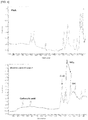
- FIGS. 1 a and 1 b show the molecular weight distribution of pitch, which was analyzed by MALDI-TOF mass spectrum;
- FIGS. 2 a and 2 b show the molecular weight distribution of the dispersing agent of Example 1, which was analyzed by MALDI-TOF mass spectrum;
- FIG. 3 shows the results of 13C CPMAS NMR analysis of pitch and the dispersing agent of Example 1;
- FIG. 4 shows the results of FT-IR analysis of pitch and the dispersing agent of Example 1;
- FIG. 5 shows the results of comparing the molecular weight distributions of the dispersing agents of Examples 2 to 4, which were analyzed by MALDI-TOF mass spectrum;
- FIGS. 6 a and 6 b show the SEM results of analyzing carbon nanotube distribution in the conducting material composition, which were dispersed on the surface of the active material (Graphite), when a slurry composition for forming an electrode and an electrode were formed in Example 9; and
- FIGS. 7 a and 7 b are graphs showing a comparison of electrical characteristics of the electrodes between the lithium rechargeable battery formed without using the dispersing agent and the lithium rechargeable battery of Experimental Example 2 which was formed from the conducting material composition of Example 5, the slurry composition for forming an electrode of Example 9, and the electrode (cathode or anode) by using the dispersing agent of Example 1.
- the “dispersing agent”, as used herein, refers to any component for uniform dispersion of other components, for example, carbon nanotube, etc. in an aqueous solvent, an organic solvent, or other liquid medium.
- the term “conducting material composition” refers to any composition which can be used as a conductive material in a composition for forming an electrode of a battery such as a lithium rechargeable battery, etc.
- any composition can be included in the scope of the “conducting material composition”, as long as it can be added as the conductive material in any composition for forming an electrode.
- polyaromatic hydrocarbon refers to an aromatic hydrocarbon compound, in which aromatic rings, for example, two or more, or 5 or more benzene rings bind to and are included in the structure of a single compound.
- polyaromatic hydrocarbon oxide refers to any compound, in which one or more oxygen-containing functional groups bind to its chemical structure, resulting from reaction of the above described “polyaromatic hydrocarbon” with an oxidizing agent.
- the oxygen-containing functional group to be introduced into the “polyaromatic hydrocarbon” by reaction with the oxidizing agent may be any functional group having one or more oxygens therein, which is able to bind to an aromatic ring such as a hydroxy group, an epoxy group, a carboxyl group, a nitro group, a sulfonic group, etc.
- a conducting material composition including carbon nanotubes; and a dispersing agent containing a plurality of polyaromatic hydrocarbon oxides, in which the dispersing agent contains the polyaromatic hydrocarbon oxides having a molecular weight of 300 to 1000 in an amount of 60% by weight or more.
- the conducting material composition of one embodiment includes the dispersing agent containing a predetermined mixture of polyaromatic hydrocarbon oxides, together with carbon nanotubes.
- the experimental results of the present inventors showed that owing to the actions of this specific dispersing agent, the powdery carbon nanotubes can be more uniformly dispersed.
- Pitch discharged as a waste during purification of fossil fuels such as petroleum, coal, etc. is a by-product used in the production of asphalt, and it may be a viscous mixture containing a plurality of polyaromatic hydrocarbons having many aromatic rings.
- polyaromatic hydrocarbon oxides having a molecular weight of approximately 300 to 1000 or approximately 300 to 700 are contained in an amount of approximately 60% by weight or more, or approximately 65% by weight or more, or approximately 70 to 95% by weight.
- the specific kind, structure and distribution of the polyaromatic hydrocarbon oxides contained in the mixture may differ depending on the kind or origin of the pitch used as the raw material, or the kind of oxidizing agent, etc.
- the mixture of polyaromatic hydrocarbon oxides included in the dispersing agent at least contains a plurality of polyaromatic hydrocarbon oxides having a structure in which one or more oxygen-containing functional groups are introduced into polyaromatic hydrocarbon having 5 to 30, or 7 to 20 benzene rings.
- the polyaromatic hydrocarbon oxides in the mixture have the above described molecular weight distribution, that is, oxides having a molecular weight of approximately 300 to 1000 or approximately 300 to 700 are included in an amount of approximately 60% by weight or more, based on the total weight of the mixture.
- the kind of the oxygen-containing functional group may differ depending on the kind of the oxidizing agent which is used in the oxidation process of pitches, etc.
- it may be one or more selected from the group consisting of a hydroxy group, an epoxy group, a carboxyl group, a nitro group and a sulfonic group.
- polyaromatic hydrocarbon oxides having various functional groups may be contained in the mixture.
- the polyaromatic hydrocarbon oxides satisfying the above described structural properties and molecular weight distribution, and the mixture thereof may have a hydrophobic ⁇ -domain of aromatic rings and a hydrophilic region by the oxygen-containing functional groups binding to the aromatic rings at the same time.
- the hydrophobic ⁇ -domain participates in ⁇ - ⁇ interaction with the surface of carbon nanotubes having carbon-carbon bonds, and the hydrophilic region creates a repulsive force between single carbon nanotubes.
- the dispersing agent including the mixture of the polyaromatic hydrocarbon oxides exists between powders or molecules of carbon nanotubes, so as to more uniformly disperse the carbon nanotubes.
- the dispersing agent may exist on the surface of carbon nanotube powder by adsorption due to the above described ⁇ - ⁇ interaction. Therefore, the conducting material composition of one embodiment which includes the above particular dispersing agent may include the powdery carbon nanotubes which are more uniformly dispersed therein.
- a higher content of uniformly dispersed carbon nanotubes is included in the slurry composition for forming an electrode and the electrode by using the conducting material composition, which greatly contributes to supply of an electrode showing more improved electrical characteristics and a battery such as lithium rechargeable battery, etc. showing excellent capacity characteristics and life characteristics.
- the dispersing agent included in the conducting material composition of one embodiment can be prepared from inexpensive raw materials such as pitch through a simplified oxidation process, and therefore, it can be easily obtained with low production costs. It is possible to provide an electrode and a battery showing excellent characteristics only by using the dispersing agent, thereby easily achieving high capacity and high efficiency of the battery.
- a conducting material composition including fibrous carbons such as carbon nanotube and a polymer dispersing agent having a pyrene or quinacridone skeleton is known (Korean Patent Publication No. 2010-0095473).
- polymer dispersing agent when such polymer dispersing agent is used alone, it is required to introduce proper functional groups into the polymer dispersing agent, depending on the kind of the medium (e.g., solvent contained in the conducting material composition, etc.) where carbon nanotubes are dispersed.
- the dispersing agent included in the conducting material composition of one embodiment is in the form of a mixture of polyaromatic hydrocarbon oxides having various molecular weights within a predetermined range and various oxygen-containing functional groups, carbon nanotubes can be uniformly dispersed in various solvents or media without introduction of additional functional groups, and a conducting material composition having a higher content of carbon nanotubes uniformly dispersed therein can be more easily prepared and provided. Furthermore, the dispersing agent included in the composition of one embodiment is able to disperse a high concentration of carbon nanotube even in the form of powder, and therefore, it can be used to easily provide an electrode and a battery having a higher content of carbon nanotube.
- any type of carbon nanotubes which have been known to be conventionally used in various electrode compositions can be used as the carbon nanotube.
- the carbon nanotube for example, single wall carbon nanotubes or multi wall carbon nanotubes can be used without particular limitations, and carbon nanotubes having an aspect ratio (length/diameter) of approximately 100 to 1000 can be used.
- the specific surface area of the carbon nanotube may vary according to the diameter or the aspect ratio of the carbon nanotube, and the amount of the dispersing agent for uniformly dispersing carbon nanotubes in the conducting material composition can be controlled according to the specific surface area of the carbon nanotube.
- the oxygen content in the total dispersing agent may be approximately 12 to 50% by weight or approximately 15 to 45% by weight of the total element content.
- This oxygen content reflects the introduction degree of oxygen-containing functional groups in the polyaromatic hydrocarbon oxides by the oxidation process.
- the above described hydrophilic region can be included at the appropriate degree.
- the carbon nanotubes can be more properly dispersed using the above described dispersing agent.
- the oxygen content can be calculated by elemental analysis of a plurality of polyaromatic hydrocarbon oxides which are included in the above described mixture. That is, when the mixture sample (e.g., approximately 1 mg) is heated on, for example, a thin foil at a high temperature of approximately 900° C., the foil is suddenly melted and the temperature is increased to approximately 1500 to 1800° C. Due to the high temperature, gas is generated from the mixture sample, and gas is collected for measurement and analysis of the contents of elements. From the results of the elemental analysis, the total element content of carbon, oxygen, hydrogen, and nitrogen which are contained in a plurality of the polyaromatic hydrocarbon oxides can be measured and analyzed, and the oxygen content with respect to the total element content can be calculated.
- the mixture sample e.g., approximately 1 mg
- the mixture sample e.g., approximately 1 mg
- the foil is suddenly melted and the temperature is increased to approximately 1500 to 1800° C. Due to the high temperature, gas is generated from the mixture sample, and gas is collected for measurement and analysis
- the dispersing agent included in the conducting material composition of one embodiment can be prepared by a method including the step of oxidizing the mixture including polyaromatic hydrocarbons having a molecular weight of approximately 200 to 1500 in the presence of an oxidizing agent. This preparation method will be described in more detail below.
- pitch discharged as a waste during purification of fossil fuels such as petroleum, coal, etc. may be a viscous or powdery mixture containing a plurality of polyaromatic hydrocarbons.
- the specific kind, structure, composition ratio, and molecular weight distribution of the polyaromatic hydrocarbon may differ depending on the raw material or origin of the pitch, etc., but the pitch may contain a plurality of polyaromatic hydrocarbons having 5 to 50 aromatic rings, for example, benzene rings in its structure, and it may generally contain polyaromatic hydrocarbons having a molecular weight of 200 to 1500.
- the mixture (e.g., pitch) containing polyaromatic hydrocarbons having a molecular weight of 200 to 1500 which is used as a starting material in the preparation method of the dispersing agent, may include the polyaromatic hydrocarbons having a molecular weight within the above range in an amount of approximately 80% by weight or more, or approximately 90% by weight or more.
- the mixture containing polyaromatic hydrocarbons such as pitch is subjected to an oxidation process using an oxidizing agent, the polyaromatic hydrocarbons having an excessively high molecular weight among the polyaromatic hydrocarbons contained in the pitch are degraded, and a mixture of polyaromatic hydrocarbons having a relatively narrow molecular weight distribution can be obtained.
- polyaromatic hydrocarbons having a molecular weight of more than approximately 1000 or approximately 700 may be degraded into those having a low molecular weight.
- one or more oxygen-containing functional groups are introduced into aromatic rings of each polyaromatic hydrocarbon, and therefore, the mixture including a plurality of polyaromatic hydrocarbon oxides, namely, the dispersing agent of one embodiment can be very simply prepared.
- the kind of the oxidizing agent is not particularly limited. Any oxidizing agent can be used without limitation, as long as it is able to cause oxidation reaction of introducing oxygen-containing functional groups into aromatic hydrocarbons.
- Specific examples of the oxidizing agent may include nitric acid (HNO 3 ), sulfuric acid (H 2 SO 4 ), hydrogen peroxide (H 2 O 2 ), ammonium cerium(IV) sulfate ((NH 4 ) 4 Ce(SO 4 ) 4 ), ammonium cerium(IV) nitrate ((NH 4 ) 2 Ce(NO 3 ) 6 ), etc., and a mixture of two or more selected therefrom can be also used.
- the oxidation step may be carried out in an aqueous solvent at a reaction temperature of approximately 10 to 90° C. for approximately 0.5 to 20 hours.
- the oxidation step may be carried out by adding a predetermined amount of the mixture including the polyaromatic hydrocarbons in the presence of a liquid oxidizing agent such as sulfuric acid and/or nitric acid at room temperature, for example, at approximately 20° C. or 80° C. for approximately 1 to 12 hours.
- a liquid oxidizing agent such as sulfuric acid and/or nitric acid
- the above described properties of the dispersing agent for example, oxidation degree of polyaromatic hydrocarbons can be properly controlled by controlling the reaction temperature or time of the oxidation step, thereby preparing a dispersing agent having the desired properties.
- the mixture containing polyaromatic hydrocarbons having a molecular weight of 200 to 1500 which is used as a starting material of the preparation method, may be derived from pitch obtained from fossil fuels or products thereof, and the kind, structure or molecular weight distribution of the polyaromatic hydrocarbons may differ depending on the kind of the raw material, etc.
- the dispersing agent of one embodiment having excellent dispersibility for carbon-based materials can be simply prepared, as the mixture containing polyaromatic hydrocarbons having a molecular weight of 200 to 1500, which is derived from pitch, etc., is subjected to the oxidation process.
- the above described preparation method may further include the step of purifying the resultant after the oxidation step to obtain the mixture of a plurality of polyaromatic hydrocarbon oxides.
- Such purification step may be performed by including the step of centrifuging the resultant of the oxidation step. Owing to the purification step, the mixture of polyaromatic hydrocarbon oxides satisfying the above described molecular weight distribution, that is, the above described dispersing agent can be properly obtained with higher purity, and the dispersing agent can be used to uniformly disperse the carbon nanotubes.
- the conducting material composition of one embodiment which includes the above described dispersing agent, etc. may include carbon nanotube in the form of powder or particle, and the dispersing agent which exists on the surface of the carbon nanotube powder or particle. That is, the dispersing agent may exist on the surface of carbon nanotube powder by adsorption due to ⁇ - ⁇ interaction, thereby uniformly dispersing the carbon nanotube powder via the ⁇ - ⁇ interaction and repulsive force. Therefore, a slurry composition and an electrode can be obtained by mixing the powdery conducting material composition where carbon nanotubes are uniformly dispersed, with other components of the slurry composition for forming an electrode described below, without using additional liquid media. Accordingly, a slurry composition for forming an electrode and the electrode having a higher content of carbon nanotubes uniformed dispersed therein can be prepared with more improved processability.
- the conducting material composition of one embodiment may include approximately 5 to 30 parts by weight, or approximately 10 to 20 parts by weight, or approximately 15 to 30 parts by weight of the dispersing agent with respect to 100 parts by weight of carbon nanotube.
- Carbon nanotubes having various surface areas can be uniformly dispersed according to the content range of the dispersing agent.
- the above described conducting material composition of one embodiment can be used for forming electrodes of various batteries, for example, it is included in an electrode slurry composition of a lithium rechargeable battery to be used for forming an electrode such as a cathode or anode of the lithium rechargeable battery.
- a slurry composition for forming a lithium rechargeable battery electrode including the above described conducting material composition.
- Such slurry composition may include an electrode active material, the above described conducting material composition of one embodiment, a binder and a solvent.
- Such slurry composition for forming an electrode can be prepared by mixing the above described powdery conducting material composition with other components such as an active material, a binder, a solvent, etc.
- the slurry composition is obtained by using the conducting material composition where carbon nanotube powder itself is uniformly dispersed, it includes the carbon nanotube conductive materials uniformly dispersed at a high concentration, and therefore, an electrode having a high content of uniformly dispersed carbon nanotubes can be obtained.
- the slurry composition of another embodiment can be prepared according to a typical composition and preparation method of a slurry composition for forming a lithium rechargeable battery electrode, except that the conducting material composition of one embodiment is used.
- the slurry composition may include an electrode active material of a cathode active material or an anode active material.
- the cathode active material metal oxide, lithium complex metal oxide, lithium complex metal sulfide, lithium complex metal nitride, etc. which is capable of intercalating/deintercalating lithium may be used.
- the anode active material any lithium metals or lithium alloys, or carbon-based or silicon-based materials which have been known to be used as the anode active material of lithium rechargeable batteries, such as lithium metal or lithium alloy; coke, artificial graphite, natural graphite, a combusted organic polymer compound, carbon fiber, Si, SiO x , Sn or SnO 2 , may be used without particular limitations.
- a resin containing one or more selected from the group consisting of a vinylidene fluoride/hexafluoropropylene copolymer, polyvinylidene fluoride, polyacrylonitrile, polymethyl methacrylate, polyacrylate, polytetrafluoroethylene, a poly(styrene-butadiene) copolymer, alginate and polydopamine, or mixtures thereof may be used.
- solvent one or more solvents selected from the group consisting of water, N-methyl pyrrolidone, acetone, tetrahydrofuran and decane, or a solvent mixture of two or more thereof may be used.
- the above described slurry composition of another embodiment may include approximately 70 to 98 parts by weight of the electrode active material, approximately 0.1 to 15 parts by weight of the conducting material composition, and approximately 1.0 to 20 parts by weight of the binder with respect to 100 parts by weight of the total solid content of the electrode active material, the conducting material composition, and the binder, except the solvent.
- the conductive material containing carbon nanotubes can be included at a high content as much as approximately 10 parts by weight, with respect to the total solid content.
- the carbon nanotubes can maintain their uniformly dispersed state at a high concentration in the slurry composition. Therefore, the slurry composition can be used to prepare an electrode and a battery which have a high content of uniformly dispersed carbon nanotubes and show more excellent electrical characteristics, etc.
- a lithium rechargeable battery which is obtained by using the above described conducting material composition and slurry composition for forming an electrode.
- This lithium rechargeable battery is composed of an anode including a current collector and an anode active material layer formed on the current collector, in which the anode active material layer contains an anode active material, a conductive material and a binder; a cathode including a current collector and a cathode active material layer formed on the current collector, in which the cathode active material layer contains a cathode active material, a conductive material and a binder; and an electrolyte, in which at least one of the conductive materials contained in the anode active material layer or cathode active material layer contains the above described conducting material composition.
- This lithium rechargeable battery may have a higher content of carbon nanotubes which are uniformly dispersed as the conductive material in the electrode. Therefore, electrical characteristics of the electrode itself can be further improved. Further, it is possible to provide a battery, such as a lithium rechargeable battery, showing improved electrical characteristics, capacity characteristics and life characteristics by maximizing the advantage of using carbon nanotube as the conductive material. As a result, the present invention greatly contributes to achievement of high capacity characteristics in a variety of batteries such as a lithium rechargeable battery, etc.
- the lithium rechargeable battery can be prepared according to a constitution of the typical lithium rechargeable battery, except that the conducting material composition of one embodiment is used as the conductive material, and therefore, an additional description thereof will be omitted.
- Pitch which is a petroleum by-product obtained from POSCO was subjected to the following oxidation and purification processes to prepare a dispersing agent of Example 1.
- the pitch reaction solution resulting from the oxidation reaction was cooled to room temperature, and diluted with approximately 5 volumes of distilled water, followed by centrifugation at approximately 3500 rpm for 30 minutes. Subsequently, the supernatant was discarded, and the same amount of distilled water was added and re-suspended, followed by centrifugation under the same conditions. Finally, the pellet was recovered and dried. Consequently, the dispersing agent of Example 1 was prepared.
- the molecular weight distribution of the pitch which was used as a raw material during the preparation process of the dispersing agent was analyzed by MALDI-TOF mass spectrum, and the results are shown in FIGS. 1 a and 1 b (magnifications of the molecular weight range of 400 to 500), and the molecular weight distribution of the dispersing agent of Example 1 was also analyzed in the same manner, and the results are shown in FIGS. 2 a and 2 b (magnifications of the molecular weight range of 400 to 500).
- This analysis was performed using a MALDI-TOF mass spectrum spectrometer (Ultraflex II, Bruker), after the pitch or dispersing agent was added to a matrix and they were mixed and dried.
- the pitch contained polyaromatic hydrocarbons having a molecular weight of 200 to 1500.
- the magnification of FIG. 1 b high peaks were detected at an interval of a molecular weight of 14 Da, indicating that a plurality of polyaromatic hydrocarbons having different numbers of aromatic rings (benzene rings) were linked by aliphatic hydrocarbons.
- FIGS. 1 a and 1 b magnification
- the pitch (upper) used as a raw material and the dispersing agent of Example 1 (lower) were analyzed by 13C CPMAS NMR (Varian 400MHz Solid-State NMR), respectively.
- the analysis results are compared and shown in FIG. 3 .
- peaks derived from carbons of aromatic hydrocarbons and some peaks derived from carbons of aliphatic hydrocarbons were detected, but no oxygen-containing functional groups were detected in the pitch.
- the NMR analysis results of the dispersing agent of Example 1 show the peaks of oxygen-containing functional groups.
- the kind of the oxygen-containing functional groups was found to be an epoxy group, a hydroxy group or a carboxyl group.
- Example 1 the pitch used as a raw material and the dispersing agent of Example 1 were analyzed in the powder form by FT-IR (Agilent 660-IR), and the analysis results are compared and shown in FIG. 4 .
- FIG. 4 also shows appearance of the peaks of oxygen-containing functional groups in the dispersing agent of Example 1.
- Example 2 Pitch which is a petroleum by-product obtained from POSCO (however, this pitch was different from the sample used in Example 1) was used, and dispersing agents of Examples 2 to 4 were prepared in the same manner as in Example 1, except that the oxidation reaction was performed for 1 hour (Example 2), 3.5 hours (Example 3) or 7 hours (Example 4), respectively.
- dispersing agents were analyzed by MALDI-TOF mass spectrum in the same manner as in Example 1, and the results are compared and shown in FIG. 5 .
- the content of the components (polyaromatic hydrocarbon oxides) having a molecular weight of more than approximately 1000 or approximately 700 in the dispersing agent was decreased, and as a result, dispersing agents were obtained in the form of a mixture including the polyaromatic hydrocarbon oxides having a molecular weight of approximately 300 to 1000 or approximately 300 to 700 at a higher content.
- Each 1 mg of the dispersing agent samples obtained in Examples 3 and 4 was heated on a thin foil at a high temperature of approximately 900° C. At this time, while the foil was suddenly melted, the temperature was increased to approximately 1500 to 1800° C., and gas was generated from the sample due to the high temperature. This gas was collected and subjected to elemental analysis to measure and analyze the contents of carbon, oxygen, hydrogen and nitrogen. The analysis results are compared with those of the pitch used in the preparation of each dispersing agent, and shown in the following Table 1.
- the oxygen content was approximately 12 to 50% by weight or approximately 30 to 40% by weight with respect to the total element content.
- each 3.0 g of the dispersing agents of Examples 1 to 4 was added to 3 L of a solvent selected from polar organic solvents such as distilled water, ethanol, acetone, THF, NMP, etc., and resuspended by sonication, and 10.0 g of carbon nanotube was added to each dispersing agent solution, followed by sonication for further 1 hour. Subsequently, the carbon nanotube solutions were centrifuged at 8000 rpm, and the dispersing agent-carbon nanotube pellets were recovered and dried to prepare powdery carbon nanotube conducting material compositions.
- a solvent selected from polar organic solvents such as distilled water, ethanol, acetone, THF, NMP, etc.
- Graphite and carbon-coated SiO were used as an anode active material, SBR (styrene-butadiene rubber) was used as a binder, CMC (carboxymethyl cellulose) was used as a thickener, and the conducting material compositions of Examples 5 to 8 were used, and they were mixed at a weight ratio of graphite:SiO:SBR:CMC:conducting material composition of 90:5:2:2:1 to prepare a slurry composition for forming an electrode.
- One side of the copper current collector was coated with this slurry composition at a thickness of 65 um, dried, and pressed, and punched to a desired size to prepare an anode.
- This anode was used to prepare each lithium rechargeable battery including a cathode and the anode by a typical method.
- Example 9 The life characteristics and high efficiency characteristics of the lithium rechargeable battery prepared in Example 9 were tested. Also, an electrode and a lithium rechargeable battery of Comparative Example were prepared using powdery carbon nanotubes, instead of the conducting material composition of Example 5, and they were tested in the same manner, and the results are shown in FIGS. 7 a and 7 b.
- the lithium rechargeable battery prepared in Example showed more excellent life characteristics and high efficiency characteristics.
Landscapes
- Chemical & Material Sciences (AREA)
- Chemical Kinetics & Catalysis (AREA)
- Electrochemistry (AREA)
- General Chemical & Material Sciences (AREA)
- Engineering & Computer Science (AREA)
- Materials Engineering (AREA)
- Manufacturing & Machinery (AREA)
- Health & Medical Sciences (AREA)
- Medicinal Chemistry (AREA)
- Polymers & Plastics (AREA)
- Organic Chemistry (AREA)
- Spectroscopy & Molecular Physics (AREA)
- Dispersion Chemistry (AREA)
- Physics & Mathematics (AREA)
- Battery Electrode And Active Subsutance (AREA)
Abstract
Description
| TABLE 1 | ||||
| Sample | C(wt %) | H(wt %) | N(wt %) | O(wt %) |
| Pitch | 95.5 | 4.5 | — | — |
| Example 3 | 40.0 | 1.8 | 7.6 | 38.0 |
| Example 4 | 40.0 | 1.5 | 7.8 | 39.2 |
Claims (14)
Applications Claiming Priority (5)
| Application Number | Priority Date | Filing Date | Title |
|---|---|---|---|
| KR20130091626 | 2013-08-01 | ||
| KR10-2013-0091626 | 2013-08-01 | ||
| KR1020140098034A KR101601949B1 (en) | 2013-08-01 | 2014-07-31 | Conducting material composition, slurry composition for forming electrode of lithium rechargeable battery and lithium rechargeable battery using the same |
| KR10-2014-0098034 | 2014-07-31 | ||
| PCT/KR2014/007067 WO2015016642A1 (en) | 2013-08-01 | 2014-07-31 | Conductor composition, slurry composition for forming electrode of lithium secondary battery using same, and lithium secondary battery |
Publications (2)
| Publication Number | Publication Date |
|---|---|
| US20160190590A1 US20160190590A1 (en) | 2016-06-30 |
| US10862124B2 true US10862124B2 (en) | 2020-12-08 |
Family
ID=52573195
Family Applications (1)
| Application Number | Title | Priority Date | Filing Date |
|---|---|---|---|
| US14/902,992 Active 2034-12-07 US10862124B2 (en) | 2013-08-01 | 2014-07-31 | Conducting material composition, slurry composition for forming electrode of lithium rechargeable battery and lithium rechargeable battery using the same |
Country Status (7)
| Country | Link |
|---|---|
| US (1) | US10862124B2 (en) |
| EP (1) | EP3002808B1 (en) |
| JP (1) | JP6276851B2 (en) |
| KR (1) | KR101601949B1 (en) |
| CN (1) | CN105453316B (en) |
| TW (1) | TWI553048B (en) |
| WO (1) | WO2015016642A1 (en) |
Families Citing this family (9)
| Publication number | Priority date | Publication date | Assignee | Title |
|---|---|---|---|---|
| WO2015016639A1 (en) * | 2013-08-01 | 2015-02-05 | 주식회사 엘지화학 | Dispersant, preparation method therefor, and dispersion composition of carbon-based materials, containing same |
| WO2016052054A1 (en) * | 2014-09-30 | 2016-04-07 | 富士フイルム株式会社 | Gel particles, photosensitive composition, ink composition, method for manufacturing aqueous dispersion of gel particles, and image forming method |
| KR102309831B1 (en) * | 2015-03-23 | 2021-10-13 | 현대모비스 주식회사 | Lamp unit |
| KR101672750B1 (en) * | 2016-02-11 | 2016-11-04 | 한밭대학교 산학협력단 | Multilayer-structured electrode comprising hydrophilic heat-resistant polymer and manufacturing method for the same, and lithium secondary battery comprising the same |
| KR102672703B1 (en) * | 2017-01-11 | 2024-06-07 | 에스케이이노베이션 주식회사 | Dispersive agent for carbon allotrope and conductive composition including the same |
| JP7347419B2 (en) * | 2018-06-20 | 2023-09-20 | 日本ゼオン株式会社 | Method for manufacturing slurry for secondary battery functional layer |
| JP6798531B2 (en) * | 2018-07-19 | 2020-12-09 | トヨタ自動車株式会社 | Non-aqueous electrolyte secondary battery |
| CN113169302B (en) * | 2019-03-28 | 2024-07-30 | 日本瑞翁株式会社 | Conductive material paste for lithium ion secondary battery electrode, slurry composition, electrode, and lithium ion secondary battery |
| CN110336037B (en) * | 2019-07-18 | 2021-08-17 | 上海交通大学 | Aqueous binder for negative electrode material of lithium ion battery and preparation method thereof |
Citations (29)
| Publication number | Priority date | Publication date | Assignee | Title |
|---|---|---|---|---|
| US6251290B1 (en) * | 1997-02-27 | 2001-06-26 | Continuum Environmental, Inc. | Method for recovering hydrocarbons from tar sands and oil shales |
| JP2004039443A (en) | 2002-07-03 | 2004-02-05 | Mitsubishi Electric Corp | Battery and its manufacturing method |
| KR20060084785A (en) | 2005-01-20 | 2006-07-25 | 삼성전자주식회사 | Dispersant for carbon nanotubes and carbon nanotube composition comprising the same |
| US20060189822A1 (en) * | 2005-01-20 | 2006-08-24 | Yoon Seon M | Dispersant for dispersing carbon nanotubes and carbon nanotube composition comprising the same |
| US20060223991A1 (en) | 2005-03-31 | 2006-10-05 | Yuegang Zhang | Functionalization and separation of nanotubes and structures formed therby |
| WO2007004652A1 (en) | 2005-07-05 | 2007-01-11 | National University Corporation NARA Institute of Science and Technology | Method for producing carbon nanotube dispersion liquid |
| KR20070056875A (en) | 2005-11-30 | 2007-06-04 | 삼성에스디아이 주식회사 | Anode active material for lithium secondary battery, preparation method thereof and lithium secondary battery comprising same |
| KR20070083877A (en) | 2004-10-01 | 2007-08-24 | 임페리알 케미칼 인더스트리즈 피엘씨 | Dispersants, Films, Coatings & Composites |
| JP2007258030A (en) | 2006-03-24 | 2007-10-04 | Nok Corp | Manufacturing method for carbon material thin film |
| KR20070102266A (en) | 2006-04-14 | 2007-10-18 | 삼성전자주식회사 | Carbon nanotube dispersion and its manufacturing method |
| KR20080038806A (en) | 2006-10-31 | 2008-05-07 | 주식회사 엘지화학 | Lithium Secondary Battery with Conductive Agent with Improved Electrical Conductivity |
| WO2008136347A1 (en) | 2007-04-27 | 2008-11-13 | Kuraray Co., Ltd. | Single-walled carbon nanotube dispersion liquid and method for producing single-walled carbon nanotube dispersion liquid |
| KR20090054677A (en) | 2007-11-27 | 2009-06-01 | 삼성에스디아이 주식회사 | Electrode for lithium secondary battery and lithium secondary battery comprising same |
| JP2009176720A (en) | 2007-12-25 | 2009-08-06 | Kao Corp | Method for producing composite material for positive electrode of lithium battery |
| US20100137556A1 (en) * | 2007-02-15 | 2010-06-03 | Ravintoraiso Oy | Process for isolation of fatty acids, resin acids and sterols from tall oil pitch |
| KR20100095473A (en) | 2007-12-25 | 2010-08-30 | 가오 가부시키가이샤 | Composite material for positive electrode of lithium battery |
| KR20100137621A (en) | 2009-06-23 | 2010-12-31 | 한국세라믹기술원 | Low dimensional carbon-containing carbon composite production method and carbon block production method |
| JP2011076948A (en) | 2009-09-30 | 2011-04-14 | Toray Ind Inc | Conductive complex, and negative electrode for lithium ion battery |
| KR20110072917A (en) | 2009-12-23 | 2011-06-29 | 삼성전자주식회사 | Carbon-based conductive material, electrode composition comprising the same, electrode and secondary battery prepared therefrom |
| KR20110101347A (en) | 2010-03-08 | 2011-09-16 | 엔바로테크 주식회사 | Graphene-dispersed polymer composite material and method for manufacturing same |
| KR20110102844A (en) | 2010-03-11 | 2011-09-19 | 주식회사 엘지화학 | Organic polymer-silicon composite particles, preparation method thereof, and negative electrode and lithium secondary battery comprising same |
| JP2012252824A (en) | 2011-06-01 | 2012-12-20 | Asahi Glass Co Ltd | Method for manufacturing electrode for power storage device, and power storage device |
| US20120326093A1 (en) * | 2011-06-24 | 2012-12-27 | Brewer Science Inc. | Highly soluble carbon nanotubes with enhanced conductivity |
| US20130062574A1 (en) * | 2011-09-14 | 2013-03-14 | Industrial Technology Research Institute | Carbon nanotube powders and methods for manufacturing the same and composite materials |
| US20130149604A1 (en) * | 2011-12-08 | 2013-06-13 | Sony Corporation | Electrode, secondary battery, battery pack, electric vehicle, electric power storage system, electric power tool, and electronic apparatus |
| US20130245352A1 (en) * | 2012-03-01 | 2013-09-19 | Zeta Global, Ltd. | Systems and methods for recovering hydrocarbons |
| JP2013232313A (en) | 2012-04-27 | 2013-11-14 | Toyo Ink Sc Holdings Co Ltd | Composition for forming lithium secondary battery electrode, electrode for secondary battery |
| WO2014047219A1 (en) | 2012-09-24 | 2014-03-27 | C3Nano Inc. | Transparent conductive films with carbon nanotubes, inks to form the films and corresponding processes |
| EP3002313A1 (en) | 2013-08-01 | 2016-04-06 | LG Chem, Ltd. | Dispersant, preparation method therefor, and dispersion composition of carbon-based materials, containing same |
Family Cites Families (1)
| Publication number | Priority date | Publication date | Assignee | Title |
|---|---|---|---|---|
| JPS61164632A (en) * | 1985-01-17 | 1986-07-25 | Fuji Sekiyu Kk | Preparation of surface active substance |
-
2014
- 2014-07-31 WO PCT/KR2014/007067 patent/WO2015016642A1/en not_active Ceased
- 2014-07-31 KR KR1020140098034A patent/KR101601949B1/en active Active
- 2014-07-31 CN CN201480043654.0A patent/CN105453316B/en active Active
- 2014-07-31 US US14/902,992 patent/US10862124B2/en active Active
- 2014-07-31 JP JP2016523677A patent/JP6276851B2/en active Active
- 2014-07-31 EP EP14831291.1A patent/EP3002808B1/en active Active
- 2014-08-01 TW TW103126427A patent/TWI553048B/en active
Patent Citations (39)
| Publication number | Priority date | Publication date | Assignee | Title |
|---|---|---|---|---|
| US6251290B1 (en) * | 1997-02-27 | 2001-06-26 | Continuum Environmental, Inc. | Method for recovering hydrocarbons from tar sands and oil shales |
| JP2004039443A (en) | 2002-07-03 | 2004-02-05 | Mitsubishi Electric Corp | Battery and its manufacturing method |
| KR20070083877A (en) | 2004-10-01 | 2007-08-24 | 임페리알 케미칼 인더스트리즈 피엘씨 | Dispersants, Films, Coatings & Composites |
| US20090014691A1 (en) | 2004-10-01 | 2009-01-15 | Imperial Chemical Industries Plc. | Dispersions, films, coatings and compositions |
| KR20060084785A (en) | 2005-01-20 | 2006-07-25 | 삼성전자주식회사 | Dispersant for carbon nanotubes and carbon nanotube composition comprising the same |
| US20060189822A1 (en) * | 2005-01-20 | 2006-08-24 | Yoon Seon M | Dispersant for dispersing carbon nanotubes and carbon nanotube composition comprising the same |
| US20060223991A1 (en) | 2005-03-31 | 2006-10-05 | Yuegang Zhang | Functionalization and separation of nanotubes and structures formed therby |
| WO2007004652A1 (en) | 2005-07-05 | 2007-01-11 | National University Corporation NARA Institute of Science and Technology | Method for producing carbon nanotube dispersion liquid |
| KR20070056875A (en) | 2005-11-30 | 2007-06-04 | 삼성에스디아이 주식회사 | Anode active material for lithium secondary battery, preparation method thereof and lithium secondary battery comprising same |
| JP2007258030A (en) | 2006-03-24 | 2007-10-04 | Nok Corp | Manufacturing method for carbon material thin film |
| KR20070102266A (en) | 2006-04-14 | 2007-10-18 | 삼성전자주식회사 | Carbon nanotube dispersion and its manufacturing method |
| US20130187084A1 (en) * | 2006-04-14 | 2013-07-25 | Samsung Electronics Co., Ltd. | Dispersed solution of carbon nanotubes and method of preparing the same |
| KR20080038806A (en) | 2006-10-31 | 2008-05-07 | 주식회사 엘지화학 | Lithium Secondary Battery with Conductive Agent with Improved Electrical Conductivity |
| US20100137556A1 (en) * | 2007-02-15 | 2010-06-03 | Ravintoraiso Oy | Process for isolation of fatty acids, resin acids and sterols from tall oil pitch |
| WO2008136347A1 (en) | 2007-04-27 | 2008-11-13 | Kuraray Co., Ltd. | Single-walled carbon nanotube dispersion liquid and method for producing single-walled carbon nanotube dispersion liquid |
| CN101668700A (en) | 2007-04-27 | 2010-03-10 | 株式会社可乐丽 | Single-walled carbon nanotube dispersion liquid and method for producing single-walled carbon nanotube dispersion liquid |
| US20100187485A1 (en) | 2007-04-27 | 2010-07-29 | Kuraray Co., Ltd. | Single-walled carbon nanotube dispersion liquid and method for producing single-walled carbon nanotube dispersion liquid |
| KR20090054677A (en) | 2007-11-27 | 2009-06-01 | 삼성에스디아이 주식회사 | Electrode for lithium secondary battery and lithium secondary battery comprising same |
| KR20100095473A (en) | 2007-12-25 | 2010-08-30 | 가오 가부시키가이샤 | Composite material for positive electrode of lithium battery |
| JP2009176720A (en) | 2007-12-25 | 2009-08-06 | Kao Corp | Method for producing composite material for positive electrode of lithium battery |
| US20100248034A1 (en) | 2007-12-25 | 2010-09-30 | Kazuo Oki | Composite material for positive electrode of lithium battery |
| CN101919089A (en) | 2007-12-25 | 2010-12-15 | 花王株式会社 | Composite materials for positive electrodes of lithium batteries |
| EP2228856A1 (en) | 2007-12-25 | 2010-09-15 | Kao Corporation | Composite material for positive electrode of lithium battery |
| KR20100137621A (en) | 2009-06-23 | 2010-12-31 | 한국세라믹기술원 | Low dimensional carbon-containing carbon composite production method and carbon block production method |
| JP2011076948A (en) | 2009-09-30 | 2011-04-14 | Toray Ind Inc | Conductive complex, and negative electrode for lithium ion battery |
| KR20110072917A (en) | 2009-12-23 | 2011-06-29 | 삼성전자주식회사 | Carbon-based conductive material, electrode composition comprising the same, electrode and secondary battery prepared therefrom |
| KR20110101347A (en) | 2010-03-08 | 2011-09-16 | 엔바로테크 주식회사 | Graphene-dispersed polymer composite material and method for manufacturing same |
| KR20110102844A (en) | 2010-03-11 | 2011-09-19 | 주식회사 엘지화학 | Organic polymer-silicon composite particles, preparation method thereof, and negative electrode and lithium secondary battery comprising same |
| US20120007028A1 (en) | 2010-03-11 | 2012-01-12 | Lg Chem, Ltd. | Polymer-silicon composite particles, method of making the same, and anode and lithium secondary battery including the same |
| JP2012252824A (en) | 2011-06-01 | 2012-12-20 | Asahi Glass Co Ltd | Method for manufacturing electrode for power storage device, and power storage device |
| US20120326093A1 (en) * | 2011-06-24 | 2012-12-27 | Brewer Science Inc. | Highly soluble carbon nanotubes with enhanced conductivity |
| WO2012177975A1 (en) | 2011-06-24 | 2012-12-27 | Brewer Science Inc. | Highly soluble carbon nanotubes with enhanced conductivity |
| US20130062574A1 (en) * | 2011-09-14 | 2013-03-14 | Industrial Technology Research Institute | Carbon nanotube powders and methods for manufacturing the same and composite materials |
| US20130149604A1 (en) * | 2011-12-08 | 2013-06-13 | Sony Corporation | Electrode, secondary battery, battery pack, electric vehicle, electric power storage system, electric power tool, and electronic apparatus |
| US20130245352A1 (en) * | 2012-03-01 | 2013-09-19 | Zeta Global, Ltd. | Systems and methods for recovering hydrocarbons |
| JP2013232313A (en) | 2012-04-27 | 2013-11-14 | Toyo Ink Sc Holdings Co Ltd | Composition for forming lithium secondary battery electrode, electrode for secondary battery |
| US20150118559A1 (en) | 2012-04-27 | 2015-04-30 | Toyo Ink Sc Holdings Co., Ltd. | Composition for forming electrode of lithium secondary battery, electrode and lithium secondary battery |
| WO2014047219A1 (en) | 2012-09-24 | 2014-03-27 | C3Nano Inc. | Transparent conductive films with carbon nanotubes, inks to form the films and corresponding processes |
| EP3002313A1 (en) | 2013-08-01 | 2016-04-06 | LG Chem, Ltd. | Dispersant, preparation method therefor, and dispersion composition of carbon-based materials, containing same |
Non-Patent Citations (9)
| Title |
|---|
| "Polycyclic Aromatic Hydrocarbons" Fletcher et al.; Nomenclature of Organic Compounds; Advances in Chemistry; American Chemical Society: Washington, DC 1974, p. 29. (Year: 1974). * |
| Afanasov et al., "Determination of Polyaromatic Hydrocarbosn in Coal Tar Pitch," J. Analytical Chem., 2009, vol. 64, No. 4, pp. 361-365 (Year: 2009). * |
| Chemistry LibreTexts™, Section 6.3, "Hydrogen Bonding Interactions and Solubility," publication date unknown, accessed Jul. 18, 2019 (Year: 2019). * |
| Choi et al, "Single, Double, Multiwall Carbon Nanotube Properties & Applications, Aldrich Materials Science, Sigma-Aldrich Co. LLC," date unknown, accessed on the web at https://www.sigmaaldrich.com/technical-documents/articles/materials-science/single-double-multi-walled-carbon-nanotubes.html. * |
| Extended Search Report from European Application No. 14831291.1, dated Dec. 22, 2016. |
| Ge et al., "Multiwalled Carbon Nanotubes with Chemically Grafted Polyetherimides," J Am. Chem. Soc. 2005, 127, 9984-9985, published on web Jun. 22, 2005. * |
| International Search Report for Application No. PCT/KR2014/007067 dated Nov. 12, 2014. |
| Polycyclic Aromatic Hydrocarbon Structure Index, National Institute of Standards and Technology (NIST), Nist Special Publication 922, Lane C. Sander and Stephen A. Wise, Dec. 1997, accessed at https://www.nist.gov/sites/default/files/documents/mml/csd/SP-922-Polycyclic-Aromatic-Hydrocarbon-Structure-Index-2.pdf. * |
| Yuen et al, "Preparation and Morphological, Electrical, and Mechanical Properties of Polyimide-Grafted MWCNT/Polyimide Composite," J. Polymer Science: Part A: Polymer Chemistry, vol. 45 3349-3358, Published Jun. 15, 2007. * |
Also Published As
| Publication number | Publication date |
|---|---|
| US20160190590A1 (en) | 2016-06-30 |
| TWI553048B (en) | 2016-10-11 |
| EP3002808A4 (en) | 2017-01-25 |
| JP2016523439A (en) | 2016-08-08 |
| JP6276851B2 (en) | 2018-02-07 |
| TW201520255A (en) | 2015-06-01 |
| KR101601949B1 (en) | 2016-03-09 |
| CN105453316A (en) | 2016-03-30 |
| WO2015016642A1 (en) | 2015-02-05 |
| EP3002808B1 (en) | 2018-09-05 |
| EP3002808A1 (en) | 2016-04-06 |
| CN105453316B (en) | 2018-01-02 |
| KR20150016124A (en) | 2015-02-11 |
Similar Documents
| Publication | Publication Date | Title |
|---|---|---|
| EP3002808B1 (en) | Conductor composition, slurry composition for forming electrode of lithium secondary battery using same, and lithium secondary battery | |
| KR101652921B1 (en) | Conducting material composition, slurry composition for forming electrode of lithium rechargeable battery and lithium rechargeable battery using the same | |
| TWI614211B (en) | Highly dispersible graphene composition, the preparation method thereof, and electrode for lithium ion secondary battery containing the highly dispersible graphene composition | |
| EP3002313B1 (en) | Dispersant, preparation method therefor, and dispersion composition of carbon-based materials, containing same | |
| KR20140082975A (en) | Slurry composition for use in forming lithium-ion secondary battery electrode, containing cellulose fiber as binder, and lithium-ion secondary battery electrode | |
| TW201437143A (en) | Si/C composites as anode materials for lithium ion batteries | |
| KR20100124214A (en) | Negative electrode material for nonaqueous electrolytic secondary battery and process for producing the same, and lithium ion secondary battery | |
| Palmieri et al. | High performance bi-metallic manganese cobalt oxide/carbon nanotube Li-ion battery anodes | |
| WO2015099379A1 (en) | Conductive composition, slurry composition for forming electrode of lithium secondary battery using same, and lithium secondary battery | |
| KR100673987B1 (en) | Sulfur electrodes using MNT and VN as additives to improve cycle characteristics of lithium / sulfur secondary batteries | |
| Puthusseri et al. | 3D Interconnected Porous Graphene Sheets Loaded with Cobalt Oxide Nanoparticles for Lithium‐Ion Battery Anodes | |
| JP7818032B2 (en) | Electrode composition for lithium ion secondary battery and manufacturing process thereof | |
| US20240234735A9 (en) | Conductive Composite Material, Method of Preparing Same, and Lithium Secondary Battery Comprising Same | |
| Kim et al. | Accelerating Ionic–Electronic Percolation Pathways Via Catecholate Coordination of Bioinspired-Polymer Dopamine in All-Solid-State Composite Cathode | |
| JP2013084532A (en) | Conductive low-temperature baked carbon |
Legal Events
| Date | Code | Title | Description |
|---|---|---|---|
| AS | Assignment |
Owner name: LG CHEM, LTD., KOREA, REPUBLIC OF Free format text: ASSIGNMENT OF ASSIGNORS INTEREST;ASSIGNORS:SOHN, KWON NAM;LEE, KIL SUN;KWON, WON JONG;AND OTHERS;SIGNING DATES FROM 20151107 TO 20151127;REEL/FRAME:037421/0819 |
|
| STPP | Information on status: patent application and granting procedure in general |
Free format text: NON FINAL ACTION MAILED |
|
| STPP | Information on status: patent application and granting procedure in general |
Free format text: RESPONSE TO NON-FINAL OFFICE ACTION ENTERED AND FORWARDED TO EXAMINER |
|
| STPP | Information on status: patent application and granting procedure in general |
Free format text: FINAL REJECTION MAILED |
|
| STPP | Information on status: patent application and granting procedure in general |
Free format text: DOCKETED NEW CASE - READY FOR EXAMINATION |
|
| STPP | Information on status: patent application and granting procedure in general |
Free format text: NON FINAL ACTION MAILED |
|
| STPP | Information on status: patent application and granting procedure in general |
Free format text: RESPONSE TO NON-FINAL OFFICE ACTION ENTERED AND FORWARDED TO EXAMINER |
|
| STCF | Information on status: patent grant |
Free format text: PATENTED CASE |
|
| AS | Assignment |
Owner name: LG ENERGY SOLUTION, LTD., KOREA, REPUBLIC OF Free format text: ASSIGNMENT OF ASSIGNORS INTEREST;ASSIGNOR:LG CHEM, LTD.;REEL/FRAME:058295/0068 Effective date: 20211027 |
|
| MAFP | Maintenance fee payment |
Free format text: PAYMENT OF MAINTENANCE FEE, 4TH YEAR, LARGE ENTITY (ORIGINAL EVENT CODE: M1551); ENTITY STATUS OF PATENT OWNER: LARGE ENTITY Year of fee payment: 4 |