US10859672B2 - Directional radar transmitting and receiving sensor board - Google Patents

Directional radar transmitting and receiving sensor board Download PDF

Info

Publication number
US10859672B2
US10859672B2 US16/105,540 US201816105540A US10859672B2 US 10859672 B2 US10859672 B2 US 10859672B2 US 201816105540 A US201816105540 A US 201816105540A US 10859672 B2 US10859672 B2 US 10859672B2
Authority
US
United States
Prior art keywords
sensor board
wire
recesses
conductive substrate
capacitors
Prior art date
Legal status (The legal status is an assumption and is not a legal conclusion. Google has not performed a legal analysis and makes no representation as to the accuracy of the status listed.)
Expired - Fee Related, expires
Application number
US16/105,540
Other versions
US20190079163A1 (en
Inventor
Xiao Xiong Liu
Current Assignee (The listed assignees may be inaccurate. Google has not performed a legal analysis and makes no representation or warranty as to the accuracy of the list.)
Gardenia Ind Ltd
Original Assignee
Gardenia Ind Ltd
Priority date (The priority date is an assumption and is not a legal conclusion. Google has not performed a legal analysis and makes no representation as to the accuracy of the date listed.)
Filing date
Publication date
Application filed by Gardenia Ind Ltd filed Critical Gardenia Ind Ltd
Assigned to GARDENIA INDUSTRIAL LIMITED reassignment GARDENIA INDUSTRIAL LIMITED ASSIGNMENT OF ASSIGNORS INTEREST (SEE DOCUMENT FOR DETAILS). Assignors: LIU, XIAO XIONG
Publication of US20190079163A1 publication Critical patent/US20190079163A1/en
Application granted granted Critical
Publication of US10859672B2 publication Critical patent/US10859672B2/en
Expired - Fee Related legal-status Critical Current
Adjusted expiration legal-status Critical

Links

Images

Classifications

    • GPHYSICS
    • G01MEASURING; TESTING
    • G01SRADIO DIRECTION-FINDING; RADIO NAVIGATION; DETERMINING DISTANCE OR VELOCITY BY USE OF RADIO WAVES; LOCATING OR PRESENCE-DETECTING BY USE OF THE REFLECTION OR RERADIATION OF RADIO WAVES; ANALOGOUS ARRANGEMENTS USING OTHER WAVES
    • G01S7/00Details of systems according to groups G01S13/00, G01S15/00, G01S17/00
    • G01S7/02Details of systems according to groups G01S13/00, G01S15/00, G01S17/00 of systems according to group G01S13/00
    • G01S7/03Details of HF subsystems specially adapted therefor, e.g. common to transmitter and receiver
    • G01S7/032Constructional details for solid-state radar subsystems
    • GPHYSICS
    • G01MEASURING; TESTING
    • G01SRADIO DIRECTION-FINDING; RADIO NAVIGATION; DETERMINING DISTANCE OR VELOCITY BY USE OF RADIO WAVES; LOCATING OR PRESENCE-DETECTING BY USE OF THE REFLECTION OR RERADIATION OF RADIO WAVES; ANALOGOUS ARRANGEMENTS USING OTHER WAVES
    • G01S13/00Systems using the reflection or reradiation of radio waves, e.g. radar systems; Analogous systems using reflection or reradiation of waves whose nature or wavelength is irrelevant or unspecified
    • G01S13/02Systems using reflection of radio waves, e.g. primary radar systems; Analogous systems
    • G01S13/04Systems determining presence of a target
    • HELECTRICITY
    • H01ELECTRIC ELEMENTS
    • H01QANTENNAS, i.e. RADIO AERIALS
    • H01Q1/00Details of, or arrangements associated with, antennas
    • H01Q1/52Means for reducing coupling between antennas; Means for reducing coupling between an antenna and another structure
    • H01Q1/521Means for reducing coupling between antennas; Means for reducing coupling between an antenna and another structure reducing the coupling between adjacent antennas
    • H01Q1/525Means for reducing coupling between antennas; Means for reducing coupling between an antenna and another structure reducing the coupling between adjacent antennas between emitting and receiving antennas
    • HELECTRICITY
    • H01ELECTRIC ELEMENTS
    • H01QANTENNAS, i.e. RADIO AERIALS
    • H01Q9/00Electrically-short antennas having dimensions not more than twice the operating wavelength and consisting of conductive active radiating elements
    • H01Q9/04Resonant antennas
    • GPHYSICS
    • G01MEASURING; TESTING
    • G01SRADIO DIRECTION-FINDING; RADIO NAVIGATION; DETERMINING DISTANCE OR VELOCITY BY USE OF RADIO WAVES; LOCATING OR PRESENCE-DETECTING BY USE OF THE REFLECTION OR RERADIATION OF RADIO WAVES; ANALOGOUS ARRANGEMENTS USING OTHER WAVES
    • G01S7/00Details of systems according to groups G01S13/00, G01S15/00, G01S17/00
    • G01S7/02Details of systems according to groups G01S13/00, G01S15/00, G01S17/00 of systems according to group G01S13/00
    • G01S7/023Interference mitigation, e.g. reducing or avoiding non-intentional interference with other HF-transmitters, base station transmitters for mobile communication or other radar systems, e.g. using electro-magnetic interference [EMI] reduction techniques
    • HELECTRICITY
    • H01ELECTRIC ELEMENTS
    • H01QANTENNAS, i.e. RADIO AERIALS
    • H01Q1/00Details of, or arrangements associated with, antennas
    • H01Q1/12Supports; Mounting means
    • H01Q1/22Supports; Mounting means by structural association with other equipment or articles
    • H01Q1/2283Supports; Mounting means by structural association with other equipment or articles mounted in or on the surface of a semiconductor substrate as a chip-type antenna or integrated with other components into an IC package

Definitions

  • aspects of embodiments of the present invention relate to a directional radar transmitting and receiving sensor board that is robust in transmitting and receiving signals, covering a wide area while avoiding or reducing interference.
  • the sensor board for may also include a first filter circuit configured to filter the input power Vcc; a second filter circuit configured to filter an output signal; a receiving antenna; and a transmitting antenna.
  • the transmitting antenna may include a first wire laid over the plurality of first recesses along the edge of the non-conductive substrate and a plurality of first electrically conductive protrusions embedded in the first recesses, the first wire electrically connecting the first electrically conductive protrusions.
  • the second recesses are in a central portion of the sensor board, and the first wire forms a frame-shaped a closed loop, and the second wire is surrounded by the first wire.
  • the sensor board may include a plurality of second electrically conductive protrusions that are embedded in the second recesses, and the second wire electrically connects a plurality of the second electrically conductive protrusions to form the receiving antenna.
  • the distance between two adjacent second electrically conductive protrusions is less than or equal to 1.5 mm, and the total length of the receiving antenna is greater than 20 mm.
  • the second wire has an S-shape.
  • the anti-coupling foil has a rectangular shape with a length more than 6.5 mm, a width more than 2.5 mm, and an aspect ratio in the range of 1.5:1 to 3:1.
  • the plurality of capacitors of the RC oscillator may include three chip capacitors. In some embodiments of the present invention, the plurality of capacitors of the RC oscillator includes four chip capacitors. In some aspects, the chip capacitors are X7R or X5R 0.5 pF chip capacitors.
  • the thickness of the first wire is in the range of 30 ⁇ m to 40 ⁇ m.
  • the first filter circuit and the second filter circuit are RC filter circuits.
  • FIG. 1 is a plan view of a radar transmitting and receiving sensor board according to one embodiment of the present invention
  • FIG. 2 is a sectional view of the radar transmitting and receiving sensor board of FIG. 1 along the line B-B;
  • FIG. 3 is a sectional view of the radar transmitting and receiving sensor board of FIG. 1 along the line C-C;
  • FIG. 4 is an exploded view of a radar transmitting and receiving sensor board according to one embodiment of the present invention.
  • FIG. 5 is a perspective view of the transmitting antenna and receiving antenna portions of a radar transmitting and receiving sensor board according to one embodiment of the present invention
  • FIG. 6 is a circuit block diagram of the radar transmitting and receiving sensor board according to one embodiment of the present invention.
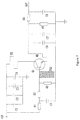
  • FIG. 7 is a circuit diagram of the radar transmitting and receiving sensor board according to one embodiment of the present invention.
  • FIG. 8 is a wiring plan view of the radar transmitting and receiving sensor board circuit according to one embodiment of the present invention.
  • FIG. 9 is a circuit block diagram of a main control board according to one embodiment of the present invention.
  • the sensor board includes a non-conductive substrate integrated with a microwave oscillator.
  • the microwave oscillator may include a RC oscillator circuit, a transistor, a first filter circuit configured to receive input signals, a second filter circuit configured to receive output signals, and a receiving antenna.
  • the RC oscillator circuit may include a plurality of capacitors that are connected in parallel and connected to a transmitting antenna.
  • one end of the capacitors is connected to ground while the other end is connected to the input power and the transmitting antenna.
  • the transmitting antenna is connected to the transistor at its collector side and the input power is connected to the base of the transistor through the first filter circuit. The emitter of the transistor, however, is connected to one end of the receiving antenna while the other end of the receiving antenna outputs a signal through the second filter circuit.
  • a first copper wire is laid along the edge of the non-conductive substrate of the sensor board.
  • the non-conductive substrate of the sensor board is provided with a plurality of first recesses distributed at intervals along the first copper wire (e.g., along the edge of the non-conductive substrate).
  • a plurality of first copper pillars (or first electrically conductive protrusions) is embedded in the first recesses.
  • the first copper wire electrically connects the plurality of first copper pillars to form a transmitting antenna, the distance between two adjacent first copper pillars is configured to be less than or equal to 1.5 mm, and the total length of first copper wire is configured to be greater than 80 mm.
  • the non-conductive substrate may be integrated with an anti-coupling copper foil to further attenuate or eliminate interfering signals.
  • one end of the anti-coupling copper foil is connected to the base of the transistor, and the other end of the anti-coupling copper foil is floating.
  • the non-conductive substrate of the sensor board may include a first copper wire that is laid on the edge of the non-conductive substrate to form a frame-shaped closed loop.
  • the non-conductive substrate of the sensor board may include a second copper wire that is arranged in the middle of the first copper wire, which is in the form of a frame-shaped closed loop.
  • the non-conductive substrate of the sensor board may be provided with a plurality of second recesses distributed at intervals along the second copper wire.
  • a plurality of second copper pillars (or second electrically conductive protrusions) are embedded in the second recesses.
  • the second copper wire electrically connects a plurality of second copper pillars to form a receiving antenna.
  • the second copper pillars 6 increase the sensitivity of the receiving antenna 10 (e.g., increase sensitivity over a receiving antenna that contained only the second copper wire, without the second copper pillars 6 ) in detecting the frequency-shifted signal reflected back from the environment.
  • the distance between two adjacent second copper pillars is within 1.5 mm and the total length of the receiving antenna is greater than 20 mm.
  • the second copper wire is in an S shape.
  • the anti-coupling copper foil is rectangular, with a length of more than 6.5 mm, a width of more than 2.5 mm, and an aspect ratio in a range of 1.5:1 to 3:1.
  • the RC oscillator circuit may include three chip capacitors (e.g., ceramic chip capacitors). In some embodiments, the RC oscillator circuit includes only three capacitors (e.g., exactly three capacitors connected in parallel). In some embodiments, the RC oscillator circuit includes four capacitors (e.g., four capacitors connected in parallel). In some aspects, the chip capacitors may be X7R or X5R 0.5 pF chip capacitors.
  • the first copper wire and the second copper wire may be formed by a copper foil with a thickness in the range of 30 ⁇ m to 40 ⁇ m, and a weight in the range of 0.5 oz to 1.5 oz.
  • a RC filter circuit is adopted for the first filter circuit and the second filter circuit.
  • the RC oscillator circuit of the microwave oscillator may include multiple capacitors and a transmitting antenna.
  • the capacitors are connected in parallel, with one end connected to the ground, and the other end is connected to the input power Vcc and the transmitting antenna.
  • the transmitting antenna is connected to the collector of the transistor Q 1 .
  • the RC oscillator may include a non-conductive substrate that is integrated with an anti-coupling copper foil.
  • one end of the anti-coupling copper foil is connected to the base of the transistor Q 1 and the other end of the anti-coupling copper foil is floating.
  • a first copper wire is laid along (e.g. adjacent) the edge or edges of the non-conductive substrate of the sensor board.
  • the non-conductive substrate is provided with a plurality of first recesses distributed at intervals along the first copper wire.
  • plurality of first copper pillars are embedded in the plurality of the first recesses, and the first copper wire electrically connects the plurality of first copper pillars to form a transmitting antenna.
  • the distance between two adjacent first copper pillars is less than or equal to 1.5 mm, and the total length of the first copper wire is greater than 80 mm.
  • a first copper wire is laid on or along or adjacent the edge of the non-conductive substrate of the sensor board and the first copper wire is configured in a frame-shaped closed loop.
  • a second copper wire is arranged in the middle of the first copper wire that is configured in a frame-shaped closed loop.
  • the non-conductive substrate of the sensor board is provided with plurality of second recesses distributed at intervals along the second copper wire.
  • plurality of second copper pillars are embedded in the plurality of the second recesses where the second copper wire electrically connects a plurality of second copper pillars to form a receiving antenna.
  • the distance between two adjacent second copper pillars is less than or equal to 1.5 mm, and the total length of the receiving antenna is greater than 20 mm.
  • the second copper wire is configured in S-shape.
  • the anti-coupling copper foil is shaped as a rectangle, with a length more than 6.5 mm, a width more than 2.5 mm, and an aspect ratio of 1.5:1 to 3:1.
  • the RC oscillator circuit includes a capacitor C 1 , a capacitor C 2 , a capacitor C 3 and a capacitor C 4 .
  • capacitor C 2 is an no-connect capacitor and capacitors C 1 , C 3 and C 4 are chip capacitors (e.g. ceramic chip capacitors).
  • capacitors C 1 , C 3 and C 4 are X7R or X5R 0.5 pF chip capacitors.
  • the copper foil of the first copper wire and the second copper wire has a thickness that is within the range of about 30 ⁇ m to about 40 ⁇ m (equivalently a weight within the range of about 0.5 oz to about 1.5 oz).
  • aspects of embodiments of the present invention relate to a directional radar transmitting and receiving sensor board. Aspects of the present invention will be described in more detail using the following examples, which may describe more than one relevant embodiment falling within the scope of the present invention.
  • the directional radar transmitting and receiving sensor board includes a non-conductive substrate 1 integrated with a microwave oscillator 8 .
  • the microwave oscillator may include a RC oscillator circuit, a transistor Q 1 , a first filter circuit 13 configured to receive input power Vcc (input filter circuit), a second filter circuit 14 configured to receive a signal and to generate a filtered output signal (an output filter circuit), and a receiving antenna 10 .
  • the RC oscillator circuit may include multiple capacitors and a transmitting antenna 9 .
  • the capacitors may be connected in parallel, with one end connected to the ground, and with the other end connected to the input power Vcc and the transmitting antenna 9 .
  • the transmitting antenna 9 may be connected to the collector of the transistor Q 1 ; the input power Vcc is connected to the base of the transistor Q 1 through the first filter circuit 13 , the emitter of the transistor Q 1 is connected to the first end of the receiving antenna, and the second end of the receiving antenna outputs a signal through the output filter circuit.
  • the first copper wire may be laid along (e.g., adjacent) the edge or edges of the non-conductive substrate 1 (the first copper wire 2 may have a length corresponding to its dimension in a direction parallel to the adjacent edge of the non-conductive substrate).
  • the non-conductive substrate 1 may be provided with a plurality of the first recesses 11 distributed at intervals along the first copper wire 2 .
  • the first plurality of copper pillars 5 may be embedded in the first recesses 11 , and the first copper wire 2 electrically connects the plurality of first copper pillars 5 to form a transmitting antenna 9 .
  • the distance between two adjacent first copper pillars 5 is less than or equal to 1.5 mm, and a total length of the copper wire 2 is greater than 80 mm.
  • the non-conductive substrate 1 may be integrated with an anti-coupling copper foil 4 , where one end of the anti-coupling copper foil 4 connects to the base of the transistor Q 1 and the other end of the anti-coupling copper foil 4 is floating.
  • the first copper wire 2 may be laid along (e.g., on or adjacent) the edge of the non-conductive substrate 1 (e.g., along one edge, along two adjacent edges, along three edges, or along four edges of the non-conductive substrate), and, in some embodiments, the first copper wire 2 may be configured in a frame-shaped closed loop.
  • the second copper wire 3 may be arranged in the middle of the first copper wire 2 which is in a frame-shaped closed loop.
  • the non-conductive substrate 1 may be provided with a plurality of second recesses 12 distributed at intervals along the second copper wire 3 (e.g., along a path in the non-conductive substrate 1 having the same shape as the second copper wire 3 ).
  • plurality of second copper pillars 6 are embedded in the second recesses 12 where the second copper wire 3 electrically connects a plurality of second copper pillars 6 to form a receiving antenna 10 .
  • the distance between two adjacent second copper pillars 6 may be less than or equal to 1.5 mm and the total length of the receiving antenna may be greater than 20 mm.
  • the second copper wire 3 is in an S-shape.
  • the anti-coupling copper foil 4 is shaped as a rectangle, with a length more than 6.5 mm, a width more than 2.5 mm, and an aspect ratio of 1.5:1 to 3:1.
  • a number of capacitors in the RC oscillator circuit may include four capacitors: a capacitor C 1 , a capacitor C 2 , a capacitor C 3 and a capacitor C 4 .
  • capacitor C 2 is omitted (e.g., a no-connect capacitor) and, in some embodiments, capacitors C 1 , C 3 and C 4 are chip capacitors (e.g., ceramic chip capacitors).
  • the RC oscillator circuit includes only three capacitors.
  • Embodiments of the invention that have RC oscillator circuits which include four capacitors may have higher precision (e.g., the fourth capacitor may provide more precise control of the frequency of the RC oscillator circuit), and the fourth capacitor may also increase the manufacturing cost of the device.
  • capacitors C 1 , C 3 and C 4 may be X7R or X5R 0.5 pF chip capacitors.
  • the first copper wire 2 and the second copper wire 3 have a thickness that is within the range of about 30 ⁇ m to about 40 ⁇ m (equivalently a weight within the range of about 0.5 oz to about 1.5 oz).
  • RC filter circuits may be adopted for the first filter circuit 13 (or the input filter circuit) and the second filter circuit (or output filter circuit) 14 .
  • the first filter circuit 13 may include a first resistor R 1 , a second resistor R 2 , a third resistor R 3 and a fifth capacitor C 5 .
  • the second filter circuit 14 may include a sixth capacitor C 6 , a seventh capacitor C 7 , an eighth capacitor C 8 , a fourth resistor R 4 , and a fifth resistor R 5 .
  • the RC oscillator may include a number of capacitors: a first capacitor C 1 , a second capacitor C 2 , a third capacitor C 3 , a fourth capacitor C 4 , and a transmitting antenna RX.
  • the collector of the transistor Q 1 may be connected to the anti-coupling copper foil 4 (labeled “PAD” in FIG. 8 ). Accordingly, the emitter of the transistor Q 1 is connected to the receiving antenna RK and the other end of the receiving antenna RK is connected to the output filter circuit.
  • a high-frequency microwave signal in the range of 5.8 GHz is transmitted by the microwave oscillator of the non-conductive substrate 1 through its integrated transmitting antenna 9 , which is the combination of the first copper wire 2 and the first copper pillars 5 .
  • the receiving antenna 10 a combination of the second copper wire 3 and the second copper pillars 6 , receives the signal reflected back.
  • the transmitted microwave signals are reflected back as frequency-shifted signals due to movement of humans, cars and other large objects.
  • the signals 15 are output to the signal amplifying circuit 16 on the main control board and then are sent to the integrated circuit or main control chip 17 of the main control board for analysis.
  • the main control board sends control signals to operate the switch circuit 19 , which is in connection with the load appliances 18 .
  • the transmitting antenna at the edge or edges of the non-conductive substrate 1 is configured with a longer length to increase the transmitting signal strength. Accordingly, the receiving antenna is configured with a longer length to increase the receiving sensitivity and broaden the radar coverage.
  • the transmitting antenna and the receiving antenna at the edge of the sensor non-conductive substrate 1 may include first copper wire 2 having first copper pillar 5 protruding therefrom, and second copper wire 3 having second copper pillar 6 protruding therefrom to enhance the strength of the transmitting and receiving signals.
  • Some embodiments makes use of discrete components as the microwave oscillating circuit of the non-conductive substrate 1 , the size of the non-conductive substrate 1 , the width of the copper wire, the length of the receiving antenna, the density of recesses, the size of the counter-coupling copper foil and the component parameters and other details are respectably selected, which leads to a greatly enhanced anti-interference ability and a high sensitivity.

Landscapes

  • Engineering & Computer Science (AREA)
  • Radar, Positioning & Navigation (AREA)
  • Remote Sensing (AREA)
  • Computer Networks & Wireless Communication (AREA)
  • Physics & Mathematics (AREA)
  • General Physics & Mathematics (AREA)
  • Radar Systems Or Details Thereof (AREA)
  • Variable-Direction Aerials And Aerial Arrays (AREA)

Abstract

A sensor board for transmitting and receiving directional radar signals including a non-conductive substrate having a plurality of first recesses distributed at intervals along at least one edge of the non-conductive substrate; a microwave oscillator including an RC oscillator circuit and a transistor Q1; an anti-coupling foil; a first filter circuit configured to filter an input power Vcc; a second filter circuit configured to filter an output signal; a receiving antenna; and a transmitting antenna including a first wire laid over the plurality of first recesses along the edge of the non-conductive substrate; and a plurality of first electrically conductive protrusions embedded in the first recesses, the first wire electrically connecting the first electrically conductive protrusions.

Description

CROSS-REFERENCE TO RELATED APPLICATION(S)
This application claims priority of Chinese Utility Model Patent Application No. 201721150101.2, filed on Sep. 8, 2017 in the State Intellectual Property Office of the People's Republic of China, the disclosure of which is hereby incorporated by reference in its entirety.
BACKGROUND OF THE INVENTION
Conventional radar transmitting and receiving utilizes non-directional or omnidirectional transmitting. However, conventional radar is susceptible to errors, such as false triggering and false operation, especially when using such conventional radar transmitting and receiving techniques are used to trigger a switch to control electrical appliances. For example, in the context of controlling lights, two adjacent rooms that were both equipped with switches that utilize non-directional or omnidirectional radar transmitting often both light up when someone enters just one of the rooms. This is because when the radar detector in one room senses the person entering the room and triggers the switch to activate the light, the radar detector in the next room would also be triggered falsely, thus activating the light in the next room, causing the room to be illuminated, even though there was no motion in the next room. Additionally, comparative directional radar transmitting and receiving devices are not sufficiently robust when transmitting and receiving signals. Thus, the use of the comparative available switch controls that utilize directional radar transmitting and receiving is limited due to these technical issues.
SUMMARY
Aspects of embodiments of the present invention relate to a directional radar transmitting and receiving sensor board that is robust in transmitting and receiving signals, covering a wide area while avoiding or reducing interference.
In some embodiments, the sensor board for transmitting and receiving directional radar signals may include a non-conductive substrate having a plurality of first recesses distributed at intervals along at least one edge of the non-conductive substrate; a microwave oscillator that include an RC oscillator circuit including a plurality of capacitors connected in parallel between ground and an input power Vcc; and a transistor Q1. In some embodiments, the sensor board further includes an anti-coupling foil arranged on the non-conductive substrate, one end of the anti-coupling foil being connected to the base of the transistor Q1, and the other end of the anti-coupling foil being floating. In some aspects, the sensor board for may also include a first filter circuit configured to filter the input power Vcc; a second filter circuit configured to filter an output signal; a receiving antenna; and a transmitting antenna. In some aspects, the transmitting antenna may include a first wire laid over the plurality of first recesses along the edge of the non-conductive substrate and a plurality of first electrically conductive protrusions embedded in the first recesses, the first wire electrically connecting the first electrically conductive protrusions. In some aspects, the transmitting antenna is connected to the collector of the transistor Q1, the input power Vcc is connected to the base of the transistor Q1 through the first filter circuit, the emitter of the transistor Q1 is connected to a first end of the receiving antenna, the second filter circuit is connected to a second end of the receiving antenna and is configured to output signals. In some aspects, the distance between two adjacent first electrically conductive protrusions is less than or equal to 1.5 mm; the total length of the first wire is greater than 80 mm.
In some embodiments, the sensor board may include a first wire that is laid along the edge of the non-conductive substrate configured to form a framed-shaped closed loop. In some aspects, the non-conductive substrate has a plurality of second recesses, and the receiving antenna may include a second wire laid over the plurality of second recesses, the second recesses being distributed at intervals along the second wire.
In some embodiments, the second recesses are in a central portion of the sensor board, and the first wire forms a frame-shaped a closed loop, and the second wire is surrounded by the first wire.
In some embodiments, the sensor board may include a plurality of second electrically conductive protrusions that are embedded in the second recesses, and the second wire electrically connects a plurality of the second electrically conductive protrusions to form the receiving antenna. In some aspects, the distance between two adjacent second electrically conductive protrusions is less than or equal to 1.5 mm, and the total length of the receiving antenna is greater than 20 mm. In some aspects, the second wire has an S-shape. In some embodiments, the anti-coupling foil has a rectangular shape with a length more than 6.5 mm, a width more than 2.5 mm, and an aspect ratio in the range of 1.5:1 to 3:1.
In some embodiments, the plurality of capacitors of the RC oscillator may include three chip capacitors. In some embodiments of the present invention, the plurality of capacitors of the RC oscillator includes four chip capacitors. In some aspects, the chip capacitors are X7R or X5R 0.5 pF chip capacitors.
In some embodiments, the thickness of the first wire is in the range of 30 μm to 40 μm. And in some aspects, the first filter circuit and the second filter circuit are RC filter circuits.
BRIEF DESCRIPTION OF THE DRAWINGS
FIG. 1 is a plan view of a radar transmitting and receiving sensor board according to one embodiment of the present invention;
FIG. 2 is a sectional view of the radar transmitting and receiving sensor board of FIG. 1 along the line B-B;
FIG. 3 is a sectional view of the radar transmitting and receiving sensor board of FIG. 1 along the line C-C;
FIG. 4 is an exploded view of a radar transmitting and receiving sensor board according to one embodiment of the present invention;
FIG. 5 is a perspective view of the transmitting antenna and receiving antenna portions of a radar transmitting and receiving sensor board according to one embodiment of the present invention;
FIG. 6 is a circuit block diagram of the radar transmitting and receiving sensor board according to one embodiment of the present invention;
FIG. 7 is a circuit diagram of the radar transmitting and receiving sensor board according to one embodiment of the present invention;
FIG. 8 is a wiring plan view of the radar transmitting and receiving sensor board circuit according to one embodiment of the present invention; and
FIG. 9 is a circuit block diagram of a main control board according to one embodiment of the present invention.
DETAILED DESCRIPTION
Aspects of embodiments of the present invention relate to a directional radar transmitting and receiving sensor board that transmits and receives radar signals, reduces or avoids false triggering, and provides stability and adapts to different environments. In some embodiments, the sensor board includes a non-conductive substrate integrated with a microwave oscillator. The microwave oscillator may include a RC oscillator circuit, a transistor, a first filter circuit configured to receive input signals, a second filter circuit configured to receive output signals, and a receiving antenna.
In some embodiments, the RC oscillator circuit may include a plurality of capacitors that are connected in parallel and connected to a transmitting antenna. In some aspects, one end of the capacitors is connected to ground while the other end is connected to the input power and the transmitting antenna. In some embodiments, the transmitting antenna is connected to the transistor at its collector side and the input power is connected to the base of the transistor through the first filter circuit. The emitter of the transistor, however, is connected to one end of the receiving antenna while the other end of the receiving antenna outputs a signal through the second filter circuit.
In some embodiments, a first copper wire is laid along the edge of the non-conductive substrate of the sensor board. The non-conductive substrate of the sensor board is provided with a plurality of first recesses distributed at intervals along the first copper wire (e.g., along the edge of the non-conductive substrate). In some aspects, a plurality of first copper pillars (or first electrically conductive protrusions) is embedded in the first recesses. In some embodiments, the first copper wire electrically connects the plurality of first copper pillars to form a transmitting antenna, the distance between two adjacent first copper pillars is configured to be less than or equal to 1.5 mm, and the total length of first copper wire is configured to be greater than 80 mm.
In some embodiments, the non-conductive substrate may be integrated with an anti-coupling copper foil to further attenuate or eliminate interfering signals. In some aspects, one end of the anti-coupling copper foil is connected to the base of the transistor, and the other end of the anti-coupling copper foil is floating.
In some embodiments, the non-conductive substrate of the sensor board may include a first copper wire that is laid on the edge of the non-conductive substrate to form a frame-shaped closed loop. In some aspects, the non-conductive substrate of the sensor board may include a second copper wire that is arranged in the middle of the first copper wire, which is in the form of a frame-shaped closed loop. The non-conductive substrate of the sensor board may be provided with a plurality of second recesses distributed at intervals along the second copper wire. In some aspects, a plurality of second copper pillars (or second electrically conductive protrusions) are embedded in the second recesses. The second copper wire electrically connects a plurality of second copper pillars to form a receiving antenna. The second copper pillars 6 increase the sensitivity of the receiving antenna 10 (e.g., increase sensitivity over a receiving antenna that contained only the second copper wire, without the second copper pillars 6) in detecting the frequency-shifted signal reflected back from the environment. In some embodiments, the distance between two adjacent second copper pillars is within 1.5 mm and the total length of the receiving antenna is greater than 20 mm.
In some embodiments, the second copper wire is in an S shape. In some embodiments, the anti-coupling copper foil is rectangular, with a length of more than 6.5 mm, a width of more than 2.5 mm, and an aspect ratio in a range of 1.5:1 to 3:1. In some embodiments, the RC oscillator circuit may include three chip capacitors (e.g., ceramic chip capacitors). In some embodiments, the RC oscillator circuit includes only three capacitors (e.g., exactly three capacitors connected in parallel). In some embodiments, the RC oscillator circuit includes four capacitors (e.g., four capacitors connected in parallel). In some aspects, the chip capacitors may be X7R or X5R 0.5 pF chip capacitors. In some embodiments, the first copper wire and the second copper wire may be formed by a copper foil with a thickness in the range of 30 μm to 40 μm, and a weight in the range of 0.5 oz to 1.5 oz. In some embodiments, a RC filter circuit is adopted for the first filter circuit and the second filter circuit.
In some embodiments, the RC oscillator circuit of the microwave oscillator may include multiple capacitors and a transmitting antenna. In some aspects, the capacitors are connected in parallel, with one end connected to the ground, and the other end is connected to the input power Vcc and the transmitting antenna. In some aspects, the transmitting antenna is connected to the collector of the transistor Q1. In some aspects, the RC oscillator may include a non-conductive substrate that is integrated with an anti-coupling copper foil. In some aspects, one end of the anti-coupling copper foil is connected to the base of the transistor Q1 and the other end of the anti-coupling copper foil is floating. In some aspects, a first copper wire is laid along (e.g. adjacent) the edge or edges of the non-conductive substrate of the sensor board. In some aspects, the non-conductive substrate is provided with a plurality of first recesses distributed at intervals along the first copper wire. In some aspects, plurality of first copper pillars are embedded in the plurality of the first recesses, and the first copper wire electrically connects the plurality of first copper pillars to form a transmitting antenna. In some aspects, the distance between two adjacent first copper pillars is less than or equal to 1.5 mm, and the total length of the first copper wire is greater than 80 mm.
In some embodiments, a first copper wire is laid on or along or adjacent the edge of the non-conductive substrate of the sensor board and the first copper wire is configured in a frame-shaped closed loop. In some aspects, a second copper wire is arranged in the middle of the first copper wire that is configured in a frame-shaped closed loop. In some aspects, the non-conductive substrate of the sensor board is provided with plurality of second recesses distributed at intervals along the second copper wire. In some aspects, plurality of second copper pillars are embedded in the plurality of the second recesses where the second copper wire electrically connects a plurality of second copper pillars to form a receiving antenna. In some aspects, the distance between two adjacent second copper pillars is less than or equal to 1.5 mm, and the total length of the receiving antenna is greater than 20 mm. In some aspects, the second copper wire is configured in S-shape.
In some embodiments, the anti-coupling copper foil is shaped as a rectangle, with a length more than 6.5 mm, a width more than 2.5 mm, and an aspect ratio of 1.5:1 to 3:1. In some aspects, the RC oscillator circuit includes a capacitor C1, a capacitor C2, a capacitor C3 and a capacitor C4. In some aspects capacitor C2 is an no-connect capacitor and capacitors C1, C3 and C4 are chip capacitors (e.g. ceramic chip capacitors). In some aspects, capacitors C1, C3 and C4 are X7R or X5R 0.5 pF chip capacitors.
In some embodiments, the copper foil of the first copper wire and the second copper wire has a thickness that is within the range of about 30 μm to about 40 μm (equivalently a weight within the range of about 0.5 oz to about 1.5 oz).
Aspects of embodiments of the present invention relate to a directional radar transmitting and receiving sensor board. Aspects of the present invention will be described in more detail using the following examples, which may describe more than one relevant embodiment falling within the scope of the present invention.
In one embodiment, as shown in FIGS. 1, 2, 3, 4, 5, 6, 7 and 8, the directional radar transmitting and receiving sensor board includes a non-conductive substrate 1 integrated with a microwave oscillator 8. The microwave oscillator may include a RC oscillator circuit, a transistor Q1, a first filter circuit 13 configured to receive input power Vcc (input filter circuit), a second filter circuit 14 configured to receive a signal and to generate a filtered output signal (an output filter circuit), and a receiving antenna 10. According to one embodiment shown in FIG. 7, the RC oscillator circuit may include multiple capacitors and a transmitting antenna 9. In some aspects, the capacitors may be connected in parallel, with one end connected to the ground, and with the other end connected to the input power Vcc and the transmitting antenna 9. In some aspects, the transmitting antenna 9 may be connected to the collector of the transistor Q1; the input power Vcc is connected to the base of the transistor Q1 through the first filter circuit 13, the emitter of the transistor Q1 is connected to the first end of the receiving antenna, and the second end of the receiving antenna outputs a signal through the output filter circuit. In some aspects, the first copper wire may be laid along (e.g., adjacent) the edge or edges of the non-conductive substrate 1 (the first copper wire 2 may have a length corresponding to its dimension in a direction parallel to the adjacent edge of the non-conductive substrate). The non-conductive substrate 1 may be provided with a plurality of the first recesses 11 distributed at intervals along the first copper wire 2. The first plurality of copper pillars 5 may be embedded in the first recesses 11, and the first copper wire 2 electrically connects the plurality of first copper pillars 5 to form a transmitting antenna 9. According to some embodiments, the distance between two adjacent first copper pillars 5 is less than or equal to 1.5 mm, and a total length of the copper wire 2 is greater than 80 mm. In some aspects, the non-conductive substrate 1 may be integrated with an anti-coupling copper foil 4, where one end of the anti-coupling copper foil 4 connects to the base of the transistor Q1 and the other end of the anti-coupling copper foil 4 is floating.
In some embodiments, the first copper wire 2 may be laid along (e.g., on or adjacent) the edge of the non-conductive substrate 1 (e.g., along one edge, along two adjacent edges, along three edges, or along four edges of the non-conductive substrate), and, in some embodiments, the first copper wire 2 may be configured in a frame-shaped closed loop. In some aspects, the second copper wire 3 may be arranged in the middle of the first copper wire 2 which is in a frame-shaped closed loop. In some embodiments, the non-conductive substrate 1 may be provided with a plurality of second recesses 12 distributed at intervals along the second copper wire 3 (e.g., along a path in the non-conductive substrate 1 having the same shape as the second copper wire 3). In some aspects, plurality of second copper pillars 6 are embedded in the second recesses 12 where the second copper wire 3 electrically connects a plurality of second copper pillars 6 to form a receiving antenna 10. In some embodiments, the distance between two adjacent second copper pillars 6 may be less than or equal to 1.5 mm and the total length of the receiving antenna may be greater than 20 mm. In some aspects, the second copper wire 3 is in an S-shape.
In some aspects, the anti-coupling copper foil 4 is shaped as a rectangle, with a length more than 6.5 mm, a width more than 2.5 mm, and an aspect ratio of 1.5:1 to 3:1.
In some embodiments, a number of capacitors in the RC oscillator circuit may include four capacitors: a capacitor C1, a capacitor C2, a capacitor C3 and a capacitor C4. In some embodiments, capacitor C2 is omitted (e.g., a no-connect capacitor) and, in some embodiments, capacitors C1, C3 and C4 are chip capacitors (e.g., ceramic chip capacitors). In other words, in some embodiments, the RC oscillator circuit includes only three capacitors. Embodiments of the invention that have RC oscillator circuits which include four capacitors may have higher precision (e.g., the fourth capacitor may provide more precise control of the frequency of the RC oscillator circuit), and the fourth capacitor may also increase the manufacturing cost of the device. In some aspects, capacitors C1, C3 and C4 may be X7R or X5R 0.5 pF chip capacitors. In some embodiments, the first copper wire 2 and the second copper wire 3 have a thickness that is within the range of about 30 μm to about 40 μm (equivalently a weight within the range of about 0.5 oz to about 1.5 oz).
In some aspects, RC filter circuits may be adopted for the first filter circuit 13 (or the input filter circuit) and the second filter circuit (or output filter circuit) 14. As shown in FIG. 7, the first filter circuit 13 may include a first resistor R1, a second resistor R2, a third resistor R3 and a fifth capacitor C5. Accordingly, the second filter circuit 14 may include a sixth capacitor C6, a seventh capacitor C7, an eighth capacitor C8, a fourth resistor R4, and a fifth resistor R5. The RC oscillator may include a number of capacitors: a first capacitor C1, a second capacitor C2, a third capacitor C3, a fourth capacitor C4, and a transmitting antenna RX. The collector of the transistor Q1 may be connected to the anti-coupling copper foil 4 (labeled “PAD” in FIG. 8). Accordingly, the emitter of the transistor Q1 is connected to the receiving antenna RK and the other end of the receiving antenna RK is connected to the output filter circuit.
According to some embodiments, during operation, a high-frequency microwave signal in the range of 5.8 GHz is transmitted by the microwave oscillator of the non-conductive substrate 1 through its integrated transmitting antenna 9, which is the combination of the first copper wire 2 and the first copper pillars 5. The receiving antenna 10, a combination of the second copper wire 3 and the second copper pillars 6, receives the signal reflected back. During receiving, the transmitted microwave signals are reflected back as frequency-shifted signals due to movement of humans, cars and other large objects. Through frequency mixing and wave detection and other operations applied to the signals, the signals 15 are output to the signal amplifying circuit 16 on the main control board and then are sent to the integrated circuit or main control chip 17 of the main control board for analysis. The main control board sends control signals to operate the switch circuit 19, which is in connection with the load appliances 18.
In some embodiments, the transmitting antenna at the edge or edges of the non-conductive substrate 1 is configured with a longer length to increase the transmitting signal strength. Accordingly, the receiving antenna is configured with a longer length to increase the receiving sensitivity and broaden the radar coverage. In some embodiments, the transmitting antenna and the receiving antenna at the edge of the sensor non-conductive substrate 1 may include first copper wire 2 having first copper pillar 5 protruding therefrom, and second copper wire 3 having second copper pillar 6 protruding therefrom to enhance the strength of the transmitting and receiving signals.
Some embodiments makes use of discrete components as the microwave oscillating circuit of the non-conductive substrate 1, the size of the non-conductive substrate 1, the width of the copper wire, the length of the receiving antenna, the density of recesses, the size of the counter-coupling copper foil and the component parameters and other details are respectably selected, which leads to a greatly enhanced anti-interference ability and a high sensitivity.
Finally, it should be noted that the forgoing embodiments is merely intended for describing the technical solution of embodiments, of the present invention, but embodiments of the present invention are not limited thereto. Although aspects of embodiments of the present invention are described in detail with reference to the forgoing example embodiments, it should be understood by those of ordinary skill in the art that the technical solution described within reference to the foregoing example embodiments may be modified or equivalent replacements may be made to some of the technical features therein. It will also be apparent to the skilled artisan that the embodiments described above are specific examples of a single broader invention that may have greater scope than any of the singular descriptions without departing from the spirit and scope of the present invention.

Claims (13)

What is claimed is:
1. A sensor board for transmitting and receiving directional radar signals comprising:
a non-conductive substrate having a plurality of first recesses distributed at intervals along at least one edge of the non-conductive substrate;
a microwave oscillator comprising:
an RC oscillator circuit comprising a plurality of capacitors connected in parallel between ground and an input power Vcc; and
a transistor Q1;
an anti-coupling foil arranged on the non-conductive substrate, wherein one end of the anti-coupling foil is connected to the base of the transistor Q1, and the other end of the anti-coupling foil is floating;
a first filter circuit configured to filter input power Vcc;
a second filter circuit configured to filter an output signal;
a receiving antenna; and
a transmitting antenna comprising:
a first wire laid over the plurality of first recesses along the edge of the non-conductive substrate; and
a plurality of first electrically conductive protrusions embedded in the first recesses, the first wire electrically connecting the first electrically conductive protrusions,
wherein the transmitting antenna is connected to the collector of the transistor Q1, the input power Vcc is connected to the base of the transistor Q1 through the first filter circuit, the emitter of the transistor Q1 is connected to a first end of the receiving antenna, the second filter circuit is connected to a second end of the receiving antenna and is configured to output signals, and
wherein the distance between two adjacent first electrically conductive protrusions is less than or equal to 1.5 mm; the total length of the first wire is greater than 80 mm.
2. The sensor board of claim 1, wherein the first wire laid along the edge of the non-conductive substrate is configured to form a framed-shaped closed loop.
3. The sensor board of claim 1, wherein the non-conductive substrate has a plurality of second recesses, and
wherein the receiving antenna comprises a second wire laid over the plurality of second recesses, the second recesses being distributed at intervals along the second wire.
4. The sensor board of claim 3, wherein the second recesses are in a central portion of the non-conductive substrate,
wherein the first wire forms a frame-shaped a closed loop, and
wherein the second wire is surrounded by the first wire.
5. The sensor board of claim 3 further comprising a plurality of second electrically conductive protrusions,
wherein the plurality of second electrically conductive protrusions are embedded in the second recesses, and the second wire electrically connects a plurality of the second electrically conductive protrusions to form the receiving antenna, and
wherein the distance between two adjacent second electrically conductive protrusions is less than or equal to 1.5 mm, and the total length of the receiving antenna is greater than 20 mm.
6. The sensor board of claim 3, wherein the second wire has an S-shape.
7. The sensor board of claim 1, wherein the anti-coupling foil has a rectangular shape with a length more than 6.5 mm, a width more than 2.5 mm, and an aspect ratio in the range of 1.5:1 to 3:1.
8. The sensor board of claim 1, wherein the plurality of capacitors of the RC oscillator circuit comprises three chip capacitors.
9. The sensor board of claim 8 wherein the chip capacitors are X7R or X5R 0.5 pF chip capacitors.
10. The sensor board of claim 8, wherein the plurality of capacitors of the RC oscillator circuit comprises four chip capacitors.
11. The sensor board of claim 10 wherein the chip capacitors are X7R or X5R 0.5 pF chip capacitors.
12. The sensor board of claim 1 wherein the thickness of the first wire is in the range of 30 μm to 40 μm.
13. The sensor board of claim 1, wherein the first filter circuit and the second filter circuit are RC filter circuits.
US16/105,540 2017-09-08 2018-08-20 Directional radar transmitting and receiving sensor board Expired - Fee Related US10859672B2 (en)

Applications Claiming Priority (3)

Application Number Priority Date Filing Date Title
CN201721150101.2 2017-09-08
CN201721150101U 2017-09-08
CN201721150101.2U CN207263916U (en) 2017-09-08 2017-09-08 Tablet is launched and received to beam radar

Publications (2)

Publication Number Publication Date
US20190079163A1 US20190079163A1 (en) 2019-03-14
US10859672B2 true US10859672B2 (en) 2020-12-08

Family

ID=61920912

Family Applications (1)

Application Number Title Priority Date Filing Date
US16/105,540 Expired - Fee Related US10859672B2 (en) 2017-09-08 2018-08-20 Directional radar transmitting and receiving sensor board

Country Status (2)

Country Link
US (1) US10859672B2 (en)
CN (1) CN207263916U (en)

Families Citing this family (1)

* Cited by examiner, † Cited by third party
Publication number Priority date Publication date Assignee Title
WO2022215381A1 (en) * 2021-04-09 2022-10-13 株式会社村田製作所 Connecting structure, and antenna module

Citations (9)

* Cited by examiner, † Cited by third party
Publication number Priority date Publication date Assignee Title
EP0800093A1 (en) * 1996-04-03 1997-10-08 Honda Giken Kogyo Kabushiki Kaisha Radar module and MMIC package for use in such radar module
JPH10341113A (en) * 1997-06-10 1998-12-22 Yupiteru Ind Co Ltd Microwave detector
US20050225481A1 (en) * 2004-04-12 2005-10-13 Bonthron Andrew J Method and apparatus for automotive radar sensor
JP2008141406A (en) * 2006-11-30 2008-06-19 Kyocera Corp Mounting board, transmitter, receiver, transceiver, and radar device
WO2008120826A1 (en) * 2007-04-02 2008-10-09 National Institute Of Information And Communications Technology Microwave/millimeter wave sensor apparatus
US7603097B2 (en) * 2004-12-30 2009-10-13 Valeo Radar Systems, Inc. Vehicle radar sensor assembly
US7639173B1 (en) * 2008-12-11 2009-12-29 Honeywell International Inc. Microwave planar sensor using PCB cavity packaging process
US20100060537A1 (en) * 2008-09-05 2010-03-11 Inter-University Research Institute National Institutes Of Natural Sciences Antenna array
US20120013499A1 (en) * 2009-03-31 2012-01-19 Kyocera Corporation Circuit Board, High Frequency Module, and Radar Apparatus

Patent Citations (13)

* Cited by examiner, † Cited by third party
Publication number Priority date Publication date Assignee Title
US6130640A (en) * 1996-04-03 2000-10-10 Honda Giken Kogyo Kabushiki Kaisha Radar module and MMIC package for use in such radar module
EP0800093A1 (en) * 1996-04-03 1997-10-08 Honda Giken Kogyo Kabushiki Kaisha Radar module and MMIC package for use in such radar module
JPH10341113A (en) * 1997-06-10 1998-12-22 Yupiteru Ind Co Ltd Microwave detector
US20050225481A1 (en) * 2004-04-12 2005-10-13 Bonthron Andrew J Method and apparatus for automotive radar sensor
WO2005101051A2 (en) * 2004-04-12 2005-10-27 Ghz Tr Corporation Method and apparatus for automotive radar sensor
US7603097B2 (en) * 2004-12-30 2009-10-13 Valeo Radar Systems, Inc. Vehicle radar sensor assembly
JP2008141406A (en) * 2006-11-30 2008-06-19 Kyocera Corp Mounting board, transmitter, receiver, transceiver, and radar device
WO2008120826A1 (en) * 2007-04-02 2008-10-09 National Institute Of Information And Communications Technology Microwave/millimeter wave sensor apparatus
US20100060537A1 (en) * 2008-09-05 2010-03-11 Inter-University Research Institute National Institutes Of Natural Sciences Antenna array
US8604991B2 (en) * 2008-09-05 2013-12-10 Inter-University Research Institute National Institutes Of Natural Sciences Two-dimensional antenna array for microwave imaging
US7639173B1 (en) * 2008-12-11 2009-12-29 Honeywell International Inc. Microwave planar sensor using PCB cavity packaging process
EP2196818A2 (en) * 2008-12-11 2010-06-16 Honeywell International Inc. Microwave planar sensor using PCB cavity packaging process
US20120013499A1 (en) * 2009-03-31 2012-01-19 Kyocera Corporation Circuit Board, High Frequency Module, and Radar Apparatus

Non-Patent Citations (1)

* Cited by examiner, † Cited by third party
Title
Espacenet English translation of JP2008141406 (A), Jun. 19, 2008, inventor Nakazuru Kazumi, applicant Kyocera Corp. *

Also Published As

Publication number Publication date
US20190079163A1 (en) 2019-03-14
CN207263916U (en) 2018-04-20

Similar Documents

Publication Publication Date Title
US9905908B2 (en) Antenna structure with proximity sensor
US9746571B2 (en) Proximity sensor antenna device and antenna structure thereof
JP2014520401A (en) Printed circuit board with capacitive sensor electrode configuration
CN111796527A (en) Intelligent control system based on millimeter wave radar
US10859672B2 (en) Directional radar transmitting and receiving sensor board
US12480647B2 (en) Control module for a lighting fixture
TW201511617A (en) Lighting device with microwave detection function
CN102043147A (en) Microwave sensor
CN104297806A (en) Microwave sensing module
CN111522002A (en) Intelligent switch radar system
TW201803197A (en) PCB antenna
US8903335B2 (en) Electronic device
US11837039B2 (en) Access control electronics for wireless locks
CN109143177A (en) A kind of 5.8GHz novel microwave movable sensor
US10122087B2 (en) Proximity sensor antenna device and antenna structure thereof
KR101856880B1 (en) Patch antenna system using air dielectric
US20190072643A1 (en) Directional radar transmitting and receiving devices
CN208999558U (en) A kind of 5.8GHz novel microwave movable sensor
EP2738867A2 (en) Switchable antenna system
CN218767352U (en) A single-transistor narrow-band microwave motion detection sensor
CN108134180A (en) A kind of micro-strip flat plane antenna sensor
JP6975946B2 (en) Radio sensor
JP5671787B2 (en) Radio wave sensor
JP3154156U (en) Microwave motion detector
JP4868117B2 (en) Wireless sensor receiver and wireless sensor device

Legal Events

Date Code Title Description
FEPP Fee payment procedure

Free format text: ENTITY STATUS SET TO UNDISCOUNTED (ORIGINAL EVENT CODE: BIG.); ENTITY STATUS OF PATENT OWNER: LARGE ENTITY

STPP Information on status: patent application and granting procedure in general

Free format text: DOCKETED NEW CASE - READY FOR EXAMINATION

AS Assignment

Owner name: GARDENIA INDUSTRIAL LIMITED, HONG KONG

Free format text: ASSIGNMENT OF ASSIGNORS INTEREST;ASSIGNOR:LIU, XIAO XIONG;REEL/FRAME:047126/0365

Effective date: 20180817

STCF Information on status: patent grant

Free format text: PATENTED CASE

FEPP Fee payment procedure

Free format text: MAINTENANCE FEE REMINDER MAILED (ORIGINAL EVENT CODE: REM.); ENTITY STATUS OF PATENT OWNER: LARGE ENTITY

LAPS Lapse for failure to pay maintenance fees

Free format text: PATENT EXPIRED FOR FAILURE TO PAY MAINTENANCE FEES (ORIGINAL EVENT CODE: EXP.); ENTITY STATUS OF PATENT OWNER: LARGE ENTITY

STCH Information on status: patent discontinuation

Free format text: PATENT EXPIRED DUE TO NONPAYMENT OF MAINTENANCE FEES UNDER 37 CFR 1.362

FP Lapsed due to failure to pay maintenance fee

Effective date: 20241208