US10564320B2 - Compound, photosensitive resin composition including the same, and color filter - Google Patents

Compound, photosensitive resin composition including the same, and color filter Download PDF

Info

Publication number
US10564320B2
US10564320B2 US15/837,328 US201715837328A US10564320B2 US 10564320 B2 US10564320 B2 US 10564320B2 US 201715837328 A US201715837328 A US 201715837328A US 10564320 B2 US10564320 B2 US 10564320B2
Authority
US
United States
Prior art keywords
chemical formula
represented
compound
photosensitive resin
resin composition
Prior art date
Legal status (The legal status is an assumption and is not a legal conclusion. Google has not performed a legal analysis and makes no representation as to the accuracy of the status listed.)
Active, expires
Application number
US15/837,328
Other versions
US20180335547A1 (en
Inventor
Euisoo JEONG
Hyewon Seo
Myoungyoup Shin
Sunwoong SHIN
Juho JUNG
Gyuseok Han
Current Assignee (The listed assignees may be inaccurate. Google has not performed a legal analysis and makes no representation or warranty as to the accuracy of the list.)
Samsung SDI Co Ltd
Original Assignee
Samsung SDI Co Ltd
Priority date (The priority date is an assumption and is not a legal conclusion. Google has not performed a legal analysis and makes no representation as to the accuracy of the date listed.)
Filing date
Publication date
Application filed by Samsung SDI Co Ltd filed Critical Samsung SDI Co Ltd
Assigned to SAMSUNG SDI CO., LTD. reassignment SAMSUNG SDI CO., LTD. ASSIGNMENT OF ASSIGNORS INTEREST (SEE DOCUMENT FOR DETAILS). Assignors: HAN, GYUSEOK, JUNG, JUHO, SHIN, MYOUNGYOUP, SHIN, Sunwoong, JEONG, EUISOO, Seo, Hyewon
Publication of US20180335547A1 publication Critical patent/US20180335547A1/en
Application granted granted Critical
Publication of US10564320B2 publication Critical patent/US10564320B2/en
Active legal-status Critical Current
Adjusted expiration legal-status Critical

Links

Classifications

    • GPHYSICS
    • G02OPTICS
    • G02BOPTICAL ELEMENTS, SYSTEMS OR APPARATUS
    • G02B1/00Optical elements characterised by the material of which they are made; Optical coatings for optical elements
    • G02B1/04Optical elements characterised by the material of which they are made; Optical coatings for optical elements made of organic materials, e.g. plastics
    • GPHYSICS
    • G03PHOTOGRAPHY; CINEMATOGRAPHY; ANALOGOUS TECHNIQUES USING WAVES OTHER THAN OPTICAL WAVES; ELECTROGRAPHY; HOLOGRAPHY
    • G03FPHOTOMECHANICAL PRODUCTION OF TEXTURED OR PATTERNED SURFACES, e.g. FOR PRINTING, FOR PROCESSING OF SEMICONDUCTOR DEVICES; MATERIALS THEREFOR; ORIGINALS THEREFOR; APPARATUS SPECIALLY ADAPTED THEREFOR
    • G03F7/00Photomechanical, e.g. photolithographic, production of textured or patterned surfaces, e.g. printing surfaces; Materials therefor, e.g. comprising photoresists; Apparatus specially adapted therefor
    • G03F7/004Photosensitive materials
    • CCHEMISTRY; METALLURGY
    • C07ORGANIC CHEMISTRY
    • C07FACYCLIC, CARBOCYCLIC OR HETEROCYCLIC COMPOUNDS CONTAINING ELEMENTS OTHER THAN CARBON, HYDROGEN, HALOGEN, OXYGEN, NITROGEN, SULFUR, SELENIUM OR TELLURIUM
    • C07F3/00Compounds containing elements of Groups 2 or 12 of the Periodic Table
    • C07F3/003Compounds containing elements of Groups 2 or 12 of the Periodic Table without C-Metal linkages
    • CCHEMISTRY; METALLURGY
    • C07ORGANIC CHEMISTRY
    • C07FACYCLIC, CARBOCYCLIC OR HETEROCYCLIC COMPOUNDS CONTAINING ELEMENTS OTHER THAN CARBON, HYDROGEN, HALOGEN, OXYGEN, NITROGEN, SULFUR, SELENIUM OR TELLURIUM
    • C07F3/00Compounds containing elements of Groups 2 or 12 of the Periodic Table
    • C07F3/06Zinc compounds
    • CCHEMISTRY; METALLURGY
    • C09DYES; PAINTS; POLISHES; NATURAL RESINS; ADHESIVES; COMPOSITIONS NOT OTHERWISE PROVIDED FOR; APPLICATIONS OF MATERIALS NOT OTHERWISE PROVIDED FOR
    • C09BORGANIC DYES OR CLOSELY-RELATED COMPOUNDS FOR PRODUCING DYES, e.g. PIGMENTS; MORDANTS; LAKES
    • C09B47/00Porphines; Azaporphines
    • C09B47/04Phthalocyanines abbreviation: Pc
    • CCHEMISTRY; METALLURGY
    • C09DYES; PAINTS; POLISHES; NATURAL RESINS; ADHESIVES; COMPOSITIONS NOT OTHERWISE PROVIDED FOR; APPLICATIONS OF MATERIALS NOT OTHERWISE PROVIDED FOR
    • C09BORGANIC DYES OR CLOSELY-RELATED COMPOUNDS FOR PRODUCING DYES, e.g. PIGMENTS; MORDANTS; LAKES
    • C09B47/00Porphines; Azaporphines
    • C09B47/04Phthalocyanines abbreviation: Pc
    • C09B47/06Preparation from carboxylic acids or derivatives thereof, e.g. anhydrides, amides, mononitriles, phthalimide, o-cyanobenzamide
    • C09B47/061Preparation from carboxylic acids or derivatives thereof, e.g. anhydrides, amides, mononitriles, phthalimide, o-cyanobenzamide having halogen atoms linked directly to the Pc skeleton
    • CCHEMISTRY; METALLURGY
    • C09DYES; PAINTS; POLISHES; NATURAL RESINS; ADHESIVES; COMPOSITIONS NOT OTHERWISE PROVIDED FOR; APPLICATIONS OF MATERIALS NOT OTHERWISE PROVIDED FOR
    • C09BORGANIC DYES OR CLOSELY-RELATED COMPOUNDS FOR PRODUCING DYES, e.g. PIGMENTS; MORDANTS; LAKES
    • C09B47/00Porphines; Azaporphines
    • C09B47/04Phthalocyanines abbreviation: Pc
    • C09B47/06Preparation from carboxylic acids or derivatives thereof, e.g. anhydrides, amides, mononitriles, phthalimide, o-cyanobenzamide
    • C09B47/067Preparation from carboxylic acids or derivatives thereof, e.g. anhydrides, amides, mononitriles, phthalimide, o-cyanobenzamide from phthalodinitriles naphthalenedinitriles, aromatic dinitriles prepared in situ, hydrogenated phthalodinitrile
    • C09B47/0675Preparation from carboxylic acids or derivatives thereof, e.g. anhydrides, amides, mononitriles, phthalimide, o-cyanobenzamide from phthalodinitriles naphthalenedinitriles, aromatic dinitriles prepared in situ, hydrogenated phthalodinitrile having oxygen or sulfur linked directly to the skeleton
    • CCHEMISTRY; METALLURGY
    • C09DYES; PAINTS; POLISHES; NATURAL RESINS; ADHESIVES; COMPOSITIONS NOT OTHERWISE PROVIDED FOR; APPLICATIONS OF MATERIALS NOT OTHERWISE PROVIDED FOR
    • C09BORGANIC DYES OR CLOSELY-RELATED COMPOUNDS FOR PRODUCING DYES, e.g. PIGMENTS; MORDANTS; LAKES
    • C09B47/00Porphines; Azaporphines
    • C09B47/04Phthalocyanines abbreviation: Pc
    • C09B47/08Preparation from other phthalocyanine compounds, e.g. cobaltphthalocyanineamine complex
    • C09B47/085Preparation from other phthalocyanine compounds, e.g. cobaltphthalocyanineamine complex substituting the central metal atom
    • CCHEMISTRY; METALLURGY
    • C09DYES; PAINTS; POLISHES; NATURAL RESINS; ADHESIVES; COMPOSITIONS NOT OTHERWISE PROVIDED FOR; APPLICATIONS OF MATERIALS NOT OTHERWISE PROVIDED FOR
    • C09BORGANIC DYES OR CLOSELY-RELATED COMPOUNDS FOR PRODUCING DYES, e.g. PIGMENTS; MORDANTS; LAKES
    • C09B47/00Porphines; Azaporphines
    • C09B47/04Phthalocyanines abbreviation: Pc
    • C09B47/08Preparation from other phthalocyanine compounds, e.g. cobaltphthalocyanineamine complex
    • C09B47/10Obtaining compounds having halogen atoms directly bound to the phthalocyanine skeleton
    • GPHYSICS
    • G02OPTICS
    • G02BOPTICAL ELEMENTS, SYSTEMS OR APPARATUS
    • G02B5/00Optical elements other than lenses
    • G02B5/20Filters
    • GPHYSICS
    • G02OPTICS
    • G02BOPTICAL ELEMENTS, SYSTEMS OR APPARATUS
    • G02B5/00Optical elements other than lenses
    • G02B5/20Filters
    • G02B5/22Absorbing filters
    • G02B5/223Absorbing filters containing organic substances, e.g. dyes, inks or pigments
    • GPHYSICS
    • G02OPTICS
    • G02FOPTICAL DEVICES OR ARRANGEMENTS FOR THE CONTROL OF LIGHT BY MODIFICATION OF THE OPTICAL PROPERTIES OF THE MEDIA OF THE ELEMENTS INVOLVED THEREIN; NON-LINEAR OPTICS; FREQUENCY-CHANGING OF LIGHT; OPTICAL LOGIC ELEMENTS; OPTICAL ANALOGUE/DIGITAL CONVERTERS
    • G02F1/00Devices or arrangements for the control of the intensity, colour, phase, polarisation or direction of light arriving from an independent light source, e.g. switching, gating or modulating; Non-linear optics
    • G02F1/01Devices or arrangements for the control of the intensity, colour, phase, polarisation or direction of light arriving from an independent light source, e.g. switching, gating or modulating; Non-linear optics for the control of the intensity, phase, polarisation or colour 
    • G02F1/13Devices or arrangements for the control of the intensity, colour, phase, polarisation or direction of light arriving from an independent light source, e.g. switching, gating or modulating; Non-linear optics for the control of the intensity, phase, polarisation or colour  based on liquid crystals, e.g. single liquid crystal display cells
    • G02F1/133Constructional arrangements; Operation of liquid crystal cells; Circuit arrangements
    • G02F1/1333Constructional arrangements; Manufacturing methods
    • G02F1/1335Structural association of cells with optical devices, e.g. polarisers or reflectors
    • G02F1/133509Filters, e.g. light shielding masks
    • G02F1/133514Colour filters
    • GPHYSICS
    • G03PHOTOGRAPHY; CINEMATOGRAPHY; ANALOGOUS TECHNIQUES USING WAVES OTHER THAN OPTICAL WAVES; ELECTROGRAPHY; HOLOGRAPHY
    • G03FPHOTOMECHANICAL PRODUCTION OF TEXTURED OR PATTERNED SURFACES, e.g. FOR PRINTING, FOR PROCESSING OF SEMICONDUCTOR DEVICES; MATERIALS THEREFOR; ORIGINALS THEREFOR; APPARATUS SPECIALLY ADAPTED THEREFOR
    • G03F7/00Photomechanical, e.g. photolithographic, production of textured or patterned surfaces, e.g. printing surfaces; Materials therefor, e.g. comprising photoresists; Apparatus specially adapted therefor
    • G03F7/0005Production of optical devices or components in so far as characterised by the lithographic processes or materials used therefor
    • G03F7/0007Filters, e.g. additive colour filters; Components for display devices
    • GPHYSICS
    • G03PHOTOGRAPHY; CINEMATOGRAPHY; ANALOGOUS TECHNIQUES USING WAVES OTHER THAN OPTICAL WAVES; ELECTROGRAPHY; HOLOGRAPHY
    • G03FPHOTOMECHANICAL PRODUCTION OF TEXTURED OR PATTERNED SURFACES, e.g. FOR PRINTING, FOR PROCESSING OF SEMICONDUCTOR DEVICES; MATERIALS THEREFOR; ORIGINALS THEREFOR; APPARATUS SPECIALLY ADAPTED THEREFOR
    • G03F7/00Photomechanical, e.g. photolithographic, production of textured or patterned surfaces, e.g. printing surfaces; Materials therefor, e.g. comprising photoresists; Apparatus specially adapted therefor
    • G03F7/004Photosensitive materials
    • G03F7/0045Photosensitive materials with organic non-macromolecular light-sensitive compounds not otherwise provided for, e.g. dissolution inhibitors
    • GPHYSICS
    • G03PHOTOGRAPHY; CINEMATOGRAPHY; ANALOGOUS TECHNIQUES USING WAVES OTHER THAN OPTICAL WAVES; ELECTROGRAPHY; HOLOGRAPHY
    • G03FPHOTOMECHANICAL PRODUCTION OF TEXTURED OR PATTERNED SURFACES, e.g. FOR PRINTING, FOR PROCESSING OF SEMICONDUCTOR DEVICES; MATERIALS THEREFOR; ORIGINALS THEREFOR; APPARATUS SPECIALLY ADAPTED THEREFOR
    • G03F7/00Photomechanical, e.g. photolithographic, production of textured or patterned surfaces, e.g. printing surfaces; Materials therefor, e.g. comprising photoresists; Apparatus specially adapted therefor
    • G03F7/004Photosensitive materials
    • G03F7/027Non-macromolecular photopolymerisable compounds having carbon-to-carbon double bonds, e.g. ethylenic compounds
    • GPHYSICS
    • G03PHOTOGRAPHY; CINEMATOGRAPHY; ANALOGOUS TECHNIQUES USING WAVES OTHER THAN OPTICAL WAVES; ELECTROGRAPHY; HOLOGRAPHY
    • G03FPHOTOMECHANICAL PRODUCTION OF TEXTURED OR PATTERNED SURFACES, e.g. FOR PRINTING, FOR PROCESSING OF SEMICONDUCTOR DEVICES; MATERIALS THEREFOR; ORIGINALS THEREFOR; APPARATUS SPECIALLY ADAPTED THEREFOR
    • G03F7/00Photomechanical, e.g. photolithographic, production of textured or patterned surfaces, e.g. printing surfaces; Materials therefor, e.g. comprising photoresists; Apparatus specially adapted therefor
    • G03F7/004Photosensitive materials
    • G03F7/027Non-macromolecular photopolymerisable compounds having carbon-to-carbon double bonds, e.g. ethylenic compounds
    • G03F7/028Non-macromolecular photopolymerisable compounds having carbon-to-carbon double bonds, e.g. ethylenic compounds with photosensitivity-increasing substances, e.g. photoinitiators
    • GPHYSICS
    • G03PHOTOGRAPHY; CINEMATOGRAPHY; ANALOGOUS TECHNIQUES USING WAVES OTHER THAN OPTICAL WAVES; ELECTROGRAPHY; HOLOGRAPHY
    • G03FPHOTOMECHANICAL PRODUCTION OF TEXTURED OR PATTERNED SURFACES, e.g. FOR PRINTING, FOR PROCESSING OF SEMICONDUCTOR DEVICES; MATERIALS THEREFOR; ORIGINALS THEREFOR; APPARATUS SPECIALLY ADAPTED THEREFOR
    • G03F7/00Photomechanical, e.g. photolithographic, production of textured or patterned surfaces, e.g. printing surfaces; Materials therefor, e.g. comprising photoresists; Apparatus specially adapted therefor
    • G03F7/004Photosensitive materials
    • G03F7/027Non-macromolecular photopolymerisable compounds having carbon-to-carbon double bonds, e.g. ethylenic compounds
    • G03F7/028Non-macromolecular photopolymerisable compounds having carbon-to-carbon double bonds, e.g. ethylenic compounds with photosensitivity-increasing substances, e.g. photoinitiators
    • G03F7/031Organic compounds not covered by group G03F7/029
    • GPHYSICS
    • G03PHOTOGRAPHY; CINEMATOGRAPHY; ANALOGOUS TECHNIQUES USING WAVES OTHER THAN OPTICAL WAVES; ELECTROGRAPHY; HOLOGRAPHY
    • G03FPHOTOMECHANICAL PRODUCTION OF TEXTURED OR PATTERNED SURFACES, e.g. FOR PRINTING, FOR PROCESSING OF SEMICONDUCTOR DEVICES; MATERIALS THEREFOR; ORIGINALS THEREFOR; APPARATUS SPECIALLY ADAPTED THEREFOR
    • G03F7/00Photomechanical, e.g. photolithographic, production of textured or patterned surfaces, e.g. printing surfaces; Materials therefor, e.g. comprising photoresists; Apparatus specially adapted therefor
    • G03F7/004Photosensitive materials
    • G03F7/027Non-macromolecular photopolymerisable compounds having carbon-to-carbon double bonds, e.g. ethylenic compounds
    • G03F7/032Non-macromolecular photopolymerisable compounds having carbon-to-carbon double bonds, e.g. ethylenic compounds with binders
    • G03F7/033Non-macromolecular photopolymerisable compounds having carbon-to-carbon double bonds, e.g. ethylenic compounds with binders the binders being polymers obtained by reactions only involving carbon-to-carbon unsaturated bonds, e.g. vinyl polymers
    • GPHYSICS
    • G03PHOTOGRAPHY; CINEMATOGRAPHY; ANALOGOUS TECHNIQUES USING WAVES OTHER THAN OPTICAL WAVES; ELECTROGRAPHY; HOLOGRAPHY
    • G03FPHOTOMECHANICAL PRODUCTION OF TEXTURED OR PATTERNED SURFACES, e.g. FOR PRINTING, FOR PROCESSING OF SEMICONDUCTOR DEVICES; MATERIALS THEREFOR; ORIGINALS THEREFOR; APPARATUS SPECIALLY ADAPTED THEREFOR
    • G03F7/00Photomechanical, e.g. photolithographic, production of textured or patterned surfaces, e.g. printing surfaces; Materials therefor, e.g. comprising photoresists; Apparatus specially adapted therefor
    • G03F7/004Photosensitive materials
    • G03F7/09Photosensitive materials characterised by structural details, e.g. supports, auxiliary layers
    • G03F7/105Photosensitive materials characterised by structural details, e.g. supports, auxiliary layers having substances, e.g. indicators, for forming visible images
    • GPHYSICS
    • G02OPTICS
    • G02FOPTICAL DEVICES OR ARRANGEMENTS FOR THE CONTROL OF LIGHT BY MODIFICATION OF THE OPTICAL PROPERTIES OF THE MEDIA OF THE ELEMENTS INVOLVED THEREIN; NON-LINEAR OPTICS; FREQUENCY-CHANGING OF LIGHT; OPTICAL LOGIC ELEMENTS; OPTICAL ANALOGUE/DIGITAL CONVERTERS
    • G02F1/00Devices or arrangements for the control of the intensity, colour, phase, polarisation or direction of light arriving from an independent light source, e.g. switching, gating or modulating; Non-linear optics
    • G02F1/01Devices or arrangements for the control of the intensity, colour, phase, polarisation or direction of light arriving from an independent light source, e.g. switching, gating or modulating; Non-linear optics for the control of the intensity, phase, polarisation or colour 
    • G02F1/13Devices or arrangements for the control of the intensity, colour, phase, polarisation or direction of light arriving from an independent light source, e.g. switching, gating or modulating; Non-linear optics for the control of the intensity, phase, polarisation or colour  based on liquid crystals, e.g. single liquid crystal display cells
    • G02F1/133Constructional arrangements; Operation of liquid crystal cells; Circuit arrangements
    • G02F1/1333Constructional arrangements; Manufacturing methods
    • G02F1/1335Structural association of cells with optical devices, e.g. polarisers or reflectors
    • G02F1/133509Filters, e.g. light shielding masks
    • G02F1/133514Colour filters
    • G02F1/133516Methods for their manufacture, e.g. printing, electro-deposition or photolithography
    • GPHYSICS
    • G02OPTICS
    • G02FOPTICAL DEVICES OR ARRANGEMENTS FOR THE CONTROL OF LIGHT BY MODIFICATION OF THE OPTICAL PROPERTIES OF THE MEDIA OF THE ELEMENTS INVOLVED THEREIN; NON-LINEAR OPTICS; FREQUENCY-CHANGING OF LIGHT; OPTICAL LOGIC ELEMENTS; OPTICAL ANALOGUE/DIGITAL CONVERTERS
    • G02F2202/00Materials and properties
    • G02F2202/02Materials and properties organic material
    • G02F2202/022Materials and properties organic material polymeric

Definitions

  • Embodiments relate to a compound, a photosensitive resin composition including the same, and a color filter.
  • a liquid crystal display device among many kinds of displays has an advantage of lightness, thinness, low cost, low power consumption for operation, and improved adherence to an integrated circuit, and has been widely used for a laptop computer, a monitor, and a TV screen.
  • Embodiments are directed to a compound represented by Chemical Formula 1:
  • R 1 to R 16 may each independently be a hydrogen atom, a halogen atom, a substituted or unsubstituted C1 to C20 alkyl group, a substituted or unsubstituted C3 to C20 alkoxy group, a substituted or unsubstituted C6 to C20 aryl group, or a substituted or unsubstituted C6 to C20 aryloxy group.
  • R 1 to R 16 may be represented by Chemical Formula 2
  • R 17 and R 18 may each independently be a halogen atom
  • n1 and n2 may each independently be an integer ranging from 0 to 5, and n1 and n2 may satisfy 1 ⁇ n1+n2 ⁇ 5.
  • Chemical Formula 2 may be represented by one selected from Chemical Formula 3-1 to Chemical Formula 3-4:
  • R 17 and R 18 may each independently be a halogen atom.
  • At least one of R 1 to R 16 may be represented by Chemical Formula 2 and at least one of R 1 to R 16 may be represented by Chemical Formula 4:
  • At least one of R 1 to R 16 may be represented by Chemical Formula 2
  • at least one of R 5 to R 8 may be represented by Chemical Formula 4
  • at least one of R 9 to R 12 may be represented by Chemical Formula 4
  • at least one of R 13 to R 16 may be represented by Chemical Formula 4.
  • At least one of R 1 to R 4 may be represented by Chemical Formula 2
  • at least one of R 5 to R 8 may be represented by Chemical Formula 2
  • at least one of R 9 to R 12 may be represented by Chemical Formula 4
  • at least one of the R 13 to R 16 may be represented by Chemical Formula 4.
  • At least one of R 1 to R 4 may be represented by Chemical Formula 2
  • at least one of R 5 to R 8 may be represented by Chemical Formula 4
  • at least one of R 9 to R 12 may be represented by Chemical Formula 2
  • at least one of R 13 to R 16 may be represented by Chemical Formula 4.
  • At least one of R 1 to R 4 may be represented by Chemical Formula 2
  • at least one of R 5 to R 8 may be represented by Chemical Formula 2
  • at least one of R 9 to R 12 may be represented by Chemical Formula 2
  • at least one of R 13 to R 16 may be represented by Chemical Formula 4.
  • At least one of R 1 to R 4 may be represented by Chemical Formula 2
  • at least one of R 5 to R 8 may be represented by Chemical Formula 2
  • at least one of R 9 to R 12 may be represented by Chemical Formula 2
  • at least one of R 13 to R 16 may be represented by Chemical Formula 2.
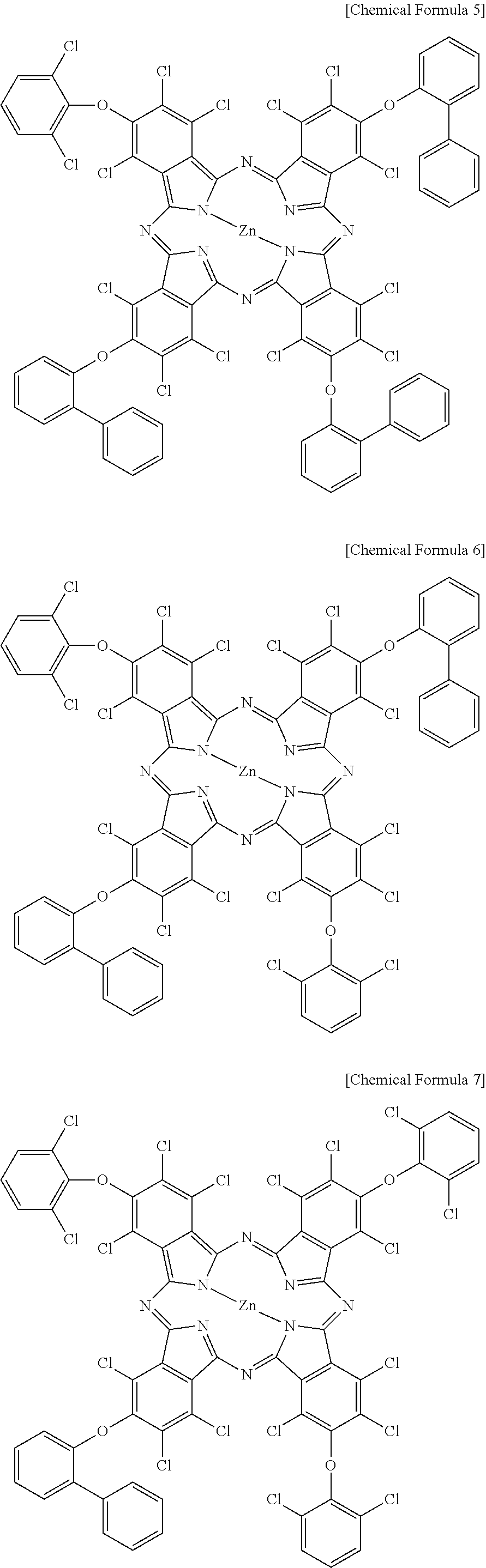
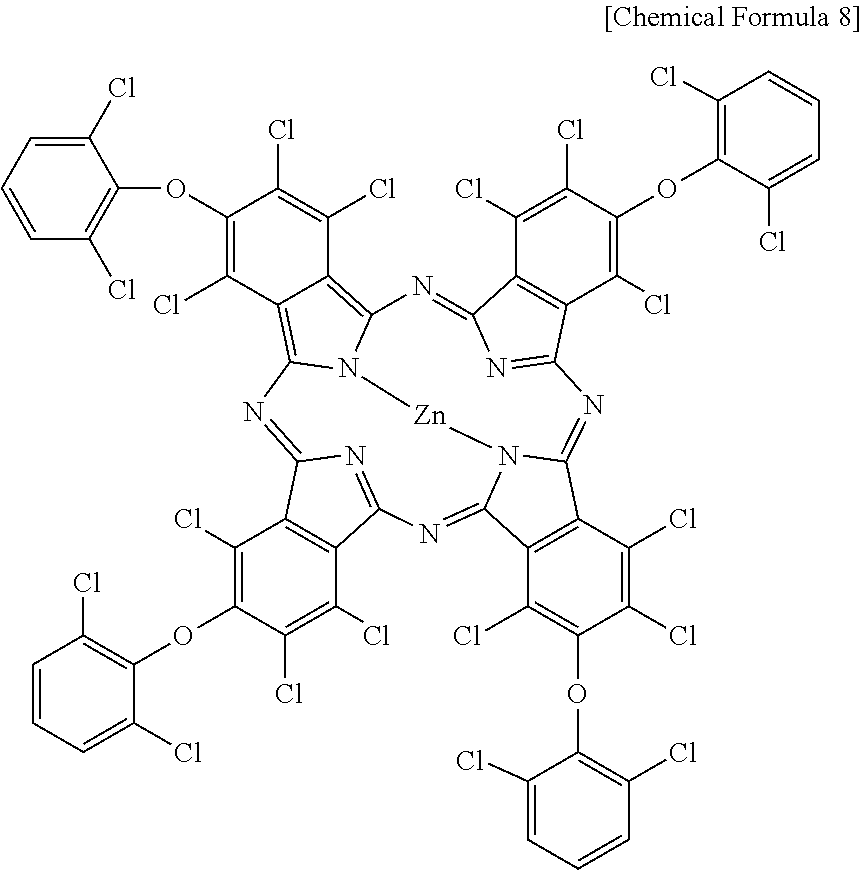
  • the compound represented by Chemical Formula 1 may be represented by one of Chemical Formula 5 to Chemical Formula 14:
  • the compound may be a green dye.
  • the green dye may have a maximum transmittance in a 445 nm to 560 nm wavelength range.
  • Embodiments are also directed to a photosensitive resin composition including the compound according to an embodiment.
  • the photosensitive resin composition may include about 1 wt % to about 10 wt % of the compound based on a total amount of the photosensitive resin composition.
  • the photosensitive resin composition may further include a binder resin, a photopolymerizable compound, a photopolymerization initiator, and a solvent.
  • the photosensitive resin composition may further include a pigment.
  • the pigment may include a yellow pigment, a green pigment, or a combination thereof.
  • Embodiments are also directed to a color filter manufactured using the photosensitive resin composition according to an embodiment.
  • Embodiments are also directed to an electronic device comprising a display having a color filter, the color filter including the compound according to an embodiment.
  • substituted refers to one substituted with a substituent selected from a halogen (F, Br, Cl, or I), a hydroxy group, a nitro group, a cyano group, an amino group (NH 2 , NH(R 200 ) or N(R 201 )(R 202 ) wherein R 200 , R 201 , and R 202 are the same or different, and are independently a C1 to C10 alkyl group), an amidino group, a hydrazine group, a hydrazone group, a carboxyl group, a substituted or unsubstituted alkyl group, a substituted or unsubstituted alkenyl group, a substituted or unsubstituted alkynyl group, a substituted or unsubstituted alicyclic organic group, a substituted or unsubstituted aryl group, and a substituted or
  • alkyl group refers to a C1 to C20 alkyl group, and specifically a C1 to C15 alkyl group
  • cycloalkyl group refers to a C3 to C20 cycloalkyl group, and specifically a C3 to C18 cycloalkyl group
  • alkoxy group refers to a C1 to C20 alkoxy group, and specifically a C1 to C18 alkoxy group
  • aryl group refers to a C6 to C20 aryl group, and specifically a C6 to C18 aryl group
  • alkenyl group refers to a C2 to C20 alkenyl group, and specifically a C2 to C18 alkenyl group
  • alkylene group refers to a C1 to C20 alkylene group, and specifically C1 to C18 alkylene group
  • arylene group refers to a C1 to C20 alkylene group
  • (meth)acrylate refers to “acrylate” and “methacrylate” and “(meth)acrylic acid” refers to “acrylic acid” and “methacrylic acid.”
  • copolymerization refers to block copolymerization and to random copolymerization
  • copolymer refers to a block copolymer and to a random copolymer.
  • An example embodiment provides a compound represented by Chemical Formula 1.
  • R 1 to R 16 may independently be a hydrogen atom, a halogen atom, a substituted or unsubstituted C1 to C20 alkyl group, a substituted or unsubstituted C3 to C20 alkoxy group, a substituted or unsubstituted C6 to C20 aryl group, or a substituted or unsubstituted C6 to C20 aryloxy group.
  • At least one of R 1 to R 16 may be represented by Chemical Formula 2,
  • R 17 and R 18 are independently a halogen atom, and n1 and n2 may independently be an integer ranging from 0 to 5. In an example embodiment, 1 ⁇ n1+n2 ⁇ 5.
  • the compound represented by Chemical Formula 1 may provide excellent green spectral characteristics and a high molar extinction coefficient. Furthermore, the compound represented by Chemical Formula 1 including the substituent represented by Chemical Formula 2 may provide excellent solubility in an organic solvent and excellent luminance and contrast ratio during application to a color filter.
  • Chemical Formula 2 may be represented by, for example, one selected from Chemical Formula 3-1 to Chemical Formula 3-4.
  • R 17 and R 18 are independently a halogen atom.
  • the substituents represented by Chemical Formulae 3-1 to 3-4 may be, for example, aryloxy groups substituted with at least one halogen atom.
  • at least one halogen atom is substituted in an ortho and/or para position
  • luminance and contrast ratio may be further improved.
  • the halogen atoms are all substituted in the ortho and para positions (for example, in the case that two halogen atoms are substituted)
  • luminance and a contrast ratio may be more improved than when the halogen atom is substituted only in either ortho or para position (that is, when one halogen atom is substituted).
  • Meta-substitution of the halogen atom (even if another halogen atom is also substituted in the ortho and/or para position), may provide lesser effects at improving luminance and a contrast ratio.
  • the luminance and the contrast ratio may be further improved in the following order (i ⁇ ii ⁇ iii); i) at least one halogen atom is substituted is the meta position, ii) the halogen atom is substituted in either ortho or para position, and iii) the halogen is substituted in both of the ortho and para positions.
  • At least one of R 1 to R 16 may be represented by Chemical Formula 2 and at least one of R 1 to R 16 may be represented by Chemical Formula 4.
  • substituent represented by Chemical Formula 4 may be represented by Chemical Formula 4-1.
  • At least one of R 1 to R 4 may be represented by Chemical Formula 2
  • at least one of R 5 to R 8 may be represented by Chemical Formula 4
  • at least one of R 9 to R 12 may be represented by Chemical Formula 4
  • at least one of the R 13 to R 16 may be represented by Chemical Formula 4.
  • R 2 or R 3 may be represented by Chemical Formula 2
  • R 6 or R 7 may be represented by Chemical Formula 4
  • R 10 or R 11 may be represented by Chemical Formula 4
  • R 14 or R 15 may be represented by Chemical Formula 4.
  • R 2 or R 3 may be represented by Chemical Formula 2
  • R 6 or R 7 may be represented by Chemical Formula 4
  • R 10 or R 11 may be represented by Chemical Formula 4
  • R 14 or R 15 may be represented by Chemical Formula 4
  • the remainders that are not represented by Chemical Formula 2 and Chemical Formula 4 may be all halogen atoms.
  • At least one of R 1 to R 4 may be represented by Chemical Formula 2
  • at least one of R 5 to R 8 may be represented by Chemical Formula 2
  • at least one of R 9 to R 12 may be represented by Chemical Formula 4
  • at least one of R 13 to R 16 may be represented by Chemical Formula 4.
  • R 2 or R 3 may be represented by Chemical Formula 2
  • R 6 or R 7 may be represented by Chemical Formula 2
  • R 10 or R 11 may be represented by Chemical Formula 4
  • R 14 or R 15 may be represented by Chemical Formula 4.
  • R 2 or R 3 may be represented by Chemical Formula 2
  • R 6 or R 7 may be represented by Chemical Formula 2
  • R 10 or R 11 may be represented by Chemical Formula 4
  • R 14 or R 15 may be represented by Chemical Formula 4
  • the remainders that are not represented by Chemical Formula 2 and Chemical Formula 4 may be all halogen atoms.
  • At least one of R 1 to R 4 may be represented by Chemical Formula 2
  • at least one of R 5 to R 8 may be represented by Chemical Formula 4
  • at least one of R 9 to R 12 may be represented by Chemical Formula 2
  • at least one of R 13 to R 16 may be represented by Chemical Formula 4.
  • R 2 or R 3 may be represented by Chemical Formula 2
  • R 6 or R 7 may be represented by Chemical Formula 4
  • R 10 or R 11 may be represented by Chemical Formula 2
  • R 14 or R 15 may be represented by Chemical Formula 4.
  • R 2 or R 3 may be represented by Chemical Formula 2
  • R 6 or R 7 may be represented by Chemical Formula 4
  • R 10 or R 11 may be represented by Chemical Formula 2
  • R 14 or R 15 may be represented by Chemical Formula 4
  • the remainders that are not represented by Chemical Formula 2 and Chemical Formula 4 may be all halogen atoms.
  • At least one of R 1 to R 4 may be represented by Chemical Formula 2
  • at least one of R 5 to R 8 may be represented by Chemical Formula 2
  • at least one of R 9 to R 12 may be represented by Chemical Formula 2
  • at least one of R 13 to R 16 may be represented by Chemical Formula 4.
  • R 2 or R 3 may be represented by Chemical Formula 2
  • R 6 or R 7 may be represented by Chemical Formula 2
  • R 10 or R 11 may be represented by Chemical Formula 2
  • R 14 or R 15 may be represented by Chemical Formula 4.
  • R 2 or R 3 may be represented by Chemical Formula 2
  • R 6 or R 7 may be represented by Chemical Formula 2
  • R 10 or R 11 may be represented by Chemical Formula 2
  • R 14 or R 15 may be represented by Chemical Formula 4, and the remainders that are not represented by Chemical Formula 2 and Chemical Formula 4 may be all halogen atoms.
  • At least one of R 1 to R 4 may be represented by Chemical Formula 2
  • at least one of R 5 to R 8 may be represented by Chemical Formula 2
  • at least one of R 9 to R 12 may be represented by Chemical Formula 2
  • at least one of R 13 to R 16 may be represented by Chemical Formula 2.
  • R 2 or R 3 may be represented by Chemical Formula 2
  • R 6 or R 7 may be represented by Chemical Formula 2
  • R 10 or R 11 may be represented by Chemical Formula 2
  • R 14 or R 15 may be represented by Chemical Formula 2.
  • R 2 or R 3 may be represented by Chemical Formula 2
  • R 6 or R 7 may be represented by Chemical Formula 2
  • R 10 or R 11 may be represented by Chemical Formula 2
  • R 14 or R 15 may be represented by Chemical Formula 2
  • the remainders that are not represented by Chemical Formula 2 may be all halogen atoms.
  • the compound represented by Chemical Formula 1 may be represented by one of Chemical Formula 5 to Chemical Formula 14, but is not limited thereto.
  • the compound according to an embodiment may express a clear color even in a small amount and, when the compound is used as a colorant, a display device having excellent color characteristics such as luminance, a contrast ratio, and the like may be manufactured by including the substituent represented by Chemical Formula 2, for example one of Chemical Formula 3-1 to Chemical Formula 3-4.
  • the compound may be a colorant, for example a dye, for example a green dye, for example a dye having maximum transmittance in a 445 nm to 560 nm wavelength range.
  • the green dye may be a dye having maximum absorbance in 600 nm to 730 nm wavelength range.
  • a dye is the most expensive among the components used in a color filter. If an expensive dye is used more to accomplish a desired effect, for example, high luminance, a high contrast ratio or the like, then this may increase the unit cost of production.
  • the compound according to an embodiment is used as a colorant, for example a dye in a color filter, the compound and/or the polymer may accomplish improved color characteristics such as high luminance or a high contrast ratio even though used in a small amount, which may thus reduce the unit cost of production.
  • a photosensitive resin composition includes the compound according to an embodiment.
  • the photosensitive resin composition may include a colorant including a compound according to the embodiment, a binder resin, a photopolymerizable compound, a photopolymerization initiator, and a solvent.
  • the colorant may include the compound according to the embodiment.
  • the colorant may further include, for example, a green pigment and/or a yellow pigment.
  • the colorant may include the compound represented by Chemical Formula 1, a green pigment dispersion liquid, and a yellow pigment dispersion liquid.
  • the compound represented by Chemical Formula 1 may include the substituent represented by Chemical Formula 2.
  • the green dye may have a maximum transmittance in a 445 nm to 560 nm wavelength range, and a maximum absorbance in 600 nm to 730 nm wavelength range, which may help realize high color coordinates, and when the green dye is used as a colorant together with the green pigment dispersion liquid and the yellow pigment dispersion liquid, coloring properties, luminance, and a contrast ratio may be improved.
  • the colorant may include, for example, the compound represented by Chemical Formula 1, the green pigment dispersion liquid, and the yellow pigment dispersion liquid in each amount of 1 wt % to 10 wt % (for example, 3 wt % to 7 wt %), 60 wt % to 70 wt %, and 20 wt % to 30 wt % based on a total amount of the colorant.
  • the compound represented by Chemical Formula 1 the green pigment dispersion liquid, and the yellow pigment dispersion liquid are included in the colorant within the amount ranges, a colorant having improved coloring properties may be realized and a color filter having improved luminance and contrast ratio may be also realized.
  • a green pigment in the green pigment dispersion liquid may be C.I. pigment green 58, C.I. pigment green 59, and the like in a color index, which may be used singularly or as a mixture of two or more.
  • a yellow pigment in the yellow pigment dispersion liquid may be C.I. pigment yellow 139, C.I. pigment yellow 138, C.I. pigment yellow 150, and the like in a color index, which may be used singularly or as a mixture of two or more.
  • a higher peak indicates higher color strength
  • a dye of the present invention shows an about 1.5 times as high a peak as and thus has higher color strength than C.I. pigment green 58 and C.I. pigment green 59.
  • C.I. pigment green 58, C.I. pigment green 59, C.I. pigment yellow 138, and the like a higher color coordinate may be realized.
  • the green pigment and/or the yellow pigment may be used with a dispersing agent in in order to disperse pigments.
  • the pigment may be pretreated with the dispersing agent on the surface or added with the pigment to prepare the composition.
  • the dispersing agent may be a non-ionic dispersing agent, an anionic dispersing agent, a cationic dispersing agent, and the like.
  • Specific examples of the dispersing agent may be polyalkylene glycol and esters thereof, polyoxyalkylene, polyhydric alcohol ester alkylene oxide addition product, an alcohol alkylene oxide addition product, sulfonate ester, sulfonate salt, a carboxylate ester, a carboxylate salt, an alkylamide alkylene oxide addition product, alkyl amine, and the like, and may be used singularly or as a mixture of two or more.
  • the dispersing agent may include DISPERBYK-101, DISPERBYK-130, DISPERBYK-140, DISPERBYK-160, DISPERBYK-161, DISPERBYK-162, DISPERBYK-163, DISPERBYK-164, DISPERBYK-165, DISPERBYK-166, DISPERBYK-170, DISPERBYK-171, DISPERBYK-182, DISPERBYK-2000, DISPERBYK-2001, and the like made by BYK Co., Ltd.; EFKA-47, EFKA-47EA, EFKA-48, EFKA-49, EFKA-100, EFKA-400, EFKA-450, and the like made by EFKA Chemicals Co.; Solsperse 5000, Solsperse 12000, Solsperse 13240, Solsperse 13940, Solsperse 17000, Solsperse 20000
  • the dispersing agent may be included in an amount of, for example, about 0.1 wt % to about 15 wt % based on a total amount of photosensitive resin composition.
  • the composition may provide excellent stability, developability, and pattern-forming capability due to improved dispersion properties during manufacture of a black column spacer.
  • the pigment may be pre-treated using, for example, a water-soluble inorganic salt and a wetting agent.
  • a water-soluble inorganic salt and a wetting agent When the pigment is pre-treated, an average particle diameter of the pigment may become finer.
  • the pre-treatment may be performed by, for example, kneading the pigment with the water-soluble inorganic salt and the wetting agent, and then filtering and washing the kneaded pigment.
  • the kneading may be performed at a temperature of, for example, about 40° C. to about 100° C., and the filtering and washing may be performed by filtering the pigment after washing away an inorganic salt with water and the like.
  • the water-soluble inorganic salt may be sodium chloride, potassium chloride, and the like, but are not limited thereto.
  • the wetting agent may make the pigment to be uniformly mixed with the water-soluble inorganic salt uniformly and be pulverized.
  • the wetting agent include alkylene glycol monoalkyl ethers such as ethylene glycol monoethylether, propylene glycol monomethylether, diethylene glycol monomethylether, and the like, and alcohols such as ethanol, isopropanol, butanol, hexanol, cyclohexanol, ethylene glycol, diethylene glycol, polyethylene glycol, glycerine polyethylene glycol, and the like. These may be used alone or as a mixture of two or more.
  • the pigment after the kneading may have an average particle diameter ranging from, for example, about 5 nm to about 200 nm, for example about 5 nm to about 150 nm.
  • the pigment has an average particle diameter within the range, stability of pigment dispersion liquid may be improved and pixel resolution may not be deteriorated.
  • a solvent for forming the pigment dispersion liquid may be ethylene glycol acetate, ethylcellosolve, propylene glycol methyletheracetate, ethyl lactate, polyethylene glycol, cyclohexanone, propylene glycol methylether, and the like.
  • the pigment may be used in a form of pigment dispersion liquid including the dispersing agent and a solvent (described below), and the pigment dispersion liquid may include a solid pigment, a dispersing agent, and a solvent.
  • the solid pigment may be included in an amount of, for example, about 5 wt % to about 20 wt %, for example about 8 wt % to about 15 wt %, based on a total amount of the pigment dispersion liquid.
  • the pigment dispersion liquid may be included in an amount of, for example, about 10 wt % to about 20 wt %, for example about 12 wt % to about 18 wt %, based on a total amount of the photosensitive resin composition.
  • the pigment dispersion liquid is included within the ranges, coloring effects, development performance and contrast ratio may be improved.
  • the binder resin may include, for example, an acryl-based binder resin.
  • the acryl-based binder resin may be, for example, a copolymer of a first ethylenic unsaturated monomer and a second ethylenic unsaturated monomer that is copolymerizable therewith, and may be a resin including at least one acryl-based repeating unit.
  • the first ethylenic unsaturated monomer may be, for example, an ethylenic unsaturated monomer including at least one carboxyl group.
  • the monomer include (meth)acrylic acid, maleic acid, itaconic acid, fumaric acid, or a combination thereof.
  • the first ethylenic unsaturated monomer may be included in an amount of, for example, about 5 wt % to about 50 wt %, for example about 10 wt % to about 40 wt %, based on a total amount of the acryl-based binder resin.
  • the second ethylenic unsaturated monomer may be, for example, an aromatic vinyl compound such as styrene, ⁇ -methylstyrene, vinyl toluene, vinylbenzylmethylether and the like; an unsaturated carboxylate ester compound such as methyl(meth)acrylate, ethyl(meth)acrylate, butyl(meth)acrylate, 2-hydroxyethyl(meth)acrylate, 2-hydroxy butyl(meth)acrylate, benzyl(meth)acrylate, cyclohexyl(meth)acrylate, phenyl(meth)acrylate, and the like; an unsaturated amino alkyl carboxylate ester compound such as 2-aminoethyl(meth)acrylate 2-dimethylaminoethyl(meth)acrylate, and the like; a carboxylic acid vinyl ester compound such as vinyl acetate, vinyl benzoate, and the like; an unsaturated glycidy
  • the acryl-based binder resin may be a polybenzylmethacrylate copolymer, an acrylic acid/benzylmethacrylate copolymer, a methacrylic acid/benzylmethacrylate copolymer, a methacrylic acid/benzylmethacrylate/styrene copolymer, a methacrylic acid/benzylmethacrylate/2-hydroxyethylmethacrylate copolymer, a methacrylic acid/benzylmethacrylate/styrene/2-hydroxyethylmethacrylate copolymer, and the like, but are not limited thereto. These may be used singularly or as a mixture of two or more.
  • a weight average molecular weight of the binder resin may be, for example, about 3,000 g/mol to about 150,000 g/mol, for example about 5,000 g/mol to about 50,000 g/mol, for example about 20,000 g/mol to about 30,000 g/mol.
  • the photosensitive resin composition may exhibit good physical and chemical properties, appropriate viscosity, and close contacting properties with a substrate during manufacture of a color filter.
  • the binder resin may be included in an amount of, for example, about 1 wt % to about 30 wt %, for example about 1 wt % to about 20 wt %, based on a total amount of the photosensitive resin composition.
  • developability may be improved and excellent surface smoothness may be improved due to improved cross-linking during the manufacture of a color filter.
  • the photopolymerizable compound may be, for example, a mono-functional or multi-functional ester of (meth)acrylic acid including at least one ethylenic unsaturated double bond.
  • the photopolymerizable compound having the ethylenic unsaturated double bond may produce a desirable level of polymerization during exposure in a pattern-forming process, and may help form a pattern having excellent heat resistance, light resistance, and chemical resistance.
  • photopolymerizable compound may be ethylene glycol di(meth)acrylate, diethylene glycol di(meth)acrylate, triethylene glycol di(meth)acrylate, propylene glycol di(meth)acrylate, neopentyl glycol di(meth)acrylate, 1,4-butanediol di(meth)acrylate, 1,6-hexanediol di(meth)acrylate, bisphenol A di(meth)acrylate, pentaerythritol di(meth)acrylate, pentaerythritol tri(meth)acrylate, pentaerythritol tetra(meth)acrylate, pentaerythritol hexa(meth)acrylate, dipentaerythritol di(meth)acrylate, dipentaerythritol tri(meth)acrylate, dipentaerythritol penta(meth)acrylate, dipentaery
  • the photopolymerizable compound may be as follows.
  • the mono-functional (meth)acrylic acid ester may include Aronix M-101®, M-111®, M-114® (Toagosei Chemistry Industry Co., Ltd.); KAYARAD TC-110S®, TC-120S® (Nippon Kayaku Co., Ltd.); V-158®, V-2311® (Osaka Organic Chemical Ind., Ltd.), and the like.
  • Examples of a difunctional (meth)acrylic acid ester may include Aronix M-210®, M-240®, M-6200® (Toagosei Chemistry Industry Co., Ltd.), KAYARAD HDDA®, HX-220®, R-604® (Nippon Kayaku Co., Ltd.), V-260®, V-312®, V-335 HP® (Osaka Organic Chemical Ind., Ltd.), and the like.
  • Examples of a tri-functional (meth)acrylic acid ester may include Aronix M-309®, M-400®, M-405®, M-450®, M-7100®, M-8030®, M-8060® (Toagosei Chemistry Industry Co., Ltd.), KAYARAD TMPTA®, DPCA-20®, DPCA-30®, DPCA-60®, DPCA-120® (Nippon Kayaku Co., Ltd.), V-295®, V-300®, V-360®, V-GPT®, V-3PA®, V-400® (Osaka Yuki Kayaku Kogyo Co. Ltd.), and the like. These may be used singularly or as a mixture of two or more.
  • the photopolymerizable compound may be treated with an acid anhydride to improve developability.
  • the photopolymerizable compound may be included in an amount of, for example, about 1 wt % to about 15 wt %, for example about 5 wt % to about 10 wt % based on a total amount of the photosensitive resin composition.
  • the photopolymerizable compound may be cured to a desirable level during exposure in a pattern-forming process, may help provide excellent reliability, and developability for alkali developing solution may be improved.
  • the photopolymerization initiator may be a suitable photopolymerization initiator generally used in a photosensitive resin composition, for example an acetophenone-based compound, a benzophenone-based compound, a thioxanthone-based compound, a benzoin-based compound, an oxime-based compound, and the like.
  • acetophenone-based compound may be 2,2′-diethoxy acetophenone, 2,2′-dibutoxy acetophenone, 2-hydroxy-2-methylpropinophenone, p-t-butyltrichloro acetophenone, p-t-butyldichloro acetophenone, 4-chloro acetophenone, 2,2′-dichloro-4-phenoxy acetophenone, 2-methyl-1-(4-(methylthio)phenyl)-2-morpholinopropan-1-one, 2-benzyl-2-dimethylamino-1-(4-morpholinophenyl)-butan-1-one, and the like.
  • benzophenone-based compound examples may be benzophenone, benzoyl benzoate, methyl benzoyl benzoate, 4-phenyl benzophenone, hydroxy benzophenone, acrylated benzophenone, 4,4′-bis(dimethyl amino)benzophenone, 4,4′-bis(diethylamino)benzophenone, 4,4′-dimethylaminobenzophenone, 4,4′-dichlorobenzophenone, 3,3′-dimethyl-2-methoxybenzophenone, and the like.
  • Examples of the thioxanthone-based compound may be thioxanthone, 2-methylthioxanthone, isopropyl thioxanthone, 2,4-diethyl thioxanthone, 2,4-diisopropyl thioxanthone, 2-chlorothioxanthone, and the like.
  • benzoin-based compound examples may be benzoin, benzoin methyl ether, benzoin ethyl ether, benzoin isopropyl ether, benzoin isobutyl ether, benzyldimethylketal, and the like.
  • triazine-based compound may be 2,4,6-trichloro-s-triazine, 2-phenyl 4,6-bis(trichloromethyl)-s-triazine, 2-(3′, 4′-dimethoxystyryl)-4,6-bis(trichloromethyl)-s-triazine, 2-(4′-methoxynaphthyl)-4,6-bis(trichloromethyl)-s-triazine, 2-(p-methoxyphenyl)-4,6-bis(trichloromethyl)-s-triazine, 2-(p-tolyl)-4,6-bis(trichloro methyl)-s-triazine, 2-biphenyl 4,6-bis(trichloro methyl)-s-triazine, bis(trichloromethyl)-6-styryl-s-triazine, 2-(naphthol-yl)-4,6-bis(trichloromethyl)-
  • Examples of the oxime-based compound may be O-acyloxime-based compound, 2-(O-benzoyloxime)-1-[4-(phenylthio)phenyl]-1,2-octandione, 1-(O-acetyloxime)-1-[9-ethyl-6-(2-methylbenzoyl)-9H-carbazol-3-yl]ethanone, O-ethoxycarbonyl-a-oxyamino-1-phenylpropan-1-one, and the like.
  • O-acyloxime-based compound may be 1,2-octandione, 2-dimethylamino-2-(4-methylbenzyl)-1-(4-morpholin-4-yl-phenyl)-butan-1-one, 1-(4-phenylsulfanyl phenyl)-butane-1,2-dione 2-oxime-O-benzoate, 1-(4-phenylsulfanyl phenyl)-octane-1,2-dione 2-oxime-O-benzoate, 1-(4-phenylsulfanyl phenyl)-octan-1-one oxime-O-acetate, 1-(4-phenylsulfanyl phenyl)-butan-1-one oxime-O-acetate, and the like.
  • the photopolymerization initiator may further include, for example, a carbazole-based compound, a diketone-based compound, a sulfonium borate-based compound, a diazo-based compound, an imidazole-based compound, a biimidazole-based compound, a fluorene-based compound, and the like in addition to the compound.
  • the photopolymerization initiator may be used with a photosensitizer capable of causing a chemical reaction by absorbing light and becoming excited, and then transferring its energy.
  • photosensitizer may be tetraethylene glycol bis-3-mercapto propionate, pentaerythritol tetrakis-3-mercapto propionate, dipentaerythritol tetrakis-3-mercapto propionate, and the like.
  • the photopolymerization initiator be included in an amount of, for example, about 0.01 wt % to about 10 wt %, for example about 0.1 wt % to about 5 wt % based on a total amount of the photosensitive resin composition.
  • excellent reliability may be secured due to sufficiently curing during exposure in a pattern-forming process, a pattern may have excellent resolution and close-contacting properties as well as excellent heat resistance, light resistance, and chemical resistance, and transmittance may be prevented from deterioration due to a non-reaction initiator.
  • the solvent is a material having compatibility with the compound according to an embodiment, the pigment, the binder resin, the photopolymerizable compound, and the photopolymerization initiator but not reacting therewith.
  • the solvent may include alcohols such as methanol, ethanol, and the like; ethers such as dichloroethyl ether, n-butyl ether, diisoamyl ether, methylphenyl ether, tetrahydrofuran, and the like; glycol ethers such as ethylene glycol monomethylether, ethylene glycol monoethylether, and the like; cellosolve acetates such as methyl cellosolve acetate, ethyl cellosolve acetate, diethyl cellosolve acetate, and the like; carbitols such as methylethyl carbitol, diethyl carbitol, diethylene glycol monomethylether, diethylene glycol monoethylether, diethylene glycol dimethylether, diethylene glycol methylethylether, diethylene glycol diethylether, and the like; propylene glycol alkylether acetates such as propylene glycol a
  • high boiling point solvent such as N-methylformamide, N,N-dimethylformamide, N-methylformanilide, N-methylacetamide, N,N-dimethylacetamide, N-methylpyrrolidone, dimethylsulfoxide, benzylethylether, dihexylether, acetylacetone, isophorone, caproic acid, caprylic acid, 1-octanol, 1-nonanol, benzylalcohol, benzyl acetate, ethyl benzoate, diethyl oxalate, diethyl maleate, ⁇ -butyrolactone, ethylene carbonate, propylene carbonate, phenyl cellosolve acetate, and the like may be also used.
  • high boiling point solvent such as N-methylformamide, N,N-dimethylformamide, N-methylformanilide, N-methylacetamide, N,N-dimethylacetamide, N-methylpyrrol
  • glycol ethers such as ethylene glycol monoethylether, and the like; ethylene glycol alkylether acetates such as ethyl cellosolve acetate, and the like; esters such as 2-hydroxy ethyl propionate, and the like; carbitols such as diethylene glycol monomethylether, and the like; propylene glycol alkylether acetates such as propylene glycol methylether acetate, propylene glycol propylether acetate, and the like and ketones such as cyclohexanone, and the like may be used.
  • the solvent may be used in, for example, a balance amount or about 30 wt % to about 80 wt %, based on a total amount of the photosensitive resin composition.
  • the photosensitive resin composition may have an appropriate viscosity resulting in improvement of coating characteristics of a color filter.
  • the photosensitive resin composition according to an embodiment may include additives such as malonic acid; 3-amino-1,2-propanediol; a silane-based coupling agent including a vinyl group or a (meth)acryloxy group; a leveling agent; a surfactant; and a radical polymerization initiator in order to prevent stains or spots during the coating, to adjust leveling, or to prevent pattern residue due to non-development.
  • additives such as malonic acid; 3-amino-1,2-propanediol; a silane-based coupling agent including a vinyl group or a (meth)acryloxy group; a leveling agent; a surfactant; and a radical polymerization initiator in order to prevent stains or spots during the coating, to adjust leveling, or to prevent pattern residue due to non-development.
  • the additives may be controlled depending on desired properties.
  • the coupling agent may be, for example, a silane-based coupling agent, and examples of the silane-based coupling agent may be trimethoxysilyl benzoic acid, ⁇ -methacryl oxypropyl trimethoxysilane, vinyl triacetoxysilane, vinyl trimethoxysilane, ⁇ -isocyanate propyl triethoxysilane, ⁇ -glycidoxy propyl trimethoxysilane, ⁇ -(3,4-epoxycyclohexyl)ethyltrimethoxysilane, and the like. These may be used singularly or in a mixture of two or more.
  • the silane-based coupling agent may be included in an amount of, for example, about 0.01 parts by weight to about 10 parts by weight, based on a total amount of the photosensitive resin composition.
  • the photosensitive resin composition according to an example embodiment may include, for example, a surfactant, for example a fluorine-based surfactant.
  • fluorine-based surfactant may include F-482, F-484, F-478, and the like made by DIC Co., Ltd., but are not limited thereto.
  • the surfactant may be included in an amount of, for example, about 0.001 wt % to about 5 wt %, for example about 0.01 wt % to about 2 wt %, based on a total amount of photosensitive resin composition. Providing the surfactant in an amount that is in the ranges may help prevent generation of foreign particles after development.
  • the photosensitive resin composition according to an example embodiment may include, for example, an epoxy compound, which may improve adhesion to substrate.
  • Examples of the epoxy compound may include phenol novolac epoxy compound, tetramethyl biphenyl epoxy compound, bisphenol A epoxy compound, cycloaliphatic epoxy compound or a combination thereof.
  • the epoxy compound may be included in an amount of, for example, about 0.01 parts by weight to about 20 parts by weight, for example about 0.1 parts by weight to about 10 parts by weight, based on 100 parts by weight of the photosensitive resin composition. When the amount is in the ranges, adhesion and storage may be enhanced.
  • the photosensitive resin composition may additives such as an antioxidant, a stabilizer, and the like in a predetermined amount that does not deteriorate properties of the photosensitive resin composition.
  • a color filter manufactured using the photosensitive resin composition according to the embodiment is provided.
  • An example method of manufacturing the color filter is as follows.
  • the photosensitive resin composition may be coated to form a 0.5 ⁇ m to 10 ⁇ m-thick photosensitive resin composition layer on a glass substrate in an appropriate method such as spin coating, roller coating, spray coating, and the like.
  • the substrate having the photosensitive resin composition layer may be irradiated with light to form a pattern required for a color filter.
  • the irradiation may be performed by using, for example, UV, an electron beam, or an X-ray as a light source.
  • the UV may be radiated, for example, in a region of 190 nm to 450 nm, for example, 200 nm to 400 nm.
  • the radiation may be performed by further using a photoresist mask.
  • the photosensitive resin composition layer exposed to the light source may be treated with a developing solution. For example, a non-exposed region in the photosensitive resin composition layer may be dissolved to leave the pattern for a color filter.
  • This process may be repeated, for example, as many times as the number of colors, to obtain a color filter having a desired pattern.
  • the image pattern obtained through development in the above process is cured by reheating or radiating an actinic ray thereinto, crack resistance, solvent resistance, and the like may be improved.
  • the obtained solid was dissolved in a small amount of dichloromethane, and then several times washed with hexane, filtered, and vacuum-dried to obtain 3,4,6-trichloro-5-(2,6-difluoro-phenoxy)-phthalonitrile.
  • the dried solid was purified through column chromatography. Then, dichloromethane was appropriately added to the purified solid to dissolve it, and methanol was added thereto for crystallization. The crystallized solid was filtered and vacuum-dried to obtain a compound represented by Chemical Formula 7.
  • a photosensitive resin composition according to Example 1 was prepared by mixing the following components with the compositions shown in Table 1.
  • a photopolymerization initiator was dissolved in a solvent, the solution was stirred at room temperature for 2 hours, a binder resin and a photopolymerizable compound was added thereto, and the mixture was stirred at room temperature for 2 hours.
  • the compound (represented by Chemical Formula 5) of Synthesis Example 9 and a pigment (in a pigment dispersion liquid state) as a colorant were added to the reactant, and the mixture was stirred at room temperature for 1 hour. Then, a product therefrom was three times filtered to remove impurities to prepare a photosensitive resin composition.
  • a photosensitive resin composition was prepared according to the same method as Example 1 except for using the compound of Synthesis Example 10 (represented by Chemical Formula 6) instead of the compound of Synthesis Example 9 (represented by Chemical Formula 5).
  • a photosensitive resin composition was prepared according to the same method as Example 1 except for using the compound of Synthesis Example 11 (represented by Chemical Formula 7) instead of the compound of Synthesis Example 9 (represented by Chemical Formula 5).
  • a photosensitive resin composition was prepared according to the same method as Example 1 except for using the compound of Synthesis Example 12 (represented by Chemical Formula 8) instead of the compound of Synthesis Example 9 (represented by Chemical Formula 5).
  • a photosensitive resin composition was prepared according to the same method as Example 1 except for using the compound of Synthesis Example 13 (represented by Chemical Formula 9) instead of the compound of Synthesis Example 9 (represented by Chemical Formula 5).
  • a photosensitive resin composition was prepared according to the same method as Example 1 except for using the compound of Synthesis Example 14 (represented by Chemical Formula 10) instead of the compound of Synthesis Example 9 (represented by Chemical Formula 5).
  • a photosensitive resin composition was prepared according to the same method as Example 1 except for using the compound of Synthesis Example 15 (represented by Chemical Formula 11) instead of the compound of Synthesis Example 9 (represented by Chemical Formula 5).
  • a photosensitive resin composition was prepared according to the same method as Example 1 except for using the compound of Synthesis Example 16 (represented by Chemical Formula 12) instead of the compound of Synthesis Example 9 (represented by Chemical Formula 5).
  • a photosensitive resin composition was prepared according to the same method as Example 1 except for using the compound of Synthesis Example 17 (represented by Chemical Formula 13) instead of the compound of Synthesis Example 9 (represented by Chemical Formula 5).
  • a photosensitive resin composition was prepared according to the same method as Example 1 except for using the compound of Synthesis Example 18 (represented by Chemical Formula 14) instead of the compound of Synthesis Example 9 (represented by Chemical Formula 5).
  • a photosensitive resin composition was prepared according to the same method as Example 1 except that 3.7 wt % of the dye was used instead of 5 wt % of the dye, “2.5 wt % of Pigment G58 pigment dispersion liquid and 13.7 wt % of Pigment Y138 pigment dispersion liquid” were used instead of “15.0 wt % of Pigment Y138 pigment dispersion liquid”, and 30.1 wt % of PGMEA was used instead of 30.0 wt % of PGMEA.
  • a photosensitive resin composition was prepared according to the same method as Example 11 except for using the compound of Synthesis Example 10 (represented by Chemical Formula 6) instead of the compound of Synthesis Example 9 (represented by Chemical Formula 5).
  • a photosensitive resin composition was prepared according to the same method as Example 11 except for using the compound of Synthesis Example 11 (represented by Chemical Formula 7) instead of the compound of Synthesis Example 9 (represented by Chemical Formula 5).
  • a photosensitive resin composition was prepared according to the same method as Example 11 except for using the compound of Synthesis Example 12 (represented by Chemical Formula 8) instead of the compound of Synthesis Example 9 (represented by Chemical Formula 5).
  • a photosensitive resin composition was prepared according to the same method as Example 11 except for using the compound of Synthesis Example 13 (represented by Chemical Formula 9) instead of the compound of Synthesis Example 9 (represented by Chemical Formula 5).
  • a photosensitive resin composition was prepared according to the same method as Example 11 except for using the compound of Synthesis Example 14 (represented by Chemical Formula 10) instead of the compound of Synthesis Example 9 (represented by Chemical Formula 5).
  • a photosensitive resin composition was prepared according to the same method as Example 11 except for using the compound of Synthesis Example 15 (represented by Chemical Formula 11) instead of the compound of Synthesis Example 9 (represented by Chemical Formula 5).
  • a photosensitive resin composition was prepared according to the same method as Example 11 except for using the compound of Synthesis Example 16 (represented by Chemical Formula 12) instead of the compound of Synthesis Example 9 (represented by Chemical Formula 5).
  • a photosensitive resin composition was prepared according to the same method as Example 11 except for using the compound of Synthesis Example 17 (represented by Chemical Formula 13) instead of the compound of Synthesis Example 9 (represented by Chemical Formula 5).
  • a photosensitive resin composition was prepared according to the same method as Example 11 except for using the compound of Synthesis Example 18 (represented by Chemical Formula 14) instead of the compound of Synthesis Example 9 (represented by Chemical Formula 5).
  • a photosensitive resin composition was prepared according to the same method as Example 1 except for using the compound of Comparative Synthesis Example 1 (represented by Chemical Formula X) instead of the compound of Synthesis Example 9 (represented by Chemical Formula 5).
  • a photosensitive resin composition was prepared according to the same method as Example 1 except for performing the mixing with the following compositions in Table 2 instead of the compositions in Table 1.
  • the photosensitive resin compositions according to Examples 1 to 20 and Comparative Examples 1 and 2 were respectively coated to be 1 ⁇ m to 3 ⁇ m thick on a 1 mm-thick defatted glass substrate, and then dried on a 90° C. hot plate for 2 minutes to obtain films.
  • the films were exposed by using a high pressure mercury lamp having a main wavelength of 365 nm. Subsequently, the films were dried in a 200° C. forced convection drying furnace for 5 minutes to obtain samples.
  • Luminance (Y) and contrast ratios of pixel layers were measured by using a spectrophotometer (MCPD3000, Otsuka Electronics Co., Ltd.), and the results are provided in Table 3.
  • Example 1 Contrast ratio Example 1 63.2 15,700 Example 2 63.6 15,600 Example 3 63.3 15,200 Example 4 63.3 15,200 Example 5 63.1 15,400 Example 6 62.8 15,300 Example 7 62.9 15,200 Example 8 63.0 15,300 Example 9 62.8 15,500 Example 10 62.6 15,500 Example 11 62.8 14,900 Example 12 63.0 14,800 Example 13 62.9 14,600 Example 14 62.8 14,700 Example 15 62.7 14,800 Example 16 62.6 15,000 Example 17 62.7 14,800 Example 18 62.7 14,700 Example 19 62.5 14,900 Example 20 62.4 14,800 Comparative 62.3 14,300 Example 1 Comparative 62.1 13,800 Example 2
  • the photosensitive resin compositions of Examples 1 to 20 including the compound according to one embodiment as a dye specifically, the photosensitive resin compositions of Examples 1 to 9 showed excellent color characteristics compared with the photosensitive resin compositions of Comparative Examples 1 and 2.
  • a liquid crystal display device may include a lower substrate, on which a black matrix, a color filter, and an ITO pixel electrode are formed, and an upper substrate, on which an active circuit portion including a liquid crystal layer, a thin film transistor, and a capacitor layer and an ITO pixel electrode are formed.
  • Color filters may be formed in a pixel region by sequentially stacking a plurality of color filters (in general, formed of three primary colors such as red (R), green (G), and blue (B)) in a predetermined order to form each pixel, and a black matrix layer may be disposed in a predetermined pattern on a transparent substrate to form a boundary between the pixels.
  • a pigment dispersion method may be used to form a color filter, by providing a colored thin film by repeating a series of processes such as coating a photopolymerizable composition including a colorant on a transparent substrate including a black matrix, exposing a formed pattern to light, removing a non-exposed part with a solvent, and thermally curing the same.
  • a coloring photosensitive resin composition used for manufacturing a color filter by the pigment dispersion method may include an alkali soluble resin, a photopolymerization monomer, a photopolymerization initiator, an epoxy resin, a solvent, other additives, and the like.
  • the pigment dispersion method may be applied to manufacture, for example, an LCD such as a mobile phone, a laptop, a monitor, and TV. High performance, excellent pattern profiles, high color reproducibility, and high luminance and high contrast ratio characteristics are important challenges for the pigment dispersion method.
  • a color filter manufactured by using a pigment-type photosensitive resin composition may be limited in luminance and a contrast ratio due to a pigment particle size.
  • a color image sensor device for an image sensor may need a smaller dispersion particle diameter to form a fine pattern.
  • the compound represented by Chemical Formula 1 may provide excellent green spectral characteristics, a high molar extinction coefficient, and excellent solubility in an organic solvent, and thus may be used as a dye for a green photosensitive resin composition for a color filter, and accordingly, a color filter including the dye may have excellent color strength, transmittance, luminance, and contrast ratio.

Landscapes

  • Physics & Mathematics (AREA)
  • General Physics & Mathematics (AREA)
  • Chemical & Material Sciences (AREA)
  • Organic Chemistry (AREA)
  • Spectroscopy & Molecular Physics (AREA)
  • Optics & Photonics (AREA)
  • Chemical Kinetics & Catalysis (AREA)
  • Engineering & Computer Science (AREA)
  • Architecture (AREA)
  • Structural Engineering (AREA)
  • Nonlinear Science (AREA)
  • Mathematical Physics (AREA)
  • Crystallography & Structural Chemistry (AREA)
  • Materials For Photolithography (AREA)
  • Optical Filters (AREA)

Abstract

A compound represented by Chemical Formula 1, a photosensitive resin composition including the same, and a color filter manufactured using the photosensitive resin composition are provided.
Figure US10564320-20200218-C00001

In Chemical Formula 1, each substituent is the same as defined in the specification.

Description

CROSS-REFERENCE TO RELATED APPLICATION
Korean Patent Application No. 10-2017-0061181, filed on May 17, 2017, in the Korean Intellectual Property Office, and entitled: “Novel Compound, Photosensitive Resin Composition Comprising the Same and Color Filter,” is incorporated by reference herein in its entirety.
BACKGROUND
1. Field
Embodiments relate to a compound, a photosensitive resin composition including the same, and a color filter.
2. Description of the Related Art
A liquid crystal display device among many kinds of displays has an advantage of lightness, thinness, low cost, low power consumption for operation, and improved adherence to an integrated circuit, and has been widely used for a laptop computer, a monitor, and a TV screen.
SUMMARY
Embodiments are directed to a compound represented by Chemical Formula 1:
Figure US10564320-20200218-C00002
In Chemical Formula 1, R1 to R16 may each independently be a hydrogen atom, a halogen atom, a substituted or unsubstituted C1 to C20 alkyl group, a substituted or unsubstituted C3 to C20 alkoxy group, a substituted or unsubstituted C6 to C20 aryl group, or a substituted or unsubstituted C6 to C20 aryloxy group. One or more of R1 to R16 may be represented by Chemical Formula 2,
Figure US10564320-20200218-C00003
In Chemical Formula 2,
R17 and R18 may each independently be a halogen atom, and
n1 and n2 may each independently be an integer ranging from 0 to 5, and n1 and n2 may satisfy 1≤n1+n2≤5.
Chemical Formula 2 may be represented by one selected from Chemical Formula 3-1 to Chemical Formula 3-4:
Figure US10564320-20200218-C00004
In Chemical Formulae 3-1 to 3-4, R17 and R18 may each independently be a halogen atom.
At least one of R1 to R16 may be represented by Chemical Formula 2 and at least one of R1 to R16 may be represented by Chemical Formula 4:
Figure US10564320-20200218-C00005
At least one of R1 to R16 may be represented by Chemical Formula 2, at least one of R5 to R8 may be represented by Chemical Formula 4, at least one of R9 to R12 may be represented by Chemical Formula 4, and at least one of R13 to R16 may be represented by Chemical Formula 4.
At least one of R1 to R4 may be represented by Chemical Formula 2, at least one of R5 to R8 may be represented by Chemical Formula 2, at least one of R9 to R12 may be represented by Chemical Formula 4, and at least one of the R13 to R16 may be represented by Chemical Formula 4.
At least one of R1 to R4 may be represented by Chemical Formula 2, at least one of R5 to R8 may be represented by Chemical Formula 4, at least one of R9 to R12 may be represented by Chemical Formula 2, and at least one of R13 to R16 may be represented by Chemical Formula 4.
At least one of R1 to R4 may be represented by Chemical Formula 2, at least one of R5 to R8 may be represented by Chemical Formula 2, at least one of R9 to R12 may be represented by Chemical Formula 2, and at least one of R13 to R16 may be represented by Chemical Formula 4.
At least one of R1 to R4 may be represented by Chemical Formula 2, at least one of R5 to R8 may be represented by Chemical Formula 2, at least one of R9 to R12 may be represented by Chemical Formula 2, and at least one of R13 to R16 may be represented by Chemical Formula 2.
The compound represented by Chemical Formula 1 may be represented by one of Chemical Formula 5 to Chemical Formula 14:
Figure US10564320-20200218-C00006
Figure US10564320-20200218-C00007
Figure US10564320-20200218-C00008
Figure US10564320-20200218-C00009
Figure US10564320-20200218-C00010
The compound may be a green dye.
The green dye may have a maximum transmittance in a 445 nm to 560 nm wavelength range.
Embodiments are also directed to a photosensitive resin composition including the compound according to an embodiment.
The photosensitive resin composition may include about 1 wt % to about 10 wt % of the compound based on a total amount of the photosensitive resin composition.
The photosensitive resin composition may further include a binder resin, a photopolymerizable compound, a photopolymerization initiator, and a solvent.
The photosensitive resin composition may further include a pigment.
The pigment may include a yellow pigment, a green pigment, or a combination thereof.
Embodiments are also directed to a color filter manufactured using the photosensitive resin composition according to an embodiment.
Embodiments are also directed to a color filter including the compound according to an embodiment.
Embodiments are also directed to an electronic device comprising a display having a color filter, the color filter including the compound according to an embodiment.
DETAILED DESCRIPTION
Example embodiments will now be described more fully hereinafter with reference to the accompanying drawings; however, they may be embodied in different forms and should not be construed as limited to the embodiments set forth herein. Rather, these embodiments are provided so that this disclosure will be thorough and complete, and will fully convey exemplary implementations to those skilled in the art. In the drawing figures, the dimensions of layers and regions may be exaggerated for clarity of illustration. Like reference numerals refer to like elements throughout.
As used herein, when specific definition is not otherwise provided, the term “substituted” refers to one substituted with a substituent selected from a halogen (F, Br, Cl, or I), a hydroxy group, a nitro group, a cyano group, an amino group (NH2, NH(R200) or N(R201)(R202) wherein R200, R201, and R202 are the same or different, and are independently a C1 to C10 alkyl group), an amidino group, a hydrazine group, a hydrazone group, a carboxyl group, a substituted or unsubstituted alkyl group, a substituted or unsubstituted alkenyl group, a substituted or unsubstituted alkynyl group, a substituted or unsubstituted alicyclic organic group, a substituted or unsubstituted aryl group, and a substituted or unsubstituted heterocyclic group.
As used herein, when specific definition is not otherwise provided, the term “alkyl group” refers to a C1 to C20 alkyl group, and specifically a C1 to C15 alkyl group, the term “cycloalkyl group” refers to a C3 to C20 cycloalkyl group, and specifically a C3 to C18 cycloalkyl group, the term “alkoxy group” refers to a C1 to C20 alkoxy group, and specifically a C1 to C18 alkoxy group, the term “aryl group” refers to a C6 to C20 aryl group, and specifically a C6 to C18 aryl group, the term “alkenyl group” refers to a C2 to C20 alkenyl group, and specifically a C2 to C18 alkenyl group, the term “alkylene group” refers to a C1 to C20 alkylene group, and specifically C1 to C18 alkylene group, and the term “arylene group” refers to a C6 to C20 arylene group, and specifically a C6 to C16 arylene group.
As used herein, when specific definition is not otherwise provided, “(meth)acrylate” refers to “acrylate” and “methacrylate” and “(meth)acrylic acid” refers to “acrylic acid” and “methacrylic acid.”
As used herein, when a definition is not otherwise provided, the term “combination” refers to mixing or copolymerization. In addition, “copolymerization” refers to block copolymerization and to random copolymerization, and “copolymer” refers to a block copolymer and to a random copolymer.
In the chemical formula of the present specification, unless a specific definition is otherwise provided, hydrogen is bonded at the position when a chemical bond is not drawn where supposed to be given.
As used herein, when specific definition is not otherwise provided, “*” indicates a point where the same or different atom or chemical formula is linked.
An example embodiment provides a compound represented by Chemical Formula 1.
Figure US10564320-20200218-C00011
In Chemical Formula 1,
R1 to R16 may independently be a hydrogen atom, a halogen atom, a substituted or unsubstituted C1 to C20 alkyl group, a substituted or unsubstituted C3 to C20 alkoxy group, a substituted or unsubstituted C6 to C20 aryl group, or a substituted or unsubstituted C6 to C20 aryloxy group.
In an example embodiment, at least one of R1 to R16 may be represented by Chemical Formula 2,
Figure US10564320-20200218-C00012
In Chemical Formula 2, R17 and R18 are independently a halogen atom, and n1 and n2 may independently be an integer ranging from 0 to 5. In an example embodiment, 1≤n1+n2≤5.
The compound represented by Chemical Formula 1 may provide excellent green spectral characteristics and a high molar extinction coefficient. Furthermore, the compound represented by Chemical Formula 1 including the substituent represented by Chemical Formula 2 may provide excellent solubility in an organic solvent and excellent luminance and contrast ratio during application to a color filter.
Chemical Formula 2 may be represented by, for example, one selected from Chemical Formula 3-1 to Chemical Formula 3-4.
Figure US10564320-20200218-C00013
In Chemical Formula 3-1 to Chemical Formula 3-4, R17 and R18 are independently a halogen atom.
The substituents represented by Chemical Formulae 3-1 to 3-4 may be, for example, aryloxy groups substituted with at least one halogen atom. When at least one halogen atom is substituted in an ortho and/or para position, luminance and contrast ratio may be further improved. In addition, when the halogen atoms are all substituted in the ortho and para positions (for example, in the case that two halogen atoms are substituted), luminance and a contrast ratio may be more improved than when the halogen atom is substituted only in either ortho or para position (that is, when one halogen atom is substituted). Meta-substitution of the halogen atom (even if another halogen atom is also substituted in the ortho and/or para position), may provide lesser effects at improving luminance and a contrast ratio.
In further detail, in the substituent represented by Chemical Formula 2, for example, in the substituents represented by Chemical Formulae 3-1 to 3-4, the luminance and the contrast ratio may be further improved in the following order (i→ii→iii); i) at least one halogen atom is substituted is the meta position, ii) the halogen atom is substituted in either ortho or para position, and iii) the halogen is substituted in both of the ortho and para positions.
In an example embodiment, at least one of R1 to R16 may be represented by Chemical Formula 2 and at least one of R1 to R16 may be represented by Chemical Formula 4.
Figure US10564320-20200218-C00014
For example, the substituent represented by Chemical Formula 4 may be represented by Chemical Formula 4-1.
Figure US10564320-20200218-C00015
In an example embodiment, at least one of R1 to R4 may be represented by Chemical Formula 2, at least one of R5 to R8 may be represented by Chemical Formula 4, at least one of R9 to R12 may be represented by Chemical Formula 4, and at least one of the R13 to R16 may be represented by Chemical Formula 4.
For example, R2 or R3 may be represented by Chemical Formula 2, R6 or R7 may be represented by Chemical Formula 4, R10 or R11 may be represented by Chemical Formula 4, and R14 or R15 may be represented by Chemical Formula 4.
For example, R2 or R3 may be represented by Chemical Formula 2, R6 or R7 may be represented by Chemical Formula 4, R10 or R11 may be represented by Chemical Formula 4, R14 or R15 may be represented by Chemical Formula 4, and the remainders that are not represented by Chemical Formula 2 and Chemical Formula 4 may be all halogen atoms.
In an example embodiment, at least one of R1 to R4 may be represented by Chemical Formula 2, at least one of R5 to R8 may be represented by Chemical Formula 2, at least one of R9 to R12 may be represented by Chemical Formula 4, and at least one of R13 to R16 may be represented by Chemical Formula 4.
For example, R2 or R3 may be represented by Chemical Formula 2, R6 or R7 may be represented by Chemical Formula 2, R10 or R11 may be represented by Chemical Formula 4, and R14 or R15 may be represented by Chemical Formula 4.
For example, R2 or R3 may be represented by Chemical Formula 2, R6 or R7 may be represented by Chemical Formula 2, R10 or R11 may be represented by Chemical Formula 4, R14 or R15 may be represented by Chemical Formula 4, and the remainders that are not represented by Chemical Formula 2 and Chemical Formula 4 may be all halogen atoms.
In an example embodiment, at least one of R1 to R4 may be represented by Chemical Formula 2, at least one of R5 to R8 may be represented by Chemical Formula 4, at least one of R9 to R12 may be represented by Chemical Formula 2, and at least one of R13 to R16 may be represented by Chemical Formula 4.
For example, R2 or R3 may be represented by Chemical Formula 2, R6 or R7 may be represented by Chemical Formula 4, R10 or R11 may be represented by Chemical Formula 2, and R14 or R15 may be represented by Chemical Formula 4.
For example, R2 or R3 may be represented by Chemical Formula 2, R6 or R7 may be represented by Chemical Formula 4, R10 or R11 may be represented by Chemical Formula 2, R14 or R15 may be represented by Chemical Formula 4, and the remainders that are not represented by Chemical Formula 2 and Chemical Formula 4 may be all halogen atoms.
In an example embodiment, at least one of R1 to R4 may be represented by Chemical Formula 2, at least one of R5 to R8 may be represented by Chemical Formula 2, at least one of R9 to R12 may be represented by Chemical Formula 2, and at least one of R13 to R16 may be represented by Chemical Formula 4.
For example, R2 or R3 may be represented by Chemical Formula 2, R6 or R7 may be represented by Chemical Formula 2, R10 or R11 may be represented by Chemical Formula 2, and R14 or R15 may be represented by Chemical Formula 4.
For example, R2 or R3 may be represented by Chemical Formula 2, R6 or R7 may be represented by Chemical Formula 2, R10 or R11 may be represented by Chemical Formula 2, R14 or R15 may be represented by Chemical Formula 4, and the remainders that are not represented by Chemical Formula 2 and Chemical Formula 4 may be all halogen atoms.
In an example embodiment, at least one of R1 to R4 may be represented by Chemical Formula 2, at least one of R5 to R8 may be represented by Chemical Formula 2, at least one of R9 to R12 may be represented by Chemical Formula 2, and at least one of R13 to R16 may be represented by Chemical Formula 2.
For example, R2 or R3 may be represented by Chemical Formula 2, R6 or R7 may be represented by Chemical Formula 2, R10 or R11 may be represented by Chemical Formula 2, and R14 or R15 may be represented by Chemical Formula 2.
For example, R2 or R3 may be represented by Chemical Formula 2, R6 or R7 may be represented by Chemical Formula 2, R10 or R11 may be represented by Chemical Formula 2, R14 or R15 may be represented by Chemical Formula 2, and the remainders that are not represented by Chemical Formula 2 may be all halogen atoms.
In an example embodiment, the compound represented by Chemical Formula 1 may be represented by one of Chemical Formula 5 to Chemical Formula 14, but is not limited thereto.
Figure US10564320-20200218-C00016
Figure US10564320-20200218-C00017
Figure US10564320-20200218-C00018
Figure US10564320-20200218-C00019
Figure US10564320-20200218-C00020
The compound according to an embodiment may express a clear color even in a small amount and, when the compound is used as a colorant, a display device having excellent color characteristics such as luminance, a contrast ratio, and the like may be manufactured by including the substituent represented by Chemical Formula 2, for example one of Chemical Formula 3-1 to Chemical Formula 3-4. For example, the compound may be a colorant, for example a dye, for example a green dye, for example a dye having maximum transmittance in a 445 nm to 560 nm wavelength range. In addition, the green dye may be a dye having maximum absorbance in 600 nm to 730 nm wavelength range.
In general, a dye is the most expensive among the components used in a color filter. If an expensive dye is used more to accomplish a desired effect, for example, high luminance, a high contrast ratio or the like, then this may increase the unit cost of production. However, when the compound according to an embodiment is used as a colorant, for example a dye in a color filter, the compound and/or the polymer may accomplish improved color characteristics such as high luminance or a high contrast ratio even though used in a small amount, which may thus reduce the unit cost of production.
According to another example embodiment, a photosensitive resin composition includes the compound according to an embodiment.
For example, the photosensitive resin composition may include a colorant including a compound according to the embodiment, a binder resin, a photopolymerizable compound, a photopolymerization initiator, and a solvent.
Hereinafter each component is specifically described.
Colorant
The colorant may include the compound according to the embodiment.
The colorant may further include, for example, a green pigment and/or a yellow pigment.
For example, the colorant may include the compound represented by Chemical Formula 1, a green pigment dispersion liquid, and a yellow pigment dispersion liquid. The compound represented by Chemical Formula 1 may include the substituent represented by Chemical Formula 2.
According to an example embodiment, the green dye may have a maximum transmittance in a 445 nm to 560 nm wavelength range, and a maximum absorbance in 600 nm to 730 nm wavelength range, which may help realize high color coordinates, and when the green dye is used as a colorant together with the green pigment dispersion liquid and the yellow pigment dispersion liquid, coloring properties, luminance, and a contrast ratio may be improved.
The colorant may include, for example, the compound represented by Chemical Formula 1, the green pigment dispersion liquid, and the yellow pigment dispersion liquid in each amount of 1 wt % to 10 wt % (for example, 3 wt % to 7 wt %), 60 wt % to 70 wt %, and 20 wt % to 30 wt % based on a total amount of the colorant. When the compound represented by Chemical Formula 1, the green pigment dispersion liquid, and the yellow pigment dispersion liquid are included in the colorant within the amount ranges, a colorant having improved coloring properties may be realized and a color filter having improved luminance and contrast ratio may be also realized.
For example, a green pigment in the green pigment dispersion liquid may be C.I. pigment green 58, C.I. pigment green 59, and the like in a color index, which may be used singularly or as a mixture of two or more. In addition, a yellow pigment in the yellow pigment dispersion liquid may be C.I. pigment yellow 139, C.I. pigment yellow 138, C.I. pigment yellow 150, and the like in a color index, which may be used singularly or as a mixture of two or more.
The lower a base line is within the above wavelength range, the higher transmittance (luminance) in a high color region is obtained. As for an absorption peak appearing between 600 nm to 730 nm, a higher peak indicates higher color strength, and herein, a dye of the present invention shows an about 1.5 times as high a peak as and thus has higher color strength than C.I. pigment green 58 and C.I. pigment green 59. Thus, when the dye of the present invention is used along with C.I. pigment green 58, C.I. pigment green 59, C.I. pigment yellow 138, and the like, a higher color coordinate may be realized.
The green pigment and/or the yellow pigment may be used with a dispersing agent in in order to disperse pigments. For example, the pigment may be pretreated with the dispersing agent on the surface or added with the pigment to prepare the composition.
The dispersing agent may be a non-ionic dispersing agent, an anionic dispersing agent, a cationic dispersing agent, and the like. Specific examples of the dispersing agent may be polyalkylene glycol and esters thereof, polyoxyalkylene, polyhydric alcohol ester alkylene oxide addition product, an alcohol alkylene oxide addition product, sulfonate ester, sulfonate salt, a carboxylate ester, a carboxylate salt, an alkylamide alkylene oxide addition product, alkyl amine, and the like, and may be used singularly or as a mixture of two or more.
Commercially available examples of the dispersing agent may include DISPERBYK-101, DISPERBYK-130, DISPERBYK-140, DISPERBYK-160, DISPERBYK-161, DISPERBYK-162, DISPERBYK-163, DISPERBYK-164, DISPERBYK-165, DISPERBYK-166, DISPERBYK-170, DISPERBYK-171, DISPERBYK-182, DISPERBYK-2000, DISPERBYK-2001, and the like made by BYK Co., Ltd.; EFKA-47, EFKA-47EA, EFKA-48, EFKA-49, EFKA-100, EFKA-400, EFKA-450, and the like made by EFKA Chemicals Co.; Solsperse 5000, Solsperse 12000, Solsperse 13240, Solsperse 13940, Solsperse 17000, Solsperse 20000, Solsperse 24000GR, Solsperse 27000, Solsperse 28000, and the like made by Zeneka Co.; or PB711, or PB821 made by Ajinomoto Inc.
The dispersing agent may be included in an amount of, for example, about 0.1 wt % to about 15 wt % based on a total amount of photosensitive resin composition. When the dispersing agent is included within the range, the composition may provide excellent stability, developability, and pattern-forming capability due to improved dispersion properties during manufacture of a black column spacer.
The pigment may be pre-treated using, for example, a water-soluble inorganic salt and a wetting agent. When the pigment is pre-treated, an average particle diameter of the pigment may become finer.
The pre-treatment may be performed by, for example, kneading the pigment with the water-soluble inorganic salt and the wetting agent, and then filtering and washing the kneaded pigment.
The kneading may be performed at a temperature of, for example, about 40° C. to about 100° C., and the filtering and washing may be performed by filtering the pigment after washing away an inorganic salt with water and the like.
Examples of the water-soluble inorganic salt may be sodium chloride, potassium chloride, and the like, but are not limited thereto. The wetting agent may make the pigment to be uniformly mixed with the water-soluble inorganic salt uniformly and be pulverized. Examples of the wetting agent include alkylene glycol monoalkyl ethers such as ethylene glycol monoethylether, propylene glycol monomethylether, diethylene glycol monomethylether, and the like, and alcohols such as ethanol, isopropanol, butanol, hexanol, cyclohexanol, ethylene glycol, diethylene glycol, polyethylene glycol, glycerine polyethylene glycol, and the like. These may be used alone or as a mixture of two or more.
The pigment after the kneading may have an average particle diameter ranging from, for example, about 5 nm to about 200 nm, for example about 5 nm to about 150 nm. When the pigment has an average particle diameter within the range, stability of pigment dispersion liquid may be improved and pixel resolution may not be deteriorated.
A solvent for forming the pigment dispersion liquid may be ethylene glycol acetate, ethylcellosolve, propylene glycol methyletheracetate, ethyl lactate, polyethylene glycol, cyclohexanone, propylene glycol methylether, and the like.
For example, the pigment may be used in a form of pigment dispersion liquid including the dispersing agent and a solvent (described below), and the pigment dispersion liquid may include a solid pigment, a dispersing agent, and a solvent. The solid pigment may be included in an amount of, for example, about 5 wt % to about 20 wt %, for example about 8 wt % to about 15 wt %, based on a total amount of the pigment dispersion liquid.
The pigment dispersion liquid may be included in an amount of, for example, about 10 wt % to about 20 wt %, for example about 12 wt % to about 18 wt %, based on a total amount of the photosensitive resin composition. When the pigment dispersion liquid is included within the ranges, coloring effects, development performance and contrast ratio may be improved.
Binder Resin
The binder resin may include, for example, an acryl-based binder resin.
The acryl-based binder resin may be, for example, a copolymer of a first ethylenic unsaturated monomer and a second ethylenic unsaturated monomer that is copolymerizable therewith, and may be a resin including at least one acryl-based repeating unit.
The first ethylenic unsaturated monomer may be, for example, an ethylenic unsaturated monomer including at least one carboxyl group. Examples of the monomer include (meth)acrylic acid, maleic acid, itaconic acid, fumaric acid, or a combination thereof.
The first ethylenic unsaturated monomer may be included in an amount of, for example, about 5 wt % to about 50 wt %, for example about 10 wt % to about 40 wt %, based on a total amount of the acryl-based binder resin.
The second ethylenic unsaturated monomer may be, for example, an aromatic vinyl compound such as styrene, α-methylstyrene, vinyl toluene, vinylbenzylmethylether and the like; an unsaturated carboxylate ester compound such as methyl(meth)acrylate, ethyl(meth)acrylate, butyl(meth)acrylate, 2-hydroxyethyl(meth)acrylate, 2-hydroxy butyl(meth)acrylate, benzyl(meth)acrylate, cyclohexyl(meth)acrylate, phenyl(meth)acrylate, and the like; an unsaturated amino alkyl carboxylate ester compound such as 2-aminoethyl(meth)acrylate 2-dimethylaminoethyl(meth)acrylate, and the like; a carboxylic acid vinyl ester compound such as vinyl acetate, vinyl benzoate, and the like; an unsaturated glycidyl carboxylate ester compound such as glycidyl(meth)acrylate, and the like; a vinyl cyanide compound such as (meth)acrylonitrile and the like; an unsaturated amide compound such as (meth)acrylamide, and the like; and the like, and may be used singularly or as a mixture of two or more.
Specific examples of the acryl-based binder resin may be a polybenzylmethacrylate copolymer, an acrylic acid/benzylmethacrylate copolymer, a methacrylic acid/benzylmethacrylate copolymer, a methacrylic acid/benzylmethacrylate/styrene copolymer, a methacrylic acid/benzylmethacrylate/2-hydroxyethylmethacrylate copolymer, a methacrylic acid/benzylmethacrylate/styrene/2-hydroxyethylmethacrylate copolymer, and the like, but are not limited thereto. These may be used singularly or as a mixture of two or more.
A weight average molecular weight of the binder resin may be, for example, about 3,000 g/mol to about 150,000 g/mol, for example about 5,000 g/mol to about 50,000 g/mol, for example about 20,000 g/mol to about 30,000 g/mol. When the binder resin has a weight average molecular weight within the range, the photosensitive resin composition may exhibit good physical and chemical properties, appropriate viscosity, and close contacting properties with a substrate during manufacture of a color filter.
The binder resin may be included in an amount of, for example, about 1 wt % to about 30 wt %, for example about 1 wt % to about 20 wt %, based on a total amount of the photosensitive resin composition. When the binder resin is included within the above range, developability may be improved and excellent surface smoothness may be improved due to improved cross-linking during the manufacture of a color filter.
Photopolymerizable Compound
The photopolymerizable compound may be, for example, a mono-functional or multi-functional ester of (meth)acrylic acid including at least one ethylenic unsaturated double bond.
The photopolymerizable compound having the ethylenic unsaturated double bond may produce a desirable level of polymerization during exposure in a pattern-forming process, and may help form a pattern having excellent heat resistance, light resistance, and chemical resistance.
Specific examples of the photopolymerizable compound may be ethylene glycol di(meth)acrylate, diethylene glycol di(meth)acrylate, triethylene glycol di(meth)acrylate, propylene glycol di(meth)acrylate, neopentyl glycol di(meth)acrylate, 1,4-butanediol di(meth)acrylate, 1,6-hexanediol di(meth)acrylate, bisphenol A di(meth)acrylate, pentaerythritol di(meth)acrylate, pentaerythritol tri(meth)acrylate, pentaerythritol tetra(meth)acrylate, pentaerythritol hexa(meth)acrylate, dipentaerythritol di(meth)acrylate, dipentaerythritol tri(meth)acrylate, dipentaerythritol penta(meth)acrylate, dipentaerythritol hexa(meth)acrylate, bisphenol A epoxy(meth)acrylate, ethylene glycol monomethylether (meth)acrylate, trimethylol propane tri(meth)acrylate, tris(meth)acryloyloxyethyl phosphate, novolac epoxy (meth)acrylate, and the like.
Commercially available examples of the photopolymerizable compound may be as follows. The mono-functional (meth)acrylic acid ester may include Aronix M-101®, M-111®, M-114® (Toagosei Chemistry Industry Co., Ltd.); KAYARAD TC-110S®, TC-120S® (Nippon Kayaku Co., Ltd.); V-158®, V-2311® (Osaka Organic Chemical Ind., Ltd.), and the like. Examples of a difunctional (meth)acrylic acid ester may include Aronix M-210®, M-240®, M-6200® (Toagosei Chemistry Industry Co., Ltd.), KAYARAD HDDA®, HX-220®, R-604® (Nippon Kayaku Co., Ltd.), V-260®, V-312®, V-335 HP® (Osaka Organic Chemical Ind., Ltd.), and the like. Examples of a tri-functional (meth)acrylic acid ester may include Aronix M-309®, M-400®, M-405®, M-450®, M-7100®, M-8030®, M-8060® (Toagosei Chemistry Industry Co., Ltd.), KAYARAD TMPTA®, DPCA-20®, DPCA-30®, DPCA-60®, DPCA-120® (Nippon Kayaku Co., Ltd.), V-295®, V-300®, V-360®, V-GPT®, V-3PA®, V-400® (Osaka Yuki Kayaku Kogyo Co. Ltd.), and the like. These may be used singularly or as a mixture of two or more.
The photopolymerizable compound may be treated with an acid anhydride to improve developability.
The photopolymerizable compound may be included in an amount of, for example, about 1 wt % to about 15 wt %, for example about 5 wt % to about 10 wt % based on a total amount of the photosensitive resin composition. When the photopolymerizable compound is included within the range, the photopolymerizable compound may be cured to a desirable level during exposure in a pattern-forming process, may help provide excellent reliability, and developability for alkali developing solution may be improved.
Photopolymerization Initiator
The photopolymerization initiator may be a suitable photopolymerization initiator generally used in a photosensitive resin composition, for example an acetophenone-based compound, a benzophenone-based compound, a thioxanthone-based compound, a benzoin-based compound, an oxime-based compound, and the like.
Examples of the acetophenone-based compound may be 2,2′-diethoxy acetophenone, 2,2′-dibutoxy acetophenone, 2-hydroxy-2-methylpropinophenone, p-t-butyltrichloro acetophenone, p-t-butyldichloro acetophenone, 4-chloro acetophenone, 2,2′-dichloro-4-phenoxy acetophenone, 2-methyl-1-(4-(methylthio)phenyl)-2-morpholinopropan-1-one, 2-benzyl-2-dimethylamino-1-(4-morpholinophenyl)-butan-1-one, and the like.
Examples of the benzophenone-based compound may be benzophenone, benzoyl benzoate, methyl benzoyl benzoate, 4-phenyl benzophenone, hydroxy benzophenone, acrylated benzophenone, 4,4′-bis(dimethyl amino)benzophenone, 4,4′-bis(diethylamino)benzophenone, 4,4′-dimethylaminobenzophenone, 4,4′-dichlorobenzophenone, 3,3′-dimethyl-2-methoxybenzophenone, and the like.
Examples of the thioxanthone-based compound may be thioxanthone, 2-methylthioxanthone, isopropyl thioxanthone, 2,4-diethyl thioxanthone, 2,4-diisopropyl thioxanthone, 2-chlorothioxanthone, and the like.
Examples of the benzoin-based compound may be benzoin, benzoin methyl ether, benzoin ethyl ether, benzoin isopropyl ether, benzoin isobutyl ether, benzyldimethylketal, and the like.
Examples of the triazine-based compound may be 2,4,6-trichloro-s-triazine, 2-phenyl 4,6-bis(trichloromethyl)-s-triazine, 2-(3′, 4′-dimethoxystyryl)-4,6-bis(trichloromethyl)-s-triazine, 2-(4′-methoxynaphthyl)-4,6-bis(trichloromethyl)-s-triazine, 2-(p-methoxyphenyl)-4,6-bis(trichloromethyl)-s-triazine, 2-(p-tolyl)-4,6-bis(trichloro methyl)-s-triazine, 2-biphenyl 4,6-bis(trichloro methyl)-s-triazine, bis(trichloromethyl)-6-styryl-s-triazine, 2-(naphthol-yl)-4,6-bis(trichloromethyl)-s-triazine, 2-(4-methoxynaphthol-yl)-4,6-bis(trichloromethyl)-s-triazine, 2-4-bis(trichloromethyl)-6-piperonyl-s-triazine, 2-4-bis(trichloromethyl)-6-(4-methoxystyryl)-s-triazine, and the like.
Examples of the oxime-based compound may be O-acyloxime-based compound, 2-(O-benzoyloxime)-1-[4-(phenylthio)phenyl]-1,2-octandione, 1-(O-acetyloxime)-1-[9-ethyl-6-(2-methylbenzoyl)-9H-carbazol-3-yl]ethanone, O-ethoxycarbonyl-a-oxyamino-1-phenylpropan-1-one, and the like. Specific examples of the O-acyloxime-based compound may be 1,2-octandione, 2-dimethylamino-2-(4-methylbenzyl)-1-(4-morpholin-4-yl-phenyl)-butan-1-one, 1-(4-phenylsulfanyl phenyl)-butane-1,2-dione 2-oxime-O-benzoate, 1-(4-phenylsulfanyl phenyl)-octane-1,2-dione 2-oxime-O-benzoate, 1-(4-phenylsulfanyl phenyl)-octan-1-one oxime-O-acetate, 1-(4-phenylsulfanyl phenyl)-butan-1-one oxime-O-acetate, and the like.
The photopolymerization initiator may further include, for example, a carbazole-based compound, a diketone-based compound, a sulfonium borate-based compound, a diazo-based compound, an imidazole-based compound, a biimidazole-based compound, a fluorene-based compound, and the like in addition to the compound.
The photopolymerization initiator may be used with a photosensitizer capable of causing a chemical reaction by absorbing light and becoming excited, and then transferring its energy.
Examples of the photosensitizer may be tetraethylene glycol bis-3-mercapto propionate, pentaerythritol tetrakis-3-mercapto propionate, dipentaerythritol tetrakis-3-mercapto propionate, and the like.
The photopolymerization initiator be included in an amount of, for example, about 0.01 wt % to about 10 wt %, for example about 0.1 wt % to about 5 wt % based on a total amount of the photosensitive resin composition. When the photopolymerization initiator is included within the range, excellent reliability may be secured due to sufficiently curing during exposure in a pattern-forming process, a pattern may have excellent resolution and close-contacting properties as well as excellent heat resistance, light resistance, and chemical resistance, and transmittance may be prevented from deterioration due to a non-reaction initiator.
Solvent
The solvent is a material having compatibility with the compound according to an embodiment, the pigment, the binder resin, the photopolymerizable compound, and the photopolymerization initiator but not reacting therewith.
Examples of the solvent may include alcohols such as methanol, ethanol, and the like; ethers such as dichloroethyl ether, n-butyl ether, diisoamyl ether, methylphenyl ether, tetrahydrofuran, and the like; glycol ethers such as ethylene glycol monomethylether, ethylene glycol monoethylether, and the like; cellosolve acetates such as methyl cellosolve acetate, ethyl cellosolve acetate, diethyl cellosolve acetate, and the like; carbitols such as methylethyl carbitol, diethyl carbitol, diethylene glycol monomethylether, diethylene glycol monoethylether, diethylene glycol dimethylether, diethylene glycol methylethylether, diethylene glycol diethylether, and the like; propylene glycol alkylether acetates such as propylene glycol methylether acetate, propylene glycol propylether acetate, and the like; aromatic hydrocarbons such as toluene, xylene and the like; ketones such as methylethylketone, cyclohexanone, 4-hydroxy-4-methyl-2-pentanone, methyl-n-propylketone, methyl-n-butylketone, methyl-n-amylketone, 2-heptanone, and the like; saturated aliphatic monocarboxylic acid alkyl esters such as ethyl acetate, n-butyl acetate, isobutyl acetate, and the like; lactate esters such as methyl lactate, ethyl lactate, and the like; oxy acetic acid alkyl esters such as oxy methyl acetate, oxy ethyl acetate, butyl oxyacetate, and the like; alkoxy acetic acid alkyl esters such as methoxy methyl acetate, methoxy ethyl acetate, methoxy butyl acetate, ethoxy methyl acetate, ethoxy ethyl acetate, and the like; 3-oxy propionic acid alkyl esters such as 3-oxy methyl propionate, 3-oxy ethyl propionate, and the like; 3-alkoxy propionic acid alkyl esters such as 3-methoxy methyl propionate, 3-methoxy ethyl propionate, 3-ethoxy ethyl propionate, 3-ethoxy methyl propionate, and the like; 2-oxy propionic acid alkyl esters such as 2-oxy methyl propionate, 2-oxy ethyl propionate, 2-oxy propyl propionate, and the like; 2-alkoxy propionic acid alkyl esters such as 2-methoxy methyl propionate, 2-methoxy ethyl propionate, 2-ethoxy ethyl propionate, 2-ethoxy methyl propionate, and the like; 2-oxy-2-methyl propionic acid esters such 2-oxy-2-methyl methyl propionate, 2-oxy-2-methyl ethyl propionate, and the like, monooxy monocarboxylic acid alkyl esters of 2-alkoxy-2-methyl alkyl propionates such as 2-methoxy-2-methyl methyl propionate, 2-ethoxy-2-methyl ethyl propionate, and the like; esters such as 2-hydroxy ethyl propionate, 2-hydroxy-2-methyl ethyl propionate, hydroxy ethyl acetate, 2-hydroxy-3-methyl methyl butanoate, and the like; ketonate esters such as ethyl pyruvate, and the like. Additionally, high boiling point solvent such as N-methylformamide, N,N-dimethylformamide, N-methylformanilide, N-methylacetamide, N,N-dimethylacetamide, N-methylpyrrolidone, dimethylsulfoxide, benzylethylether, dihexylether, acetylacetone, isophorone, caproic acid, caprylic acid, 1-octanol, 1-nonanol, benzylalcohol, benzyl acetate, ethyl benzoate, diethyl oxalate, diethyl maleate, γ-butyrolactone, ethylene carbonate, propylene carbonate, phenyl cellosolve acetate, and the like may be also used.
Considering miscibility and reactivity, glycol ethers such as ethylene glycol monoethylether, and the like; ethylene glycol alkylether acetates such as ethyl cellosolve acetate, and the like; esters such as 2-hydroxy ethyl propionate, and the like; carbitols such as diethylene glycol monomethylether, and the like; propylene glycol alkylether acetates such as propylene glycol methylether acetate, propylene glycol propylether acetate, and the like and ketones such as cyclohexanone, and the like may be used.
The solvent may be used in, for example, a balance amount or about 30 wt % to about 80 wt %, based on a total amount of the photosensitive resin composition. When the solvent is included within the range, the photosensitive resin composition may have an appropriate viscosity resulting in improvement of coating characteristics of a color filter.
Other Additives
The photosensitive resin composition according to an embodiment may include additives such as malonic acid; 3-amino-1,2-propanediol; a silane-based coupling agent including a vinyl group or a (meth)acryloxy group; a leveling agent; a surfactant; and a radical polymerization initiator in order to prevent stains or spots during the coating, to adjust leveling, or to prevent pattern residue due to non-development.
The additives may be controlled depending on desired properties.
The coupling agent may be, for example, a silane-based coupling agent, and examples of the silane-based coupling agent may be trimethoxysilyl benzoic acid, γ-methacryl oxypropyl trimethoxysilane, vinyl triacetoxysilane, vinyl trimethoxysilane, γ-isocyanate propyl triethoxysilane, γ-glycidoxy propyl trimethoxysilane, β-(3,4-epoxycyclohexyl)ethyltrimethoxysilane, and the like. These may be used singularly or in a mixture of two or more.
The silane-based coupling agent may be included in an amount of, for example, about 0.01 parts by weight to about 10 parts by weight, based on a total amount of the photosensitive resin composition.
The photosensitive resin composition according to an example embodiment may include, for example, a surfactant, for example a fluorine-based surfactant.
Examples of the fluorine-based surfactant may include F-482, F-484, F-478, and the like made by DIC Co., Ltd., but are not limited thereto.
The surfactant may be included in an amount of, for example, about 0.001 wt % to about 5 wt %, for example about 0.01 wt % to about 2 wt %, based on a total amount of photosensitive resin composition. Providing the surfactant in an amount that is in the ranges may help prevent generation of foreign particles after development.
The photosensitive resin composition according to an example embodiment may include, for example, an epoxy compound, which may improve adhesion to substrate.
Examples of the epoxy compound may include phenol novolac epoxy compound, tetramethyl biphenyl epoxy compound, bisphenol A epoxy compound, cycloaliphatic epoxy compound or a combination thereof.
The epoxy compound may be included in an amount of, for example, about 0.01 parts by weight to about 20 parts by weight, for example about 0.1 parts by weight to about 10 parts by weight, based on 100 parts by weight of the photosensitive resin composition. When the amount is in the ranges, adhesion and storage may be enhanced.
In example embodiments, the photosensitive resin composition may additives such as an antioxidant, a stabilizer, and the like in a predetermined amount that does not deteriorate properties of the photosensitive resin composition.
According to another example embodiment, a color filter manufactured using the photosensitive resin composition according to the embodiment is provided.
An example method of manufacturing the color filter is as follows.
The photosensitive resin composition may be coated to form a 0.5 μm to 10 μm-thick photosensitive resin composition layer on a glass substrate in an appropriate method such as spin coating, roller coating, spray coating, and the like.
Subsequently, the substrate having the photosensitive resin composition layer may be irradiated with light to form a pattern required for a color filter. The irradiation may be performed by using, for example, UV, an electron beam, or an X-ray as a light source. The UV may be radiated, for example, in a region of 190 nm to 450 nm, for example, 200 nm to 400 nm. The radiation may be performed by further using a photoresist mask. After performing the radiation process in this way, the photosensitive resin composition layer exposed to the light source may be treated with a developing solution. For example, a non-exposed region in the photosensitive resin composition layer may be dissolved to leave the pattern for a color filter. This process may be repeated, for example, as many times as the number of colors, to obtain a color filter having a desired pattern. In addition, when the image pattern obtained through development in the above process is cured by reheating or radiating an actinic ray thereinto, crack resistance, solvent resistance, and the like may be improved.
The following Examples and Comparative Examples are provided in order to highlight characteristics of one or more embodiments, but it will be understood that the Examples and Comparative Examples are not to be construed as limiting the scope of the embodiments, nor are the Comparative Examples to be construed as being outside the scope of the embodiments. Further, it will be understood that the embodiments are not limited to the particular details described in the Examples and Comparative Examples.
SYNTHESIS OF COMPOUNDS Synthesis Example 1: Synthesis of 4-(biphenyl-2-yloxy)-3,5,6-trichloro-phthalonitrile
5 g of 3,4,5,6-tetrachlorophthalonitrile, 3.21 g of 2-phenylphenol, 3.9 g of K2CO3, and 25 ml of acetone were put in a 100 ml flask, and then stirred while heated at 70° C. When the reaction was complete, the resultant was filtered and washed with acetone, and a liquid therefrom was distillated to obtain a solid. Herein, the obtained solid was dissolved in a small amount of dichloromethane, and then several times washed with hexane, filtered, and vacuum-dried to obtain 4-(biphenyl-2-yloxy)-3,5,6-trichloro-phthalonitrile.
Synthesis Example 2: Synthesis of 3,4,6-trichloro-5-(2,6-dichloro-phenoxy)-phthalonitrile
5 g of 3,4,5,6-tetrachlorophthalonitrile, 3.06 g of 2,6-dichlorophenol, 3.9 g of K2CO3, and 25 ml of acetone were put in a 100 ml flask, and then stirred while heated at 70° C. When the reaction was complete, the resultant was filtered and washed with acetone, and a liquid therefrom was distillated to obtain a solid. Herein, the obtained solid was dissolved in a small amount of dichloromethane, and then several times washed with hexane, filtered, and vacuum-dried to obtain 3,4,6-trichloro-5-(2,6-dichloro-phenoxy)-phthalonitrile.
Synthesis Example 3: Synthesis of 3,4,6-trichloro-5-(2,6-dibromo-phenoxy)-phthalonitrile
5 g of 3,4,5,6-tetrachlorophthalonitrile, 4.75 g of 2,6-dibromophenol, 3.9 g of K2CO3, and 25 ml of N,N-dimethyl formamide were put in a 100 ml flask and stirred while heated at 70° C. When the reaction was complete, EA (ethyl acetate) was used for an extraction. After the extraction, the resultant was concentrated to obtain a solid. The obtained solid was dissolved in a small amount of dichloromethane, several times washed with hexane, filtered, and vacuum-dried to obtain 3,4,6-trichloro-5-(2,6-dibromo-phenoxy)-phthalonitrile.
Synthesis Example 4: Synthesis of 3,4,6-trichloro-5-(2,6-difluoro-phenoxy)-phthalonitrile
5 g of 3,4,5,6-tetrachlorophthalonitrile, 2.45 g of 2,6-difluorophenol, 3.9 g of K2CO3, and 25 ml of N,N-dimethyl formamide were put in s 100 ml flask, and then stirred while heated at 70° C. When the reaction was complete, EA (ethyl acetate) was used for an extraction. After the extraction, the resultant was concentrated to obtain a solid. Herein, the obtained solid was dissolved in a small amount of dichloromethane, and then several times washed with hexane, filtered, and vacuum-dried to obtain 3,4,6-trichloro-5-(2,6-difluoro-phenoxy)-phthalonitrile.
Synthesis Example 5: Synthesis of 3,4,6-trichloro-5-(2-chloro-phenoxy)-phthalonitrile
5 g of 3,4,5,6-tetrachlorophthalonitrile, 2.41 g of 2-chlorophenol, 3.9 g of K2CO3, and 25 ml of acetone were put in a 100 ml flask, and then stirred while heated at 70° C. When the reaction was complete, the resultant was filtered and washed with acetone, and a liquid therefrom was distillated to obtain a solid. Herein, the obtained solid was dissolved in a small amount of dichloromethane, several times washed with hexane, filtered, and then vacuum-dried to obtain 3,4,6-trichloro-5-(2-chloro-phenoxy)-phthalonitrile.
Synthesis Example 6: Synthesis of 3,4,6-trichloro-5-(2-bromo-phenoxy)-phthalonitrile
5 g of 3,4,5,6-tetrachlorophthalonitrile, 3.25 g of 2-bromophenol, 3.9 g of K2CO3, and 25 ml of N,N-dimethyl formamide were put in a 100 ml flask, and then stirred while heated at 70° C. When the reaction was complete, EA (ethyl acetate) was used for an extraction. After the extraction, the resultant was concentrated to obtain a solid. Herein, the obtained solid was dissolved in an small amount of dichloromethane, several times washed with hexane, filtered, and vacuum-dried to obtain 3,4,6-trichloro-5-(2-bromo-phenoxy)-phthalonitrile.
Synthesis Example 7: Synthesis of 3,4,6-trichloro-5-(2-fluoro-phenoxy)-phthalonitrile
5 g of 3,4,5,6-tetrachlorophthalonitrile, 2.10 g of 2-fluorophenol, 3.9 g of K2CO3, and 25 ml of N,N-dimethyl formamide were put in a 100 ml flask, and then stirred while heated at 70° C. When the reaction was complete, EA (ethyl acetate) was used for an extraction. After the extraction, the resultant was concentrated to obtain a solid. The obtained solid was dissolved in a small amount of dichloromethane, several times washed with hexane, filtered, and vacuum-dried to obtain 3,4,6-trichloro-5-(2-fluoro-phenoxy)-phthalonitrile.
Synthesis Example 8: Synthesis of 3,4,6-trichloro-5-(2,5-dichloro-phenoxy)-phthalonitrile
5 g of 3,4,5,6-tetrachlorophthalonitrile, 3.06 g of 2,5-dichlorophenol, 3.9 g of K2CO3, and 25 ml of acetone were put in a 100 ml flask, and then stirred while heated at 70° C. When the reaction was complete, the resultant was filtered and washed with acetone, and a liquid therefrom was distillated to obtain a solid. Herein, the obtained solid was dissolved in a small amount of dichloromethane, several times washed with hexane, filtered, and vacuum-dried to obtain 3,4,6-trichloro-5-(2,5-dichloro-phenoxy)-phthalonitrile.
Synthesis Example 9: Synthesis of Compound Represented by Chemical Formula 5
1.5 g of the 4-(biphenyl-2-yloxy)-3,5,6-trichloro-phthalonitrile of Synthesis Example 1, 0.49 g of the 3,4,6-trichloro-5-(2,6-dichloro-phenoxy)-phthalonitrile of Synthesis Example 2, 1.52 g of 1,8-diazabicycloundec-7-ene, and 14 g of 1-pentenol were put in a 100 mL flask, and then heated at 90° C., after the solid was dissolved, 0.23 g of zinc acetate was added thereto, and the mixture was stirred while heated at 140° C. When the reaction was complete, methanol was used for a precipitation, and a precipitate therefrom was filtered and vacuum-dried. The dried solid was purified through column chromatography. Then, dichloromethane was appropriately added to the purified solid to dissolve it, and methanol was added thereto for crystallization. The crystallized solid was filtered and vacuum-dried to obtain a compound represented by Chemical Formula 5.
Figure US10564320-20200218-C00021
Maldi-TOF MS: 1656.79 m/z
Synthesis Example 10: Synthesis of Compound Represented by Chemical Formula 6
1.6 g of the 4-(biphenyl-2-yloxy)-3,5,6-trichloro-phthalonitrile according to Synthesis Example 1, 1.5 g of the 3,4,6-trichloro-5-(2,6-dichloro-phenoxy)-phthalonitrile according to Synthesis Example 2, 1.74 g of 1,8-diazabicycloundec-7-ene, and 14 g of 1-pentenol were put in a 100 mL flask and heated at 90° C., after the solids were dissolved, 0.34 g of zinc acetate was added thereto, and the mixture stirred while heated at 140° C. When the reaction was complete, methanol was used for a precipitation, and a precipitate therefrom was filtered and vacuum-dried. The dried solid was purified through column chromatography. Then, dichloromethane was appropriately added to the purified solid and dissolve it, and methanol was added thereto for crystallization. The crystallized solid was filtered and vacuum-dried to obtain a compound represented by Chemical Formula 6.
Figure US10564320-20200218-C00022
Maldi-TOF MS: 1649.57 m/z
Synthesis Example 11: Synthesis of Compound Represented by Chemical Formula 7
1 g of the 4-(biphenyl-2-yloxy)-3,5,6-trichloro-phthalonitrile of Synthesis Example 1, 2.9 g of the 3,4,6-trichloro-5-(2,6-dichloro-phenoxy)-phthalonitrile Synthesis Example 2, 3 g of 1,8-diazabicycloundec-7-ene, and 27 g of 1-pentenol were put in a 100 mL flask and heated at 90° C., after dissolving the solid, 0.45 g of zinc acetate was added thereto, and the mixture was stirred while heated at 140° C. When the reaction was complete, methanol was used for a precipitation, and a precipitate therefrom was filtered and vacuum-dried. The dried solid was purified through column chromatography. Then, dichloromethane was appropriately added to the purified solid to dissolve it, and methanol was added thereto for crystallization. The crystallized solid was filtered and vacuum-dried to obtain a compound represented by Chemical Formula 7.
Figure US10564320-20200218-C00023
Maldi-TOF MS: 1642.36 m/z
Synthesis Example 12: Synthesis of Compound Represented by Chemical Formula 8
1.5 g of the 3,4,6-trichloro-5-(2,6-dichloro-phenoxy)-phthalonitrile of Synthesis Example 2, 0.87 g of 1,8-diazabicycloundec-7-ene, and 7 g of 1-pentenol were put in a 100 mL flask, and then heated at 90° C., after the solid was dissolved, 0.17 g of zinc acetate was added thereto, and the mixture was stirred while heated at 140° C. When the reaction was complete, methanol was used for a precipitation, and a precipitate therefrom was filtered and vacuum-dried. The dried solid was purified through column chromatography. Then, dichloromethane was appropriately added to the purified solid to dissolve it, and methanol was added thereto for crystallization. The crystallized solid was filtered and vacuum-dried to obtain a compound represented by Chemical Formula 8.
Figure US10564320-20200218-C00024
Maldi-TOF MS: 1635.14 m/z
Synthesis Example 13: Synthesis of Compound Represented by Chemical Formula 9
1.5 g of the 3,4,6-trichloro-5-(2,6-dibromo-phenoxy)-phthalonitrile of Synthesis Example 3, 0.87 g of 1,8-diazabicycloundec-7-ene, and 7 g of 1-pentenol were put in a 100 mL flask, and then heated at 90° C., after the solid was dissolved, 0.17 g of zinc acetate was added thereto, and the mixture was stirred while heated at 140° C. When the reaction was complete, methanol was used for a precipitation, and a precipitate therefrom was filtered and vacuum-dried. The dried solid was purified through column chromatography. Then, dichloromethane was appropriately added to the purified solid, and methanol was used for crystallization. The crystallized solid was filtered and vacuum-dried to obtain a compound represented by Chemical Formula 9.
Figure US10564320-20200218-C00025
Maldi-TOF MS: 1990.78 m/z
Synthesis Example 14: Synthesis of Compound Represented by Chemical Formula 10
1.5 g of the 3,4,6-trichloro-5-(2,6-difluoro-phenoxy)-phthalonitrile of Synthesis Example 4, 0.87 g of 1,8-diazabicycloundec-7-ene, and 7 g of 1-pentenol were put in a 100 mL flask and heated at 90° C., after the solid was dissolved, 0.17 g of zinc acetate was added thereto, and the mixture was stirred while heated at 140° C. When the reaction was complete, methanol was used for a precipitation, and a precipitate therefrom was filtered and vacuum-dried. The dried solid was purified through column chromatography. Then, dichloromethane was appropriately added to the purified solid, and methanol was added thereto for crystallization. The crystallized solid was filtered and vacuum-dried to obtain a compound represented by Chemical Formula 10.
Figure US10564320-20200218-C00026
Maldi-TOF MS: 1503.53 m/z
Synthesis Example 15: Synthesis of Compound Represented by Chemical Formula 11
1.5 g of the 3,4,6-trichloro-5-(2-chloro-phenoxy)-phthalonitrile of Synthesis Example 5, 0.87 g of 1,8-diazabicycloundec-7-ene, and 7 g of 1-pentenol were put in a 100 mL flask and heated at 90° C., after the solid was dissolved, 0.17 g of zinc acetate was added thereto, and the mixture was stirred while heated at 140° C. When the reaction was complete, methanol was used for a precipitation, and a precipitate was filtered and vacuum-dried. The dried solid was purified through column chromatography. Then, dichloromethane was appropriately added to the purified solid to dissolve it, and methanol was added thereto for crystallization. The crystallized solid was filtered and vacuum-dried to obtain a compound represented by Chemical Formula 11.
Figure US10564320-20200218-C00027
Maldi-TOF MS: 1497.38 m/z
Synthesis Example 16: Synthesis of Compound Represented by Chemical Formula 12
1.5 g of the 3,4,6-trichloro-5-(2-bromo-phenoxy)-phthalonitrile of Synthesis Example 6, 0.87 g of 1,8-diazabicycloundec-7-ene, and 7 g of 1-pentenol were put in a 100 mL flask and heated at 90° C., after the solid was dissolved, 0.17 g of zinc acetate was added thereto, and the mixture was stirred while heated at 140° C. When the reaction was complete, methanol was used for a precipitation, and a precipitate therefrom was filtered and vacuum-dried. The dried solid was purified through column chromatography. Then, dichloromethane was appropriately added to the purified solid to dissolve it, and methanol was added thereto for crystallization. The crystallized solid was filtered and vacuum-dried to obtain a compound represented by Chemical Formula 12.
Figure US10564320-20200218-C00028
Maldi-TOF MS: 1675.19 m/z
Synthesis Example 17: Synthesis of Compound Represented by Chemical Formula 13
1.5 g of the 3,4,6-trichloro-5-(2-fluoro-phenoxy)-phthalonitrile of Synthesis Example 7, 0.87 g of 1,8-diazabicycloundec-7-ene, and 7 g of 1-pentenol were put in a 100 mL flask and heated at 90° C., after dissolving the solid, 0.17 g of zinc acetate was added thereto, and the mixture was stirred while heated at 140° C. When the reaction was complete, methanol was used for a precipitation, and a precipitate therefrom was filtered and vacuum-dried. The dried solid was purified through column chromatography. Then, dichloromethane was appropriately added to the purified solid to dissolve it, and methanol was added thereto for crystallization. The crystallized solid was filtered and vacuum-dried to obtain a compound represented by Chemical Formula 13.
Figure US10564320-20200218-C00029
Maldi-TOF MS: 1431.57 m/z
Synthesis Example 18: Synthesis of Compound Represented by Chemical Formula 14
1.6 g of the 4-(biphenyl-2-yloxy)-3,5,6-trichloro-phthalonitrile of Synthesis Example 1, 1.5 g of the 3,4,6-trichloro-5-(2,5-dichloro-phenoxy)-phthalonitrile of Synthesis Example 8, 1.74 g of 1,8-diazabicycloundec-7-ene, and 14 g of 1-pentenol were put in a 100 mL flask and heated at 90° C., after dissolving the solid, 0.34 g of zinc acetate was added thereto, and the mixture was stirred while heated at 140° C. When the reaction was complete, methanol was used for a precipitation, and a precipitate therefrom was filtered and vacuum-dried. The dried solid was purified through column chromatography. Then, dichloromethane was appropriately added to the purified solid to dissolve it, and methanol was added thereto for crystallization. The crystallized solid was filtered and vacuum-dried to obtain a compound represented by Chemical Formula 14.
Figure US10564320-20200218-C00030
Maldi-TOF MS: 1649.57 m/z
Comparative Synthesis Example 1: Synthesis of Compound Represented by Chemical Formula X
1 g of 4-(2-sec-Butyl-phenoxy)-3,5,6-trichloro-phthalonitrile, 0.30 g of 1,8-diazabicycloundec-7-ene, 7 g of 1-pentenol, and 0.12 g of zinc acetate were put in a 100 mL flask and stirred while heated at 140° C. When the reaction was complete, the resultant was concentrated and purified through column chromatography. The purified liquid was concentrated to obtain a solid. The crystallized solid was vacuum-dried to obtain a compound represented by Chemical Formula X.
Figure US10564320-20200218-C00031
Maldi-TOF MS: 1584.04 m/z
Synthesis of Photosensitive Resin Composition Example 1
A photosensitive resin composition according to Example 1 was prepared by mixing the following components with the compositions shown in Table 1.
Specifically, a photopolymerization initiator was dissolved in a solvent, the solution was stirred at room temperature for 2 hours, a binder resin and a photopolymerizable compound was added thereto, and the mixture was stirred at room temperature for 2 hours. Subsequently, the compound (represented by Chemical Formula 5) of Synthesis Example 9 and a pigment (in a pigment dispersion liquid state) as a colorant were added to the reactant, and the mixture was stirred at room temperature for 1 hour. Then, a product therefrom was three times filtered to remove impurities to prepare a photosensitive resin composition.
TABLE 1
Formulation materials Amount
Colorant Dye Compound of Synthesis 5.0
Example 9
Pigment Pigment Y138 pigment dispersion 15.0
disper- liquid
sion
liquid
Binder resin (A)/(B) = 15/85 (w/w), molecular 3.5
weight (Mw) = 22,000 g/mol
(A): methacrylic acid
(B): benzylmethacrylate
Photopolymeriz- Dipentaerythritolhexaacrylate 8.0
able compound (DPHA)
Photopolymeriza- 1,2-octandione 1.0
tion initiator 2-dimethylamino-2-(4-methyl- 0.5
benzyl)-1-(4-morpholin-4-yl-
phenyl)-butan-1-one
Solvent Cyclohexanone 37.0
PGMEA (Propylene Glycol 30.0
Monomethyl Ether Acetate)
Total 100.00
(unit: wt %)
Example 2
A photosensitive resin composition was prepared according to the same method as Example 1 except for using the compound of Synthesis Example 10 (represented by Chemical Formula 6) instead of the compound of Synthesis Example 9 (represented by Chemical Formula 5).
Example 3
A photosensitive resin composition was prepared according to the same method as Example 1 except for using the compound of Synthesis Example 11 (represented by Chemical Formula 7) instead of the compound of Synthesis Example 9 (represented by Chemical Formula 5).
Example 4
A photosensitive resin composition was prepared according to the same method as Example 1 except for using the compound of Synthesis Example 12 (represented by Chemical Formula 8) instead of the compound of Synthesis Example 9 (represented by Chemical Formula 5).
Example 5
A photosensitive resin composition was prepared according to the same method as Example 1 except for using the compound of Synthesis Example 13 (represented by Chemical Formula 9) instead of the compound of Synthesis Example 9 (represented by Chemical Formula 5).
Example 6
A photosensitive resin composition was prepared according to the same method as Example 1 except for using the compound of Synthesis Example 14 (represented by Chemical Formula 10) instead of the compound of Synthesis Example 9 (represented by Chemical Formula 5).
Example 7
A photosensitive resin composition was prepared according to the same method as Example 1 except for using the compound of Synthesis Example 15 (represented by Chemical Formula 11) instead of the compound of Synthesis Example 9 (represented by Chemical Formula 5).
Example 8
A photosensitive resin composition was prepared according to the same method as Example 1 except for using the compound of Synthesis Example 16 (represented by Chemical Formula 12) instead of the compound of Synthesis Example 9 (represented by Chemical Formula 5).
Example 9
A photosensitive resin composition was prepared according to the same method as Example 1 except for using the compound of Synthesis Example 17 (represented by Chemical Formula 13) instead of the compound of Synthesis Example 9 (represented by Chemical Formula 5).
Example 10
A photosensitive resin composition was prepared according to the same method as Example 1 except for using the compound of Synthesis Example 18 (represented by Chemical Formula 14) instead of the compound of Synthesis Example 9 (represented by Chemical Formula 5).
Example 11
A photosensitive resin composition was prepared according to the same method as Example 1 except that 3.7 wt % of the dye was used instead of 5 wt % of the dye, “2.5 wt % of Pigment G58 pigment dispersion liquid and 13.7 wt % of Pigment Y138 pigment dispersion liquid” were used instead of “15.0 wt % of Pigment Y138 pigment dispersion liquid”, and 30.1 wt % of PGMEA was used instead of 30.0 wt % of PGMEA.
Example 12
A photosensitive resin composition was prepared according to the same method as Example 11 except for using the compound of Synthesis Example 10 (represented by Chemical Formula 6) instead of the compound of Synthesis Example 9 (represented by Chemical Formula 5).
Example 13
A photosensitive resin composition was prepared according to the same method as Example 11 except for using the compound of Synthesis Example 11 (represented by Chemical Formula 7) instead of the compound of Synthesis Example 9 (represented by Chemical Formula 5).
Example 14
A photosensitive resin composition was prepared according to the same method as Example 11 except for using the compound of Synthesis Example 12 (represented by Chemical Formula 8) instead of the compound of Synthesis Example 9 (represented by Chemical Formula 5).
Example 15
A photosensitive resin composition was prepared according to the same method as Example 11 except for using the compound of Synthesis Example 13 (represented by Chemical Formula 9) instead of the compound of Synthesis Example 9 (represented by Chemical Formula 5).
Example 16
A photosensitive resin composition was prepared according to the same method as Example 11 except for using the compound of Synthesis Example 14 (represented by Chemical Formula 10) instead of the compound of Synthesis Example 9 (represented by Chemical Formula 5).
Example 17
A photosensitive resin composition was prepared according to the same method as Example 11 except for using the compound of Synthesis Example 15 (represented by Chemical Formula 11) instead of the compound of Synthesis Example 9 (represented by Chemical Formula 5).
Example 18
A photosensitive resin composition was prepared according to the same method as Example 11 except for using the compound of Synthesis Example 16 (represented by Chemical Formula 12) instead of the compound of Synthesis Example 9 (represented by Chemical Formula 5).
Example 19
A photosensitive resin composition was prepared according to the same method as Example 11 except for using the compound of Synthesis Example 17 (represented by Chemical Formula 13) instead of the compound of Synthesis Example 9 (represented by Chemical Formula 5).
Example 20
A photosensitive resin composition was prepared according to the same method as Example 11 except for using the compound of Synthesis Example 18 (represented by Chemical Formula 14) instead of the compound of Synthesis Example 9 (represented by Chemical Formula 5).
Comparative Example 1
A photosensitive resin composition was prepared according to the same method as Example 1 except for using the compound of Comparative Synthesis Example 1 (represented by Chemical Formula X) instead of the compound of Synthesis Example 9 (represented by Chemical Formula 5).
Comparative Example 2
A photosensitive resin composition was prepared according to the same method as Example 1 except for performing the mixing with the following compositions in Table 2 instead of the compositions in Table 1.
TABLE 2
Formulation materials Amount
Colorant Pigment Pigment G58 pigment dispersion 20.0
disper- liquid
sion Pigment Y138 pigment dispersion 15.0
liquid liquid
Binder resin (A)/(B) = 15/85 (w/w), molecular 2.5
weight (Mw) = 22,000 g/mol
(A): methacrylic acid
(B): benzylmethacrylate
Photopolymeriz- Dipentaerythritolhexaacrylate 5.0
able compound (DPHA)
Photopolymeriza- 1,2-octandione 1.0
tion initiator 2-dimethylamino-2-(4-methyl- 0.5
benzyl)-1-(4-morpholin-4-yl-
phenyl)-butan-1-one
Solvent Cyclohexanone 40.0
PGMEA (Propylene Glycol 16.0
Monomethyl Ether Acetate)
Total 100.00
(unit: wt %)
Evaluation 1: Evaluation of Luminance and Contrast Ratio
The photosensitive resin compositions according to Examples 1 to 20 and Comparative Examples 1 and 2 were respectively coated to be 1 μm to 3 μm thick on a 1 mm-thick defatted glass substrate, and then dried on a 90° C. hot plate for 2 minutes to obtain films. The films were exposed by using a high pressure mercury lamp having a main wavelength of 365 nm. Subsequently, the films were dried in a 200° C. forced convection drying furnace for 5 minutes to obtain samples. Luminance (Y) and contrast ratios of pixel layers were measured by using a spectrophotometer (MCPD3000, Otsuka Electronics Co., Ltd.), and the results are provided in Table 3.
TABLE 3
Luminance (Y) Contrast ratio
Example 1 63.2 15,700
Example 2 63.6 15,600
Example 3 63.3 15,200
Example 4 63.3 15,200
Example 5 63.1 15,400
Example 6 62.8 15,300
Example 7 62.9 15,200
Example 8 63.0 15,300
Example 9 62.8 15,500
Example 10 62.6 15,500
Example 11 62.8 14,900
Example 12 63.0 14,800
Example 13 62.9 14,600
Example 14 62.8 14,700
Example 15 62.7 14,800
Example 16 62.6 15,000
Example 17 62.7 14,800
Example 18 62.7 14,700
Example 19 62.5 14,900
Example 20 62.4 14,800
Comparative 62.3 14,300
Example 1
Comparative 62.1 13,800
Example 2
Referring to Table 3, the photosensitive resin compositions of Examples 1 to 20 including the compound according to one embodiment as a dye, specifically, the photosensitive resin compositions of Examples 1 to 9 showed excellent color characteristics compared with the photosensitive resin compositions of Comparative Examples 1 and 2.
By way of summation and review, a liquid crystal display device may include a lower substrate, on which a black matrix, a color filter, and an ITO pixel electrode are formed, and an upper substrate, on which an active circuit portion including a liquid crystal layer, a thin film transistor, and a capacitor layer and an ITO pixel electrode are formed.
Color filters may be formed in a pixel region by sequentially stacking a plurality of color filters (in general, formed of three primary colors such as red (R), green (G), and blue (B)) in a predetermined order to form each pixel, and a black matrix layer may be disposed in a predetermined pattern on a transparent substrate to form a boundary between the pixels. A pigment dispersion method may be used to form a color filter, by providing a colored thin film by repeating a series of processes such as coating a photopolymerizable composition including a colorant on a transparent substrate including a black matrix, exposing a formed pattern to light, removing a non-exposed part with a solvent, and thermally curing the same. A coloring photosensitive resin composition used for manufacturing a color filter by the pigment dispersion method may include an alkali soluble resin, a photopolymerization monomer, a photopolymerization initiator, an epoxy resin, a solvent, other additives, and the like. The pigment dispersion method may be applied to manufacture, for example, an LCD such as a mobile phone, a laptop, a monitor, and TV. High performance, excellent pattern profiles, high color reproducibility, and high luminance and high contrast ratio characteristics are important challenges for the pigment dispersion method.
A color filter manufactured by using a pigment-type photosensitive resin composition may be limited in luminance and a contrast ratio due to a pigment particle size. In addition, a color image sensor device for an image sensor may need a smaller dispersion particle diameter to form a fine pattern.
Consideration has been given to forming a color filter having improved luminance and a contrast ratio by introducing a dye forming no particle, instead of or in addition to the pigment, to prepare a photosensitive resin composition using the dye.
As described above, the compound represented by Chemical Formula 1 may provide excellent green spectral characteristics, a high molar extinction coefficient, and excellent solubility in an organic solvent, and thus may be used as a dye for a green photosensitive resin composition for a color filter, and accordingly, a color filter including the dye may have excellent color strength, transmittance, luminance, and contrast ratio.
Example embodiments have been disclosed herein, and although specific terms are employed, they are used and are to be interpreted in a generic and descriptive sense only and not for purpose of limitation. In some instances, as would be apparent to one of ordinary skill in the art as of the filing of the present application, features, characteristics, and/or elements described in connection with a particular embodiment may be used singly or in combination with features, characteristics, and/or elements described in connection with other embodiments unless otherwise specifically indicated. Accordingly, it will be understood by those of skill in the art that various changes in form and details may be made without departing from the spirit and scope of the present invention as set forth in the following claims.

Claims (17)

What is claimed is:
1. A compound represented by Chemical Formula 1:
Figure US10564320-20200218-C00032
wherein, in Chemical Formula 1, R1 to R16 are independently a hydrogen atom, a halogen atom, a substituted or unsubstituted C1 to C20 alkyl group, a substituted or unsubstituted C3 to C20 alkoxy group, a substituted or unsubstituted C6 to C20 aryl group, or a substituted or unsubstituted C6 to C20 aryloxy group, provided that:
at least one of R1 to R16 is represented by Chemical Formula 2, and
at least one of R1 to R16 is represented by Chemical Formula 4,
Figure US10564320-20200218-C00033
wherein in Chemical Formula 2,
R17 and R18 are independently a halogen atom, and
n1 and n2 are independently an integer ranging from 0 to 5, provided that 1≤n1+n2≤5,
Figure US10564320-20200218-C00034
2. The compound as claimed in claim 1, wherein Chemical Formula 2 is represented by one selected from Chemical Formula 3-1 to Chemical Formula 3-4:
Figure US10564320-20200218-C00035
wherein in Chemical Formulae 3-1 to 3-4,
R17 and R18 are independently a halogen atom.
3. The compound as claimed in claim 1, wherein:
at least one of R1 to R4 is represented by Chemical Formula 2,
at least one of R5 to R8 is represented by Chemical Formula 4,
at least one of R9 to R12 is represented by Chemical Formula 4, and
at least one of R13 to R16 is represented by Chemical Formula 4.
4. The compound as claimed in claim 1, wherein:
at least one of R1 to R4 is represented by Chemical Formula 2,
at least one of R5 to R8 is represented by Chemical Formula 2,
at least one of R9 to R12 is represented by Chemical Formula 4, and
at least one of the R13 to R16 is represented by Chemical Formula 4.
5. The compound as claimed in claim 1, wherein:
at least one of R1 to R4 is represented by Chemical Formula 2,
at least one of R5 to R8 is represented by Chemical Formula 4,
at least one of R9 to R12 is represented by Chemical Formula 2, and
at least one of R13 to R16 is represented by Chemical Formula 4.
6. The compound as claimed in claim 1, wherein:
at least one of R1 to R4 is represented by Chemical Formula 2,
at least one of R5 to R8 is represented by Chemical Formula 2,
at least one of R9 to R12 is represented by Chemical Formula 2, and
at least one of R13 to R16 is represented by Chemical Formula 4.
7. The compound as claimed in claim 1, wherein the compound represented by Chemical Formula 1 is represented by one of the following Chemical Formulae:
Figure US10564320-20200218-C00036
Figure US10564320-20200218-C00037
8. The compound as claimed in claim 1, wherein the compound is a green dye.
9. The compound as claimed in claim 8, wherein the green dye has maximum transmittance in a 445 nm to 560 nm wavelength range.
10. A photosensitive resin composition comprising the compound as claimed in claim 1.
11. The photosensitive resin composition as claimed in claim 10, wherein the photosensitive resin composition includes about 1 wt % to about 10 wt % of the compound based on a total amount of the photosensitive resin composition.
12. The photosensitive resin composition as claimed in claim 10, wherein the photosensitive resin composition further includes a binder resin, a photopolymerizable compound, a photopolymerization initiator, and a solvent.
13. The photosensitive resin composition as claimed in claim 10, wherein the photosensitive resin composition further includes a pigment.
14. The photosensitive resin composition as claimed in claim 13, wherein the pigment includes a yellow pigment, a green pigment, or a combination thereof.
15. A color filter manufactured using the photosensitive resin composition as claimed in claim 10.
16. A color filter comprising the compound as claimed in claim 1.
17. An electronic device comprising a display having a color filter, the color filter including the compound as claimed in claim 1.
US15/837,328 2017-05-17 2017-12-11 Compound, photosensitive resin composition including the same, and color filter Active 2038-02-17 US10564320B2 (en)

Applications Claiming Priority (2)

Application Number Priority Date Filing Date Title
KR1020170061181A KR102061244B1 (en) 2017-05-17 2017-05-17 Photosensitive resin composition, photosensitive resin layer using the same and color filter
KR10-2017-0061181 2017-05-17

Publications (2)

Publication Number Publication Date
US20180335547A1 US20180335547A1 (en) 2018-11-22
US10564320B2 true US10564320B2 (en) 2020-02-18

Family

ID=64271957

Family Applications (1)

Application Number Title Priority Date Filing Date
US15/837,328 Active 2038-02-17 US10564320B2 (en) 2017-05-17 2017-12-11 Compound, photosensitive resin composition including the same, and color filter

Country Status (4)

Country Link
US (1) US10564320B2 (en)
KR (1) KR102061244B1 (en)
CN (1) CN108957951B (en)
TW (1) TWI706956B (en)

Cited By (2)

* Cited by examiner, † Cited by third party
Publication number Priority date Publication date Assignee Title
US20200142301A1 (en) * 2018-11-06 2020-05-07 Samsung Sdi Co., Ltd. Photosensitive resin composition, photosensitive resin layer using the same and color filter
US20210124264A1 (en) * 2019-10-29 2021-04-29 Samsung Sdi Co., Ltd. Compound, photosensitive resin composition including the same, photosensitive resin layer, color filter and display device

Families Citing this family (4)

* Cited by examiner, † Cited by third party
Publication number Priority date Publication date Assignee Title
JP7506013B2 (en) 2019-12-26 2024-06-25 株式会社Dnpファインケミカル Halogenated phthalocyanine coloring material, coloring material liquid, colored curable composition, color filter, and display device
KR102624672B1 (en) * 2020-07-17 2024-01-12 삼성에스디아이 주식회사 Photosensitive resin composition, photosensitive resin using the same and color filter
KR102731673B1 (en) * 2021-03-22 2024-11-15 삼성에스디아이 주식회사 Compound, photosensitive resin composition comprising the same, photosensitive resin layer, color filter and display device
KR102731671B1 (en) * 2021-07-19 2024-11-15 삼성에스디아이 주식회사 Pigment dispersion, photosensitive resin composition comprising the same, photosensitive resin layer, color filter and display device

Citations (26)

* Cited by examiner, † Cited by third party
Publication number Priority date Publication date Assignee Title
JPH0641458A (en) 1992-03-05 1994-02-15 Ciba Geigy Ag Stabilization of organic pigment
JPH07140654A (en) 1993-09-24 1995-06-02 Japan Synthetic Rubber Co Ltd Radiation-sensitive composition
JPH10254133A (en) 1997-03-14 1998-09-25 Fuji Photo Film Co Ltd Radiation sensitive colored composition
KR19990007097A (en) 1997-06-20 1999-01-25 이데이 노부유키 Manufacture of color filter
KR20020015650A (en) 2000-08-22 2002-02-28 기타지마 요시토시 Colored resist material set and color filter
KR20050020653A (en) 2003-08-21 2005-03-04 닛산 가가쿠 고교 가부시키 가이샤 Dye-containing resist composition and color filter using same
JP2008050599A (en) 2006-07-28 2008-03-06 Nippon Shokubai Co Ltd Phthalocyanine compound
EP1996549A1 (en) 2006-03-15 2008-12-03 Basf Se Use of aryl- or alkyloxy-substituted phthalocyanines as marking substances for liquids
KR20090106226A (en) 2008-04-04 2009-10-08 제일모직주식회사 Photosensitive resin composition for color filters and color filter manufactured using the same
KR20100078845A (en) 2008-12-30 2010-07-08 제일모직주식회사 Photosensitive resin composition for color filter, and color filter prepared by using same
KR20100080142A (en) 2008-12-31 2010-07-08 제일모직주식회사 Dye, coloring composition, photo-sensitive resin composition for color filter, and color filter prepared by using same
JP2010251241A (en) 2009-04-20 2010-11-04 Nippon Shokubai Co Ltd Dye-sensitized photoelectric conversion element and solar cell using the same
CN103323897A (en) 2012-03-22 2013-09-25 株式会社日本触媒 Light selective transmitting filter, resin sheet and solid state image sensor
JP2013213208A (en) 2012-03-07 2013-10-17 Fujifilm Corp Colored composition, colored photosensitive composition, color filter, and liquid crystal display device, organic el display device, and solid-state image sensor equipped with the color filter
KR101336306B1 (en) 2010-08-24 2013-12-02 주식회사 엘지화학 Zn-phthalocyanine compound for green pigment and coloring composition comprising the same
JP2014015542A (en) 2012-07-09 2014-01-30 Nippon Shokubai Co Ltd Phthalocyanine compound
JP2014028950A (en) * 2012-07-04 2014-02-13 Nippon Shokubai Co Ltd Composition and color filter
JP2014508822A (en) 2011-01-14 2014-04-10 ソルヴェイ(ソシエテ アノニム) Phthalocyanine dye, method for producing the same, and use thereof in dye-sensitized solar cells
KR101478296B1 (en) 2012-06-15 2014-12-31 (주)경인양행 Near infrared-absorbing phthalocyanine-based compound of excellent transmittance at visible range, and optical filter comprising the same
JP2015040214A (en) 2013-08-20 2015-03-02 株式会社日本触媒 Phthalocyanine compound
US9080055B2 (en) 2011-01-14 2015-07-14 Solvay Sa Photoelectric conversion device using TiOF2 as semiconductor
CN105085535A (en) 2014-05-12 2015-11-25 三星Sdi株式会社 Novel compound, novel mixture, photosensitive resin composition, and color filter
KR20160007024A (en) 2014-07-10 2016-01-20 (주)경인양행 Dye compounds and resin composition for color filter comprising the same
JP5865341B2 (en) 2013-09-09 2016-02-17 富士フイルム株式会社 COLORING COMPOSITION, PHOTOSENSITIVE COLORING COMPOSITION, COLOR FILTER AND MANUFACTURING METHOD THEREOF
JP2016124888A (en) * 2014-12-26 2016-07-11 東洋インキScホールディングス株式会社 Color filter pigment, coloring composition and color filter
US20170107224A1 (en) 2015-10-16 2017-04-20 Samsung Sdi Co., Ltd. Novel Compound, Photosensitive Resin Composition Comprising the Same, and Color Filter

Family Cites Families (2)

* Cited by examiner, † Cited by third party
Publication number Priority date Publication date Assignee Title
KR20170008581A (en) * 2015-07-14 2017-01-24 삼성에스디아이 주식회사 Photosensitive resin composition and color filter using the same
KR102072212B1 (en) * 2016-06-16 2020-01-31 삼성에스디아이 주식회사 Novel compound,photosensitive resin composition comprising the same and color filter

Patent Citations (27)

* Cited by examiner, † Cited by third party
Publication number Priority date Publication date Assignee Title
JPH0641458A (en) 1992-03-05 1994-02-15 Ciba Geigy Ag Stabilization of organic pigment
JPH07140654A (en) 1993-09-24 1995-06-02 Japan Synthetic Rubber Co Ltd Radiation-sensitive composition
JPH10254133A (en) 1997-03-14 1998-09-25 Fuji Photo Film Co Ltd Radiation sensitive colored composition
KR19990007097A (en) 1997-06-20 1999-01-25 이데이 노부유키 Manufacture of color filter
KR20020015650A (en) 2000-08-22 2002-02-28 기타지마 요시토시 Colored resist material set and color filter
KR20050020653A (en) 2003-08-21 2005-03-04 닛산 가가쿠 고교 가부시키 가이샤 Dye-containing resist composition and color filter using same
EP1996549A1 (en) 2006-03-15 2008-12-03 Basf Se Use of aryl- or alkyloxy-substituted phthalocyanines as marking substances for liquids
JP2008050599A (en) 2006-07-28 2008-03-06 Nippon Shokubai Co Ltd Phthalocyanine compound
KR20090106226A (en) 2008-04-04 2009-10-08 제일모직주식회사 Photosensitive resin composition for color filters and color filter manufactured using the same
KR20100078845A (en) 2008-12-30 2010-07-08 제일모직주식회사 Photosensitive resin composition for color filter, and color filter prepared by using same
KR20100080142A (en) 2008-12-31 2010-07-08 제일모직주식회사 Dye, coloring composition, photo-sensitive resin composition for color filter, and color filter prepared by using same
JP2010251241A (en) 2009-04-20 2010-11-04 Nippon Shokubai Co Ltd Dye-sensitized photoelectric conversion element and solar cell using the same
KR101336306B1 (en) 2010-08-24 2013-12-02 주식회사 엘지화학 Zn-phthalocyanine compound for green pigment and coloring composition comprising the same
JP2014508822A (en) 2011-01-14 2014-04-10 ソルヴェイ(ソシエテ アノニム) Phthalocyanine dye, method for producing the same, and use thereof in dye-sensitized solar cells
US9080055B2 (en) 2011-01-14 2015-07-14 Solvay Sa Photoelectric conversion device using TiOF2 as semiconductor
JP2013213208A (en) 2012-03-07 2013-10-17 Fujifilm Corp Colored composition, colored photosensitive composition, color filter, and liquid crystal display device, organic el display device, and solid-state image sensor equipped with the color filter
CN103323897A (en) 2012-03-22 2013-09-25 株式会社日本触媒 Light selective transmitting filter, resin sheet and solid state image sensor
KR101478296B1 (en) 2012-06-15 2014-12-31 (주)경인양행 Near infrared-absorbing phthalocyanine-based compound of excellent transmittance at visible range, and optical filter comprising the same
JP2014028950A (en) * 2012-07-04 2014-02-13 Nippon Shokubai Co Ltd Composition and color filter
JP2014015542A (en) 2012-07-09 2014-01-30 Nippon Shokubai Co Ltd Phthalocyanine compound
JP2015040214A (en) 2013-08-20 2015-03-02 株式会社日本触媒 Phthalocyanine compound
JP5865341B2 (en) 2013-09-09 2016-02-17 富士フイルム株式会社 COLORING COMPOSITION, PHOTOSENSITIVE COLORING COMPOSITION, COLOR FILTER AND MANUFACTURING METHOD THEREOF
CN105085535A (en) 2014-05-12 2015-11-25 三星Sdi株式会社 Novel compound, novel mixture, photosensitive resin composition, and color filter
KR20160007024A (en) 2014-07-10 2016-01-20 (주)경인양행 Dye compounds and resin composition for color filter comprising the same
JP2016124888A (en) * 2014-12-26 2016-07-11 東洋インキScホールディングス株式会社 Color filter pigment, coloring composition and color filter
US20170107224A1 (en) 2015-10-16 2017-04-20 Samsung Sdi Co., Ltd. Novel Compound, Photosensitive Resin Composition Comprising the Same, and Color Filter
US9815843B2 (en) 2015-10-16 2017-11-14 Samsung Sdi Co., Ltd. Compound, photosensitive resin composition comprising the same, and color filter

Non-Patent Citations (10)

* Cited by examiner, † Cited by third party
Title
Chinese Office Action dated Feb. 11, 2019.
Computer-generated translation of JP 2014-028950 (Feb. 2014). (Year: 2014). *
Computer-generated translation of JP 2016-124888 (Jul. 2016). (Year: 2016). *
Ibrahim Ozcesmeci, "Synthesis and fluorescence properties of phthalocyanines with dibromo- and tribromo-phenoxy functionalities", Synthetic Metals, vol. 176, pp. 128-133.
Saad Makhseed, et al., "New highly soluble phenoxy-substituted phthalocyanine and azaphthalocyanine derivatives: Synthesis, photochemical and photophysical studies and atypical aggregation behavior", Dyes and Pigments, vol. 95, pp. 351-357.
Saad Makhseed, et al., "The synthesis and characterization of zincphthalocyanines bearing functionalized bulky phenoxy substituents", Dyes and Pigments, vol. 82, pp. 1-5.
Shaya Y. Al-Raqa, "The synthesis and photophysical properties of novel, symmetrical, hexadecasubstituted Zn phthalocyanines and related unsymmetrical derivatives", Dyes and Pigments, vol. 77, pp. 259-265.
Shaya Y. Al-Raqa, et al., "Preparation and optical properties of novel symmetrical hexadecachlorinatedpht halocyaninato zinc(II) spin coated thin films", Polyhedron, vol. 27, pp. 1256-1261.
Taiwanese Office Action dated Jan. 30, 2019.
Tasaltin, et al., "Synthesis and DMP sensing properties of fluoroalkyloxy and fluoroaryloxy substituted phthalocyanines in acoustic sensors", Sensors and Actuators B: Chemical, vol. 150, pp. 781-787.

Cited By (4)

* Cited by examiner, † Cited by third party
Publication number Priority date Publication date Assignee Title
US20200142301A1 (en) * 2018-11-06 2020-05-07 Samsung Sdi Co., Ltd. Photosensitive resin composition, photosensitive resin layer using the same and color filter
US11681217B2 (en) * 2018-11-06 2023-06-20 Samsung Sdi Co., Ltd. Photosensitive resin composition, photosensitive resin layer using the same and color filter
US20210124264A1 (en) * 2019-10-29 2021-04-29 Samsung Sdi Co., Ltd. Compound, photosensitive resin composition including the same, photosensitive resin layer, color filter and display device
US11852971B2 (en) * 2019-10-29 2023-12-26 Samsung Sdi Co., Ltd. Compound, photosensitive resin composition including the same, photosensitive resin layer, color filter and display device

Also Published As

Publication number Publication date
KR102061244B1 (en) 2019-12-31
CN108957951A (en) 2018-12-07
KR20180126299A (en) 2018-11-27
US20180335547A1 (en) 2018-11-22
TWI706956B (en) 2020-10-11
TW201900654A (en) 2019-01-01
CN108957951B (en) 2021-11-02

Similar Documents

Publication Publication Date Title
US10031418B2 (en) Photosensitive resin composition, photosensitive resin film using the same and color filter
US10564320B2 (en) Compound, photosensitive resin composition including the same, and color filter
US10303054B2 (en) Photosensitive resin composition, photosensitive resin layer using the same and display device
US9170486B2 (en) Method of manufacturing black column spacer, black column spacer, and color filter
US9815843B2 (en) Compound, photosensitive resin composition comprising the same, and color filter
CN105467754B (en) Photosensitive resin composition and color filter using same
US20180088465A1 (en) Photosensitive resin composition, black pixel defining layer using the same and display device
US20230122600A1 (en) Photosensitive resin composition, photosensitive resin film prepared using same, and display device
CN111221216A (en) Photosensitive resin composition, photosensitive resin layer, and color filter layer
US20230375918A1 (en) Photosensitive resin composition, photosensitive resin film using same, color filter and display device
US10087170B2 (en) Compound, photosensitive resin composition including the same, and color filter
US9581729B2 (en) Compound, photosensitive resin composition comprising the same and color filter
KR102204707B1 (en) Photosensitive resin composition, photosensitive resin layer using the same and color filter
US10101655B2 (en) Compound, polymer, photosensitive resin composition, and color filter
US10048528B2 (en) Liquid crystal display
KR102243364B1 (en) Photosensitive resin composition, photosensitive resin layer using the same, color filter and display device
CN107522704A (en) Compounds, the photosensitive resin composition and colored filter for including it
US10558118B2 (en) Photosensitive resin composition, black pixel defining layer using the same and display device
US10394120B2 (en) Photosensitive resin composition, black pixel defining layer using the same and display device
US8715895B2 (en) Photosensitive resin composition for color filter and color filter using the same
US20240176233A1 (en) Photosensitive resin composition, photosensitive resin layer using the same and color filter
US11852971B2 (en) Compound, photosensitive resin composition including the same, photosensitive resin layer, color filter and display device
US20230244140A1 (en) Photosensitive resin composition, and photosensitive resin film and color filter manufactured by using same
US10031417B2 (en) Compound, colorant including the same, positive photosensitive resin composition including the same and color filter
CN115637058B (en) Core-shell compound, resin composition and layer thereof, color filter and display device

Legal Events

Date Code Title Description
AS Assignment

Owner name: SAMSUNG SDI CO., LTD., KOREA, REPUBLIC OF

Free format text: ASSIGNMENT OF ASSIGNORS INTEREST;ASSIGNORS:JEONG, EUISOO;SEO, HYEWON;SHIN, MYOUNGYOUP;AND OTHERS;SIGNING DATES FROM 20171206 TO 20171207;REEL/FRAME:044353/0189

FEPP Fee payment procedure

Free format text: ENTITY STATUS SET TO UNDISCOUNTED (ORIGINAL EVENT CODE: BIG.); ENTITY STATUS OF PATENT OWNER: LARGE ENTITY

STPP Information on status: patent application and granting procedure in general

Free format text: DOCKETED NEW CASE - READY FOR EXAMINATION

STPP Information on status: patent application and granting procedure in general

Free format text: NON FINAL ACTION MAILED

STPP Information on status: patent application and granting procedure in general

Free format text: RESPONSE TO NON-FINAL OFFICE ACTION ENTERED AND FORWARDED TO EXAMINER

STPP Information on status: patent application and granting procedure in general

Free format text: NOTICE OF ALLOWANCE MAILED -- APPLICATION RECEIVED IN OFFICE OF PUBLICATIONS

STPP Information on status: patent application and granting procedure in general

Free format text: PUBLICATIONS -- ISSUE FEE PAYMENT VERIFIED

STCF Information on status: patent grant

Free format text: PATENTED CASE

MAFP Maintenance fee payment

Free format text: PAYMENT OF MAINTENANCE FEE, 4TH YEAR, LARGE ENTITY (ORIGINAL EVENT CODE: M1551); ENTITY STATUS OF PATENT OWNER: LARGE ENTITY

Year of fee payment: 4