US10472859B2 - Door mount mechanism for a smart lock system - Google Patents
Door mount mechanism for a smart lock system Download PDFInfo
- Publication number
- US10472859B2 US10472859B2 US15/117,139 US201515117139A US10472859B2 US 10472859 B2 US10472859 B2 US 10472859B2 US 201515117139 A US201515117139 A US 201515117139A US 10472859 B2 US10472859 B2 US 10472859B2
- Authority
- US
- United States
- Prior art keywords
- coupling
- door
- coupling segment
- mount mechanism
- segment
- Prior art date
- Legal status (The legal status is an assumption and is not a legal conclusion. Google has not performed a legal analysis and makes no representation as to the accuracy of the status listed.)
- Active, expires
Links
Images




Classifications
-
- E—FIXED CONSTRUCTIONS
- E05—LOCKS; KEYS; WINDOW OR DOOR FITTINGS; SAFES
- E05B—LOCKS; ACCESSORIES THEREFOR; HANDCUFFS
- E05B47/00—Operating or controlling locks or other fastening devices by electric or magnetic means
- E05B47/0001—Operating or controlling locks or other fastening devices by electric or magnetic means with electric actuators; Constructional features thereof
- E05B47/0012—Operating or controlling locks or other fastening devices by electric or magnetic means with electric actuators; Constructional features thereof with rotary electromotors
-
- E—FIXED CONSTRUCTIONS
- E05—LOCKS; KEYS; WINDOW OR DOOR FITTINGS; SAFES
- E05B—LOCKS; ACCESSORIES THEREFOR; HANDCUFFS
- E05B47/00—Operating or controlling locks or other fastening devices by electric or magnetic means
- E05B47/02—Movement of the bolt by electromagnetic means; Adaptation of locks, latches, or parts thereof, for movement of the bolt by electromagnetic means
-
- E—FIXED CONSTRUCTIONS
- E05—LOCKS; KEYS; WINDOW OR DOOR FITTINGS; SAFES
- E05B—LOCKS; ACCESSORIES THEREFOR; HANDCUFFS
- E05B47/00—Operating or controlling locks or other fastening devices by electric or magnetic means
- E05B2047/0084—Key or electric means; Emergency release
-
- E—FIXED CONSTRUCTIONS
- E05—LOCKS; KEYS; WINDOW OR DOOR FITTINGS; SAFES
- E05B—LOCKS; ACCESSORIES THEREFOR; HANDCUFFS
- E05B47/00—Operating or controlling locks or other fastening devices by electric or magnetic means
- E05B2047/0091—Retrofittable electric locks, e.g. an electric module can be attached to an existing manual lock
-
- E—FIXED CONSTRUCTIONS
- E05—LOCKS; KEYS; WINDOW OR DOOR FITTINGS; SAFES
- E05B—LOCKS; ACCESSORIES THEREFOR; HANDCUFFS
- E05B47/00—Operating or controlling locks or other fastening devices by electric or magnetic means
- E05B2047/0094—Mechanical aspects of remotely controlled locks
- E05B2047/0095—Mechanical aspects of locks controlled by telephone signals, e.g. by mobile phones
Definitions
- the disclosure relates to a door mount mechanism, more particularly to a door mount mechanism for a smart lock system.
- a conventional smart lock generally includes a door mount that is adapted to be fitted onto a door lock, and that is controlled by a control system.
- a disadvantage of the conventional smart lock is that the installation of the door mount is relatively complicated and time-consuming.
- FIG. 1 illustrates a typical mechanical lock device 100 .
- the typical mechanical lock device 100 includes a base plate 102 , and a thumb turn 104 connected rotatably to the base plate 102 .
- the mechanical lock device 100 is mounted on a door 200 (see FIG. 2 ) with the base plate 102 being coupled to the door 200 at a position close to a handle 202 .
- the mechanical lock device 100 has various configurations in terms of the shape of the thumb turn 104 , such as being elliptic (see FIG. 1 ), triangular (see FIG. 2 ) or round (see FIG. 3 ), and in terms of the location of the thumb turn 104 on the base plate 102 .
- Another disadvantage of the conventional smart lock is that the door mount of the conventional smart lock may not be properly and quickly fitted onto the thumb turn 104 of different sizes and at locations of the typical mechanical lock device 100 .
- the object of the disclosure is to provide a door mount mechanism for a smart lock system that can alleviate at least one of the drawbacks associated with the abovementioned prior art.
- a door mount mechanism of the present disclosure is adapted for use in a smart lock system.
- the door mount mechanism is adapted to be mounted onto a door for rotating a thumb turn of a door lock which is mounted on the door.
- the door mount mechanism includes a casing, a rotatable component and an intermediate coupling.
- the casing has a door-mounting end that is adapted for abutting against the door, and defines a receiving space that is adapted for receiving the door lock, and that has an opening at the door-mounting end and adapted for extension of the door lock therethrough.
- the rotatable component is coupled rotatably to the casing.
- the intermediate coupling includes a first coupling segment that is connected co-rotatably to the rotatable component, and a second coupling segment that is connected co-rotatably to and linearly movable relative to the first coupling segment and that is adapted for driving rotation of the thumb turn of the door lock such that the thumb turn is co-rotatable with the rotatable component.
- FIG. 1 is a perspective view of a typical mechanical lock device
- FIG. 2 is another perspective view of a variation of the typical mechanical lock device mounted on a door
- FIG. 3 is a perspective view of another variation of the typical mechanical lock device and a door handle
- FIG. 4 is a perspective view of a first embodiment of a door mount mechanism according to the disclosure.
- FIG. 5 is a perspective view of a rotatable component and an actuating unit of the first embodiment
- FIG. 6 is another perspective view of the rotatable component and the actuating unit of the first embodiment
- FIG. 7 is a bottom view of an intermediate coupling of the first embodiment
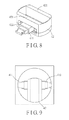
- FIG. 8 is a fragmentary perspective view of the intermediate coupling of the first embodiment
- FIG. 9 is a view similar to FIG. 7 , but illustrating a second coupling segment being moved relative to a first coupling segment
- FIG. 10 is an assembled perspective view of a modification of the second coupling segment
- FIG. 11 is an exploded perspective view of the modification of the second coupling segment
- FIG. 12 is an assembled perspective view of another modification of the second coupling segment
- FIG. 13 is an exploded perspective view of the another modification of the second coupling segment
- FIG. 14 is a sectional view of the another modification of the second coupling segment
- FIG. 15 is an exploded perspective view of the intermediate coupling of a second embodiment of a door mount mechanism according to the disclosure.
- FIG. 16 is an assembled perspective view of the intermediate coupling of the second embodiment
- FIG. 17 is a sectional view of a variation of a first coupling segment and a third coupling segment of the intermediate coupling of the second embodiment
- FIG. 18 is an exploded perspective view of a modification of the intermediate coupling of the second embodiment
- FIG. 19 is an assembled perspective view of the modification of the intermediate coupling of the second embodiment.
- FIG. 20 is a bottom view of the intermediate coupling of a third embodiment of a door mount mechanism according to the disclosure.
- FIG. 21 a bottom view of the intermediate coupling of a fourth embodiment of a door mount mechanism according to the disclosure.
- FIG. 22 is a schematic, fragmentary exploded perspective view illustrating a variation of the second coupling segment.
- a first embodiment of a door mount mechanism is adapted for use in a smart lock system, and is adapted to be mounted onto a door (not shown) for rotating a thumb turn (not shown) of a door lock (not shown).
- the door lock includes a base plate (not shown) which is mounted on the door and on which the thumb turn is rotatably disposed.
- the door mount mechanism includes a casing 1 , a rotatable component 2 , an actuating unit 3 and an intermediate coupling 4 .
- the casing 1 includes a base wall 11 , a surrounding wall 12 extending from a periphery of the base wall 11 and cooperating with the base wall 11 to define a receiving space 100 (see FIG. 7 ).
- the base wall 11 is substantially square.
- the surrounding wall 12 has a door-mounting end 121
- the receiving space 100 has an opening 101 (see FIG. 7 ) at the door-mounting end 121 .
- the base wall 11 is formed with a round hole 111 .
- the rotatable component 2 is coupled rotatably to the casing 1 .
- the rotatable component 2 has a base portion 21 engaging rotatably the round hole 111 of the casing 1 , and a knob portion 22 projecting from the base portion 21 away from the receiving space 100 and being accessible to a user.
- the actuating unit 3 includes an actuating module 31 that includes a motor and a solenoid valve, and a gear set 32 that is driven rotatably by the motor of the actuating module 31 .
- the actuating unit 3 is connected to a control circuit (not shown).
- the control circuit receives commands from a user device, such as a mobile phone, and the actuating unit 3 is activated by signals received from the control circuit to operate to drive rotation of the rotatable component 2 .
- the intermediate coupling 4 includes a first coupling segment 41 and a second coupling segment 42 .
- the second coupling segment 42 is made from an elastic material, is configured as a hollow frame, and has two parallel side frame sections 421 and two parallel elongated slide grooves 422 (only one is shown in FIG. 8 ) respectively formed in the side frame sections 421 and facing away from each other.
- the first coupling segment 41 has two subsegments 411 .
- Each of the subsegments 411 is configured as a telescopic structure, and has a first end that is connected fixedly and co-rotatably to the rotatable component 2 , and a second end that is opposite to the first end and that engages slidably a respective one of the slide grooves 422 .
- the subsegments 411 are collinearly arranged with each other and are perpendicular to the slide grooves 422 .
- a distance between the first and second ends of each of the subsegments 411 is adjustable, and the second coupling segment 42 is connected co-rotatably to and is linearly movable relative to the first coupling segment 41 (see FIGS. 8 and 9 ).
- the casing 1 is mounted onto the door with the door-mounting end 121 of the surrounding wall 12 abutting against the door and surrounding the base plate of the door lock, and with the door lock extending into the receiving space 100 through the opening 101 until the thumb turn of the door lock is surrounded by and inserted into the second coupling segment 42 .
- the side frame sections 421 are deformable in a first direction in which the subsegments 411 extend.
- the second coupling segment 42 is slidable relative to the first coupling segment 41 in a second direction perpendicular to the first direction. Therefore, the intermediate coupling 4 has a relatively great flexibility in terms of fitting onto the thumb turn of different sizes, shapes, or at various relative locations of the base plate. Therefore, when the actuating unit 3 is remotely controlled to actuate rotation of the rotatable component 2 , the thumb turn is rotated together with the rotatable component 2 . Moreover, with the knob portion 22 being accessible to the user, the rotatable component 2 can also be manually rotated.
- FIGS. 10 and 11 illustrate a modification of the first embodiment, in which the second coupling segment 42 further has an extension section 423 that is coupled telescopically to the side frame sections 421 , and a plurality of resilient members 424 that are disposed between the side frame sections 421 and the extension section 423 , and that are located at corners of the extension section 423 for biasing the extension section 423 in a direction away from the side frame sections 421 . Therefore, the intermediate coupling 4 (see FIG. 7 ) is capable of firmly holding a relatively large thumb turn with a distal end of the extension section 423 abutting resiliently against a base plate on which the thumb turn is rotatably mounted.
- FIGS. 12 to 14 illustrate another modification of the first embodiment, in which the extension section 423 is formed with a plurality of positioning slots 4231 , and the side frame sections 421 are formed with a plurality of positioning protrusions 4211 (only one is visible in FIG. 13 ).
- the user can manually move the extension section 423 relative to the side frame sections 421 , and engage the positioning protrusions 4211 with corresponding ones of the positioning slots 4231 to position the extension section 423 at a desired position relative to the side frame sections 421 .
- the second embodiment of a door mount mechanism according to the present disclosure differs from the first embodiment in the configuration of the intermediate coupling 4 .
- the intermediate coupling 4 further includes a third coupling segment 43 interposed between the first and second coupling segments 41 , 42 .
- the intermediate coupling 4 is configured as an oldham coupling.
- the first coupling segment 41 has a plate section 4101 that is formed with an elongated groove 4102 , and an engaging section 4103 that projects at a side opposite to the elongated groove 4102 to be connected co-rotatably to the rotatable component 2 (see FIG. 4 ).
- the third coupling segment 43 has a surface that faces the first coupling segment 41 and an elongated tongue 4301 that is formed on the surface and that fittingly and slidably engages the elongated groove 4102 .
- the second and third coupling segments 42 , 43 are coupled together via a similar tongue-and-groove mechanism, but the elongated tongue and groove provided between the second third coupling segments 42 , 43 are perpendicular to those provided between the first and third coupling segments 41 , 43 .
- each of the coupling heads has a main body 4201 which is formed with a cavity 4202 of a specific shape adapted to be fitted with a thumb turn having the same shape.
- a thumb turn shaped substantially rectangular
- one of the coupling heads with the cavity 4202 being formed to be substantially rectangular is chosen to fit onto the thumb turn.
- the elongated groove 4102 is formed only in the plate section 4101 in this embodiment, the elongated groove 4102 may be formed through the plate section 4101 into the engaging section 4103 in other embodiments (see FIG. 17 ), so that the thickness of the plate section 4101 can be decreased, thereby miniaturizing the intermediate coupling 4 .
- the third embodiment of a door mount mechanism according to the present disclosure differs from the previous embodiments in the configuration of the intermediate coupling 4 .
- the third coupling segment 43 is larger than and surrounds the second coupling segment 42 .
- the second coupling segment 42 has opposite edges coupled slidably and respectively to the third coupling segment 43 via tongue-and-groove mechanisms.
- the first coupling segment 41 is larger than and surrounds the third coupling segment 43
- the third coupling segment 43 has opposite edges coupled slidably and respectively to the first coupling segment 41 via tongue-and-groove mechanisms (which are not co-rotatable with the first coupling segment 41 ), such that the second coupling segment 42 is movable relative to the first coupling segment 41 in a first direction, and is movable relative to the first coupling segment 41 via the third coupling segment 43 in a second direction perpendicular to the first direction.
- the second coupling segment 42 has a rigid outer part 428 coupled slidably to the third coupling segment 43 , and a rotatable inner part 427 surrounded by the rigid outer part 428 , formed with a cavity 4271 that is adapted to receive the thumb turn of the door lock, and made from an elastic material so that the second coupling segment 42 can fit on thumb turns of different shapes and sizes.
- the fourth embodiment of a door mount mechanism according to the present disclosure differs from the previous embodiments in the configuration of the intermediate coupling 4 .
- the first coupling segment 41 has two subsegments 411 ′ connected to a periphery of the rotatable component 2 (see FIG. 4 ).
- Each of the subsegments 411 ′ has opposite first and second ends.
- the first ends of the subsegments 411 ′ are aligned with each other in a first direction
- the second ends of the subsegments 411 ′ are aligned with each other in the first direction.
- the second coupling segment 42 has a main subsegment 421 ′ adapted for surrounding the thumb turn of the door lock, and four coupling subsegments 423 .
- Two of the coupling subsegments 423 are connected to an end of the main subsegment 421 ′ and are connected slidably and respectively to the first and second ends of one of the subsegments 411 ′.
- the other two of the coupling segments 423 are connected to an opposite end of the main subsegment 421 ′ and are connected slidably and respectively to the first and second ends of the other one of the subsegments 411 ′.
- the second coupling segment 42 is movable relative to the first coupling segment 41 in the first direction.
- the main subsegment 421 ′ has a width in a second direction perpendicular to the first direction and adapted to be larger than that of the thumb turn.
- the main subsegment 421 ′ would be allowed to be movable relative to the thumb turn in the second direction to thereby properly dri ye rotation of the thumb turn.
- the second coupling segment 42 may be configured to have a base board 420 and a driving bar 425 projecting co-rotatably from the base board 420 and eccentrically disposed on the base board 420 .
- the second coupling segment 42 is adapted to push the thumb turn 90 of the door lock to rotate using the driving bar 425 and there is no need for any part of the second coupling segment 42 to be elastic and deformable.
- the door mount mechanism according to the present disclosure may also be used for rotating a knob of a switch mechanism, such as a switch knob of a washing machine, an oven, and so on.
Landscapes
- Physics & Mathematics (AREA)
- Electromagnetism (AREA)
- Casings For Electric Apparatus (AREA)
- Lock And Its Accessories (AREA)
Priority Applications (1)
| Application Number | Priority Date | Filing Date | Title |
|---|---|---|---|
| US15/117,139 US10472859B2 (en) | 2014-10-08 | 2015-10-07 | Door mount mechanism for a smart lock system |
Applications Claiming Priority (5)
| Application Number | Priority Date | Filing Date | Title |
|---|---|---|---|
| US201462061209P | 2014-10-08 | 2014-10-08 | |
| US201462061212P | 2014-10-08 | 2014-10-08 | |
| US201462061204P | 2014-10-08 | 2014-10-08 | |
| PCT/US2015/054505 WO2016057677A1 (en) | 2014-10-08 | 2015-10-07 | Door mount mechanism for a smart lock system |
| US15/117,139 US10472859B2 (en) | 2014-10-08 | 2015-10-07 | Door mount mechanism for a smart lock system |
Publications (2)
| Publication Number | Publication Date |
|---|---|
| US20170002585A1 US20170002585A1 (en) | 2017-01-05 |
| US10472859B2 true US10472859B2 (en) | 2019-11-12 |
Family
ID=55653723
Family Applications (1)
| Application Number | Title | Priority Date | Filing Date |
|---|---|---|---|
| US15/117,139 Active 2035-10-15 US10472859B2 (en) | 2014-10-08 | 2015-10-07 | Door mount mechanism for a smart lock system |
Country Status (5)
| Country | Link |
|---|---|
| US (1) | US10472859B2 (de) |
| EP (1) | EP3204577A4 (de) |
| JP (2) | JP3212775U (de) |
| CN (1) | CN107250471B (de) |
| WO (1) | WO2016057677A1 (de) |
Cited By (4)
| Publication number | Priority date | Publication date | Assignee | Title |
|---|---|---|---|---|
| US11339589B2 (en) | 2018-04-13 | 2022-05-24 | Dormakaba Usa Inc. | Electro-mechanical lock core |
| US11466473B2 (en) | 2018-04-13 | 2022-10-11 | Dormakaba Usa Inc | Electro-mechanical lock core |
| US11913254B2 (en) | 2017-09-08 | 2024-02-27 | dormakaba USA, Inc. | Electro-mechanical lock core |
| US11933076B2 (en) | 2016-10-19 | 2024-03-19 | Dormakaba Usa Inc. | Electro-mechanical lock core |
Families Citing this family (5)
| Publication number | Priority date | Publication date | Assignee | Title |
|---|---|---|---|---|
| US10087656B1 (en) * | 2017-05-17 | 2018-10-02 | Dee Cee Marketing, Inc. | Keyless locking system |
| CN109594852B (zh) * | 2017-09-30 | 2020-11-06 | 古哲明 | 传动机构及具有所述传动机构的门锁控制装置 |
| US11201873B2 (en) | 2018-12-19 | 2021-12-14 | T-Mobile Usa, Inc. | Multi-factor authentication with geolocation and voice command |
| US10769872B2 (en) | 2018-12-19 | 2020-09-08 | T-Mobile Usa, Inc. | Multi-factor authentication with geolocation and short-range communication with indoor-outdoor detection |
| US12509913B2 (en) * | 2021-09-13 | 2025-12-30 | Imperium Electronics, LLC | Deadbolt control and security systems |
Citations (17)
| Publication number | Priority date | Publication date | Assignee | Title |
|---|---|---|---|---|
| US4557124A (en) * | 1983-05-10 | 1985-12-10 | Norman Russ | Power key turner |
| US5592839A (en) * | 1993-03-24 | 1997-01-14 | Hasan; Noam | Assembly for retaining of keys of similar objects |
| US5678436A (en) * | 1995-11-28 | 1997-10-21 | Alexander; Curtis Earl | Remote control door lock system |
| US5704235A (en) * | 1994-12-24 | 1998-01-06 | Staehle; Kurt | Key case for an ignition key |
| US5887468A (en) * | 1994-03-22 | 1999-03-30 | Hasan; Noam | Assembly for retaining of keys or similar objects |
| US6216502B1 (en) * | 2000-04-04 | 2001-04-17 | Thomas Cannella | Keyless locking system |
| US6324879B1 (en) | 1999-09-22 | 2001-12-04 | Samuel Kennedy | Deadbolt cover |
| US6591643B1 (en) | 2001-12-10 | 2003-07-15 | Thomas Cannella | Keyless locking system |
| US6742369B1 (en) | 2002-02-01 | 2004-06-01 | Pierre Veillette | Auxiliary door lock |
| US7373795B2 (en) | 2004-12-07 | 2008-05-20 | Kilbourne Mark W | Universal remote deadbolt adapter |
| US20080296912A1 (en) | 2007-05-29 | 2008-12-04 | Whitner Douglas E | Remote door access device |
| US20090084147A1 (en) | 2007-09-28 | 2009-04-02 | Aiphone Co., Ltd. | Electric lock device |
| CA2789278C (en) | 2009-04-10 | 2014-04-15 | Emtek Products, Inc. | Keypad lockset |
| US20140260447A1 (en) * | 2013-03-15 | 2014-09-18 | Merrick Schmidt-Lackner | Door entry system |
| US9476232B1 (en) * | 2015-12-29 | 2016-10-25 | Roberto Verdecia | Remote switch controller |
| US20170002586A1 (en) * | 2015-07-01 | 2017-01-05 | Dominick S. LEE | Installation-Free Rechargeable Door Locking Apparatus, Systems and Methods |
| US9624695B1 (en) * | 2013-03-15 | 2017-04-18 | August Home, Inc. | Intelligent door lock system with WiFi bridge |
Family Cites Families (4)
| Publication number | Priority date | Publication date | Assignee | Title |
|---|---|---|---|---|
| KR20050041843A (ko) * | 2004-02-23 | 2005-05-04 | 김기영 | 도어잠금장치 |
| AU2009240836B2 (en) * | 2008-12-02 | 2015-05-21 | Assa Abloy Australia Pty Limited | Adjustable Cylindrical Lock Set |
| JP5312965B2 (ja) * | 2009-01-28 | 2013-10-09 | アイホン株式会社 | 電気錠装置 |
| CN202117431U (zh) * | 2011-06-02 | 2012-01-18 | 姚海平 | 一种整合钥匙锁的指纹锁 |
-
2015
- 2015-10-07 EP EP15849628.1A patent/EP3204577A4/de not_active Withdrawn
- 2015-10-07 JP JP2016600142U patent/JP3212775U/ja not_active Ceased
- 2015-10-07 CN CN201580065040.7A patent/CN107250471B/zh active Active
- 2015-10-07 WO PCT/US2015/054505 patent/WO2016057677A1/en not_active Ceased
- 2015-10-07 US US15/117,139 patent/US10472859B2/en active Active
-
2017
- 2017-11-22 JP JP2017224457A patent/JP6641342B2/ja active Active
Patent Citations (18)
| Publication number | Priority date | Publication date | Assignee | Title |
|---|---|---|---|---|
| US4557124A (en) * | 1983-05-10 | 1985-12-10 | Norman Russ | Power key turner |
| US5592839A (en) * | 1993-03-24 | 1997-01-14 | Hasan; Noam | Assembly for retaining of keys of similar objects |
| US5887468A (en) * | 1994-03-22 | 1999-03-30 | Hasan; Noam | Assembly for retaining of keys or similar objects |
| US5704235A (en) * | 1994-12-24 | 1998-01-06 | Staehle; Kurt | Key case for an ignition key |
| US5678436A (en) * | 1995-11-28 | 1997-10-21 | Alexander; Curtis Earl | Remote control door lock system |
| US6324879B1 (en) | 1999-09-22 | 2001-12-04 | Samuel Kennedy | Deadbolt cover |
| US6216502B1 (en) * | 2000-04-04 | 2001-04-17 | Thomas Cannella | Keyless locking system |
| US6591643B1 (en) | 2001-12-10 | 2003-07-15 | Thomas Cannella | Keyless locking system |
| US6742369B1 (en) | 2002-02-01 | 2004-06-01 | Pierre Veillette | Auxiliary door lock |
| US7373795B2 (en) | 2004-12-07 | 2008-05-20 | Kilbourne Mark W | Universal remote deadbolt adapter |
| US20080296912A1 (en) | 2007-05-29 | 2008-12-04 | Whitner Douglas E | Remote door access device |
| US20090084147A1 (en) | 2007-09-28 | 2009-04-02 | Aiphone Co., Ltd. | Electric lock device |
| CA2789278C (en) | 2009-04-10 | 2014-04-15 | Emtek Products, Inc. | Keypad lockset |
| US20140260447A1 (en) * | 2013-03-15 | 2014-09-18 | Merrick Schmidt-Lackner | Door entry system |
| US8869574B2 (en) * | 2013-03-15 | 2014-10-28 | Consumer 2.0, Inc. | Door entry system |
| US9624695B1 (en) * | 2013-03-15 | 2017-04-18 | August Home, Inc. | Intelligent door lock system with WiFi bridge |
| US20170002586A1 (en) * | 2015-07-01 | 2017-01-05 | Dominick S. LEE | Installation-Free Rechargeable Door Locking Apparatus, Systems and Methods |
| US9476232B1 (en) * | 2015-12-29 | 2016-10-25 | Roberto Verdecia | Remote switch controller |
Non-Patent Citations (1)
| Title |
|---|
| International Search Report, PCT/US15/054505, dated Jan. 5, 2016 (2 pages). |
Cited By (8)
| Publication number | Priority date | Publication date | Assignee | Title |
|---|---|---|---|---|
| US11933076B2 (en) | 2016-10-19 | 2024-03-19 | Dormakaba Usa Inc. | Electro-mechanical lock core |
| US11913254B2 (en) | 2017-09-08 | 2024-02-27 | dormakaba USA, Inc. | Electro-mechanical lock core |
| US11339589B2 (en) | 2018-04-13 | 2022-05-24 | Dormakaba Usa Inc. | Electro-mechanical lock core |
| US11447980B2 (en) | 2018-04-13 | 2022-09-20 | Dormakaba Usa Inc. | Puller tool |
| US11466473B2 (en) | 2018-04-13 | 2022-10-11 | Dormakaba Usa Inc | Electro-mechanical lock core |
| US12031357B2 (en) | 2018-04-13 | 2024-07-09 | Dormakaba Usa Inc. | Electro-mechanical lock core |
| US12071788B2 (en) | 2018-04-13 | 2024-08-27 | Dormakaba Usa Inc. | Electro-mechanical lock core |
| US12435546B2 (en) | 2018-04-13 | 2025-10-07 | Dormakaba Usa Inc. | Electro-mechanical lock core |
Also Published As
| Publication number | Publication date |
|---|---|
| JP3212775U (ja) | 2017-10-05 |
| CN107250471A (zh) | 2017-10-13 |
| US20170002585A1 (en) | 2017-01-05 |
| JP2018028261A (ja) | 2018-02-22 |
| WO2016057677A1 (en) | 2016-04-14 |
| CN107250471B (zh) | 2020-03-17 |
| JP6641342B2 (ja) | 2020-02-05 |
| EP3204577A1 (de) | 2017-08-16 |
| EP3204577A4 (de) | 2018-06-20 |
Similar Documents
| Publication | Publication Date | Title |
|---|---|---|
| US10472859B2 (en) | Door mount mechanism for a smart lock system | |
| US20160040452A1 (en) | Door mount mechanism for a smart lock system | |
| US7770423B2 (en) | Electro-mechanical lock structure | |
| US20110289987A1 (en) | Door lock assembly having push/pull handles | |
| US8851351B2 (en) | Trigger assembly for switching one shoot mode or repeat shoot mode | |
| US20150211260A1 (en) | Gear Structure for Electronic Lock | |
| US9395755B2 (en) | Dock for controlling and adjusting viewing angle of electronic devices | |
| US9790677B2 (en) | Remote control device | |
| EP2682549B1 (de) | Fangverriegelungsanordnung | |
| JP6897995B2 (ja) | スイッチ装置 | |
| JP2016112072A (ja) | 遊技機 | |
| CN105700633B (zh) | 有定位功能的快拆旋转机构及有定位旋转门板的电子装置 | |
| MY147680A (en) | Electromechanical lock device | |
| EP2993553A1 (de) | Winkeljustierungsmechanismus | |
| EP3223295A1 (de) | Schaltvorrichtung | |
| CN109995905B (zh) | 功能组件、电子装置及电子装置的控制方法 | |
| CN109736647B (zh) | 锁止机构及锁具 | |
| KR102584586B1 (ko) | 차량용 키 장치 | |
| US8933388B2 (en) | Goods delivery switch | |
| US9976637B2 (en) | Rotary electric component | |
| CN109210859B (zh) | 冰箱 | |
| KR101321043B1 (ko) | 주방 또는 샤워실용 화상기기 | |
| KR102248002B1 (ko) | 유리문의 도어락 장치 | |
| KR102248001B1 (ko) | 유리문의 도어락 장치 | |
| KR101584335B1 (ko) | 차량의 액세서리 부착 장치 |
Legal Events
| Date | Code | Title | Description |
|---|---|---|---|
| AS | Assignment |
Owner name: CANDY HOUSE INC., CALIFORNIA Free format text: ASSIGNMENT OF ASSIGNORS INTEREST;ASSIGNOR:KU, CHE-MING;REEL/FRAME:039738/0673 Effective date: 20160831 |
|
| STPP | Information on status: patent application and granting procedure in general |
Free format text: FINAL REJECTION MAILED |
|
| STPP | Information on status: patent application and granting procedure in general |
Free format text: DOCKETED NEW CASE - READY FOR EXAMINATION |
|
| STPP | Information on status: patent application and granting procedure in general |
Free format text: NOTICE OF ALLOWANCE MAILED -- APPLICATION RECEIVED IN OFFICE OF PUBLICATIONS |
|
| STPP | Information on status: patent application and granting procedure in general |
Free format text: PUBLICATIONS -- ISSUE FEE PAYMENT VERIFIED |
|
| STCF | Information on status: patent grant |
Free format text: PATENTED CASE |
|
| FEPP | Fee payment procedure |
Free format text: SURCHARGE FOR LATE PAYMENT, SMALL ENTITY (ORIGINAL EVENT CODE: M2554); ENTITY STATUS OF PATENT OWNER: SMALL ENTITY |
|
| MAFP | Maintenance fee payment |
Free format text: PAYMENT OF MAINTENANCE FEE, 4TH YR, SMALL ENTITY (ORIGINAL EVENT CODE: M2551); ENTITY STATUS OF PATENT OWNER: SMALL ENTITY Year of fee payment: 4 |
|
| AS | Assignment |
Owner name: CANDY HOUSE JAPAN, INC., JAPAN Free format text: ASSIGNMENT OF ASSIGNORS INTEREST;ASSIGNOR:CANDY HOUSE INC.;REEL/FRAME:072247/0483 Effective date: 20250613 |