US10460879B2 - Photoelectric conversion element, dye-sensitized solar cell, metal complex dye, dye solution, dye-adsorbed electrode, and method for producing dye-sensitized solar cell - Google Patents
Photoelectric conversion element, dye-sensitized solar cell, metal complex dye, dye solution, dye-adsorbed electrode, and method for producing dye-sensitized solar cell Download PDFInfo
- Publication number
- US10460879B2 US10460879B2 US14/713,341 US201514713341A US10460879B2 US 10460879 B2 US10460879 B2 US 10460879B2 US 201514713341 A US201514713341 A US 201514713341A US 10460879 B2 US10460879 B2 US 10460879B2
- Authority
- US
- United States
- Prior art keywords
- ring
- group
- independently represent
- bond
- integer
- Prior art date
- Legal status (The legal status is an assumption and is not a legal conclusion. Google has not performed a legal analysis and makes no representation as to the accuracy of the status listed.)
- Expired - Fee Related, expires
Links
- JJFVGAVLWHYCFV-UHFFFAOYSA-N CC1=CC(C)=N[N-]1 Chemical compound CC1=CC(C)=N[N-]1 JJFVGAVLWHYCFV-UHFFFAOYSA-N 0.000 description 80
- JRJLLMLYUFAZOM-UHFFFAOYSA-N CC1=CC(C(=O)O)=CC(C)=N1 Chemical compound CC1=CC(C(=O)O)=CC(C)=N1 JRJLLMLYUFAZOM-UHFFFAOYSA-N 0.000 description 55
- 0 *.B.C.C.C.C.C.C.C.CC.CC.CC.CCC.CCC.CCC.N=C/C=N/Ccn Chemical compound *.B.C.C.C.C.C.C.C.CC.CC.CC.CCC.CCC.CCC.N=C/C=N/Ccn 0.000 description 51
- BSKHPKMHTQYZBB-UHFFFAOYSA-N CC1=CC=CC=N1 Chemical compound CC1=CC=CC=N1 BSKHPKMHTQYZBB-UHFFFAOYSA-N 0.000 description 36
- HCAJOZUWXJYAAH-UHFFFAOYSA-N CC1=C(C)C=C(C(F)(F)F)C=[C-]1 Chemical compound CC1=C(C)C=C(C(F)(F)F)C=[C-]1 HCAJOZUWXJYAAH-UHFFFAOYSA-N 0.000 description 31
- VZCNAIRJZWZPJJ-ONEGZZNKSA-N CC1=CC(/C=C/C(=O)O)=CC(C)=N1 Chemical compound CC1=CC(/C=C/C(=O)O)=CC(C)=N1 VZCNAIRJZWZPJJ-ONEGZZNKSA-N 0.000 description 30
- AKSGGHGLDJJWQS-UHFFFAOYSA-N CC1=CC(C2=CC=C(C3=C(O)C(=O)C3=O)S2)=CC=N1 Chemical compound CC1=CC(C2=CC=C(C3=C(O)C(=O)C3=O)S2)=CC=N1 AKSGGHGLDJJWQS-UHFFFAOYSA-N 0.000 description 20
- ZLZAYADNYBXYRU-UHFFFAOYSA-N CC1=NN=C(C)[N-]1 Chemical compound CC1=NN=C(C)[N-]1 ZLZAYADNYBXYRU-UHFFFAOYSA-N 0.000 description 17
- UTKVZHMORGAUDJ-POHAHGRESA-N [C-]#[N+]/C(=C\C1=CC(C)=NC(C)=C1)C(=O)O Chemical compound [C-]#[N+]/C(=C\C1=CC(C)=NC(C)=C1)C(=O)O UTKVZHMORGAUDJ-POHAHGRESA-N 0.000 description 14
- BFZZKUYSBYRGSS-OLGQORCHSA-N O=C=O.[H]/C(C#N)=C/C1=CC=NC(C)=C1 Chemical compound O=C=O.[H]/C(C#N)=C/C1=CC=NC(C)=C1 BFZZKUYSBYRGSS-OLGQORCHSA-N 0.000 description 9
- AQVFBUSGSGXGNX-UHFFFAOYSA-N CC1=CC(C(F)(F)F)=N[NH+]1[O-] Chemical compound CC1=CC(C(F)(F)F)=N[NH+]1[O-] AQVFBUSGSGXGNX-UHFFFAOYSA-N 0.000 description 8
- CZBUQCZUOABFIF-UHFFFAOYSA-N O=C=O.[H]/C=C/C1=CC=NC(C)=C1 Chemical compound O=C=O.[H]/C=C/C1=CC=NC(C)=C1 CZBUQCZUOABFIF-UHFFFAOYSA-N 0.000 description 8
- RHRYWOAASMAMDC-NSCUHMNNSA-N CC1=CC(/C=C/C(=O)O)=CC=N1 Chemical compound CC1=CC(/C=C/C(=O)O)=CC=N1 RHRYWOAASMAMDC-NSCUHMNNSA-N 0.000 description 7
- LNJMHEJAYSYZKK-UHFFFAOYSA-N CC1=NC=CC=N1 Chemical compound CC1=NC=CC=N1 LNJMHEJAYSYZKK-UHFFFAOYSA-N 0.000 description 7
- ZKCQZUFMYLSFQC-UHFFFAOYSA-N CCCCCCC1=C(C2=CC=NC(C)=C2)SC=C1 Chemical compound CCCCCCC1=C(C2=CC=NC(C)=C2)SC=C1 ZKCQZUFMYLSFQC-UHFFFAOYSA-N 0.000 description 7
- QEGAGOOXDOFYIS-UHFFFAOYSA-N CC1=CC(C2=CC=C(OC=O)S2)=CC(C)=N1 Chemical compound CC1=CC(C2=CC=C(OC=O)S2)=CC(C)=N1 QEGAGOOXDOFYIS-UHFFFAOYSA-N 0.000 description 6
- CNESRTJUOGKPKL-UHFFFAOYSA-N CCCCCC1=CC=C(N(C2=CC=C(CCCCC)C=C2)C2=CC(C)=NC=C2)C=C1 Chemical compound CCCCCC1=CC=C(N(C2=CC=C(CCCCC)C=C2)C2=CC(C)=NC=C2)C=C1 CNESRTJUOGKPKL-UHFFFAOYSA-N 0.000 description 6
- PMDHIMMPXRSDML-UHFFFAOYSA-N Cc1cc(C(O)=O)ccn1 Chemical compound Cc1cc(C(O)=O)ccn1 PMDHIMMPXRSDML-UHFFFAOYSA-N 0.000 description 6
- RKSBBXUGVOLJBQ-UVTDQMKNSA-N CC1=CC(/C=C(\C(=O)O)C(=O)C2=CC=CC=C2)=CC=N1 Chemical compound CC1=CC(/C=C(\C(=O)O)C(=O)C2=CC=CC=C2)=CC=N1 RKSBBXUGVOLJBQ-UVTDQMKNSA-N 0.000 description 5
- LXUDAVSMDBVRIL-UHFFFAOYSA-N CC1=CC(C2=CC=C(C3=C(O)C(=O)C3=O)C=C2)=CC=N1 Chemical compound CC1=CC(C2=CC=C(C3=C(O)C(=O)C3=O)C=C2)=CC=N1 LXUDAVSMDBVRIL-UHFFFAOYSA-N 0.000 description 5
- ZGCYMLKVPWJXDZ-UHFFFAOYSA-N CC1=CN=C(C)[N-]1 Chemical compound CC1=CN=C(C)[N-]1 ZGCYMLKVPWJXDZ-UHFFFAOYSA-N 0.000 description 5
- ZLXFRBWOAIOJTC-UHFFFAOYSA-N CC1=NC2=C(C=CC=C2)[N-]1 Chemical compound CC1=NC2=C(C=CC=C2)[N-]1 ZLXFRBWOAIOJTC-UHFFFAOYSA-N 0.000 description 5
- ITJRXSKJUBKRIT-UHFFFAOYSA-N CC1=NC=CC(N(C2=CC=C(C(C)(C)C)C=C2)C2=CC=C(C(C)(C)C)C=C2)=C1 Chemical compound CC1=NC=CC(N(C2=CC=C(C(C)(C)C)C=C2)C2=CC=C(C(C)(C)C)C=C2)=C1 ITJRXSKJUBKRIT-UHFFFAOYSA-N 0.000 description 5
- NADXNVXLHGWUGE-YVMONPNESA-N CC1=CC(/C(=C/C(=O)O)C(F)(F)F)=CC=N1 Chemical compound CC1=CC(/C(=C/C(=O)O)C(F)(F)F)=CC=N1 NADXNVXLHGWUGE-YVMONPNESA-N 0.000 description 4
- DYVMGFVWYAYLIO-YVMONPNESA-N CC1=CC(/C(F)=C/C(=O)O)=CC=N1 Chemical compound CC1=CC(/C(F)=C/C(=O)O)=CC=N1 DYVMGFVWYAYLIO-YVMONPNESA-N 0.000 description 4
- LBTYPFVCMFEVNE-HWKANZROSA-N CC1=CC(/C=C/OC=O)=CC=N1 Chemical compound CC1=CC(/C=C/OC=O)=CC=N1 LBTYPFVCMFEVNE-HWKANZROSA-N 0.000 description 4
- KDZWPSGQUONNRQ-UHFFFAOYSA-N CC1=CC(C#CC(=O)O)=CC=N1 Chemical compound CC1=CC(C#CC(=O)O)=CC=N1 KDZWPSGQUONNRQ-UHFFFAOYSA-N 0.000 description 4
- ZQCLLLUTWKNOKI-XFFZJAGNSA-N CC1=CC(C2=CC=C(/C=C(/C#N)C(=O)O)S2)=CC=N1 Chemical compound CC1=CC(C2=CC=C(/C=C(/C#N)C(=O)O)S2)=CC=N1 ZQCLLLUTWKNOKI-XFFZJAGNSA-N 0.000 description 4
- URPOLXYJLUSWFR-HWKANZROSA-N CC1=CC(C2=CC=C(/C=C/C(=O)O)S2)=CC=N1 Chemical compound CC1=CC(C2=CC=C(/C=C/C(=O)O)S2)=CC=N1 URPOLXYJLUSWFR-HWKANZROSA-N 0.000 description 4
- DVULMLWGFXYACH-FNORWQNLSA-N CC1=CC(C2=CC=C(/C=C/OC=O)S2)=CC=N1 Chemical compound CC1=CC(C2=CC=C(/C=C/OC=O)S2)=CC=N1 DVULMLWGFXYACH-FNORWQNLSA-N 0.000 description 4
- YMFSMRXRGBLGQV-UHFFFAOYSA-N CCCCCCC1=C(C)SC=C1 Chemical compound CCCCCCC1=C(C)SC=C1 YMFSMRXRGBLGQV-UHFFFAOYSA-N 0.000 description 4
- AYPZUIDAVBNDCJ-UHFFFAOYSA-N O=C=O.[H]/C=C(\F)C1=CC=NC(C)=C1 Chemical compound O=C=O.[H]/C=C(\F)C1=CC=NC(C)=C1 AYPZUIDAVBNDCJ-UHFFFAOYSA-N 0.000 description 4
- ADIKYELOYMNTAP-JYRVWZFOSA-N CC(=O)/C(=C/C1=CC=C(C2=CC=NC(C)=C2)S1)C(=O)O Chemical compound CC(=O)/C(=C/C1=CC=C(C2=CC=NC(C)=C2)S1)C(=O)O ADIKYELOYMNTAP-JYRVWZFOSA-N 0.000 description 3
- GLJGVEAYJYZDKU-IZZDOVSWSA-N CC(=O)/C(=C\C1=CC(C)=NC(C)=C1)C(=O)O Chemical compound CC(=O)/C(=C\C1=CC(C)=NC(C)=C1)C(=O)O GLJGVEAYJYZDKU-IZZDOVSWSA-N 0.000 description 3
- DPMSFYPNBDAAEC-UHFFFAOYSA-N CC1=C(F)C=C(F)C=[C-]1 Chemical compound CC1=C(F)C=C(F)C=[C-]1 DPMSFYPNBDAAEC-UHFFFAOYSA-N 0.000 description 3
- WXWDSKUVGQJTLZ-UITAMQMPSA-N CC1=CC(/C=C(/C#N)C(=O)O)=CC=N1 Chemical compound CC1=CC(/C=C(/C#N)C(=O)O)=CC=N1 WXWDSKUVGQJTLZ-UITAMQMPSA-N 0.000 description 3
- HMRLZPGHCSTVDU-GDNBJRDFSA-N CC1=CC(/C=C(\OC=O)C(=O)C2=CC=CC=C2)=CC=N1 Chemical compound CC1=CC(/C=C(\OC=O)C(=O)C2=CC=CC=C2)=CC=N1 HMRLZPGHCSTVDU-GDNBJRDFSA-N 0.000 description 3
- CEYBVHBLAZMMBW-UHFFFAOYSA-N CC1=CC(C#CC(=O)O)=CC(C)=N1 Chemical compound CC1=CC(C#CC(=O)O)=CC(C)=N1 CEYBVHBLAZMMBW-UHFFFAOYSA-N 0.000 description 3
- YLNSDZVBXUTMAB-UHFFFAOYSA-N CC1=CC(C#COC=O)=CC=N1 Chemical compound CC1=CC(C#COC=O)=CC=N1 YLNSDZVBXUTMAB-UHFFFAOYSA-N 0.000 description 3
- NJOQMQKDRZXMLO-UHFFFAOYSA-N CC1=CC(C(F)(F)F)=N[N-]1 Chemical compound CC1=CC(C(F)(F)F)=N[N-]1 NJOQMQKDRZXMLO-UHFFFAOYSA-N 0.000 description 3
- KUNOBQCJIDXQFE-UHFFFAOYSA-N CC1=CC(C2=C(O)C(=O)C2=O)=CC=N1 Chemical compound CC1=CC(C2=C(O)C(=O)C2=O)=CC=N1 KUNOBQCJIDXQFE-UHFFFAOYSA-N 0.000 description 3
- QFVFHAZWHHLSSJ-UHFFFAOYSA-N CC1=CC(C2=CC3=C(C=C(C(=O)O)S3)S2)=CC=N1 Chemical compound CC1=CC(C2=CC3=C(C=C(C(=O)O)S3)S2)=CC=N1 QFVFHAZWHHLSSJ-UHFFFAOYSA-N 0.000 description 3
- BXFYJQHRYUBLPU-ATVHPVEESA-N CC1=CC(C2=CC=C(/C=C(\C(=O)O)C(=O)C3=CC=CC=C3)S2)=CC=N1 Chemical compound CC1=CC(C2=CC=C(/C=C(\C(=O)O)C(=O)C3=CC=CC=C3)S2)=CC=N1 BXFYJQHRYUBLPU-ATVHPVEESA-N 0.000 description 3
- RMSPUYRSUKZUCL-PDGQHHTCSA-N CC1=CC(C2=CC=C(/C=C(\OC=O)C(=O)C3=CC=CC=C3)S2)=CC=N1 Chemical compound CC1=CC(C2=CC=C(/C=C(\OC=O)C(=O)C3=CC=CC=C3)S2)=CC=N1 RMSPUYRSUKZUCL-PDGQHHTCSA-N 0.000 description 3
- KZSKQWYRXAOSJO-HWKANZROSA-N CC1=CC(C2=CC=C(/C=C/C(=O)O)O2)=CC=N1 Chemical compound CC1=CC(C2=CC=C(/C=C/C(=O)O)O2)=CC=N1 KZSKQWYRXAOSJO-HWKANZROSA-N 0.000 description 3
- NYIXYGCYABQECI-UHFFFAOYSA-N CC1=CC(C2=CC=C(C3=C(O)C(=O)C(=O)C(=O)C3=O)S2)=CC=N1 Chemical compound CC1=CC(C2=CC=C(C3=C(O)C(=O)C(=O)C(=O)C3=O)S2)=CC=N1 NYIXYGCYABQECI-UHFFFAOYSA-N 0.000 description 3
- BFJMIWIIYVJBGT-UHFFFAOYSA-N CC1=CC(C2=CC=C(OC=O)S2)=CC=N1 Chemical compound CC1=CC(C2=CC=C(OC=O)S2)=CC=N1 BFJMIWIIYVJBGT-UHFFFAOYSA-N 0.000 description 3
- RUEJAOCIOOFUHC-UHFFFAOYSA-N CC1=CC=C(C)[N-]1 Chemical compound CC1=CC=C(C)[N-]1 RUEJAOCIOOFUHC-UHFFFAOYSA-N 0.000 description 3
- JCNIONCDEVUHML-UHFFFAOYSA-N CC1=CC=C[N-]1 Chemical compound CC1=CC=C[N-]1 JCNIONCDEVUHML-UHFFFAOYSA-N 0.000 description 3
- UUBVLXLSYTXLKB-NSCUHMNNSA-N CC1=NC(/C=C/C(=O)O)=CC=N1 Chemical compound CC1=NC(/C=C/C(=O)O)=CC=N1 UUBVLXLSYTXLKB-NSCUHMNNSA-N 0.000 description 3
- MGAKEVWIGWQKOQ-UHFFFAOYSA-N CC1=NC=CC(N2C3=CC=C(C(C)(C)C)C=C3C(C)(C)C3=C2C=CC(C(C)(C)C)=C3)=C1 Chemical compound CC1=NC=CC(N2C3=CC=C(C(C)(C)C)C=C3C(C)(C)C3=C2C=CC(C(C)(C)C)=C3)=C1 MGAKEVWIGWQKOQ-UHFFFAOYSA-N 0.000 description 3
- KVOKIMQMMCSPHP-UHFFFAOYSA-N CCCCCCC1=C(C2=CC=NC(C)=N2)SC=C1 Chemical compound CCCCCCC1=C(C2=CC=NC(C)=N2)SC=C1 KVOKIMQMMCSPHP-UHFFFAOYSA-N 0.000 description 3
- ZBIUGZLUAUOIRQ-UHFFFAOYSA-N Cc1c(C(F)(F)F)cc(C(F)(F)F)cc1 Chemical compound Cc1c(C(F)(F)F)cc(C(F)(F)F)cc1 ZBIUGZLUAUOIRQ-UHFFFAOYSA-N 0.000 description 3
- KCSFIZLLIQUQBV-RMKNXTFCSA-N Cc1nccc(/C=C(\C(O)=O)/S(C)(=O)=O)c1 Chemical compound Cc1nccc(/C=C(\C(O)=O)/S(C)(=O)=O)c1 KCSFIZLLIQUQBV-RMKNXTFCSA-N 0.000 description 3
- XEUPNNLIJFFJET-UHFFFAOYSA-N O=C=O.[H]/C=C(\C)C1=CC=NC(C)=C1 Chemical compound O=C=O.[H]/C=C(\C)C1=CC=NC(C)=C1 XEUPNNLIJFFJET-UHFFFAOYSA-N 0.000 description 3
- POVPUZFMOVUYIH-ONEGZZNKSA-N C/C=C/C1=CC=NC(C)=C1 Chemical compound C/C=C/C1=CC=NC(C)=C1 POVPUZFMOVUYIH-ONEGZZNKSA-N 0.000 description 2
- USTWQDXNBGVSQW-ZSOIEALJSA-N CC(=O)/C(=C/C1=CC=C(C2=CC=NC(C)=C2)S1)OC=O Chemical compound CC(=O)/C(=C/C1=CC=C(C2=CC=NC(C)=C2)S1)OC=O USTWQDXNBGVSQW-ZSOIEALJSA-N 0.000 description 2
- CJDWRNRWNISZKN-POHAHGRESA-N CC(=O)/C(=C/C1=CC=NC(C)=C1)C(=O)O Chemical compound CC(=O)/C(=C/C1=CC=NC(C)=C1)C(=O)O CJDWRNRWNISZKN-POHAHGRESA-N 0.000 description 2
- KWQGHVUODIKAOE-WDZFZDKYSA-N CC(=O)/C(=C/C1=CC=NC(C)=C1)OC=O Chemical compound CC(=O)/C(=C/C1=CC=NC(C)=C1)OC=O KWQGHVUODIKAOE-WDZFZDKYSA-N 0.000 description 2
- CJDWRNRWNISZKN-UXBLZVDNSA-N CC(=O)/C(=C\C1=CC=NC(C)=C1)C(=O)O Chemical compound CC(=O)/C(=C\C1=CC=NC(C)=C1)C(=O)O CJDWRNRWNISZKN-UXBLZVDNSA-N 0.000 description 2
- SRTKJBZPSHGCLK-UHFFFAOYSA-N CC1=C2C=CC(C(=O)O)=CC2=CC=N1 Chemical compound CC1=C2C=CC(C(=O)O)=CC2=CC=N1 SRTKJBZPSHGCLK-UHFFFAOYSA-N 0.000 description 2
- LHJLWOKFCGEZPX-UHFFFAOYSA-N CC1=C2SC(C(=O)O)=CC2=CC=N1 Chemical compound CC1=C2SC(C(=O)O)=CC2=CC=N1 LHJLWOKFCGEZPX-UHFFFAOYSA-N 0.000 description 2
- FTQXUAZAOQHAKG-UHFFFAOYSA-N CC1=C2SC(OC=O)=CC2=CC=N1 Chemical compound CC1=C2SC(OC=O)=CC2=CC=N1 FTQXUAZAOQHAKG-UHFFFAOYSA-N 0.000 description 2
- IBPUDCKSNQCHAG-FMIVXFBMSA-N CC1=CC(/C=C(/C(=O)O)C(=O)C2=CC=CC=N2)=CC=N1 Chemical compound CC1=CC(/C=C(/C(=O)O)C(=O)C2=CC=CC=N2)=CC=N1 IBPUDCKSNQCHAG-FMIVXFBMSA-N 0.000 description 2
- ITCPHAYTJUUJFP-MDWZMJQESA-N CC1=CC(/C=C(/C(=O)O)C(=O)C2=CC=CN=C2)=CC=N1 Chemical compound CC1=CC(/C=C(/C(=O)O)C(=O)C2=CC=CN=C2)=CC=N1 ITCPHAYTJUUJFP-MDWZMJQESA-N 0.000 description 2
- GQOMCYLYBRFTNQ-YHYXMXQVSA-N CC1=CC(/C=C(/C[SH](=O)=O)OC=O)=CC=N1 Chemical compound CC1=CC(/C=C(/C[SH](=O)=O)OC=O)=CC=N1 GQOMCYLYBRFTNQ-YHYXMXQVSA-N 0.000 description 2
- GXQPQFNMXUUHIM-UITAMQMPSA-N CC1=CC(/C=C(\F)C(=O)O)=CC(C)=N1 Chemical compound CC1=CC(/C=C(\F)C(=O)O)=CC(C)=N1 GXQPQFNMXUUHIM-UITAMQMPSA-N 0.000 description 2
- LKNYMXXVIQMASU-NSCUHMNNSA-N CC1=CC(/C=C/C2=C(O)C(=O)C2=O)=CC=N1 Chemical compound CC1=CC(/C=C/C2=C(O)C(=O)C2=O)=CC=N1 LKNYMXXVIQMASU-NSCUHMNNSA-N 0.000 description 2
- NAJQPJCELXITRZ-NSCUHMNNSA-N CC1=CC(/C=C/C2=CC=C(C(=O)O)S2)=CC=N1 Chemical compound CC1=CC(/C=C/C2=CC=C(C(=O)O)S2)=CC=N1 NAJQPJCELXITRZ-NSCUHMNNSA-N 0.000 description 2
- XGHLSDBLIGVUBH-NSCUHMNNSA-N CC1=CC(/C=C/C2=CC=C(OC=O)S2)=CC=N1 Chemical compound CC1=CC(/C=C/C2=CC=C(OC=O)S2)=CC=N1 XGHLSDBLIGVUBH-NSCUHMNNSA-N 0.000 description 2
- YVWDIDJHHIORQD-HWKANZROSA-N CC1=CC(/C=C/P(=O)(O)O)=CC=N1 Chemical compound CC1=CC(/C=C/P(=O)(O)O)=CC=N1 YVWDIDJHHIORQD-HWKANZROSA-N 0.000 description 2
- USWBRYZQRGXFPN-UHFFFAOYSA-N CC1=CC(C#CC2=C(O)C(=O)C2=O)=CC=N1 Chemical compound CC1=CC(C#CC2=C(O)C(=O)C2=O)=CC=N1 USWBRYZQRGXFPN-UHFFFAOYSA-N 0.000 description 2
- HUQZOPZBSPYQNF-UHFFFAOYSA-N CC1=CC(C)=CC(N(C2=CC(C)=CC(C)=C2)C2=CC(C)=NC=C2)=C1 Chemical compound CC1=CC(C)=CC(N(C2=CC(C)=CC(C)=C2)C2=CC(C)=NC=C2)=C1 HUQZOPZBSPYQNF-UHFFFAOYSA-N 0.000 description 2
- KLUHVRGIIDBSPV-UHFFFAOYSA-N CC1=CC(C2=CC3=C(C=C(OC=O)S3)S2)=CC=N1 Chemical compound CC1=CC(C2=CC3=C(C=C(OC=O)S3)S2)=CC=N1 KLUHVRGIIDBSPV-UHFFFAOYSA-N 0.000 description 2
- NBQVVQWSZLDNNB-MDWZMJQESA-N CC1=CC(C2=CC=C(/C=C(\C(=O)O)S(C)(=O)=O)S2)=CC=N1 Chemical compound CC1=CC(C2=CC=C(/C=C(\C(=O)O)S(C)(=O)=O)S2)=CC=N1 NBQVVQWSZLDNNB-MDWZMJQESA-N 0.000 description 2
- ZUYMWXCVOLYYJV-FNORWQNLSA-N CC1=CC(C2=CC=C(/C=C/OC=O)O2)=CC=N1 Chemical compound CC1=CC(C2=CC=C(/C=C/OC=O)O2)=CC=N1 ZUYMWXCVOLYYJV-FNORWQNLSA-N 0.000 description 2
- TYNAJJFVMCHCSL-UHFFFAOYSA-N CC1=CC(C2=CC=C(C(=O)O)O2)=CC=N1 Chemical compound CC1=CC(C2=CC=C(C(=O)O)O2)=CC=N1 TYNAJJFVMCHCSL-UHFFFAOYSA-N 0.000 description 2
- JCEHRWCOZZGFEW-UHFFFAOYSA-N CC1=CC(C2=CC=C(C(=O)O)S2)=CC=N1 Chemical compound CC1=CC(C2=CC=C(C(=O)O)S2)=CC=N1 JCEHRWCOZZGFEW-UHFFFAOYSA-N 0.000 description 2
- WSXQZIUELIEEFH-UHFFFAOYSA-N CC1=CC(C2=CC=C(C3=C(O)C(=O)C(=O)C(=O)C(=O)C3=O)S2)=CC=N1 Chemical compound CC1=CC(C2=CC=C(C3=C(O)C(=O)C(=O)C(=O)C(=O)C3=O)S2)=CC=N1 WSXQZIUELIEEFH-UHFFFAOYSA-N 0.000 description 2
- WMGMDAKNMOTGEM-UHFFFAOYSA-N CC1=CC(C2=CC=C(C3=C(O)C(=O)C(=O)C3=O)S2)=CC=N1 Chemical compound CC1=CC(C2=CC=C(C3=C(O)C(=O)C(=O)C3=O)S2)=CC=N1 WMGMDAKNMOTGEM-UHFFFAOYSA-N 0.000 description 2
- VEKSEAXKKUNTMT-UHFFFAOYSA-N CC1=CC(C2=CC=C(C3=C(O)C(=O)C3=O)O2)=CC=N1 Chemical compound CC1=CC(C2=CC=C(C3=C(O)C(=O)C3=O)O2)=CC=N1 VEKSEAXKKUNTMT-UHFFFAOYSA-N 0.000 description 2
- VPTJXIJCXRJCBF-UHFFFAOYSA-N CC1=CC(C2=CC=C(C3=CC=C(C(=O)O)O3)O2)=CC=N1 Chemical compound CC1=CC(C2=CC=C(C3=CC=C(C(=O)O)O3)O2)=CC=N1 VPTJXIJCXRJCBF-UHFFFAOYSA-N 0.000 description 2
- YZTWCAVTNLJVIK-UHFFFAOYSA-N CC1=CC(C2=CC=C(C3=CC=C(C(=O)O)S3)S2)=CC=N1 Chemical compound CC1=CC(C2=CC=C(C3=CC=C(C(=O)O)S3)S2)=CC=N1 YZTWCAVTNLJVIK-UHFFFAOYSA-N 0.000 description 2
- HAJHXLYKPIZTRB-UHFFFAOYSA-N CC1=CC(C2=CC=C(C3=CC=C(OC=O)O3)O2)=CC=N1 Chemical compound CC1=CC(C2=CC=C(C3=CC=C(OC=O)O3)O2)=CC=N1 HAJHXLYKPIZTRB-UHFFFAOYSA-N 0.000 description 2
- NEBMDPHKWBMTPH-UHFFFAOYSA-N CC1=CC(C2=CC=C(C3=CC=C(OC=O)S3)S2)=CC=N1 Chemical compound CC1=CC(C2=CC=C(C3=CC=C(OC=O)S3)S2)=CC=N1 NEBMDPHKWBMTPH-UHFFFAOYSA-N 0.000 description 2
- CRQFBRNKVSQXFZ-UHFFFAOYSA-N CC1=CC(C2=CC=C(OC=O)O2)=CC(C)=N1 Chemical compound CC1=CC(C2=CC=C(OC=O)O2)=CC(C)=N1 CRQFBRNKVSQXFZ-UHFFFAOYSA-N 0.000 description 2
- VDIQBQQITPUEGV-UHFFFAOYSA-N CC1=CC(C2=CC=C(OC=O)O2)=CC=N1 Chemical compound CC1=CC(C2=CC=C(OC=O)O2)=CC=N1 VDIQBQQITPUEGV-UHFFFAOYSA-N 0.000 description 2
- CPHLSOHTSHOVEM-UHFFFAOYSA-N CC1=CC(C2=CC=CC(OC=O)=C2)=CC(C)=N1 Chemical compound CC1=CC(C2=CC=CC(OC=O)=C2)=CC(C)=N1 CPHLSOHTSHOVEM-UHFFFAOYSA-N 0.000 description 2
- FFXBQDCMOVHNDT-UHFFFAOYSA-N CC1=CC(OC=O)=CC=N1 Chemical compound CC1=CC(OC=O)=CC=N1 FFXBQDCMOVHNDT-UHFFFAOYSA-N 0.000 description 2
- UENJRFUVXFTJQM-UHFFFAOYSA-N CC1=CC2=C(C=C(C(=O)O)S2)C(C)=N1 Chemical compound CC1=CC2=C(C=C(C(=O)O)S2)C(C)=N1 UENJRFUVXFTJQM-UHFFFAOYSA-N 0.000 description 2
- XSIZODJBOLQYSH-UHFFFAOYSA-N CC1=CC2=C(C=CC(C(=O)O)=C2)C(C)=N1 Chemical compound CC1=CC2=C(C=CC(C(=O)O)=C2)C(C)=N1 XSIZODJBOLQYSH-UHFFFAOYSA-N 0.000 description 2
- ZFTHGKWLYVBWIM-UHFFFAOYSA-N CC1=CC2=C(C=CC(F)=C2)[N-]1 Chemical compound CC1=CC2=C(C=CC(F)=C2)[N-]1 ZFTHGKWLYVBWIM-UHFFFAOYSA-N 0.000 description 2
- JSMPVYHFKPLPJX-UHFFFAOYSA-N CC1=CC2=C(C=CC=C2)[N-]1 Chemical compound CC1=CC2=C(C=CC=C2)[N-]1 JSMPVYHFKPLPJX-UHFFFAOYSA-N 0.000 description 2
- WHKCCPNQGSRJSX-UHFFFAOYSA-N CC1=CC2=C(C=N1)SC(C(=O)O)=N2 Chemical compound CC1=CC2=C(C=N1)SC(C(=O)O)=N2 WHKCCPNQGSRJSX-UHFFFAOYSA-N 0.000 description 2
- OAEKMMVQFOOEJV-UHFFFAOYSA-N CC1=CC=C(C2=CC=C(C3=C(O)C(=O)C3=O)S2)N=C1 Chemical compound CC1=CC=C(C2=CC=C(C3=C(O)C(=O)C3=O)S2)N=C1 OAEKMMVQFOOEJV-UHFFFAOYSA-N 0.000 description 2
- XWKFPIODWVPXLX-UHFFFAOYSA-N CC1=CN=C(C)C=C1 Chemical compound CC1=CN=C(C)C=C1 XWKFPIODWVPXLX-UHFFFAOYSA-N 0.000 description 2
- NCSUKKZQGYBQGR-UHFFFAOYSA-N CC1=C[N-]C(C)=C1 Chemical compound CC1=C[N-]C(C)=C1 NCSUKKZQGYBQGR-UHFFFAOYSA-N 0.000 description 2
- UQKKAUJEOXRMLQ-UHFFFAOYSA-N CC1=NC(C2=CC=C(C3=C(O)C(=O)C3=O)S2)=CC=N1 Chemical compound CC1=NC(C2=CC=C(C3=C(O)C(=O)C3=O)S2)=CC=N1 UQKKAUJEOXRMLQ-UHFFFAOYSA-N 0.000 description 2
- DXYYSGDWQCSKKO-UHFFFAOYSA-N CC1=NC2=C(C=CC=C2)S1 Chemical compound CC1=NC2=C(C=CC=C2)S1 DXYYSGDWQCSKKO-UHFFFAOYSA-N 0.000 description 2
- GGORXSUZGQAITD-UHFFFAOYSA-N CC1=NC=C(N(C2=CC=C(C(C)(C)C)C=C2)C2=CC=C(C(C)(C)C)C=C2)C=C1 Chemical compound CC1=NC=C(N(C2=CC=C(C(C)(C)C)C=C2)C2=CC=C(C(C)(C)C)C=C2)C=C1 GGORXSUZGQAITD-UHFFFAOYSA-N 0.000 description 2
- REJPCGFFOMHPMY-UHFFFAOYSA-N CC1=NC=C(N2C3=CC=C(C(C)(C)C)C=C3C(C)(C)C3=C2/C=C\C(C(C)(C)C)=C/3)C=C1 Chemical compound CC1=NC=C(N2C3=CC=C(C(C)(C)C)C=C3C(C)(C)C3=C2/C=C\C(C(C)(C)C)=C/3)C=C1 REJPCGFFOMHPMY-UHFFFAOYSA-N 0.000 description 2
- RJKGCVNIXHDOTD-UHFFFAOYSA-N CC1=NC=C(N2C3=CC=C(C(C)(C)C)C=C3OC3=C2/C=C\C(C(C)(C)C)=C/3)C=C1 Chemical compound CC1=NC=C(N2C3=CC=C(C(C)(C)C)C=C3OC3=C2/C=C\C(C(C)(C)C)=C/3)C=C1 RJKGCVNIXHDOTD-UHFFFAOYSA-N 0.000 description 2
- WPBZPVQAXYNPMP-UHFFFAOYSA-N CC1=NC=C(N2C3=CC=C(C(C)(C)C)C=C3SC3=C2/C=C\C(C(C)(C)C)=C/3)C=C1 Chemical compound CC1=NC=C(N2C3=CC=C(C(C)(C)C)C=C3SC3=C2/C=C\C(C(C)(C)C)=C/3)C=C1 WPBZPVQAXYNPMP-UHFFFAOYSA-N 0.000 description 2
- PNTXWDDCQKDMHC-UHFFFAOYSA-N CC1=NC=C(N2C3=CC=C(C(C)(C)C)C=C3[Si](C)(C)C3=C2/C=C\C(C(C)(C)C)=C/3)C=C1 Chemical compound CC1=NC=C(N2C3=CC=C(C(C)(C)C)C=C3[Si](C)(C)C3=C2/C=C\C(C(C)(C)C)=C/3)C=C1 PNTXWDDCQKDMHC-UHFFFAOYSA-N 0.000 description 2
- DXPQTHAFYUTZRR-UHFFFAOYSA-N CC1=NC=C2C=CC=CC2=N1 Chemical compound CC1=NC=C2C=CC=CC2=N1 DXPQTHAFYUTZRR-UHFFFAOYSA-N 0.000 description 2
- VKSJPAMAVLMYMV-UHFFFAOYSA-N CC1=NC=CC(N2C3=CC=C(C(C)(C)C)C=C3OC3=C2C=CC(C(C)(C)C)=C3)=C1 Chemical compound CC1=NC=CC(N2C3=CC=C(C(C)(C)C)C=C3OC3=C2C=CC(C(C)(C)C)=C3)=C1 VKSJPAMAVLMYMV-UHFFFAOYSA-N 0.000 description 2
- KUWKYABIROMQSO-UHFFFAOYSA-N CC1=NC=CC(N2C3=CC=C(C(C)(C)C)C=C3SC3=C2C=CC(C(C)(C)C)=C3)=C1 Chemical compound CC1=NC=CC(N2C3=CC=C(C(C)(C)C)C=C3SC3=C2C=CC(C(C)(C)C)=C3)=C1 KUWKYABIROMQSO-UHFFFAOYSA-N 0.000 description 2
- QDXAQZACKKXLOD-UHFFFAOYSA-N CC1=NC=CC(N2C3=CC=C(C(C)(C)C)C=C3[Si](C)(C)C3=C2C=CC(C(C)(C)C)=C3)=C1 Chemical compound CC1=NC=CC(N2C3=CC=C(C(C)(C)C)C=C3[Si](C)(C)C3=C2C=CC(C(C)(C)C)=C3)=C1 QDXAQZACKKXLOD-UHFFFAOYSA-N 0.000 description 2
- CAWHJQAVHZEVTJ-UHFFFAOYSA-N CC1=NC=CN=C1 Chemical compound CC1=NC=CN=C1 CAWHJQAVHZEVTJ-UHFFFAOYSA-N 0.000 description 2
- YIUOAAUFVBZQPM-UHFFFAOYSA-N CC1=NC=NC=N1 Chemical compound CC1=NC=NC=N1 YIUOAAUFVBZQPM-UHFFFAOYSA-N 0.000 description 2
- USTJBFXWCWTFBL-UHFFFAOYSA-N CC1=[C-]C(C)=CC(F)=C1 Chemical compound CC1=[C-]C(C)=CC(F)=C1 USTJBFXWCWTFBL-UHFFFAOYSA-N 0.000 description 2
- PAKOANIQZLCYOG-UHFFFAOYSA-N CC1=[C-]C(C)=CC=C1 Chemical compound CC1=[C-]C(C)=CC=C1 PAKOANIQZLCYOG-UHFFFAOYSA-N 0.000 description 2
- GOBBETQJSMBGMD-UHFFFAOYSA-N CC=C(C)C.CCC=C(C)C Chemical compound CC=C(C)C.CCC=C(C)C GOBBETQJSMBGMD-UHFFFAOYSA-N 0.000 description 2
- SBBBJROEGNYPCX-UHFFFAOYSA-N CCCCC1=CC=C(N(C2=CC=C(CCCC)C=C2)C2=CN=C(C)C=C2)C=C1 Chemical compound CCCCC1=CC=C(N(C2=CC=C(CCCC)C=C2)C2=CN=C(C)C=C2)C=C1 SBBBJROEGNYPCX-UHFFFAOYSA-N 0.000 description 2
- DYOGZHPLFDPMAN-UHFFFAOYSA-N CCCCCC1=CC=C(N(C2=CC=C(CCCCC)C=C2)C2=CC=C(C3=CC(C)=NC=C3)C=C2)C=C1 Chemical compound CCCCCC1=CC=C(N(C2=CC=C(CCCCC)C=C2)C2=CC=C(C3=CC(C)=NC=C3)C=C2)C=C1 DYOGZHPLFDPMAN-UHFFFAOYSA-N 0.000 description 2
- VRHSWSPHLFEHPX-UHFFFAOYSA-N CCCCCC1=CC=C(N(C2=CC=C(CCCCC)C=C2)C2=CC=C(C3=CC(C)=NC=C3)O2)C=C1 Chemical compound CCCCCC1=CC=C(N(C2=CC=C(CCCCC)C=C2)C2=CC=C(C3=CC(C)=NC=C3)O2)C=C1 VRHSWSPHLFEHPX-UHFFFAOYSA-N 0.000 description 2
- HXUYTYLSSKLDSB-UHFFFAOYSA-N CCCCCC1=CC=C(N(C2=CC=C(CCCCC)C=C2)C2=CC=C(C3=CC(C)=NC=C3)S2)C=C1 Chemical compound CCCCCC1=CC=C(N(C2=CC=C(CCCCC)C=C2)C2=CC=C(C3=CC(C)=NC=C3)S2)C=C1 HXUYTYLSSKLDSB-UHFFFAOYSA-N 0.000 description 2
- KJWRKCZXNQFGIP-UHFFFAOYSA-N CCCCCC1=CC=C(N(C2=CC=C(CCCCC)C=C2)C2=CC=C(C3=CN=C(C)C=C3)C=C2)C=C1 Chemical compound CCCCCC1=CC=C(N(C2=CC=C(CCCCC)C=C2)C2=CC=C(C3=CN=C(C)C=C3)C=C2)C=C1 KJWRKCZXNQFGIP-UHFFFAOYSA-N 0.000 description 2
- WRTYUUXPAUODPK-UHFFFAOYSA-N CCCCCC1=CC=C(N(C2=CC=C(CCCCC)C=C2)C2=CC=C(C3=CN=C(C)C=C3)O2)C=C1 Chemical compound CCCCCC1=CC=C(N(C2=CC=C(CCCCC)C=C2)C2=CC=C(C3=CN=C(C)C=C3)O2)C=C1 WRTYUUXPAUODPK-UHFFFAOYSA-N 0.000 description 2
- UMUBWVMIIQEKEU-UHFFFAOYSA-N CCCCCC1=CC=C(N(C2=CC=C(CCCCC)C=C2)C2=CC=C(C3=CN=C(C)C=C3)S2)C=C1 Chemical compound CCCCCC1=CC=C(N(C2=CC=C(CCCCC)C=C2)C2=CC=C(C3=CN=C(C)C=C3)S2)C=C1 UMUBWVMIIQEKEU-UHFFFAOYSA-N 0.000 description 2
- SODULHUDGYKRNO-UHFFFAOYSA-N CCCCCC1=CC=C(N(C2=CC=C(CCCCC)C=C2)C2=CN=C(C)C=C2)C=C1 Chemical compound CCCCCC1=CC=C(N(C2=CC=C(CCCCC)C=C2)C2=CN=C(C)C=C2)C=C1 SODULHUDGYKRNO-UHFFFAOYSA-N 0.000 description 2
- GJDQEJFMOPZEDU-UHFFFAOYSA-N CCCCCCC1=C(C2=CC(C)=NC(C)=C2)SC=C1 Chemical compound CCCCCCC1=C(C2=CC(C)=NC(C)=C2)SC=C1 GJDQEJFMOPZEDU-UHFFFAOYSA-N 0.000 description 2
- YVPKFPRSCSXPKH-UHFFFAOYSA-N CCCCCCC1=CC=C(C2=CC=C(C)[C-]=C2)S1 Chemical compound CCCCCCC1=CC=C(C2=CC=C(C)[C-]=C2)S1 YVPKFPRSCSXPKH-UHFFFAOYSA-N 0.000 description 2
- PVANXDSAQPAEAU-UHFFFAOYSA-N CCCCCCOC1=CC=C(C2=CC(C)=NC=C2)C=C1 Chemical compound CCCCCCOC1=CC=C(C2=CC(C)=NC=C2)C=C1 PVANXDSAQPAEAU-UHFFFAOYSA-N 0.000 description 2
- LRYKILMDABUSTF-UHFFFAOYSA-N CCCCCCOC1=CC=C(N(C2=CC=C(C)C=C2)C2=CC(C)=NC=C2)C=C1 Chemical compound CCCCCCOC1=CC=C(N(C2=CC=C(C)C=C2)C2=CC(C)=NC=C2)C=C1 LRYKILMDABUSTF-UHFFFAOYSA-N 0.000 description 2
- HMTPRCQOCAWXFG-UHFFFAOYSA-N CCCCCCOC1=CC=C(N(C2=CC=C(C)C=C2)C2=CN=C(C)C=C2)C=C1 Chemical compound CCCCCCOC1=CC=C(N(C2=CC=C(C)C=C2)C2=CN=C(C)C=C2)C=C1 HMTPRCQOCAWXFG-UHFFFAOYSA-N 0.000 description 2
- XTHTXRZRYGLXRV-BJMVGYQFSA-N Cc1cc(/C=C(/C(O)=O)\C#N)cc(C)n1 Chemical compound Cc1cc(/C=C(/C(O)=O)\C#N)cc(C)n1 XTHTXRZRYGLXRV-BJMVGYQFSA-N 0.000 description 2
- IOUKKNMRADTENS-UHFFFAOYSA-N Cc1nccc(C#Cc2ccc(C(O)=O)[s]2)c1 Chemical compound Cc1nccc(C#Cc2ccc(C(O)=O)[s]2)c1 IOUKKNMRADTENS-UHFFFAOYSA-N 0.000 description 2
- UXIIGGGALGIGBU-LNKPDPKZSA-N O=C=O.[H]/C(=C/C1=CC=NC(C)=C1)C(C)=O Chemical compound O=C=O.[H]/C(=C/C1=CC=NC(C)=C1)C(C)=O UXIIGGGALGIGBU-LNKPDPKZSA-N 0.000 description 2
- BSTYHUCXPACGLV-MKWAYWHRSA-N O=C=O.[H]/C(=C/C1=CC=NC(C)=C1)CC Chemical compound O=C=O.[H]/C(=C/C1=CC=NC(C)=C1)CC BSTYHUCXPACGLV-MKWAYWHRSA-N 0.000 description 2
- GZJVJQKELYWQNE-LNKPDPKZSA-N O=C=O.[H]/C(C#N)=C/C1=CC=C(C2=CC(C)=NC(C)=C2)S1 Chemical compound O=C=O.[H]/C(C#N)=C/C1=CC=C(C2=CC(C)=NC(C)=C2)S1 GZJVJQKELYWQNE-LNKPDPKZSA-N 0.000 description 2
- CTFKOWKLXRYUSD-BJILWQEISA-N O=C=O.[H]/C(C#N)=C\C1=CC=C(C2=CC(C)=NC(C)=C2)C=C1 Chemical compound O=C=O.[H]/C(C#N)=C\C1=CC=C(C2=CC(C)=NC(C)=C2)C=C1 CTFKOWKLXRYUSD-BJILWQEISA-N 0.000 description 2
- PNCQXSKUYOFFLT-UHFFFAOYSA-N O=C=O.[H]/C=C/C1=C(C)C=NC(C)=C1 Chemical compound O=C=O.[H]/C=C/C1=C(C)C=NC(C)=C1 PNCQXSKUYOFFLT-UHFFFAOYSA-N 0.000 description 2
- DUZUBBKZNXRLSO-UHFFFAOYSA-N O=C=O.[H]/C=C/C1=CC=NC(C)=N1 Chemical compound O=C=O.[H]/C=C/C1=CC=NC(C)=N1 DUZUBBKZNXRLSO-UHFFFAOYSA-N 0.000 description 2
- YBTDAEKROPQGHN-ZSOIEALJSA-N [C-]#[N+]/C(=C/C1=CC=C(C2=CC=NC(C)=C2)S1)OC=O Chemical compound [C-]#[N+]/C(=C/C1=CC=C(C2=CC=NC(C)=C2)S1)OC=O YBTDAEKROPQGHN-ZSOIEALJSA-N 0.000 description 2
- BDPXFLMYQDSAGD-BOLHKURWSA-N BrC1=CC=C(C2OCCO2)S1.BrC1=CC=C(C2OCCO2)S1.BrC1=NC=CC=C1.C1=CN=C(C2=NC(C3=CC(C4=CC=C(C5OCCO5)S4)=CC=N3)=CC(C3=CC=C(C4OCCO4)S3)=C2)C=C1.C1CCOC1.C1CCOC1.C1CCOC1.C1CCOC1.CC1(C)OB(C2=CC(Br)=NC=C2)OC1(C)C.CC1(C)OB(C2=CC(Cl)=NC(Cl)=C2)OC1(C)C.COC1=CC=C(C2=CC=NC(C3=CC(C4=CC=C(OC)S4)=CC(C4=NC=CC=C4)=N3)=C2)S1.ClC1=CC(C2=CC=C(C3OCCO3)S2)=CC(Cl)=N1.ClC1=NC(C2=CC(C3=CC=C(C4OCCO4)S3)=CC=N2)=CC(C2=CC=C(C3OCCO3)S2)=C1.ClC1=NC=CC(C2=CC=C(C3OCCO3)S2)=C1.O=C=O.O=CC1=CC=C(Br)S1.[2H]CF.[C-]#[N+]CC(=O)O.[H]/C(C#N)=C/C1=CC=C(C2=CC(C3=NC=CC=C3)=NC(C3=CC(C4=CC=C(/C=C(/[N+]#[C-])C(=O)O)S4)=CC=N3)=C2)S1 Chemical compound BrC1=CC=C(C2OCCO2)S1.BrC1=CC=C(C2OCCO2)S1.BrC1=NC=CC=C1.C1=CN=C(C2=NC(C3=CC(C4=CC=C(C5OCCO5)S4)=CC=N3)=CC(C3=CC=C(C4OCCO4)S3)=C2)C=C1.C1CCOC1.C1CCOC1.C1CCOC1.C1CCOC1.CC1(C)OB(C2=CC(Br)=NC=C2)OC1(C)C.CC1(C)OB(C2=CC(Cl)=NC(Cl)=C2)OC1(C)C.COC1=CC=C(C2=CC=NC(C3=CC(C4=CC=C(OC)S4)=CC(C4=NC=CC=C4)=N3)=C2)S1.ClC1=CC(C2=CC=C(C3OCCO3)S2)=CC(Cl)=N1.ClC1=NC(C2=CC(C3=CC=C(C4OCCO4)S3)=CC=N2)=CC(C2=CC=C(C3OCCO3)S2)=C1.ClC1=NC=CC(C2=CC=C(C3OCCO3)S2)=C1.O=C=O.O=CC1=CC=C(Br)S1.[2H]CF.[C-]#[N+]CC(=O)O.[H]/C(C#N)=C/C1=CC=C(C2=CC(C3=NC=CC=C3)=NC(C3=CC(C4=CC=C(/C=C(/[N+]#[C-])C(=O)O)S4)=CC=N3)=C2)S1 BDPXFLMYQDSAGD-BOLHKURWSA-N 0.000 description 1
- ZTBSKPUTLKYWIS-INIJWKLESA-N BrC1=NC=CC(C2OCCO2)=C1.BrC1=NC=CC=C1.C1=CN=C(C2=NC(C3=CC(O4CCCO4)=CC=N3)=CC(C3OCCO3)=C2)C=C1.C1CCOC1.C1CCOC1.COC1=CC=NC(C2=CC(C=O)=CC(C3=NC=CC=C3)=N2)=C1.ClC1=CC(C2OCCO2)=CC(Cl)=N1.ClC1=NC(C2=CC(C3OCCO3)=CC=N2)=CC(C2OCCO2)=C1.O=C=O.O=CC1=CC(Br)=NC=C1.O=CC1=CC(Cl)=NC(Cl)=C1.[2H]CF.[C-]#[N+]CC(=O)O.[H]/C(C#N)=C/C1=CC=NC(C2=CC(/C=C(\[N+]#[C-])C(=O)O)=CC(C3=NC=CC=C3)=N2)=C1 Chemical compound BrC1=NC=CC(C2OCCO2)=C1.BrC1=NC=CC=C1.C1=CN=C(C2=NC(C3=CC(O4CCCO4)=CC=N3)=CC(C3OCCO3)=C2)C=C1.C1CCOC1.C1CCOC1.COC1=CC=NC(C2=CC(C=O)=CC(C3=NC=CC=C3)=N2)=C1.ClC1=CC(C2OCCO2)=CC(Cl)=N1.ClC1=NC(C2=CC(C3OCCO3)=CC=N2)=CC(C2OCCO2)=C1.O=C=O.O=CC1=CC(Br)=NC=C1.O=CC1=CC(Cl)=NC(Cl)=C1.[2H]CF.[C-]#[N+]CC(=O)O.[H]/C(C#N)=C/C1=CC=NC(C2=CC(/C=C(\[N+]#[C-])C(=O)O)=CC(C3=NC=CC=C3)=N2)=C1 ZTBSKPUTLKYWIS-INIJWKLESA-N 0.000 description 1
- WUCAJCQSJAMOMF-UHFFFAOYSA-M BrC1=NC=CC(C2OCCO2)=C1.C.C.CCC1=CC(C2=NC=CC(C3OCCO3)=C2)=NC(C2=CC(C3OCCO3)=CC=N2)=C1.CCO.CCOC(=O)C1=CC(Br)=NC(Cl)=C1.CCOC(=O)CP(C)(C)=O.COC1=CC=NC(C2=CC(OC=O)=CC(C3=NC=CC(OC)=C3)=N2)=C1.C[Sn](C)(C)C1=NC=CC(C2OCCO2)=C1.O=C(O)C1=CC(Cl)=NC(Cl)=C1.O=C=O.O=COO[K].[KH] Chemical compound BrC1=NC=CC(C2OCCO2)=C1.C.C.CCC1=CC(C2=NC=CC(C3OCCO3)=C2)=NC(C2=CC(C3OCCO3)=CC=N2)=C1.CCO.CCOC(=O)C1=CC(Br)=NC(Cl)=C1.CCOC(=O)CP(C)(C)=O.COC1=CC=NC(C2=CC(OC=O)=CC(C3=NC=CC(OC)=C3)=N2)=C1.C[Sn](C)(C)C1=NC=CC(C2OCCO2)=C1.O=C(O)C1=CC(Cl)=NC(Cl)=C1.O=C=O.O=COO[K].[KH] WUCAJCQSJAMOMF-UHFFFAOYSA-M 0.000 description 1
- DFSWPNINKMJAHJ-NHSHPUBQSA-L BrC1=NC=CC(C2OCCO2)=C1.C.C1=CC(C2OCCO2)=CC(C2=NC(C3=CC(C4OCCO4)=CC=N3)=CC(C3OCCO3)=C2)=N1.C1=CC=C(P(C2=CC=CC=C2)C2=CC=CC=C2)C=C1.C1=CC=C(P(C2=CC=CC=C2)C2=CC=CC=C2)C=C1.C1=CC=C(P(C2=CC=CC=C2)C2=CC=CC=C2)C=C1.C1=CC=C(P(C2=CC=CC=C2)C2=CC=CC=C2)C=C1.CC/C=C/C1=CC=NC(C2=CC(/C=C/CC)=CC(C3=NC=CC(/C=C/CC)=C3)=N2)=C1.CC1=CC=C(C(C)C)C=C1.CCCCCCC1=CC=C(/C=C/C2=CC=N3C(=C2)C2=CC(C(F)(F)F)=NN2[Ru]3(C)Cl)S1.CCOC(=O)CP(C)(C)=O.COC1=CC=NC(C2=CC(OC)=CC(C3=NC=CC(OC)=C3)=N2)=C1.C[Sn](C)(C)C1=NC=CC(C2OCCO2)=C1.ClC1=CC(C2OCCO2)=CC(Br)=N1.O=C=O.O=C=O.O=C=O.O=CC1=CC(Br)=NC=C1.O=CC1=CC(Cl)=NC(Cl)=C1.O=COO[K].[2H]CF.[KH].[Pd] Chemical compound BrC1=NC=CC(C2OCCO2)=C1.C.C1=CC(C2OCCO2)=CC(C2=NC(C3=CC(C4OCCO4)=CC=N3)=CC(C3OCCO3)=C2)=N1.C1=CC=C(P(C2=CC=CC=C2)C2=CC=CC=C2)C=C1.C1=CC=C(P(C2=CC=CC=C2)C2=CC=CC=C2)C=C1.C1=CC=C(P(C2=CC=CC=C2)C2=CC=CC=C2)C=C1.C1=CC=C(P(C2=CC=CC=C2)C2=CC=CC=C2)C=C1.CC/C=C/C1=CC=NC(C2=CC(/C=C/CC)=CC(C3=NC=CC(/C=C/CC)=C3)=N2)=C1.CC1=CC=C(C(C)C)C=C1.CCCCCCC1=CC=C(/C=C/C2=CC=N3C(=C2)C2=CC(C(F)(F)F)=NN2[Ru]3(C)Cl)S1.CCOC(=O)CP(C)(C)=O.COC1=CC=NC(C2=CC(OC)=CC(C3=NC=CC(OC)=C3)=N2)=C1.C[Sn](C)(C)C1=NC=CC(C2OCCO2)=C1.ClC1=CC(C2OCCO2)=CC(Br)=N1.O=C=O.O=C=O.O=C=O.O=CC1=CC(Br)=NC=C1.O=CC1=CC(Cl)=NC(Cl)=C1.O=COO[K].[2H]CF.[KH].[Pd] DFSWPNINKMJAHJ-NHSHPUBQSA-L 0.000 description 1
- OFYFXXDYPDDHAC-UHFFFAOYSA-K BrC1=NC=CC(C2OCCO2)=C1.C1=CC(C2OCCO2)=CC(C2=NC(C3=CC(C4OCCO4)=CC=N3)=CC(C3OCCO3)=C2)=N1.C1=CC=C(P(C2=CC=CC=C2)C2=CC=CC=C2)C=C1.C1=CC=C(P(C2=CC=CC=C2)C2=CC=CC=C2)C=C1.C1=CC=C(P(C2=CC=CC=C2)C2=CC=CC=C2)C=C1.C1=CC=C(P(C2=CC=CC=C2)C2=CC=CC=C2)C=C1.CC1=CC=CC(C)=C1C1=CC(C2=CC(C(F)(F)F)=NN2)=NC(C2=CC(C(F)(F)F)=NN2)=C1.CCCCN(CCCC)CCCC.C[Sn](C)(C)C1=NC=CC(C2OCCO2)=C1.ClC1=CC(C2OCCO2)=CC(Cl)=N1.Cl[Ru]12(Cl)(Cl)N3=CC=C(C4OCCO4)C=C3C3=CC(C4OCCO4)=CC(=N31)C1=N2C=CC(C2OCCO2)=C1.[Pd] Chemical compound BrC1=NC=CC(C2OCCO2)=C1.C1=CC(C2OCCO2)=CC(C2=NC(C3=CC(C4OCCO4)=CC=N3)=CC(C3OCCO3)=C2)=N1.C1=CC=C(P(C2=CC=CC=C2)C2=CC=CC=C2)C=C1.C1=CC=C(P(C2=CC=CC=C2)C2=CC=CC=C2)C=C1.C1=CC=C(P(C2=CC=CC=C2)C2=CC=CC=C2)C=C1.C1=CC=C(P(C2=CC=CC=C2)C2=CC=CC=C2)C=C1.CC1=CC=CC(C)=C1C1=CC(C2=CC(C(F)(F)F)=NN2)=NC(C2=CC(C(F)(F)F)=NN2)=C1.CCCCN(CCCC)CCCC.C[Sn](C)(C)C1=NC=CC(C2OCCO2)=C1.ClC1=CC(C2OCCO2)=CC(Cl)=N1.Cl[Ru]12(Cl)(Cl)N3=CC=C(C4OCCO4)C=C3C3=CC(C4OCCO4)=CC(=N31)C1=N2C=CC(C2OCCO2)=C1.[Pd] OFYFXXDYPDDHAC-UHFFFAOYSA-K 0.000 description 1
- SJYVVMGNTNMXKP-WHCBPCBESA-N C#CC#CC#CC#CN1C2=C(C=CC=C2)N2=C1C1=CC(C(F)(F)F)=NN1[Ru]213(N=C=S)N2=CC=C(/C=C/OC=O)C=C2C2=CC(/C=C/OC=O)=CC(=N21)C1=N3C=CC(/C=C/[O-]C=O)=C1.C#CC#CC#CC#CN1C2=C(C=CC=C2)N2=C1C1=CC(C(F)(F)F)=NN1[Ru]213(N=C=S)N2=CC=C(/C=C/OC=O)C=C2C2=CC(OC=O)=CC(=N21)C1=N3C=CC(/C=C/[O-]C=O)=C1.C#CC#CC#CC#CN1C2=C(C=CC=C2)N2=C1C1=CC=C(C)C=C1[Ru]213(N=C=S)N2=CC=C(/C=C/OC=O)C=C2C2=CC(/C=C/OC=O)=CC(=N21)C1=N3C=CC(/C=C/[O-]C=O)=C1.C#CC#CC#CC#COC1=CC=CC(C)=C1C1=CC=C2C3=CC=C(C)C=C3[Ru]34(N=C=S)(N2=C1)N1=CC=C(/C=C/OC=O)C=C1C1=CC(/C=C/OC=O)=CC(=N13)C1=N4C=CC(/C=C/OC=O)=C1.C#CC#CC#CC#COC1=CC=CC(C)=C1C1=CC=C2C3=CC=C(C)C=C3[Ru]34(N=C=S)(N2=C1)N1=CC=C(/C=C/OC=O)C=C1C1=CC(/C=C/OC=O)=CC(=N13)C1=N4C=CC(/C=C/[O-]C=O)=C1.CC1=CC=C2C(=C1)[Ru]13(N=C=S)(N4=CC=C(/C=C/OC=O)C=C4C4=CC(/C=C/OC=O)=CC(=N41)C1=N3C=CC(/C=C/[O-]C=O)=C1)N1=C2SC2=C1C=CC=C2.CCCC[N+](CCCC)(CCCC)CCCC.CCCC[N+](CCCC)(CCCC)CCCC.CCCC[N+](CCCC)(CCCC)CCCC.CCCC[N+](CCCC)(CCCC)CCCC.CCCC[N+](CCCC)(CCCC)CCCC.[HH].[HH].[HH].[HH].[HH].[HH].[HH].[HH].[HH].[HH].[HH].[HH].[HH].[HH].[HH].[HH].[HH].[HH].[HH].[HH].[HH].[HH].[HH].[HH].[HH].[HH].[HH].[HH].[HH].[HH] Chemical compound C#CC#CC#CC#CN1C2=C(C=CC=C2)N2=C1C1=CC(C(F)(F)F)=NN1[Ru]213(N=C=S)N2=CC=C(/C=C/OC=O)C=C2C2=CC(/C=C/OC=O)=CC(=N21)C1=N3C=CC(/C=C/[O-]C=O)=C1.C#CC#CC#CC#CN1C2=C(C=CC=C2)N2=C1C1=CC(C(F)(F)F)=NN1[Ru]213(N=C=S)N2=CC=C(/C=C/OC=O)C=C2C2=CC(OC=O)=CC(=N21)C1=N3C=CC(/C=C/[O-]C=O)=C1.C#CC#CC#CC#CN1C2=C(C=CC=C2)N2=C1C1=CC=C(C)C=C1[Ru]213(N=C=S)N2=CC=C(/C=C/OC=O)C=C2C2=CC(/C=C/OC=O)=CC(=N21)C1=N3C=CC(/C=C/[O-]C=O)=C1.C#CC#CC#CC#COC1=CC=CC(C)=C1C1=CC=C2C3=CC=C(C)C=C3[Ru]34(N=C=S)(N2=C1)N1=CC=C(/C=C/OC=O)C=C1C1=CC(/C=C/OC=O)=CC(=N13)C1=N4C=CC(/C=C/OC=O)=C1.C#CC#CC#CC#COC1=CC=CC(C)=C1C1=CC=C2C3=CC=C(C)C=C3[Ru]34(N=C=S)(N2=C1)N1=CC=C(/C=C/OC=O)C=C1C1=CC(/C=C/OC=O)=CC(=N13)C1=N4C=CC(/C=C/[O-]C=O)=C1.CC1=CC=C2C(=C1)[Ru]13(N=C=S)(N4=CC=C(/C=C/OC=O)C=C4C4=CC(/C=C/OC=O)=CC(=N41)C1=N3C=CC(/C=C/[O-]C=O)=C1)N1=C2SC2=C1C=CC=C2.CCCC[N+](CCCC)(CCCC)CCCC.CCCC[N+](CCCC)(CCCC)CCCC.CCCC[N+](CCCC)(CCCC)CCCC.CCCC[N+](CCCC)(CCCC)CCCC.CCCC[N+](CCCC)(CCCC)CCCC.[HH].[HH].[HH].[HH].[HH].[HH].[HH].[HH].[HH].[HH].[HH].[HH].[HH].[HH].[HH].[HH].[HH].[HH].[HH].[HH].[HH].[HH].[HH].[HH].[HH].[HH].[HH].[HH].[HH].[HH] SJYVVMGNTNMXKP-WHCBPCBESA-N 0.000 description 1
- XYZNBWRSCIPFTQ-FUGJHSIUSA-N C#CC#CC#CC#COC1=CC=CC(C)=C1C1=CC=C2C3=C(C(F)(F)F)C=C(C)C=C3[Ru]34(N=C=S)(N5=CC=C(/C=C/OC=O)C=C5C5=CC(/C=C/OC=O)=CC(=N53)C3=N4C=CC(/C=C/OC=O)=C3)N2=C1.C#CC#CC#CC#COC1=CC=CC(C)=C1C1=CC=C2C3=C(C(F)(F)F)C=C(C)C=C3[Ru]34(N=C=S)(N5=CC=C(/C=C/OC=O)C=C5C5=CC(/C=C/OC=O)=CC(=N53)C3=N4C=CC(/C=C/[O-]C=O)=C3)N2=C1.C#CC#CC#CC#COC1=CC=CC(C)=C1C1=CC=C2C3=C(C(F)(F)F)C=C(C)C=C3[Ru]34(N=C=S)(N5=CC=C(/C=C/OC=O)C=C5C5=CC(OC=O)=CC(=N53)C3=N4C=CC(/C=C/OC=O)=C3)N2=C1.C#CC#CC#CC#COC1=CC=CC(C)=C1C1=CC=C2C3=C(C(F)(F)F)C=C(C)C=C3[Ru]34(N=C=S)(N5=CC=C(/C=C/OC=O)C=C5C5=CC(OC=O)=CC(=N53)C3=N4C=CC(/C=C/[O-]C=O)=C3)N2=C1.C#CC#CC#CC#COC1=CC=CC(C)=C1C1=CC=C2C3=CC=C(C)C=C3[Ru]34(N=C=S)(N2=C1)N1=CC=C(/C=C/OC=O)C=C1C1=CC(OC=O)=CC(=N13)C1=N4C=CC(/C=C/OC=O)=C1.C#CC#CC#CC#COC1=CC=CC(C)=C1C1=CC=C2C3=CC=C(C)C=C3[Ru]34(N=C=S)(N2=C1)N1=CC=C(/C=C/OC=O)C=C1C1=CC(OC=O)=CC(=N13)C1=N4C=CC(/C=C/[O-]C=O)=C1.CCCC[N+](CCCC)(CCCC)CCCC.CCCC[N+](CCCC)(CCCC)CCCC.CCCC[N+](CCCC)(CCCC)CCCC.[HH].[HH].[HH].[HH].[HH].[HH].[HH].[HH].[HH].[HH].[HH].[HH].[HH].[HH].[HH].[HH].[HH].[HH].[HH].[HH].[HH].[HH].[HH].[HH].[HH].[HH].[HH].[HH].[HH].[HH].[HH].[HH].[HH].[HH].[HH].[HH] Chemical compound C#CC#CC#CC#COC1=CC=CC(C)=C1C1=CC=C2C3=C(C(F)(F)F)C=C(C)C=C3[Ru]34(N=C=S)(N5=CC=C(/C=C/OC=O)C=C5C5=CC(/C=C/OC=O)=CC(=N53)C3=N4C=CC(/C=C/OC=O)=C3)N2=C1.C#CC#CC#CC#COC1=CC=CC(C)=C1C1=CC=C2C3=C(C(F)(F)F)C=C(C)C=C3[Ru]34(N=C=S)(N5=CC=C(/C=C/OC=O)C=C5C5=CC(/C=C/OC=O)=CC(=N53)C3=N4C=CC(/C=C/[O-]C=O)=C3)N2=C1.C#CC#CC#CC#COC1=CC=CC(C)=C1C1=CC=C2C3=C(C(F)(F)F)C=C(C)C=C3[Ru]34(N=C=S)(N5=CC=C(/C=C/OC=O)C=C5C5=CC(OC=O)=CC(=N53)C3=N4C=CC(/C=C/OC=O)=C3)N2=C1.C#CC#CC#CC#COC1=CC=CC(C)=C1C1=CC=C2C3=C(C(F)(F)F)C=C(C)C=C3[Ru]34(N=C=S)(N5=CC=C(/C=C/OC=O)C=C5C5=CC(OC=O)=CC(=N53)C3=N4C=CC(/C=C/[O-]C=O)=C3)N2=C1.C#CC#CC#CC#COC1=CC=CC(C)=C1C1=CC=C2C3=CC=C(C)C=C3[Ru]34(N=C=S)(N2=C1)N1=CC=C(/C=C/OC=O)C=C1C1=CC(OC=O)=CC(=N13)C1=N4C=CC(/C=C/OC=O)=C1.C#CC#CC#CC#COC1=CC=CC(C)=C1C1=CC=C2C3=CC=C(C)C=C3[Ru]34(N=C=S)(N2=C1)N1=CC=C(/C=C/OC=O)C=C1C1=CC(OC=O)=CC(=N13)C1=N4C=CC(/C=C/[O-]C=O)=C1.CCCC[N+](CCCC)(CCCC)CCCC.CCCC[N+](CCCC)(CCCC)CCCC.CCCC[N+](CCCC)(CCCC)CCCC.[HH].[HH].[HH].[HH].[HH].[HH].[HH].[HH].[HH].[HH].[HH].[HH].[HH].[HH].[HH].[HH].[HH].[HH].[HH].[HH].[HH].[HH].[HH].[HH].[HH].[HH].[HH].[HH].[HH].[HH].[HH].[HH].[HH].[HH].[HH].[HH] XYZNBWRSCIPFTQ-FUGJHSIUSA-N 0.000 description 1
- NFEVDXGDCOHKCU-UHFFFAOYSA-N C#CC#CC#CN(C)C1=CN=C(C)C=C1.[HH].[HH].[HH].[HH].[HH].[HH].[HH].[HH] Chemical compound C#CC#CC#CN(C)C1=CN=C(C)C=C1.[HH].[HH].[HH].[HH].[HH].[HH].[HH].[HH] NFEVDXGDCOHKCU-UHFFFAOYSA-N 0.000 description 1
- LYERFCURLQTIPT-UHFFFAOYSA-N C.C.C.C.C1CCOC1.CC(=O)C1=CC(C)=CC=N1.CC1=CC=NC(C2(C)OCCO2)=C1.CCCCC(CC)CBr.CCCCC(CC)CCC1=CC=NC(C(=O)CC(=O)C(F)(F)F)=C1.CCCCC(CC)CCC1=CC=NC(C(C)=O)=C1.CCCCC(CC)CCC1=CC=NC(C2(C)OCCO2)=C1.NN.O Chemical compound C.C.C.C.C1CCOC1.CC(=O)C1=CC(C)=CC=N1.CC1=CC=NC(C2(C)OCCO2)=C1.CCCCC(CC)CBr.CCCCC(CC)CCC1=CC=NC(C(=O)CC(=O)C(F)(F)F)=C1.CCCCC(CC)CCC1=CC=NC(C(C)=O)=C1.CCCCC(CC)CCC1=CC=NC(C2(C)OCCO2)=C1.NN.O LYERFCURLQTIPT-UHFFFAOYSA-N 0.000 description 1
- GHYJYGOYTYFOGB-DSSHETMGSA-M C.C.C.C/C=C/C1=CC=N2C(=C1)C1=CC(/C=C/C)=CC3=N1[Ru]21(N=C=S)(N2N=C(C(F)(F)F)C=C2C2=CC(/C=C/C4=CC=C(CCCCCC)S4)=CC=N21)N1=C3C=C(/C=C/C)C=C1.CCCCCCC1=CC=C(/C=C/C2=CC=N3C(=C2)C2=CC(C(F)(F)F)=NN2[Ru]324(N=C=S)N3=CC=C(C5OCCO5)C=C3C3=CC(C5OCCO5)=CC(=N32)C2=N4C=CC(C3OCCO3)=C2)S1.CCCCCCC1=CC=C(/C=C/C2=CC=N3C(=C2)C2=CC(C(F)(F)F)=NN2[Ru]324(N=C=S)N3=CC=C(OC)C=C3C3=CC(OC)=CC(=N32)C2=N4C=CC(OC)=C2)S1.COC(=O)CP(C)(C)=O.O=C=O.O=C=O.O=C=O.O=COO[K].[KH] Chemical compound C.C.C.C/C=C/C1=CC=N2C(=C1)C1=CC(/C=C/C)=CC3=N1[Ru]21(N=C=S)(N2N=C(C(F)(F)F)C=C2C2=CC(/C=C/C4=CC=C(CCCCCC)S4)=CC=N21)N1=C3C=C(/C=C/C)C=C1.CCCCCCC1=CC=C(/C=C/C2=CC=N3C(=C2)C2=CC(C(F)(F)F)=NN2[Ru]324(N=C=S)N3=CC=C(C5OCCO5)C=C3C3=CC(C5OCCO5)=CC(=N32)C2=N4C=CC(C3OCCO3)=C2)S1.CCCCCCC1=CC=C(/C=C/C2=CC=N3C(=C2)C2=CC(C(F)(F)F)=NN2[Ru]324(N=C=S)N3=CC=C(OC)C=C3C3=CC(OC)=CC(=N32)C2=N4C=CC(OC)=C2)S1.COC(=O)CP(C)(C)=O.O=C=O.O=C=O.O=C=O.O=COO[K].[KH] GHYJYGOYTYFOGB-DSSHETMGSA-M 0.000 description 1
- IWFLFJXTXDGYIP-KOAUKSKCSA-L C.C.C.CC(C)(C)OC(=O)OC(=O)OC(C)(C)C.CC/C(=C\C1=CC(C2=NC=CC(/C=C(\CC(F)(F)F)C(C)(C)C)=C2)=NC(C2=CC(/C=C(\CC(F)(F)F)C(C)(C)C)=CC=N2)=C1)C(C)(C)C.CC1=CC=C(C(C)C)C=C1.CCC(C(=O)OC(C)(C)C)[PH](C1=CC=CC=C1)(C1=CC=CC=C1)C1=CC=CC=C1.CCCCCCC1=CC=C(/C=C/C2=CC=N3C(=C2)C2=CC(C(F)(F)F)=NN2[Ru]324(Cl)N3=CC=C(/C=C(\CC(F)(F)F)C(C)(C)C)C=C3C3=CC(/C=C(\CC)C(C)(C)C)=CC(=N32)C2=N4C=CC(/C=C(\CC(F)(F)F)C(C)(C)C)=C2)S1.CCCCCCC1=CC=C(CCC2=CC=N3C(=C2)C2=CC(C(F)(F)F)=NN2[Ru]3(C)Cl)S1.CCC[PH](C1=CC=CC=C1)(C1=CC=CC=C1)C1=CC=CC=C1.COC1=CC=NC(C2=CC(OC)=CC(C3=NC=CC(OC)=C3)=N2)=C1.I.O=C=O.O=C=O.O=C=O.O=C=O.O=C=O.O=C=O.[2H]CF.[2H]CF.[2H]CF Chemical compound C.C.C.CC(C)(C)OC(=O)OC(=O)OC(C)(C)C.CC/C(=C\C1=CC(C2=NC=CC(/C=C(\CC(F)(F)F)C(C)(C)C)=C2)=NC(C2=CC(/C=C(\CC(F)(F)F)C(C)(C)C)=CC=N2)=C1)C(C)(C)C.CC1=CC=C(C(C)C)C=C1.CCC(C(=O)OC(C)(C)C)[PH](C1=CC=CC=C1)(C1=CC=CC=C1)C1=CC=CC=C1.CCCCCCC1=CC=C(/C=C/C2=CC=N3C(=C2)C2=CC(C(F)(F)F)=NN2[Ru]324(Cl)N3=CC=C(/C=C(\CC(F)(F)F)C(C)(C)C)C=C3C3=CC(/C=C(\CC)C(C)(C)C)=CC(=N32)C2=N4C=CC(/C=C(\CC(F)(F)F)C(C)(C)C)=C2)S1.CCCCCCC1=CC=C(CCC2=CC=N3C(=C2)C2=CC(C(F)(F)F)=NN2[Ru]3(C)Cl)S1.CCC[PH](C1=CC=CC=C1)(C1=CC=CC=C1)C1=CC=CC=C1.COC1=CC=NC(C2=CC(OC)=CC(C3=NC=CC(OC)=C3)=N2)=C1.I.O=C=O.O=C=O.O=C=O.O=C=O.O=C=O.O=C=O.[2H]CF.[2H]CF.[2H]CF IWFLFJXTXDGYIP-KOAUKSKCSA-L 0.000 description 1
- VVOVYXASKBYEBD-RSAGEURASA-M C.C.C.CC/C=C/C1=CC=N2C(=C1)C1=CC(/C=C/CC)=CC3=N1[Ru]21(Cl)(N2N=C(C(F)(F)F)C=C2C2=CC(/C=C/C4=CC=C(CCCCCC)S4)=CC=N21)N1=C3C=C(/C=C/CC)C=C1.CC/C=C/C1=CC=N2C(=C1)C1=CC(/C=C/CC)=CC3=N1[Ru]21(N=C=S)(N2N=C(C(F)(F)F)C=C2C2=CC(/C=C/C4=CC=C(CCCCCC)S4)=CC=N21)N1=C3C=C(/C=C/CC)C=C1.CCCCCCC1=CC=C(/C=C/C2=CC=N3C(=C2)C2=CC(C(F)(F)F)=NN2[Ru]324(N=C=S)N3=CC=C(/C=C/OC=O)C=C3C3=CC(/C=C/OC=O)=CC(=N32)C2=N4C=CC(/C=C/OC=O)=C2)S1.O=C=O.O=C=O.O=C=O.O=C=O.O=C=O.O=C=O.[2H-26].[2H]CF Chemical compound C.C.C.CC/C=C/C1=CC=N2C(=C1)C1=CC(/C=C/CC)=CC3=N1[Ru]21(Cl)(N2N=C(C(F)(F)F)C=C2C2=CC(/C=C/C4=CC=C(CCCCCC)S4)=CC=N21)N1=C3C=C(/C=C/CC)C=C1.CC/C=C/C1=CC=N2C(=C1)C1=CC(/C=C/CC)=CC3=N1[Ru]21(N=C=S)(N2N=C(C(F)(F)F)C=C2C2=CC(/C=C/C4=CC=C(CCCCCC)S4)=CC=N21)N1=C3C=C(/C=C/CC)C=C1.CCCCCCC1=CC=C(/C=C/C2=CC=N3C(=C2)C2=CC(C(F)(F)F)=NN2[Ru]324(N=C=S)N3=CC=C(/C=C/OC=O)C=C3C3=CC(/C=C/OC=O)=CC(=N32)C2=N4C=CC(/C=C/OC=O)=C2)S1.O=C=O.O=C=O.O=C=O.O=C=O.O=C=O.O=C=O.[2H-26].[2H]CF VVOVYXASKBYEBD-RSAGEURASA-M 0.000 description 1
- INEDBDICHHFFJA-FZITXUOFSA-N C.C.C.CCCCCCC1=CC=C(/C=C/C2=CC=N3C(=C2)C2=CC(C(F)(F)F)=NN2[Ru]324(N=C=S)N3=CC=C(/C=C(\CC(F)(F)F)C(C)(C)C)C=C3C3=CC(/C=C(\CC)C(C)(C)C)=CC(=N32)C2=N4C=CC(/C=C(\CC(F)(F)F)C(C)(C)C)=C2)S1.CCCCCCC1=CC=C(/C=C/C2=CC=N3C(=C2)C2=CC(C(F)(F)F)=NN2[Ru]324(N=C=S)N3=CC=C(/C=C(\CC(F)(F)F)OC=O)C=C3C3=CC(/C=C(\CC)OC=O)=CC(=N32)C2=N4C=CC(/C=C(\CC(F)(F)F)OC=O)=C2)S1.O=C=O.O=C=O.O=C=O.[2H-97] Chemical compound C.C.C.CCCCCCC1=CC=C(/C=C/C2=CC=N3C(=C2)C2=CC(C(F)(F)F)=NN2[Ru]324(N=C=S)N3=CC=C(/C=C(\CC(F)(F)F)C(C)(C)C)C=C3C3=CC(/C=C(\CC)C(C)(C)C)=CC(=N32)C2=N4C=CC(/C=C(\CC(F)(F)F)C(C)(C)C)=C2)S1.CCCCCCC1=CC=C(/C=C/C2=CC=N3C(=C2)C2=CC(C(F)(F)F)=NN2[Ru]324(N=C=S)N3=CC=C(/C=C(\CC(F)(F)F)OC=O)C=C3C3=CC(/C=C(\CC)OC=O)=CC(=N32)C2=N4C=CC(/C=C(\CC(F)(F)F)OC=O)=C2)S1.O=C=O.O=C=O.O=C=O.[2H-97] INEDBDICHHFFJA-FZITXUOFSA-N 0.000 description 1
- QEWVKTDCUXTBMR-GUFMHZSUSA-J C.C.C1=CC(C2OCCO2)=CC(C2=NC(C3=CC(C4OCCO4)=CC=N3)=CC(C3OCCO3)=C2)=N1.C1CCOC1.C1CCOC1.CC(=O)C1=CC(C)=CC=N1.CC(=O)CC(=O)C1=CC(C)=CC=N1.CC1=CC=C(C(C)C)C=C1.CC1=CC=C(C(C)C)C=C1.CC1=CC=C(C(C)C)C=C1.CC1=CC=NC(C2=CC(C(F)(F)F)=NN2)=C1.CCCCCCC1=CC=C(/C=C/C2=CC=N3C(=C2)C2=CC(C(F)(F)F)=NN2[Ru]3(C)Cl)S1.CCCCCCC1=CC=C(/C=C/C2=CC=N3C(=C2)C2=CC(C(F)(F)F)=NN2[Ru]324(Cl)N3=CC=C(C5OCCO5)C=C3C3=CC(C5OCCO5)=CC(=N32)C2=N4C=CC(C3OCCO3)=C2)S1.CCCCCCC1=CC=C(/C=C/C2=CC=NC(C3=CC(C(F)(F)F)=NN3)=C2)S1.CCCCCCC1=CC=C(OC)S1.CCO.CCO.C[Ru]1(Cl)Cl[Ru](C)(Cl)Cl1.[2H]CF.[2H]CF Chemical compound C.C.C1=CC(C2OCCO2)=CC(C2=NC(C3=CC(C4OCCO4)=CC=N3)=CC(C3OCCO3)=C2)=N1.C1CCOC1.C1CCOC1.CC(=O)C1=CC(C)=CC=N1.CC(=O)CC(=O)C1=CC(C)=CC=N1.CC1=CC=C(C(C)C)C=C1.CC1=CC=C(C(C)C)C=C1.CC1=CC=C(C(C)C)C=C1.CC1=CC=NC(C2=CC(C(F)(F)F)=NN2)=C1.CCCCCCC1=CC=C(/C=C/C2=CC=N3C(=C2)C2=CC(C(F)(F)F)=NN2[Ru]3(C)Cl)S1.CCCCCCC1=CC=C(/C=C/C2=CC=N3C(=C2)C2=CC(C(F)(F)F)=NN2[Ru]324(Cl)N3=CC=C(C5OCCO5)C=C3C3=CC(C5OCCO5)=CC(=N32)C2=N4C=CC(C3OCCO3)=C2)S1.CCCCCCC1=CC=C(/C=C/C2=CC=NC(C3=CC(C(F)(F)F)=NN3)=C2)S1.CCCCCCC1=CC=C(OC)S1.CCO.CCO.C[Ru]1(Cl)Cl[Ru](C)(Cl)Cl1.[2H]CF.[2H]CF QEWVKTDCUXTBMR-GUFMHZSUSA-J 0.000 description 1
- PVCLYGLCNZVDIW-HMHQLITJSA-N C.C.CC.CCCCCCC1=CC=C(/C=C/C2=CC=N3C(=C2)C2=CC(C(F)(F)F)=NN2[Ru]324(N=C=S)N3=CC=C(/C=C(\CC)OC=O)C=C3C3=CC(/C=C(\CC)OC=O)=CC(=N32)C2=N4C=CC(/C=C(\CC)OC=O)=C2)S1.CCCCCCC1=CC=C(/C=C/C2=CC=N3C(=C2)C2=CC(C(F)(F)F)=NN2[Ru]324(N=C=S)N3=CC=C(C=C(CC)CC)C=C3C3=CC(C=C(CC)CC)=CC(=N32)C2=N4C=CC(C=C(CC)CC)=C2)S1.O=C=O.O=C=O.O=C=O.[2H-59] Chemical compound C.C.CC.CCCCCCC1=CC=C(/C=C/C2=CC=N3C(=C2)C2=CC(C(F)(F)F)=NN2[Ru]324(N=C=S)N3=CC=C(/C=C(\CC)OC=O)C=C3C3=CC(/C=C(\CC)OC=O)=CC(=N32)C2=N4C=CC(/C=C(\CC)OC=O)=C2)S1.CCCCCCC1=CC=C(/C=C/C2=CC=N3C(=C2)C2=CC(C(F)(F)F)=NN2[Ru]324(N=C=S)N3=CC=C(C=C(CC)CC)C=C3C3=CC(C=C(CC)CC)=CC(=N32)C2=N4C=CC(C=C(CC)CC)=C2)S1.O=C=O.O=C=O.O=C=O.[2H-59] PVCLYGLCNZVDIW-HMHQLITJSA-N 0.000 description 1
- CDHNXAGZWVJPDT-MYCKEAGUSA-N C.C/C=C/C1=CC(C2=CC(/C=C/CC)=CC=N2)=N2C(=C1)C1=CC(/C=C/C(=O)OCC)=CC=N1[Ru]21(N=C=S)C2=CC(C(F)(F)F)=CC=C2C2=N1C=CC(C1=C(CCCCCC)C=CS1)=C2.CC.CC.O=C=O.O=C=O.O=C=O.[2H]CF.[H]/C=C/C1=CC=NC(C2=N3C(=CC(/C=C/[H])=C2)C2=CC(/C=C/C(=O)O)=CC=N2[Ru]32(N=C=S)C3=CC(C(F)(F)F)=CC=C3C3=N2C=CC(C2=C(CCCCCC)C=CS2)=C3)=C1 Chemical compound C.C/C=C/C1=CC(C2=CC(/C=C/CC)=CC=N2)=N2C(=C1)C1=CC(/C=C/C(=O)OCC)=CC=N1[Ru]21(N=C=S)C2=CC(C(F)(F)F)=CC=C2C2=N1C=CC(C1=C(CCCCCC)C=CS1)=C2.CC.CC.O=C=O.O=C=O.O=C=O.[2H]CF.[H]/C=C/C1=CC=NC(C2=N3C(=CC(/C=C/[H])=C2)C2=CC(/C=C/C(=O)O)=CC=N2[Ru]32(N=C=S)C3=CC(C(F)(F)F)=CC=C3C3=N2C=CC(C2=C(CCCCCC)C=CS2)=C3)=C1 CDHNXAGZWVJPDT-MYCKEAGUSA-N 0.000 description 1
- URGJZSOZZDLEGK-VFUBHMNYSA-M C.C/C=C/C1=CC=N2C(=C1)C1=CC(/C=C/C)=CC3=N1[Ru]214(N2N=C(C(F)(F)F)C=C2C2=CC(C5=C(C)C=CC=C5C)=CC(=N21)C1=CC(C(F)(F)F)=NN14)N1=C3C=C(/C=C/C)C=C1.CC1=CC=CC(C)=C1C1=CC2=N3C(=C1)C1=CC(C(F)(F)F)=NN1[Ru]314(N3N=C(C(F)(F)F)C=C23)N2=CC=C(C3OCCO3)C=C2C2=CC(C3OCCO3)=CC(=N21)C1=N4C=CC(C2COCO2)=C1.COC(=O)CP(C)(C)=O.COC1=CC=N2C(=C1)C1=CC(OC)=CC3=N1[Ru]214(N2N=C(C(F)(F)F)C=C2C2=CC(C5=C(C)C=CC=C5C)=CC(=N21)C1=CC(C(F)(F)F)=NN14)N1=C3C=C(OC)C=C1.O=C=O.O=C=O.O=C=O.O=C=O.O=C=O.O=C=O.O=COO[K].[2H-25].[H]/C=C/C1=CC=N2C(=C1)C1=CC(/C=C/[H])=CC3=N1[Ru]214(N2N=C(C(F)(F)F)C=C2C2=CC(C5=C(C)C=CC=C5C)=CC(=N21)C1=CC(C(F)(F)F)=NN14)N1=C3C=C(/C=C/[H])C=C1.[KH] Chemical compound C.C/C=C/C1=CC=N2C(=C1)C1=CC(/C=C/C)=CC3=N1[Ru]214(N2N=C(C(F)(F)F)C=C2C2=CC(C5=C(C)C=CC=C5C)=CC(=N21)C1=CC(C(F)(F)F)=NN14)N1=C3C=C(/C=C/C)C=C1.CC1=CC=CC(C)=C1C1=CC2=N3C(=C1)C1=CC(C(F)(F)F)=NN1[Ru]314(N3N=C(C(F)(F)F)C=C23)N2=CC=C(C3OCCO3)C=C2C2=CC(C3OCCO3)=CC(=N21)C1=N4C=CC(C2COCO2)=C1.COC(=O)CP(C)(C)=O.COC1=CC=N2C(=C1)C1=CC(OC)=CC3=N1[Ru]214(N2N=C(C(F)(F)F)C=C2C2=CC(C5=C(C)C=CC=C5C)=CC(=N21)C1=CC(C(F)(F)F)=NN14)N1=C3C=C(OC)C=C1.O=C=O.O=C=O.O=C=O.O=C=O.O=C=O.O=C=O.O=COO[K].[2H-25].[H]/C=C/C1=CC=N2C(=C1)C1=CC(/C=C/[H])=CC3=N1[Ru]214(N2N=C(C(F)(F)F)C=C2C2=CC(C5=C(C)C=CC=C5C)=CC(=N21)C1=CC(C(F)(F)F)=NN14)N1=C3C=C(/C=C/[H])C=C1.[KH] URGJZSOZZDLEGK-VFUBHMNYSA-M 0.000 description 1
- AYTDTSWLTBHUNL-MQQAJEDVSA-K C.C1=CC(C2OCCO2)=CC(C2=NC(C3=CC(C4OCCO4)=CC=N3)=CC(C3OCCO3)=C2)=N1.CC1=CC=C(C(C)C)C=C1.CCC(=CC1=CC=NC(C2=CC(C=C(CC)CC)=CC(C3=NC=CC(C=C(CC)CC)=C3)=N2)=C1)CC.CCC(C(=O)OC)P(C)(C)=O.CCCCCCC1=CC=C(/C=C/C2=CC=N3C(=C2)C2=CC(C(F)(F)F)=NN2[Ru]3(C)Cl)S1.CCCCCCC1=CC=C(/C=C/C2=CC=N3C(=C2)C2=CC(C(F)(F)F)=NN2[Ru]324(Cl)N3=CC=C(C=C(CC)CC)C=C3C3=CC(C=C(CC)CC)=CC(=N32)C2=N4C=CC(C=C(CC)CC)=C2)S1.COC1=CC=NC(C2=CC(OC)=CC(C3=NC=CC(OC)=C3)=N2)=C1.O=C=O.O=C=O.O=C=O.O=C=O.O=C=O.O=C=O.O=COO[K].[2H]CF.[2H]CF.[2H]CF.[KH] Chemical compound C.C1=CC(C2OCCO2)=CC(C2=NC(C3=CC(C4OCCO4)=CC=N3)=CC(C3OCCO3)=C2)=N1.CC1=CC=C(C(C)C)C=C1.CCC(=CC1=CC=NC(C2=CC(C=C(CC)CC)=CC(C3=NC=CC(C=C(CC)CC)=C3)=N2)=C1)CC.CCC(C(=O)OC)P(C)(C)=O.CCCCCCC1=CC=C(/C=C/C2=CC=N3C(=C2)C2=CC(C(F)(F)F)=NN2[Ru]3(C)Cl)S1.CCCCCCC1=CC=C(/C=C/C2=CC=N3C(=C2)C2=CC(C(F)(F)F)=NN2[Ru]324(Cl)N3=CC=C(C=C(CC)CC)C=C3C3=CC(C=C(CC)CC)=CC(=N32)C2=N4C=CC(C=C(CC)CC)=C2)S1.COC1=CC=NC(C2=CC(OC)=CC(C3=NC=CC(OC)=C3)=N2)=C1.O=C=O.O=C=O.O=C=O.O=C=O.O=C=O.O=C=O.O=COO[K].[2H]CF.[2H]CF.[2H]CF.[KH] AYTDTSWLTBHUNL-MQQAJEDVSA-K 0.000 description 1
- XLHKZXZJWYLSOK-XIVIAJRFSA-N C.CC.CC.CC.CC.CC.CCC1=CC=CC(CC)=N1.CCC1=CC=CC=N1.[2HH].[2HH] Chemical compound C.CC.CC.CC.CC.CC.CCC1=CC=CC(CC)=N1.CCC1=CC=CC=N1.[2HH].[2HH] XLHKZXZJWYLSOK-XIVIAJRFSA-N 0.000 description 1
- SNEGRHXDTZHWRR-RCUQKECRSA-N C.CC.CC.F.[2HH] Chemical compound C.CC.CC.F.[2HH] SNEGRHXDTZHWRR-RCUQKECRSA-N 0.000 description 1
- BSHQPGRDKRKPHS-UHFFFAOYSA-N C.CC.CC=C(C)C.CC=C(C)C Chemical compound C.CC.CC=C(C)C.CC=C(C)C BSHQPGRDKRKPHS-UHFFFAOYSA-N 0.000 description 1
- CVSMROWRTLYTGP-ULORTSBRSA-N C.CC/C=C/C1=CC2=N(C=C1)[Ru]13(N=C=S)(N4N=C(C(F)(F)F)C=C4C4=CC(N(C5=CC=C(CCCCC)C=C5)C5=CC=C(CCCCC)C=C5)=CC=N41)N1=CC=C(/C=C/C(C)(C)C)C=C1C1=CC(/C=C/CC)=CC2=N13.CCCCCC1=CC=C(N(C2=CC=C(CCCCC)C=C2)C2=CC=N3C(=C2)C2=CC(C(F)(F)F)=NN2[Ru]324(N=C=S)N3=CC=C(/C=C/OC=O)C=C3C3=CC(/C=C/OC=O)=CC(=N32)C2=N4C=CC(/C=C/OC=O)=C2)C=C1.O=C=O.O=C=O.O=C=O.[2H]CF Chemical compound C.CC/C=C/C1=CC2=N(C=C1)[Ru]13(N=C=S)(N4N=C(C(F)(F)F)C=C4C4=CC(N(C5=CC=C(CCCCC)C=C5)C5=CC=C(CCCCC)C=C5)=CC=N41)N1=CC=C(/C=C/C(C)(C)C)C=C1C1=CC(/C=C/CC)=CC2=N13.CCCCCC1=CC=C(N(C2=CC=C(CCCCC)C=C2)C2=CC=N3C(=C2)C2=CC(C(F)(F)F)=NN2[Ru]324(N=C=S)N3=CC=C(/C=C/OC=O)C=C3C3=CC(/C=C/OC=O)=CC(=N32)C2=N4C=CC(/C=C/OC=O)=C2)C=C1.O=C=O.O=C=O.O=C=O.[2H]CF CVSMROWRTLYTGP-ULORTSBRSA-N 0.000 description 1
- GHYZMVSXIIZCTF-KXVLNUQQSA-L C.CC/C=C/C1=CC=N2C(=C1)C1=CC(CC)=CC3=N1[Ru]21(Cl)(N2N=C(C(F)(F)F)C=C2C2=CC(C4=C(CCCCCC)C=CS4)=CC=N21)N1=C3C=C(/C=C/CC)C=C1.CC/C=C/C1=CC=NC(C2=CC(CC)=CC(C3=NC=CC(/C=C/CC)=C3)=N2)=C1.CC/C=C/C1=CC=NC(C2=CC(OC=O)=CC(C3=NC=CC(/C=C/CC)=C3)=N2)=C1.CC1=CC=C(C(C)C)C=C1.CCCCCCC1=C(C2=CC=N3C(=C2)C2=CC(C(F)(F)F)=NN2[Ru]3(C)Cl)SC=C1.O=C=O.O=C=O.O=C=O.O=C=O.O=C=O.O=C=O.O=C=O.O=C=O.O=S(=O)(O)O.[2H]CF.[2H]CF Chemical compound C.CC/C=C/C1=CC=N2C(=C1)C1=CC(CC)=CC3=N1[Ru]21(Cl)(N2N=C(C(F)(F)F)C=C2C2=CC(C4=C(CCCCCC)C=CS4)=CC=N21)N1=C3C=C(/C=C/CC)C=C1.CC/C=C/C1=CC=NC(C2=CC(CC)=CC(C3=NC=CC(/C=C/CC)=C3)=N2)=C1.CC/C=C/C1=CC=NC(C2=CC(OC=O)=CC(C3=NC=CC(/C=C/CC)=C3)=N2)=C1.CC1=CC=C(C(C)C)C=C1.CCCCCCC1=C(C2=CC=N3C(=C2)C2=CC(C(F)(F)F)=NN2[Ru]3(C)Cl)SC=C1.O=C=O.O=C=O.O=C=O.O=C=O.O=C=O.O=C=O.O=C=O.O=C=O.O=S(=O)(O)O.[2H]CF.[2H]CF GHYZMVSXIIZCTF-KXVLNUQQSA-L 0.000 description 1
- PAMWNQAAUNCPFR-XMDREGOTSA-N C.CC/C=C/C1=CC=N2C(=C1)C1=CC(CC)=CC3=N1[Ru]21(N=C=S)(N2N=C(C(F)(F)F)C=C2C2=CC(C4=C(CCCCCC)C=CS4)=CC=N21)N1=C3C=C(/C=C/CC)C=C1.CCCCCCC1=C(C2=CC=N3C(=C2)C2=CC(C(F)(F)F)=NN2[Ru]324(N=C=S)N3=CC=C(/C=C/OC=O)C=C3C3=CC(OC=O)=CC(=N32)C2=N4C=CC(/C=C/OC=O)=C2)SC=C1.O=C=O.O=C=O.O=C=O.[2H-62].[2H]CF Chemical compound C.CC/C=C/C1=CC=N2C(=C1)C1=CC(CC)=CC3=N1[Ru]21(N=C=S)(N2N=C(C(F)(F)F)C=C2C2=CC(C4=C(CCCCCC)C=CS4)=CC=N21)N1=C3C=C(/C=C/CC)C=C1.CCCCCCC1=C(C2=CC=N3C(=C2)C2=CC(C(F)(F)F)=NN2[Ru]324(N=C=S)N3=CC=C(/C=C/OC=O)C=C3C3=CC(OC=O)=CC(=N32)C2=N4C=CC(/C=C/OC=O)=C2)SC=C1.O=C=O.O=C=O.O=C=O.[2H-62].[2H]CF PAMWNQAAUNCPFR-XMDREGOTSA-N 0.000 description 1
- HINACIFUDCDYSZ-RUDMXATFSA-N C/C=C/C1=CC=C(C#CCCCCC)S1 Chemical compound C/C=C/C1=CC=C(C#CCCCCC)S1 HINACIFUDCDYSZ-RUDMXATFSA-N 0.000 description 1
- UHMWEOBIGLFDDW-VMPITWQZSA-N C/C=C/C1=CC=C(CC(CC)CCCC)S1 Chemical compound C/C=C/C1=CC=C(CC(CC)CCCC)S1 UHMWEOBIGLFDDW-VMPITWQZSA-N 0.000 description 1
- AWKSWOBSQUDAGF-XBXARRHUSA-N C/C=C/C1=CC=C(CCCCCC)O1 Chemical compound C/C=C/C1=CC=C(CCCCCC)O1 AWKSWOBSQUDAGF-XBXARRHUSA-N 0.000 description 1
- DZDDUWWABIODEA-XBXARRHUSA-N C/C=C/C1=CC=C(CCCCCC)S1 Chemical compound C/C=C/C1=CC=C(CCCCCC)S1 DZDDUWWABIODEA-XBXARRHUSA-N 0.000 description 1
- LNBZSGDAWMVDAO-PJQGGGSISA-N C/C=C1\C(=N)[Ru]234(N5N=C(C(F)(F)F)C=C5C5=N2C1=CC(C1=C(CCCCCC)C=CS1)=C5)N1=CC=C(/C=C/OC=O)C=C1C1=CC(/C=C/OC=O)=CC(=N13)C1=N4C=CC(/C=C/OC=O)=C1.CCCCC(CC)CC(CC(CC)CCCC)C1=CC2=N3C(=N1)C1=CC=C(C)C=C1[Ru]314(N3N=C(C(F)F)C=C23)N2=CC=C(/C=C/OC=O)C=C2C2=CC(/C=C/OC=O)=CC(=N21)C1=N4C=CC(/C=C/OC=O)=C1.CCCCC(CC)CCC1=CC2=N3C(=C1)C1=C(F)C=C(F)C=C1[Ru]314(N3N=C(C(F)(F)F)C=C23)N2=CC=C(/C=C/OC=O)C=C2C2=CC(/C=C/OC=O)=CC(=N21)C1=N4C=CC(/C=C/OC=O)=C1.CCCCCCC1=C(C2=CC3=N4C(=C2)C2=CC5=C(C=CC=C5)C=C2[Ru]425(N4N=C(C(F)(F)F)C=C34)N3=CC=C(/C=C/OC=O)C=C3C3=CC(/C=C/OC=O)=CC(=N32)C2=N5C=CC(/C=C/OC=O)=C2)SC=C1.CCCCCCC1=C(C2=CC3=N4C(=N2)C2=C(C(F)(F)F)C=C(C)C=C2[Ru]425(N4N=C(C(F)(F)F)C=C34)N3=CC=C(/C=C/OC=O)C=C3C3=CC(/C=C/OC=O)=CC(=N32)C2=N5C=CC(/C=C/OC=O)=C2)SC=C1.CCCCCCC1=C(C2=NC3=N4C(=N2)C2=C(F)C=C(F)C=C2[Ru]425(N4N=C(C(F)(F)F)C=C34)N3=CC=C(/C=C/OC=O)C=C3C3=CC(/C=C/OC=O)=CC(=N32)C2=N5C=CC(/C=C/OC=O)=C2)SC=C1 Chemical compound C/C=C1\C(=N)[Ru]234(N5N=C(C(F)(F)F)C=C5C5=N2C1=CC(C1=C(CCCCCC)C=CS1)=C5)N1=CC=C(/C=C/OC=O)C=C1C1=CC(/C=C/OC=O)=CC(=N13)C1=N4C=CC(/C=C/OC=O)=C1.CCCCC(CC)CC(CC(CC)CCCC)C1=CC2=N3C(=N1)C1=CC=C(C)C=C1[Ru]314(N3N=C(C(F)F)C=C23)N2=CC=C(/C=C/OC=O)C=C2C2=CC(/C=C/OC=O)=CC(=N21)C1=N4C=CC(/C=C/OC=O)=C1.CCCCC(CC)CCC1=CC2=N3C(=C1)C1=C(F)C=C(F)C=C1[Ru]314(N3N=C(C(F)(F)F)C=C23)N2=CC=C(/C=C/OC=O)C=C2C2=CC(/C=C/OC=O)=CC(=N21)C1=N4C=CC(/C=C/OC=O)=C1.CCCCCCC1=C(C2=CC3=N4C(=C2)C2=CC5=C(C=CC=C5)C=C2[Ru]425(N4N=C(C(F)(F)F)C=C34)N3=CC=C(/C=C/OC=O)C=C3C3=CC(/C=C/OC=O)=CC(=N32)C2=N5C=CC(/C=C/OC=O)=C2)SC=C1.CCCCCCC1=C(C2=CC3=N4C(=N2)C2=C(C(F)(F)F)C=C(C)C=C2[Ru]425(N4N=C(C(F)(F)F)C=C34)N3=CC=C(/C=C/OC=O)C=C3C3=CC(/C=C/OC=O)=CC(=N32)C2=N5C=CC(/C=C/OC=O)=C2)SC=C1.CCCCCCC1=C(C2=NC3=N4C(=N2)C2=C(F)C=C(F)C=C2[Ru]425(N4N=C(C(F)(F)F)C=C34)N3=CC=C(/C=C/OC=O)C=C3C3=CC(/C=C/OC=O)=CC(=N32)C2=N5C=CC(/C=C/OC=O)=C2)SC=C1 LNBZSGDAWMVDAO-PJQGGGSISA-N 0.000 description 1
- WMGCPMDBRHEDKU-SRRVPLKRSA-N C1=CC(C2OCCO2)=CC(C2=NC(C3=CC(C4OCCO4)=CC=N3)=CC(C3OCCO3)=C2)=N1.CC/C(=C\C1=CC(C2=NC=CC(/C=C(\CC(F)(F)F)C(=O)OC(C)(C)C)=C2)=NC(C2=CC(/C=C(\CC(F)(F)F)C(=O)OC(C)(C)C)=CC=N2)=C1)C(=O)OC(C)(C)C.CCC(=CC1=CC=NC(C2=CC(C=C(CC)CC)=CC(C3=NC=CC(C=C(CC)CC)=C3)=N2)=C1)CC.COC1=CC=NC(C2=CC(OC)=CC(C3=NC=CC(OC)=C3)=N2)=C1.O=C=O.O=C=O.O=C=O Chemical compound C1=CC(C2OCCO2)=CC(C2=NC(C3=CC(C4OCCO4)=CC=N3)=CC(C3OCCO3)=C2)=N1.CC/C(=C\C1=CC(C2=NC=CC(/C=C(\CC(F)(F)F)C(=O)OC(C)(C)C)=C2)=NC(C2=CC(/C=C(\CC(F)(F)F)C(=O)OC(C)(C)C)=CC=N2)=C1)C(=O)OC(C)(C)C.CCC(=CC1=CC=NC(C2=CC(C=C(CC)CC)=CC(C3=NC=CC(C=C(CC)CC)=C3)=N2)=C1)CC.COC1=CC=NC(C2=CC(OC)=CC(C3=NC=CC(OC)=C3)=N2)=C1.O=C=O.O=C=O.O=C=O WMGCPMDBRHEDKU-SRRVPLKRSA-N 0.000 description 1
- BVRLNIUEKAGTBW-UHFFFAOYSA-N C1=CC(N2C=CC=N2)=NC(N2C=CC=N2)=C1.C1=CC2=C(N=C1)C1=C(C=CC=N1)C=C2.C1=CC=C(C2=NC=CC=C2)N=C1.CC.CC.CC.CC.CC.CC.CC.CC.CC.CN1C(C2=CC=CC(/C3=N/C4=CC=CC=C4N3C)=N2)=NC2=C1C=CC=C2 Chemical compound C1=CC(N2C=CC=N2)=NC(N2C=CC=N2)=C1.C1=CC2=C(N=C1)C1=C(C=CC=N1)C=C2.C1=CC=C(C2=NC=CC=C2)N=C1.CC.CC.CC.CC.CC.CC.CC.CC.CC.CN1C(C2=CC=CC(/C3=N/C4=CC=CC=C4N3C)=N2)=NC2=C1C=CC=C2 BVRLNIUEKAGTBW-UHFFFAOYSA-N 0.000 description 1
- QKWJHXWBXOXHBT-UHFFFAOYSA-N C1=CC2=C3C4=C(C=CC=N4[Co+2]45(N3=C1)(N1=CC=CC3=C1C1=N4C=CC=C1C=C3)N1=CC=CC3=C1C1=N5C=CC=C1/C=C\3)C=C2.CC1=CC=N2C(=C1)C1=N(C=CC(C)=C1)[Co]213(N2=CC=C(C(C)(C)C)C=C2C2=N1C=CC(C)=C2)N1=C(C=C(C)C=C1)C1=N3C=CC(C(C)(C)C)=C1 Chemical compound C1=CC2=C3C4=C(C=CC=N4[Co+2]45(N3=C1)(N1=CC=CC3=C1C1=N4C=CC=C1C=C3)N1=CC=CC3=C1C1=N5C=CC=C1/C=C\3)C=C2.CC1=CC=N2C(=C1)C1=N(C=CC(C)=C1)[Co]213(N2=CC=C(C(C)(C)C)C=C2C2=N1C=CC(C)=C2)N1=C(C=C(C)C=C1)C1=N3C=CC(C(C)(C)C)=C1 QKWJHXWBXOXHBT-UHFFFAOYSA-N 0.000 description 1
- MGDZKFROLBKNBN-UHFFFAOYSA-N C1=CC2=N3C(=C1)N1C=CC=N1[Co+2]314(N3C=CC=N3C3=N1C(=CC=C3)N1C=CC=N14)N1=CC=CN21 Chemical compound C1=CC2=N3C(=C1)N1C=CC=N1[Co+2]314(N3C=CC=N3C3=N1C(=CC=C3)N1C=CC=N14)N1=CC=CN21 MGDZKFROLBKNBN-UHFFFAOYSA-N 0.000 description 1
- CBDWQLZZFALKIF-IRTODQQBSA-K C1CCOC1.C1CCOC1.CC(=O)C1=CC(C)=CC=N1.CC(=O)CC(=O)C1=CC(C)=CC=N1.CC1=CC=C(C(C)C)C=C1.CC1=CC=C(C(C)C)C=C1.CC1=CC=C(C(C)C)C=C1.CC1=CC=NC(/C(N)=C/C(=N)C(F)(F)F)=C1.CCCCCCC1=CC=C(/C=C/C2=CC=N3C(=C2)C2=CC(C(F)(F)F)=NN2[Ru]3(C)Cl)S1.CCCCCCC1=CC=C(/C=C/C2=CC=NC(C3=CC(C(F)(F)F)=NN3)=C2)S1.CCCCCCC1=CC=C(C(O)CC2=CC=NC(C3=CC(C(F)(F)F)=NN3)=C2)S1.CCCCCCC1=CC=C(OC)S1.CCO.CCO.C[Ru]1(Cl)Cl[Ru](C)(Cl)Cl1.Cl.N=N.O.[3H][PH](P)=S.[HH] Chemical compound C1CCOC1.C1CCOC1.CC(=O)C1=CC(C)=CC=N1.CC(=O)CC(=O)C1=CC(C)=CC=N1.CC1=CC=C(C(C)C)C=C1.CC1=CC=C(C(C)C)C=C1.CC1=CC=C(C(C)C)C=C1.CC1=CC=NC(/C(N)=C/C(=N)C(F)(F)F)=C1.CCCCCCC1=CC=C(/C=C/C2=CC=N3C(=C2)C2=CC(C(F)(F)F)=NN2[Ru]3(C)Cl)S1.CCCCCCC1=CC=C(/C=C/C2=CC=NC(C3=CC(C(F)(F)F)=NN3)=C2)S1.CCCCCCC1=CC=C(C(O)CC2=CC=NC(C3=CC(C(F)(F)F)=NN3)=C2)S1.CCCCCCC1=CC=C(OC)S1.CCO.CCO.C[Ru]1(Cl)Cl[Ru](C)(Cl)Cl1.Cl.N=N.O.[3H][PH](P)=S.[HH] CBDWQLZZFALKIF-IRTODQQBSA-K 0.000 description 1
- ABZWXHRTYKKTPT-UHFFFAOYSA-N C=C1CC(=C)C(O)=C1C Chemical compound C=C1CC(=C)C(O)=C1C ABZWXHRTYKKTPT-UHFFFAOYSA-N 0.000 description 1
- DWPYXRVGMIHYAP-UHFFFAOYSA-N CC(=O)C1=CC=C(C)[C-]=C1 Chemical compound CC(=O)C1=CC=C(C)[C-]=C1 DWPYXRVGMIHYAP-UHFFFAOYSA-N 0.000 description 1
- KOYLCNNBQDPPMC-OOWGEAFVSA-M CC(C)(C)C1=CC2=C(C=C1)S[Ru]134(C5=CC(F)=C(F)C(F)=C5C5=CC([Si](C)(C)C)=CC2=N51)N1=CC=C(/C=C/OC=O)C=C1C1=CC(/C=C/OC=O)=CC(=N13)C1=N4C=CC(/C=C/OC=O)=C1.CCCCC(CC)COC1=CC2=N3C(=C1)C1=CC=C(C(C)(C)C)C=C1[Ru]314(N3N=C(C(F)(F)F)C=C23)N2=CC=C(/C=C/OC=O)C=C2C2=CC(/C=C/OC=O)=CC(=N21)C1=N4C=CC(/C=C/OC=O)=C1.CCCCCCC1=C(C2=CC3=N4C(=C2)C2=C(F)C=C(F)C=C2[Ru]425(N4N=C(C(F)(F)F)C=C34)N3=CC=C(/C=C(\CC)OC=O)C=C3C3=CC(/C=C(\CC)OC=O)=CC(=N32)C2=N5C=CC(/C=C(\CC)OC=O)=C2)SC=C1.CCCCCCC1=C(C2=CC3=N4C(=C2)C2=CC=C(C(C)(C)C)C=C2[Ru]425(N4N=C(C(F)(F)F)C=C34)N3=CC=C(/C=C/OC=O)C=C3C3=CC(/C=C/OC=O)=CC(=N32)C2=N5C=CC(/C=C/OC=O)=C2)SC=C1.CCCCCCC1=C(C2=CC3=N4C(=C2)C2=CC=C(C)C=C2[Ru]425(N4N=C(C(F)(F)F)C=C34)N3=CC=C(/C=C/OC=O)C=C3C3=CC(OC=O)=CC(=N32)C2=N5C=CC(/C=C/OC=O)=C2)SC=C1.CCCCCCC1=C(C2=CC3=N4C(=N2)C2=CC=C(C(C)(C)C)C=C2[Ru]425(N4N=C(C(F)(F)F)C=C34)N3=CC=C(/C=C/OC=O)C=C3C3=CC(/C=C/OC=O)=CC(=N32)C2=N5C=CC(/C=C/OC=O)=C2)SC=C1 Chemical compound CC(C)(C)C1=CC2=C(C=C1)S[Ru]134(C5=CC(F)=C(F)C(F)=C5C5=CC([Si](C)(C)C)=CC2=N51)N1=CC=C(/C=C/OC=O)C=C1C1=CC(/C=C/OC=O)=CC(=N13)C1=N4C=CC(/C=C/OC=O)=C1.CCCCC(CC)COC1=CC2=N3C(=C1)C1=CC=C(C(C)(C)C)C=C1[Ru]314(N3N=C(C(F)(F)F)C=C23)N2=CC=C(/C=C/OC=O)C=C2C2=CC(/C=C/OC=O)=CC(=N21)C1=N4C=CC(/C=C/OC=O)=C1.CCCCCCC1=C(C2=CC3=N4C(=C2)C2=C(F)C=C(F)C=C2[Ru]425(N4N=C(C(F)(F)F)C=C34)N3=CC=C(/C=C(\CC)OC=O)C=C3C3=CC(/C=C(\CC)OC=O)=CC(=N32)C2=N5C=CC(/C=C(\CC)OC=O)=C2)SC=C1.CCCCCCC1=C(C2=CC3=N4C(=C2)C2=CC=C(C(C)(C)C)C=C2[Ru]425(N4N=C(C(F)(F)F)C=C34)N3=CC=C(/C=C/OC=O)C=C3C3=CC(/C=C/OC=O)=CC(=N32)C2=N5C=CC(/C=C/OC=O)=C2)SC=C1.CCCCCCC1=C(C2=CC3=N4C(=C2)C2=CC=C(C)C=C2[Ru]425(N4N=C(C(F)(F)F)C=C34)N3=CC=C(/C=C/OC=O)C=C3C3=CC(OC=O)=CC(=N32)C2=N5C=CC(/C=C/OC=O)=C2)SC=C1.CCCCCCC1=C(C2=CC3=N4C(=N2)C2=CC=C(C(C)(C)C)C=C2[Ru]425(N4N=C(C(F)(F)F)C=C34)N3=CC=C(/C=C/OC=O)C=C3C3=CC(/C=C/OC=O)=CC(=N32)C2=N5C=CC(/C=C/OC=O)=C2)SC=C1 KOYLCNNBQDPPMC-OOWGEAFVSA-M 0.000 description 1
- JORSAYLWNGRQHE-GBNRQXNBSA-N CC(C)(C)C1=CC=C(N(C2=CC=C(C(C)(C)C)C=C2)C2=CC3=N4C(=C2)C2=CC=C(C(C)(C)C)C=C2[Ru]425(N4N=C(C(F)(F)F)C=C34)N3=CC=C(/C=C/OC=O)C=C3C3=CC(/C=C/OC=O)=CC(=N32)C2=N5C=CC(/C=C/OC=O)=C2)C=C1.CC(C)(C)C1=CC=C(N(C2=CC=C(C(C)(C)C)C=C2)C2=CC3=N4C(=N2)C2=CC=C(C(C)(C)C)C=C2[Ru]425(N4N=C(C(F)(F)F)C=C34)N3=CC=C(/C=C/OC=O)C=C3C3=CC(/C=C/OC=O)=CC(=N32)C2=N5C=CC(/C=C/OC=O)=C2)C=C1.CC(C)(C)C1=CC=C(N(C2=CC=C(C3=CC4=N5C(=C3)C3=CC=C(C(C)(C)C)C=C3[Ru]536(N5N=C(C(F)(F)F)C=C45)N4=CC=C(/C=C/OC=O)C=C4C4=CC(OC=O)=CC(=N43)C3=N6C=CC(/C=C/OC=O)=C3)C=C2)C2=CC=C(C(C)(C)C)C=C2)C=C1.CC(C)(C)C1=CC=C(N(C2=CC=C(C3=CC4=N5C(=N3)C3=CC=C(C(C)(C)C)C=C3[Ru]536(N5N=C(C(F)(F)F)C=C45)N4=CC=C(/C=C/OC=O)C=C4C4=CC(OC=O)=CC(=N43)C3=N6C=CC(/C=C/OC=O)=C3)C=C2)C2=CC=C(C(C)(C)C)C=C2)C=C1.CCCCCCC1=C(C2=CC3=N4C(=C2)C2=CC=C(C(C)(C)C)C=C2[Ru]425(N4N=C(C(F)(F)F)C=C34)N3=CC=C(/C=C/OC=O)C=C3C3=CC(OC=O)=CC(=N32)C2=N5C=CC(/C=C/OC=O)=C2)SC=C1.CCCCCCC1=C(C2=CC3=N4C(=N2)C2=CC=C(C(C)(C)C)C=C2[Ru]425(N4N=C(C(F)(F)F)C=C34)N3=CC=C(/C=C/OC=O)C=C3C3=CC(OC=O)=CC(=N32)C2=N5C=CC(/C=C/OC=O)=C2)SC=C1 Chemical compound CC(C)(C)C1=CC=C(N(C2=CC=C(C(C)(C)C)C=C2)C2=CC3=N4C(=C2)C2=CC=C(C(C)(C)C)C=C2[Ru]425(N4N=C(C(F)(F)F)C=C34)N3=CC=C(/C=C/OC=O)C=C3C3=CC(/C=C/OC=O)=CC(=N32)C2=N5C=CC(/C=C/OC=O)=C2)C=C1.CC(C)(C)C1=CC=C(N(C2=CC=C(C(C)(C)C)C=C2)C2=CC3=N4C(=N2)C2=CC=C(C(C)(C)C)C=C2[Ru]425(N4N=C(C(F)(F)F)C=C34)N3=CC=C(/C=C/OC=O)C=C3C3=CC(/C=C/OC=O)=CC(=N32)C2=N5C=CC(/C=C/OC=O)=C2)C=C1.CC(C)(C)C1=CC=C(N(C2=CC=C(C3=CC4=N5C(=C3)C3=CC=C(C(C)(C)C)C=C3[Ru]536(N5N=C(C(F)(F)F)C=C45)N4=CC=C(/C=C/OC=O)C=C4C4=CC(OC=O)=CC(=N43)C3=N6C=CC(/C=C/OC=O)=C3)C=C2)C2=CC=C(C(C)(C)C)C=C2)C=C1.CC(C)(C)C1=CC=C(N(C2=CC=C(C3=CC4=N5C(=N3)C3=CC=C(C(C)(C)C)C=C3[Ru]536(N5N=C(C(F)(F)F)C=C45)N4=CC=C(/C=C/OC=O)C=C4C4=CC(OC=O)=CC(=N43)C3=N6C=CC(/C=C/OC=O)=C3)C=C2)C2=CC=C(C(C)(C)C)C=C2)C=C1.CCCCCCC1=C(C2=CC3=N4C(=C2)C2=CC=C(C(C)(C)C)C=C2[Ru]425(N4N=C(C(F)(F)F)C=C34)N3=CC=C(/C=C/OC=O)C=C3C3=CC(OC=O)=CC(=N32)C2=N5C=CC(/C=C/OC=O)=C2)SC=C1.CCCCCCC1=C(C2=CC3=N4C(=N2)C2=CC=C(C(C)(C)C)C=C2[Ru]425(N4N=C(C(F)(F)F)C=C34)N3=CC=C(/C=C/OC=O)C=C3C3=CC(OC=O)=CC(=N32)C2=N5C=CC(/C=C/OC=O)=C2)SC=C1 JORSAYLWNGRQHE-GBNRQXNBSA-N 0.000 description 1
- LYWHQGLYJBQAKG-BGFQVUQNSA-N CC(C)(C)C1=CC=C(N(C2=CC=C(C(C)(C)C)C=C2)C2=CC=C(C3=CC=N4C(=C3)C3=CC(C(F)(F)F)=NN3[Ru]435(N=C=S)N4=CC=C(/C=C/OC=O)C=C4C4=CC(/C=C/OC=O)=CC(=N43)C3=N5C=CC(/C=C/OC=O)=C3)S2)C=C1.CCCCCCC1=C(C2=CC=N3C(=C2)C2=CC(C(F)(F)F)=NN2[Ru]324(N=C=S)N3=CC=C(/C=C/OC=O)C=C3C3=CC(/C=C/OC=O)=CC(=N32)C2=N4C=CC(/C=C/OC=O)=C2)SC(N(C2=CC=C(C(C)(C)C)C=C2)C2=CC=C(C(C)(C)C)C=C2)=C1.CCCCCCC1=C(C2=CC=N3C(=C2)C2=CC(C(F)(F)F)=NN2[Ru]324(N=C=S)N3=CC=C(/C=C/OC=O)C=C3C3=CC(/C=C/OC=O)=CC(=N32)C2=N4C=CC(/C=C/OC=O)=C2)SC(N(CCCCCC)CCCCCC)=C1.CCCCCCN(CCCCCC)C1=CC=C(C2=CC=N3C(=C2)C2=CC(C(F)(F)F)=NN2[Ru]324(N=C=S)N3=CC=C(/C=C/OC=O)C=C3C3=CC(/C=C/OC=O)=CC(=N32)C2=N4C=CC(/C=C/OC=O)=C2)S1 Chemical compound CC(C)(C)C1=CC=C(N(C2=CC=C(C(C)(C)C)C=C2)C2=CC=C(C3=CC=N4C(=C3)C3=CC(C(F)(F)F)=NN3[Ru]435(N=C=S)N4=CC=C(/C=C/OC=O)C=C4C4=CC(/C=C/OC=O)=CC(=N43)C3=N5C=CC(/C=C/OC=O)=C3)S2)C=C1.CCCCCCC1=C(C2=CC=N3C(=C2)C2=CC(C(F)(F)F)=NN2[Ru]324(N=C=S)N3=CC=C(/C=C/OC=O)C=C3C3=CC(/C=C/OC=O)=CC(=N32)C2=N4C=CC(/C=C/OC=O)=C2)SC(N(C2=CC=C(C(C)(C)C)C=C2)C2=CC=C(C(C)(C)C)C=C2)=C1.CCCCCCC1=C(C2=CC=N3C(=C2)C2=CC(C(F)(F)F)=NN2[Ru]324(N=C=S)N3=CC=C(/C=C/OC=O)C=C3C3=CC(/C=C/OC=O)=CC(=N32)C2=N4C=CC(/C=C/OC=O)=C2)SC(N(CCCCCC)CCCCCC)=C1.CCCCCCN(CCCCCC)C1=CC=C(C2=CC=N3C(=C2)C2=CC(C(F)(F)F)=NN2[Ru]324(N=C=S)N3=CC=C(/C=C/OC=O)C=C3C3=CC(/C=C/OC=O)=CC(=N32)C2=N4C=CC(/C=C/OC=O)=C2)S1 LYWHQGLYJBQAKG-BGFQVUQNSA-N 0.000 description 1
- CPKDOAHLITYRIU-HTYVLFADSA-N CC(C)(C)C1=CC=C(N(C2=CC=C(C3=CC=C4C5=CC(C(F)(F)F)=NN5[Ru]56(N=C=S)(N4=C3)N3=CC=C(/C=C/OC=O)C=C3C3=CC(/C=C/OC=O)=CC(=N35)C3=N6C=CC(/C=C/OC=O)=C3)C=C2)C2=CC=C(C(C)(C)C)C=C2)C=C1.CC(C)(C)C1=CC=C(N(C2=CC=C(C3=CC=N4C(=C3)C3=CC(C(F)(F)F)=NN3[Ru]435(N=C=S)N4=CC=C(/C=C/OC=O)C=C4C4=CC(/C=C/OC=O)=CC(=N43)C3=N5C=CC(/C=C/OC=O)=C3)C=C2)C2=CC=C(C(C)(C)C)C=C2)C=C1.CCCCCC1=CC=C(N(C2=CC=C(CCCCC)C=C2)C2=CC=C3C4=CC(C(F)(F)F)=NN4[Ru]45(N=C=S)(N3=C2)N2=CC=C(/C=C/OC=O)C=C2C2=CC(/C=C/OC=O)=CC(=N24)C2=N5C=CC(/C=C/OC=O)=C2)C=C1.CCCCCC1=CC=C(N(C2=CC=C(CCCCC)C=C2)C2=CC=N3C(=C2)C2=CC(C(F)(F)F)=NN2[Ru]324(N=C=S)N3=CC=C(/C=C/OC=O)C=C3C3=CC(/C=C/OC=O)=CC(=N32)C2=N4C=CC(/C=C/OC=O)=C2)C=C1.CCCCCC1=CC=C(N(C2=CC=C(CCCCC)C=C2)C2=CC=N3C(=C2)C2=CC(C(F)(F)F)=NN2[Ru]324(N=C=S)N3=CC=C(/C=C/OC=O)C=C3C3=CC(OC=O)=CC(=N32)C2=N4C=CC(/C=C/OC=O)=C2)C=C1 Chemical compound CC(C)(C)C1=CC=C(N(C2=CC=C(C3=CC=C4C5=CC(C(F)(F)F)=NN5[Ru]56(N=C=S)(N4=C3)N3=CC=C(/C=C/OC=O)C=C3C3=CC(/C=C/OC=O)=CC(=N35)C3=N6C=CC(/C=C/OC=O)=C3)C=C2)C2=CC=C(C(C)(C)C)C=C2)C=C1.CC(C)(C)C1=CC=C(N(C2=CC=C(C3=CC=N4C(=C3)C3=CC(C(F)(F)F)=NN3[Ru]435(N=C=S)N4=CC=C(/C=C/OC=O)C=C4C4=CC(/C=C/OC=O)=CC(=N43)C3=N5C=CC(/C=C/OC=O)=C3)C=C2)C2=CC=C(C(C)(C)C)C=C2)C=C1.CCCCCC1=CC=C(N(C2=CC=C(CCCCC)C=C2)C2=CC=C3C4=CC(C(F)(F)F)=NN4[Ru]45(N=C=S)(N3=C2)N2=CC=C(/C=C/OC=O)C=C2C2=CC(/C=C/OC=O)=CC(=N24)C2=N5C=CC(/C=C/OC=O)=C2)C=C1.CCCCCC1=CC=C(N(C2=CC=C(CCCCC)C=C2)C2=CC=N3C(=C2)C2=CC(C(F)(F)F)=NN2[Ru]324(N=C=S)N3=CC=C(/C=C/OC=O)C=C3C3=CC(/C=C/OC=O)=CC(=N32)C2=N4C=CC(/C=C/OC=O)=C2)C=C1.CCCCCC1=CC=C(N(C2=CC=C(CCCCC)C=C2)C2=CC=N3C(=C2)C2=CC(C(F)(F)F)=NN2[Ru]324(N=C=S)N3=CC=C(/C=C/OC=O)C=C3C3=CC(OC=O)=CC(=N32)C2=N4C=CC(/C=C/OC=O)=C2)C=C1 CPKDOAHLITYRIU-HTYVLFADSA-N 0.000 description 1
- MMFRUMLXORPOHZ-UNMVUZLXSA-N CC(C)(C)C1=CC=C(N(C2=CC=C(C3=CC=C4C5=CC(C(F)(F)F)=NN5[Ru]56(N=C=S)(N4=C3)N3=CC=C(/C=C/OC=O)C=C3C3=CC(OC=O)=CC(=N35)C3=N6C=CC(/C=C/OC=O)=C3)C=C2)C2=CC=C(C(C)(C)C)C=C2)C=C1.CC(C)(C)C1=CC=C(N(C2=CC=C(C3=CC=N4C(=C3)C3=CC(C(F)(F)F)=NN3[Ru]435(N=C=S)N4=CC=C(/C=C/OC=O)C=C4C4=CC(OC=O)=CC(=N43)C3=N5C=CC(/C=C/OC=O)=C3)C=C2)C2=CC=C(C(C)(C)C)C=C2)C=C1.CCCCCC1=CC=C(N(C2=CC=C(CCCCC)C=C2)C2=CC=C3C4=CC(C(F)(F)F)=NN4[Ru]45(N=C=S)(N3=C2)N2=CC=C(/C=C/OC=O)C=C2C2=CC(OC=O)=CC(=N24)C2=N5C=CC(/C=C/OC=O)=C2)C=C1.CCCCCC1=CC=C(N(C2=CC=C(CCCCC)C=C2)C2=CC=C3C4=CC(C(F)(F)F)=NN4[Ru]45(N=C=S)(N3=C2)N2=CC=C(C#COC=O)C=C2C2=CC(OC=O)=CC(=N24)C2=N5C=CC(C#COC=O)=C2)C=C1.CCCCCC1=CC=C(N(C2=CC=C(CCCCC)C=C2)C2=CC=N3C(=C2)C2=CC(C(F)(F)F)=NN2[Ru]324(N=C=S)N3=CC=C(C#COC=O)C=C3C3=CC(OC=O)=CC(=N32)C2=N4C=CC(C#COC=O)=C2)C=C1.CN1/C(=C\C(=N)C(F)(F)F)C2=CC(C3=CC=C(N(C4=CC=C(C(C)(C)C)C=C4)C4=CC=C(C(C)(C)C)C=C4)C=C3)=CC=N2[Ru]123(N=C=S)N1=CC=C(C#COC=O)C=C1C1=CC(OC=O)=CC(=N12)C1=N3C=CC(C#COC=O)=C1 Chemical compound CC(C)(C)C1=CC=C(N(C2=CC=C(C3=CC=C4C5=CC(C(F)(F)F)=NN5[Ru]56(N=C=S)(N4=C3)N3=CC=C(/C=C/OC=O)C=C3C3=CC(OC=O)=CC(=N35)C3=N6C=CC(/C=C/OC=O)=C3)C=C2)C2=CC=C(C(C)(C)C)C=C2)C=C1.CC(C)(C)C1=CC=C(N(C2=CC=C(C3=CC=N4C(=C3)C3=CC(C(F)(F)F)=NN3[Ru]435(N=C=S)N4=CC=C(/C=C/OC=O)C=C4C4=CC(OC=O)=CC(=N43)C3=N5C=CC(/C=C/OC=O)=C3)C=C2)C2=CC=C(C(C)(C)C)C=C2)C=C1.CCCCCC1=CC=C(N(C2=CC=C(CCCCC)C=C2)C2=CC=C3C4=CC(C(F)(F)F)=NN4[Ru]45(N=C=S)(N3=C2)N2=CC=C(/C=C/OC=O)C=C2C2=CC(OC=O)=CC(=N24)C2=N5C=CC(/C=C/OC=O)=C2)C=C1.CCCCCC1=CC=C(N(C2=CC=C(CCCCC)C=C2)C2=CC=C3C4=CC(C(F)(F)F)=NN4[Ru]45(N=C=S)(N3=C2)N2=CC=C(C#COC=O)C=C2C2=CC(OC=O)=CC(=N24)C2=N5C=CC(C#COC=O)=C2)C=C1.CCCCCC1=CC=C(N(C2=CC=C(CCCCC)C=C2)C2=CC=N3C(=C2)C2=CC(C(F)(F)F)=NN2[Ru]324(N=C=S)N3=CC=C(C#COC=O)C=C3C3=CC(OC=O)=CC(=N32)C2=N4C=CC(C#COC=O)=C2)C=C1.CN1/C(=C\C(=N)C(F)(F)F)C2=CC(C3=CC=C(N(C4=CC=C(C(C)(C)C)C=C4)C4=CC=C(C(C)(C)C)C=C4)C=C3)=CC=N2[Ru]123(N=C=S)N1=CC=C(C#COC=O)C=C1C1=CC(OC=O)=CC(=N12)C1=N3C=CC(C#COC=O)=C1 MMFRUMLXORPOHZ-UNMVUZLXSA-N 0.000 description 1
- ZVKUFMNPLRHIFH-CJVADZCSSA-N CC(C)(C)C1=CC=C(N(C2=CC=C(N(C3=CC=C(N(C4=CC=C(C(C)(C)C)C=C4)C4=CC=C(C(C)(C)C)C=C4)C=C3)C3=CC=N4C(=C3)C3=CC(C(F)(F)F)=NN3[Ru]435(N=C=S)N4=CC=C(/C=C/OC=O)C=C4C4=CC(/C=C/OC=O)=CC(=N43)C3=N5C=CC(/C=C/OC=O)=C3)C=C2)C2=CC=C(C(C)(C)C)C=C2)C=C1.CC(C)(C)N(C1=CC=N2C(=C1)C1=CC(C(F)(F)F)=NN1[Ru]213(N=C=S)N2=CC=C(/C=C/OC=O)C=C2C2=CC(OC=O)=CC(=N21)C1=N3C=CC(/C=C/OC=O)=C1)C(C)(C)C.CC(C)N(C1=CC=C(N(C2=CC=C(N(C(C)C)C(C)C)C=C2)C2=CC=N3C(=C2)C2=CC(C(F)(F)F)=NN2[Ru]324(N=C=S)N3=CC=C(/C=C/OC=O)C=C3C3=CC(/C=C/OC=O)=CC(=N32)C2=N4C=CC(/C=C/OC=O)=C2)C=C1)C(C)C.CC(C)N(C1=CC=N2C(=C1)C1=CC(C(F)(F)F)=NN1[Ru]213(N=C=S)N2=CC=C(/C=C/OC=O)C=C2C2=CC(OC=O)=CC(=N21)C1=N3C=CC(/C=C/OC=O)=C1)C(C)C.C[Si](C)(C)N(C1=CC=N2C(=C1)C1=CC(C(F)(F)F)=NN1[Ru]213(N=C=S)N2=CC=C(/C=C/OC=O)C=C2C2=CC(OC=O)=CC(=N21)C1=N3C=CC(/C=C/OC=O)=C1)[Si](C)(C)C Chemical compound CC(C)(C)C1=CC=C(N(C2=CC=C(N(C3=CC=C(N(C4=CC=C(C(C)(C)C)C=C4)C4=CC=C(C(C)(C)C)C=C4)C=C3)C3=CC=N4C(=C3)C3=CC(C(F)(F)F)=NN3[Ru]435(N=C=S)N4=CC=C(/C=C/OC=O)C=C4C4=CC(/C=C/OC=O)=CC(=N43)C3=N5C=CC(/C=C/OC=O)=C3)C=C2)C2=CC=C(C(C)(C)C)C=C2)C=C1.CC(C)(C)N(C1=CC=N2C(=C1)C1=CC(C(F)(F)F)=NN1[Ru]213(N=C=S)N2=CC=C(/C=C/OC=O)C=C2C2=CC(OC=O)=CC(=N21)C1=N3C=CC(/C=C/OC=O)=C1)C(C)(C)C.CC(C)N(C1=CC=C(N(C2=CC=C(N(C(C)C)C(C)C)C=C2)C2=CC=N3C(=C2)C2=CC(C(F)(F)F)=NN2[Ru]324(N=C=S)N3=CC=C(/C=C/OC=O)C=C3C3=CC(/C=C/OC=O)=CC(=N32)C2=N4C=CC(/C=C/OC=O)=C2)C=C1)C(C)C.CC(C)N(C1=CC=N2C(=C1)C1=CC(C(F)(F)F)=NN1[Ru]213(N=C=S)N2=CC=C(/C=C/OC=O)C=C2C2=CC(OC=O)=CC(=N21)C1=N3C=CC(/C=C/OC=O)=C1)C(C)C.C[Si](C)(C)N(C1=CC=N2C(=C1)C1=CC(C(F)(F)F)=NN1[Ru]213(N=C=S)N2=CC=C(/C=C/OC=O)C=C2C2=CC(OC=O)=CC(=N21)C1=N3C=CC(/C=C/OC=O)=C1)[Si](C)(C)C ZVKUFMNPLRHIFH-CJVADZCSSA-N 0.000 description 1
- QKAUQBZYTXACQP-MMAHTIBQSA-N CC(C)(C)C1=CC=C(N(C2=CC=C(N(C3=CC=C(N(C4=CC=C(C(C)(C)C)C=C4)C4=CC=C(C(C)(C)C)C=C4)C=C3)C3=CC=N4C(=C3)C3=CC(C(F)(F)F)=NN3[Ru]435(N=C=S)N4=CC=C(/C=C/OC=O)C=C4C4=CC(OC=O)=CC(=N43)C3=N5C=CC(/C=C/OC=O)=C3)C=C2)C2=CC=C(C(C)(C)C)C=C2)C=C1.CC(C)N(C1=CC=C(N(C2=CC=C(N(C(C)C)C(C)C)C=C2)C2=CC=N3C(=C2)C2=CC(C(F)(F)F)=NN2[Ru]324(N=C=S)N3=CC=C(/C=C/OC=O)C=C3C3=CC(OC=O)=CC(=N32)C2=N4C=CC(/C=C/OC=O)=C2)C=C1)C(C)C.CCCCCC1=CC=C(N(C2=CC=C(CCCCC)C=C2)C2=CC3=C(C=C2)C=N2C(=C3)C3=CC(C(F)(F)F)=NN3[Ru]234(N=C=S)N2=CC=C(/C=C/OC=O)C=C2C2=CC(OC=O)=CC(=N23)C2=N4C=CC(/C=C/OC=O)=C2)C=C1.CCCCCCCCOC1=CC(C)=C(N(C2=CC=N3C(=C2)C2=CC(C(F)(F)F)=NN2[Ru]324(N=C=S)N3=CC=C(/C=C/OC=O)C=C3C3=CC(OC=O)=CC(=N32)C2=N4C=CC(/C=C/OC=O)=C2)C2=C(OCCCCCCCC)C=C(OCCCCCCCC)C=C2)C=C1 Chemical compound CC(C)(C)C1=CC=C(N(C2=CC=C(N(C3=CC=C(N(C4=CC=C(C(C)(C)C)C=C4)C4=CC=C(C(C)(C)C)C=C4)C=C3)C3=CC=N4C(=C3)C3=CC(C(F)(F)F)=NN3[Ru]435(N=C=S)N4=CC=C(/C=C/OC=O)C=C4C4=CC(OC=O)=CC(=N43)C3=N5C=CC(/C=C/OC=O)=C3)C=C2)C2=CC=C(C(C)(C)C)C=C2)C=C1.CC(C)N(C1=CC=C(N(C2=CC=C(N(C(C)C)C(C)C)C=C2)C2=CC=N3C(=C2)C2=CC(C(F)(F)F)=NN2[Ru]324(N=C=S)N3=CC=C(/C=C/OC=O)C=C3C3=CC(OC=O)=CC(=N32)C2=N4C=CC(/C=C/OC=O)=C2)C=C1)C(C)C.CCCCCC1=CC=C(N(C2=CC=C(CCCCC)C=C2)C2=CC3=C(C=C2)C=N2C(=C3)C3=CC(C(F)(F)F)=NN3[Ru]234(N=C=S)N2=CC=C(/C=C/OC=O)C=C2C2=CC(OC=O)=CC(=N23)C2=N4C=CC(/C=C/OC=O)=C2)C=C1.CCCCCCCCOC1=CC(C)=C(N(C2=CC=N3C(=C2)C2=CC(C(F)(F)F)=NN2[Ru]324(N=C=S)N3=CC=C(/C=C/OC=O)C=C3C3=CC(OC=O)=CC(=N32)C2=N4C=CC(/C=C/OC=O)=C2)C2=C(OCCCCCCCC)C=C(OCCCCCCCC)C=C2)C=C1 QKAUQBZYTXACQP-MMAHTIBQSA-N 0.000 description 1
- YVRNZHWKNKVEAL-GDSVDSMGSA-N CC(C)(C)C1=CC=C2C(=C1)C1=C(C=CC(C(C)(C)C)=C1)N2C1=CC=N2C(=C1)C1=CC(C(F)(F)F)=NN1[Ru]213(N=C=S)N2=CC=C(/C=C/OC=O)C=C2C2=CC(/C=C/OC=O)=CC(=N21)C1=N3C=CC(/C=C/OC=O)=C1.CC1=CC=CC(C)=C1C1=CC=N2C(=C1)C1=CC(C(F)(F)F)=NN1[Ru]213(N=C=S)N2=CC=C(/C=C/OC=O)C=C2C2=CC(/C=C/OC=O)=CC(=N21)C1=N3C=CC(/C=C/OC=O)=C1.CCCCCCCCOC1=CC=CC(C)=C1C1=CC=C2C3=CC(C(F)(F)F)=NN3[Ru]34(N=C=S)(N2=C1)N1=CC=C(/C=C/OC=O)C=C1C1=CC(/C=C/OC=O)=CC(=N13)C1=N4C=CC(/C=C/OC=O)=C1.CCCCCCOC1=CC=C(N(C2=CC=C(C)C=C2)C2=CC=C3C4=CC(C(F)(F)F)=NN4[Ru]45(N=C=S)(N3=C2)N2=CC=C(/C=C/OC=O)C=C2C2=CC(/C=C/OC=O)=CC(=N24)C2=N5C=CC(/C=C/OC=O)=C2)C=C1.CCCCCCOC1=CC=C(N(C2=CC=C(OCCCCCC)C=C2)C2=CC=N3C(=C2)C2=CC(C(F)(F)F)=NN2[Ru]324(N=C=S)N3=CC=C(/C=C/OC=O)C=C3C3=CC(/C=C/OC=O)=CC(=N32)C2=N4C=CC(/C=C/OC=O)=C2)C=C1 Chemical compound CC(C)(C)C1=CC=C2C(=C1)C1=C(C=CC(C(C)(C)C)=C1)N2C1=CC=N2C(=C1)C1=CC(C(F)(F)F)=NN1[Ru]213(N=C=S)N2=CC=C(/C=C/OC=O)C=C2C2=CC(/C=C/OC=O)=CC(=N21)C1=N3C=CC(/C=C/OC=O)=C1.CC1=CC=CC(C)=C1C1=CC=N2C(=C1)C1=CC(C(F)(F)F)=NN1[Ru]213(N=C=S)N2=CC=C(/C=C/OC=O)C=C2C2=CC(/C=C/OC=O)=CC(=N21)C1=N3C=CC(/C=C/OC=O)=C1.CCCCCCCCOC1=CC=CC(C)=C1C1=CC=C2C3=CC(C(F)(F)F)=NN3[Ru]34(N=C=S)(N2=C1)N1=CC=C(/C=C/OC=O)C=C1C1=CC(/C=C/OC=O)=CC(=N13)C1=N4C=CC(/C=C/OC=O)=C1.CCCCCCOC1=CC=C(N(C2=CC=C(C)C=C2)C2=CC=C3C4=CC(C(F)(F)F)=NN4[Ru]45(N=C=S)(N3=C2)N2=CC=C(/C=C/OC=O)C=C2C2=CC(/C=C/OC=O)=CC(=N24)C2=N5C=CC(/C=C/OC=O)=C2)C=C1.CCCCCCOC1=CC=C(N(C2=CC=C(OCCCCCC)C=C2)C2=CC=N3C(=C2)C2=CC(C(F)(F)F)=NN2[Ru]324(N=C=S)N3=CC=C(/C=C/OC=O)C=C3C3=CC(/C=C/OC=O)=CC(=N32)C2=N4C=CC(/C=C/OC=O)=C2)C=C1 YVRNZHWKNKVEAL-GDSVDSMGSA-N 0.000 description 1
- QJDDLGSXPAPJHY-HMNUUDFPSA-N CC(C)(C)N(C1=CC=N2C(=C1)C1=CC(C(F)(F)F)=NN1[Ru]213(N=C=S)N2=CC=C(/C=C/OC=O)C=C2C2=CC(/C=C/OC=O)=CC(=N21)C1=N3C=CC(/C=C/OC=O)=C1)C(C)(C)C.CC(C)N(C1=CC=N2C(=C1)C1=CC(C(F)(F)F)=NN1[Ru]213(N=C=S)N2=CC=C(/C=C/OC=O)C=C2C2=CC(/C=C/OC=O)=CC(=N21)C1=N3C=CC(/C=C/OC=O)=C1)C(C)C.CCCCCC1=CC=C(N(C2=CC=C(CCCCC)C=C2)C2=CC3=C(C=C2)C=N2C(=C3)C3=CC(C(F)(F)F)=NN3[Ru]234(N=C=S)N2=CC=C(/C=C/OC=O)C=C2C2=CC(/C=C/OC=O)=CC(=N23)C2=N4C=CC(/C=C/OC=O)=C2)C=C1.CCCCCCCCOC1=CC(C)=C(N(C2=CC=N3C(=C2)C2=CC(C(F)(F)F)=NN2[Ru]324(N=C=S)N3=CC=C(/C=C/OC=O)C=C3C3=CC(/C=C/OC=O)=CC(=N32)C2=N4C=CC(/C=C/OC=O)=C2)C2=C(OCCCCCCCC)C=C(OCCCCCCCC)C=C2)C=C1.C[Si](C)(C)N(C1=CC=N2C(=C1)C1=CC(C(F)(F)F)=NN1[Ru]213(N=C=S)N2=CC=C(/C=C/OC=O)C=C2C2=CC(/C=C/OC=O)=CC(=N21)C1=N3C=CC(/C=C/OC=O)=C1)[Si](C)(C)C Chemical compound CC(C)(C)N(C1=CC=N2C(=C1)C1=CC(C(F)(F)F)=NN1[Ru]213(N=C=S)N2=CC=C(/C=C/OC=O)C=C2C2=CC(/C=C/OC=O)=CC(=N21)C1=N3C=CC(/C=C/OC=O)=C1)C(C)(C)C.CC(C)N(C1=CC=N2C(=C1)C1=CC(C(F)(F)F)=NN1[Ru]213(N=C=S)N2=CC=C(/C=C/OC=O)C=C2C2=CC(/C=C/OC=O)=CC(=N21)C1=N3C=CC(/C=C/OC=O)=C1)C(C)C.CCCCCC1=CC=C(N(C2=CC=C(CCCCC)C=C2)C2=CC3=C(C=C2)C=N2C(=C3)C3=CC(C(F)(F)F)=NN3[Ru]234(N=C=S)N2=CC=C(/C=C/OC=O)C=C2C2=CC(/C=C/OC=O)=CC(=N23)C2=N4C=CC(/C=C/OC=O)=C2)C=C1.CCCCCCCCOC1=CC(C)=C(N(C2=CC=N3C(=C2)C2=CC(C(F)(F)F)=NN2[Ru]324(N=C=S)N3=CC=C(/C=C/OC=O)C=C3C3=CC(/C=C/OC=O)=CC(=N32)C2=N4C=CC(/C=C/OC=O)=C2)C2=C(OCCCCCCCC)C=C(OCCCCCCCC)C=C2)C=C1.C[Si](C)(C)N(C1=CC=N2C(=C1)C1=CC(C(F)(F)F)=NN1[Ru]213(N=C=S)N2=CC=C(/C=C/OC=O)C=C2C2=CC(/C=C/OC=O)=CC(=N21)C1=N3C=CC(/C=C/OC=O)=C1)[Si](C)(C)C QJDDLGSXPAPJHY-HMNUUDFPSA-N 0.000 description 1
- CRGWKWUVLUGBLY-UHFFFAOYSA-O CC(C)(C)c(cc1)cc2c1N(c1ccc(C)nc1)c(ccc(C(C)(C)C)c1)c1[SH+]2(C)C Chemical compound CC(C)(C)c(cc1)cc2c1N(c1ccc(C)nc1)c(ccc(C(C)(C)C)c1)c1[SH+]2(C)C CRGWKWUVLUGBLY-UHFFFAOYSA-O 0.000 description 1
- BCUDCFIZJYMTNI-UHFFFAOYSA-N CC(C)=C1C(C)=C(O)C1=C(C)C.CC1=C(O)C(=O)C(=O)C(=O)C(=O)C1=O.CC1=C(O)C(=O)C(=O)C(=O)C1=O.CC1=C(O)C(=O)C(=O)C1=O.CC1=C(O)C(=O)C1=O Chemical compound CC(C)=C1C(C)=C(O)C1=C(C)C.CC1=C(O)C(=O)C(=O)C(=O)C(=O)C1=O.CC1=C(O)C(=O)C(=O)C(=O)C1=O.CC1=C(O)C(=O)C(=O)C1=O.CC1=C(O)C(=O)C1=O BCUDCFIZJYMTNI-UHFFFAOYSA-N 0.000 description 1
- WTWVIOXUXJIMKA-UHFFFAOYSA-N CC(C)=CC1=CC=NC(C2=CC(C)=CC(C3=NC=CC(C=C(C)C)=C3)=N2)=C1.CC(C)=CC1=CC=NC(C2=CC(C=C(C)C)=CC(C3=NC=CC(C=C(C)C)=C3)=N2)=C1.CC1=CC=NC(C2=CC(C)=CC(C3=NC=CC(C)=C3)=N2)=C1 Chemical compound CC(C)=CC1=CC=NC(C2=CC(C)=CC(C3=NC=CC(C=C(C)C)=C3)=N2)=C1.CC(C)=CC1=CC=NC(C2=CC(C=C(C)C)=CC(C3=NC=CC(C=C(C)C)=C3)=N2)=C1.CC1=CC=NC(C2=CC(C)=CC(C3=NC=CC(C)=C3)=N2)=C1 WTWVIOXUXJIMKA-UHFFFAOYSA-N 0.000 description 1
- IGEQAHRJXDPJLZ-UHFFFAOYSA-N CC.CC.CC.CC.CC.CC.CC.CC.CC.CC1=C2C=CC=CC2=C[N-]1.CC1=C2C=CC=CC2=N[N-]1.CC1=CC2=C(C=CC=C2)[N-]1.CC1=CC=C[N-]1.CC1=CC=N[N-]1.CC1=CN=C[N-]1.CC1=NC2=C(C=CC=C2)[N-]1.CC1=NC=C[N-]1.CC1=NC=N[N-]1 Chemical compound CC.CC.CC.CC.CC.CC.CC.CC.CC.CC1=C2C=CC=CC2=C[N-]1.CC1=C2C=CC=CC2=N[N-]1.CC1=CC2=C(C=CC=C2)[N-]1.CC1=CC=C[N-]1.CC1=CC=N[N-]1.CC1=CN=C[N-]1.CC1=NC2=C(C=CC=C2)[N-]1.CC1=NC=C[N-]1.CC1=NC=N[N-]1 IGEQAHRJXDPJLZ-UHFFFAOYSA-N 0.000 description 1
- RHYVJOJNCIEXSB-FQHJYERPSA-N CC.CC.CC.CC.CC.CC.CC.CC.CC.CCC1=CC=N2C(=C1)C1=CC(CC)=CC3=N1C21(C)(ccC2=CC=CC=N21)N1=CC=C(CC)C=C31.CCC1=CC=N2C(=C1)C1=CC(CC)=CC3=N1C214(ccC2=CC=CC(=N21)cc4)N1=CC=C(CC)C=C31.[2HH].[2HH] Chemical compound CC.CC.CC.CC.CC.CC.CC.CC.CC.CCC1=CC=N2C(=C1)C1=CC(CC)=CC3=N1C21(C)(ccC2=CC=CC=N21)N1=CC=C(CC)C=C31.CCC1=CC=N2C(=C1)C1=CC(CC)=CC3=N1C214(ccC2=CC=CC(=N21)cc4)N1=CC=C(CC)C=C31.[2HH].[2HH] RHYVJOJNCIEXSB-FQHJYERPSA-N 0.000 description 1
- NVYLCYQFSBUMME-UHFFFAOYSA-N CC.CC.CC.CC.CC.CC1=CC=C[N-]1.CC1=CC=N[N-]1.CC1=CN=C[N-]1.CC1=NC=C[N-]1.CC1=NC=N[N-]1 Chemical compound CC.CC.CC.CC.CC.CC1=CC=C[N-]1.CC1=CC=N[N-]1.CC1=CN=C[N-]1.CC1=NC=C[N-]1.CC1=NC=N[N-]1 NVYLCYQFSBUMME-UHFFFAOYSA-N 0.000 description 1
- KPAGWRWEFRHOHW-UHFFFAOYSA-N CC.CC.CC.CC.CC.F Chemical compound CC.CC.CC.CC.CC.F KPAGWRWEFRHOHW-UHFFFAOYSA-N 0.000 description 1
- LTCUEXOELZJIGV-PTZDRICYSA-N CC/C(=C/C1=CC=NC(C2=CC(/C=C(/CC)C3=CC=CC=C3)=CC(C3=NC=CC(/C=C(/CC)C4=CC=CC=C4)=C3)=N2)=C1)C1=CC=CC=C1.CC/C(=C\C1=CC=NC(C2=CC(/C=C(\CC)OC=O)=CC(C3=NC=CC(/C=C(\CC)OC=O)=C3)=N2)=C1)OC=O.O=C=O.O=C=O.O=C=O.O=COC/C(=C\C1=CC(C2=NC=CC(/C=C(\CC(F)(F)F)OC=O)=C2)=NC(C2=CC(/C=C(\CC(F)(F)F)OC=O)=CC=N2)=C1)OC=O Chemical compound CC/C(=C/C1=CC=NC(C2=CC(/C=C(/CC)C3=CC=CC=C3)=CC(C3=NC=CC(/C=C(/CC)C4=CC=CC=C4)=C3)=N2)=C1)C1=CC=CC=C1.CC/C(=C\C1=CC=NC(C2=CC(/C=C(\CC)OC=O)=CC(C3=NC=CC(/C=C(\CC)OC=O)=C3)=N2)=C1)OC=O.O=C=O.O=C=O.O=C=O.O=COC/C(=C\C1=CC(C2=NC=CC(/C=C(\CC(F)(F)F)OC=O)=C2)=NC(C2=CC(/C=C(\CC(F)(F)F)OC=O)=CC=N2)=C1)OC=O LTCUEXOELZJIGV-PTZDRICYSA-N 0.000 description 1
- KGZCKZLJZKJSHB-YRNVUSSQSA-N CC/C(=C\C1=CC(C)=NC(C)=C1)C(=O)O Chemical compound CC/C(=C\C1=CC(C)=NC(C)=C1)C(=O)O KGZCKZLJZKJSHB-YRNVUSSQSA-N 0.000 description 1
- ZOPSJZSJRHSXSI-JXMROGBWSA-N CC/C(=C\C1=CC=NC(C)=C1)C(=O)O Chemical compound CC/C(=C\C1=CC=NC(C)=C1)C(=O)O ZOPSJZSJRHSXSI-JXMROGBWSA-N 0.000 description 1
- YDVGWIIIQMLIDB-TVMINCGTSA-N CC/C=C/C1=CC=NC(C2=CC(CC)=CC(C3=NC=CC(/C=C/CC)=C3)=N2)=C1.CC/C=C/C1=CC=NC(C2=CC(OC=O)=CC(C3=NC=CC(/C=C/CC)=C3)=N2)=C1.CCC1=CC(C2=NC=CC(C3OCCO3)=C2)=NC(C2=CC(C3OCCO3)=CC=N2)=C1.COC1=CC=NC(C2=CC(OC=O)=CC(C3=NC=CC(OC)=C3)=N2)=C1.O=C=O.O=C=O.O=C=O.O=C=O.O=C=O.O=C=O.O=CO/C=C/C1=CC=NC(C2=CC(OC=O)=CC(C3=NC=CC(/C=C/OC=O)=C3)=N2)=C1 Chemical compound CC/C=C/C1=CC=NC(C2=CC(CC)=CC(C3=NC=CC(/C=C/CC)=C3)=N2)=C1.CC/C=C/C1=CC=NC(C2=CC(OC=O)=CC(C3=NC=CC(/C=C/CC)=C3)=N2)=C1.CCC1=CC(C2=NC=CC(C3OCCO3)=C2)=NC(C2=CC(C3OCCO3)=CC=N2)=C1.COC1=CC=NC(C2=CC(OC=O)=CC(C3=NC=CC(OC)=C3)=N2)=C1.O=C=O.O=C=O.O=C=O.O=C=O.O=C=O.O=C=O.O=CO/C=C/C1=CC=NC(C2=CC(OC=O)=CC(C3=NC=CC(/C=C/OC=O)=C3)=N2)=C1 YDVGWIIIQMLIDB-TVMINCGTSA-N 0.000 description 1
- USJIOYAISGTBCR-UFWZCWGCSA-N CC1(C)C2=CC=CC=C2N(C2=CC=N3C(=C2)C2=CC(C(F)(F)F)=NN2[Ru]324(N=C=S)N3=CC=C(/C=C/OC=O)C=C3C3=CC(/C=C/OC=O)=CC(=N32)C2=N4C=CC(/C=C/OC=O)=C2)C2=C1C=CC=C2.CCCCCC1=CC=C(N(C2=CC=C(CCCCC)C=C2)C2=CN=C3C4=CC=C(C5=C(C)C=CC=C5C)C=C4[Ru]45(N=C=S)(N6=CC=C(C#COC=O)C=C6C6=CC(OC=O)=CC(=N64)C4=N5C=CC(C#COC=O)=C4)N3=C2)C=C1.CCCCCCC1=C(C2=CC=C3C(=C2)[Ru]24(N=C=S)(N5=CC=C(C#COC=O)C=C5C5=CC(OC=O)=CC(=N52)C2=N4C=CC(C#COC=O)=C2)N2=CC=C(C4=CC=C(N(C5=CC=C(C(C)(C)C)C=C5)C5=CC=C(C(C)(C)C)C=C5)C=C4)N=C32)SC=C1.CCCCCCC1=C(C2=CC=C3C(=C2)[Ru]24(N=C=S)(N5=CC=C(C#COC=O)C=C5C5=CC(OC=O)=CC(=N52)C2=N4C=CC(C#COC=O)=C2)N2=CC=C(N(C4=CC=C(CCCCC)C=C4)C4=CC=C(CCCCC)C=C4)N=C32)SC=C1.O=CO/C=C/C1=CC=N2C(=C1)C1=CC(/C=C/OC=O)=CC3=N1[Ru]21(N=C=S)(N2N=C(C(F)(F)F)C=C2C2=CC(N4C5=CC=CC=C5OC5=C4C=CC=C5)=CC=N21)N1=C3C=C(/C=C/OC=O)C=C1.O=CO/C=C/C1=CC=N2C(=C1)C1=CC(/C=C/OC=O)=CC3=N1[Ru]21(N=C=S)(N2N=C(C(F)(F)F)C=C2C2=CC(N4C5=CC=CC=C5SC5=C4C=CC=C5)=CC=N21)N1=C3C=C(/C=C/OC=O)C=C1 Chemical compound CC1(C)C2=CC=CC=C2N(C2=CC=N3C(=C2)C2=CC(C(F)(F)F)=NN2[Ru]324(N=C=S)N3=CC=C(/C=C/OC=O)C=C3C3=CC(/C=C/OC=O)=CC(=N32)C2=N4C=CC(/C=C/OC=O)=C2)C2=C1C=CC=C2.CCCCCC1=CC=C(N(C2=CC=C(CCCCC)C=C2)C2=CN=C3C4=CC=C(C5=C(C)C=CC=C5C)C=C4[Ru]45(N=C=S)(N6=CC=C(C#COC=O)C=C6C6=CC(OC=O)=CC(=N64)C4=N5C=CC(C#COC=O)=C4)N3=C2)C=C1.CCCCCCC1=C(C2=CC=C3C(=C2)[Ru]24(N=C=S)(N5=CC=C(C#COC=O)C=C5C5=CC(OC=O)=CC(=N52)C2=N4C=CC(C#COC=O)=C2)N2=CC=C(C4=CC=C(N(C5=CC=C(C(C)(C)C)C=C5)C5=CC=C(C(C)(C)C)C=C5)C=C4)N=C32)SC=C1.CCCCCCC1=C(C2=CC=C3C(=C2)[Ru]24(N=C=S)(N5=CC=C(C#COC=O)C=C5C5=CC(OC=O)=CC(=N52)C2=N4C=CC(C#COC=O)=C2)N2=CC=C(N(C4=CC=C(CCCCC)C=C4)C4=CC=C(CCCCC)C=C4)N=C32)SC=C1.O=CO/C=C/C1=CC=N2C(=C1)C1=CC(/C=C/OC=O)=CC3=N1[Ru]21(N=C=S)(N2N=C(C(F)(F)F)C=C2C2=CC(N4C5=CC=CC=C5OC5=C4C=CC=C5)=CC=N21)N1=C3C=C(/C=C/OC=O)C=C1.O=CO/C=C/C1=CC=N2C(=C1)C1=CC(/C=C/OC=O)=CC3=N1[Ru]21(N=C=S)(N2N=C(C(F)(F)F)C=C2C2=CC(N4C5=CC=CC=C5SC5=C4C=CC=C5)=CC=N21)N1=C3C=C(/C=C/OC=O)C=C1 USJIOYAISGTBCR-UFWZCWGCSA-N 0.000 description 1
- ABFDWBGQGMTUKQ-UHFFFAOYSA-N CC1=C2C=C(C(=O)O)C=CC2=CC=N1 Chemical compound CC1=C2C=C(C(=O)O)C=CC2=CC=N1 ABFDWBGQGMTUKQ-UHFFFAOYSA-N 0.000 description 1
- FHMAUKNBLHOCGT-UHFFFAOYSA-N CC1=C2C=C(OC=O)C=CC2=CC=N1 Chemical compound CC1=C2C=C(OC=O)C=CC2=CC=N1 FHMAUKNBLHOCGT-UHFFFAOYSA-N 0.000 description 1
- WUSZSAOOOAOGJP-UHFFFAOYSA-N CC1=C2C=CC(OC=O)=CC2=CC=N1 Chemical compound CC1=C2C=CC(OC=O)=CC2=CC=N1 WUSZSAOOOAOGJP-UHFFFAOYSA-N 0.000 description 1
- QGSCSLVUSVXTII-UHFFFAOYSA-N CC1=C2SC(C(=O)O)=NC2=CC=N1 Chemical compound CC1=C2SC(C(=O)O)=NC2=CC=N1 QGSCSLVUSVXTII-UHFFFAOYSA-N 0.000 description 1
- YBIRPTQOPBKJHB-UHFFFAOYSA-N CC1=C2SC(OC=O)=NC2=CC=N1 Chemical compound CC1=C2SC(OC=O)=NC2=CC=N1 YBIRPTQOPBKJHB-UHFFFAOYSA-N 0.000 description 1
- LFFUZUVLSAXEKW-FNORWQNLSA-N CC1=CC(/C(C)=C/C(=O)O)=CC=N1 Chemical compound CC1=CC(/C(C)=C/C(=O)O)=CC=N1 LFFUZUVLSAXEKW-FNORWQNLSA-N 0.000 description 1
- GQHGBHLFWKKQHM-DHZHZOJOSA-N CC1=CC(/C=C(/C(=O)O)C(=O)C(C)(C)C)=CC=N1 Chemical compound CC1=CC(/C=C(/C(=O)O)C(=O)C(C)(C)C)=CC=N1 GQHGBHLFWKKQHM-DHZHZOJOSA-N 0.000 description 1
- CJMHOOVKYOMIIQ-RIYZIHGNSA-N CC1=CC(/C=C(/C(=O)O)C(=O)C2=CC=CC(Cl)=C2)=CC=N1 Chemical compound CC1=CC(/C=C(/C(=O)O)C(=O)C2=CC=CC(Cl)=C2)=CC=N1 CJMHOOVKYOMIIQ-RIYZIHGNSA-N 0.000 description 1
- WCBVFTWUAYCXMN-RIYZIHGNSA-N CC1=CC(/C=C(/C(=O)O)C(=O)C2=CC=CC(F)=C2)=CC=N1 Chemical compound CC1=CC(/C=C(/C(=O)O)C(=O)C2=CC=CC(F)=C2)=CC=N1 WCBVFTWUAYCXMN-RIYZIHGNSA-N 0.000 description 1
- MDVIGGGDLOBUGY-XNTDXEJSSA-N CC1=CC(/C=C(/C(=O)O)C(=O)C2=CC=CC=C2)=CC(C)=N1 Chemical compound CC1=CC(/C=C(/C(=O)O)C(=O)C2=CC=CC=C2)=CC(C)=N1 MDVIGGGDLOBUGY-XNTDXEJSSA-N 0.000 description 1
- RKSBBXUGVOLJBQ-GXDHUFHOSA-N CC1=CC(/C=C(/C(=O)O)C(=O)C2=CC=CC=C2)=CC=N1 Chemical compound CC1=CC(/C=C(/C(=O)O)C(=O)C2=CC=CC=C2)=CC=N1 RKSBBXUGVOLJBQ-GXDHUFHOSA-N 0.000 description 1
- XIDXMLCBGGXNEM-UKTHLTGXSA-N CC1=CC(/C=C(/C(=O)O)C2=NC=CC=C2)=CC(C)=N1 Chemical compound CC1=CC(/C=C(/C(=O)O)C2=NC=CC=C2)=CC(C)=N1 XIDXMLCBGGXNEM-UKTHLTGXSA-N 0.000 description 1
- OHENTGVXPKHSDM-BJMVGYQFSA-N CC1=CC(/C=C(/[H]OOC=O)C#N)=CC=N1 Chemical compound CC1=CC(/C=C(/[H]OOC=O)C#N)=CC=N1 OHENTGVXPKHSDM-BJMVGYQFSA-N 0.000 description 1
- IAZBNVMCBXVEOD-FNORWQNLSA-N CC1=CC(/C=C(\C)C(=O)O)=CC=N1 Chemical compound CC1=CC(/C=C(\C)C(=O)O)=CC=N1 IAZBNVMCBXVEOD-FNORWQNLSA-N 0.000 description 1
- RIUQWUMIXDDWDG-WEVVVXLNSA-N CC1=CC(/C=C(\CC(F)(F)F)C(=O)O)=CC=N1 Chemical compound CC1=CC(/C=C(\CC(F)(F)F)C(=O)O)=CC=N1 RIUQWUMIXDDWDG-WEVVVXLNSA-N 0.000 description 1
- YAMVEIQAUUBYAQ-YVMONPNESA-N CC1=CC(/C=C(\F)C(=O)O)=CC=N1 Chemical compound CC1=CC(/C=C(\F)C(=O)O)=CC=N1 YAMVEIQAUUBYAQ-YVMONPNESA-N 0.000 description 1
- ZGMAAVKQVQPMOM-NSCUHMNNSA-N CC1=CC(/C=C/C(=O)O)=C(C(F)(F)F)C=N1 Chemical compound CC1=CC(/C=C/C(=O)O)=C(C(F)(F)F)C=N1 ZGMAAVKQVQPMOM-NSCUHMNNSA-N 0.000 description 1
- QDXFXENBZBNZQU-ONEGZZNKSA-N CC1=CC(/C=C/C(=O)O)=C(C)C=N1 Chemical compound CC1=CC(/C=C/C(=O)O)=C(C)C=N1 QDXFXENBZBNZQU-ONEGZZNKSA-N 0.000 description 1
- KEMZGMKJRATPJO-NSCUHMNNSA-N CC1=CC(/C=C/C(=O)O)=C(F)C=N1 Chemical compound CC1=CC(/C=C/C(=O)O)=C(F)C=N1 KEMZGMKJRATPJO-NSCUHMNNSA-N 0.000 description 1
- HJTWRHPAYCXRMR-ONEGZZNKSA-N CC1=CC(/C=C/C2=C(O)C(=O)C2=O)=CC(C)=N1 Chemical compound CC1=CC(/C=C/C2=C(O)C(=O)C2=O)=CC(C)=N1 HJTWRHPAYCXRMR-ONEGZZNKSA-N 0.000 description 1
- DHHLMTGVRSSYHF-ONEGZZNKSA-N CC1=CC(/C=C/C2=CC=C(OC=O)S2)=CC(C)=N1 Chemical compound CC1=CC(/C=C/C2=CC=C(OC=O)S2)=CC(C)=N1 DHHLMTGVRSSYHF-ONEGZZNKSA-N 0.000 description 1
- HHTSCRUHXVOGIN-ZUVMSYQZSA-N CC1=CC(/C=C/C=C/C(=O)O)=CC=N1 Chemical compound CC1=CC(/C=C/C=C/C(=O)O)=CC=N1 HHTSCRUHXVOGIN-ZUVMSYQZSA-N 0.000 description 1
- GYHWRAZKOWQCKZ-JKEDICHKSA-N CC1=CC(/C=C/C=C/OC=O)=CC=N1 Chemical compound CC1=CC(/C=C/C=C/OC=O)=CC=N1 GYHWRAZKOWQCKZ-JKEDICHKSA-N 0.000 description 1
- KUBHJFJWSNXCPD-ONEGZZNKSA-N CC1=CC(/C=C/P(=O)(O)O)=CC(C)=N1 Chemical compound CC1=CC(/C=C/P(=O)(O)O)=CC(C)=N1 KUBHJFJWSNXCPD-ONEGZZNKSA-N 0.000 description 1
- LYTGWZNPCOKUTB-UHFFFAOYSA-N CC1=CC(C#CC2=C(O)C(=O)C2=O)=CC(C)=N1 Chemical compound CC1=CC(C#CC2=C(O)C(=O)C2=O)=CC(C)=N1 LYTGWZNPCOKUTB-UHFFFAOYSA-N 0.000 description 1
- RBGOHQLRHFTQCT-UHFFFAOYSA-N CC1=CC(C#CC2=CC=C(OC=O)S2)=CC(C)=N1 Chemical compound CC1=CC(C#CC2=CC=C(OC=O)S2)=CC(C)=N1 RBGOHQLRHFTQCT-UHFFFAOYSA-N 0.000 description 1
- FTMMCPZUTOHBJJ-UHFFFAOYSA-N CC1=CC(C#CC2=CC=C(OC=O)S2)=CC=N1 Chemical compound CC1=CC(C#CC2=CC=C(OC=O)S2)=CC=N1 FTMMCPZUTOHBJJ-UHFFFAOYSA-N 0.000 description 1
- PSPSCJPKGLIRIL-MXSIRUHNSA-N CC1=CC(C(F)(F)F)=C2C(=C1)[Ru]13(N=C=S)(N4=CC=C(/C=C/OC=O)C=C4C4=CC(/C=C/OC=O)=CC(=N41)C1=N3C=CC(/C=C/OC=O)=C1)N1=CC(C3=CC=C(N(C4=CC=C(C(C)(C)C)C=C4)C4=CC=C(C(C)(C)C)C=C4)C=C3)=CN=C21.CC1=CC=C2C(=C1)[Ru]13(N=C=S)(N4=CC=C(C#COC=O)C=C4C4=CC(OC=O)=CC(=N41)C1=N3C=CC(C#COC=O)=C1)N1=CC=C(C3=CC=C(N(C4=CC=C(C(C)(C)C)C=C4)C4=CC=C(C(C)(C)C)C=C4)C=C3)N=C21.CCCCCC1=CC=C(N(C2=CC=C(CCCCC)C=C2)C2=CC=N3C(=N2)C2=CC=C(C)C=C2[Ru]324(N=C=S)N3=CC=C(C#COC=O)C=C3C3=CC(OC=O)=CC(=N32)C2=N4C=CC(C#COC=O)=C2)C=C1.CCCCCC1=CC=C(N(C2=CC=C(CCCCC)C=C2)C2=CN=C3C4=CC=C(C)C=C4[Ru]45(N=C=S)(N6=CC=C(C#COC=O)C=C6C6=CC(OC=O)=CC(=N64)C4=N5C=CC(C#COC=O)=C4)N3=C2)C=C1.CCCCCCC1=C(C2=CC=C3C(=C2)[Ru]24(N=C=S)(N5=CC=C(C#COC=O)C=C5C5=CC(OC=O)=CC(=N52)C2=N4C=CC(C#COC=O)=C2)N2=CC=C(C4=C(CCCCCC)C=CS4)N=C32)SC=C1.CCCCCCC1=C(C2=CC=N3C(=N2)C2=CC=C(C)C=C2[Ru]324(N=C=S)N3=CC=C(C#COC=O)C=C3C3=CC(OC=O)=CC(=N32)C2=N4C=CC(C#COC=O)=C2)SC=C1 Chemical compound CC1=CC(C(F)(F)F)=C2C(=C1)[Ru]13(N=C=S)(N4=CC=C(/C=C/OC=O)C=C4C4=CC(/C=C/OC=O)=CC(=N41)C1=N3C=CC(/C=C/OC=O)=C1)N1=CC(C3=CC=C(N(C4=CC=C(C(C)(C)C)C=C4)C4=CC=C(C(C)(C)C)C=C4)C=C3)=CN=C21.CC1=CC=C2C(=C1)[Ru]13(N=C=S)(N4=CC=C(C#COC=O)C=C4C4=CC(OC=O)=CC(=N41)C1=N3C=CC(C#COC=O)=C1)N1=CC=C(C3=CC=C(N(C4=CC=C(C(C)(C)C)C=C4)C4=CC=C(C(C)(C)C)C=C4)C=C3)N=C21.CCCCCC1=CC=C(N(C2=CC=C(CCCCC)C=C2)C2=CC=N3C(=N2)C2=CC=C(C)C=C2[Ru]324(N=C=S)N3=CC=C(C#COC=O)C=C3C3=CC(OC=O)=CC(=N32)C2=N4C=CC(C#COC=O)=C2)C=C1.CCCCCC1=CC=C(N(C2=CC=C(CCCCC)C=C2)C2=CN=C3C4=CC=C(C)C=C4[Ru]45(N=C=S)(N6=CC=C(C#COC=O)C=C6C6=CC(OC=O)=CC(=N64)C4=N5C=CC(C#COC=O)=C4)N3=C2)C=C1.CCCCCCC1=C(C2=CC=C3C(=C2)[Ru]24(N=C=S)(N5=CC=C(C#COC=O)C=C5C5=CC(OC=O)=CC(=N52)C2=N4C=CC(C#COC=O)=C2)N2=CC=C(C4=C(CCCCCC)C=CS4)N=C32)SC=C1.CCCCCCC1=C(C2=CC=N3C(=N2)C2=CC=C(C)C=C2[Ru]324(N=C=S)N3=CC=C(C#COC=O)C=C3C3=CC(OC=O)=CC(=N32)C2=N4C=CC(C#COC=O)=C2)SC=C1 PSPSCJPKGLIRIL-MXSIRUHNSA-N 0.000 description 1
- BUADXRJYLZULQT-MVIZHVSFSA-N CC1=CC(C(F)(F)F)=C2C(=C1)[Ru]13(N=C=S)(N4=CC=C(/C=C/OC=O)C=C4C4=CC(/C=C/OC=O)=CC(=N41)C1=N3C=CC(/C=C/OC=O)=C1)N1=CC=C(C3=CC=C(N(C4=CC=C(C(C)(C)C)C=C4)C4=CC=C(C(C)(C)C)C=C4)C=C3)N=C21.CC1=CC(C(F)(F)F)=C2C(=C1)[Ru]13(N=C=S)(N4=CC=C(/C=C/OC=O)C=C4C4=CC(OC=O)=CC(=N41)C1=N3C=CC(/C=C/OC=O)=C1)N1=CC(C3=CC=C(N(C4=CC=C(C(C)(C)C)C=C4)C4=CC=C(C(C)(C)C)C=C4)C=C3)=CN=C21.CC1=CC(C(F)(F)F)=C2C(=C1)[Ru]13(N=C=S)(N4=CC=C(/C=C/OC=O)C=C4C4=CC(OC=O)=CC(=N41)C1=N3C=CC(/C=C/OC=O)=C1)N1=CC=C(C3=CC=C(N(C4=CC=C(C(C)(C)C)C=C4)C4=CC=C(C(C)(C)C)C=C4)C=C3)N=C21.CCCCCC1=CC=C(N(C2=CC=C(CCCCC)C=C2)C2=CC=N3C(=N2)C2=C(C(F)(F)F)C=C(C)C=C2[Ru]324(N=C=S)N3=CC=C(/C=C/OC=O)C=C3C3=CC(/C=C/OC=O)=CC(=N32)C2=N4C=CC(/C=C/OC=O)=C2)C=C1.CCCCCC1=CC=C(N(C2=CC=C(CCCCC)C=C2)C2=CN=C3C4=C(C(F)(F)F)C=C(C)C=C4[Ru]45(N=C=S)(N6=CC=C(/C=C/OC=O)C=C6C6=CC(/C=C/OC=O)=CC(=N64)C4=N5C=CC(/C=C/OC=O)=C4)N3=C2)C=C1 Chemical compound CC1=CC(C(F)(F)F)=C2C(=C1)[Ru]13(N=C=S)(N4=CC=C(/C=C/OC=O)C=C4C4=CC(/C=C/OC=O)=CC(=N41)C1=N3C=CC(/C=C/OC=O)=C1)N1=CC=C(C3=CC=C(N(C4=CC=C(C(C)(C)C)C=C4)C4=CC=C(C(C)(C)C)C=C4)C=C3)N=C21.CC1=CC(C(F)(F)F)=C2C(=C1)[Ru]13(N=C=S)(N4=CC=C(/C=C/OC=O)C=C4C4=CC(OC=O)=CC(=N41)C1=N3C=CC(/C=C/OC=O)=C1)N1=CC(C3=CC=C(N(C4=CC=C(C(C)(C)C)C=C4)C4=CC=C(C(C)(C)C)C=C4)C=C3)=CN=C21.CC1=CC(C(F)(F)F)=C2C(=C1)[Ru]13(N=C=S)(N4=CC=C(/C=C/OC=O)C=C4C4=CC(OC=O)=CC(=N41)C1=N3C=CC(/C=C/OC=O)=C1)N1=CC=C(C3=CC=C(N(C4=CC=C(C(C)(C)C)C=C4)C4=CC=C(C(C)(C)C)C=C4)C=C3)N=C21.CCCCCC1=CC=C(N(C2=CC=C(CCCCC)C=C2)C2=CC=N3C(=N2)C2=C(C(F)(F)F)C=C(C)C=C2[Ru]324(N=C=S)N3=CC=C(/C=C/OC=O)C=C3C3=CC(/C=C/OC=O)=CC(=N32)C2=N4C=CC(/C=C/OC=O)=C2)C=C1.CCCCCC1=CC=C(N(C2=CC=C(CCCCC)C=C2)C2=CN=C3C4=C(C(F)(F)F)C=C(C)C=C4[Ru]45(N=C=S)(N6=CC=C(/C=C/OC=O)C=C6C6=CC(/C=C/OC=O)=CC(=N64)C4=N5C=CC(/C=C/OC=O)=C4)N3=C2)C=C1 BUADXRJYLZULQT-MVIZHVSFSA-N 0.000 description 1
- XWAUOVGBGAWYII-KADNDSFTSA-N CC1=CC(C(F)(F)F)=C2C3=CC(C4=CC=C(N(C5=CC=C(C(C)(C)C)C=C5)C5=CC=C(C(C)(C)C)C=C5)C=C4)=CC=N3[Ru]34(N=C=S)(C2=C1)N1=CC=C(/C=C/OC=O)C=C1C1=CC(OC=O)=CC(=N13)C1=N4C=CC(/C=C/OC=O)=C1.CC1=CC(C(F)(F)F)=C2C3=CC=C(C4=CC=C(N(C5=CC=C(C(C)(C)C)C=C5)C5=CC=C(C(C)(C)C)C=C5)C=C4)C=N3[Ru]34(N=C=S)(C2=C1)N1=CC=C(/C=C/OC=O)C=C1C1=CC(OC=O)=CC(=N13)C1=N4C=CC(/C=C/OC=O)=C1.CC1=CC=C2C3=CC(C4=CC=C(N(C5=CC=C(C(C)(C)C)C=C5)C5=CC=C(C(C)(C)C)C=C5)C=C4)=CC=N3[Ru]34(N=C=S)(C2=C1)N1=CC=C(/C=C/OC=O)C=C1C1=CC(OC=O)=CC(=N13)C1=N4C=CC(/C=C/OC=O)=C1.CC1=CC=C2C3=CC=C(C4=CC=C(N(C5=CC=C(C(C)(C)C)C=C5)C5=CC=C(C(C)(C)C)C=C5)C=C4)C=N3[Ru]34(N=C=S)(C2=C1)N1=CC=C(/C=C/OC=O)C=C1C1=CC(OC=O)=CC(=N13)C1=N4C=CC(/C=C/OC=O)=C1.CCCCCC1=CC=C(N(C2=CC=C(CCCCC)C=C2)C2=CC=C3C4=C(C(F)(F)F)C=C(C)C=C4[Ru]45(N=C=S)(N6=CC=C(/C=C/OC=O)C=C6C6=CC(OC=O)=CC(=N64)C4=N5C=CC(/C=C/OC=O)=C4)N3=C2)C=C1.CCCCCC1=CC=C(N(C2=CC=C(CCCCC)C=C2)C2=CC=N3C(=C2)C2=CC=C(C)C=C2[Ru]324(N=C=S)N3=CC=C(/C=C/OC=O)C=C3C3=CC(OC=O)=CC(=N32)C2=N4C=CC(/C=C/OC=O)=C2)C=C1 Chemical compound CC1=CC(C(F)(F)F)=C2C3=CC(C4=CC=C(N(C5=CC=C(C(C)(C)C)C=C5)C5=CC=C(C(C)(C)C)C=C5)C=C4)=CC=N3[Ru]34(N=C=S)(C2=C1)N1=CC=C(/C=C/OC=O)C=C1C1=CC(OC=O)=CC(=N13)C1=N4C=CC(/C=C/OC=O)=C1.CC1=CC(C(F)(F)F)=C2C3=CC=C(C4=CC=C(N(C5=CC=C(C(C)(C)C)C=C5)C5=CC=C(C(C)(C)C)C=C5)C=C4)C=N3[Ru]34(N=C=S)(C2=C1)N1=CC=C(/C=C/OC=O)C=C1C1=CC(OC=O)=CC(=N13)C1=N4C=CC(/C=C/OC=O)=C1.CC1=CC=C2C3=CC(C4=CC=C(N(C5=CC=C(C(C)(C)C)C=C5)C5=CC=C(C(C)(C)C)C=C5)C=C4)=CC=N3[Ru]34(N=C=S)(C2=C1)N1=CC=C(/C=C/OC=O)C=C1C1=CC(OC=O)=CC(=N13)C1=N4C=CC(/C=C/OC=O)=C1.CC1=CC=C2C3=CC=C(C4=CC=C(N(C5=CC=C(C(C)(C)C)C=C5)C5=CC=C(C(C)(C)C)C=C5)C=C4)C=N3[Ru]34(N=C=S)(C2=C1)N1=CC=C(/C=C/OC=O)C=C1C1=CC(OC=O)=CC(=N13)C1=N4C=CC(/C=C/OC=O)=C1.CCCCCC1=CC=C(N(C2=CC=C(CCCCC)C=C2)C2=CC=C3C4=C(C(F)(F)F)C=C(C)C=C4[Ru]45(N=C=S)(N6=CC=C(/C=C/OC=O)C=C6C6=CC(OC=O)=CC(=N64)C4=N5C=CC(/C=C/OC=O)=C4)N3=C2)C=C1.CCCCCC1=CC=C(N(C2=CC=C(CCCCC)C=C2)C2=CC=N3C(=C2)C2=CC=C(C)C=C2[Ru]324(N=C=S)N3=CC=C(/C=C/OC=O)C=C3C3=CC(OC=O)=CC(=N32)C2=N4C=CC(/C=C/OC=O)=C2)C=C1 XWAUOVGBGAWYII-KADNDSFTSA-N 0.000 description 1
- BWZVCCNYKMEVEX-UHFFFAOYSA-N CC1=CC(C)=NC(C)=C1 Chemical compound CC1=CC(C)=NC(C)=C1 BWZVCCNYKMEVEX-UHFFFAOYSA-N 0.000 description 1
- YZSKVCJWOBKAOX-UHFFFAOYSA-N CC1=CC(C)=NN1C1CCCOC1.CCCCCC1=CC=C(I)C=C1.CCCCCC1=CC=C(N(C2=CC=C(CCCCC)C=C2)C2=CC=C(C3=CC(C(F)(F)F)=NN3C3CCCOC3)N=C2)C=C1.CCCCCC1=CC=C(N(C2=CC=C(CCCCC)C=C2)C2=CC=C(Cl)N=C2)C=C1.CCCCCC1=CC=C(N)C=C1.CCCCCC1=CC=C(NC2=CC=C(CCCCC)C=C2)C=C1.Cl.ClC1=NC=C(Br)C=C1 Chemical compound CC1=CC(C)=NN1C1CCCOC1.CCCCCC1=CC=C(I)C=C1.CCCCCC1=CC=C(N(C2=CC=C(CCCCC)C=C2)C2=CC=C(C3=CC(C(F)(F)F)=NN3C3CCCOC3)N=C2)C=C1.CCCCCC1=CC=C(N(C2=CC=C(CCCCC)C=C2)C2=CC=C(Cl)N=C2)C=C1.CCCCCC1=CC=C(N)C=C1.CCCCCC1=CC=C(NC2=CC=C(CCCCC)C=C2)C=C1.Cl.ClC1=NC=C(Br)C=C1 YZSKVCJWOBKAOX-UHFFFAOYSA-N 0.000 description 1
- KCWJXISVDGKZCH-OKGHQBJWSA-H CC1=CC(C)=O[Ru]23(N=C=S)(O1)N1=CC=C(/C=C/OC=O)C=C1C1=CC(/C=C/OC=O)=CC(=N12)C1=N3C=CC(/C=C/OC=O)=C1.CC1=CC(C)=O[Ru]23(N=C=S)(O1)N1=CC=C(/C=C/OC=O)C=C1C1=CC(/C=C/OC=O)=CC(=N12)C1=N3C=CC(/C=C/OC=O)=C1.CC1=CC(C2=CC=CC=C2)=O[Ru]23(N=C=S)(O1)N1=CC=C(/C=C/OC=O)C=C1C1=CC(/C=C/OC=O)=CC(=N12)C1=N3C=CC(/C=C/OC=O)=C1.O=CO/C=C/C1=CC=N2C(=C1)C1=CC(/C=C/OC=O)=CC3=N1[Ru]21(N=C=S)(OC(=O)C2=CC=CC=N21)N1=C3C=C(/C=C/OC=O)C=C1.O=CO/C=C/C1=CC=N2C(=C1)C1=CC(/C=C/OC=O)=CC3=N1[Ru]21(N=C=S)(OC(C2=CC=CC=C2)=CC(C2=CC=CC=C2)=O1)N1=C3C=C(/C=C/OC=O)C=C1.O=CO/C=C/C1=CC=N2C(=C1)C1=CC(/C=C/OC=O)=CC3=N1[Ru]21(N=C=S)(SC(=O)C2=CC=CC=N21)N1=C3C=C(/C=C/OC=O)C=C1 Chemical compound CC1=CC(C)=O[Ru]23(N=C=S)(O1)N1=CC=C(/C=C/OC=O)C=C1C1=CC(/C=C/OC=O)=CC(=N12)C1=N3C=CC(/C=C/OC=O)=C1.CC1=CC(C)=O[Ru]23(N=C=S)(O1)N1=CC=C(/C=C/OC=O)C=C1C1=CC(/C=C/OC=O)=CC(=N12)C1=N3C=CC(/C=C/OC=O)=C1.CC1=CC(C2=CC=CC=C2)=O[Ru]23(N=C=S)(O1)N1=CC=C(/C=C/OC=O)C=C1C1=CC(/C=C/OC=O)=CC(=N12)C1=N3C=CC(/C=C/OC=O)=C1.O=CO/C=C/C1=CC=N2C(=C1)C1=CC(/C=C/OC=O)=CC3=N1[Ru]21(N=C=S)(OC(=O)C2=CC=CC=N21)N1=C3C=C(/C=C/OC=O)C=C1.O=CO/C=C/C1=CC=N2C(=C1)C1=CC(/C=C/OC=O)=CC3=N1[Ru]21(N=C=S)(OC(C2=CC=CC=C2)=CC(C2=CC=CC=C2)=O1)N1=C3C=C(/C=C/OC=O)C=C1.O=CO/C=C/C1=CC=N2C(=C1)C1=CC(/C=C/OC=O)=CC3=N1[Ru]21(N=C=S)(SC(=O)C2=CC=CC=N21)N1=C3C=C(/C=C/OC=O)C=C1 KCWJXISVDGKZCH-OKGHQBJWSA-H 0.000 description 1
- VRKFHZOFVHXOLD-UHFFFAOYSA-N CC1=CC(C2=C(O)C(=O)C2=O)=CC(C)=N1 Chemical compound CC1=CC(C2=C(O)C(=O)C2=O)=CC(C)=N1 VRKFHZOFVHXOLD-UHFFFAOYSA-N 0.000 description 1
- UFTCBSCFSDNOMX-UHFFFAOYSA-N CC1=CC(C2=CC(C(=O)O)=CC(OC=O)=C2)=CC(C)=N1 Chemical compound CC1=CC(C2=CC(C(=O)O)=CC(OC=O)=C2)=CC(C)=N1 UFTCBSCFSDNOMX-UHFFFAOYSA-N 0.000 description 1
- BLBWCVMEAXMXNB-UHFFFAOYSA-N CC1=CC(C2=CC3=C(C=C(C(=O)O)S3)S2)=CC(C)=N1 Chemical compound CC1=CC(C2=CC3=C(C=C(C(=O)O)S3)S2)=CC(C)=N1 BLBWCVMEAXMXNB-UHFFFAOYSA-N 0.000 description 1
- UOFFATHPSQWBPU-GHXNOFRVSA-N CC1=CC(C2=CC=C(/C=C(/C[SH](=O)=O)OC=O)S2)=CC=N1 Chemical compound CC1=CC(C2=CC=C(/C=C(/C[SH](=O)=O)OC=O)S2)=CC=N1 UOFFATHPSQWBPU-GHXNOFRVSA-N 0.000 description 1
- WFTROXRKCUHZAC-AATRIKPKSA-N CC1=CC(C2=CC=C(/C=C/OC=O)O2)=CC(C)=N1 Chemical compound CC1=CC(C2=CC=C(/C=C/OC=O)O2)=CC(C)=N1 WFTROXRKCUHZAC-AATRIKPKSA-N 0.000 description 1
- MOKWBTGKHGITPQ-AATRIKPKSA-N CC1=CC(C2=CC=C(/C=C/OC=O)S2)=CC(C)=N1 Chemical compound CC1=CC(C2=CC=C(/C=C/OC=O)S2)=CC(C)=N1 MOKWBTGKHGITPQ-AATRIKPKSA-N 0.000 description 1
- PESDQURBUMNKQH-UHFFFAOYSA-N CC1=CC(C2=CC=C(C#CC(=O)O)S2)=CC=N1 Chemical compound CC1=CC(C2=CC=C(C#CC(=O)O)S2)=CC=N1 PESDQURBUMNKQH-UHFFFAOYSA-N 0.000 description 1
- GJOGHNUWHROSCK-UHFFFAOYSA-N CC1=CC(C2=CC=C(C#COC=O)S2)=CC(C)=N1 Chemical compound CC1=CC(C2=CC=C(C#COC=O)S2)=CC(C)=N1 GJOGHNUWHROSCK-UHFFFAOYSA-N 0.000 description 1
- RWLADKORSQHIPY-UHFFFAOYSA-N CC1=CC(C2=CC=C(C#COC=O)S2)=CC=N1 Chemical compound CC1=CC(C2=CC=C(C#COC=O)S2)=CC=N1 RWLADKORSQHIPY-UHFFFAOYSA-N 0.000 description 1
- PRSZNDVZCMGXOM-UHFFFAOYSA-N CC1=CC(C2=CC=C(C(=O)O)S2(=O)=O)=CC=N1 Chemical compound CC1=CC(C2=CC=C(C(=O)O)S2(=O)=O)=CC=N1 PRSZNDVZCMGXOM-UHFFFAOYSA-N 0.000 description 1
- POPNJQLGWUHAPH-UHFFFAOYSA-N CC1=CC(C2=CC=C(C(=O)O)S2=O)=CC=N1 Chemical compound CC1=CC(C2=CC=C(C(=O)O)S2=O)=CC=N1 POPNJQLGWUHAPH-UHFFFAOYSA-N 0.000 description 1
- VHMIYFTZDHJYIT-UHFFFAOYSA-N CC1=CC(C2=CC=C(C3=C(O)C(=O)C3=O)O2)=CC(C)=N1 Chemical compound CC1=CC(C2=CC=C(C3=C(O)C(=O)C3=O)O2)=CC(C)=N1 VHMIYFTZDHJYIT-UHFFFAOYSA-N 0.000 description 1
- VOBIOBDJMMFVHS-UHFFFAOYSA-N CC1=CC(C2=CC=C(C3=C(O)C(=O)C3=O)S2)=CC(C)=N1 Chemical compound CC1=CC(C2=CC=C(C3=C(O)C(=O)C3=O)S2)=CC(C)=N1 VOBIOBDJMMFVHS-UHFFFAOYSA-N 0.000 description 1
- TVEICWMLOOQAIM-UHFFFAOYSA-N CC1=CC(C2=CC=C(C3=CC=C(C(=O)O)O3)O2)=CC(C)=N1 Chemical compound CC1=CC(C2=CC=C(C3=CC=C(C(=O)O)O3)O2)=CC(C)=N1 TVEICWMLOOQAIM-UHFFFAOYSA-N 0.000 description 1
- QWQLVCMTCYSMGV-UHFFFAOYSA-N CC1=CC(C2=CC=C(C3=CC=C(C(=O)O)S3)S2)=CC(C)=N1 Chemical compound CC1=CC(C2=CC=C(C3=CC=C(C(=O)O)S3)S2)=CC(C)=N1 QWQLVCMTCYSMGV-UHFFFAOYSA-N 0.000 description 1
- WAVXAEQOKIMTSD-UHFFFAOYSA-N CC1=CC(C2=CC=C(OC=O)S2(=O)=O)=CC=N1 Chemical compound CC1=CC(C2=CC=C(OC=O)S2(=O)=O)=CC=N1 WAVXAEQOKIMTSD-UHFFFAOYSA-N 0.000 description 1
- ADKNSEITKCGPHY-UHFFFAOYSA-N CC1=CC(C2=CC=C(OC=O)S2=O)=CC=N1 Chemical compound CC1=CC(C2=CC=C(OC=O)S2=O)=CC=N1 ADKNSEITKCGPHY-UHFFFAOYSA-N 0.000 description 1
- NYYYOWQKLYNKFX-UHFFFAOYSA-N CC1=CC(C2=CN=C(C(=O)O)S2)=CC=N1 Chemical compound CC1=CC(C2=CN=C(C(=O)O)S2)=CC=N1 NYYYOWQKLYNKFX-UHFFFAOYSA-N 0.000 description 1
- JSMCUKRLSYZBRE-UHFFFAOYSA-N CC1=CC(C2=CN=C(OC=O)S2)=CC=N1 Chemical compound CC1=CC(C2=CN=C(OC=O)S2)=CC=N1 JSMCUKRLSYZBRE-UHFFFAOYSA-N 0.000 description 1
- WIEMICMYWSSNIQ-UHFFFAOYSA-N CC1=CC(C2=NC=C(C(=O)O)S2)=CC=N1 Chemical compound CC1=CC(C2=NC=C(C(=O)O)S2)=CC=N1 WIEMICMYWSSNIQ-UHFFFAOYSA-N 0.000 description 1
- FUBBTDBRULOLAD-UHFFFAOYSA-N CC1=CC(C2=NC=C(OC=O)S2)=CC=N1 Chemical compound CC1=CC(C2=NC=C(OC=O)S2)=CC=N1 FUBBTDBRULOLAD-UHFFFAOYSA-N 0.000 description 1
- OZWNRXAKCMCHQE-UHFFFAOYSA-N CC1=CC2=C(C=CC(C#N)=C2)[N-]1 Chemical compound CC1=CC2=C(C=CC(C#N)=C2)[N-]1 OZWNRXAKCMCHQE-UHFFFAOYSA-N 0.000 description 1
- JFIANAOVVFQMDM-UHFFFAOYSA-N CC1=CC2=C(C=CC(C(=O)O)=C2)C=N1 Chemical compound CC1=CC2=C(C=CC(C(=O)O)=C2)C=N1 JFIANAOVVFQMDM-UHFFFAOYSA-N 0.000 description 1
- PBLZXOOKOBOAGU-UHFFFAOYSA-N CC1=CC2=C(C=CC(OC=O)=C2)C=N1 Chemical compound CC1=CC2=C(C=CC(OC=O)=C2)C=N1 PBLZXOOKOBOAGU-UHFFFAOYSA-N 0.000 description 1
- LBCSRURRNRTWTO-UHFFFAOYSA-N CC1=CC2=C(C=N1)SC(C(=O)O)=C2 Chemical compound CC1=CC2=C(C=N1)SC(C(=O)O)=C2 LBCSRURRNRTWTO-UHFFFAOYSA-N 0.000 description 1
- ZBHMVWUFKLGOLA-UHFFFAOYSA-N CC1=CC2=C(C=N1)SC(OC=O)=C2 Chemical compound CC1=CC2=C(C=N1)SC(OC=O)=C2 ZBHMVWUFKLGOLA-UHFFFAOYSA-N 0.000 description 1
- LKJRRRHYFHXUON-UHFFFAOYSA-N CC1=CC2=C(C=N1)SC(OC=O)=N2 Chemical compound CC1=CC2=C(C=N1)SC(OC=O)=N2 LKJRRRHYFHXUON-UHFFFAOYSA-N 0.000 description 1
- IOWLCRNPRBEWJY-UHFFFAOYSA-N CC1=CC=C(C#N)C=[C-]1 Chemical compound CC1=CC=C(C#N)C=[C-]1 IOWLCRNPRBEWJY-UHFFFAOYSA-N 0.000 description 1
- VFYKXNXZEFLQJP-XNTDXEJSSA-N CC1=CC=C(C(=O)/C(=C\C2=CC=NC(C)=C2)C(=O)O)C=C1 Chemical compound CC1=CC=C(C(=O)/C(=C\C2=CC=NC(C)=C2)C(=O)O)C=C1 VFYKXNXZEFLQJP-XNTDXEJSSA-N 0.000 description 1
- JAXDUBOKSTZJBI-UHFFFAOYSA-N CC1=CC=C(C(F)(F)F)C=[C-]1 Chemical compound CC1=CC=C(C(F)(F)F)C=[C-]1 JAXDUBOKSTZJBI-UHFFFAOYSA-N 0.000 description 1
- SZVZUWYFILCBCO-UHFFFAOYSA-N CC1=CC=C(C2=CC=NC(C)=C2)C=C1 Chemical compound CC1=CC=C(C2=CC=NC(C)=C2)C=C1 SZVZUWYFILCBCO-UHFFFAOYSA-N 0.000 description 1
- QYIBNZFCJFCLOF-UHFFFAOYSA-N CC1=CC=C(C2=NC(C)=NC(C)=N2)C=C1 Chemical compound CC1=CC=C(C2=NC(C)=NC(C)=N2)C=C1 QYIBNZFCJFCLOF-UHFFFAOYSA-N 0.000 description 1
- ZSDKNOBJWOXZQK-ODRHMAOASA-N CC1=CC=C2C3=CC(C)=CC4=N3[Ru]35(C2=C1)(N1N=C(C(F)(F)C(F)(F)F)C=C41)N1=CC=C(/C=C/OC=O)C=C1C1=CC(/C=C/OC=O)=CC(=N13)C1=N5C=CC(/C=C/OC=O)=C1.CCCCC#CC1=NN=C2C3=CC=C(C)C=C3[Ru]345(N6C(=CC7=C6C=CC=C7)C1=N23)N1=CC=C(/C=C/OC=O)C=C1C1=CC(/C=C/OC=O)=CC(=N14)C1=N5C=CC(/C=C/OC=O)=C1.CCCCCCC1=CC=C(/C=C/C2=CC3=N4C(=C2)C2=CC=C(C)C=C2[Ru]425(N4N=C(C(C)(F)F)C=C34)N3=CC=C(/C=C/OC=O)C=C3C3=CC(/C=C/OC=O)=CC(=N32)C2=N5C=CC(/C=C/OC=O)=C2)S1.CCCCCCC1=CC=C(/C=C/C2=CC3=N4C(=N2)C2=CC=C(C(C)(C)C)C=C2[Ru]425(N4N=C(C(F)(F)F)C=C34)N3=CC=C(/C=C/OC=O)C=C3C3=CC(/C=C/OC=O)=CC(=N32)C2=N5C=CC(/C=C/OC=O)=C2)S1.CCCCCCOC1=CC=CC(OCCCCCC)=C1C1=NC2=N3C(=N1)C1=C(F)C=C(F)C=C1[Ru]314(N3C(C)=C(CC)C(C)=C23)N2=CC=C(/C=C/OC=O)C=C2C2=CC(/C=C/OC=O)=CC(=N21)C1=N4C=CC(/C=C/OC=O)=C1.CCCCCCSC1=CC2=N3C(=C1)C1=CC=C(C)C=C1[Ru]314(N3N=C(C(C)(C)C)N=C23)N2=CC=C(/C=C/OC=O)C=C2C2=CC(/C=C/OC=O)=CC(=N21)C1=N4C=CC(/C=C/OC=O)=C1 Chemical compound CC1=CC=C2C3=CC(C)=CC4=N3[Ru]35(C2=C1)(N1N=C(C(F)(F)C(F)(F)F)C=C41)N1=CC=C(/C=C/OC=O)C=C1C1=CC(/C=C/OC=O)=CC(=N13)C1=N5C=CC(/C=C/OC=O)=C1.CCCCC#CC1=NN=C2C3=CC=C(C)C=C3[Ru]345(N6C(=CC7=C6C=CC=C7)C1=N23)N1=CC=C(/C=C/OC=O)C=C1C1=CC(/C=C/OC=O)=CC(=N14)C1=N5C=CC(/C=C/OC=O)=C1.CCCCCCC1=CC=C(/C=C/C2=CC3=N4C(=C2)C2=CC=C(C)C=C2[Ru]425(N4N=C(C(C)(F)F)C=C34)N3=CC=C(/C=C/OC=O)C=C3C3=CC(/C=C/OC=O)=CC(=N32)C2=N5C=CC(/C=C/OC=O)=C2)S1.CCCCCCC1=CC=C(/C=C/C2=CC3=N4C(=N2)C2=CC=C(C(C)(C)C)C=C2[Ru]425(N4N=C(C(F)(F)F)C=C34)N3=CC=C(/C=C/OC=O)C=C3C3=CC(/C=C/OC=O)=CC(=N32)C2=N5C=CC(/C=C/OC=O)=C2)S1.CCCCCCOC1=CC=CC(OCCCCCC)=C1C1=NC2=N3C(=N1)C1=C(F)C=C(F)C=C1[Ru]314(N3C(C)=C(CC)C(C)=C23)N2=CC=C(/C=C/OC=O)C=C2C2=CC(/C=C/OC=O)=CC(=N21)C1=N4C=CC(/C=C/OC=O)=C1.CCCCCCSC1=CC2=N3C(=C1)C1=CC=C(C)C=C1[Ru]314(N3N=C(C(C)(C)C)N=C23)N2=CC=C(/C=C/OC=O)C=C2C2=CC(/C=C/OC=O)=CC(=N21)C1=N4C=CC(/C=C/OC=O)=C1 ZSDKNOBJWOXZQK-ODRHMAOASA-N 0.000 description 1
- UUULSHVUXNMMIX-WKBVNCPCSA-N CC1=CC=C2C3=CC(C4=CC=C(N(C5=CC=C(C(C)(C)C)C=C5)C5=CC=C(C(C)(C)C)C=C5)C=C4)=CC=N3[Ru]34(N=C=S)(C2=C1)N1=CC=C(C#COC=O)C=C1C1=CC(OC=O)=CC(=N13)C1=N4C=CC(C#COC=O)=C1.CCCCCC1=CC=C(N(C2=CC=C(CCCCC)C=C2)C2=CC=C3C4=CC=C(C)C=C4[Ru]45(N=C=S)(N3=C2)N2=CC=C(C#COC=O)C=C2C2=CC(OC=O)=CC(=N24)C2=N5C=CC(C#COC=O)=C2)C=C1.CCCCCC1=CC=C(N(C2=CC=C(CCCCC)C=C2)C2=CC=N3C(=C2)C2=CC=C(C)C=C2[Ru]324(N=C=S)N3=CC=C(C#COC=O)C=C3C3=CC(OC=O)=CC(=N32)C2=N4C=CC(C#COC=O)=C2)C=C1.CCCCCC1=CC=C(N(C2=CC=C(CCCCC)C=C2)C2=CC=N3C(=N2)C2=C(C(F)(F)F)C=C(C)C=C2[Ru]324(N=C=S)N3=CC=C(/C=C/OC=O)C=C3C3=CC(OC=O)=CC(=N32)C2=N4C=CC(/C=C/OC=O)=C2)C=C1.CCCCCC1=CC=C(N(C2=CC=C(CCCCC)C=C2)C2=CN=C3C4=C(C(F)(F)F)C=C(C)C=C4[Ru]45(N=C=S)(N6=CC=C(/C=C/OC=O)C=C6C6=CC(OC=O)=CC(=N64)C4=N5C=CC(/C=C/OC=O)=C4)N3=C2)C=C1.CCCCCCC1=C(C2=CC=N3C(=C2)C2=CC=C(C)C=C2[Ru]324(N=C=S)N3=CC=C(C#COC=O)C=C3C3=CC(OC=O)=CC(=N32)C2=N4C=CC(C#COC=O)=C2)SC=C1 Chemical compound CC1=CC=C2C3=CC(C4=CC=C(N(C5=CC=C(C(C)(C)C)C=C5)C5=CC=C(C(C)(C)C)C=C5)C=C4)=CC=N3[Ru]34(N=C=S)(C2=C1)N1=CC=C(C#COC=O)C=C1C1=CC(OC=O)=CC(=N13)C1=N4C=CC(C#COC=O)=C1.CCCCCC1=CC=C(N(C2=CC=C(CCCCC)C=C2)C2=CC=C3C4=CC=C(C)C=C4[Ru]45(N=C=S)(N3=C2)N2=CC=C(C#COC=O)C=C2C2=CC(OC=O)=CC(=N24)C2=N5C=CC(C#COC=O)=C2)C=C1.CCCCCC1=CC=C(N(C2=CC=C(CCCCC)C=C2)C2=CC=N3C(=C2)C2=CC=C(C)C=C2[Ru]324(N=C=S)N3=CC=C(C#COC=O)C=C3C3=CC(OC=O)=CC(=N32)C2=N4C=CC(C#COC=O)=C2)C=C1.CCCCCC1=CC=C(N(C2=CC=C(CCCCC)C=C2)C2=CC=N3C(=N2)C2=C(C(F)(F)F)C=C(C)C=C2[Ru]324(N=C=S)N3=CC=C(/C=C/OC=O)C=C3C3=CC(OC=O)=CC(=N32)C2=N4C=CC(/C=C/OC=O)=C2)C=C1.CCCCCC1=CC=C(N(C2=CC=C(CCCCC)C=C2)C2=CN=C3C4=C(C(F)(F)F)C=C(C)C=C4[Ru]45(N=C=S)(N6=CC=C(/C=C/OC=O)C=C6C6=CC(OC=O)=CC(=N64)C4=N5C=CC(/C=C/OC=O)=C4)N3=C2)C=C1.CCCCCCC1=C(C2=CC=N3C(=C2)C2=CC=C(C)C=C2[Ru]324(N=C=S)N3=CC=C(C#COC=O)C=C3C3=CC(OC=O)=CC(=N32)C2=N4C=CC(C#COC=O)=C2)SC=C1 UUULSHVUXNMMIX-WKBVNCPCSA-N 0.000 description 1
- FYGHSUNMUKGBRK-UHFFFAOYSA-N CC1=CC=CC(C)=C1C Chemical compound CC1=CC=CC(C)=C1C FYGHSUNMUKGBRK-UHFFFAOYSA-N 0.000 description 1
- QWVGKYWNOKOFNN-UHFFFAOYSA-M CC1=CC=CC=C1[O-] Chemical compound CC1=CC=CC=C1[O-] QWVGKYWNOKOFNN-UHFFFAOYSA-M 0.000 description 1
- LXUNZSDDXMPKLP-UHFFFAOYSA-M CC1=CC=CC=C1[S-] Chemical compound CC1=CC=CC=C1[S-] LXUNZSDDXMPKLP-UHFFFAOYSA-M 0.000 description 1
- BDIHGZVOXXOQPG-UHFFFAOYSA-N CC1=CC=CC=[C-]1 Chemical compound CC1=CC=CC=[C-]1 BDIHGZVOXXOQPG-UHFFFAOYSA-N 0.000 description 1
- GRMZAJRWAKCCDU-UHFFFAOYSA-N CC1=CC=CS1.CC=C(C)C.CC=C(C)C Chemical compound CC1=CC=CS1.CC=C(C)C.CC=C(C)C GRMZAJRWAKCCDU-UHFFFAOYSA-N 0.000 description 1
- YZRXHPRHVDLHQF-NSCUHMNNSA-N CC1=NC(/C=C/C(=O)O)CC=N1 Chemical compound CC1=NC(/C=C/C(=O)O)CC=N1 YZRXHPRHVDLHQF-NSCUHMNNSA-N 0.000 description 1
- XWZXRDLLMUXBLM-UHFFFAOYSA-N CC1=NC(C(F)(F)F)=N[NH+]1[O-] Chemical compound CC1=NC(C(F)(F)F)=N[NH+]1[O-] XWZXRDLLMUXBLM-UHFFFAOYSA-N 0.000 description 1
- PMCOWOCKUQWYRL-UHFFFAOYSA-N CC1=NC(C)=NC=C1 Chemical compound CC1=NC(C)=NC=C1 PMCOWOCKUQWYRL-UHFFFAOYSA-N 0.000 description 1
- DQSHFKPKFISSNM-UHFFFAOYSA-N CC1=NC2=C(C=CC=C2)O1 Chemical compound CC1=NC2=C(C=CC=C2)O1 DQSHFKPKFISSNM-UHFFFAOYSA-N 0.000 description 1
- OQCAOQBGOJCKAU-UHFFFAOYSA-N CC1=NC=C(N2C3=CC=C(C(C)(C)C)C=C3C3=C2C=CC(C(C)(C)C)=C3)C=C1 Chemical compound CC1=NC=C(N2C3=CC=C(C(C)(C)C)C=C3C3=C2C=CC(C(C)(C)C)=C3)C=C1 OQCAOQBGOJCKAU-UHFFFAOYSA-N 0.000 description 1
- TZEVTYVKRKQNEU-UHFFFAOYSA-N CC1=NC=C(OCC(C)(C)C)C=C1 Chemical compound CC1=NC=C(OCC(C)(C)C)C=C1 TZEVTYVKRKQNEU-UHFFFAOYSA-N 0.000 description 1
- LVILGAOSPDLNRM-UHFFFAOYSA-N CC1=NC=NC=C1 Chemical compound CC1=NC=NC=C1 LVILGAOSPDLNRM-UHFFFAOYSA-N 0.000 description 1
- IYYNBUUDHIRATJ-UHFFFAOYSA-N CC1=NN=C(C)[NH+]1[O-] Chemical compound CC1=NN=C(C)[NH+]1[O-] IYYNBUUDHIRATJ-UHFFFAOYSA-N 0.000 description 1
- LVLLLXIWRNJYBC-UHFFFAOYSA-N CC1=Nc(cccc2)c2[NH+]1[O-] Chemical compound CC1=Nc(cccc2)c2[NH+]1[O-] LVLLLXIWRNJYBC-UHFFFAOYSA-N 0.000 description 1
- KZKHVLWWJCCRPQ-UHFFFAOYSA-N CCC1=CC(C2=CC=CC3=C2SC(CC)=C3)=NC(C2=C3SC(CC)=CC3=CC=N2)=C1.CCCCCC1=CC=C(N(C2=CC=C(CCCCC)C=C2)C2=CC=C(C3=CC(C(F)(F)F)=NN3)N([Ru]34(N=C=S)N5=CC=C6C=C(OC=O)SC6=C5C5=CC(OC=O)=CC(=N53)C3=N4C=CC4=C3SC(OC=O)=C4)=C2)C=C1.CCOC(=O)C1=CC2=C(C=N(=O)C=C2)S1.CCOC(=O)C1=CC2=C(C=NC=C2)S1.CCOC(=O)C1=CC2=C(S1)C(Br)=NC=C2.CCOC(=O)CS.O=C=O.O=C=O.O=C=O.O=CC1=C(F)C=NC=C1 Chemical compound CCC1=CC(C2=CC=CC3=C2SC(CC)=C3)=NC(C2=C3SC(CC)=CC3=CC=N2)=C1.CCCCCC1=CC=C(N(C2=CC=C(CCCCC)C=C2)C2=CC=C(C3=CC(C(F)(F)F)=NN3)N([Ru]34(N=C=S)N5=CC=C6C=C(OC=O)SC6=C5C5=CC(OC=O)=CC(=N53)C3=N4C=CC4=C3SC(OC=O)=C4)=C2)C=C1.CCOC(=O)C1=CC2=C(C=N(=O)C=C2)S1.CCOC(=O)C1=CC2=C(C=NC=C2)S1.CCOC(=O)C1=CC2=C(S1)C(Br)=NC=C2.CCOC(=O)CS.O=C=O.O=C=O.O=C=O.O=CC1=C(F)C=NC=C1 KZKHVLWWJCCRPQ-UHFFFAOYSA-N 0.000 description 1
- PXJXOYDXSANDNL-PFUQHADOSA-N CCC1=CC(C2=NC=CC3=C2SC(CC)=C3)=NC(C2=C3SC(CC)=CC3=CC=N2)=C1.O=C=O.O=C=O.O=C=O.O=CO/C(=C/C1=CC=NC(C2=CC(/C=C(/OC=O)C3=CC=CC=C3)=CC(C3=NC=CC(/C=C(/OC=O)C4=CC=CC=C4)=C3)=N2)=C1)C1=CC=CC=C1 Chemical compound CCC1=CC(C2=NC=CC3=C2SC(CC)=C3)=NC(C2=C3SC(CC)=CC3=CC=N2)=C1.O=C=O.O=C=O.O=C=O.O=CO/C(=C/C1=CC=NC(C2=CC(/C=C(/OC=O)C3=CC=CC=C3)=CC(C3=NC=CC(/C=C(/OC=O)C4=CC=CC=C4)=C3)=N2)=C1)C1=CC=CC=C1 PXJXOYDXSANDNL-PFUQHADOSA-N 0.000 description 1
- ORXYDBWGXAVTSL-CMDGGOBGSA-N CCCCC(C)(CC)C1=CC=C(/C=C/C2=CC=NC(C)=C2)S1 Chemical compound CCCCC(C)(CC)C1=CC=C(/C=C/C2=CC=NC(C)=C2)S1 ORXYDBWGXAVTSL-CMDGGOBGSA-N 0.000 description 1
- VEXQZEJCJNZSLP-YHUSCZFNSA-N CCCCC(CC)CCC1=CC=C2C3=CC(C(F)(F)F)=NN3[Ru]34(N=C=S)(N2=C1)N1=CC=C(/C=C/OC=O)C=C1C1=CC(/C=C/OC=O)=CC(=N13)C1=N4C=CC(/C=C/OC=O)=C1.CCCCC(CC)CCC1=CC=N2C(=C1)C1=CC(C(F)(F)F)=NN1[Ru]213(N=C=S)N2=CC=C(/C=C/OC=O)C=C2C2=CC(/C=C/OC=O)=CC(=N21)C1=N3C=CC(/C=C/OC=O)=C1.CCCCC(CC)COC1=CC=C2C3=CC(C(F)(F)F)=NN3[Ru]34(N=C=S)(N2=C1)N1=CC=C(/C=C/OC=O)C=C1C1=CC(/C=C/OC=O)=CC(=N13)C1=N4C=CC(/C=C/OC=O)=C1.CCCCC(CC)COC1=CC=N2C(=C1)C1=CC(C(F)(F)F)=NN1[Ru]213(N=C=S)N2=CC=C(/C=C/OC=O)C=C2C2=CC(/C=C/OC=O)=CC(=N21)C1=N3C=CC(/C=C/OC=O)=C1.CCCCCCC1=C(C2=CC=N3C(=C2)C2=CC(C(F)(F)F)=NN2[Ru]324(N=C=S)N3=CC=C(C#COC=O)C=C3C3=CC(OC=O)=CC(=N32)C2=N4C=CC(C#COC=O)=C2)SC=C1.CCCCCCC1=CC=C(/C=C/C2=CC=N3C(=C2)C2=CC(C(F)(F)F)=NN2[Ru]324(N=C=S)N3=CC=C(C#COC=O)C=C3C3=CC(OC=O)=CC(=N32)C2=N4C=CC(C#COC=O)=C2)S1 Chemical compound CCCCC(CC)CCC1=CC=C2C3=CC(C(F)(F)F)=NN3[Ru]34(N=C=S)(N2=C1)N1=CC=C(/C=C/OC=O)C=C1C1=CC(/C=C/OC=O)=CC(=N13)C1=N4C=CC(/C=C/OC=O)=C1.CCCCC(CC)CCC1=CC=N2C(=C1)C1=CC(C(F)(F)F)=NN1[Ru]213(N=C=S)N2=CC=C(/C=C/OC=O)C=C2C2=CC(/C=C/OC=O)=CC(=N21)C1=N3C=CC(/C=C/OC=O)=C1.CCCCC(CC)COC1=CC=C2C3=CC(C(F)(F)F)=NN3[Ru]34(N=C=S)(N2=C1)N1=CC=C(/C=C/OC=O)C=C1C1=CC(/C=C/OC=O)=CC(=N13)C1=N4C=CC(/C=C/OC=O)=C1.CCCCC(CC)COC1=CC=N2C(=C1)C1=CC(C(F)(F)F)=NN1[Ru]213(N=C=S)N2=CC=C(/C=C/OC=O)C=C2C2=CC(/C=C/OC=O)=CC(=N21)C1=N3C=CC(/C=C/OC=O)=C1.CCCCCCC1=C(C2=CC=N3C(=C2)C2=CC(C(F)(F)F)=NN2[Ru]324(N=C=S)N3=CC=C(C#COC=O)C=C3C3=CC(OC=O)=CC(=N32)C2=N4C=CC(C#COC=O)=C2)SC=C1.CCCCCCC1=CC=C(/C=C/C2=CC=N3C(=C2)C2=CC(C(F)(F)F)=NN2[Ru]324(N=C=S)N3=CC=C(C#COC=O)C=C3C3=CC(OC=O)=CC(=N32)C2=N4C=CC(C#COC=O)=C2)S1 VEXQZEJCJNZSLP-YHUSCZFNSA-N 0.000 description 1
- SPPRZMHXEKFVQJ-XGJSACEQSA-N CCCCC(CC)CCC1=CC=C2C3=CC=C(C)C=C3[Ru]34(N=C=S)(N2=C1)N1=CC=C(/C=C/OC=O)C=C1C1=CC(/C=C/OC=O)=CC(=N13)C1=N4C=CC(/C=C/OC=O)=C1.CCCCC(CC)CCC1=CC=N2C(=C1)C1=CC=C(C)C=C1[Ru]213(N=C=S)N2=CC=C(/C=C/OC=O)C=C2C2=CC(OC=O)=CC(=N21)C1=N3C=CC(/C=C/OC=O)=C1.CCCCC(CC)COC1=CC=C2C3=CC=C(C)C=C3[Ru]34(N=C=S)(N2=C1)N1=CC=C(/C=C/OC=O)C=C1C1=CC(OC=O)=CC(=N13)C1=N4C=CC(/C=C/OC=O)=C1.CCCCC(CC)COC1=CC=N2C(=C1)C1=CC=C(C)C=C1[Ru]213(N=C=S)N2=CC=C(/C=C/OC=O)C=C2C2=CC(OC=O)=CC(=N21)C1=N3C=CC(/C=C/OC=O)=C1.CCCCCC1=CC=C(N(C2=CC=C(CCCCC)C=C2)C2=CC=C3C4=CC=C(C)C=C4[Ru]45(N=C=S)(N3=C2)N2=CC=C(/C=C/OC=O)C=C2C2=CC(OC=O)=CC(=N24)C2=N5C=CC(/C=C/OC=O)=C2)C=C1.CCCCCC1=CC=C(N(C2=CC=C(CCCCC)C=C2)C2=CC=N3C(=C2)C2=CC=C(C)C=C2[Ru]324(N=C=S)N3=CC=C(/C=C/OC=O)C=C3C3=CC(OC=O)=CC(=N32)C2=N4C=CC(/C=C/OC=O)=C2)C=C1 Chemical compound CCCCC(CC)CCC1=CC=C2C3=CC=C(C)C=C3[Ru]34(N=C=S)(N2=C1)N1=CC=C(/C=C/OC=O)C=C1C1=CC(/C=C/OC=O)=CC(=N13)C1=N4C=CC(/C=C/OC=O)=C1.CCCCC(CC)CCC1=CC=N2C(=C1)C1=CC=C(C)C=C1[Ru]213(N=C=S)N2=CC=C(/C=C/OC=O)C=C2C2=CC(OC=O)=CC(=N21)C1=N3C=CC(/C=C/OC=O)=C1.CCCCC(CC)COC1=CC=C2C3=CC=C(C)C=C3[Ru]34(N=C=S)(N2=C1)N1=CC=C(/C=C/OC=O)C=C1C1=CC(OC=O)=CC(=N13)C1=N4C=CC(/C=C/OC=O)=C1.CCCCC(CC)COC1=CC=N2C(=C1)C1=CC=C(C)C=C1[Ru]213(N=C=S)N2=CC=C(/C=C/OC=O)C=C2C2=CC(OC=O)=CC(=N21)C1=N3C=CC(/C=C/OC=O)=C1.CCCCCC1=CC=C(N(C2=CC=C(CCCCC)C=C2)C2=CC=C3C4=CC=C(C)C=C4[Ru]45(N=C=S)(N3=C2)N2=CC=C(/C=C/OC=O)C=C2C2=CC(OC=O)=CC(=N24)C2=N5C=CC(/C=C/OC=O)=C2)C=C1.CCCCCC1=CC=C(N(C2=CC=C(CCCCC)C=C2)C2=CC=N3C(=C2)C2=CC=C(C)C=C2[Ru]324(N=C=S)N3=CC=C(/C=C/OC=O)C=C3C3=CC(OC=O)=CC(=N32)C2=N4C=CC(/C=C/OC=O)=C2)C=C1 SPPRZMHXEKFVQJ-XGJSACEQSA-N 0.000 description 1
- ASYAPKSXNXQNFG-VKDZJGJUSA-N CCCCC(CC)CCC1=CC=N2C(=C1)C1=CC(C(F)(F)F)=NN1[Ru]213(N=C=S)N2=CC=C(/C=C/OC=O)C=C2C2=CC(/C=C/OC=O)=CC(=N21)C1=N3C=CC(/C=C/OC=O)=C1.CCCCC(CC)CCC1=CC=NC(C2=CC(C(F)(F)F)=NN2)=C1 Chemical compound CCCCC(CC)CCC1=CC=N2C(=C1)C1=CC(C(F)(F)F)=NN1[Ru]213(N=C=S)N2=CC=C(/C=C/OC=O)C=C2C2=CC(/C=C/OC=O)=CC(=N21)C1=N3C=CC(/C=C/OC=O)=C1.CCCCC(CC)CCC1=CC=NC(C2=CC(C(F)(F)F)=NN2)=C1 ASYAPKSXNXQNFG-VKDZJGJUSA-N 0.000 description 1
- UPDCZFQHUFDFPE-UHFFFAOYSA-N CCCCC(CC)CCC1=CN=C(C)C=C1 Chemical compound CCCCC(CC)CCC1=CN=C(C)C=C1 UPDCZFQHUFDFPE-UHFFFAOYSA-N 0.000 description 1
- WBGDFILOQLWKNC-UHFFFAOYSA-N CCCCC(CC)COC1=CC(C)=NC=C1 Chemical compound CCCCC(CC)COC1=CC(C)=NC=C1 WBGDFILOQLWKNC-UHFFFAOYSA-N 0.000 description 1
- UAZGJMYPMKOSDW-UHFFFAOYSA-O CCCCC.CCCCCN1C2=CC=CC=C2N2=C1C1=CC=CC3=N1C214(N2=C(C=CC=C2C2=N1C1=C(C=CC=C1)N2CCCCC)C1=N4C2=C(C=CC=C2)N1)/N1=C\3N(CCCCC)C2=CC=CC=C21.O=[OH+] Chemical compound CCCCC.CCCCCN1C2=CC=CC=C2N2=C1C1=CC=CC3=N1C214(N2=C(C=CC=C2C2=N1C1=C(C=CC=C1)N2CCCCC)C1=N4C2=C(C=CC=C2)N1)/N1=C\3N(CCCCC)C2=CC=CC=C21.O=[OH+] UAZGJMYPMKOSDW-UHFFFAOYSA-O 0.000 description 1
- PNKCUFDYOXJVHH-VOTSOKGWSA-N CCCCC1=CC=C(/C=C/C2=CC(C)=NC=C2)S1 Chemical compound CCCCC1=CC=C(/C=C/C2=CC(C)=NC=C2)S1 PNKCUFDYOXJVHH-VOTSOKGWSA-N 0.000 description 1
- KLEGNOMACGGJGI-UHFFFAOYSA-N CCCCC1=CC=C(N(C2=CC=C(CCCC)C=C2)C2=CC(C)=NC=C2)C=C1 Chemical compound CCCCC1=CC=C(N(C2=CC=C(CCCC)C=C2)C2=CC(C)=NC=C2)C=C1 KLEGNOMACGGJGI-UHFFFAOYSA-N 0.000 description 1
- JPGRTIWGZWEPCH-MDZDMXLPSA-N CCCCCC#CC1=CC=C(/C=C/C2=CC=NC(C)=C2)S1 Chemical compound CCCCCC#CC1=CC=C(/C=C/C2=CC=NC(C)=C2)S1 JPGRTIWGZWEPCH-MDZDMXLPSA-N 0.000 description 1
- HWIDOZBOZNCSJE-UHFFFAOYSA-N CCCCCC#CC1=CC=C(C)[C-]=C1 Chemical compound CCCCCC#CC1=CC=C(C)[C-]=C1 HWIDOZBOZNCSJE-UHFFFAOYSA-N 0.000 description 1
- LPACMFSSRMNCTP-RVDMUPIBSA-N CCCCCC/C(=C\C1=CC(C)=NC(C)=C1)C(=O)O Chemical compound CCCCCC/C(=C\C1=CC(C)=NC(C)=C1)C(=O)O LPACMFSSRMNCTP-RVDMUPIBSA-N 0.000 description 1
- JJYBVSQFBPUWTI-SDNWHVSQSA-N CCCCCC/C(=C\C1=CC=NC(C)=C1)C(=O)O Chemical compound CCCCCC/C(=C\C1=CC=NC(C)=C1)C(=O)O JJYBVSQFBPUWTI-SDNWHVSQSA-N 0.000 description 1
- KGDMUCISFVAYCE-UHFFFAOYSA-N CCCCCC1=CC=C(C2=CN=C(C)C=C2)C=C1 Chemical compound CCCCCC1=CC=C(C2=CN=C(C)C=C2)C=C1 KGDMUCISFVAYCE-UHFFFAOYSA-N 0.000 description 1
- OQAIXTLGMHFWLR-TZZDXECISA-N CCCCCC1=CC=C(N(C2=CC=C(CCCCC)C=C2)C2=CC=C(C3=CC(C(F)(F)F)=NN3)N=C2)C=C1.CCCCCC1=CC=C(N(C2=CC=C(CCCCC)C=C2)C2=CC=C3C4=CC(C(F)(F)F)=NN4[Ru]45(N=C=S)(N3=C2)N2=CC=C(/C=C/OC=O)C=C2C2=CC(/C=C/OC=O)=CC(=N24)C2=N5C=CC(/C=C/OC=O)=C2)C=C1 Chemical compound CCCCCC1=CC=C(N(C2=CC=C(CCCCC)C=C2)C2=CC=C(C3=CC(C(F)(F)F)=NN3)N=C2)C=C1.CCCCCC1=CC=C(N(C2=CC=C(CCCCC)C=C2)C2=CC=C3C4=CC(C(F)(F)F)=NN4[Ru]45(N=C=S)(N3=C2)N2=CC=C(/C=C/OC=O)C=C2C2=CC(/C=C/OC=O)=CC(=N24)C2=N5C=CC(/C=C/OC=O)=C2)C=C1 OQAIXTLGMHFWLR-TZZDXECISA-N 0.000 description 1
- VNWDWEXODFZZTF-WCMACNEYSA-N CCCCCC1=CC=C(N(C2=CC=C(CCCCC)C=C2)C2=CC=C3C4=CC(C(F)(F)F)=NN4[Ru]45(N=C=S)(N3=C2)N2=CC=C3C=C(OC=O)SC3=C2C2=CC(OC=O)=CC(=N24)C2=N5C=CC3=C2SC(OC=O)=C3)C=C1.CCCCCCC1=C(C2=CC=N3C(=C2)C2=CC(C(F)(F)F)=NN2[Ru]324(N=C=S)N3=CC=C(OC=O)C=C3C3=C5SC(OC=O)=CC5=CC(=N32)C2=N4C=CC(OC=O)=C2)SC=C1.CCCCCCC1=C(C2=CC=N3C(=C2)C2=CC(C(F)(F)F)=NN2[Ru]324(N=C=S)N3=CC=C(OC=O)C=C3C3=CC5=C(C=CC(OC=O)=C5)C(=N32)C2=N4C=CC(OC=O)=C2)SC=C1.CCCCCCC1=C(C2=CC=N3C(=C2)C2=CC(C(F)(F)F)=NN2[Ru]324(N=C=S)N3=CC=C5C=C(OC=O)C=CC5=C3C3=CC(OC=O)=CC(=N32)C2=N4C=CC3=C2C=CC(OC=O)=C3)SC=C1.CCCCCCC1=C(C2=CC=N3C(=C2)C2=CC(C(F)(F)F)=NN2[Ru]324(N=C=S)N3=CC=C5C=CC(OC=O)=CC5=C3C3=CC(OC=O)=CC(=N32)C2=N4C=CC3=C2C=C(OC=O)C=C3)SC=C1.CCCCCCC1=CC=C(/C=C/C2=CC=N3C(=C2)C2=CC(C(F)(F)F)=NN2[Ru]324(N=C=S)N3=CC=C(OC=O)C=C3C3=C5SC(OC=O)=CC5=CC(=N32)C2=N4C=CC(OC=O)=C2)S1.CCCCCCC1=CC=C(/C=C/C2=CC=N3C(=C2)C2=CC(C(F)(F)F)=NN2[Ru]324(N=C=S)N3=CC=C(OC=O)C=C3C3=CC5=C(C=CC(OC=O)=C5)C(=N32)C2=N4C=CC(OC=O)=C2)S1.CCCCCCC1=CC=C(/C=C/C2=CC=N3C(=C2)C2=CC(C(F)(F)F)=NN2[Ru]324(N=C=S)N3=CC=C5N=C(OC=O)SC5=C3C3=CC(OC=O)=CC(=N32)C2=N4C=CC3=C2SC(OC=O)=N3)S1 Chemical compound CCCCCC1=CC=C(N(C2=CC=C(CCCCC)C=C2)C2=CC=C3C4=CC(C(F)(F)F)=NN4[Ru]45(N=C=S)(N3=C2)N2=CC=C3C=C(OC=O)SC3=C2C2=CC(OC=O)=CC(=N24)C2=N5C=CC3=C2SC(OC=O)=C3)C=C1.CCCCCCC1=C(C2=CC=N3C(=C2)C2=CC(C(F)(F)F)=NN2[Ru]324(N=C=S)N3=CC=C(OC=O)C=C3C3=C5SC(OC=O)=CC5=CC(=N32)C2=N4C=CC(OC=O)=C2)SC=C1.CCCCCCC1=C(C2=CC=N3C(=C2)C2=CC(C(F)(F)F)=NN2[Ru]324(N=C=S)N3=CC=C(OC=O)C=C3C3=CC5=C(C=CC(OC=O)=C5)C(=N32)C2=N4C=CC(OC=O)=C2)SC=C1.CCCCCCC1=C(C2=CC=N3C(=C2)C2=CC(C(F)(F)F)=NN2[Ru]324(N=C=S)N3=CC=C5C=C(OC=O)C=CC5=C3C3=CC(OC=O)=CC(=N32)C2=N4C=CC3=C2C=CC(OC=O)=C3)SC=C1.CCCCCCC1=C(C2=CC=N3C(=C2)C2=CC(C(F)(F)F)=NN2[Ru]324(N=C=S)N3=CC=C5C=CC(OC=O)=CC5=C3C3=CC(OC=O)=CC(=N32)C2=N4C=CC3=C2C=C(OC=O)C=C3)SC=C1.CCCCCCC1=CC=C(/C=C/C2=CC=N3C(=C2)C2=CC(C(F)(F)F)=NN2[Ru]324(N=C=S)N3=CC=C(OC=O)C=C3C3=C5SC(OC=O)=CC5=CC(=N32)C2=N4C=CC(OC=O)=C2)S1.CCCCCCC1=CC=C(/C=C/C2=CC=N3C(=C2)C2=CC(C(F)(F)F)=NN2[Ru]324(N=C=S)N3=CC=C(OC=O)C=C3C3=CC5=C(C=CC(OC=O)=C5)C(=N32)C2=N4C=CC(OC=O)=C2)S1.CCCCCCC1=CC=C(/C=C/C2=CC=N3C(=C2)C2=CC(C(F)(F)F)=NN2[Ru]324(N=C=S)N3=CC=C5N=C(OC=O)SC5=C3C3=CC(OC=O)=CC(=N32)C2=N4C=CC3=C2SC(OC=O)=N3)S1 VNWDWEXODFZZTF-WCMACNEYSA-N 0.000 description 1
- PDHDQSFXNDZEHH-NNLZVGMTSA-N CCCCCC1=CC=C(N(C2=CC=C(CCCCC)C=C2)C2=CC=N3C(=C2)C2=CC(C(F)(F)F)=NN2[Ru]324(N=C=S)N3=CC=C(/C=C/OC=O)C=C3C3=CC(/C=C/OC=O)=CC(=N32)C2=N4C=CC(/C=C/[O-]C=O)=C2)C=C1.CCCCCCC1=C(C2=CC=N3C(=C2)C2=C(C4=C(C=CC=C4)O2)[Ru]324(N=C=S)N3=CC=C(/C=C/OC=O)C=C3C3=CC(/C=C/OC=O)=CC(=N32)C2=N4C=CC(/C=C/OC=O)=C2)SC=C1.CCCCCCC1=C(C2=CC=N3C(=C2)C2=C(C4=C(C=CC=C4)S2)[Ru]324(N=C=S)N3=CC=C(/C=C/OC=O)C=C3C3=CC(/C=C/OC=O)=CC(=N32)C2=N4C=CC(/C=C/OC=O)=C2)SC=C1.CCCCCCC1=C(C2=CC=N3C(=C2)C2=CC(C(F)(F)F)=NN2[Ru]324(N=C=S)N3=CC=C(/C=C/OC=O)C=C3C3=CC(/C=C/OC=O)=CC(=N32)C2=N4C=CC(/C=C/[O-]C=O)=C2)SC=C1.CCCCCCC1=C(C2=CC=N3C(=C2)C2=CC(C(F)(F)F)=NN2[Ru]324(N=C=S)N3=CC=C(/C=C/[O-]C=O)C=C3C3=CC(/C=C/OC=O)=CC(=N32)C2=N4C=CC(/C=C/[O-]C=O)=C2)SC=C1.CCCCCCC1=C(C2=CC=N3C(=C2)C2=CC=C(C)C=C2[Ru]324(N=C=S)N3=CC=C(/C=C/OC=O)C=C3C3=CC(/C=C/OC=O)=CC(=N32)C2=N4C=CC(/C=C/[O-]C=O)=C2)SC=C1.CCCC[N+](CCCC)(CCCC)CCCC.CCCC[N+](CCCC)(CCCC)CCCC.CCCC[N+](CCCC)(CCCC)CCCC.CCCC[N+](CCCC)(CCCC)CCCC.CCCC[N+](CCCC)(CCCC)CCCC Chemical compound CCCCCC1=CC=C(N(C2=CC=C(CCCCC)C=C2)C2=CC=N3C(=C2)C2=CC(C(F)(F)F)=NN2[Ru]324(N=C=S)N3=CC=C(/C=C/OC=O)C=C3C3=CC(/C=C/OC=O)=CC(=N32)C2=N4C=CC(/C=C/[O-]C=O)=C2)C=C1.CCCCCCC1=C(C2=CC=N3C(=C2)C2=C(C4=C(C=CC=C4)O2)[Ru]324(N=C=S)N3=CC=C(/C=C/OC=O)C=C3C3=CC(/C=C/OC=O)=CC(=N32)C2=N4C=CC(/C=C/OC=O)=C2)SC=C1.CCCCCCC1=C(C2=CC=N3C(=C2)C2=C(C4=C(C=CC=C4)S2)[Ru]324(N=C=S)N3=CC=C(/C=C/OC=O)C=C3C3=CC(/C=C/OC=O)=CC(=N32)C2=N4C=CC(/C=C/OC=O)=C2)SC=C1.CCCCCCC1=C(C2=CC=N3C(=C2)C2=CC(C(F)(F)F)=NN2[Ru]324(N=C=S)N3=CC=C(/C=C/OC=O)C=C3C3=CC(/C=C/OC=O)=CC(=N32)C2=N4C=CC(/C=C/[O-]C=O)=C2)SC=C1.CCCCCCC1=C(C2=CC=N3C(=C2)C2=CC(C(F)(F)F)=NN2[Ru]324(N=C=S)N3=CC=C(/C=C/[O-]C=O)C=C3C3=CC(/C=C/OC=O)=CC(=N32)C2=N4C=CC(/C=C/[O-]C=O)=C2)SC=C1.CCCCCCC1=C(C2=CC=N3C(=C2)C2=CC=C(C)C=C2[Ru]324(N=C=S)N3=CC=C(/C=C/OC=O)C=C3C3=CC(/C=C/OC=O)=CC(=N32)C2=N4C=CC(/C=C/[O-]C=O)=C2)SC=C1.CCCC[N+](CCCC)(CCCC)CCCC.CCCC[N+](CCCC)(CCCC)CCCC.CCCC[N+](CCCC)(CCCC)CCCC.CCCC[N+](CCCC)(CCCC)CCCC.CCCC[N+](CCCC)(CCCC)CCCC PDHDQSFXNDZEHH-NNLZVGMTSA-N 0.000 description 1
- VOCLBCYALYGLLQ-FUACRZNHSA-N CCCCCC1=CC=C(N(C2=CC=C(CCCCC)C=C2)C2=CC=N3C(=C2)C2=CC(C(F)(F)F)=NN2[Ru]324(N=C=S)N3=CC=C5C=C(OC=O)SC5=C3C3=CC(OC=O)=CC(=N32)C2=N4C=CC3=C2SC(OC=O)=C3)C=C1.CCCCCCC1=C(C2=CC=N3C(=C2)C2=CC(C(F)(F)F)=NN2[Ru]324(N=C=S)N3=CC=C(C5=CC=C(OC=O)S5)C=C3C3=CC(C5=CC=C(OC=O)S5)=CC(=N32)C2=N4C=CC(C3=CC=C(OC=O)S3)=C2)SC=C1.CCCCCCC1=C(C2=CC=N3C(=C2)C2=CC(C(F)(F)F)=NN2[Ru]324(N=C=S)N3=CC=C(C5=CC=C(OC=O)S5)C=C3C3=CC(OC=O)=CC(=N32)C2=N4C=CC(C3=CC=C(OC=O)S3)=C2)SC=C1.CCCCCCC1=C(C2=CC=N3C(=C2)C2=CC(C(F)(F)F)=NN2[Ru]324(N=C=S)N3=CC=C5C=C(OC=O)OC5=C3C3=CC(OC=O)=CC(=N32)C2=N4C=CC3=C2OC(OC=O)=C3)SC=C1.CCCCCCC1=C(C2=CC=N3C(=C2)C2=CC(C(F)(F)F)=NN2[Ru]324(N=C=S)N3=CC=C5C=C(OC=O)SC5=C3C3=CC(OC=O)=CC(=N32)C2=N4C=CC3=C2SC(OC=O)=C3)SC=C1.CCCCCCC1=CC=C(/C=C/C2=CC=N3C(=C2)C2=CC(C(F)(F)F)=NN2[Ru]324(N=C=S)N3=CC=C(C5=CC=C(OC=O)S5)C=C3C3=CC(OC=O)=CC(=N32)C2=N4C=CC(C3=CC=C(OC=O)S3)=C2)S1.CCCCCCC1=CC=C(/C=C/C2=CC=N3C(=C2)C2=CC(C(F)(F)F)=NN2[Ru]324(N=C=S)N3=CC=C5C=C(OC=O)OC5=C3C3=CC(OC=O)=CC(=N32)C2=N4C=CC3=C2OC(OC=O)=C3)S1.CCCCCCC1=CC=C(/C=C/C2=CC=N3C(=C2)C2=CC(C(F)(F)F)=NN2[Ru]324(N=C=S)N3=CC=C5C=C(OC=O)SC5=C3C3=CC(OC=O)=CC(=N32)C2=N4C=CC3=C2SC(OC=O)=C3)S1 Chemical compound CCCCCC1=CC=C(N(C2=CC=C(CCCCC)C=C2)C2=CC=N3C(=C2)C2=CC(C(F)(F)F)=NN2[Ru]324(N=C=S)N3=CC=C5C=C(OC=O)SC5=C3C3=CC(OC=O)=CC(=N32)C2=N4C=CC3=C2SC(OC=O)=C3)C=C1.CCCCCCC1=C(C2=CC=N3C(=C2)C2=CC(C(F)(F)F)=NN2[Ru]324(N=C=S)N3=CC=C(C5=CC=C(OC=O)S5)C=C3C3=CC(C5=CC=C(OC=O)S5)=CC(=N32)C2=N4C=CC(C3=CC=C(OC=O)S3)=C2)SC=C1.CCCCCCC1=C(C2=CC=N3C(=C2)C2=CC(C(F)(F)F)=NN2[Ru]324(N=C=S)N3=CC=C(C5=CC=C(OC=O)S5)C=C3C3=CC(OC=O)=CC(=N32)C2=N4C=CC(C3=CC=C(OC=O)S3)=C2)SC=C1.CCCCCCC1=C(C2=CC=N3C(=C2)C2=CC(C(F)(F)F)=NN2[Ru]324(N=C=S)N3=CC=C5C=C(OC=O)OC5=C3C3=CC(OC=O)=CC(=N32)C2=N4C=CC3=C2OC(OC=O)=C3)SC=C1.CCCCCCC1=C(C2=CC=N3C(=C2)C2=CC(C(F)(F)F)=NN2[Ru]324(N=C=S)N3=CC=C5C=C(OC=O)SC5=C3C3=CC(OC=O)=CC(=N32)C2=N4C=CC3=C2SC(OC=O)=C3)SC=C1.CCCCCCC1=CC=C(/C=C/C2=CC=N3C(=C2)C2=CC(C(F)(F)F)=NN2[Ru]324(N=C=S)N3=CC=C(C5=CC=C(OC=O)S5)C=C3C3=CC(OC=O)=CC(=N32)C2=N4C=CC(C3=CC=C(OC=O)S3)=C2)S1.CCCCCCC1=CC=C(/C=C/C2=CC=N3C(=C2)C2=CC(C(F)(F)F)=NN2[Ru]324(N=C=S)N3=CC=C5C=C(OC=O)OC5=C3C3=CC(OC=O)=CC(=N32)C2=N4C=CC3=C2OC(OC=O)=C3)S1.CCCCCCC1=CC=C(/C=C/C2=CC=N3C(=C2)C2=CC(C(F)(F)F)=NN2[Ru]324(N=C=S)N3=CC=C5C=C(OC=O)SC5=C3C3=CC(OC=O)=CC(=N32)C2=N4C=CC3=C2SC(OC=O)=C3)S1 VOCLBCYALYGLLQ-FUACRZNHSA-N 0.000 description 1
- ZBFOXNNDSAOCHL-UHFFFAOYSA-N CCCCCCC1=C(C2=CC(C)=NC(C)=N2)SC=C1 Chemical compound CCCCCCC1=C(C2=CC(C)=NC(C)=N2)SC=C1 ZBFOXNNDSAOCHL-UHFFFAOYSA-N 0.000 description 1
- CQWOKLGMFJXCNC-BXRYVTOWSA-N CCCCCCC1=C(C2=CC3=N4C(=C2)C2=C(C(F)(F)F)C=C(C)C=C2[Ru]425(N4N=C(C(F)(F)F)C=C34)N3=CC=C(/C=C/OC=O)C=C3C3=CC(/C=C/OC=O)=CC(=N32)C2=N5C=CC(/C=C/OC=O)=C2)SC=C1.CCCCCCC1=C(C2=CC3=N4C(=C2)C2=C(F)C=C(F)C=C2[Ru]425(N4N=C(C(F)(F)F)C=C34)N3=CC=C(/C=C/OC=O)C=C3C3=CC(/C=C/OC=O)=CC(=N32)C2=N5C=CC(/C=C/OC=O)=C2)SC=C1.CCCCCCC1=C(C2=CC3=N4C(=C2)C2=C(OC)C=CC=C2[Ru]425(N4N=C(C(F)(F)F)C=C34)N3=CC=C(/C=C/OC=O)C=C3C3=CC(/C=C/OC=O)=CC(=N32)C2=N5C=CC(/C=C/OC=O)=C2)SC=C1.CCCCCCC1=C(C2=CC3=N4C(=C2)C2=CC=C(C(C)(C)C)C=C2[Ru]425(N4N=C(C(F)(F)F)C=C34)N3=CC=C(/C=C/OC=O)C=C3C3=CC(/C=C/OC=O)=CC(=N32)C2=N5C=CC(/C=C/OC=O)=C2)SC=C1.CCCCCCC1=C(C2=CC3=N4C(=C2)C2=CC=C(C)C=C2[Ru]425(N4N=C(C(F)(F)F)C=C34)N3=CC=C(/C=C/OC=O)C=C3C3=CC(/C=C/OC=O)=CC(=N32)C2=N5C=CC(/C=C/OC=O)=C2)SC=C1.CCCCCCC1=C(C2=CC3=N4C(=C2)C2=CC=CC=C2[Ru]425(N4N=C(C(F)(F)F)C=C34)N3=CC=C(/C=C/OC=O)C=C3C3=CC(/C=C/OC=O)=CC(=N32)C2=N5C=CC(/C=C/OC=O)=C2)SC=C1 Chemical compound CCCCCCC1=C(C2=CC3=N4C(=C2)C2=C(C(F)(F)F)C=C(C)C=C2[Ru]425(N4N=C(C(F)(F)F)C=C34)N3=CC=C(/C=C/OC=O)C=C3C3=CC(/C=C/OC=O)=CC(=N32)C2=N5C=CC(/C=C/OC=O)=C2)SC=C1.CCCCCCC1=C(C2=CC3=N4C(=C2)C2=C(F)C=C(F)C=C2[Ru]425(N4N=C(C(F)(F)F)C=C34)N3=CC=C(/C=C/OC=O)C=C3C3=CC(/C=C/OC=O)=CC(=N32)C2=N5C=CC(/C=C/OC=O)=C2)SC=C1.CCCCCCC1=C(C2=CC3=N4C(=C2)C2=C(OC)C=CC=C2[Ru]425(N4N=C(C(F)(F)F)C=C34)N3=CC=C(/C=C/OC=O)C=C3C3=CC(/C=C/OC=O)=CC(=N32)C2=N5C=CC(/C=C/OC=O)=C2)SC=C1.CCCCCCC1=C(C2=CC3=N4C(=C2)C2=CC=C(C(C)(C)C)C=C2[Ru]425(N4N=C(C(F)(F)F)C=C34)N3=CC=C(/C=C/OC=O)C=C3C3=CC(/C=C/OC=O)=CC(=N32)C2=N5C=CC(/C=C/OC=O)=C2)SC=C1.CCCCCCC1=C(C2=CC3=N4C(=C2)C2=CC=C(C)C=C2[Ru]425(N4N=C(C(F)(F)F)C=C34)N3=CC=C(/C=C/OC=O)C=C3C3=CC(/C=C/OC=O)=CC(=N32)C2=N5C=CC(/C=C/OC=O)=C2)SC=C1.CCCCCCC1=C(C2=CC3=N4C(=C2)C2=CC=CC=C2[Ru]425(N4N=C(C(F)(F)F)C=C34)N3=CC=C(/C=C/OC=O)C=C3C3=CC(/C=C/OC=O)=CC(=N32)C2=N5C=CC(/C=C/OC=O)=C2)SC=C1 CQWOKLGMFJXCNC-BXRYVTOWSA-N 0.000 description 1
- SFJKHIKFDURPRW-BXRYVTOWSA-N CCCCCCC1=C(C2=CC3=N4C(=C2)C2=C(C5=C(C=CC=C5)S2)[Ru]425(N4N=C(C(F)(F)F)C=C34)N3=CC=C(/C=C/OC=O)C=C3C3=CC(/C=C/OC=O)=CC(=N32)C2=N5C=CC(/C=C/OC=O)=C2)SC=C1.CCCCCCC1=C(C2=CC3=N4C(=C2)C2=C(C=C(CCCC)S2)[Ru]425(N4N=C(C(F)(F)F)C=C34)N3=CC=C(/C=C/OC=O)C=C3C3=CC(/C=C/OC=O)=CC(=N32)C2=N5C=CC(/C=C/OC=O)=C2)SC=C1.CCCCCCC1=C(C2=CC3=N4C(=C2)C2=C(OC(C)=C2C)[Ru]425(N4N=C(C(F)(F)F)C=C34)N3=CC=C(/C=C/OC=O)C=C3C3=CC(/C=C/OC=O)=CC(=N32)C2=N5C=CC(/C=C/OC=O)=C2)SC=C1.CCCCCCC1=C(C2=CC3=N4C(=C2)C2=C(SC(C(C)(C)C)=C2)[Ru]425(N4N=C(C(F)(F)F)C=C34)N3=CC=C(/C=C/OC=O)C=C3C3=CC(/C=C/OC=O)=CC(=N32)C2=N5C=CC(/C=C/OC=O)=C2)SC=C1.CCCCCCC1=C(C2=CC3=N4C(=C2)C2=C5SC(C)=CC5=CC=C2[Ru]425(N4N=C(C(F)(F)F)C=C34)N3=CC=C(/C=C/OC=O)C=C3C3=CC(/C=C/OC=O)=CC(=N32)C2=N5C=CC(/C=C/OC=O)=C2)SC=C1.CCCCCCC1=C(C2=CC3=N4C(=C2)C2=CC=NC=C2[Ru]425(N4N=C(C(F)(F)F)C=C34)N3=CC=C(/C=C/OC=O)C=C3C3=CC(/C=C/OC=O)=CC(=N32)C2=N5C=CC(/C=C/OC=O)=C2)SC=C1 Chemical compound CCCCCCC1=C(C2=CC3=N4C(=C2)C2=C(C5=C(C=CC=C5)S2)[Ru]425(N4N=C(C(F)(F)F)C=C34)N3=CC=C(/C=C/OC=O)C=C3C3=CC(/C=C/OC=O)=CC(=N32)C2=N5C=CC(/C=C/OC=O)=C2)SC=C1.CCCCCCC1=C(C2=CC3=N4C(=C2)C2=C(C=C(CCCC)S2)[Ru]425(N4N=C(C(F)(F)F)C=C34)N3=CC=C(/C=C/OC=O)C=C3C3=CC(/C=C/OC=O)=CC(=N32)C2=N5C=CC(/C=C/OC=O)=C2)SC=C1.CCCCCCC1=C(C2=CC3=N4C(=C2)C2=C(OC(C)=C2C)[Ru]425(N4N=C(C(F)(F)F)C=C34)N3=CC=C(/C=C/OC=O)C=C3C3=CC(/C=C/OC=O)=CC(=N32)C2=N5C=CC(/C=C/OC=O)=C2)SC=C1.CCCCCCC1=C(C2=CC3=N4C(=C2)C2=C(SC(C(C)(C)C)=C2)[Ru]425(N4N=C(C(F)(F)F)C=C34)N3=CC=C(/C=C/OC=O)C=C3C3=CC(/C=C/OC=O)=CC(=N32)C2=N5C=CC(/C=C/OC=O)=C2)SC=C1.CCCCCCC1=C(C2=CC3=N4C(=C2)C2=C5SC(C)=CC5=CC=C2[Ru]425(N4N=C(C(F)(F)F)C=C34)N3=CC=C(/C=C/OC=O)C=C3C3=CC(/C=C/OC=O)=CC(=N32)C2=N5C=CC(/C=C/OC=O)=C2)SC=C1.CCCCCCC1=C(C2=CC3=N4C(=C2)C2=CC=NC=C2[Ru]425(N4N=C(C(F)(F)F)C=C34)N3=CC=C(/C=C/OC=O)C=C3C3=CC(/C=C/OC=O)=CC(=N32)C2=N5C=CC(/C=C/OC=O)=C2)SC=C1 SFJKHIKFDURPRW-BXRYVTOWSA-N 0.000 description 1
- VOUOGDAZCGLYPH-UHFFFAOYSA-N CCCCCCC1=C(C2=CC=C(C)N=C2)SC=C1 Chemical compound CCCCCCC1=C(C2=CC=C(C)N=C2)SC=C1 VOUOGDAZCGLYPH-UHFFFAOYSA-N 0.000 description 1
- RHBBZGVJMQKYDO-UHFFFAOYSA-N CCCCCCC1=C(C2=CC=C(C)[C-]=C2)SC=C1 Chemical compound CCCCCCC1=C(C2=CC=C(C)[C-]=C2)SC=C1 RHBBZGVJMQKYDO-UHFFFAOYSA-N 0.000 description 1
- MWNKYVIJUOQUIH-JQQIRZEWSA-N CCCCCCC1=C(C2=CC=N3C(=C2)/C(=C/NC)C(=N)[Ru]324(N=C=S)N3=CC=C(/C=C/OC=O)C=C3C3=CC(/C=C/OC=O)=CC(=N32)C2=CC(/C=C/OC=O)=CC=N24)SC=C1.CCCCCCC1=C(C2=CC=N3C(=C2)C2=C(C=CO2)[Ru]324(N=C=S)N3=CC=C(/C=C/OC=O)C=C3C3=CC(/C=C/OC=O)=CC(=N32)C2=CC(/C=C/OC=O)=CC=N24)SC=C1.CCCCCCC1=C(C2=CC=N3C(=C2)C2=C(C=CS2)[Ru]324(N=C=S)N3=CC=C(/C=C/OC=O)C=C3C3=CC(/C=C/OC=O)=CC(=N32)C2=CC(/C=C/OC=O)=CC=N24)SC=C1.CCCCCCC1=C(C2=CC=N3C(=C2)C2=CC(OC(C)(C(F)(F)F)C(F)(F)F)=CC=C2[Ru]324(N=C=S)N3=CC=C(/C=C/OC=O)C=C3C3=CC(/C=C/OC=O)=CC(=N32)C2=CC(/C=C/OC=O)=CC=N24)SC=C1.CCCCCCC1=C(C2=CC=N3C(=C2)C2=COC=C2[Ru]324(N=C=S)N3=CC=C(/C=C/OC=O)C=C3C3=CC(/C=C/OC=O)=CC(=N32)C2=CC(/C=C/OC=O)=CC=N24)SC=C1.CCCCCCC1=C(C2=CC=N3C(=C2)C2=CSC=C2[Ru]324(N=C=S)N3=CC=C(/C=C/OC=O)C=C3C3=CC(/C=C/OC=O)=CC(=N32)C2=CC(/C=C/OC=O)=CC=N24)SC=C1 Chemical compound CCCCCCC1=C(C2=CC=N3C(=C2)/C(=C/NC)C(=N)[Ru]324(N=C=S)N3=CC=C(/C=C/OC=O)C=C3C3=CC(/C=C/OC=O)=CC(=N32)C2=CC(/C=C/OC=O)=CC=N24)SC=C1.CCCCCCC1=C(C2=CC=N3C(=C2)C2=C(C=CO2)[Ru]324(N=C=S)N3=CC=C(/C=C/OC=O)C=C3C3=CC(/C=C/OC=O)=CC(=N32)C2=CC(/C=C/OC=O)=CC=N24)SC=C1.CCCCCCC1=C(C2=CC=N3C(=C2)C2=C(C=CS2)[Ru]324(N=C=S)N3=CC=C(/C=C/OC=O)C=C3C3=CC(/C=C/OC=O)=CC(=N32)C2=CC(/C=C/OC=O)=CC=N24)SC=C1.CCCCCCC1=C(C2=CC=N3C(=C2)C2=CC(OC(C)(C(F)(F)F)C(F)(F)F)=CC=C2[Ru]324(N=C=S)N3=CC=C(/C=C/OC=O)C=C3C3=CC(/C=C/OC=O)=CC(=N32)C2=CC(/C=C/OC=O)=CC=N24)SC=C1.CCCCCCC1=C(C2=CC=N3C(=C2)C2=COC=C2[Ru]324(N=C=S)N3=CC=C(/C=C/OC=O)C=C3C3=CC(/C=C/OC=O)=CC(=N32)C2=CC(/C=C/OC=O)=CC=N24)SC=C1.CCCCCCC1=C(C2=CC=N3C(=C2)C2=CSC=C2[Ru]324(N=C=S)N3=CC=C(/C=C/OC=O)C=C3C3=CC(/C=C/OC=O)=CC(=N32)C2=CC(/C=C/OC=O)=CC=N24)SC=C1 MWNKYVIJUOQUIH-JQQIRZEWSA-N 0.000 description 1
- AHRJZPXJRJHRMK-ONCQLYASSA-N CCCCCCC1=C(C2=CC=N3C(=C2)C2=C(C(F)(F)F)C=C(C(F)(F)F)C=C2[Ru]324(N=C=S)N3=CC=C(/C=C(/OC=O)C5=CC=CC=C5)C=C3C3=CC(/C=C(/OC=O)C5=CC=CC=C5)=CC(=N32)C2=N4C=CC(/C=C(/OC=O)C3=CC=CC=C3)=C2)SC=C1.CCCCCCC1=C(C2=CC=N3C(=C2)C2=C(C(F)(F)F)C=C(C(F)(F)F)C=C2[Ru]324(N=C=S)N3=CC=C(/C=C(/OC=O)C5=CC=CC=C5)C=C3C3=CC(OC=O)=CC(=N32)C2=N4C=CC(/C=C(/OC=O)C3=CC=CC=C3)=C2)SC=C1.CCCCCCC1=C(C2=CC=N3C(=N2)C2=C(C(F)(F)F)C=C(C(F)(F)F)C=C2[Ru]324(N=C=S)N3=CC=C(/C=C(/OC=O)C5=CC=CC=C5)C=C3C3=CC(/C=C(/OC=O)C5=CC=CC=C5)=CC(=N32)C2=N4C=CC(/C=C(/OC=O)C3=CC=CC=C3)=C2)SC=C1.CCCCCCC1=C(C2=CC=N3C(=N2)C2=C(C(F)(F)F)C=C(C(F)(F)F)C=C2[Ru]324(N=C=S)N3=CC=C(/C=C(/OC=O)C5=CC=CC=C5)C=C3C3=CC(OC=O)=CC(=N32)C2=N4C=CC(/C=C(/OC=O)C3=CC=CC=C3)=C2)SC=C1.CCCCCCC1=C(C2=CC=N3C(=N2)C2=C(C(F)(F)F)C=C(C(F)(F)F)C=C2[Ru]324(N=C=S)N3=CC=C(/C=C(\CC(F)(F)F)OC=O)C=C3C3=CC(/C=C(\CC(F)(F)F)OC=O)=CC(=N32)C2=N4C=CC(/C=C(\CC(F)(F)F)OC=O)=C2)SC=C1.CCCCCCC1=C(C2=CC=N3C(=N2)C2=C(C(F)(F)F)C=C(C(F)(F)F)C=C2[Ru]324(N=C=S)N3=CC=C(/C=C(\CC(F)(F)F)OC=O)C=C3C3=CC(OC=O)=CC(=N32)C2=N4C=CC(/C=C(\CC(F)(F)F)OC=O)=C2)SC=C1 Chemical compound CCCCCCC1=C(C2=CC=N3C(=C2)C2=C(C(F)(F)F)C=C(C(F)(F)F)C=C2[Ru]324(N=C=S)N3=CC=C(/C=C(/OC=O)C5=CC=CC=C5)C=C3C3=CC(/C=C(/OC=O)C5=CC=CC=C5)=CC(=N32)C2=N4C=CC(/C=C(/OC=O)C3=CC=CC=C3)=C2)SC=C1.CCCCCCC1=C(C2=CC=N3C(=C2)C2=C(C(F)(F)F)C=C(C(F)(F)F)C=C2[Ru]324(N=C=S)N3=CC=C(/C=C(/OC=O)C5=CC=CC=C5)C=C3C3=CC(OC=O)=CC(=N32)C2=N4C=CC(/C=C(/OC=O)C3=CC=CC=C3)=C2)SC=C1.CCCCCCC1=C(C2=CC=N3C(=N2)C2=C(C(F)(F)F)C=C(C(F)(F)F)C=C2[Ru]324(N=C=S)N3=CC=C(/C=C(/OC=O)C5=CC=CC=C5)C=C3C3=CC(/C=C(/OC=O)C5=CC=CC=C5)=CC(=N32)C2=N4C=CC(/C=C(/OC=O)C3=CC=CC=C3)=C2)SC=C1.CCCCCCC1=C(C2=CC=N3C(=N2)C2=C(C(F)(F)F)C=C(C(F)(F)F)C=C2[Ru]324(N=C=S)N3=CC=C(/C=C(/OC=O)C5=CC=CC=C5)C=C3C3=CC(OC=O)=CC(=N32)C2=N4C=CC(/C=C(/OC=O)C3=CC=CC=C3)=C2)SC=C1.CCCCCCC1=C(C2=CC=N3C(=N2)C2=C(C(F)(F)F)C=C(C(F)(F)F)C=C2[Ru]324(N=C=S)N3=CC=C(/C=C(\CC(F)(F)F)OC=O)C=C3C3=CC(/C=C(\CC(F)(F)F)OC=O)=CC(=N32)C2=N4C=CC(/C=C(\CC(F)(F)F)OC=O)=C2)SC=C1.CCCCCCC1=C(C2=CC=N3C(=N2)C2=C(C(F)(F)F)C=C(C(F)(F)F)C=C2[Ru]324(N=C=S)N3=CC=C(/C=C(\CC(F)(F)F)OC=O)C=C3C3=CC(OC=O)=CC(=N32)C2=N4C=CC(/C=C(\CC(F)(F)F)OC=O)=C2)SC=C1 AHRJZPXJRJHRMK-ONCQLYASSA-N 0.000 description 1
- HKQJYWPSJBAYPQ-USRWGHRHSA-N CCCCCCC1=C(C2=CC=N3C(=C2)C2=C(C(F)(F)F)C=C(C(F)(F)F)C=C2[Ru]324(N=C=S)N3=CC=C(/C=C(\CC(F)(F)F)OC=O)C=C3C3=CC(/C=C(\CC(F)(F)F)OC=O)=CC(=N32)C2=N4C=CC(/C=C(\CC(F)(F)F)OC=O)=C2)SC=C1.CCCCCCC1=CC=C(/C=C/C2=CC=N3C(=C2)C2=CC(C(F)(F)F)=NN2[Ru]324(N=C=S)N3=CC=C(/C=C(/OC=O)C5=CC(Br)=CC=C5)C=C3C3=CC(/C=C(/OC=O)C5=CC(Br)=CC=C5)=CC(=N32)C2=N4C=CC(/C=C(/OC=O)C3=CC=CC(Br)=C3)=C2)S1.CCCCCCC1=CC=C(/C=C/C2=CC=N3C(=C2)C2=CC(C(F)(F)F)=NN2[Ru]324(N=C=S)N3=CC=C(/C=C(/OC=O)C5=CC=C(Br)C=C5)C=C3C3=CC(/C=C(/OC=O)C5=CC=C(Br)C=C5)=CC(=N32)C2=N4C=CC(/C=C(/OC=O)C3=CC=C(Br)C=C3)=C2)S1.CCCCCCC1=CC=C(/C=C/C2=CC=N3C(=C2)C2=CC(C(F)(F)F)=NN2[Ru]324(N=C=S)N3=CC=C(/C=C(/OC=O)C5=CC=C(C(C)=O)C=C5)C=C3C3=CC(/C=C(/OC=O)C5=CC=C(C(C)=O)C=C5)=CC(=N32)C2=N4C=CC(/C=C(/OC=O)C3=CC=C(C(C)=O)C=C3)=C2)S1.CCCCCCC1=CC=C(/C=C/C2=CC=N3C(=C2)C2=CC(C(F)(F)F)=NN2[Ru]324(N=C=S)N3=CC=C(/C=C(/OC=O)C5=CC=C(C(F)(F)F)C=C5)C=C3C3=CC(/C=C(/OC=O)C5=CC=C(C(F)(F)F)C=C5)=CC(=N32)C2=N4C=CC(/C=C(/OC=O)C3=CC=C(C(F)(F)F)C=C3)=C2)S1.CCCCCCC1=CC=C(/C=C/C2=CC=N3C(=C2)C2=CC(C(F)(F)F)=NN2[Ru]324(N=C=S)N3=CC=C(/C=C(/OC=O)C5=CC=C(Cl)C=C5)C=C3C3=CC(/C=C(/OC=O)C5=CC=C(Cl)C=C5)=CC(=N32)C2=N4C=CC(/C=C(/OC=O)C3=CC=C(Cl)C=C3)=C2)S1 Chemical compound CCCCCCC1=C(C2=CC=N3C(=C2)C2=C(C(F)(F)F)C=C(C(F)(F)F)C=C2[Ru]324(N=C=S)N3=CC=C(/C=C(\CC(F)(F)F)OC=O)C=C3C3=CC(/C=C(\CC(F)(F)F)OC=O)=CC(=N32)C2=N4C=CC(/C=C(\CC(F)(F)F)OC=O)=C2)SC=C1.CCCCCCC1=CC=C(/C=C/C2=CC=N3C(=C2)C2=CC(C(F)(F)F)=NN2[Ru]324(N=C=S)N3=CC=C(/C=C(/OC=O)C5=CC(Br)=CC=C5)C=C3C3=CC(/C=C(/OC=O)C5=CC(Br)=CC=C5)=CC(=N32)C2=N4C=CC(/C=C(/OC=O)C3=CC=CC(Br)=C3)=C2)S1.CCCCCCC1=CC=C(/C=C/C2=CC=N3C(=C2)C2=CC(C(F)(F)F)=NN2[Ru]324(N=C=S)N3=CC=C(/C=C(/OC=O)C5=CC=C(Br)C=C5)C=C3C3=CC(/C=C(/OC=O)C5=CC=C(Br)C=C5)=CC(=N32)C2=N4C=CC(/C=C(/OC=O)C3=CC=C(Br)C=C3)=C2)S1.CCCCCCC1=CC=C(/C=C/C2=CC=N3C(=C2)C2=CC(C(F)(F)F)=NN2[Ru]324(N=C=S)N3=CC=C(/C=C(/OC=O)C5=CC=C(C(C)=O)C=C5)C=C3C3=CC(/C=C(/OC=O)C5=CC=C(C(C)=O)C=C5)=CC(=N32)C2=N4C=CC(/C=C(/OC=O)C3=CC=C(C(C)=O)C=C3)=C2)S1.CCCCCCC1=CC=C(/C=C/C2=CC=N3C(=C2)C2=CC(C(F)(F)F)=NN2[Ru]324(N=C=S)N3=CC=C(/C=C(/OC=O)C5=CC=C(C(F)(F)F)C=C5)C=C3C3=CC(/C=C(/OC=O)C5=CC=C(C(F)(F)F)C=C5)=CC(=N32)C2=N4C=CC(/C=C(/OC=O)C3=CC=C(C(F)(F)F)C=C3)=C2)S1.CCCCCCC1=CC=C(/C=C/C2=CC=N3C(=C2)C2=CC(C(F)(F)F)=NN2[Ru]324(N=C=S)N3=CC=C(/C=C(/OC=O)C5=CC=C(Cl)C=C5)C=C3C3=CC(/C=C(/OC=O)C5=CC=C(Cl)C=C5)=CC(=N32)C2=N4C=CC(/C=C(/OC=O)C3=CC=C(Cl)C=C3)=C2)S1 HKQJYWPSJBAYPQ-USRWGHRHSA-N 0.000 description 1
- VQQORMBAXRZRDD-WVEQJWQESA-N CCCCCCC1=C(C2=CC=N3C(=C2)C2=C(C(F)(F)F)C=C(C(F)(F)F)C=C2[Ru]324(N=C=S)N3=CC=C(/C=C(\CC)OC=O)C=C3C3=CC(/C=C(\CC)OC=O)=CC(=N32)C2=N4C=CC(/C=C(\CC)OC=O)=C2)SC=C1.CCCCCCC1=C(C2=CC=N3C(=N2)C2=C(C(F)(F)F)C=C(C(F)(F)F)C=C2[Ru]324(N=C=S)N3=CC=C(/C=C(/OC=O)C5=CC(C(F)(F)F)=CC=C5)C=C3C3=CC(/C=C(/OC=O)C5=CC(C)=CC=C5)=CC(=N32)C2=N4C=CC(/C=C(/OC=O)C3=CC=CC(C(F)(F)F)=C3)=C2)SC=C1.CCCCCCC1=C(C2=CC=N3C(=N2)C2=C(C(F)(F)F)C=C(C(F)(F)F)C=C2[Ru]324(N=C=S)N3=CC=C(/C=C(/OC=O)C5=CC=C(C(F)(F)F)C=C5)C=C3C3=CC(/C=C(/OC=O)C5=CC=C(C(F)(F)F)C=C5)=CC(=N32)C2=N4C=CC(/C=C(/OC=O)C3=CC=C(C(F)(F)F)C=C3)=C2)SC=C1.CCCCCCC1=CC=C(/C=C/C2=CC=N3C(=C2)C2=CC(C(F)(F)F)=NN2[Ru]324(N=C=S)N3=CC=C(/C=C/C=C/OC=O)C=C3C3=CC(/C=C/C=C/OC=O)=CC(=N32)C2=N4C=CC(/C=C/C=C/OC=O)=C2)S1 Chemical compound CCCCCCC1=C(C2=CC=N3C(=C2)C2=C(C(F)(F)F)C=C(C(F)(F)F)C=C2[Ru]324(N=C=S)N3=CC=C(/C=C(\CC)OC=O)C=C3C3=CC(/C=C(\CC)OC=O)=CC(=N32)C2=N4C=CC(/C=C(\CC)OC=O)=C2)SC=C1.CCCCCCC1=C(C2=CC=N3C(=N2)C2=C(C(F)(F)F)C=C(C(F)(F)F)C=C2[Ru]324(N=C=S)N3=CC=C(/C=C(/OC=O)C5=CC(C(F)(F)F)=CC=C5)C=C3C3=CC(/C=C(/OC=O)C5=CC(C)=CC=C5)=CC(=N32)C2=N4C=CC(/C=C(/OC=O)C3=CC=CC(C(F)(F)F)=C3)=C2)SC=C1.CCCCCCC1=C(C2=CC=N3C(=N2)C2=C(C(F)(F)F)C=C(C(F)(F)F)C=C2[Ru]324(N=C=S)N3=CC=C(/C=C(/OC=O)C5=CC=C(C(F)(F)F)C=C5)C=C3C3=CC(/C=C(/OC=O)C5=CC=C(C(F)(F)F)C=C5)=CC(=N32)C2=N4C=CC(/C=C(/OC=O)C3=CC=C(C(F)(F)F)C=C3)=C2)SC=C1.CCCCCCC1=CC=C(/C=C/C2=CC=N3C(=C2)C2=CC(C(F)(F)F)=NN2[Ru]324(N=C=S)N3=CC=C(/C=C/C=C/OC=O)C=C3C3=CC(/C=C/C=C/OC=O)=CC(=N32)C2=N4C=CC(/C=C/C=C/OC=O)=C2)S1 VQQORMBAXRZRDD-WVEQJWQESA-N 0.000 description 1
- BBLLISORPYKJBZ-IKBLMFFCSA-N CCCCCCC1=C(C2=CC=N3C(=C2)C2=C(C(F)(F)F)C=C(C)C=C2[Ru]324(N=C=S)N3=CC=C(/C=C/OC=O)C=C3C3=CC(/C=C/OC=O)=CC(=N32)C2=CC(/C=C/OC=O)=CC=N24)SC=C1.CCCCCCC1=C(C2=CC=N3C(=C2)C2=CC(C(F)(F)F)=CC=C2[Ru]324(N=C=S)N3=CC=C(/C=C/OC=O)C=C3C3=CC(/C=C/OC=O)=CC(=N32)C2=CC(/C=C/OC=O)=CC=N24)SC=C1.CCCCCCC1=C(C2=CC=N3C(=C2)C2=CC=C(C)C=C2[Ru]324(N=C=S)N3=CC=C(/C=C/OC=O)C=C3C3=CC(/C=C/OC=O)=CC(=N32)C2=CC(/C=C/OC=O)=CC=N24)SC=C1.CCCCCCC1=C(C2=CC=N3C(=C2)C2=CC=CC=C2[Ru]324(N=C=S)N3=CC=C(/C=C/OC=O)C=C3C3=CC(/C=C/OC=O)=CC(=N32)C2=CC(/C=C/OC=O)=CC=N24)SC=C1.CCCCCCC1=C(C2=CC=N3C(=N2)C2=C(C(F)(F)F)C=C(C)C=C2[Ru]324(N=C=S)N3=CC=C(/C=C/[O-]C=O)C=C3C3=CC(/C=C/OC=O)=CC(=N32)C2=CC(/C=C/OC=O)=CC=N24)SC=C1.CCCCCCC1=CC(CCCCCC)=C(C2=CC=N3C(=N2)C2=C(C(F)(F)F)C=C(C)C=C2[Ru]324(N=C=S)N3=CC=C(/C=C/[O-]C=O)C=C3C3=CC(/C=C/OC=O)=CC(=N32)C2=CC(/C=C/OC=O)=CC=N24)S1.CCCC[N+](CCCC)(CCCC)CCCC.CCCC[N+](CCCC)(CCCC)CCCC Chemical compound CCCCCCC1=C(C2=CC=N3C(=C2)C2=C(C(F)(F)F)C=C(C)C=C2[Ru]324(N=C=S)N3=CC=C(/C=C/OC=O)C=C3C3=CC(/C=C/OC=O)=CC(=N32)C2=CC(/C=C/OC=O)=CC=N24)SC=C1.CCCCCCC1=C(C2=CC=N3C(=C2)C2=CC(C(F)(F)F)=CC=C2[Ru]324(N=C=S)N3=CC=C(/C=C/OC=O)C=C3C3=CC(/C=C/OC=O)=CC(=N32)C2=CC(/C=C/OC=O)=CC=N24)SC=C1.CCCCCCC1=C(C2=CC=N3C(=C2)C2=CC=C(C)C=C2[Ru]324(N=C=S)N3=CC=C(/C=C/OC=O)C=C3C3=CC(/C=C/OC=O)=CC(=N32)C2=CC(/C=C/OC=O)=CC=N24)SC=C1.CCCCCCC1=C(C2=CC=N3C(=C2)C2=CC=CC=C2[Ru]324(N=C=S)N3=CC=C(/C=C/OC=O)C=C3C3=CC(/C=C/OC=O)=CC(=N32)C2=CC(/C=C/OC=O)=CC=N24)SC=C1.CCCCCCC1=C(C2=CC=N3C(=N2)C2=C(C(F)(F)F)C=C(C)C=C2[Ru]324(N=C=S)N3=CC=C(/C=C/[O-]C=O)C=C3C3=CC(/C=C/OC=O)=CC(=N32)C2=CC(/C=C/OC=O)=CC=N24)SC=C1.CCCCCCC1=CC(CCCCCC)=C(C2=CC=N3C(=N2)C2=C(C(F)(F)F)C=C(C)C=C2[Ru]324(N=C=S)N3=CC=C(/C=C/[O-]C=O)C=C3C3=CC(/C=C/OC=O)=CC(=N32)C2=CC(/C=C/OC=O)=CC=N24)S1.CCCC[N+](CCCC)(CCCC)CCCC.CCCC[N+](CCCC)(CCCC)CCCC BBLLISORPYKJBZ-IKBLMFFCSA-N 0.000 description 1
- SRCGJBIWHAPSFB-FLWNJHAJSA-N CCCCCCC1=C(C2=CC=N3C(=C2)C2=C(C4=C(C=CC=C4)N2CCCC)[Ru]324(N=C=S)N3=CC=C(/C=C/OC=O)C=C3C3=CC(/C=C/OC=O)=CC(=N32)C2=N4C=CC(/C=C/OC=O)=C2)SC=C1.CCCCCCC1=C(C2=CC=N3C(=C2)C2=CC=C(C)C=C2[Ru]324(N=C=S)N3=CC=C(/C=C(\C)OC=O)C=C3C3=CC(/C=C(\C)OC=O)=CC(=N32)C2=N4C=CC(/C=C(\C)OC=O)=C2)SC=C1.CCCCCCC1=C(C2=CC=N3C(=C2)C2=CC=C(C)C=C2[Ru]324(N=C=S)N3=CC=C(/C=C(\C)OC=O)C=C3C3=CC(/C=C(\C)OC=O)=CC(=N32)C2=N4C=CC(/C=C(\C)[O-]C=O)=C2)SC=C1.CCCCCCC1=C(C2=CC=N3C(=C2)C2=N(C4=C(C=CC=C4)N2)[Ru]324(N=C=S)N3=CC=C(/C=C/OC=O)C=C3C3=CC(/C=C/OC=O)=CC(=N32)C2=N4C=CC(/C=C/OC=O)=C2)SC=C1.CCCCCCCCOC1=CC=CC(C)=C1C1=CC=C2C3=CC=C(C)C=C3[Ru]34(N=C=S)(N2=C1)N1=CC=C(/C=C/OC=O)C=C1C1=CC(/C=C/OC=O)=CC(=N13)C1=N4C=CC(/C=C/OC=O)=C1.CCCCCCCCOC1=CC=CC(C)=C1C1=CC=C2C3=CC=C(C)C=C3[Ru]34(N=C=S)(N2=C1)N1=CC=C(/C=C/OC=O)C=C1C1=CC(/C=C/OC=O)=CC(=N13)C1=N4C=CC(/C=C/[O-]C=O)=C1.CCCC[N+](CCCC)(CCCC)CCCC.CCCC[N+](CCCC)(CCCC)CCCC Chemical compound CCCCCCC1=C(C2=CC=N3C(=C2)C2=C(C4=C(C=CC=C4)N2CCCC)[Ru]324(N=C=S)N3=CC=C(/C=C/OC=O)C=C3C3=CC(/C=C/OC=O)=CC(=N32)C2=N4C=CC(/C=C/OC=O)=C2)SC=C1.CCCCCCC1=C(C2=CC=N3C(=C2)C2=CC=C(C)C=C2[Ru]324(N=C=S)N3=CC=C(/C=C(\C)OC=O)C=C3C3=CC(/C=C(\C)OC=O)=CC(=N32)C2=N4C=CC(/C=C(\C)OC=O)=C2)SC=C1.CCCCCCC1=C(C2=CC=N3C(=C2)C2=CC=C(C)C=C2[Ru]324(N=C=S)N3=CC=C(/C=C(\C)OC=O)C=C3C3=CC(/C=C(\C)OC=O)=CC(=N32)C2=N4C=CC(/C=C(\C)[O-]C=O)=C2)SC=C1.CCCCCCC1=C(C2=CC=N3C(=C2)C2=N(C4=C(C=CC=C4)N2)[Ru]324(N=C=S)N3=CC=C(/C=C/OC=O)C=C3C3=CC(/C=C/OC=O)=CC(=N32)C2=N4C=CC(/C=C/OC=O)=C2)SC=C1.CCCCCCCCOC1=CC=CC(C)=C1C1=CC=C2C3=CC=C(C)C=C3[Ru]34(N=C=S)(N2=C1)N1=CC=C(/C=C/OC=O)C=C1C1=CC(/C=C/OC=O)=CC(=N13)C1=N4C=CC(/C=C/OC=O)=C1.CCCCCCCCOC1=CC=CC(C)=C1C1=CC=C2C3=CC=C(C)C=C3[Ru]34(N=C=S)(N2=C1)N1=CC=C(/C=C/OC=O)C=C1C1=CC(/C=C/OC=O)=CC(=N13)C1=N4C=CC(/C=C/[O-]C=O)=C1.CCCC[N+](CCCC)(CCCC)CCCC.CCCC[N+](CCCC)(CCCC)CCCC SRCGJBIWHAPSFB-FLWNJHAJSA-N 0.000 description 1
- YADARIDUCZQHKS-SZRUSKAFSA-N CCCCCCC1=C(C2=CC=N3C(=C2)C2=C(C=C(C)C([Si](C)(C)C)=C2F)[Ru]324(N=C=S)N3=CC=C(/C=C/OC=O)C=C3C3=CC(/C=C/OC=O)=CC(=N32)C2=CC(/C=C/OC=O)=CC=N24)SC=C1.CCCCCCC1=C(C2=CC=N3C(=C2)C2=CC(C(CCC)CCC)=C(C)C=C2[Ru]324(N=C=S)N3=CC=C(/C=C/OC=O)C=C3C3=CC(/C=C/OC=O)=CC(=N32)C2=CC(/C=C/OC=O)=CC=N24)SC=C1.CCCCCCC1=C(C2=CC=N3C(=C2)C2=CC=C(C)C=C2[Ru]324(N=C=S)N3=CC=C(/C=C/OC=O)C=C3C3=CC(/C=C/OC=O)=CC(=N32)C2=CC(/C=C/OC=O)=CC=N24)SC=C1.CCCCCCC1=C(C2=CC=N3C(=C2)C2=CC=C([N+](=O)[O-])C=C2[Ru]324(N=C=S)N3=CC=C(/C=C/OC=O)C=C3C3=CC(/C=C/OC=O)=CC(=N32)C2=CC(/C=C/OC=O)=CC=N24)SC=C1.CCCCCCC1=C(C2=CC=N3C(=N2)C2=C(F)C=C(C)C=C2[Ru]324(N=C=S)N3=CC=C(/C=C/OC=O)C=C3C3=CC(/C=C/OC=O)=CC(=N32)C2=CC(/C=C/OC=O)=CC=N24)SC=C1.O=S=O.[C-]#[N+]C1=CC=C2C3=CC(C4=C(CCCCCC)C=CS4)=CC=N3[Ru]34(N=C=S)(C2=C1)N1=CC=C(/C=C/OC=O)C=C1C1=CC(/C=C/OC=O)=CC(=N13)C1=CC(/C=C/OC=O)=CC=N14 Chemical compound CCCCCCC1=C(C2=CC=N3C(=C2)C2=C(C=C(C)C([Si](C)(C)C)=C2F)[Ru]324(N=C=S)N3=CC=C(/C=C/OC=O)C=C3C3=CC(/C=C/OC=O)=CC(=N32)C2=CC(/C=C/OC=O)=CC=N24)SC=C1.CCCCCCC1=C(C2=CC=N3C(=C2)C2=CC(C(CCC)CCC)=C(C)C=C2[Ru]324(N=C=S)N3=CC=C(/C=C/OC=O)C=C3C3=CC(/C=C/OC=O)=CC(=N32)C2=CC(/C=C/OC=O)=CC=N24)SC=C1.CCCCCCC1=C(C2=CC=N3C(=C2)C2=CC=C(C)C=C2[Ru]324(N=C=S)N3=CC=C(/C=C/OC=O)C=C3C3=CC(/C=C/OC=O)=CC(=N32)C2=CC(/C=C/OC=O)=CC=N24)SC=C1.CCCCCCC1=C(C2=CC=N3C(=C2)C2=CC=C([N+](=O)[O-])C=C2[Ru]324(N=C=S)N3=CC=C(/C=C/OC=O)C=C3C3=CC(/C=C/OC=O)=CC(=N32)C2=CC(/C=C/OC=O)=CC=N24)SC=C1.CCCCCCC1=C(C2=CC=N3C(=N2)C2=C(F)C=C(C)C=C2[Ru]324(N=C=S)N3=CC=C(/C=C/OC=O)C=C3C3=CC(/C=C/OC=O)=CC(=N32)C2=CC(/C=C/OC=O)=CC=N24)SC=C1.O=S=O.[C-]#[N+]C1=CC=C2C3=CC(C4=C(CCCCCC)C=CS4)=CC=N3[Ru]34(N=C=S)(C2=C1)N1=CC=C(/C=C/OC=O)C=C1C1=CC(/C=C/OC=O)=CC(=N13)C1=CC(/C=C/OC=O)=CC=N14 YADARIDUCZQHKS-SZRUSKAFSA-N 0.000 description 1
- BEKFCWWEAFKBFG-SJZMJHHVSA-N CCCCCCC1=C(C2=CC=N3C(=C2)C2=C(F)C(F)=C(F)C=C2[Ru]324(N=C=S)N3=CC=C(/C=C/OC=O)C=C3C3=CC(/C=C/OC=O)=CC(=N32)C2=CC(/C=C/OC=O)=CC=N24)SC=C1.CCCCCCC1=C(C2=CC=N3C(=C2)C2=C(F)C=C(C)C=C2[Ru]324(N=C=S)N3=CC=C(/C=C/OC=O)C=C3C3=CC(/C=C/OC=O)=CC(=N32)C2=CC(/C=C/OC=O)=CC=N24)SC=C1.CCCCCCC1=C(C2=CC=N3C(=C2)C2=CC4=C(C=C(C)C(C(F)(F)F)=C4)C=C2[Ru]324(N=C=S)N3=CC=C(/C=C/OC=O)C=C3C3=CC(/C=C/OC=O)=CC(=N32)C2=CC(/C=C/OC=O)=CC=N24)SC=C1.CCCCCCC1=C(C2=CC=N3C(=C2)C2=CC=C(C)C=C2[Ru]324(N=C=S)N3=CC=C(/C=C/OC=O)C=C3C3=CC(OC=O)=CC(=N32)C2=CC(/C=C/OC=O)=CC=N24)SC=C1.CCCCCCC1=C(C2=CC=N3C(=C2)C2=CC=C(C)C=C2[Ru]324(N=C=[Se])N3=CC=C(/C=C/OC=O)C=C3C3=CC(OC=O)=CC(=N32)C2=CC(/C=C/OC=O)=CC=N24)SC=C1.CCCCCCON(OCCCCCC)C1=CC=N2C(=C1)C1=CC=C(C)C=C1[Ru]213(N=C=S)N2=CC=C(/C=C/OC=O)C=C2C2=CC(OC=O)=CC(=N21)C1=CC(/C=C/OC=O)=CC=N13 Chemical compound CCCCCCC1=C(C2=CC=N3C(=C2)C2=C(F)C(F)=C(F)C=C2[Ru]324(N=C=S)N3=CC=C(/C=C/OC=O)C=C3C3=CC(/C=C/OC=O)=CC(=N32)C2=CC(/C=C/OC=O)=CC=N24)SC=C1.CCCCCCC1=C(C2=CC=N3C(=C2)C2=C(F)C=C(C)C=C2[Ru]324(N=C=S)N3=CC=C(/C=C/OC=O)C=C3C3=CC(/C=C/OC=O)=CC(=N32)C2=CC(/C=C/OC=O)=CC=N24)SC=C1.CCCCCCC1=C(C2=CC=N3C(=C2)C2=CC4=C(C=C(C)C(C(F)(F)F)=C4)C=C2[Ru]324(N=C=S)N3=CC=C(/C=C/OC=O)C=C3C3=CC(/C=C/OC=O)=CC(=N32)C2=CC(/C=C/OC=O)=CC=N24)SC=C1.CCCCCCC1=C(C2=CC=N3C(=C2)C2=CC=C(C)C=C2[Ru]324(N=C=S)N3=CC=C(/C=C/OC=O)C=C3C3=CC(OC=O)=CC(=N32)C2=CC(/C=C/OC=O)=CC=N24)SC=C1.CCCCCCC1=C(C2=CC=N3C(=C2)C2=CC=C(C)C=C2[Ru]324(N=C=[Se])N3=CC=C(/C=C/OC=O)C=C3C3=CC(OC=O)=CC(=N32)C2=CC(/C=C/OC=O)=CC=N24)SC=C1.CCCCCCON(OCCCCCC)C1=CC=N2C(=C1)C1=CC=C(C)C=C1[Ru]213(N=C=S)N2=CC=C(/C=C/OC=O)C=C2C2=CC(OC=O)=CC(=N21)C1=CC(/C=C/OC=O)=CC=N13 BEKFCWWEAFKBFG-SJZMJHHVSA-N 0.000 description 1
- SNNYJCUBPQWMTG-IBZGNMCNSA-N CCCCCCC1=C(C2=CC=N3C(=C2)C2=C(F)C(F)=CC=C2[Ru]324(N=C=S)N3=CC=C(/C=C/OC=O)C=C3C3=CC(/C=C/OC=O)=CC(=N32)C2=CC(/C=C/OC=O)=CC=N24)SC=C1.CCCCCCC1=C(C2=CC=N3C(=C2)C2=C(F)C=C(F)C=C2[Ru]324(N=C=S)N3=CC=C(/C=C/OC=O)C=C3C3=CC(/C=C/OC=O)=CC(=N32)C2=CC(/C=C/OC=O)=CC=N24)SC=C1.CCCCCCC1=C(C2=CC=N3C(=C2)C2=C(F)C=CC=C2[Ru]324(N=C=S)N3=CC=C(/C=C/OC=O)C=C3C3=CC(/C=C/OC=O)=CC(=N32)C2=CC(/C=C/OC=O)=CC=N24)SC=C1.CCCCCCC1=C(C2=CC=N3C(=C2)C2=CC(F)=C(F)C=C2[Ru]324(N=C=S)N3=CC=C(/C=C/OC=O)C=C3C3=CC(/C=C/OC=O)=CC(=N32)C2=CC(/C=C/OC=O)=CC=N24)SC=C1.CCCCCCC1=C(C2=CC=N3C(=C2)C2=CC(F)=CC=C2[Ru]324(N=C=S)N3=CC=C(/C=C/OC=O)C=C3C3=CC(/C=C/OC=O)=CC(=N32)C2=CC(/C=C/OC=O)=CC=N24)SC=C1.CCCCCCC1=C(C2=CC=N3C(=C2)C2=CC=C(F)C=C2[Ru]324(N=C=S)N3=CC=C(/C=C/OC=O)C=C3C3=CC(/C=C/OC=O)=CC(=N32)C2=CC(/C=C/OC=O)=CC=N24)SC=C1 Chemical compound CCCCCCC1=C(C2=CC=N3C(=C2)C2=C(F)C(F)=CC=C2[Ru]324(N=C=S)N3=CC=C(/C=C/OC=O)C=C3C3=CC(/C=C/OC=O)=CC(=N32)C2=CC(/C=C/OC=O)=CC=N24)SC=C1.CCCCCCC1=C(C2=CC=N3C(=C2)C2=C(F)C=C(F)C=C2[Ru]324(N=C=S)N3=CC=C(/C=C/OC=O)C=C3C3=CC(/C=C/OC=O)=CC(=N32)C2=CC(/C=C/OC=O)=CC=N24)SC=C1.CCCCCCC1=C(C2=CC=N3C(=C2)C2=C(F)C=CC=C2[Ru]324(N=C=S)N3=CC=C(/C=C/OC=O)C=C3C3=CC(/C=C/OC=O)=CC(=N32)C2=CC(/C=C/OC=O)=CC=N24)SC=C1.CCCCCCC1=C(C2=CC=N3C(=C2)C2=CC(F)=C(F)C=C2[Ru]324(N=C=S)N3=CC=C(/C=C/OC=O)C=C3C3=CC(/C=C/OC=O)=CC(=N32)C2=CC(/C=C/OC=O)=CC=N24)SC=C1.CCCCCCC1=C(C2=CC=N3C(=C2)C2=CC(F)=CC=C2[Ru]324(N=C=S)N3=CC=C(/C=C/OC=O)C=C3C3=CC(/C=C/OC=O)=CC(=N32)C2=CC(/C=C/OC=O)=CC=N24)SC=C1.CCCCCCC1=C(C2=CC=N3C(=C2)C2=CC=C(F)C=C2[Ru]324(N=C=S)N3=CC=C(/C=C/OC=O)C=C3C3=CC(/C=C/OC=O)=CC(=N32)C2=CC(/C=C/OC=O)=CC=N24)SC=C1 SNNYJCUBPQWMTG-IBZGNMCNSA-N 0.000 description 1
- AJRHSFBJQFFPMU-WYHHIOAASA-N CCCCCCC1=C(C2=CC=N3C(=C2)C2=CC(C(F)(F)F)=NN2[Ru]324(N=C=S)N3=CC(C(F)(F)F)=C(/C=C/OC=O)C=C3C3=CC(/C=C/OC=O)=CC(=N32)C2=N4C=C(C(F)(F)F)C(/C=C/OC=O)=C2)SC=C1.CCCCCCC1=C(C2=CC=N3C(=C2)C2=CC(C(F)(F)F)=NN2[Ru]324(N=C=S)N3=CC=C(C#COC=O)C=C3C3=CC(/C=C/OC=O)=CC(=N32)C2=N4C=CC(C#COC=O)=C2)SC=C1.CCCCCCC1=CC=C(/C=C/C2=CC=N3C(=C2)C2=CC(C(F)(F)F)=NN2[Ru]324(N=C=S)N3=CC(C(F)(F)F)=C(/C=C/OC=O)C=C3C3=CC(/C=C/OC=O)=CC(=N32)C2=N4C=C(C(F)(F)F)C(/C=C/OC=O)=C2)S1.CCCCCCC1=CC=C(/C=C/C2=CC=N3C(=C2)C2=CC(C(F)(F)F)=NN2[Ru]324(N=C=S)N3=CC=C(C#COC=O)C=C3C3=CC(/C=C/OC=O)=CC(=N32)C2=N4C=CC(C#COC=O)=C2)S1.CCCCCCCCOC1=CC=CC(OCCCCCCCC)=C1C1=CC2=N3C(=C1)C1=CC(C(F)(F)F)=NN1[Ru]314(N/C2=C\C(=N)C(F)(F)F)N2=CC(C(F)(F)F)=C(/C=C/OC=O)C=C2C2=CC(/C=C/OC=O)=CC(=N21)C1=N4C=C(C(F)(F)F)C(/C=C/OC=O)=C1.CCCCCCCCOC1=CC=CC(OCCCCCCCC)=C1C1=CC2=N3C(=C1)C1=CC(C(F)(F)F)=NN1[Ru]314(N/C2=C\C(=N)C(F)(F)F)N2=CC(F)=C(/C=C/OC=O)C=C2C2=CC(/C=C/OC=O)=CC(=N21)C1=N4C=C(F)C(/C=C/OC=O)=C1 Chemical compound CCCCCCC1=C(C2=CC=N3C(=C2)C2=CC(C(F)(F)F)=NN2[Ru]324(N=C=S)N3=CC(C(F)(F)F)=C(/C=C/OC=O)C=C3C3=CC(/C=C/OC=O)=CC(=N32)C2=N4C=C(C(F)(F)F)C(/C=C/OC=O)=C2)SC=C1.CCCCCCC1=C(C2=CC=N3C(=C2)C2=CC(C(F)(F)F)=NN2[Ru]324(N=C=S)N3=CC=C(C#COC=O)C=C3C3=CC(/C=C/OC=O)=CC(=N32)C2=N4C=CC(C#COC=O)=C2)SC=C1.CCCCCCC1=CC=C(/C=C/C2=CC=N3C(=C2)C2=CC(C(F)(F)F)=NN2[Ru]324(N=C=S)N3=CC(C(F)(F)F)=C(/C=C/OC=O)C=C3C3=CC(/C=C/OC=O)=CC(=N32)C2=N4C=C(C(F)(F)F)C(/C=C/OC=O)=C2)S1.CCCCCCC1=CC=C(/C=C/C2=CC=N3C(=C2)C2=CC(C(F)(F)F)=NN2[Ru]324(N=C=S)N3=CC=C(C#COC=O)C=C3C3=CC(/C=C/OC=O)=CC(=N32)C2=N4C=CC(C#COC=O)=C2)S1.CCCCCCCCOC1=CC=CC(OCCCCCCCC)=C1C1=CC2=N3C(=C1)C1=CC(C(F)(F)F)=NN1[Ru]314(N/C2=C\C(=N)C(F)(F)F)N2=CC(C(F)(F)F)=C(/C=C/OC=O)C=C2C2=CC(/C=C/OC=O)=CC(=N21)C1=N4C=C(C(F)(F)F)C(/C=C/OC=O)=C1.CCCCCCCCOC1=CC=CC(OCCCCCCCC)=C1C1=CC2=N3C(=C1)C1=CC(C(F)(F)F)=NN1[Ru]314(N/C2=C\C(=N)C(F)(F)F)N2=CC(F)=C(/C=C/OC=O)C=C2C2=CC(/C=C/OC=O)=CC(=N21)C1=N4C=C(F)C(/C=C/OC=O)=C1 AJRHSFBJQFFPMU-WYHHIOAASA-N 0.000 description 1
- QZNCVUDZFSGZMK-QGIHRNQBSA-N CCCCCCC1=C(C2=CC=N3C(=C2)C2=CC(C(F)(F)F)=NN2[Ru]324(N=C=S)N3=CC(F)=C(/C=C/OC=O)C=C3C3=CC(/C=C/OC=O)=CC(=N32)C2=N4C=C(F)C(/C=C/OC=O)=C2)SC=C1.CCCCCCC1=C(C2=CC=N3C(=C2)C2=CC(C(F)(F)F)=NN2[Ru]324(N=C=S)N3=CC=C(/C=C/OC=O)C=C3C3=CC(/C=C/OC=O)=CC(=N32)C2=N4C=CC(/C=C/OC=O)=C2)SC(C2=C(CCCCCC)C=C(C3=C(CCCCCC)C=CS3)S2)=C1.CCCCCCC1=C(C2=CC=N3C(=C2)C2=CC(C(F)(F)F)=NN2[Ru]324(N=C=S)N3=CC=C(/C=C/OC=O)C=C3C3=CC(/C=C/OC=O)=CC(=N32)C2=N4C=CC(/C=C/OC=O)=C2)SC(C2=C(CCCCCC)C=CS2)=C1.CCCCCCC1=CC=C(/C=C/C2=CC=N3C(=C2)C2=CC(C(F)(F)F)=NN2[Ru]324(N=C=S)N3=CC(F)=C(/C=C/OC=O)C=C3C3=CC(/C=C/OC=O)=CC(=N32)C2=N4C=C(F)C(/C=C/OC=O)=C2)S1 Chemical compound CCCCCCC1=C(C2=CC=N3C(=C2)C2=CC(C(F)(F)F)=NN2[Ru]324(N=C=S)N3=CC(F)=C(/C=C/OC=O)C=C3C3=CC(/C=C/OC=O)=CC(=N32)C2=N4C=C(F)C(/C=C/OC=O)=C2)SC=C1.CCCCCCC1=C(C2=CC=N3C(=C2)C2=CC(C(F)(F)F)=NN2[Ru]324(N=C=S)N3=CC=C(/C=C/OC=O)C=C3C3=CC(/C=C/OC=O)=CC(=N32)C2=N4C=CC(/C=C/OC=O)=C2)SC(C2=C(CCCCCC)C=C(C3=C(CCCCCC)C=CS3)S2)=C1.CCCCCCC1=C(C2=CC=N3C(=C2)C2=CC(C(F)(F)F)=NN2[Ru]324(N=C=S)N3=CC=C(/C=C/OC=O)C=C3C3=CC(/C=C/OC=O)=CC(=N32)C2=N4C=CC(/C=C/OC=O)=C2)SC(C2=C(CCCCCC)C=CS2)=C1.CCCCCCC1=CC=C(/C=C/C2=CC=N3C(=C2)C2=CC(C(F)(F)F)=NN2[Ru]324(N=C=S)N3=CC(F)=C(/C=C/OC=O)C=C3C3=CC(/C=C/OC=O)=CC(=N32)C2=N4C=C(F)C(/C=C/OC=O)=C2)S1 QZNCVUDZFSGZMK-QGIHRNQBSA-N 0.000 description 1
- RSUJMBZNMIMHTQ-MGOIKAJSSA-N CCCCCCC1=C(C2=CC=N3C(=C2)C2=CC(C(F)(F)F)=NN2[Ru]324(N=C=S)N3=CC5=C(C=C3C3=CC(OC=O)=CC(=N32)C2=N4C=C3SC(C(=O)O)=NC3=C2)N=C(C(=O)O)S5)SC=C1.CCCCCCC1=C(C2=CC=N3C(=C2)C2=CC(C(F)(F)F)=NN2[Ru]324(N=C=S)N3=CC=C(/C(=C/OC=O)C(F)(F)F)C=C3C3=CC(/C=C/OC=O)=CC(=N32)C2=N4C=CC(/C(=C/OC=O)C(F)(F)F)=C2)SC=C1.CCCCCCC1=C(C2=CC=N3C(=C2)C2=CC(C(F)(F)F)=NN2[Ru]324(N=C=S)N3=CC=C5N=C(OC=O)SC5=C3C3=CC(OC=O)=CC(=N32)C2=N4C=CC3=C2SC(OC=O)=N3)SC=C1.CCCCCCC1=C(C2=CC=N3C(=N2)C2=C(C(F)(F)F)C=C(C)C=C2[Ru]324(N=C=S)N3=CC=C(/C=C/OC=O)C=C3C3=CC(/C=C/OC=O)=CC(=N32)C2=N4C=CC(/C=C/OC=O)=C2)SC=C1.CCCCCCC1=CC=C(/C=C/C2=CC=N3C(=C2)C2=CC(C(F)(F)F)=NN2[Ru]324(N=C=S)N3=CC5=C(C=C3C3=CC(OC=O)=CC(=N32)C2=N4C=C3SC(C(=O)O)=NC3=C2)N=C(C(=O)O)S5)S1.CCCCCCC1=CC=C(/C=C/C2=CC=N3C(=C2)C2=CC(C(F)(F)F)=NN2[Ru]324(N=C=S)N3=CC=C(/C(=C/OC=O)C(F)(F)F)C=C3C3=CC(/C=C/OC=O)=CC(=N32)C2=N4C=CC(/C(=C/OC=O)C(F)(F)F)=C2)S1 Chemical compound CCCCCCC1=C(C2=CC=N3C(=C2)C2=CC(C(F)(F)F)=NN2[Ru]324(N=C=S)N3=CC5=C(C=C3C3=CC(OC=O)=CC(=N32)C2=N4C=C3SC(C(=O)O)=NC3=C2)N=C(C(=O)O)S5)SC=C1.CCCCCCC1=C(C2=CC=N3C(=C2)C2=CC(C(F)(F)F)=NN2[Ru]324(N=C=S)N3=CC=C(/C(=C/OC=O)C(F)(F)F)C=C3C3=CC(/C=C/OC=O)=CC(=N32)C2=N4C=CC(/C(=C/OC=O)C(F)(F)F)=C2)SC=C1.CCCCCCC1=C(C2=CC=N3C(=C2)C2=CC(C(F)(F)F)=NN2[Ru]324(N=C=S)N3=CC=C5N=C(OC=O)SC5=C3C3=CC(OC=O)=CC(=N32)C2=N4C=CC3=C2SC(OC=O)=N3)SC=C1.CCCCCCC1=C(C2=CC=N3C(=N2)C2=C(C(F)(F)F)C=C(C)C=C2[Ru]324(N=C=S)N3=CC=C(/C=C/OC=O)C=C3C3=CC(/C=C/OC=O)=CC(=N32)C2=N4C=CC(/C=C/OC=O)=C2)SC=C1.CCCCCCC1=CC=C(/C=C/C2=CC=N3C(=C2)C2=CC(C(F)(F)F)=NN2[Ru]324(N=C=S)N3=CC5=C(C=C3C3=CC(OC=O)=CC(=N32)C2=N4C=C3SC(C(=O)O)=NC3=C2)N=C(C(=O)O)S5)S1.CCCCCCC1=CC=C(/C=C/C2=CC=N3C(=C2)C2=CC(C(F)(F)F)=NN2[Ru]324(N=C=S)N3=CC=C(/C(=C/OC=O)C(F)(F)F)C=C3C3=CC(/C=C/OC=O)=CC(=N32)C2=N4C=CC(/C(=C/OC=O)C(F)(F)F)=C2)S1 RSUJMBZNMIMHTQ-MGOIKAJSSA-N 0.000 description 1
- BRRFYQUBPXTWPC-SCEANAPCSA-N CCCCCCC1=C(C2=CC=N3C(=C2)C2=CC(C(F)(F)F)=NN2[Ru]324(N=C=S)N3=CC=C(/C=C(\CC(F)F)OC=O)C=C3C3=CC(/C=C(\C[H]C(F)F)OC=O)=CC(=N32)C2=N4C=CC(/C=C(\CC(F)F)OC=O)=C2)SC=C1.CCCCCCC1=C(C2=CC=N3C(=C2)C2=CC(C(F)(F)F)=NN2[Ru]324(N=C=S)N3=CC=C(/C=C(\CC)OC=O)C=C3C3=CC(/C=C(\CFC)OC=O)=CC(=N32)C2=N4C=CC(/C=C(\CC)OC=O)=C2)SC=C1.CCCCCCC1=CC=C(/C=C/C2=CC=N3C(=C2)C2=CC(C(F)(F)F)=NN2[Ru]324(N=C=S)N3=CC=C(/C=C(\CC(F)F)OC=O)C=C3C3=CC(/C=C(\C[H]C(F)F)OC=O)=CC(=N32)C2=N4C=CC(/C=C(\CC(F)F)OC=O)=C2)S1.CCCCCCC1=CC=C(/C=C/C2=CC=N3C(=C2)C2=CC(C(F)(F)F)=NN2[Ru]324(N=C=S)N3=CC=C(/C=C/C=C/OC=O)C=C3C3=CC(/C=C/OC=O)=CC(=N32)C2=N4C=CC(/C=C/C=C/OC=O)=C2)S1.CCCCCCC1=CC=C(/C=C/C2=CC=N3C(=C2)C2=CC(C(F)(F)F)=NN2[Ru]324(N=C=S)N3=CC=C(/C=C/C=C/OC=O)C=C3C3=CC(OC=O)=CC(=N32)C2=N4C=CC(/C=C/C=C/OC=O)=C2)S1.CCCCCCC1=CC=C(/C=C/C2=CC=N3C(=C2)C2=CC(C(F)(F)F)=NN2[Ru]324(N=C=S)N3=CC=C(C5=C/C(=C/OC=O)CCC5)C=C3C3=CC(OC=O)=CC(=N32)C2=N4C=CC(C3=C/C(=C/OC=O)CCC3)=C2)S1.F.F Chemical compound CCCCCCC1=C(C2=CC=N3C(=C2)C2=CC(C(F)(F)F)=NN2[Ru]324(N=C=S)N3=CC=C(/C=C(\CC(F)F)OC=O)C=C3C3=CC(/C=C(\C[H]C(F)F)OC=O)=CC(=N32)C2=N4C=CC(/C=C(\CC(F)F)OC=O)=C2)SC=C1.CCCCCCC1=C(C2=CC=N3C(=C2)C2=CC(C(F)(F)F)=NN2[Ru]324(N=C=S)N3=CC=C(/C=C(\CC)OC=O)C=C3C3=CC(/C=C(\CFC)OC=O)=CC(=N32)C2=N4C=CC(/C=C(\CC)OC=O)=C2)SC=C1.CCCCCCC1=CC=C(/C=C/C2=CC=N3C(=C2)C2=CC(C(F)(F)F)=NN2[Ru]324(N=C=S)N3=CC=C(/C=C(\CC(F)F)OC=O)C=C3C3=CC(/C=C(\C[H]C(F)F)OC=O)=CC(=N32)C2=N4C=CC(/C=C(\CC(F)F)OC=O)=C2)S1.CCCCCCC1=CC=C(/C=C/C2=CC=N3C(=C2)C2=CC(C(F)(F)F)=NN2[Ru]324(N=C=S)N3=CC=C(/C=C/C=C/OC=O)C=C3C3=CC(/C=C/OC=O)=CC(=N32)C2=N4C=CC(/C=C/C=C/OC=O)=C2)S1.CCCCCCC1=CC=C(/C=C/C2=CC=N3C(=C2)C2=CC(C(F)(F)F)=NN2[Ru]324(N=C=S)N3=CC=C(/C=C/C=C/OC=O)C=C3C3=CC(OC=O)=CC(=N32)C2=N4C=CC(/C=C/C=C/OC=O)=C2)S1.CCCCCCC1=CC=C(/C=C/C2=CC=N3C(=C2)C2=CC(C(F)(F)F)=NN2[Ru]324(N=C=S)N3=CC=C(C5=C/C(=C/OC=O)CCC5)C=C3C3=CC(OC=O)=CC(=N32)C2=N4C=CC(C3=C/C(=C/OC=O)CCC3)=C2)S1.F.F BRRFYQUBPXTWPC-SCEANAPCSA-N 0.000 description 1
- BLWMTJPOXHKXTN-BZFZKGEVSA-N CCCCCCC1=C(C2=CC=N3C(=C2)C2=CC(C(F)(F)F)=NN2[Ru]324(N=C=S)N3=CC=C(/C=C(\CC)OC=O)C=C3C3=CC(/C=C(\CC)OC=O)=CC(=N32)C2=N4C=CC(/C=C(\CC)OC=O)=C2)SC=C1.CCCCCCC1=C(C2=CC=N3C(=C2)C2=CC(C(F)(F)F)=NN2[Ru]324(N=C=S)N3=CC=C(/C=C/OC=O)C=C3C3=CC(/C=C/OC=O)=CC(=N32)C2=N4C=CC(/C=C/[O-]C=O)=C2)SC=C1.CCCCCCC1=CC=C(/C=C/C2=CC=N3C(=C2)C2=CC(C(F)(F)F)=NN2[Ru]324(N=C=S)N3=CC=C(/C=C(\CC)OC=O)C=C3C3=CC(/C=C(\CC)OC=O)=CC(=N32)C2=N4C=CC(/C=C(\CC)OC=O)=C2)S1.CCCCCCC1=CC=C(/C=C/C2=CC=N3C(=C2)C2=CC(C(F)(F)F)=NN2[Ru]324(N=C=S)N3=CC=C(/C=C(\CC)OC=O)C=C3C3=CC(OC=O)=CC(=N32)C2=N4C=CC(/C=C(\CC)OC=O)=C2)S1.CCCCCCC1=CC=C(/C=C/C2=CC=N3C(=C2)C2=CC(C(F)(F)F)=NN2[Ru]324(N=C=S)N3=CC=C(/C=C/OC=O)C=C3C3=CC(/C=C/OC=O)=CC(=N32)C2=N4C=CC(/C=C/[O-]C=O)=C2)S1.CCCCCCCCOC1=CC=CC(OCCCCCCCC)=C1C1=CC2=N3C(=C1)C1=CC(C(F)(F)F)=NN1[Ru]314(N/C2=C\C(=N)C(F)(F)F)N2=CC(C(F)(F)F)=C(/C=C/OC=O)C=C2C2=CC(/C=C/OC=O)=CC(=N21)C1=N4C=C(C(F)(F)F)C(/C=C/OC=O)=C1 Chemical compound CCCCCCC1=C(C2=CC=N3C(=C2)C2=CC(C(F)(F)F)=NN2[Ru]324(N=C=S)N3=CC=C(/C=C(\CC)OC=O)C=C3C3=CC(/C=C(\CC)OC=O)=CC(=N32)C2=N4C=CC(/C=C(\CC)OC=O)=C2)SC=C1.CCCCCCC1=C(C2=CC=N3C(=C2)C2=CC(C(F)(F)F)=NN2[Ru]324(N=C=S)N3=CC=C(/C=C/OC=O)C=C3C3=CC(/C=C/OC=O)=CC(=N32)C2=N4C=CC(/C=C/[O-]C=O)=C2)SC=C1.CCCCCCC1=CC=C(/C=C/C2=CC=N3C(=C2)C2=CC(C(F)(F)F)=NN2[Ru]324(N=C=S)N3=CC=C(/C=C(\CC)OC=O)C=C3C3=CC(/C=C(\CC)OC=O)=CC(=N32)C2=N4C=CC(/C=C(\CC)OC=O)=C2)S1.CCCCCCC1=CC=C(/C=C/C2=CC=N3C(=C2)C2=CC(C(F)(F)F)=NN2[Ru]324(N=C=S)N3=CC=C(/C=C(\CC)OC=O)C=C3C3=CC(OC=O)=CC(=N32)C2=N4C=CC(/C=C(\CC)OC=O)=C2)S1.CCCCCCC1=CC=C(/C=C/C2=CC=N3C(=C2)C2=CC(C(F)(F)F)=NN2[Ru]324(N=C=S)N3=CC=C(/C=C/OC=O)C=C3C3=CC(/C=C/OC=O)=CC(=N32)C2=N4C=CC(/C=C/[O-]C=O)=C2)S1.CCCCCCCCOC1=CC=CC(OCCCCCCCC)=C1C1=CC2=N3C(=C1)C1=CC(C(F)(F)F)=NN1[Ru]314(N/C2=C\C(=N)C(F)(F)F)N2=CC(C(F)(F)F)=C(/C=C/OC=O)C=C2C2=CC(/C=C/OC=O)=CC(=N21)C1=N4C=C(C(F)(F)F)C(/C=C/OC=O)=C1 BLWMTJPOXHKXTN-BZFZKGEVSA-N 0.000 description 1
- FCRBSVMMGGNSOH-YLCMGPONSA-N CCCCCCC1=C(C2=CC=N3C(=C2)C2=CC(C(F)(F)F)=NN2[Ru]324(N=C=S)N3=CC=C(/C=C(\F)OC=O)C=C3C3=CC(/C=C(\F)OC=O)=CC(=N32)C2=N4C=CC(/C=C(\F)OC=O)=C2)SC=C1.CCCCCCC1=CC=C(/C=C/C2=CC3=N4C(=C2)C2=CC(C(F)(F)F)=NN2[Ru]425(N/C3=C\C(=N)C(F)(F)F)N3=CC=C(/C=C/OC=O)C=C3C3=CC(/C=C/OC=O)=CC(=N32)C2=N5C=CC(/C=C/OC=O)=C2)S1.CCCCCCC1=CC=C(/C=C/C2=CC=N3C(=C2)C2=CC(C(F)(F)F)=NN2[Ru]324(N=C=S)N3=CC=C(/C=C(/OC=O)C(C)=O)C=C3C3=CC(/C=C/OC=O)=CC(=N32)C2=N4C=CC(/C=C(/OC=O)C(C)=O)=C2)S1.CCCCCCC1=CC=C(/C=C/C2=CC=N3C(=C2)C2=CC(C(F)(F)F)=NN2[Ru]324(N=C=S)N3=CC=C(/C=C/OC=O)C=C3C3=CC(/C=C/OC=O)=CC(=N32)C2=N4C=CC(/C=C(\C#N)OC=O)=C2)S1.CCCCCCC1=CC=C(/C=C/C2=CC=N3C(=N2)C2=C(C(F)(F)F)C=C(C)C=C2[Ru]324(N=C=S)N3=CC=C(/C=C/OC=O)C=C3C3=CC(/C=C/OC=O)=CC(=N32)C2=N4C=CC(/C=C/OC=O)=C2)S1.CCCCCCC1=CC=C(/C=C/C2=CC=N3C(=N2)C2=C(F)C=C(F)C=C2[Ru]324(N=C=S)N3=CC=C(/C=C/OC=O)C=C3C3=CC(/C=C/OC=O)=CC(=N32)C2=N4C=CC(/C=C/OC=O)=C2)S1.CCCCCCC1=CC=C(/C=C/C2=CC=N3C(=N2)C2=CC(C(F)(F)F)=NN2[Ru]324(N=C=S)N3=CC=C(/C=C/OC=O)C=C3C3=CC(/C=C/OC=O)=CC(=N32)C2=N4C=CC(/C=C/OC=O)=C2)S1.CCCCCCCCOC1=CC=CC(OCCCCCCCC)=C1C1=CC2=N3C(=C1)C1=CC(C(F)(F)F)=NN1[Ru]314(N/C2=C\C(=N)C(F)(F)F)N2=CC=C(/C=C(/OC=O)C(C)=O)C=C2C2=CC(/C=C(/OC=O)C(C)=O)=CC(=N21)C1=N4C=CC(/C=C(/OC=O)C(C)=O)=C1 Chemical compound CCCCCCC1=C(C2=CC=N3C(=C2)C2=CC(C(F)(F)F)=NN2[Ru]324(N=C=S)N3=CC=C(/C=C(\F)OC=O)C=C3C3=CC(/C=C(\F)OC=O)=CC(=N32)C2=N4C=CC(/C=C(\F)OC=O)=C2)SC=C1.CCCCCCC1=CC=C(/C=C/C2=CC3=N4C(=C2)C2=CC(C(F)(F)F)=NN2[Ru]425(N/C3=C\C(=N)C(F)(F)F)N3=CC=C(/C=C/OC=O)C=C3C3=CC(/C=C/OC=O)=CC(=N32)C2=N5C=CC(/C=C/OC=O)=C2)S1.CCCCCCC1=CC=C(/C=C/C2=CC=N3C(=C2)C2=CC(C(F)(F)F)=NN2[Ru]324(N=C=S)N3=CC=C(/C=C(/OC=O)C(C)=O)C=C3C3=CC(/C=C/OC=O)=CC(=N32)C2=N4C=CC(/C=C(/OC=O)C(C)=O)=C2)S1.CCCCCCC1=CC=C(/C=C/C2=CC=N3C(=C2)C2=CC(C(F)(F)F)=NN2[Ru]324(N=C=S)N3=CC=C(/C=C/OC=O)C=C3C3=CC(/C=C/OC=O)=CC(=N32)C2=N4C=CC(/C=C(\C#N)OC=O)=C2)S1.CCCCCCC1=CC=C(/C=C/C2=CC=N3C(=N2)C2=C(C(F)(F)F)C=C(C)C=C2[Ru]324(N=C=S)N3=CC=C(/C=C/OC=O)C=C3C3=CC(/C=C/OC=O)=CC(=N32)C2=N4C=CC(/C=C/OC=O)=C2)S1.CCCCCCC1=CC=C(/C=C/C2=CC=N3C(=N2)C2=C(F)C=C(F)C=C2[Ru]324(N=C=S)N3=CC=C(/C=C/OC=O)C=C3C3=CC(/C=C/OC=O)=CC(=N32)C2=N4C=CC(/C=C/OC=O)=C2)S1.CCCCCCC1=CC=C(/C=C/C2=CC=N3C(=N2)C2=CC(C(F)(F)F)=NN2[Ru]324(N=C=S)N3=CC=C(/C=C/OC=O)C=C3C3=CC(/C=C/OC=O)=CC(=N32)C2=N4C=CC(/C=C/OC=O)=C2)S1.CCCCCCCCOC1=CC=CC(OCCCCCCCC)=C1C1=CC2=N3C(=C1)C1=CC(C(F)(F)F)=NN1[Ru]314(N/C2=C\C(=N)C(F)(F)F)N2=CC=C(/C=C(/OC=O)C(C)=O)C=C2C2=CC(/C=C(/OC=O)C(C)=O)=CC(=N21)C1=N4C=CC(/C=C(/OC=O)C(C)=O)=C1 FCRBSVMMGGNSOH-YLCMGPONSA-N 0.000 description 1
- FMJGYFFYNJXIHQ-MRJVUAMVSA-N CCCCCCC1=C(C2=CC=N3C(=C2)C2=CC(C(F)(F)F)=NN2[Ru]324(N=C=S)N3=CC=C(/C=C/OC=O)C=C3C3=CC(/C=C/OC=O)=CC(=N32)C2=N4C=CC(/C=C/OC=O)=C2)SC(C2=C(CCCCCC)C=CS2)=C1 Chemical compound CCCCCCC1=C(C2=CC=N3C(=C2)C2=CC(C(F)(F)F)=NN2[Ru]324(N=C=S)N3=CC=C(/C=C/OC=O)C=C3C3=CC(/C=C/OC=O)=CC(=N32)C2=N4C=CC(/C=C/OC=O)=C2)SC(C2=C(CCCCCC)C=CS2)=C1 FMJGYFFYNJXIHQ-MRJVUAMVSA-N 0.000 description 1
- HEWSVCCFHSFHJS-UPLNNSHZSA-N CCCCCCC1=C(C2=CC=N3C(=C2)C2=CC(C(F)(F)F)=NN2[Ru]324(N=C=S)N3=CC=C(/C=C/OC=O)C=C3C3=CC(/C=C/OC=O)=CC(=N32)C2=N4C=CC(/C=C/OC=O)=C2)SC=C1 Chemical compound CCCCCCC1=C(C2=CC=N3C(=C2)C2=CC(C(F)(F)F)=NN2[Ru]324(N=C=S)N3=CC=C(/C=C/OC=O)C=C3C3=CC(/C=C/OC=O)=CC(=N32)C2=N4C=CC(/C=C/OC=O)=C2)SC=C1 HEWSVCCFHSFHJS-UPLNNSHZSA-N 0.000 description 1
- HCHKXOGNTQBPDQ-VUTYATDSSA-N CCCCCCC1=C(C2=CC=N3C(=C2)C2=CC(C(F)(F)F)=NN2[Ru]324(N=C=S)N3=CC=C(/C=C/OC=O)C=C3C3=CC(/C=C/OC=O)=CC(=N32)C2=N4C=CC(/C=C/OC=O)=C2)SC=C1.CCCCCCC1=CC=C(/C=C/C2=CC=N3C(=C2)C2=CC(C(F)(F)F)=NN2[Ru]324(N=C=S)N3=CC=C(/C=C/OC=O)C=C3C3=CC(/C=C/OC=O)=CC(=N32)C2=N4C=CC(/C=C/OC=O)=C2)S1.CCCCCCC1=CC=C(C2=CC=N3C(=C2)C2=CC(C(F)(F)F)=NN2[Ru]324(N=C=S)N3=CC=C(/C=C/OC=O)C=C3C3=CC(/C=C/OC=O)=CC(=N32)C2=N4C=CC(/C=C/OC=O)=C2)S1.CCCCCCCCOC1=CC=CC(OCCCCCCCC)=C1C1=CC2=N3C(=C1)C1=CC(C(F)(F)F)=NN1[Ru]314(N/C2=C\C(=N)C(F)(F)F)N2=CC=C(/C=C/OC=O)C=C2C2=CC(/C=C/OC=O)=CC(=N21)C1=N4C=CC(/C=C/OC=O)=C1.O=C=O.[C-]#[N+]/C(=C/C1=CC=N2C(=C1)C1=N3C(=CC(/C=C(/[N+]#[C-])C(=O)O)=C1)C1=N(C4=C(C=CC=C4)S1)[Ru]231(N=C=S)N2N=C(C(F)(F)F)C=C2C2=CC(C3=C(CCCCCC)C=CS3)=CC=N21)C(=O)O.[H]/C(C#N)=C\C1=CC2=N(C=C1)[Ru]13(N=C=S)(N4N=C(C(F)(F)F)C=C4C4=CC(C5=C(CCCCCC)C=CS5)=CC=N41)N1=CC=C(/C=C(/[N+]#[C-])C(=O)O)C=C1C1=N3C2=CC(/C=C(/[N+]#[C-])C(=O)O)=C1 Chemical compound CCCCCCC1=C(C2=CC=N3C(=C2)C2=CC(C(F)(F)F)=NN2[Ru]324(N=C=S)N3=CC=C(/C=C/OC=O)C=C3C3=CC(/C=C/OC=O)=CC(=N32)C2=N4C=CC(/C=C/OC=O)=C2)SC=C1.CCCCCCC1=CC=C(/C=C/C2=CC=N3C(=C2)C2=CC(C(F)(F)F)=NN2[Ru]324(N=C=S)N3=CC=C(/C=C/OC=O)C=C3C3=CC(/C=C/OC=O)=CC(=N32)C2=N4C=CC(/C=C/OC=O)=C2)S1.CCCCCCC1=CC=C(C2=CC=N3C(=C2)C2=CC(C(F)(F)F)=NN2[Ru]324(N=C=S)N3=CC=C(/C=C/OC=O)C=C3C3=CC(/C=C/OC=O)=CC(=N32)C2=N4C=CC(/C=C/OC=O)=C2)S1.CCCCCCCCOC1=CC=CC(OCCCCCCCC)=C1C1=CC2=N3C(=C1)C1=CC(C(F)(F)F)=NN1[Ru]314(N/C2=C\C(=N)C(F)(F)F)N2=CC=C(/C=C/OC=O)C=C2C2=CC(/C=C/OC=O)=CC(=N21)C1=N4C=CC(/C=C/OC=O)=C1.O=C=O.[C-]#[N+]/C(=C/C1=CC=N2C(=C1)C1=N3C(=CC(/C=C(/[N+]#[C-])C(=O)O)=C1)C1=N(C4=C(C=CC=C4)S1)[Ru]231(N=C=S)N2N=C(C(F)(F)F)C=C2C2=CC(C3=C(CCCCCC)C=CS3)=CC=N21)C(=O)O.[H]/C(C#N)=C\C1=CC2=N(C=C1)[Ru]13(N=C=S)(N4N=C(C(F)(F)F)C=C4C4=CC(C5=C(CCCCCC)C=CS5)=CC=N41)N1=CC=C(/C=C(/[N+]#[C-])C(=O)O)C=C1C1=N3C2=CC(/C=C(/[N+]#[C-])C(=O)O)=C1 HCHKXOGNTQBPDQ-VUTYATDSSA-N 0.000 description 1
- HMJSOGMWFGLRIA-UPLNNSHZSA-N CCCCCCC1=C(C2=CC=N3C(=C2)C2=CC(C(F)(F)F)=NN2[Ru]324(N=C=S)N3=CC=C(/C=C/OC=O)C=C3C3=CC(/C=C/OC=O)=CC(=N32)C2=N4C=CC(/C=C/[O-]C=O)=C2)SC=C1 Chemical compound CCCCCCC1=C(C2=CC=N3C(=C2)C2=CC(C(F)(F)F)=NN2[Ru]324(N=C=S)N3=CC=C(/C=C/OC=O)C=C3C3=CC(/C=C/OC=O)=CC(=N32)C2=N4C=CC(/C=C/[O-]C=O)=C2)SC=C1 HMJSOGMWFGLRIA-UPLNNSHZSA-N 0.000 description 1
- SGGGXMLZJIJARR-SPWCZGAHSA-N CCCCCCC1=C(C2=CC=N3C(=C2)C2=CC(C(F)(F)F)=NN2[Ru]324(N=C=S)N3=CC=C(/C=C/OC=O)C=C3C3=CC(C5=CC(OC=O)=CC(OC=O)=C5)=CC(=N32)C2=N4C=CC(/C=C/OC=O)=C2)SC=C1.CCCCCCC1=C(C2=CC=N3C(=C2)C2=CC(C(F)(F)F)=NN2[Ru]324(N=C=S)N3=CC=C(/C=C/OC=O)C=C3C3=CC(C5=CC=CC(OC=O)=C5)=CC(=N32)C2=N4C=CC(/C=C/OC=O)=C2)SC=C1.CCCCCCC1=CC=C(/C=C/C2=CC=N3C(=C2)C2=CC(C(F)(F)F)=NN2[Ru]324(N=C=S)N3=CC=C(/C=C/OC=O)C=C3C3=CC(C5=CC(OC=O)=CC(OC=O)=C5)=CC(=N32)C2=N4C=CC(/C=C/OC=O)=C2)S1.CCCCCCC1=CC=C(/C=C/C2=CC=N3C(=C2)C2=CC(C(F)(F)F)=NN2[Ru]324(N=C=S)N3=CC=C(/C=C/OC=O)C=C3C3=CC(C5=CC=CC(OC=O)=C5)=CC(=N32)C2=N4C=CC(/C=C/OC=O)=C2)S1.CCCCCCC1=CC=C(/C=C/C2=CC=N3C(=C2)C2=CC(C(F)(F)F)=NN2[Ru]324(N=C=S)N3=CC=C(C5=CC=C(OC=O)S5)C=C3C3=CC(C5=CC=C(OC=O)S5)=CC(=N32)C2=N4C=CC(C3=CC=C(OC=O)S3)=C2)S1 Chemical compound CCCCCCC1=C(C2=CC=N3C(=C2)C2=CC(C(F)(F)F)=NN2[Ru]324(N=C=S)N3=CC=C(/C=C/OC=O)C=C3C3=CC(C5=CC(OC=O)=CC(OC=O)=C5)=CC(=N32)C2=N4C=CC(/C=C/OC=O)=C2)SC=C1.CCCCCCC1=C(C2=CC=N3C(=C2)C2=CC(C(F)(F)F)=NN2[Ru]324(N=C=S)N3=CC=C(/C=C/OC=O)C=C3C3=CC(C5=CC=CC(OC=O)=C5)=CC(=N32)C2=N4C=CC(/C=C/OC=O)=C2)SC=C1.CCCCCCC1=CC=C(/C=C/C2=CC=N3C(=C2)C2=CC(C(F)(F)F)=NN2[Ru]324(N=C=S)N3=CC=C(/C=C/OC=O)C=C3C3=CC(C5=CC(OC=O)=CC(OC=O)=C5)=CC(=N32)C2=N4C=CC(/C=C/OC=O)=C2)S1.CCCCCCC1=CC=C(/C=C/C2=CC=N3C(=C2)C2=CC(C(F)(F)F)=NN2[Ru]324(N=C=S)N3=CC=C(/C=C/OC=O)C=C3C3=CC(C5=CC=CC(OC=O)=C5)=CC(=N32)C2=N4C=CC(/C=C/OC=O)=C2)S1.CCCCCCC1=CC=C(/C=C/C2=CC=N3C(=C2)C2=CC(C(F)(F)F)=NN2[Ru]324(N=C=S)N3=CC=C(C5=CC=C(OC=O)S5)C=C3C3=CC(C5=CC=C(OC=O)S5)=CC(=N32)C2=N4C=CC(C3=CC=C(OC=O)S3)=C2)S1 SGGGXMLZJIJARR-SPWCZGAHSA-N 0.000 description 1
- MVPSGIUVBPINRL-PAOGCZAUSA-N CCCCCCC1=C(C2=CC=N3C(=C2)C2=CC(C(F)(F)F)=NN2[Ru]324(N=C=S)N3=CC=C(/C=C/OC=O)C=C3C3=CC(C5=CC=C(OC=O)C=C5)=CC(=N32)C2=N4C=CC(/C=C/OC=O)=C2)SC=C1.CCCCCCC1=C(C2=CC=N3C(=C2)C2=CC(C(F)(F)F)=NN2[Ru]324(N=C=S)N3=CC=C(/C=C/OC=O)C=C3C3=CC(OC=O)=CC(=N32)C2=N4C=CC(/C=C/OC=O)=C2)SC=C1.CCCCCCC1=CC=C(/C=C/C2=CC=N3C(=C2)C2=CC(C(F)(F)F)=NN2[Ru]324(N=C=S)N3=CC=C(/C=C/OC=O)C=C3C3=CC(C5=CC=C(OC=O)C=C5)=CC(=N32)C2=N4C=CC(/C=C/OC=O)=C2)S1.CCCCCCC1=CC=C(/C=C/C2=CC=N3C(=C2)C2=CC(C(F)(F)F)=NN2[Ru]324(N=C=S)N3=CC=C(/C=C/OC=O)C=C3C3=CC(OC=O)=CC(=N32)C2=N4C=CC(/C=C/OC=O)=C2)S1 Chemical compound CCCCCCC1=C(C2=CC=N3C(=C2)C2=CC(C(F)(F)F)=NN2[Ru]324(N=C=S)N3=CC=C(/C=C/OC=O)C=C3C3=CC(C5=CC=C(OC=O)C=C5)=CC(=N32)C2=N4C=CC(/C=C/OC=O)=C2)SC=C1.CCCCCCC1=C(C2=CC=N3C(=C2)C2=CC(C(F)(F)F)=NN2[Ru]324(N=C=S)N3=CC=C(/C=C/OC=O)C=C3C3=CC(OC=O)=CC(=N32)C2=N4C=CC(/C=C/OC=O)=C2)SC=C1.CCCCCCC1=CC=C(/C=C/C2=CC=N3C(=C2)C2=CC(C(F)(F)F)=NN2[Ru]324(N=C=S)N3=CC=C(/C=C/OC=O)C=C3C3=CC(C5=CC=C(OC=O)C=C5)=CC(=N32)C2=N4C=CC(/C=C/OC=O)=C2)S1.CCCCCCC1=CC=C(/C=C/C2=CC=N3C(=C2)C2=CC(C(F)(F)F)=NN2[Ru]324(N=C=S)N3=CC=C(/C=C/OC=O)C=C3C3=CC(OC=O)=CC(=N32)C2=N4C=CC(/C=C/OC=O)=C2)S1 MVPSGIUVBPINRL-PAOGCZAUSA-N 0.000 description 1
- DCVKXTFMARFACA-AKIPFEJSSA-N CCCCCCC1=C(C2=CC=N3C(=C2)C2=CC(C(F)(F)F)=NN2[Ru]324(N=C=S)N3=CC=C(/C=C/OC=O)C=C3C3=CC(OC=O)=CC(=N32)C2=N4C=CC(/C=C/OC=O)=C2)SC=C1.CCCC[N+](CCCC)(CCCC)CCCC Chemical compound CCCCCCC1=C(C2=CC=N3C(=C2)C2=CC(C(F)(F)F)=NN2[Ru]324(N=C=S)N3=CC=C(/C=C/OC=O)C=C3C3=CC(OC=O)=CC(=N32)C2=N4C=CC(/C=C/OC=O)=C2)SC=C1.CCCC[N+](CCCC)(CCCC)CCCC DCVKXTFMARFACA-AKIPFEJSSA-N 0.000 description 1
- XZLCIYUZFYNAKQ-XCXMCXGQSA-N CCCCCCC1=C(C2=CC=N3C(=C2)C2=CC(S(=O)(=O)N(C)C)=CC=C2[Ru]324(N=C=S)N3=CC=C(/C=C/OC=O)C=C3C3=CC(/C=C/OC=O)=CC(=N32)C2=CC(/C=C/OC=O)=CC=N24)SC=C1.CCCCCCC1=C(C2=CC=N3C(=C2)C2=CC(S(=O)CC(C)(C)C)=C(C)C=C2[Ru]324(N=C=S)N3=CC=C(/C=C/OC=O)C=C3C3=CC(/C=C/OC=O)=CC(=N32)C2=CC(/C=C/OC=O)=CC=N24)SC=C1.CCCCCCC1=C(C2=CC=N3C(=C2)C2=CC=C(C(C)(C)C)C=C2[Ru]324(N=C=S)N3=CC=C(/C=C/OC=O)C=C3C3=CC(/C=C/OC=O)=CC(=N32)C2=CC(/C=C/OC=O)=CC=N24)SC=C1.CCCCCCC1=C(C2=CC=N3C(=C2)C2=CC=C(CC4=CC=CC=C4)C=C2[Ru]324(N=C=S)N3=CC=C(/C=C/OC=O)C=C3C3=CC(/C=C/OC=O)=CC(=N32)C2=CC(/C=C/OC=O)=CC=N24)SC=C1.CCCCCCC1=C(C2=CC=N3C(=N2)C2=CC(C(=O)SC(C)(C)C)=C(C)C=C2[Ru]324(N=C=S)N3=CC=C(/C=C/OC=O)C=C3C3=CC(/C=C/OC=O)=CC(=N32)C2=CC(/C=C/OC=O)=CC=N24)SC=C1.CCCCCCOC1=C(C)C=C2C(=C1)C1=CC(C3=C(CCCCCC)C=CS3)=CC=N1[Ru]213(N=C=S)N2=CC=C(/C=C/OC=O)C=C2C2=CC(/C=C/OC=O)=CC(=N21)C1=CC(/C=C/OC=O)=CC=N13 Chemical compound CCCCCCC1=C(C2=CC=N3C(=C2)C2=CC(S(=O)(=O)N(C)C)=CC=C2[Ru]324(N=C=S)N3=CC=C(/C=C/OC=O)C=C3C3=CC(/C=C/OC=O)=CC(=N32)C2=CC(/C=C/OC=O)=CC=N24)SC=C1.CCCCCCC1=C(C2=CC=N3C(=C2)C2=CC(S(=O)CC(C)(C)C)=C(C)C=C2[Ru]324(N=C=S)N3=CC=C(/C=C/OC=O)C=C3C3=CC(/C=C/OC=O)=CC(=N32)C2=CC(/C=C/OC=O)=CC=N24)SC=C1.CCCCCCC1=C(C2=CC=N3C(=C2)C2=CC=C(C(C)(C)C)C=C2[Ru]324(N=C=S)N3=CC=C(/C=C/OC=O)C=C3C3=CC(/C=C/OC=O)=CC(=N32)C2=CC(/C=C/OC=O)=CC=N24)SC=C1.CCCCCCC1=C(C2=CC=N3C(=C2)C2=CC=C(CC4=CC=CC=C4)C=C2[Ru]324(N=C=S)N3=CC=C(/C=C/OC=O)C=C3C3=CC(/C=C/OC=O)=CC(=N32)C2=CC(/C=C/OC=O)=CC=N24)SC=C1.CCCCCCC1=C(C2=CC=N3C(=N2)C2=CC(C(=O)SC(C)(C)C)=C(C)C=C2[Ru]324(N=C=S)N3=CC=C(/C=C/OC=O)C=C3C3=CC(/C=C/OC=O)=CC(=N32)C2=CC(/C=C/OC=O)=CC=N24)SC=C1.CCCCCCOC1=C(C)C=C2C(=C1)C1=CC(C3=C(CCCCCC)C=CS3)=CC=N1[Ru]213(N=C=S)N2=CC=C(/C=C/OC=O)C=C2C2=CC(/C=C/OC=O)=CC(=N21)C1=CC(/C=C/OC=O)=CC=N13 XZLCIYUZFYNAKQ-XCXMCXGQSA-N 0.000 description 1
- DFNHNFDIBZPOQJ-IBZGNMCNSA-M CCCCCCC1=C(C2=CC=N3C(=C2)C2=NC(C(C)(C)C)=NN2[Ru]324(N=C=S)N3=CC=C(/C=C/OC=O)C=C3C3=CC(/C=C/OC=O)=CC(=N32)C2=N4C=CC(/C=C/OC=O)=C2)SC=C1.CCCCCCN(CCCCCC)C1=CC=N2C(=C1)C1=CC(C(F)(F)F)=NN1[Ru]213(N=C=S)N2=CC=C(/C=C/OC=O)C=C2C2=CC(/C=C/OC=O)=CC(=N21)C1=N3C=CC(/C=C/OC=O)=C1.CSC1=CC=N2C(=C1)C1=CC(C(F)(F)F)=NN1[Ru]213(N=C=S)N2=CC=C(/C=C/OC=O)C=C2C2=CC(/C=C/OC=O)=CC(=N21)C1=N3C=CC(/C=C/OC=O)=C1.O=CO/C=C/C1=CC=N2C(=C1)C1=CC(/C=C/OC=O)=CC3=N1[Ru]21(N=C=S)(N2N=C(C(F)(F)F)C=C2C2=CC(C4=C(CC(F)(F)C(F)(F)C(F)(F)C(F)(F)C(F)(F)F)C=CS4)=CC=N21)N1=C3C=C(/C=C/OC=O)C=C1.O=CO/C=C/C1=CC=N2C(=C1)C1=CC(/C=C/OC=O)=CC3=N1[Ru]21(N=C=S)(N2N=C(C(F)(F)F)C=C2C2=CC(C4=C5SC6=C(C=CC=C6)SC5=CC=C4)=CC=N21)N1=C3C=C(/C=C/OC=O)C=C1.O=CO/C=C/C1=CC=N2C(=C1)C1=CC(/C=C/OC=O)=CC3=N1[Ru]21(N=C=S)(SC(=S)C2=CC=CC=N21)N1=C3C=C(/C=C/OC=O)C=C1 Chemical compound CCCCCCC1=C(C2=CC=N3C(=C2)C2=NC(C(C)(C)C)=NN2[Ru]324(N=C=S)N3=CC=C(/C=C/OC=O)C=C3C3=CC(/C=C/OC=O)=CC(=N32)C2=N4C=CC(/C=C/OC=O)=C2)SC=C1.CCCCCCN(CCCCCC)C1=CC=N2C(=C1)C1=CC(C(F)(F)F)=NN1[Ru]213(N=C=S)N2=CC=C(/C=C/OC=O)C=C2C2=CC(/C=C/OC=O)=CC(=N21)C1=N3C=CC(/C=C/OC=O)=C1.CSC1=CC=N2C(=C1)C1=CC(C(F)(F)F)=NN1[Ru]213(N=C=S)N2=CC=C(/C=C/OC=O)C=C2C2=CC(/C=C/OC=O)=CC(=N21)C1=N3C=CC(/C=C/OC=O)=C1.O=CO/C=C/C1=CC=N2C(=C1)C1=CC(/C=C/OC=O)=CC3=N1[Ru]21(N=C=S)(N2N=C(C(F)(F)F)C=C2C2=CC(C4=C(CC(F)(F)C(F)(F)C(F)(F)C(F)(F)C(F)(F)F)C=CS4)=CC=N21)N1=C3C=C(/C=C/OC=O)C=C1.O=CO/C=C/C1=CC=N2C(=C1)C1=CC(/C=C/OC=O)=CC3=N1[Ru]21(N=C=S)(N2N=C(C(F)(F)F)C=C2C2=CC(C4=C5SC6=C(C=CC=C6)SC5=CC=C4)=CC=N21)N1=C3C=C(/C=C/OC=O)C=C1.O=CO/C=C/C1=CC=N2C(=C1)C1=CC(/C=C/OC=O)=CC3=N1[Ru]21(N=C=S)(SC(=S)C2=CC=CC=N21)N1=C3C=C(/C=C/OC=O)C=C1 DFNHNFDIBZPOQJ-IBZGNMCNSA-M 0.000 description 1
- SONJHZCHKLQMPM-JBVMYIRASA-N CCCCCCC1=C(C2=CC=N3C(=N2)C2=C(C(F)(F)F)C=C(C(F)(F)F)C=C2[Ru]324(N=C=S)N3=CC=C(/C=C(\CC)OC=O)C=C3C3=CC(/C=C(\CC)OC=O)=CC(=N32)C2=N4C=CC(/C=C(\CC)OC=O)=C2)SC=C1.CCCCCCCCC1=CC=N2C(=C1)C1=CC(C(F)(F)F)=NN1[Ru]213(N=C=S)N2=CC=C(/C=C(\CC(F)(F)F)OC=O)C=C2C2=CC(/C=C(\CC(F)(F)F)OC=O)=CC(=N21)C1=N3C=CC(/C=C(\CC(F)(F)F)OC=O)=C1.CCCCCCCCCC1=CC=N2C(=C1)C1=CC(C(F)(F)F)=NN1[Ru]213(N=C=S)N2=CC=C(/C=C(/OC=O)C4=CC=CC=C4)C=C2C2=CC(/C=C(/OC=O)C4=CC=CC=C4)=CC(=N21)C1=N3C=CC(/C=C(/OC=O)C2=CC=CC=C2)=C1.CCCCCCCCCC1=CC=N2C(=C1)C1=CC(C(F)(F)F)=NN1[Ru]213(N=C=S)N2=CC=C(/C=C(/OC=O)C4=CC=CC=C4)C=C2C2=CC(OC=O)=CC(=N21)C1=N3C=CC(/C=C(/OC=O)C2=CC=CC=C2)=C1.CCCCCCCCCC1=CC=N2C(=C1)C1=CC(C(F)(F)F)=NN1[Ru]213(N=C=S)N2=CC=C(/C=C(\CC(F)(F)F)OC=O)C=C2C2=CC(OC=O)=CC(=N21)C1=N3C=CC(/C=C(\CC(F)(F)F)OC=O)=C1 Chemical compound CCCCCCC1=C(C2=CC=N3C(=N2)C2=C(C(F)(F)F)C=C(C(F)(F)F)C=C2[Ru]324(N=C=S)N3=CC=C(/C=C(\CC)OC=O)C=C3C3=CC(/C=C(\CC)OC=O)=CC(=N32)C2=N4C=CC(/C=C(\CC)OC=O)=C2)SC=C1.CCCCCCCCC1=CC=N2C(=C1)C1=CC(C(F)(F)F)=NN1[Ru]213(N=C=S)N2=CC=C(/C=C(\CC(F)(F)F)OC=O)C=C2C2=CC(/C=C(\CC(F)(F)F)OC=O)=CC(=N21)C1=N3C=CC(/C=C(\CC(F)(F)F)OC=O)=C1.CCCCCCCCCC1=CC=N2C(=C1)C1=CC(C(F)(F)F)=NN1[Ru]213(N=C=S)N2=CC=C(/C=C(/OC=O)C4=CC=CC=C4)C=C2C2=CC(/C=C(/OC=O)C4=CC=CC=C4)=CC(=N21)C1=N3C=CC(/C=C(/OC=O)C2=CC=CC=C2)=C1.CCCCCCCCCC1=CC=N2C(=C1)C1=CC(C(F)(F)F)=NN1[Ru]213(N=C=S)N2=CC=C(/C=C(/OC=O)C4=CC=CC=C4)C=C2C2=CC(OC=O)=CC(=N21)C1=N3C=CC(/C=C(/OC=O)C2=CC=CC=C2)=C1.CCCCCCCCCC1=CC=N2C(=C1)C1=CC(C(F)(F)F)=NN1[Ru]213(N=C=S)N2=CC=C(/C=C(\CC(F)(F)F)OC=O)C=C2C2=CC(OC=O)=CC(=N21)C1=N3C=CC(/C=C(\CC(F)(F)F)OC=O)=C1 SONJHZCHKLQMPM-JBVMYIRASA-N 0.000 description 1
- JKSTXSGANLSNJQ-NDRGWSSTSA-N CCCCCCC1=C(C2=CC=N3C(=N2)C2=C(C(F)(F)F)C=CC=C2[Ru]324(N=C=S)N3=CC=C(/C=C/OC=O)C=C3C3=CC(/C=C/OC=O)=CC(=N32)C2=N4C=CC(/C=C/OC=O)=C2)SC=C1.CCCCCCC1=C(C2=CC=N3C(=N2)C2=C(F)C=C(F)C=C2[Ru]324(N=C=S)N3=CC=C(/C=C/OC=O)C=C3C3=CC(/C=C/OC=O)=CC(=N32)C2=N4C=CC(/C=C/OC=O)=C2)SC=C1.CCCCCCC1=C(C2=CC=N3C(=N2)C2=CC(C(F)(F)F)=CC=C2[Ru]324(N=C=S)N3=CC=C(/C=C/OC=O)C=C3C3=CC(/C=C/OC=O)=CC(=N32)C2=N4C=CC(/C=C/OC=O)=C2)SC=C1.CCCCCCC1=C(C2=CC=N3C(=N2)C2=CC=C(C)C=C2[Ru]324(N=C=S)N3=CC=C(/C=C/OC=O)C=C3C3=CC(/C=C/OC=O)=CC(=N32)C2=N4C=CC(/C=C/OC=O)=C2)SC=C1.CCCCCCC1=C(C2=CC=N3C(=N2)C2=CC=CC=C2[Ru]324(N=C=S)N3=CC=C(/C=C/OC=O)C=C3C3=CC(/C=C/OC=O)=CC(=N32)C2=N4C=CC(/C=C/OC=O)=C2)SC=C1.CCCCCCC1=CC=C(/C=C/C2=CC=N3C(=C2)C2=CC(C(F)(F)F)=NN2[Ru]324(N=C=S)N3=CC=C(/C=C(\CC(F)(F)F)OC=O)C=C3C3=CC(/C=C(\CC(F)(F)F)OC=O)=CC(=N32)C2=N4C=CC(/C=C(\CC(F)(F)F)OC=O)=C2)S1 Chemical compound CCCCCCC1=C(C2=CC=N3C(=N2)C2=C(C(F)(F)F)C=CC=C2[Ru]324(N=C=S)N3=CC=C(/C=C/OC=O)C=C3C3=CC(/C=C/OC=O)=CC(=N32)C2=N4C=CC(/C=C/OC=O)=C2)SC=C1.CCCCCCC1=C(C2=CC=N3C(=N2)C2=C(F)C=C(F)C=C2[Ru]324(N=C=S)N3=CC=C(/C=C/OC=O)C=C3C3=CC(/C=C/OC=O)=CC(=N32)C2=N4C=CC(/C=C/OC=O)=C2)SC=C1.CCCCCCC1=C(C2=CC=N3C(=N2)C2=CC(C(F)(F)F)=CC=C2[Ru]324(N=C=S)N3=CC=C(/C=C/OC=O)C=C3C3=CC(/C=C/OC=O)=CC(=N32)C2=N4C=CC(/C=C/OC=O)=C2)SC=C1.CCCCCCC1=C(C2=CC=N3C(=N2)C2=CC=C(C)C=C2[Ru]324(N=C=S)N3=CC=C(/C=C/OC=O)C=C3C3=CC(/C=C/OC=O)=CC(=N32)C2=N4C=CC(/C=C/OC=O)=C2)SC=C1.CCCCCCC1=C(C2=CC=N3C(=N2)C2=CC=CC=C2[Ru]324(N=C=S)N3=CC=C(/C=C/OC=O)C=C3C3=CC(/C=C/OC=O)=CC(=N32)C2=N4C=CC(/C=C/OC=O)=C2)SC=C1.CCCCCCC1=CC=C(/C=C/C2=CC=N3C(=C2)C2=CC(C(F)(F)F)=NN2[Ru]324(N=C=S)N3=CC=C(/C=C(\CC(F)(F)F)OC=O)C=C3C3=CC(/C=C(\CC(F)(F)F)OC=O)=CC(=N32)C2=N4C=CC(/C=C(\CC(F)(F)F)OC=O)=C2)S1 JKSTXSGANLSNJQ-NDRGWSSTSA-N 0.000 description 1
- CIXDFNNAKHZUFC-UHFFFAOYSA-N CCCCCCC1=C(C2=NC(C)=NC(C)=N2)SC=C1 Chemical compound CCCCCCC1=C(C2=NC(C)=NC(C)=N2)SC=C1 CIXDFNNAKHZUFC-UHFFFAOYSA-N 0.000 description 1
- NMXQIKRVNKYOPU-STUOHVOTSA-N CCCCCCC1=CC=C(/C=C/C2=CC3=N4C(=C2)C2=CC(C(F)(F)F)=NN2[Ru]425(N/C3=C\C(=N)C(F)(F)F)N3=CC=C(/C=C(/OC=O)C4=CC(F)=CC=C4)C=C3C3=CC(/C=C(/OC=O)C4=CC(F)=CC=C4)=CC(=N32)C2=N5C=CC(/C=C(/OC=O)C3=CC=CC(F)=C3)=C2)S1.CCCCCCC1=CC=C(/C=C/C2=CC3=N4C(=C2)C2=CC(C(F)(F)F)=NN2[Ru]425(N/C3=C\C(=N)C(F)(F)F)N3=CC=C(/C=C(/OC=O)C4=CC=CC=C4)C=C3C3=CC(/C=C(/OC=O)C4=CC=CC=C4)=CC(=N32)C2=N5C=CC(/C=C(/OC=O)C3=CC=CC=C3)=C2)S1.CCCCCCC1=CC=C(/C=C/C2=CC3=N4C(=C2)C2=CC(C(F)(F)F)=NN2[Ru]425(N/C3=C\C(=N)C(F)(F)F)N3=CC=C(/C=C(/OC=O)C4=CC=CS4)C=C3C3=CC(/C=C(/OC=O)C4=CC=CS4)=CC(=N32)C2=N5C=CC(/C=C(/OC=O)C3=CC=CS3)=C2)S1.CCCCCCC1=CC=C(/C=C/C2=CC3=N4C(=C2)C2=CC(C(F)(F)F)=NN2[Ru]425(N/C3=C\C(=N)C(F)(F)F)N3=CC=C(/C=C(/OC=O)C4=NC=CC=C4)C=C3C3=CC(/C=C(/OC=O)C4=NC=CC=C4)=CC(=N32)C2=N5C=CC(/C=C(/OC=O)C3=CC=CC=N3)=C2)S1.CCCCCCC1=CC=C(/C=C/C2=CC3=N4C(=C2)C2=CC(C(F)(F)F)=NN2[Ru]425(N/C3=C\C(=N)C(F)(F)F)N3=CC=C(/C=C(\F)OC=O)C=C3C3=CC(/C=C(\F)OC=O)=CC(=N32)C2=N5C=CC(/C=C(\F)OC=O)=C2)S1.CCCCCCC1=CC=C(/C=C/C2=CC=N3C(=C2)C2=CC(C(F)(F)F)=NN2[Ru]324(N=C=S)N3=CC=C(/C=C(/OC=O)C(=O)C(C)(C)C)C=C3C3=CC(/C=C/OC=O)=CC(=N32)C2=N4C=CC(/C=C(/OC=O)C(=O)C(C)(C)C)=C2)S1.CCCCCCCCOC1=CC=CC(OCCCCCCCC)=C1C1=CC2=N3C(=C1)C1=CC(C(F)(F)F)=NN1[Ru]314(N/C2=C\C(=N)C(F)(F)F)N2=CC=C(/C=C(\CC(F)(F)F)OC=O)C=C2C2=CC(/C=C(\CC)OC=O)=CC(=N21)C1=N4C=CC(/C=C(\CC(F)(F)F)OC=O)=C1.CCCCCCCCOC1=CC=CC(OCCCCCCCC)=C1C1=CC2=N3C(=C1)C1=CC(C(F)(F)F)=NN1[Ru]314(N/C2=C\C(=N)C(F)(F)F)N2=CC=C(/C=C(\F)OC=O)C=C2C2=CC(/C=C(\F)OC=O)=CC(=N21)C1=N4C=CC(/C=C(\F)OC=O)=C1 Chemical compound CCCCCCC1=CC=C(/C=C/C2=CC3=N4C(=C2)C2=CC(C(F)(F)F)=NN2[Ru]425(N/C3=C\C(=N)C(F)(F)F)N3=CC=C(/C=C(/OC=O)C4=CC(F)=CC=C4)C=C3C3=CC(/C=C(/OC=O)C4=CC(F)=CC=C4)=CC(=N32)C2=N5C=CC(/C=C(/OC=O)C3=CC=CC(F)=C3)=C2)S1.CCCCCCC1=CC=C(/C=C/C2=CC3=N4C(=C2)C2=CC(C(F)(F)F)=NN2[Ru]425(N/C3=C\C(=N)C(F)(F)F)N3=CC=C(/C=C(/OC=O)C4=CC=CC=C4)C=C3C3=CC(/C=C(/OC=O)C4=CC=CC=C4)=CC(=N32)C2=N5C=CC(/C=C(/OC=O)C3=CC=CC=C3)=C2)S1.CCCCCCC1=CC=C(/C=C/C2=CC3=N4C(=C2)C2=CC(C(F)(F)F)=NN2[Ru]425(N/C3=C\C(=N)C(F)(F)F)N3=CC=C(/C=C(/OC=O)C4=CC=CS4)C=C3C3=CC(/C=C(/OC=O)C4=CC=CS4)=CC(=N32)C2=N5C=CC(/C=C(/OC=O)C3=CC=CS3)=C2)S1.CCCCCCC1=CC=C(/C=C/C2=CC3=N4C(=C2)C2=CC(C(F)(F)F)=NN2[Ru]425(N/C3=C\C(=N)C(F)(F)F)N3=CC=C(/C=C(/OC=O)C4=NC=CC=C4)C=C3C3=CC(/C=C(/OC=O)C4=NC=CC=C4)=CC(=N32)C2=N5C=CC(/C=C(/OC=O)C3=CC=CC=N3)=C2)S1.CCCCCCC1=CC=C(/C=C/C2=CC3=N4C(=C2)C2=CC(C(F)(F)F)=NN2[Ru]425(N/C3=C\C(=N)C(F)(F)F)N3=CC=C(/C=C(\F)OC=O)C=C3C3=CC(/C=C(\F)OC=O)=CC(=N32)C2=N5C=CC(/C=C(\F)OC=O)=C2)S1.CCCCCCC1=CC=C(/C=C/C2=CC=N3C(=C2)C2=CC(C(F)(F)F)=NN2[Ru]324(N=C=S)N3=CC=C(/C=C(/OC=O)C(=O)C(C)(C)C)C=C3C3=CC(/C=C/OC=O)=CC(=N32)C2=N4C=CC(/C=C(/OC=O)C(=O)C(C)(C)C)=C2)S1.CCCCCCCCOC1=CC=CC(OCCCCCCCC)=C1C1=CC2=N3C(=C1)C1=CC(C(F)(F)F)=NN1[Ru]314(N/C2=C\C(=N)C(F)(F)F)N2=CC=C(/C=C(\CC(F)(F)F)OC=O)C=C2C2=CC(/C=C(\CC)OC=O)=CC(=N21)C1=N4C=CC(/C=C(\CC(F)(F)F)OC=O)=C1.CCCCCCCCOC1=CC=CC(OCCCCCCCC)=C1C1=CC2=N3C(=C1)C1=CC(C(F)(F)F)=NN1[Ru]314(N/C2=C\C(=N)C(F)(F)F)N2=CC=C(/C=C(\F)OC=O)C=C2C2=CC(/C=C(\F)OC=O)=CC(=N21)C1=N4C=CC(/C=C(\F)OC=O)=C1 NMXQIKRVNKYOPU-STUOHVOTSA-N 0.000 description 1
- MTNMBGGXJVFMOL-HYKOREBHSA-N CCCCCCC1=CC=C(/C=C/C2=CC=N3C(=C2)C2=CC(C(F)(F)F)=NN2[Ru]324(N=C=S)N3=CC=C(/C=C(/OC=O)C5=CC(C(C)=O)=CC=C5)C=C3C3=CC(/C=C(/OC=O)C5=CC(C(C)=O)=CC=C5)=CC(=N32)C2=N4C=CC(/C=C(/OC=O)C3=CC=CC(C(C)=O)=C3)=C2)S1.CCCCCCC1=CC=C(/C=C/C2=CC=N3C(=C2)C2=CC(C(F)(F)F)=NN2[Ru]324(N=C=S)N3=CC=C(/C=C(/OC=O)C5=CC(C(F)(F)F)=CC=C5)C=C3C3=CC(/C=C(/OC=O)C5=CC(C)=CC=C5)=CC(=N32)C2=N4C=CC(/C=C(/OC=O)C3=CC=CC(C(F)(F)F)=C3)=C2)S1.CCCCCCC1=CC=C(/C=C/C2=CC=N3C(=C2)C2=CC(C(F)(F)F)=NN2[Ru]324(N=C=S)N3=CC=C(/C=C(/OC=O)C5=CC=CC=C5)C=C3C3=CC(/C=C(/OC=O)C5=CC=CC=C5)=CC(=N32)C2=N4C=CC(/C=C(/OC=O)C3=CC=CC=C3)=C2)S1.CCCCCCC1=CC=C(/C=C/C2=CC=N3C(=C2)C2=CC(C(F)(F)F)=NN2[Ru]324(N=C=S)N3=CC=C(/C=C(\CC(F)(F)F)OC=O)C=C3C3=CC(OC=O)=CC(=N32)C2=N4C=CC(/C=C(\CC(F)(F)F)OC=O)=C2)S1.CCCCCCC1=CC=C(/C=C/C2=CC=N3C(=C2)C2=CC(C(F)(F)F)=NN2[Ru]324(N=C=S)N3=CC=C(/C=C(\CCC(F)(F)F)OC=O)C=C3C3=CC(/C=C(\CCC(F)(F)F)OC=O)=CC(=N32)C2=N4C=CC(/C=C(\CCC(F)(F)F)OC=O)=C2)S1.CCCCCCC1=CC=C(/C=C/C2=CC=N3C(=C2)C2=CC(C(F)(F)F)=NN2[Ru]324(N=C=S)N3=CC=C(/C=C(\CCC(F)(F)F)OC=O)C=C3C3=CC(OC=O)=CC(=N32)C2=N4C=CC(/C=C(\CCC(F)(F)F)OC=O)=C2)S1 Chemical compound CCCCCCC1=CC=C(/C=C/C2=CC=N3C(=C2)C2=CC(C(F)(F)F)=NN2[Ru]324(N=C=S)N3=CC=C(/C=C(/OC=O)C5=CC(C(C)=O)=CC=C5)C=C3C3=CC(/C=C(/OC=O)C5=CC(C(C)=O)=CC=C5)=CC(=N32)C2=N4C=CC(/C=C(/OC=O)C3=CC=CC(C(C)=O)=C3)=C2)S1.CCCCCCC1=CC=C(/C=C/C2=CC=N3C(=C2)C2=CC(C(F)(F)F)=NN2[Ru]324(N=C=S)N3=CC=C(/C=C(/OC=O)C5=CC(C(F)(F)F)=CC=C5)C=C3C3=CC(/C=C(/OC=O)C5=CC(C)=CC=C5)=CC(=N32)C2=N4C=CC(/C=C(/OC=O)C3=CC=CC(C(F)(F)F)=C3)=C2)S1.CCCCCCC1=CC=C(/C=C/C2=CC=N3C(=C2)C2=CC(C(F)(F)F)=NN2[Ru]324(N=C=S)N3=CC=C(/C=C(/OC=O)C5=CC=CC=C5)C=C3C3=CC(/C=C(/OC=O)C5=CC=CC=C5)=CC(=N32)C2=N4C=CC(/C=C(/OC=O)C3=CC=CC=C3)=C2)S1.CCCCCCC1=CC=C(/C=C/C2=CC=N3C(=C2)C2=CC(C(F)(F)F)=NN2[Ru]324(N=C=S)N3=CC=C(/C=C(\CC(F)(F)F)OC=O)C=C3C3=CC(OC=O)=CC(=N32)C2=N4C=CC(/C=C(\CC(F)(F)F)OC=O)=C2)S1.CCCCCCC1=CC=C(/C=C/C2=CC=N3C(=C2)C2=CC(C(F)(F)F)=NN2[Ru]324(N=C=S)N3=CC=C(/C=C(\CCC(F)(F)F)OC=O)C=C3C3=CC(/C=C(\CCC(F)(F)F)OC=O)=CC(=N32)C2=N4C=CC(/C=C(\CCC(F)(F)F)OC=O)=C2)S1.CCCCCCC1=CC=C(/C=C/C2=CC=N3C(=C2)C2=CC(C(F)(F)F)=NN2[Ru]324(N=C=S)N3=CC=C(/C=C(\CCC(F)(F)F)OC=O)C=C3C3=CC(OC=O)=CC(=N32)C2=N4C=CC(/C=C(\CCC(F)(F)F)OC=O)=C2)S1 MTNMBGGXJVFMOL-HYKOREBHSA-N 0.000 description 1
- VHRPWFWLDNXJEK-TVTAHYTOSA-N CCCCCCC1=CC=C(/C=C/C2=CC=N3C(=C2)C2=CC(C(F)(F)F)=NN2[Ru]324(N=C=S)N3=CC=C(/C=C(/OC=O)C5=CC=CC=C5)C=C3C3=CC(/C=C(/OC=O)C5=CC=CC=C5)=CC(=N32)C2=N4C=CC(/C=C(/OC=O)C3=CC=CC=C3)=C2)S1 Chemical compound CCCCCCC1=CC=C(/C=C/C2=CC=N3C(=C2)C2=CC(C(F)(F)F)=NN2[Ru]324(N=C=S)N3=CC=C(/C=C(/OC=O)C5=CC=CC=C5)C=C3C3=CC(/C=C(/OC=O)C5=CC=CC=C5)=CC(=N32)C2=N4C=CC(/C=C(/OC=O)C3=CC=CC=C3)=C2)S1 VHRPWFWLDNXJEK-TVTAHYTOSA-N 0.000 description 1
- OCZJFZCCVMRJPP-RDYDEASKSA-N CCCCCCC1=CC=C(/C=C/C2=CC=N3C(=C2)C2=CC(C(F)(F)F)=NN2[Ru]324(N=C=S)N3=CC=C(/C=C/OC=O)C=C3C3=CC(/C=C/OC=O)=CC(=N32)C2=N4C=CC(/C=C/OC=O)=C2)S1.[2H-26] Chemical compound CCCCCCC1=CC=C(/C=C/C2=CC=N3C(=C2)C2=CC(C(F)(F)F)=NN2[Ru]324(N=C=S)N3=CC=C(/C=C/OC=O)C=C3C3=CC(/C=C/OC=O)=CC(=N32)C2=N4C=CC(/C=C/OC=O)=C2)S1.[2H-26] OCZJFZCCVMRJPP-RDYDEASKSA-N 0.000 description 1
- PMWRHXXRHQIJCG-ZDTCQLJMSA-N CCCCCCC1=CC=C(/C=C/C2=CC=N3C(=C2)C2=CC(C(F)(F)F)=NN2[Ru]324(N=C=S)N3=CC=C(/C=C5/C=C(OC=O)CCC5)C=C3C3=CC(/C=C5/C=C(OC=O)CCC5)=CC(=N32)C2=N4C=CC(/C=C3/C=C(OC=O)CCC3)=C2)S1.CCCCCCC1=CC=C(/C=C/C2=CC=N3C(=C2)C2=CC(C(F)(F)F)=NN2[Ru]324(N=C=S)N3=CC=C(C5=C/C(=C/OC=O)CCC5)C=C3C3=CC(C5=C/C(=C/OC=O)CCC5)=CC(=N32)C2=N4C=CC(C3=C/C(=C/OC=O)CCC3)=C2)S1 Chemical compound CCCCCCC1=CC=C(/C=C/C2=CC=N3C(=C2)C2=CC(C(F)(F)F)=NN2[Ru]324(N=C=S)N3=CC=C(/C=C5/C=C(OC=O)CCC5)C=C3C3=CC(/C=C5/C=C(OC=O)CCC5)=CC(=N32)C2=N4C=CC(/C=C3/C=C(OC=O)CCC3)=C2)S1.CCCCCCC1=CC=C(/C=C/C2=CC=N3C(=C2)C2=CC(C(F)(F)F)=NN2[Ru]324(N=C=S)N3=CC=C(C5=C/C(=C/OC=O)CCC5)C=C3C3=CC(C5=C/C(=C/OC=O)CCC5)=CC(=N32)C2=N4C=CC(C3=C/C(=C/OC=O)CCC3)=C2)S1 PMWRHXXRHQIJCG-ZDTCQLJMSA-N 0.000 description 1
- PQMVFCMAGHCXHB-CMDGGOBGSA-N CCCCCCC1=CC=C(/C=C/C2=CC=NC(C)=N2)S1 Chemical compound CCCCCCC1=CC=C(/C=C/C2=CC=NC(C)=N2)S1 PQMVFCMAGHCXHB-CMDGGOBGSA-N 0.000 description 1
- LLPCHMOSHKAGJZ-VAWYXSNFSA-N CCCCCCC1=CC=C(/C=C/C2=NC(C)=NC(C)=N2)S1 Chemical compound CCCCCCC1=CC=C(/C=C/C2=NC(C)=NC(C)=N2)S1 LLPCHMOSHKAGJZ-VAWYXSNFSA-N 0.000 description 1
- HCHXGVKXKHBJMH-UHFFFAOYSA-N CCCCCCC1=CC=C(C)S1 Chemical compound CCCCCCC1=CC=C(C)S1 HCHXGVKXKHBJMH-UHFFFAOYSA-N 0.000 description 1
- LVZOGNIGFOBZRT-ANFDGLLRSA-N CCCCCCC1=CC=C(C2=CC=N3C(=C2)C2=CC(C(F)(F)F)=NN2[Ru]324(N=C=S)N3=CC=C(/C=C/C5=C(O)C(=O)C5=O)C=C3C3=N2C(=CC(/C=C/C2=C(O)C(=O)C2=O)=C3)C2=N4C=CC(/C=C/C3=C(O)C(=O)C3=O)=C2)S1 Chemical compound CCCCCCC1=CC=C(C2=CC=N3C(=C2)C2=CC(C(F)(F)F)=NN2[Ru]324(N=C=S)N3=CC=C(/C=C/C5=C(O)C(=O)C5=O)C=C3C3=N2C(=CC(/C=C/C2=C(O)C(=O)C2=O)=C3)C2=N4C=CC(/C=C/C3=C(O)C(=O)C3=O)=C2)S1 LVZOGNIGFOBZRT-ANFDGLLRSA-N 0.000 description 1
- XQPQGXFRIFRTBJ-UHFFFAOYSA-N CCCCCCC1=CC=C(C2=CC=NC(C)=C2)S1 Chemical compound CCCCCCC1=CC=C(C2=CC=NC(C)=C2)S1 XQPQGXFRIFRTBJ-UHFFFAOYSA-N 0.000 description 1
- JJNCBMJZFOHQRD-UHFFFAOYSA-N CCCCCCC1=CC=C(C2=CC=NC(C)=N2)S1 Chemical compound CCCCCCC1=CC=C(C2=CC=NC(C)=N2)S1 JJNCBMJZFOHQRD-UHFFFAOYSA-N 0.000 description 1
- RMRHOWMZZYHTCK-UHFFFAOYSA-N CCCCCCC1=CC=C(C2=CN=C(C)C=C2)S1 Chemical compound CCCCCCC1=CC=C(C2=CN=C(C)C=C2)S1 RMRHOWMZZYHTCK-UHFFFAOYSA-N 0.000 description 1
- AXUCJDPYIRRWSZ-UHFFFAOYSA-N CCCCCCC1=CC=NC(C)=N1 Chemical compound CCCCCCC1=CC=NC(C)=N1 AXUCJDPYIRRWSZ-UHFFFAOYSA-N 0.000 description 1
- XIHWHEDUMRZSCV-UHFFFAOYSA-N CCCCCCCCC1=C(C2=CC=NC(C)=N2)OC=C1 Chemical compound CCCCCCCCC1=C(C2=CC=NC(C)=N2)OC=C1 XIHWHEDUMRZSCV-UHFFFAOYSA-N 0.000 description 1
- WSKRABIMRQDWQV-UHFFFAOYSA-N CCCCCCCCC1=C(C2=CC=NC(C)=N2)SC=C1 Chemical compound CCCCCCCCC1=C(C2=CC=NC(C)=N2)SC=C1 WSKRABIMRQDWQV-UHFFFAOYSA-N 0.000 description 1
- RKRUSAHWHIYKCC-UHFFFAOYSA-N CCCCCCCCOC1=C(C2=CC(C)=NC(C)=C2)C(C)=CC=C1 Chemical compound CCCCCCCCOC1=C(C2=CC(C)=NC(C)=C2)C(C)=CC=C1 RKRUSAHWHIYKCC-UHFFFAOYSA-N 0.000 description 1
- BYCXSXPCTRWKRR-UHFFFAOYSA-N CCCCCCCCOC1=CC=C(C)C=C1 Chemical compound CCCCCCCCOC1=CC=C(C)C=C1 BYCXSXPCTRWKRR-UHFFFAOYSA-N 0.000 description 1
- JCMSYYSGYKWUMU-UHFFFAOYSA-N CCCCCCCCOC1=CC=CC(OCCCCCCCC)=C1C1=CC=C(C)N=C1 Chemical compound CCCCCCCCOC1=CC=CC(OCCCCCCCC)=C1C1=CC=C(C)N=C1 JCMSYYSGYKWUMU-UHFFFAOYSA-N 0.000 description 1
- SSJOAMGKNIWSGX-UHFFFAOYSA-N CCCCCCN(CCCCCC)C1=CC(C)=NC=C1 Chemical compound CCCCCCN(CCCCCC)C1=CC(C)=NC=C1 SSJOAMGKNIWSGX-UHFFFAOYSA-N 0.000 description 1
- IUWGLUKQBXEESX-UHFFFAOYSA-N CCCCCCN1C(C)=NC2=C1C=CC=C2 Chemical compound CCCCCCN1C(C)=NC2=C1C=CC=C2 IUWGLUKQBXEESX-UHFFFAOYSA-N 0.000 description 1
- PUYSQDBXVPDHTD-AWEZNQCLSA-N CCCC[C@H](CC)CCC1=CC(C)=NC=C1 Chemical compound CCCC[C@H](CC)CCC1=CC(C)=NC=C1 PUYSQDBXVPDHTD-AWEZNQCLSA-N 0.000 description 1
- LDVBQKWKTKLVIM-NQDYXHNTSA-J CCCC[N+](CCCC)(CCCC)CCCC.CCCC[N+](CCCC)(CCCC)CCCC.N#C/C(=C\C1=CC=N2C(=C1)C1=CC=CC3=N1[Ru]2(Cl)(Cl)(Cl)N1=C3C=CC=C1)OC=O.O=C=O.O=C=O.O=C=O.O=CO/C=C/C1=CC=N2C(=C1)C1=CC(/C=C/OC=O)=CC3=N1[Ru]2(N=C=S)(N=C=S)(N=C=S)N1=C3C=C(/C=C/OC=O)C=C1.[H]/C(C#N)=C/C1=CC=C(C2=CC3=N(C=C2)[Ru]2(N=C=S)(SC#N)(N4=CC=C(CCCCCCCCC)C=C4C4=N2C=CC(CCCCCCCCC)=C4)N2=C3C=C(C3=CC=C(/C=C(/[H])[N+]#[C-])S3)C=C2)S1.[H]C1=CC=C(C2=CC=C(C3=CC4=N5C(=C3)C3=CC=CC=N3[Ru]5(N=C=S)(N=C=S)(N=C=S)N3=C4C=CC=C3)S2)S1 Chemical compound CCCC[N+](CCCC)(CCCC)CCCC.CCCC[N+](CCCC)(CCCC)CCCC.N#C/C(=C\C1=CC=N2C(=C1)C1=CC=CC3=N1[Ru]2(Cl)(Cl)(Cl)N1=C3C=CC=C1)OC=O.O=C=O.O=C=O.O=C=O.O=CO/C=C/C1=CC=N2C(=C1)C1=CC(/C=C/OC=O)=CC3=N1[Ru]2(N=C=S)(N=C=S)(N=C=S)N1=C3C=C(/C=C/OC=O)C=C1.[H]/C(C#N)=C/C1=CC=C(C2=CC3=N(C=C2)[Ru]2(N=C=S)(SC#N)(N4=CC=C(CCCCCCCCC)C=C4C4=N2C=CC(CCCCCCCCC)=C4)N2=C3C=C(C3=CC=C(/C=C(/[H])[N+]#[C-])S3)C=C2)S1.[H]C1=CC=C(C2=CC=C(C3=CC4=N5C(=C3)C3=CC=CC=N3[Ru]5(N=C=S)(N=C=S)(N=C=S)N3=C4C=CC=C3)S2)S1 LDVBQKWKTKLVIM-NQDYXHNTSA-J 0.000 description 1
- CMCSXULWOCMFIN-UHFFFAOYSA-N COC1=NC(C)=NC(C)=N1 Chemical compound COC1=NC(C)=NC(C)=N1 CMCSXULWOCMFIN-UHFFFAOYSA-N 0.000 description 1
- CFPGGVANXUOMIR-UHFFFAOYSA-N Cc(cc1)ccc1N(c1ccc(-c2cc(C)ncc2)[o]1)c1ccc(C)cc1 Chemical compound Cc(cc1)ccc1N(c1ccc(-c2cc(C)ncc2)[o]1)c1ccc(C)cc1 CFPGGVANXUOMIR-UHFFFAOYSA-N 0.000 description 1
- WTXMZUSZYZJVBX-UHFFFAOYSA-N Cc(cc1)ccc1N(c1ccc(-c2cc(C)ncc2)[s]1)c1ccc(C)cc1 Chemical compound Cc(cc1)ccc1N(c1ccc(-c2cc(C)ncc2)[s]1)c1ccc(C)cc1 WTXMZUSZYZJVBX-UHFFFAOYSA-N 0.000 description 1
- MPXDAIBTYWGBSL-UHFFFAOYSA-N Cc(ccc(F)c1)c1F Chemical compound Cc(ccc(F)c1)c1F MPXDAIBTYWGBSL-UHFFFAOYSA-N 0.000 description 1
- QTWWIJFVPZBUGD-UHFFFAOYSA-N Cc1cc(-c2ccc(C(O)=O)[s]2)cc(C)n1 Chemical compound Cc1cc(-c2ccc(C(O)=O)[s]2)cc(C)n1 QTWWIJFVPZBUGD-UHFFFAOYSA-N 0.000 description 1
- QMARMYCLYRKDFD-SXGWCWSVSA-N Cc1nc(C)cc(-c2ccc(/C=C(\C(O)=O)/C#N)cc2)c1 Chemical compound Cc1nc(C)cc(-c2ccc(/C=C(\C(O)=O)/C#N)cc2)c1 QMARMYCLYRKDFD-SXGWCWSVSA-N 0.000 description 1
- WXWDSKUVGQJTLZ-WEVVVXLNSA-N Cc1nccc(/C=C(/C(O)=O)\C#N)c1 Chemical compound Cc1nccc(/C=C(/C(O)=O)\C#N)c1 WXWDSKUVGQJTLZ-WEVVVXLNSA-N 0.000 description 1
- OSFANLNADOSLTO-IEOVAKBOSA-N F.[2HH] Chemical compound F.[2HH] OSFANLNADOSLTO-IEOVAKBOSA-N 0.000 description 1
- DJCZLLMIDNQUTA-KWHGLGGGSA-N O=C=O.O=C=O.O=C=O.O=C=O.O=C=O.O=C=O.O=C=O.[C-]#[N+]/C(=C/C1=CC2=N3C(=C1)C1=N(C=CC=N1)[Ru]31(N=C=S)(N3N=C(C(F)(F)F)C=C3C3=CC(C4=C(CCCCCC)C=CS4)=CC=N31)N1=CC=CN=C21)C(=O)O.[C-]#[N+]/C(=C/C1=CC=N2C(=C1)C1=N3C(=CC(/C=C(/[N+]#[C-])C(=O)O)=C1)C1=N(C=CC=C1)[Ru]231(N=C=S)N2N=C(C(F)(F)F)C=C2C2=CC(C3=C(CCCCCC)C=CS3)=CC=N21)C(=O)O.[H]/C(=C\C1=CC=C(C2=CC=N3C(=C2)C2=N4C(=CC(C5=CC=C(/C=C(/[N+]#[C-])C(=O)O)S5)=C2)C2=N(C=CC=C2)[Ru]342(N=C=S)N3N=C(C(F)(F)F)C=C3C3=CC(C4=CC=C(CCCCCC)S4)=CC=N32)S1)[N+]#[C-].[H]/C(C#N)=C/C1=CC2=N3C(=C1)C1=N(C=CC=C1)[Ru]314(C3=C(C=C(F)C=C3F)C3=CC(C5=C(CCCCCC)C=CS5)=CC(=N31)C1=CC(C)=NN14)N1=CC=CC=C21.[H]/C(C#N)=C/C1=CC2=N3C(=C1)C1=N(C=CC=C1)[Ru]314(N3C=CC=C3C3=CC(C5=C(CCCCCC)C=CS5)=CC(=N31)C1=CC=C[N@@]14)N1=CC=CC=C21.[H]/C(C#N)=C/C1=CC2=N3C(=C1)C1=N(C=CC=C1)[Ru]314(N3N=C(C(F)(F)F)C=C3C3=CC(C5=C(CCCCCC)C=CS5)=CC(=N31)C1=CC(C)=N[N@@]14)N1=CC=CC=C21.[H]/C(C#N)=C/C1=CC2=N3C(=C1)C1=N(C=CC=C1)[Ru]314(N3N=C(C(F)(F)F)N=C3C3=CC(C5=C(CCCCCC)C=CS5)=CC(=N31)C1=NC(C)=N[N@@]14)N1=CC=CC=C21.[H]/C(C#N)=C/C1=CC=C(C2=CC=N3C(=C2)C2=N4C(=CC(C5=CC=C(/C=C(/[H])C#N)C=C5)=C2)C2=N(C=CC=N2)[Ru]342(N=C=S)N3N=C(C(F)(F)F)C=C3C3=CC(C4=C(CCCCCC)C=CS4)=CC=N32)C=C1 Chemical compound O=C=O.O=C=O.O=C=O.O=C=O.O=C=O.O=C=O.O=C=O.[C-]#[N+]/C(=C/C1=CC2=N3C(=C1)C1=N(C=CC=N1)[Ru]31(N=C=S)(N3N=C(C(F)(F)F)C=C3C3=CC(C4=C(CCCCCC)C=CS4)=CC=N31)N1=CC=CN=C21)C(=O)O.[C-]#[N+]/C(=C/C1=CC=N2C(=C1)C1=N3C(=CC(/C=C(/[N+]#[C-])C(=O)O)=C1)C1=N(C=CC=C1)[Ru]231(N=C=S)N2N=C(C(F)(F)F)C=C2C2=CC(C3=C(CCCCCC)C=CS3)=CC=N21)C(=O)O.[H]/C(=C\C1=CC=C(C2=CC=N3C(=C2)C2=N4C(=CC(C5=CC=C(/C=C(/[N+]#[C-])C(=O)O)S5)=C2)C2=N(C=CC=C2)[Ru]342(N=C=S)N3N=C(C(F)(F)F)C=C3C3=CC(C4=CC=C(CCCCCC)S4)=CC=N32)S1)[N+]#[C-].[H]/C(C#N)=C/C1=CC2=N3C(=C1)C1=N(C=CC=C1)[Ru]314(C3=C(C=C(F)C=C3F)C3=CC(C5=C(CCCCCC)C=CS5)=CC(=N31)C1=CC(C)=NN14)N1=CC=CC=C21.[H]/C(C#N)=C/C1=CC2=N3C(=C1)C1=N(C=CC=C1)[Ru]314(N3C=CC=C3C3=CC(C5=C(CCCCCC)C=CS5)=CC(=N31)C1=CC=C[N@@]14)N1=CC=CC=C21.[H]/C(C#N)=C/C1=CC2=N3C(=C1)C1=N(C=CC=C1)[Ru]314(N3N=C(C(F)(F)F)C=C3C3=CC(C5=C(CCCCCC)C=CS5)=CC(=N31)C1=CC(C)=N[N@@]14)N1=CC=CC=C21.[H]/C(C#N)=C/C1=CC2=N3C(=C1)C1=N(C=CC=C1)[Ru]314(N3N=C(C(F)(F)F)N=C3C3=CC(C5=C(CCCCCC)C=CS5)=CC(=N31)C1=NC(C)=N[N@@]14)N1=CC=CC=C21.[H]/C(C#N)=C/C1=CC=C(C2=CC=N3C(=C2)C2=N4C(=CC(C5=CC=C(/C=C(/[H])C#N)C=C5)=C2)C2=N(C=CC=N2)[Ru]342(N=C=S)N3N=C(C(F)(F)F)C=C3C3=CC(C4=C(CCCCCC)C=CS4)=CC=N32)C=C1 DJCZLLMIDNQUTA-KWHGLGGGSA-N 0.000 description 1
- FSFZPVXWCCIBPZ-QUSGUWHCSA-N O=C=O.O=C=O.O=C=O.O=C=O.O=C=O.O=C=O.[C-]#[N+]/C(=C/C1=CC=N2C(=C1)C1=N3C(=CC(/C=C(/[N+]#[C-])C(=O)O)=C1)C1=N(C4=C(C=CC=C4)N1CCCCCC)[Ru]231(N=C=S)N2N=C(C(F)(F)F)C=C2C2=CC(C3=C(CCCCCC)C=CS3)=CC=N21)C(=O)O.[C-]#[N+]/C(=C\C1=CC=CC(C2=CC3=N4C(=C2)C2=N(C=CC=N2)[Ru]42(N=C=S)(N4N=C(C(F)(F)F)C=C4C4=CC(C5=C(CCCCCC)C=CS5)=CC=N42)N2=CC=C(C4=CC=CC(/C=C(\[N+]#[C-])C(=O)O)=C4)C=C32)=C1)C(=O)O.[H]/C(=C\C1=CC=C(C2=CC=N3C(=C2)C2=N4C(=CC(C5=CC=C(/C=C(/[N+]#[C-])C(=O)O)S5)=C2)C2=N(C=CC=C2)[Ru]3425N3N=C(C(F)(F)F)N=C3C3=CC(C4=C(CCCCCC)C=CS4)=CC(=N32)C2=CC(C)=N[N@@]25)S1)[N+]#[C-].[H]/C(C#N)=C/C1=CC2=N3C(=C1)C1=N(C4=C(C=CC=C4)C(/C=C(\C#N)C(=O)O)=C1)[Ru]314(N3N=C(C(F)(F)F)C=C3C3=CC(C5=C(C)C=CC=C5OCCCCCC)=CC(=N31)C1=CC(C)=N[N@@]14)N1=C3C=CC=CC3=C(/C=C(/[H])C#N)C=C21.[H]/C(C#N)=C/C1=CC2=N3C(=C1)C1=N(C=CC=C1)[Os]314(N3N=C(C(F)(F)F)N=C3C3=CC(C5=C(CCCCCC)C=CS5)=CC(=N31)C1=CC(C)=N[N@@]14)N1=CC=CC=C21.[H]/C(C#N)=C/C1=CC=N2C(=C1)C1=N3C(=CC(/C=C(/[H])C#N)=C1)C1=N(C=CC=C1)[Ru]2314N2N=C(C(F)(F)F)N=C2C2=CC(C3=C(CCCCCC)C=CS3)=CC(=N21)C1=CC(C)=N[N@@]14 Chemical compound O=C=O.O=C=O.O=C=O.O=C=O.O=C=O.O=C=O.[C-]#[N+]/C(=C/C1=CC=N2C(=C1)C1=N3C(=CC(/C=C(/[N+]#[C-])C(=O)O)=C1)C1=N(C4=C(C=CC=C4)N1CCCCCC)[Ru]231(N=C=S)N2N=C(C(F)(F)F)C=C2C2=CC(C3=C(CCCCCC)C=CS3)=CC=N21)C(=O)O.[C-]#[N+]/C(=C\C1=CC=CC(C2=CC3=N4C(=C2)C2=N(C=CC=N2)[Ru]42(N=C=S)(N4N=C(C(F)(F)F)C=C4C4=CC(C5=C(CCCCCC)C=CS5)=CC=N42)N2=CC=C(C4=CC=CC(/C=C(\[N+]#[C-])C(=O)O)=C4)C=C32)=C1)C(=O)O.[H]/C(=C\C1=CC=C(C2=CC=N3C(=C2)C2=N4C(=CC(C5=CC=C(/C=C(/[N+]#[C-])C(=O)O)S5)=C2)C2=N(C=CC=C2)[Ru]3425N3N=C(C(F)(F)F)N=C3C3=CC(C4=C(CCCCCC)C=CS4)=CC(=N32)C2=CC(C)=N[N@@]25)S1)[N+]#[C-].[H]/C(C#N)=C/C1=CC2=N3C(=C1)C1=N(C4=C(C=CC=C4)C(/C=C(\C#N)C(=O)O)=C1)[Ru]314(N3N=C(C(F)(F)F)C=C3C3=CC(C5=C(C)C=CC=C5OCCCCCC)=CC(=N31)C1=CC(C)=N[N@@]14)N1=C3C=CC=CC3=C(/C=C(/[H])C#N)C=C21.[H]/C(C#N)=C/C1=CC2=N3C(=C1)C1=N(C=CC=C1)[Os]314(N3N=C(C(F)(F)F)N=C3C3=CC(C5=C(CCCCCC)C=CS5)=CC(=N31)C1=CC(C)=N[N@@]14)N1=CC=CC=C21.[H]/C(C#N)=C/C1=CC=N2C(=C1)C1=N3C(=CC(/C=C(/[H])C#N)=C1)C1=N(C=CC=C1)[Ru]2314N2N=C(C(F)(F)F)N=C2C2=CC(C3=C(CCCCCC)C=CS3)=CC(=N21)C1=CC(C)=N[N@@]14 FSFZPVXWCCIBPZ-QUSGUWHCSA-N 0.000 description 1
- HESHJRFDUZQHMA-IIZMLRBWSA-N O=C=O.O=C=O.O=C=O.O=C=O.O=C=O.O=C=O.[H]/C(C)=C/C1=CC=NC(C2=CC(/C=C(/[H])C)=CC(C3=NC=CC(/C=C(/[H])C)=C3)=N2)=C1.[H]C1=CC(C2=NC=CC(/C=C(/[H])C)=C2)=NC(C2=CC(/C=C(/[H])C)=CC=N2)=C1 Chemical compound O=C=O.O=C=O.O=C=O.O=C=O.O=C=O.O=C=O.[H]/C(C)=C/C1=CC=NC(C2=CC(/C=C(/[H])C)=CC(C3=NC=CC(/C=C(/[H])C)=C3)=N2)=C1.[H]C1=CC(C2=NC=CC(/C=C(/[H])C)=C2)=NC(C2=CC(/C=C(/[H])C)=CC=N2)=C1 HESHJRFDUZQHMA-IIZMLRBWSA-N 0.000 description 1
- HGSRHFCBDHGKDC-UHFFFAOYSA-N O=C=O.O=C=O.O=C=O.[H]/C=C/C1=CC=NC(C2=CC([H])=CC(C3=NC=CC(/C=C/[H])=C3)=N2)=C1 Chemical compound O=C=O.O=C=O.O=C=O.[H]/C=C/C1=CC=NC(C2=CC([H])=CC(C3=NC=CC(/C=C/[H])=C3)=N2)=C1 HGSRHFCBDHGKDC-UHFFFAOYSA-N 0.000 description 1
- LQANWIRJMBDQHK-AXYJFOOZSA-N O=C=O.[2H-].[H]/C(C#N)=C/C1=CC2=N3C(=C1)C1=N(C=CC=C1)[Ru]31(N=C=S)(N3N=C(C(F)(F)F)C=C3C3=CC(C4=C(CCCCCC)C=CS4)=CC=N31)N1=CC=CC=C21 Chemical compound O=C=O.[2H-].[H]/C(C#N)=C/C1=CC2=N3C(=C1)C1=N(C=CC=C1)[Ru]31(N=C=S)(N3N=C(C(F)(F)F)C=C3C3=CC(C4=C(CCCCCC)C=CS4)=CC=N31)N1=CC=CC=C21 LQANWIRJMBDQHK-AXYJFOOZSA-N 0.000 description 1
- LDOJUAULWOLJQJ-BCOIOBTPSA-N O=C=O.[C-]#[N+]/C(=C/C1=CC2=N3C(=C1)C1=N(C=CC=C1)[Ru]31(N=C=S)(C3=C(C=C(F)C=C3F)C3=CC(C4=C(CCCCCC)C=CS4)=CC=N31)N1=CC=CC=C21)C(=O)O.[C-]#[N+]/C(=C/C1=CC2=N3C(=C1)C1=N(C=CC=C1)[Ru]31(N=C=S)(N3C=CC=C3C3=CC(C4=C(CCCCCC)C=CS4)=CC=N31)N1=CC=CC=C21)C(=O)O.[C-]#[N+]/C(=C/C1=CC2=N3C(=C1)C1=N(C=CC=C1)[Ru]31(N=C=S)(N3N=C(C(F)(F)F)C=C3C3=CC(/C=C/C4=CC=C(CCCCCC)S4)=CC=N31)N1=CC=CC=C21)C(=O)O.[C-]#[N+]/C(=C/C1=CC2=N3C(=C1)C1=N(C=CC=C1)[Ru]31(N=C=S)(N3N=C(C(F)(F)F)C=C3C3=CC(C4=C(CCCCCC)C=CS4)=CC=N31)N1=CC=CC=C21)C(=O)O.[C-]#[N+]/C(=C/C1=CC2=N3C(=C1)C1=N(C=CC=C1)[Ru]31(N=C=S)(N3N=C(C(F)(F)F)C=C3C3=CC=C(C4=C(C)C=CC=C4OCCCCCC)C=N31)N1=CC=CC=C21)C(=O)O.[C-]#[N+]/C(=C/C1=CC2=N3C(=C1)C1=N(C=CC=C1)[Ru]31(N=C=S)(N3N=C(C(F)(F)F)C=C3C3=CC=C(C4=C(CCCCCC)C=CS4)C=N31)N1=CC=CC=C21)C(=O)O.[C-]#[N+]/C(=C/C1=CC2=N3C(=C1)C1=N(C=CC=C1)[Ru]31(N=C=S)(N3N=C(C)N=C3C3=CC(C4=C(CCCCCC)C=CS4)=CC=N31)N1=CC=CC=C21)C(=O)O.[H]/C(C#N)=C/C1=CC=N2C(=C1)C1=N3C(=CC(/C=C(/[N+]#[C-])C(=O)O)=C1)C1=N(C=CC=C1)[Ru]231(N=C=S)C2=C(C=C(F)C=C2F)C2=CC(C3=C(CCCCCC)C=CS3)=CC=N21 Chemical compound O=C=O.[C-]#[N+]/C(=C/C1=CC2=N3C(=C1)C1=N(C=CC=C1)[Ru]31(N=C=S)(C3=C(C=C(F)C=C3F)C3=CC(C4=C(CCCCCC)C=CS4)=CC=N31)N1=CC=CC=C21)C(=O)O.[C-]#[N+]/C(=C/C1=CC2=N3C(=C1)C1=N(C=CC=C1)[Ru]31(N=C=S)(N3C=CC=C3C3=CC(C4=C(CCCCCC)C=CS4)=CC=N31)N1=CC=CC=C21)C(=O)O.[C-]#[N+]/C(=C/C1=CC2=N3C(=C1)C1=N(C=CC=C1)[Ru]31(N=C=S)(N3N=C(C(F)(F)F)C=C3C3=CC(/C=C/C4=CC=C(CCCCCC)S4)=CC=N31)N1=CC=CC=C21)C(=O)O.[C-]#[N+]/C(=C/C1=CC2=N3C(=C1)C1=N(C=CC=C1)[Ru]31(N=C=S)(N3N=C(C(F)(F)F)C=C3C3=CC(C4=C(CCCCCC)C=CS4)=CC=N31)N1=CC=CC=C21)C(=O)O.[C-]#[N+]/C(=C/C1=CC2=N3C(=C1)C1=N(C=CC=C1)[Ru]31(N=C=S)(N3N=C(C(F)(F)F)C=C3C3=CC=C(C4=C(C)C=CC=C4OCCCCCC)C=N31)N1=CC=CC=C21)C(=O)O.[C-]#[N+]/C(=C/C1=CC2=N3C(=C1)C1=N(C=CC=C1)[Ru]31(N=C=S)(N3N=C(C(F)(F)F)C=C3C3=CC=C(C4=C(CCCCCC)C=CS4)C=N31)N1=CC=CC=C21)C(=O)O.[C-]#[N+]/C(=C/C1=CC2=N3C(=C1)C1=N(C=CC=C1)[Ru]31(N=C=S)(N3N=C(C)N=C3C3=CC(C4=C(CCCCCC)C=CS4)=CC=N31)N1=CC=CC=C21)C(=O)O.[H]/C(C#N)=C/C1=CC=N2C(=C1)C1=N3C(=CC(/C=C(/[N+]#[C-])C(=O)O)=C1)C1=N(C=CC=C1)[Ru]231(N=C=S)C2=C(C=C(F)C=C2F)C2=CC(C3=C(CCCCCC)C=CS3)=CC=N21 LDOJUAULWOLJQJ-BCOIOBTPSA-N 0.000 description 1
- YXPZCQADHUODTA-YSMBQZINSA-N O=C=O.[H]/C(=C/C1=CC=NC(C)=C1)C(=O)C(C)(C)C Chemical compound O=C=O.[H]/C(=C/C1=CC=NC(C)=C1)C(=O)C(C)(C)C YXPZCQADHUODTA-YSMBQZINSA-N 0.000 description 1
- RXDBDJCDGHGMIE-YSMBQZINSA-N O=C=O.[H]/C(=C/C1=CC=NC(C)=C1)C(=O)C1=CC(Cl)=CC=C1 Chemical compound O=C=O.[H]/C(=C/C1=CC=NC(C)=C1)C(=O)C1=CC(Cl)=CC=C1 RXDBDJCDGHGMIE-YSMBQZINSA-N 0.000 description 1
- YXCSLWHPLJZYDZ-YSMBQZINSA-N O=C=O.[H]/C(=C/C1=CC=NC(C)=C1)C(=O)C1=CC(F)=CC=C1 Chemical compound O=C=O.[H]/C(=C/C1=CC=NC(C)=C1)C(=O)C1=CC(F)=CC=C1 YXCSLWHPLJZYDZ-YSMBQZINSA-N 0.000 description 1
- YAYCHEYFAORNMF-YMWUIOJXSA-N O=C=O.[H]/C(=C/C1=CC=NC(C)=C1)C(=O)C1=CC=C(C(F)(F)F)C=C1 Chemical compound O=C=O.[H]/C(=C/C1=CC=NC(C)=C1)C(=O)C1=CC=C(C(F)(F)F)C=C1 YAYCHEYFAORNMF-YMWUIOJXSA-N 0.000 description 1
- JEVIHQBXTOCUPQ-CFYXSCKTSA-N O=C=O.[H]/C(=C/C1=CC=NC(C)=C1)C(=O)C1=CC=CC=C1 Chemical compound O=C=O.[H]/C(=C/C1=CC=NC(C)=C1)C(=O)C1=CC=CC=C1 JEVIHQBXTOCUPQ-CFYXSCKTSA-N 0.000 description 1
- YSPANOXUVCNPOG-OLGQORCHSA-N O=C=O.[H]/C(=C/C1=CC=NC(C)=C1)C(=O)C1=CC=NC=C1 Chemical compound O=C=O.[H]/C(=C/C1=CC=NC(C)=C1)C(=O)C1=CC=NC=C1 YSPANOXUVCNPOG-OLGQORCHSA-N 0.000 description 1
- RCJCUEUNXCWNGR-YSMBQZINSA-N O=C=O.[H]/C(=C/C1=CC=NC(C)=C1)C(=O)C1=NC=CC=C1 Chemical compound O=C=O.[H]/C(=C/C1=CC=NC(C)=C1)C(=O)C1=NC=CC=C1 RCJCUEUNXCWNGR-YSMBQZINSA-N 0.000 description 1
- ZNCVZGMBLUBXGJ-UOQXYWCXSA-N O=C=O.[H]/C(=C/C1=CC=NC(C)=C1)CCCCCC Chemical compound O=C=O.[H]/C(=C/C1=CC=NC(C)=C1)CCCCCC ZNCVZGMBLUBXGJ-UOQXYWCXSA-N 0.000 description 1
- PLQWAUILPCBZLC-MKWAYWHRSA-N O=C=O.[H]/C(C#N)=C/C1=C2C=CC=CC2=NC(C)=C1 Chemical compound O=C=O.[H]/C(C#N)=C/C1=C2C=CC=CC2=NC(C)=C1 PLQWAUILPCBZLC-MKWAYWHRSA-N 0.000 description 1
- IXEBKYQBIMEBMQ-OLGQORCHSA-N O=C=O.[H]/C(C#N)=C/C1=CC=C(C2=CC=NC(C)=C2)C=C1 Chemical compound O=C=O.[H]/C(C#N)=C/C1=CC=C(C2=CC=NC(C)=C2)C=C1 IXEBKYQBIMEBMQ-OLGQORCHSA-N 0.000 description 1
- JHBRDLYHOJZMDE-OLGQORCHSA-N O=C=O.[H]/C(C#N)=C/C1=CC=C(C2=CC=NC(C)=C2)S1 Chemical compound O=C=O.[H]/C(C#N)=C/C1=CC=C(C2=CC=NC(C)=C2)S1 JHBRDLYHOJZMDE-OLGQORCHSA-N 0.000 description 1
- PGPHKCXUWSZEFJ-LNKPDPKZSA-N O=C=O.[H]/C(C)=C/C1=CC=NC(C)=C1 Chemical compound O=C=O.[H]/C(C)=C/C1=CC=NC(C)=C1 PGPHKCXUWSZEFJ-LNKPDPKZSA-N 0.000 description 1
- OUGVBTHNCHZZGP-MKHFZPSSSA-N O=C=O.[H]/C(F)=C/C1=CC=NC(C)=C1 Chemical compound O=C=O.[H]/C(F)=C/C1=CC=NC(C)=C1 OUGVBTHNCHZZGP-MKHFZPSSSA-N 0.000 description 1
- AXNGLYFUJLUMIL-UHFFFAOYSA-N O=C=O.[H]/C=C/C1=C(F)C=NC(C)=C1 Chemical compound O=C=O.[H]/C=C/C1=C(F)C=NC(C)=C1 AXNGLYFUJLUMIL-UHFFFAOYSA-N 0.000 description 1
- RLIFYJAJZJMVPC-UHFFFAOYSA-N O=C=O.[H]C1=CC=C(C2=CC(C)=NC(C)=C2)S1 Chemical compound O=C=O.[H]C1=CC=C(C2=CC(C)=NC(C)=C2)S1 RLIFYJAJZJMVPC-UHFFFAOYSA-N 0.000 description 1
- AZDKXEFTHRGLIH-JFIRAQFKSA-N O=CO/C(=C/C1=CC=NC(C2=CC(/C=C(/OC=O)C3=CC=CC=C3)=CC(C3=NC=CC(/C=C(/OC=O)C4=CC=CC=C4)=C3)=N2)=C1)C1=CC=CC=C1 Chemical compound O=CO/C(=C/C1=CC=NC(C2=CC(/C=C(/OC=O)C3=CC=CC=C3)=CC(C3=NC=CC(/C=C(/OC=O)C4=CC=CC=C4)=C3)=N2)=C1)C1=CC=CC=C1 AZDKXEFTHRGLIH-JFIRAQFKSA-N 0.000 description 1
- BQGHIEXIQZACRW-POHAHGRESA-N [C-]#[N+]/C(=C/C1=CC=NC(C)=C1)OC=O Chemical compound [C-]#[N+]/C(=C/C1=CC=NC(C)=C1)OC=O BQGHIEXIQZACRW-POHAHGRESA-N 0.000 description 1
- XUJMVRAIRCRDAK-JYRVWZFOSA-N [C-]#[N+]/C(=C\C1=C2C=CC=CC2=NC(C)=C1)C(=O)O Chemical compound [C-]#[N+]/C(=C\C1=C2C=CC=CC2=NC(C)=C1)C(=O)O XUJMVRAIRCRDAK-JYRVWZFOSA-N 0.000 description 1
- IDJZAYJMFNAPGP-TWGQIWQCSA-N [C-]#[N+]/C(=C\C1=CC=NC(C)=C1)C(=O)O Chemical compound [C-]#[N+]/C(=C\C1=CC=NC(C)=C1)C(=O)O IDJZAYJMFNAPGP-TWGQIWQCSA-N 0.000 description 1
- IDKCLYZQYLVQKY-UHFFFAOYSA-N [C-]#[N+]C1=CC2=C(C=C1)[N-]C(C)=C2 Chemical compound [C-]#[N+]C1=CC2=C(C=C1)[N-]C(C)=C2 IDKCLYZQYLVQKY-UHFFFAOYSA-N 0.000 description 1
Images


Classifications
-
- H—ELECTRICITY
- H01—ELECTRIC ELEMENTS
- H01G—CAPACITORS; CAPACITORS, RECTIFIERS, DETECTORS, SWITCHING DEVICES, LIGHT-SENSITIVE OR TEMPERATURE-SENSITIVE DEVICES OF THE ELECTROLYTIC TYPE
- H01G9/00—Electrolytic capacitors, rectifiers, detectors, switching devices, light-sensitive or temperature-sensitive devices; Processes of their manufacture
- H01G9/20—Light-sensitive devices
- H01G9/2059—Light-sensitive devices comprising an organic dye as the active light absorbing material, e.g. adsorbed on an electrode or dissolved in solution
-
- C—CHEMISTRY; METALLURGY
- C07—ORGANIC CHEMISTRY
- C07D—HETEROCYCLIC COMPOUNDS
- C07D213/00—Heterocyclic compounds containing six-membered rings, not condensed with other rings, with one nitrogen atom as the only ring hetero atom and three or more double bonds between ring members or between ring members and non-ring members
- C07D213/02—Heterocyclic compounds containing six-membered rings, not condensed with other rings, with one nitrogen atom as the only ring hetero atom and three or more double bonds between ring members or between ring members and non-ring members having three double bonds between ring members or between ring members and non-ring members
- C07D213/04—Heterocyclic compounds containing six-membered rings, not condensed with other rings, with one nitrogen atom as the only ring hetero atom and three or more double bonds between ring members or between ring members and non-ring members having three double bonds between ring members or between ring members and non-ring members having no bond between the ring nitrogen atom and a non-ring member or having only hydrogen or carbon atoms directly attached to the ring nitrogen atom
- C07D213/24—Heterocyclic compounds containing six-membered rings, not condensed with other rings, with one nitrogen atom as the only ring hetero atom and three or more double bonds between ring members or between ring members and non-ring members having three double bonds between ring members or between ring members and non-ring members having no bond between the ring nitrogen atom and a non-ring member or having only hydrogen or carbon atoms directly attached to the ring nitrogen atom with substituted hydrocarbon radicals attached to ring carbon atoms
- C07D213/54—Radicals substituted by carbon atoms having three bonds to hetero atoms with at the most one bond to halogen, e.g. ester or nitrile radicals
- C07D213/55—Acids; Esters
-
- C—CHEMISTRY; METALLURGY
- C07—ORGANIC CHEMISTRY
- C07D—HETEROCYCLIC COMPOUNDS
- C07D213/00—Heterocyclic compounds containing six-membered rings, not condensed with other rings, with one nitrogen atom as the only ring hetero atom and three or more double bonds between ring members or between ring members and non-ring members
- C07D213/02—Heterocyclic compounds containing six-membered rings, not condensed with other rings, with one nitrogen atom as the only ring hetero atom and three or more double bonds between ring members or between ring members and non-ring members having three double bonds between ring members or between ring members and non-ring members
- C07D213/04—Heterocyclic compounds containing six-membered rings, not condensed with other rings, with one nitrogen atom as the only ring hetero atom and three or more double bonds between ring members or between ring members and non-ring members having three double bonds between ring members or between ring members and non-ring members having no bond between the ring nitrogen atom and a non-ring member or having only hydrogen or carbon atoms directly attached to the ring nitrogen atom
- C07D213/24—Heterocyclic compounds containing six-membered rings, not condensed with other rings, with one nitrogen atom as the only ring hetero atom and three or more double bonds between ring members or between ring members and non-ring members having three double bonds between ring members or between ring members and non-ring members having no bond between the ring nitrogen atom and a non-ring member or having only hydrogen or carbon atoms directly attached to the ring nitrogen atom with substituted hydrocarbon radicals attached to ring carbon atoms
- C07D213/54—Radicals substituted by carbon atoms having three bonds to hetero atoms with at the most one bond to halogen, e.g. ester or nitrile radicals
- C07D213/57—Nitriles
-
- C—CHEMISTRY; METALLURGY
- C07—ORGANIC CHEMISTRY
- C07D—HETEROCYCLIC COMPOUNDS
- C07D401/00—Heterocyclic compounds containing two or more hetero rings, having nitrogen atoms as the only ring hetero atoms, at least one ring being a six-membered ring with only one nitrogen atom
- C07D401/14—Heterocyclic compounds containing two or more hetero rings, having nitrogen atoms as the only ring hetero atoms, at least one ring being a six-membered ring with only one nitrogen atom containing three or more hetero rings
-
- C—CHEMISTRY; METALLURGY
- C07—ORGANIC CHEMISTRY
- C07D—HETEROCYCLIC COMPOUNDS
- C07D409/00—Heterocyclic compounds containing two or more hetero rings, at least one ring having sulfur atoms as the only ring hetero atoms
- C07D409/14—Heterocyclic compounds containing two or more hetero rings, at least one ring having sulfur atoms as the only ring hetero atoms containing three or more hetero rings
-
- C—CHEMISTRY; METALLURGY
- C07—ORGANIC CHEMISTRY
- C07D—HETEROCYCLIC COMPOUNDS
- C07D495/00—Heterocyclic compounds containing in the condensed system at least one hetero ring having sulfur atoms as the only ring hetero atoms
- C07D495/02—Heterocyclic compounds containing in the condensed system at least one hetero ring having sulfur atoms as the only ring hetero atoms in which the condensed system contains two hetero rings
- C07D495/04—Ortho-condensed systems
-
- C—CHEMISTRY; METALLURGY
- C07—ORGANIC CHEMISTRY
- C07F—ACYCLIC, CARBOCYCLIC OR HETEROCYCLIC COMPOUNDS CONTAINING ELEMENTS OTHER THAN CARBON, HYDROGEN, HALOGEN, OXYGEN, NITROGEN, SULFUR, SELENIUM OR TELLURIUM
- C07F15/00—Compounds containing elements of Groups 8, 9, 10 or 18 of the Periodic Table
- C07F15/0006—Compounds containing elements of Groups 8, 9, 10 or 18 of the Periodic Table compounds of the platinum group
- C07F15/0046—Ruthenium compounds
-
- C—CHEMISTRY; METALLURGY
- C07—ORGANIC CHEMISTRY
- C07F—ACYCLIC, CARBOCYCLIC OR HETEROCYCLIC COMPOUNDS CONTAINING ELEMENTS OTHER THAN CARBON, HYDROGEN, HALOGEN, OXYGEN, NITROGEN, SULFUR, SELENIUM OR TELLURIUM
- C07F15/00—Compounds containing elements of Groups 8, 9, 10 or 18 of the Periodic Table
- C07F15/0006—Compounds containing elements of Groups 8, 9, 10 or 18 of the Periodic Table compounds of the platinum group
- C07F15/0046—Ruthenium compounds
- C07F15/0053—Ruthenium compounds without a metal-carbon linkage
-
- C—CHEMISTRY; METALLURGY
- C09—DYES; PAINTS; POLISHES; NATURAL RESINS; ADHESIVES; COMPOSITIONS NOT OTHERWISE PROVIDED FOR; APPLICATIONS OF MATERIALS NOT OTHERWISE PROVIDED FOR
- C09B—ORGANIC DYES OR CLOSELY-RELATED COMPOUNDS FOR PRODUCING DYES, e.g. PIGMENTS; MORDANTS; LAKES
- C09B19/00—Oxazine dyes
-
- C—CHEMISTRY; METALLURGY
- C09—DYES; PAINTS; POLISHES; NATURAL RESINS; ADHESIVES; COMPOSITIONS NOT OTHERWISE PROVIDED FOR; APPLICATIONS OF MATERIALS NOT OTHERWISE PROVIDED FOR
- C09B—ORGANIC DYES OR CLOSELY-RELATED COMPOUNDS FOR PRODUCING DYES, e.g. PIGMENTS; MORDANTS; LAKES
- C09B21/00—Thiazine dyes
-
- C—CHEMISTRY; METALLURGY
- C09—DYES; PAINTS; POLISHES; NATURAL RESINS; ADHESIVES; COMPOSITIONS NOT OTHERWISE PROVIDED FOR; APPLICATIONS OF MATERIALS NOT OTHERWISE PROVIDED FOR
- C09B—ORGANIC DYES OR CLOSELY-RELATED COMPOUNDS FOR PRODUCING DYES, e.g. PIGMENTS; MORDANTS; LAKES
- C09B23/00—Methine or polymethine dyes, e.g. cyanine dyes
- C09B23/0008—Methine or polymethine dyes, e.g. cyanine dyes substituted on the polymethine chain
- C09B23/005—Methine or polymethine dyes, e.g. cyanine dyes substituted on the polymethine chain the substituent being a COOH and/or a functional derivative thereof
-
- C—CHEMISTRY; METALLURGY
- C09—DYES; PAINTS; POLISHES; NATURAL RESINS; ADHESIVES; COMPOSITIONS NOT OTHERWISE PROVIDED FOR; APPLICATIONS OF MATERIALS NOT OTHERWISE PROVIDED FOR
- C09B—ORGANIC DYES OR CLOSELY-RELATED COMPOUNDS FOR PRODUCING DYES, e.g. PIGMENTS; MORDANTS; LAKES
- C09B23/00—Methine or polymethine dyes, e.g. cyanine dyes
- C09B23/0008—Methine or polymethine dyes, e.g. cyanine dyes substituted on the polymethine chain
- C09B23/005—Methine or polymethine dyes, e.g. cyanine dyes substituted on the polymethine chain the substituent being a COOH and/or a functional derivative thereof
- C09B23/0058—Methine or polymethine dyes, e.g. cyanine dyes substituted on the polymethine chain the substituent being a COOH and/or a functional derivative thereof the substituent being CN
-
- C—CHEMISTRY; METALLURGY
- C09—DYES; PAINTS; POLISHES; NATURAL RESINS; ADHESIVES; COMPOSITIONS NOT OTHERWISE PROVIDED FOR; APPLICATIONS OF MATERIALS NOT OTHERWISE PROVIDED FOR
- C09B—ORGANIC DYES OR CLOSELY-RELATED COMPOUNDS FOR PRODUCING DYES, e.g. PIGMENTS; MORDANTS; LAKES
- C09B23/00—Methine or polymethine dyes, e.g. cyanine dyes
- C09B23/10—The polymethine chain containing an even number of >CH- groups
- C09B23/105—The polymethine chain containing an even number of >CH- groups two >CH- groups
-
- C—CHEMISTRY; METALLURGY
- C09—DYES; PAINTS; POLISHES; NATURAL RESINS; ADHESIVES; COMPOSITIONS NOT OTHERWISE PROVIDED FOR; APPLICATIONS OF MATERIALS NOT OTHERWISE PROVIDED FOR
- C09B—ORGANIC DYES OR CLOSELY-RELATED COMPOUNDS FOR PRODUCING DYES, e.g. PIGMENTS; MORDANTS; LAKES
- C09B57/00—Other synthetic dyes of known constitution
-
- C—CHEMISTRY; METALLURGY
- C09—DYES; PAINTS; POLISHES; NATURAL RESINS; ADHESIVES; COMPOSITIONS NOT OTHERWISE PROVIDED FOR; APPLICATIONS OF MATERIALS NOT OTHERWISE PROVIDED FOR
- C09B—ORGANIC DYES OR CLOSELY-RELATED COMPOUNDS FOR PRODUCING DYES, e.g. PIGMENTS; MORDANTS; LAKES
- C09B57/00—Other synthetic dyes of known constitution
- C09B57/008—Triarylamine dyes containing no other chromophores
-
- C—CHEMISTRY; METALLURGY
- C09—DYES; PAINTS; POLISHES; NATURAL RESINS; ADHESIVES; COMPOSITIONS NOT OTHERWISE PROVIDED FOR; APPLICATIONS OF MATERIALS NOT OTHERWISE PROVIDED FOR
- C09B—ORGANIC DYES OR CLOSELY-RELATED COMPOUNDS FOR PRODUCING DYES, e.g. PIGMENTS; MORDANTS; LAKES
- C09B57/00—Other synthetic dyes of known constitution
- C09B57/10—Metal complexes of organic compounds not being dyes in uncomplexed form
-
- C—CHEMISTRY; METALLURGY
- C09—DYES; PAINTS; POLISHES; NATURAL RESINS; ADHESIVES; COMPOSITIONS NOT OTHERWISE PROVIDED FOR; APPLICATIONS OF MATERIALS NOT OTHERWISE PROVIDED FOR
- C09B—ORGANIC DYES OR CLOSELY-RELATED COMPOUNDS FOR PRODUCING DYES, e.g. PIGMENTS; MORDANTS; LAKES
- C09B69/00—Dyes not provided for by a single group of this subclass
- C09B69/008—Dyes containing a substituent, which contains a silicium atom
-
- H01L51/0086—
-
- H—ELECTRICITY
- H10—SEMICONDUCTOR DEVICES; ELECTRIC SOLID-STATE DEVICES NOT OTHERWISE PROVIDED FOR
- H10K—ORGANIC ELECTRIC SOLID-STATE DEVICES
- H10K85/00—Organic materials used in the body or electrodes of devices covered by this subclass
- H10K85/30—Coordination compounds
- H10K85/341—Transition metal complexes, e.g. Ru(II)polypyridine complexes
- H10K85/344—Transition metal complexes, e.g. Ru(II)polypyridine complexes comprising ruthenium
-
- H—ELECTRICITY
- H01—ELECTRIC ELEMENTS
- H01G—CAPACITORS; CAPACITORS, RECTIFIERS, DETECTORS, SWITCHING DEVICES, LIGHT-SENSITIVE OR TEMPERATURE-SENSITIVE DEVICES OF THE ELECTROLYTIC TYPE
- H01G9/00—Electrolytic capacitors, rectifiers, detectors, switching devices, light-sensitive or temperature-sensitive devices; Processes of their manufacture
- H01G9/20—Light-sensitive devices
- H01G9/2027—Light-sensitive devices comprising an oxide semiconductor electrode
- H01G9/2031—Light-sensitive devices comprising an oxide semiconductor electrode comprising titanium oxide, e.g. TiO2
-
- Y—GENERAL TAGGING OF NEW TECHNOLOGICAL DEVELOPMENTS; GENERAL TAGGING OF CROSS-SECTIONAL TECHNOLOGIES SPANNING OVER SEVERAL SECTIONS OF THE IPC; TECHNICAL SUBJECTS COVERED BY FORMER USPC CROSS-REFERENCE ART COLLECTIONS [XRACs] AND DIGESTS
- Y02—TECHNOLOGIES OR APPLICATIONS FOR MITIGATION OR ADAPTATION AGAINST CLIMATE CHANGE
- Y02E—REDUCTION OF GREENHOUSE GAS [GHG] EMISSIONS, RELATED TO ENERGY GENERATION, TRANSMISSION OR DISTRIBUTION
- Y02E10/00—Energy generation through renewable energy sources
- Y02E10/50—Photovoltaic [PV] energy
- Y02E10/542—Dye sensitized solar cells
-
- Y—GENERAL TAGGING OF NEW TECHNOLOGICAL DEVELOPMENTS; GENERAL TAGGING OF CROSS-SECTIONAL TECHNOLOGIES SPANNING OVER SEVERAL SECTIONS OF THE IPC; TECHNICAL SUBJECTS COVERED BY FORMER USPC CROSS-REFERENCE ART COLLECTIONS [XRACs] AND DIGESTS
- Y02—TECHNOLOGIES OR APPLICATIONS FOR MITIGATION OR ADAPTATION AGAINST CLIMATE CHANGE
- Y02E—REDUCTION OF GREENHOUSE GAS [GHG] EMISSIONS, RELATED TO ENERGY GENERATION, TRANSMISSION OR DISTRIBUTION
- Y02E10/00—Energy generation through renewable energy sources
- Y02E10/50—Photovoltaic [PV] energy
- Y02E10/549—Organic PV cells
-
- Y—GENERAL TAGGING OF NEW TECHNOLOGICAL DEVELOPMENTS; GENERAL TAGGING OF CROSS-SECTIONAL TECHNOLOGIES SPANNING OVER SEVERAL SECTIONS OF THE IPC; TECHNICAL SUBJECTS COVERED BY FORMER USPC CROSS-REFERENCE ART COLLECTIONS [XRACs] AND DIGESTS
- Y02—TECHNOLOGIES OR APPLICATIONS FOR MITIGATION OR ADAPTATION AGAINST CLIMATE CHANGE
- Y02P—CLIMATE CHANGE MITIGATION TECHNOLOGIES IN THE PRODUCTION OR PROCESSING OF GOODS
- Y02P70/00—Climate change mitigation technologies in the production process for final industrial or consumer products
- Y02P70/50—Manufacturing or production processes characterised by the final manufactured product
-
- Y02P70/521—
Definitions
- the present invention relates to a photoelectric conversion element, a dye-sensitized solar cell, a metal complex dye, a dye solution, a dye-adsorbed electrode, and a method for producing dye-sensitized solar cell.
- Photoelectric conversion elements are used in various photosensors, copying machines, solar cells or the like. These photoelectric conversion elements have adopted various systems to be put into use, such as elements utilizing metals, elements utilizing semiconductors, elements utilizing organic pigments or dyes, or elements utilizing combinations of these.
- solar cells that make use of non-exhaustive solar energy do not necessitate fuels, and full-fledged practicalization of solar cells as an inexhaustible clean energy is being highly expected.
- silicon-based solar cells have long been in progress. Based on a policy-wise consideration in each country, widespread use thereof is still in progress.
- silicon is an inorganic material, and has its own limitations in terms of improving throughput and cost.
- Patent Literature 1 JP-A-2002-105346 (“JP-A” means unexamined published Japanese patent application)
- Patent Literature 2 JP-T-2011-502187 (“JP-T” means published Japanese translation of PCT application)
- the present invention aims to provide a photoelectric conversion element and a dye-sensitized solar cell which are excellent in adsorption stability onto the surface of semiconductor fine particles or durability as well as improved with the photoelectric conversion efficiency by increasing the optical absorption in a long wavelength region in the absorption properties of the metal complex dye so as to improve the spectral sensitivity characteristics in the long wavelength region.
- the present invention also aims to provide a metal complex dye, a dye solution and a dye-adsorbed electrode which are suitable for use in the photoelectric conversion element and the dye-sensitized solar cell, and a method for producing dye-sensitized solar cell.
- the present inventors have conducted various investigations to improve the spectral sensitivity characteristics, namely the quantum yield (IPCE), in a long wavelength region since conventional dyes do not always have sufficient spectral sensitivity characteristics in a long wavelength region.
- IPCE quantum yield
- metal complex dyes coordinated by a ligand of a nitrogen-containing aromatic heterocyclic ring such as pyridine ring, for example, bipyridine it has been attempted to enhance the spectral sensitivity characteristics in a long wavelength region by changing the ligand which does not have the function to adsorb onto the surface of semiconductor fine particles.
- pyridine ring for example, bipyridine
- a photoelectric conversion element having an electrically conductive support, a photoconductor layer containing an electrolyte, a charge transfer layer containing an electrolyte, and a counter electrode, wherein the photoconductor layer contains semiconductor fine particles carrying a metal complex dye represented by the following Formula (I): M ( LA )( LD )( LX ) mX ⁇ ( CI ) mY Formula (I)
- M represents a metal ion
- LA represents a tridentate ligand represented by the following Formula (AL),
- LD represents a bidentate ligand or a tridentate ligand different from LA, in which, at least one of coordinating atoms which bond to the metal ion M in the bidentate ligand or the tridentate ligand is an anion,
- LX represents a monodentate ligand
- mX is 1 when LD is the bidentate ligand and mX is 0 when LD is the tridentate ligand;
- CI represents a counter ion necessary for neutralizing an electric charge
- mY represents an integer of 0 to 3;
- the ring A, the ring B, and the ring C each independently represent a nitrogen-containing aromatic heterocyclic ring, herein, the bond between Z 1 and the N atom and the bond between Z 2 and the N atom may be a single bond or a double bond; Z 1 and Z 2 each independently represent a carbon atom or a nitrogen atom;
- Anc1 to Anc3 each independently represent an acidic group; l1 and l3 each independently are an integer of 1 to 4, and l2 is an integer of 1 to 5, respectively;
- X 1 and X 3 each independently represent a single bond or a linking group
- X 2 is a single bond or a linking group to link an atom of X 2 bonded to at least one Anc2 with the nitrogen-containing aromatic heterocyclic ring of the ring B through ⁇ -conjugation, and when X 2 is the linking group, X 2 contains an ethenylene group, an ethynylene group, an arylene group or a heteroarylene group, in the linking chain thereof; each combinations of X 1 and the ring A, X 2 and the ring B, and X 3 and the ring C may bond to each other to form a fused ring; m1 and m3 each independently represent an integer of 0 to 4, and m2 represents an integer of 1 to 3; when X 2 is the single bond, m1 or m3 represents an integer of 1 to 4, and X 1 or X 3 represents the linking group;
- R 1 to R 3 each independently represent a substituent that does not have any of Anc1 to Anc3; n1 and n2 each independently represent an integer of 0 to 3, and n3 represents an integer of 0 to 4; when a plurality of R 1 s, a plurality of R 2 s, or a plurality of R 3 exist, each of these may bond with each other to form a ring.
- Q 1 represents a group selected from —S—, —O—, —N(R XA )—, —C(R XB )(R XC )—, and —Si(R XB )(R XC )—, in which R XA to R XC each independently represent a hydrogen atom or a substituent, and R XB and R XC may bond with each other to form a ring; R X1 to R X9 each independently represent a hydrogen atom or a substituent; herein, each combination of R X1 and R X2 , R X3 and R X4 , R X4 and R X5 , R X5 and R XA , R X5 and R XB , R X6 and R X7 , and R X8 and R X9 may bond with each other to form a ring; R X1 to R X4 and R X
- Q 1 represents a group selected from —S—, —O—, —N(R XA )—, —C(R XN )(R XC )—, and —Si(R XB )(R XC )—, in which R XA to R XC each independently represent a hydrogen atom or a substituent, and R XB and R XC may bond with each other to form a ring; R X1 to R X9 each independently represent a hydrogen atom or a substituent; herein, each combination of R X1 and R X2 , R X3 and R X4 , R X4 and R X5 , R X5 and R XA , R X5 and R XB , R X6 and R X7 , and R X8 and R X9 may bond with each other to form a ring; R X1 to R X4 and R X
- Rz represents a substituent having a ⁇ p value in the Hammett equation of 0.05 or more; the ring X represents an aromatic carbocyclic group or an aromatic heterocyclic group; herein, the bonding arm on the left side as seen bonds to the ring B, and the bonding arm on the right side as seen bonds to Anc2.
- ring A and the ring C each independently are a ring selected from a pyridine ring, a quinoline ring, a pyrimidine ring, a triazine ring, an imidazole ring, a benzimidazole ring, an oxazole ring, a thiazole ring, a benzothiazole ring, an oxadiazole ring, a thiadiazole ring, an isoxazole ring, an isothiazole ring, a triazole ring, and a pyrazole ring.
- the ring D′′ represents an aromatic ring
- a 111 to A 141 each independently represent a nitrogen atom anion or a carbon atom anion
- a 151 represents a nitrogen atom anion, an oxygen atom anion, or a sulfur atom anion
- R 111 to R 154 each independently represent a hydrogen atom or a substituent that does not have any of Anc1, Anc2, and Anc3
- * represents a bonding position to the metal ion M.
- the ring D 1 represents an aromatic ring
- a 211 to A 242 each independently represent a nitrogen atom or a carbon atom
- at least one of A 211 and A 212 , of A 221 and A 222 , of A 231 and A 232 , and of A 241 and A 242 is an anion, respectively
- R 211 to R 241 each independently represent a hydrogen atom or a substituent that does not have any of Anc1, Anc2 and Anc3
- * represents a bonding position to the metal ion M.
- R DA1 represents an aryl group
- R DA2 represents an alkyl group or an aryl group
- R DA1 and R DA2 may bond with each other to form a ring
- LL represents an ethenyl group, an ethynyl group, an arylene group, or a heteroarylene group
- a represents an integer of 0 to 5.
- M and LX have the same meaning as M and LX in Formula (I); and Anc1 to Anc3, X 1 to X 3 , l1 to l3, m1 to m3, R 1 to R 3 , and n1 to n3 have the same meaning as Anc1 to Anc3, X 1 to X 3 , l1 to l3, m1 to m3, R 1 to R 3 , and n1 to n3 in Formula (AL);
- the ring D and the ring E each independently represent a 5- or 6-membered aromatic ring
- D 1 and D 2 each independently represent a carbon atom that bonds to M by dissociation of a hydrogen atom or a nitrogen atom that bonds to M by dissociation of a hydrogen atom
- the bond linking D 1 in the ring D with the carbon atom bonding to the pyridine ring and the bond linking D 2 in the ring E with the carbon atom bonding to the pyridine ring each may be a single bond or a double bond;
- R a1 to R a4 each independently represent a substituent;
- ma1, ma2, and ma4 each independently represent an integer of 0 to 3;
- ma3 represents an integer of 0 to 4;
- each of a plurality of R a1 s to a plurality of R a4 s may bond with each other to form a ring.
- R A1 represents a substituent having an acidic group
- R A2 represents a substituent
- nA represents an integer of 0 or more.
- a dye-sensitized solar cell including the photoelectric conversion element according to any one of (1) to (22).
- M represents a metal ion
- LA represents a tridentate ligand represented by the following Formula (AL),
- LD represents a bidentate ligand or a tridentate ligand different from LA, herein, at least one of coordinating atoms which bond to the metal ion M in the bidentate ligand or the tridentate ligand is an anion,
- LX represents a monodentate ligand
- mX is 1 when LD is the bidentate ligand and mX is 0 when LD is the tridentate ligand;
- CI represents a counter ion necessary for neutralizing an electric charge
- mY represents an integer of 0 to 3;
- the ring A, the ring B, and the ring C each independently represent a nitrogen-containing aromatic heterocyclic ring, herein, the bond between Z 1 and the N atom and the bond between Z 2 and the N atom may be a single bond or a double bond; Z 1 and Z 2 each independently represent a carbon atom or a nitrogen atom;
- Anc1 to Anc3 each independently represent an acidic group; l1 and l3 each independently are an integer of 1 to 4, and l2 is an integer of 1 to 5, respectively;
- X 1 and X 3 each independently represent a single bond or a linking group
- X 2 is a single bond or a linking group to link an atom of X 2 bonded to at least one Anc2 with the nitrogen-containing aromatic heterocyclic ring of the ring B through ⁇ -conjugation, and when X 2 is the linking group, X 2 contains an ethenylene group, an ethynylene group, an arylene group, or a heteroarylene group, in the linking chain thereof; each combination of X 1 and the ring A, X 2 and the ring B, and X 3 and the ring C may bond to each other to form a fused ring; m1 and m3 each independently represent an integer of 0 to 4, and m2 represents an integer of 1 to 3; when X 2 is the single bond, m1 or m3 represents an integer of 1 to 4, and X 1 or X 3 represents the linking group;
- R 1 to R 3 each independently represent a substituent that does not have any of Anc1 to Anc3; n1 and n2 each independently represent an integer of 0 to 3, and n3 represents an integer of 0 to 4; when a plurality of R 1 s, a plurality of R 2 s, or a plurality of R 3 exist, each of these may bond with each other to form a ring.
- Q 1 represents a group selected from —S—, —O—, —N(R XA )—, —C(R XB )(R XC )—, and —Si(R XB )(R XC )—, in which R XA to R XC each independently represent a hydrogen atom or a substituent, and R XB and R XC may bond with each other to form a ring; R X1 to R X9 each independently represent a hydrogen atom or a substituent; herein, each combination of R X1 and R X2 , R X3 and R X4 , R X4 and R X5 , R X5 and R XA , R X5 and R XB , R X6 and R X7 , and R X8 and R X9 may bond with each other to form a ring; R X1 to R X4 and R X
- the ring D 1 represents an aromatic ring
- a 111 to A 141 each independently represent a nitrogen atom anion or a carbon atom anion
- a 151 represents a nitrogen atom anion, an oxygen atom anion, or a sulfur atom anion
- R 111 to R 154 each independently represent a hydrogen atom or a substituent that does not have any of Anc1, Anc2, and Anc3
- * represents a bonding position to the metal ion M.
- the ring D′′ represents an aromatic ring
- a 211 to A 242 each independently represent a nitrogen atom or a carbon atom
- at least one of A 211 and A 212 , of A 221 and A 222 , of A 231 and A 232 , and of A 241 and A 242 is an anion, respectively;
- R 211 to R 241 each independently represent a hydrogen atom or a substituent that does not have any of Anc1, Anc2 and Anc3; and * represents a bonding position to the metal ion M.
- R DA1 represents an aryl group
- R DA2 represents an alkyl group or an aryl group
- R DA1 and R DA2 may bond with each other to form a ring
- LL represents an ethenyl group, an ethynyl group, an arylene group, or a heteroarylene group; a represents an integer of 0 to 5.
- Rz represents a substituent having a up value in the Hammett equation of 0.05 or more;
- the ring X represents an aromatic carbocyclic group or an aromatic heterocyclic group; herein, the bonding arm on the left side as seen bonds to the ring B, and the bonding arm on the right side as seen bonds to Anc2.
- a dye-adsorbed electrode for dye-sensitized solar cell wherein an electrically conductive support provided with semiconductor fine particles is coated with the dye solution according to (30) or (31) and cured by reaction to form a photoconductor layer.
- a method for producing dye-sensitized solar cell including assembling a dye-sensitized solar cell using the dye-adsorbed electrode for dye-sensitized solar cell according to claim 32 , and respective materials to be an electrolyte and a counter electrode.
- the ring A, the ring B, and the ring C each independently represent a nitrogen-containing aromatic heterocyclic ring, herein, the bond between Z 1 and the N atom and the bond between Z 2 and the N atom may be a single bond or a double bond; Z 1 and Z 2 each independently represent a carbon atom or a nitrogen atom;
- Anc1 to Anc3 each independently represent an acidic group; l1 and l3 each independently are an integer of 1 to 4, and l2 is an integer of 1 to 5, respectively;
- X 1 and X 3 each independently represent a single bond or a linking group
- X 2 is a single bond or a linking group to link an atom of X 2 bonded to at least one Anc2 with the nitrogen-containing aromatic heterocyclic ring of the ring B through ⁇ -conjugation, and when X 2 is the linking group, X 2 contains an ethenylene group, an ethynylene group, an arylene group, or a heteroarylene group, in the linking chain thereof; each combination of X 1 and the ring A, X 2 and the ring B, and X 3 and the ring C may bond to each other to form a fused ring; m1 and m3 each independently represent an integer of 0 to 4, and m2 represents an integer of 1 to 3; when X 2 is the single bond, m1 or m3 represents an integer of 1 to 4, and X 1 or X 3 represents the linking group;
- R 1 to R 3 each independently represent a substituent that does not have any of Anc1 to Anc3; n1 and n2 each independently represent an integer of 0 to 3, and n3 represents an integer of 0 to 4; when a plurality of R 1 s, a plurality of R 2 s, or a plurality of R 3 exist, each of these may bond with each other to form a ring.
- substituents or the like may be the same or different from one another, unless otherwise specified. This also applies to definition of the number of substituents or the like.
- a plurality of substituents or the like when a plurality of substituents or the like are close to one another (particularly adjacent to each other), they may be linked to one another to form a ring, unless otherwise specified.
- a ring for example, an aliphatic ring, an aromatic ring, or a heterocycle, may be fused to form a fused ring.
- each substituent may further be substituted with another substituent, unless otherwise specified.
- a photoelectric conversion element and a dye-sensitized solar cell which have excellent adsorption stability onto the surface of semiconductor fine particles or durability as well as improved photoelectric conversion efficiency by increasing the optical absorption in a long wavelength region so as to improve the spectral sensitivity characteristics in the long wavelength region.
- a metal complex dye, a dye solution and a dye-adsorbed electrode which are suitably used for these, and a method for producing dye-sensitized solar cell.
- FIG. 1 is a cross-sectional view schematically showing one embodiment of the photoelectric conversion element of the present invention, including an enlarged view of the circled portion in the layer thereof
- FIG. 2 is a cross-sectional view schematically showing a dye-sensitized solar cell of a second embodiment of the photoelectric conversion element of the present invention.
- FIG. 3 is a visible absorption spectrum diagram of Exemplified metal complex dye D-25 synthesized in Examples of the present invention, in a DMF solution.
- FIG. 4 is a visible absorption spectrum diagram of Exemplified metal complex dye D-25 synthesized in Examples of the present invention, in a 340 mmol/L methanol solution of tetrabutylammonium hydroxide.
- FIG. 5 is a visible absorption spectrum diagram of Exemplified metal complex dye D-26 synthesized in Examples of the present invention, in a 340 mmol/L methanol solution of tetrabutylammonium hydroxide.
- FIG. 6 is a visible absorption spectrum diagram of Exemplified metal complex dye D-26 synthesized in Examples of the present invention, in a titanium oxide film formed by adsorbing it on titanium oxide.
- FIG. 7 is a visible absorption spectrum diagram of Exemplified metal complex dye D-28 synthesized in Examples of the present invention, in a DMF solution.
- FIG. 8 is a visible absorption spectrum diagram of Exemplified metal complex dye D-28 synthesized in Examples of the present invention, in a titanium oxide film formed by adsorbing it on titanium oxide.
- FIG. 9 is a visible absorption spectrum diagram of Exemplified metal complex dye D-45 synthesized in Examples of the present invention, in a 340 mmol/L methanol solution of tetrabutylammonium hydroxide.
- FIG. 10 is a visible absorption spectrum diagram of Exemplified metal complex dye D-59 synthesized in Examples of the present invention, in a 340 mmol/L methanol solution of tetrabutylammonium hydroxide.
- FIG. 11 is a visible absorption spectrum diagram of Exemplified metal complex dye D-62 synthesized in Examples of the present invention, in a DMF solution.
- FIG. 12 is a visible absorption spectrum diagram of Exemplified metal complex dye D-62 synthesized in Examples of the present invention, in a titanium oxide film formed by adsorbing it on titanium oxide.
- FIG. 13 is a visible absorption spectrum diagram of Exemplified metal complex dye D-97 synthesized in Examples of the present invention, in a DMF solution.
- FIG. 14 is a visible absorption spectrum diagram of Exemplified metal complex dye D-97 synthesized in Examples of the present invention, in a titanium oxide film formed by adsorbing it on titanium oxide.
- FIG. 15 is a visible absorption spectrum diagram of Exemplified metal complex dye D-101 synthesized in Examples of the present invention, in a DMF solution.
- FIG. 16 is a visible absorption spectrum diagram of Exemplified metal complex dye D-101 synthesized in Examples of the present invention, in a titanium oxide film formed by adsorbing it on titanium oxide.
- FIG. 17 is a visible absorption spectrum diagram of Exemplified metal complex dye D-136 synthesized in Examples of the present invention, in a DMF solution.
- FIG. 18 is a visible absorption spectrum diagram of Exemplified metal complex dye D-136 synthesized in Examples of the present invention, in a titanium oxide film formed by adsorbing it on titanium oxide.
- FIG. 19 is a visible absorption spectrum diagram of Exemplified metal complex dye D-140 synthesized in Examples of the present invention, in a DMF solution.
- FIG. 20 is a visible absorption spectrum diagram of Exemplified metal complex dye D-140 synthesized in Examples of the present invention, in a titanium oxide film formed by adsorbing it on titanium oxide.
- FIG. 21 is a visible absorption spectrum diagram of Exemplified metal complex dye D-141 synthesized in Examples of the present invention, in a DMF solution.
- FIG. 22 is a visible absorption spectrum diagram of Exemplified metal complex dye D-141 synthesized in Examples of the present invention, in a titanium oxide film formed by adsorbing it on titanium oxide.
- FIG. 23 is a visible absorption spectrum diagram of Exemplified metal complex dye D-187 synthesized in Examples of the present invention, in a DMF solution.
- FIG. 24 is a visible absorption spectrum diagram of Exemplified metal complex dye D-187 synthesized in Examples of the present invention, in a titanium oxide film formed by adsorbing it on titanium oxide.
- FIG. 25 is a visible absorption spectrum diagram of Exemplified metal complex dye D-188 synthesized in Examples of the present invention, in a DMF solution.
- FIG. 26 is a visible absorption spectrum diagram of Exemplified metal complex dye D-188 synthesized in Examples of the present invention, in a titanium oxide film formed by adsorbing it on titanium oxide.
- FIG. 27 is a visible absorption spectrum diagram of Exemplified metal complex dye D-57 synthesized in Examples of the present invention, in a titanium oxide film formed by adsorbing it on titanium oxide.
- FIG. 28 is a visible absorption spectrum diagram of Exemplified metal complex dye D-280 synthesized in Examples of the present invention, in a titanium oxide film formed by adsorbing it on titanium oxide.
- FIG. 29 is a 1 H-NMR spectrum diagram of Compound 13 synthesized in Examples of the present invention.
- FIG. 30 is a 1 H-NMR spectrum diagram of Compound 26 synthesized in Examples of the present invention.
- FIG. 31 is a 1 H-NMR spectrum diagram of Compound 27 synthesized in Examples of the present invention.
- FIG. 32 is a 1 H-NMR spectrum diagram of Compound 34 synthesized in Examples of the present invention.
- the photoelectric conversion element 10 is composed of: an electrically-conductive support 1 ; a photoconductor layer 2 containing semiconductor fine-particles which has been sensitized by a dye (metal complex dye) 21 ; a charge-transfer layer 3 which is a hole-transport layer, and a counter electrode 4 .
- a co-adsorbent has been adsorbed, together with the dye (metal complex dye) 21 , onto semiconductor fine-particles 22 .
- the electrically conductive support 1 in which the photoconductor layer 2 has been provided functions as a working electrode in the photoelectric conversion element 10 .
- the photoelectric conversion element 10 is shown as a system 100 utilizing a dye-sensitized solar cell, in which the photoelectric conversion element 10 is made to usable for a cell purpose which makes an operation means M to work via an external circuit 6 .
- the light-receiving electrode 5 is an electrode having an electrically-conductive support 1 , and a photoconductor layer 2 containing semiconductor fine-particles 22 to which a dye (metal complex dye) 21 has been adsorbed.
- the photoconductor layer 2 is designed according to the intended purpose, and it may have a single-layer structure or a multilayer structure.
- the dye (metal complex dye) 21 in one photoconductor layer may be a single species or a mixture, but as at least one of them, the metal complex dye of the present invention is used. Light incident to the photoconductor layer 2 excites the dye (metal complex dye) 21 .
- the excited dye has electrons having high energy, and these electrons are transferred from the dye (metal complex dye) 21 to a conduction band of the semiconductor fine particles 22 , and further reach the electrically conductive support 1 by diffusion. At this time, the dye (metal complex dye) 21 is in an oxidized form.
- the electrons on the electrode, while working in an external circuit 6 return through the counter electrode 4 to the photoconductor layer 2 in which the oxidized form of the dye (metal complex dye) 21 and the electrolyte exist, to function as the solar cell.
- the photoconductor layer is a layer that contains an electrolyte described later and semiconductor fine-particles carrying a sensitizing dye including the metal complex dye of the present invention described later.
- a metal complex dye of the present invention is represented by Formula (I). M ( LA )( LD )( LX ) mX ⁇ ( CI ) mY Formula (I)
- M represents a metal ion.
- LA represents a tridentate ligand represented by the following Formula (AL).
- LD represents a bidentate ligand or a tridentate ligand different from LA.
- At least one of the coordinating atoms which bond to the metal ion M in the bidentate ligand or the tridentate ligand is an anion.
- anion means that the atom bonds with M by dissociation of a hydrogen atom.
- LX represents a monodentate ligand.
- mX represents 1 when LD is a bidentate ligand, and 0 when LD is a tridentate ligand.
- CI represents a counter ion necessary for neutralizing an electric charge.
- mY represents an integer of 0 to 3.
- the ring A, the ring B, and the ring C each independently represent a nitrogen-containing aromatic heterocyclic ring.
- the bond between Z 1 and the N atom and the bond between Z 2 and the N atom may be a single bond or a double bond.
- Z 1 and Z 2 each independently represent a carbon atom or a nitrogen atom.
- Anc1 to Anc3 each independently represent an acidic group.
- l1 and l3 each independently are an integer of 1 to 4, and l2 is an integer of 1 to 5, respectively.
- X 1 and X 3 each independently represent a single bond or a linking group
- X 2 is a single bond or a linking group to link an atom of X 2 bonded to at least one Anc2 with the nitrogen-containing aromatic heterocyclic ring of the ring B through ⁇ -conjugation.
- X 2 is the linking group, it contains an ethenylene group, an ethynylene group, an arylene group or a heteroarylene group, in the linking chain thereof.
- X 1 and the ring A, X 2 and the ring B, and X 3 and the ring C may bond to each other to form a fused ring.
- n1 and m3 each independently represent an integer of 0 to 4, and m2 represents an integer of 1 to 3.
- X 2 is a single bond
- m1 or m3 represents an integer of 1 to 4
- X 1 or X 3 represents a linking group.
- R 1 to R 3 each independently represent a substituent that does not have any of Anc1 to Anc3.
- n1 and n2 each independently represent an integer of 0 to 3, and n3 represents an integer of 0 to 4.
- R 1 s, a plurality of R 2 s, or a plurality of R 3 each of these may bond with each other to form a ring.
- the ring A and the ring B, and the ring B and the ring C may bond with each other via a linking group.
- M is a central metal of the metal complex dye, and examples thereof may include elements of Group 6 to Group 12 in the long-form periodic table.
- Ru, Fe, Os, Cu, W, Cr, Mo, Ni, Pd, Pt, Co, Ir, Rh, Re, Mn and Zn may be mentioned.
- the metal ion M is preferably Os 2+ , Ru 2+ , or Fe 2+ , more preferably Os 2+ or Ru 2+ , and particularly preferably Ru 2+ among them.
- the valence of M may be changed by the redox reaction with the surrounding material.
- the ligand LA is a tridentate ligand or compound represented by Formula (AL) above, in the present invention.
- the ligand LA is a ligand having an adsorptive group that adsorbs onto the surface of semiconductor fine particles.
- the aromatic heterocyclic ring in the ring A to the ring C may be any ring as long as it includes a nitrogen atom as a heteroatom constituting the ring and is an aromatic ring.
- the aromatic heterocyclic ring in the ring A to the ring C is preferably a 5- or 6-membered ring, and these aromatic heterocyclic rings may be fused with an aromatic carbon ring, an aromatic heterocyclic ring, a non-aromatic heterocyclic ring, and an alicyclic ring.
- the heteroatom constituting the ring of the aromatic heterocyclic ring may be 2 to 6 nitrogen atoms or may include another heteroatom, for example, an oxygen atom and a sulfur atom, in addition to the nitrogen atom.
- the aromatic heterocyclic ring is preferably an unfused 6-membered ring, a 6-membered ring fused with a 5-membered ring, a 5-membered ring fused with a benzene ring, or a 6-membered ring fused with a benzene ring; more preferably an unfused 6-membered ring or a 6-membered ring fused with a 5-membered ring; and still more preferably an unfused 6-membered ring.
- the 6-membered ring may include, for example, a pyridine ring, a pyrimidine ring, a pyrazine ring, a triazine ring, a quinoline ring, and a quinazoline ring
- the 5-membered ring may include, for example, a pyrrole ring, an imidazole ring, a pyrazole ring, an oxazole ring, a thiazole ring, a benzimidazole ring, a benzoxazole ring, a benzothiazole ring, an indoline ring, and an indazole ring.
- the ring B is preferably an unfused 6-membered ring, more preferably a pyridine ring, a pyrazine ring, a pyrimidine ring, a triazole ring, still more preferably a pyridine ring and a pyrimidine ring, and particularly preferably a pyridine ring.
- the ring A and the ring C are preferably an unfused 6-membered ring, a 6-membered ring fused with a 5-membered ring, and a 6-membered ring fused with a benzene ring.
- a 6-membered ring fused with a 5-membered ring a pyridine ring fused with a furan ring, a pyridine ring fused with a thiophene ring, a pyridine ring fused with a pyrrole ring, a pyridine ring fused with a silole ring, a pyridine ring fused with a cyclopentadienyl ring, are preferred; a pyridine ring fused with a furan ring, and a pyridine ring fused with a thiophene ring are more preferred; and a pyridine ring fused with a thiophene ring is still more preferred.
- At least one of Z 1 and Z 2 is a carbon atom, and a case is more preferred where both of them are a carbon atom, from the viewpoint of extension to a longer wavelength.
- Anc1 to Anc3 are an adsorptive group that adsorbs onto the surface of semiconductor fine particles, and at least one adsorptive group of these adsorbs onto the surface of semiconductor fine particles.
- Anc1 to Anc3 represent an acidic group which is an adsorptive group.
- the ligand represented by Formula (AL) it is preferable to have at least two acidic groups, and it is more preferred to have three acidic groups.
- the acidic group means a substituent having a dissociative proton and having a pKa of 11 or lower.
- examples thereof include: an acid group which shows an acid property, such as a carboxyl group, a phosphonyl group, a phosphoryl group, a sulfo group, and a boric acid group; or a group having any of these groups, and from the viewpoint of electron injection, a carboxyl group or a group having the same is preferred.
- the acidic group may be in a dissociation form due to release of a proton, or may be a salt thereof.
- a counter ion which forms the salt is not limited in particular. Examples thereof include positive ions mentioned as a counter ion CI in Formula (I) described later.
- a carboxyl group is preferred in particular.
- Zx represents a single bond or —[C( ⁇ W 3 )]nx-.
- nx represents an integer of 1 to 3.
- ⁇ W 1 , ⁇ W 2 , and ⁇ W 3 each independently represent ⁇ O or ⁇ C(Ra1)(Ra2).
- Ra1 and Ra2 each independently represent a substituent.
- —OH in the above formula may be in a salt form.
- Ra1 and Ra2 are more preferably an alkyl group, an aryl group, a heterocyclic group, a cyano group, an acyl group, a sulfonyl group, an alkoxycarbonyl group, an aryloxycarbonyl group, a carbamoyl group, and a sulfamoyl group; and still more preferably an alkyl group, an aryl group, and a cyano group.
- the group represented by Formula (Anc) is preferably a group represented by any one of the following Formulas (Anc-1) to (Anc-5).
- Ra1 to Ra4 each independently represent a substituent.
- —OH in the above formulas may be in a salt form.
- Ra1 to Ra4 has the same meaning as that of Ra1 and Ra2 described above, and the preferred range thereof is also the same.
- X 1 to X 3 in Formula (AL) represent a single bond or a linking group.
- X 2 is a linking group to link the atom of X 2 bonded to at least one Anc2 with a nitrogen-containing aromatic heterocyclic ring of the ring B through ⁇ -conjugation or a single bond; and when X 2 is a linking group, an ethenylene group or an ethynylene group is contained in the linking chain.
- a substituent on the ethenylene group may bond with an adjacent group to form a ring.
- a case to form an aromatic ring is also included.
- X 1 and the ring A, X 2 and the ring B, and X 3 and the ring C may bond with each other to form a fused ring.
- X 2 is a single bond
- m1 or m3 is an integer of 1 to 4 and X 1 or X 3 represents a linking group.
- X 2 is not particularly limited as long as the above conditions are satisfied.
- the linking group may include an ethenylene group, an ethynylene group, an arylene group, and a heteroarylene group, which are substituted or unsubstituted, and a group formed by combining any of these groups.
- the heteroarylene group is a ring formed by the linking of the ethenylene group in X 2 , and examples of the aromatic heterocyclic ring in such a heteroarylene group formed by the linking in X 2 to form a ring may include a furan ring, a thiophene ring, a pyrrole ring, a cyclopentadiene ring, and a silole ring.
- the arylene group is a ring formed by the linking of the ethenylene group in X 2 , and examples of the aryl ring in such an arylene group formed by the linking in X 2 to form a ring may include a benzene ring and a naphthalene ring, and a benzene ring is preferred.
- a furan ring and a thiophene ring are preferred, and a thiophene ring is more preferred.
- the same group may be consecutively combined, such as two or more alkenylene groups (preferably 2 or 3) and two or more alkynylene groups (preferably 2 or 3) or different groups may be combined.
- examples thereof may include -ethenylene-ethynylene-, -ethynylene-ethenylene-, -ethenylene-heteroarylene group-, -ethynylene-heteroarylene group-, -heteroarylene group-ethenylene-, -heteroarylene group-ethynylene-, -arylene group-ethenylene-, -heteroarylene group-ethynylene-, and -heteroarylene group-heteroarylene group-.
- Examples thereof may include -divalent thiophene ring-ethynylene-, -divalent thiophene ring-ethenylene-, -ethenylene-divalent thiophene ring-, -ethynylene-divalent thiophene ring-, -divalent furan ring-ethynylene-, -divalent benzene ring-ethynylene-, -divalent thiophene ring-divalent thiophene ring-, -divalent furan ring-divalent furan ring-, and -ethynylene-ethynylene-.
- a plurality of X 2 s each independently are a single bond or any one of the following Formulas (X-1) to (X-6) or a group of any combination of these.
- Q 1 represents a group selected from —S—, —O—, —N(R XA )—, —C(R XB )(R XC )— and —Si(R XB )(R XC )—.
- R XA to R XC each independently represent a hydrogen atom or a substituent.
- R X1 and R XC may bond with each other to form a ring.
- R X1 to R X9 each independently represent a hydrogen atom or a substituent.
- each combination of R X1 and R X2 , R X3 and R X4 , R X4 and R X5 , R X5 and R XA , R X5 and R XB , R X6 and R X7 , and R X8 and R X9 may bond with each other to form a ring.
- R X1 to R X4 and R X6 to R X9 each may be bonded to the ring B to form a fused ring.
- * represents a bonding position with the ring B
- ** represents a bonding position with Anc2.
- a plurality of X 2 s each independently are either of Formula (X-1) or (X-5) from the viewpoint of extension to a longer wavelength.
- X 2 is preferably a single bond or Formula (X-6) from the viewpoint of improving the molar extinction coefficient.
- X 2 is preferably a single bond from the viewpoint of improving quantum yield of the photoelectric conversion element.
- X 2 represents a single bond, any one of the following Formulas (X-1) to (X-6), or a group of any combination of these, and is more preferably a single bond or either of Formula (X-1) or Formula (X-5).
- R X1 and R X2 are both a hydrogen atom, or R X1 is a hydrogen atom and R X2 is an alkyl group or an aryl group, or R X1 is an alkyl group or an aryl group and R X2 is a hydrogen atom.
- the alkyl group and the aryl group may have a substituent, and examples of the substituent may include the substituent T described later.
- R X1 and R X2 are both a hydrogen atom, or that R X1 is a hydrogen atom and R X2 is an alkyl group. This makes it possible to enhance the absorption efficiency, photoelectric conversion efficiency, and durability.
- X 2 has a structure represented by ⁇ C(Rz)- in the partial structure in the ⁇ -conjugation.
- the “ ⁇ ” bonding arm is located on the side of the ring B, and the “—” bonding arm is located on the side of Anc2.
- Rz above represents a substituent having a ⁇ p value in the Hammett equation of 0.05 or more. This makes it possible to improve the absorption efficiency particularly in a long wavelength region of 900 nm or more and to enhance the adsorption stability.
- Examples of the substituent having a ⁇ p value in the Hammett equation of 0.05 or more may include a cyano group, an acyl group, an arylcarbonyl group, a heteroarylcarbonyl group, a sulfonyl group, an alkoxycarbonyl group, an aryloxycarbonyl group, a carbamoyl group, a sulfamoyl group, a perfluoroalkyl group, a halogen atom, a nitro group, a heteroaryl group, or an aryl group having any of these groups.
- Rz is preferably a cyano group, an acyl group (preferably acetyl group), an arylcarbonyl group, a perfluoroalkyl group (preferably a trifluoromethyl group), a halogen atom, a heteroaryl group, or an aryl group having any of these groups; and particularly preferably an acyl group (preferably acetyl group), an arylcarbonyl group, a halogen atom (preferably a fluorine atom), and a heteroaryl group (preferably a pyridyl group and a pyrimidinyl group).
- Rz is preferably —C( ⁇ O)R Z1 , a perfluoroalkyl group, a halogen atom, a heteroaryl group, or a cyano group.
- R Z1 represents an alkyl group, an aryl group, or a heterocyclic group.
- a preferred aspect of such X 2 may include a group represented by the following Formula (X-1A) or (X-2A).
- Rz represents a substituent having a ⁇ p value in the Hammett equation of 0.05 or more.
- the ring X represents an aromatic carbocyclic group or an aromatic heterocyclic group.
- the group represented by Formula (X-1A) or (X-2A) above is still more preferably a group represented by the following Formulas (X-1B) or (X-2B), and particularly preferably Formula (X-1B).
- Rz in Formulas (X-1B) and Formula (X-2B) has the same meaning as Rz in Formula (X-1A) and Formula (X-2A), and the preferred range thereof is also the same.
- X 1 and X 3 in Formula (AL) represent a single bond or a linking group.
- the linking group in X 1 and X 3 may contain —O—, —S—, —NR′— (R′ represents a hydrogen atom or a substituent), a divalent or higher-valent saturated aliphatic group, a divalent or higher-valent unsaturated aliphatic group having an unsaturated group which does not conjugate with the rings A or C, a divalent or higher-valent non-aromatic hydrocarbon ring group, and a divalent or higher-valent non-aromatic heterocyclic group, in the linking chain.
- the linking group in X 1 and X 3 may be a conjugated chain of ⁇ -conjugation, and examples thereof may include the linking groups mentioned in X 2 above in this case.
- X 1 and X 3 are preferably a single bond or the conjugated chain of ⁇ -conjugation.
- l1 to l3 are preferably 1 or 2 and more preferably 1.
- n1 and m3 represent an integer of 0 to 4, and is preferably 0 or 1; and, from the viewpoint of the photoelectric conversion efficiency and adsorption stability, a case where one of m1 and m3 is 0 and the other is 1 or a case where both of them are 1 is preferred, and a case where both of them are 1 is more preferred.
- m2 is preferably 1 or 2 and more preferably 1.
- R 1 to R 3 in Formula (AL) represent a substituent, and examples of the substituent may include the substituent T described later.
- R 1 to R 3 are preferably an electron withdrawing group having a positive ⁇ p value in the Hammett equation, such as an alkyl group, an aryl group, a heterocyclic group, an amino group, an alkoxy group, an aryloxy group, an alkylthio group, an arylthio group, a halogen atom, a cyano group, and a sulfonyl group, and more preferably an alkyl group, an alkylcarbonyl group, an arylcarbonyl group, an aryl group, a heterocyclic group, an amino group, a halogen atom (preferably a fluorine atom), and a cyano group.
- a halogen atom preferably a fluorine atom
- n1 and n3 are preferably 0 or 1, n2 is preferably 0.
- the ligand represented by Formula (AL) above is preferably a ligand represented by the following Formula (AL-1).
- Anc1 to Anc3, X 1 to X 3 , R 1 to R 3 , l1 to l3, m1 to m3, and n1 to n3 have the same meanings as Anc1 to Anc3, X 1 to X 3 , R 1 to R 3 , l1 to l3, m1 to m3, and n1 to n3 in Formula (AL) above, and the preferred ranges thereof are also the same.
- the ligand represented by Formula (AL) is preferably a compound in which X 2 is a single bond, m1 or m3 is an integer of 1 to 4, and X 1 or X 3 is a linking group, or a compound in which X 2 is Formula (X-1) or Formula (X-5), and in Formula (X-1), R X1 is a hydrogen atom and R X is an alkyl group or an aryl group, m1 or m3 is an integer of 1 to 4, and X 1 or X 3 is a linking group; more preferably a compound in which X 2 is a single bond, m1 or m3 is an integer of 1 to 4, and X 1 or X 3 is a linking group; and still more preferably a compound in which X 2 is a single bond, m1 or m3 is an integer of 1 to 4, and X 1 or X 3 is Formula (X-1) or Formula (X-5), from the viewpoint of being a compound.
- R Y1 and R Y2 represent a hydrogen atom or a substituent.
- Examples of the substituent in R Y1 and R Y2 may include the substituent T described later.
- At least one R Y1 represents an alkyl group or an aryl group, it is preferred that at least one R Y1 is an alkyl group, and it is more preferred that all of R Y1 s are an alkyl group.
- R Y2 is preferably a hydrogen atom or a group that links to the pyridine ring to form a ring J, as in Formula (AC-2′) having the following structure.
- the ring J represents an aromatic ring which may contain a heteroatom, and is preferably a thiophene ring.
- ligands can be synthesized by the methods described in JP-T-2012-508227, JP-T-2011-502965, JP-T-2011-502187, and Angew. Chem. Int. Ed., 2011, 50, 1-6, the methods described in the references cited in the literatures or the methods according to these methods.
- the synthetic method of the preferred ligand (compound) according to the present invention is also not particularly limited, but it is preferred to use one of the compounds represented by the following Formulas (AD-1) to (AD-3) from the viewpoint of production suitability or ease of synthesis.
- R 1 and R 2 have the same meanings as R 1 and R 2 in Formulas (AC-1) and (AC-2) above, and the preferred ranges thereof are also the same.
- R Y4 and R Y5 represent a hydrogen atom or an alkyl group.
- R Y6 represents any one of —COOH, —COOR Y7 , —CHO (aldehyde).
- R 7 represents an alkyl group.
- R Y3 represents any one of —COOH, —COOR Y7 , —CHO (aldehyde), and the following structure (which may be further substituted), provided that, at least one of R Y3 represents —CHO (aldehyde) or the following structure.
- two R G s each independently represent an alkyl group, and they may bond with each other to form a ring.
- * represents a bonding position.
- Specific examples of the compound represented by Formulas (AC-1), (AC-2), or (AD-1) to (AD-3) may include the following compounds.
- Et is an ethyl group (—C 2 H 5 ).
- the ligand LD is classified into a donor ligand and is preferably a ligand which does not have an adsorptive group that adsorbs onto the surface of semiconductor fine particles.
- the adsorptive group that adsorbs onto the surface of semiconductor fine particles is the substituents Anc1 to Anc3 in the ligand LA.
- the ligand LD represents a bidentate ligand or a tridentate ligand different from LA.
- at least one of the coordinating atoms which bonds with the metal ion M in the bidentate ligand or tridentate ligand of the ligand LD is an anion.
- anion bonds with M by the dissociation of a hydrogen atom.
- the ligand LD is preferably a ligand represented by the following Formula (DL).
- the ring D′, the ring E′, and the ring F each independently represent a 5- or 6-membered aromatic ring
- R a , R a1 , and R a4 each independently represent a substituent.
- mb represents 0 or 1.
- ma1 and ma4 each independently represent an integer of 0 to 3.
- ma represents an integer of 0 to 4 when mb is 0, and an integer of 0 to 3 when mb is 1.
- a plurality of R a s, a plurality of R a1 s, and a plurality of R a4 s may bond with each other to form a ring, when each of ma, ma1, and ma4 is an integer of 2 or more.
- the 5- or 6-membered aromatic ring in the ring D′, the ring E′, and the ring F includes an aromatic carbon ring or an aromatic heterocyclic ring.
- the 5- or 6-membered aromatic ring may be fused with an aromatic ring, a heterocyclic ring, or an alicyclic ring.
- aromatic carbon ring examples include a benzene ring and a naphthalene ring
- aromatic heterocyclic ring examples include the aromatic heterocyclic rings mentioned in the ring A to the ring C in Formula (AL), and these are preferred.
- the ring F is preferably a nitrogen-containing aromatic heterocyclic ring, preferably the nitrogen-containing aromatic heterocyclic rings mentioned in the ring B, more preferably a pyridine ring, a pyrimidine ring, and a triazine ring, and still more preferably a pyridine ring and a pyrimidine ring; and a pyridine ring is particularly preferred from the viewpoint of extension to a longer wavelength.
- the ring D′, the ring E′, and the ring F are preferably those containing a coordinating atom which bonds with the metal ion M, and as the coordinating atom, a carbon atom, a nitrogen atom, a sulfur atom, an oxygen atom, or an anion of these atoms are preferred. It is preferred that at least one of the coordinating atoms bonds with the metal ion M through an ionic bond.
- Examples of the group that bonds with the metal ion M through an ionic bond include a —CO 2 ⁇ ion, an —O ⁇ ion, a ⁇ C ⁇ — ion (for example, a carbon ion of an aromatic ring), a —S ⁇ ion, a >N ⁇ ion, a —N ⁇ SO 2 — ion (if shown as a monovalent group, —N ⁇ SO 2 R y in which R y represents a substituent).
- a carbon anion and a nitrogen anion such as a ⁇ C ⁇ — ion and a >N ⁇ ion are preferably mentioned as the atom constituting the ring.
- R a , R a1 , and R a4 examples include the substituent T described later.
- R a examples include the substituents mentioned in R 111 to R 154 described later, and the preferred range thereof is also the same.
- R a1 and R a4 an alkyl group, an alkenyl group (preferably an ethenyl group), an alkynyl group (preferably an ethynyl group), an aryl group, a heterocyclic group (preferably an aromatic heterocyclic group), a halogen atom, an alkoxy group, an aryloxy group, an alkylthio group, arylthio group, an amino group, a cyano group, an alkylsulfonyl group, and an arylsulfonyl group are preferred; a halogenated alkyl group, a halogenated aryl group, a halogen atom, a cyano group, an alkylsulfonyl group
- ma, ma1, and ma4 are preferably an integer of 0 to 2, and more preferably 1 or 2.
- mb is preferably 1.
- the ligand LD is preferably a ligand represented by the following Formula (DL-1) or (DL-2).
- R a2 and R a3 each independently represent a substituent, ma2 represents an integer of 0 to 3, and ma3 represents an integer of 0 to 4.
- R a1 , R a4 , ma1, and ma4 have the same meanings as R a1 , R a4 , ma1, and ma4 in Formula (DL) above, and the preferred ranges thereof are also the same.
- R a1 and R a3 have the same meanings as R a in Formula (DL) above, and the preferred ranges thereof are also the same.
- a plurality of R a1 s to a plurality of R a4 s may bond with each other to form a ring, when each of ma1 to ma4 is an integer of 2 or more.
- the ring D and the ring E each independently represent a 5- or 6-membered aromatic ring.
- the aromatic ring may include the rings mentioned for the ring D′ and ring E′ in Formula (DL), and the preferred aromatic rings are the same as the rings mentioned for the ring D′ and ring E′.
- the bond between D 1 or D 2 and the carbon atom bonding to the pyridine ring may be a single bond or a double bond.
- D 1 and D 2 each independently represent a carbon atom anion or a nitrogen atom anion.
- the ring D and the ring E are preferably a pyrazole ring, a triazole ring, or a benzene ring.
- the ligand LD is a bidentate ligand
- it is preferably a bidentate ligand represented by any one of the following Formulas (2L-1) to (2L-5).
- * represents a bonding position to the metal ion M.
- the ring D′′ represents an aromatic ring.
- a 111 to A 141 each independently represent a nitrogen atom anion or a carbon atom anion.
- a 151 represents any one of a nitrogen atom anion, an oxygen atoms anion, and a sulfur atom anion.
- R 111 to R 154 each independently represent a hydrogen atom or a substituent that does not have Anc1, Anc2, and Anc3.
- a 111 to A 141 are a carbon atom anion or nitrogen atom anion, which is formed by detachment of the hydrogen atom bonded to the carbon atom or nitrogen atom constituting the ring D′′.
- a 151 is particularly preferably a residue formed by removal of active hydrogen from a (substituted) amino group, a hydroxyl group, or a thiol group, among the functional groups in an aromatic carbon ring and a nitrogen-containing aromatic heterocyclic ring.
- Examples of the ring D′′ in Formulas (2L-1) to (2L-5) include an aromatic carbon ring, an oxygen-containing aromatic heterocyclic ring, a sulfur-containing aromatic heterocyclic ring, and a nitrogen-containing aromatic heterocyclic ring.
- the aromatic carbon ring examples include a benzene ring and a naphthalene ring, and a benzene ring is preferred; as the oxygen-containing aromatic heterocyclic ring, a furan ring is preferred; and as the sulfur-containing aromatic heterocyclic ring, a thiophene ring is preferred.
- the nitrogen-containing aromatic heterocyclic ring the nitrogen-containing aromatic heterocyclic rings among the aromatic heterocyclic rings mentioned in the ring A to the ring D are preferred, and a pyrrole ring, a pyrazole ring, an imidazole ring, and a triazole ring are more preferred.
- Preferred examples of the ring D′′ before A 111 to A 141 form an anion in Formulas (2L-1) to (2L-4) and the ring D′′ to which A 151 is substituted in Formula (2L-5) include a benzene ring, a thiophene ring, a furan ring, or rings formed by substituting the anionic portion of the groups represented by the following Formulas (a-1) to (a-5), (a-1a), (a-2a), (a-1b), and (a-4a) with a hydrogen atom.
- Rd represents a substituent.
- b1 represents an integer of 0 to 2
- b2 represents an integer of from 0 to 3
- b3 represents 0 or 1, respectively.
- a plurality of Rds may bond with each other to form a ring, when b1 is 2 or when b2 is 2 or more.
- Rd the substituent T described later can be mentioned.
- Rd and b1 to b3 have the same meanings as Rd and b1 to b3 in Formulas (a-1) to (a-5) above, and the preferred ranges thereof are also the same.
- b4 represents an integer of 0 to 4
- b5 represents an integer of 0 to 5, respectively. It is noted that, in Formulas (a-1a) and (a-1b), not only a benzene ring but also a pyrrole ring may have Rd.
- Rd is preferably a linear or branched alkyl group, a cycloalkyl group, an alkenyl group, a fluoroalkyl group, an aryl group, a halogen atom, an alkoxycarbonyl group, a cycloalkoxycarbonyl group, or a group formed by combining any of these; still more preferably a linear or branched alkyl group, a cycloalkyl group, an alkenyl group, a fluoroalkyl group, an aryl group, or a group formed by combining any of these; and particularly preferably a linear or branched alkyl group, a cycloalkyl group, an alkenyl group, a fluoroalkyl group, or a group formed by combining any of these.
- Examples of the substituent represented by R 111 to R 154 may include the substituent T described later; among them, an aromatic heterocyclic group, an aromatic carbocyclic group, an ethenyl group, an ethynyl group, a halogen atom, an alkyl group, an amino group (including an alkylamino group, a dialkylamino group, an arylamino group, a diarylamino group, an N-alkyl-N-arylamino group, and the like), an alkoxy group, an aryloxy group, an alkylthio group, an arylthio group, and a silyl group are preferred; an aromatic heterocyclic group, an aromatic carbocyclic group, an ethenyl group, an alkyl group, an amino group (including an alkylamino group, a dialkylamino group, an arylamino group, a diarylamino group, and the like) are more preferred; an aromatic heterocyclic group, an
- the ligand LD is a tridentate ligand, it is preferably a tridentate ligand represented by any one of the following Formulas (3L-1) to (3L-4).
- a 211 to A 242 each independently represent a nitrogen atom or a carbon atom. Provided that, at least one of A 211 and A 212 , of A 221 and A 222 , of A 231 and A 232 , and of A 241 and A 242 is an anion, respectively.
- R 211 to R 241 each independently represent a hydrogen atom or a substituent that does not have Anc1, Anc2, and Anc3.
- a 211 to A 242 those which are an anion have the same meanings as A′′ to A 141 in Formulas (2L-1) to (2L-5) above.
- those which do not have an anion are a carbon atom or nitrogen atom which does not have a hydrogen atom.
- the ring D′′ in Formulas (3L-1) to (3L-4) have the same meanings as the ring D′′ in Formulas (2L-1) to (2L-5) above, and specific examples of the ring D′′ may include an aromatic carbocyclic group and a nitrogen-containing aromatic heterocyclic ring.
- the aromatic carbon ring may include a benzene ring and a naphthalene ring; and as the nitrogen-containing aromatic heterocyclic ring, preferred are the nitrogen-containing aromatic heterocyclic rings among the aromatic heterocyclic rings mentioned in the ring A to the ring D.
- the ring D is more preferably an aromatic ring containing any one of A 111 to A 141 and a carbon atom or two carbon atoms. At this time, two ring D′′s in each of the formula may be the same as or different from each other.
- the substituents R 211 to R 241 have the same meanings as the substituents R 111 to R 154 in Formulas (2L-1) to (2L-5), and the preferred examples thereof are also the same.
- the bidentate or tridentate ligands of LD those having a nitrogen anion or a carbon anion as an atom coordinating to the metal ion M, and an arylamino group or a diarylamino group as a substituent are preferred especially, since the absorption extends to a longer wavelength.
- the above preferred ligand is a ligand having a nitrogen anion or a carbon anion as the atom coordinating to the metal ion M, and the following Formula (SA) in its partial structure.
- R DA1 represents an aryl group
- R DA2 represents an alkyl group or an aryl group.
- R DA1 and R DA2 may bond with each other to form a ring.
- LL represents an ethenyl group, an ethynyl group, an arylene group, or a heteroarylene group.
- a represents an integer of 0 to 5.
- the group represented by Formula (SA) above is preferably those which attached to an aromatic hydrocarbon ring or nitrogen-containing aromatic heterocyclic ring which coordinates to the metal ion M, and more preferably those which attached to a nitrogen-containing aromatic heterocyclic ring.
- R DA1 and R DA2 are both an aryl group are preferred.
- the aryl group may have a substituent, and examples of the substituent may include the substituent T described later.
- aryl group may include a phenyl group, a naphthyl group, and the like, and a phenyl group is preferred.
- LL is preferably those in which an aromatic hydrocarbon ring or nitrogen-containing aromatic heterocyclic ring which contains a coordinating atom of the ligand bonds with the nitrogen atom of —N(R DA1 )(R DA2 ) through a single bond or a ⁇ -conjugation.
- the arylene group in LL a phenylene group and a naphthylene group can be mentioned; and the heteroarylene group is preferably a divalent 5- or 6-membered ring which contains an oxygen atom, a sulfur atom, or a nitrogen atom, as an atom constituting the ring, and may be fused with a benzene ring or a heterocyclic ring.
- hetero ring of the heteroarylene group examples include a furan ring, a thiophene ring, a pyrrole ring, and a pyridine ring, and a furan ring and a thiophene ring are preferred.
- the ethenyl group, the arylene group, and the heteroarylene group in LL may have a substituent, and examples of the substituent may include the substituent T described later.
- a is 0, or a is 1 and LL is an ethenyl group, an ethynyl group, a phenylene group, or a heteroarylene group; it is more preferred that a is 0, or a is 1 and LL is a phenylene group or a heteroarylene group; it is still more preferred that a is 0, or a is 1 and LL is a phenylene group, a divalent furan ring group, or a divalent thiophene ring group; and it is particularly preferred that a is 0, or a is 1 and LL is a phenylene group.
- R DA1 and R DA2 bond to each other to form a ring.
- ring to be formed preferred is a 5- or 6-membered ring, and more preferred is a ring formed through bonding of R DA1 and R DA2 when R DA1 and R DA2 are both an aryl group.
- R DA3 and R DA4 each independently represent an alkyl group.
- the ring may have a substituent, and examples of the substituent may include the substituent T.
- the Ligand LX represents a monodentate ligand, and examples thereof includes: a monodentate ligand which coordinates by an anion selected from the group consisting of acyloxy anion, acylthio anion, thioacyloxy anion, thioacylthio anion, acylaminooxy anion, thiocarbamate anion, dithiocarbamate anion, thiocarbonate anion, dithiocarbonate anion, trithiocarbonate anion, acyl anion, thiocyanate anion, isothiocyanate anion, cyanate anion, isocyanate anion, cyano anion, alkylthio anion, arylthio anion, alkoxy anion, and aryloxy anion; or a monodentate ligand which coordinates by a group derived from these anions; or a monodentate ligand selected from the group of anions, atoms or compounds (including compounds in which a hydrogen atom
- the ligand X contains an alkyl group, an alkenyl group, an alkynyl group, an alkylene group or the like, these may be a straight chain or a branched chain, and these may be substituted or unsubstituted. Further, in the case where the ligand LX contains an aryl group, a heterocyclic group, a cycloalkyl group or the like, these may be substituted or unsubstituted, and may be a single ring or a fused ring.
- LX is preferably cyanate anion, isocyanate anion, thiocyanate anion, isothiocyanate anion, selenocyanate anion, and isoselenocyanate anion, more preferably isocyanate anion, isothiocyanate anion, and isoselenocyanate anion, and particularly preferably isothiocyanate anion.
- CI represents a counter ion in the case where the counter ion is necessary to neutralize a charge.
- the dye is cationic or anionic, or has a net ionic charge, depends on the metal, the ligand and the substituent, in the metal complex dye.
- the metal complex dye may have a negative charge arising from dissociation.
- an electric charge of the metal complex dye as a whole is electrically neutralized by CI.
- examples of the counter ion CI include an inorganic or organic ammonium ion (for example, tetraalkyl ammonium ion, pyridinium ion, and the like), a phosphonium ion (for example, a tetralkylphosphonium ion, an alkyltriphenylphosphonium ion, and the like), an alkali metal ion, a metal complex ion, and a proton.
- an inorganic or organic ammonium ion triethylammonium, tetrabutylammonium ion, and the like
- proton are preferred.
- the counter ion CI When the counter ion CI is a negative counter ion, the counter ion CI may be an inorganic negative ion or an organic negative ion. Examples thereof include a hydroxide ion, a halogen negative ion (for example, fluoride ion, chloride ion, bromide ion, iodide ion), a substituted or unsubstituted alkylcarboxylate ion (for example, acetate ion, trifluoroacetate ion), a substituted or unsubstituted arylcaroboxylate ion (for example, benzoate ion), a substituted or unsubstituted alkylsulfonate ion (for example, methanesulfonate ion, trifluoromethanesulfonate ion), a substituted or unsubstituted arylsulfonate ion (for
- an ionic polymer or another dye with an opposite charge from the dye in interest may be used.
- a metal complex ion for example, bisbenzene-1,2-dithiolatonickel (III) and the like
- III bisbenzene-1,2-dithiolatonickel
- a halogen anion a substituted or unsubstituted alkylcarboxylate ion, a substituted or unsubstituted alkylsulfonate ion, a substituted or unsubstituted arylsulfonate ion, an aryldisulfonate ion, a perchlorate ion, and a hexafluorophosphate ion are preferred; and a halogen anion and a hexafluorophosphate ion are more preferred.
- mX in Formula (I) represents 1 when the ligand LD is a bidentate ligand, and mX represents 0 when the ligand LD is a tridentate ligand.
- mY represents an integer of 0 to 3, and is preferably 0 or 1, and more preferably 0.
- the metal complex dye represented by Formula (I) above of the present invention is preferably a metal complex dye represented by the following Formula (I-1) or (I-2).
- M and LX have the same meanings as M and LX in Formula (I) above
- Anc1 to Anc3, X 1 to X 3 , l1 to l3, m1 to m3, R 1 to R 3 , and n1 to n3 have the same meanings as Anc1 to Anc3, X 1 to X 3 , l1 to l3, m1 to m3, R 1 to R 3 , and n1 to n3 in Formula (AL) above.
- the ring D, the ring E, D 1 , D 2 , R a1 to R a4 , and ma1 to ma4 have the same meanings as the ring D, the ring E, D 1 , D 2 , R a1 to R a4 , and ma1 to ma4 in Formulas (DL-1) and (DL-2) above, and the preferred ranges thereof are also the same.
- the ring formed by the ring D or the ring E is preferably a pyrazole ring, a triazole ring, or a benzene ring.
- the ligands represented by Formula (I-1) are preferred among the ligands represented by Formulas (I-1) and (I-2).
- the metal complex dye represented by Formula (I) of the present invention is presented below, but the present invention is not limited thereto.
- the metal complex dye may be any of these isomers or a mixture of these isomers.
- Me represents methyl
- TMS represents trimethylsilyl
- D-317 indicates the metal complex dye having the following chemical structure.
- the metal complex dye represented by Formula (I) of the present invention can be synthesized by the methods described in US 2010/0258175 A1, Japanese Patent No. 4298799 and Angew. Chem. Int. Ed., 2011, 50, 2054-2058, the methods described in the references cited in the literatures or the methods according to these methods.
- the maximum absorption wavelength in a solution of the metal complex dye of the present invention is preferably in a range from 300 to 1,000 nm, more preferably in a range from 350 to 950 nm, and particularly preferably in a range from 370 to 900 nm.
- the electrically-conductive support is preferably a support having electroconductivity per se, such as a metal, or a glass or plastic support having an electrically-conductive film layer on the surface.
- a transparent polymer film described in paragraph No. 0153 of JP-A-2001-291534 can be mentioned.
- the support in addition to the glass and plastic, ceramic (JP-A-2005-135902), an electrically-conductive resin (JP-A-2001-160425), or the like may be used.
- the electrically-conductive support may be provided with a light management function at the surface, and for example, the anti-reflective film having a high refractive index film and a low refractive index oxide film alternately laminated as described in JP-A-2003-123859, and the light guide function as described in JP-A-2002-260746 may be mentioned.
- the thickness of the electrically-conductive film layer is preferably 0.01 to 30 ⁇ m, more preferably 0.03 to 25 ⁇ m, and particularly preferably 0.05 to 20 ⁇ m.
- the electrically-conductive support is substantially transparent.
- substantially transparent means that the transmittance of light is 10% or more, preferably 50% or more, and particularly preferably 80% or more.
- a support formed from glass or plastic and coated with an electrically-conductive metal oxide is preferable.
- the metal oxide tin oxide is preferable, and indium-tin oxide and fluorine-doped oxide are particularly preferable.
- the coating amount of the electrically-conductive metal oxide is preferably 0.1 to 100 g, per square meter of the support made of glass or plastic. In the case of using a transparent electrically-conductive support, it is preferable that light is incident from the support side.
- fine-particles of chalcogenides of metals for example, oxides, sulfides and selenides
- fine-particles of perovskites may be used with preference.
- Preferred examples of the chalcogenides of metals include oxides of titanium, tin, zinc, tungsten, zirconium, hafnium, strontium, indium, cerium, yttrium, lanthanum, vanadium, niobium or tantalum, cadmium sulfide, and cadmium selenide.
- Preferred examples of the perovskites include strontium titanate, and calcium titanate. Among these, titanium oxide (titania), zinc oxide, tin oxide, and tungsten oxide are particularly preferred.
- Examples of the crystal structure of titania include structures of anatase type, brookite type and rutile type, and anatase type and brookite type structures are preferred.
- a titania nanotube, nanowire, or nanorod may be mixed with titania fine-particles or may be used as a semiconductor electrode.
- a particle size of the semiconductor fine-particles is expressed in terms of an average particle size using a diameter when a projected area is converted into a circle, and is preferably 0.001 to 1 ⁇ m as primary particles, and 0.01 to 100 ⁇ m as an average particle size of dispersions.
- Examples of the method for coating the semiconductor fine-particles on the electrically-conductive support include a wet method, a dry method or other methods.
- the semiconductor fine-particles it is preferable to form a short circuit-preventing layer between the transparent electrically-conductive film and the semiconductor layer (“photoconductor layer”), so as to prevent reverse current due to a direct contact between the electrolyte and the electrode. It is preferable to employ a spacer or a separator, so as to prevent contact between the photoelectrode and the counter electrode. It is preferable for the semiconductor fine-particles to have a large surface area, so that a large amount of dye can adsorb to the surface. For example, in a state of the semiconductor fine-particles being coated on the support, the surface area is preferably 10 times or more, and more preferably 100 times or more, relative to the projected surface area.
- the upper limit of this value is not particularly limited, and the upper limit is generally about 5,000 times.
- the thickness of the layer containing semiconductor fine particles increases, and therefore, the light absorption efficiency increases.
- the thickness is typically 0.1 to 100 ⁇ m.
- the thickness of the photoconductor layer is preferably 1 to 50 ⁇ m, and more preferably 3 to 30 ⁇ m.
- the semiconductor fine-particles may be calcined after being applied on the support, at a temperature of 100 to 800° C. for 10 minutes to 10 hours, so as to bring about cohesion of the particles.
- the film-forming temperature is preferably 60 to 400° C.
- the coating amount of the semiconductor fine-particles per square meter of the support is preferably 0.5 to 500 g, and more preferably 5 to 100 g.
- the overall amount of use of the dye is preferably 0.01 to 100 millimoles, more preferably 0.1 to 50 millimoles, and particularly preferably 0.1 to 10 millimoles, per square meter of the support.
- the amount of use of the metal complex dye of the present invention is preferably set to 5% by mole or more.
- the amount of the dye adsorbed to the semiconductor fine-particles is preferably 0.001 to 1 millimole, and more preferably 0.1 to 0.5 millimoles, based on 1 g of the semiconductor fine-particles. When the amount of the dye is set to such a range, the sensitization effect on the semiconductor fine-particles can be sufficiently obtained.
- a counter ion of the specific metal complex dye is not particularly limited. Examples thereof include an alkali metal ion and a quaternary ammonium ion.
- the surface of the semiconductor fine-particles may be treated using amines
- Preferred examples of the amines include pyridines (e.g., 4-tert-butylpyridine, and polyvinylpyridine). These may be used directly when they are liquids, or may be used in a state of being dissolved in an organic solvent.
- the photoelectric conversion element for example, photoelectric conversion element 10
- the dye-sensitized solar cell for example, dye-sensitized solar cell 20
- at least the metal complex dye of the present invention is used.
- the metal complex dye of the present invention and another dye may be used in combination.
- the dye to be used in combination includes: a Ru complex dye described in JP-T-7-500630 (in particular, dyes synthesized in Examples 1 to 19 described in from line 5 on left lower column on page 5 to line 7 on right upper column on page 7), a Ru complex dye described in JP-T-2002-512729 (in particular, dyes synthesized in Examples 1 to 16 described in line 3 from the bottom of page 20 to line 23 on page 29), a Ru complex dye described in JP-A-2001-59062 (in particular, dyes described in paragraph Nos. 0087 to 0104), a Ru complex dye described in JP-A-2001-6760 (in particular, dyes described in paragraph Nos.
- a Ru complex dye described in JP-A-2001-253894 in particular, dyes described in paragraph Nos. 0009 to 0010
- a Ru complex dye described in JP-A-2003-212851 in particular, dyes described in paragraph No. 0005
- a Ru complex dye described in WO 2007/91525 pamphlet in particular, dyes described in paragraph No. [0067]
- a Ru complex dye described in JP-A-2001-291534 in particular, dyes described in paragraph Nos. 0120 to 0144
- a Ru complex dye described in JP-A-2012-012570 in particular, dyes described in paragraph Nos.
- a squarylium cyanine dye described in JP-A-11-214730 in particular, dyes described in paragraph Nos. 0036 to 0047
- a squarylium cyanine dye described in JP-A-2012-144688 in particular, dyes described in paragraph Nos. 0039 to 0046 and 0054 to 0060
- a squarylium cyanine dye described in JP-A-2012-84503 in particular, dyes described in paragraph Nos. 0066 to 0076 and the like
- an organic dye described in JP-A-2004-063274 in particular, dyes described in paragraph Nos.
- Preferable dyes to be used in combination include Ru complex dyes, squaryrium cyanine dyes, or organic dyes.
- a ratio of mass of the metal complex dye of the present invention/mass of another dye is preferably from 95/5 to 10/90, more preferably from 95/5 to 50/50, still more preferably from 95/5 to 60/40, particularly preferably from 95/5 to 65/35, and most preferably from 95/5 to 70/30.
- the charge transfer layer for use in the photoelectric conversion element of the present invention is a layer having a function to replenish electrons to the oxidized form of the dye, and it is provided between the light-receiving electrode and the counter electrode (an opposite electrode).
- the charge-transfer layer contains an electrolyte.
- the electrolyte include a liquid electrolyte having a redox pair dissolved in an organic solvent, a so-called gel electrolyte in which a liquid having a redox pair dissolved in an organic solvent is impregnated in a polymer matrix, and a molten salt containing a redox pair. In order to enhance photoelectric conversion efficiency, a liquid electrolyte is preferred.
- a nitrile compound As a solvent of the liquid electrolyte, a nitrile compound, an ether compound, an ester compound, or the like, is used, and a nitrile compound is preferred, and acetonitrile and methoxypropionitrile are particularly preferred.
- Examples of the redox pair include a combination of iodine and an iodide (preferably an iodide salt, or an iodide ionic liquid; more preferably lithium iodide, tetrabutylammonium iodide, tetrapropylammonium iodide, or methylpropylimidazolium iodide), a combination of an alkylviologen (for example, methylviologen chloride, hexylviologen bromide, or benzylviologen tetrafluoroborate) and a reductant thereof, a combination of a polyhydroxybenzene (for example, hydroquinone, naphthohydroquinone, or the like) and an oxidized form thereof, a combination of a divalent iron complex and a trivalent iron complex (for example, a combination of potassium ferricyanide and potassium ferrocyanide), and a combination of a divalent cobalt complex and
- the cobalt complex is preferably a complex represented by the following formula (CC). Co ( LL ) ma ( X ) mb ⁇ CI Formula (CC)
- LL represents a bidentate or tridentate ligand.
- X represents a monodentate ligand.
- ma represents an integer of 0 to 3.
- mb represents an integer of 0 to 6.
- CI represents a counter ion in the case where the counter ion is necessary to neutralize a charge.
- Examples of CI include those of CI in formula (I).
- LL is preferably a ligand represented by the following formula (LC).
- X LC1 and X LC3 each independently represent a carbon atom or a nitrogen atom.
- X LC1 is a carbon atom
- the bond between X LC1 and the N atom is a double bond (X LC1 ⁇ N).
- X LC3 is a carbon atom
- the bond between X LC3 and the N atom is a double bond (X LC3 ⁇ N).
- X LC1 is a nitrogen atom
- the bond between X LC1 and the N atom is a single bond (X LC1 —N).
- X LC3 is a nitrogen atom
- the bond between X LC3 and the N atom is a single bond (X LC3 —N).
- Z LC1 , Z LC2 , and Z LC3 each independently represent a group of nonmetallic atoms necessary to form a 5- or 6-membered ring.
- Each of Z LC1 , Z LC2 , and Z LC3 may have a substituent, and may form a ring-closure together with an adjacent ring through a substituent.
- q represents 0 or 1. Examples of the substituent include the substituent T described later. Further, when q is 0, the carbon atom on a position at which X LC3 bonds to a 5-membered ring or 6-membered ring formed by Z LC2 bonds with a hydrogen atom or a substituent other than heterocyclic group formed by Z LC3 .
- X is preferably a halogen ion.
- the ligand represented by Formula (LC) is more preferably a ligand represented by any one of Formulas (LC-1) to (LC-4).
- R LC1 to R LC11 each independently represent a substituent.
- q1, q2, q6, and q7 each independently represent an integer of 0 to 4.
- q3, q5, q10, and q11 each independently represent an integer of 0 to 3.
- q4 represents an integer of 0 to 2.
- examples of the substituent R LC1 to R LC11 include an aliphatic group, an aromatic group, a heterocyclic group or the like. Specific examples of the substituent include an alkyl group, an alkoxy group, an alkylthio group, an aryl group, an aryloxy group, an arylthio group, and a heterocycle.
- Preferred examples include an alkyl group (for example, methyl, ethyl, n-butyl, n-hexyl, isobutyl, sec-butyl, t-butyl, n-dodecyl, cyclohexyl, or benzyl), an aryl group (for example, phenyl, tolyl, or naphthyl), an alkoxy group (for example, methoxy, ethoxy, isopropoxy, or butoxy), an alkylthio group (for example, methylthio, n-butylthio, n-hexylthio, or 2-ethylhexylthio), an aryloxy group (for example, phenoxy, or naphthoxy), an arylthio group (for example, phenylthio, or naphthylthio), and a heterocyclic group (for example, 2-thienyl, or 2-furyl).
- cobalt complex having a ligand represented by Formula (LC) include the following complexes.
- iodine and an iodide are used in combination, as an electrolyte, it is preferred that a 5- or 6-membered-ring nitrogen-containing aromatic cation iodide salt is additionally used in combination with them.
- organic solvent that dissolves these redox pairs include aprotic polar solvents (for example, acetonitrile, propylene carbonate, ethylene carbonate, dimethylformamide, dimethylsulfoxide, sulfolane, 1,3-dimethylimidazolinone, and 3-methyloxazolidinone).
- aprotic polar solvents for example, acetonitrile, propylene carbonate, ethylene carbonate, dimethylformamide, dimethylsulfoxide, sulfolane, 1,3-dimethylimidazolinone, and 3-methyloxazolidinone.
- polymer used for a matrix of a gel electrolyte include polyacrylonitrile, polyvinylidene fluoride, and the like.
- the molten salts include, for example, a molten salt to which fluidity at room temperature has been imparted by mixing lithium iodide and at least one kind of other lithium salt (for example, lithium acetate or lithium perchlorate) with polyethylene oxide.
- the amount of addition of the polymer in this case is 1 to 50% by mass.
- the electrolyte liquid may contain ⁇ -butyrolactone, and this increases the diffusion efficiency of iodide ions, and thereby the conversion efficiency is enhanced.
- additives to the electrolyte include 4-tert-butylpyridine mentioned above, as well as aminopyridine-based compounds, benzimidazole-based compounds, aminotriazole-based compounds, aminothiazole-based compounds, imidazole-based compounds, aminotriazine-based compounds, urea derivatives, amide compounds, pyrimidine-based compounds, and heterocycles that do not contain nitrogen.
- a method of controlling the water content of the electrolyte liquid in order to enhance the photoelectric conversion efficiency.
- Preferred examples of the method of controlling the water content include a method of controlling the concentration, and a method of adding a dehydrating agent.
- a clathrate compound of iodine with cyclodextrin may be used.
- a method of supplying moisture on a steady basis may be used.
- a cyclic amidine may be used; or an oxidation inhibitor, a hydrolysis inhibitor, a decomposition inhibitor or zinc iodide may be added.
- a molten salt may also be used as the electrolyte, and preferred examples of the molten salt include an ionic liquid containing an imidazolium or triazolium type cation, an oxazolium-based salt, a pyridinium-based salt, a guanidium-based salt, and combinations of these. These cations may be used in combination with particular anions. Additives may be added to these molten salts.
- the molten salt may have a substituent having liquid crystalline properties. Furthermore, the quaternary ammonium salt-based molten salt may also be used.
- Molten salts other than those described above include, for example, a molten salt to which fluidity at room temperature has been imparted by mixing lithium iodide and at least one kind of other lithium salt (for example, lithium acetate or lithium perchlorate) with polyethylene oxide.
- the electrolyte may be quasi-solidified by adding a gelling agent to an electrolyte liquid including an electrolyte and a solvent, and gelling the electrolyte liquid thereby.
- a gelling agent include an organic compound having a molecular weight of 1000 or less, an Si-containing compound having a molecular weight in the range of 500 to 5000, an organic salt obtained from a particular acidic compound and a particular basic compound, a sorbitol derivative, and polyvinylpyridine.
- a method of confining a matrix polymer, a crosslinking type polymer compound or monomer, a crosslinking agent, an electrolyte, and a solvent, in a polymer may be used.
- the matrix polymer include a polymer having a nitrogen-containing heterocyclic ring in a repeating unit in the main chain or in a side chain, and a crosslinked structure formed by reacting the polymer with an electrophilic compound; a polymer having a triazine structure, a polymer having a ureide structure, a polymer containing a liquid crystalline compound, a polymer having an ether bond, a polyvinylidene fluoride-based polymer, a methacrylate or acrylate-based polymer, a thermosetting resin, crosslinked polysiloxane, polyvinyl alcohol (PVA), a clathrate compound of polyalkylene glycol and dextrin, a system incorporated with an oxygen-containing or sulfur-containing polymer, and a naturally occurring polymer.
- a system containing, as a matrix polymer, a crosslinked polymer formed by reacting a bifunctional or higher-functional isocyanate as one component with a functional group such as a hydroxyl group, an amino group or a carboxyl group, may also be used.
- a crosslinked polymer based on a hydrosilyl group and a double-bonded compound, a crosslinking method involving reacting polysulfonic acid, polycarboxylic acid or the like with a divalent or higher-valent metal ion compound, and the like may also be used.
- Examples of the solvent that can be used with preference in combination with the quasi-solid electrolyte described above include particular phosphates, a mixed solvent containing ethylene carbonate, a solvent having a particular relative permittivity, and the like.
- a liquid electrolyte solution may be retained in a solid electrolyte membrane or in pores, and preferred examples of the method include the usage of an electrically conductive polymer membrane, a fibrous solid, and a fabric-like solid such as filter.
- a solid-state charge-transport layer such as a p-type semiconductor or a hole-transporting material, for example, CuI or CuNCS, may also be used in place of a liquid electrolyte and a quasi-solid-state electrolyte as described above. Moreover, electrolytes described in Nature, vol. 486, p. 487 (2012) and the like may be used. For a solid charge-transport layer, an organic hole-transporting material may be used.
- the hole-transport layer include electrically conductive polymers such as polythiophene, polyaniline, polypyrrole, and polysilane; a spiro compound in which two rings share a central element adopting a tetrahedral structure, such as C and Si; aromatic amine derivatives such as triarylamine; triphenylene derivatives; nitrogen-containing heterocycle derivatives; and liquid crystalline cyano derivatives.
- the redox pair serves as an electron carrier, and thus it is required to have a certain concentration.
- concentration is preferably 0.01 mol/L or more, more preferably 0.1 mol/L or more, and particularly preferably 0.3 mol/L or more, in total.
- the upper limit in this case is not particularly limited but is usually about 5 mol/L.
- a co-adsorbent is preferably used in combination with the metal complex dye of the present invention or another dye to be used if necessary.
- a co-adsorbent having at least one acidic group (preferably a carboxyl group or a salt thereof) is preferable, and examples of the co-adsorbent include a fatty acid and a compound having a steroid skeleton.
- the fatty acid may be a saturated fatty acid or an unsaturated fatty acid.
- Examples thereof include a butanoic acid, a hexanoic acid, an octanoic acid, a decanoic acid, a hexadecanoic acid, a dodecanoic acid, a palmitic acid, a stearic acid, an oleic acid, a linoleic acid, and a linolenic acid.
- Examples of the compound having a steroid skeleton include a cholic acid, a glycocholic acid, a chenodeoxycholic acid, a hyocholic acid, a deoxycholic acid, a lithocholic acid, and ursodeoxycholic acid.
- a cholic acid, a deoxycholic acid, and a chenodeoxycholic acid are preferable; and a chenodeoxycholic acid is more preferable.
- a preferred co-adsorbent is a compound represented by Formula (CA).
- R A1 represents a substituent having an acidic group.
- R A2 represents a substituent.
- nA represents an integer of 0 or more.
- the acidic group has the same meaning as described above, and the preferable range is also the same.
- R A1 is preferably an alkyl group substituted with any one of a carboxyl group, a sulfo group, and a salt thereof; and further preferably —CH(CH 3 )CH 2 CH 2 CO 2 H, or —CH(CH 3 )CH 2 CH 2 CONHCH 2 CH 2 SO 3 H.
- R A2 examples include those exemplified as the substituent T described later. Of these, an alkyl group, a hydroxyl group, an acyloxy group, an alkylaminocarbonyloxy group, and an arylaminocarbonyloxy group are preferable; and an alkyl group, a hydroxyl group, and an acyloxy group are more preferable.
- nA is preferably from 2 to 4.
- these compounds include a compound that is exemplified as the compound having a steroid skeleton.
- the co-adsorbent that can be used in the present invention exhibits an effect of suppressing the inefficient association of the dye and an effect of preventing reverse electron transfer from the semiconductor fine-particle surface to the redox system in the electrolyte.
- the amount to be used of the co-adsorbent is not particularly limited, and from the viewpoint of exhibiting the above effects effectively, the amount is preferably from 1 to 200 moles, more preferably from 10 to 150 moles, and particularly preferably from 20 to 50 moles, with respect to 1 mole of the above described dye.
- the substituent T includes the followings:
- an alkyl group preferably an alkyl group having 1 to 20 carbon atoms, e.g. methyl, ethyl, isopropyl, t-butyl, pentyl, heptyl, 1-ethylpentyl, benzyl, 2-ethoxyethyl, 1-carboxymethyl, or trifluoromethyl
- an alkenyl group preferably an alkenyl group having 2 to 20 carbon atoms, e.g. vinyl, allyl, or oleyl
- an alkynyl group preferably an alkynyl group having 2 to 20 carbon atoms, e.g.
- a cycloalkyl group preferably a cycloalkyl group having 3 to 20 carbon atoms, e.g. cyclopropyl, cyclopentyl, cyclohexyl, or 4-methylcyclohexyl
- an cycloalkenyl group preferably a cycloalkenyl group having 5 to 20 carbon atoms, e.g. cyclopentenyl, or cyclohexenyl
- an aryl group preferably an aryl group having 6 to 26 carbon atoms, e.g.
- phenyl 1-naphthyl, 4-methoxyphenyl, 2-chlorophenyl, or 3-methylphenyl
- a heterocyclic group preferably a 5- or 6-membered heterocyclic group having 2 to 20 carbon atoms and at least one oxygen atom, sulfur atom, or nitrogen atom, e.g. 2-pyridyl, 4-pyridyl, 2-imidazolyl, 2-benzimidazolyl, 2-thiazolyl, or 2-oxazolyl
- an alkoxy group preferably an alkoxy group having 1 to 20 carbon atoms, e.g.
- alkenyloxy group preferably an alkenyloxy group having 2 to 20 carbon atoms, e.g. vinyloxy or allyloxy
- alkynyloxy group preferably an alkynyloxy group having 2 to 20 carbon atoms, e.g. 2-propynyloxy or 4-butynyloxy
- a cycloalkyloxy group preferably a cycloalkyloxy group having 3 to 20 carbon atoms, e.g.
- cyclopropyloxy, cyclopentyloxy, cyclohexyloxy, or 4-methylcyclohexyloxy an aryloxy group (preferably an aryloxy group having 6 to 26 carbon atoms, e.g. phenoxy, 1-naphthyloxy, 3-methylphenoxy, or 4-methoxyphenoxy), a heterocyclic oxy group (e.g. imidazolyloxy, benzoimidazolyloxy, thiazolyloxy, benzothiazolyloxy, triazinyloxy, or purinyloxy); an alkoxycarbonyl group (preferably an alkoxycarbonyl group having 2 to 20 carbon atoms, e.g.
- a cycloalkoxycarbonyl group preferably a cycloalkoxycarbonyl group having 4 to 20 carbon atoms, e.g. cyclopropyloxycarbonyl, cyclopentyloxycarbonyl, or cyclohexyloxycarbonyl
- an aryloxycarbonyl group preferably an aryloxycarbonyl group having 6 to 20 carbon atoms, e.g.
- an amino group preferably an amino group having 0 to 20 carbon atoms including an alkylamino group, an alkenylamino group, an alkynylamino group, a cycloalkylamino group, a cycloalkenylamino group, an arylamino group, and a heterocyclic amino group, e.g.
- a sulfamoyl group (preferably a sulfamoyl group having 0 to 20 carbon atoms, preferably an alkyl-, cycloalkyl-, or aryl-sulfamoyl group, e.g.
- acetyloxy, cyclohexylcarbonyloxy, or benzoyloxy a carbamoyl group (preferably a carbamoyl group having 1 to 20 carbon atoms, preferably an alkyl-, cycloalkyl-, or aryl-carbamoyl group, e.g. N,N-dimethylcarbamoyl, N-cyclohexylcarbamoyl, or N-phenylcarbamoyl), an acylamino group (preferably an acylamino group having 1 to 20 carbon atoms, e.g.
- acetylamino, cyclohexylcarbonylamino, or benzoylamino a sulfonamide group (preferably a sulfonamide group having 0 to 20 carbon atoms, preferably an alkyl-, cycloalkyl-, or aryl-sulfonamide group, e.g. methane sulfonamide, benzene sulfonamide, N-methyl methane sulfonamide, N-cyclohexyl sulfonamide, or N-ethyl benzene sulfonamide), an alkylthio group (preferably an alkylthio group having 1 to 20 carbon atoms, e.g.
- methylthio, ethylthio, isopropylthio, or benzylthio a cycloalkylthio group (preferably a cycloalkylthio group having 3 to 20 carbon atoms, e.g. cyclopropylthio, cyclopentylthio, cyclohexylthio, or 4-methylcyclohexylthio), an arylthio group (preferably an arylthio group having 6 to 26 carbon atoms, e.g.
- phenylthio 1-naphthylthio, 3-methylphenylthio, or 4-methoxyphenylthio
- an alkyl-, cycloalkyl-, or aryl-sulfonyl group preferably a sulfonyl group having 1 to 20 carbon atoms, e.g.
- silyl group preferably a silyl group having 1 to 20 carbon atoms, preferably an alkyl-, aryl-, alkoxy-, or aryloxy-substituted silyl group, e.g.
- silyloxy group preferably a silyloxy group having 1 to 20 carbon atoms, preferably an alkyl-, aryl-, alkoxy-, or aryloxy-substituted silyloxy group, e.g. triethylsilyloxy, triphenylsilyloxy, diethylbenzylsilyloxy, or dimethylphenylsilyloxy
- a hydroxyl group e.g. triethylsilyloxy, triphenylsilyloxy, diethylbenzylsilyloxy, or dimethylphenylsilyloxy
- a hydroxyl group e.g. triethylsilyloxy, triphenylsilyloxy, diethylbenzylsilyloxy, or dimethylphenylsilyloxy
- a hydroxyl group e.g. triethylsilyloxy, triphenylsilyloxy, diethylbenzylsilyl
- the substituent or the like contains an alkyl group or an alkenyl group, these may be a straight chain or a branched chain, and these may be substituted or unsubstituted. Further, in the case of containing an aryl group, a heterocyclic group or the like, these may be a single ring or a fused ring, and may be substituted or unsubstituted.
- the counter electrode is preferably an electrode working as a positive electrode in the dye-sensitized solar cell (photoelectrochemical cell).
- the counter electrode usually has the same meaning as the electrically-conductive support described above, but in a construction which is likely to maintain a sufficient strength, a support is not necessarily required.
- a preferred structure of the counter electrode is a structure having a high charge collecting effect.
- At least one of the electrically-conductive support and the counter electrode as mentioned above should be substantially transparent, in order for light to reach the photoconductor layer.
- the electrically-conductive support is preferably transparent to allow sunlight to inject from the support side.
- the counter electrode further preferably has properties of reflecting light.
- a glass or plastic plate on which a metal or an electrically-conductive oxide is deposited is preferable, and a glass plate on which platinum is deposited is particularly preferable.
- a lateral side of the cell is preferably sealed with a polymer, an adhesive, or the like, in order to prevent evaporation of components.
- the present invention can be applied to the photoelectric conversion elements and the dye-sensitized solar cells described, for example, in Japanese Patent No. 4260494, JP-A-2004-146425, JP-A-2000-340269, JP-A-2002-289274, JP-A-2004-152613, and JP-A-9-27352.
- the present invention can be applied to the photoelectric conversion elements and the dye-sensitized solar cells described, for example, in JP-A-2004-152613, JP-A-2000-90989, JP-A-2003-217688, JP-A-2002-367686, JP-A-2003-323818, JP-A-2001-43907, JP-A-2000-340269, JP-A-2005-85500, JP-A-2004-273272, JP-A-2000-323190, JP-A-2000-228234, JP-A-2001-266963, JP-A-2001-185244, JP-T-2001-525108, JP-A-2001-203377, JP-A-2000-100483, JP-A-2001-210390, JP-A-2002-280587, JP-A-2001-273937, JP-A-2000-285977, and JP-A-2001-320068.
- the dye-adsorbed electrode is preferably produced using a dye solution containing the metal complex dye of the present invention.
- the foregoing dye solution contains the metal complex dye of the present invention dissolved in a solvent, and may comprise a co-adsorbent and other ingredients as needed.
- the solvent to be used examples include solvents described in JP-A-2001-291534, but the solvent is not particularly limited thereto.
- organic solvents are preferred. More preferred are alcohols, amides, nitriles, hydrocarbons, and a mixed solvent of two or more kinds of these solvents.
- the mixed solvent preferred are mixed solvents of alcohols and a solvent selected from amides, nitriles, and hydrocarbons. More preferred are mixed solvents of alcohols and amides and mixed solvents of alcohols and hydrocarbons, and particularly preferred are mixed solvents of alcohols and amides.
- methanol, ethanol, propanol, butanol, dimethylformamide, and dimethylacetamide are preferred.
- the dye solution preferably contains a co-adsorbent, and the co-adsorbent is preferably the aforementioned ones. Among them, the compound represented by Formula (CA) is preferred.
- the dye solution of the present invention is preferably one in which the concentrations of the metal complex dye and the co-adsorbent have been adjusted so that the dye solution can be used as it is at the time of preparation of a photoelectric conversion element or a dye-sensitized solar cell.
- the metal complex dye of the present invention is preferably contained in an amount of from 0.001 to 0.1% by mass.
- the content (content rate) of water is adjusted to the range of from 0 to 0.1% by mass.
- the water content in the electrolyte in a photoelectric conversion element and a dye-sensitized solar cell in order to achieve the effects of the present invention effectively.
- the content (content rate) of water in the electrolyte solution is adjusted to the range of from 0 to 0.1% by mass.
- the foregoing adjustment of the electrolyte is particularly preferably carried out with the dye solution.
- a dye-adsorbed electrode is preferably a semiconductor electrode for dye-sensitized solar cell, which is prepared by allowing the surface of the semiconductor fine particles provided on the semiconductor electrode, to carry the metal complex dye, with using the above dye solution.
- the dye-adsorbed electrode for dye-sensitized solar cell preferably has a photoconductor layer which is obtained by coating a composition obtained from the aforementioned dye solution, on an electrically-conductive support provided with semiconductor fine particles, and curing the composition after coating.
- a dye-sensitized solar cell be produced by using the dye-adsorbed electrode for dye-sensitized solar cell, preparing an electrolyte and a counter electrode, and performing an assembly with using them.
- the metal complex dye D-1 was synthesized according to the following scheme.
- a ligand having a terpyridine skeleton was synthesized according to the following scheme, and the metal complex dye D-14 was synthesized in the same manner as the metal complex dye D-1.
- a ligand having a terpyridine skeleton was synthesized according to the following scheme, and the metal complex dye D-18 was synthesized in the same manner as the metal complex dye D-1.
- the metal complex dye D-25 was synthesized according to the following scheme in the same manner as the metal complex dye D-1.
- a visible absorption spectrum of the metal complex dye D-25 thus obtained is shown in FIG. 3 .
- the measurement was conducted at a concentration of 17 ⁇ mol/L using UV-3600 manufactured by Shimadzu Corporation.
- FIG. 3 is a spectrum diagram when the solvent for measurement was N,N-dimethylformamide (DMF), and FIG. 4 is a spectrum diagram in a methanol solution containing tetrabutylammonium hydroxide (TBAOH) at 340 mmol/L. These spectrum diagrams are close to the visible absorption spectrum of the TiO 2 film on which the metal complex dye D-25 has been adsorbed.
- DMF N,N-dimethylformamide
- TAAOH tetrabutylammonium hydroxide
- the metal complex dye D-26 was synthesized according to the following scheme in the same manner as the metal complex dyes D-1 and D-25.
- the synthesis of the metal complex dye D-26 was also conducted by the method according to the following scheme.
- Compound 28 was synthesized using Compound 25 synthesized in this manner and Compound 27, as a ligand, according to the following reaction scheme, and the metal complex D-26 was synthesized via Compound 29.
- the 1 H-NMR spectrum is shown in FIG. 29 .
- the 1 H-NMR spectrum is shown in FIG. 30 .
- the 1 H-NMR spectrum is shown in FIG. 31 .
- FIG. 5 A visible absorption spectrum is shown in FIG. 5 , which was measured at a concentration of 17 ⁇ mol/L in a methanol solution containing tetrabutylammonium hydroxide (TBAOH) at 340 mmol/L, using UV-3600 manufactured by Shimadzu Corporation, in the same manner as the metal complex dye D-25.
- TAAOH tetrabutylammonium hydroxide
- FIG. 6 a visible absorption spectrum in a model semiconductor film (a titanium oxide film on which metal complex dye D-26 had been adsorbed), in accordance with the sample No. 102 in Example 4 described later is shown in FIG. 6 .
- the metal complex dye D-28 was synthesized in the same manner as the metal complex dyes D-1, D-25, and D-26.
- the metal complex dye D-45 was synthesized in the same manner as the metal complex dyes D-1, D-25, and D-26.
- the metal complex dye D-59 was synthesized in the same manner as the metal complex dyes D-1, D-25, and D-26.
- the 1 H-NMR spectrum is shown in FIG. 32 .
- Compounds 51 to 53 were synthesized, using Compound 50 as the starting substance, by the same method as the method described in J. Heterocycl. Chem. 2008, 45, 91-96, and subsequently Compounds 54 was obtained by performing the Stille coupling using Compound 53 and Compound 30. The identification of the compounds thus obtained was performed by ESI-MS.
- the metal complex dye D-78 was synthesized using Compound 54, in the same manner as the metal complex dye D-141 described later. The identification of the compound was performed by ESI-MS.
- the metal complex dye D-97 was synthesized according to the following scheme in the same manner as the metal complex dyes D-26 and D-59.
- Compound 53 was synthesized according to the method described in Bioorg. Med. Chem. Lett., 17, 2401-2403 (2007).
- Compound 54 was synthesized using Compound 53 and di-tert-butyl dicarbonate, by the same method as the method described in Bioorg. Med. Chem. Lett., 17, 2401-2403 (2007).
- Compound 57 was synthesized using Compound 55 in the same manner as D-26. Into a 100-ml three-necked flask, 370 mg of Compound 57, 50 ml of methylene chloride, and 2 ml of trifluoroacetic acid were introduced and stirred for 2.5 hours. Thereafter, 25 ml of methylene chloride and 3 ml of trifluoroacetic acid were added to the mixture and stirred for 1.5 hours. Then, 100 ml of methylene chloride and 10 ml of trifluoroacetic acid were added thereto and stirred at 30° C. for 2 hours, further 8 ml of trifluoroacetic acid was added thereto and stirred at 30° C. for 2 hours.
- the metal complex dye D-101 was synthesized in the same manner as the metal complex dyes D-26, D-59 and D-97.
- Compound 41 was synthesized according to the following scheme, and the metal complex dye D-136 was synthesized in the same manner as the metal complex dyes D-26 and D-59.
- Compound 45 was synthesized, and the metal complex dye D-140 was synthesized in the same manner as the metal complex dyes D-26 and D-59.
- Compounds 49 was synthesized according to the following scheme in the same manner as D-45, and the metal complex dye D-141 was synthesized in the same manner as the metal complex dye D-140.
- the metal complex dye D-188 was synthesized according to the following scheme in the same manner as the metal complex dye D-140.
- the visible absorption spectra of the metal complex dyes D-28, D-45, D-57, D-59, D-62, D-97, D-101, D-136, D-140, D-141, D-187, D-188, and D-280 are shown in FIGS. 7 to 28 .
- the measurement was conducted using UV-3600 manufactured by Shimadzu Corporation, in the same manner as the metal complex dyes D-25 and D-26.
- FIG. 7 illustrates the visible absorption spectrum of the metal complex dye D-28 in a DMF solution
- FIG. 8 illustrates the visible absorption spectrum of the metal complex dye D-28 in a model semiconductor film
- FIG. 9 illustrates the visible absorption spectrum of the metal complex dye D-45 at a concentration of 17 ⁇ mol/L in a methanol solution containing tetrabutylammonium hydroxide (TBAOH) at 340 mmol/L
- FIG. 10 illustrates the visible absorption spectrum of the metal complex dye D-59 at a concentration of 17 ⁇ mol/L in a methanol solution containing tetrabutylammonium hydroxide (TBAOH) at 340 mmol/L, respectively.
- TAAOH tetrabutylammonium hydroxide
- FIG. 11 illustrates the visible absorption spectrum of the metal complex dye D-62 in a DMF solution
- FIG. 12 illustrates the visible absorption spectrum of the metal complex dye D-62 in a model semiconductor film
- FIG. 13 illustrates the visible absorption spectrum of the metal complex dye D-97 in a DMF solution
- FIG. 14 illustrates the visible absorption spectrum of the metal complex dye D-97 in a model semiconductor film
- FIG. 15 illustrates the visible absorption spectrum of the metal complex dye D-101 in a DMF solution
- FIG. 16 illustrates the visible absorption spectrum of the metal complex dye D-101 in a model semiconductor film
- FIG. 17 illustrates the visible absorption spectrum of the metal complex dye D-136 in a DMF solution
- FIG. 18 illustrates the visible absorption spectrum of the metal complex dye D-136 in a model semiconductor film
- FIG. 19 illustrates the visible absorption spectrum of the metal complex dye D-140 in a DMF solution
- FIG. 20 illustrates the visible absorption spectrum of the metal complex dye D-140 in a model semiconductor film
- FIG. 21 illustrates the visible absorption spectrum of the metal complex dye D-141 in a DMF solution
- FIG. 22 illustrates the visible absorption spectrum of the metal complex dye D-141 in a model semiconductor film
- FIG. 23 illustrates the visible absorption spectrum of the metal complex dye D-187 in a DMF solution
- FIG. 24 illustrates the visible absorption spectrum of the metal complex dye D-187 in a model semiconductor film
- FIG. 25 illustrates the visible absorption spectrum of the metal complex dye D-188 in a DMF solution
- FIG. 26 illustrates the visible absorption spectrum of the metal complex dye D-188 in a model semiconductor film
- FIG. 27 illustrates the visible absorption spectrum of the metal complex dye D-57 in a model semiconductor film
- FIG. 28 illustrates the visible absorption spectrum of the metal complex dye D-280 in a model semiconductor film.
- the metal complex dyes D-2 to D-4, D-7, D-9, D-12, D-16, D-17, D-24, D-27, D-29, D-35, D-48, D-61, D-91, D-96, D-121, D-132, D-142 to D-150, D-155, D-187, D-189, D-200, D-241, D-242, and D-297 were synthesized in the same manner as the metal complex dyes D-25, D-26, and D-59.
- the metal complex dyes other than the above and used below were also synthesized by the same methods as these.
- the dye-sensitized solar cell was fabricated in the following manner, and subjected to the measurement of IPCE (quantum yield) at 900 nm.
- a photoelectrode having the same configuration as that of the photoelectrode 12 shown in FIG. 5 of JP-A-2002-289274 was produced, and using the photoelectrode, a dye-sensitized solar cell 20 of a scale of 10 mm ⁇ 10 mm having the same configuration as that of the dye-sensitized solar cell 20 shown in FIG. 3 of JP-A-2002-289274 except for the photoelectrode, was produced.
- the specific configuration thereof is shown in FIG. 2 attached to the present application.
- 41 denotes a transparent electrode
- 42 denotes a semiconductor electrode
- 43 denotes a transparent electrically-conductive film
- 44 denotes a substrate
- 45 denotes a semiconductor layer
- 46 denotes a light-scattering layer
- 40 denotes a photoelectrode
- 20 denotes a dye-sensitized solar cell
- CE denotes a counter electrode
- E denotes an electrolyte
- S denotes a spacer.
- Spherical TiO 2 particles (anatase, a mean particle diameter; 25 nm, hereinafter, referred to as spherical TiO 2 particles A) were put into a nitric acid solution, and the resultant mixture was stirred to prepare a titania slurry. Next, a cellulose-based binder was added to the titania slurry as a thickening agent, and the resultant mixture was kneaded to prepare a paste.
- a transparent electrode 41 was prepared in which a fluorine-doped SnO 2 electrically-conductive film 43 (thickness: 500 nm) was formed on a glass substrate ( 44 ).
- the paste 1 was applied to by screen printing, followed by drying. Then, the paste was calcined under the conditions of 450° C. in the air. Further, by repeating this screen printing and calcination with using the paste 2, a semiconductor electrode having the same configuration as that of the semiconductor electrode 42 shown in FIG.
- the photoelectrode which did not contain the metal complex dye, was prepared.
- each of the metal complex dyes described in Table 3 below was dissolved to be 3 ⁇ 10 ⁇ 4 mol/L. Further, as a co-adsorbent, 20 mol of an equimolar mixture of chenodeoxycholic acid and cholic acid was added per 1 mol of metal complex dye, to prepare each dye solution. The measurement of the moisture content in each of the dye solution based on Karl Fisher titration showed that water was less than 0.01% by mass. Next, the semiconductor electrode prepared above was immersed into this solution, to complete a photoelectrode ( 40 ) in which about 1.5 ⁇ 10 ⁇ 7 mol/cm 2 of metal complex dye was adsorbed onto the semiconductor electrode 42 .
- a counter electrode CE a platinum electrode (thickness of Pt thin film, 100 nm) having the same shape and size as those of the photoelectrode ( 40 ), and, as an electrolyte E, an iodine-based redox solution containing iodine and lithium iodide.
- a spacer-S (trade name: “Surlyn”) manufactured by DuPont, which had a shape matching to the size of the semiconductor electrode 42 , was prepared. As shown in FIG.
- the photoelectrode ( 40 ) and the counter electrode CE were arranged to face each other, with the spacer-S interposed therebetween, and followed by filling the above described electrolyte in the inside thereof.
- a dye-sensitized solar cell utilizing the photoelectrode was completed.
- IPCE quantitative yield
- IPCE at 900 nm is presented in the following Table 3.
- IPCE at 900 nm is 1.1 times or more that of Comparative Compound (3)
- IPCE at 900 nm is greater than 1.0 time and less than 1.1 times that of Comparative Compound (3)
- the adsorption stability of metal complex dye was evaluated in the following manner.
- titanium dioxide was used as the semiconductor fine particles, and the desorption rate of the metal complex dye from the surface of the titanium dioxide was used as an index.
- the desorption rate of the metal complex dye was calculated by means of a Quartz Crystal microbalance with Dissipation monitoring (QCM-D) intermolecular interaction measuring apparatus E1 (manufactured by Meiwafosis).
- QCM-D Quartz Crystal microbalance with Dissipation monitoring
- Paste A (anatase, average particle size: 25 nm) was printed by screen printing (film thickness: 20 ⁇ m) on a gold sensor (manufactured by Meiwafosis) for use for the QCM-D.
- a gold sensor manufactured by Meiwafosis
- the dye adsorption amount was calculated from a resonance frequency shift ( ⁇ F) of a quartz oscillator according to the following Sauerbrey equation. ⁇ F ⁇ 2 ⁇ F 0 2 ⁇ m/A ( ⁇ P ) 1/2
- F 0 represents a frequency of a quartz oscillator alone
- ⁇ m represents a mass change
- A represents a piezoelectrically active area of the Au electrode
- ⁇ and P represent quartz density and modulus of rigidity, respectively.
- the desorption amount of the dye was measured.
- the desorption amount of the dye was also calculated according to the Sauerbrey equation. The value obtained was evaluated based on the following criteria.
- A: desorption rate is less than 10 ⁇ g/cm 2 ⁇ hr
- desorption rate is 10 ⁇ g/cm 2 ⁇ hr or more and less than 15 ⁇ g/cm 2 ⁇ hr
- desorption rate is 15 ⁇ g/cm 2 ⁇ hr or more and less than 20 ⁇ g/cm 2 ⁇ hr
- desorption rate is 20 ⁇ g/cm 2 ⁇ hr or more and less than 25 ⁇ g/cm 2 ⁇ hr
- desorption rate is 25 ⁇ g/cm 2 ⁇ hr or more and less than 30 ⁇ g/cm 2 ⁇ hr
- desorption rate is 30 ⁇ g/cm 2 ⁇ hr or more and less than 35 ⁇ g/cm 2 ⁇ hr
- desorption rate is 35 ⁇ g/cm 2 ⁇ hr or more
- the evaluation criteria A to E are the acceptable level.
- Comparative compound (3) is a metal complex dye of the evaluation reference, and was synthesized in the same manner as the metal complex dyes of the present invention described above.
- Comparative compound (1) is Compound 9 described in JP-T-2011-502187
- Comparative compound (2) is Compound D-11 described in JP-A-2002-105346
- Comparative compound (4) is a compound described in JP-T-2011-502965.
- a dye-sensitized solar cell was fabricated in the following manner, and evaluated for photoelectric conversion efficiency and durability in terms of the thermal deterioration at a constant temperature and the heat cycle test.
- a dye-sensitized solar cell 1 having the configuration presented in FIG. 2 attached to the present specification and a scale of 10 mm ⁇ 10 mm was fabricated according to the same procedure as in Example 2.
- pastes used were those which were prepared in Example 2.
- a transparent electrode was prepared in which a fluorine-doped SnO 2 electrically-conductive film (thickness: 500 nm) was formed on a glass substrate.
- the paste 1 described above was applied to by screen printing, followed by drying. Then, the paste was calcined under the conditions of 450° C. in the air. Further, by repeating this screen printing and calcination using the paste 2, a semiconductor electrode having the same configuration as that of the semiconductor electrode 42 shown in FIG.
- a metal complex dye was adsorbed onto the semiconductor electrode (precursor of a dye-adsorbed electrode) as follows. First, using a 1:1 (volume ratio) mixture of anhydrous t-butanol and dimethyl formamide, dehydrated over magnesium ethoxide, as a solvent, each of the metal complex dyes described in Table 4 below was dissolved to be 3 ⁇ 10 ⁇ 4 mol/L. Further, as a co-adsorbent, 20 mol of equimolar mixture of chenodeoxycholic acid and cholic acid was added per 1 mol of metal complex dye, to prepare each dye solution. The measurement of the moisture content in the dye solutions based on Karl Fisher titration showed that water was less than 0.01% by mass.
- the semiconductor electrodes were immersed into this solution for 10 hours at 40° C. and dried at 50° C. after pulling out from this solution, to complete photoelectrodes 40 in which about 2 ⁇ 10 ⁇ 7 mol/cm 2 of dye was adsorbed onto the semiconductor electrode.
- a platinum electrode thinness of Pt thin film, 100 nm
- an electrolyte an iodine-based redox acetonitrile solution containing 0.1 M of iodine, 0.05 M of lithium iodide, and 0.25 M of 4-t-butylpyridine.
- a spacer-S (trade name: “Surlyn”) manufactured by DuPont, which had a shape matching to the size of the semiconductor electrode, was prepared.
- the photoelectrode 40 and the counter electrode CE were arranged to face each other, with the spacer-S interposed therebetween, thermally compressed, and followed by filling the above-described electrolyte in the inside thereof.
- the outer periphery and inlet for electrolytic solution of the prepared cell were sealed and cured with using Resin XNR-5516 manufactured by Nagase ChemteX Corporation.
- Resin XNR-5516 manufactured by Nagase ChemteX Corporation.
- the cell characteristic test was conducted by irradiating artificial sunlight of 1000 W/m 2 from a xenon lamp passed through an AM 1.5 filter, using a solar simulator (WXS-85H manufactured by WACOM).
- the current-voltage characteristic was measured using an I-V tester, to determine the photoelectric conversion efficiency.
- the photoelectric conversion efficiency thus determined was evaluated according to the following criteria in comparison with that of Comparative compound (2).
- the heat resistance test was conducted by introducing the dye-sensitized solar cell fabricated, into a thermostatic chamber at 40° C.
- the current was evaluated for the dye-sensitized solar cell before being subjected to the heat resistance test and the dye-sensitized solar cell after being subjected to the heat resistance test for 12 hours.
- the value obtained by dividing a decrease of the current value after the heat resistance test by the current value before the heat resistance test, was adopted as the thermal deterioration rate.
- the thermal deterioration rate obtained in this manner was evaluated according to the following criteria in comparison with that of Comparative compound (2).
- the heat cycle test was conducted by alternately introducing the dye-sensitized solar cell fabricated into a freezer at ⁇ 10° C. and a thermostatic chamber at 40° C. every 2 hours so as to repeat cooling and heating.
- the current was evaluated for the dye-sensitized solar cell before being subjected to the heat cycle test and the dye-sensitized solar cell after being subjected to the heat cycle test for 24 hours.
- the value obtained by dividing a decrease of the current value after the heat resistance test by the current value before the heat cycle test was adopted as the deterioration rate.
- the deterioration rate obtained in this manner was evaluated according to the following criteria in comparison with that of Comparative compound (1).
- Comparative compounds (1) to (4) were compounds used in Examples 2 and 3.
Landscapes
- Chemical & Material Sciences (AREA)
- Organic Chemistry (AREA)
- Engineering & Computer Science (AREA)
- Power Engineering (AREA)
- Materials Engineering (AREA)
- Microelectronics & Electronic Packaging (AREA)
- Crystallography & Structural Chemistry (AREA)
- Inorganic Chemistry (AREA)
- Hybrid Cells (AREA)
- Photovoltaic Devices (AREA)
- Chemical Kinetics & Catalysis (AREA)
- Electrochemistry (AREA)
- General Chemical & Material Sciences (AREA)
Abstract
Description
M(LA)(LD)(LX)mX·(CI)mY Formula (I)


M(LA)(LD)(LX)mX·(CI)mY Formula (I)


M(LA)(LD)(LX)mX·(CI)mY Formula (I)


| RingA—RingB—RingC |
| LA No. | Ring A | Ring B | Ring C |
| LA-1-1 |
 |
 |
 |
| LA-1-2 |
 |
 |
 |
| LA-1-3 |
 |
 |
 |
| LA-1-4 |
 |
 |
 |
| LA-1-5 |
 |
 |
 |
| LA-1-6 |
 |
 |
 |
| LA-1-7 |
 |
 |
 |
| LA-1-8 |
 |
 |
 |
| LA-1-9 |
 |
 |
 |
| LA-1-10 |
 |
 |
 |
| LA-1-11 |
 |
 |
 |
| LA-1-12 |
 |
 |
 |
| LA-1-13 |
 |
 |
 |
| LA-1-14 |
 |
 |
 |
| LA-1-15 |
 |
 |
 |
| LA-1-16 |
 |
 |
 |
| LA-1-17 |
 |
 |
 |
| LA-1-18 |
 |
 |
 |
| LA-1-19 |
 |
 |
 |
| LA-1-20 |
 |
 |
 |
| LA-1-21 |
 |
 |
 |
| LA-1-22 |
 |
 |
 |
| LA-1-23 |
 |
 |
 |
| LA-1-24 |
 |
 |
 |
| LA-1-25 |
 |
 |
 |
| LA-1-26 |
 |
 |
 |
| LA-1-27 |
 |
 |
 |
| LA-1-28 |
 |
 |
 |
| LA-1-29 |
 |
 |
 |
| LA-1-30 |
 |
 |
 |
| LA-1-31 |
 |
 |
 |
| LA-1-32 |
 |
 |
 |
| LA-1-33 |
 |
 |
 |
| LA-1-34 |
 |
 |
 |
| LA-1-35 |
 |
 |
 |
| LA-1-36 |
 |
 |
 |
| LA-1-37 |
 |
 |
 |
| LA-1-38 |
 |
 |
 |
| LA-1-39 |
 |
 |
 |
| LA-1-40 |
 |
 |
 |
| LA-1-41 |
 |
 |
 |
| LA-1-42 |
 |
 |
 |
| LA-1-43 |
 |
 |
 |
| LA-1-44 |
 |
 |
 |
| LA-1-45 |
 |
 |
 |
| LA-1-46 |
 |
 |
 |
| LA-1-46 |
 |
 |
 |
| LA-1-47 |
 |
 |
 |
| LA-1-48 |
 |
 |
 |
| LA-1-49 |
 |
 |
 |
| LA-1-50 |
 |
 |
 |
| LA-1-51 |
 |
 |
 |
| LA-1-52 |
 |
 |
 |
| LA-1-53 |
 |
 |
 |
| LA-1-54 |
 |
 |
 |
| LA-1-55 |
 |
 |
 |
| LA-1-56 |
 |
 |
 |
| LA-3-1 |
 |
 |
 |
| LA-3-2 |
 |
 |
 |
| LA-3-3 |
 |
 |
 |
| LA-3-4 |
 |
 |
 |
| LA-3-5 |
 |
 |
 |
| LA-3-6 |
 |
 |
 |
| LA-3-7 |
 |
 |
 |
| LA-3-8 |
 |
 |
 |
| LA-3-9 |
 |
 |
 |
| LA-3-10 |
 |
 |
 |
| LA-3-11 |
 |
 |
 |
| LA-3-12 |
 |
 |
 |
| LA-3-13 |
 |
 |
 |
| LA-3-14 |
 |
 |
 |
| LA-3-15 |
 |
 |
 |
| LA-3-16 |
 |
 |
 |
| LA-3-17 |
 |
 |
 |
| LA-3-18 |
 |
 |
 |
| LA-3-19 |
 |
 |
 |
| LA-3-20 |
 |
 |
 |
| LA-3-21 |
 |
 |
 |
| LA-3-22 |
 |
 |
 |
| LA-3-23 |
 |
 |
 |
| LA-3-24 |
 |
 |
 |
| LA-3-25 |
 |
 |
 |
| LA-3-26 |
 |
 |
 |
| LA-3-27 |
 |
 |
 |
| LA-3-28 |
 |
 |
 |
| LA-3-29 |
 |
 |
 |
| LA-3-30 |
 |
 |
 |
| LA-3-31 |
 |
 |
 |
| LA-3-32 |
 |
 |
 |
| LA-3-33 |
 |
 |
 |
| LA-3-34 |
 |
 |
 |
| LA-3-35 |
 |
 |
 |
| LA-3-36 |
 |
 |
 |
| LA-3-37 |
 |
 |
 |
| LA-3-38 |
 |
 |
 |
| LA-3-39 |
 |
 |
 |
| LA-3-40 |
 |
 |
 |
| LA-3-41 |
 |
 |
 |
| LA-3-42 |
 |
 |
 |
| LA-3-43 |
 |
 |
 |
| LA-3-44 |
 |
 |
 |
| LA-3-45 |
 |
 |
 |
| LA-3-46 |
 |
 |
 |
| LA-3-47 |
 |
 |
 |
| LA-3-48 |
 |
 |
 |
| LA-3-49 |
 |
 |
 |
| LA-3-50 |
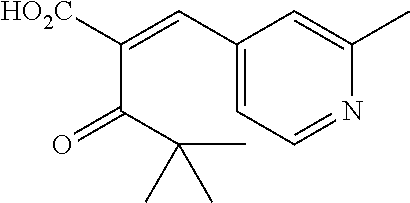 |
 |
 |
| LA-4-1 |
 |
 |
 |
| LA-4-2 |
 |
 |
 |
| LA-4-3 |
 |
 |
 |
| LA-4-4 |
 |
 |
 |
| LA-4-5 |
 |
 |
 |
| LA-4-6 |
 |
 |
 |
| Cy101—Cy102—Cy103 |
| LA No. | Cy101 | Cy102 | Cy103 |
| LA-5-1 |
 |
 |
 |
| LA-5-2 |
 |
 |
 |
| LA-5-3 |
 |
 |
 |
| LA-5-4 |
 |
 |
 |
| LA-5-5 |
 |
 |
 |
| LA-5-6 |
 |
 |
 |
| LA-5-7 |
 |
 |
 |
| LA-5-8 |
 |
 |
 |
| LA-5-9 |
 |
 |
 |
| LA-5-10 |
 |
 |
 |
| LA-5-11 |
 |
 |
 |
| LA-5-12 |
 |
 |
 |
| LA-5-13 |
 |
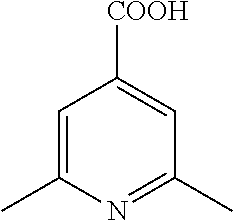 |
 |
| LA-5-14 |
 |
 |
 |
| LA-5-15 |
 |
 |
 |
| LA-5-16 |
 |
 |
 |
| LA-5-17 |
 |
 |
 |
| LA-5-18 |
 |
 |
 |
| LA-5-19 |
 |
 |
 |
| LA-5-20 |
 |
 |
 |
| LA-5-21 |
 |
 |
 |
| LA-5-22 |
 |
 |
 |
| LA-5-23 |
 |
 |
 |


—Ligand LD—


 |
| LD No. | Ring D | Ring F | Ring E |
| LD-3-1 |
 |
 |
 |
| LD-3-2 |
 |
 |
 |
| LD-3-3 |
 |
 |
 |
| LD-3-4 |
 |
 |
 |
| LD-3-5 |
 |
 |
 |
| LD-3-6 |
 |
 |
 |
| LD-3-7 |
 |
 |
 |
| LD-3-8 |
 |
 |
 |
| LD-3-9 |
 |
 |
 |
| LD-3-10 |
 |
 |
 |
| LD-3-11 |
 |
 |
 |
| LD-3-12 |
 |
 |
 |
| LD-3-13 |
 |
 |
 |
| LD-3-14 |
 |
 |
 |
| LD-3-15 |
 |
 |
 |
| LD-3-16 |
 |
 |
 |
| LD-3-17 |
 |
 |
 |
| LD-3-18 |
 |
 |
 |
| LD-3-19 |
 |
 |
 |
| LD-3-20 |
 |
 |
 |
| LD-3-21 |
 |
 |
 |
| LD-3-22 |
 |
 |
 |
| LD-3-23 |
 |
 |
 |
| LD-3-24 |
 |
 |
 |
| LD-3-25 |
 |
 |
 |
 |
| LD No. | R203 | R201 | R202 |
| LD-2-1 |
 |
H |
 |
| LD-2-2 |
 |
 |
 |
| LD-2-3 |
 |
 |
 |
| LD-2-4 |
 |
 |
 |
| LD-2-5 |
 |
 |
 |
| LD-2-6 |
 |
 |
 |
| LD-2-7 |
 |
 |
 |
| LD-2-8 |
 |
 |
 |
| LD-2-9 |
 |
 |
 |
| LD-2-10 |
 |
 |
 |
| LD-2-11 |
 |
 |
 |
| LD-2-12 |
 |
 |
 |
 |
| LD No. | Ring D | Ring F |
| LD-6-1 |
 |
 |
| LD-6-2 |
 |
 |
| LD-6-3 |
 |
 |
| LD-6-4 |
 |
 |
| LD-6-5 |
 |
 |
| LD-6-6 |
 |
 |
| LD-6-7 |
 |
 |
| LD-6-8 |
 |
 |
| LD-6-9 |
 |
 |
| LD-6-10 |
 |
 |
| LD-6-11 |
 |
 |
| LD-6-12 |
 |
 |
| LD-6-13 |
 |
 |
| LD-6-14 |
 |
 |
| LD-6-15 |
 |
 |
| LD-6-16 |
 |
 |
| LD-6-17 |
 |
 |
| LD-6-18 |
 |
 |
| LD-6-19 |
 |
 |
| LD-6-20 |
 |
 |
| LD-6-21 |
 |
 |
| LD-6-22 |
 |
 |
| LD-6-23 |
 |
 |
| LD-6-24 |
 |
 |
| LD-6-25 |
 |
 |
| LD-6-26 |
 |
 |
| LD-6-27 |
 |
 |
| LD-6-28 |
 |
 |
| LD-6-29 |
 |
 |
| LD-6-30 |
 |
 |
| LD-6-31 |
 |
 |
| LD-6-32 |
 |
 |
| LD-6-33 |
 |
 |
| LD-6-34 |
 |
 |
| LD-6-35 |
 |
 |
| LD-6-36 |
 |
 |
| LD-6-37 |
 |
 |
| LD-6-38 |
 |
 |
| LD-6-39 |
 |
 |
| LD-6-40 |
 |
 |
| LD-6-41 |
 |
 |
| LD-6-42 |
 |
 |
| LD-6-43 |
 |
 |
| LD-6-44 |
 |
 |
| LD-6-45 |
 |
 |
| LD-6-46 |
 |
 |
| LD-6-47 |
 |
 |
| LD-6-48 |
 |
 |
| LD-6-49 |
 |
 |
| LD-6-50 |
 |
 |
| LD-6-51 |
 |
 |
| LD-6-52 |
 |
 |
| LD-6-53 |
 |
 |
| LD-6-54 |
 |
 |
| LD-6-55 |
 |
 |
| LD-6-56 |
 |
 |
| LD-6-57 |
 |
 |
| LD-6-58 |
 |
 |
| LD-6-59 |
 |
 |
| LD-6-60 |
 |
 |
| LD-6-61 |
 |
 |
| LD-6-62 |
 |
 |
| LD-6-63 |
 |
 |
| LD-6-64 |
 |
 |
| LD-6-65 |
 |
 |
| LD-6-66 |
 |
 |
| LD-6-67 |
 |
 |
| LD-6-68 |
 |
 |
| LD-6-69 |
 |
 |
| LD-6-70 |
 |
 |
| LD-6-71 |
 |
 |
| LD-6-72 |
 |
 |
| LD-6-73 |
 |
 |
| LD-6-74 |
 |
 |
| LD-6-75 |
 |
 |
| LD-6-76 |
 |
 |
| LD-6-77 |
 |
 |
| LD-6-78 |
 |
 |
| LD-6-79 |
 |
 |
| LD-6-80 |
 |
 |
| LD-6-81 |
 |
 |
| LD-6-82 |
 |
 |
| LD-6-83 |
 |
 |
| LD-6-84 |
 |
 |
| LD-6-85 |
 |
 |
| LD-6-86 |
 |
 |
| LD-6-87 |
 |
 |
| LD-6-88 |
 |
 |
| LD-6-89 |
 |
 |
| LD-6-90 |
 |
 |
| LD-6-91 |
 |
 |
| LD-6-92 |
 |
 |
| LD-6-93 |
 |
 |
| LD-6-94 |
 |
 |
| LD-6-95 |
 |
 |
| LD-6-96 |
 |
 |
| LD-6-97 |
 |
 |
| LD-6-98 |
 |
 |


| TABLE 1 | |||||||
| Metal | |||||||
| complex | |||||||
| dye No. | M | LA | LD | LX | mX | CI | mY |
| D-317 | Ru | LA-5-4 | LD-6-10 | ⊖NCS | 1 | — | — |
| D-318 | Ru | LA-5-4 | LD-6-5 | ⊖NCS | 1 | — | — |
| D-319 | Ru | LA-5-4 | LD-6-14 | ⊖NCS | 1 | — | — |
| D-320 | Ru | LA-5-4 | LD-2-7 | — | 0 | — | — |
| D-321 | Ru | LA-5-6 | LD-2-3 | — | 0 | — | — |
| D-322 | Ru | LA-5-8 | LD-6-10 | ⊖NCS | 1 | — | — |
| D-323 | Ru | LA-5-8 | LD-6-10 | ⊖NCS | 1 | Bu4N+ | l |
| D-324 | Ru | LA-5-8 | LD-6-95 | ⊖NCS | 1 | — | — |
| D-325 | Ru | LA-5-8 | LD-6-96 | ⊖NCS | 1 | — | — |
| D-326 | Ru | LA-5-8 | LD-6-97 | ⊖NCS | 1 | — | — |
| D-327 | Ru | LA-5-8 | LD-6-98 | ⊖NCS | 1 | — | — |
| D-328 | Ru | LA-5-8 | LD-2-3 | — | 0 | — | — |
| D-329 | Ru | LA-5-8 | LD-2-7 | — | 0 | — | — |
| D-330 | Ru | LA-5-8 | LD-3-17 | — | 0 | — | — |
| D-331 | Ru | LA-5-8 | LD-3-18 | — | 0 | — | — |
| D-332 | Ru | LA-5-8 | LD-3-19 | — | 0 | — | — |
| D-333 | Ru | LA-5-8 | LD-3-20 | — | 0 | — | — |
| D-334 | Ru | LA-5-8 | LD-3-21 | — | 0 | — | — |
| D-335 | Ru | LA-5-8 | LD-3-22 | — | 0 | — | — |
| D-336 | Ru | LA-5-8 | LD-3-23 | — | 0 | — | — |
| D-337 | Ru | LA-5-8 | LD-3-1 | — | 0 | — | — |
| D-338 | Ru | LA-5-8 | LD-3-24 | — | 0 | — | — |
| D-339 | Ru | LA-5-8 | LD-3-25 | — | 0 | — | — |
| D-340 | Ru | LA-5-8 | LD-3-26 | — | 0 | — | — |
| D-341 | Ru | LA-5-8 | LD-3-27 | — | 0 | — | — |
| D-342 | Ru | LA-5-8 | LD-3-28 | — | 0 | — | — |
| D-343 | Ru | LA-5-11 | LD-6-14 | ⊖NCS | 1 | — | — |
| D-344 | Ru | LA-5-11 | LD-2-3 | — | 0 | — | — |
| D-345 | Ru | LA-5-13 | LD-6-14 | ⊖NCS | 1 | — | — |
| D-346 | Ru | LA-5-13 | LD-2-3 | — | 0 | — | — |
| D-347 | Ru | LA-5-14 | LD-3-27 | — | 0 | — | — |
| D-848 | Ru | LA-5-15 | LD-3-29 | — | 0 | — | — |
| D-349 | Ru | LA-5-16 | LD-3-31 | — | 0 | — | — |
| D-350 | Ru | LA-5-17 | LD-3-32 | — | 0 | — | — |
| D-351 | Ru | LA-5-18 | LD-3-32 | — | 0 | — | — |
| D-352 | Ru | LA-5-19 | LD-3-30 | — | 0 | — | — |
| D-353 | Ru | LA-5-19 | LD-3-32 | — | 0 | — | — |
Co(LL)ma(X)mb·CI Formula (CC)


an alkoxycarbonyl group (preferably an alkoxycarbonyl group having 2 to 20 carbon atoms, e.g. ethoxycarbonyl, or 2-ethylhexyloxycarbonyl), a cycloalkoxycarbonyl group (preferably a cycloalkoxycarbonyl group having 4 to 20 carbon atoms, e.g. cyclopropyloxycarbonyl, cyclopentyloxycarbonyl, or cyclohexyloxycarbonyl), an aryloxycarbonyl group (preferably an aryloxycarbonyl group having 6 to 20 carbon atoms, e.g. phenyloxycarbonyl, or naphthyloxycarbonyl), an amino group (preferably an amino group having 0 to 20 carbon atoms including an alkylamino group, an alkenylamino group, an alkynylamino group, a cycloalkylamino group, a cycloalkenylamino group, an arylamino group, and a heterocyclic amino group, e.g. amino, N,N-dimethylamino, N,N-diethylamino, N-ethylamino, N-allylamino, N-(2-propinyl)amino, N-cyclohexylamino, N-cyclohexenylamino, anilino, pyridylamino, imidazolylamino, benzimidazolylamino, thiazolylamino, benzothiazolylamino, or triazinylamino), a sulfamoyl group (preferably a sulfamoyl group having 0 to 20 carbon atoms, preferably an alkyl-, cycloalkyl-, or aryl-sulfamoyl group, e.g. N,N-dimethylsulfamoyl, N-cyclohexylsulfamoyl, or N-phenylsulfamoyl), an acyl group (preferably an acyl group having 1 to 20 carbon atoms, e.g. acetyl, cyclohexylcarbonyl, or benzoyl), an acyloxy group (preferably an acyloxy group having 1 to 20 carbon atoms, e.g. acetyloxy, cyclohexylcarbonyloxy, or benzoyloxy), a carbamoyl group (preferably a carbamoyl group having 1 to 20 carbon atoms, preferably an alkyl-, cycloalkyl-, or aryl-carbamoyl group, e.g. N,N-dimethylcarbamoyl, N-cyclohexylcarbamoyl, or N-phenylcarbamoyl),
an acylamino group (preferably an acylamino group having 1 to 20 carbon atoms, e.g. acetylamino, cyclohexylcarbonylamino, or benzoylamino), a sulfonamide group (preferably a sulfonamide group having 0 to 20 carbon atoms, preferably an alkyl-, cycloalkyl-, or aryl-sulfonamide group, e.g. methane sulfonamide, benzene sulfonamide, N-methyl methane sulfonamide, N-cyclohexyl sulfonamide, or N-ethyl benzene sulfonamide), an alkylthio group (preferably an alkylthio group having 1 to 20 carbon atoms, e.g. methylthio, ethylthio, isopropylthio, or benzylthio), a cycloalkylthio group (preferably a cycloalkylthio group having 3 to 20 carbon atoms, e.g. cyclopropylthio, cyclopentylthio, cyclohexylthio, or 4-methylcyclohexylthio), an arylthio group (preferably an arylthio group having 6 to 26 carbon atoms, e.g. phenylthio, 1-naphthylthio, 3-methylphenylthio, or 4-methoxyphenylthio), an alkyl-, cycloalkyl-, or aryl-sulfonyl group (preferably a sulfonyl group having 1 to 20 carbon atoms, e.g. methylsulfonyl, ethylsulfonyl, cyclohexylsulfonyl, or benzene sulfonyl),
a silyl group (preferably a silyl group having 1 to 20 carbon atoms, preferably an alkyl-, aryl-, alkoxy-, or aryloxy-substituted silyl group, e.g. triethylsilyl, triphenylsilyl, diethylbenzylsilyl, or dimethylphenylsilyl), a silyloxy group (preferably a silyloxy group having 1 to 20 carbon atoms, preferably an alkyl-, aryl-, alkoxy-, or aryloxy-substituted silyloxy group, e.g. triethylsilyloxy, triphenylsilyloxy, diethylbenzylsilyloxy, or dimethylphenylsilyloxy), a hydroxyl group, a cyano group, a nitro group, a halogen atom (e.g. fluorine, chlorine, bromine, or iodine atom), a carboxyl group, a sulfo group, a phosphonyl group, a phosphoryl group, and a boric-acid group; more preferably an alkyl group, an alkenyl group, a cycloalkyl group, an aryl group, a heterocyclic group, an alkoxy group, a cycloalkoxy group, an aryloxy group, an alkoxycarbonyl group, a cycloalkoxycarbonyl group, the above-described amino group, an acyamino group, a cyano group, or a halogen atom; and particularly preferably an alkyl group, an alkenyl group, a heterocyclic group, an alkoxy group, an alkoxycarbonyl group, an amino group, an acylamino group, or a cyano group.


(i) Synthesis of

(Synthesis of Metal Complex Dye D-18)

(Synthesis of Metal Complex Dye D-25)


(i) Synthesis of


(vi) Synthesis of

(Synthesis of Metal Complex Dye D-45)

(Synthesis of Metal Complex Dye D-57)

(Synthesis of Metal Complex Dye D-59)


(i) Synthesis of Compound 53


(i) Synthesis of Compound 37


(i) Synthesis of


(Synthesis of Metal Complex Dye D-188)


(i) Synthesis of Compound 47

| TABLE 2 | |
| Metal complex dye | ESI-MS or MALDI-MS |
| D-1 | ESI-MS m/z = 867(M—H)+ |
| D-2 | ESI-MS m/z = 867(M—H)+ |
| D-3 | ESI-MS m/z = 877(M—H)+ |
| D-4 | ESI-MS m/z = 893(M—H)+ |
| D-7 | ESI-MS m/z = 845(M—H)+ |
| D-9 | ESI-MS m/z = 942(M—H)+ |
| D-12 | ESI-MS m/z = 944(M—H)+ |
| D-14 | ESI-MS m/z = 962(M—H)+ |
| D-16 | ESI-MS m/z = 1115(M—H)+ |
| D-17 | ESI-MS m/z = 1037(M—H)+ |
| D-18 | ESI-MS m/z = 1201 (M—H)+ |
| D-24 | ESI-MS m/z = 1056(M—H)+ |
| D-25 | ESI-MS m/z = 1223(M—H)+ |
| D-26 | ESI-MS m/z = 1008(M—H)+ |
| D-27 | ESI-MS m/z = 982(M—H)+ |
| D-28 | ESI-MS m/z = 982(M—H)+ |
| D-29 | ESI-MS m/z =1082(M—H)+ |
| D-35 | ESI-MS m/z = 1033(M—H)+ |
| D-45 | ESI-MS m/z = 1148(M—H)+ |
| D-48 | ESI-MS m/z = 1044(M—H)+ |
| D-57 | MALDI-MS m/z = 982(M—H)+, 242(M+) |
| D-59 | ESI-MS m/z = 1092(M—H)+ |
| D-61 | ESI-MS m/z = 982(M—H)+ |
| D-62 | ESI-MS m/z = 956(M—H)+ |
| D-78 | ESI-MS m/z = 1157(M—H)+ |
| D-91 | MALDI-MS m/z = 1061(M—H)+ |
| D-96 | ESI-MS m/z = 961(M—H)+ |
| D-97 | ESI-MS m/z = 1054(M—H)+ |
| D-101 | ESI-MS m/z = 1236(M—H)+ |
| D-121 | ESI-MS m/z = 1145(M—H)+ |
| D-132 | ESI-MS m/z = 1034(M—H)+ |
| D-136 | ESI-MS m/z = 942(M—H)+ |
| D-140 | ESI-MS m/z = 1123(M—H)+ |
| D-141 | ESI-MS m/z = 1123 (M—H)+ |
| D-142 | ESI-MS m/z = 1171(M—H)+ |
| D-143 | ESI-MS m/z = 1171(M—H)+ |
| D-144 | ESI-MS m/z = 1097(M—H)+ |
| D-145 | ESI-MS m/z = 1097(M—H)+ |
| D-146 | ESI-MS m/z = 1145(M—H)+ |
| D-147 | ESI-MS m/z = 1145(M—H)+ |
| D-148 | ESI-MS m/z = 1093(M—H)+ |
| D-149 | ESI-MS m/z = 1093(M—H)+ |
| D-150 | ESI-MS m/z = 1141(M—H)+ |
| D-155 | ESI-MS m/z = 999(M—H)+ |
| D-187 | MALDI-MS m/z = 1060(M—H)+ |
| D-188 | MALDI-MS m/z = 992(M—H)+ |
| D-189 | ESI-MS m/z = 993(M—H)+, 242(M+) |
| D-200 | MALDI-MS m/z = 966(M—H)+ |
| D-241 | MALDI-MS m/z = 1224(M—H)+ |
| D-242 | MALDI-MS m/z = 1224(M—H)+ |
| D-280 | MALDI-MS m/z = 956(M—H)+, 242(M+) |
| D-297 | MALDI-MS m/z = 1050(M—H)+ |
(Paste 1) Spherical TiO2 particles A and spherical TiO2 particles (anatase, a mean particle diameter: 200 nm, hereinafter, referred to as spherical TiO2 particles B) were put into a nitric acid solution, and the resultant mixture was stirred to prepare a titania slurry. Next, a cellulose-based binder was added to the titania slurry as a thickening agent, and the resultant mixture was kneaded to prepare a paste ((mass of TiO2 particles A):(mass of TiO2 particles B)=30:70).
(Paste 2) Rod-shaped TiO2 particles (anatase, diameter: 100 nm, aspect ratio: 5, hereinafter, referred to as rod-shaped TiO2 particles C) were mixed with the paste A, to prepare a paste having (mass of rod-shaped TiO2 particles C):(mass of the paste A)=30:70.
(Production of Photoelectrode)
ΔF═−2×F 0 2 ×Δm/A(μ×P)1/2
| TABLE 3 | ||
| Metal complex dye | IPCE at 900 nm | Adsorption stability |
| D-1 | A | D |
| D-2 | A | D |
| D-3 | A | D |
| D-4 | A | D |
| D-7 | A | D |
| D-9 | A | D |
| D-12 | A | D |
| D-14 | A | B |
| D-16 | A | C |
| D-17 | A | B |
| D-18 | A | C |
| D-24 | A | A |
| Comparative compound (1) | D | F |
| Comparative compound (2) | D | G |
| Comparative compound (3) | C (reference) | G |
| Comparative compound (4) | D | G |

| TABLE 4 | |||||
| Metal | Conversion | Thermal | |||
| Sample No. | complex dye | efficiency | deterioration | Heat cycle | Remarks |
| 101 | D-25 | A | B | B | This invention |
| 102 | D-26 | A | A | A | This invention |
| 103 | D-27 | A | A | A | This invention |
| 104 | D-28 | A | A | A | This invention |
| 105 | D-29 | A | A | A | This invention |
| 106 | D-45 | A | A | A | This invention |
| 107 | D-48 | A | A | A | This invention |
| 108 | D-57 | A | B | B | This invention |
| 109 | D-59 | A | A | A | This invention |
| 110 | D-61 | A | A | A | This invention |
| 111 | D-62 | A | A | A | This invention |
| 112 | D-91 | A | A | A | This invention |
| 113 | D-96 | B | A | A | This invention |
| 114 | D-97 | B | A | A | This invention |
| 115 | D-101 | B | A | A | This invention |
| 116 | D-121 | A | A | A | This invention |
| 117 | D-132 | B | B | B | This invention |
| 118 | D-136 | A | A | A | This invention |
| 119 | D-140 | A | A | A | This invention |
| 120 | D-141 | A | A | A | This invention |
| 121 | D-142 | A | A | A | This invention |
| 122 | D-143 | A | A | A | This invention |
| 123 | D-144 | A | A | A | This invention |
| 124 | D-145 | A | A | A | This invention |
| 125 | D-146 | A | A | A | This invention |
| 126 | D-147 | A | A | A | This invention |
| 127 | D-148 | A | A | A | This invention |
| 128 | D-149 | A | A | A | This invention |
| 129 | D-150 | A | A | A | This invention |
| 130 | D-155 | B | B | B | This invention |
| 131 | D-187 | B | A | B | This invention |
| 132 | D-188 | B | A | B | This invention |
| 133 | D-189 | B | B | B | This invention |
| 134 | D-200 | B | A | B | This invention |
| 135 | D-241 | A | A | A | This invention |
| 136 | D-242 | A | A | A | This invention |
| 137 | D-280 | A | B | B | This invention |
| 138 | D-297 | B | A | A | This invention |
| c11 | Comparative | C | C | C (Reference) | Comparative |
| compound (1) | example | ||||
| c12 | Comparative | C (Reference) | C (Reference) | C | Comparative |
| compound (2) | example | ||||
| c13 | Comparative | C | C | C | Comparative |
| compound (3) | example | ||||
| c14 | Comparative | C | C | C | Comparative |
| compound (4) | example | ||||
- 1 Electrically conductive support
- 2 Photoconductor layer
- 21 Dye
- 22 Semiconductor fine particles
- 3 Charge transfer layer
- 4 Counter electrode
- 5 Light-receiving electrode
- 6 Circuit
- 10 Photoelectric conversion element
- 100 System utilizing a dye-sensitized solar cell
- M Electric motor (Electric fan)
- 20 Dye-sensitized solar cell
- 40 Photoelectrode
- 41 Transparent electrode
- 42 Semiconductor electrode
- 43 Transparent electrically-conductive film
- 44 Substrate
- 45 Semiconductor layer
- 46 Light-scattering layer
- CE Counter electrode
- E Electrolyte
- S Spacer
Claims (27)
M(LA)(LD)(LX)mX·(CI)mY formula (I)


M(LA)(LD)(LX)mX·(CI)mY Formula (I)


Applications Claiming Priority (15)
| Application Number | Priority Date | Filing Date | Title |
|---|---|---|---|
| JP2012-252701 | 2012-11-16 | ||
| JP2012252701 | 2012-11-16 | ||
| JP2012252700 | 2012-11-16 | ||
| JP2012-252700 | 2012-11-16 | ||
| JP2013-062895 | 2013-03-25 | ||
| JP2013062895 | 2013-03-25 | ||
| JP2013-129046 | 2013-06-19 | ||
| JP2013129046 | 2013-06-19 | ||
| JP2013-151149 | 2013-07-19 | ||
| JP2013151149 | 2013-07-19 | ||
| JP2013205533 | 2013-09-30 | ||
| JP2013-205533 | 2013-09-30 | ||
| JP2013235218A JP5992389B2 (en) | 2012-11-16 | 2013-11-13 | Photoelectric conversion element, dye-sensitized solar cell, metal complex dye, dye solution, dye-adsorbing electrode, and method for producing dye-sensitized solar battery |
| JP2013-235218 | 2013-11-13 | ||
| PCT/JP2013/080883 WO2014077356A1 (en) | 2012-11-16 | 2013-11-15 | Photoelectric conversion element, dye-sensitized solar cell, metal complex dye, dye solution, dye-adsorbed electrode, and method for manufacturing dye-sensitized solar cell |
Related Parent Applications (1)
| Application Number | Title | Priority Date | Filing Date |
|---|---|---|---|
| PCT/JP2013/080883 Continuation WO2014077356A1 (en) | 2012-11-16 | 2013-11-15 | Photoelectric conversion element, dye-sensitized solar cell, metal complex dye, dye solution, dye-adsorbed electrode, and method for manufacturing dye-sensitized solar cell |
Publications (2)
| Publication Number | Publication Date |
|---|---|
| US20150248969A1 US20150248969A1 (en) | 2015-09-03 |
| US10460879B2 true US10460879B2 (en) | 2019-10-29 |
Family
ID=60788723
Family Applications (1)
| Application Number | Title | Priority Date | Filing Date |
|---|---|---|---|
| US14/713,341 Expired - Fee Related US10460879B2 (en) | 2012-11-16 | 2015-05-15 | Photoelectric conversion element, dye-sensitized solar cell, metal complex dye, dye solution, dye-adsorbed electrode, and method for producing dye-sensitized solar cell |
Country Status (7)
| Country | Link |
|---|---|
| US (1) | US10460879B2 (en) |
| EP (1) | EP2922137B1 (en) |
| JP (1) | JP5992389B2 (en) |
| KR (1) | KR101676979B1 (en) |
| CN (1) | CN104798156B (en) |
| TW (1) | TWI586675B (en) |
| WO (1) | WO2014077356A1 (en) |
Families Citing this family (13)
| Publication number | Priority date | Publication date | Assignee | Title |
|---|---|---|---|---|
| JP5881578B2 (en) * | 2011-12-15 | 2016-03-09 | 富士フイルム株式会社 | Metal complex dye, photoelectric conversion element, dye-sensitized solar cell, and dye solution |
| JP5925541B2 (en) * | 2012-03-16 | 2016-05-25 | 富士フイルム株式会社 | Metal complex dye for photoelectric conversion element, photoelectric conversion element, dye-sensitized solar cell, dye-adsorbing composition liquid for dye-sensitized solar cell, semiconductor electrode for dye-sensitized solar cell, and method for producing dye-sensitized solar cell |
| JP6144618B2 (en) * | 2013-04-12 | 2017-06-07 | 富士フイルム株式会社 | Photoelectric conversion element, dye-sensitized solar cell and metal complex dye used therefor |
| CN106663544B (en) * | 2014-06-11 | 2018-06-29 | 富士胶片株式会社 | Photo-electric conversion element, dye-sensitized solar cells, metal complex dye, pigment solution and terpyridyl or its carboxylate |
| KR101947886B1 (en) * | 2014-06-11 | 2019-02-13 | 후지필름 가부시키가이샤 | Photoelectric conversion element, dye-sensitized solar cell, metal-complex pigment, and pigment solution |
| DE112015003328T5 (en) | 2014-07-18 | 2017-04-13 | Board Of Trustees Of Michigan State University | Rechargeable lithium-ion cell with a redox shuttle additive |
| CN108028137B (en) * | 2015-09-17 | 2020-02-21 | 富士胶片株式会社 | Photoelectric conversion element, dye-sensitized solar cell, pigment composition, and oxide semiconductor electrode |
| GB201604050D0 (en) * | 2016-03-09 | 2016-04-20 | Isis Innovation | A/M/X material production process with alkylamine |
| CN106025078B (en) * | 2016-07-11 | 2018-07-17 | 河北大学 | A kind of planar heterojunction perovskite photovoltaic cell and preparation method thereof |
| WO2018098116A2 (en) | 2016-11-22 | 2018-05-31 | Board Of Trustees Of Michigan State University | Rechargeable electrochemical cell |
| WO2019018741A1 (en) * | 2017-07-20 | 2019-01-24 | Board Of Trustees Of Michigan State University | Redox flow battery |
| WO2021024675A1 (en) * | 2019-08-05 | 2021-02-11 | 国立大学法人大阪大学 | Compound and production method therefor |
| CN111646932A (en) * | 2020-06-10 | 2020-09-11 | 南京合巨药业有限公司 | Preparation method of 4,4', 4' ' -tri-tert-butyl-2, 2 ': 6 ', 2' ' -terpyridine |
Citations (22)
| Publication number | Priority date | Publication date | Assignee | Title |
|---|---|---|---|---|
| WO1998050393A1 (en) | 1997-05-07 | 1998-11-12 | Ecole Polytechnique Federale De Lausanne | Metal complex photosensitizer and photovoltaic cell |
| JP2002105346A (en) | 2000-07-25 | 2002-04-10 | Fuji Photo Film Co Ltd | Metal complex dye, photoelectric conversion element and photocell |
| CN1359901A (en) | 2000-12-21 | 2002-07-24 | 中国科学院感光化学研究所 | Ru-polypyridine complex and its synthesizing process and use |
| US20050081911A1 (en) * | 2003-10-17 | 2005-04-21 | Sharp Kabushiki Kaisha | Photosensitizing transition metal complex and its use for photovoltaic cell |
| JP2008187162A (en) | 2007-01-29 | 2008-08-14 | Mariko Miyaji | Photochemical protein complex immobilized transparent electrode and novel compound |
| JP2008222747A (en) | 2007-03-08 | 2008-09-25 | National Institute Of Advanced Industrial & Technology | Dye and dye-sensitized solar cell using the same |
| JP2008266639A (en) | 2007-03-29 | 2008-11-06 | Sumitomo Chemical Co Ltd | Compound, photoelectric conversion element and photoelectrochemical cell |
| EP2036955A1 (en) | 2007-09-17 | 2009-03-18 | JSR Corporation | Dyestuff, dye-sensitized solar cell, and method for manufacturing same |
| WO2009055183A2 (en) | 2007-10-26 | 2009-04-30 | Konarka Technologies, Inc. | Novel dyes |
| US20100101643A1 (en) | 2007-03-29 | 2010-04-29 | Sumitomo Chemical Company, Limited | Compound, photoelectric converter and photoelectrochemical cell |
| US20100258175A1 (en) | 2009-04-10 | 2010-10-14 | Yun Chi | Panchromatic photosensitizers and dye-sensitized solar cell using the same |
| JP2011502187A (en) | 2007-10-25 | 2011-01-20 | ソニー株式会社 | Dyes containing anchor groups in the molecular structure |
| US20110155238A1 (en) * | 2008-04-24 | 2011-06-30 | Xiuliang Shen | Pyridine type metal complex, photoelectrode comprising the metal complex, and dye-sensitized solar cell comprising the photoelectrode |
| WO2011152603A1 (en) | 2010-06-01 | 2011-12-08 | 고려대학교 산학협력단 | Wavelength conversion material for highly efficient dye-sensitized solar cell, and preparation method thereof |
| TW201144293A (en) | 2010-03-24 | 2011-12-16 | Fujifilm Corp | Photoelectric transducer and photoelectrochemical cell |
| WO2012017869A1 (en) | 2010-08-03 | 2012-02-09 | 富士フイルム株式会社 | Metal complex dye, photoelectric conversion element and photoelectrochemical cell |
| JP2012053983A (en) | 2010-08-03 | 2012-03-15 | Fujifilm Corp | Photoelectric converter and photoelectrochemical cell |
| US20120073660A1 (en) | 2010-09-28 | 2012-03-29 | Yun Chi | Heteroleptic, dual tridentate ru(ii) complexes as sensitizers for dye-sensitized solar cells |
| JP2012216496A (en) | 2011-03-31 | 2012-11-08 | Fujifilm Corp | Photoelectric conversion element and dye-sensitization solar battery |
| WO2013047615A1 (en) | 2011-09-29 | 2013-04-04 | 富士フイルム株式会社 | Photoelectric conversion element, photoelectrochemical cell, and metal complex pigment used in same |
| WO2013088898A1 (en) | 2011-12-15 | 2013-06-20 | 富士フイルム株式会社 | Metal complex dye, photoelectric conversion element, dye-sensitized solar cell, dye solution, and compound |
| WO2013137221A1 (en) | 2012-03-16 | 2013-09-19 | 富士フイルム株式会社 | Metal complex dye, photoelectric conversion element, dye-sensitized solar cell, dye adsorption liquid composition for dye-sensitized solar cell, semiconductor electrode for dye-sensitized solar cell, and method for producing dye-sensitized solar cell |
Family Cites Families (55)
| Publication number | Priority date | Publication date | Assignee | Title |
|---|---|---|---|---|
| WO1985005119A1 (en) | 1984-04-30 | 1985-11-21 | Stiftung, R., E. | Process for the sensitization of an oxidoreduction photocalatyst, and photocatalyst thus obtained |
| CH674596A5 (en) | 1988-02-12 | 1990-06-15 | Sulzer Ag | |
| ATE131953T1 (en) | 1990-04-17 | 1996-01-15 | Ecole Polytech | PHOTOVOLTAIC CELLS |
| DE4207659A1 (en) | 1992-03-11 | 1993-09-16 | Abb Patent Gmbh | METHOD FOR PRODUCING A PHOTOELECTROCHEMICAL CELL AND A CLEARLY PRODUCED CELL |
| GB9217811D0 (en) | 1992-08-21 | 1992-10-07 | Graetzel Michael | Organic compounds |
| JP3579078B2 (en) | 1994-03-11 | 2004-10-20 | 石原産業株式会社 | Semiconductors for photoelectric conversion materials |
| JP3599859B2 (en) | 1994-12-29 | 2004-12-08 | 石原産業株式会社 | Porous substance-polymer solid electrolyte composite, method for producing the same, and photoelectric conversion element using the same |
| US6056127A (en) | 1996-10-28 | 2000-05-02 | Sortex Limited | Delivery system for sorting apparatus |
| DE19711713A1 (en) | 1997-03-20 | 1998-10-01 | Hoechst Ag | Photovoltaic cell |
| JP4024942B2 (en) | 1998-09-16 | 2007-12-19 | 株式会社東芝 | Dye-sensitized photochemical cell |
| JP2000100483A (en) | 1998-09-22 | 2000-04-07 | Sharp Corp | Photoelectric conversion element, method of manufacturing the same, and solar cell using the same |
| JP4360569B2 (en) | 1999-02-05 | 2009-11-11 | 富士フイルム株式会社 | Photoelectric conversion element and photoelectrochemical cell |
| JP2000340269A (en) | 1999-03-25 | 2000-12-08 | Showa Denko Kk | Pigment sensitization photoelectric transducer sensing element |
| JP2000285977A (en) | 1999-03-31 | 2000-10-13 | Fuji Photo Film Co Ltd | Photoelectric conversion element and photocell |
| JP4285671B2 (en) | 1999-06-14 | 2009-06-24 | 富士フイルム株式会社 | Photoelectric conversion device, photoelectrochemical cell, and metal complex dye |
| JP4363553B2 (en) | 1999-05-14 | 2009-11-11 | 富士フイルム株式会社 | Electrolyte composition, photoelectric conversion element and photoelectrochemical cell |
| JP4077594B2 (en) | 1999-05-27 | 2008-04-16 | 触媒化成工業株式会社 | Photoelectric cell, coating liquid for forming metal oxide semiconductor film, and method for producing metal oxide semiconductor film for photoelectric cell |
| JP4162106B2 (en) | 1999-06-17 | 2008-10-08 | 富士フイルム株式会社 | Photoelectric conversion device, photoelectrochemical cell, and metal complex dye |
| JP2001160425A (en) | 1999-12-02 | 2001-06-12 | Japan Gore Tex Inc | Optical semiconductor electrode and method of manufacturing the same |
| JP4414036B2 (en) | 1999-12-27 | 2010-02-10 | シャープ株式会社 | Method for producing dye-sensitized solar cell |
| JP4477729B2 (en) | 2000-01-19 | 2010-06-09 | シャープ株式会社 | Photoelectric conversion element and solar cell using the same |
| JP3982968B2 (en) | 2000-01-26 | 2007-09-26 | シャープ株式会社 | Dye-sensitized solar cell using polymer electrolyte and method for producing the same |
| JP4874454B2 (en) | 2000-01-31 | 2012-02-15 | 富士フイルム株式会社 | Photoelectric conversion element and photovoltaic cell |
| JP3430254B2 (en) | 2000-03-13 | 2003-07-28 | 独立行政法人産業技術総合研究所 | Metal complex having β-diketonate, method for producing the same, photoelectric conversion element, and photochemical cell |
| JP4443713B2 (en) | 2000-03-24 | 2010-03-31 | 富士フイルム株式会社 | Semiconductor fine particles, photoelectric conversion element and photovoltaic cell |
| JP4638973B2 (en) | 2000-03-27 | 2011-02-23 | 富士フイルム株式会社 | Photoelectric conversion element and photovoltaic cell |
| JP2001320068A (en) | 2000-05-01 | 2001-11-16 | Fuji Photo Film Co Ltd | Transparent photoelectric converting element, photo cell using the same, optical sensor and window glass |
| JP4185285B2 (en) | 2002-01-18 | 2008-11-26 | シャープ株式会社 | Dye-sensitized photoelectric conversion element and solar cell using the same |
| JP4213355B2 (en) | 2001-02-28 | 2009-01-21 | 株式会社豊田中央研究所 | Dye-sensitized solar cell and dye-sensitized solar cell module |
| JP4617014B2 (en) | 2001-03-21 | 2011-01-19 | 富士フイルム株式会社 | Method for manufacturing photoelectric conversion element |
| JP4812956B2 (en) | 2001-03-27 | 2011-11-09 | 株式会社豊田中央研究所 | Photoelectrode and dye-sensitized solar cell provided with the same |
| JP5050301B2 (en) | 2001-06-12 | 2012-10-17 | アイシン精機株式会社 | Dye-sensitized solar cell and method for producing the same |
| JP2003123859A (en) | 2001-10-19 | 2003-04-25 | Bridgestone Corp | Organic dye sensitized metal oxide semiconductor electrode, and solar battery having the semiconductor electrode |
| JP3985040B2 (en) | 2002-01-22 | 2007-10-03 | 独立行政法人産業技術総合研究所 | Ruthenium complex useful as sensitizer, oxide semiconductor electrode, and solar cell using the same |
| JP4260494B2 (en) | 2002-02-26 | 2009-04-30 | 株式会社フジクラ | Manufacturing method of transparent electrode substrate, manufacturing method of photoelectric conversion element, and manufacturing method of dye-sensitized solar cell |
| JP4187476B2 (en) | 2002-07-29 | 2008-11-26 | 三菱製紙株式会社 | Photoelectric conversion material, semiconductor electrode, and photoelectric conversion element using the same |
| JP4503226B2 (en) | 2002-10-22 | 2010-07-14 | 株式会社フジクラ | Electrode substrate, photoelectric conversion element, and dye-sensitized solar cell |
| JP2004152613A (en) | 2002-10-30 | 2004-05-27 | Toyota Central Res & Dev Lab Inc | Dye-sensitized solar cell |
| JP4423857B2 (en) | 2003-01-16 | 2010-03-03 | 東洋インキ製造株式会社 | Optical functional materials |
| JP4235728B2 (en) | 2003-03-07 | 2009-03-11 | 独立行政法人産業技術総合研究所 | Photoelectric conversion element using electrolyte solution containing benzimidazole compound and dye-sensitized solar cell using the same |
| JP3671183B2 (en) | 2003-09-04 | 2005-07-13 | 司 吉田 | Method for producing dye-sensitized solar cell |
| JP2005135902A (en) | 2003-10-06 | 2005-05-26 | Ngk Spark Plug Co Ltd | Dye-sensitized solar cell |
| JP2005123033A (en) | 2003-10-16 | 2005-05-12 | Mitsubishi Paper Mills Ltd | Photoelectric conversion material, semiconductor electrode, and photoelectric conversion element using the same |
| JP4443906B2 (en) * | 2003-12-05 | 2010-03-31 | シャープ株式会社 | Metal complex and dye-sensitized solar cell using the same |
| CN101379140B (en) | 2006-02-08 | 2013-06-12 | 岛根县 | Photosensitizer dye |
| JP4925224B2 (en) | 2006-03-31 | 2012-04-25 | 独立行政法人産業技術総合研究所 | Organic compound and semiconductor thin film electrode, photoelectric conversion element and photoelectrochemical solar cell using the same |
| US8653279B2 (en) | 2006-04-17 | 2014-02-18 | Samsung Sdi Co., Ltd. | Dye for dye-sensitized solar cell, and solar cell prepared from same |
| JP5185518B2 (en) | 2006-09-14 | 2013-04-17 | 三菱製紙株式会社 | Photoelectric conversion material, semiconductor electrode, and photoelectric conversion element using the same |
| JP5135777B2 (en) | 2006-11-27 | 2013-02-06 | コニカミノルタビジネステクノロジーズ株式会社 | Dye-sensitized photoelectric conversion element and dye-sensitized solar cell |
| US8779126B2 (en) * | 2008-10-29 | 2014-07-15 | Fujifilm Corporation | Dye, photoelectric conversion element using the same, photoelectrochemical cell, and method of producing dye |
| WO2010055471A1 (en) | 2008-11-11 | 2010-05-20 | Ecole Polytechnique Federale De Lausanne (Epfl) | Novel anchoring ligands for sensitizers of dye-sensitized photovoltaic devices |
| WO2010055856A1 (en) * | 2008-11-12 | 2010-05-20 | 宇部興産株式会社 | Photochemical cell comprising semiconductor microparticles sensitized with binuclear metal complex dye and electrolysis solution mainly composed of ionic liquid |
| JP5620314B2 (en) | 2010-05-31 | 2014-11-05 | 富士フイルム株式会社 | Photoelectric conversion element, photoelectrochemical cell, dye for photoelectric conversion element and dye solution for photoelectric conversion element |
| JP4980479B2 (en) | 2010-06-02 | 2012-07-18 | 富士フイルム株式会社 | Metal complex dye, photoelectric conversion element, and dye-sensitized solar cell |
| JP5620316B2 (en) | 2010-09-09 | 2014-11-05 | 富士フイルム株式会社 | Photoelectric conversion element, photoelectrochemical cell and dye |
-
2013
- 2013-11-13 JP JP2013235218A patent/JP5992389B2/en not_active Expired - Fee Related
- 2013-11-15 TW TW102141558A patent/TWI586675B/en not_active IP Right Cessation
- 2013-11-15 KR KR1020157014055A patent/KR101676979B1/en not_active Expired - Fee Related
- 2013-11-15 CN CN201380060506.5A patent/CN104798156B/en not_active Expired - Fee Related
- 2013-11-15 WO PCT/JP2013/080883 patent/WO2014077356A1/en not_active Ceased
- 2013-11-15 EP EP13855922.4A patent/EP2922137B1/en not_active Not-in-force
-
2015
- 2015-05-15 US US14/713,341 patent/US10460879B2/en not_active Expired - Fee Related
Patent Citations (23)
| Publication number | Priority date | Publication date | Assignee | Title |
|---|---|---|---|---|
| WO1998050393A1 (en) | 1997-05-07 | 1998-11-12 | Ecole Polytechnique Federale De Lausanne | Metal complex photosensitizer and photovoltaic cell |
| US6245988B1 (en) * | 1997-05-07 | 2001-06-12 | Ecole Polytechnique Federale De Lausanne | Metal complex photosensitizer and photovoltaic cell |
| JP2002105346A (en) | 2000-07-25 | 2002-04-10 | Fuji Photo Film Co Ltd | Metal complex dye, photoelectric conversion element and photocell |
| CN1359901A (en) | 2000-12-21 | 2002-07-24 | 中国科学院感光化学研究所 | Ru-polypyridine complex and its synthesizing process and use |
| US20050081911A1 (en) * | 2003-10-17 | 2005-04-21 | Sharp Kabushiki Kaisha | Photosensitizing transition metal complex and its use for photovoltaic cell |
| JP2008187162A (en) | 2007-01-29 | 2008-08-14 | Mariko Miyaji | Photochemical protein complex immobilized transparent electrode and novel compound |
| JP2008222747A (en) | 2007-03-08 | 2008-09-25 | National Institute Of Advanced Industrial & Technology | Dye and dye-sensitized solar cell using the same |
| US20100101643A1 (en) | 2007-03-29 | 2010-04-29 | Sumitomo Chemical Company, Limited | Compound, photoelectric converter and photoelectrochemical cell |
| JP2008266639A (en) | 2007-03-29 | 2008-11-06 | Sumitomo Chemical Co Ltd | Compound, photoelectric conversion element and photoelectrochemical cell |
| EP2036955A1 (en) | 2007-09-17 | 2009-03-18 | JSR Corporation | Dyestuff, dye-sensitized solar cell, and method for manufacturing same |
| JP2011502187A (en) | 2007-10-25 | 2011-01-20 | ソニー株式会社 | Dyes containing anchor groups in the molecular structure |
| WO2009055183A2 (en) | 2007-10-26 | 2009-04-30 | Konarka Technologies, Inc. | Novel dyes |
| US20110155238A1 (en) * | 2008-04-24 | 2011-06-30 | Xiuliang Shen | Pyridine type metal complex, photoelectrode comprising the metal complex, and dye-sensitized solar cell comprising the photoelectrode |
| US20100258175A1 (en) | 2009-04-10 | 2010-10-14 | Yun Chi | Panchromatic photosensitizers and dye-sensitized solar cell using the same |
| TW201144293A (en) | 2010-03-24 | 2011-12-16 | Fujifilm Corp | Photoelectric transducer and photoelectrochemical cell |
| WO2011152603A1 (en) | 2010-06-01 | 2011-12-08 | 고려대학교 산학협력단 | Wavelength conversion material for highly efficient dye-sensitized solar cell, and preparation method thereof |
| WO2012017869A1 (en) | 2010-08-03 | 2012-02-09 | 富士フイルム株式会社 | Metal complex dye, photoelectric conversion element and photoelectrochemical cell |
| JP2012053983A (en) | 2010-08-03 | 2012-03-15 | Fujifilm Corp | Photoelectric converter and photoelectrochemical cell |
| US20120073660A1 (en) | 2010-09-28 | 2012-03-29 | Yun Chi | Heteroleptic, dual tridentate ru(ii) complexes as sensitizers for dye-sensitized solar cells |
| JP2012216496A (en) | 2011-03-31 | 2012-11-08 | Fujifilm Corp | Photoelectric conversion element and dye-sensitization solar battery |
| WO2013047615A1 (en) | 2011-09-29 | 2013-04-04 | 富士フイルム株式会社 | Photoelectric conversion element, photoelectrochemical cell, and metal complex pigment used in same |
| WO2013088898A1 (en) | 2011-12-15 | 2013-06-20 | 富士フイルム株式会社 | Metal complex dye, photoelectric conversion element, dye-sensitized solar cell, dye solution, and compound |
| WO2013137221A1 (en) | 2012-03-16 | 2013-09-19 | 富士フイルム株式会社 | Metal complex dye, photoelectric conversion element, dye-sensitized solar cell, dye adsorption liquid composition for dye-sensitized solar cell, semiconductor electrode for dye-sensitized solar cell, and method for producing dye-sensitized solar cell |
Non-Patent Citations (8)
| Title |
|---|
| Adewale O. Adeloye, et al., "A High Molar Extinction Coefficient Bisterpyridyl Homoleptic Ru(II) Complex with trans-2-Methyl-2-butenoic Acid Functionality: Potential Dye for Dye-Sensitized Solar Cells", International Journal of Molecular Sciences, Mar. 14, 2012, pp. 3511-3526, vol. 13. |
| Communication dated Nov. 18, 2015, issued by the European Patent Office in corresponding European Application No. 13855922.4. |
| Communication dated Nov. 29, 2016, from the Intellectual Property Office of Taiwan in corresponding application No. 102141558. |
| Frederik C. Krebs, et al., "Dye sensitized photovoltaic cells: Attaching conjugated polymers to zwitterionic ruthenium dyes", Solar Energy Materials & Solar Cells, 2006, pp. 142-165, vol. 90, No. 2. |
| Houarner-Rassin et al., "Synthesis and photoelectrochemical properties of ruthenium bisterpyridine sensitizers functionalized with a thienyl phosphoric acid moiety", Journal of Photochemistry and Photobiology A: Chemistry 192, 2007, pp. 56-65. |
| International Search Report for PCT/JP2013/080883 dated Dec. 17, 2013 [PCT/ISA/210]. |
| S. Altobello, et al., "Sensitization of TiO2 with ruthenium complexes containing boronic acid functions", Journal of Photochemistry and Photobiology, A: Chemistry, 2004, pp. 91-98, vol. 166. |
| Zakeeruddin et al., "Molecular Engineering of Photosensitizers for Nanocrystalline Solar Cells: Synthesis and Characterization of Ru Dyes Based on Phosphonated Terpyridines", Inorg. Chem., 1997, vol. 36, No. 25, pp. 5937-5946. |
Also Published As
| Publication number | Publication date |
|---|---|
| KR101676979B1 (en) | 2016-11-16 |
| CN104798156B (en) | 2017-11-14 |
| WO2014077356A1 (en) | 2014-05-22 |
| TWI586675B (en) | 2017-06-11 |
| EP2922137B1 (en) | 2019-04-03 |
| KR20150080921A (en) | 2015-07-10 |
| EP2922137A1 (en) | 2015-09-23 |
| EP2922137A4 (en) | 2015-12-16 |
| JP5992389B2 (en) | 2016-09-14 |
| CN104798156A (en) | 2015-07-22 |
| US20150248969A1 (en) | 2015-09-03 |
| JP2015092442A (en) | 2015-05-14 |
| TW201429979A (en) | 2014-08-01 |
Similar Documents
| Publication | Publication Date | Title |
|---|---|---|
| EP2922137B1 (en) | Photoelectric conversion element, dye-sensitized solar cell, metal complex dye, dye solution, dye-adsorbed electrode, and method for manufacturing dye-sensitized solar cell | |
| US9953768B2 (en) | Metal-complex dye, photoelectric conversion element, dye-sensitized solar cell, and dye solution containing metal-complex dye | |
| US20190295778A1 (en) | Photoelectric conversion element, dye-sensitized solar cell, metal complex dye, dye solution, and terpyridine compound or esterified product thereof | |
| US20170117100A1 (en) | Photoelectric conversion element, dye-sensitized solar cell, metal complex dye, dye solution, and terpyridine compound or esterified product thereof | |
| US9614165B2 (en) | Photoelectric conversion element, dye-sensitized solar cell, metal complex dye, dye solution, dye-adsorbed electrode and method of producing dye-sensitized solar cell | |
| US20170092434A1 (en) | Photoelectric conversion element, dye-sensitized solar cell, metal complex dye, and dye solution | |
| US20170092435A1 (en) | Photoelectric conversion element, dye-sensitized solar cell, metal complex dye, dye solution, and terpyridine compound or esterified product thereof | |
| EP2903078B1 (en) | Metal complex dye, photoelectric conversion element, dye-sensitized solar cell, dye solution, and dye-adsorbed electrode | |
| JP2014102917A (en) | Metal complex dye, photoelectric conversion element, dye-sensitized solar cell, dye solution, dye adsorption electrode, and method of manufacturing dye-sensitized solar cell | |
| JP6204603B2 (en) | Photoelectric conversion element, dye-sensitized solar cell, metal complex dye and dye solution | |
| US20170352493A1 (en) | Ruthenium complex dye, dye solution, photoelectric conversion element, and dye-sensitized solar cell | |
| JP2016072395A (en) | Photoelectric conversion element, dye-sensitized solar cell, metal complex dye and dye solution | |
| JP2015220262A (en) | Photoelectric conversion device and dye-sensitized solar battery |
Legal Events
| Date | Code | Title | Description |
|---|---|---|---|
| AS | Assignment |
Owner name: FUJIFILM CORPORATION, JAPAN Free format text: ASSIGNMENT OF ASSIGNORS INTEREST;ASSIGNORS:WATANABE, KOUSUKE;TANI, YUKIO;SASAKI, KOUITSU;AND OTHERS;SIGNING DATES FROM 20150422 TO 20150428;REEL/FRAME:035650/0218 |
|
| STPP | Information on status: patent application and granting procedure in general |
Free format text: FINAL REJECTION MAILED |
|
| STPP | Information on status: patent application and granting procedure in general |
Free format text: RESPONSE AFTER FINAL ACTION FORWARDED TO EXAMINER |
|
| STPP | Information on status: patent application and granting procedure in general |
Free format text: NOTICE OF ALLOWANCE MAILED -- APPLICATION RECEIVED IN OFFICE OF PUBLICATIONS |
|
| STPP | Information on status: patent application and granting procedure in general |
Free format text: PUBLICATIONS -- ISSUE FEE PAYMENT VERIFIED |
|
| STCF | Information on status: patent grant |
Free format text: PATENTED CASE |
|
| FEPP | Fee payment procedure |
Free format text: MAINTENANCE FEE REMINDER MAILED (ORIGINAL EVENT CODE: REM.); ENTITY STATUS OF PATENT OWNER: LARGE ENTITY |
|
| LAPS | Lapse for failure to pay maintenance fees |
Free format text: PATENT EXPIRED FOR FAILURE TO PAY MAINTENANCE FEES (ORIGINAL EVENT CODE: EXP.); ENTITY STATUS OF PATENT OWNER: LARGE ENTITY |
|
| STCH | Information on status: patent discontinuation |
Free format text: PATENT EXPIRED DUE TO NONPAYMENT OF MAINTENANCE FEES UNDER 37 CFR 1.362 |
|
| FP | Lapsed due to failure to pay maintenance fee |
Effective date: 20231029 |